🔥 Would you like to save this?
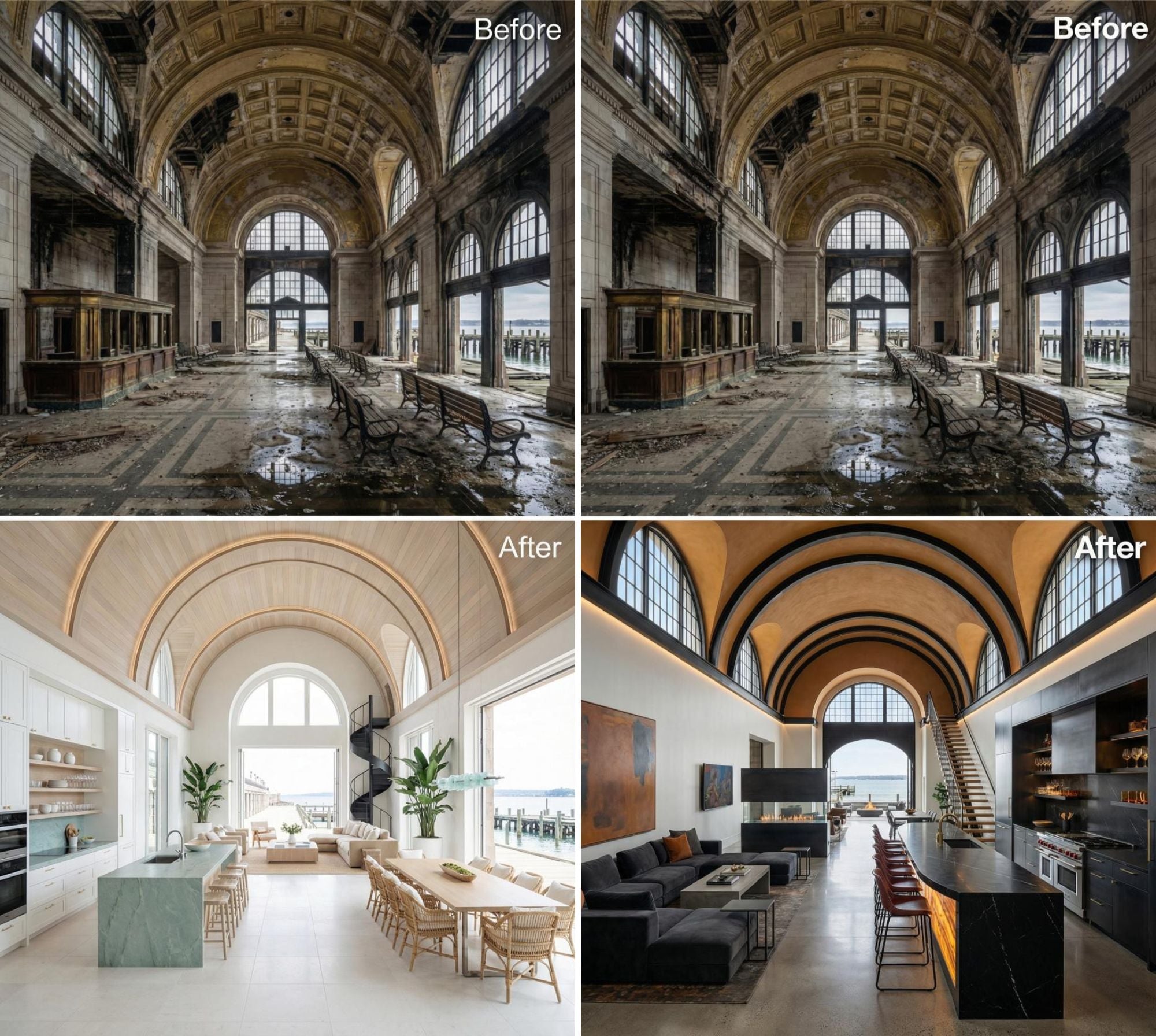
When a 1930s bank stops being a bank, it becomes something rarer — a problem worth having. The grand hall alone arrives with more architectural ambition than most homes ever accumulate: coffered ceilings built to impress depositors, teller counters in brass and mahogany, ironwork nobody ordered cheap, and proportions that treat human scale as a suggestion. These 38 before-and-after galleries put that inheritance to work, exploring what luxury looks like when it has genuinely good bones to start with. Some projects kept their hands off the original detail, letting the Art Deco framework carry the weight. Others treated the shell as a starting point and nothing more, gutting everything down to the raw volume and rebuilding in Venetian plaster, volcanic basalt, Murano glass, and rammed earth. The range of outcomes is the point. No two spaces read the same room the same way, and every one of them made a credible argument for why theirs was the right call.
In order to come up with the very specific design ideas, we create most designs with the assistance of state-of-the-art AI interior design software. Also, assume links that take you off the site are affiliate links such as links to Amazon. this means we may earn a commission if you buy something.
Abandoned Bank Hall Reborn in Black Marble, Gold Brass, and Art Deco Geometry
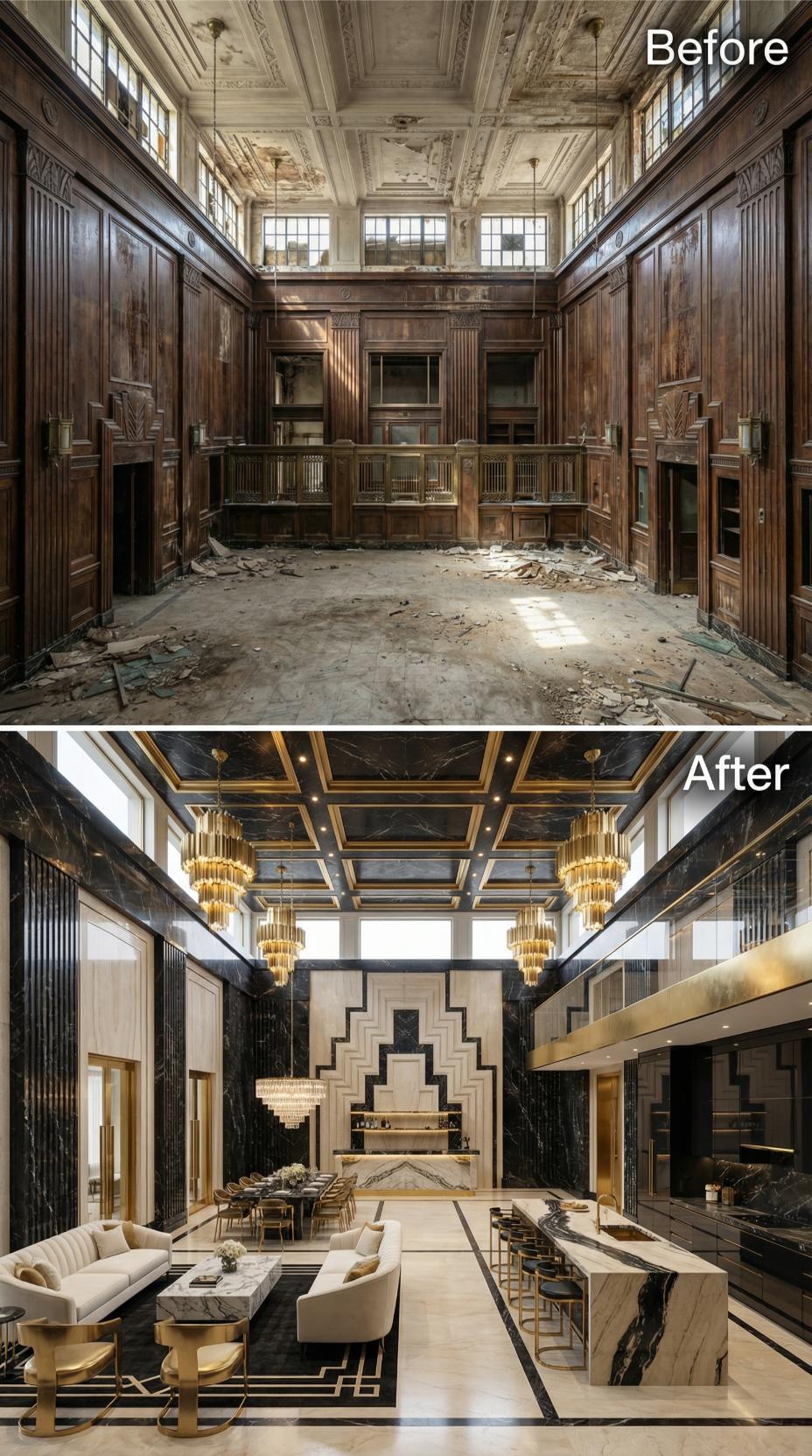
Where debris once covered cracked floors beneath deteriorating plaster ceilings, black Portoro marble now clads every wall from floor to coffered ceiling, its gold veining echoing the brass trim that outlines each recessed panel. Three tiered cylindrical chandeliers drop from the renovated coffered ceiling, their stacked rings finished in brushed gold. The original double-height window banks survive, flooding the space with natural light.
The central focal wall features a stepped geometric relief in cream limestone and black marble, a motif repeated in the inlaid floor pattern below. Cream bouclé sofas anchor a seating area around a marble-topped coffee table on black legs, while a marble waterfall island with brass bar stools defines the kitchen zone to the right.
Colored Glass Ceiling Panels Flood a Renovated Bank Hall With Amber and Cobalt Light
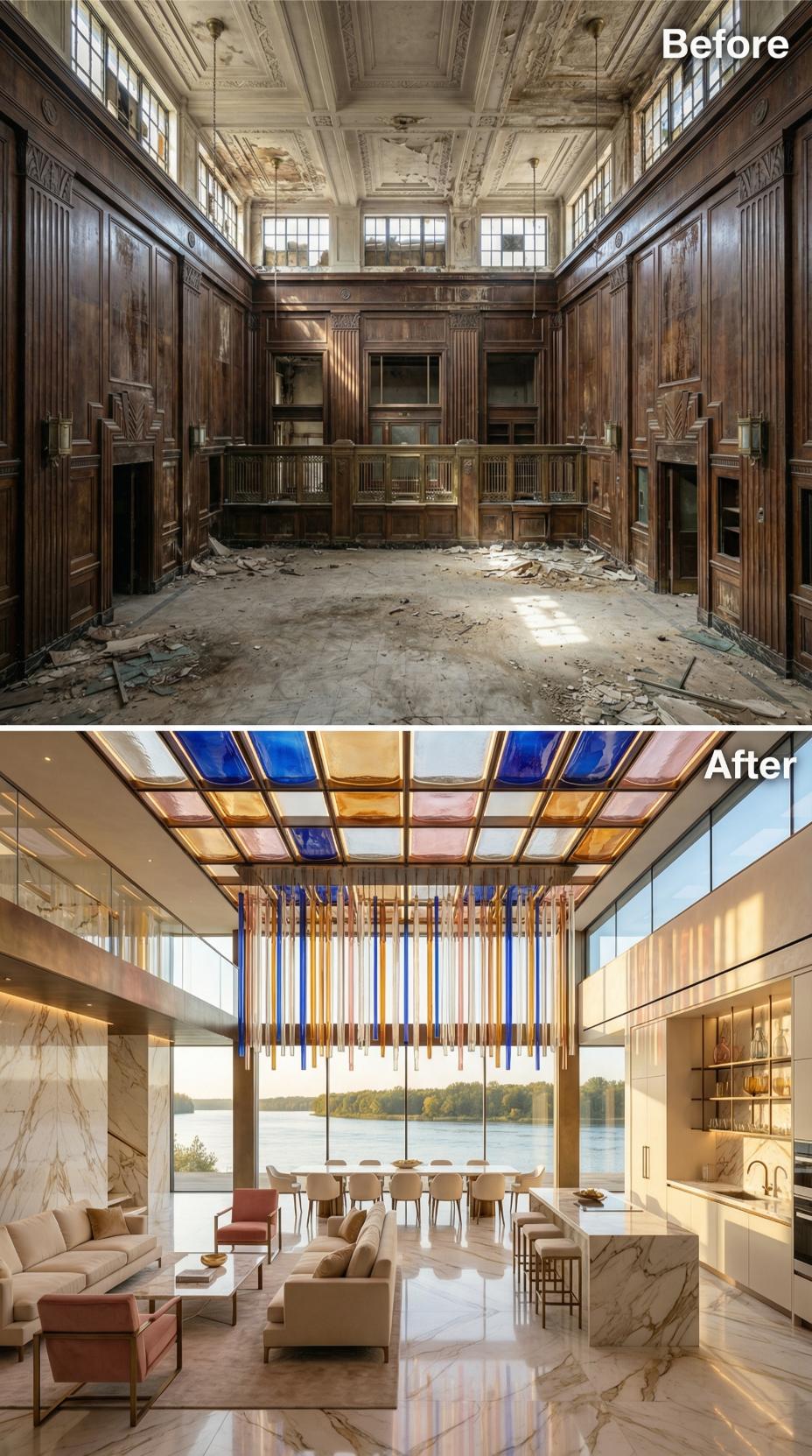
Above the dining table, a grid of backlit glass panels in deep cobalt, amber, and rose filters natural light into the room like a horizontal skylight. Hanging from the same framework, vertical rods in blue and gold brass descend as a chandelier, drawing the eye downward to a white marble dining table surrounded by upholstered chairs.
The living area anchors the left side with cream sofas, blush armchairs, and a marble-clad kitchen island running along the right wall. Floor-to-ceiling glass at the far end opens to a wide river view, replacing what were once deteriorating wood-paneled walls and rubble-strewn floors.
Moss Wall, Hanging Fern Ring, and Green Marble Redefine a Derelict Bank
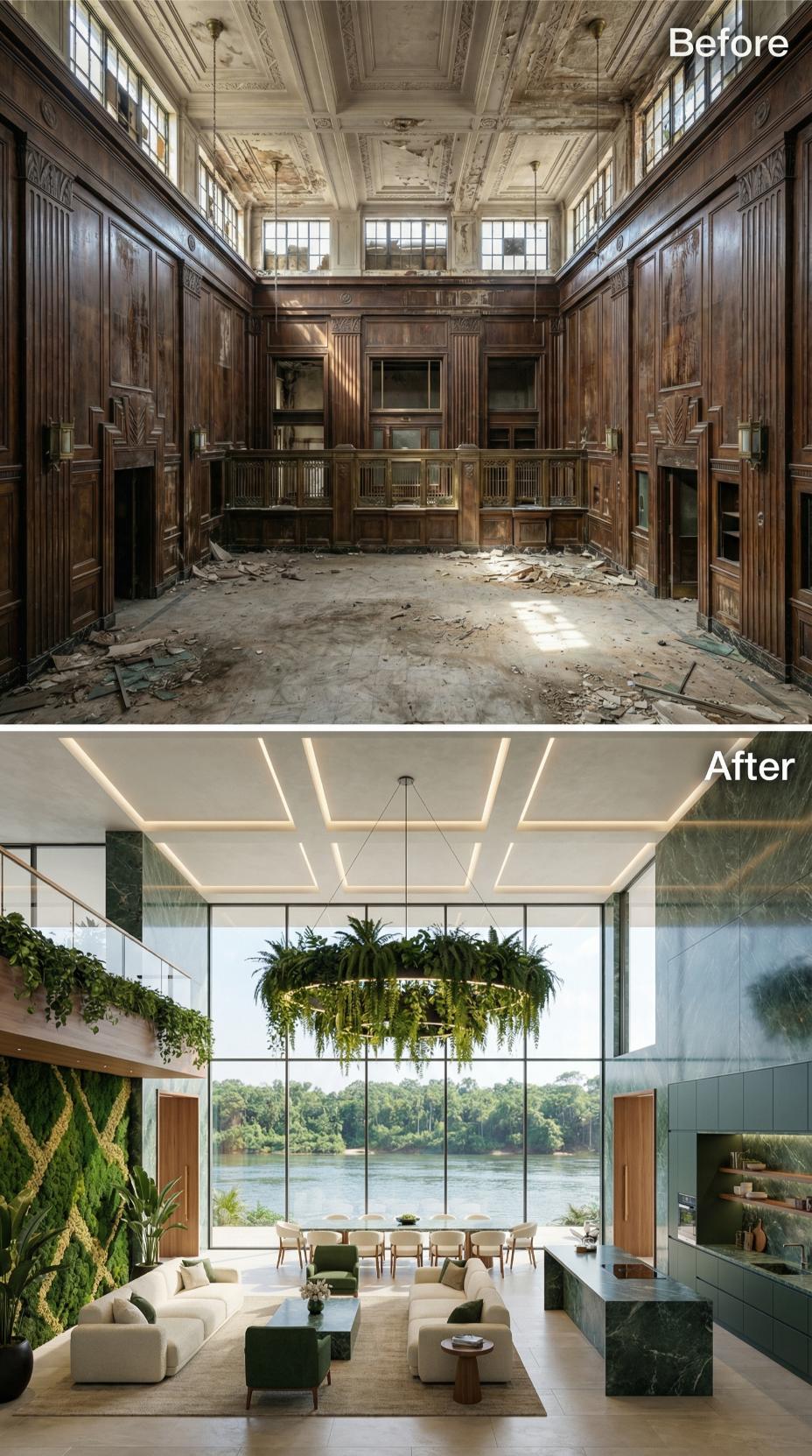
Debris-covered concrete floors and crumbling plasterwork gave way to a living room anchored by a circular hanging planter dripping with cascading ferns. Floor-to-ceiling glass panels replaced the bank’s upper clerestory windows, opening the entire rear wall to a river view framed by dense tree canopy.
Cream bouclé sofas form a generous U-shaped seating arrangement on a low-pile area rug. A vertical moss wall climbs the left side, while slabs of forest-green veined marble clad the right-side kitchen island and upper cabinetry. Recessed linear LED strips run in a coffered grid across the white ceiling, replacing what was once ornate deteriorating plasterwork with something far more restrained.
Material Matters: The hanging fern chandelier combines a black powder-coated steel ring with trailing Nephrolepis and Adiantum varieties, blending structural lighting with living plant material. Green marble with white veining, likely Verde Alpi or a similar Alpine stone, appears on both the kitchen island face and full-height wall panels, tying the two sides of the open plan together. Bouclé upholstery in an ivory loop-weave fabric keeps the seating zone tactile without competing with the stone or greenery.
Coffered Skylights Lift Marble Walls and a Floating Stair
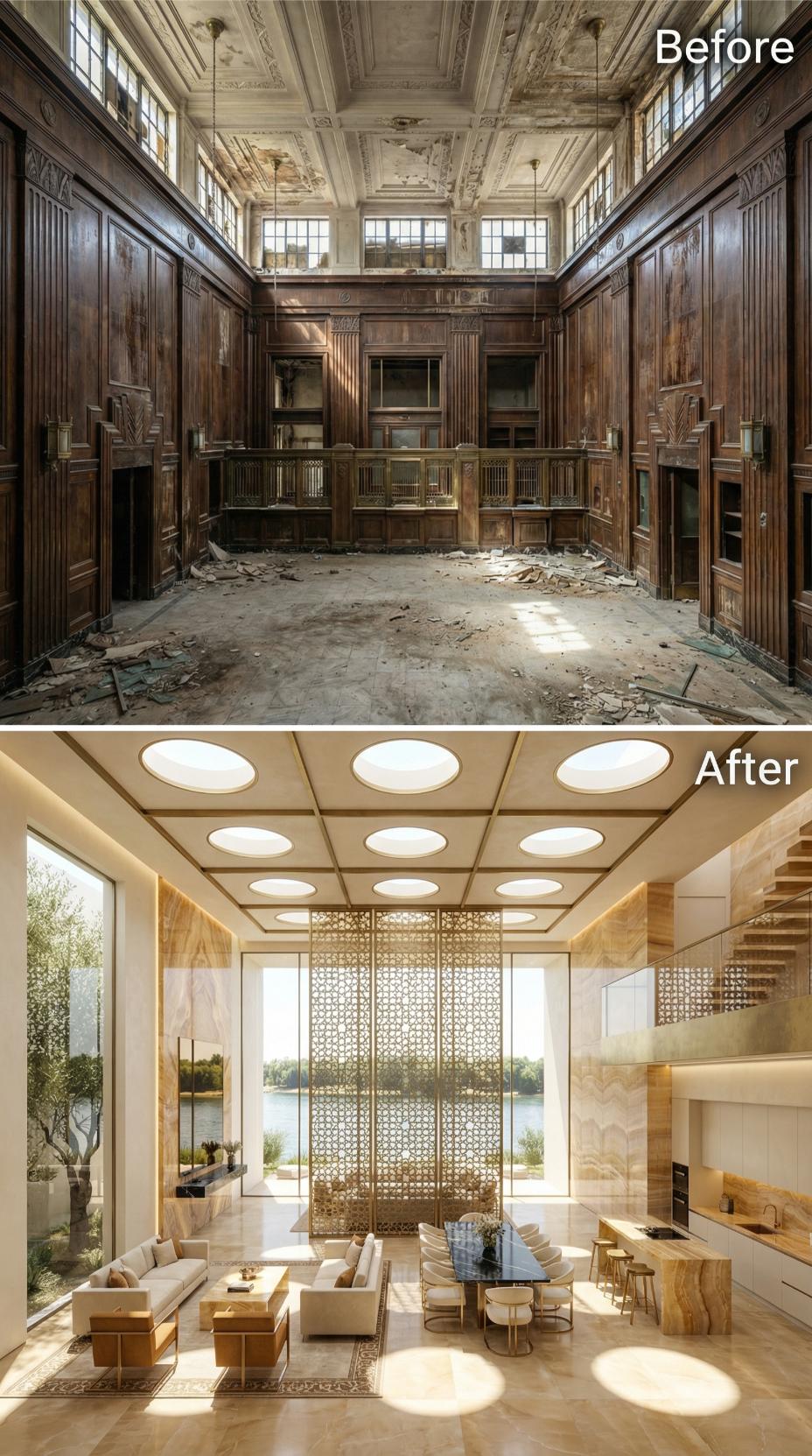
The before image shows a grand but exhausted former bank hall or civic chamber, still carrying the bones of its original ambition. Dark wood paneling climbs the full height of the room in a stern Art Deco rhythm, while the coffered plaster ceiling above is cracked, stained, and peeling in broad patches. Tall clerestory windows still pull in daylight, but it lands on rubble, dust, and broken flooring, turning what was once formal and imposing into something hollowed out and abandoned.
The after image keeps the double-height drama but trades institutional decay for glossy, waterfront luxury. Creamy stone floors and book-matched marble walls brighten the entire volume, while a gridded ceiling of circular skylight-style light wells gives the room a graphic new order. A carved metal screen drops through the center of the space like a decorative veil, separating the sitting and dining zones without closing them off. On the right, a streamlined kitchen in pale cabinetry and veined stone sits beneath a mezzanine with a glass balustrade and floating stair, while floor-to-ceiling glazing opens the whole composition to water views and soft afternoon light.
Hanging Greenery Canopy, Green Marble Surfaces, and Floor-to-Ceiling Glass Replace Crumbling Plaster
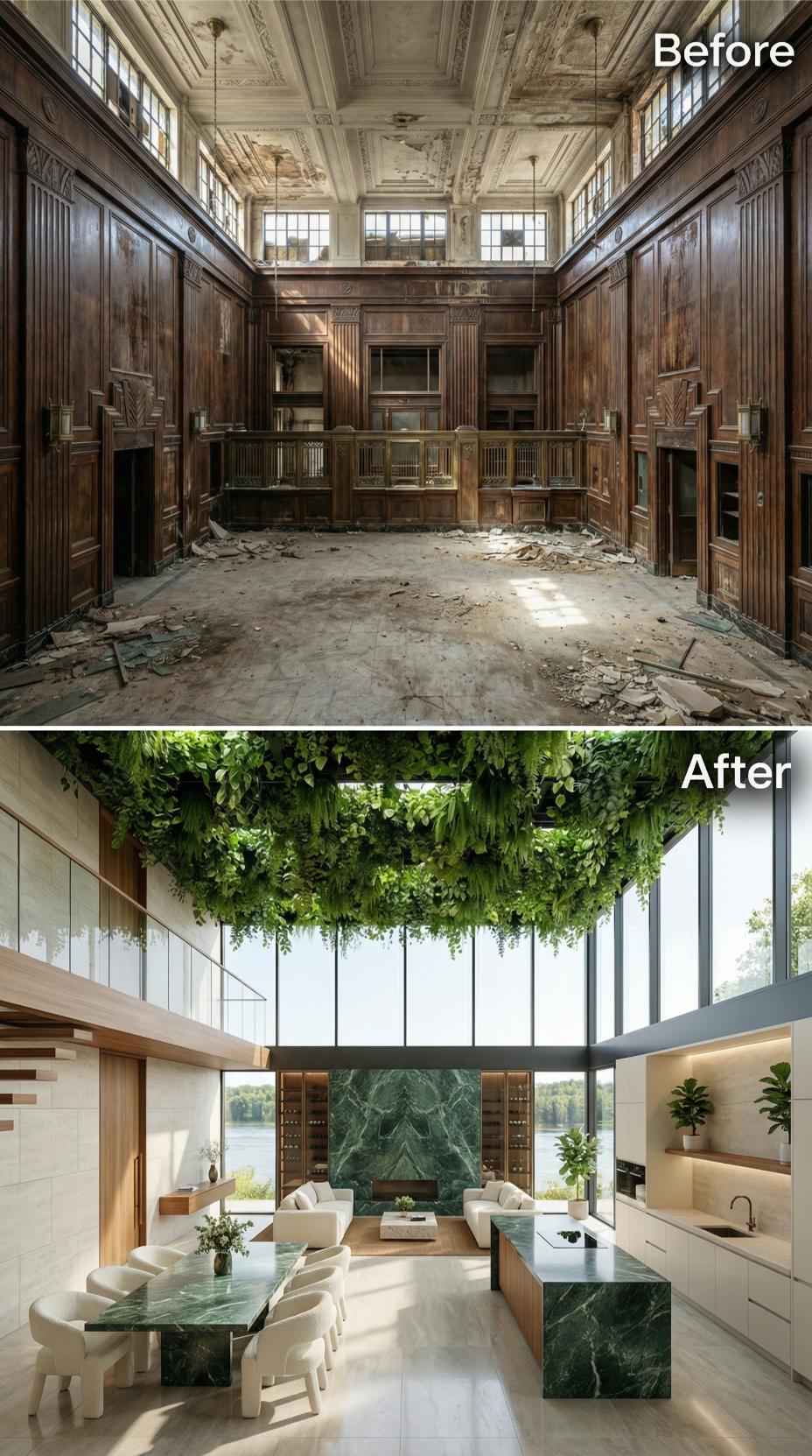
Lush plant material suspended from the ceiling forms a dense canopy of trailing pothos and mixed ferns, pulling the eye upward in a space that once held ornate but deteriorating plasterwork. Below, green-veined marble surfaces the dining table base, kitchen island, and fireplace surround in a consistent material story. Cream bouclé dining chairs and white curved sofas anchor the seating zones on light oak flooring.
Gold Onyx Ceiling Panels and Floor-to-Ceiling Glass Recast a Crumbling Bank Hall
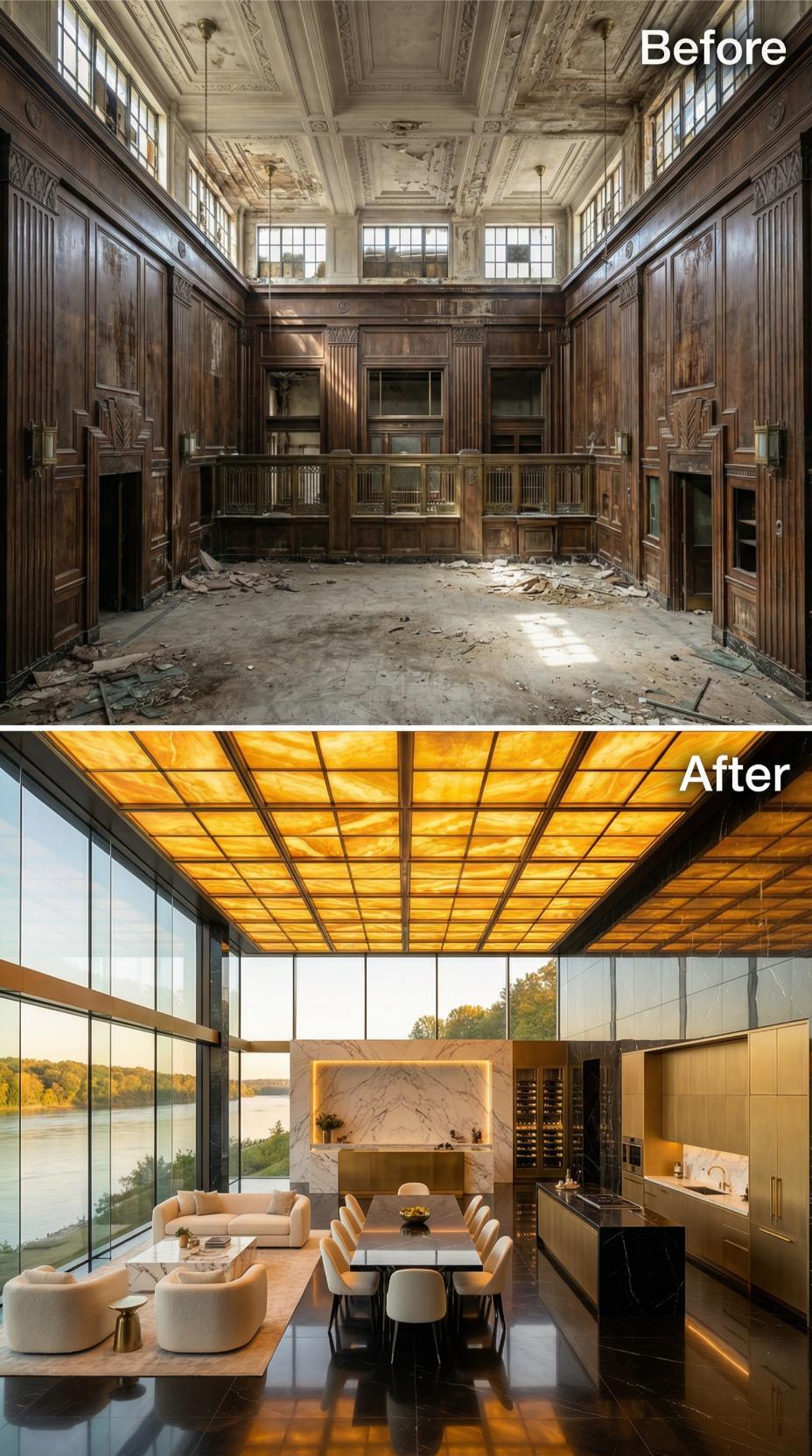
Backlit onyx panels in amber and ochre replace what was once a plaster coffered ceiling deep in deterioration. The grid framework suspending them reads almost industrial against the warm glow they cast downward, pulling the eye across the entire open-plan floor.
Dark polished stone floors anchor cream bouclé sofas and a marble dining table surrounded by white shell chairs. A wine display built into the marble feature wall adds depth without competing for attention, while gold cabinet hardware and brass-toned kitchen fronts keep the palette consistent from living zone to kitchen.
Style Tip: Backlit onyx is sold in slabs typically ranging from 12 to 25 millimeters thick, and the thinner cuts transmit the most light, producing that characteristic warm, veined glow. When used as ceiling panels, the stone requires a steel subframe engineered to handle weights that standard drywall systems cannot support. Consulting a structural engineer before specification is essential, not optional.
Crumbling Teller Hall Rebuilt With Marble Slabs, Brass Stair Rails, and Floor-to-Ceiling Glass
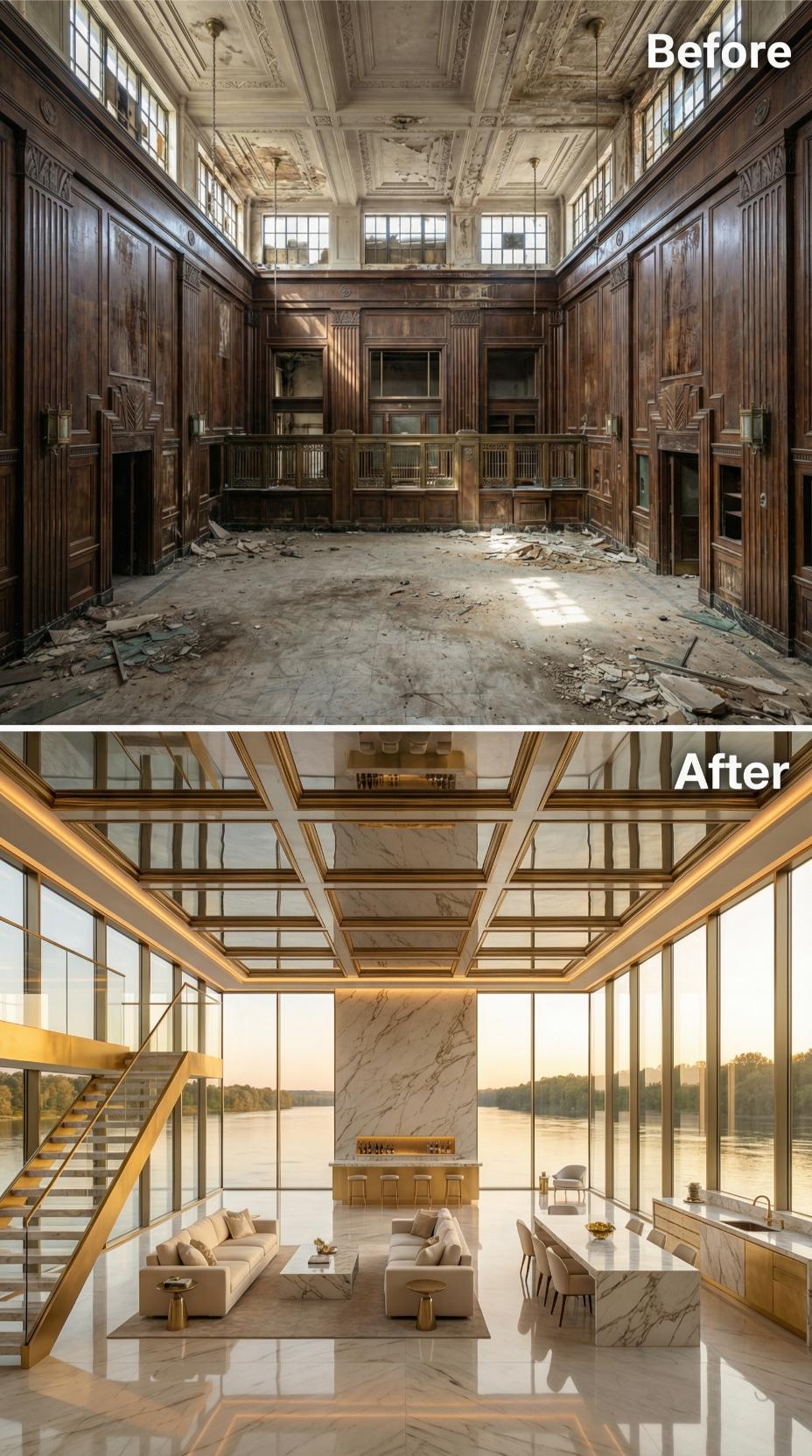
Veined cream marble runs from the island countertop to the fireplace surround while brass-framed glass panels replace the original plaster ceiling, drawing riverfront light across polished marble floors and linen sectional seating below.
Floor-to-Ceiling Glass and Gold Pendant Clusters Replace a Collapsed Bank Interior
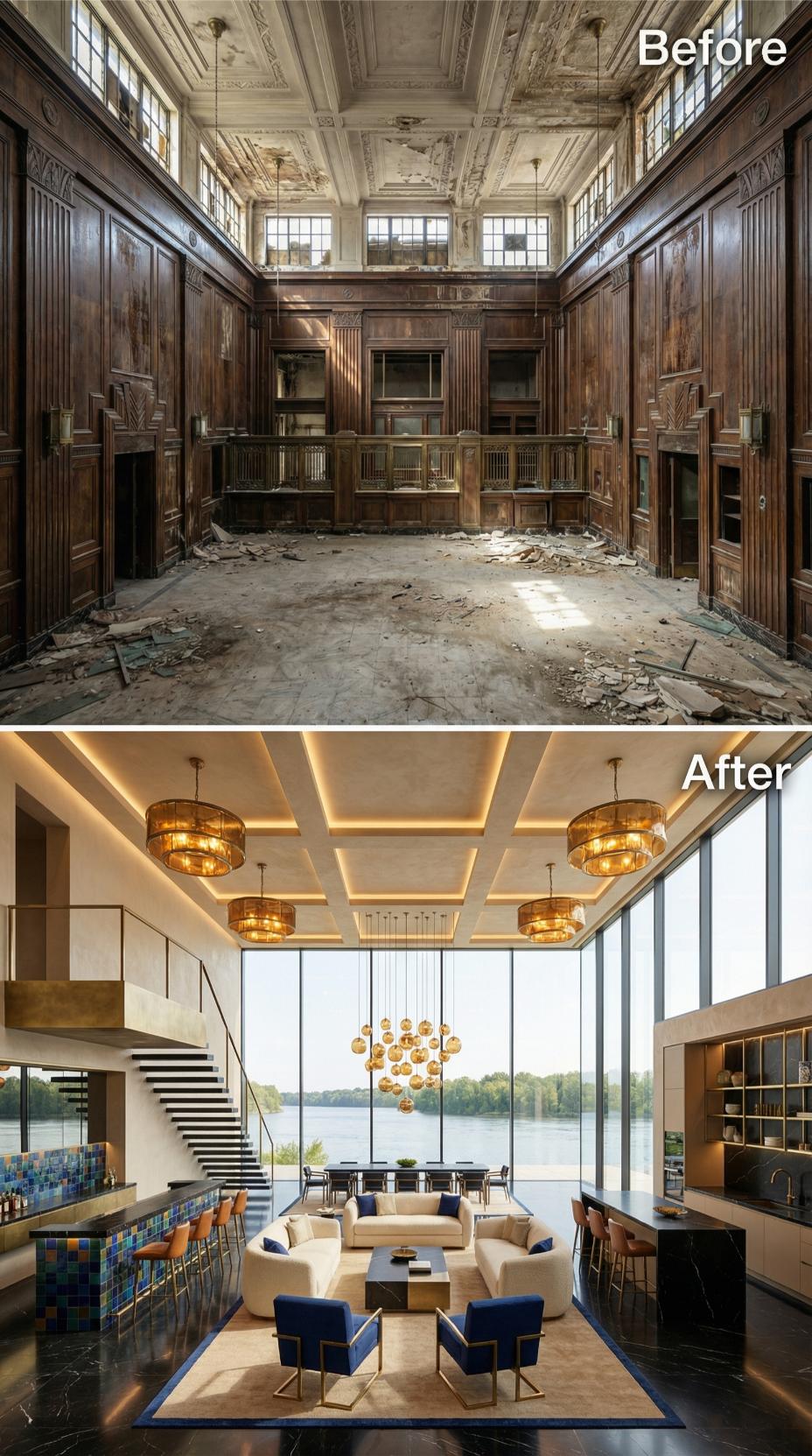
Coffered ceilings stripped of their original plaster ornamentation now carry recessed LED cove lighting, with three oversized drum pendants wrapped in hammered brass mesh anchored symmetrically across the span. The floor switches from rubble-strewn concrete to polished black marble with a mirror finish, and a modular sectional in cream bouclé fabric anchors the seating zone alongside cobalt velvet accent chairs with brass-leg bases.
A wet bar clad in cobalt and teal square mosaic tiles runs along the left wall, topped with a dark stone slab counter. Floating stairs with black steel treads and a glass balustrade replace the original teller partition. Full-height glazing on the rear wall opens to a river view framed by mature treeline.
- Hammered brass mesh on the drum shades diffuses light without the harshness of frosted glass alternatives
- Square mosaic tile in mixed cool tones creates visual texture on a bar front without requiring grout pattern precision
- Bouclé fabric holds its structure under heavy use while offering a neutral counterpoint to saturated accent colors
Backlit Onyx Bar Wall and Pendant Cluster Anchor a Renovated Bank Hall
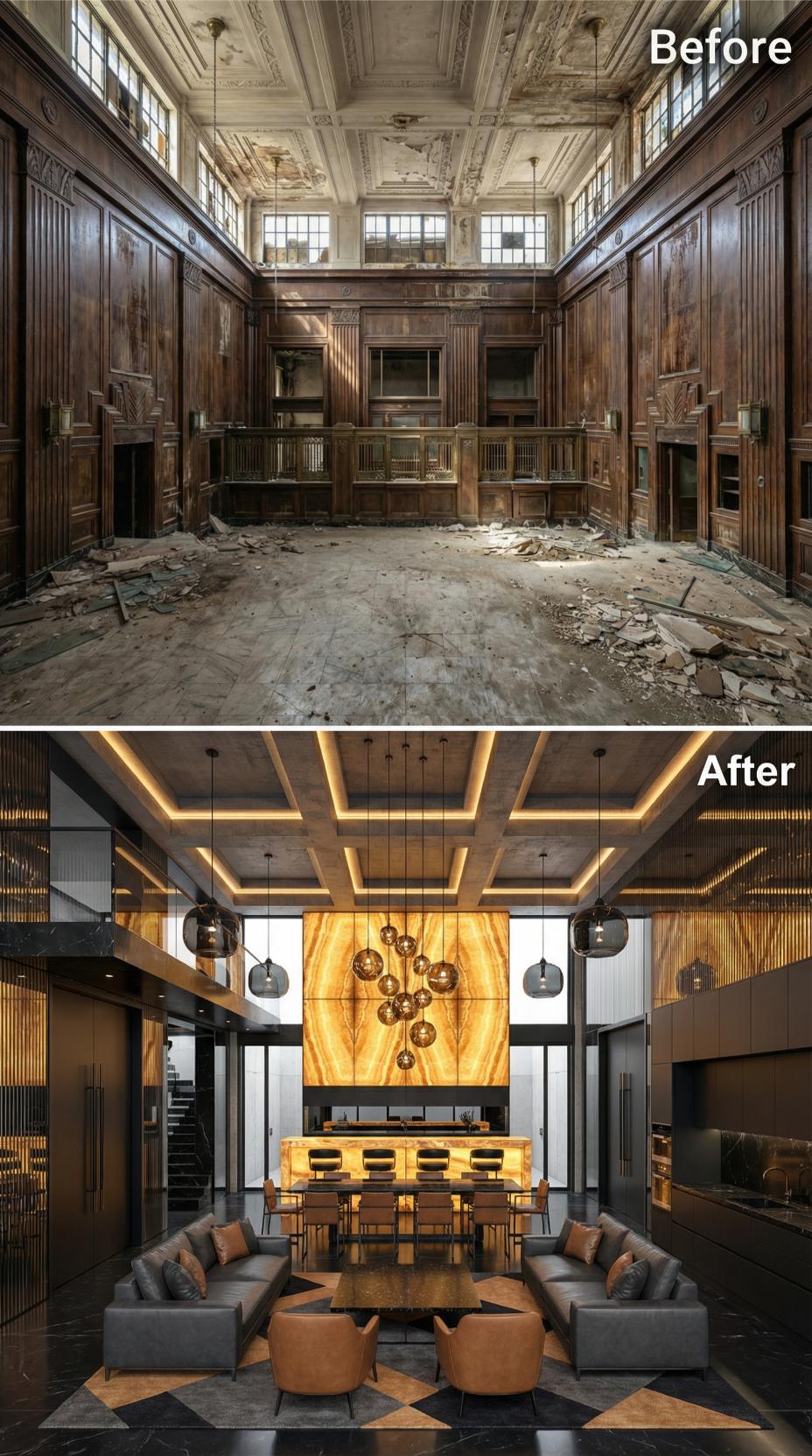
Honey-toned onyx panels, lit from behind, form the focal wall above a matching onyx bar counter, flanked by leather dining chairs and gray upholstered sofas on a chevron-pattern stone floor.
Woven Gold Pendant Cluster and Amber Sectionals Reclaim a Gutted Bank Hall
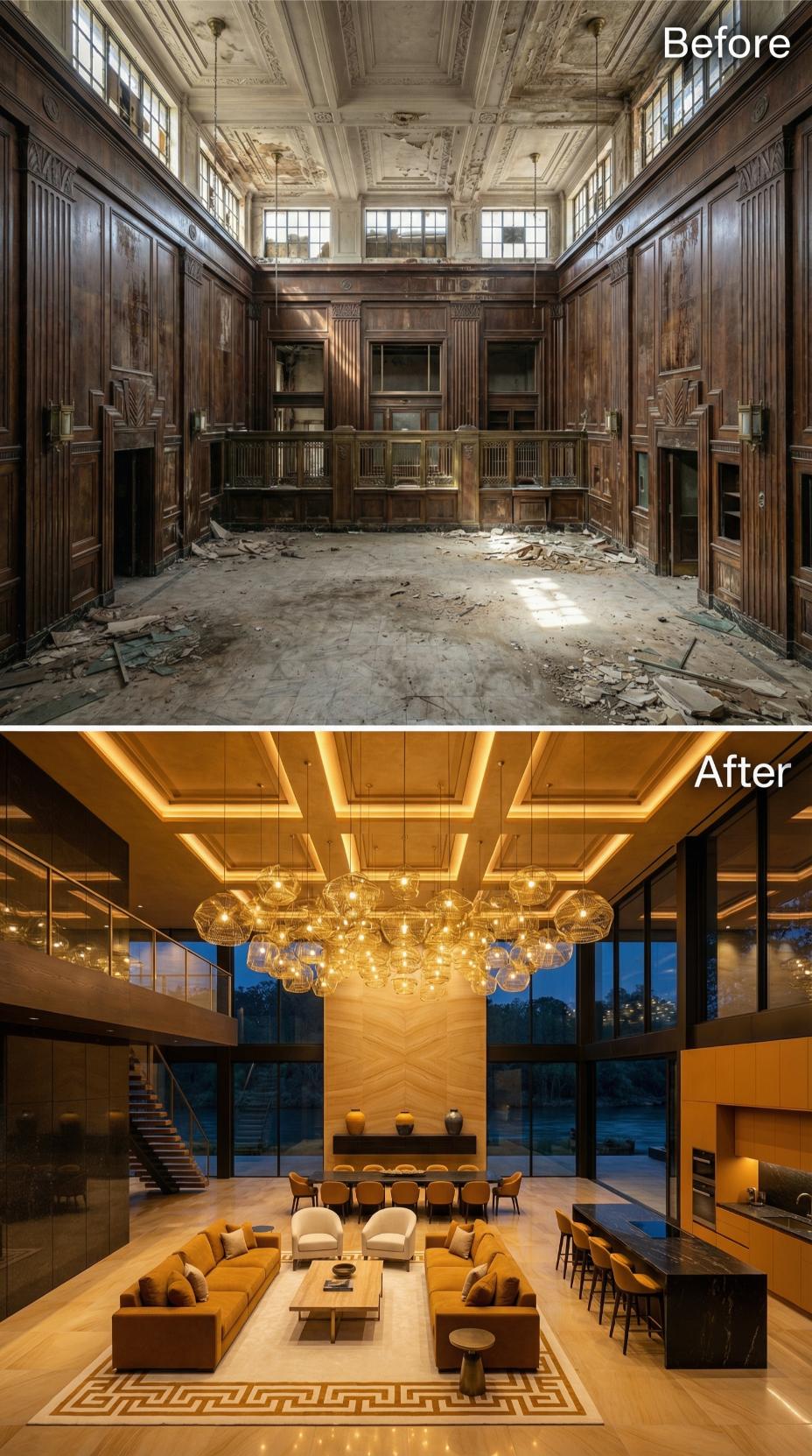
Rubble-strewn concrete floors and deteriorating plaster moldings gave way to pale travertine tile laid in a Greek key border pattern, anchoring a double-height living room with clear purpose. The sofa configuration uses oversized burnt-ochre velvet sectionals paired with a cream bouclé accent chair, all arranged around a low-profile walnut coffee table.
Overhead, a cluster of woven brass-wire globe pendants drops from a coffered ceiling fitted with recessed LED cove lighting. The back wall features chevron-patterned natural wood veneer panels. Floor-to-ceiling glazing along the rear facade opens to a night exterior, while a cantilevered staircase with glass balustrade rises on the left. A dark marble kitchen island with backless counter stools anchors the right zone.
Common Mistake: Designers often install oversized pendant clusters without accounting for ceiling height clearance, leaving insufficient space for the fixture to read as a focal point rather than an obstruction. A general rule is to maintain at least seven feet of clearance between the bottom of the fixture and the finished floor in living areas. In double-height spaces like this one, hanging the cluster too low flattens the perceived scale of the room.
Horizontal Moss Panels and Pendant Drums Replace Collapsed Plaster in a 1930s Bank Hall
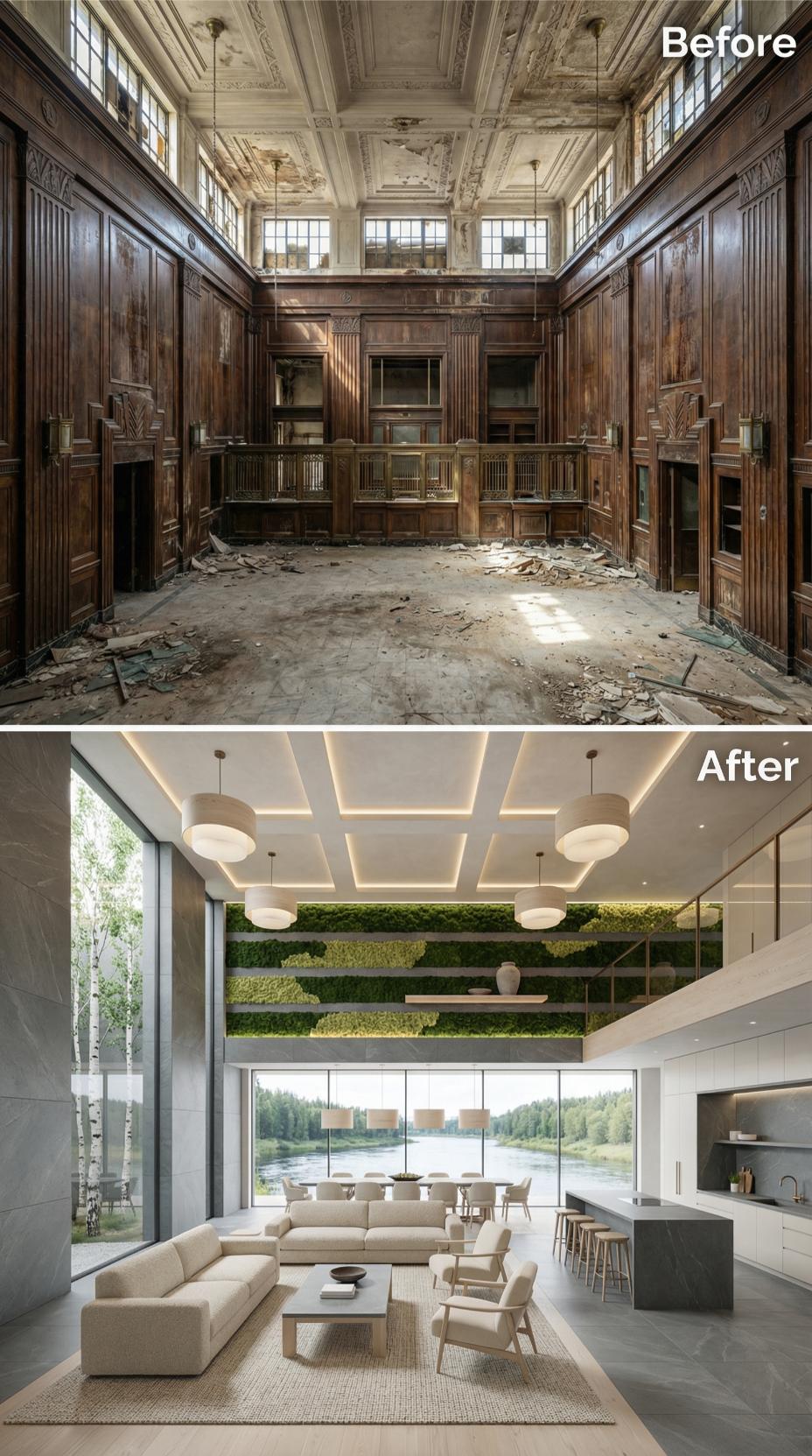
Flat-panel moss strips in three tones of green do more structural work here than most accent walls twice their size.
The renovation stripped the original dark walnut paneling and replaced it with grey stone cladding that runs floor to ceiling on the staircase wall. Three oversize drum pendants in natural linen hang from a coffered ceiling with recessed LED channels, casting warm light across a seating arrangement of low cream sofas and wood-framed armchairs upholstered in off-white bouclé.
A kitchen island in slate grey sits to the right, paired with white flat-front cabinetry and bar stools in raw oak. Floor-to-ceiling glass along the rear and side walls pulls in views of birch trees and open water, giving the room a depth the original bank interior, buried under debris and collapsed ceiling material, never had.
Moroccan Lattice Screen and Warm Oak Finishes Reclaim a Gutted 1930s Bank Hall
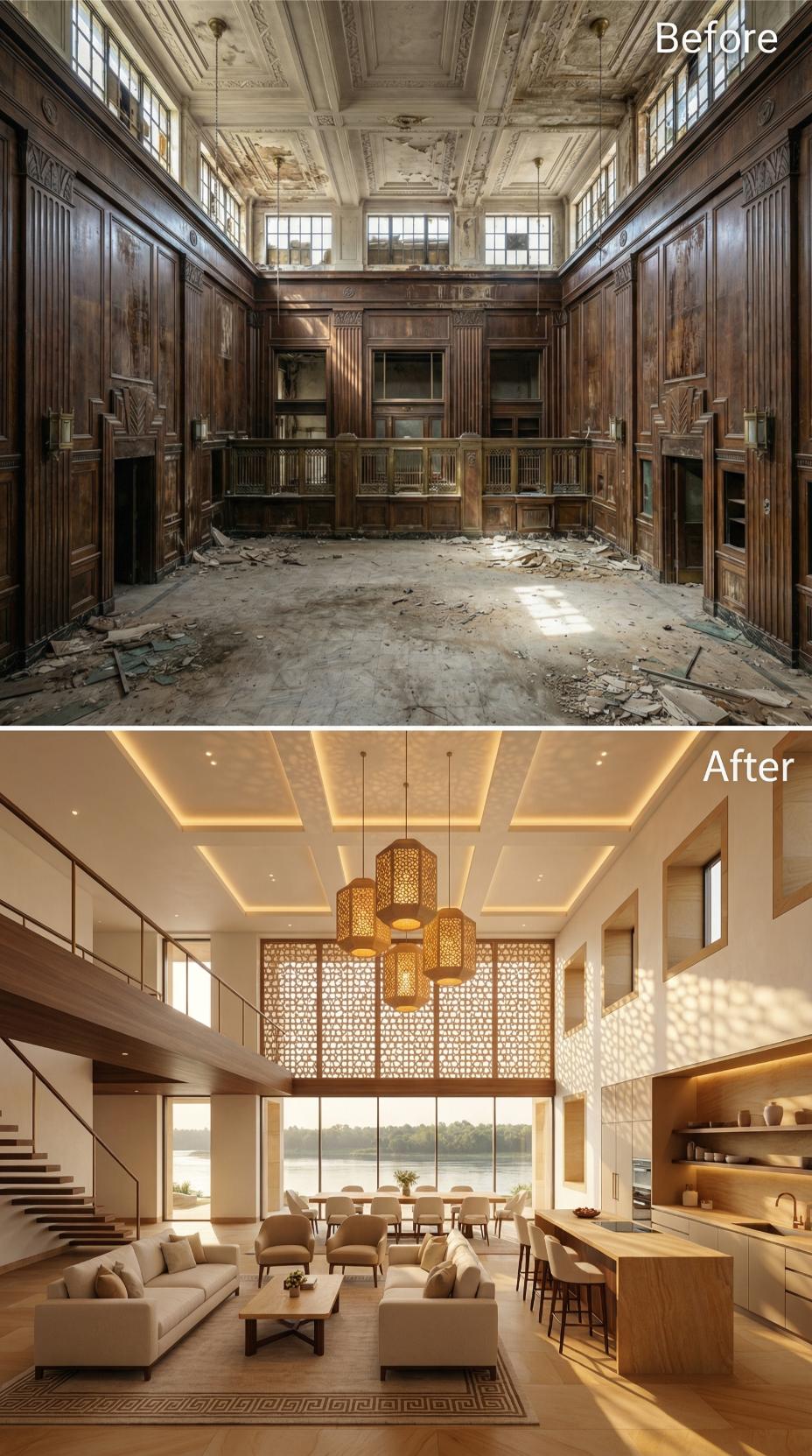
Cracked plaster and debris gave way to a double-height living space built around a laser-cut Moroccan lattice screen that filters afternoon light across cream linen sofas and a herringbone-patterned area rug. Clustered lantern pendants in pierced brass hang at staggered heights above a walnut island with flush slab cabinetry, while cove lighting traces each recessed ceiling coffer. Floating oak stairs replace the original teller balcony rail line.
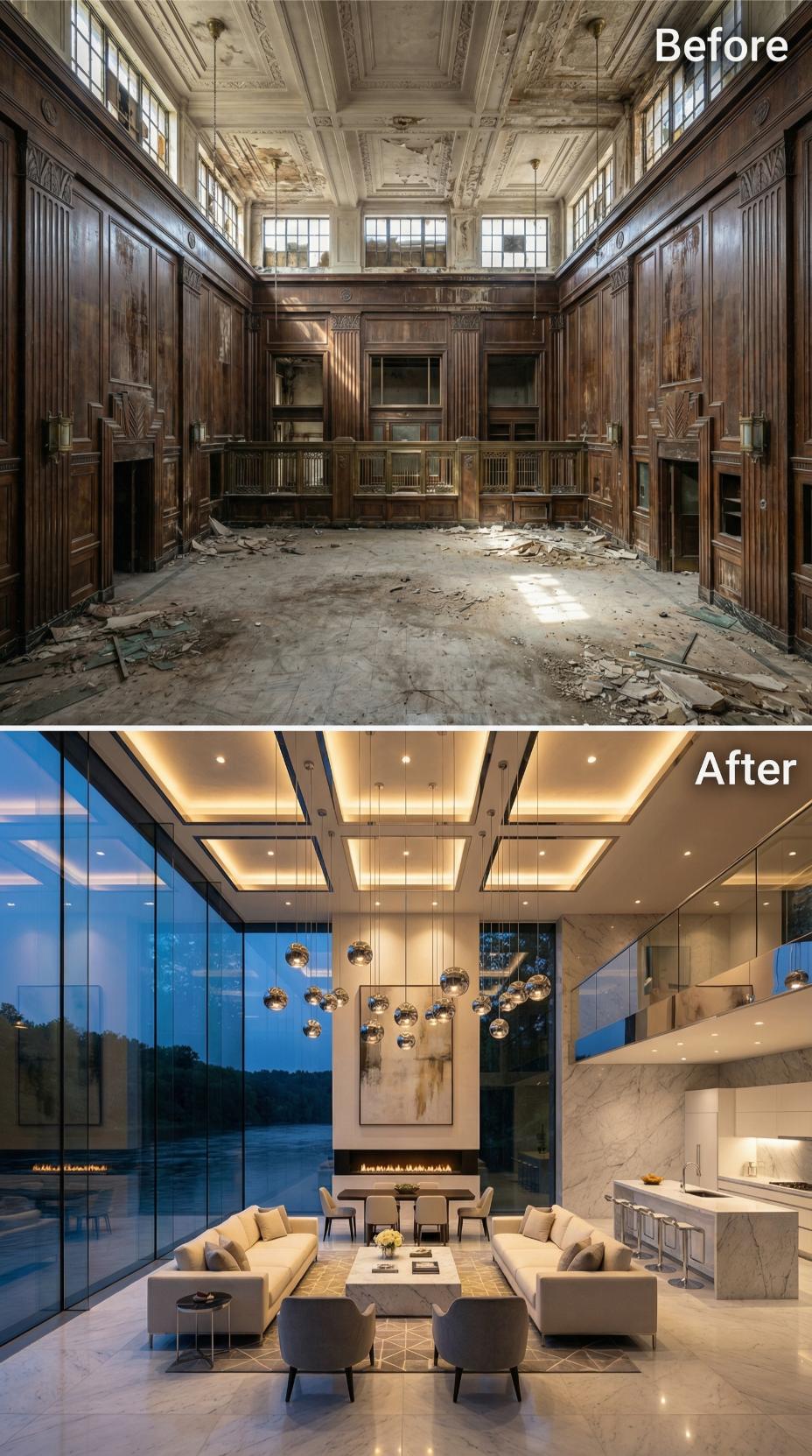
Coffered LED Ceilings and Globe Pendant Clusters Reclaim a Gutted Bank Hall
🔥 Would you like to save this?
Dust and collapsed plaster gave way to recessed coffered ceilings lined with warm amber LED strip lighting, each panel precisely inset to cast an even glow across cream limestone flooring below. Chrome globe pendants hang at staggered heights from thin cables centered on the room, pulling focus away from the walls without competing with the fireplace.
Cream upholstered sectionals in a tight-weave fabric surround a marble-top coffee table, while low-profile armchairs in a matching neutral anchor the conversation zone. Floor-to-ceiling glass panels replace what were once solid walls, opening the entire rear facade to a water view. A marble waterfall-edge kitchen island with brushed chrome fixtures sits to the right, connecting the living area to the kitchen without a partition wall.
Budget Tip: Pendant clusters on long cables look expensive but the hardware itself is often mid-range. Buying fixture components separately, a canopy plate, cables, and individual globe shades, can cut costs by 30 to 40 percent compared to purchasing a pre-assembled cluster. Most electricians can wire the configuration to code during a standard rough-in visit.
Forest Green Paneling and Brass Drum Pendants Reclaim a Gutted 1930s Bank Hall
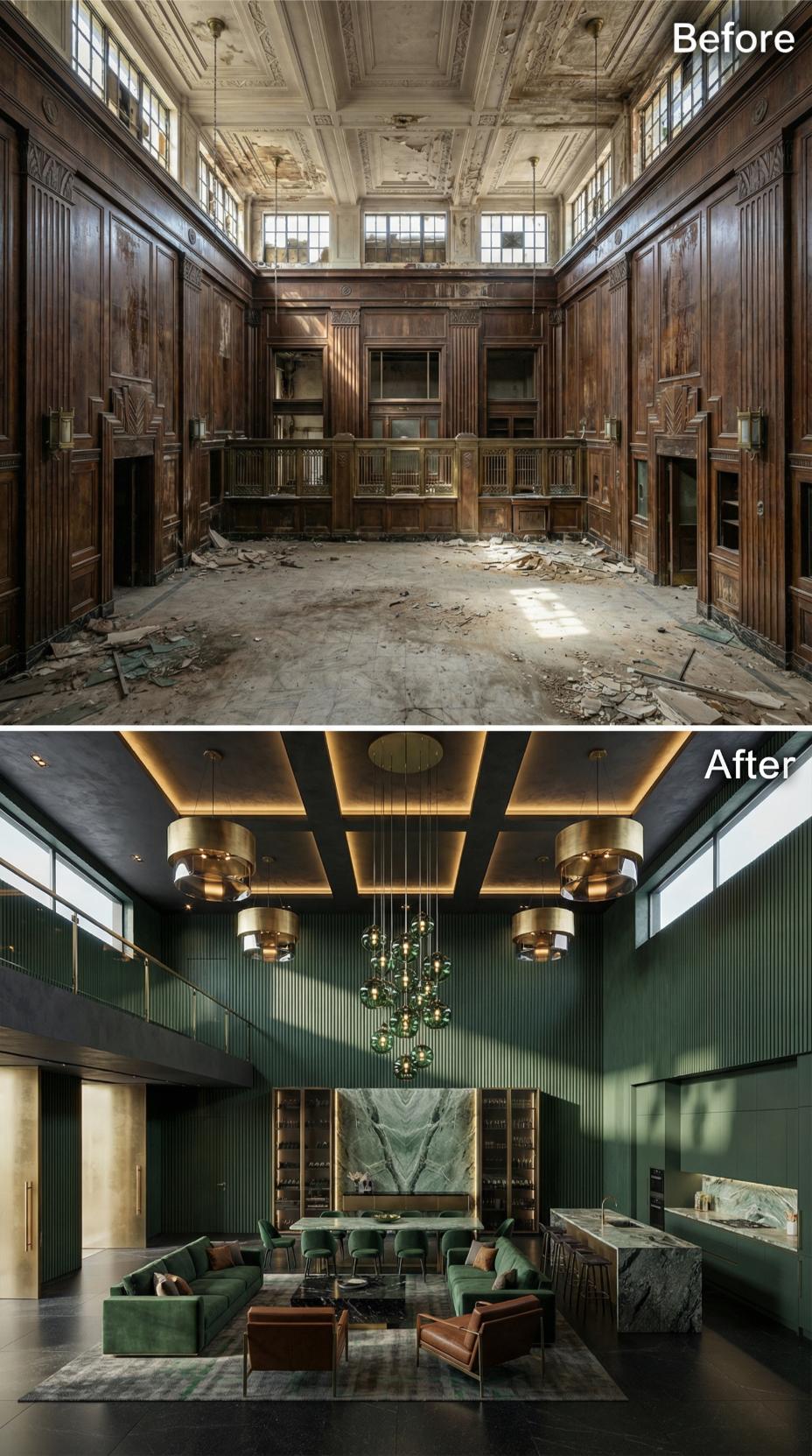
Where chipped plaster and debris once covered the floor, floor-to-ceiling ribbed green panels now line every wall, painted in a deep forest tone that reads almost black under low ambient light. Brass drum pendants flank a cascading glass globe cluster at center, and LED strip lighting runs the perimeter of a recessed ceiling grid in matte black. The original high windows remain, now stripped of their iron grilles and left to wash natural light across polished concrete floors.
Emerald velvet sectionals anchor the seating area alongside cognac leather armchairs, while a book-matched green marble slab serves as the focal wall behind a brass-framed bar cabinet. The kitchen island to the right uses the same marble in a darker vein pattern, paired with flat-front cabinetry in matching forest green and brass pulls. Nothing about the palette plays it safe, yet every finish earns its place.
Origami Paper Pendant Cluster and Waterfront Glass Wall Reclaim a Gutted Bank Hall
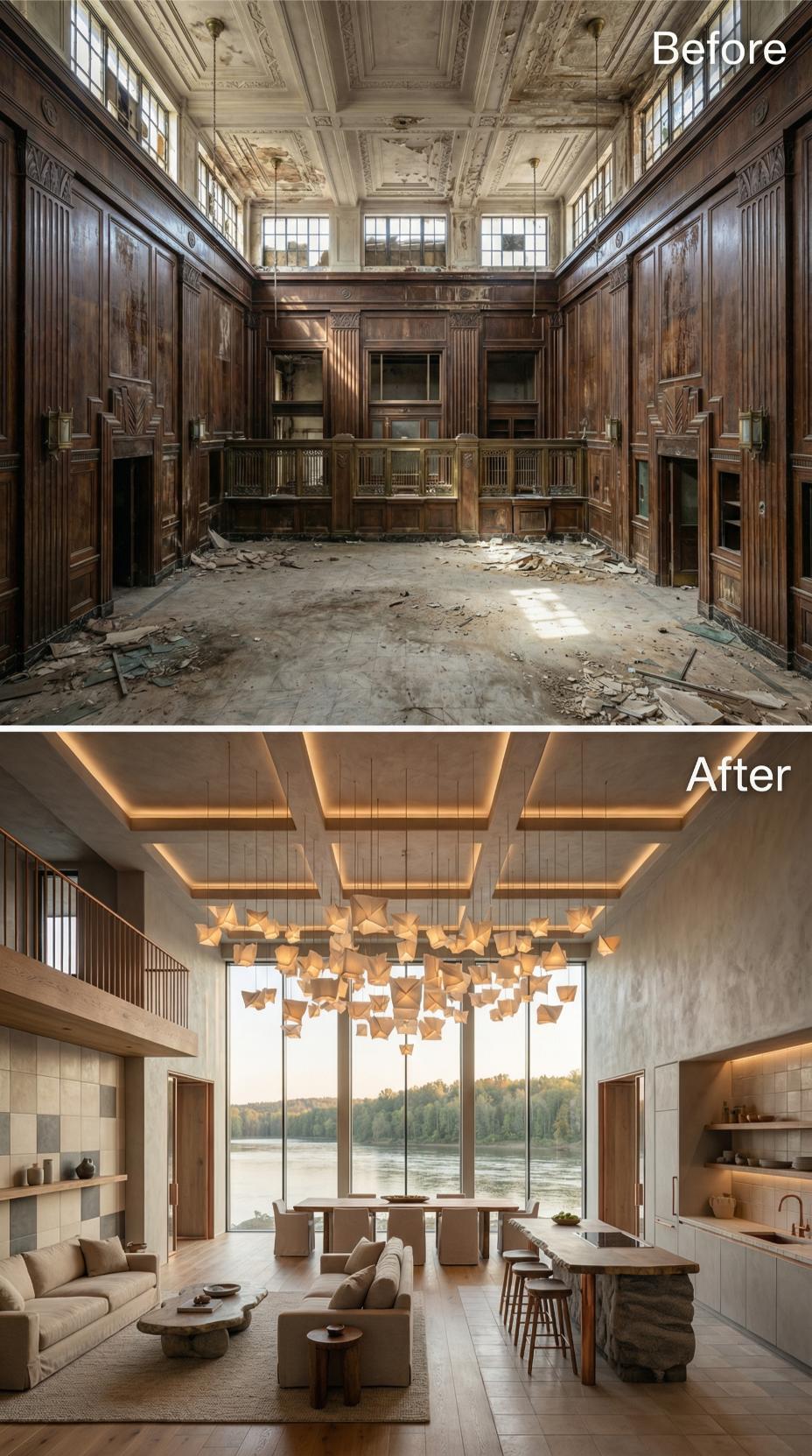
Salvaged dark walnut paneling from the original bank hall gives way to smooth limewash plaster walls in warm greige, a shift that makes the room read lighter without losing mass. Dozens of folded-paper pendants hang from the coffered LED ceiling on varying cable lengths, their geometric shapes casting layered amber light across a wide white oak dining table below. A kitchen island built on a rough-cut stone base anchors the right side of the open plan, its honed concrete countertop sitting above stools with turned wood legs. Floor-to-ceiling glazing replaces the original clerestory windows, pulling a river and treeline directly into the room.
Dozens of folded-paper pendants hang from the coffered LED ceiling on varying cable lengths, their geometric shapes casting layered amber light across a wide white oak dining table below.
Board-Formed Concrete Walls and Leather Club Chairs Reclaim a Gutted 1930s Bank Hall
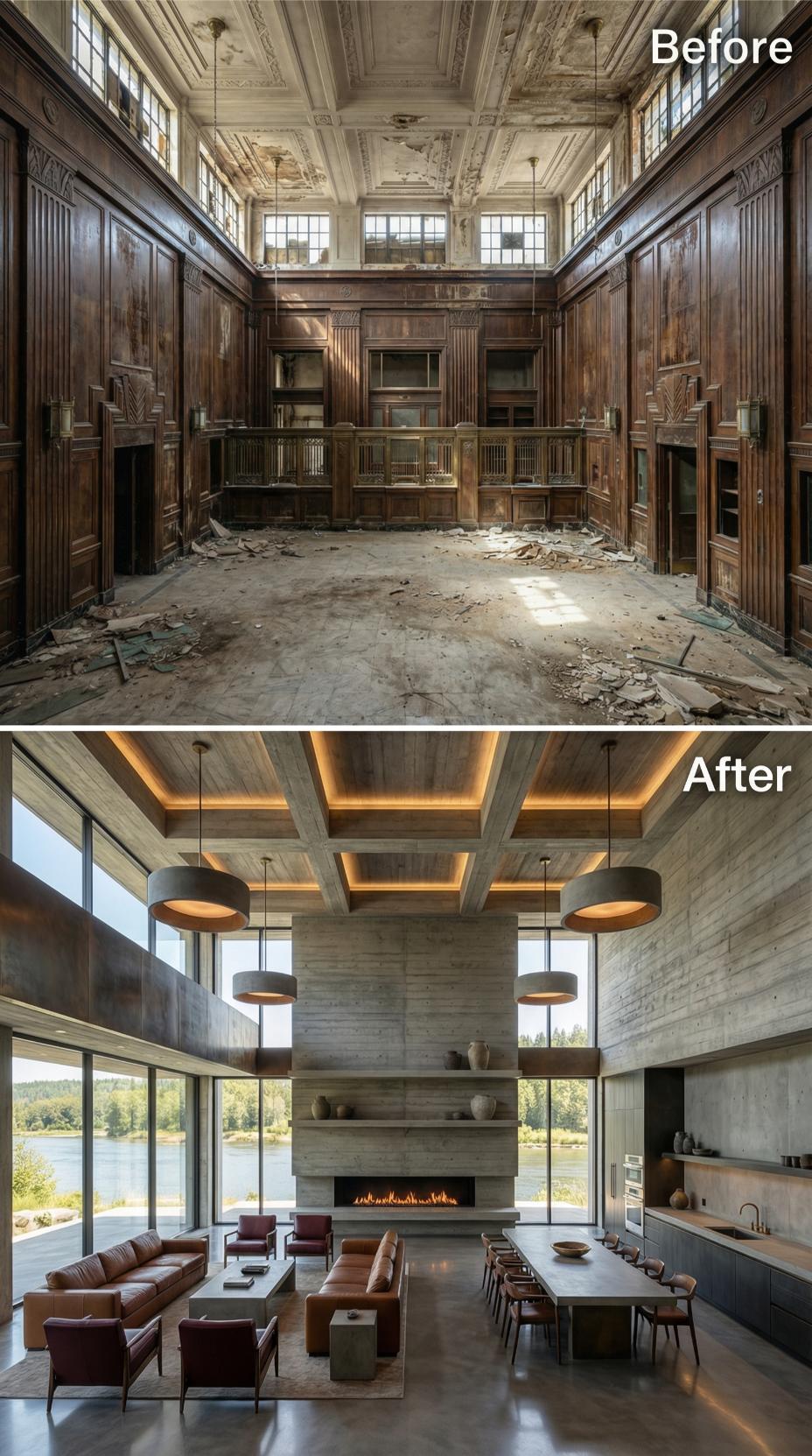
Raw board-formed concrete replaces the collapsed plaster ceiling and ornate wood paneling, with recessed coffers lined in warm-stained timber and amber LED strips that push light upward rather than down. Three drum pendants in matte charcoal hang at graduated heights over a poured-concrete dining table surrounded by leather side chairs. Cognac-toned leather sofas and club chairs anchor the conversation area in front of a linear gas fireplace set flush into a floor-to-ceiling concrete slab. Floor-to-ceiling glass on two sides opens directly to a river.
Pampas Grass Chandelier and Coffered LED Ceiling Reclaim a Gutted 1930s Bank Hall
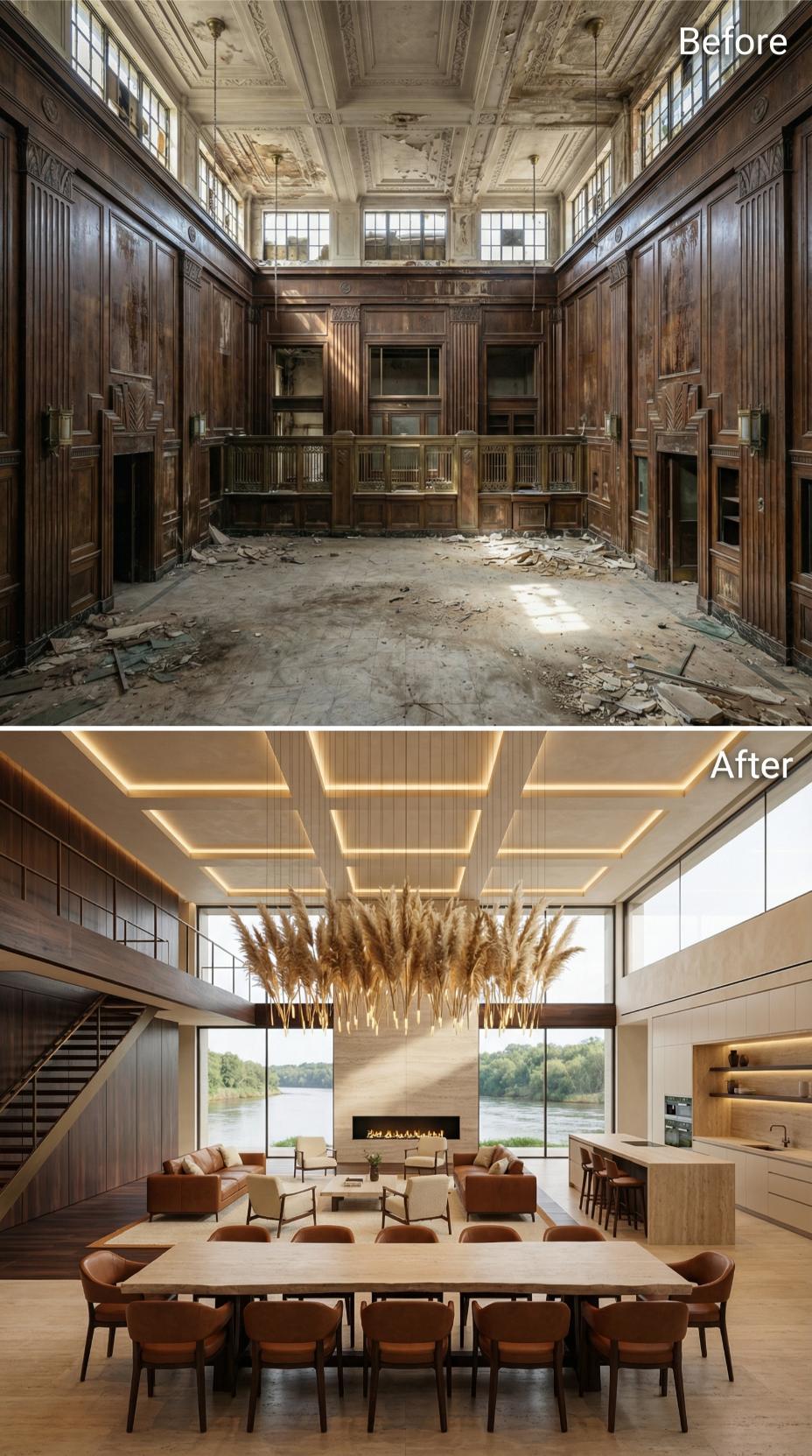
Dried pampas grass hangs in a dense suspended cluster at the center of the room, anchored beneath a grid of recessed LED cove lighting built into a flat paneled ceiling. Warm amber leather chairs surround a long bleached oak dining table, while a matched seating arrangement of cognac sofas and lounge chairs faces a linear gas fireplace set into a travertine wall. Floor-to-ceiling glazing beyond it opens to a river view.
Quick Fix: Pampas grass installations work as overhead focal points because the feathered plumes diffuse light rather than block it, keeping the space below bright even when the cluster runs large. Dried botanicals also require no irrigation or special mounting hardware beyond a steel cable and ceiling hook, making them one of the lowest-cost centerpiece options per visual square foot in a double-height room.
Walnut Island Kitchen and Steel Casement Grid Reclaim a Collapsed Bank Hall
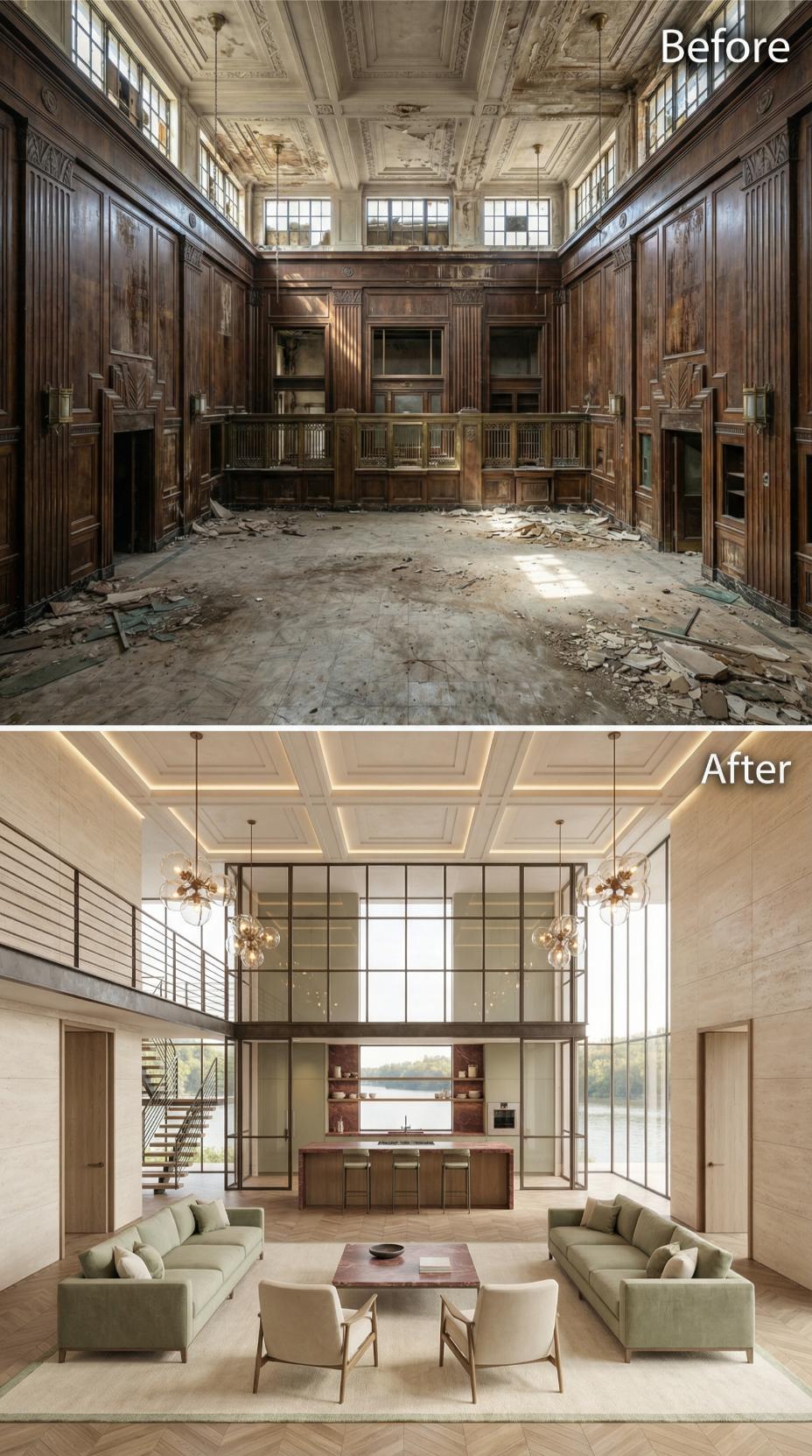
Pale travertine cladding now lines the walls where dark-stained wood paneling once ran floor to upper clerestory, and the shift in material weight reads immediately. Two globe pendant clusters in aged brass hang from a coffered ceiling fitted with recessed LED strips along each tray edge. At center, a walnut kitchen island with an integral sink sits behind a floor-to-ceiling steel casement grid that frames a waterfront treeline. Sage velvet sofas anchor a symmetrical seating arrangement on a low-pile ivory rug, facing a wood-framed dining table with leather-back side chairs.
Barrel Vault Skylight and Green Marble Island Replace an Abandoned Bank
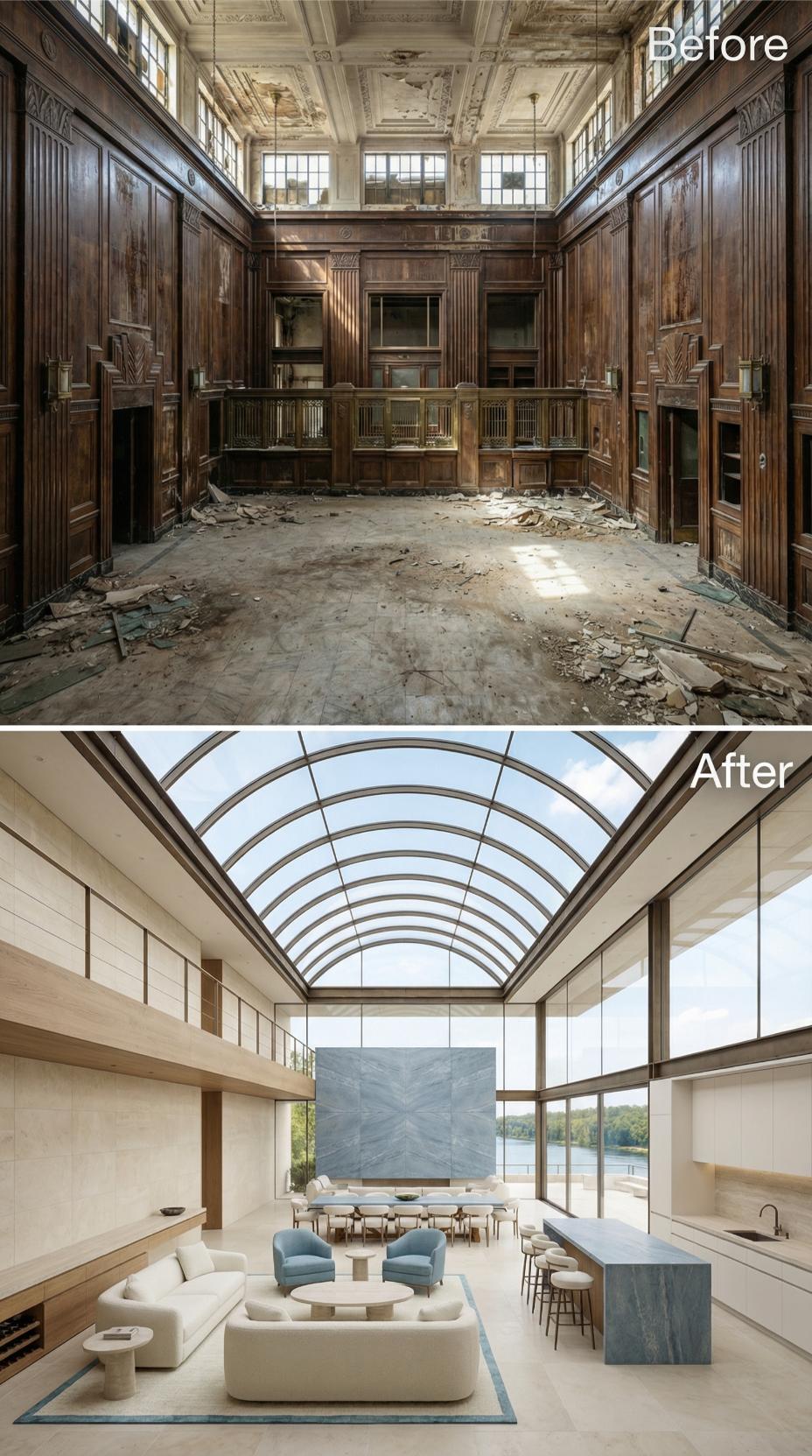
Crumbling plaster, debris-covered floors, and ornate dark-walnut paneling stripped of any function defined the original grand hall. Every surface read as loss. The renovation answered with restraint rather than nostalgia.
Creamy limestone cladding replaced the carved woodwork, and a barrel-vault glass ceiling now runs the full length of the room, flooding the space with natural light. Seating groups use ivory bouclé sofas, blue-upholstered armchairs, and a low travertine coffee table. A verde green marble waterfall island anchors the kitchen side, its veining echoing the large-format stone artwork mounted against the floor-to-ceiling glass wall at the far end.
How the Barrel-Vault Glazing Solves a Double-Height Problem
Double-height bank halls typically defeat natural light because their clerestory windows sit too high and cover too little surface area. A barrel-vault skylight grid, like the one installed here using bronze-finished structural ribs and curved insulated glass panels, redirects daylight downward across the entire floor plate rather than pooling it near the perimeter walls. The ribbed framing also introduces a linear rhythm at the ceiling plane, which prevents the room from reading as a single undifferentiated volume.
Skylight Atrium and Curved Ivory Sectionals Replace a Collapsed Bank Hall Ceiling
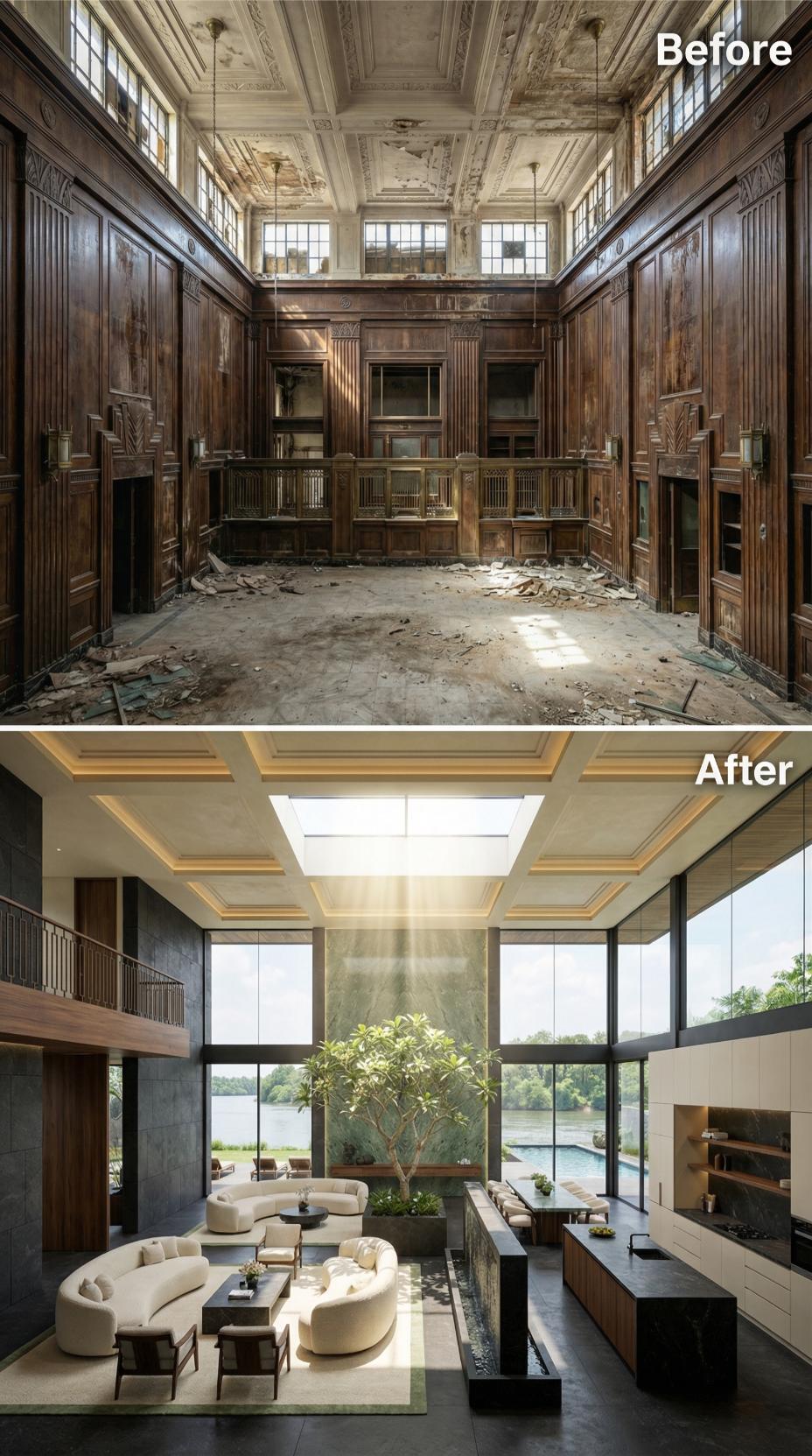
Sunlight pours through a recessed skylight framed by stepped coffers with integrated LED strips, replacing the deteriorated plaster vault that once defined this 1930s grand hall. Curved bouclé sofas in off-white anchor the seating area, while dark slate floor tiles and charcoal stone wall cladding pull the palette toward contrast. A mature olive-style tree rises from a gravel planter at center, drawing the eye toward floor-to-ceiling glazing that frames a waterfront tree line and pool terrace beyond.
Coffered LED Reveals and Waterfront Glass Wall Reclaim a Gutted Bank Hall
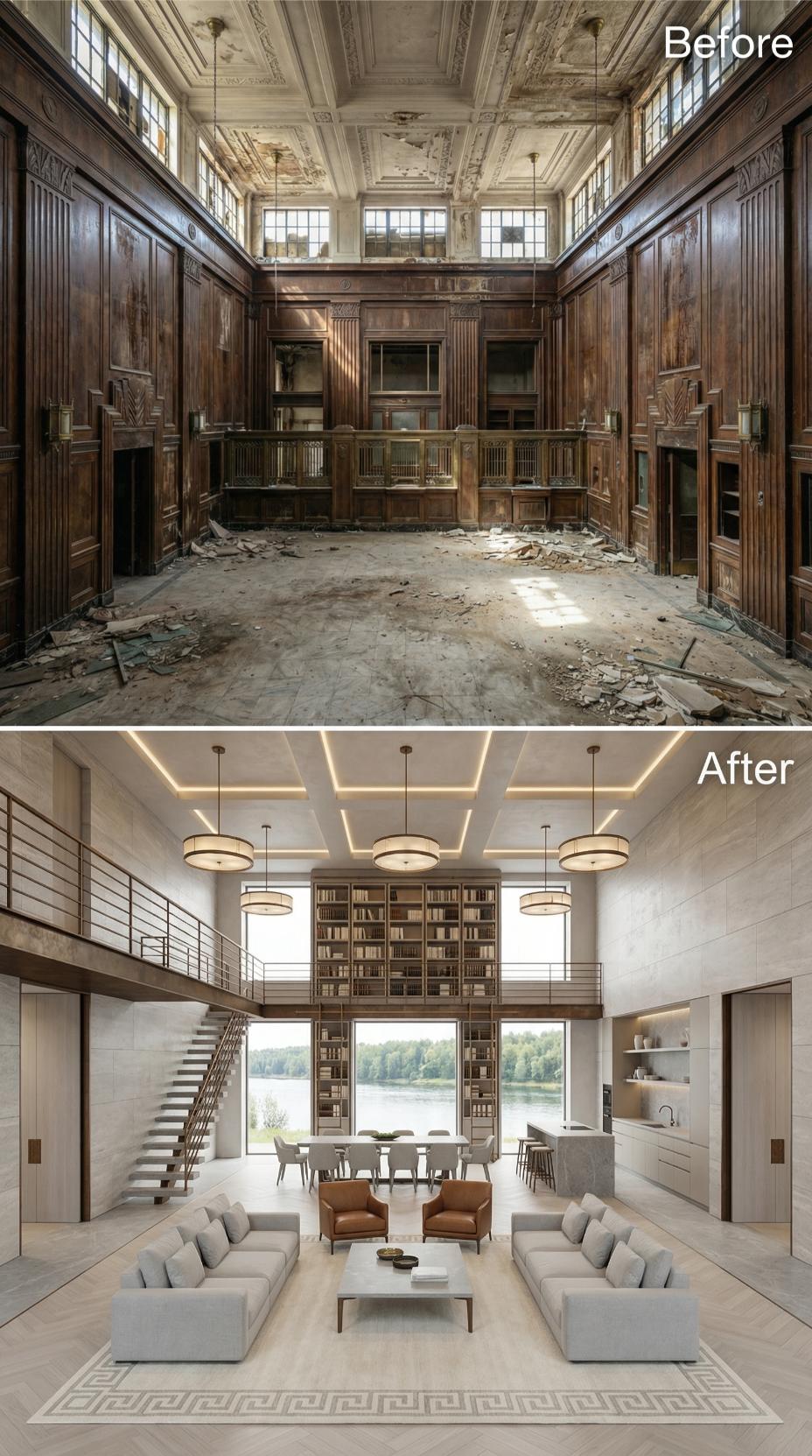
Recessed LED lines trace a grid of coffered plaster panels across the ceiling, with three drum pendants in brushed brass dropping to anchor the double-height volume. Pale limestone cladding covers walls once buried under dark walnut paneling, and a full-height bookcase in stained oak holds the mezzanine’s back wall above a steel cable railing.
Trend Alert: Drum pendants sized above 24 inches in diameter are gaining ground in double-height renovations because they distribute light across a wider horizontal plane than narrow-profile fixtures, reducing harsh shadows at floor level. Specifying three pendants in a triangular or linear cluster, rather than a single oversized piece, also helps fill vertical dead zones that occur when tall ceilings meet low furniture groupings.
Cascading Gold Chandelier and Mirror-Finish Pool Floor Replace a Debris-Strewn Bank Hall
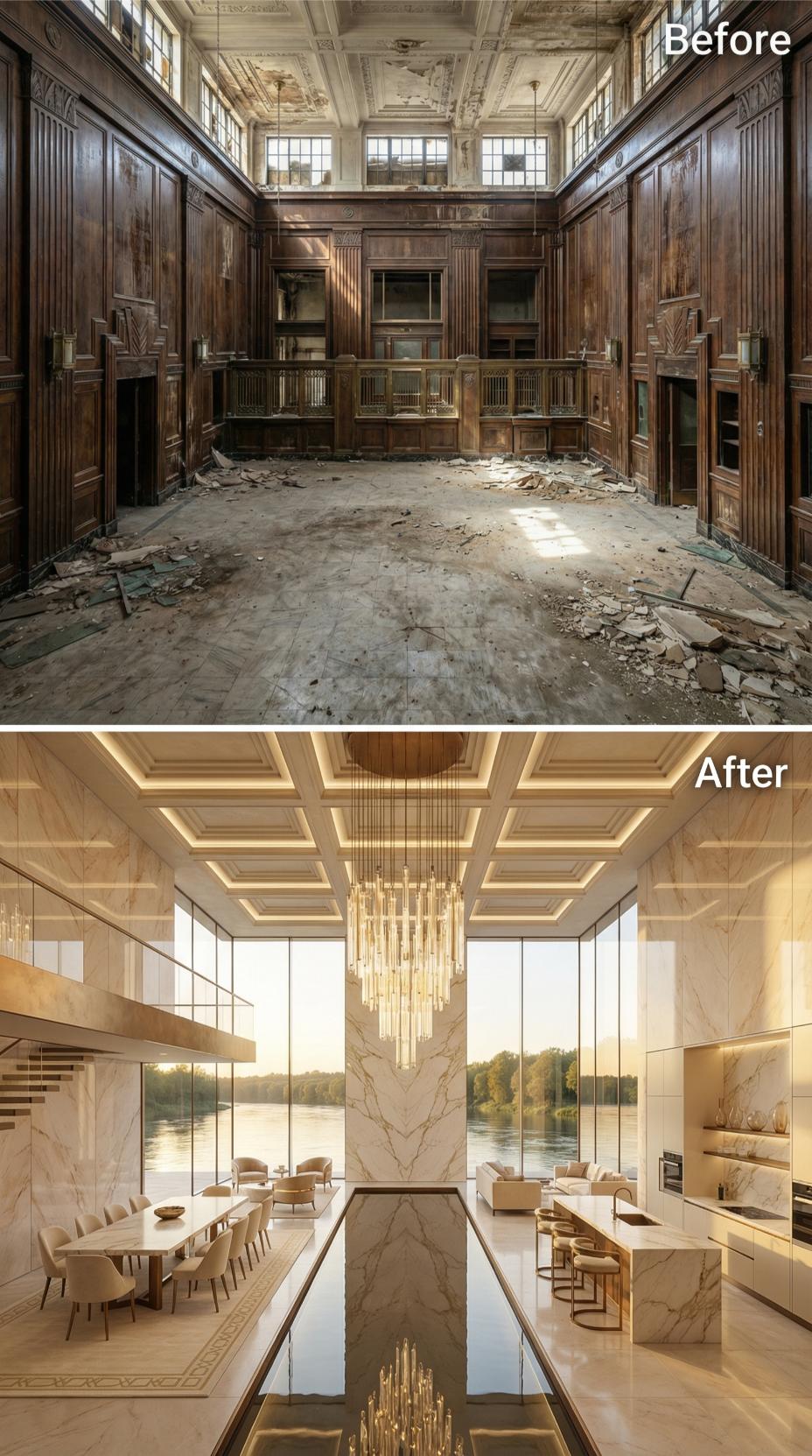
Cream marble cladding runs floor to ceiling, anchoring a narrow reflective water channel that draws the eye toward full-height glass overlooking a river at golden hour, while a cascading rod chandelier in brushed gold drops through the coffered LED ceiling above a long dining table set with round-back upholstered chairs.
Shoji-Inspired Wall Panels and Waterfront Glass Replace a Debris-Strewn Structure
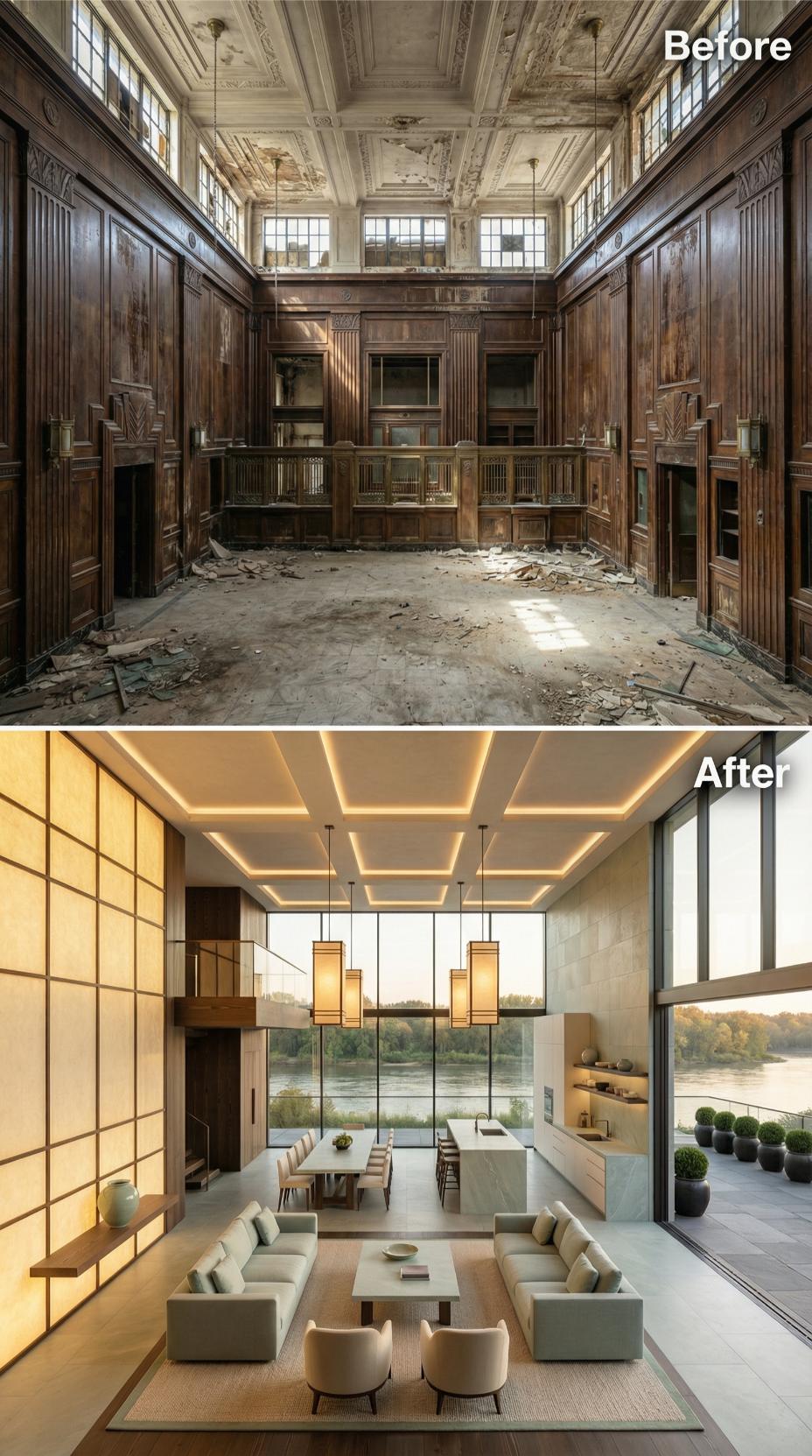
Backlit shoji-style panels in bleached linen wrap the left wall in a soft grid, countering the dark mahogany and plaster rubble that once defined this hall. Coffered ceiling reveals fitted with continuous LED strip lighting replace ornate molding, while a cluster of cylindrical paper pendants in warm amber hang above a long stone-top dining table. Sage green modular sofas anchor the living zone on a natural fiber rug, and full-height steel-frame glazing opens the rear wall to an unobstructed river view at golden hour.
Designer’s Secret: Shoji-inspired wall panels work particularly well in converted commercial spaces because the translucent fabric or washi inserts soften acoustic reverberation, a persistent problem in rooms with high ceilings and hard surfaces. Specifying a linen-faced version rather than traditional rice paper increases durability without sacrificing the diffused glow effect.
Travertine Cladding and Copper Drum Pendants Replace a Debris-Strewn Bank Hall
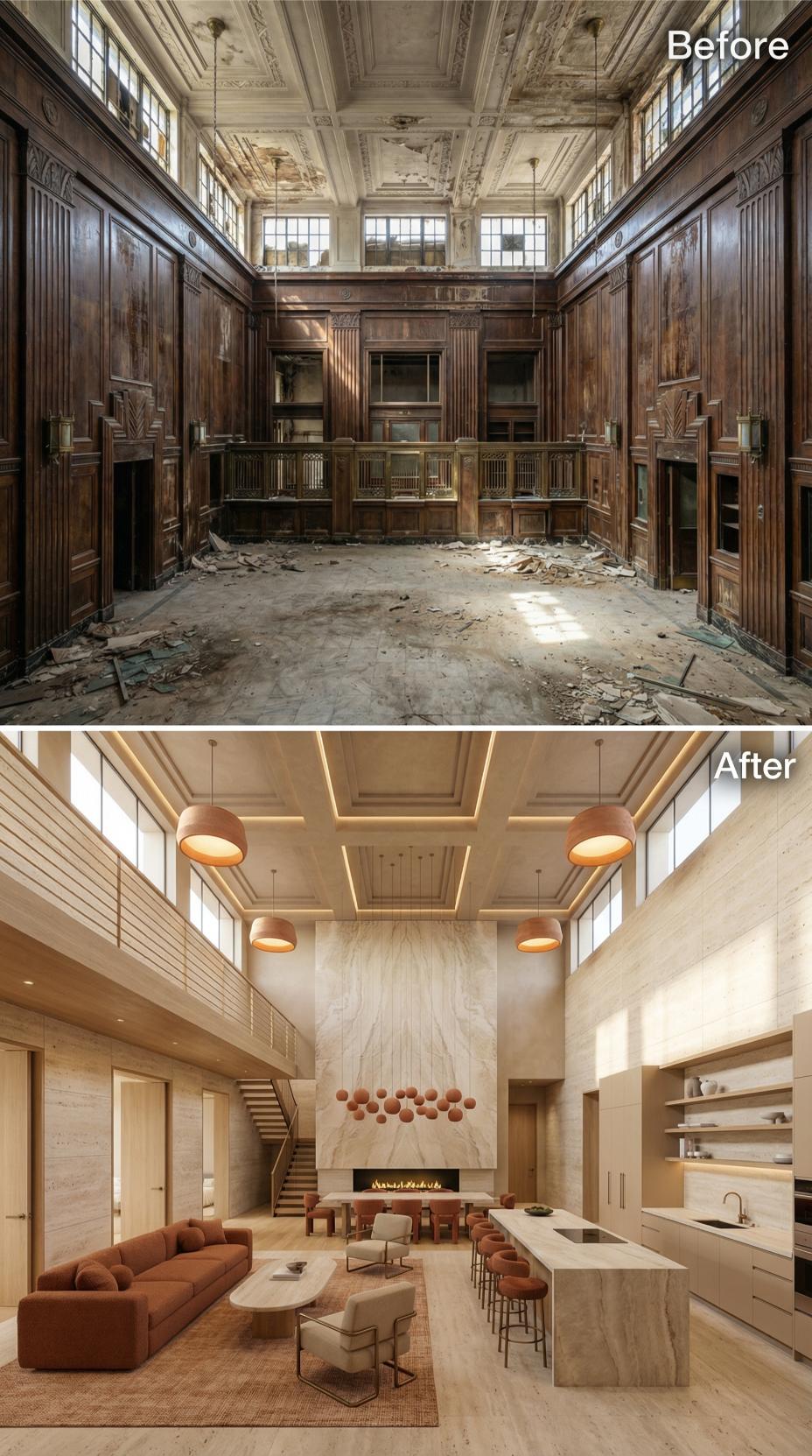
Collapsed plaster, shattered glass, and dark mahogany wainscoting covered every surface of the original grand hall. The renovation stripped all of it and clad the walls floor-to-ceiling in book-matched travertine with visible veining, giving the double-height volume an entirely new material logic.
Four copper-finish drum pendants hang from the coffered ceiling on black cables, their warm terracotta fabric shades echoing the rust-toned velvet sofa below. A waterfall-edge island in veined stone anchors the kitchen zone to the right, paired with flat-front cabinetry in a warm putty lacquer. Against the far wall, a linear gas fireplace sits beneath a large-format travertine surround, with a sculptural spherical wall installation mounted directly above it. Bar stools in cognac velvet line the island, and a mezzanine with horizontal cable railing runs the full width overhead.
Milky Way Ceiling Mural and Marble Fireplace Wall Reclaim a Debris-Strewn Bank Hall
🔥 Would you like to save this?
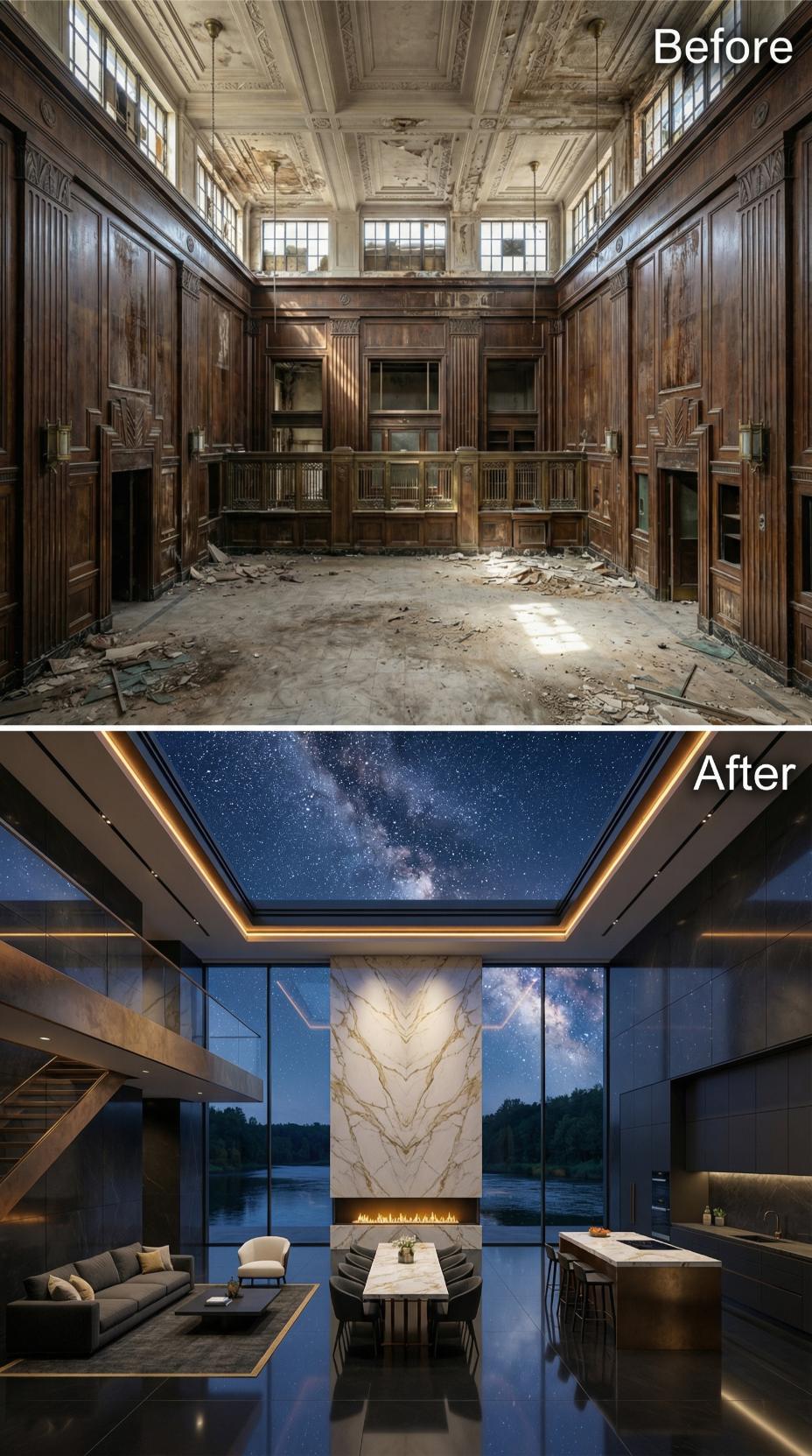
Where plaster once fell from an ornate coffered ceiling, a large-format skylight opening now frames a printed Milky Way mural across the entire upper plane, edged in warm amber LED strip lighting that traces the recessed perimeter. The floor switches from broken concrete to large-format dark porcelain tile with a low-sheen finish.
A floor-to-ceiling marble fireplace surround in white and gold-veined stone anchors the far wall, with a linear gas insert set low beneath a dining table in matching marble. Floor-to-ceiling glazing on both sides reveals a tree-lined waterfront. A modular charcoal sofa, a bar-height island in brushed bronze cabinetry, and an open staircase with wood treads complete the layout.
History Corner: The grand halls of 1930s bank buildings were deliberately designed to project financial stability through architectural scale, using ceiling heights of 25 to 35 feet to make depositors feel secure in the institution’s permanence. Many of these structures were built during the years immediately preceding or following the 1929 market crash, making their survival into the renovation era a direct artifact of that period’s civic ambition. In cities across the Midwest and Northeast, adaptive reuse projects now account for a significant share of the remaining bank hall stock.
Warm Travertine Fireplace Wall and Egg-Form Pendants Outlast a Gutted 1930s Bank
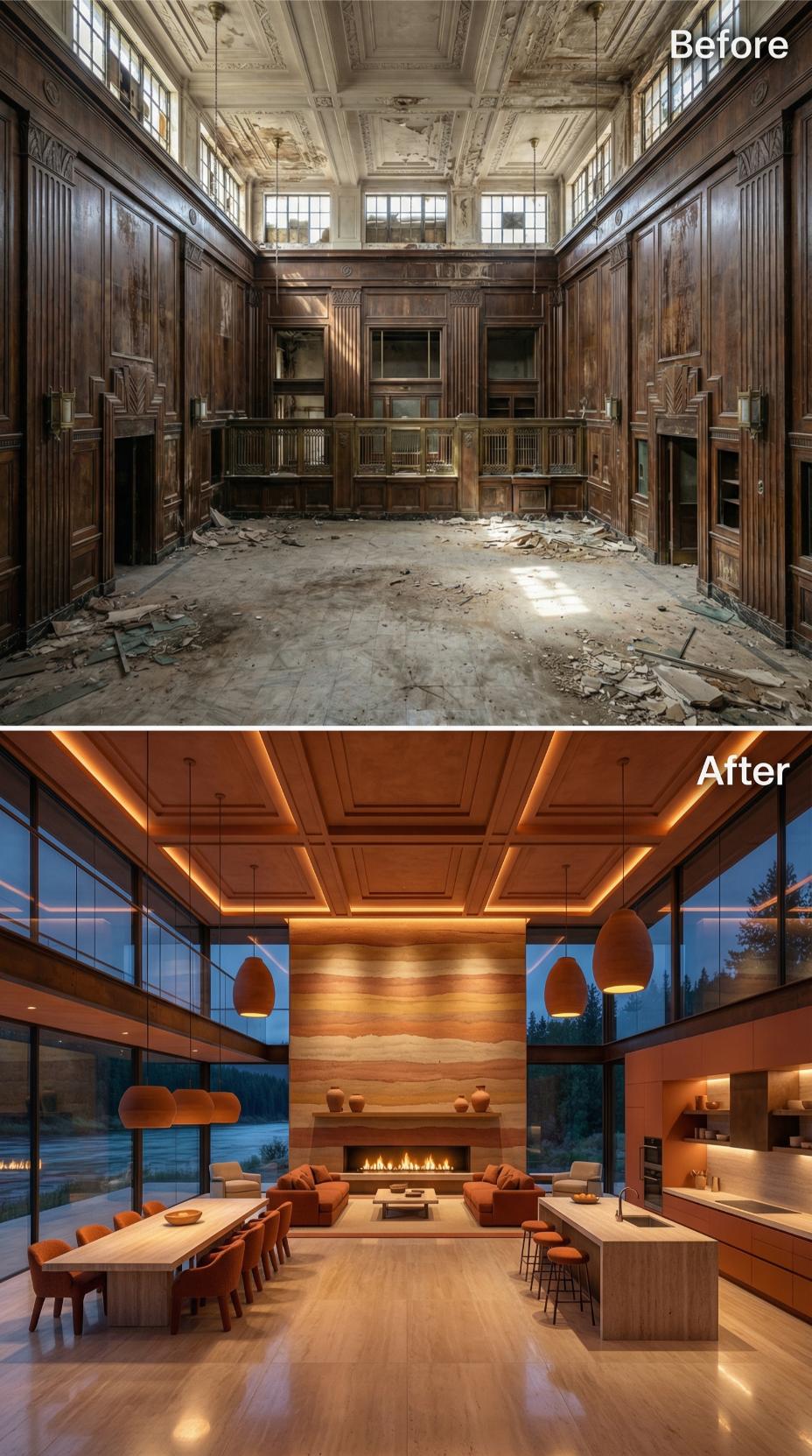
Broad-grain hardwood flooring runs the full length of the open plan, anchoring a dining table in light-toned wood with terracotta velvet chairs along both sides. Three egg-shaped pendants in a burnt-orange ceramic finish hang at staggered heights above the seating zones, while LED strip lighting recessed into coffered ceiling panels casts an amber wash across the room without a single visible bulb.
The focal wall is clad in banded travertine, its horizontal veining shifting from sand to rust, framing a linear gas fireplace at floor level. Floor-to-ceiling glass on three sides reveals a tree line at dusk. A kitchen island in matching travertine sits to the right, topped with a waterfall edge and fitted with low-profile bar stools upholstered in the same terracotta fabric as the dining chairs.
Vertical Steel Rods and Slate Fireplace Wall Outlast a Gutted 1930s Bank
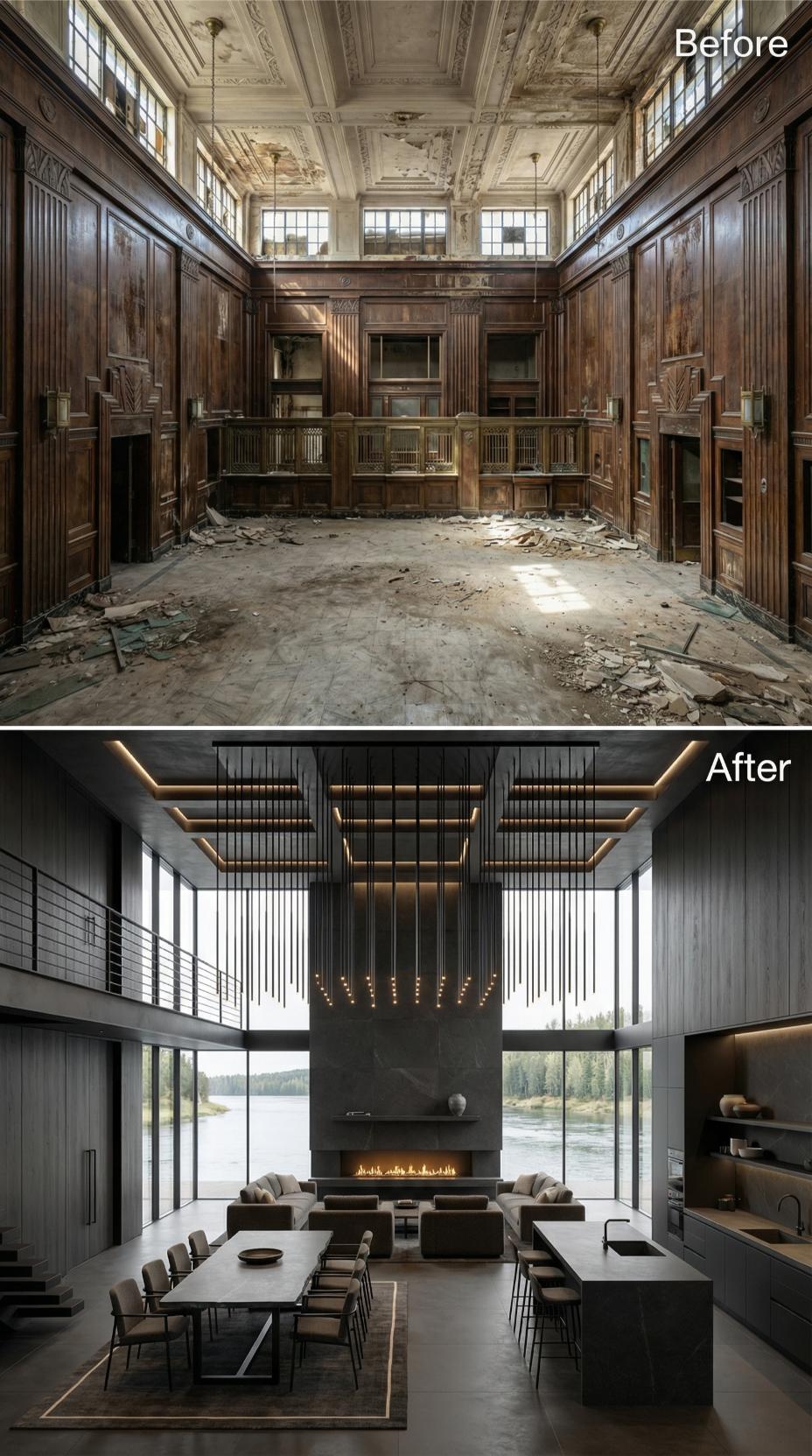
Charcoal-stained wood cladding runs floor to ceiling beside floor-to-ceiling glass panels that frame a river view, while a slate fireplace tower anchors the seating area and a linear gas burner replaces the debris field below.
Pro Tip: Suspended rod chandeliers with exposed filament tips require a ceiling anchor point rated for dynamic load, not just static weight, because air movement causes subtle sway that multiplies stress over time. Specifying a rated swivel canopy rather than a fixed plate adds minimal cost and prevents fastener fatigue.
Skylights and open kitchens defined the last several sections, but this one shifts toward double-height living volumes.
Burl Wood Feature Wall and Skylights Outlast a Gutted 1930s Bank
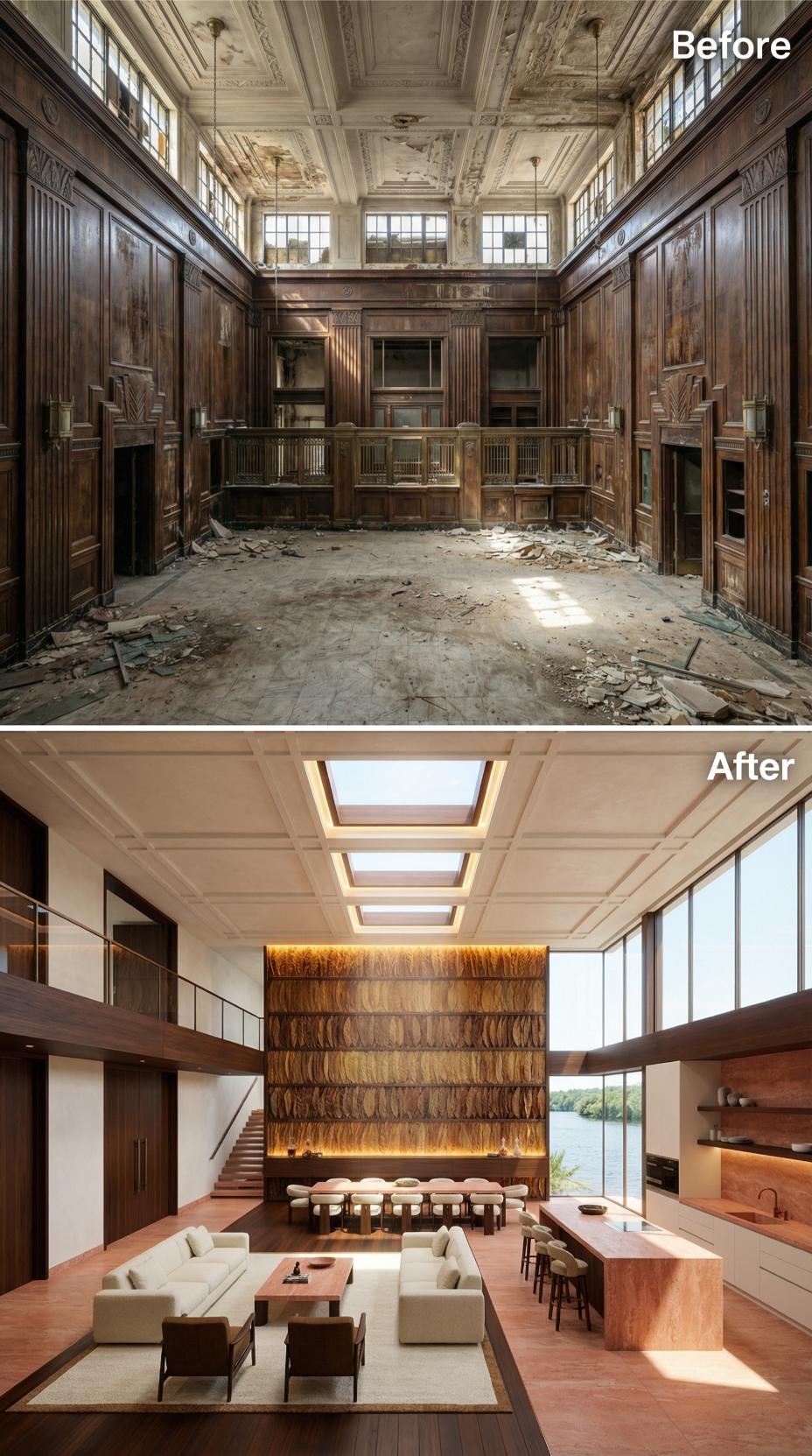
Debris and peeling plasterwork gave way to a coffered ceiling fitted with three flush skylights that flood the open-plan floor with afternoon light, while a floor-to-ceiling burl wood panel wall, backlit in amber, anchors the dining zone behind a long dark-stained table ringed with bouclé chairs.
Bleached Ash Paneling and Washi Grid Wall Reclaim a Gutted 1930s Bank Hall
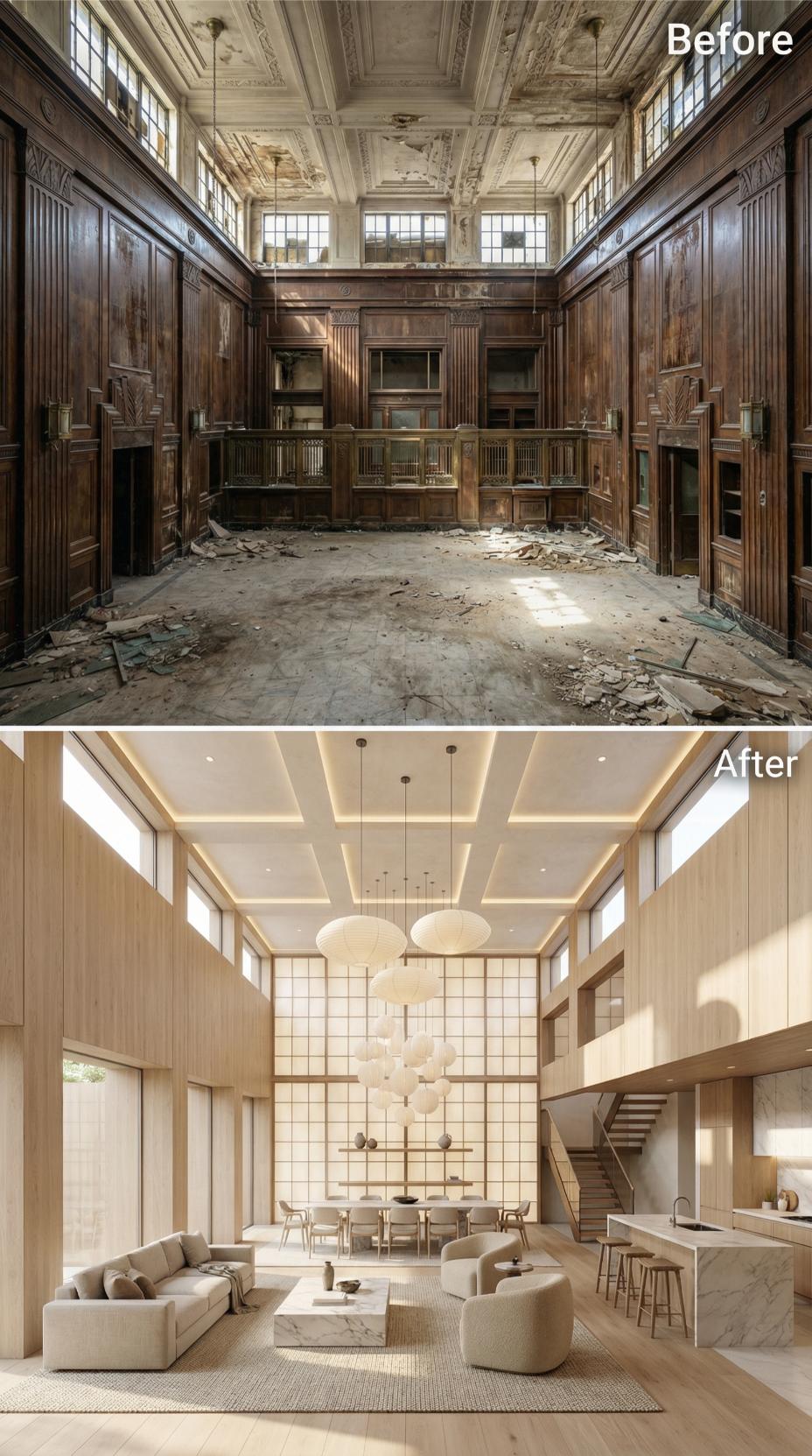
Pale ash cladding runs floor to ceiling on every wall, replacing dark mahogany millwork with a matte, grain-forward surface. Clustered paper globe pendants in graduated sizes hang from a coffered ceiling fitted with LED cove strips, casting warm diffuse light across a low-profile sofa in oatmeal bouclé. A marble-top island anchors the open kitchen at right, where bar stools with slender metal frames face a waterfall edge in veined white stone.
Globe Pendants and a Stone Waterfall Column Reclaim a Crumbling Bank Hall
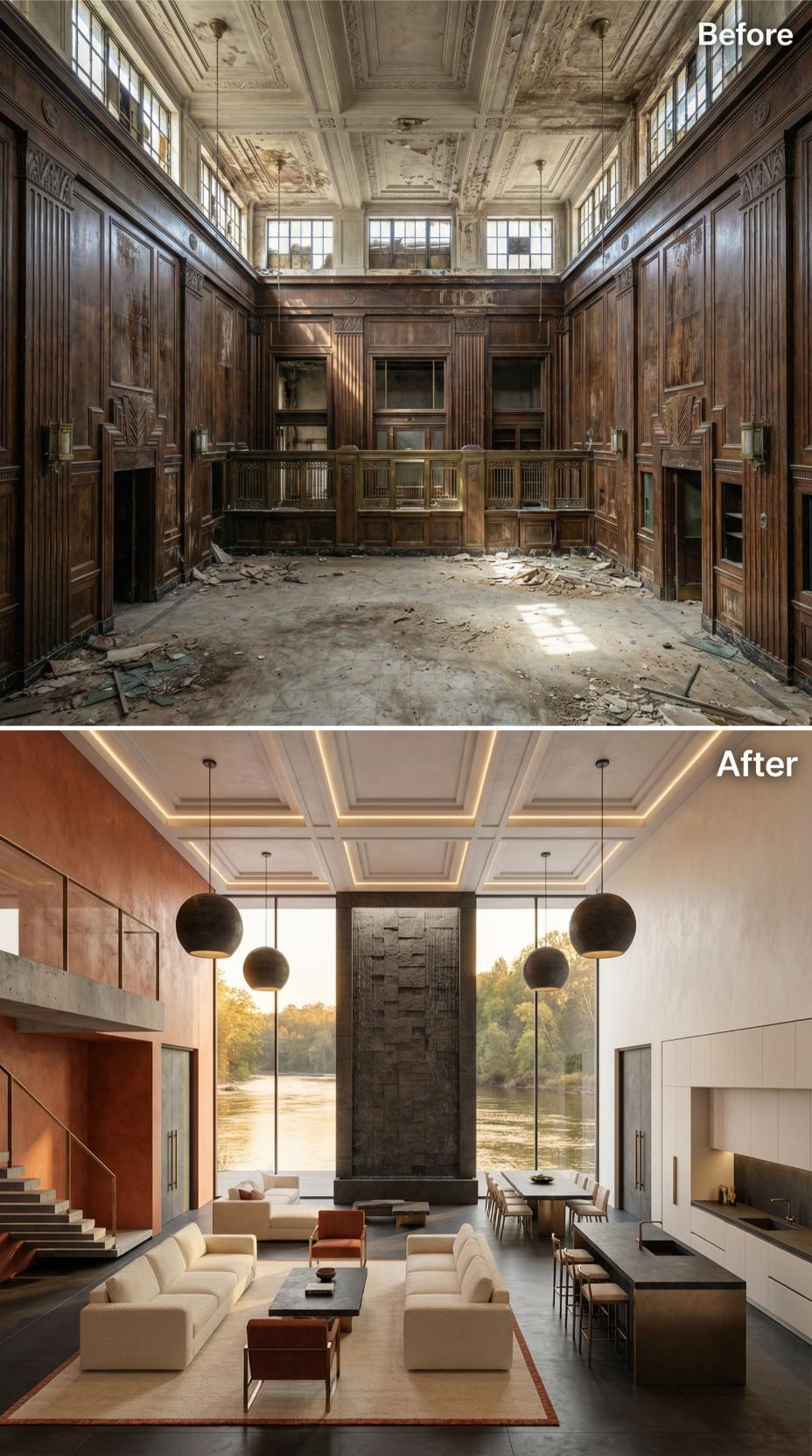
Three matte bronze sphere pendants anchor the double-height ceiling while LED strip lighting traces the coffered molding above. Ivory bouclé sofas face a low slate coffee table, and a floor-to-ceiling stone column in rough-cut grey acts as the room’s spine.
Try This: Sphere pendants work well in tall converted spaces because their closed form creates a defined focal point without competing with architectural ceiling detail. Look for fixtures with a brushed or matte finish rather than polished metal, which tends to read as decorative rather than structural at scale.
Shifting from vertical steel accents, this section introduces a softer palette built around stone and sculptural light.
Azul Macaubas Feature Wall and Teardrop Pendants Outlast a Crumbling Bank Hall
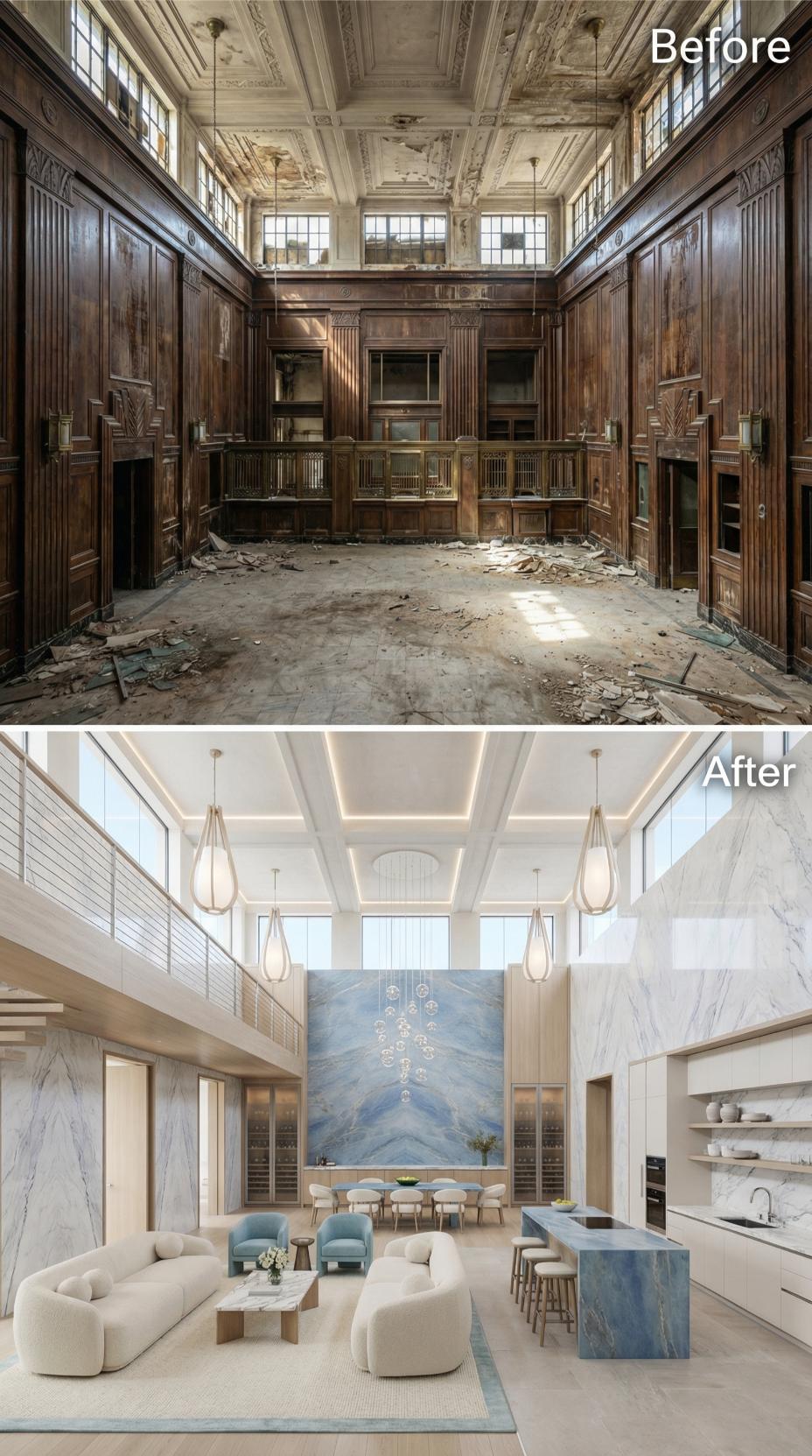
Bookmatched Azul Macaubas marble anchors the far wall in mirrored blue-grey veining, flanked by a dining area with upholstered chairs and a kitchen island surfaced in the same stone, while paired teardrop pendants in brushed brass hang from the coffered ceiling above a living arrangement of boucle sofas and powder-blue accent chairs.
Dusty Rose Sofas and a Skylit Coffered Ceiling Reclaim a Gutted 1930s Bank Hall
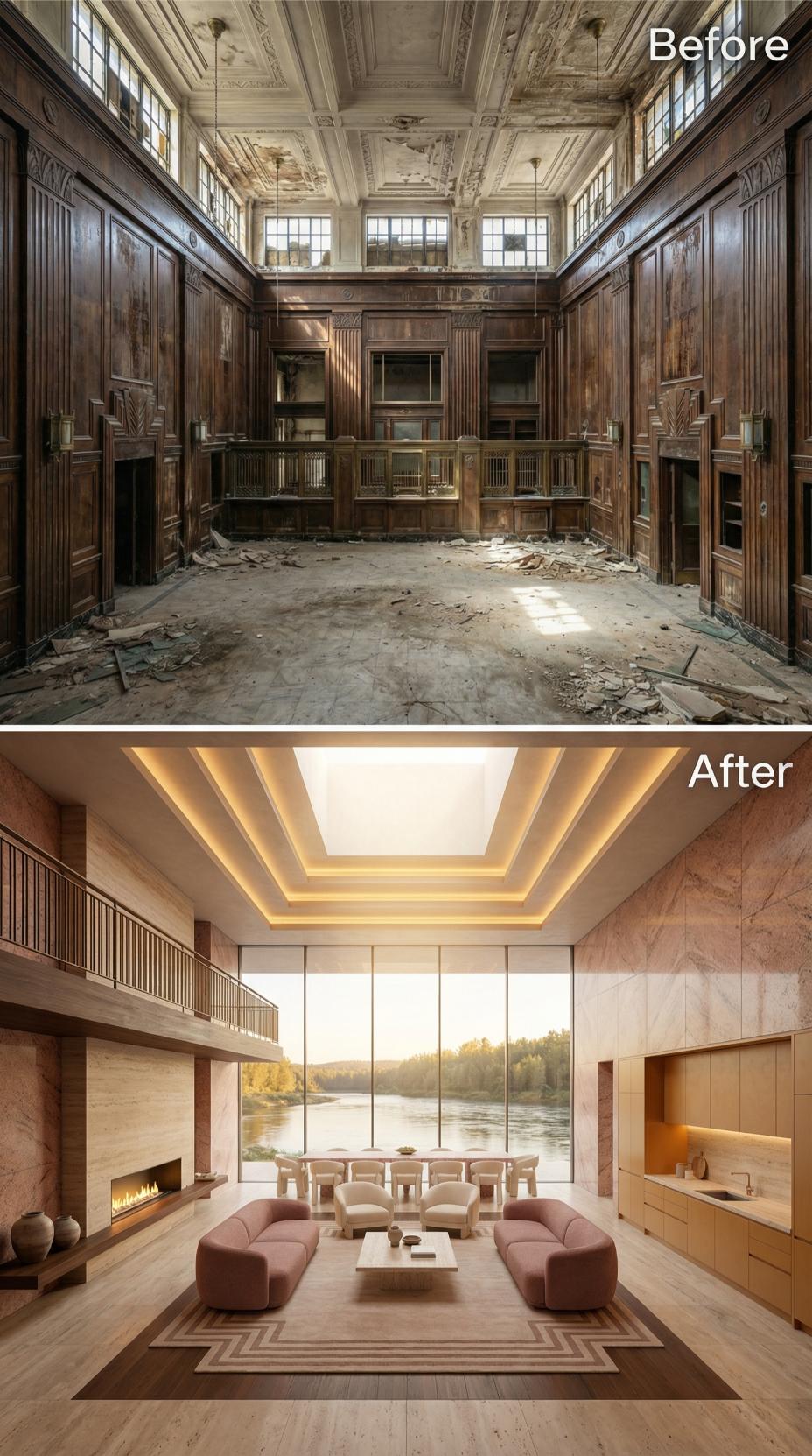
Blush-pink modular sofas anchor the seating zone on a geometric-bordered rug, with ivory bouclé armchairs pulled toward a low travertine coffee table. Floor-to-ceiling glass panels replace the original wood-paneled rear wall entirely, opening onto a river-and-forest view that floods the room with late-afternoon light. The mezzanine railing, now finished in matte black steel, survives from the original bank’s upper level.
Warm amber LED strips line each step of the coffered ceiling recess, drawing the eye upward without any hanging fixture competing for height. Rose-veined marble cladding runs across both side walls, and blonde oak cabinetry with an integrated sink occupies the right corner. A gas fireplace sits flush with the left marble wall at floor level, its black steel surround kept razor-thin.
Oval Skylights and Floor-to-Ceiling River Glass Reclaim a Gutted 1930s Bank Hall
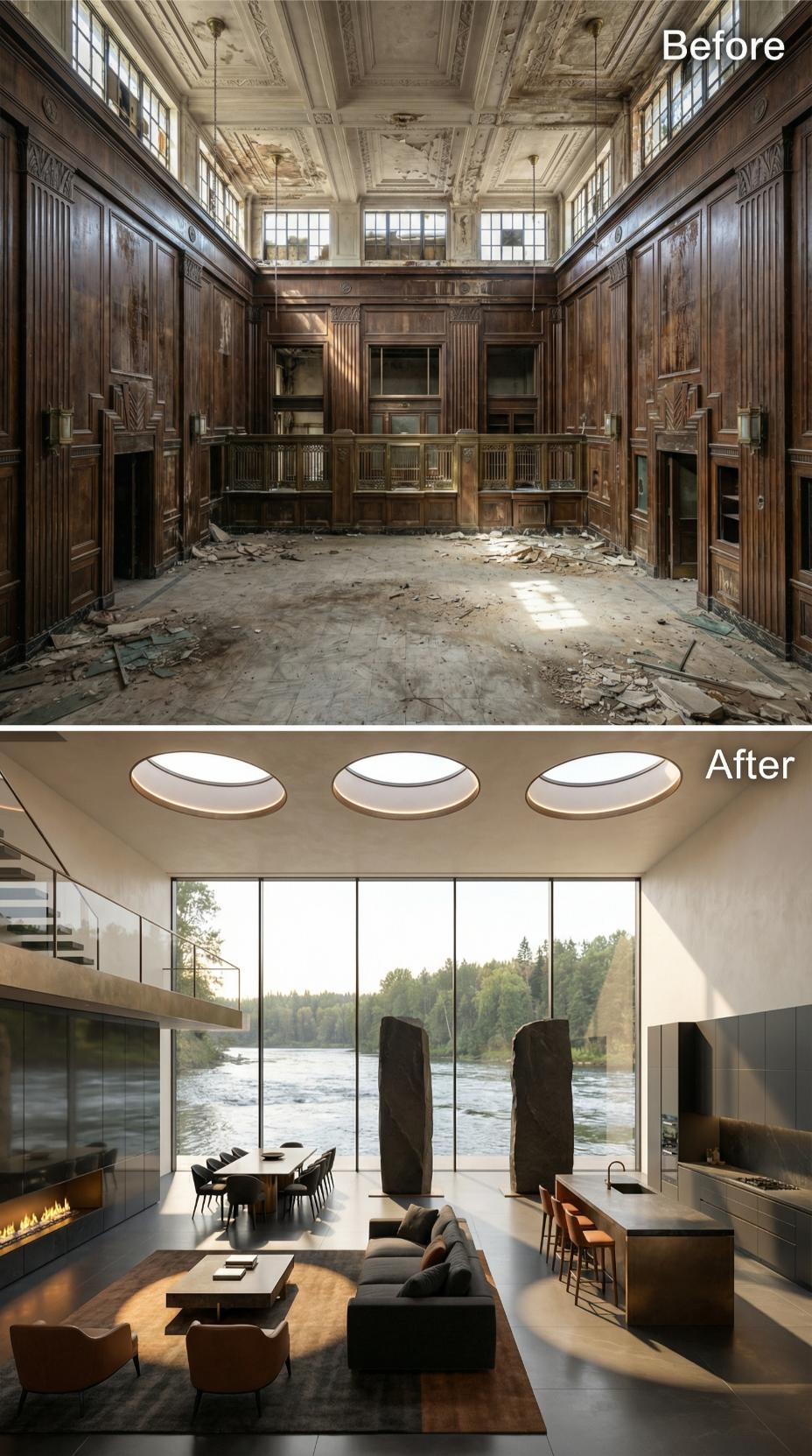
Three recessed oval skylights punch through a smooth plaster ceiling, replacing the ornate coffered plasterwork that had been flaking onto rubble-covered floors for decades. The after state installs full-height frameless glass across the rear wall, framing a river view flanked by dense tree line. Two monolithic stone columns, rough-faced and unshaped, anchor the dining zone without acting as structural supports. Seating runs to a low-profile charcoal sofa on a rust-brown area rug, paired with cognac leather accent chairs. A linear gas fireplace sits flush with the left wall panel in matte graphite finish, while bar stools in the same cognac leather line a dark stone island to the right.
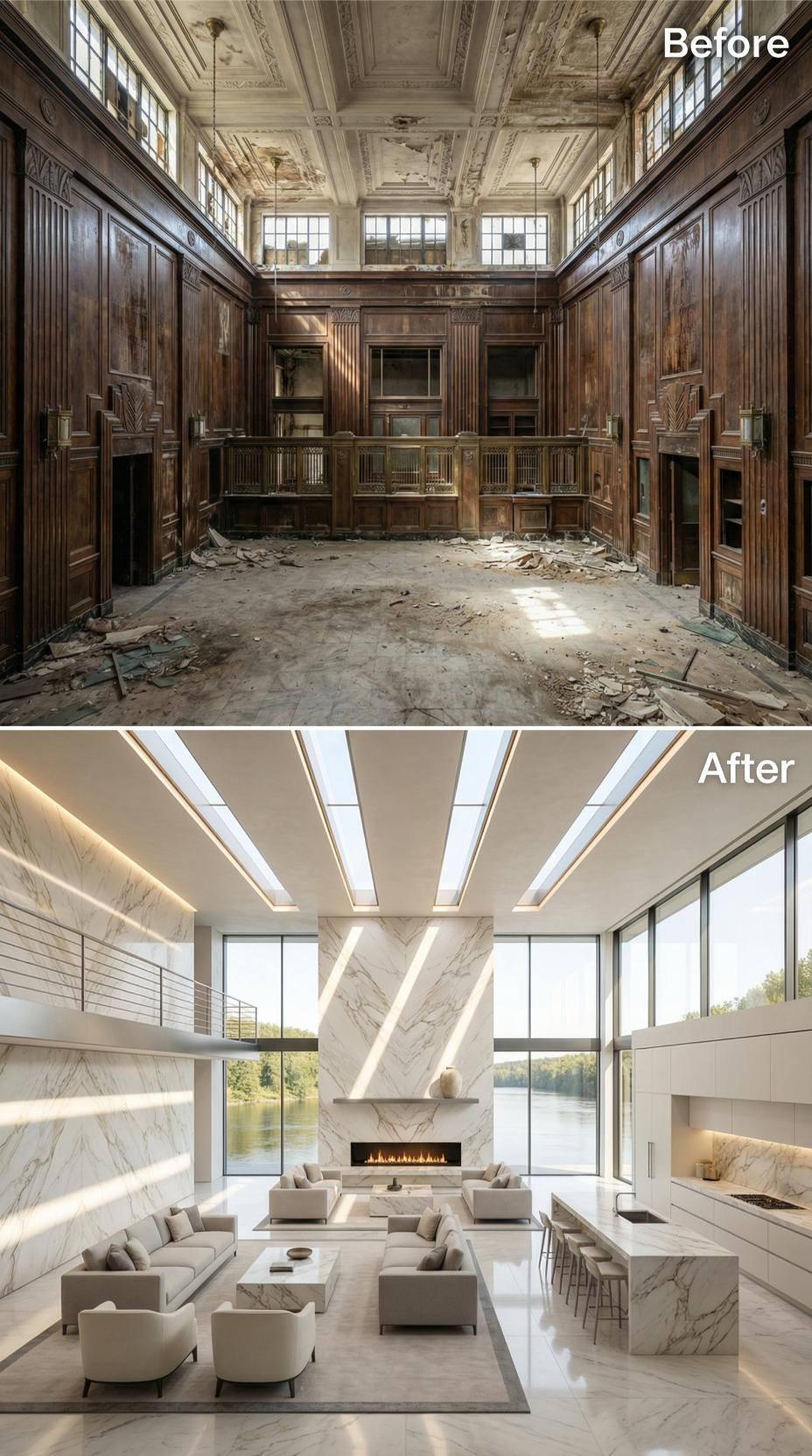
Calacatta Marble Walls and Skylight Slots Replace a Rubble-Covered Bank Hall
🔥 Would you like to save this?
Ivory-veined Calacatta marble runs floor to ceiling on the fireplace wall, cut in a chevron pattern that draws the eye upward through the double-height volume. Recessed skylight slots replace the original coffered plasterwork, channeling natural light in parallel bands across the polished white floor. Floor-to-ceiling glass panels on the back wall open the room to a tree-lined waterfront view, erasing any trace of the boarded windows that once framed the bank hall.
Seating pulls inward around a linear gas fireplace set flush into the marble surround. Low-profile sofas in off-white boucle fabric sit opposite matching armchairs with rounded backs. A waterfall-edge kitchen island in the same Calacatta stone anchors the right side of the plan, paired with matte white cabinetry and bar stools in brushed steel. Warm LED strip lighting runs inside each ceiling recess, softening the otherwise cool palette.
Floating Staircase and Cherry Blossom Panel Replace Rubble-Strewn Teller Counters
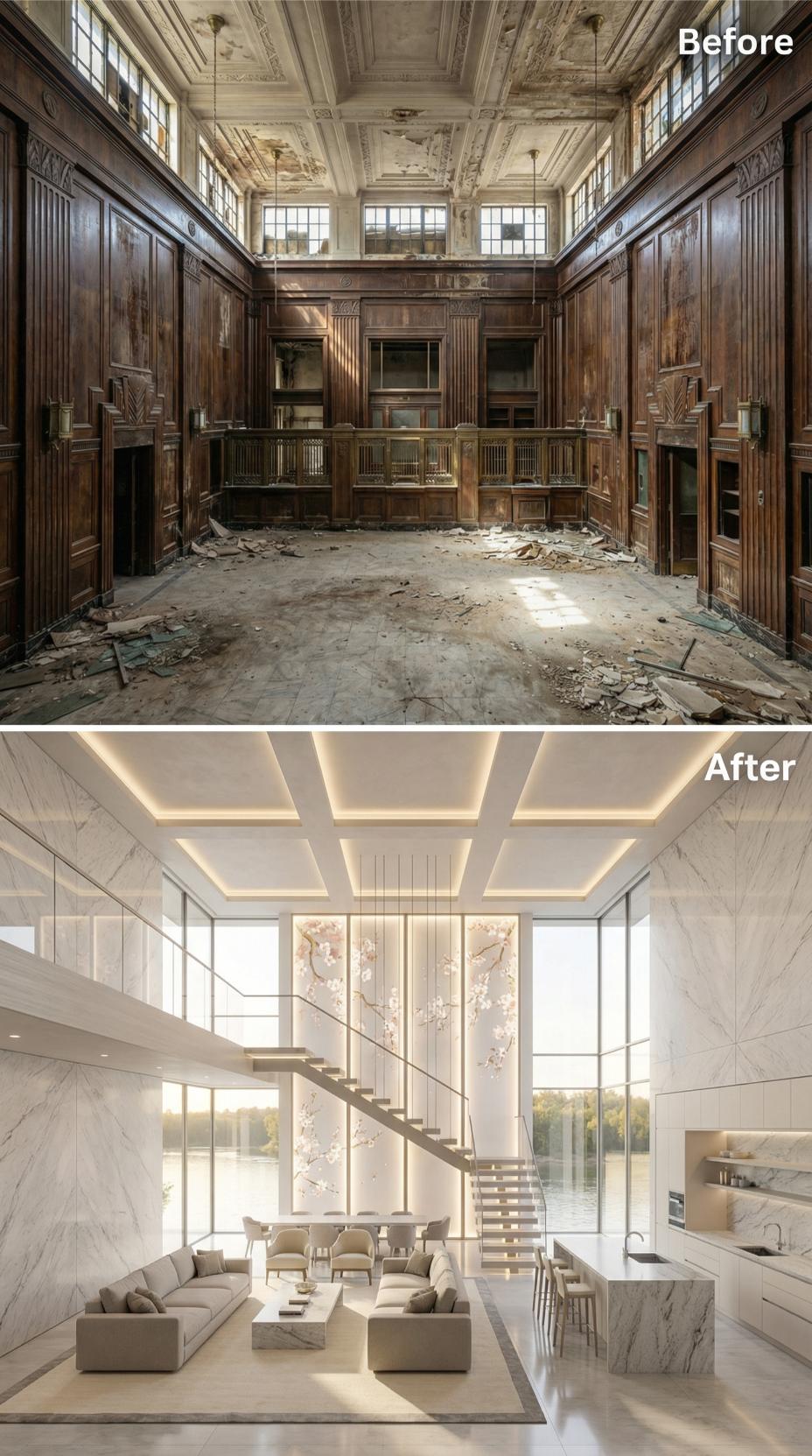
Bookmatched white marble cladding runs floor to ceiling on every wall, while recessed LED coffers replace the original deteriorating plasterwork overhead. Cantilevered open-riser stair treads in brushed concrete climb alongside a tall hand-painted cherry blossom panel, its pale pink blooms backlit against cream plaster. Floor-to-ceiling glazing at the rear floods the seating area with water views. Sectional sofas in greige bouclé anchor the living zone beside a marble waterfall island with integrated sink.
Curved Plaster Divider Wall and Amber Drop Pendants Outlast a Rubble-Strewn Bank Hall
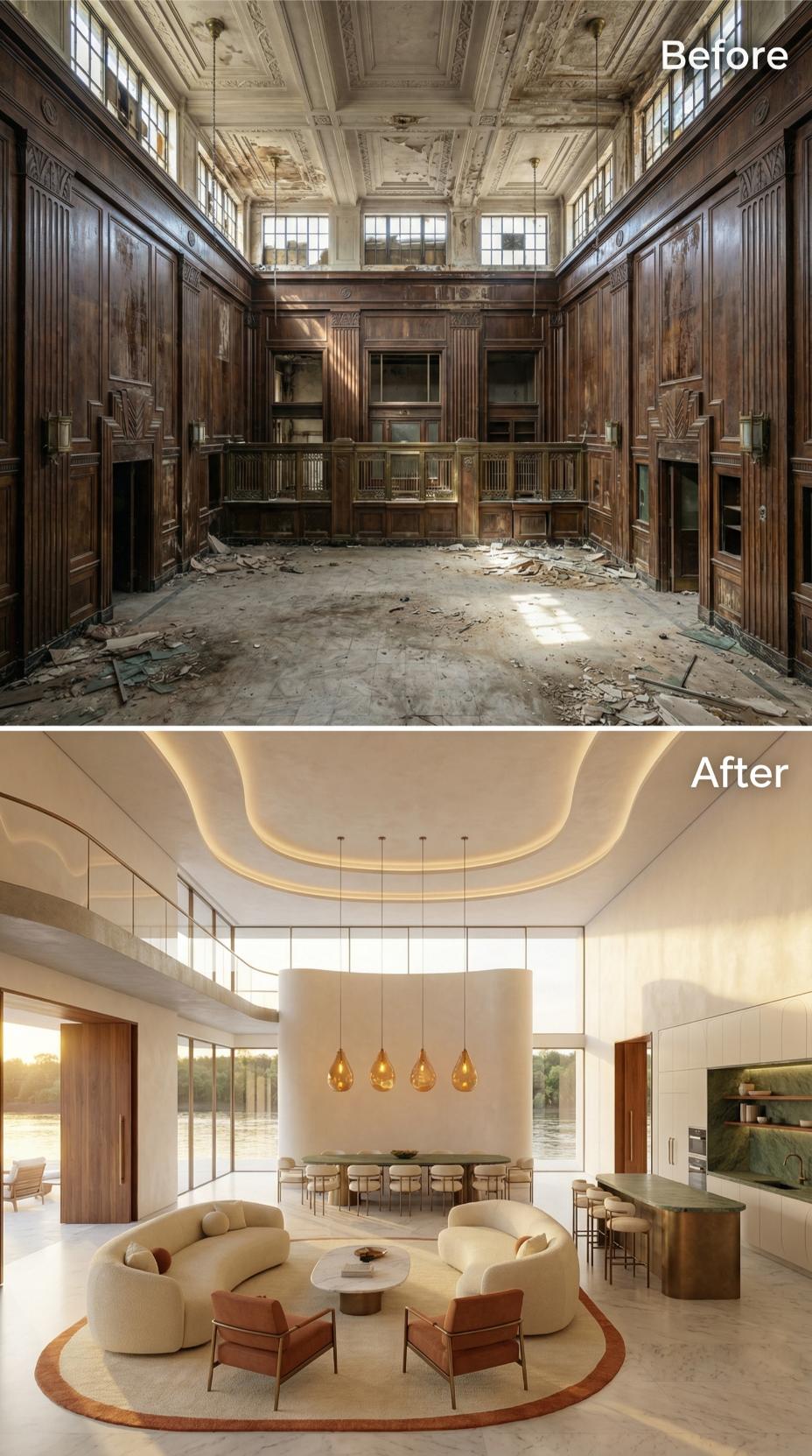
Four amber blown-glass teardrop pendants hang from a white plaster ceiling with a recessed cove detail, anchoring a dining zone tucked behind a freestanding curved divider in off-white plaster. Cream bouclé sofas arc into a horseshoe seating group on a rust-edged oval rug, flanked by cognac leather armchairs. Floor-to-ceiling glazing replaces what were once teller windows, flooding the travertine floor with water-reflected light. A green marble island with a brass-toned base defines the kitchen edge at right.
Shoji Staircase and Honed Stone Island Replace a Rubble-Covered Teller Hall
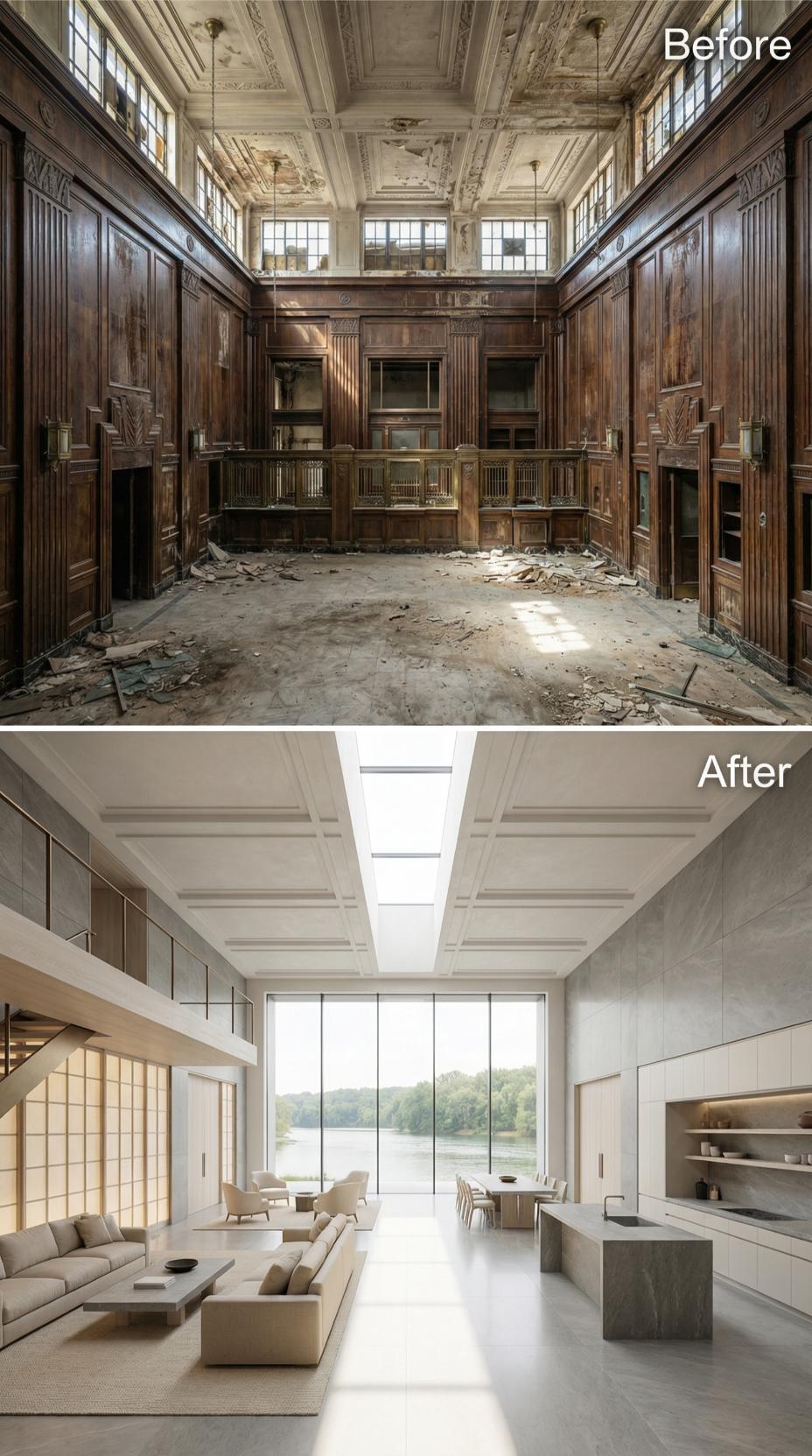
Where dark walnut wainscoting once lined walls above a debris-scattered floor, honed grey stone cladding now runs floor to ceiling on both flanks. A floor-to-ceiling glass wall at the far end frames a river view, pulling natural light across polished concrete floors. The kitchen island sits on the right in the same grey stone, with a waterfall edge and recessed under-shelf lighting.
A low-profile sectional in undyed linen anchors the living zone, paired with a dining table set close to the glass. On the left wall, a shoji-style grid panel in warm ash filters light from an adjacent staircase. Linear skylights in the coffered ceiling replace the original ornate plasterwork, cutting clean slots of daylight through the entire length of the hall.
Cobalt Velvet Armchairs and River Glass Replace a Rubble-Covered Bank Hall
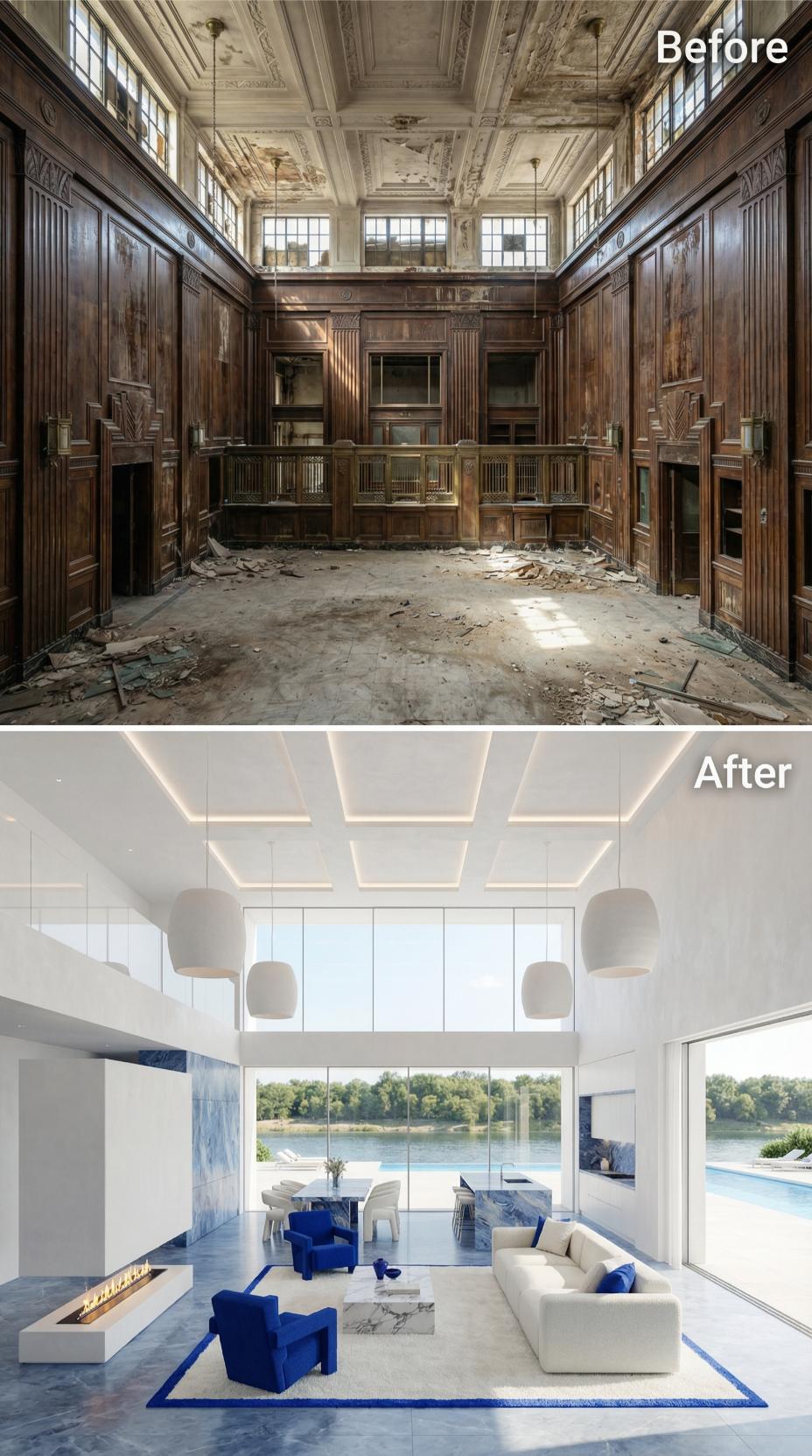
Cobalt velvet armchairs anchor the seating zone against a white wool rug edged in matching blue, pulling the accent color down from the cushions on the cream sofa. A linear ethanol fireplace runs along the left wall at floor level, its white plaster surround flush with the wall face. Blue-veined marble cladding rises behind it, bookending the fireplace without competing with the glazed rear wall.
Floor-to-ceiling glass spans the full width of the back elevation, opening directly to a riverfront terrace and pool deck. Pendant shades in matte white hang on extended drops from a coffered ceiling fitted with recessed LED strips rather than downlights. The original coffered grid proportion survives in the ceiling geometry, though every surface is now white plaster. Gray polished stone floors run continuously from interior to exterior threshold.