🔥 Would you like to save this?
You didn’t just want a nice living room. You wanted a throne room — somewhere to receive guests as though they requested an audience. Somewhere the furniture has a pedigree and the ceiling has opinions. You’ve always suspected you were born into the wrong tax bracket, and this is your correction. Beige carpet and a flush-mount light? Not on your watch. Not on your legacy. Welcome to the living room you were always meant to inherit.
In order to come up with the very specific design ideas, we create most designs with the assistance of state-of-the-art AI interior design software. Also, assume links that take you off the site are affiliate links such as links to Amazon. this means we may earn a commission if you buy something.
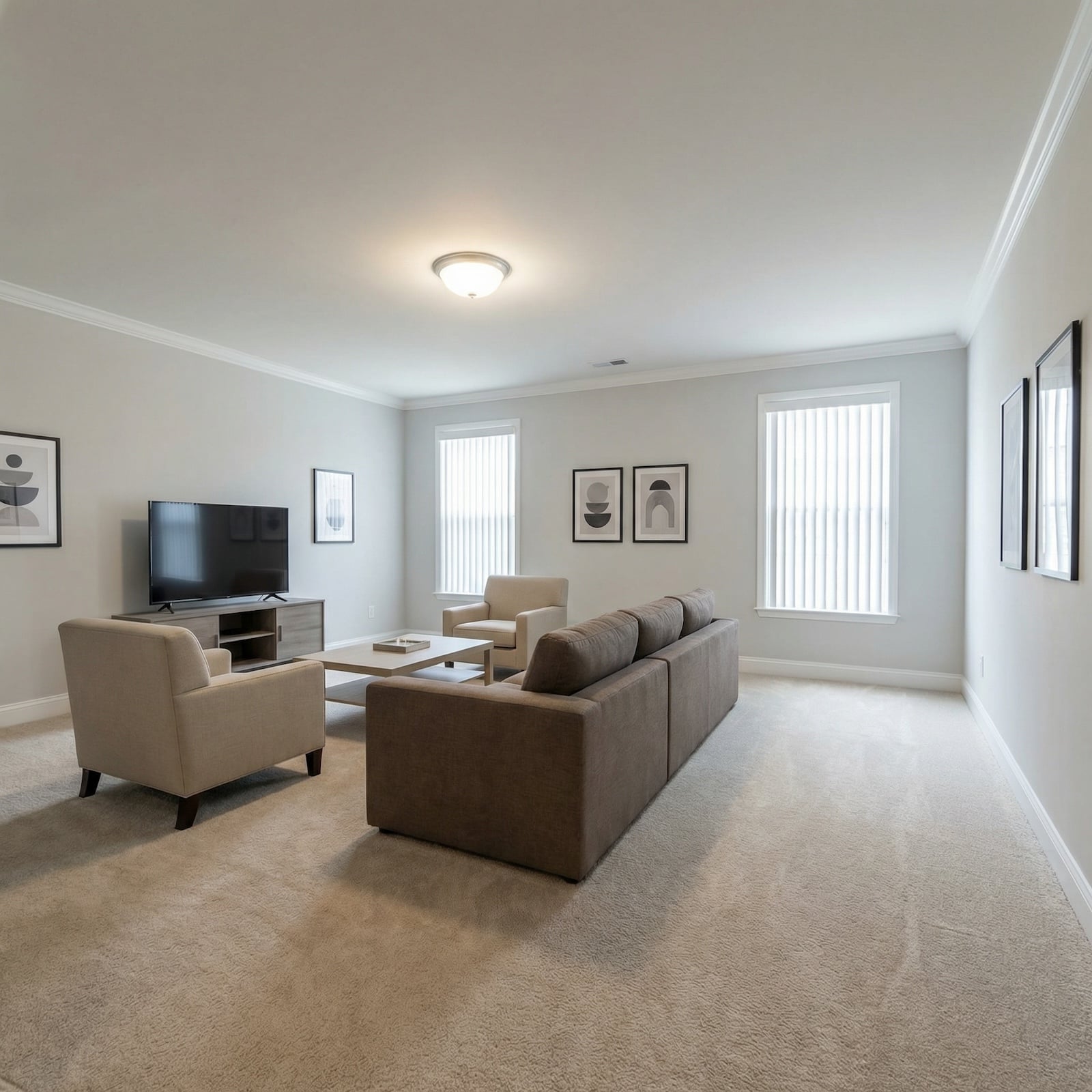
Builder-grade living rooms have one thing in common: they were designed to offend no one, which means they end up inspiring no one. Beige walls, hollow-core trim, and builder carpet do not a palace make. But the people in these before-and-after photos had a different vision entirely. They saw those blank, forgettable rooms and decided to go full royalty, think coffered ceilings, jewel tones, statement fireplaces, and furniture that actually commands a room.
These are not subtle refreshes. Crown molding got added where there was none. Walls went from drywall white to deep velvet hues. Floors that once whispered now speak with authority. Each space in this collection started from the same unremarkable baseline and ended somewhere considerably grander.
From Beige Builder Box to Velvet-and-Gold Gentlemen’s Club
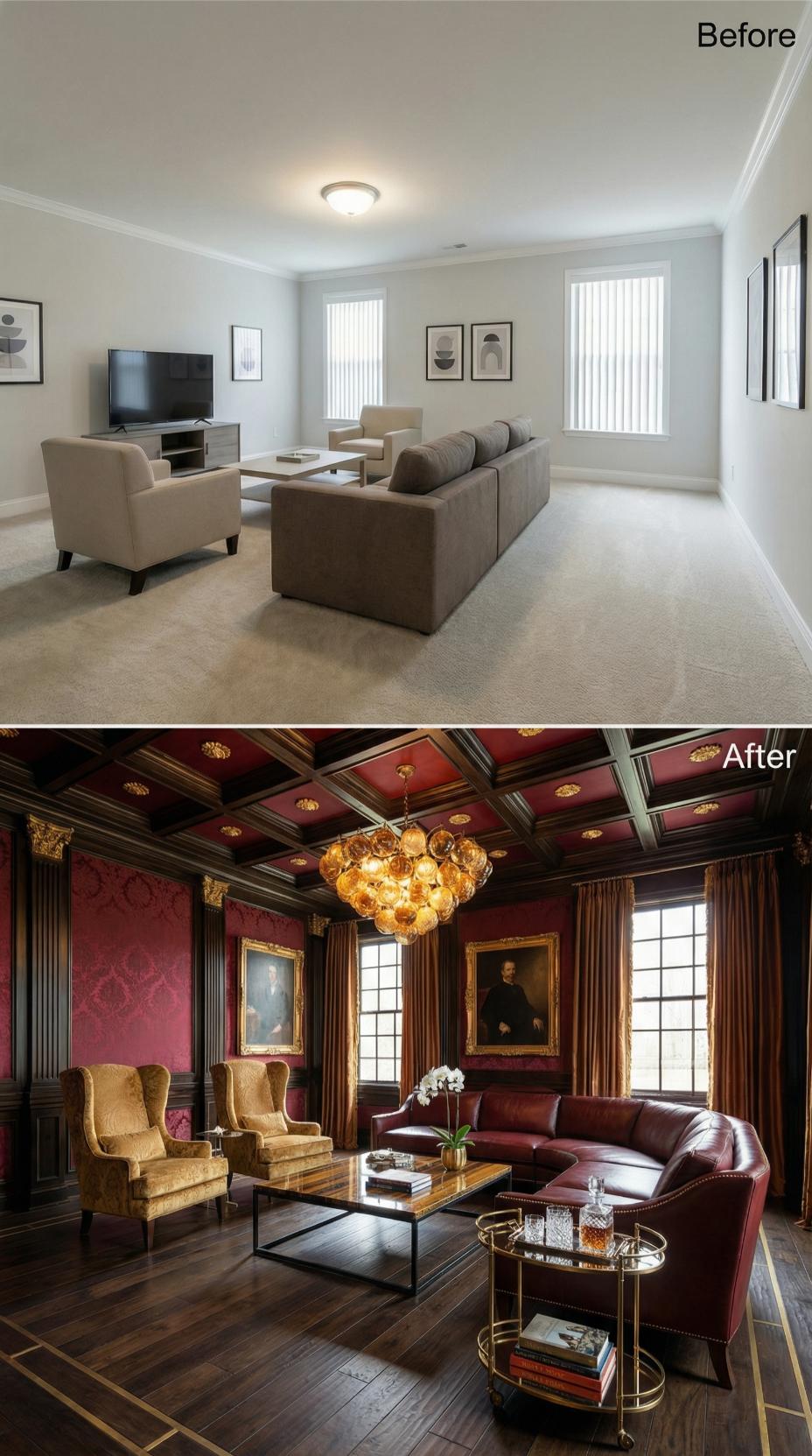
Crimson damask wallcovering replaces flat gray paint, while dark-stained hardwood floors swap out wall-to-wall carpet. A coffered ceiling painted deep red with gilded rosette medallions commands the entire room, and an amber glass chandelier drops from its center. Burgundy leather sectional seating and gold velvet wingback chairs complete the shift.
Navy Lacquer Ceilings and Parquet Floors Replaced Every Inch of Builder Beige
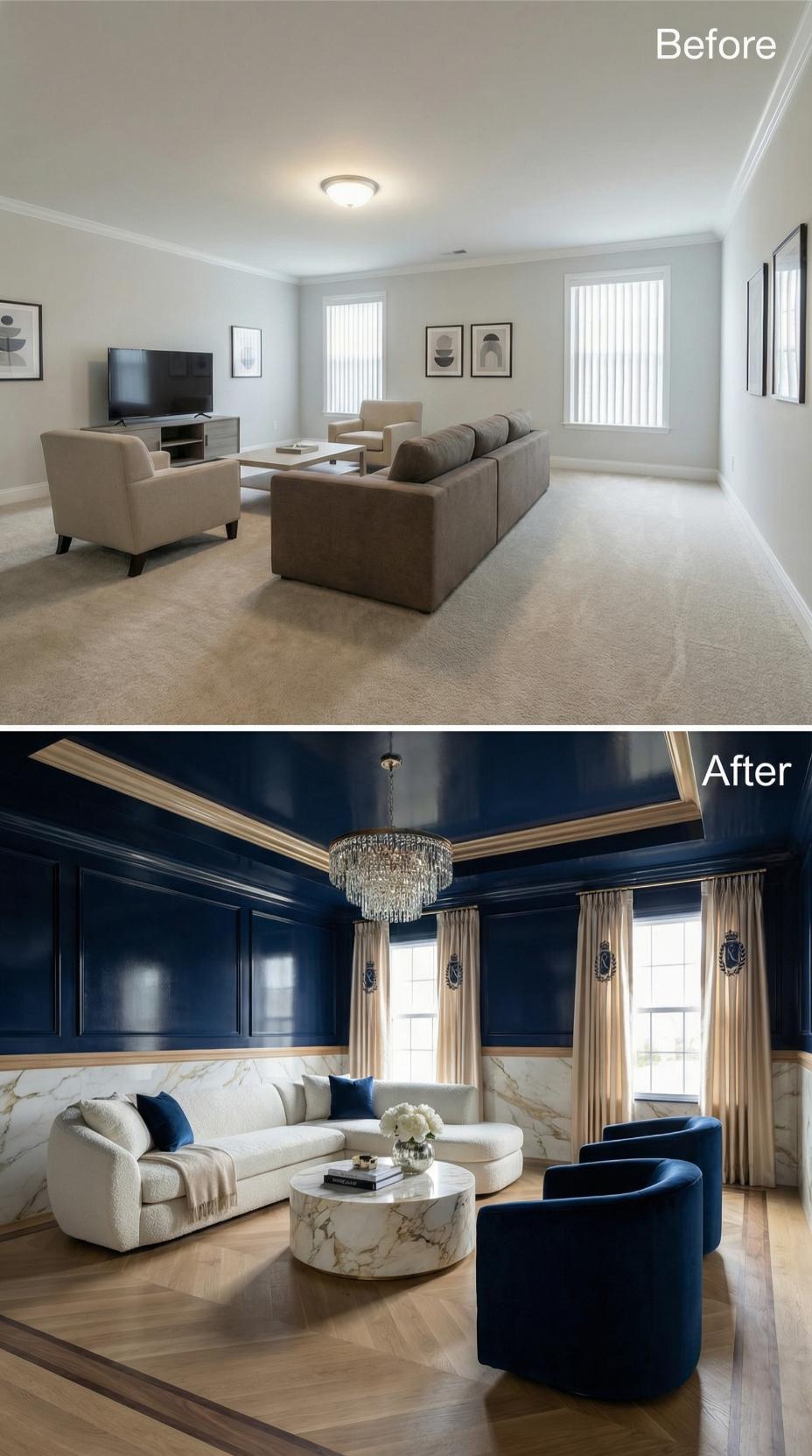
What started as carpet, flush-mount lighting, and walls the color of dry wall compound became a room finished in high-gloss navy lacquer from floor to ceiling tray. Gold-painted crown molding lines that tray, and wainscoting panels in the same deep blue run the full perimeter below a marble-slab dado rail. Herringbone parquet in light oak covers the floor.
Furniture reads like a deliberate counterpoint: a rounded white boucle sofa faces two navy barrel chairs in velvet. A cylindrical marble-top coffee table sits between them. Above it all, a tiered crystal chandelier drops from the tray center, replacing what was once a single builder-grade flush mount.
Plaster Medallions and Crystal Chandeliers Buried the Carpet-and-Flat-Paint Era
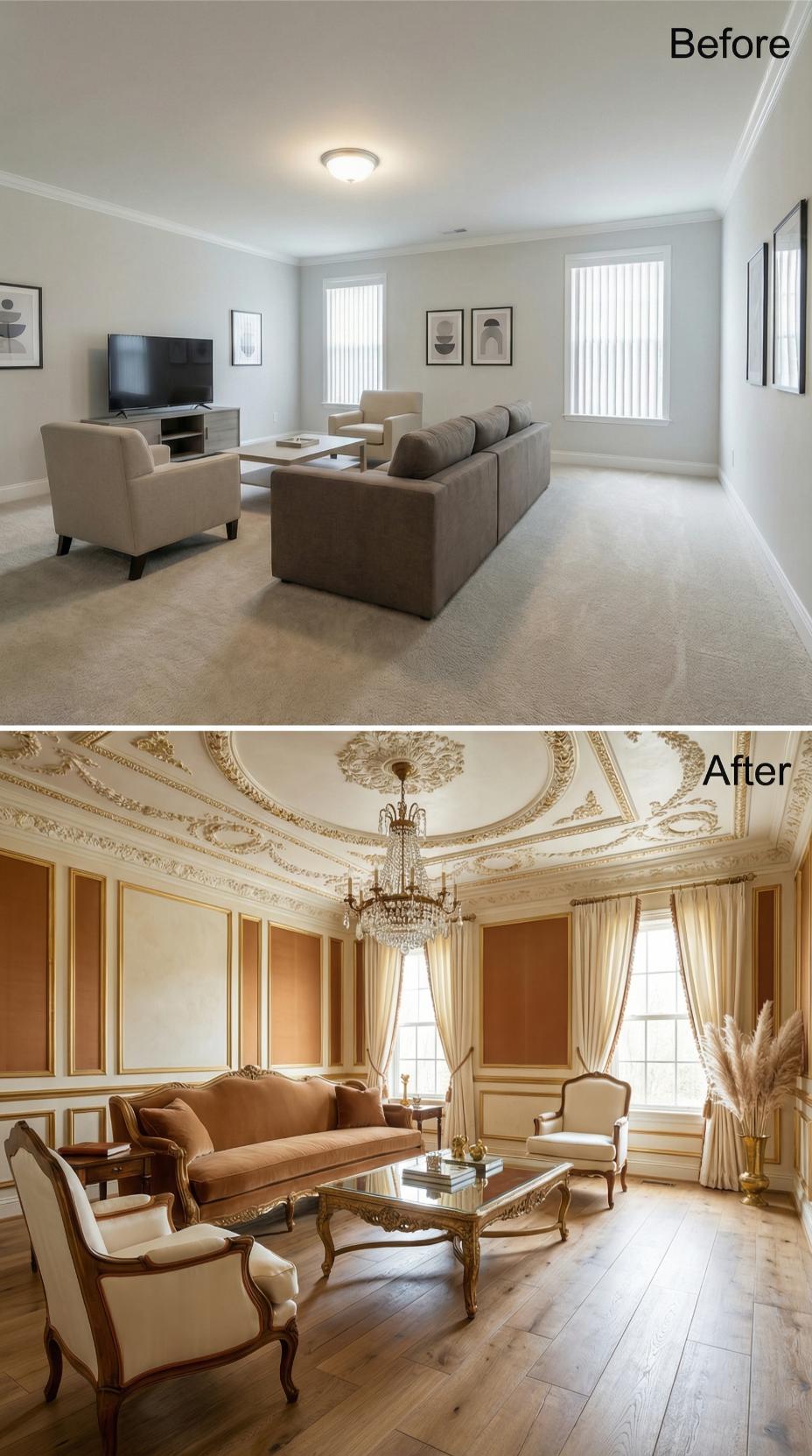
Ornate ceiling coffers trimmed in gilt scrollwork replaced a flush-mount fixture and flat white drywall. Louis XV-style walnut frames support a camel velvet sofa, while rush-seated armchairs flank a gilded glass coffee table over wide-plank oak flooring.
Malachite Wallpaper and Coffered Walnut Ceilings Declared War on Beige Carpet
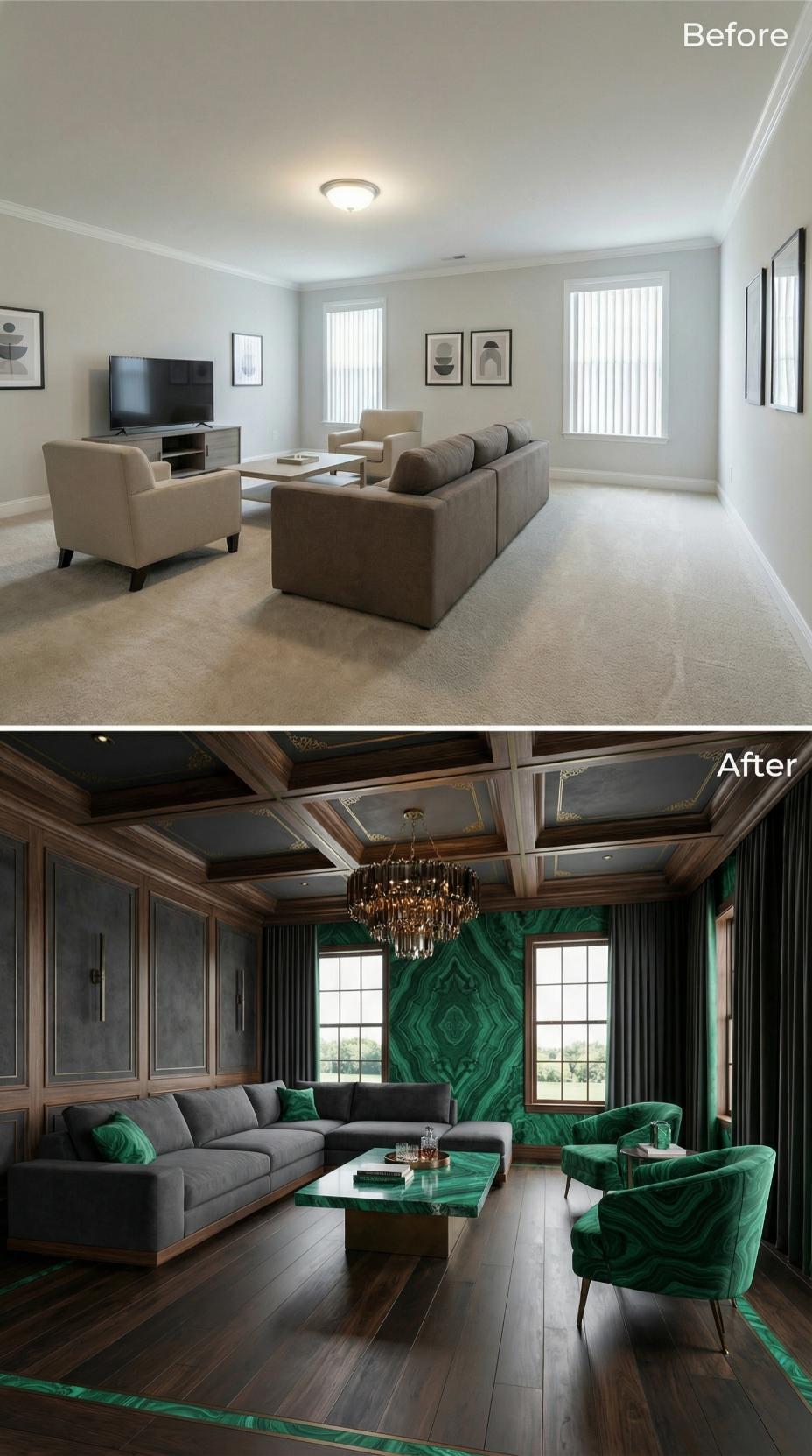
Flat white walls and a builder-grade flush mount gave way to coffered ceilings clad in dark-stained walnut with gold-leaf detail at each panel intersection. A smoke-glass chandelier anchors the room from the center coffer, casting warm light across wide-plank hardwood floors that replaced every inch of the original carpet.
The seating arrangement pairs a gray sectional trimmed in walnut with two barrel chairs upholstered in malachite-print velvet. That same malachite pattern covers the accent wall in full-scale wallcovering, and the coffee table repeats the stone motif with a white-and-green slab top on a brass base. Charcoal wall paneling with raised molding borders three sides of the room while floor-length black drapes frame the windows.
Crimson Leather Chesterfields and Hand-Painted Bird Wallpaper Finished Off the Carpet Era
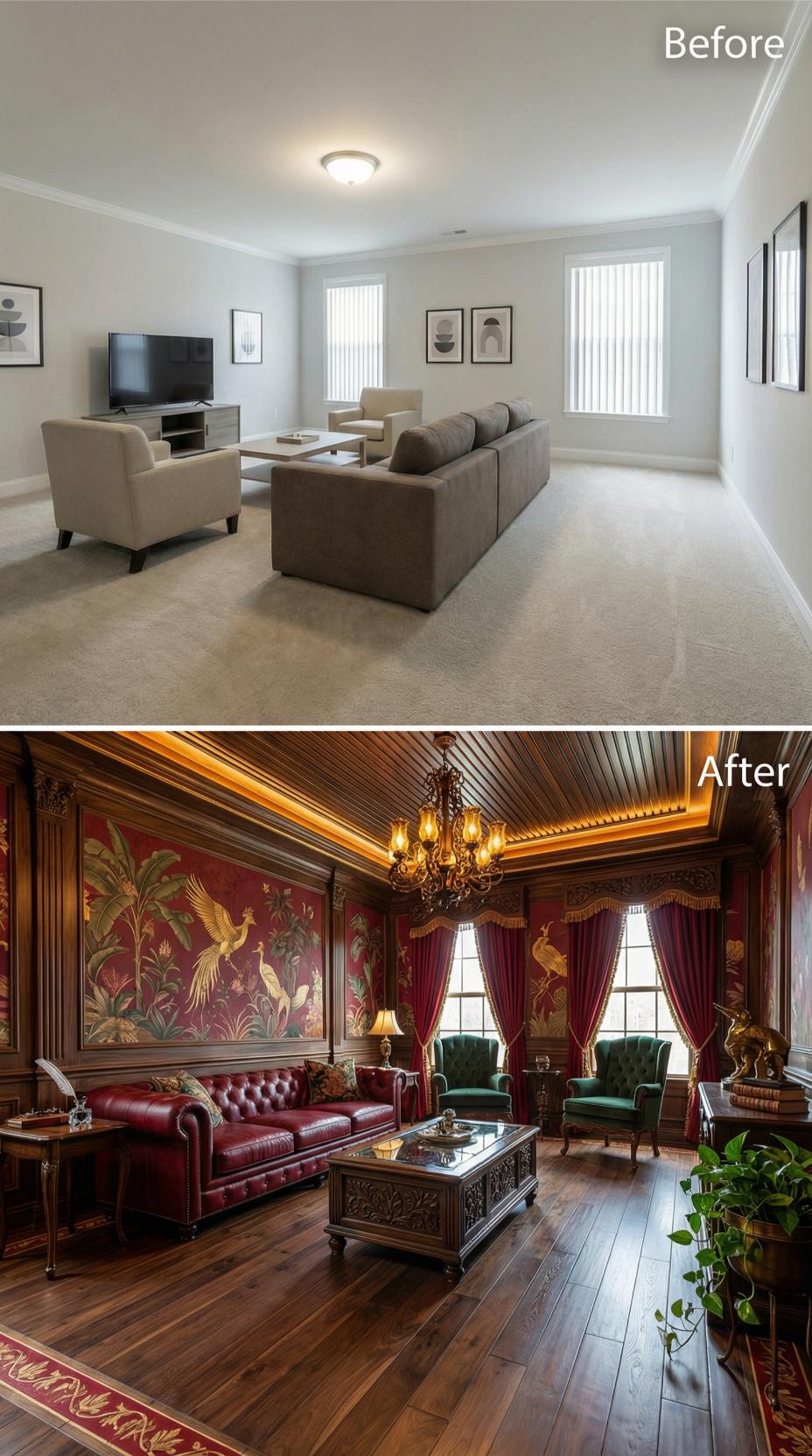
Red leather tufted Chesterfield sofa, green velvet wingback chairs, and a carved walnut coffee table replaced every trace of builder beige. Tropical bird wallpaper in deep crimson with gold phoenixes covers the walls inside dark wood paneling with crown molding. Warm cove lighting runs the full perimeter of a coffered wood-plank ceiling, and a wrought iron chandelier with amber glass shades anchors the room.
Worth Knowing: Chinoiserie-style wallpaper with hand-painted bird and botanical motifs originated in 17th-century Europe as an interpretation of Asian decorative arts. Installing it inside recessed wood panel frames, as done here, is a traditional technique that prevents visible seams and gives each panel the appearance of framed artwork. Dark hardwood floors paired with a red and gold Persian-style rug pull the color from the walls down to ground level, creating visual continuity from ceiling to floor.
Lapis Lazuli Walls and a Gold Coffered Ceiling Erased Every Trace of Carpet
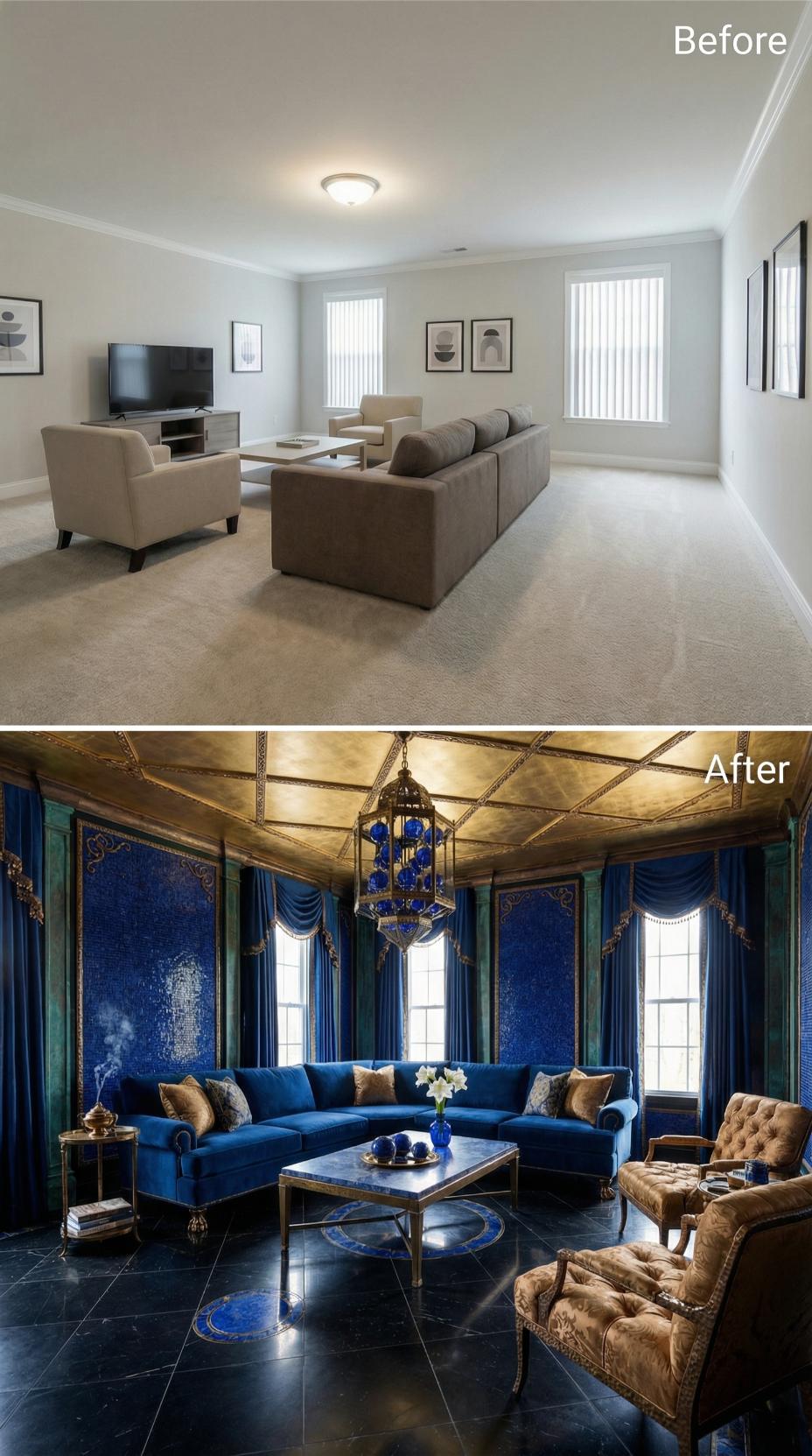
Cobalt mosaic tile covers the walls floor-to-ceiling, bordered by panels of deep hunter green with gilt detailing. A hammered brass lantern hangs from a gold leaf coffered ceiling. Royal blue velvet sectional and tufted caramel armchairs anchor a marble-top coffee table on black stone tile flooring.
Color Story: The cobalt blue running through this room draws directly from lapis lazuli, a pigment so historically rare it was once reserved for painting the robes of the Virgin Mary. Paired with gold leaf on the ceiling, that same color combination appears in Byzantine mosaics dating back over a thousand years. Royal blue velvet furniture reinforces the palette rather than competing with it.
Burl Wood Panels and a Crystal Chandelier Buried the Builder-Grade Era
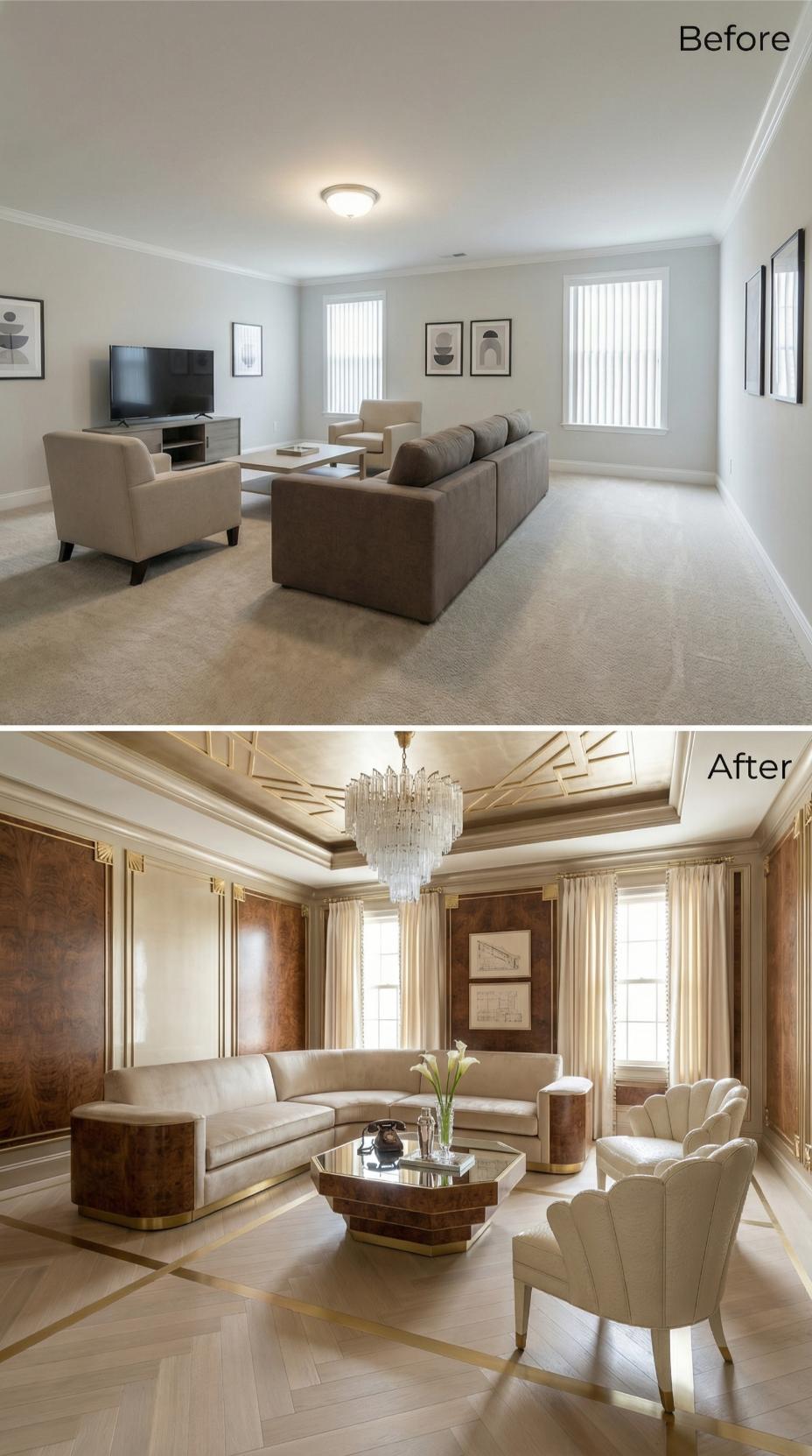
Carpet gave way to herringbone stone tile laid in a warm ivory, with inlaid brass strips framing the floor in a grid that echoes the gold detailing running throughout the room. The tray ceiling received a geometric treatment of radiating plaster moldings finished in cream and gold, and a tiered crystal chandelier in the Murano style drops from the center. Burl walnut panels line the walls, broken by cream pilasters with brass cap details.
The seating consists of a low, curved cream sofa with burl-and-brass end caps that match the octagonal coffee table. A scallop-back accent chair in ivory fabric sits opposite. Cream drapes hang floor to ceiling at each window, softening the rich warmth of the wood.
Material Matters: Burl wood, prized for its swirling grain patterns, comes from the rounded growths that form on tree trunks when the wood grain has been distorted. Matching burl across wall panels, sofa end caps, and a coffee table in one room is a furniture-making feat that requires sourcing from the same log or closely matched cuts. The brass inlay in the flooring mirrors the same metal used in the pilaster hardware, a coordination that locks every surface into a single material story.
Emerald Walls and a Tufted Chesterfield Overthrew the Beige Carpet Regime
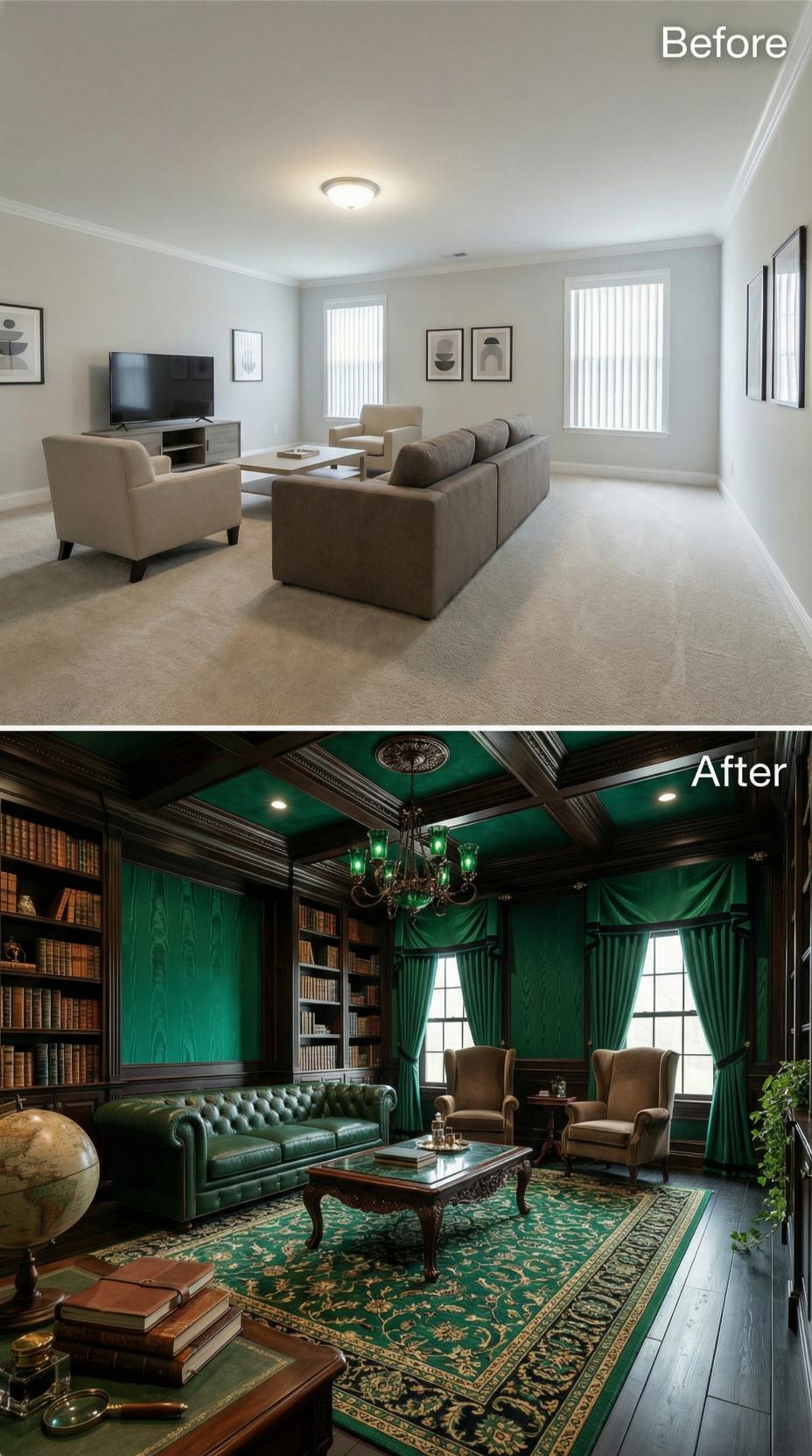
Dark-stained hardwood replaced wall-to-wall carpet, and emerald silk drapes pool at the base of windows that once wore vertical blinds. A green leather Chesterfield sofa anchors the room under a coffered ceiling painted the same deep forest tone.
Style Math: Chesterfield sofas date to 18th-century England, with the design credited to Philip Stanhope, the 4th Earl of Chesterfield, who reportedly commissioned a piece that allowed a gentleman to sit upright without wrinkling his suit. Painting a ceiling the same saturated color as the walls is a technique borrowed from Victorian-era smoking rooms, where the effect created a sense of enclosure. The emerald-and-gold Persian-style rug ties both registers of the room together without requiring any additional pattern on the walls.
Rococo Plasterwork and Blush Silk Curtains Declared the Builder Box Dead
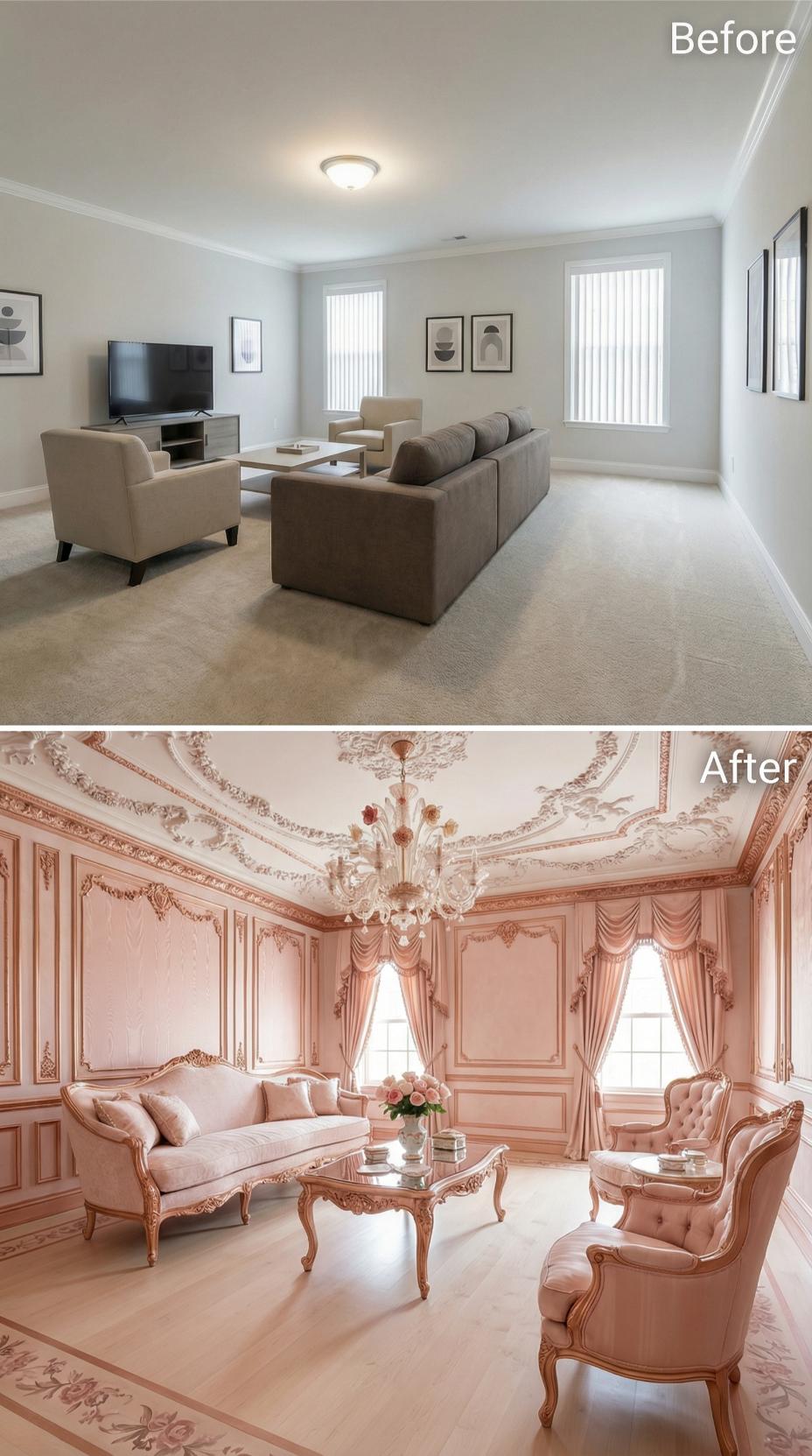
Every surface in this room is doing the most, and somehow it works.
Gold-trimmed wall paneling runs floor to ceiling in dusty rose, topped by plaster ceiling moldings dense with scrollwork, florals, and cartouches that required a skilled artisan to install. The chandelier is Murano-style blown glass in cream and pink, not a fixture you find at a lighting chain. Louis XV-carved sofa and armchair frames in gilt wood carry blush damask upholstery, while a mirrored coffee table with matching carved legs sits at center.
Silk swag curtains in peach-rose frame both windows with formal symmetry. The floor transitions from the original carpet to pale stone or wide plank hardwood with a painted floral border. Rococo interior plasterwork like this ceiling was pioneered in 18th-century France and Germany, favoring asymmetrical curves over the rigid geometry of Baroque. The before version had none of that history behind it.
Silver Plasterwork and Cobalt Velvet Buried the Builder-Grade Box Entirely
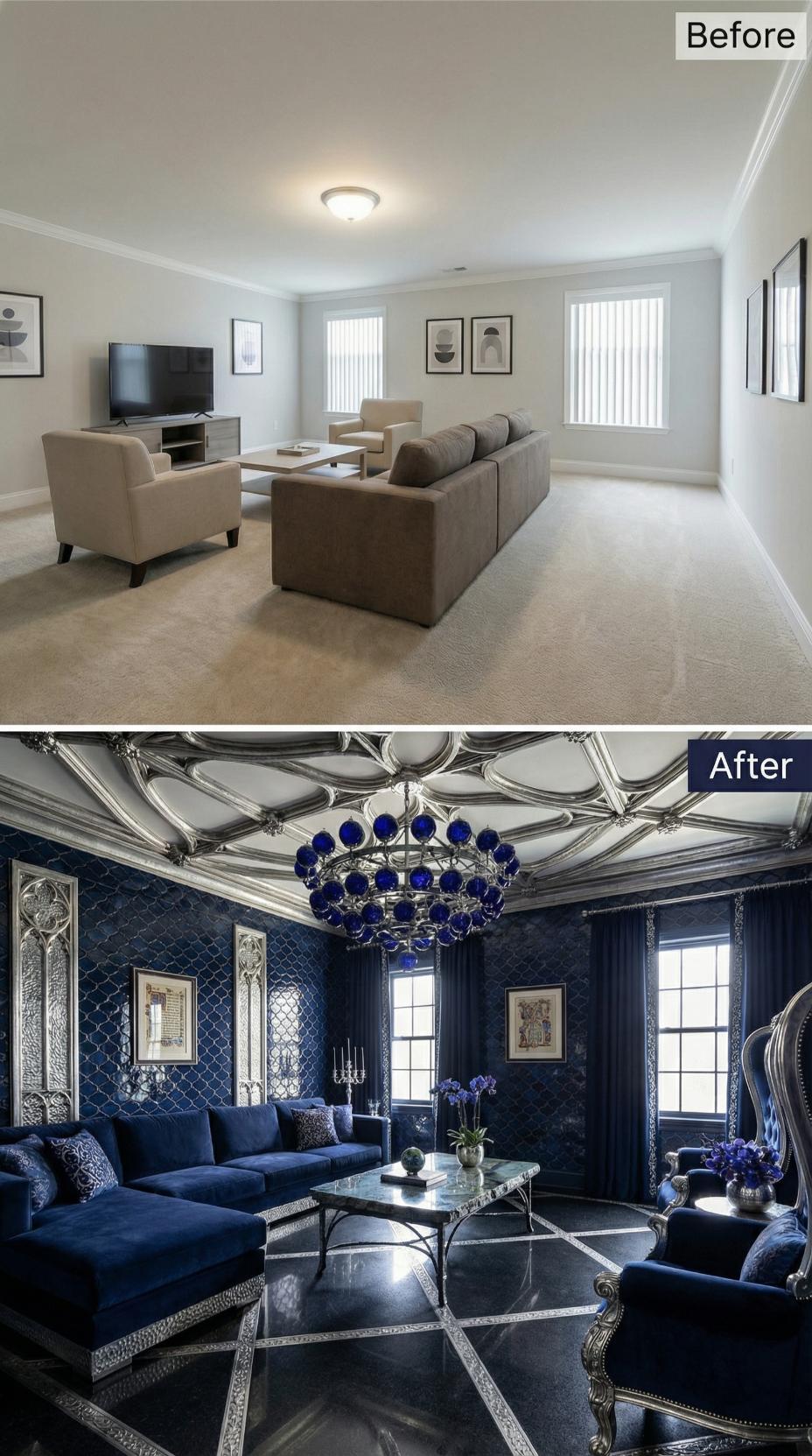
Navy Moroccan-patterned wallpaper covers every wall, paired with an ornamental ceiling featuring silver-leafed plaster moldings in an interlocking oval and gothic arch pattern. A cobalt glass chandelier anchors the ceiling at center. Blue velvet sectional sofas sit on dark marble tile floors inlaid with silver geometric banding. Baroque-style armchairs in matching velvet flank the room.
Did You Know: Silver leaf, the material coating those ceiling moldings, is produced by hammering pure silver into sheets thinner than 0.0001 millimeters. It has been used in architectural interiors since ancient Egypt, appearing in palace ceilings and religious structures long before it became a signature of European Baroque design.
Stained Glass Coffers and Cognac Leather Declared the Beige Era Officially Over
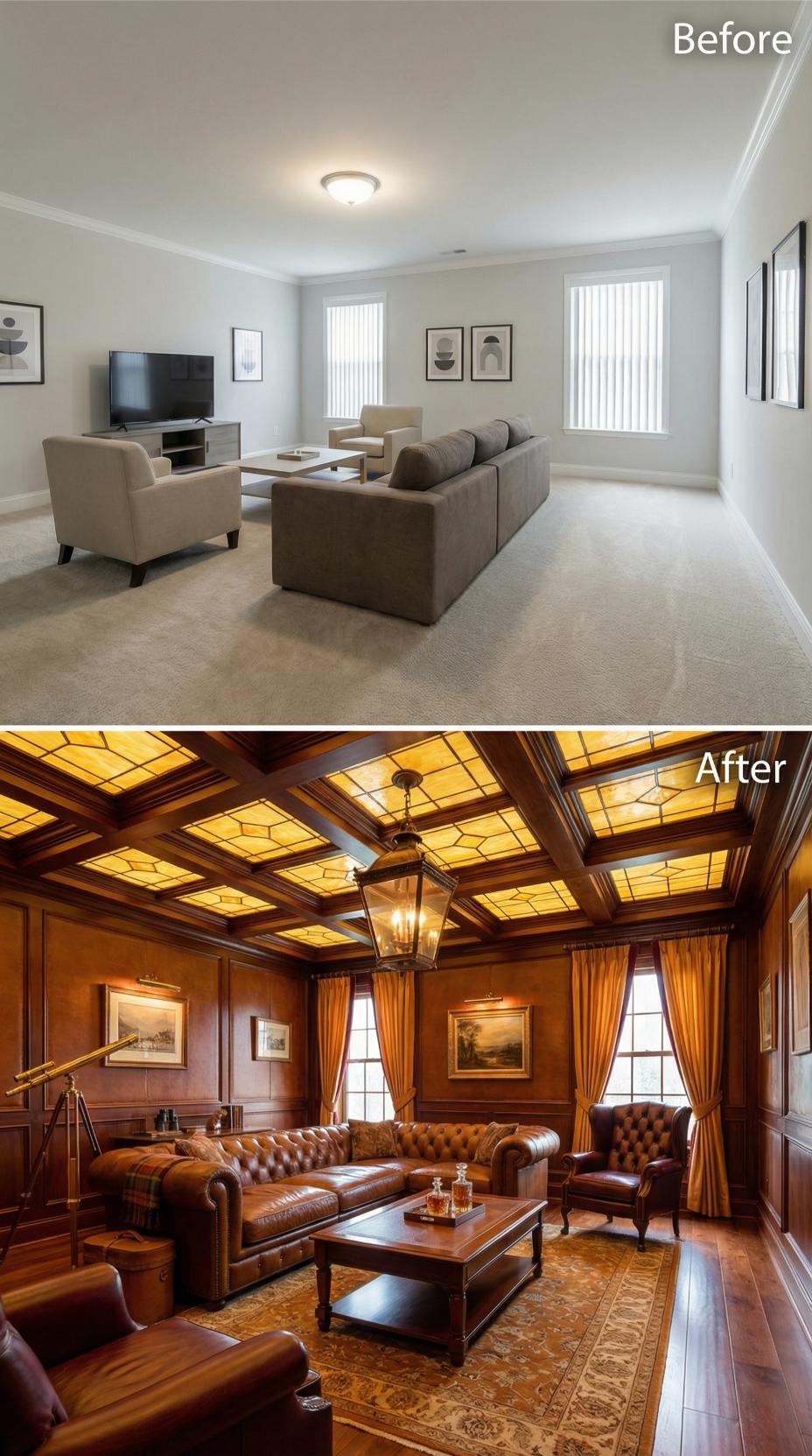
Builder carpet and flush-mount lighting gave way to one of the more architecturally committed rooms in this series. The coffered ceiling is the centerpiece: dark walnut beams divide backlit panels of amber stained glass, casting the entire room in a warm, honeyed glow that no recessed can light could replicate. A wrought iron lantern pendant anchors the center coffer.
Below, tufted leather Chesterfield seating in cognac brown fills the floor plan with intention. Wood panel wainscoting runs floor to ceiling, framing oil paintings and wall sconces. Hardwood planks replace every inch of carpet. An Oriental rug in ivory and rust pulls the seating area together without competing with the ceiling overhead.
Try This: Backlit stained glass ceiling panels are typically constructed from leaded art glass set into recessed frames, with LED strip lighting hidden behind the beams. The amber tones visible here come from iron oxide compounds fired into the glass during production, not from gels or filters, which means the color holds for decades without fading.
Marble and gold take the concept even further, leaving no surface untouched by luxury.
Backlit Onyx Walls and Brass Ceiling Trim Abolished the Beige Carpet Era
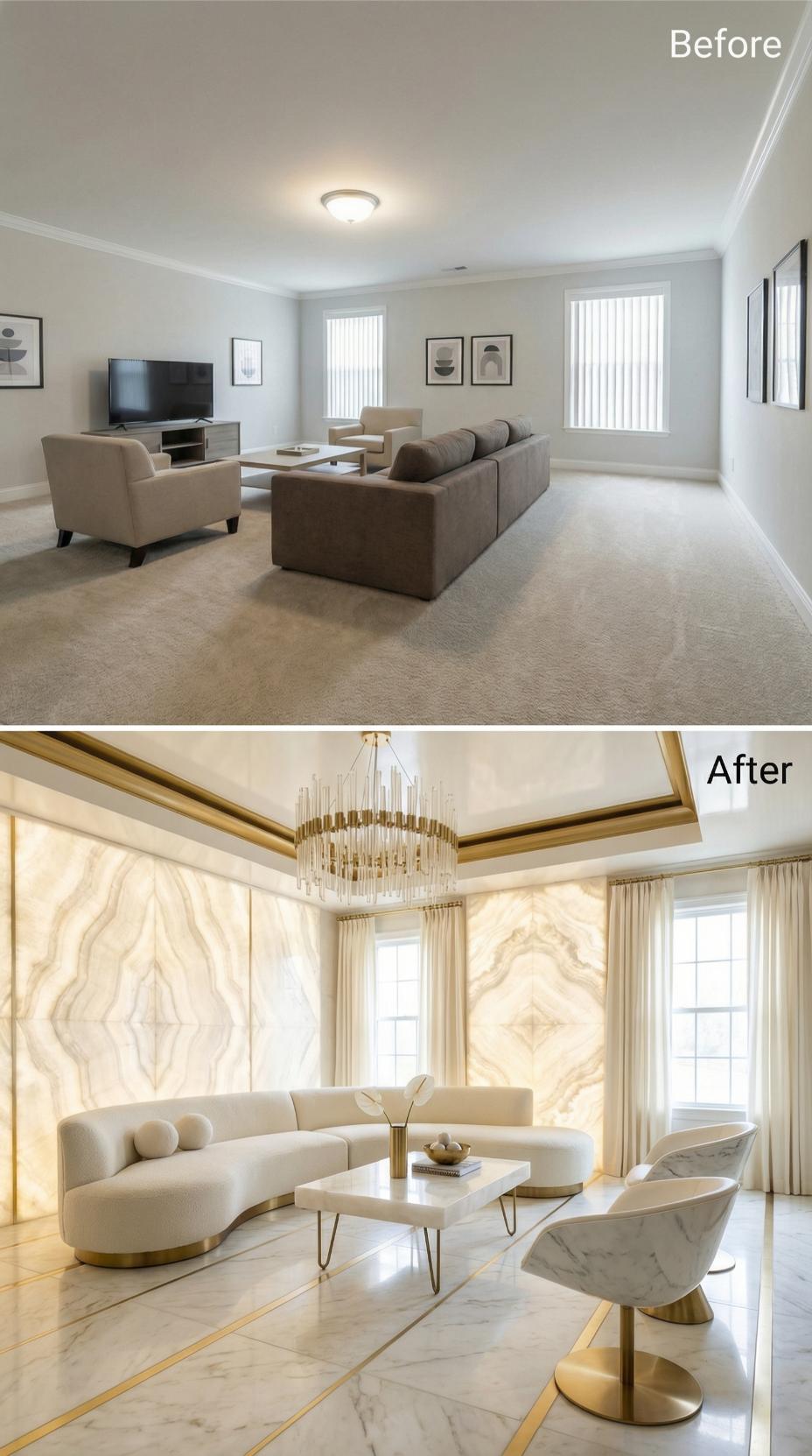
Every wall in the after photo is clad in bookmatched onyx panels, the kind where the stone’s veining mirrors itself across seams to create symmetrical patterns. Warm light glows from behind the panels, a technique that requires onyx sliced thin enough to allow backlighting to pass through. The tray ceiling is rimmed in polished brass channel molding, and a crystal rod chandelier hangs at center. Marble tile floors carry inlaid brass strips that echo the ceiling lines directly above.
The curved sofa is upholstered in bouclé, sitting on a brushed brass plinth base. A marble accent chair on a trumpet base sits opposite. Before, carpet and a flush-mount ceiling light handled everything. Now, no single surface does less than two jobs at once.
Plum Velvet and Slatted Ceilings Finished What Beige Carpet Started
🔥 Would you like to save this?
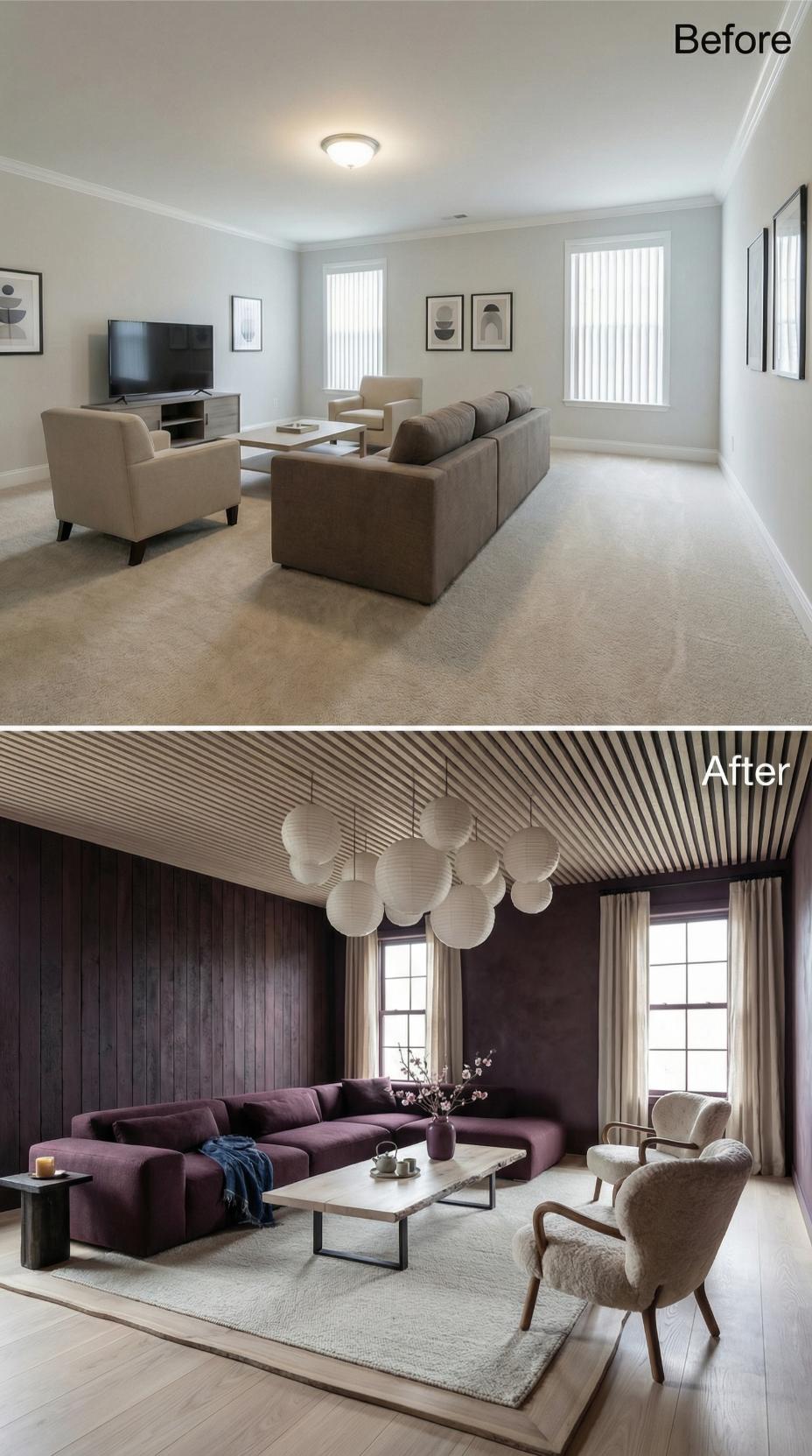
Where carpet and flat white walls once produced a room with all the personality of a waiting room, deep aubergine velvet now anchors a modular sofa with rounded arms and a low profile. The walls are clad in vertical shiplap panels painted the same wine-dark tone, and wide-plank white oak flooring runs beneath a cream wool area rug.
Overhead, alternating light and dark wood slats cover the entire ceiling, giving the room architectural weight it never had. A cluster pendant of white paper globes drops low over a slab coffee table with a black steel base. A shearling armchair with curved wood legs sits opposite the sofa, and linen curtains in warm cream frame windows that now read as intentional rather than incidental.
Alternating light and dark wood slats cover the entire ceiling, giving the room architectural weight it never had.
Roman Senate Aesthetic Replaced Carpet and Recessed Lighting Without Apology
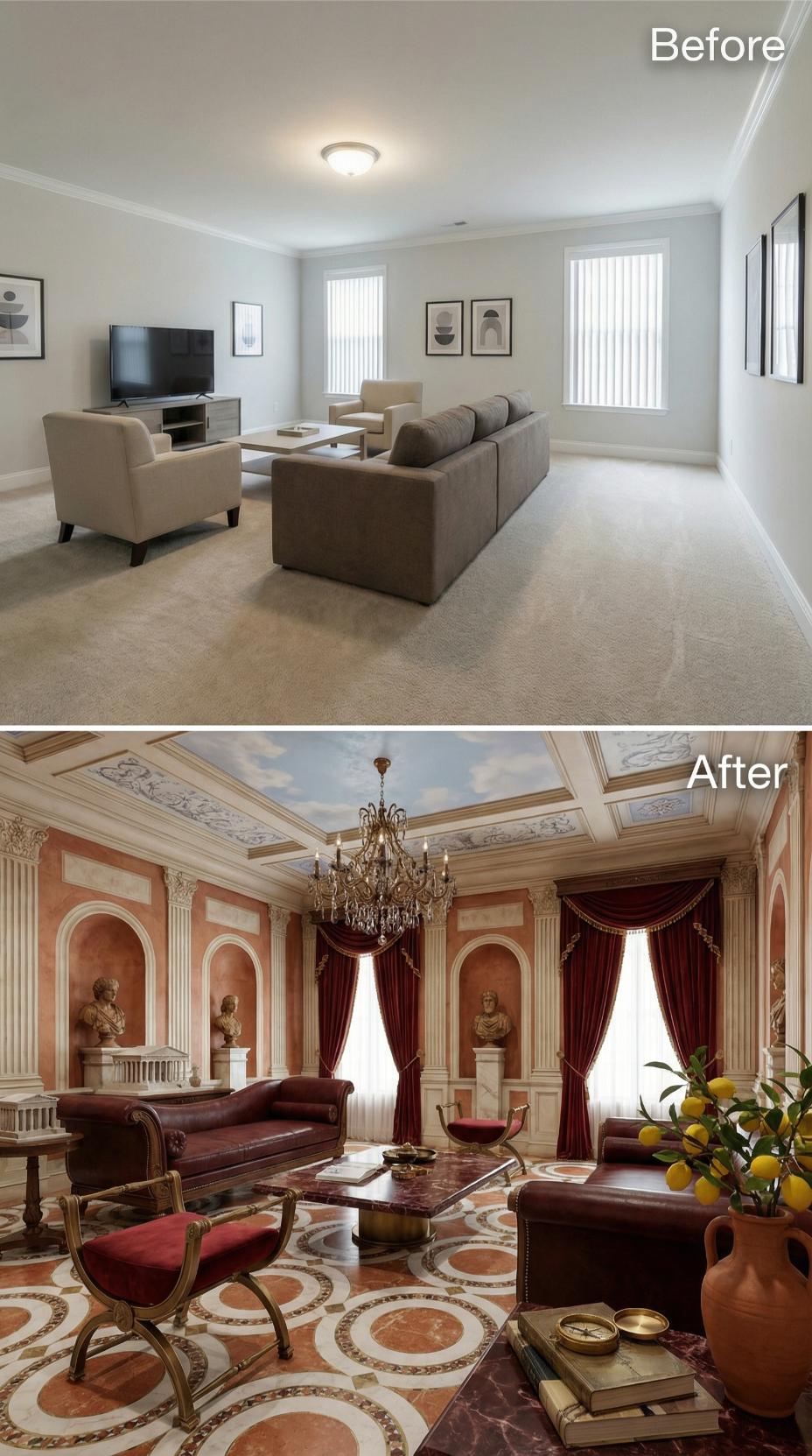
Terracotta-washed walls set into arched niches hold marble busts on pedestals, while white Corinthian pilasters divide the room into ceremonial bays. Overhead, a trompe l’oeil sky ceiling painted with clouds sits inside coffered plasterwork trimmed with acanthus-leaf molding. A brass chandelier with candle-style arms anchors the center. Oxblood leather seating, a rosso marble coffee table, and a geometric opus sectile floor in cream and terracotta complete the shift from suburban rental to something closer to the Palazzo Farnese.
- Trompe l’oeil ceiling murals became popular in Italian Renaissance architecture as a way to suggest infinite height in rooms with fixed structural ceilings
- Opus sectile, the inlaid stone flooring technique visible here, dates to ancient Rome and was used extensively in basilicas and imperial residences
- Oxblood leather gets its deep burgundy tone from layered aniline dyes applied over vegetable-tanned hides, a process that also increases the leather’s patina over time
Copper Ceiling Tiles and Raw Concrete Walls Finished Off the Beige Box for Good
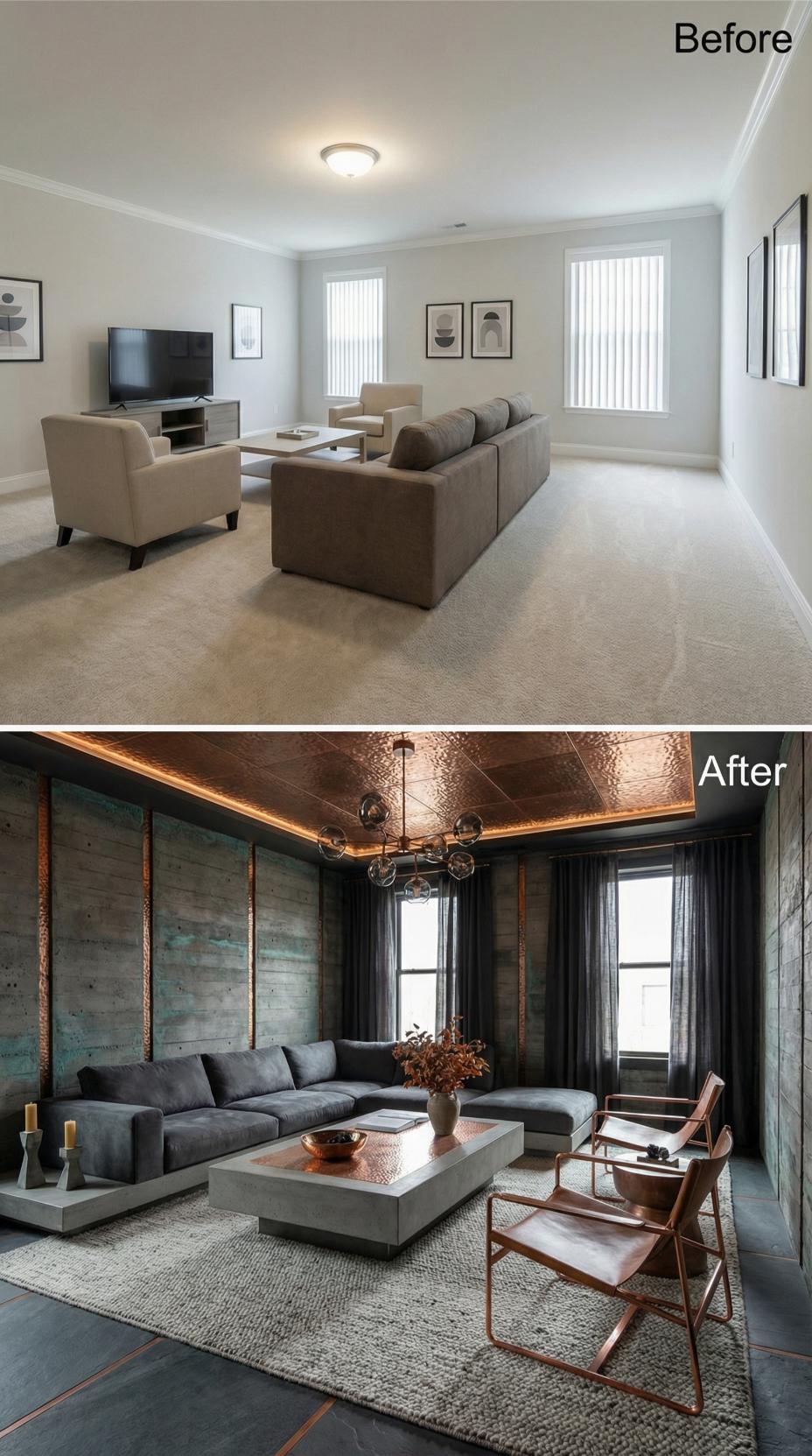
Patinated copper tiles cover the entire ceiling, lit from the perimeter by warm LED strip lighting recessed into a cove detail that runs the full perimeter. The walls are clad in board-formed concrete panels interrupted by vertical copper inlay strips, their oxidized surface reading somewhere between industrial and archival. A low-profile sectional in charcoal velvet anchors the room on a chunky hand-knotted wool rug.
The concrete coffee table carries a hammered copper bowl at center, echoing the ceiling material at eye level. Two leather sling chairs with copper-toned frames face the seating group at an angle. A globe chandelier in blackened metal drops from the ceiling’s center, its glass spheres catching light from every direction the room throws it.
In The Details: Hammered copper ceiling tiles, like those installed here, are typically stamped or hand-worked from 99% pure copper sheet, then left to oxidize naturally or treated with patination chemicals to achieve that warm, mottled finish. Copper’s natural antimicrobial properties have made it a prized surface material for centuries, long before it became a fixture in high-end residential design.
Black Stripe Wallpaper and a Coffered Ceiling Sent the Beige Box to Its Grave
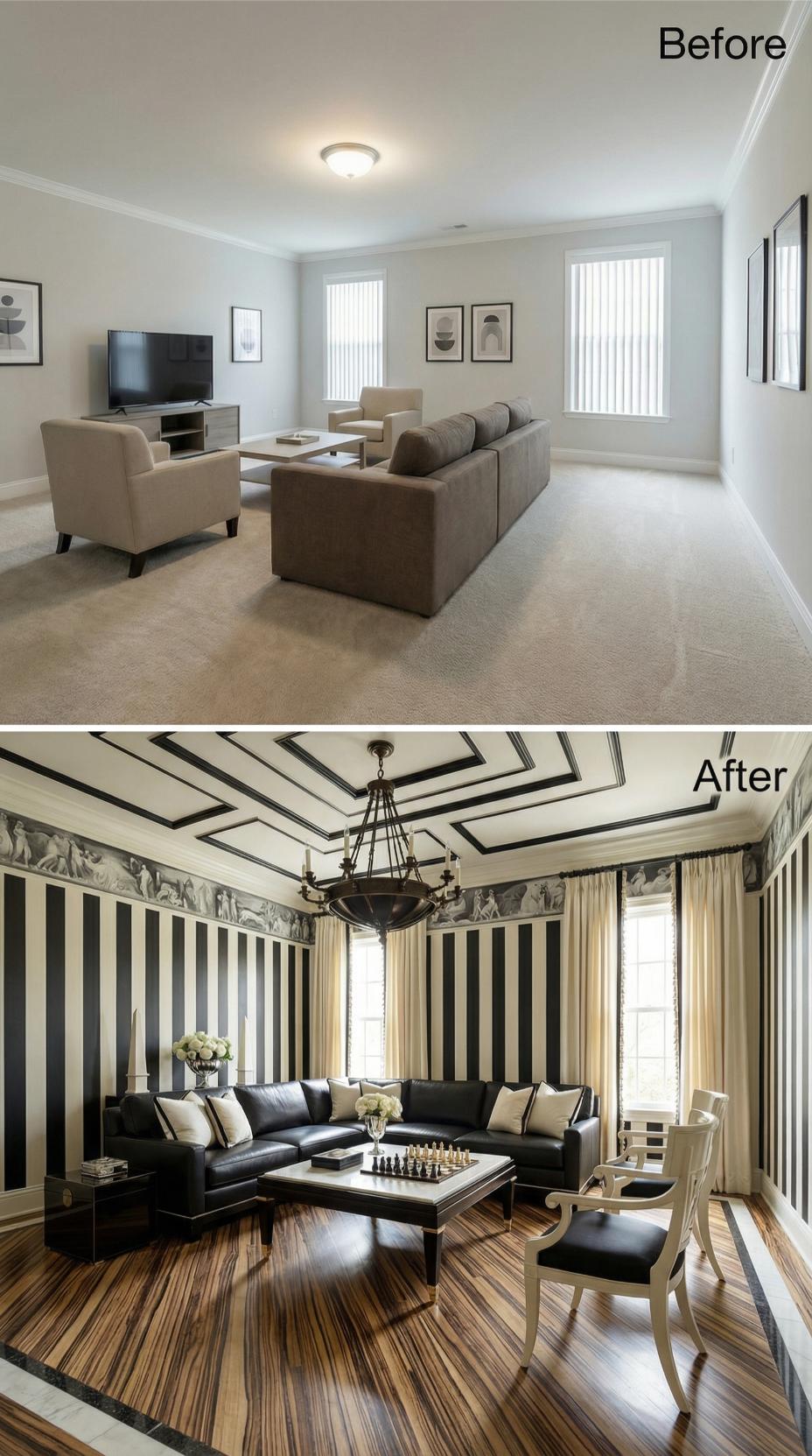
Bold vertical stripes in black and cream cover every wall, making the ceiling’s geometric molding scheme feel like an architectural response rather than an afterthought. That ceiling is doing serious work: layered rectangular frames outlined in black against cream create a stepped coffer effect without any actual depth cuts into the drywall. A wrought iron chandelier with a shallow bowl shade anchors the seating group below. The floor shifted from beige carpet to zebrawood planks, their dark and amber grain running in parallel bands that echo the wall pattern. Black leather sectional seating replaces the previous tan upholstery, and a marble-top coffee table with an ebonized base holds a chess set. A classical frieze-style wallpaper border runs the room’s perimeter just below the crown molding.
By The Numbers: Zebrawood, the species used for the flooring here, is harvested primarily from West and Central Africa and is named for its distinctive dark brown streaks against a pale golden background. It is considered a semi-rare hardwood and is more commonly found in furniture veneers and accent pieces than as full plank flooring. Using it wall to wall in a living room represents a significant material investment, with specialty zebrawood flooring often running two to four times the cost of standard hardwood options.
Painted Coffered Ceilings and Terracotta Velvet Demolished the Neutral Box
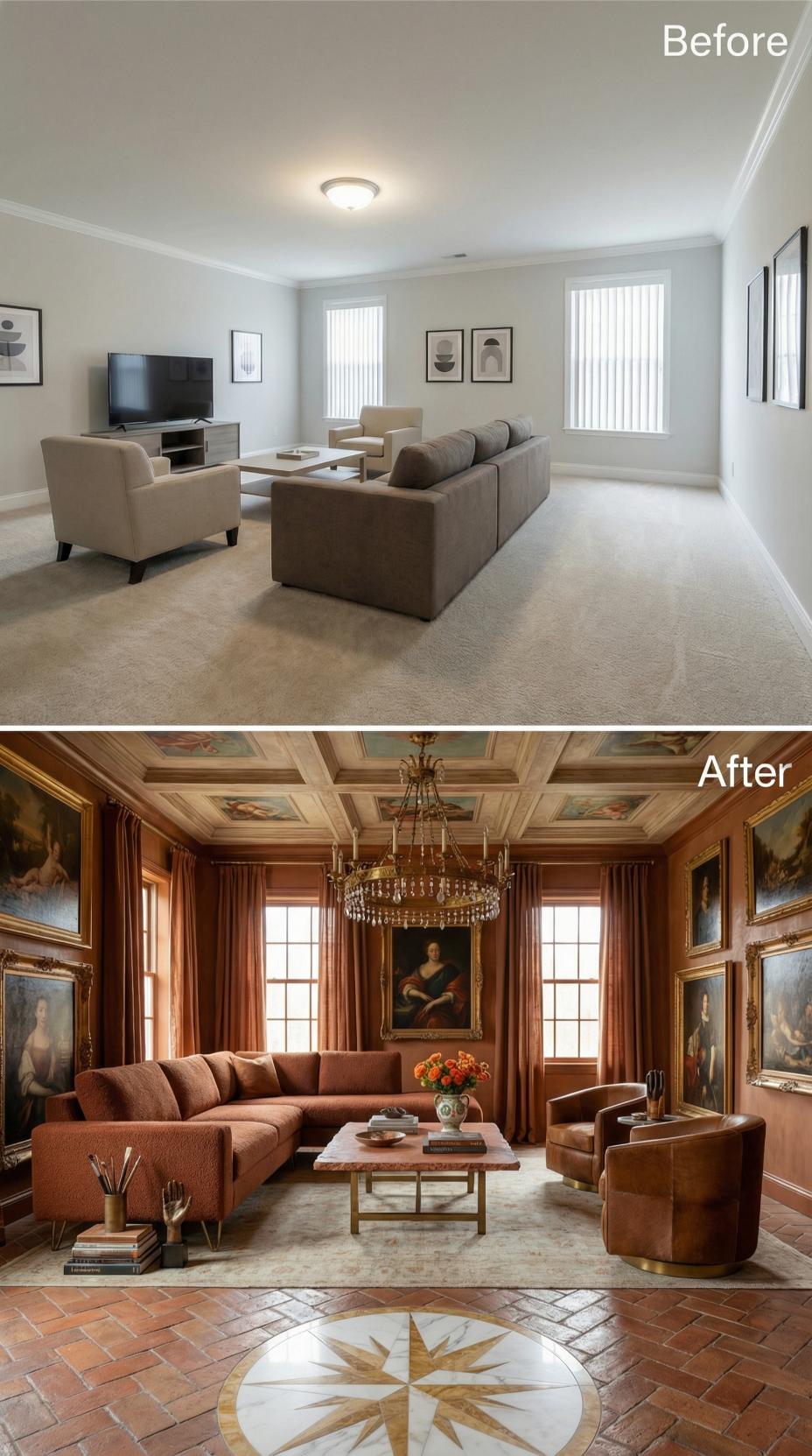
Rust-orange sectional upholstered in boucle fabric anchors the room, flanked by a pair of cognac leather swivel chairs. The coffee table sits on brass legs beneath a slab of rose-veined marble. Underfoot, terracotta brick-pattern tile meets an inlaid compass medallion in cream and gold.
The coffered ceiling carries hand-painted panels depicting classical figures, each set within gilded moldings. A brass-and-crystal chandelier drops from the center coffer. Walls are covered floor-to-ceiling in oil portraits framed in ornate gold leaf. Salmon-pink curtains pool at the window sills, and the whole room reads less like a renovation than a minor annexation of a Florentine palazzo.
History Corner: Coffered ceilings date to ancient Rome, where sunken panels were used structurally to reduce the weight of stone roofs. Renaissance architects later adopted the form purely for decoration, painting individual coffers with mythological scenes to signal the patron’s cultural ambition. The technique of filling those recessed panels with figurative paintings became a hallmark of 16th and 17th-century Italian palace interiors.
Plum Velvet Tufting and a Gothic Chandelier Finished the Beige Box for Good
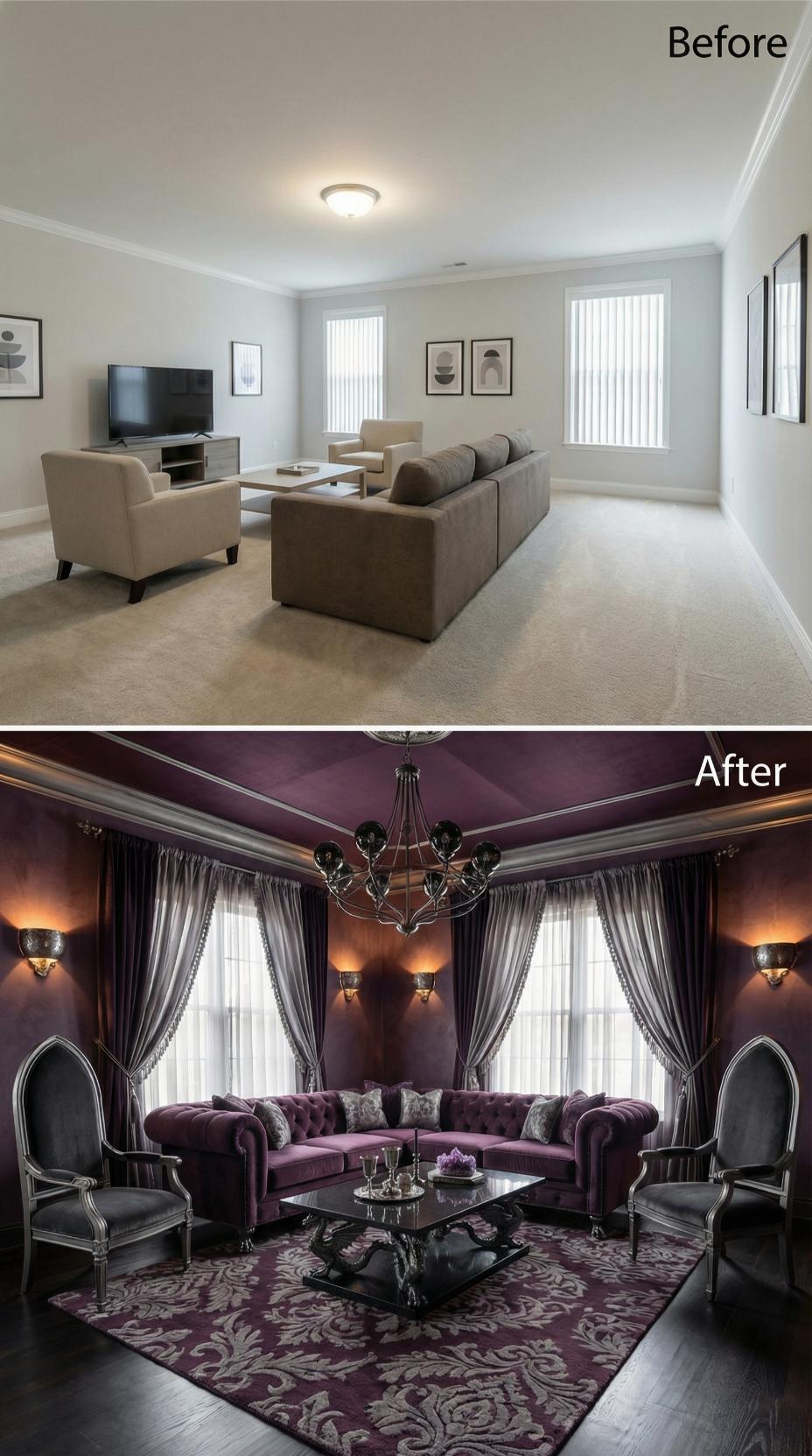
Purple velvet got a Chesterfield sectional, wall sconces, and a chandelier dripping with black ironwork, and the room never looked back.
The sectional is tufted deep plum velvet with rolled arms, flanked by a pair of Louis XVI-style chairs finished in silver-leaf wood with gray upholstery. A lacquered black coffee table with sculptural serpentine legs anchors the center. Underfoot, a damask-pattern wool rug in aubergine and silver sits over dark-stained hardwood that replaced the original carpet entirely.
Every wall reads as a saturated eggplant, including the ceiling, which unifies the room into something closer to a private theater than a living room. Gray silk drapes pool at the floor beneath wall-mounted Moroccan-style sconces with amber glass. The chandelier overhead is wrought iron with globe finials, pulling the metallic thread that runs through every surface in the room.
Cognac Leather Wall Panels and Coffered Wood Ceilings Finished the Drywall Era
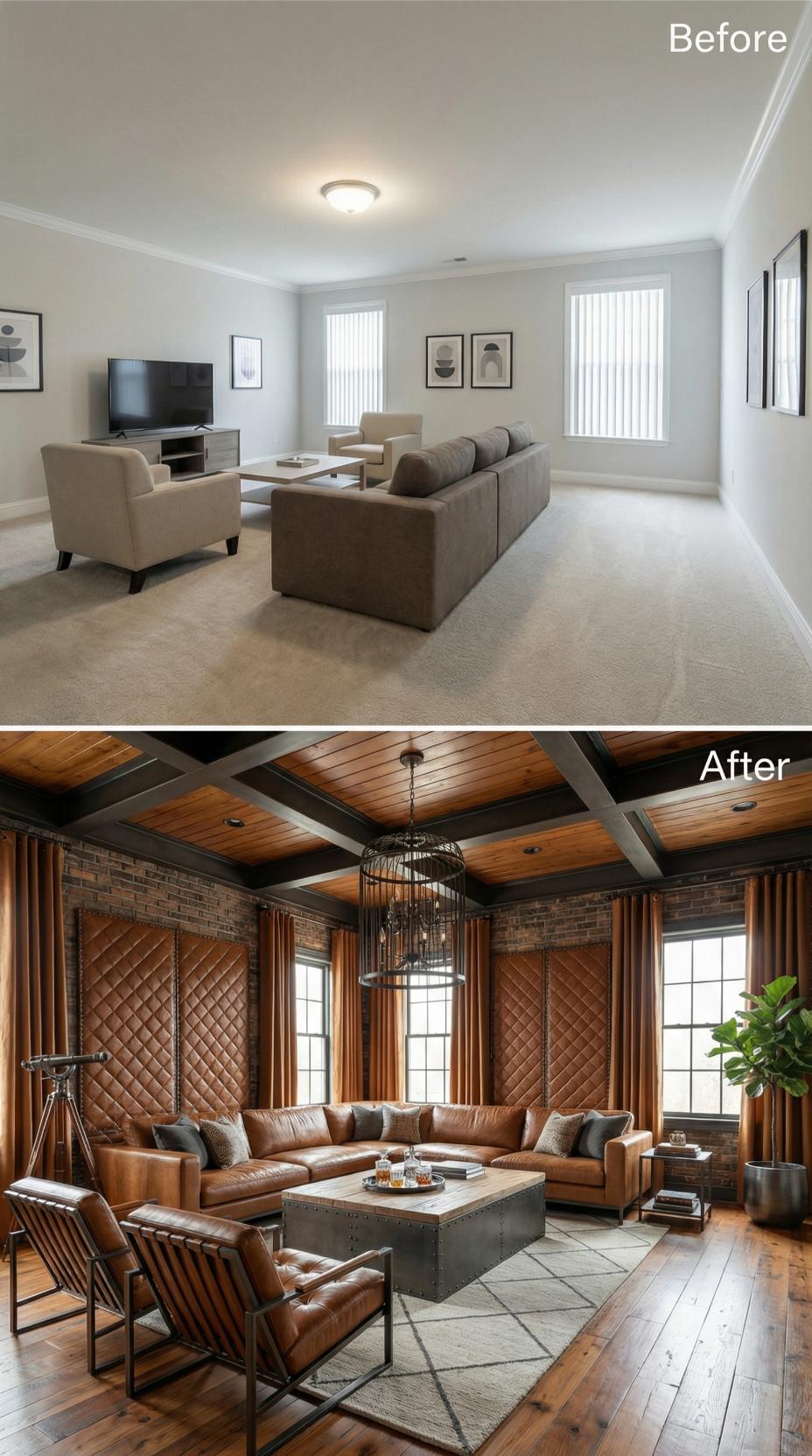
Quilted cognac leather covers the walls in diamond-tufted panels framed by dark metal trim, a treatment more common in private clubs than suburban living rooms. Reclaimed hardwood planks run underfoot, and the coffered ceiling above uses stained wood insets divided by painted black beams. A wrought-iron cage chandelier hangs at center.
Furniture stays in the same cognac family: a sectional with loose cushions, a metal-riveted wood coffee table, and a sling chair with tubular steel arms. Brick runs along the upper walls, copper-toned drapes pool beside gridded windows, and a fiddle-leaf fig anchors the corner without competing for attention.
Trend Alert: Diamond-tufted leather wall panels, historically associated with Victorian billiard rooms and gentlemen’s clubs, are typically constructed by stretching full-grain or top-grain hides over foam batting mounted to plywood backer boards. The depth of the tufting directly affects acoustics, as thicker foam layers absorb more mid-range sound frequencies, making the treatment as functional as it is decorative.
Slatted Wood Ceilings and Shoji Screens Gave Beige Carpet Nowhere Left to Hide
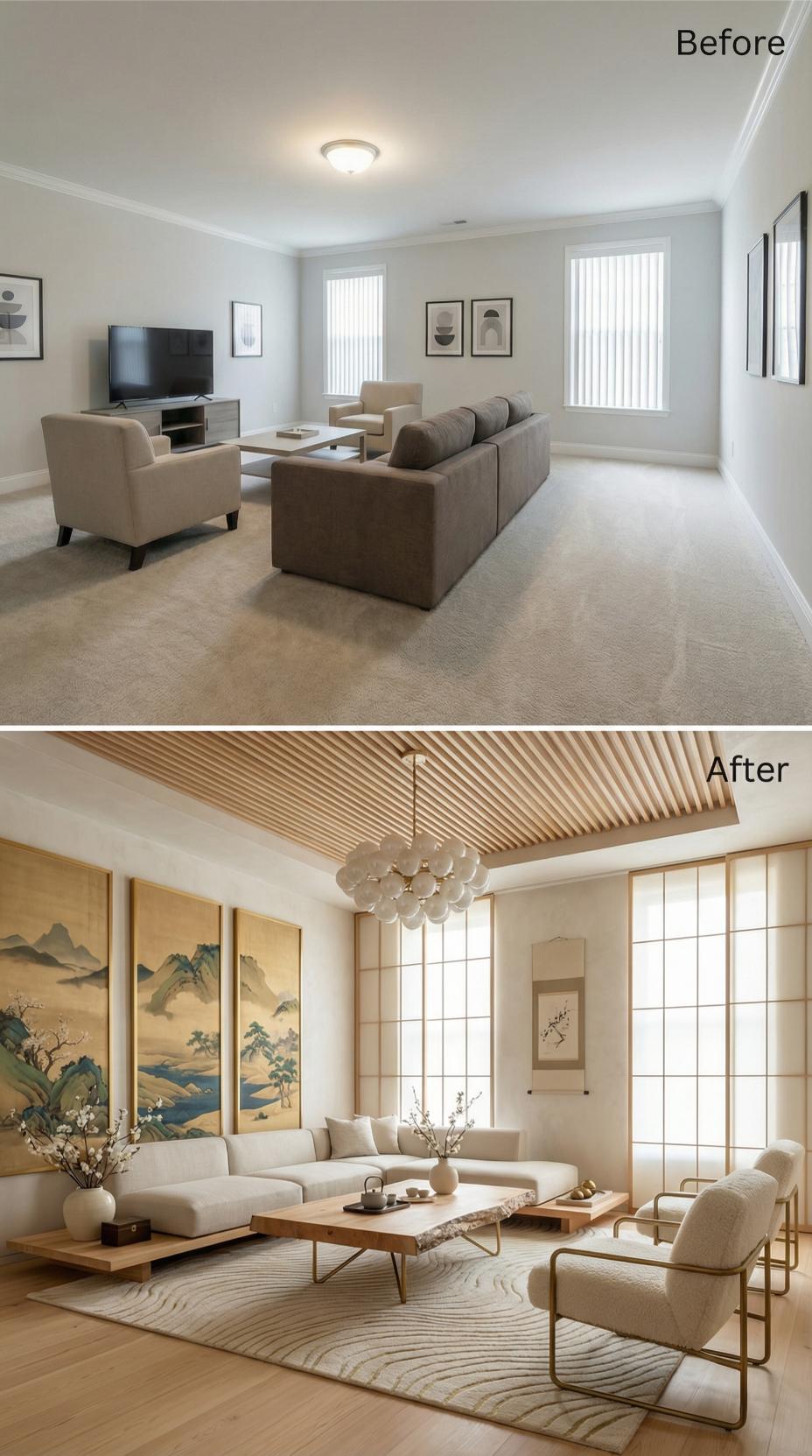
Pale boucle sectional seating sits low to the ground, a deliberate choice that reinforces the room’s horizontal geometry. A live-edge coffee table with brass legs anchors the center, flanked by matching boucle armchairs with gold-frame bases. Shoji-style floor-to-ceiling screens filter light along one wall while Japanese landscape paintings on gilded panels command the opposite side.
A wood-slat ceiling installation runs the full length of the room, replacing a flat drywall surface that offered nothing. A globe chandelier with clustered white glass spheres drops from the slat grid. Underfoot, a textural rug with wave-pattern relief sits over pale hardwood planks.
Why the Slatted Ceiling Does More Work Than It Appears To
Wood slat ceilings, typically constructed from narrow strips of pine, oak, or cedar mounted to a substructure with even spacing, create visual depth through repetition rather than ornament. The parallel lines draw the eye lengthwise across the room, which optically extends the perceived square footage without altering a single wall. In Japanese architectural tradition, exposed timber grid systems carry functional and symbolic weight, referencing structural honesty as a design value rather than decoration for its own sake.
Brick Walls and Cognac Leather Buried the Flat Ceiling Without a Second Thought
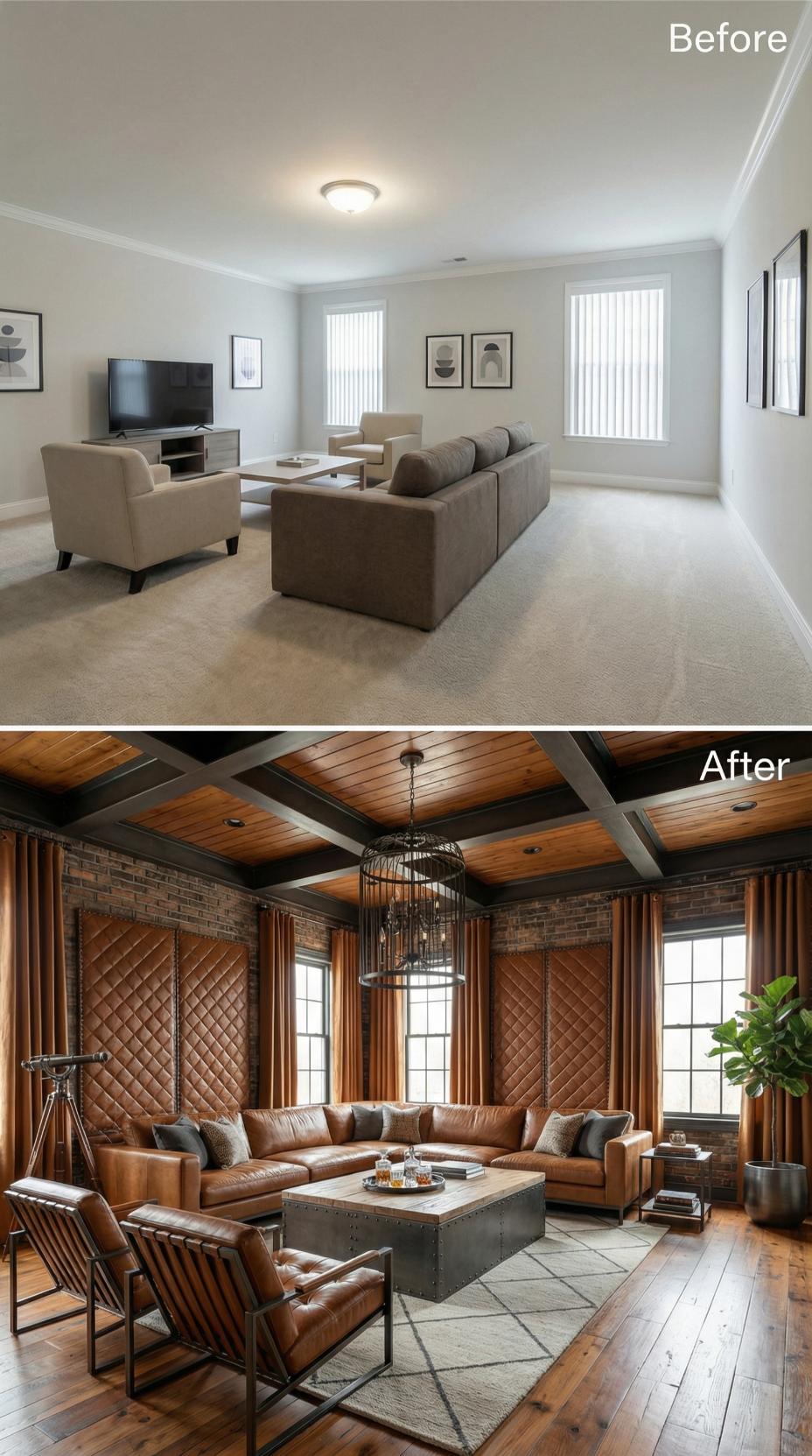
Reclaimed hardwood planks replaced the wall-to-wall carpet, and exposed brick now runs floor to ceiling on three sides, giving the room a weight the original drywall box never had. Dark steel beams divide a tongue-and-groove wood ceiling into coffered sections, and an iron cage chandelier hangs at center as the primary light source.
Cognac leather upholsters both the sectional and the diamond-quilted wall panels flanking the windows, pulling the room into a single warm register. Burnt-orange velvet curtains frame grid-pane windows, and a riveted steel coffee table anchors the seating group over a geometric wool rug.
Fun Fact: Brick used as an interior wall finish is one of the oldest building techniques still practiced today, with some surviving examples dating back over 6,000 years to ancient Mesopotamia. In modern interiors, designers often opt for thin brick veneer, which is sliced from full bricks to roughly half an inch thick, making it practical for residential walls without requiring structural reinforcement.
Stained Glass Ceiling Panels and Red Leather Buried Carpet-and-Drywall for Good
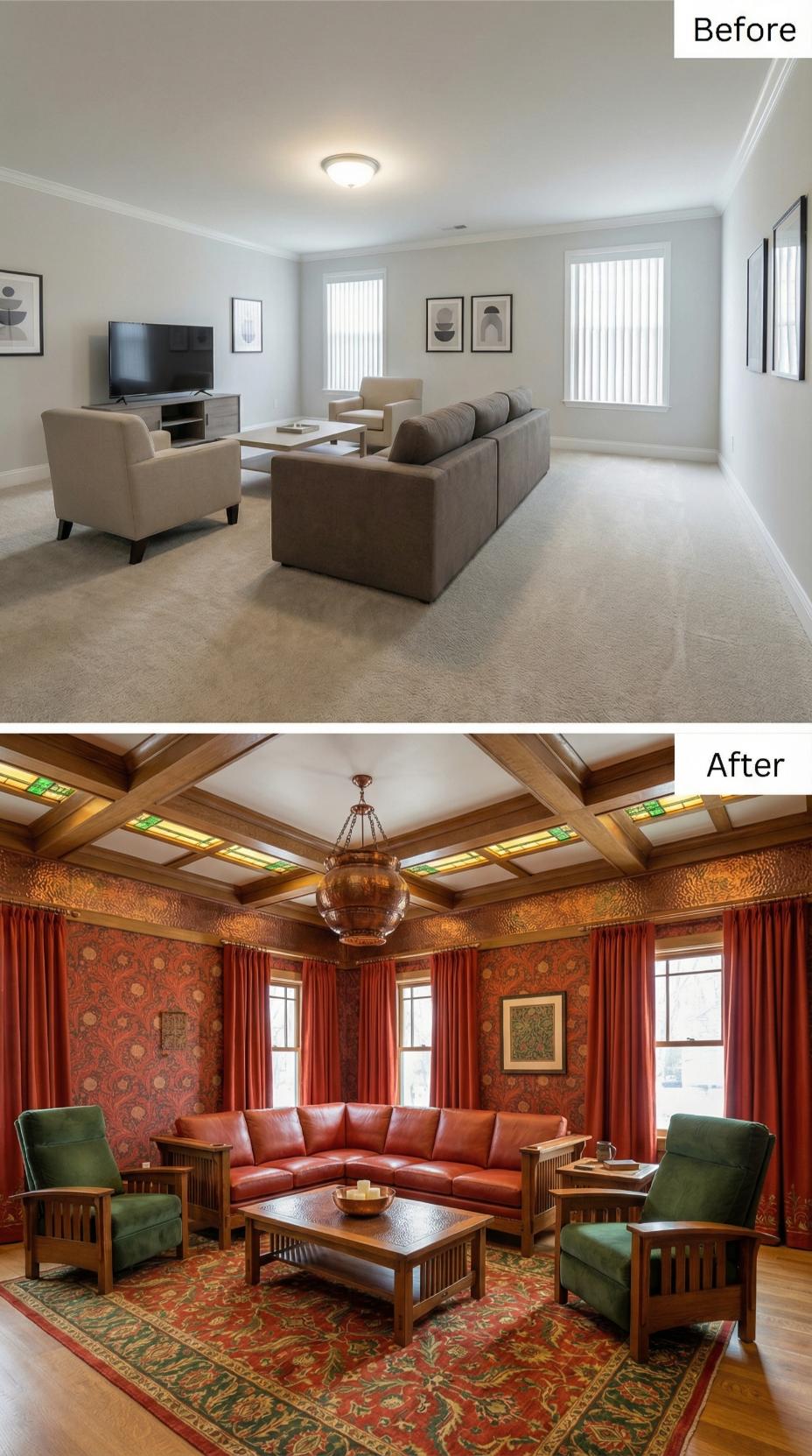
Morris-style floral wallpaper in deep crimson and gold covers every wall, anchoring a room that reads more Edwardian gentleman’s library than suburban living room. Oak coffered beams frame stained glass panels backlit from above, casting warm amber and green light across the ceiling plane. A red leather sectional sits opposite two Mission-style armchairs upholstered in forest green, all arranged over a wool rug with a medallion border. The pendant at center is hammered bronze, chain-hung, and scaled for the coffered grid above it.
Why It Works: William Morris’s original textile and wallpaper designs, produced through his Arts and Crafts firm beginning in 1861, were printed using hand-carved wooden blocks and natural dyes, a labor-intensive process that made each repeat slightly irregular. That same organic density is what gives Morris-derived patterns their depth on a large wall surface, where machine-printed alternatives tend to flatten out. Mission-style furniture, with its straight oak slats and exposed joinery, emerged from the same Arts and Crafts movement and shares Morris’s rejection of Victorian ornamentation in favor of honest construction.
Royal Blue Lacquer and Gold Plasterwork Buried Flat Drywall Without Looking Back
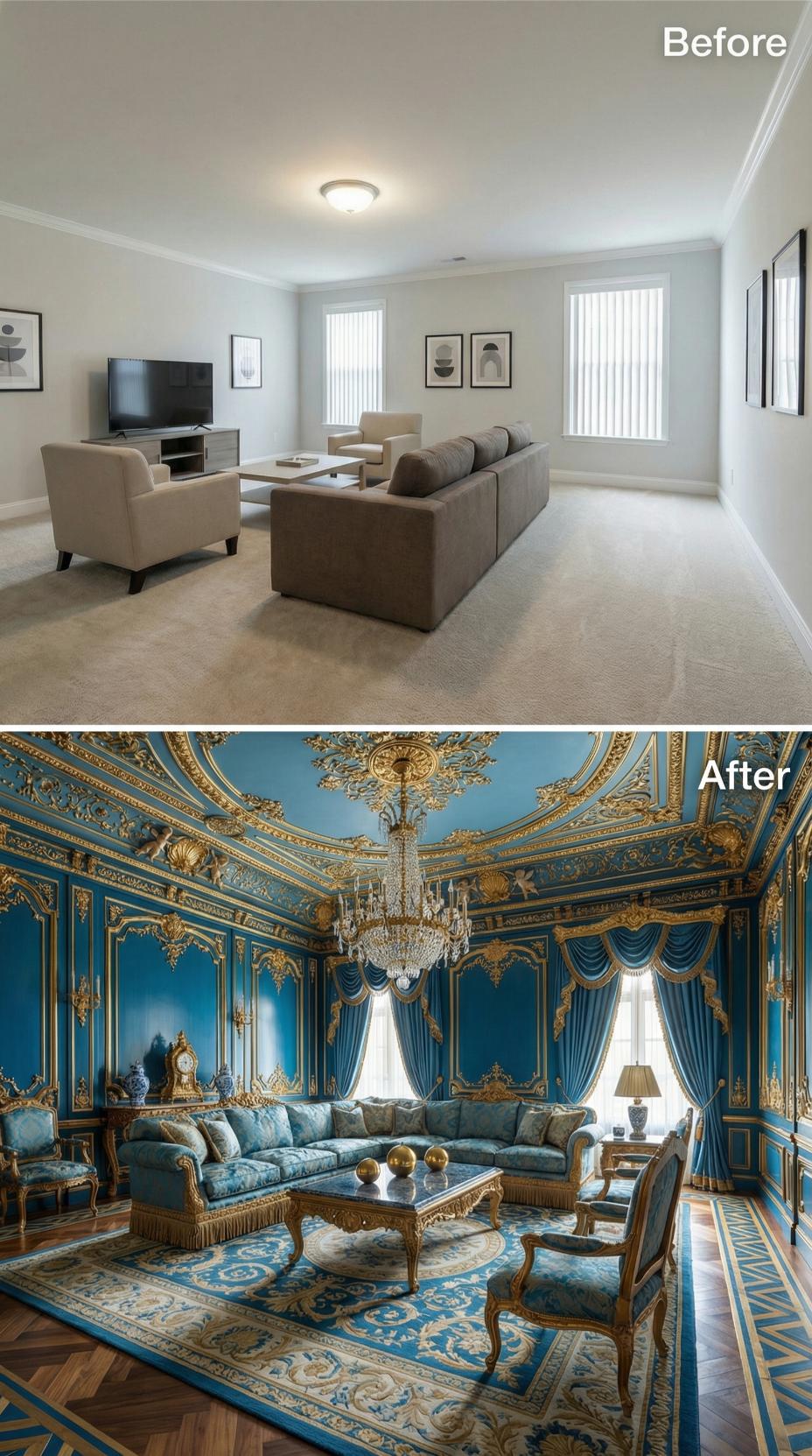
Cerulean blue lacquered wall panels, edged in gilded rococo moldings, cover every surface from wainscoting to cornice line. Sculpted plasterwork crawls across the ceiling in cartouches, shell motifs, and foliate scrolls, all finished in matte gold. A crystal chandelier with tiered drops hangs from a central ceiling medallion ringed in more gilded relief. The sofa grouping runs in matching blue damask upholstery with fringe trim along the base, arranged around a marble-top coffee table on carved gilt legs. Parquet hardwood flooring in a herringbone pattern grounds the room with a border inlay in gold and ivory tones.
Blue silk drapes pool at the floor beneath swag-and-tail valances trimmed in gold bullion fringe. Decorative vases and a gilt mantel clock anchor the side surfaces. Every element tracks back to French Baroque interiors, specifically the period between Louis XIV and Louis XV, when surface ornament was considered as structurally important as the architecture beneath it.
Common Mistake: One of the most common mistakes in rooms inspired by Baroque or Rococo interiors is mixing too many metallic tones across fixtures, hardware, and moldings. Gilded plasterwork, brass hardware, and chrome fixtures fighting for attention in the same space flatten the effect. Committing to a single metal finish across all decorative elements, as done here with consistent matte gold, is what makes the room read as intentional rather than assembled.
Exposed Beam Ceilings and Amber Glass Pendants Buried Vertical Blinds for Good
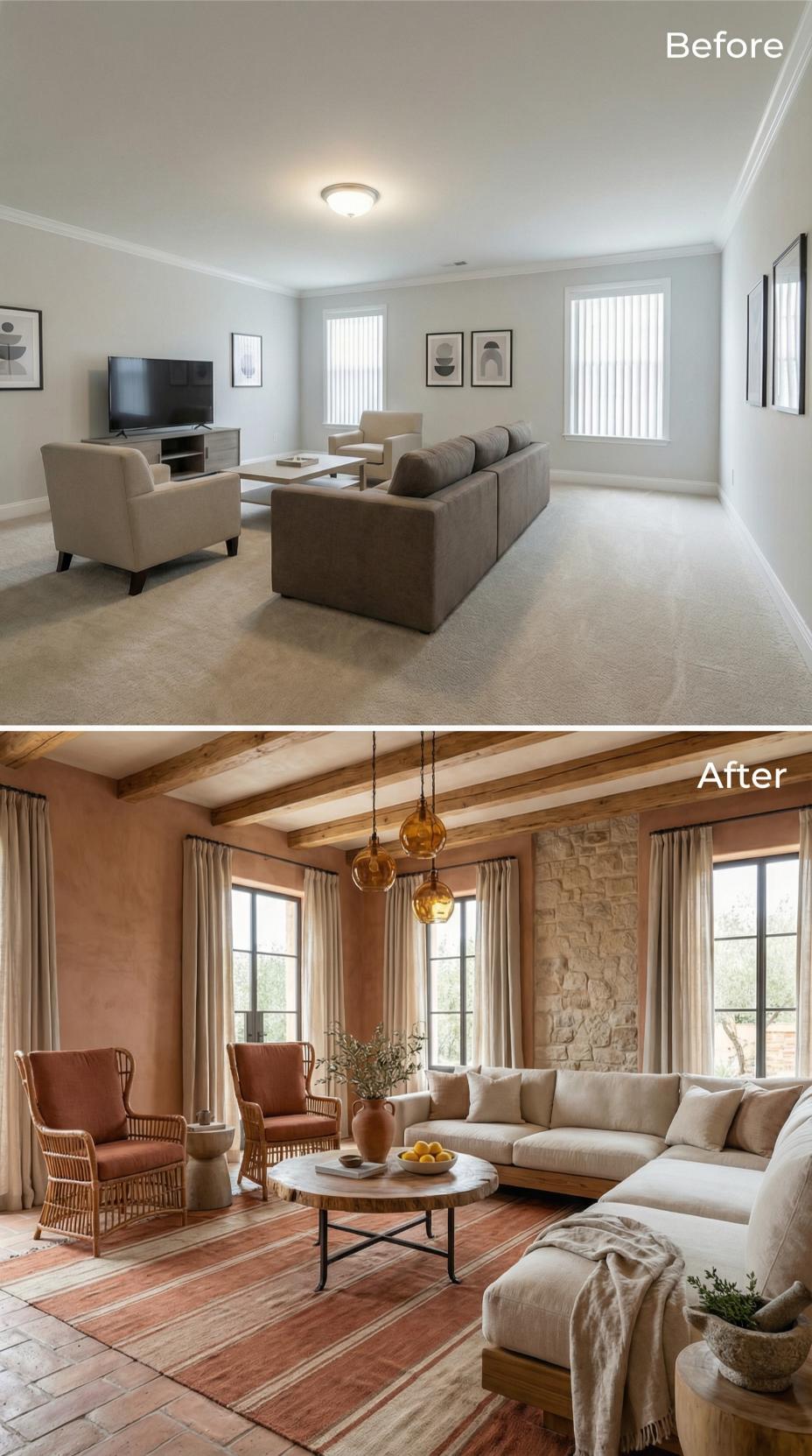
Raw wood ceiling beams span the full length of the room above three amber glass globe pendants hung at staggered heights. Walls finished in warm terracotta plaster replace the flat gray drywall entirely. A stone accent wall in stacked limestone anchors one side, while linen drapes in black steel hardware frames the windows. Rattan wingback chairs upholstered in burnt sienna fabric face a cream sectional across a marble-top coffee table with iron legs set on a striped wool rug.
The Psychology Behind This: Warm amber tones in pendant glass and plaster walls trigger associations with firelight and shelter, which psychologists link to reduced cortisol levels in occupied spaces. Rooms that layer multiple warm light sources, rather than relying on a single overhead fixture, tend to register as more socially inviting, encouraging longer periods of relaxed occupation.
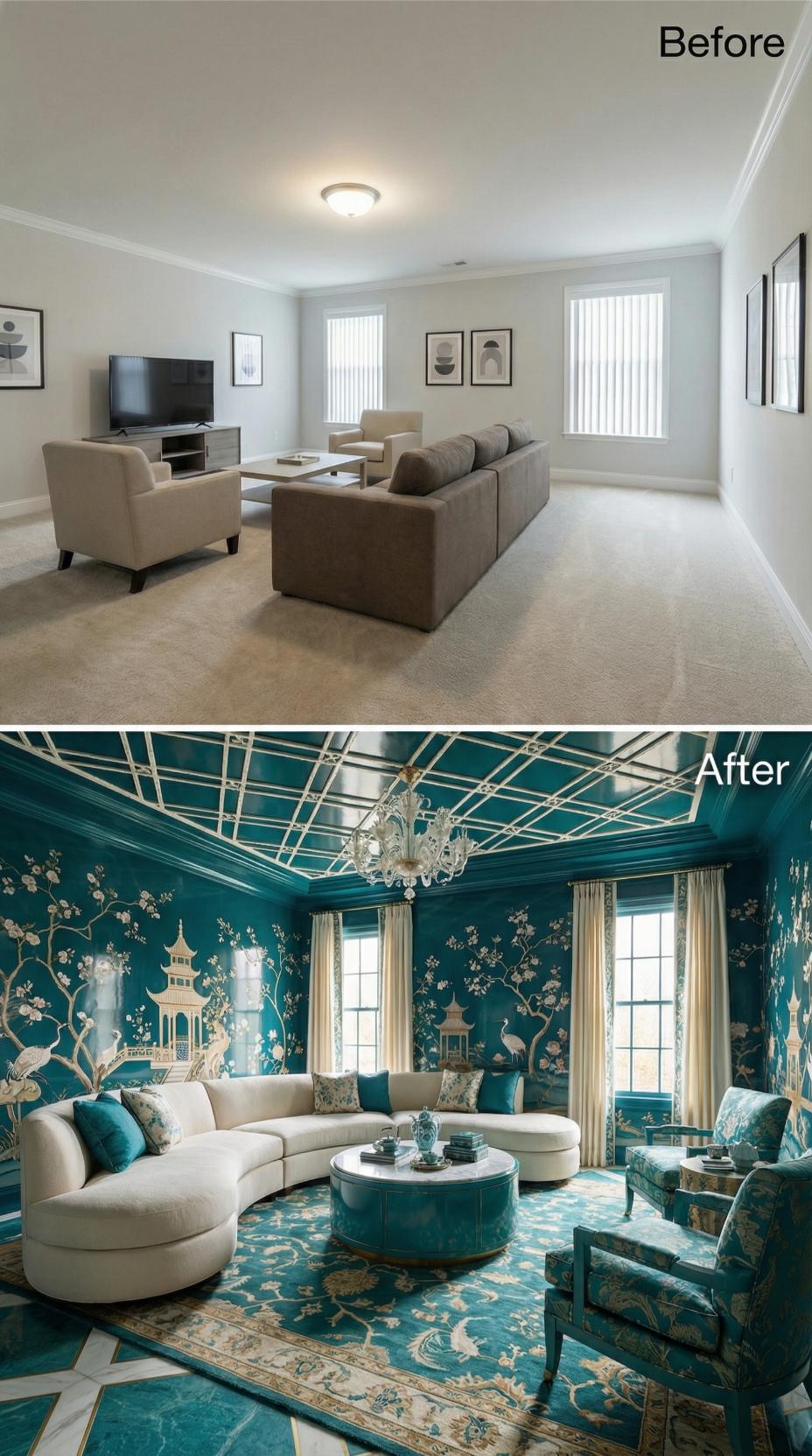
Teal Lacquer Walls and a Chinoiserie Ceiling Pattern Declared the Beige Era Over
🔥 Would you like to save this?
Glossy teal lacquer covers every wall surface and wraps across the ceiling in a trellis pattern outlined in cream, pulling the eye upward in a room that previously offered nothing above eye level worth seeing. Hand-painted chinoiserie panels depict pagodas, flowering branches, and peacocks in cream and gold against that deep teal ground. A curved cream sectional anchors the center, paired with a cylindrical teal lacquer coffee table and two upholstered armchairs in a teal-and-gold botanical print that directly references the wallcovering. A crystal chandelier drops from the ceiling’s geometric center. Underfoot, a teal floral rug with cream and gold detailing ties every surface together.
Pro Tip: Lacquer finishes on walls require a specific application process: the surface must be sanded and primed between each coat, with professional installations often involving eight to twelve layers to achieve that characteristic depth and reflectivity. The more coats applied, the more light the wall appears to absorb and release simultaneously, which is why lacquered rooms read so differently at various times of day.
Dark wood and stained glass appeared in the last section, but this room doubles down with full architectural commitment.
Coffered Stained Glass Ceilings and Burgundy Leather Ended the Drywall Chapter
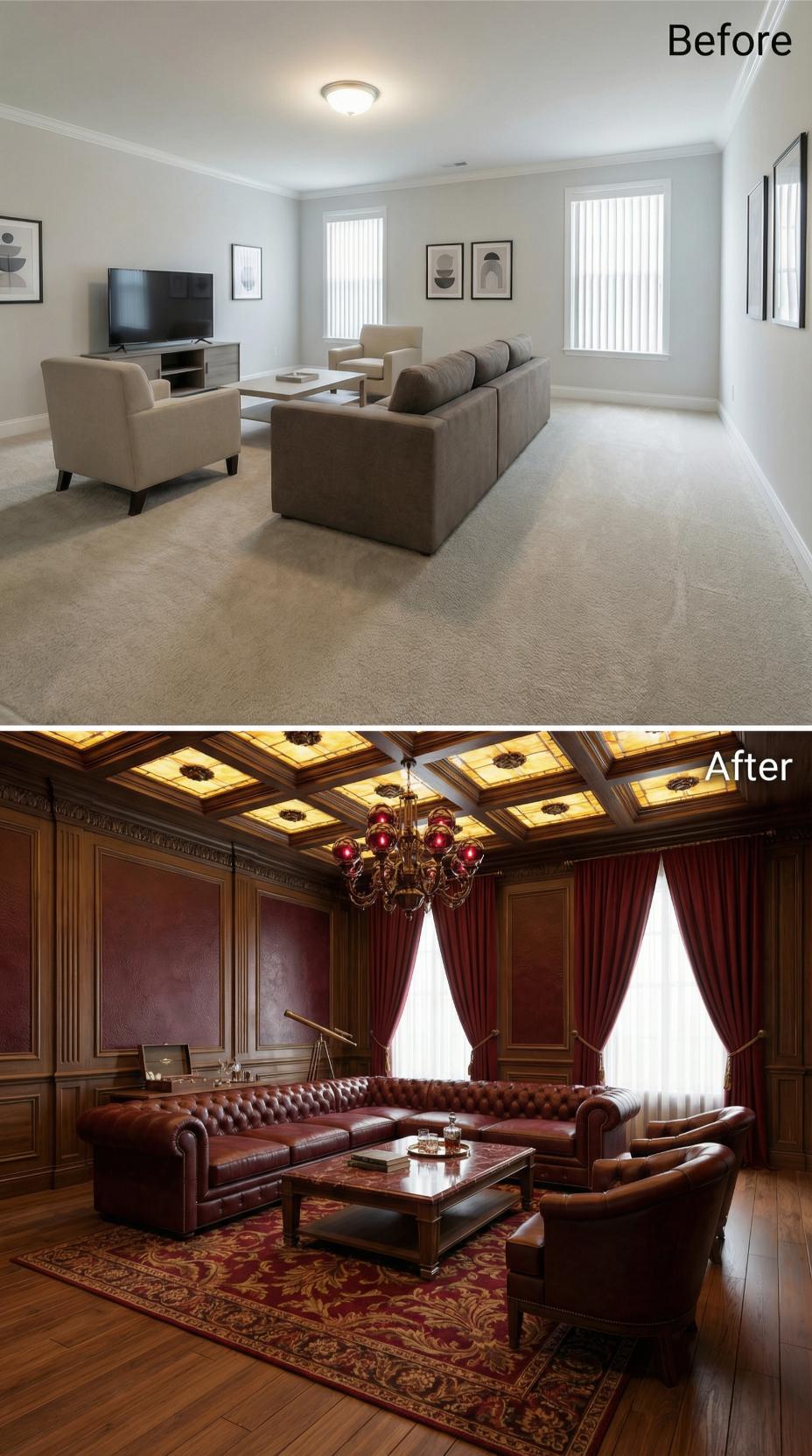
Dark walnut coffered ceiling panels frame backlit art glass inserts that cast amber and gold across the room. Oxblood leather Chesterfield sectionals anchor the floor plan over a burgundy damask rug, while a brass chandelier with ruby globe shades pulls the red tones upward. Wood wainscoting wraps every wall, inset with burgundy faux-finish panels that read almost like aged leather at a distance.
Gold Crown Molding and Blush Silk Curtains Retired the Vertical Blinds Permanently
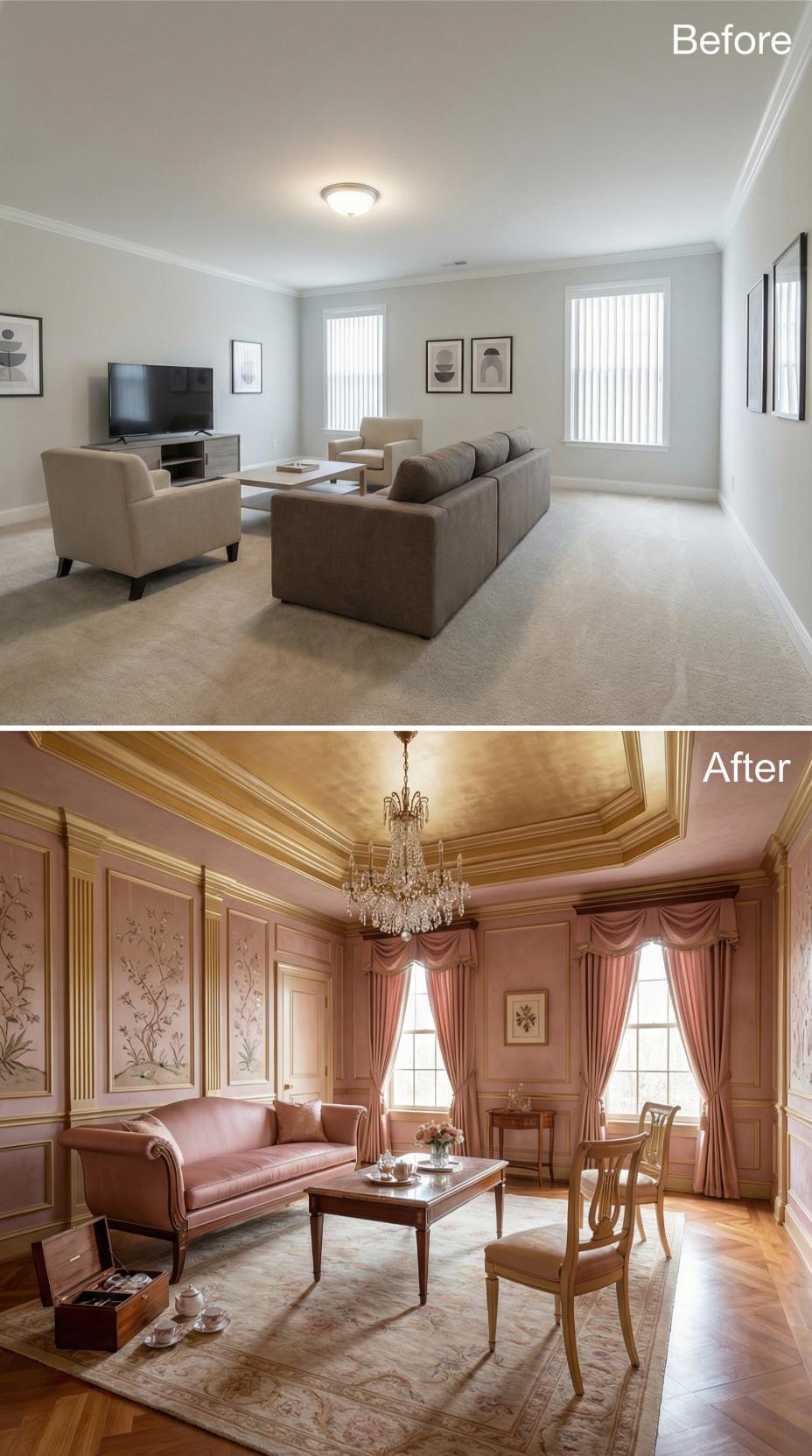
Builder-grade carpet and flat drywall gave way to herringbone parquet flooring, dusty rose plaster walls, and gilded crown molding that runs the full perimeter of the room. An octagonal tray ceiling painted in warm gold anchors a crystal chandelier with candelabra arms, casting soft light across a camelback sofa upholstered in blush pink fabric. Chinoiserie-style botanical panels flank the left wall inside gilt-trimmed frames.
Swagged silk curtains in deep rose hang from carved cornices above two tall windows, replacing the vertical blinds entirely. A mahogany coffee table sits at center on a faded floral rug, surrounded by lyre-back chairs in a natural wood finish. An open jewelry chest in the foreground adds an oddly personal note to what might otherwise read as a formal salon.
Why Tray Ceilings Work Differently in Traditional Rooms Than in Contemporary Ones
In most builder-grade homes, tray ceilings are left white, which tends to flatten the effect and make the recess feel incidental rather than intentional. Painting the tray interior in a warm gold tone, as done here, turns the ceiling into a light-reflective surface that shifts throughout the day as natural light moves through the room. Period designers used this technique deliberately, understanding that a gilded overhead plane would make candlelight multiply across every reflective surface below it.
Gold Leaf Coffered Ceilings Made Flat Drywall and Vertical Blinds Irrelevant
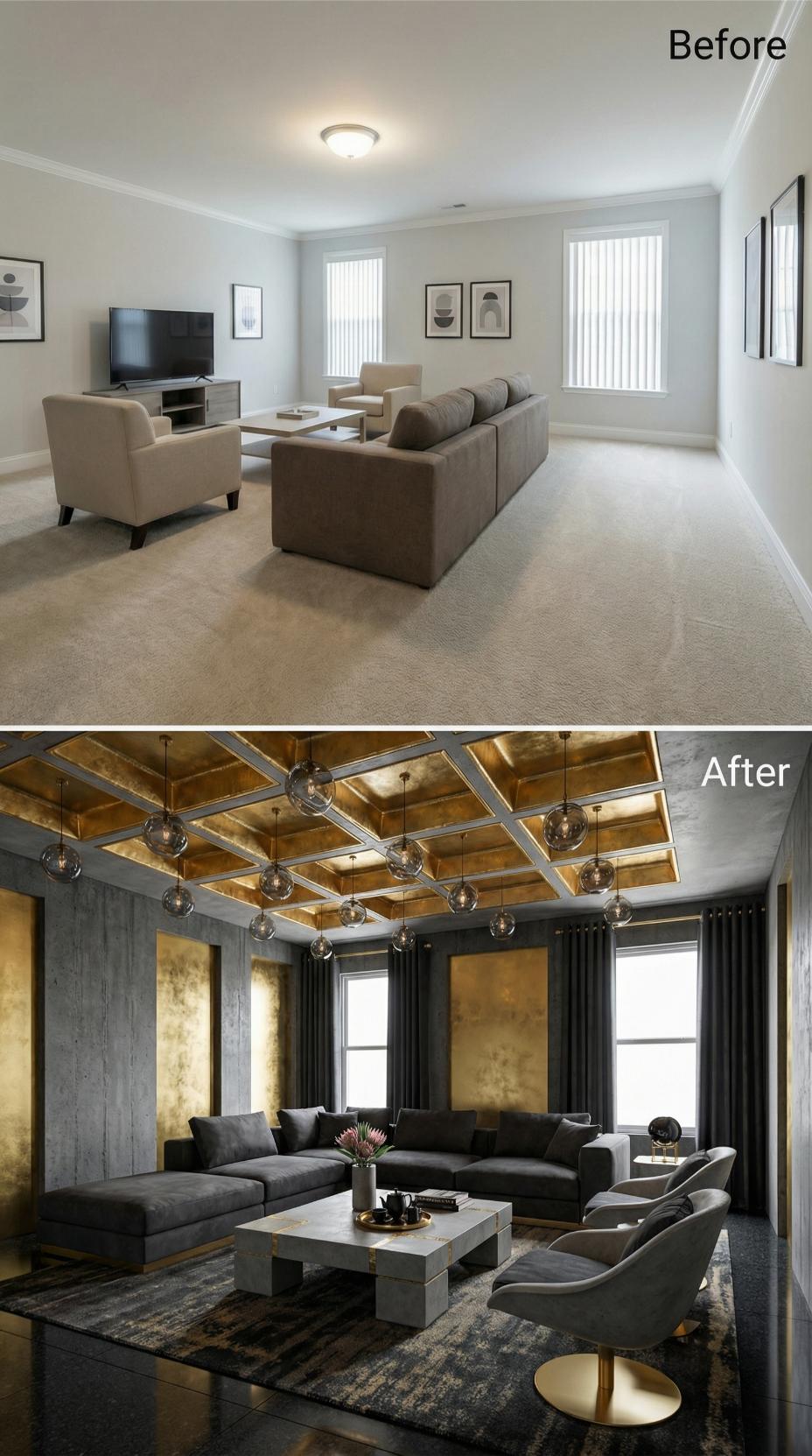
Smoke-gray sectional seating arranged around a marble-topped coffee table replaced what was once a beige carpet situation with a brown L-shaped sofa and a basic TV console. Every ceiling coffer is lined with gold leaf, and globe pendants in smoked glass hang from the grid at staggered heights, pulling warmth downward into a room that reads nearly black at the walls.
Concrete-finish wall panels run floor to ceiling in charcoal, interrupted by sections of gilded surface that mirror the ceiling treatment. Charcoal velvet swag curtains frame the original windows without altering them. Two swivel chairs in gray upholstery with brass pedestal bases anchor a conversation cluster separate from the main sofa group.
- Gold leaf applied to ceiling surfaces reflects light differently depending on the time of day, shifting from warm amber at noon to deep bronze under artificial light at night
- Smoked globe pendants diffuse light more softly than clear glass, reducing glare while preserving the visibility of the filament or LED source inside
- Swivel chairs with pedestal bases allow seating to reorient toward multiple conversation zones without repositioning the furniture entirely
Cloud Murals and Tufted Velvet Ended the Era of Flat Ceilings and Carpet
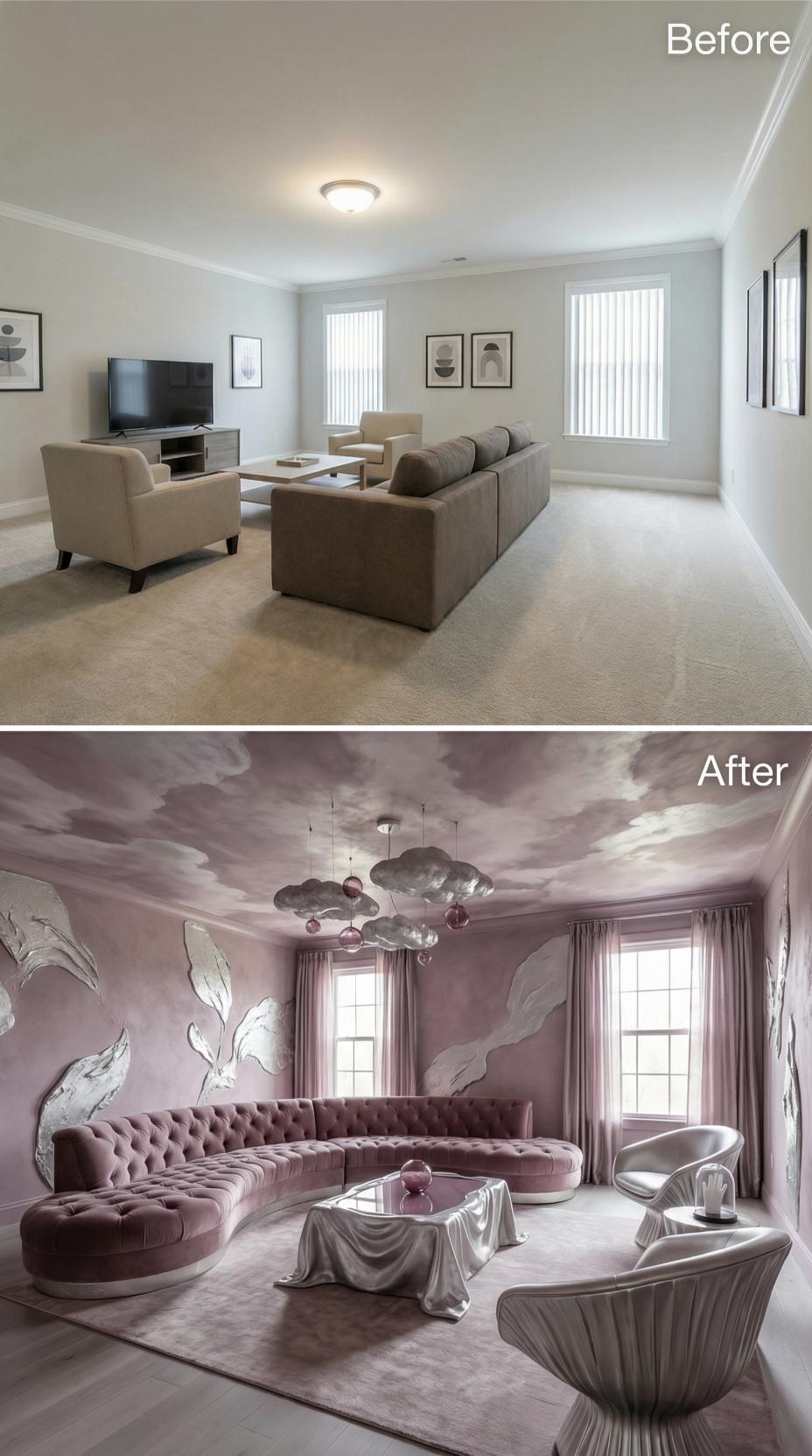
Where flat drywall and beige carpet once absorbed every hour without comment, a hand-painted sky mural now covers both the ceiling and walls in soft mauve and white, with clouds rendered in broad, atmospheric sweeps. A curved tufted sofa in dusty rose velvet anchors the room, its deep button-tufting running the full arc of the semicircular silhouette. Silver leaf wall sculptures shaped like oversized feathers or tropical leaves press against the painted surface, catching light differently depending on the angle.
A sculptural pendant cluster hangs at center, made up of polished silver cloud forms and suspended glass spheres in translucent pink. Two white shell chairs with ribbed exteriors face the sofa across a draped silver coffee table. Mauve silk curtains frame each window, pulling the wall color forward rather than breaking it.
A curved tufted sofa in dusty rose velvet anchors the room, its deep button-tufting running the full arc of the semicircular silhouette.
Craftsman Coffered Ceilings and Dark Leather Put Carpet and Drywall Out of Business
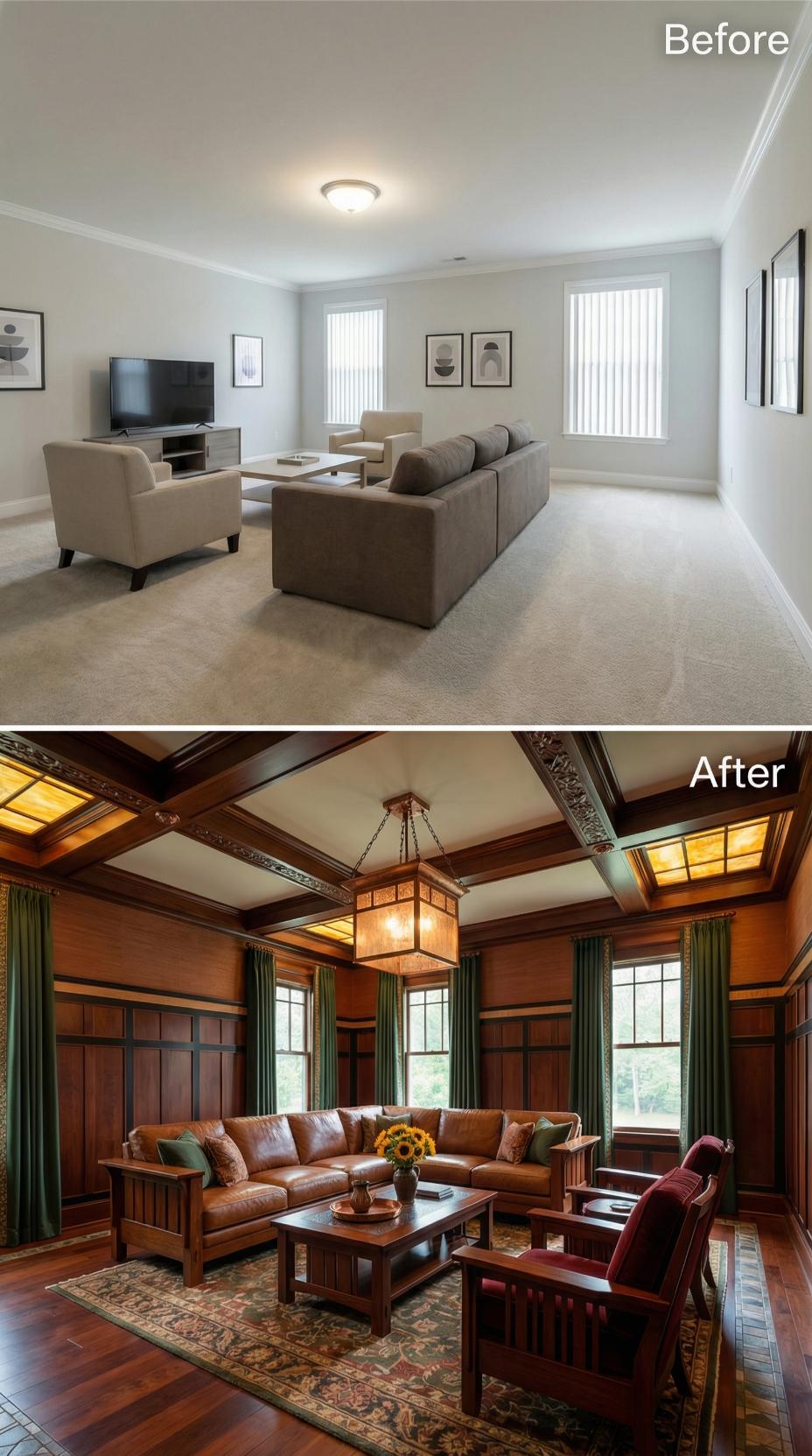
Every surface in the after photo is doing serious work. The ceiling alone earns its keep: dark-stained wood beams form a coffered grid with carved molding at the intersections, while backlit amber panels set into the upper corners cast the kind of warm, diffused light that a flush-mount fixture could never produce. Walls are clad floor-to-ceiling in board-and-batten wood paneling finished in a rich walnut tone, anchored by a decorative plate rail running the room’s perimeter.
The furniture follows the Craftsman tradition precisely. Mission-style oak pieces with mortise-and-tenon joinery anchor the seating area, paired with a sectional in saddle-brown leather and a square coffee table finished in espresso. A wool area rug in muted rust and olive tones grounds the arrangement, while forest-green velvet drapes pool slightly at the window sills. Sunflowers on the coffee table are the only thing in the room that isn’t built to last a century.
Quick Fix: Craftsman-style coffered ceilings are typically built using dimensional lumber fastened directly to the existing ceiling joists, which means they can be added to a flat drywall ceiling without a structural overhaul. The beam grid is often hollow, reducing weight significantly while preserving the hand-built appearance. Wood species selection matters more than most homeowners expect, since open-grain species like oak hold dark stains unevenly compared to tighter-grained options like maple or cherry.
Crimson Lacquer Walls and a Crystal Chandelier Made Neutral Carpet Irrelevant
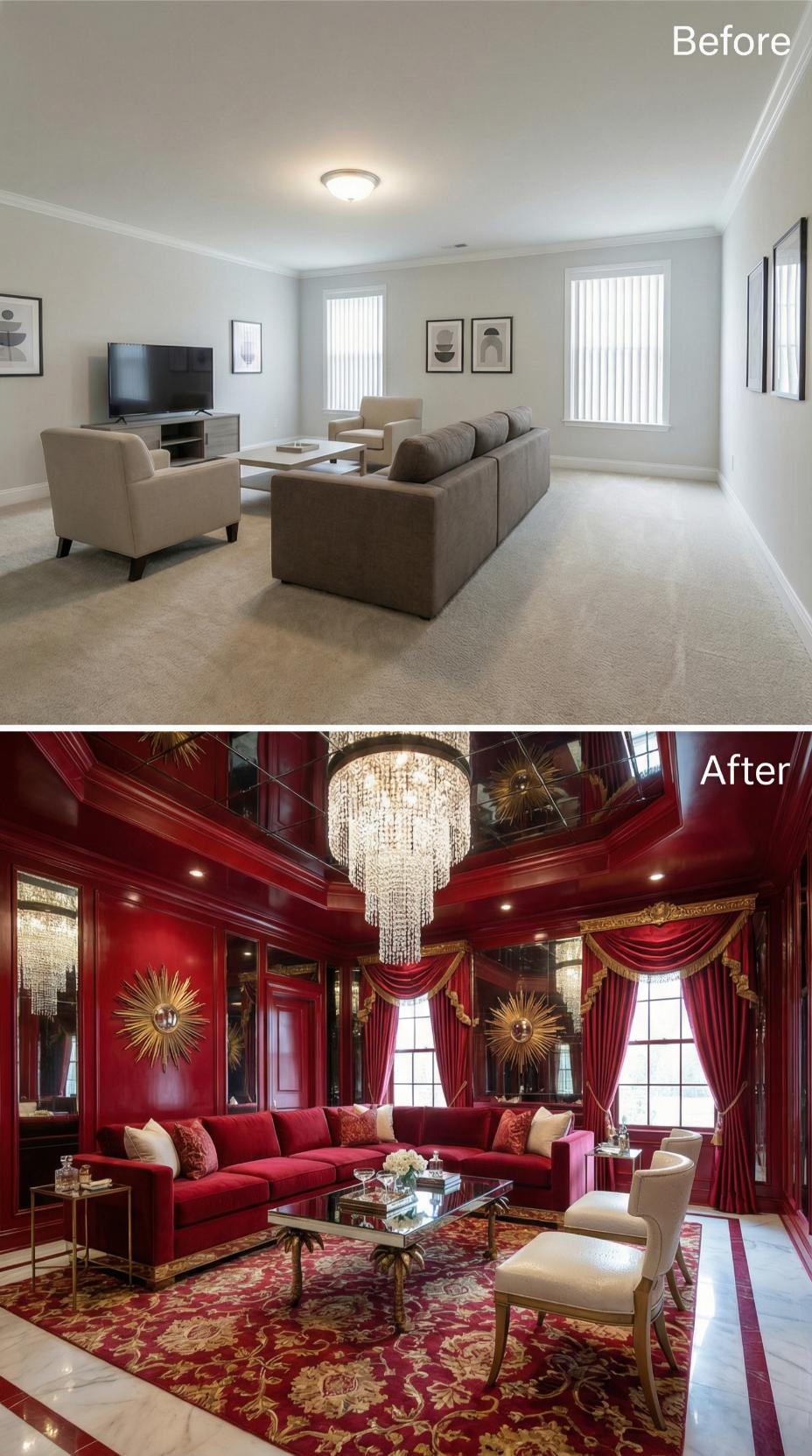
Red lacquer panels trimmed in deep burgundy millwork cover every wall, with gilt sunburst mirrors mounted as the primary decorative anchors. Mirrored inserts set into the upper paneling multiply the chandelier light across the room, which features a multi-tiered crystal fixture that drops well below the ceiling line. Velvet sectional seating in crimson sits on a floral wool rug patterned in red and gold. Silk drapes with gold tassel trim frame the windows.
Red lacquer has been used in Asian decorative arts for over three thousand years, traditionally applied in dozens of thin layers over a wood or cloth base to build depth and resilience. Applied here to architectural paneling rather than furniture, it shifts from accent material to full architectural statement.
Exposed Wood Ceiling Beams and an Iron Chandelier Closed the Drywall File
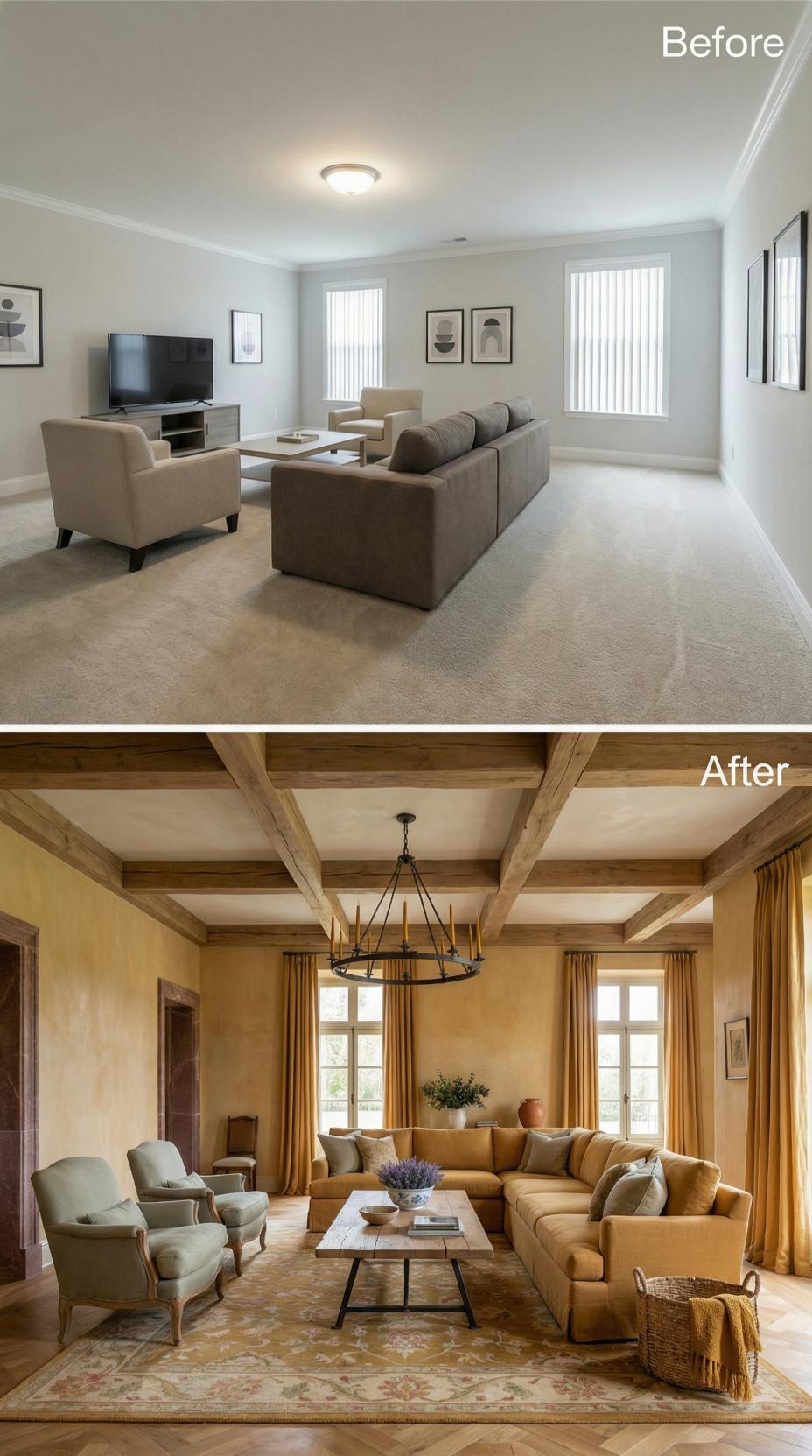
Rough-sawn beams in a coffered grid pattern cross the ceiling above a sectional upholstered in amber linen, while a wrought-iron ring chandelier anchors the center. Sage wingback chairs, a reclaimed-wood coffee table, and gold silk curtains complete the shift from carpet and flush-mount lighting.
Gold Leaf Coffered Panels and Black Leather Buried Carpet Without a Second Thought
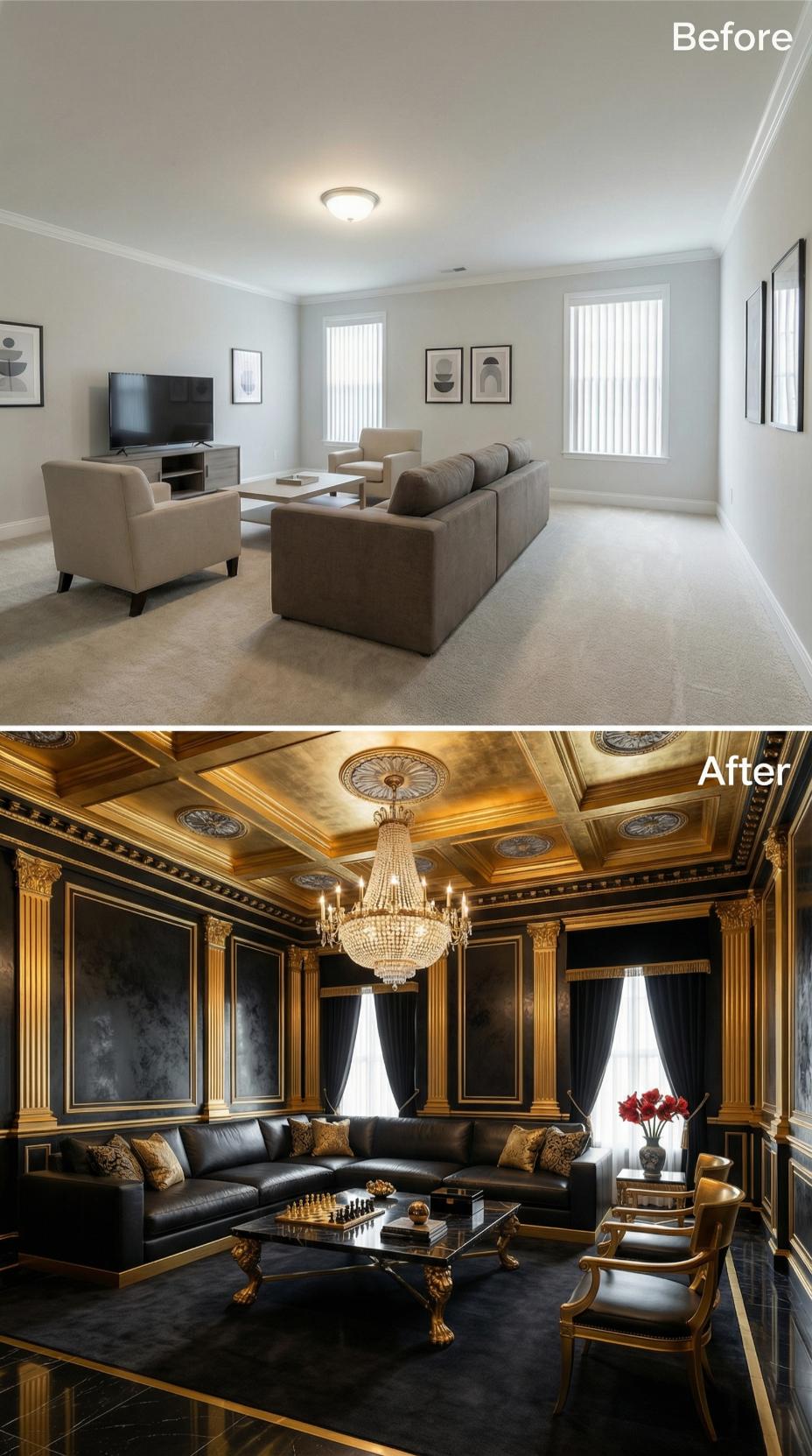
Flat drywall and vertical blinds gave way to a coffered ceiling finished in gold leaf, with each recessed panel framed by ornate plaster molding and lit from above by a crystal empire chandelier. The walls are clad in dark marbled lacquer set within gilded picture-frame molding, flanked by full Corinthian pilasters finished in burnished gold. Velvet-weight black drapes pool at the floor beneath the windows.
Black leather sectional seating wraps a glass-and-gilt coffee table with carved lion-paw feet. Accent chairs in gold-framed wood sit opposite, echoing the ceiling’s metallic tone. A chess set rests on the table, which reads less as decoration and more as a statement about how time gets spent in rooms built this seriously.
Plaster Medallions and Green Leather Wingbacks Closed the Carpet-and-Drywall File
🔥 Would you like to save this?
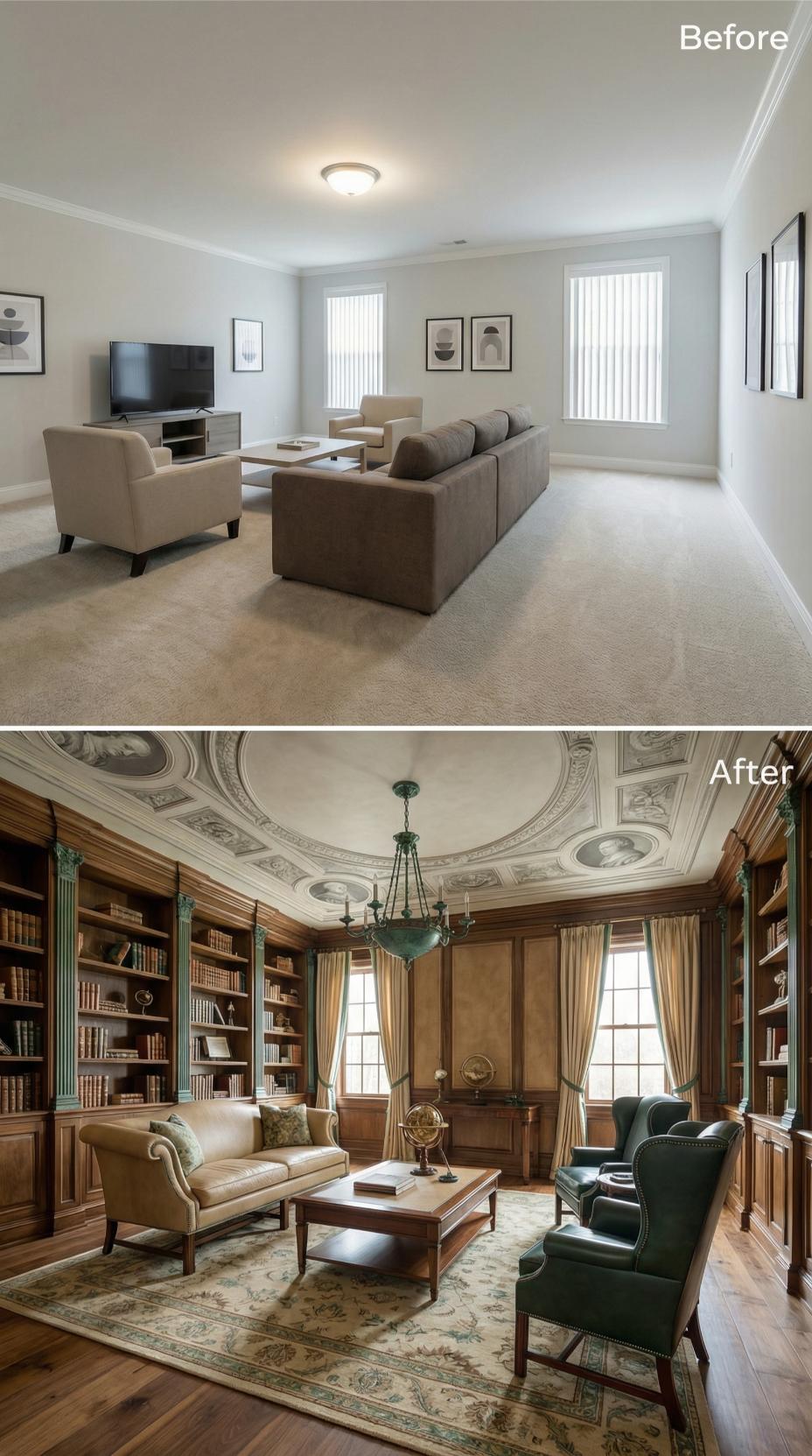
Oval plaster ceiling medallions with painted portrait roundels and classical scroll borders replaced a flush mount and flat drywall overhead. A verdigris chandelier drops from the center, its patinated bronze finish pulling the green from the leather wingback chairs flanking the coffee table.
Floor-to-ceiling walnut bookcases line three walls, framed by fluted pilasters with aged green capitals. The cream leather Camelback sofa sits on a floral Oushak-style wool rug, and wide-plank hardwood replaced every inch of beige carpet. Honey-colored silk drape panels now cover where vertical blinds once hung.
Peacock Feather Wallpaper and a Teal Velvet Sectional Finished the Beige Conversation
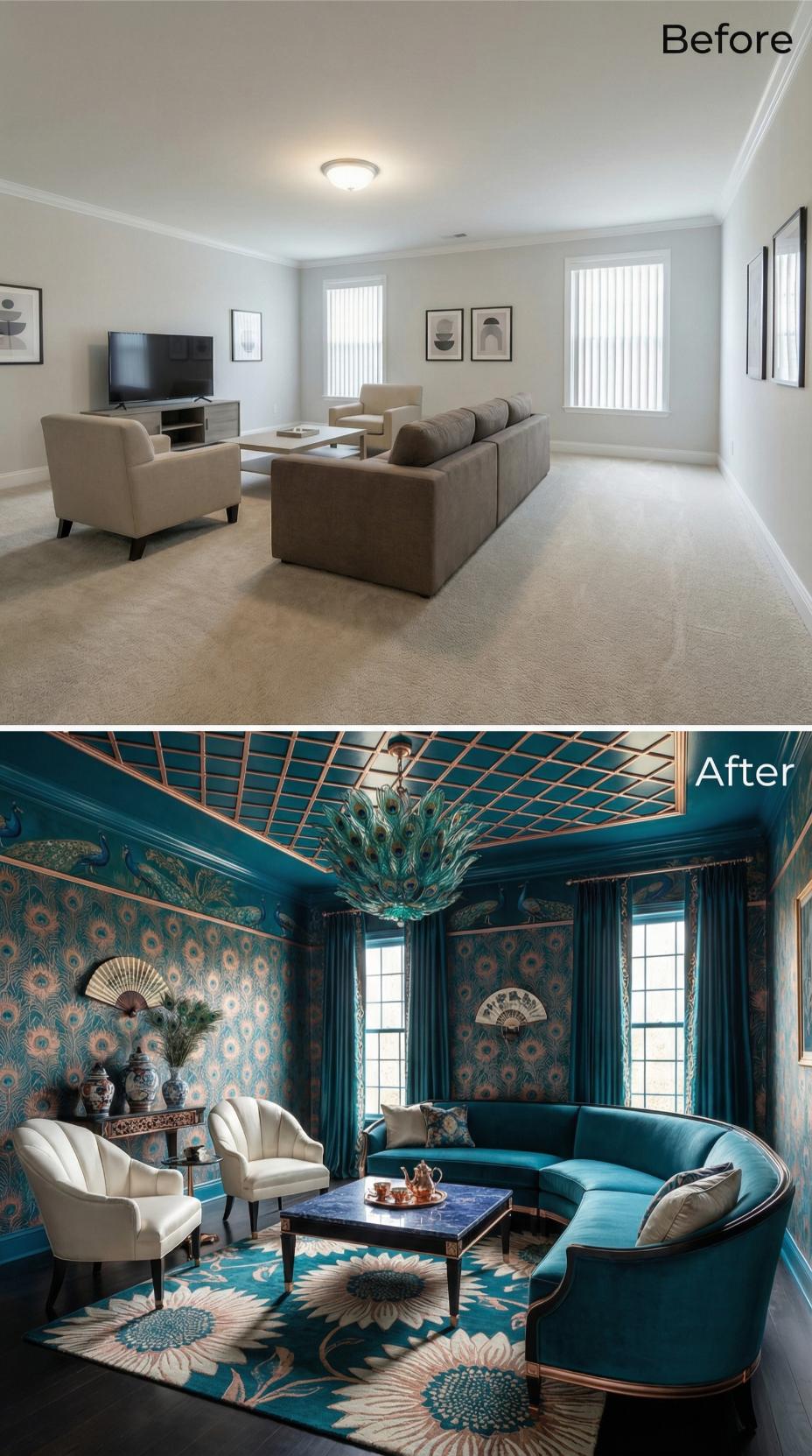
Teal velvet wraps a curved sectional anchored by a marble-topped coffee table in deep navy blue. A peacock feather chandelier drops from a coffered ceiling finished in teal lacquer with copper grid trim, pulling the room’s color story directly upward. Peacock feather wallpaper runs floor to ceiling on every wall, its ochre, copper, and teal eye pattern repeated across the matching floral area rug below.
Paired white shell-back chairs on tapered ebony legs sit opposite the sectional, their ivory upholstery giving the eye a place to rest. Copper-toned fan wall sculptures and blue-and-white ceramic vases on a console complete the room’s Aesthetic Movement references, a 19th-century design philosophy that treated decoration itself as the point.