🔥 Would you like to save this?
A dated primary bathroom sends a message, and it’s rarely the one homeowners want. Peeling caulk, builder-grade fixtures, and the wrong tile can drag down a space that’s supposed to feel like a retreat. These 28 before-and-after projects show what happens when homeowners stop tolerating bathrooms that no longer reflect how they live. The changes range from full gut renovations to focused upgrades that hit the right notes. Status in a bathroom isn’t about spending recklessly. It’s about intention. The right stone, a freestanding soaking tub, or a vanity with real visual weight can shift how a room reads entirely. Each project here started with something outdated and ended with a space that holds its own against the best the design world has to offer.
In order to come up with the very specific design ideas, we create most designs with the assistance of state-of-the-art AI interior design software. Also, assume links that take you off the site are affiliate links such as links to Amazon. this means we may earn a commission if you buy something.
Floating Vanity and Soaking Tub Anchor the Room in Stone
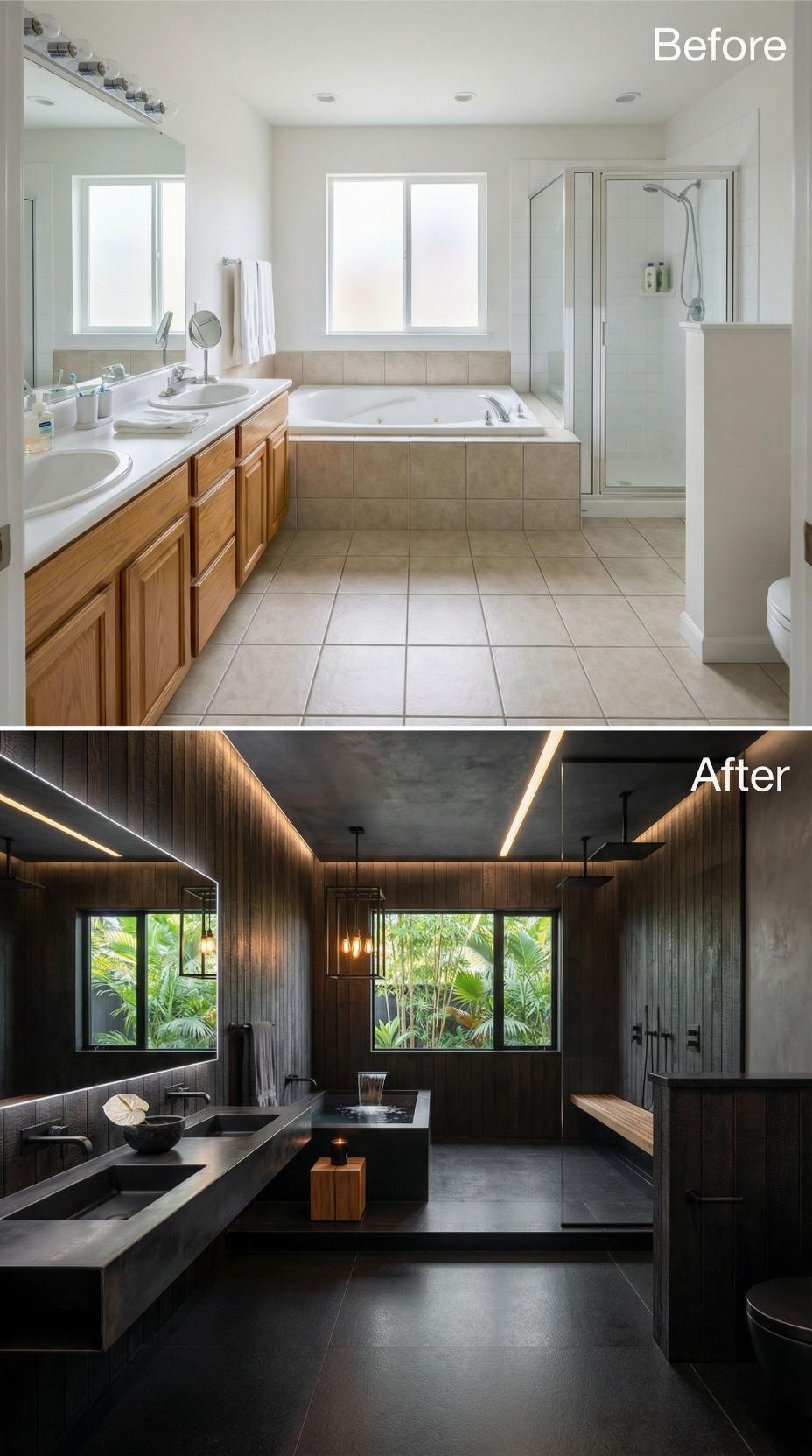
Where oak cabinets and sand-colored ceramic once dominated, charcoal concrete now covers every surface from the floating double vanity to the soaking tub surround. A waterfall filler pours into the tub while Edison-bulb pendants on a geometric black frame cast warm amber light against the dark wood slat wall cladding. Linear LED strips trace the ceiling perimeter, and a teak bench anchors the open wet room on the right. The window frames tropical palms outside, doing real visual work in a room that would otherwise read as a cave.
Herringbone Floors and a Reeded Cedar Ceiling Warm the Entire Space
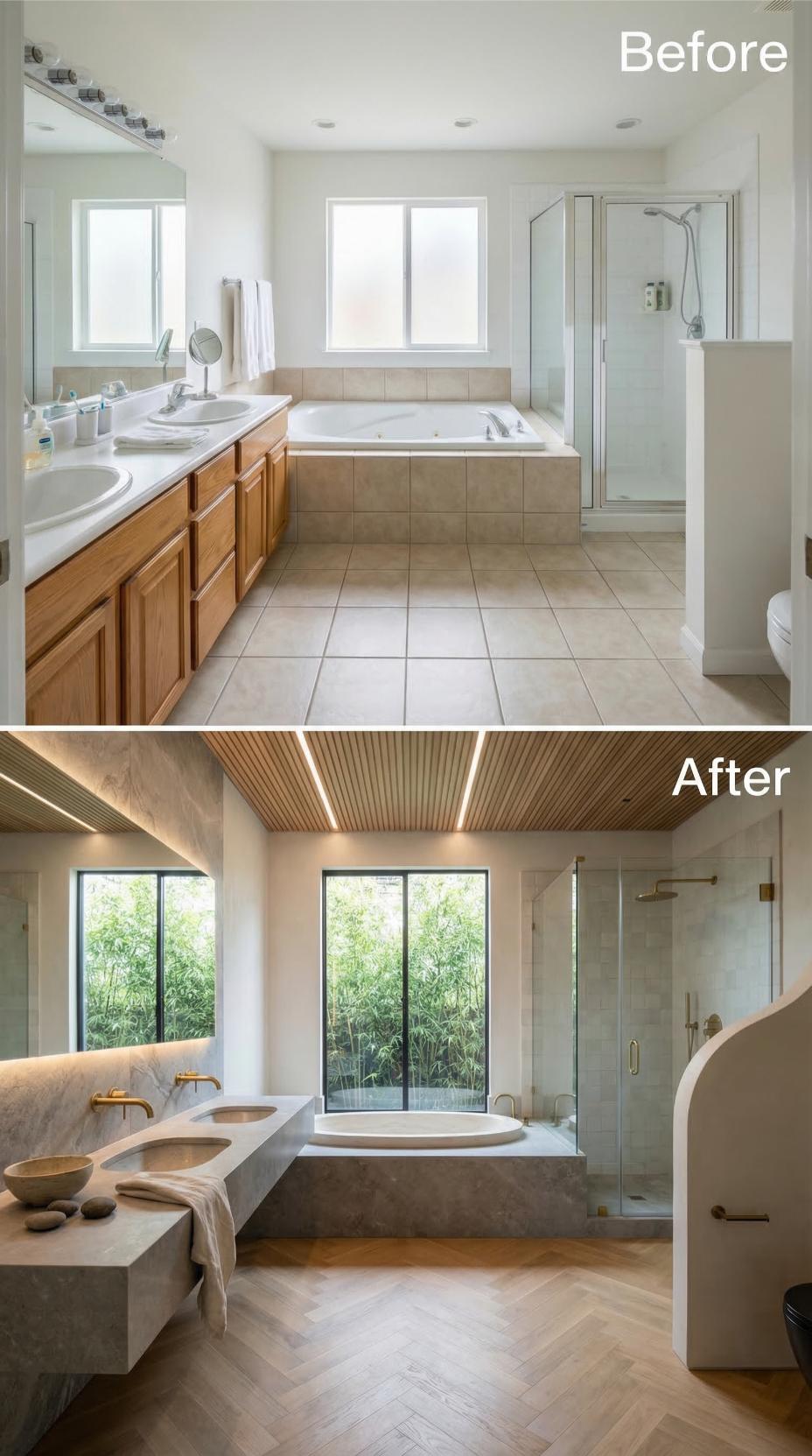
Honey-toned oak cabinets and beige ceramic floor tile gave way to a floating marble-look vanity with integrated sinks and brushed brass wall-mount faucets. Herringbone wood flooring runs beneath a reeded cedar ceiling fitted with recessed linear LED strips. The soaking tub now sits on a stone platform, framed by a black-trimmed window overlooking bamboo.
Raw Concrete Walls and Amber LED Underlighting Redefine This Primary Bath
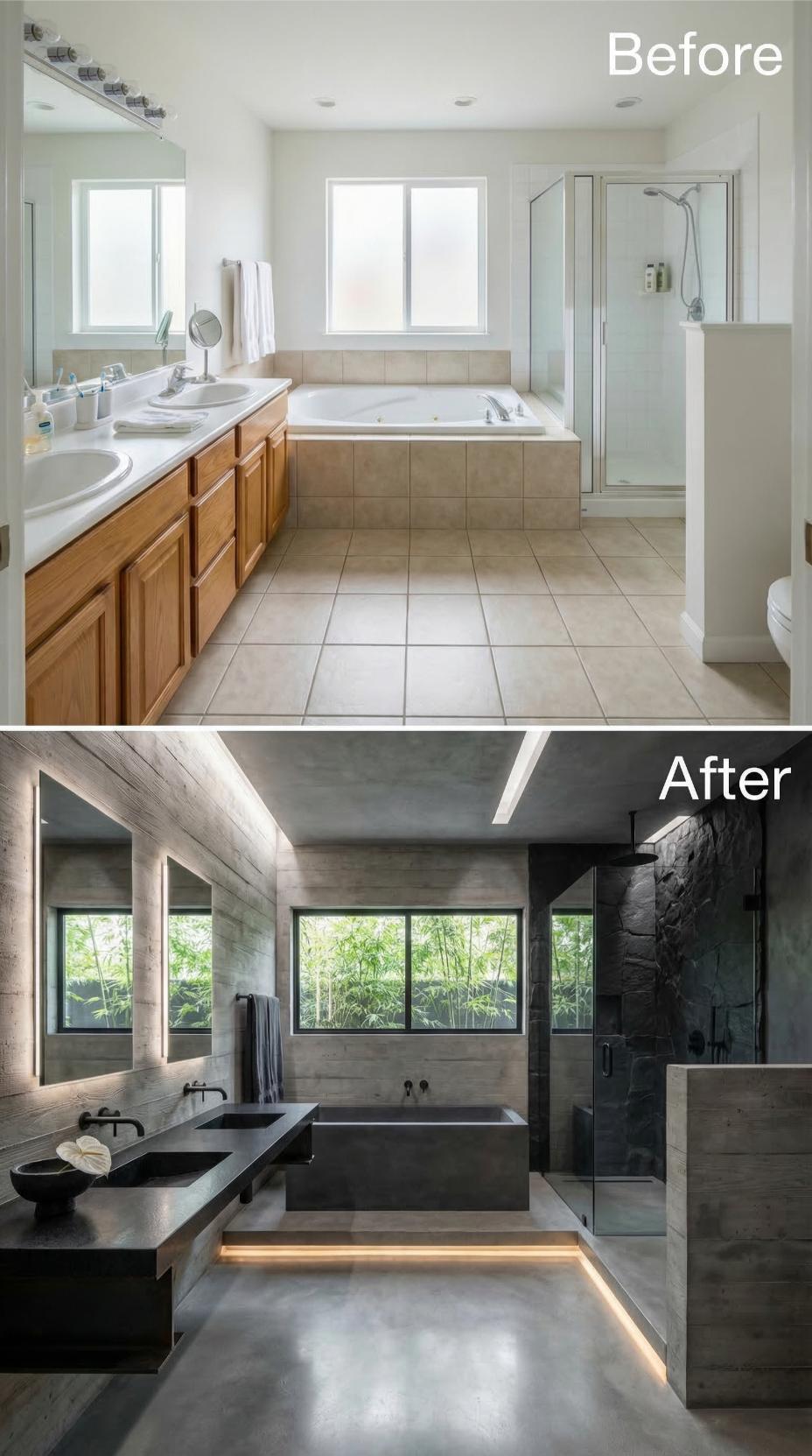
Polished concrete floors replace beige ceramic tile, while board-formed concrete walls run floor to ceiling on three sides. The freestanding soaking tub sits on a concrete plinth with warm amber strip lighting underneath. Two vessel sinks rest on a black floating vanity, flanked by backlit rectangular mirrors with matte black wall-mount faucets.
Dark Green Paneling and a Crystal Chandelier Swap Out Beige Tile in This Primary Bath
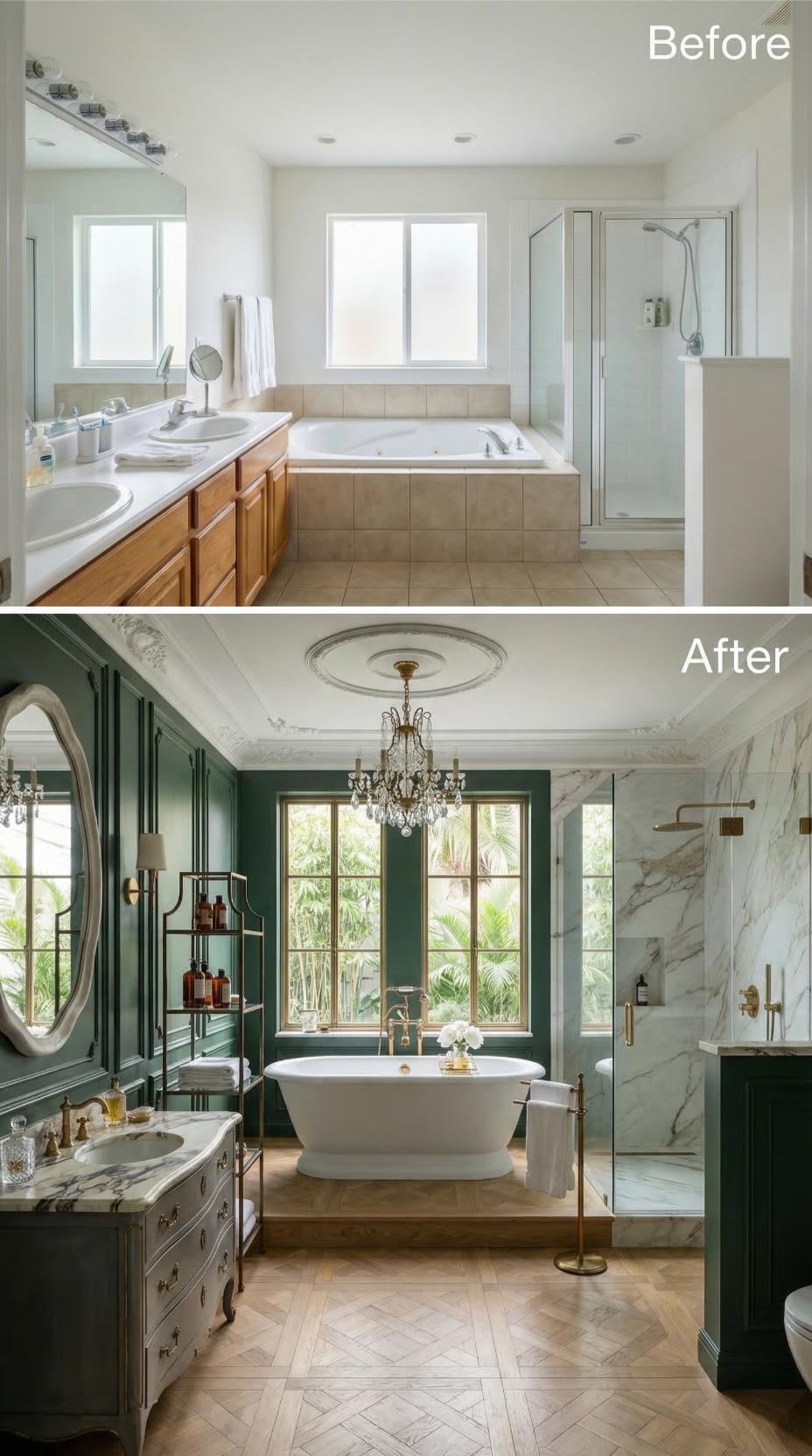
Deep forest green wainscoting with raised molding panels covers every wall, anchored by ornate crown molding and a plaster ceiling medallion. Brass fixtures run throughout: bridge-style tub filler, wall sconces, and a tiered crystal chandelier centered above a freestanding pedestal soaking tub. Herringbone oak flooring replaces the original beige ceramic, and marble slab lines the frameless shower enclosure floor to ceiling.
Woven Rattan, Vessel Sinks, and Freestanding Soaking Replace Dated Oak Cabinetry
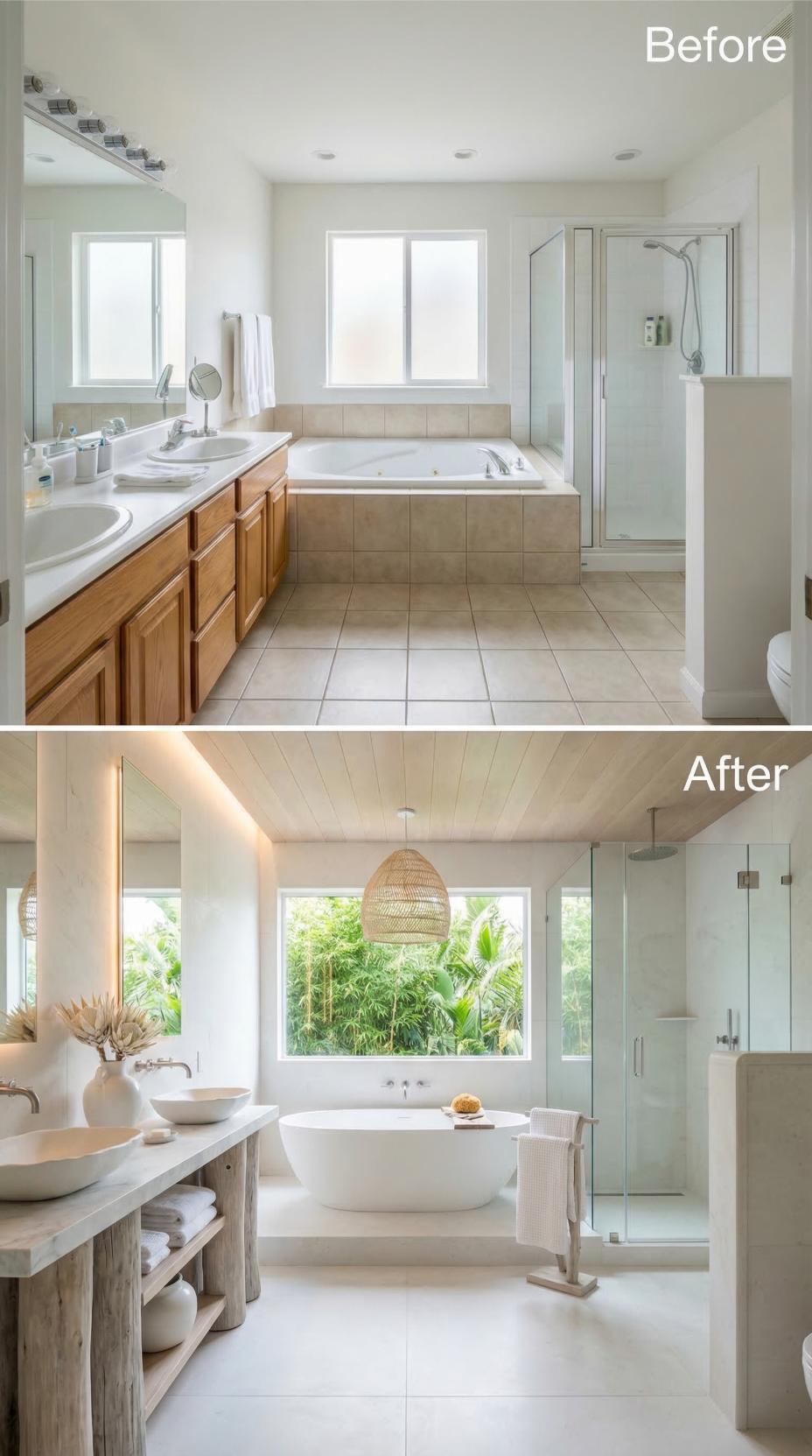
Oak cabinets and beige ceramic tile gave way to a reclaimed driftwood vanity with open shelving, topped by a thick limestone slab. Two white vessel sinks sit above wall-mounted brushed nickel faucets, and a large backlit mirror throws warm light across the counter without any bulb fixture interrupting the wall plane.
The built-in tub is gone. In its place, an oval freestanding soaker in matte white sits centered beneath a picture window now framed by tropical palms. A woven rattan pendant drops from a shiplap ceiling. The walk-in shower retains frameless glass but gains a recessed rain head and floor-to-ceiling plaster walls in warm off-white.
Ask Yourself: Before committing to open vanity shelving, ask yourself how much visual clutter you can tolerate daily. Rolled towels and ceramic vessels photograph well, but they require consistent upkeep to avoid looking chaotic in real life.
Glass Walls, Terrazzo Floors, and Tropical Greenery Redefine a Dated Primary Bath
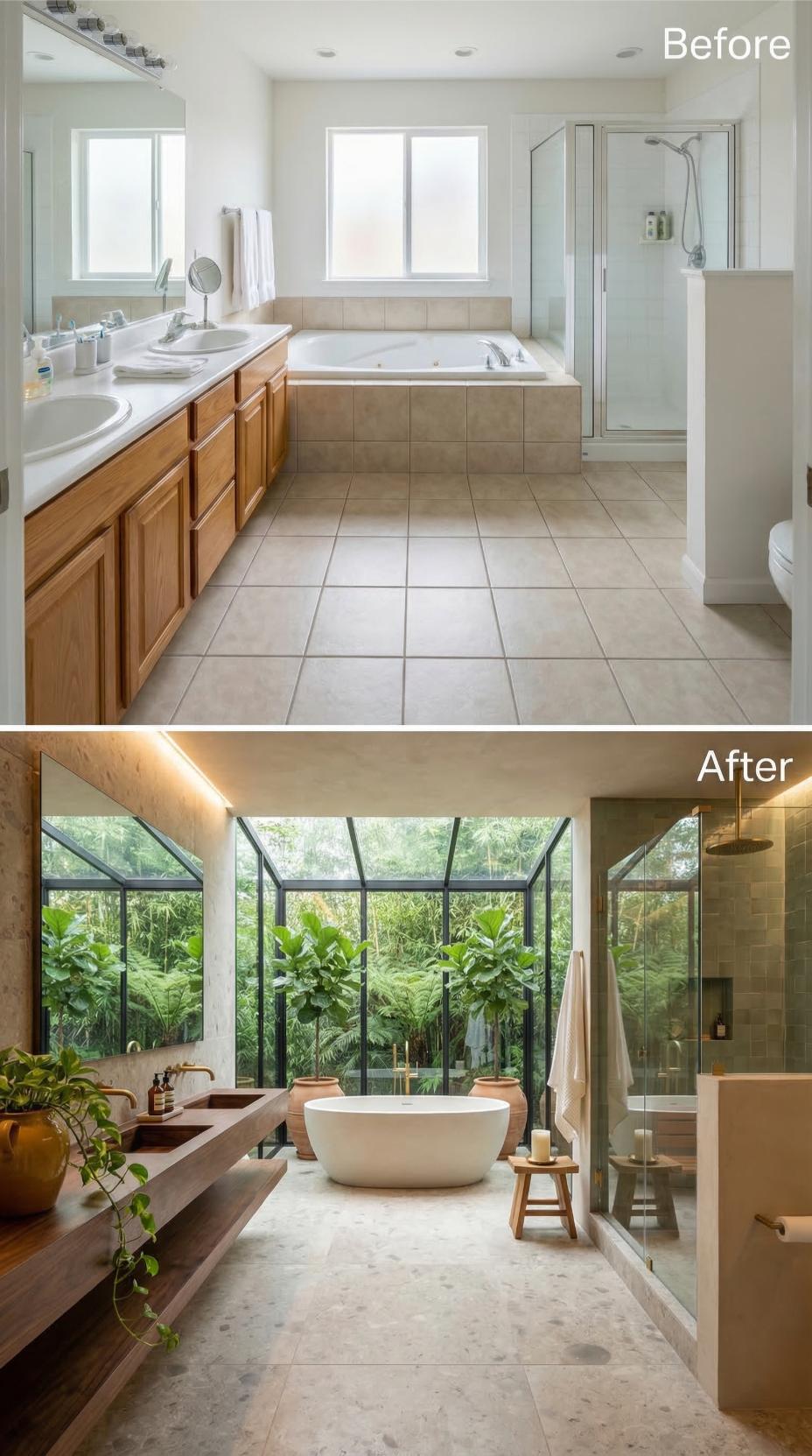
A walnut floating vanity with an integrated trough sink anchors the left wall, while floor-to-ceiling steel-framed glazing floods the space with garden light.
Designer’s Secret: Specifying black steel window frames instead of aluminum adds visual weight that reads as architectural rather than utilitarian. The added cost is typically offset by the design work it replaces, since strong framing elements reduce the need for decorative layering elsewhere in the room.
Natural Stone Archways and Brass Fixtures Overtake a Forgettable Beige Primary Bath
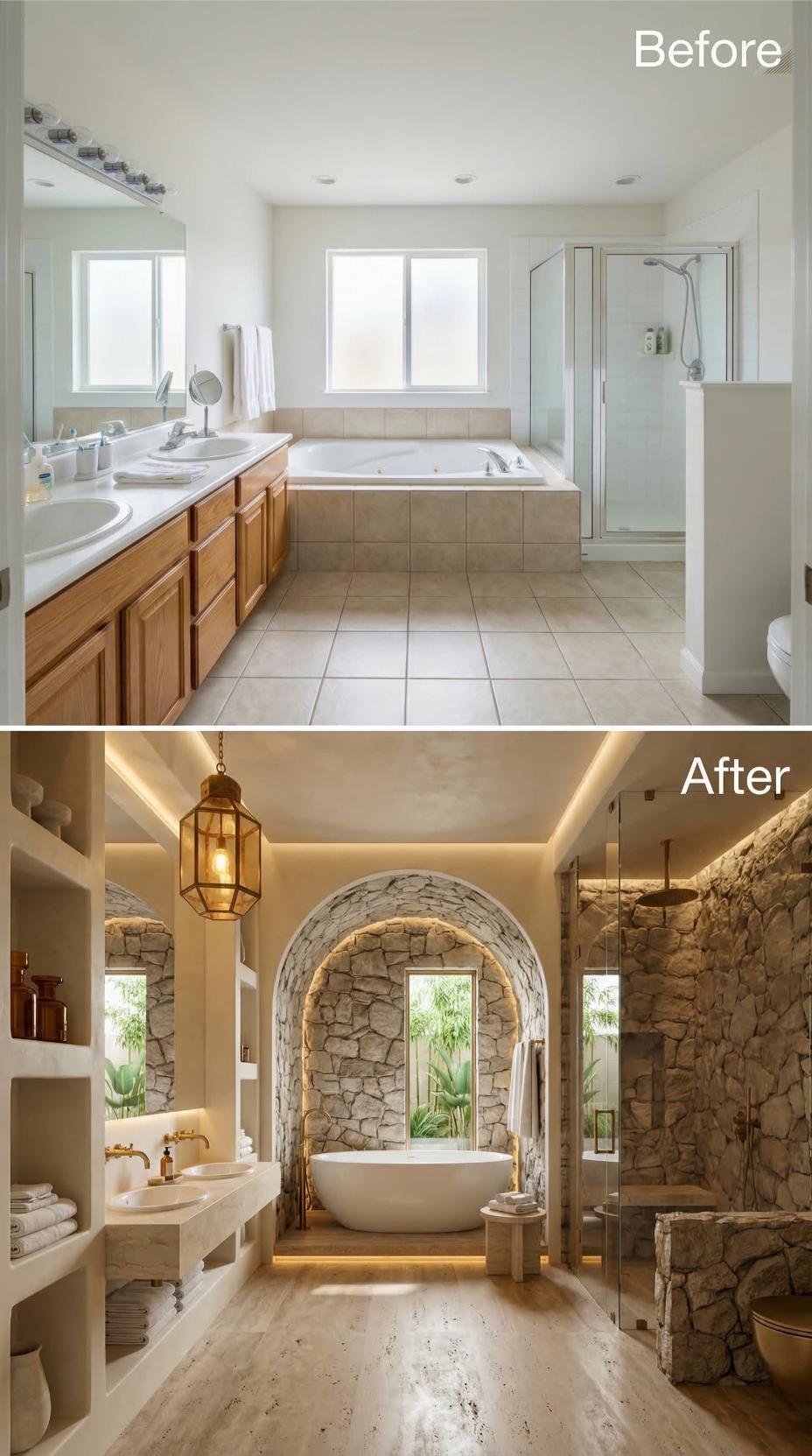
Raw fieldstone cladding covers the walls from floor to ceiling, and a hand-laid arch frames the freestanding oval soaking tub like a grotto alcove. Warm LED strip lighting runs along the tray ceiling perimeter and beneath the tub platform, casting the travertine wood-look flooring in amber tones without a single overhead can light in sight. A geometric brass lantern pendant drops from the ceiling as the room’s focal point.
Floating plaster shelving replaces the oak vanity cabinet entirely, holding rolled linens and amber glass vessels. Wall-mount brass faucets extend from raw plaster above a rectangular stone basin. The walk-in shower keeps frameless glass panels but wraps every surface in the same fieldstone, including a built-in bench seat at the far wall.
Wall-mount brass faucets extend from raw plaster above a rectangular stone basin.
Not every dramatic bathroom renovation leans dark, but this one commits to it without hesitation.
Teak Slat Walls, a Black Soaking Tub, and Pendant Lighting Replace Beige Tile
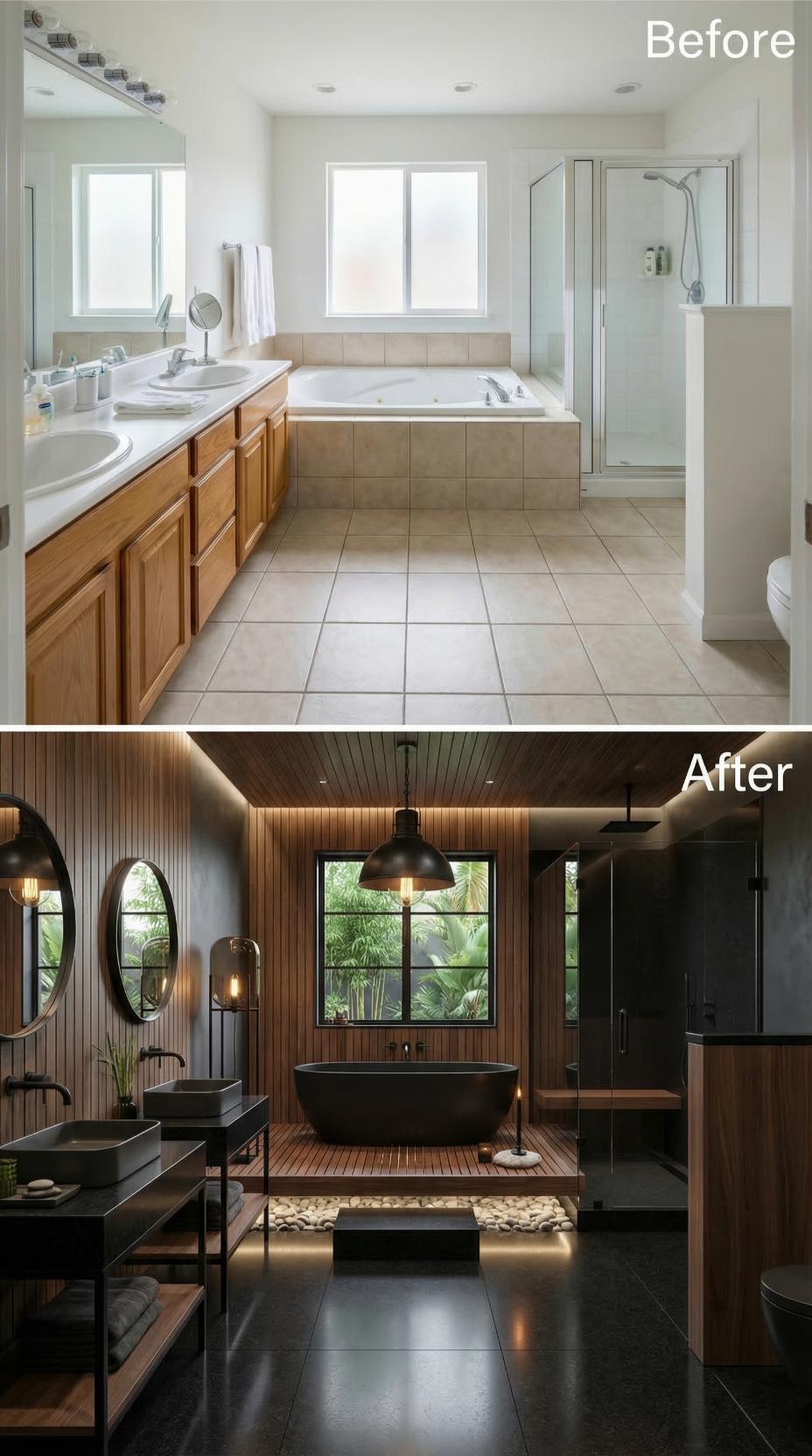
Vertical teak slat paneling wraps the walls and ceiling while black granite floor tiles ground the space in contrast. The freestanding matte black tub sits on a raised teak platform bordered by river stones, with a single industrial pendant casting warm light directly above it.
Marble Columns, Gold Hardware, and a Raised Tub Platform Rebuild a Forgettable Primary Bath
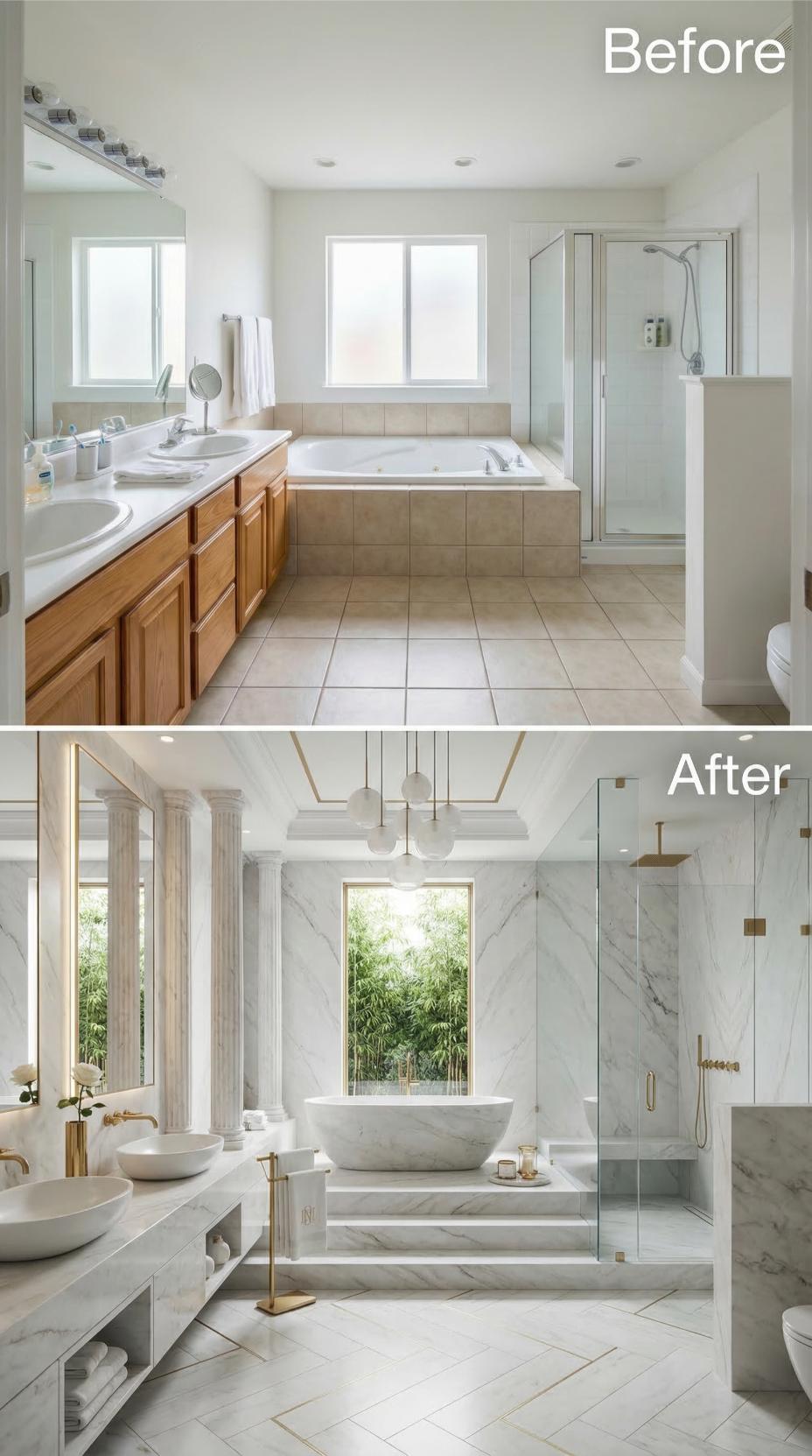
Carrara marble runs floor to ceiling, covering every wall surface and continuing across a herringbone-pattern floor. The raised tub platform, faced in matching stone, positions a freestanding oval soaking tub directly below the window, with bamboo visible beyond the glass.
Vessel sinks sit on an open marble vanity with brushed brass faucets, while a cluster of globe pendant lights hangs from a coffered ceiling with gold inlay trim. Fluted columns frame the vanity mirror on both sides, referencing classical architecture without period styling.
Budget Tip: Marble-look porcelain can replicate the veining seen here at roughly 20 to 30 percent of the cost of natural stone slabs. For high-traffic surfaces like floors, porcelain also outperforms marble on durability and stain resistance, making it the practical choice when the budget needs to stretch across an entire primary bath renovation.
Exposed Beam Ceilings, Vessel Sinks, and Warm LED Coves Rebuild a Dated Primary Bath
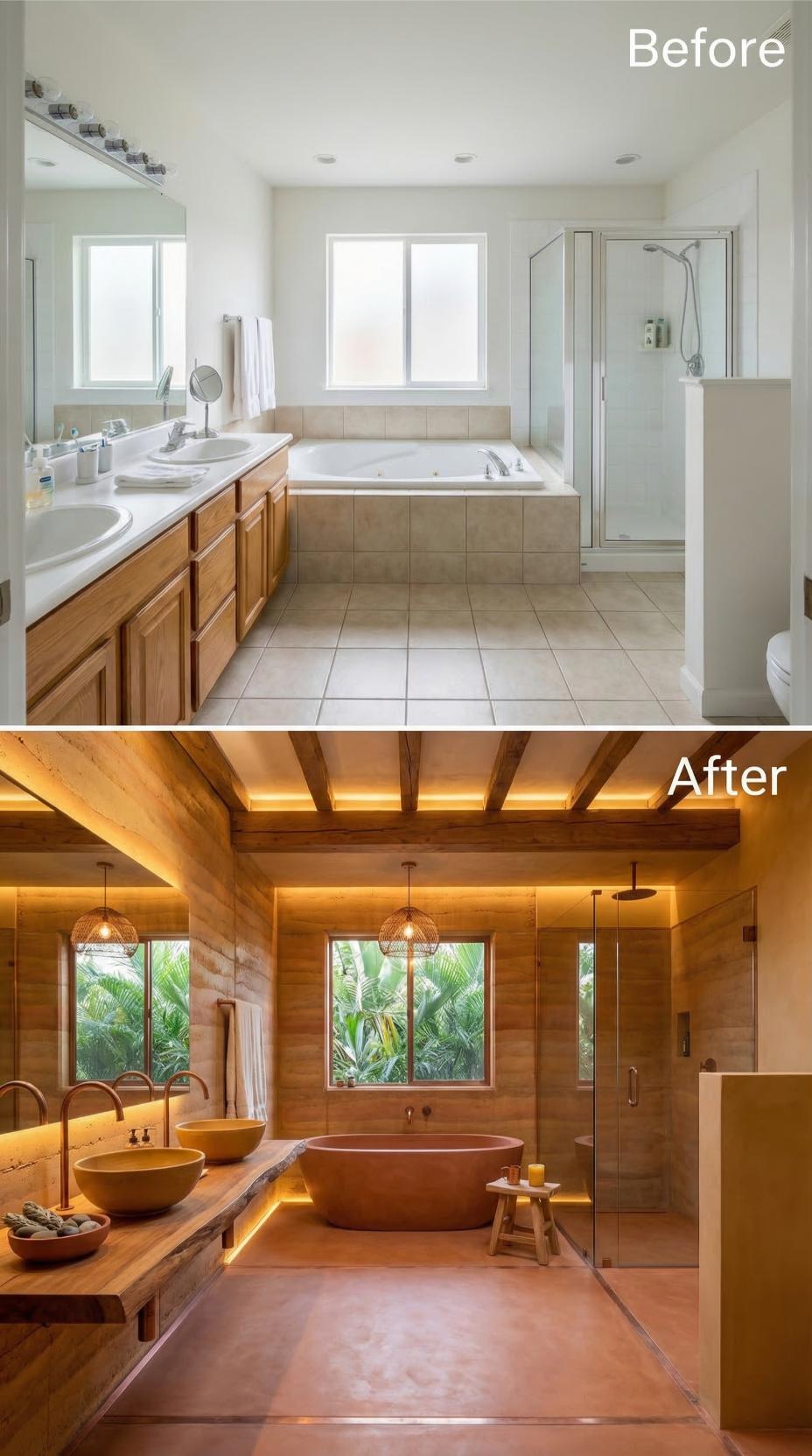
Reclaimed wood ceiling beams anchor the entire scheme, with amber LED strips tucked into each coffer casting a low, continuous glow across travertine-look wall cladding. The built-in soaking tub sits in terracotta-finished concrete, replacing the original drop-in surround. Two ochre vessel sinks rest on a live-edge wood vanity shelf fitted with copper arc faucets.
Worth Knowing: Recessed LED strip lighting placed along ceiling beam coffers produces layered illumination without requiring a single overhead fixture change. Lighting designers typically recommend a color temperature between 2700K and 3000K for bath spaces where warm ambiance is the priority, as cooler temperatures work against the organic material palette seen in renovations like this one.
Veined Marble Surfaces and Cove Lighting Displace Beige Tile in a Primary Bath
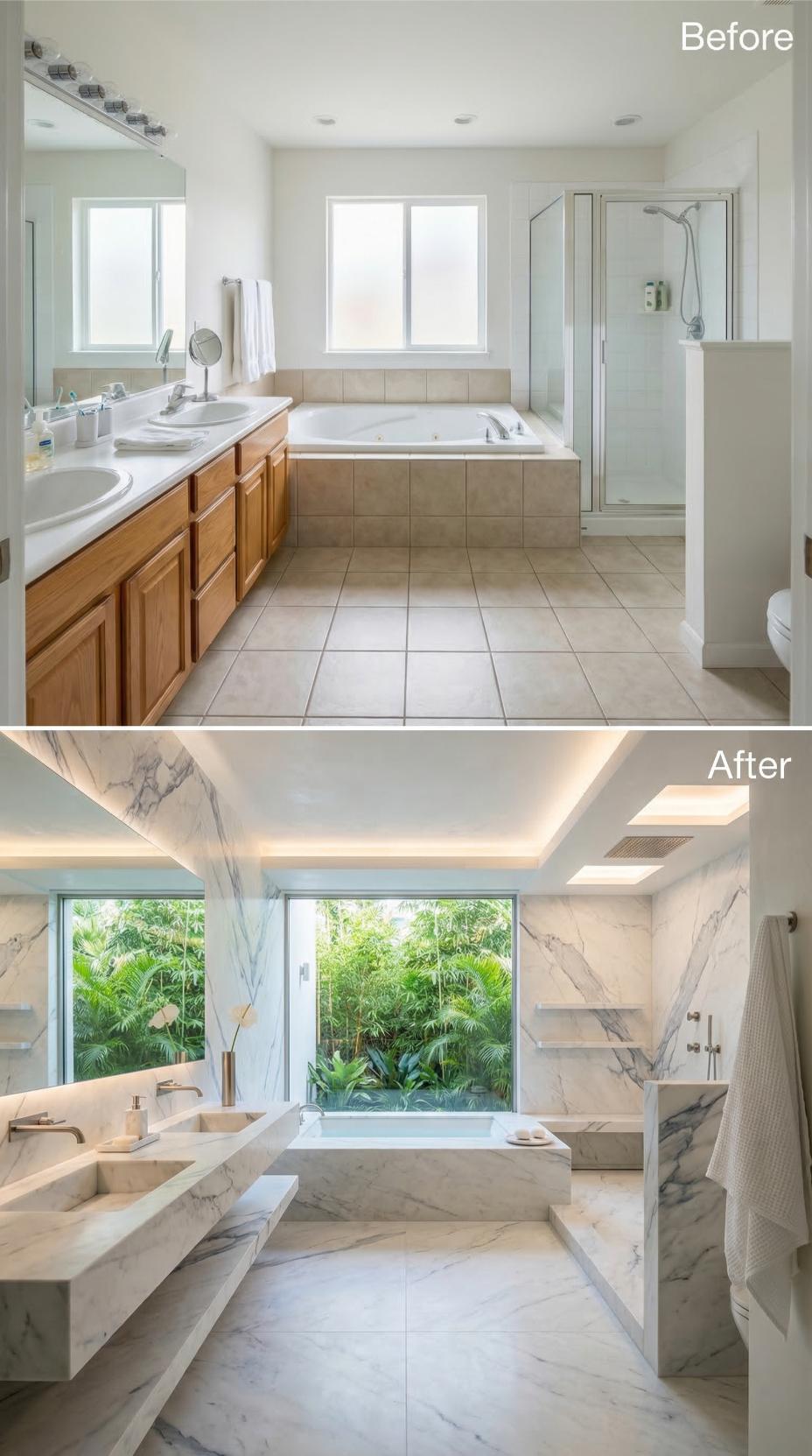
Full-slab Calacatta marble runs floor to ceiling, covering the tub surround, floating vanity, and walls without interruption. The continuous veining creates a sense of depth that individual tiles simply cannot replicate. Cove lighting recessed into the dropped ceiling perimeter casts a warm wash across the stone, eliminating the need for traditional overhead fixtures entirely. The window above the tub was replaced with floor-to-ceiling glazing, pulling in a dense backdrop of tropical palms and bamboo that reads almost like living wallpaper.
The floating vanity sits on no visible support, its marble body housing an integrated sink carved from the same slab. Brushed bronze fixtures at the faucet and shower wall add warmth without competing against the stone. Before, wood-fronted cabinetry and beige grout-lined tiles kept the space firmly in the 1990s. Now, the room operates as a single material statement.
History Corner: Calacatta marble, the variety most likely used here based on its bold grey veining on a bright white field, has been quarried in the Apuan Alps of Tuscany since Roman times and was famously used in Michelangelo’s sculptures. Its association with luxury in residential design intensified during the early 20th century when American industrialists imported full slabs for Gilded Age estates. Today it remains one of the most status-legible materials a homeowner can specify in a primary bath.
Verde Marble Walls and a Sunken Tub Turn a Beige Primary Bath Into a Spa Sanctuary
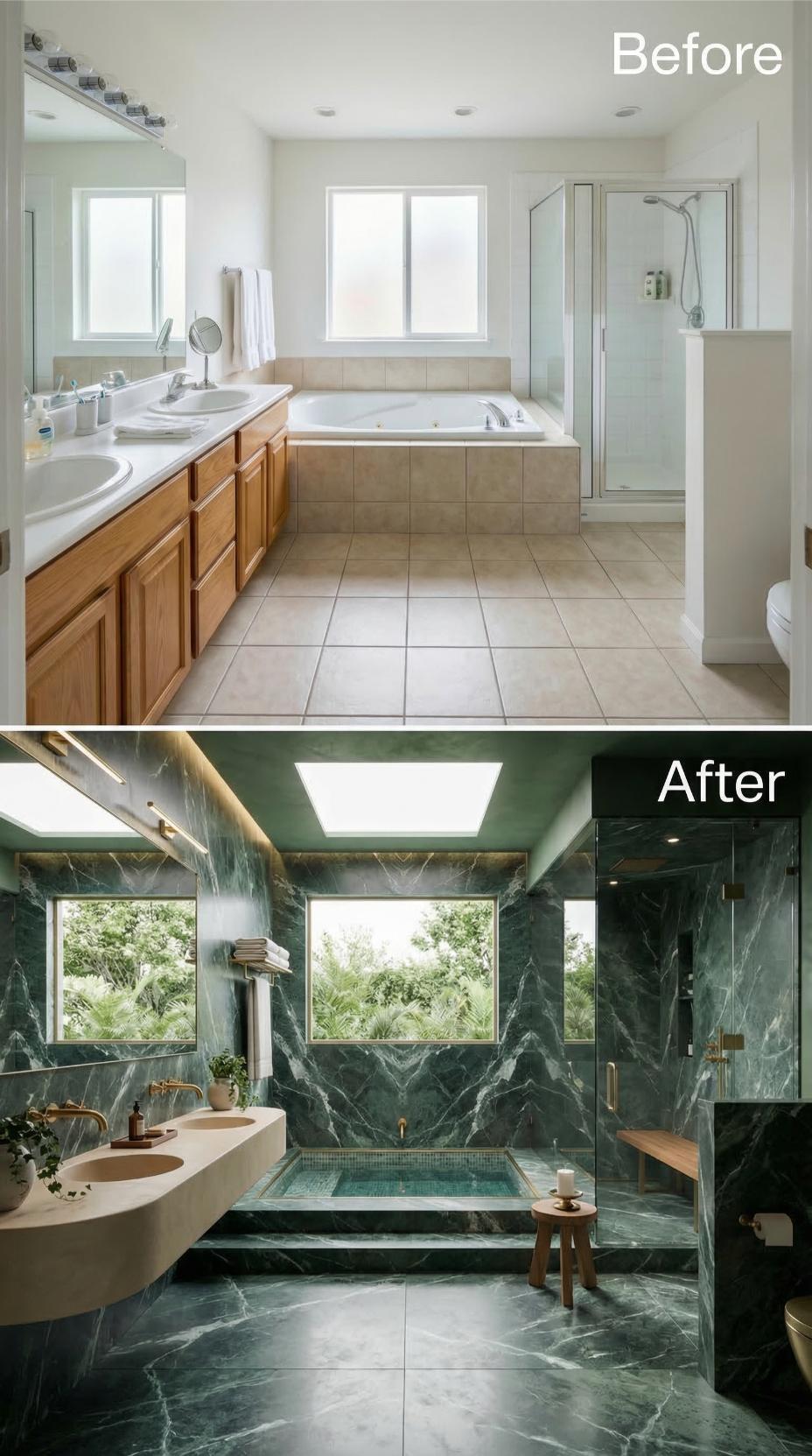
Green marble covers every wall and floor surface here, its white veining creating a bookmatched chevron pattern behind the sunken soaking tub. Brushed brass faucets and towel bars cut through the dark stone without competing with it. The floating concrete vanity holds a pair of undermount basin sinks, keeping the counter profile low and uncluttered.
A skylight panel above the tub draws natural light straight down to the water line. The window above the tub surround frames exterior greenery, turning the view into something close to a living backdrop. A small teak stool beside the tub adds warmth that the stone alone cannot provide.
Quick Fix: Sunken tubs require a structural floor recess, which means this type of installation typically adds 15 to 25 percent to total bathroom construction costs compared to a standard drop-in tub. Homeowners planning this detail should flag it during framing, not after. Retrofitting a sunken tub into an existing slab foundation involves concrete cutting and can extend project timelines by several weeks.
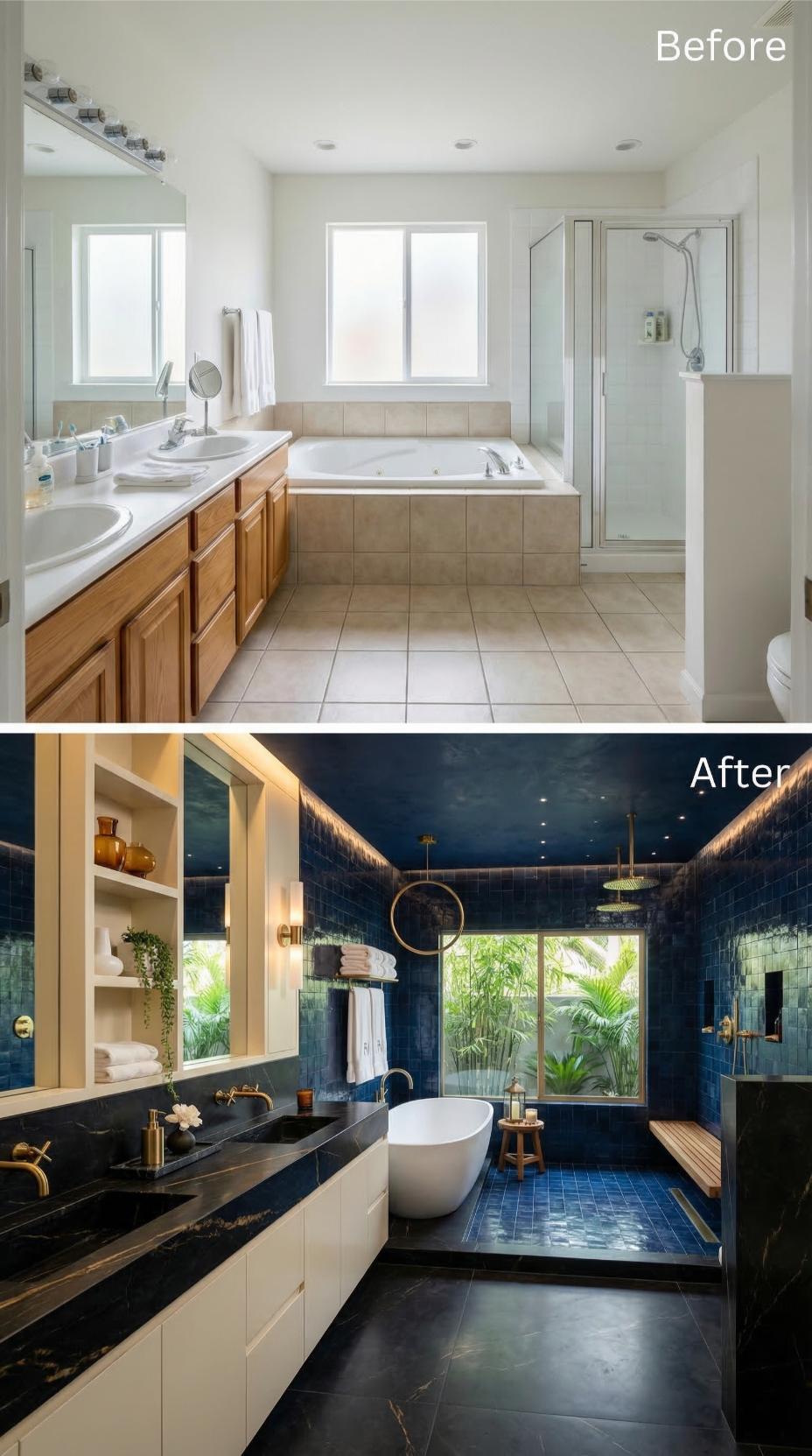
Cobalt Zellige Tile, Brass Rain Heads, and a Freestanding Tub Replace Beige in This Primary Bath
🔥 Would you like to save this?
Cobalt zellige tile runs floor-to-ceiling and across the ceiling plane, paired with a matte black stone vanity top, white flat-front cabinetry, and brushed brass wall sconces and faucets.
In The Details: Zellige tile, hand-formed from Moroccan clay, produces the irregular surface variation visible here — no two tiles reflect light at the same angle, which is what creates that rippled depth across the wall plane. Grout color selection is critical with zellige; a contrasting grout like the dark tone used here reinforces the grid, while a tone-matched grout would make the wall read as a solid color field instead.
Brushed Brass Fixtures and Full-Height Marble Cladding Retire Beige Tile and Oak Cabinetry
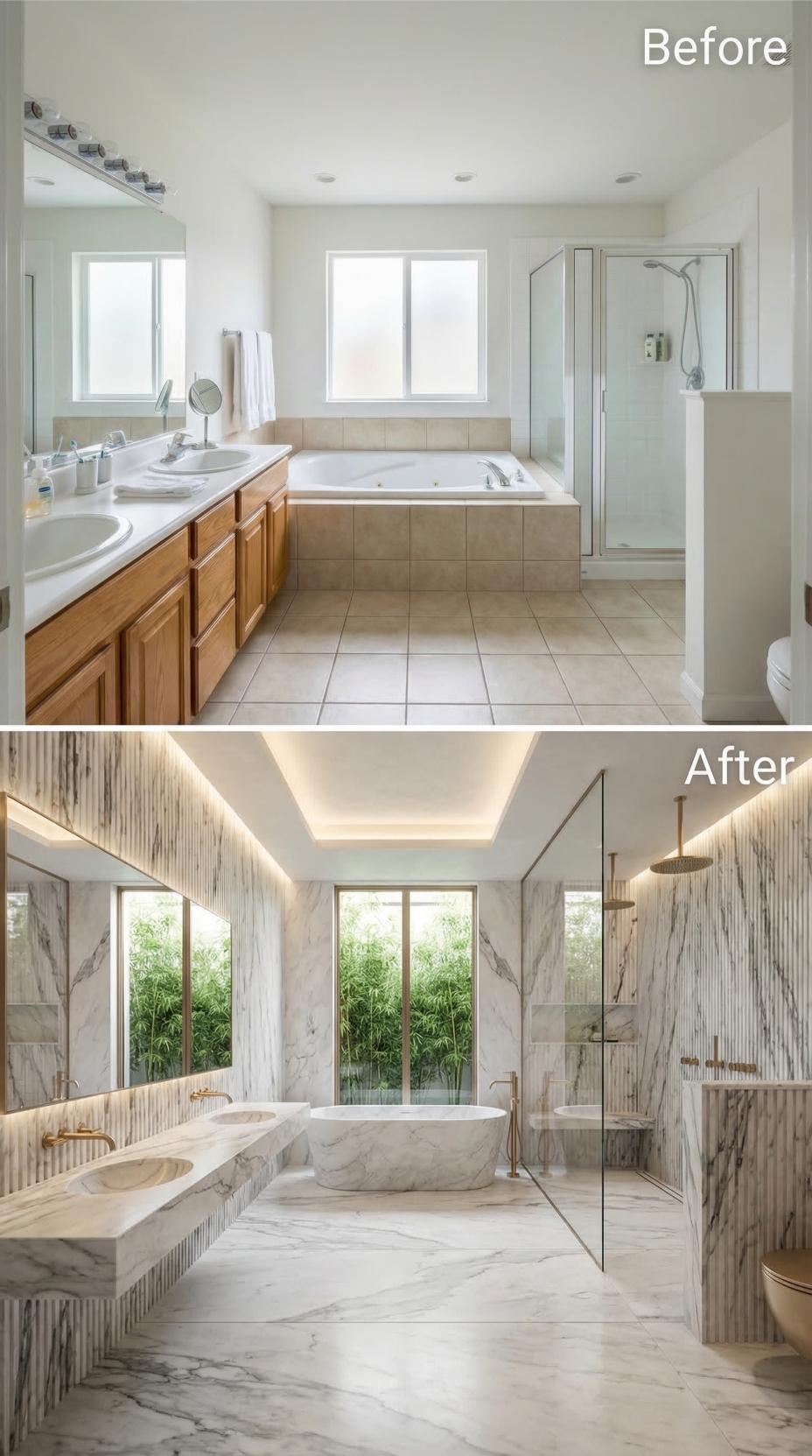
Warm oak vanity cabinets and builder-grade beige tile gave way to floor-to-ceiling white marble with grey veining, a material that runs continuously across floors, walls, and the soaking tub surround. The freestanding tub, carved from the same stone, sits centered beneath the window rather than tucked into a deck. Brushed brass faucets at the floating vanity repeat through the rain shower hardware on the right side of the space.
Fluted stone panels line the lower vanity face and the shower partition wall, adding texture without introducing a second material. A recessed tray ceiling with integrated LED cove lighting wraps the perimeter, replacing what was a flat white ceiling with bare recessed cans.
Style Tip: Repeating one stone variety across every surface, walls, floors, tub deck, and vanity top, rather than mixing materials, creates visual continuity that reads as intentional rather than excessive. The key is selecting a slab with movement in the veining so the repetition stays interesting. Sourcing all pieces from the same quarry lot ensures the patterning stays consistent throughout the room.
Terrazzo makes another appearance here, but the layout strategy couldn’t be more different.
Terrazzo Island Vanity, Cove Lighting, and Brass Fixtures Displace Oak Cabinetry
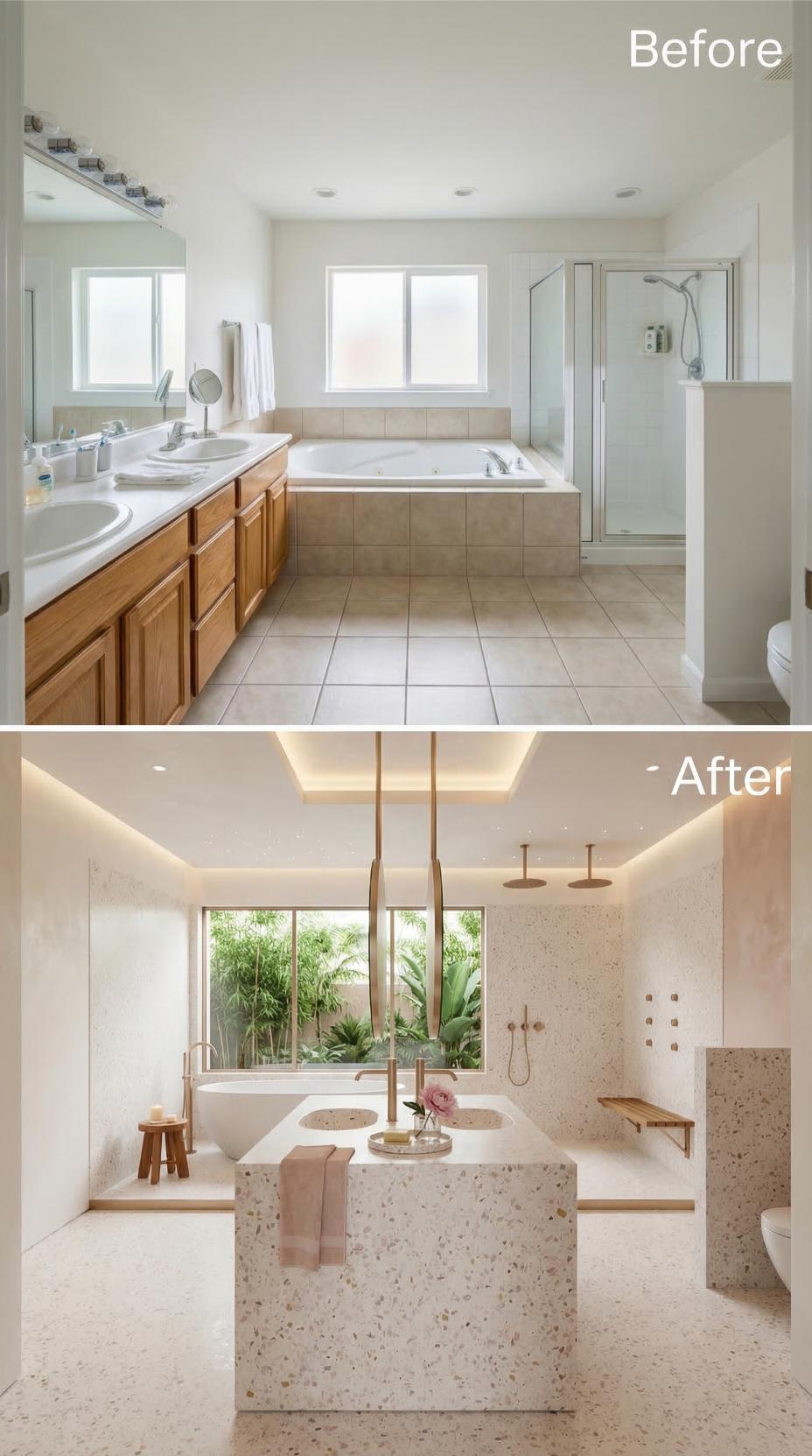
Where honey-toned oak cabinets and a wall-mounted vanity once defined the room, a freestanding terrazzo island now anchors the center, housing two undermount sinks with brushed brass faucets. Warm LED strips trace a tray ceiling detail overhead, replacing the dated theater-bulb strip light entirely. An open-format shower sits to the right with dual ceiling-mount rain heads and a wall-hung teak bench.
Backlit Onyx Ceiling, Green Marble Vanity, and a Clawfoot Tub Displace Oak Cabinetry
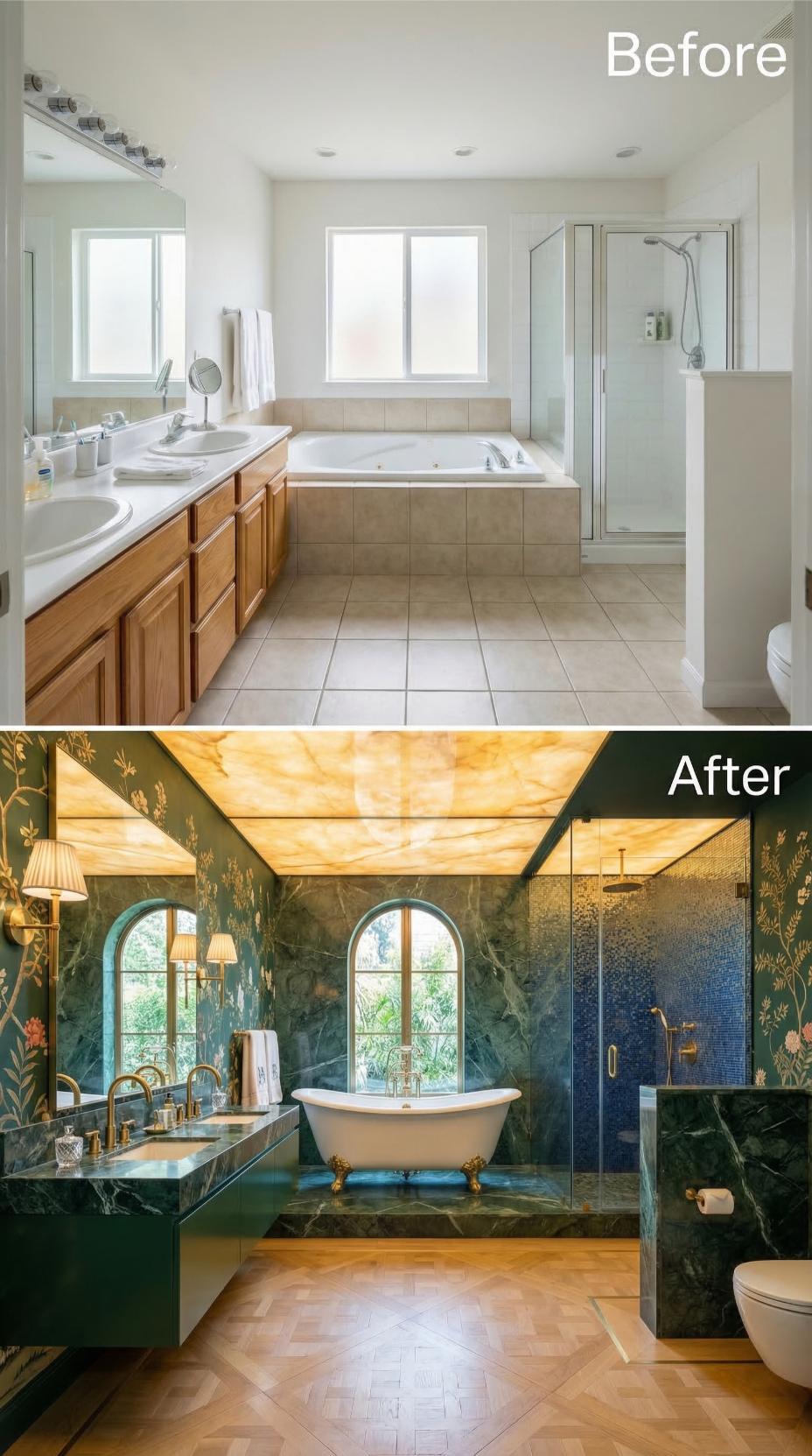
Backlit onyx panels stretch across the entire ceiling, casting amber light that shifts the room’s atmosphere entirely. Botanical wallpaper in deep forest green covers the walls, and the arched window above the freestanding clawfoot tub now reads as an intentional focal point rather than an afterthought. Brass fixtures appear on both the vanity and tub hardware, pulling the metallic warmth from the ceiling down through the space.
The floating vanity is clad in verde marble with pronounced white veining. Blue mosaic tile lines the walk-in shower from floor to ceiling, shifting from deep cobalt at the base to a lighter tone near the top. Herringbone wood flooring runs beneath it all, adding grain texture that offsets the stone surfaces throughout.
Common Mistake: Backlit ceiling panels made from natural onyx or translucent stone require a steel subframe and low-heat LED backing to prevent thermal cracking over time. Many homeowners skip the engineering phase and apply standard drywall framing, which leads to panel separation within two to three years. Consulting a stone fabricator before finalizing the ceiling structure saves significant repair costs later.
Terrazzo Floors, Warm Paint Blocking, and Gold Pendants Displace Oak Cabinetry and Beige Tile
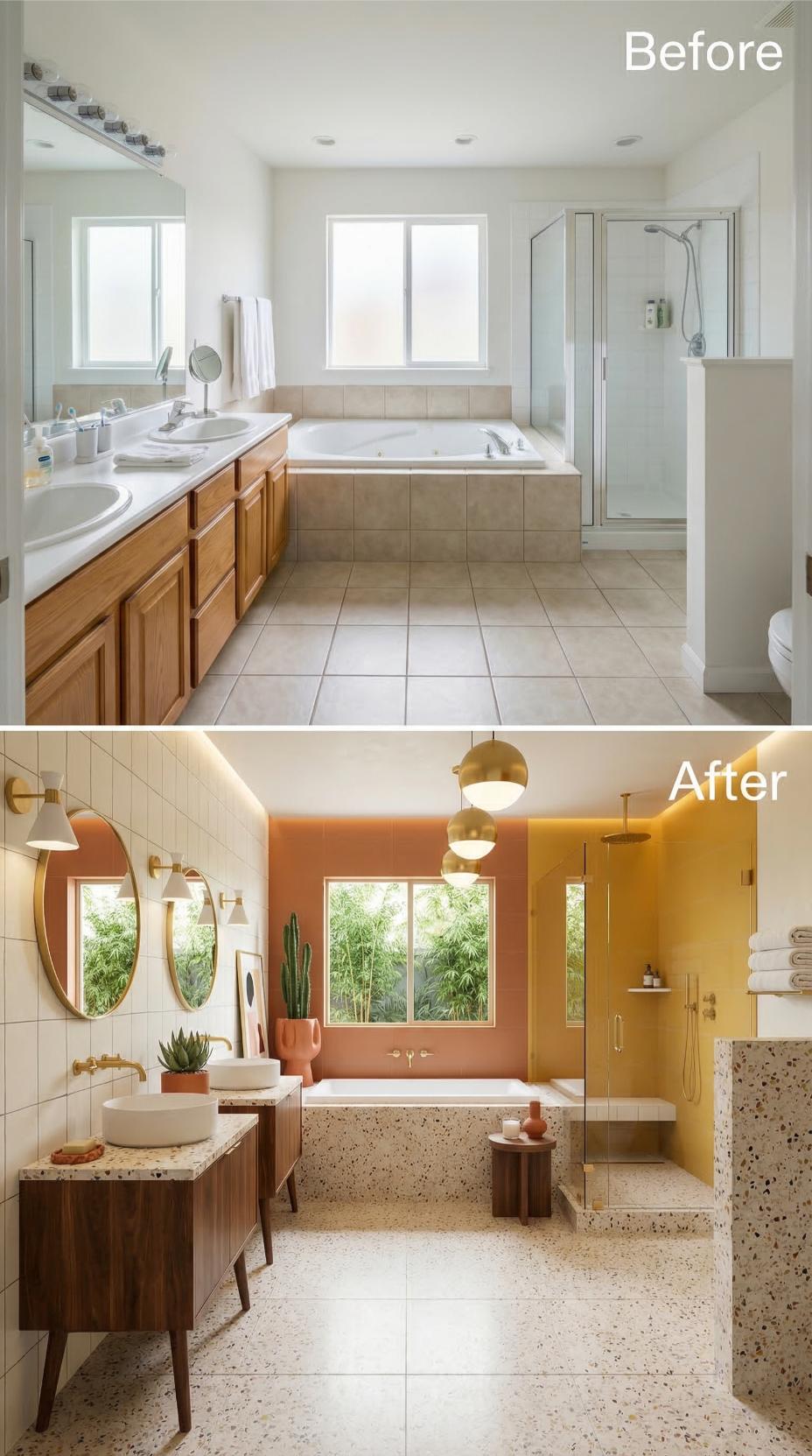
Walnut mid-century cabinetry on tapered legs replaces the builder-grade oak, topped with a terrazzo slab and paired with round vessel sinks in matte white. Salmon-painted walls meet white square tile at a deliberate horizontal break, while a mustard yellow ceiling carries through the shower zone. Brushed gold wall-mount faucets, oval mirrors, and two globe pendants handle every metallic moment in the room.
Terrazzo Used Across Three Surfaces Creates Material Continuity Without Monotony
Terrazzo appears on the floor, vanity countertop, and shower partition wall here, but each application uses a slightly different aggregate scale, which prevents the repetition from reading as flat or accidental. Specifying the same base resin color across all three surfaces while varying chip size is a deliberate technique designers use to tie a room together without making it feel like a single material was simply tiled wall to wall. For homeowners considering terrazzo, sourcing all three surfaces from one fabricator increases the likelihood of color consistency across batches.
Black Marble Slab Walls and Polished Concrete Floors Retire Oak Cabinetry and Beige Tile
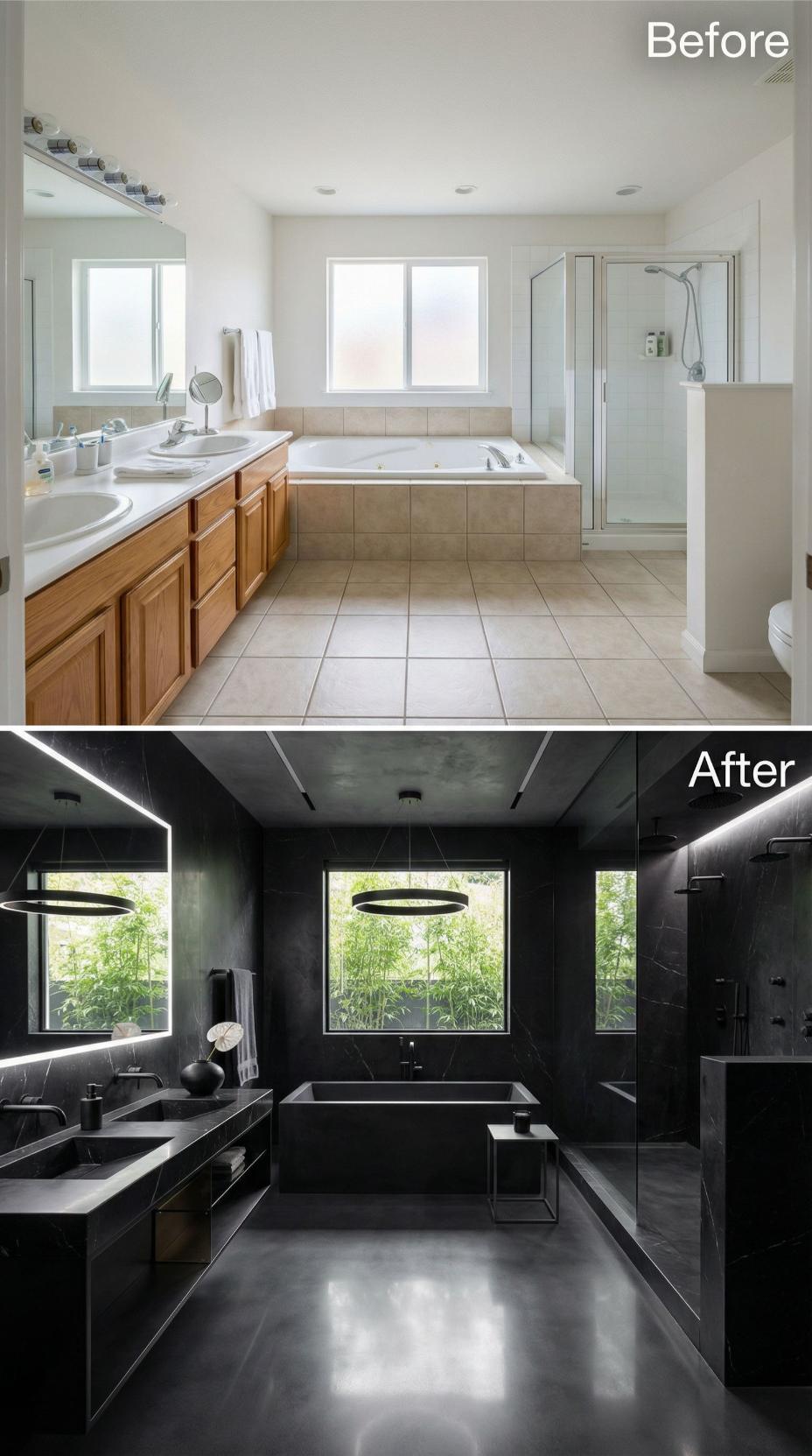
Nero Marquina marble, identifiable by its white veining on a near-black field, covers every vertical surface from floor to ceiling, replacing the honey-oak vanity and large-format beige tile that defined the original space. A rectangular soaking tub sits flush against the window wall, finished in the same stone as its surround, while a circular matte-black pendant anchors the center of the room. The double vanity runs the full length of the left wall, with integrated stone sinks and wall-mount matte-black faucets that keep the counter plane uninterrupted. Polished concrete floors reflect the LED strip lighting tucked into the ceiling perimeter, adding depth without additional fixtures.
- Matte-black fixtures read as a single consistent finish across faucets, shower heads, and pendant hardware, avoiding the visual noise of mixed metals
- Polished concrete outperforms tile in a monochromatic dark scheme because its reflectivity adds light without introducing a second color
- Wall-mount faucets set into marble rather than the countertop require in-wall rough-in during framing, making them a decision to lock in before drywall
Freestanding Tub, Marble Slab Shower, and LED Toe-Kick Lighting Retire Oak and Beige Tile
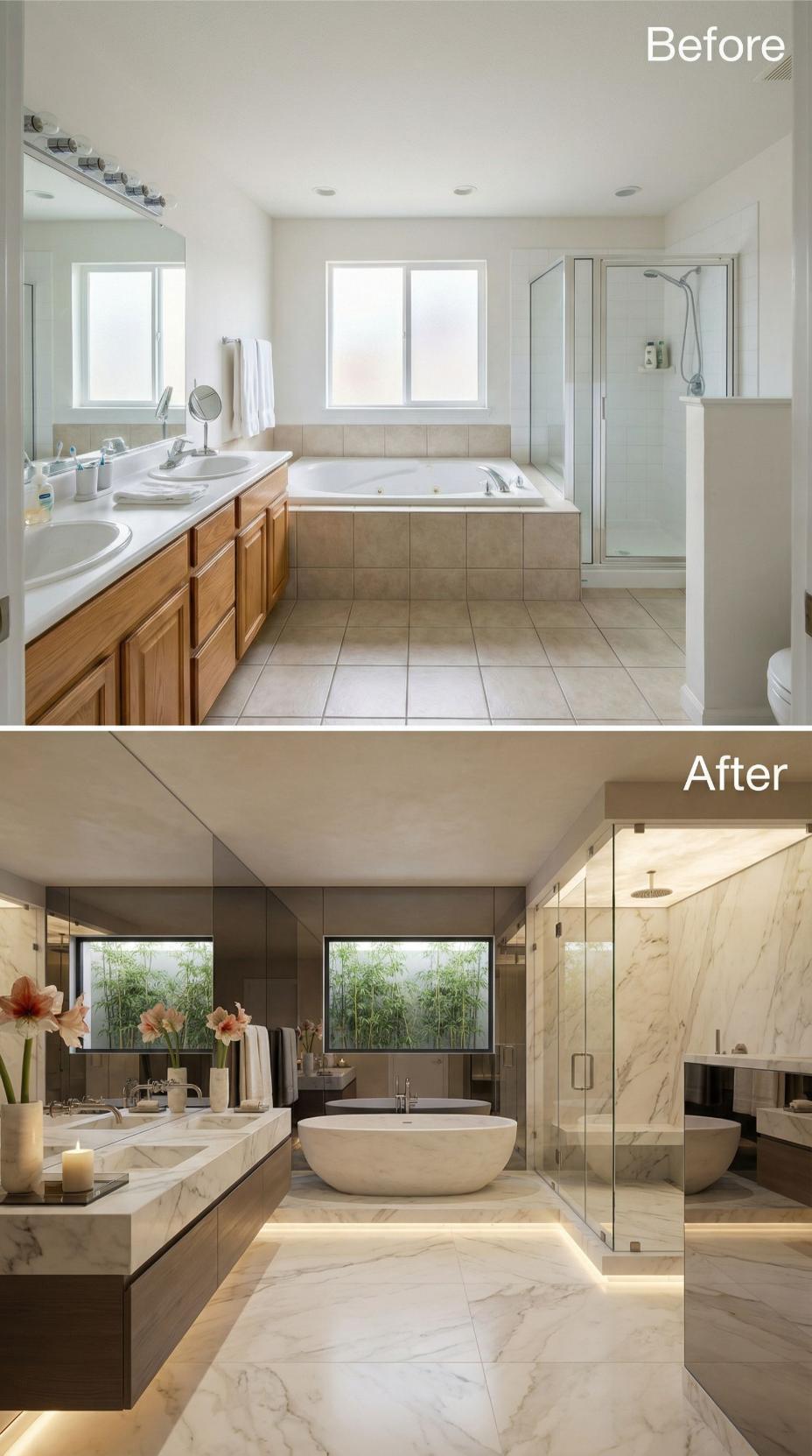
Oak cabinetry and beige ceramic tile set a low ceiling on what this primary bath could ever become.
The after version replaces both with a floating dark vanity topped in white marble with pronounced grey veining, its base lit by a continuous warm LED strip at floor level. A freestanding oval soaking tub sits centered beneath a horizontal window framing bamboo plantings outside. Fresh flowers and a pillar candle on the vanity counter add organic texture without demanding attention.
The walk-in shower is enclosed in frameless glass and clad floor to ceiling in large-format marble slab panels, with a ceiling-mounted rain head as the only fixture. Marble runs continuously from the shower walls onto the main floor, which sharpens the sense of scale. The dark wall panels flanking the vanity mirror create depth that flat white drywall never could.
Dark Mineral Walls and a Hinoki Soaking Tub Displace Beige Tile and Oak Cabinetry
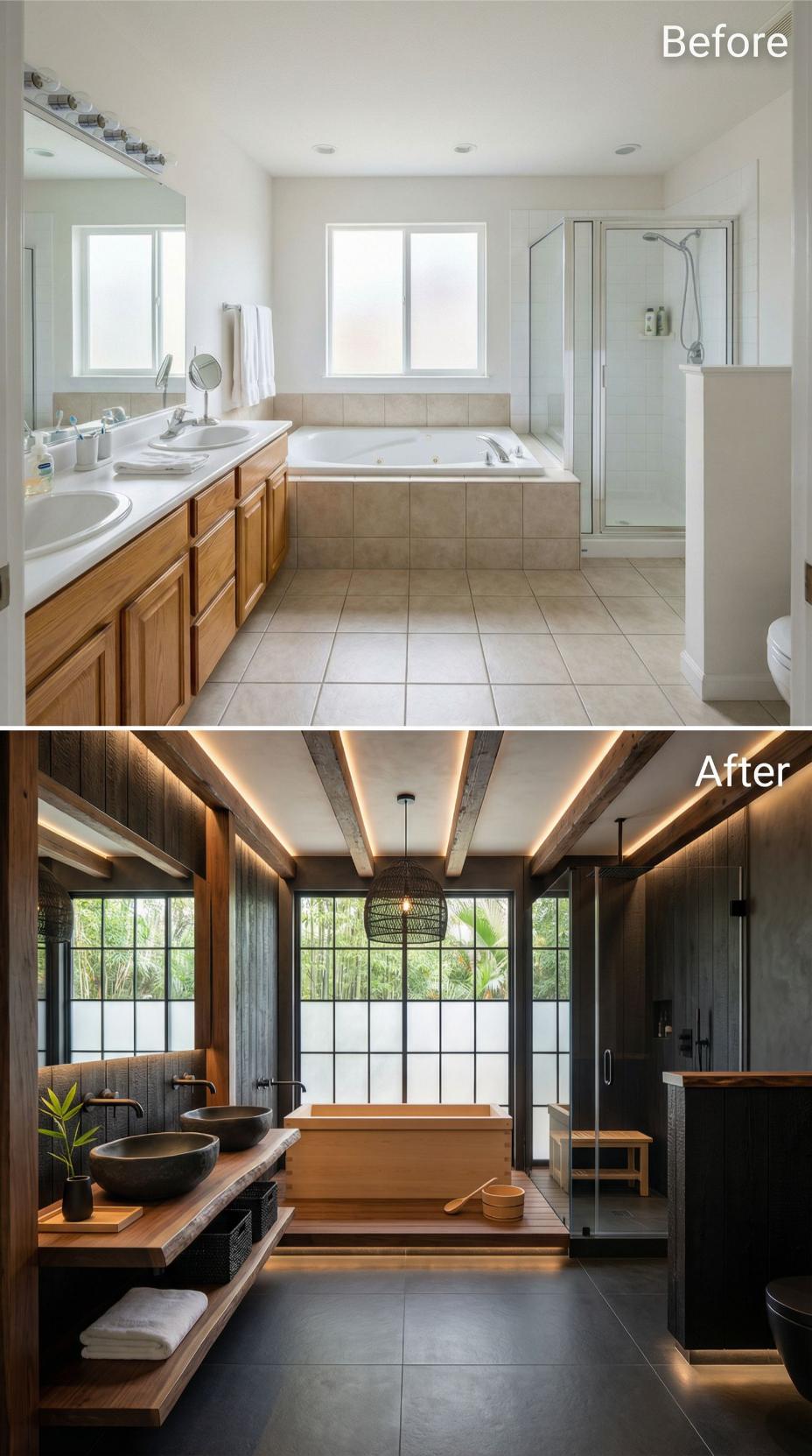
Rough-sawn wood planks cover every wall in a deep charcoal finish, while large-format slate-gray porcelain tiles replace the original beige floor. Two stone vessel sinks sit on a live-edge walnut floating shelf, paired with matte black gooseneck faucets. At the center, a square hinoki wood soaking tub occupies a raised cedar platform, flanked by a small wooden bucket and bench. Warm LED strip lighting runs along recessed ceiling coffers between exposed timber beams, with a woven rattan pendant anchoring the middle of the room. Steel-framed grid windows flood the space with daylight while maintaining privacy through frosted lower panes.
Material Matters: Hinoki cypress, the wood used for the soaking tub here, is a species native to Japan prized for its natural oils that resist water absorption and inhibit mold growth without sealing or finishing. A properly maintained hinoki tub can last decades, but it requires draining completely after each use and occasional light sanding to prevent surface darkening. Budget approximately 3,000 to 6,000 dollars for an imported hinoki ofuro tub before factoring in the platform framing and waterproof subfloor it demands.
Exposed Steel Beams, Brick Accent Wall, and Marble Slabs Replace Beige Tile and Oak Cabinetry
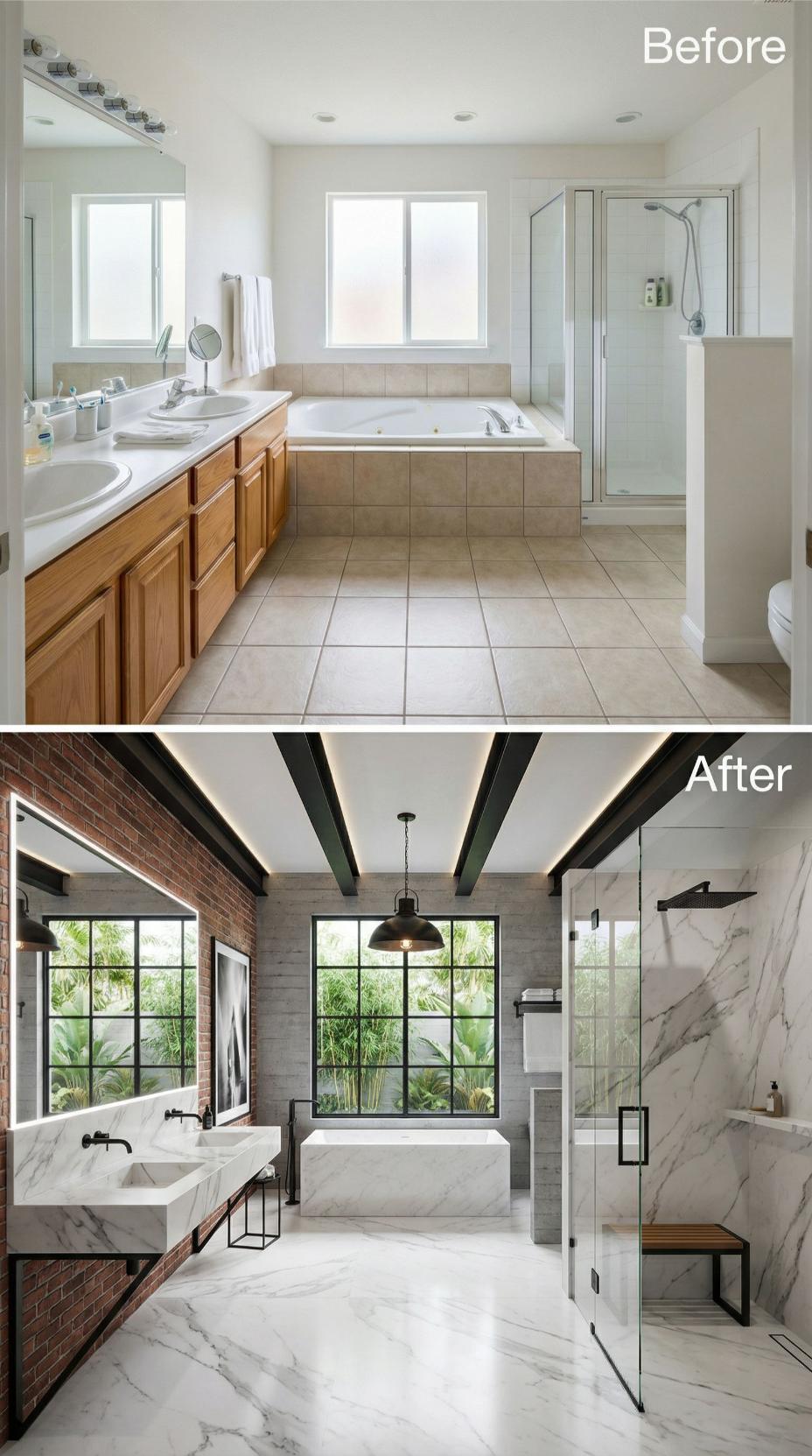
Dark-stained exposed ceiling beams divide a cove-lit tray ceiling above a floor-to-ceiling marble freestanding tub surround and matching Calacatta-style marble floors. Matte black wall-mount faucets feed a rectangular trough sink set into a cantilevered marble vanity supported by black steel legs. Steel-framed grid windows anchor the back wall, and a red brick side wall grounds the otherwise pale stone palette.
Arched Windows, Organic Plaster Curves, and Rose Gold Fixtures Replace Oak and Beige Tile
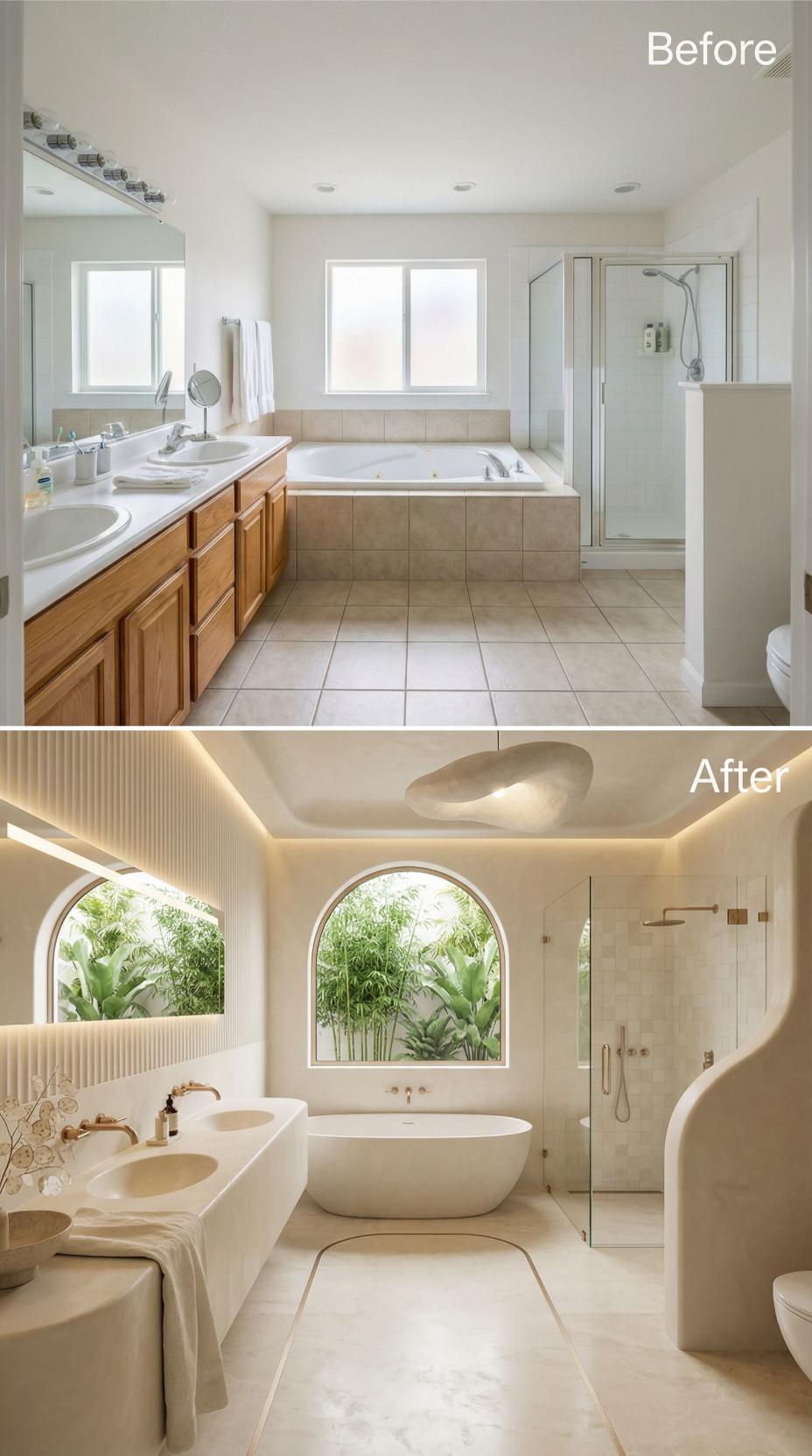
Oak cabinetry and builder-grade beige tile gave way to a monolithic plaster vanity in warm ivory, wall-to-wall ribbed paneling, and a freestanding soaking tub centered beneath two arched windows. The windows frame a dense bamboo garden, bringing in filtered green without any added decor. Cove lighting runs the full ceiling perimeter, and a sculptural plaster cloud detail anchors the ceiling above the tub.
Rose gold fixtures appear at both the vanity wall mounts and the shower controls, keeping the metal palette consistent across every wet zone. The walk-in shower retains a glass enclosure but swaps chrome hardware for brushed bronze. Floors are large-format stone tile in a warm greige, laid without borders to let the room read as one continuous surface.
Moroccan Lantern, Barrel-Vaulted Arches, and Warm Plaster Walls Retire Beige Tile and Oak Cabinetry
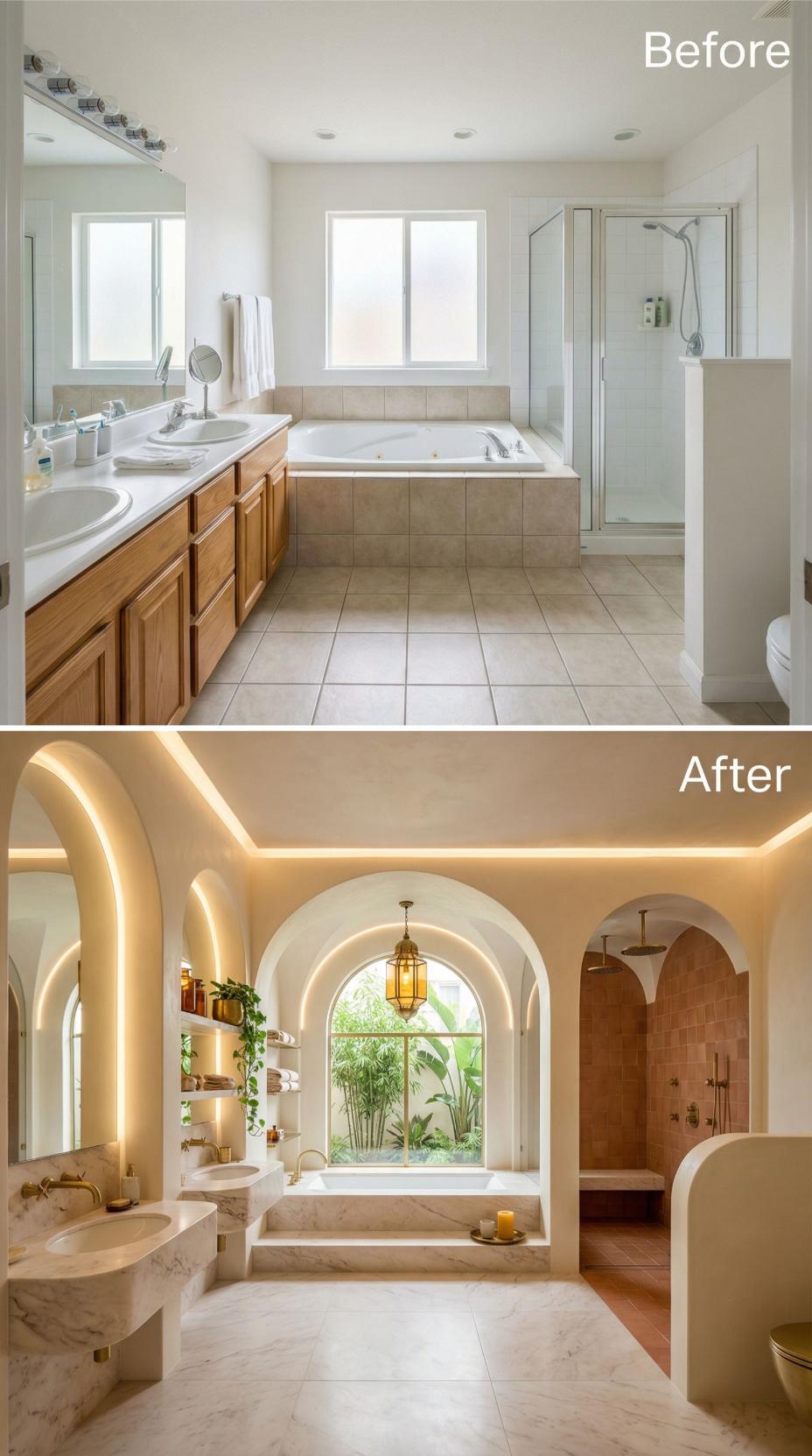
Lime plaster arches frame both the window niche and the walk-in shower entry, while cove LED strips cast amber light across travertine floors and marble tub surround, giving the room a glow that no overhead fixture could replicate.
Gold-Framed Glass and Marble Finishes Elevate the Room
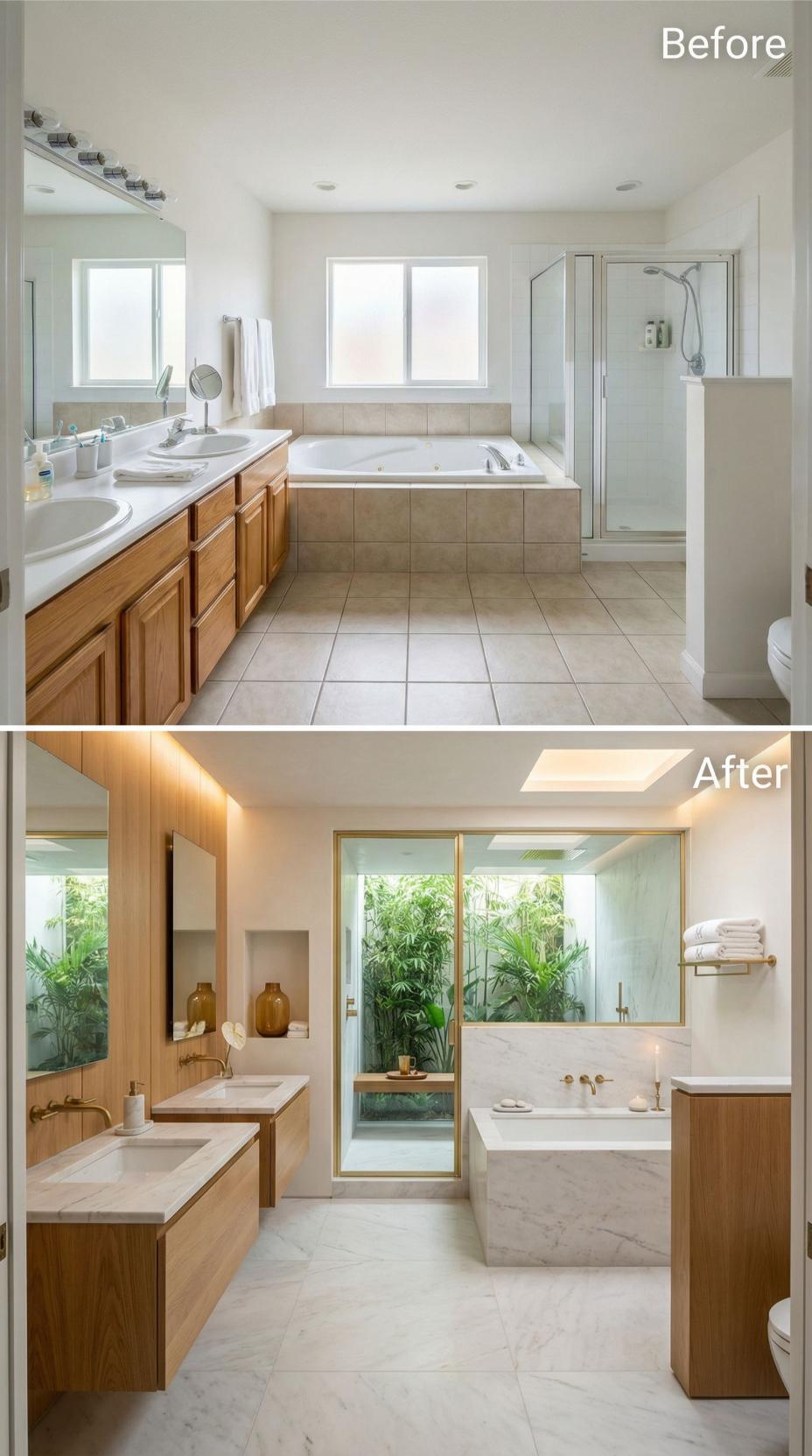
Rift-cut oak cabinetry with an integrated marble countertop anchors the vanity, while brass wall-mount faucets and a large gold-framed glazed opening draw the eye toward the lush tropical plantings visible at the back of the room.
Slatted Ceilings and Travertine Walls Wrap This Bath in Warmth
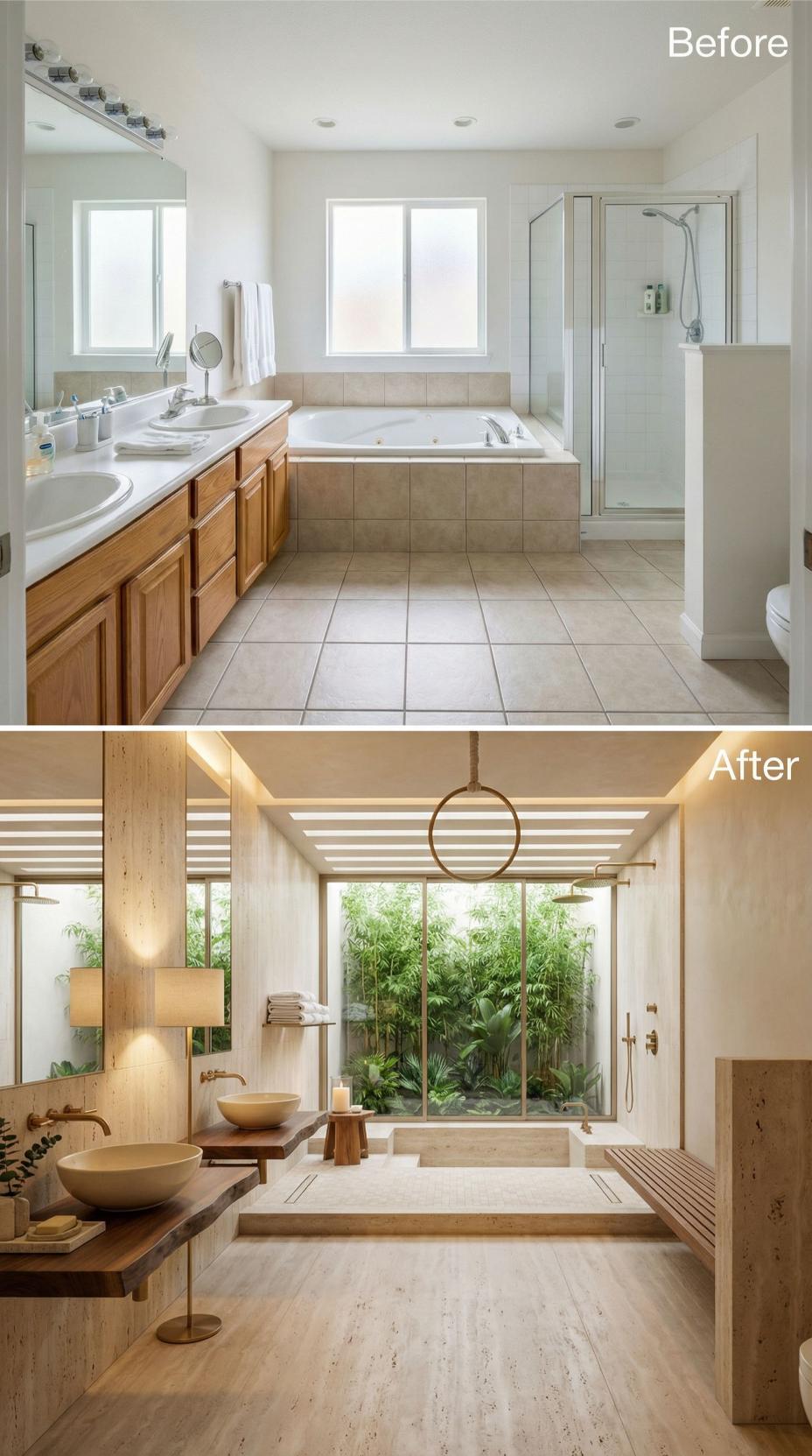
🔥 Would you like to save this?
Thick walnut-toned wood counters carry buff travertine vessel sinks, paired with brushed brass wall-mount faucets. Recessed linear LED strips run in parallel across the ceiling, casting warm horizontal bands of light that replace the dated Hollywood-style vanity bar from the original layout. A circular brass ring pendant hangs near the tub area, which is clad in the same travertine as the walls.
Floor-to-ceiling glass opens onto a planted courtyard, pulling greenery into the sightline from nearly every position in the room. A teak bench sits at the far right, and a brass shower fixture occupies the far corner. Nearly every surface stays within the same warm stone palette, giving the room a highly unified look.
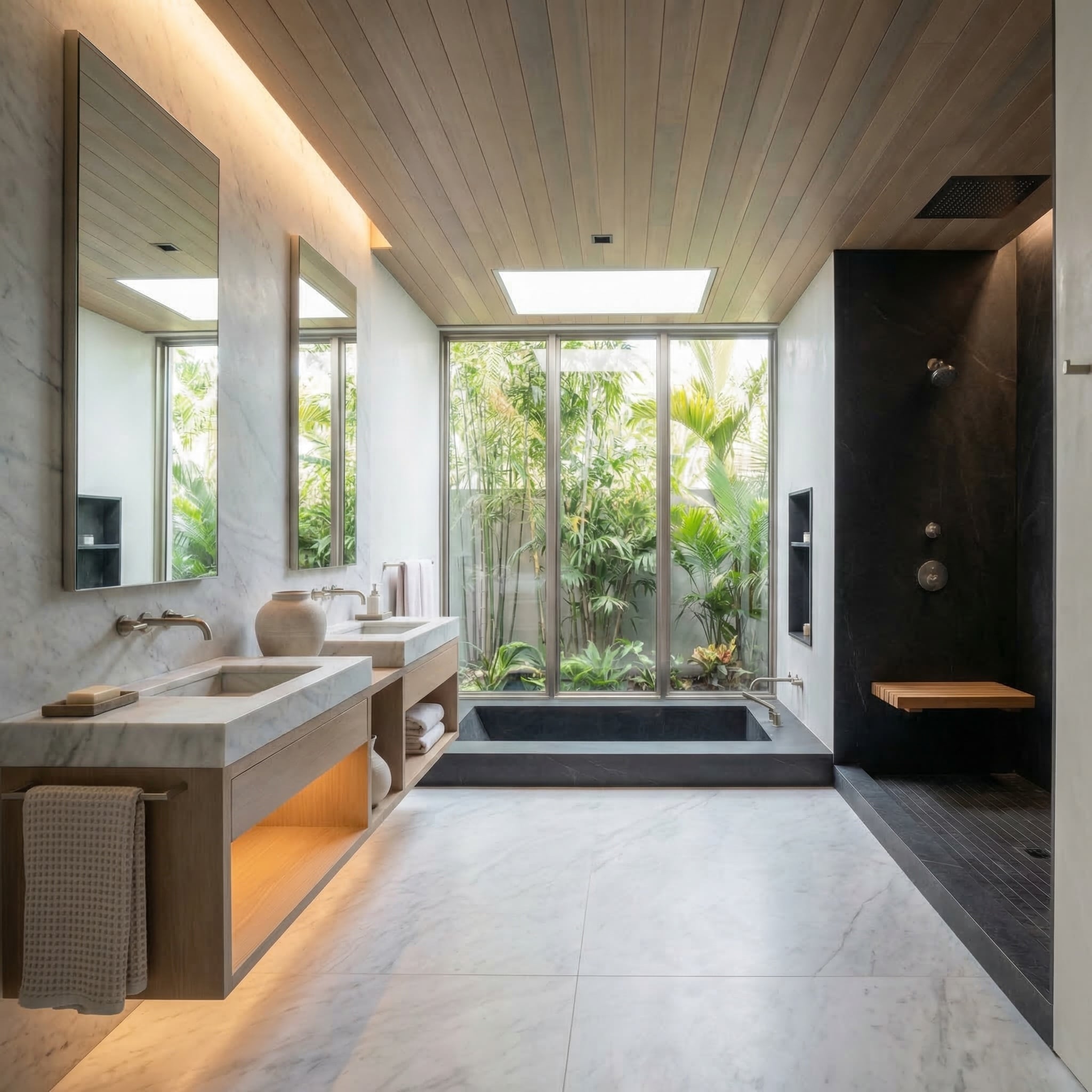
Wood-Slat Ceiling, Marble Vanity Slab, and Floor-to-Ceiling Garden Windows Replace Beige Tile
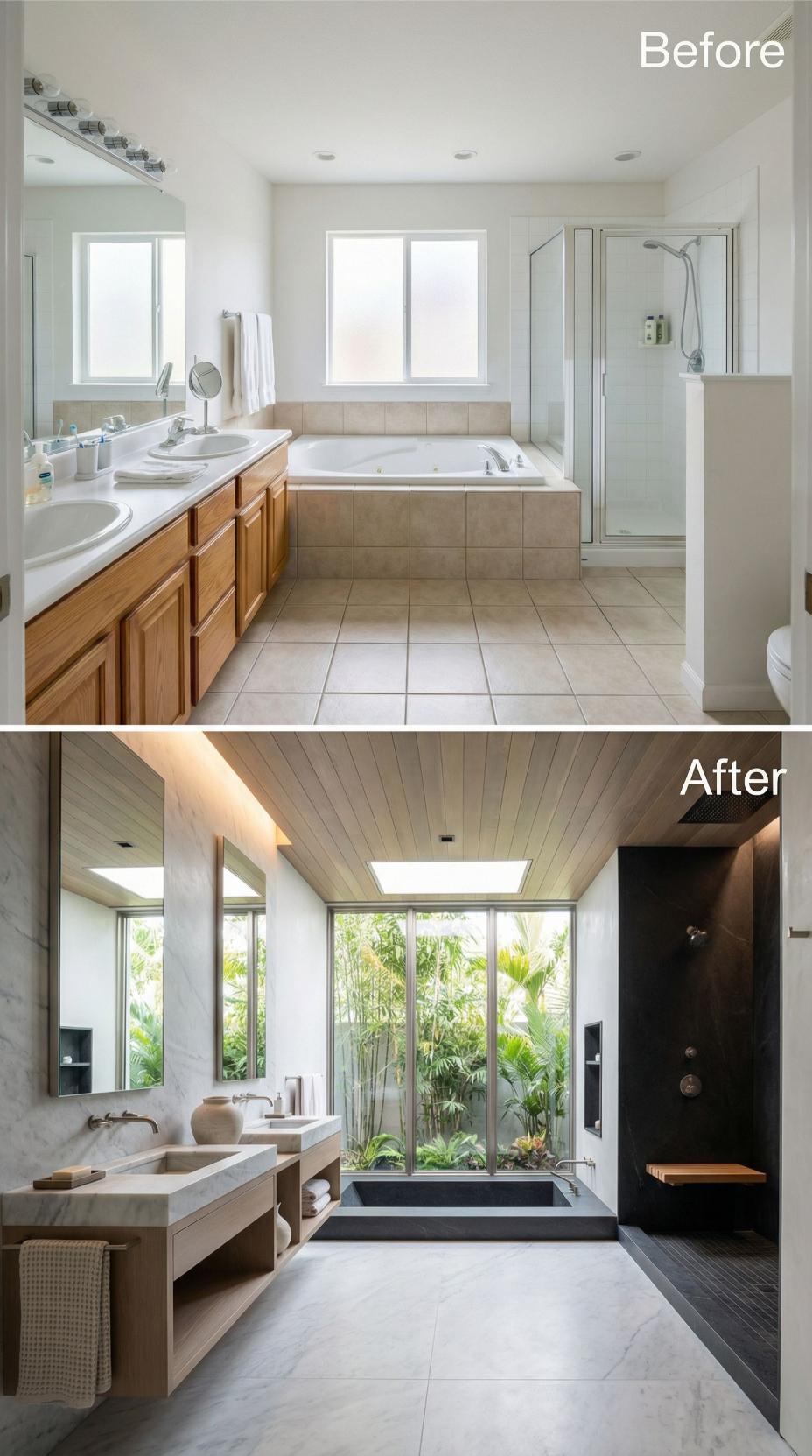
White oak floating vanity cabinetry with open lower shelving supports a thick honed marble countertop holding two rectangular stone vessel sinks with wall-mounted brass faucets. Vertical wood slat ceiling planks run the full length of the room, flanked by two flush skylights. Floor-to-ceiling glazing at the far wall frames a dense bamboo and palm garden, replacing the single standard window above the old drop-in tub. That tub position now holds a recessed dark slate soaking tub at floor level. A black slate wet-room shower occupies the far right, fitted with a teak bench and multi-port body spray hardware in a brushed nickel finish.
Calacatta Viola Marble, a Clawfoot Tub, and Brass Vessel Sinks Displace Beige Tile and Oak Cabinetry
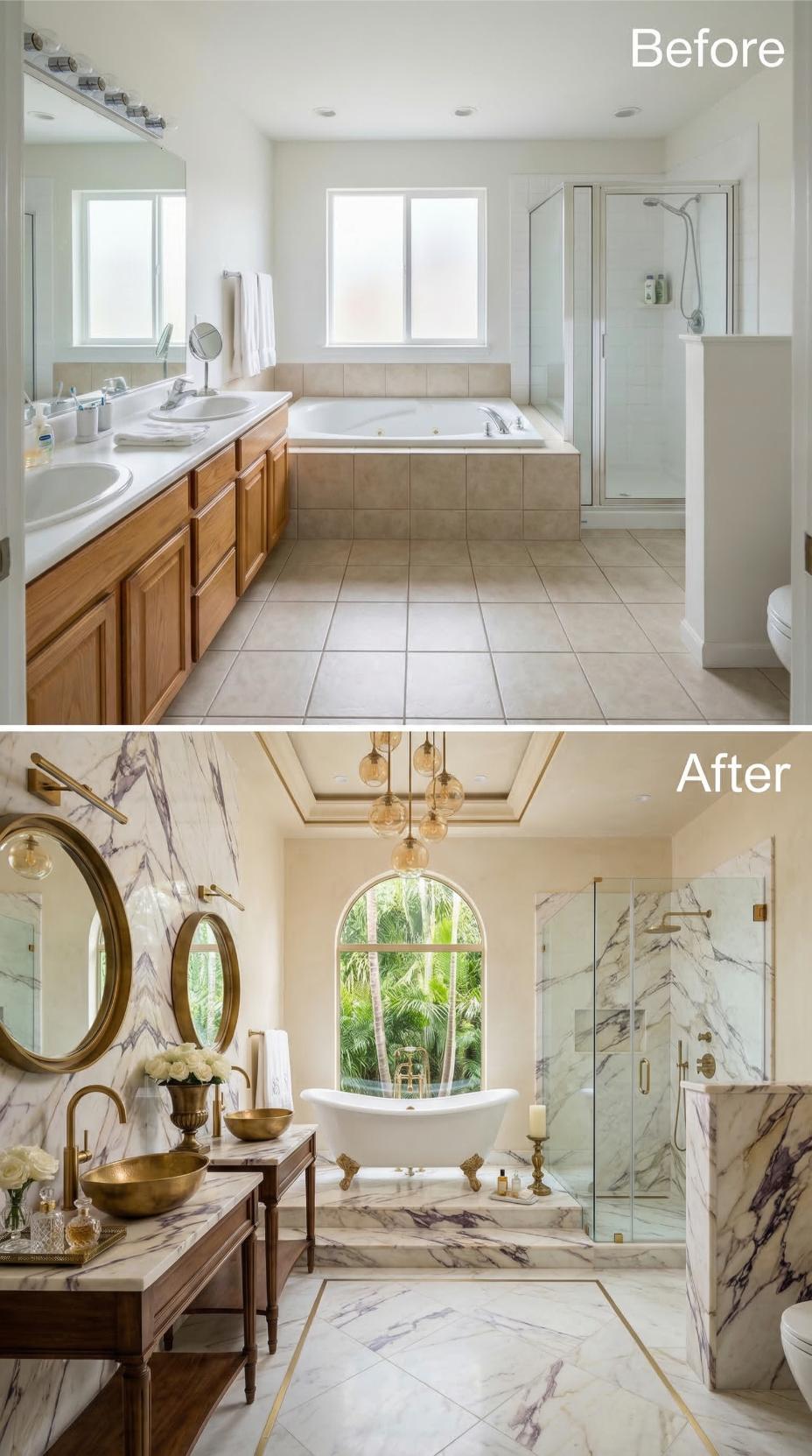
Calacatta Viola marble, identifiable by its purple-grey veining on a cream field, covers every major surface here: floor, shower enclosure, tub platform, and vanity top. A freestanding clawfoot tub sits centered beneath an arched window framing tropical palms, replacing what was a dropped jetted tub surrounded by beige ceramic tile. Brass vessel sinks and gooseneck faucets anchor the dark walnut open vanity, while gold oval mirrors and sconce arms repeat the warm metal tone across the wall.
A coffered ceiling with crown molding detail adds architectural height the original flat ceiling lacked. Amber glass pendant clusters hang from the coffer center, casting warm pooled light over the tub rather than the flat wash produced by the original bar fixture. Gold inlay strips set flush into the marble floor define the tub zone without introducing a competing material.
Oval Mirror, Chandelier Pendant, and Chevron Marble Floors Replace Beige Tile and Oak Cabinetry
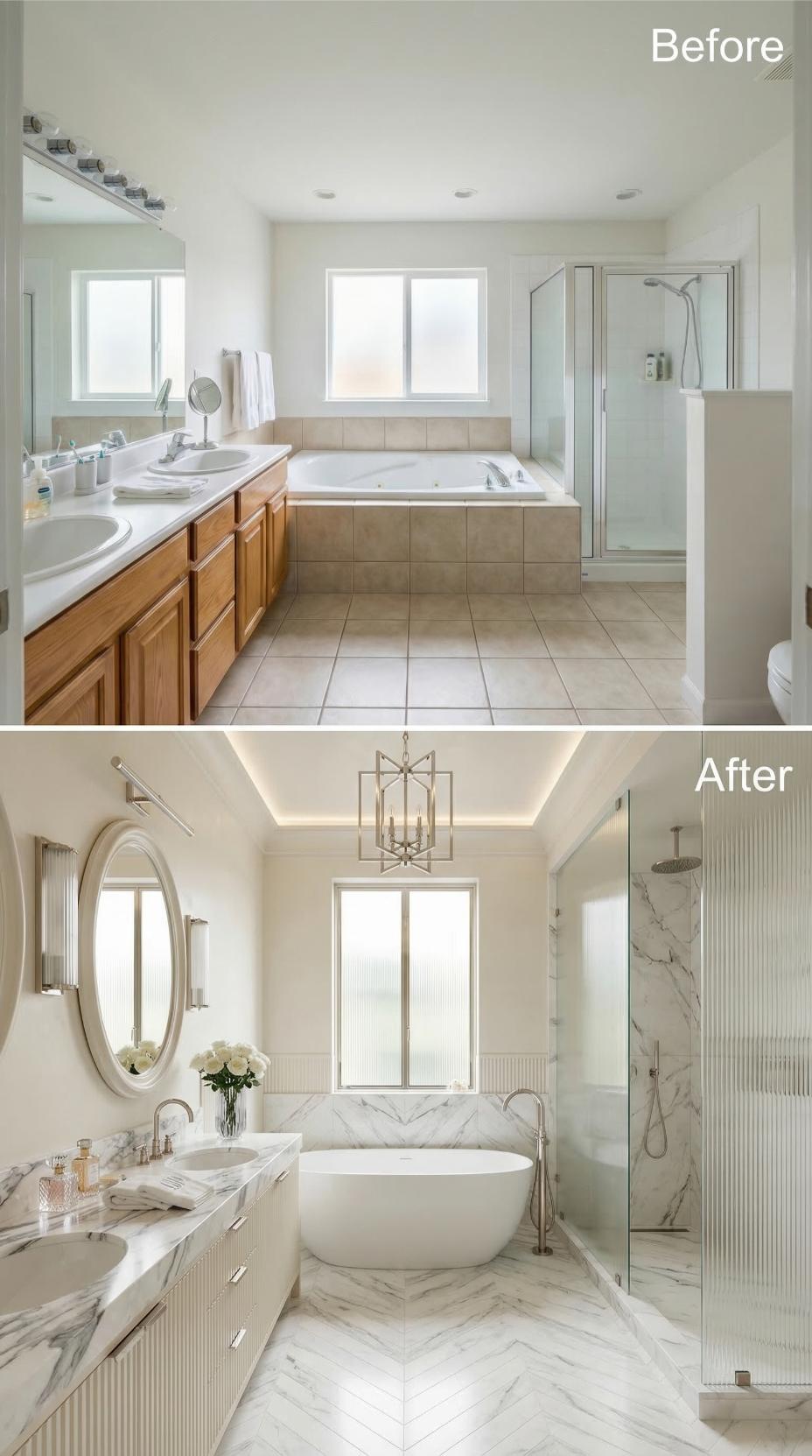
Warm-toned oak vanity cabinets and builder-grade beige tile give way to fluted white cabinetry with brushed nickel pulls, a Calacatta marble countertop, and a freestanding oval soaking tub backed by a full marble slab wall with dramatic book-matched veining. The ceiling gains a tray detail with recessed cove lighting, and a nickel lantern pendant hangs centered over the tub. Reeded glass panels enclose the walk-in shower, where a rain head sits above marble-clad walls.
Underfoot, large-format marble tile is laid in a chevron pattern, adding directional movement without introducing a second material. An oval mirror with a molded white frame and flanking sconce arms replaces the original strip-lit horizontal mirror.