🔥 Would you like to save this?
Few architectural salvage projects carry as much weight as converting a derelict Gothic church into private living space, and the bathroom is where that tension becomes most visible. The nave, with its soaring vaulted ceilings and fractured stonework, is not an obvious candidate for a wet room or a freestanding tub. Yet designers keep returning to these spaces precisely because the bones are so strong. The crumbling tracery, the remnants of stained glass, the sheer vertical scale — these are not obstacles to work around. They are the whole point. The before states here are genuinely extreme. These are not dated tile jobs or worn fixtures in need of a refresh. These are buildings with collapsed roofing, moss-covered walls, and structural damage accumulated over centuries of neglect. What follows documents 32 projects that took those conditions seriously, working with original Gothic architecture rather than erasing it, and produced bathrooms that feel nothing like the residential norm.
In order to come up with the very specific design ideas, we create most designs with the assistance of state-of-the-art AI interior design software. Also, assume links that take you off the site are affiliate links such as links to Amazon. this means we may earn a commission if you buy something.
Gothic Nave Ruins Converted Into a Marble Bathroom With Vaulted Ceilings
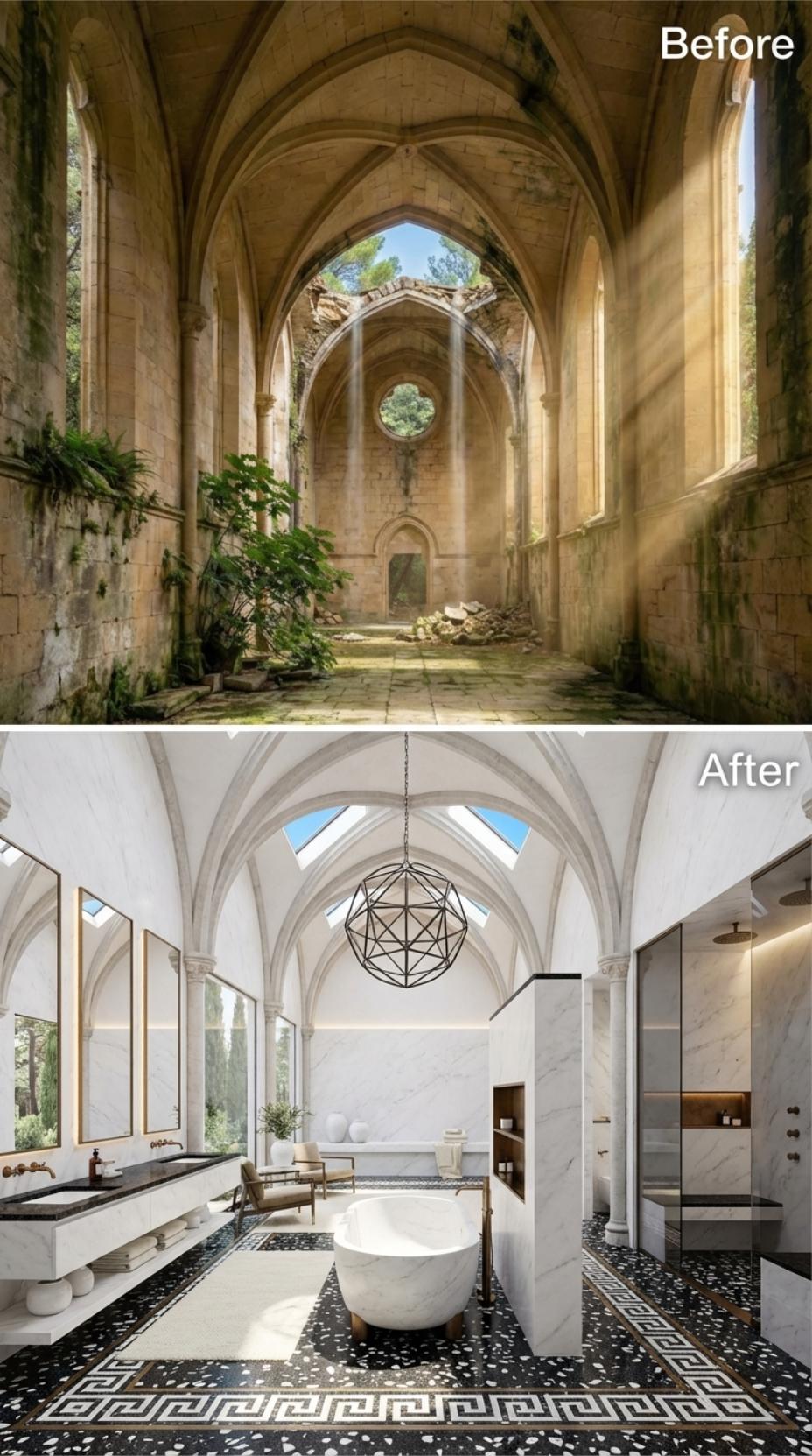
What was once a derelict Gothic nave, its stone arches crumbling and ferns colonizing the floor, has been rebuilt as a full-scale luxury bathroom. The original ribbed vaulting was restored and painted white, and skylights were cut directly into the ceiling plane to flood the space with natural light. A freestanding marble soaking tub anchors the center of the room on a terrazzo floor bordered by a Greek key inlay in black and white.
Flanking the tub on the left, a double vanity runs the length of the wall with a dark stone countertop, brass faucets, and gold-framed mirrors. On the right, an enclosed shower features marble wall panels and a recessed shelving niche with warm wood backing. A geometric black metal pendant hangs from the vault’s apex, its faceted globe form echoing the pointed arches below.
Crumbling Stone Nave Reborn as a Freestanding Tub Sanctuary With Gothic Vaulting
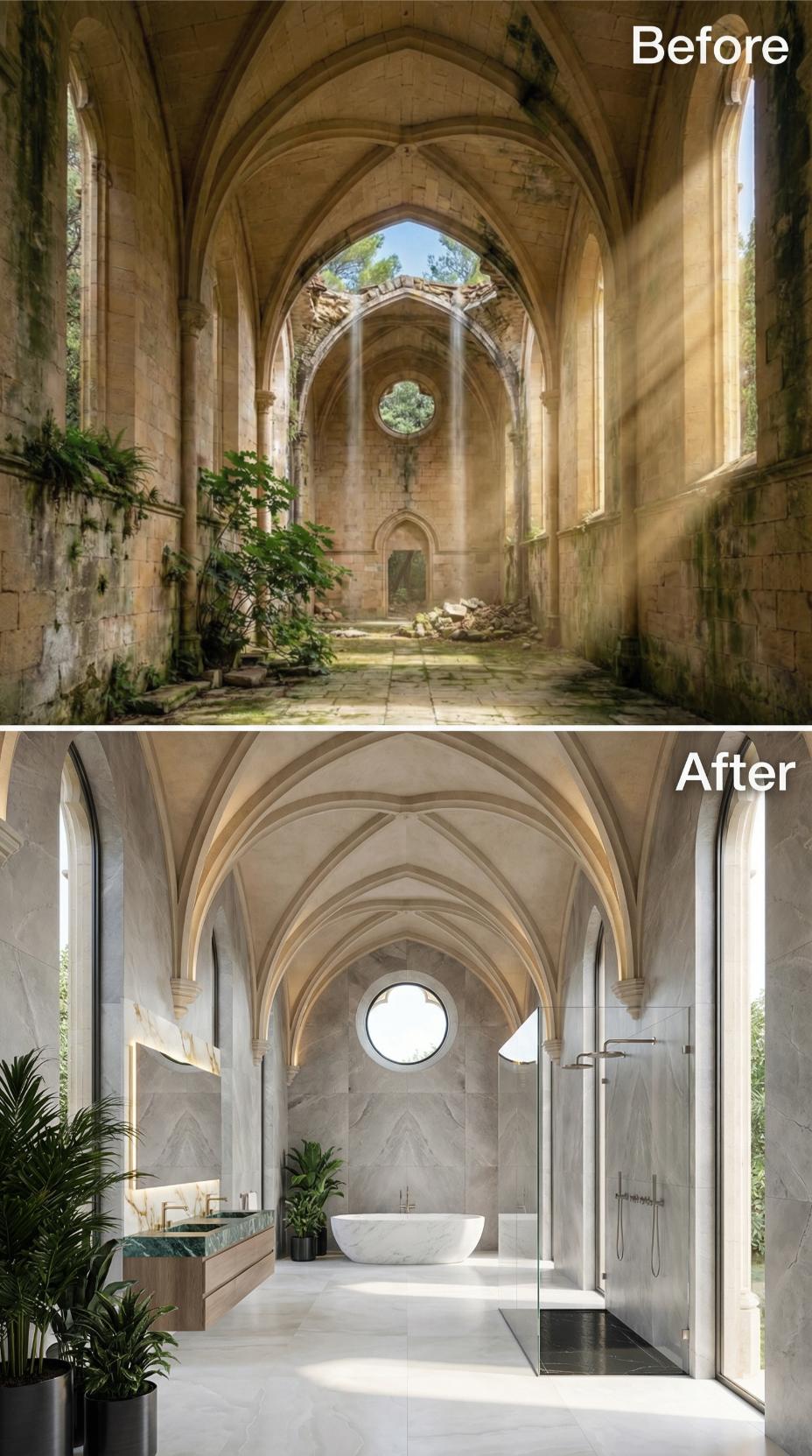
Ribbed vaulted ceilings in pale limestone anchor the space while large-format marble wall tiles in cool grey run floor to ceiling. A freestanding oval soaker tub sits centered beneath the original rose window, flanked by a frameless glass shower enclosure with brushed nickel rain heads and a floating double vanity in warm oak with verde marble countertops.
Collapsed Gothic Nave Rebuilt as a Copper Tub Bathroom With Marble Floors
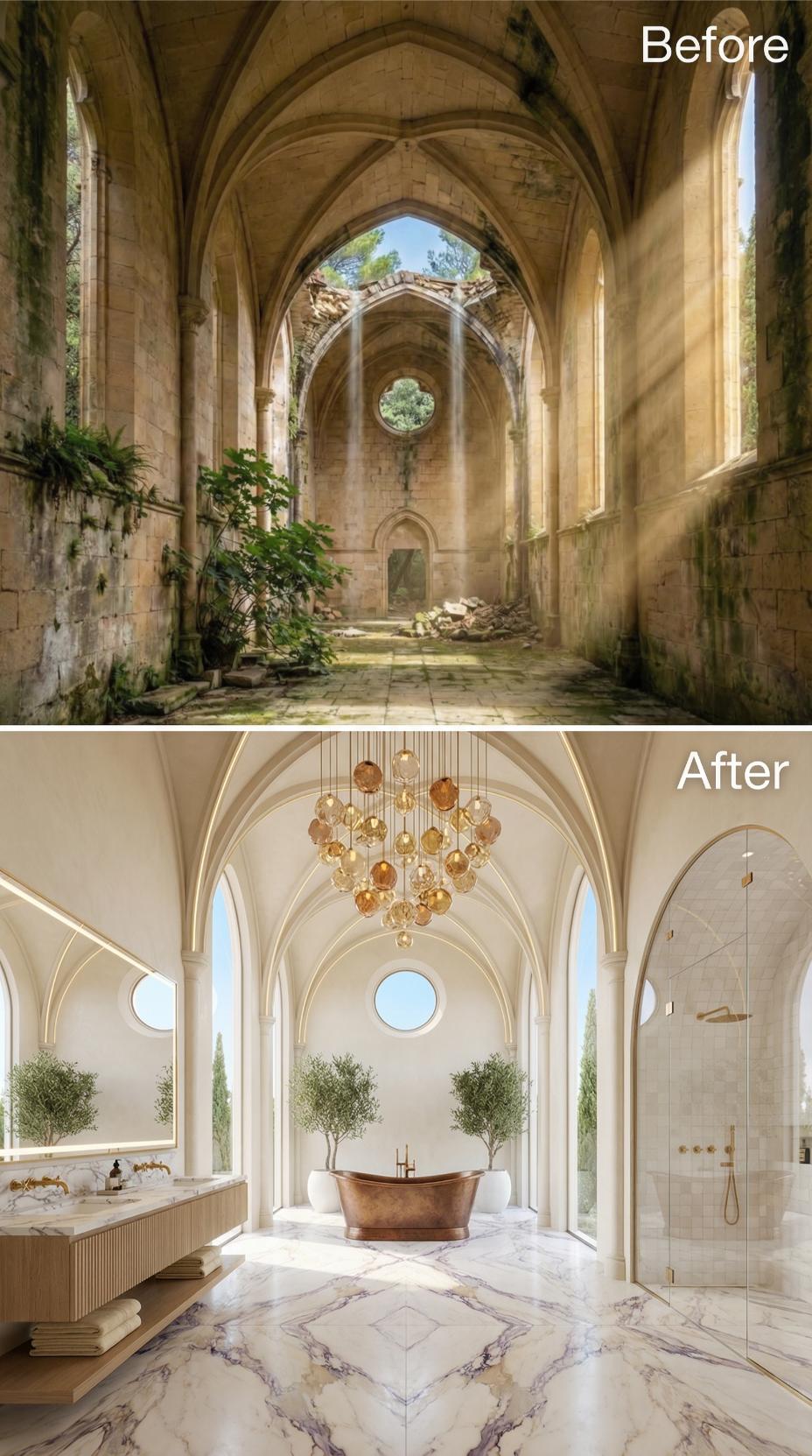
Pointed arches and a round oculus window anchored the original nave’s skeletal stone walls, and both survive into the renovation with their proportions intact. The vaulted ceiling now reads in smooth plaster with brass-edged trim, while a cluster of amber glass globe pendants hangs at the center on thin brass rods, replacing centuries of open sky.
Calacatta marble tiles cover the floor in a diamond-inset pattern, their grey-violet veining pulling warmth from the copper soaking tub positioned directly below the oculus. Fluted oak cabinetry runs along the left wall beneath a backlit mirror, paired with a marble slab countertop and brass fixtures. A frameless glass shower enclosure occupies the right side, and two potted olive trees flank the tub in terracotta containers.
Overgrown Gothic Nave Stripped Back to Onyx Tub and Veined Marble Walls
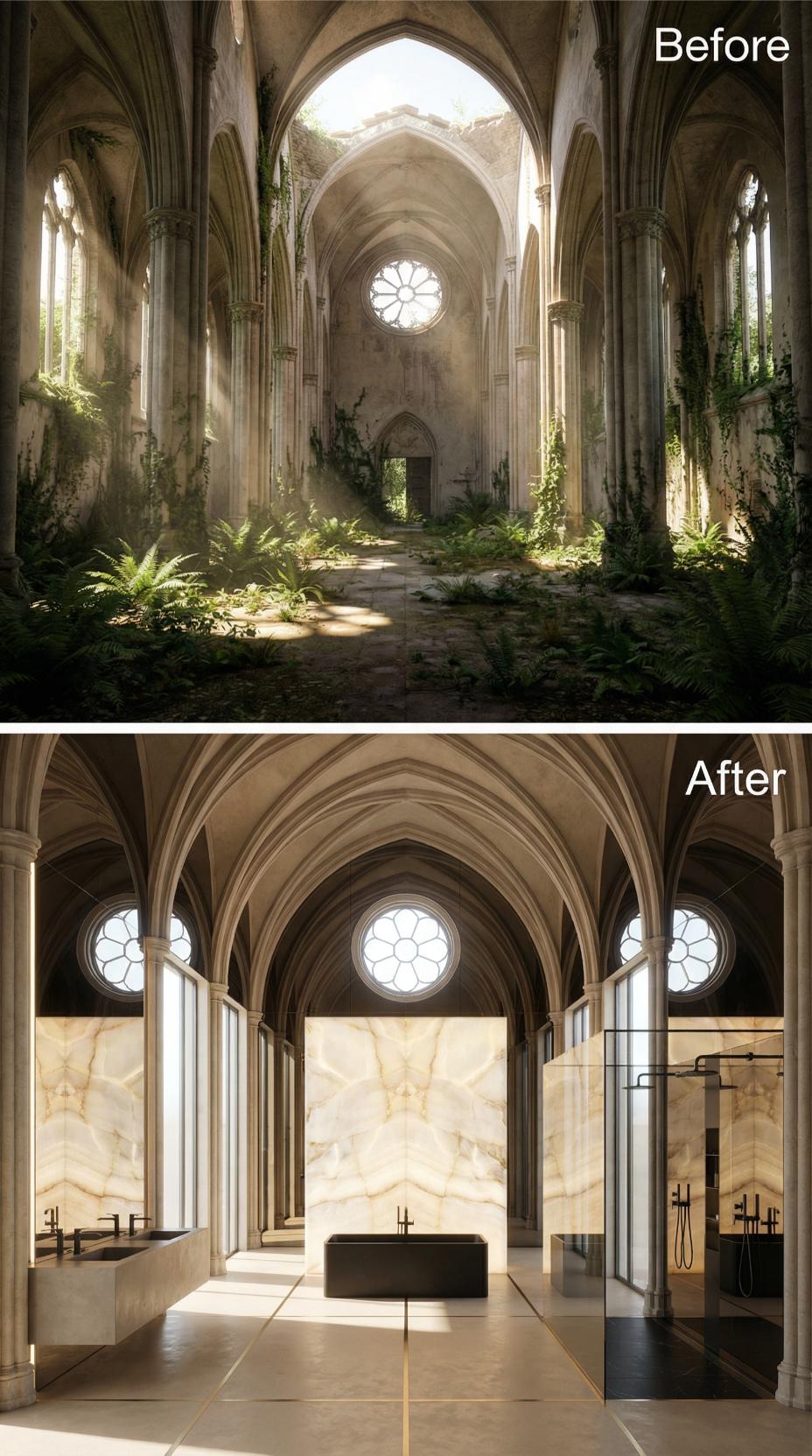
Where ferns once colonized the nave floor and ivy climbed the columns, backlit onyx panels now line the walls, their cream and gold veining glowing against restored limestone vaulting. A freestanding rectangular tub in dark basalt sits centered on the axis, flanked by low marble sink consoles with matte black fixtures. The rose window at the far end remains intact, now glazed rather than open to sky.
The glass shower enclosure on the right uses slim black metal framing, keeping the sightline through the full length of the nave unobstructed. Tall vertical windows flood the stone floor with natural light, and the ribbed vault ribs above have been cleaned and repointed without altering their original profile.
Copper Soaking Tub and LED-Lit Vaulting Replace a Nave Left Open to Sky
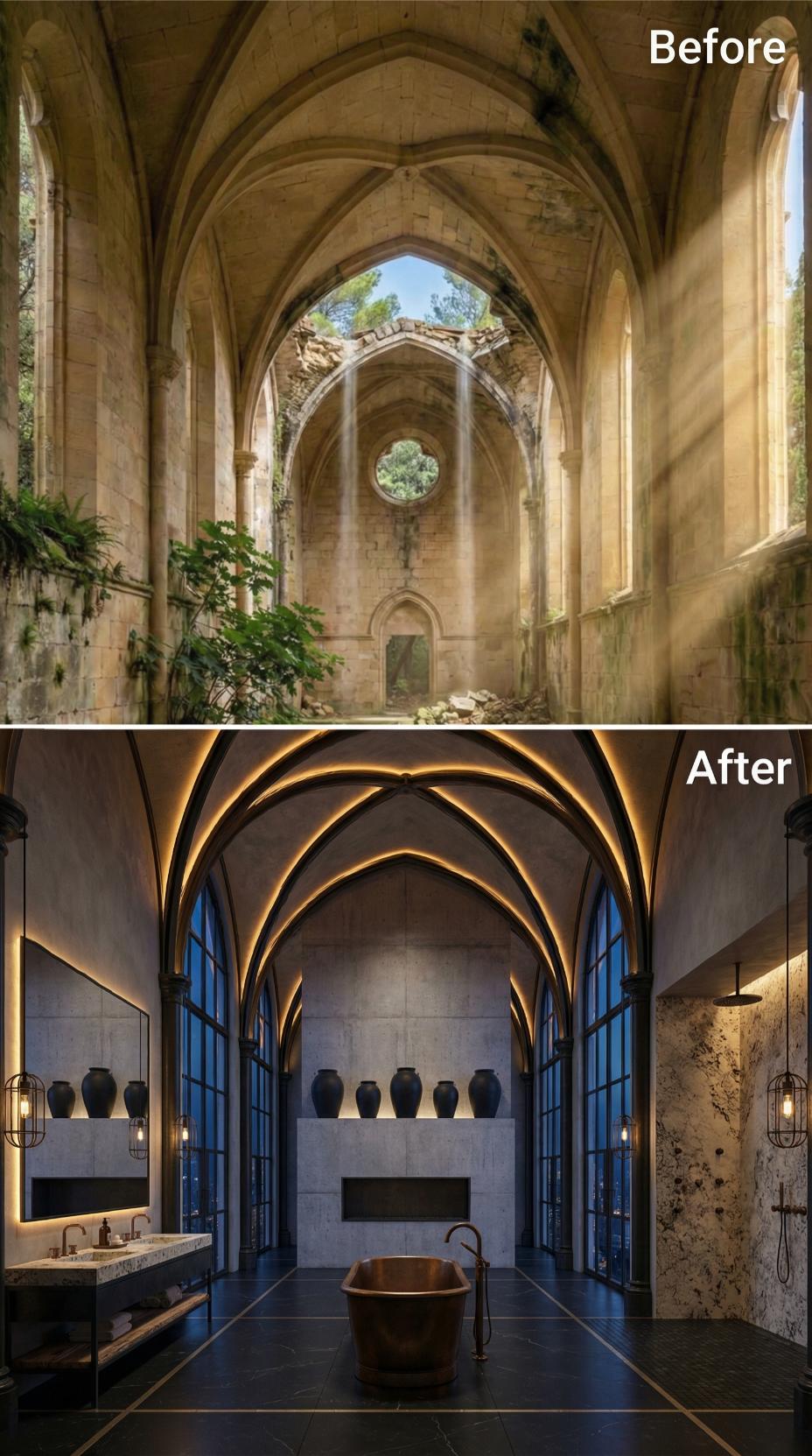
Gothic ribbed vaults, now painted charcoal and traced with warm LED strip lighting, arch over a hammered copper freestanding tub centered on dark slate floor tiles. Black ceramic urns line a stone ledge beneath arched steel-framed windows, and a backlit rectangular mirror anchors the vanity wall opposite an open rain shower.
Worth Knowing: Strip lighting recessed along Gothic vault ribs is a practical workaround for spaces where drilling into historic masonry for overhead fixtures would risk structural damage. The warm amber tone chosen here counteracts the coolness of the slate floors and grey plaster walls, keeping the palette from reading as cold. Positioning the light source along the ribs also draws the eye upward, making the full height of the nave the focal point rather than any single fixture.
Nave in Ruins Rebuilt Around a Copper Clawfoot Tub and Amber Glass Chandelier
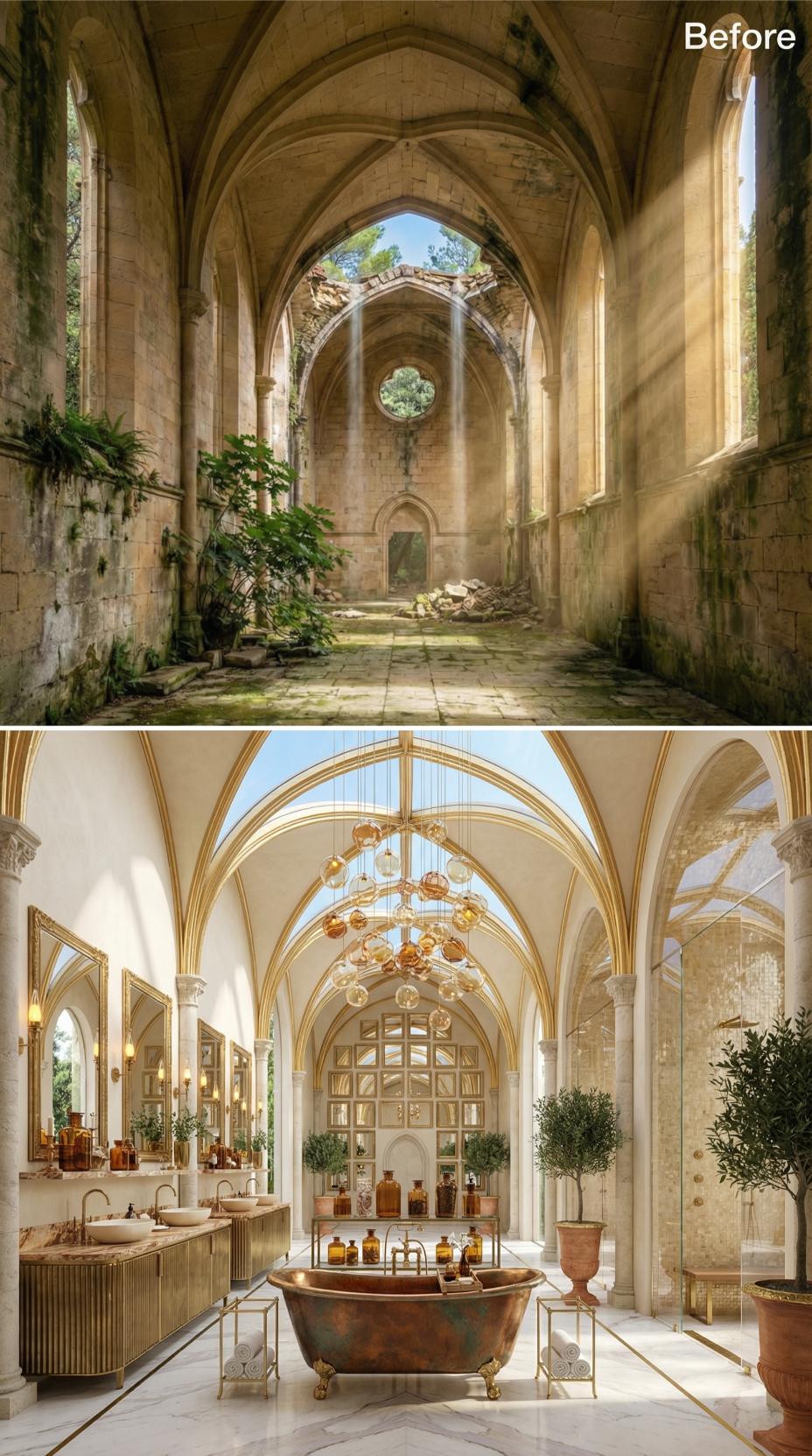
Restored Gothic vaulting, trimmed in gold leaf, now frames a copper soaking tub on brass claw feet centered beneath a cluster of amber glass globe pendants. A fluted gold vanity cabinet runs the left wall, topped with round vessel sinks and paired with gilt-framed arched mirrors. Potted olive trees anchor the right side near a glass-enclosed shower.
Fun Fact: Copper bathtubs develop a natural patina over time as the metal oxidizes, shifting from warm rose tones toward deep verdigris green. Many designers working with historic conversions favor this material specifically because its aging process mirrors the weathered character of the surrounding stone. No two copper tubs age identically, making each one a genuinely one-of-a-kind fixture.
Abandoned Nave Gets Backlit Honey Onyx, a Black Soaking Tub, and a Glass Roof
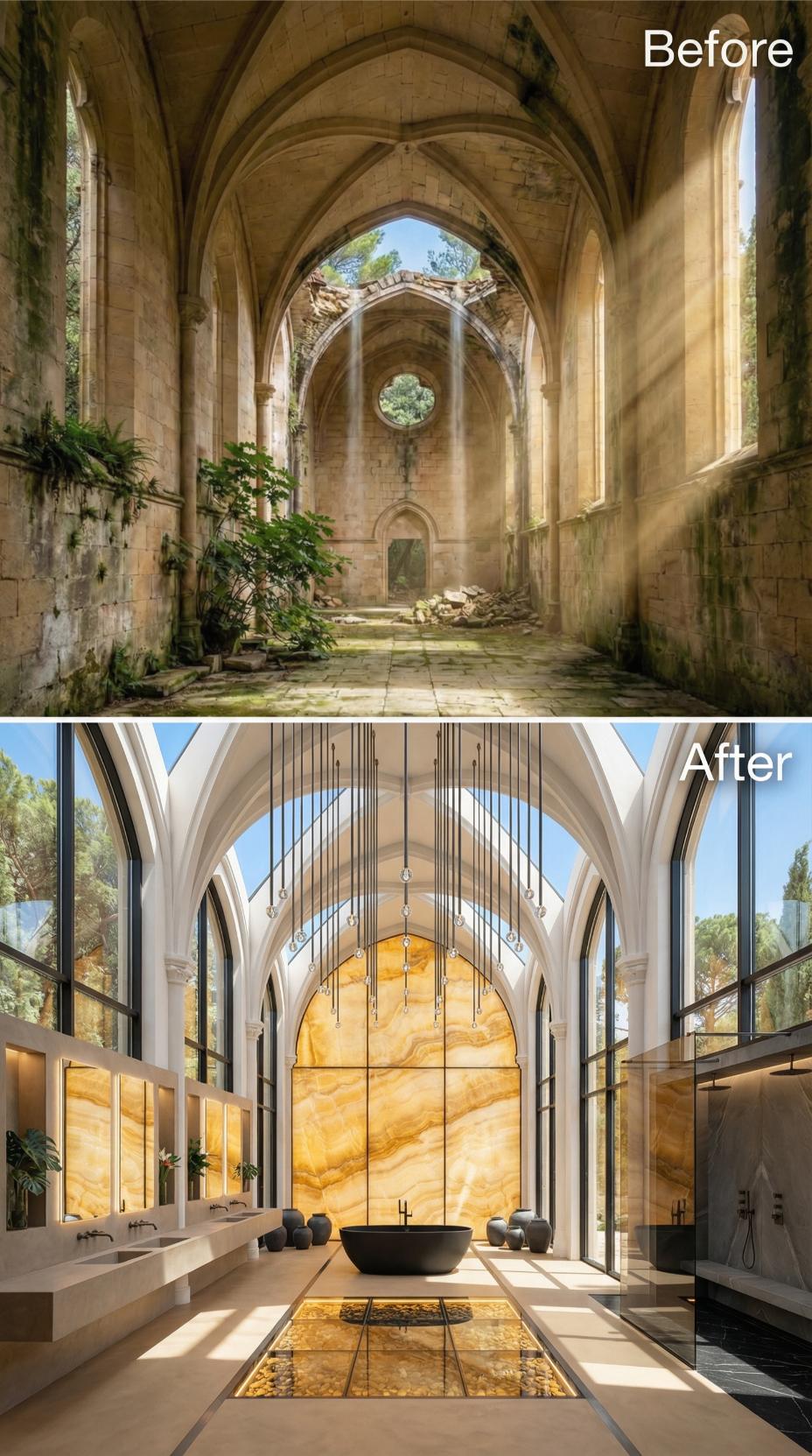
Honey-toned onyx slabs fill the entire apse wall, backlit so the amber veining glows from within like stained glass replaced in a secular key. A matte black freestanding tub sits centered at the base of that wall, grounded by a floor inset of matching onyx tiles surrounded by pale limestone. Pendant lights drop on thin cables from the restored Gothic vaults, each terminating in a single glass globe.
The side walls run a continuous run of floating stone vanities with wall-mount matte black faucets, punctuated by tall arched windows glazed in clear glass from floor to spring point. The original ribbed vaults were cleaned and whitewashed, keeping the pointed arch geometry intact while shedding the ruin’s weight. A frameless glass shower occupies the right transept bay, barely visible against the stone surround.
Try This: Backlit onyx panels require a dedicated LED system installed directly behind the stone, and slab thickness matters. Panels cut too thick will block light transmission almost entirely, so most fabricators recommend staying between 10mm and 15mm for consistent glow. Ask your stone supplier for a light test on the actual slab before fabrication begins.
Nave of Crumbling Stone Reborn With Warm Teak Vaulting and a Living Plant Wall
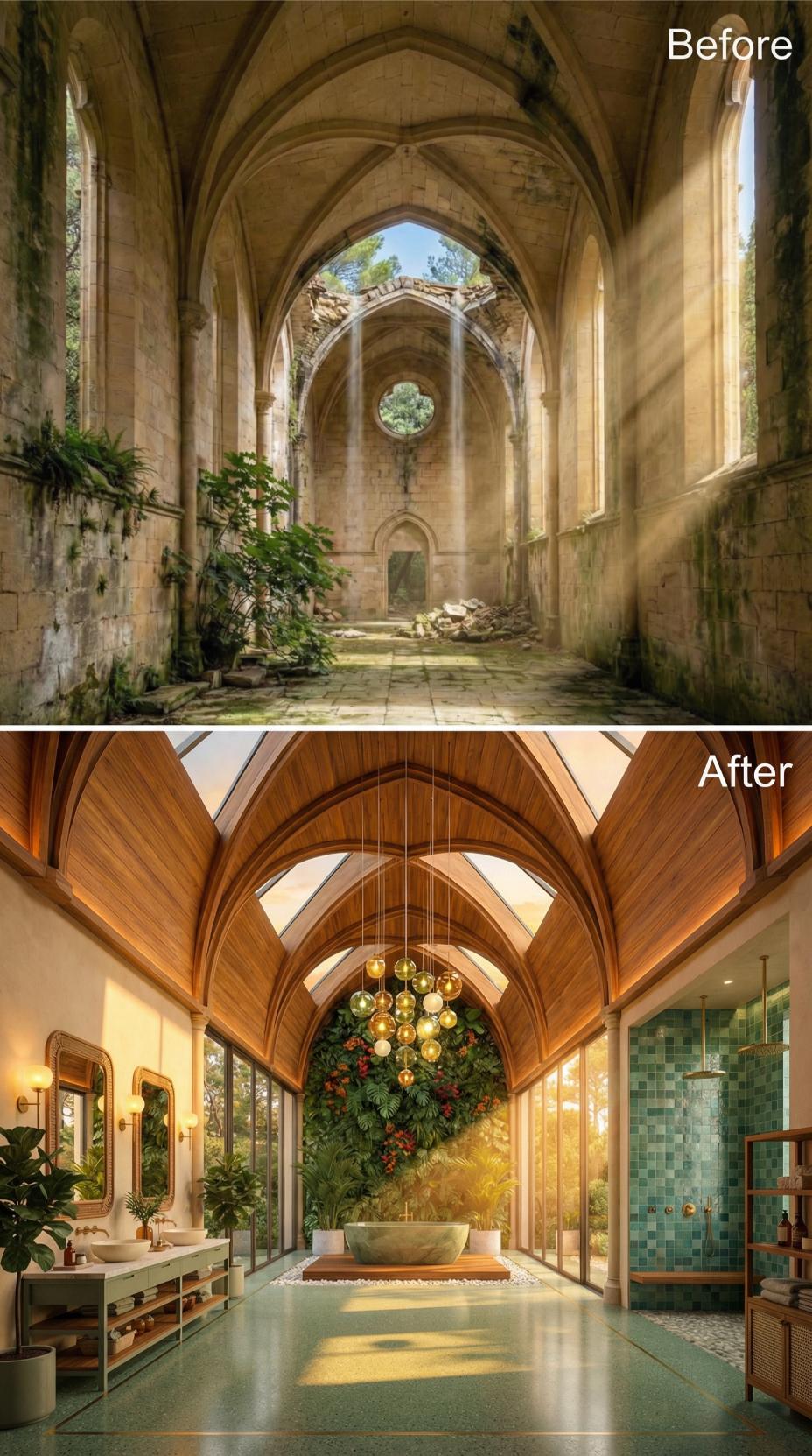
Warm-toned teak planks line the rebuilt vaulted ceiling, their grain following the arc of the original Gothic ribs above a freestanding stone soaking tub set on white pebble gravel. A vertical garden anchors the far wall, mixing broad-leaf tropicals with clusters of red berries beneath a pendant cluster of amber globe lights. Teal subway tile wraps the shower zone on the right, paired with brass fixtures and open timber shelving. Double vessel sinks sit on a painted vanity with rattan-framed mirrors above.
History Corner: Gothic church naves were designed as processional corridors, intentionally long and narrow to draw the eye toward the altar. That same proportional logic, a compressed width against an exaggerated ceiling height, is exactly what gives converted nave bathrooms their sense of vertical drama that no purpose-built bathroom can replicate.
Nave Ruins Recast as a Soaking Room With Glass Floors and Pendant Curtains
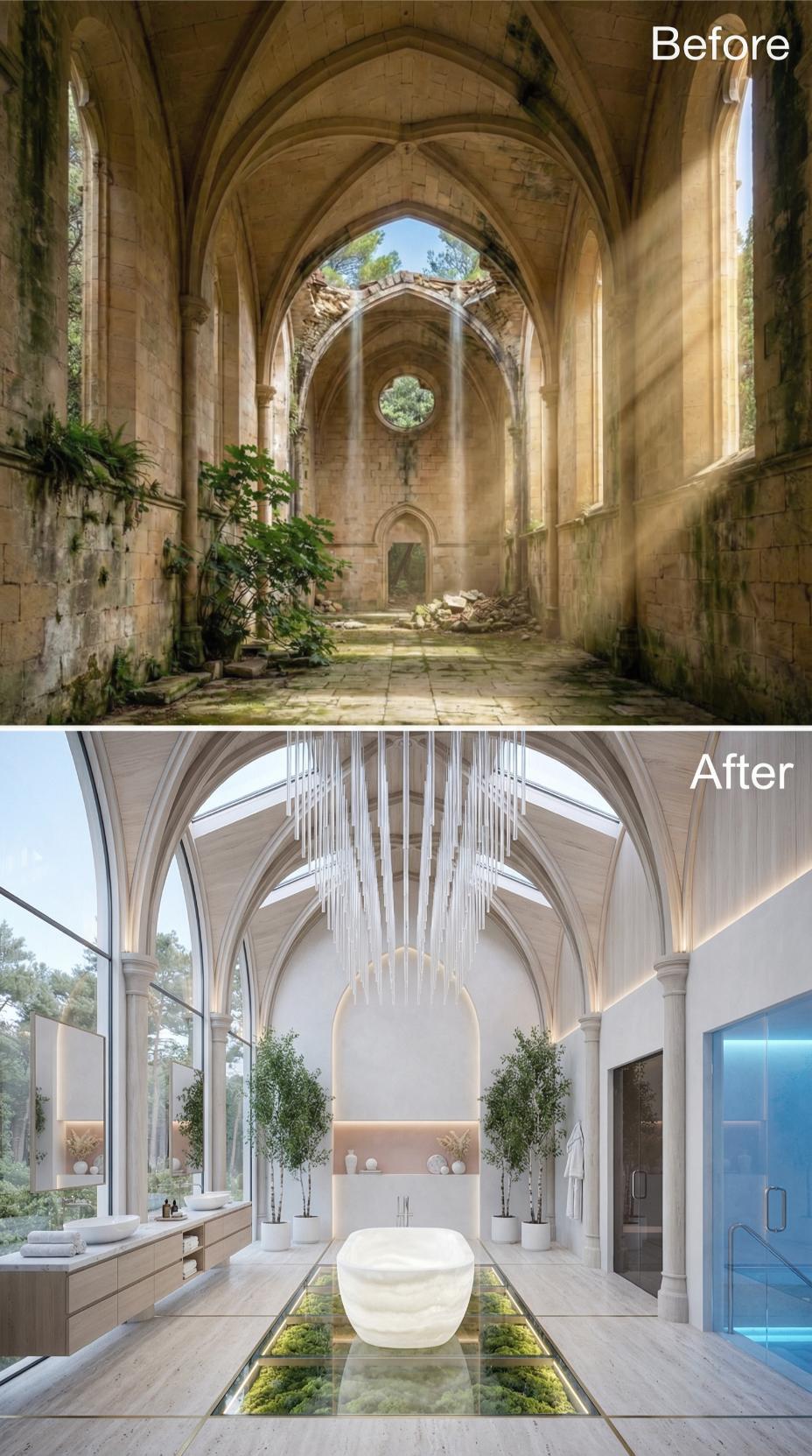
Bleached oak cabinetry runs the full left wall at counter height, its flat-front drawers finished without visible hardware. Beneath a freestanding tub carved from solid white stone, a glass floor panel reveals a bed of living moss lit from below, the green cutting sharply against the pale timber underfoot. Two birch trees in white ceramic pots flank the tub niche, their pale bark echoing the restored plaster of the Gothic arches above.
The pendant installation descending from the vault spine deserves particular attention. Dozens of slender white rods hang at graduated lengths, mimicking the fall of light rays that once entered through the collapsed roof visible in the before state. On the right wall, a frameless glass door opens into what appears to be a plunge pool glowing with blue-spectrum underwater lighting, its cool tone set deliberately against the warm plaster throughout the rest of the room.
How the Glass Floor Panel Functions as Both Design Detail and Living Ecosystem
The illuminated moss bed beneath the glass floor panel is not purely decorative. Moss varieties like cushion moss and sheet moss can survive in controlled low-light environments when sealed below glass with adequate humidity, making them viable in a bathroom where steam naturally raises moisture levels. Specifying tempered or laminated glass rated for foot traffic is non-negotiable here, and the LED strips recessed into the perimeter of the cavity need to be rated for damp locations to prevent fixture failure over time.
Freestanding Copper Tub and Hanging Succulents Reclaim a Roofless Gothic Nave
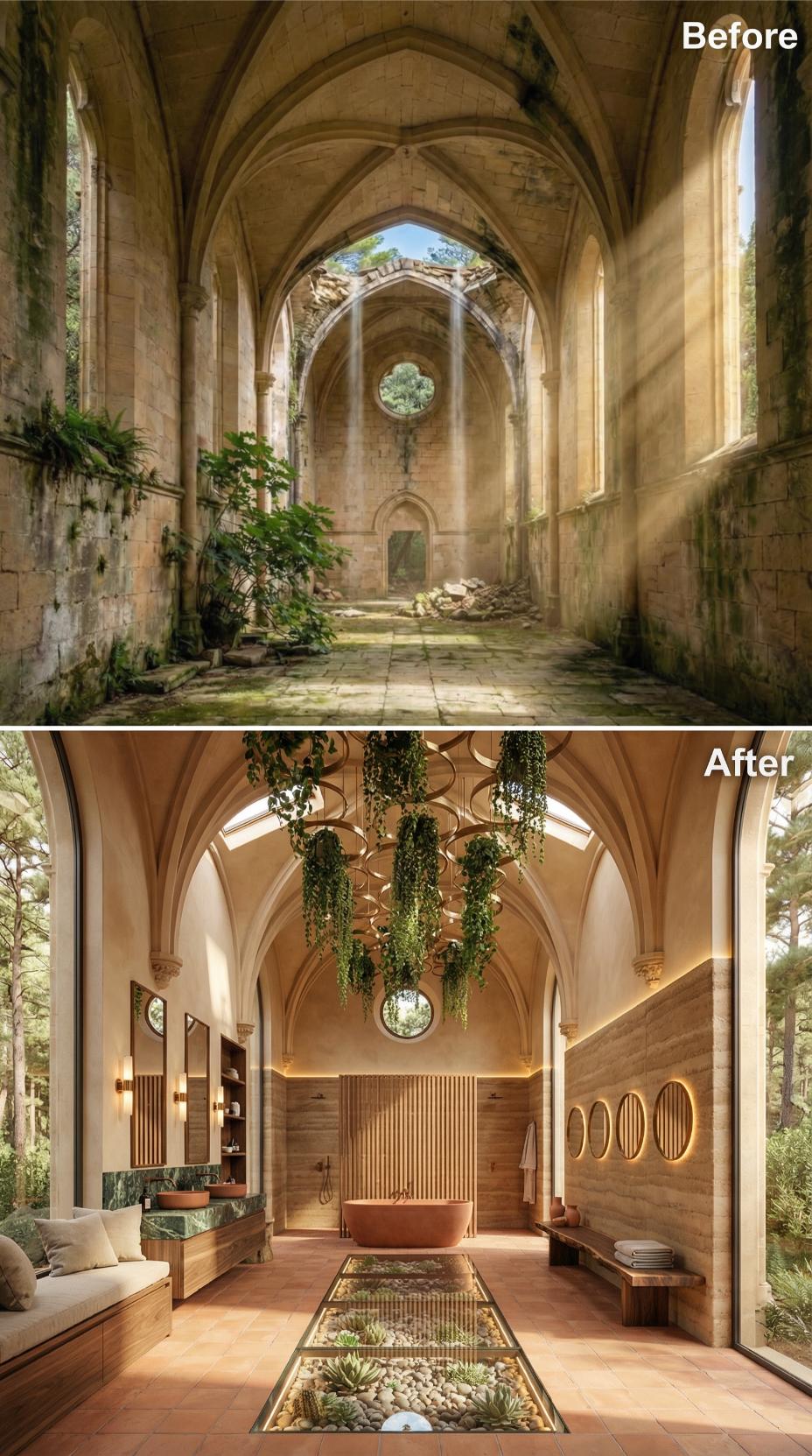
Salvaged Gothic vaulting arches overhead in warm limestone, now plastered smooth at the haunches and fitted with a circular oculus window that mirrors the original rose window opening visible in the before state. Suspended from a custom wooden lattice ceiling insert, cascading string-of-pearls plants hang in dense curtains between the ribs, replacing the collapsed stonework with living material.
The floor plan runs the full processional length of the nave. A river-stone and succulent garden bed is inset flush with the terracotta tile floor, anchoring the copper soaking tub at center. To the left, a green marble vanity counter sits below wall-mounted brass sconces and open wood shelving. Backlit oval mirrors line the right wall above a walnut bench stacked with folded linen towels. Floor-to-ceiling glazing replaces the side wall at the far right, pulling in the surrounding pine canopy.
Limestone Nave Ruins Reborn as a Minimalist Bathroom With Slatted Timber Vaulting
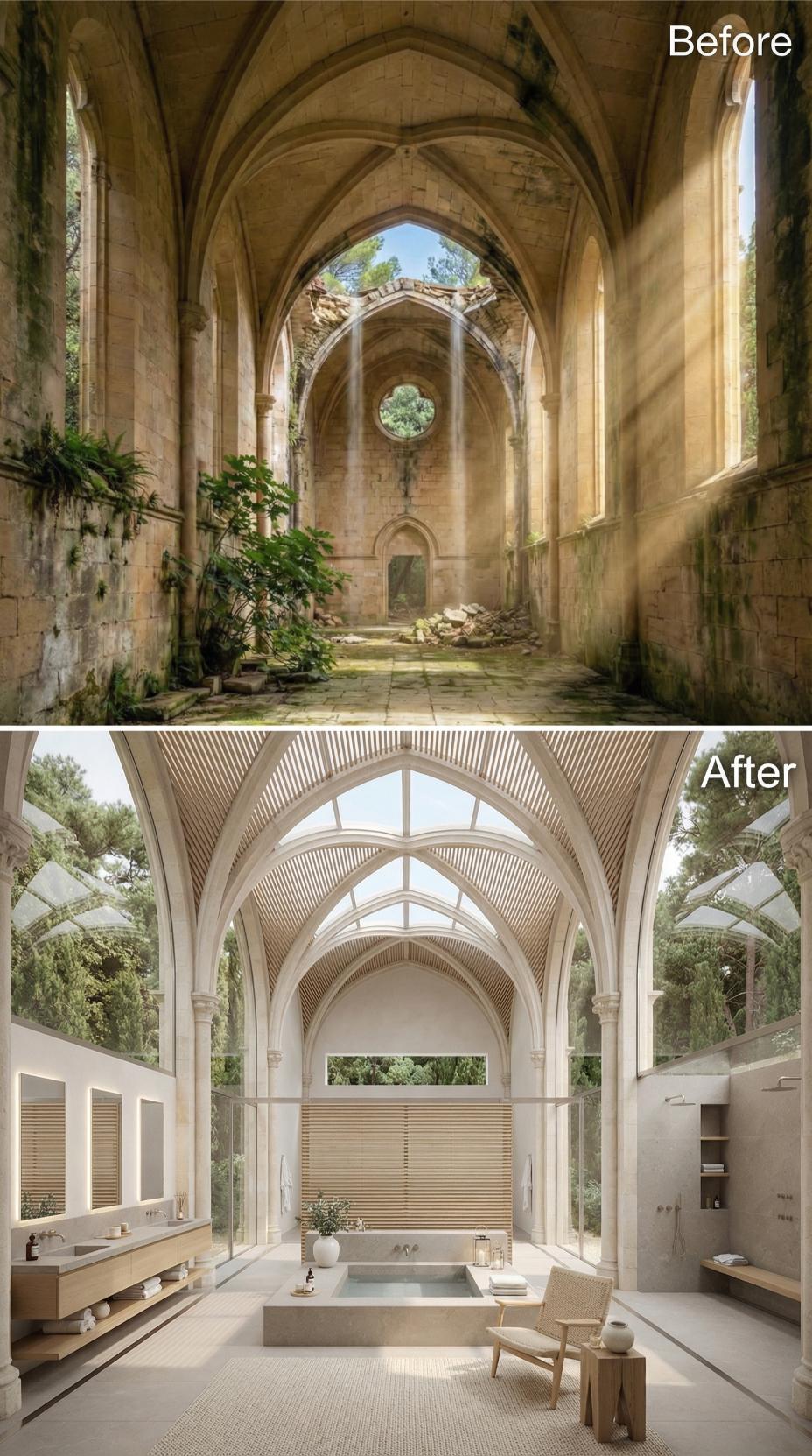
Bleached stone walls and collapsed roofing gave way to a bath with a sunken concrete tub centered beneath reconstructed Gothic arches. Slim timber slats line the vault interior, and floor-to-ceiling glass fills the side bays, pulling the surrounding tree canopy directly into the room.
Trend Alert: Slatted timber ceilings inside Gothic vaults serve a dual purpose, concealing modern mechanical systems while softening the acoustics of a stone interior that would otherwise produce significant echo. The spacing between slats can be calibrated to control how much of the structural arch remains visible from below.
Ruined Nave Reborn as a Terracotta-Walled Bathroom With Gothic Skylights
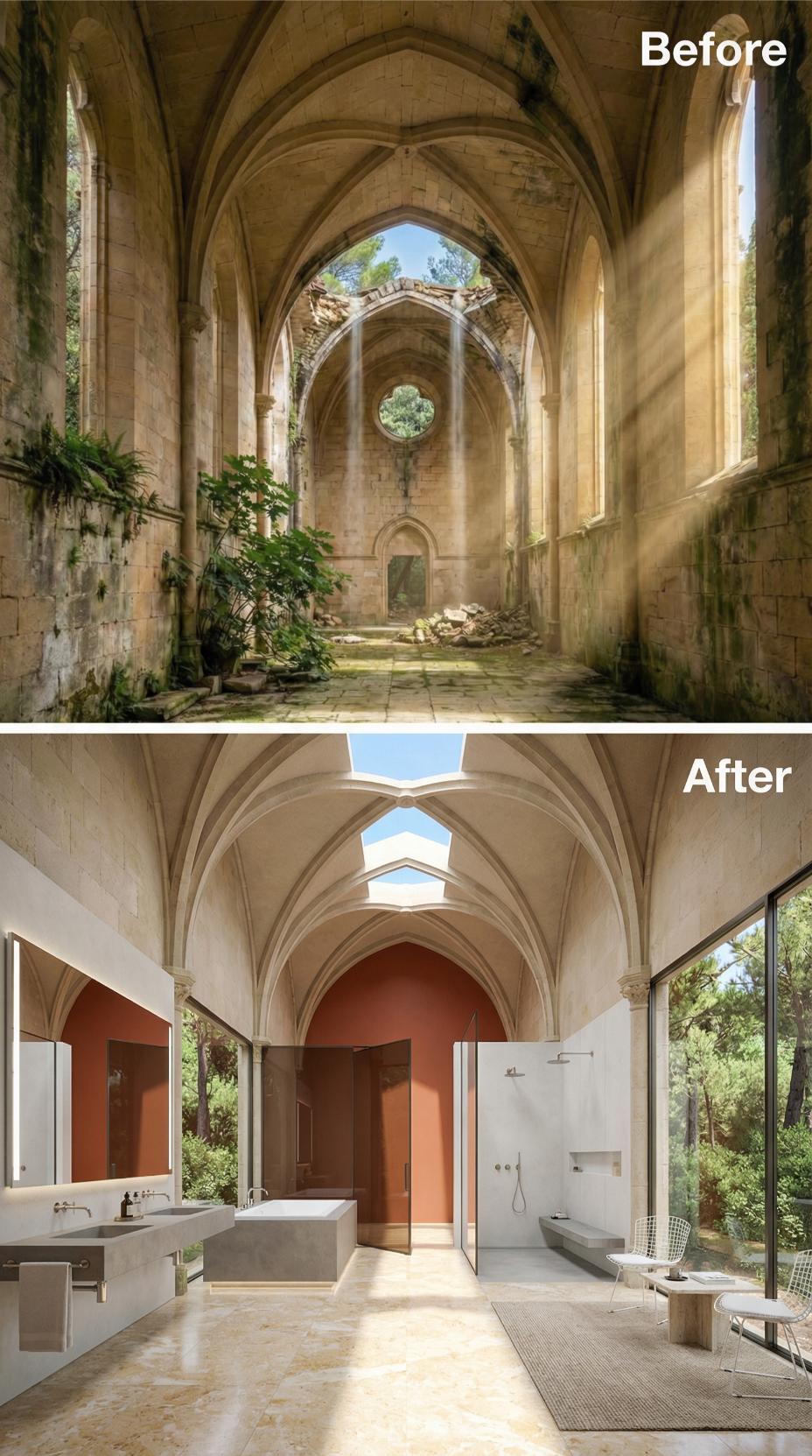
Architects retained the original ribbed vaulting and limestone pilasters, then introduced floor-to-ceiling glazing along the south wall to pull tree canopy views directly into the room. The open oculus became a geometric skylight, framing a rectangle of blue sky above a freestanding concrete soaking tub set on polished travertine tile.
Terracotta plaster panels, applied between the Gothic arches, anchor the palette without competing with the pale stone above. A wall-mounted concrete vanity, backlit frameless mirrors, and a frameless glass shower enclosure keep the fixtures restrained. Wire-frame side chairs reference mid-century vocabulary without disrupting the medieval geometry overhead.
Common Mistake: One common mistake in nave conversions is applying color to every arched bay, which visually fragments the corridor and erases the rhythmic repetition that makes Gothic proportions so distinctive. Limiting saturated plaster to a single focal bay, as seen here with the terracotta arch framing the entry door, preserves the spatial continuity of the nave while still introducing warmth.
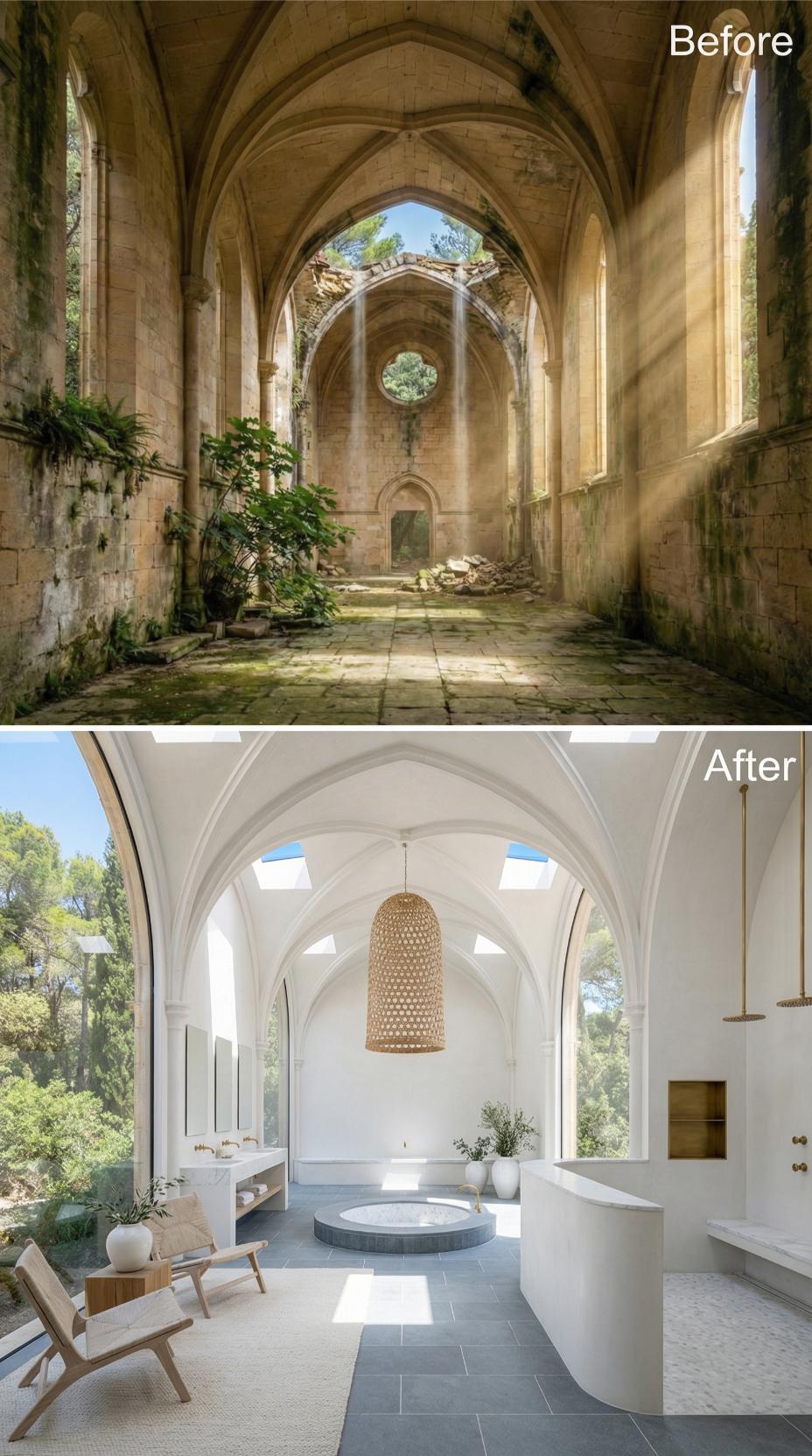
Ruined Gothic Nave Recast as a White Vault Bathroom With a Sunken Round Tub
🔥 Would you like to save this?
Plastering an entire Gothic nave white — ribs, walls, spandrels, and all — sounds like architectural heresy, but the result here is hard to argue with.
The vaulted ceiling retains every original rib and bay but reads entirely differently once coated in flat white plaster. Skylights cut into the roof replace the collapsed stone, flooding the slate floor in daylight. A sunken circular tub sits at the nave’s central axis, clad in grey stone and raised on a low platform. A woven rattan pendant drops from the crown of the vault, its dome shape echoing the round tub below.
The vanity runs along the left wall, topped in white marble with brass fixtures. Teak-framed sling chairs and a low side table break up the floor plan without crowding it. Arched window openings at the nave’s end remain unglazed, framing the tree canopy beyond like a living panel. The brass shelf niche built into the right wall ties the metal finishes together without overplaying them.
Ribbed Vaults Outlined in Brass Light Above Terrazzo Floors and a Concrete Soaking Tub
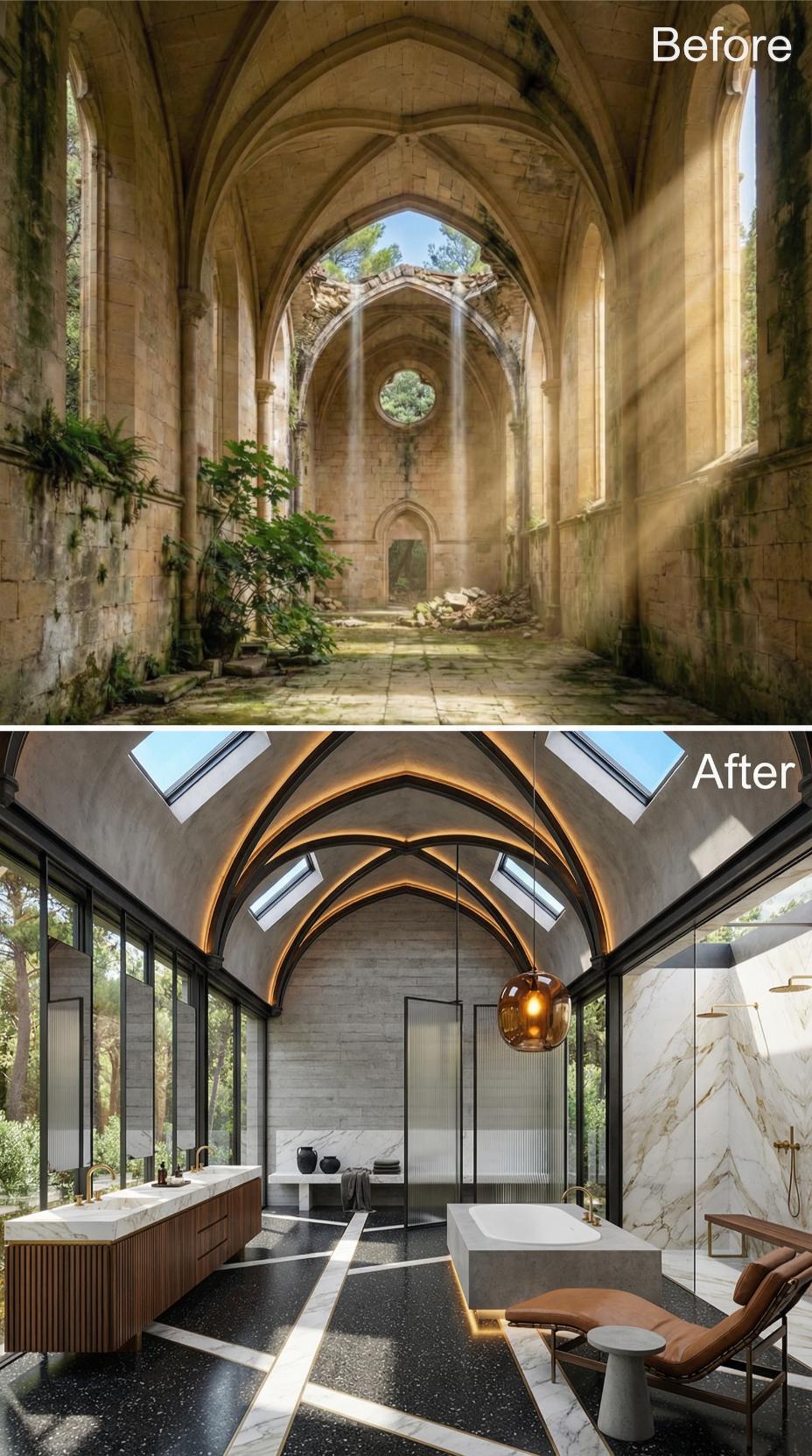
Reinforced Gothic ribs trace the original nave geometry across a plastered vault, each rib edge lined with recessed warm brass strip lighting that reads as gilding against the grey concrete. Large steel-framed windows replace the collapsed clerestory walls entirely, pulling tree canopy into the sightlines on both sides. Skylights cut directly into the vault crown flood the floor with daylight.
Black terrazzo with inset marble banding covers the full floor plane, the white lines radiating outward from the freestanding concrete tub like a compass rose. Walnut cabinetry with vertical fluting runs beneath a thick marble vanity top fitted with brass deck faucets. A copper pendant with an amber globe hangs above the tub. The shower wall uses full-height bookmatched Calacatta marble slabs, and a cognac leather chaise sits at the far end of the nave axis.
Freestanding Stone Tub and Woven Pendant Light Settle Into a Whitewashed Gothic Nave
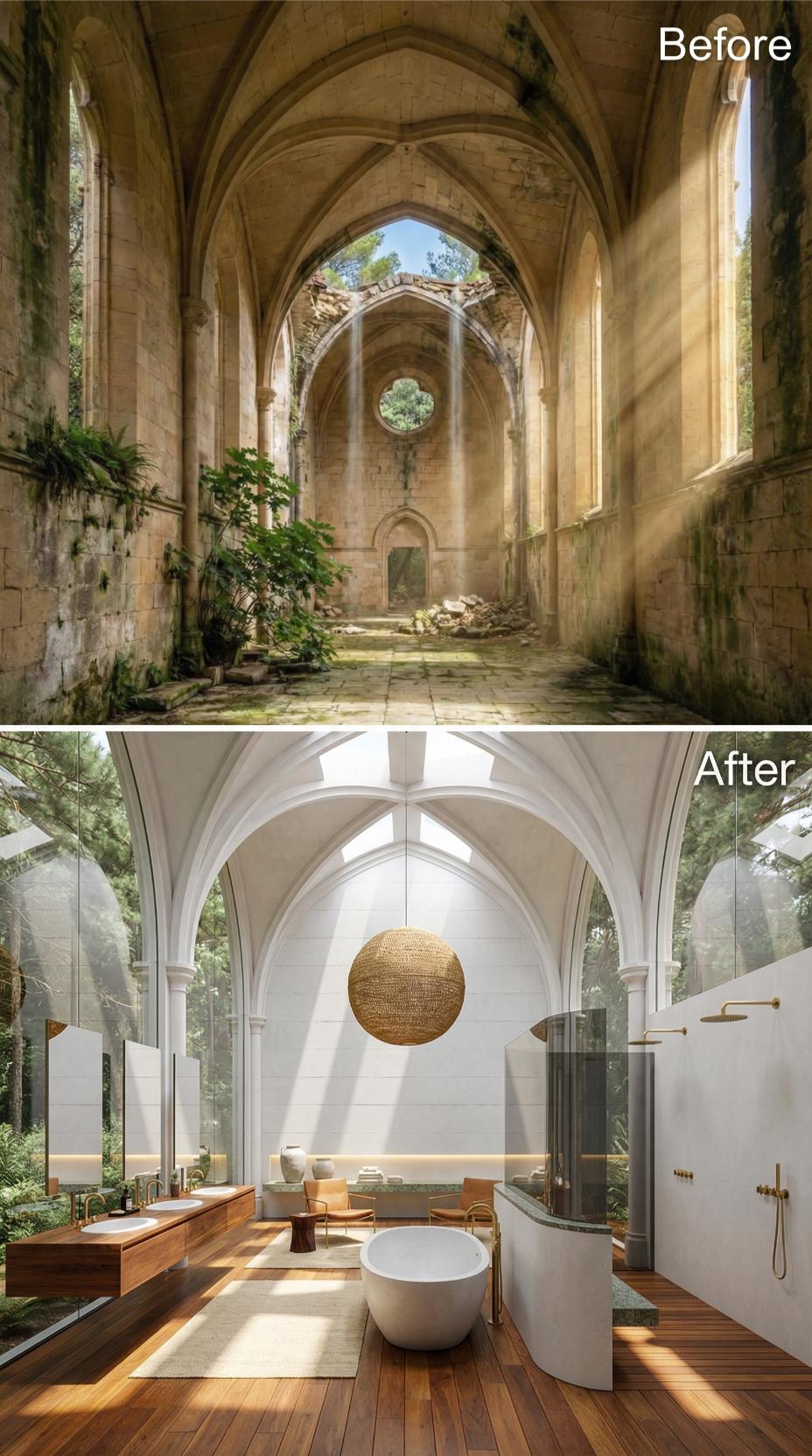
Plaster-white finish covers the ribbed vaults and pointed arches from floor to crown, erasing centuries of stone discoloration without touching the structure beneath. A round freestanding tub in matte white composite sits centered on wide-plank teak decking, flanked by a floating walnut vanity with dual ceramic vessel sinks and brushed brass fixtures. Floor-to-ceiling glass panels replace the collapsed nave walls, pulling the surrounding tree canopy directly into the sightline. An oversized woven rattan pendant sphere hangs from the vault apex, casting diffused light across the space. On the right, brushed brass rain heads mark a glass-enclosed shower.
Ask Yourself: Before installing glass panels in place of collapsed nave walls, confirm whether your structure falls under heritage protection laws, which often restrict how much original stone can be removed or altered. Some jurisdictions require that any new enclosure be visually reversible, meaning the glass must be fitted without permanently bonding to the masonry.
Gothic Nave Ruins Recast as a Rose Plaster Bathroom With Sunken Tub and Vaulted Skylights
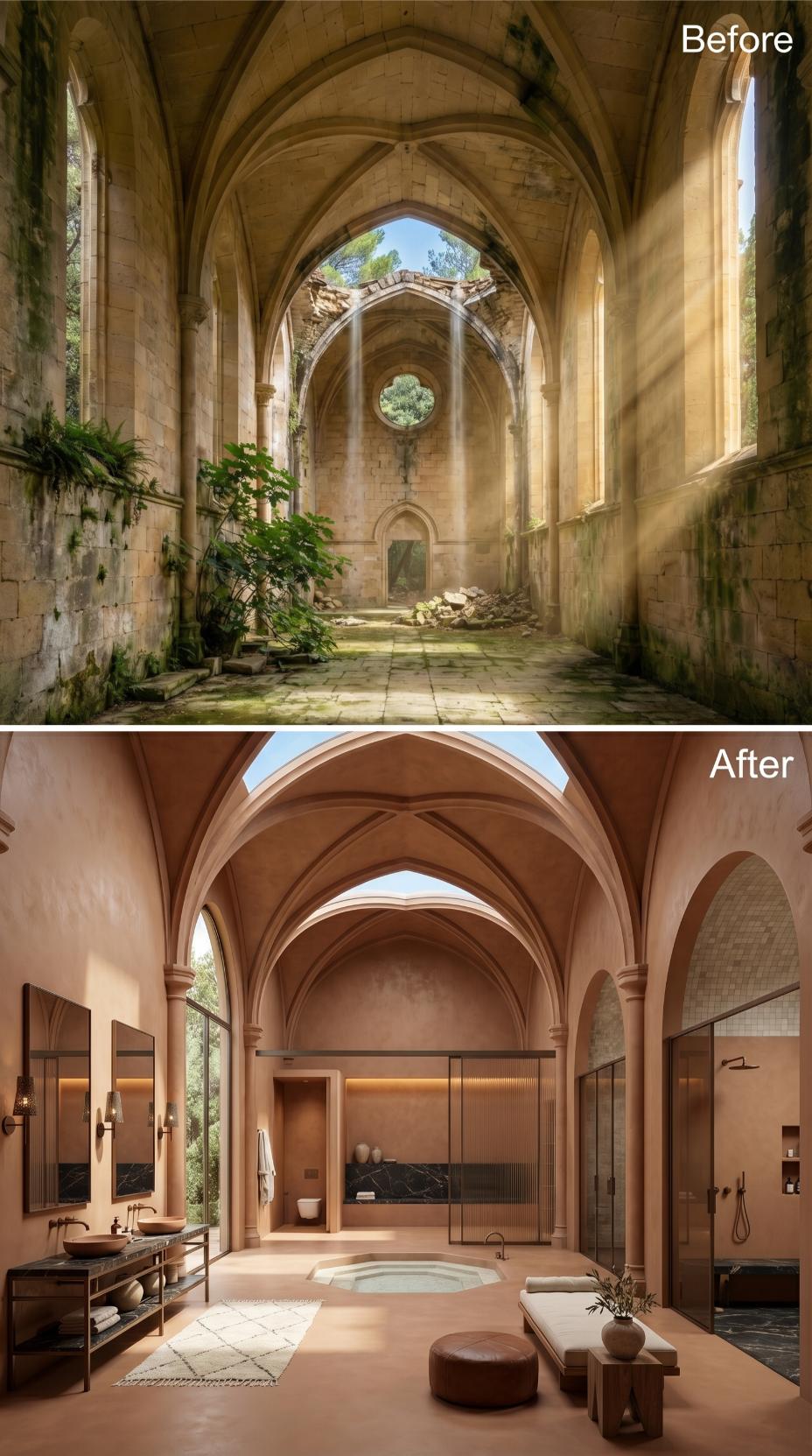
Dusty rose plaster coats every surface from floor to vault rib, unifying the space without erasing the Gothic bones underneath. The sunken rectangular soaking tub sits flush with a terracotta-toned floor, flanked by a low daybed upholstered in natural linen and a round leather ottoman. A dark marble vanity counter runs the full length of the left wall, topped with two vessel sinks in unglazed clay.
Glass panels replace the collapsed end wall, preserving the open-sky view the ruin once offered. Ribbed vaults spring from square pilasters and frame a skylight cut directly into the ceiling above the tub. Brushed brass fixtures and wall-mounted sconces with amber-toned shades pull warm light through the pink plaster without competing with the arches above.
Pro Tip: Tadelakt, a waterproof Moroccan lime plaster, is one of the most practical finishes for nave conversions where both humidity resistance and visual continuity across arched surfaces matter. Unlike paint or tile, it can be applied over curved masonry without grout lines interrupting the flow of the vault. Its natural sheen also responds to candlelight and daylight differently, giving the same wall two distinct characters across a single day.
Ribbed Gothic Vaults Clad in Cedar Slats Above a Black Granite Lap Pool
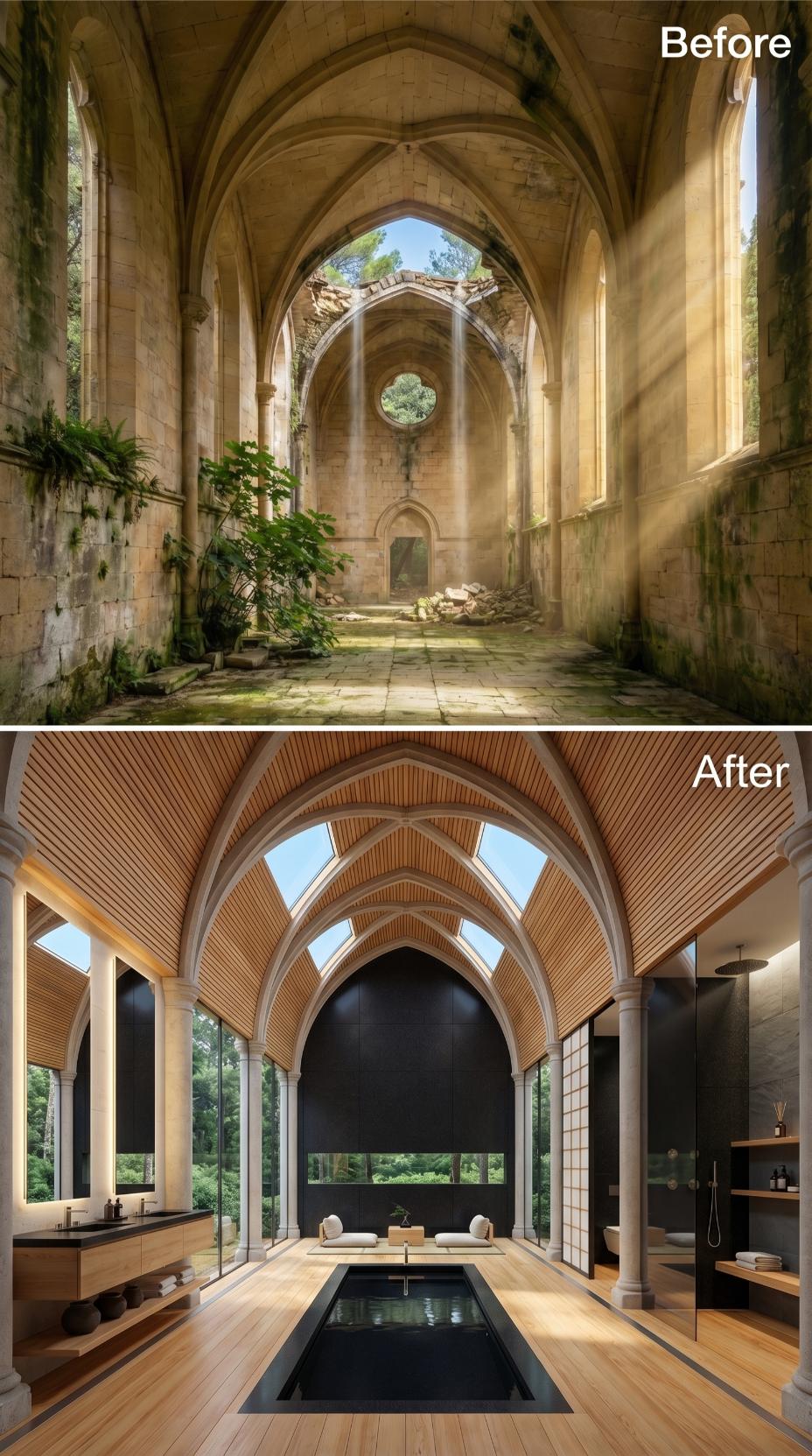
Cedar slat panels line the ribbed vaults overhead, their warm grain pulled tight between white plaster ribs that still read as Gothic. Below, a rectangular lap pool finished in black granite sits flush with the bamboo floor, flanked by two low linen-cushioned benches.
Gold-Trimmed Gothic Arches Preside Over Marble Floors and a Steel Soaking Tub
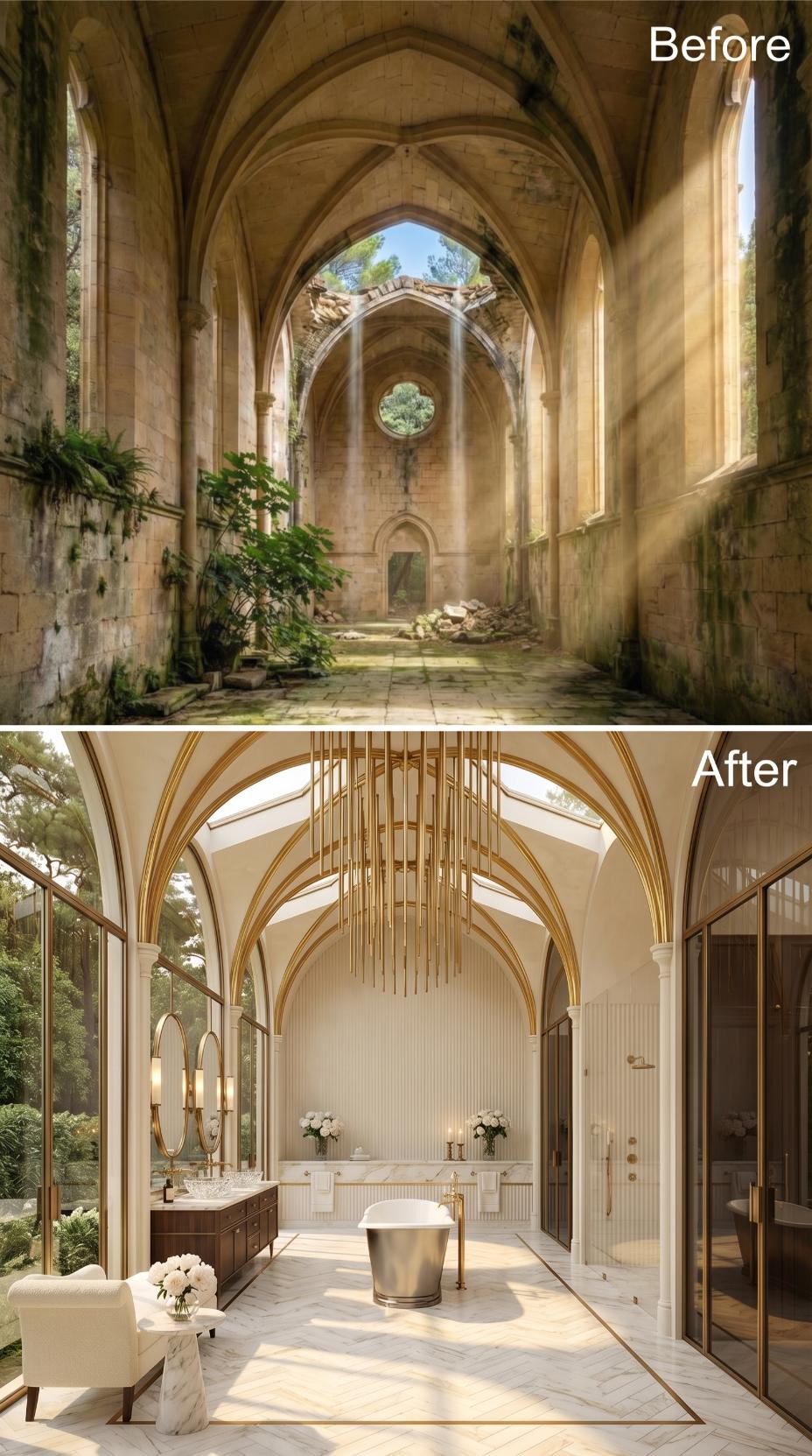
Cracked stone and rubble gave way to cream ribbed vaulting with gilt detailing that follows every original Gothic arch rib from springer to crown. The freestanding tub sits dead center in the nave axis, finished in brushed steel rather than porcelain, its warm silver tone picking up the brass floor-mount filler beside it. Walnut cabinetry runs along the left wall beneath oval mirrors framed in polished brass, with what appears to be a vessel sink resting on a marble slab countertop. Marble tile covers the floor in a wide-format herringbone pattern.
Floor-to-ceiling bronze-framed glass panels replace what were once solid stone walls, flooding the space with garden views on both sides. Vertical brass rods hang from the vault ceiling like an abstracted pipe organ, functioning as a chandelier without the bulk of a traditional fixture. White fluted wall paneling lines the far end, where candles and white flowers mark the spot where an altar once stood.
- Brushed steel tubs resist limescale buildup better than cast iron in high-humidity conversions where ventilation remains a challenge
- Herringbone marble tile laid in wide-format planks reads as less busy than small mosaic cuts, preserving the scale of a tall vaulted room
- Bronze-framed glass partitions allow structural engineers to stabilize open wall sections without requiring solid infill that would block light
Dark Green Plaster and Gold Pipe Chandelier Reclaim a Collapsed Gothic Nave
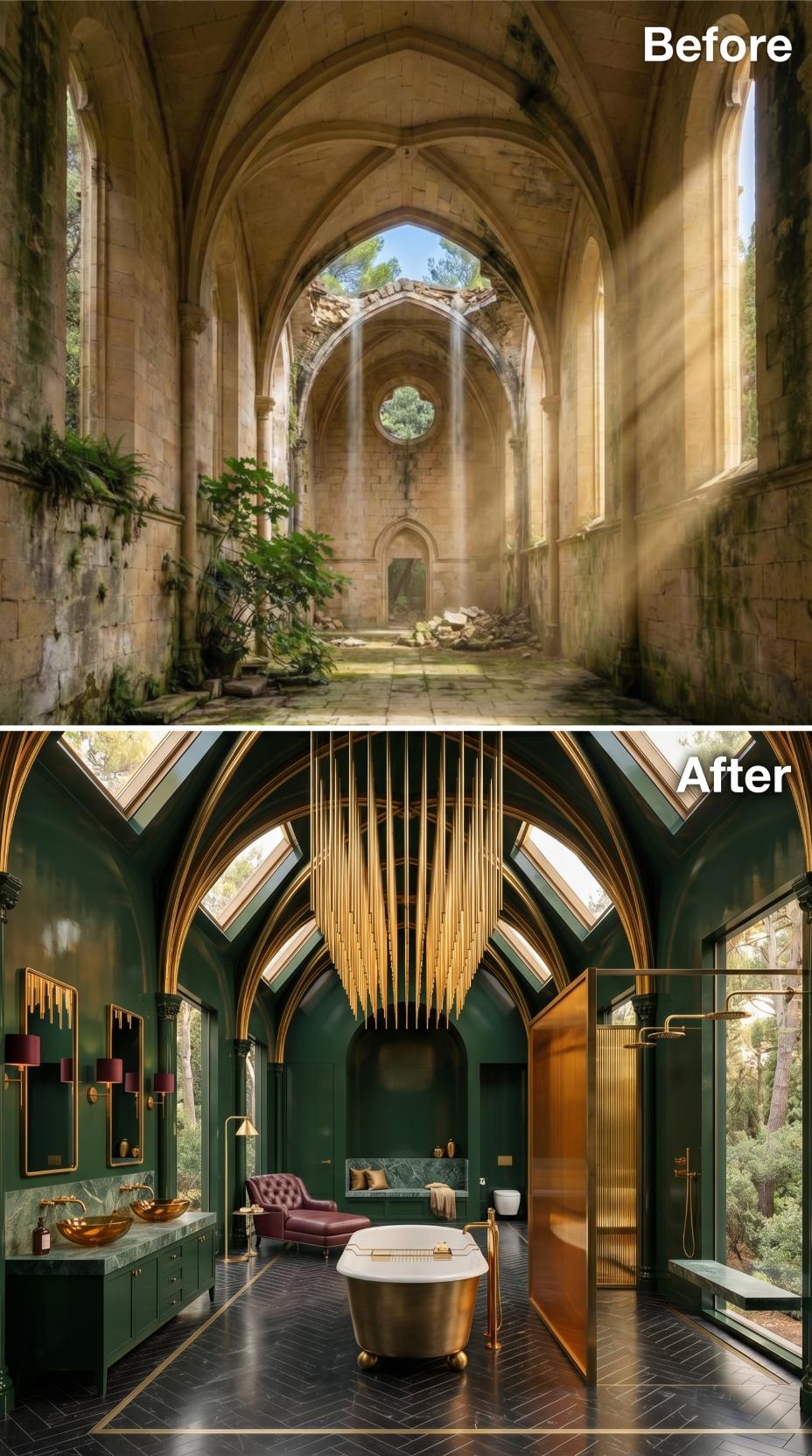
Forest green walls meet black herringbone floor tile beneath Gothic arches trimmed in brushed gold, while a freestanding brass-footed soaking tub anchors the nave’s central axis below a cascading rod chandelier.
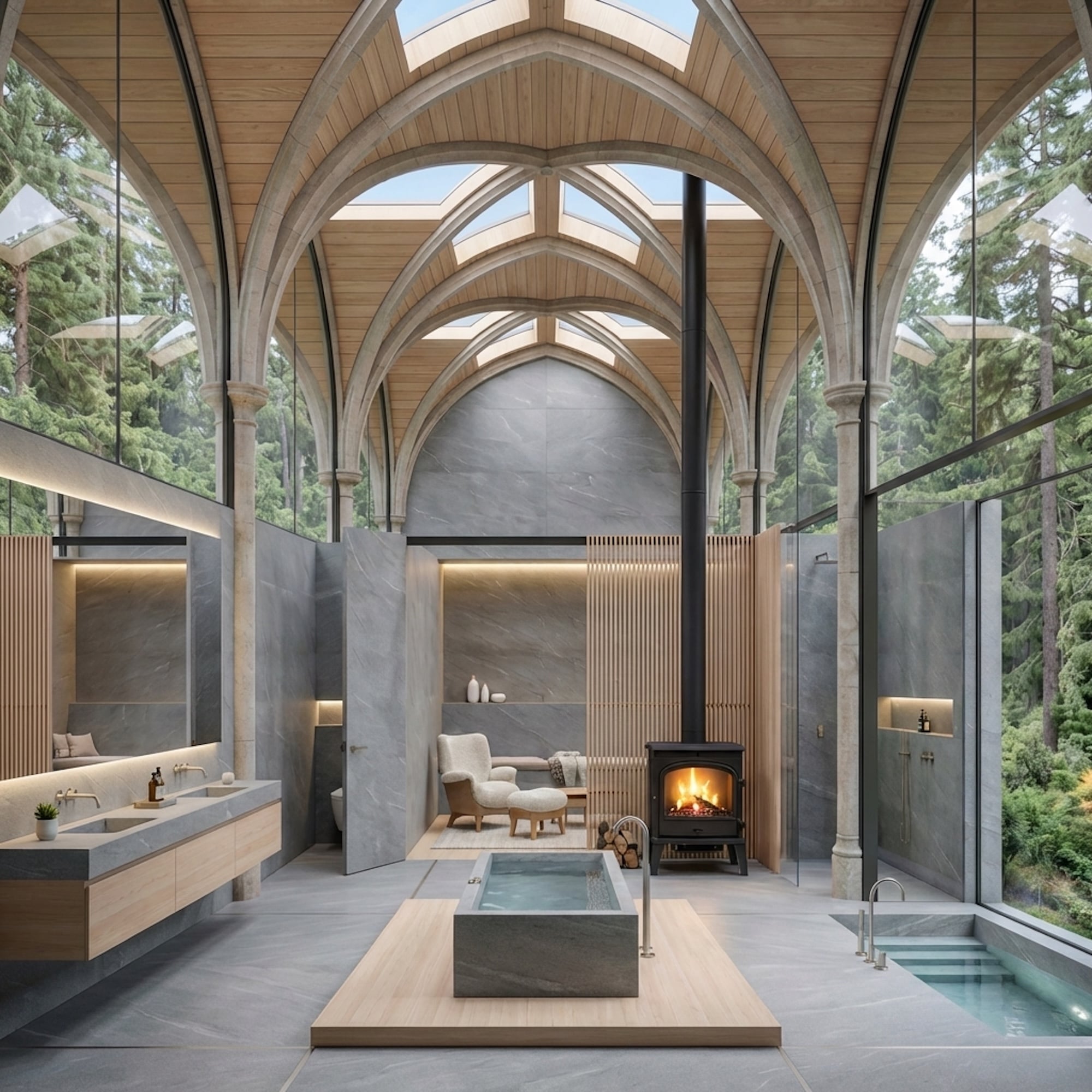
Gothic Nave Ruins Converted to a Spa Bathroom With Ribbed Vaults and a Wood-Burning Stove
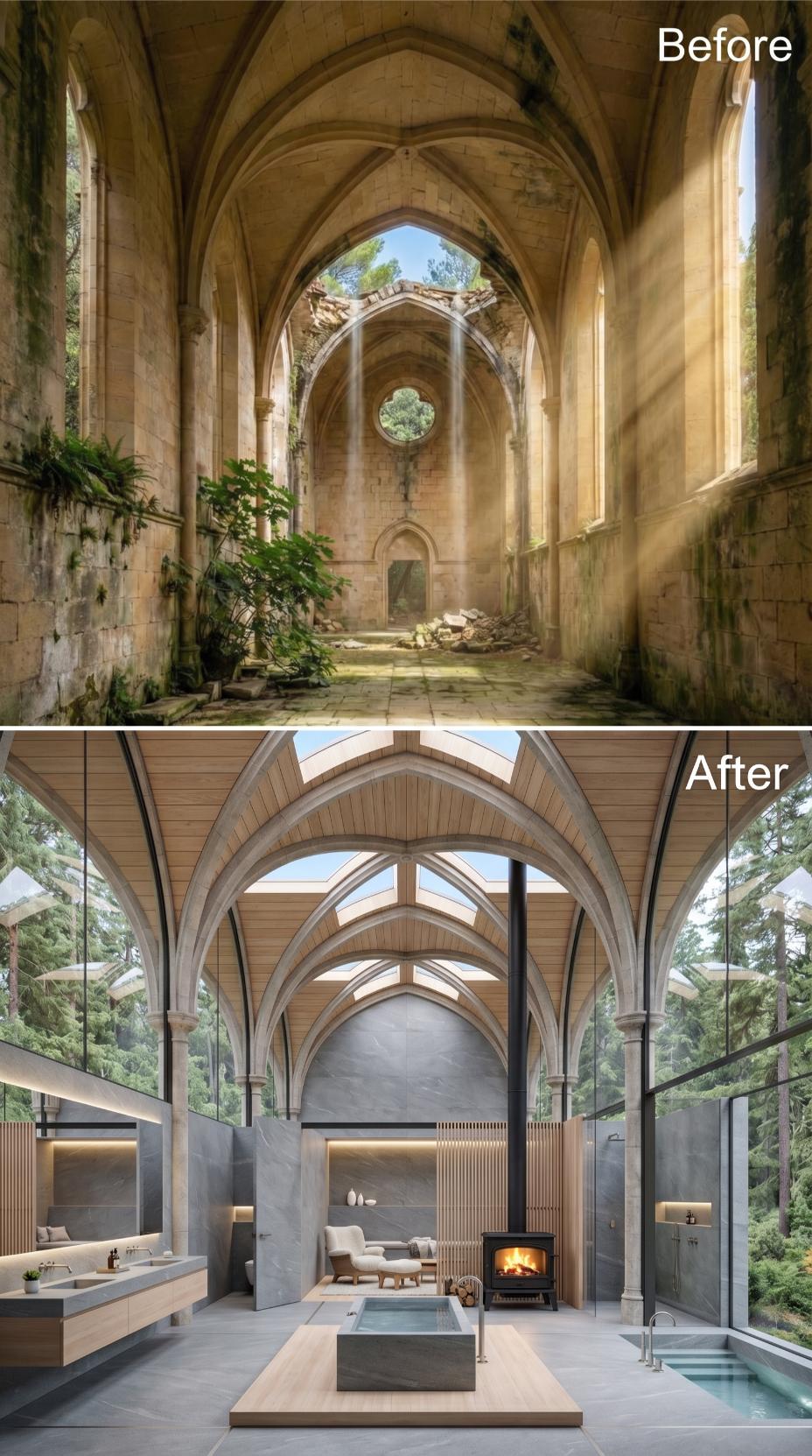
Warm-toned spruce planking fills the space between restored limestone ribs, replacing a collapsed roof with skylights that pull in direct views of surrounding pine canopy. Gray slate tiles cover both the floor and the central soaking tub surround, while a cast-iron wood-burning stove anchors the room’s midpoint with a vertical flue running straight to the ridge.
Floor-to-ceiling glass panels replace the original nave walls on both sides, dissolving the boundary between interior and forest. A floating vanity in light ash sits against polished gray stone cladding, lit from beneath by a recessed LED strip. Two lounge chairs in oatmeal boucle face the stove, treating what was once a liturgical corridor as a sitting room that happens to contain a bath.
A cast-iron wood-burning stove anchors the room’s midpoint with a vertical flue running straight to the ridge.
Slatted Oak Panels Line the Gothic Ribs Above a Black Stone Soaking Tub
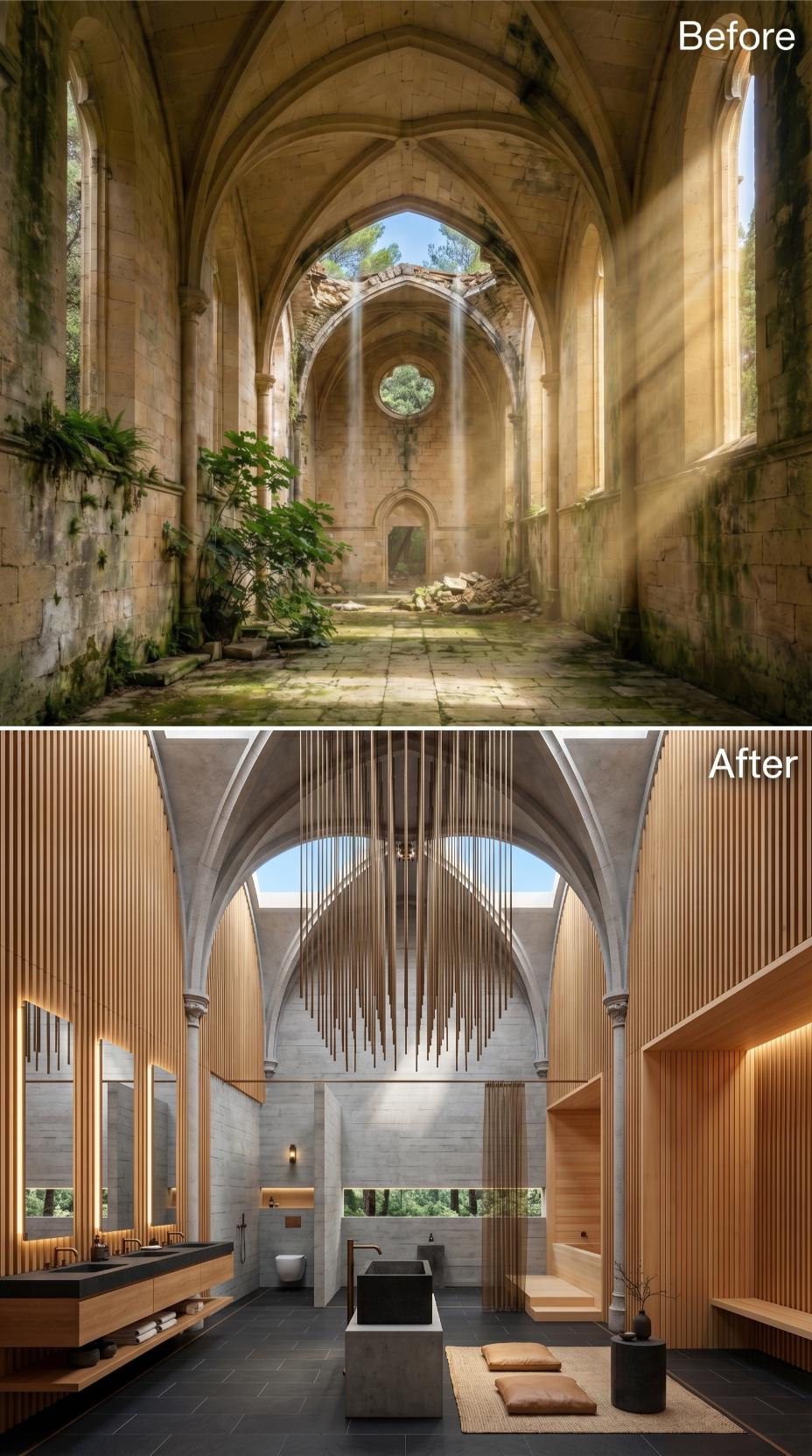
Vertical oak slats run floor to vault along every bay, replacing crumbling limestone surfaces with a surface that reads warm without reading rustic. The ribbed Gothic arches remain exposed at the crown, their plaster left raw and unpainted, while thin timber rods hang from the vault like an organ-pipe installation, anchoring the eye between ceiling and floor.
Below, dark slate tiles cover the entire floor plane. A freestanding black stone tub sits centered beneath the open oculus, flanked by two wall-mounted faucets in an oil-rubbed bronze finish. Double vessel sinks sit on a floating oak vanity to the left, their countertop a slab of dark granite. On the right, recessed oak shelving steps down like bleacher seating, finished in the same honey-toned wood throughout.
Gold Vault and Black Lacquer Reclaim a Crumbling Gothic Nave as a Luxury Bath
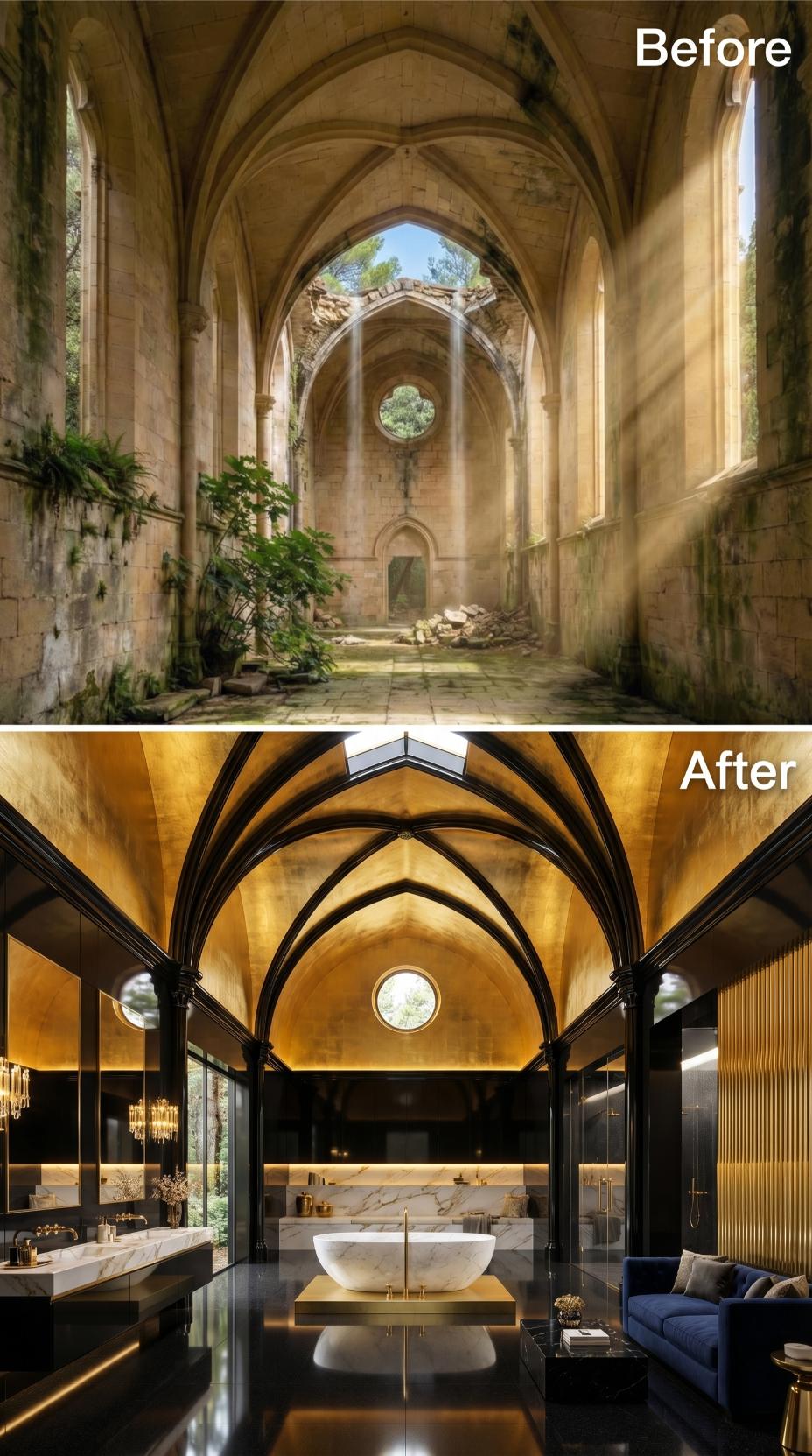
Warm ochre plaster covers the ribbed vaults while black-lacquered ribs trace each gothic arch, and a freestanding white marble tub sits centered on a raised gold platform beneath a circular oculus window.
Collapsed Gothic Nave Rebuilt Around a Concrete Lap Pool and Walnut Vanity
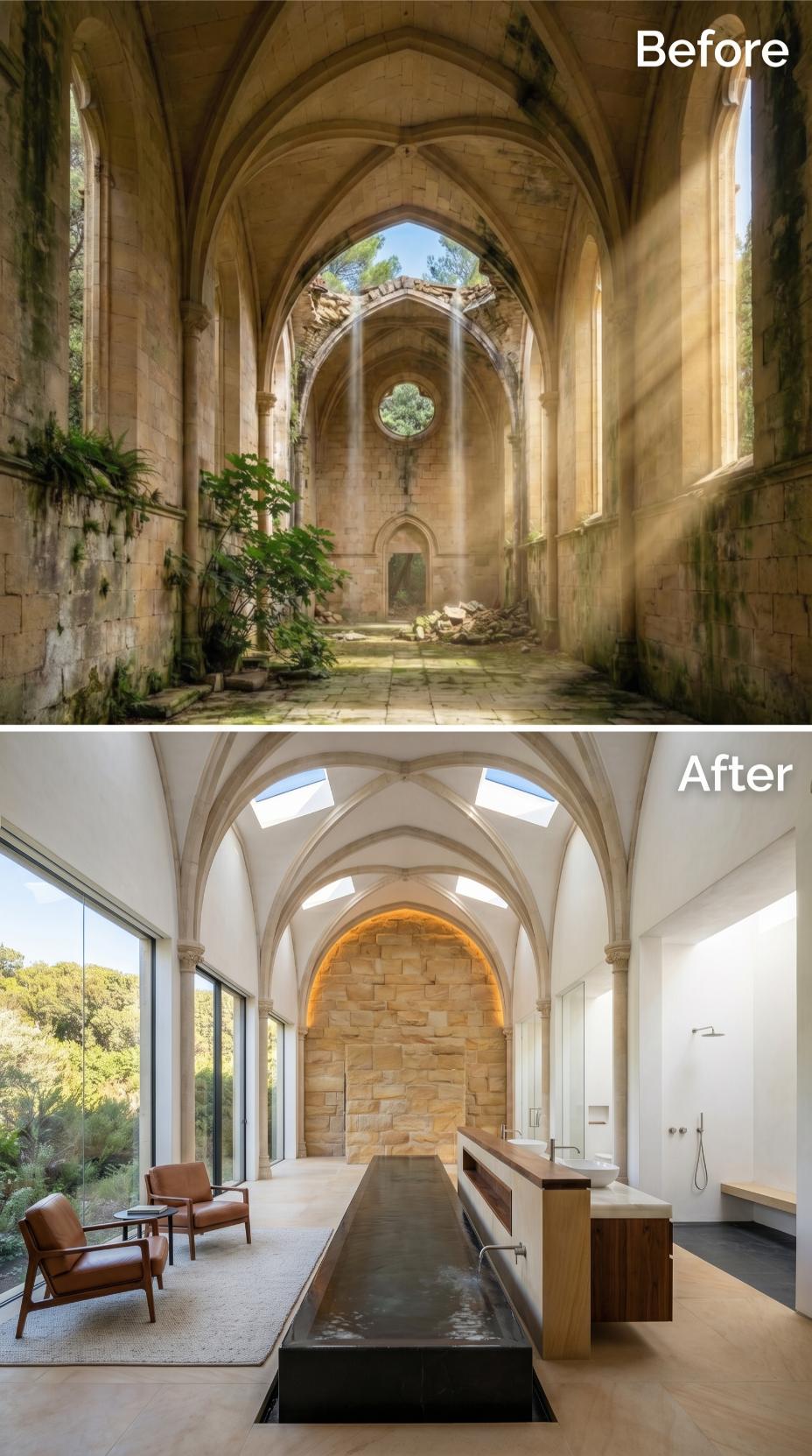
Restored ribbed vaults, painted white and fitted with flush skylights, run the full length of the nave above a concrete lap pool recessed into pale stone flooring. Leather mid-century armchairs sit on a low-pile rug at one end, while a walnut-topped vanity with wall-mount fixtures anchors the opposite side beneath an illuminated sandstone apse.
Blue-and-White Botanical Murals and a Copper Tub Reclaim a Ruined Gothic Nave
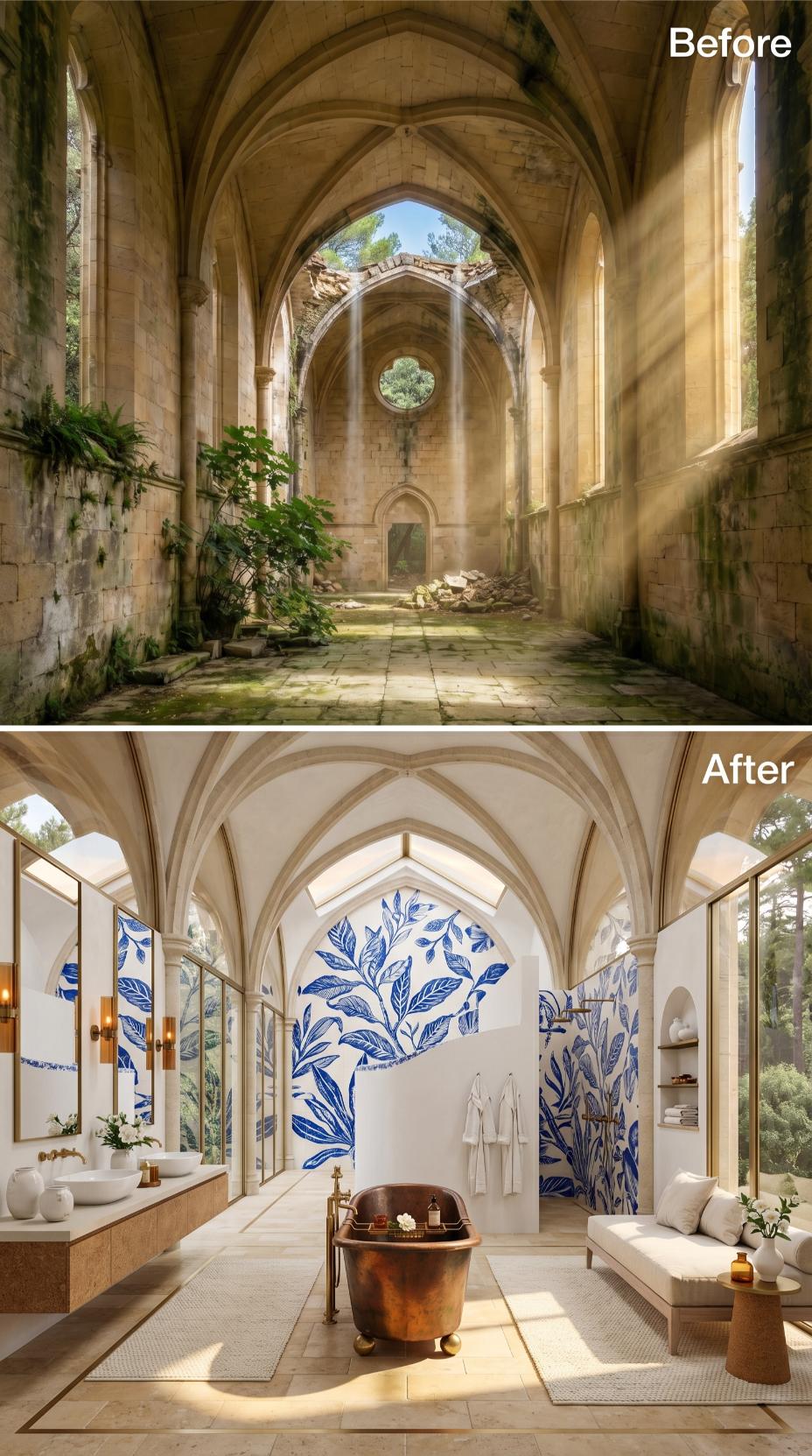
Gothic ribbed vaults, now replastered in bright white, arch over a nave-length bathroom where the original stone proportions remain intact. A copper clawfoot tub sits centered on limestone tile flooring, its aged bronze finish pulling warmth from the brass wall sconces flanking twin vessel sinks on a cork-faced vanity. The mural work is the decisive move: hand-painted blue botanical branches climb the back wall and wrap into the arched recess where a rose window once sat.
Large steel-framed windows along the side aisles replace collapsed masonry, flooding the space with daylight without disrupting the vault rhythm. A low upholstered bench with white linen cushions occupies the right bay alongside open walnut shelving. The blue-on-white palette ties directly to Portuguese azulejo tradition, grounding the mural in a craft lineage rather than treating it as purely decorative.
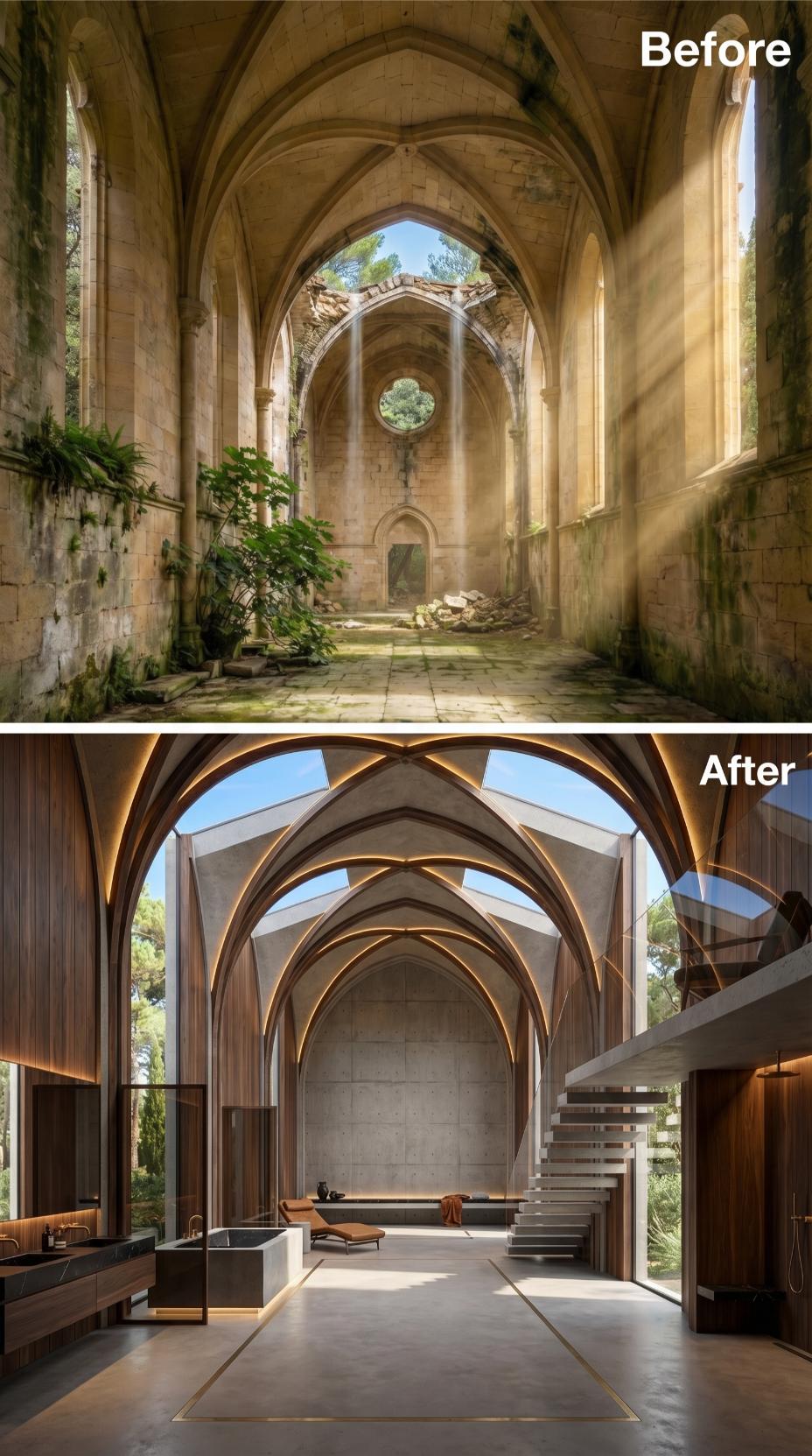
Walnut-Clad Gothic Ribs and an Open Skylight Vault Above a Concrete Soaking Tub
🔥 Would you like to save this?
Rubble and collapsed stonework gave way to a bathroom where the original pointed arches were preserved, then wrapped in walnut veneer panels that follow each rib from floor to crown. Warm LED strip lighting runs along the inner curve of every arch, casting a line of amber across the concrete ceiling panels set between them. The open skylight slot at the apex lets in direct sky views and unfiltered daylight.
At floor level, a rectangular concrete soaking tub anchors the left side of the nave, positioned beside a dark stone vanity counter with undermount sinks. A cantilevered concrete staircase with no visible railing ascends the right wall, its floating treads echoing the horizontal grid of the polished concrete floor. A low daybed in burnt orange sits mid-nave, pulling the eye toward the far wall.
Charcoal Tile and White Gothic Arches Rebuilt Around a Plunge Pool and Living Moss Walls
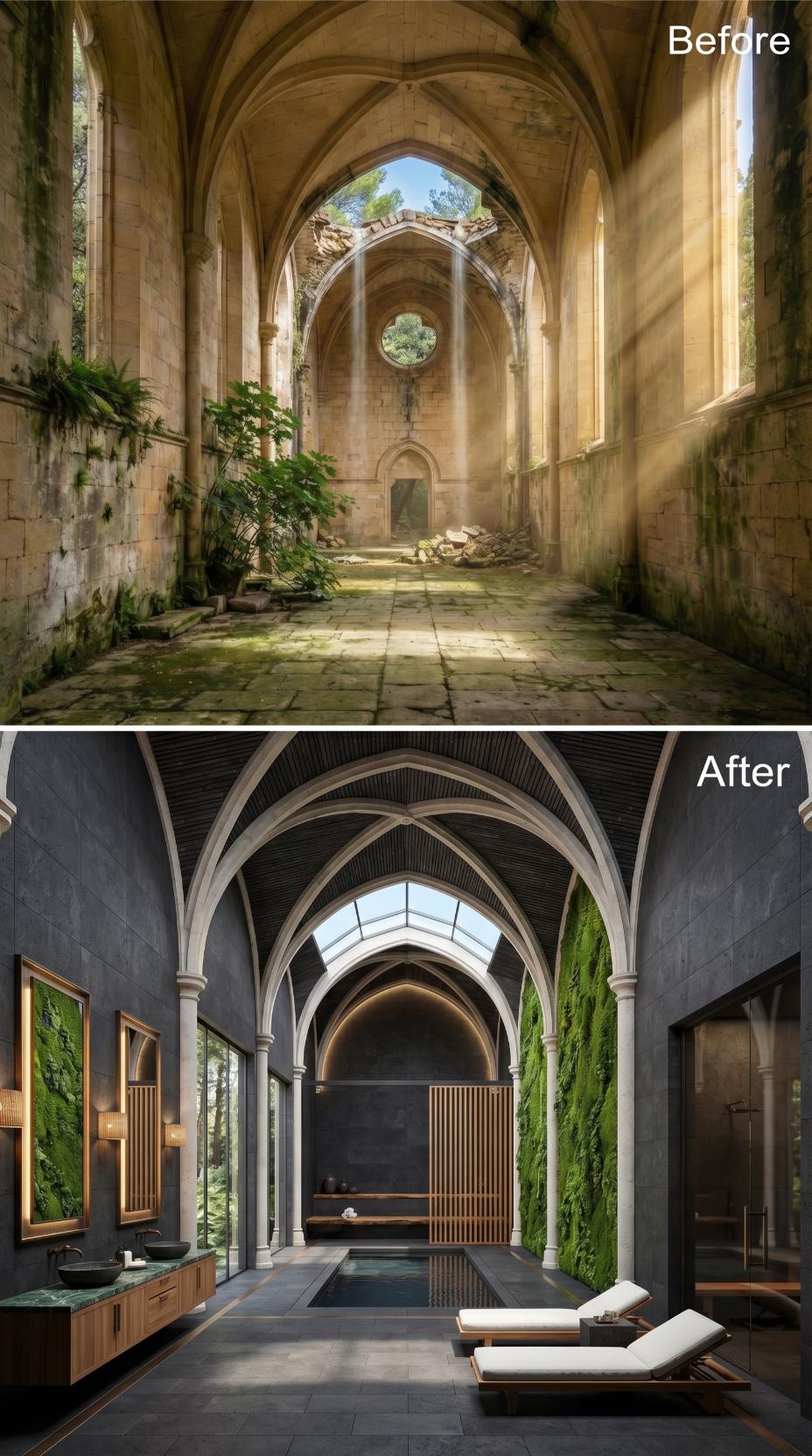
Slate-grey field tile covers every wall and floor surface, grounding the nave’s skeletal white arches in something industrial rather than reverent. A narrow plunge pool runs the central axis, flanked by two teak chaise lounges with cream cushions. Vertical moss panels, framed in brass, replace where stained glass once sat.
A walnut vanity with a Verde Guatemala marble countertop anchors the left wall, paired with a matte black vessel sink and unlacquered brass fixtures. The original ribbed vault remains intact overhead, now fitted with dark-stained wood infill panels between the ribs and a single ridge skylight that pulls daylight straight down the pool’s length.
Ribbed Gothic Vaults Rebuilt Over Terracotta Terrazzo and a Sunken Round Tub
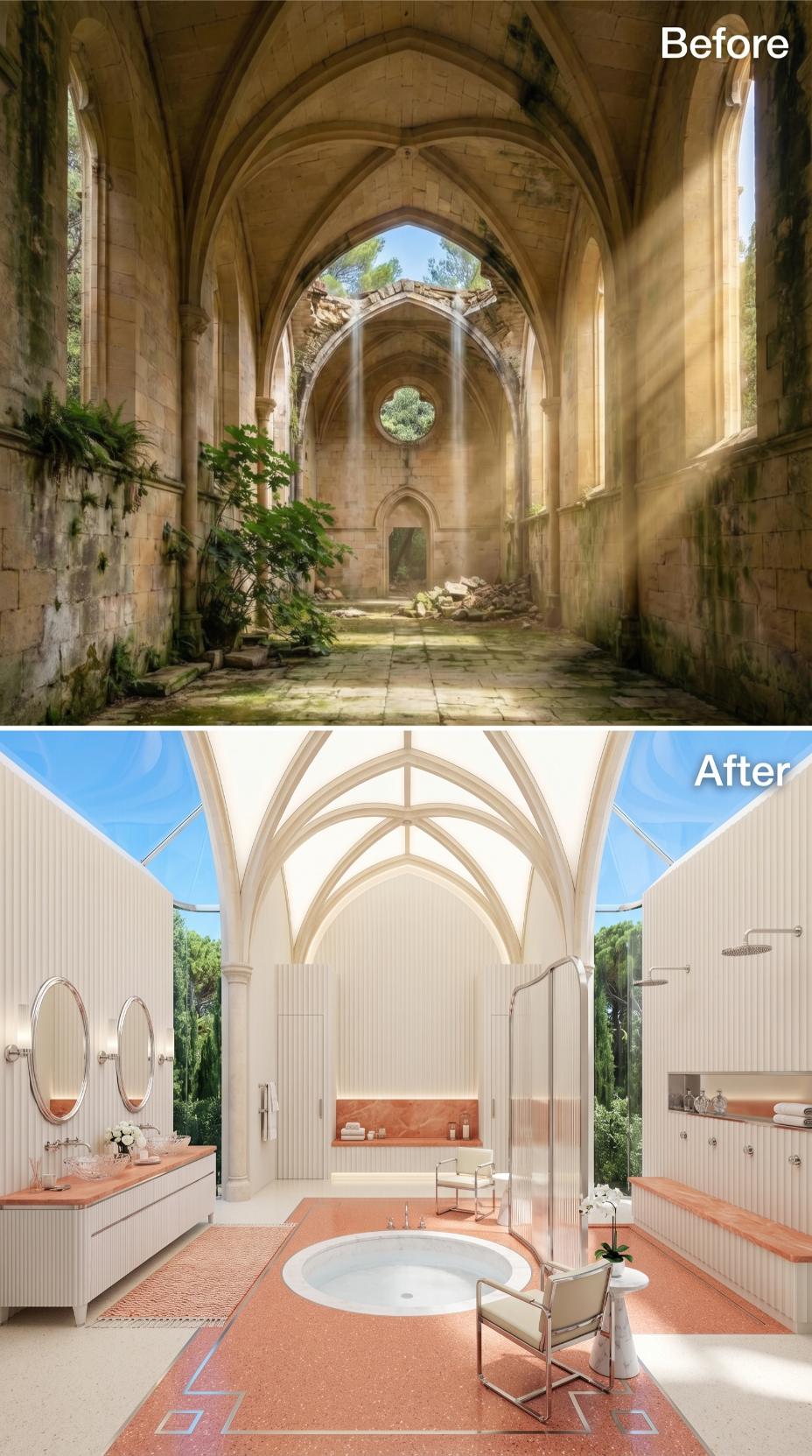
Collapsed nave walls gave way to full-height glazing on both sides, pulling the surrounding tree canopy directly into the bathroom. The Gothic ribbed vaults were replastered white and left unadorned, their geometry doing enough work without additional finish. Below them, terracotta terrazzo floors anchor the space with a warm mineral tone, inlaid with geometric border lines near the tub surround.
A circular soaking tub sits recessed into the terrazzo platform at center, flanked by chrome-frame chairs upholstered in off-white fabric. White fluted cabinetry runs along both walls, topped with salmon-toned stone counters. Oval chrome-framed mirrors hang above the vanity on the left, while open shelving with rolled towels occupies the right side. A built-in niche above the tub holds bath products behind a salmon stone panel that ties directly back to the counter material.
Weathered Timber Cladding and Skylights Reclaim a Gothic Nave as a Fireplace Bathroom
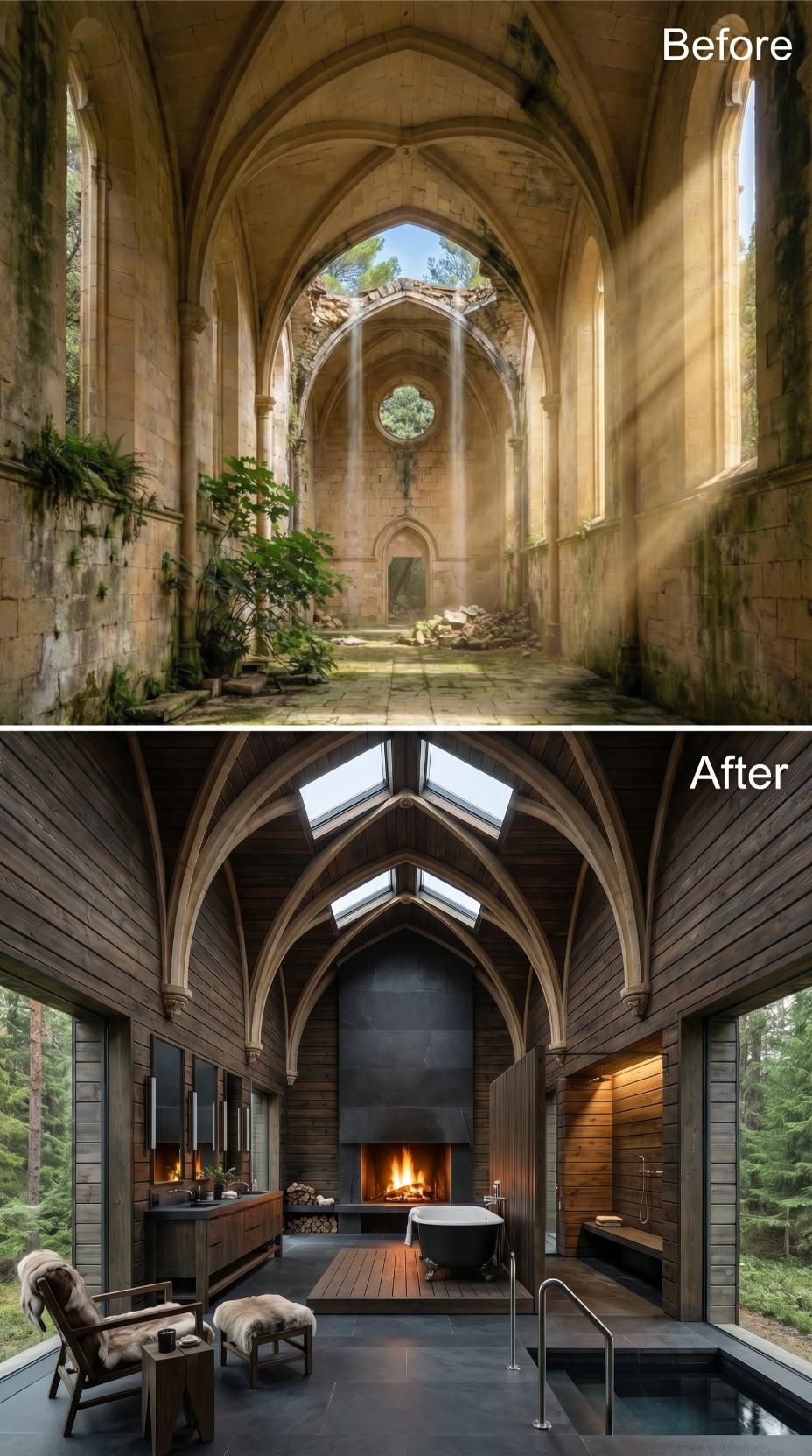
Dark-stained horizontal planks cover both walls and the rebuilt Gothic ribs, with slate-grey floor tiles and a freestanding black cast-iron tub positioned directly in front of a lit stone fireplace on a raised teak platform.
Terracotta Plaster and Teak Decking Reclaim a Crumbling Gothic Nave
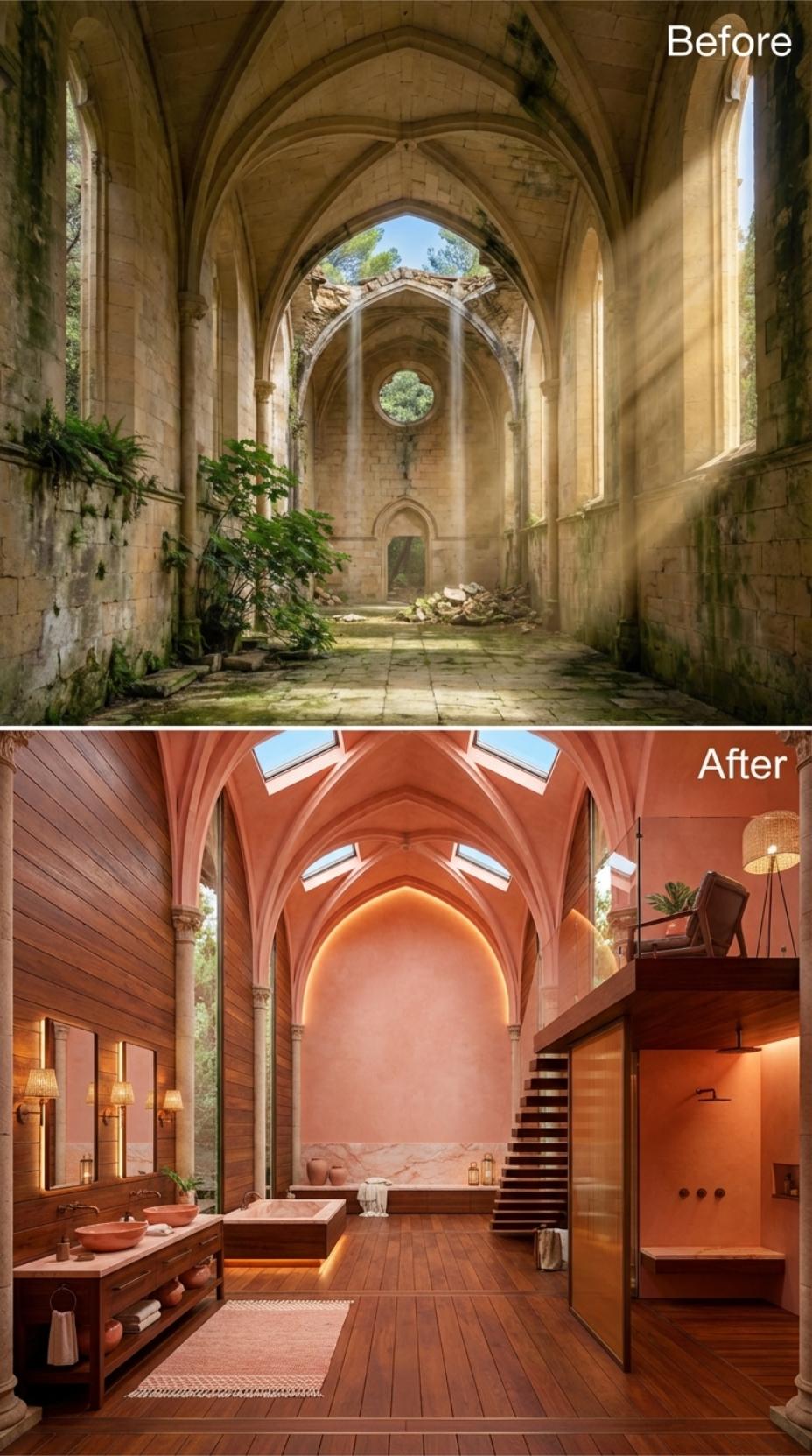
Ribbed Gothic vaults survive intact above wide-plank teak flooring, their stone ribs repainted in a deep terracotta that reads closer to fired clay than paint. Skylights cut directly into the vault bays replace what were once open ruptures in the ceiling, flooding the nave with controlled daylight. A double vanity runs along the left wall, built from stained hardwood with open lower shelving and vessel sinks in a matching terracotta ceramic. Rattan pendant lamps hang at mid-height on the right side, anchoring a mezzanine level accessed by open-riser wood stairs.
At the nave’s end, a freestanding stone soaking tub sits on a raised platform framed by the original pointed arch, its plaster surround lit from below by recessed strip lighting. Pottery urns flank the tub rather than potted plants, which keeps the floor clear and reinforces the earthy palette without introducing maintenance demands. The glass-enclosed shower occupies a side alcove, fitted with a ceiling-mount rain head and built-in bench.
Carved Stone Tub and Brass Pendant Rails Revive a Ruined Gothic Nave
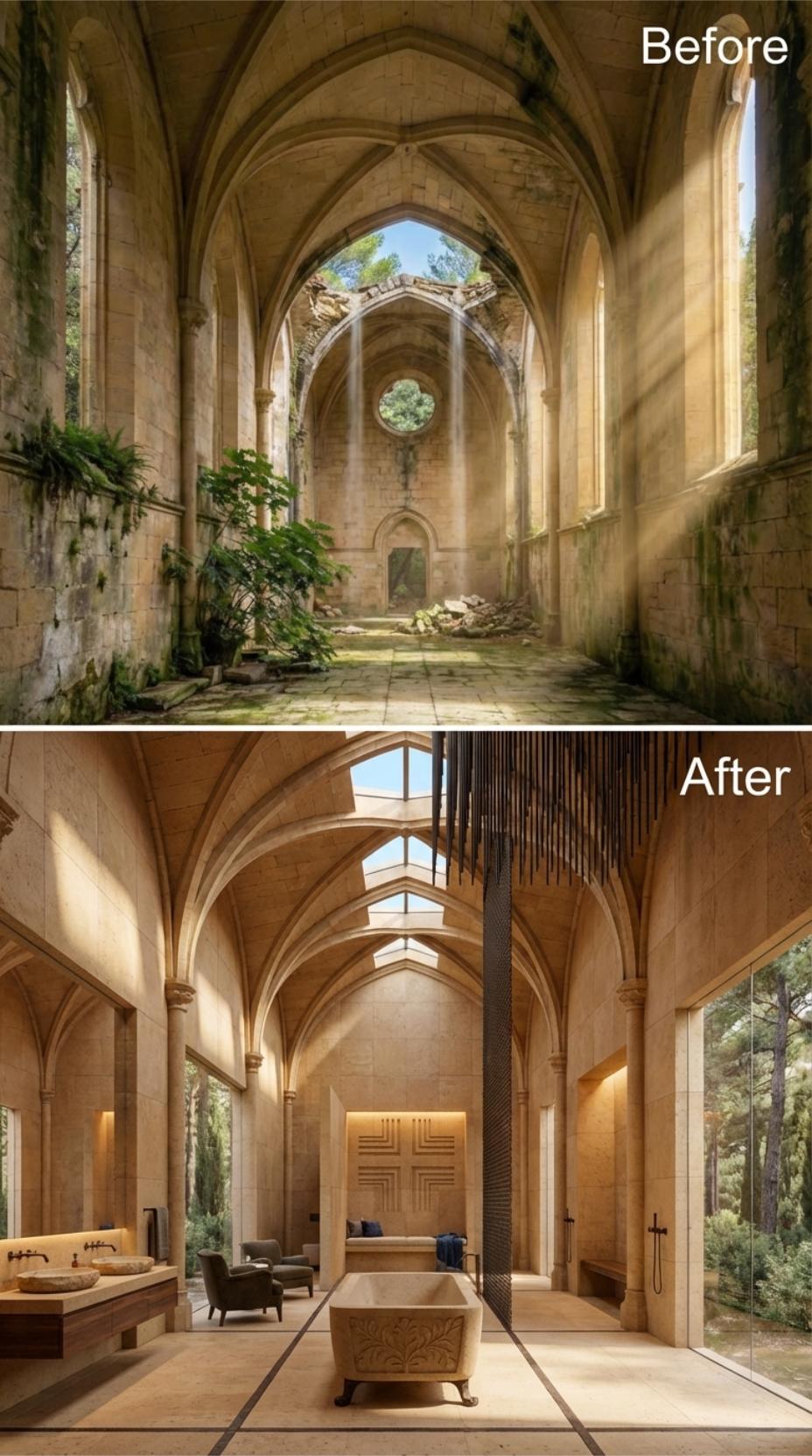
Limestone dominates every surface here: the ribbed vaults overhead, the floor laid in large-format stone tiles, and the freestanding soaking tub, which appears cut from a single block and etched with geometric relief patterns across its apron panel. Vertical metal rods hang from the vault crossing above, functioning as a pendant rail system that positions light sources without anchoring into the historic masonry. The end wall features a flush carved panel in a cross-grid motif, backlit from below with recessed strip lighting.
Floor-to-ceiling glass panels along the right side replace what was once open rubble, pulling the pine forest directly into the sightline of anyone soaking in the tub. Stone vessel sinks sit on a cantilevered limestone counter to the left, paired with matte black wall-mount faucets. Mid-century armchairs in charcoal upholstery anchor a small seating cluster near the carved end wall, grounding the space with a domestic scale that the soaring Gothic proportions would otherwise resist.
Amber Glass Pendants and Skylit Vaults Reclaim a Ruined Gothic Nave as a Spa Bath
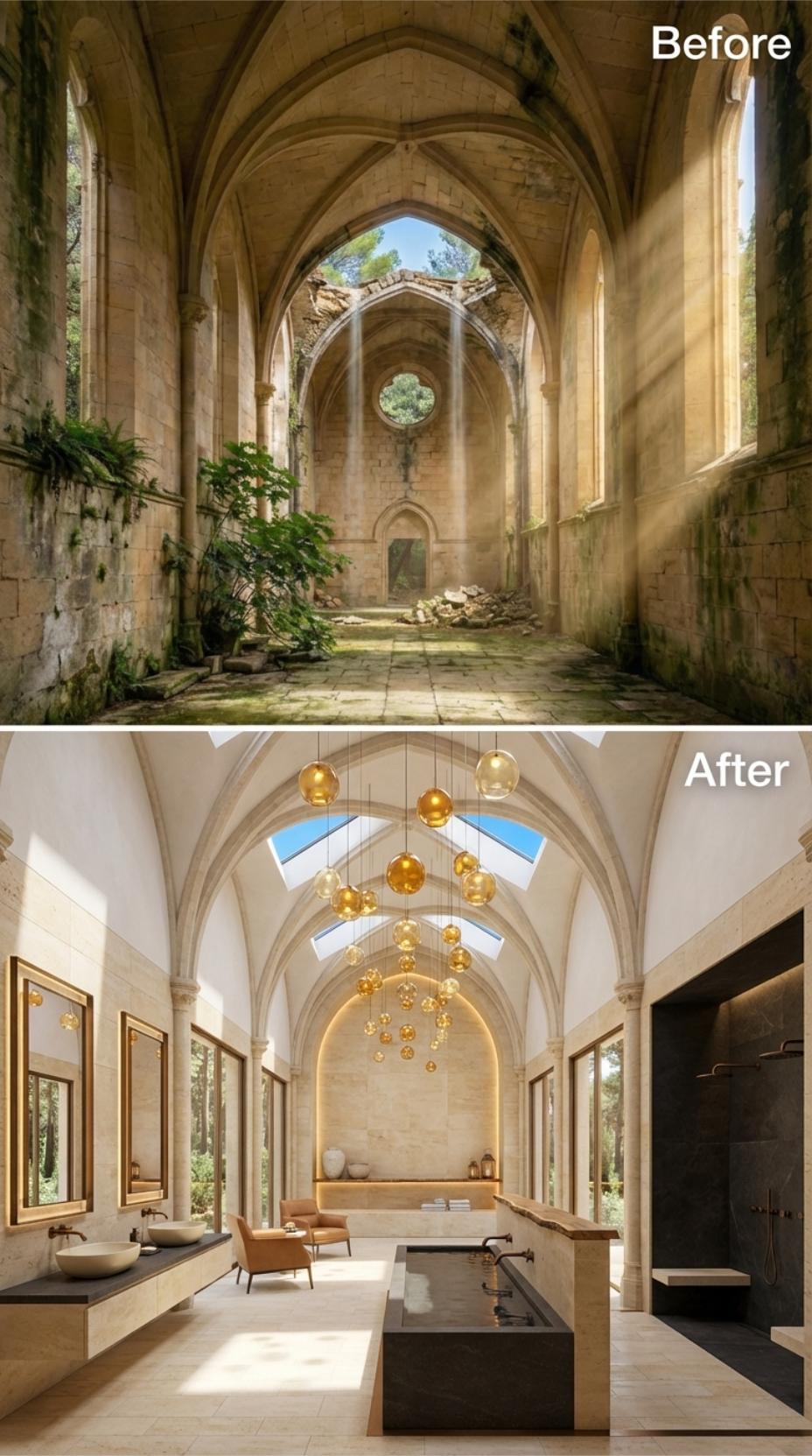
Clustered amber glass globe pendants descend from the groin vaults in an asymmetric cascade, replacing what was once open sky through a collapsed roof. Plastered white walls retain the original stone pilasters, and a long dark-stone soaking tub anchors the nave’s central axis. Flanking vanities carry vessel sinks on slate-toned counters with gold-finish fixtures, while floor-to-ceiling glazing floods the side aisles with forest light.
Gold-Leaf Vaults and a Carved Marble Tub Reclaim a Ruined Gothic Nave
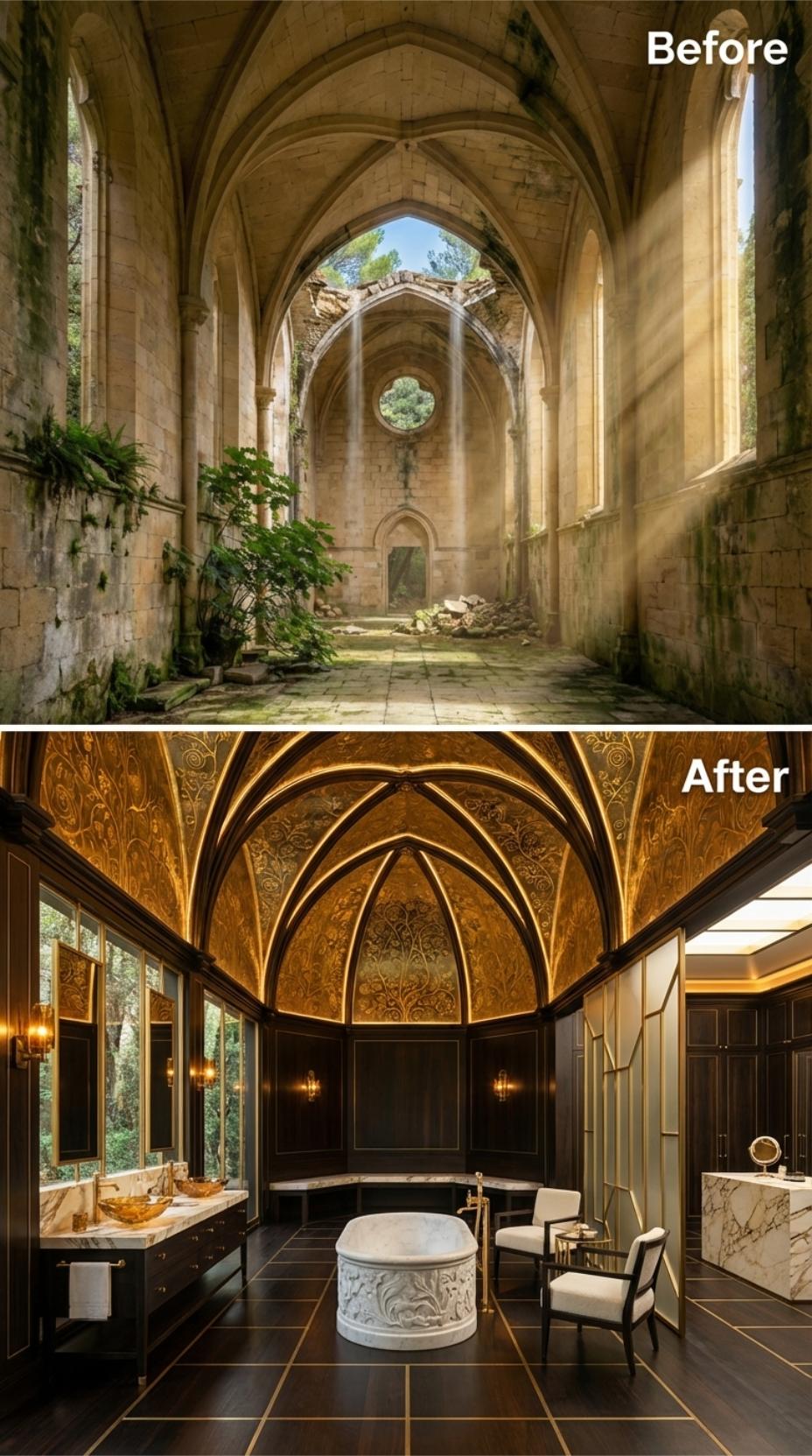
Gilded acanthus-scroll plasterwork covers every surface of the rebuilt ribbed vault, with brass strip lighting recessed directly into the groin intersections to throw the relief pattern into sharp relief against the gold-painted bays. The floor shifts to large-format dark charcoal tile laid in a grid, and the vanity runs along the left wall in ebonized wood with brass hardware supporting a thick white marble slab and an amber glass vessel sink.
At center, a freestanding tub carved from white marble carries a repeating floral bas-relief band around its cylindrical base. Two upholstered chairs in off-white linen flank the tub on the right side, and a marble-topped reception counter occupies the far corner. Through the original Gothic lancet windows behind the vanity, mature trees remain visible, anchoring the interior to the ruined garden that once surrounded the nave.