🔥 Would you like to save this?
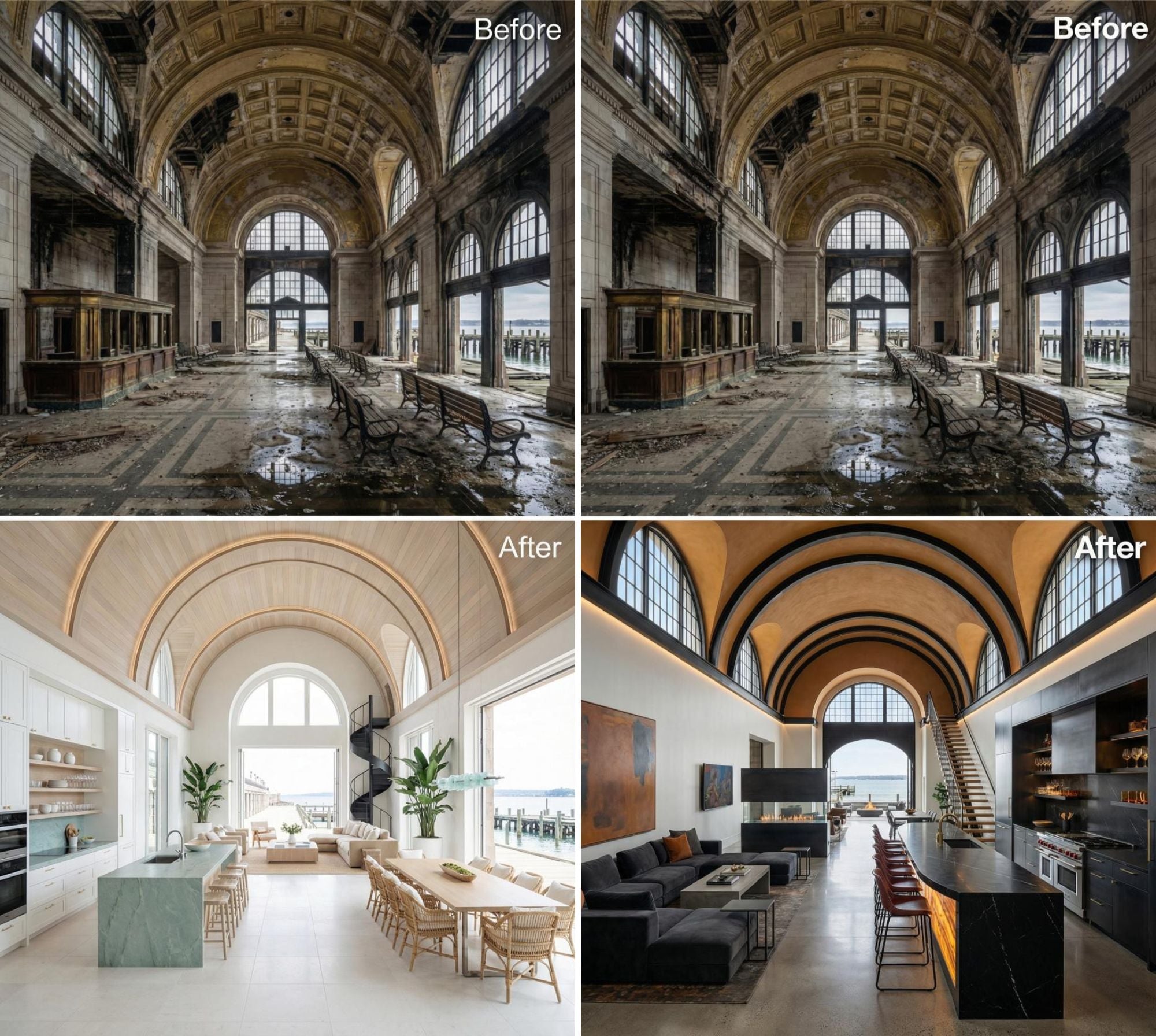
The great room has become the ultimate architectural flex of modern luxury living. No walls. No apologies. Just one sweeping, light-drenched space where cooking, dining, and lounging happen in full view of each other, and every material choice is exposed. The designs hitting the radar for 2026 push this format further than ever: vaulted ceilings soaring past twenty feet, islands the size of small yachts, and living areas that feel like they belong in a boutique hotel. Here are fifteen rooms that are redefining what open-concept luxury actually looks like.
In order to come up with the very specific design ideas, we create most designs with the assistance of state-of-the-art AI interior design software. Also, assume links that take you off the site are affiliate links such as links to Amazon. this means we may earn a commission if you buy something.
Warm Organic Modern Vaulted Great Room with Calacatta Viola Marble and Amber Glass Pendants
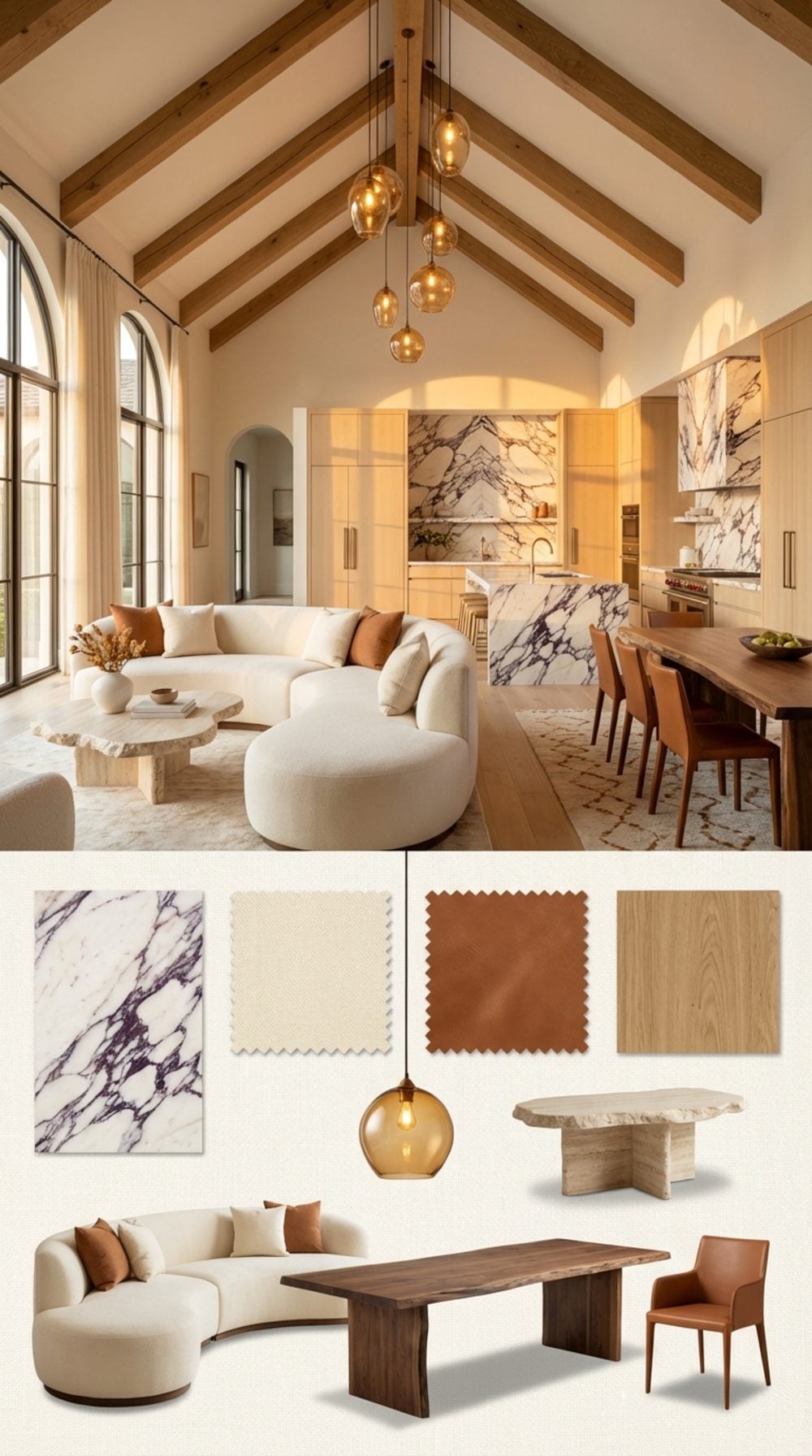
That floor-to-ceiling book-matched Calacatta Viola marble wall is the room’s beating heart, the deep violet veining against cream cashmere upholstery creates a tension that reads as both raw and refined. The hand-blown amber glass pendants descending from the vault peak pull the eye upward while grounding the warmth downward, working the vertical space in both directions at once.
Psychologically, the combination of organic curves (the sectional, the travertine table’s edges) with the stone’s geological drama taps directly into biophilic response, the brain reads both as nature, despite one being furniture and the other ancient geological pressure.
Coastal Grand Luxury Great Room with Tongue-and-Groove Oak Vault and Rattan Brass Chandelier
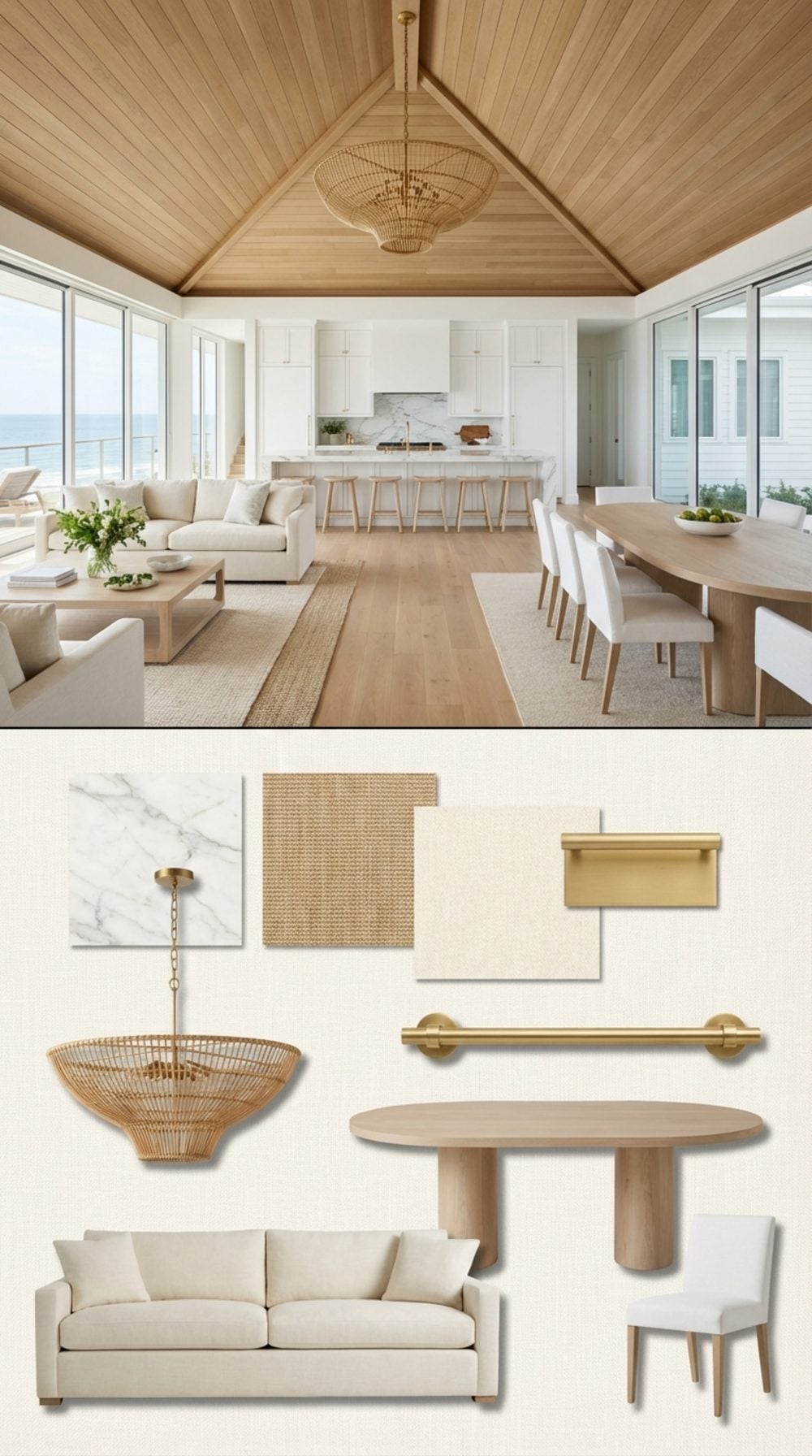
White oak tongue-and-groove planking on a cathedral vault reads like an inverted ship hull, and that’s exactly the point. The ceiling material borrows from coastal boat-building tradition and gives the room its architecture before a single piece of furniture is placed.
Unlacquered brass hardware against all-white shaker cabinets is a deliberate choice: the brass will patina unevenly over years of use, ensuring the kitchen never looks like a showroom. The layered sisal-under-wool rug strategy adds tactile depth underfoot without competing with the marble island’s visual dominance.
Dark Dramatic Industrial Vault Great Room with Nero Portoro Marble and Smoked Glass
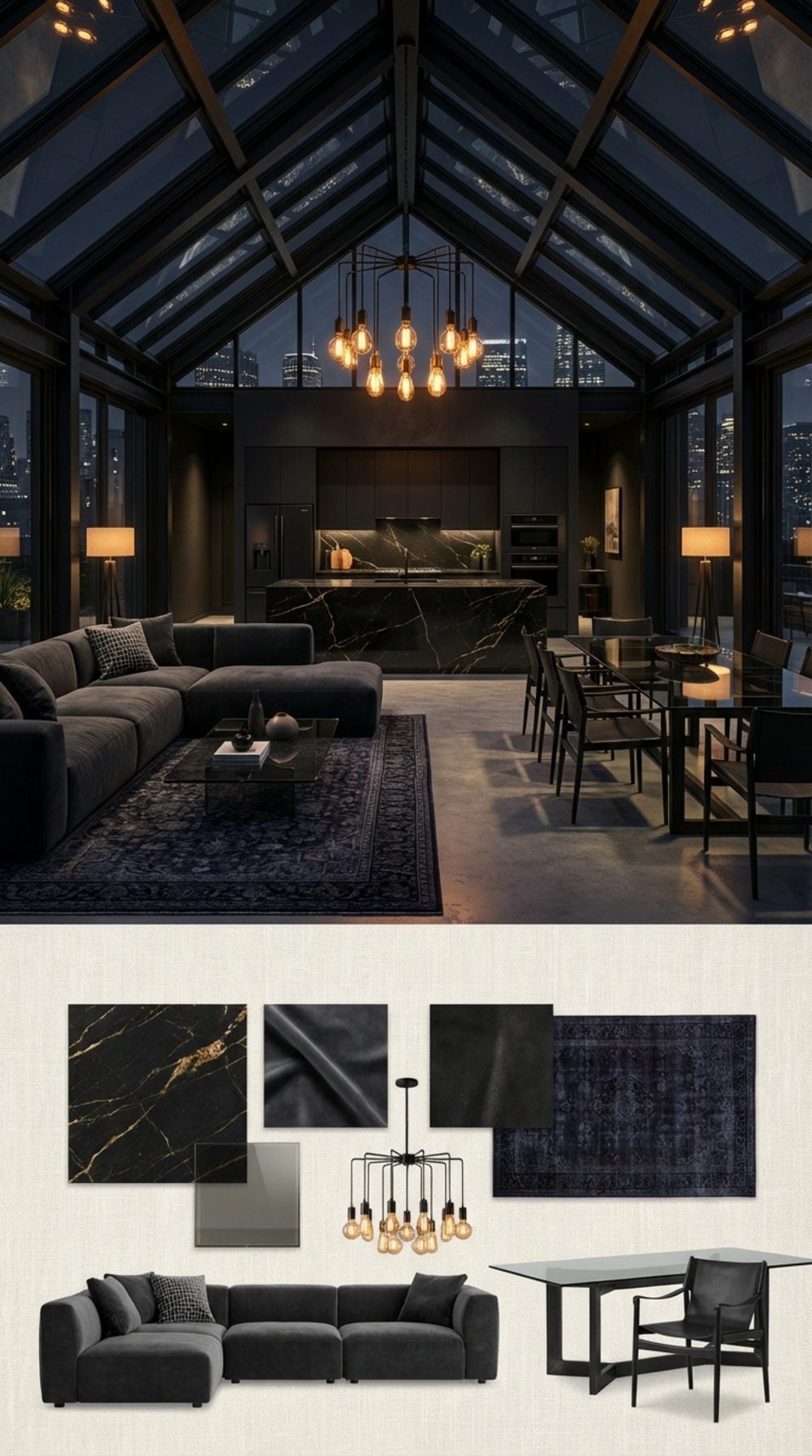
Nero Portoro marble, black stone with gold and white veining, is one of the most demanding materials in residential design. Use it wrong and it reads as gothic theater. Here, stretched across a waterfall island against matte black cabinetry, it reads as controlled power. The gold veins are the only warm note in an otherwise cold palette, which makes them land harder.
Italian Palazzo Barrel Vault Great Room with Murano Glass Chandelier and Arabescato Marble
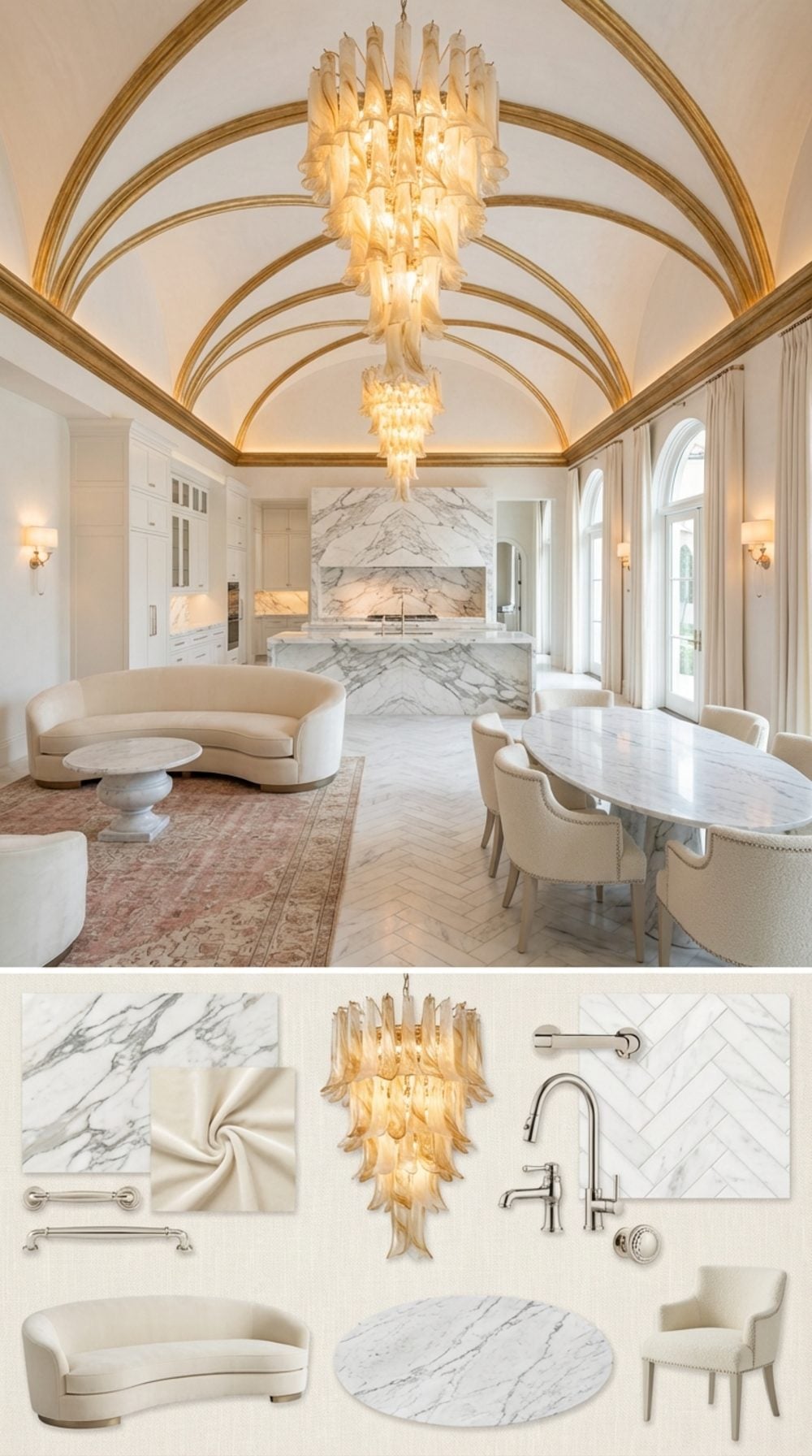
Everything here is calibrated to feel like it was inherited rather than purchased. The herringbone white marble floors, the faded Tabriz rug laid over them, the bouclé bergère chairs, each piece reads as if it arrived at a different decade and simply stayed.
That’s the central strategy of Italian palazzo luxury: the room should feel like it accrued, not like it was designed. The barrel vault’s gilded rib detail is the load-bearing idea, strip it out and the space becomes a very expensive showroom. Keep it and every other element snaps into a 400-year design lineage.
Architectural Modernist Vault Great Room with Floating Mezzanine and Statuario Marble Island
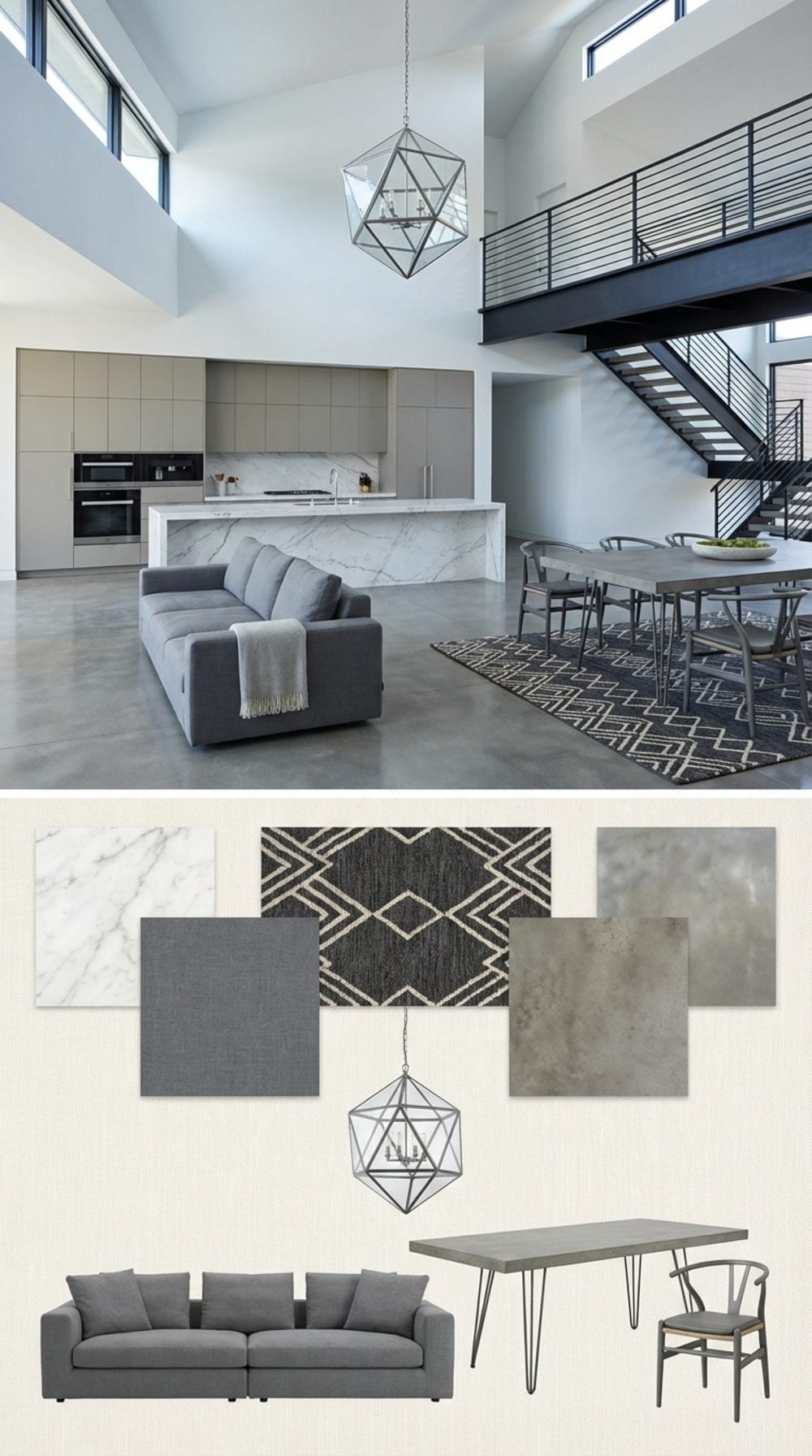
The floating mezzanine above is doing more than adding square footage, it’s compressing the visual ceiling in one zone and releasing it in another. That push-pull between enclosed and open is exactly what makes a double-height room feel dynamic rather than just tall.
Honed rather than polished Statuario marble is the quiet genius here. Polished would read as gloss against all that matte greige and concrete. Honed keeps the material honest, letting the stone’s natural veining carry the interest without adding reflective noise to an already complex space.
Warm French Provincial Grand Vault Great Room with Sage Cabinets and Wrought Iron Chandelier
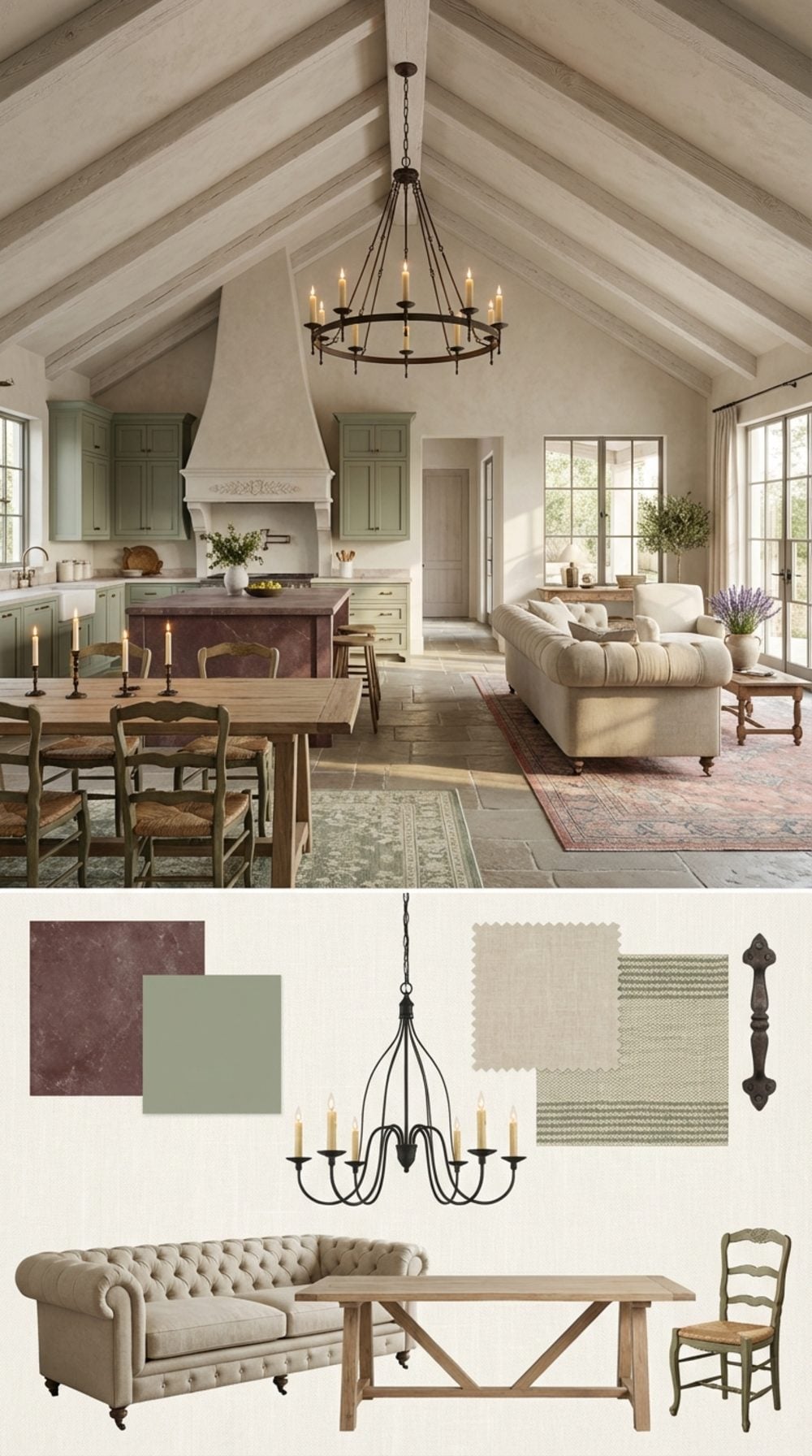
Sage green inset cabinets against aged Burgundy limestone is a material pairing that works because both surfaces carry imperfection as a feature. The limestone’s worn edges and the cabinet paint’s slight variation in tone make the kitchen look like it grew into the space rather than being installed in it.
The hand-plastered range hood with carved floral detail is genuinely worth the cost, it’s the one piece of custom millwork that anchors the entire kitchen to its French provençal reference. Without it, you’d have a green kitchen. With it, you have a kitchen with a story.
Old Hollywood Glamour Vault Great Room with Navy Lacquer Kitchen and Crystal Chandelier
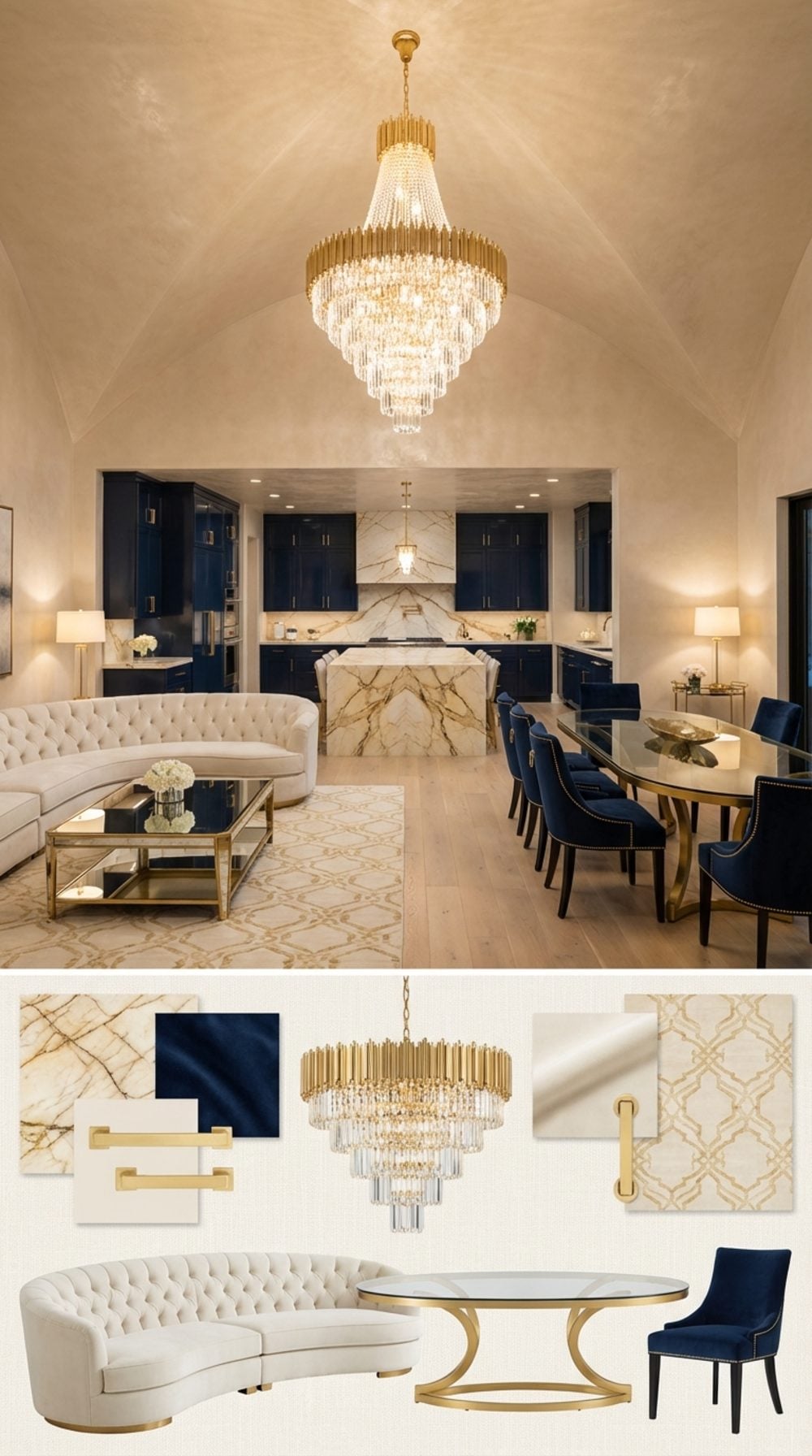
Golden Spider marble is the most dramatically theatrical stone currently in circulation, the cream field shot through with bold gold veining that radiates outward like a solar flare. Against navy lacquer cabinets, it reads as genuine glamour rather than pastiche because the navy is deep enough to absorb the marble’s showmanship.
Venetian plaster in champagne at vault scale does something no paint can: it reflects light differently at every hour, shifting the room’s warmth from cool morning pearl to rich evening amber without changing a single element. That perceptual dynamism is 90 percent of what makes Hollywood Regency work as a style.
‘The rooms that feel most alive are the ones designed around how light moves through them over 24 hours, not just how they photograph at noon.’
Mountain Modern A-Frame Great Room with Stone Fireplace, Quartzite Island and Antler Chandelier
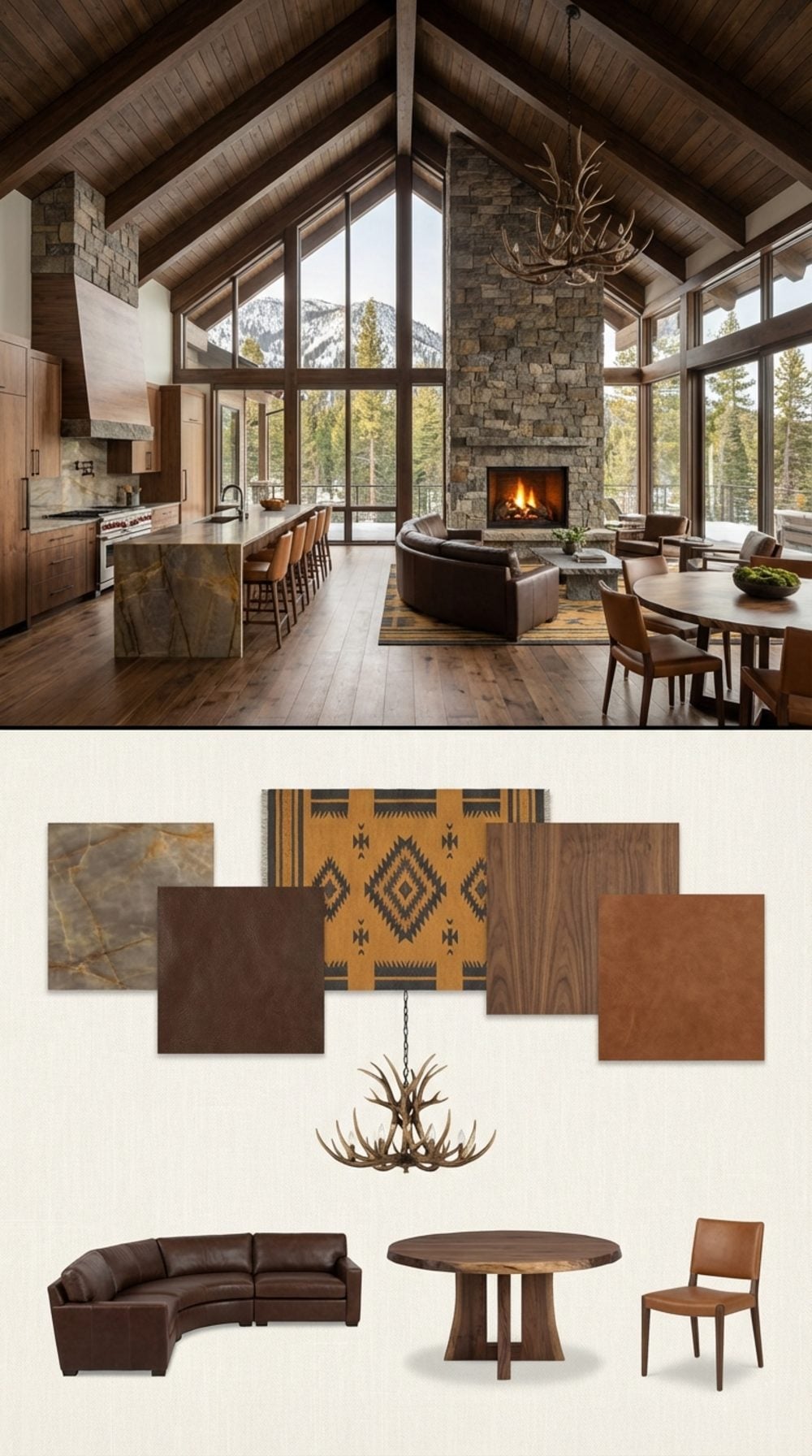
The double-sided stone fireplace is the room’s structural spine, it divides living from dining while serving both. Every other material in the space (walnut, leather, quartzite, stacked stone) is a variation on the same geological and organic theme, which gives the room its coherence despite its scale.
Floor-to-ceiling glass gable walls in an A-frame create something close to the prospect-and-refuge ideal: you’re deeply enclosed by the structural walls and the vaulted ceiling overhead, while the view to open mountain wilderness is unobstructed in front. The brain registers both simultaneously. That’s why mountain modern rooms feel so instinctively right to occupy.
- The stacked stone fireplace and stone range hood surround speak the same material language, unifying kitchen and living zones visually.
- Smoky amber quartzite on the island reads warm against the walnut, preventing the all-wood palette from going flat.
- The Pendleton-style rug introduces pattern as the sole graphic element, doing the work of art in a room that needs nothing on the walls.
Contemporary Grand Manor Great Room with Camel Bouclé Cloud Sofa and Forged Iron Chandelier
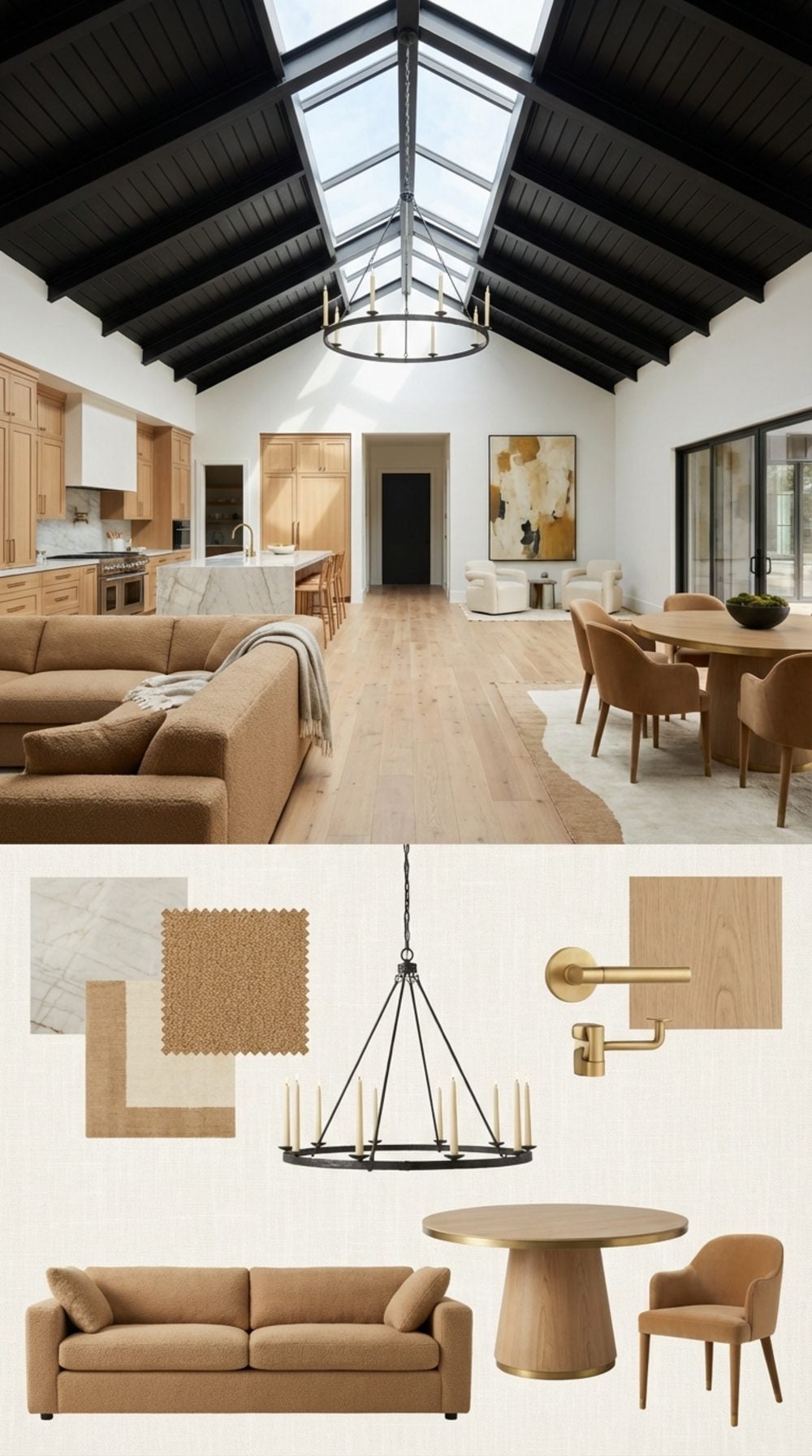
The glass ridge skylight running the vault’s full length is an architectural device that resolves a lighting problem inherent to all open-plan great rooms: how to wash a space this large with natural light without relying entirely on perimeter windows. The answer here is top-down, creating a long shaft of daylight that hits the center of every zone simultaneously.
Taj Mahal quartzite is having a significant moment in 2026 design because it reads warmer than Calacatta white marble while maintaining that luxury stone visual weight. Against camel bouclé and white oak, the ivory-gold warmth of the stone makes the kitchen feel connected to the living palette rather than visually separate from it, a challenge in every open-concept plan.
Tuscan Villa Grand Vault Great Room with Majolica Tile, Terracotta Floors and Kilim Rug
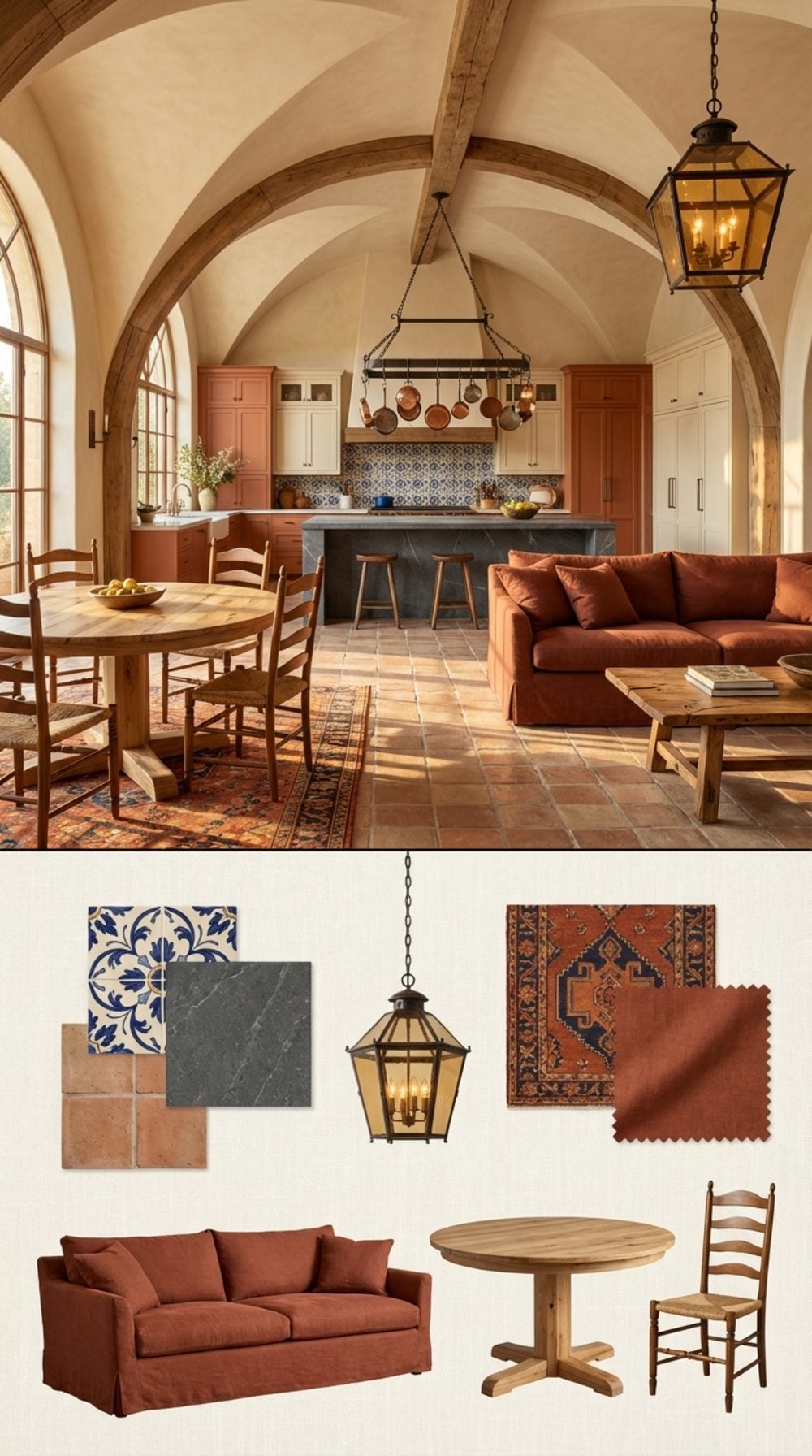
Hand-painted majolica tile as a kitchen backsplash is a material that completely resists the word ‘understated’, and this room is built around accepting that. The cobalt and cream floral pattern is the loudest single element in the space, and everything else is deliberately muted in response: rust linen, dark grey stone, worn terracotta.
Modern Ranch Grand Vault Great Room with Steel Trusses, Leather Sectional and Stone Fireplace Wall
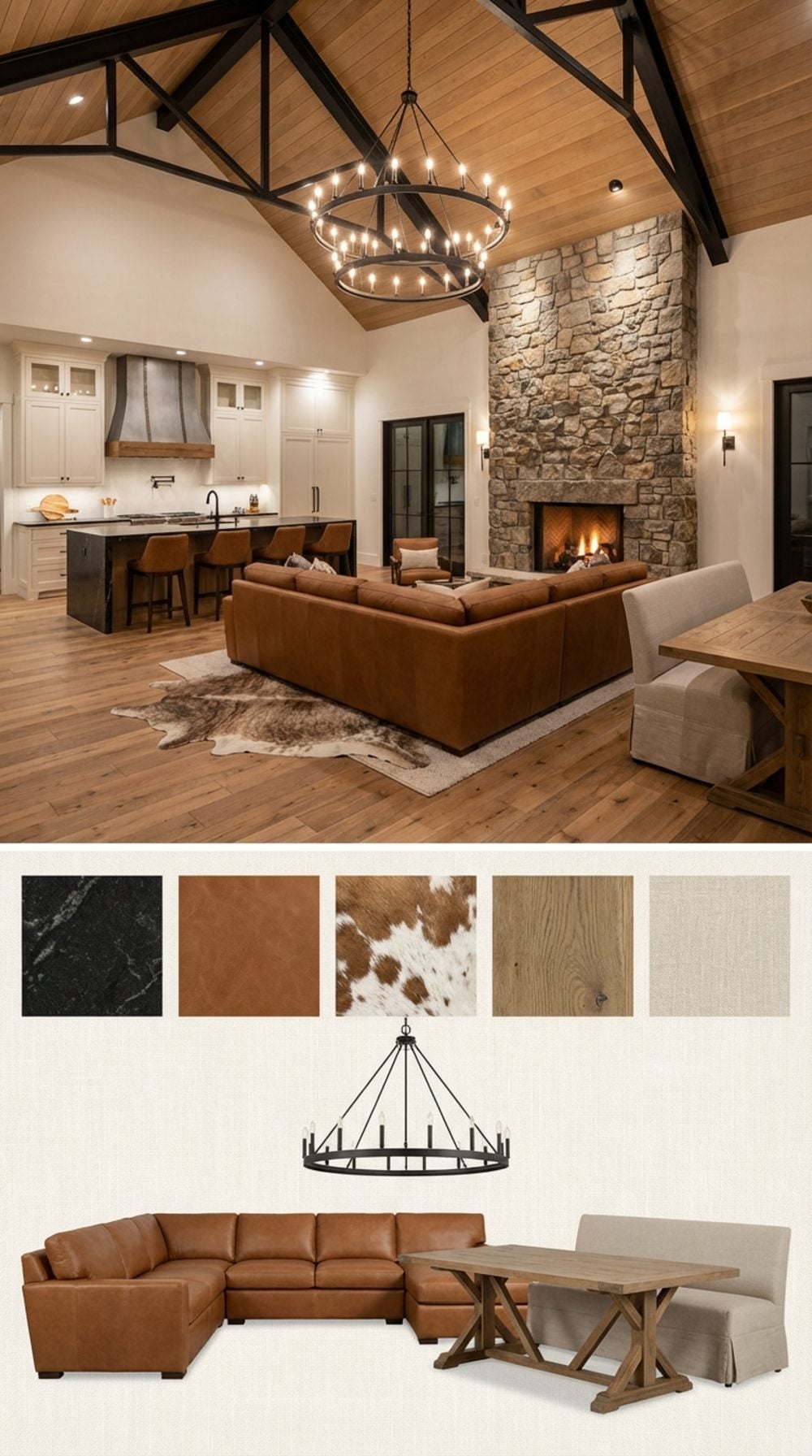
Blackened steel trusses against white oak planking is a ceiling strategy that works by contrast: the industrial material reads sharp and precise, the wood reads warm and organic, and the gap between them is where the room’s character lives. Neither element would be half as interesting alone.
A twelve-foot Cambrian black granite island is a commitment that reshapes the kitchen’s entire spatial logic, it becomes less a workspace and more a piece of furniture that happens to have a sink. The leather-wrapped bar stools treat it accordingly, positioning the island as the room’s social anchor rather than a cooking surface with seating as an afterthought.
Warm Organic Modern Vault with Calacatta Viola Marble and Amber Glass Pendants
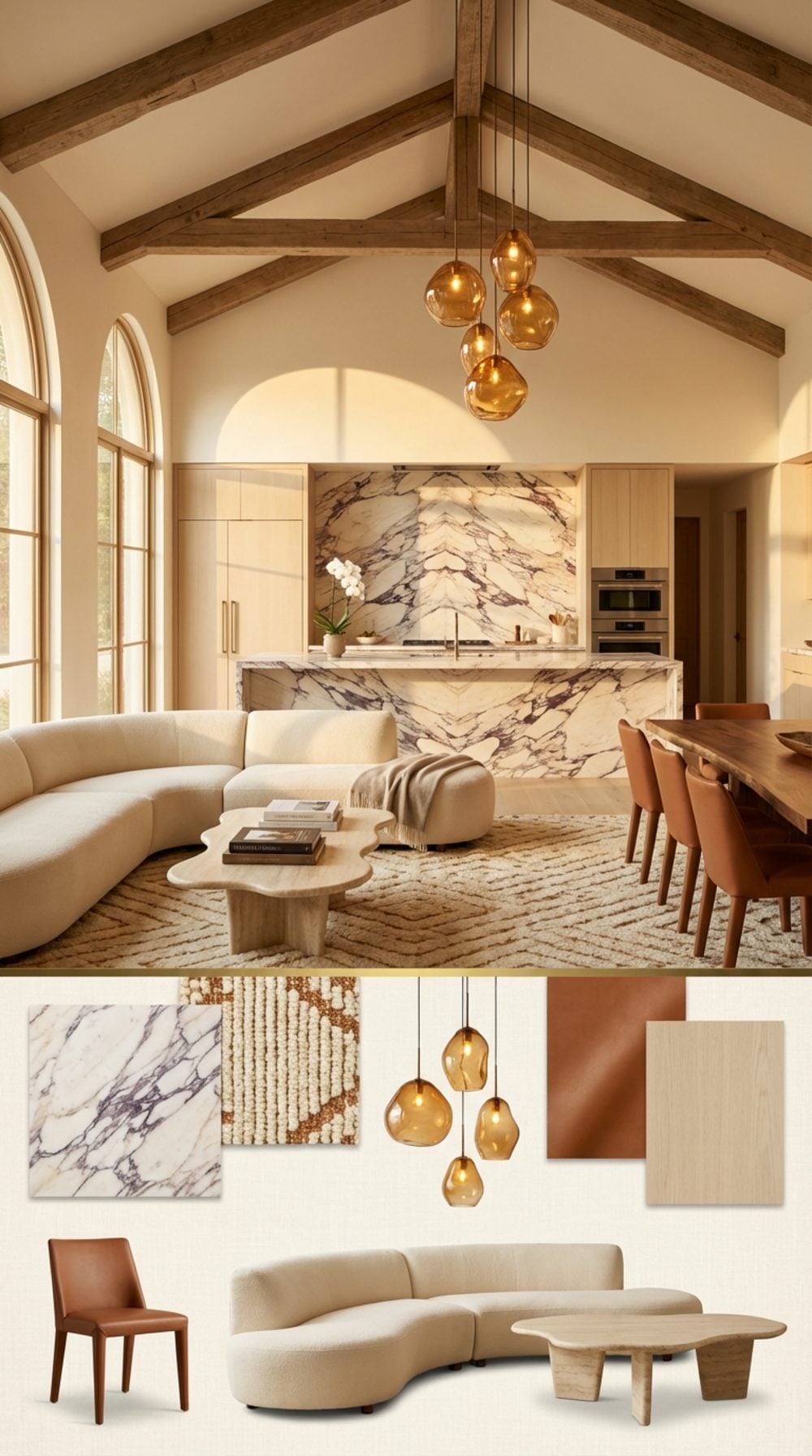
That book-matched Calacatta Viola marble wall is the room’s entire argument. The purple-grey veining pulls against the warmth of the hand-hewn timber beams above, and the tension between those two materials is exactly what keeps this space from reading as simply another warm-neutral interior. Neither element wins outright, they negotiate.
The amber glass pendant cluster does something clever: it fragments the vault height into something human-scaled, drawing the eye down through the full thirty feet of airspace in stages rather than all at once. The cognac leather chairs at the walnut dining table anchor the warmest note in the palette, a decision that pays dividends across every hour of changing light.
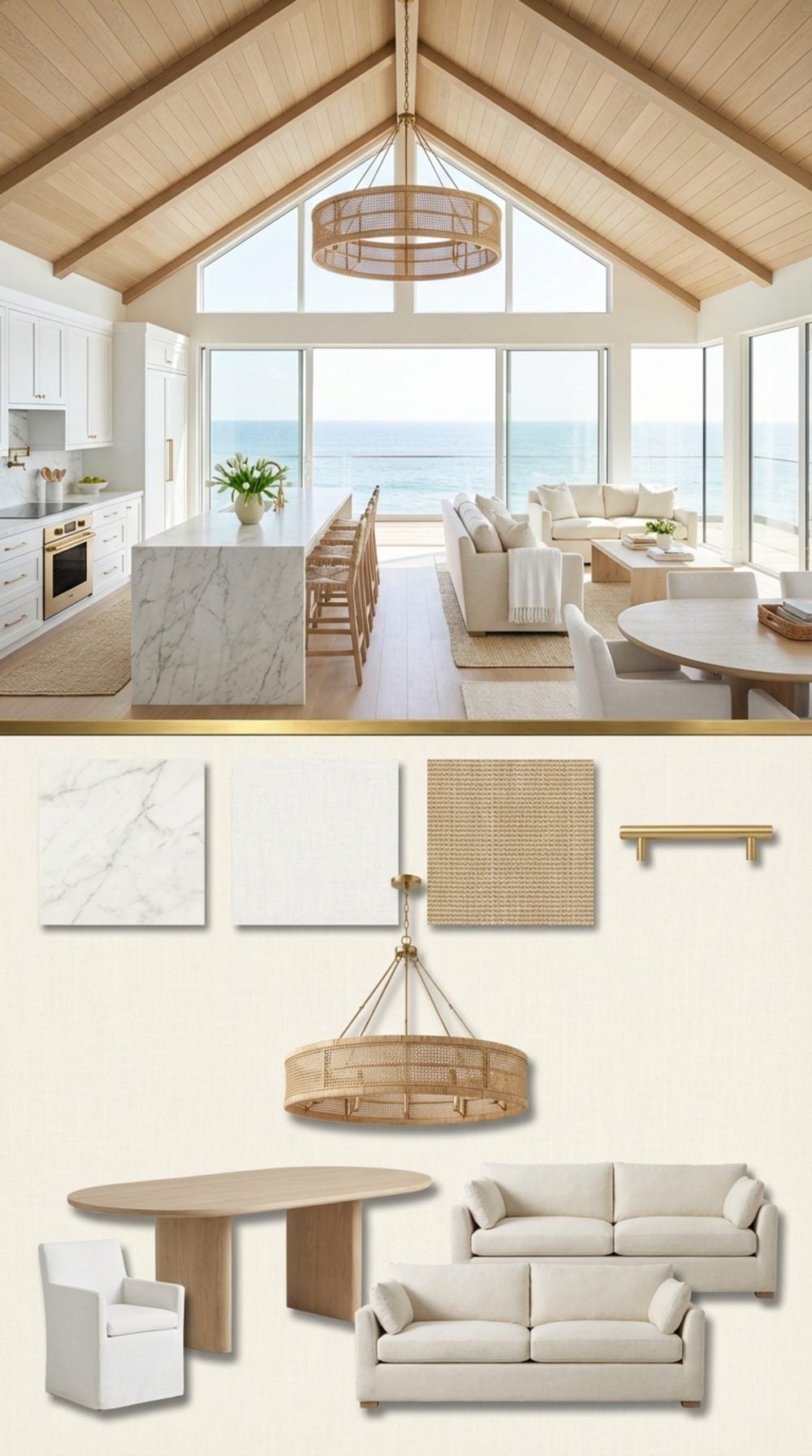
Coastal Grand Luxury with Tongue-and-Groove White Oak Vault and Rattan Brass Chandelier
🔥 Would you like to save this?
White oak ceiling planks running the full cathedral vault length read as both architectural finish and textural counterpoint to the all-white shaker kitchen below, it’s a material that does two jobs simultaneously. The tongue-and-groove pattern gives the ceiling the kind of crafted quality that justifies the scale without making the room feel heavy.
Positioning two cream linen sofas facing each other rather than toward a single focal point is a social design decision: this room prioritizes conversation over screen-watching. The rattan and brass chandelier overhead, with its overscaled circular form, provides a visual anchor point that pulls the seating arrangement into a defined gathering zone within the open floor plan.
Dark Industrial Vault with Nero Portoro Marble and Deep Indigo Persian Rug
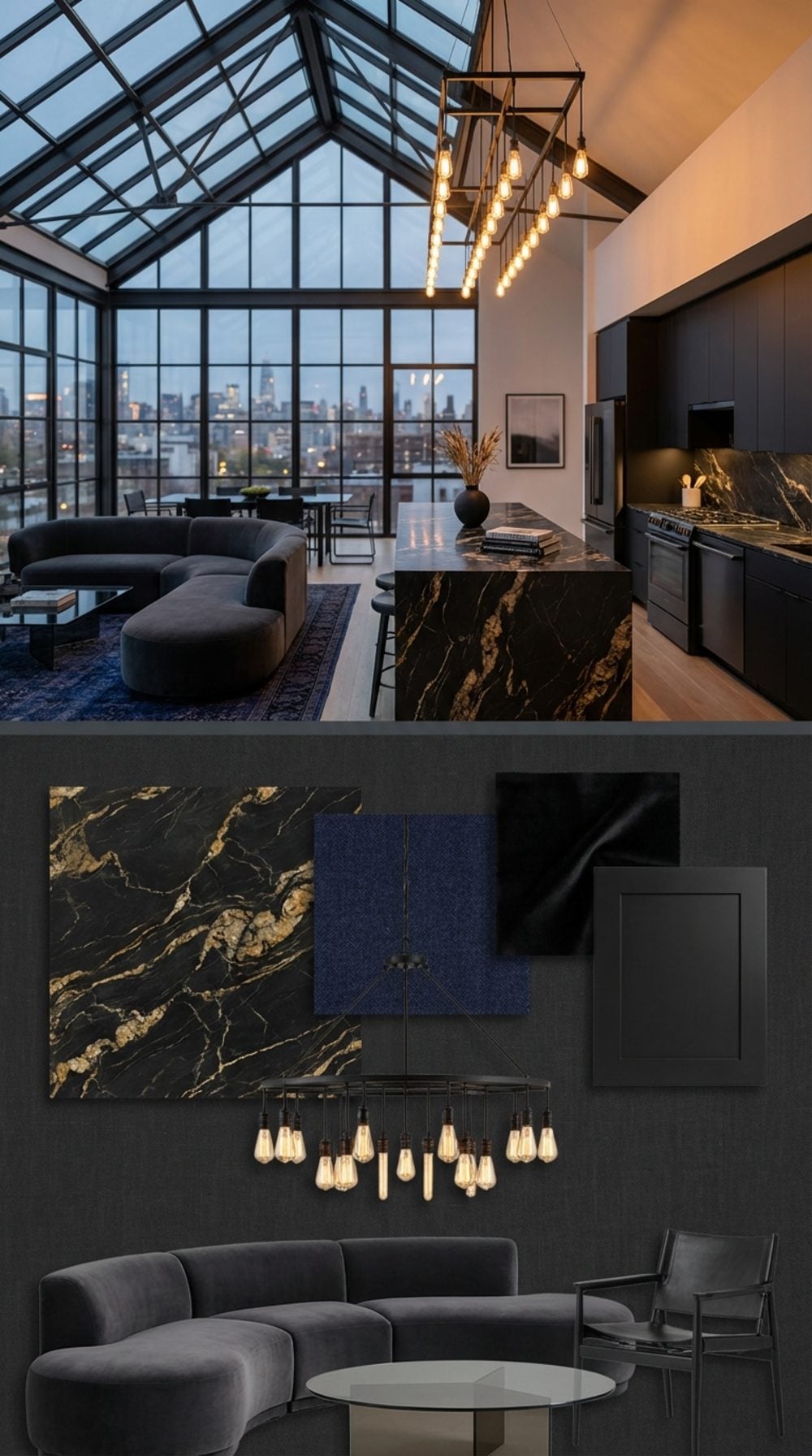
Nero Portoro marble’s gold-on-black veining is one of those materials that only reveals itself fully under dramatic lighting. Here, the Edison filament chandelier above plays directly against those gold streaks in the island waterfall, making the stone perform in a way that daylight alone never could.
The deep indigo Persian rug is the one warm, humanizing note in an otherwise hard-edged room. Its presence isn’t decorative softening, it’s structural, defining the living zone within the open plan with the same authority a wall would, without interrupting the sightlines to the skyline.
Italian Palazzo Barrel Vault with Murano Glass Chandelier and Herringbone White Marble Floors
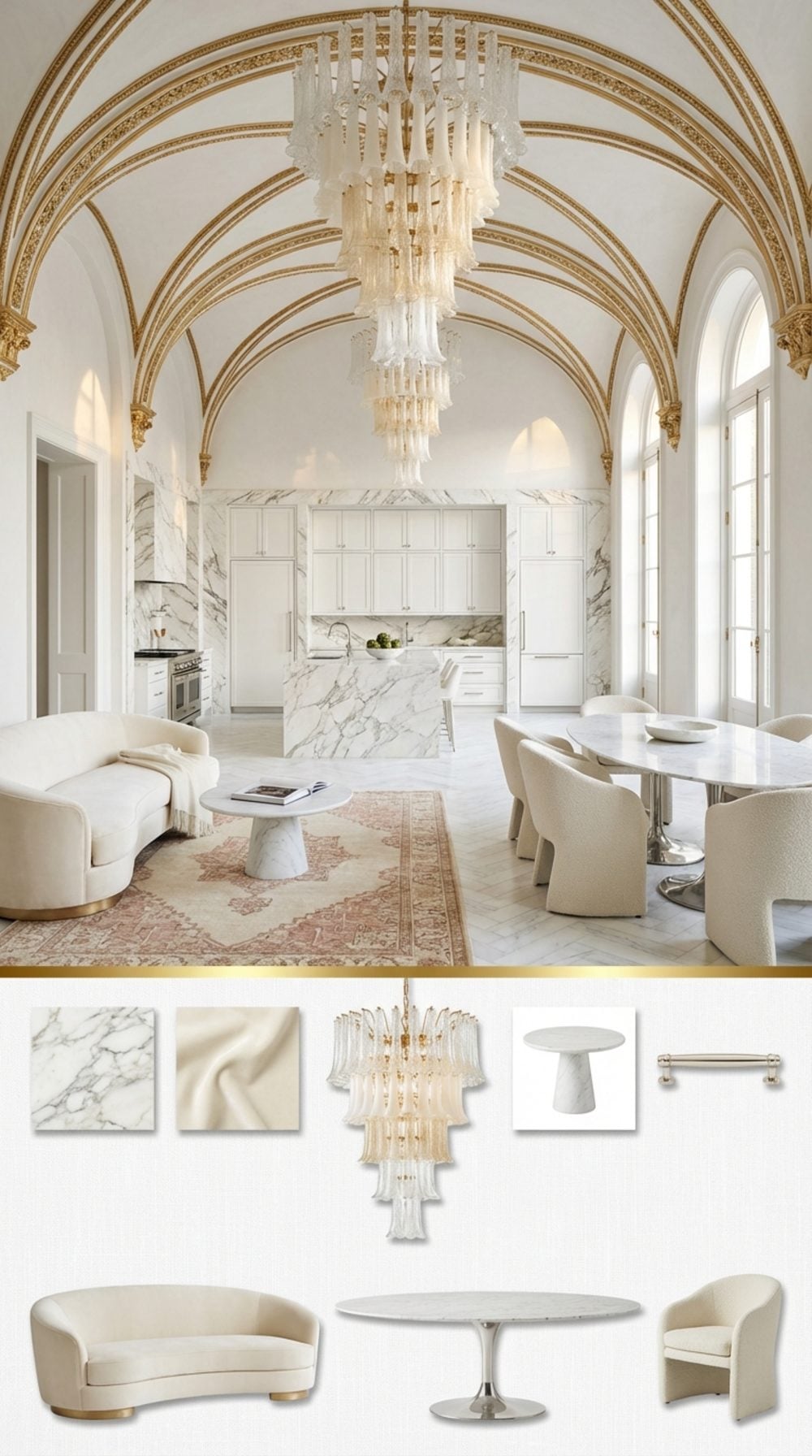
Herringbone marble floors at this scale, running continuously through kitchen, living, and dining, perform a unifying function that no rug or runner can replicate. The pattern creates directional movement through the space while the material itself maintains tonal consistency across every zone.
The Murano glass chandelier descending through the full barrel vault height resolves a classic grand-room problem: how do you make a gesture that reads from the kitchen and the dining zone simultaneously? A single hanging point at vault peak achieves that without competing with the Arabescato marble walls below, which are doing considerable work on their own.
Architectural Modernist Vault with Steel Mezzanine and Twelve-Foot Statuario Marble Island
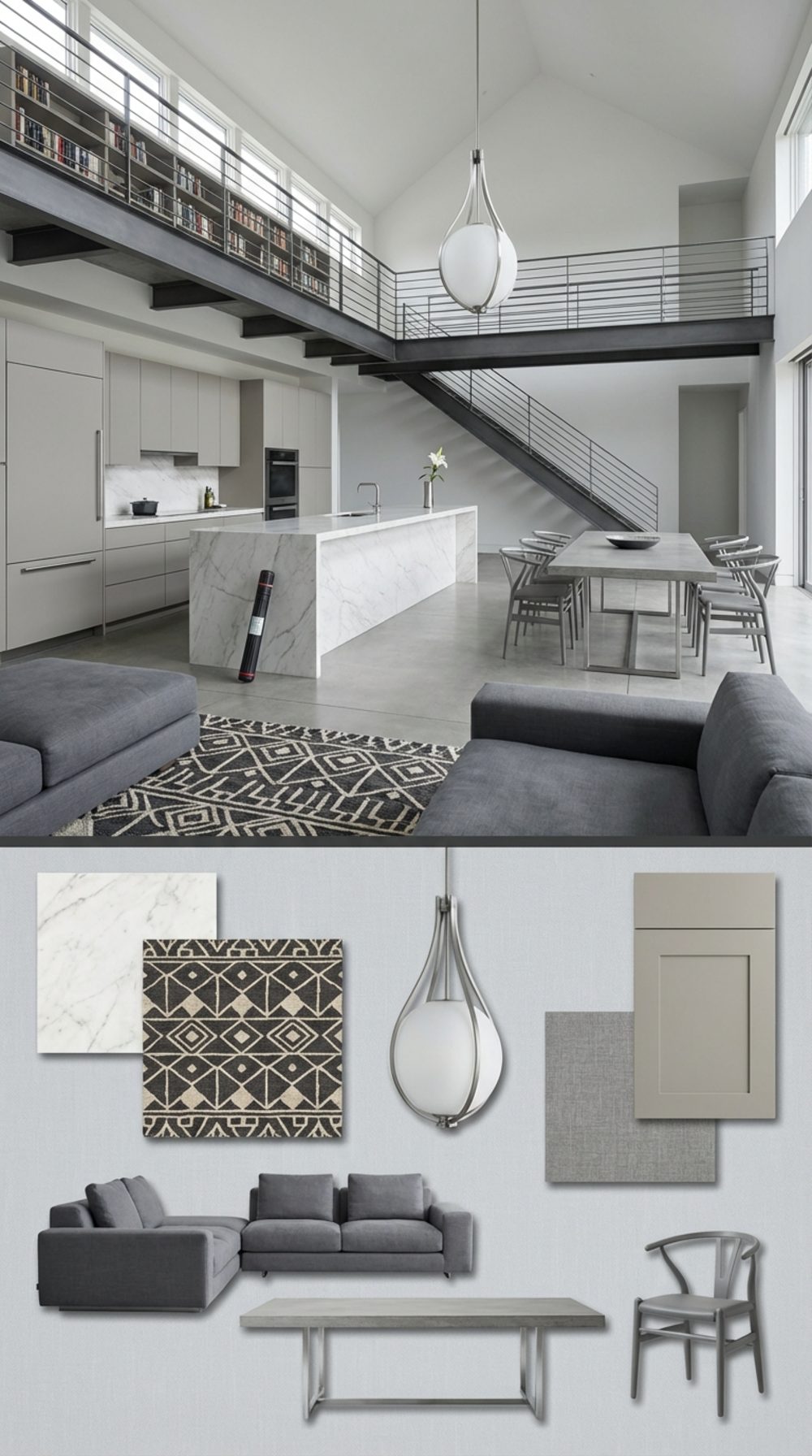
The floating steel mezzanine at mid-vault height is the spatial move that makes this room exceptional. It solves the psychological discomfort of extreme ceiling height, which can feel alienating rather than grand, by inserting a human-scaled horizontal plane that gives the eye a place to rest before traveling the full vertical distance to the vault apex.
Every Miele panel flush with the greige cabinetry creates a kitchen facade so resolved it reads as pure architecture rather than functional equipment. The twelve-foot Statuario island is the single material indulgence permitted in an otherwise strictly composed room.
Warm French Provincial Grand Room with Sage Green Cabinets and Wrought Iron Chandelier
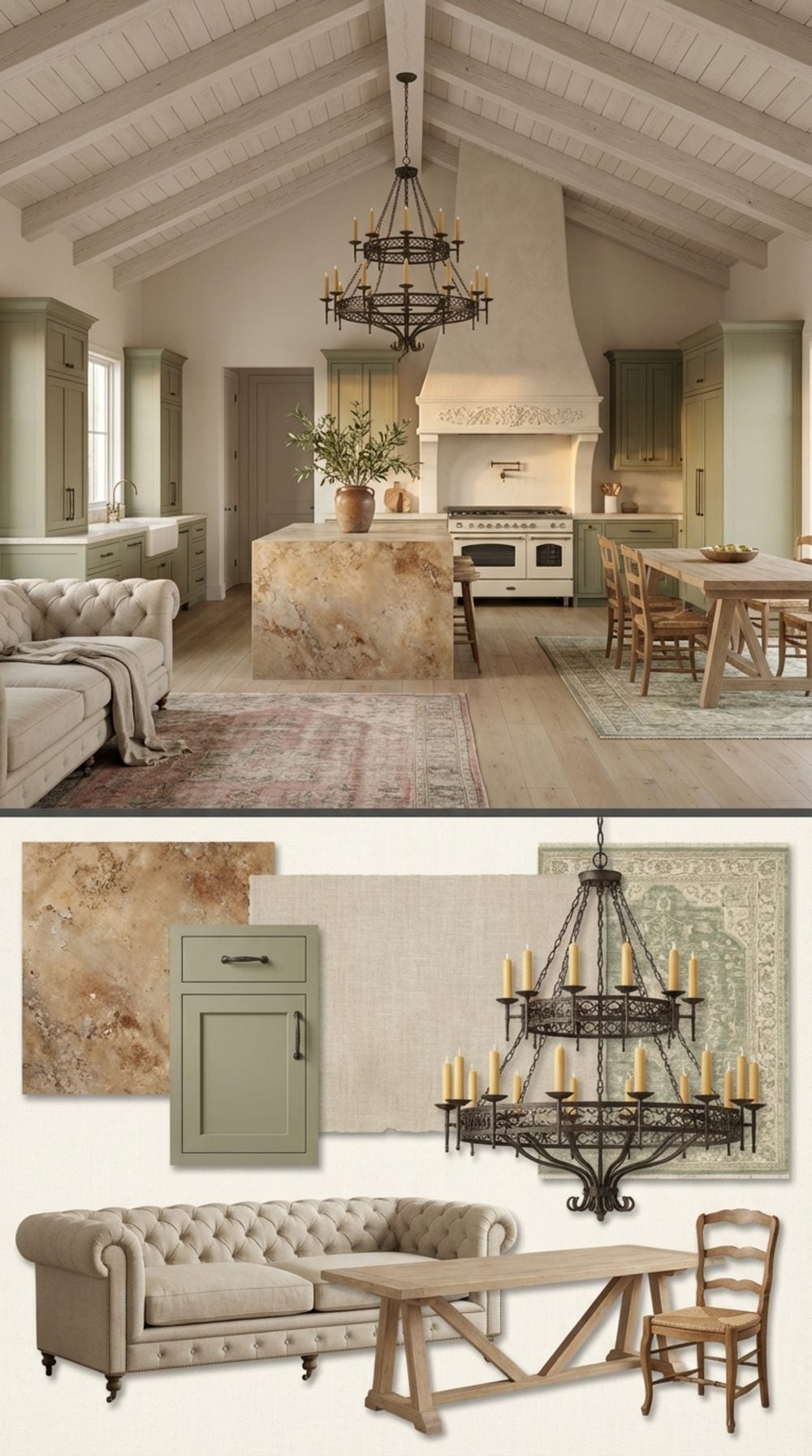
The hand-plastered range hood with carved floral detail is one of the last genuinely handcrafted gestures left in residential kitchen design. Reaching toward the whitewashed Douglas fir vault above, it bridges the room’s two primary registers, the crafted and the architectural, in a way that a stone or steel hood simply cannot.
Old Hollywood Glamour Vault with Crystal and Gold Chandelier and Golden Spider Marble
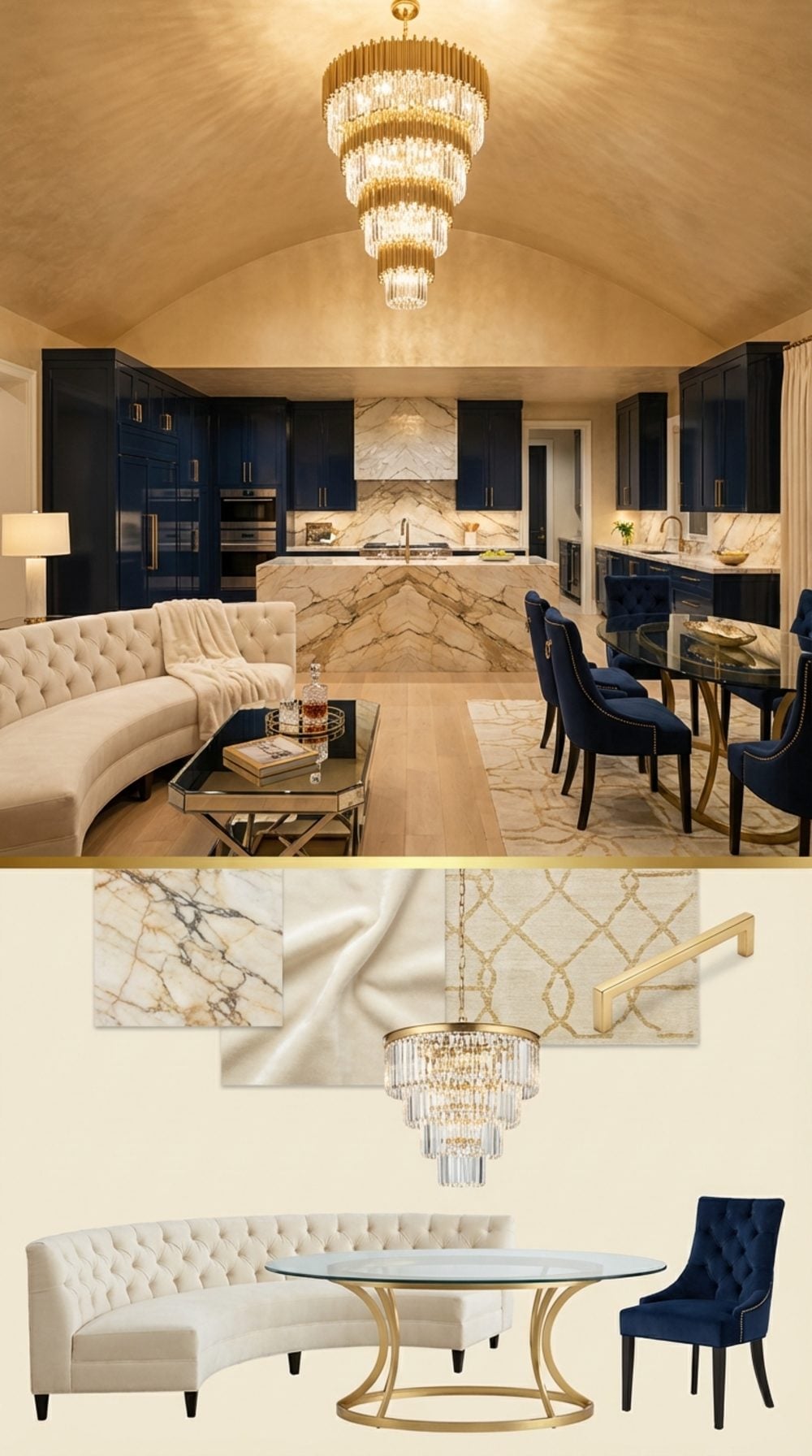
Venetian plaster at ceiling scale in warm champagne is a choice that pays interest every evening. As the chandelier throws prismatic light across the hand-applied surface, the slight texture variation in the plaster catches the light unevenly, creating a gentle shimmer that flat paint could never produce.
The navy lacquer cabinets against Golden Spider marble is a high-contrast pairing that shouldn’t work on paper, navy is cool, the marble’s amber veining is intensely warm, and yet it does, precisely because the champagne plaster ceiling pulls the warm tones upward, mediating the tension from above.
Elevated Traditional Vault with Forest Green Cabinets and Oxblood Chesterfield Sofas
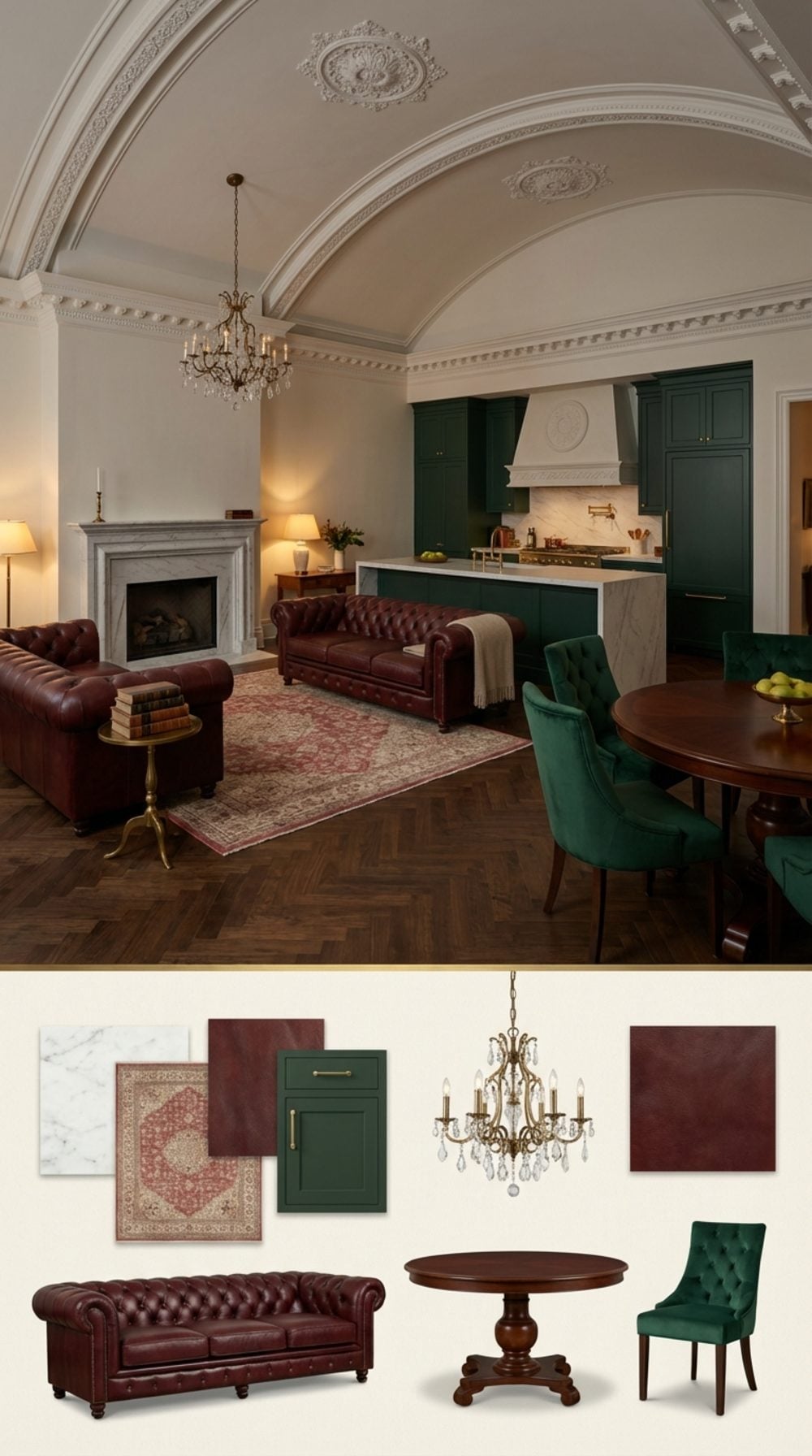
Two Chesterfield sofas flanking a marble fireplace is an arrangement with genuine historical precedent, the flanking-sofa format around a hearth dates to Georgian drawing rooms. In this open concept setting, it creates a room-within-a-room effect, carving a defined living enclosure out of the larger vault space without a single wall.
Forest green cabinets and oxblood leather are a combination rooted in private library aesthetics. The shared quality is patina: both materials improve with age and use in a way that white cabinetry and beige fabric simply do not. This room is designed to look better in ten years than it does today.
Mountain Modern A-Frame Grand Room with Stone Fireplace and Antler Iron Chandelier
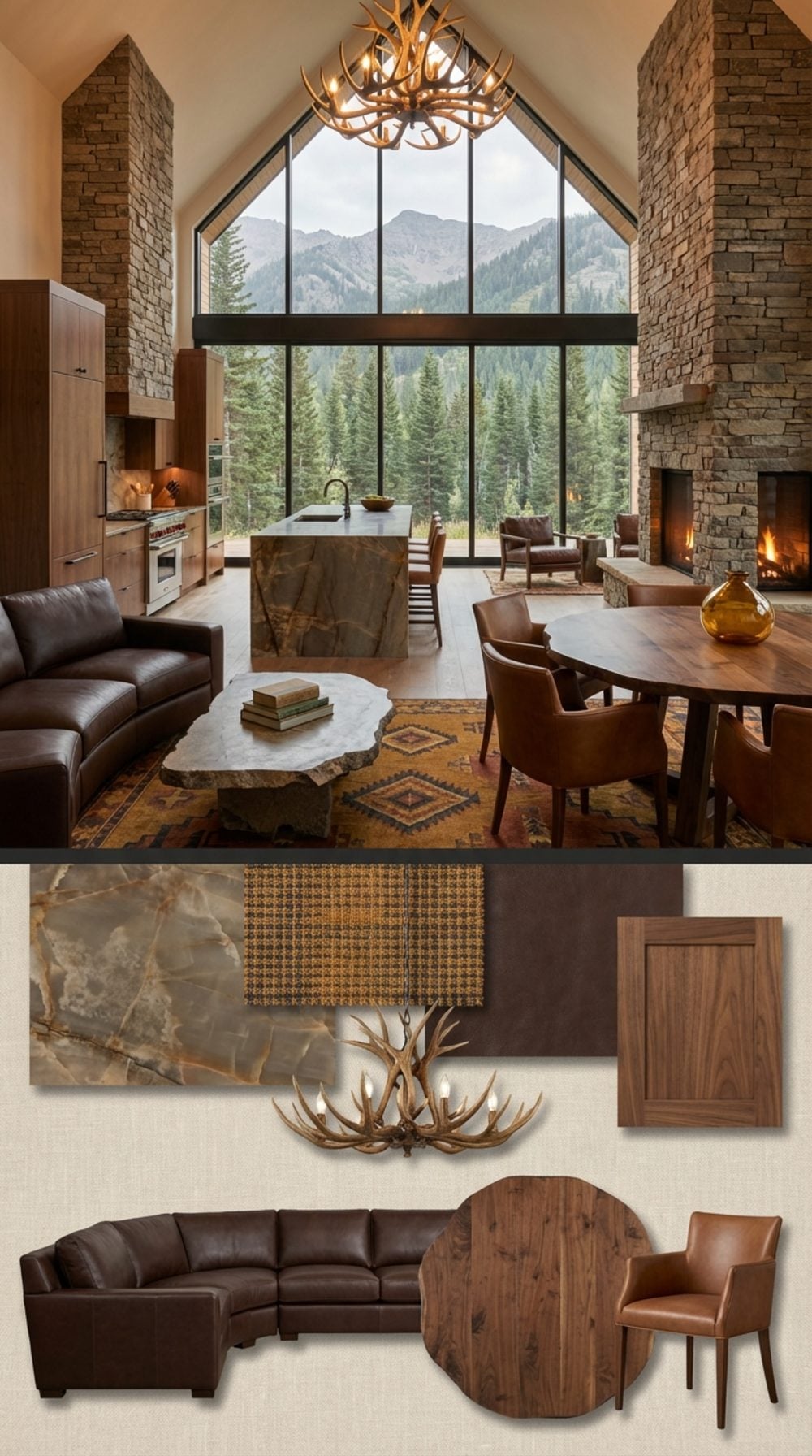
The double-sided stone fireplace wall is the spatial masterstroke here. In an A-frame open plan, there is typically nothing to anchor the middle ground between kitchen and the glass gable ends, the stone wall solves that with a single gesture, creating two distinct zones while remaining visually porous (fire is visible from both sides).
“Glass gable walls frame wilderness the way a painting frames a canvas, except the light in this frame changes all day.”
The Pendleton-pattern rug in ochre and charcoal keeps the color story honest: mountain-adjacent without slipping into lodge-kitsch. The distinction matters at this scale.
Parisian Grand Luxe Coffered Vault with Savonnerie Rug and Aubergine Velvet Sofa
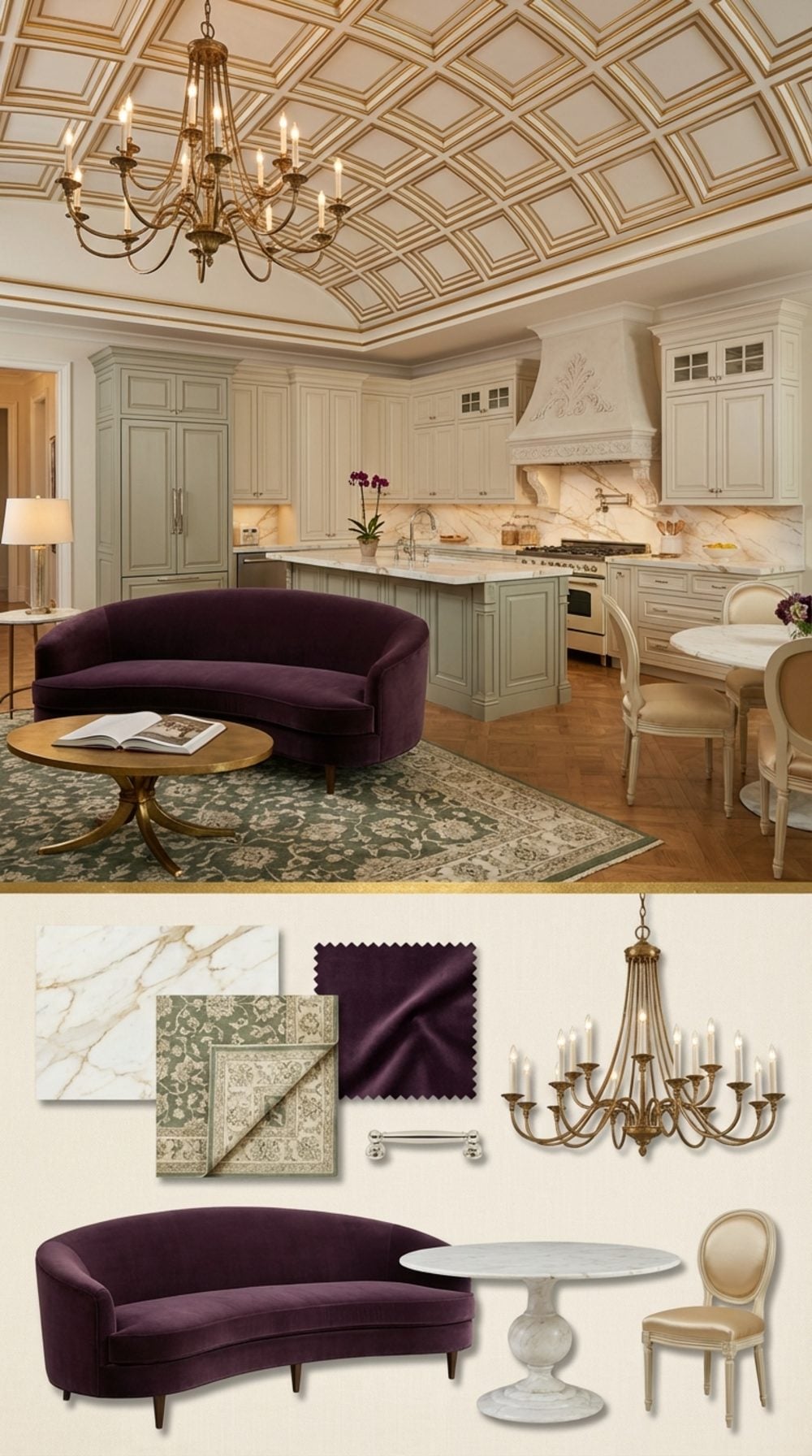
Gold-leaf coffer edges running the full vault length is the kind of detail that only reveals itself gradually. On first glance, the ceiling reads as architectural coffering. On closer inspection, the aged gold at every rib adds a warmth to the overhead plane that completely changes the quality of reflected light in the room below, aubergine velvet and gilded brass furniture both benefit from this overhead glow.
The Savonnerie rug is doing quiet structural work: its floral pattern and deep sage tones ground the aubergine sofa and prevent the gilded brass from reading as excessive. Without that rug, this room risks tipping into theater. With it, it reads as a serious Parisian apartment.
Contemporary Grand Manor with Black Steel Vault Skylight and Twelve-Foot Camel Bouclé Cloud Sofa
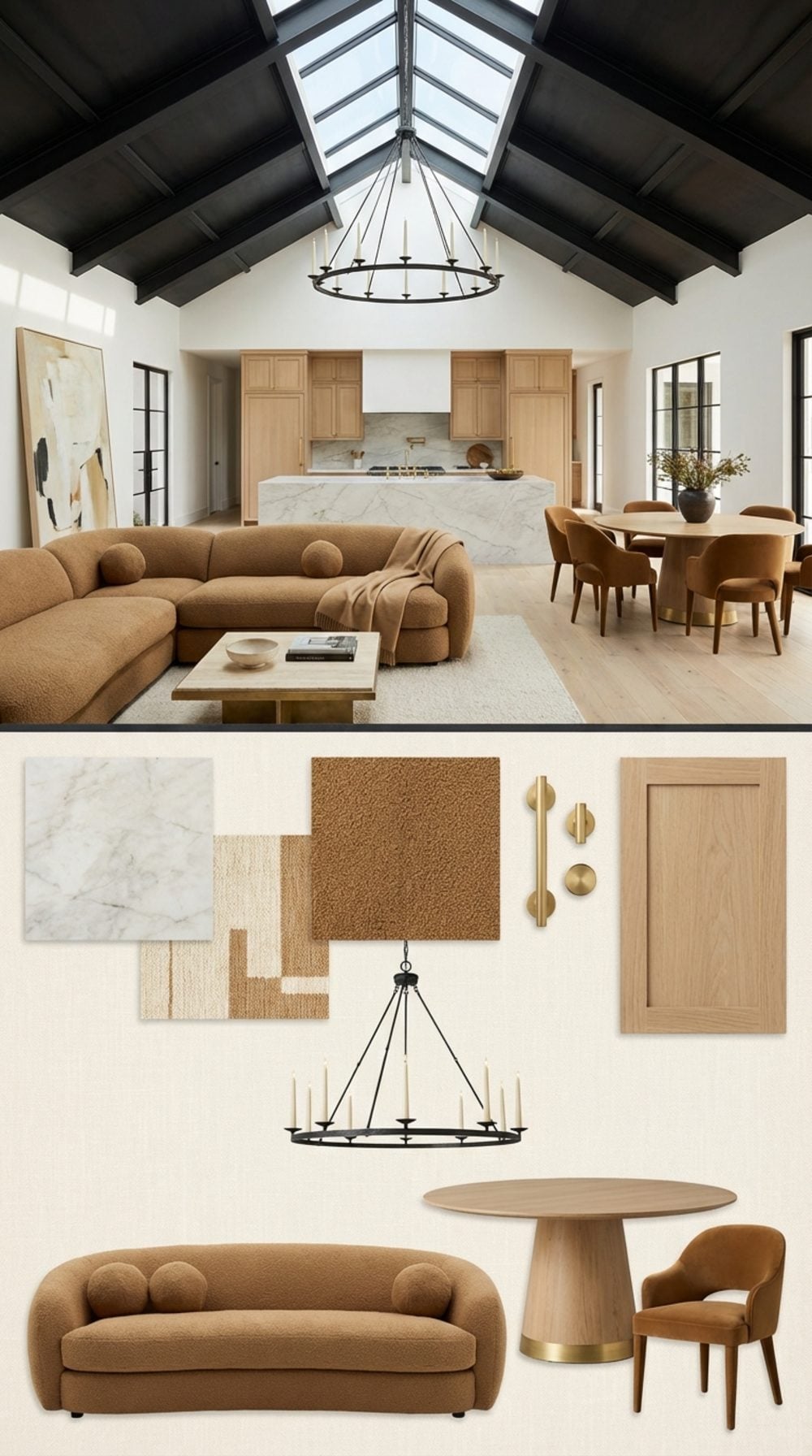
A ridge skylight running the full vault spine is one of the smartest moves in contemporary grand-room design. It delivers daylight into the deepest interior of a large floor plate while the black steel structure visible above the glass transforms what would be a utilitarian opening into an architectural feature worth looking up at.
The twelve-foot abstract oil painting leaning rather than hung against the wall is a deliberate rejection of formality in an otherwise very composed space. That single casual gesture keeps the room from feeling like a showroom.
Tuscan Villa Grand Vault with Terracotta Floors and Hand-Painted Majolica Tile Backsplash
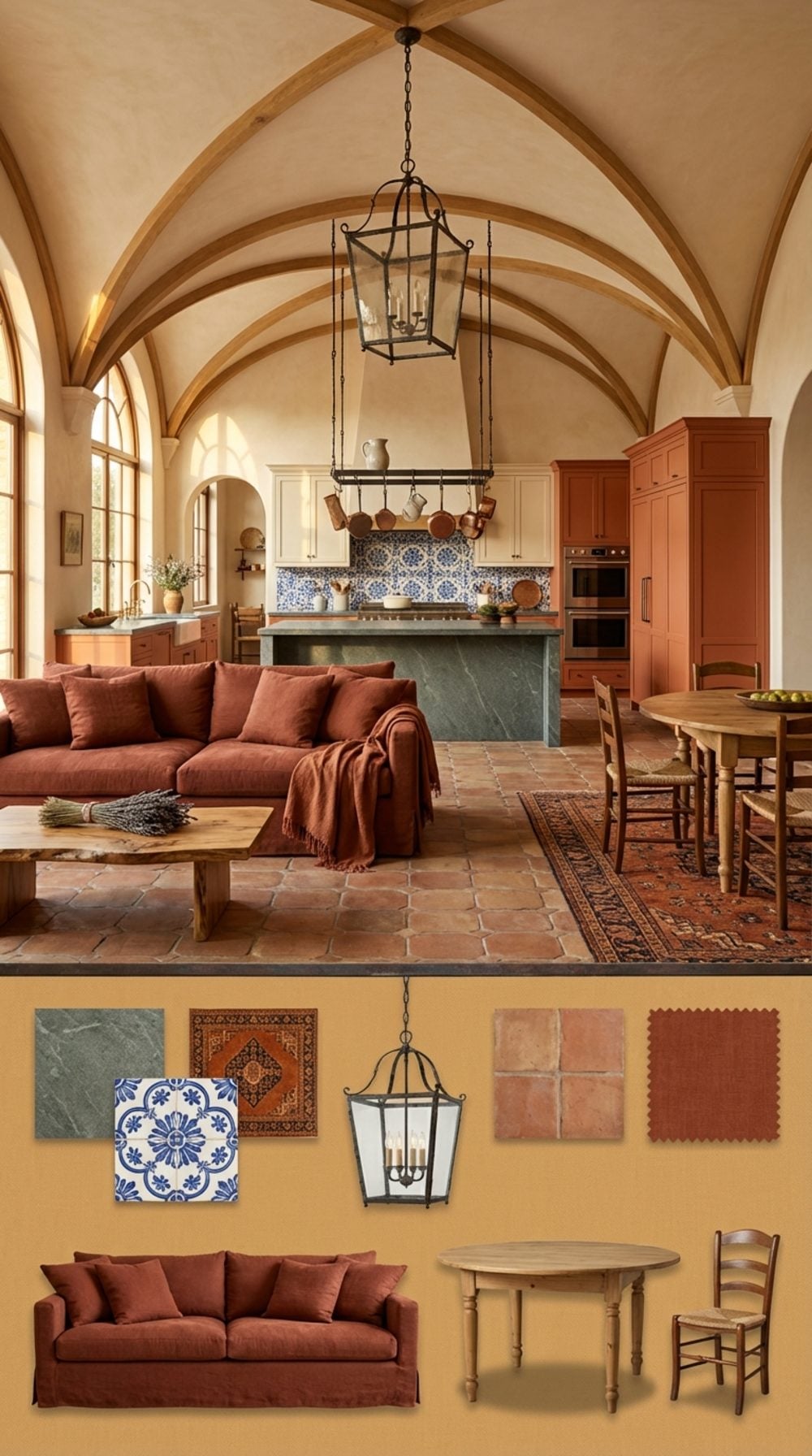
Hand-painted majolica tile backsplashes are experiencing a genuine revival in 2026 luxury interiors, and this room demonstrates why. The cobalt and white floral pattern holds its own against the Pietra di Cardoso stone island without competing, dark stone and hand-painted ceramic exist in completely different visual registers, so neither cancels the other out.
Terracotta floors at this scale, running through the entire open plan, are a commitment that requires a particular kind of client. They scratch. They absorb. They develop a patina that cannot be replicated by ceramic tile. That irreversibility is exactly what makes them right here.
Modern Ranch Grand Vault with Blackened Steel Trusses and Saddle Tan Leather U-Shaped Sectional
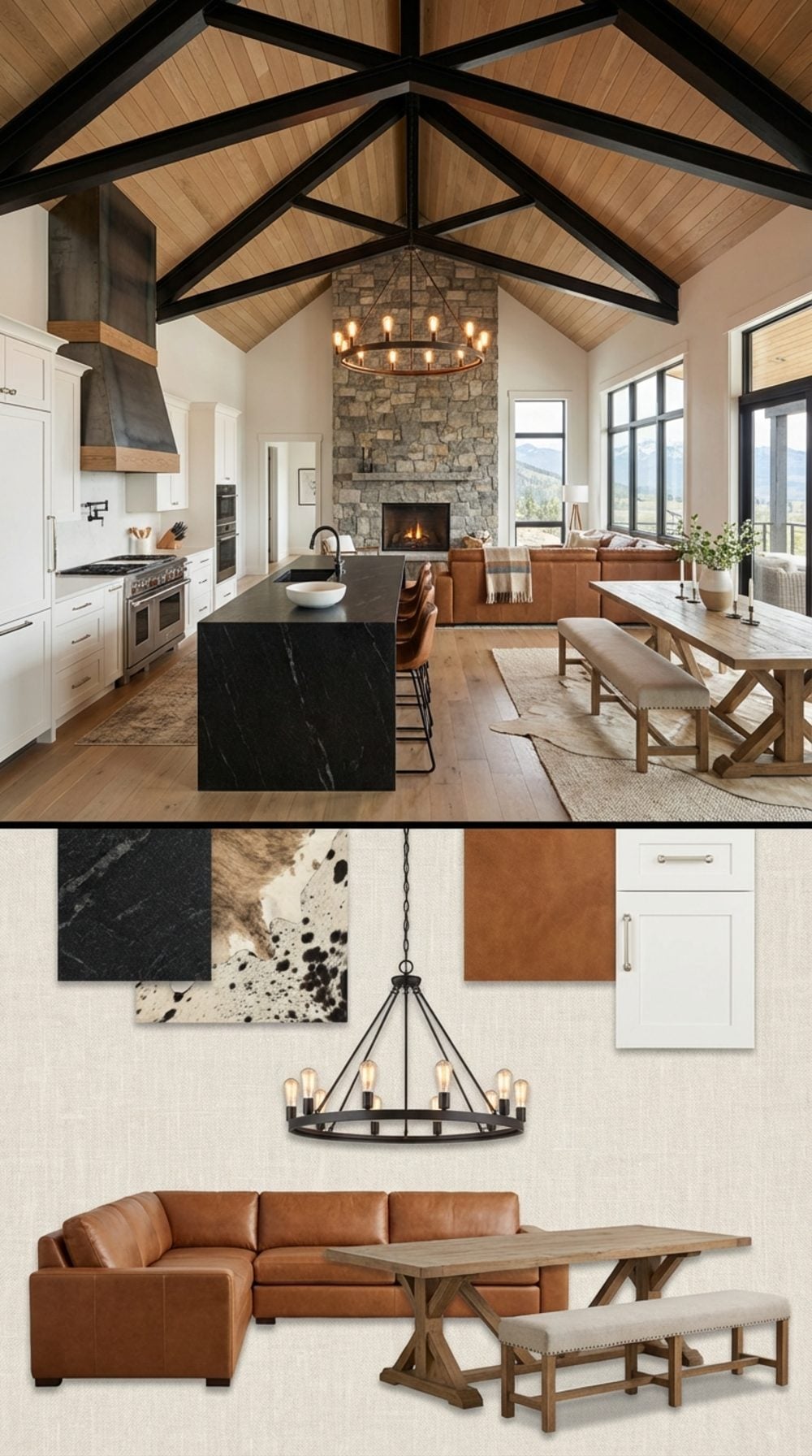
Blackened steel trusses against white oak planking is a combination that keeps the industrial from overwhelming the organic. The steel reads as structural honesty; the oak between the trusses reads as warmth. Neither cancels the other, and together they give this vault a quality that neither material achieves alone.
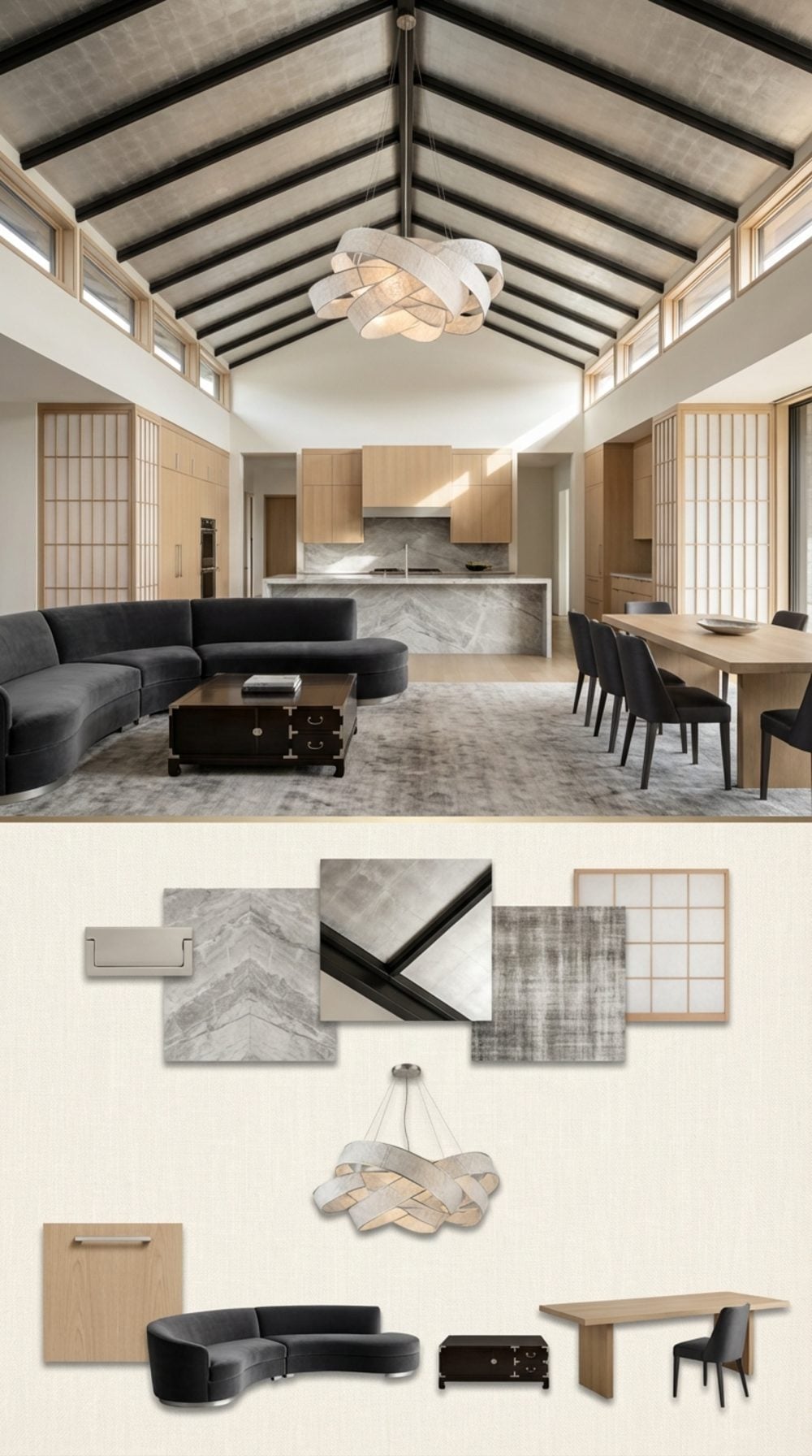
Japanese Imperial Minimalism: Platinum Leaf Vault and Invisible Grey Marble in 2026
🔥 Would you like to save this?
The platinum leaf ceiling panels are the whole argument. Every other decision in this room, the charcoal silk velvet, the handleless white oak cabinetry, the washi paper chandelier, is an act of restraint specifically designed to let that vault catch the morning clerestory light without competition.
Prospect-and-refuge psychology is quietly at work here: the low-profile sectional keeps sightlines open across all three zones, while the shoji screens offer the psychological option of enclosure without actually closing anything off. It is freedom with the feeling of shelter.
Copper and Glass Grand Manor: Verdigris Patina Vault and Rainforest Quartzite Island
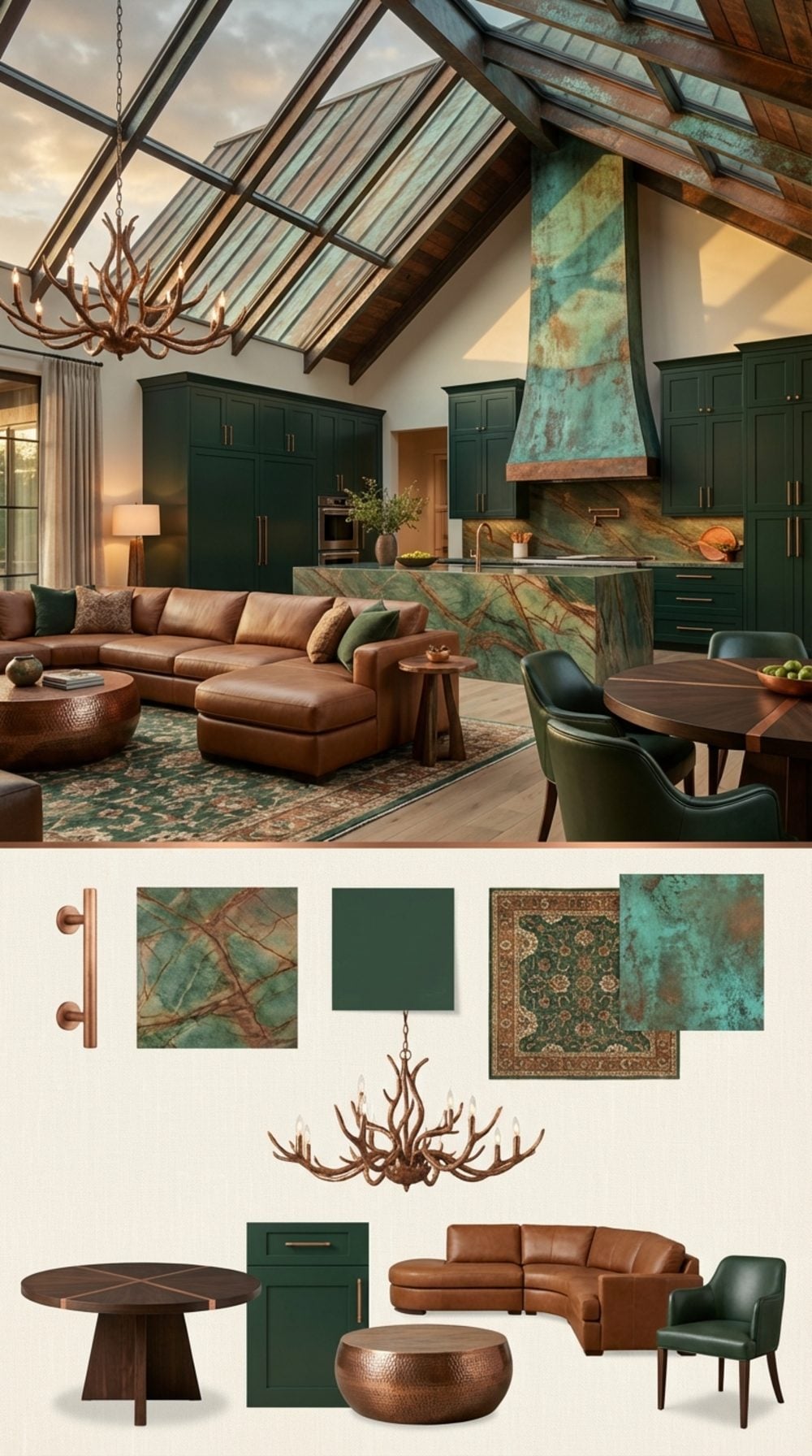
Unlacquered copper is a patient material, it starts orange-bright and slowly negotiates with the atmosphere until it arrives at verdigris. A room designed around that process is a room designed around time, and the forest green lacquer cabinets make the final destination visible from day one.
The structural glass panels overhead do something rare in residential design: they dissolve the boundary between interior architecture and weather. On overcast days this room would feel entirely different than on a copper-lit afternoon, which means it never quite becomes predictable.
Contemporary Medieval Castle: Flemish Tapestry Vault and Limestone Heraldic Hood
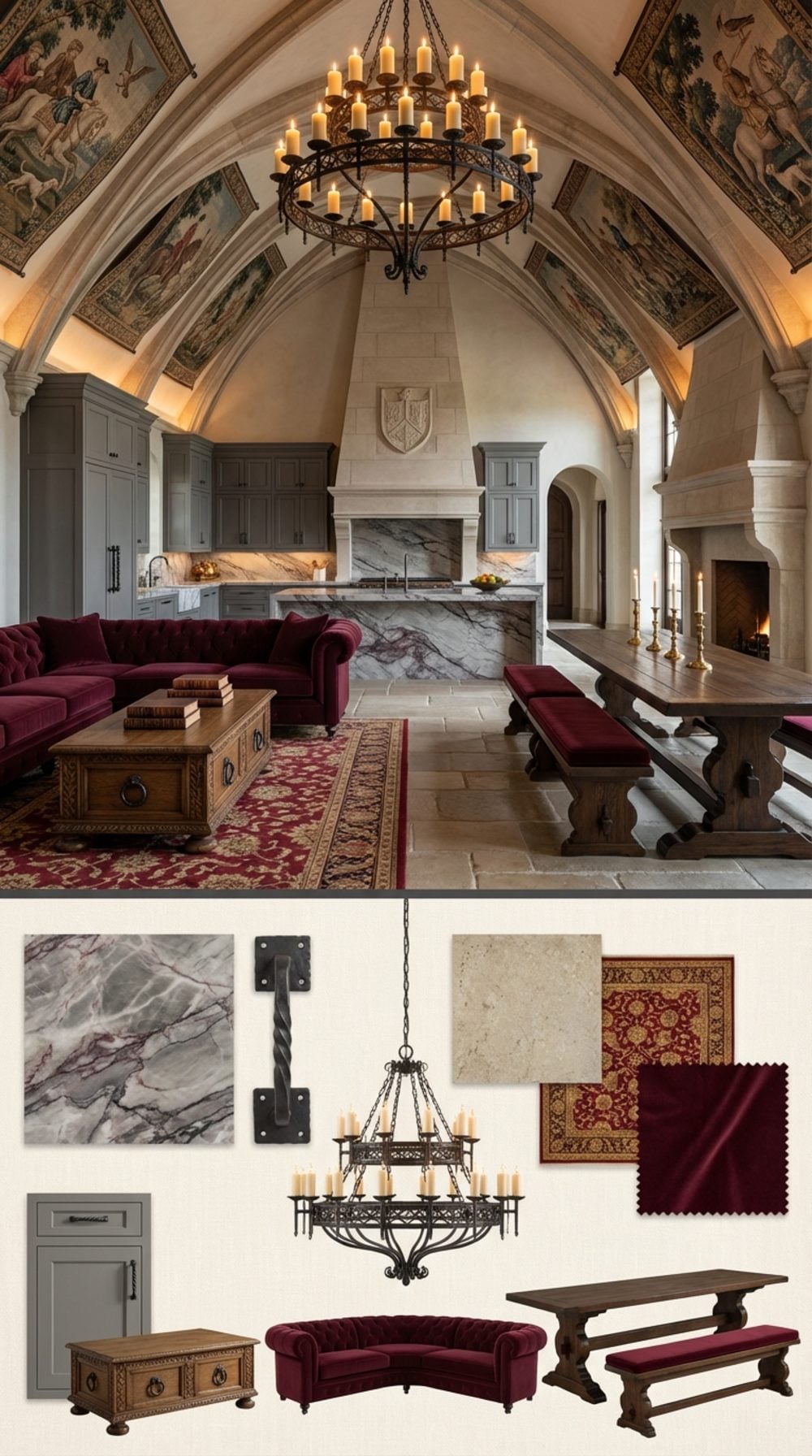
The heraldic limestone range hood is the room’s thesis statement. Functional objects don’t normally receive that level of carving, but by treating the hood as a piece of architectural sculpture, it bridges the kitchen zone into the medieval aesthetic without requiring the rest of the kitchen to abandon its modern proportions.
Burgundy velvet and wrought iron is a pairing with centuries of precedent, but the curved Chesterfield profile keeps it from reading as a heritage recreation. That small tension between old-world material and contemporary silhouette is exactly what makes the room feel designed rather than decorated.
Sculptural Organic Surrealism: White Plaster Wave Ceiling and Backlit Onyx Island
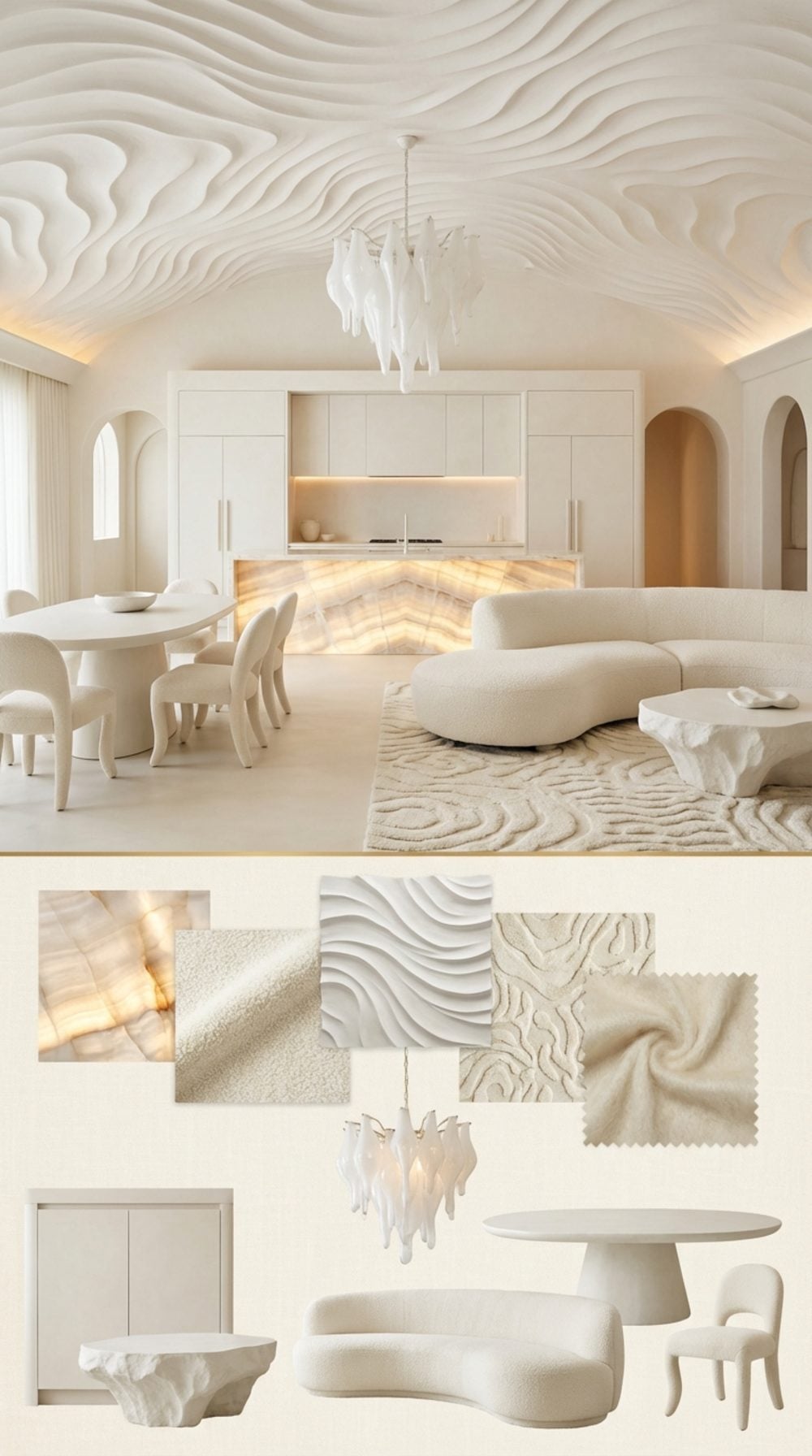
A room with zero hardware and zero visible seams relies entirely on form to carry the weight, which is why the undulating plaster ceiling is non-negotiable. Without it, all-white with invisible cabinetry reads as a developer’s blank canvas. With those waves overhead, the entire space reads as a single sculptural object.
The backlit White Onyx island is doing double duty: it introduces the only warm color in the room (that amber internal glow) and it anchors the kitchen zone as a light source in its own right. Cognitively, the eye needs something to resolve to in a monochromatic room, and the onyx provides it.
Victorian Maximalist Revival: Peacock Lacquer Pressed Tin Vault and Azul Bahia Granite
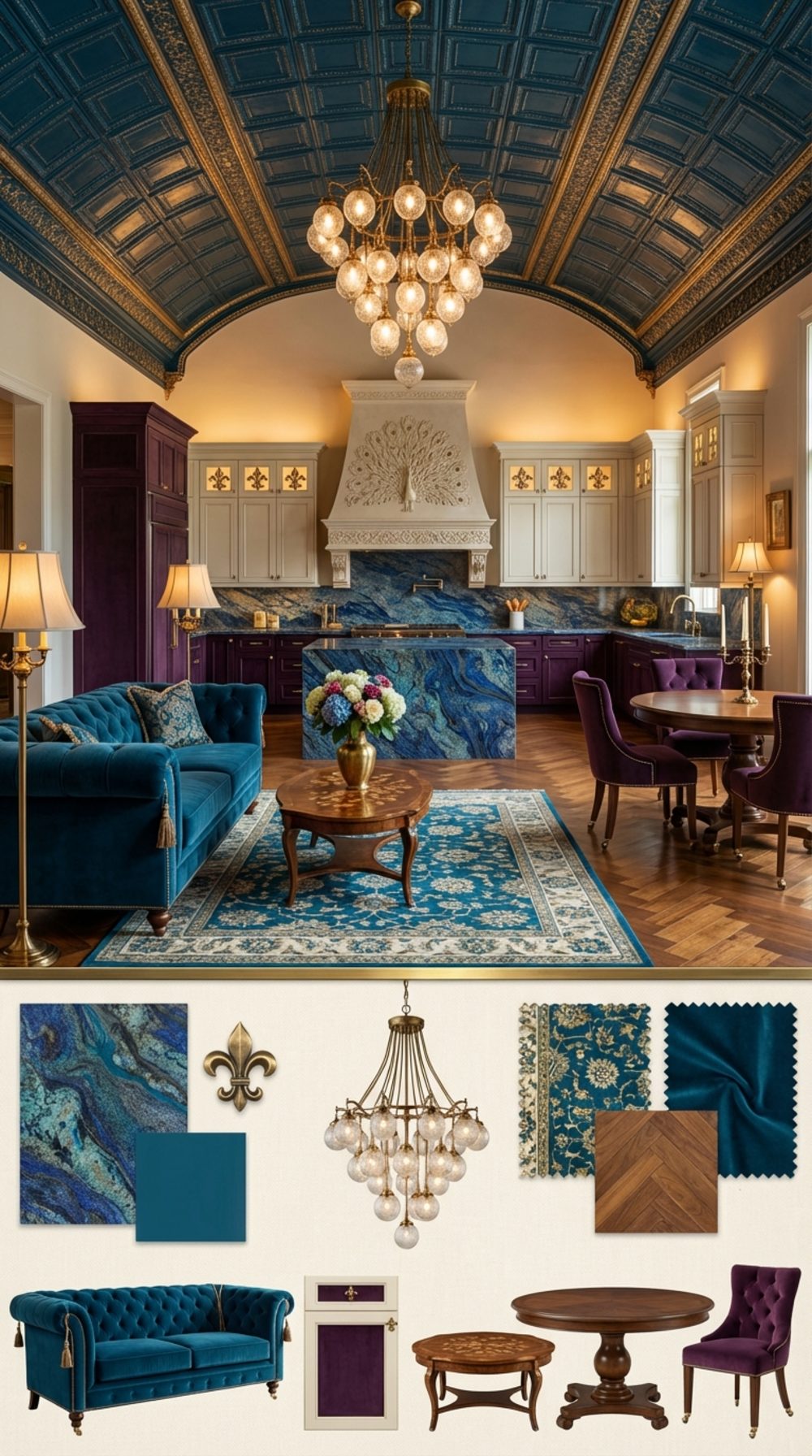
Azul Bahia granite has an almost aggressive beauty, the deep cobalt and teal patterns read more like abstract painting than geological accident. Pairing it with pressed tin tiles lacquered in peacock blue creates a chromatic intensity that a more restrained material choice would have deflated entirely.
- The aubergine and peacock blue pairing avoids the obvious blue-on-blue monotony through value contrast, one is dark and saturated, one is jewel-bright.
- The Knole sofa’s silk rope ties are a period-specific detail that rewards anyone who knows what they’re looking at.
- The gasolier chandelier’s etched glass globes scatter the warm light in ways that modern fixtures simply cannot replicate.
Museum-Quality Art Collector: Clerestory North Light and Travertine Slab Living Room
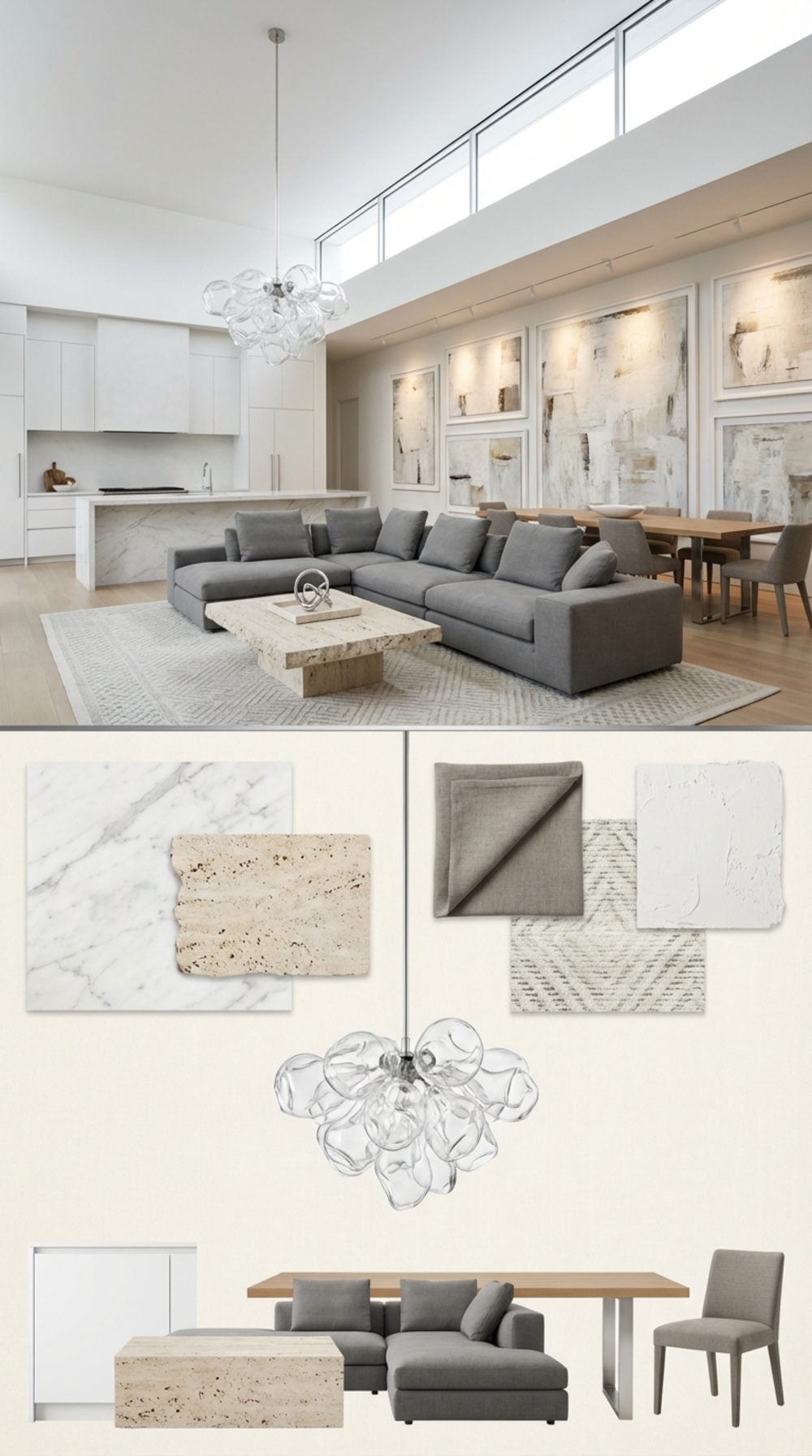
North-facing clerestory light is the specific light painters and curators have always wanted: no direct sun, no shadows that migrate throughout the day, just a steady cool luminance that shows pigment exactly as it was mixed. Building a residential great room around that quality of light is a declaration that the art comes first.
The travertine cocktail table’s unfilled pores are doing precise design work here, in a room this restrained, the texture of that natural stone carries the full sensory load that color handles in other rooms.
Elevated Pacific Northwest: Black Fir Trusses and Rainforest Green Marble Kitchen
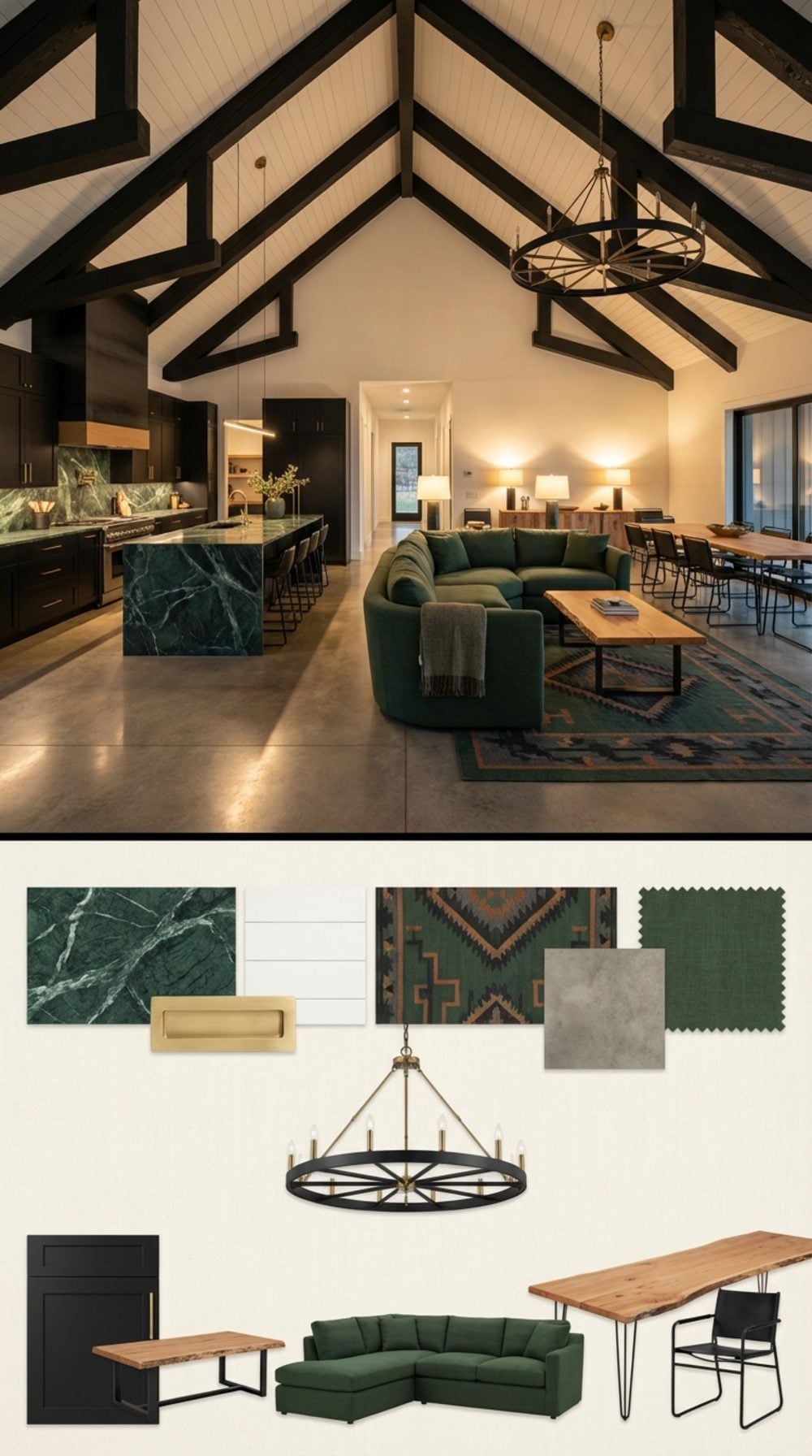
Matte black trusses against white shiplap is a graphic decision as much as a structural one, it turns the ceiling into a repeating pattern that draws the eye upward and gives the open plan its vertical scale. The rhythm of those beams does more spatial work than any pendant light could.
Rainforest Green marble is having a serious moment in 2026, and this kitchen shows why: the deep forest ground with white veining reads as naturally occurring, which is exactly the biophilic register that the Douglas fir and concrete are also hitting. The whole room is speaking the same material language.
Roman Emperor Grand Luxury: Burnished Gold Venetian Plaster Vault and Breccia Imperiale
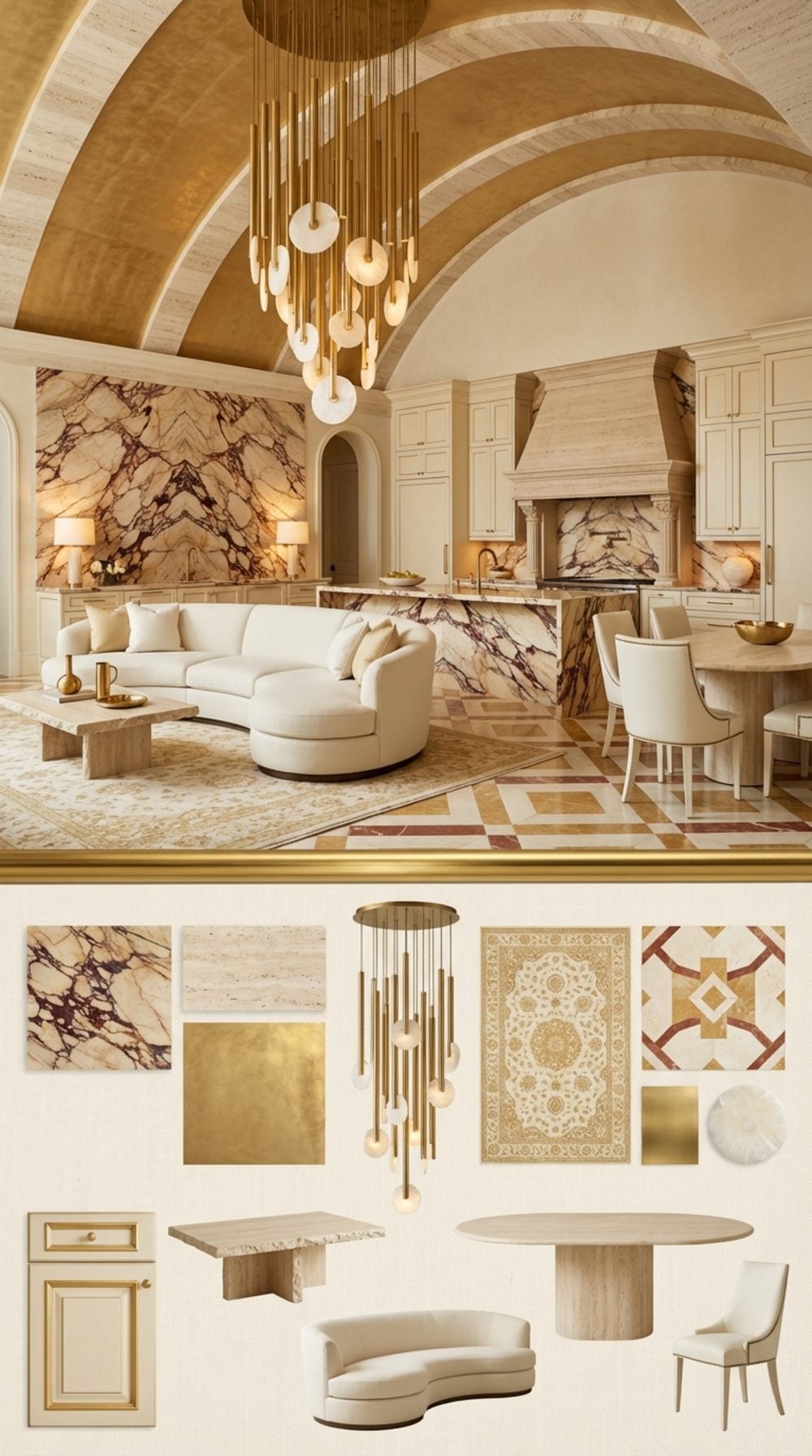
Breccia Imperiale has a specific historical weight: the Romans quarried it from the Alpi Apuane specifically for imperial commissions, and the dramatic fractured pattern in red, ivory, and gold reads as inherently authoritative. Running it floor-to-ceiling behind the kitchen island is a decision that takes confidence, but the payoff is a material moment that anchors the entire great room.
The opus sectile floor connects the dots, the same geometric sensibility that structured Roman public buildings is scaled down to a residential floor, and the formal repetition below echoes the alternating vault bands above. When ceiling and floor share a visual logic, the room between them feels composed rather than assembled.
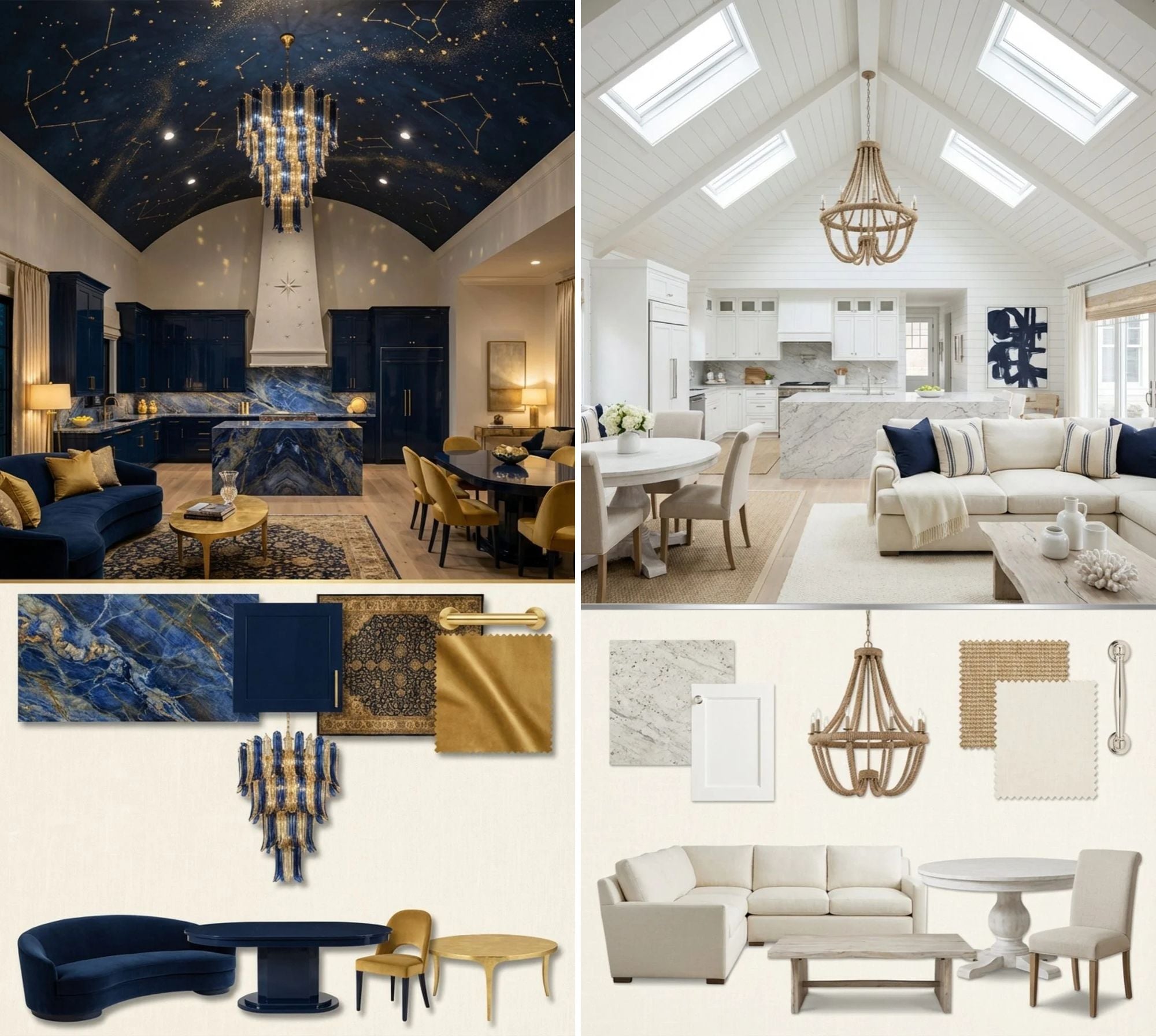
Celestial Art Deco: Midnight Navy Constellation Vault and Sodalite Blue Marble Kitchen
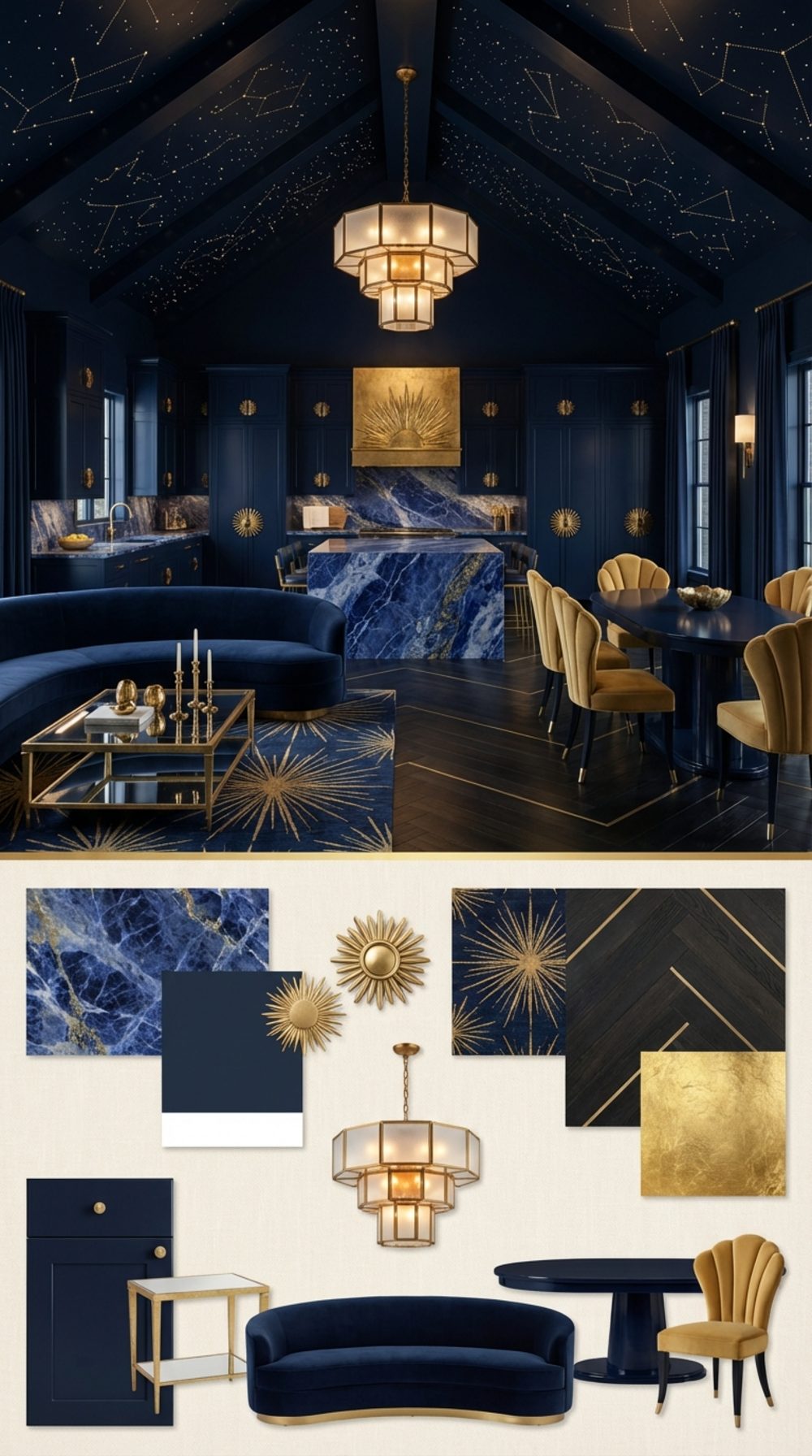
Sodalite Blue marble is one of the few stones that contains actual gold, pyrite deposits that catch light like embedded stars. In a room whose ceiling is already a hand-pinpricked constellation, using a stone with its own built-in night sky at the kitchen island level is the kind of material intelligence that reveals itself slowly.
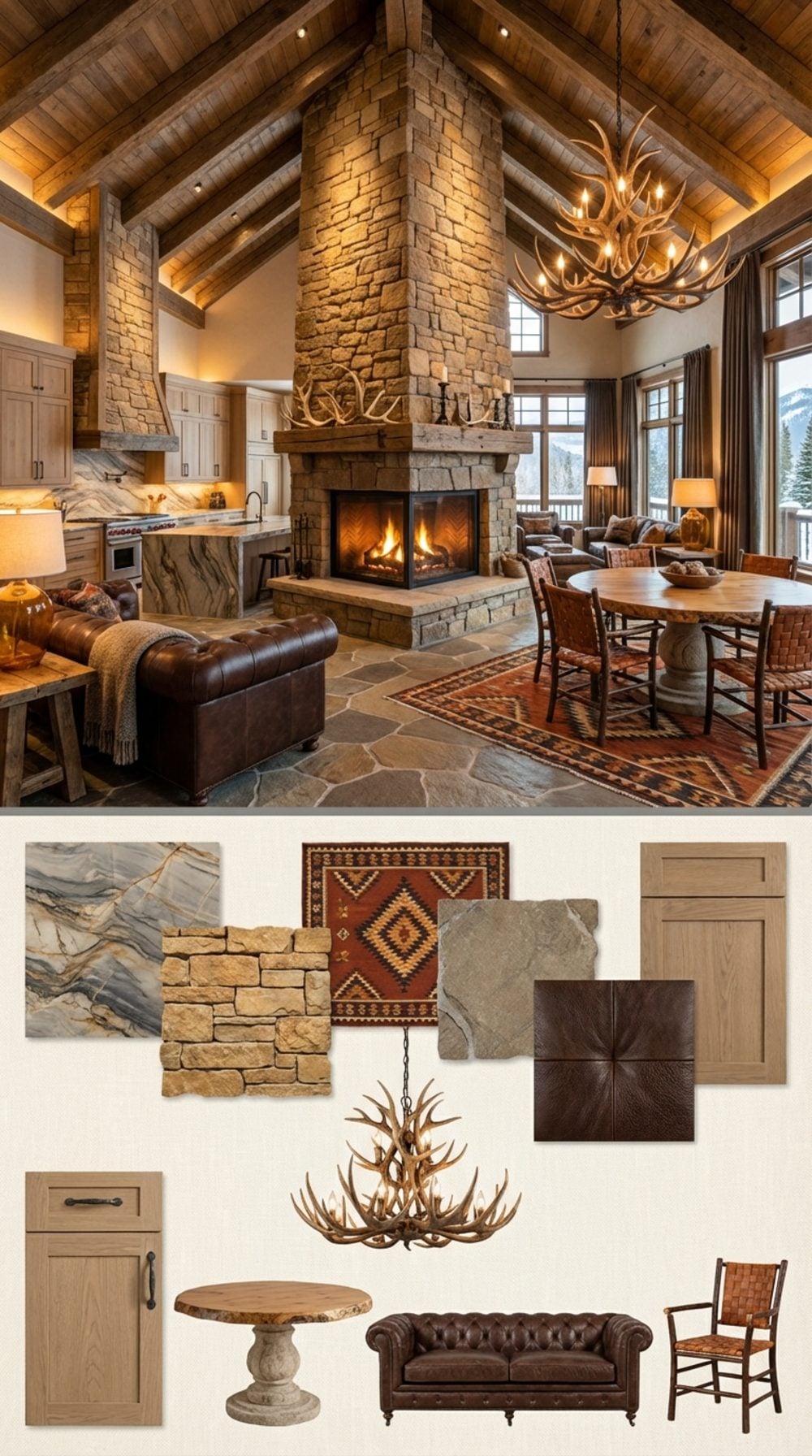
Grand Alpine Lodge: Monumental Double-Sided Stone Fireplace and Live Edge Pine
🔥 Would you like to save this?
A double-sided stone fireplace chimney mass rising two stories isn’t furniture or fixture, it’s load-bearing architecture repurposed as the room’s central emotional fact. Everything else in this great room is organized in relationship to that chimney: the paired sofas, the dining table behind it, the vault reaching its peak directly above it.
Refuge psychology is at its most legible here. The two chocolate leather sofas flanking the fire create the most instinctively sheltering seating arrangement in residential design, one that humans have been replicating around central fires for roughly forty thousand years. The scale has changed dramatically; the impulse hasn’t.
Industrial Artist Loft Grand Luxury: Sawtooth Skylight Vault and Oxblood Leather Sectional
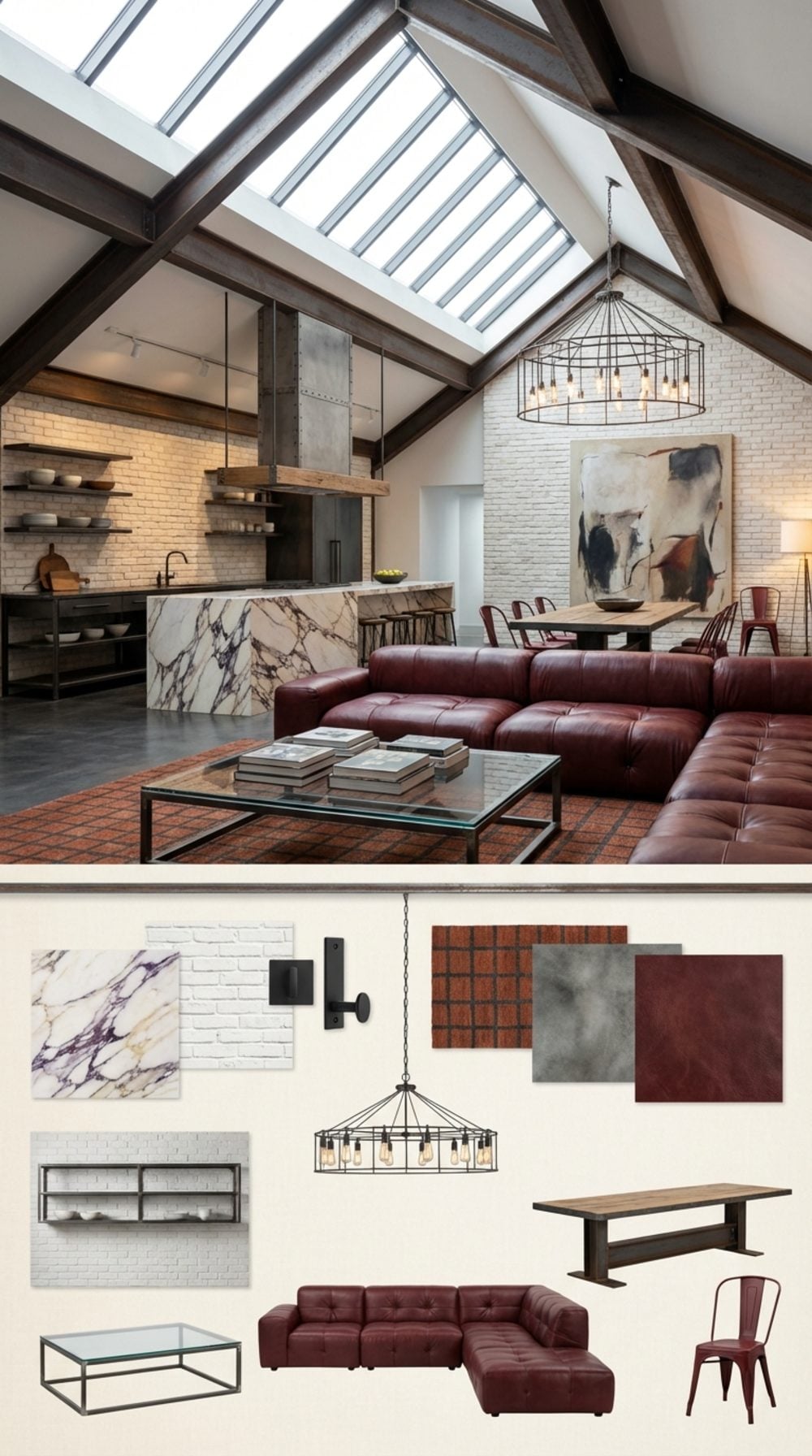
Sawtooth skylights were invented for factory floors, the north-facing glass panels were designed to give textile workers consistent shadow-free light for color-accurate work. Bringing that industrial logic into a residential great room at this scale is an architectural decision with real intellectual content, not just an aesthetic gesture.
Calacatta Viola is an interesting call in this context. The purple and gold veining is aristocratic by nature, and placing it in a room built from Cor-Ten steel and raw concrete creates a productive tension between noble material and industrial setting. The oxblood leather pulls both registers together.
Contemporary Oaxacan Grand Luxury: Hand-Formed Terracotta Vault and Cantera Stone Kitchen
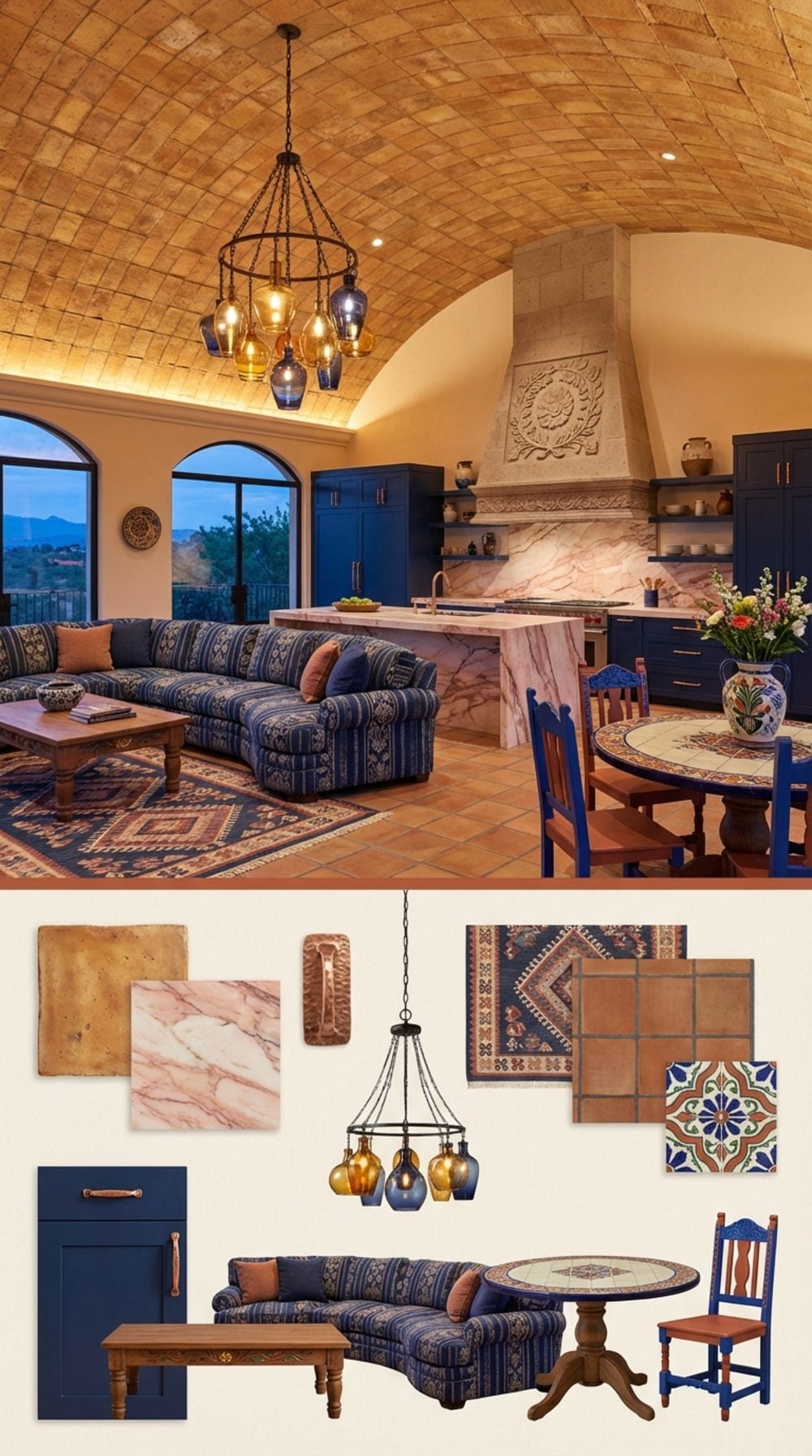
Hand-formed terracotta tiles don’t come out uniform, each one carries the slight irregularity of the hand that shaped it. Cladding an entire vault in that material creates a ceiling that reads as a single warm surface from a distance and as an accumulation of individual craft objects up close. Most materials have to choose one or the other.
The deep indigo lacquer kitchen against Rosa Aurora marble and copper hardware is a color combination that should fight and somehow doesn’t. The warm pink of the Rosa Aurora sits between the cool indigo and the warm copper on the spectrum, bridging them without resolving their tension. That unresolved quality is precisely why the kitchen holds your attention.
This is what the most interesting 2026 interiors are doing: sourcing a design tradition not for its surface aesthetics but for its material logic, then pushing it to an architectural scale it wasn’t originally designed to inhabit.
Burnished Copper Vault with Forest Green Kitchen and Teal Velvet Living
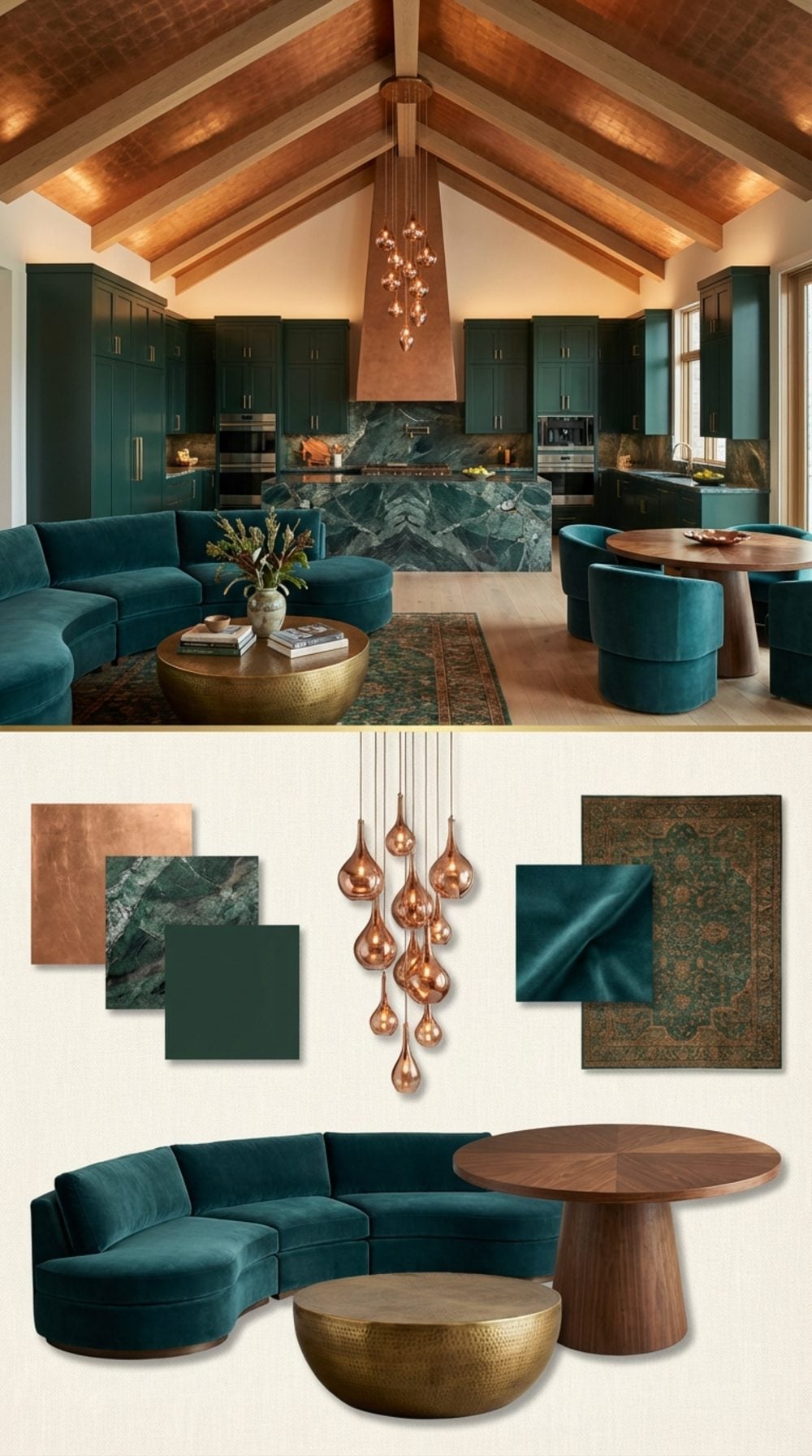
That burnished copper leaf ceiling is the structural argument this room is built around. By keeping the vault overhead in warm metallic tones and echoing it in the kitchen’s range hood and the chandelier’s blown glass, the eye travels a continuous copper thread from cooking zone to dining zone to living area without a single abrupt visual break, rare in open concept design.
Forest green and teal read as distinct hues in isolation but here they share enough blue undertones to cohere. The hammered brass cocktail table acts as the pivot point, pulling both the ceiling’s warmth and the velvet’s depth into a single object.
Aged Cognac Leather Vault with Espresso Walnut Kitchen and Heriz Persian Living
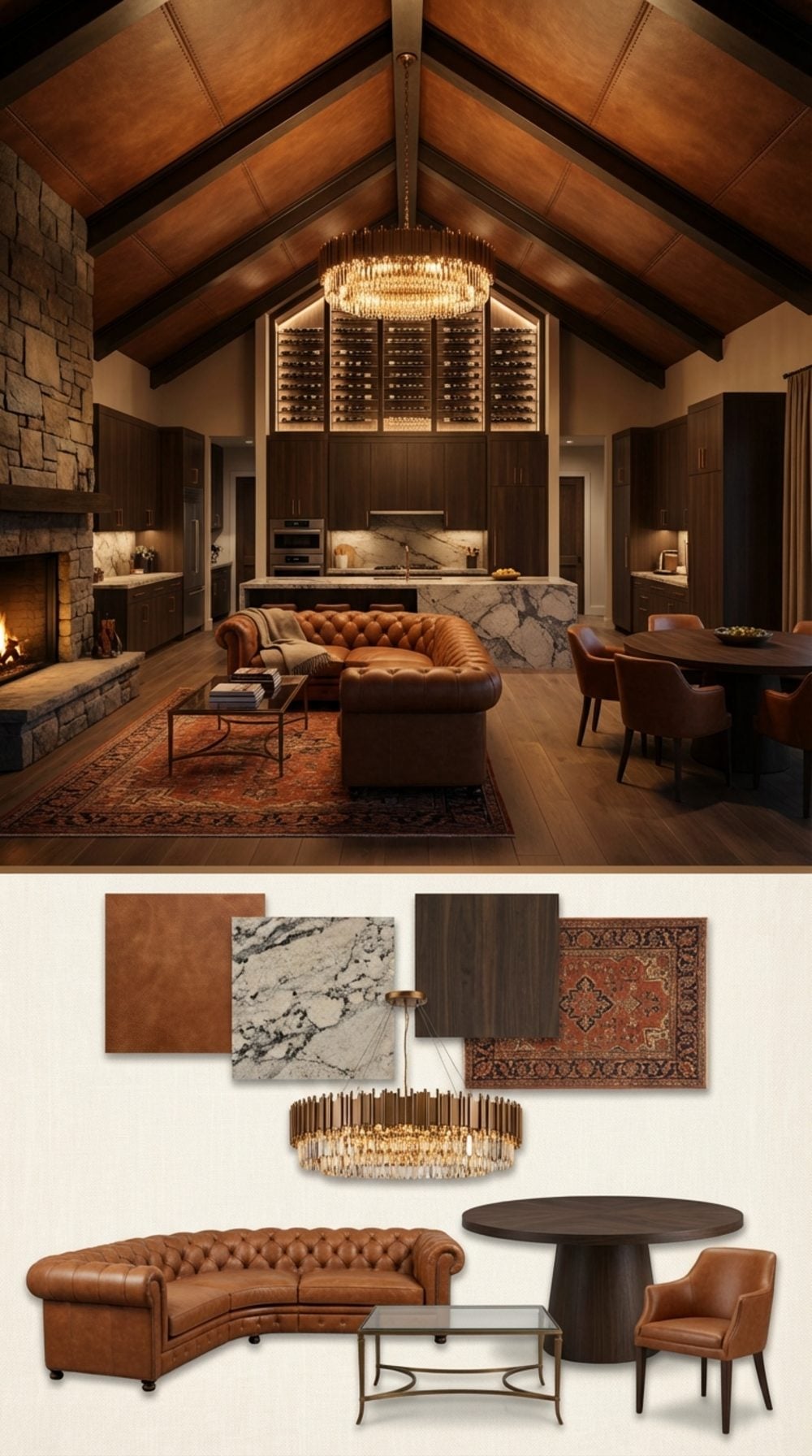
Leather on a ceiling sounds provocative until you see it absorb candlelight the way this room does. The hand-stitched cognac panels don’t read as opulent so much as aged and inevitable, like a library that has always existed.
The Heriz rug is doing critical structural work: its rust and navy geometry provides the one visual interruption in an otherwise monochromatic brown-to-bronze spectrum, and without it the room would feel like it was trying too hard to be serious.
Hand-Painted Celestial Vault with Midnight Blue Kitchen and Gold Murano Chandelier
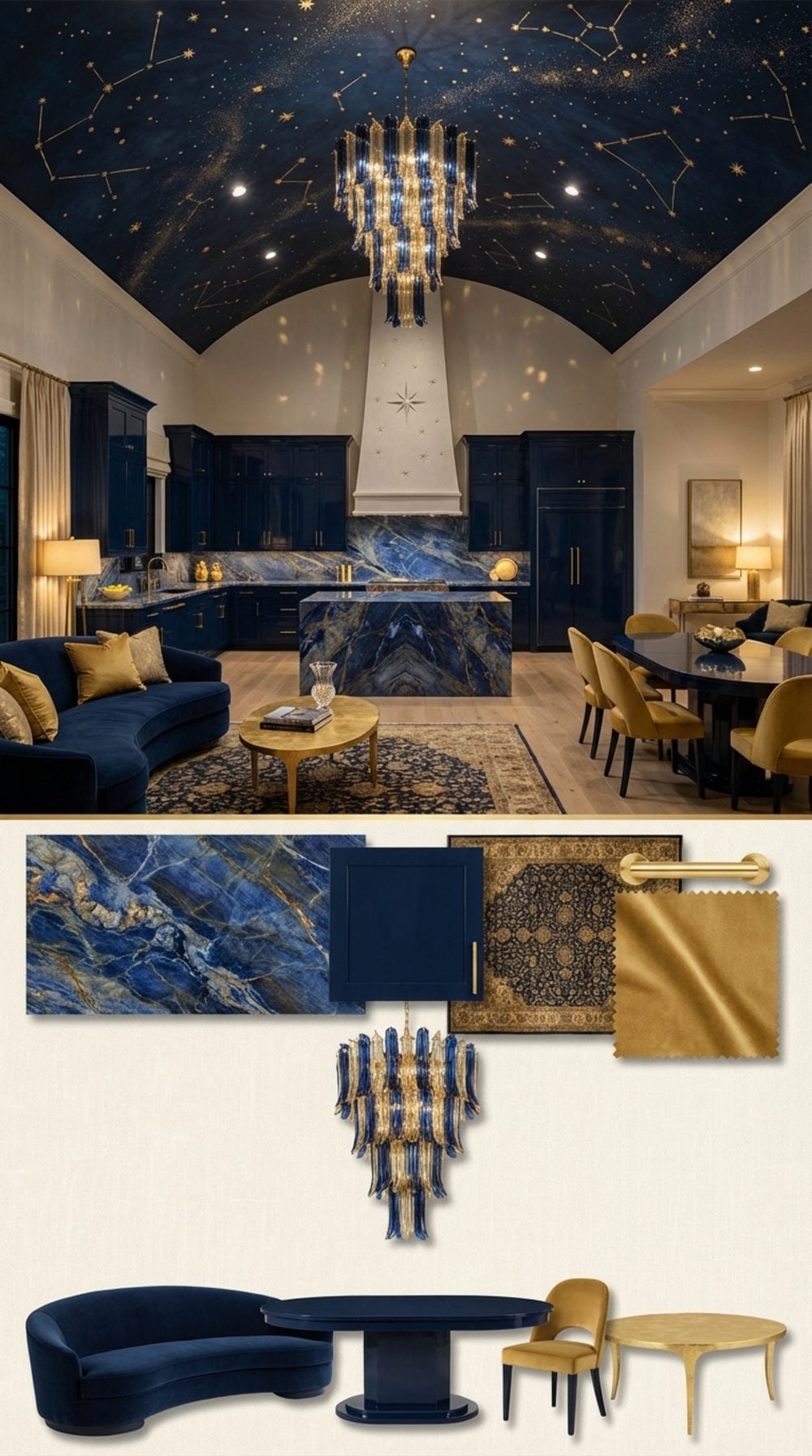
Most designers treat the ceiling as the fifth wall and promptly forget about it. This room treats it as the primary architectural move, and every other decision in the space descends from that painted sky above. The Lapis Blue marble island is not a bold choice here, it’s an obligation. Anything lighter would have broken the spell.
- The hand-painted mural locks the color palette before a single piece of furniture is sourced
- Lacquered surfaces in midnight blue reflect the ceiling back at eye level, multiplying the effect without additional painting
- The Murano chandelier bridges ceiling art and room furnishing, both decorator and structural object simultaneously
White Shiplap Dormer Vault with Bianco Antico Kitchen and Coastal Rope Chandelier
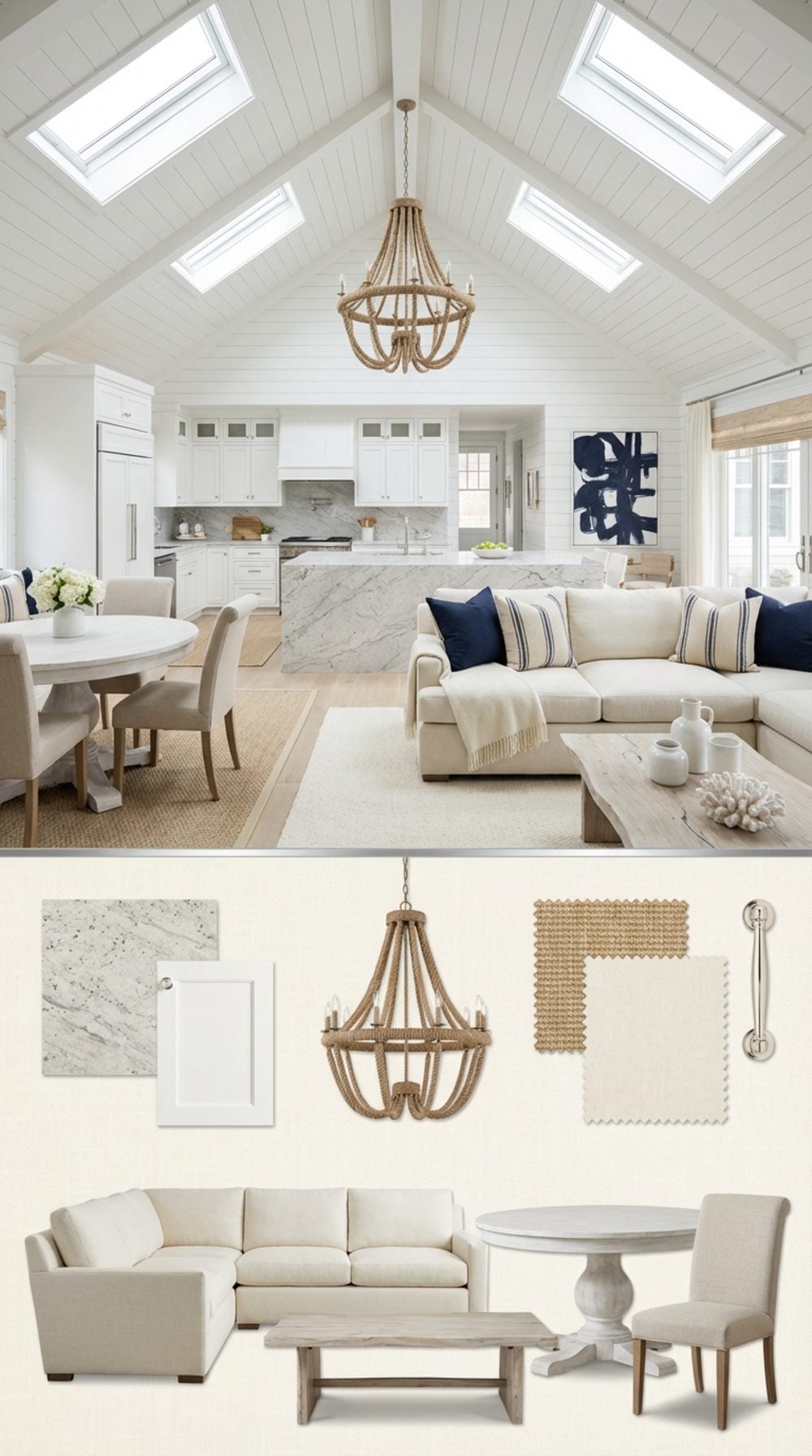
Shiplap vaulting in the Hamptons context is nothing new, but what separates this room from a thousand similar beach houses is scale discipline. The twelve-foot Bianco Antico island anchors the space with enough architectural weight to prevent the white shiplap from reading as beachy-casual rather than grand.
The rope chandelier is a precise choice: it carries coastal material vocabulary at a scale that commands the vault without competing with the skylight ribbons above it. Natural fiber at that size earns its presence.
Venetian Stucco Vault with Calacatta Oro Kitchen and Savonnerie Rug Contemporary Versailles
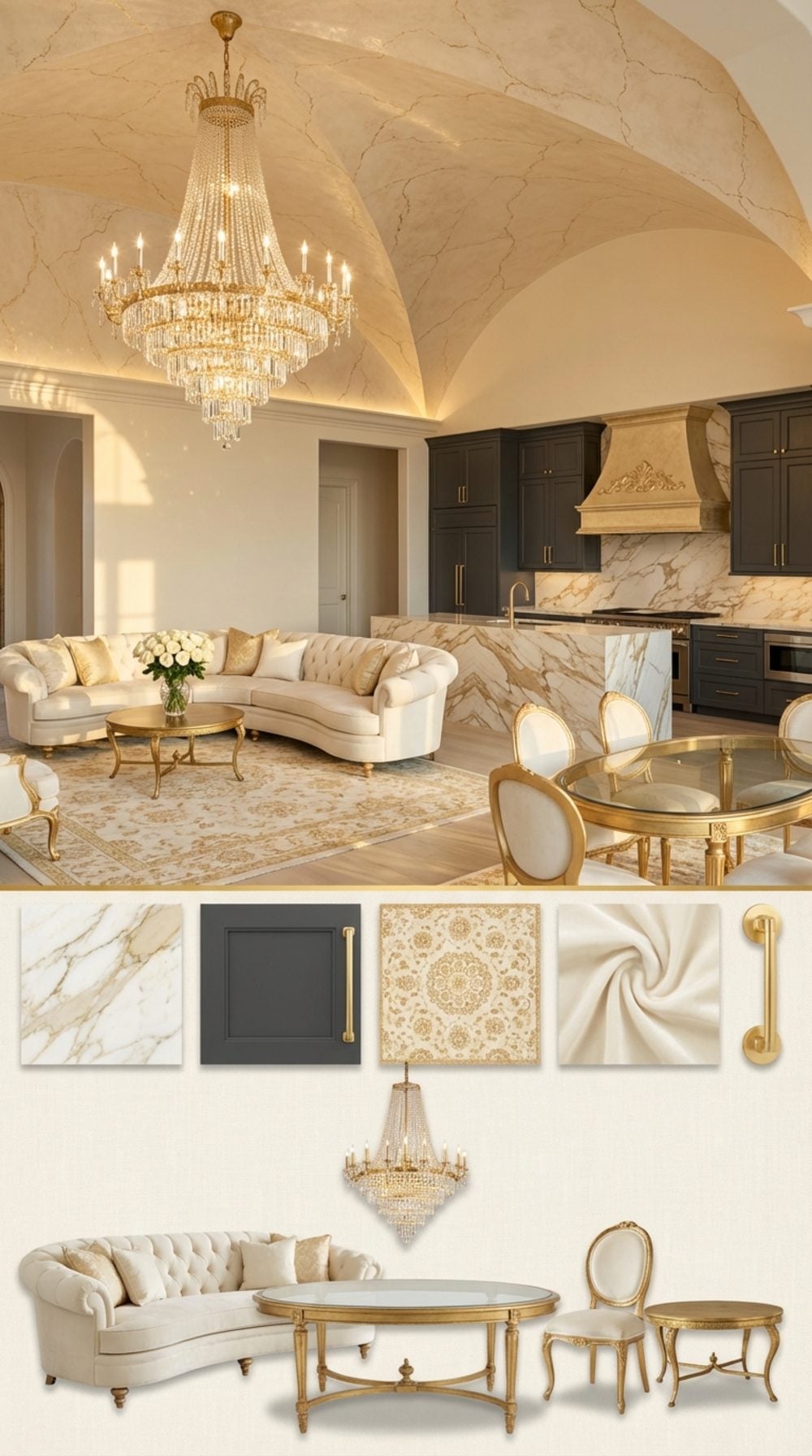
Venetian stucco at vault height is the kind of decision that separates genuine luxury from expensive decoration. The polished finish creates a surface that reflects ambient light differently at every hour, so the room isn’t static, it responds to morning, afternoon, and evening light with distinct character.
Charcoal grey cabinetry is the counterintuitive move that makes this room work as a contemporary space rather than a period pastiche. That dark anchor at ground level prevents the gold and ivory from reading as a wedding venue and keeps the composition planted.
White Oak and Matte Black Steel Vault with Silver Wave Quartzite Kitchen and Slate Velvet Industrial Living
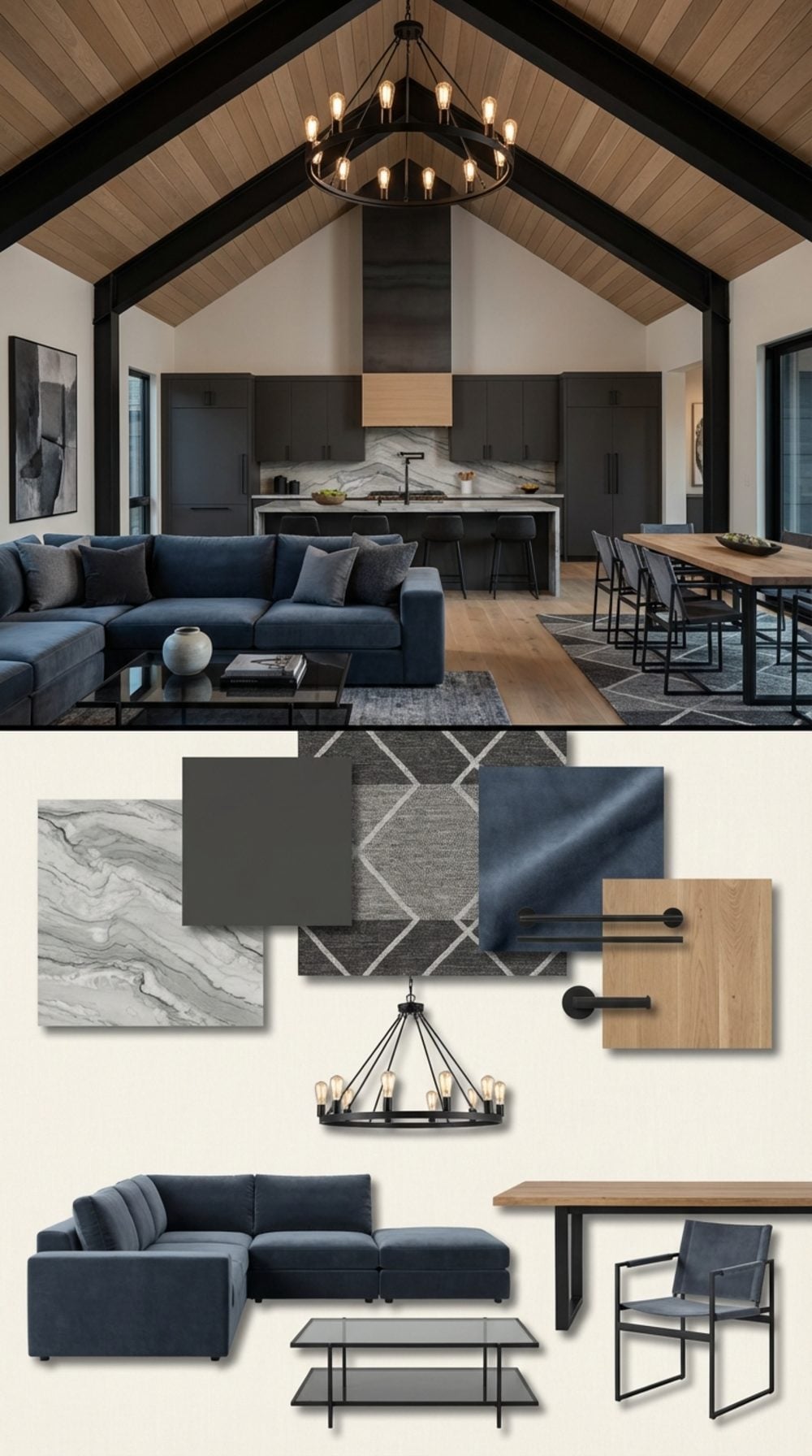
The alternating oak-and-black-steel vault bands do something technically difficult: they impose graphic order on a large volume without relying on ornament. Where other rooms on this list use applied surface treatments to animate the ceiling, this one uses structural geometry, and the restraint is its own form of confidence.
Silver Wave quartzite is the correct material choice here because its movement reads as organic against the rectilinear steel grid, creating the one moment of natural unpredictability in an otherwise tightly controlled palette. Edison bulbs in an industrial chandelier at this scale push warmth into a room that could easily have read as cold, a small decision with outsized effect on atmosphere.
Art Deco Revival Great Room with Burnished Brass Vault and Portoro Marble Island
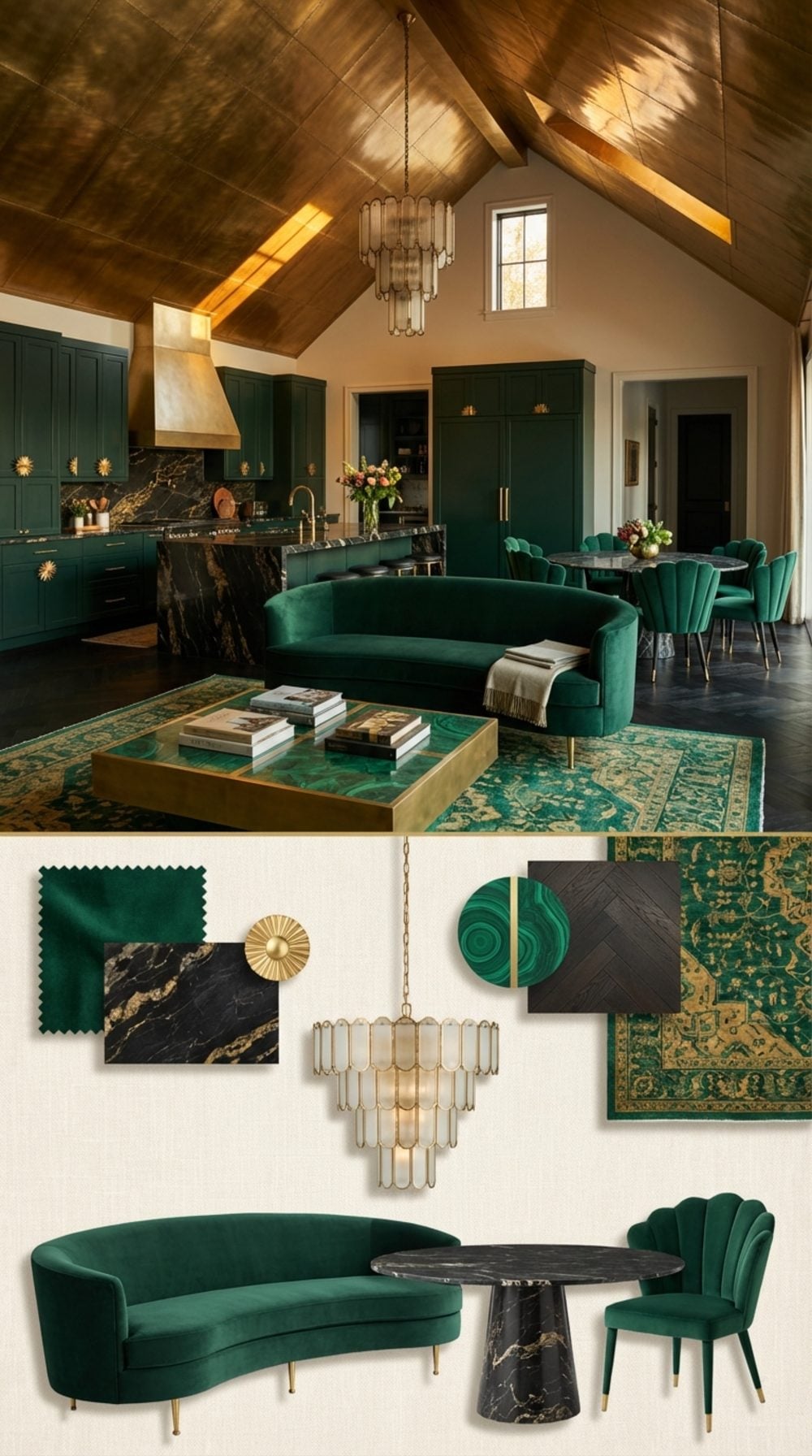
The Art Deco revival has never felt this loaded with intention. Hand-embossed burnished brass panels wrapping an entire vault do something unexpected: they turn a ceiling into a light source, bouncing warm amber reflections onto every surface below and making the room feel as though it is permanently bathed in late-afternoon gold. The forest green lacquer against Portoro black is not a subtle pairing, it is a full declaration.
Malachite inlaid into the cocktail table echoes the green of the sofa at a mineral level, creating a thread of color that reads as collected rather than matched. That distinction is everything in a room this rich.
Concert Hall-Inspired Great Room with Floating Walnut Acoustic Baffles and Fusion Quartzite Island
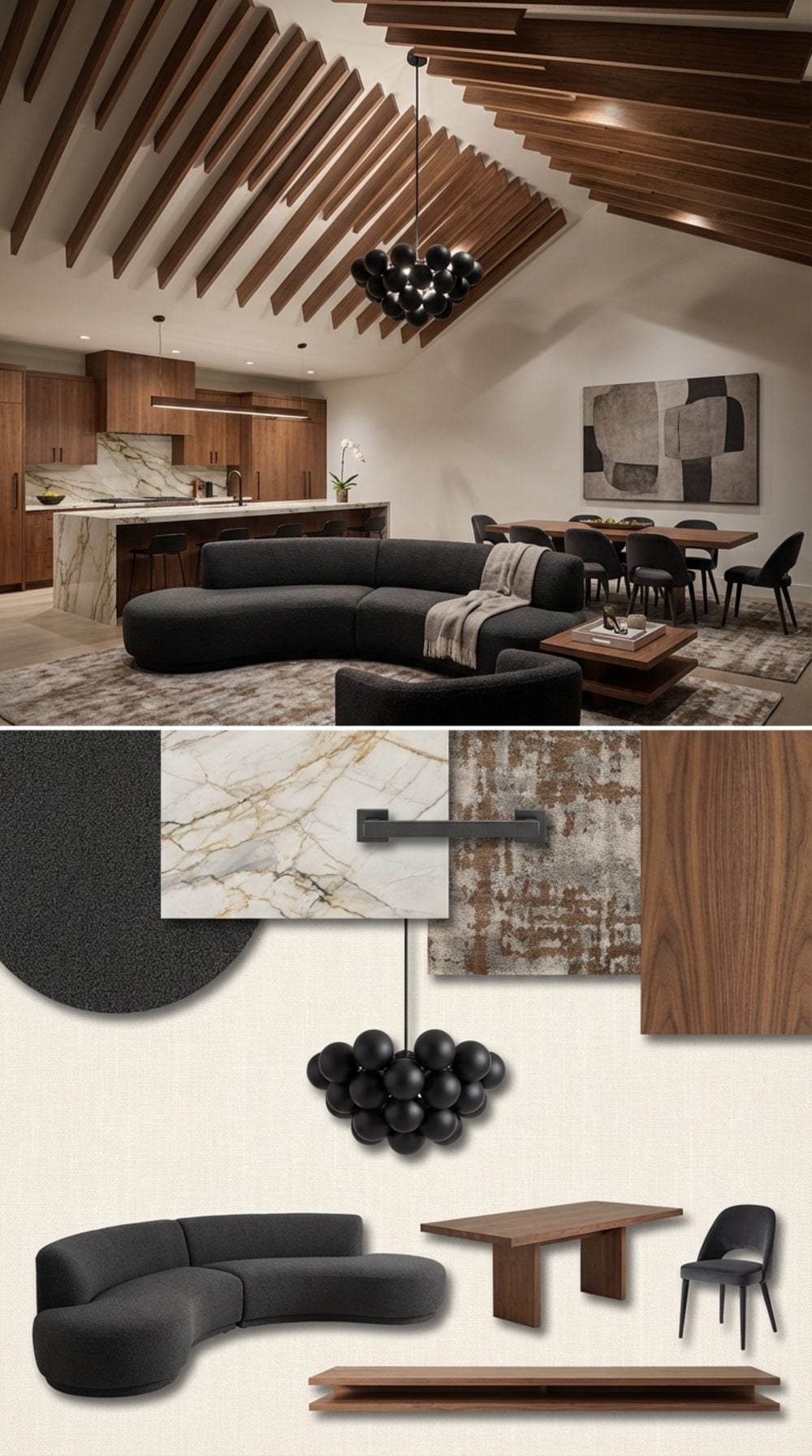
The acoustic baffles are the entire thesis of this room. Borrowed from concert hall engineering, the angled walnut panels descending from the vault apex do practical work, diffusing sound across a large open plan, while creating a ceiling composition that no decorator could have invented through purely visual logic. Function and form arriving at the same answer is always more interesting than either alone.
Bouclé in charcoal is an increasingly precise material choice: the looped texture absorbs both light and sound, softening a space that could read as cold with this much graphite and matte black. The Fusion Wow quartzite island is the room’s single moment of unrestrained drama, all explosive gold veining, and the room earns it by staying disciplined everywhere else.
Tropical Resort Villa Great Room with Glass Curtain Wall and Backlit Onyx Kitchen Island
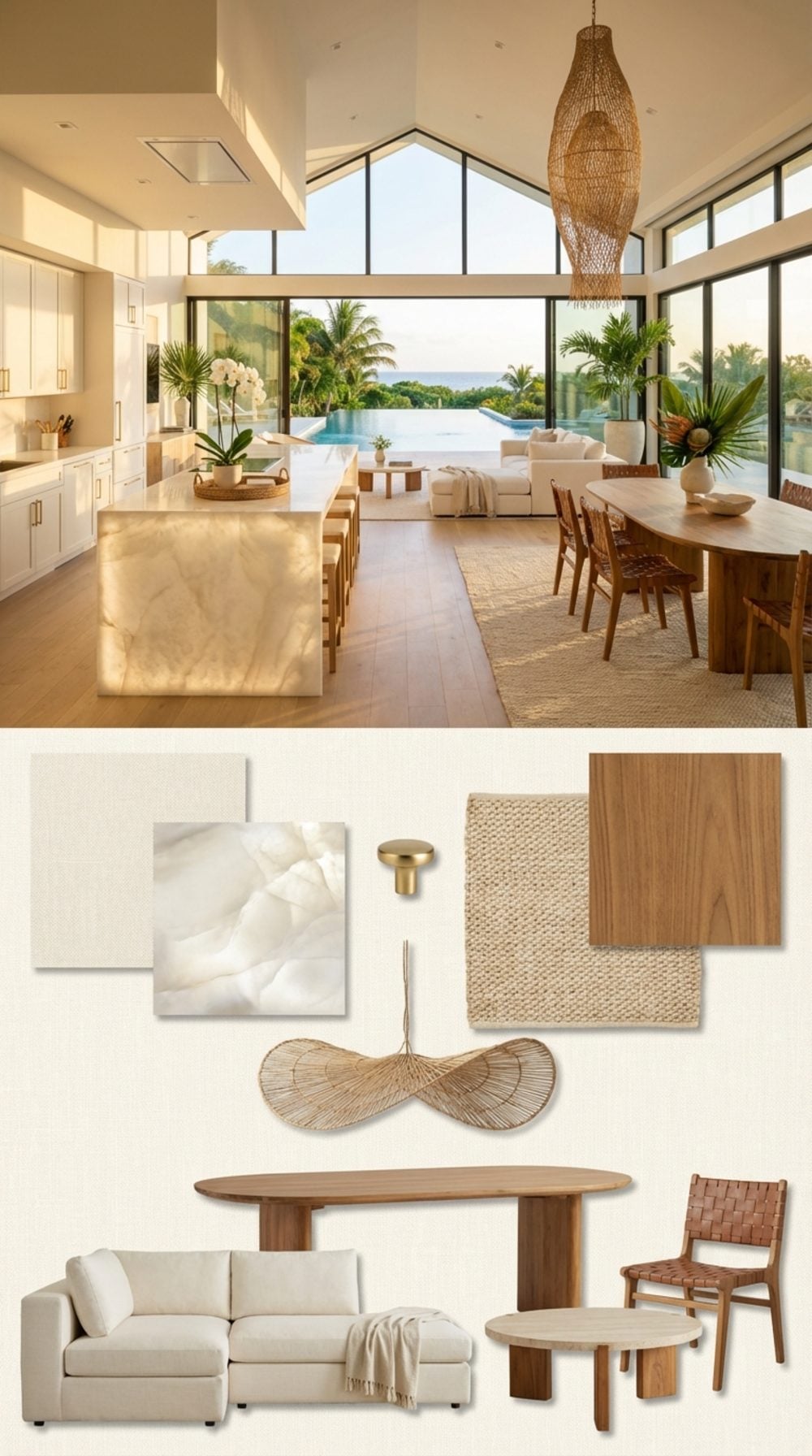
Backlit onyx is one of the few materials that changes its character entirely depending on whether you are looking at it or through it. As a solid countertop, Oyster White onyx reads as pale and quiet. Lit from behind, the same slab becomes a light source, warm, amber-veined, almost alive. Using it as a kitchen island in a glass-walled room that is already flooded with natural light takes confidence, because it competes with the view. Here, it wins by being otherworldly rather than architectural.
French Château Great Room with 18th-Century Normandy Oak Trusses and Aubusson Rug
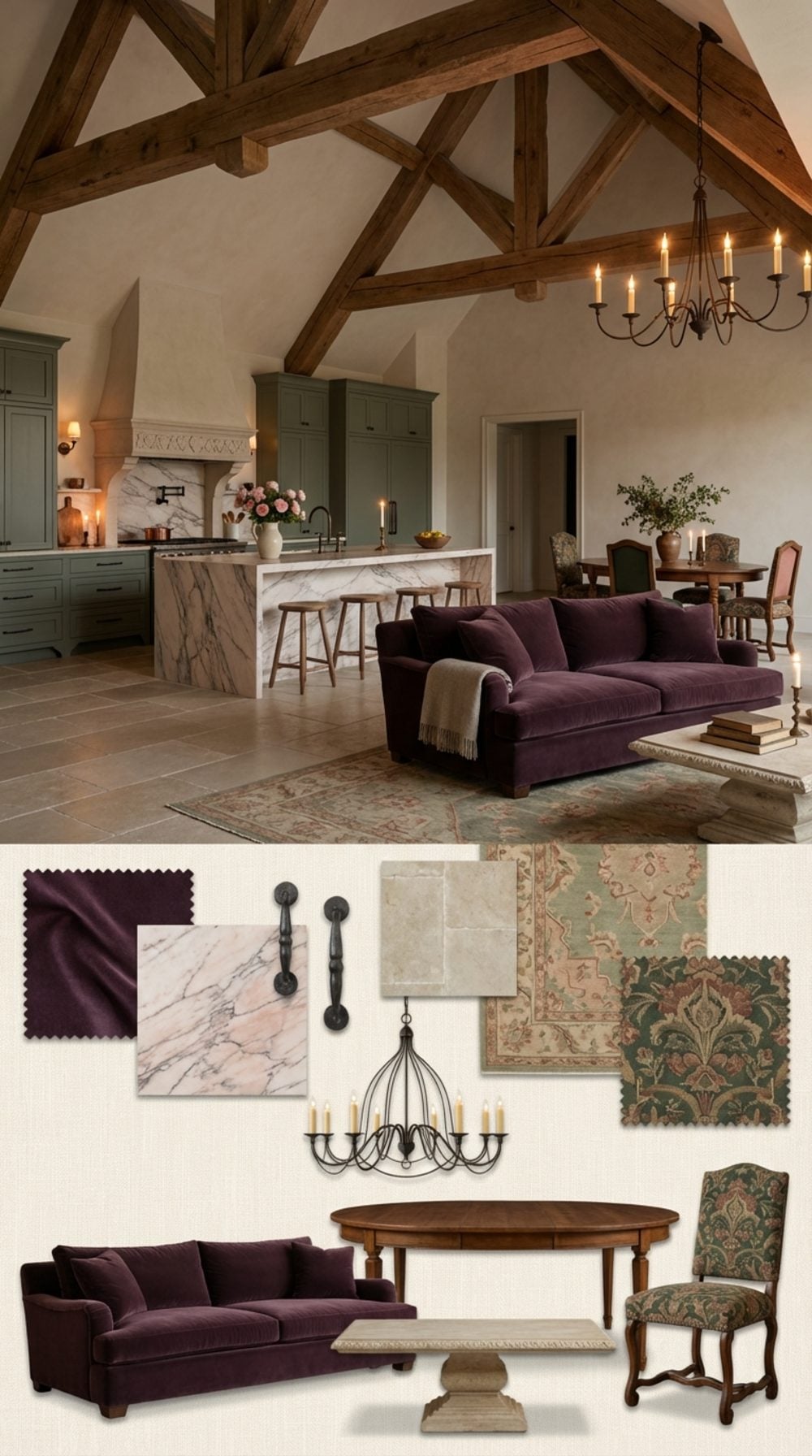
Salvaged 18th-century oak trusses carry something no new timber can manufacture: three hundred years of compression, UV exposure, and the particular darkness that comes from genuine age. The grain is tighter, the color is richer, and the surface has a texture that reads as different from ten feet away as it does from ten inches. Specifying salvaged material at this level is not nostalgia. It is the acknowledgment that certain things improve with time in ways that cannot be accelerated.
Sarrancolin marble, quarried in the French Pyrenees since the 17th century and famously used in Versailles, brings specific historical resonance as the island material here. Against hand-forged iron hardware and carved limestone, the pink and grey veining reads not as decorative but as geological, a piece of the French landscape brought indoors.