🔥 Would you like to save this?
There is something about the bones of an old passenger train car that refuses to be boring. The long, narrow footprint. The rhythm of windows. The sense that every inch has to earn its keep. These 15 redesigns all start from the same tired, forgotten shell and arrive somewhere completely different. From Art Deco navy to Venetian baroque, each concept proves that constraints are not limitations, they are the whole point. Scroll through and try to pick just one favorite.
In order to come up with the very specific design ideas, we create most designs with the assistance of state-of-the-art AI interior design software.
The Art Deco Navy Vault: When a Train Car Channels a 1930s Jazz Club
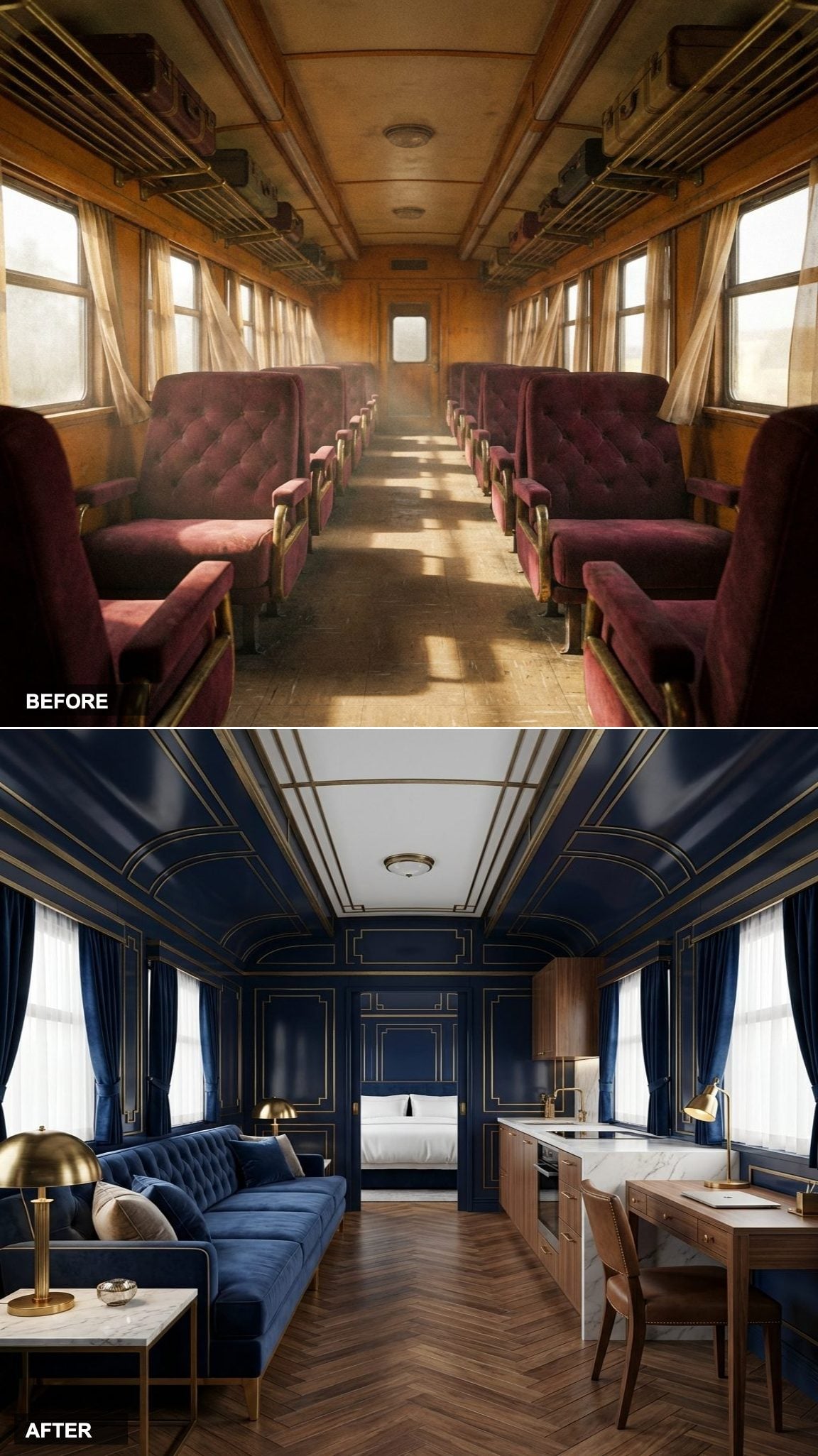
Deep navy lacquered paneling wrapped in aged brass trim does something remarkable to a narrow space, it makes you stop noticing the narrowness entirely. The eye gets pulled toward the geometry instead: the vertical fluting, the way brass catches light at the panel edges, the repeating rhythm of fixtures down the length of the car.
The tufted navy velvet sofa anchors the living end with real weight, while the white marble galley counter keeps the kitchen from feeling heavy. This design wins because every material choice reinforces a single period: 1930s transatlantic luxury, all the way through.
British Racing Green and Champagne Gold: The Edwardian Club Car You Never Want to Leave
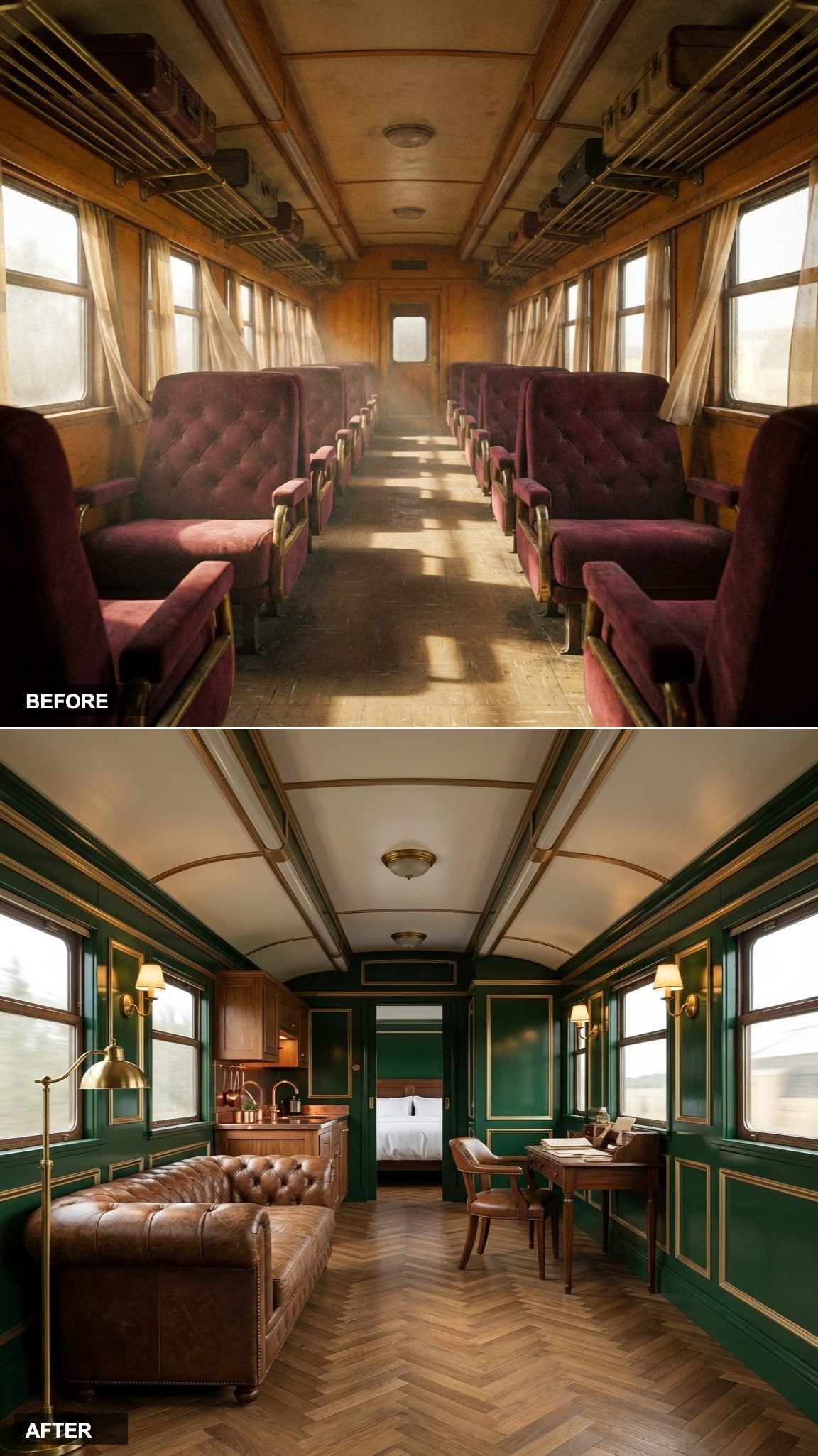
Racing green lacquered walls with champagne gold molding produce an interior that reads as deeply, confidently English, the kind of room where you expect to find a worn leather Chesterfield and someone’s forgotten copy of an Evelyn Waugh novel. Both are here.
The compact writing desk with a brass reading lamp is the detail that tips this from decorative exercise into genuine livability. A train car needs somewhere to think, not just somewhere to sit. This layout gets that right.
- The champagne gold molding keeps the green from reading as dark or oppressive.
- Worn leather signals history without screaming reproduction.
- The writing desk creates a functional anchor in the transitional zone between living and kitchen.
Old Hollywood Regency in Burgundy and Brass: Every Inch Playing a Role
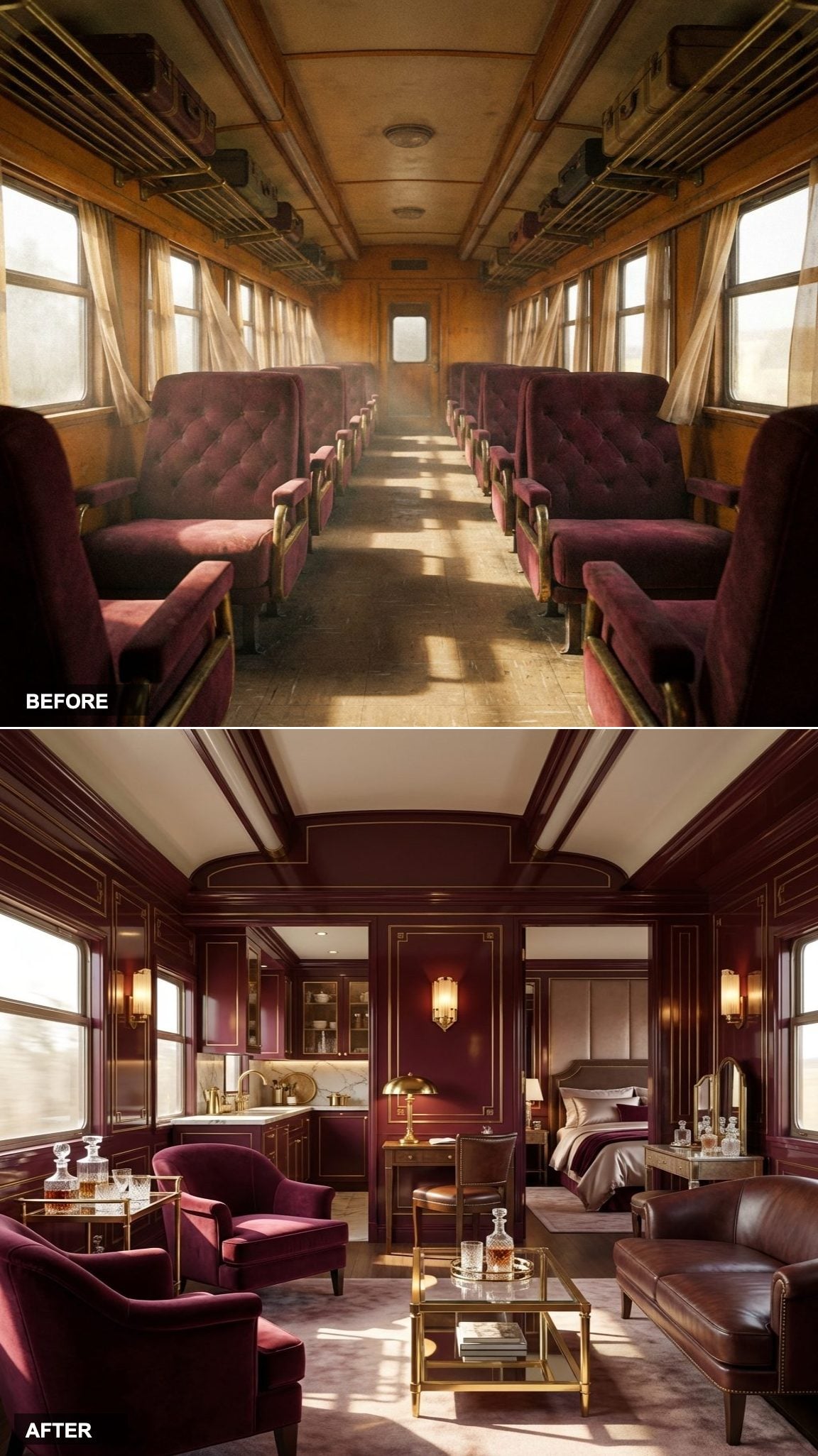
Rich burgundy lacquered paneling with brass inlay reads like a set built for a 1940s film that never quite got made, which is exactly why it works.
The full-length view down the car reveals how the Hollywood Regency approach handles the proportions: velvet armchairs in the living end, a compact kitchen in the middle, a desk nook in the transition zone, and the bedroom open at the far end. Each zone has its own moment but reads as one unbroken composition. The brass inlay in the paneling creates a directional line that pulls the eye toward the back of the car, making the whole space feel longer and more deliberate than it is.
Dark English Country House in a Railway Shell: The Unlikely Match That Clicks
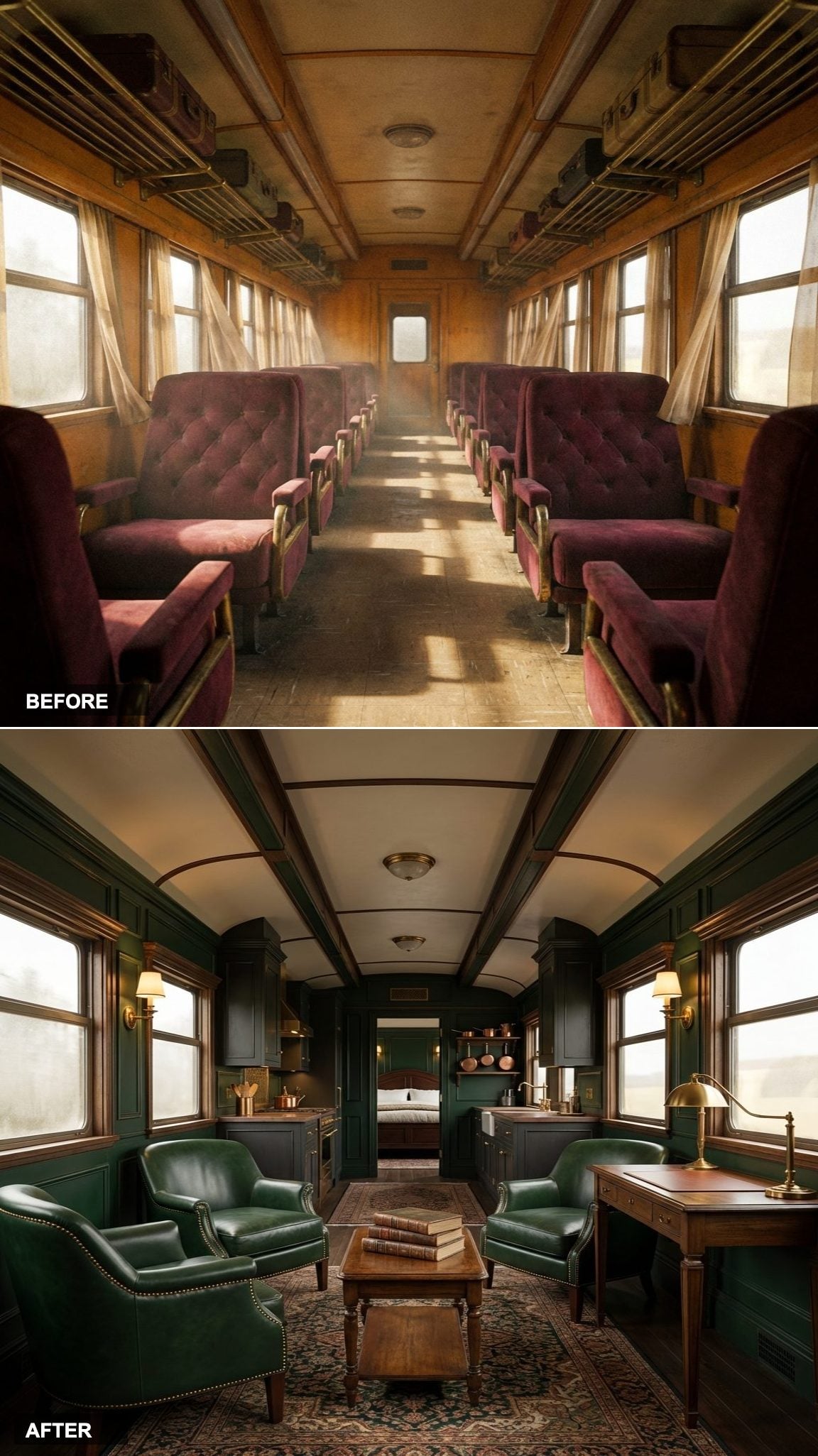
Most people would not picture a country house library when they look at a train car footprint. This redesign makes the case anyway, and it holds up.
British racing green cabinetry with aged gold hardware fills every vertical surface, leather club chairs face each other with a few books left out between them, and the galley kitchen keeps its period-correct restraint. The psychological effect is specific: this is a room that asks you to slow down, not speed up. The irony of that feeling aboard a vehicle designed for speed is the whole point.
Art Deco Steamship: Navy Velvet, Crystal Decanters, and the Ghost of a Transatlantic Crossing
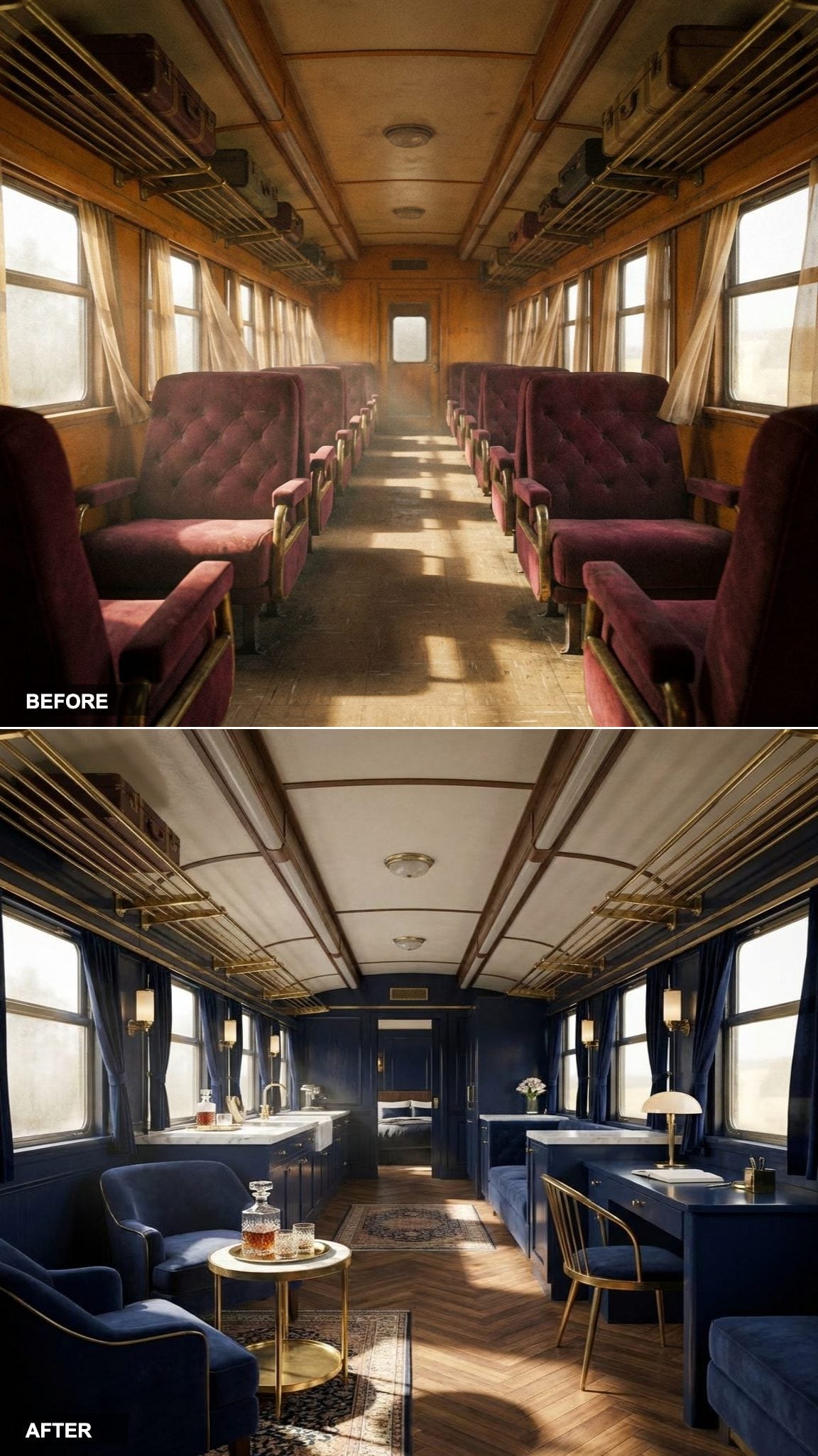
This concept is the most specifically nostalgic of the Art Deco variations, and it earns that specificity. The crystal decanter on the side table next to the navy velvet seating is a detail that changes the room’s register completely. It is not just a designed space anymore; it is a scene.
White marble in the galley counter bounces light back into the car’s deep middle section. Polished brass fixtures along the ceiling create that warm, directional glow that period ocean liner photographs always show. This one rewards looking closely.
The Burgundy Gentleman’s Club: Heavy Tufting, Open Books, and Serious Atmosphere
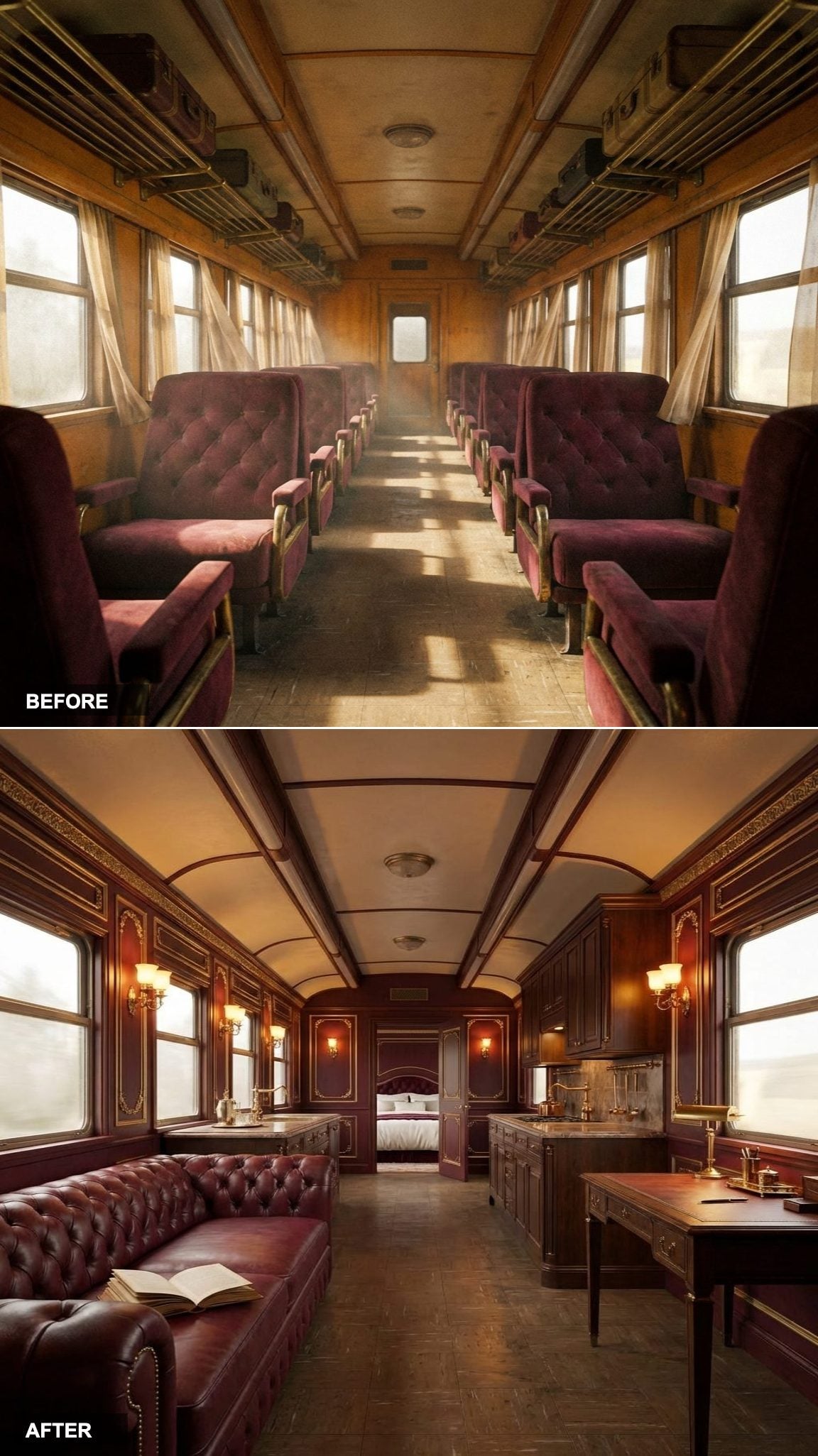
An open book left on an armrest changes a room’s story. It implies someone just stepped away, which is design shorthand for a lived-in space rather than a staged one.
The rich burgundy walls with champagne gold trim create the darkest, most atmospheric version of the Edwardian gentleman’s club aesthetic across these 15 concepts. The deep tufted leather sofa sits low and wide, the galley kitchen stays properly restrained behind simple dark cabinetry, and the small desk carries a single task lamp. No surface is wasted, but none feels crowded either.
Classic European Private Rail: Racing Green Lacquer from End to End
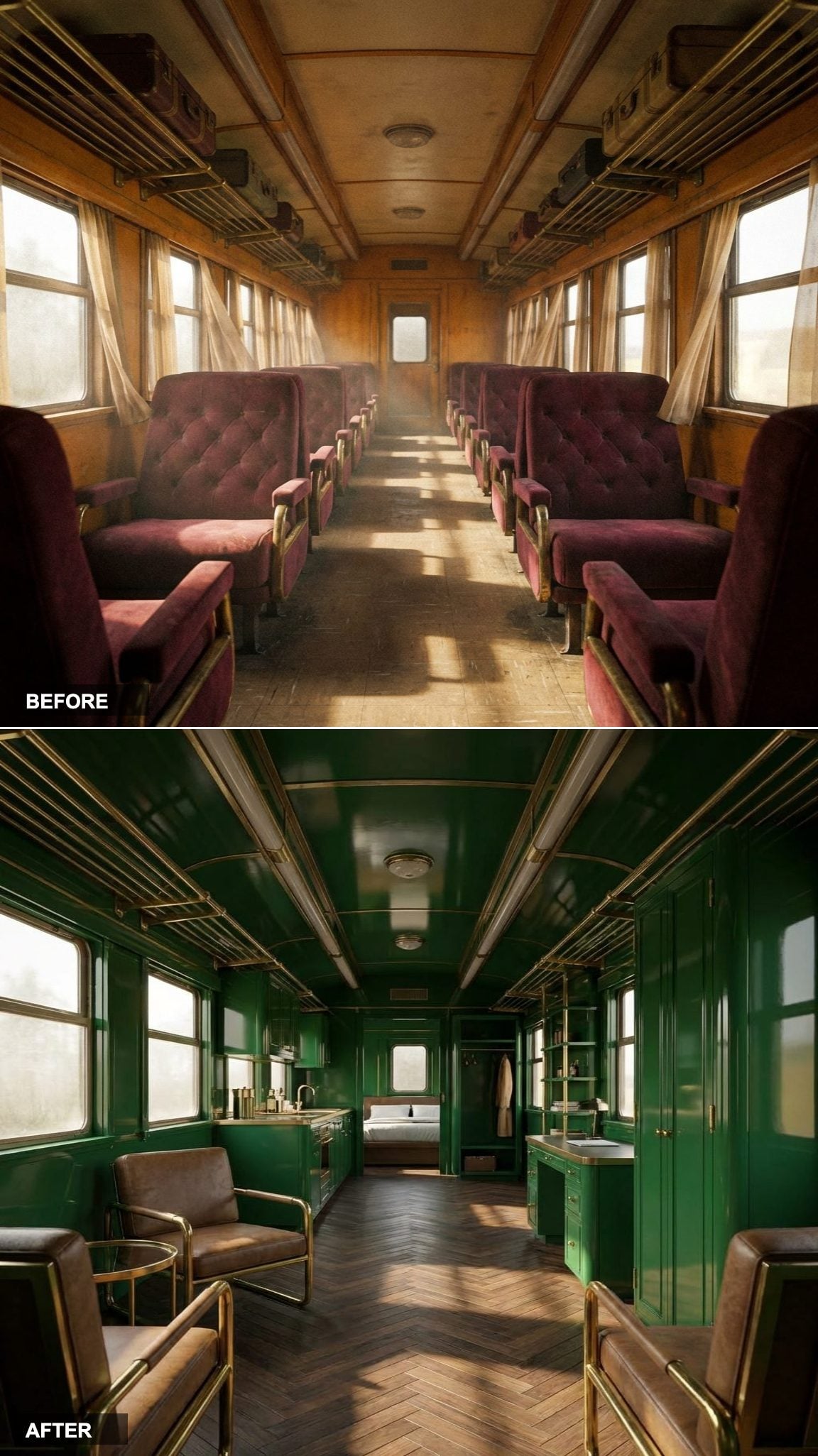
‘The best private rail interiors never let you forget you are aboard something in motion, they simply make you not mind.’
This full-length view down the converted carriage shows what happens when British racing green lacquered cabinetry and paneling cover every vertical surface from the living zone through the compact workstation to the far bedroom. The brass hardware at regular intervals prevents the green from becoming monotonous, each fitting is a small punctuation mark in a long visual sentence. Classic European private rail history runs through the bones of this one, and it shows.
Parisian Art Deco in Deep Navy with Gold Pinstripe: The Continental Apartment That Moves
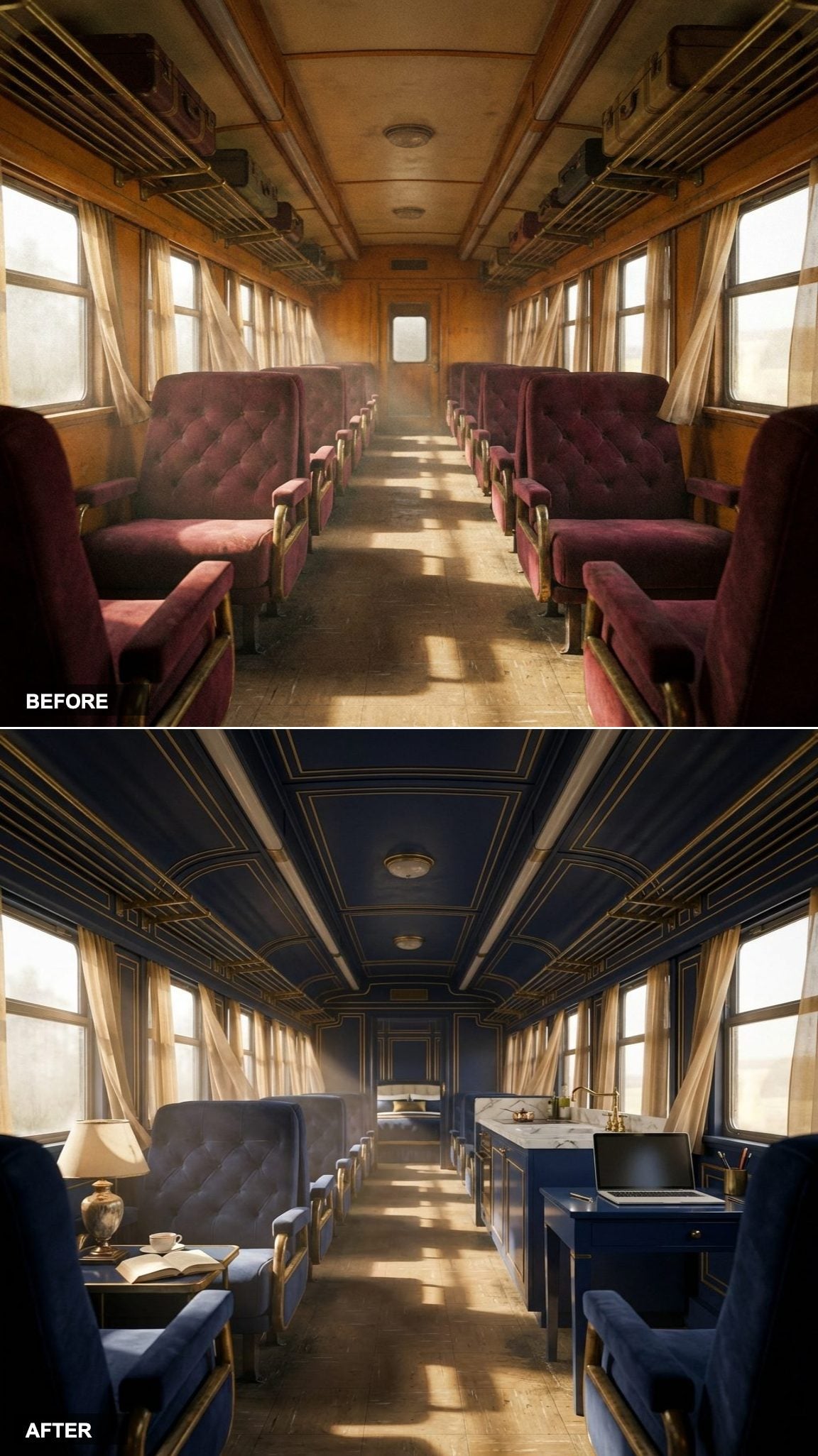
Gold pinstripe molding on navy paneling is a precise, specific choice. Not chunky brass. Not wide gold banding. A pinstripe, which reads as Parisian tailoring applied to architecture, and that is not an accident.
Navy velvet armchairs and a marble galley counter continue the logic. The half-read book on the side table brings the same lived-in warmth as the gentleman’s club version, but the Parisian reference shifts the register from heavy to precise. This is a design built around one good idea executed without compromise.
Edwardian Safari Club on Rails: Cognac Leather, Ivory Accents, and a Specific Kind of Adventure
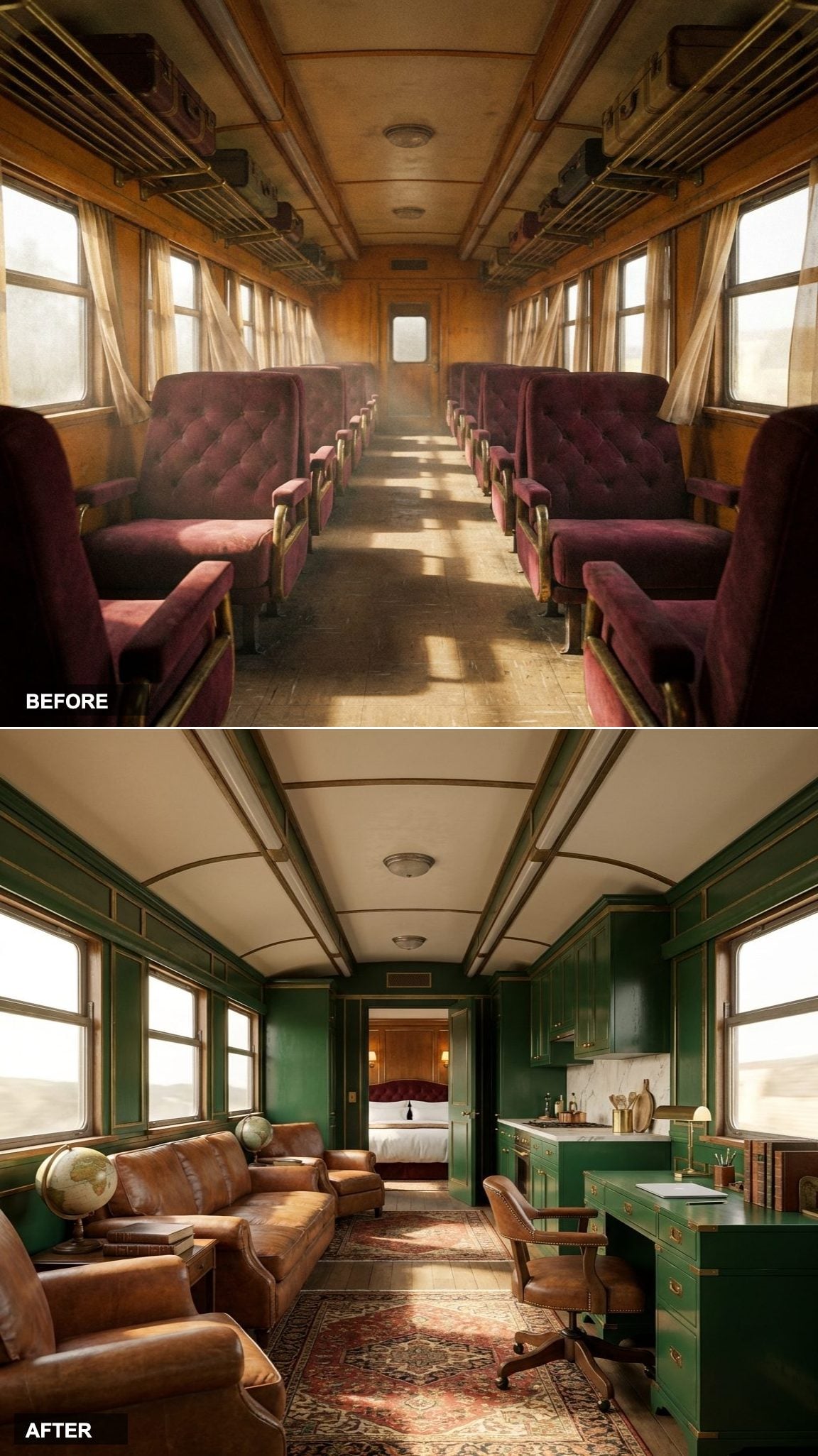
Worn cognac leather seating reads differently than polished leather, it implies miles traveled, decisions made, afternoons spent somewhere interesting. Paired with British racing green, aged brass, and ivory accents, the effect lands directly in Edwardian safari club territory.
What separates this concept from the other green interiors is the ivory. It lifts the palette slightly, stops the room from going too dark at the seating end, and gives the whole scheme a slightly warmer cast. The compact kitchen and the bedroom visible at the far end complete a space that feels like it was designed for someone with a very specific and well-developed sense of how they want to spend their time.
Orient Express Burgundy: Chesterfield Sofa, Crystal Whisky Glass, Maximum Atmosphere
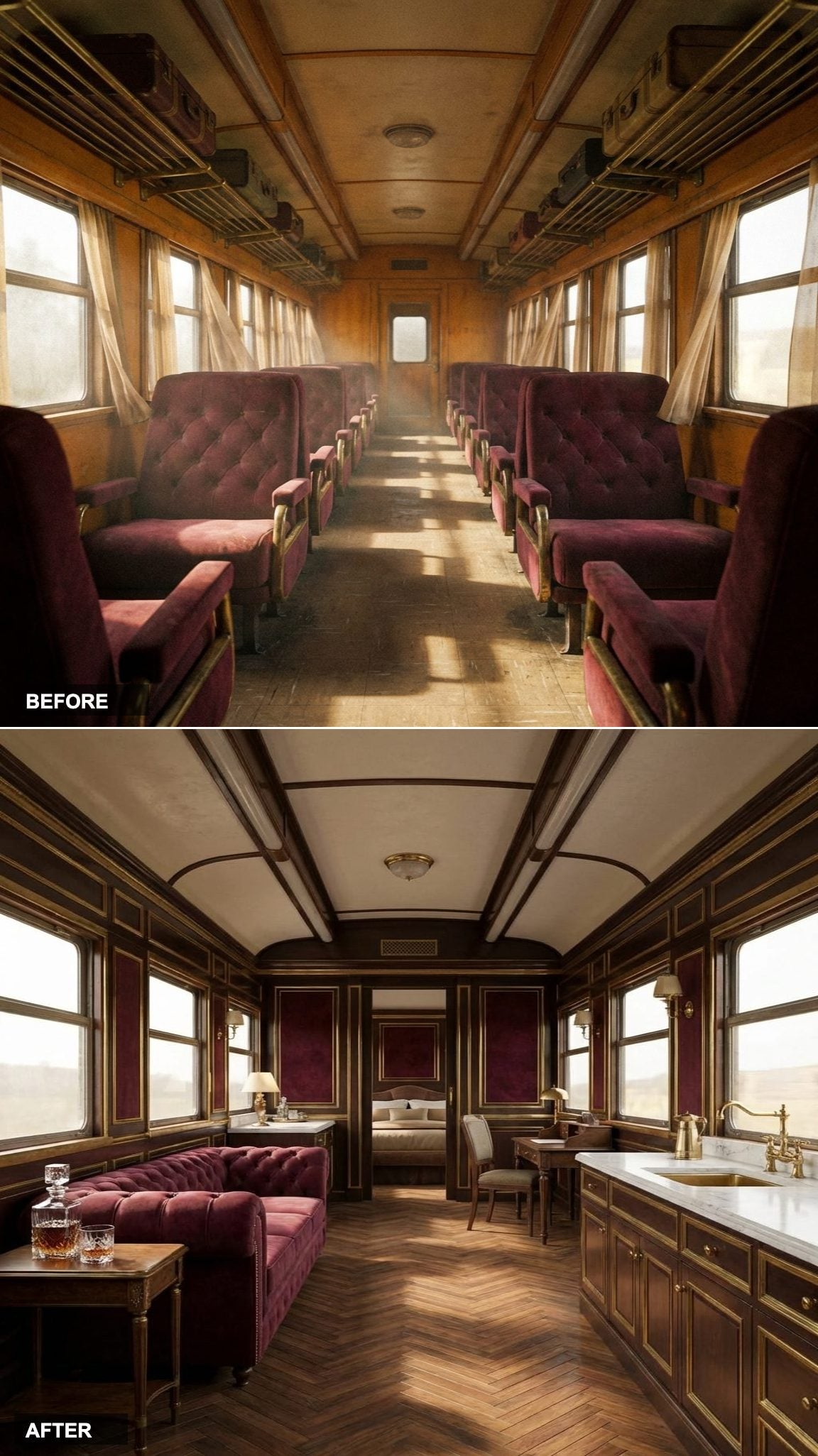
The Orient Express is not a style reference, it is a feeling, and this interior nails it.
Rich burgundy velvet against dark lacquered walls with brass trim, a Chesterfield sofa filling the living end, and a crystal whisky glass on the side table. The details accumulate into something that feels genuinely cinematic without being theatrical. The kitchen stays properly dark and fitted, the compact bedroom waits at the far end, and the whole composition holds a single unwavering tone from first window to last.
Art Deco Ocean Liner in Navy, Chrome, and Ivory Leather: The Sharpest Edit of the Series
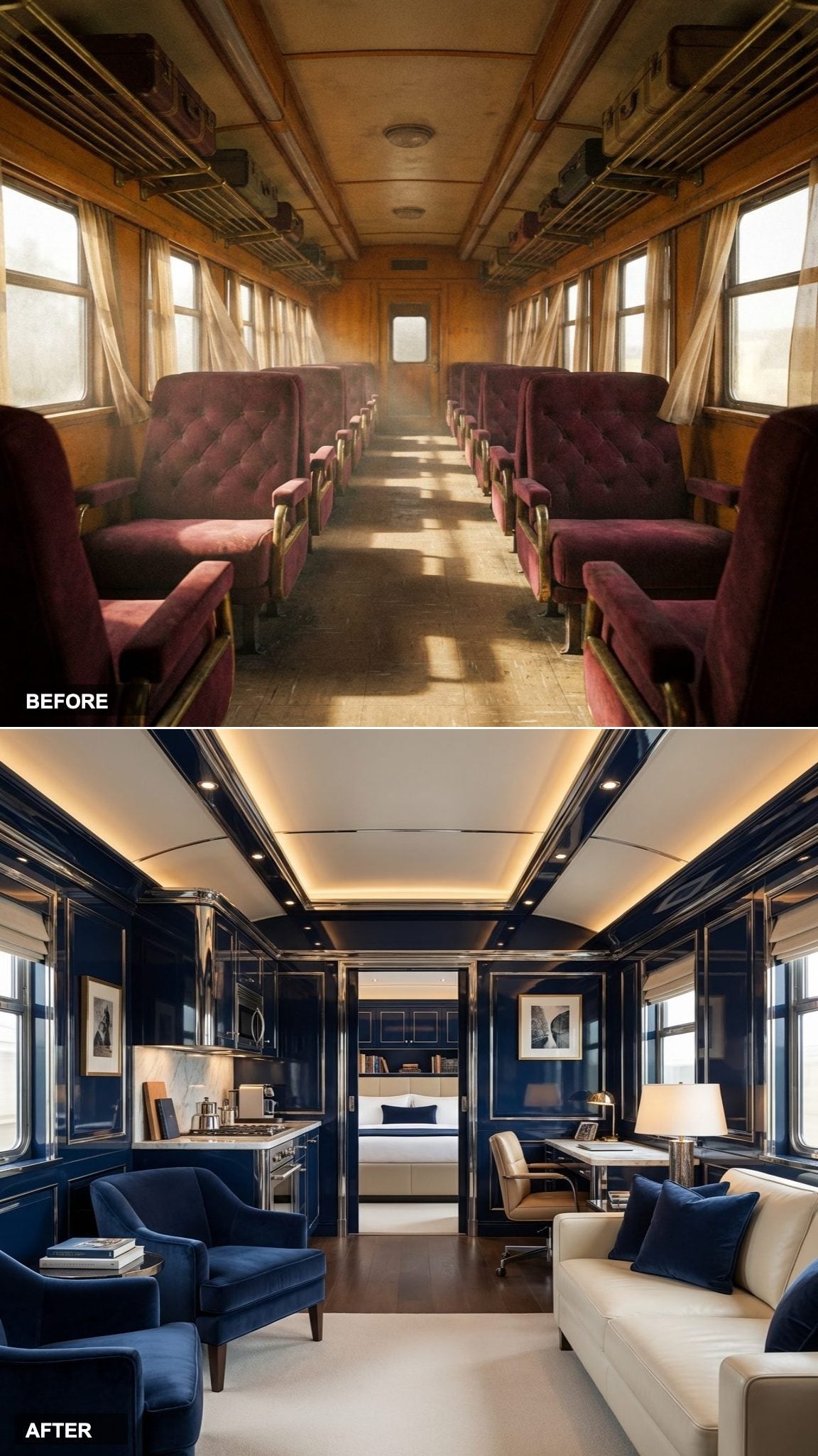
Navy and polished chrome with ivory leather is the most restrained palette in this collection, and the one that ages best. Where the brass-heavy interiors carry a warmth that can tip toward heavy, chrome keeps everything precise and cool. The ivory leather in the bedroom seating reflects just enough light to make the far end of the car feel open rather than closed.
The full interior view, living room to kitchen to compact workstation to bedroom with open door, demonstrates how a single material logic applied from end to end creates a space that reads as spacious despite its fixed dimensions. Art Deco ocean liner design understood this principle better than almost any movement before or after it.
English Library Car: Dark Walnut Joinery, Stacked Books, and the Best Kind of Quiet
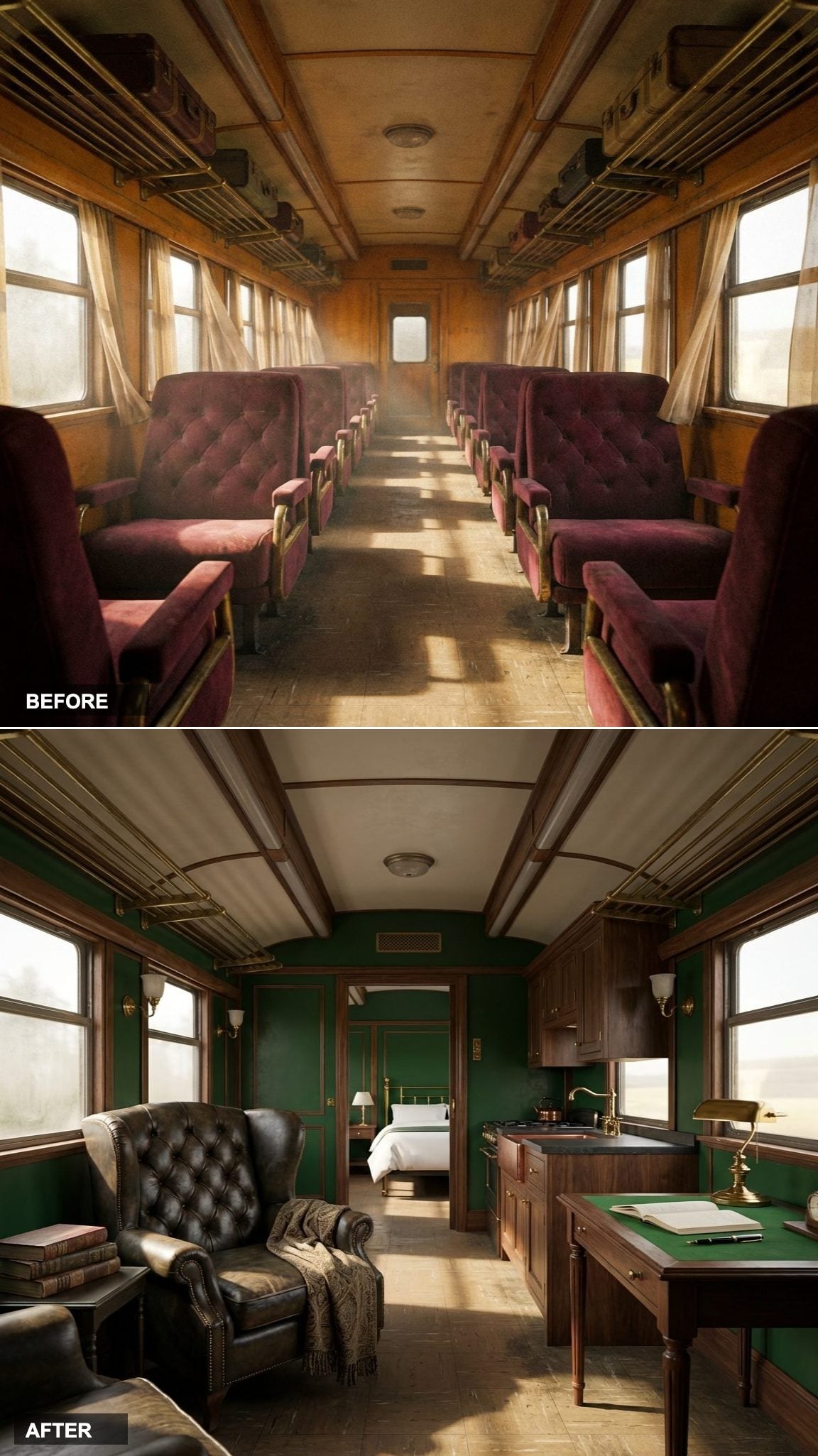
Stacked books on a side table next to a leather armchair are doing real design work here, they define the room’s purpose before anything else does.
British racing green paneling with dark walnut joinery and antique brass hardware is a combination that rewards texture as much as color. The walnut adds warmth and grain that solid lacquer cannot provide, softening what might otherwise feel formal. The compact galley kitchen stays in its lane, and the result is a train car that feels less like a vehicle and more like a gentleman’s reading room that happens to have wheels underneath it.
Venetian Baroque on Rails: Gold Leaf Molding, Velvet, and Antique Curiosities
🔥 Would you like to save this?
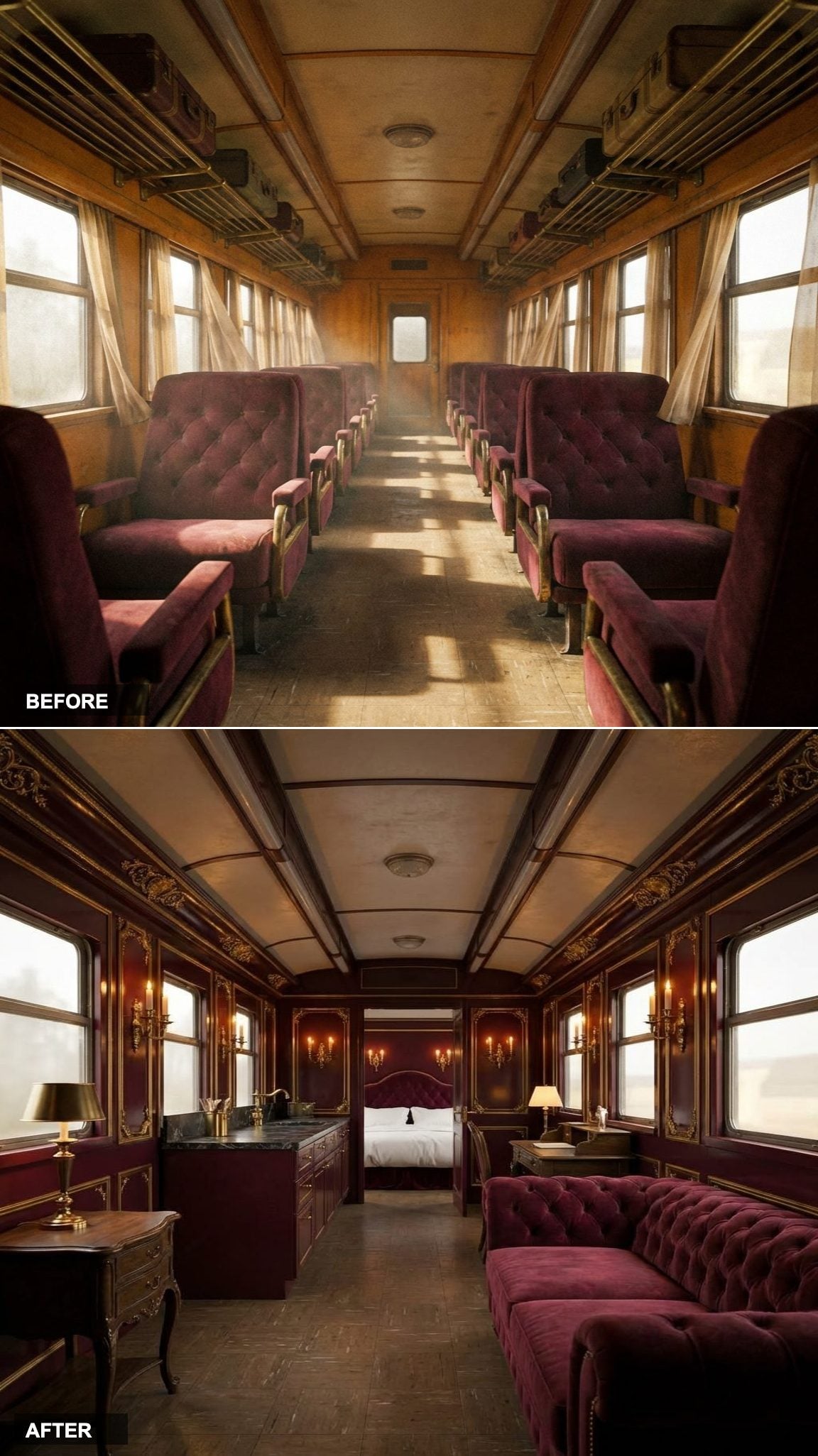
Deep burgundy lacquered walls with gold leaf molding is the most decoratively ambitious concept in this collection. Venetian baroque influence applied to a train car footprint sounds like a risk, and it absolutely is, and it absolutely pays off.
The tufted velvet sofa and antique side table anchor the living end with the right weight. The kitchen carries the gold leaf detail into its upper cabinetry without overloading the narrow workspace. This design only works because it commits completely. A half-hearted baroque interior is always worse than none at all.
Edwardian Colonial in Green and Cognac: The Reading Lamp That Sets the Whole Mood
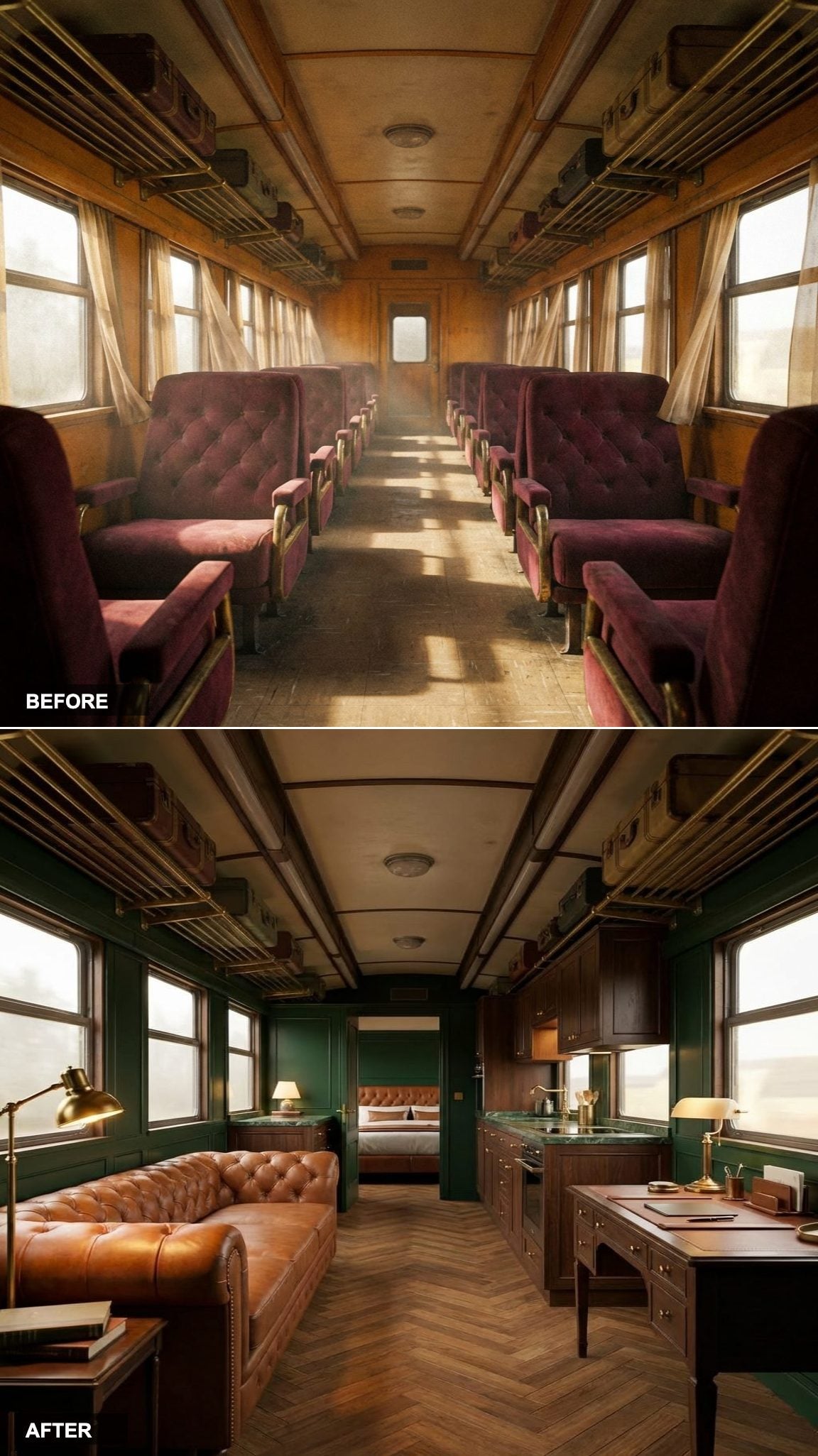
A reading lamp switched on in a design rendering is a deliberate choice. It signals that this room is for use, not display, and in a space this committed to layered leather and dark lacquer, that signal matters.
British racing green and cognac leather throughout, a Chesterfield sofa in the living end, a fitted galley kitchen in the middle, and a compact sleeping area at the far end. The Edwardian colonial reference is specific enough to be cohesive without being costumed. Every material choice points back to the same place, which is why the design holds together across all three zones of the car.
Dark Art Deco in Navy, Brass, and Carrara Marble: The Most Photogenic Car of the Fifteen
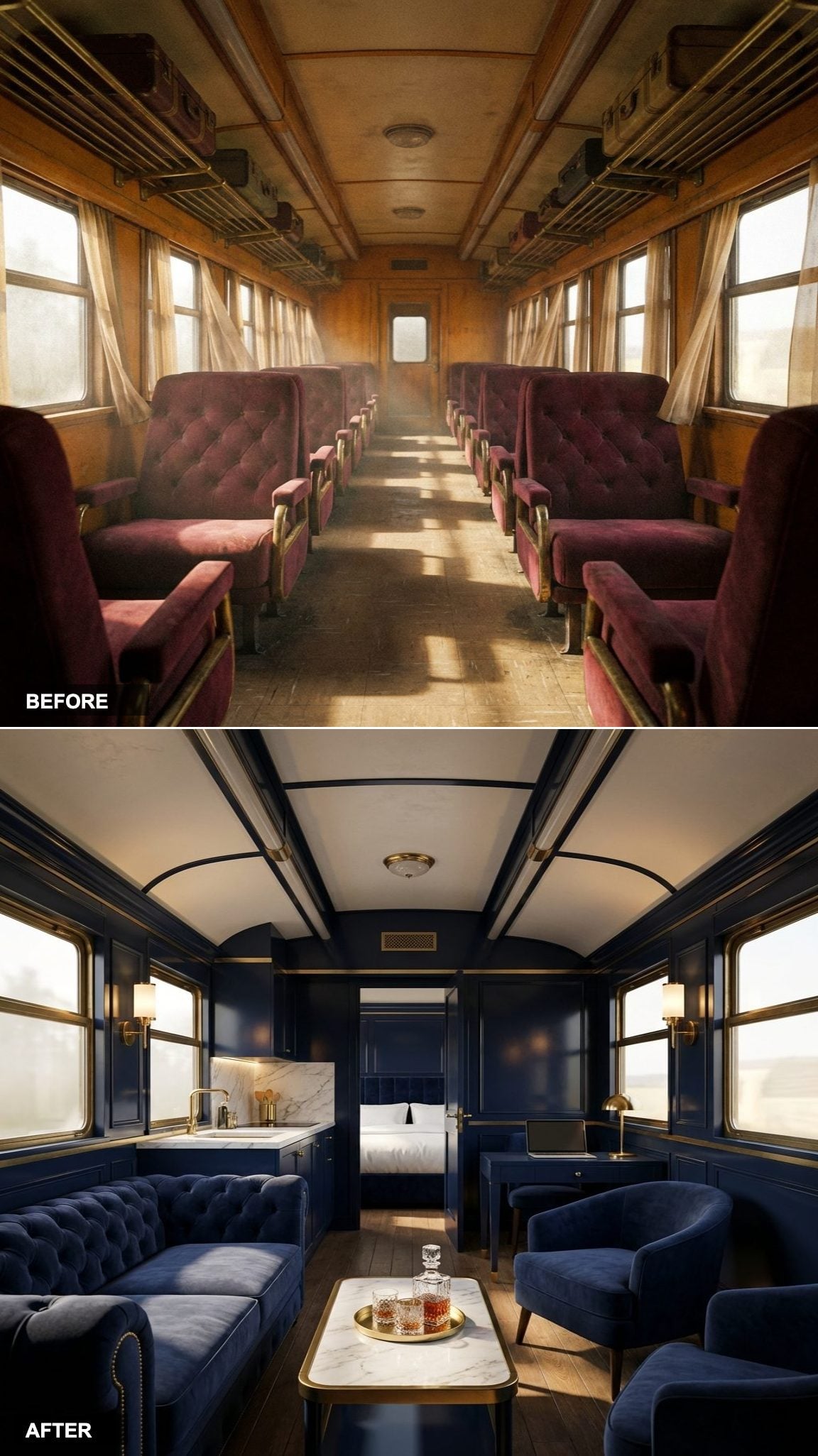
Deep navy lacquered paneling with polished brass and white Carrara marble accents is the version of this project that a design magazine would lead with on its cover, and that is not an insult to the others.
The contrast between the dark navy and the bright white marble creates the strongest visual punch in the series, each Carrara surface becomes a light source in its own right. The navy velvet Chesterfield and the crystal decanter in the living end complete a composition that reads as effortlessly dramatic without a single element that feels placed for show. It is the kind of interior that looks equally good lit by afternoon sun or a single brass reading lamp at midnight, which is the real test of any dark palette.
Art Deco Gold Rush: When a Train Car Becomes a 1930s Manhattan Penthouse
Sunburst brass inlays, lacquered ebony cabinetry, and geometric wall panels in deep teal and ivory, this Art Deco conversion treats every inch of the carriage’s long narrow profile as an asset rather than a limitation. The galley kitchen runs along one wall with black marble countertops and cabinet pulls in polished gold. A compact velvet sofa in bottle green anchors the living zone, and through the open bedroom door you catch a glimpse of a sunburst headboard that could have come straight out of Radio City Music Hall.
The workstation is set into a shallow niche with a brass-framed mirror above it, so the space reads as a vanity until you spot the slim laptop. Clever, functional, and completely in character.
Edwardian Grand Tour: The Railway Carriage as Victorian Travel Fantasy
If you stripped the luggage labels off the leather trunks stacked along the top shelf, you might mistake this for the private car of a nineteenth-century diplomat heading through the Alps. Walnut boiserie panels, a kilim runner down the center aisle, and a kitchen built around a compact cream AGA-style range. The workstation sits at a leather-topped secretary desk with brass inkwell fittings and a green glass lamp.
Three reasons this conversion stands apart:
- Every storage solution is disguised as furniture, hat boxes, leather cases, built-in window seats with lift-top lids.
- The lighting uses only warm incandescent tones, which makes the walnut glow honey-brown rather than orange.
- The open bedroom continues the travel theme with antique map prints framed in dark wood above the bed.
Edwardian Light: When the Carriage Goes Cream and Celadon
Not every Edwardian conversion reaches for mahogany and shadow. This one goes the other direction entirely, with painted millwork in soft celadon, cream cotton upholstery, and a kitchen in sage green shaker cabinets with unlacquered brass and a white farmhouse sink. The window seats are cushioned in a small-scale stripe of cream and dusty sage, which picks up both the wall color and the countertop.
“The narrow proportions of a train car are actually easier to furnish than a square room, you only ever need to address two walls.”
The workstation here is a simple painted writing desk with a bone-handled letter opener sitting beside the laptop, and the bedroom glimpsed through the open door has a white iron bed dressed in layers of white linen. Restful rather than dramatic, and completely convincing as a home.
Art Deco in Amber and Ivory: The Warm Side of the Twenties
Amber lacquered panels, ivory silk wall inserts, and warm brass throughout, this version of Art Deco skips the cold chrome and goes straight for the burnished, honeyed palette of early Hollywood. The kitchen runs in cream cabinetry with amber glass fronts and gold hardware, and the living zone centers on a curved sofa in ivory velvet with a fan-shaped back that references the sunburst motif repeated in the ceiling medallion above.
The workstation is pressed into a fitted niche with an amber glass desk lamp and a thin brass-framed corkboard pinned with architectural sketches. Through the bedroom door: a bed with an arched upholstered headboard in warm ivory cotton and satin pillows in pale gold. Photorealistic and genuinely beautiful.
Derelict Carriage to Moody Parisian Atelier
Dark walls in a small space should terrify a designer. Here they’re the entire argument. Charcoal-painted steel ribs follow the barrel vault of the original car roof, creating a vaulted quality that reads almost ecclesiastical. Against that darkness, every warm material pops: amber-toned leather on the daybed, the golden patina of aged brass hardware in the kitchen, a single antique French mirror expanding the sleeping alcove visually.
The workstation is a sliver of black marble slab on minimal iron brackets. The whole thing costs less than a filing cabinet but looks like a prop from a Godard film.
Forgotten Rail Car to Japandi Precision Capsule
Japandi is ruthless about clutter, which makes a train carriage the ideal canvas. The entire kitchen volume hides behind a continuous panel of white oak, with the refrigerator, stove, and dishwasher integrated flush behind flat-front doors. Nothing breaks the line. A single low platform bed sits on a raised tatami panel. The workstation is a floating shelf of black walnut at standing height, deliberately minimal.
Steel Rail to Art Nouveau Garden Room on Wheels
Art Nouveau was always obsessed with motion. The whiplash curve, the tendril line, the sense that every surface is mid-growth. A train carriage is the most logical home it’s ever had.
Here, hand-painted botanical murals cover the curved ceiling in soft verdigris, blush, and gold leaf, wrapping the space in a garden that never wilts. Cast iron decorative brackets at each window echo the period’s obsession with organic metalwork. The kitchen uses sage-green shaker cabinetry with ornate brass pulls shaped like lily stems.
Abandoned Coach Car to Coastal Californian Dream
West Coast interiors have a specific language: whitewashed wood, woven texture, natural light worshipped like a religion. This train carriage speaks it fluently. Every original window gets maximum treatment, with linen Roman shades that pool slightly on the floor. White-painted shiplap follows the curve of the carriage walls, and the ceiling is left bare white with exposed original steel ribs painted the same shade so they read as architectural rather than industrial.
“The ocean doesn’t need decorating. This room borrows that confidence.”
The kitchen runs in bleached oak and matte white, with open shelving holding terracotta pots and linen-wrapped cookbook spines. The bed is a full-height white linen upholstered platform. Effortlessly calm, never trying.
Worn Passenger Car to Baroque Revival Sleeping Coach
Nobody accuses Baroque of restraint, and this carriage doesn’t try to rein it in.
Gilded plaster molding applied to the curved carriage ceiling creates the impression of an ornate salon car from the Orient Express’s 1920s heyday. Deep forest green velvet upholsters the banquette seating along one wall, and a crystal chandelier, scaled perfectly for the low ceiling, catches every surface in scattered prism light. The kitchen is wrapped in dark lacquered cabinetry with unlacquered brass hardware that will tarnish beautifully over time.
The bed is upholstered in the same forest green velvet with a carved gilt headboard fixed directly to the train car wall. The workstation is a small secretary desk with inlaid wood detail. The whole thing feels less like a converted train and more like a prop from a Wes Anderson film set, but make it livable.
Forgotten Rail Car to Desert Adobe Compound on Rails
🔥 Would you like to save this?
Adobe-inspired interiors work because of mass: thick walls, deep window reveals, surfaces that look like they’ve been hand-smoothed by someone with patience. Replicating that in a steel train carriage requires some ingenuity. Here, sprayed tadelakt plaster covers the curved walls in warm sandstone, building up a surface that is actually water-resistant and has a barely-there sheen. Window reveals are built out with timber framing to mimic deep adobe reveals.
The kitchen uses hand-painted terracotta tile counters and open-face mesquite wood shelving. A raw cotton hammock slung between two wall brackets does duty as occasional seating. The workstation is a slab of local sandstone on iron pipe legs. Grounded and completely original.
Art Deco Sleeper Car: Midnight Navy Lacquer, Brass Inlay, and Velvet That Smells Like the Orient Express
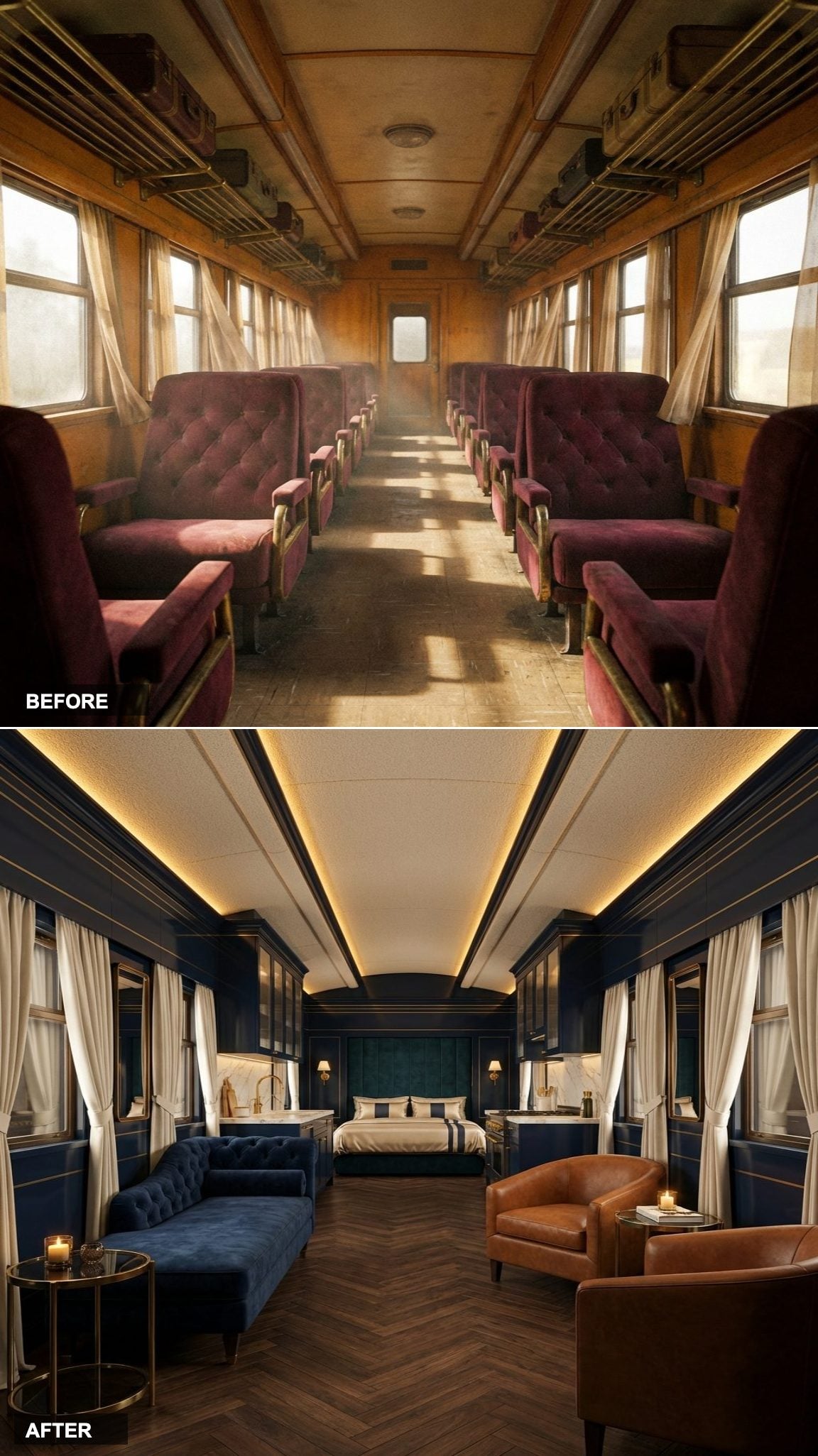
The barrel ceiling of a train car is essentially a ready-made Art Deco vault, and this redesign treats it exactly that way. Ivory boucle upholstery overhead catches the warm amber glow from the recessed LED strips along both edges, turning what was a cold fluorescent ceiling into something closer to candlelight at the Paris Ritz.
Dark walnut herringbone floors do the heavy lifting structurally. They anchor the navy lacquer panels without letting the scheme feel like a midnight tunnel, and that specific contrast between a rich flooring and a dark wall is one of the most reliable spatial tricks in the Art Deco playbook. The brass inlay lines running the length of both walls pull the eye forward, making the narrow carriage feel directional rather than cramped.
Wabi-Sabi on Rails: Whitewashed Plaster, Raw Linen, and the Quiet Luxury of Nothing Extra
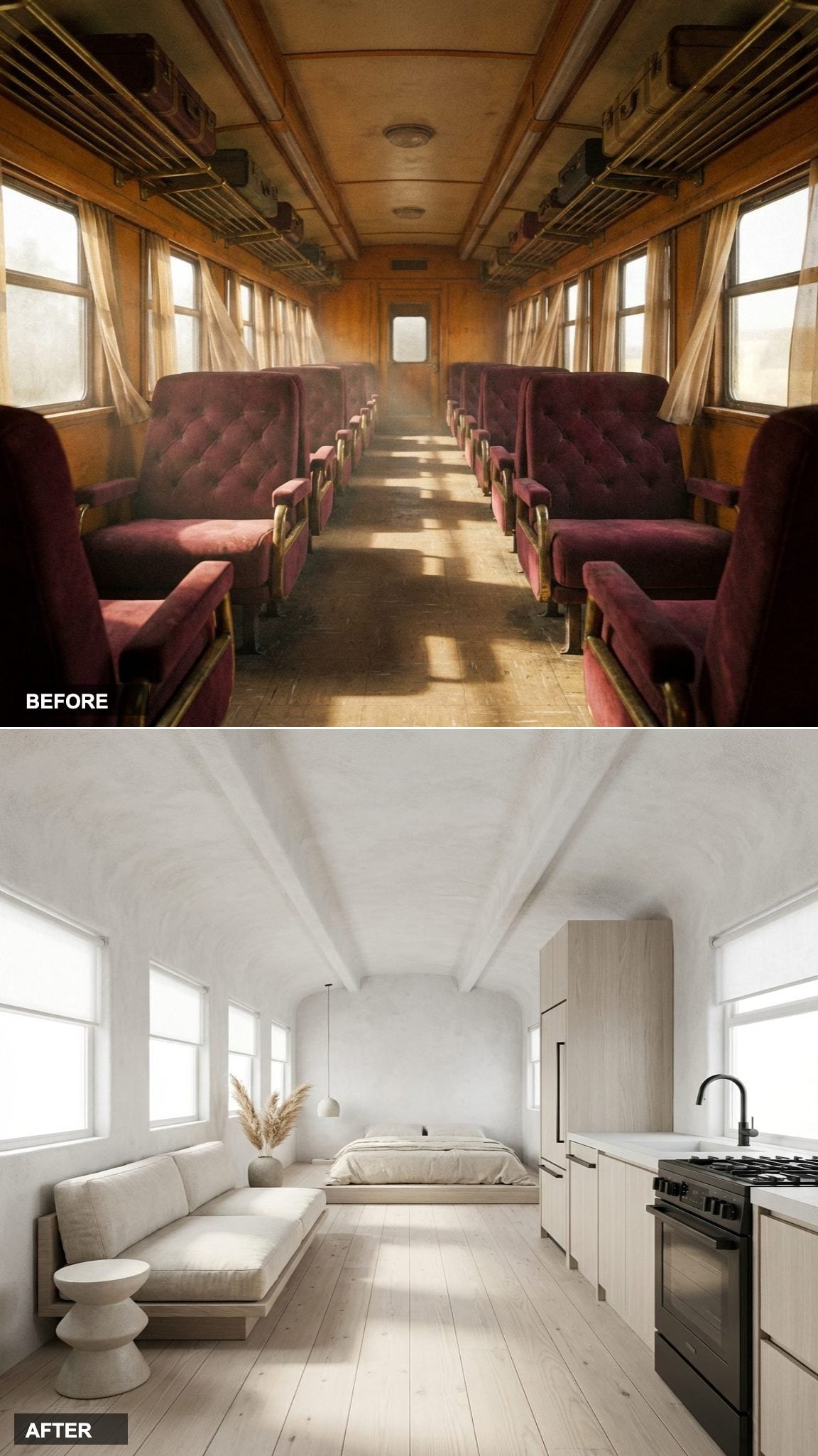
The original carriage had a noise problem that had nothing to do with sound. Visual noise: the plaid sofa, the competing wood tones, the faux-grain laminate panels all shouting at once in a space barely wide enough to whisper. This redesign solves it by removing almost every decision except texture.
Rough lime-wash plaster across both walls and the barrel ceiling unifies the entire shell into one continuous surface. The pale ash floors keep the light bouncing. What remains is a space that the brain reads as genuinely restful, because there is almost no contrast to resolve.
- The low-profile platform sofa pushes the visual center of gravity down, making the curved ceiling feel taller than it is.
- Matte finishes throughout eliminate reflected glare from the row of windows, which would otherwise create harsh light stripes across a shiny surface.
- The absence of upper cabinet doors in the kitchen keeps the far end of the car visually open rather than cutting the sightline.
Deep Navy Velvet and Cognac Leather Take This Rail Car to First Class Permanently
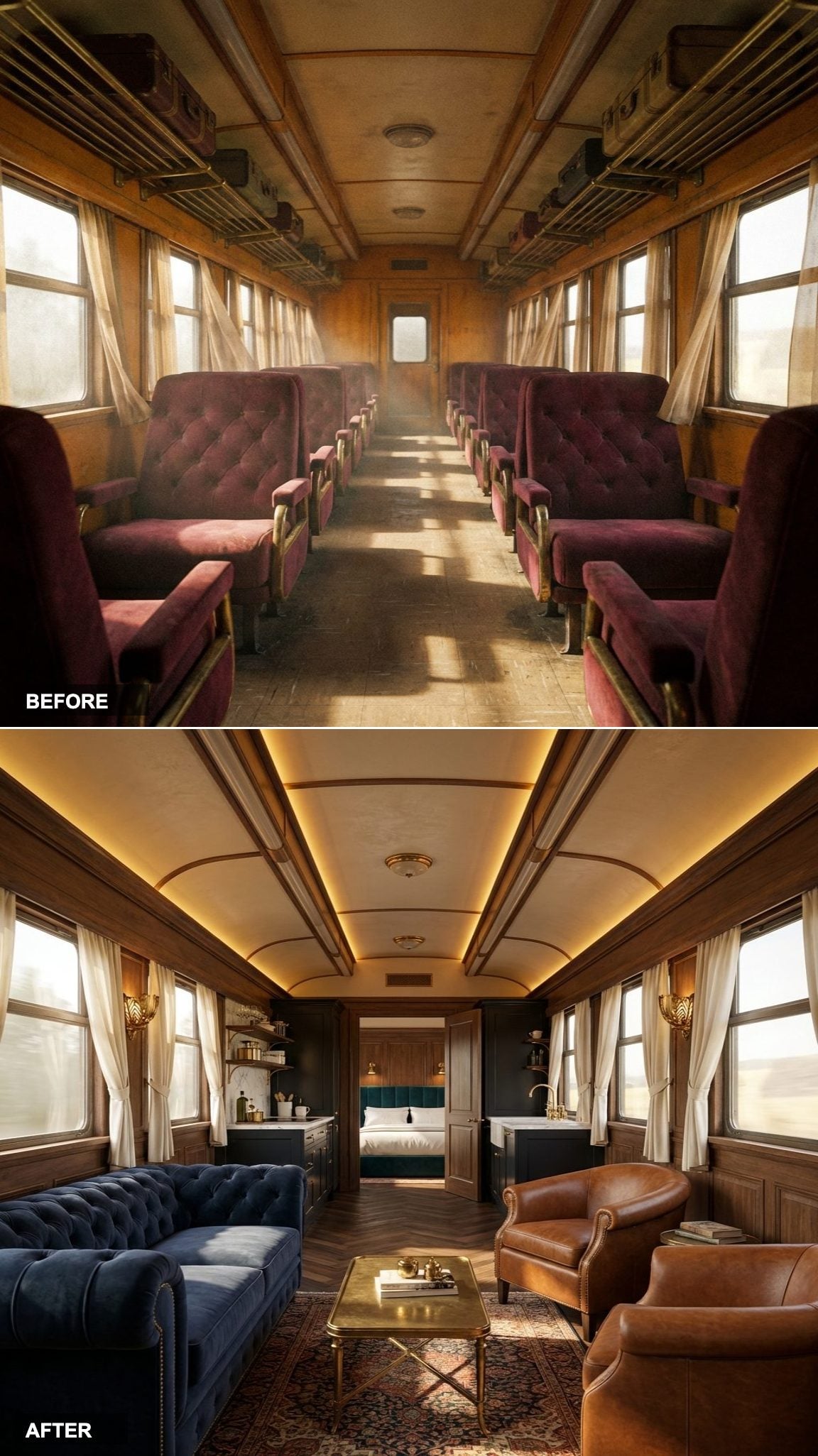
The pairing of deep navy velvet with cognac leather is one of those design decisions that sounds almost too obvious on paper, yet lands with complete authority in a space this narrow. The tufted Chesterfield sofa anchors the living zone with genuine visual mass, while the cognac club chairs opposite introduce warmth without competing. A crystal whisky decanter on a brass cocktail table pulls the whole scene toward something private and unhurried.
What makes it work beyond the obvious luxury cues is proportion. In a train car, furniture scale is everything. Get it wrong and the space reads cramped. Get it right, and the tightness becomes intimacy.
Burgundy Lacquer and Brass Inlay Deliver a Pure Art Deco Private Car Fantasy
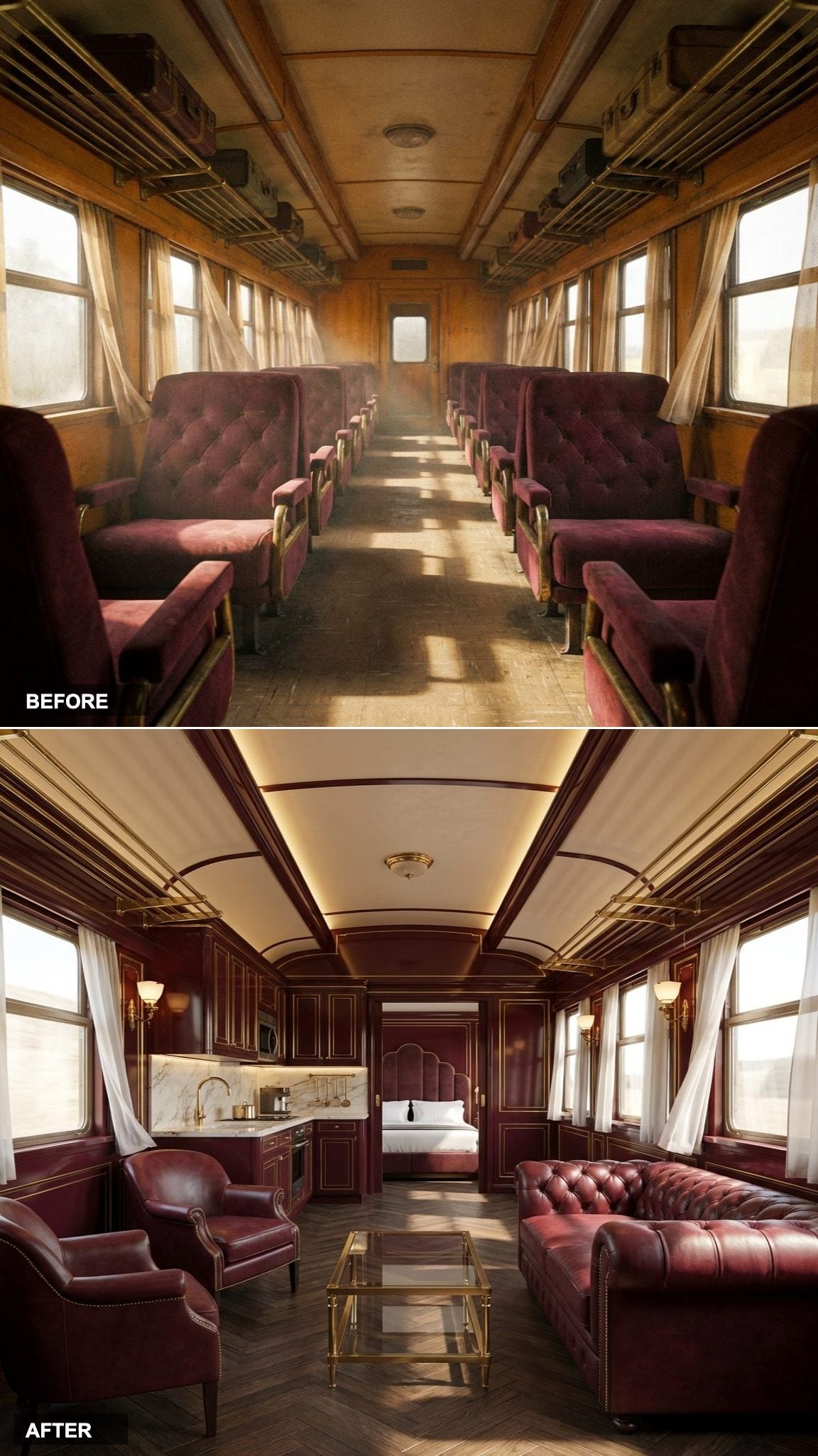
Burgundy is the color of consequence. It carries history, weight, and a particular kind of confidence that softer reds simply cannot match. Here, paired with brass inlay trim and a tufted Chesterfield, it produces a living zone that feels more like a private club railcar from the 1920s than a home conversion built in the present decade.
The Art Deco aesthetic earns its keep in a train car more than almost anywhere else. The geometry, the symmetry, the emphasis on crafted materials over applied decoration: it is a design language that was invented partly for exactly this kind of mobile, carefully bounded luxury space.
From Grimy Rail Car to Venetian Palazzo on Wheels
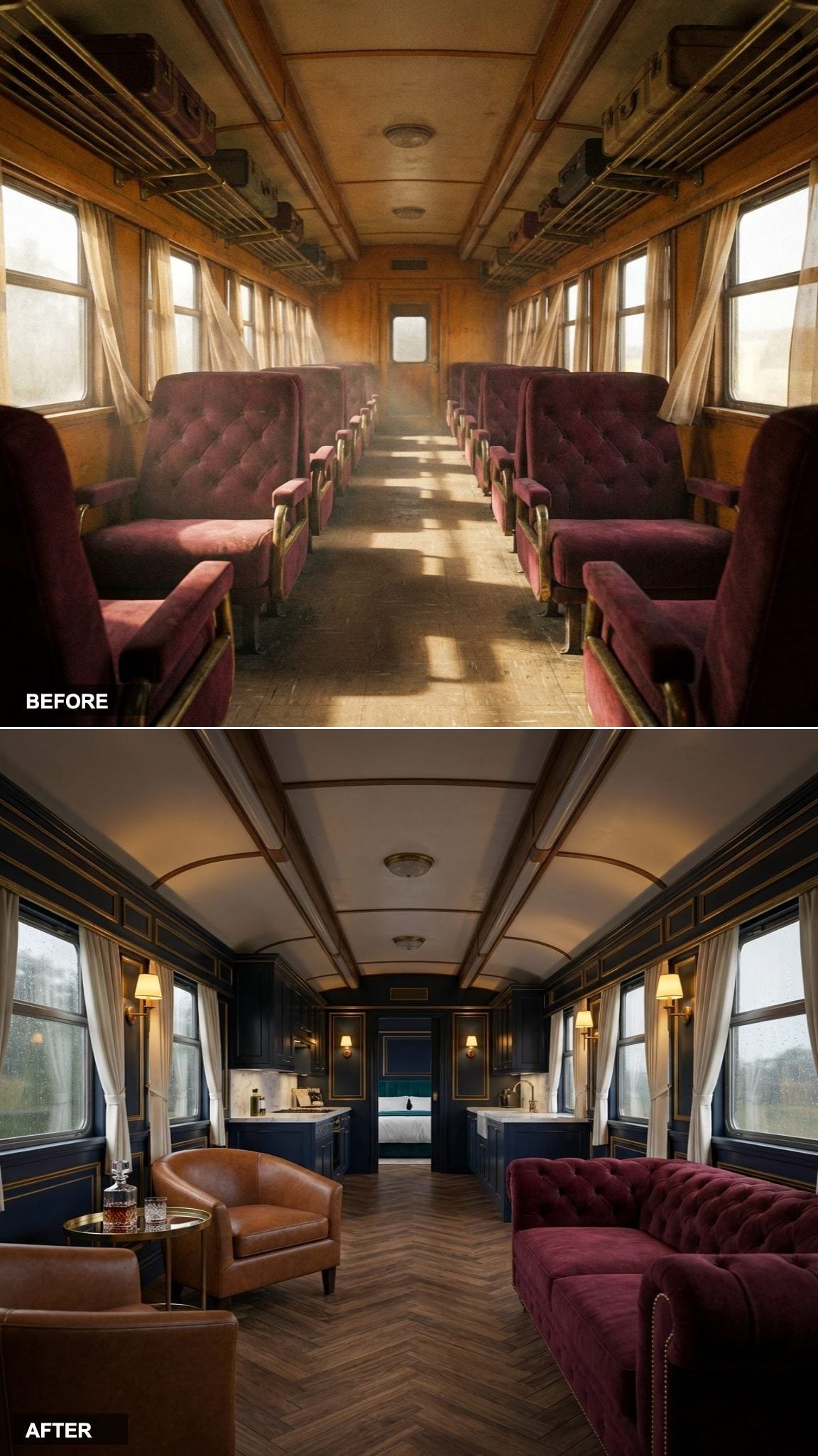
The secret weapon here is Venetian plaster, and it earns every penny. Applied directly to the curved interior walls, it catches light differently at every hour, shifting from warm cream at noon to deep amber by candlelight. The brass inlay details on the ceiling panels weren’t an afterthought, they were the starting point that every other material decision followed.
This is what happens when you stop fighting a train car’s bones and start working with them.
The Moody Tokyo Capsule Hotel Makeover Nobody Saw Coming
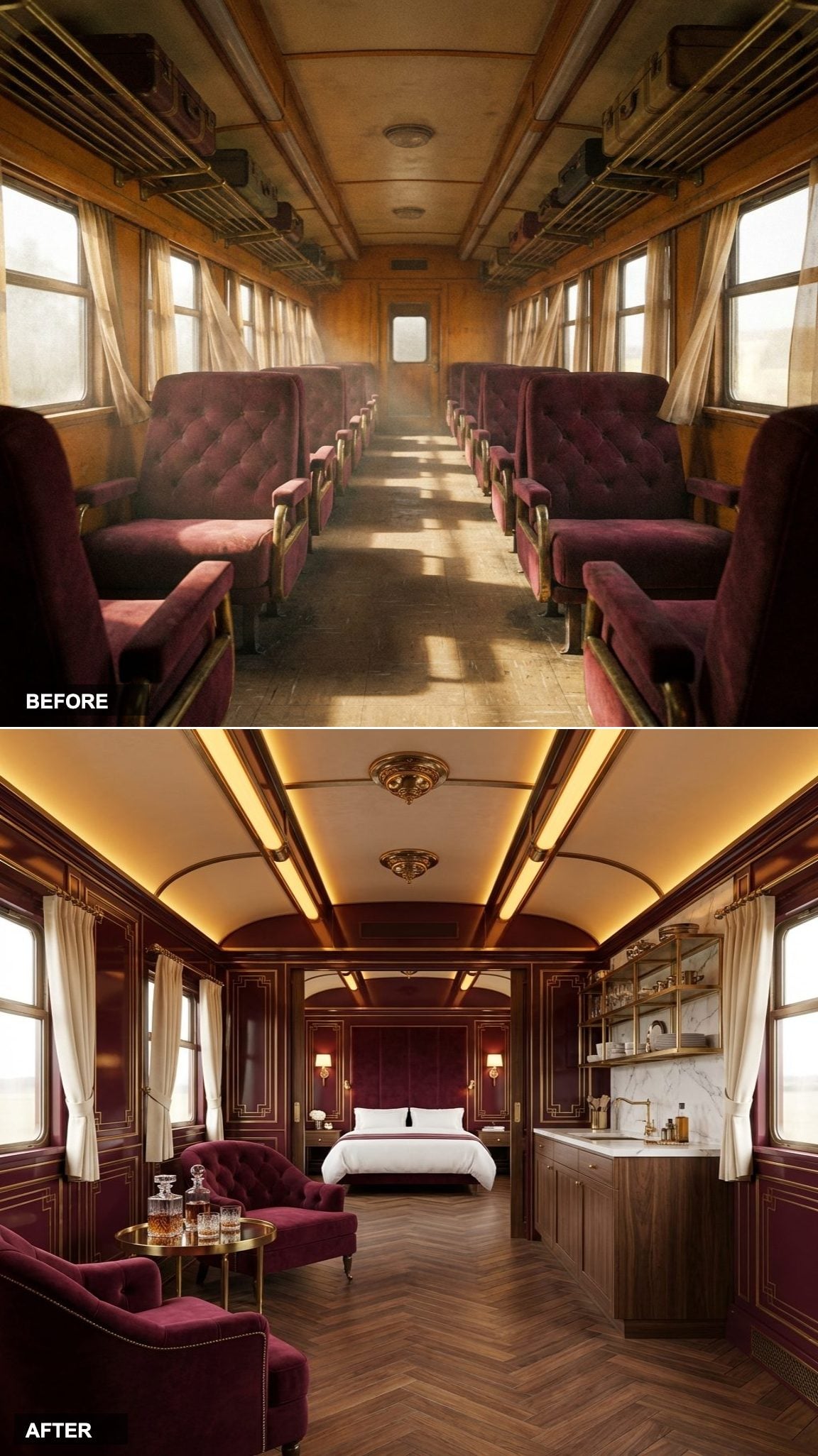
Sometimes constraint is the whole point. Japanese capsule hotel aesthetics were practically invented for narrow, elongated spaces, which makes this conversion almost unsettlingly logical. The sleeping pod built into the wall saves floor space, the recessed LED strips replace every overhead fixture, and the lacquered bamboo panels give the curved ceiling something to do besides feel oppressive.
Parisian Haussmann Apartment Squeezed Into Every Inch
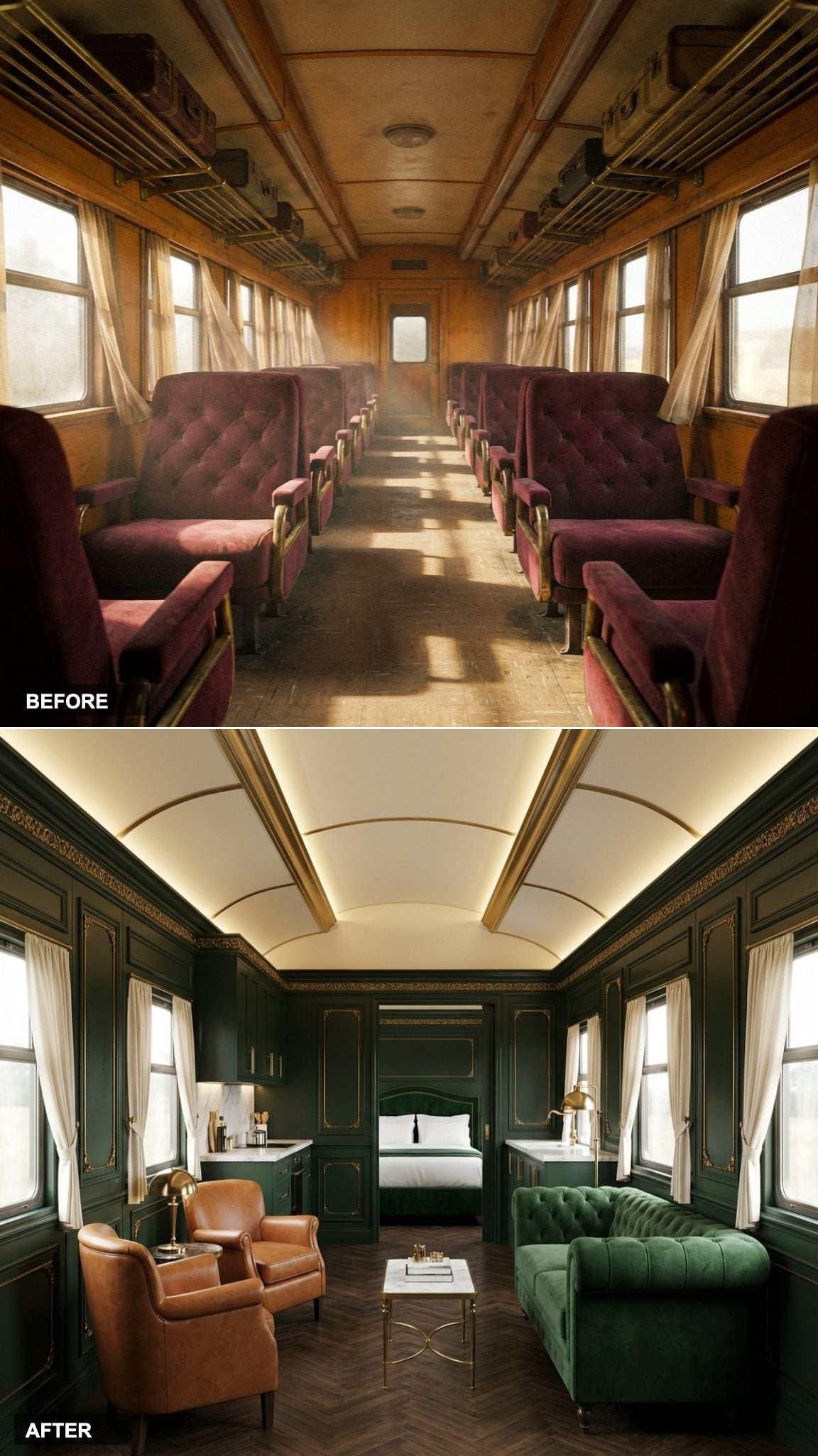
Herringbone floors in French oak are doing more structural storytelling than any single piece of furniture could. The moment those boards go in, the entire car reads as Parisian without a single throw pillow needing to justify itself.
The kitchen section doubles as a morning bar with a marble slab counter and unlacquered brass hardware that will patina beautifully over five years of use. That intentional aging is the whole point, this space is designed to get better as it gets lived in.
Tulum Jungle Retreat on the Move
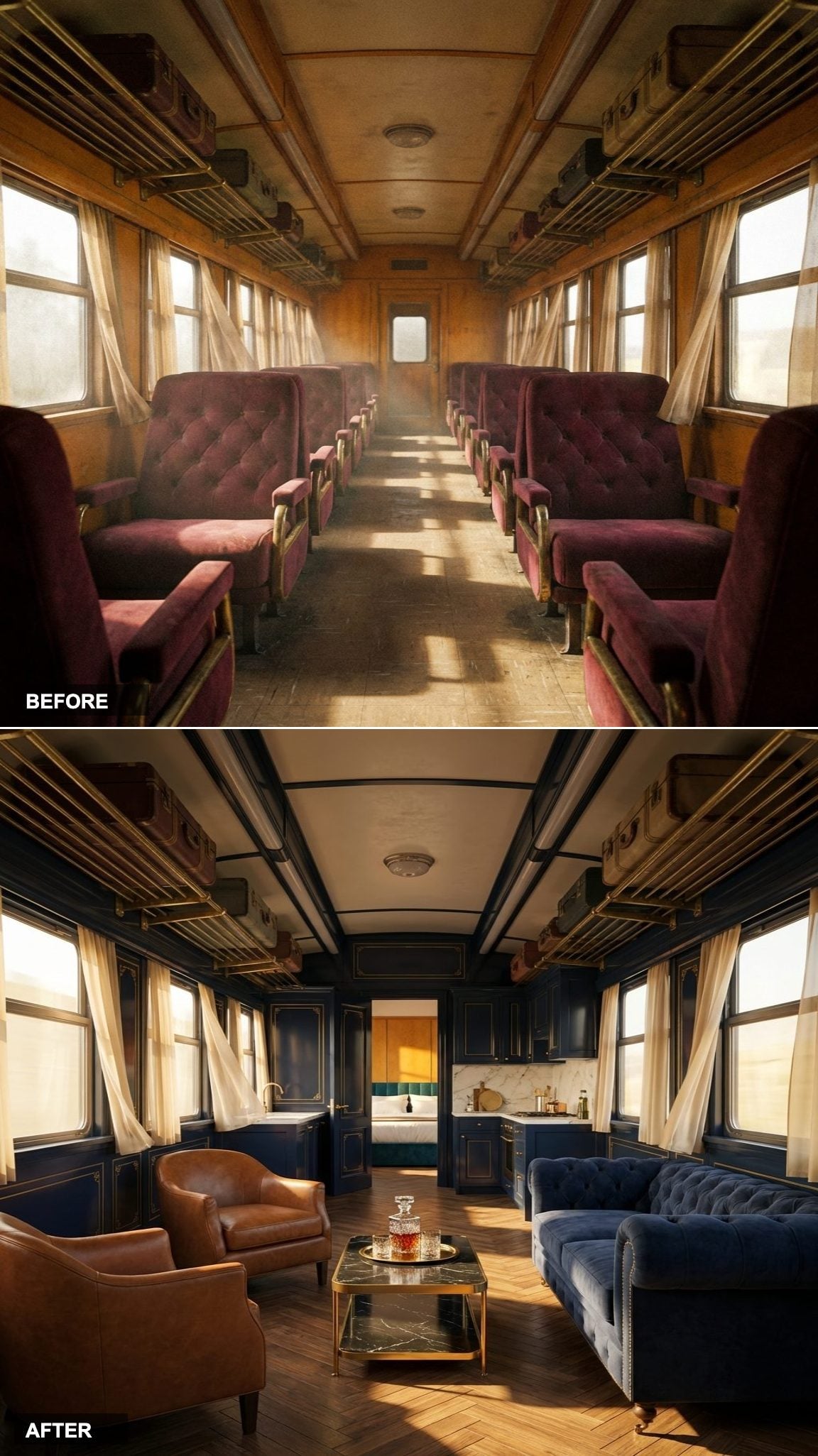
Tulum’s design language is not bohemian, it’s edited nature. There’s a crucial difference. Nothing here feels accidental. The palapa-style woven ceiling panels are precisely placed, the rough limestone plaster has been applied at a deliberate texture level, and the dried pampas grass arrangements are scaled correctly to the narrow width of the car.
Design 29
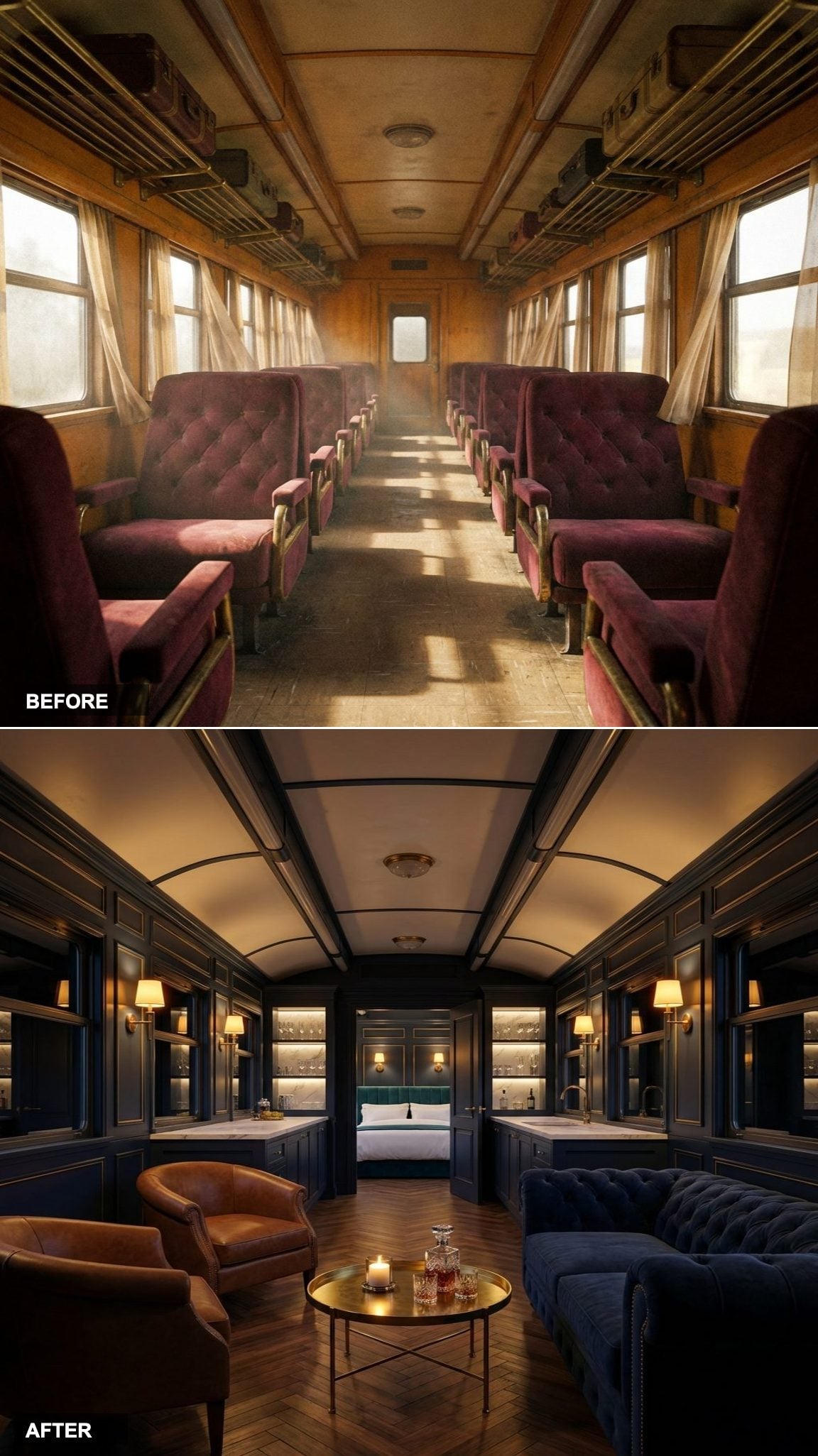
🔥 Would you like to save this?
Design 30
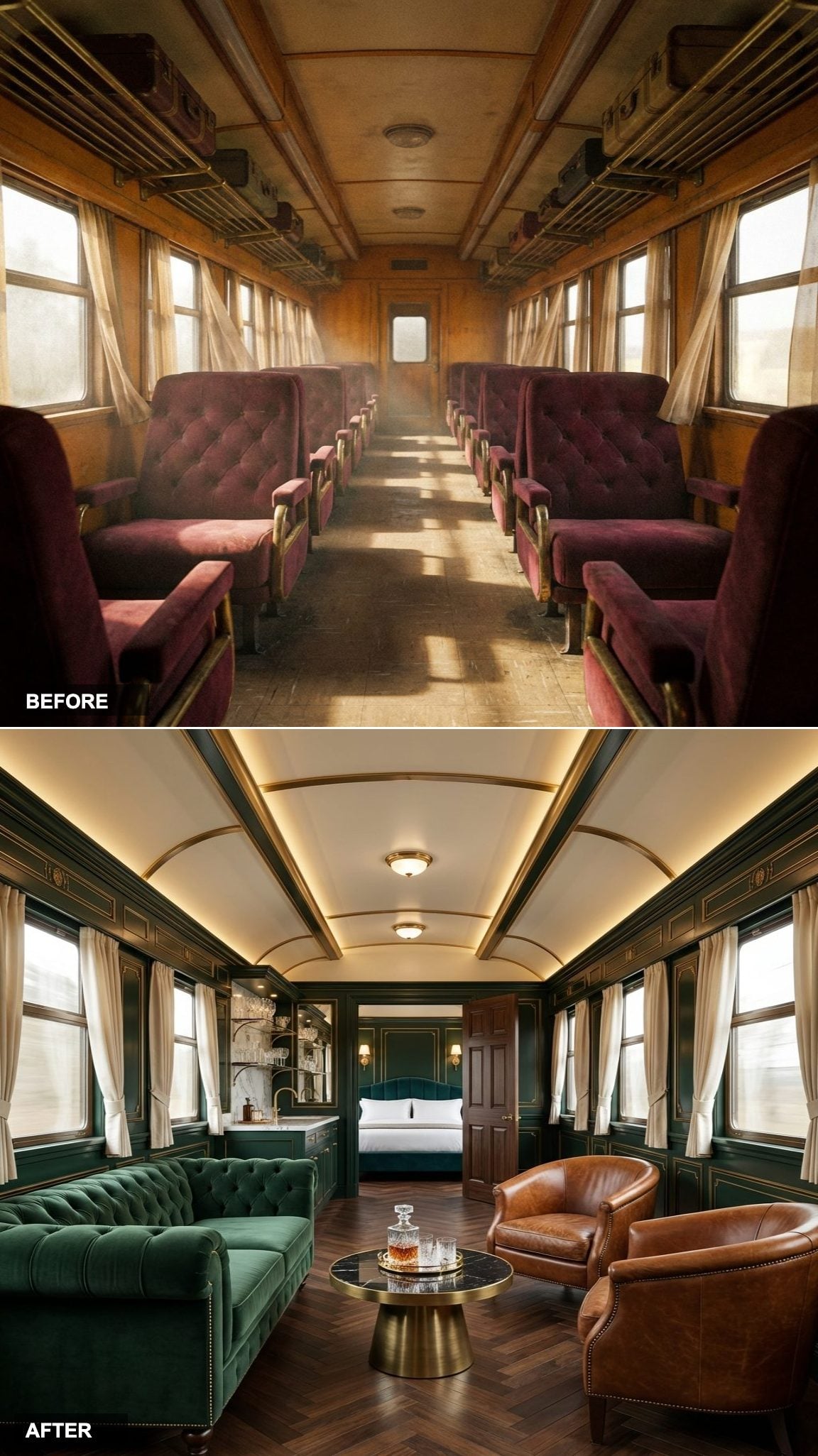
A vintage rail car is not an obvious candidate for a comfortable home. The steel shells were built for cargo, coal, or commuters, not for kitchens and king-sized beds. Yet a small group of designers and owners have taken these decommissioned cars and fitted them out with hardwood floors, full bathrooms, and in some cases, rooftop decks. The results sit somewhere between industrial artifact and private retreat, keeping the riveted walls and rounded ceilings intact while adding the kind of interior detail usually reserved for boutique hotels.
The conversion trend speaks to a broader shift in how people think about residential space. Fixed floor plans and conventional construction are no longer the only options. These five rail cars, scattered across different regions, each tell a different story about what a home can look like when its starting point is a hundred-year-old machine rather than a blank lot.
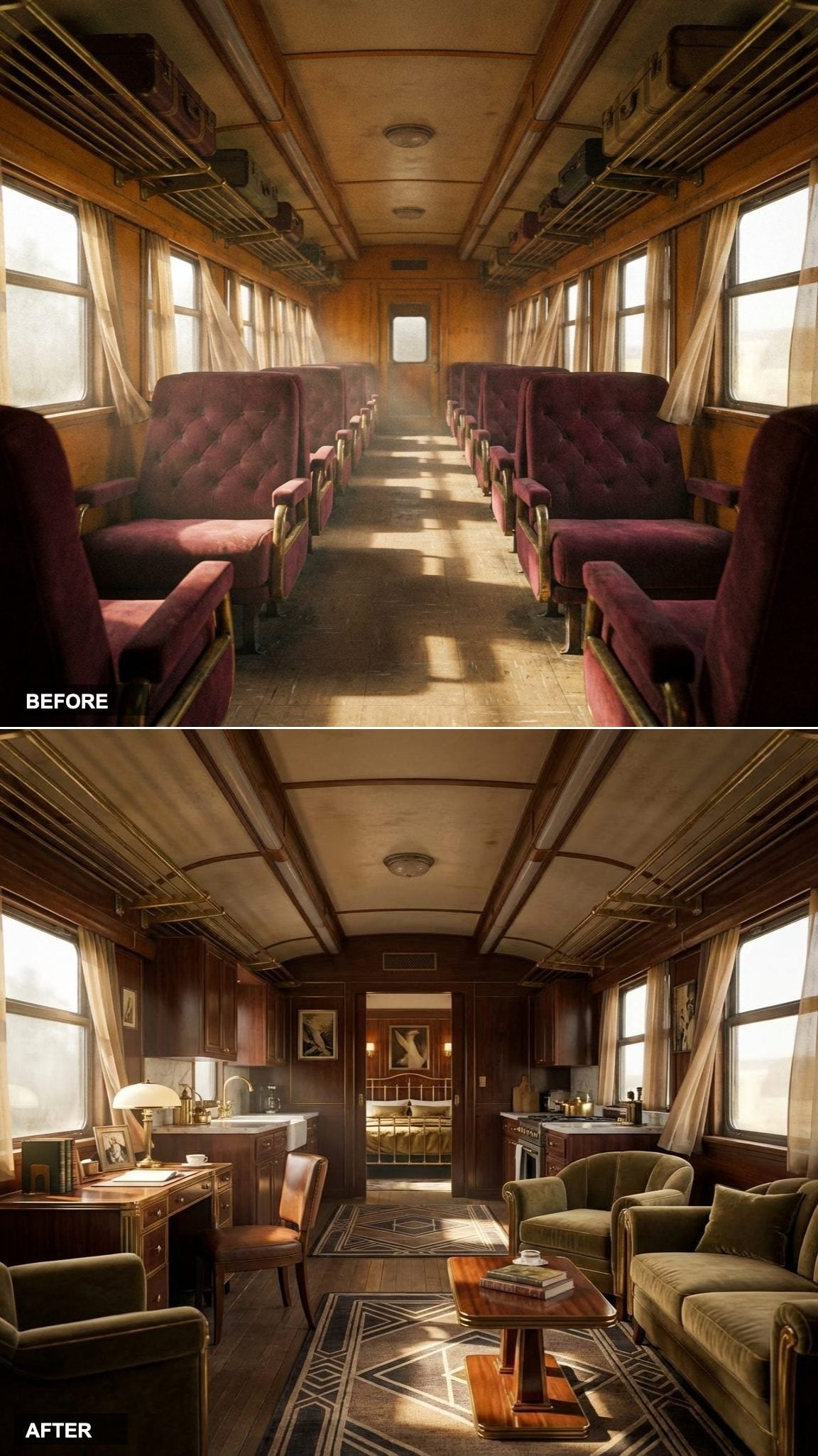
Worn Velvet Seats Give Way to Walnut Paneling and Persian Rugs
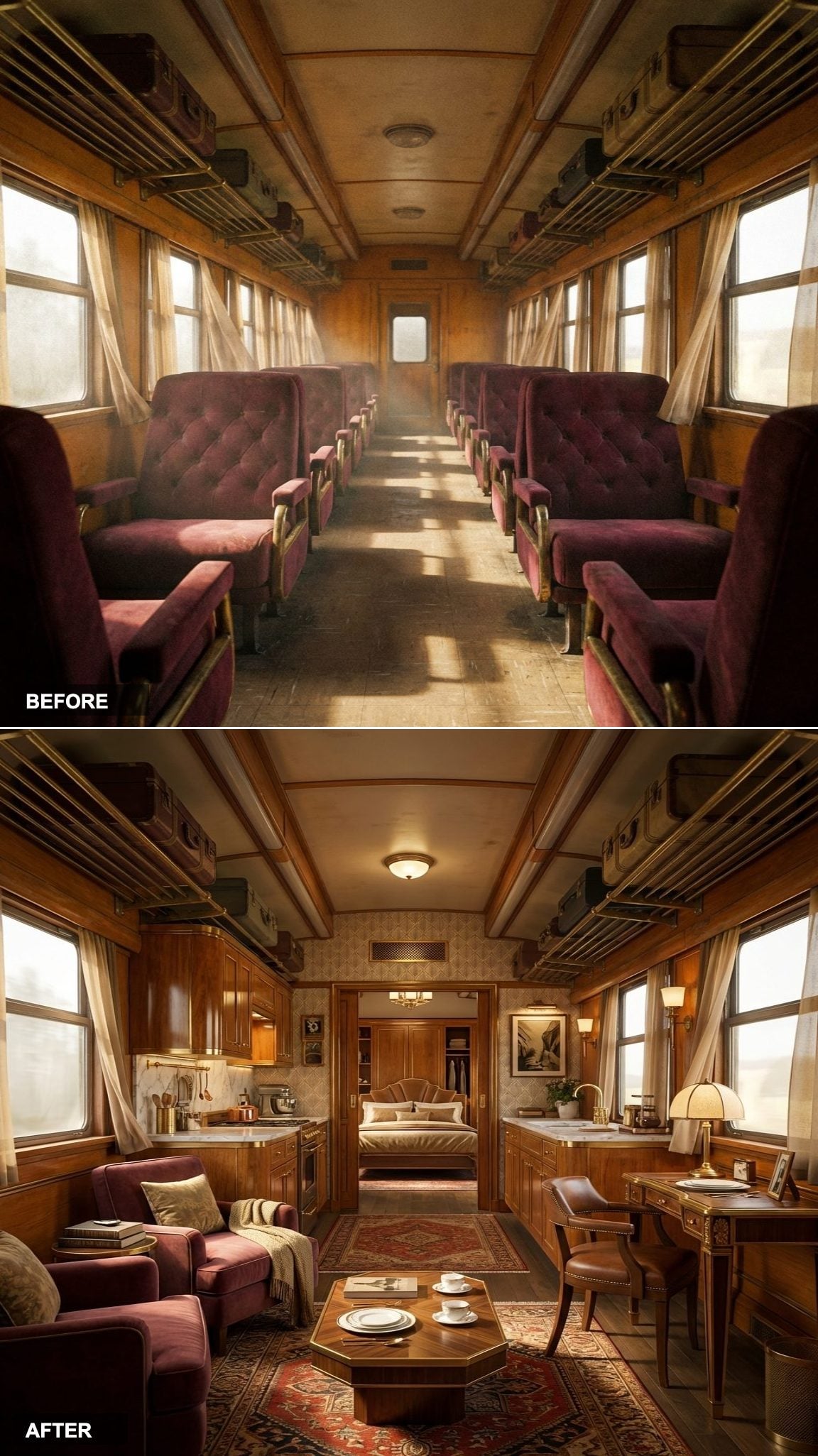
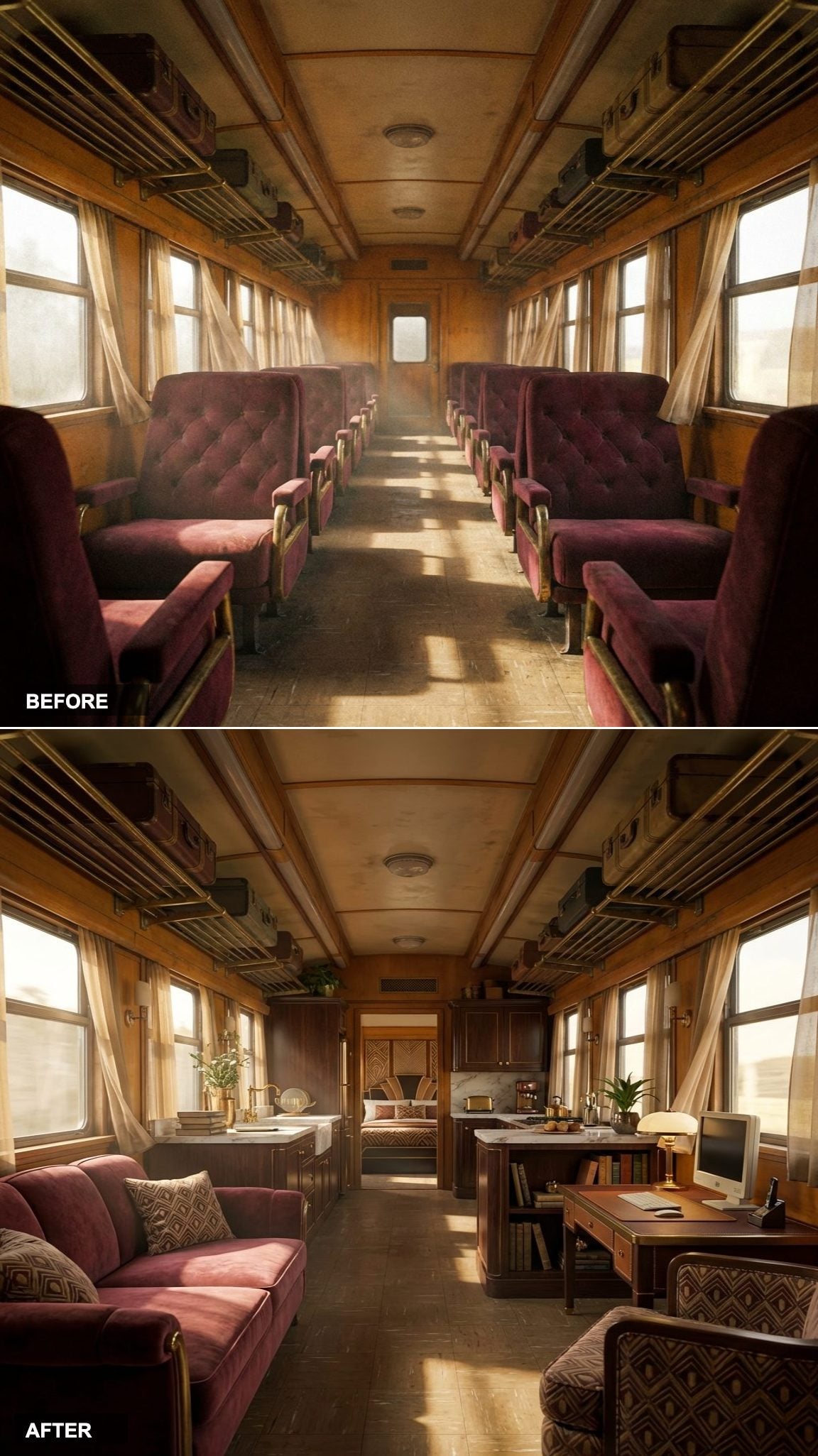
The before shows rows of tufted burgundy velvet seats lining a bare-floored passenger car with overhead luggage racks and sheer linen curtains. The after keeps those racks and curtains but replaces the seating configuration with a living area anchored by a low octagonal walnut coffee table set on a red Persian rug, a compact kitchen with marble countertops and brass fixtures, and a bedroom visible through an open doorway.
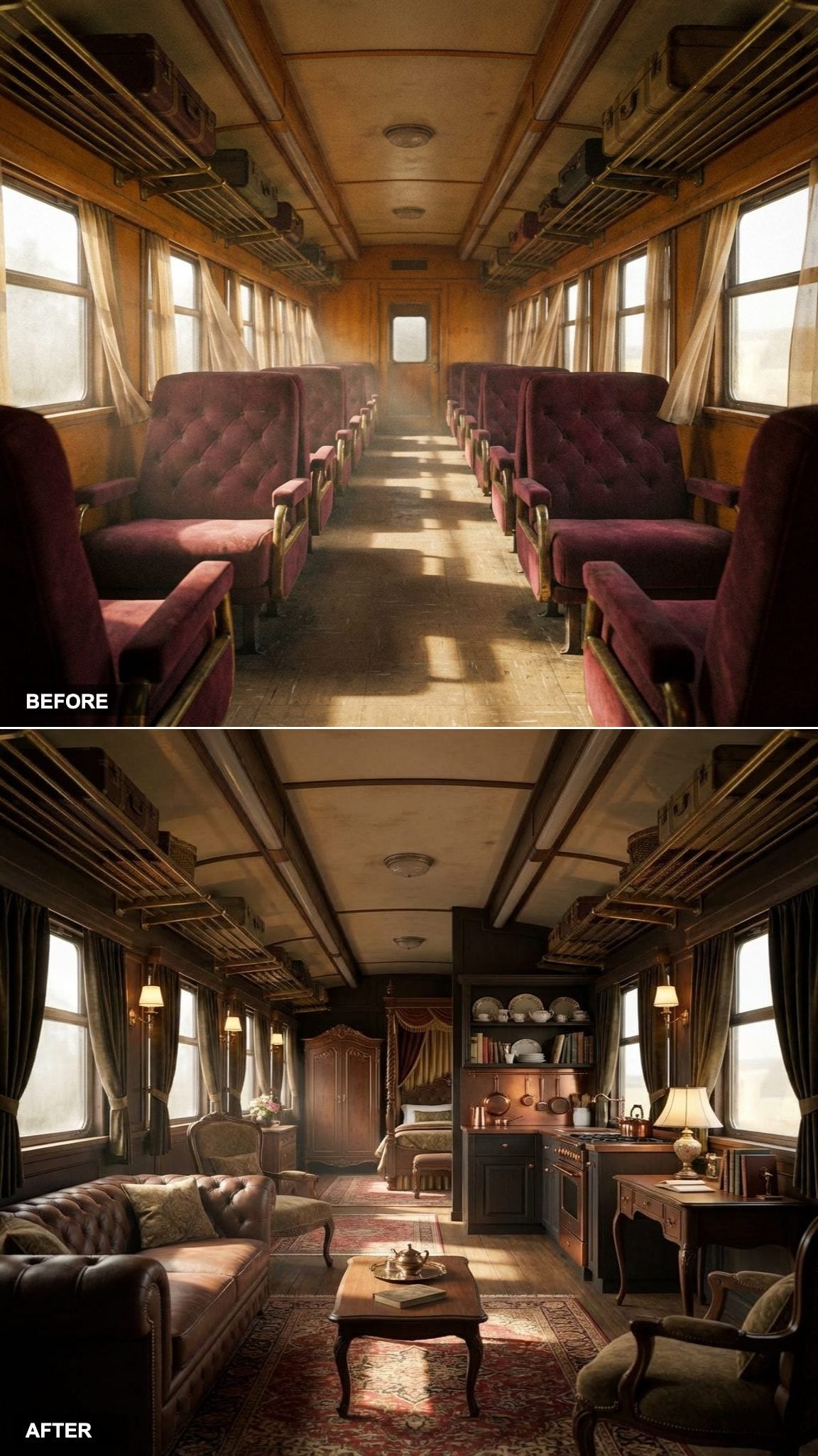
From Open-Car Seating to a Private Suite with Brass Fixtures and Marble Counters
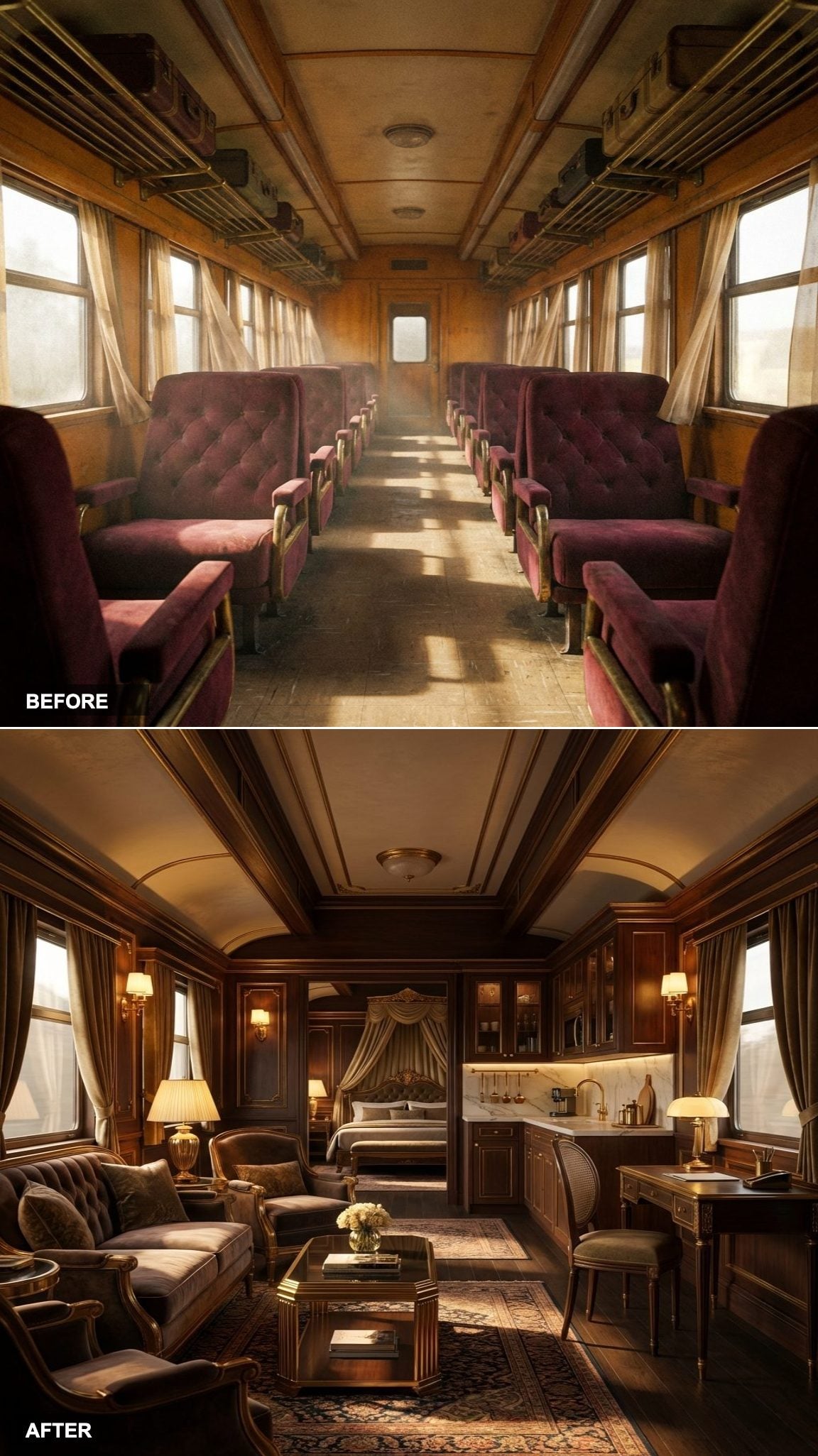
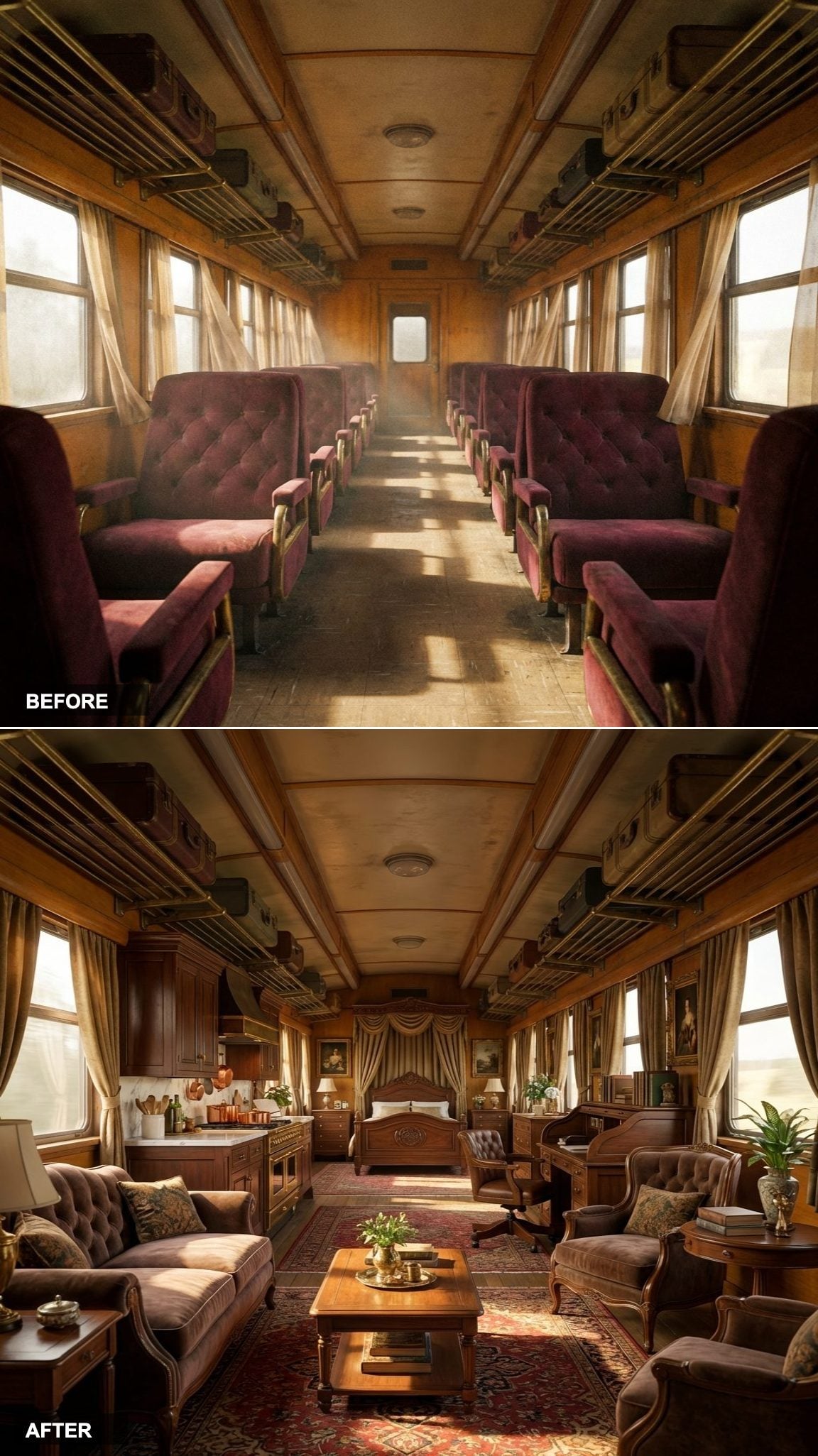
Dark walnut paneling lines every wall of the converted car, its molding finished with gold trim that runs along the ceiling perimeter. A tufted sofa in charcoal velvet anchors the sitting area, paired with two carved armchairs and a low gilded coffee table set over an ornate wool rug in burgundy and navy.
Wall sconces with fabric shades flank a canopied bed visible in the rear, while a built-in kitchenette features white marble countertops, dark cabinetry with brass hardware, and open glass-front shelving. A writing desk with a mushroom-shade table lamp sits opposite, pulling the room's warm amber palette toward something closer to a private rail suite than a converted carriage.
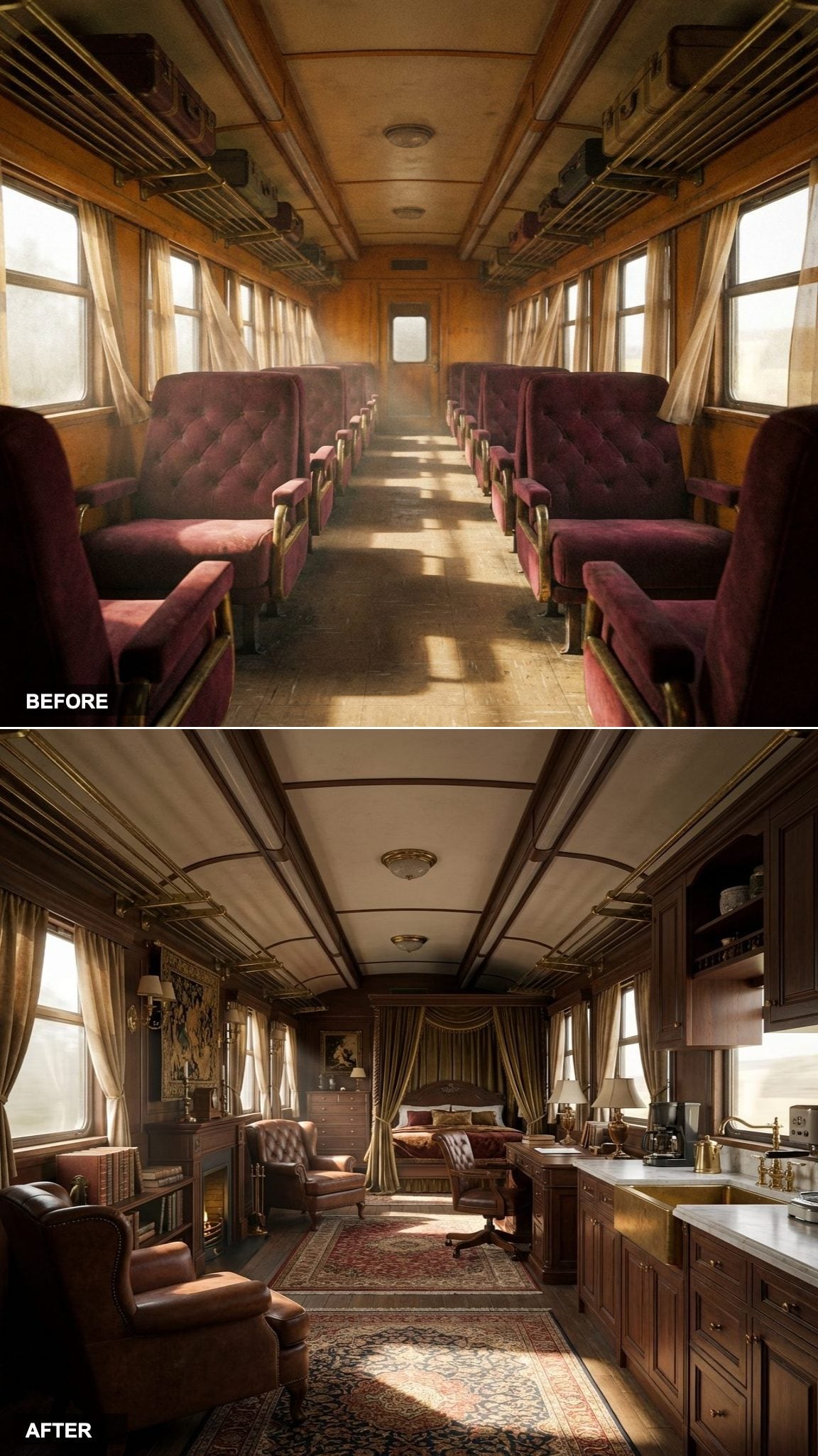
Velvet Sofas, Bookcase Walls, and a Bed Behind Curtain Panels
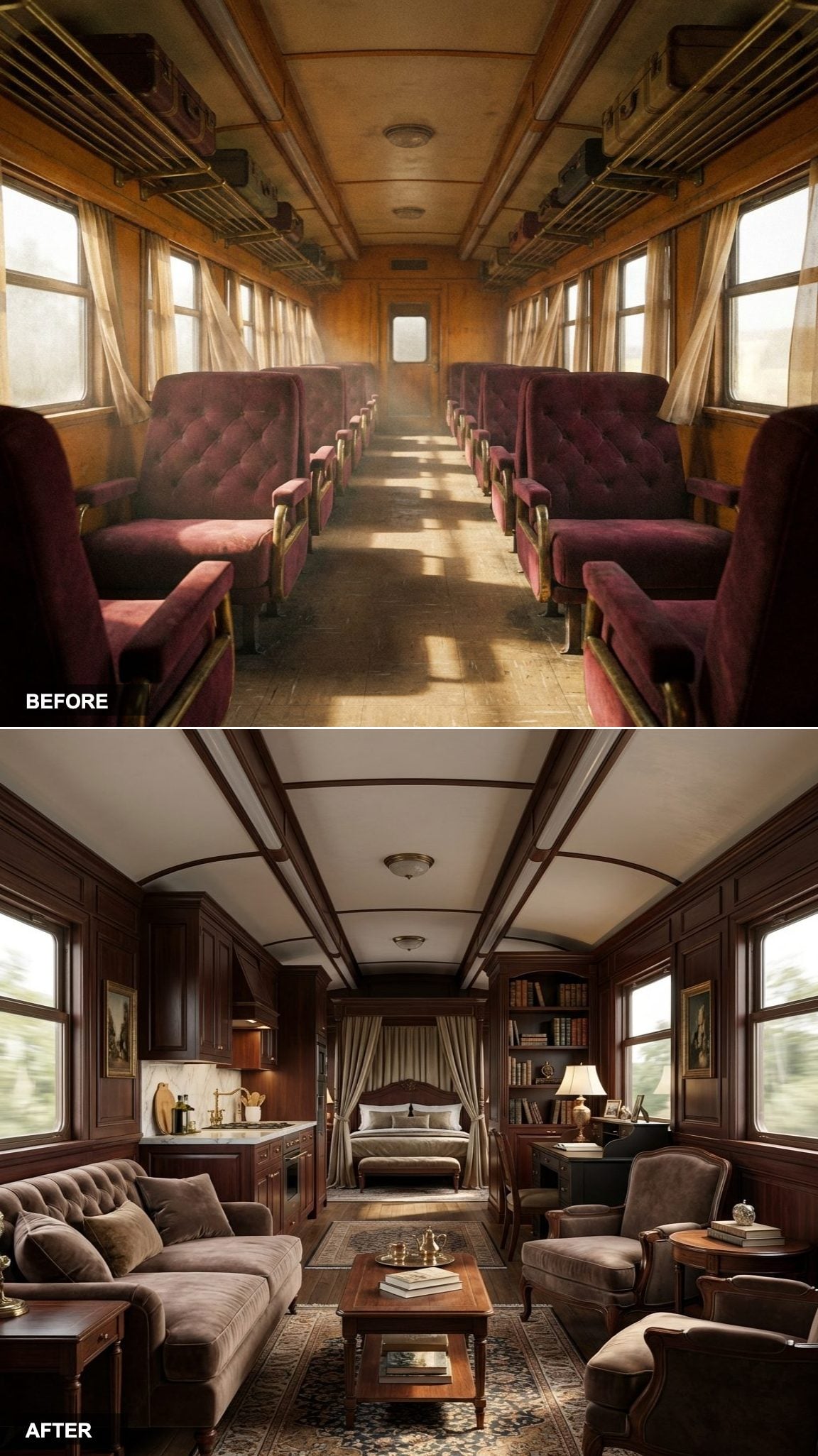
Walnut millwork covers every surface from floor to ceiling, with carved crown molding at the header beams reinforcing the car's original barrel-vault shape. A tufted sofa in taupe velvet anchors the left side, paired with a wingback chair in matching fabric. On the right, a writing desk sits beside a brass table lamp with a cream shade.
A kitchenette with white marble counters and brass faucet hardware occupies the rear left corner. Built-in bookcases flank a bed tucked behind ivory drape panels. An ornate wool rug with a deep medallion pattern grounds the central coffee table, which holds stacked books and a small brass tray.
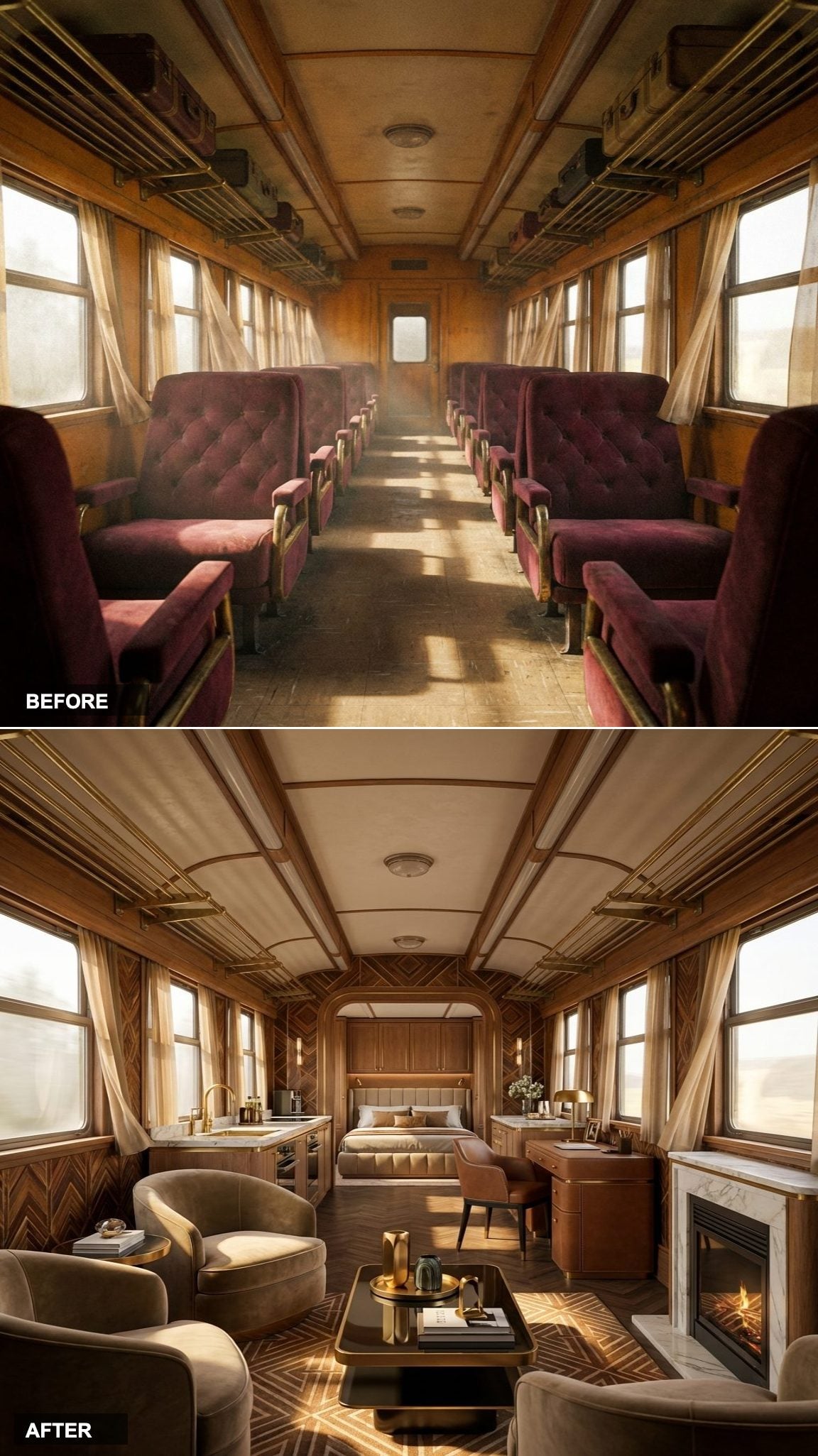
Luggage Racks Stay, but Everything Below Them Gets Replaced
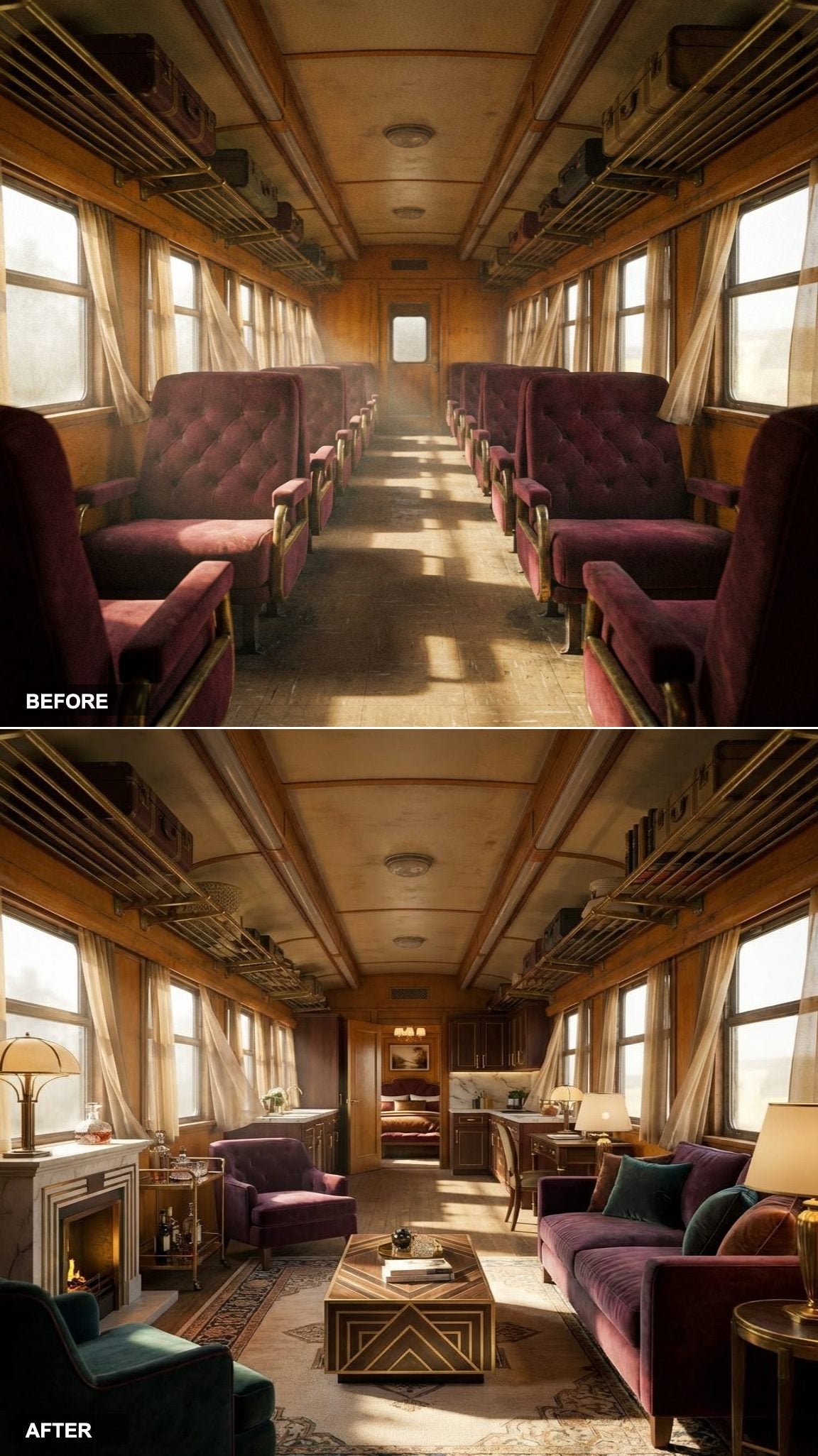
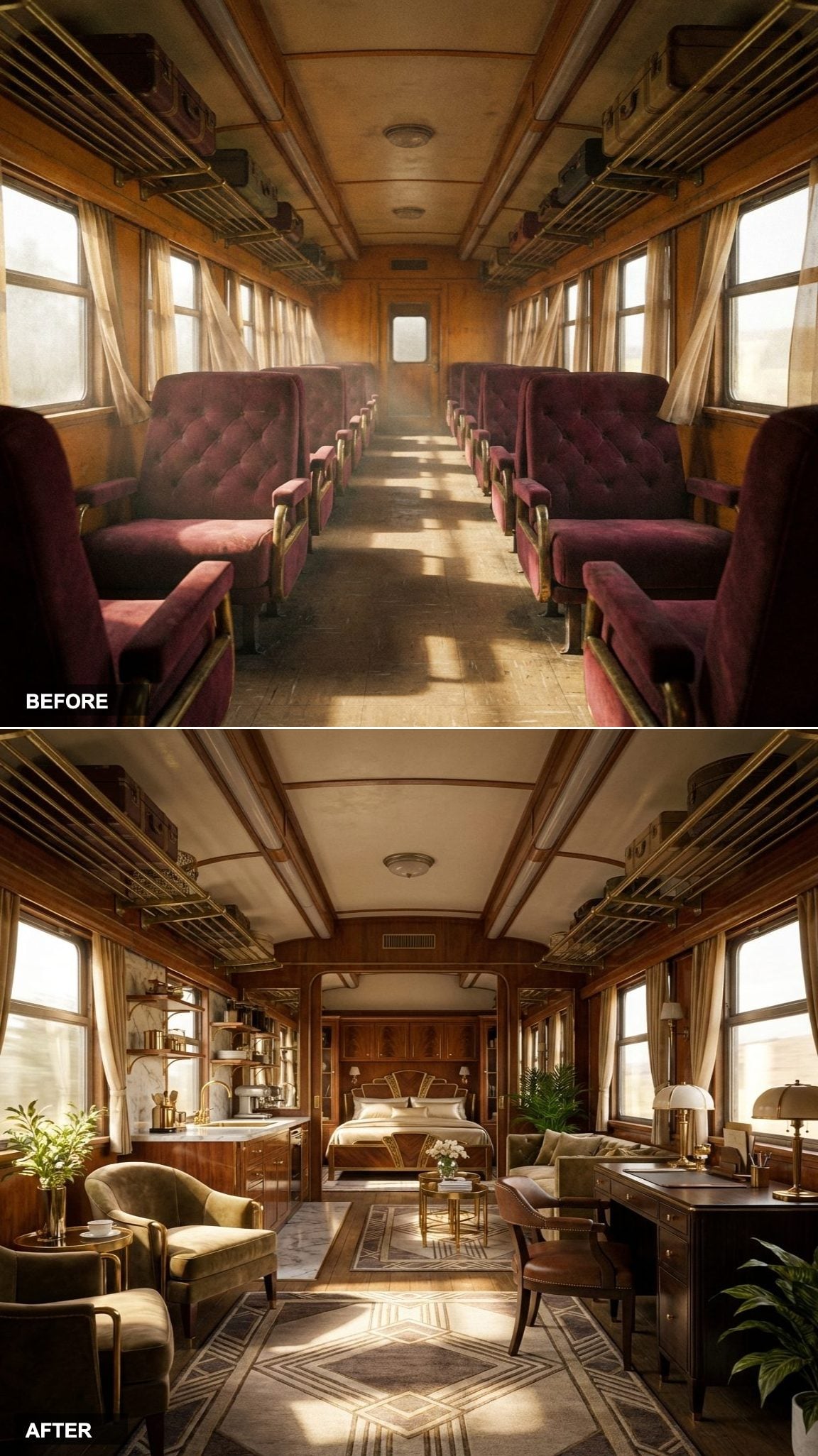
Overhead brass luggage racks remain intact while a geometric parquet coffee table, tufted plum velvet sofa, and teal armchair occupy the floor below. A marble surround fireplace anchors the left wall beside a brass bar cart.
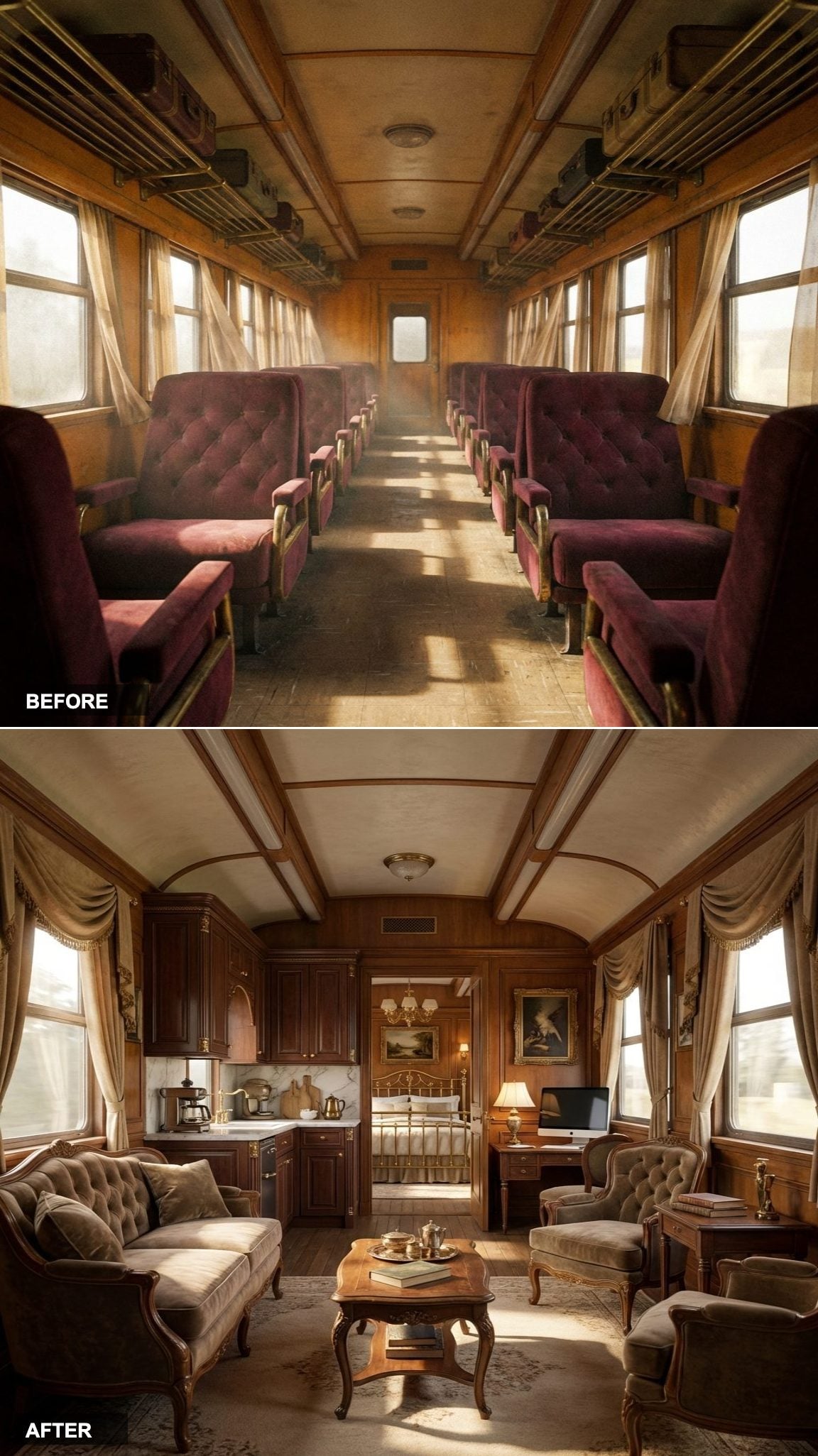
Burgundy Velvet Chairs Anchor a Car That Now Holds a Bedroom, Kitchen, and Office
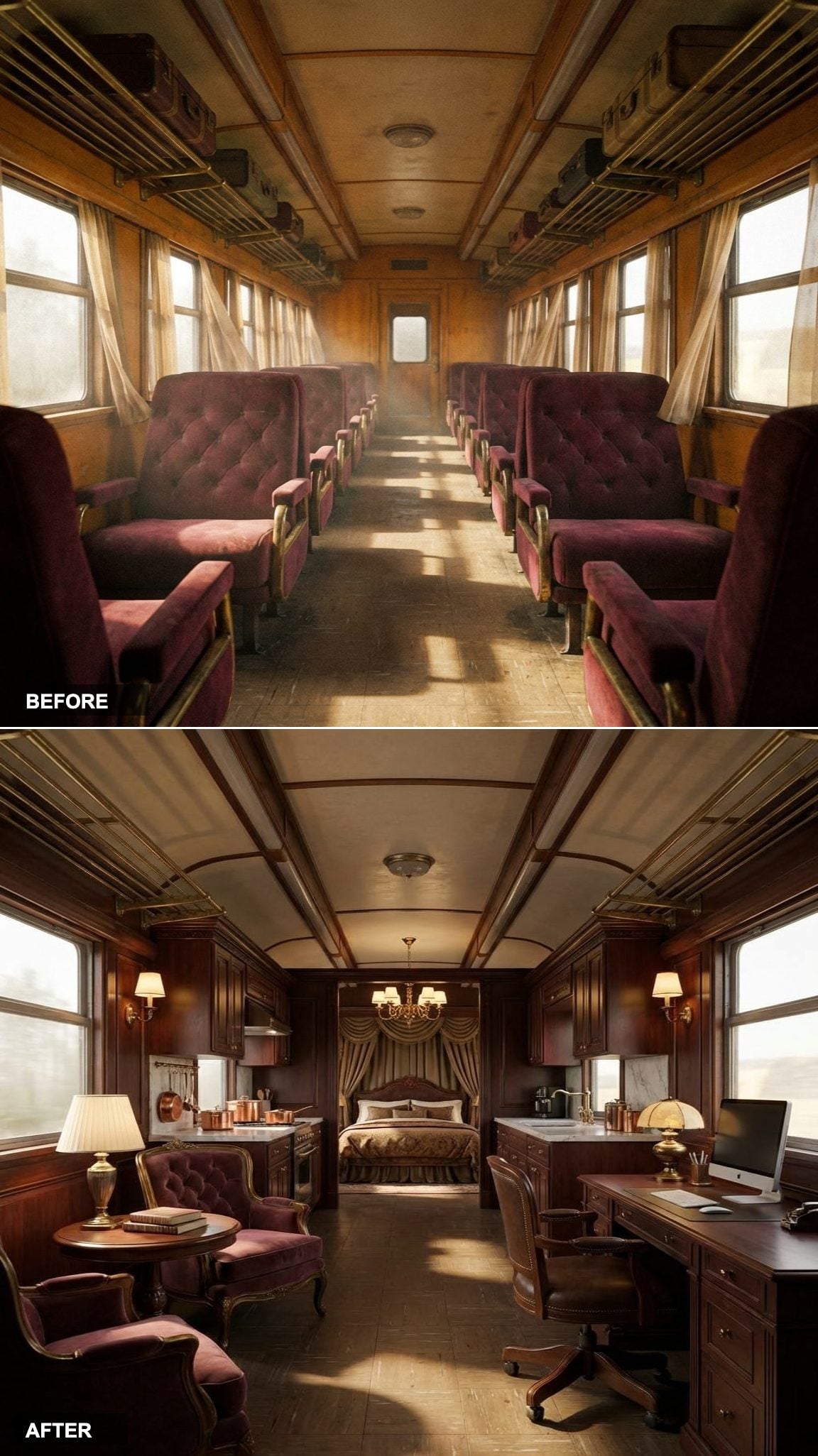
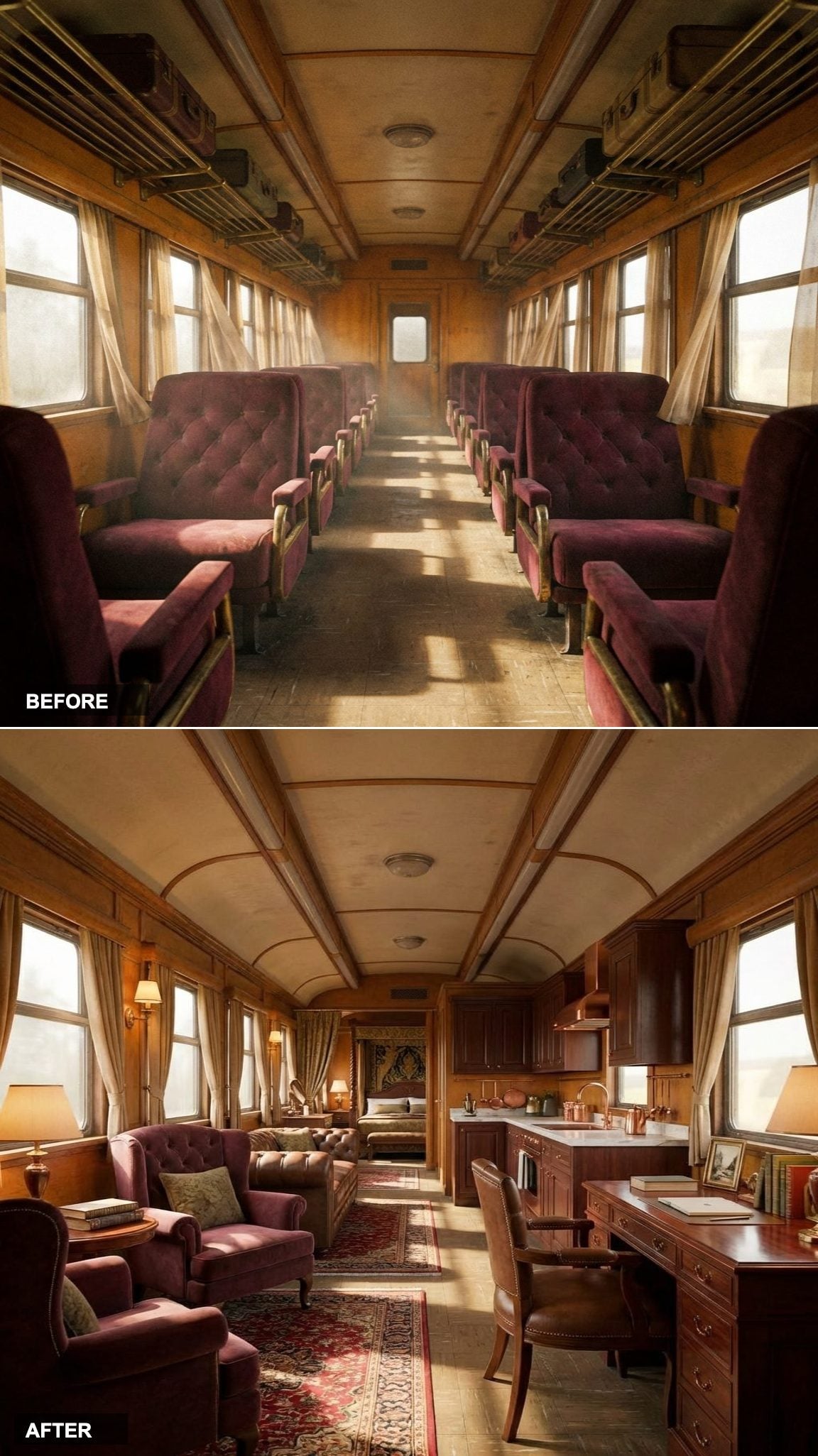
Burgundy tufted armchairs from the original passenger configuration remain at the front of the car, paired now with a round side table and table lamp with a cream shade. Behind them, dark mahogany cabinetry lines both walls, fitted with brass rail trim that mirrors the original luggage rack hardware still running the length of the ceiling. A kitchen counter with white marble surface sits to the left, copper pots hung above it. To the right, a writing desk holds an iMac beside a brass banker's lamp.
At the far end, a canopied bed sits centered beneath a gold chandelier with multiple fabric shades. Wall sconces flank the bed on both sides, casting warm light across the wood-panel walls. The floor shifts from original planking to a polished surface that reflects the ambient glow, pulling every zone together without a single partition wall.
History Corner: Luxury rail travel reached its peak in the late 19th and early 20th centuries, when private car ownership became a status symbol among industrialists and heads of state. Cars built during that era often featured hand-rubbed wood interiors, custom upholstery, and dedicated sleeping quarters not unlike what this conversion replicates. Preserving the original luggage racks while overhauling everything below them keeps a direct physical link to that period intact.