🔥 Would you like to save this?
You said one shelf. You meant it. Then you found the perfect ceramic, the right art book, the lamp that changes everything, and suddenly your “intentional space” has forty-three deeply considered objects and a waiting list. This living room gets you — it just does it better. Sixty square feet of builder-grade beige, transformed into the kind of room that holds everything you love and still somehow looks like restraint. Welcome home, you beautiful contradiction.
In order to come up with the very specific design ideas, we create most designs with the assistance of state-of-the-art AI interior design software. Also, assume links that take you off the site are affiliate links such as links to Amazon. this means we may earn a commission if you buy something.
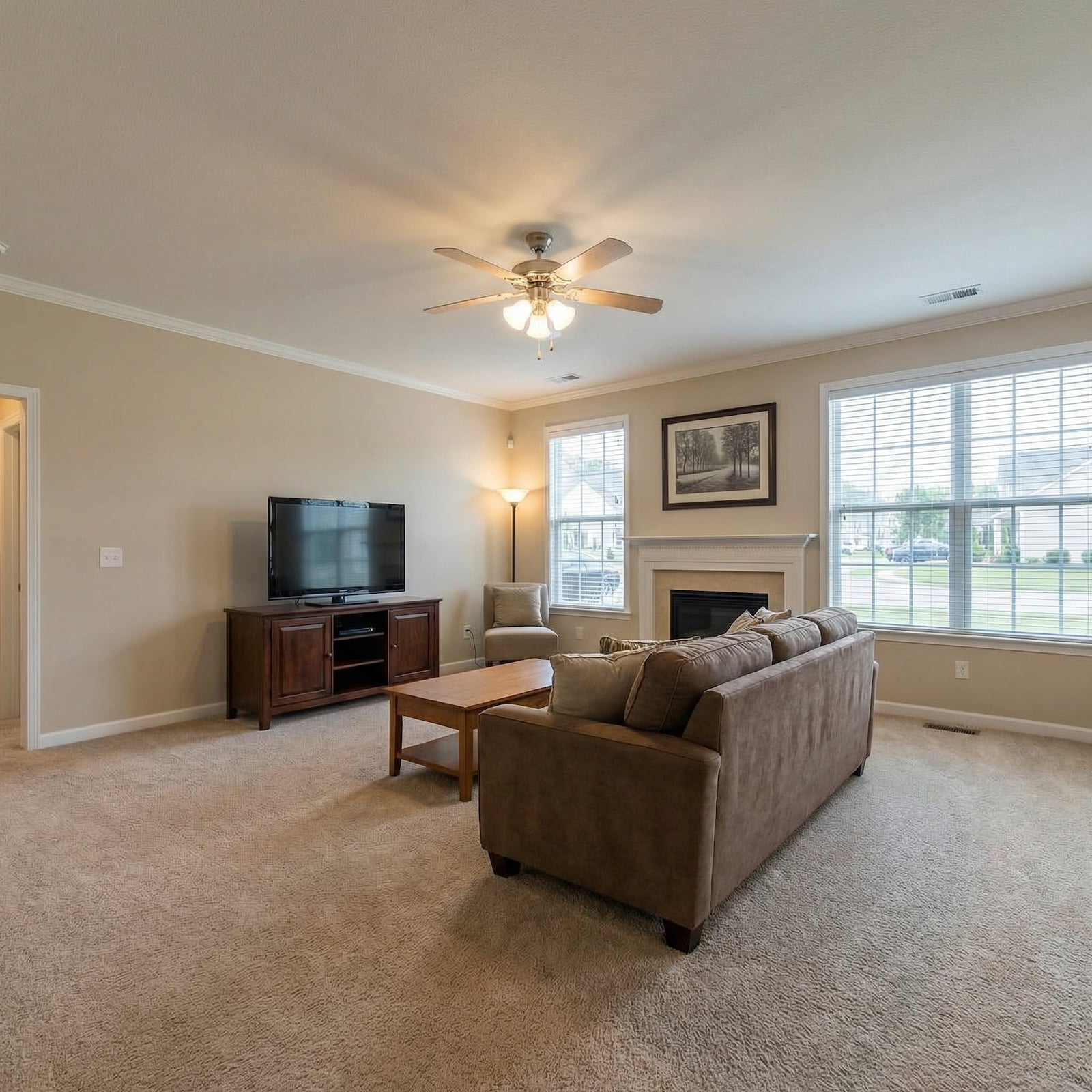
Builder-grade living rooms share a familiar profile: beige walls, builder carpet, a ceiling fan no one chose, and light fixtures that came with the house. They are not bad rooms. They are just nobody’s room.
That distinction matters more for minimalists who also happen to collect things. The tension between wanting clean, open space and genuinely loving objects, books, and textiles is real. Most builder rooms offer no help with that tension. They are neutral in a way that just reads as unfinished, not intentional. Getting from that starting point to something that holds both calm and personality requires specific decisions, not just a coat of paint.
The before-and-after living rooms ahead show exactly how that shift happens, room by room, choice by choice.
Corrugated Ceiling Panels and LED Strips Replace the Builder Fan
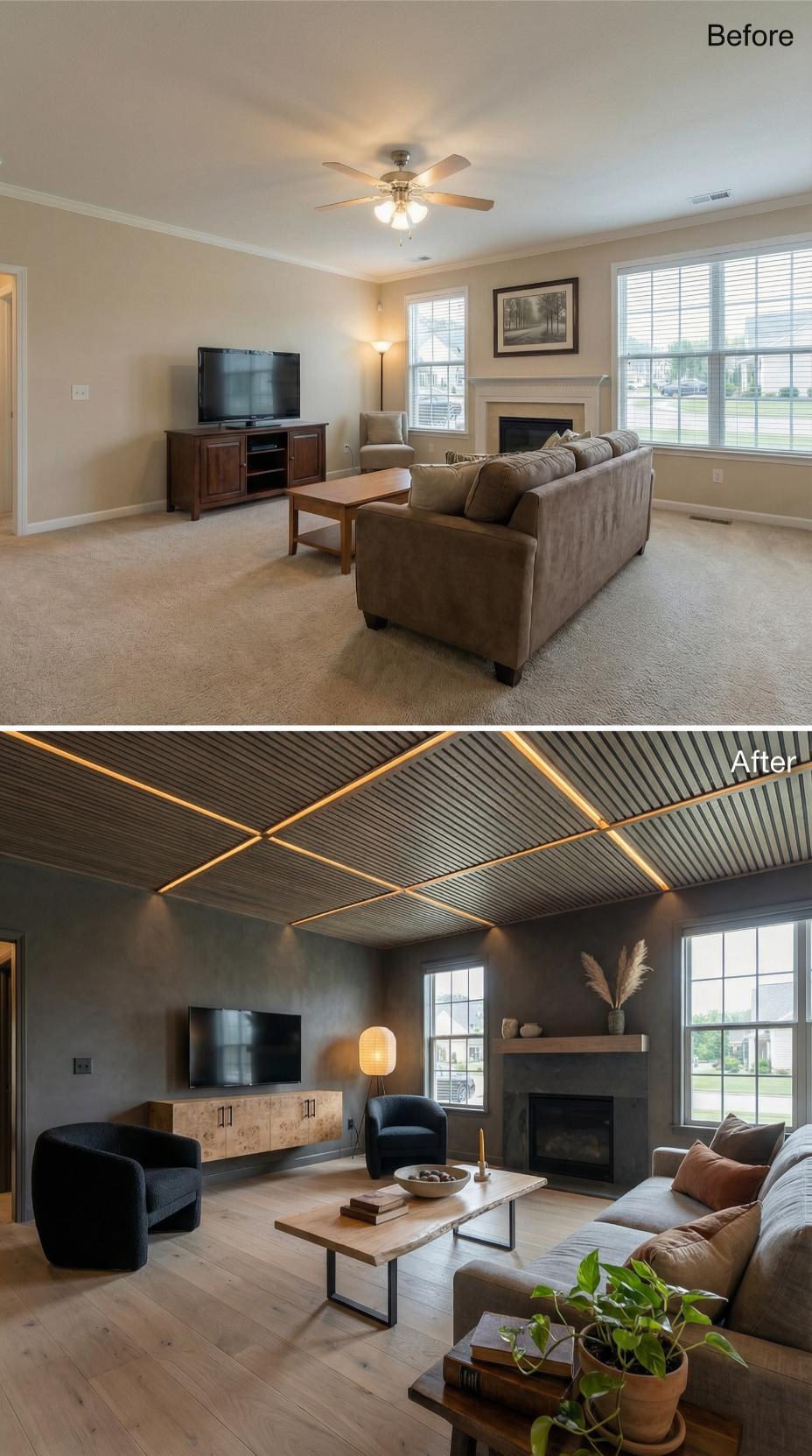
Beige carpet and a wood-stained TV console gave way to wide-plank white oak flooring and a floating burl-front media cabinet. The ceiling is the real departure: dark corrugated panels run in parallel ridges across the entire surface, interrupted by recessed LED strip channels arranged in a diamond grid that cast warm amber light downward. Dark charcoal plaster walls replace the original builder-grade beige paint. Two black bouclé accent chairs anchor the seating area opposite a gray upholstered sectional with terracotta throw pillows. A live-edge coffee table on black steel legs sits at center, and a trailing pothos in a terracotta pot adds green at floor level.
Navy Coffered Ceiling and Walnut Paneling Replace Beige and Carpet
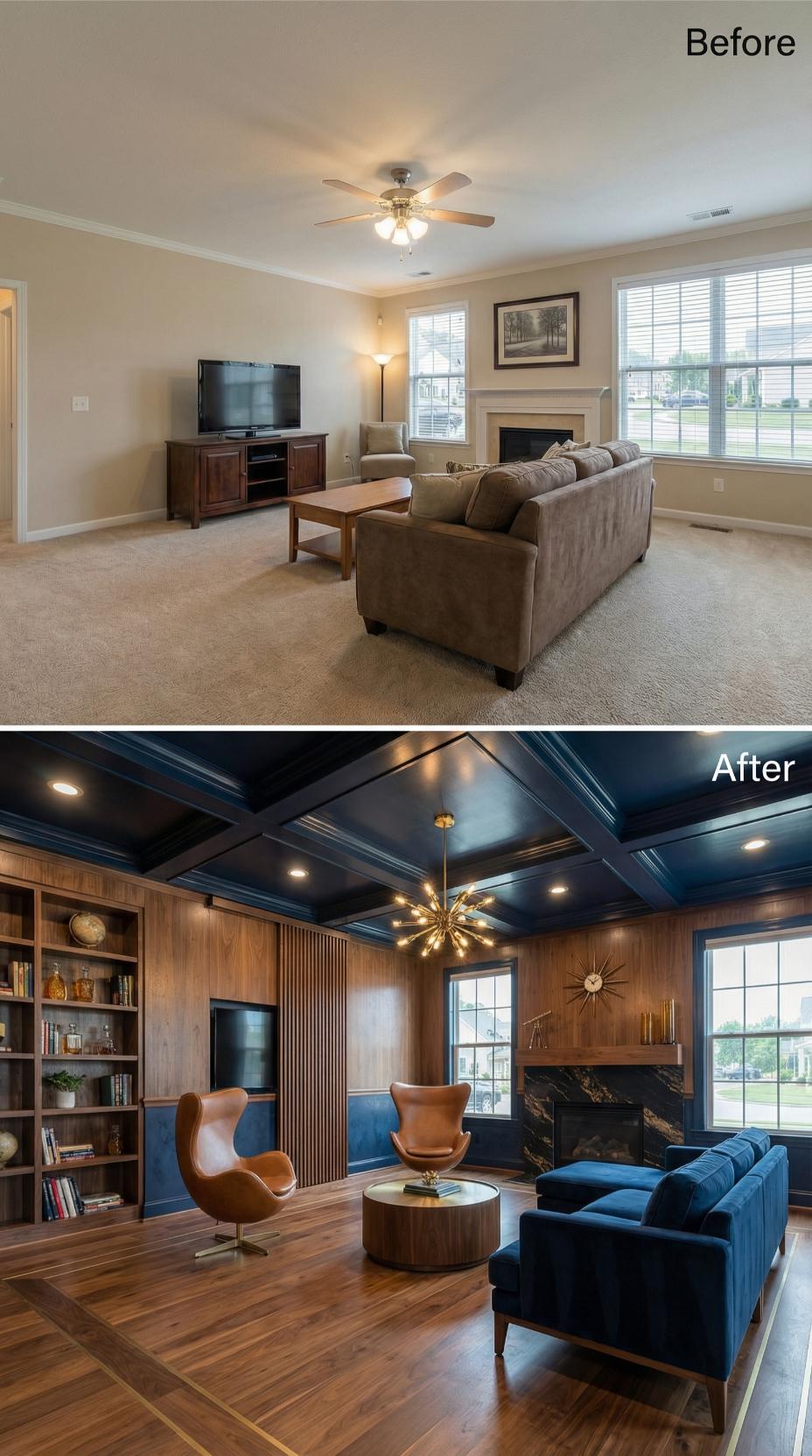
Carpet and a builder-grade fan gave way to hardwood floors, dark walnut wall paneling with vertical slat detailing, and a coffered ceiling painted deep navy. Recessed lighting pairs with a brass Sputnik chandelier that anchors the room’s mid-century lean.
Two Arne Jacobsen-style egg chairs in cognac leather face a drum coffee table at the center, while a navy velvet sectional lines the right wall. A built-in bookcase with open shelving holds books and glassware alongside a flat-panel TV. The fireplace surround switched from white painted wood to black marble with heavy veining.
Dark Forest Green Walls and a Sculpted Tray Ceiling Swap Out Beige Entirely
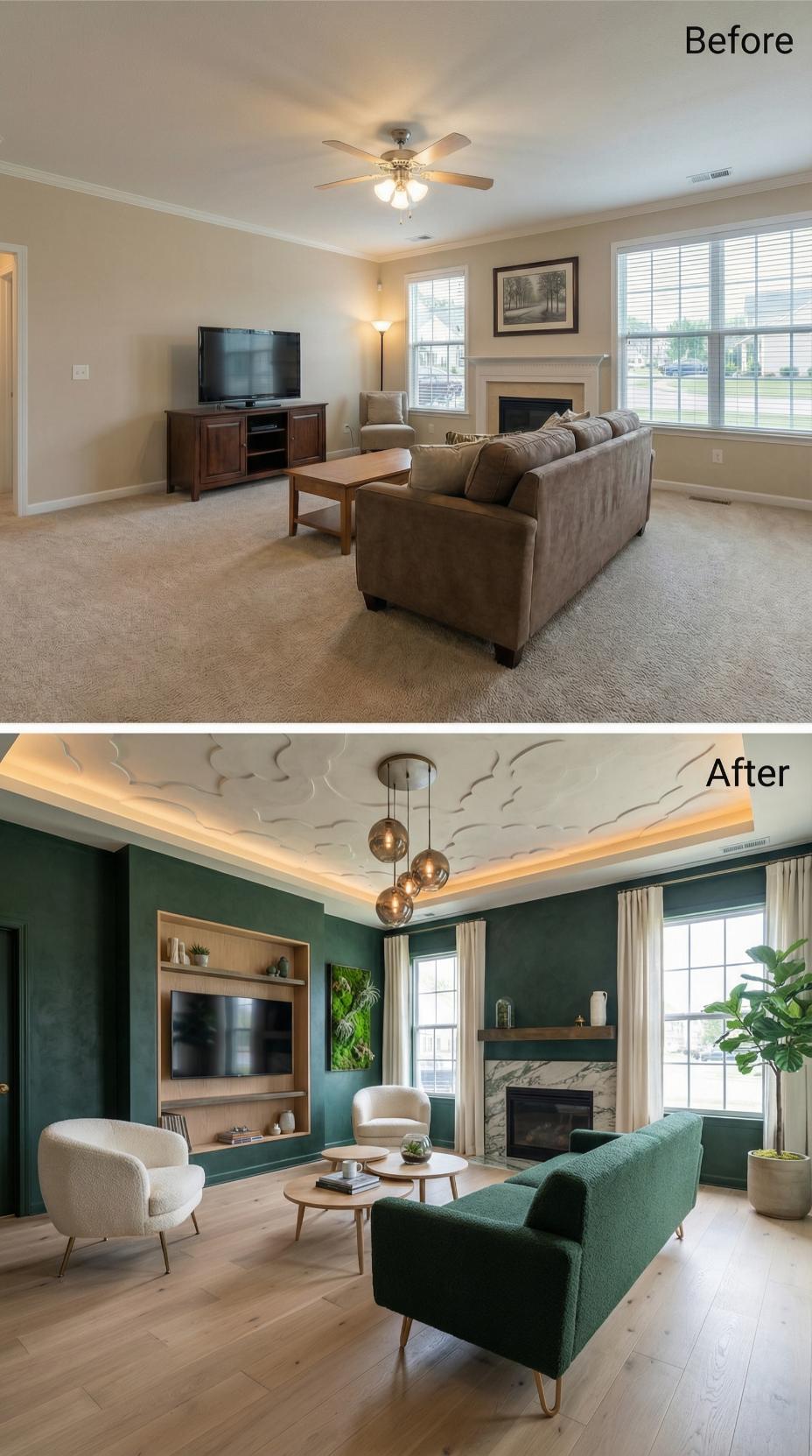
Warm oak hardwood replaced carpet, while deep hunter green venetian plaster walls anchored boucle armchairs and a forest green sofa on gold tapered legs. A carved plaster tray ceiling with cove lighting does the work the builder fan never could.
Reclaimed Wood Ceiling Beams and a Stacked Stone Fireplace Do All the Heavy Lifting
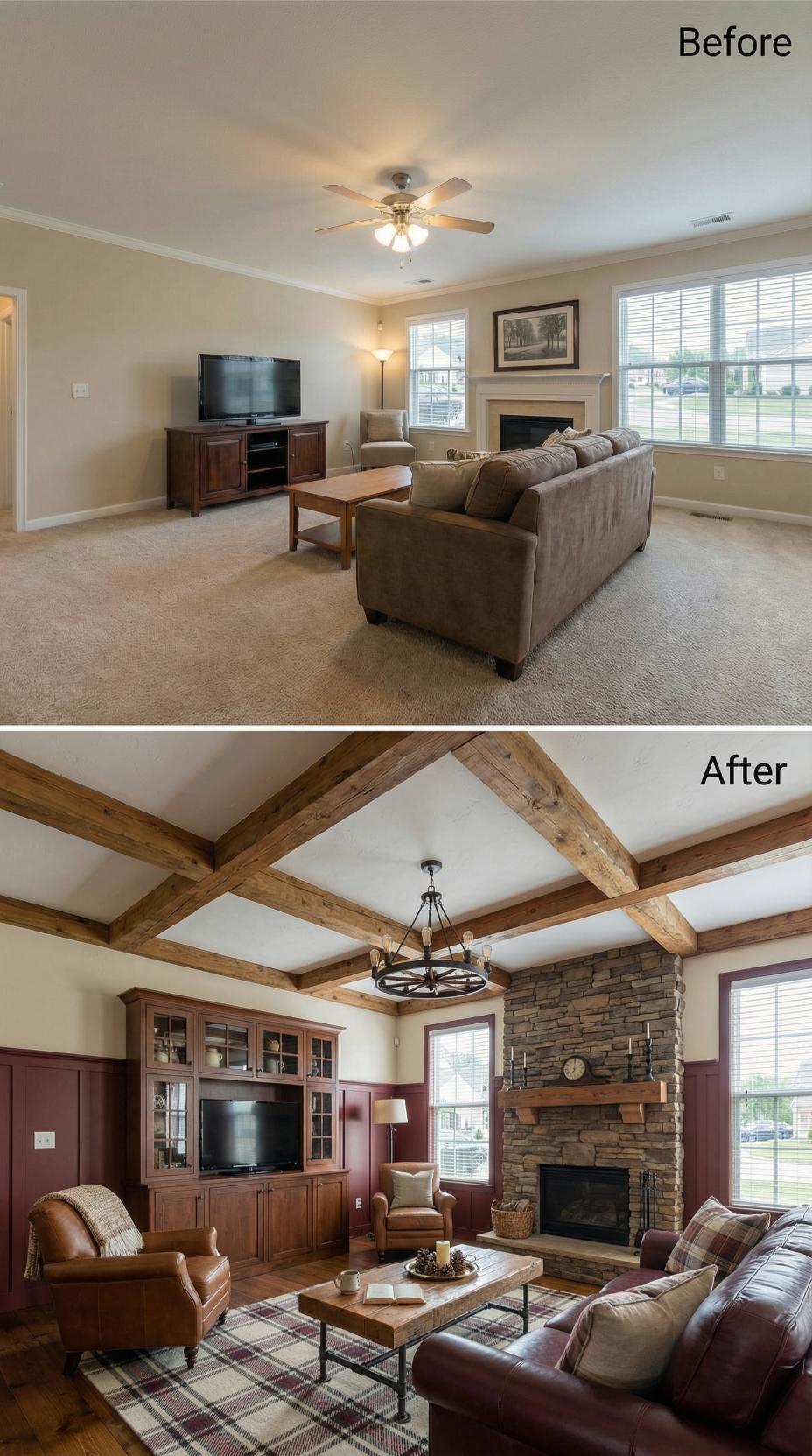
Builder-grade carpet and a basic ceiling fan gave way to something with far more structural presence. Reclaimed wood beams cross the vaulted ceiling in a grid pattern, their rough-sawn texture contrasting with the white plaster between them. A wagon-wheel chandelier with exposed Edison bulbs hangs at center. The fireplace surround is stacked fieldstone, floor to ceiling, anchored by a thick wood mantel shelf.
Dark burgundy board-and-batten wainscoting lines the lower walls, pairing with a built-in media cabinet in stained knotty alder. Leather seating in cognac and oxblood sits on a plaid wool rug in cream, red, and charcoal. The coffee table uses an industrial pipe base with a reclaimed wood top.
History Corner: Stacked stone fireplaces draw from dry-stone construction traditions dating back thousands of years across Europe and North America, where builders layered flat fieldstone without mortar to create walls that shifted slightly with the earth. The technique was later adapted for decorative interior use in the early twentieth century as Arts and Crafts designers sought to bring natural materials indoors. Modern versions typically use thin-cut veneer stone adhered to a framed surround, achieving the same visual weight without structural load-bearing requirements.
Glossy Black Tray Ceiling and Sputnik Pendant Pull a Flat Room Into Focus
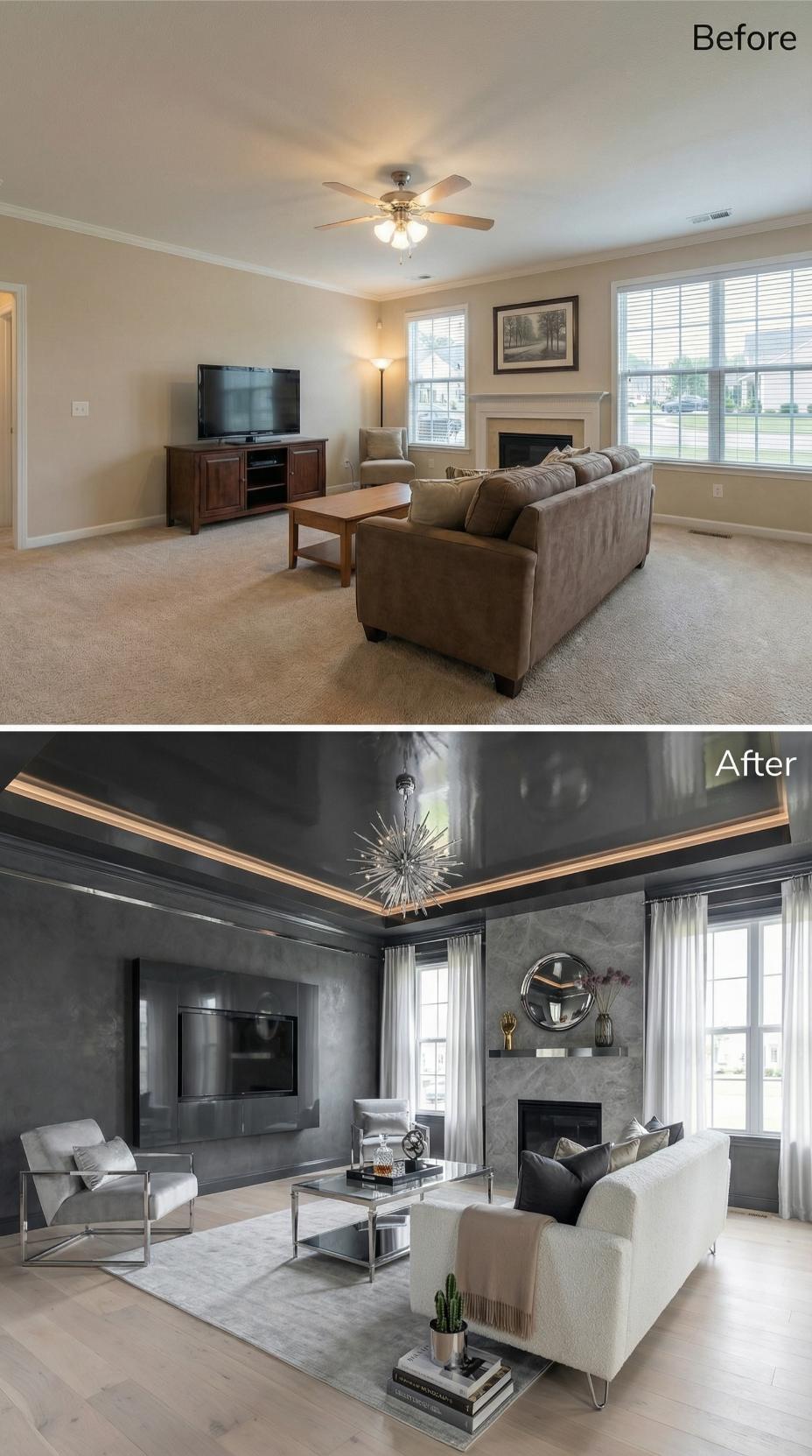
Lacquered charcoal paint covers every surface from the tray ceiling down to the crown molding, with warm LED cove lighting tracing the ceiling’s perimeter. A chrome sputnik chandelier hangs at center, flanked below by a boucle sofa and chrome-framed accent chairs on a silver area rug. Light oak plank flooring replaced the original carpet entirely.
Why a High-Gloss Ceiling Finish Changes the Physics of a Room
High-gloss paint on a ceiling acts as a reflective plane, bouncing light sources back into the space rather than absorbing them. In this room, the lacquered black tray ceiling picks up the warm glow of the LED cove strip and redistributes it across the walls, which softens what could otherwise read as a very dark interior. Paint manufacturers typically classify this finish at 70 to 85 percent light reflectance on a gloss scale, making it a deliberate optical tool rather than simply a color choice.
Gold Tray Ceiling Lines and Bouclé Seating Pull a Flat Room Into Focus
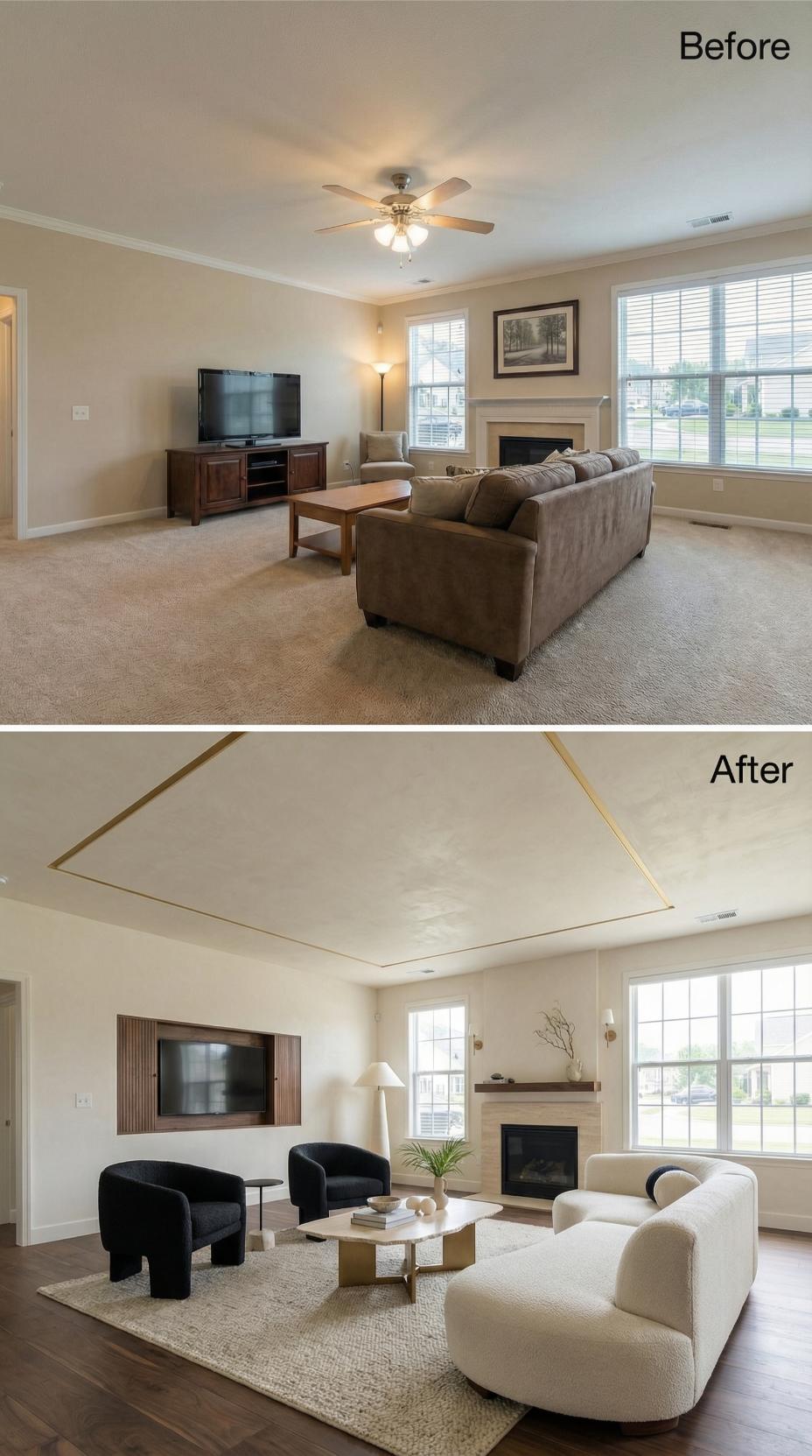
The ceiling does the most work here. A tray inset with thin brass or gold trim lines draws the eye upward and gives the room a geometry the original flat ceiling never had. Recessed lighting replaces the builder fan entirely, and the result reads cleaner without feeling cold.
On the floor, dark hardwood planks replace the beige carpet and anchor a natural fiber rug beneath a travertine-toned coffee table. Two black bouclé accent chairs face a curved ivory bouclé sofa. The TV sits flush inside a walnut slat wall panel, which keeps the media setup from dominating the room.
Designer’s Secret: Slat wall TV panels typically use MDF or solid wood strips spaced between 10 and 25 millimeters apart, and that gap width changes the visual weight dramatically. Wider spacing reads airy and Scandinavian; tighter spacing feels more substantial and architectural. In this room, the medium spacing strikes a balance that lets the walnut grain stay visible without competing with the screen.
Coffered Ceiling and Tufted Chesterfield Turn a Flat Room Into a Victorian Study
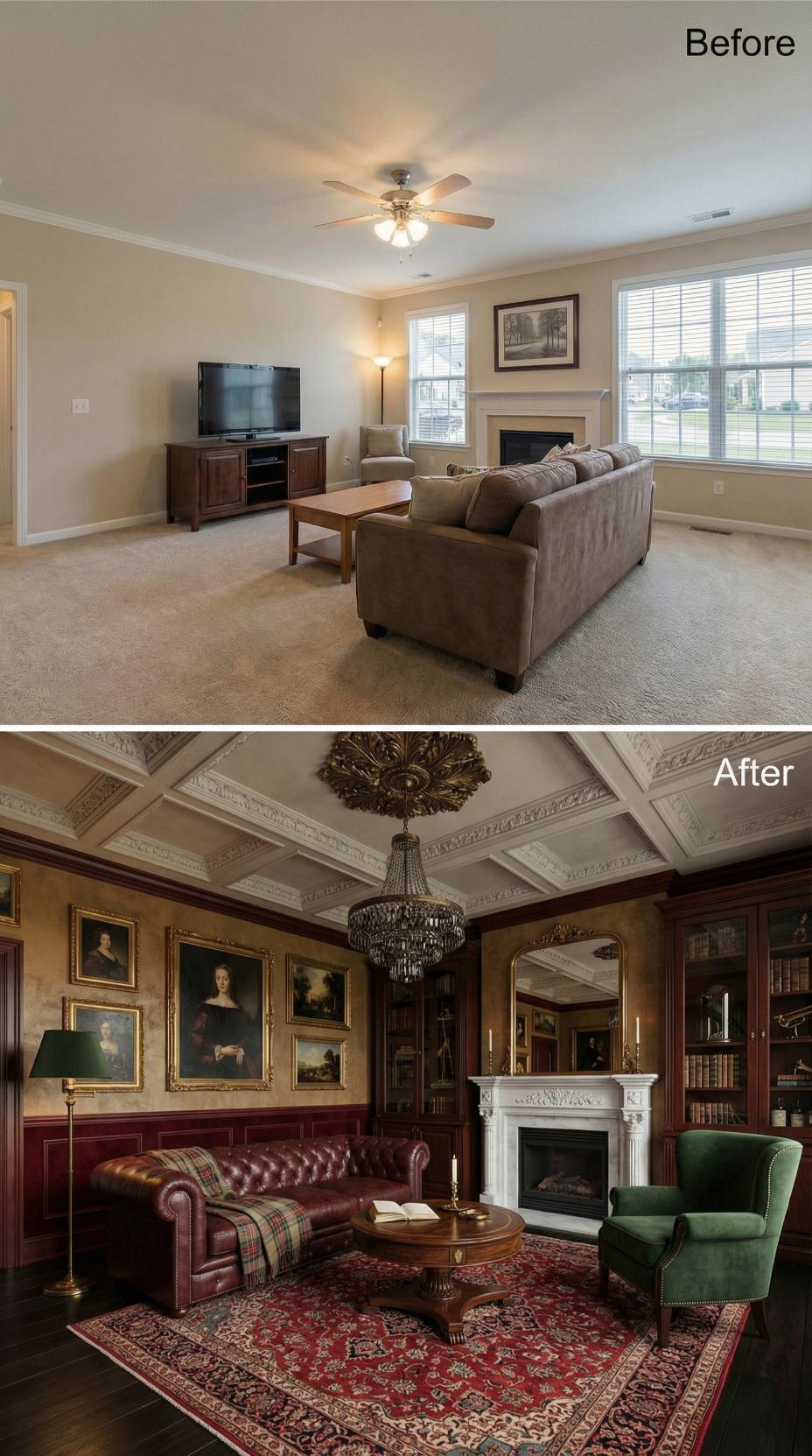
Dark mahogany wainscoting climbs halfway up every wall, and above it, aged gold plaster takes over where plain drywall once sat. An ornate crystal chandelier anchors the coffered ceiling, which features carved medallion detailing at its center. A oxblood leather Chesterfield sofa sits across from a white marble fireplace surround, flanked by a forest green velvet wingback chair. A red Persian rug with ivory medallion patterning covers what was once plain builder carpet, and built-in bookcases with glass-front cabinets fill the far wall.
Editor’s Note: Coffered ceilings date to Renaissance-era European architecture, where recessed grid panels were used to reduce ceiling weight in stone structures. In residential interiors, modern versions are typically built from MDF rails applied over drywall, making them far more accessible than their origins suggest. The ornate plaster medallion at the center of this ceiling is a nod to Victorian parlor design, where such details signaled the social standing of the household.
Copper Tin Ceiling and Concrete Walls Pull a Subdivision Room Out of Neutral
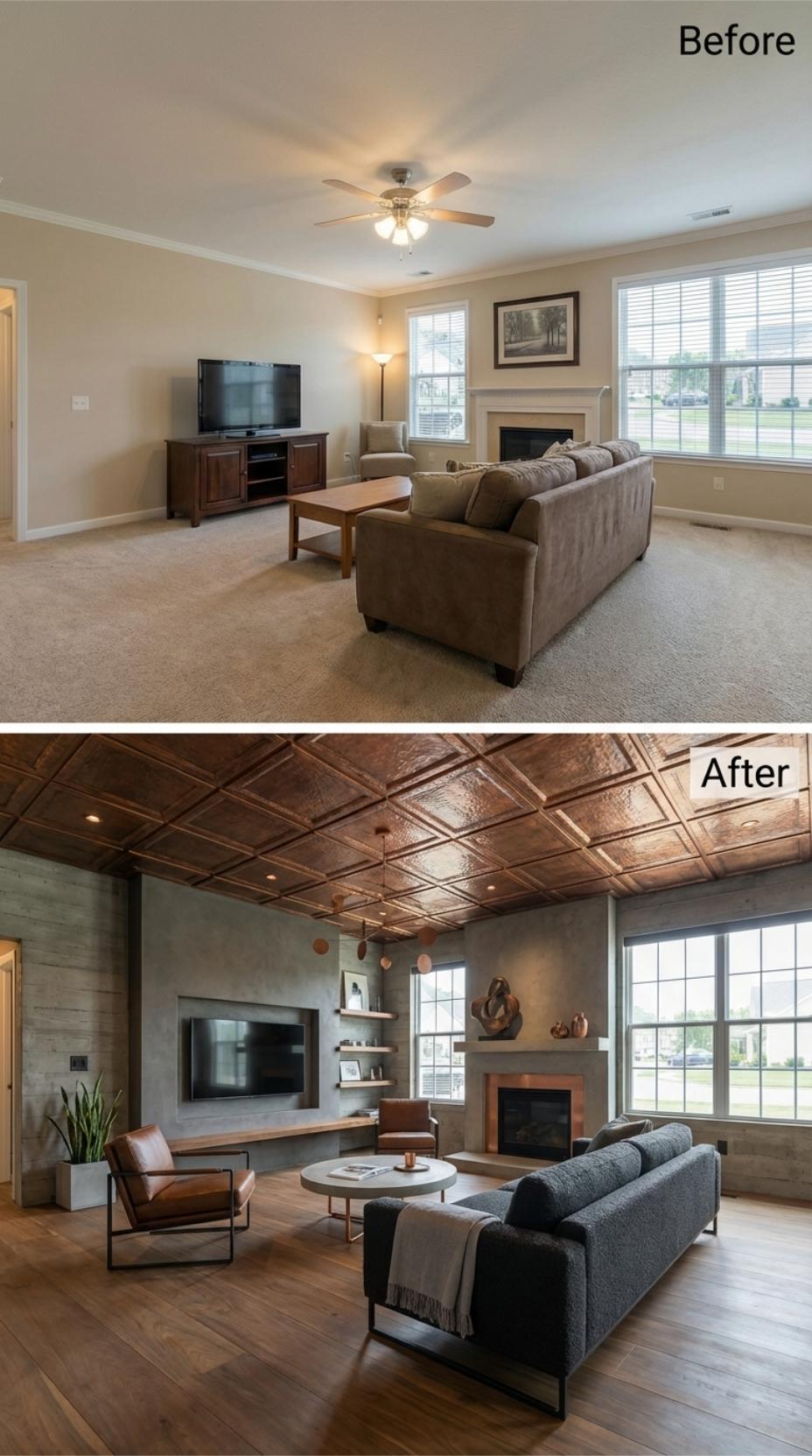
Oxidized copper-finish tin ceiling tiles in a coffered grid pattern replace the original five-blade fan and flat drywall, dropping the eye level and changing how the whole room reads. Walls receive a layered concrete microcement finish in cool gray. Hardwood planks swap out the carpet. A charcoal boucle sofa anchors the seating area opposite a wall-mounted flat screen set into the concrete surround, flanked by open floating shelves. Tan leather chairs on black metal frames and a round white marble-top coffee table round out a layout that looks collected rather than assembled.
Common Mistake: Homeowners who install decorative tin ceiling tiles over existing drywall often skip a vapor barrier, which traps moisture between layers and causes tiles to warp or buckle within a few years. Tin tiles require the same moisture-control planning as any metal application in a living space, especially in climates with high seasonal humidity.
Blush Walls, a Tray Ceiling, and Built-Ins Replace Carpet and a Builder Fan
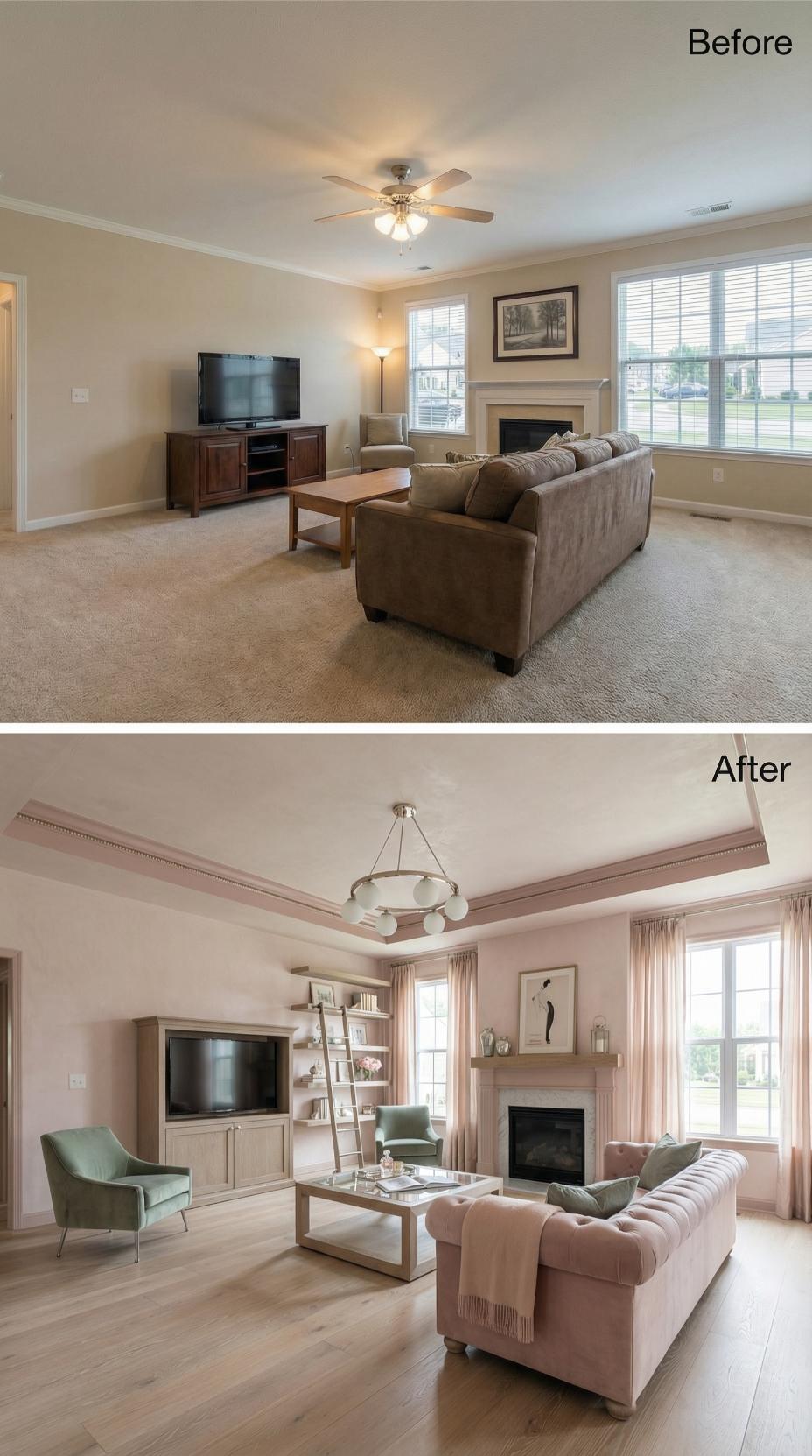
Out goes the ceiling fan and brown microfiber sofa. In comes a tray ceiling outlined in millwork, walls painted a dusty rose so pale it reads almost as a warm white, and a tufted Chesterfield in blush linen. The built-in entertainment unit uses a greige lacquer finish with open ladder-access shelving on the right side, and pink linen curtains hang floor-to-ceiling on every window.
A circular satin-brass pendant with frosted globe bulbs replaces the old fan entirely, and two sage velvet accent chairs anchor the seating plan without fighting the sofa. The fireplace surround gets a raw wood mantel shelf in place of the original painted trim. Hardwood in a light whitewash tone covers the carpet.
Try This: Tray ceilings gain visual depth not just from their recessed shape but from how light falls along the perimeter edge at different times of day. Painting the tray interior even one shade darker than the surrounding walls makes the recess read deeper without any additional millwork. In smaller living rooms, that contrast does more spatial work than adding crown molding.
Industrial Coffered Ceiling and Raw Wood Shelving Swap Carpet for Wide-Plank Oak
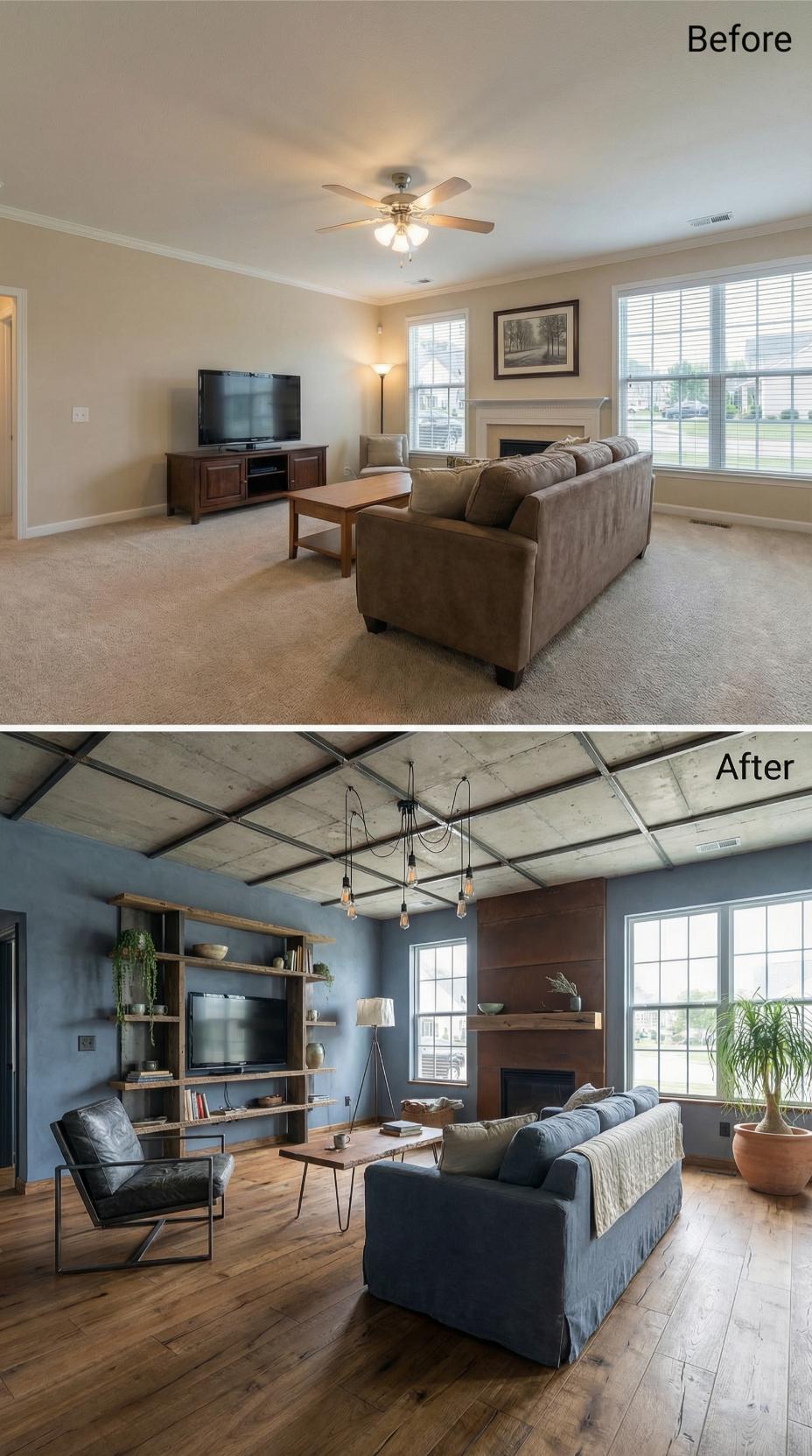
Concrete-paneled coffers divided by black steel grid beams replace the original fan and flat drywall, dropping the ceiling’s visual plane without sacrificing height. Open-tread walnut shelving cantilevered from black pipe brackets flanks a wall-mounted TV, while slate-blue slipcover linen on the sectional pulls the wall color forward. Hairpin-leg coffee table, a leather sling chair, and Edison pendant cluster complete the shift.
Material Matters: Slipcover sofas use removable fabric cases stitched to fit a specific frame, and linen-cotton blends are the most common choice because the weave softens after washing without losing structure. Unlike upholstered pieces, a slipcovered sectional can have its cover professionally dyed if the room’s color palette changes, extending the furniture’s useful life considerably.
Gold Plasterwork Ceiling and Teal Velvet Swap Subdivision Neutral for Baroque Drama
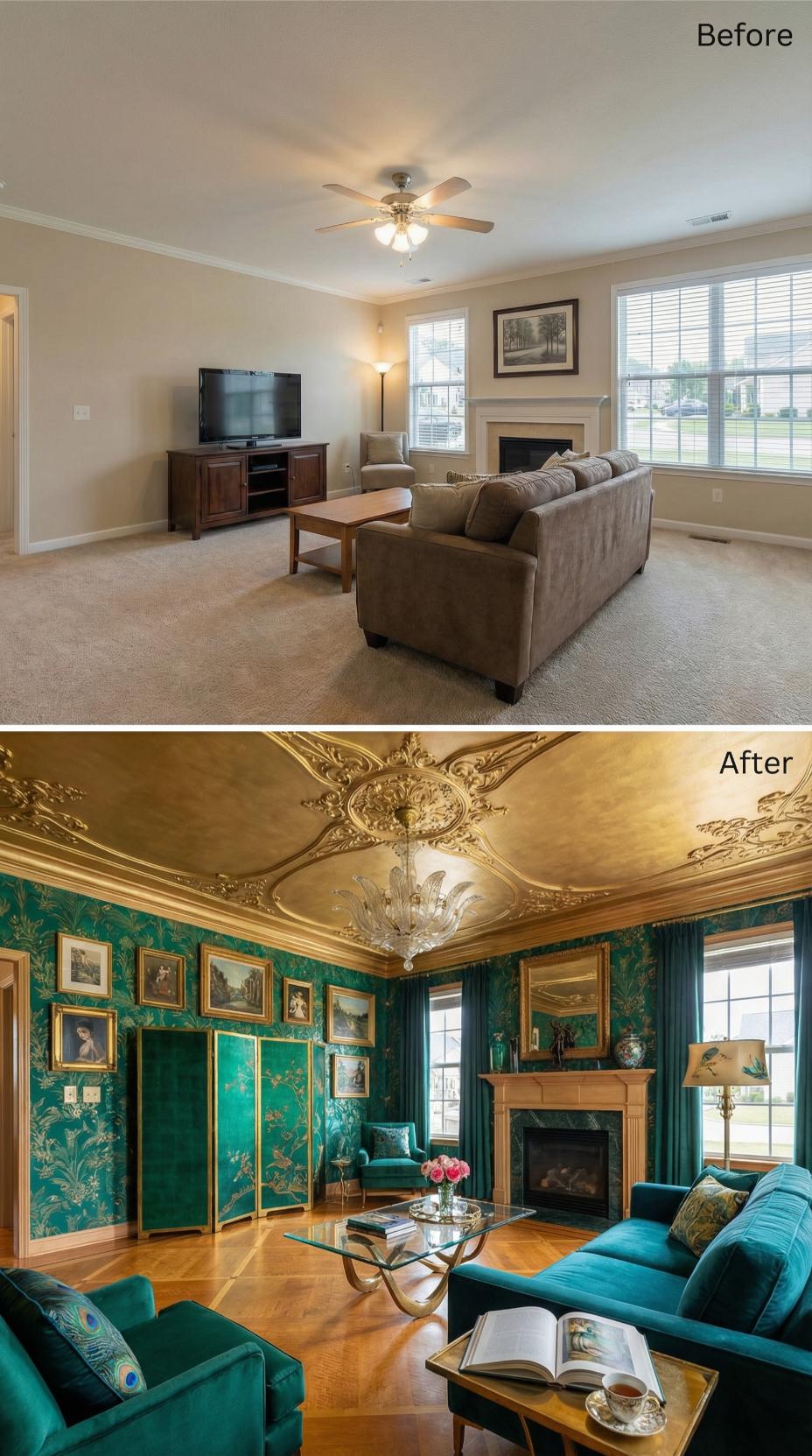
Rococo-style plasterwork covers the entire ceiling in gilded relief, with an oval cartouche at center, scrolling acanthus borders, and raised foliate panels radiating outward — all finished in warm gold leaf. Walls shift to deep teal wallpaper printed with gold botanical motifs, hung floor to ceiling. Teal velvet sofas replace the taupe microfiber, a glass-and-brass cocktail table sits where the wooden rectangle stood, and parquet oak flooring replaces the carpet entirely. A crystal chandelier with blown-glass arms drops from the center medallion.
- Plasterwork ceiling reliefs in the Rococo tradition often weigh between 8 and 15 pounds per square foot, requiring blocking added between joists before installation
- Teal velvet upholstery uses a cut-pile weave where pile height directly affects how dramatically the color shifts under different light angles
- Gold botanical wallpaper with flocked or foil-printed surfaces reflects light differently than paint, making a room read warmer even when natural light is low
Shiplap Ceiling Planks and a Stone Fireplace Pull a Beige Box Into Coastal Territory
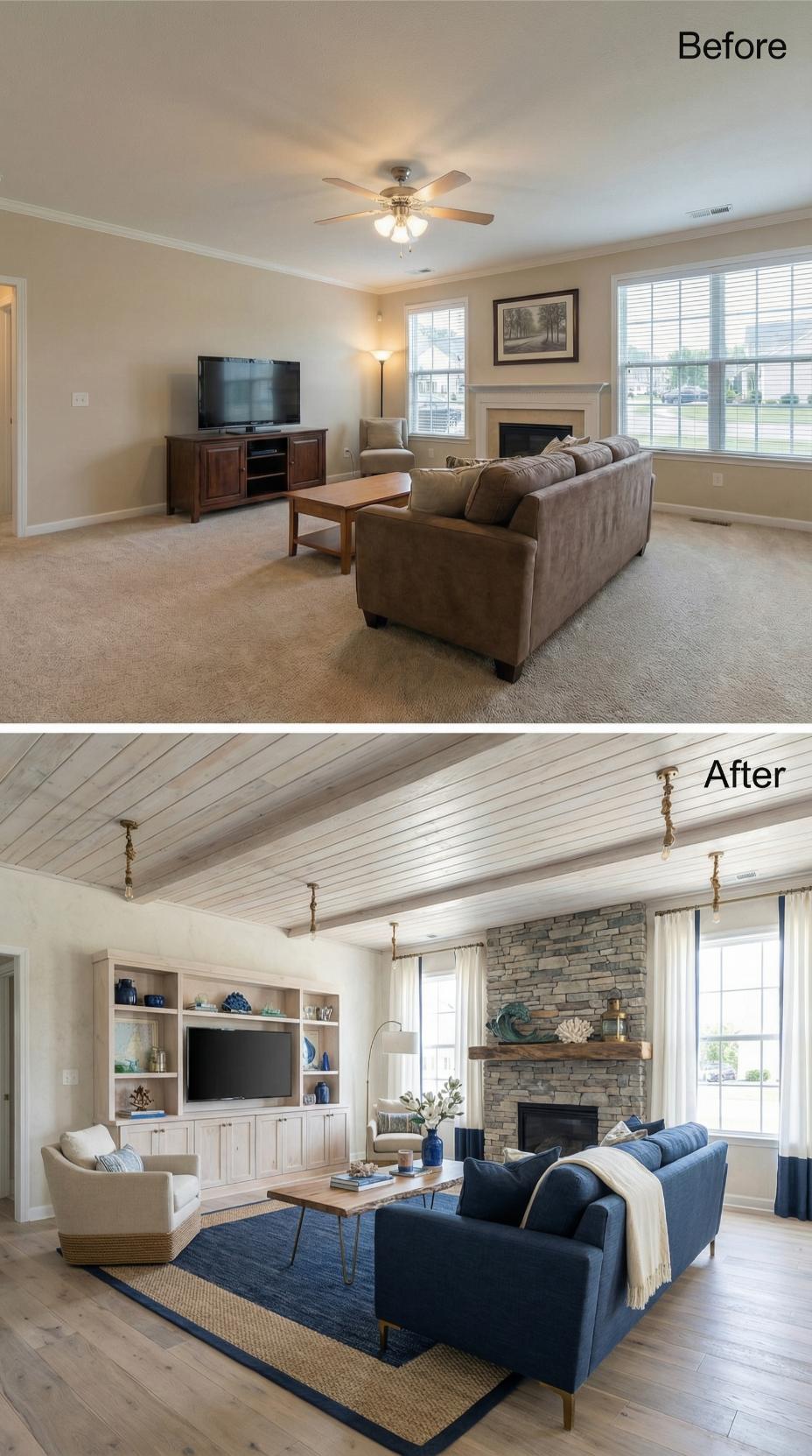
Every square inch of ceiling work here is doing what the furniture alone never could.
White-painted shiplap runs the full ceiling length, paired with exposed wood beams that add shadow lines without adding visual weight. Pendant lights on brass drop rods hang at intervals, replacing the original builder fan entirely. The stacked-stone fireplace surround reaches to a raw wood mantel, and the built-in entertainment unit beside it uses open shelving with inset cabinetry in a whitewashed oak finish.
Navy linen sofas anchor the seating plan on a layered jute-and-navy bordered rug. Cream accent chairs with rope-wrapped bases echo the coastal palette without leaning into cliché. Wide-plank light oak flooring covers what was once beige carpet, and navy curtain panels with white sheers frame windows that were previously bare.
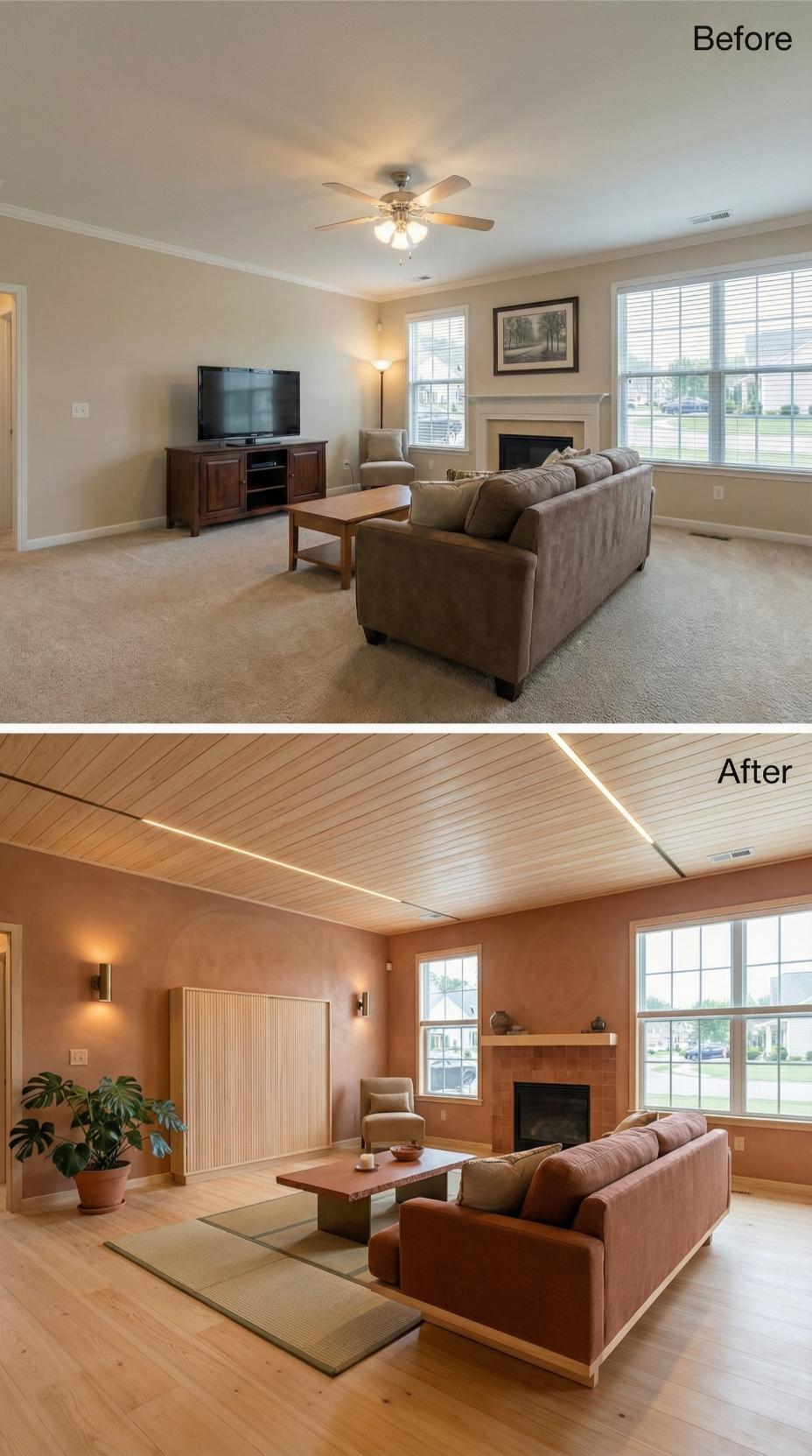
Shiplap Ceiling Planks and LED Channels Trade Beige Carpet for Tatami and Terracotta
🔥 Would you like to save this?
Natural wood shiplap runs the full ceiling length with recessed LED strips tucked into the seams, replacing the builder fan entirely. Walls shift to a venetian plaster finish in burnt sienna, and light maple hardwood covers what was once wall-to-wall beige carpet. Woven tatami mats define the seating zone under a rust-toned sofa with a low-profile wood base frame.
Pro Tip: Tatami mats are made from igusa rush grass woven over a rice straw or polystyrene core, and their standard Japanese dimension of roughly 90 by 180 centimeters was historically used as a unit of room measurement. Placing them under modern furniture grounds the layout in a spatial logic that predates Western area rugs by centuries.
Craftsman Coffered Ceiling and Green Velvet Swap Beige Carpet for Oak and Botanicals
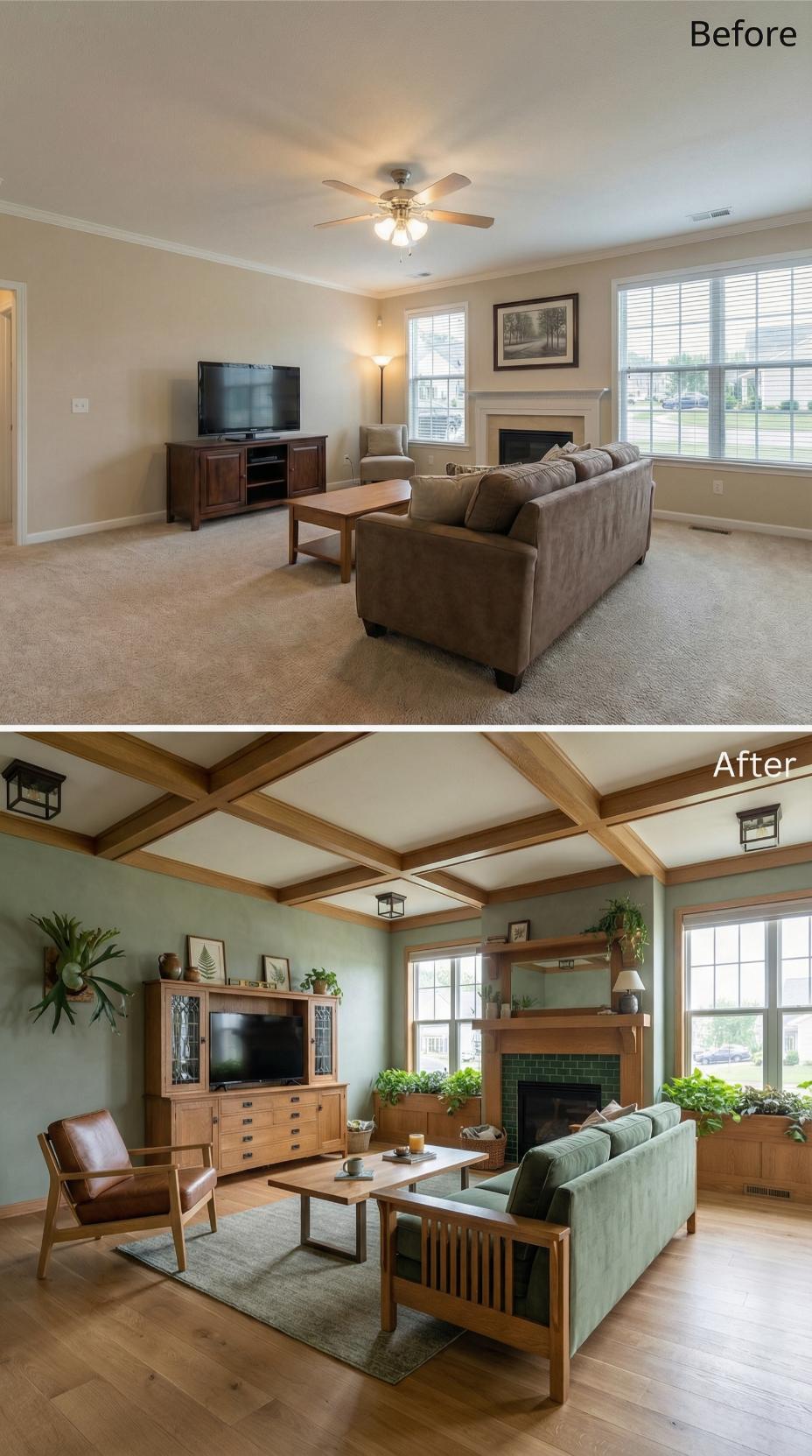
Quartersawn oak beams form a grid coffered ceiling that immediately pulls focus upward, giving the room a structure the original flat drywall never had. Sage green paint on all four walls ties directly to the velvet upholstery on the sectional, while a mission-style coffee table and leather sling chair keep the wood tones grounded in the same Craftsman family.
The fireplace surround gets a complete overhaul: forest green subway tile replaces the plain white surround, and a thick oak mantel shelf now carries trailing plants and a table lamp. Hardwood flooring in a warm honey tone runs throughout, replacing beige carpet, and wall-mounted sconces with black metal housings flank the coffered grid at cornice height.
Budget Tip: Coffered ceiling grids built from paint-grade MDF instead of solid oak can cut lumber costs by 40 to 60 percent, since the grid panels are typically painted rather than stained. Priming all MDF edges with two coats of shellac-based primer before painting prevents the grain from telegraphing through the topcoat, which is the most common mistake in DIY coffered builds.
Black Lacquer Walls and a Crystal Chandelier Swap Carpet and a Builder Fan
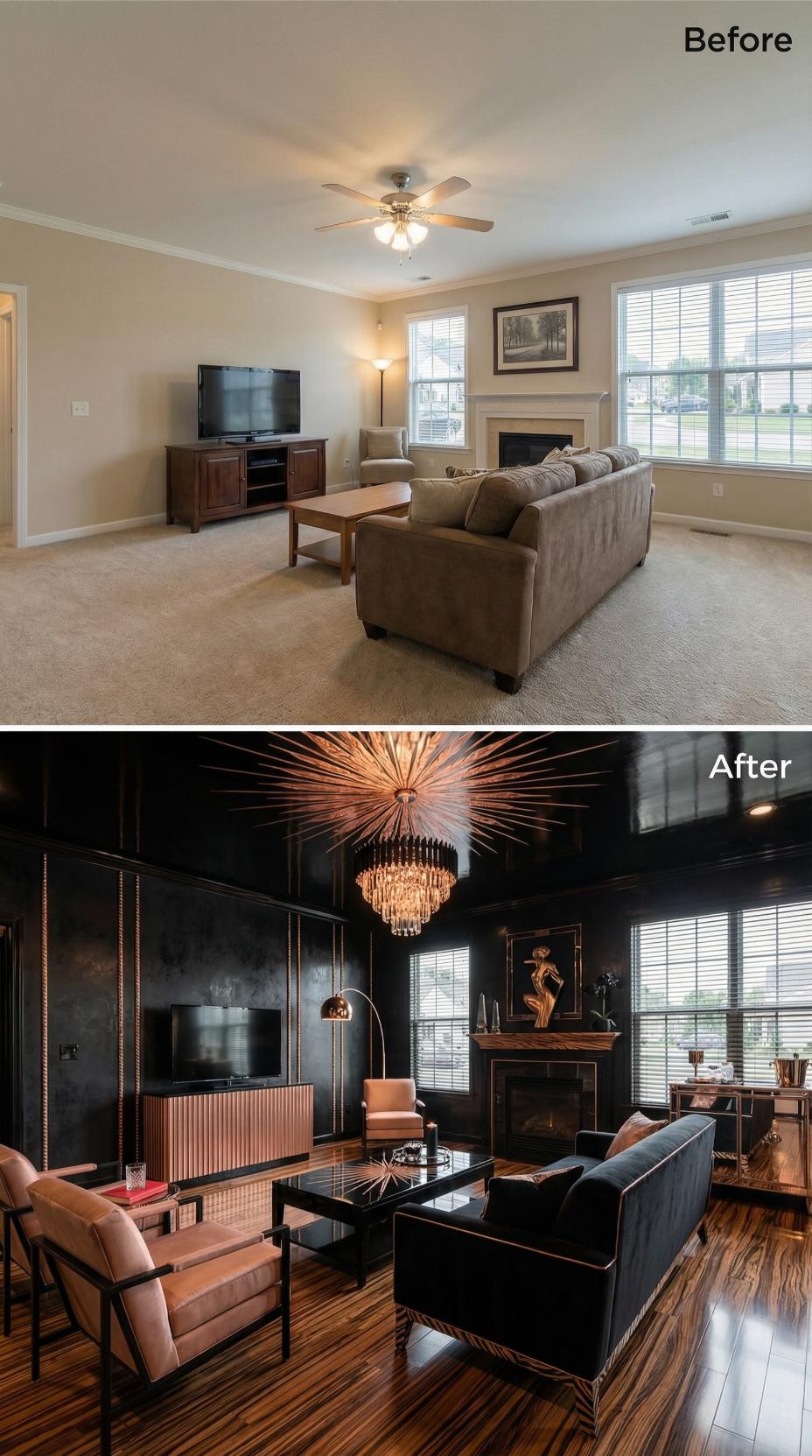
Builder beige carpet and a five-blade ceiling fan gave this room exactly what every subdivision living room gets: nothing to remember. The renovation stripped both and went in the opposite direction. Every wall received a high-gloss black finish with applied vertical molding strips in a grid pattern, which compresses the room visually while making the crystal drum chandelier read like a focal point rather than an afterthought.
The TV console switched from dark-stained wood to a fluted rose-gold cabinet with brass edge detailing. Flooring changed to tiger-striped hardwood with pronounced grain variation. Seating includes a charcoal velvet sofa, a blush leather armchair, and a glass-topped coffee table with a brass sputnik base. A sculptural gold figure sits on the fireplace mantel, now framed in black with zebrawood surround panels.
Every wall received a high-gloss black finish with applied vertical molding strips in a grid pattern, which compresses the room visually while making the crystal drum chandelier read like a focal point rather than an afterthought.
Coffered Wood Beams and Terracotta Tile Swap Beige Carpet for a Spanish Colonial Living Room
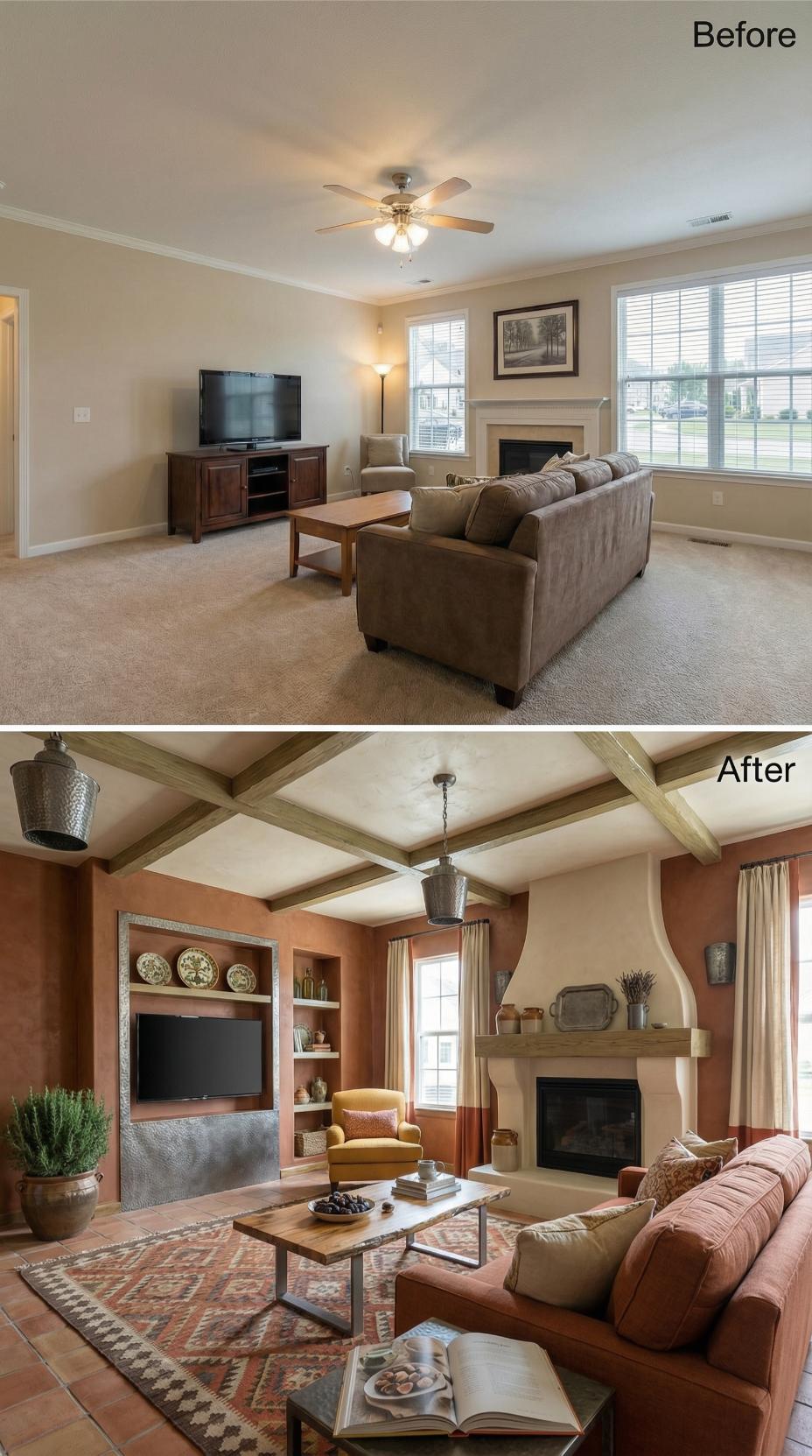
Exposed wood cross-beams divide the ceiling into a coffered grid, painted in cream with natural oak trim that pulls warmth from the rust-colored plaster walls. Saltillo-style terracotta tile replaces the original carpet entirely, anchored by a geometric kilim rug in red, ivory, and navy. A built-in entertainment wall with open shelving flanks the flat-screen on both sides, finished in the same clay plaster as the walls. The fireplace surround became an arched adobe-style hood in cream stucco. Seating shifted from brown microfiber to a rust leather sofa and a mustard fabric armchair with knife-edge cushions.
Style Tip: Kilim and flatweave rugs are hand-woven on horizontal looms, and the tightness of the weave directly affects how well the rug holds up under furniture legs. Placing rug pads beneath flatweaves on tile floors is essential because the hard surface offers no grip and the rug will migrate under foot traffic. A pad also cushions the weft threads, which extend the life of the rug significantly.
Navy walls and LED cove lighting signal a shift toward rooms that work harder after dark.
Navy Walls and Shiplap Ceiling Turn a Beige Box Into a Moody Media Room
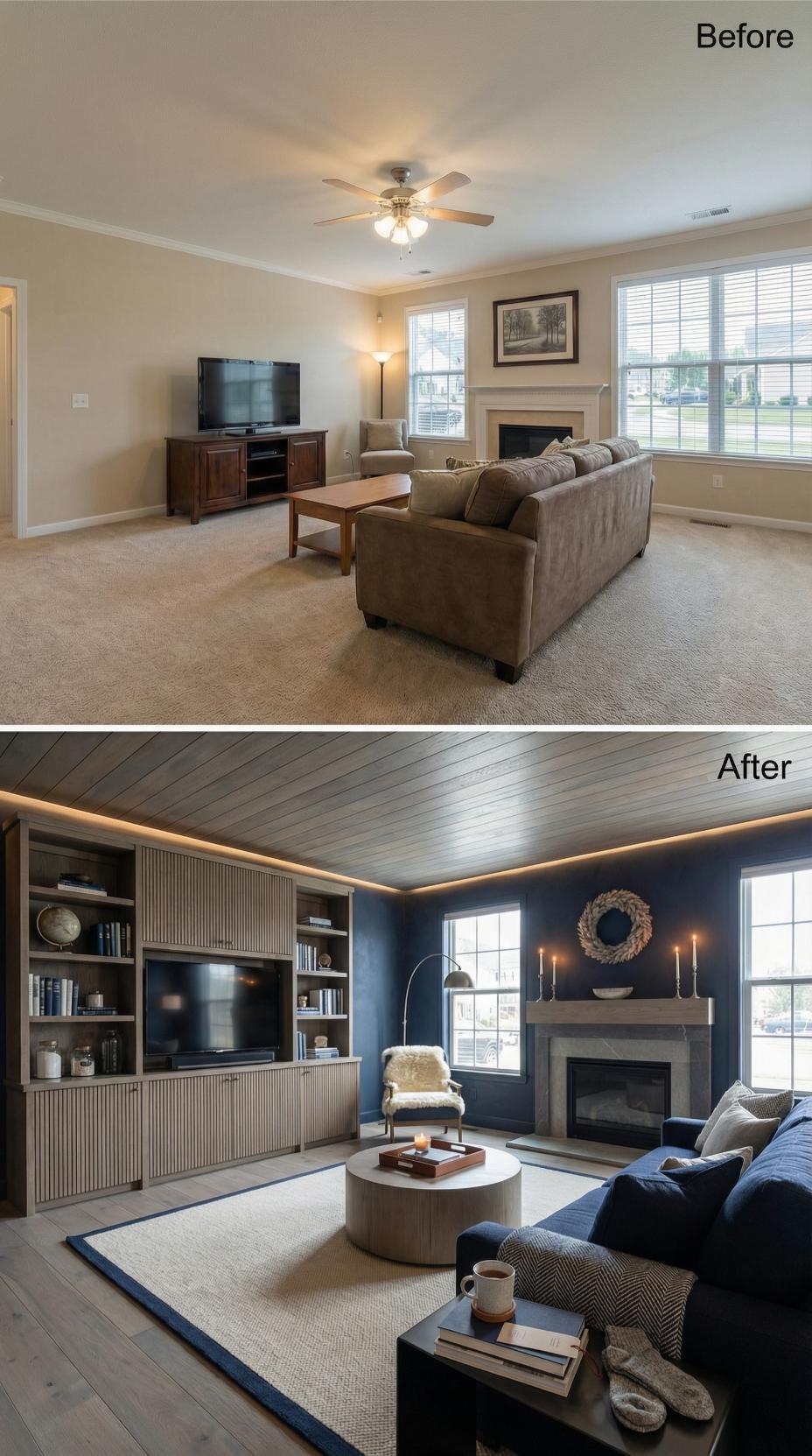
Warm beige carpet and a builder-grade ceiling fan gave way to wide-plank hardwood flooring, navy blue walls, and horizontal shiplap planks stained in a weathered gray-brown finish. LED strip lighting runs the full perimeter where the ceiling meets the wall, casting a warm amber wash that makes the shiplap grain visible without any overhead fixture. The built-in entertainment wall uses reeded cabinet fronts in a greige finish, flanked by open shelving styled with books, a globe, and ceramic vessels.
The fireplace surround swapped its original beige mantel for a flat concrete-gray stone surround with a modern linear firebox. A drum coffee table in off-white concrete sits on a jute-blend area rug with a navy border. A sheepskin accent chair and a navy sectional with herringbone throw pillows complete the seating arrangement.
Coffered Gold Ceilings and Gilded Mirrors Swap Carpet and a Builder Fan for Palace-Grade Glamour
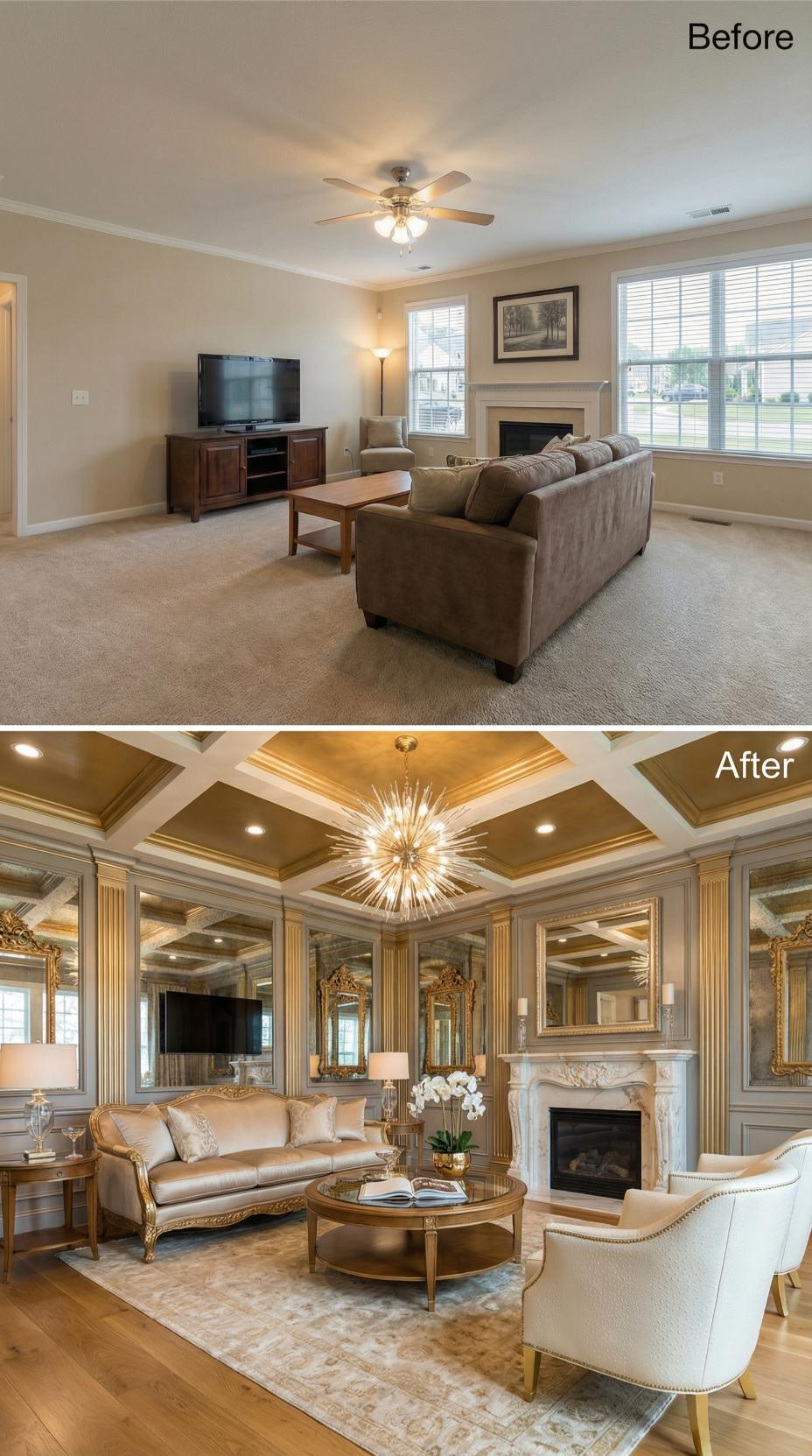
Cream carpet and a five-blade ceiling fan gave way to coffered ceilings painted in deep burnished gold, with white-trimmed molding forming a grid across the entire overhead plane. A sputnik-style brass chandelier hangs at center, its radiating spikes catching light from recessed cans positioned inside each coffer bay. Hardwood flooring in a warm honey tone replaced the carpet throughout.
Every wall carries large antiqued mirrors in carved gilt frames, flanked by fluted pilaster columns painted to match the trim. The sofa is French Provincial style upholstered in champagne silk, paired with nail-head accent chairs in ivory boucle. A round walnut coffee table with a glass top and lower shelf anchors the seating group over a pale medallion rug. The marble fireplace surround, carved with scrollwork detail, replaced the original flat builder mantel completely.
- Antiqued mirror panels reflect coffer lighting and visually double the perceived ceiling height
- Nail-head trim on upholstered chairs originated as a structural tack technique before becoming a decorative finish standard
- Sputnik chandeliers date to the late 1950s Space Race era and regained commercial popularity during the 2010s brass revival
Dark Stacked Stone, Concrete Ceiling, and Track Lighting Replace Beige Carpet and a Builder Fan
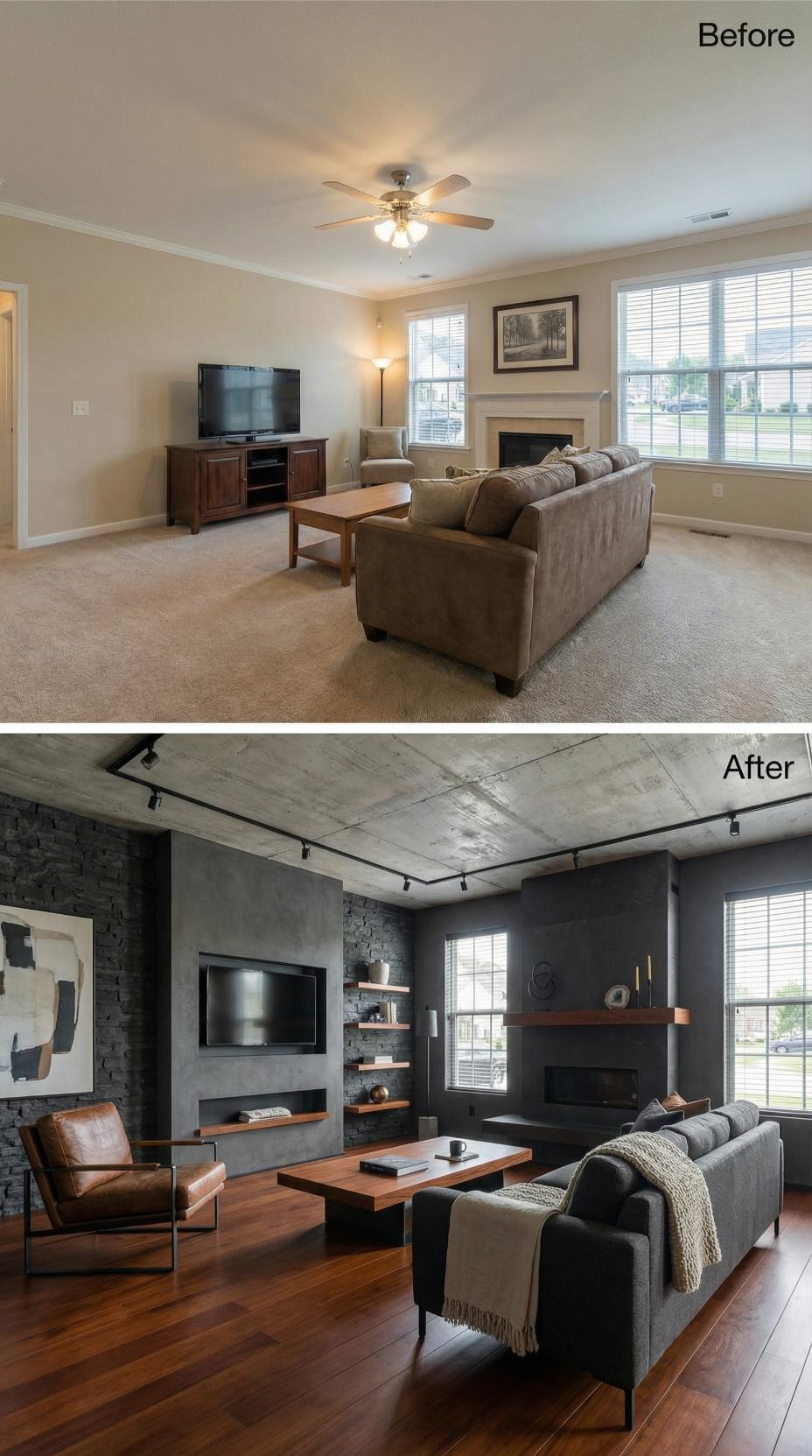
Every surface shifted here. The walls went from greige drywall to dark charcoal stacked ledger stone, the ceiling from flat white paint to raw concrete with exposed black track rails, and the floor from builder-grade carpet to wide-plank hardwood in a deep walnut stain. A wall-mounted flat screen sits flush between floating shelves in oiled wood, replacing the freestanding cherry media console.
The furniture follows the same logic. A low-profile gray sectional pairs with a cognac leather chair on a slim metal frame. The coffee table is a slab of live-edge walnut on a wood block base. Candles on the fireplace mantel and a large abstract canvas in black and white handle the decorative weight without clutter.
Quick Fix: Track lighting systems mounted on surface conduit, like the black rail visible across this ceiling, can be repositioned along the track without any rewiring, which makes them one of the few lighting formats that genuinely adapts as furniture layouts change. Each fixture head rotates independently, so a single run of rail can light artwork, a reading chair, and a fireplace wall from one circuit. That flexibility is a practical reason industrial-style track systems keep appearing in rooms where the owners clearly change their minds.
Dusty Rose Plaster Walls and a Tray Ceiling Replace Carpet and a Builder Fan
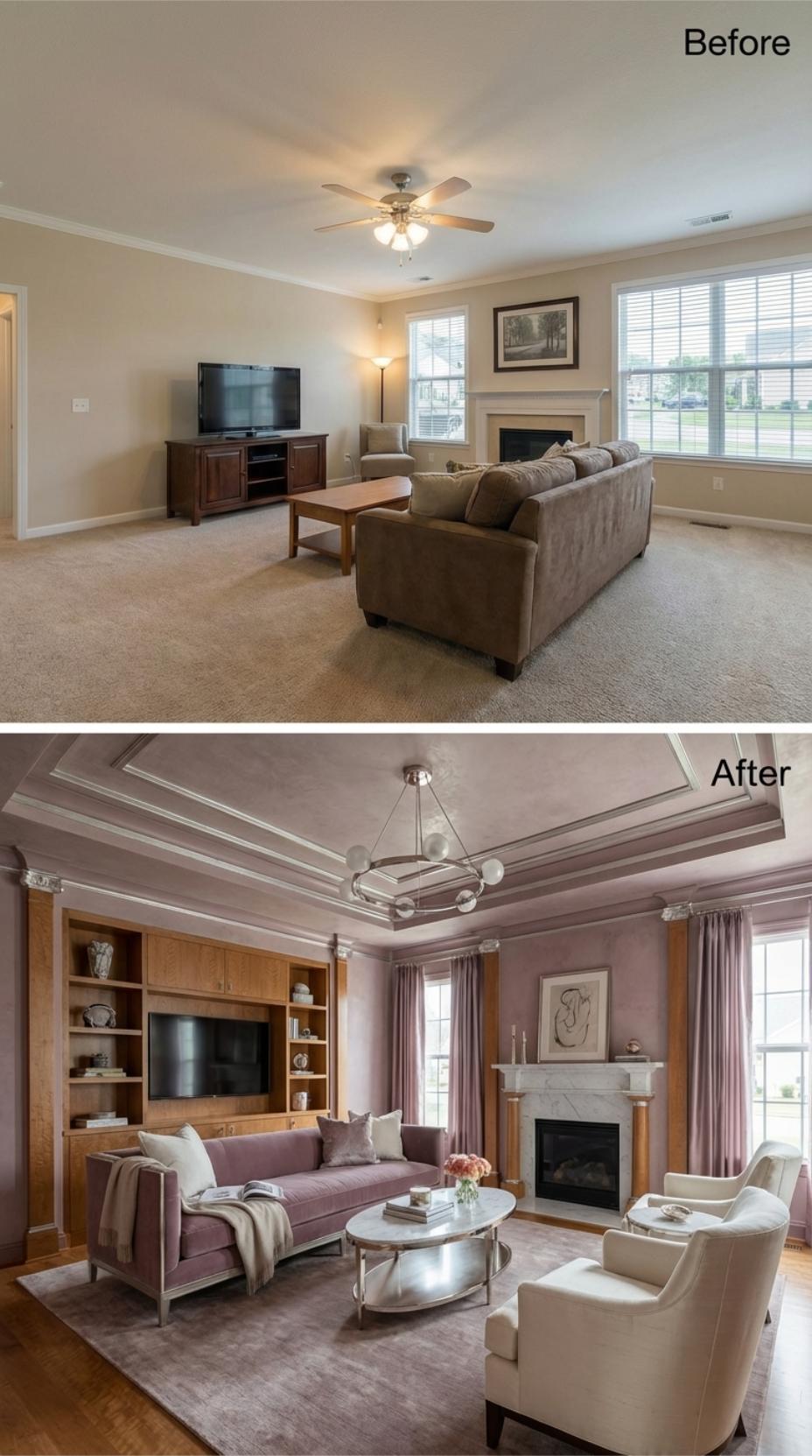
Mauve-toned plaster covers every wall surface, pulling the tray ceiling’s recessed field into the same dusty rose palette so the crown molding reads almost sculptural by contrast. A custom oak built-in runs the full back wall, housing the television between open shelving and upper cabinet doors with no hardware visible. The fan is gone entirely, replaced by a polished chrome ring chandelier with globe bulbs.
Seating shifted to a velvet sofa in muted lavender with chrome legs, flanked by cream upholstered armchairs. An oval marble-top coffee table sits centered on a taupe area rug. The fireplace surround swapped drywall for white marble with fluted column legs, and blush Roman shades replace the old horizontal blinds.
Worth Knowing: Polished chrome furniture legs and chandelier finishes create a consistent metallic thread that visually connects seating to ceiling without requiring matching pieces. When a room uses a single metal tone across unrelated objects, the eye reads the space as intentional rather than assembled. This technique costs nothing beyond selective shopping.
Slat Ceiling Strips and Mustard Plaster Walls Bury a Beige Subdivision Room Entirely
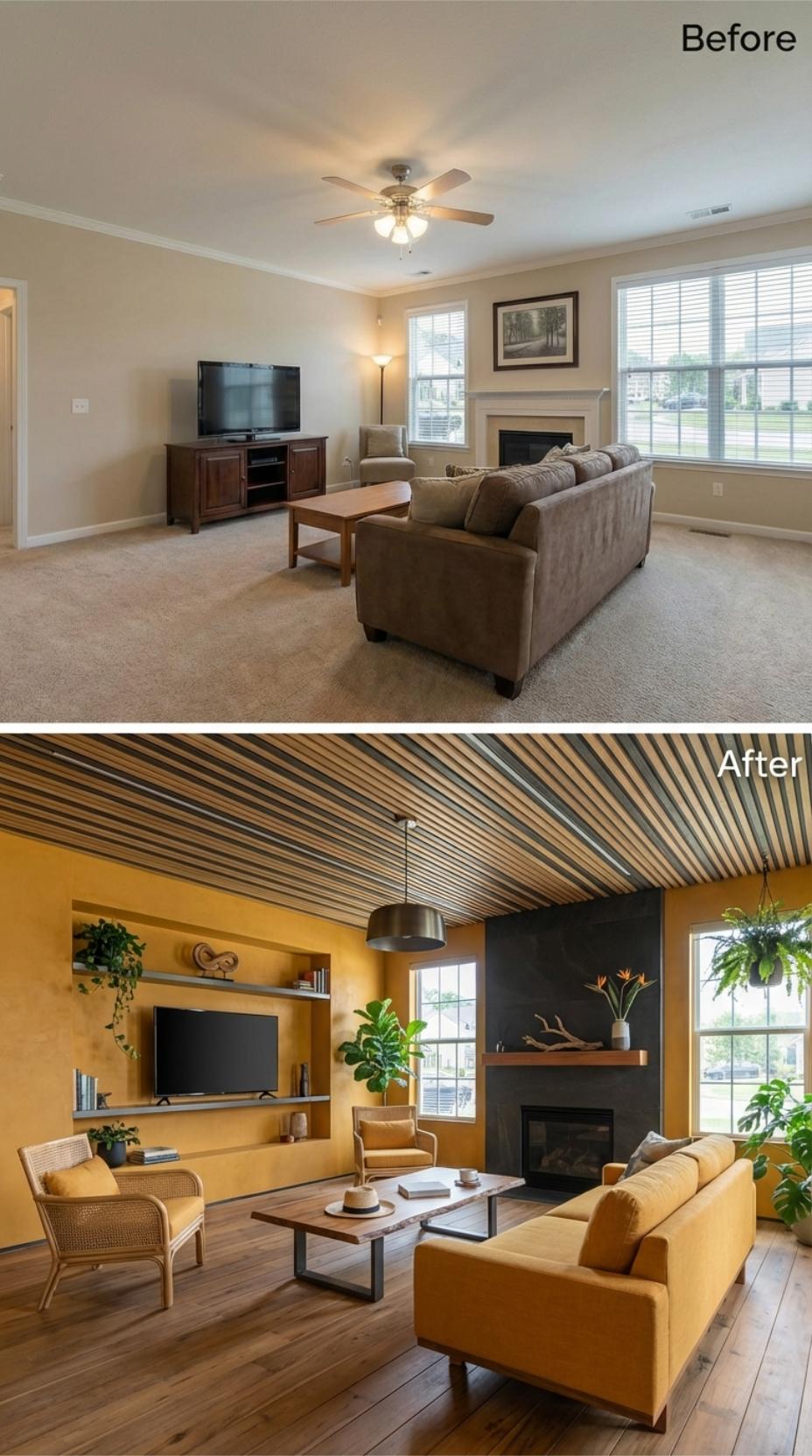
Diagonal wood slats run the full ceiling plane in alternating light and dark stain, replacing the builder fan with a pendant in a brushed gunmetal finish. Walls shift to ochre plaster with visible texture. The TV sits in a built-in niche flanked by open steel shelves holding trailing pothos and stacked books. A live-edge coffee table on black steel legs anchors the seating group, which now runs a mustard linen sofa and rattan accent chairs. Hardwood planks replace the beige carpet.
Trend Alert: Slatted ceiling treatments, sometimes called baffle ceilings, were originally developed for acoustic control in commercial spaces, and the same principle applies at home: the gaps between slats absorb mid-frequency sound that flat drywall reflects straight back into the room. Homeowners who install them over existing drywall should account for the drop in ceiling height, since a typical residential slat system adds between two and four inches of depth depending on batten thickness and mounting rail size.
Teal Grasscloth Walls and Coffered Wood Beams Bury a Beige Subdivision Room Completely
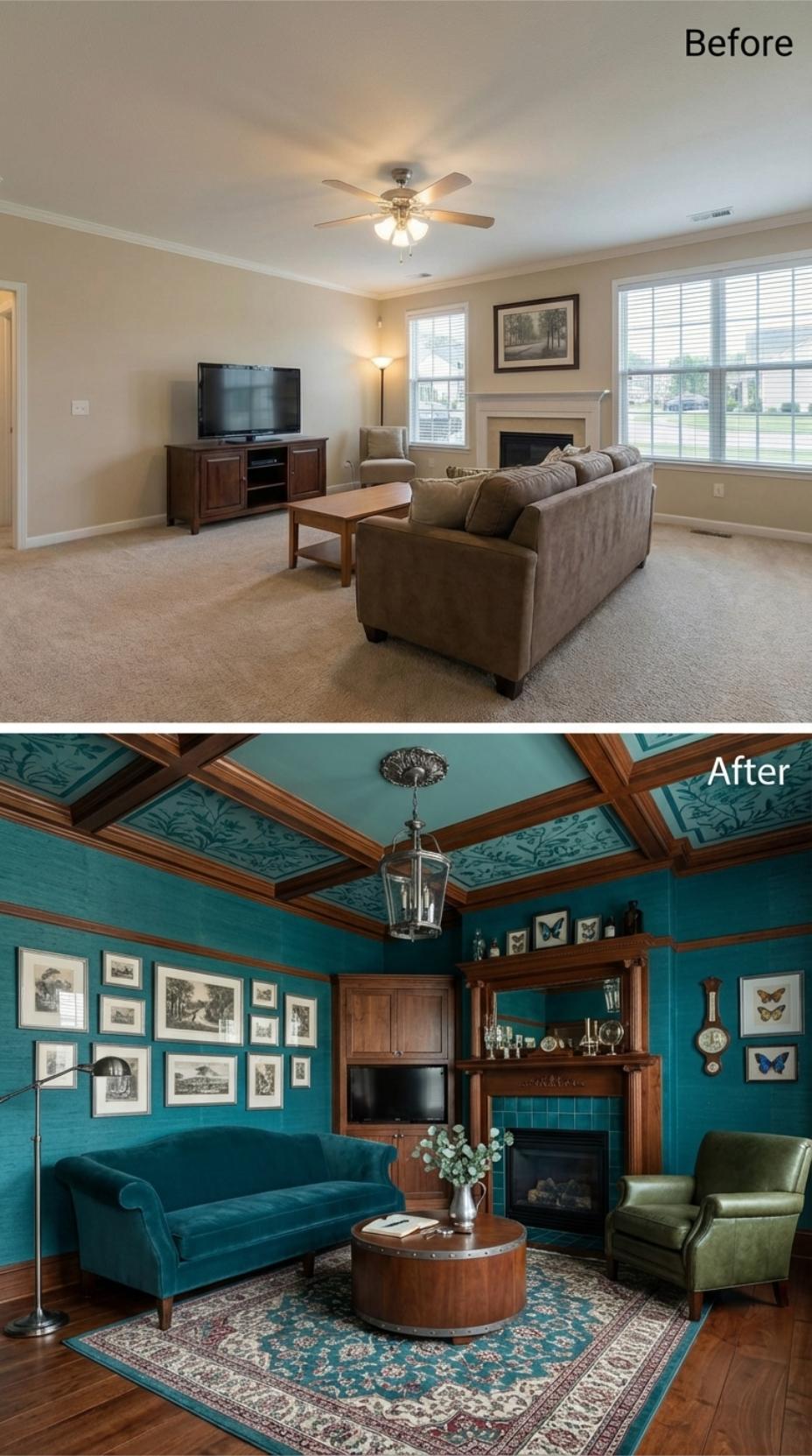
Teal grasscloth covers every wall surface, giving the room a texture that flat paint could never produce. Dark-stained wood beams form a coffered grid overhead, each recessed panel filled with teal botanical wallpaper in a leaf repeat pattern. A cast-iron lantern pendant drops from an ornate ceiling medallion at center. The fireplace surround trades its plain white mantel for dark walnut columns and teal ceramic tile, with a built-in cabinet above housing the television. A velvet chaise in matching teal anchors the seating area over a Persian-style rug, while a barrel-form drum coffee table in dark walnut sits at center. A green leather wingback chair adds contrast without fighting the palette.
Did You Know: Grasscloth wallcovering is woven from natural fibers like jute, seagrass, or sisal and bound to a paper backing, and because the weave is never perfectly uniform, every roll carries slight color variation that makes large wall installations look intentionally textured rather than flat. That variation is considered a characteristic of the material, not a defect, and designers often specify it precisely because no two rooms end up with identical results.
Walnut Slat Wall and Tray Ceiling Swap Beige Carpet and a Builder Fan for Modern Texture
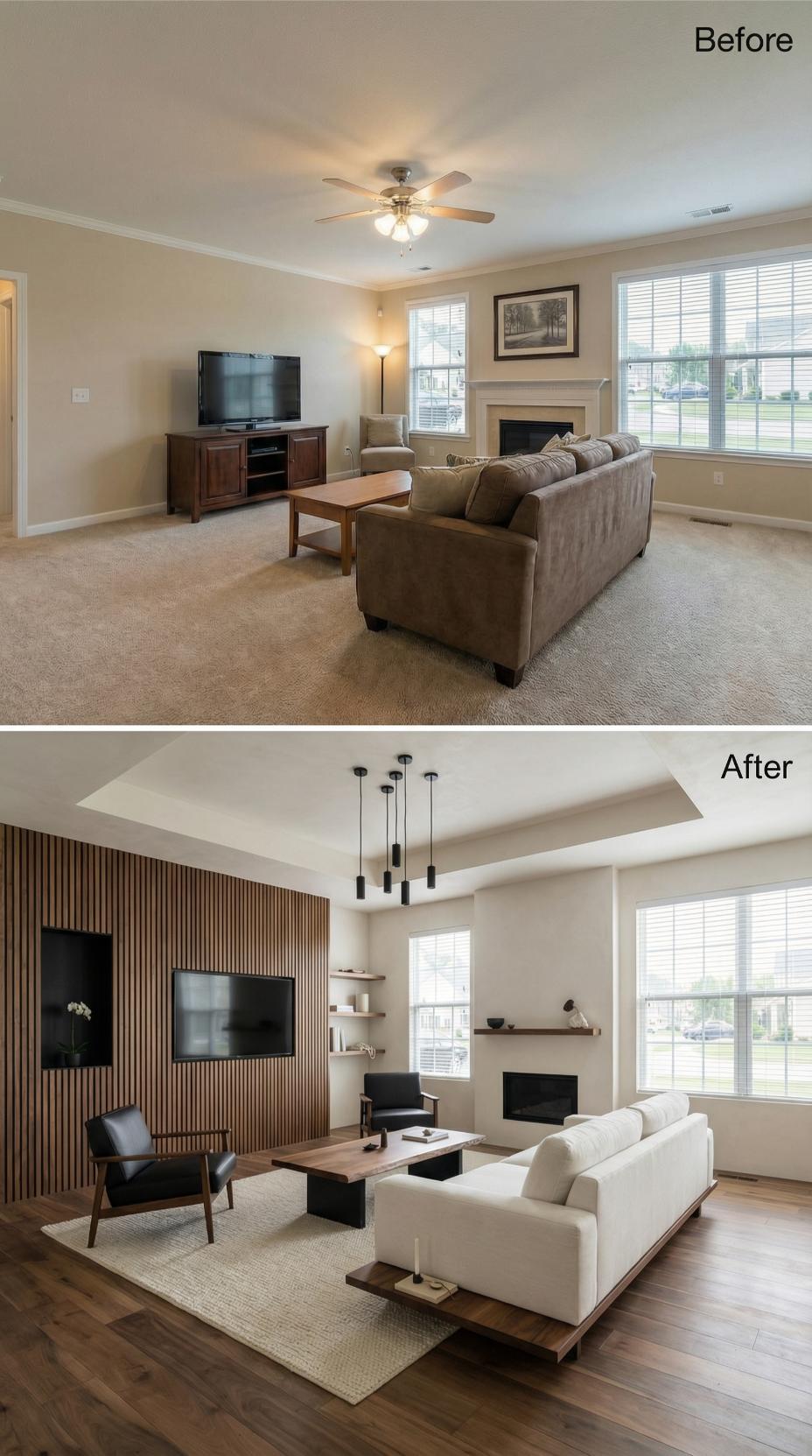
Vertical walnut slat panels now cover the entire left wall, with the flat-screen mounted flush inside a recessed niche cut directly into the slats. The ceiling fan is gone, replaced by a cluster of matte black pendant lights hanging at staggered heights from a tray ceiling with clean white reveals. Hardwood planks in a medium brown run the length of the room, and a low-profile sectional in off-white linen sits opposite a leather accent chair in near-black.
Floating shelves in the same walnut tone bracket the window between the slat wall and the fireplace surround, which lost its dark wood mantel in favor of a white plaster finish with a simple ledge shelf. A live-edge coffee table in dark walnut anchors the woven area rug beneath.
Why the Slat Niche Works Harder Than a TV Console
Cutting a recessed niche directly into a slat wall keeps all cable management hidden behind the panel substrate, which is typically 3/4-inch MDF mounted proud of the drywall. The surrounding slats draw the eye inward toward the screen rather than outward toward the edges of the installation. That centering effect is why designers specify niches over floating TV brackets when the wall itself is the focal point rather than the furniture below it.
Saffron Plaster Walls and a Block-Print Ceiling Swap Beige Carpet for Moroccan Warmth
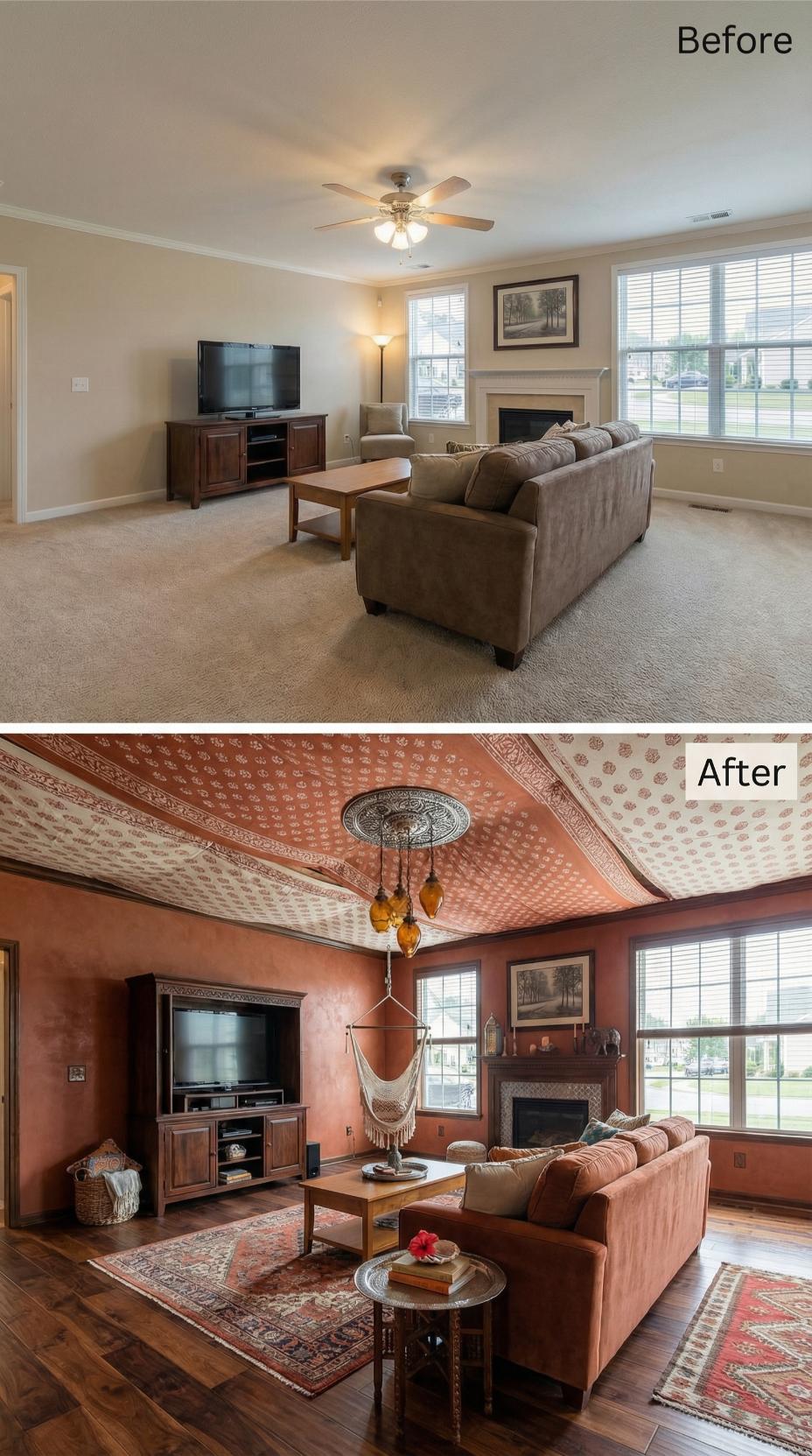
Hardwood planks replace the carpet, and terracotta-toned plaster covers every wall. The ceiling gets the boldest treatment: block-print fabric in rust and cream, draped and fitted across a barrel vault with a medallion at center and amber pendant globes hanging below.
Ask Yourself: Persian-style rugs laid over hardwood need a low-profile pad with a non-slip backing to prevent bunching under furniture legs. If you own two rugs of different sizes, layering a smaller runner across a field rug anchors a secondary seating zone without requiring a second sofa. Does your room have a natural second zone you’ve been ignoring?
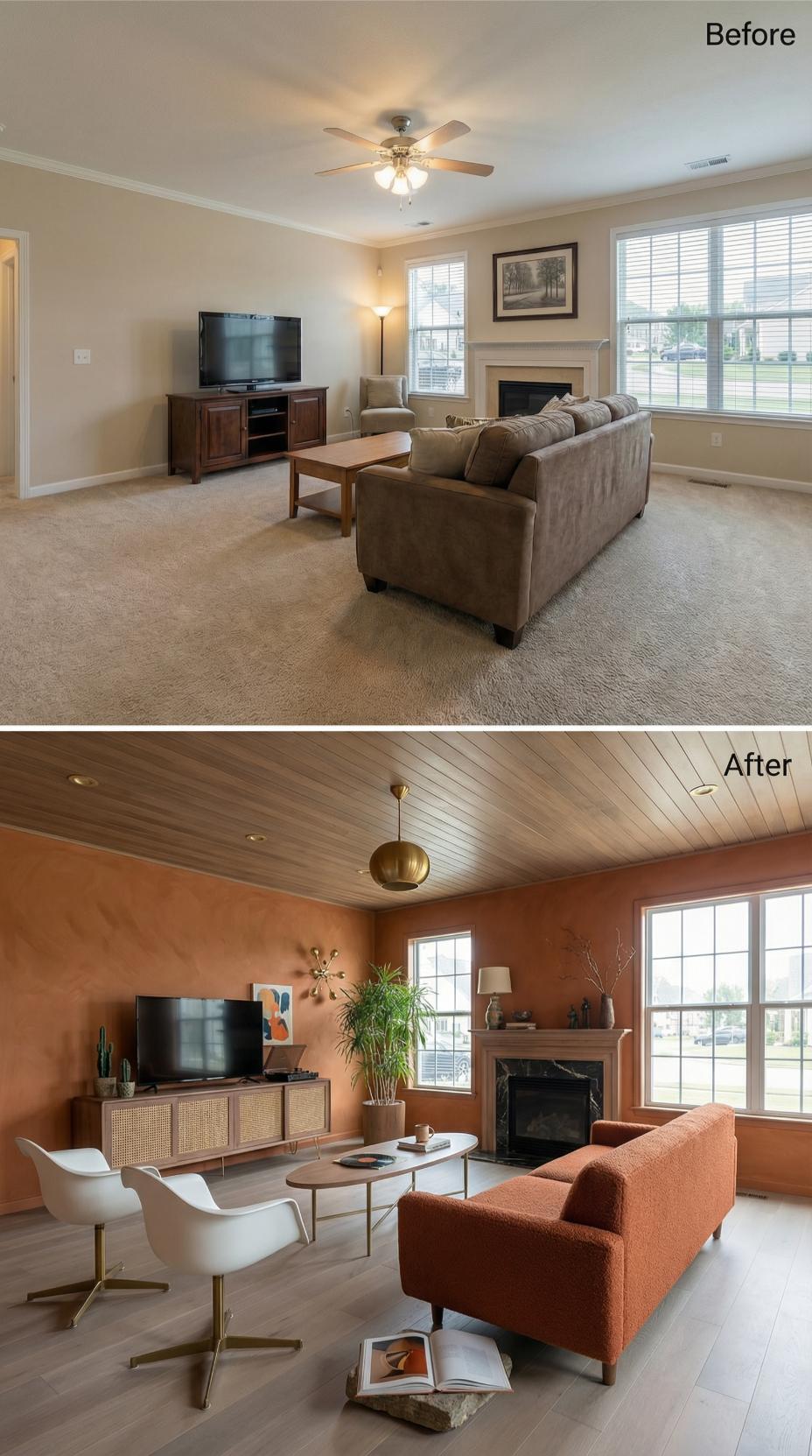
Burnt Sienna Plaster Walls and a Wood Plank Ceiling Retire Beige Carpet and a Builder Fan
🔥 Would you like to save this?
Terracotta plaster on every wall surface is a commitment, and this room makes no apologies for it.
The flat beige box overhead got replaced with tongue-and-groove wood planks in a natural oak tone, and a brass globe pendant now hangs where the ceiling fan spun. Walls landed in a deep burnt sienna with the matte, slightly uneven finish that mineral plaster produces when hand-applied in layers. A rust bouclé sofa anchors the right side while two white molded swivel chairs on brass pedestals hold the opposite corner. The TV console switched from dark stained wood to a cane-front cabinet in pale oak, and a large potted plant fills the gap between it and the fireplace, which picked up a dark marble surround somewhere in the process. Hardwood flooring in a light gray-washed finish replaced the carpet entirely, and a brass Sputnik wall sculpture adds a midcentury detail that keeps the room from reading as purely rustic.
Gothic maximalism makes the previous room’s moody navy palette look almost restrained by comparison.
Ribbed Vault Ceiling and Deep Plum Walls Bury a Builder Box Under Cathedral Gothic
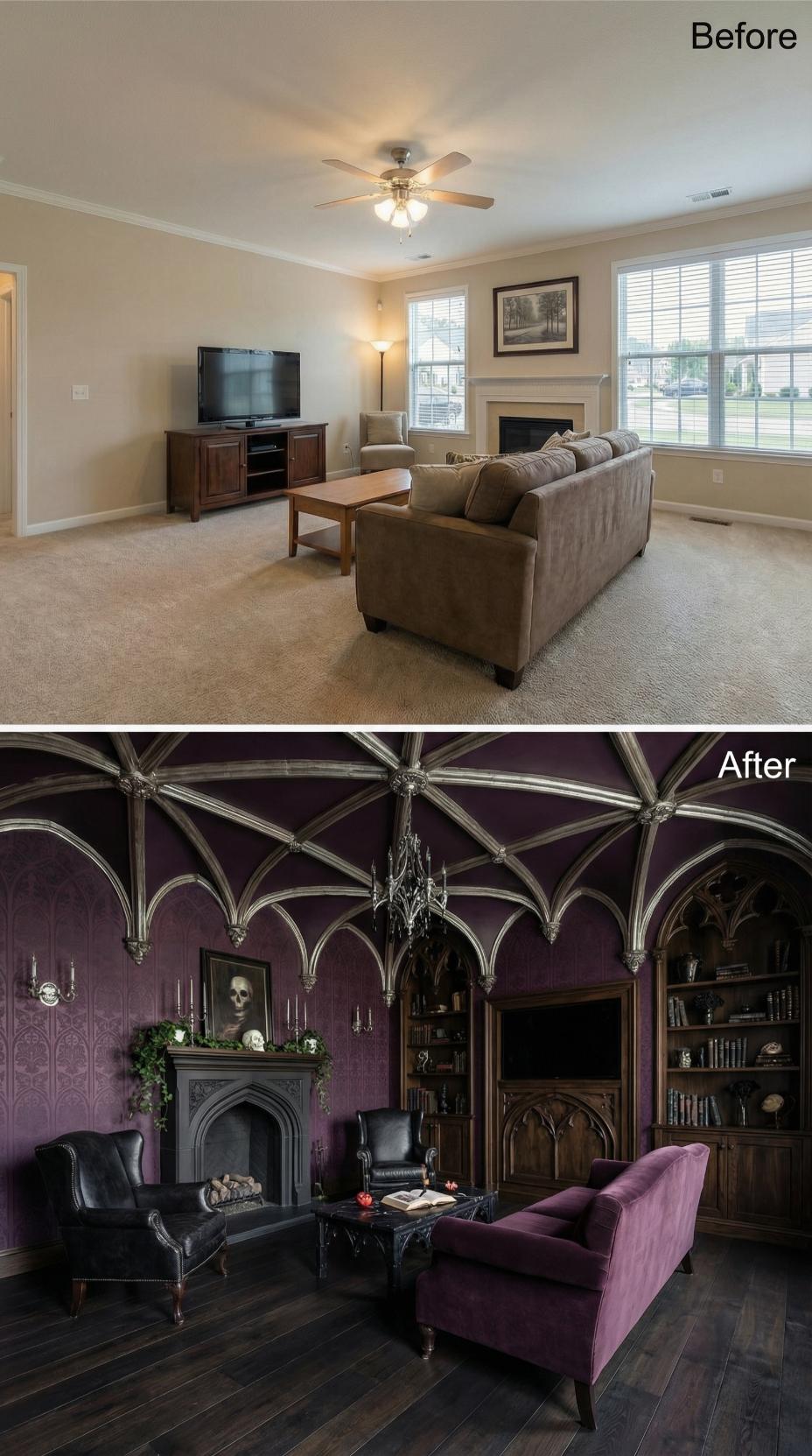
Gothic ribbed vaulting runs across the entire ceiling in silver-painted plaster, with pointed arch intersections and carved rosette bosses at each junction. Dark hardwood planks replace the original beige carpet. Damask-pattern wallpaper in deep plum covers every wall surface.
Black leather wingback chairs face a stone fireplace surround with a pointed Gothic arch opening. A velvet sofa in dusty violet anchors the seating arrangement. Candle-style sconces, a wrought-iron chandelier, and built-in dark walnut shelving complete the room without a single builder-grade fixture surviving.
transition: Ribbed vault ceilings like this one distribute visual weight through a network of raised arches rather than flat planes, which is why the ceiling reads as architectural rather than decorative. In genuine Gothic cathedral construction, those ribs carried structural load. Here they carry only atmosphere, but the geometry still follows the same pointed-arch logic. Installing a faux version requires a rigid foam or plaster substrate bonded to the drywall, and the paint finish matters significantly. A flat paint on the ribs kills the relief effect, while a metallic or satin finish catches light along each curved edge and sharpens the shadow lines between arch panels.
Curved Tray Ceiling With Cove Lighting Replaces a Builder Fan and Beige Carpet
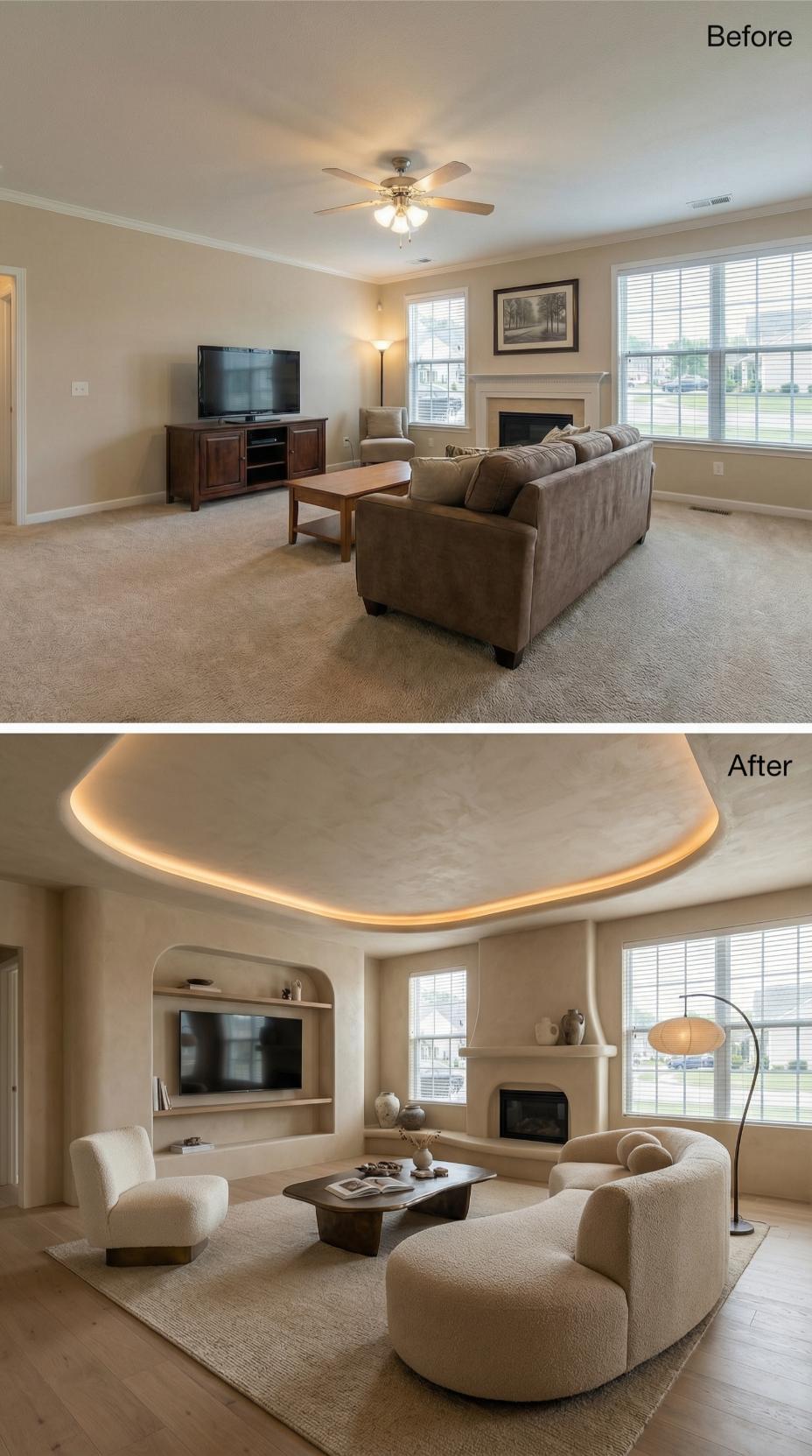
Boucle fabric curves on both the sofa and accent chair, a walnut coffee table sits low on a natural fiber rug, and an arched built-in niche frames the wall-mounted television where a dark wood media console once stood.
Dark Green Walls and a Coffered Wood Ceiling Bury Beige Carpet Under Craftsman Character
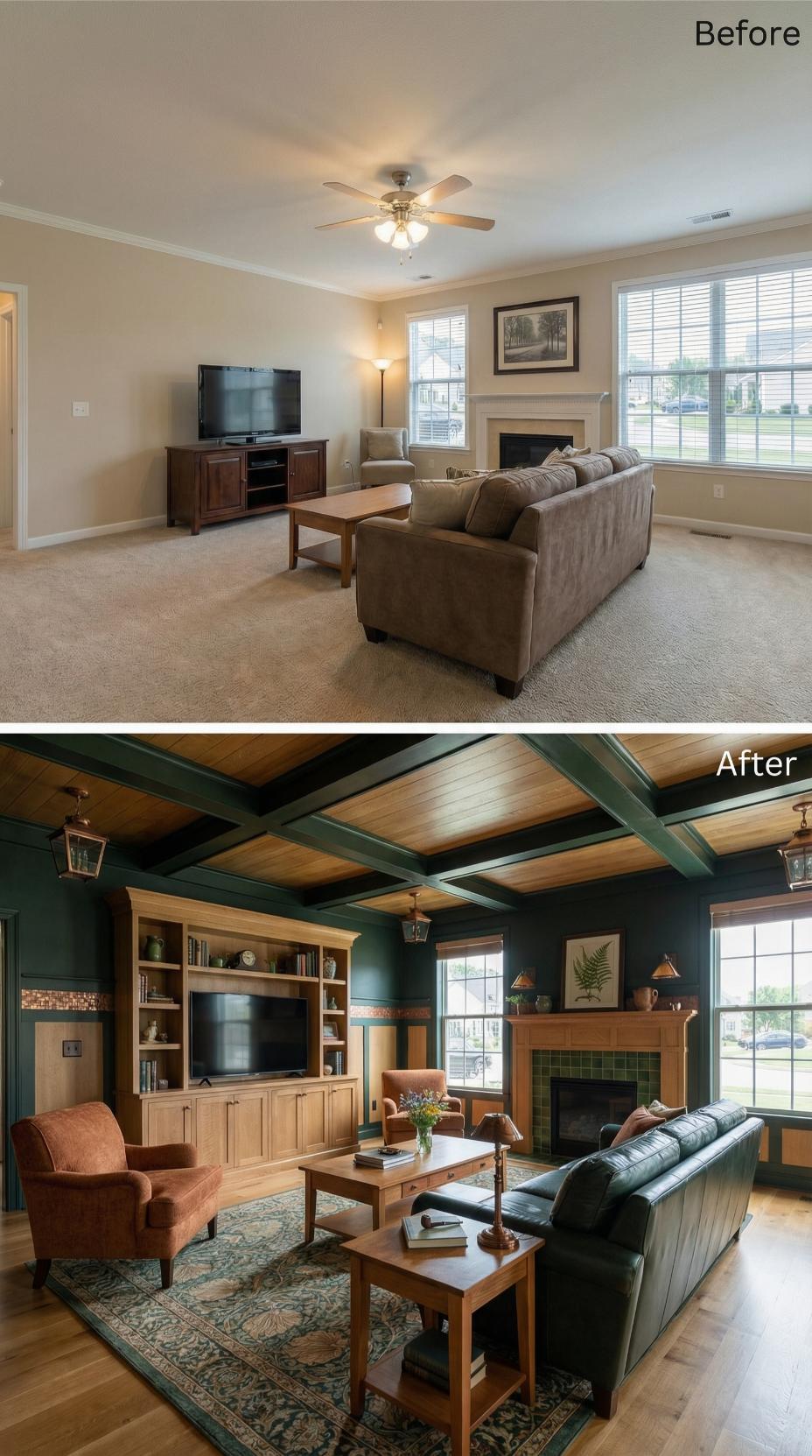
Builder beige carpet and a basic fan give way to quarter-sawn oak built-ins flanking a flat-screen, dark forest green walls with picture-rail wainscoting, and a coffered ceiling where green-painted beams frame natural wood panels. The fireplace surround picks up green subway tile, the sofa shifts to dark leather, and a Morris-style wool rug anchors two rust linen armchairs around a solid wood writing desk.
Black Lacquer Ceiling Mural and Teal Velvet Sofa Dismantle a Beige Subdivision Box
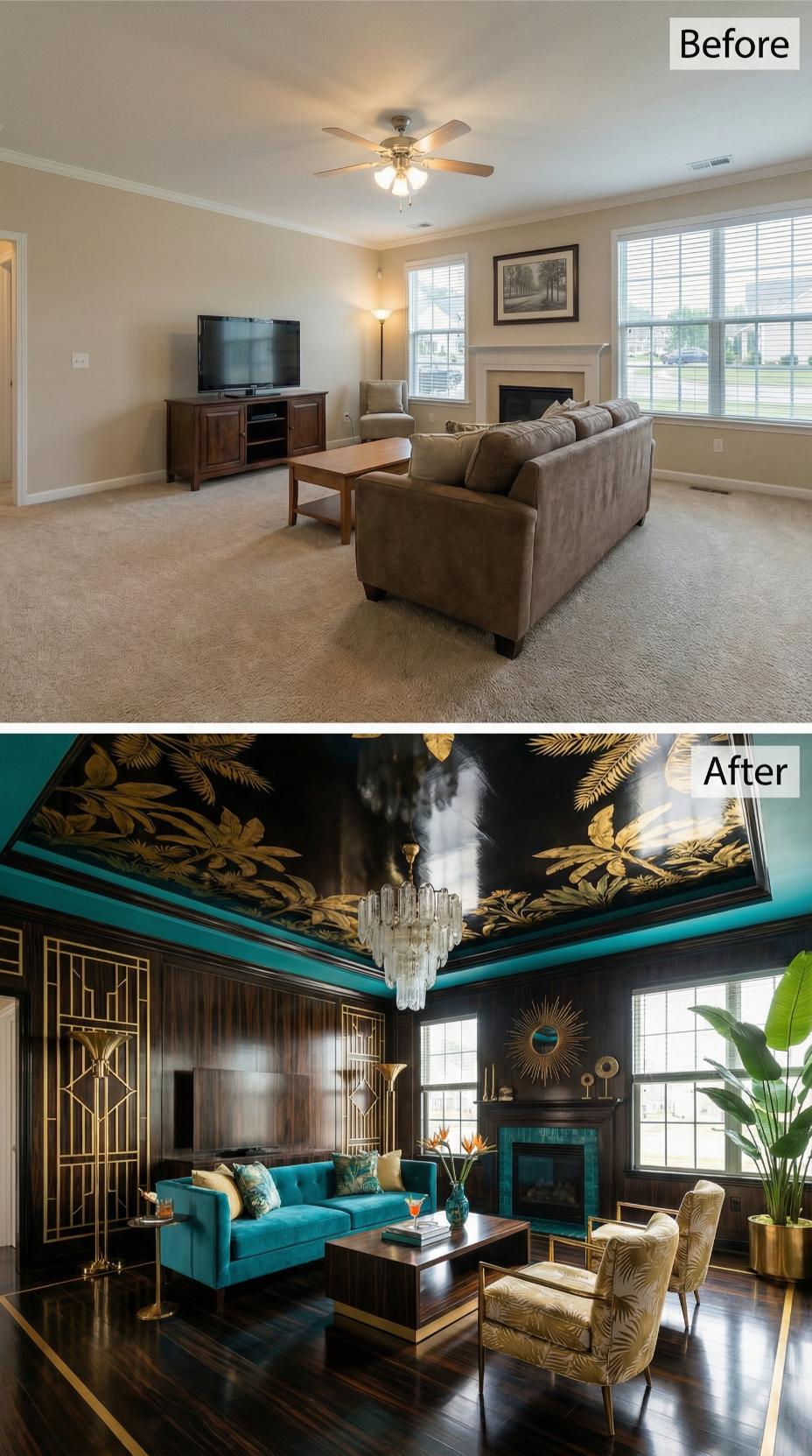
Gold-painted botanical fronds cover a black lacquered tray ceiling trimmed in teal, replacing what was once a standard fan fixture over beige carpet. Dark macassar-style wood paneling with inlaid brass Art Deco grid work lines the walls, and a Murano-style glass rod chandelier anchors the center. Teal velvet tufted sofa, palm-print accent chairs, and a teal mosaic tile fireplace surround pull the color palette floor to ceiling.
Concrete Plaster Walls and a Cove-Lit Tray Ceiling Retire Beige Carpet and a Ceiling Fan
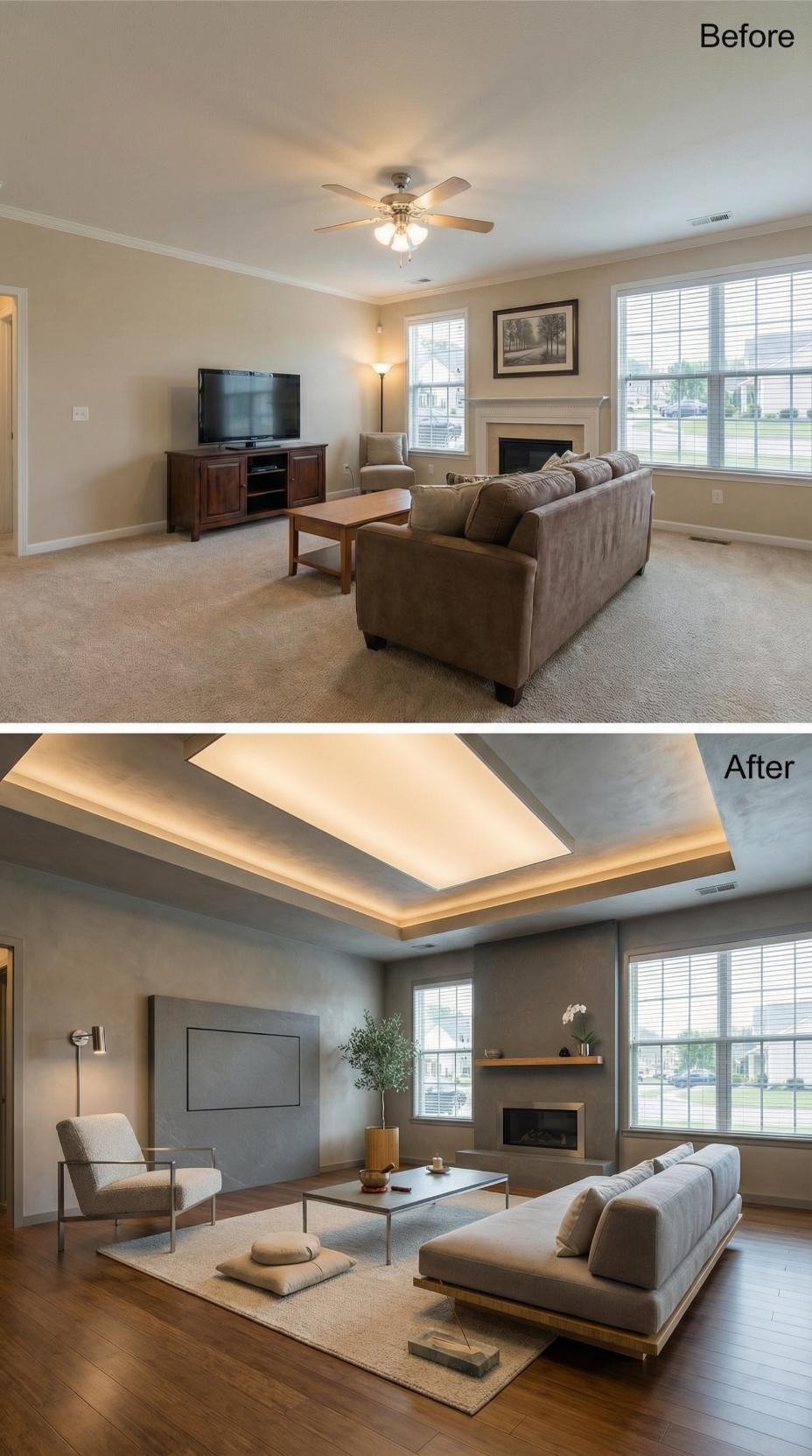
Warm-toned LED strip lighting runs the full perimeter of a recessed tray ceiling, casting indirect light across grey concrete plaster walls that replace what was once a flat, cream-painted box with crown moulding. Dark walnut-stained engineered hardwood covers the floor where carpet once sat. A low-profile sectional in oatmeal bouclé anchors a cream wool rug, while a slim chrome-leg lounge chair adds a hard edge against all that soft upholstery. The fireplace surround gets a natural oak floating shelf instead of the original painted mantel, and the wall-mounted flat screen sits flush against a large plaster panel rather than perching on a dark wood media console.
Royal Blue Damask Wallpaper and a Gold Coffered Ceiling Displace Beige Carpet Completely
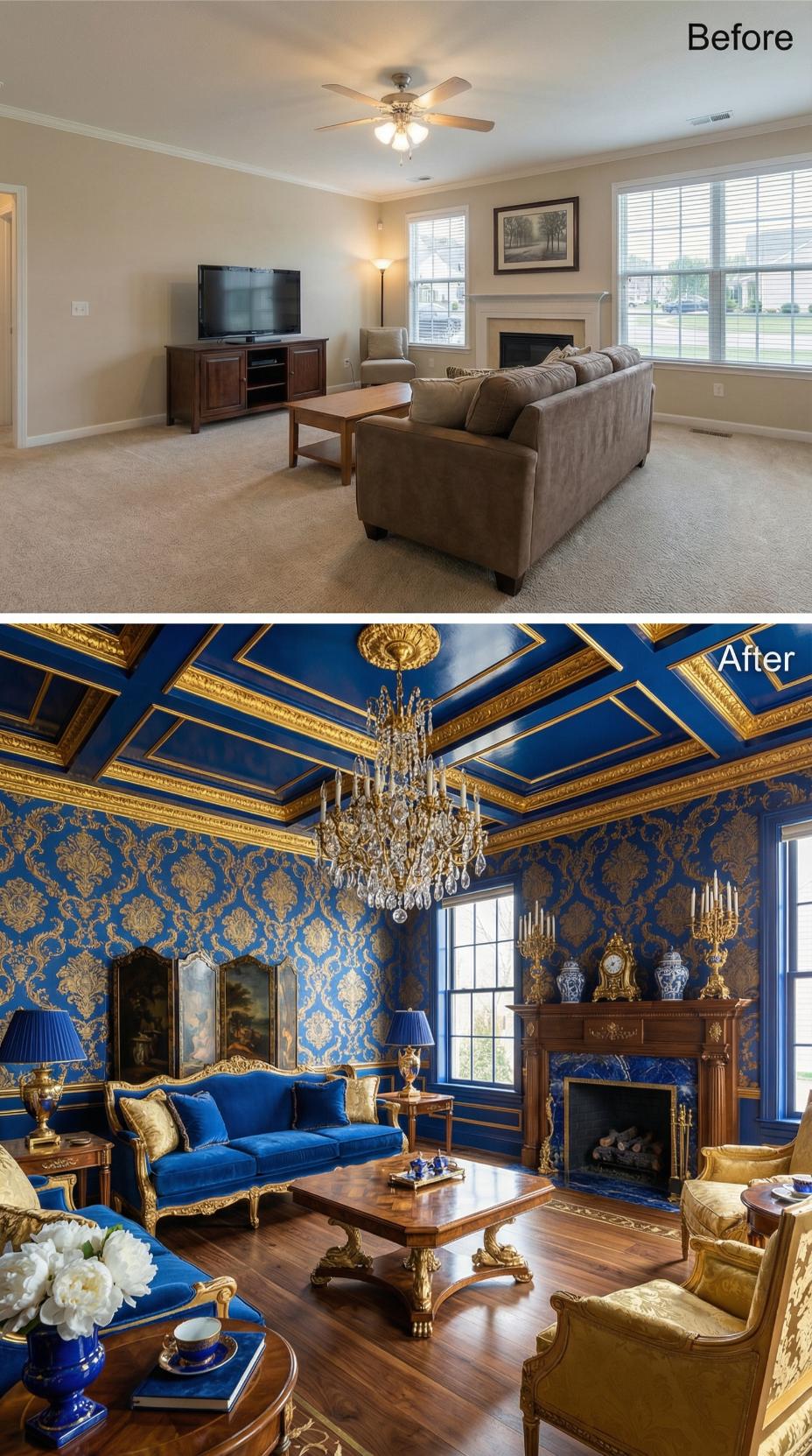
Blue velvet sofas with gilded carved frames anchor the seating plan while damask-patterned wallcovering in cobalt and gold wraps every wall beneath a coffered ceiling painted to match. A crystal chandelier with candle-style arms replaces the original builder fan, and lapis-veined marble surrounds the fireplace below a mantel dressed with blue-and-white porcelain ginger jars.
Oak Built-Ins and a Wood-Plank Ceiling Swap Beige Carpet for Arts and Crafts Warmth
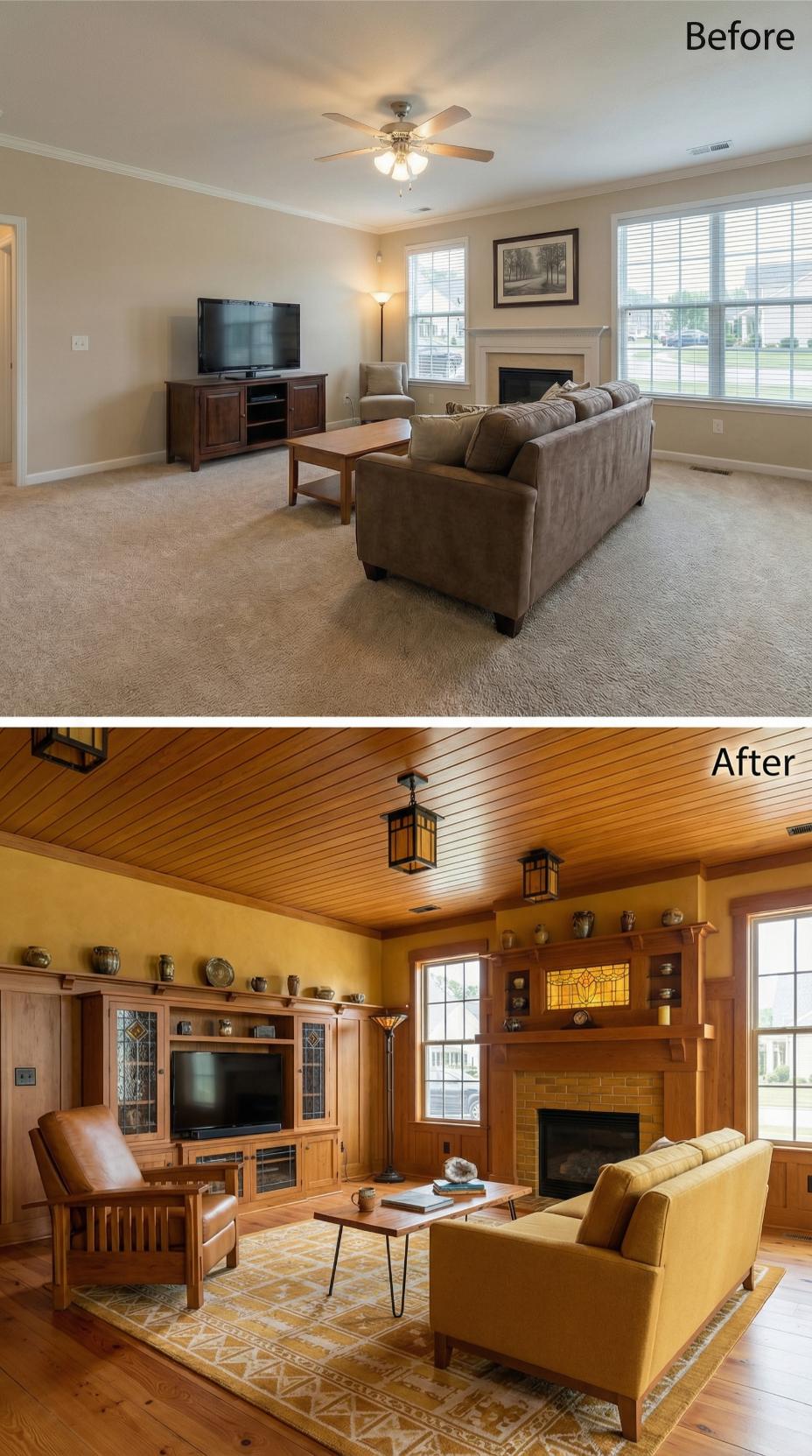
Quarter-sawn oak built-ins frame the TV on the left wall, while a tongue-and-groove wood plank ceiling and mustard plaster walls replace every trace of builder beige. Mission-style chairs, a yellow geometric rug, and arts-and-crafts pendant lanterns finish the shift.
Crimson Lacquer Ceiling and Tufted Velvet Sofa Bury Beige Carpet Under High-Gloss Drama
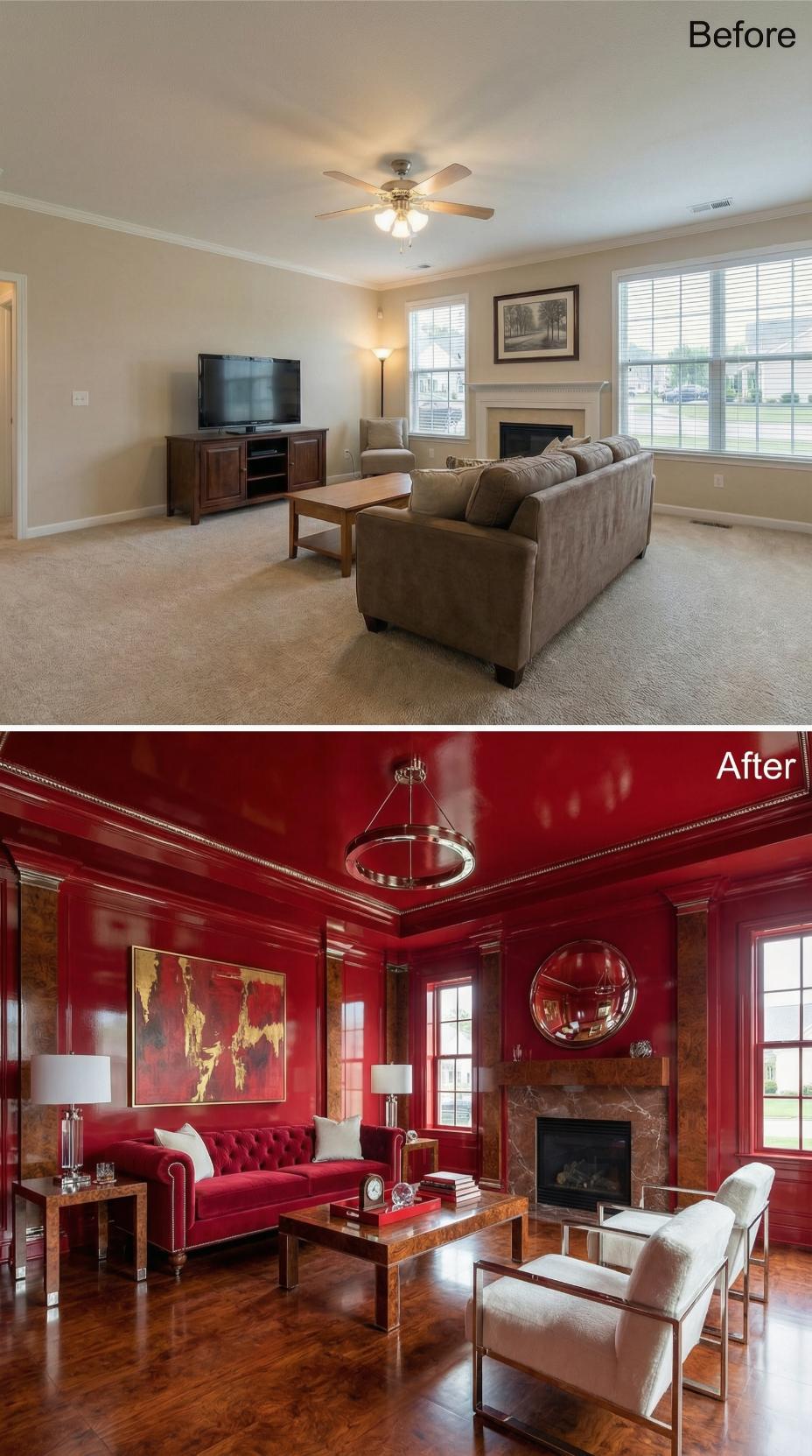
Every surface in the after photo carries the same deep crimson, from the high-gloss lacquered ceiling down the wainscoted walls to the tufted Chesterfield sofa in red velvet. Burled wood side tables and a rectangular coffee table break the saturated palette with warm amber grain. White upholstered chairs with chrome frames hold the composition from tipping too dark.
Crown molding detailed with a brass nail-head strip runs the full perimeter where ceiling meets wall. A circular pendant with a polished nickel ring replaces the builder fan. Hardwood floors in a rich cherry stain replace the original beige carpet entirely, and a convex mirror above the marble fireplace surround reflects the lacquer back across the room.
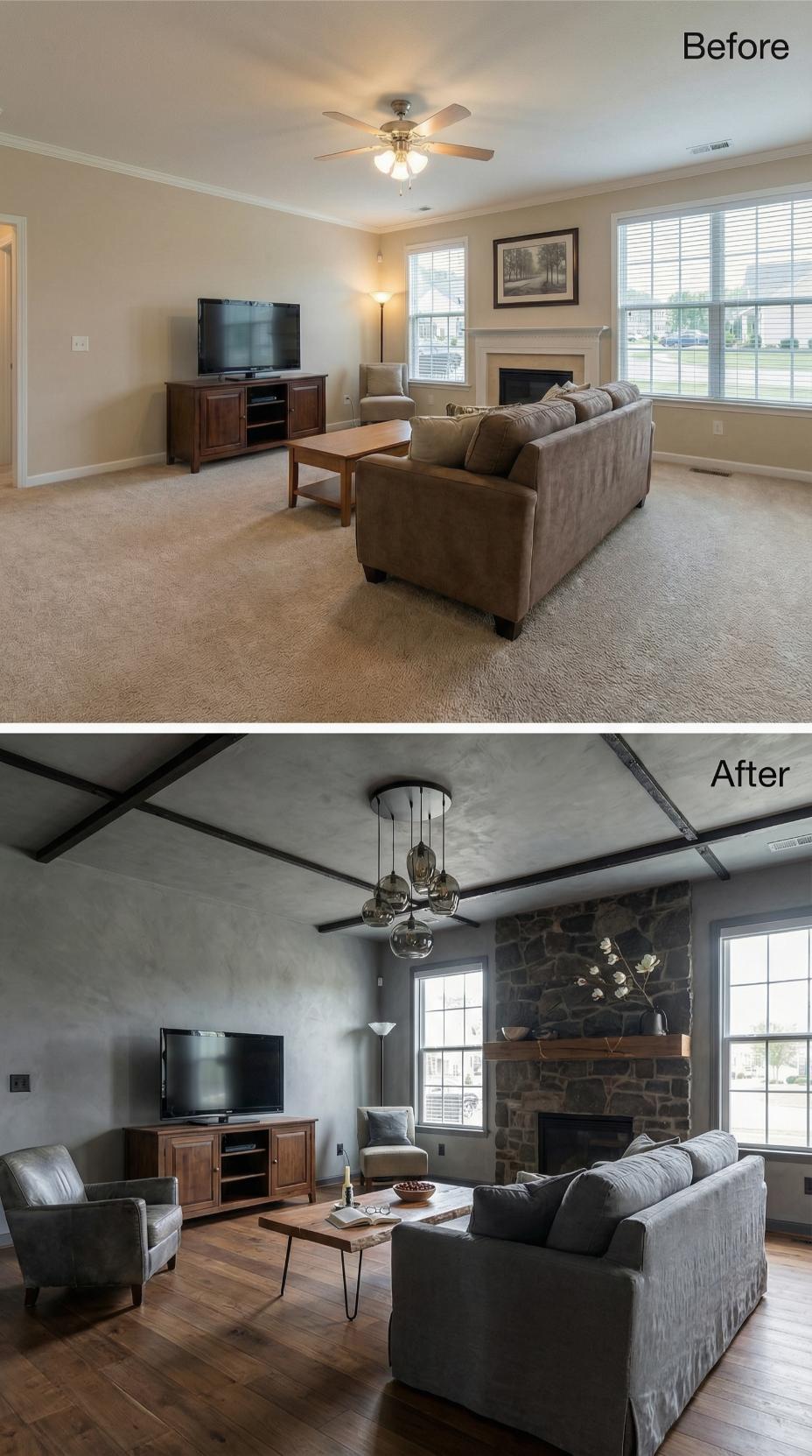
Stone Fireplace Surround and Cross-Beam Ceiling Bury Beige Carpet Under Industrial Weight
🔥 Would you like to save this?
Gray venetian plaster walls, dark steel cross-beams, and wide-plank hardwood replace beige carpet and a builder fan with a slate-toned, texture-driven room anchored by a stacked fieldstone fireplace.