🔥 Would you like to save this?
The kitchen has always been where the real party happens — but for the Social Architect, that truth carries genuine weight. These are the hosts who treat a dinner party like a curated experience, who understand that the room itself sets the tone before a single glass is poured. This gallery presents something genuinely new: before-and-after kitchen transformations conceived entirely by artificial intelligence, each redesign unlocking the latent potential of a builder-grade space and reimagining it as a stage worthy of the people who inhabit it. No two transformations are alike. Every material, every light source, every slab of stone was chosen with intention. The kitchen, it turns out, was always the art — it just needed the right eye to see it.
In order to come up with the very specific design ideas, we create most designs with the assistance of state-of-the-art AI interior design software. Also, assume links that take you off the site are affiliate links such as links to Amazon. this means we may earn a commission if you buy something.
Honey Oak Cabinets Give Way to Quiet Cream and Dramatic Black Frames
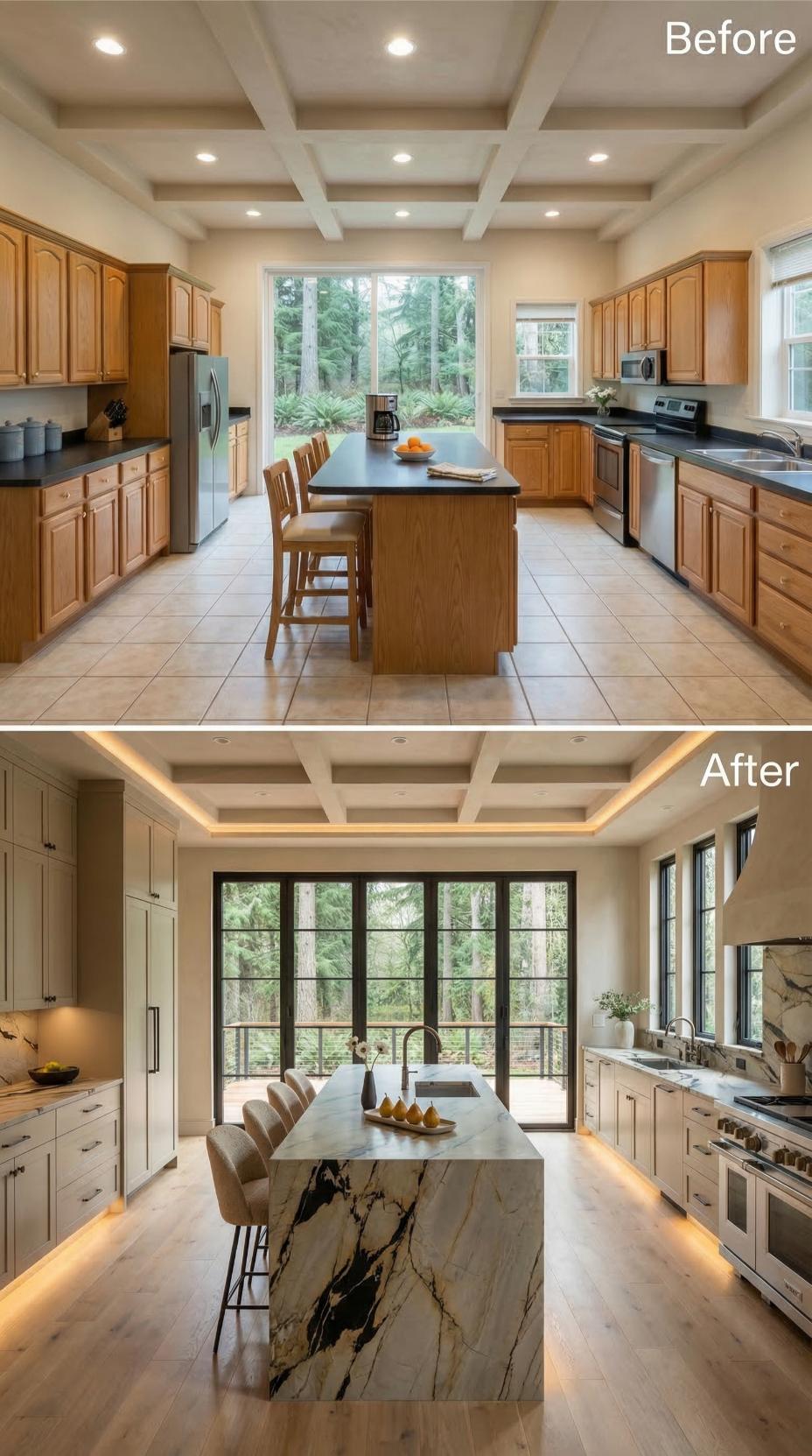
The original kitchen relied on golden oak cabinetry with arched cathedral doors and black laminate countertops. Beige walls and tan ceramic floor tiles created a warm but dated envelope. Recessed lighting punctuated the coffered ceiling above the central island with matching oak construction.
The redesign strips away the orange tones entirely. Flat-panel cabinets in soft cream now line both walls, extending to full height on the left for maximum storage. Light wood flooring in pale oak or ash replaces the tile grid. The island gains a waterfall edge in white marble veined with bold black striations. Five upholstered barstools in taupe linen face a new wall of black steel-framed glass doors that replace the white-trimmed window. Ambient LED strips glow within the coffered ceiling recesses, casting a golden wash across the white beams.
Brass Hardware and Amber Globes Warm the Navy Palette
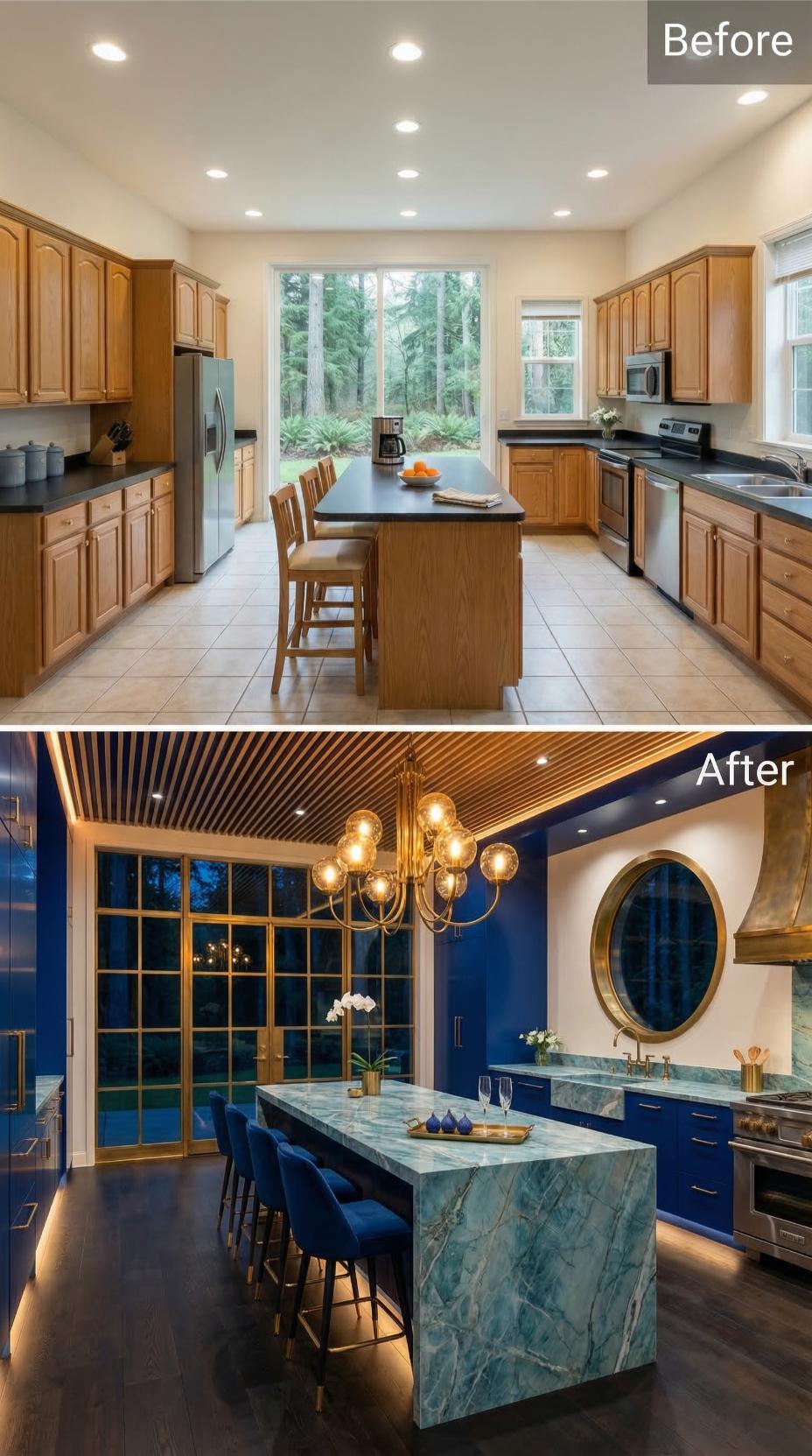
Navy blue flat-panel cabinetry wraps the perimeter, replacing the arched honey oak doors that once defined this space. The island features a dramatic waterfall edge in green-veined marble, a striking shift from the modest black laminate countertop and simple wood construction of the original layout. Brass hardware and fixtures add warm metallic accents against the deep blue surfaces, while a large circular mirror with a gold frame creates an unexpected focal point on the wall opposite the window.
Dark hardwood flooring replaces the beige tile, and a modern chandelier with amber glass globes hangs where recessed lighting once provided the sole illumination. The ceiling treatment introduces wood slat panels, adding architectural dimension to what was previously a flat white expanse. Upholstered navy bar stools line the marble island, turning the workspace into a destination for gathering rather than just meal preparation.
Forest Green Slab Cabinets and Recessed Ceiling Panels Erase Oak Nostalgia
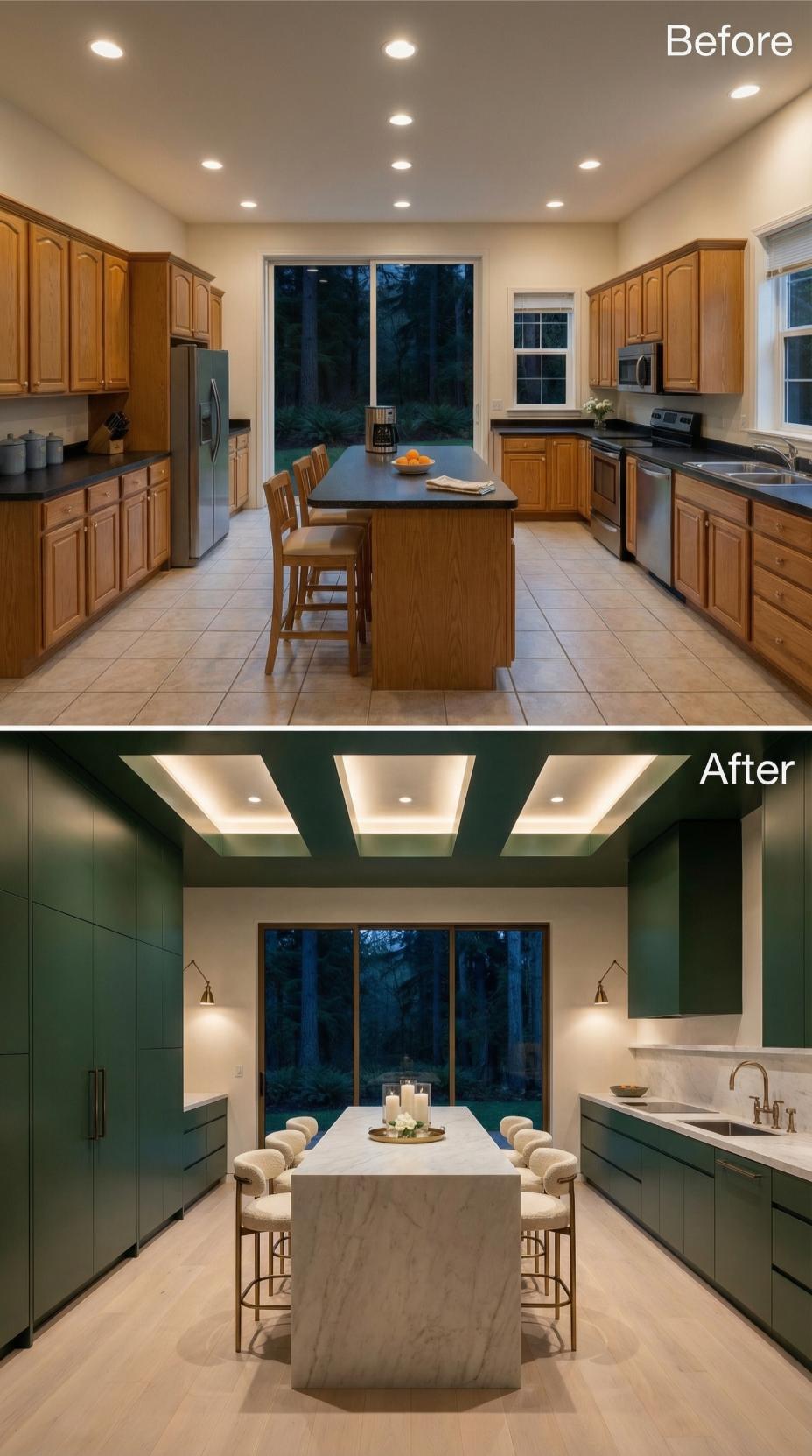
Deep forest green handleless cabinetry replaces honey oak raised-panel doors, introducing flat-slab fronts that stretch floor to ceiling. White marble countertops with subtle gray veining contrast sharply against the saturated green, while champagne gold bar stools with ivory boucle upholstery replace simple wooden chairs. Recessed ceiling panels with cove lighting create architectural depth where plain drywall once sat. Beige oak flooring supplants beige tile underfoot.
Wide-Plank Oak Flooring and Terracotta Stone Soften the Kitchen
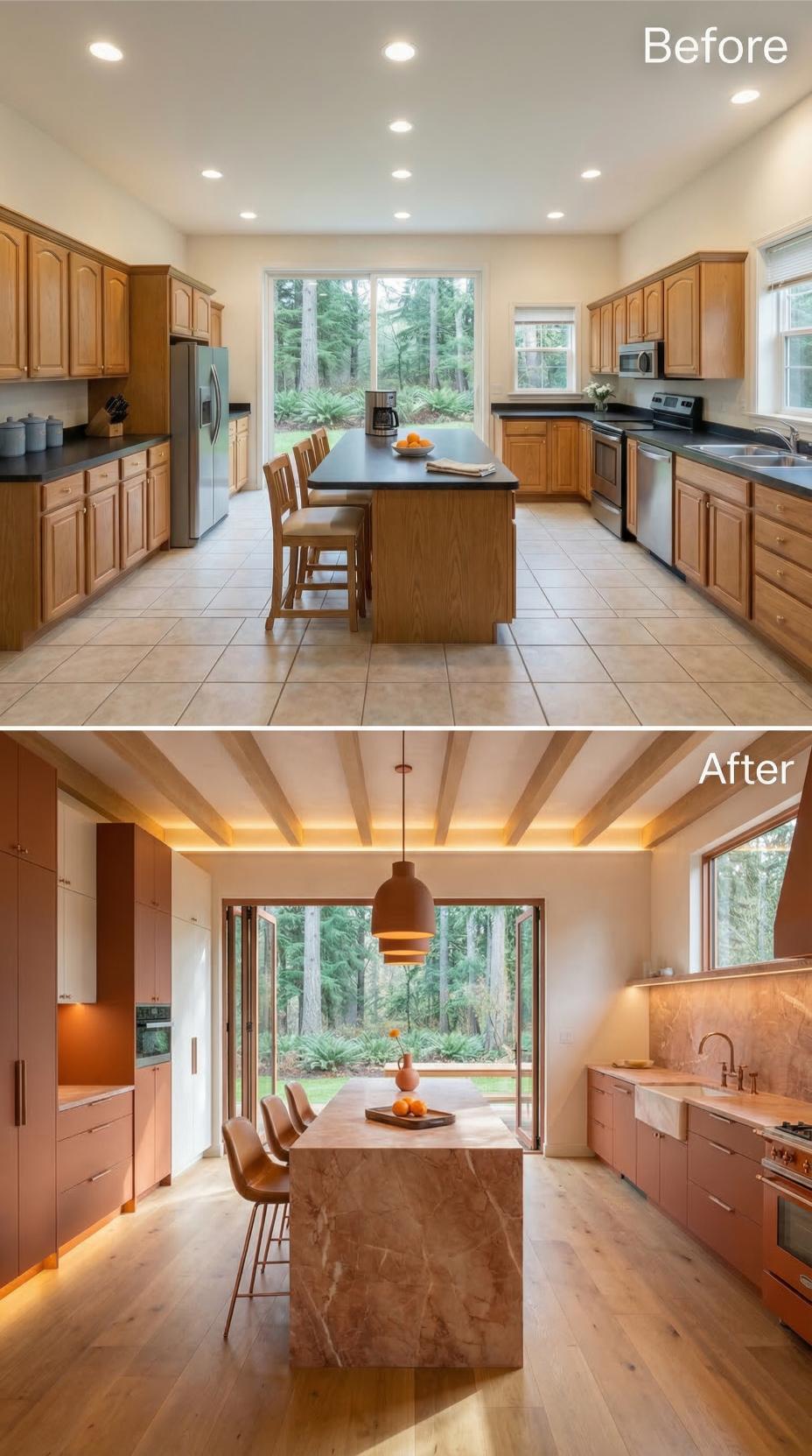
Flat ceilings vanish in favor of exposed blonde wood beams that carve dramatic architectural rhythm overhead.
Blonde wood cabinetry with sleek horizontal grain now wraps the perimeter in flat slab doors, accented by copper-toned lower cabinets on the left wall. The island shifts from dark laminate to a thick stone slab in warm terracotta tones, its veining visible across the waterfall edges. Glass accordion doors replace the static window, dissolving the barrier to the forest beyond. Pale oak flooring in wide planks replaces beige ceramic tile. Under-cabinet LED strips cast warm pools of light, while a single rust-colored dome pendant descends above the island, eliminating the grid of recessed cans that once dominated the space.
Ceiling-Height Cabinets and Brass Details Sharpen the Design
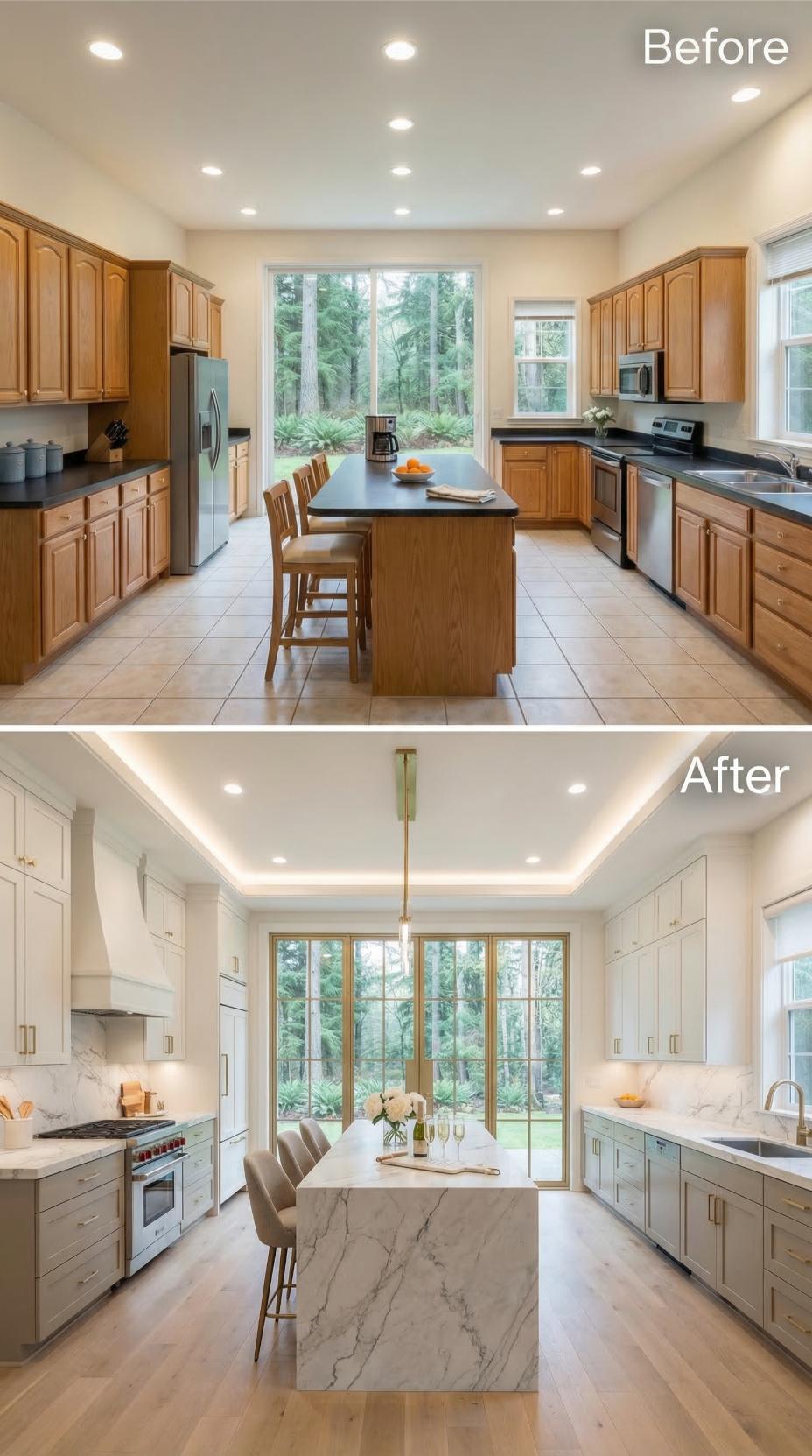
Cream-painted flat-panel cabinets stretch to the ceiling while a brass linear chandelier drops over a marble-slab waterfall island. Black countertops vanish in favor of white veined marble that wraps three sides. Beige tile floors become light oak planks, and the window expands into a full glass door with brass mullions framing garden views.
Herringbone Oak Floors and Waterfall Marble Anchor Modern Teal Geometry
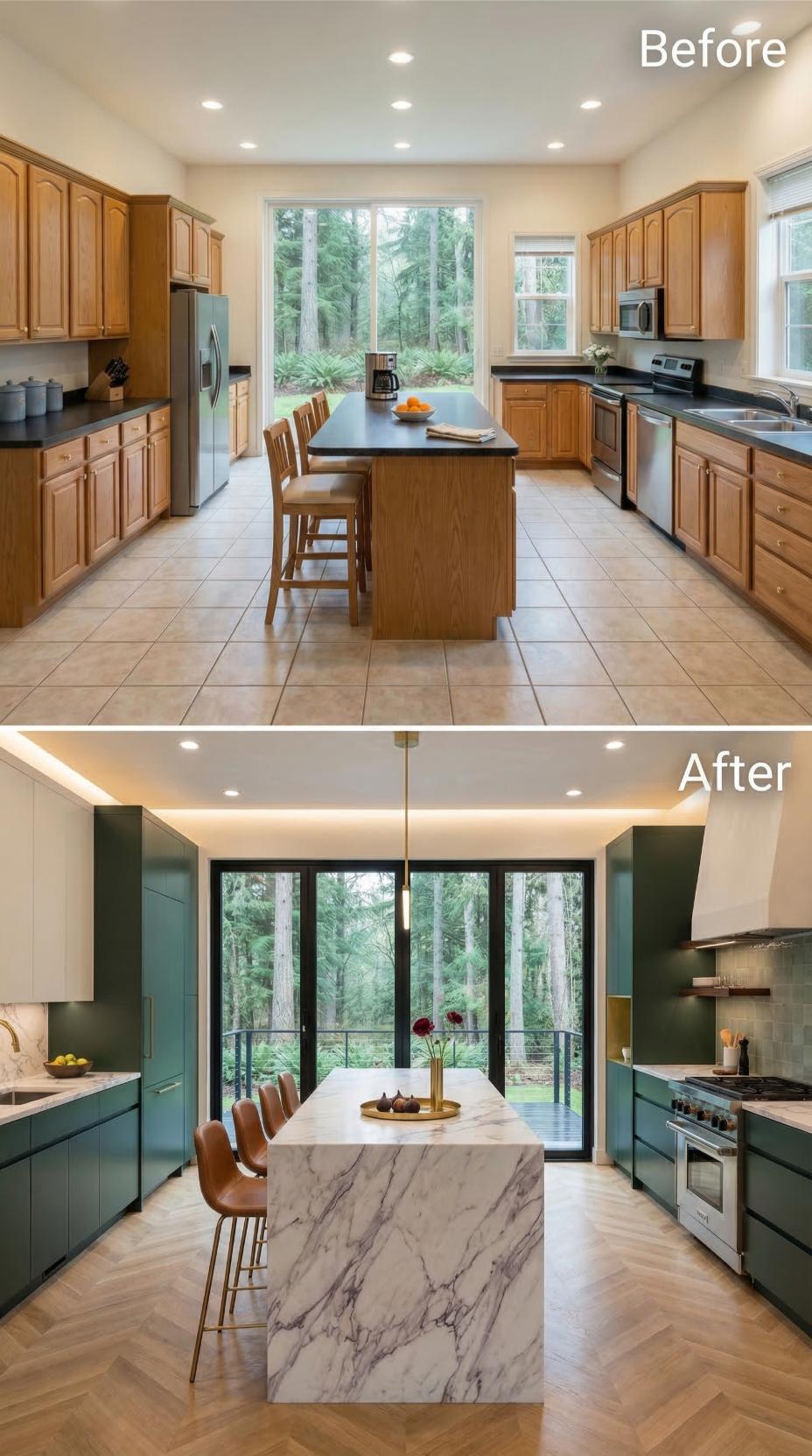
Flat-panel teal cabinetry replaces raised-panel oak, creating a modern slab aesthetic that eliminates visual clutter. The waterfall marble island features dramatic gray veining that cascades over both ends, anchored by cognac leather counter stools with tapered legs. Black-framed glass doors replace the original white vinyl windows, introducing industrial contrast against pale oak herringbone flooring.
Recessed LED strips illuminate the ceiling perimeter while a brass pendant with frosted globe descends over the island. Open shelving in pale oak appears between upper and lower cabinets on the right wall, displaying minimal decor against the deep teal backdrop.
Flat Slab Doors and Cove Lighting Erase Golden Oak Character
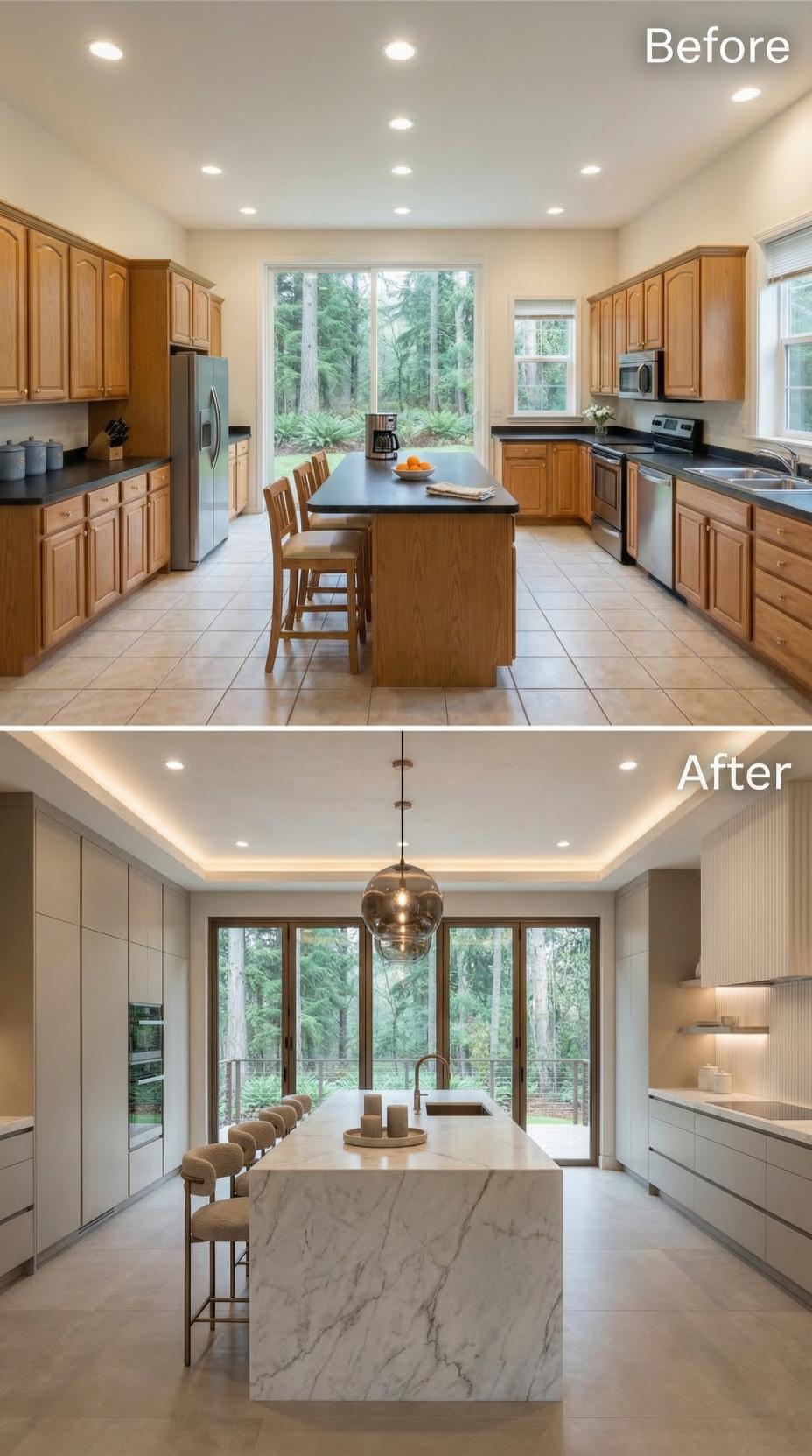
Handleless cabinetry in matte taupe extends floor to ceiling on the left wall, concealing integrated double ovens behind flush panels. A marble waterfall island with gray veining anchors the center, surrounded by four backless wood stools with round seats. The right side features white horizontal drawer fronts beneath a white subway tile backsplash.
Cove lighting wraps the perimeter ceiling in a warm glow, replacing the grid of recessed cans. French doors with wood frames now open to a deck, replacing the single window. Large format porcelain tiles in pale gray cover the floor.
Warm Oak Tradition Surrenders to Minimalist Marble and Cove-Lit Slab Doors
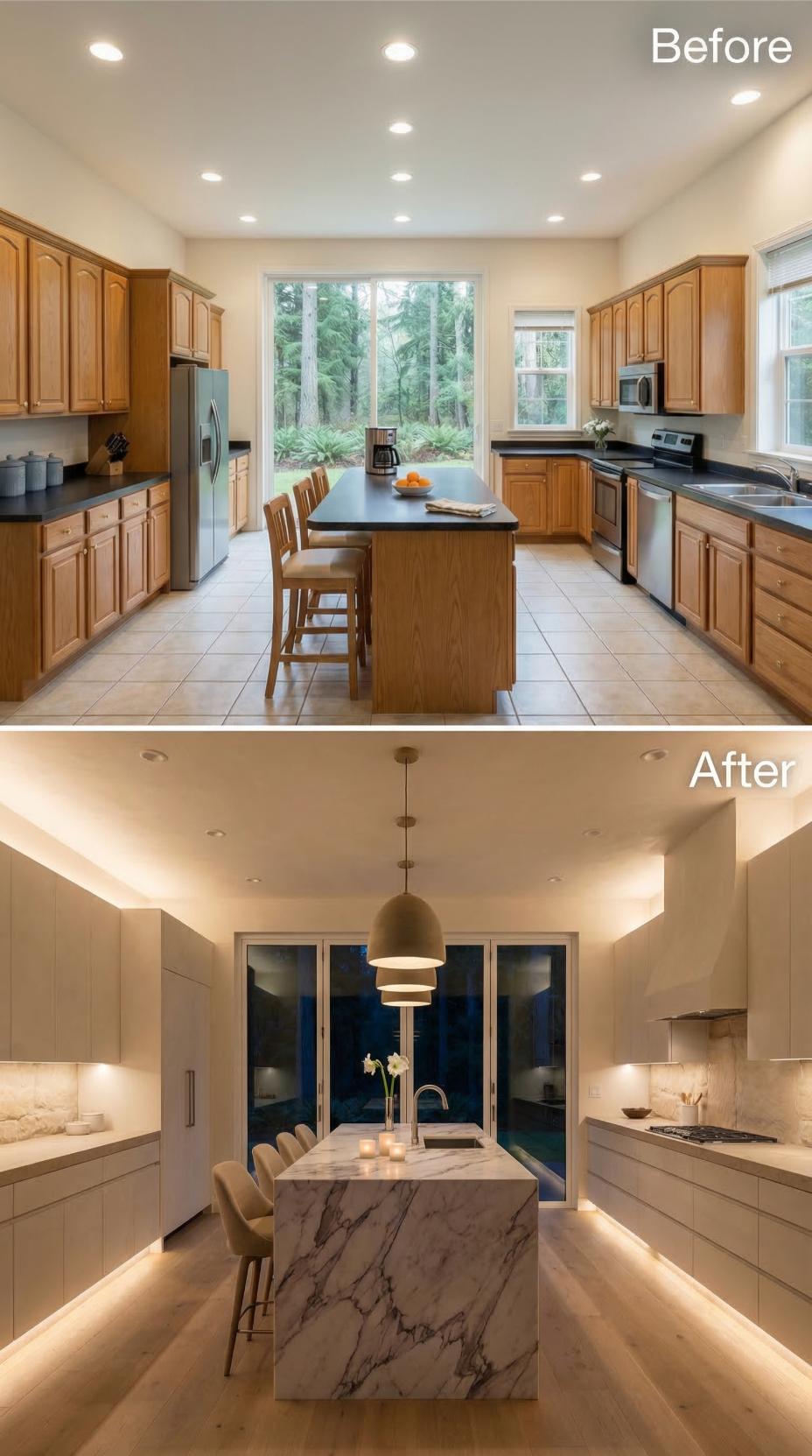
Recessed ceiling lights once cast an even glow over honey-toned raised-panel cabinets and black laminate countertops. Now horizontal slab cabinetry in pale taupe stretches wall to wall, punctuated by narrow finger pulls and illuminated from below with continuous LED strips.
A waterfall-edge marble island anchors the room, its gray veining cascading down both visible sides. Bronze dome pendants hang above, while black-framed glass doors replace the traditional window treatment. Under-cabinet lighting washes across white marble backsplashes, erasing any trace of the beige tile that once lined the walls.
Cove Lighting and Stone Waterfall Island Mark Departure from Raised-Panel Oak
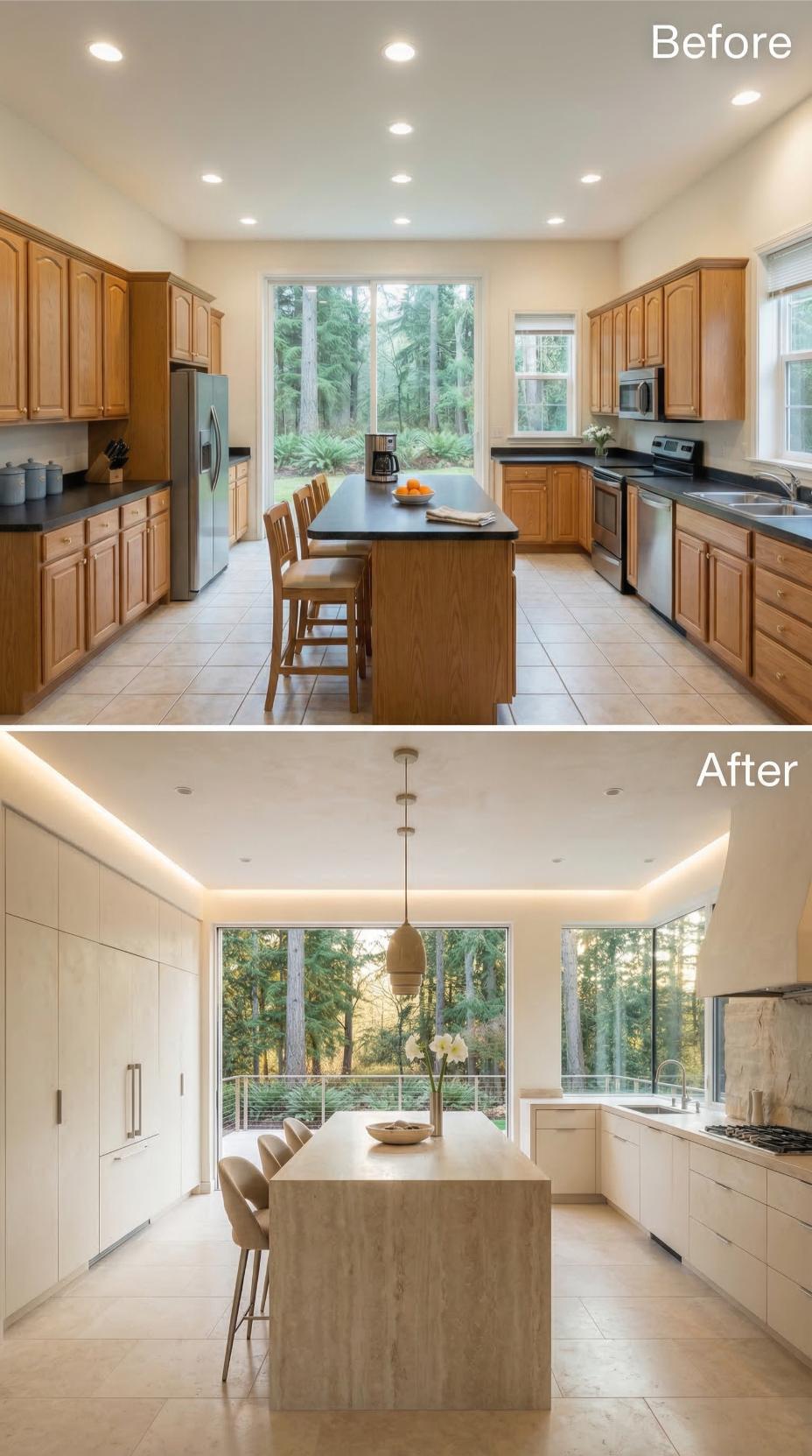
Pale wood slab cabinetry with horizontal grain replaces raised-panel oak, complemented by a full-height stone waterfall island in light travertine or similar composite. Perimeter cove lighting along the ceiling edges softens the volume, while three pendant globes descend over the seating area. Large corner windows now wrap the view, expanding from the single centered pane. Beige floor tile remains consistent across both phases.
History Corner: Cathedral-arch cabinet doors, popular from the 1980s through early 2000s, required router bits that cut decorative profiles into solid wood frames. Modern slab construction relies on edge-banded plywood or MDF, reducing both material waste and labor costs by roughly forty percent.
Charcoal Flat-Front Cabinets and Marble Waterfall Erase Beige Tile
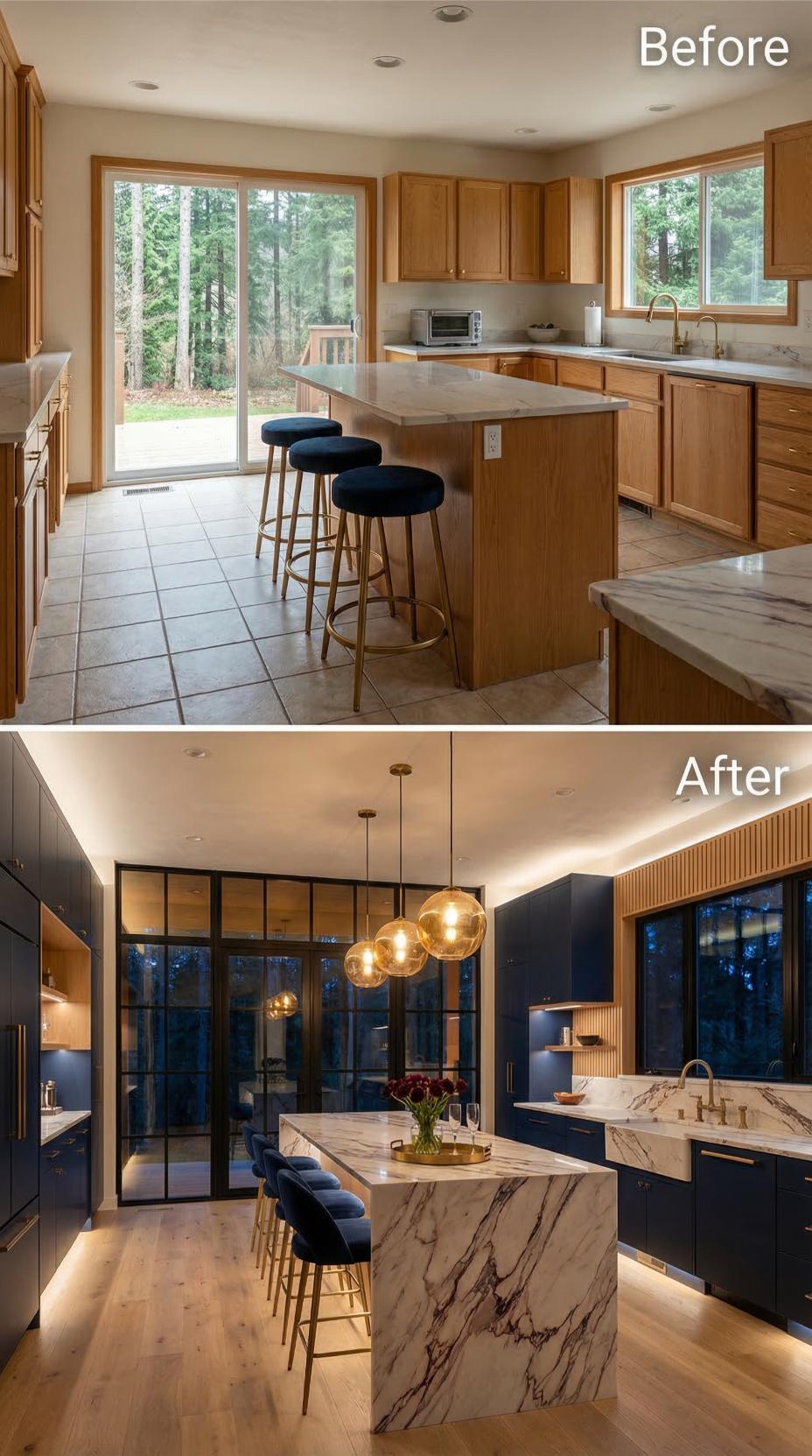
Charcoal slab-front cabinetry now wraps the perimeter in place of honey oak raised panels, creating uninterrupted vertical lines from floor to ceiling. Gold-toned spherical pendants hang above a center island clad entirely in book-matched marble with dramatic red and gray veining, replacing the original builder-grade peninsula. Black steel-framed doors with divided lites separate the cooking zone from the outdoor deck, a stark contrast to the sliding glass door that once occupied the space.
White oak flooring in a natural finish runs the length of the room, eliminating the grout lines of cream-colored ceramic tile. Vertical wood slat paneling in a light oak tone backs a shallow display niche on the right wall, adding texture to an otherwise flat cabinetry plane. Brushed gold cabinet pulls and a matching bridge faucet reference the warm metal of the pendant fixtures overhead.
Industrial-Grid Windows and Stone Waterfall Counter End Tiled Oak Era
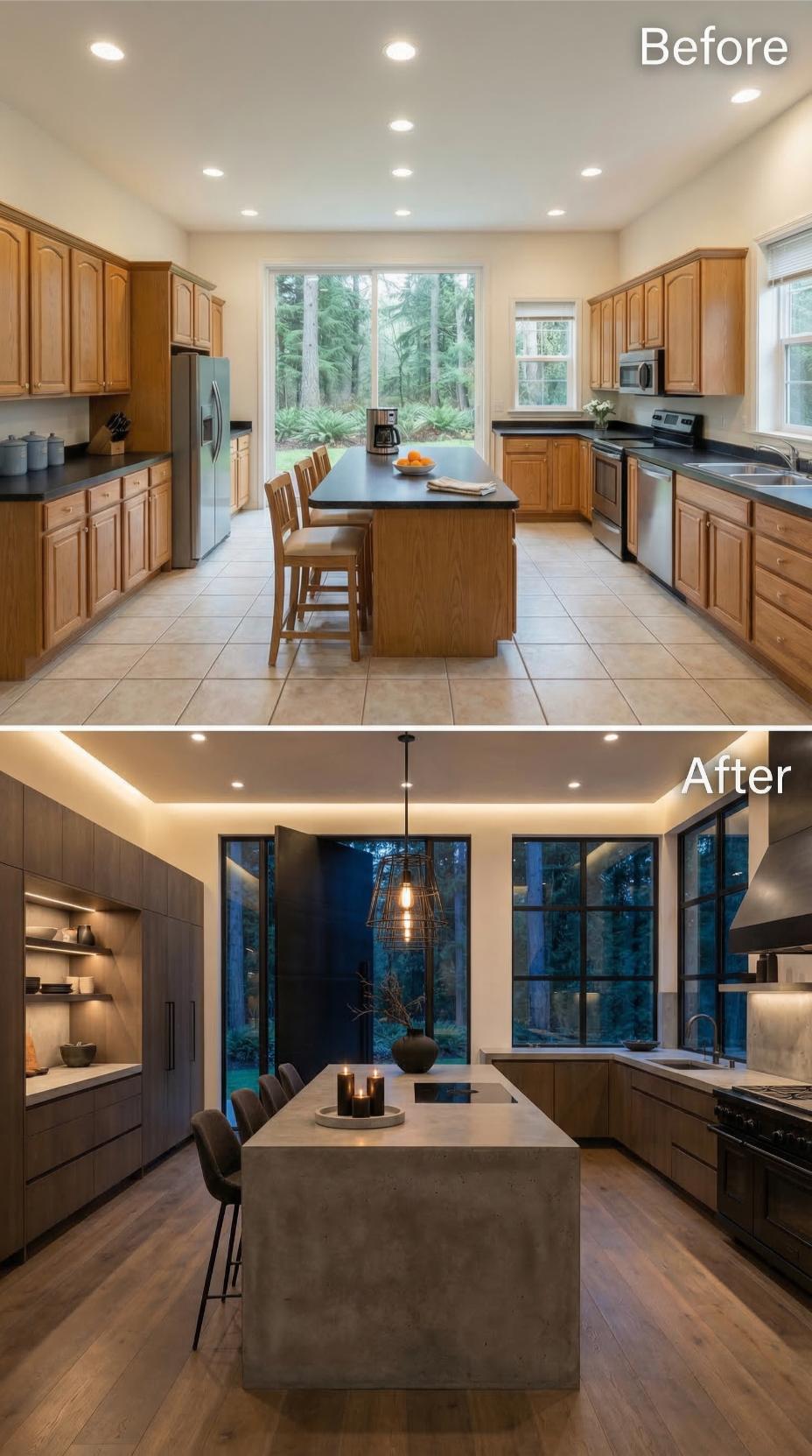
Black-framed industrial windows stretch across the back wall, replacing white vinyl mullions. A central island clad in gray concrete or quartz extends into a waterfall edge on both sides, creating a monolithic focal point. Flat-panel taupe cabinets eliminate raised cathedral doors entirely, with long horizontal pulls in dark bronze.
Hardwood flooring in medium walnut replaces beige ceramic tile. A single pendant fixture with an open wire cage hangs above the island, suspended by a slender rod from the tray ceiling. LED strip lighting runs along the ceiling perimeter, casting ambient light upward. Open shelving on the left wall adds display space where solid cabinet doors once closed off the room.
Marble Waterfall Island and Cove-Lit White Cabinets Retire Beige Tile
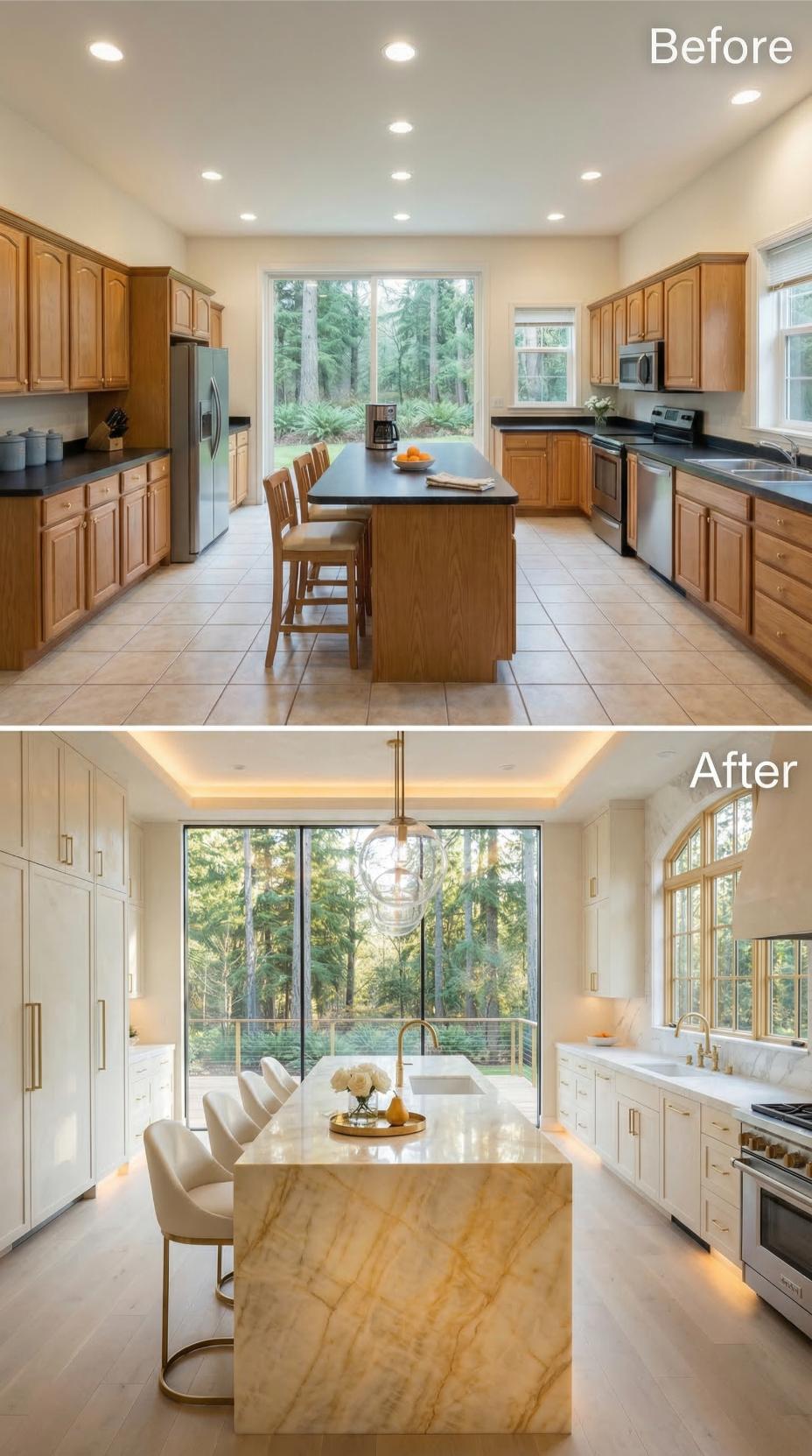
White slab-front cabinetry stretches floor to ceiling with narrow brass pulls and integrated cove lighting along the soffit. A dramatic quartzite island features a full-height waterfall edge and seats four ivory leather counter stools. Glass-paned black steel doors replace the former white-trimmed window, while large-format porcelain tile replaces diagonal beige squares underfoot.
Green Marble Waterfall Island and Smoked Glass Pendants Close the Oak Cabinet Chapter
🔥 Would you like to save this?
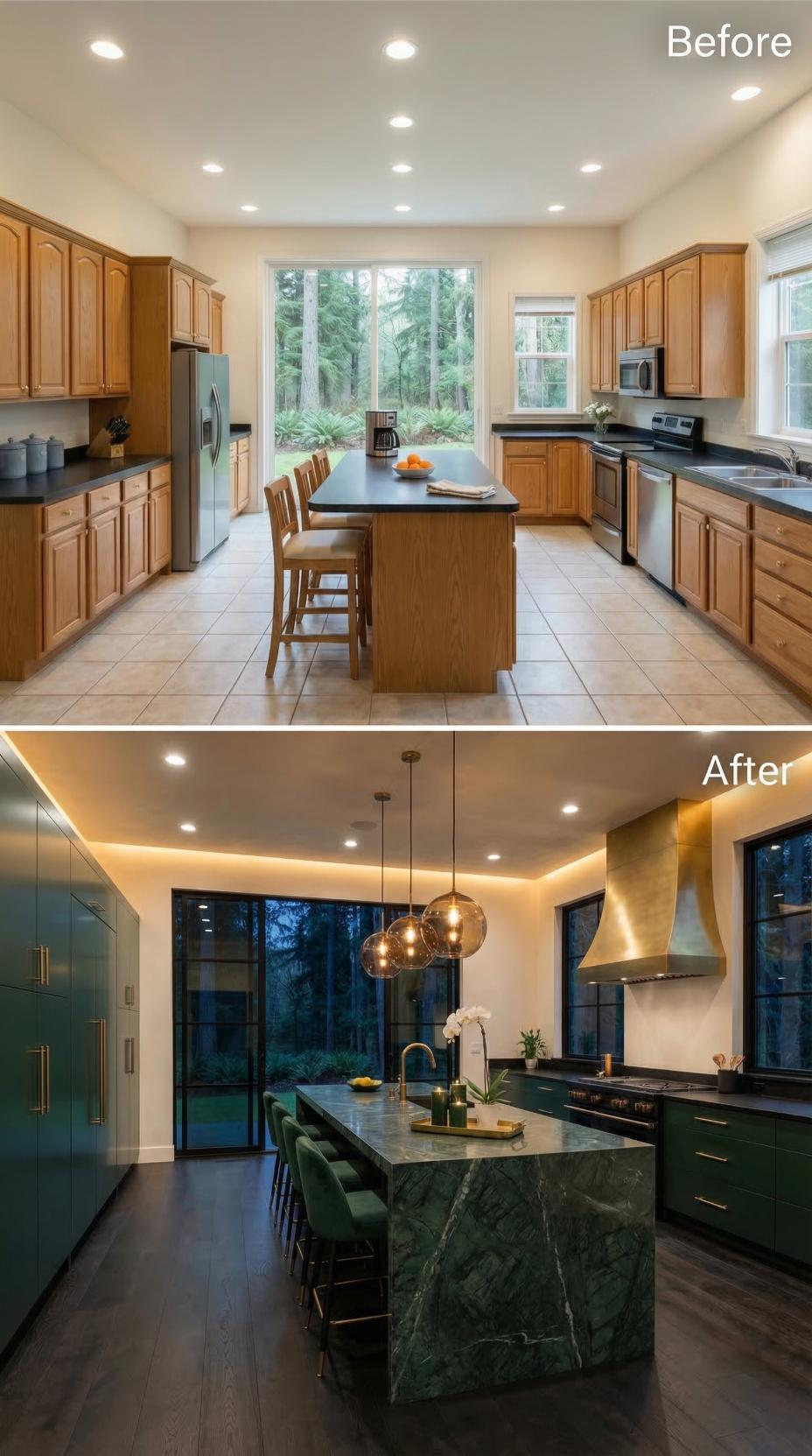
Dark green slab cabinets with brass bar pulls line both walls, eliminating the raised-panel oak and tile that once dominated. The island wears a green marble waterfall edge with dramatic white veining, paired with four velvet counter stools in matching emerald.
Smoked glass globe pendants hang from oil-rubbed bronze rods above the seating area. Cove lighting runs the ceiling perimeter, replacing the grid of recessed cans. Black-framed glass doors now open to the trees where a traditional white window sat before. Dark oak-look luxury vinyl plank flooring replaces beige diagonal tile.
Copper-Toned Slab Cabinets and Veined Stone Island Succeed Beige Tile
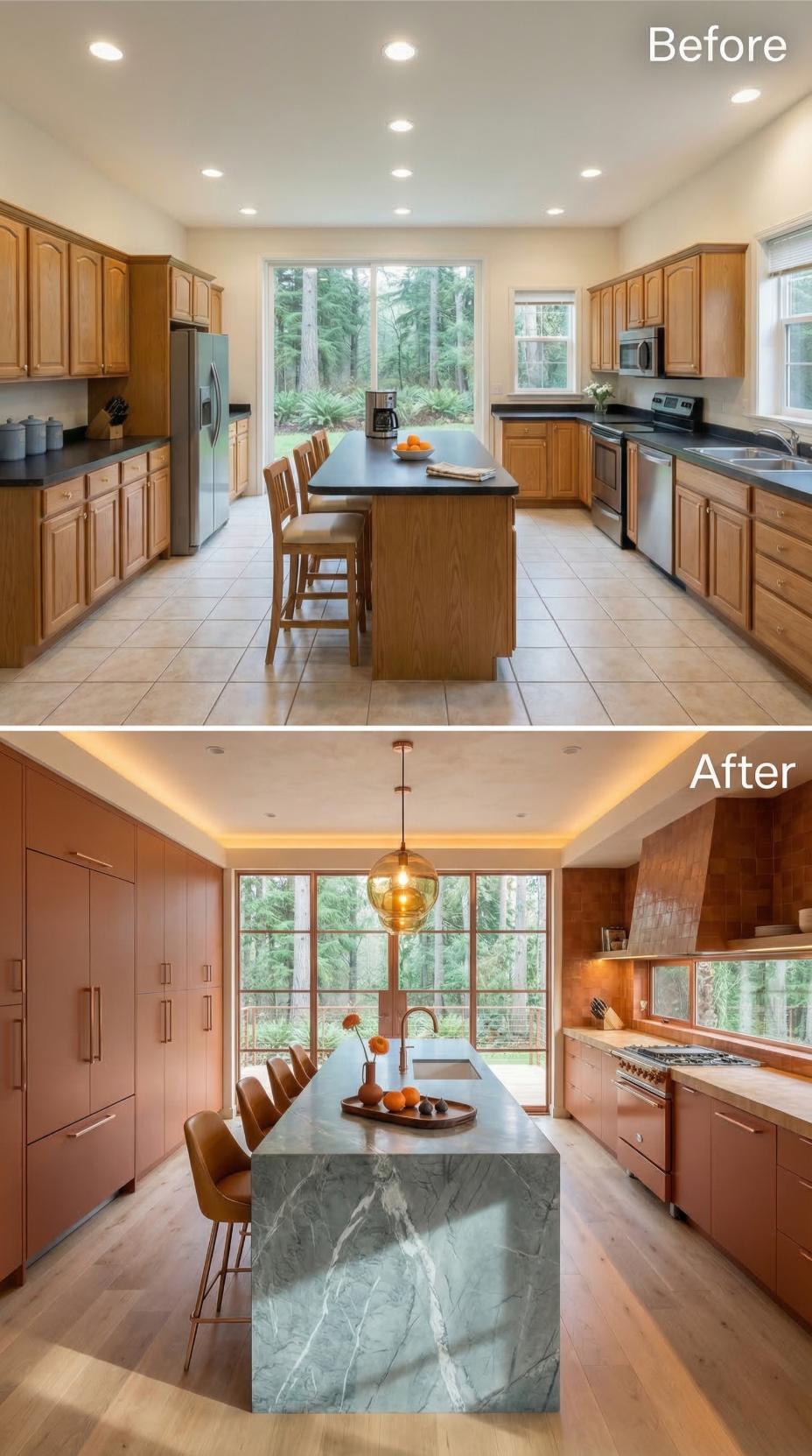
Flush-front cabinetry in a warm copper tone lines both walls, matching the wood-framed mullion windows that now divide the view into ordered panes. Integrated pulls in brushed copper punctuate each door. A center island clad in gray-veined marble extends into a full waterfall edge, grounding the space with cool stone.
Cove lighting along the ceiling perimeter casts a soft amber glow upward, replacing the grid of recessed cans. Honey-toned leather barstools slide beneath the marble overhang. On the right wall, a range sits below a copper-clad hood that angles upward, its surface echoing the cabinet finish and creating vertical interest against the horizontal grain of the wood.
Glossy Gray Slabs and Marble Waterfall Island Succeed Oak Tradition
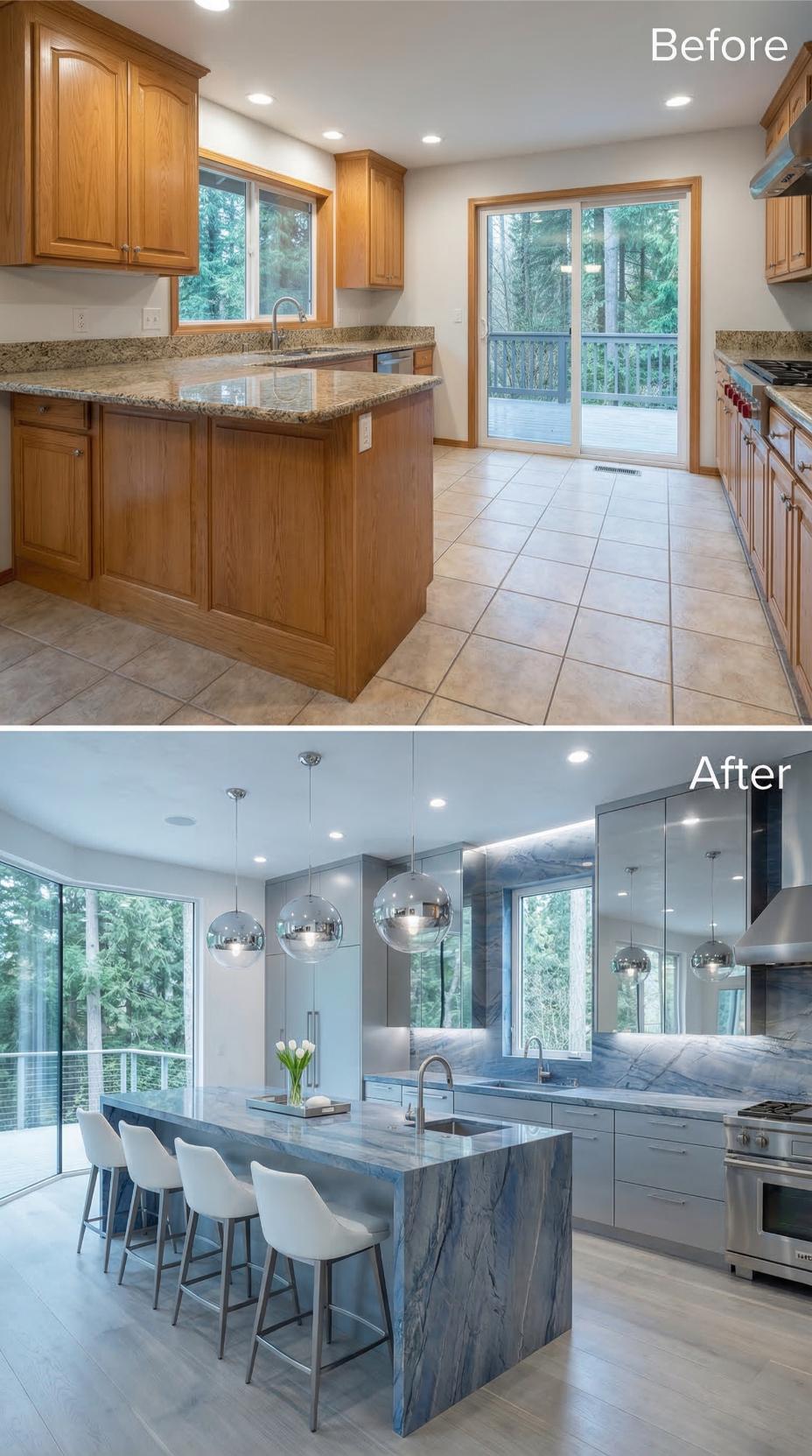
High-gloss gray cabinets stretch floor to ceiling, their reflective finish amplifying the space doubled by the wood-trimmed past. A book-matched marble island anchors the room with dramatic gray veining that cascades down both waterfall edges. Three chrome globe pendants hang above four upholstered counter stools with black legs. The sliding door now wears a black frame instead of natural wood trim, while pale hardwood planks replace beige tile underfoot.
Try This: Position pendant lights so their cords align with the island’s veining pattern to create visual rhythm that draws the eye through the entire composition.
Orange Slab Cabinetry and Black Marble Waterfall Retire Honey Oak
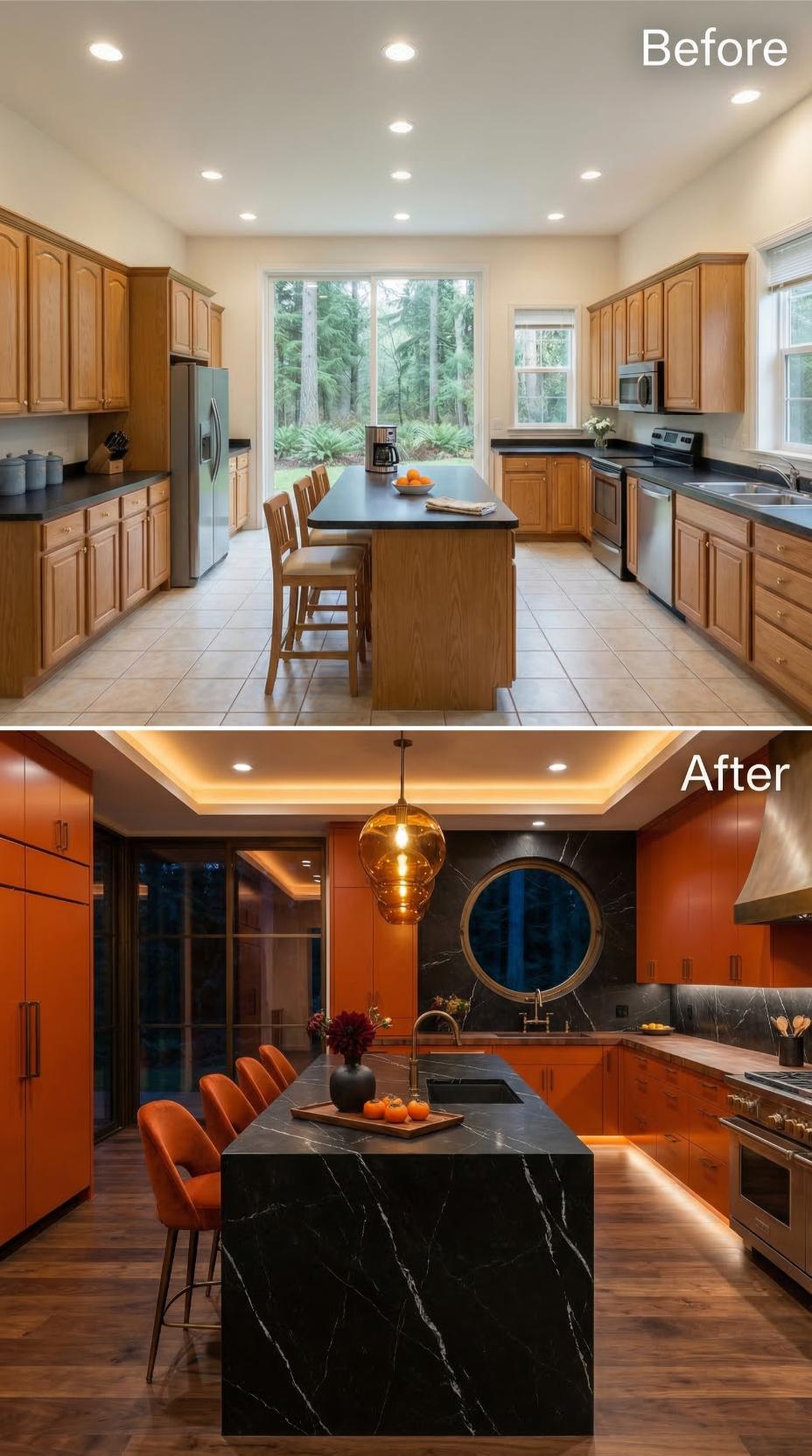
Orange-stained flat-front cabinetry wraps the perimeter in saturated color, replacing the arched-door oak units and beige walls. Black marble veined in white sheathes the waterfall island, its dramatic stone contrasting sharply with the warm cabinet finish. A black marble backsplash anchors the cooktop wall, framed by a circular brass mirror.
Cove lighting runs the ceiling perimeter, casting an amber glow above the cabinetry. Four orange velvet counter stools line the island, their curved backs echoing the amber glass globe pendant overhead. Wide-plank oak flooring in a dark finish replaces the diagonal tile, grounding the space in richer tones.
Taupe Flat-Panel Doors and Marble Waterfall Replace Cathedral Oak
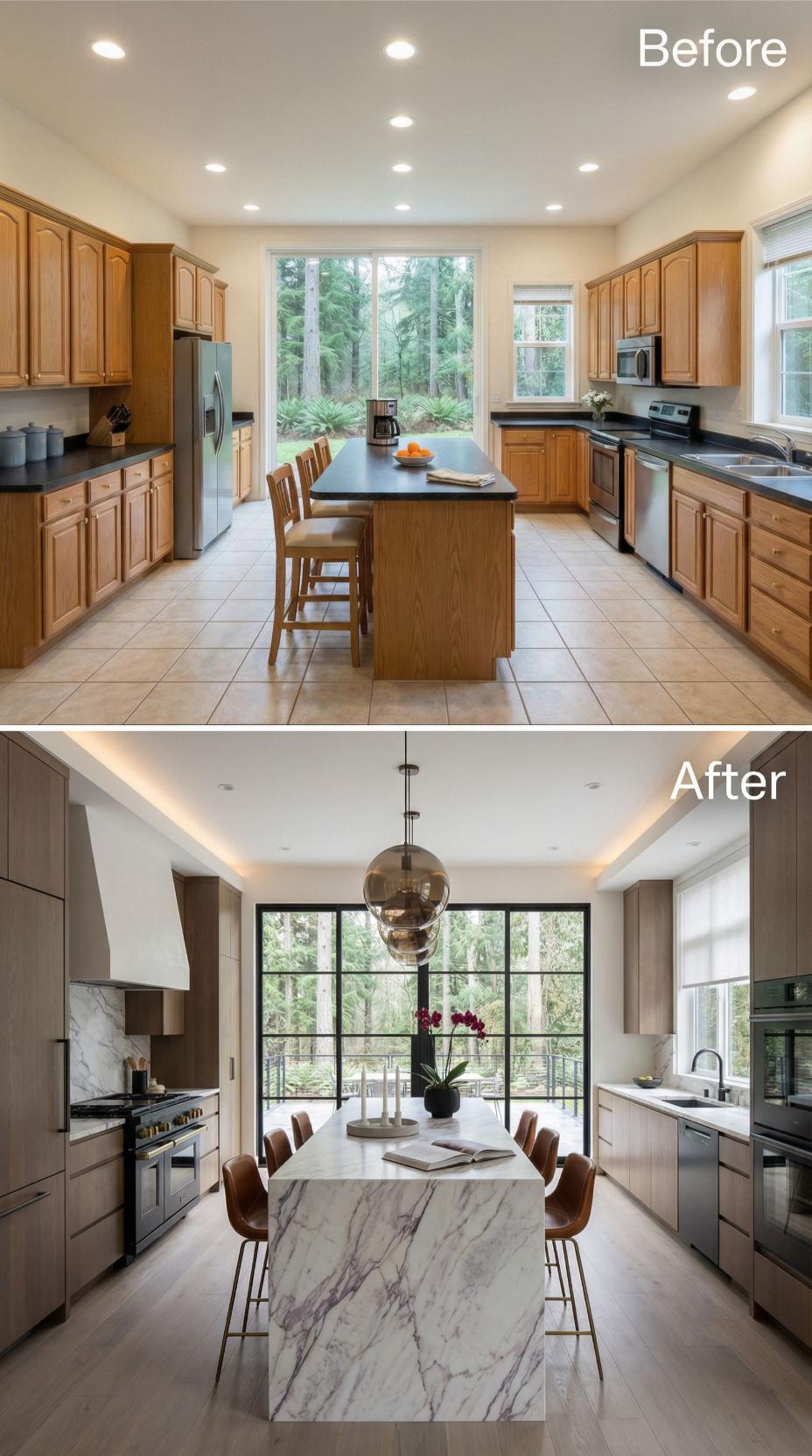
Cathedral-arch oak cabinets and black laminate counters gave way to flat-panel doors in a warm taupe finish. The new cabinetry runs floor to ceiling on both walls, eliminating the stacked crown molding that once topped the upper units. White marble veined in charcoal wraps the island in a waterfall edge, contrasting with the simpler white marble backsplash behind the range. A spherical smoked-glass pendant hangs above the island, replacing the flush recessed cans that dotted the previous ceiling.
Cove lighting now traces the perimeter where the ceiling meets the walls, casting an indirect glow across the space. Black-framed grid doors replaced the white vinyl patio slider, sharpening the view to the evergreens beyond. Beige diagonal floor tile disappeared under pale wide-plank hardwood. The stainless steel appliances remain, but integrated panel fronts on the refrigerator and dishwasher blend them into the cabinetry plane.
Veined Green Marble Waterfall and Cove-Lit White Minimize Replace Honey Oak
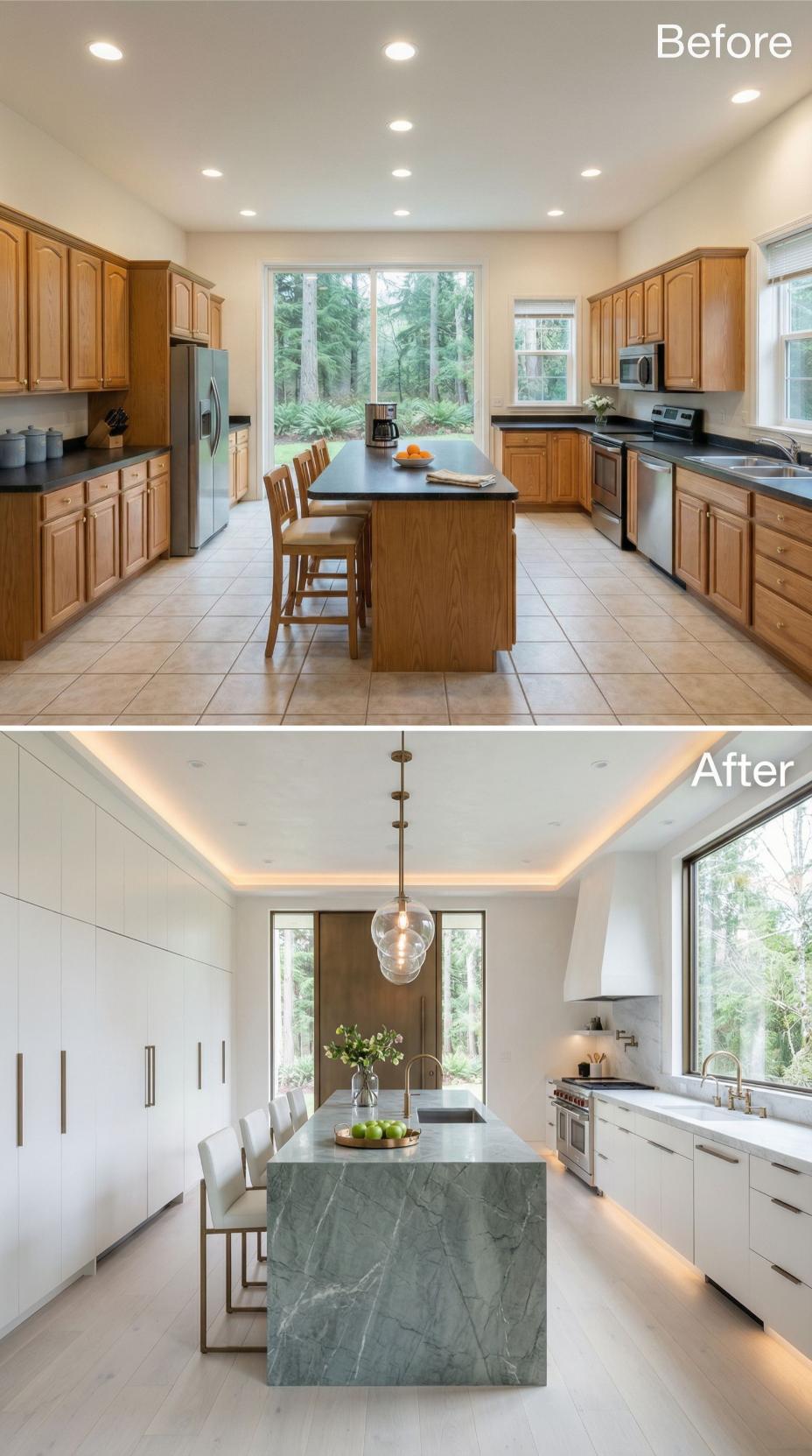
Honey oak raised-panel cabinets and beige ceramic floor tiles give way to sleek white slab-front cabinetry with long nickel pulls. The island shifts from a simple oak breakfast bar with two wood stools to a dramatic green marble waterfall edge with pronounced gray veining, paired with three low-back upholstered chairs in cream fabric. Cove lighting now runs the perimeter of the ceiling, casting indirect illumination that replaces the original grid of recessed cans.
Floor-to-ceiling cabinetry on the left wall eliminates visual breaks, while a single amber glass globe pendant on a slender brass rod descends above the island. The window configuration changes from a wide expanse flanked by two smaller openings to a tall vertical format that frames the front door, now stained walnut. Beige tile underfoot transitions to large-format gray porcelain slabs with minimal grout lines.
Burgundy Slab Doors and Veined Marble Waterfall Island Follow Oak
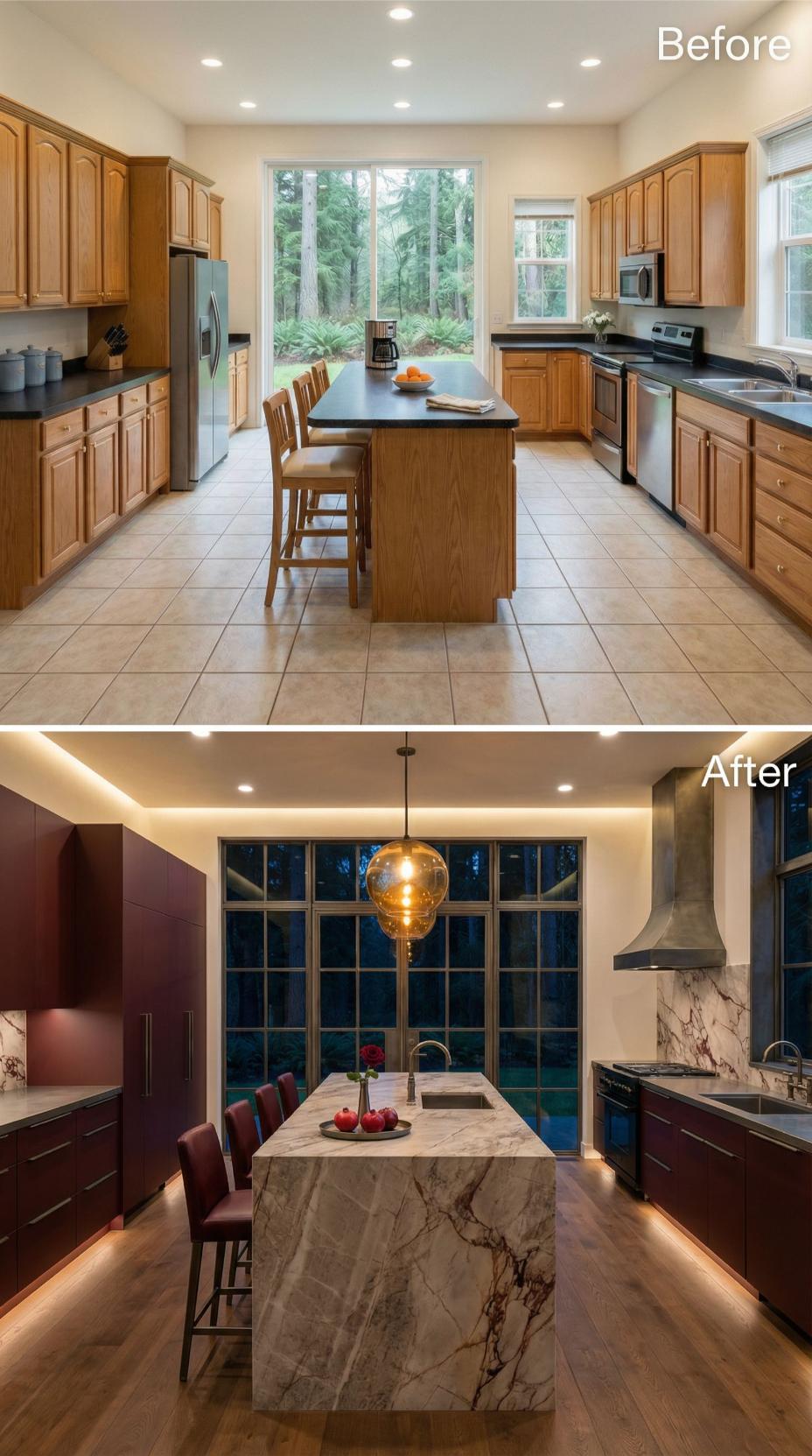
Burgundy flat-panel cabinets replace the raised-arch oak perimeter, their handleless fronts stained in a deep oxblood tone that reads almost merlot under cove lighting. The island trades its black laminate top and wooden bar chairs for a dramatic marble waterfall edge streaked with rust and charcoal veining, anchored by upholstered burgundy leather stools.
Recessed lights now occupy a cove detail that wraps the ceiling perimeter, casting an amber glow across the space formerly lit by standard downlights. The large window gains a contemporary muntin grid, and a statement pendant in amber glass hangs above the island. Wood-look porcelain planks replace beige ceramic tile underfoot, while a marble slab backsplash mirrors the island’s veining behind the range hood.
Backlit Onyx Island and Cove Ceiling Replace Cathedral-Door Oak
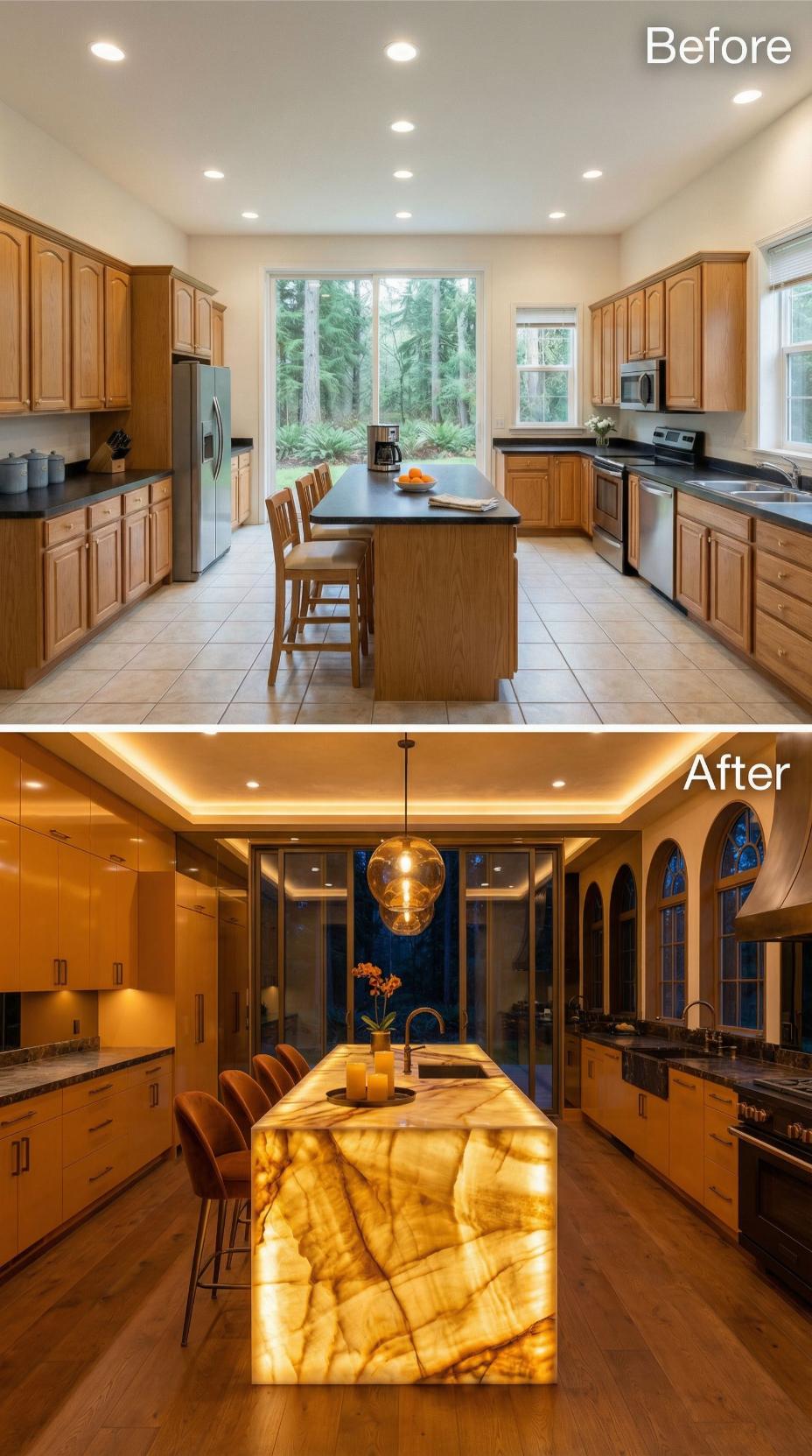
Cathedral-arch oak cabinets gave way to flat-slab fronts in a warm golden finish. The island now features backlit onyx in shades of amber and honey, creating a glowing centerpiece that runs from the countertop down both sides. Dark granite counters elsewhere contrast with the lighter cabinetry, while a black granite farmhouse sink anchors the right workstation.
Cove lighting traces the ceiling perimeter, casting a soft amber glow upward. A spherical brass pendant hangs above the island, its geometric pattern echoing the warm metal accents throughout. Three upholstered bar stools in rust velvet line the island’s seating side. Arched glass doors behind the cooking zone introduce architectural detail and expand the sight lines into adjacent rooms.
- Backlit onyx island with veined amber stone creates a luminous focal point
- Cove lighting along the ceiling edge adds indirect warm illumination
- Arched glass door panels replace the original square window configuration
Blonde Vertical-Grain Slabs and Dark Green Marble Waterfall Replace Cathedral Oak
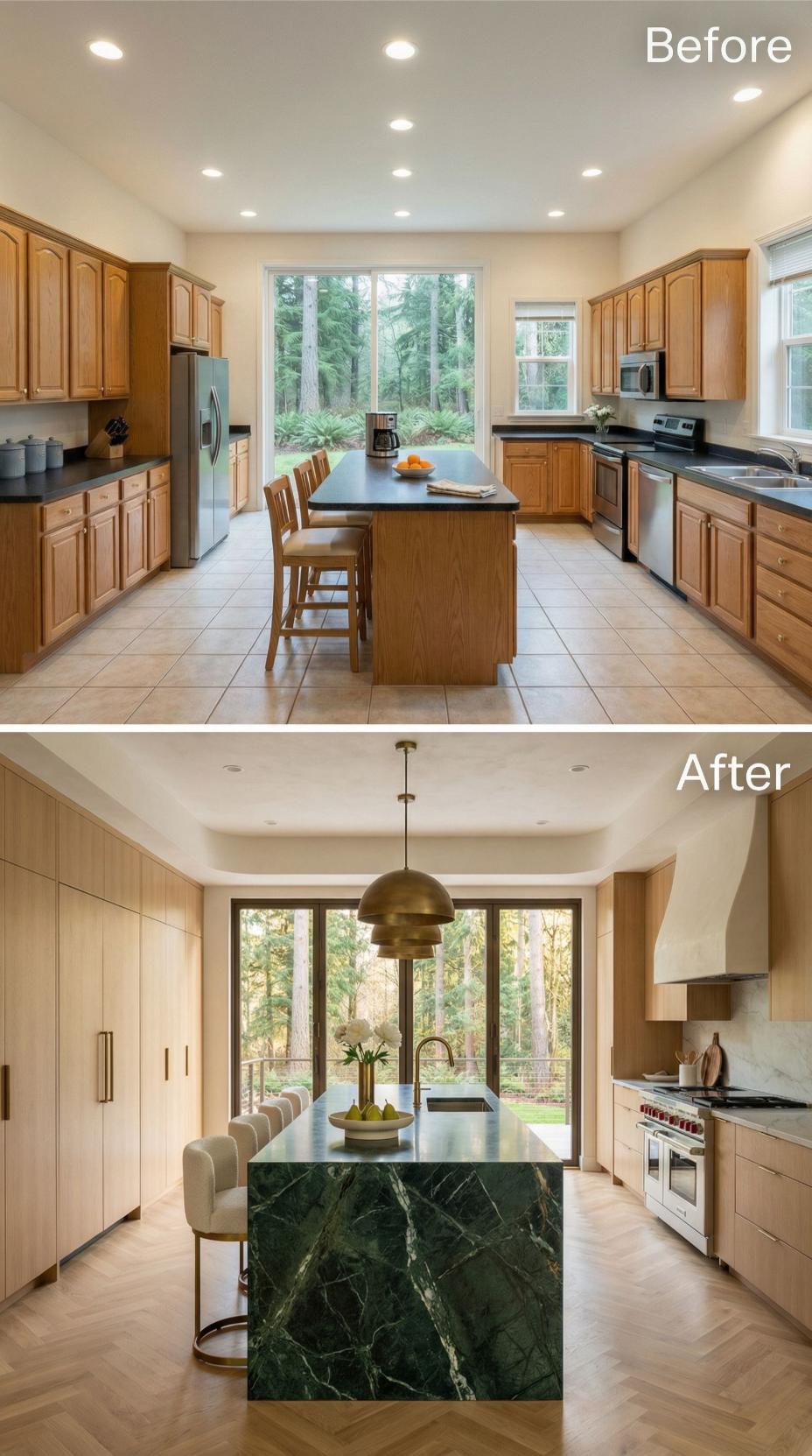
Cathedral-arch oak cabinets with black countertops occupied the original space alongside beige diagonal-set tile. Vertical-grain blonde wood slabs now line the perimeter in floor-to-ceiling panels, their smooth surfaces interrupted only by slim brass pulls. The island anchor shifts to dark green marble with dramatic white veining that cascades down both exposed sides in a waterfall profile.
A dome pendant in brushed brass hangs above the island, where three cream boucle stools with gold frames provide seating. Natural oak flooring laid in a herringbone pattern replaces the tile grid. A white marble slab backsplash wraps the cooking zone behind the stainless steel range, and the window frames adopt a dark bronze finish that contrasts with pale walls.
Charcoal Flat-Panel Cabinets and Amber Leather Stools Oust Beige Oak
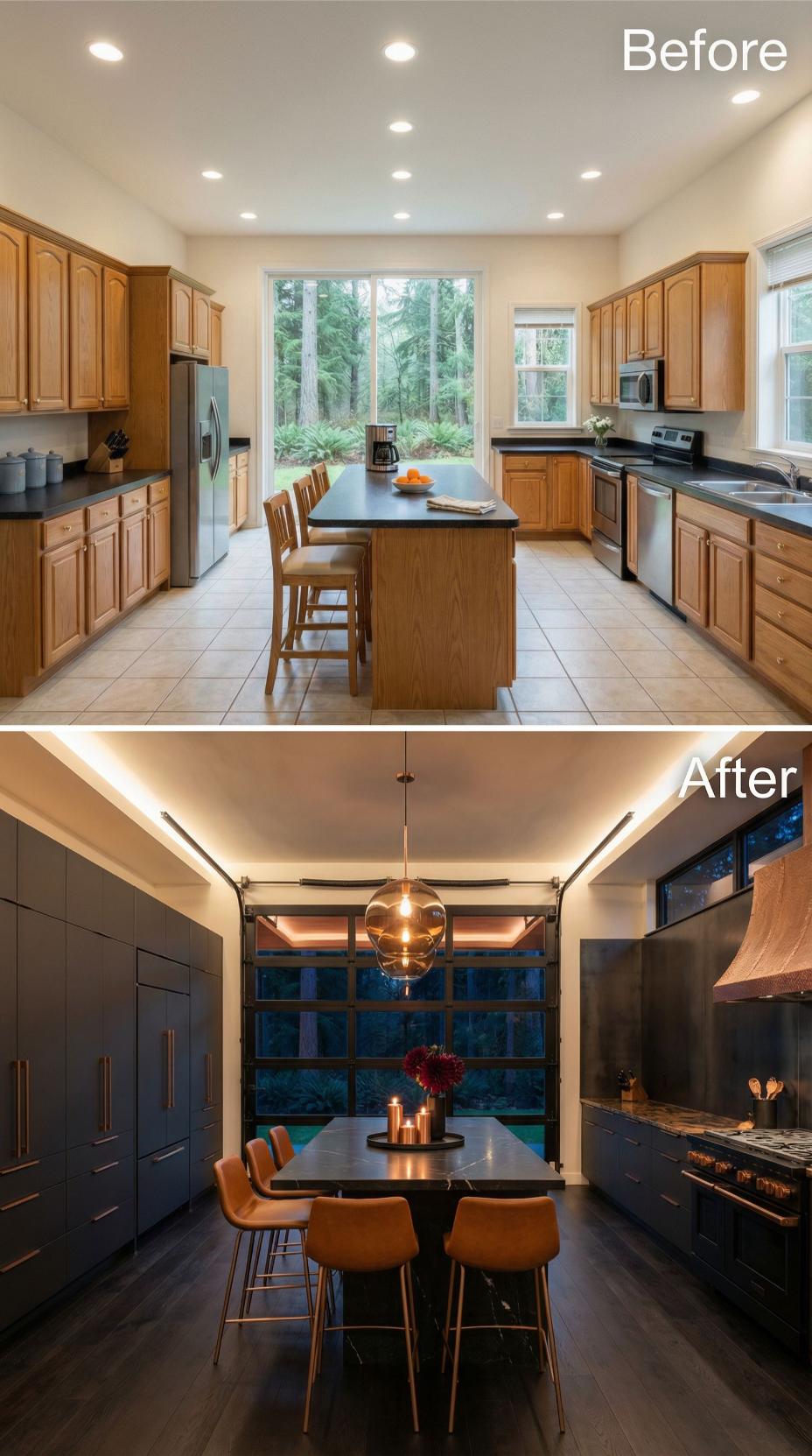
Charcoal slab cabinetry with brushed copper pulls flanks both walls, replacing arched oak doors and black laminate counters. The island trades its raised-panel base for a sleek black table with amber leather counter stools featuring gold-toned metal legs. Recessed cove lighting borders the ceiling perimeter, casting warm illumination that contrasts with the industrial glass pendant above. Black-framed windows replace white trim, and dark wood-look flooring supplants beige tile.
Blonde Slab Fronts and Veined White Marble Waterfall Exit Oak Arches
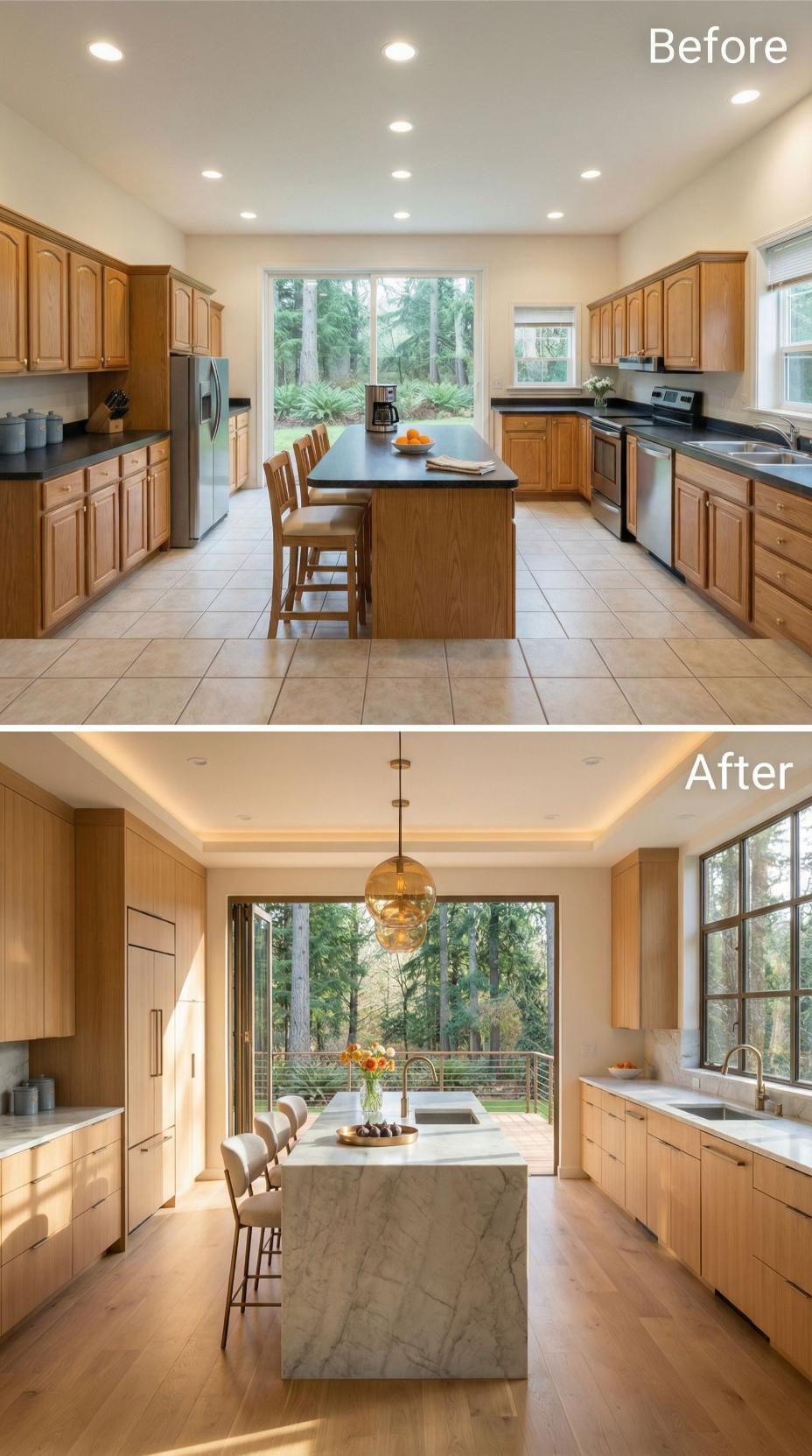
Flat-panel blonde oak cabinetry with slim bronze pulls replaces raised cathedral doors and black laminate counters. A thick marble island with dramatic gray veining anchors the space, flanked by upholstered stools in cream linen. The tray ceiling includes cove lighting that washes warm light across white walls. Hardwood flooring in a natural finish succeeds beige ceramic tile, while a brass pendant globe hangs above the island.
Sage Slab Cabinets and Green Marble Waterfall Exit Recessed Oak
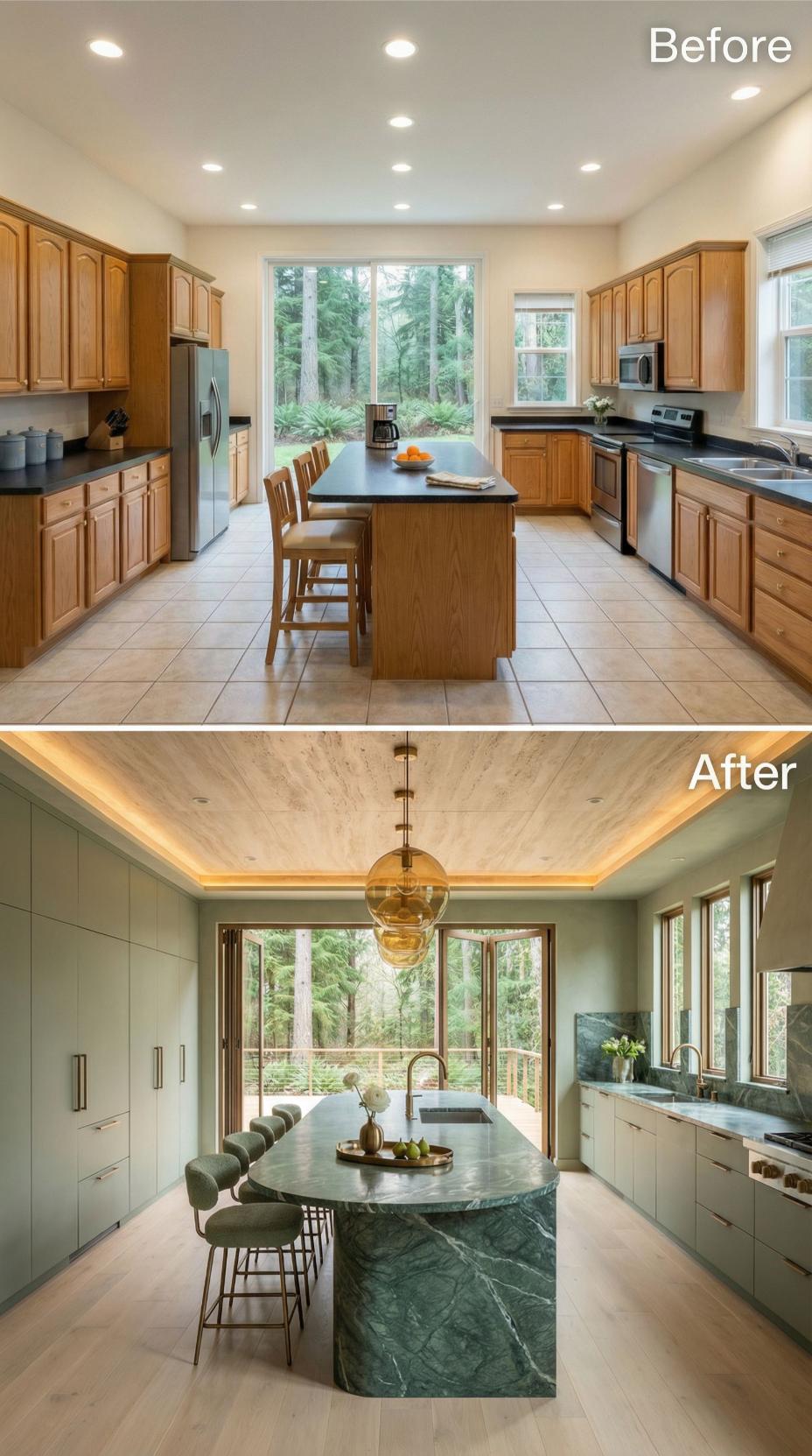
Recessed-panel oak cabinets with black laminate counters disappear in favor of sage flat-slab doors with horizontal brass pulls. The island shifts from a simple oak rectangle with wooden chairs to a dramatic green marble waterfall slab topped with an oval brass chandelier. Cove lighting now outlines the wood-planked ceiling, casting a warm glow across the perimeter.
Windows gain dark wood frames instead of white trim, and a glass door opens to a cable-rail deck. The floor transitions from beige diagonal tiles to wide pale planks. Sage velvet stools line the island, and tall floor-to-ceiling cabinets on the left replace the upper cabinets, creating a cleaner profile.
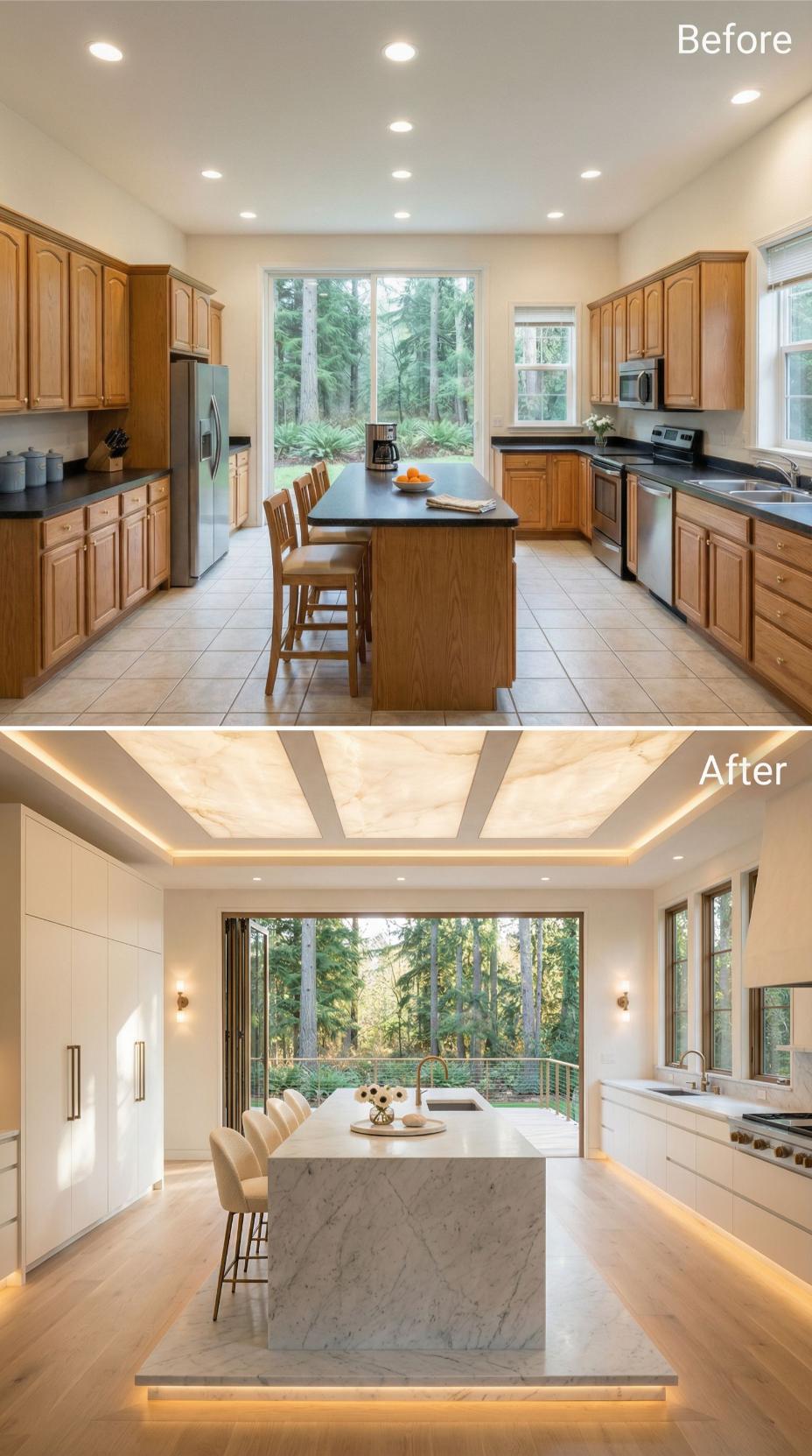
White Flat-Panel Slabs and Marble Island Step Unseat Honey Oak
🔥 Would you like to save this?
Flat-slab cabinetry in matte white replaces the cathedral-arch oak that once dominated both walls. The island transforms from a modest wood structure with bar seating into a monumental marble waterfall with integrated seating on a raised platform. Recessed LED strips now outline the perimeter of the island base and trace the coffered ceiling beams above, casting ambient light across pale wood flooring.
The kitchen opens to the outdoors through accordion-style glass doors where the original single window stood. White quartz or marble countertops span both perimeters, contrasting with the black granite that paired with the oak. Minimal gold-toned hardware punctuates the slab doors, and wall sconces flank the new opening.
Cove-Lit Peach Plaster and Bifold Glass Doors Replace Beige Tile
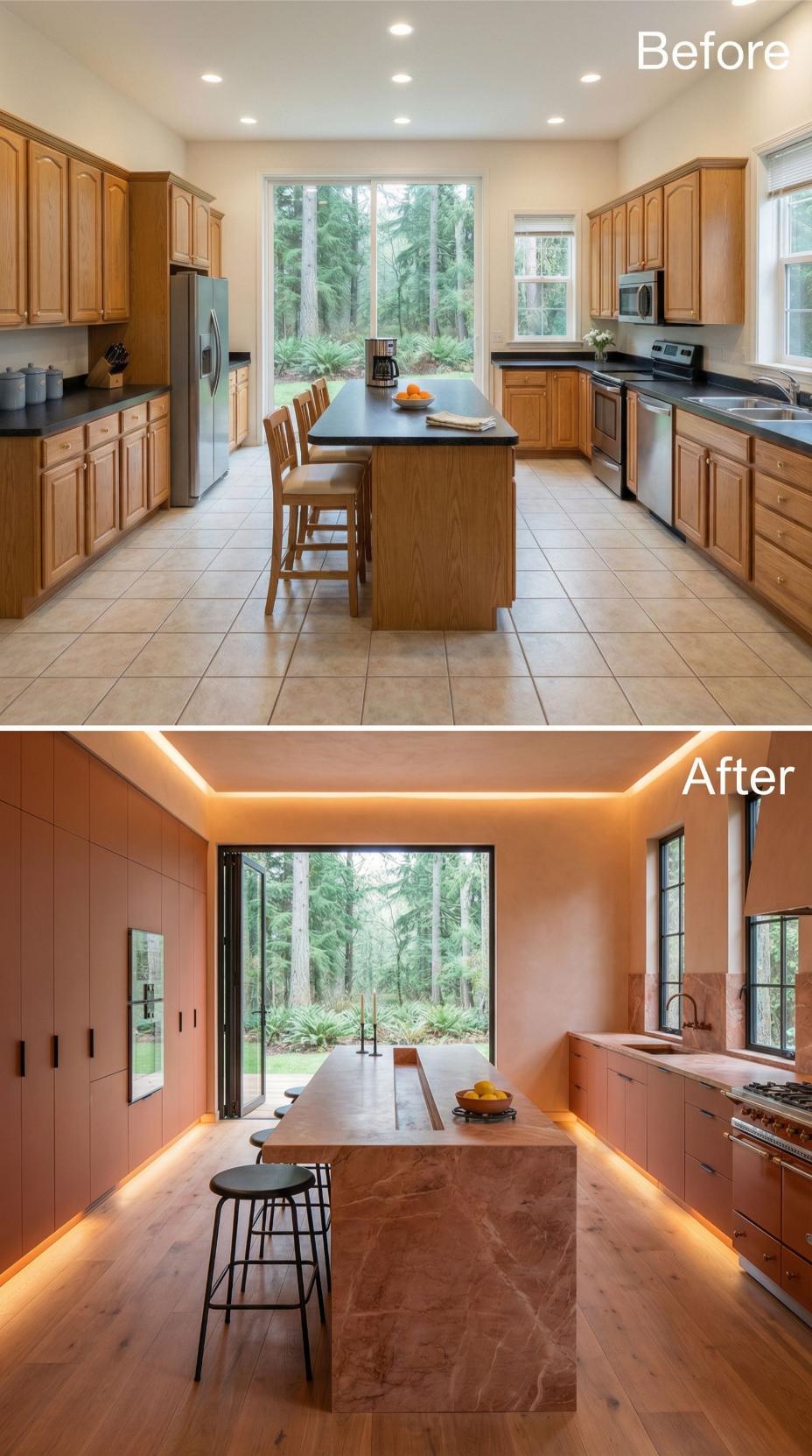
Peach-toned plaster coats every surface, merging walls and flat-slab cabinets into a continuous envelope. A thick plywood island anchors the center, its waterfall edges catching recessed LED strips beneath. Black metal bifold doors replace the original white window frame, expanding the opening toward the forest view.
Gray-Blue Slabs and Book-Matched Island Counter Follow Honey Oak
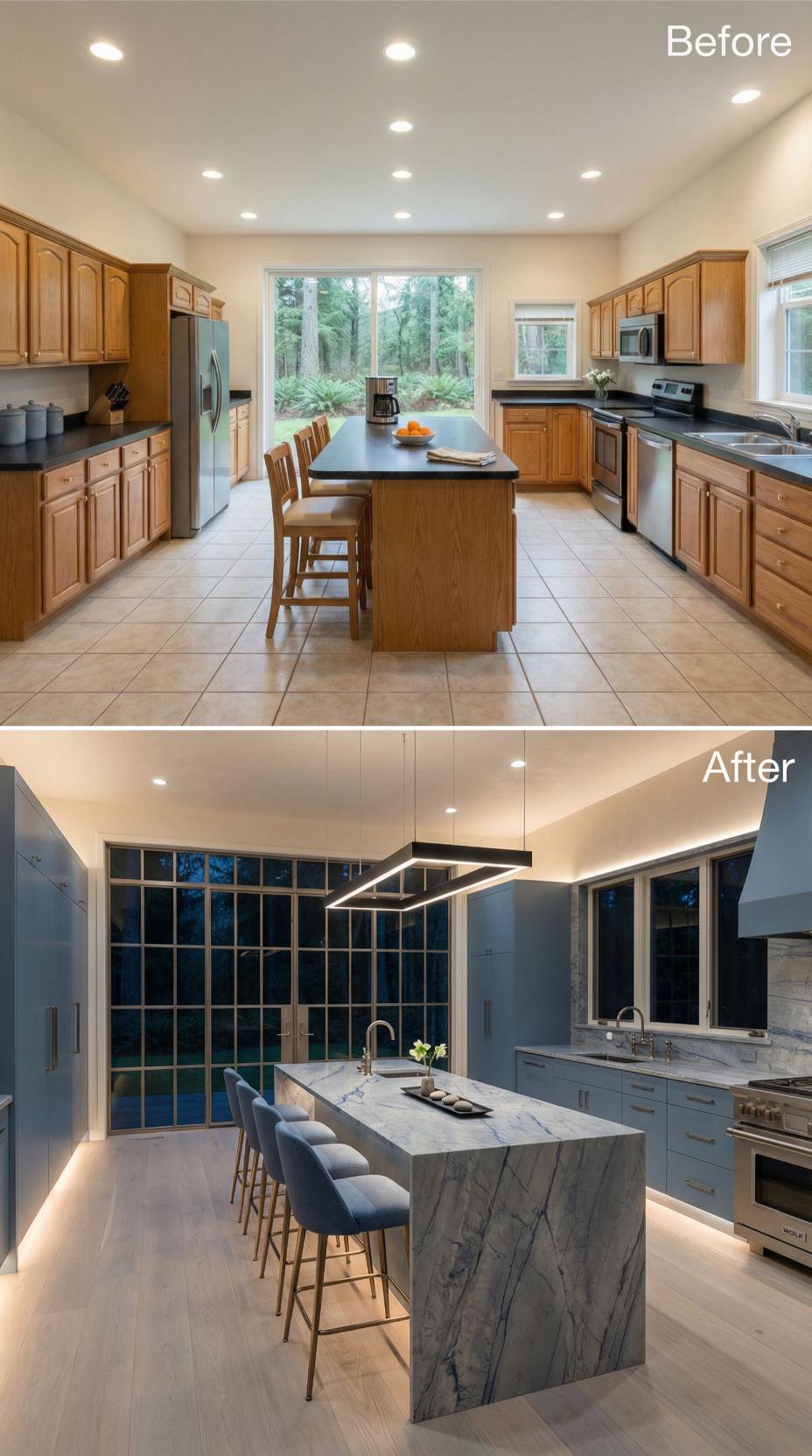
Gray-blue flat-slab cabinetry wraps the perimeter, contrasting sharply with the former honey oak doors and black laminate counters. A book-matched marble island features dramatic gray veining that extends down the sides in a waterfall edge. Navy upholstered barstools sit beneath geometric pendant lighting. Pale wood-look flooring replaces the beige diagonal tile.
Did You Know: Book-matched marble slabs are cut from the same stone block and opened like pages, creating a mirrored grain pattern. This technique requires precise fabrication to align the veining symmetrically across the island’s waterfall edges.
Cove-Lit Ceiling Panel and Gray Veined Waterfall Island Replace Oak
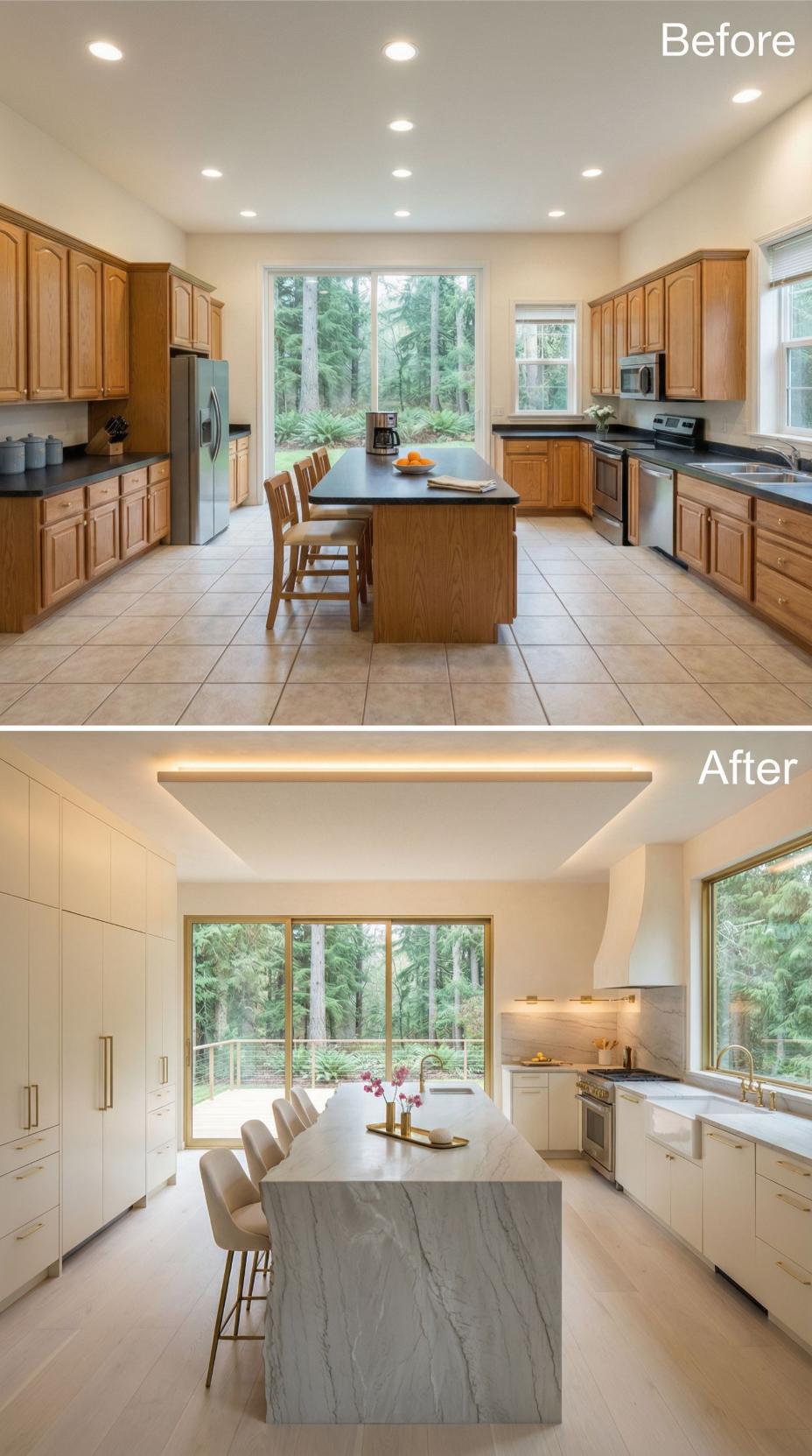
The original kitchen relied on recessed-panel oak cabinets with black laminate counters and beige ceramic tile floors. Golden wood tones dominated the space, anchored by a simple island with three ladder-back stools. The ceiling held a grid of recessed downlights that cast flat illumination across the work zones.
White flat-panel cabinets now stretch floor to ceiling on the left wall, punctuated by vertical gold-toned pulls that extend nearly the full door height. A gray veined marble waterfall island seats six upholstered counter stools with tapered legs and beige fabric seats. The ceiling features a recessed rectangular panel outlined with cove lighting that washes warm amber light across the white surface. Large sliding glass doors with wood frames replace the white-trimmed window, opening to a deck with glass and metal railings. Pale gray wide-plank flooring runs the length of the room, and a stainless steel hood cantilevers over a marble backsplash beside the window.
Matte Charcoal Slabs and Ribbed Brass Island Displace Cathedral Oak
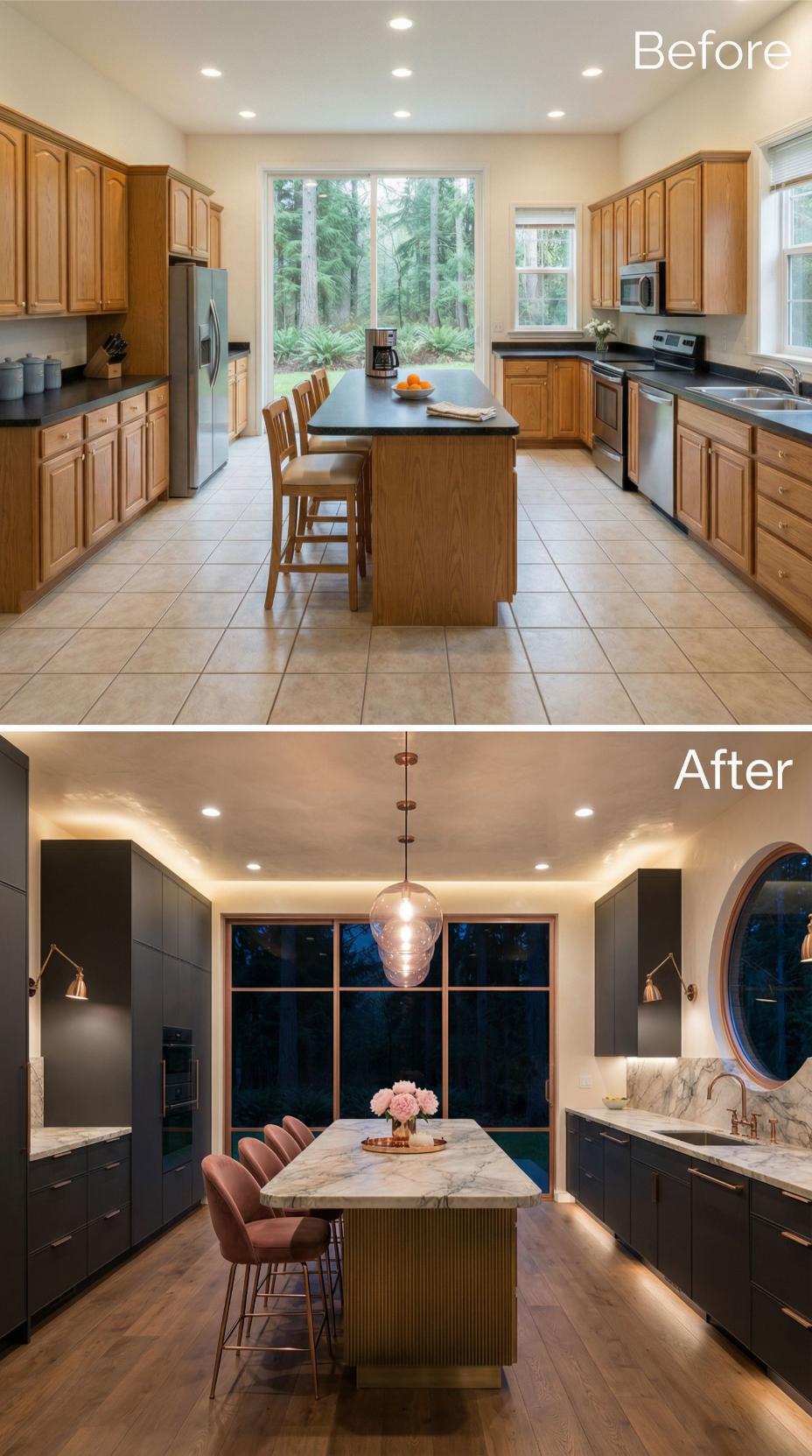
The original space featured honey-toned cathedral-arch oak cabinets paired with black laminate counters and beige diagonal-set floor tiles. Stainless appliances punctuated both walls while a wood-topped island with matching oak panel sides anchored the center.
Dark matte charcoal slab-front cabinetry now lines both walls, extending to the ceiling in handleless upper banks. A marble waterfall island with vertical brass ribbed paneling replaces the wood base, topped with pink-veined white stone. Blush velvet upholstered barstools with brushed brass legs flank the island. Wood-look porcelain planks run the floor, while a smoked-glass globe pendant hangs from a brass rod. Sconce lighting with articulated brass arms mounts beside the upper cabinets.
Sage Handleless Cabinets and Curved Marble Drum Succeed Tan Oak
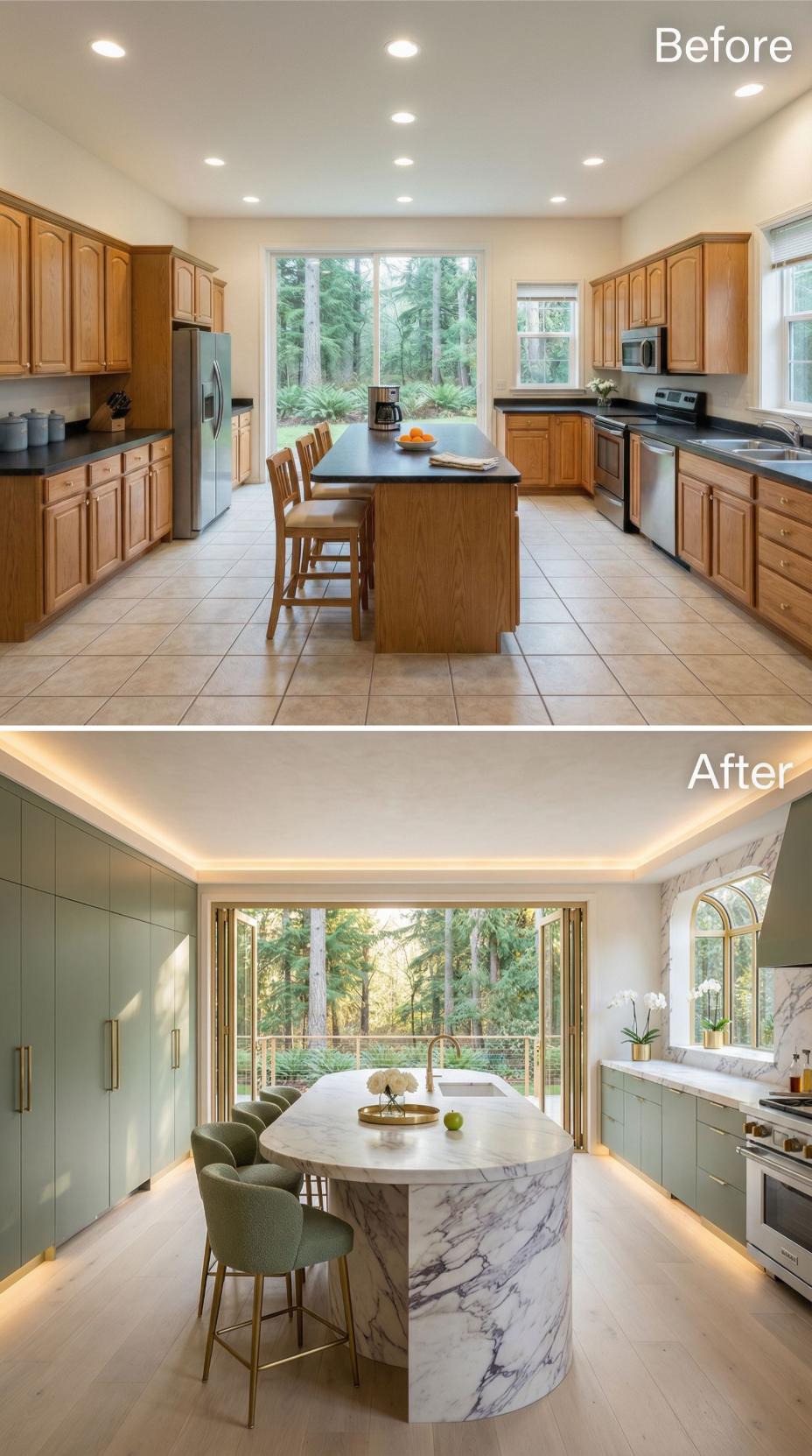
Handleless sage cabinets with recessed vertical pulls stretch floor to ceiling, replacing raised-panel honey oak. The curved waterfall island wraps dramatic gray-veined marble around its drum base, anchored by four olive velvet barstools with brushed brass legs. White quartz spans the perimeter counters, contrasting with the sage cabinetry.
Cove lighting traces the ceiling perimeter, creating ambient glow. Accordion glass doors now fold open where a standard window once stood, expanding access to the deck. Pale gray flooring replaces beige tile, while the microwave relocates to discreet lower cabinetry.
Cove-Lit Cream Slabs and Calacatta Waterfall Island Exit Oak Arches
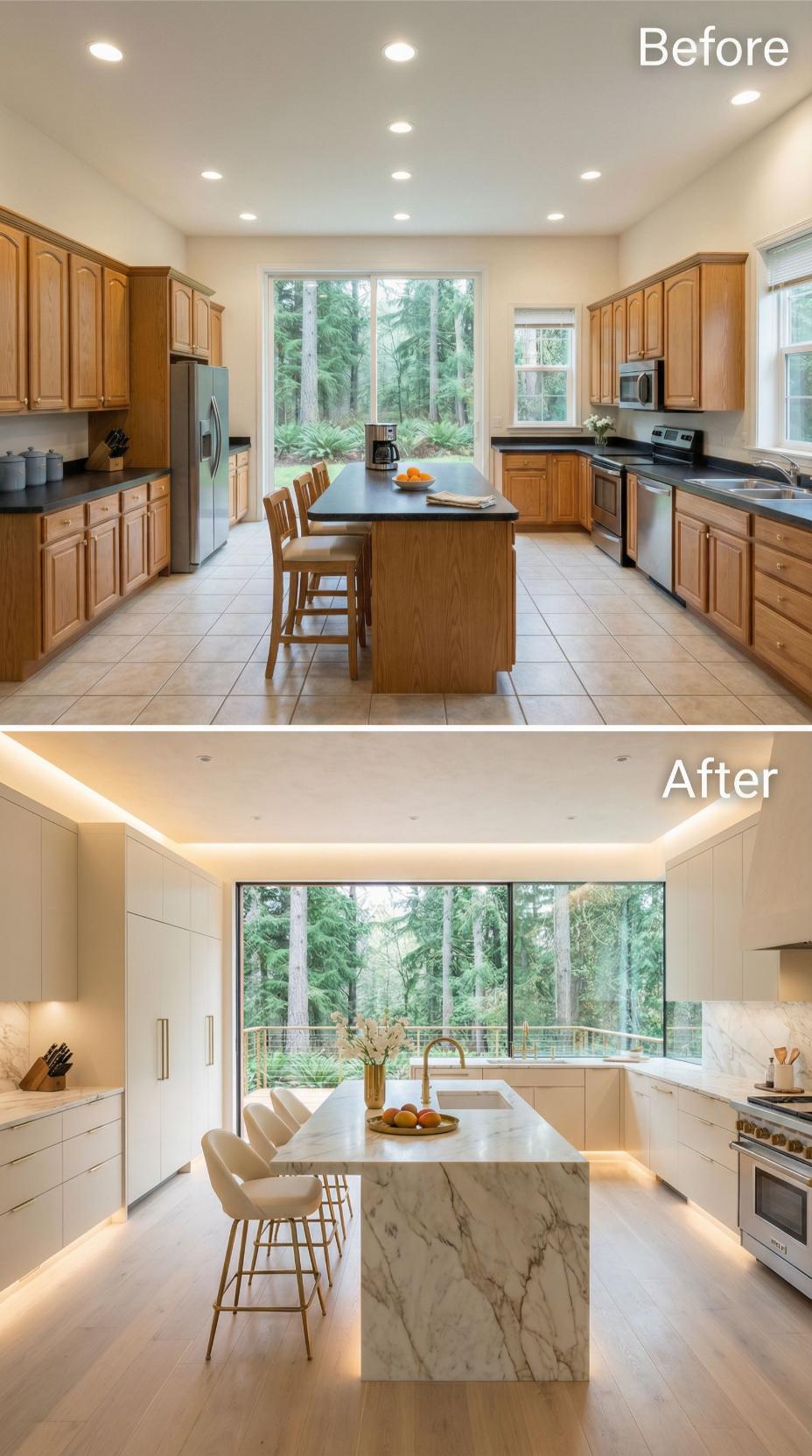
Oak cathedral cabinets with black laminate counters give way to flat-slab fronts in off-white lacquer, their minimal profile broken only by tall champagne-bronze pulls. The island trades its wood base for a thick Calacatta marble waterfall edge, three cream upholstered counter stools tucking beneath the veined surface.
Recessed cove lighting now traces the ceiling perimeter with warm amber light, replacing the grid of circular downlights above. Light oak flooring replaces beige diagonal tile. A frameless glass door extends the window wall, while under-cabinet LED strips wash marble backsplash in soft glow.
Amber Cove Lighting and Black Cabinetry Heighten the Contrast
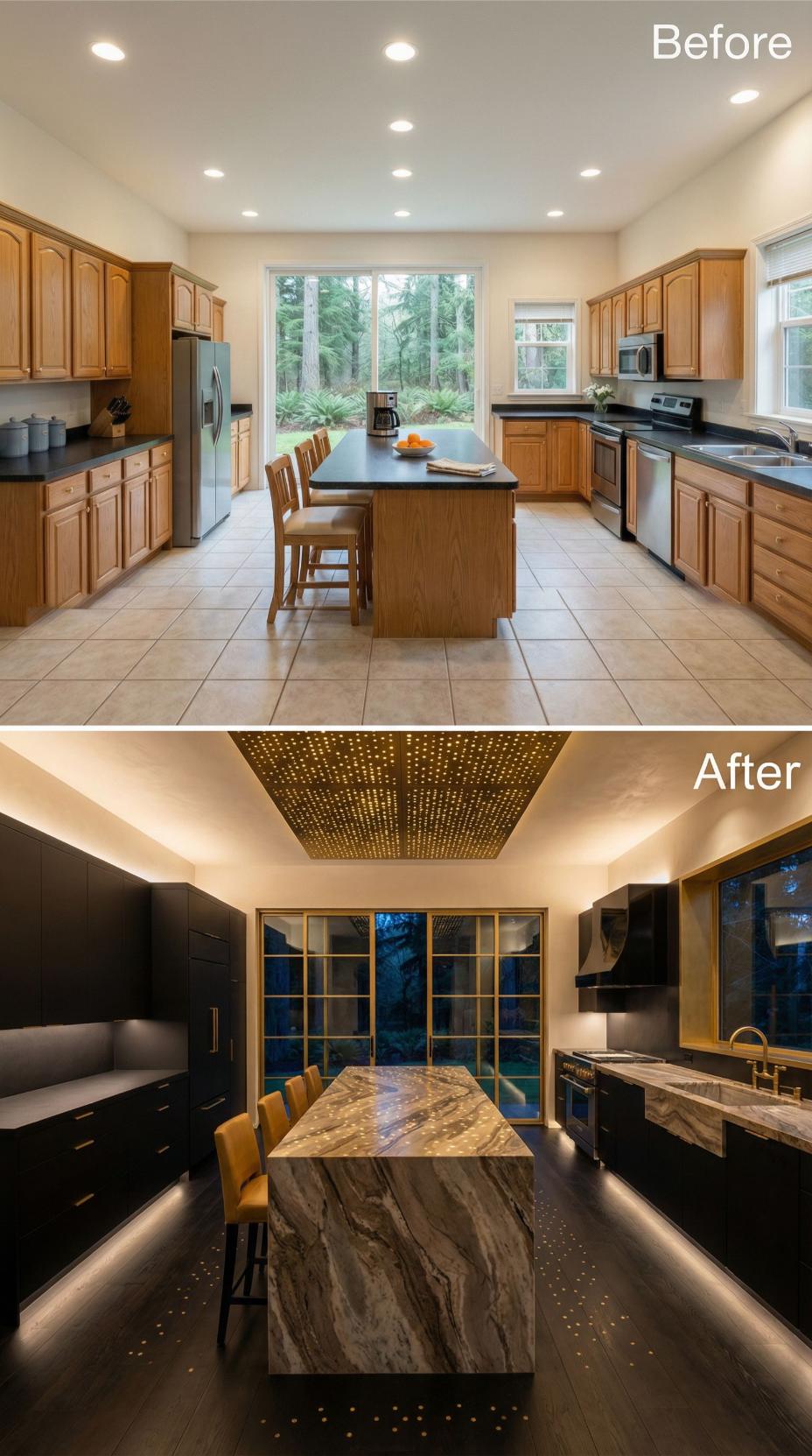
Black flat-front cabinets encase the perimeter, their matte finish absorbing light in stark contrast to the honey oak predecessors. A dramatic marble island commands the center, its waterfall edge showcasing bold diagonal striations in charcoal, cream, and gold. The stone panels cascade seamlessly from countertop to floor, creating a sculptural focal point that dwarfs the modest oak predecessor. Amber upholstered bar stools in velvet or leather bring warmth against the monochrome palette.
Cove lighting traces the perimeter ceiling, casting an amber glow that softens the dark cabinetry below. A perforated brass ceiling panel hovers above the island, its geometric pattern adding texture to the formerly plain recessed-light expanse. Black terrazzo flooring replaces beige tile, its flecked pattern catching light from the undercabinet strips. French doors in natural wood frame the garden view, their grid pattern providing the room’s only reference to the original layout.
Taupe Flat-Front Cabinets Shift the Kitchen Into Richer Territory
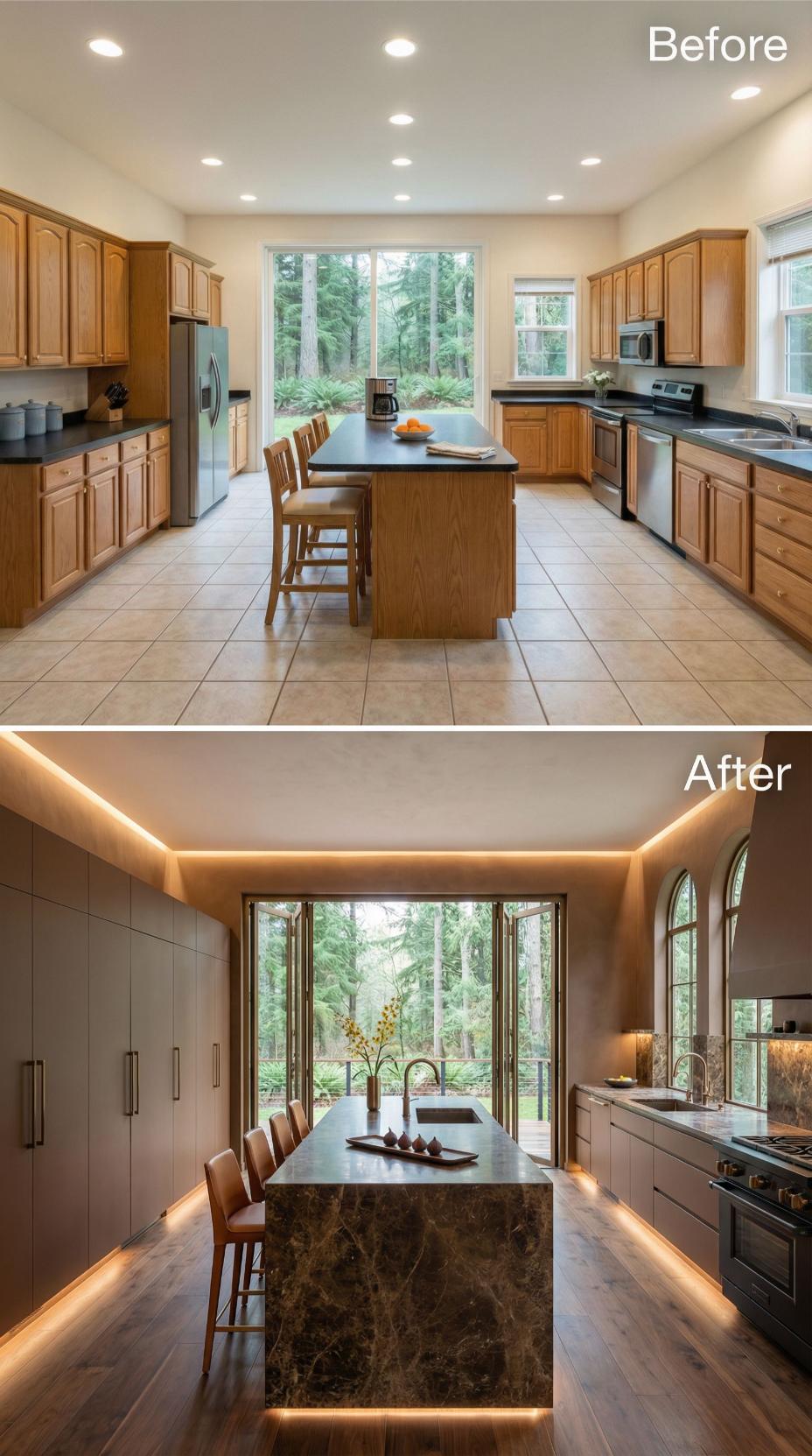
Taupe flat-front cabinets with vertical bronze pulls replace honey oak raised-panel doors, while warm LED cove lighting traces the ceiling perimeter above darker brown walls. A marble-clad waterfall island with dramatic veining anchors the galley layout, substituting the original oak breakfast bar. Dark walnut flooring replaces beige diagonal tiles throughout.
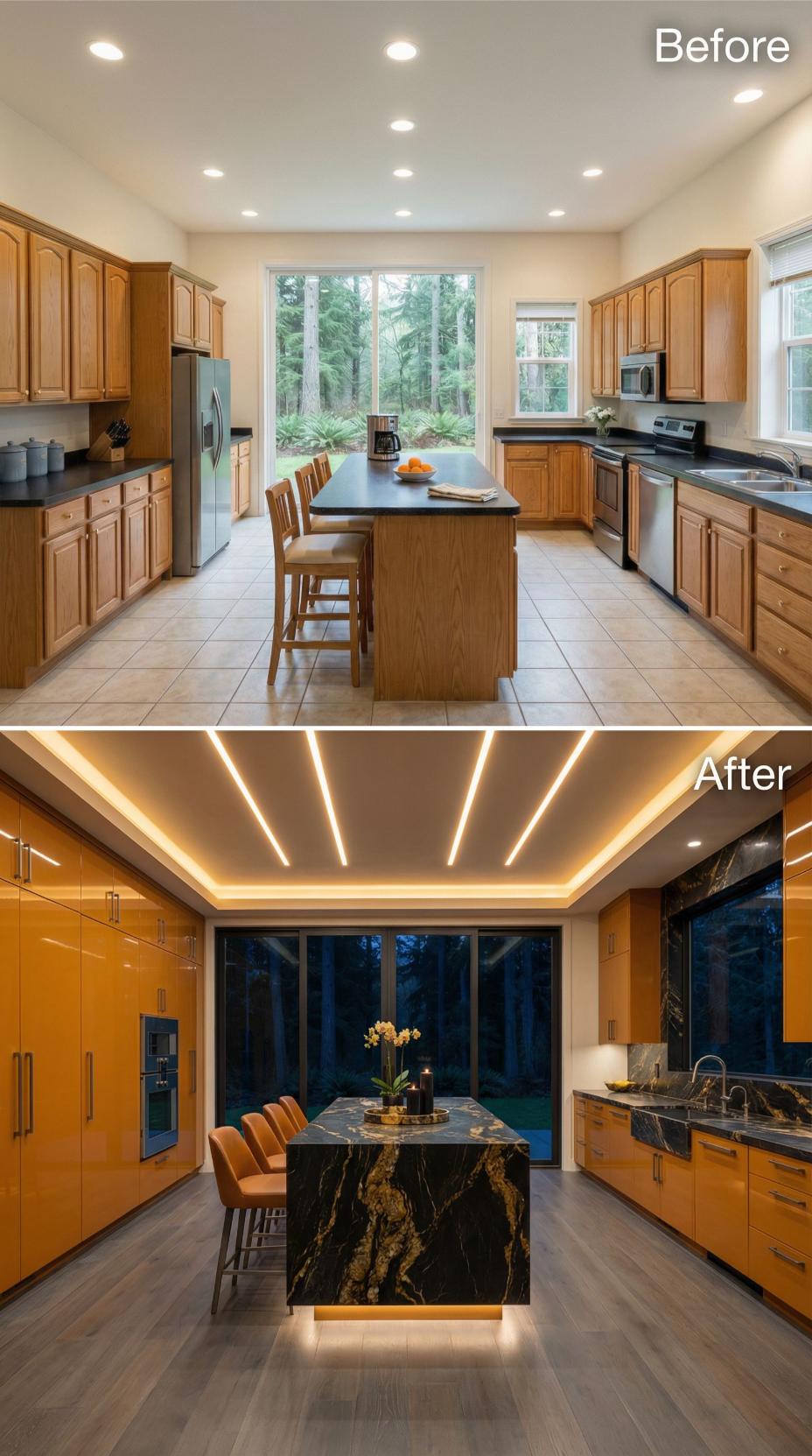
Cove-Lit Linear Tray and Marbled Waterfall Replace Traditional Oak
🔥 Would you like to save this?
Linear LED strips outline a recessed tray ceiling above a dramatic black and gold veined marble waterfall island that anchors grey plank flooring. Glossy mustard slab cabinets with vertical grain run floor to ceiling, fitted with elongated bronze pulls. Floor-to-ceiling black aluminum windows frame forest views, replacing smaller double-hung units. Pendant orchids rest on the island opposite tan leather barstools with modern metal legs.