🔥 Would you like to save this?
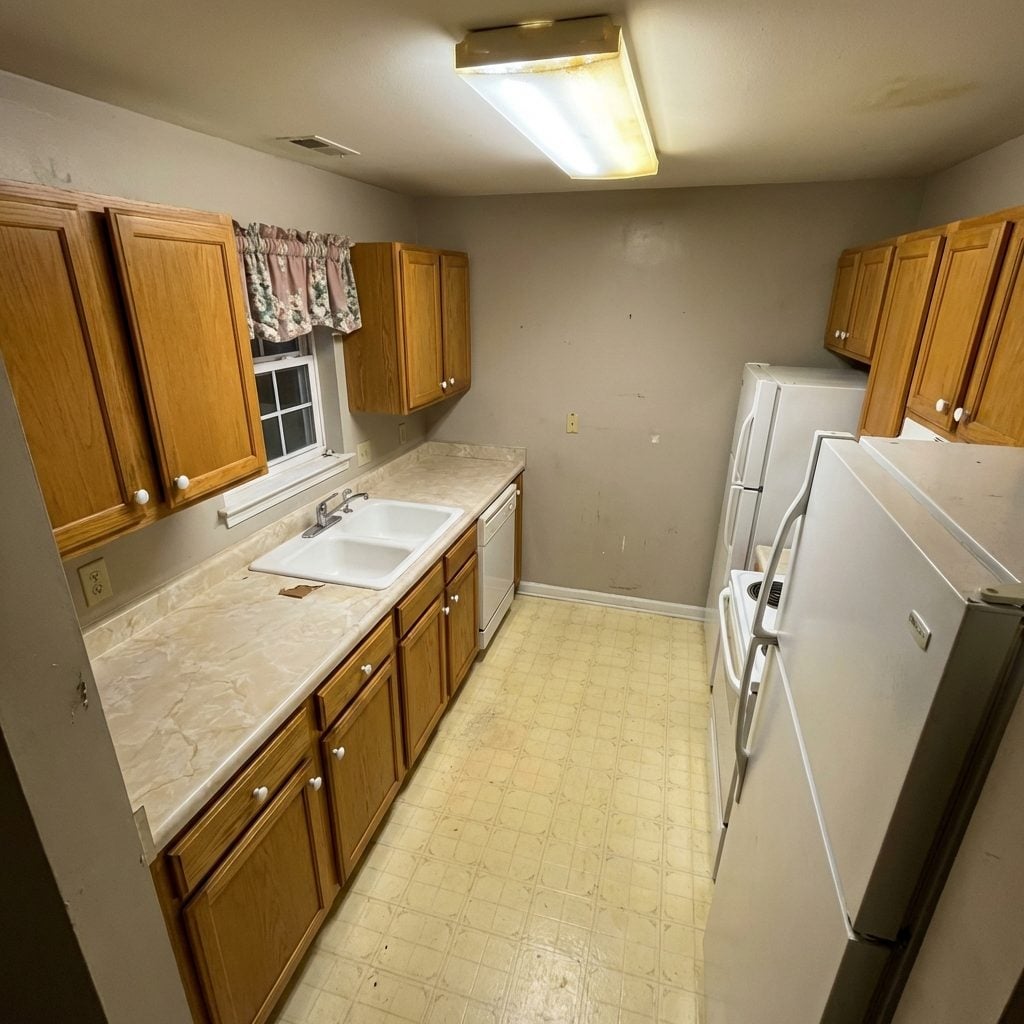
A quartz waterfall island has become the clearest signal that a kitchen renovation means business. Homeowners chasing that detail know it: the old layout, the laminate counters, and the honey-oak cabinets have to go first. That starting point, an outdated and forgettable kitchen, is exactly what every renovation here addresses. The before photos share a familiar exhaustion: dated finishes, poor lighting, and layouts that waste space. The after photos show what happens when budget and intention align around a kitchen designed to impress, not just function. For status-conscious homeowners, the kitchen is the room that does the most social work in the house. Thirty-nine real before-and-after renovations follow, each one a case study in what deliberate design can pull off.
In order to come up with the very specific design ideas, we create most designs with the assistance of state-of-the-art AI interior design software. Also, assume links that take you off the site are affiliate links such as links to Amazon. this means we may earn a commission if you buy something.
Flat-Front Cabinetry and Marble Waterfall Island Replace Honey Oak

Flat-panel cabinets in a warm greige finish replace the original honey oak, flanking open shelves stacked with neutral ceramics. Three oversized woven rattan pendants hang above a waterfall-edge island clad in veined white marble, with rattan counter stools below.
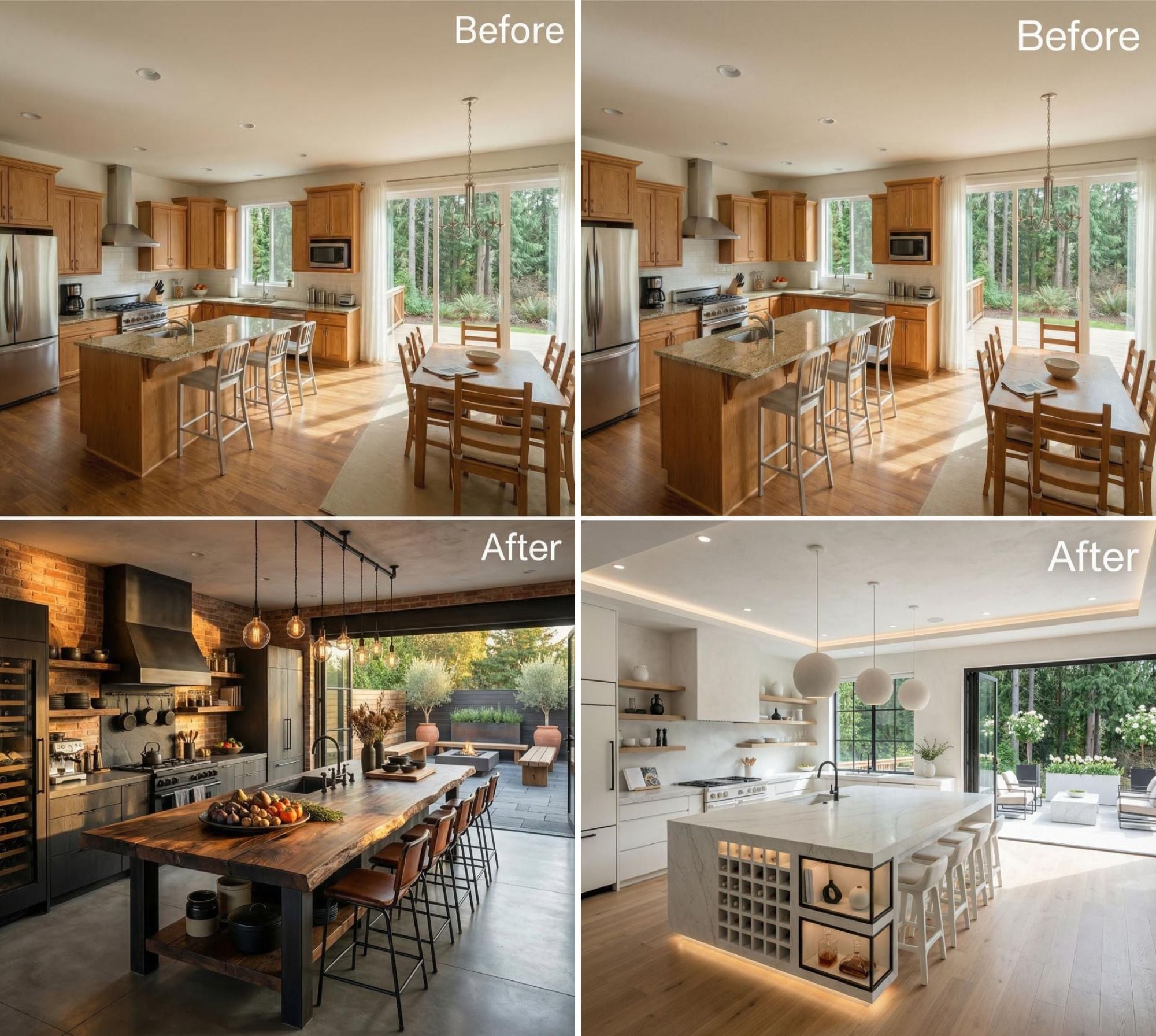
Dark Slate Cabinets and Walnut Butcher Block Island Give the Room Real Edge
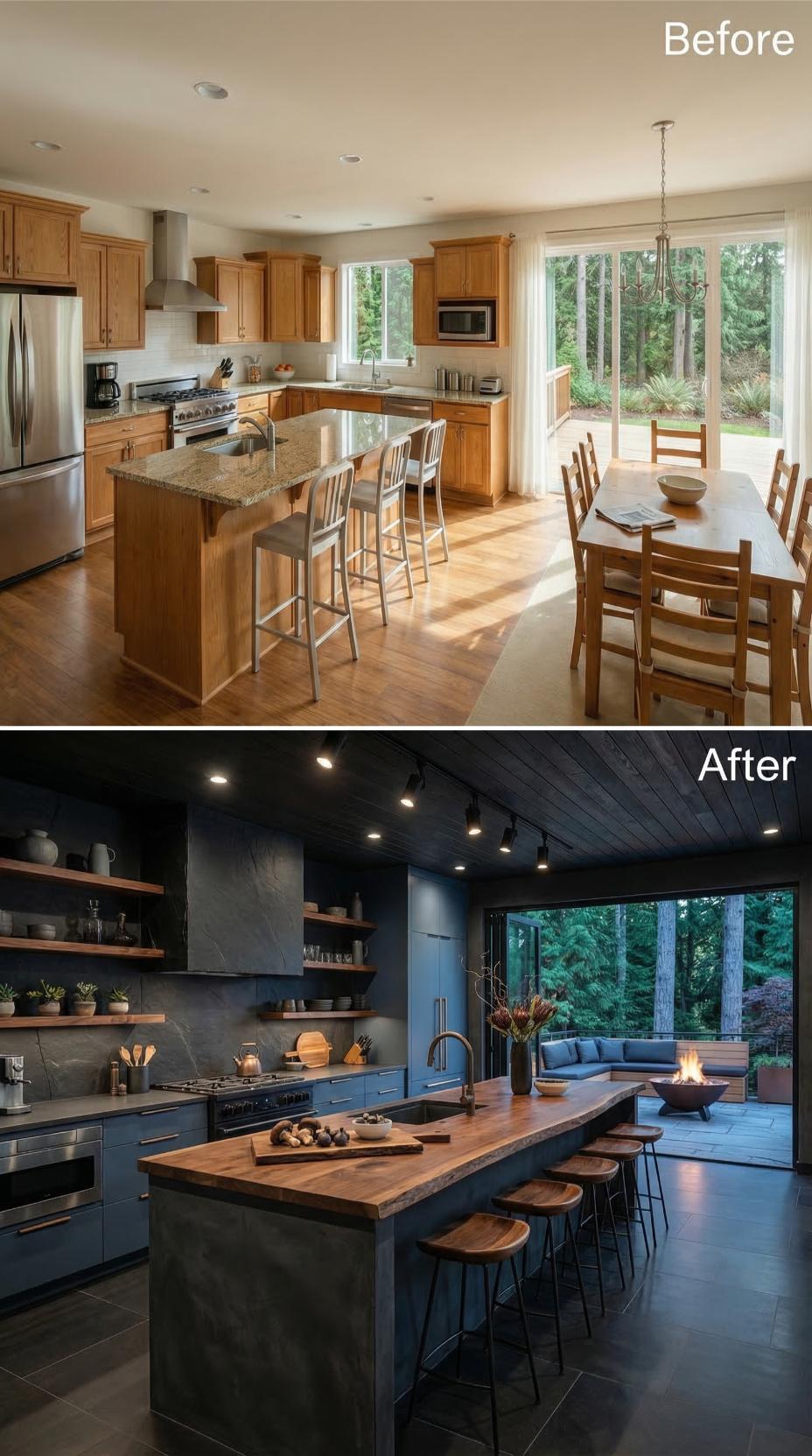
Honey oak uppers and granite-speckled countertops gave way to matte blue-grey cabinetry with integrated pulls and a walnut butcher block island surface. Open shelving in raw wood replaces upper cabinets entirely on one wall, keeping the ceramic vessels and cast iron pieces on display rather than hidden behind doors.
Slate-look wall tile runs floor to ceiling behind the range, and large-format dark porcelain tiles replace the original hardwood floor. Track lighting and recessed spots on a wood-planked black ceiling direct light downward with precision. The bi-fold glass wall opens to a patio anchored by a round fire bowl.
Brushed Gold Pendants and Waterfall Marble Elevate This Kitchen
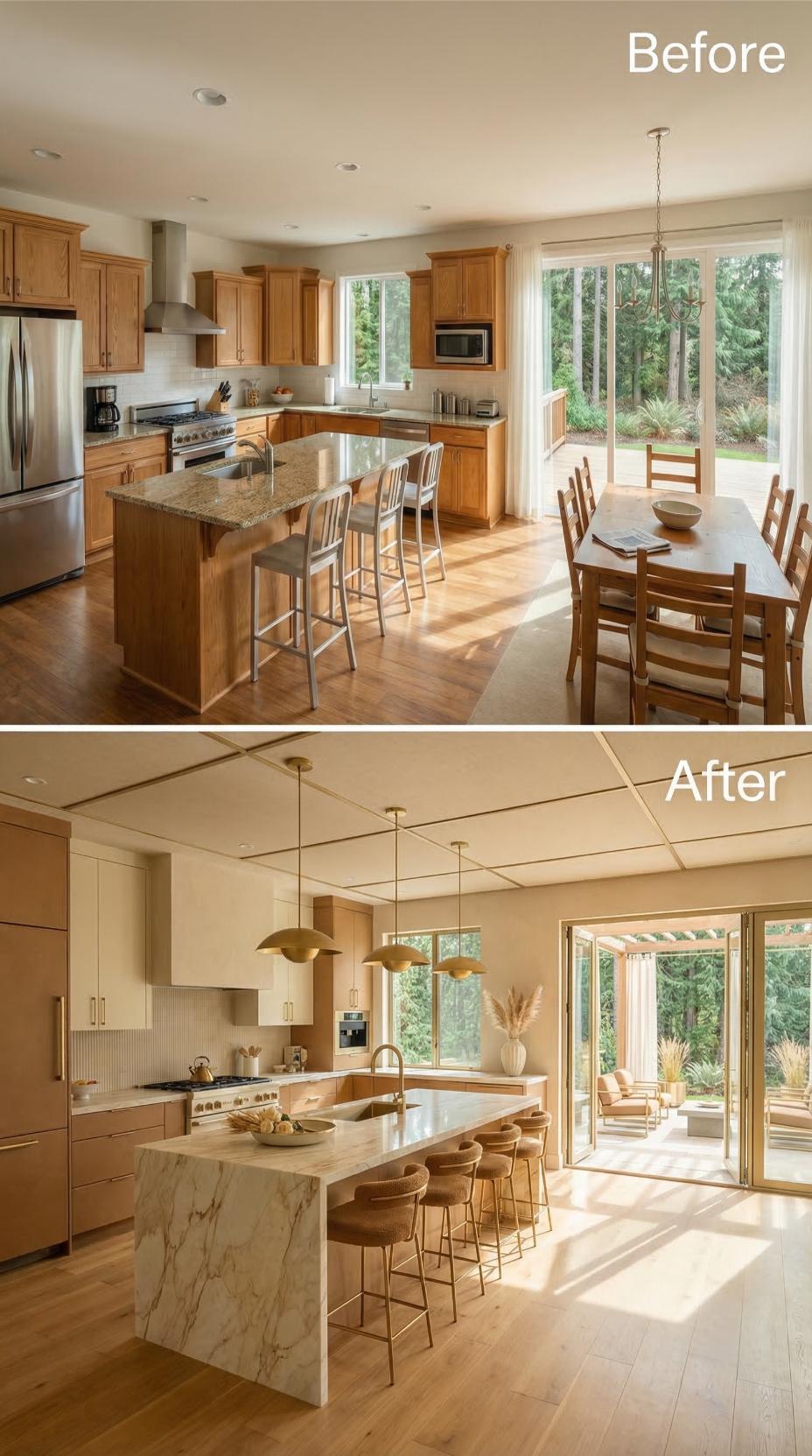
Brushed gold pendant lights hang over a marble waterfall island clad in cream-and-taupe veining, replacing the dated granite and oak that once defined the space.
Copper-Toned Cabinetry and Black Marble Swap Out Honey Oak for Good
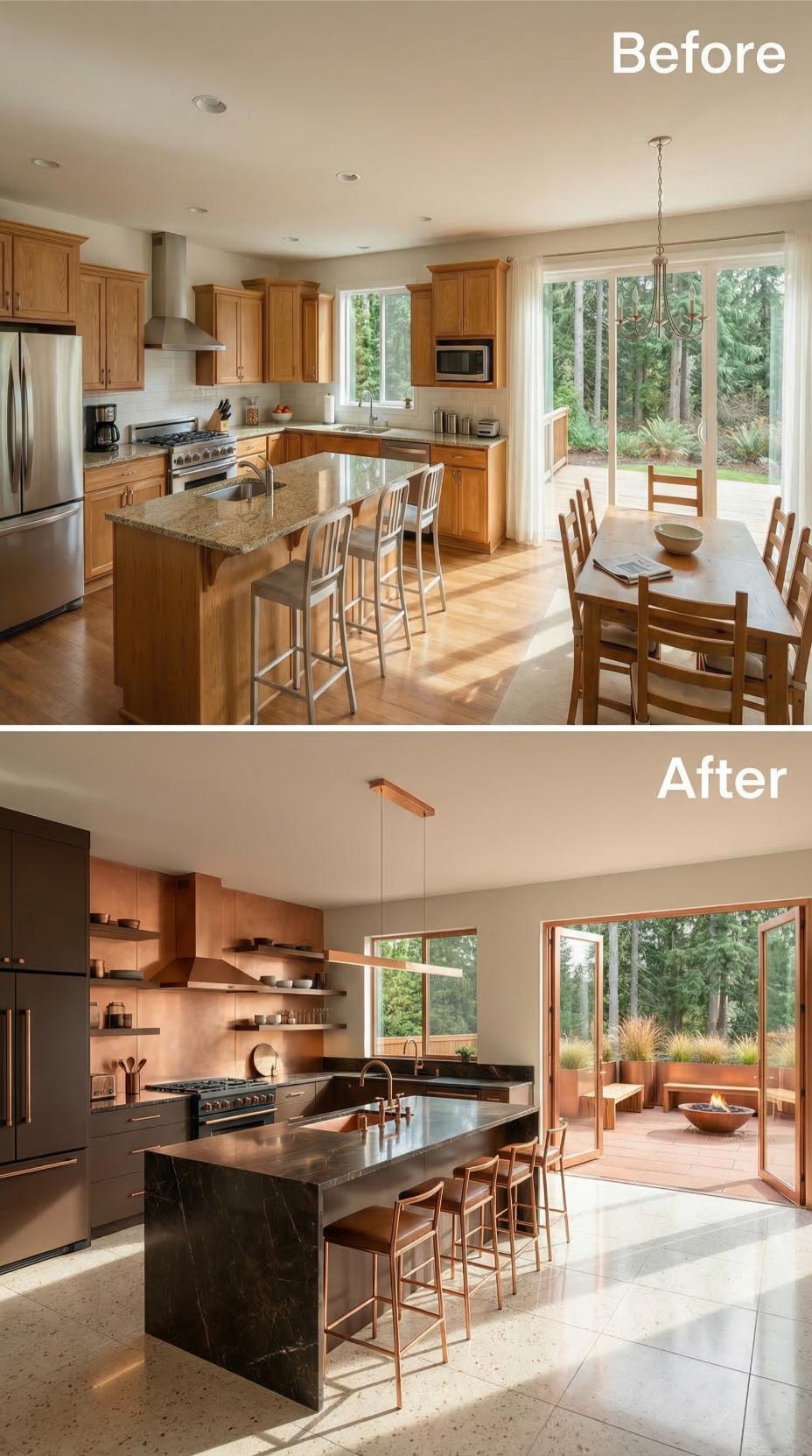
Warm-toned plywood cabinetry in a reddish-copper finish lines the walls, paired with open floating shelves that replace the upper cabinet bulk visible in the before. The island countertop is dark veined marble with a waterfall edge, and rose-gold hardware ties the metals together across fixtures and bar stools.
Large-format terrazzo tile replaces the wood floor, and a wood-framed sliding door opens directly onto a patio with a fire bowl. A single linear pendant in wood and brass hangs low over the island, cutting the vertical space cleanly.
White Lacquer Cabinets and a Slate Blue Ceiling Erase Every Trace of Oak

Globe pendants hang over a waterfall marble island fitted with modern chrome bar stools, while frosted glass upper cabinets and high-gloss white tile floors pull the eye toward folding glass doors opening onto a patio.
Did You Know: Painting a ceiling a deep, saturated color like slate blue visually lowers the perceived height of a room, creating an intimate atmosphere even in large open-plan kitchens. Designers often reserve this technique for spaces where the goal is drama without adding a single piece of furniture. The contrast between a white room and a colored ceiling registers more powerfully than most wall paint choices.
Burgundy Cabinets and a Waterfall Stone Island Retire the Honey Oak Era
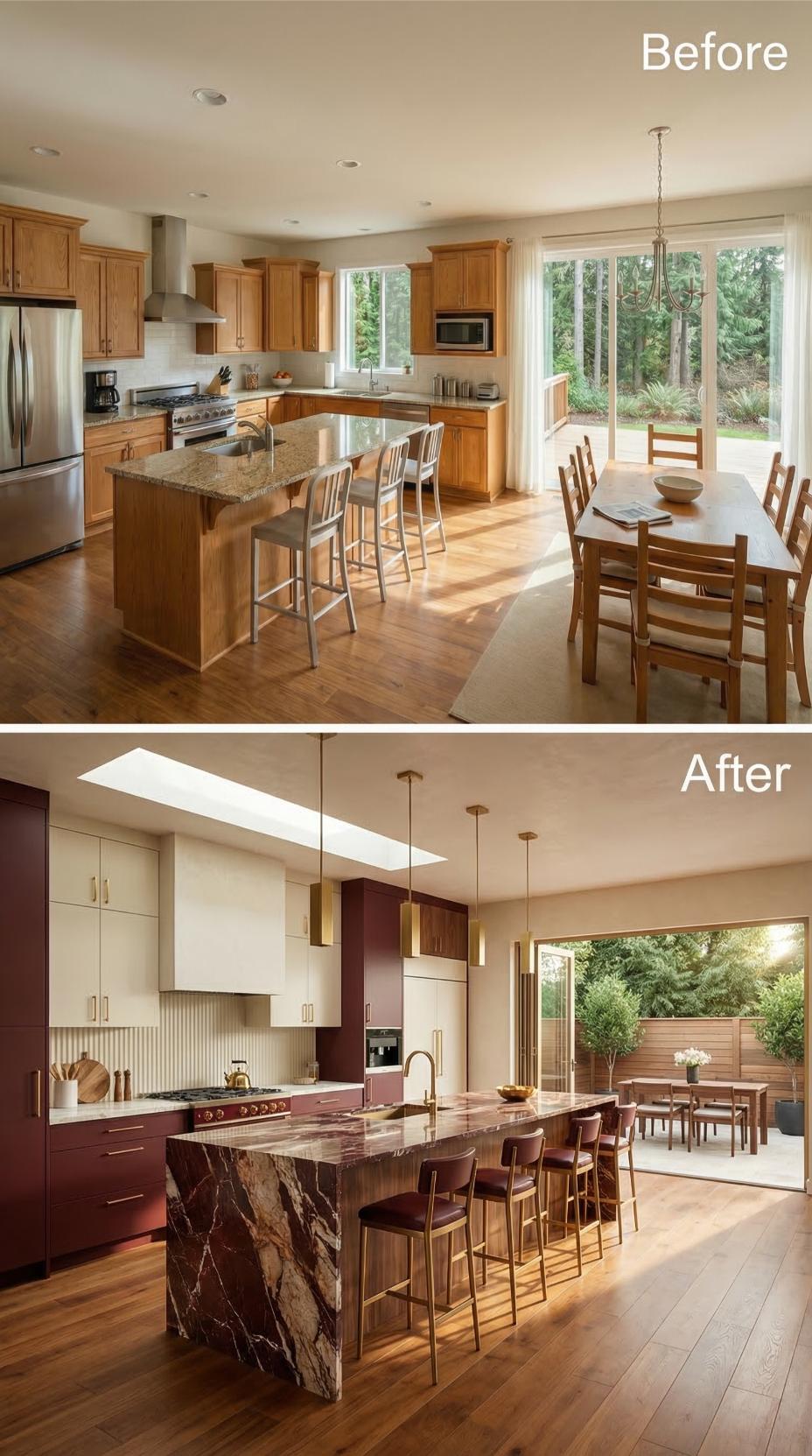
Deep burgundy lower cabinets anchor the redesigned kitchen, paired with cream upper cabinetry featuring brass hardware. The island becomes the focal point: book-matched stone in burgundy, cream, and rust veining cascades down all four sides in a full waterfall profile. Brass pendant lights hang in a staggered row overhead, and a skylight floods the cooking zone with natural light.
The original kitchen’s honey oak and beige granite read as politely forgettable. The redesign replaces the sliding glass door with a fully retractable opening, erasing the boundary between the kitchen and a cedar-fenced outdoor dining area.
Why That Island Stone Works So Hard in This Space
Book-matched stone slabs mirror each other across the island’s surface, which means the veining pattern repeats symmetrically rather than running randomly. On a waterfall island, that technique turns four vertical faces into a continuous visual statement visible from every seat. The burgundy and rust tones in the stone pull the cabinet color into the countertop, making the two materials read as a deliberate system rather than separate choices.
Nero Marquina Island and Flat Cabinet Fronts Erase Oak From Every Angle
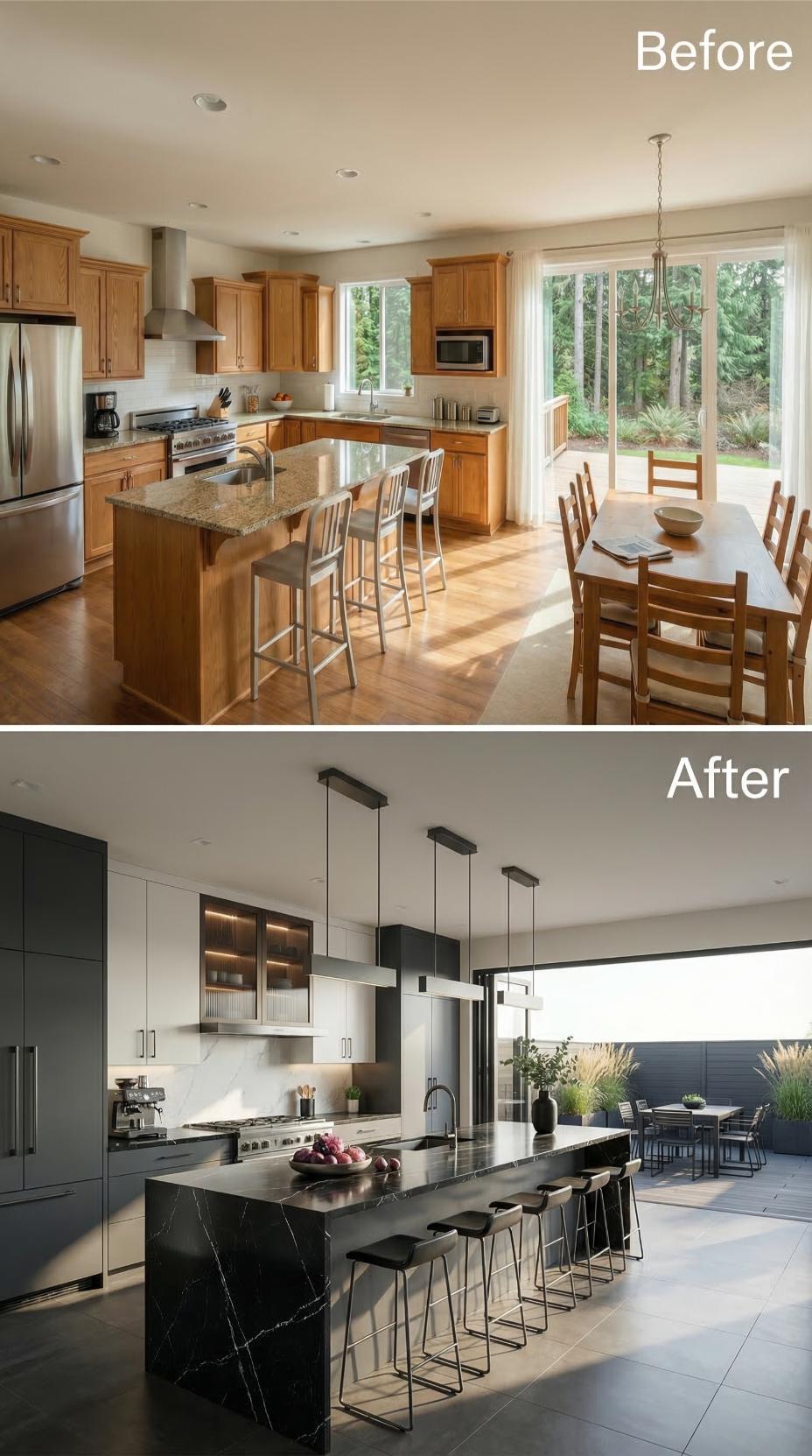
Warm oak and granite gave way to a palette built around restraint. Matte charcoal cabinet fronts run floor to ceiling on the left wall, paired with white upper cabinets that keep the room from closing in. The island is the undeniable focal point: Nero Marquina marble with white veining wraps the surface and continues down the waterfall edge, forming a slab that reads more like furniture than fixture.
Four pendant lights hang in a tight linear row above the island, their black rectangular profiles echoing the cabinet hardware exactly. Backless black bar stools line the island at counter height. Beyond the kitchen, large-format charcoal floor tile extends out to a covered outdoor dining area, dissolving the boundary between interior and exterior.
Designer’s Secret: Repeating a single material across both the countertop surface and the full waterfall edge, as seen with the Nero Marquina island here, requires precisely matched slab sections cut from the same stone block. Fabricators call this book-matching, and the result is a veining pattern that mirrors itself at the seam rather than appearing random or interrupted.
Where the last kitchen leaned on contrast, this one bets everything on a single bold color.
Navy Blue Sodalite Island and Ceiling Color Turn a Dated Kitchen Into Something Serious
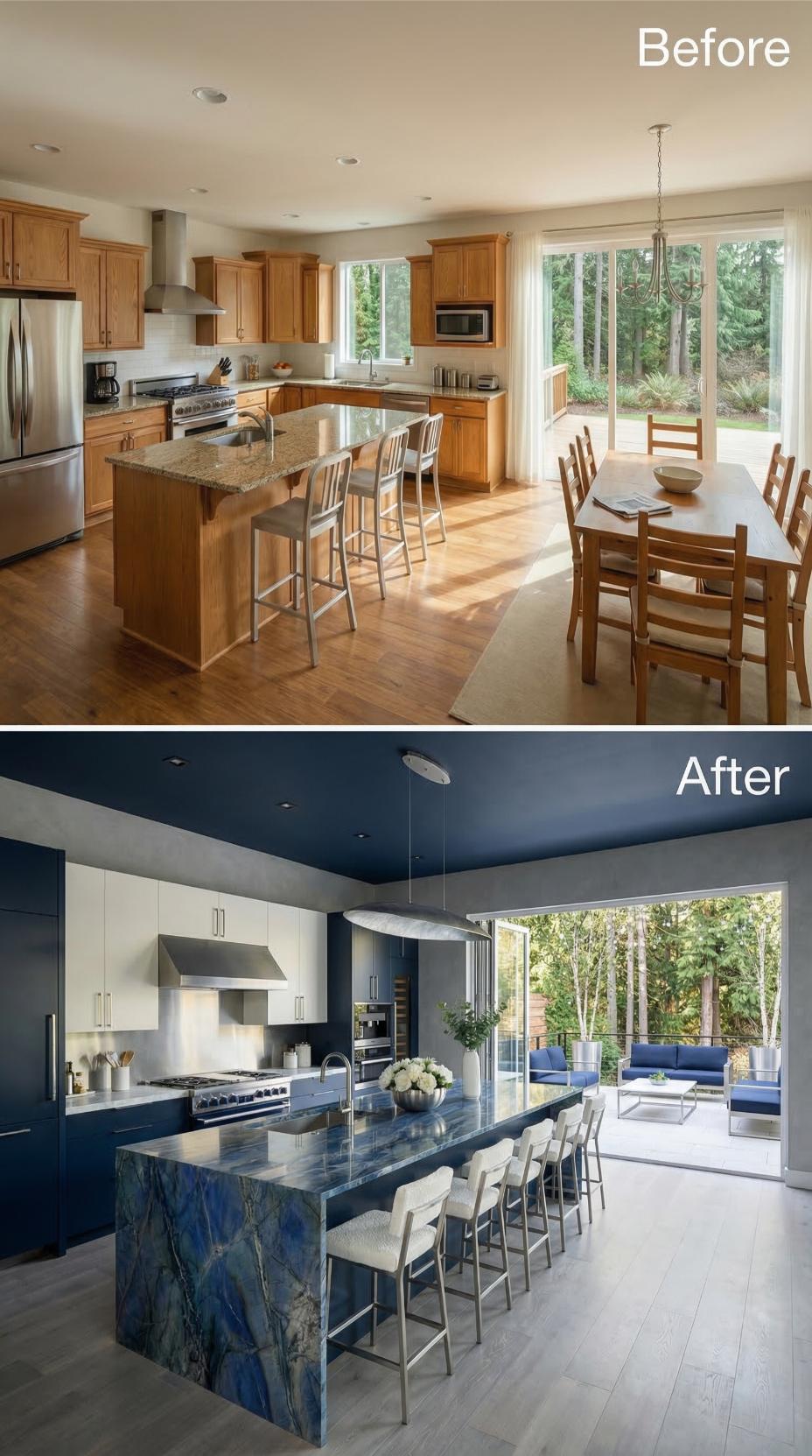
The sodalite blue quartzite island draws the eye immediately, its white and grey veining cutting through a base color that matches the navy lower cabinets. White upper cabinets keep the upper half from closing in, while the painted navy ceiling locks the palette into a deliberate, considered whole.
Black ceilings proved their power in the last section, and this kitchen pushes that drama even further.
Japanese Lanterns and a Black Grid Ceiling Pull Oak-Era Bones Into Bold Territory
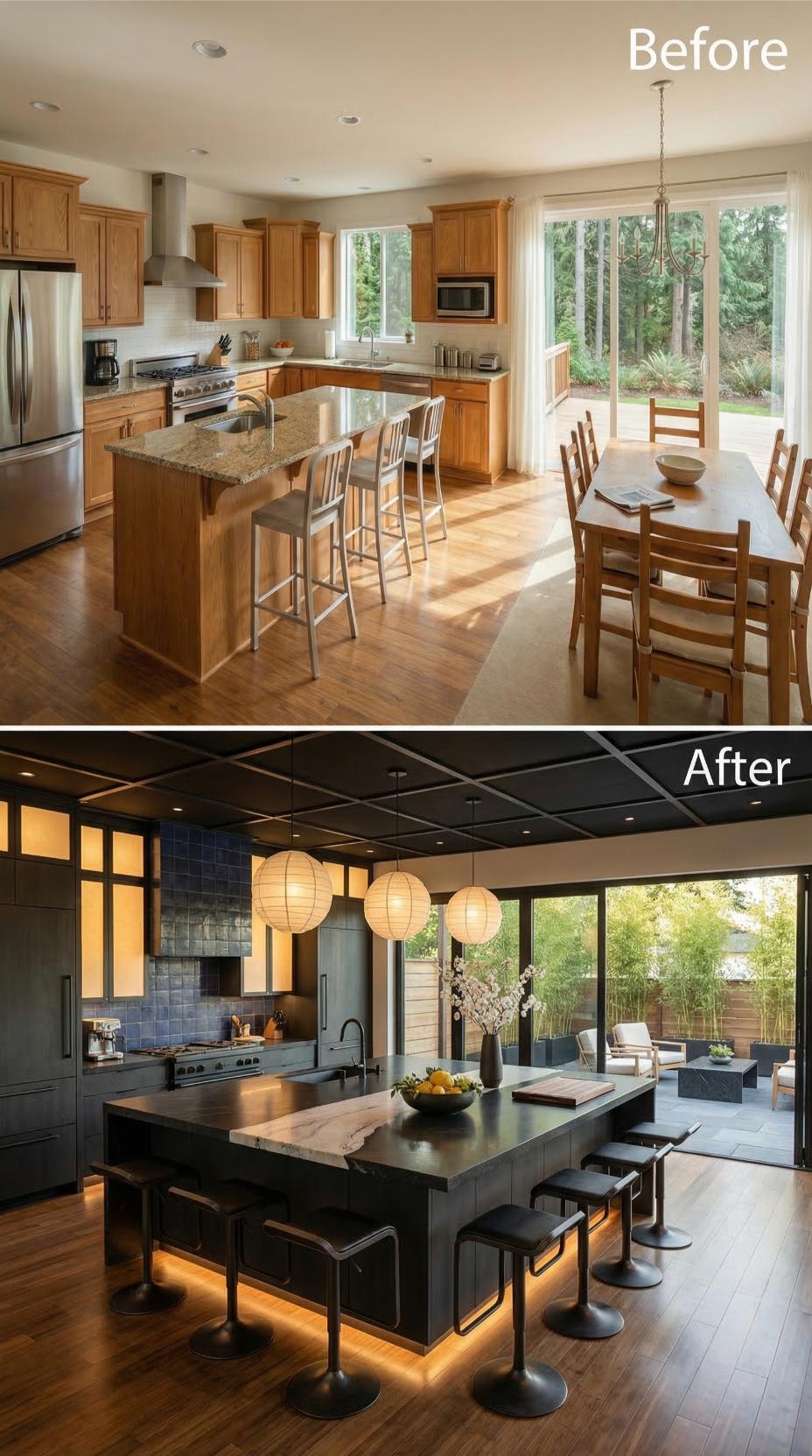
Paper lantern pendants in cream hang from a coffered ceiling painted matte black, its grid structure borrowing from Japanese shoji architecture. Dark charcoal flat-front cabinets with backlit upper panels replace the original honey-toned oak boxes. The island runs two countertop materials at once: a honed dark surface on one end and a live-edge wood slab inset on the other, an unusual pairing that reads intentional rather than indecisive. Black powder-coated pedestal stools line both sides of the island, which sits above strip lighting that warms the hardwood floor beneath it.
Backlit Onyx Island and Amber Pendant Lighting Retire Oak Cabinets for Good
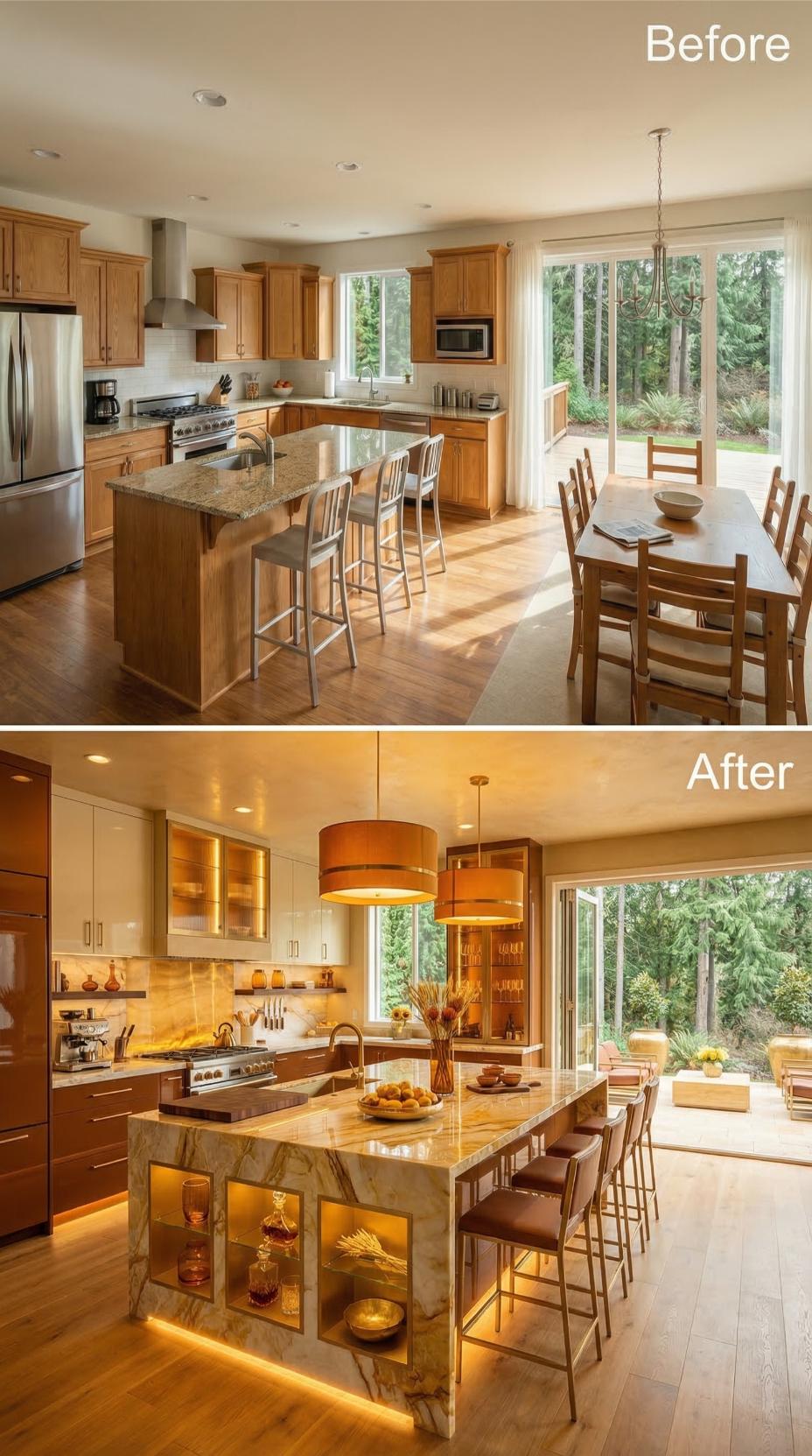
Gloss-finish cream cabinetry replaced the original honey-toned oak, and the shift reads immediately. The new island is clad in bookmatched onyx with pronounced gold veining, and recessed LED strips underneath cast a warm amber glow across the light maple floor.
A large drum pendant in burnt orange leather anchors the island visually. Open glass-front wall cabinets with internal lighting replaced the upper cabinet bank, giving the back wall a display-case quality rather than storage-heavy weight.
- Backlit onyx panels require LED strips rated for low heat output to prevent resin discoloration over time
- Open glass-front cabinets work best when contents are edited to a consistent color palette
- Drum pendants with opaque shades direct light downward, keeping countertop surfaces well-lit without ceiling glare
Sage Green Cabinets and a Marble Island Rewrite What Oak-Era Kitchens Can Become
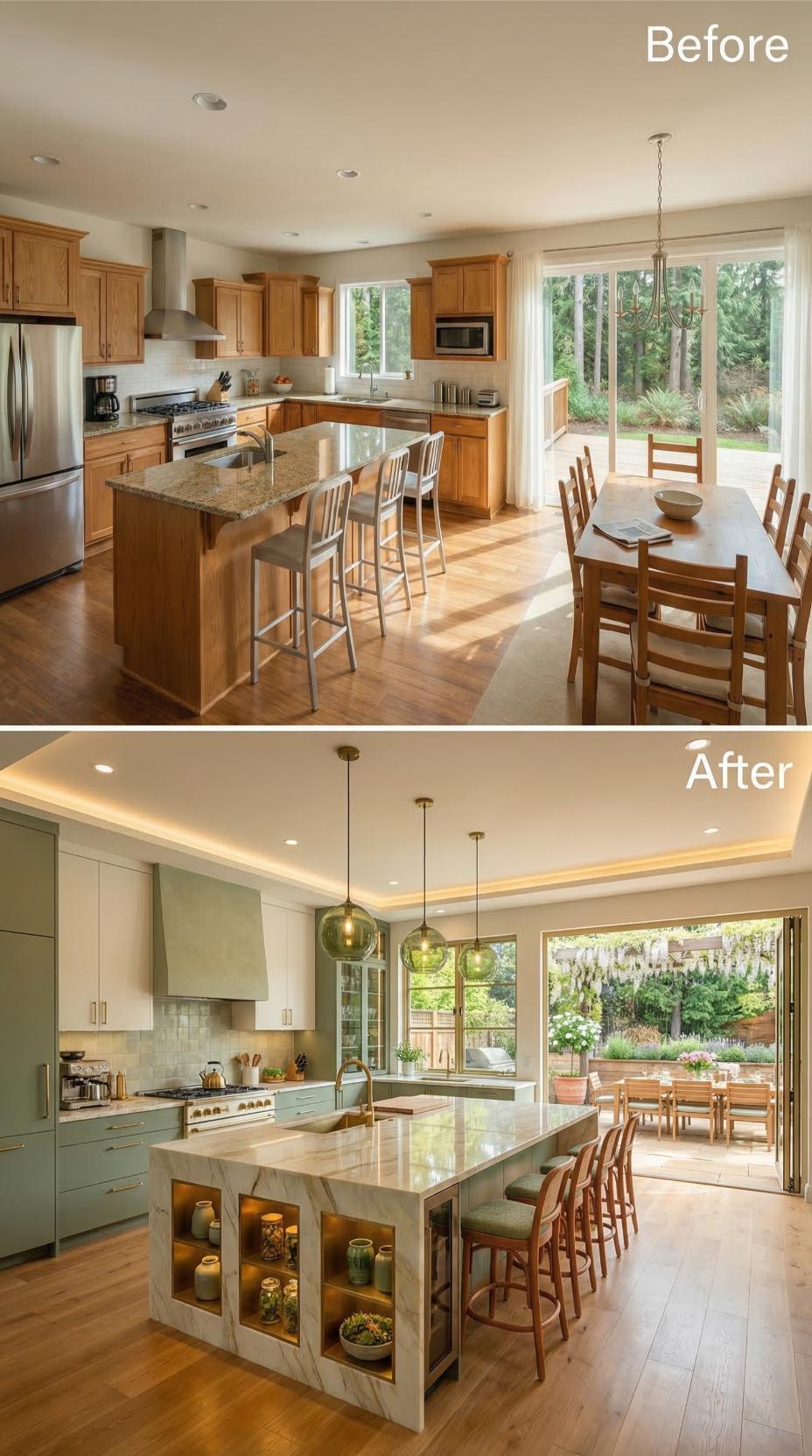
Flat-front cabinets in a muted sage green replace what was once a kitchen defined entirely by honey-toned oak and granite countertops. Brass hardware runs across every drawer and door. Above, a tray ceiling with recessed LED cove lighting replaces standard recessed cans, pulling the eye upward while adding architectural weight the original room never had.
The island is the focal point. White marble with bold grey veining wraps the entire structure, with open niches cut into the base and fitted with interior accent lighting. Olive-tinted glass pendant lights hang in a cluster above. Folding glass doors now replace a standard sliding panel, opening the space directly to a planted outdoor dining area.
In The Details: Open niches cut into an island base and backlit from within serve a dual purpose, adding display space while visually reducing the visual mass of a large stone structure. When the niche interiors are finished in a warm brass or natural wood tone, the effect reads as intentional rather than decorative.
Wine Storage, Brass Lanterns, and a Forest Green Ceiling Replace Oak With Something Covetable

Saturated forest green covers the ceiling from wall to wall, grounding the space in a way that painted white drywall never could. Brass-framed pendant lanterns hang in a row above the island, their warm filament bulbs casting a glow that reads more like a restaurant than a residence. The island itself combines a dramatic red-veined marble slab with an integrated wine rack and open brass-trimmed shelving below, both lit from within.
Upper cabinets shift to cream with gold hardware and glass fronts, while lower cabinetry runs in a rich reddish-brown wood veneer. A copper backsplash behind the range anchors the cooking zone. Folding glass doors have replaced the original sliding panel, opening the entire back wall to the deck.
Style Tip: Installing a folding or bi-fold glass wall system in place of a standard sliding door increases the visual connection to outdoor space significantly, making even a modest deck feel like an extension of the interior. The wider opening also draws natural light deeper into the kitchen, reducing reliance on overhead fixtures during daylight hours.
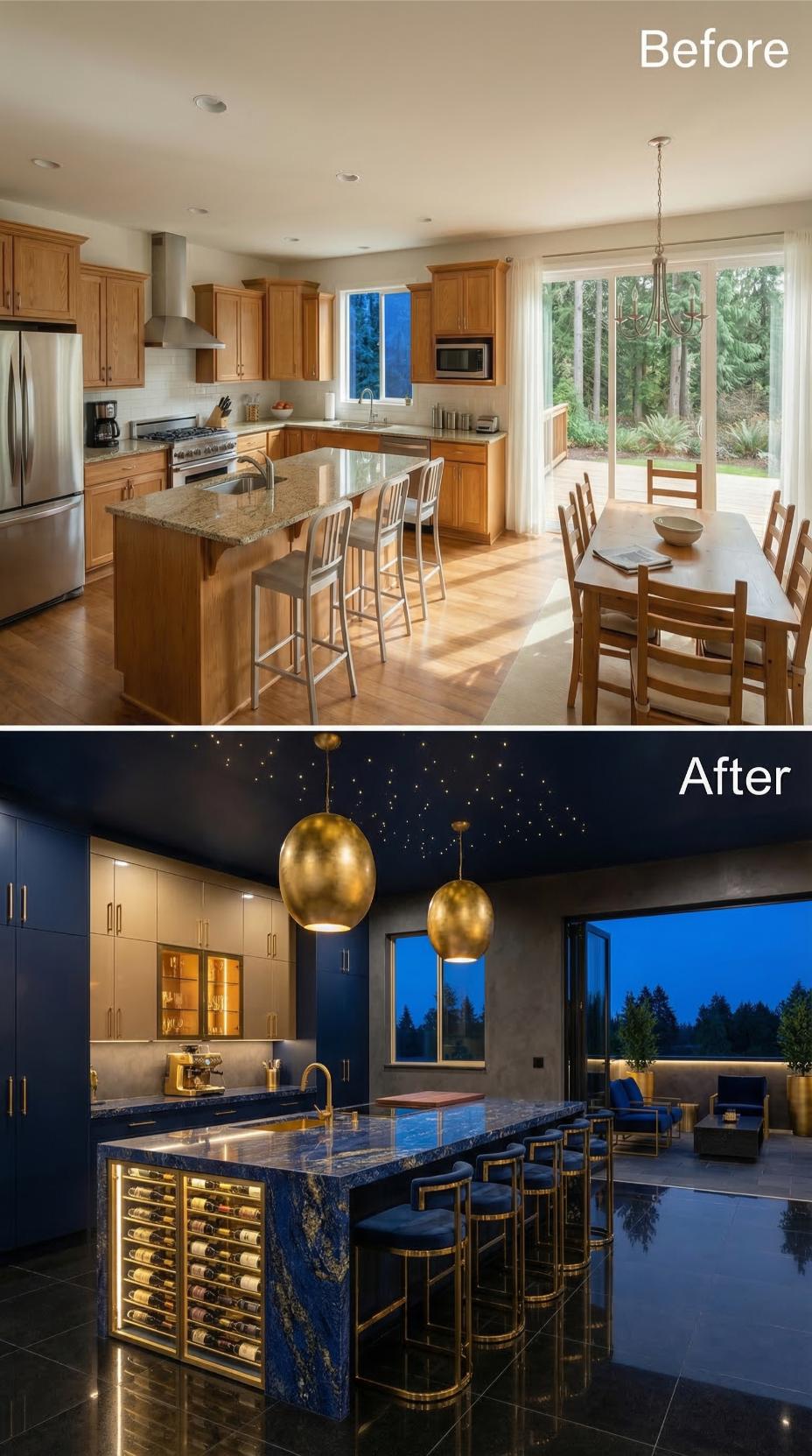
Veined Blue Marble and Gold Stools Heat Up the Palette
🔥 Would you like to save this?
Sodalite blue marble wraps the island in veined gold and navy, with a built-in wine rack illuminated from within the base. Two oversized brass orb pendants anchor the space overhead, against a near-black ceiling dotted with fiber optic points. Gold-trimmed bar stools with black upholstered seats line the island in tight formation.
- Fiber optic ceiling installations require a dedicated light engine unit, typically housed in a nearby cabinet or ceiling void.
- Sodalite is a semi-precious stone, which makes it one of the costlier countertop materials per square foot compared to standard granite.
- Pairing matte cabinet fronts in a cool gray-blue with polished stone counters creates contrast in sheen without introducing additional color.
Curved Marble Island and Slate Blue Cabinetry Make Oak Look Like a Different Century
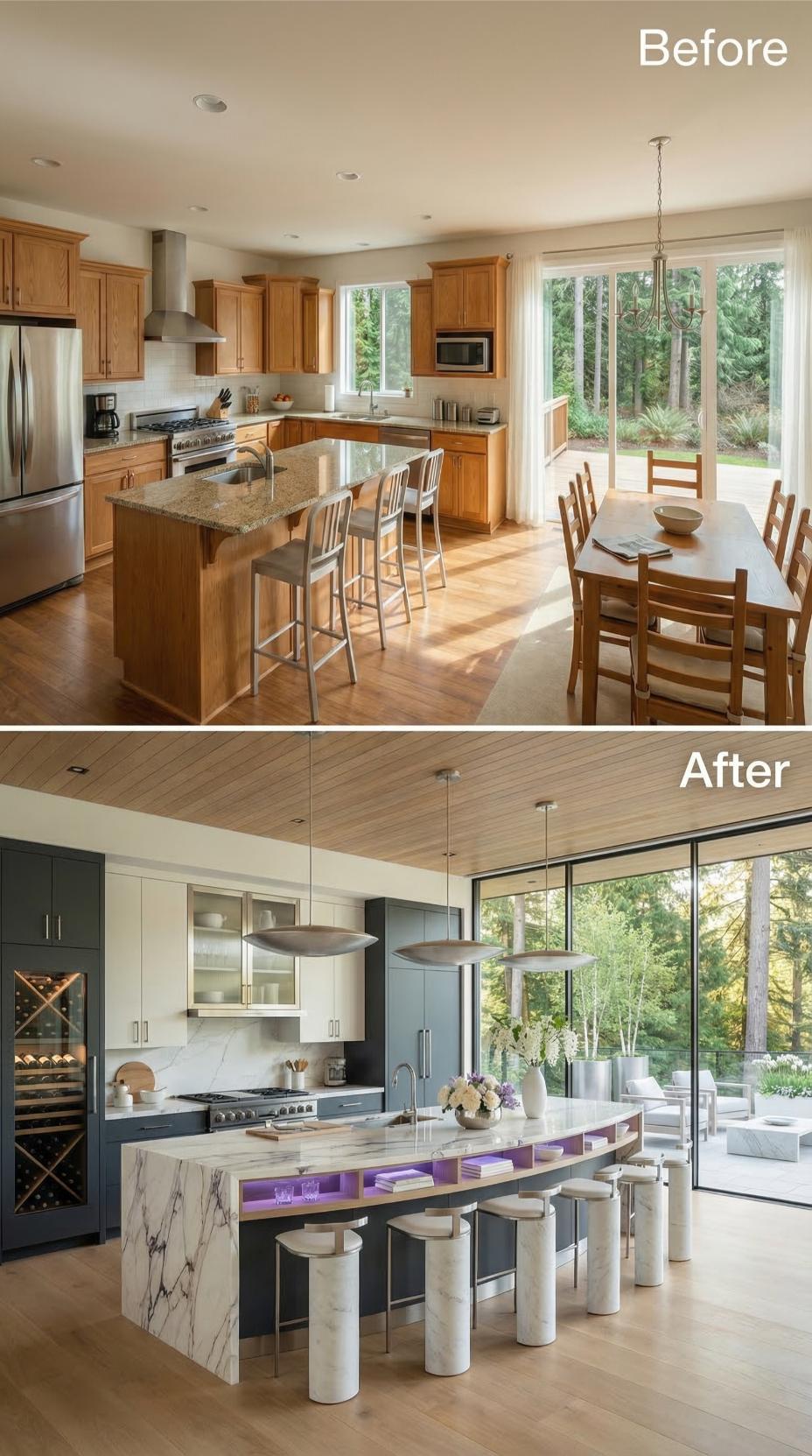
Honey oak cabinets and granite countertops gave way to a two-tone cabinet scheme pairing slate blue lowers with cream uppers, the latter fitted with glass-front doors and brushed gold hardware. The island is the room’s centerpiece: a curved waterfall slab in white marble with pronounced grey veining, supported by cylindrical marble pedestals that double as bar stools. Purple LED strips glow from open shelving cut into the island base, casting a cool wash of light across the light oak flooring.
A wine refrigerator with an X-pattern wood frame anchors the left wall, while three disc-shaped pendant lights hang above the island in brushed nickel. Floor-to-ceiling glass panels replaced the original sliding door, pulling the treeline directly into the sightline. The wood-planked ceiling runs at a gentle pitch, grounding the space without heaviness.
Cylindrical marble pedestals that double as bar stools are the kind of detail that signals a designer made deliberate choices, not safe ones.
Sage Green Marble and Black Pendants Swap Oak Cabinets for Serious Design Authority
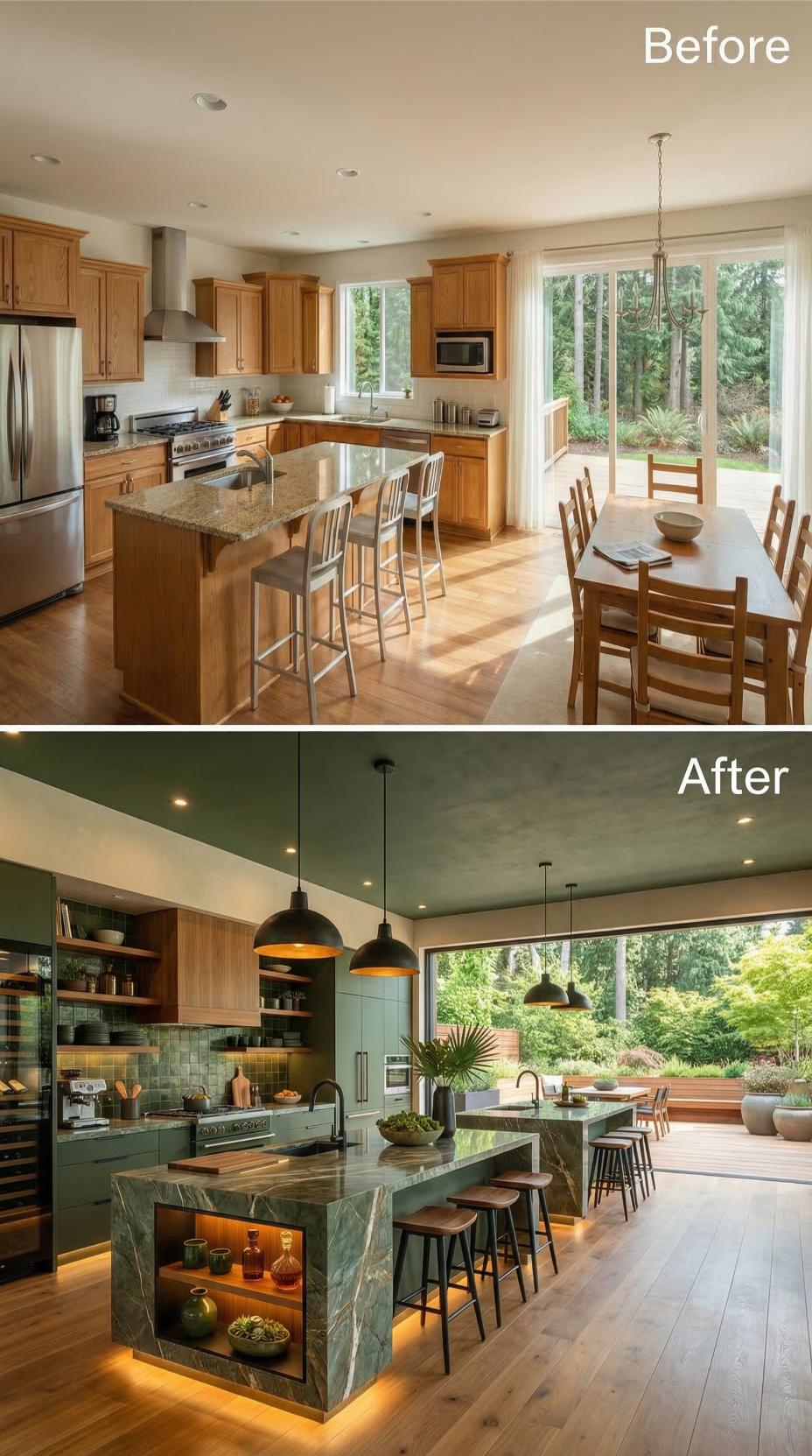
Green veined marble wrapped around an entire island base is not a subtle choice, and that’s precisely the point.
The island here is clad floor-to-counter in verde marble with dramatic white veining, and recessed shelving cut into its base glows with warm underlighting that puts glassware and ceramics on display. Flat-front sage green cabinetry lines the walls, paired with a matching green tile backsplash in a staggered brick pattern. Three black dome pendants hang at staggered heights above the island.
A wide folding glass wall replaces what was a modest sliding door, pulling the wooded deck directly into the sightline. The honey oak and granite of the original kitchen share nothing with this version except the floor plan.
Teal Quartzite Island and Gloss White Cabinetry Bury Oak Under Pure Luxury
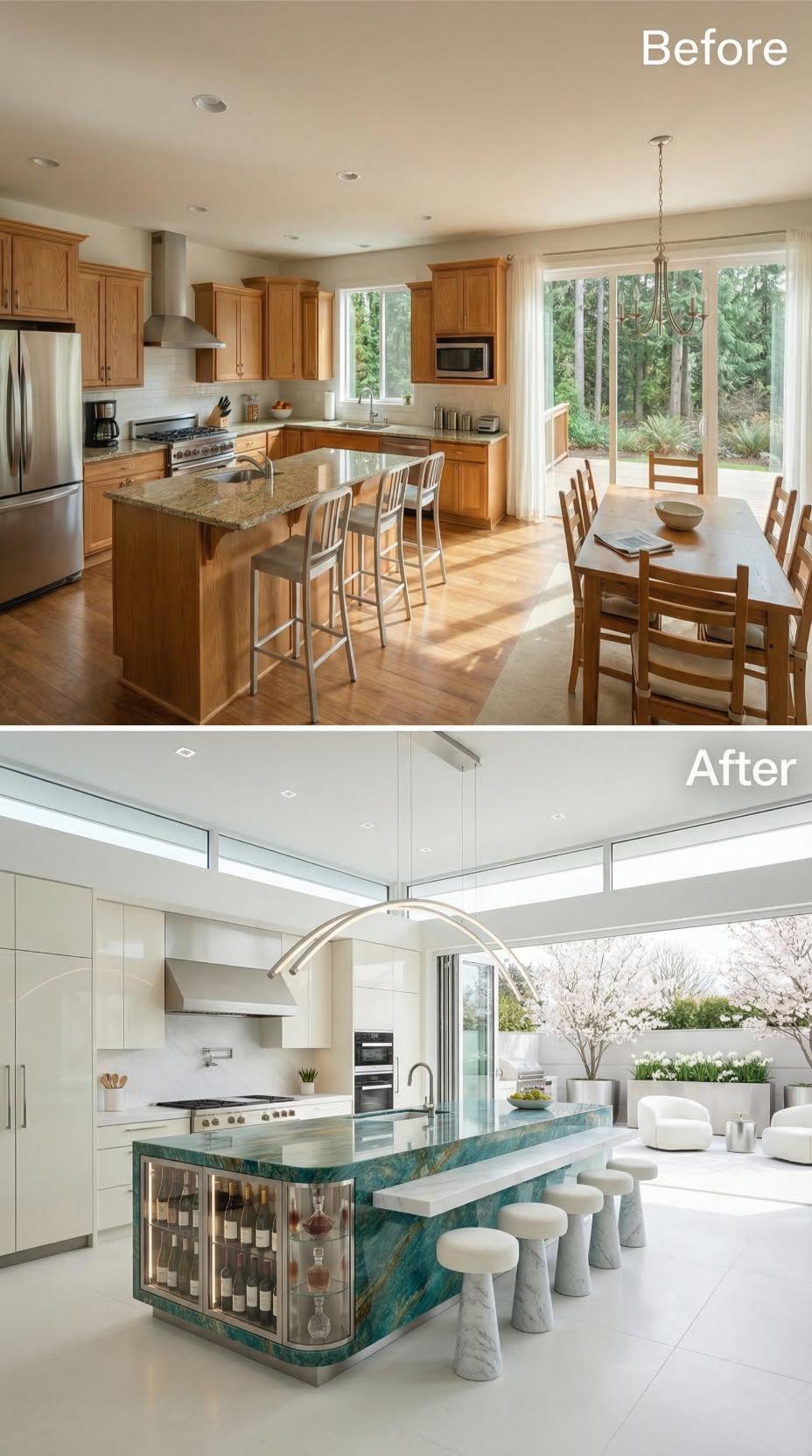
Teal quartzite does something granite never could: it makes the island the undisputed focal point of an entirely white kitchen.
Floor-to-ceiling gloss white flat-front cabinets replace the honey oak entirely, and the shift in visual weight is immediate. The island surfaces in what appears to be Azul Macaubas or a similar teal-veined quartzite, with gold and white movement running through deep blue-green slabs. An illuminated wine display cut into the island base keeps bottles visible without any added cabinetry. Cylindrical marble stools with tapered bases line the seating side, and a sculptural arc pendant in brushed steel sweeps over the cooktop wall.
Black Marble, Ring Pendants, and a Built-In Wine Wall Redefine What Remodeling Can Cost
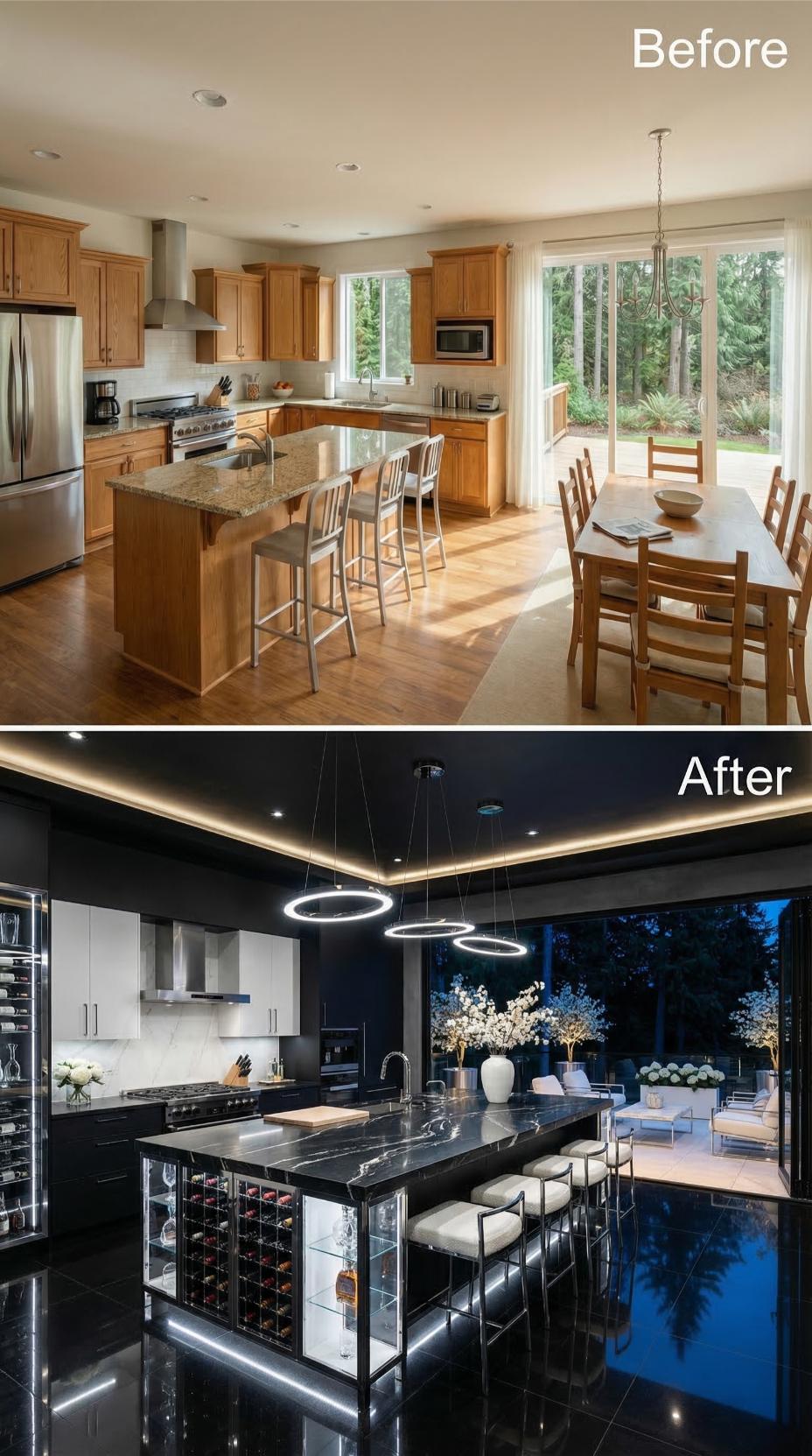
Black-veined marble covers the island countertop and waterfall sides, with chrome-framed bar stools adding a hard industrial edge. Two circular LED ring pendants hang at staggered heights above the island, replacing a traditional chandelier entirely. Flat white upper cabinets contrast the dark walls and black tile floor, keeping the upper zone from collapsing visually.
History Corner: Built-in wine storage became a sought-after kitchen feature in American homes during the 1990s wine boom, when domestic wine consumption rose sharply and homeowners began treating collections as display-worthy rather than cellar-bound. Integrating wine racks directly into island cabinetry, rather than tucking them into a separate room, signals that the collection is part of the kitchen’s identity. The trend accelerated as open-plan kitchens blurred the line between cooking space and entertaining space.
Blush Cabinets, Marble Waterfall Island, and Rose Gold Hardware Retire Oak Without Apology
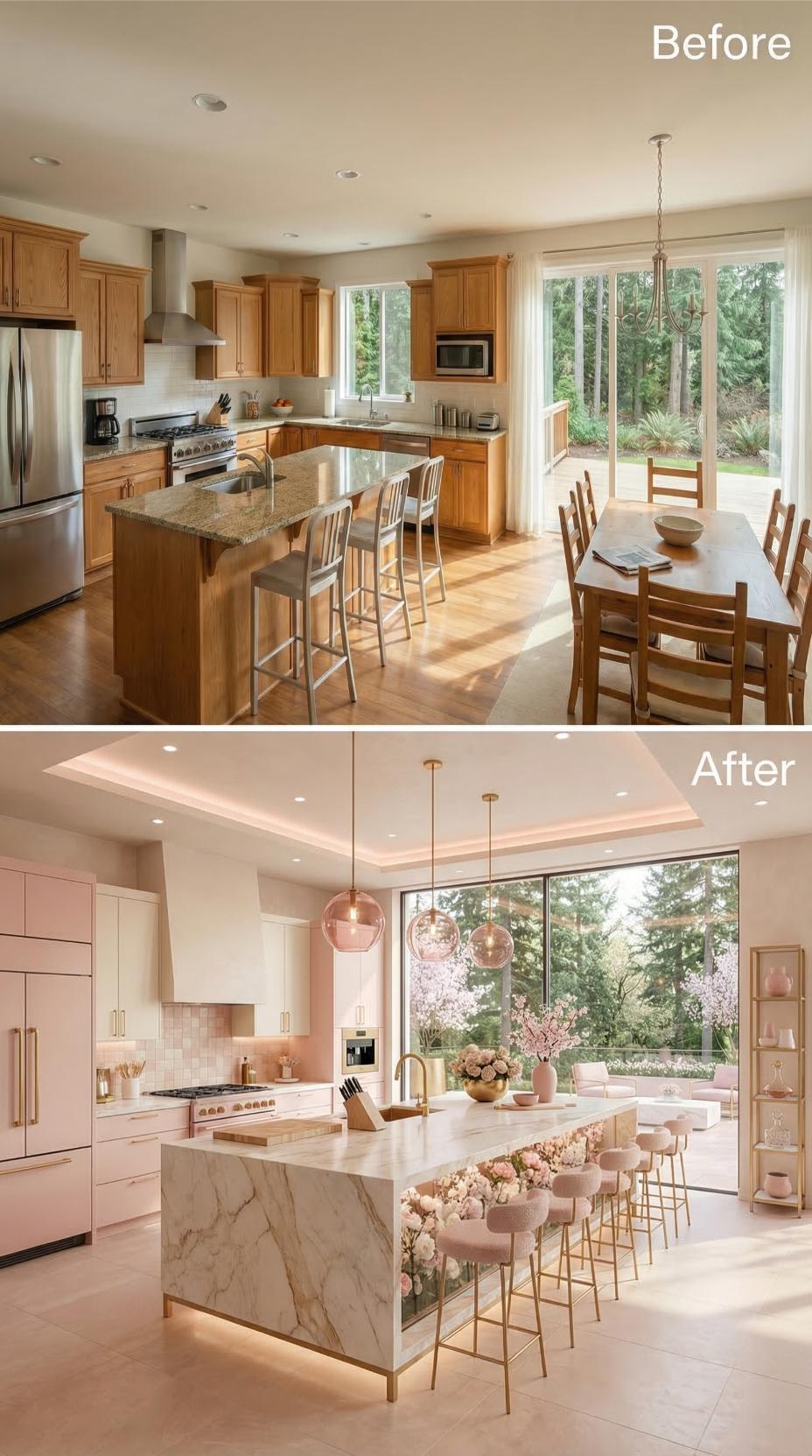
Pink-toned flat-front cabinetry in a matte blush finish lines the perimeter, paired with brushed gold pulls that read more jeweler’s case than kitchen supply store. The island is the centerpiece: white marble with soft grey veining wraps the full waterfall edge down to the floor, its base lit from beneath with warm strip lighting that floats the entire structure off the ground visually.
Globe pendants in smoked rose glass hang from a coffered ceiling edged in warm pink indirect lighting. Dusty rose upholstered bar stools on gold legs run the length of the island. Fresh cherry blossoms visible through the floor-to-ceiling glazing tie the pink interior palette to the outdoor view without any deliberate staging required.
Editor’s Note: Undercabinet and under-island LED strip lighting, when set to a warm 2700K color temperature, adds depth to stone surfaces by highlighting veining that cooler overhead lighting tends to flatten. In kitchens with light marble, this technique makes the material read richer without any change to the stone itself.
Lapis Blue Island Cladding and Brass Ring Pendants Rewrite Oak’s Entire Legacy
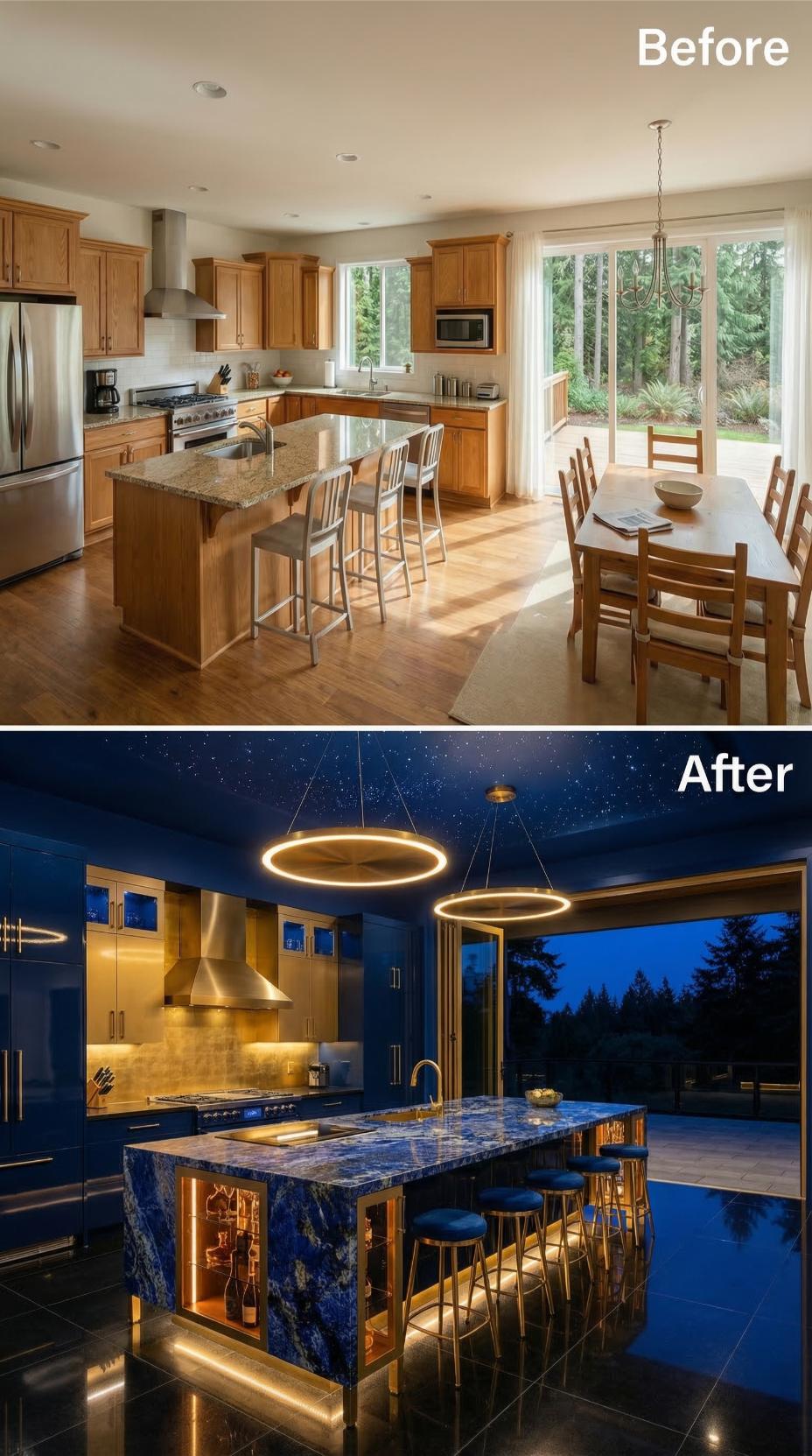
Oak cabinets and granite countertops gave this kitchen a warm but forgettable personality. What replaced them operates at a completely different register.
Deep navy cabinetry with brass-framed glass uppers anchors the perimeter, while the island takes the boldest swing: lapis-veined blue stone wraps all four sides in a full waterfall application, with an illuminated wine display cut into the base. Two oversized brass ring pendants hang at staggered heights above the island. The ceiling carries the same deep blue as the cabinets, dissolving the boundary between vertical and overhead surfaces and pulling the entire room into a single dark envelope.
Quick Fix: Matching the cabinet color to the ceiling color, as done here with deep navy, visually merges the two planes and makes the room feel architecturally intentional rather than assembled from separate decisions. Designers sometimes call this technique “color immersion,” and it works especially well in kitchens with strong accent lighting because the fixtures read as focal points against a unified dark field. The effect requires a high-quality paint with a slight sheen to prevent the surfaces from looking flat under artificial light.
Marble Waterfall Island and Globe Pendants Swap Warm Oak for Collector-Grade Calm
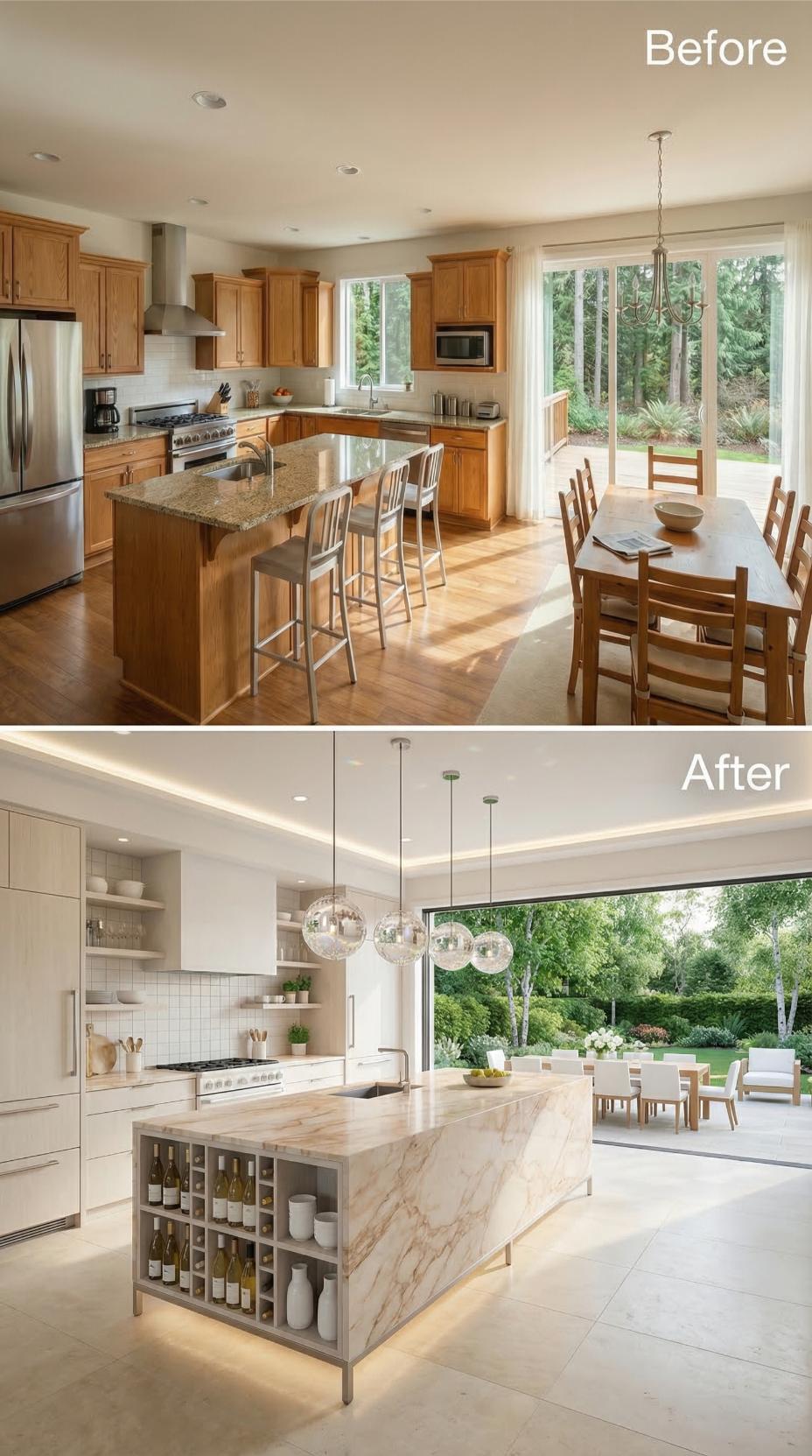
Flat-front cabinetry in a warm off-white linen finish replaced every honey-toned oak door, and the shift in material language is immediate. The island draws the eye first: book-matched stone with gold and cream veining wraps a full waterfall edge, and open wine storage cut into the base keeps the mass from reading as heavy. Three globe pendants in smoked glass hang at staggered heights above the countertop, replacing the single brass chandelier entirely.
Cove lighting runs the full perimeter of the ceiling, casting a soft wash across large-format porcelain floor tile laid in a grid pattern. Where sliding glass once framed a narrow garden view, a wide bi-fold opening now dissolves the wall entirely, pulling the outdoor dining space into the room’s sightline.
By The Numbers: Large-format porcelain tile, typically 24×48 inches or larger, requires a laser-leveled subfloor with less than 1/8-inch variation across 10 feet to prevent lippage and cracking over time. Homeowners who skip this prep step account for a significant share of tile warranty claims filed annually. The investment in proper subfloor preparation typically runs 10 to 15 percent of total tile installation cost.
Copper Hood, Backlit Quartzite Island, and Linear Ceiling Lights Pull a Kitchen Out of the 2000s
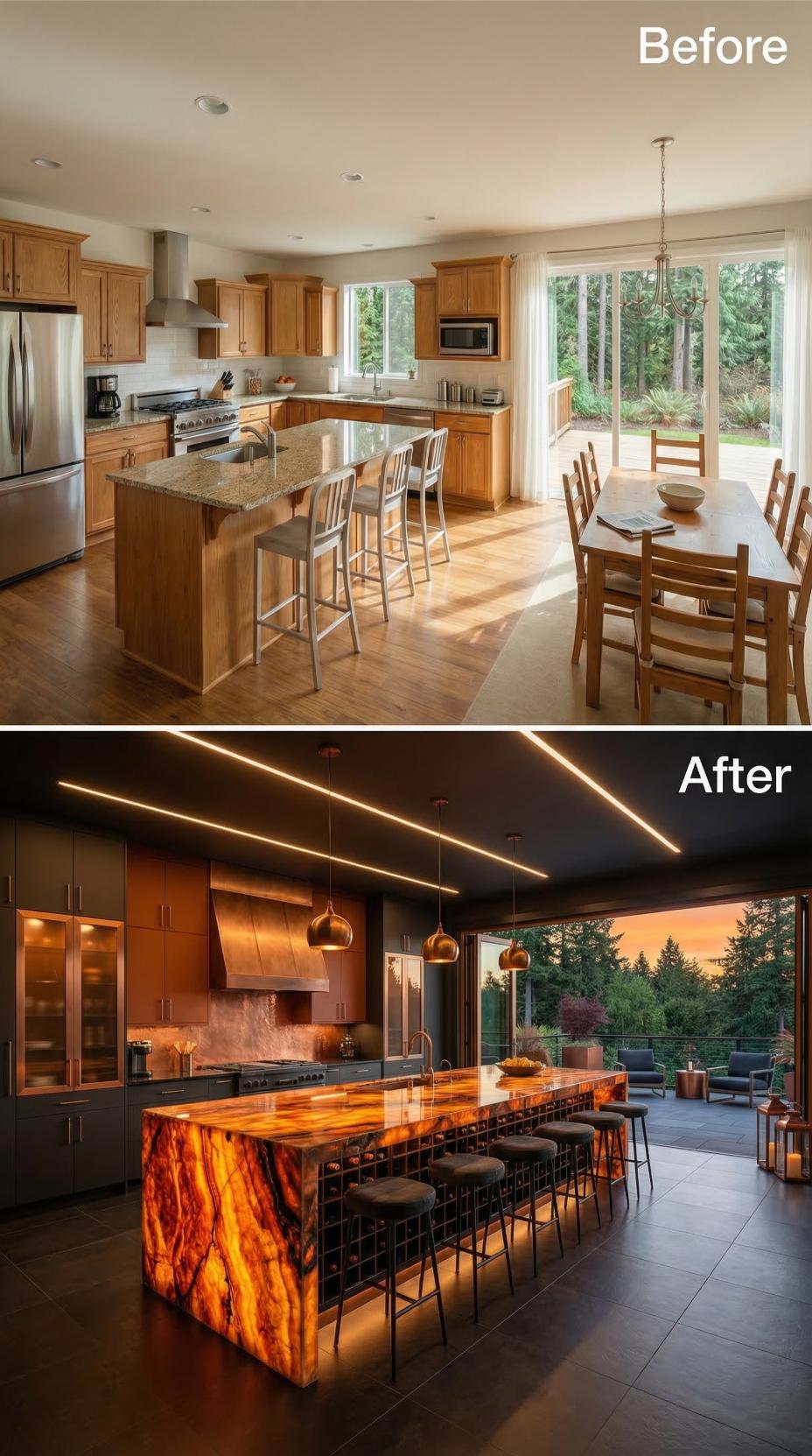
Raw copper cladding on the range hood sets the tone before anything else registers. The island countertop appears to be backlit quartzite or onyx, with deep amber and rust veining that glows from within, a material choice that functions as the room’s focal point rather than simply its work surface. Dark charcoal cabinetry runs floor to ceiling on the back wall, punctuated by glass-front upper sections and copper hardware that echoes the hood.
Linear LED strips are recessed directly into the black-painted ceiling at diagonal angles, replacing conventional pendant placement with something closer to architectural lighting design. Copper globe pendants hang above the island alongside the linear system. A full-width opening to the deck erases the wall entirely, pulling a sunset treeline into the composition.
Color Story: Copper as a kitchen finish material has seen a resurgence in high-end residential design because it develops a natural patina over time, shifting from bright rose-gold toward warmer, darker tones that no painted or plated finish can replicate. Used here across both the range hood and accent hardware, the metal creates a chromatic thread through the room that visually connects surfaces separated by significant distance. Patina development can be slowed with a clear sealant or encouraged naturally by leaving copper surfaces unsealed.
Bold Lacquer and Brass Hardware Sharpen the Space
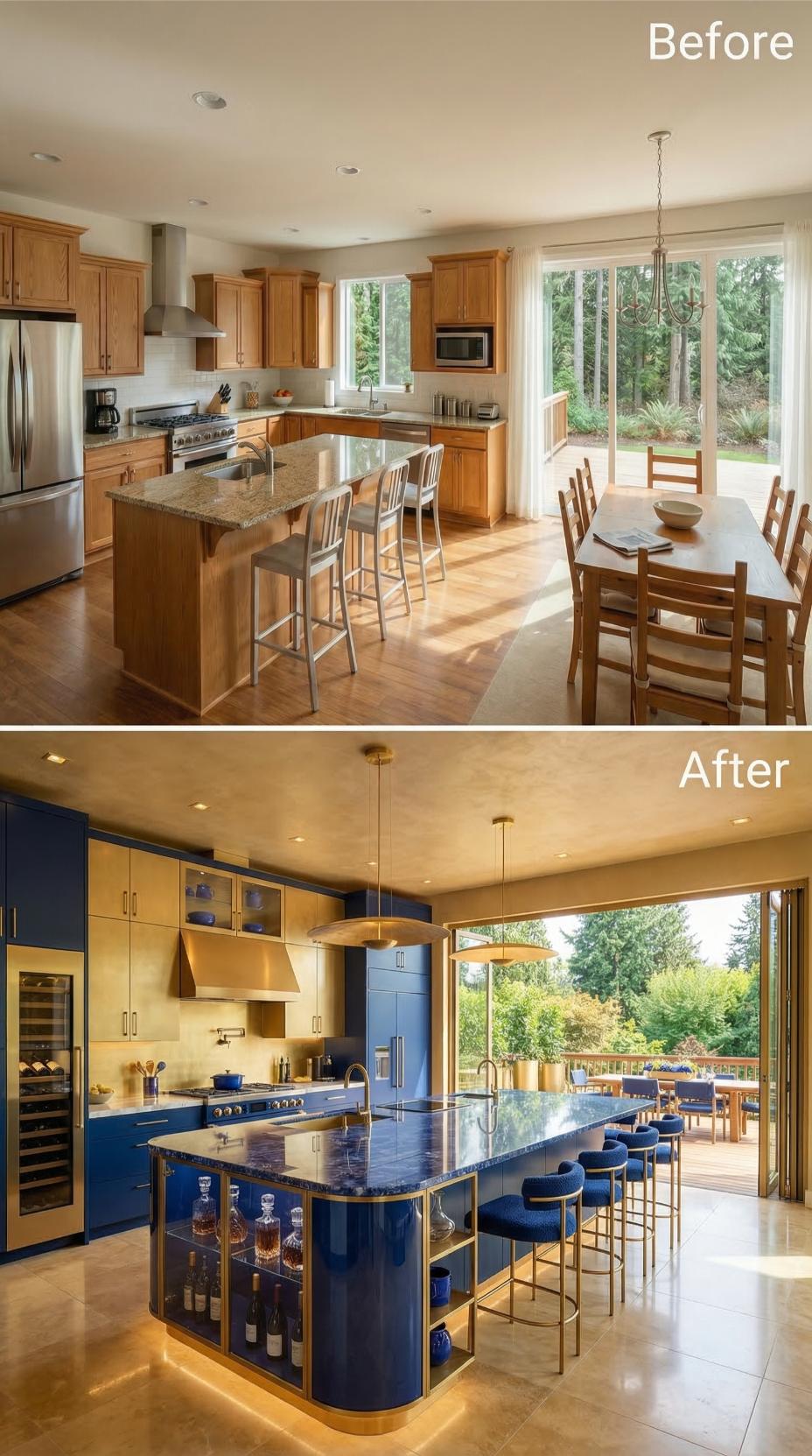
Bold cobalt lacquer covers every cabinet face, paired with brushed brass pulls and a veined blue stone island countertop that extends into a full waterfall edge with glass-front base display shelving below.
Pro Tip: Lacquer cabinet finishes, unlike painted wood, are sprayed in multiple thin coats and cured under controlled conditions, producing a depth of color and surface hardness that standard brush-applied paint cannot replicate. High-gloss lacquer in deep jewel tones reflects ambient light differently at each hour of the day, which is why designers often specify it for kitchens with strong natural light sources.
Woven Rattan Pendants and Backlit Onyx Pull Honey Oak Into a New Decade
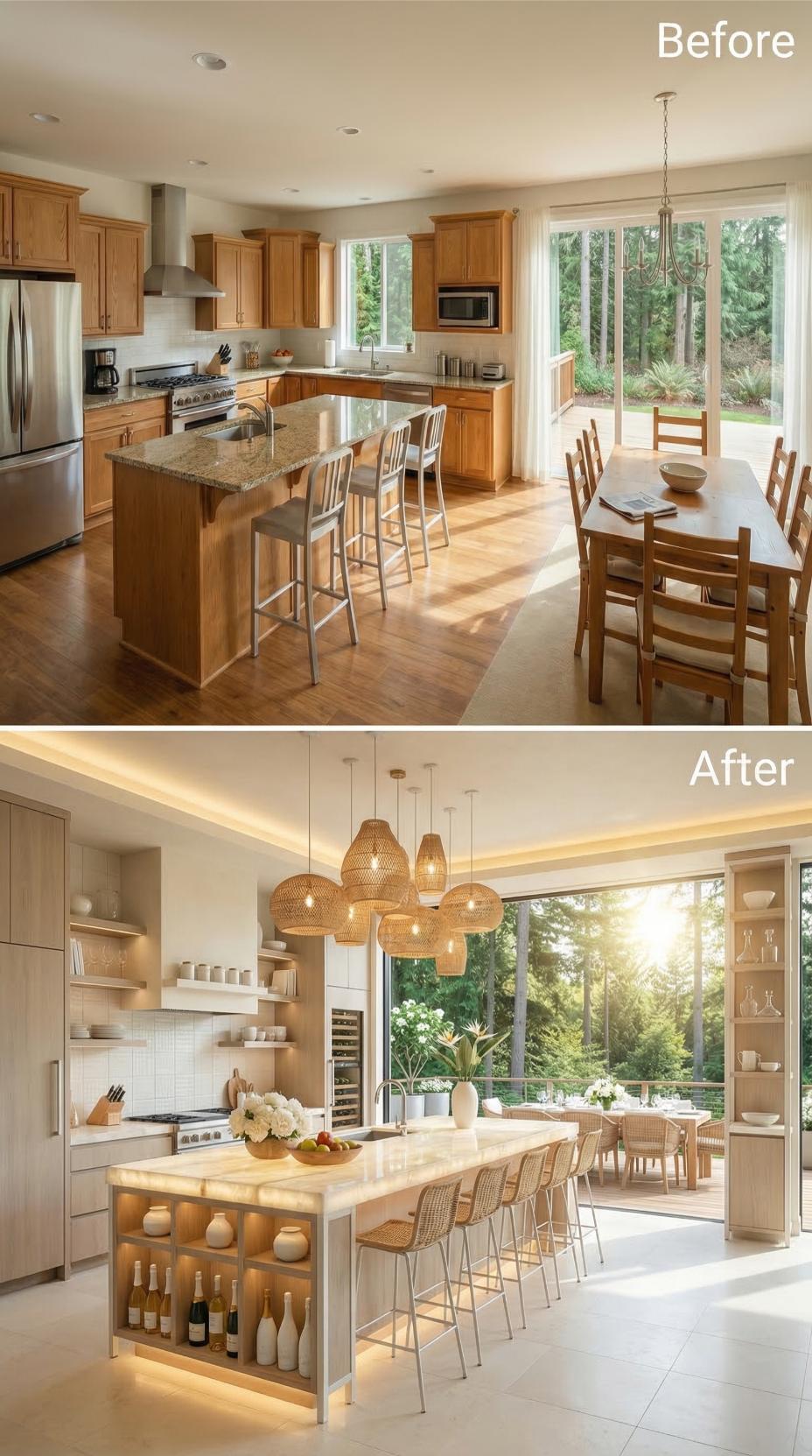
Bleached oak flat-panels replace the dated raised-door cabinetry, and open shelving removes the visual weight that upper cabinets imposed. A backlit onyx island countertop runs the full length of the space, its warm amber glow doing more decorative work than any pendant alone. Four woven rattan globe fixtures hang at staggered heights above the island, where rattan counter stools continue the material thread. Cove lighting along the ceiling perimeter replaces the old recessed grid entirely.
Why It Works: Onyx is one of the few natural stones that becomes translucent when backlit, allowing LED strips installed beneath the slab to activate the veining from within rather than above. This effect is most pronounced with honey and amber onyx varieties, where the stone reads almost like stained glass under direct light. Designers specify a minimum slab thickness of three-quarters of an inch to achieve that glow without compromising structural integrity at the island edge.
Purple Lacquer Cabinets and Gold Range Hood Retire Honey Oak With Serious Force
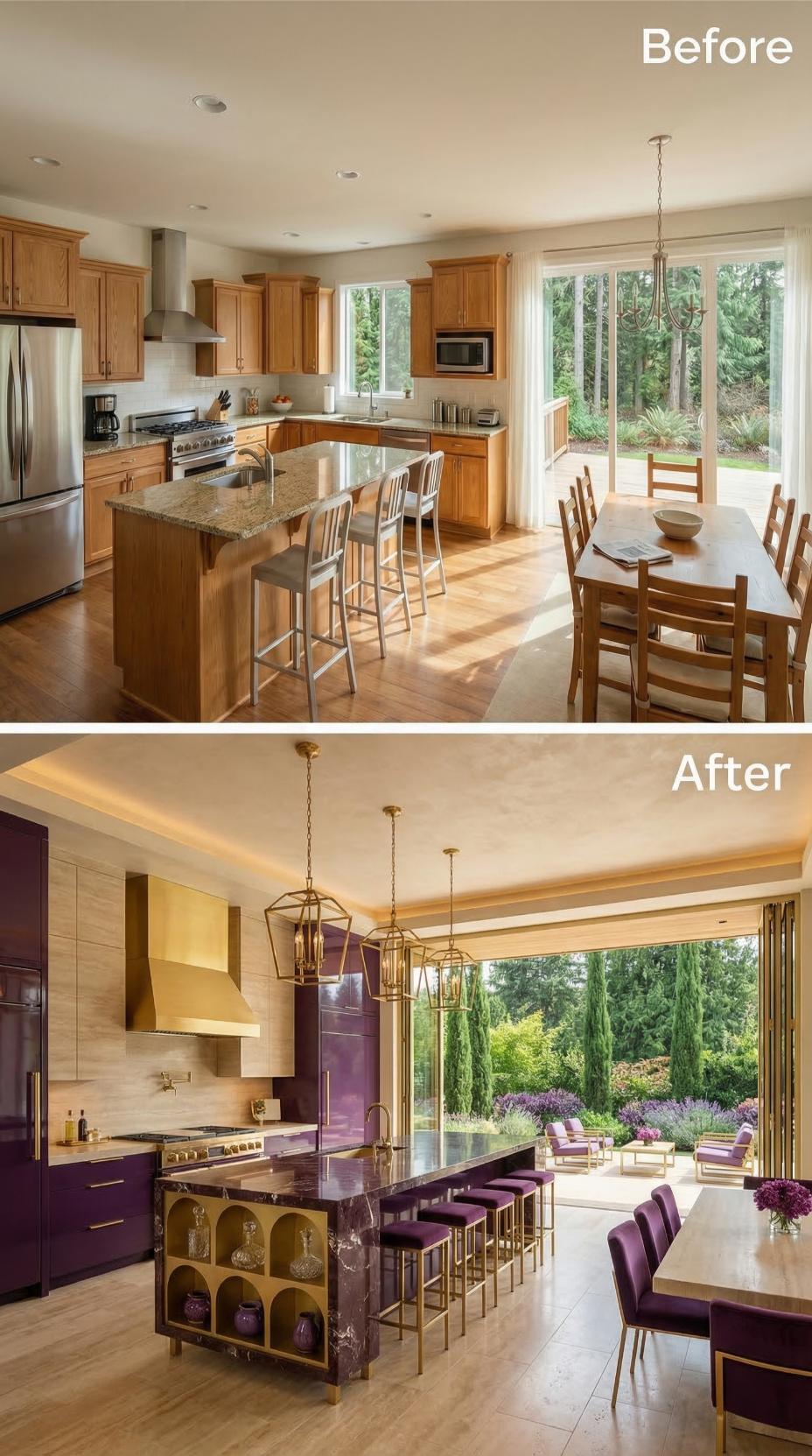
Aubergine lacquer cabinets paired with a brushed gold range hood and dark purple marble island waterfall make the original oak layout feel like a different property entirely.
Fun Fact: Purple has historically been associated with royalty and was once so expensive to produce that sumptuary laws in some European countries restricted its use to nobility. In contemporary kitchen design, deep aubergine cabinetry achieves a similar psychological effect, signaling exclusivity through color alone. Gold hardware amplifies that association without requiring additional ornamentation.
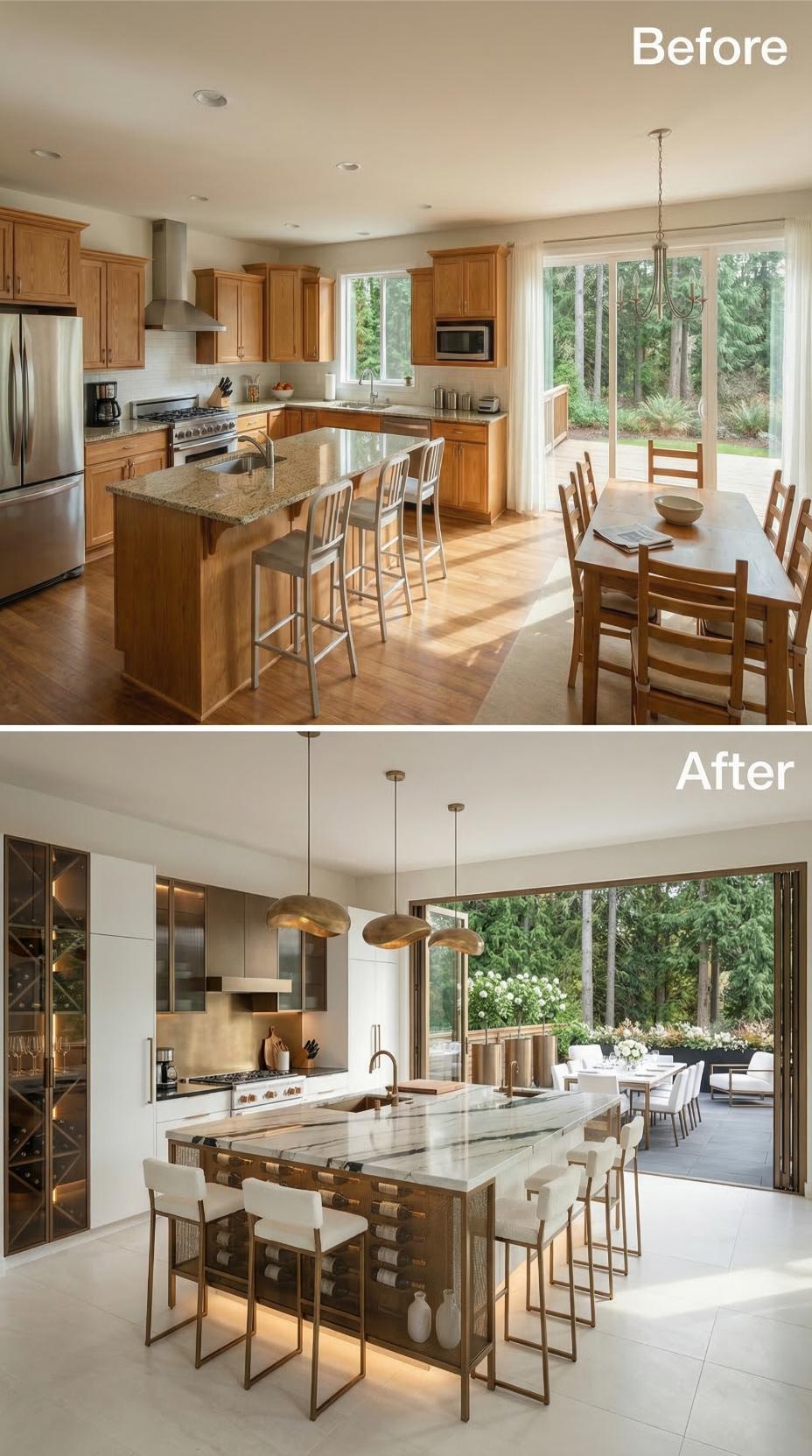
Brass Pendants, Marble Island Cladding, and a Glass Wall Rewrite Honey Oak’s Entire Story
🔥 Would you like to save this?
Honey oak cabinets and granite countertops gave this kitchen a dated warmth that read more builder-grade than intentional. The dining area sat behind a standard sliding door, cutting off any real connection to the yard. Both problems are gone.
White flat-front cabinetry now lines the perimeter, while the island does the real work: a slab of white marble with bold grey veining wraps the top and cascades down the base panels, with wine bottle storage integrated directly into the lower structure. Brushed brass pendant lights hang in pairs above the island. A folding glass wall system has replaced the sliding door, collapsing the boundary between the kitchen and an outdoor dining terrace furnished with upholstered white chairs. Large-format pale tile runs wall to wall underfoot.
Labradorite Island Cladding and Iridescent Mosaic Tile Dissolve Every Trace of Warm Oak
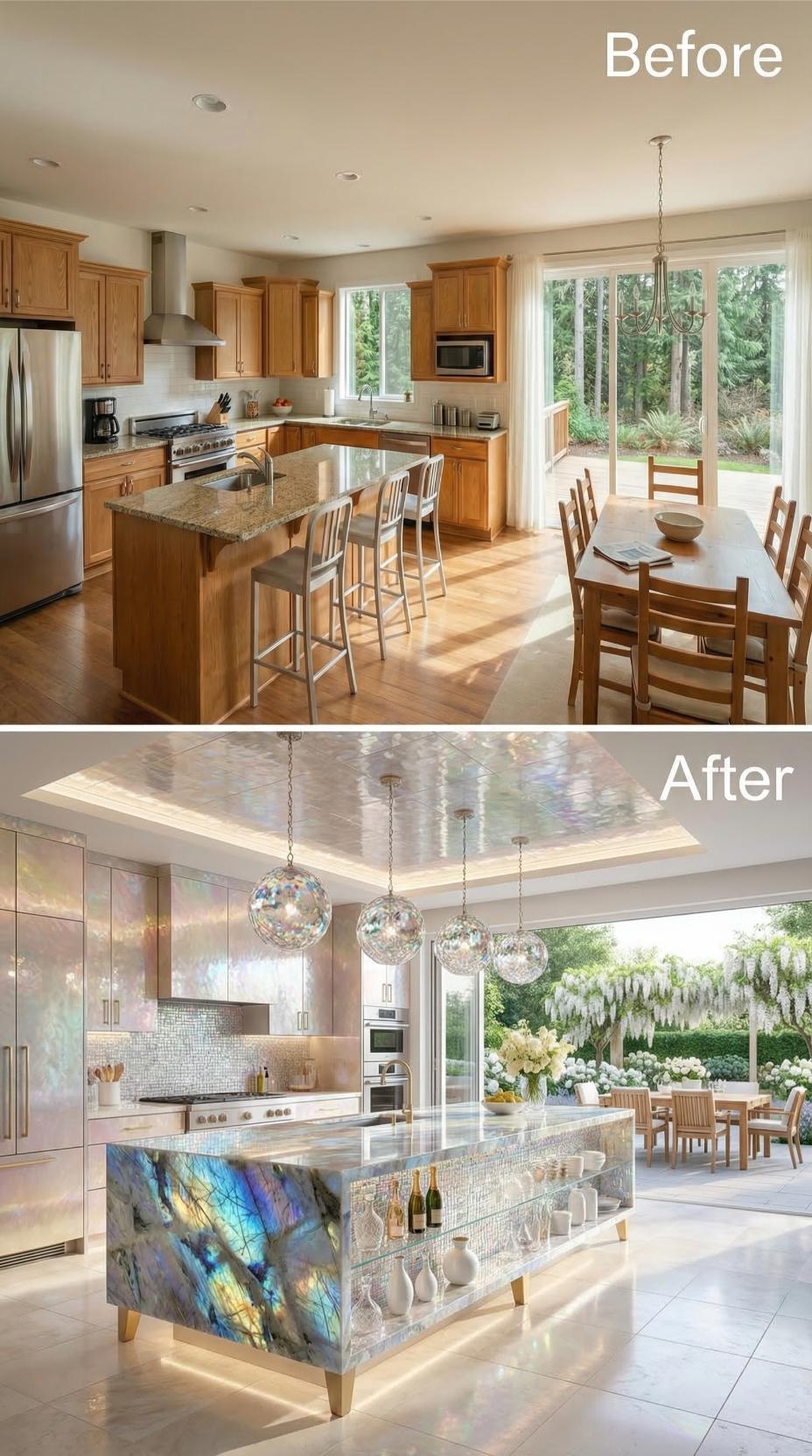
Where maple cabinets and granite counters once anchored the space in early-2000s convention, the remodel introduces an island clad in labradorite stone, its surface shifting between cobalt, teal, and gold depending on where light strikes the face. Three globe pendants with prismatic glass globes hang above it, scattering refracted light across the ceiling, which is finished in an iridescent tile that reads as pearl from certain angles and pale silver from others.
Flat-panel cabinets in a soft white lacquer replace the raised-panel maple entirely. The mosaic backsplash behind the range runs floor to ceiling in a small-format iridescent tile, mirroring the ceiling material and creating vertical continuity. Large-format white porcelain floors replace the hardwood, widening the visual field. The wall of glass that opens to a wisteria-draped terrace pulls the exterior directly into the composition.
Shiplap Walls, Bleached Oak Island Legs, and Sage Pendants Retire Honey Cabinets for Good
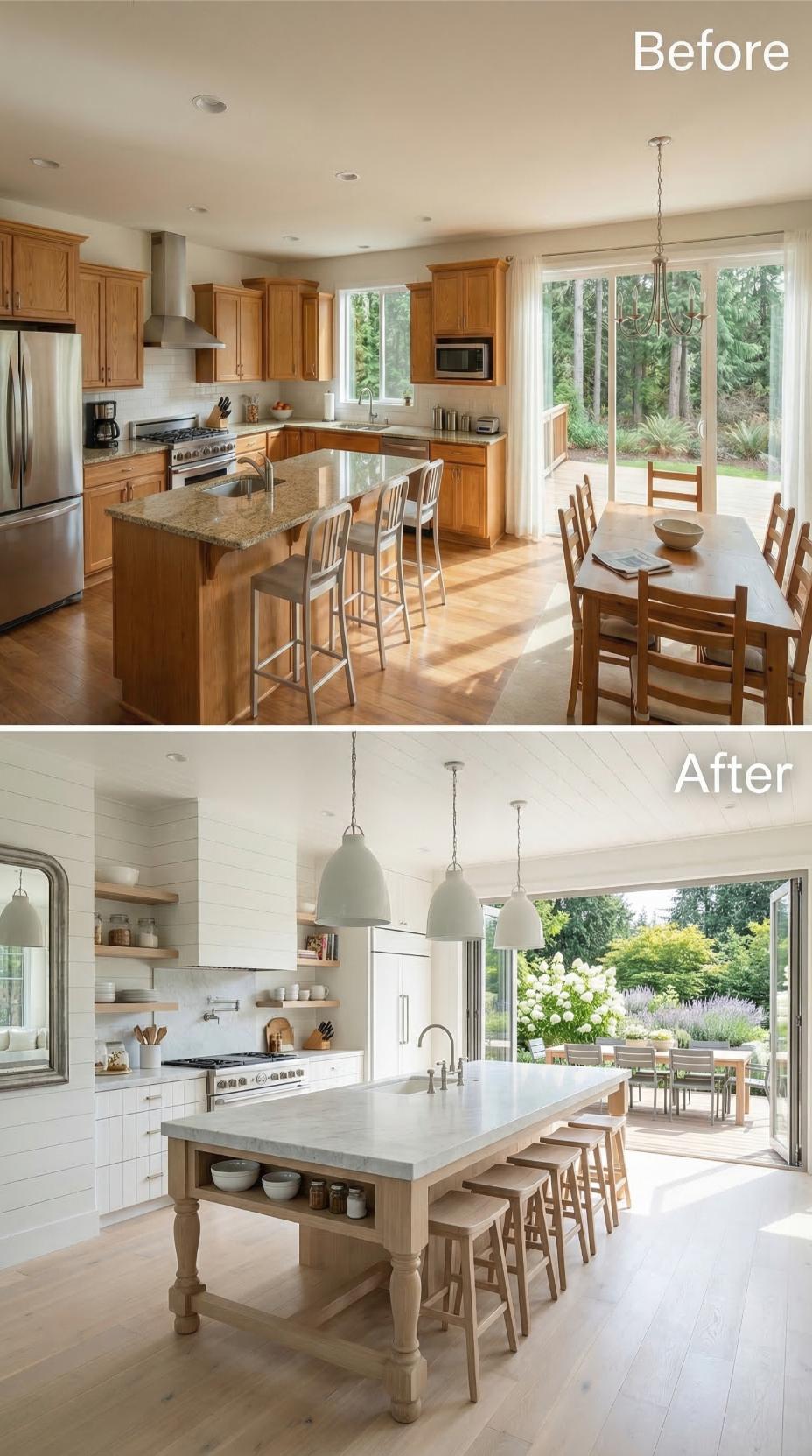
Warm-toned raised-panel cabinetry and granite countertops gave way to white shiplap walls, open floating shelves in light maple, and a large island with turned legs and a honed marble top. Three sage-green dome pendants hang on black chain above the island, where low wood stools replace the metal bar chairs from before. Bi-fold glass doors now open the entire rear wall to a garden terrace, collapsing the boundary between interior and exterior in a way the original sliding door never could.
Exposed Brick, a Live-Edge Island, and Edison Pendants Bury Blonde Oak Under Industrial Ambition
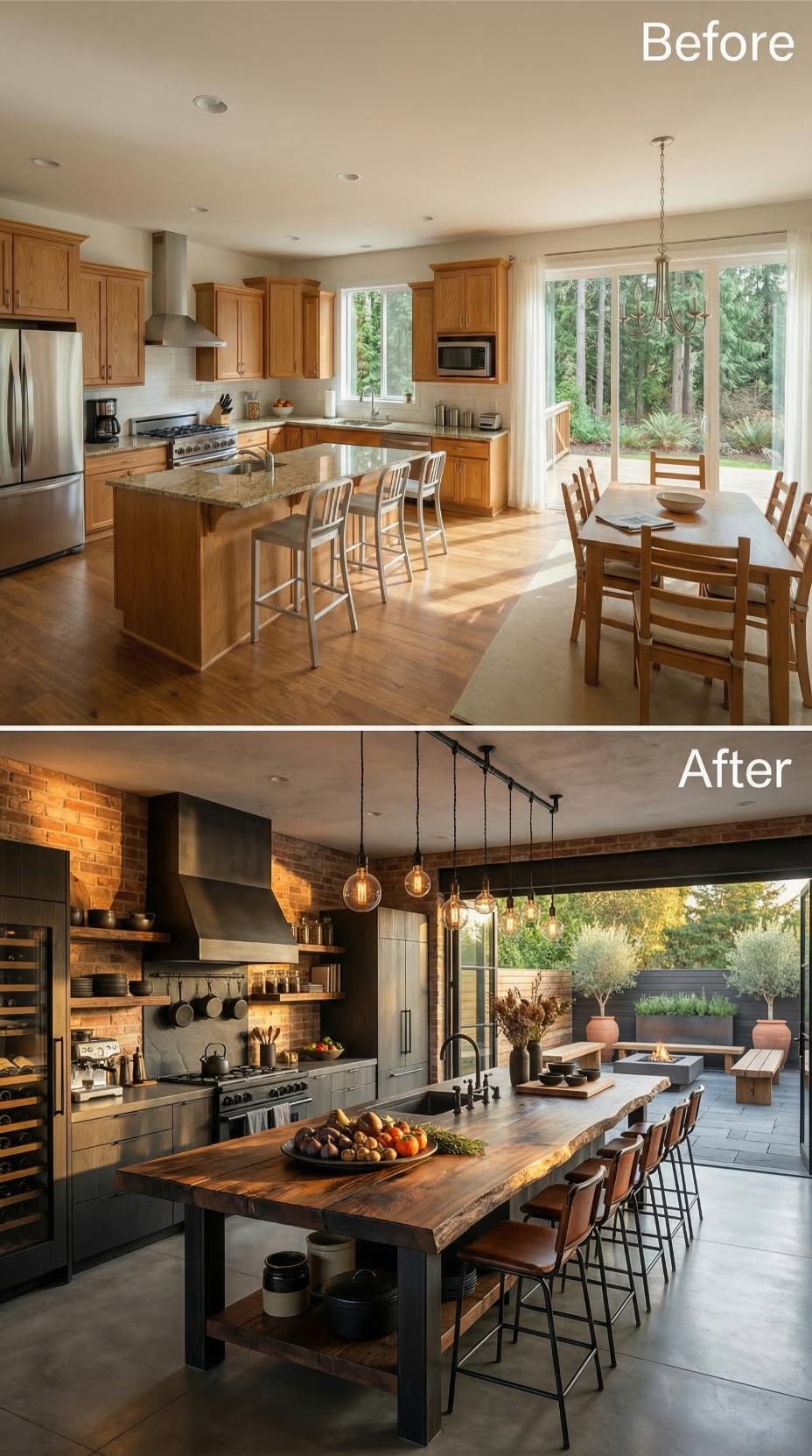
Dark charcoal flat-panel cabinets replace the original honey-toned maple boxes, and reclaimed brick running floor to ceiling on the back wall adds texture that no paint color could replicate. A live-edge wood island top sits on a matte black steel base, stretching long enough to seat six on cognac leather counter stools. Pendant lights with globe Edison bulbs hang from a black pipe track, casting the kind of amber glow that makes the space feel like a restaurant worth reserving.
A folding wall panel opens the kitchen directly onto a slate-tiled terrace, where a rectangular fire table anchors two planted olive trees in terracotta pots. The wine cooler, built flush into the left cabinet run with a glass door, signals that storage here was planned for a specific lifestyle, not just capacity.
Cobalt Lacquer Cabinets, Terracotta Hex Tile, and Marble Cladding Replace Dated Oak With Pure Confidence
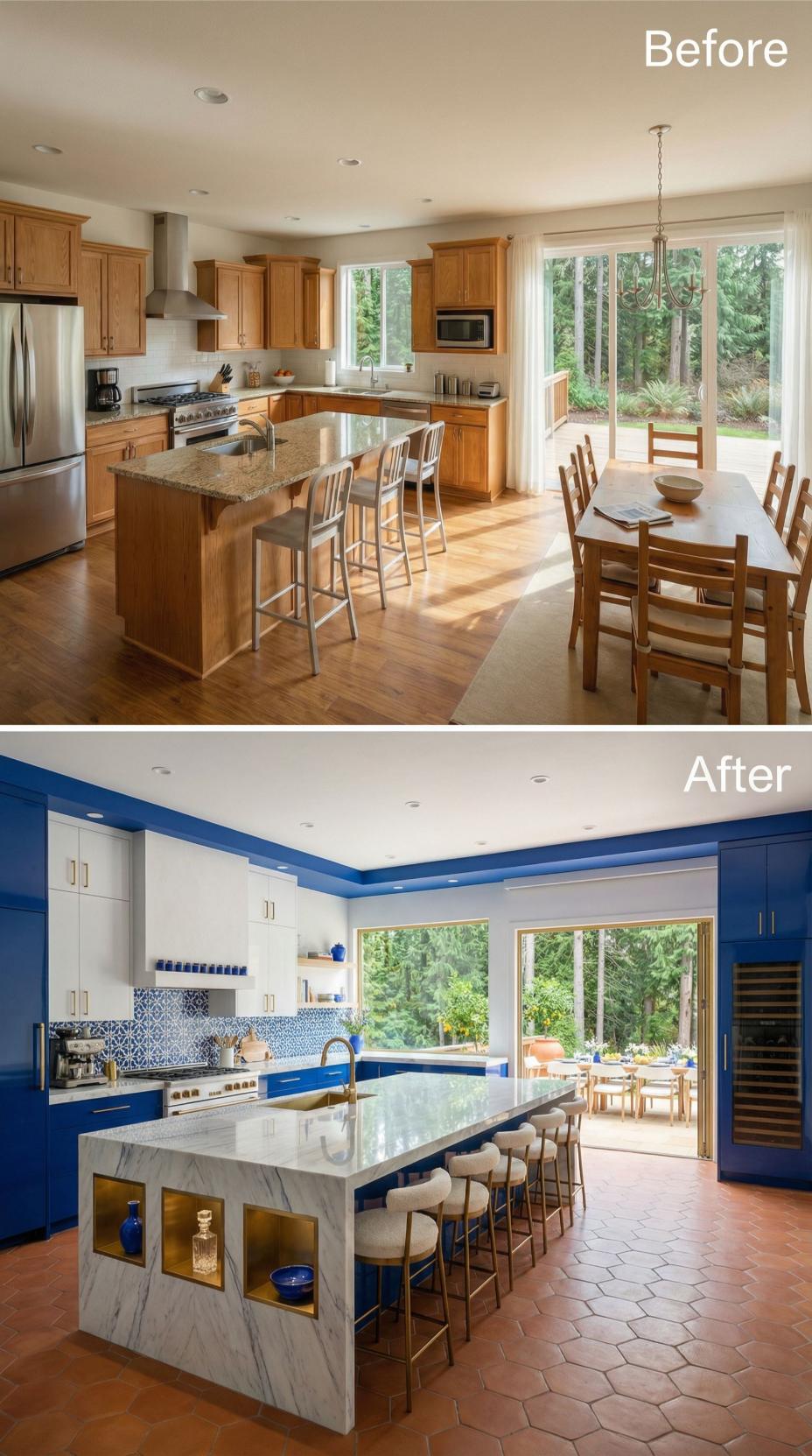
Honey oak cabinets and wood-toned floors gave way to cobalt blue lacquer on both the lowers and ceiling trim, creating a bold color envelope that reads as intentional rather than decorative. White uppers with brushed brass pulls balance the saturation, while a patterned blue-and-white cement tile backsplash reinforces the palette without repeating any single element twice. The island shifts the room’s entire center of gravity.
Calacatta marble clads the island on all four sides in a full waterfall application, with open cubbies at the base displaying decanters and vessels. Boucle bar stools with brass legs line the seating edge. Terracotta hexagonal floor tile grounds the composition and keeps the blue-and-white scheme from reading as cold.
Woven Pendants and Brass-Legged Stools Warm the Island Zone
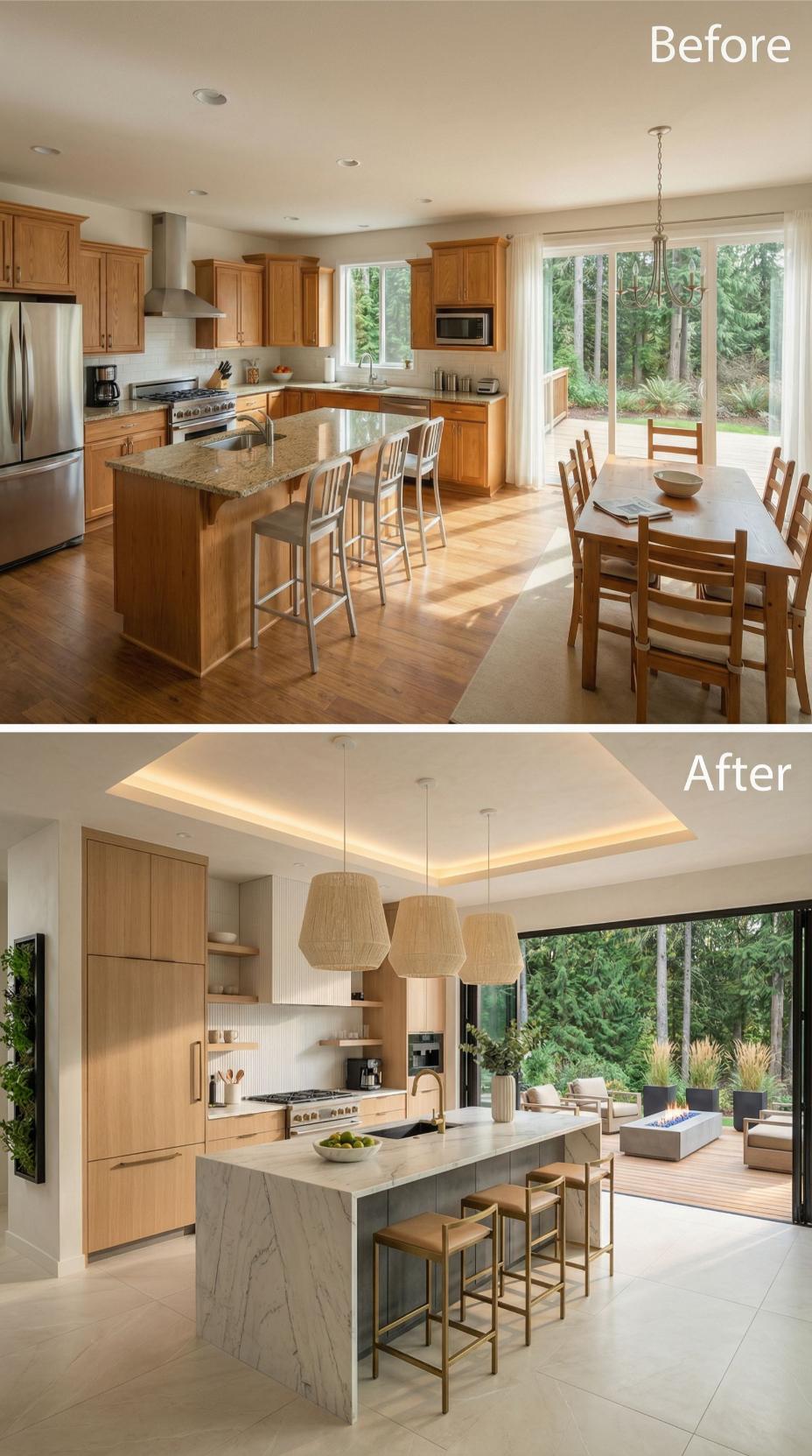
Flat-panel rift-cut oak cabinets in a light, natural finish run floor to ceiling on one wall, paired with open shelving in a white ribbed surround that replaces the raised-panel honey oak entirely. The island does the heaviest lifting: full waterfall cladding in a white marble with pronounced grey veining, flanked by brass-legged counter stools with saddle leather seats.
Three woven pendant lights in a natural fiber shade hang low over the island, and a tray ceiling with warm cove lighting at 2700K wraps the perimeter, replacing recessed cans that left the old kitchen flat. Large-format cream porcelain tile on the floor reads as a single continuous plane. Sliding glass doors, now floor-to-ceiling with slim black frames, open onto a deck with an outdoor fire feature visible beyond.
Terracotta Pink Cabinets and Vein-Cut Marble Island Cladding Retire Honey Oak With Resolve
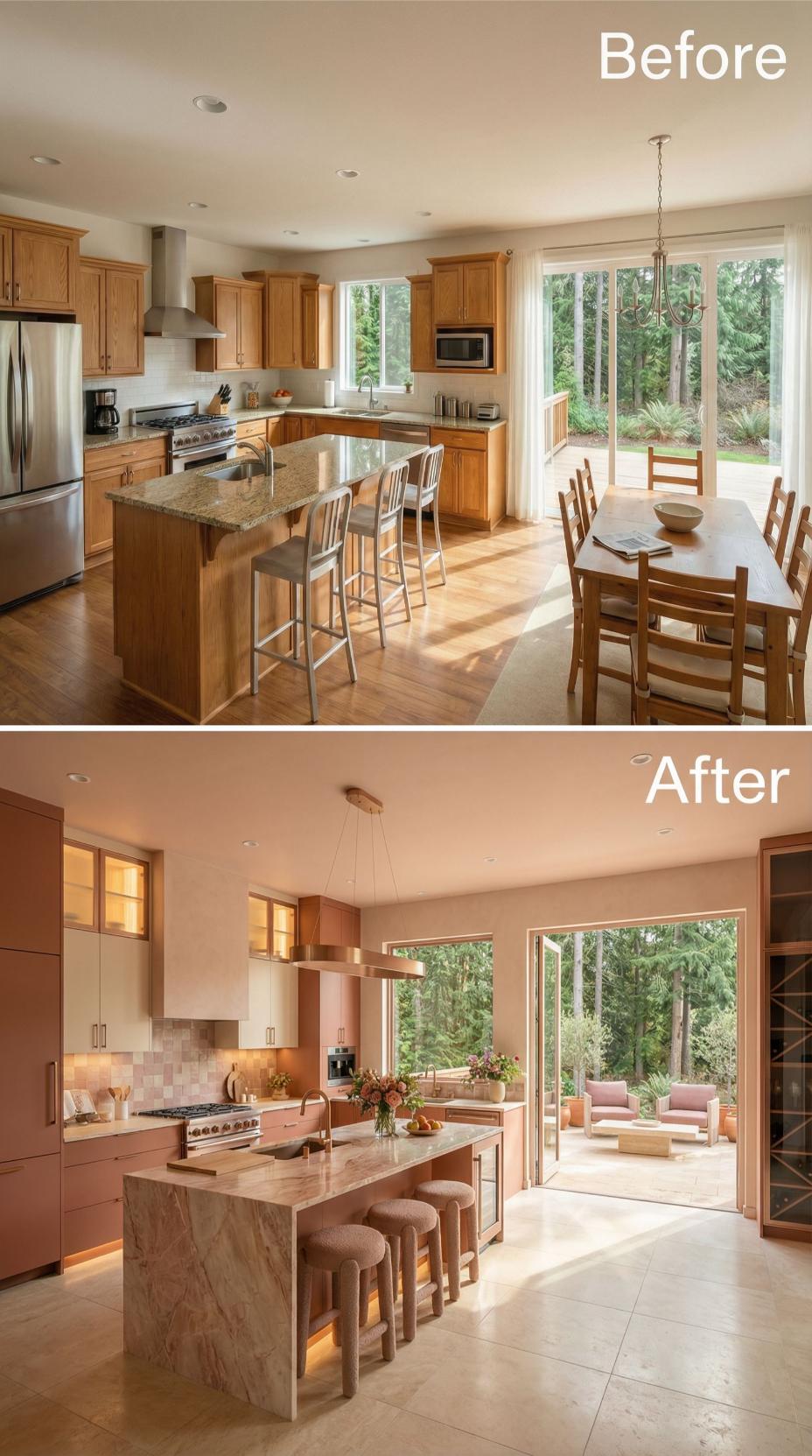
Flat-panel cabinetry in a muted terracotta-pink finish replaces the original honey oak on every surface, paired with cream upper cabinets that keep the upper half of the room from feeling heavy. The island receives full marble cladding on its base panel, with veining that runs vertically to read as intentional rather than incidental. Upholstered round barstools in a tone-matched fabric replace the aluminum counter stools from the before photo.
The backsplash shifts to a grid of soft blush square tile, and a horizontal floating hood in a warm brass-adjacent finish anchors the cooking wall. Bi-fold glass doors replace the original sliding panel, opening the kitchen directly to an outdoor seating area. Large-format cream tile underfoot replaces the wood flooring entirely, unifying the kitchen and dining zones under a single plane.
Calcutta Marble Island Cladding and White Lacquer Cabinets Erase Oak Without Apology
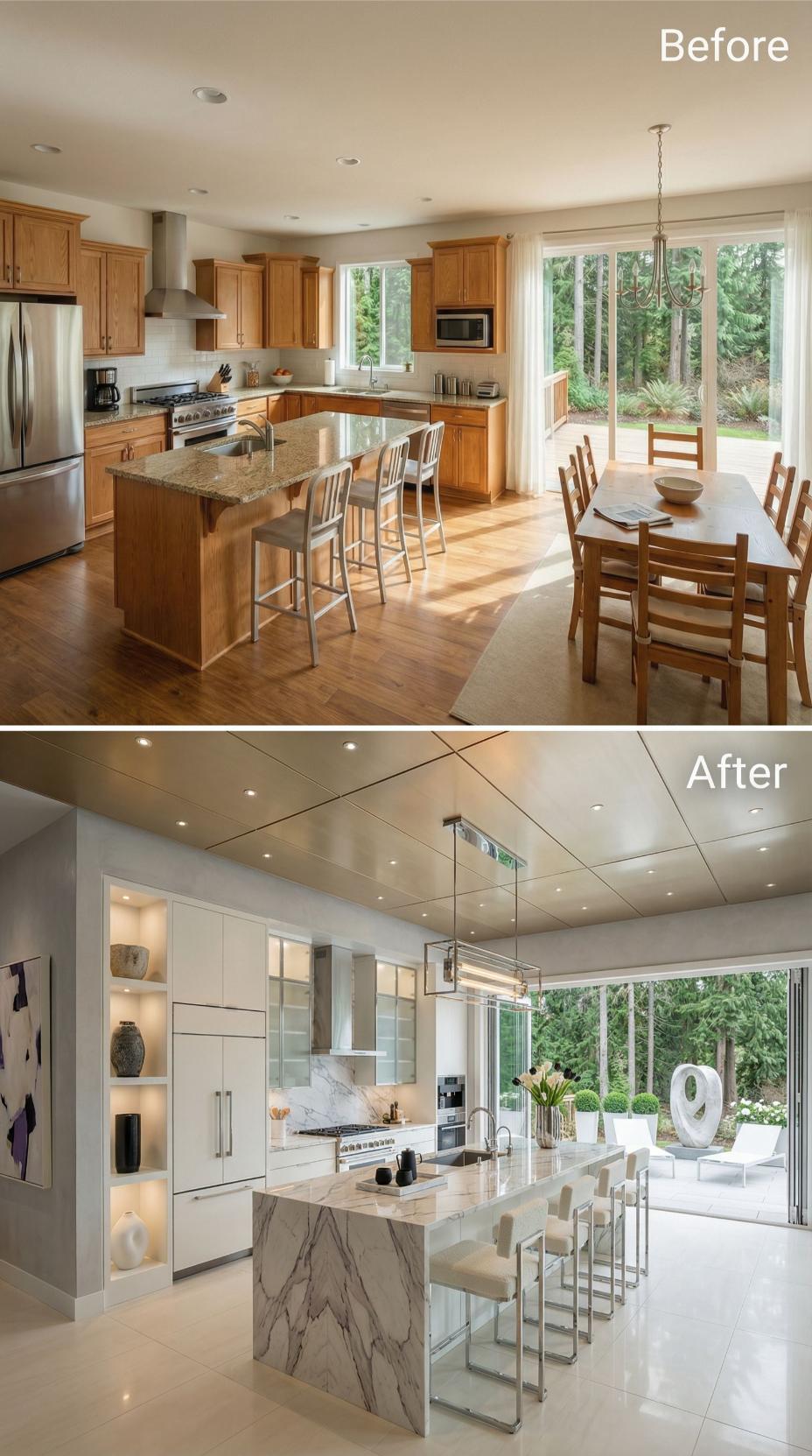
The honey oak cabinets and granite island countertop from the before are gone entirely. In their place, flat-panel white lacquer cabinetry runs floor to ceiling, with recessed pulls finished in brushed nickel keeping the facade uninterrupted. The island is clad in full Calacatta marble with dramatic gray veining that continues across the waterfall edge and down to the base panel, treating stone as a structural material rather than a surface finish.
Tall chrome-frame bar stools line the island, and a rectangular pendant with an open metal grid hangs above it. The original chandelier and wood dining table have been replaced by bi-fold glass panels that fully retract, dissolving the boundary between kitchen and patio. A built-in niche unit with individual shelf lighting anchors the left wall, displaying ceramic vessels in matte white and earth tones. Porcelain tile flooring in a large-format off-white format replaces the hardwood throughout.
Black Marble and Brass Hardware Give This Kitchen Real Swagger
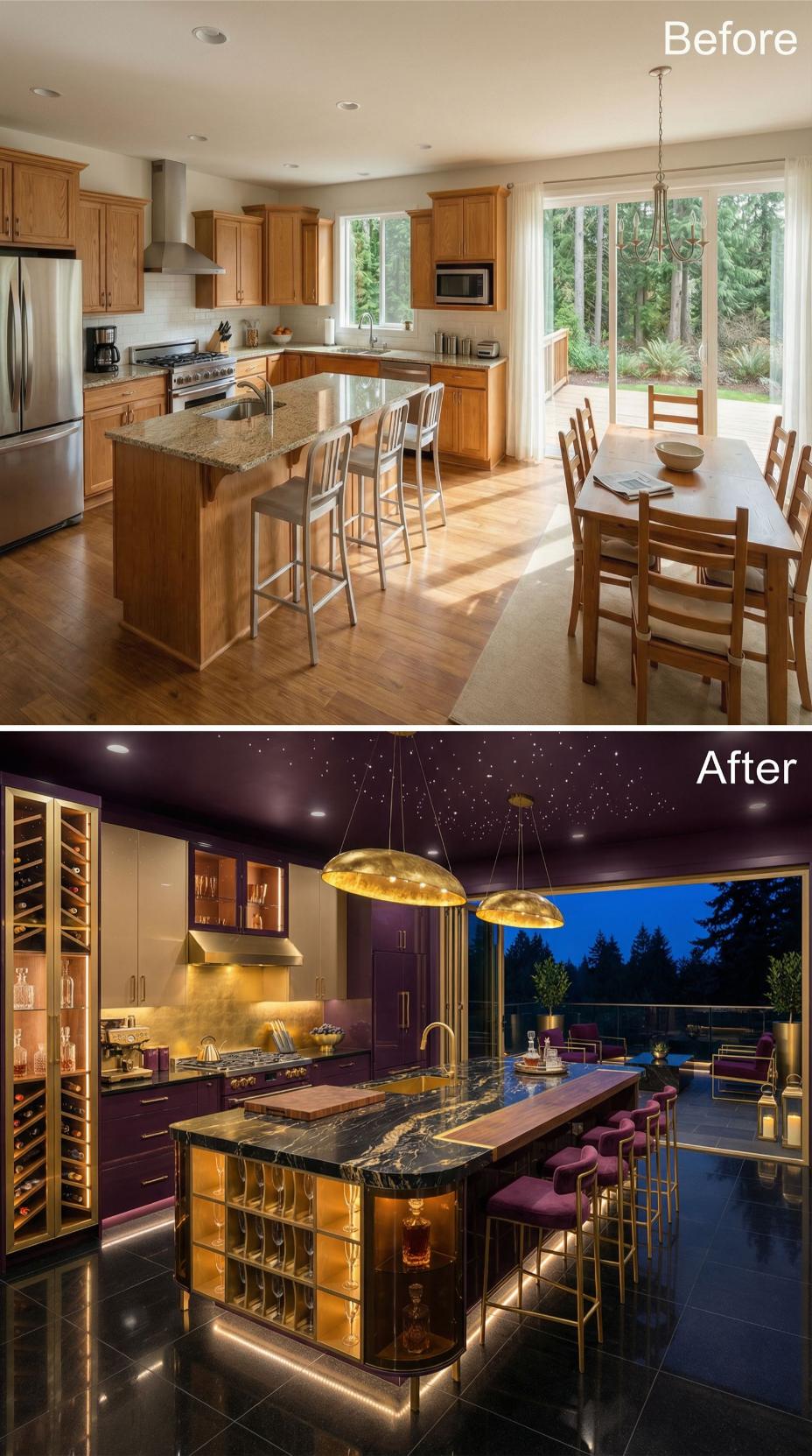
Fiber optic points dot the deep plum ceiling overhead, replacing recessed can lights with something closer to an observatory than a kitchen. Gold dome pendants hang above a black marble island clad on every vertical face, its gold veining picking up the brass cabinet hardware and the range hood’s metallic finish below.
Purple lacquer cabinets run floor to ceiling on two walls, flanked by a backlit wine column with open bottle racks. Velvet bar stools in magenta pull up to a wood-topped island extension that bleeds into an outdoor terrace framed by a frameless glass wall. By evening, the entire room reads as one continuous lit object.
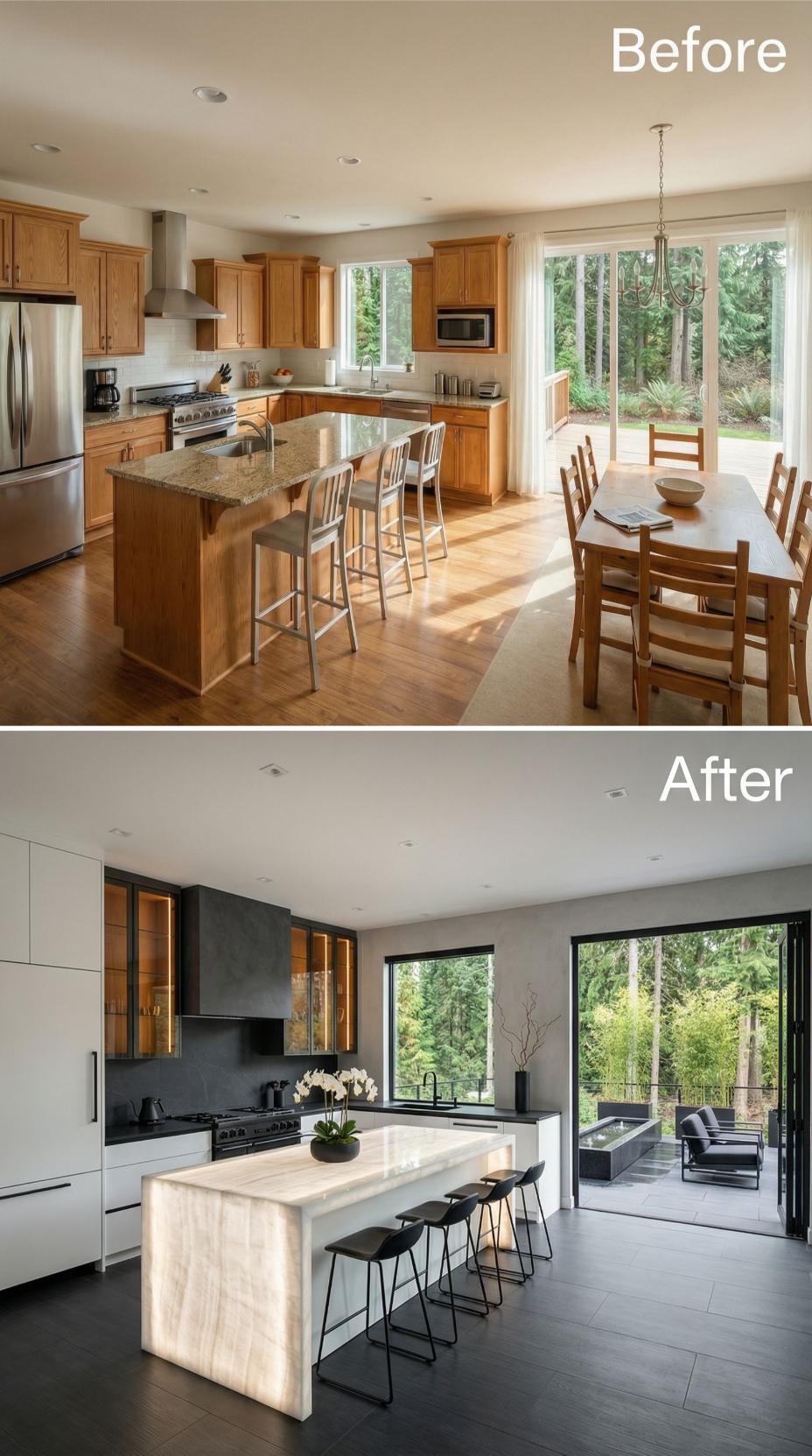
Matte White Lacquer, Travertine Island Cladding, and Black Hardware Displace Honey Oak Entirely
🔥 Would you like to save this?
Flat slabs of matte white lacquer replace the raised-panel oak cabinets, while a full-height travertine waterfall island anchors the space with natural veining. Black metal bar stools and matte black hardware maintain contrast against the pale stone and white cabinetry throughout.
Cove Lighting, Globe Pendants, and Bi-Fold Glass Doors Retire Honey Oak With Calculated Precision
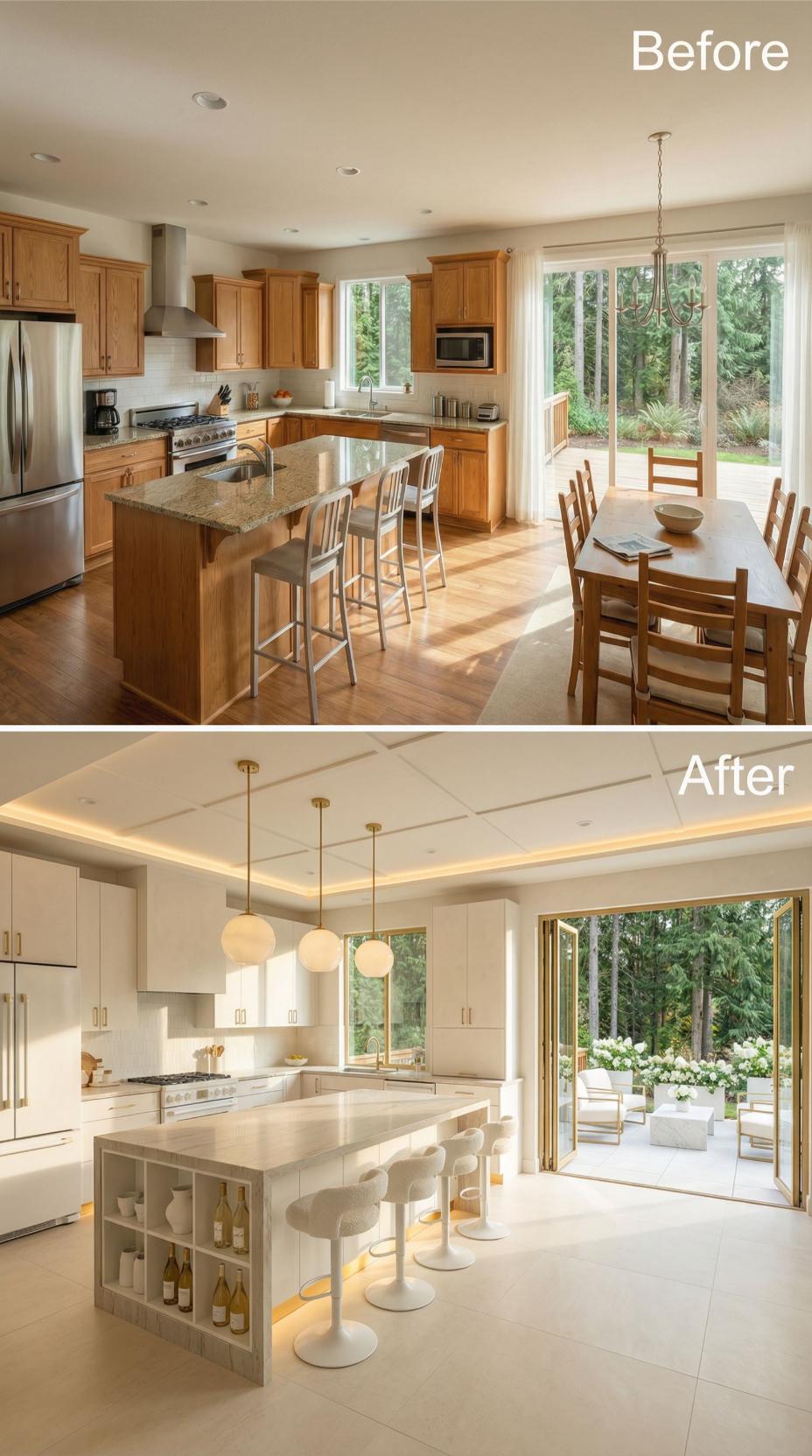
Honey oak cabinets and granite island counters gave way to flat white shaker cabinetry with brushed brass bar pulls, a quartz island clad in matching white stone, and an open-shelf base with under-island LED strip lighting glowing at a warm amber tone. Three globe pendants in frosted white glass hang from brass ceiling mounts directly above the island, anchoring the room’s vertical axis.
A coffered tray ceiling with recessed cove lighting adds architectural weight without lowering the room structurally. Where sliding glass doors once sat, bi-fold panels framed in brass-toned aluminum now fold completely open, erasing the boundary between kitchen and an outdoor patio dressed in white upholstered seating and planters of white hydrangeas.
White Lacquer and Book-Matched Stone Turn the Space Luxe
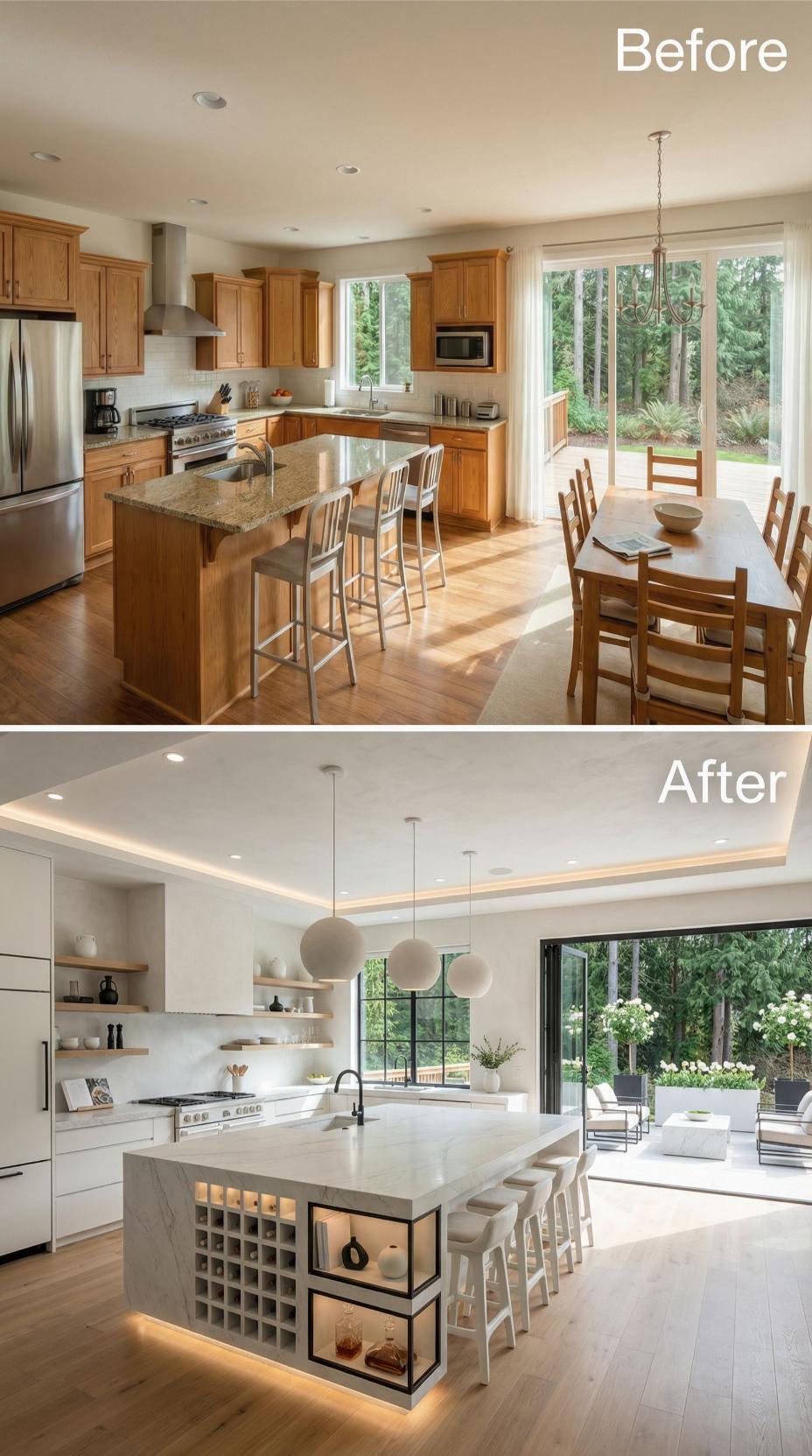
Flat honey oak cabinets and a granite-topped island gave way to floor-to-ceiling white lacquer cabinetry, open walnut floating shelves, and an island clad in book-matched marble with a full waterfall edge. Three globe pendants in matte white hang at staggered heights above the island, while LED cove lighting recessed into a stepped tray ceiling washes the room in a consistent warm glow. The bar stools shift from silver aluminum to white molded seats with clean vertical legs.
Sliding glass doors were replaced by a black steel-framed bi-fold system that opens the kitchen directly onto a hardscaped outdoor lounge. The original chandelier over the dining table is gone entirely, replaced by sightlines to the exterior. Black fixtures at the island sink anchor the otherwise all-white palette without competing with the marble veining running vertically through the island base.
Matte Black Cabinets, Copper Shelving, and Slab Pendants Bury Warm Oak Without Hesitation
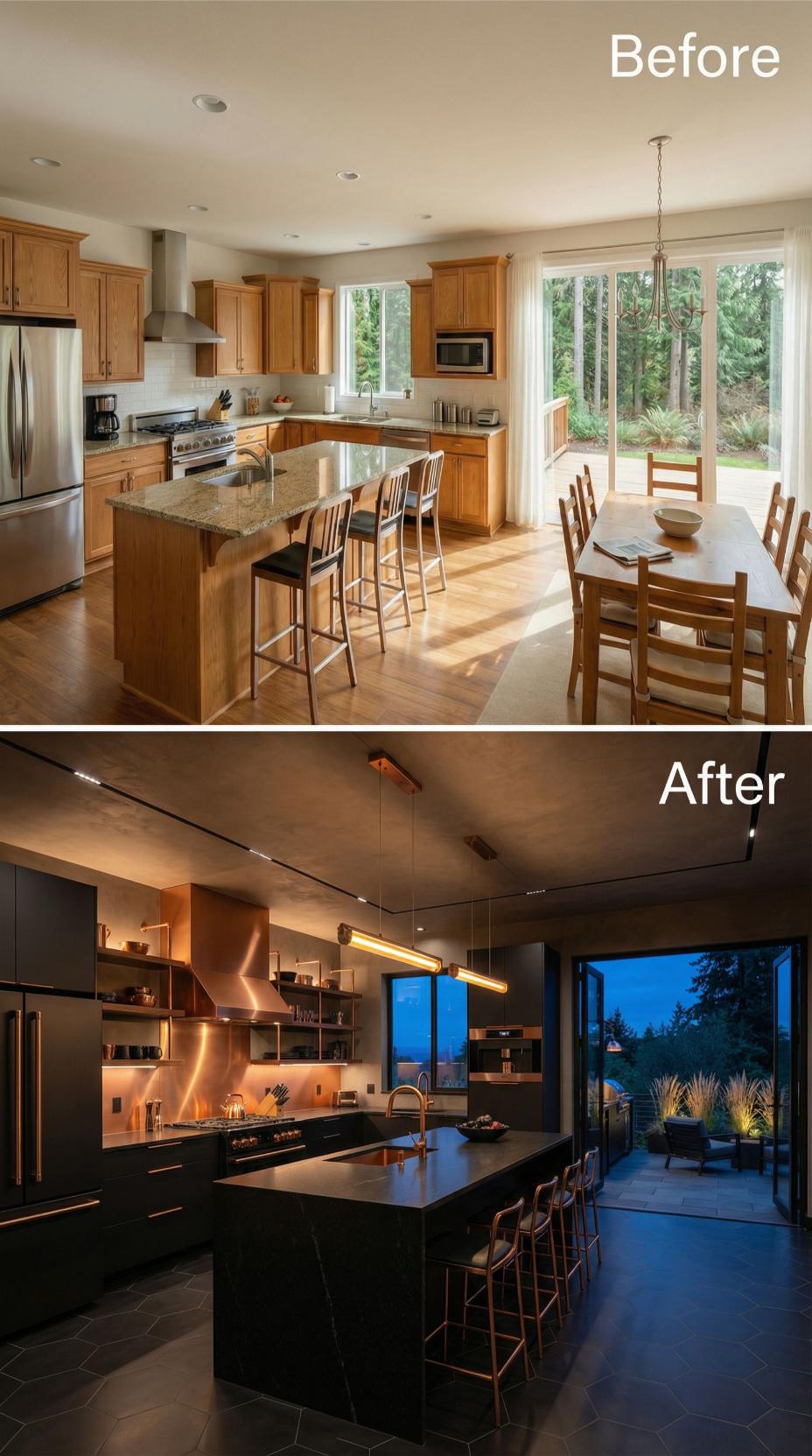
Flat-front matte black cabinetry replaces the honey-toned raised-panel originals, and open copper shelving now lines the cooking wall where upper cabinets once crowded the range hood. Tubular brass-finish pendant lights hang low over a dark stone island with waterfall edges, while slate tile flooring runs straight through to a glass door framing a twilight garden beyond.
Warm Oak Cabinets and a Chandelier Yield to Fluted Island Cladding and Brass Dome Pendants
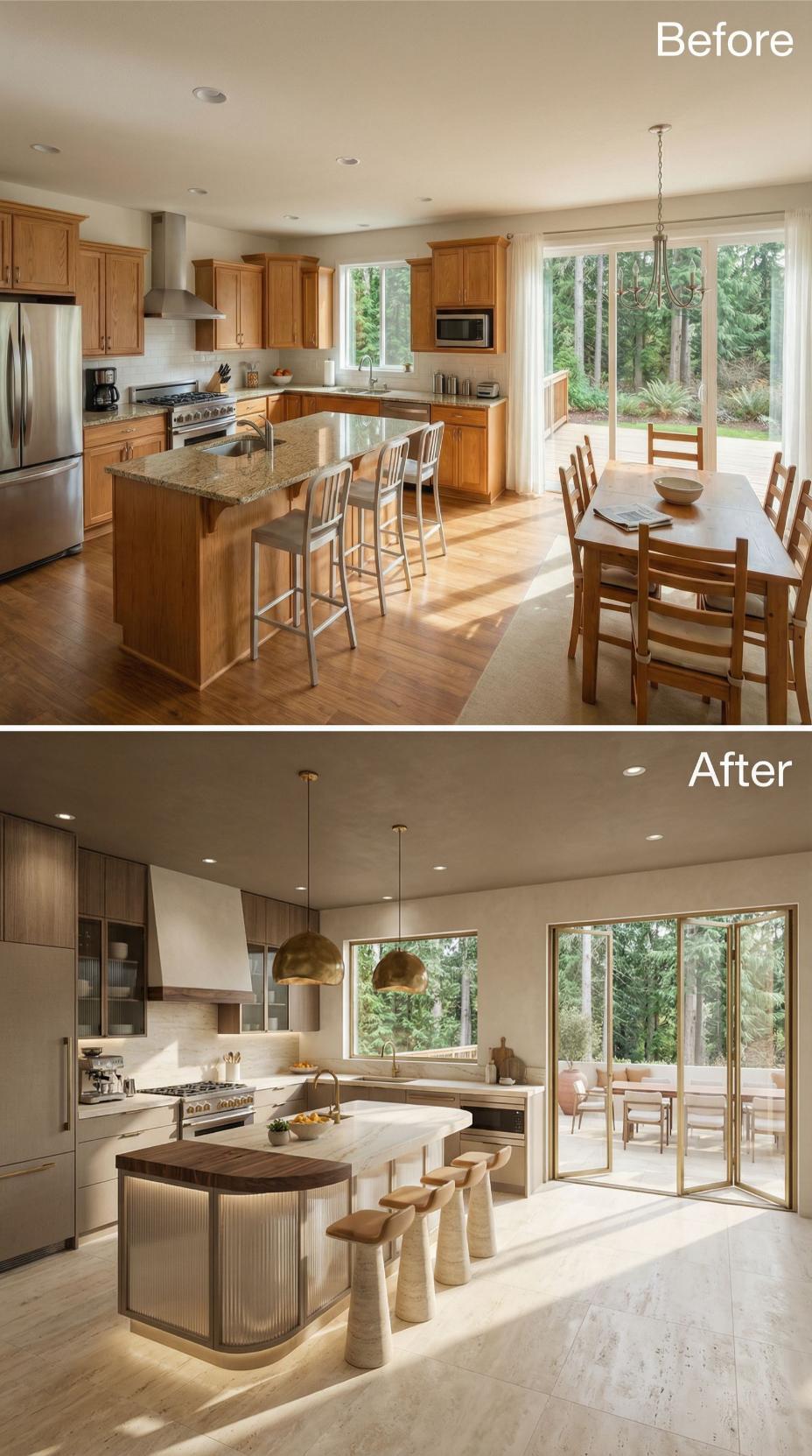
Flat-sawn oak cabinets and granite countertops exit in favor of a two-tone island clad in fluted plaster panels with a dark walnut butcher-block top insert. Brass dome pendants hang above travertine-look counters, light-washed oak flooring replaces the honey-toned hardwood, and the dated chandelier is gone entirely. Saddle-leather pedestal stools anchor the island seating, while folding gold-framed glass doors replace a single sliding panel to fully open the space to a furnished stone patio beyond.
Forest Green Cabinets, Green Marble Island Cladding, and an Open Deck Replace Warm Oak
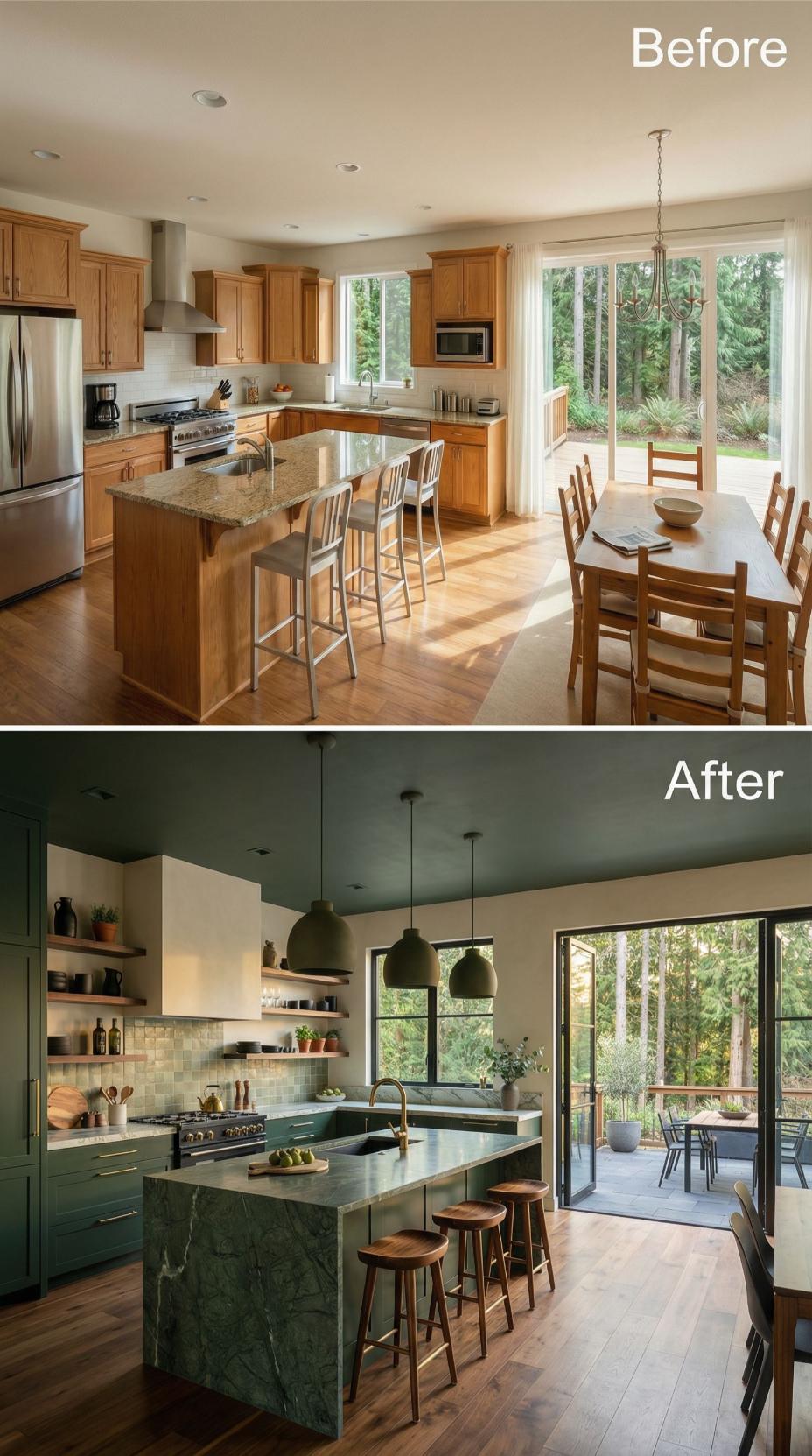
Deep matte green cabinets with brass pulls anchor the space, while a waterfall island clad in green-veined marble and paired with saddle-seat wood stools commands the room’s center.