🔥 Would you like to save this?
You don’t just sleep — you retire for the evening. You’ve never met a ceiling treatment you felt was quite grand enough, a canopy you considered sufficiently dramatic, or a material you couldn’t imagine sourcing from somewhere more obscure and expensive. Your bedroom isn’t a room. It’s a statement of intent. These ten transformations speak your language: four-poster drama, bespoke millwork, and the kind of unapologetic maximalism that makes guests quietly reassess their own life choices.
In order to come up with the very specific design ideas, we create most designs with the assistance of state-of-the-art AI interior design software. Also, assume links that take you off the site are affiliate links such as links to Amazon. this means we may earn a commission if you buy something.
Builder-grade bedrooms share a familiar story: white walls, basic light fixtures, carpet that came with the house, and a layout that prioritizes square footage over soul. For homeowners who refused to sleep in a room that felt like a hotel nobody wanted to stay in, that starting point became a challenge worth taking seriously. These 35 before-and-after primary bedrooms show what happens when people who have very high standards for their own comfort decide that “good enough” is not a finish line. The results range from old-world opulence to sleek, low-profile luxury.
What makes this collection worth bookmarking is the specificity. Each bedroom documents the actual decisions behind the change: the wall treatments, the custom headboards, the lighting swaps, the millwork that made a ceiling feel like a statement. These are not vague inspirations pulled from a fantasy budget. They are real rooms, real choices, and real proof that a builder-grade box has more potential than it ever lets on.
Crimson Walls, Coffered Ceilings, and Zero Apologies
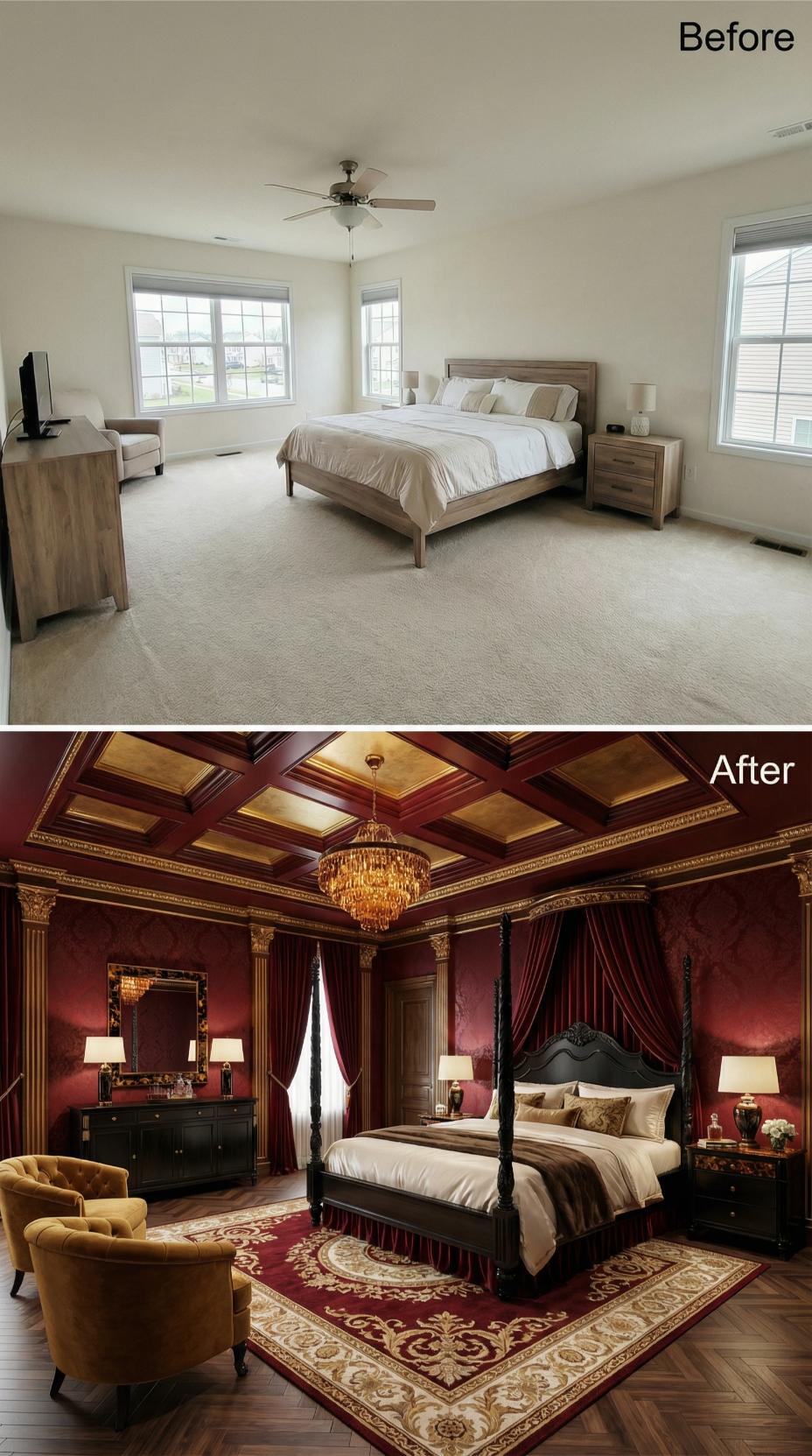
What started as a builder-grade room with beige carpet, a basic ceiling fan, and a gray wood-frame bed became something closer to a Venetian palace suite. The “after” introduces deep crimson damask wallcovering, a coffered ceiling with dark mahogany molding and gold-leaf inset panels, and a crystal amber chandelier as the room’s anchor point.
The four-poster bed features carved dark walnut posts with a dramatic bed skirt in matching crimson velvet. Herringbone hardwood flooring replaces the carpet entirely, grounded by a red-and-ivory wool area rug with scrolling floral medallions. Gold tufted armchairs, black lacquer nightstands, and column pilasters flanking the doorway complete the baronial effect.
Navy Lacquer, Gold Laurel Moldings, and a Chandelier That Means Business
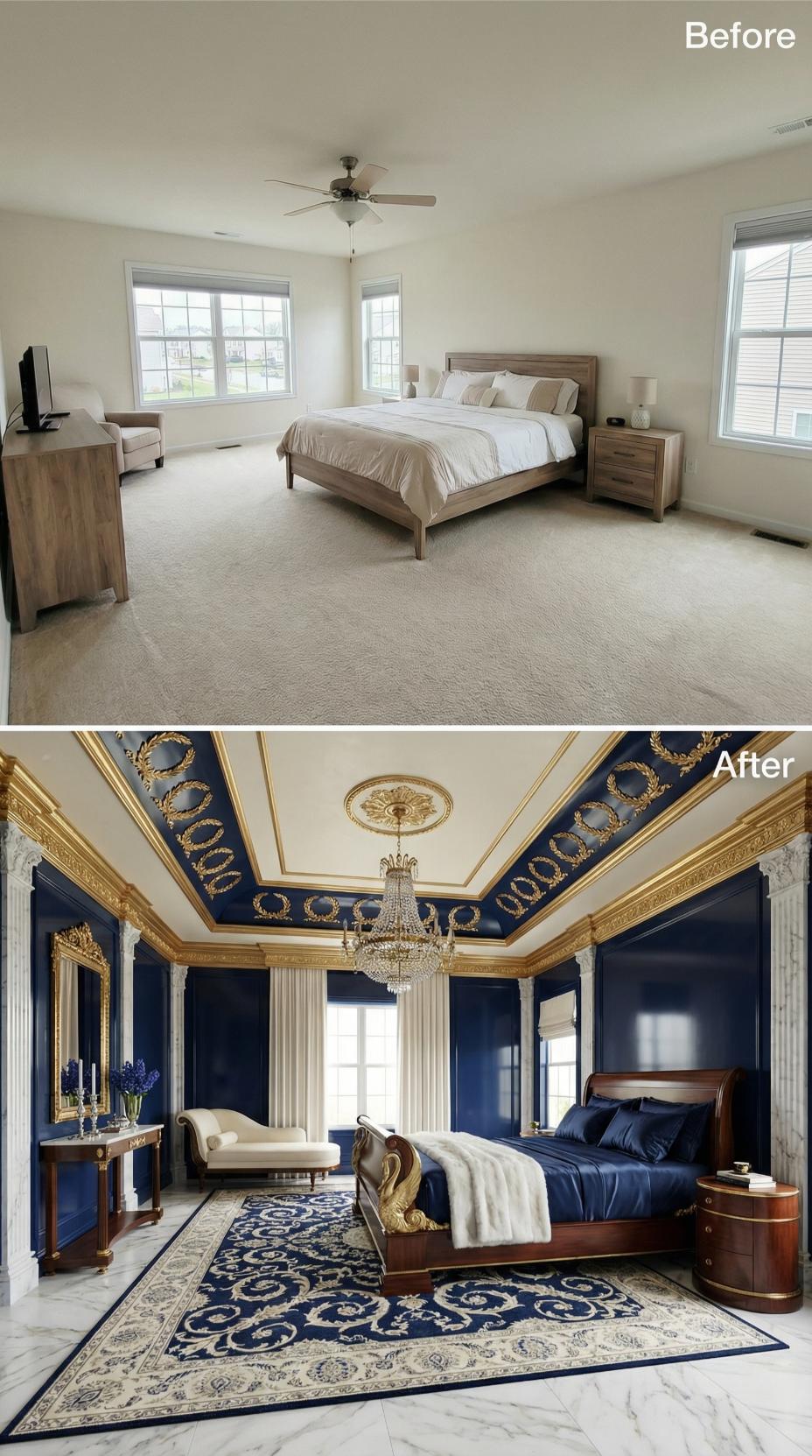
Flat beige carpet and a ceiling fan gave way to navy lacquer walls trimmed in gilt moldings, a coffered tray ceiling ringed with carved laurel wreaths, and marble floors underfoot. Fluted white columns frame the corners. The crystal chandelier drops from a plaster rosette medallion.
The mahogany sleigh bed carries gold swan-neck detailing at the headboard. Navy silk bedding pools against a white fur throw. A chaise longue in ivory fabric sits beside a marble-topped console with candelabras, and an ornate blue-and-ivory Aubusson-style rug anchors the entire floor plan.
Dark Walnut Coffered Ceilings and Heraldic Crests Earn Their Keep
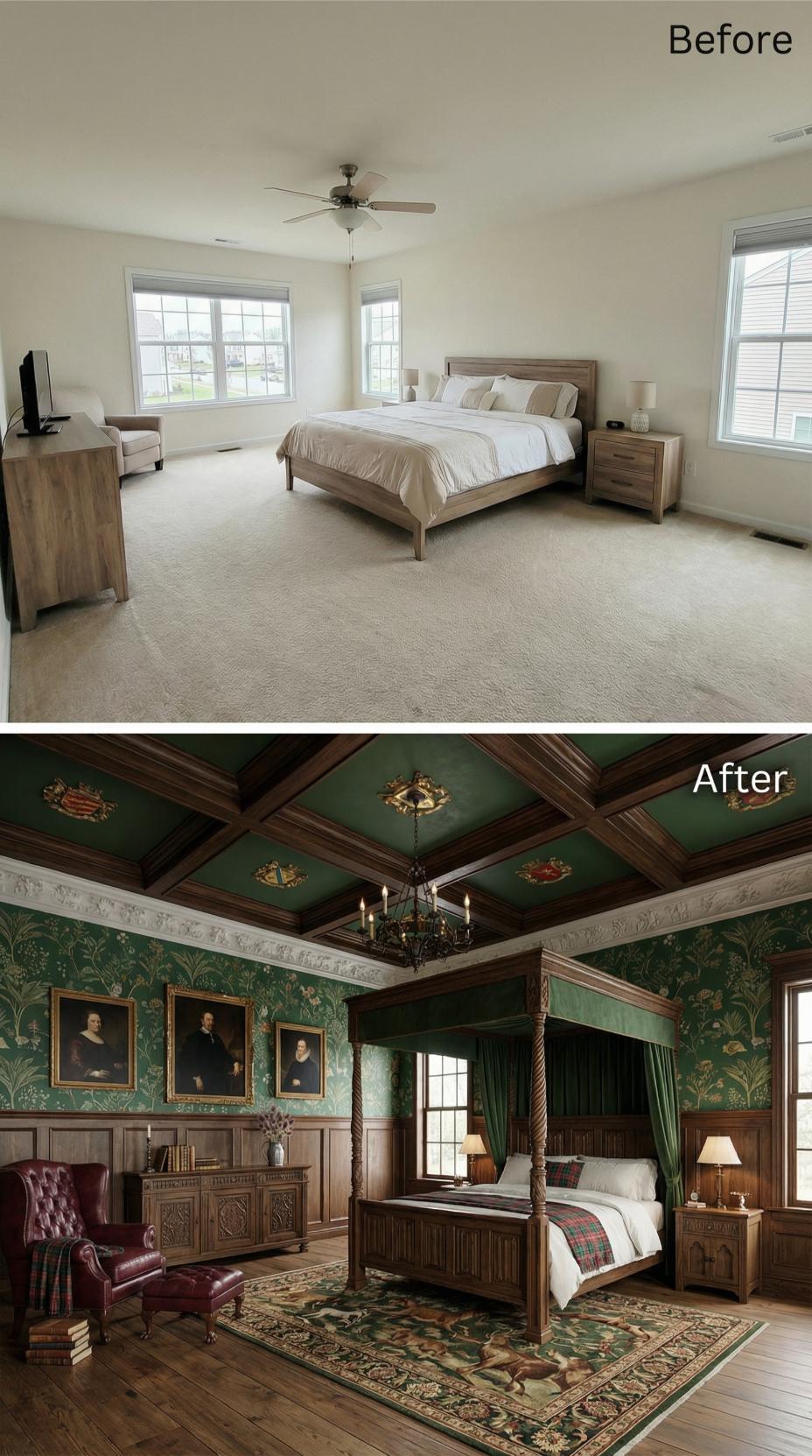
Builder-white walls and carpet gave way to dark walnut coffered beams set against hunter green painted panels, with hand-painted heraldic crests at each ceiling intersection. A rope-twist four-poster bed anchors the room beneath a wrought iron candelabra chandelier. Botanical wallpaper in deep green and gold lines the upper walls above carved wainscoting, and a wool hunting rug grounds the hardwood floor below.
Painted Sky Ceiling, Tufted Velvet Headboard, and a Sputnik That Stole the Show
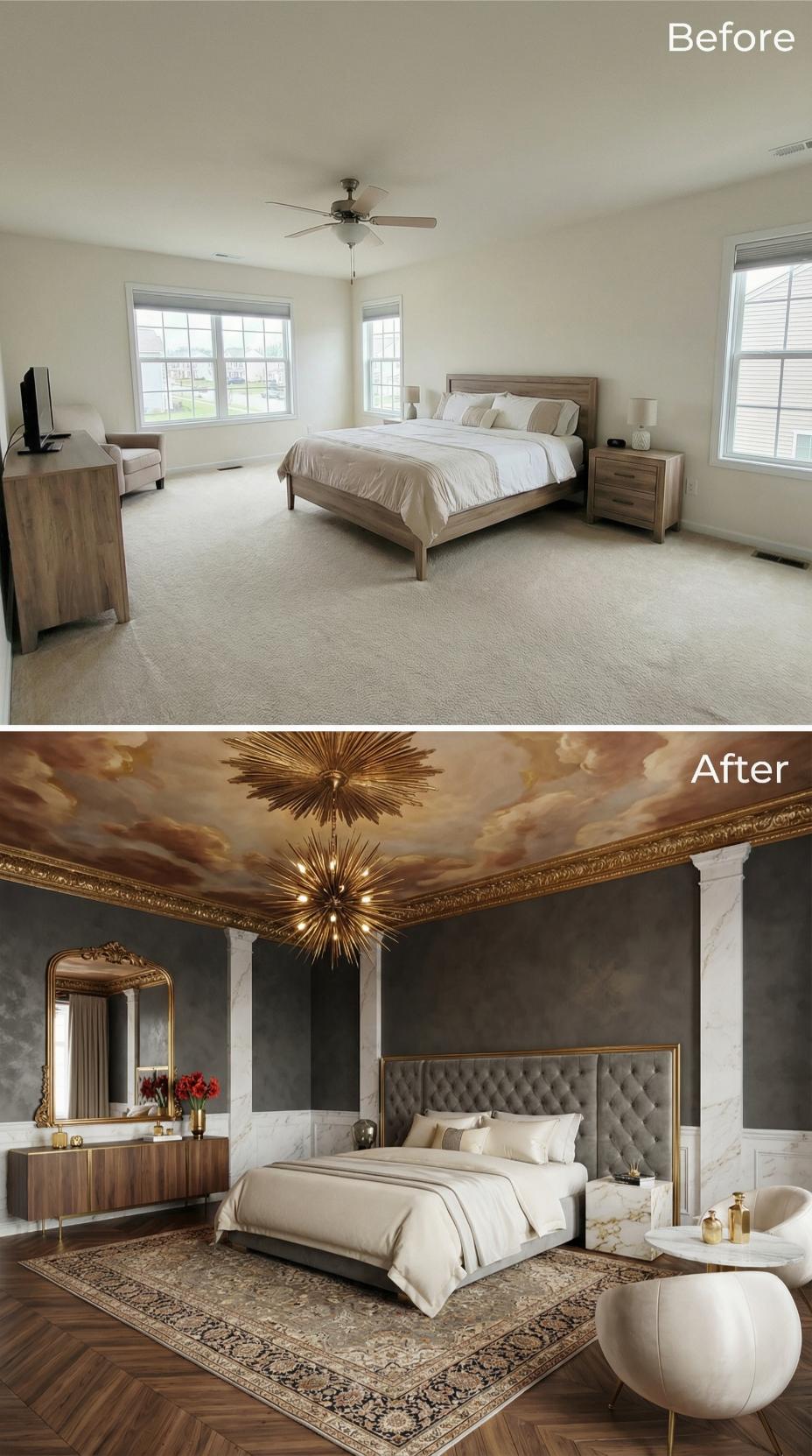
Pale carpet and a basic ceiling fan gave way to herringbone walnut floors, dark charcoal venetian plaster walls, and a hand-painted cloud mural that covers the entire ceiling. An ornate gilt crown molding frames the mural like a painting, and a brass sputnik chandelier hangs dead center, its arms catching light from every angle.
The bed anchors the room with a floor-to-ceiling grey velvet tufted headboard trimmed in a gilt frame. A Persian rug in burgundy, ivory, and camel grounds the layout beneath it. Marble column pilasters bracket the walls, a walnut dresser carries a scrolled gold mirror above it, and a round white marble accent table adds weight to the far corner without competing for attention.
Ask Yourself: whether your ceiling is doing any work at all. A flat painted surface above an otherwise layered room is a missed opportunity roughly the size of a king bed. If the room has the height, the ceiling deserves a plan.
Cobalt Lacquer Walls, Chinoiserie Panels, and a Four-Poster That Demands Ceremony
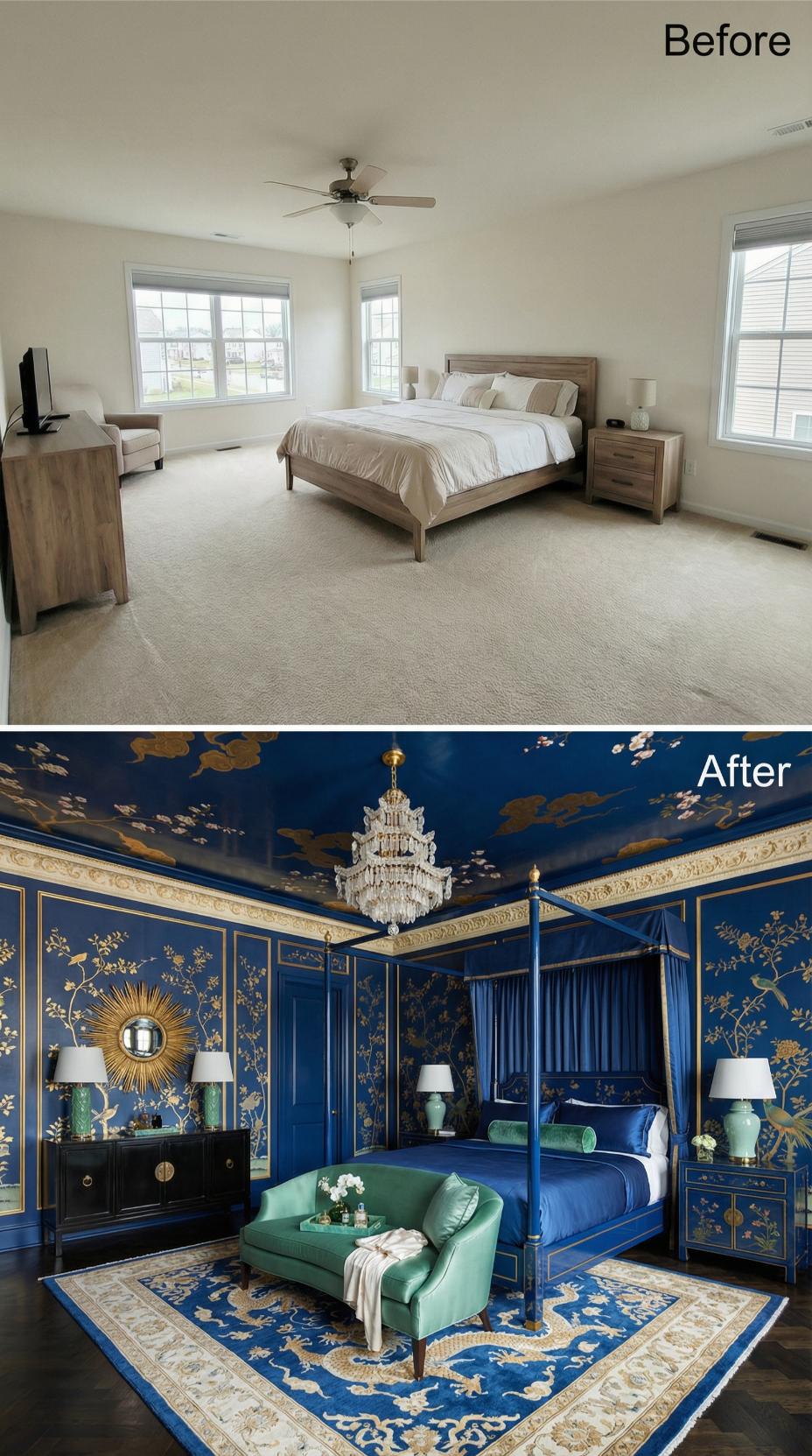
Royal blue lacquer coats every wall and the ceiling, where hand-painted gold chinoiserie motifs of flowering branches and cranes repeat across custom wainscoting panels trimmed in gilt molding. The ceiling continues the pattern without interruption, anchored by a crystal chandelier with tiered brass arms. A four-poster canopy bed dressed in sapphire silk sits opposite a jade green velvet settee on a wool area rug woven in a cobalt and ivory dragon motif. Celadon ceramic lamps on black lacquered nightstands and a sunburst mirror in aged gold finish close out a room that treats the builder-grade box underneath as an afterthought.
The ceiling continues the pattern without interruption, anchored by a crystal chandelier with tiered brass arms.
Emerald Velvet, Coffered Ceilings, and a Four-Poster That Earns Every Inch
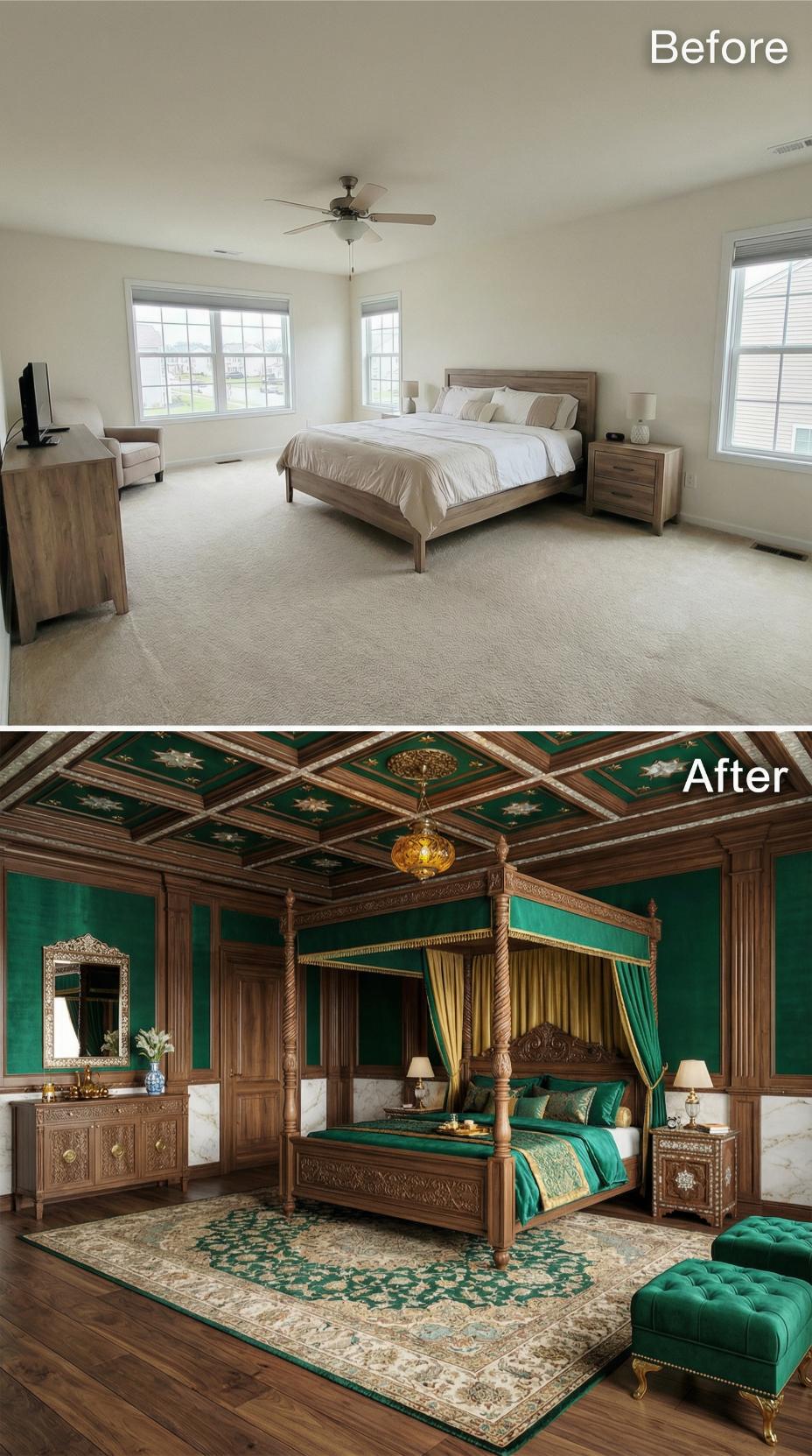
Walnut wall paneling runs floor to ceiling, framing emerald-painted coffers trimmed in silver-leaf detailing above a carved four-poster draped in gold and green velvet curtains. The bed itself carries ornate column turnings and a scrollwork headboard that read closer to furniture heirloom than retail purchase. An amber glass pendant lantern anchors the center of the room without competing with the architectural ceiling work.
A hand-knotted rug in ivory and green grounds the layout, while a tufted emerald bench at the foot of the bed and inlaid mother-of-pearl nightstands add distinct material contrast. The dresser carries brass hardware and hand-carved panels that mirror the bed’s detailing, keeping the room visually coherent rather than theatrical.
Did You Know: Emerald green has historically been associated with wealth and status in royal interiors, particularly in Mughal and Victorian palace design, where the pigment itself was once expensive to produce. Rooms built around deep jewel tones like this one often read larger than neutral spaces because saturated color draws the eye to architectural boundaries rather than away from them.
Purple Silk Canopy, Gold Rococo Bed Frame, and Walls That Refused to Whisper
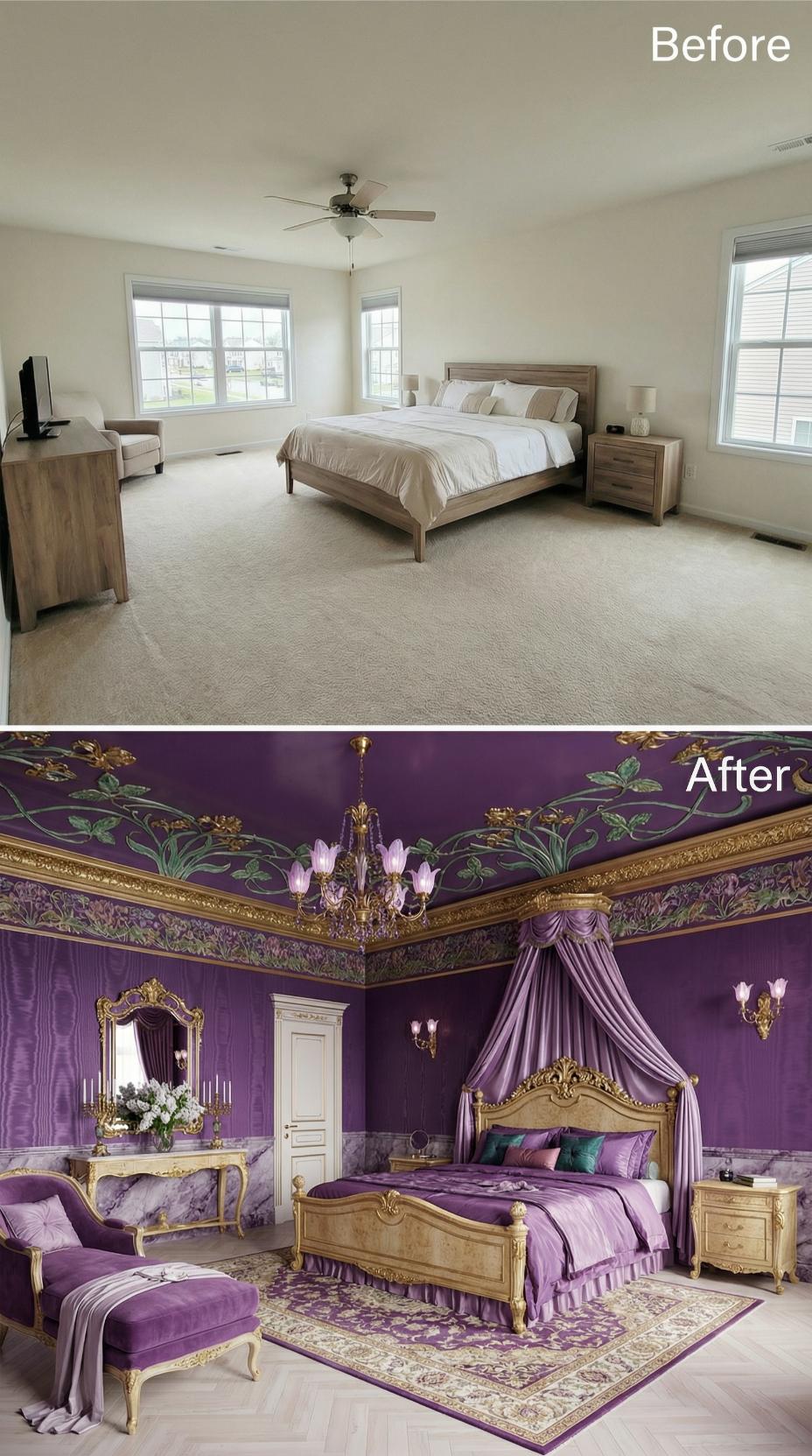
Saturated violet walls set the tone before a single piece of furniture registers. Hand-painted botanical friezes run the perimeter where wall meets ceiling, rendered in gold, green, and lavender against the deep purple ground. A brass chandelier with tulip-shaped glass shades hangs centered above the room, flanked by matching wall sconces.
The bed frame is gilded Rococo with carved scrollwork at the headboard and footboard, dressed in purple silk bedding with teal and lavender accent pillows. Silk canopy panels pool from a crown mount overhead. A velvet chaise with marble-effect upholstery anchors the left corner beside a gilt console table topped with a candelabra and fresh white blooms. An ornate gold mirror and a Persian-style area rug with ivory and purple detailing complete the picture.
Style Math: Purple held near-exclusive association with royalty for centuries because Tyrian dye, extracted from sea snails, cost more per ounce than gold in ancient Mediterranean trade. Committing an entire room to this depth of violet is less a design choice and more a historical callback. The silk canopy hardware alone signals that whoever sleeps here has done their research.
Moroccan Carved Wood, Hand-Painted Zellige Tile, and a Ceiling That Outranks Everyone
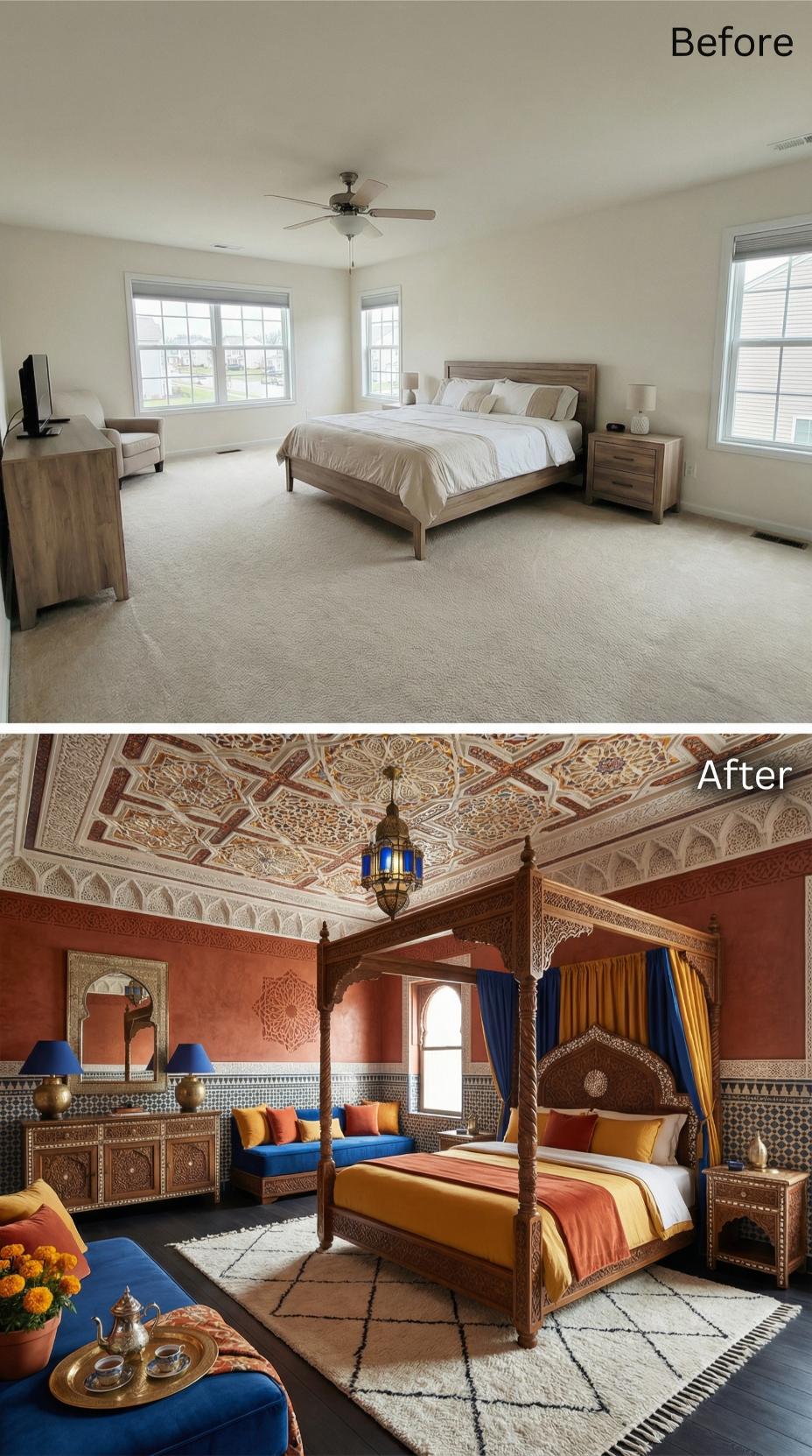
A four-poster bed in dark carved walnut anchors the room while terracotta-washed walls, cobalt velvet seating, and saffron drapery handle the rest.
Pro Tip: Moroccan tadelakt plaster, the traditional lime-based finish seen on these walls, is naturally antimicrobial and moisture-resistant, which is why it has lined palace interiors across North Africa for over a thousand years. Applying it correctly requires a multi-stage burnishing process with a smooth stone, not a roller. The result is a surface that reflects light differently at every hour of the day.
Dark Burgundy Coffered Ceilings, Peacock Wallpaper, and a Four-Poster Built for a Manor
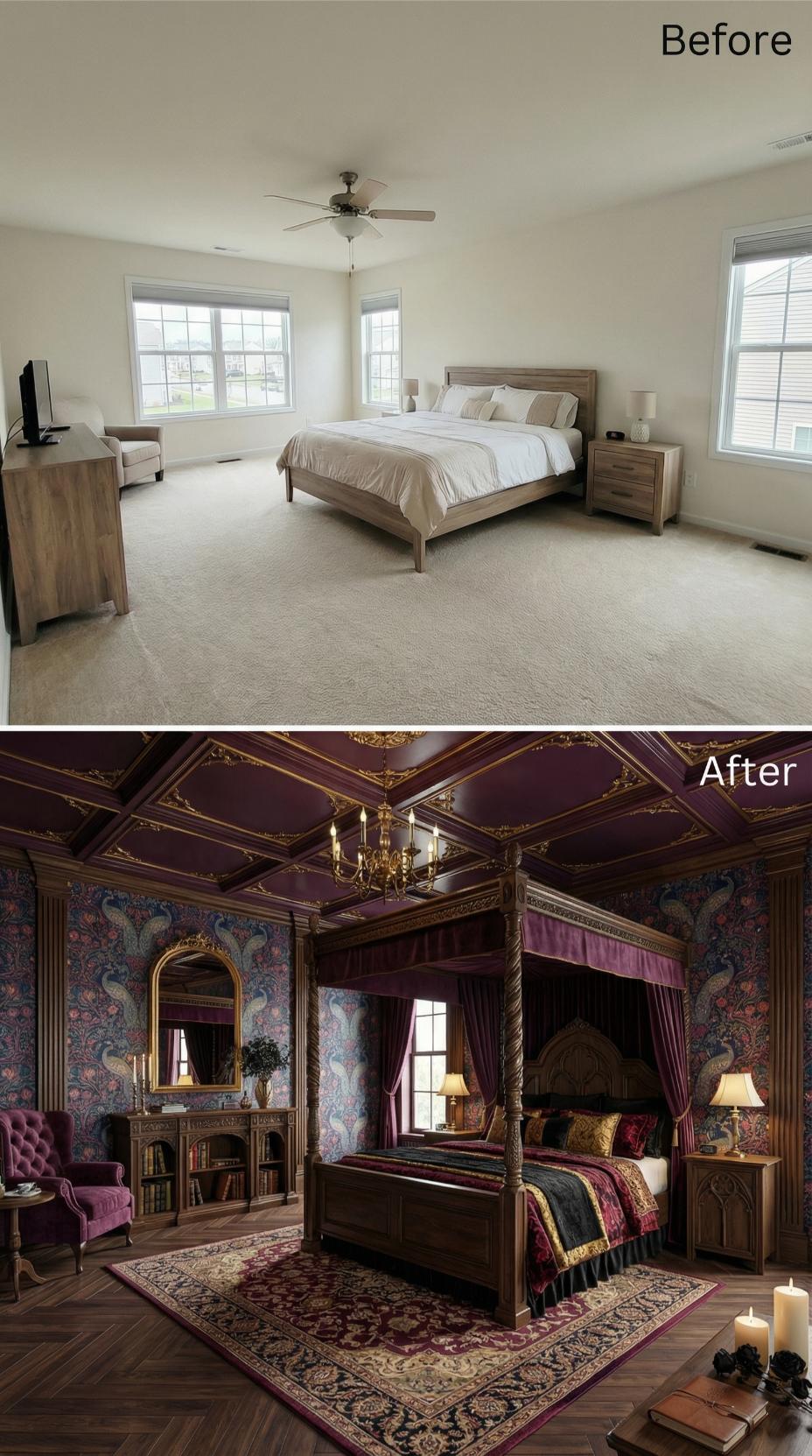
Herringbone hardwood floors replace the builder carpet, and the ceiling gets a full coffered treatment painted deep burgundy with gilt trim on every panel edge. A brass candelabra chandelier hangs at center. The four-poster bed in dark-stained oak carries a velvet canopy in the same wine tone, layered with gold brocade bedding and a black silk bed skirt.
William Morris-style peacock wallpaper runs floor to ceiling on every wall, its navy and crimson pattern anchored by dark wood pilasters at the corners. A tufted wingback chair in plum velvet sits beside a carved bookcase with arched detailing. A Persian rug in burgundy and ivory grounds the seating area, while pillar candles on the ottoman add low, ambient light.
Quick Fix: Coffered ceiling panels become far more dramatic when the recessed fields are painted a contrasting deep tone and the trim is picked out in metallic or gilt paint. The wood framing alone reads as architectural detail, but the color contrast between field and trim is what makes the ceiling feel deliberate rather than decorative. Most paint contractors can execute this technique without custom millwork, which keeps the cost closer to a painting project than a carpentry one.
Greek Key Crown Molding, Crystal Chandelier, and a Canopy Bed That Holds Court
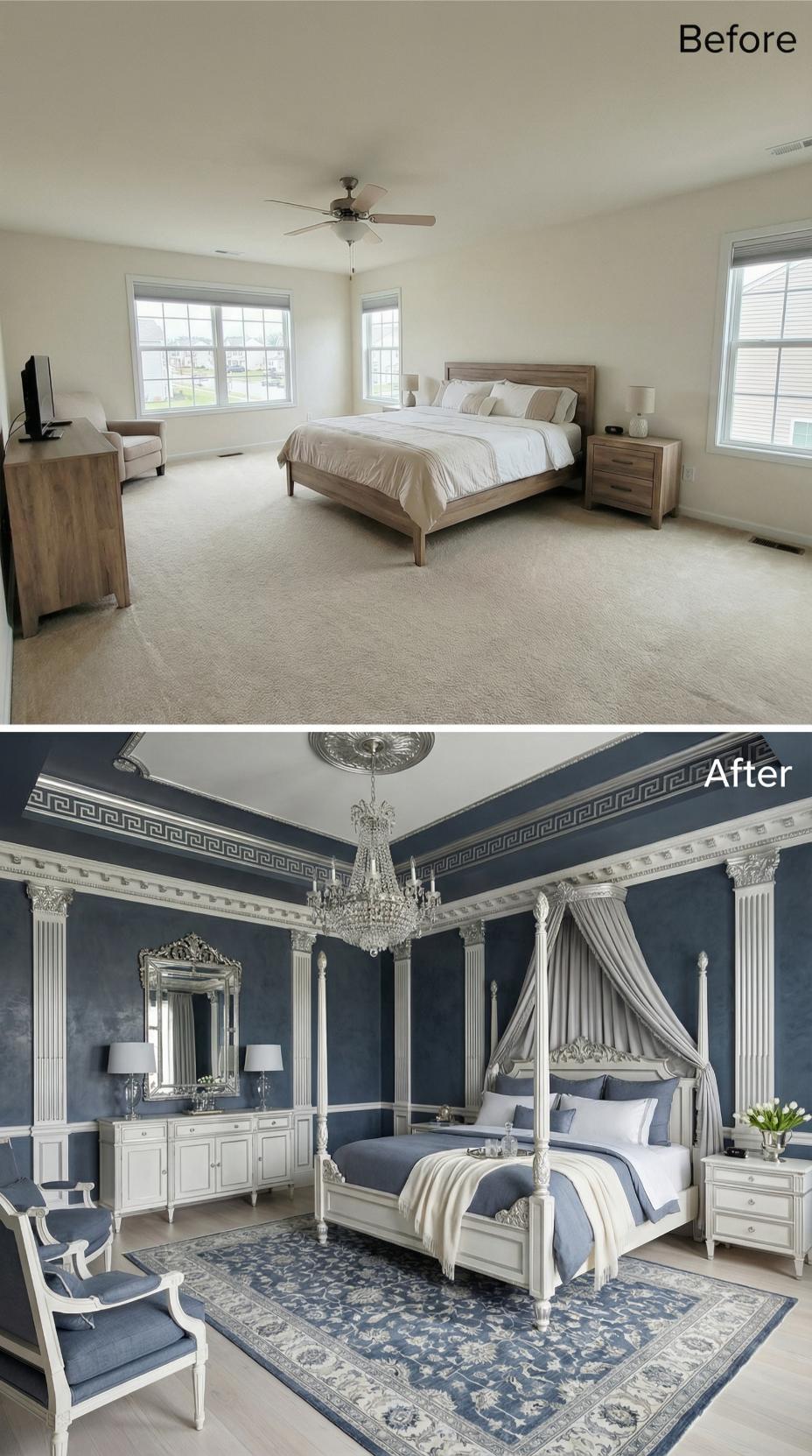
Steel blue venetian plaster walls set the foundation here, paired with silver-leafed pilasters that run floor to ceiling at measured intervals. The Greek key frieze painted directly onto the upper wall band is what ties it all together: classical motif, crisp white, zero ambiguity about the room’s intentions. A medallion ceiling rose anchors the crystal chandelier above an ornate four-poster with draped grey silk panels.
The white lacquered dresser with silver hardware mirrors the bed frame’s finish, keeping the palette disciplined. French bergère chairs in blue linen anchor the foot of the bed, and a wool rug in indigo and ivory grounds the entire arrangement. The before version had a ceiling fan doing its best.
History Corner: The Greek key pattern, known in ancient Greece as the meander, was one of the most widely used decorative motifs in classical antiquity, appearing on temples, pottery, and royal garments. Its continuous, unbroken line was believed to symbolize infinity and the eternal flow of water from the rivers of the ancient world. By the neoclassical period, European palace designers had adopted it as shorthand for intellectual refinement and aristocratic taste.
Terracotta Plaster Walls, Carved Four-Poster Bed, and Hand-Painted Scrollwork That Never Quits
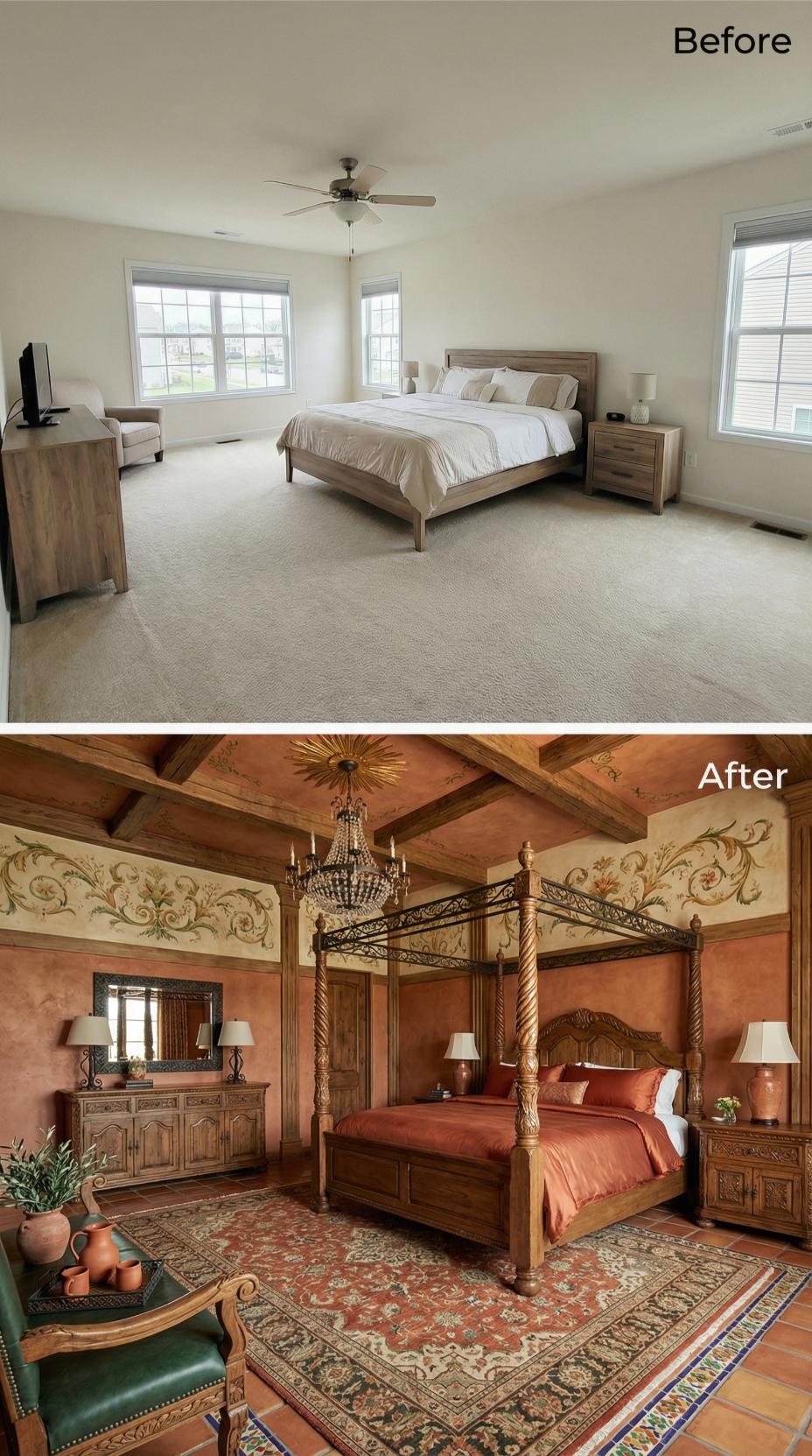
Beige carpet and a ceiling fan gave way to terracotta Venetian plaster walls, exposed wood ceiling beams, and a carved mahogany four-poster bed with barley-twist columns. The canopy frame is wrought iron, painted black, rising to meet a crystal empire chandelier anchored by a gilded sunburst medallion. Hand-painted floral scrollwork borders run along the upper walls in cream, ochre, and sage, sitting above the plaster transition line like a fresco lifted from a Tuscan villa.
Terracotta tile floors replace the original carpet entirely, layered with a wool Persian rug in rust, ivory, and navy. Flanking nightstands are carved walnut with brass hardware. Silk bedding in deep copper pulls the wall tones forward. A green leather armchair anchors the foreground corner.
Editor’s Note: Spanish Colonial interiors historically relied on Venetian or lime plaster walls specifically because the thick application provided natural thermal mass, keeping rooms cool in the afternoon heat. The barley-twist column, carved in a continuous spiral, became a dominant furniture motif during the seventeenth century after appearing prominently in Baroque church architecture across Spain and Portugal.
Teal Damask Walls, Murano Glass Chandelier, and Gold Moldings That Refuse to Rest
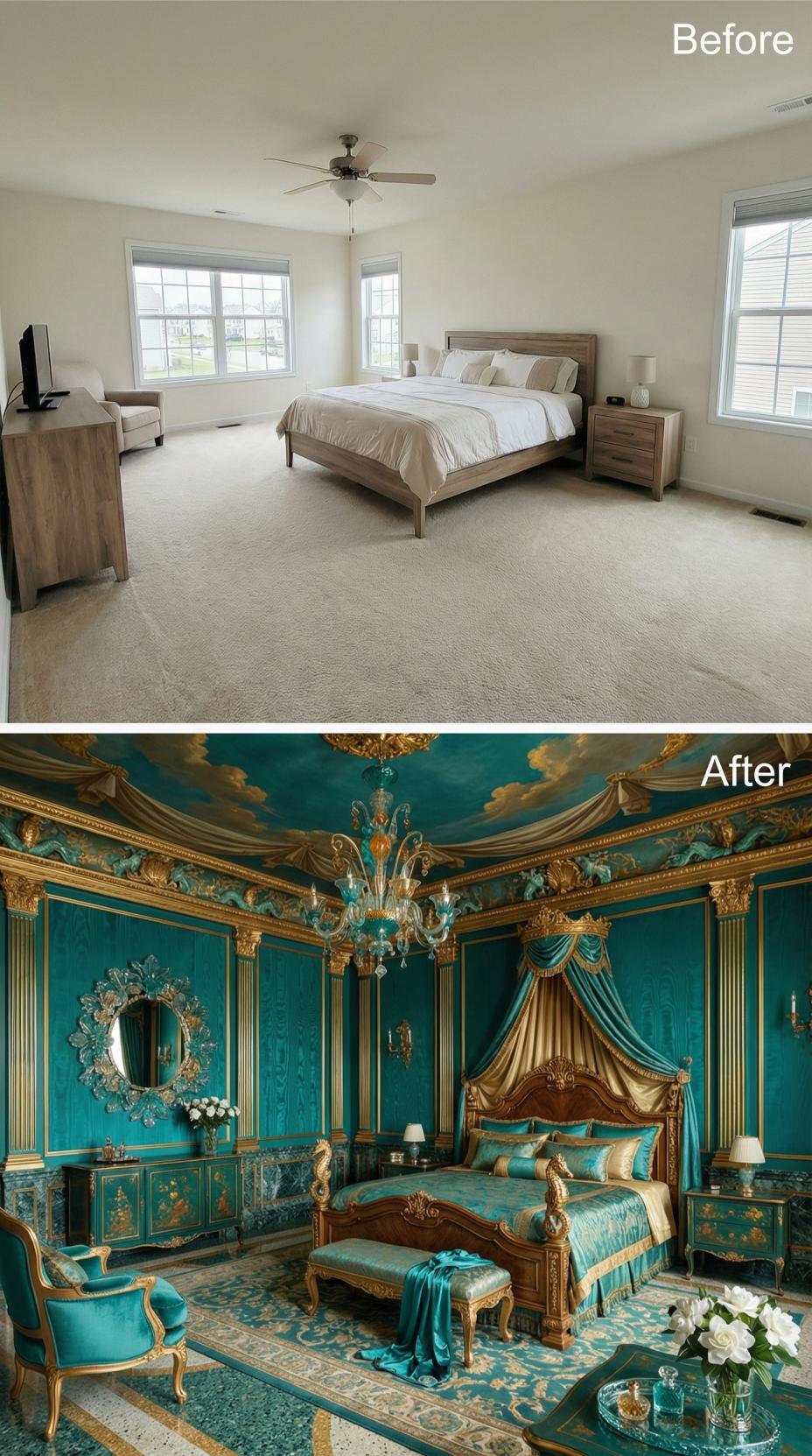
Whoever said builder-grade beige was a neutral choice clearly never considered teal damask as the alternative.
Every wall surface is covered in teal damask silk panels set within gilded pilaster moldings, and the barrel-vaulted ceiling carries a painted sky mural in the same turquoise palette trimmed with gold leaf cartouches. The Murano glass chandelier with blown crystal arms hangs directly above a carved walnut canopy bed dressed in gold silk and teal satin. A tufted bench in matching satin sits at the foot.
Venetian-style wall sconces flank the canopy, and a gilded oval mirror with acanthus leaf detailing anchors the dresser wall. Seahorse finials on the bedposts are an odd, specific choice that somehow commits fully to the aquatic-baroque concept. The original room gave away nothing. This one gives everything.
Magenta Walls, Gold Lattice Ceiling, and a Four-Poster Dressed in Brocade
🔥 Would you like to save this?
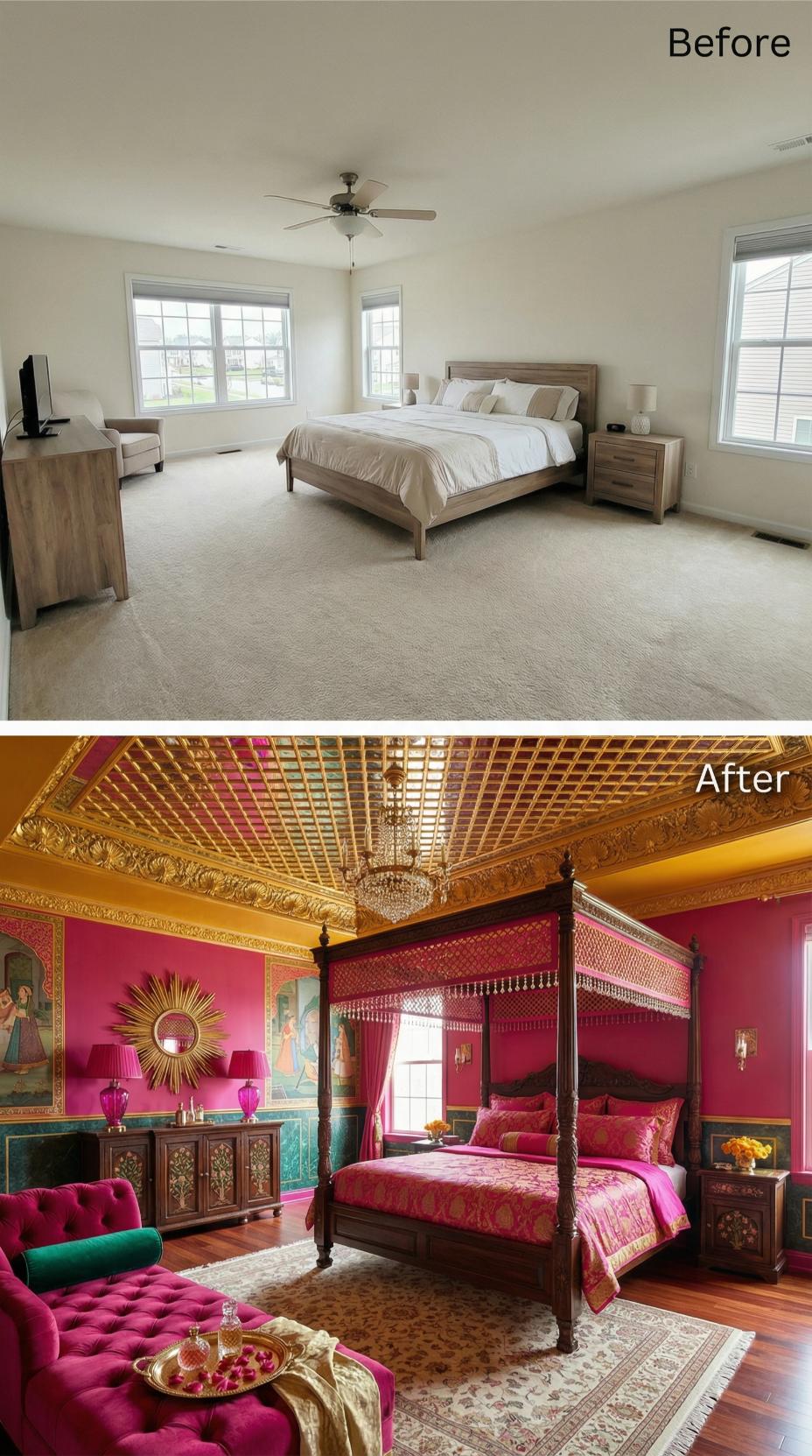
What was once carpet-over-concrete builder beige now operates at a completely different register. Deep magenta plaster walls anchor the room while hand-painted Mughal-style figures run along a teal dado band below. The dark mahogany four-poster carries a brocade canopy in fuchsia and gold, and the coffered ceiling above it is finished in gilded lattice with ornate egg-and-dart crown molding at the cornice. A crystal chandelier hangs at center. Magenta tufted velvet seating and a Persian wool rug ground the floor plane.
Material Matters: Mughal palace interiors historically used deep crimson and gold as the dominant color pairing because both pigments carried significant dye costs, making their combined presence a direct signal of wealth and court status. The lattice ceiling pattern seen here references the jaali screens found throughout Rajasthani havelis, where geometric open-work in stone or wood was used to filter light and air simultaneously.
Gold and green have been running parallel threads through this article, but here they finally collide head-on.
Forest Green Paneled Walls, Crystal Chandelier, and Gold Moldings That Mean Business
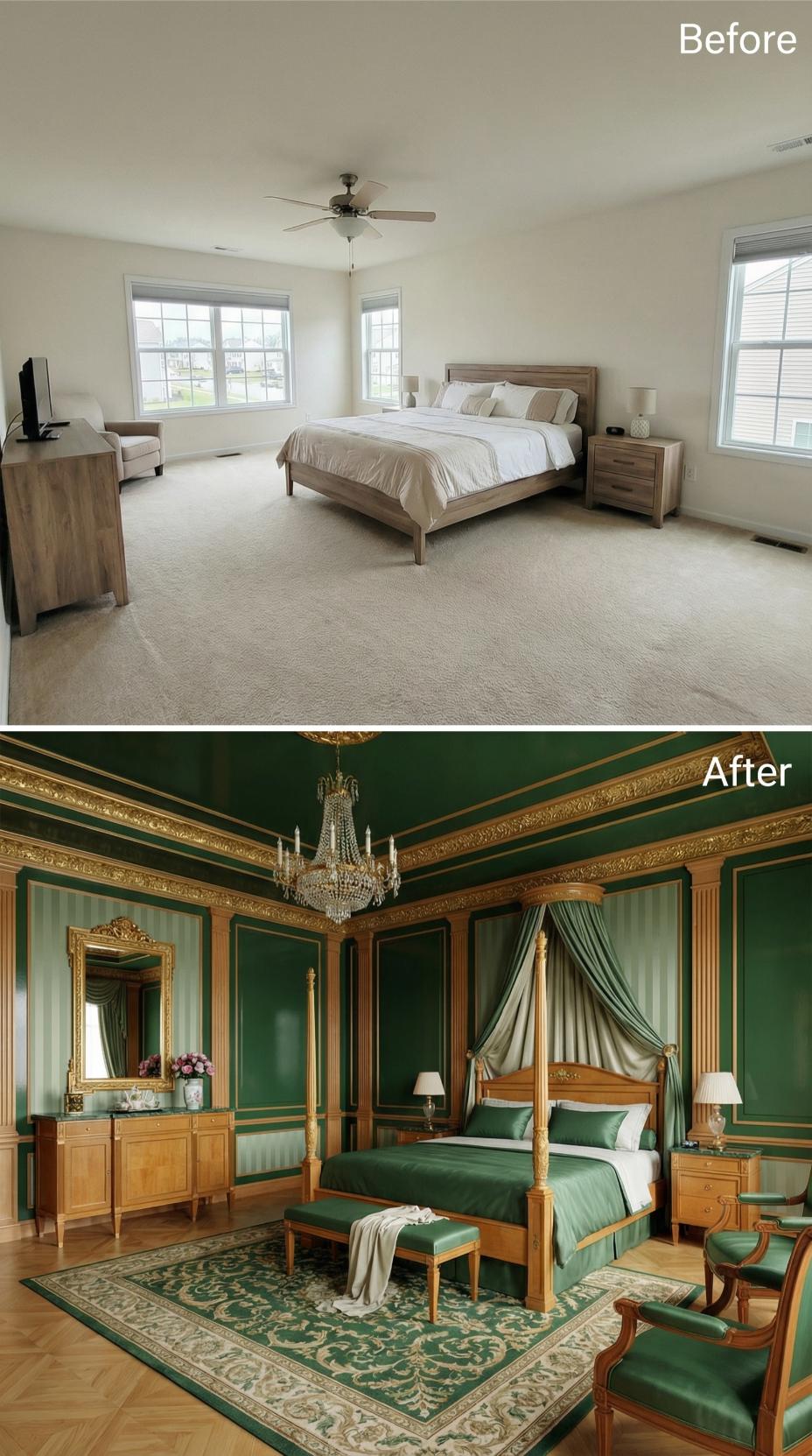
Builder-grade carpet and a ceiling fan gave way to parquet flooring, deep forest green wall panels framed in carved gilt molding, and a crystal candelabra chandelier that pulls light from every direction. The four-poster bed carries a wood frame in what reads as maple or light oak, dressed in green silk bedding with a coordinating canopy in sage. A gilt-framed pier mirror anchors the left wall above a matching dresser.
The floor rug runs an ivory and green floral medallion pattern that ties the palette together without competing with the paneling. Striped green silk between the panel frames adds texture without introducing a new color. The seating group in the right corner uses the same upholstered green as the bed bench, keeping the room disciplined despite its density of ornament.
Dark Plaid, Exposed Timber Beams, and a Four-Poster Carved for a Highland Keep
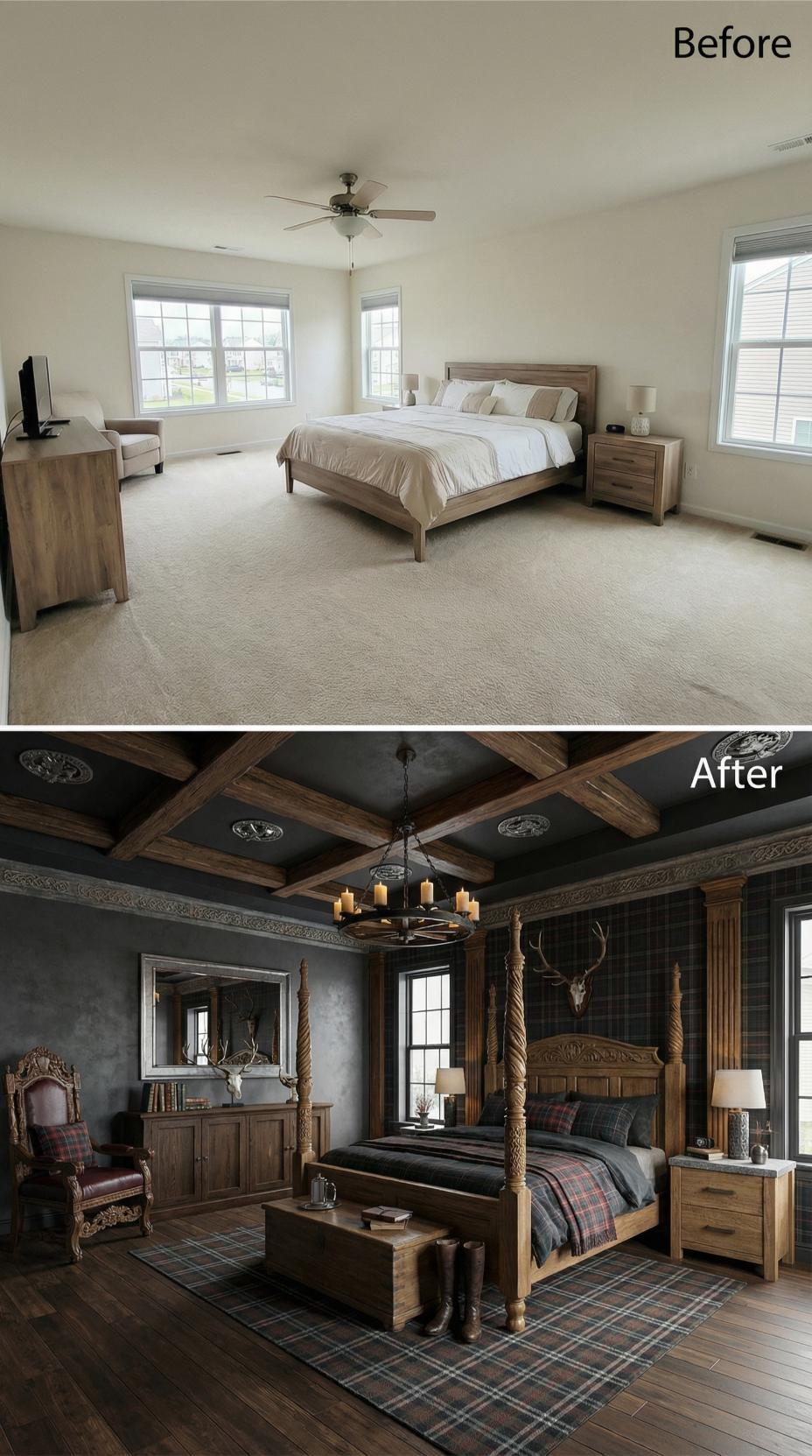
Oak coffered beams cross a near-black ceiling above a four-poster bed with spiral-turned columns and carved foliate detail across the headboard. Antler mounts, a wrought-iron wagon-wheel chandelier holding pillar candles, and plaid wool bedding in charcoal, red, and navy pull the room toward Scottish baronial territory without apology.
Dark hardwood flooring replaces the original carpet, and plaid wool area rugs anchor the layout. A leather throne chair with carved legs occupies the corner where a plain armchair once sat. The dresser and trunk chest carry the same raw oak finish as the bed frame.
Style Tip: Tartan used as wallcovering, rather than just textile, carries real historical precedent. Scottish clan interiors from the 18th century used plaid extensively on walls and upholstery to signal lineage and regional identity. Sourcing a large-scale wool or vinyl tartan wallcovering in a dark base color achieves the same effect without requiring custom upholstery throughout the room.
Sage Damask Walls, Crystal Chandelier, and Gold Leaf Moldings That Took Over the Ceiling
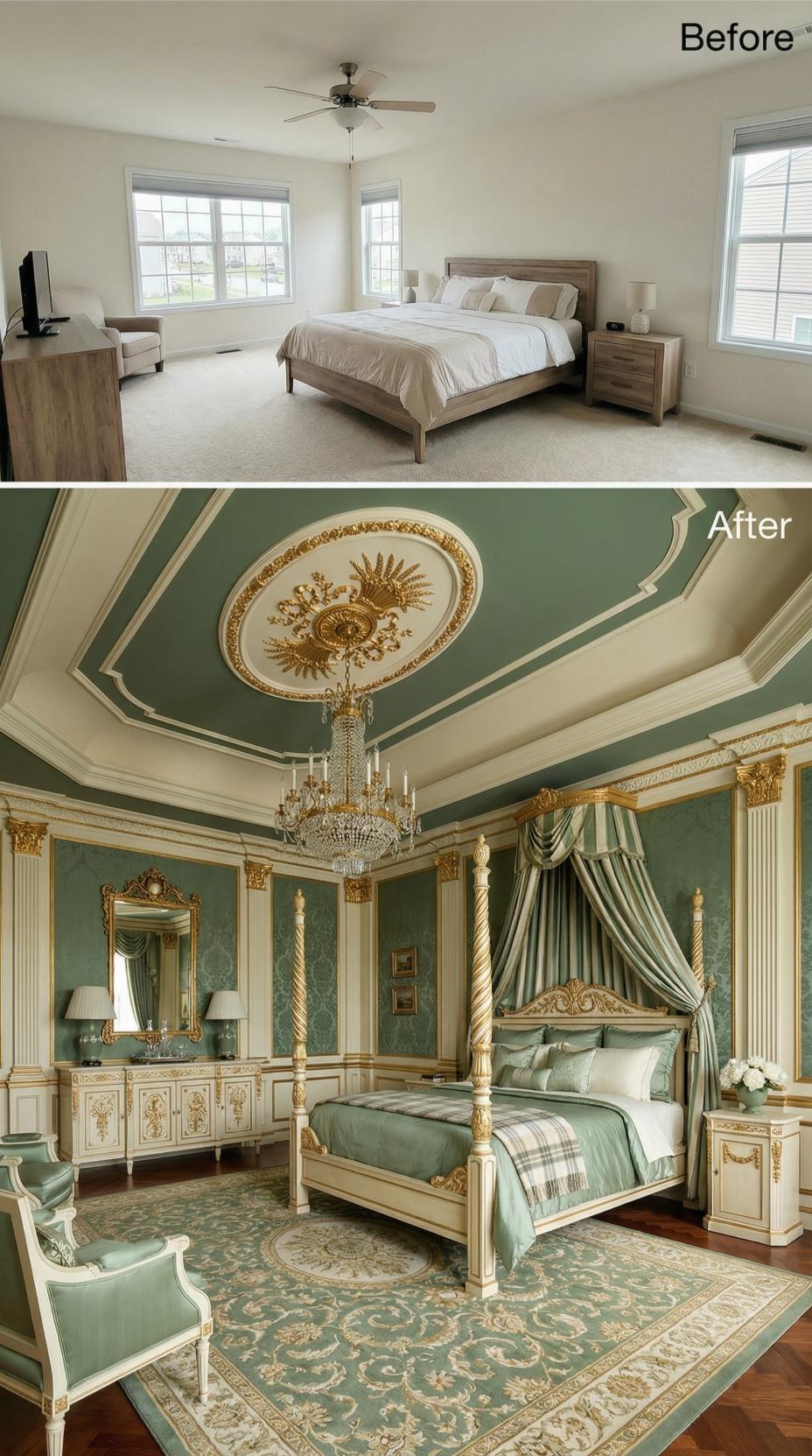
Sage green damask wallcovering climbs every wall, anchored by cream pilasters with gilded capitals and a tray ceiling painted the same muted green with white coffered trim meeting a central medallion finished in gold leaf. The four-poster bed carries spiral-carved columns, a cream lacquered frame with gilded relief panels, and draped silk canopy fabric in matching sage. Crystal chandelier drops from center medallion. Hardwood floors replace the original carpet entirely.
Fun Fact: Canopy beds with spiral-turned posts, called barley-twist columns, became popular in European palace furniture during the 17th century, with the twisted form requiring significantly more skilled labor than straight turning and therefore functioning as a direct signal of household wealth. The technique was widely used in French and English royal bedchambers through the reign of Louis XIV.
Crimson Velvet Canopy, Gilded Baroque Bed Frame, and a Ceiling Covered in Gold Damask
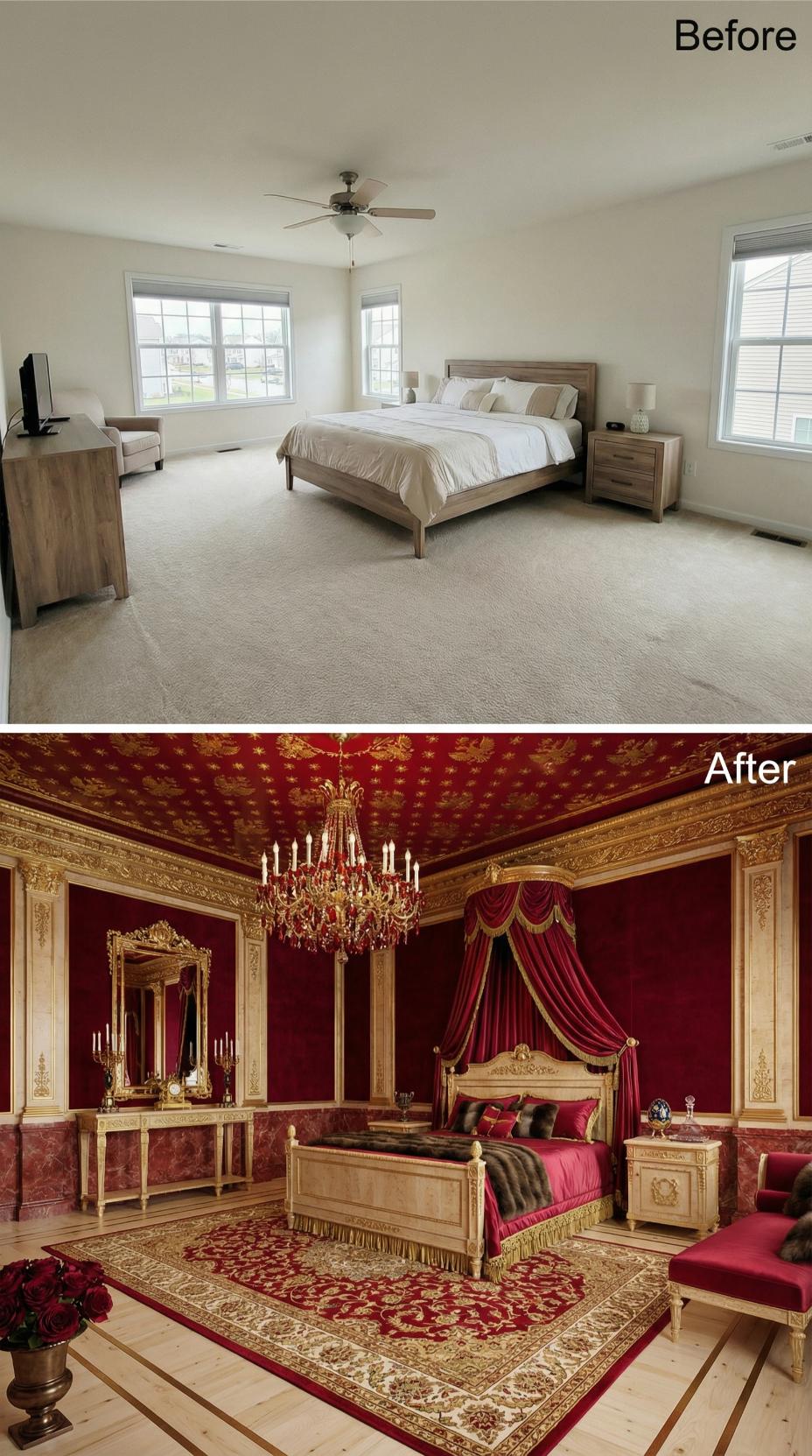
Flat carpet and a basic ceiling fan gave way to crimson velvet wall panels framed by carved gilt pilasters, a canopy bed draped in ruby silk with gold fringe, and a painted ceiling pattern that pulls the whole room toward the chandelier.
Try This: Damask ceiling treatments were common in 17th and 18th century French royal apartments, where fabric was sometimes stretched directly onto wooden frames overhead rather than painted. Reproducing that effect today with wallpaper applied to a smooth ceiling costs a fraction of the original method and holds up better in climate-controlled rooms. Use a paste-the-wall product rather than paste-the-paper to avoid seam bubbling on horizontal surfaces.
Teal Iris Wallpaper, Dark Painted Ceiling, and a Four-Poster Wrapped in Velvet
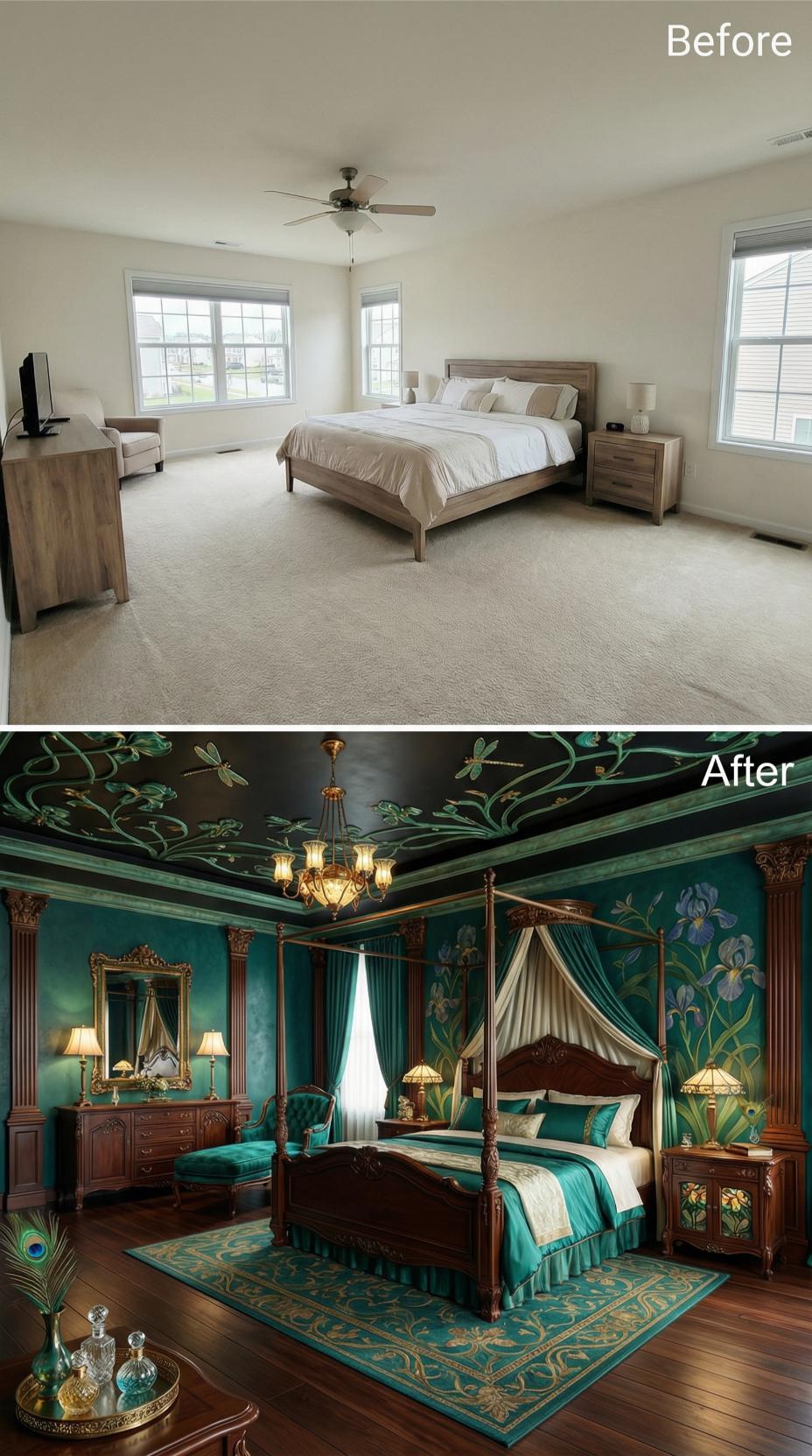
Dark walnut posts anchor a canopy bed dressed in teal velvet bedding and cream draping, set against hand-painted iris wallpaper that covers every wall in deep jewel tones.
Common Mistake: Painting a ceiling dramatically darker than the walls is one of the most mishandled techniques in dramatic bedroom design. Done without sufficient wall color depth to balance it, the ceiling reads as a mistake rather than a deliberate architectural decision. The teal walls here carry enough saturation to hold the near-black ceiling in place without the room collapsing visually.
Royal Blue Walls, Mughal Floral Panels, and a Mirrored Ceiling That Earns Every Inch
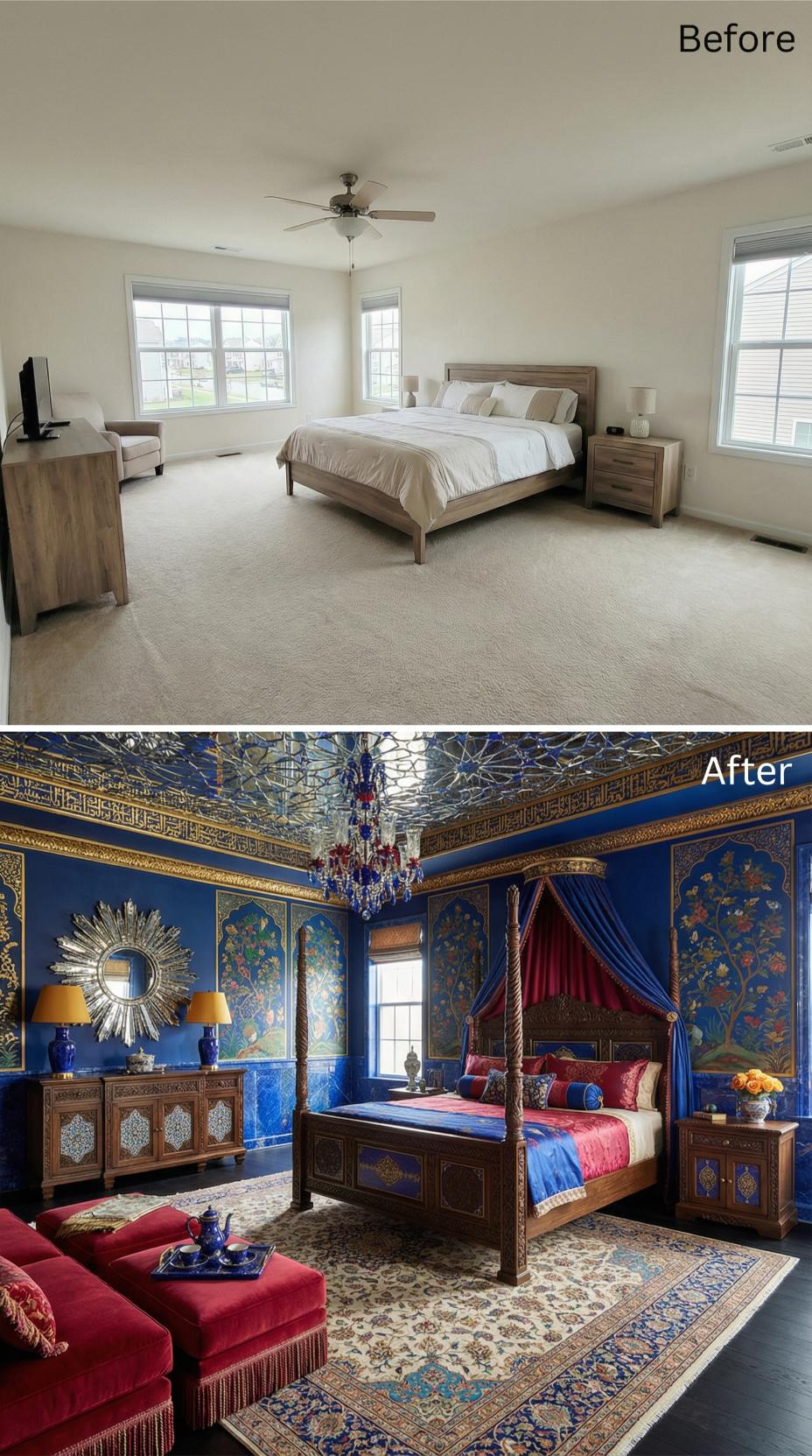
Cobalt blue covers every wall surface, framed by hand-painted arched panels depicting flowering trees in red, gold, and green against that same saturated ground. The four-poster bed in carved walnut carries inlaid blue lacquer panels on the footboard and headboard, dressed in crimson silk bedding and draped with deep blue velvet curtains at each post. A ruby-toned crystal chandelier hangs from a ceiling covered in geometric mirror work set within an Arabic calligraphy border in gold.
Red velvet seating anchors the foreground over a Persian rug with an ivory field and medallion pattern. The nightstands and low credenza share the same dark walnut with inlaid marquetry, keeping the furniture family consistent across the room.
What the Mirrored Ceiling Is Actually Doing Here
Mirrored ceiling installations in Mughal and Persian palace architecture, particularly in structures like the Sheesh Mahal in Lahore, used convex mirror fragments set into plaster to scatter candlelight across an entire room from a single flame. Here that same principle applies at a larger scale, with flat geometric mirror panels cut into star and polygon forms and set within a muqarnas-inspired grid. The gold calligraphy border running the ceiling perimeter keeps the mirror field contained, preventing visual chaos that a mirrored surface without framing almost always produces.
Cobalt Blue Lacquered Walls, Heraldic Ceiling Medallion, and Dark Walnut Canopy Bed
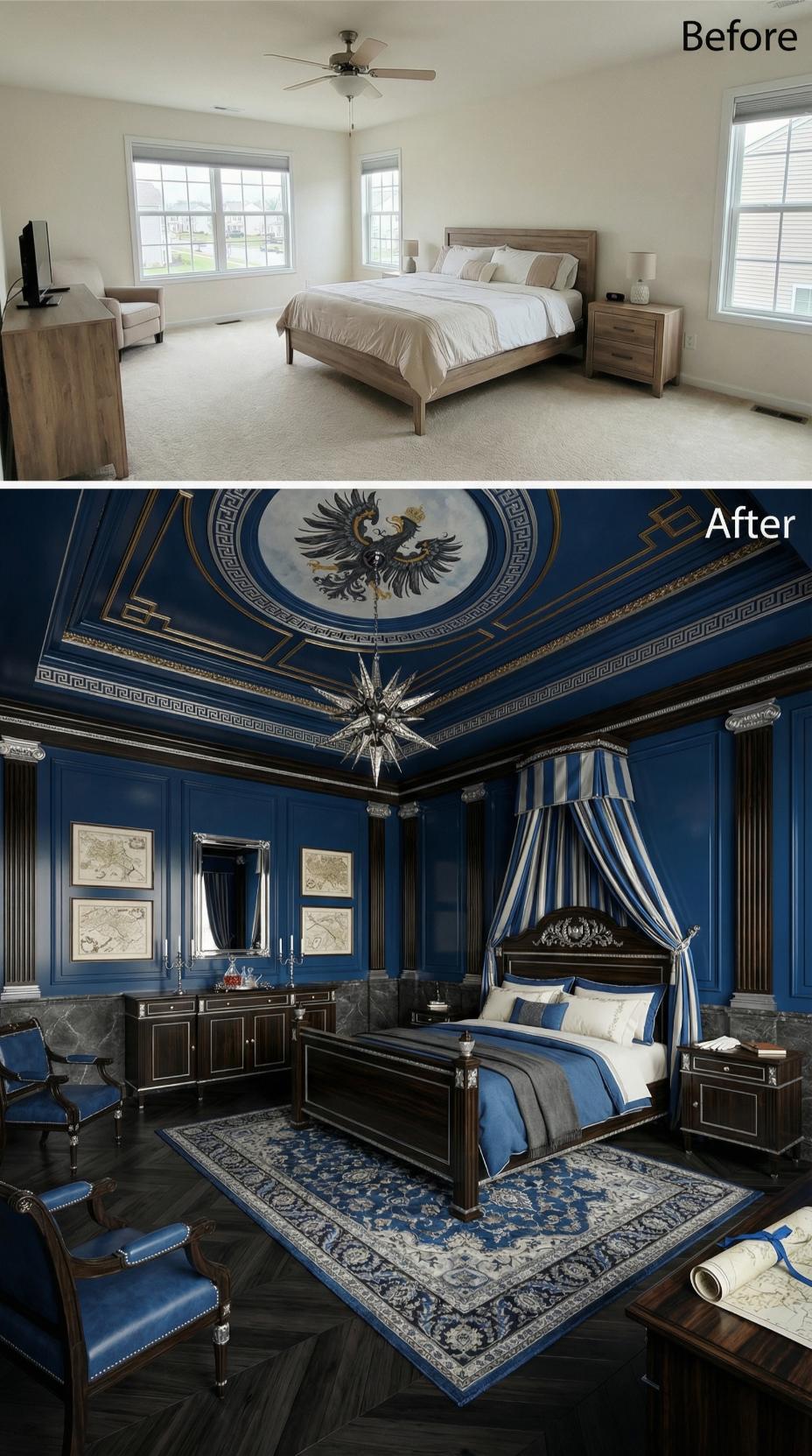
Naval blue lacquer coats every wall panel while a hand-painted double-headed eagle medallion commands the ceiling, ringed by Greek key banding in gold on a matching cobalt field.
Budget Tip: Sourcing reproduction heraldic ceiling art through architectural mural painters rather than custom fresco artists can cut costs by 40 to 60 percent, since most painters work from digital transfers rather than freehand. Blue and gold Greek key border stencils, applied in metallic craft paint over a base-coated ceiling, replicate the look of carved plaster molding at a fraction of the price. Dark walnut bed frames with carved crests are widely available through European reproduction furniture importers, often at lower prices than domestic custom work.
Chinoiserie takes the dramatic ceiling concept from the last section and runs it straight into lacquered territory.
Black Lacquered Walls, Gold Chinoiserie Ceiling, and a Walnut Four-Poster That Commands the Room
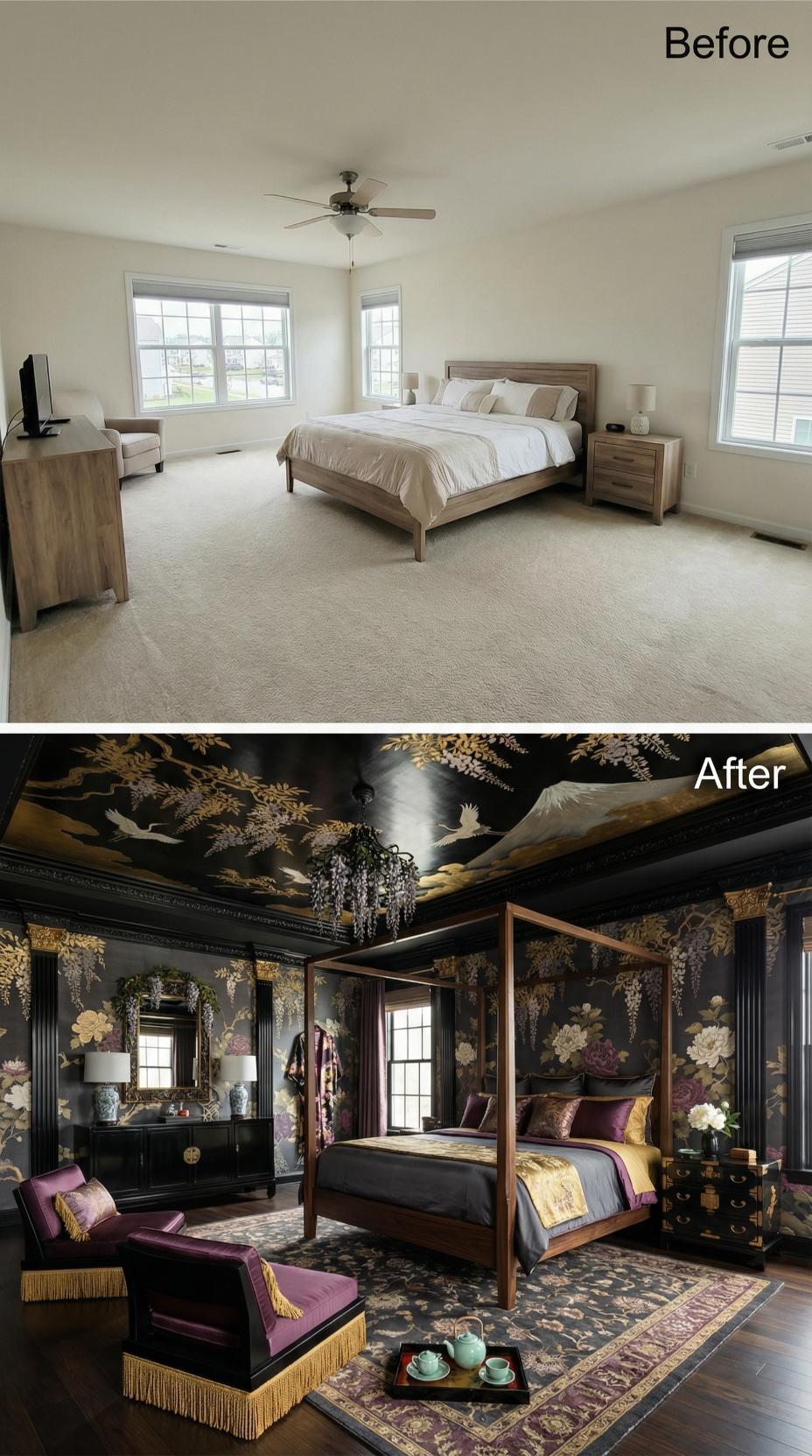
Crane-and-wisteria motifs cover both the walls and ceiling in gold-on-black chinoiserie wallcovering, pulling the eye upward in a way that flat builder paint never could. The walnut four-poster anchors the center while purple velvet chaise longues with gold fringe trim hold the corners. An ornate rug in plum, charcoal, and ivory grounds the hardwood floor beneath.
Pink Painted Ceiling, Rococo Gilt Moldings, and a Canopy Bed Dressed in Blush Silk
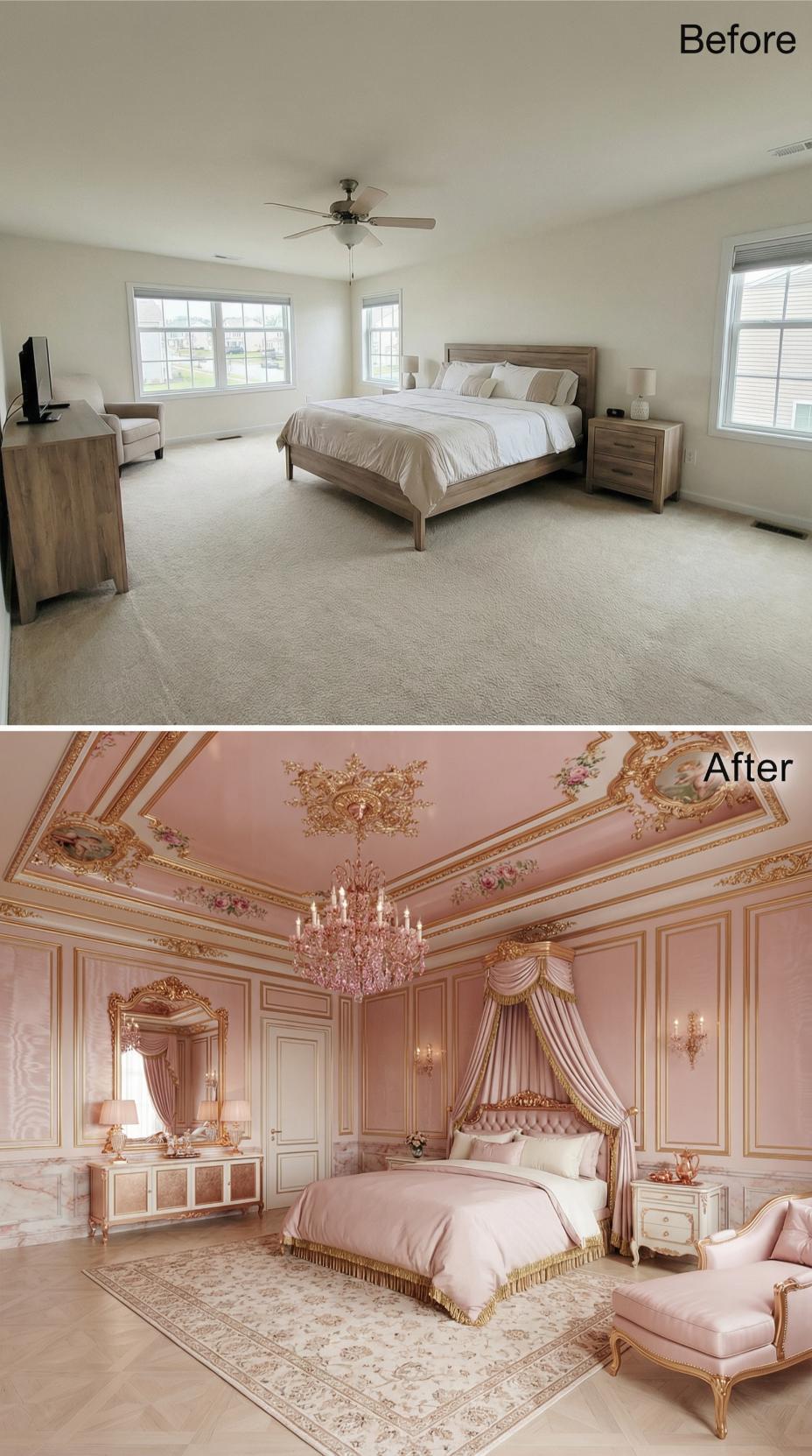
Pale pink covers every surface here, including the ceiling, where hand-painted floral medallions and gilt cartouches frame a pink crystal chandelier with candle-style arms. The walls are divided by raised panel moldings finished in cream and gold leaf, giving the room a structured formality that keeps the softness from reading as saccharine.
The bed sits beneath a fabric canopy in blush silk with gold fringe trim, flanked by painted white nightstands with gilt hardware. A chaise longue upholstered in the same blush fabric anchors the right corner, and a floral wool rug grounds the marble floor beneath it all.
In The Details: Rococo interiors from 18th century French palace design relied heavily on boiserie, a system of painted and gilded wood paneling that covered walls floor to ceiling, and the panel molding treatment visible here is a direct reference to that tradition. Installing reproduction boiserie panels using MDF with applied rope molding and gold leaf paint can replicate the effect at a fraction of the cost of carved wood originals.
Emerald Lacquered Panels, Gilt Boiserie Crown Molding, and a Canopy Bed Draped in Satin
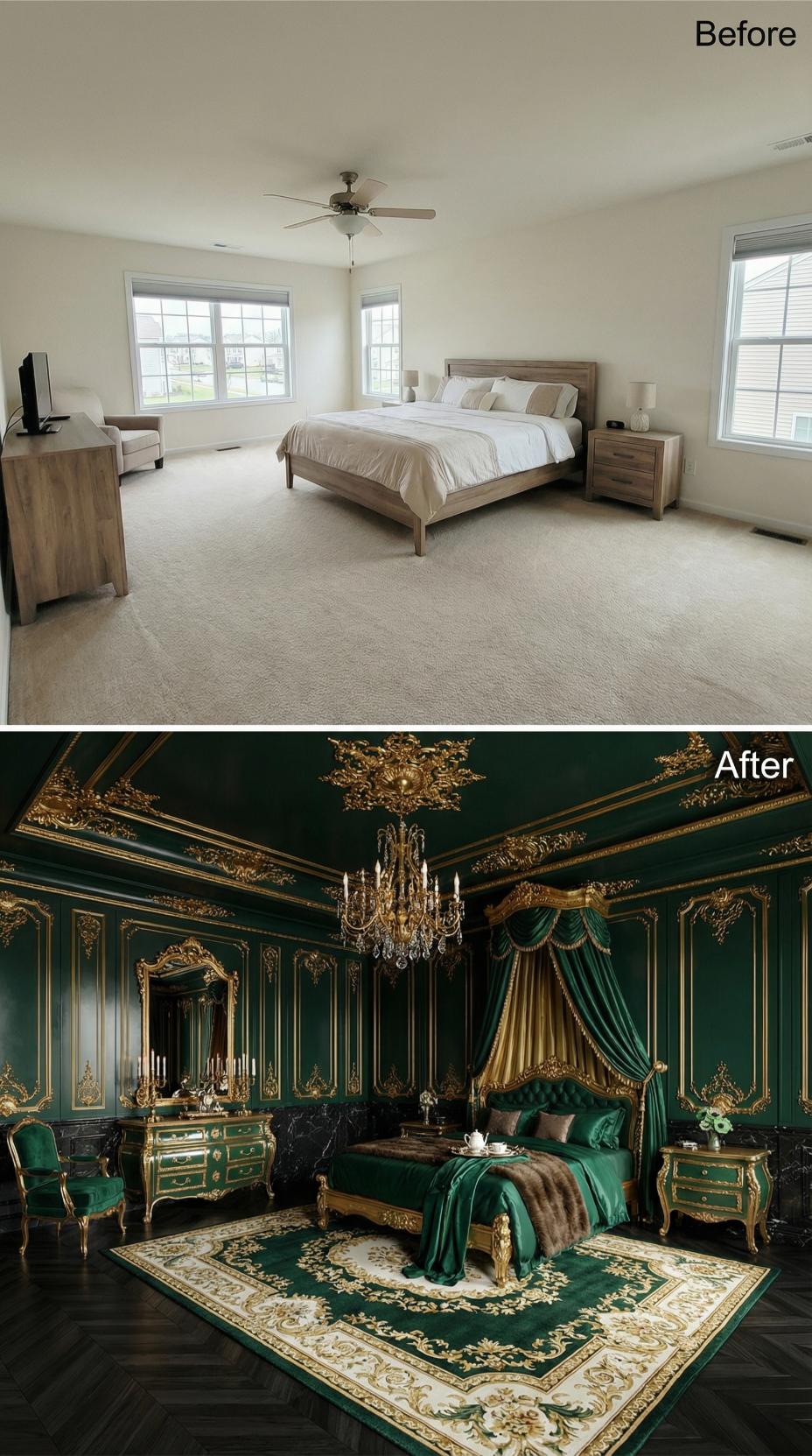
Every wall surface carries deep emerald lacquer framed by gilded boiserie paneling, with raised gold cartouches at each corner and a dentil-trimmed cornice running the full perimeter. The canopy bed features a carved and gilded baroque frame, tufted green velvet headboard, and gold silk draping pulled back in formal swags overhead. A brass chandelier with crystal drops hangs from a sunburst ceiling medallion.
The dresser and nightstands are French Rococo-style case pieces in matching green lacquer with ormolu mounts. Herringbone dark wood flooring grounds the room beneath an Aubusson-style rug in ivory, emerald, and gold. The before photo shows a builder-grade room with carpet, a ceiling fan, and beige walls that gave no indication this level of finish was coming.
By The Numbers: Boiserie panels of this scale, running floor to ceiling across all four walls, typically require between 200 and 400 linear feet of custom millwork in a room this size, which is why the technique was historically reserved for royal apartments rather than private residences. Period French craftsmen who installed boiserie in palace interiors trained for a minimum of seven years before working on royal commissions.
Ivory Boiserie Panels, Crystal Chandelier, and Gold Rococo Moldings Covering Every Surface
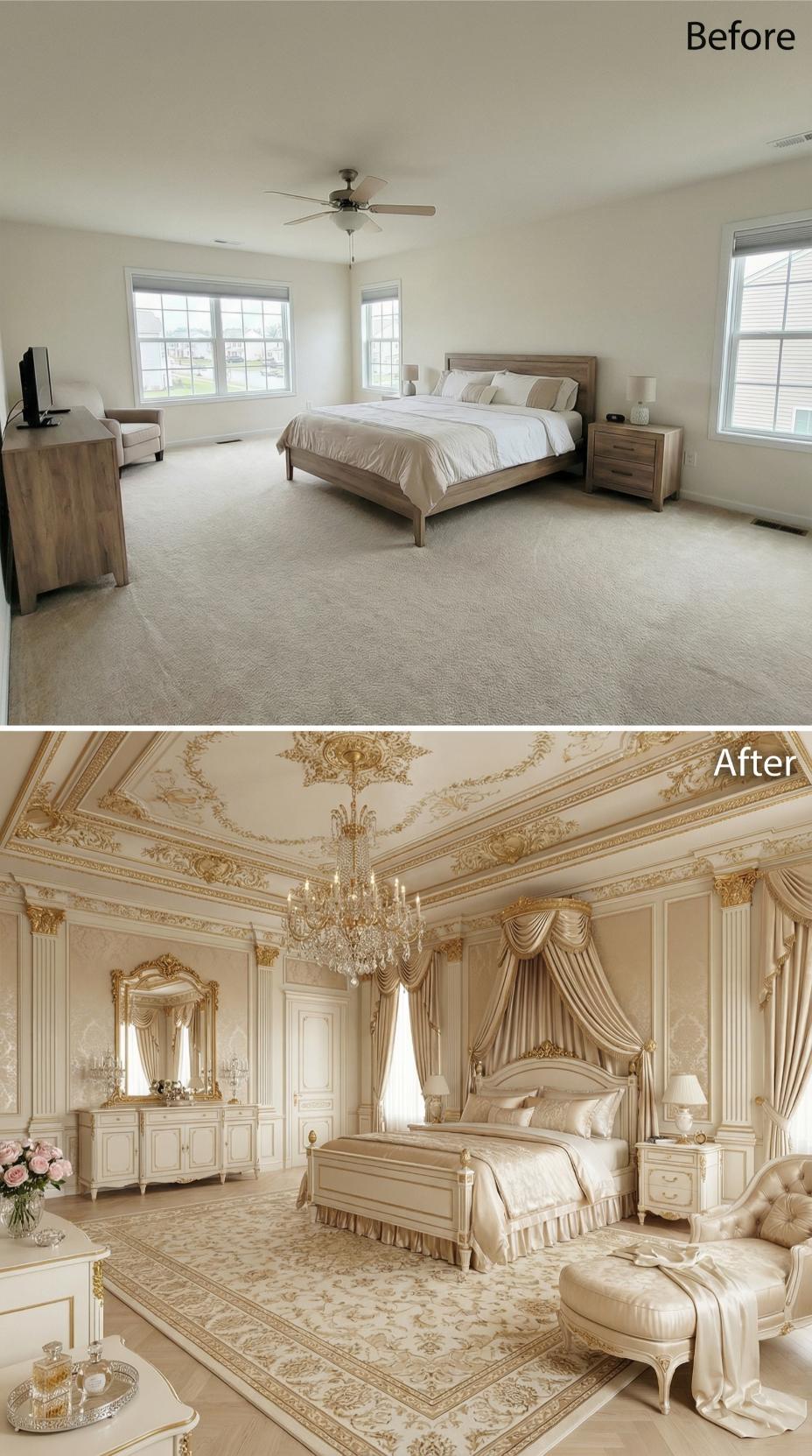
Where a builder-grade room once offered beige carpet, a ceiling fan, and wood-veneer nightstands, this space now runs gilt plasterwork from cornice to ceiling medallion without a single interruption. The bed frame is carved in the Louis XVI manner, painted ivory with gold leaf accents, and dressed in champagne satin with a draped fabric canopy that pools at the footboard. A floral Persian rug in cream and gold anchors the floor beneath it.
Crown moldings here are not trim. They are architectural events, stacked and bracketed with Rococo acanthus leaf carvings that wrap the entire perimeter. A crystal chandelier with tiered arms hangs center ceiling. Silk drapes in warm gold gather on each side of the windows in formal swag-and-tail configurations. The dresser, painted ivory with gilded hardware, sits beneath a carved gilt mirror with a broken pediment top.
The Psychology Behind This: Gold functions differently in an all-ivory room than it does against darker backgrounds. Against cream and white, it reads as warmth rather than opulence, which is why spaces like this feel lavish without feeling aggressive. The brain processes the combination as safe and abundant simultaneously, a pairing with deep roots in how humans have historically signaled sanctuary.
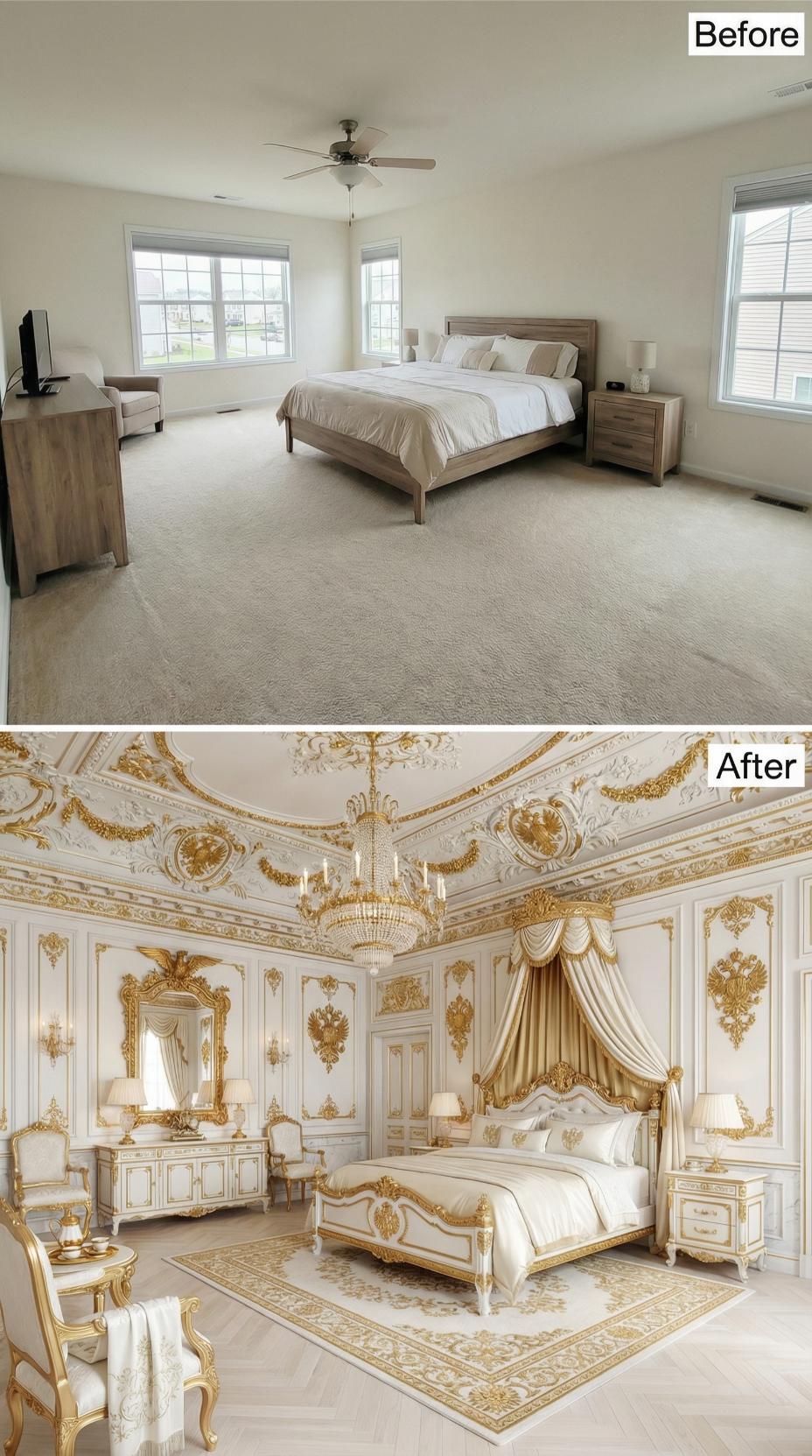
White Lacquer Walls, Imperial Gold Plasterwork, and a Canopied Bed Fit for Versailles
🔥 Would you like to save this?
Builder-grade carpet and a ceiling fan gave way to white lacquered wall panels framed in gilded Rococo moldings, with double-headed eagle cartouches pressed into every field. The crystal chandelier anchors the center of the room, its candle-style arms casting light across walls that read more like a European imperial palace than a suburban primary bedroom.
The four-poster canopy bed is finished in white and gold leaf, dressed in ivory silk draping that pools at the posts. A white dresser with gilt hardware, a matching nightstand, and Louis XVI-style armchairs in ivory fabric complete the suite. Underfoot, a hand-knotted rug in cream and gold repeats the same scrollwork vocabulary as the ceiling plasterwork above it.
Crystal chandelier arms cast light across walls that read more like a European imperial palace than a suburban primary bedroom.
Red Lacquered Coffered Ceiling, Roman Fresco Panels, and a Carved Canopy Bed Draped in Crimson Silk
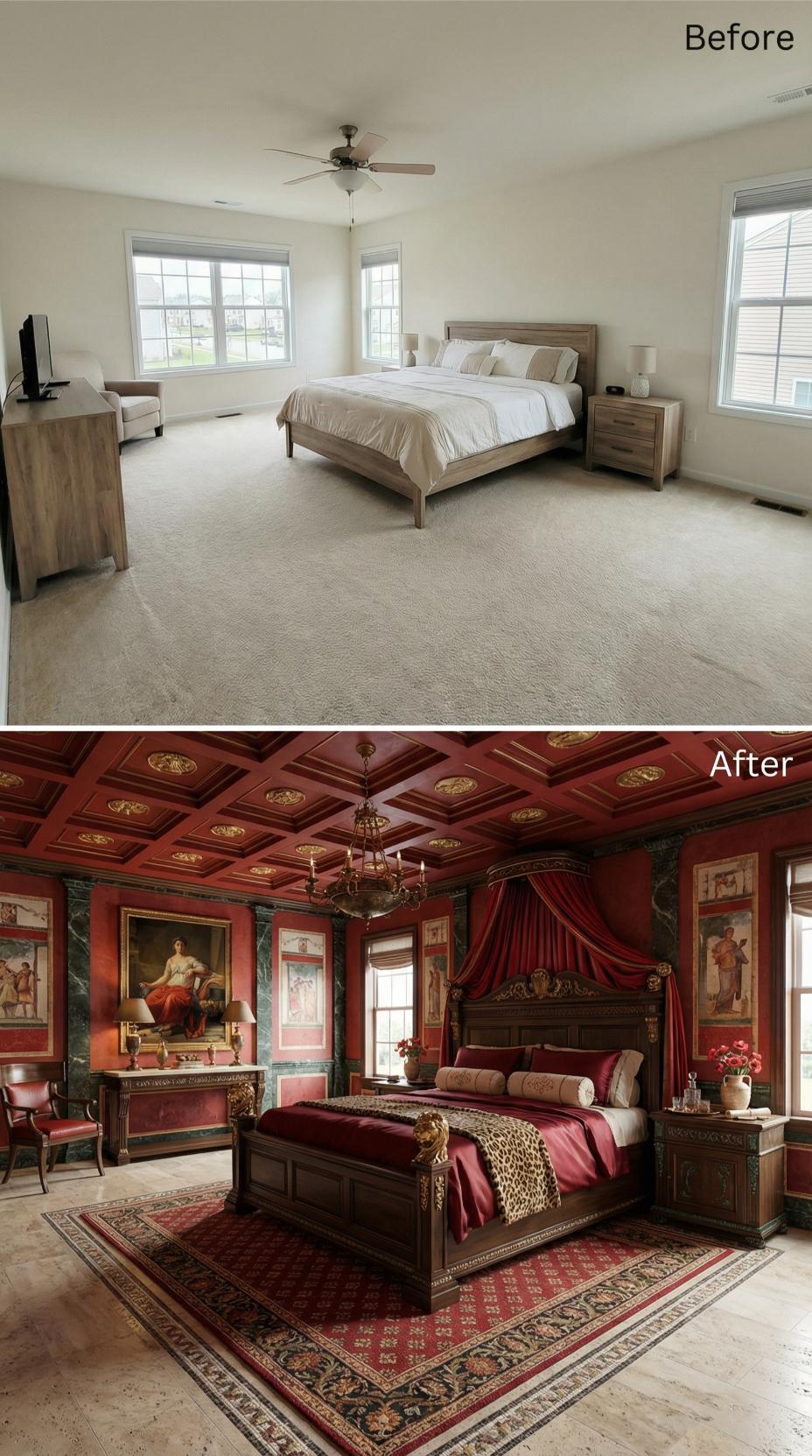
Crimson lacquer coats every coffered panel on the ceiling, with gold-leaf medallions set into each recess and dark trim picking out the grid. The walls carry Roman-style fresco panels depicting classical figures, framed by columns in verde antico marble. A carved walnut canopy bed anchors the room, dressed in crimson silk with a leopard-print throw and lion’s-head hardware. A Persian rug in deep red and ivory grounds the space, while a brass chandelier with candle arms pulls the eye upward.
Color Story: Roman imperial interiors relied on a palette built around Pompeian red, derived from iron oxide and cinnabar pigments that retained their intensity on plaster walls for centuries, which is exactly why this shade reads as historically authoritative rather than simply bold. The color’s staying power across two thousand years of palace and villa design makes it one of the most documented pigments in architectural history.
Viking Longhouse Ceiling Carvings, Stone Walls, and a Four-Poster Draped in Fur
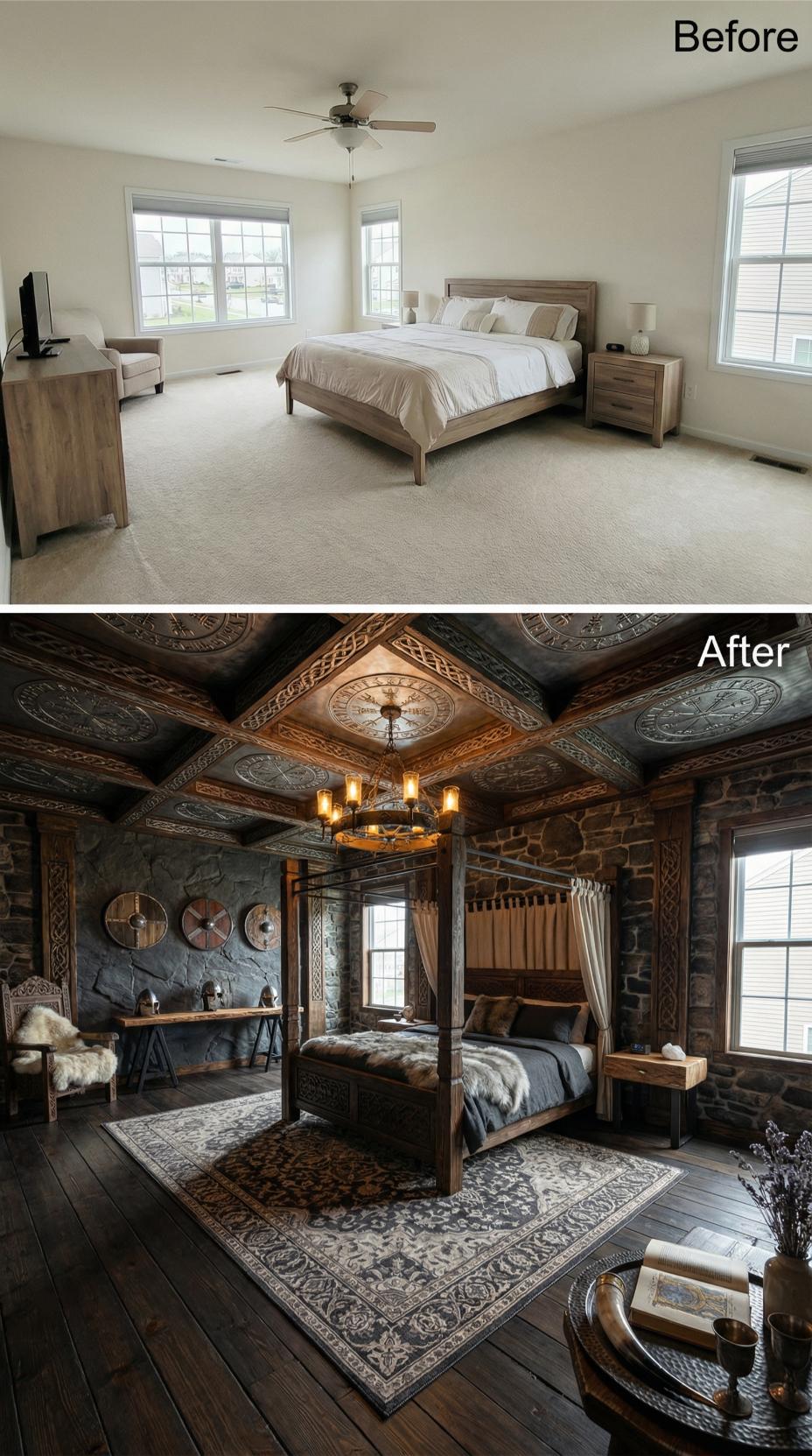
Rough-cut stone cladding runs floor to ceiling on three walls, paired with dark-stained wide-plank hardwood floors that replaced builder carpet entirely. The four-poster bed features carved dark walnut posts and a fabric valance in charcoal linen, layered with faux fur throws across a slate-grey duvet. A wrought-iron chandelier with Edison-style bulbs hangs from a coffered ceiling covered in Norse knotwork relief carvings and a central Vegvisir compass medallion.
Viking shields and an iron helmet on a trestle desk anchor the left wall. A patterned wool area rug in grey and ivory grounds the bed. Every window retained its original casing, which actually reads well against the stone.
Norse Knotwork Relief Carvings on the Coffered Ceiling
The ceiling is the room’s most labor-intensive element. Each coffered panel carries interlocking knotwork in raised relief, a pattern rooted in Scandinavian and Insular art traditions where continuous loops symbolized eternity and protection. Achieving this effect today typically requires either carved wood panels or urethane resin castings applied directly to drywall, with resin reproductions running significantly less than custom woodcarving while holding equivalent visual weight from below.
Coffered Walnut Ceiling with Oil Paintings, Herringbone Floor, and a Canopy Bed in Crimson Velvet
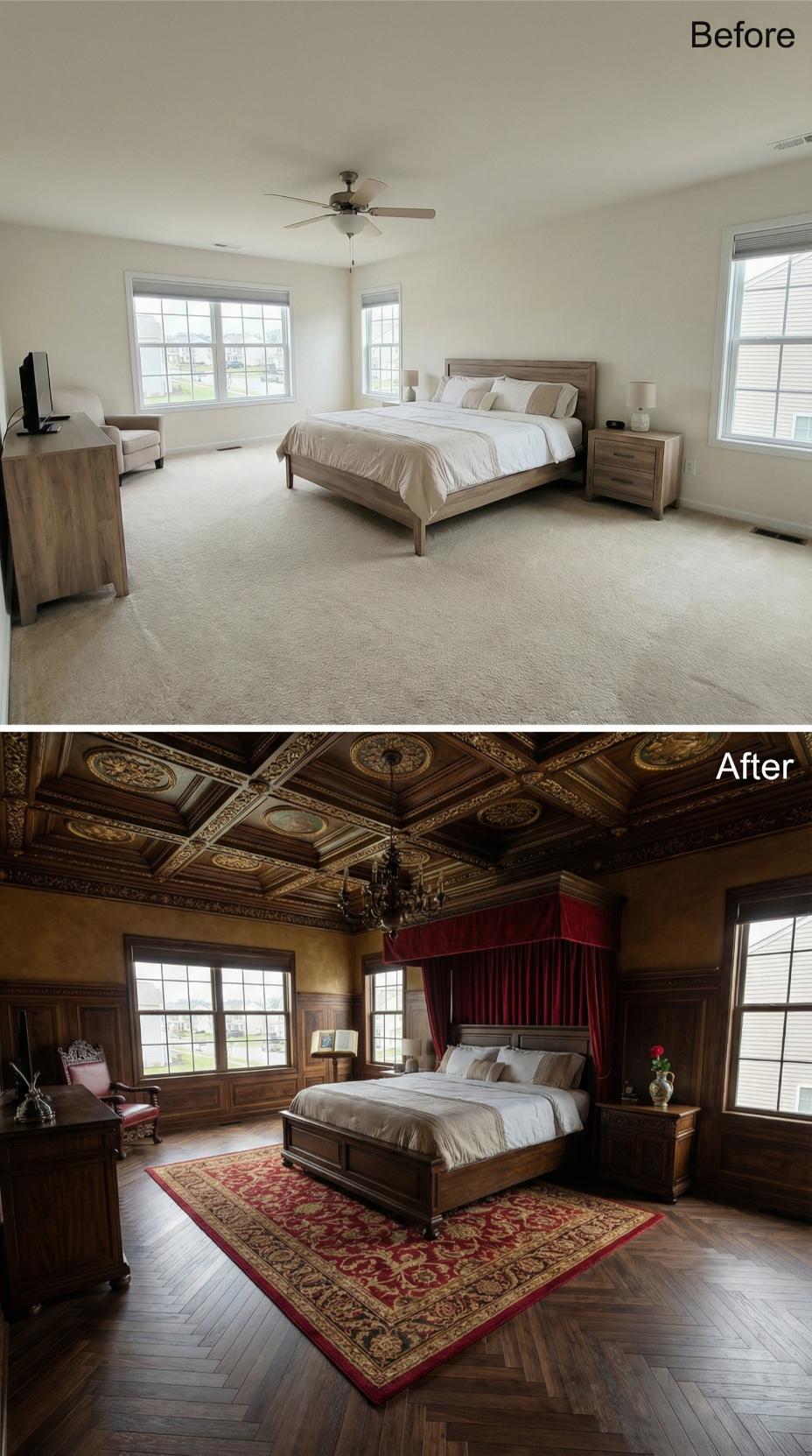
Carpet and a ceiling fan were the entire story before. Now, hand-carved walnut coffered panels cover the ceiling end to end, each recessed field holding a painted roundel with classical figural scenes rendered in ochre and gold. A wrought-iron chandelier drops from the central intersection. Dark walnut wainscoting wraps all four walls.
The floor is herringbone hardwood laid in a tight pattern that pulls the eye toward a four-poster bed hung with deep crimson velvet drapes. A red medallion wool rug anchors the furniture grouping below. Flanking nightstands match the bed’s carved wood profile, and a single red rose sits in a ceramic vase on the right side.
- Herringbone flooring laid at a 45-degree angle creates stronger visual movement than straight planks in a large square room
- Painted ceiling roundels cost significantly less when sourced from art students or emerging muralists rather than established decorative painters
- Velvet canopy panels work best when they pool slightly on the floor, adding weight that reads as intentional rather than undersized
Lapis Blue Walls, Gold Arabesque Ceiling, and a Four-Poster That Rewrites the Room
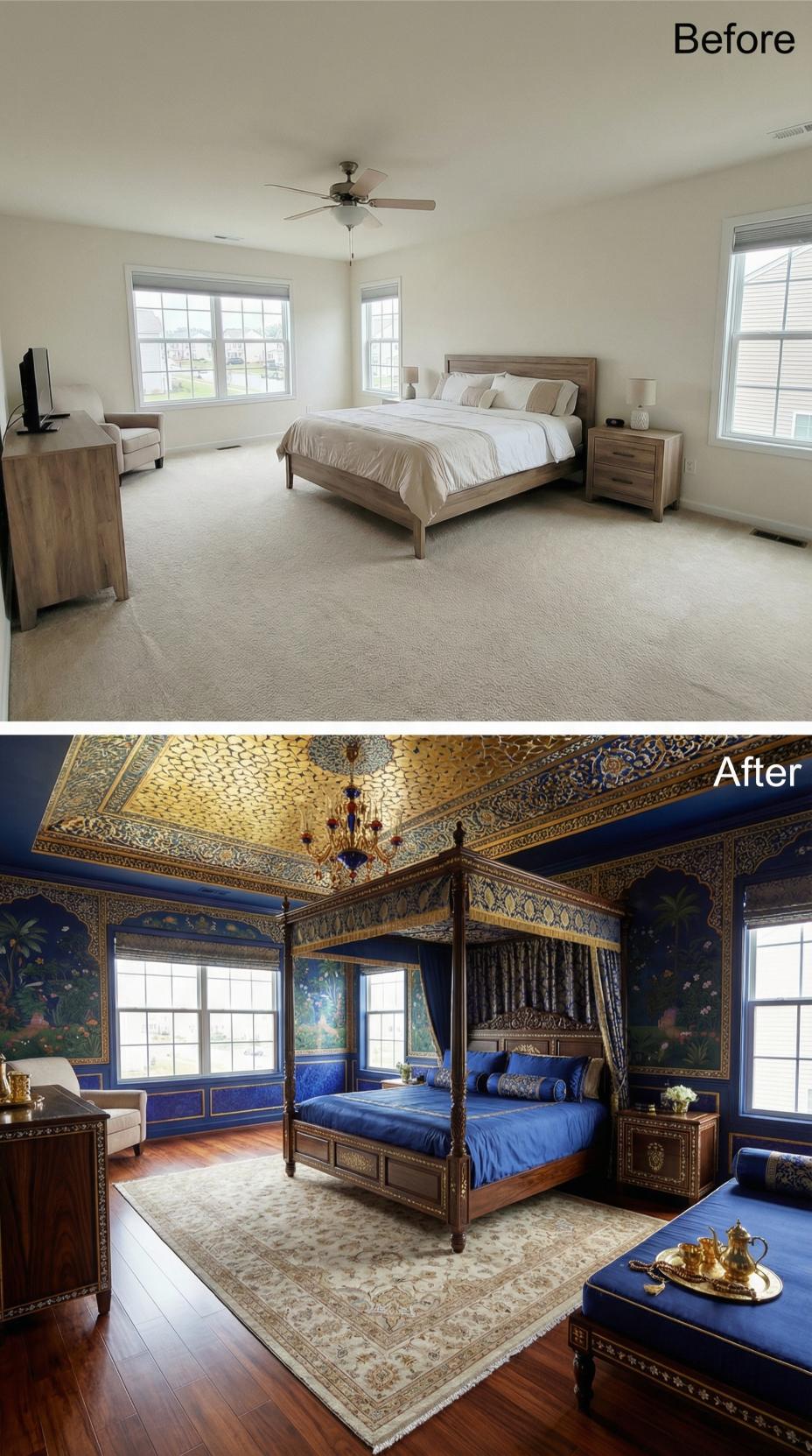
Hardwood floors replaced the builder carpet entirely, and the shift sets the tone before anything else registers. Deep lapis blue covers all four walls, broken up by hand-painted Mughal-style floral panels depicting birds and flowering branches in greens, reds, and golds. The ceiling is the room’s central argument: a gold arabesque field framed by cobalt blue geometric borders, lit by a garnet and cobalt chandelier that reads almost like jewelry at that scale.
The four-poster bed is carved walnut with gold-painted inlay detailing on the footboard panels. Blue silk bedding coordinates with a matching daybed at the foot, which holds a brass tea service tray. An ivory wool rug with traditional Persian palmette borders anchors the seating zone beneath the posts.
- Lapis blue paint reads warmer against hardwood floors than it ever would over beige carpet, which tends to pull the color toward gray.
- Hand-painted wall panels cost significantly more than printed wallpaper murals but hold detail at close range in ways digital prints rarely do.
- Brass and deep garnet chandelier finishes work in blue rooms because both tones sit at opposite ends of the warm spectrum, creating contrast without competing.
Sky-Blue Neoclassical Plasterwork, Crystal Chandelier, and a Silver Four-Poster Under a Painted Vault
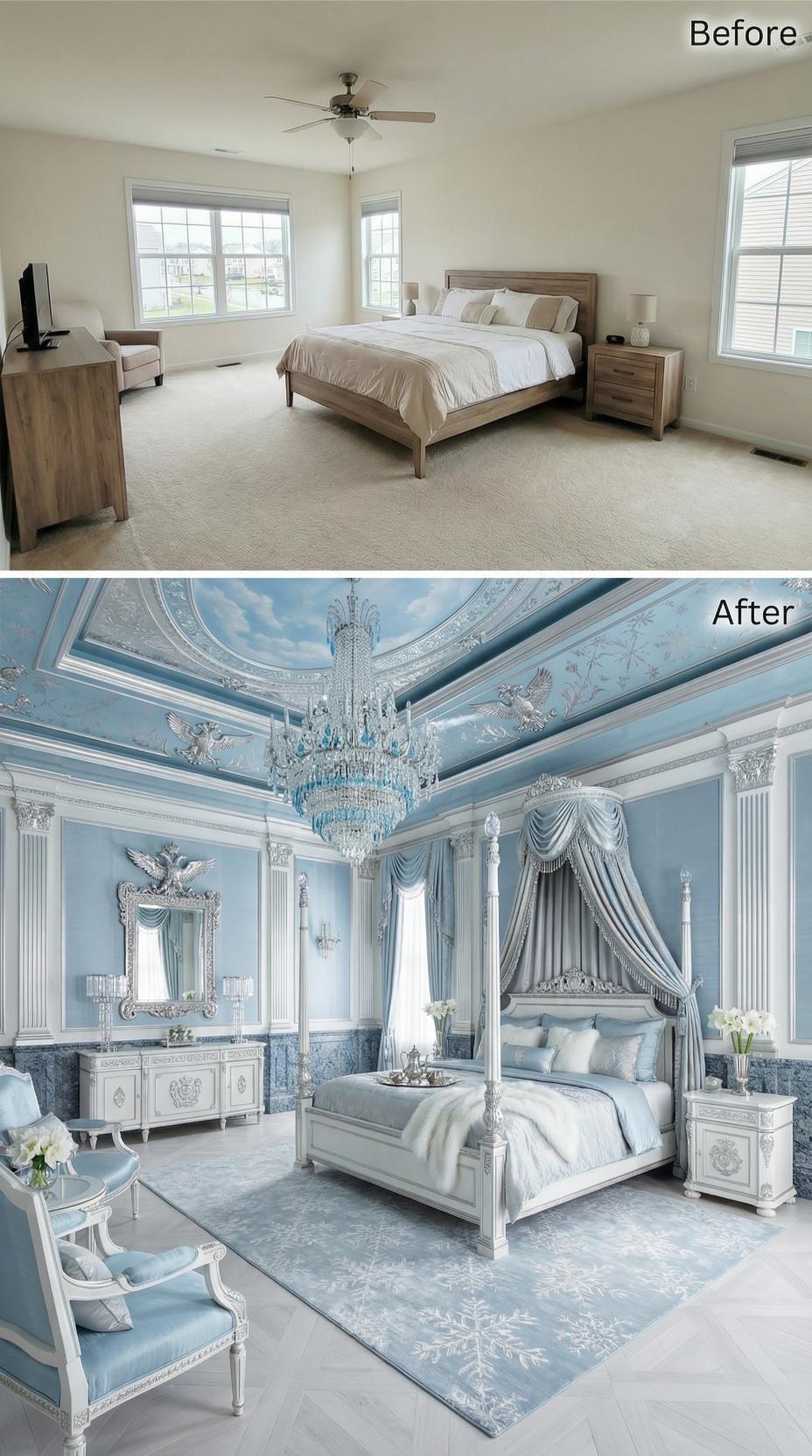
Ice-blue walls paneled in white-painted pilasters give way to a coffered ceiling finished with hand-painted cloud murals and silver relief eagles, while a tiered crystal chandelier anchors the center with aquamarine drops rather than standard clear glass.
A tiered crystal chandelier anchors the center with aquamarine drops rather than standard clear glass.
Dark Walnut Coffered Ceiling, Green Damask Canopy, and Oil Portraits Covering Every Wall
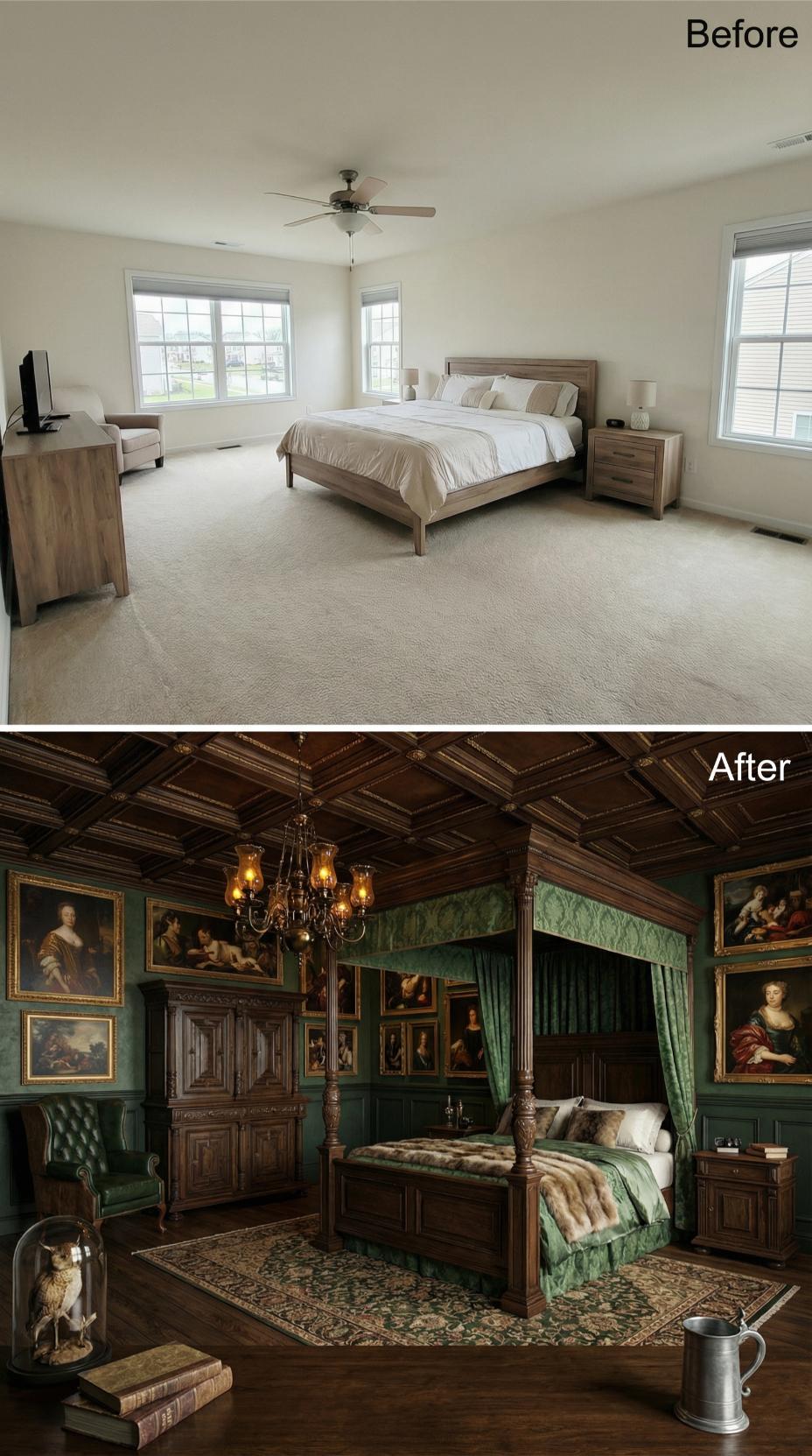
Flat beige carpet and a ceiling fan cannot prepare you for what this room became.
The after version installs a deep walnut coffered ceiling with heavy molded trim, replacing what was a completely bare white surface above a builder-grade layout. Dark hunter green paneling runs the walls from wainscot to cornice, and the four-poster canopy bed is dressed in green damask with floor-length curtains on all four sides. A wrought iron chandelier with amber glass shades hangs at center, casting warm light across an ornate wool rug laid over wide-plank dark hardwood. Gilt-framed oil portraits and genre paintings cluster on every available wall section, and a tufted green leather wingback sits in the corner beside a taxidermied owl under a glass dome. A carved dark walnut armoire anchors the left wall opposite matching low side cabinets flanking the bed.
Mirrored Lattice Ceiling, Carved Walnut Four-Poster, and Crimson Walls Wrapped in Syrian Inlay
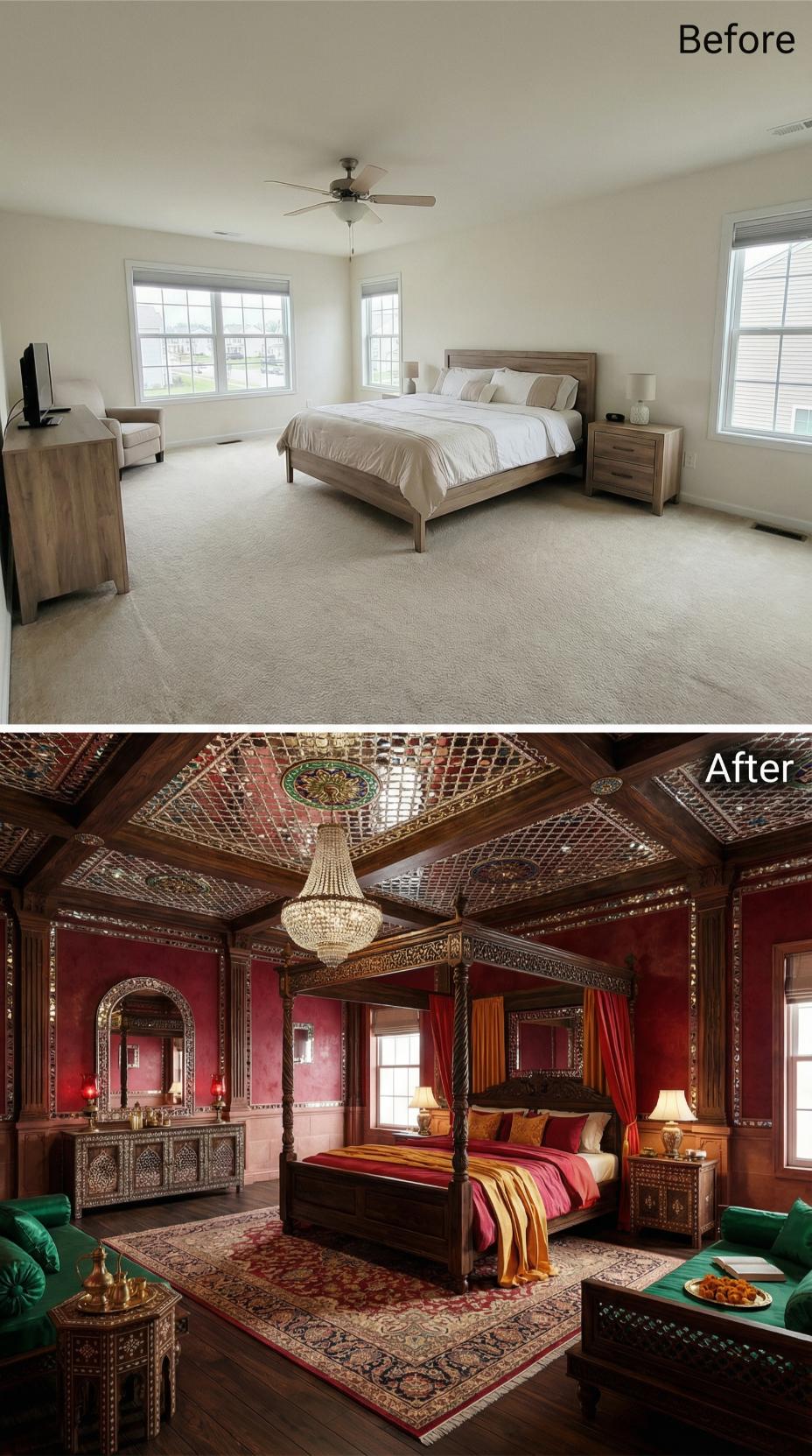
Flat beige carpet and a builder ceiling gave way to dark walnut beams framing a mirrored lattice ceiling with a medallion painted in deep green and gold at center. A crystal empire chandelier hangs above a four-poster with barley-twist columns and full canopy, dressed in layered crimson and saffron bedding. Red venetian-plastered walls are framed by mother-of-pearl inlaid Syrian cabinetry and matching nightstands. Emerald velvet seating anchors both foreground corners over a hand-knotted Persian rug.
Gold Leaf Tray Ceiling, Sunburst Medallion, and a Canopy Bed Draped in Champagne Silk
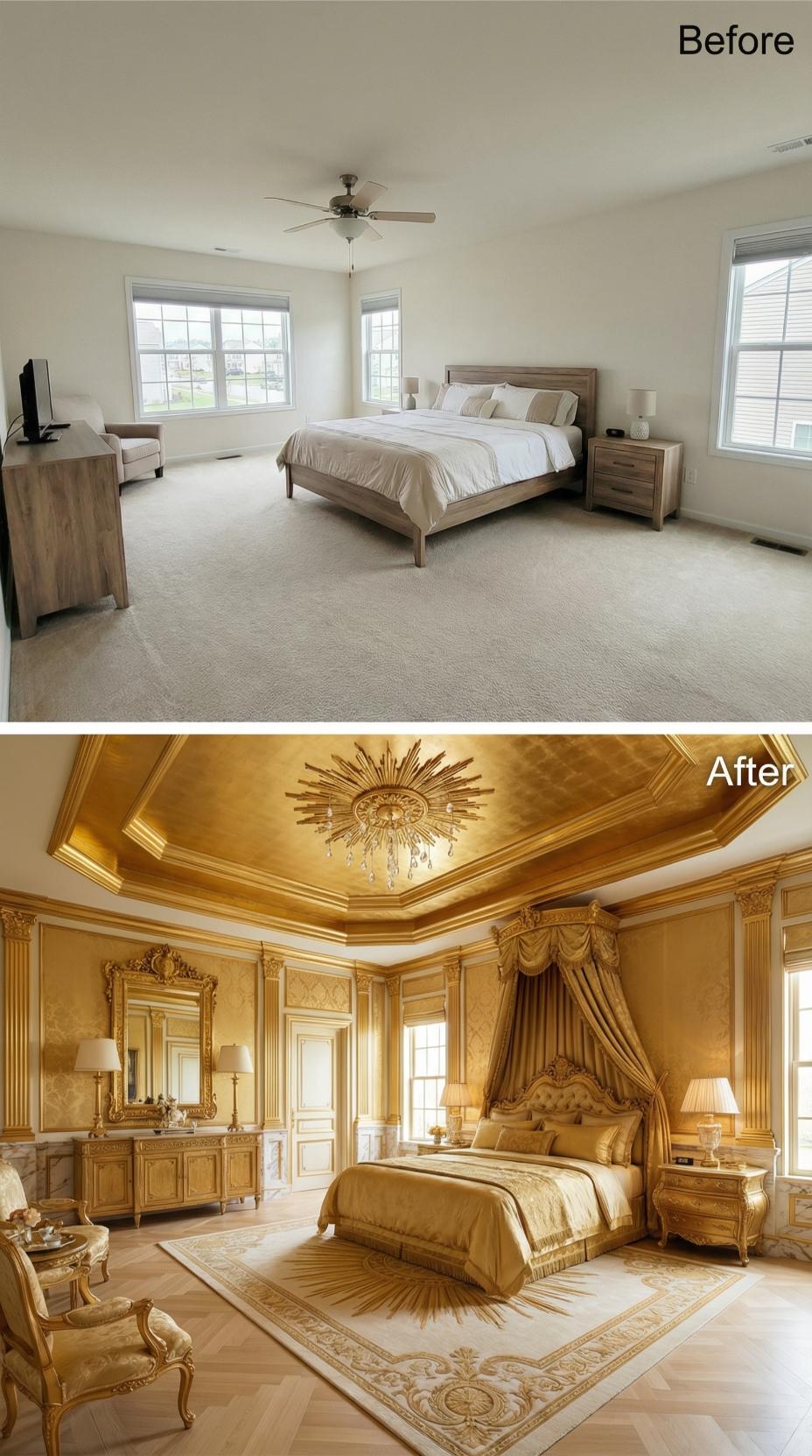
Gold leaf covers the entire tray ceiling, including the angled coves and crown molding band, which shifts the visual weight of the room upward in a way flat paint never could. A sunburst medallion at the center anchors a crystal drop fixture, and the octagonal ceiling geometry gives the room a formality that the original builder box completely lacked.
Rococo-carved bedroom furniture finished in distressed gilt replaces the gray-stained wood pieces, including a canopy bed with tufted headboard, draped valance in gold silk, and matching carved nightstands. Damask wallcovering in ivory and gold lines the panels below a deep cornice rail, and a sunburst-pattern wool area rug grounds the hardwood floor beneath the full furniture arrangement.
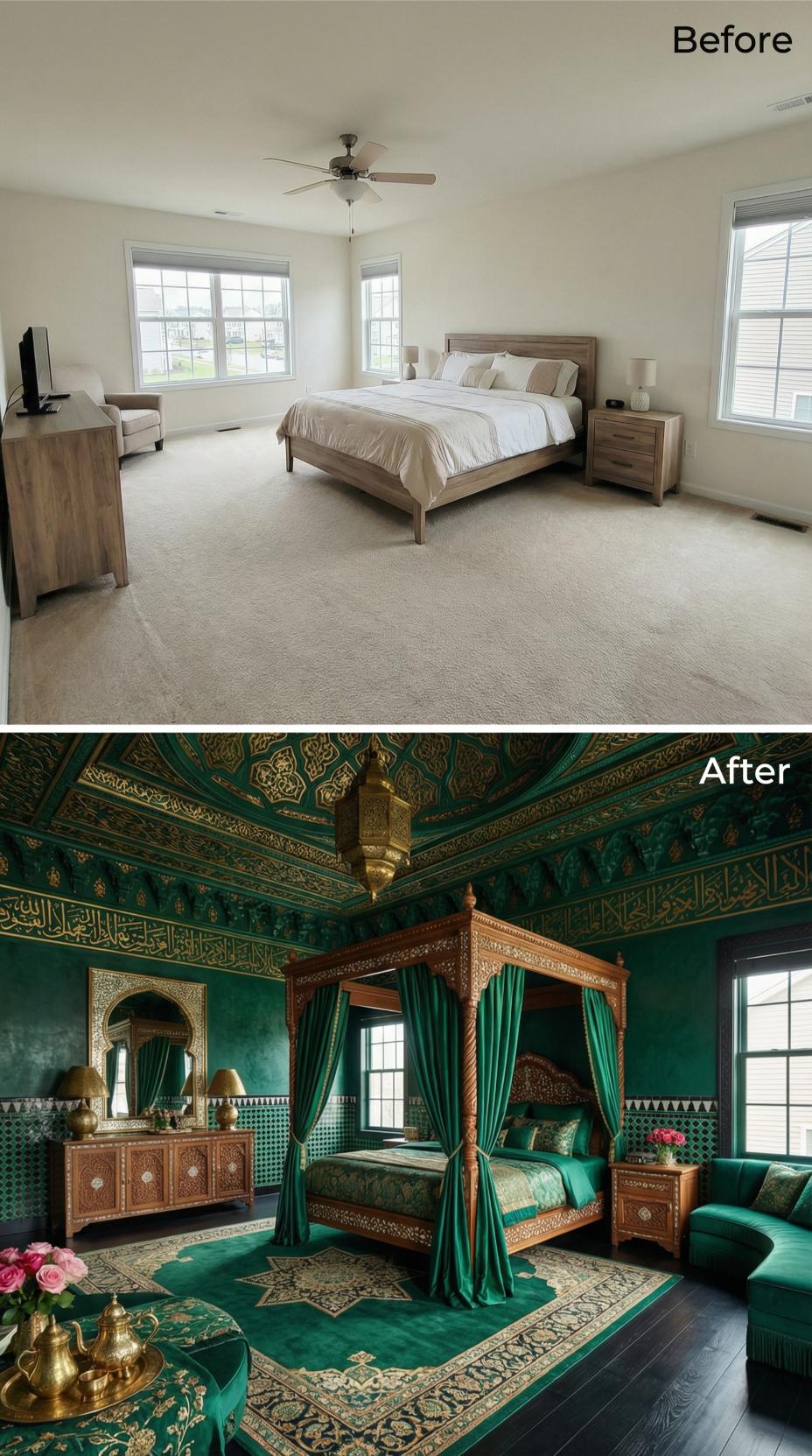
Emerald Velvet Canopy, Hand-Carved Walnut Four-Poster, and Arabic Calligraphy Wrapping Every Wall
🔥 Would you like to save this?
Walnut posts with rope-twist carving anchor a four-poster hung with emerald velvet drapes, while gold Arabic calligraphy bands run continuously across deep green tadelakt walls and a lacquered ceiling overhead. A brass Moroccan lantern drops from center, and a hand-painted zellige tile wainscot lines the lower wall register beneath the calligraphy frieze.
Hieroglyphic Murals, Coffered Ceiling in Gold and Lapis, and a Four-Poster Draped in Royal Blue Silk
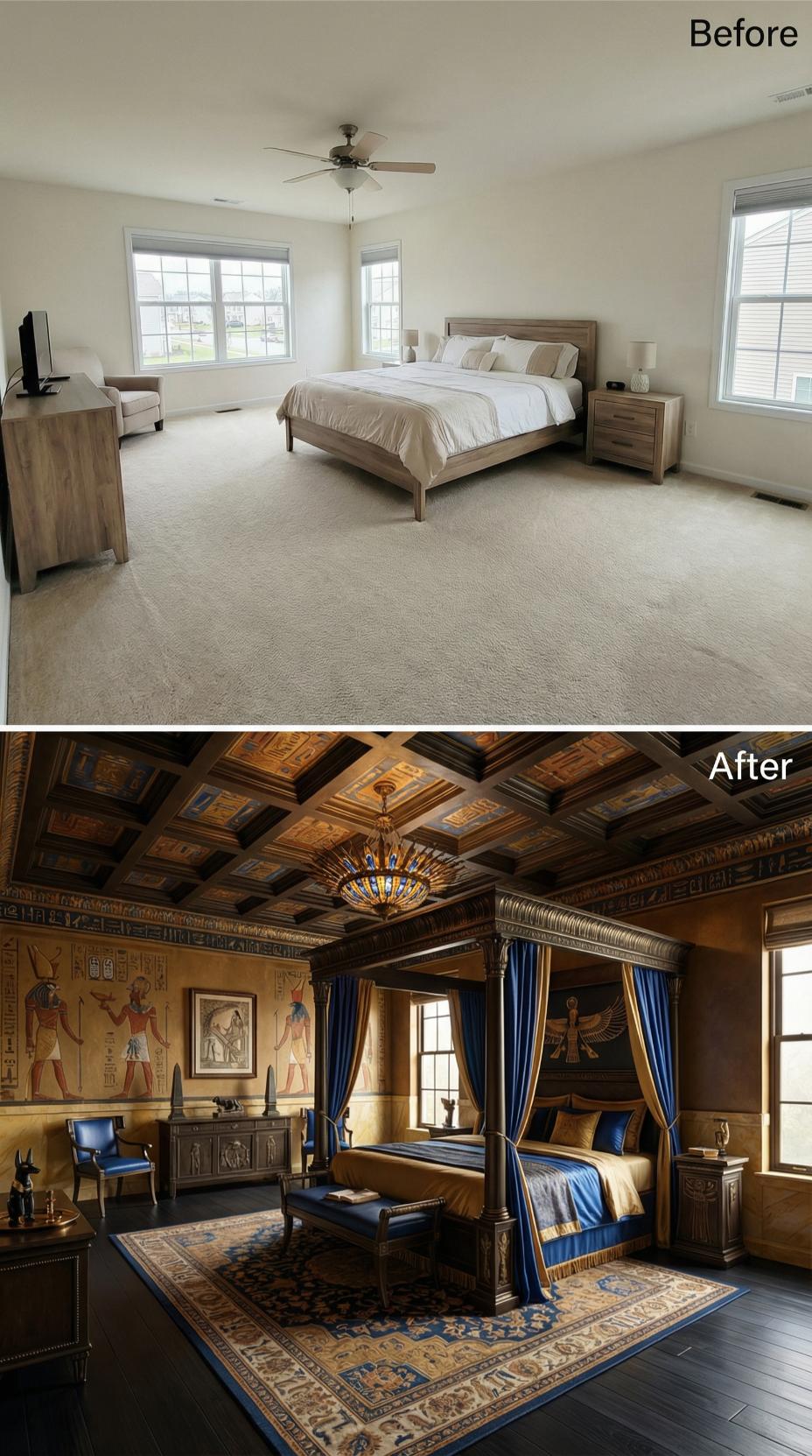
Egyptian deity murals painted directly onto ochre walls replace what was once bare drywall, while the coffered ceiling above carries hieroglyphic panels in cobalt, gold, and deep brown. A dark wood canopy bed hung with sapphire blue curtains anchors the room, set over a Persian-style rug with a cream and navy border.