🔥 Would you like to save this?
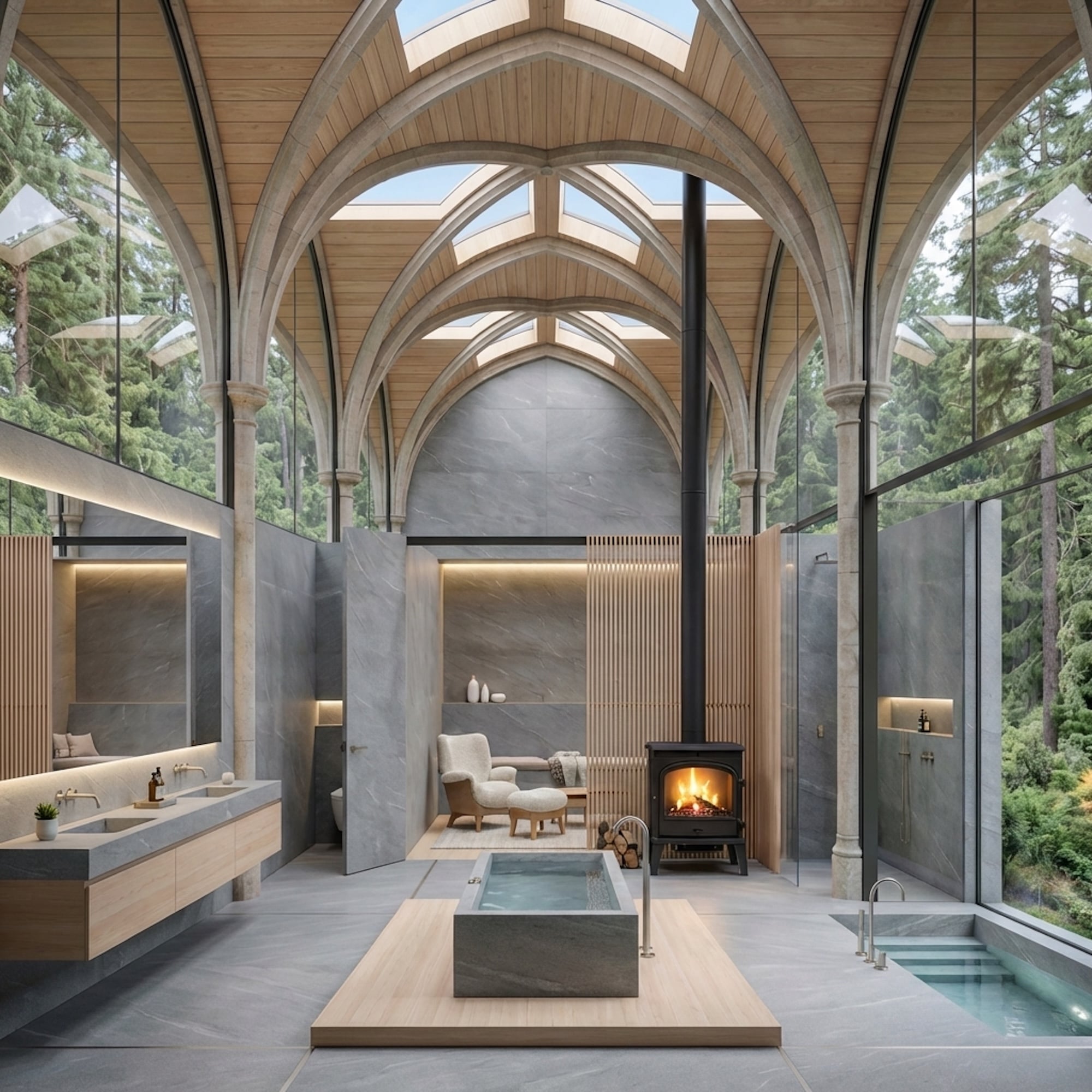
Your brain does not have an off switch. You’ve tried the apps, the supplements, the white noise, the sleep podcasts hosted by people who clearly do not have your problem. The issue was never the routine. It was the room. A space so acoustically sealed, so materially grounding, so deliberately engineered for surrender that your nervous system finally receives the message it has been refusing for years: nothing is due until morning.
In order to come up with the very specific design ideas, we create most designs with the assistance of state-of-the-art AI interior design software. Also, assume links that take you off the site are affiliate links such as links to Amazon. this means we may earn a commission if you buy something.
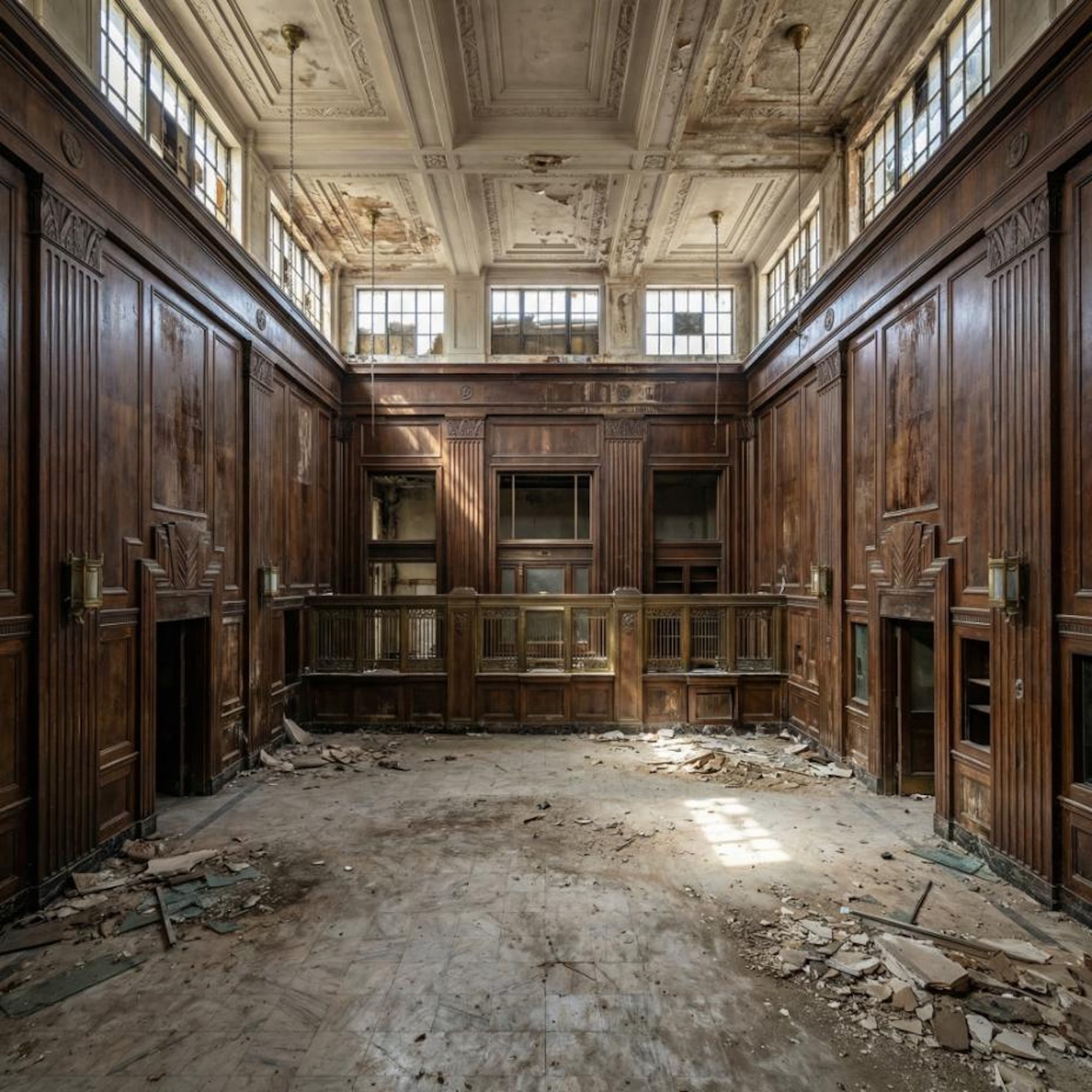
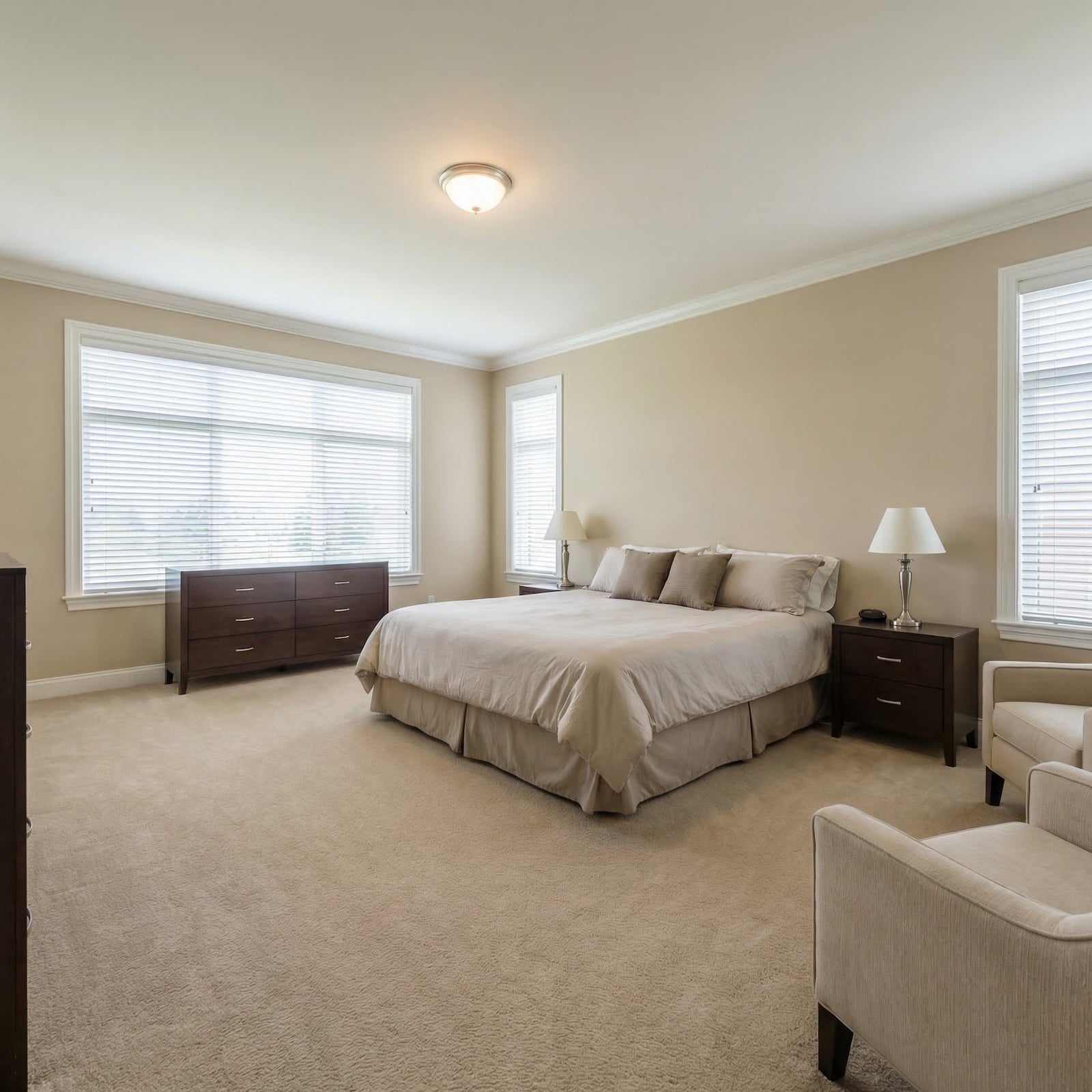
Builder grade primary bedrooms share a familiar look: beige walls, basic lighting, and nothing that feels chosen. They function, but they don’t inspire rest or reflect anyone’s actual taste.
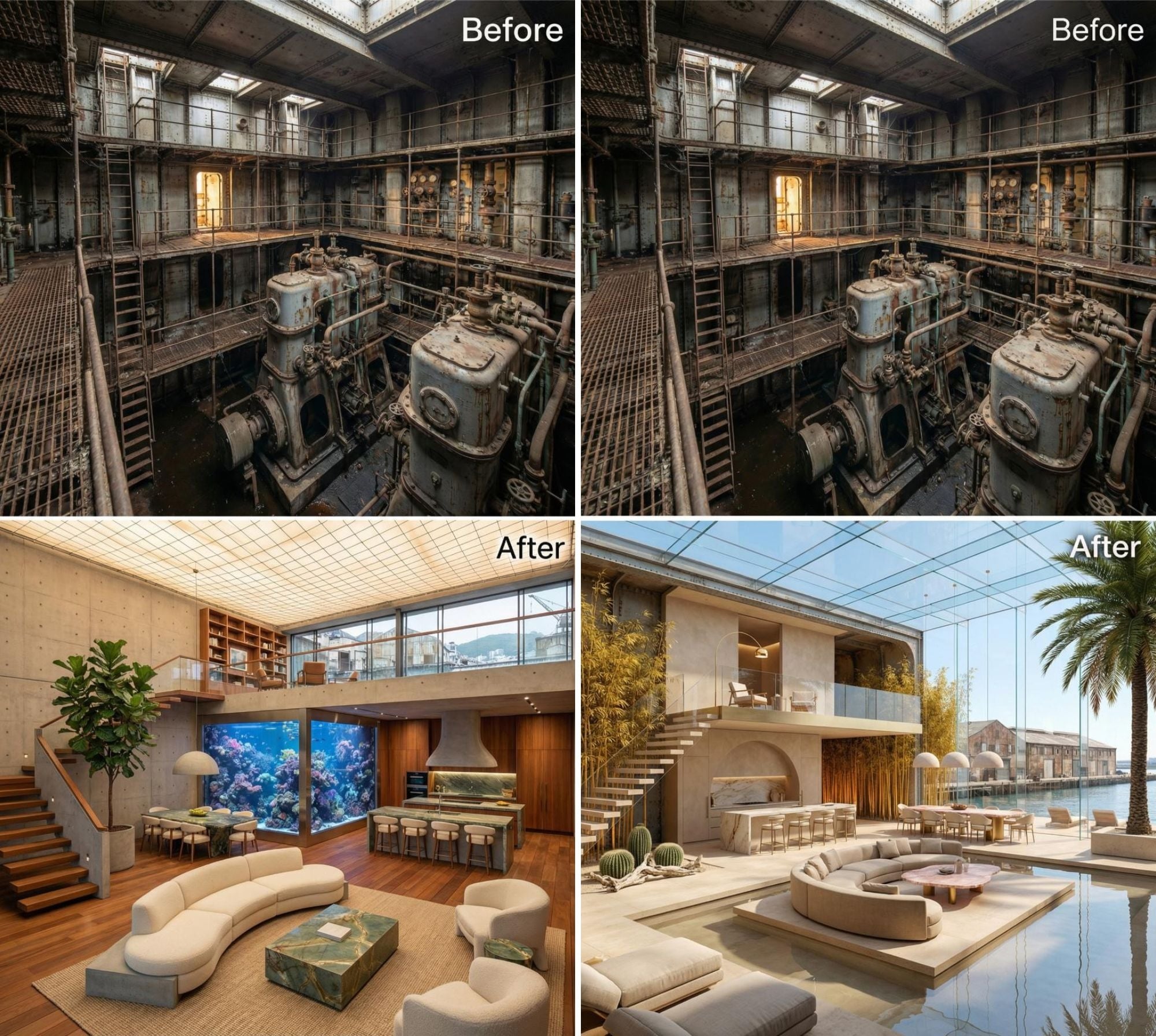
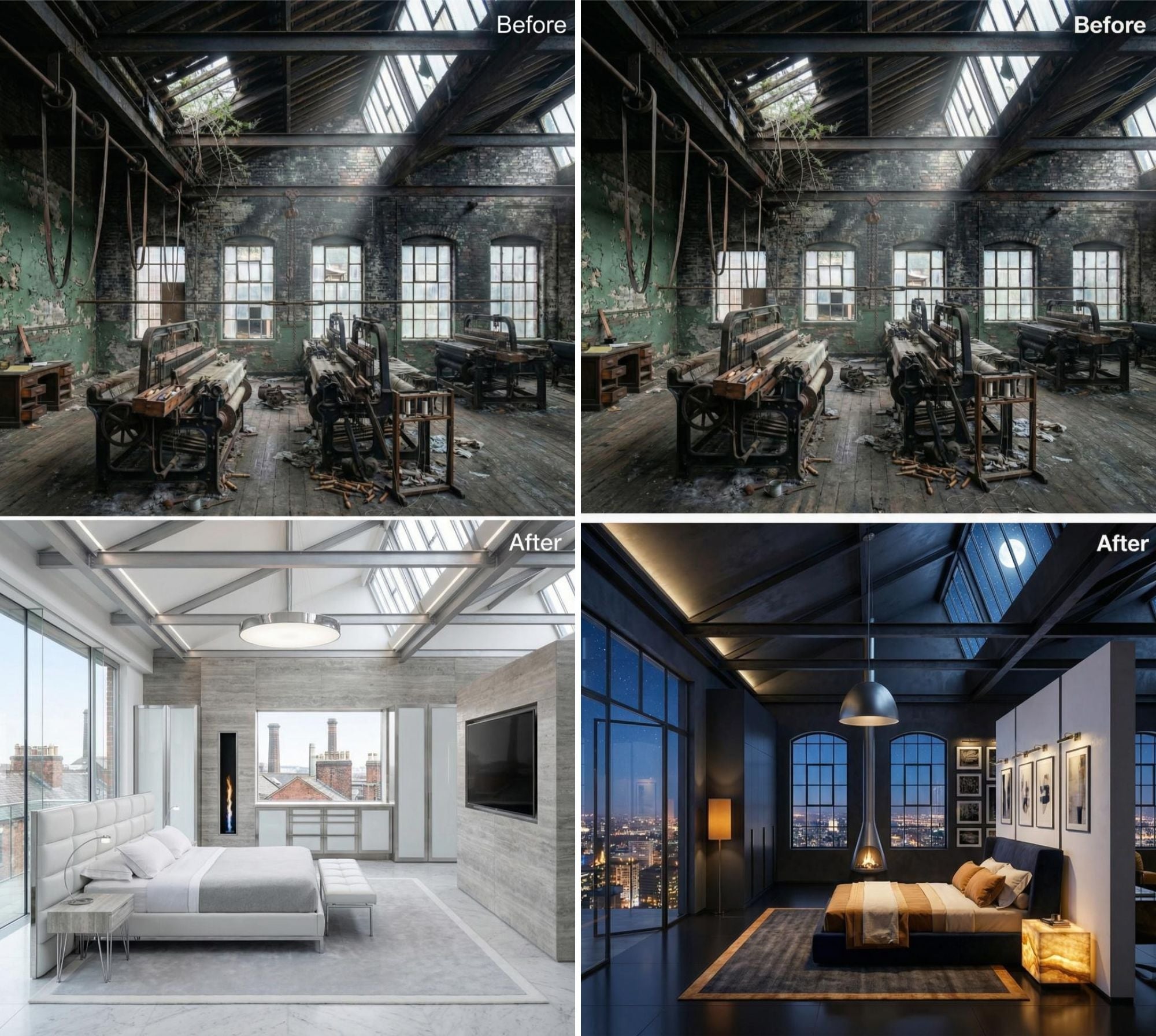
The before and after photos here document real rooms that started from that same flat baseline and arrived somewhere entirely different. Some changes involved full renovations. Others came down to paint, new bedding, and a single piece of furniture placed with intention. The range matters because it shows that the gap between a forgettable room and a personal one isn’t always measured in budget.
These 35 transformations offer a concrete starting point for anyone who has stared at their own bedroom too long and still isn’t sure where to begin.
Carpet and Beige Got Replaced by Oak, Linen, and Cove Lighting
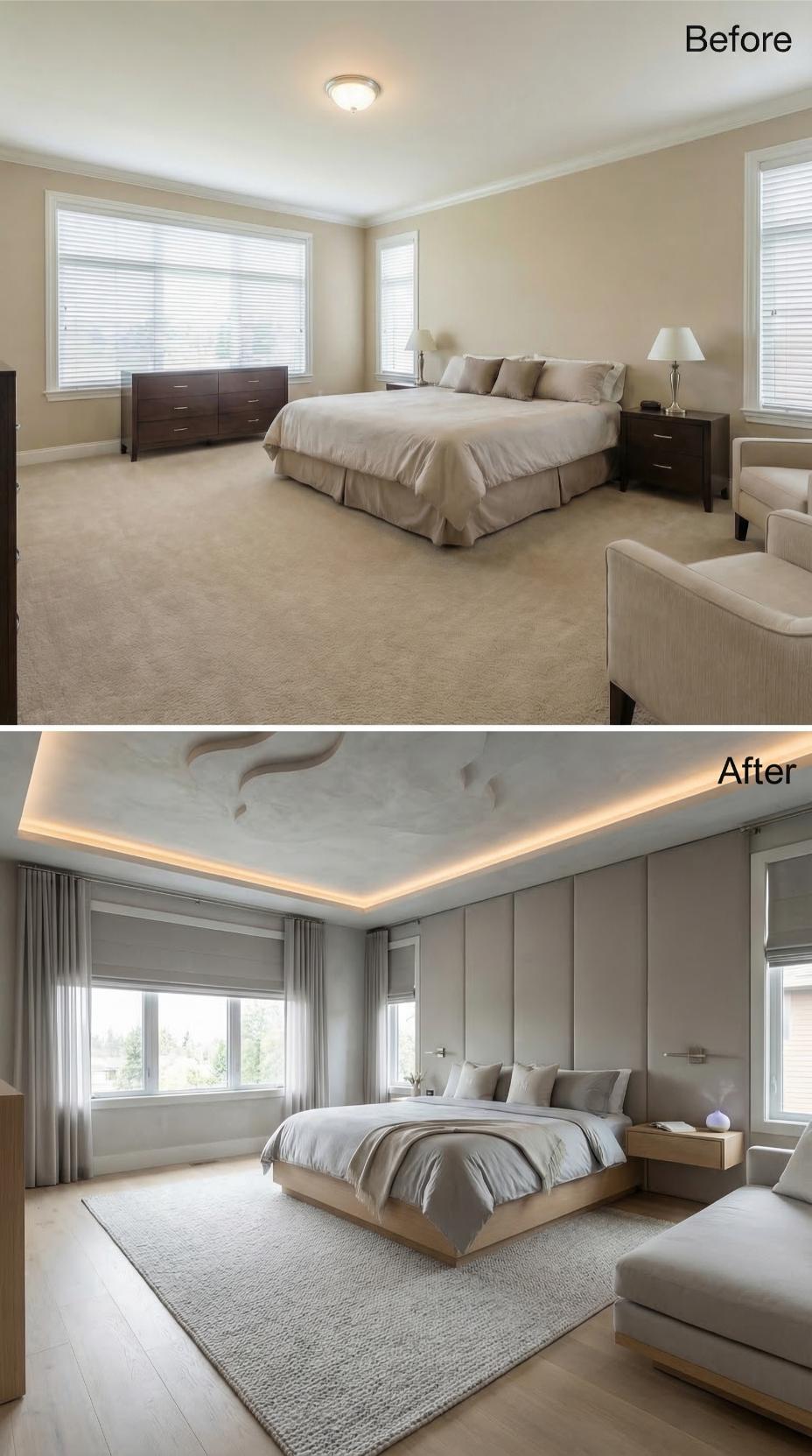
The before photo shows wall-to-wall beige carpet, flat flush-mount ceiling light, and dark espresso-stained dresser that reads more hotel corridor than primary retreat. Every surface blended into the same warm tan, leaving the room without a single focal point.
The after introduces wide-plank white oak flooring under a chunky wool area rug, a tray ceiling fitted with recessed LED strip lighting, and a low-profile platform bed in natural maple. Tall upholstered wall panels in pale greige run floor to ceiling behind the headboard, and Roman shades in cool silver-gray replace the horizontal blinds throughout.
Dark Walnut Paneling and Acoustic Ceiling Tiles Replaced Every Inch of Beige
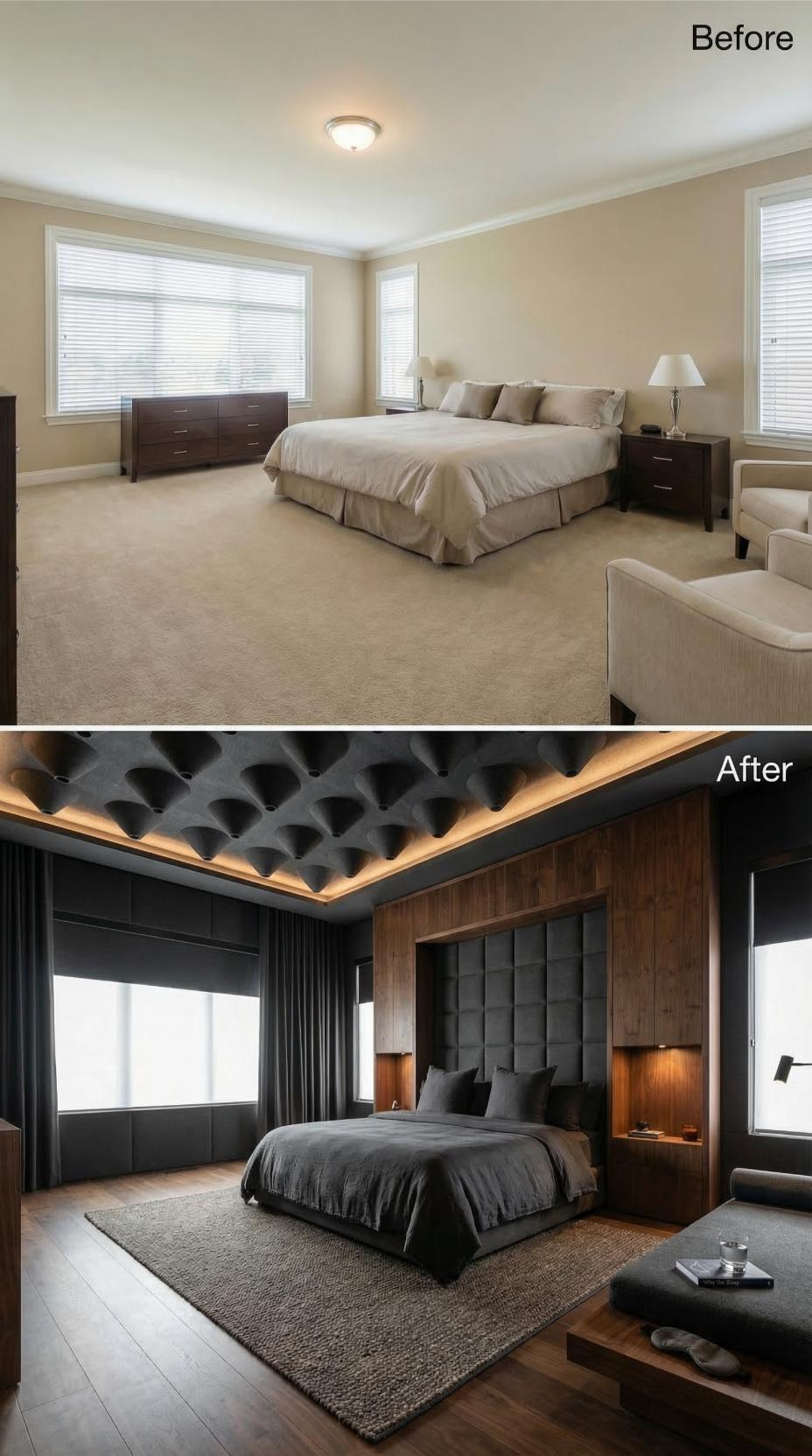
Egg-crate acoustic foam panels line the dropped ceiling above warm cove lighting, while walnut wall cladding frames a tufted charcoal headboard built flush into the millwork. Hardwood floors and a chunky jute rug replace the original wall-to-wall carpet entirely.
Shoji Screens and Coffered Cedar Replaced Carpet and Crown Molding
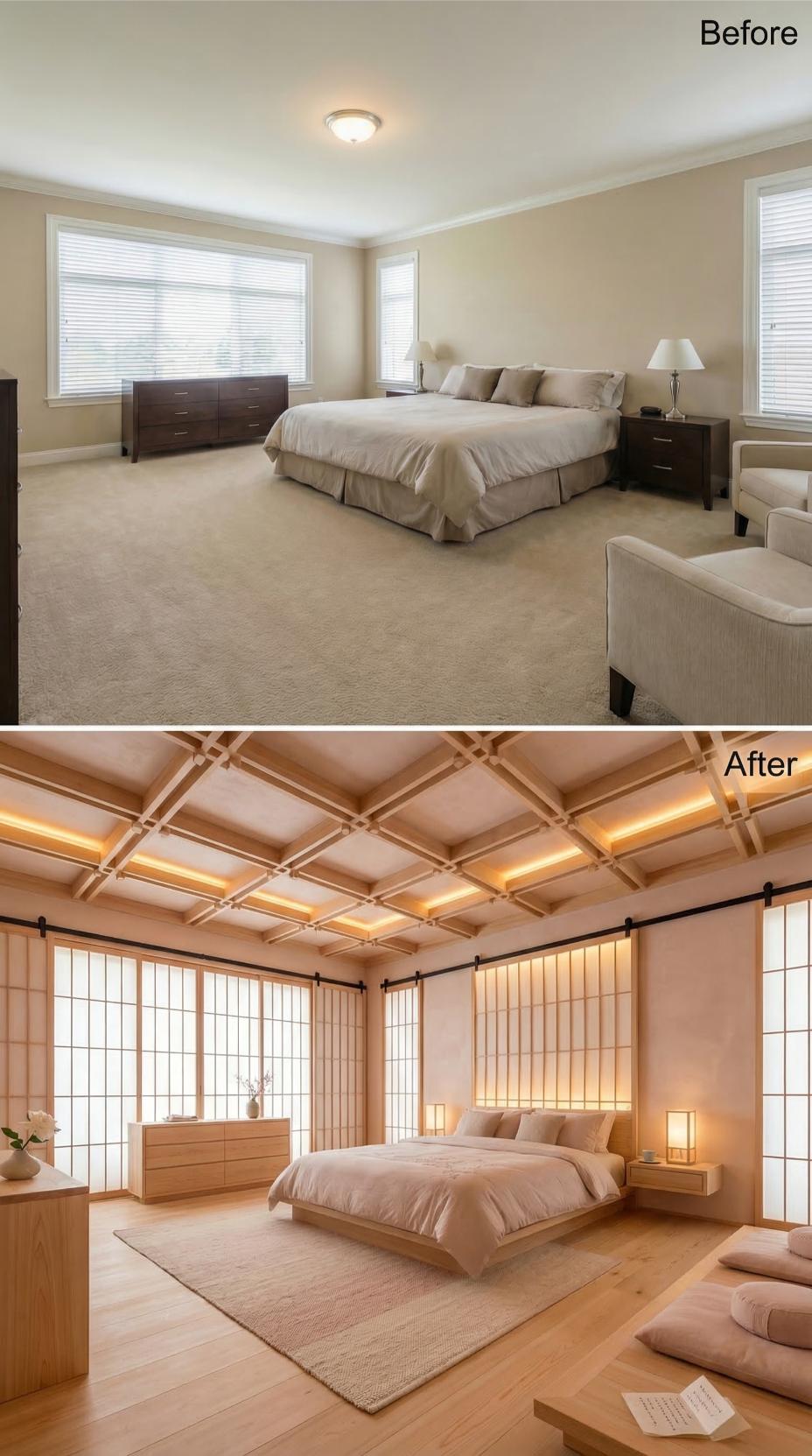
Flat beige walls and builder carpet vanished entirely under pale maple, rice paper, and warm LED cove light.
Sliding shoji screens on black barn hardware now run floor to ceiling where standard blinds once hung. The coffered ceiling uses natural maple lattice with recessed LED strips tucked behind each beam, casting amber light downward without a single pendant or fixture visible. Hardwood planks replaced wall-to-wall carpet, and a platform bed with floating maple nightstands sits centered on a woven area rug.
Navy Velvet, Gold Constellations, and a Painted Midnight Ceiling Replaced Beige Carpet
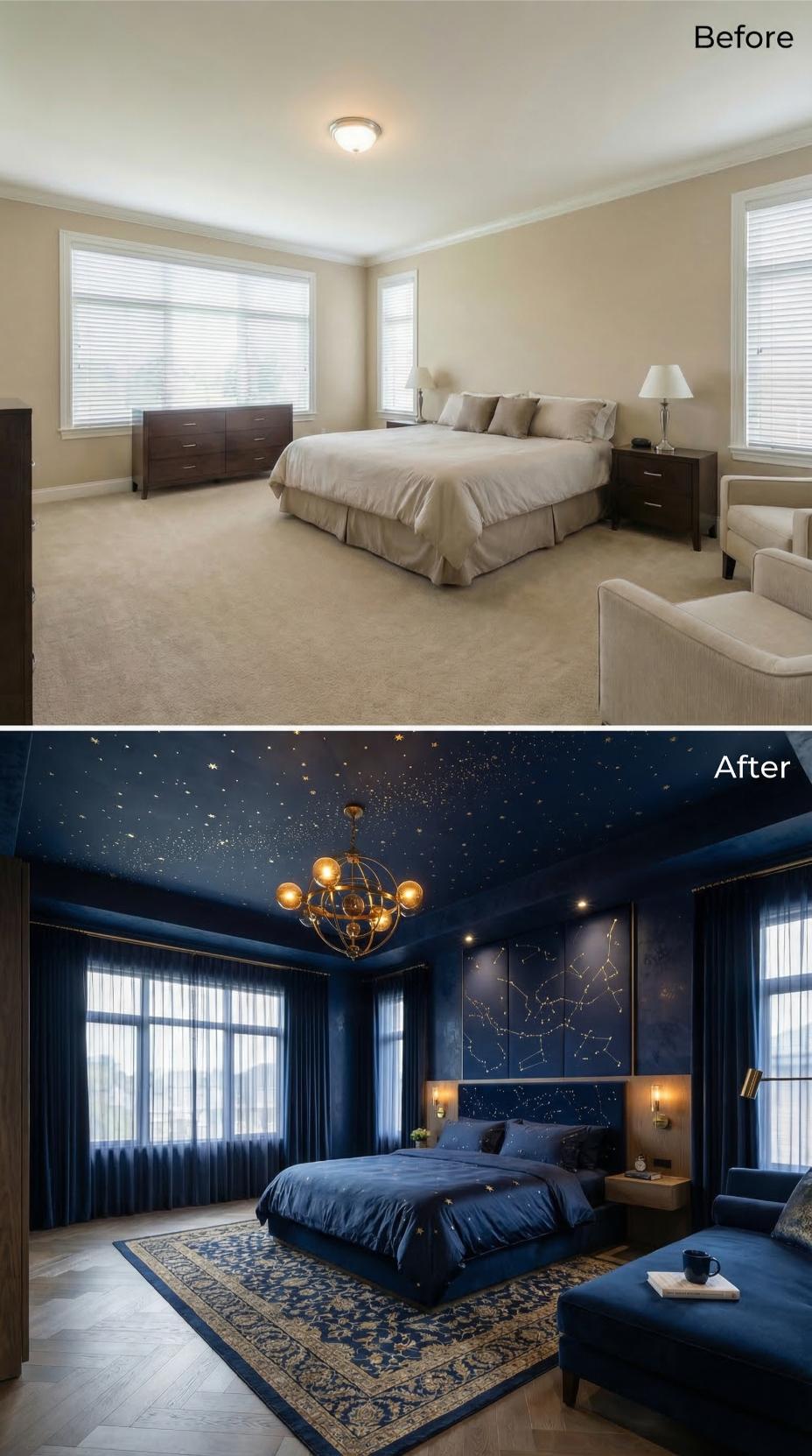
Constellation line art covers the navy accent wall behind the upholstered headboard, while a brass orb chandelier with globe bulbs anchors the ceiling painted deep indigo with scattered gold stars.
Did You Know: Dark painted ceilings can actually make a room feel more immersive rather than smaller, particularly when paired with warm-toned light sources at lower eye levels. The navy-and-gold color pairing draws from centuries of celestial cartography, where mapmakers used those exact tones to distinguish star charts from geographic maps. Herringbone hardwood flooring, visible here replacing carpet, reflects light upward and keeps a dark room from reading as flat.
Reclaimed Wood Planks and Terracotta Linen Replaced Carpet and Crown Molding
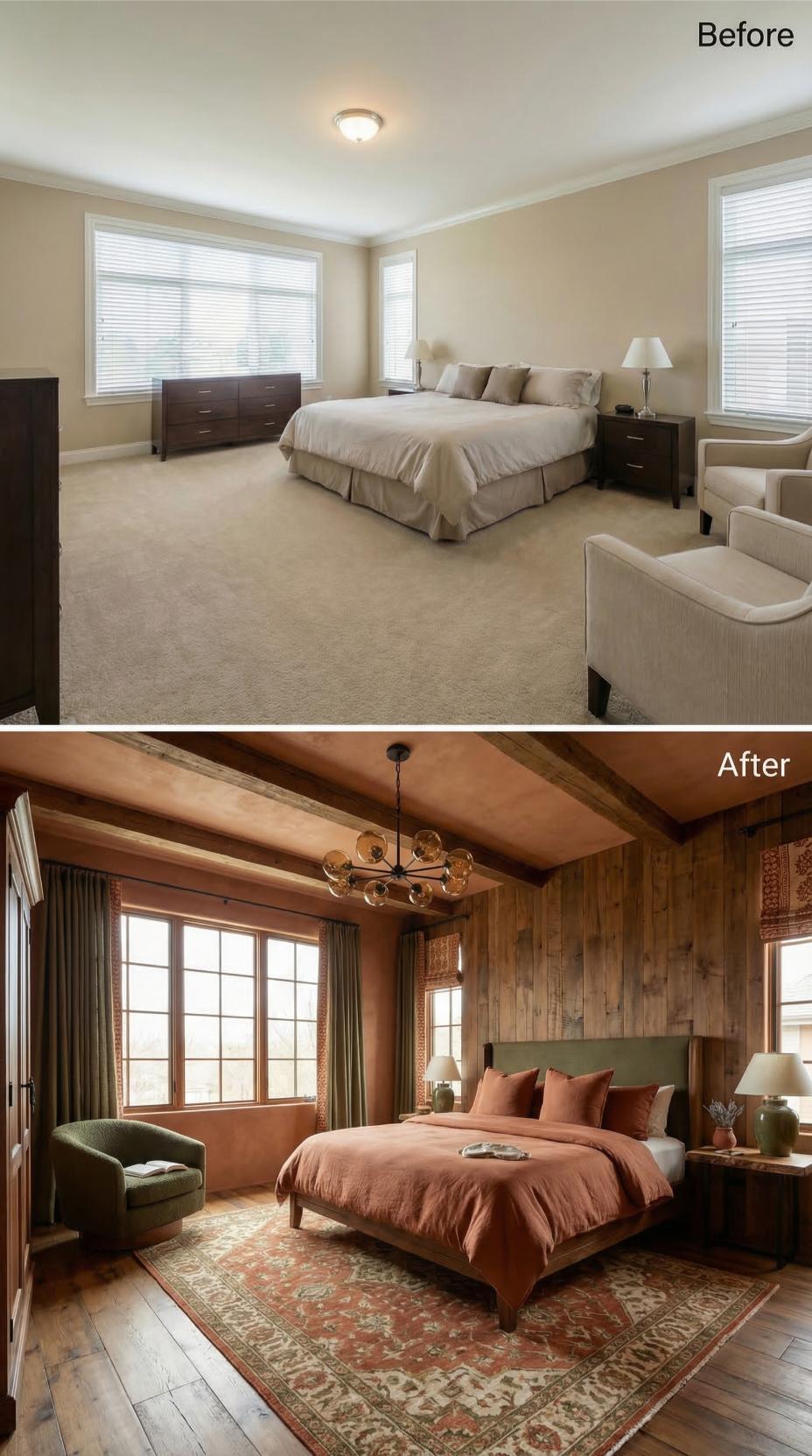
Wide-plank hardwood floors with visible grain and knots anchor the room in a way no carpet ever could. A Persian-style rug in burnt sienna, ivory, and dusty rose layers warmth underfoot without competing with the wood. The bed frame sits low with an upholstered sage green headboard, dressed in terracotta linen bedding and rust-toned throw pillows. Exposed ceiling beams in reclaimed wood run parallel across a plaster ceiling finished in an earthy amber wash.
A black sputnik-style chandelier with amber globe bulbs hangs at center. Vertical shiplap paneling in natural pine covers the back wall. Olive green barrel chairs and ceramic table lamps complete the palette.
Ask Yourself: Before committing to wood wall paneling, consider which direction the planks will run. Vertical boards draw the eye upward and work especially well in rooms with lower ceilings or exposed beams that already pull focus horizontally.
Slatted Oak Ceiling Panels and Cove Lighting Replaced Beige Paint and Flush Mounts
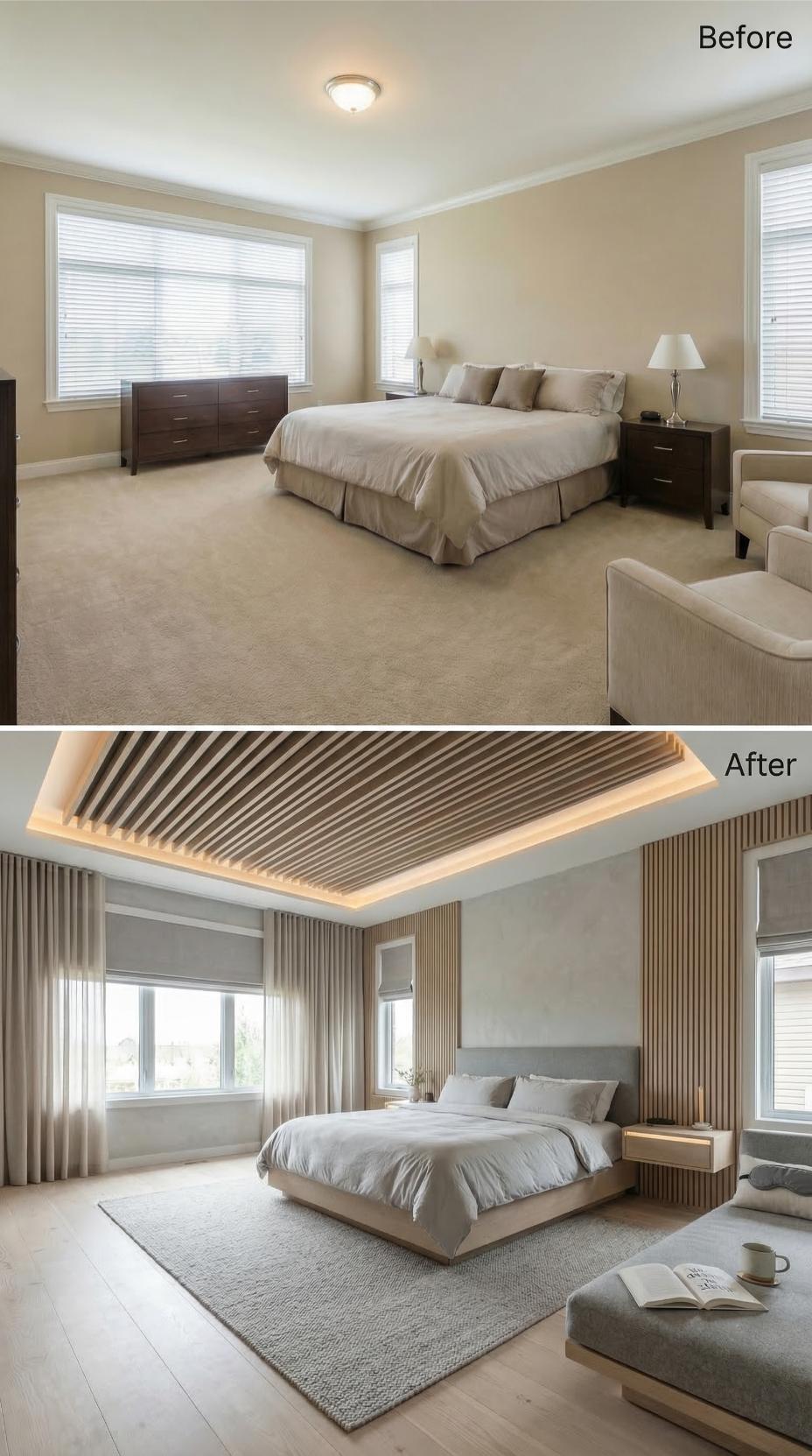
Pale oak battens run across the ceiling in a coffered grid pattern, each slat spaced to catch the warm amber glow of the recessed cove lighting tucked behind the perimeter frame. Below that, vertical wood slats cover the wall behind the bed, anchoring the room’s focal point without any art or wallpaper.
Hardwood flooring in a light ash finish replaced the builder carpet, and a chunky wool area rug in heather gray grounds the platform bed. Floating nightstands with integrated LED strips add task lighting at mattress height. Linen curtains in warm ivory pool lightly at the floor beside Roman shades in stone gray.
Color Story: Warm white cove lighting installed behind a recessed ceiling frame reads as golden rather than yellow when reflected off pale oak wood, a result of the wood’s natural undertones absorbing and softening the light source. Pairing two light temperatures in the same room, such as the cove strip and the nightstand LEDs here, creates depth that a single overhead fixture never achieves. Keeping both sources at 2700K or below prevents the room from feeling clinical after dark.
Plum Velvet, Coffered Ceilings, and Dark Hardwood Replaced Carpet and Beige
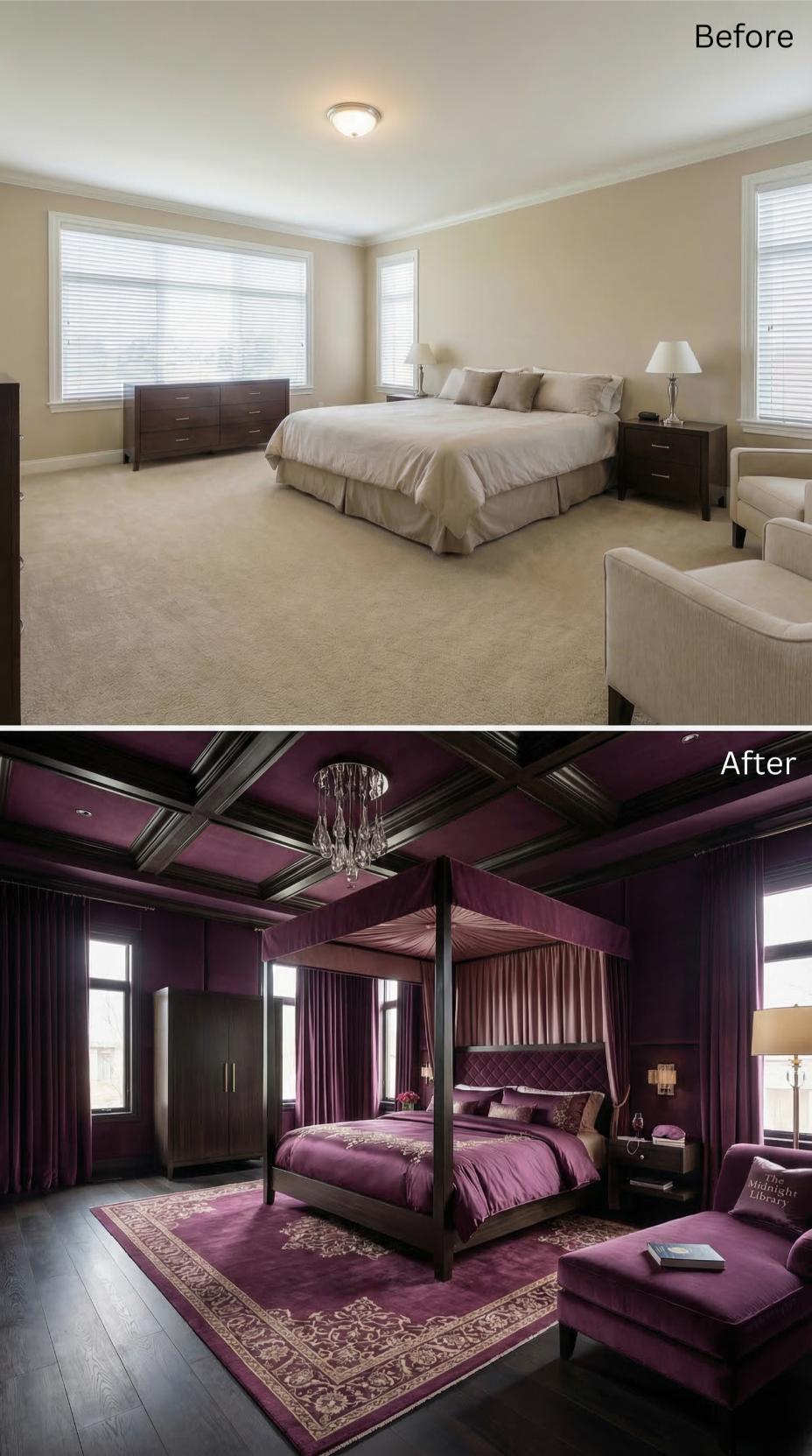
Jewel-toned plum covers every wall and ceiling panel, unified by dark espresso coffered beams and a crystal cluster pendant. Silk-draped fabric on the four-poster canopy bed anchors the room’s center, while a burgundy Persian-style rug grounds the hardwood floor beneath it.
Budget Tip: Painting walls and ceilings the same deep color is one of the most cost-effective ways to fake architectural depth in a builder-grade box room. Skipping contrasting trim paint alone can save two to four hours of labor per room. Choosing a velvet-finish paint rather than matte adds light interaction without requiring any physical texture treatment.
Moroccan Brass Pendants and Limestone Cladding Replaced Carpet and Flush Mounts
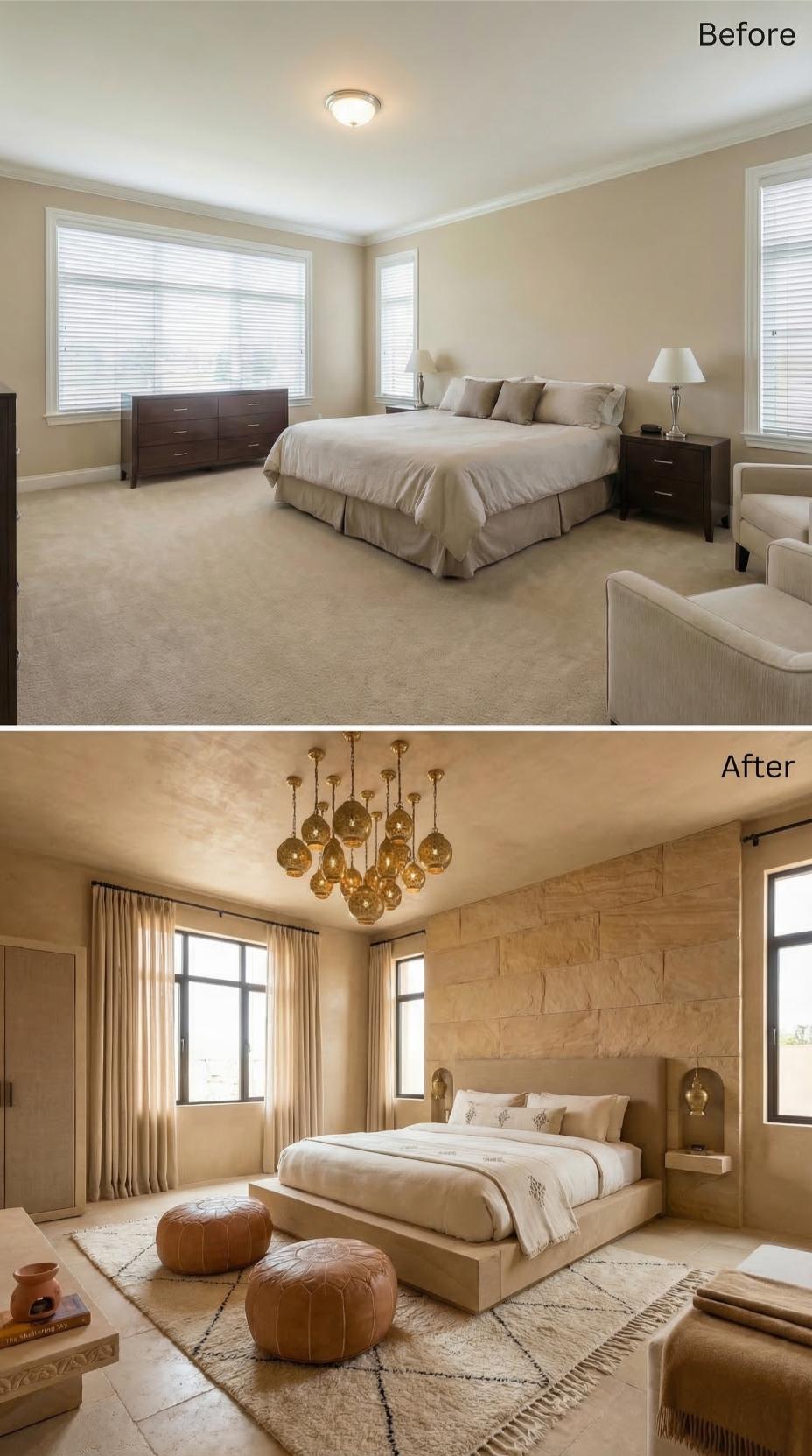
Leather poufs in cognac sit on a Beni Ourain rug, grounding a platform bed wrapped in raw linen fabric against a wall clad in cut limestone block.
Material Matters: Beni Ourain rugs are hand-knotted by Berber weavers in the Atlas Mountains and typically feature an ivory field with irregular geometric lines in undyed black wool. The asymmetry in the pattern is intentional, not a flaw, and reflects a centuries-old weaving tradition. Placing one under a low platform bed anchors the sleeping area without requiring a bed frame with visual weight.
Acoustic Pyramid Tiles and Floating Black Platform Replaced Carpet and Crown Molding
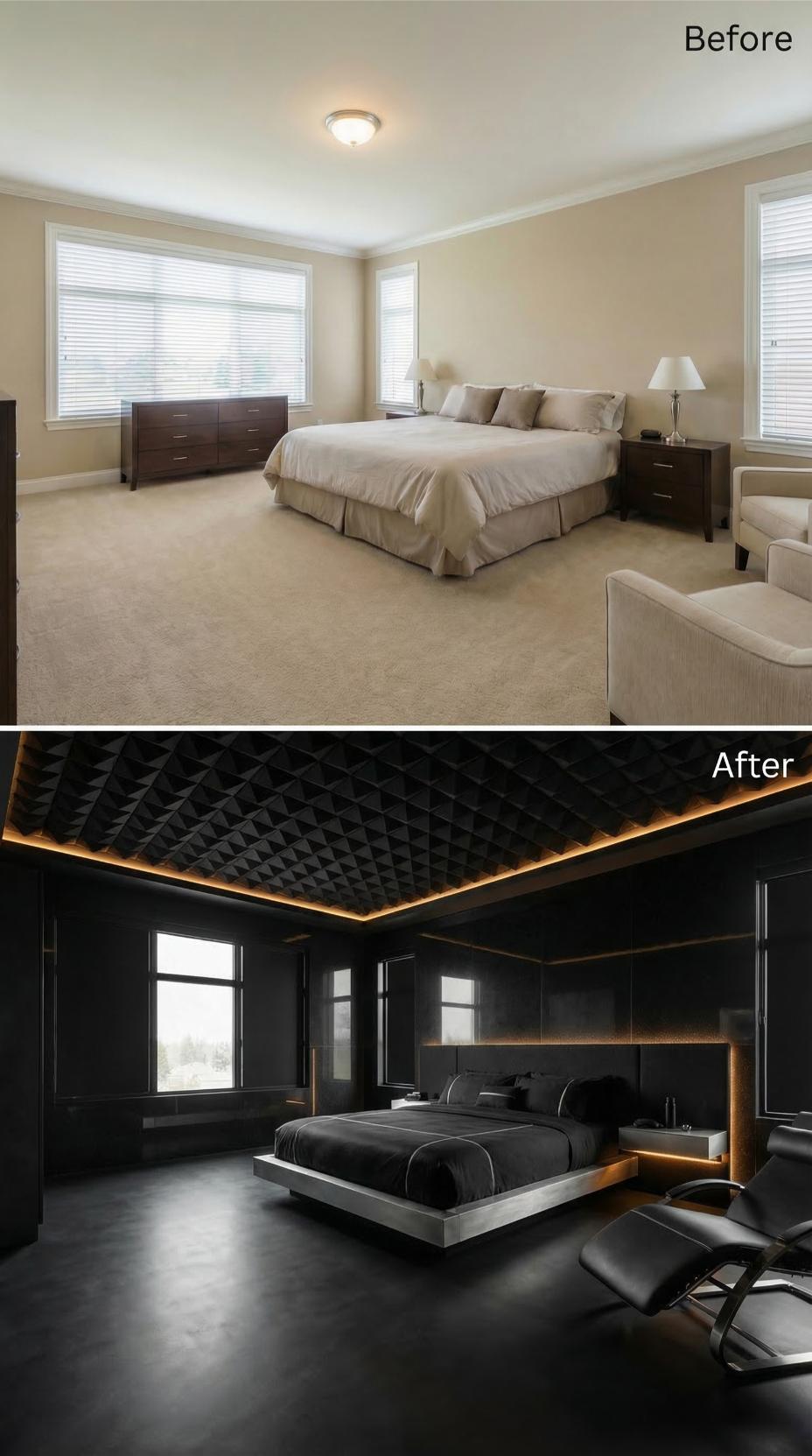
Matte black walls, a concrete-finish floor, and a platform bed with brushed steel edging and amber underlighting replaced every beige surface in this builder-grade room. The ceiling draws the most attention: black pyramid acoustic foam tiles sit inside a recessed tray bordered by warm amber cove lighting, a detail that pulls double duty on sound absorption and atmosphere. A low-profile leather chaise anchors the corner opposite the bed.
- Acoustic foam tiles reduce mid- and high-frequency sound bounce, making a bedroom quieter without adding bulky soft furnishings
- Underlighting on a platform bed frame keeps the floor visually receding, which reads as more square footage rather than less
- Matching the floor, walls, and ceiling in the same dark value eliminates the visual interruptions that make a room feel chopped up
Hanging Glass Terrariums and a Knotty Pine Accent Wall Replaced Beige and Carpet
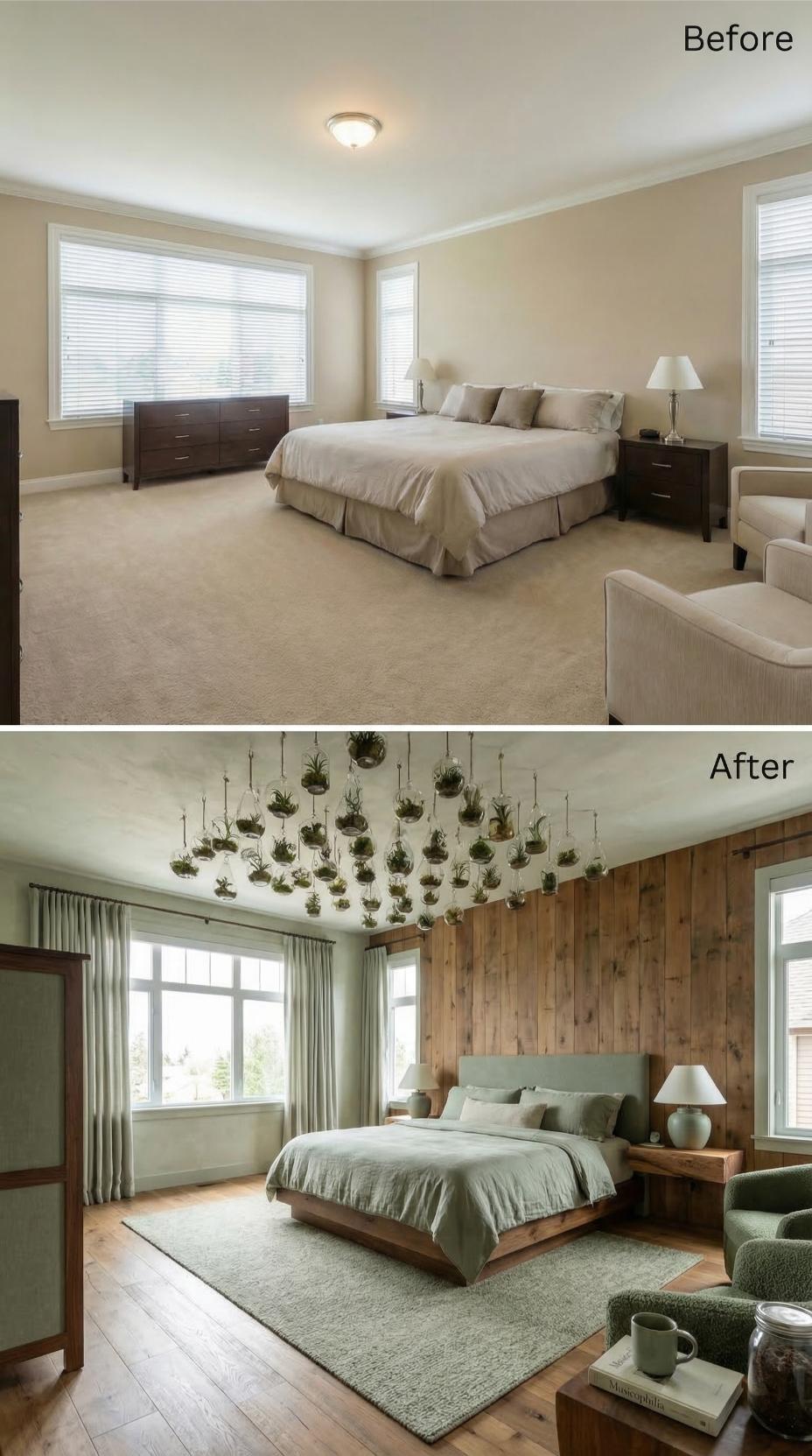
Dozens of glass orb terrariums suspended from the ceiling is either the boldest bedroom decision of the decade or proof that someone finally stopped playing it safe.
The builder-grade original had beige paint, carpet, and flush-mount lighting doing absolutely nothing for the space. The redesign answers with wide hardwood plank flooring in a warm honey tone, a knotty pine feature wall behind the bed, and sage green linen bedding on a solid walnut platform frame. Draping linen curtains in a soft celadon hang from black iron rods, replacing the flat horizontal blinds.
The terrariums overhead cluster in an asymmetric formation, each globe holding air plants or moss. Two ceramic table lamps in muted sage anchor the nightstands. A bouclé armchair in forest green sits at the foot of the bed on a low-pile wool rug in pale sage, pulling every element back to the same green-and-wood axis the room was built around.
Gold-Painted Tray Ceiling and Crystal Chandelier Replaced Flush Mount and Flat Beige
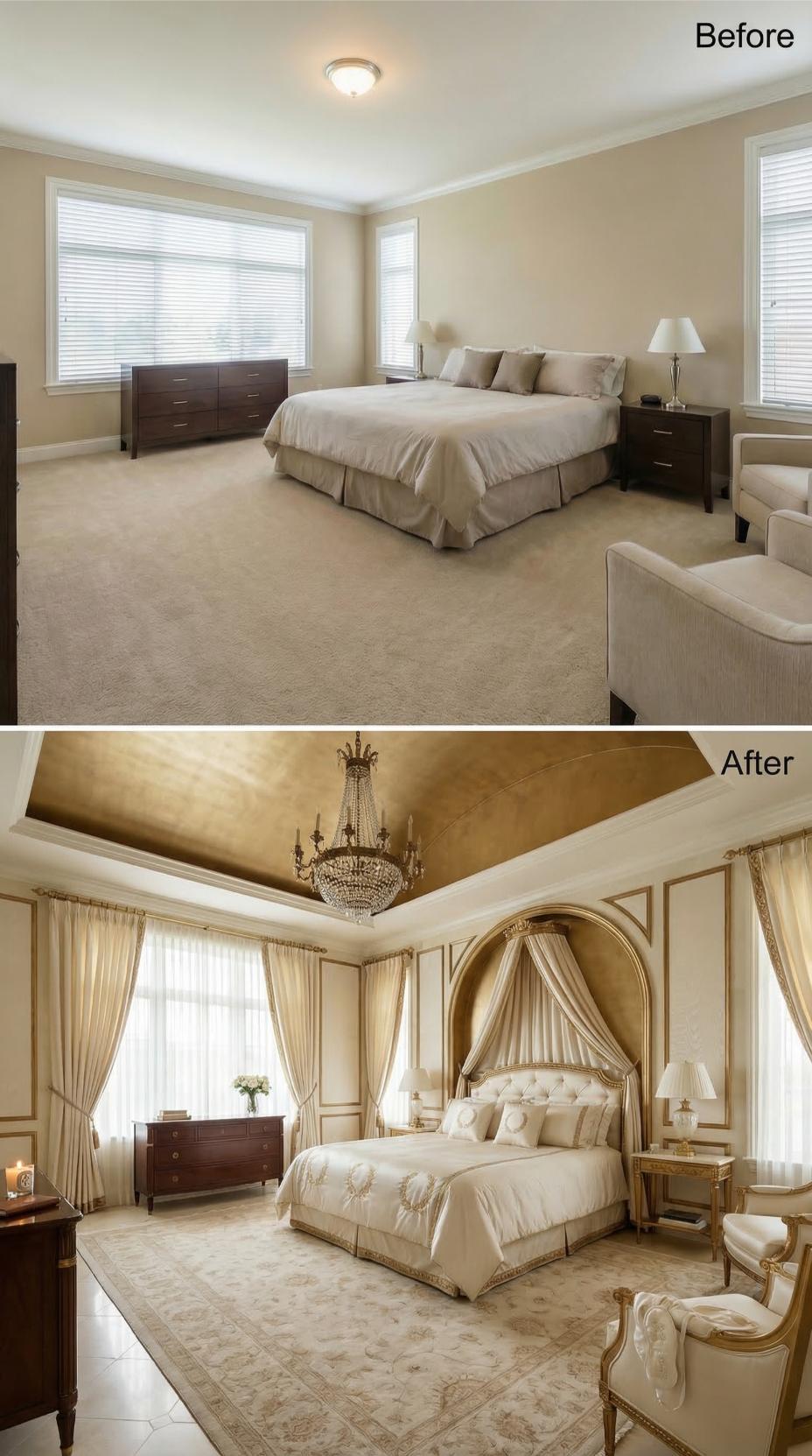
What reads immediately is the ceiling. Metallic gold Venetian plaster coats a tray recess, and a basket-style crystal chandelier anchors the center with enough visual weight to hold the room together. The bed surround is an arched architectural millwork piece finished in gilt, framing a tufted ivory headboard with draped canopy panels in cream silk.
Wall panels in cream and gold molding replace what was once flat paint. The original dark walnut dresser stays, grounded now against sheer linen drapes on brass traverse rods. A hand-knotted wool rug in ivory with faint botanical motifs covers tile flooring. French-style armchairs in ivory linen anchor the foot of the bed.
Worth Knowing: Venetian plaster applied to a tray ceiling costs more per square foot than standard paint but reflects light differently at every hour of the day, shifting from warm amber in the morning to deep gold under evening chandelier light. Because the technique requires multiple thin layers burnished by hand, no two finished ceilings look identical.
Teal Walls, Slatted Walnut, and Cove Lighting Replaced Beige Paint and Carpet
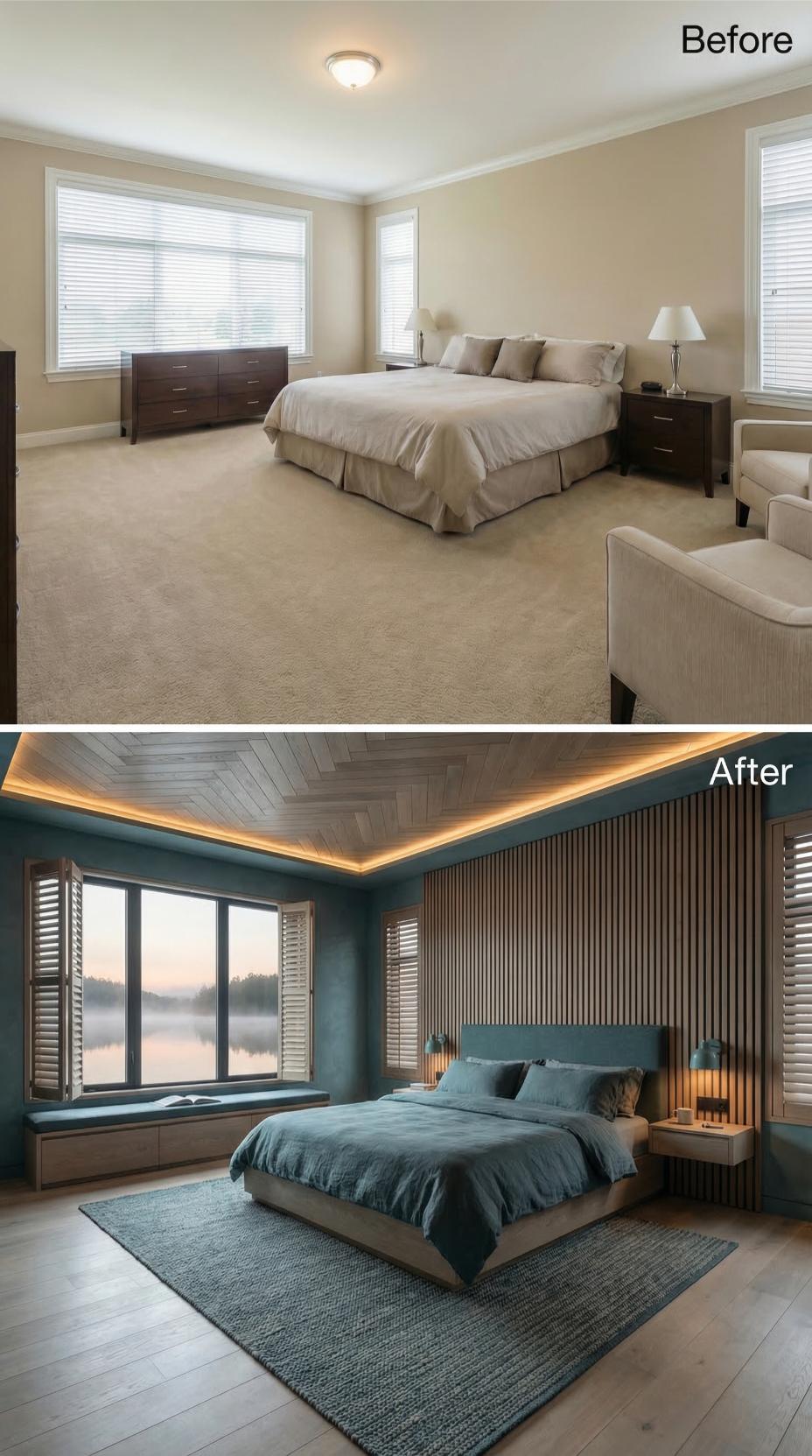
Saturated teal covers every wall surface, including the recessed tray ceiling border, which holds a strip of warm amber cove lighting above a herringbone wood ceiling panel insert. The bed sits low in a platform frame upholstered in matching teal fabric, flanked by floating nightstands with no visible hardware. Vertical walnut slat panels run floor to ceiling behind the headboard wall, adding texture without pattern.
Underfoot, carpet gave way to light oak hardwood planks, grounded by a chunky-knit charcoal area rug. A built-in window bench with drawer storage runs the full length of the large window, which now frames a lake view at dusk. Wall-mounted reading sconces in matte teal ceramic finish the look on either side of the bed.
Style Tip: Teal is one of the few saturated colors that holds its depth in both daylight and artificial light, making it a reliable choice for rooms that shift between morning brightness and evening dimness. Pairing it with warm-toned wood keeps the palette from reading cold. The key is keeping the wood natural and unfinished-looking rather than orange-toned, which would pull the color balance toward green.
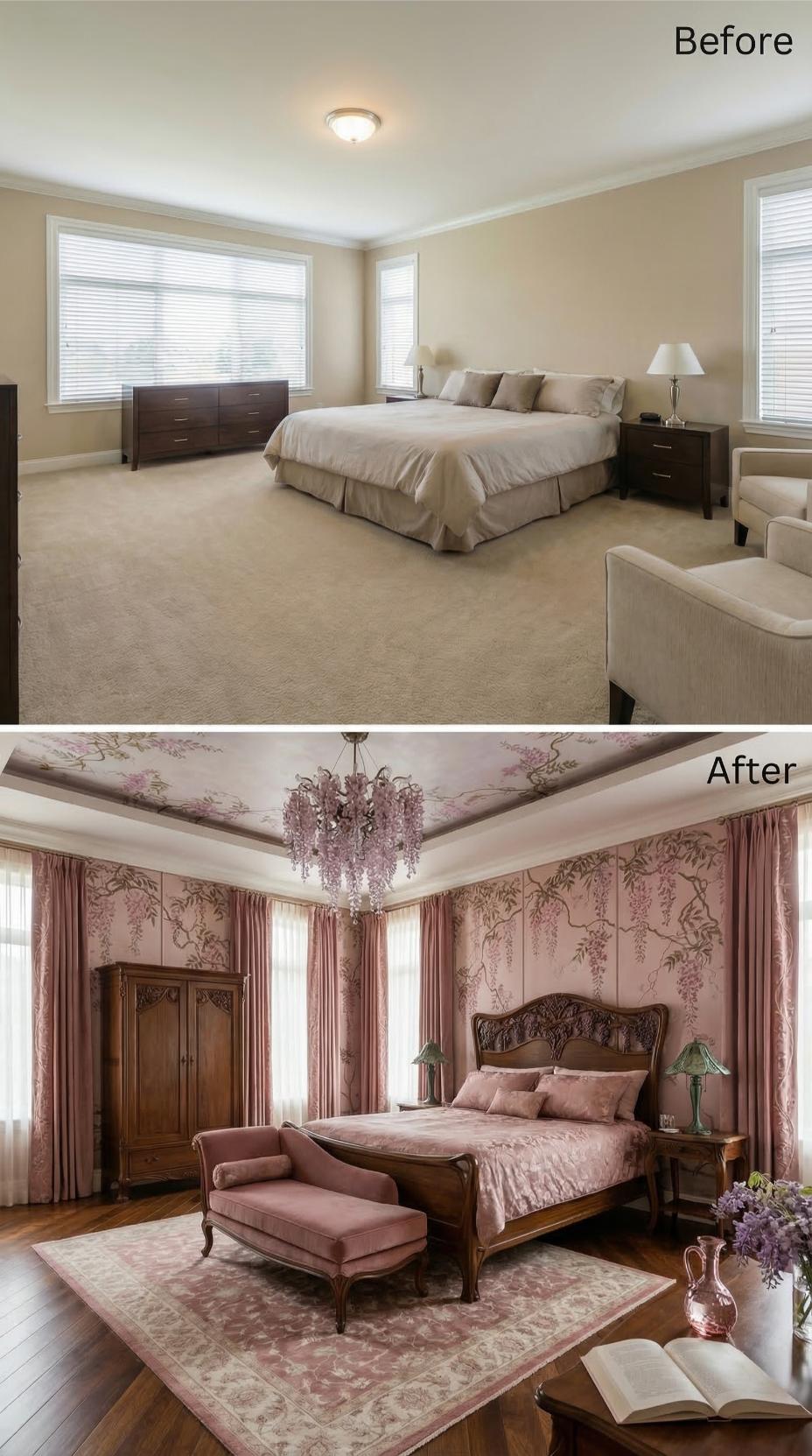
Wisteria wallpaper takes the botanical direction somewhere far more romantic than reclaimed pine.
Wisteria Wallpaper, Carved Walnut, and a Floral Ceiling Replaced Beige and Carpet
🔥 Would you like to save this?
Every surface in this room carries the same motif. Hand-painted wisteria panels wrap the walls in dusty rose and sage, and the tray ceiling repeats the pattern overhead, creating a bower effect that reads as intentional rather than busy. A chandelier hung from that ceiling uses cast glass clusters shaped like wisteria blooms, tying the fixture directly to the print rather than floating above it as an afterthought.
The carved walnut bed frame is Art Nouveau in proportion, with a high arched headboard and footboard details that mirror the organic curves in the wallpaper. Dark hardwood floors replaced the original beige carpet, and a rose-and-ivory wool rug grounds the seating area anchored by a velvet chaise in muted mauve. Teal glass table lamps introduce the only cool note in an otherwise warm palette. The antique armoire in the left corner brings mass without adding visual clutter.
Copper Pipes Left Exposed on the Ceiling While Concrete Panels Replaced Every Beige Wall
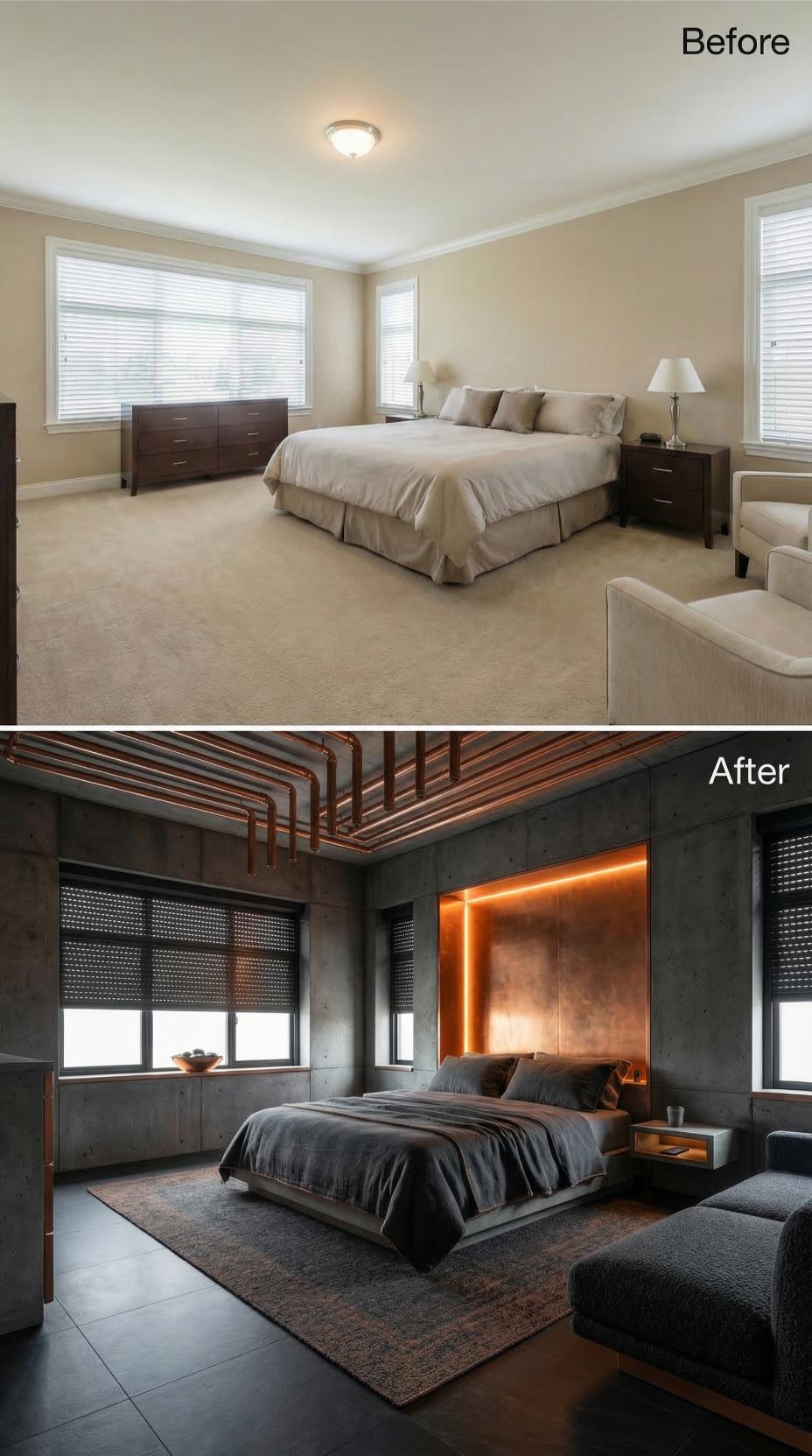
Raw concrete panels cover all four walls, and the ceiling stays open to reveal copper pipes running in parallel lines above the bed. A recessed copper-clad headboard wall glows orange from strip lighting set deep inside the niche, casting warmth across charcoal linen bedding and a low platform frame. Large-format dark tile replaced the builder carpet, and roller shades in gunmetal gray block the windows without softening the room’s industrial mood.
Try This: Exposed copper pipe used decoratively will develop a natural patina over time, shifting from bright orange-red toward deeper brown and eventually green if humidity is present. Sealing the pipes with a clear lacquer at installation locks in the warm copper tone and prevents oxidation, which is worth deciding before the first coat of concrete panel sealant goes on adjacent walls.
Dark Ebony Hardwood and a Floating Platform Bed Replaced Carpet and Flush Mount
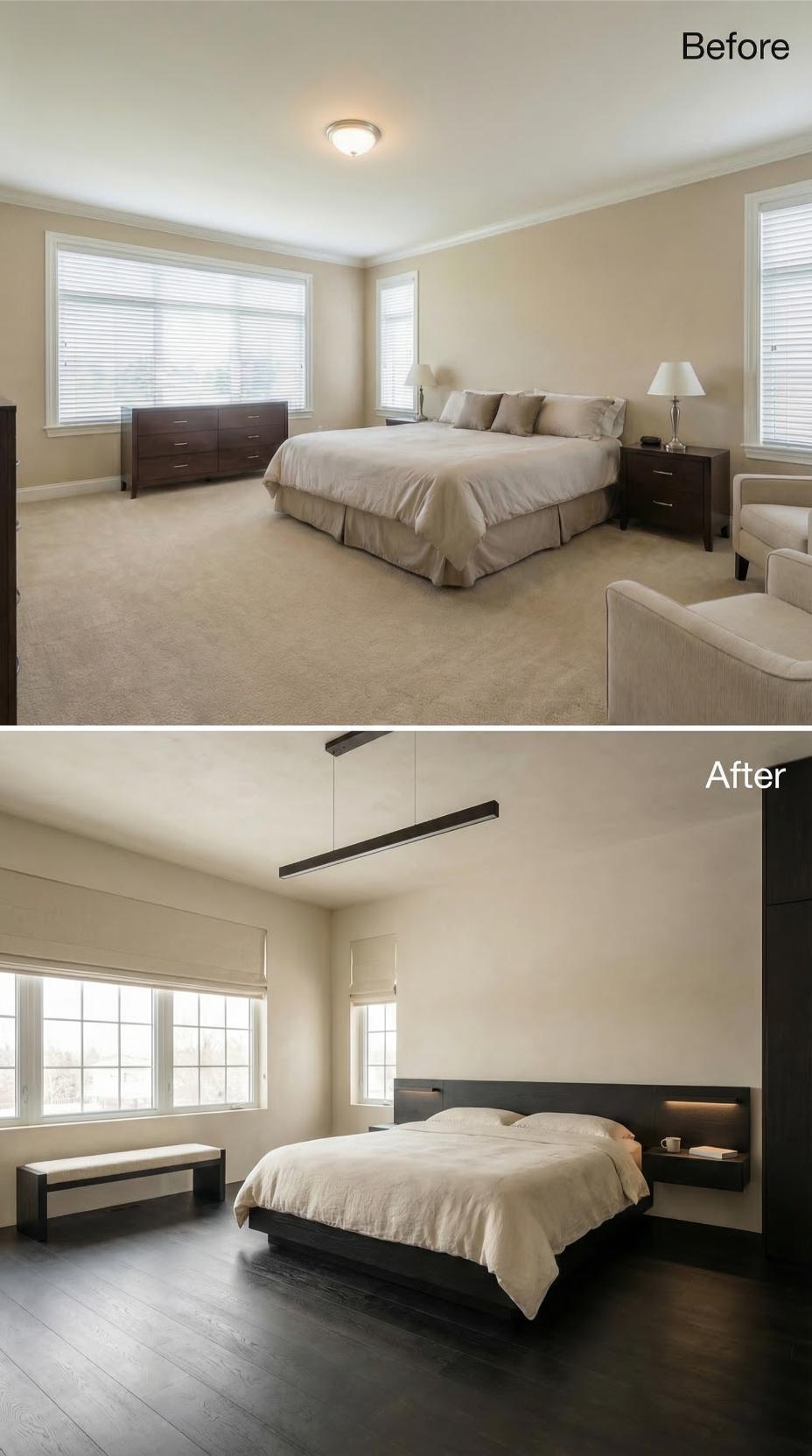
Carpet gave way to wide-format ebony-stained hardwood planks, and the shift in tone is immediate. Gone is the builder-grade flush mount with its warm bulb glow. In its place, a linear black pendant drops from the ceiling on twin cables, casting diffused light across cream walls that now read warmer against the dark floor.
The bed sits on a low floating platform with an integrated dark walnut headboard panel. Built-in side shelves replace the separate nightstands from before, keeping the floor plan open. Roman shades in natural linen replaced the horizontal blinds, and a backless upholstered bench anchors the foot of the bed without crowding the room.
Designer’s Secret: Floating platform beds with integrated side shelving eliminate the visual clutter of mismatched nightstands while keeping square footage feeling open. The trick is ensuring the shelf depth matches the overhang of the mattress so items placed on it remain within easy reach from a lying position. Most fabricators recommend a shelf projection between eight and ten inches for a king-size platform.
Carved Teak, Purple Silk Canopy, and Coffered Ceiling Replaced Beige Box and Carpet
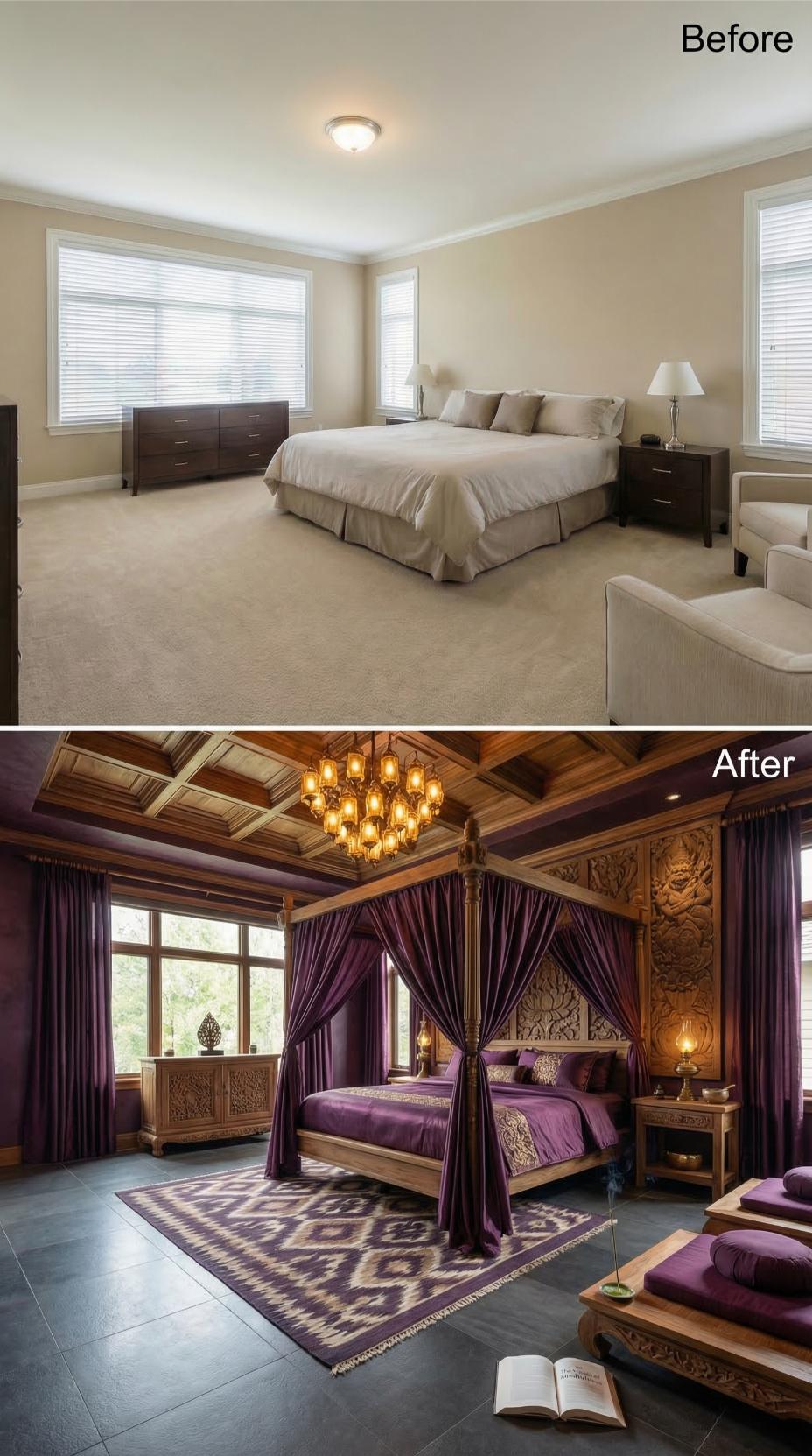
Dark-stained teak forms a coffered ceiling grid overhead, with a cluster chandelier of amber glass lanterns anchoring the center. The four-poster bed carries hand-carved posts and purple silk drape panels tied back at each corner, sitting above a diamond-pattern wool rug in plum and ivory.
The right wall features deep-relief carved wood panels depicting floral figures, paired with a stone nightstand holding an oil lamp. Slate floor tiles replace the original carpet entirely, and matching carved-front dresser cabinetry lines the window wall beneath floor-length purple velvet curtains.
By The Numbers: Coffered ceilings constructed from solid hardwood like teak add structural weight to the design but also significant acoustic mass, reducing sound transmission between floors by absorbing vibration that hollow drywall ceilings cannot. Silk canopy panels, unlike cotton or linen, drape without creasing under their own weight, which is why they remain a preferred choice for four-poster installations where the fabric hangs in long vertical runs.
Gold Canopy Bed and Coffered Ceiling Replaced Carpet and Builder Beige
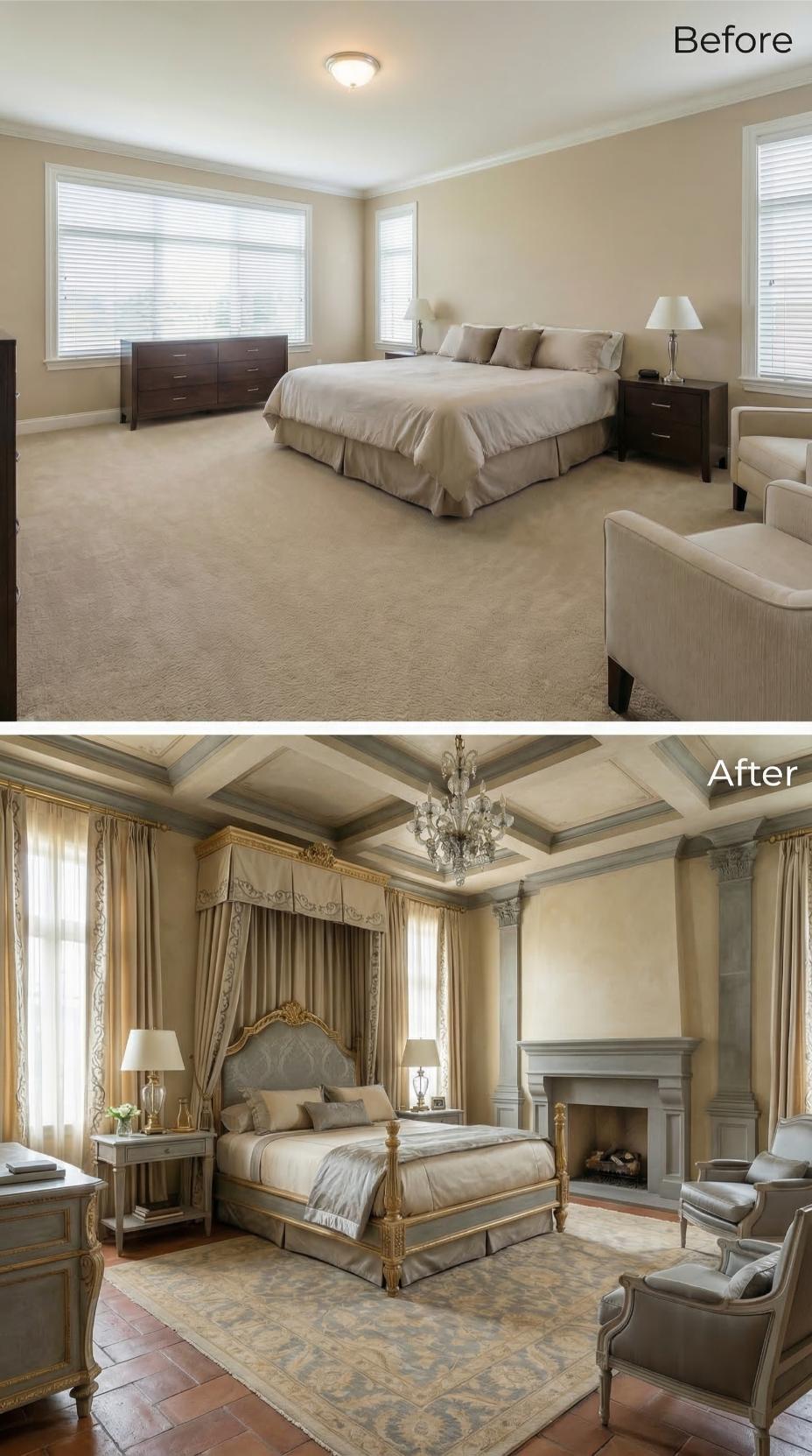
Gilded four-poster bed frame with a fabric canopy cornice in sage and champagne anchors the room, while coffered ceiling beams painted in a muted blue-grey add architectural structure the original flat ceiling never had. Terracotta tile and a stone fireplace surround complete the shift.
Common Mistake: Canopy beds with fabric cornices collect dust along the pleated valance faster than almost any other bedroom element. Running a vacuum brush attachment along the top panel monthly prevents discoloration that becomes nearly impossible to reverse once embedded in silk or linen blends.
Shoji-Inspired Wall Panels and a Raised Tatami Platform Replaced Beige Carpet and Flush Mounts
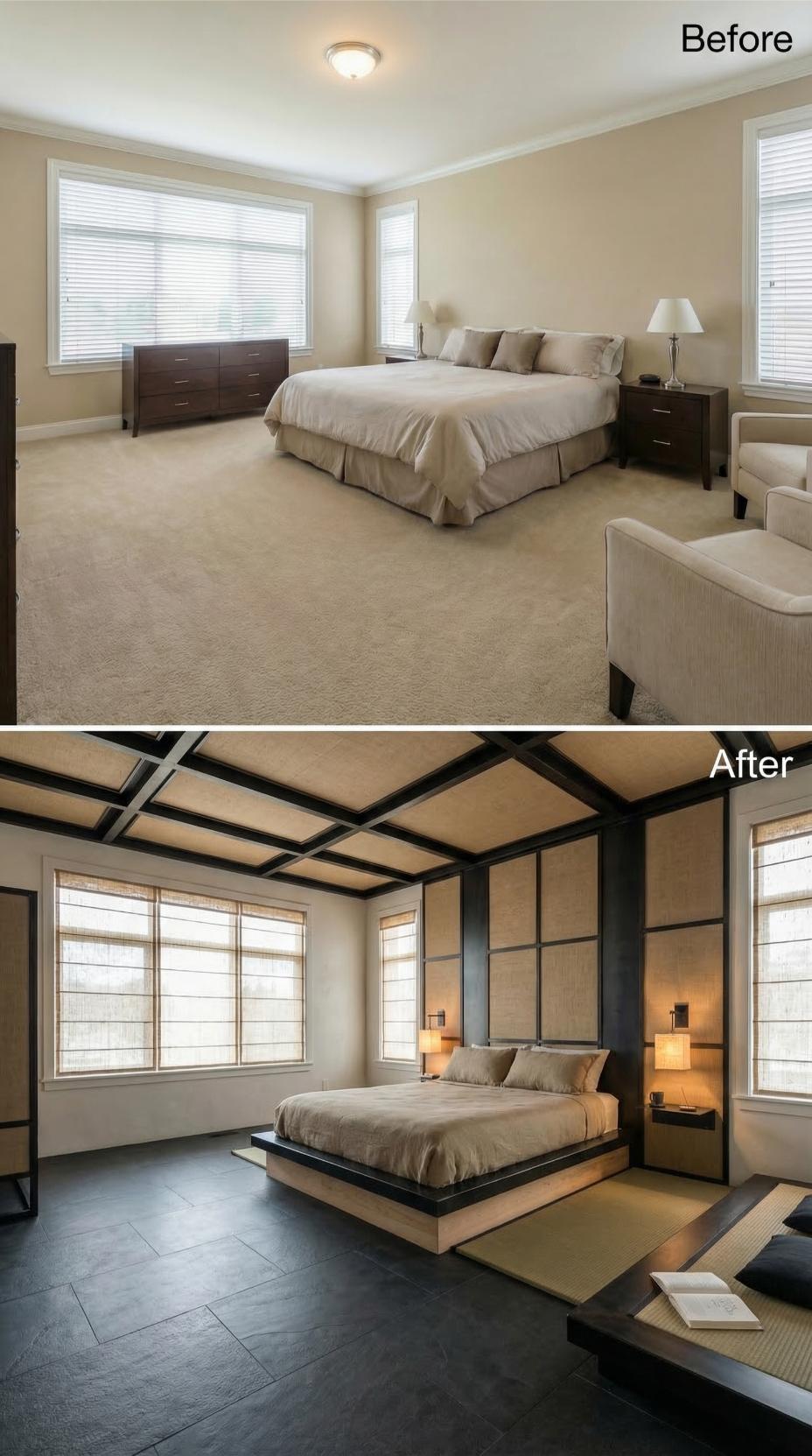
Flat beige walls and builder carpet gave way to a Japanese-influenced bedroom built around a raised ebony platform bed with integrated side shelves and wall-mounted paper sconces. Behind the headboard, a floor-to-ceiling grid of linen-filled black lacquer frames replicates shoji screen geometry without using translucent panels, giving the wall visual weight while keeping the palette warm. The ceiling received the same grid treatment, with black lacquered beams dividing cream fabric insets across the full span of the room.
Slate-format porcelain tiles in near-black replace the carpet below, and woven bamboo roman shades swap out the white vinyl blinds. Tatami mat sections flank the platform on both sides, reinforcing the layered floor plane that defines the spatial hierarchy of the room.
Behind the headboard, a floor-to-ceiling grid of linen-filled black lacquer frames replicates shoji screen geometry without using translucent panels.
Forest-Green Velvet Canopy and Coffered Ceiling Replaced Beige Carpet and Flush Mount
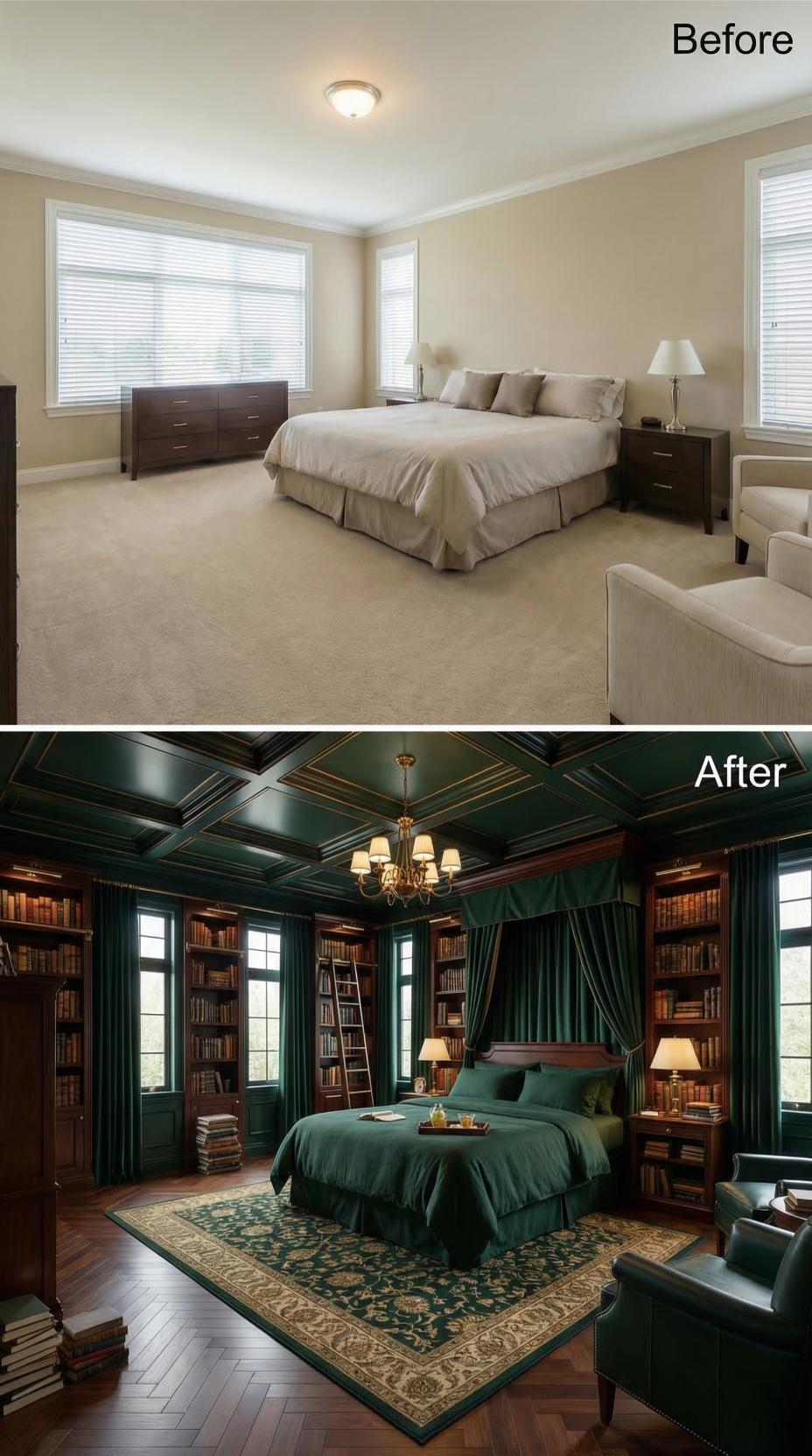
Deep hunter-green velvet drapes frame a mahogany canopy bed while floor-to-ceiling walnut bookshelves with rolling ladders replace bare walls on every side.
Why Coffered Ceilings Painted the Same Color as the Walls Read as Architecture, Not Decoration
When a coffered ceiling gets painted an identical shade to the surrounding walls rather than left white, the grid of beams stops reading as an add-on and starts reading as structural intent. In this room, the dark green lacquered coffers with gold trim detail along each recessed panel create depth through contrast of sheen rather than contrast of color. That distinction matters because a white coffered ceiling in a dark room pulls the eye upward and away from the space, while a tone-matched ceiling keeps the atmosphere contained and immersive.
Rustic warmth takes over where jewel tones and lacquered finishes left off.
Exposed Ceiling Beams and Knotted Jute Replaced Flush Mounts and Beige Carpet
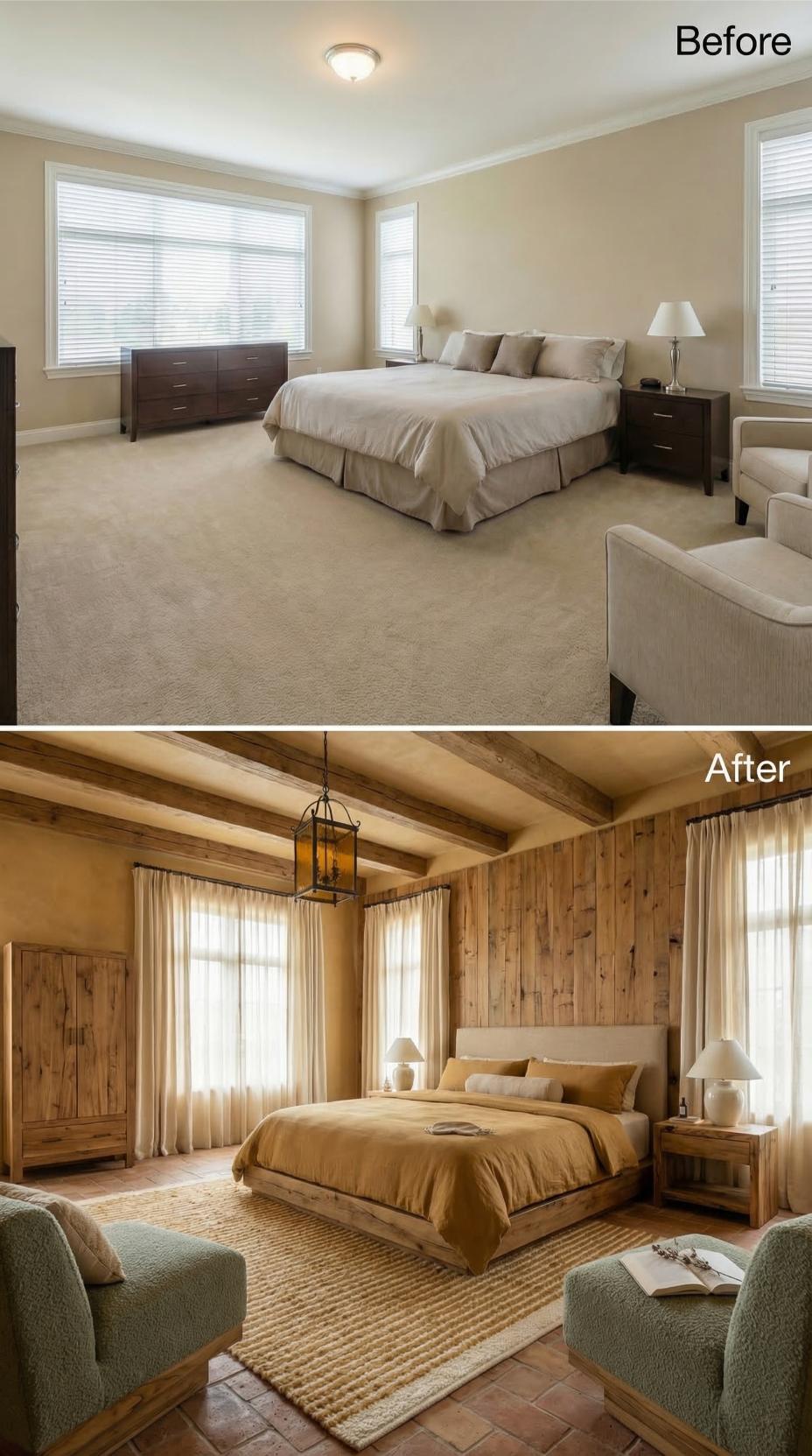
Rough-sawn wood ceiling beams span the length of the room above a wrought-iron lantern pendant, while vertical knotty pine planks cover the accent wall behind a low-profile upholstered bed dressed in ochre linen. Terracotta tile floors replace the builder carpet, anchored by a chunky jute rug. Sage boucle armchairs face the bed where beige chairs once sat.
Bubble-Textured Ceiling Panels and Hardwood Floors Replaced Carpet and Flush Mount
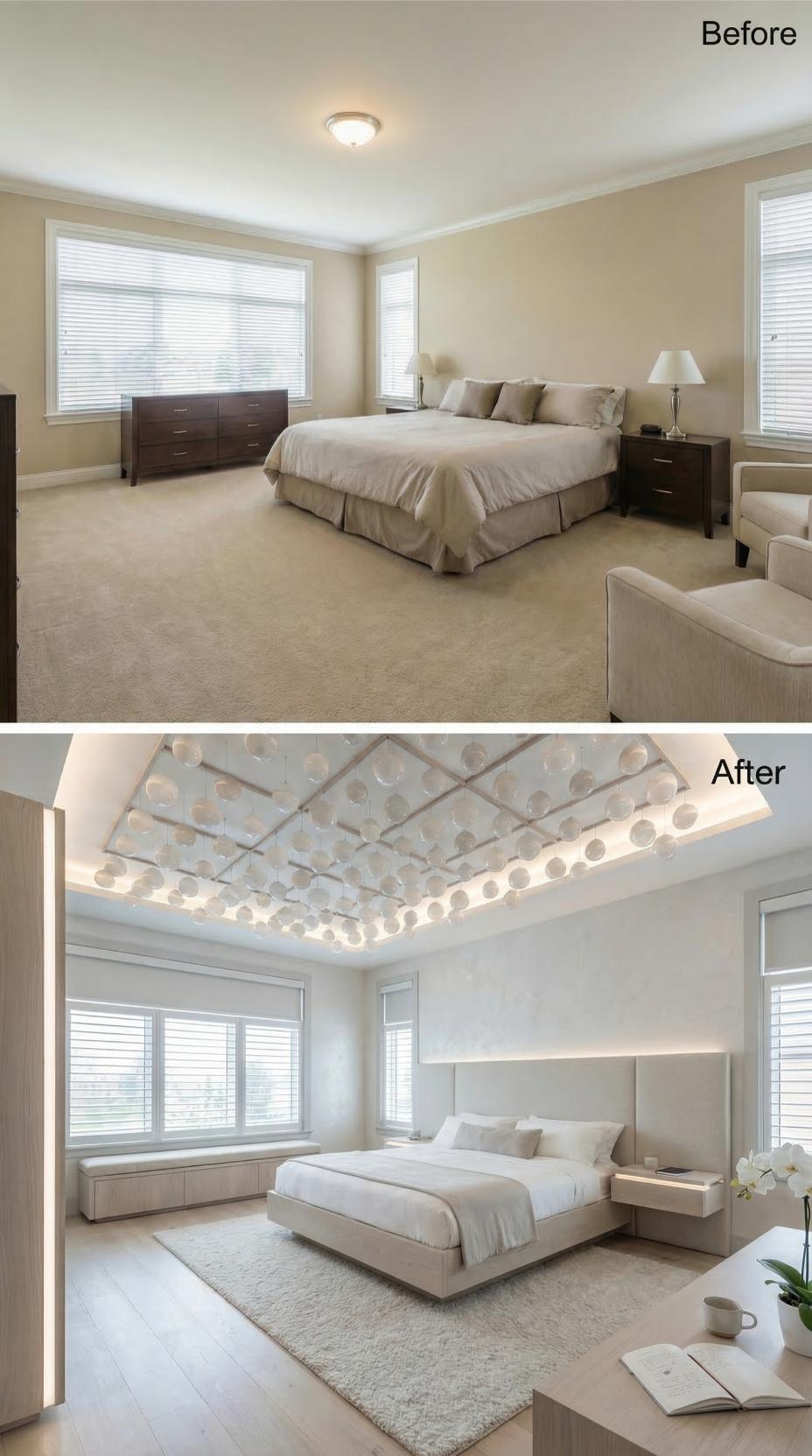
The ceiling does most of the work here. A recessed tray frame holds a grid of circular relief panels in matte white, each dome catching the warm LED strip light tucked behind the perimeter soffit. The effect reads more like architectural sculpture than a lighting fixture.
On the floor, wide-plank oak in a pale natural finish replaced the original beige carpet entirely. The platform bed sits low with an upholstered linen headboard that runs nearly to the ceiling, making the wall behind it feel intentional rather than leftover. Floating nightstands with no visible hardware keep the perimeter clean, and a single white orchid on the right side provides the only organic contrast in an otherwise mineral palette.
The ceiling does most of the work here, with circular relief panels catching warm LED strip light tucked behind the perimeter soffit.
Pompeian Red Walls and a Fresco Ceiling Replaced Beige Carpet and Flush Mount
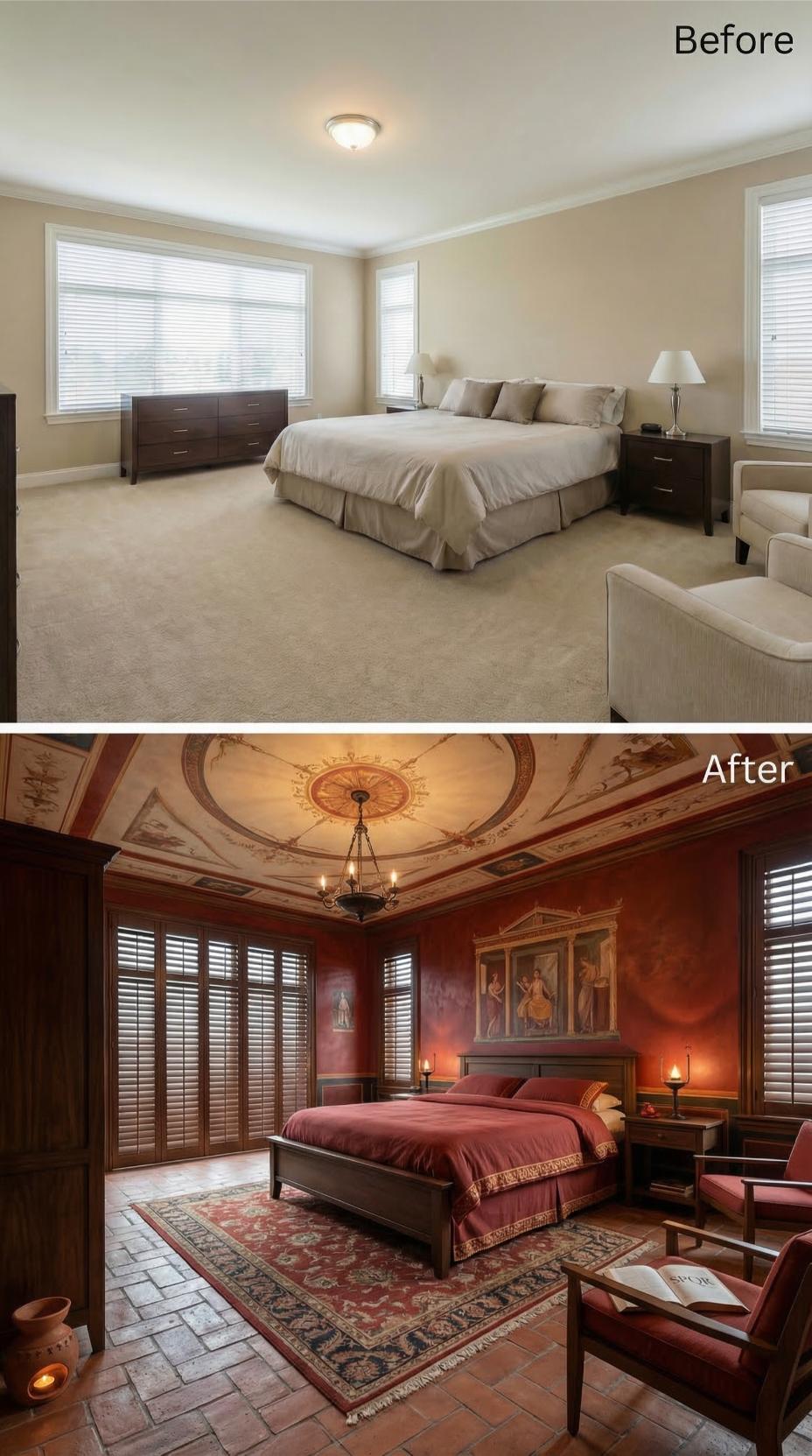
Brick-red Venetian plaster coats all four walls, pulling warmth from the hand-painted ceiling fresco overhead, where a trompe l’oeil oculus rings a wrought-iron chandelier with candle-style lights. Stone tile flooring replaced the original carpet entirely, and a Persian rug in crimson and navy anchors the solid walnut bed frame dressed in garnet bedding with gold trim. Roman-style painted panels flank the windows, now fitted with dark wood plantation shutters.
In The Details: Roman fresco painting, like the mythological panels visible flanking the windows here, was traditionally executed in true fresco technique, meaning pigment was applied directly into wet plaster so the color bonded permanently as the wall dried. Modern reproductions use acrylic glazes over cured plaster to approximate the same matte, mineral quality without the strict timing demands of the original process. Either method produces wall art that reads as architectural rather than decorative, which is why it holds up in rooms with heavy surrounding detail.
Latticed Black Ceiling and Cove Lighting Replaced Beige Walls and Flush Mount
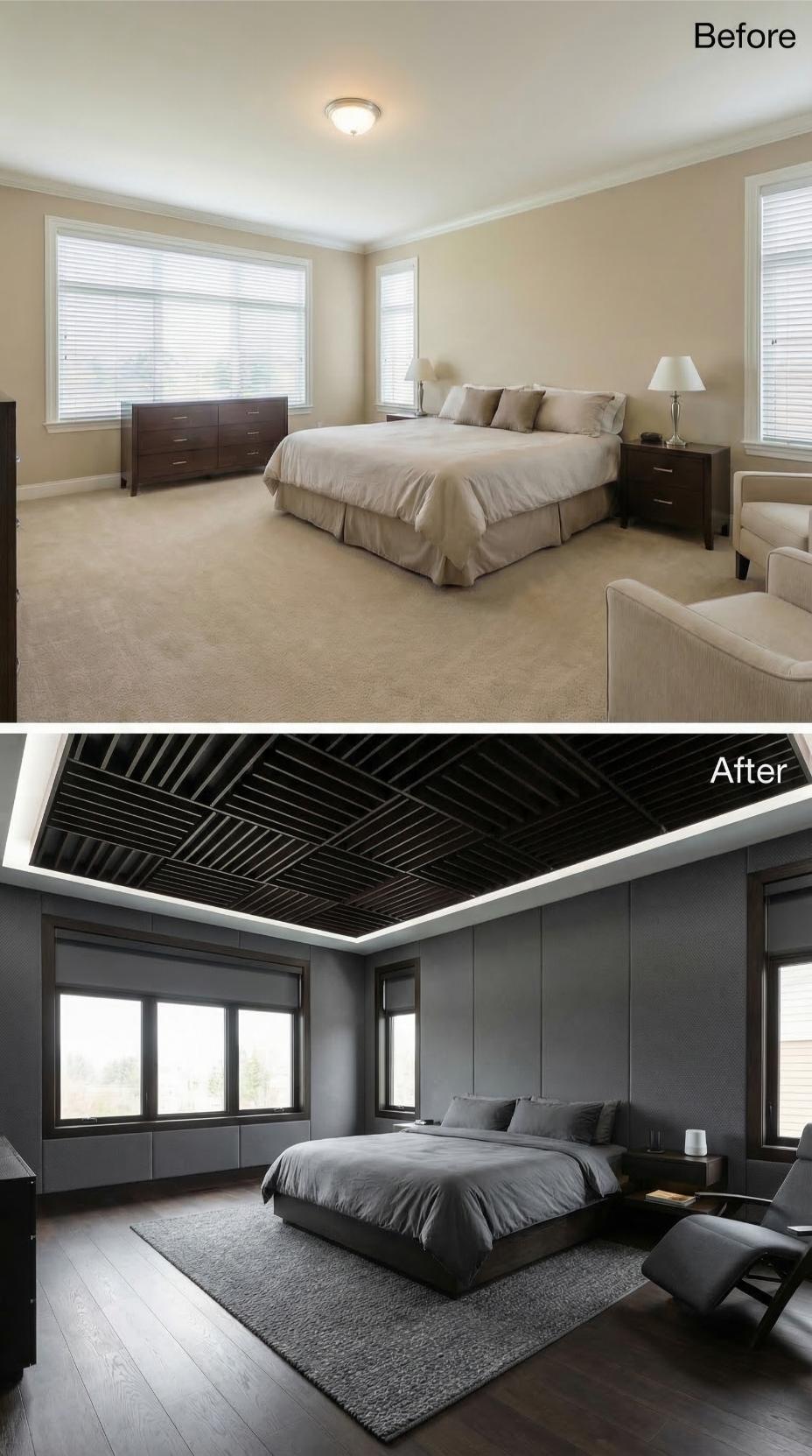
Charcoal wall panels with recessed rectangular molding replaced the original beige, while dark-stained hardwood flooring swapped out the carpet, and a latticed black ceiling with perimeter LED cove lighting became the room’s architectural anchor.
The Psychology Behind This: Sleeping under a visually heavy ceiling triggers a subconscious sense of enclosure that many people associate with safety and rest. Designers call this the cave effect, and it explains why deeply colored or structured overhead surfaces consistently appear in bedrooms designed for people who struggle to mentally switch off at night.
Sage Green Walls, a Cloud-Carved Tray Ceiling, and a Platform Bed Replaced Beige Carpet
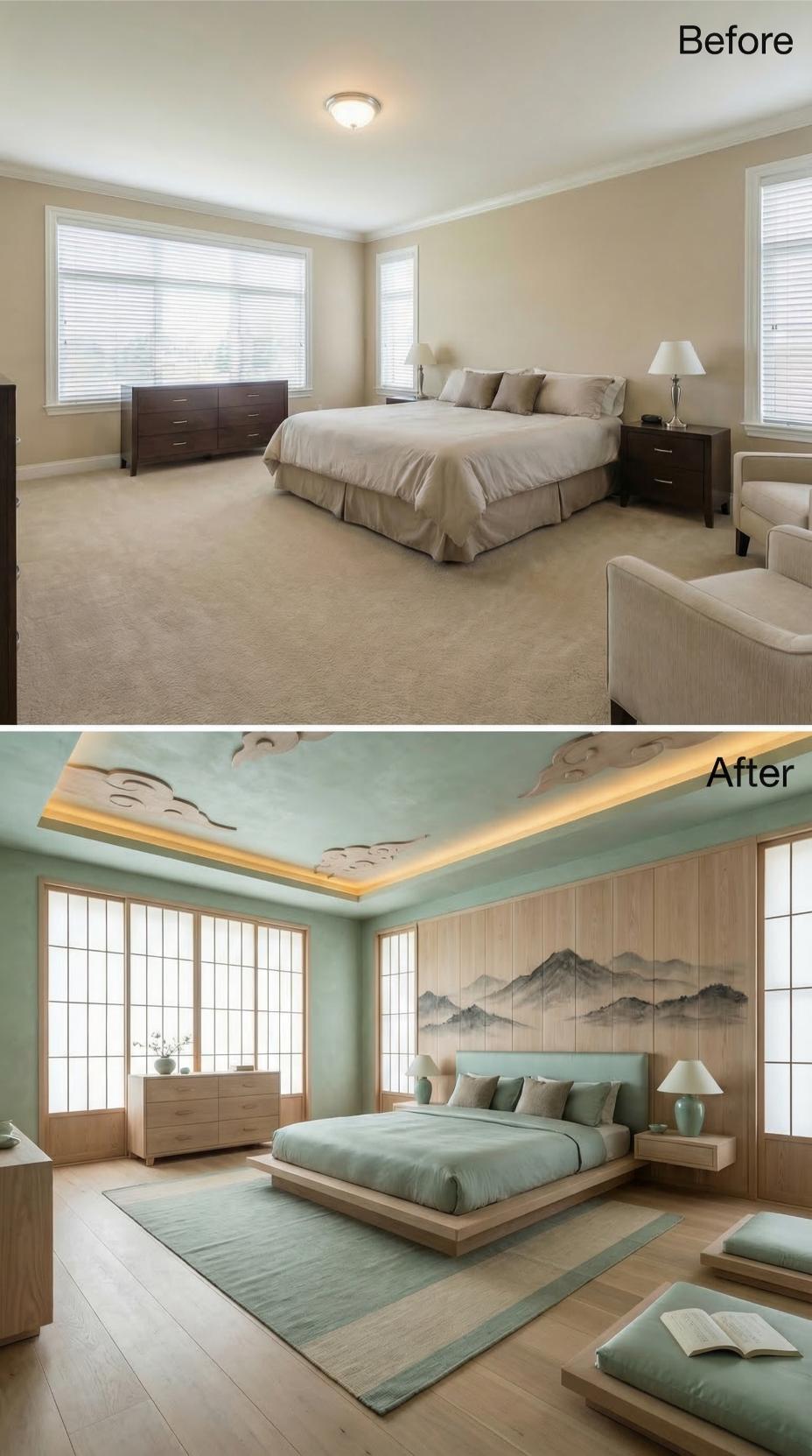
Bleached oak wall paneling anchors the headboard wall, interrupted by an ink-wash mountain mural painted directly onto the wood surface in soft grey tones. Shoji-style window screens replace the original horizontal blinds, and sage green plaster wraps every wall up into a recessed tray ceiling fitted with indirect amber strip lighting and dimensional cloud cutouts in raw plaster relief.
- Platform beds sit lower than standard frames, which pulls the eye toward floor-level details like the woven sage area rug and meditation cushions visible at the foot.
- Shoji screens diffuse direct sunlight into a soft, even glow that eliminates harsh shadows across bedding fabrics far more effectively than horizontal blinds.
- Cloud motifs carved into tray ceiling plaster have roots in East Asian architectural tradition, where they symbolized good fortune in domestic spaces.
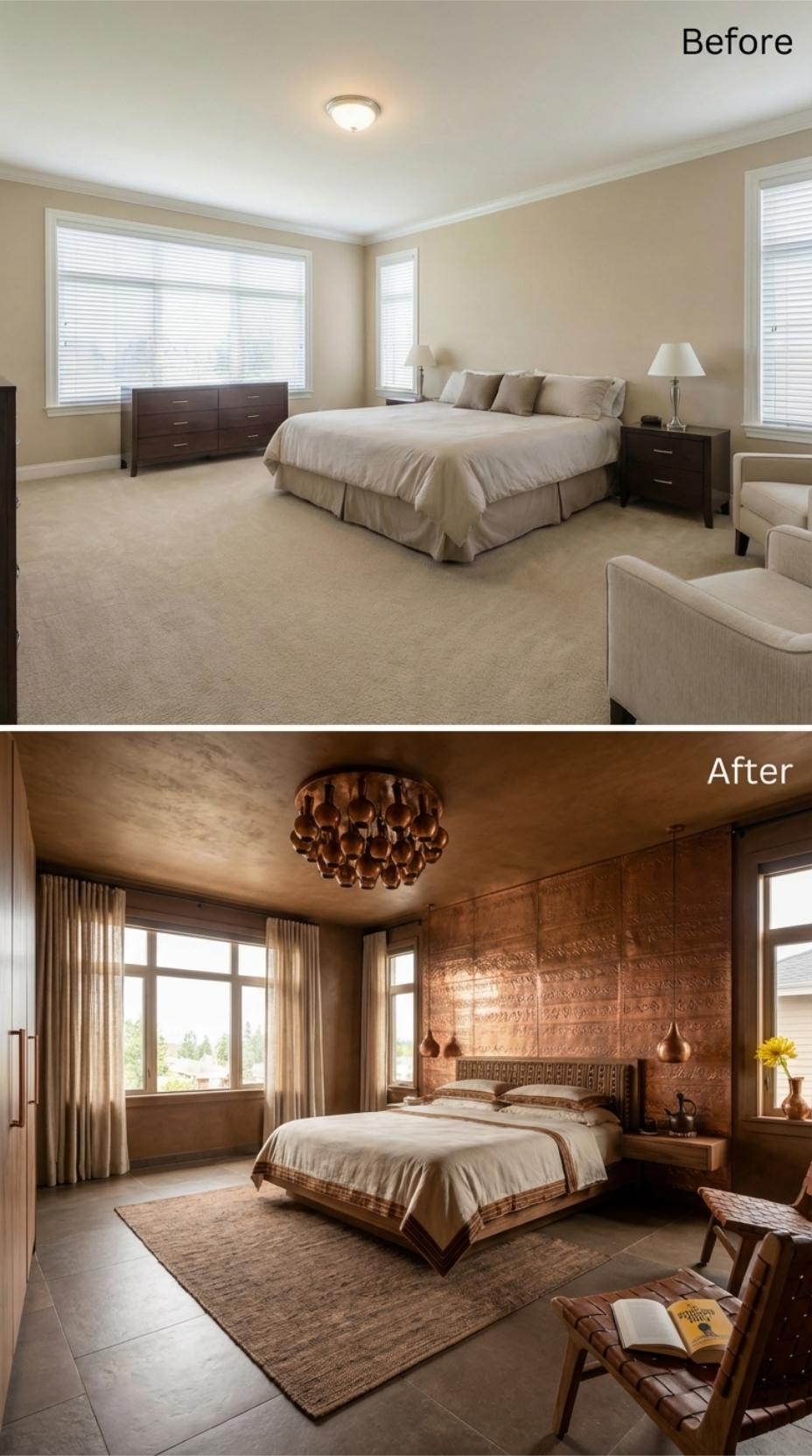
Copper Panel Headboard Wall and Vessel Chandelier Replaced Beige Carpet and Flush Mount
🔥 Would you like to save this?
Hammered copper tiles cover the entire headboard wall floor-to-ceiling, casting amber reflections across a clay-toned plaster ceiling anchored by a sphere chandelier built from clustered wooden vessels.
Style Math: works here as Copper Wall Panels plus Clay Plaster Ceiling plus Woven Jute Rug equals zero pattern competition. Each material carries its own texture so the room never needs printed fabric or decorative accessories to feel finished. Copper’s reflectivity does the visual work that art or wallpaper would otherwise handle.
Navy Fabric Ceiling Panels and Walnut Wardrobes Replaced Beige Carpet and a Flush Mount
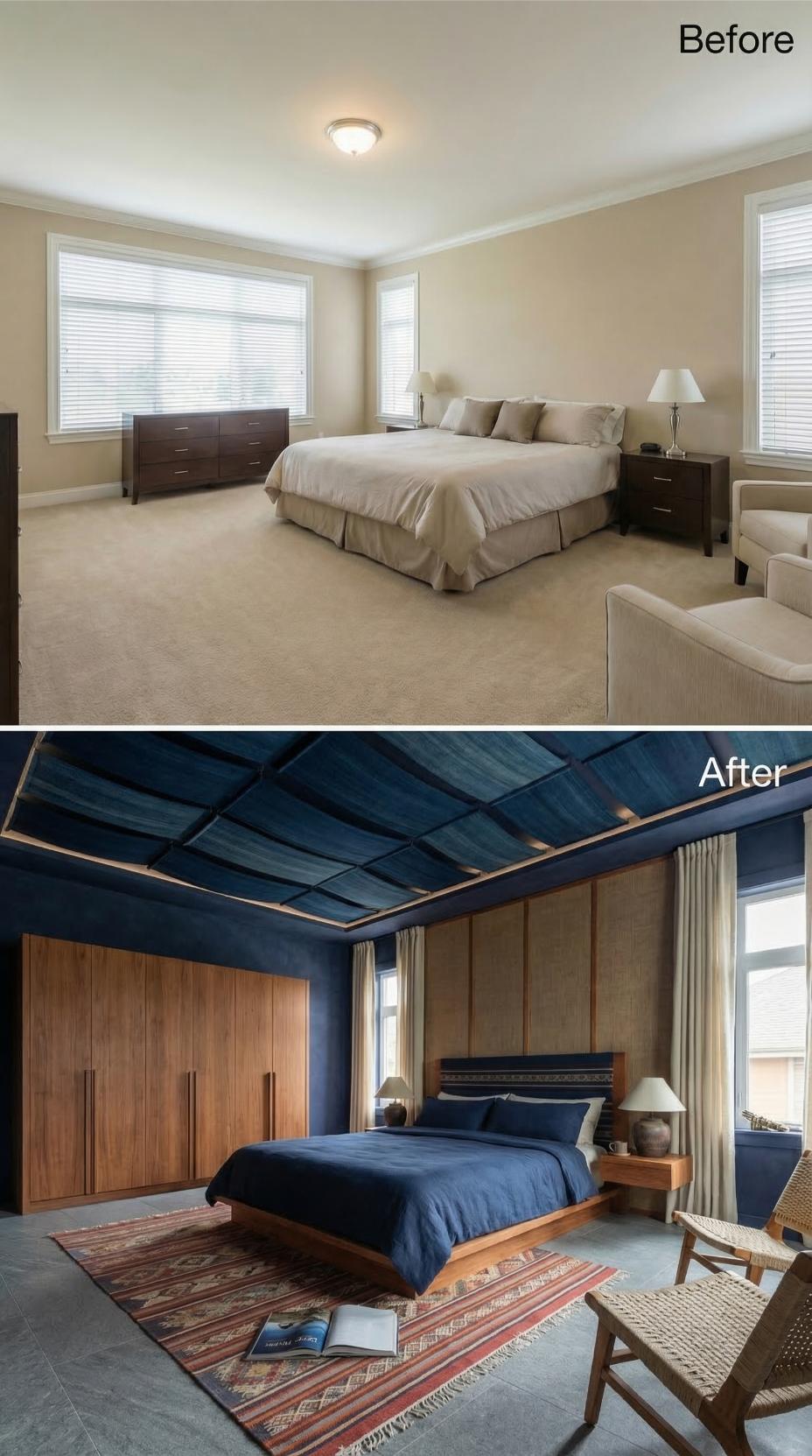
What registers first is the ceiling: deep navy textile panels set into a wood-framed grid, each fabric rectangle pulling the eye upward in a way flat paint never could. The walnut wardrobe runs nearly the full wall height, with vertical door panels and slim pulls that keep the storage from reading as furniture. Linen curtains fall to the floor at every window.
Below, a platform bed in warm-toned wood sits centered on a kilim rug with red, rust, and ivory geometric banding. Ceramic table lamps on low nightstands match the unhurried pace of the layout. Concrete-finish tile underfoot replaces the original carpet without adding visual noise.
Pro Tip: Upholstered or fabric-covered ceiling panels absorb significantly more sound than painted drywall, making them a functional choice in primary bedrooms above main living areas. The grid framing holding each panel here also creates a natural coffers effect without the weight or cost of millwork. Spacing the wood dividers evenly is critical because inconsistent proportions will read as a construction flaw rather than a design decision.
Walnut Ceiling Panels and Hardwood Floors Replaced Beige Carpet and a Flush Mount
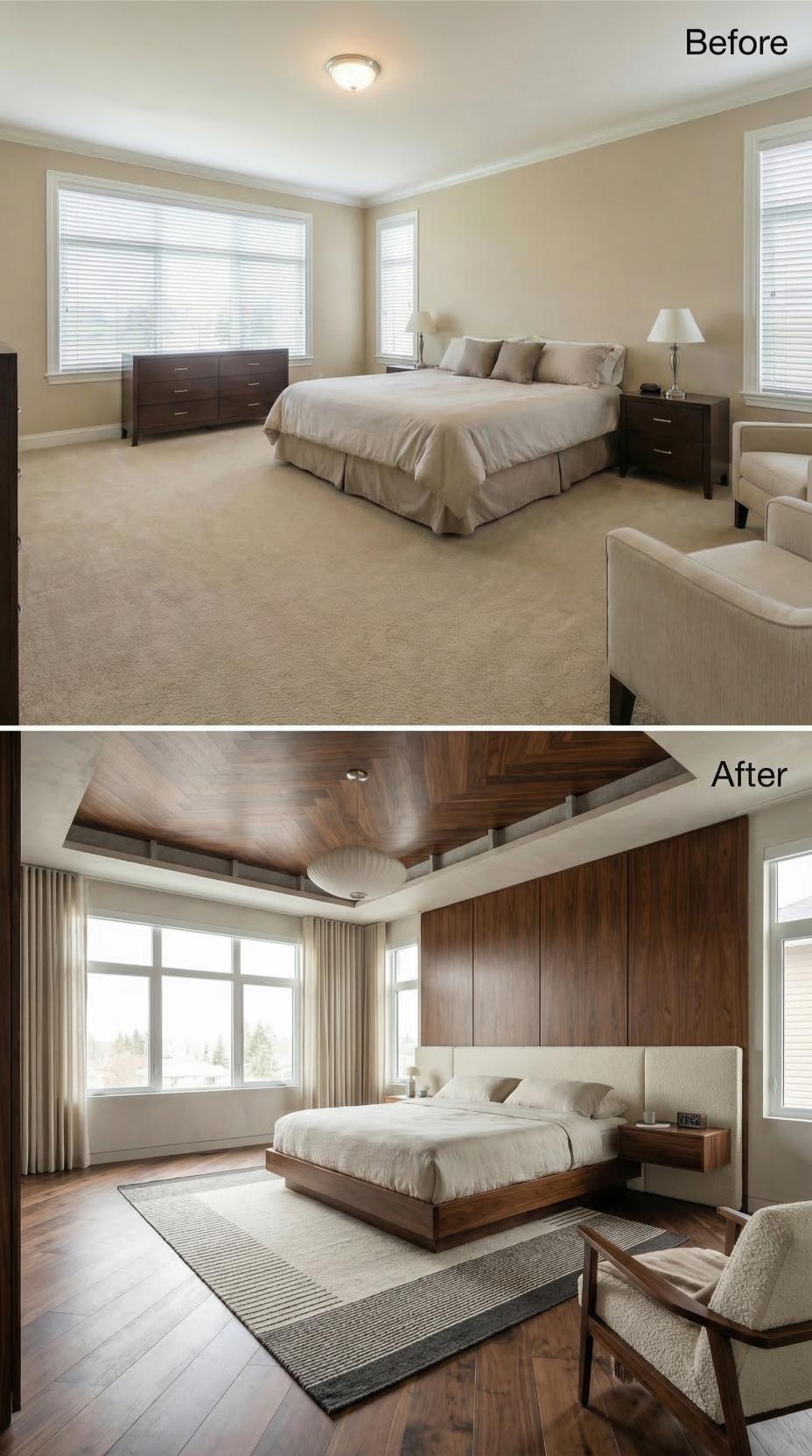
Builder beige gave way to walnut on every surface that matters most. The ceiling now carries a coffered wood panel insert with a warm brown grain, framed by a white perimeter tray that keeps the room from feeling compressed. That same walnut species wraps a full-height accent wall behind the platform bed, which sits on a low slab base with integrated floating nightstands.
Wide-plank hardwood floors run the length of the room, anchored by a layered area rug in cream and charcoal stripe. Linen drapes pool slightly at the floor beneath the updated window grid. The upholstered headboard, finished in an ivory bouclé-style fabric, creates contrast against the dark wood without breaking the tonal continuity the renovation was built around.
Why It Works: Matching the ceiling material to the headboard wall creates a visual envelope that pulls the eye inward rather than outward, making the furniture feel intentional rather than arranged. Walnut works in this role because its grain pattern reads as texture from a distance, adding visual weight without requiring additional color. Rooms where floor, wall, and ceiling share the same wood family tend to read as larger than they measure because the eye finds no seam to stop at.
Woven Rattan Headboard Wall and Pendant Orb Cluster Replaced Beige Carpet and Flush Mount
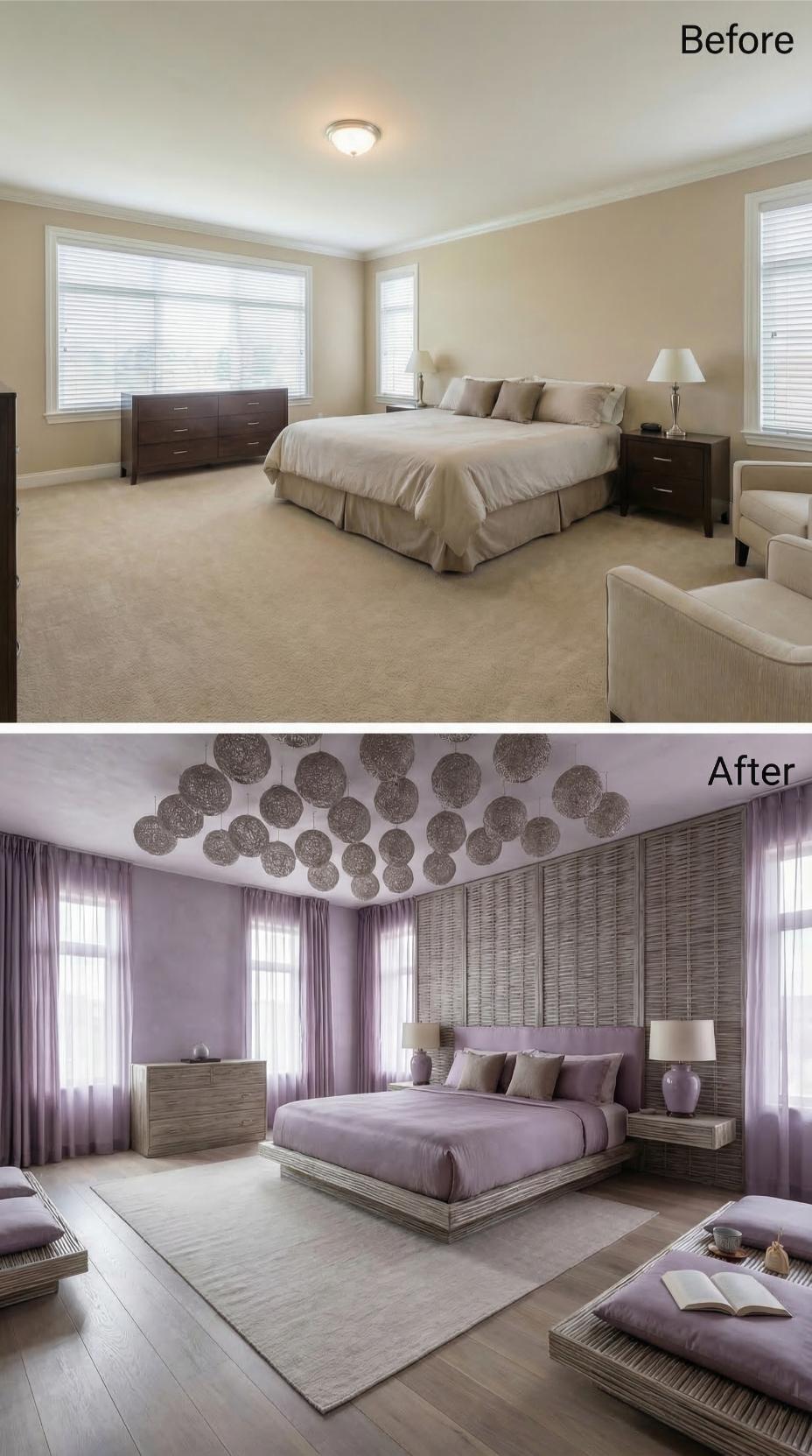
Dusty mauve walls pair with a low-profile platform bed finished in weathered grey wood, its integrated floating nightstands eliminating the need for separate case pieces. The headboard wall is clad floor-to-ceiling in tight-woven rattan panels, which add texture without competing with the lilac bedding or the sheer lavender curtains pooling at wide double-hung windows.
Overhead, dozens of woven wire orb pendants hang at staggered heights across the entire ceiling plane, replacing the single flush mount from the before photo. Whitewashed wide-plank hardwood now covers the floor where beige carpet once sat.
Quick Fix: Rattan wall cladding installed vertically in large panels typically comes in 4-by-8-foot sheets, making it a manageable DIY project compared to individual board installation. Because rattan is a natural fiber, it responds to humidity changes the way wood does, so acclimating the panels to the room for 48 hours before installation reduces the risk of warping or gapping at the seams.
Dark Bamboo Lattice Ceiling and Shou Sugi Ban Headboard Wall Replaced Beige Carpet
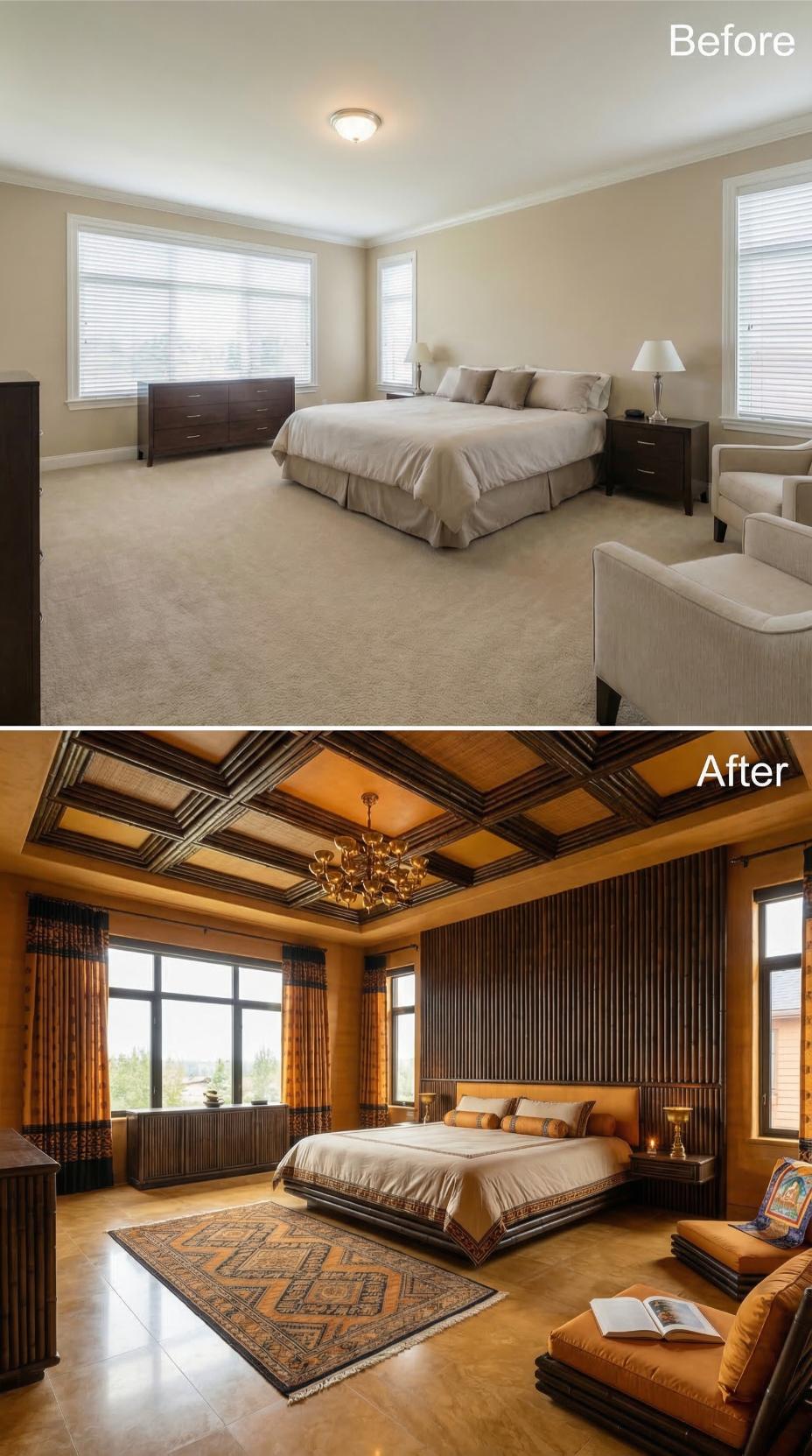
Bamboo poles, stained nearly black, form a coffered lattice across the entire ceiling, with warm amber plaster filling each recessed panel between the grid lines. A brass chandelier with globe-shaped cups hangs at center. Below it, a low platform bed sits against a floor-to-ceiling ribbed dark wood headboard wall, framed by burnt-orange drapes with geometric banding at the hem. A hand-knotted wool rug in rust, navy, and camel anchors the stone tile floor.
Why the Ceiling Grid Works Harder Than the Chandelier
Bamboo used structurally in a ceiling grid carries a tensile strength comparable to many hardwoods, which is why the lattice here reads as architectural rather than decorative. The amber plaster infill between each beam section bounces candlelight downward and inward, creating a glow that feels generated by the room itself rather than a single fixture. Spacing the bamboo poles at uniform intervals also introduces rhythm without requiring any additional pattern on the walls or floor.
Reclaimed Wood Planks and Exposed Ceiling Beams Buried a Beige Carpet Box
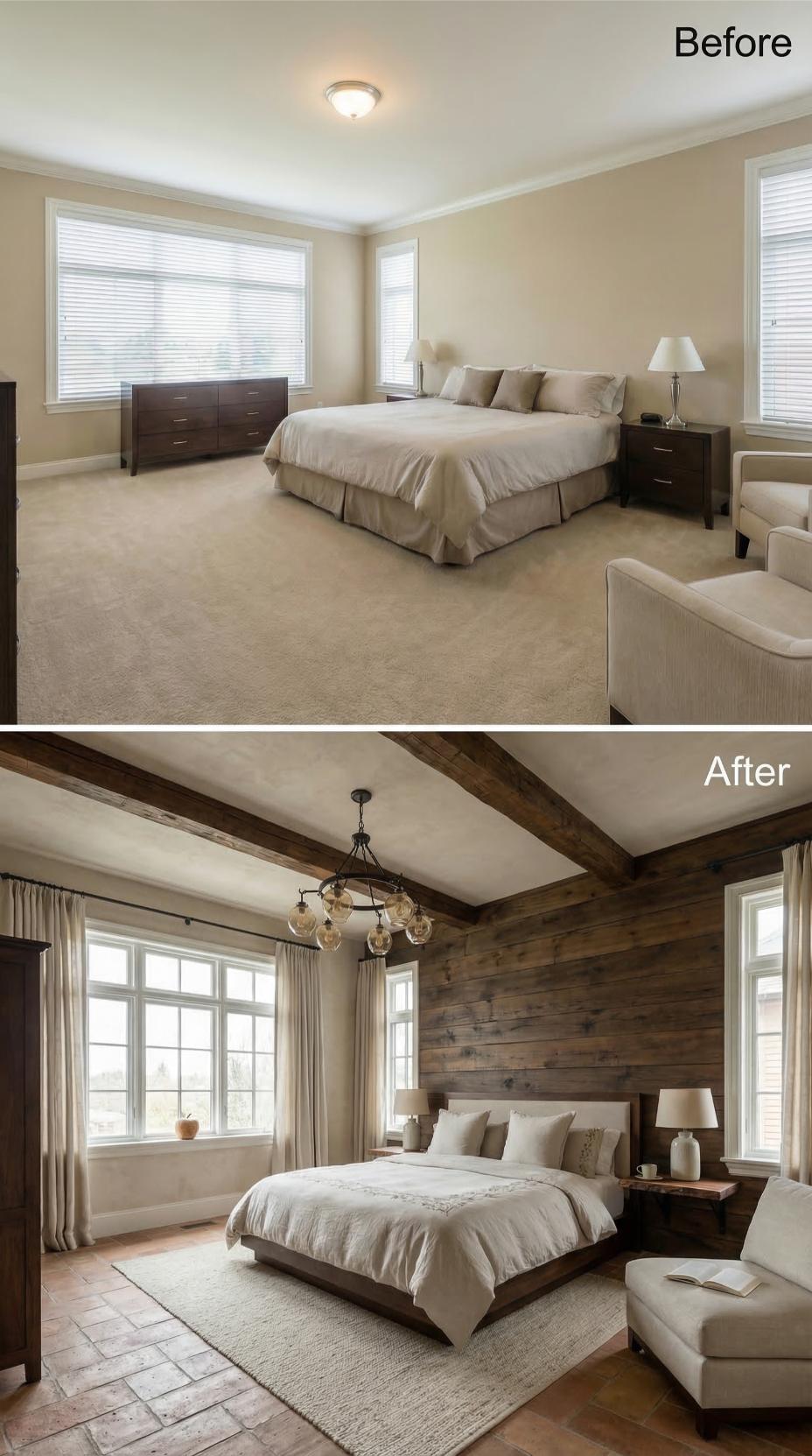
Dark-stained reclaimed wood planks run horizontally across the entire headboard wall, their grain variation and knot marks doing the visual work that no paint color could replicate. Above, raw timber beams angle across a vaulted ceiling, meeting at a wrought-iron chandelier with amber glass globe shades. The carpet came out; terracotta tile went in, partially covered by a flat-weave wool rug in natural ivory.
Linen drapes hang from black rod hardware at full ceiling height, a detail that extends the sightline upward and makes the vaulted ceiling read even taller. Ceramic table lamps with matte white bases sit on live-edge side tables, grounding the earthy palette without competing with the plank wall behind them.
Moroccan Muqarnas Ceiling and Stone-Striped Headboard Wall Buried Beige Carpet
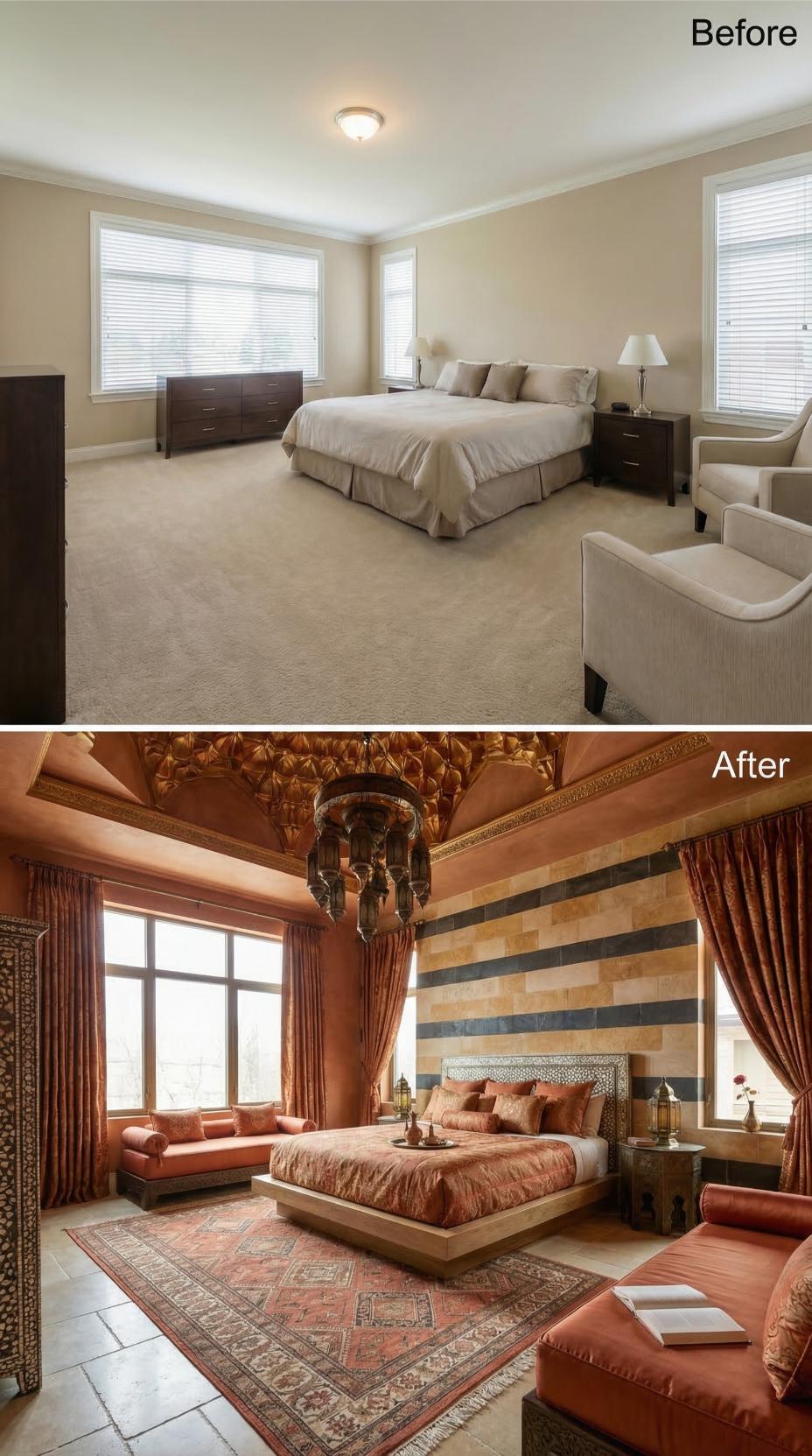
Terracotta-plastered walls, rich copper-toned silk drapes, and a hand-knotted Persian rug in faded rose anchor the room while a gilded muqarnas ceiling with a wrought-iron multi-lantern chandelier commands everything above it.
Walnut Platform Bed and Linear Pendant Replace Beige Carpet and Table Lamps
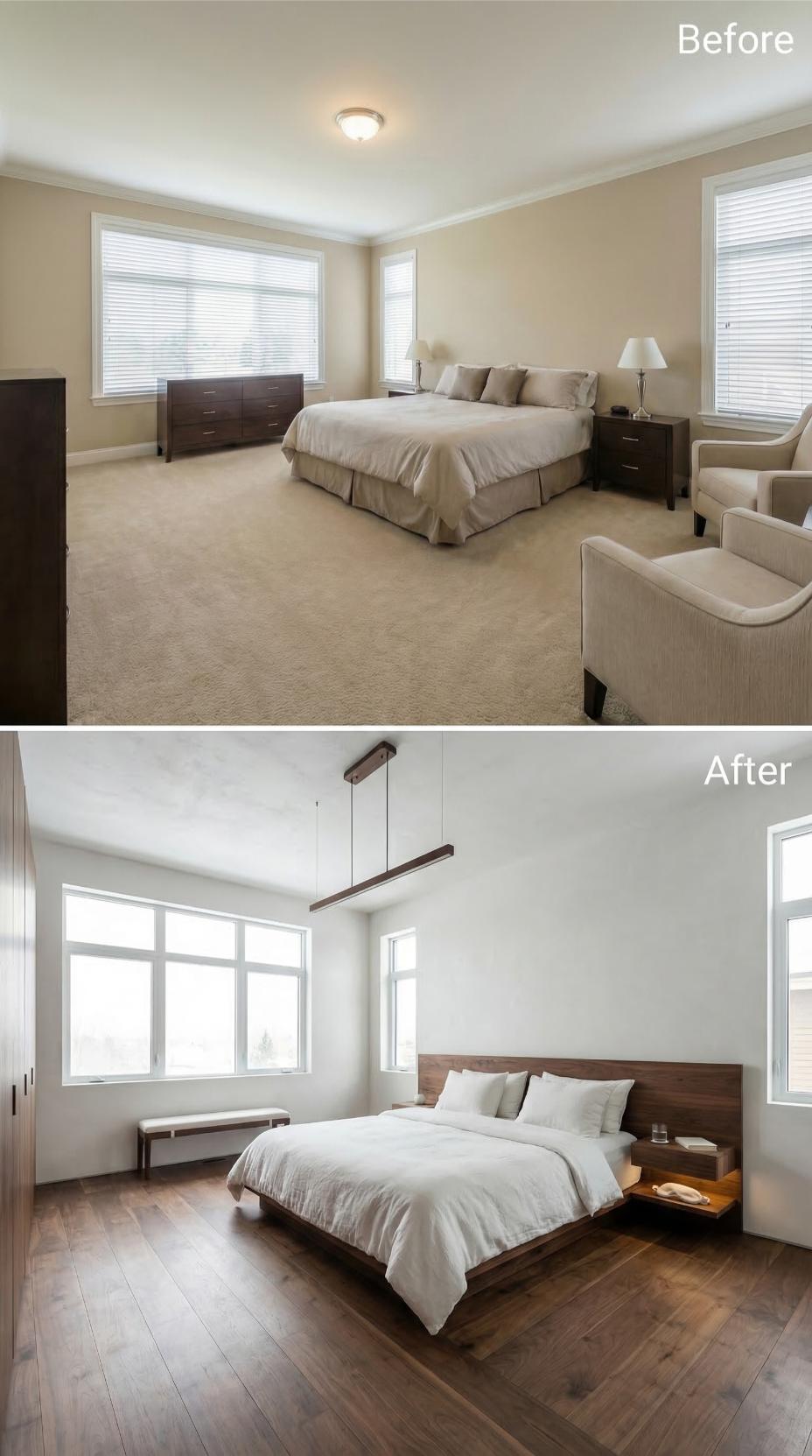
White walls and wide-plank walnut hardwood floors took over where beige carpet and a flush-mount ceiling light once set the tone. The bed frame is a low-profile walnut platform with integrated floating nightstands that glow amber from beneath, replacing the dark dresser and paired table lamps. A bronze linear pendant with two parallel tubes hangs centered above the bed. A slim upholstered bench sits at the footboard without crowding the floor plan.
Reclaimed Beam Coffers and Lavender Velvet Canopy Replaced Beige Carpet and a Flush Mount
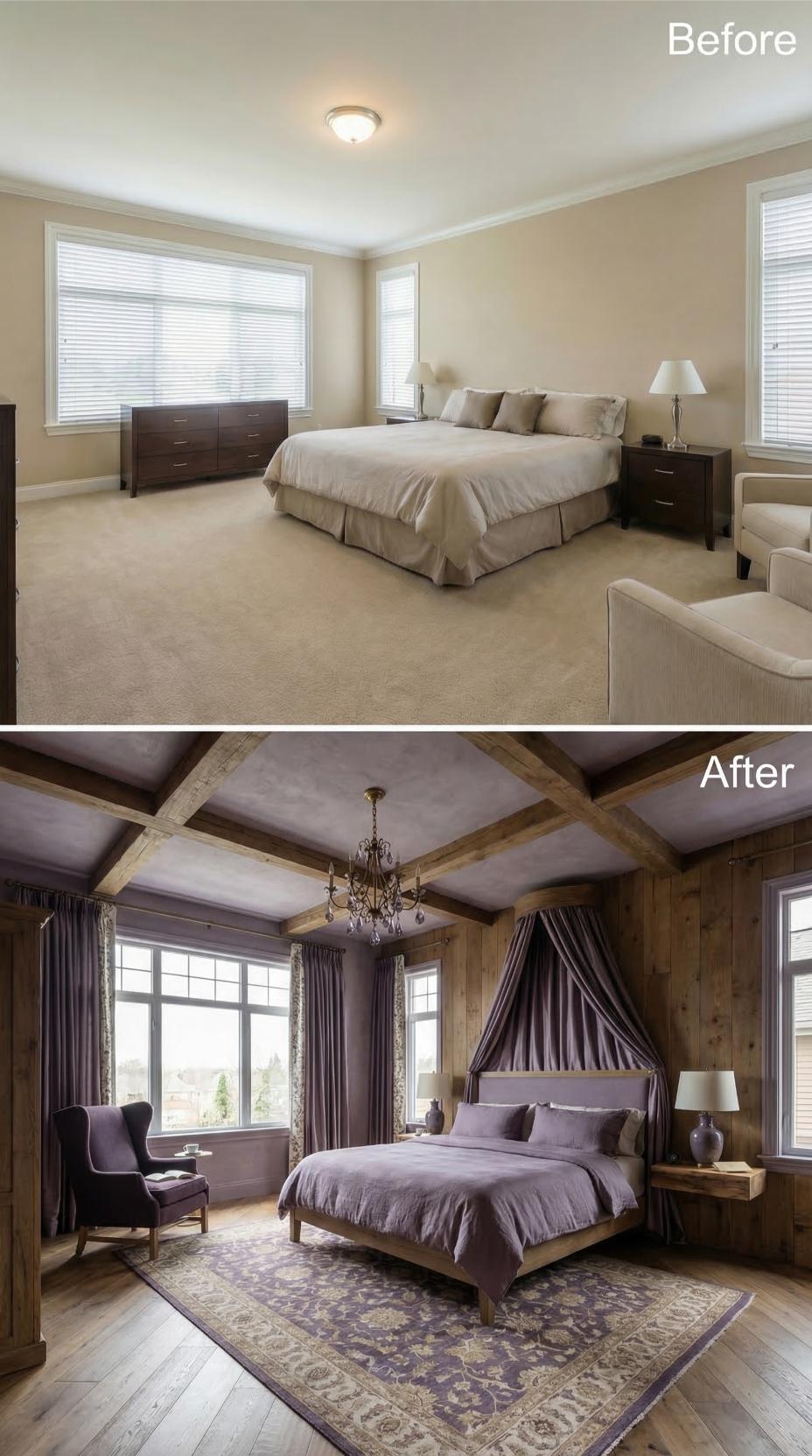
Rough-sawn timber beams cross the ceiling in a grid pattern, left in their natural honey-and-grey tones rather than stained to match the knotty pine wall planks below. A wrought iron chandelier with small candle-style arms drops from the center intersection, casting uneven light across the plaster panels between each beam. The palette lands somewhere between dusty mauve and grey-lilac, running through the upholstered headboard, the linen duvet, the velvet canopy drape, and the oversize floral area rug in one continuous thread.
Two floating nightstands in raw oak bracket the bed without hardware or aprons, keeping the lower half of the room visually spare against the wood-plank walls. A high-backed wingchair in the same muted purple anchors the near corner. Layered curtains combine a sheer botanical print with solid charcoal-violet panels, a pairing that controls light without requiring blackout shades.
Limestone Block Walls and a Medallion-Stamped Tray Ceiling Replaced Beige Carpet
🔥 Would you like to save this?
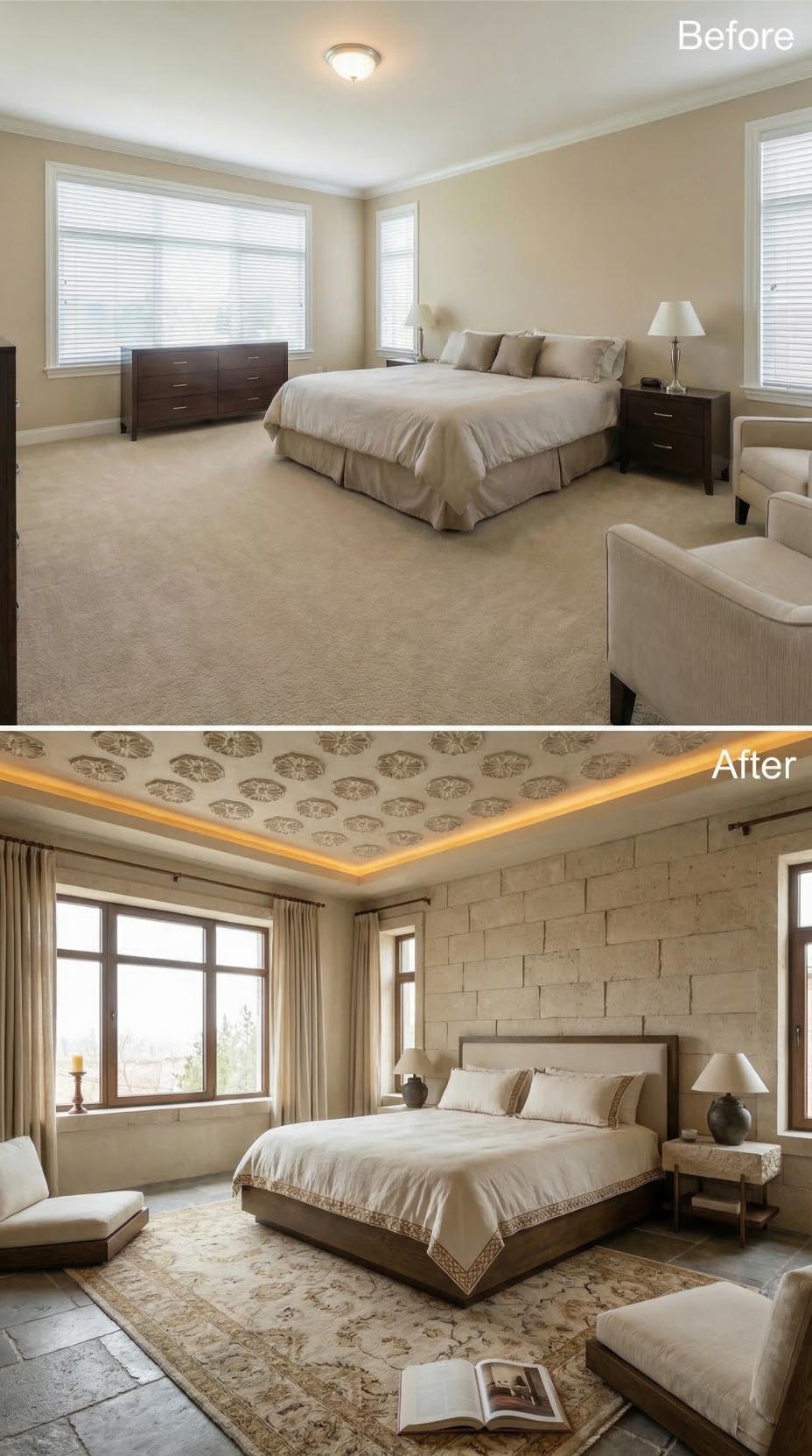
Limestone block cladding covers the entire headboard wall floor to ceiling, its rough-cut joints giving the room a weight that painted drywall never could. The tray ceiling is stamped with repeating rosette medallions in a tone-on-tone cream finish, lit from behind by amber cove lighting that pools warmth across the pattern.
The flooring shifts from carpet to large-format slate tile, grounded further by a wool area rug with a scrolling floral field in ivory and warm brown. The walnut bed frame carries a Greek key border along the duvet edge, picking up the geometric vocabulary of the stonework. Low-profile upholstered seating sits at the foot of the bed without crowding the layout.
Floral-Painted Ceiling and Dark Mahogany Four-Poster Replaced Beige Carpet and a Flush Mount
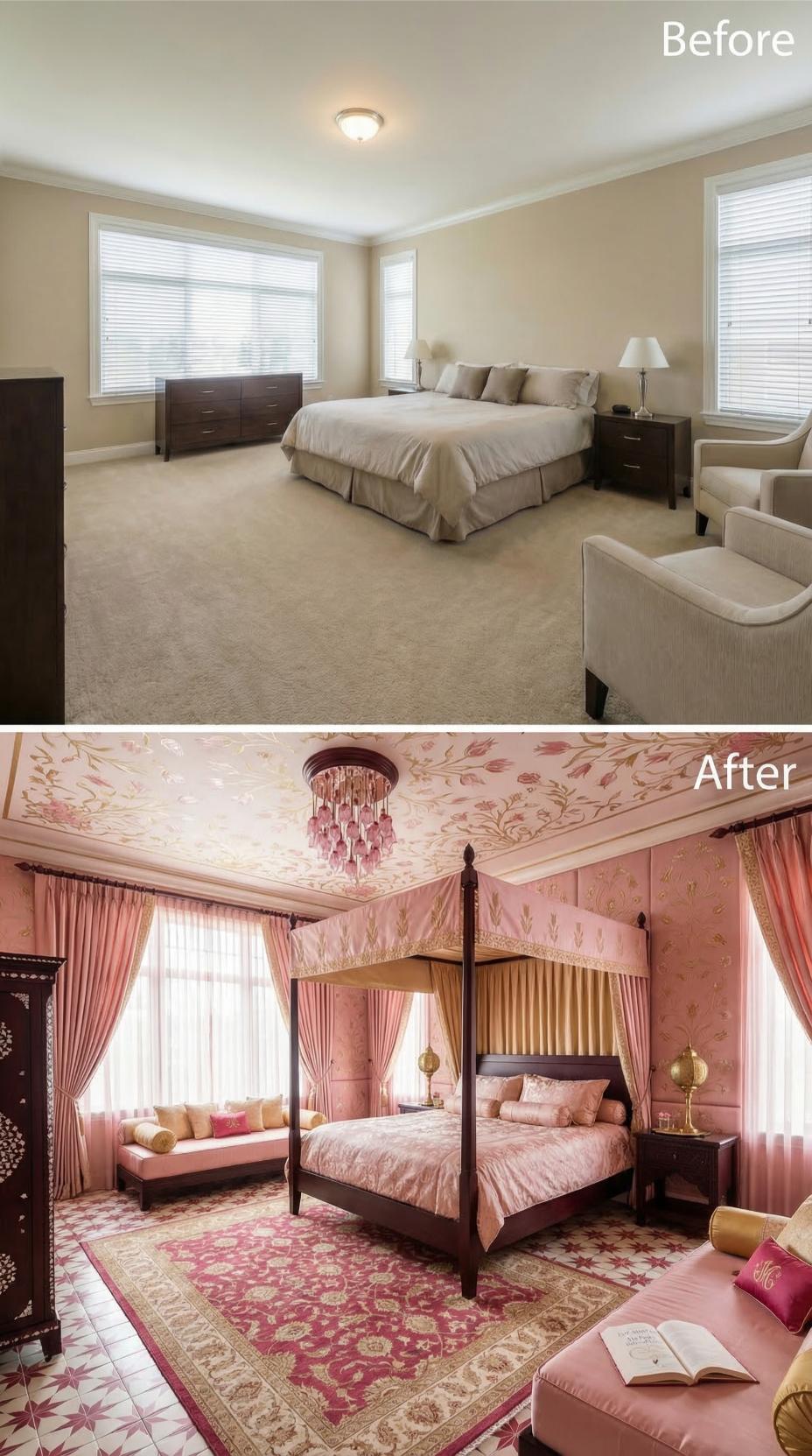
Hand-painted tulip and vine motifs cover both the ceiling and pink wallpaper in a continuous botanical pattern, while a mahogany four-poster bed anchors the room beneath a crystal-drop flush chandelier in deep rose and gold tones.