🔥 Would you like to save this?
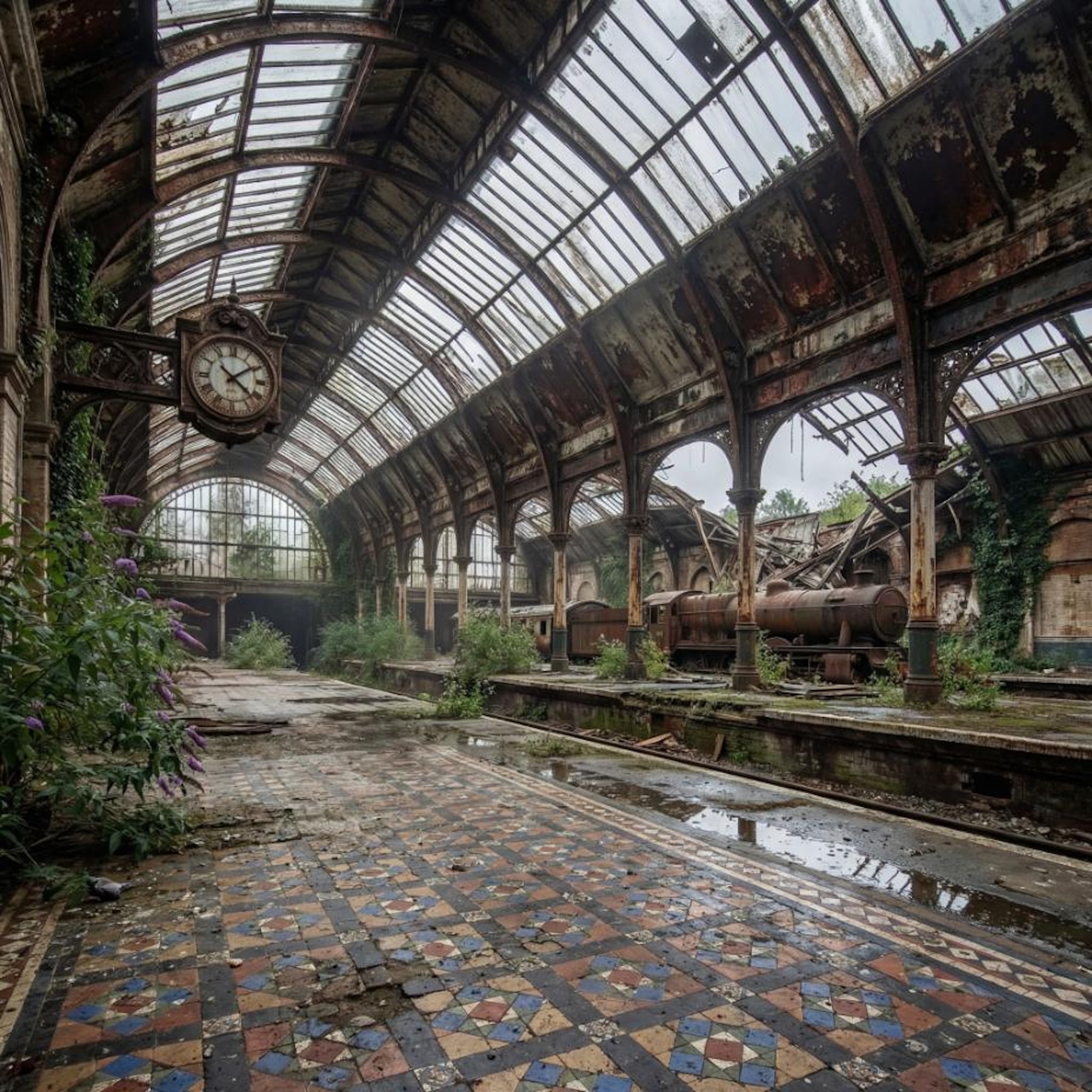
Crumbling platforms, rusted ironwork, and vaulted ceilings blackened by decades of neglect — these are the raw materials that we have chosen to work with conceptually rather than demolish. Victorian train stations that have sat abandoned for generations have the potential to be private residences, and the results are unlike anything built from the ground up. The original bones, the arched windows, the ornate brickwork, the sheer scale of these structures, do most of the heavy work. What follows is a collection of 34 before-and-after looks at homes AI carved from the shells of these forgotten stations. Some conversions preserve the spirit of the original design. Others gut the interior entirely and pour modern living into a historic frame. All of them raise the same question: why build new when something this structurally and architecturally rich is already standing there, waiting?
In order to come up with the very specific design ideas, we create most designs with the assistance of state-of-the-art AI interior design software. Also, assume links that take you off the site are affiliate links such as links to Amazon. this means we may earn a commission if you buy something.
From Rusted Train Hall to Vaulted Open-Plan Living
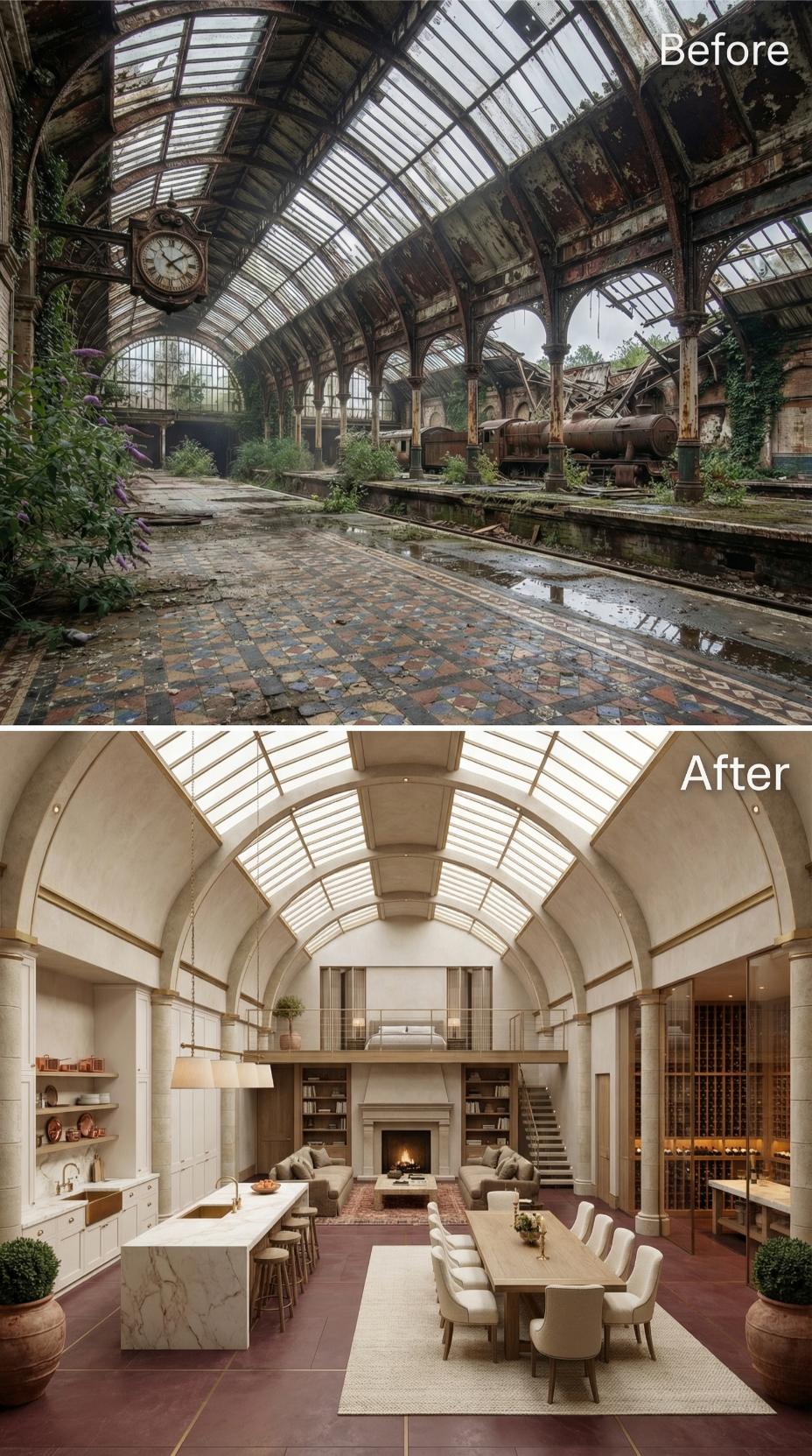
Restoration preserved the Victorian station’s barrel-vaulted glass roof, now cleaned and reglazed to flood the interior with diffused natural light. Below it, a marble-topped kitchen island with brass-finish pendants anchors the left side, paired with cream cabinetry and a farmhouse copper sink. A long dining table in pale oak seats ten on linen upholstered chairs, while a fireplace flanked by built-in bookshelves defines the living zone beyond. To the right, a temperature-controlled wine wall glows amber behind glass panels, and an open mezzanine bedroom with iron railings sits above the staircase.
Crumbling Platform Tiles Buried Under Midnight Black Marble and a Lap Pool
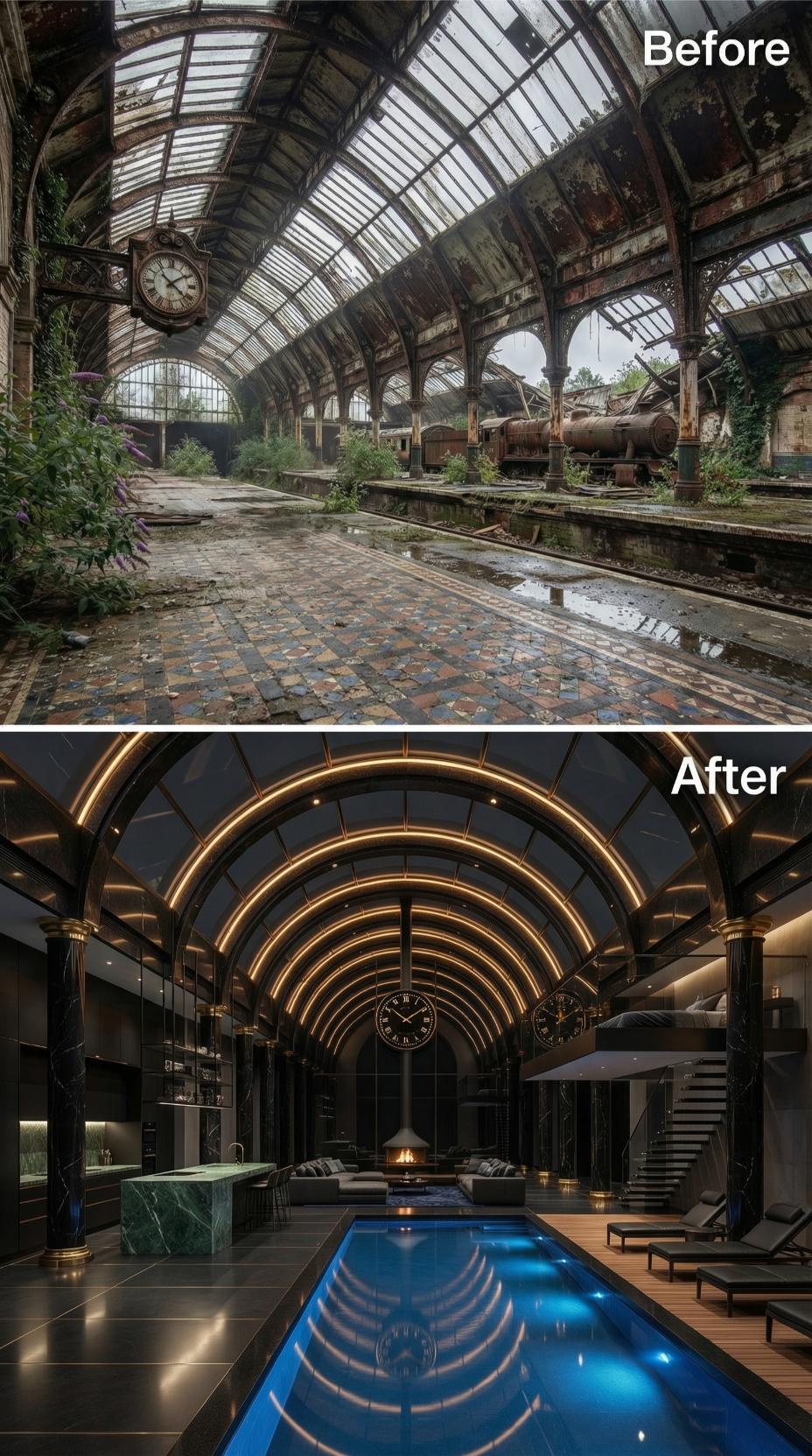
Where a rusted locomotive once sat idle on exposed tracks, a lap pool now runs the full length of the nave, its water lit electric blue against black polished floor tiles. The arched steel ribs overhead are lined with warm amber LED strip lighting, tracing each curve in concentric rings that reflect off the pool surface below. Gold-capped columns flank the space on both sides.
A verde green marble island anchors the kitchen zone to the left, its veining visible even at distance. Behind it, open shelving in matte black frames a bar area. The original station clock hangs centered beneath the apex of the arch, now backlit, its Roman numerals reading against dark iron. A floating staircase with open wood treads climbs the right wall toward a mezzanine sleeping level.
Overgrown Platform Bones Recast as a Terracotta and Marble Open-Plan Residence
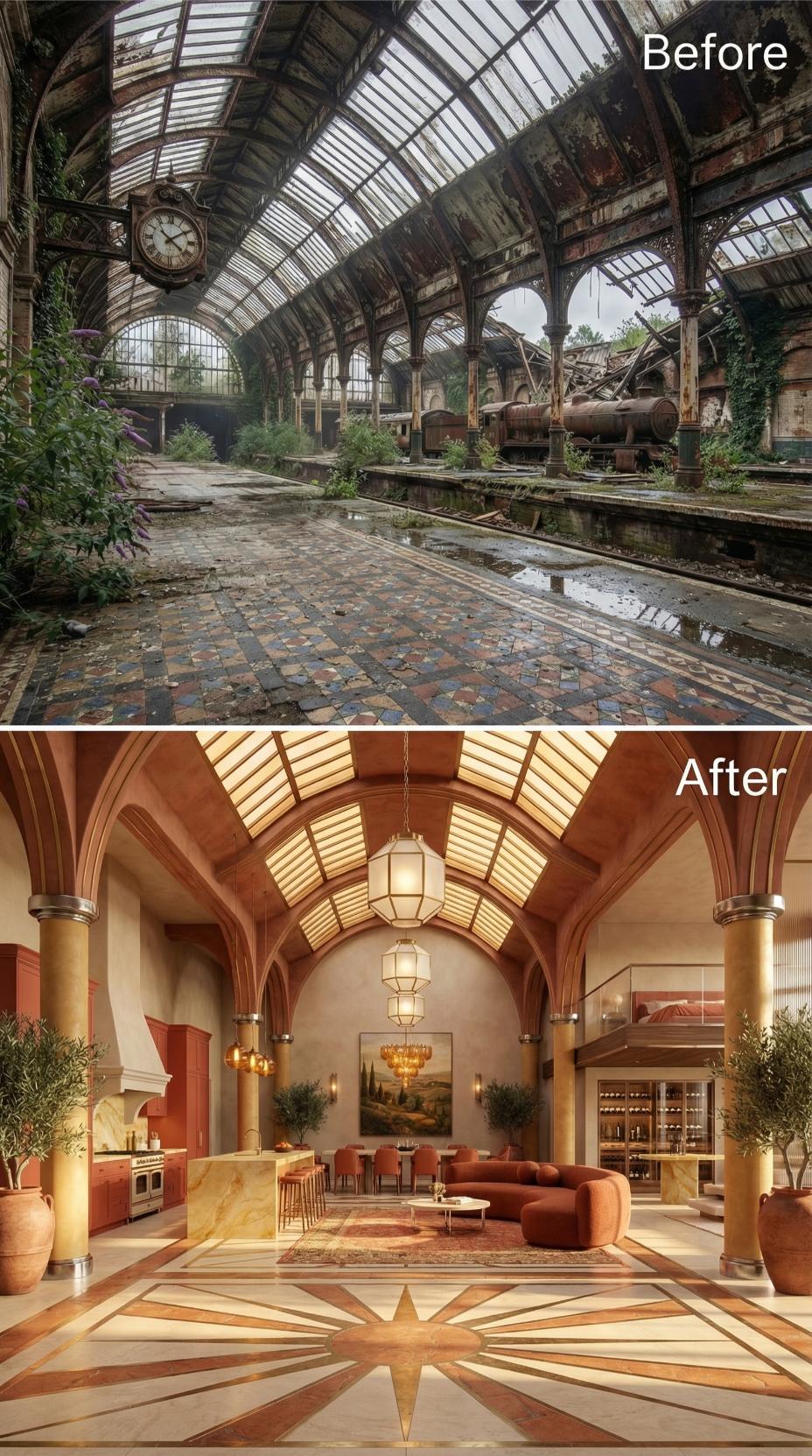
Rust-streaked ironwork and fractured Victorian encaustic tiles gave way to a vaulted great room anchored by a compass-star floor inlaid in cream and terracotta marble. The arched ceiling ribs were retained and refinished, now backlit through translucent roof panels that flood the space with diffused amber light. Pendant lanterns in frosted glass and brass drop from the apex of the vault at staggered heights.
The kitchen runs along the left wall with terracotta-painted cabinetry, a marble waterfall island, and what appears to be a professional range in stainless. A curved sofa in burnt sienna velvet grounds the living zone, flanked by potted olive trees in oversized clay urns. A wine display unit occupies the far right, with open shelving and warm cabinet lighting, while a sleeping loft sits visible above.
Zen Minimalism Poured Into the Shell of an Old Train Hall
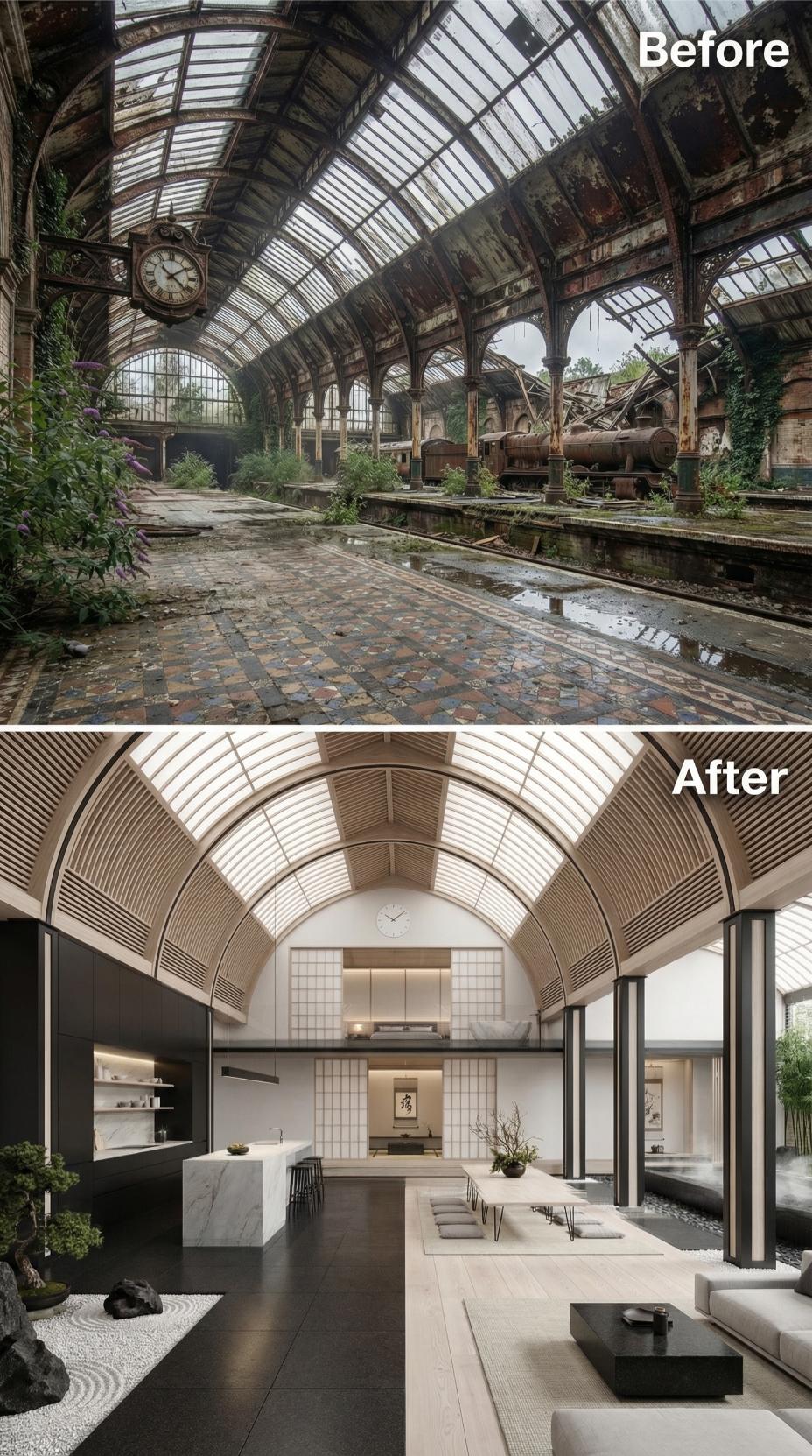
The arched glass roof survives intact, now backed by slatted timber panels that diffuse light across white plaster walls. A mezzanine level holds the sleeping quarters behind shoji-style screens, while the ground floor splits between a marble-topped kitchen island with black steel stools and a sunken living area anchored by a low black lacquer table.
A dry zen garden with raked white gravel and volcanic rock sits at the far left, balanced on the opposite side by what appears to be a soaking pool screened with floor-to-ceiling glazing. The original station clock remains mounted on the rear wall, now framing a scroll of kanji calligraphy directly below it.
Try This: Replicate the mezzanine bedroom effect in a high-ceilinged space by installing shoji-style rice paper panels as a room divider rather than a solid wall. The translucency keeps the upper level visible from below while still defining a private zone. Pair it with a low platform bed in natural oak to maintain the horizontal emphasis of the overall design.
Greek Island Palette Poured Into Victorian Iron and Glass
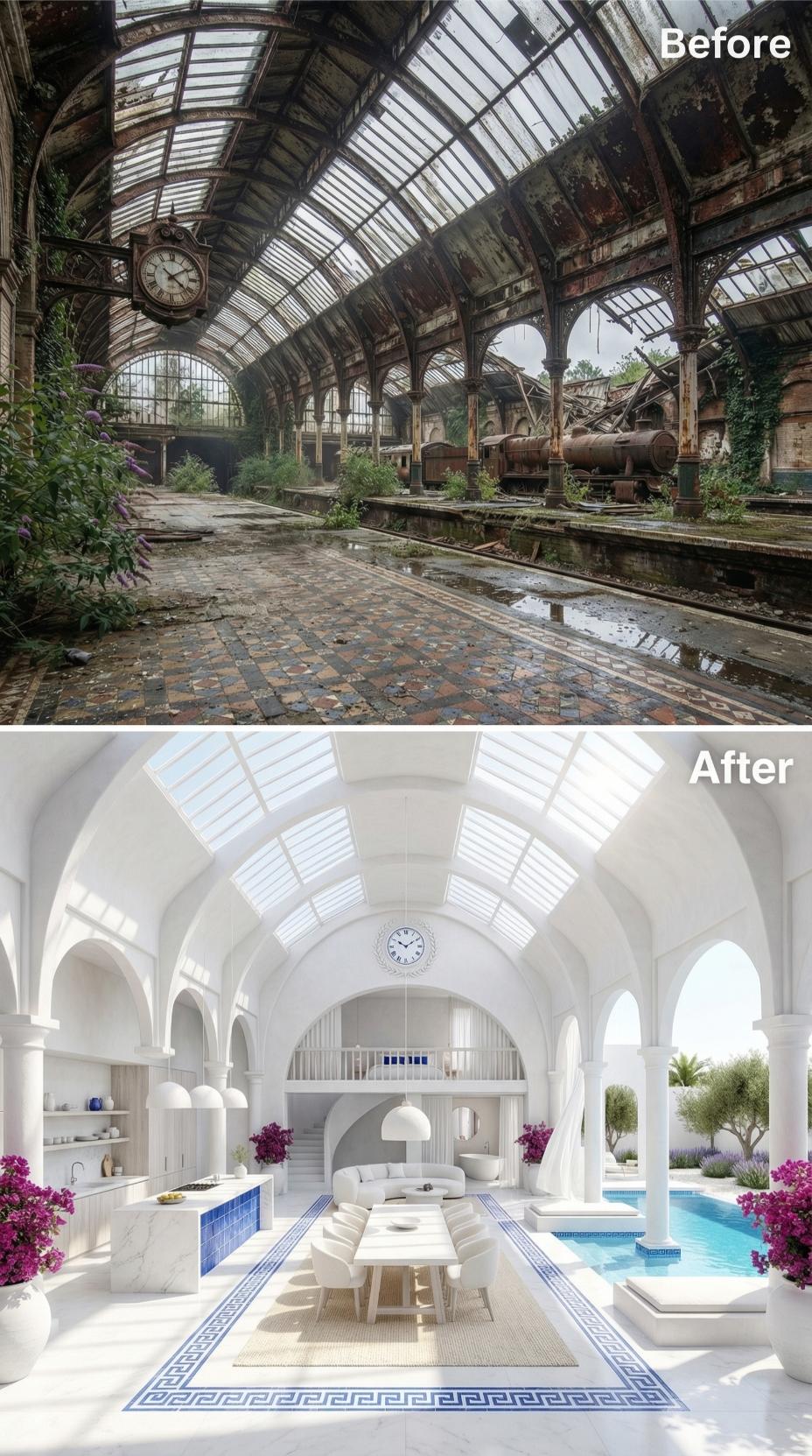
Architects kept the barrel-vaulted skylight roofline intact and plastered every surface in matte white render, erasing a century of rust and decay. The original station clock remains mounted at the far arch, now centered above a mezzanine balcony with white-painted timber balusters. Blue-and-white Greek key tilework runs the length of the floor, anchoring a dining table in bleached oak surrounded by bouclé chairs.
The kitchen island opposite features cobalt blue cabinetry tiles beneath a white marble countertop, while pendant dome lights in matte white hang at uniform intervals. Bougainvillea in magenta pots lines the colonnade transition to an outdoor pool, its water a sharp cerulean against white rendered columns.
Budget Tip: Sourcing Greek key border tiles in ceramic rather than stone can cut flooring costs by 40 to 60 percent while delivering nearly identical visual impact at scale. Many tile manufacturers offer the pattern in peel-and-stick vinyl versions suited to rental properties or temporary installations. Ordering a single sample sheet before committing to a full room quantity helps confirm grout line width and color match under your specific lighting conditions.
Victorian Iron Vaulting Kept Intact Above an All-White Gallery-Style Living Space
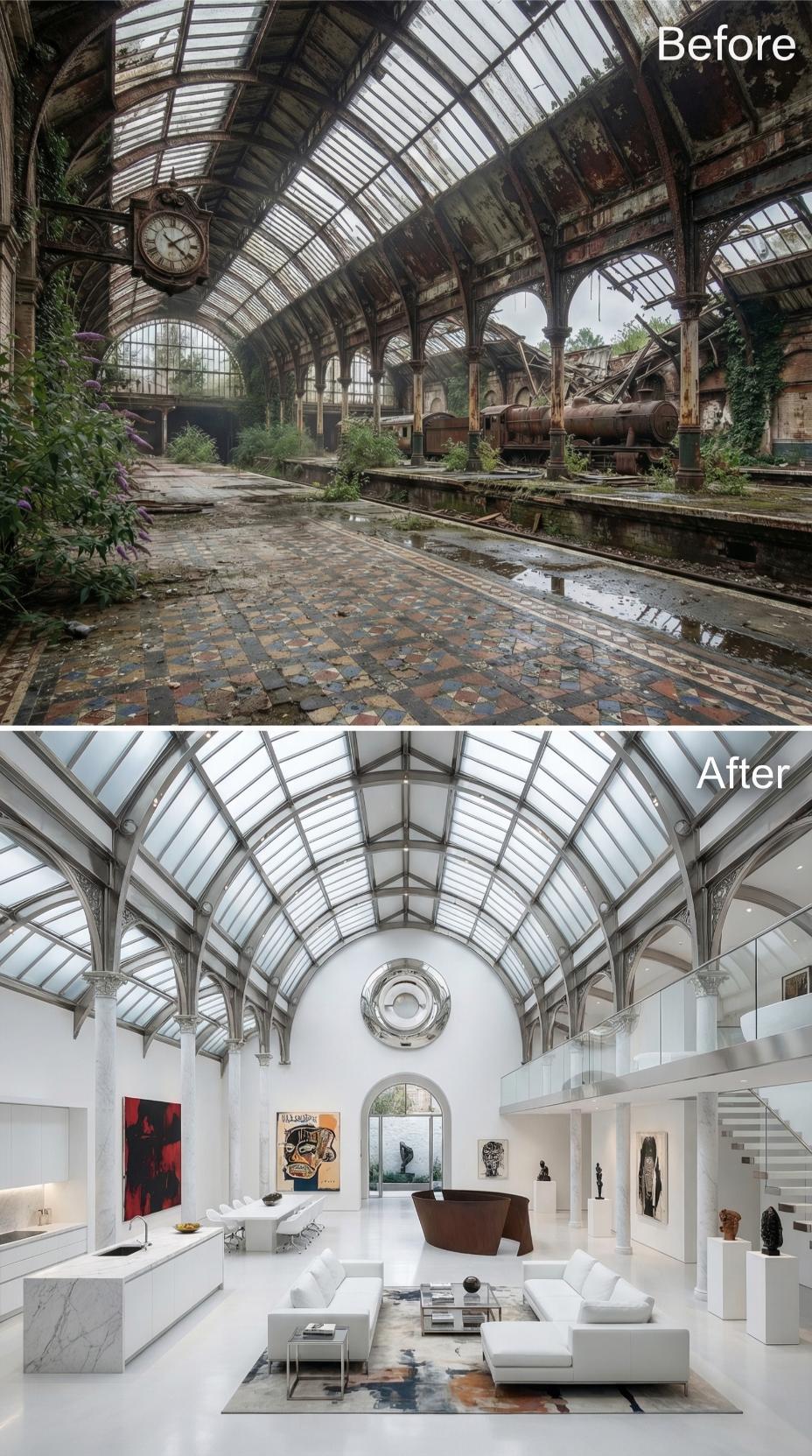
Barrel-vaulted steel ribs and a fully glazed roof dominate the upper volume, left exposed and cleaned back to bare metal rather than concealed behind drywall. Natural light pours through the glass panels along the entire arch, flooding polished concrete floors below without a single ceiling fixture doing the heavy work. White plaster infill walls sit between the original cast-iron columns, and a glass-panel mezzanine with a floating steel staircase runs along the right flank.
At floor level, the seating group is built around low-profile white linen sofas arranged on a cowhide rug. A slab-front marble kitchen island in Calacatta veining anchors the left side. Original artwork on canvas, including what reads as a Basquiat-style mixed-media piece, breaks the white palette with red and black pigment. A dark oval tub placed mid-room functions as both furniture and focal point.
- Retaining original cast-iron columns rather than cladding them preserves structural character and cuts finishing costs significantly
- Positioning large-format art at eye level along a white plaster infill wall creates gallery rhythm without built-in display systems
- A freestanding tub placed in an open living volume works best on sealed concrete or large-format stone tile that can handle incidental water exposure
Jungle-Draped Biophilic Glass Vaulting Over a Teak Dining Hall and Indoor Pool
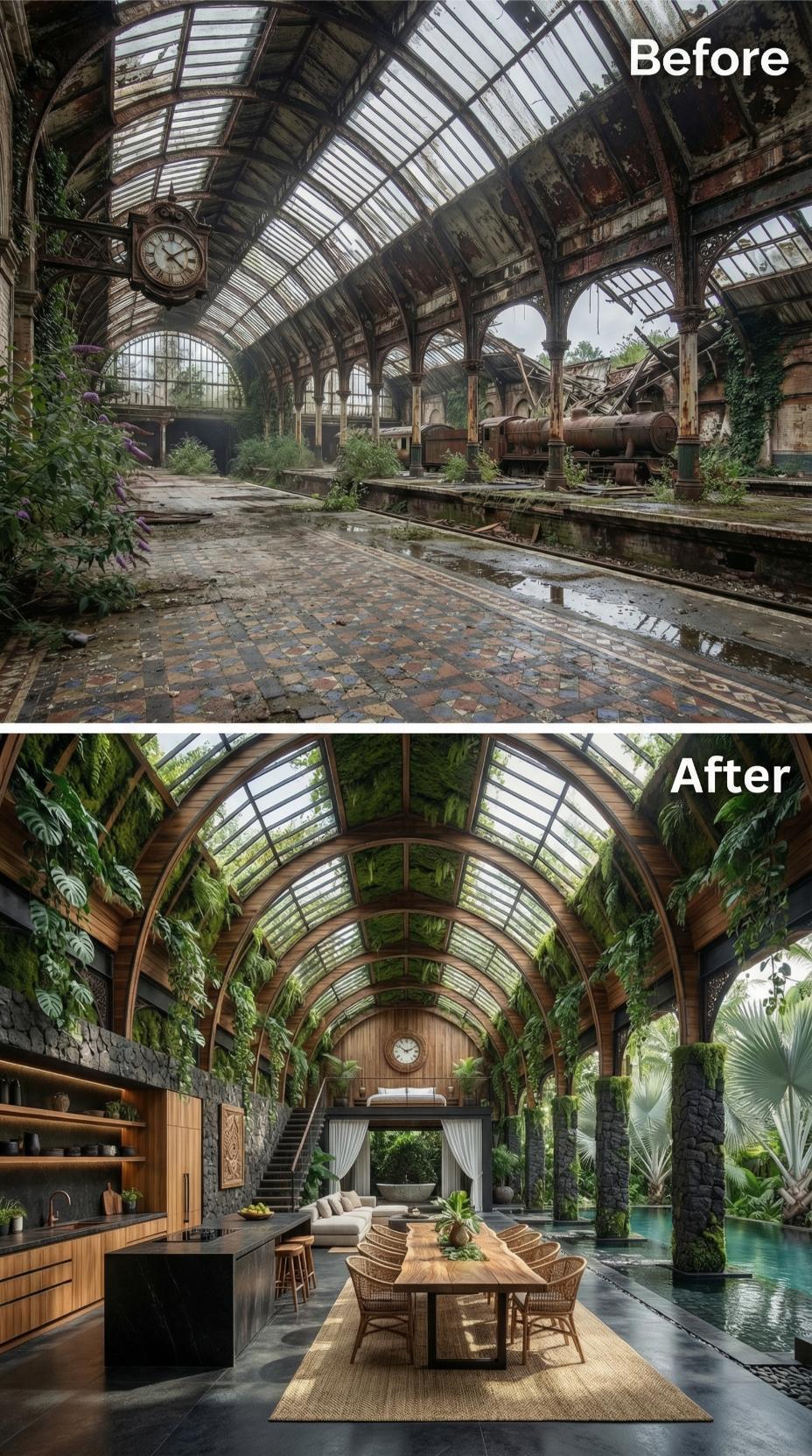
Live moss columns flank a teak dining table set on a woven jute rug, while monstera and fan palms climb the original barrel arch from platform level to glazed ridge. The kitchen island runs in blackened stone with open walnut shelving behind it, and a pool cuts along the right edge of the floor plan.
The Psychology Behind This: Surrounding a dining space with dense vertical greenery on multiple sides triggers a subconscious sense of enclosure and safety, the same psychological response humans have to sheltered clearings in nature. That feeling of protected openness is why rooms like this read as deeply restful rather than overwhelming, even at this scale.
Bleached Oak and Marble White Fill a Victorian Iron Shell
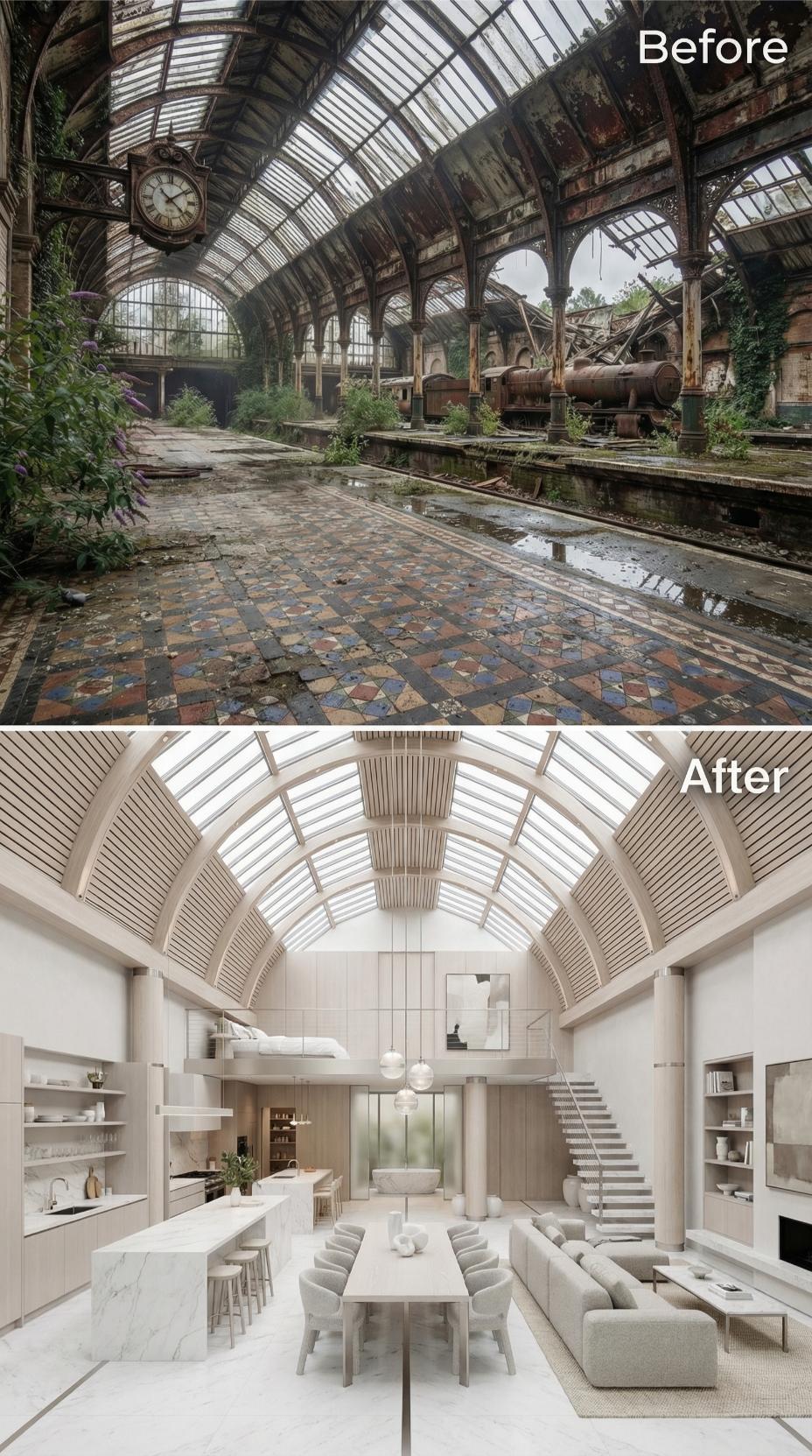
Slatted timber panels line the barrel vault’s lower ribs, softening the raw steel armature overhead without concealing it. Natural light pours through the restored ridge glazing and falls across a marble island with a waterfall edge, a dining table in pale ash veneer, and a sofa upholstered in oatmeal boucle fabric. A floating staircase with cantilevered treads climbs the right wall, its open risers keeping sightlines clear across the full length of the hall.
A loft bedroom sits above the kitchen zone, accessible via that staircase and separated from the volume below by nothing more than a low parapet. Pendant lights in frosted blown glass hang at three different heights above the dining table, anchoring the vertical scale without competing with the roofline. Every surface reads within a narrow warm-white register, which makes the arched ironwork stand out as the only true contrast in the room.
A floating staircase with cantilevered treads climbs the right wall, its open risers keeping sightlines clear across the full length of the hall.
Calcutta Marble Island, Cognac Leather, and a Glass Vault Reclaimed from Ruin
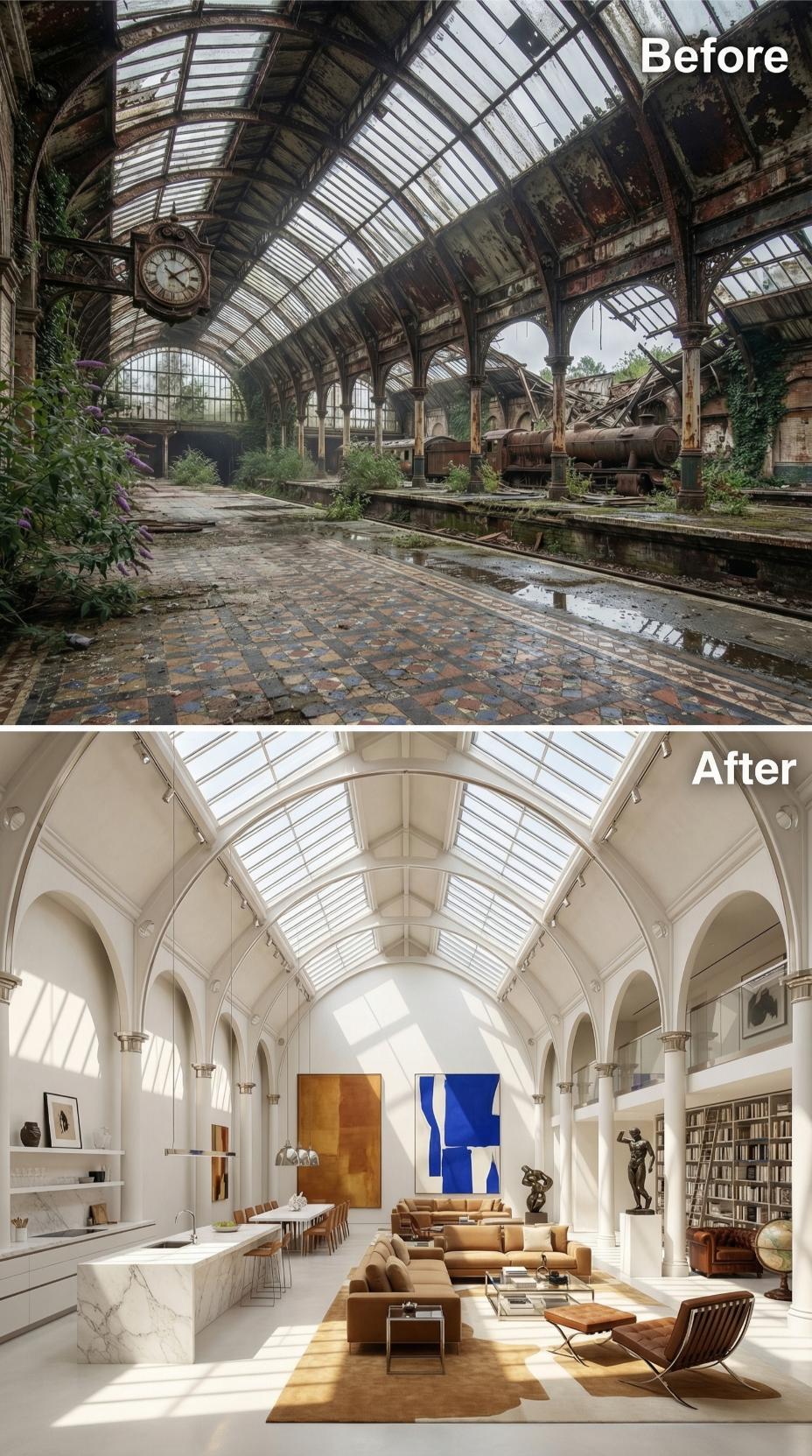
Bleached white plaster now coats every arch and column that once held up a collapsing iron-and-glass train hall roof. The barrel skylight was retained and reglazed, flooding the polished concrete floor with bands of natural light that shift across a Calcutta marble island bench anchored to a sleek white kitchen run along the left wall.
Cognac-toned leather sectional sofas define a living zone anchored by glass-and-steel coffee tables, while a large-format blue-and-white abstract canvas pulls color away from the otherwise neutral palette. Fluted columns frame a library wall packed with hardcover volumes, accessed by a rolling ladder on a brass rail. A bronze figurative sculpture sits on a plinth between zones, grounding the space without additional ornamentation.
A bronze figurative sculpture sits on a plinth between zones, grounding the space without additional ornamentation.
Tuscan Warmth Poured Into Victorian Iron Bones
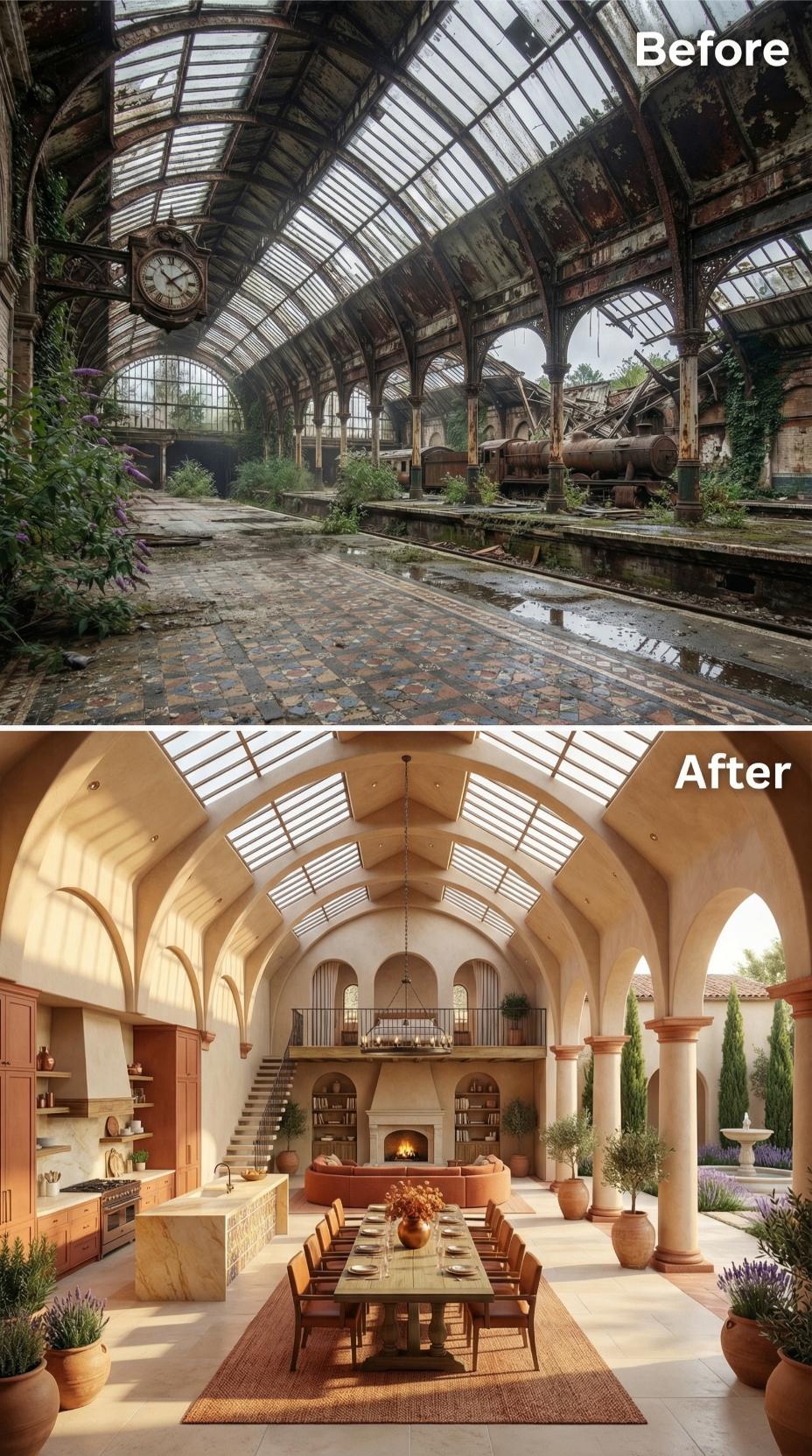
Plastered barrel arches replace the rusted steel ribs of the original train hall, their sand-colored stucco finished to a matte Venetian texture that pulls afternoon light down through the restored ridge skylights above. A long slab dining table in vein-cut travertine anchors the central floor plan, surrounded by cognac leather side chairs on a flatweave jute rug. The kitchen to the left runs terracotta-pink shaker cabinetry paired with an apron sink and open pine shelving.
A mezzanine level with iron balustrade rail overlooks a built-in bookcase flanking a limestone fireplace surround. Columns of pale Roman travertine mark the open loggia edge, framing cypress trees and a stone fountain beyond. Terracotta pots with lavender and olive trees run the interior perimeter, grounding the volume without breaking sightlines across the full nave.
In The Details: Salvaging the original ridge-line geometry of a Victorian station roof and converting it into a continuous skylight band is one of the most cost-effective ways to introduce passive solar gain across a deep floor plate, reducing artificial lighting loads significantly during daylight hours. In adaptive reuse projects, retaining the nave proportions rather than subdividing the internal volume with full-height partition walls also preserves acoustics that solid rooms cannot replicate.
Rusted Locomotive Hall Rebuilt Around Hardwood, Cacti, and an Indoor Lap Pool
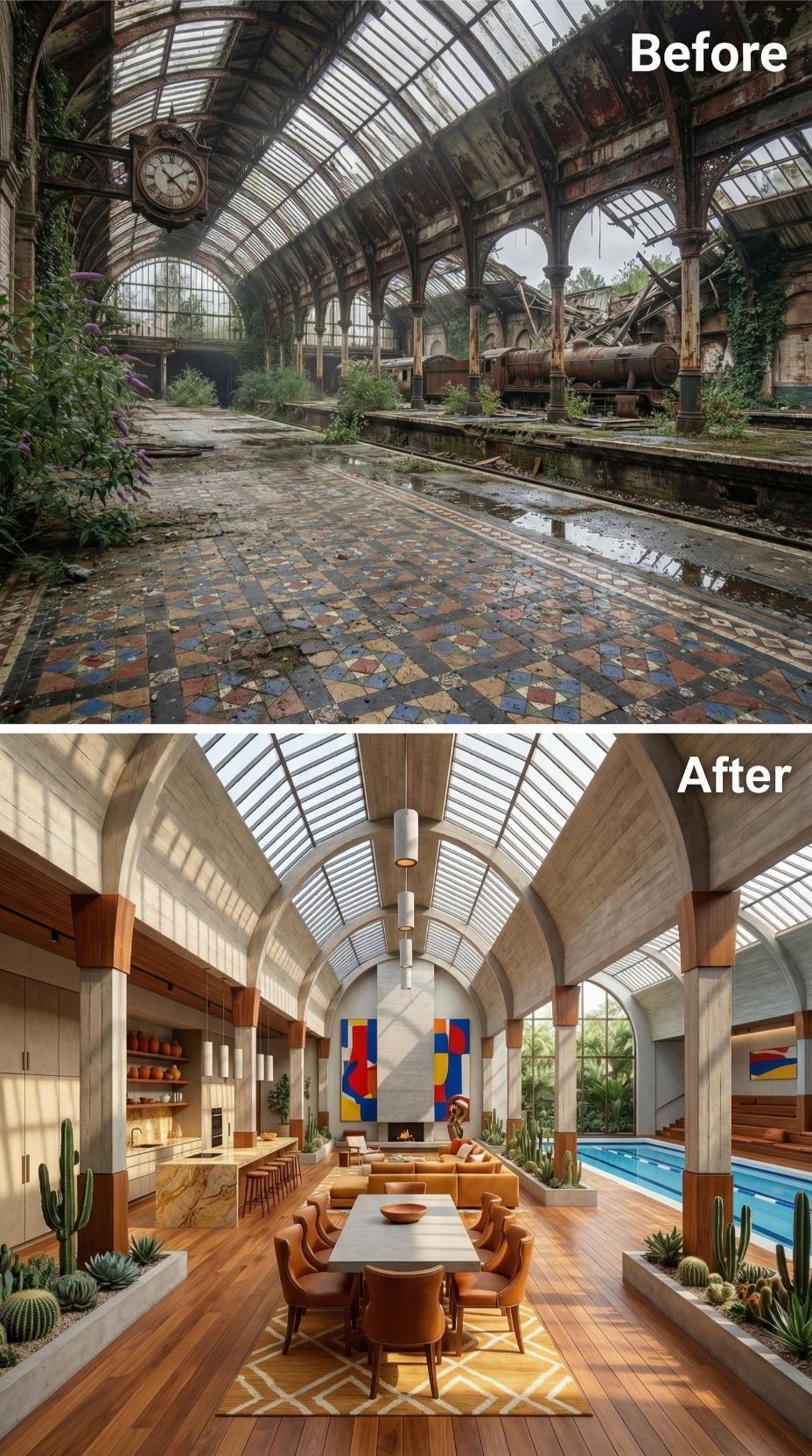
Warm-toned hardwood planks run the full length of what was once a derelict platform, now anchored by a concrete dining table surrounded by cognac leather chairs. Desert plantings, including tall columnar cacti and barrel cacti in built-in stone planters, line both sides of the nave. A restored barrel-vault glazed roof floods the space with natural light. At the far end, bold primary-color abstract panels flank a fireplace, while a pool occupies the right wing beneath arched openings.
Common Mistake: Designers often install indoor pools before finalizing the ventilation strategy for the surrounding space, which leads to persistent condensation damage on wood floors and furniture within two to three years. Any pool integrated into a converted structure with a glazed roof requires a dedicated dehumidification system sized specifically for that volume of air, not a standard residential unit. Getting this calculation wrong is one of the most expensive corrections a homeowner can face post-completion.
Sand-Toned Plaster Arches and a Lap Pool Carved Into Victorian Glass-and-Iron Bones
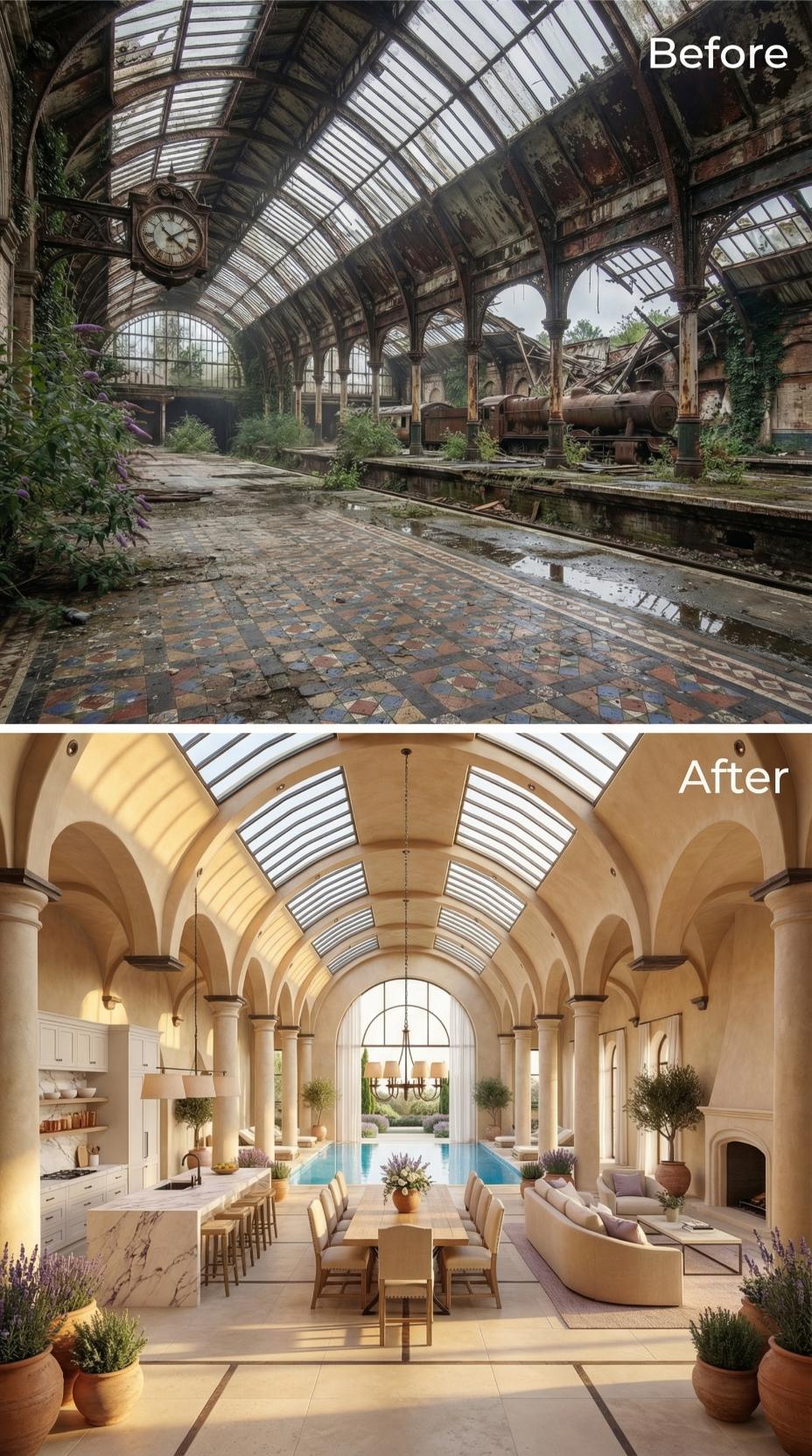
Honey-toned plaster sheathes every arch and column, pulling the barrel vault into a palette that reads more Provençal farmhouse than industrial ruin. A long, bleached-wood dining table seats twelve beneath a pendant chandelier with exposed candelabra arms, flanked by rush-seat side chairs. Beyond it, a narrow lap pool runs the full length of the nave, its blue water anchoring the sightline toward a sheer-curtained arched window. On the left, a white Shaker kitchen runs a marble-top island with turned-leg bar stools.
Color Story: Sand, cream, and dusty lavender form the palette here, with the lavender arriving only through potted plants clustered at floor level rather than through any painted surface. That restraint keeps the warm plaster tones from reading as flat or monochromatic. Using botanicals as the sole color accent is a low-commitment way to introduce seasonal hues without repainting or reupholstering.
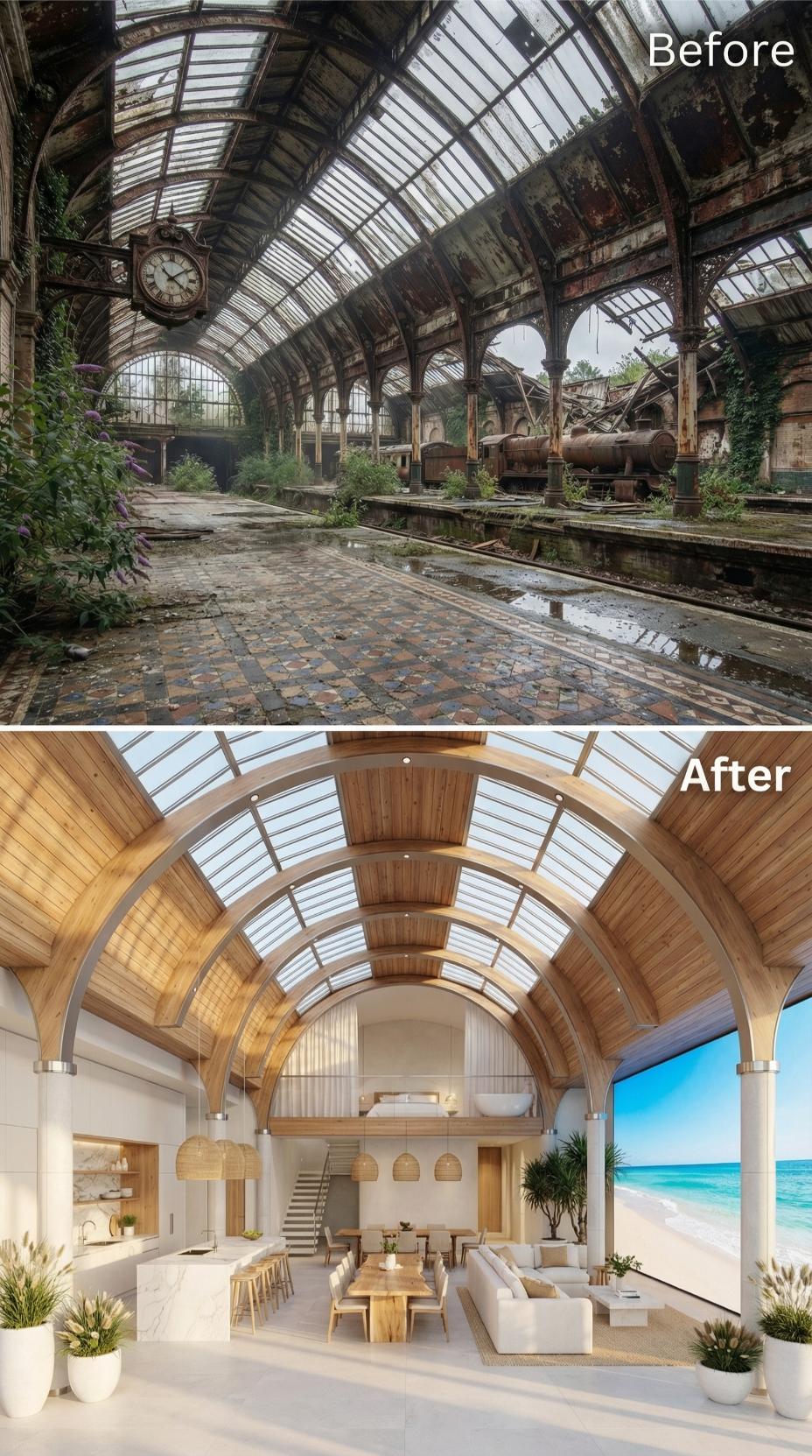
Coastal Light and Warm Cedar Reclaimed from a Collapsed Station
🔥 Would you like to save this?
Collapsed iron and broken glass gave way to cedar-lined barrel vaulting that now frames an unobstructed ocean view.
Warm-grain cedar planks line the restored arch interior, replacing corroded ironwork with tongue-and-groove boarding laid in a radial pattern that draws the eye upward before landing on a continuous glass skylight band overhead. Below, a marble-topped island anchors the kitchen zone, paired with rattan pendant lights and bar stools in natural linen. The dining table sits in solid oak with straight-leg chairs upholstered in oatmeal fabric, positioned directly beneath the apex of the arch. A sectional sofa in white boucle faces a full-width opening where the station’s end wall once stood, replaced entirely by a glazed panel overlooking a turquoise shoreline.
Cognac Curved Sofas and a Central Fire Pit Reclaimed from Victorian Station
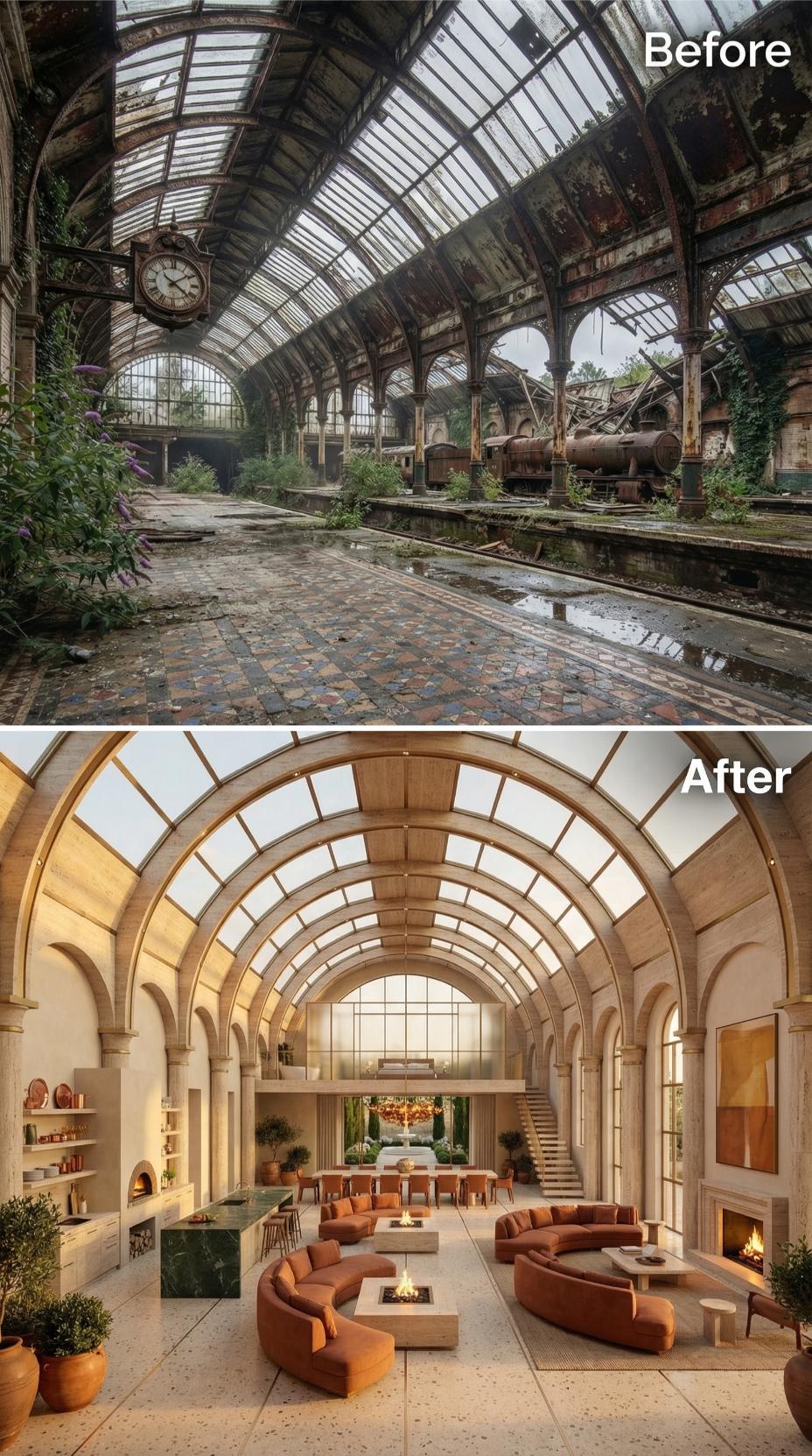
Rust-orange curved sectionals anchor the central living zone, arranged in a near-complete circle around a recessed fire pit table with an open flame. The vaulted glass-and-limestone ceiling runs the full length of the nave, its arched ribs cleaned and relined in pale travertine rather than left as exposed iron. A green marble island defines the kitchen edge to the left, paired with upholstered counter stools in a tawny fabric. Twin fireplaces bookend the room at floor level, framed in smooth plaster surrounds.
A raised mezzanine level at the far end houses what appears to be a sleeping or lounge platform, accessible by a wide stone staircase. Potted olive trees flank the base of that upper level, and a chandelier in amber glass hangs below the mezzanine soffit. Large-format terrazzo tiles cover the floor throughout, their neutral grid anchoring a palette that runs from cream plaster to deep cognac.
Worth Knowing: Circular or curved sectional sofas placed around a central fire feature perform better acoustically in barrel-vaulted spaces than linear arrangements, because they reduce the hard-angle sound bounce that tall parallel walls create. Specifying a fire pit table with a flat surround rather than a raised bowl keeps sightlines clear across the seating circle, which matters significantly in a room this long. Travertine cladding applied over original iron ribs adds thermal mass that helps regulate temperature swings common in glass-roofed structures.
Dark Green Marble and Iron Lacquer Reclaimed from a Derelict Structure
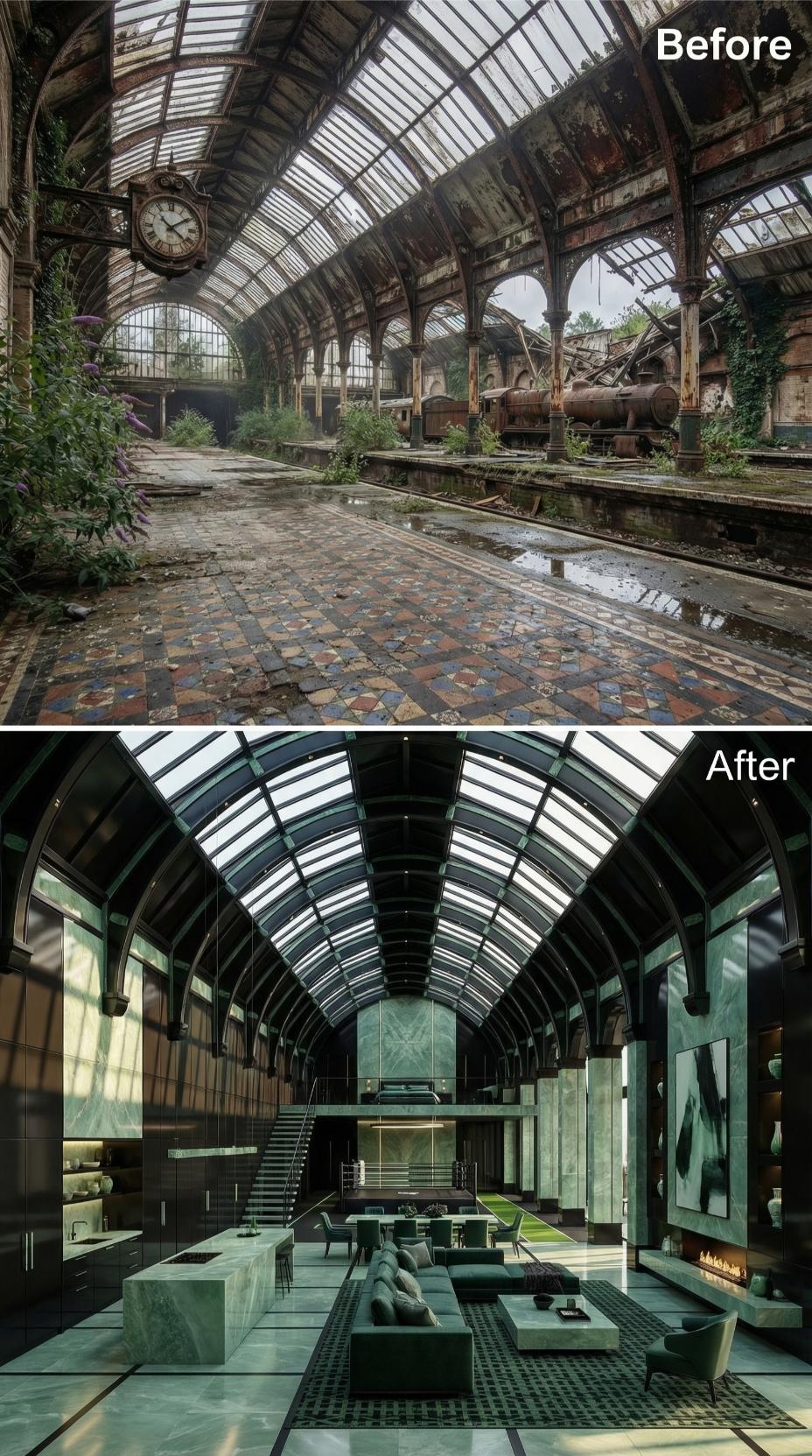
Jade-veined green marble slabs cover the island, floors, and wall panels throughout, while matte black steel frames the restored barrel vault and original cast-iron columns. A double-height living area anchors the nave, with a sectional sofa in charcoal bouclé facing a linear gas fireplace recessed into green stone. Steel-and-glass stairs rise toward a mezzanine bedroom platform visible at mid-depth.
By The Numbers: Retrofitting an original Victorian cast-iron column grid as structural support for a mezzanine platform can reduce steel fabrication costs by up to 30 percent compared to installing an independent structural frame. Green marble sourced in slab form and used continuously across floors, islands, and vertical wall panels reads as a single material gesture rather than decorative detail, which helps unify a space where the ceiling geometry already competes for visual attention.
Rammed Earth Walls and Clerestory Glass Rebuilt from a Collapsed Victorian Train Hall
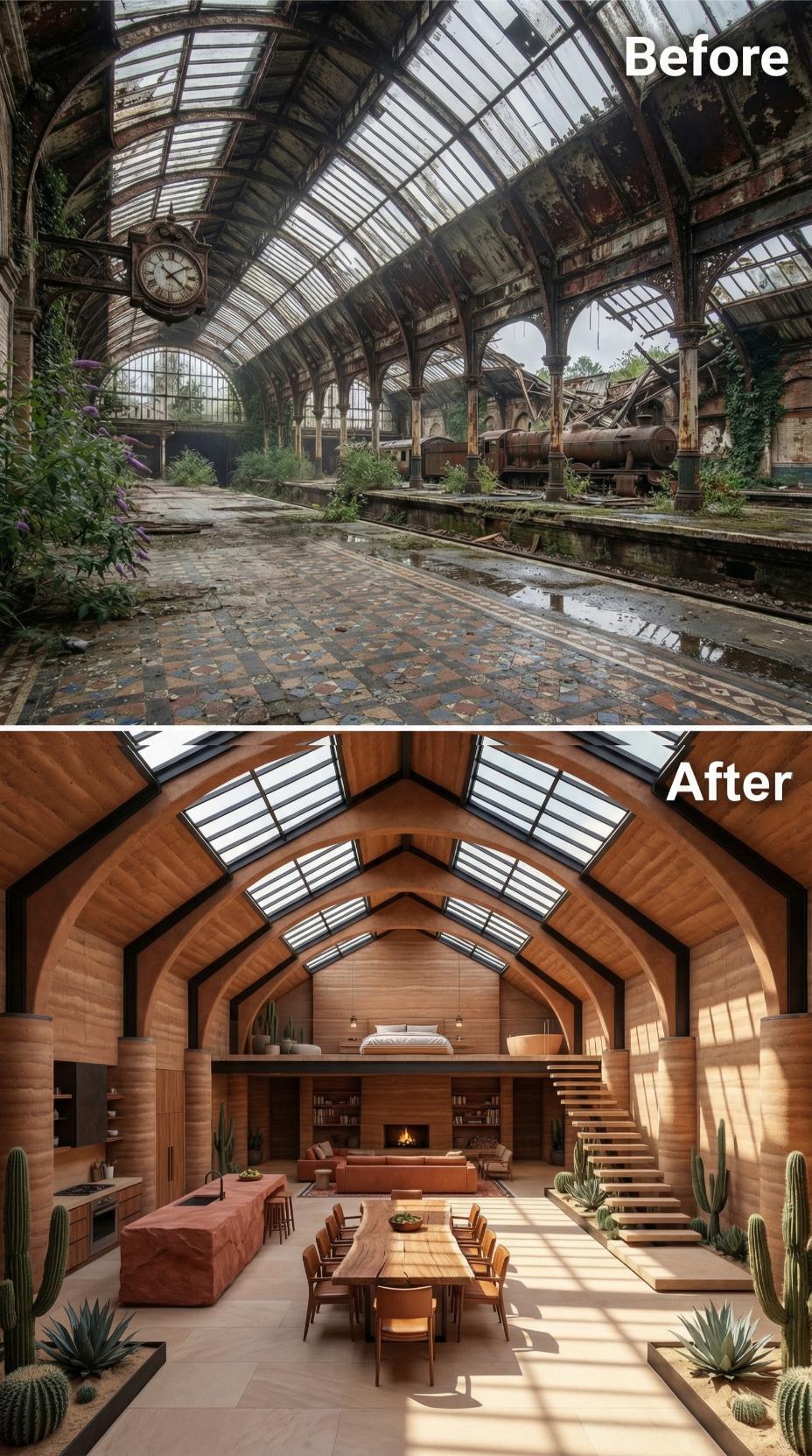
Where corroded iron arches and a shattered glazed roof once let weather pour in unchecked, rammed earth walls in a deep terracotta tone now carry the structural load with quiet authority. The vaulted ceiling geometry survives, relined in warm cedar planking and punctuated by a continuous clerestory band that floods the floor below with afternoon light.
A live-edge dining table in raw walnut seats twelve beneath that skylight strip, flanked by leather-wrapped dining chairs in a saddle finish. The kitchen island reads in pink-red terracotta plaster, paired with open shelving in matching earth tones. A floating staircase with cantilevered treads and no visible risers climbs one wall toward a mezzanine bedroom platform. Columnar cacti and low agave specimens replace conventional planting, grounding the interior in an arid register that suits the palette completely.
Style Math: Rammed earth walls carry thermal mass far beyond standard drywall or plaster, absorbing heat during the day and releasing it slowly overnight, which can reduce HVAC load in high-ceilinged conversions by a meaningful margin. Specifying unstabilized rammed earth allows the wall color to shift subtly with humidity, adding visual depth that no paint finish can replicate. Budget realistically: rammed earth installation typically runs two to four times the per-square-foot cost of conventional framing and finish plaster.
Barrel-Vaulted Cedar Ribs and an Indoor Lap Pool Rescued from Ancient Station
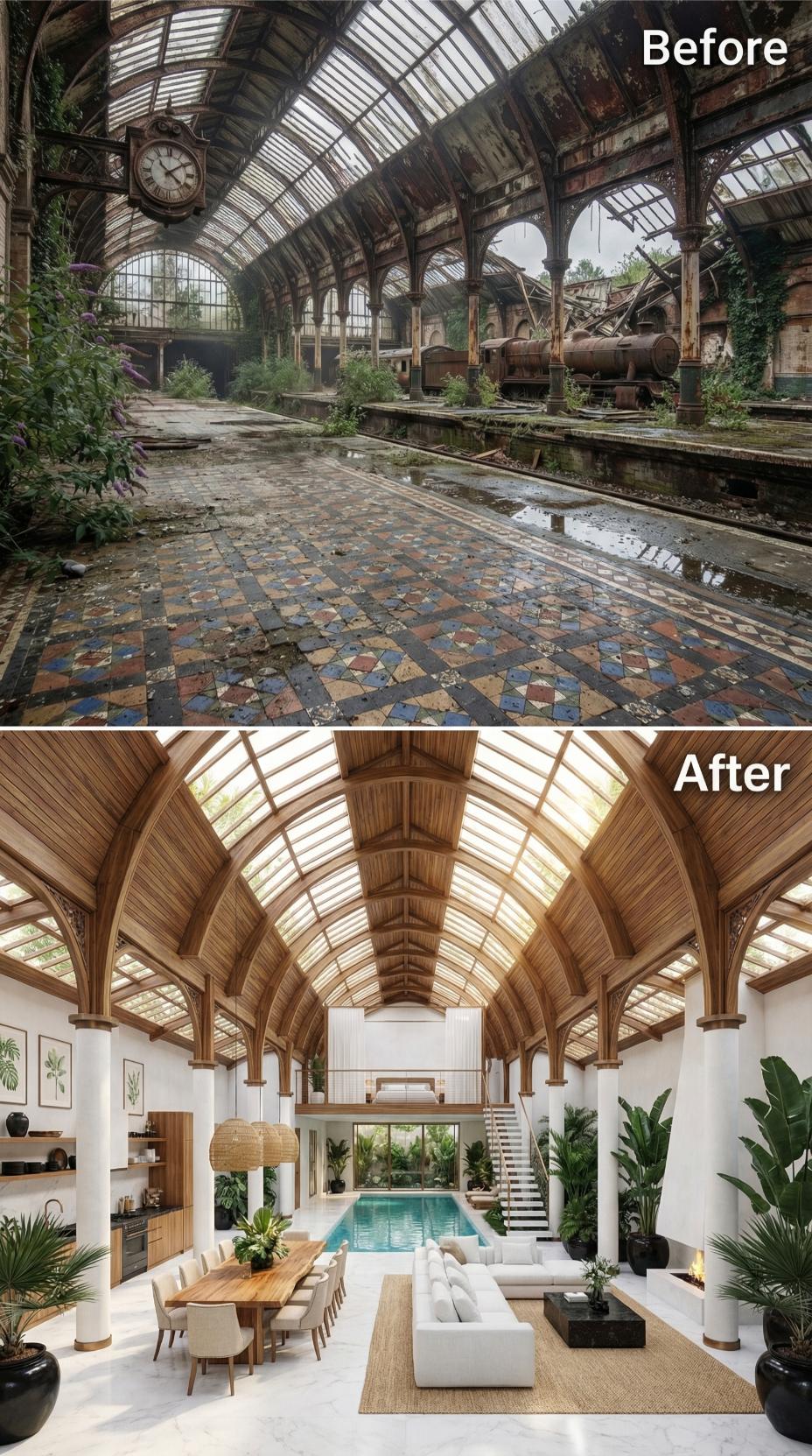
Bare diamond-pattern tilework and a rusted locomotive shell once occupied this nave. Now, warm-toned cedar planking lines every arch rib and collar beam of the restored barrel vault, drawing the eye toward a continuous ridge skylight that runs the full length of the hall.
At floor level, white-plastered columns anchor a dining zone with a solid timber table seating twelve, paired with linen upholstered chairs. An indoor lap pool bisects the rear courtyard behind a neutral sectional sofa arrangement. Wicker pendant clusters hang low over the dining table, and potted banana palms in black ceramic urns punctuate both flanking walls.
Did You Know: Original Victorian train station roofs were engineered with drainage channels concealed inside hollow iron ribs, a detail modern restoration teams often discover only after interior cladding work begins. When those channels are intact, they can be repurposed as conduit runs for low-voltage lighting or HVAC distribution, avoiding the need to core through restored masonry. Identifying this possibility early in a feasibility survey can save weeks of remediation work later in the project timeline.
Mossy Living Walls and Cedar Barrel Vaults Rescued from a Derelict Train Hall
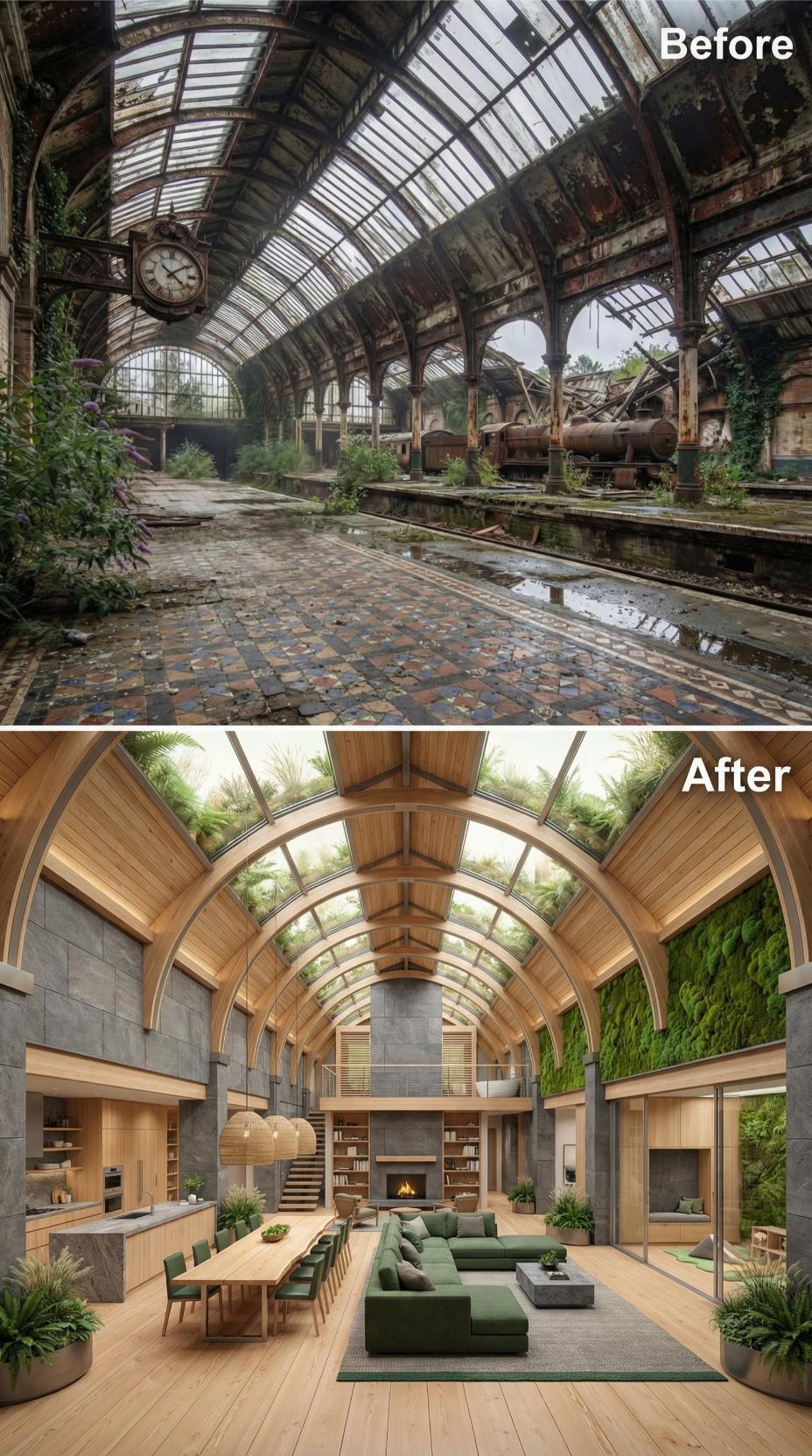
Salvaged arch geometry drives everything here. The original vaulted roof profile was retained and relined with tongue-and-groove cedar planking, its warm grain running parallel to the curve overhead. A continuous skylight band runs the full length of the vault, flooding the interior with diffused natural light that reaches the oak plank floor below without casting hard shadows.
At floor level, the layout reads as a single open volume: a live-edge dining table with forest-green upholstered chairs anchors the left side, while a low sectional sofa in the same green sits opposite a stone fireplace flanked by floor-to-ceiling built-in shelving. Two living walls of dense moss and fern cover full-height stone-clad panels on both sides, pulling humidity and sound into the greenery rather than letting either bounce off hard surfaces.
- Moss wall panels installed over a hidden drip-irrigation membrane can maintain themselves with minimal manual watering
- Cedar tongue-and-groove vault linings are lighter than plaster and reduce structural load on original iron arch frames by a measurable margin
- Pairing dark green upholstery with raw stone cladding on the same wall plane creates tonal cohesion without requiring pattern or print
Concrete Barrel Vaults, a Suspended Fireplace, and Solar Glass Rebuilt from Wreckage
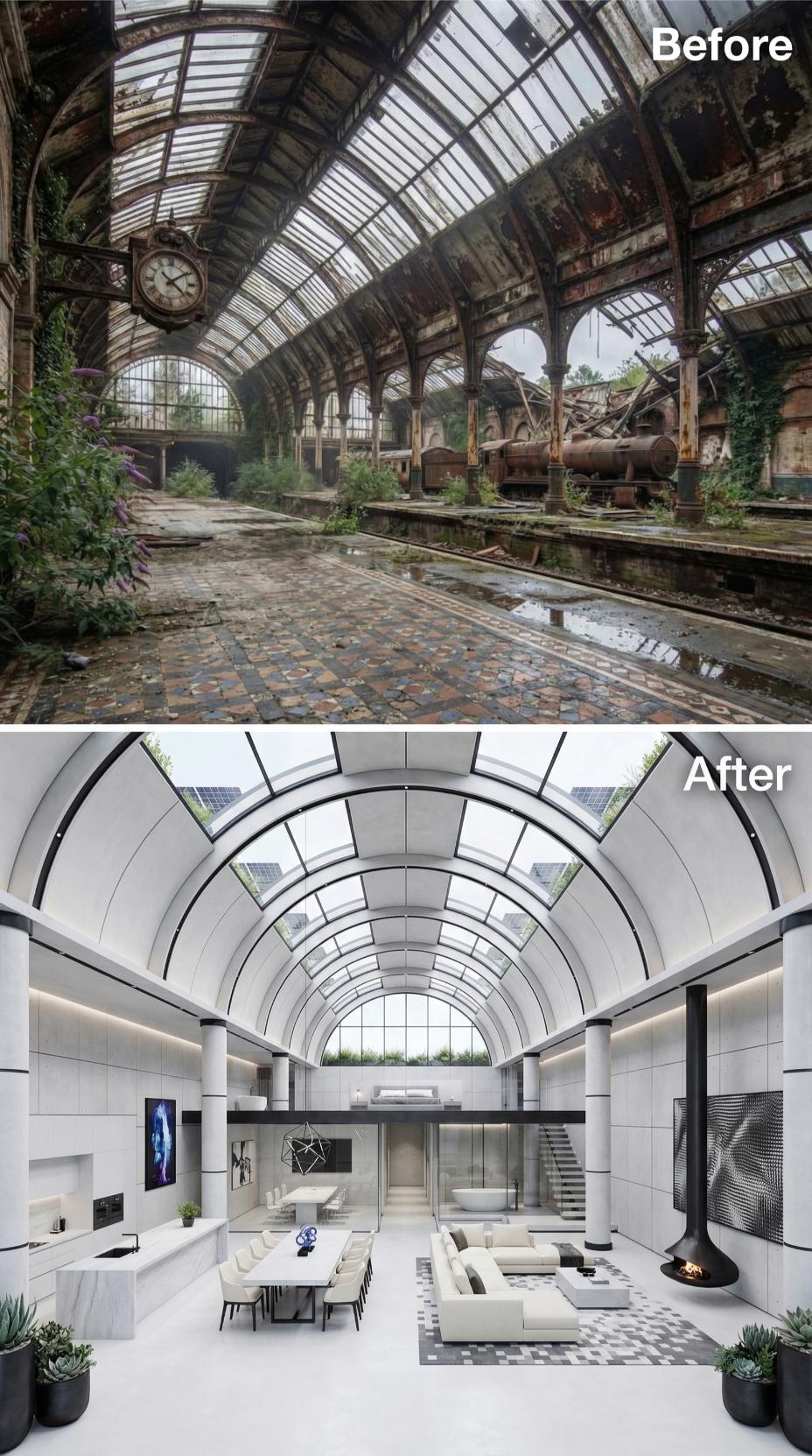
Polished white concrete runs wall to wall beneath a restored barrel-vault roof fitted with steel-framed skylights, while a matte black suspended fireplace anchors the living zone beside a low-profile sectional in off-white bouclé fabric.
Editor’s Note: Suspended or pendant fireplaces with a conical hood, like the black steel unit visible here, require a minimum ceiling clearance of roughly 10 feet to draft properly and avoid smoke pooling beneath the vault. In adaptive reuse projects where ceiling heights already exceed 20 feet, this constraint becomes an advantage rather than a limitation. Specifying a wood-burning suspended model in a glass-roofed space also offsets heating load during winter months when solar gain through the skylights drops significantly.
Not every conversion leans into raw materials; some pivot hard toward cinema-scale comfort instead.
Walnut Cladding, a Projection Screen, and a Marble Island Reclaimed from Victorian Iron
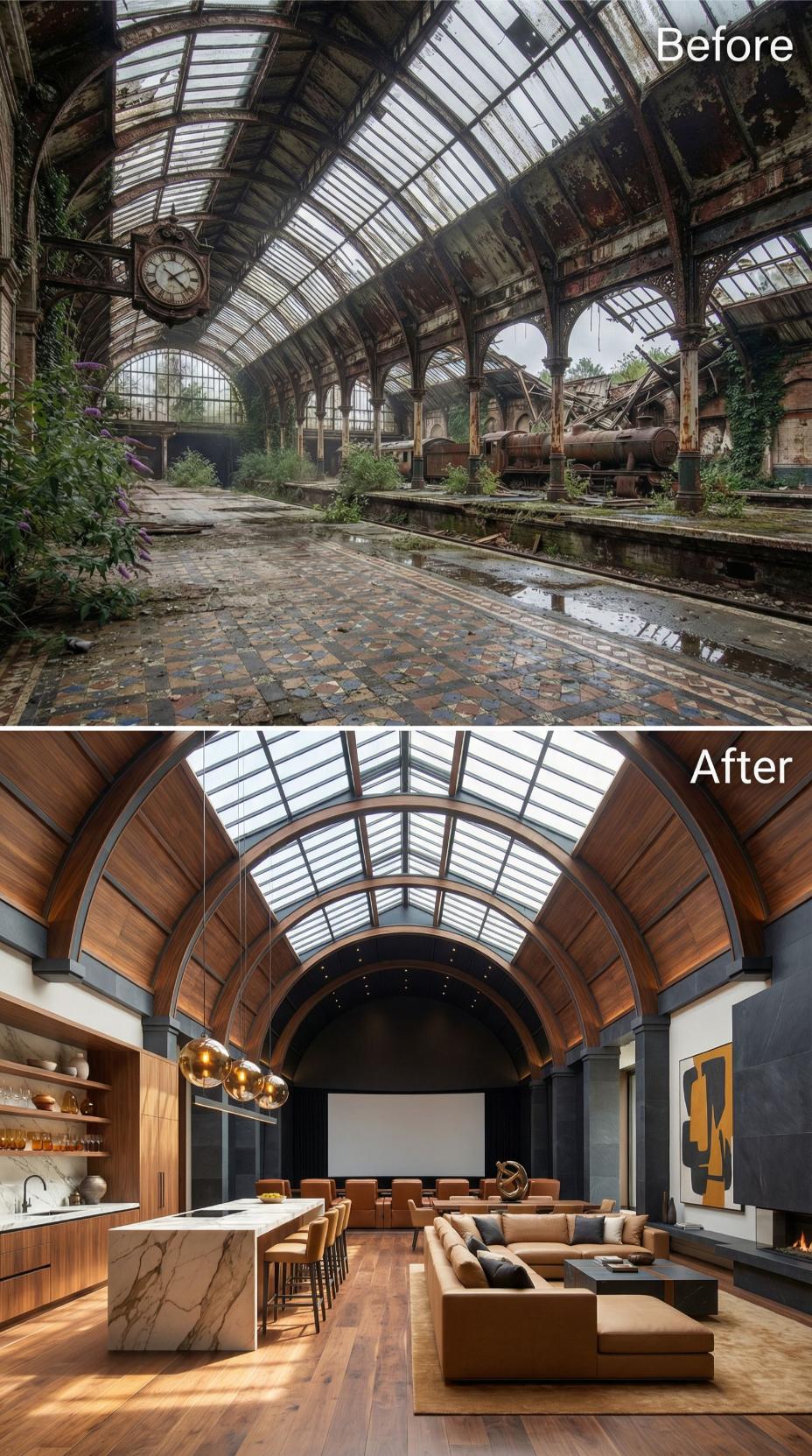
Gold pendant globes hang low over a marble-topped island with a waterfall edge, anchoring the kitchen zone before the space opens toward rows of cognac leather counter stools. The flooring is wide-plank hardwood, likely white oak with a medium-brown stain, running the full length of the hall without interruption.
The barrel vault overhead is clad in tongue-and-groove walnut panels rather than left as exposed iron, softening the acoustics considerably for the home cinema positioned at the far end. A full-width projection screen sits inside the arch’s curve, flanked by recessed spot lighting on a dark surround. A sectional sofa in sand-toned fabric anchors the viewing area, with a low slate coffee table centered in front of it. The original glazed roof ridge has been repaired and retained, pulling daylight down the spine of the room.
Marble Skin and Crystal Light Poured Over Victorian Glass-and-Iron Bones
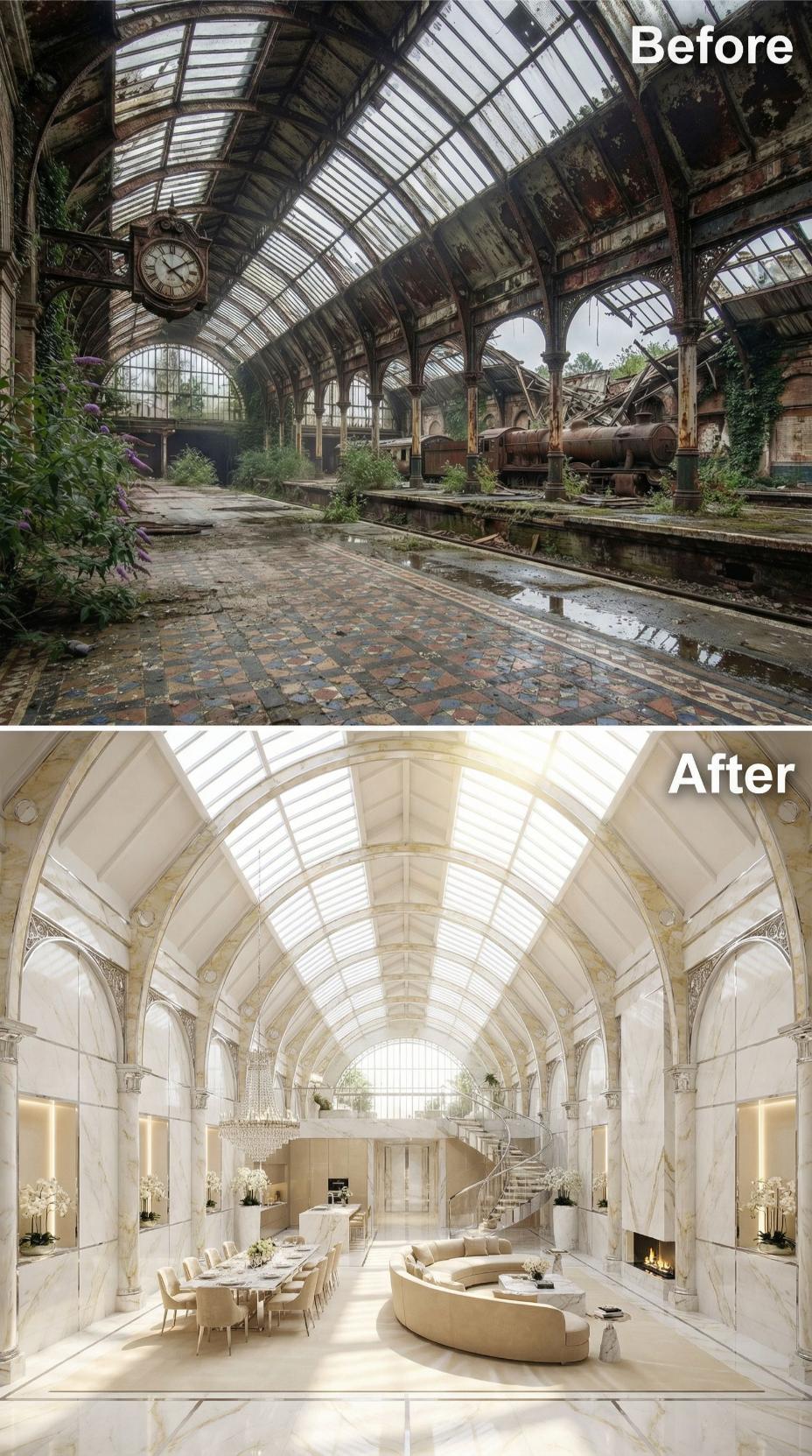
Calcutta marble cladding runs floor to ceiling on both flanking walls, its gold veining catching the diffused light that drops through the restored barrel-vault skylight above. The original iron arch ribs remain structurally intact, now finished in a pale silver lacquer that reads almost white against the stone. A curved cream bouclé sectional anchors the living zone, and a linear dining table seats twelve beneath a tiered crystal chandelier.
A double-sided marble fireplace separates the two seating areas without interrupting the sightline down the full length of the nave. A spiral staircase in brushed brass rises at the far end, framed by the original arched window opening. White orchids in column-style planters repeat at measured intervals along both walls.
Ask Yourself: whether your tallest room could support wall cladding that runs uninterrupted from baseboard to ceiling cornice, because in rooms over fourteen feet high, stopping cladding at chair-rail height visually compresses the space rather than containing it. Marble panels installed in full-height sections with hairline joints rather than grout lines read as a single continuous surface, which amplifies the sense of volume without adding square footage.
Geometric Steel Light and Barrel Vaults Carved from a Derelict Train Hall
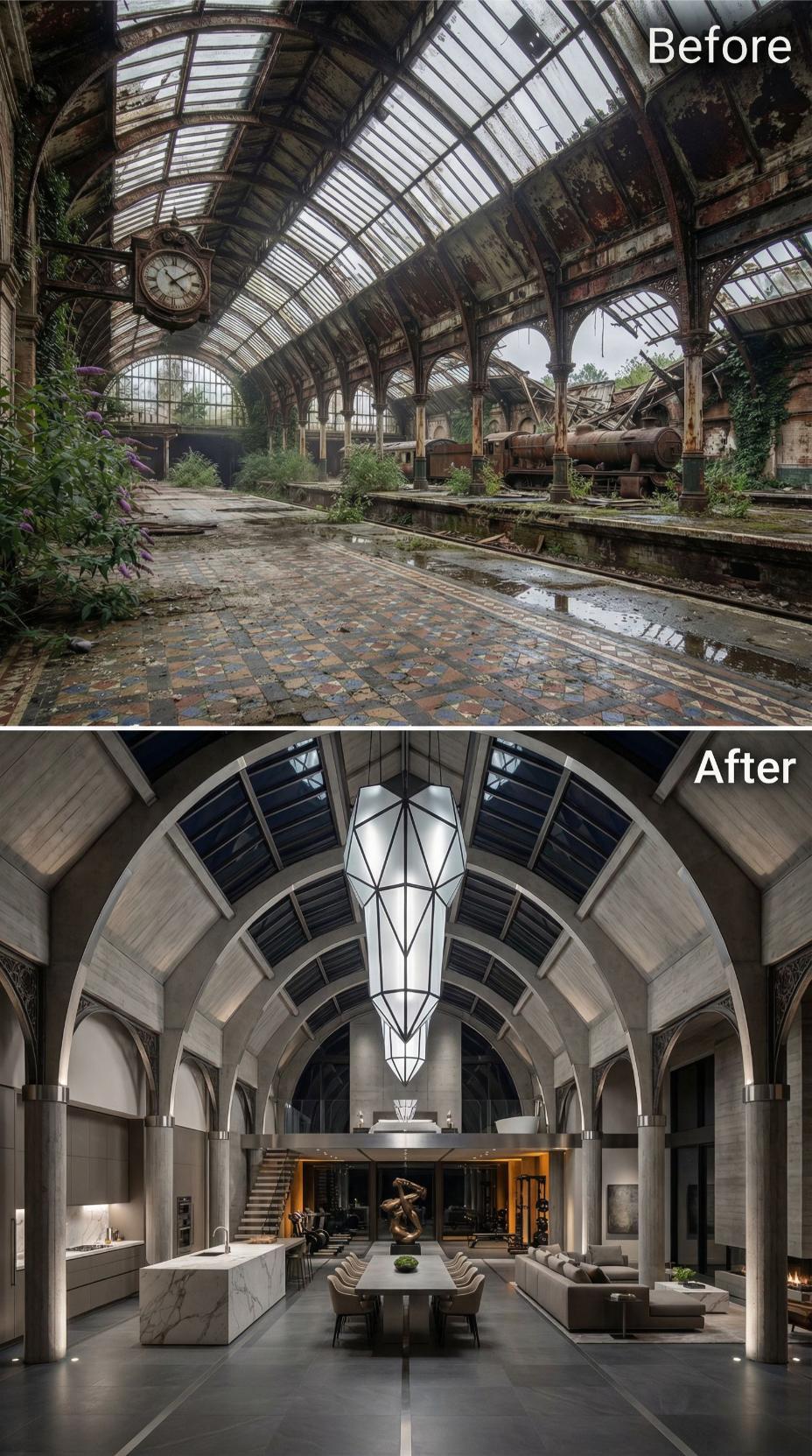
Concrete-clad columns rise from dark slate floors to meet restored iron arches, their original Victorian geometry preserved and now flanked by recessed wall sconces with brushed-nickel sleeves. A faceted pendant light fixture, built from angular steel ribs and frosted panels, hangs at the center of the nave and does most of the heavy lifting visually.
The kitchen anchors the left side with a waterfall marble island on a flat-front white base, paired with a second prep sink station in the same finish. Down the central axis, a long dining table in charcoal seats twelve, backed by a bronze figurative sculpture and a mezzanine stair with open steel treads. Two flanking sofas in greige fabric close off the living zone without walls.
How the Faceted Pendant Scales to a Victorian Nave Without Feeling Lost
Pendant fixtures in double-height conversions often fail because the drop length is calculated for standard eight-foot ceilings, leaving the light source hovering uselessly near the ridge. The fixture here uses a vertical elongation strategy, stretching the geometric form downward so its lowest point sits roughly fifteen feet from the floor, keeping it within the visual field from both the ground level and the mezzanine above. Designers working with similar vaults should calculate pendant drop length as roughly forty percent of the total ceiling height to achieve the same anchoring effect.
Light-Flooded Barrel Vaults and a Marble Island Rebuilt from Victorian Structure
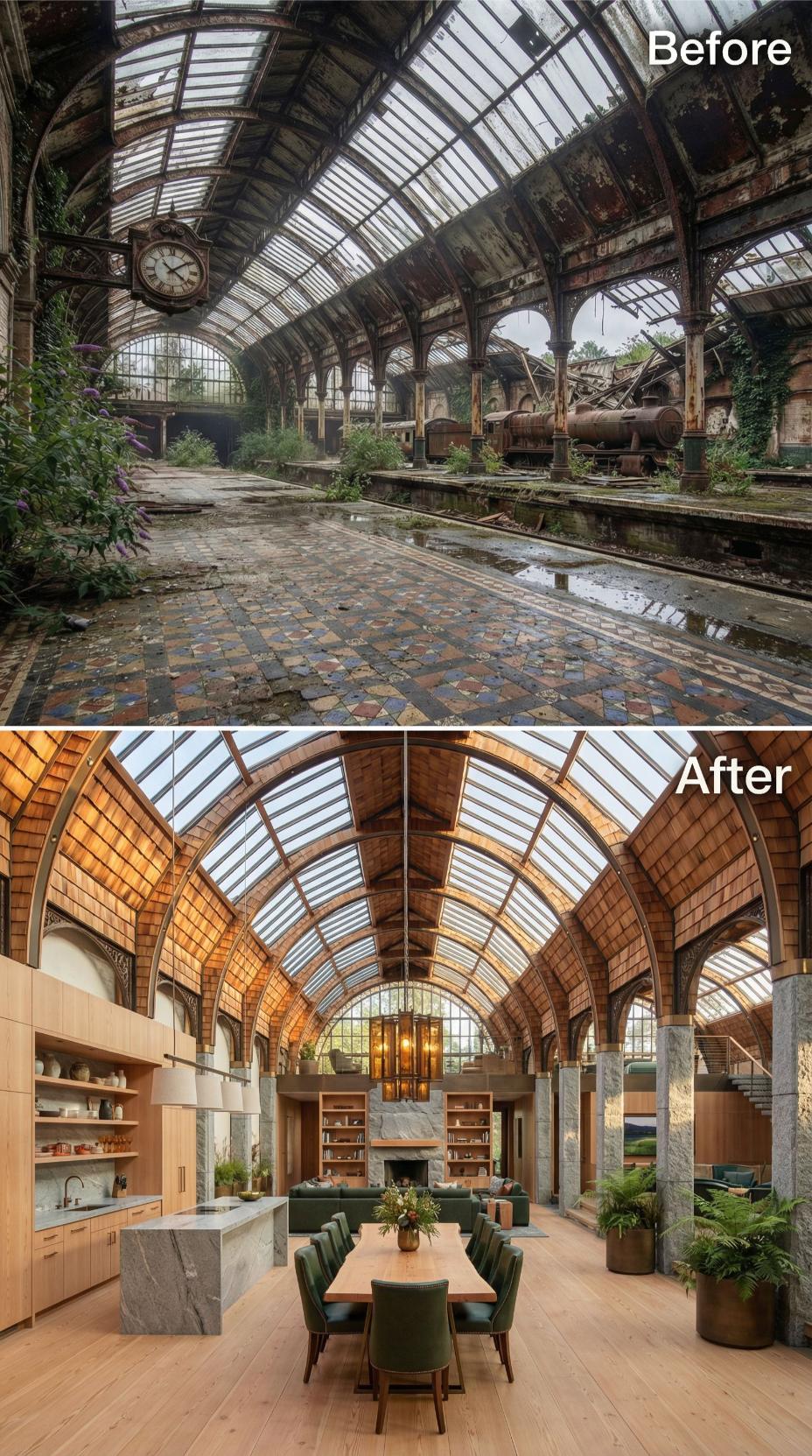
Rift-cut oak cabinets run the full length of the kitchen wall, paired with a waterfall-edge island in grey-veined marble and open shelving in matching light wood. Green leather dining chairs surround a solid wood table set directly beneath the restored glass-and-iron barrel vault, which now admits unfiltered daylight across the herringbone oak floor. A pendant chandelier with amber-toned glass drops from the apex, anchoring the dining zone without competing with the arched ironwork above.
Coral Sofas, Lap Pool, and Terrazzo Floors Poured into Victorian Iron Arches
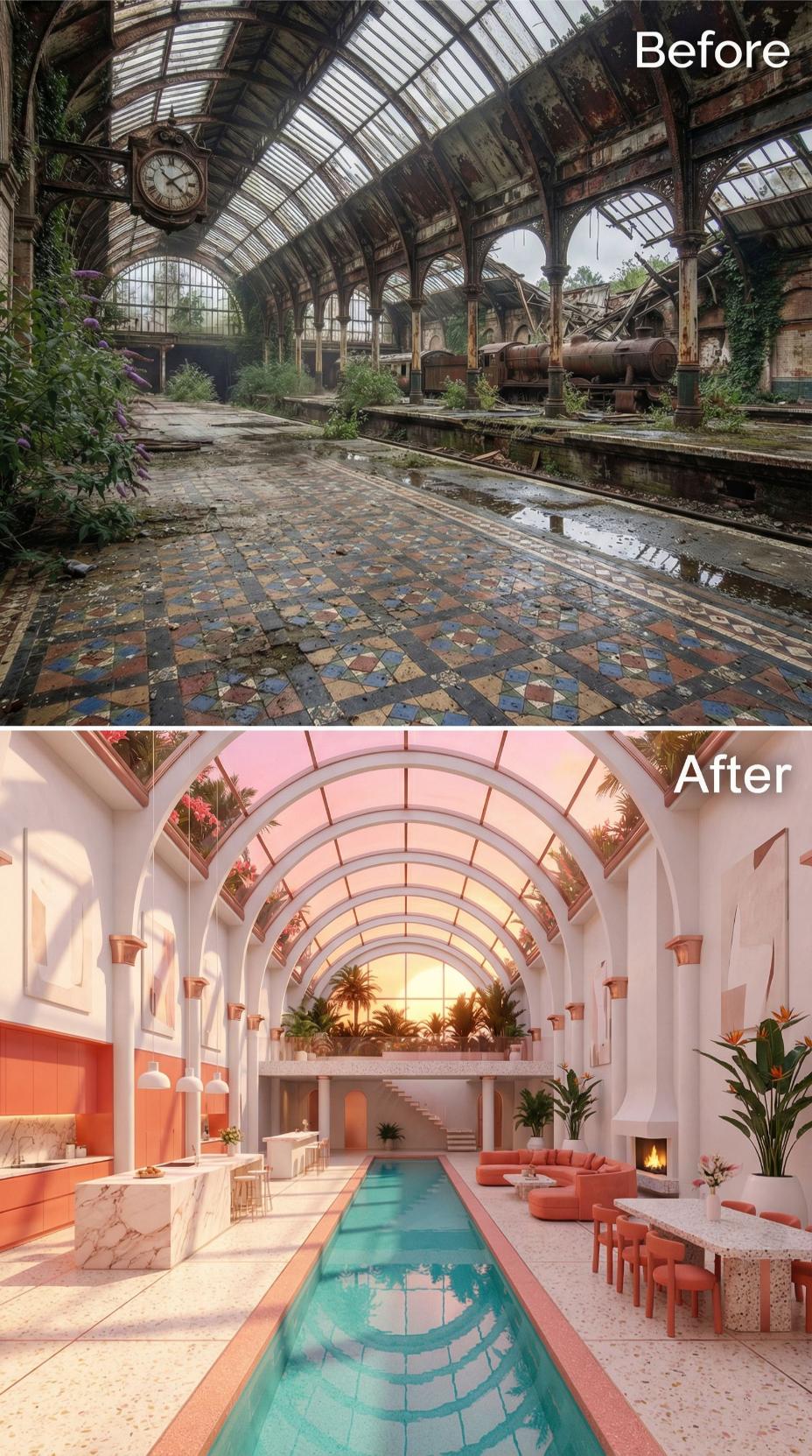
Coral-upholstered curved sectionals and a white marble island anchor opposite ends of a lap pool finished in aqua tile, while terrazzo floors in speckled cream run the full length beneath restored barrel arches now glazed in pink-tinted panels.
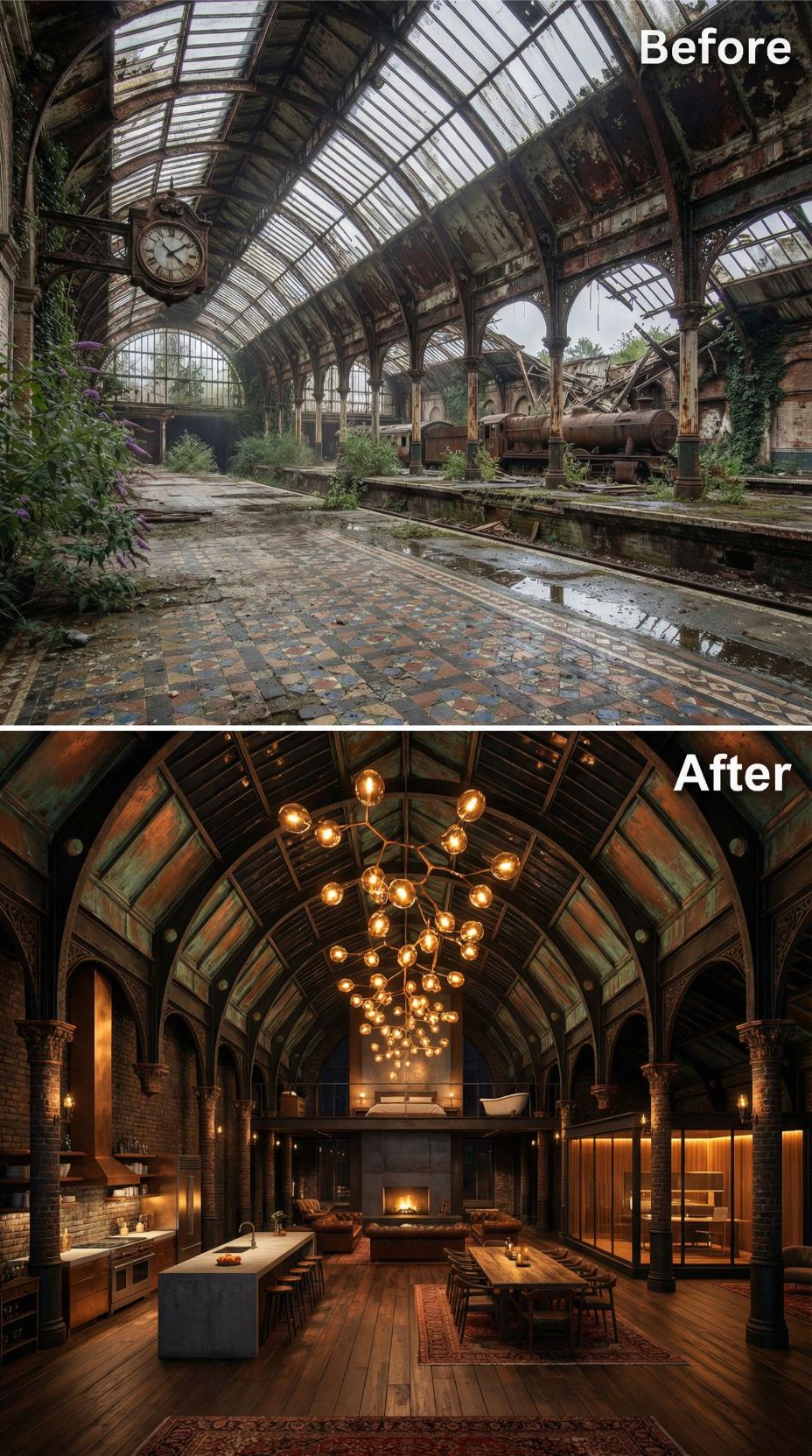
Rusted Iron Arches and Edison Cluster Pendants Pulled from Victorian Station
🔥 Would you like to save this?
Reclaimed wide-plank oak floors run beneath a branching molecular chandelier holding roughly thirty exposed Edison bulbs, while a cast-iron column arcade frames the living zone, kitchen island with white stone countertop, and an upper sleeping loft visible behind the fireplace surround.
Dark Walnut Paneling, Chesterfield Leather, and a Billiard Table Rebuilt from Victorian Iron Bones
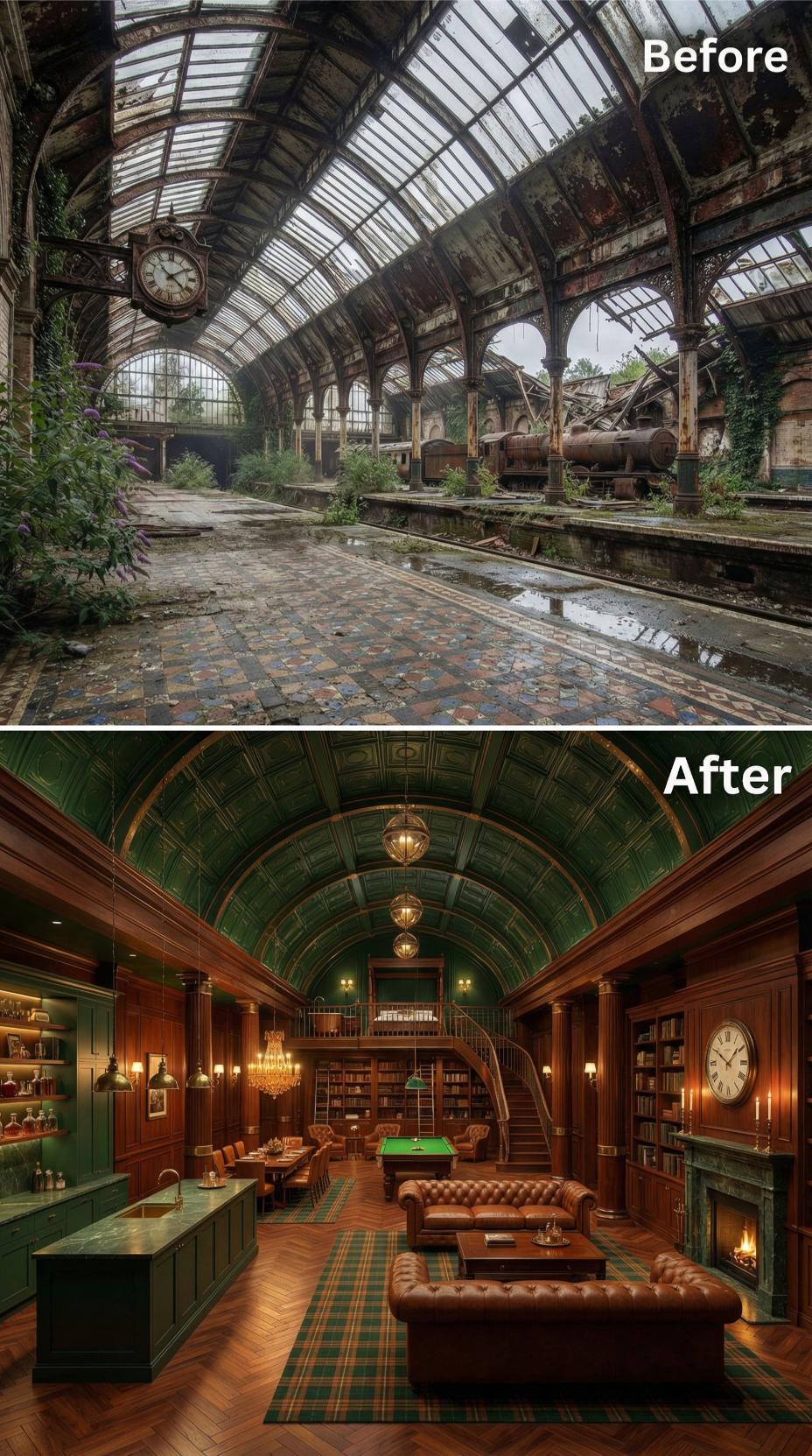
Chestnut-stained walnut panels run floor to barrel-vault on every wall, paired with a deep hunter-green ceiling and tartan wool runner that anchor the room’s color logic. Two tufted cognac leather Chesterfield sofas face a herringbone parquet floor, while a regulation billiard table with green baize sits dead-center under brass globe pendants.
Copper Pendants, Chesterfield Leather, and Dark Brick Pulled from Heritage Space
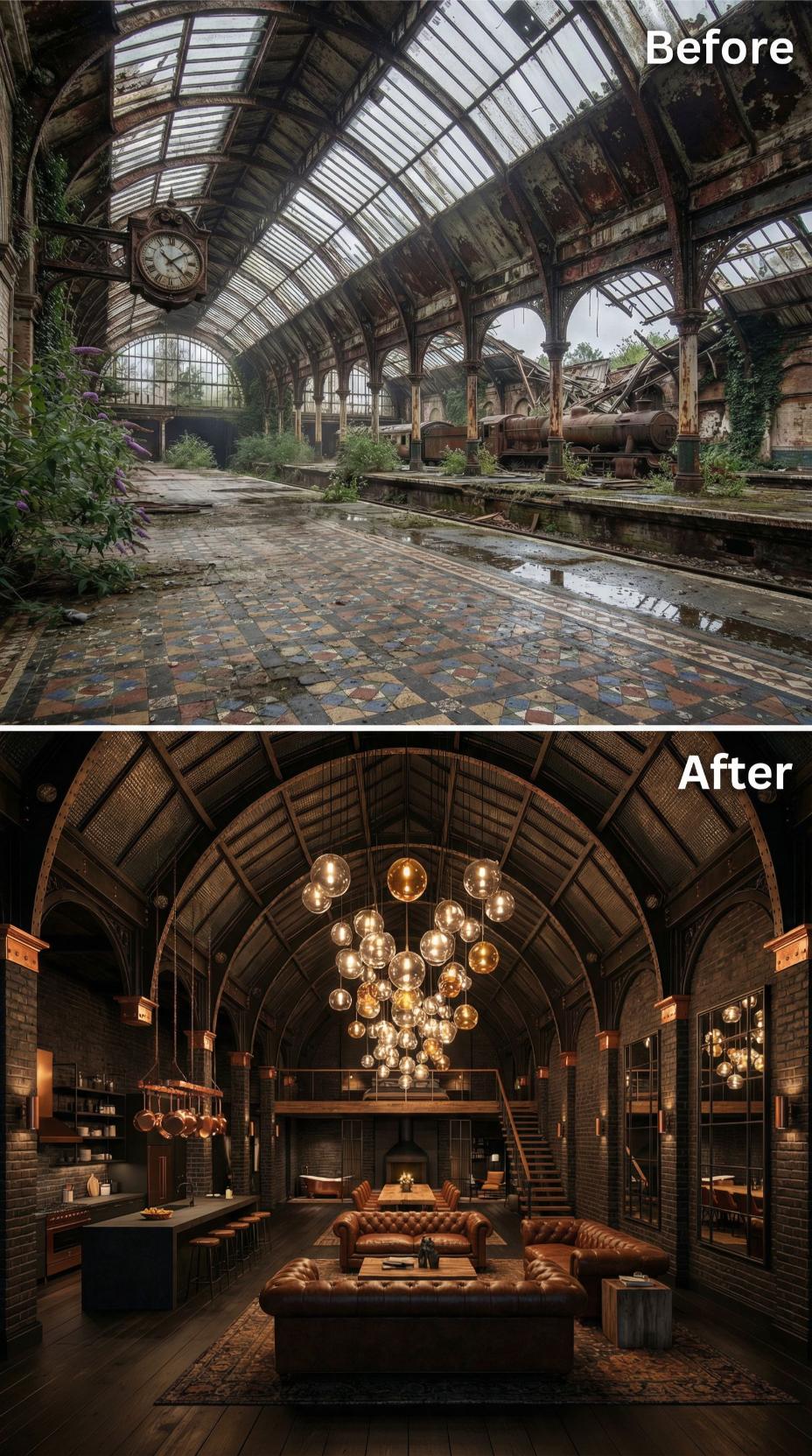
Dozens of amber glass orb pendants hang in a loose cluster above tufted cognac leather Chesterfield sofas, while exposed dark brick wraps the barrel-vaulted ceiling from floor to crown.
Barrel Vaults Whitewashed and Filled with Linen, Marble, and Floating Oak
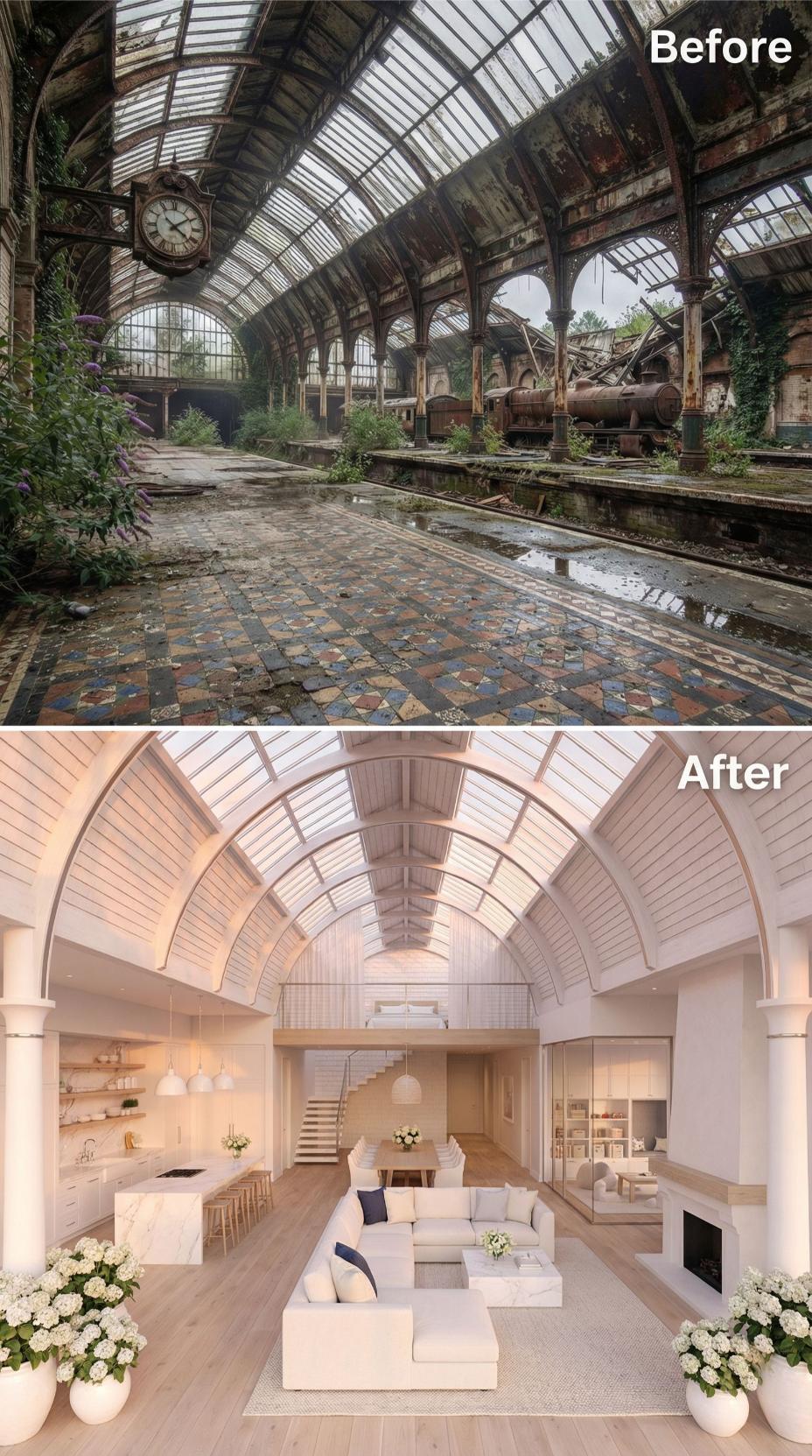
Where rusted iron and broken mosaic tile once marked a derelict platform, white-painted barrel vaults now arch over wide-plank oak floors and a low sectional wrapped in cream linen. The kitchen island sits to the left in Calacatta marble with bar-height seating in natural oak. Pendant clusters in matte white hang above it.
A mezzanine bedroom sits behind glass above the staircase, its floating oak treads cantilevered without visible stringers. White hydrangeas in ceramic pots anchor both foreground corners, and a limestone fireplace surround closes the right wall. Every surface reads pale, but the layering of matte, satin, and warm wood grain keeps the room from feeling flat.
Lap Pool, Marble Island, and White Arches Raised from a Rusted Victorian Shell
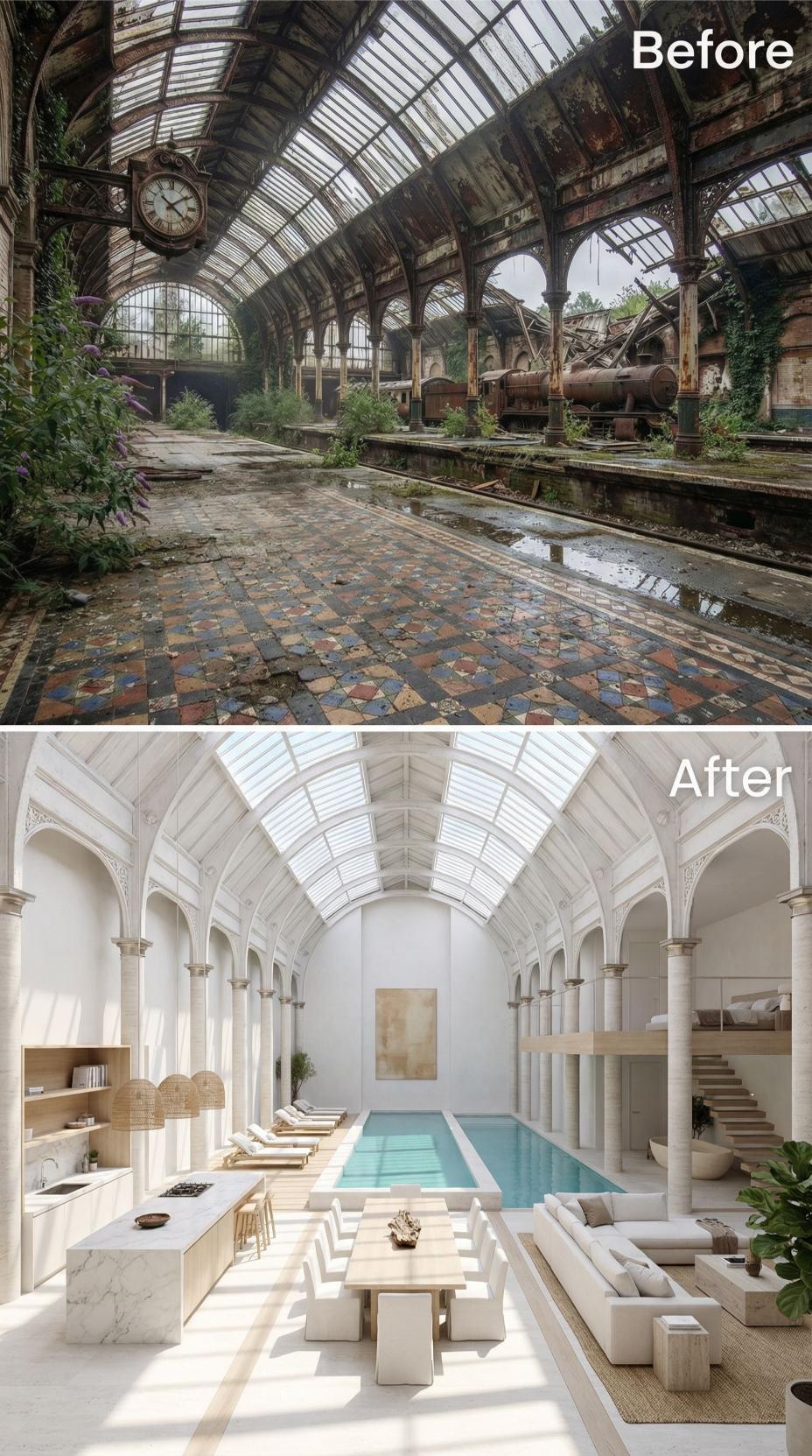
Cracked geometric floor tiles and a collapsed locomotive once occupied this iron-and-glass barrel vault. Now the same arched steel ribs carry a fully glazed skylight ridge that runs the entire length of the hall, flooding bleached plaster columns and ivory linen seating with natural light.
The lap pool sits centered beneath the vault on axis with a long oak dining table. To the left, a waterfall-edge marble island anchors an open kitchen with open wood shelving and natural oak bar stools. Mezzanine sleeping quarters occupy the far right, accessed by a floating staircase with minimal steel stringers. Every surface reads white or warm sand, letting the original iron arch geometry carry the visual weight.
Sputnik Gold, Navy Barrel Vaults, and Marble Rebuilt from a Derelict Train Hall
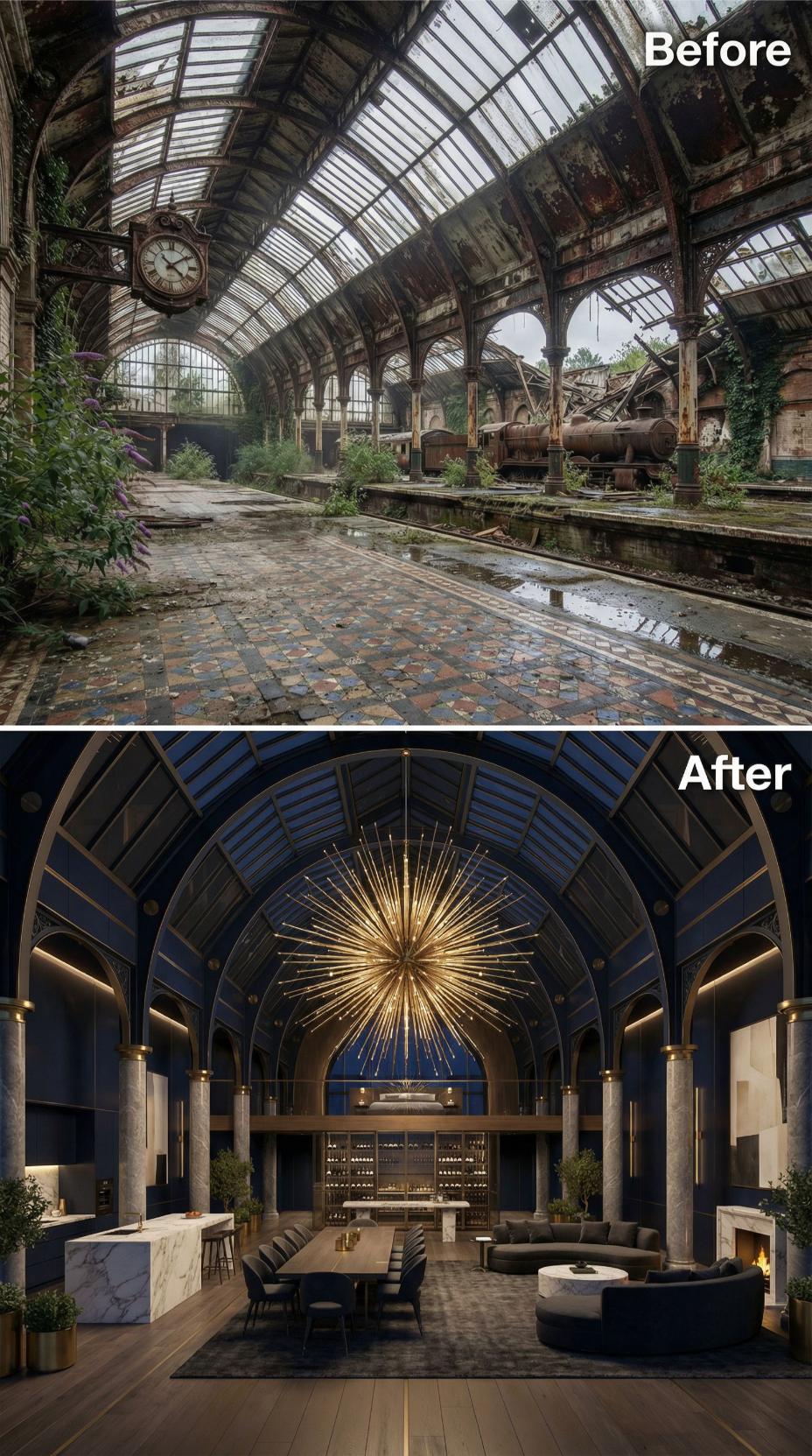
Navy paint covers the restored Victorian arches from column base to roof rib, with brass trim tracing every structural edge. A sputnik chandelier with radiating gold rods anchors the barrel vault, its warm light bouncing off a marble waterfall island and a long dining table seating eight in charcoal upholstered chairs. Behind the dining zone, a full bar with open bottle shelving spans the arched rear wall.
A curved sectional in slate fabric faces a marble drum coffee table beside a stone fireplace on the right wall. The original column grid remains exposed, now finished in pale stone rather than rusted iron. Dark hardwood runs the full floor plate, grounding a room that once held decaying locomotives under a collapsed glass roof.
Navy Lacquer, Cognac Leather, and Barrel Vaults Pulled from the Past
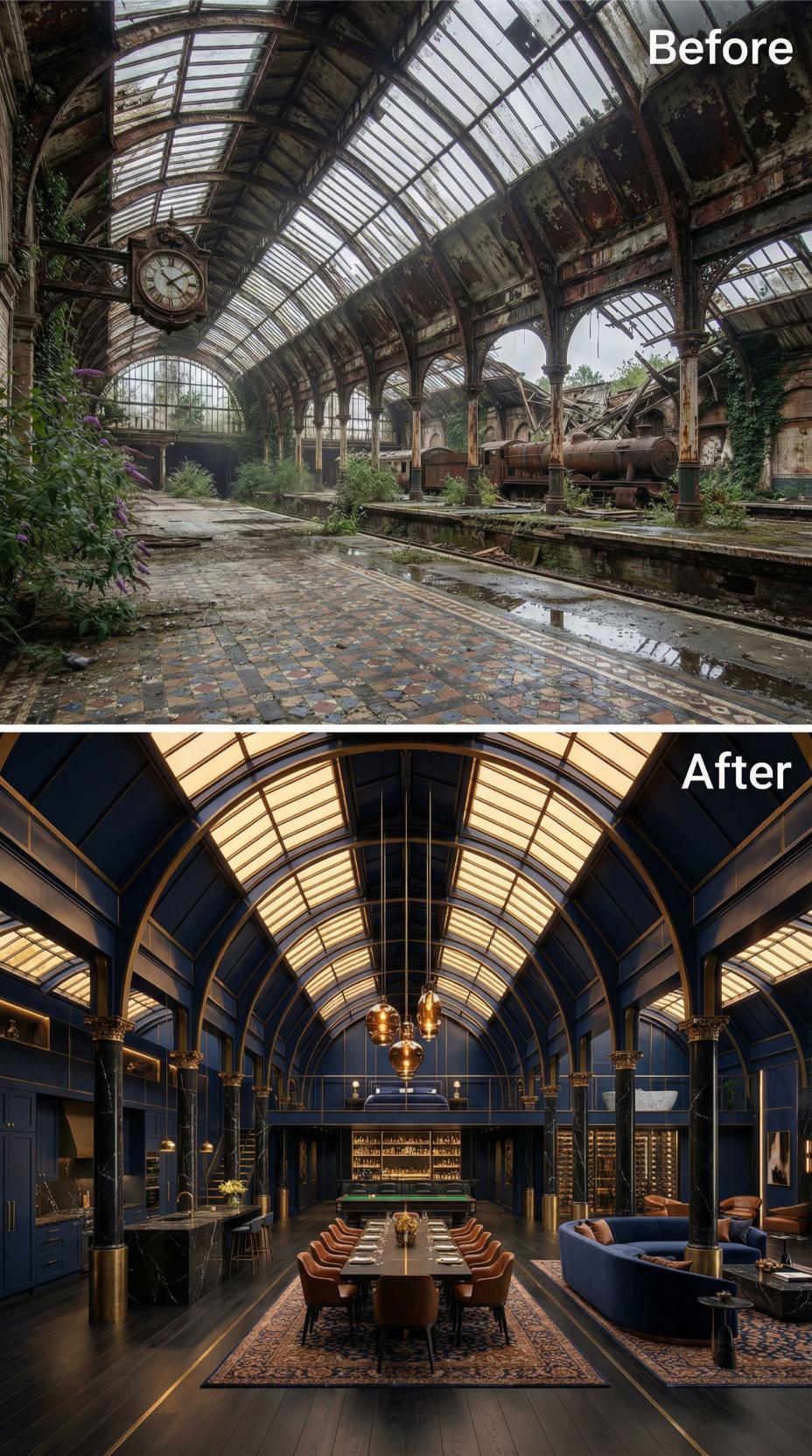
Gold-trimmed navy lacquer panels run floor to ceiling along both walls, anchoring a long dining table set with cognac leather chairs in a symmetrical arrangement. Pendant clusters in aged brass hang at three intervals from the restored barrel-vault ceiling, which retains its original glazed skylight grid now backlit with warm linear LEDs. A full bar cabinet sits centered against the rear wall, flanked by what appears to be a wine storage grid built into recessed niches.
Corinthian-capped columns finished in black marble stand at each corner of the dining zone, while a curved navy sectional defines a lounge area to the right over a Persian-style area rug in rust and indigo. The floor shifts from that rug to what reads as dark stained hardwood, drawing a soft boundary between dining and lounge without any partition wall.
Cream Plaster Arches, Marble Dining Table, and Olive Trees Salvaged from Victorian Era
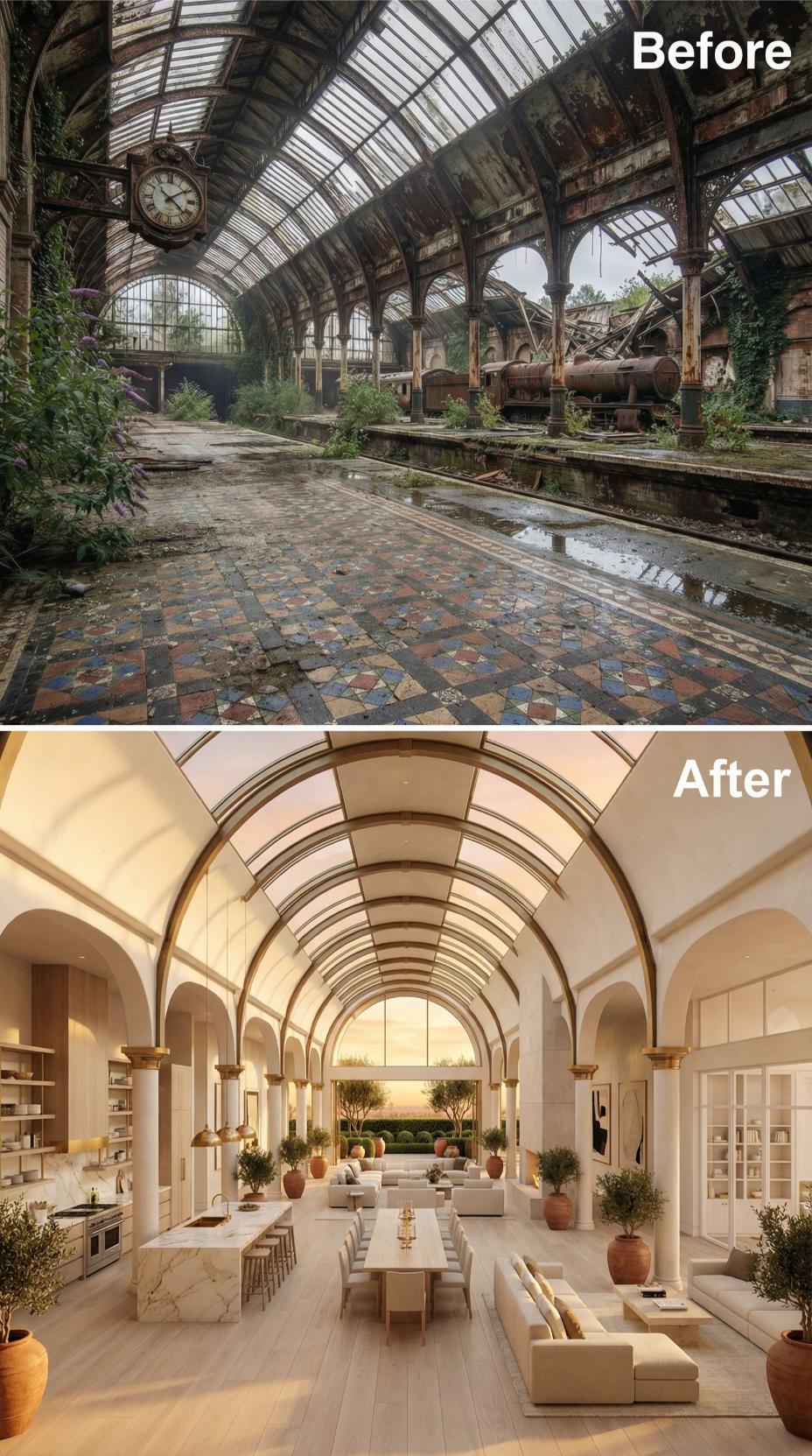
Plastered barrel vaults replace exposed rust, while a marble-slab dining table anchors the central axis beneath gold pendant fixtures and terracotta urns holding olive trees at either end.
Dark Steel Columns, a Rock Climbing Wall, and Live-Edge Dining Pulled from Victorian Station
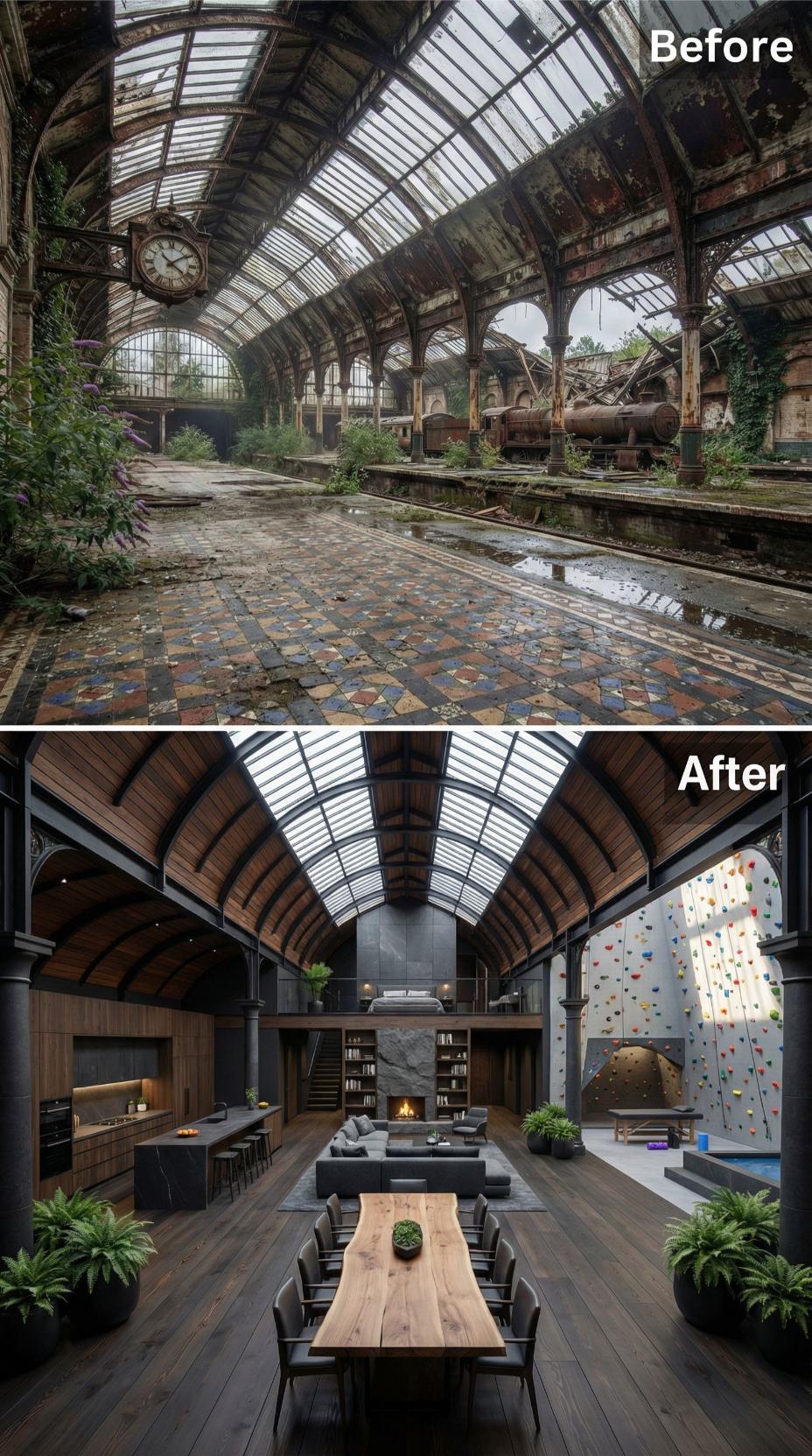
Wide-plank walnut flooring runs the full length of the hall, anchoring a live-edge dining table surrounded by black leather chairs, while a rock climbing wall fills the far arch and a mezzanine bedroom floats above an open stone fireplace.
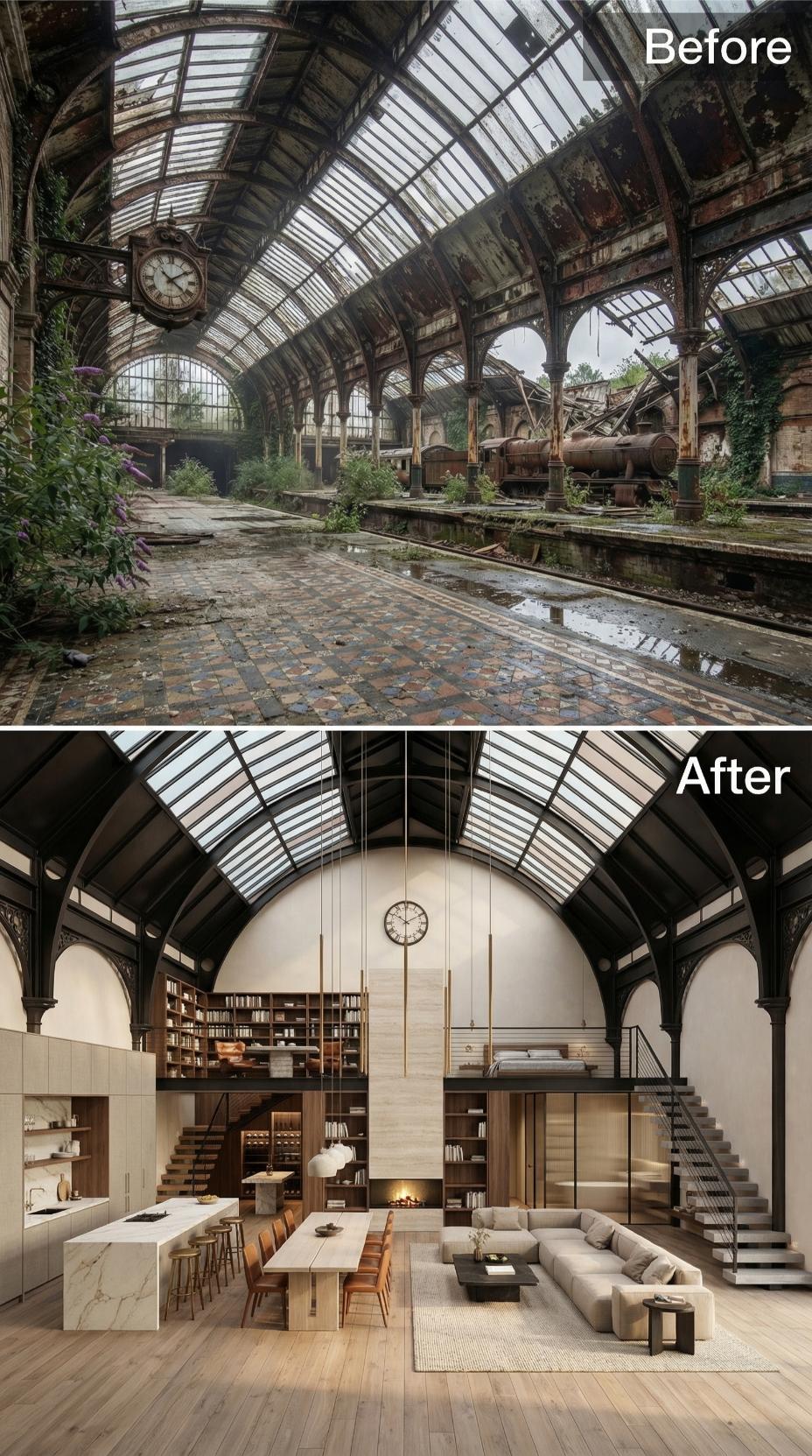
Clock Still Hanging, Arched Steel Roof Now Framing a Two-Story Loft
🔥 Would you like to save this?
Warm oak flooring runs beneath a marble-topped island with brass pendant drops overhead. A mezzanine level holds a bed on one side and a library on the other, connected by open steel staircases with cable railings. The original cast-iron columns and barrel-vaulted glass roof stayed untouched.