🔥 Would you like to save this?
In order to come up with the very specific design ideas, we create most designs with the assistance of state-of-the-art AI interior design software. Also, assume links that take you off the site are affiliate links such as links to Amazon. this means we may earn a commission if you buy something.
I’ll admit it: when I started pulling together white kitchen inspiration for 2026, I expected to get bored. The all-white kitchen has been done to death, right? Turns out I was wrong. What I found instead were spaces that felt warm, grounded, and genuinely interesting to look at. The best designers right now are treating white as a canvas rather than a statement, layering in weathered wood, veined marble, textured stone, and organic details that make each room feel lived-in.
Gone are the antiseptic showroom looks that dominated the last decade. These kitchens have soul. They have imperfections on purpose. And after reviewing hundreds of examples, I narrowed it down to 50 that I think represent where this trend is actually headed.
A Calacatta Waterfall Edge That Anchors Everything

The gray veining in this Calacatta marble runs diagonally down the waterfall edge, and I keep coming back to that detail. It gives the island a sense of movement that static white surfaces can’t achieve on their own. Above, three crackled glass globe pendants hang from polished chrome chains, catching light from what appears to be a bank of windows just out of frame.
I notice the upper cabinets mix solid doors with seeded glass fronts, breaking up what could be an oppressive wall of white. The coffered ceiling adds depth without competing for attention. Small touches matter here: the chrome pot filler over the range, the hydrangeas in a clear vase, the dark flooring that grounds all that brightness.
What Happens When You Curve Walnut Across the Ceiling
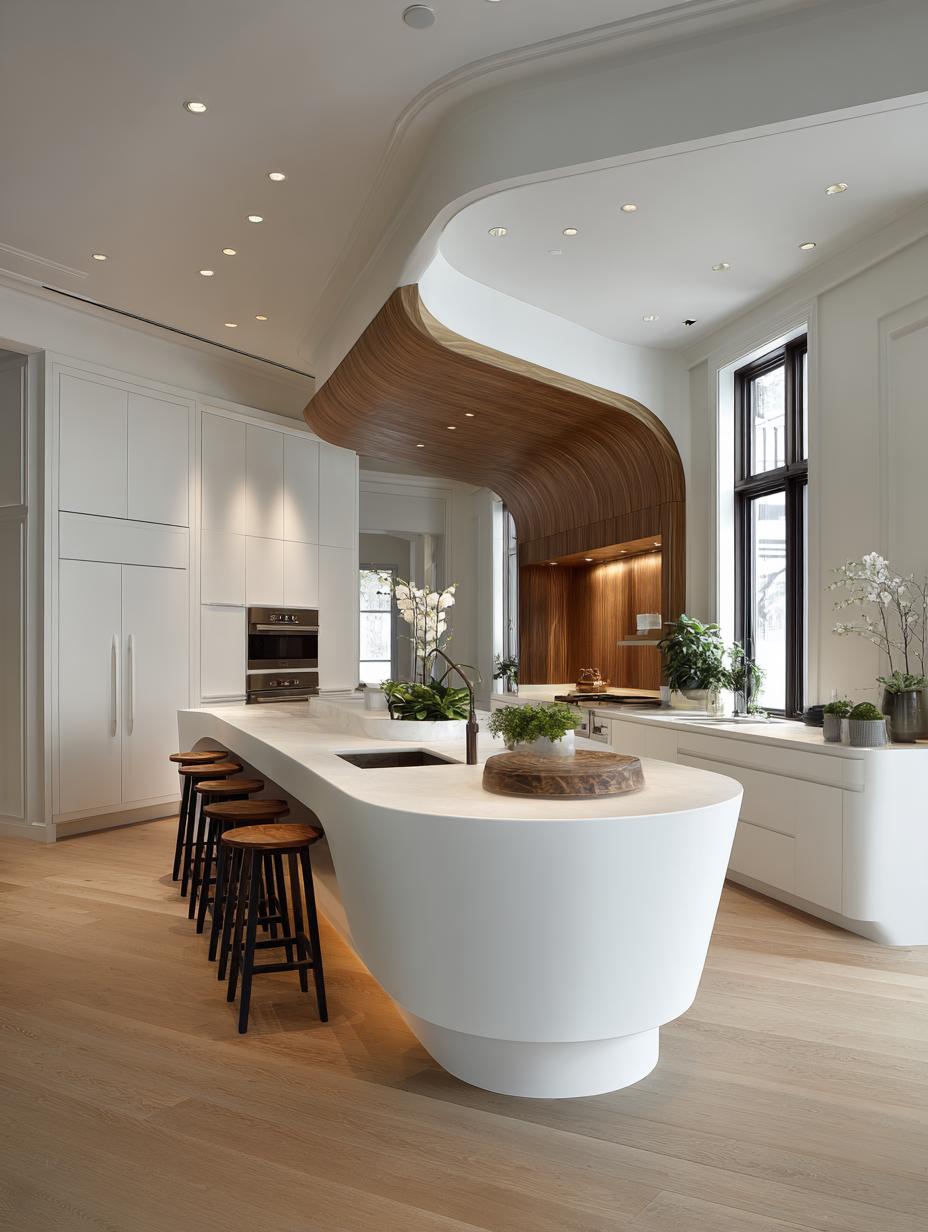
This one stopped me mid-scroll. Ribbons of walnut veneer snake across the ceiling and down into a recessed cooking alcove, forming a sculptural canopy that feels almost biological. The wood grain has a tight, linear pattern that makes the curves read as intentional rather than whimsical.
The Psychology Behind This: Curved forms in architecture trigger a different response than sharp angles. Research from environmental psychology suggests organic shapes register as safer and more welcoming to our brains, which evolved recognizing threats in nature’s irregular patterns rather than geometry.
Below, the island base tapers into an almost pedestal shape, finished in matte white that reads as plaster or solid surface. Black metal stools with round walnut seats echo the ceiling material. White orchids and trailing pothos plants soften the black window frames. The overall effect is like standing inside a piece of furniture.
How Grain Direction Changes Everything
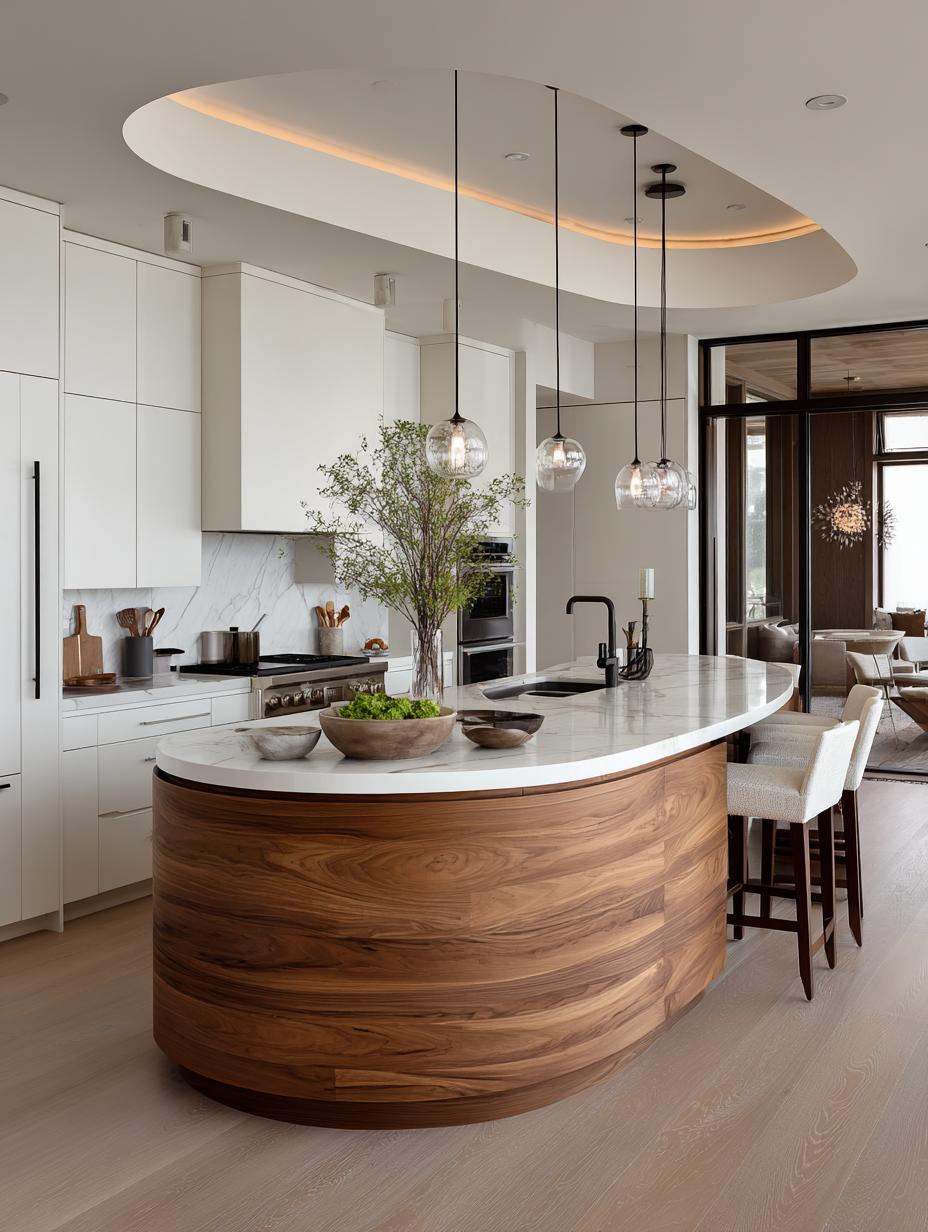
Horizontal grain wraps this curved island base like a barrel, and the warmth it brings to an otherwise all-white room is substantial. The walnut here has been bookmatched so the pattern mirrors itself across the surface. Above, a sculpted ceiling drops down in an organic oval shape, lit from within by a warm amber glow that washes the marble countertop.
Three clear glass pendants with black cord drops hang at staggered heights. Steel-framed doors separate the kitchen from what looks like a living area, with a sputnik chandelier visible through the glazing. The bar stools have oatmeal linen seats on dark walnut frames. Even the small ceramic bowls on the counter have been chosen to read as handmade, their slightly irregular forms adding another layer of organic texture.
The High-Gloss Curve I Can’t Stop Thinking About
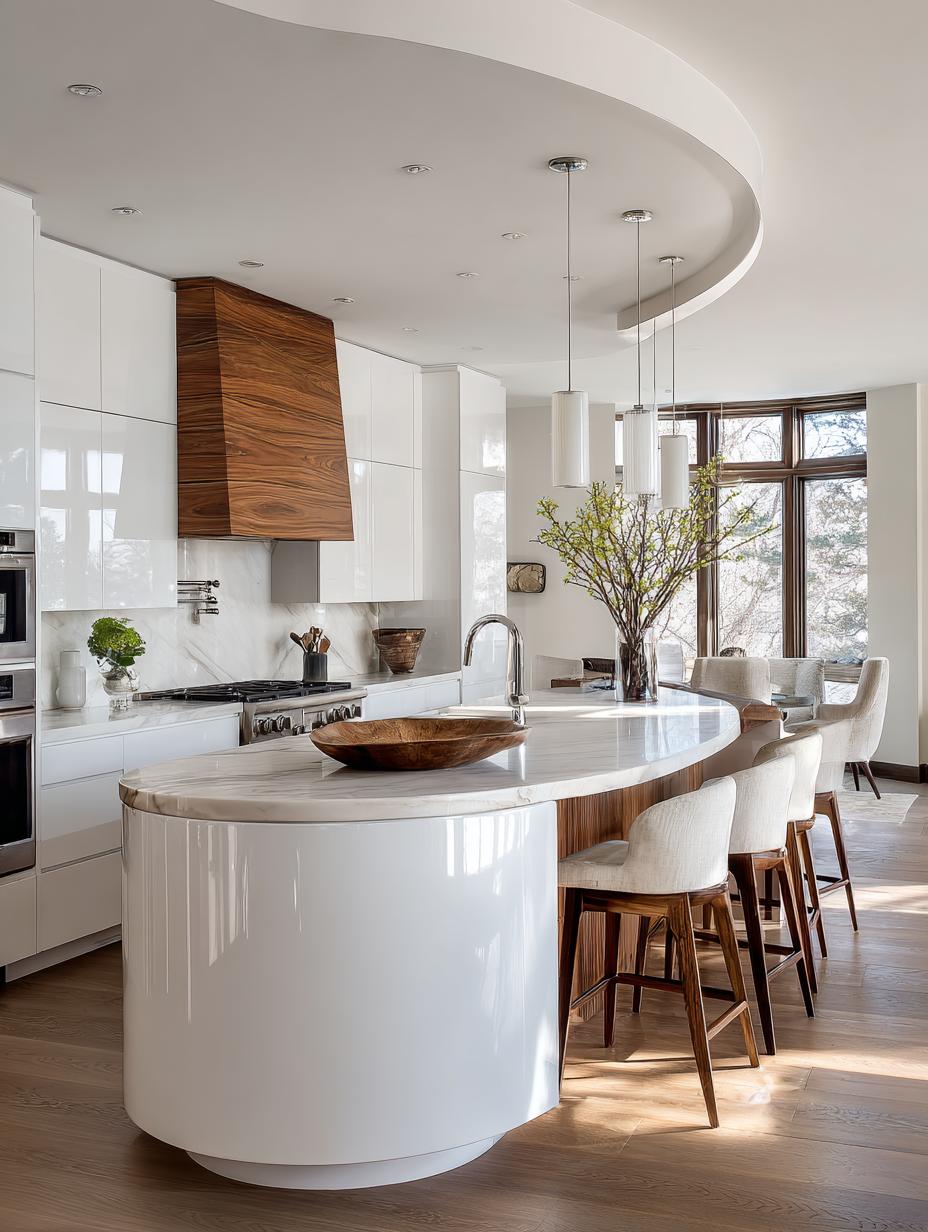
There’s something almost automotive about this island. The glossy white lacquer curves at both ends, reflecting the wide-plank oak flooring and the afternoon light from those tall windows. A sculptural ceiling detail in the same white finish swoops down toward the range hood, which is clad in striated walnut with prominent vertical grain.
The counter stools have cream bouclé seats and walnut backs that curve to match the island’s radius. On the marble surface sits a hand-turned wooden bowl, its irregular edge a quiet contrast to all the precision. Branches with early spring buds fill a tall clear vase. The pendant lights are simple white cylinders, deliberately understated so the architecture can speak.
Woven Seagrass Brings This Marble Island Back to Earth
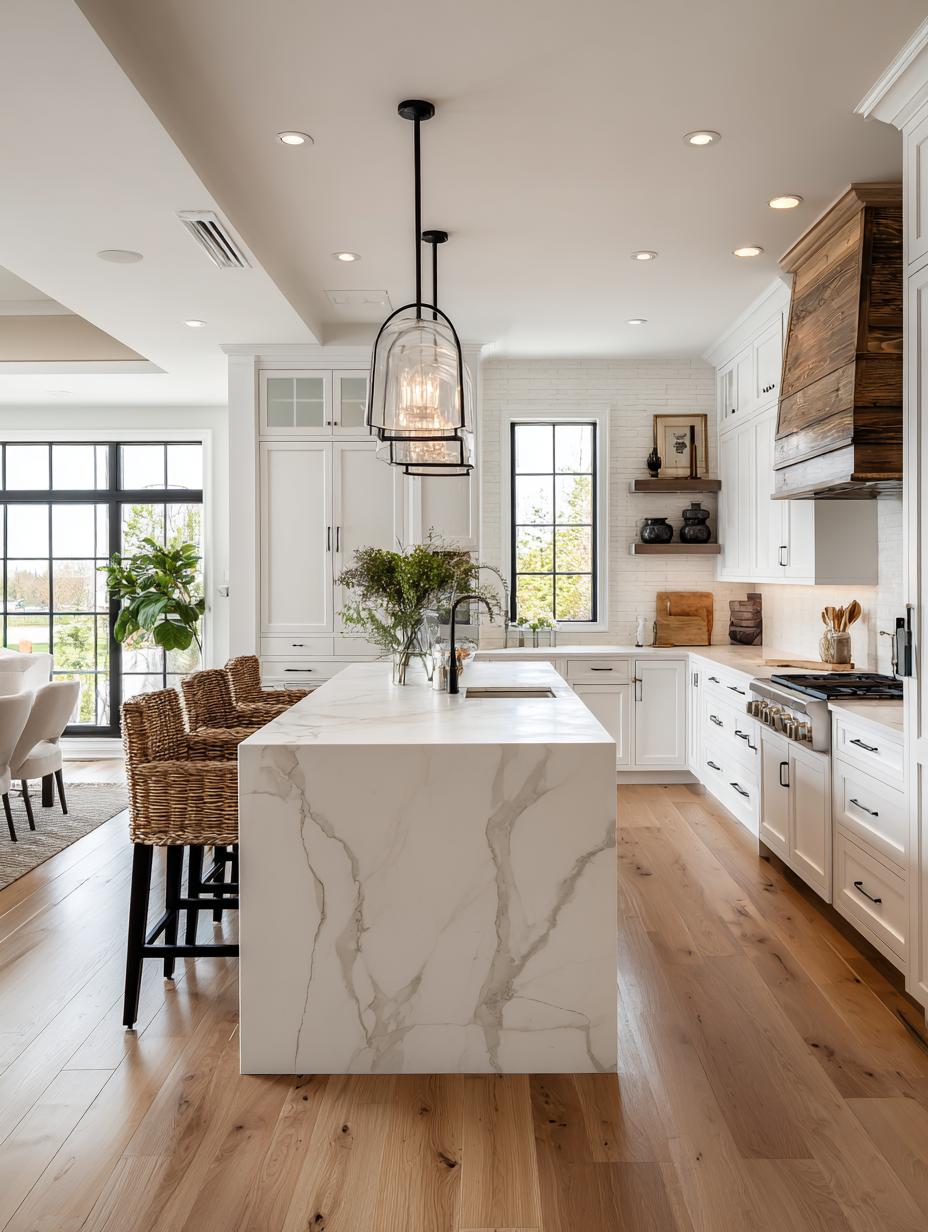
That hood. Rough-sawn reclaimed wood planks stack vertically above the range, their color varying from honey to deep umber where the grain has weathered differently. It’s the kind of detail that anchors a space and gives it age it hasn’t earned yet.
The waterfall island features Calacatta with soft gray veining, and the woven seagrass bar stools have black metal frames that pick up the window mullions. Wide-plank white oak flooring runs throughout, its natural variations adding texture underfoot. A single glass dome pendant with black hardware hangs off-center, casting a pool of light over the prep area. I notice the pot filler is matte black, not chrome, which keeps the hardware reading cohesive.
Try This: If your kitchen feels too polished, add one raw element. A reclaimed wood shelf, a hand-thrown ceramic crock for utensils, or unfinished linen curtains. The contrast actually makes the refined elements read as more intentional.
Weathered Beams Running Overhead
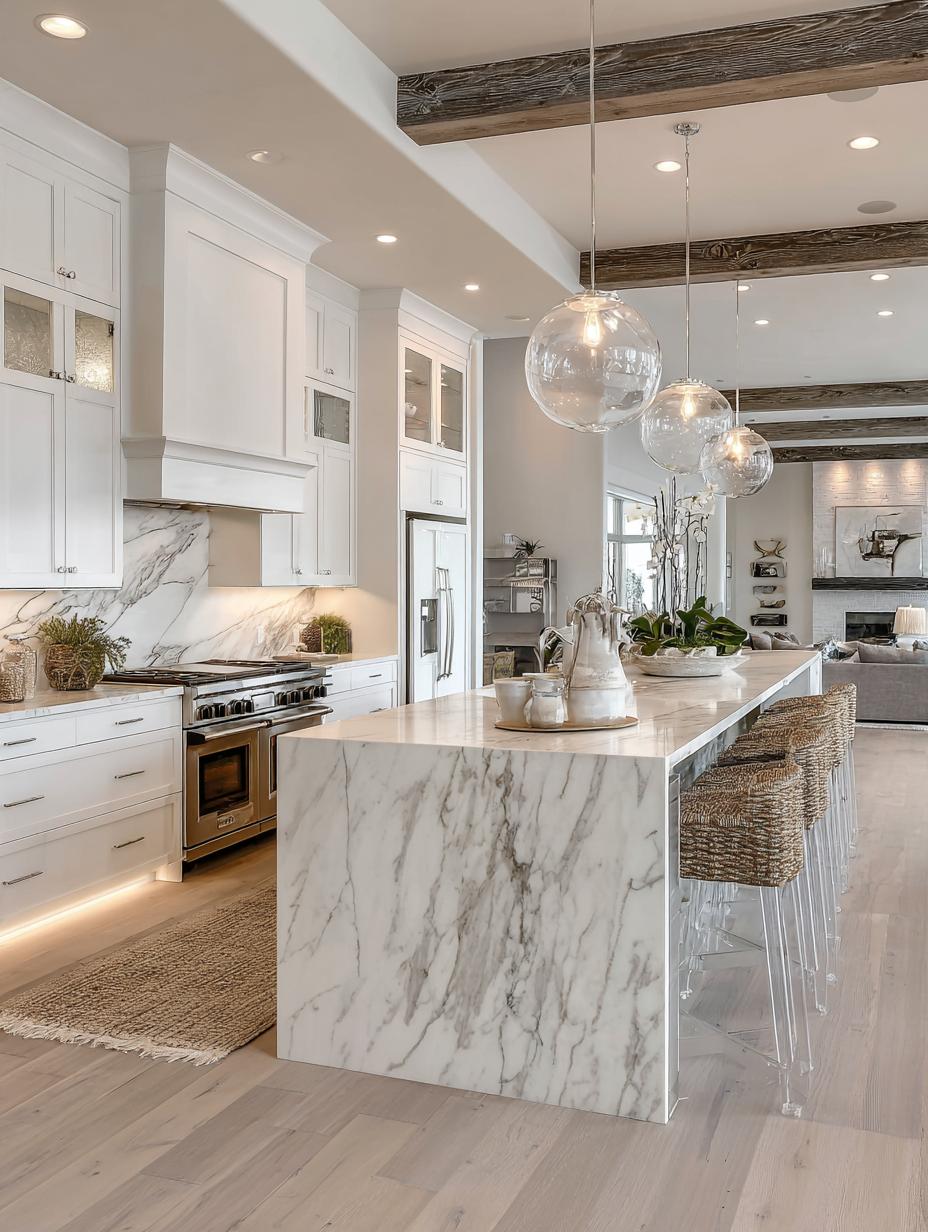
Two massive gray-washed beams span this kitchen, their rough-hewn texture visible even from a distance. They’ve got that silvered patina that only comes from actual age, and they make the glossy marble island beneath them feel grounded rather than precious.
The stools here are woven hyacinth on acrylic ghost legs, an unexpected pairing that works because the natural fiber softens the transparency. Under-cabinet lighting washes the dramatic marble backsplash, highlighting veins that run at sharp diagonals. Fresh greenery sits in a white ceramic pitcher on the island. Through a doorway I can see into the living room, where a fireplace mantel continues the pale stone theme. The space flows, but each room has its own character.
Barnwood That Refuses to Be Background
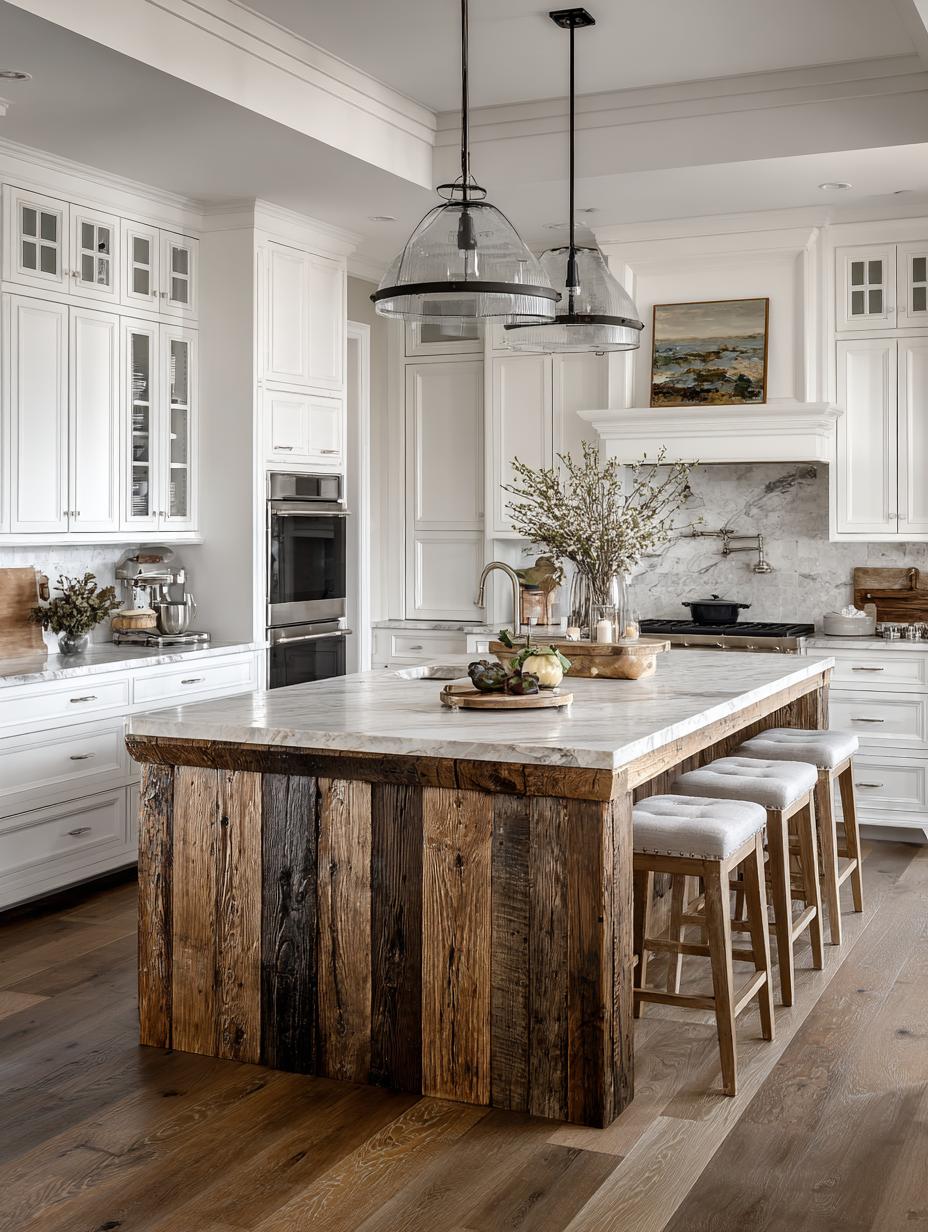
Vertical planks of reclaimed barnwood form this island base, their colors shifting from weathered gray to warm brown to almost charcoal where knots interrupt the grain. The white honed marble top sits thick and heavy above, its edge chamfered rather than mitered for a more substantial look.
Ribbed glass dome pendants hang from black iron frames, their industrial character complementing the raw wood below. The stools have tufted linen seats in a natural ecru, their simple oak frames deliberately unassuming. On the counter, a small landscape painting in an ornate gold frame leans against the marble backsplash. Spring branches fill a glass vase. A copper mixing bowl sits near the range. These are the kinds of collected details that make a kitchen feel inhabited rather than staged.
By The Numbers: Reclaimed wood sales for residential kitchen projects increased 67% between 2023 and 2025, according to building material trade data. The look isn’t just popular; it’s becoming expected.
Stone and Timber Working in Tandem
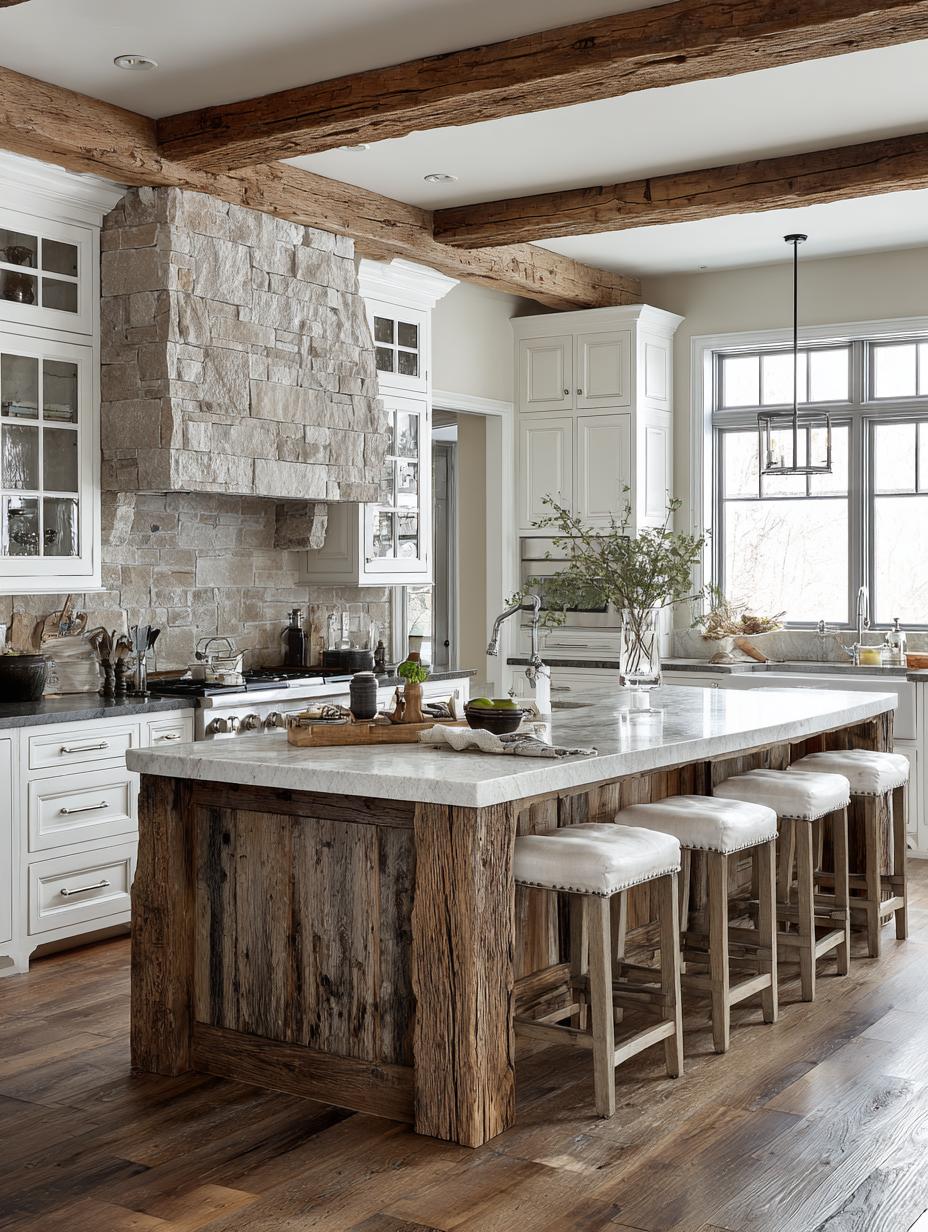
Stacked stone in varying shades of taupe and gray forms a massive range hood that dominates this kitchen’s back wall. The texture is rough, almost geological, and it grounds what could otherwise feel too precious with all that white cabinetry.
Overhead, hand-hewn beams run perpendicular to the island, their surfaces showing tool marks and natural checking. The island base matches their character, built from thick planks of reclaimed timber with visible nail holes and color variation. Backless stools with cream linen tops and nailhead trim line one side. Through large black-framed windows, winter trees are visible outside. A cutting board, ceramic bowls, and linen napkins suggest this kitchen gets used for actual cooking, not just photography.
Raw Oak Beams Ground a Kitchen Built for Slow Mornings
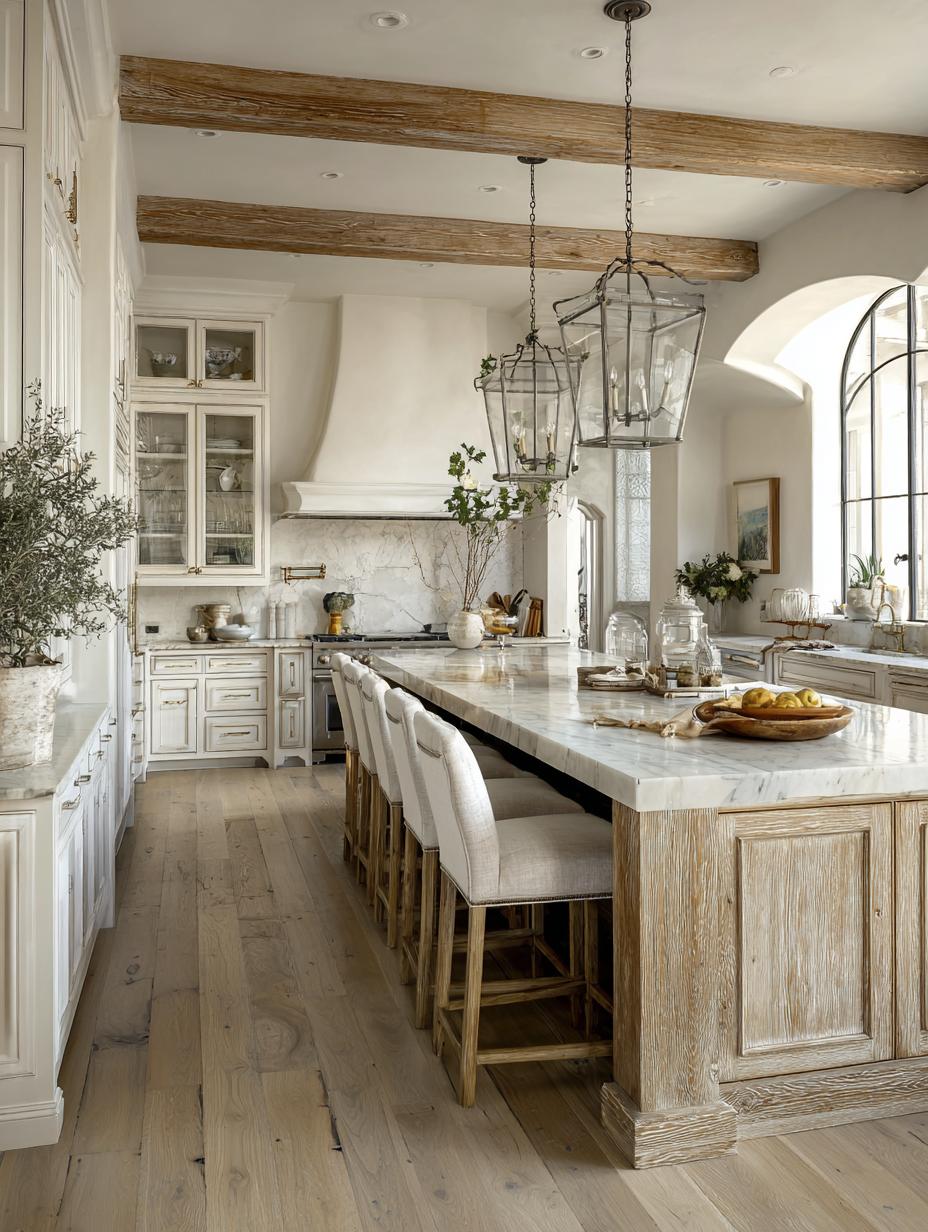
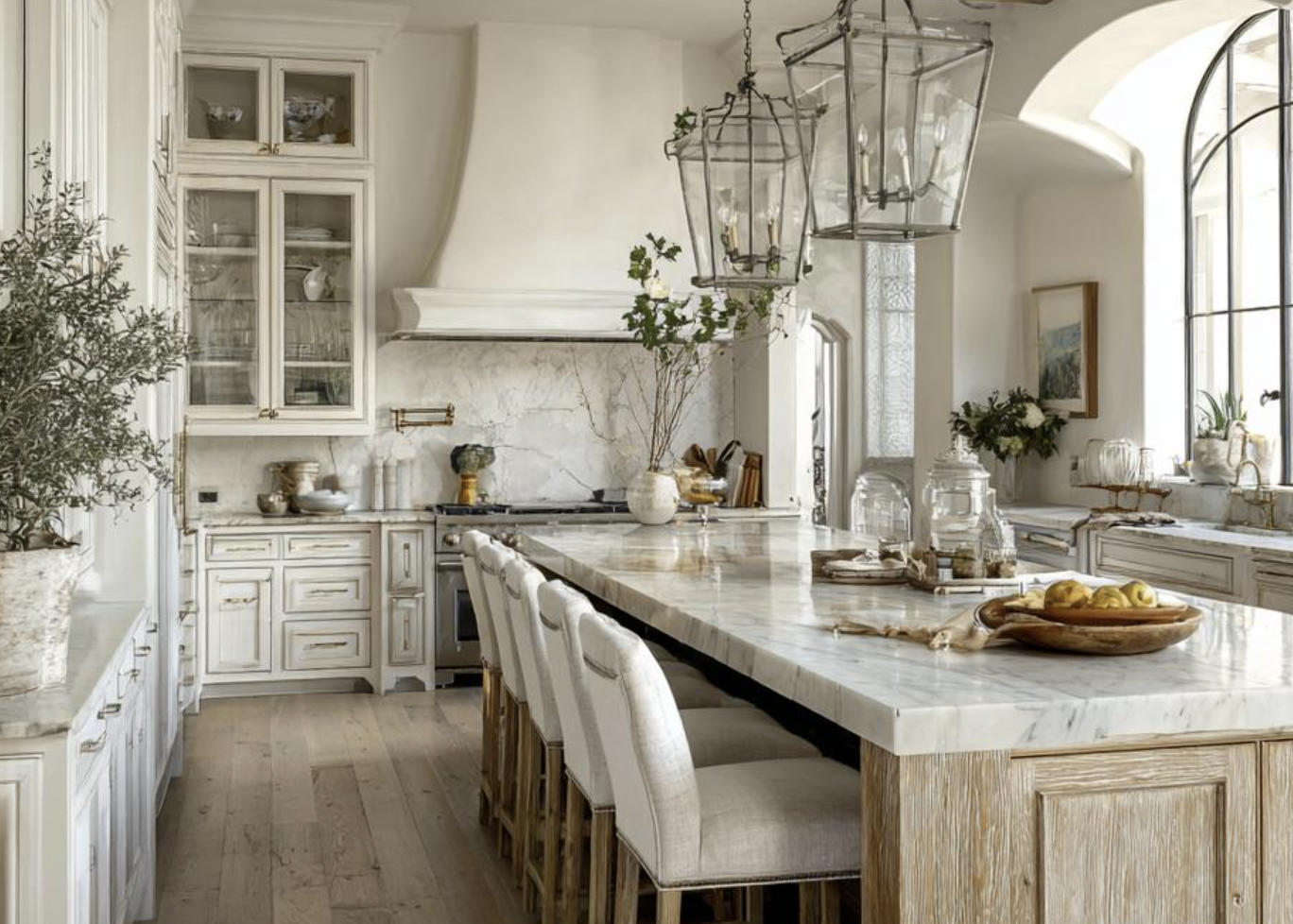
Those weathered oak ceiling beams carry the kind of character you cannot fake. They pull your eye up immediately, creating a tension against the ivory cabinetry below that feels earned rather than staged. The cerused oak island base picks up the same silvery undertones, while a thick slab of Calcutta marble runs the length of the workspace.
Four linen-upholstered barstools with pale oak frames line up beneath twin lantern pendants, their iron frameworks oxidized to a soft bronze. A ceramic vessel holds olive branches near the arched window. The wide-plank flooring reads almost like driftwood, each board showing grain variation that mass-produced alternatives never capture. Glass-front cabinets on the left reveal stacked dishware in cream and soft blue.
When the Island Becomes the Architecture
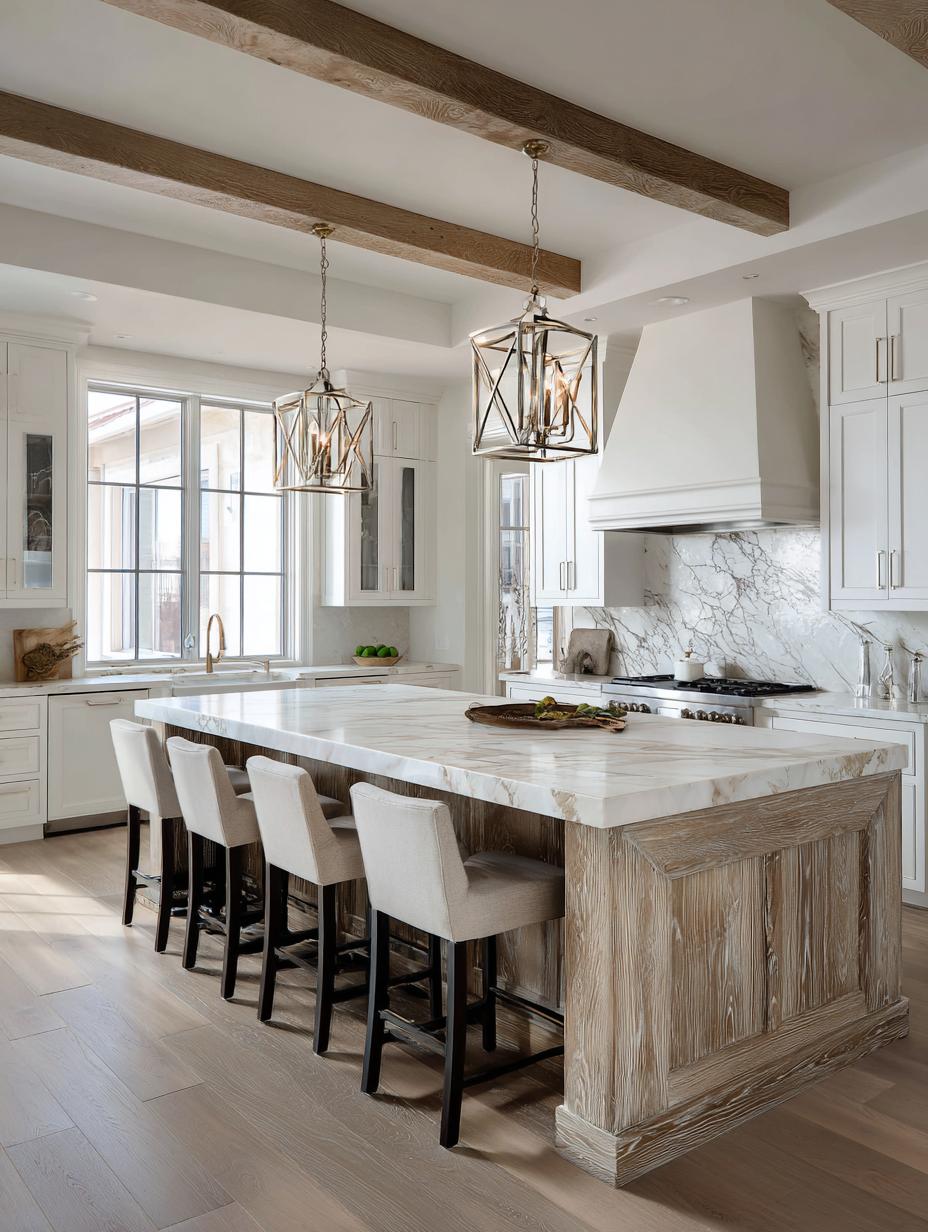
Parallel ceiling beams in grey-washed oak run toward the window, drawing the eye through the space rather than across it. The island base here shows pronounced grain with a cerused finish that lightens the wood to almost ash. Polished nickel pendants with geometric frames hang from chains attached to the beams themselves.
Cream boucle counter stools with dark espresso legs create a two-tone effect that echoes the room’s larger palette. The marble countertop displays subtle gold veining against a warm white base. A carved wooden tray holding pears sits at center. Behind the range, a slab backsplash rises to the plaster hood, its veining more dramatic than the countertop selection. The cabinetry hardware reads as brushed nickel or soft chrome.
History Corner: The cerused finish dates back to 16th century France, where craftsmen filled oak grain with white lead paste. Today’s versions use wax or plaster and work particularly well on ring-porous woods like oak and ash.
A Waterfall Island That Actually Earns the Name
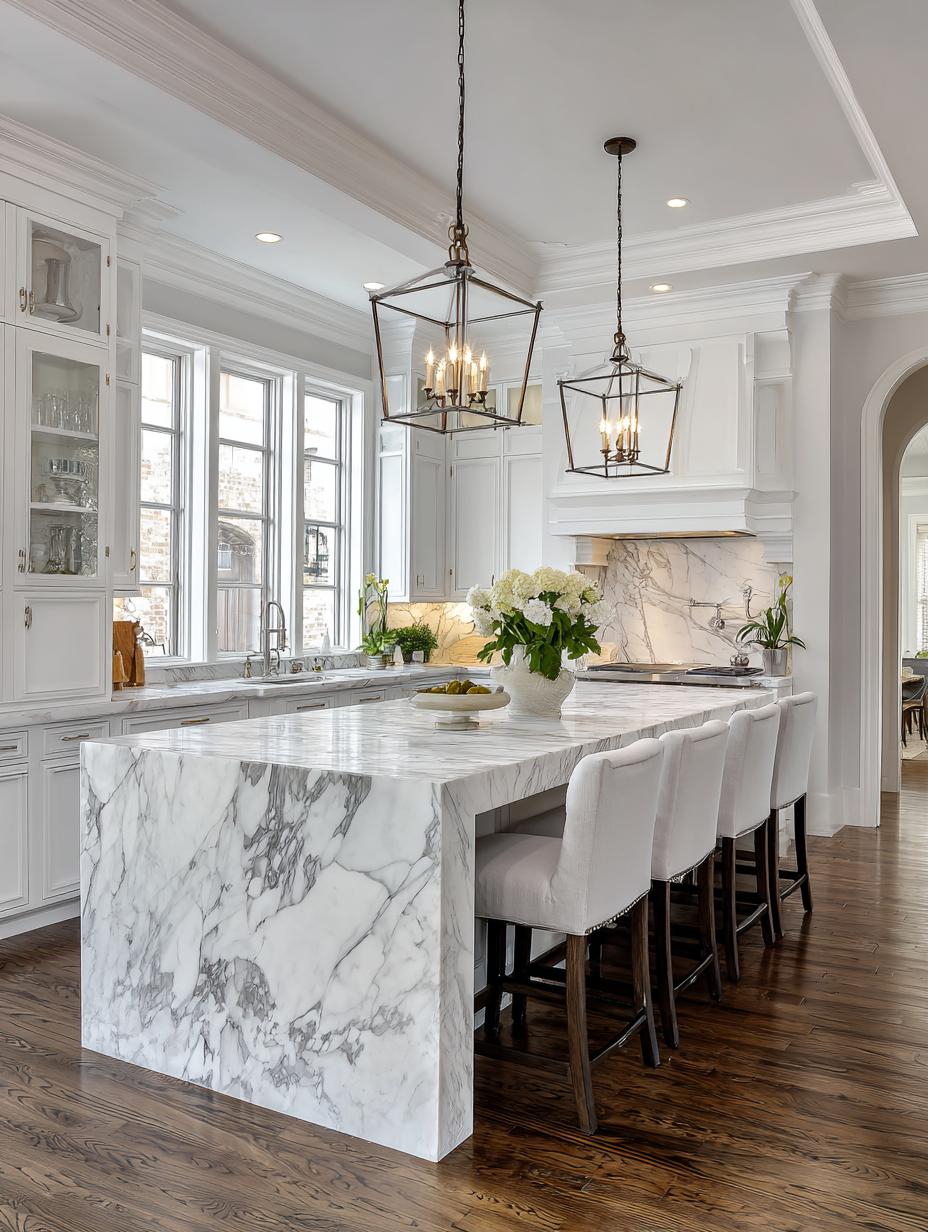
The veining here is so pronounced it reads almost like calligraphy. Grey striations move diagonally across the waterfall edge, continuing the pattern from countertop to floor in one unbroken sweep. This kind of bookmatched installation requires slabs cut sequentially from the same block, and you can see where the fabricator mirrored the pattern.
Linen upholstered stools in pale grey sit on dark walnut legs, their nailhead trim catching light from the twin lantern pendants above. The coffered ceiling adds depth without competing with the marble’s drama. White hydrangeas overflow from a ceramic vessel at center, their petals picking up the stone’s cooler undertones. Through the window, you can see brick exterior walls that suggest an urban or transitional setting.
Gold Hardware Shifts the Entire Temperature of White Cabinetry
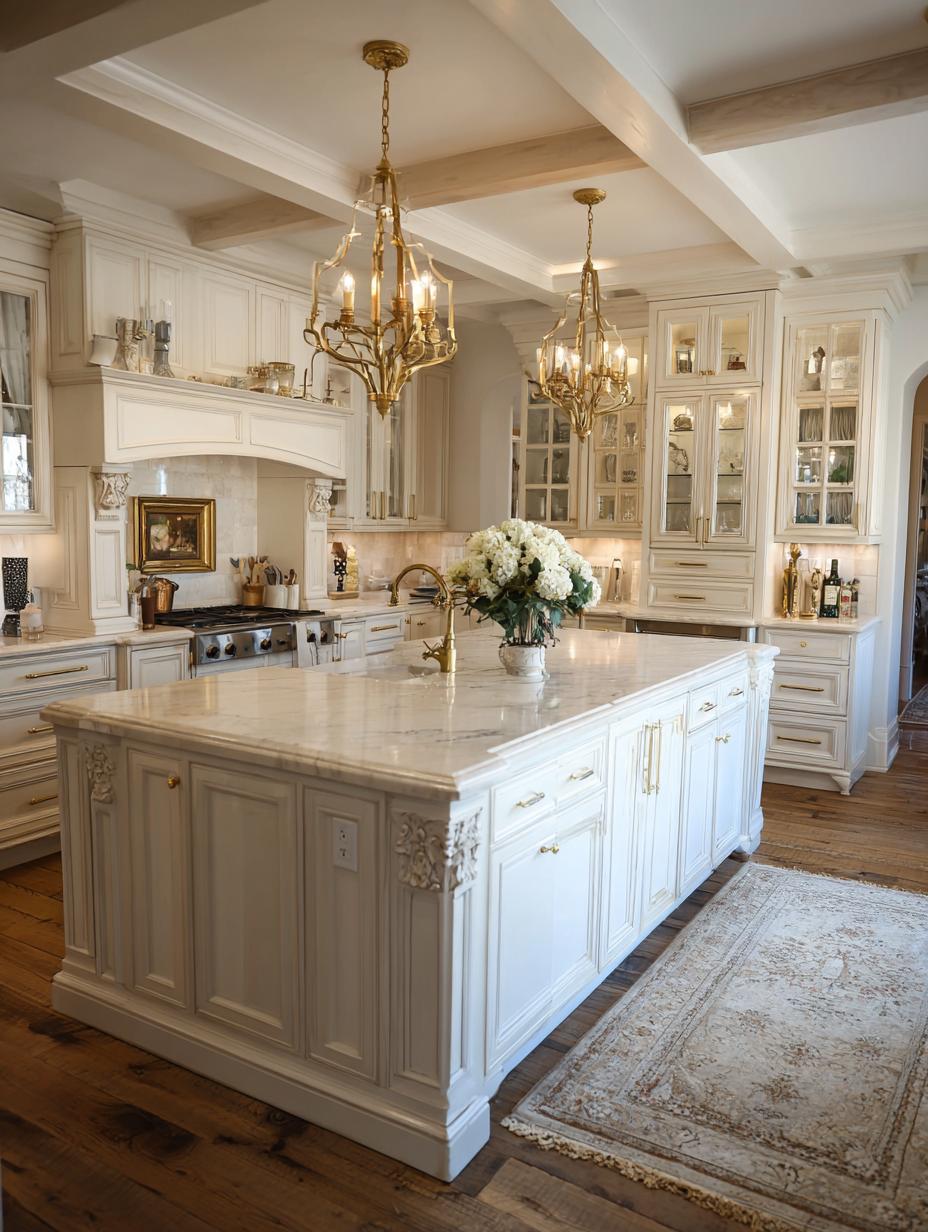
Twin chandeliers in antique brass curve above the island like something rescued from a French estate sale. Their scrollwork frames hold candelabra bulbs that cast a warm amber glow across the cream-toned cabinetry. Carved corbels support the hood, and you can spot acanthus leaf details on the island corners if you look closely.
Glass-front cabinets climb to the coffered ceiling, their interior lighting illuminating crystal stemware and silver serving pieces. The faucet over the island sink matches the chandelier finish exactly. An antique runner in faded rose and sage anchors the workspace, its worn pile suggesting decades of actual use. The countertop reads as a warmer white marble, possibly Calacatta Oro, with gold veining that reinforces the hardware selection.
The Coffered Ceiling Trick That Makes Eight-Foot Ceilings Feel Taller
🔥 Would you like to save this?
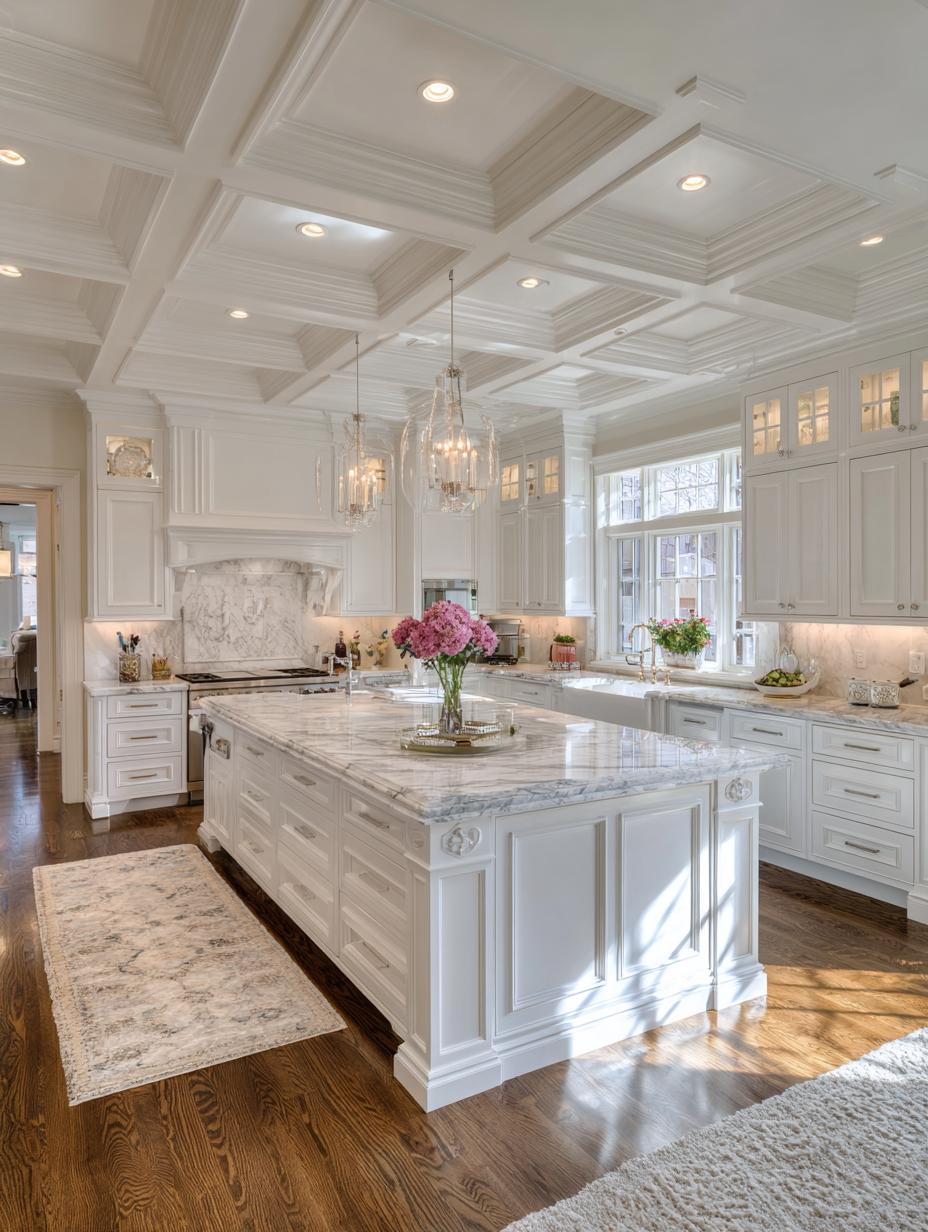
Each recessed panel holds its own can light, turning the coffered grid into functional ambient lighting rather than pure decoration. The effect multiplies the perceived ceiling height. Clear glass pendants with teardrop silhouettes hang at staggered heights, their transparency keeping the eye moving upward.
Pink peonies burst from a glass vase on the island, their color the only warm accent in an otherwise cool-toned space. The marble shows grey veining on a bright white base, likely Statuario. Rosette medallions mark the island corners, a detail borrowed from furniture design that reads as quietly confident rather than fussy. Through the windows, afternoon light falls across dark oak flooring with visible wire-brushed texture.
Pattern on Pattern Without the Chaos
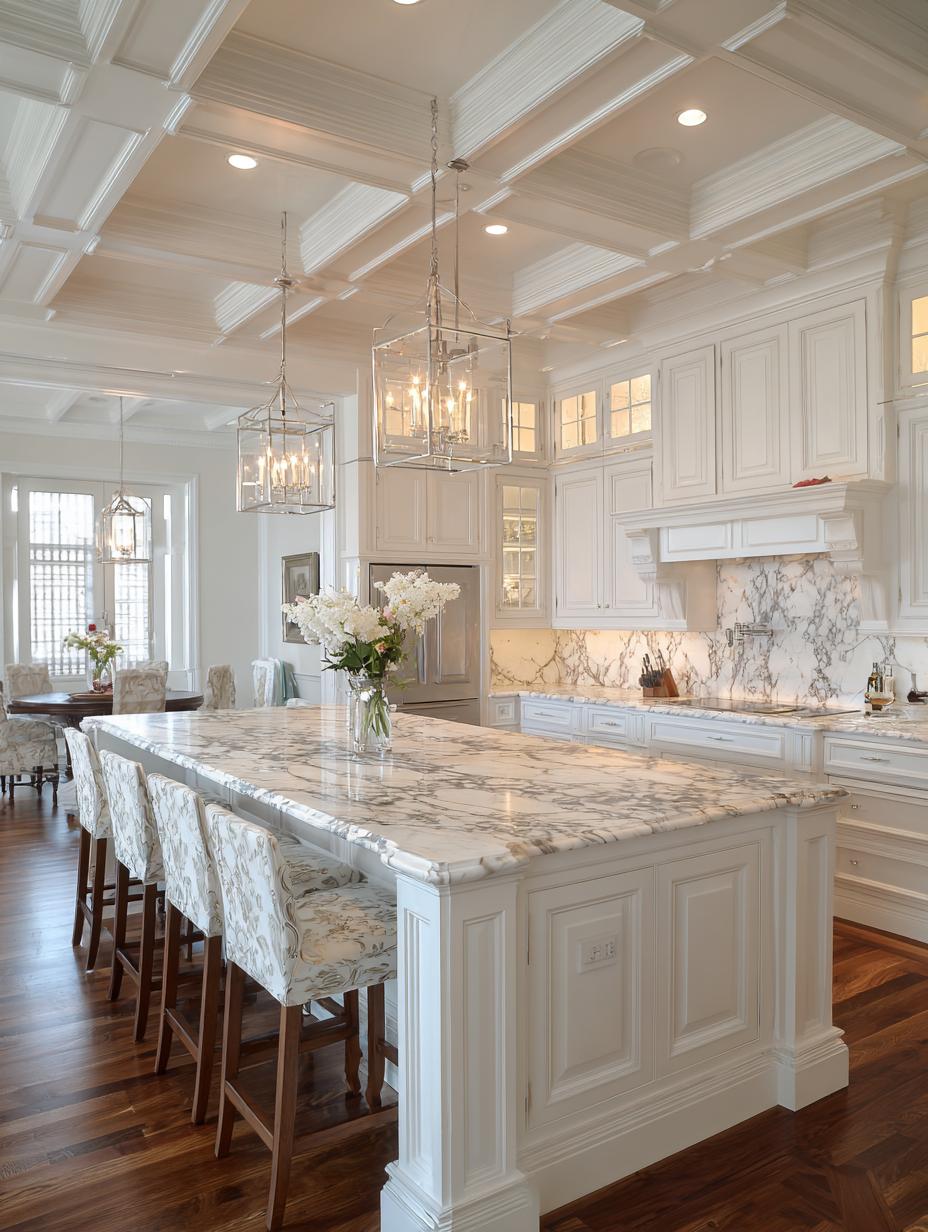
Floral fabric on the counter stools creates conversation with the veined marble above, both patterns organic but operating at different scales. The fabric reads as a muted botanical in sage, taupe, and cream on a white ground. It works because the marble veining is bold and directional while the florals are diffuse and scattered.
Lantern pendants in polished nickel hang from the coffered ceiling’s grid intersections. The backsplash continues the same Calacatta slab behind the professional range, its pot filler matching the pendant finish. A breakfast nook visible through the arch shows coordinating floral chairs around a dark wood table, extending the palette into adjacent spaces without repeating it exactly.
“The mistake people make with white kitchens is thinking they need to be afraid of pattern. They don’t. They need to be afraid of boring.”
Two-Tone Cabinetry Done With Actual Restraint
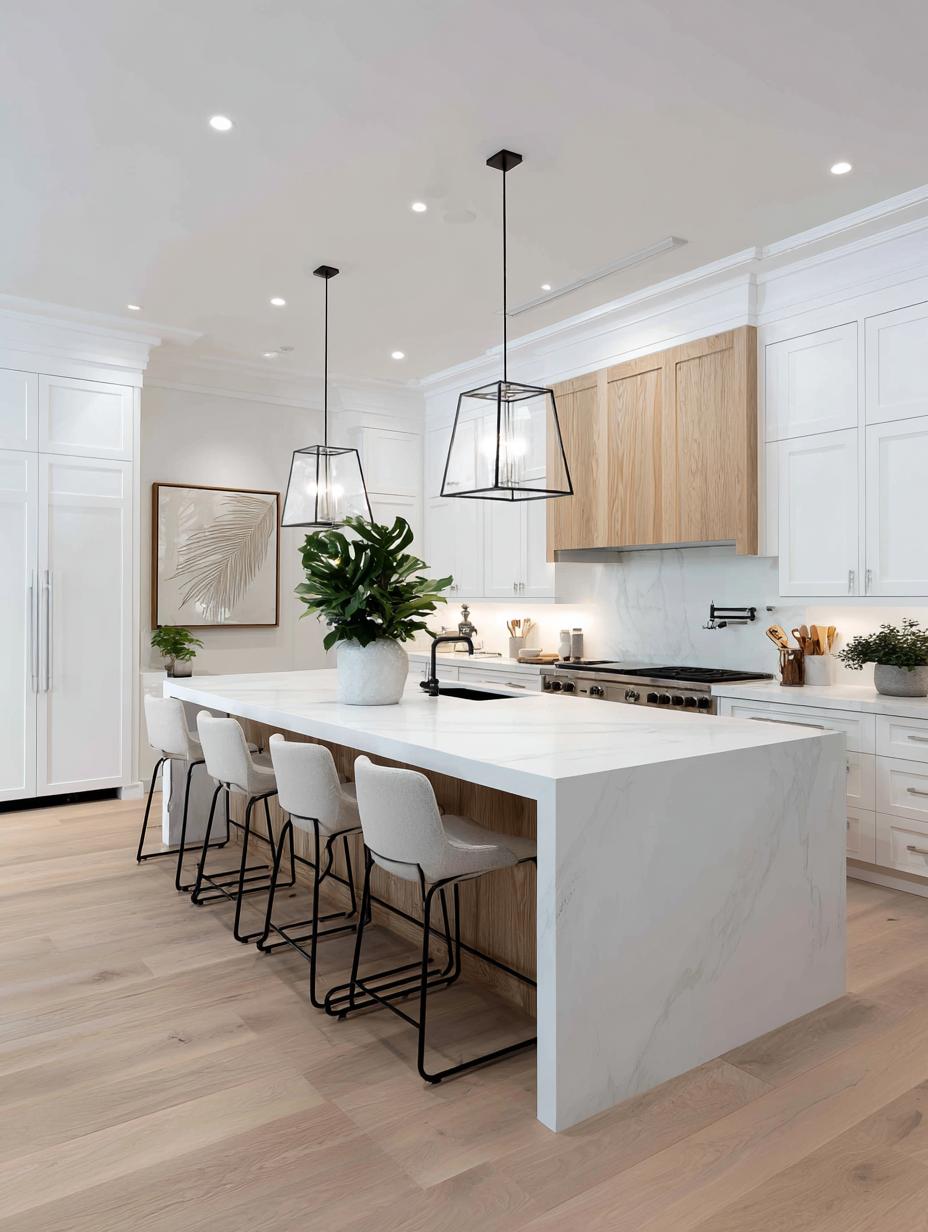
White oak panels wrap the range hood, their vertical grain creating a focal point that draws the eye without demanding attention. The same wood appears on the island’s base, visible beneath the waterfall quartz countertop. Everything else reads as pure white with Shaker-style recessed panels.
Black metal frames on the pendant lights and counter stools introduce a deliberate graphic element. The stools themselves wear white boucle fabric, their curved barrel backs reading as almost Scandinavian. A framed palm print in neutral tones leans against the wall near a fiddle leaf fig. The floor runs pale throughout, likely white oak to match the cabinet accents, bleached or limed to minimize yellow undertones.
Reclaimed Barn Wood Against Polished Marble Creates Honest Tension
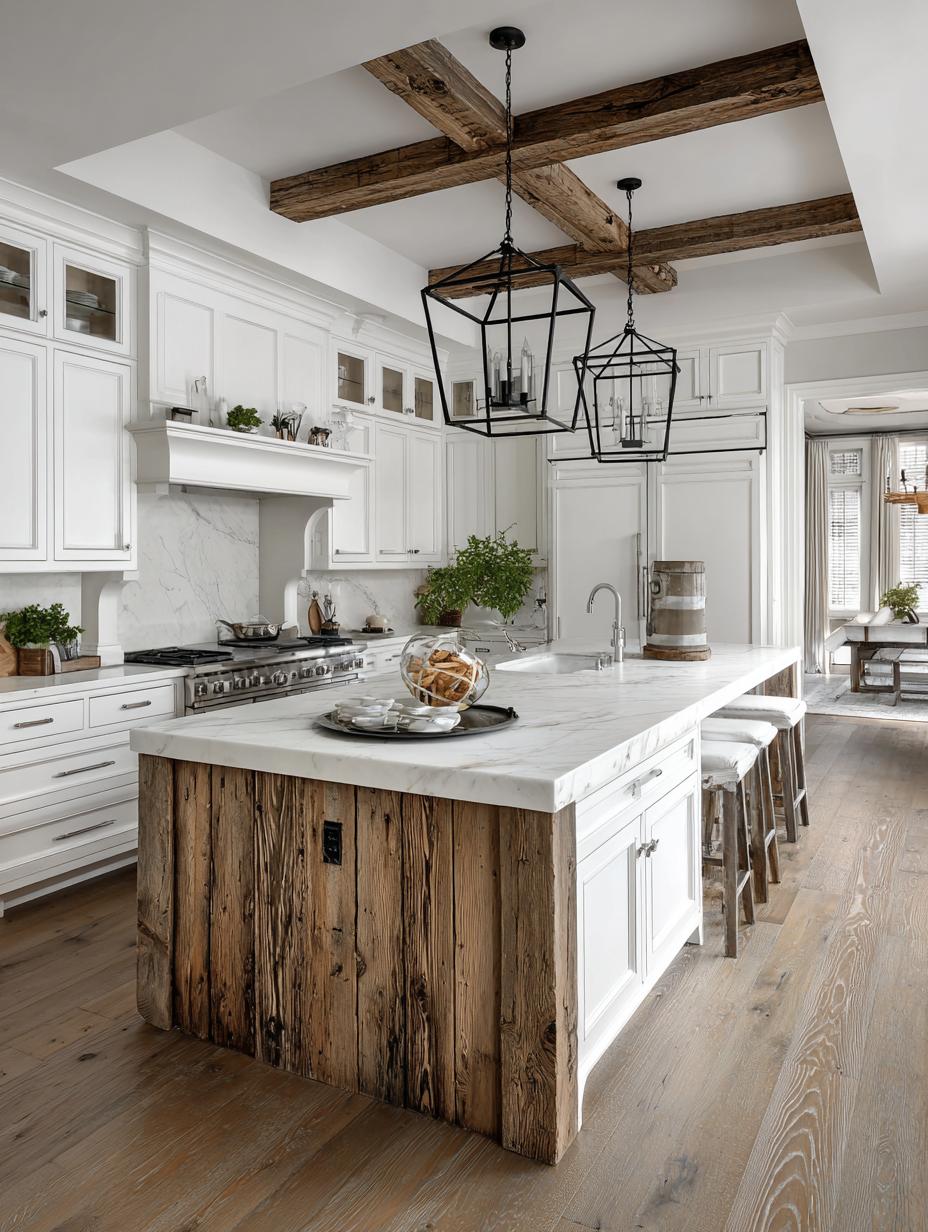
That island base tells a story before you even sit down. Rough-hewn planks with visible nail holes and weathered grey patina support a thick marble slab in bright white with subtle veining. The crossing ceiling beams overhead repeat the same reclaimed wood character, their irregular surfaces catching light differently than milled lumber would.
Black iron lanterns hang at workstation height, their candelabra bulbs unshaded. The professional range sits beneath a plaster hood with a marble accent panel that continues the backsplash material. Weathered wood stools line the island’s far side, their fabric seats in natural linen worn soft. A glass cloche covers baked goods on a silver tray at center, next to potted herbs in grey ceramic vessels.
By The Numbers: Reclaimed wood pricing has increased 40% since 2021 as supply from dismantled barns and factories continues to dwindle. Most suppliers now source from old-growth pine warehouses in the South rather than actual barns.
Clear Glass Pendants Let the Architecture Speak
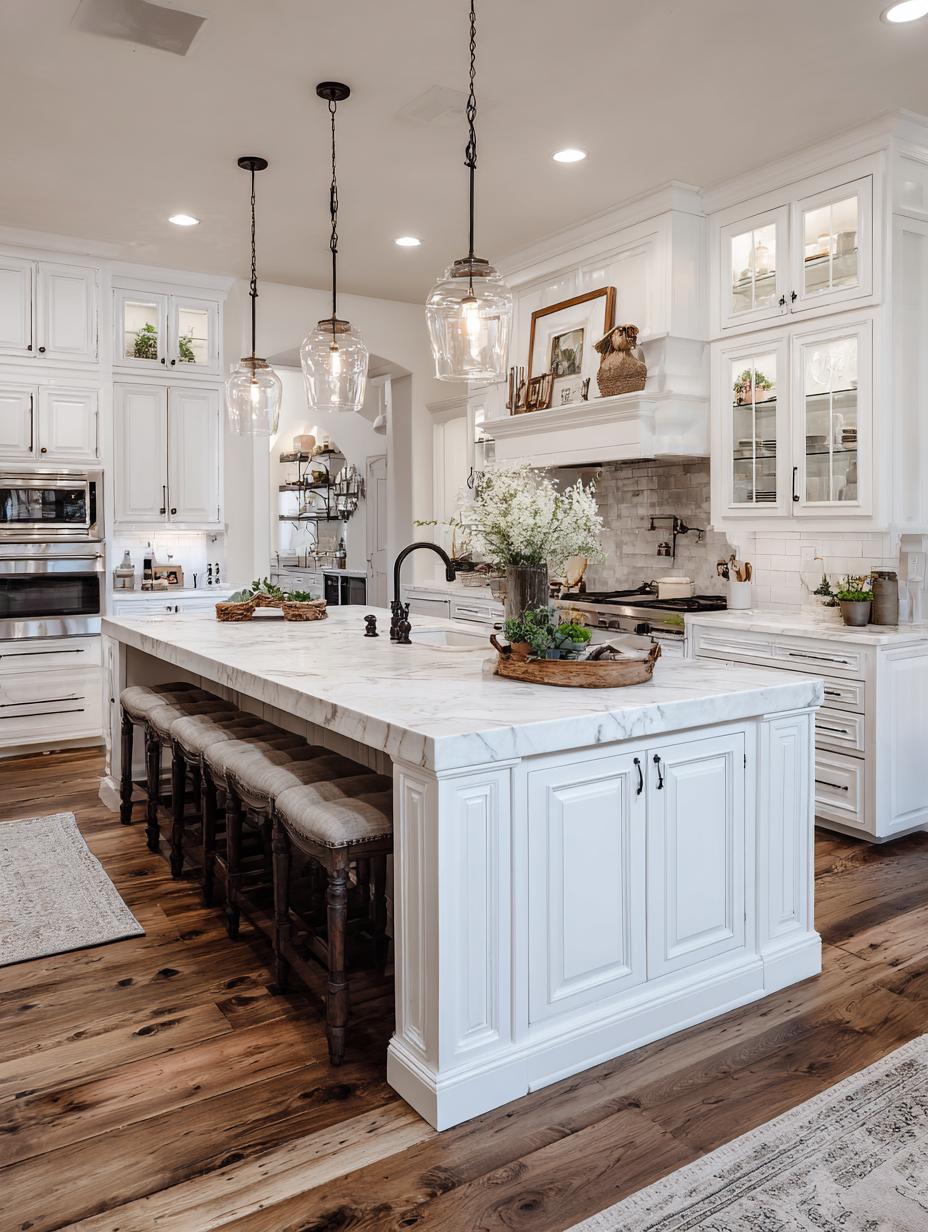
Three blown glass pendants with apothecary silhouettes hang above the island at different heights, their transparency allowing views through to the room beyond. The cabinetry climbs past nine feet, each upper cabinet fitted with interior lighting that warms the glass fronts at dusk.
Turned-leg barstools with tufted linen cushions tuck beneath the marble overhang, their dark wood finish matching the wide-plank flooring underfoot. A woven basket near the range holds wooden utensils, while a galvanized metal container sits on the hood’s display shelf beside a small oil painting and ceramic pitcher. The subway tile backsplash reads as handmade with slight variations in glaze color and surface texture. Antique runners in faded vegetable dyes soften the circulation paths on either side of the island.
When Limestone Arches Frame a Kitchen, Something Shifts
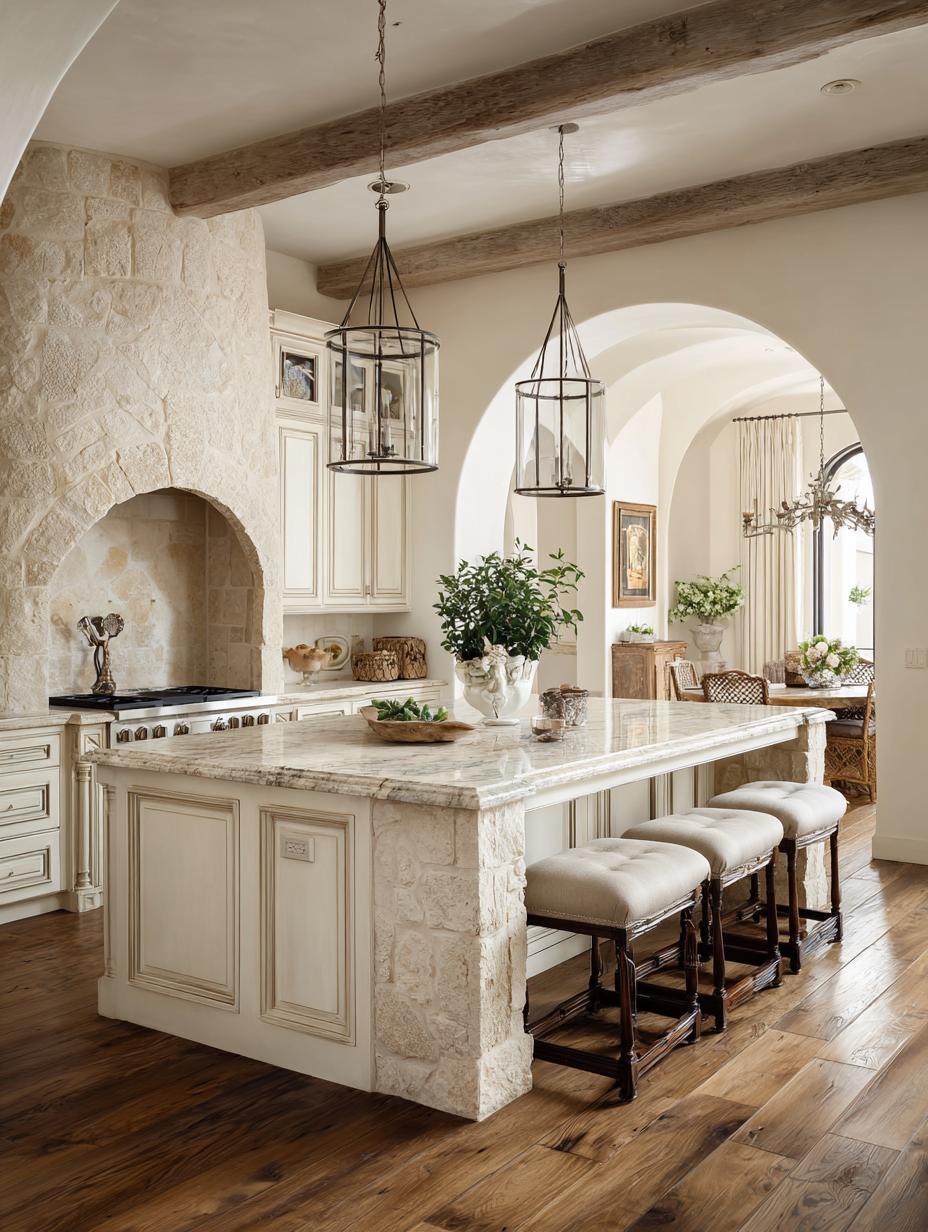
That arched limestone hood pulls focus immediately. The stone carries warm cream and taupe tones with visible mortar lines, and it wraps around the cooktop in a way that feels almost protective. Pale weathered beams run overhead, their silvery grain catching light differently than the honey-toned wide plank floors below.
Three tufted linen stools in a greige fabric tuck beneath the island, their turned dark wood legs adding a French provincial detail. The island itself does something clever: cream-painted cabinetry on one side, raw limestone on the waterfall end. Cylindrical glass lanterns with aged bronze frames hang at staggered heights. Through the arched passageway, a glimpse of wicker dining chairs and a crystal chandelier suggests the adjacent room continues this collected European sensibility.
The Marble Does All the Talking Here
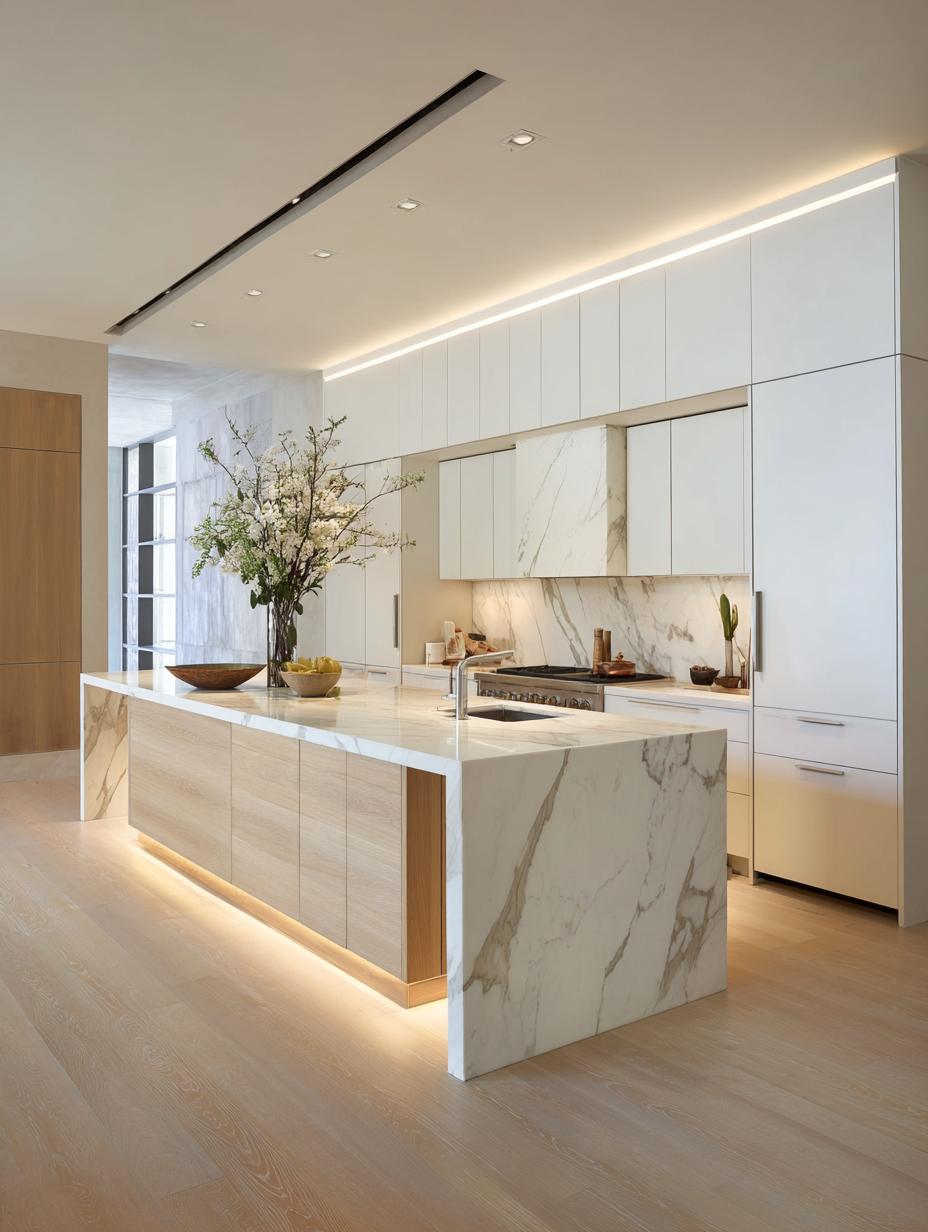
Calacatta with rust and gold veining runs across the countertop, down the waterfall edge, and up the backsplash in one continuous sweep. No hardware anywhere. The flat-panel cabinets read almost as architecture rather than storage, their matte white finish disappearing against the walls.
A strip of LED lighting glows beneath the upper cabinets and along the island’s toe kick, casting soft pools that make the veining pop after dark. The oak veneer panel on the island’s working side brings just enough warmth to keep things from feeling clinical. On the counter, a sculptural branch arrangement in a clear vase adds organic movement. The pale oak floors have an almost bleached quality, their grain barely visible.
How Much White is Too Much White?
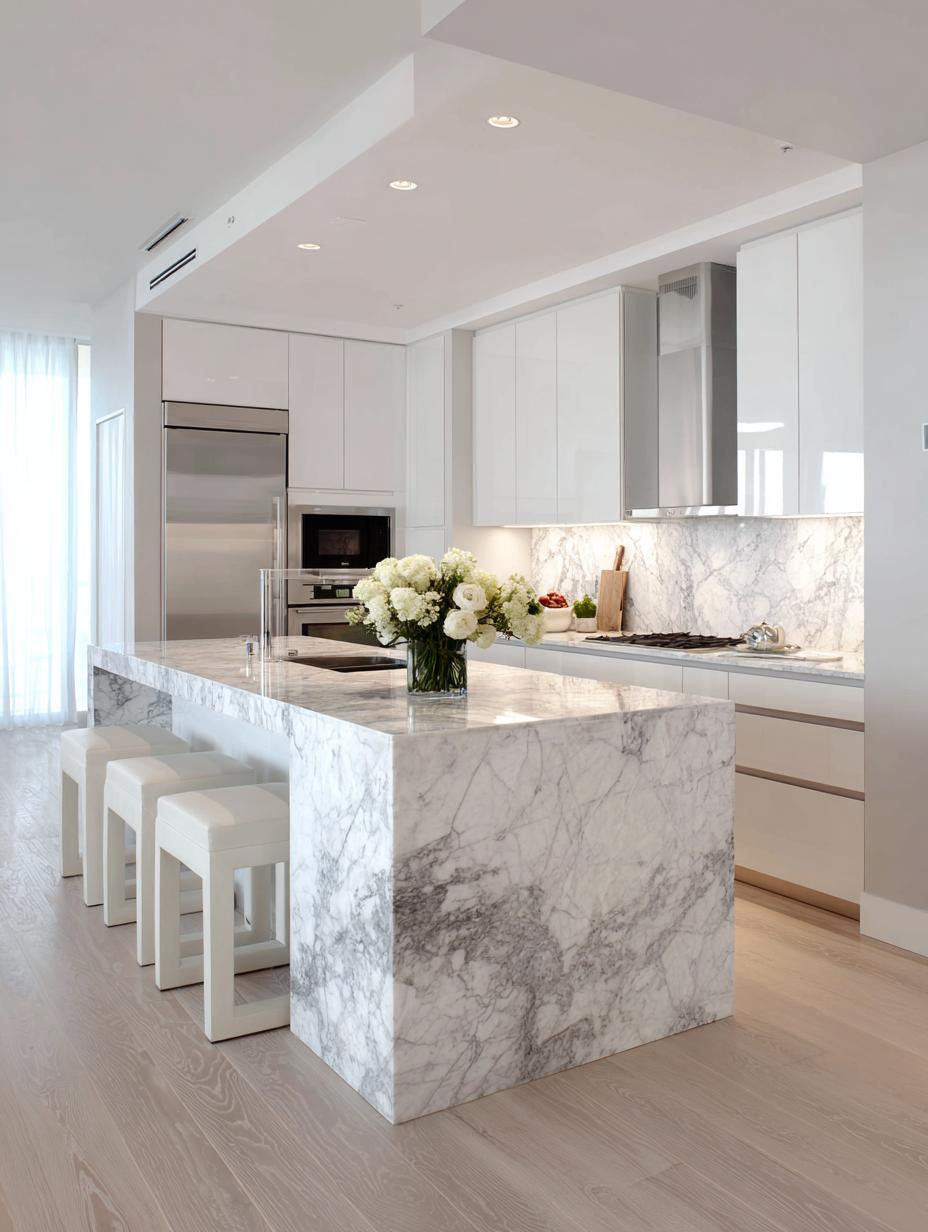
This kitchen answers that question by leaning all the way in. Carrara marble with bold grey veining wraps the entire island in a thick slab, the pattern continuing across the backsplash behind the range. High-gloss lacquered cabinets reflect light back into the room. Even the backless stools wear white leather upholstery on white metal frames.
The recessed ceiling drops down to define the cooking zone, fitted with flush lights and an integrated vent. Stainless appliances provide the only real contrast. A lush bouquet of white hydrangeas and ranunculus sits in a glass cylinder, the green stems visible through the water. The bleached oak floor reads almost silver in this light.
History Corner: The waterfall edge detail originated in mid-century furniture design before migrating to kitchen islands in the early 2000s. Italian fabricators pioneered the technique of book-matching slabs so veining could flow continuously from horizontal to vertical surfaces.
Gold Hardware Changes Everything in a Formal White Kitchen
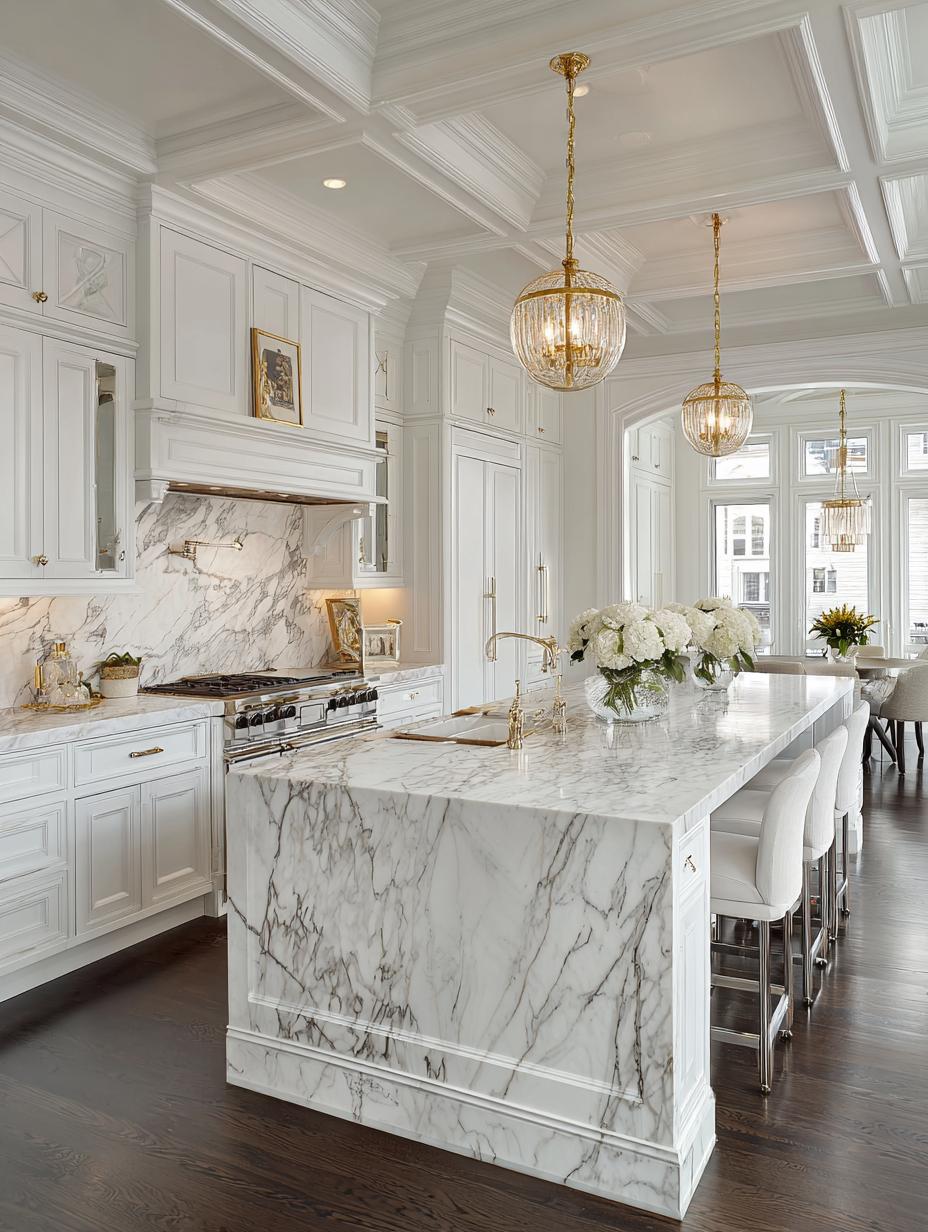
Coffered ceiling panels march across the room in deep relief, their shadows adding dimension to an otherwise pale palette. Three crystal globe pendants hang from twisted brass chains, throwing prismatic light across the Calacatta marble island below. The veining here runs dramatic and dark, almost charcoal grey against the white ground.
Polished brass cabinet pulls repeat across every drawer and door. The bridge faucet, pot filler, and even the decorative objects on the counter pick up that warm metallic note. White leather counter chairs with chrome legs line the island’s seating side. Through arched windows, natural light floods the workspace. A gilt-framed landscape painting hangs above the range hood, and fresh white hydrangeas spill from a clear vase. The dark espresso hardwood floors ground all this brightness.
Reclaimed Barn Wood Gives This Island Its Personality
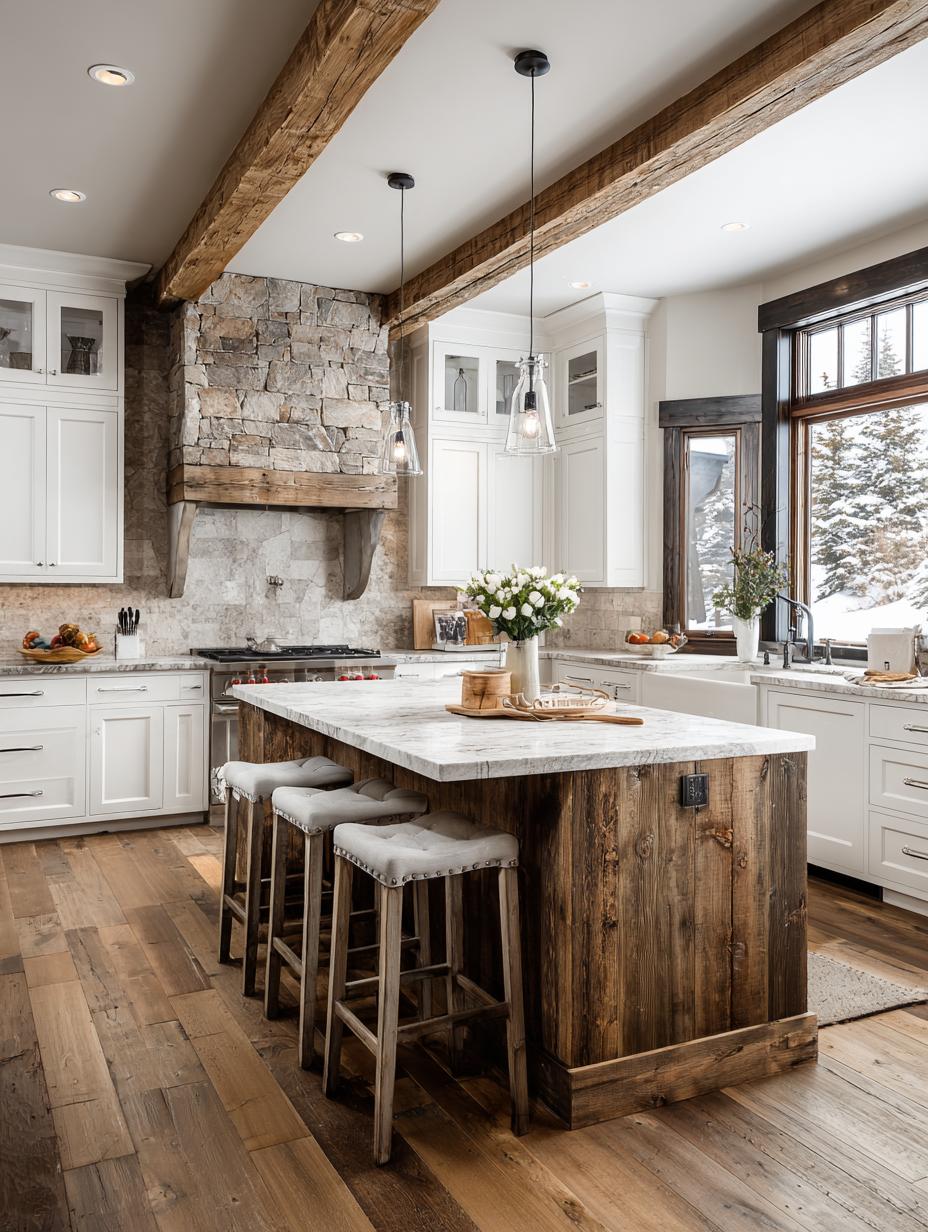
Vertical planks of weathered grey-brown wood form the island base, nail holes and saw marks still visible. The timber has that authentic patina that takes decades to develop. Above it, a thick slab of grey-veined marble provides the work surface.
Stacked stone in warm beige and grey tones covers the range wall, extending up to form a chunky hood with a reclaimed wood mantel shelf. The ceiling beams look genuinely old, their surfaces rough and irregular. Three grey linen-topped stools with nailhead trim sit ready for morning coffee. Outside the window, snow covers evergreens. White shaker cabinets with simple bar pulls line the perimeter, and clear glass pendants let the stone wall remain the focal point.
A Kitchen That Looks Like It Belongs in the Mountains
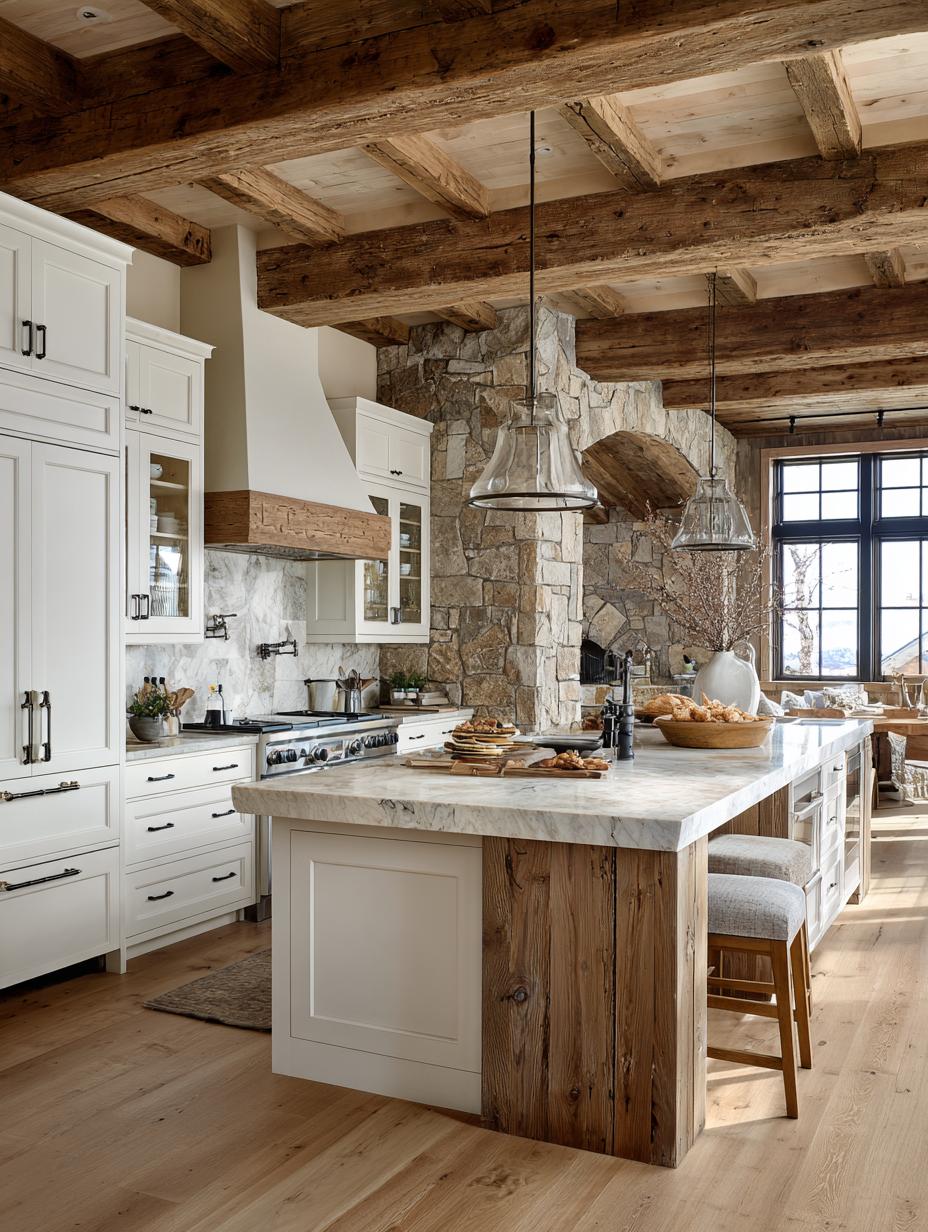
The ceiling here tells a story. Massive hand-hewn beams in varying shades of blonde and caramel span the room, their joints visible where smaller timbers intersect. A floor-to-ceiling stone fireplace with an arched opening anchors one wall, its rough-cut stones ranging from cream to warm grey.
The island runs long and low, its base mixing white painted panels with weathered wood end caps. Thick marble counters hold stacked pastries and fresh bread. Grey upholstered stools slide beneath the overhang. Clear glass pendants hang from black cords, simple against all that texture overhead. Through black-framed windows, a view of distant hills. The range wall gets a curved plaster hood trimmed in reclaimed wood, and glass-front cabinets display white dishware.
River Rock Turns a Range Wall Into Art
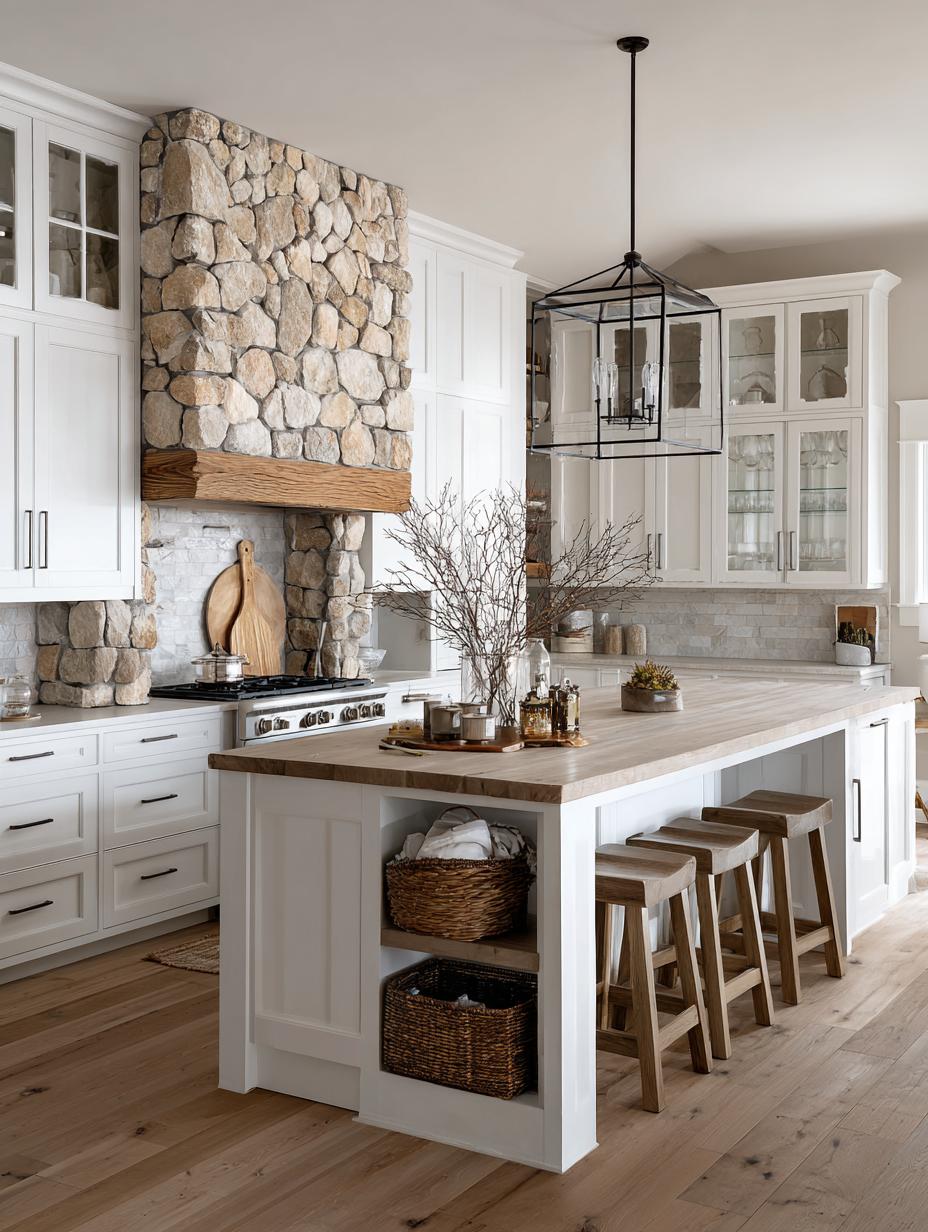
Rounded stones in cream, tan, and soft grey cover the entire range wall, each one unique in shape and size. A thick timber mantel with visible grain marks breaks up the stone, and the pro-style range sits within a niche at counter height. Wooden cutting boards lean against the stone, ready to use.
The island takes a different approach: butcher block countertop in pale maple, white base with open shelving below. Woven seagrass baskets in two sizes tuck into those cubbies. Four weathered oak stools wait on the seating side. A black lantern pendant with glass panels hangs above, its iron frame adding weight to the airy space. Dried branches in a clear vase bring organic texture to the counter. Glass-front uppers display white dishes and pitchers.
Why Painted Stone Hoods Keep Showing Up
🔥 Would you like to save this?
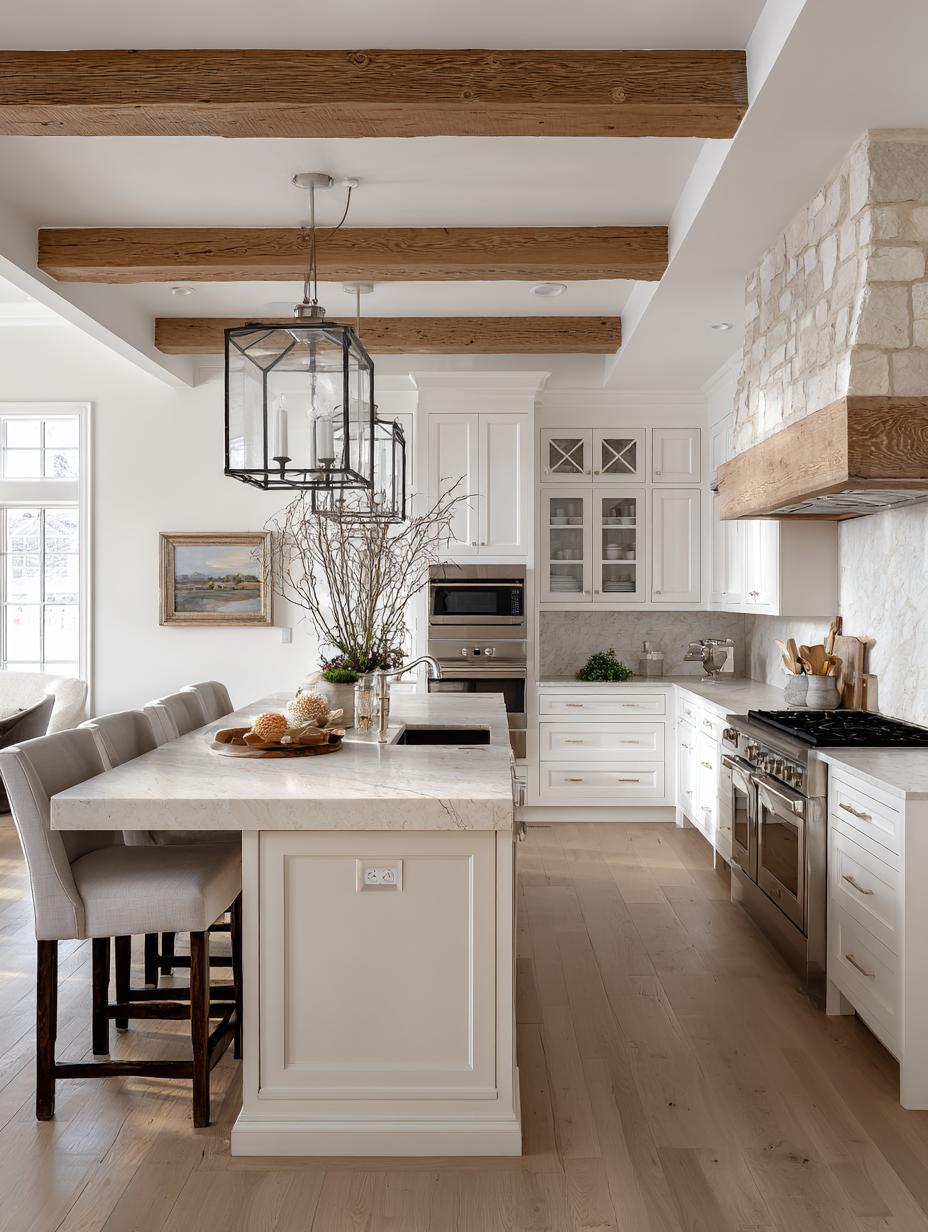
Lime-washed stone blocks form the range wall here, their texture visible beneath the chalky white finish. The hood slopes outward with a thick reclaimed wood trim piece at the base. Two honey-toned ceiling beams run parallel overhead, their warmth repeated in the pale oak floors.
A landscape painting in a simple gold frame hangs on one wall, bringing color and a sense of collected history. The island base wears cream paint with traditional paneling, topped by grey-veined marble. Four upholstered counter chairs in oatmeal linen pull up to the overhang. A geometric lantern pendant in black iron and glass provides task lighting. Glass-front cabinets with X-pattern mullions flank the range. Stainless appliances, polished nickel hardware, a marble slab backsplash.
Try This: If you love the look of a stone hood but not the price tag, consider a plaster finish over a standard wood frame. Local artisans can apply lime wash or Venetian plaster to create convincing texture at a fraction of the cost of real stonework.
Bleached Wood Island, Dark Beams, and the Space Between
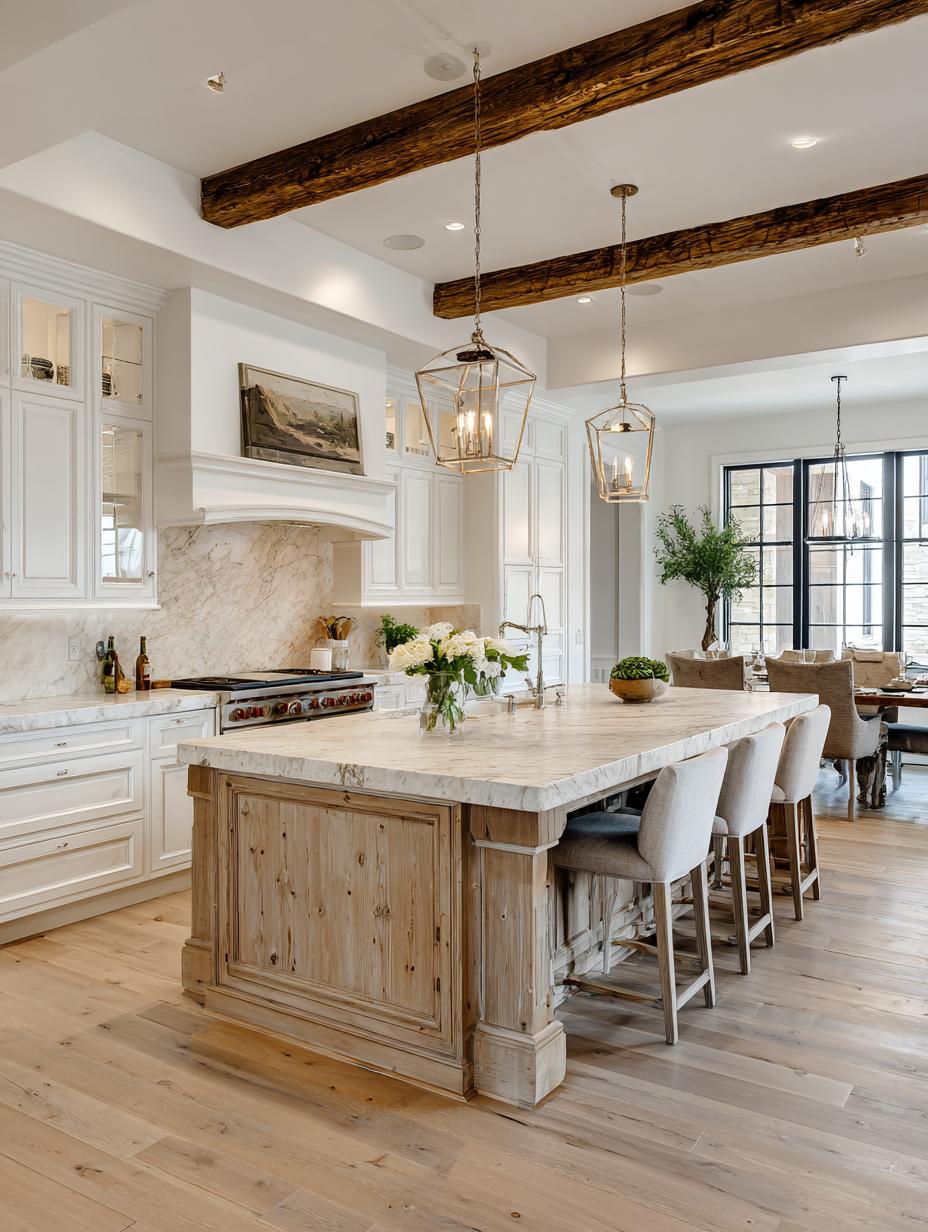
The island base has been bleached or cerused to a soft driftwood tone, knots and grain still visible but muted. It grounds the space without competing with the dark walnut beams overhead. Those beams show real age, their surfaces rough and irregular.
Two lantern pendants in champagne gold hang above, their frames geometric and modern against the rustic ceiling. Calacatta marble tops the island and runs up behind the range in a herringbone pattern. Four counter chairs wear grey linen slipcovers, casual and inviting. Through black steel doors, an outdoor terrace. White cabinetry lines the walls with simple shaker styling, and a large landscape painting adds depth to the curved range hood wall.
How Rattan Pendants and Coffered Ceilings Create the Perfect Tension
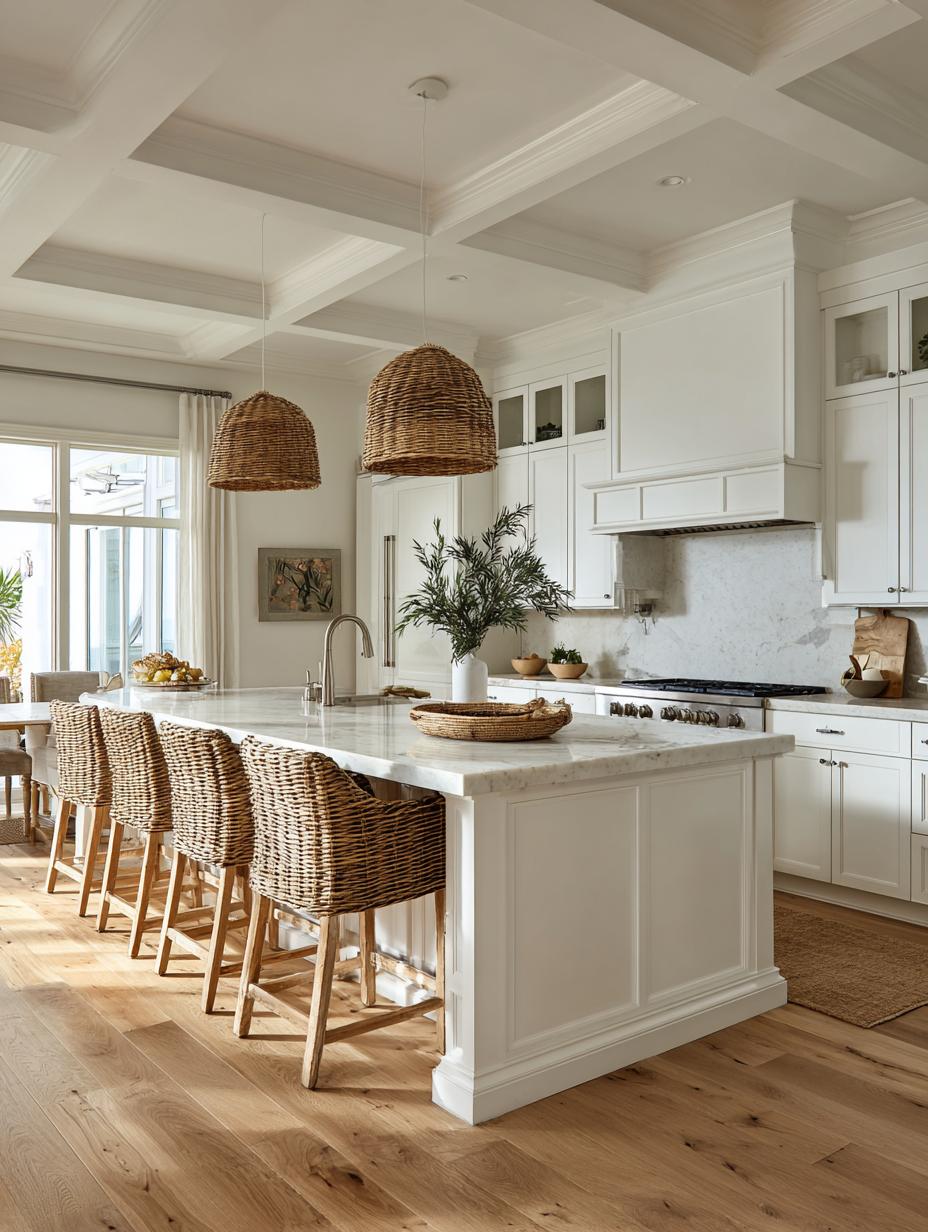
Those oversized rattan bell pendants hanging from the coffered ceiling caught my attention immediately. There’s something about pairing formal architectural detail with handwoven natural fiber that just works. The coffered ceiling says traditional estate, but the wicker says barefoot beach house.
Look at how the wicker counter stools echo the pendant material, with their honey-toned weave and pale oak legs tucked beneath that thick marble slab. The marble itself runs in a clean waterfall edge, its soft grey veining visible against the white island base. An olive branch arrangement in a simple white vase sits near the integrated sink, while the six-burner range anchors the cooking zone behind. Wide-plank oak floors with visible grain run throughout, warmed by a jute runner near the range.
Glass Lanterns and Calacatta: When Polish Needs a Wicker Counterpoint

Silver-framed lantern pendants hang from chains against deeply coffered ceiling panels painted in matching white. The pendants cast a warm glow across the Calacatta marble island, where grey and taupe veins streak through the polished surface. Four wicker counter stools with weathered grey wood legs line up along the island’s edge.
A woven basket holds a potted olive tree near the integrated refrigerator panels, and fresh greenery in a clear glass vase sits on the marble. The backsplash behind the six-burner range continues the Calacatta pattern, creating visual continuity between work zones. Recessed lighting supplements the pendants, and those upper glass-front cabinets reveal neatly stacked white dishware inside.
Dark Espresso Floors Change Everything About a White Kitchen

Rich espresso hardwood floors anchor this space in a way that lighter wood simply cannot. The dark planks create a dramatic base for all that white cabinetry, making the marble island appear to float above the ground plane. Three backless stools upholstered in pale grey linen tuck beneath the island’s thick marble overhang, their black legs echoing the floor tone.
Twin polished nickel lanterns hang from chains, their candelabra-style bulbs visible through glass panels. White hydrangeas fill a clear vase on a wooden tray near the island’s center. The marble backsplash runs floor to ceiling behind the professional range, its bold grey veining adding movement to an otherwise quiet palette. Crown molding caps the full-height cabinets, and small glass-front upper units display silver and white accessories.
Why It Works: Dark floors beneath an all-white kitchen create what designers call “grounding.” Without that contrast, white spaces can feel clinical or unfinished. The dark base gives your eye a place to rest and makes the white elements above read as intentional rather than default.
Butcher Block Islands and the Farmhouse Kitchen That Actually Functions
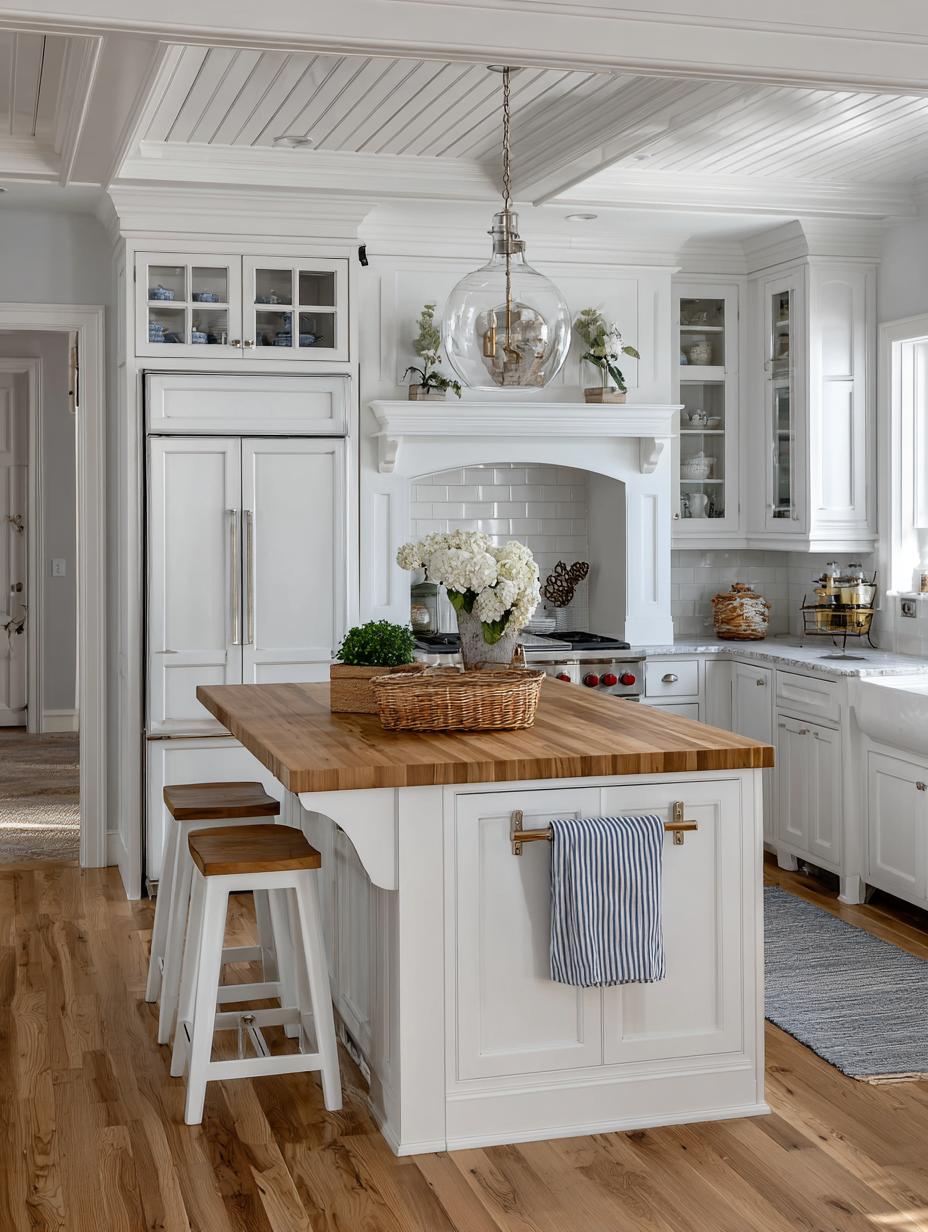
That thick maple butcher block top on the white beadboard island isn’t just decorative. It’s a proper work surface, the kind you can actually chop on without worrying about knife marks. A woven basket holding white hydrangeas sits at center, with a brass towel bar mounted on the island’s side displaying a blue and white striped tea towel.
The cooking alcove behind features white subway tile running floor to ceiling within an arched surround, framing the range like a piece of furniture. A clear glass globe pendant with brass hardware hangs above the prep zone. Two-tone stools with white painted legs and natural wood seats tuck under the island’s overhang. Glass-front cabinets flanking the cooking niche show blue and white transferware stacked inside, and the beadboard ceiling adds horizontal texture overhead.
Cathedral Ceilings and the Power of Looking Up
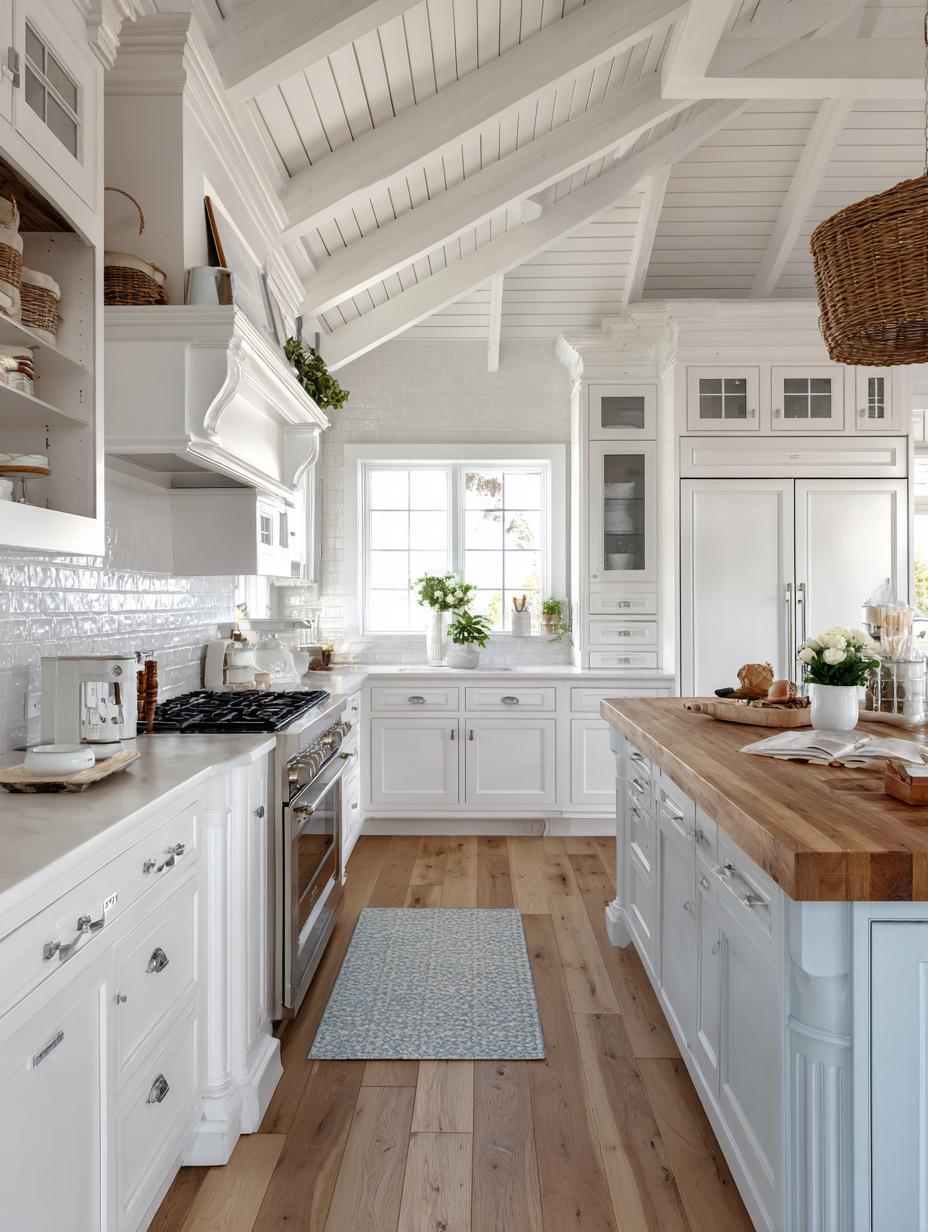
White painted rafters and shiplap run at angles toward a peak, creating vertical drama that standard flat ceilings simply cannot match. A woven rattan pendant hangs at varying heights above the butcher block island, while open shelving displays wicker baskets alongside everyday dishes.
The range hood features decorative corbels and sits beneath a zellige-style tile backsplash with subtle surface variation. An open cookbook rests on the butcher block surface next to a cutting board and white ceramic crock holding wooden spoons. Panel-ready appliances blend into the cabinetry, and a soft blue runner in a floral pattern runs along the galley section. Fresh hydrangeas in white and green sit in various vessels throughout, adding organic movement against all those clean lines.
By The Numbers: Vaulted and cathedral ceiling searches on design platforms increased 89% year over year. After a decade of minimalist flat ceilings, homeowners are craving architectural interest overhead again.
When Brass Hardware Commits to a Full Takeover
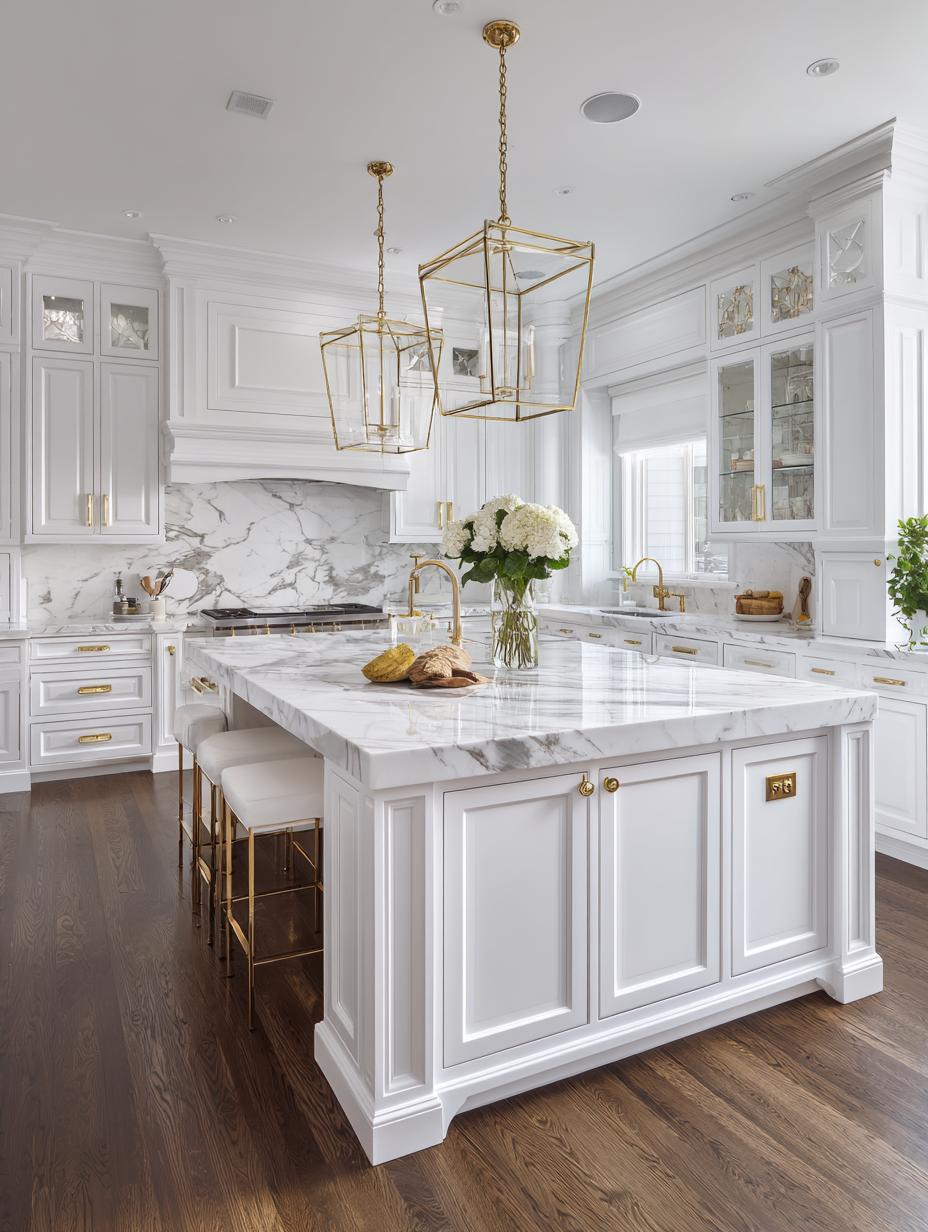
Every metal surface in this kitchen speaks the same language: warm brass. The geometric lantern pendants, the cabinet pulls, the faucet, the pot filler behind the range. It’s a bold move that requires total commitment, and it works because nothing breaks the spell.
Calacatta marble with dramatic grey and gold veining covers the island and runs up the wall behind the cooktop. White shaker cabinets reach the ceiling, their simple profile letting the stone and metal do the talking. Two backless stools with cream leather seats and brass legs slide under the island, and white hydrangeas in a clear glass vase provide the only soft element. Glass-front upper cabinets with X-mullion patterns display crystal and silver, and dark walnut floors provide necessary weight beneath all that brightness.
Orb Pendants and Waterfall Marble: A Study in Curves
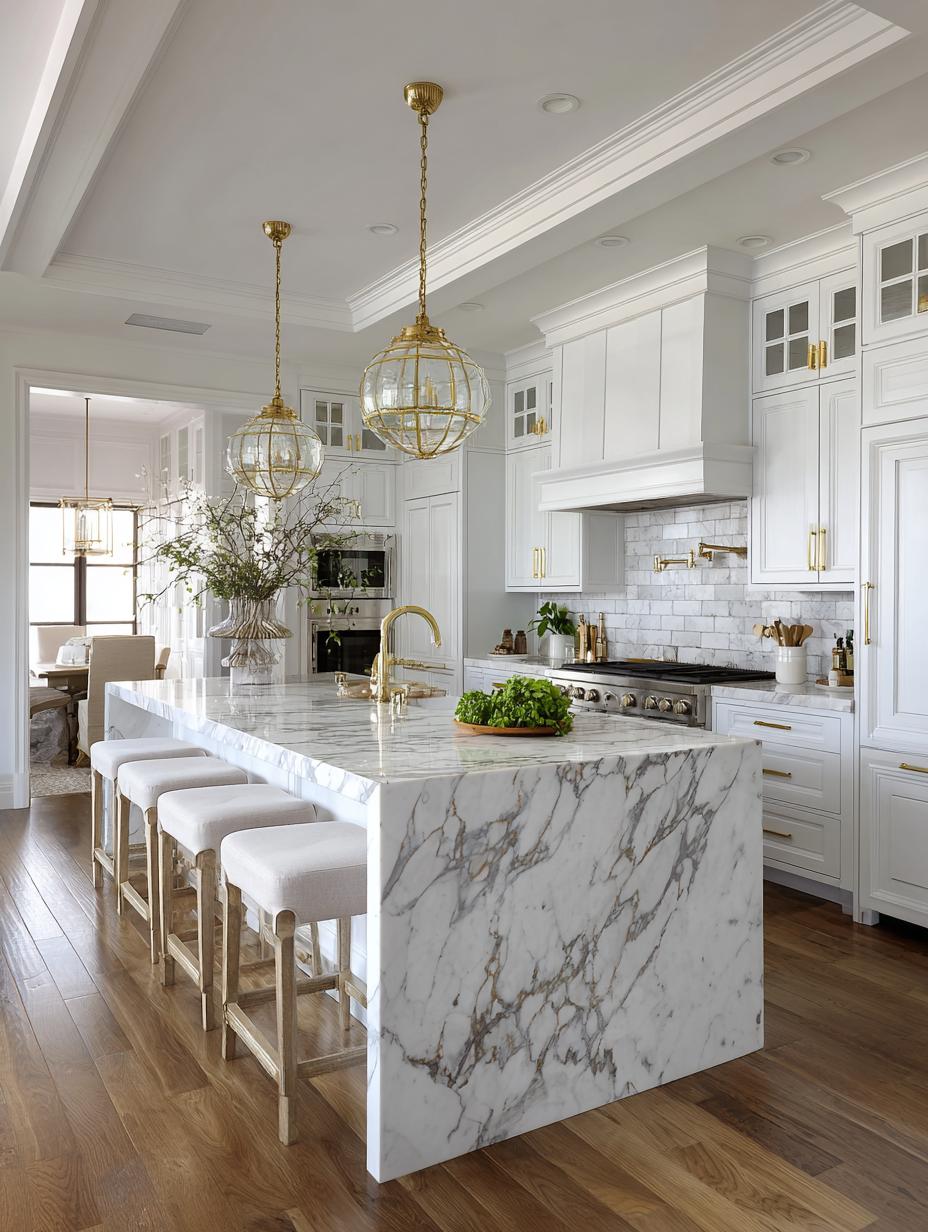
Two brass orb pendants with cage-style frames hang above the island, their spherical shapes introducing curves into an otherwise angular space. The Calacatta marble wraps down the island’s side in a waterfall detail, its grey and gold veining creating visual movement. Four backless stools with oatmeal linen tops and whitewashed oak legs line up beneath.
Subway tile in a running bond pattern covers the backsplash, interrupted by a brass pot filler mounted above the range. Fresh basil grows in a terracotta pot on the marble surface near the integrated sink, while cherry blossom branches in a large clear vase add height at the island’s far end. A coffered ceiling with recessed panels frames the space overhead, and medium-toned oak flooring warms the entire composition.
Organic Modern Takes the White Kitchen Somewhere New
🔥 Would you like to save this?
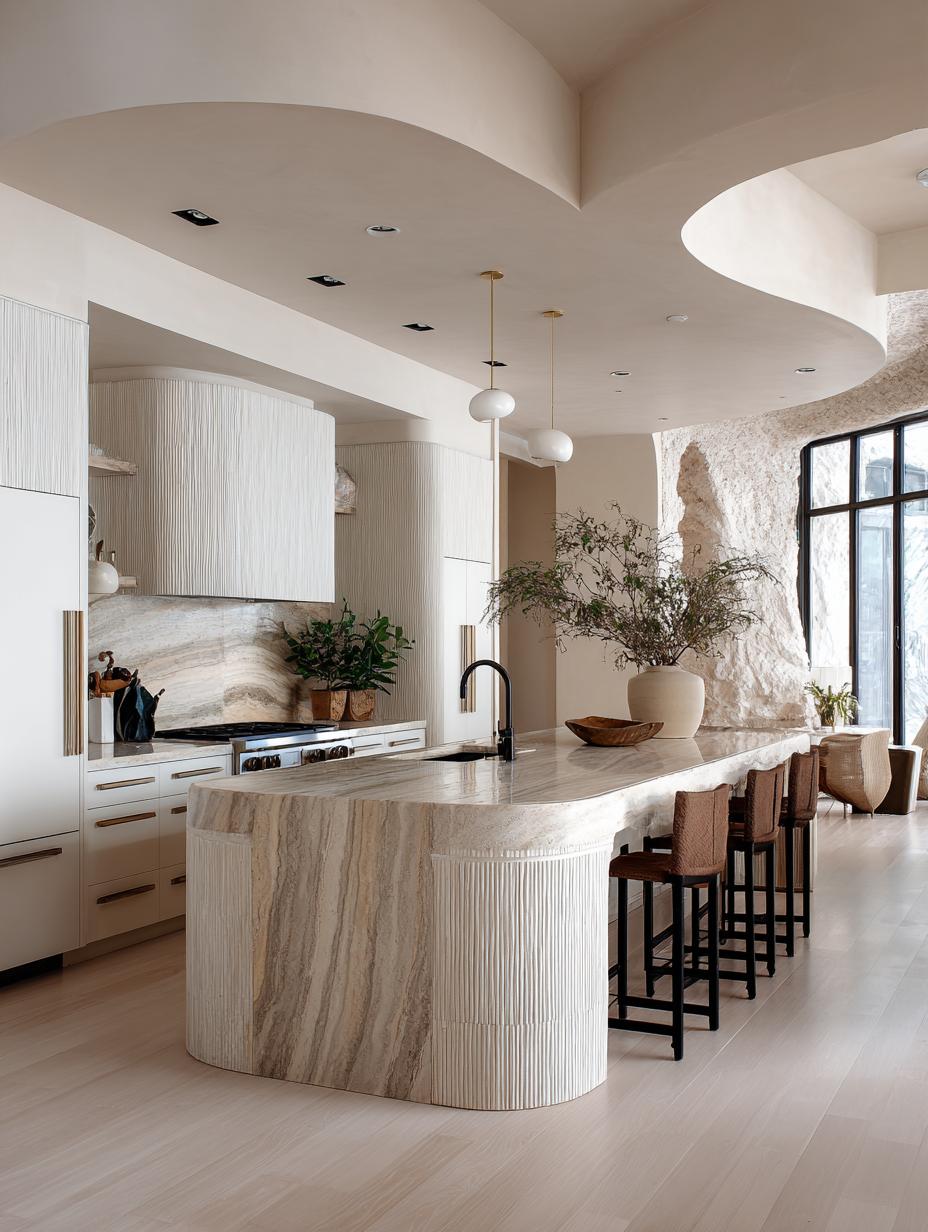
This kitchen belongs to a different category entirely. Curved plaster ceiling elements arc across the room in organic sweeps, and a raw stone wall in cream and ivory rises behind the seating area. The island itself curves at one end, wrapped in fluted vertical paneling painted in warm cream, with a striated travertine countertop running its full length.
Matte black faucet hardware provides the only dark accent. Four bar stools in caramel brown fabric with black metal legs line the island’s curved edge. Two opal glass globe pendants on thin brass stems hang at different heights, and a large ceramic vessel holding twisted branches sits near the stone wall. Black-framed windows punctuate the textured stone surface, flooding the space with natural light. Pale blonde wood flooring runs throughout, keeping everything airy and soft.
Herringbone Floors and Book-Matched Stone: Quiet Details That Speak Volumes
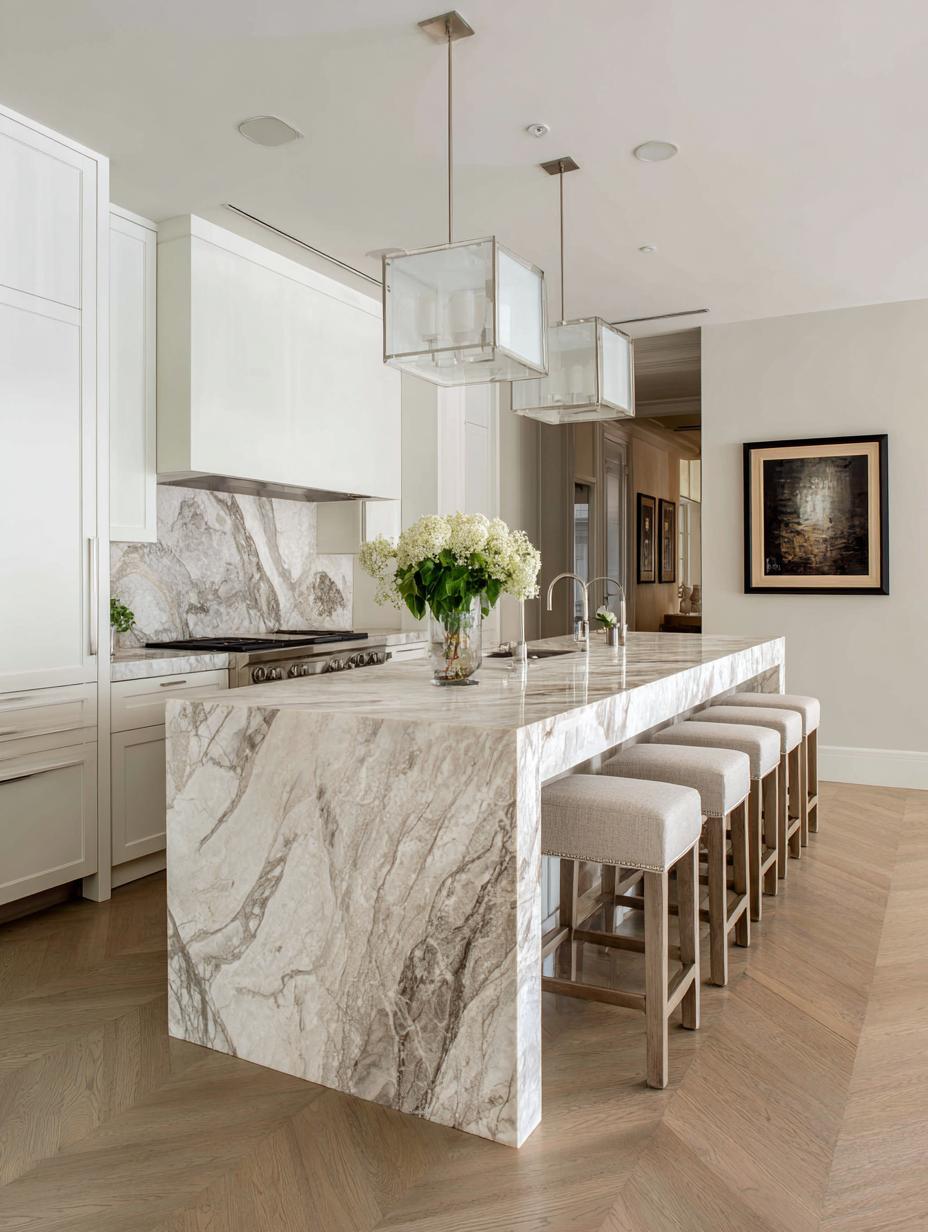
Blonde oak herringbone flooring covers the entire space, its pattern adding geometric interest underfoot without competing with the marble above. The island stone shows visible taupe and grey veining that flows continuously across the waterfall edge, suggesting the slabs were book-matched during fabrication.
Five backless stools in oatmeal linen with bleached wood frames provide seating along the island. Two rectangular glass pendants with polished nickel frames hang from thin rods, their frosted panels diffusing light across the marble surface. White viburnum fills a clear glass vase at the island’s center, and a framed abstract painting in black and gold hangs on the adjacent wall. The backsplash behind the range mirrors the island’s veining pattern, while simple flat-panel cabinets in bright white line both walls.
Limestone and Lanterns: A Kitchen Built for Slow Mornings

Those cerused oak cabinets caught my attention immediately. The grey veining through the wood grain reads almost silver in certain light, picking up the cooler tones in the blue-grey marble backsplash behind the range. Two iron lantern pendants hang from darkened chains, their rectangular glass panels throwing soft light across the island’s honed limestone surface.
Four linen-upholstered counter stools tuck beneath the overhang, their weathered oak frames matching the cabinet finish exactly. A copper pot sits on the cooktop, and a glass cloche on the island holds what looks like collected shells or stones. The arched doorway to the right frames a small framed artwork on the far wall. Natural stone floor tiles in warm honey tones prevent the space from feeling cold despite all that white plaster.
Glass-Front Cabinets and an Arched Passage Worth Lingering Over
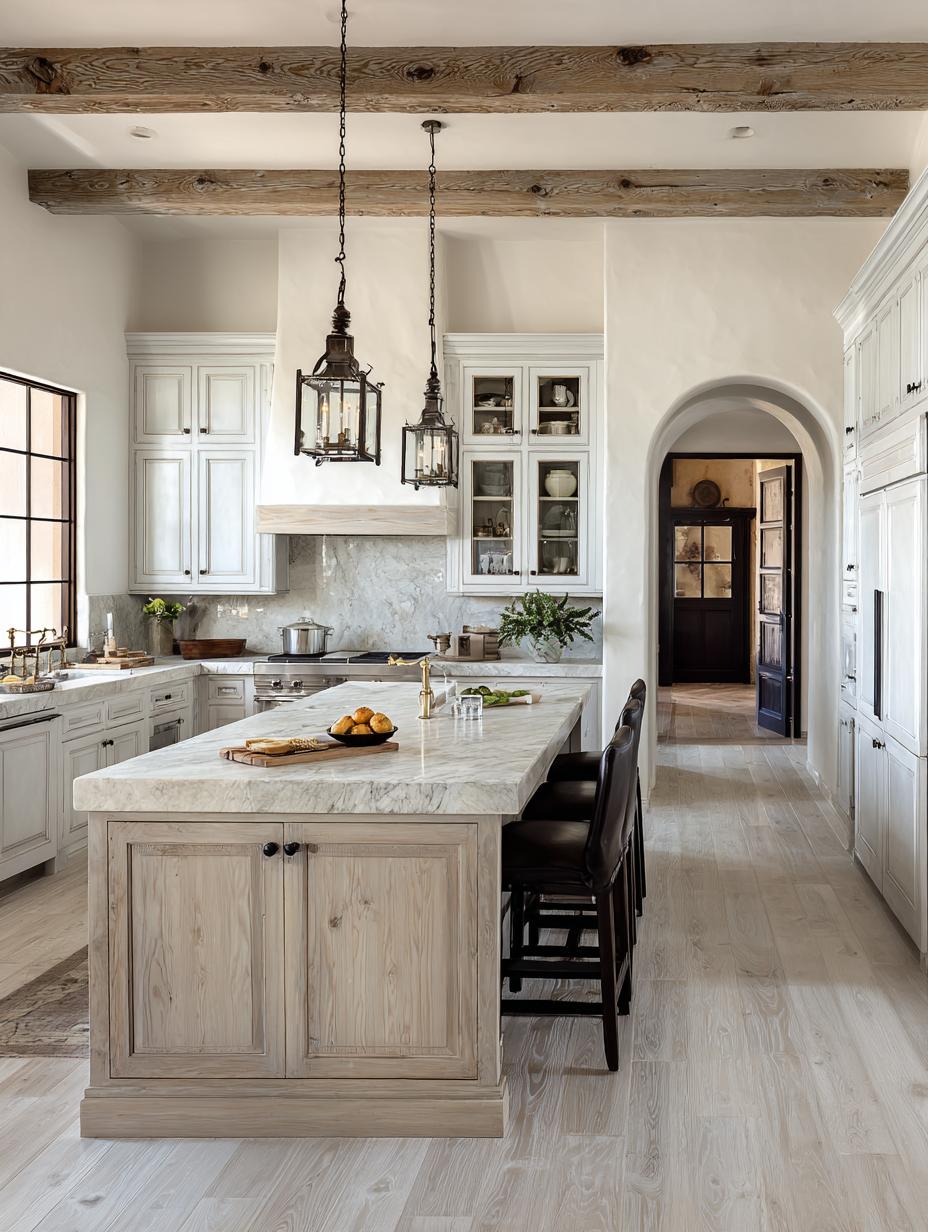
The bleached oak island base here does something clever. It grounds the thick-slab marble countertop without competing with those ornate black lantern pendants overhead. Through the arched doorway, I can see a Dutch door with its dark wood frame, leading somewhere with terracotta-colored walls.
Glass-front upper cabinets flank both sides of the hood, revealing stacked white ceramics and serving pieces. The brass faucet at the sink picks up warmth from the wide-plank oak flooring. Two dark leather counter chairs with nailhead trim sit at the island’s far end. Breadboards lean against the marble backsplash near a stainless steel pot, and fresh greenery spills from a glass vase at island’s center.
When Barn Wood Gets a Marble Crown
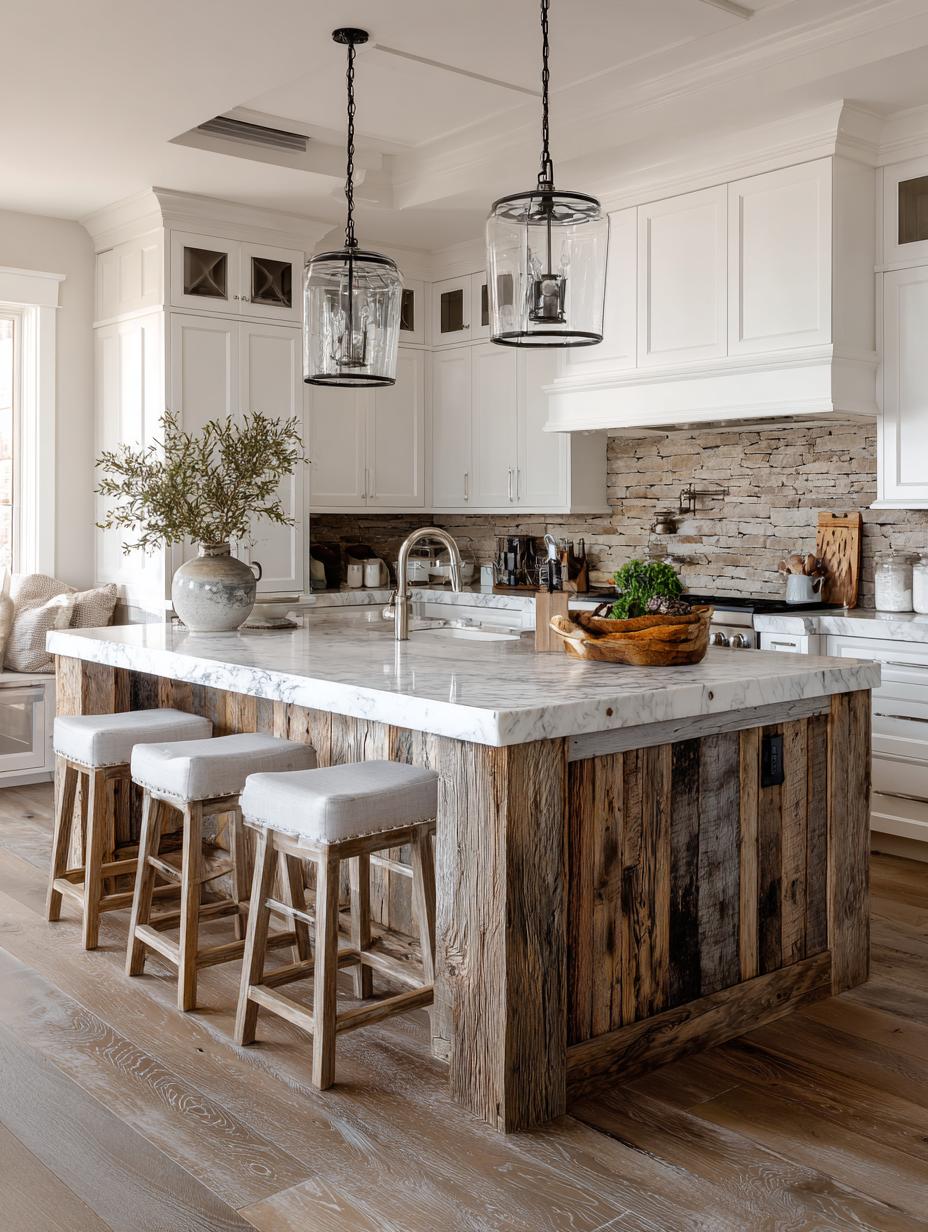
This island base stopped me cold. Vertical reclaimed planks in varying shades of grey and brown, some still showing old nail holes, support a thick Carrara marble top with dramatic grey veining. The contrast between raw and refined is almost uncomfortable in the best way.
Clear glass jar pendants with black metal bands hang from chains above, their simple silhouettes letting the ceiling’s white shiplap show through. A grey ceramic vase holds olive branches on the island’s corner. The stacked stone backsplash behind the range carries that same weathered palette, running floor to ceiling behind the white hood. Three counter stools with cream linen seats and light wood frames provide seating. Oak flooring in a pale wash keeps things bright underfoot.
History Corner: Reclaimed barn wood kitchens trace back to the American Arts and Crafts movement of the early 1900s, when designers first started valuing handcrafted imperfection over factory uniformity. The current revival has less to do with nostalgia and more to do with sustainability concerns among younger homeowners.
Sun-Drenched and Distressed in All the Right Places
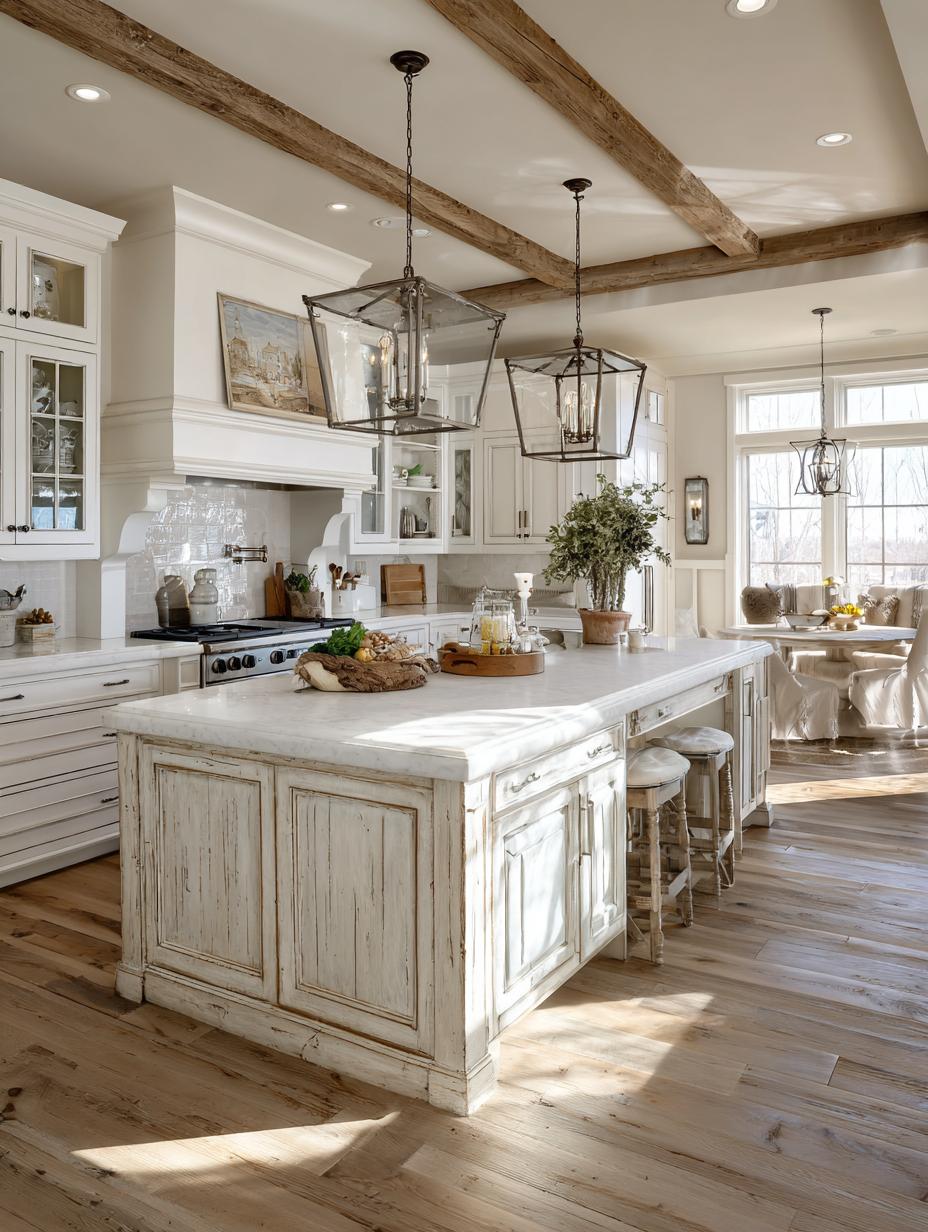
Afternoon light pours across this kitchen’s honey-toned hardwood floors, catching the intentional wear on the island’s cream-painted panels. You can see where the distressing reveals warm wood undertones at the corners and edges. Two geometric lantern pendants in aged bronze hang asymmetrically overhead.
Reclaimed beams run the ceiling’s length, their grey patina a few shades darker than the island’s finish. A vintage oil painting propped above the stainless range adds unexpected color to the otherwise neutral palette. Through the large windows visible at right, I can see linen-slipcovered dining chairs gathered around a white table in an adjacent breakfast area. A terracotta pot of eucalyptus sits on the island next to a wooden tray holding oil bottles and a small basket.
A Live-Edge Counter That Actually Works
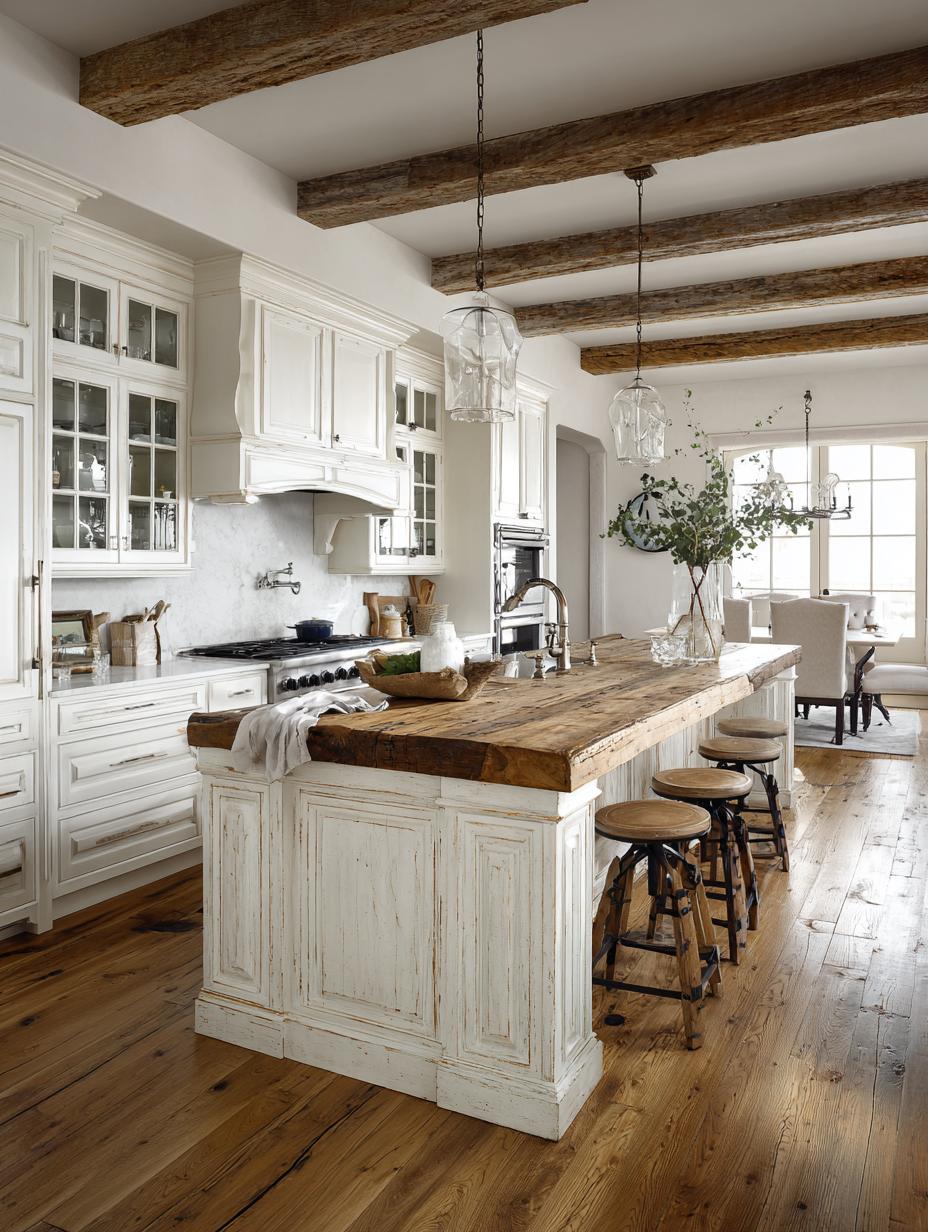
Thick butcher block with visible knots and natural edge variation tops this distressed white island. The amber and caramel tones of the wood slab pull warmth from the reclaimed ceiling beams running overhead. Glass pendant lights shaped like bell jars hang at slightly different heights, their clear panels revealing Edison-style bulbs.
Wide-plank oak flooring with a deep honey finish grounds the space, while industrial metal bar stools provide seating at the island’s far side. Through the archway, I can see linen-upholstered dining chairs and a crystal chandelier in an adjacent room. A grey-glazed ceramic vase holds tall greenery on the island, next to a worn wooden bowl and folded kitchen towel. The range wall keeps things simple: white marble backsplash, white hood, wall-mounted pot filler in polished nickel.
Double-Height Drama with Walnut and White
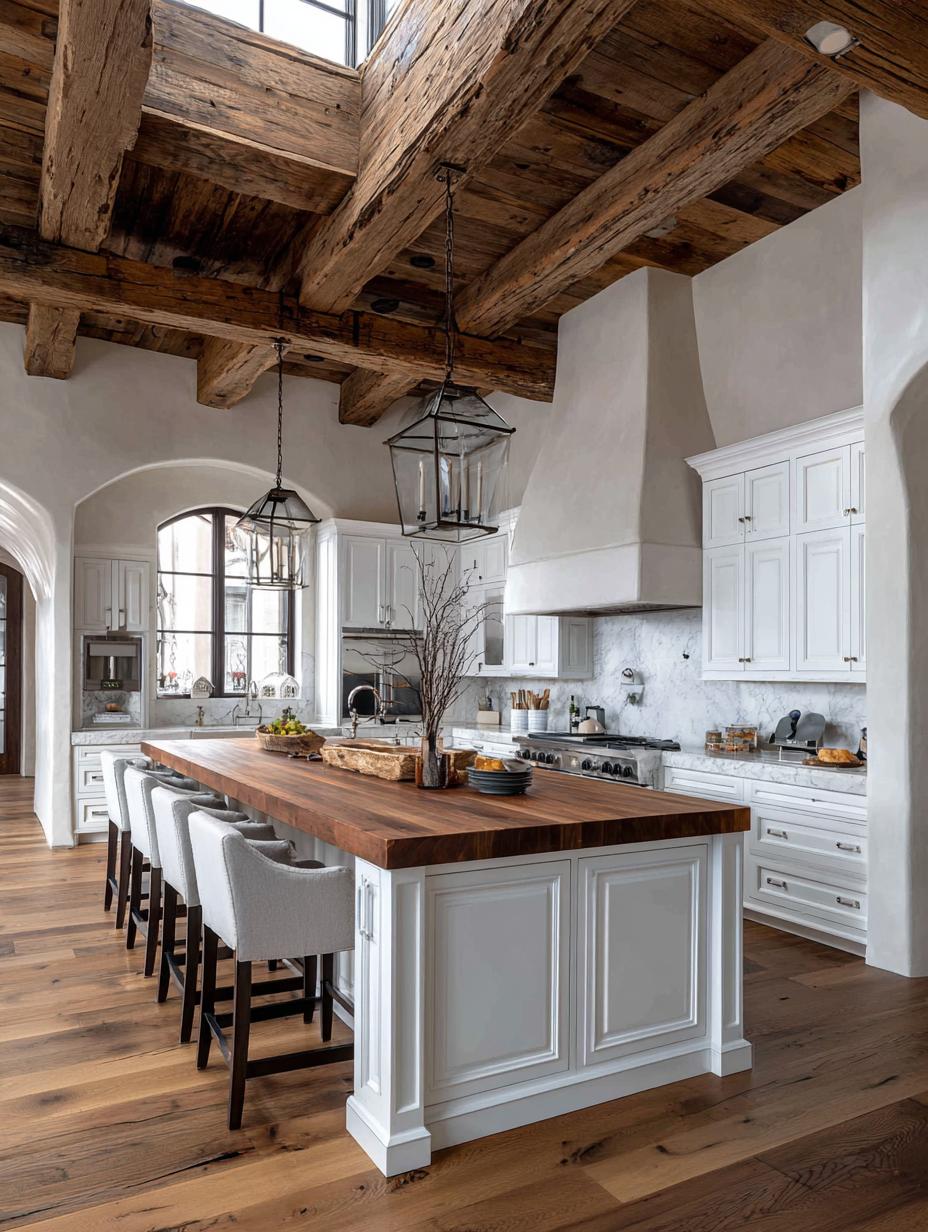
What makes this kitchen unforgettable is the ceiling. Massive reclaimed beams cross at multiple levels beneath a clerestory window that floods the space with natural light. The volume feels almost chapel-like, which makes the domestic details below hit differently.
A thick walnut butcher block counter runs the island’s full length, its rich brown grain creating a horizontal anchor beneath all that vertical drama. White shaker cabinets with paneled detailing line both walls. Grey upholstered counter stools with dark wood legs seat six comfortably. Through the arched opening at left, there’s a glimpse of built-in wine storage. Bare branches in a rough ceramic vase provide the only organic element on the island’s surface, alongside stacked grey ceramic bowls.
Why It Works: The walnut island and reclaimed ceiling beams share the same tonal family, creating visual continuity between the horizontal and vertical planes. Meanwhile, the white cabinetry recedes, letting those wood elements carry the room’s personality without overwhelming it.
Stone Walls That Make Everything Else Disappear
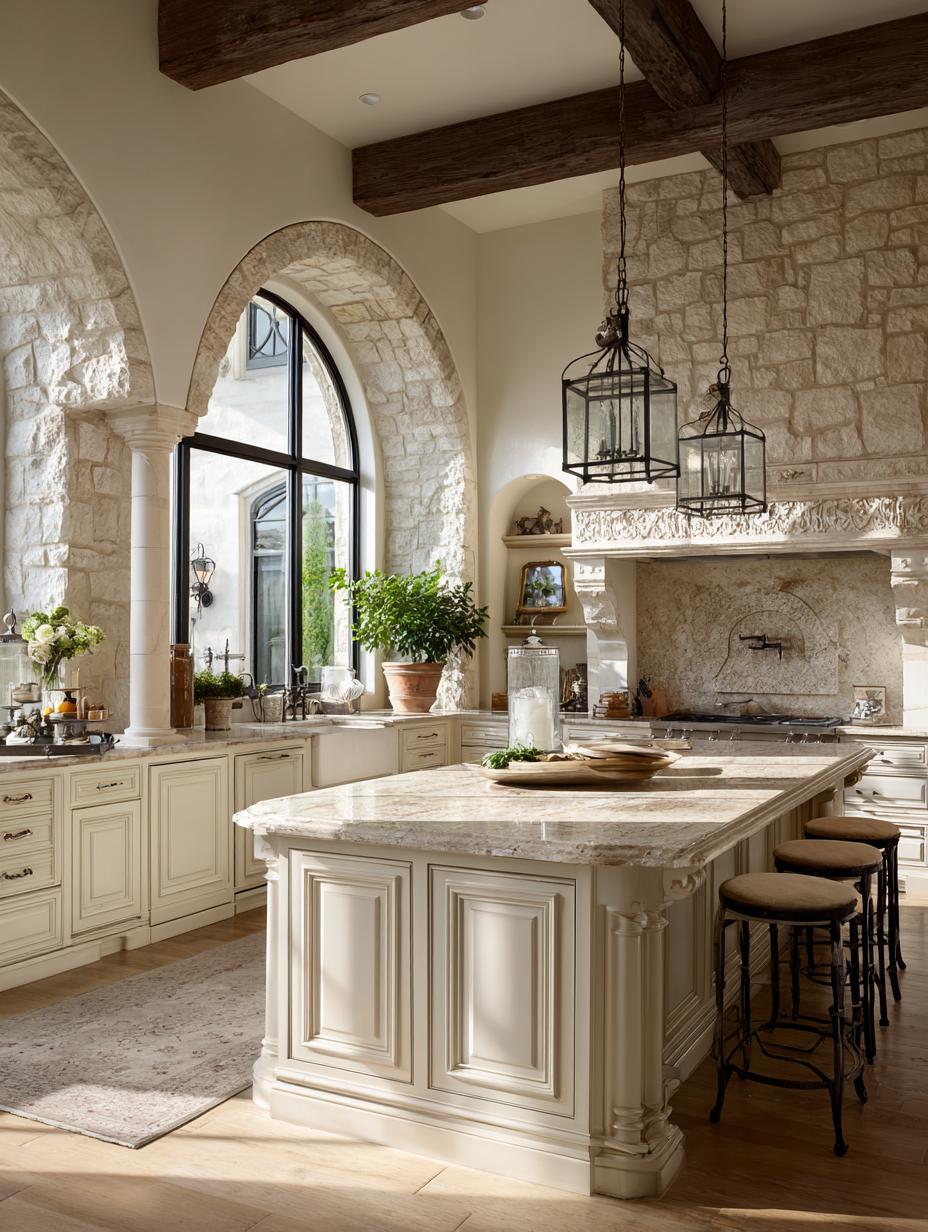
Hand-cut limestone blocks form the entire back wall here, running from floor to ceiling and framing an enormous arched window with black steel mullions. The carved stone hood surround features a decorative relief pattern that reads almost Romanesque. You could film a period drama in this kitchen.
Against all that stone, the cream-painted island with raised panel detailing feels appropriately restrained. Its marble top carries soft grey veining that picks up the stone’s natural variation. Black iron lantern pendants with glass panels hang from aged chains. Three backless stools with round brown leather seats tuck beneath the overhang. Fresh herbs grow in terracotta pots on the windowsill, and a small framed still life leans on the open shelf beside the range.
Vertical Barn Board Creates the Focal Point

Salvaged wood planks clad this island’s base in shades ranging from silver-grey to deep brown, each board showing different grain patterns and weathering. The vertical installation creates more visual energy than a horizontal arrangement would. Above, a thick marble slab with subtle grey veining provides the work surface.
Three cylindrical glass pendants with brushed nickel bands hang from the coffered ceiling, their clear glass almost invisible against the white shiplap inset. Weathered wood bar stools with X-back detailing seat four at the island. Floating shelves on the far wall hold cookbooks and ceramics, and a piece of abstract art in natural wood tones leans beside them. The pale oak flooring has been wire-brushed to emphasize the grain.
“The coffered ceiling detail deserves attention. Those inset shiplap panels add texture without competing with the reclaimed island below.”
A Waterfall That Actually Falls
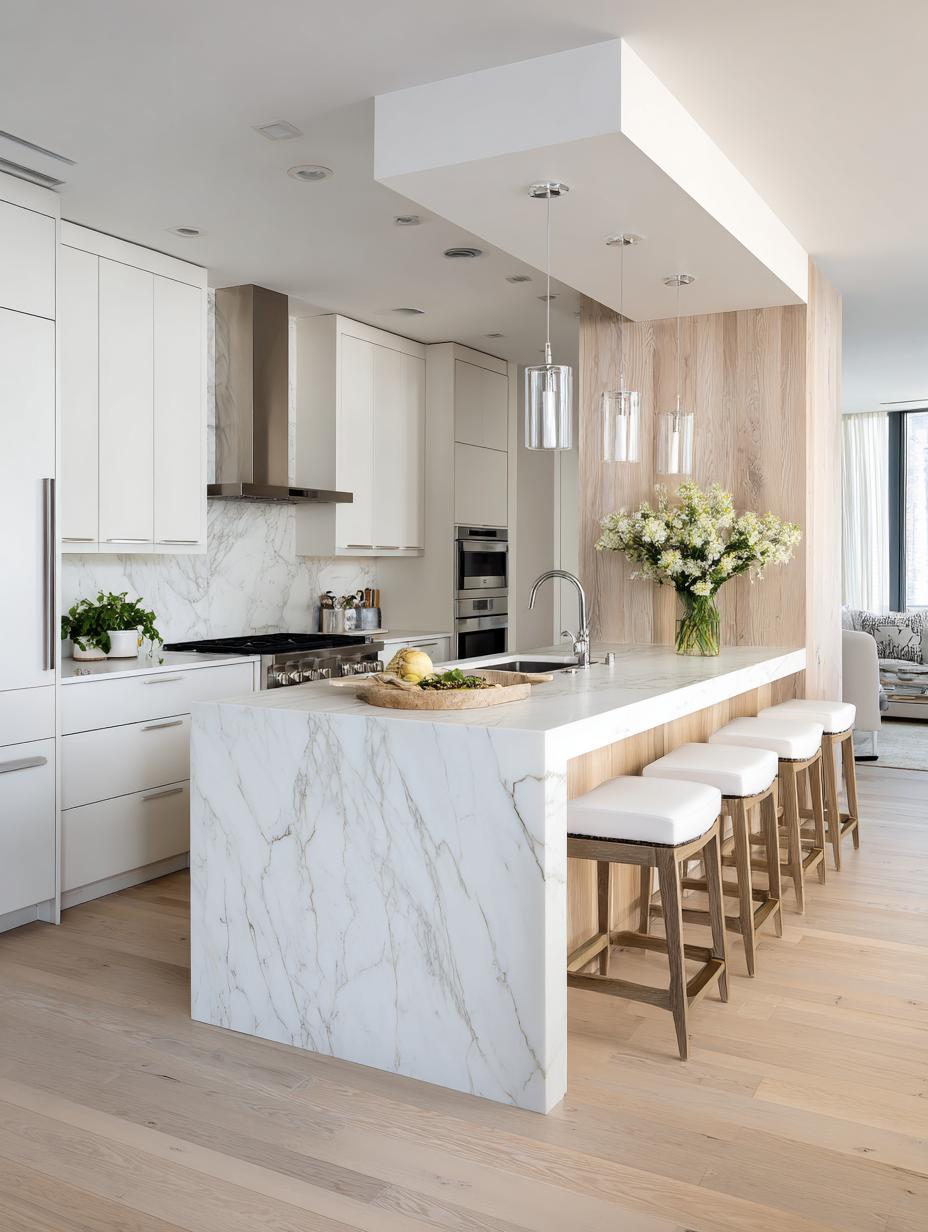
Calacatta marble with caramel and grey veining wraps the island’s end, the pattern matched so the lines appear to cascade down the vertical face. It’s the kind of detail that costs significantly more but changes how you experience the whole room. The backlit blonde oak panel behind the seating area warms what could otherwise feel clinical.
Four counter stools with cream leather seats and weathered oak frames line up beneath the overhang. Handleless flat-panel cabinetry in matte white covers both walls, broken only by a stainless steel hood and wall ovens. Two glass cylinder pendants hang from nearly invisible cables. A generous bouquet of white flowers spills from a clear glass vase on the island, and beyond the wood partition, I can glimpse a grey sectional in the living area.
How Walnut Shelving Changes Everything in a White Kitchen
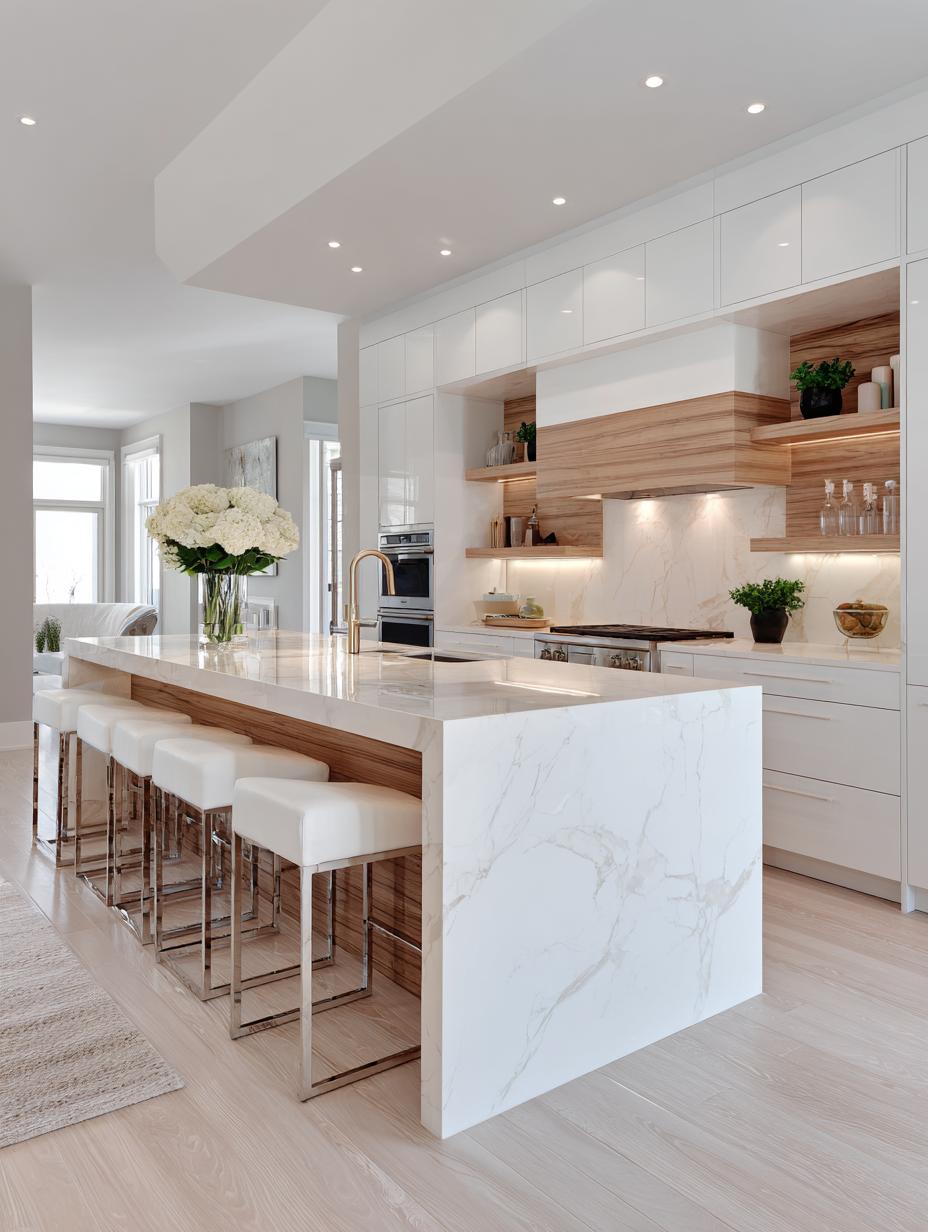
That honey-toned walnut running along the floating shelves and island underside does something unexpected here. It pulls warmth into what could easily read as clinical, and the grain pattern visible against the high-gloss white cabinetry creates genuine visual tension.
The Calacatta marble waterfall edge shows soft grey veining that picks up the polished chrome on those bar stool legs. Four white leather seats with chrome frames line up beneath the overhang, their cushions thick enough to suggest actual comfort rather than just looking the part. Recessed LEDs tucked beneath the upper cabinets cast light across the backsplash slab, and a brushed gold faucet near the prep sink adds the only warm metal in the entire space. White hydrangeas in a clear glass vase sit off-center on the island, their rounded heads echoing the softness the hard surfaces lack.
Double-Height Ceilings Demand a Different Approach
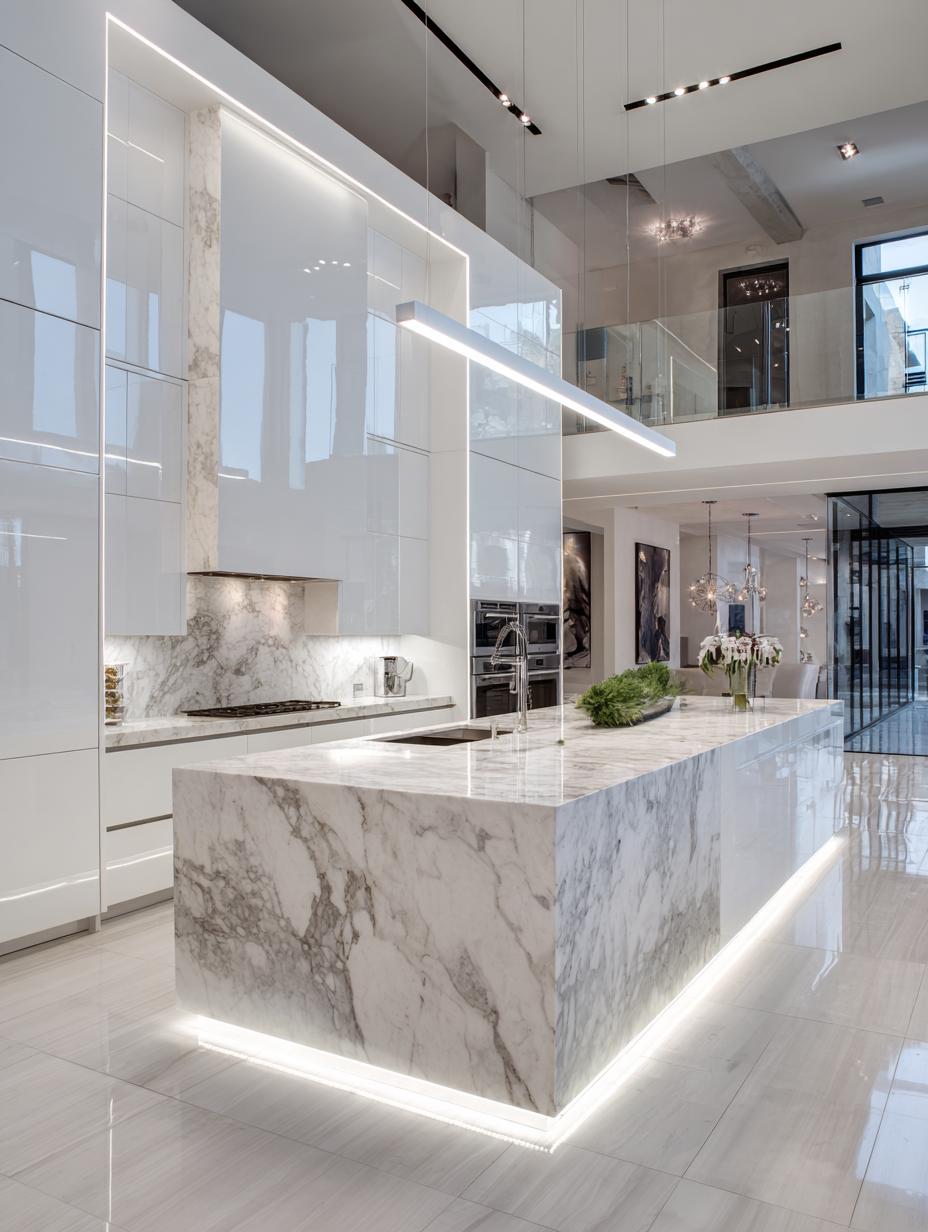
When you have this much vertical space, the kitchen becomes something closer to a gallery installation. Handleless white cabinets climb toward a glass-railed mezzanine, their surfaces reflecting so much light that the boundaries between storage and architecture start to blur. The marble island sits as a monolithic block, its grey veining more pronounced than the first example, with LED strips running along the toe kick to give the whole thing a floating quality.
A linear pendant hangs low over the work surface, its slim profile preventing competition with the dramatic ceiling height. Through the glass partition, you can see a sputnik chandelier in an adjacent dining space, which tells me the designers thought about how these rooms would read together. Fresh greenery on the counter provides the only organic interruption in an otherwise hard-edged composition.
The mezzanine glass railing serves a double purpose. It maintains sight lines from above while allowing natural light to travel uninterrupted from the upper windows down to the cooking surface. This is borrowed light at its most calculated.
Curved Islands Are Having a Moment
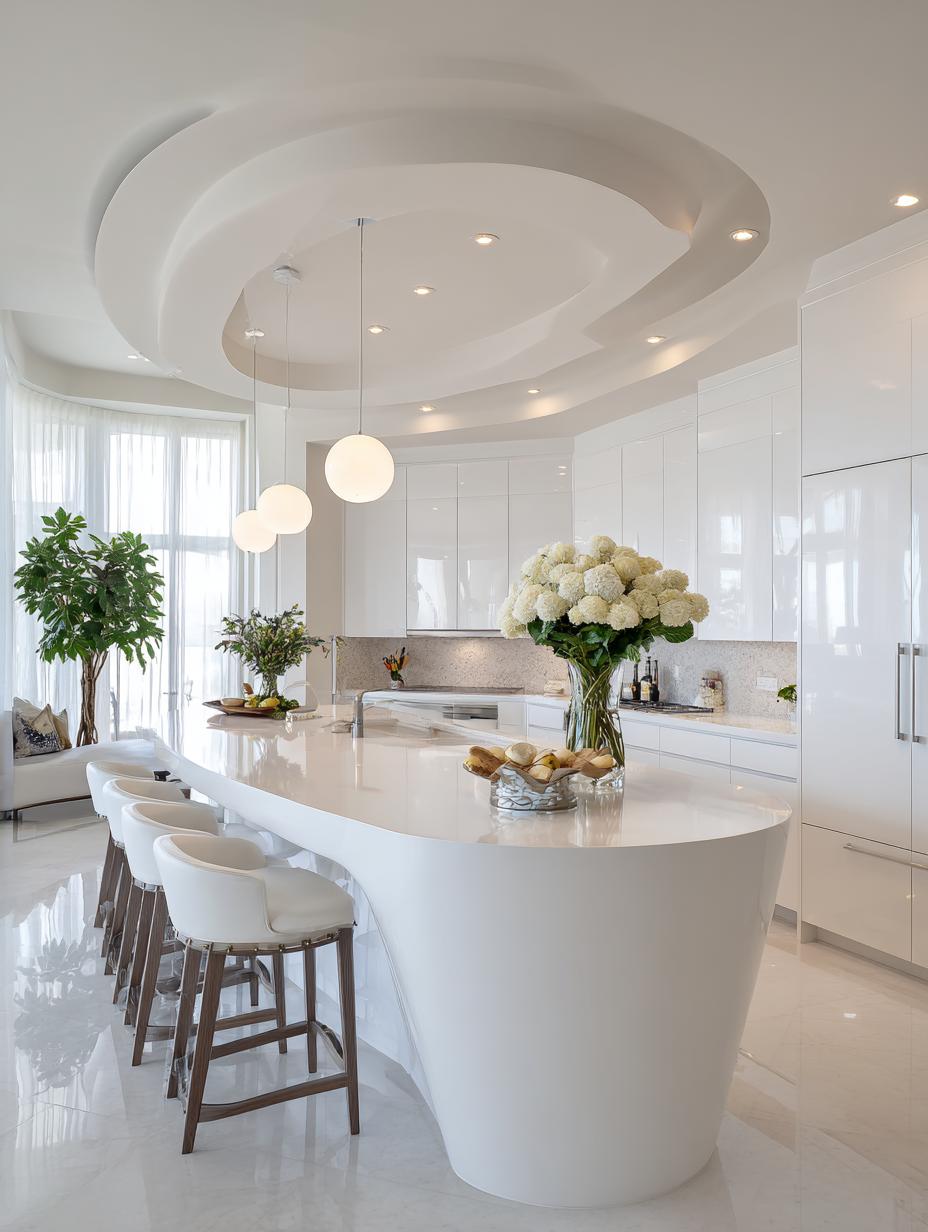
Forget the standard rectangular slab. This elongated oval island in solid white quartz reads almost like a piece of furniture that wandered in from a design museum. The curved silhouette repeats in the layered ceiling detail above, which spirals inward with recessed can lights marking its progression. Three globe pendants hang at staggered heights near the window bay, their frosted glass softening the Florida-grade sunlight streaming through sheer curtains.
Cream leather stools with warm walnut legs provide seating along the outer curve, their organic shape echoing the island itself. A massive arrangement of white hydrangeas sits beside a woven basket holding citrus, and behind it all, floor-to-ceiling lacquered cabinetry disappears into the walls. The polished floor tiles reflect everything, doubling the light in a way that makes the space feel endless.
Traditional Detailing Still Has Something to Say
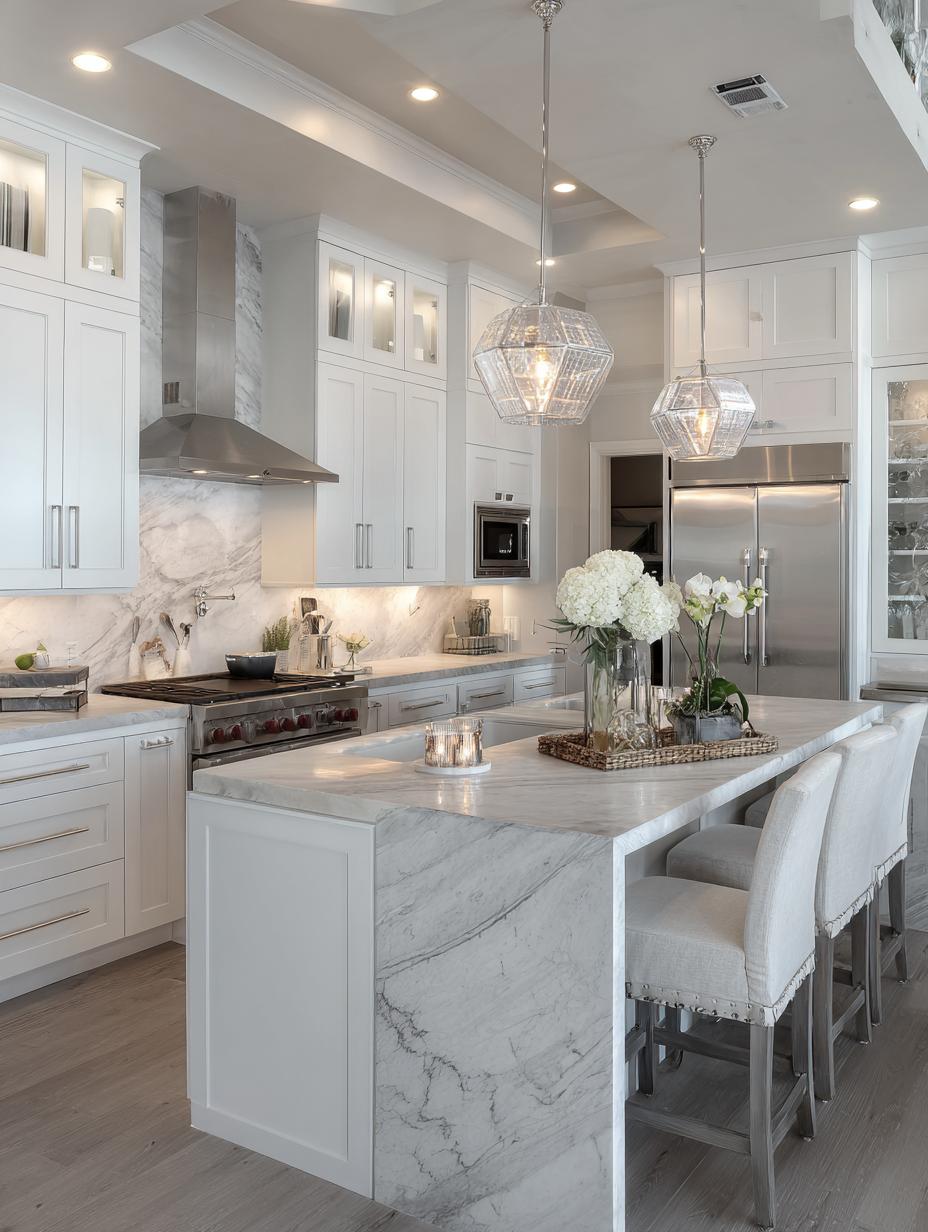
Shaker-style cabinet doors with simple recessed panels line the perimeter, their familiar profile grounding this kitchen in recognizable territory. But the marble waterfall island pulls the whole thing forward in time. Grey veining runs diagonally across the stone, each slab book-matched to create mirror-image patterns where the surfaces meet at the corner.
Two geometric crystal pendants hang above a wicker tray holding white hydrangeas, orchids, and a pair of mercury glass votives. The upholstered bar stools in pale grey linen have nailhead trim along their bases, a detail that reads as quietly traditional without trying too hard. Wide-plank oak flooring in a grey wash runs beneath, its grain pattern adding texture that the smooth cabinet faces lack.
Clear Glass Globes and the Case for Visible Filaments
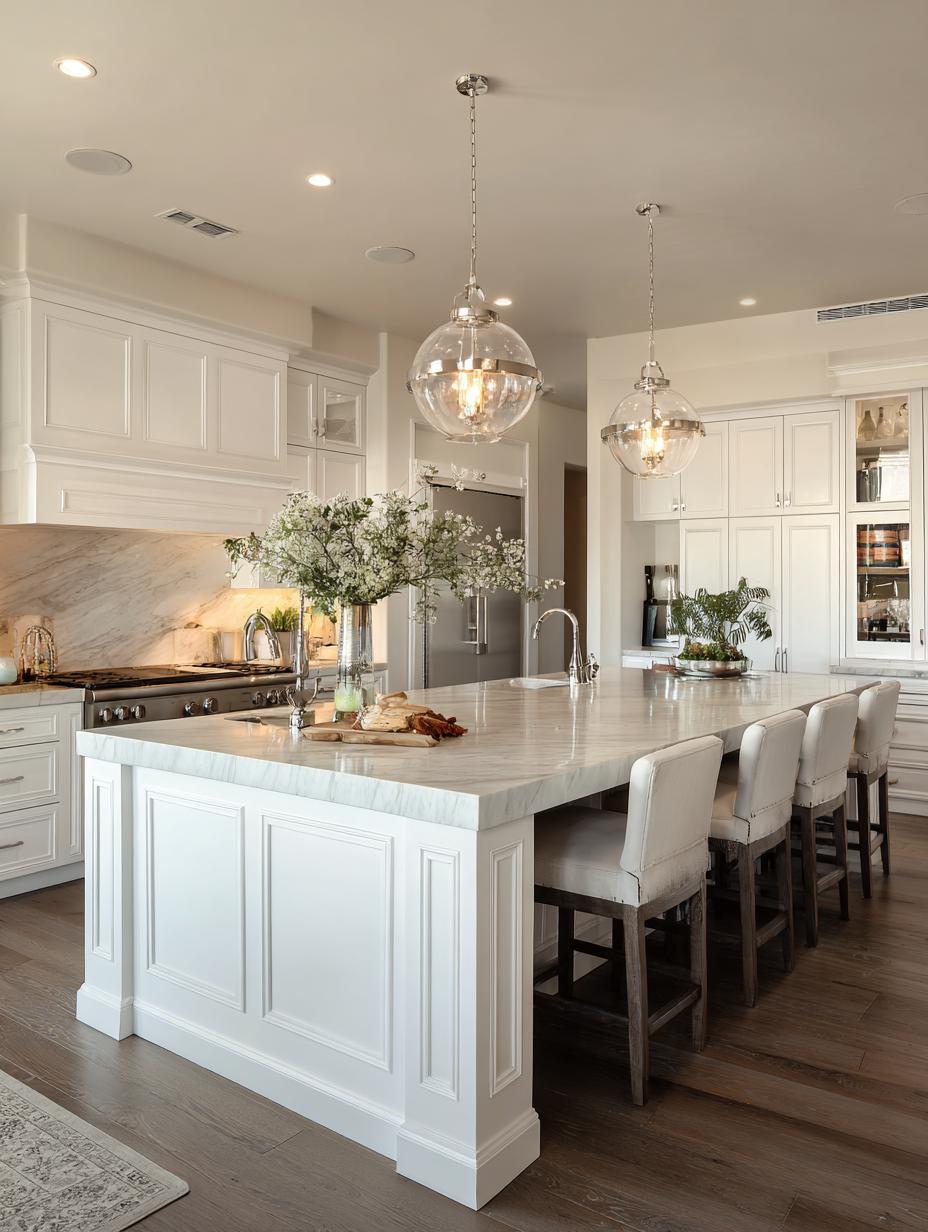
Those oversized clear glass spheres with their polished nickel hardware do exactly what statement lighting should do in a white kitchen: they provide a focal point without introducing competing color. The filament bulbs inside cast a warmer glow than standard LEDs, which helps counteract the cooler undertones of the marble countertop below.
White shaker cabinets extend to the ceiling on both sides of a stainless steel refrigerator, its panel-ready doors integrating so smoothly you almost miss it. Four upholstered stools in oatmeal linen tuck beneath the island’s overhang, their weathered wood legs picking up the warm brown tones in the wide-plank flooring. Two glass vases hold white flowering branches, and a chrome pot-filler above the six-burner range suggests someone here actually cooks.
Horizontal Mosaic Backsplash Adds Textural Depth
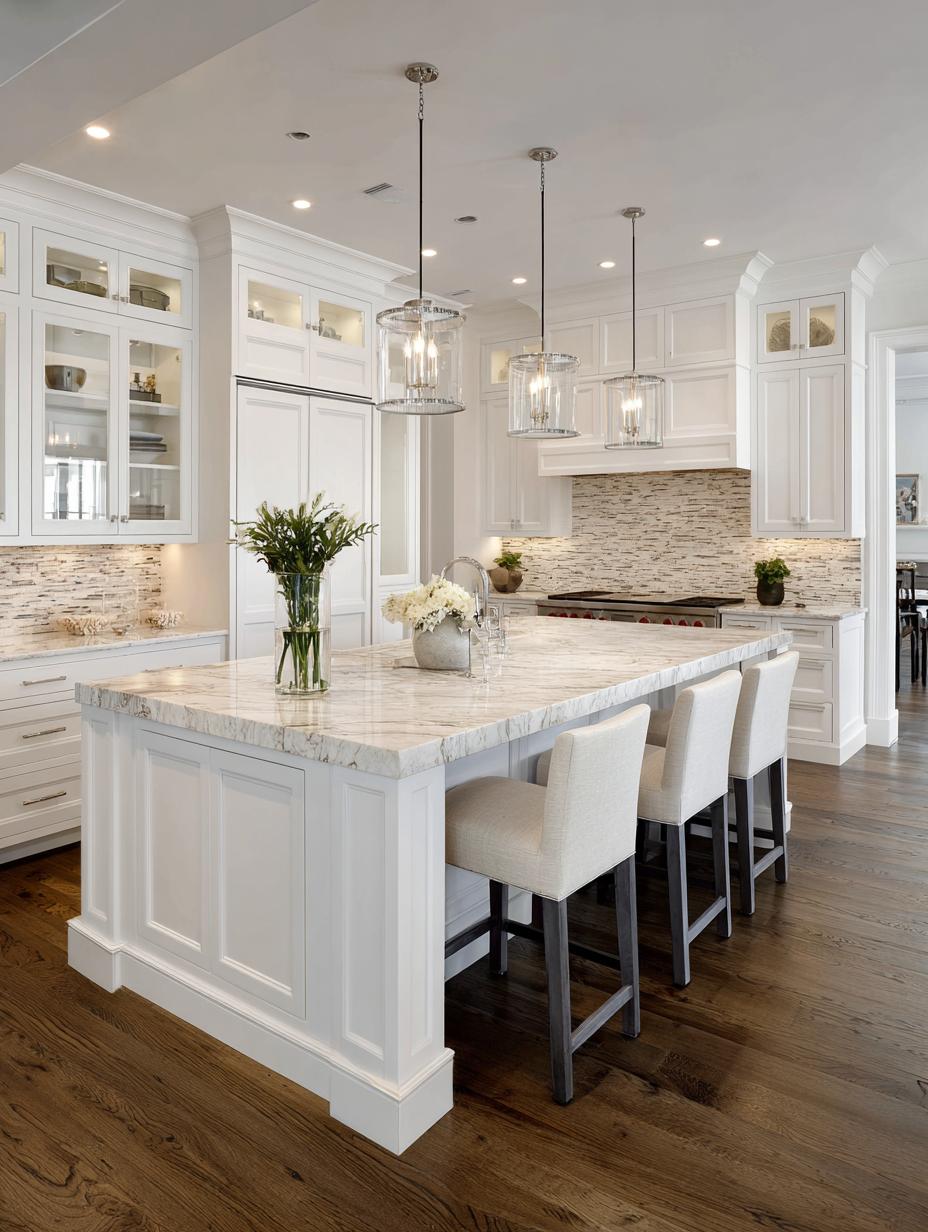
Linear mosaic tile in taupe and cream creates a backsplash that reads as neutral from a distance but reveals intricate detail up close. The horizontal orientation draws your eye across the cooking zone, where a stainless steel hood sits flanked by glass-front display cabinets on either side. Three cylindrical drum pendants in clear glass and polished nickel hang above the island, their proportions scaled to match the room’s generous footprint.
This is the kind of kitchen that looks impressive in photos but also shows signs of actual living. A cookbook stands open near the range, small potted herbs line the windowsill, and the marble countertop bears the patina of regular use. Four parsons-style stools in cream linen with dark espresso legs provide seating, their simple silhouette a smart choice against the more ornate pendant fixtures above.
If your white kitchen feels too stark, swap in fabric-upholstered stools with visible wood frames. The combination of soft textile and natural grain introduces warmth without changing your color palette.
When the Stone Does All the Talking
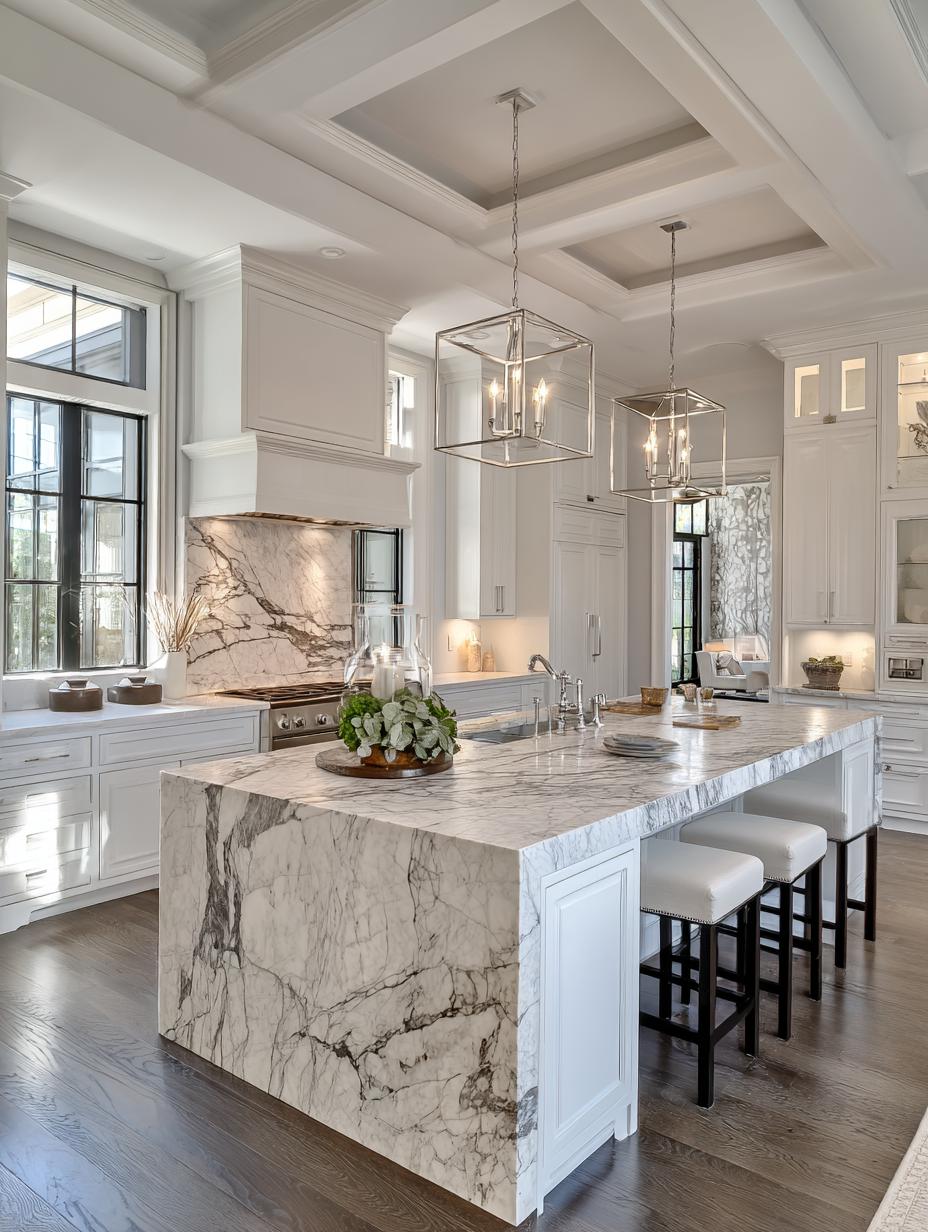
Arabescato marble with its dramatic grey and burgundy veining covers both the island and the full-height backsplash behind the range, creating a continuous sweep of natural pattern that nothing else in the room attempts to compete with. The coffered ceiling in painted white adds architectural interest overhead, and two lantern-style pendants in polished nickel hang at prep-height over the work surface.
Black-framed windows along the left wall introduce contrast that the otherwise all-white cabinetry needs. A custom range hood in painted white matches the surrounding millwork, its curved profile softening the hard edges of the professional appliances below. Three backless stools in white leather with dark wood legs tuck beneath the island overhang, and a wood cutting board with stacked grey plates suggests this space sees regular dinner party prep.
Sculptural White Stools as Architectural Objects
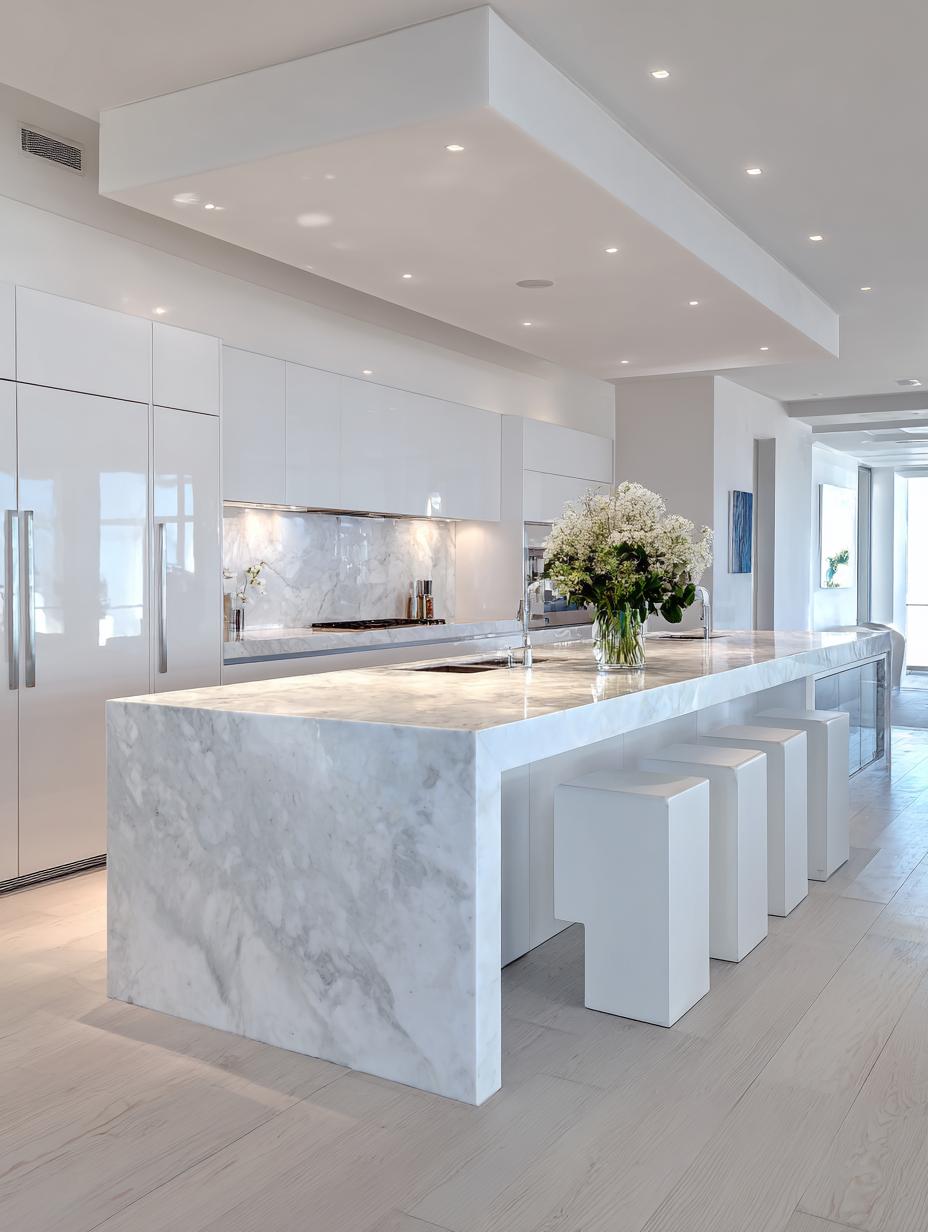
Four solid white resin stools sit in a row along this Carrara marble island, their geometric block form reading more like art installation than seating. The marble itself shows soft grey clouding rather than bold veining, which keeps the visual noise to a minimum in a space already committed to pure tonal restraint.
High-gloss lacquer cabinets with integrated pulls stretch across the back wall, their reflective surface bouncing light from the dropped ceiling recess above. Panel-ready refrigerator doors blend into the cabinetry run, and a vase of white flowering branches near the sink provides the only organic element in view. Bleached oak flooring with a matte finish runs beneath, its pale tone almost matching the marble but with enough warmth to register as wood.
Chrome Pedestals and the Return of Retro Glamour
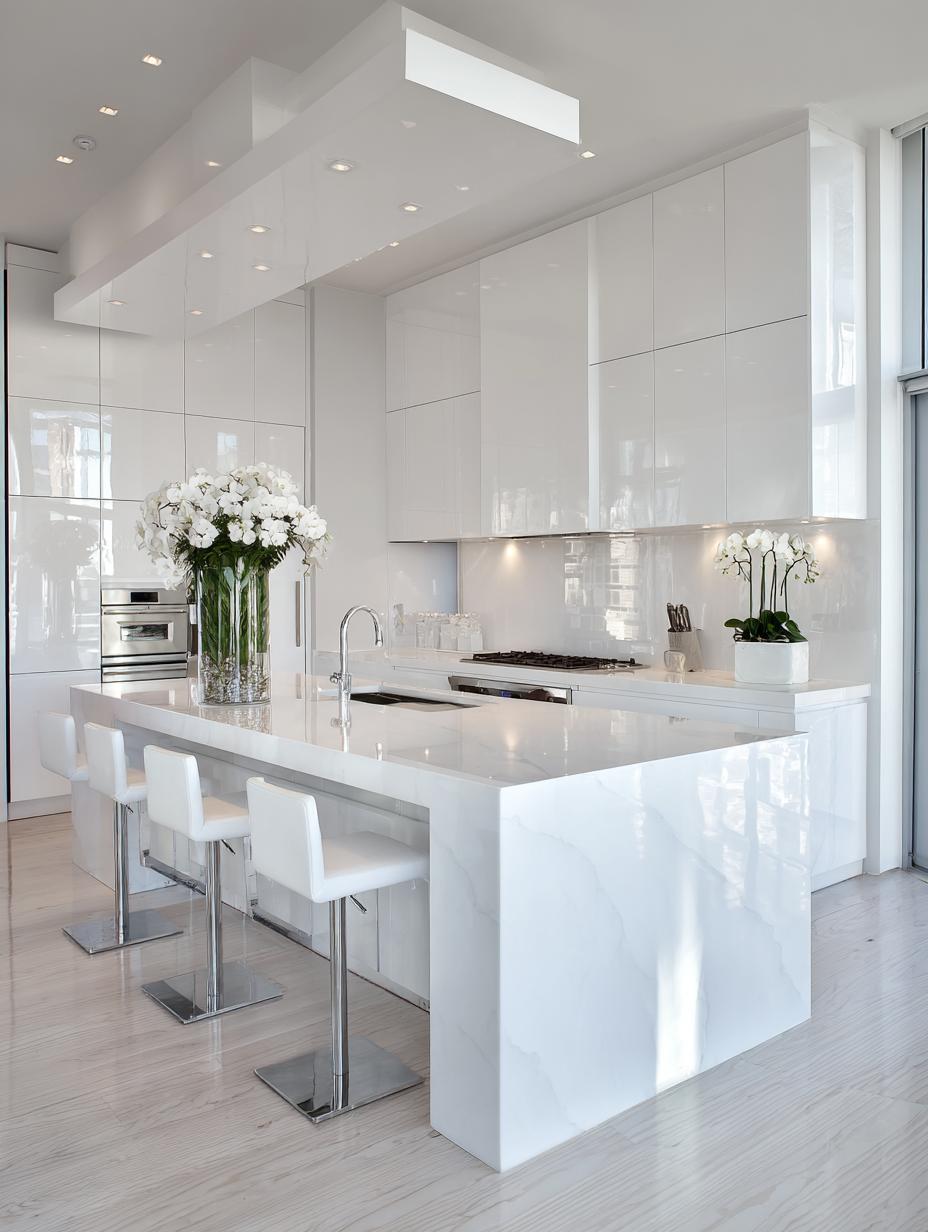
Adjustable gas-lift stools with white leather seats and polished chrome pedestal bases line this quartz waterfall island, their form calling back to 1970s Italian design in the best possible way. The island surface shows subtle veining in pale grey, and a large bouquet of white roses in a clear glass cylinder anchors the corner nearest the window.
Floor-to-ceiling cabinetry in high-gloss white lacquer wraps around integrated appliances, including a wall oven and cooktop visible behind the island prep area. White phalaenopsis orchids in a rectangular ceramic planter sit near the range, their arching stems providing the only curves in a room dominated by right angles. The dropped ceiling recess above houses recessed cans and a skylight that washes the entire space in even daylight, eliminating shadows that might otherwise make the all-white palette feel flat.
Honey Oak Cabinetry Makes a Quiet Statement in This Traditional White Kitchen
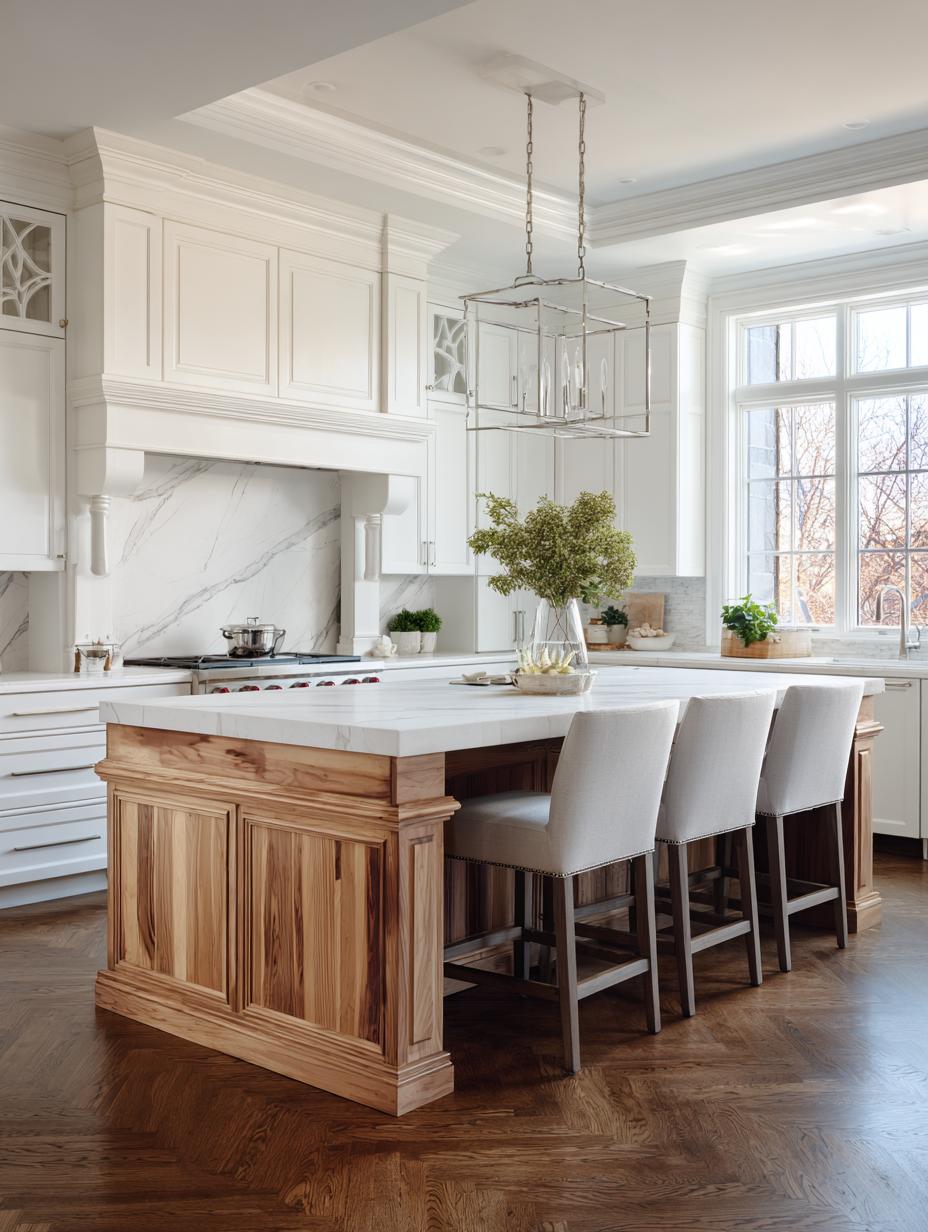
That island. The grain pattern in the honey oak runs through with streaks of amber and caramel, each panel revealing different swirls and knots. It sits grounded against all that white, demanding attention without shouting for it.
Three linen-upholstered counter stools line up along the marble-topped island, their oatmeal fabric pulled tight with brass nailhead trim catching the light from that polished nickel lantern pendant overhead. The herringbone oak floors mirror the warm tones above while the calacatta-style backsplash behind the range hood carries soft grey veining that echoes through the countertops. Crown molding wraps the coffered ceiling, and those geometric mullion details on the upper glass cabinet doors add just enough visual interest to keep things from feeling too serious.
The Psychology Behind This: Two-tone kitchens with contrasting wood islands tap into our need for visual anchoring. All that white space can feel disorienting without a grounding element. The warm wood provides what color theorists call a “resting point” for the eye.
When Waterfall Edges Do Double Duty
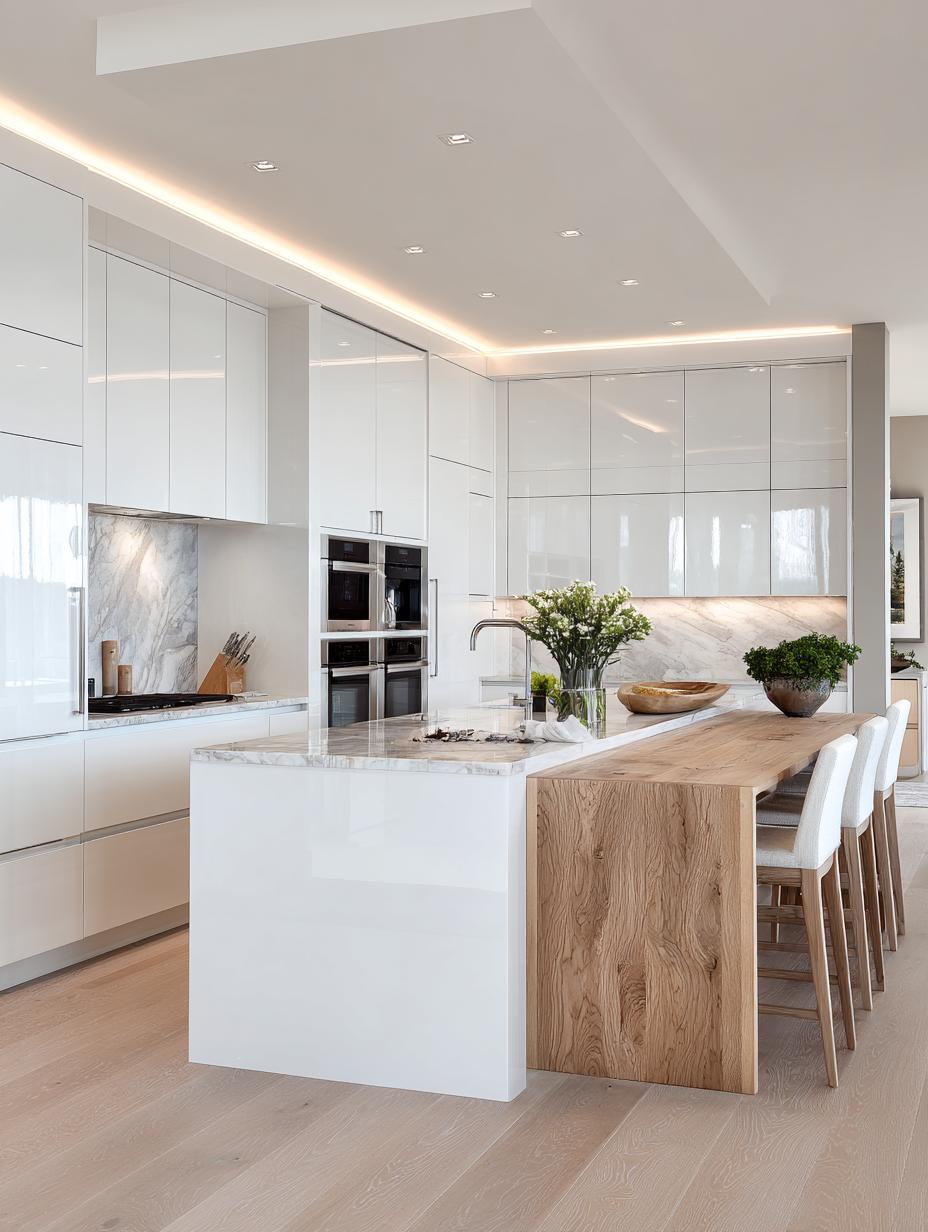
Split personality islands are having a moment. This one dedicates its white quartz half to prep work while the pale oak waterfall extension creates a proper dining surface at a lower height. Notice how the wood grain wraps continuously from the top down the side panel, keeping the lines clean and uninterrupted. The high-gloss white cabinetry climbs to the ceiling with no visible hardware, just handleless doors that push open. Recessed LED cove lighting traces the perimeter, washing everything in soft ambient glow.
A grey-veined marble slab behind the cooktop provides the only pattern in the room. Three white bouclé-upholstered stools with light oak legs tuck under the wood overhang. Fresh white flowers in a clear vase, a carved wooden bowl, and terracotta pot with greenery add organic shapes to all those hard edges. The light oak plank flooring runs wide and pale, keeping the floor plane from competing with the island’s warmth.
By The Numbers: Searches for “two-tone kitchen island” increased 89% year over year, with white-and-wood combinations leading the pack at nearly three times the interest of any other material pairing.
What strikes me most about these final two kitchens is how they represent the full spectrum of where white kitchen design sits right now. One leans traditional with its paneled details and ornate lighting. The other strips everything back to pure geometry. Both work. Both feel current. The common thread is that neither relies on white alone to do the heavy lifting.