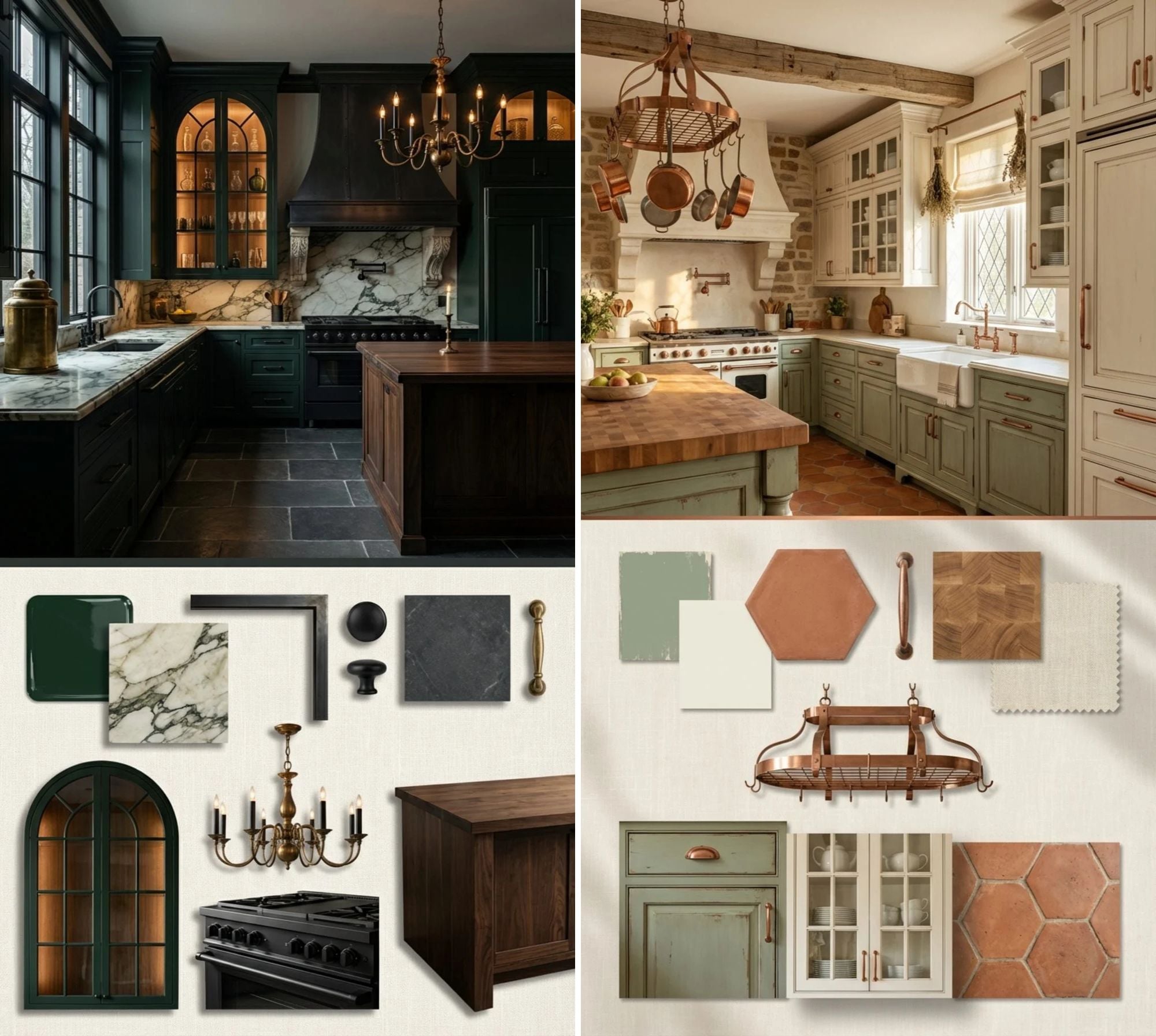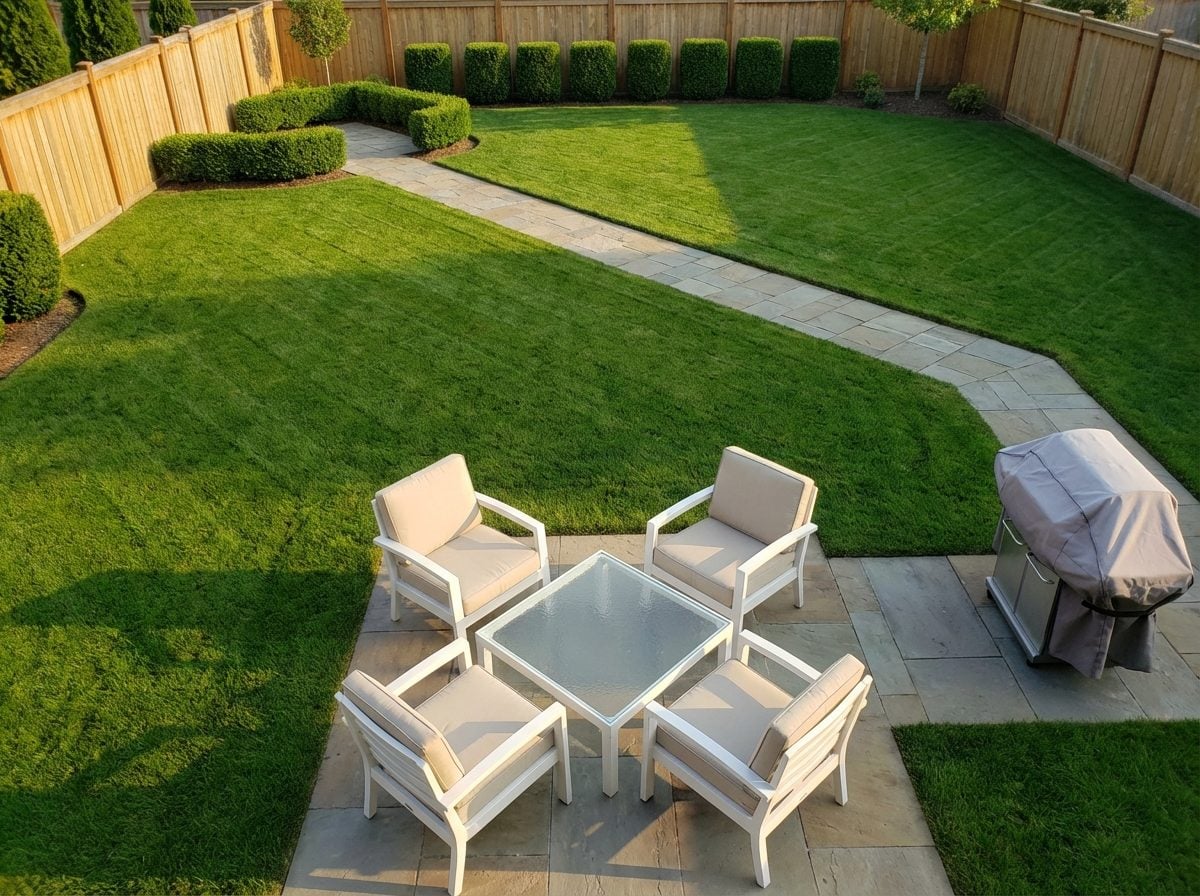
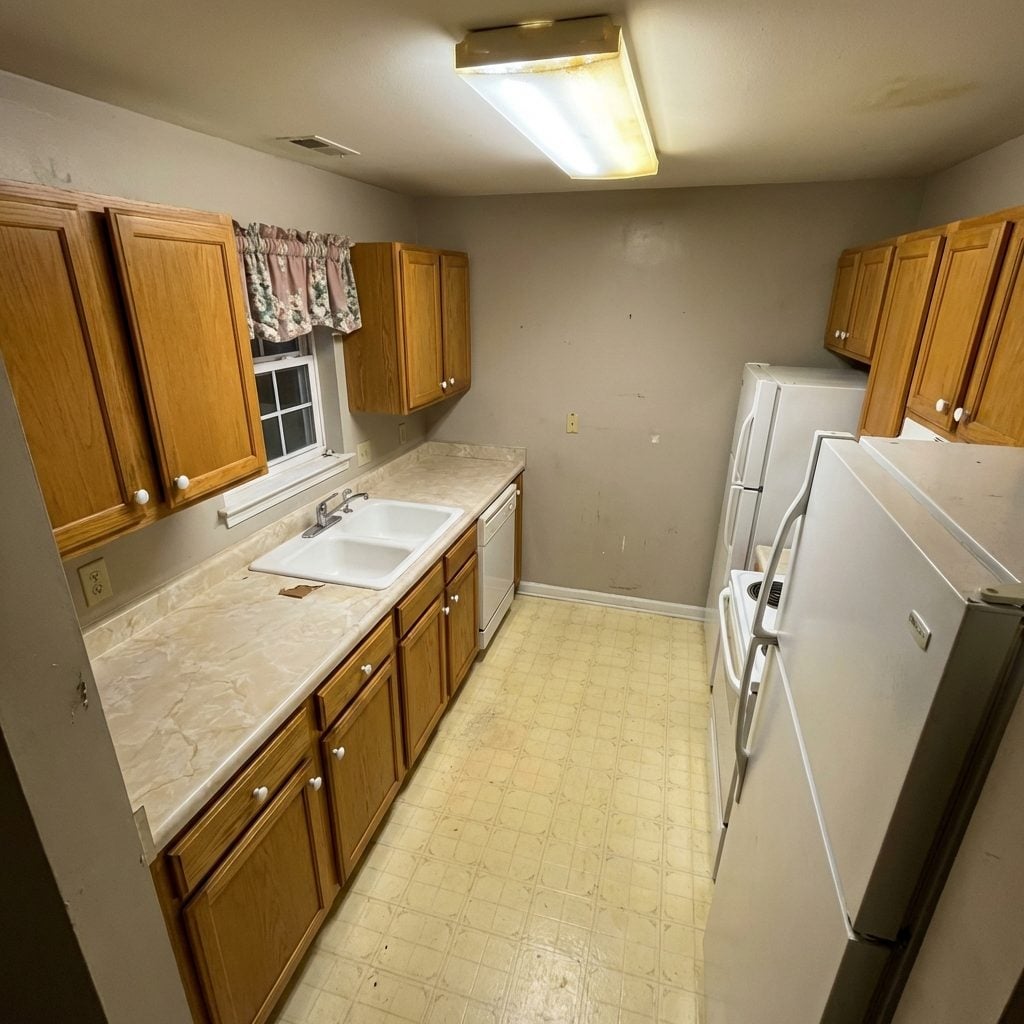
You know the feeling. You walk into your kitchen and nothing is technically wrong, but nothing is right either. The cabinets are fine. The counters work. The whole room just sits there, dull and resigned, eating square footage without giving anything back. Now imagine the same footprint redesigned by someone who has never once tolerated dead space, a surface that only does one job, or a single inch of wasted vertical real estate. That’s the yacht interior designer’s mindset, and what it does to a small kitchen is genuinely hard to believe until you see it.
From Builder-Grade Beige to a Superyacht Owner’s Private Galley in Ebony Walnut and Polished Nickel
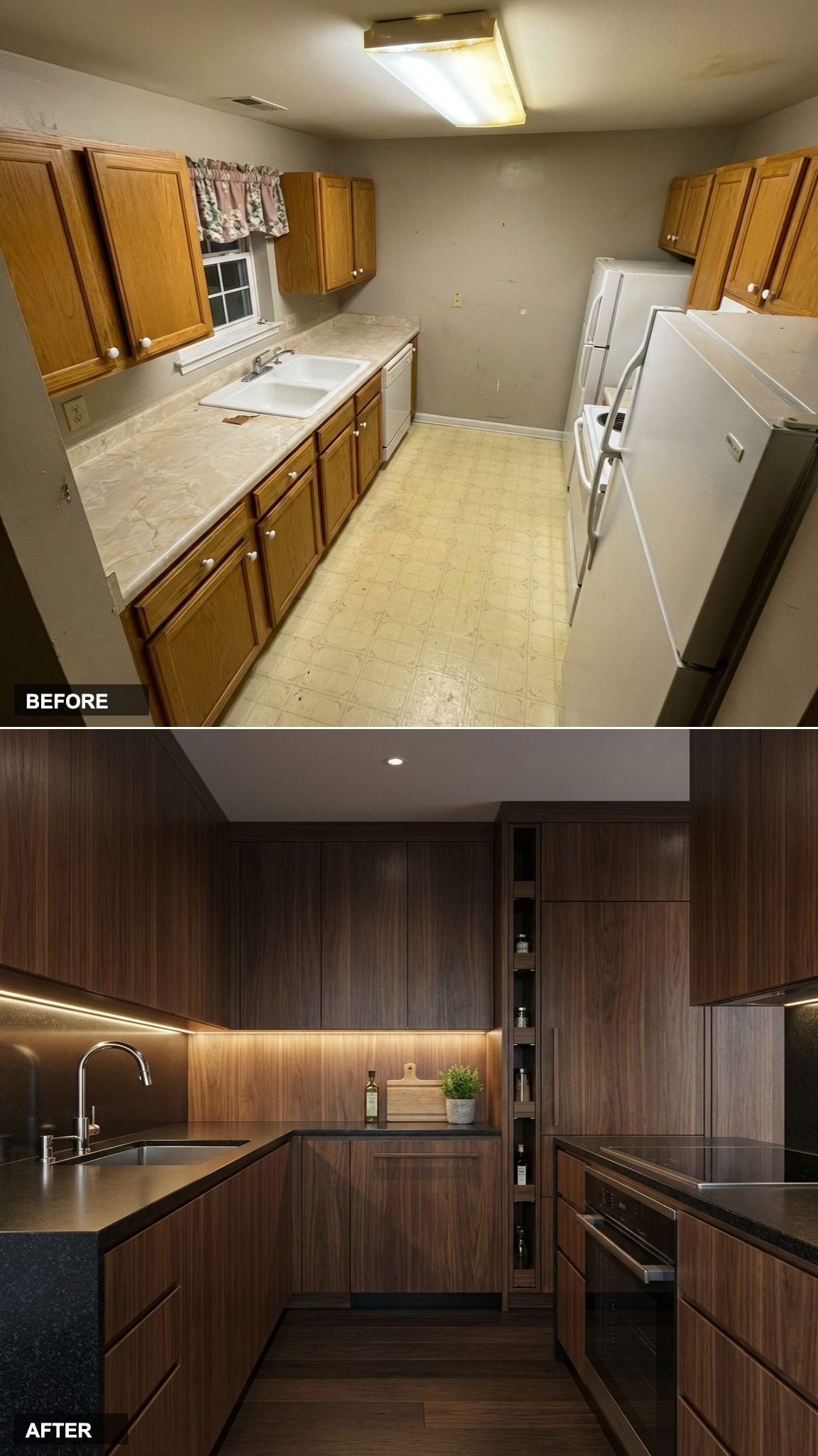
The original kitchen’s biggest structural failure wasn’t the oak or the laminate, it was the visual noise: a dozen competing surfaces, none of them intentional. Replacing all of it with continuous ebony walnut paneling, floor to ceiling, with appliances fully integrated behind flush doors, reduces the cognitive load to almost zero. Your eye has nowhere to snag.
In order to come up with the very specific design ideas, we create most designs with the assistance of state-of-the-art AI interior design software. Also, assume links that take you off the site are affiliate links such as links to Amazon. this means we may earn a commission if you buy something.
The polished nickel faucet is the only bright accent the space gets, and it earns every bit of attention. That restraint is pure yacht logic: when everything has a job, nothing needs to perform.
Mediterranean Coastal Captain’s Kitchen with Aged Brass, Limewashed Plaster, and Handmade Zellige Tile
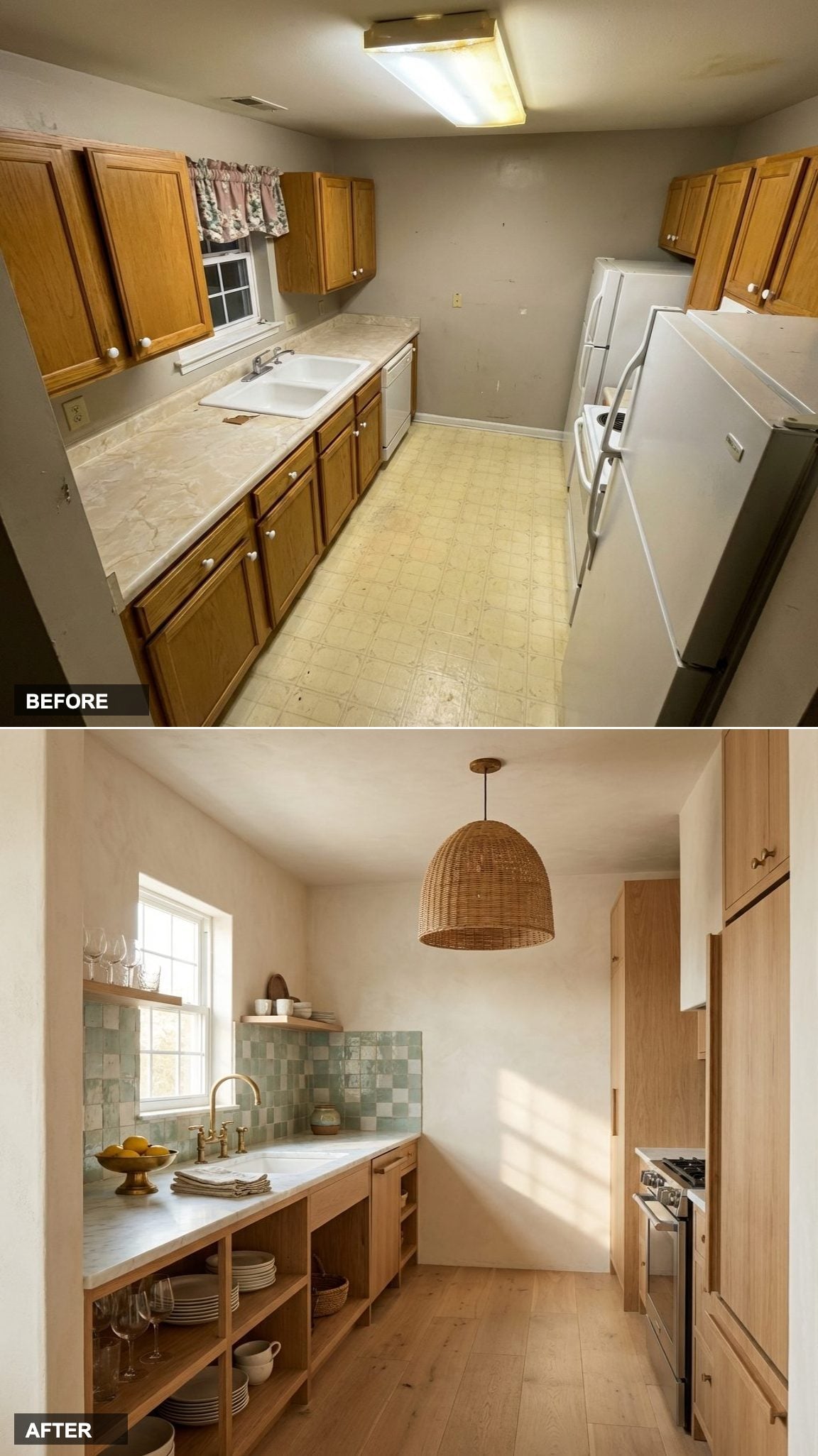
Limewash plaster on a small kitchen wall does something paint can’t: it reads differently at every hour of the day, absorbing morning light flatly and catching afternoon light with depth and shadow. The zellige tile backsplash amplifies this, its irregular surface catching light in facets that keep shifting. The before kitchen had one static surface temperature all day long. This one never looks quite the same twice.
Race-Yacht Minimalist Sprint Kitchen in White Carbon Fiber Finish and Marine-Grade Stainless
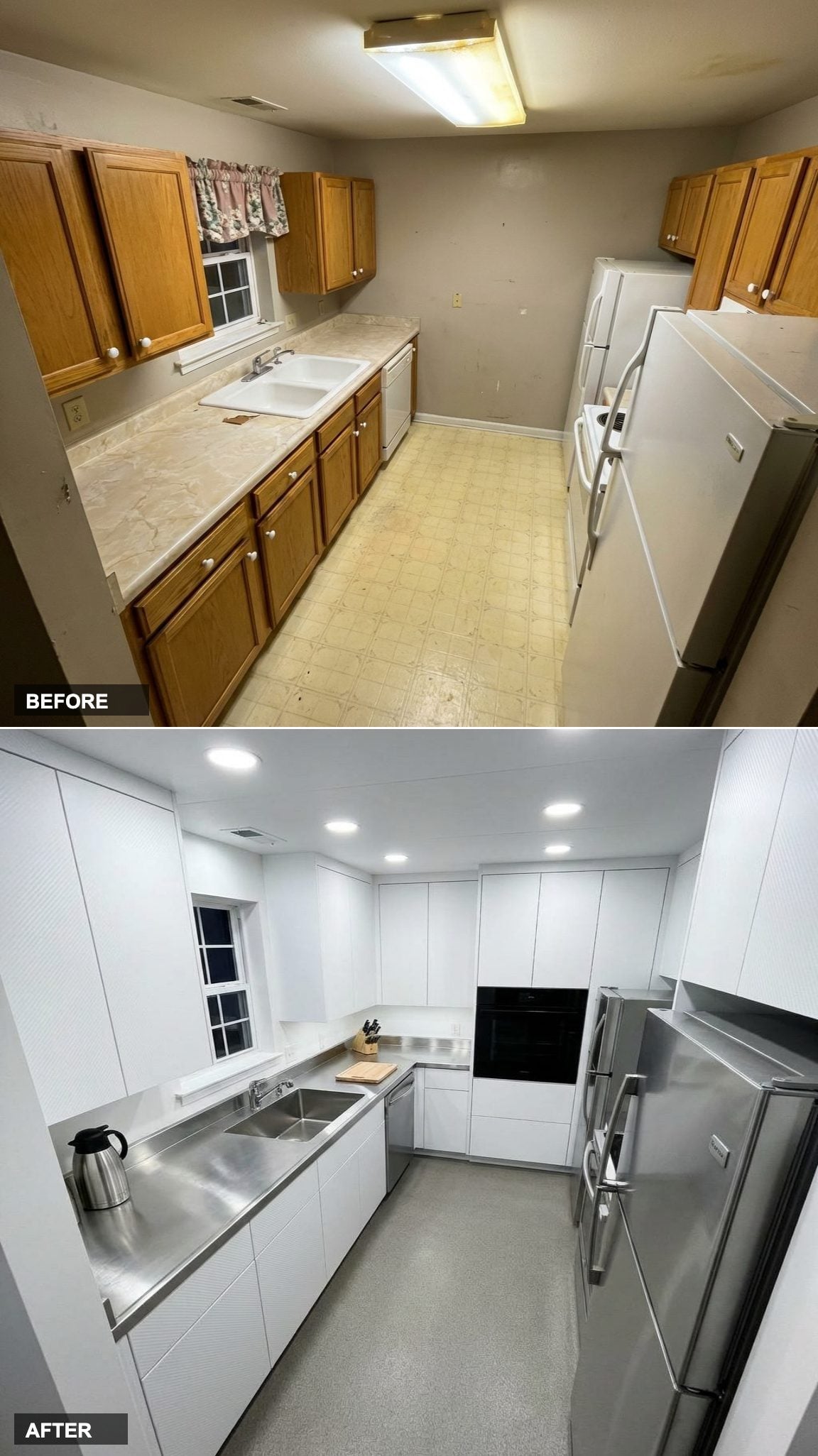
Pure performance design has one rule: nothing exists unless it serves. The brushed stainless steel countertop, flush-integrated sink included, eliminates the ledge buildup that makes small kitchens feel permanently cluttered. Every surface is continuous. Every edge is resolved. The before kitchen had twelve distinct material transitions within arm’s reach of the sink alone.
Teak-Decked Classic Sailing Yacht Kitchen with Navy Lacquer and Solid Brass Details
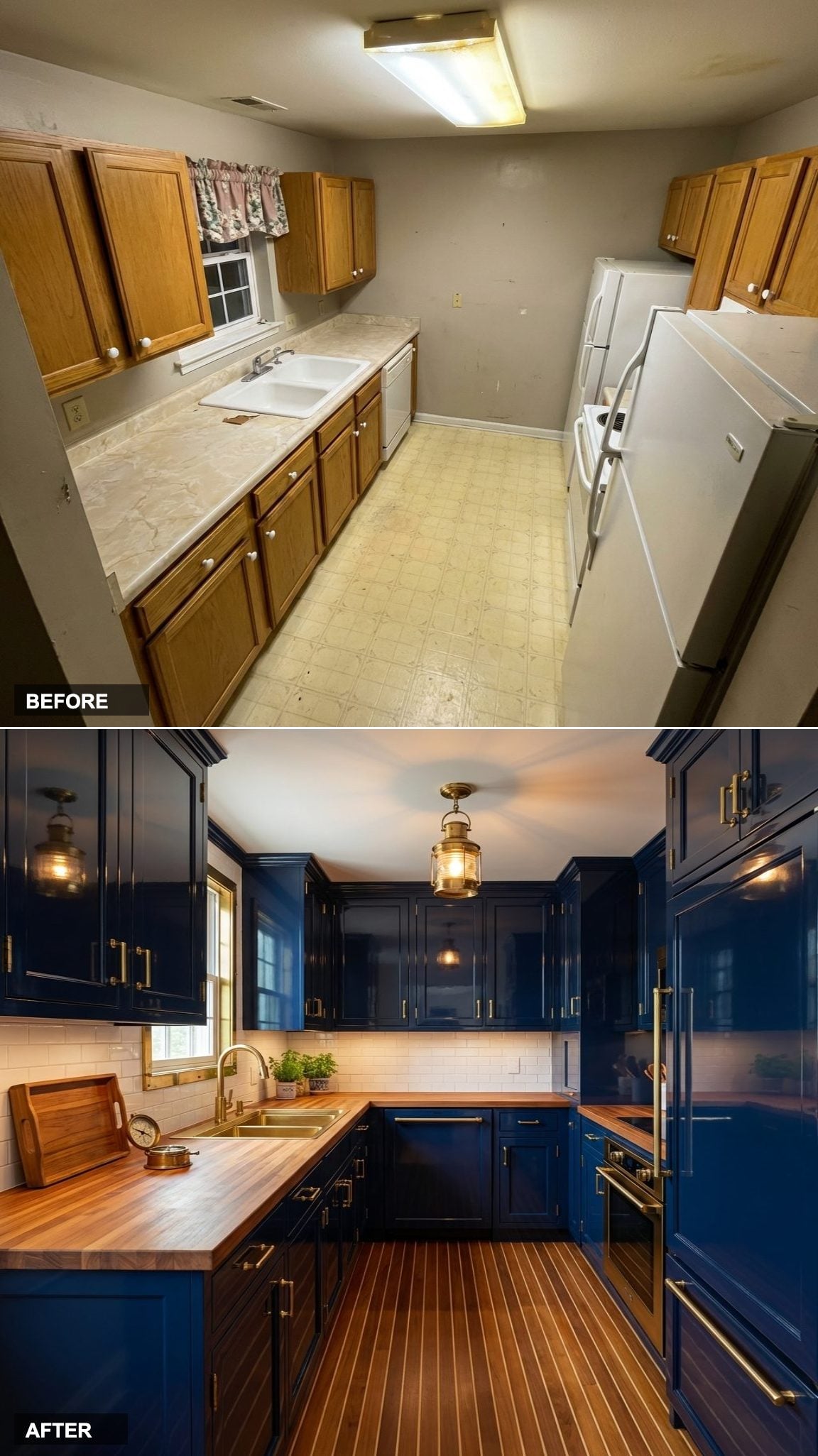
Navy lacquer over flat-panel cabinetry is one of those combinations that should feel heavy in a small room but doesn’t, provided the countertop reads warm. The oiled teak butcher block here acts as a thermal counterweight: it pulls the whole palette toward something lived-in rather than severe. The brass hardware on a navy lacquer cabinet isn’t decorative nostalgia, it’s the colorist’s trick that keeps the room from reading as corporate.
The before kitchen had no such conversation between materials. Everything was one note, one temperature, one era of forgotten decision-making.
Japanese Minimalist Ketch Galley in Smoked Cypress, White Resin, and Matte Charcoal Stone
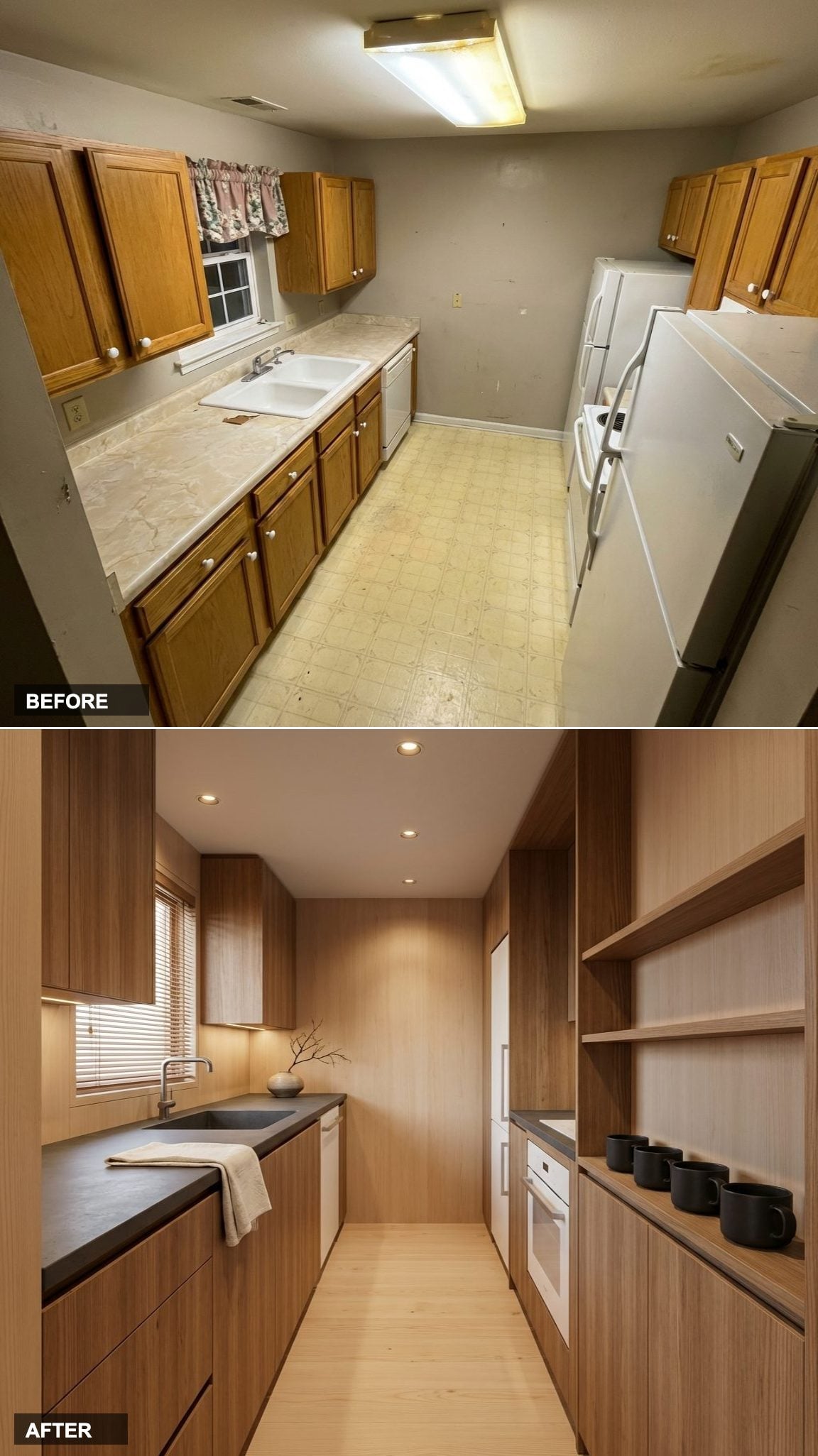
The psychological principle at work here is prospect and refuge: the smoked cypress wraps the room like a shelter, while the pale resin countertop and recessed light open it skyward. It’s a small kitchen that feels like somewhere you’d want to sit and think, not just cook.
Removing every piece of visible hardware and every exposed appliance front was the real leverage point. The smoked cypress cabinet doors with no pulls, combined with a single matte black ceramic cup set as the only counter object, drops the room’s visual complexity to something close to silence.
Billionaire’s Expedition Yacht Kitchen in Bone Leather, Smoked Glass, and Satin Bronze
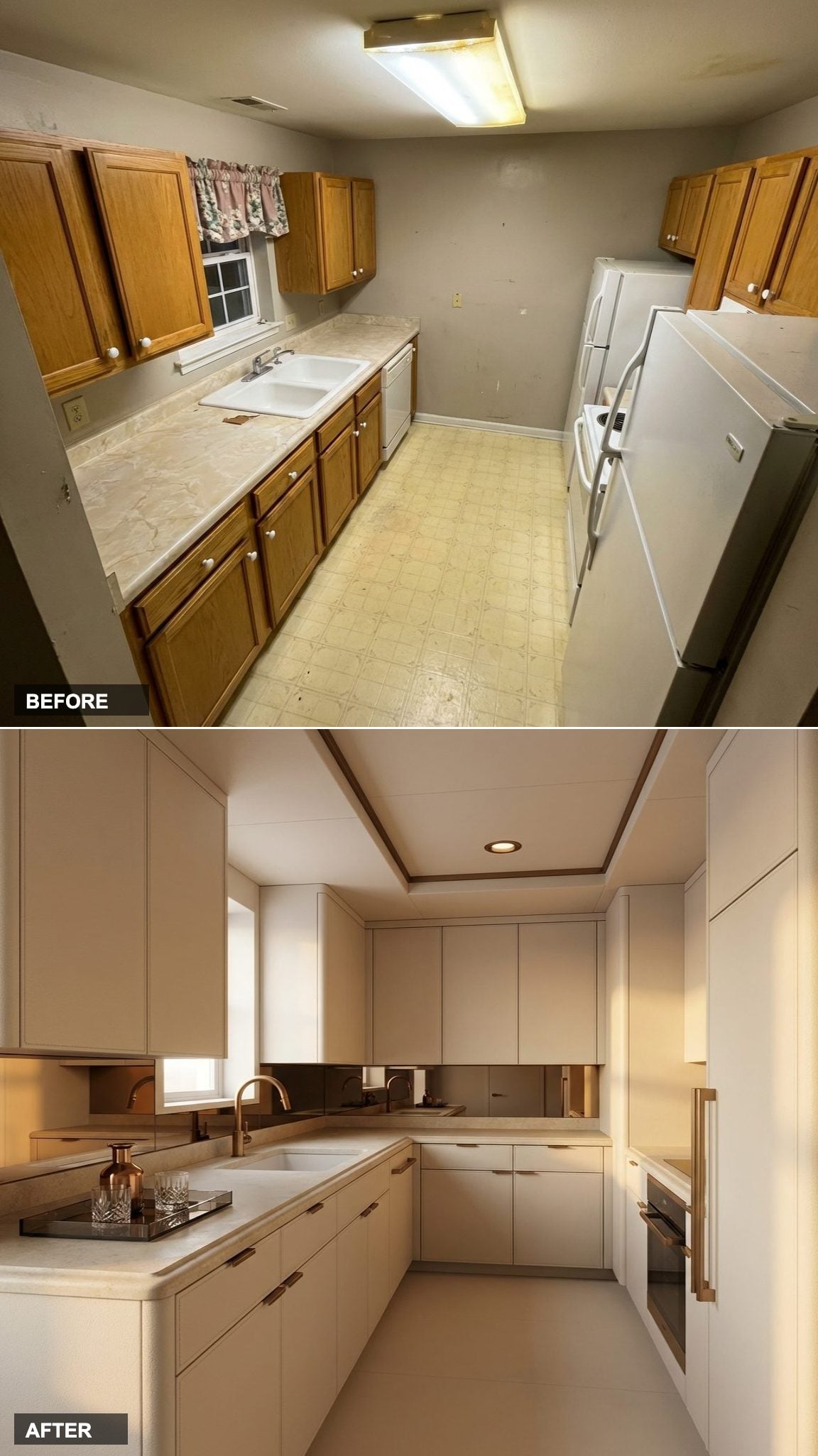
Leather on a kitchen cabinet front sounds like a maintenance disaster, and in a larger kitchen it might be. At yacht scale, where every square inch is cleaned daily out of necessity, it works because the discipline of the space enforces the behavior. The smoked bronze mirror backsplash does the heavy spatial lifting, reflecting depth without reflecting detail, which keeps the room feeling expanded without the clinical coldness of a standard mirror.
Vintage Riviera Day Sailer Kitchen in Glossy Ivory, Chrome, and Warm Terracotta
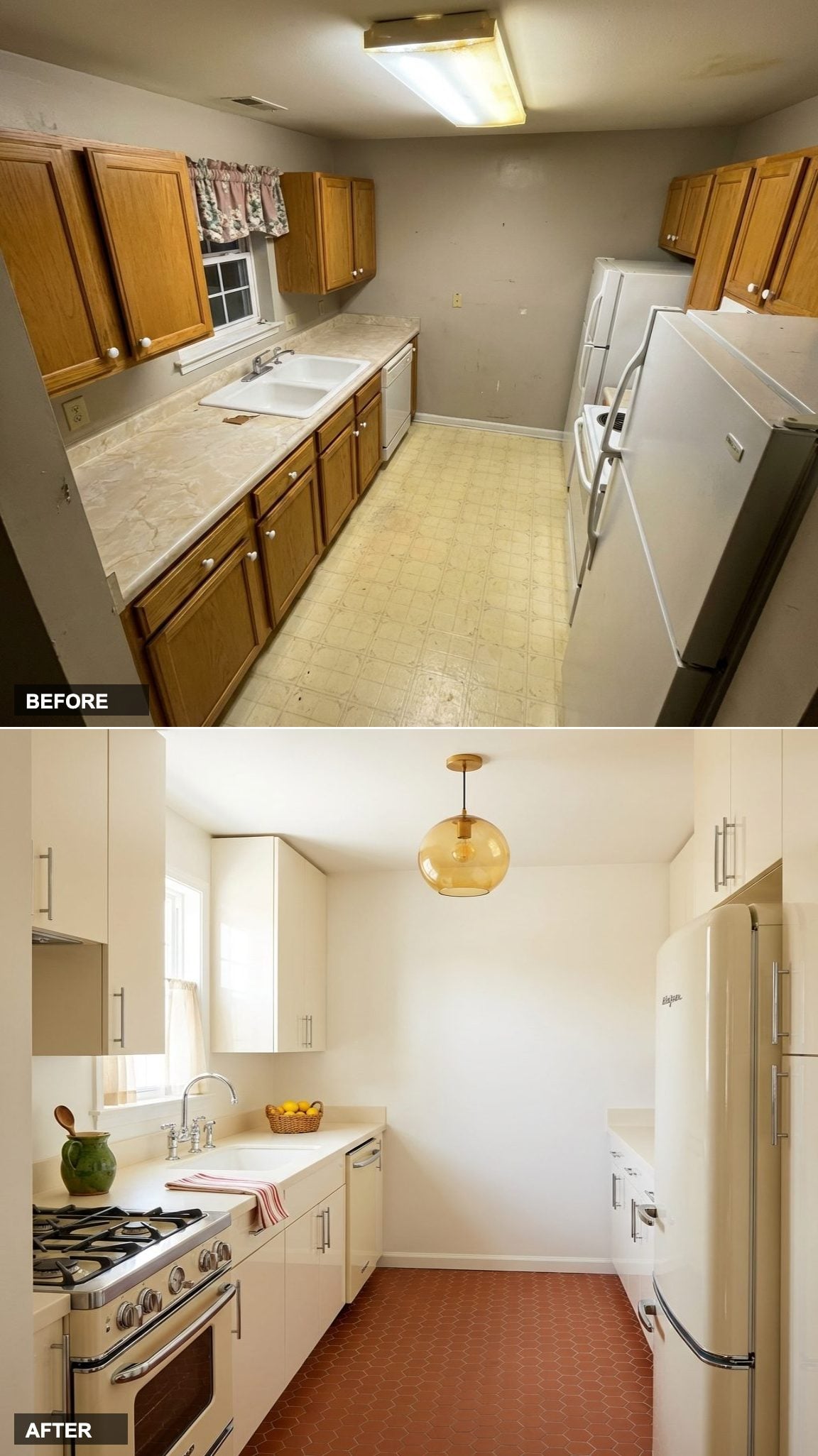
Retro yacht galley design never really disappeared, it just got buried under decades of builder-grade beige. The terracotta hexagonal floor tile and cream gloss cabinets work together the way they always did: warm tone against cool gloss, small pattern against flat surface. The amber glass pendant light keeps the light quality golden rather than bright, which turns a very small kitchen into something that feels like a good lunch is always about to happen.
Dark-Water Deep-Sea Research Vessel Kitchen in Onyx, Hammered Copper, and Industrial Matte Black
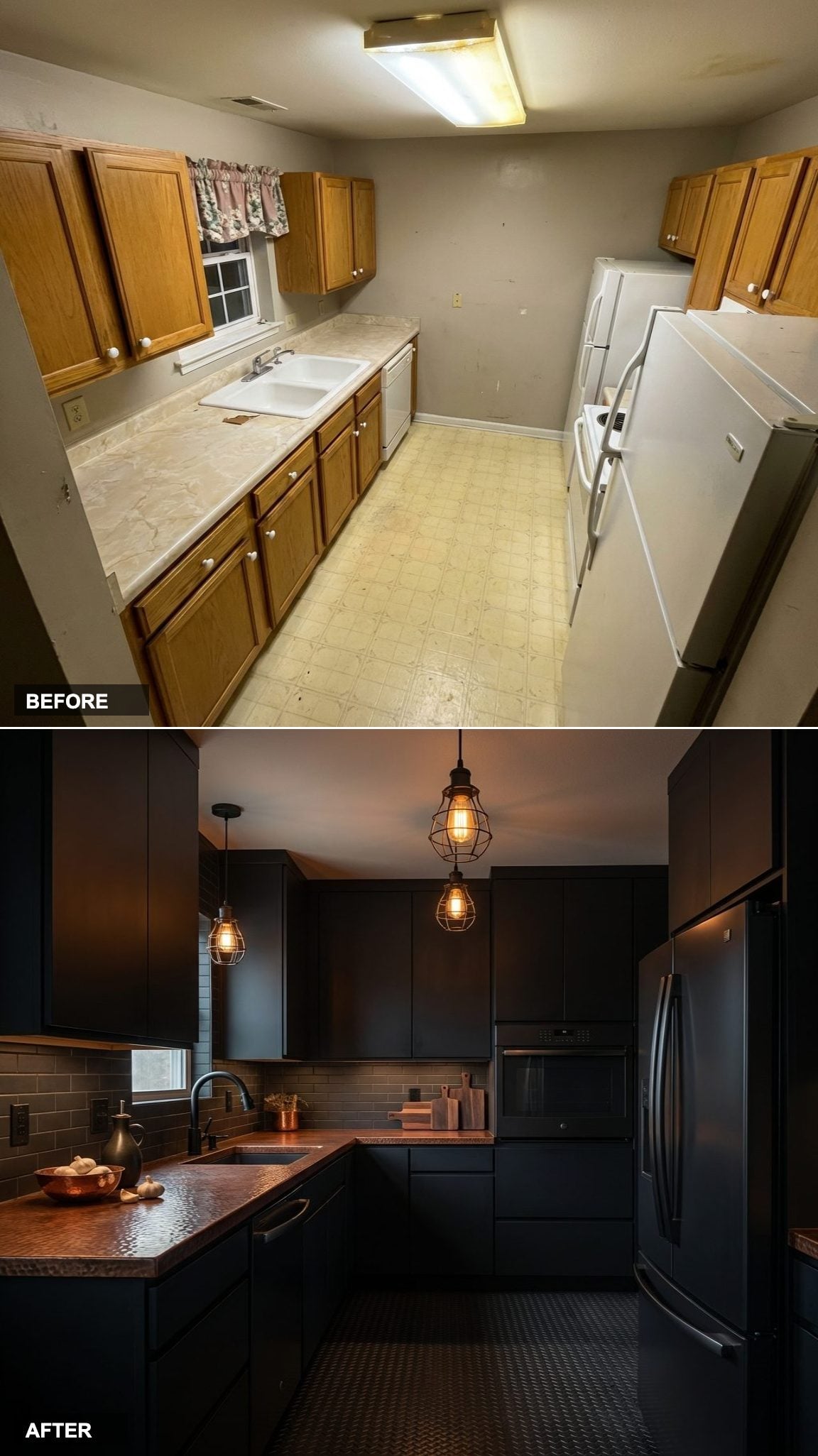
Full commitment to a single tone is the only way a very dark palette works in a small kitchen. The hammered hammered copper countertop against matte onyx cabinetry holds together because both surfaces share the same low-sheen, tactile quality. Mixing finishes (some gloss, some matte, some hammered) at this scale would produce visual chaos. The discipline of the before kitchen’s problem, ironically, was the opposite: too bland to cohere. This one is too deliberate to fail.
Bespoke Maltese Falcon Mega-Yacht Kitchen in Pewter, Slate, and Smoked Mirrored Steel
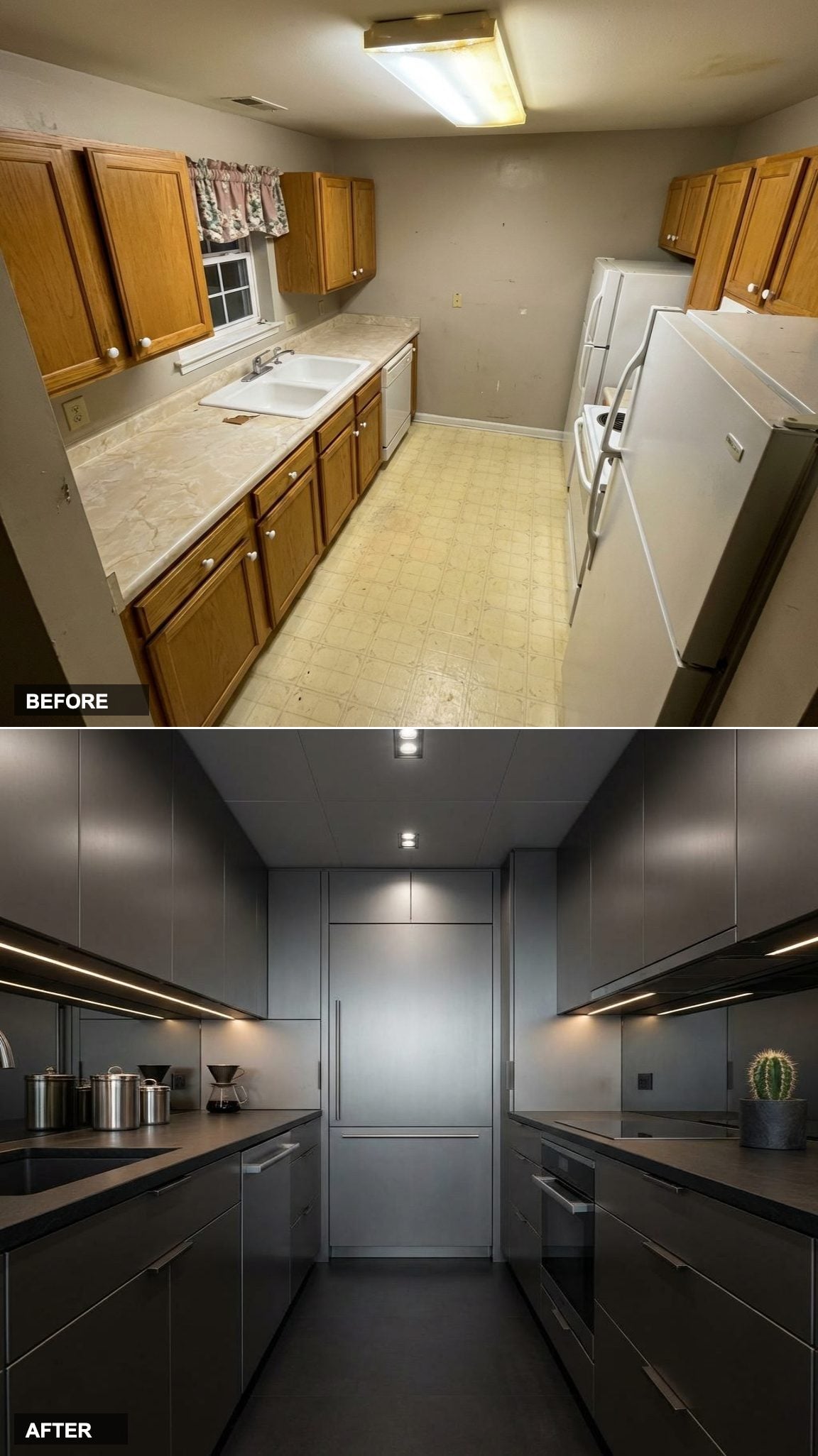
Pewter lacquer reads differently from grey paint in a way that’s hard to articulate until you see it: it has a depth to it, a slight metallic undertone that changes in artificial versus natural light. Paired with honed slate countertops that are almost black, the kitchen barely distinguishes between surface and cabinet, and that continuous dark plane is what makes it feel so deliberately spacious rather than cramped.
The pewter canister set on the counter is doing something smart, providing the only object with a curve in a room of strict right angles. That single tonal contrast breaks the severity just enough.
Ice-Class Arctic Research Vessel Kitchen in Frosted White, Steel Blue, and Raw Birch
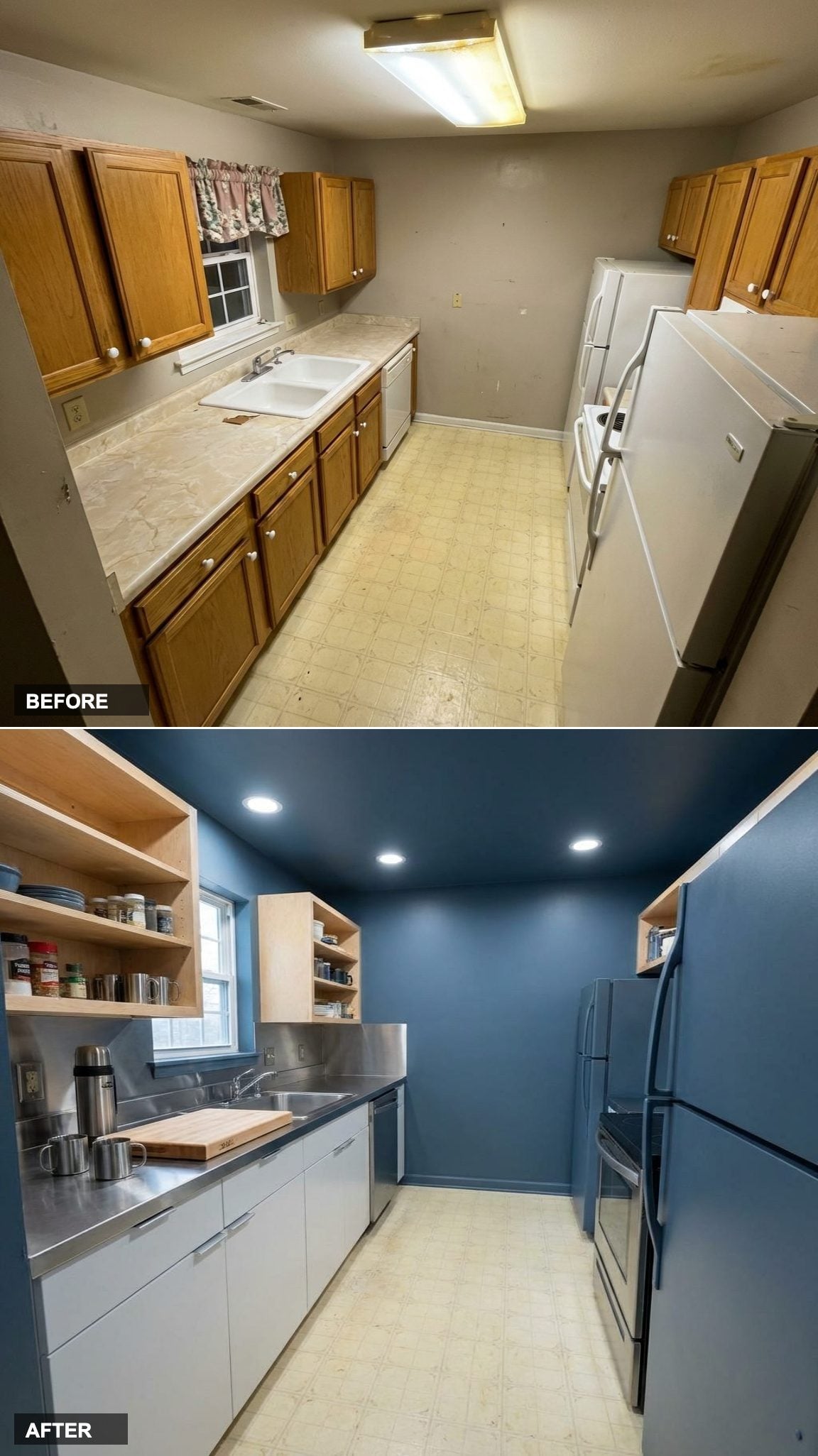
There’s a psychological category of room that designers call “cognitive shelter”: a space so organized and tonally consistent that your nervous system actively settles upon entering. Steel blue walls and ceiling unify every surface into one continuous cool envelope, and the birch open shelves introduce the only warmth. The contrast is narrow enough to feel coordinated, wide enough to feel alive. The before kitchen had five different surface temperatures competing for attention. This one has two, assigned deliberately.
Art Deco Trans-Atlantic Ocean Liner Private Galley in Champagne Gold, Ebony, and Fluted Glass
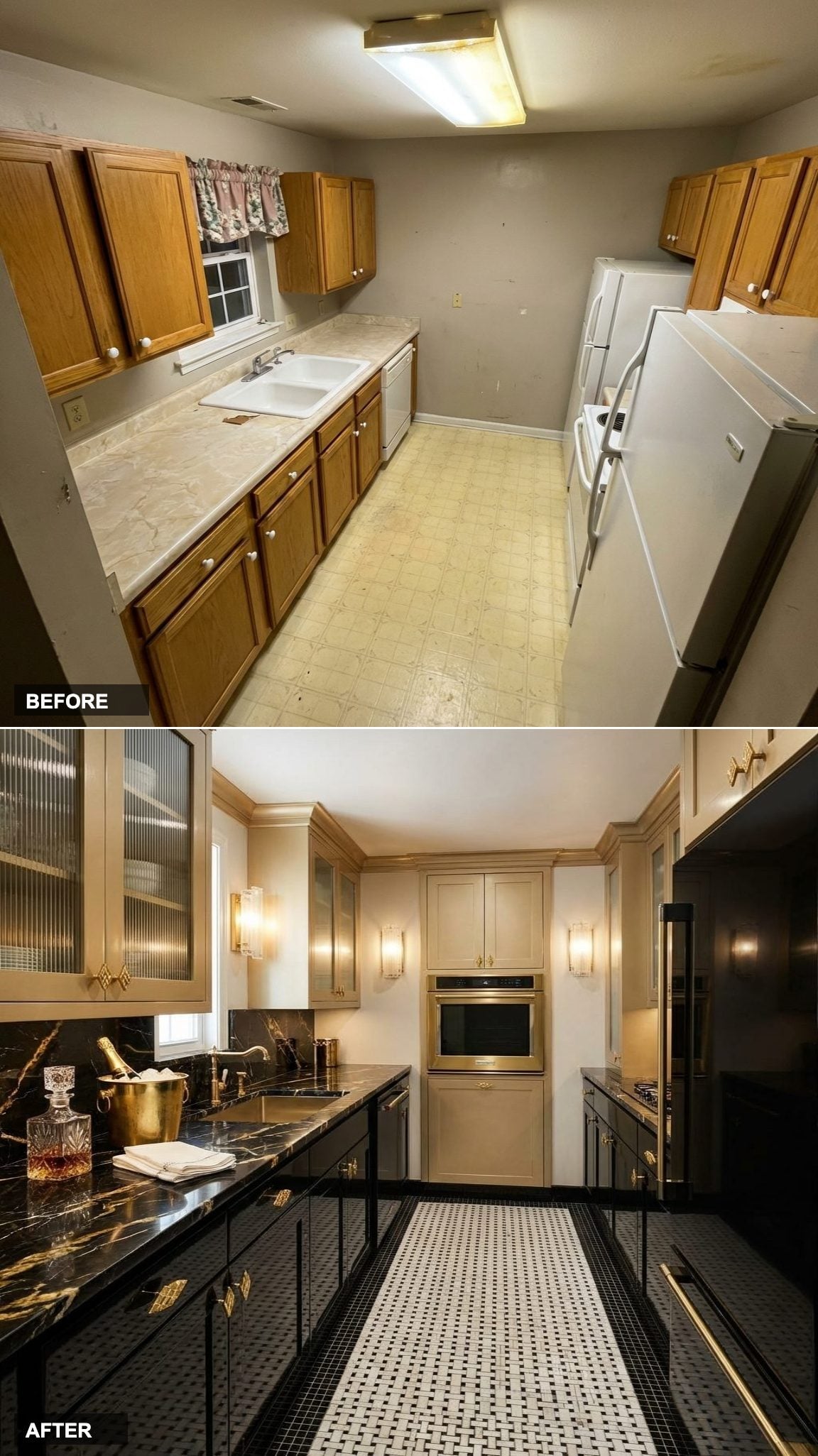
Art Deco’s visual logic is all about declaring intention loudly and then following through on every single surface. The fluted glass on the upper cabinet doors, the geometric mosaic floor, the champagne gold cabinet hardware: every element is making the same geometric argument. When a design moves this confidently in one direction, scale stops mattering. The room’s size becomes irrelevant because the personality fills the space completely.
The before kitchen’s problem was precisely the opposite: no commitment, no argument, nothing to follow through on.
Wabi-Sabi Pacific Passage Yacht Kitchen in Unfinished Concrete, Raw Linen, and Patinated Copper
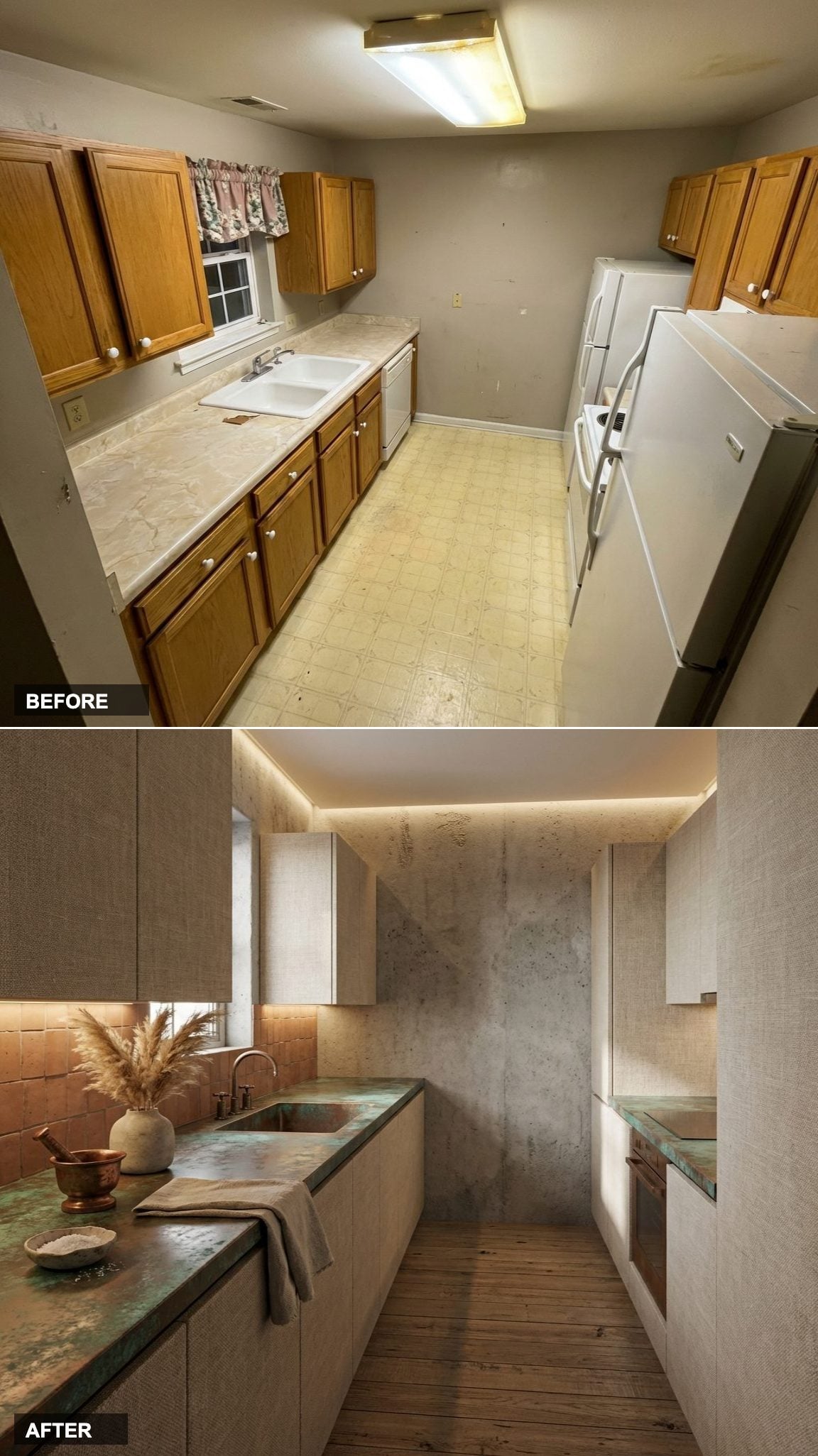
Wabi-sabi is often misread as “rustic” but it operates on a more precise principle: perfection through incompleteness. The raw concrete walls and heavily patinated copper countertop here are intentionally imperfect but the cabinetry is perfectly flat, the lighting perfectly recessed, the counter objects perfectly edited. The contrast between the imperfect and the controlled is where the design lives. It’s a small kitchen that takes the colorful den design concept and strips it to its calm, monochromatic opposite.
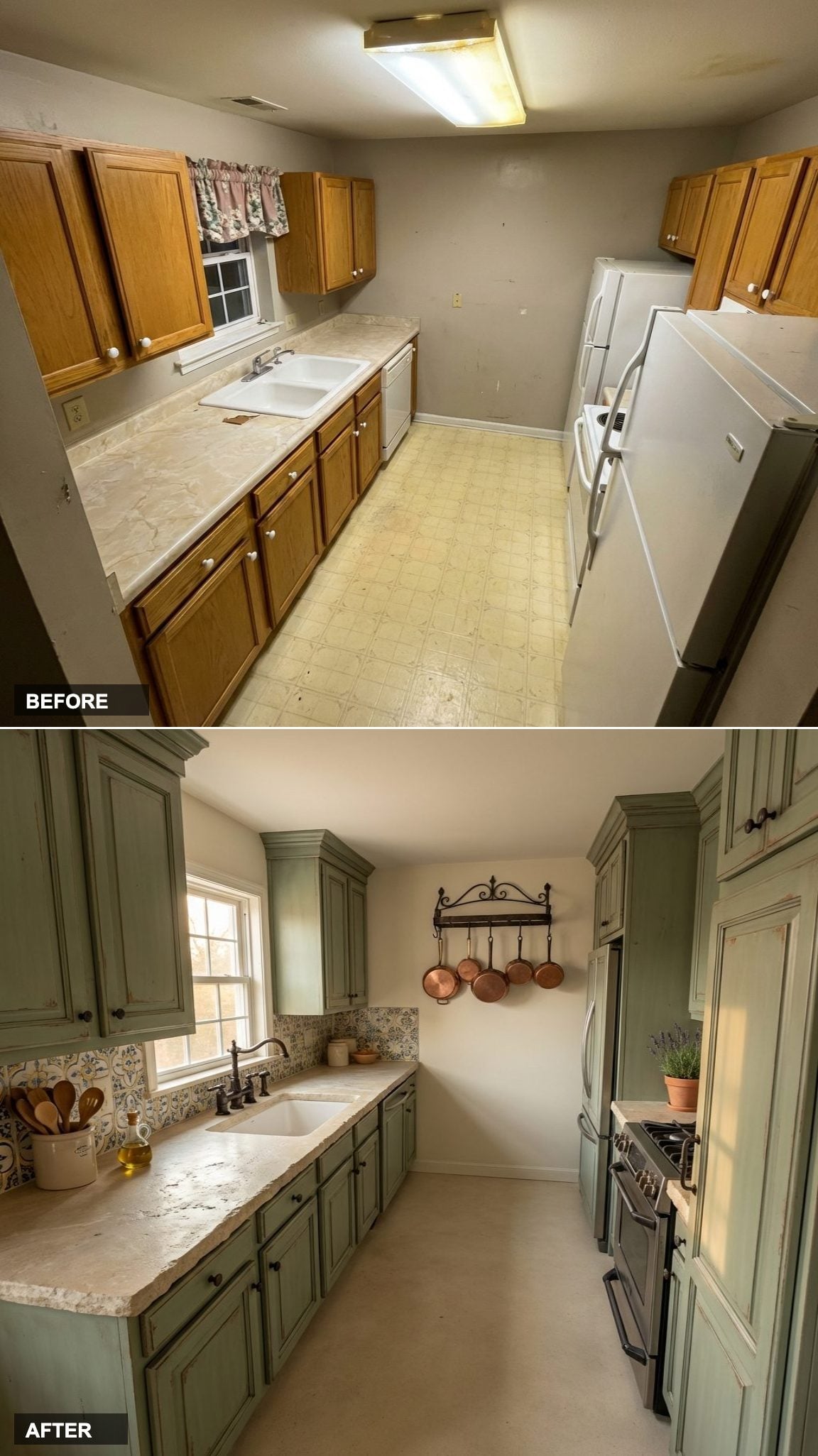
Provençal Sailing Barge Kitchen in Distressed Sage, Reclaimed Stone, and Hand-Thrown Ceramic
🔥 Would you like to save this?
The rubbed-through distressing on the sage cabinetry does something that factory-perfect paint never manages: it gives the room a timeline. You believe this kitchen has been used, enjoyed, and maintained by someone who actually cooks. That sense of authenticity is a specific, engineered design decision, not an accident, and it’s the single change that makes this after image feel lived-in rather than staged.
The copper hanging pot rack solves a real yacht-principle problem, storing bulky items in the vertical zone above the cooking surface rather than inside a cabinet that opens awkwardly. Every piece of storage is doing double duty as décor.
From Beige Builder Bore to Superyacht Burl Wood Sanctuary
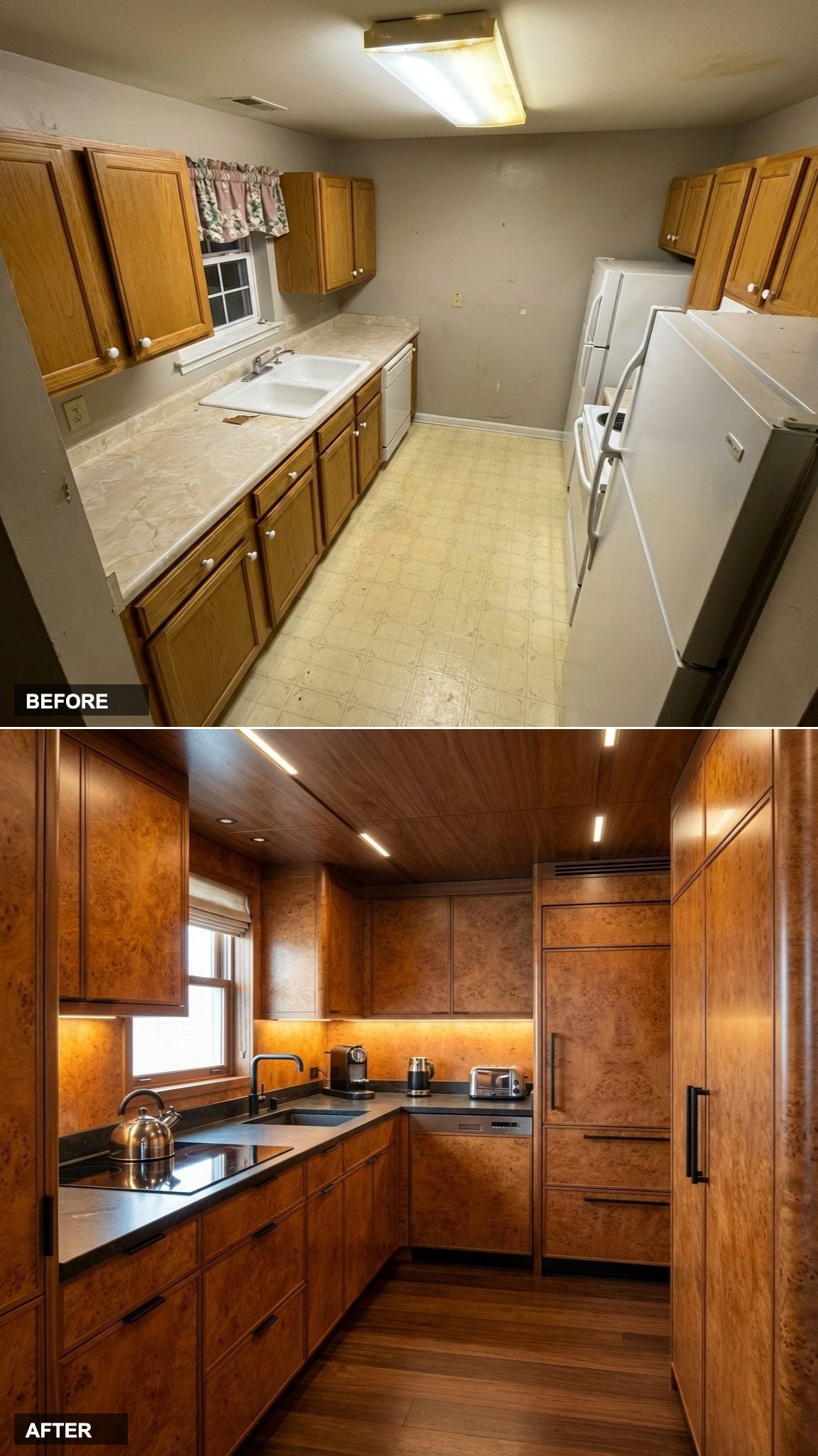
Burl wood veneer on a yacht isn’t decorative, it’s structural paneling that happens to look like art. Bringing that same philosophy into a small kitchen means every cabinet face, every drawer front, and every panel does triple duty: it hides storage, insulates sound, and adds the kind of warm, organic texture that no paint color can replicate.
The burl wood cabinet doors here replace flat slab fronts, and the integrated appliance panels make the fridge and dishwasher disappear into the grain. Nothing competes visually. The result reads as a single continuous wall of warm wood, not a kitchen fighting itself for attention.
From Laminate and Linoleum to Icelandic Superyacht Minimalism
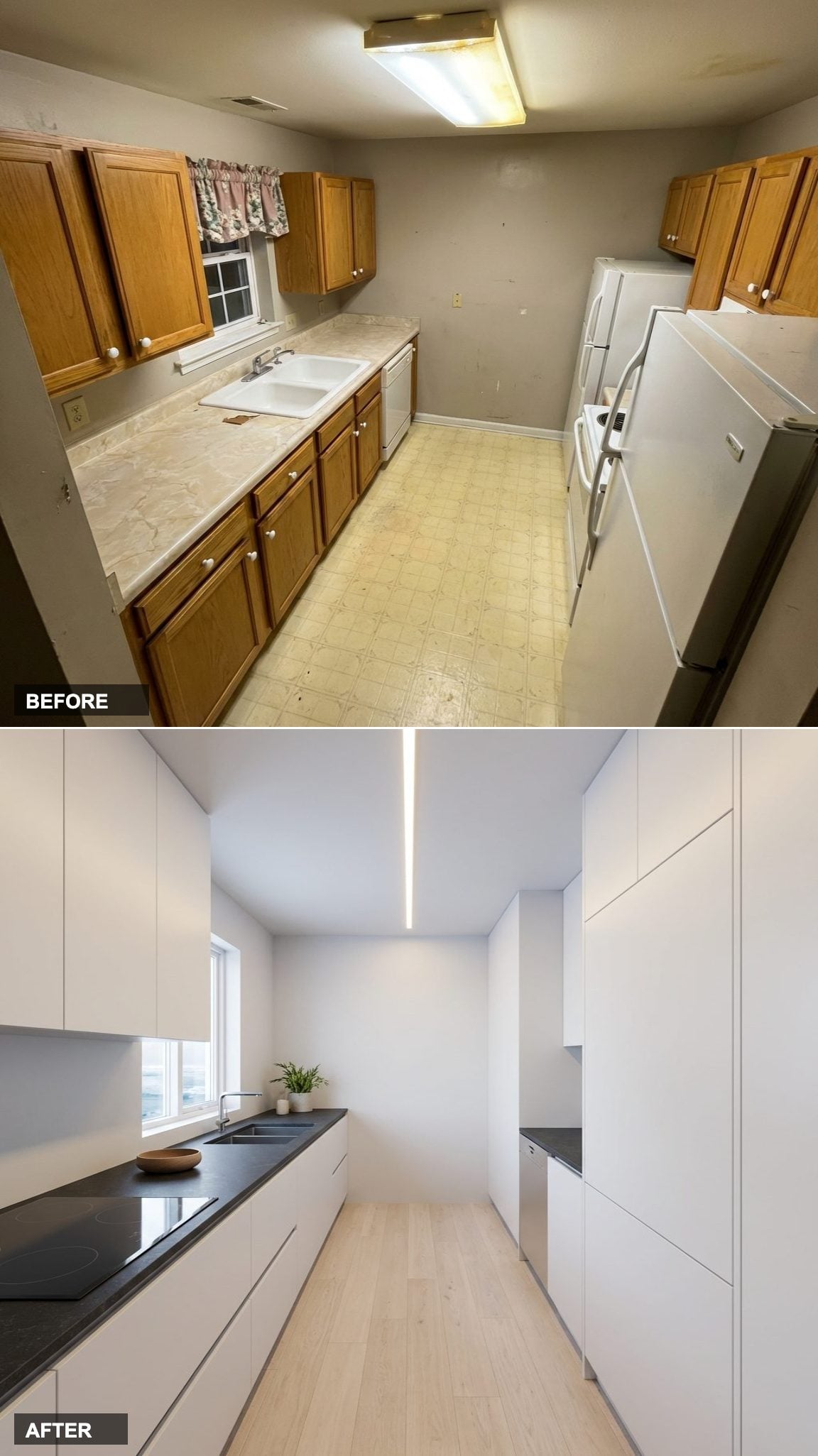
Icelandic design operates on the same frequency as yacht interiors: extreme restraint, extreme intention. Every object earns its place. Nothing is left out simply because there’s room for it.
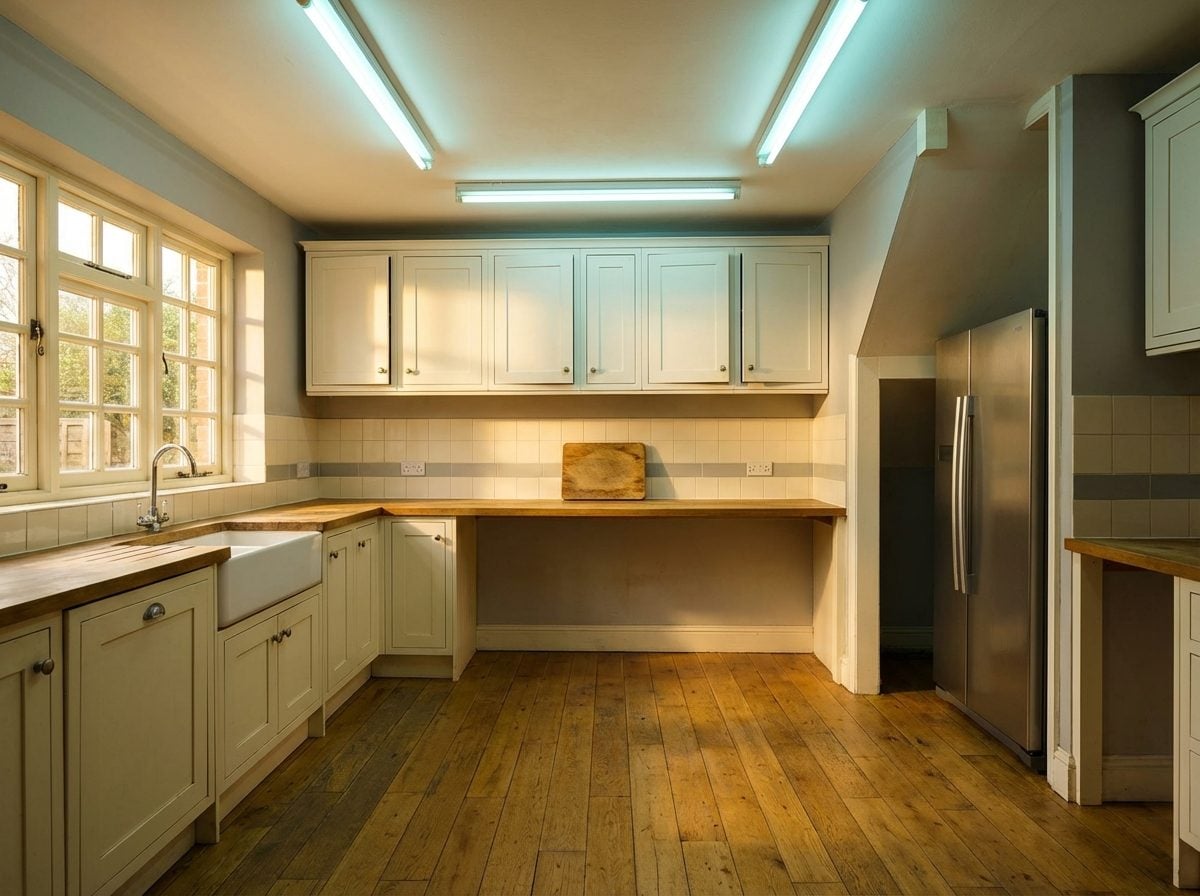
This makeover swaps the entire visual vocabulary, laminate for honed basalt stone, linoleum for pale ash hardwood, fluorescent tubes for a single warm linear LED ceiling fixture that runs the length of the kitchen. The matte white handleless cabinets push flush and disappear. What remains is light, material, and negative space, the three things no builder-grade kitchen ever budgets for.
From Forgotten Galley to Monaco Megayacht Lacquered Glamour
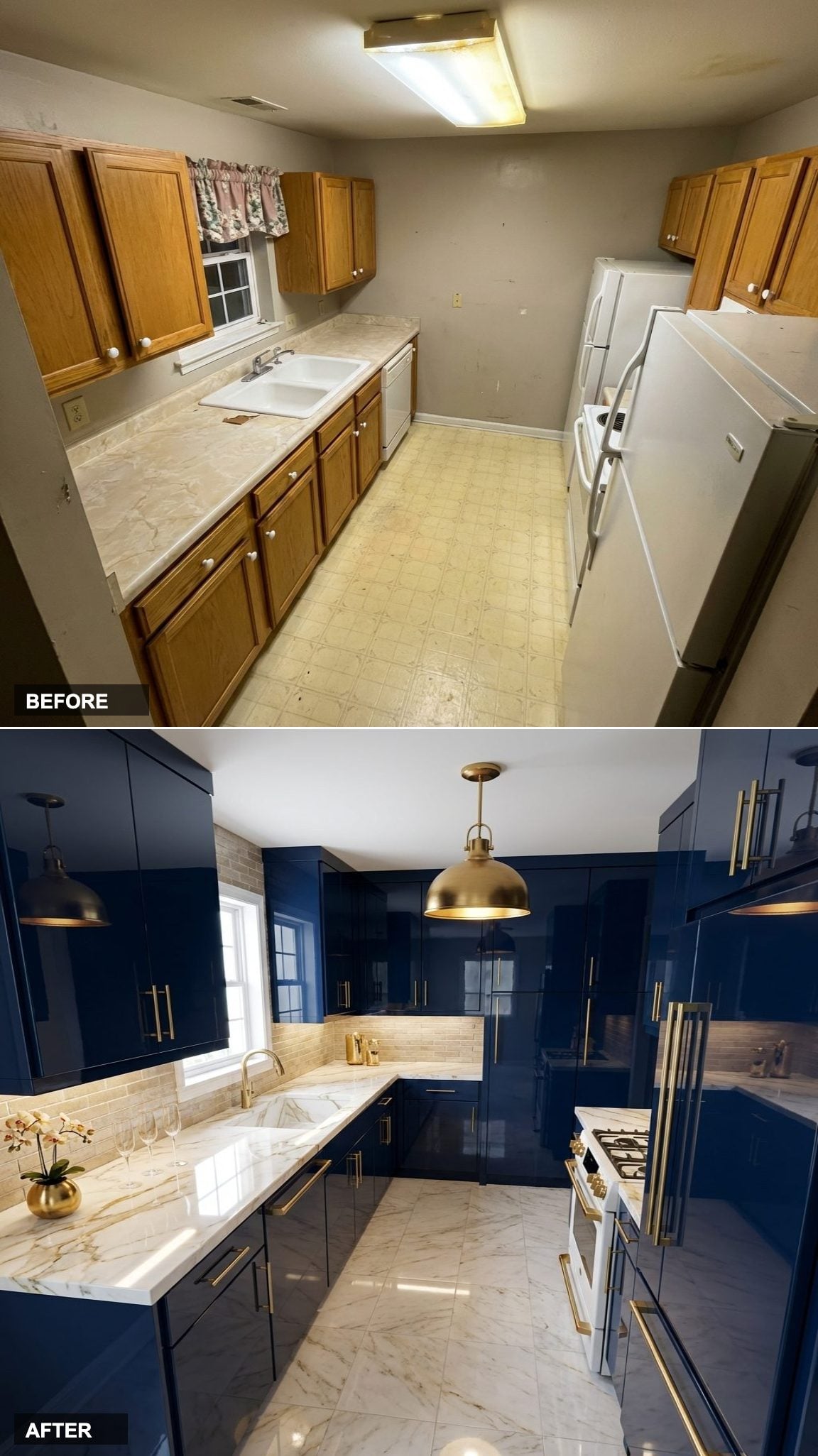
High-gloss lacquer does something that paint never quite achieves: it turns a flat surface into a mirror that doubles perceived space. Monaco’s megayacht interiors have known this for decades. The formula is simple, deep navy lacquer on every cabinet face, gold inlay handles, and a reflective countertop surface that bounces light around a room that gets very little of it naturally.
From Beige Forgettable to Adriatic Sailing Yacht Whitewash Warmth
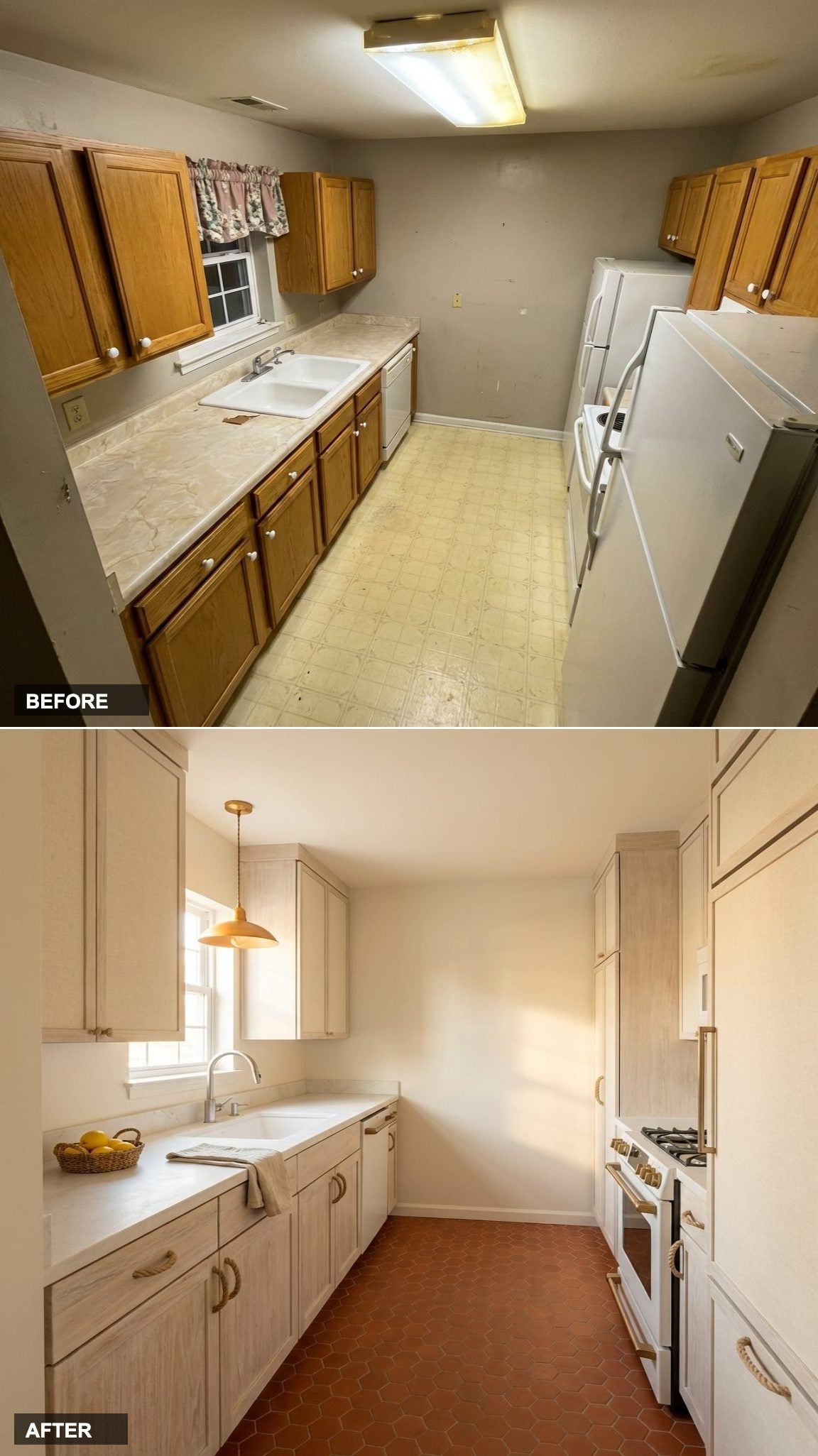
Sailing yacht interiors designed for the Adriatic operate in full sun, salt air, and constant motion. The materials chosen, whitewashed teak, woven natural rope, raw linen, respond to that environment by aging gracefully rather than fighting it. Applied to a small kitchen, this palette creates warmth without weight.
From Dated Oak to Black Sea Expedition Yacht Industrial Precision
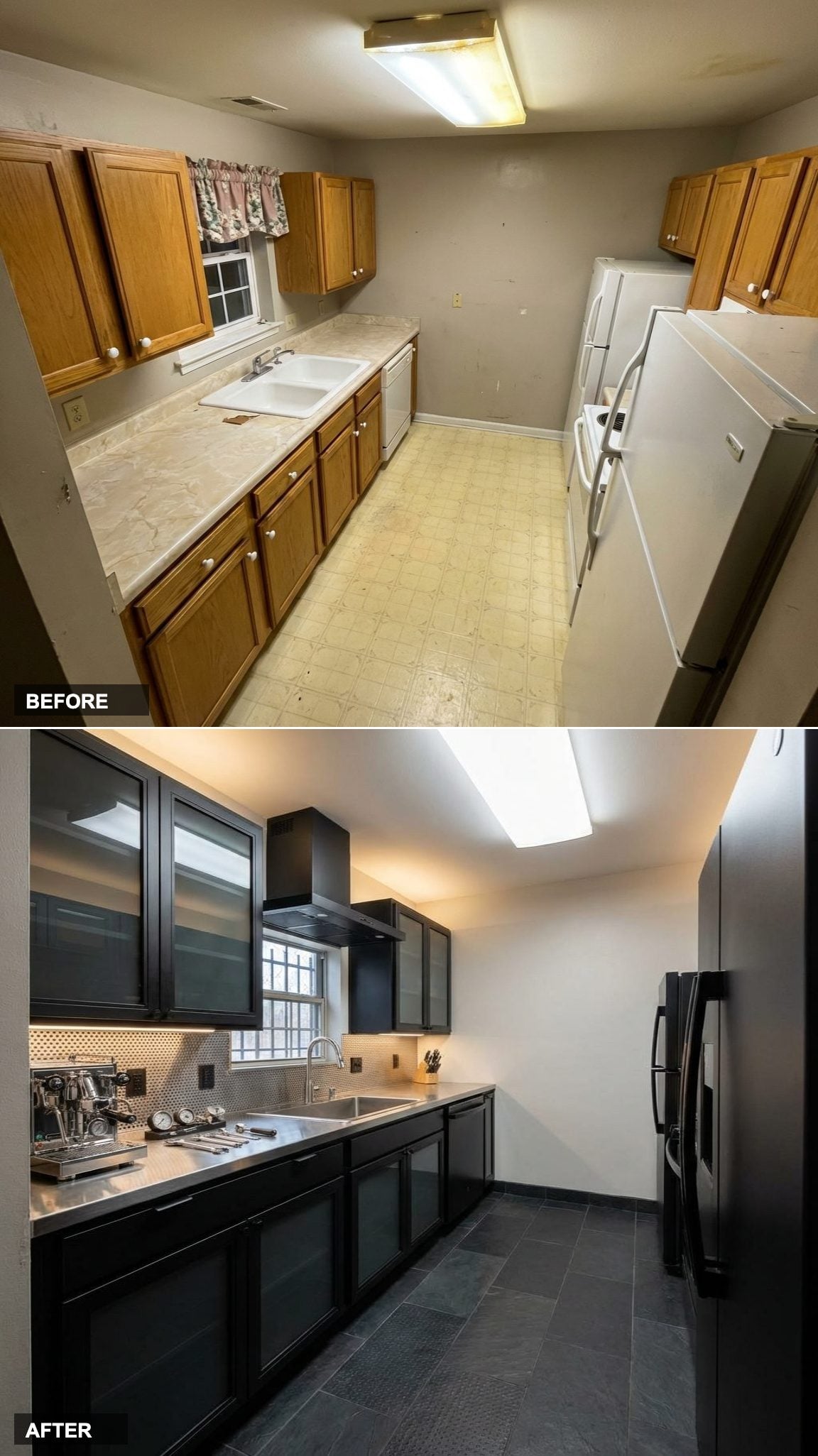
Expedition yachts designed for the Black Sea don’t do decorative. Every fitting is structural. Every surface is either working or protecting something that is. The aesthetic that falls out of that discipline is a very specific kind of industrial luxury, raw steel, matte black, perforated metal, recessed grippy surfaces.
Here, the builder-grade oak gets replaced with matte black steel-framed cabinet doors over smoked glass cabinet inserts. The countertop goes to brushed stainless. The floor drops to dark slate tile with a fine grip texture. A industrial black range hood becomes the visual anchor. It’s a kitchen that looks like it could handle a storm.
From Builder-Grade Bland to St. Tropez Day Sailer Provençal Ease
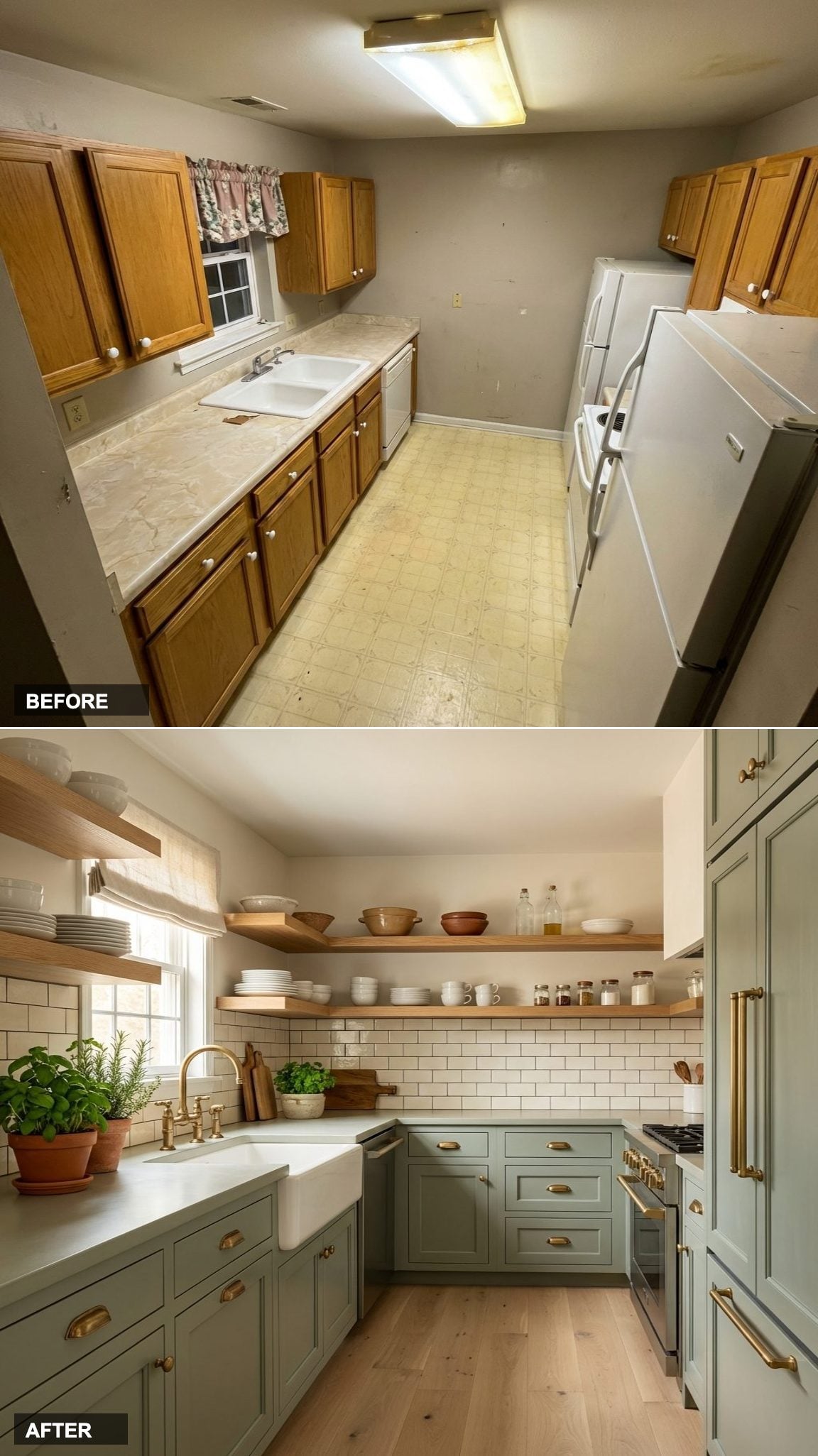
The day sailers docked at St. Tropez split the difference between working boat and luxury retreat. Their galleys are small but never cramped, pale wood, soft sage, worn brass, and open shelving that turns the contents into the decor. Applied to a dated kitchen, this approach demands that you stop hiding everything and start editing instead.
Swap sealed uppers for open oak floating shelves that display only what’s worth displaying. Paint the lowers a dusty sage green. Add a farmhouse ceramic sink and worn brass tap. The rest of the space breathes. Like the boats this style references, nothing is hidden unless it needs to be.
From Linoleum Floors to Capri Yacht Club Cobalt and Ivory
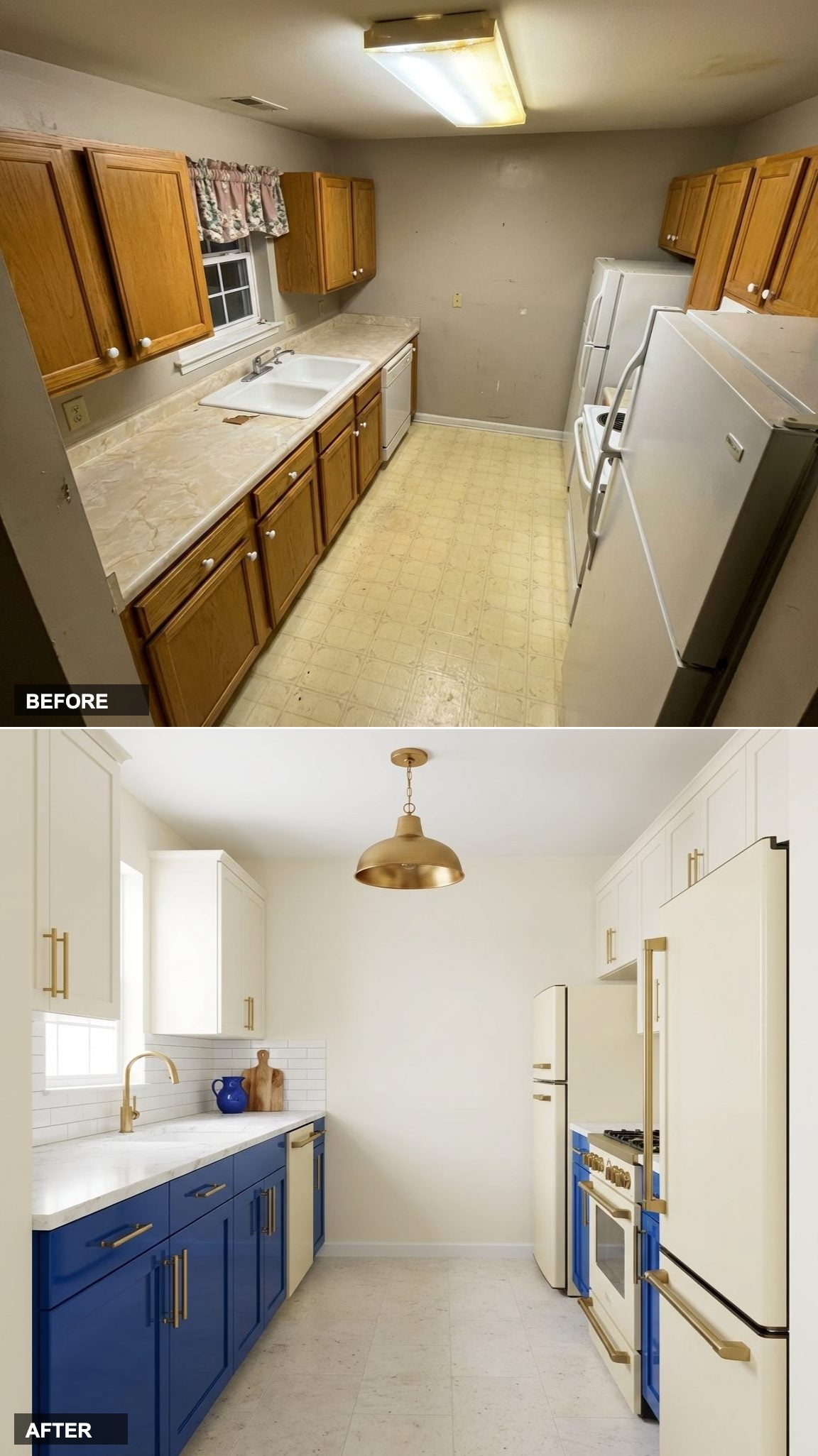
Cobalt and ivory is one of the oldest nautical color pairings on earth, and it has never once looked dated on a boat. In a kitchen, the same combination reads as confident and collected, particularly when the cobalt is reserved for only the lower cabinets and every other surface is kept bone white or ivory stone. The restraint is the whole point.
From Fluorescent Tubes to Tokyo Bay Motor Yacht Zen-Tech Hybrid
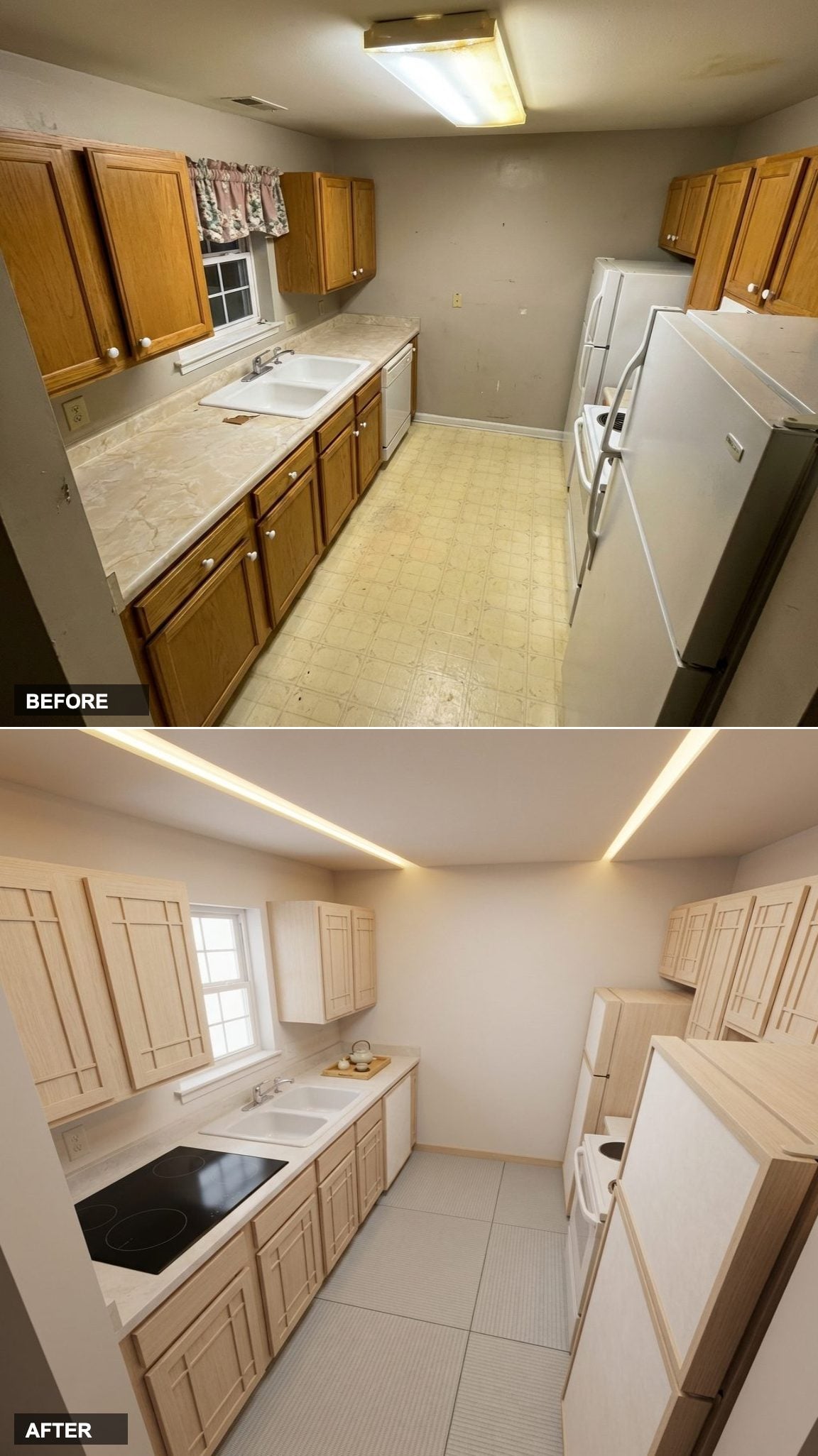
Japanese yacht design has a specific superpower: it takes technology and makes it feel calm. Digital controls disappear into flush surfaces. Appliances slot behind panels that look like shoji screens. The engineering is extremely complex, the visual result is extremely quiet.
This transformation swaps every visible appliance, switch, and fixture for flush-mounted equivalents. The shoji-style cabinet doors filter light from interior LEDs. The matte black induction cooktop sits completely flush in pale ash stone. Even the refrigerator dissolves behind a rice-paper panel. The only thing left to look at is the quality of the silence.
From Beige Laminate to Oslo Fjord Racing Yacht Carbon and Cream
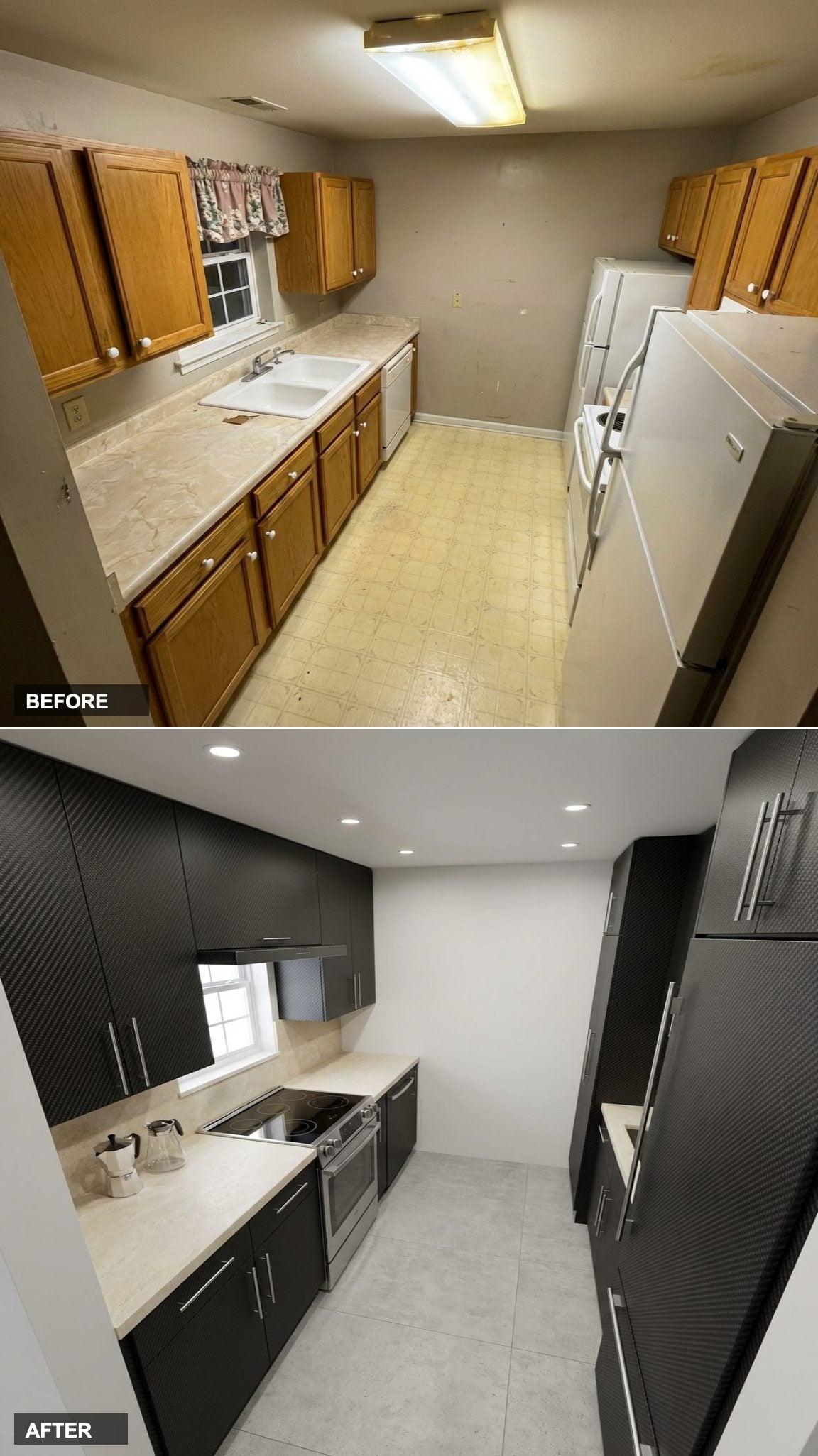
Racing yacht galleys designed for the Oslo Fjord circuit are obsessive about weight. Carbon fiber replaces wood wherever structurally possible. Every gram is audited. The visual result, carbon grain against pale cream surfaces, happens to be one of the most visually dynamic kitchens imaginable, even in a tiny space.
From Dated Galley to Côte d’Azur Charter Yacht Art Deco Revival
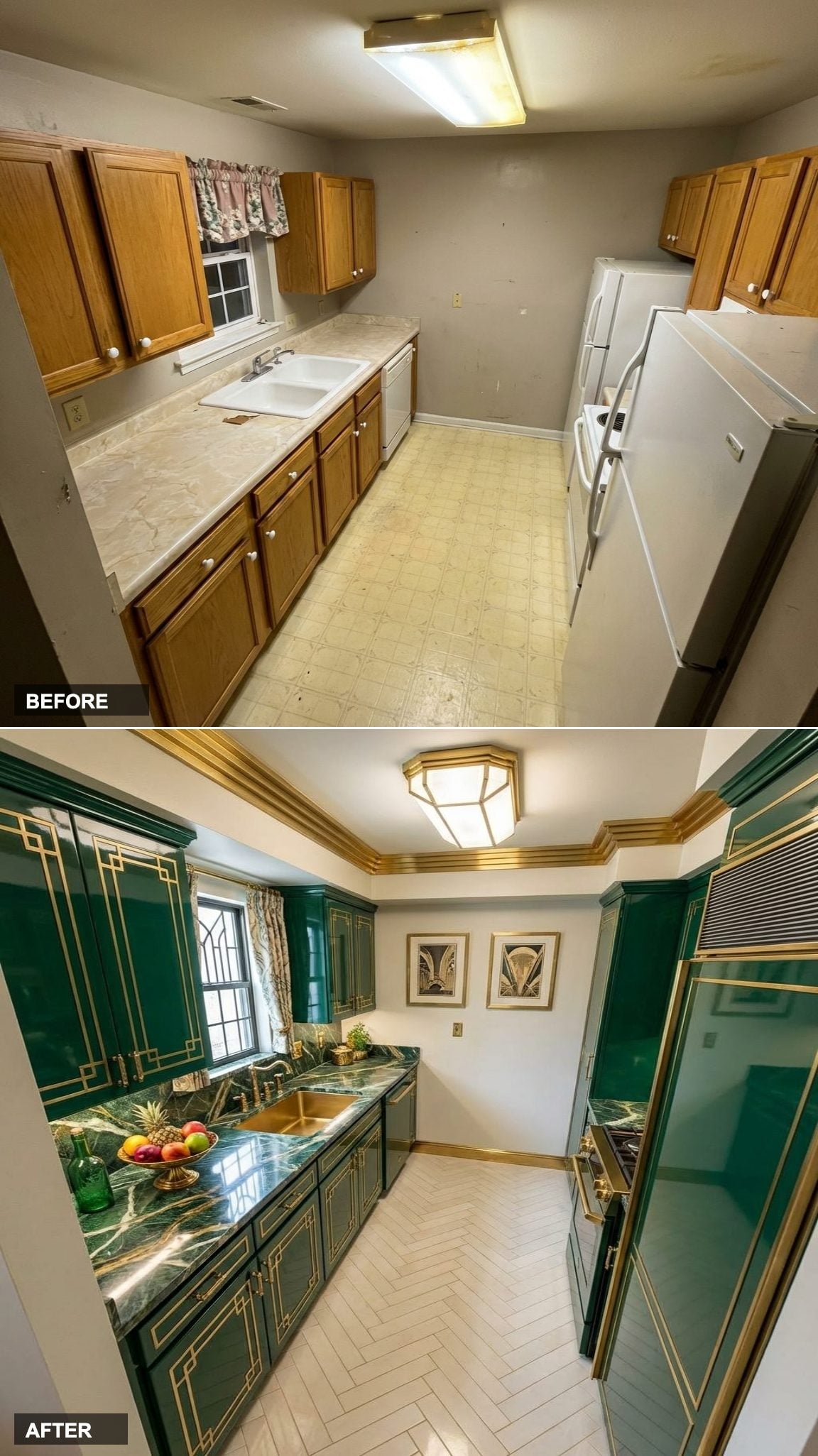
Art Deco yacht interiors from the 1930s were designed to signal arrival before you even sat down. Geometric brass inlay, lacquered ebony, stepped crown molding, glass that catches light from three angles at once. The details were structural signals: this is a space of intention.
Applying that logic to a small kitchen means the geometry does the spatial work. Chevron brass-inlay cabinet doors, a deep art deco green marble countertop, and stepped crown molding that draws the eye up instead of around. Small spaces feel grander when the geometry gives the eye somewhere decisive to travel.
From White Tiles to Caribbean Catamaran Coral and Rattan
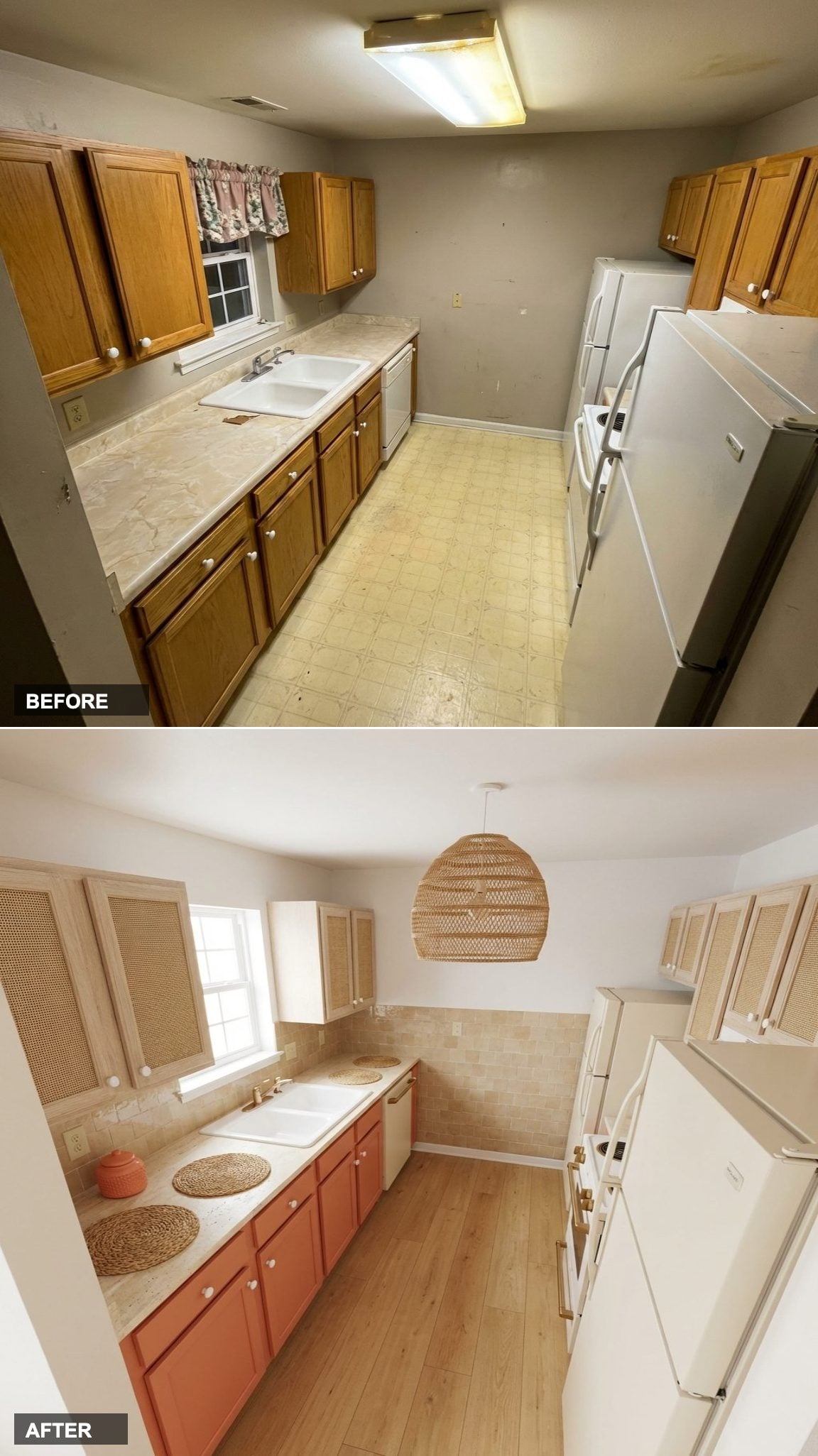
Catamarans in the Caribbean operate in high UV, high humidity, and constant color. Their interiors don’t fight the environment, they are an extension of it. Coral accents, rattan panel inserts, bleached wood, and linen tones create a space that feels like the outdoors came inside and found somewhere comfortable to sit.
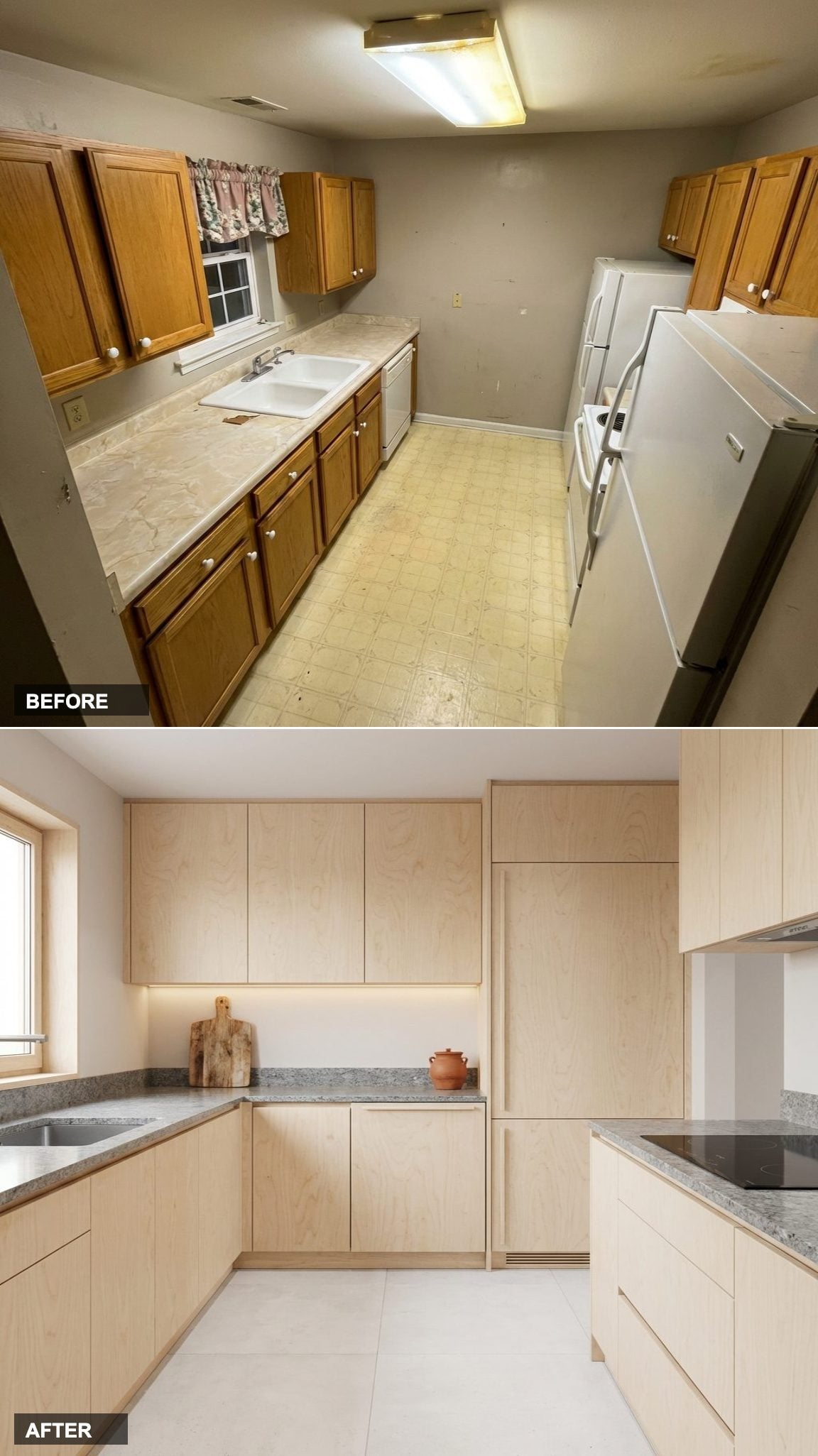
From Forgettable to Finnish Archipelago Sailboat Birch and Stone
🔥 Would you like to save this?
Finnish archipelago sailing culture treats small spaces the way Finns treat everything: with a deep suspicion of anything unnecessary. The birch-and-stone interiors of traditional Finnish sailing boats have a quality that’s almost impossible to fake, the material is so present, so tactile, that the room feels furnished even when it’s technically empty.
Here, every surface plays a role. Birch plywood cabinets with a clear matte seal. A grey granite countertop so dense it absorbs rather than reflects. Concrete-effect floor tiles that ground the space without competing with the wood above. Everything here is load-bearing visually as well as structurally.
From Oak Cabinets to Amalfi Heritage Yacht Terracotta and Ivory Marble
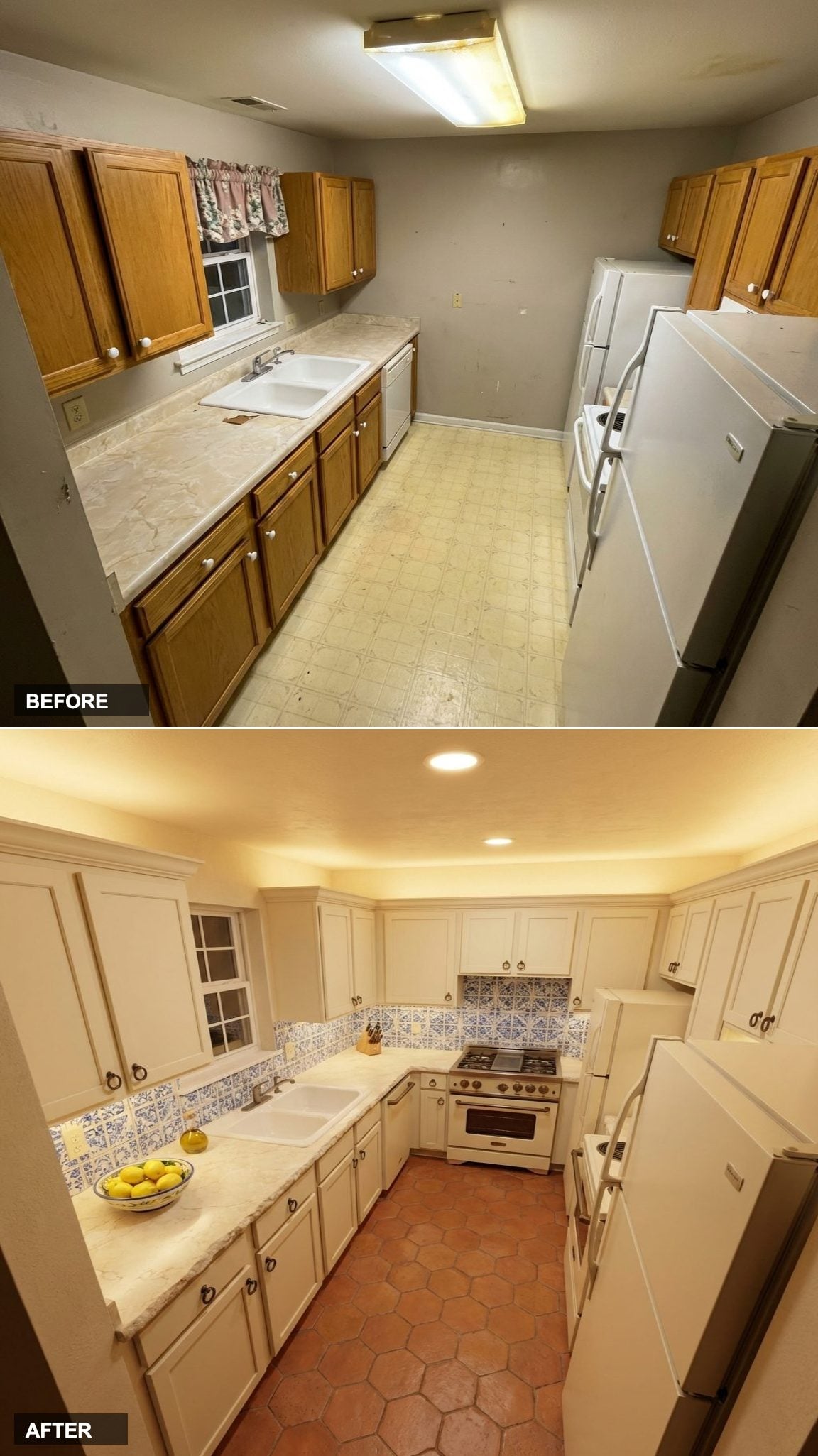
The heritage wooden yachts of the Amalfi Coast carry a specific kind of quiet wealth that has nothing to do with newness. Terracotta, ivory marble, hand-painted tile, aged iron hardware: the materials look like they’ve been there forever because they have. That’s the design principle, permanence over perfection.
“The best kitchen redesign doesn’t look redesigned. It looks like it always should have been this way.”
In this makeover, the laminate counters become honed ivory marble with a deliberately imperfect edge. The terracotta hexagon floor tiles replace the linoleum. Aged iron pulls replace the brass. Nothing is brand new in a way that announces itself.
From Builder Grade to Aegean Performance Yacht Titanium and Sage
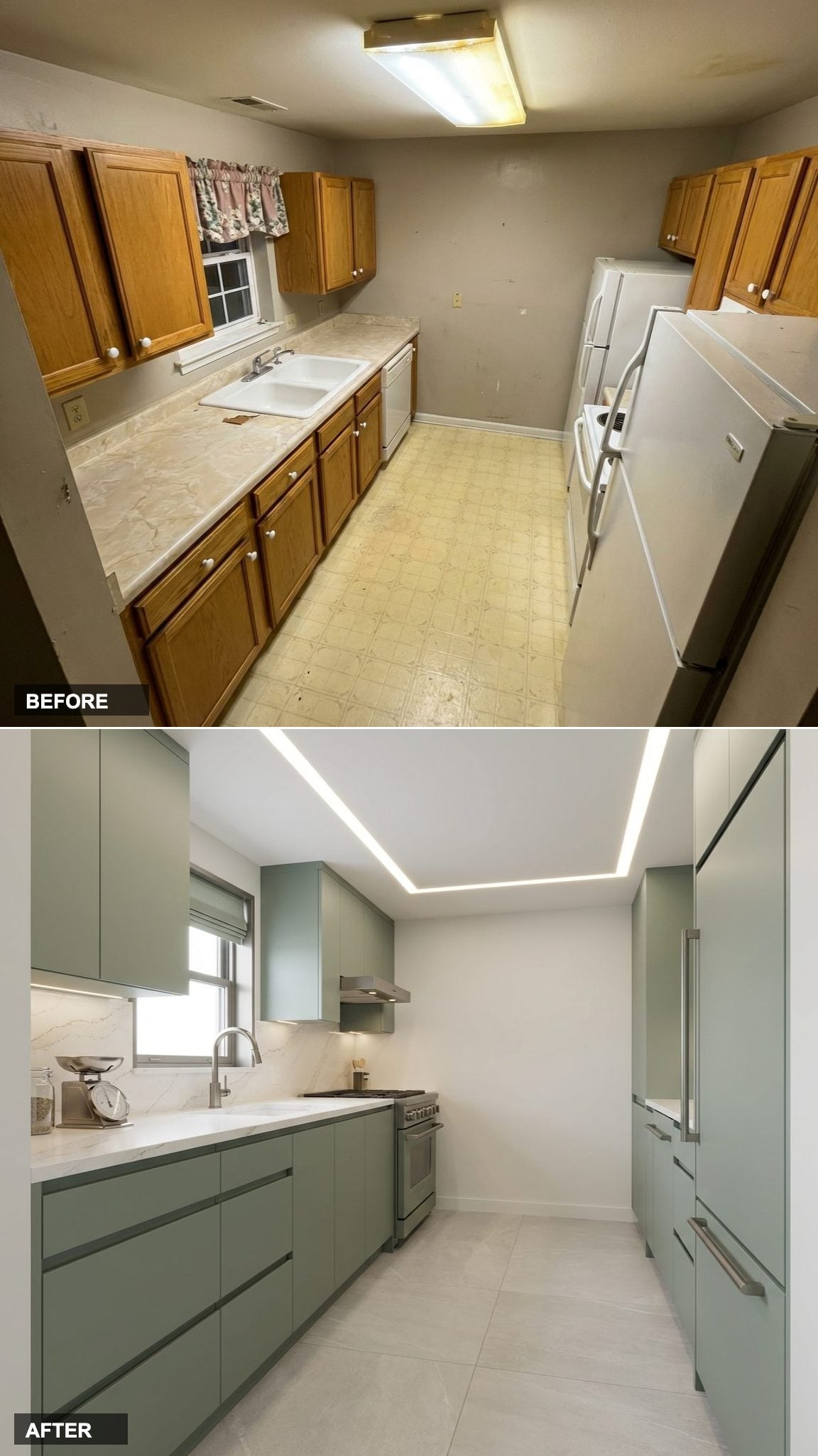
Titanium is the material that changed modern yacht design. Lighter than steel, stronger than aluminum, and with a matte warmth that neither material quite achieves. Aegean performance yachts, built for speed in one of the world’s most demanding open waters, use it everywhere a structural surface can be justified.
In this small kitchen, the idea is translated through titanium-finish cabinet hardware, a brushed titanium faucet, and muted sage cabinetry that makes the metallic accents sing without competing. The sage green handleless cabinets flatten the visual noise. The titanium does the punctuating. It’s a combination that feels genuinely forward-looking without being cold.
From Coil Burners to Portofino Gulet Heritage Deep Walnut and Copper
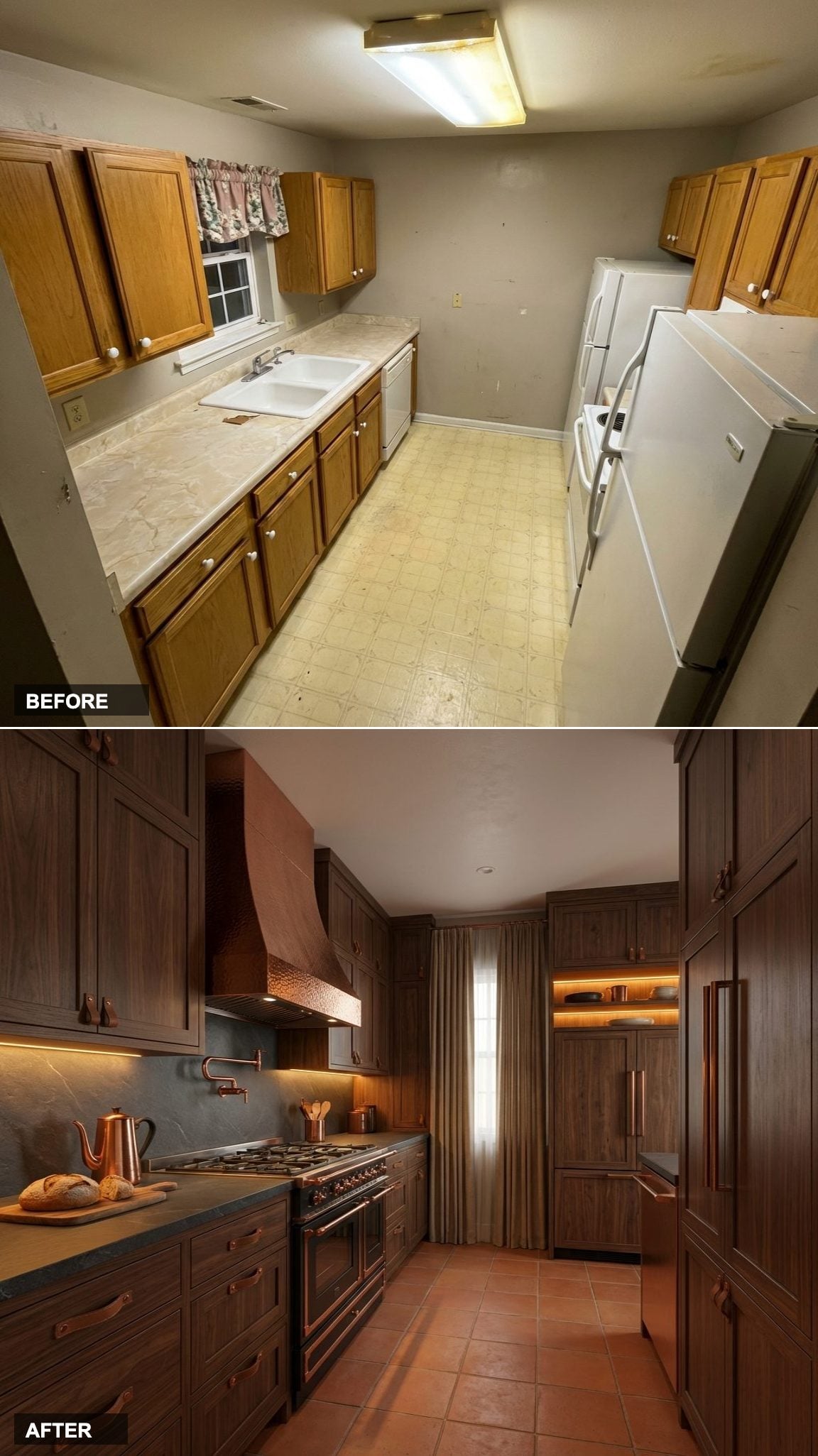
The Turkish gulets that anchor off Portofino represent a very specific kind of earned luxury. Hand-built from dark walnut and iroko, fitted with copper hardware that oxidizes in the salt air, their galleys are small enough to touch both walls, and yet you never want to leave them. The combination of dark wood, warm copper, and leather-bound edges creates an enclosure that feels protective rather than claustrophobic.
That’s the principle this kitchen borrows: richness as comfort. Dark walnut cabinet faces run floor to ceiling. Copper kitchen faucet and pendant. A hammered copper range hood as the central statement. The entire colorful den design logic applies here: committing fully to a warm, saturated palette in a small room creates enclosure, not claustrophobia.