🔥 Would you like to save this?
In order to come up with the very specific design ideas, we create most designs with the assistance of state-of-the-art AI interior design software. Also, assume links that take you off the site are affiliate links such as links to Amazon. this means we may earn a commission if you buy something.
I have a confession: I never thought red belonged in a kitchen. Too aggressive, too Christmas-y, too much. Then I started looking at these spaces, really looking, and my opinion shifted completely. The red in these kitchens isn’t shouting. It’s grounding. Against weathered timber beams and hand-troweled plaster walls, against stone arches and wide-plank oak floors, red becomes something ancestral. It reads like brick dust, like terra cotta, like the inside of a barn at sunset.
What follows are fifty kitchens where red and white carry the visual weight. Some lean alpine, others coastal. A few push into territory I’d call contemporary-rustic-luxe, which sounds made up but absolutely exists at this price point. Each one cost north of $100,000 to build out, and each one proves that color restraint can still produce drama.
That Backsplash Changed How I Think About Tile Scale
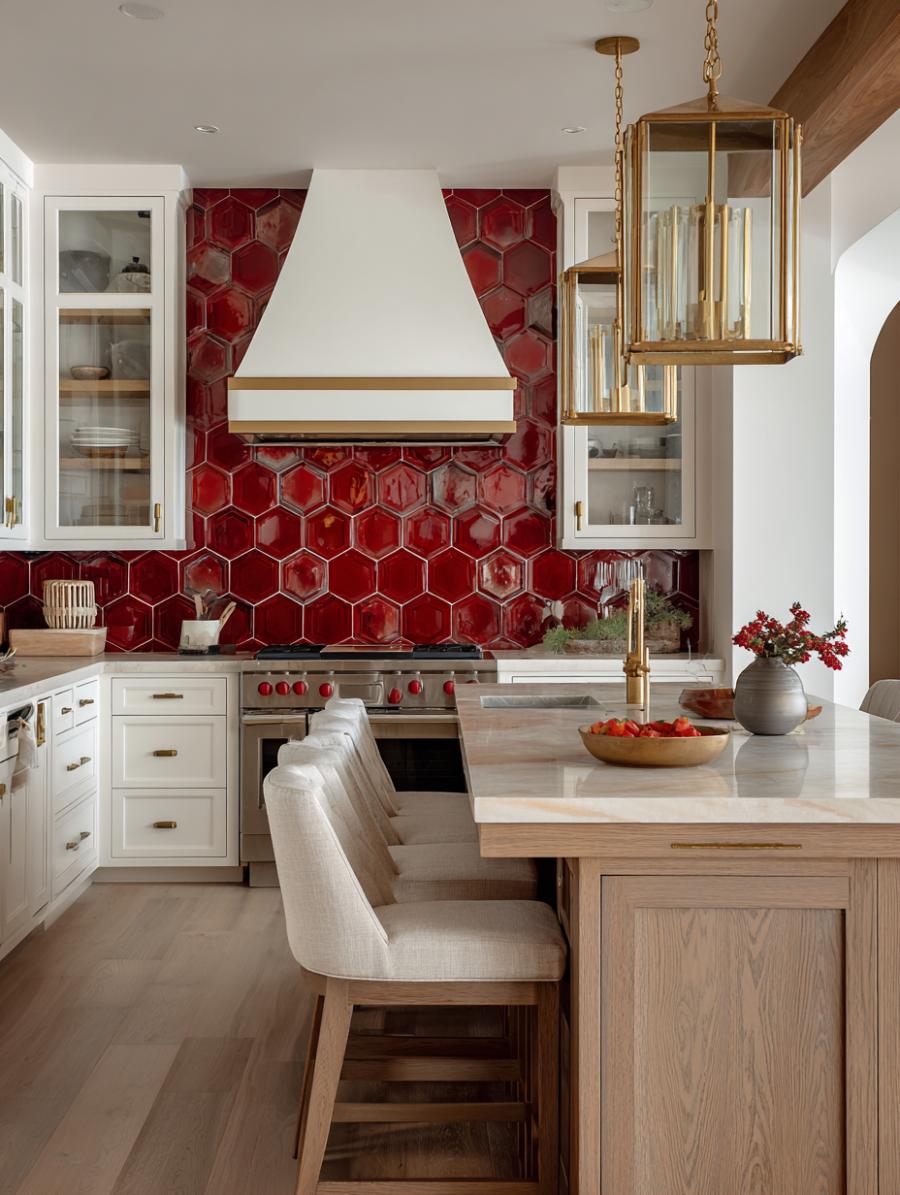
Oversized hexagonal tiles in a deep burgundy glaze run floor to ceiling behind this range hood, and the effect is almost geological. The white hood with its brass trim band cuts into the tile field like a clean slice through sedimentary rock. I keep coming back to the grout lines here, pale grey that lets each hexagon read as a distinct shape rather than blending into a mass of color.
Below, the island sits in bleached white oak with a quartzite top showing amber and cream veining. Those three linen-upholstered counter stools have the low backs I associate with French bistro seating. The brass lantern pendant overhead feels less farmhouse, more art deco, which tracks with the geometric tile choice. Red knobs on the range pull the whole scheme together without adding another material to parse.
A Geometric Tile That Wraps the Hood Like Wallpaper
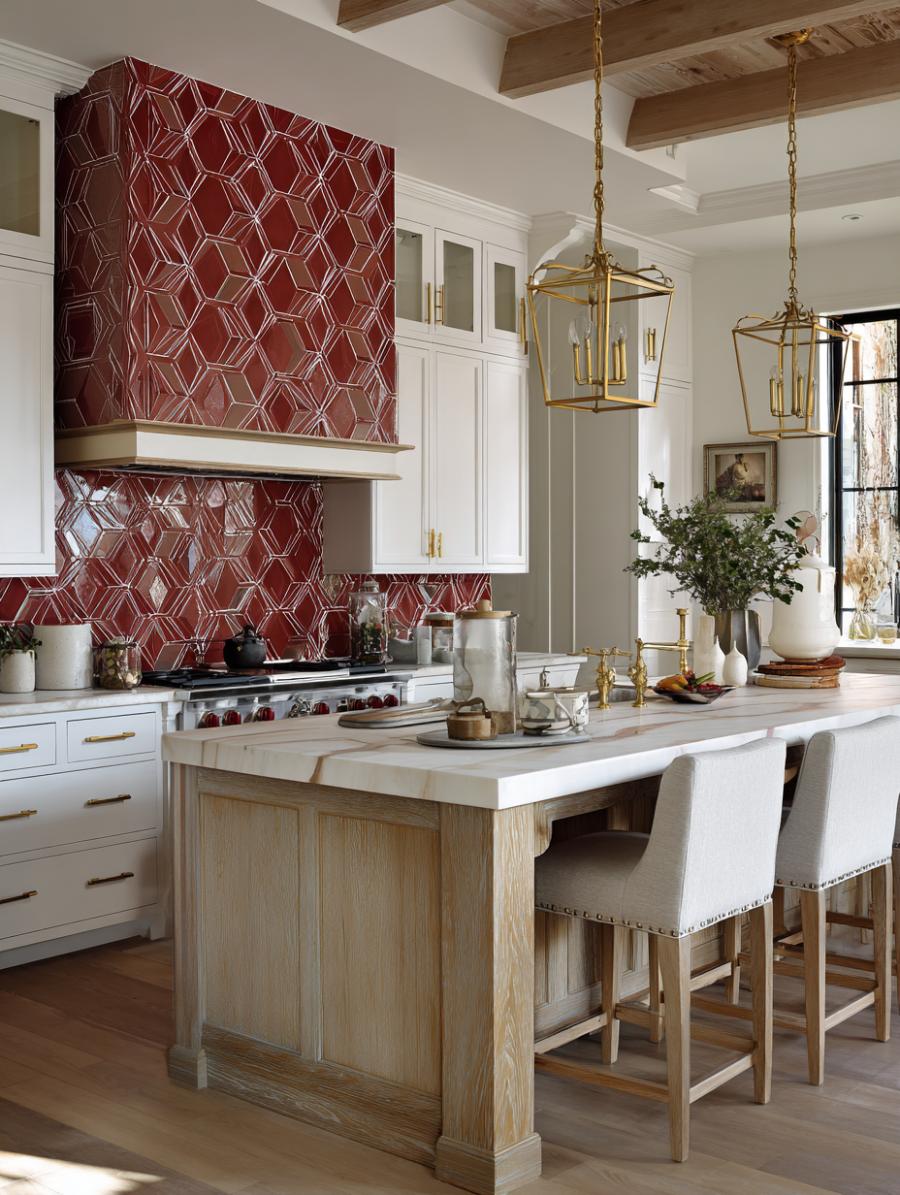
Here the tile pattern shifts to an interlocking cube design, the kind of optical illusion that tricks your eye into seeing three dimensions on a flat surface. The terracotta-red tiles climb from countertop to ceiling and wrap around the ventilation hood itself, eliminating the visual break you typically see where hood meets backsplash. Bold choice. Expensive to execute. Worth it.
Why It Works: The cube pattern creates visual movement that keeps your eye traveling across the surface, preventing a large expanse of single-color tile from reading as flat or monotonous. The pale grout amplifies this effect by outlining each shape crisply.
Rough-hewn ceiling beams in a honey finish add the rustic counterpoint. White shaker cabinets with brass bin pulls line the perimeter, and a pair of open brass lanterns hang above the island. The counter stools here wear oatmeal linen with nailhead trim along the base, and a small framed landscape painting props against the far window. The collection of ceramic vessels on the island, ivory and terracotta, feels gathered rather than styled.
When the Backsplash Looks Like It Came From the Earth’s Core
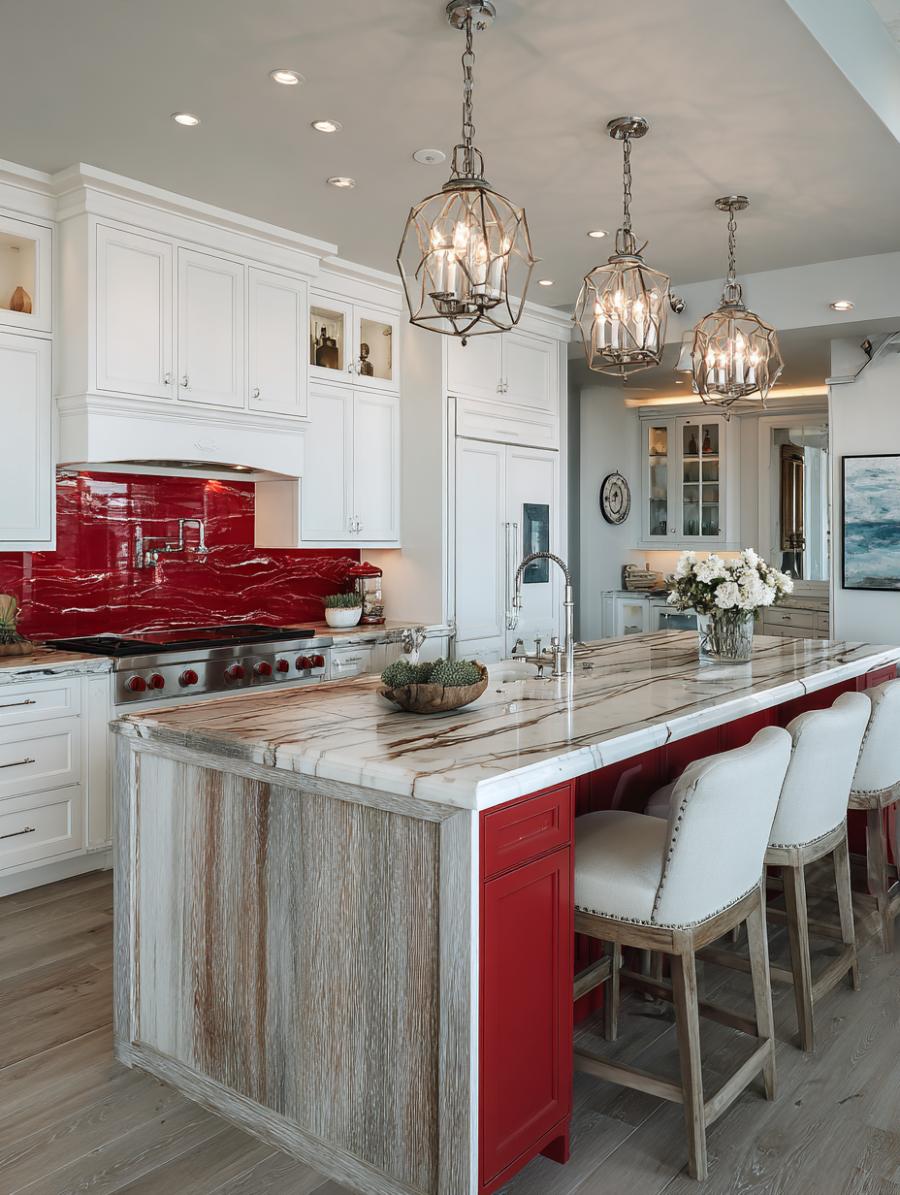
A slab of what appears to be red onyx or a heavily veined marble runs behind this range, and I genuinely stopped scrolling when I first saw it. The white veining through the deep crimson reads like lightning frozen in stone. The island base splits into two finishes: cerused grey oak on one end, lacquered red on the other, with a waterfall-edge quartzite slab connecting them overhead.
Three geometric silver pendant lights with an almost crystalline internal structure hang at varying heights. The counter stools are upholstered in cream fabric with exposed nail heads, their weathered oak legs bridging the gap between the polished cabinetry and that raw, coastal feeling coming through the large windows. A small succulent in a wooden bowl sits on the counter next to white hydrangeas in a glass vase. The range knobs are red. The faucet is polished nickel. Every surface decision here was intentional.
Crimson Bar Stools Against a Snowy Mountain View
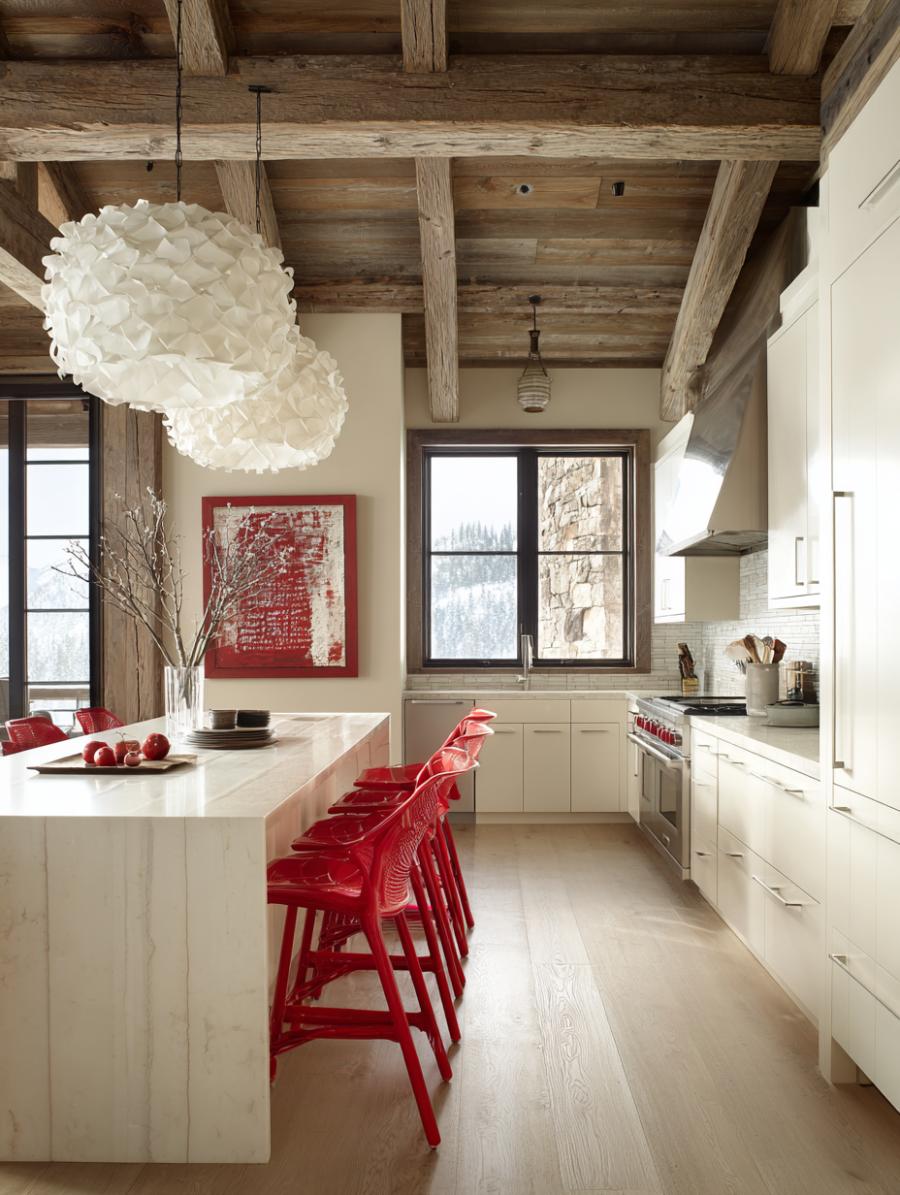
Four molded plastic bar stools in fire-engine red line up against a pale marble waterfall island. The stools look like something from a mid-century design catalog, all curves and slim metal legs, and they’re the only saturated color in this entire space aside from a large abstract canvas in matching red hung on the far wall. Through the window behind the sink, snow-covered pines.
The ceiling structure dominates here. Massive reclaimed timber beams, grey-washed and showing every crack and check mark from their previous life, span the width of the room. Two sculptural white pendant lights hang from them, their surfaces made of overlapping petal-like shapes that cast interesting shadows when lit. Cream flat-panel cabinetry with simple bar pulls runs along the back wall. A white subway tile backsplash keeps things neutral. Three red apples on a wooden tray sit on the island, an almost too-perfect echo of the stools.
The Red Island That Looks Like a Donald Judd Sculpture
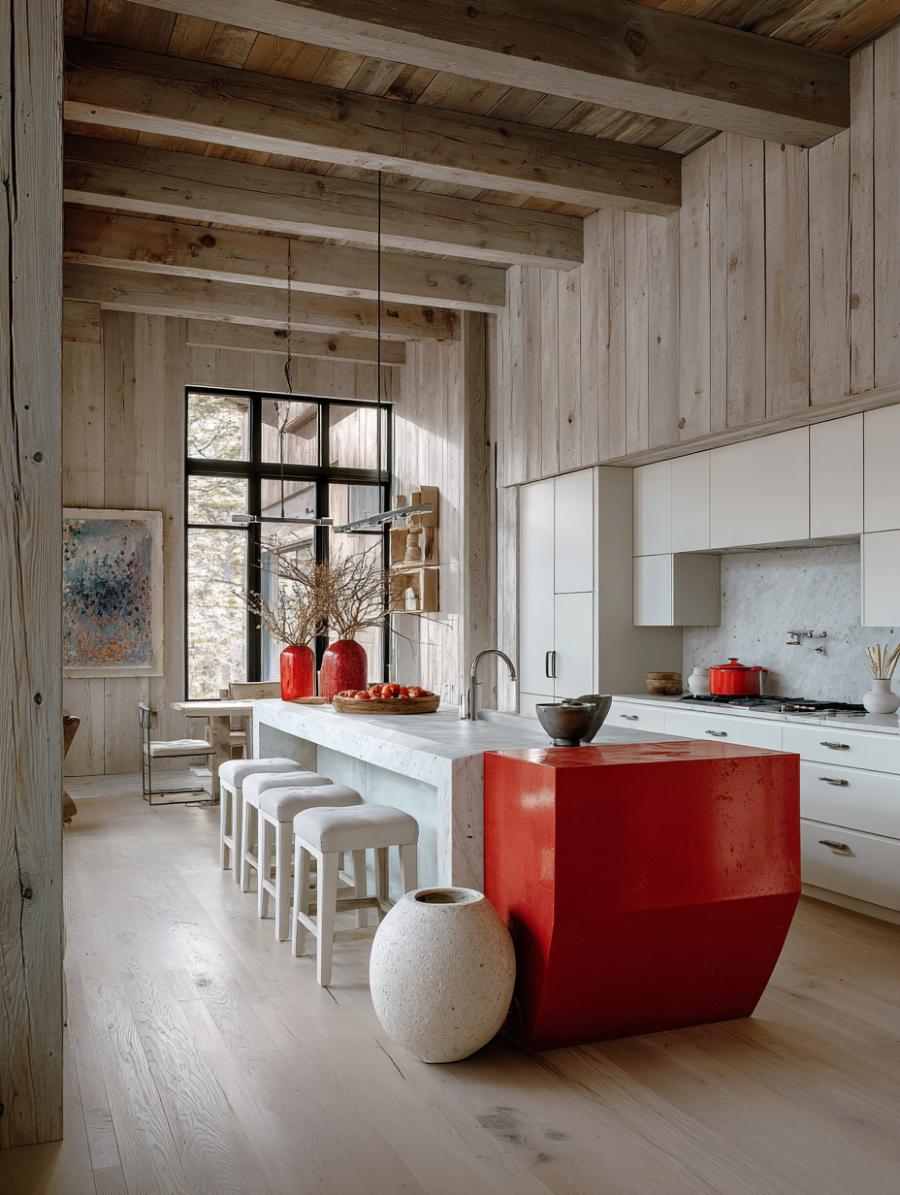
This might be the most architecturally daring piece in the entire collection. A monolithic red lacquered form, almost sculptural, anchors one end of a pale stone island. It tapers inward at the base and curves at the corners, suggesting something molded rather than built. The contrast against floor-to-ceiling bleached pine paneling is severe in the best way.
“In rustic spaces, one bold contemporary element prevents the room from tipping into theme park territory.”
Two ceramic vases in matching red sit near the black-framed windows, holding dried branches. The cabinetry along the back wall is flat-panel white with brushed nickel hardware, completely receding into the background. Cream bouclé stools with white-painted wood legs tuck under the lighter half of the island. A large travertine floor vase sits empty near the red form’s base. Through the windows, you can just make out trees and what looks like a snowy hillside. This is a ski house kitchen with ideas.
High-Gloss Mahogany Running Floor to Ceiling
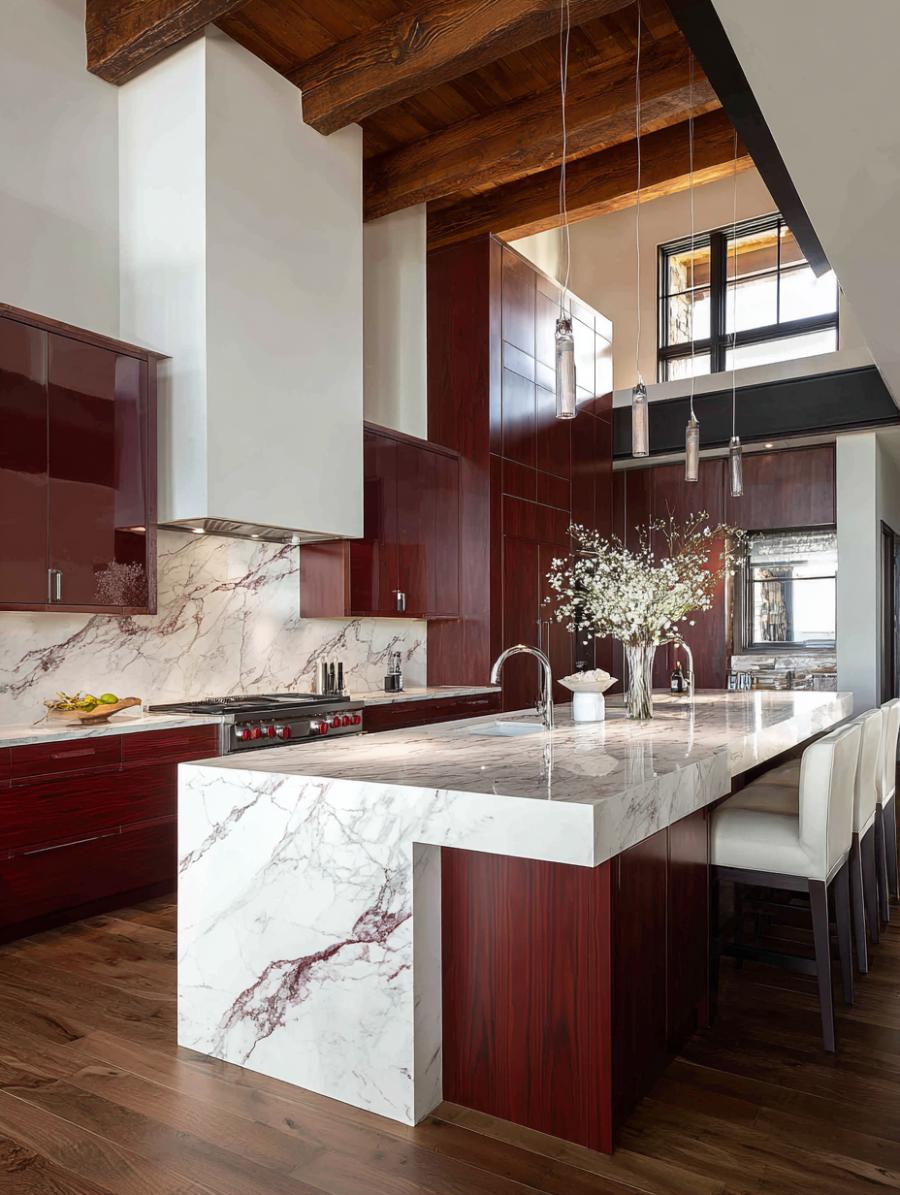
Cherry or mahogany cabinets in a high-gloss finish wrap the cooking zone from floor to the double-height ceiling. The wood tone leans burgundy rather than orange, which keeps it from feeling dated. Against this, a full slab of Calacatta marble with dramatic burgundy veining runs as both backsplash and island top. The veining in the stone almost matches the cabinet color. I doubt that’s accidental.
Exposed timber ceiling beams, dark and rough, cross overhead. The island base appears to be the same glossy wood as the perimeter cabinets, creating a wrapped effect. Cream leather bar stools with chrome frames offer the only light seating in the space. Three cylindrical glass pendants hang on thin cables. A large vase of white cherry blossoms sits in a white ceramic vessel on the island. The flooring is wide-plank walnut running the length of the room.
Herringbone Tile in Deep Burgundy Behind a Custom Range Alcove
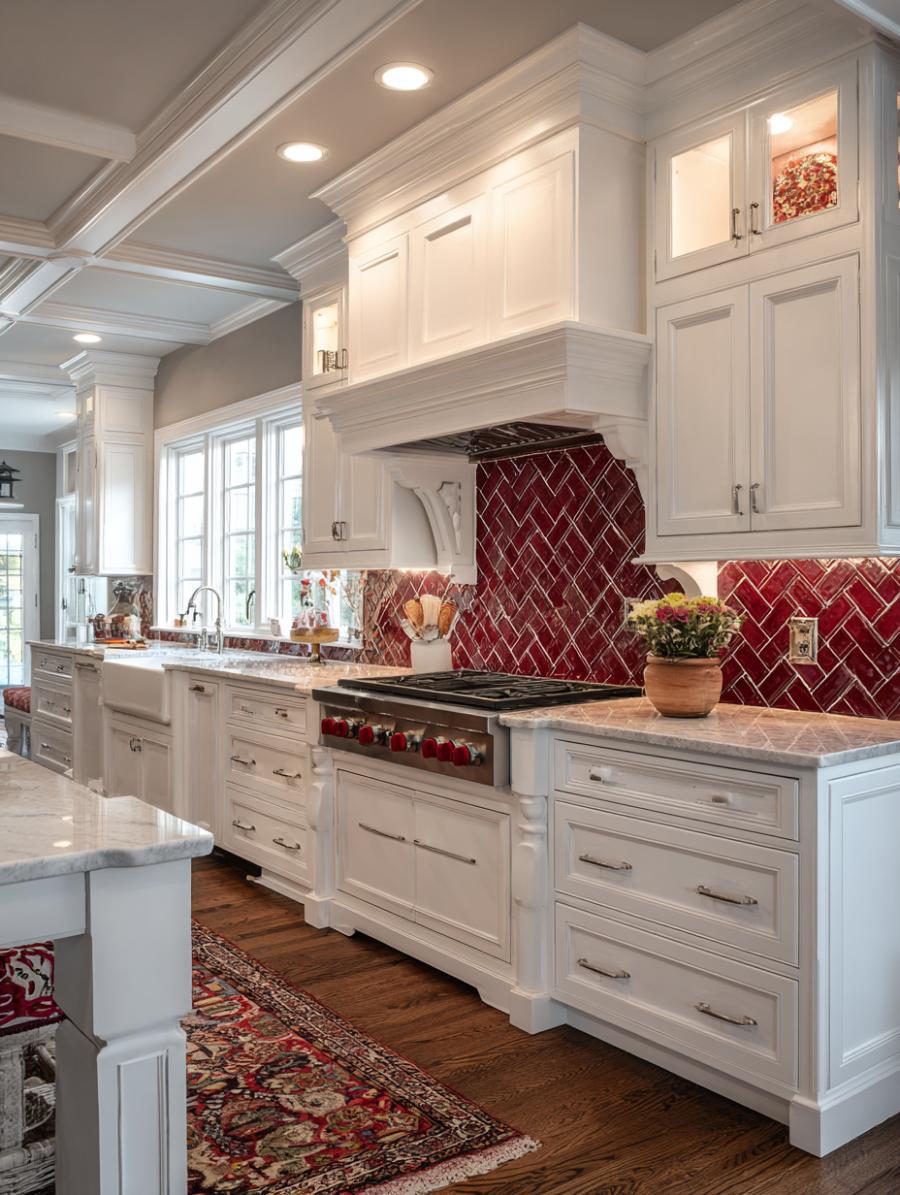
The herringbone pattern is having a moment, but I’ve rarely seen it executed at this scale or in this color. Deep burgundy tiles, each about 3×12 inches, zigzag from the countertop to the coffered ceiling. The range sits in a built-out alcove with decorative corbels supporting the massive white hood. Coffered ceilings with inset lighting panels run the length of the galley.
Did You Know: Herringbone patterns date back to the Roman Empire, where they were used in road construction. The interlocking angles distributed weight more evenly than straight rows.
White shaker cabinets with polished nickel hardware fill every inch of wall space. The countertops are a warm-toned granite or quartzite with movement that picks up both the cream cabinetry and the burgundy tile. A Persian runner in red, cream, and navy anchors the floor between island and range. The hardwood floors beneath look like red oak, recently refinished. A terracotta pot of yellow mums sits on the counter, and a small ceramic vessel holds cooking utensils near the range. This is Craftsman style pushed to its highest expression.
Subway Tiles with a Mural Centerpiece
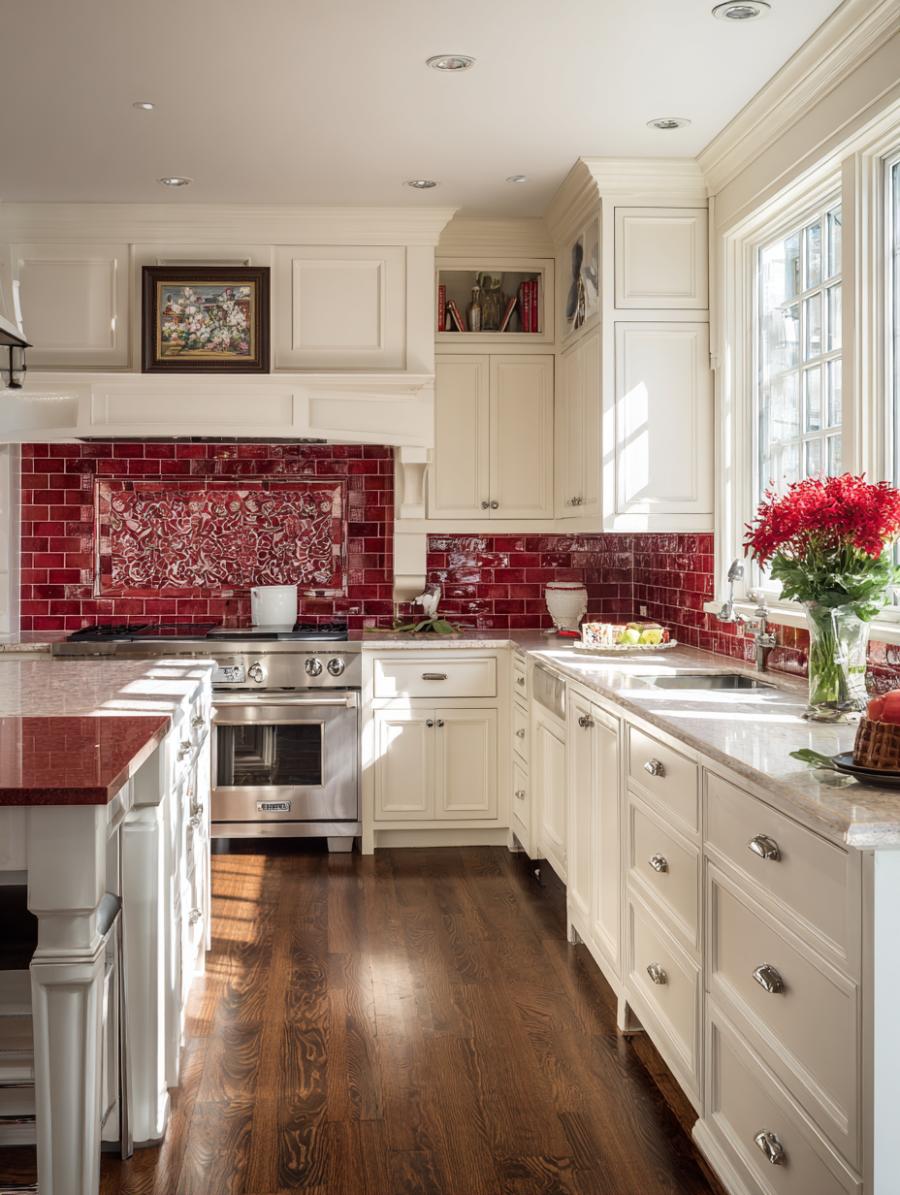
Red subway tiles with a glossy crackle finish wrap the cooking zone, broken only by a decorative tile mural above the range depicting what looks like an abstract floral scene in matching reds and creams. The island counter is clad in the same red tile, which is an unexpected choice. Usually you see tile on vertical surfaces only.
Cream painted cabinets with inset panel doors and polished chrome cup pulls line the walls. The floors are dark-stained oak, almost espresso in tone, which grounds the brightness above. Natural light floods in from a bay window over the sink, where a vase of red flowers sits on the sill. An oil painting in a gilt frame hangs above the cabinets near the range. The overall feeling is cottage traditional, but the tile color and material choices push it somewhere more individual.
A Venetian Plaster Niche in Rust Red
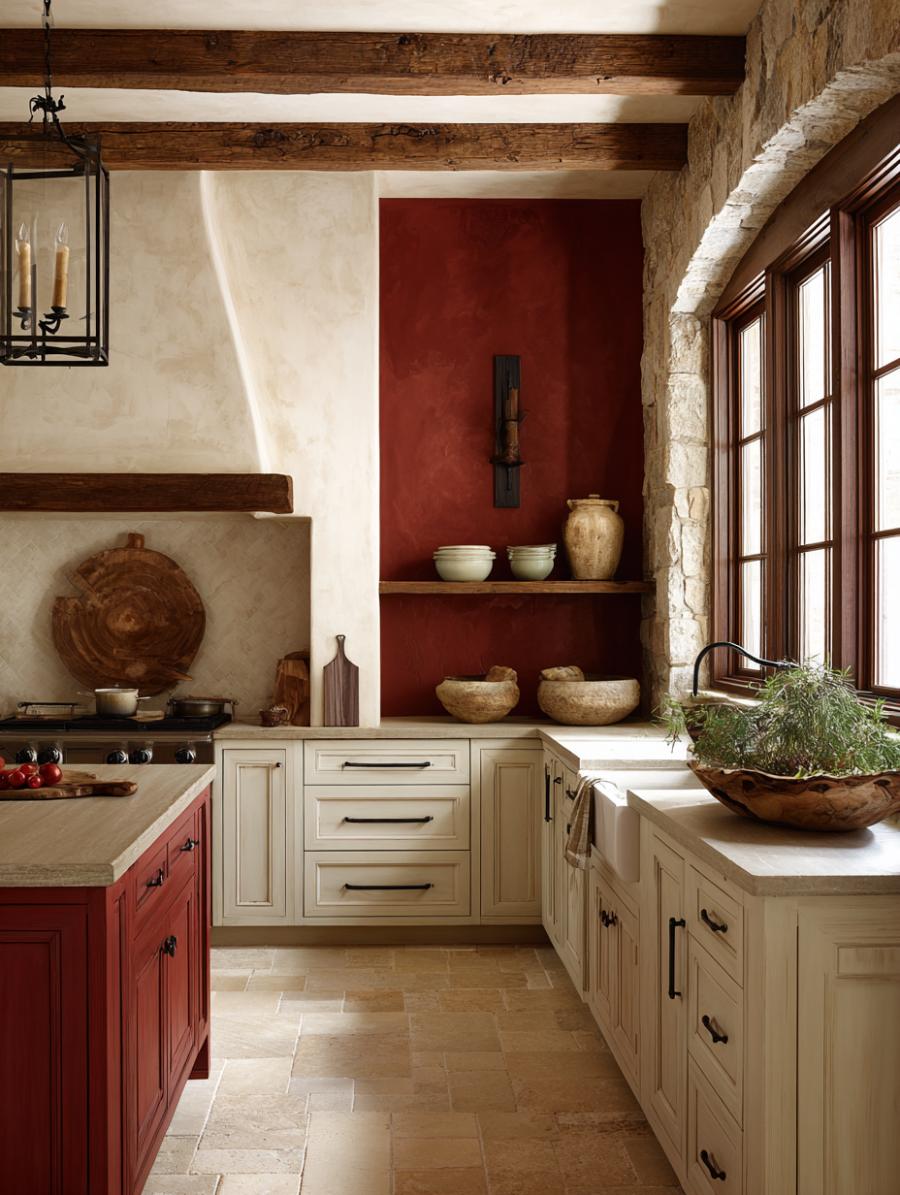
Instead of tile, this kitchen uses Venetian plaster in a deep rust-red to line a recessed display niche. Live-edge wood shelves hold stacked ceramic bowls in cream and sage, plus a few handmade pottery pieces with the rough texture of something wheel-thrown. A wrought iron wall sconce with a candle-style bulb provides the only artificial light in this corner.
The surrounding walls are cream plaster, hand-troweled with visible variation in texture. Weathered timber beams cross the ceiling. Pale limestone tiles in a tumbled finish cover the floor. The cabinets are painted in a sage-grey with matte black iron hardware. The island base is painted a faded red, almost terracotta, with a thick cream stone top. A farmhouse sink sits beneath a window framed by a natural stone arch. The overall palette reminds me of old Tuscan farmhouses, but the clean lines and restraint feel contemporary.
Pattern on Pattern on Pattern, Somehow Calm
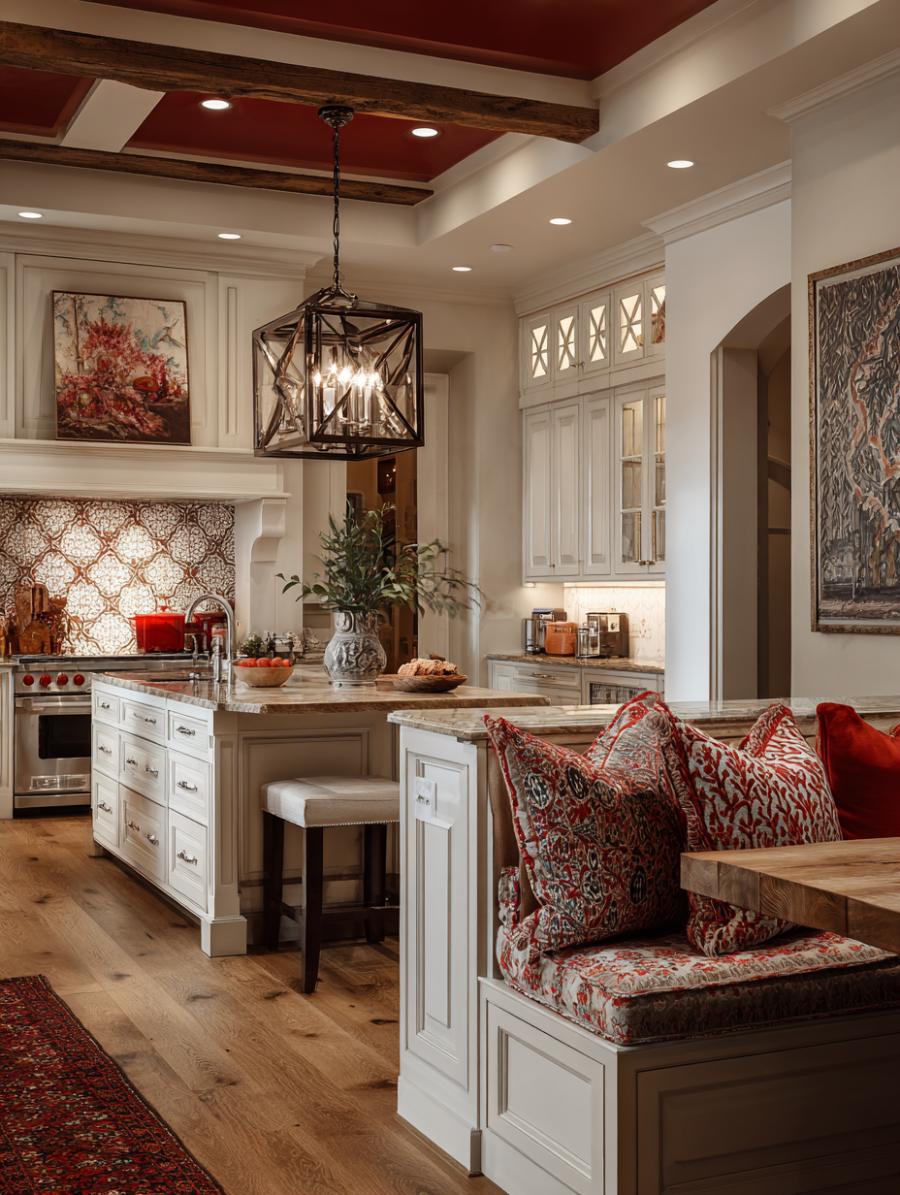
A Moroccan-influenced tile backsplash in cream and red runs behind the range. A built-in banquette wears fabric in a red and cream ikat print. A Persian runner in burgundy and navy anchors the floor. Three different patterns in the same color family, and somehow it holds together.
The trick is the neutral envelope. Cream painted cabinets with glass-front uppers. Wide-plank oak flooring in a natural finish. A tray ceiling with exposed beams painted the same burgundy as the ceiling panel insets. The geometric pendant light over the island has an industrial bronze finish that adds another layer without competing. A grey ceramic vase holds eucalyptus branches on the island. Throw pillows in solid red velvet punctuate the patterned banquette fabric. This kitchen proves that maximalism can still feel edited if the palette stays tight.
Wire Cage Pendants in Fire Engine Red
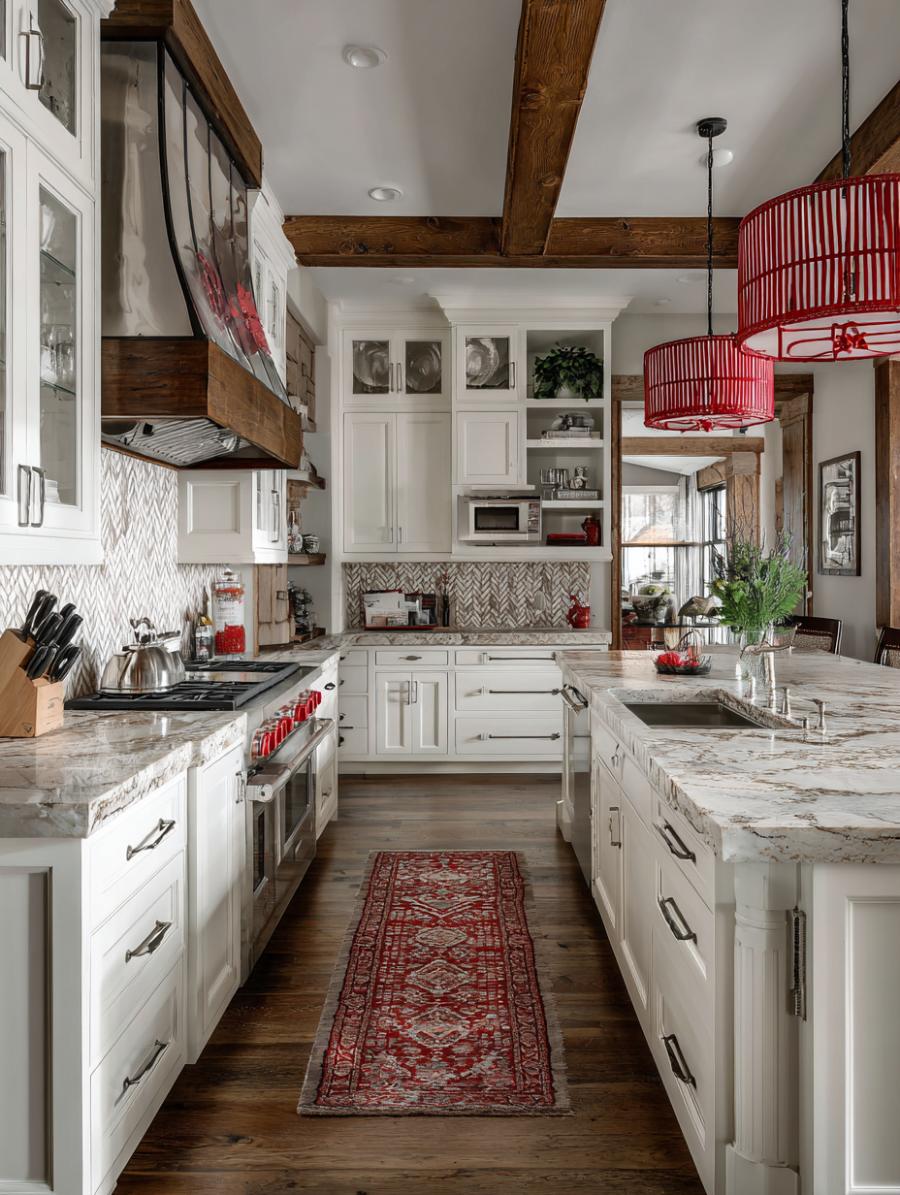
Two drum-style pendant lights in red-painted wire cage hang over this galley kitchen’s island. The pendants are the only red element visible except for a traditional runner between the island and range. That restraint amplifies their impact.
Try This: If you want to add color to a neutral kitchen but don’t want to commit to tile or cabinetry, start with lighting. Pendants can be swapped out in an afternoon if you change your mind.
The range hood is wrapped in reclaimed barn wood that matches the ceiling beams. White shaker cabinets with oil-rubbed bronze hardware line both walls. The backsplash is a herringbone pattern in cream and grey, subtle enough to read as texture rather than pattern. Quartzite countertops with warm veining cover both the island and perimeter. A large abstract painting in red and grey hangs near the hood. The overall effect is collected and layered rather than designed all at once, which is often harder to achieve than a single cohesive vision.
Red and white kitchens tend to polarize people. Some find the combination too bold, too Christmas-y, too demanding. I used to fall into that camp until I started studying how high-end designers actually deploy this pairing in rustic spaces. The trick, it turns out, lies not in the colors themselves but in the materials and textures surrounding them.
What follows are twelve kitchens that changed my thinking on this palette entirely.
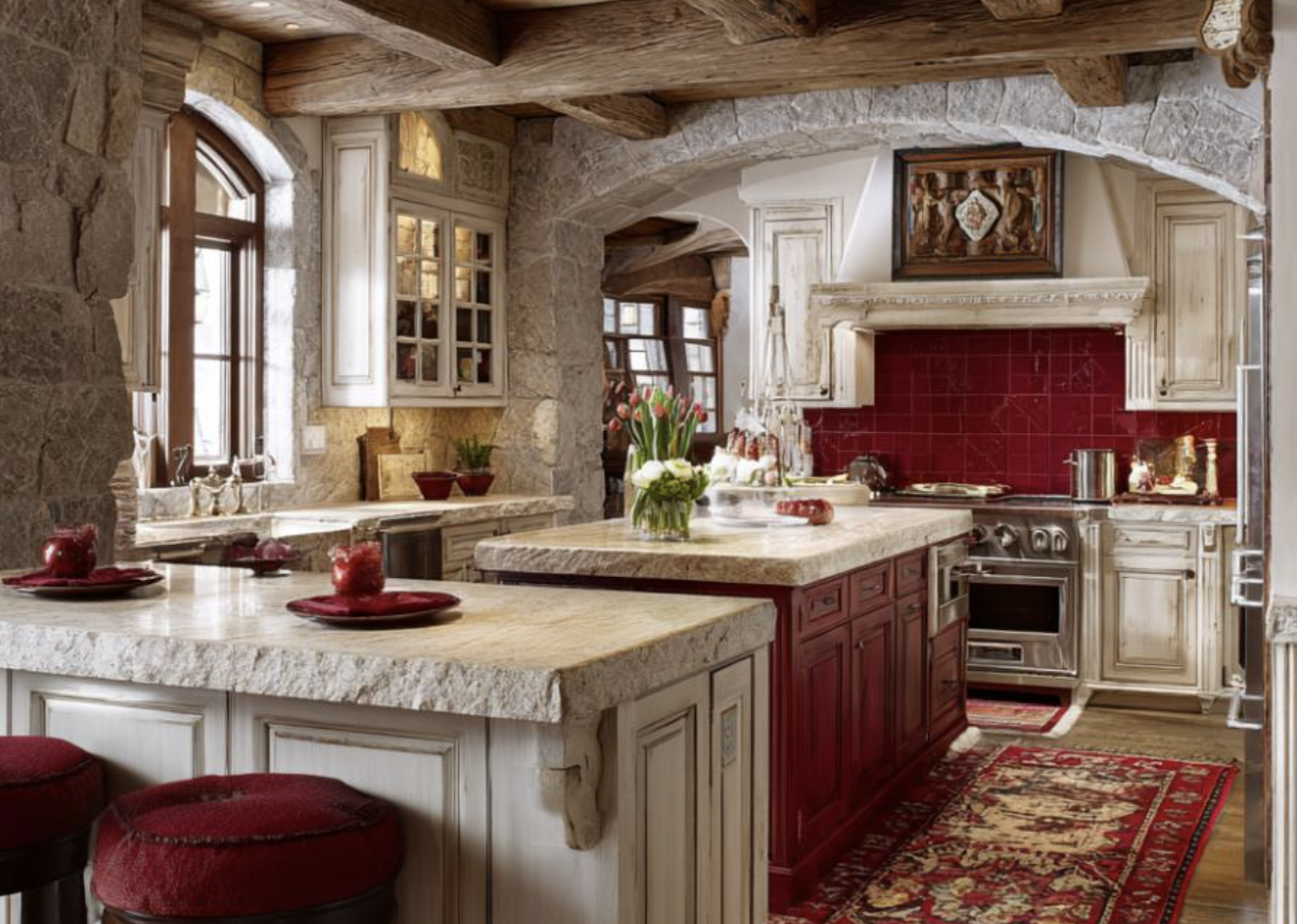
Where Rough-Hewn Timber Anchors a Burgundy Backsplash
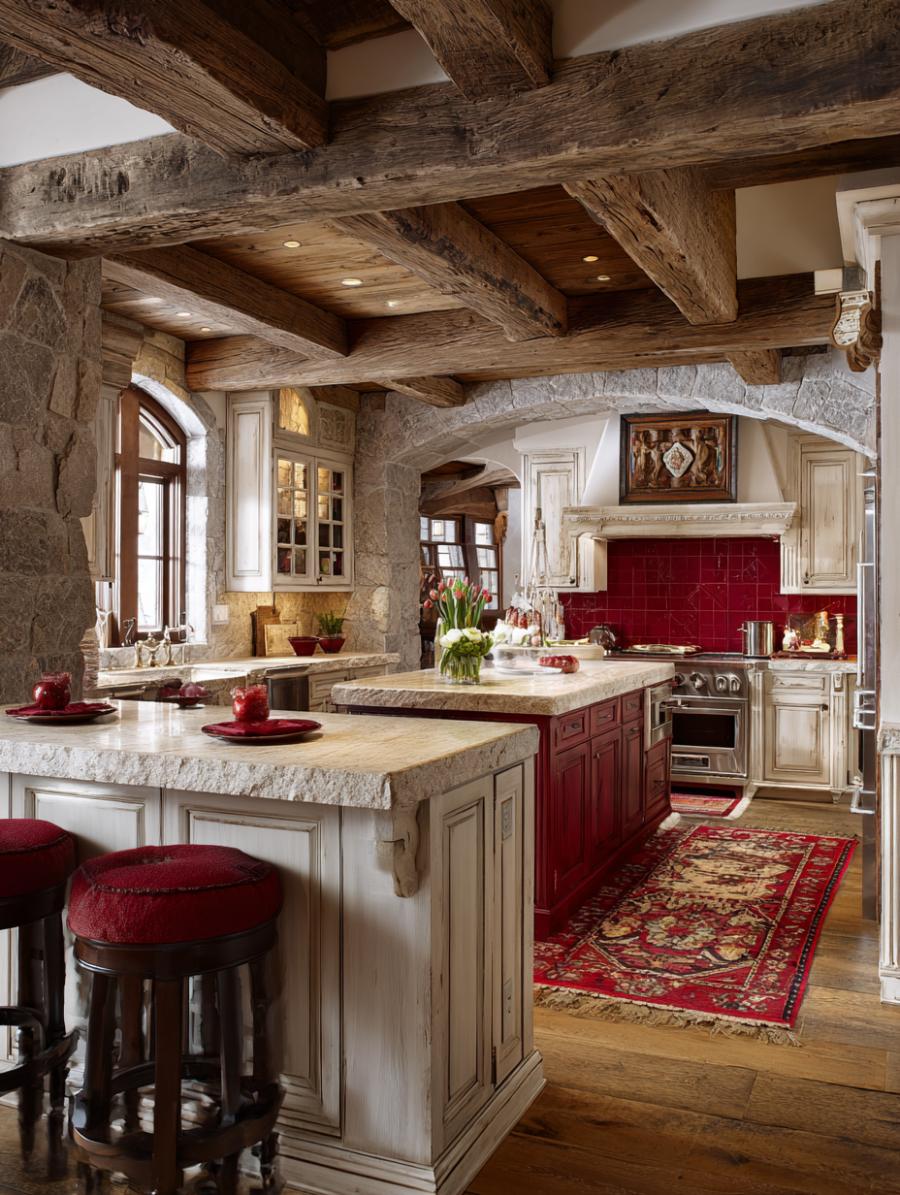
Those ceiling beams look like they weigh a small fortune, and they probably did. The weathered grey-brown timber creates an overhead lattice that immediately grounds what could otherwise read as too polished. Against this aged wood, the deep wine-red subway tiles behind the range feel deliberate rather than decorative.
Notice how the island cabinetry splits the difference: cream-painted base with a burgundy cabinet section facing the cooking zone, topped with rough-edged granite in warm beige tones. The velvet bar stools in matching crimson sit on turned dark wood legs, their plush seats catching recessed lighting. A traditional Persian-style runner in reds and creams ties the wide-plank oak flooring to the color story happening above it. The grey fieldstone arch framing the alcove on the left adds another layer of texture without competing for attention.
By The Numbers: Reclaimed antique timber beams typically run $40-80 per linear foot, with installation often doubling that cost. A ceiling like this one represents roughly $15,000-25,000 in wood alone.
Damask Curtains Frame a View Worth Pausing For
🔥 Would you like to save this?
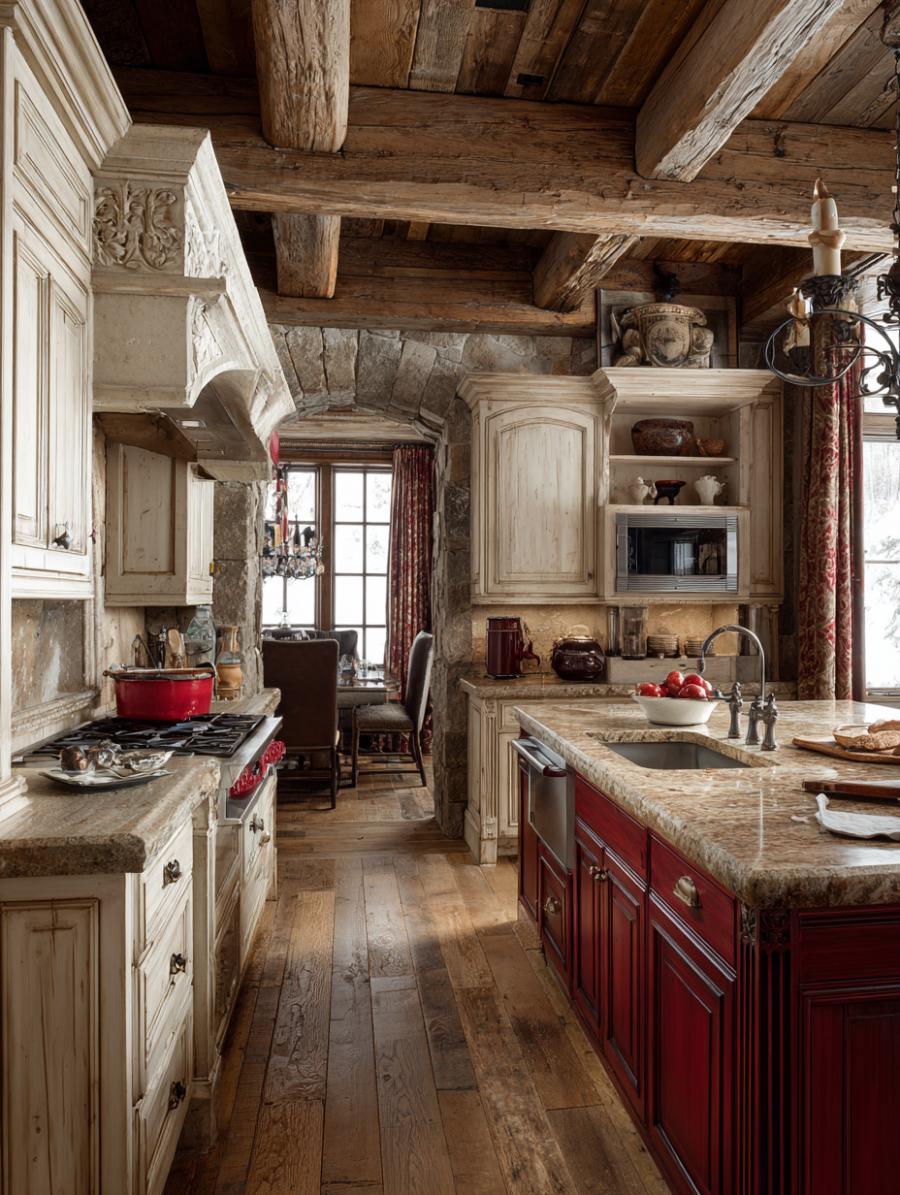
The galley layout here forces your eye down a corridor of cream and crimson. A red-painted island with raised panel doors sits beneath a slab of golden granite, its surface catching light from somewhere beyond the frame. On the left, distressed ivory cabinets with decorative corbels flank an ornate range hood carved to look like it belongs in a French manor house.
What catches me is the fabric. Those red and ivory damask drapes pooling beside the stone archway at the back add softness to all this hard material. A wrought iron chandelier with candle-style lights hangs at the passage, and the rough grey fieldstone walls on both sides make the cream-painted millwork look intentionally aged rather than simply old. The bright red enamel Dutch oven on the cooktop provides a punch of color that echoes throughout without overwhelming.
Carved Stone Transforms a Range Alcove Into Something Closer to Art
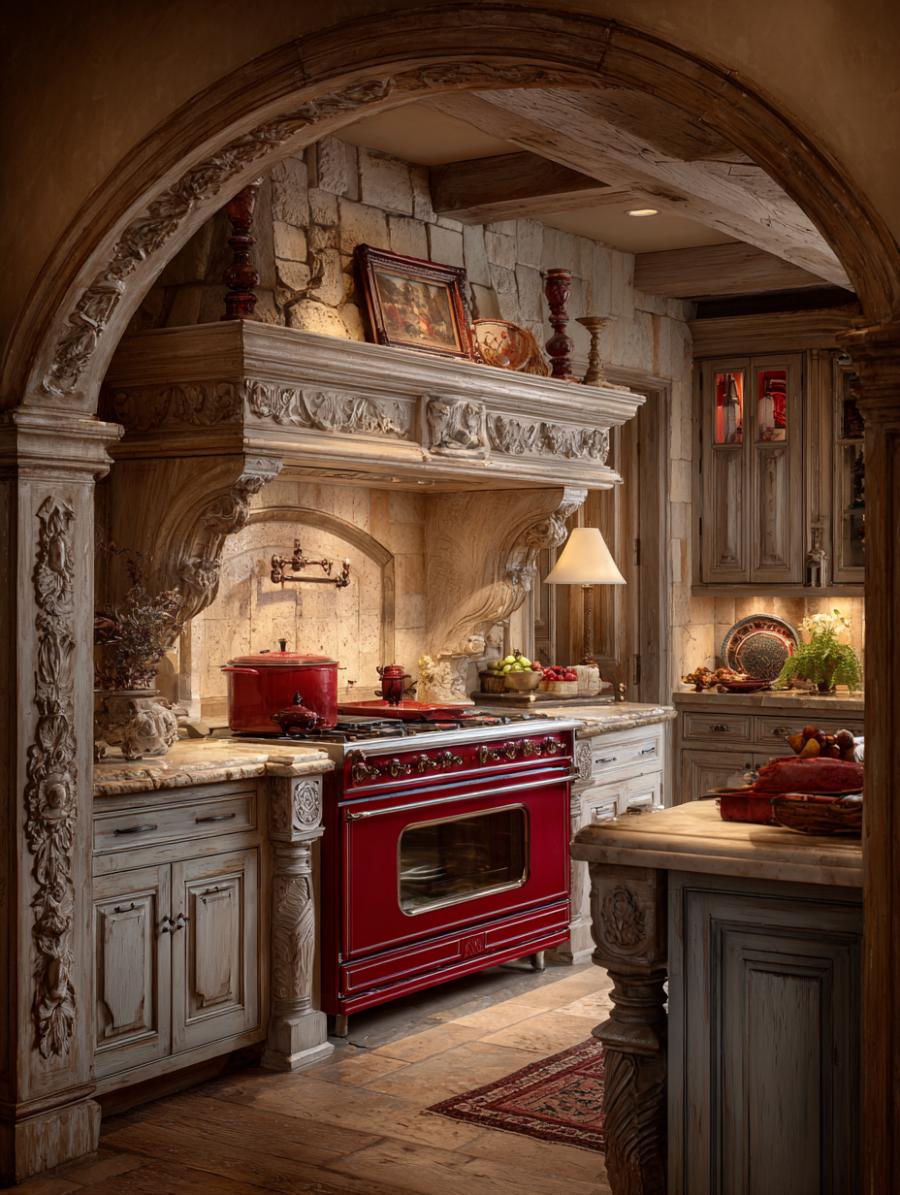
I keep coming back to the archway. Hand-carved limestone with grape clusters, scrollwork, and figural elements frames the entire cooking zone like a stage. Inside this frame sits a cherry-red professional range with brass knobs, flanked by weathered grey cabinetry that looks like it survived a century in Provence before landing here.
“The range hood mantel alone in a kitchen like this represents six months of a stonemason’s work.”
The mantel above the range holds an oil painting in a gilded frame, a copper pot, and two turned wood candlesticks in deep burgundy. Red enamel cookware sits ready on the burners. To the right, glass-front cabinets with interior lighting display decorative plates, and a small lamp with a cream shade provides task lighting that supplements the recessed fixtures. The Persian runner beneath ties together the terracotta floor tiles with the red and cream palette above.
A Hood Carved Like Cathedral Relief Work
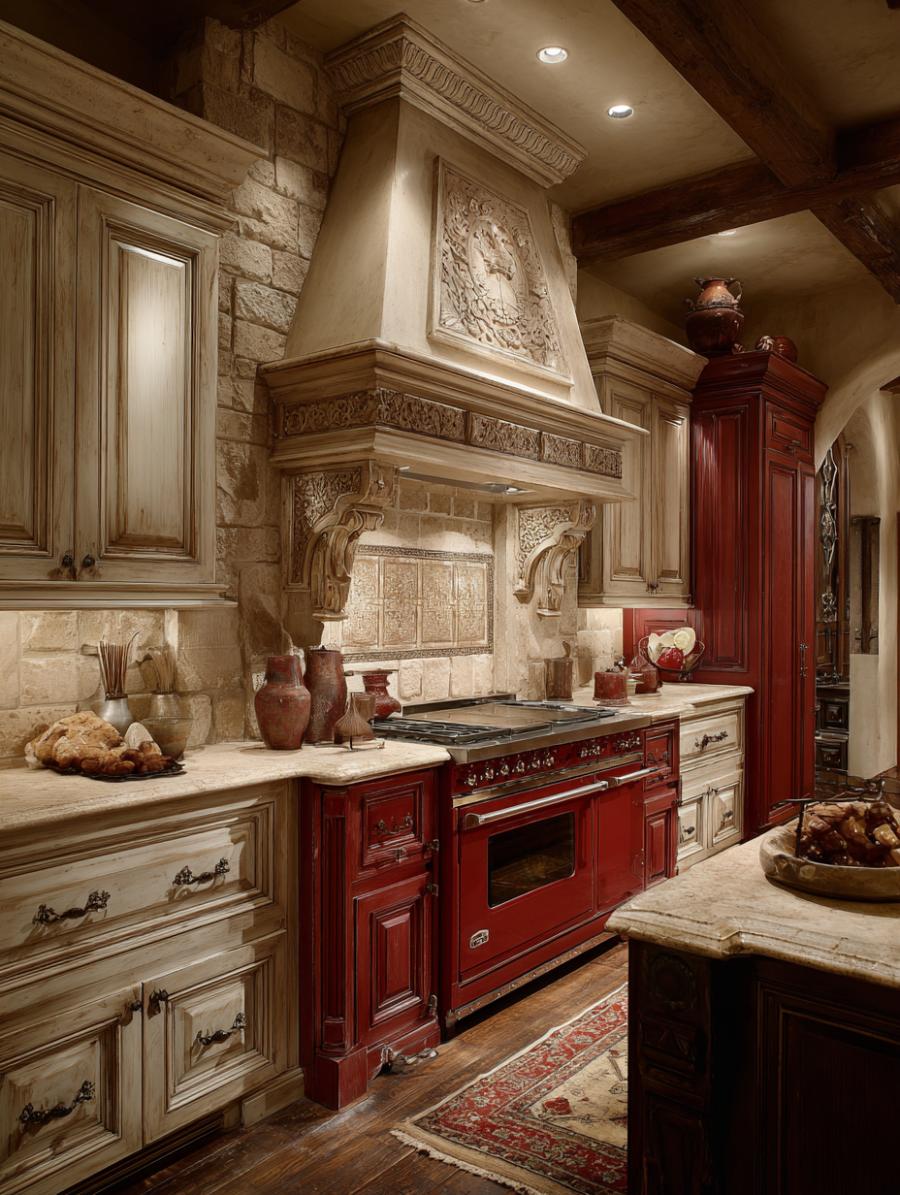
This hood dominates the wall. Carved limestone in a pyramidal shape rises toward exposed wood ceiling beams, its face decorated with a central medallion showing grape vines and figures. Decorative corbels support the lower edge, and a band of carved relief runs beneath. The whole thing must weigh several thousand pounds.
Below it, a deep crimson range with chrome trim sits centered against a tumbled travertine backsplash with decorative tile insets. Flanking cabinets in burgundy painted wood rise to the right, their interiors visible through chicken wire panels. Terra cotta vessels in various sizes line the counter. The distressed cream cabinets on the left show intentional antiquing in their finish, and a Persian rug in faded reds and blues anchors the dark wood floor. Someone placed a copper samovar on the far cabinet, a detail that reads as collected rather than decorated.
History Corner: The tradition of ornate range hoods traces back to medieval European kitchens, where massive stone mantels directed smoke upward through a central chimney. Modern versions like this one reference that lineage while concealing contemporary ventilation systems.
Now for Something Completely Different: Coastal Calm with a Red Center
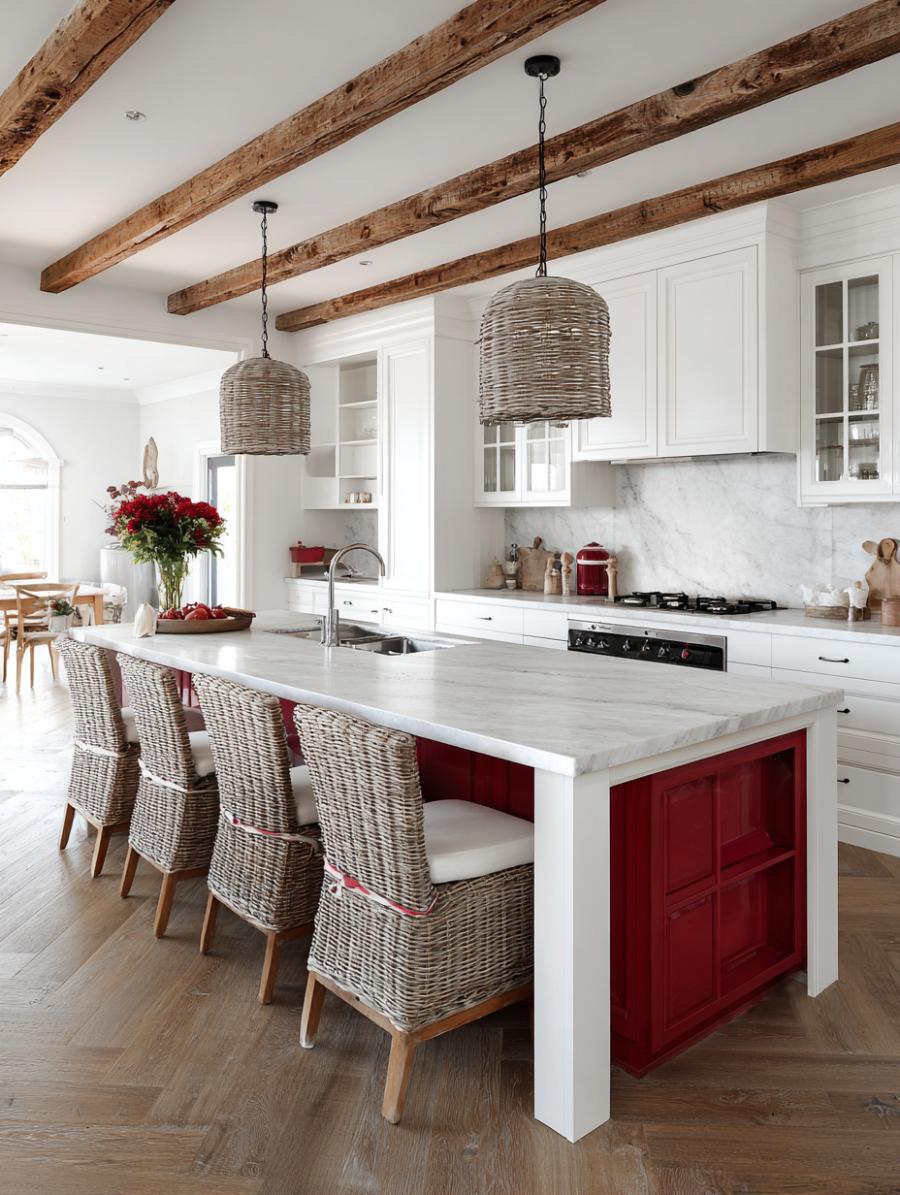
After all that carved stone and velvet, this kitchen feels like taking a breath. Crisp white shaker cabinets reach toward a ceiling punctuated by three substantial reclaimed wood beams. The island base sports a deep cranberry red panel that runs its full length, topped with grey-veined white marble. Grey wicker counter stools with cream cushions and wooden legs line up beneath.
Two oversized woven rattan pendant lights hang from black chains, their drum shapes echoing the stools below. A vase of deep red roses sits on the counter beside a bowl of strawberries. The marble backsplash behind the range shows soft grey veining, and a small red appliance on the counter picks up the island color. Light floods in from an arched window visible in the background, where a round dining table with wooden chairs waits.
Barnwood Base, Linen Seats, Cherry-Red Legs
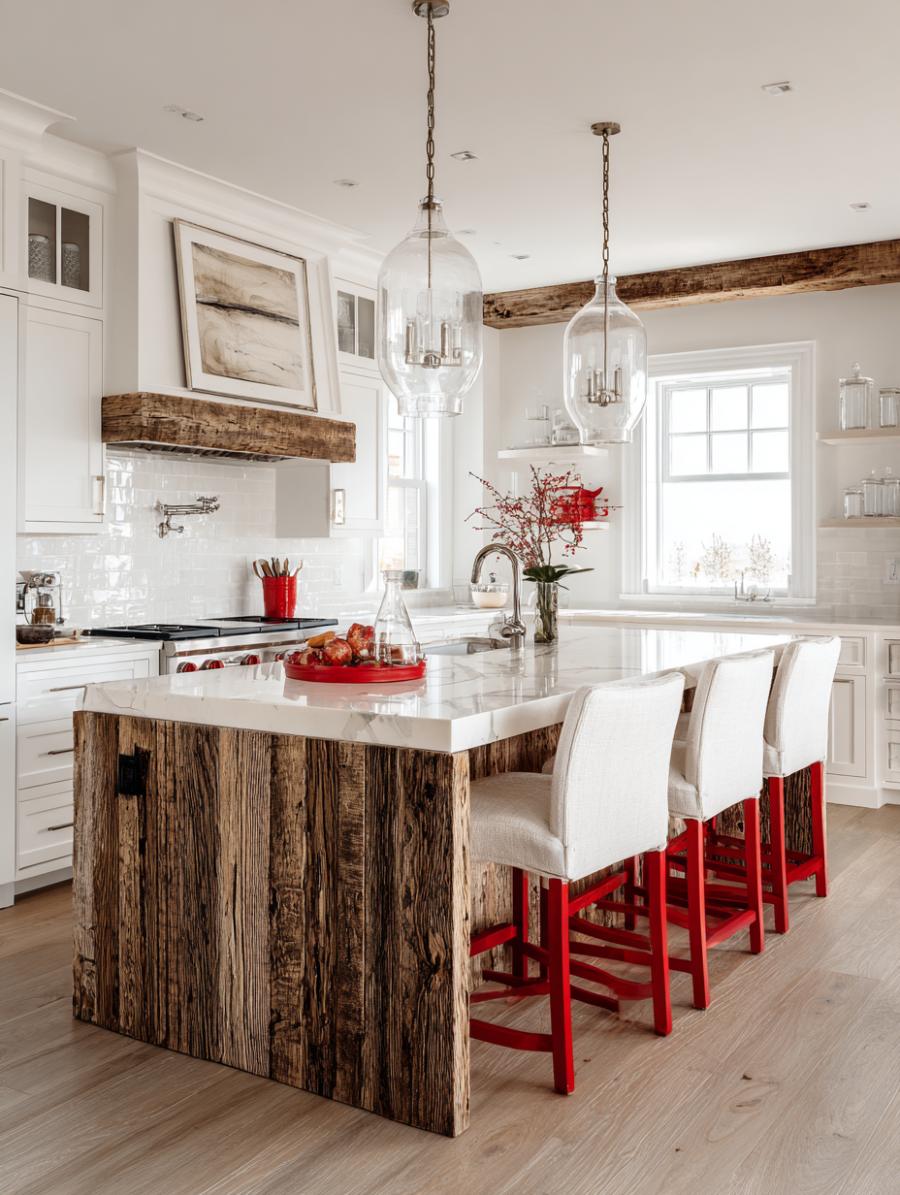
The island base here could have come from an actual barn. Deeply weathered grey-brown planks with visible nail holes and split grain wrap around a waterfall-style structure, topped with white quartz showing subtle grey veining. Three counter stools in natural linen upholstery sit on frames painted fire-engine red, their modern lines contrasting sharply with the aged wood.
Clear glass elongated pendant lights hang from a reclaimed beam that runs across the ceiling. White cabinets with simple hardware line the perimeter, and a framed abstract landscape in browns and greys hangs above the range hood, which is clad in matching weathered wood. Red berries in a clear vase on the island echo the stool legs. The floor appears to be wide-plank white oak in a light natural finish.
Try This: If a full barnwood island feels too committed, source reclaimed wood boards to clad just the island end facing your seating area. The visual impact remains strong while keeping costs and installation complexity manageable.
Seagrass Stools and a Surprise Pop of Color
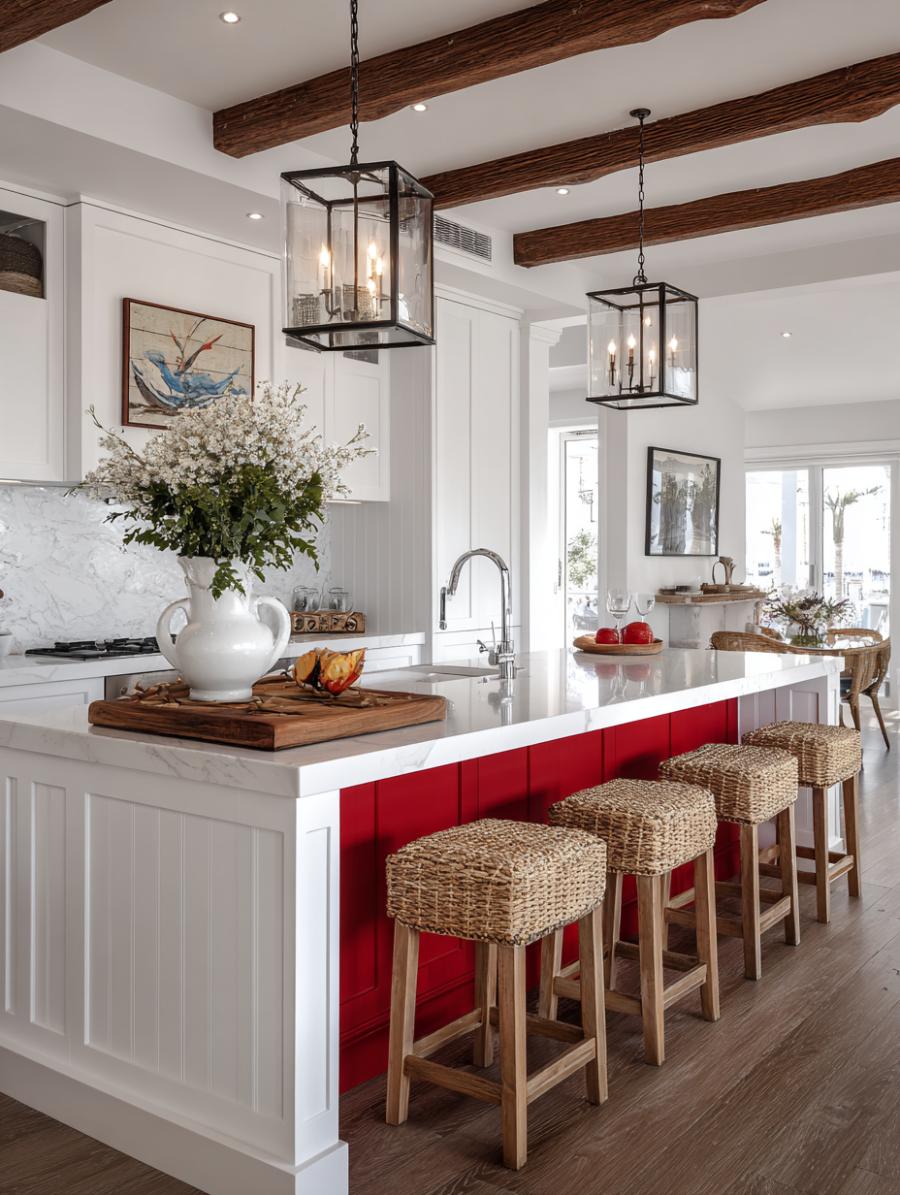
Four backless seagrass stools with bleached wood legs tuck beneath an island that hides its boldest move. The white beadboard exterior wraps around to reveal a deep crimson red panel facing the cooktop, visible only from certain angles. This restraint works. You get the color without it demanding attention from every sightline.
Black metal lantern-style pendants hang from exposed wood beams overhead. White cabinetry with shaker doors surrounds the space, and a marble slab backsplash shows soft grey veining. A white ceramic pitcher stuffed with white flowers sits on a wooden cutting board beside sliced oranges. A bird painting in blues and tans hangs above the cabinets. The floor is medium-toned oak in a wide plank, and natural light enters from multiple directions.
Those Striped Seats Steal the Show
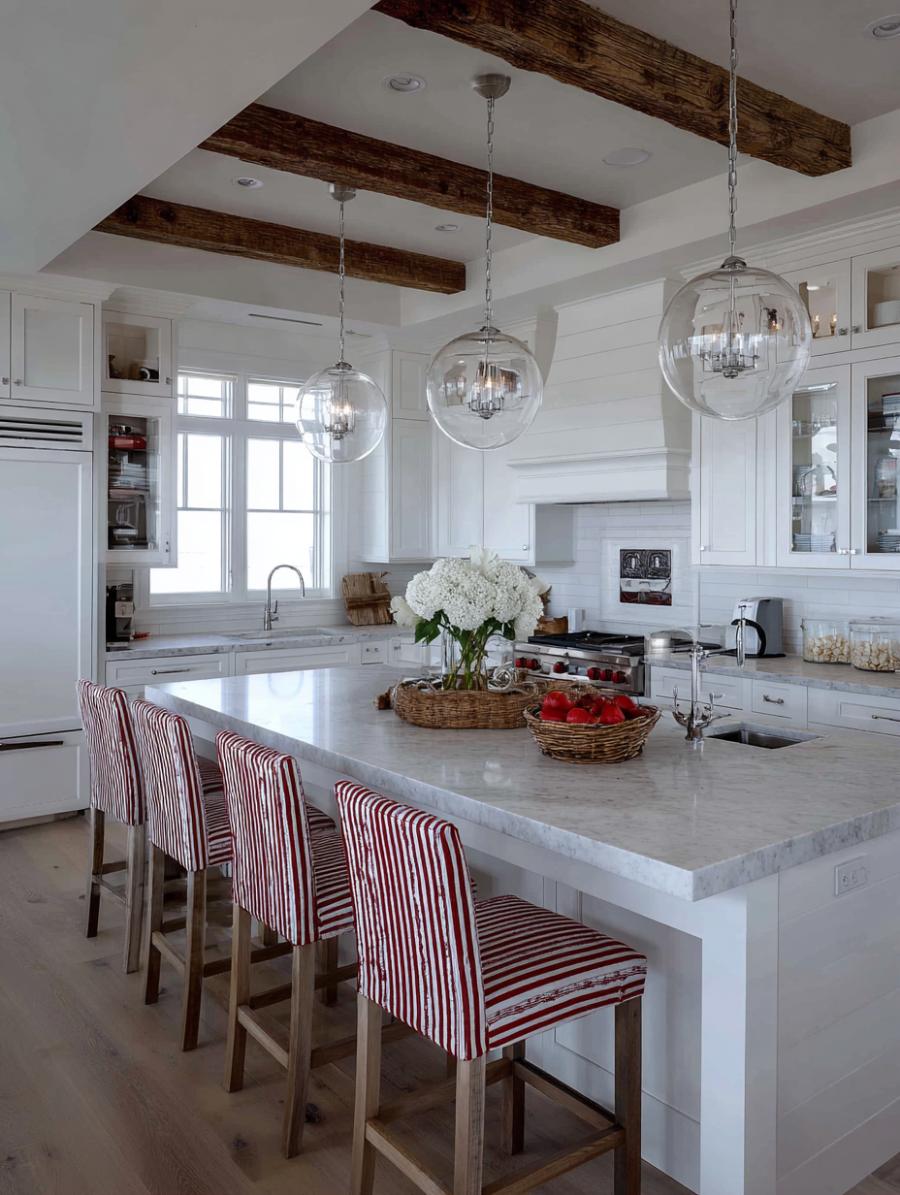
Sometimes a single element makes everything else fall into place. Here, five parsons-style counter stools upholstered in red and white ticking stripe fabric do exactly that. The cotton stripe has a casual, almost nautical feel that keeps the otherwise formal white kitchen from feeling stuffy.
Three oversized clear glass globe pendants with chrome interiors hang from a ceiling crossed by substantial weathered wood beams. The island surface is thick-cut grey and white marble, and white hydrangeas in a clear vase sit beside a wicker tray holding red apples. Shiplap paneling covers the range hood area, and glass-front upper cabinets display glassware and jars. The floor matches the previous spaces in light natural oak. A basket of popcorn and some red tomatoes on the counter bring lived-in touches to the polished surfaces.
Why It Works: Ticking stripe fabric reads as both traditional and playful. The narrow red and white lines prevent the color from overwhelming while adding pattern interest. Paired with natural materials like wood beams and wicker accessories, the fabric grounds the palette in something familiar and approachable.
Red Beadboard Walls in a Galley That Feels Like Home
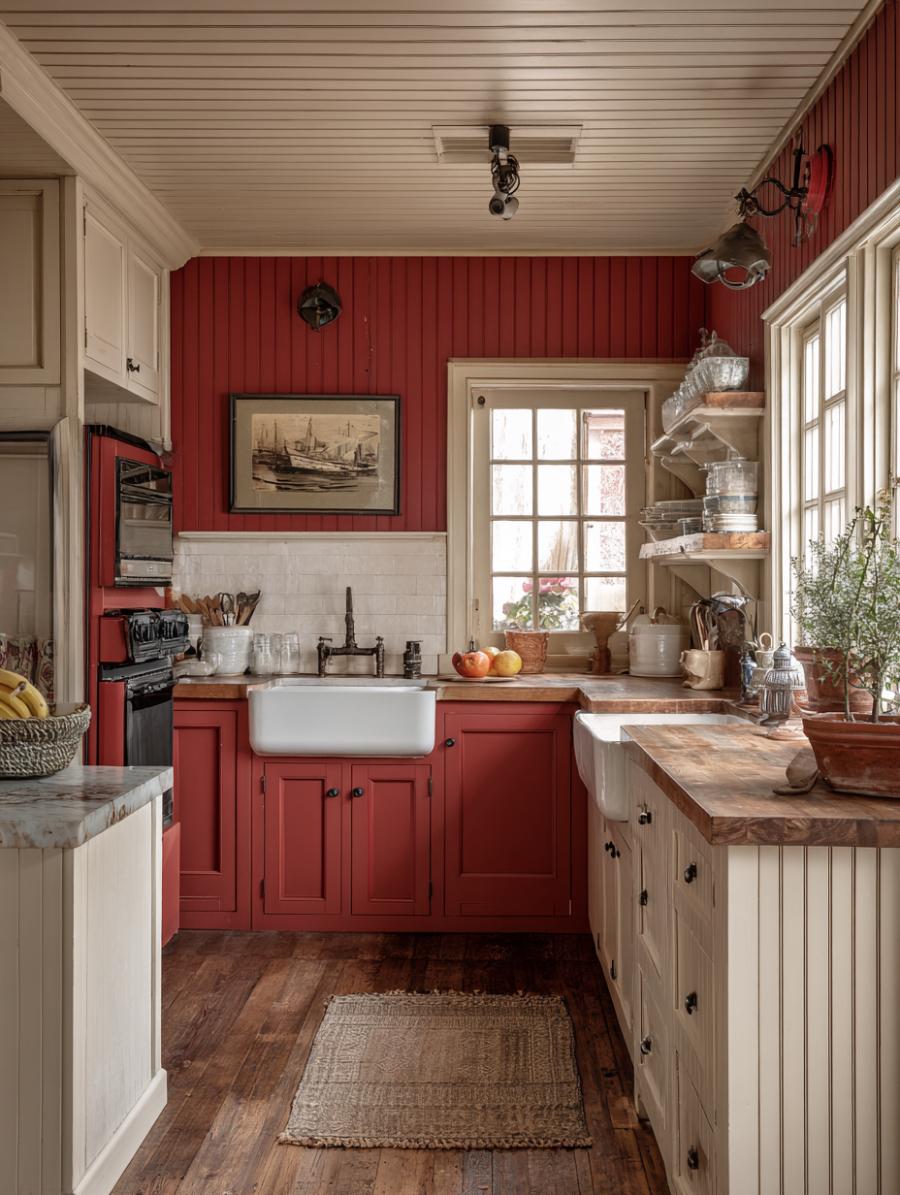
This is the smallest kitchen in the collection, and possibly my favorite. Muted brick-red beadboard runs floor to ceiling on two walls, wrapping around a deep farmhouse sink with an oil-rubbed bronze faucet. The lower cabinets match the wall color, while cream-painted beadboard cabinets with simple knobs line the opposite side.
Butcher block countertops in warm honey tones top both runs of cabinetry. A nautical painting of ships in harbor hangs above the sink, and open shelving holds stacked dishes in white and clear glass. A jute runner with fringed ends covers the dark worn hardwood floor. Terracotta pots with trailing greenery sit on the windowsill beside potted herbs. The ceiling is cream beadboard with an industrial-style light fixture. Bananas in a basket, apples on the counter, wooden utensils in a ceramic crock. This kitchen looks like someone actually cooks in it.
Industrial Bones, Crimson Steel, Brick for Days

The ceiling height alone suggests this space costs a small fortune in heating bills. Exposed brick in variegated reds and browns rises two stories, interrupted only by massive steel I-beams painted deep crimson. Factory windows with black steel frames let in northern light. The poured concrete ceiling shows its formwork marks.
Below this industrial shell, the kitchen arranges itself around a substantial island with a dark stained reclaimed wood waterfall top and charcoal-painted base. Metal stools with round seats and tripod legs line up beneath. The run of cabinets along the brick wall features flat-panel charcoal doors with red laminate countertops and matching red cabinet panels above. Black industrial pendant lights hang from exposed conduit. A woven rug in reds, browns, and creams softens the wood floor. Through the tall windows, you can see neighboring brick buildings.
Editor’s Note: AI design tools have gotten good at generating spaces like this one, but they consistently miss the imperfections that make industrial conversions feel authentic. The slightly off-level floor, the water staining on brick, the paint overspray on a beam. Real loft renovations carry their history visibly.
Japandi Principles Applied to a Bold Palette
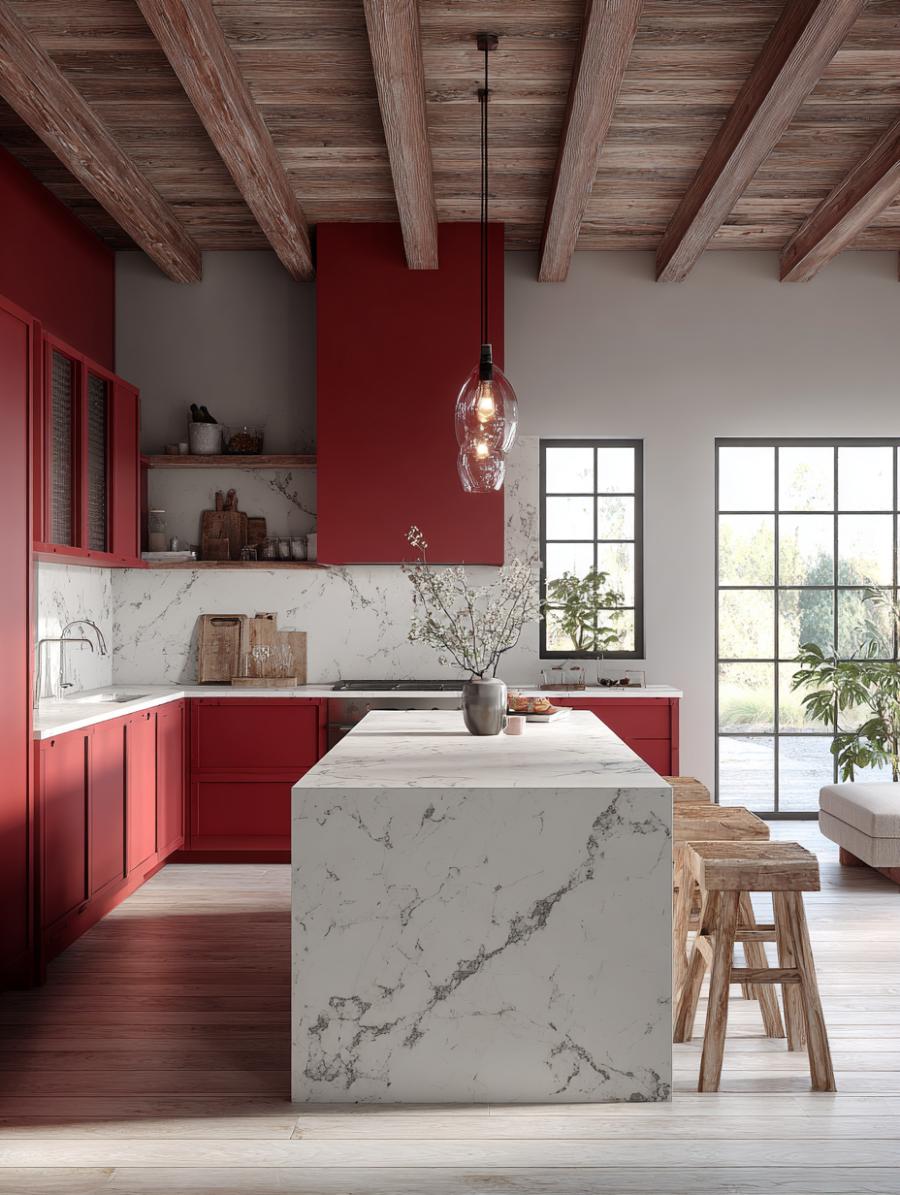
Clean lines and warm color can coexist. Flat-panel cabinets in a muted terracotta red run along the left wall, their matte finish absorbing light rather than reflecting it. A waterfall island in heavily veined white marble with grey striations creates the focal point, its slab thick enough to suggest real stone rather than engineered material.
Weathered grey-brown wood planks cover the ceiling, running perpendicular to black-framed steel windows that fill the far wall with natural light. Three rustic wood stools with simple plank seats tuck beneath the island overhang. The backsplash uses the same veined marble as the island, creating visual continuity. A grey ceramic vase holds bare branches on the island surface. The floor transitions from the kitchen’s wood tone to light oak in the adjacent seating area, where a low cream upholstered bench is partially visible.
Material Restraint Allows Color to Lead
The entire palette here consists of maybe five materials: matte painted wood, polished marble, raw timber, steel, and ceramic. This discipline lets the red cabinetry read as intentional rather than overwhelming. A double-orb glass pendant in amber tones hangs from a red-painted ceiling soffit that brings the wall color overhead in a contained way.
Concrete and Red Light: The Minimalist Extreme
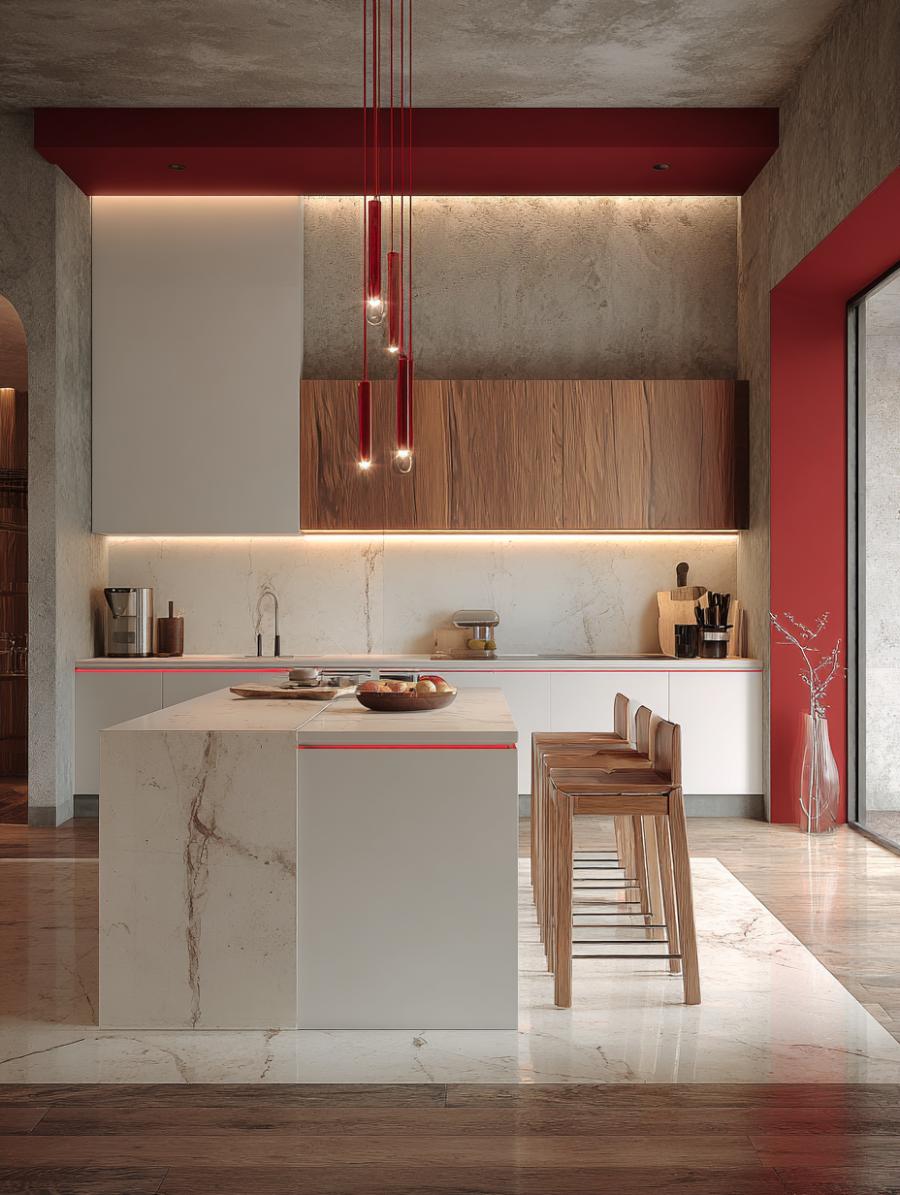
Raw concrete walls with the texture of poured forms create the shell. A red ceiling soffit drops down to define the cooking zone, its underside fitted with strip lighting that casts a warm glow on everything below. Red tube pendant lights on thin cords drop from above, their vertical forms echoing the wall beyond, which is painted the same saturated red.
White flat-panel lower cabinets sit beneath a marble countertop and matching marble waterfall island. Walnut upper cabinets with horizontal grain provide warmth against the grey concrete, and a shelf between them holds jars and wooden cutting boards. Two stools in natural wood with simple ladder backs face the island. Pink accent lighting runs beneath the counter edge. The marble floor has subtle veining that picks up the grey of the walls and the pink undertones of the red accents.
A glass vase with bare branches sits on the right, and a red ceramic vase with more branches occupies the far wall. The space feels edited down to essentials, each element earning its place through either function or deliberate visual contribution.
Red in the kitchen is a psychological signal. It reads as warmth, appetite, energy. Pair it with white marble and weathered wood, and you get something that feels both alive and grounded. These twelve kitchens demonstrate just how wide the range can be within a single color scheme.
A Modern Farmhouse Kitchen Where Deep Red Becomes the Anchor
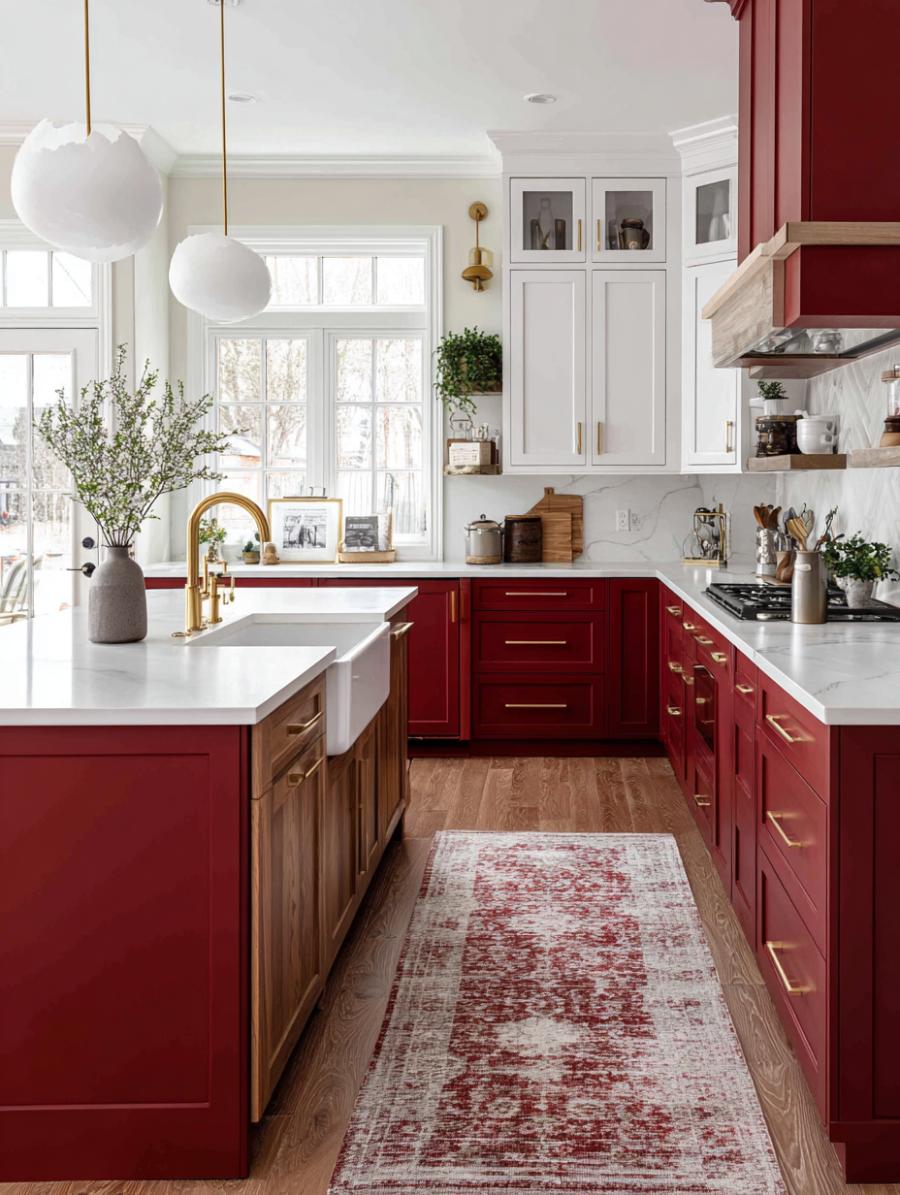
The burgundy shaker cabinets here sit somewhere between cranberry and oxblood, a shade that photographs well but also ages well. White glass-front uppers keep things from feeling heavy. That brass gooseneck faucet over the farmhouse sink catches the light from those oversized globe pendants, and the whole corner by the window becomes a little moment of its own with branching greenery in a matte grey vase.
The runner on the floor deserves attention. It’s a distressed Persian-style piece in faded reds and creams that echoes the cabinet color without matching it exactly. Small greenery accents on the open shelving and window sill bring life into a space that could otherwise feel too polished. The marble countertops have subtle grey veining that connects visually to the marble-look backsplash behind the range.
Mountain Lodge Proportions with Burgundy Cabinetry
🔥 Would you like to save this?
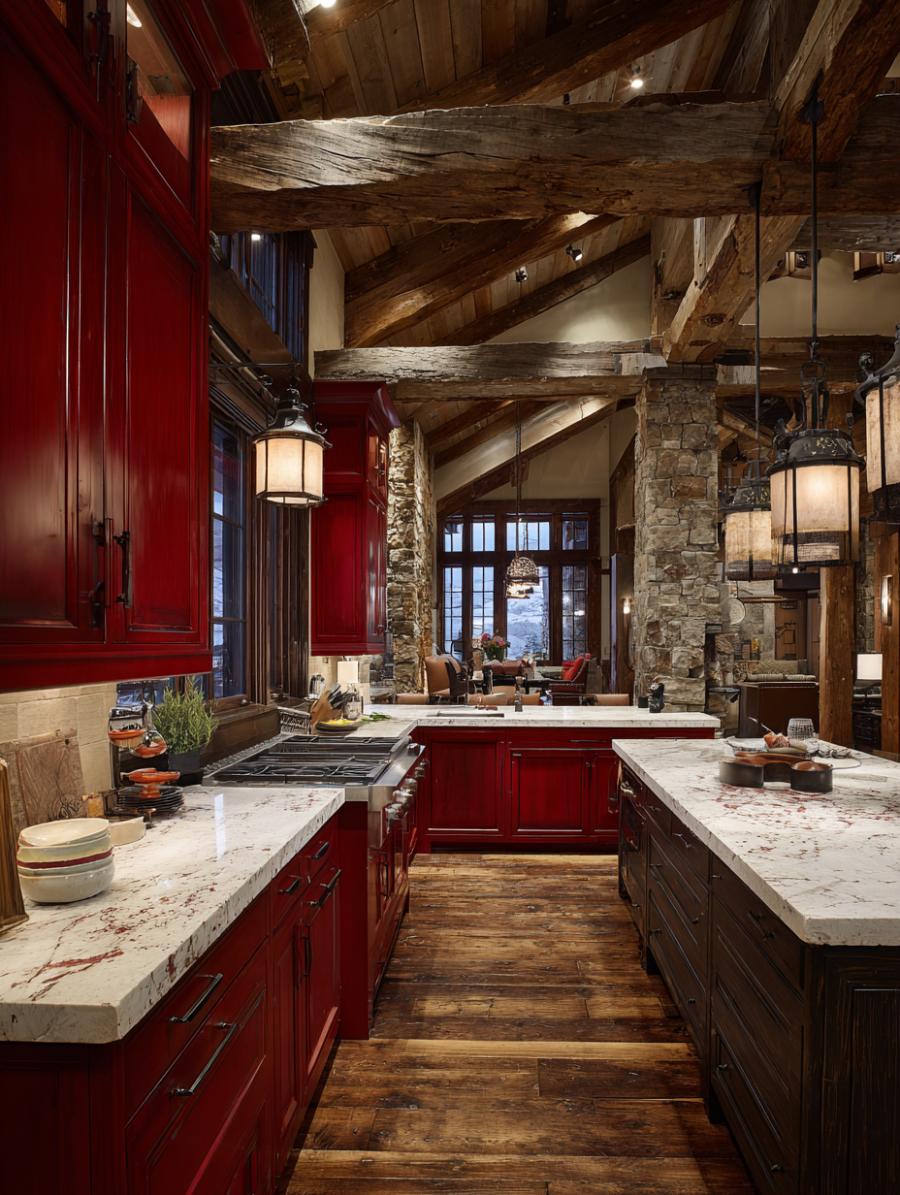
Those reclaimed timber beams overhead aren’t decorative afterthoughts. They’re structural, hand-hewn, and probably older than anyone reading this. The burgundy cabinets below them have a slight glaze that catches the warm glow from those lantern-style pendants with their cream fabric shades.
History Corner: The use of red in American kitchens traces back to colonial milk paint, which used iron oxide pigments. That same chemistry is why barns are red. Kitchen designers in mountain regions often draw on this heritage, whether consciously or not.
Rough-cut stone columns frame the space and connect it visually to the living area visible through the archway. The countertops are a cream-toned quartz with burgundy and gold veining that picks up the cabinet color in an unexpected way. Wide-plank reclaimed wood flooring runs the length of the galley layout.
Shaker Simplicity Under Weathered Timber
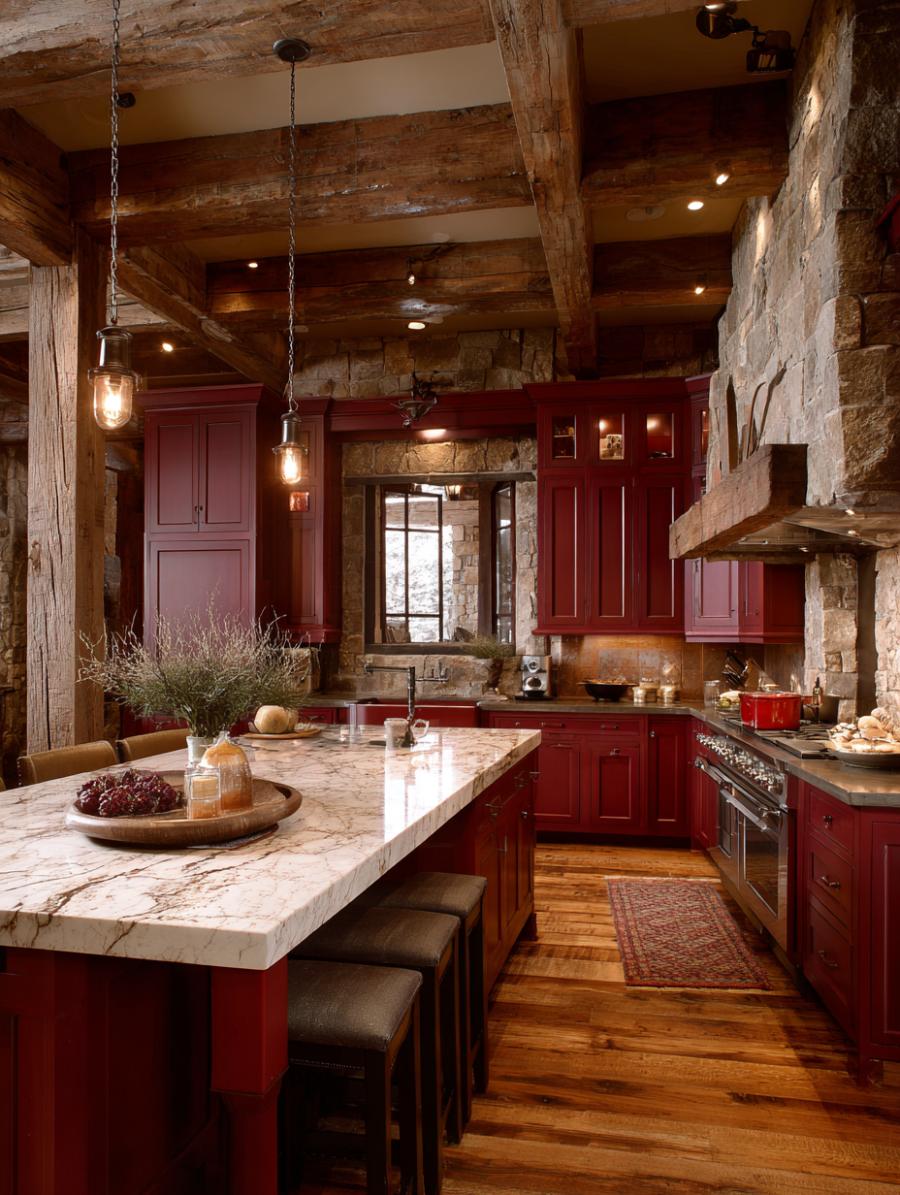
Copper veining runs through the cream marble countertops here, a detail that warms up the stone considerably. The upper cabinets have glass fronts displaying white ceramics, wine glasses, and storage canisters. That red Dutch oven on the range is placed with intention, pulling the cabinet color into the cooking zone.
Jar pendants with Edison bulbs hang at staggered heights above the island. Four leather-topped stools tuck underneath. The massive stone wall to the right holds a custom range hood wrapped in reclaimed wood, and the flooring is a honey-toned oak with visible knots and grain variation. A red-and-cream vintage runner softens the galley walkway between counters.
Terracotta Tones in a Coffered Ceiling Kitchen
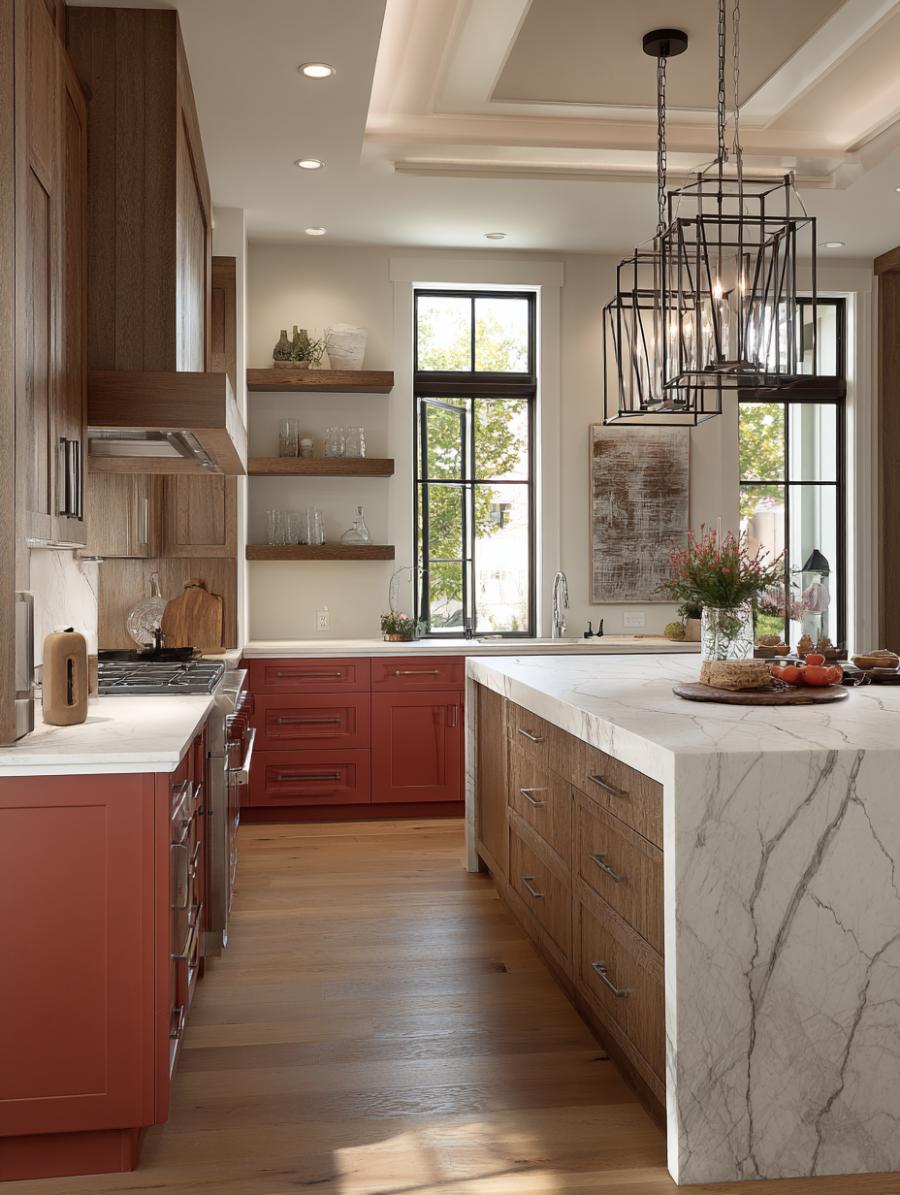
This red leans toward terracotta rather than true crimson. It’s softer, earthier. The island base is natural walnut, and the countertop is a waterfall-edge quartzite with grey movement that falls all the way to the floor. Black-framed windows and geometric cage pendants add contemporary edge to what could have been a purely traditional space.
Open shelving in weathered oak holds white dishes, clear glassware, and a few ceramic vessels. The abstract painting near the window has rust and bronze tones that connect to the cabinetry. Fresh pink floral stems in a clear vase and a wooden cutting board with oranges bring the kind of lived-in quality that staged kitchens often lack.
When an Umber Range Hood Takes Center Stage
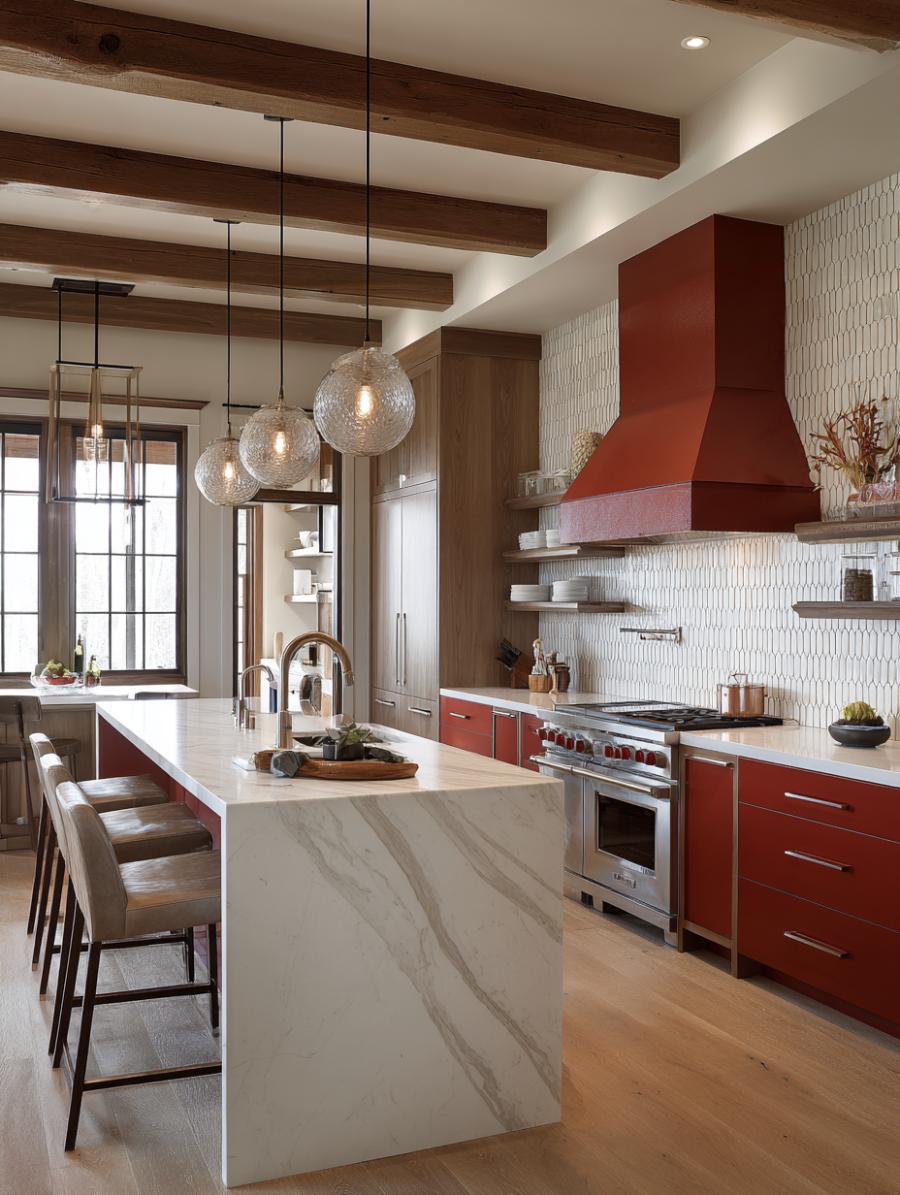
The backsplash tile here is an elongated hexagon shape in matte cream, creating a pattern that reads almost like woven fabric from a distance. The burnt sienna range hood dominates the wall, flanked by floating shelves holding white ceramics and copper canisters. Three textured glass globe pendants hang at descending heights above the island.
“The best kitchen color choices feel inevitable in retrospect, as if no other option ever existed.”
Taupe leather counter stools with dark wood frames line the island. The countertop has cream and gold veining in a waterfall application. Exposed beams in a warm honey tone run across the ceiling, and the flooring is a pale oak that keeps the space from feeling too dark despite all the saturated color.
Nordic Cabin Character with Crimson Cabinetry
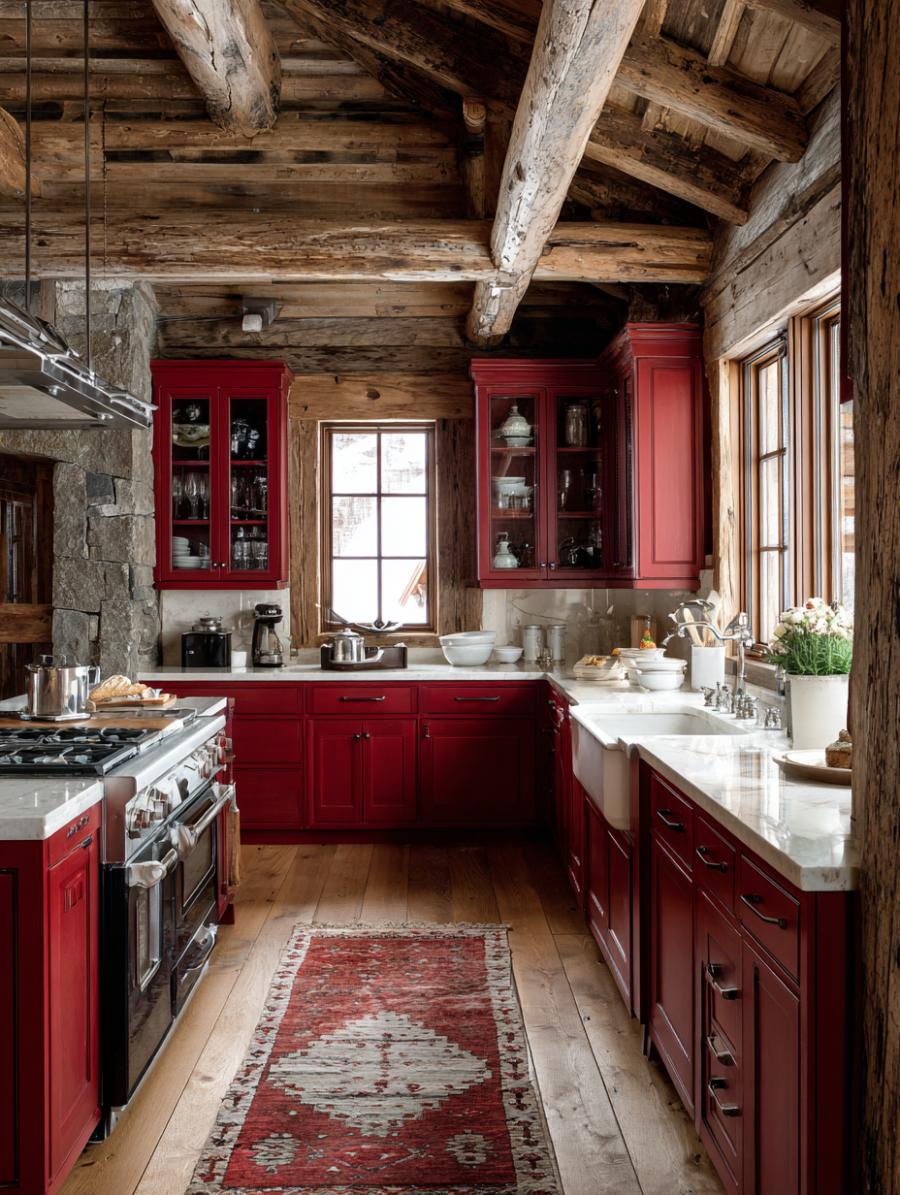
Grey fieldstone walls meet timber posts that show every crack and split of their age. The red here is a true barn red with no gloss, just a matte painted finish on shaker-style doors. Glass-front uppers display glassware and white ceramics against the stone backdrop. A small window with divided lights lets in natural light over the sink area.
The marble has substantial grey and brown movement. A vintage-style red runner with medallion patterns softens the wide-plank flooring. Fresh white flowers in a vase near the sink, a white farmhouse sink basin, chrome bridge faucet. The double wall ovens are professional-grade stainless with red knobs that match the cabinetry.
Alpine Artisanship in Carved Stone and Distressed Red
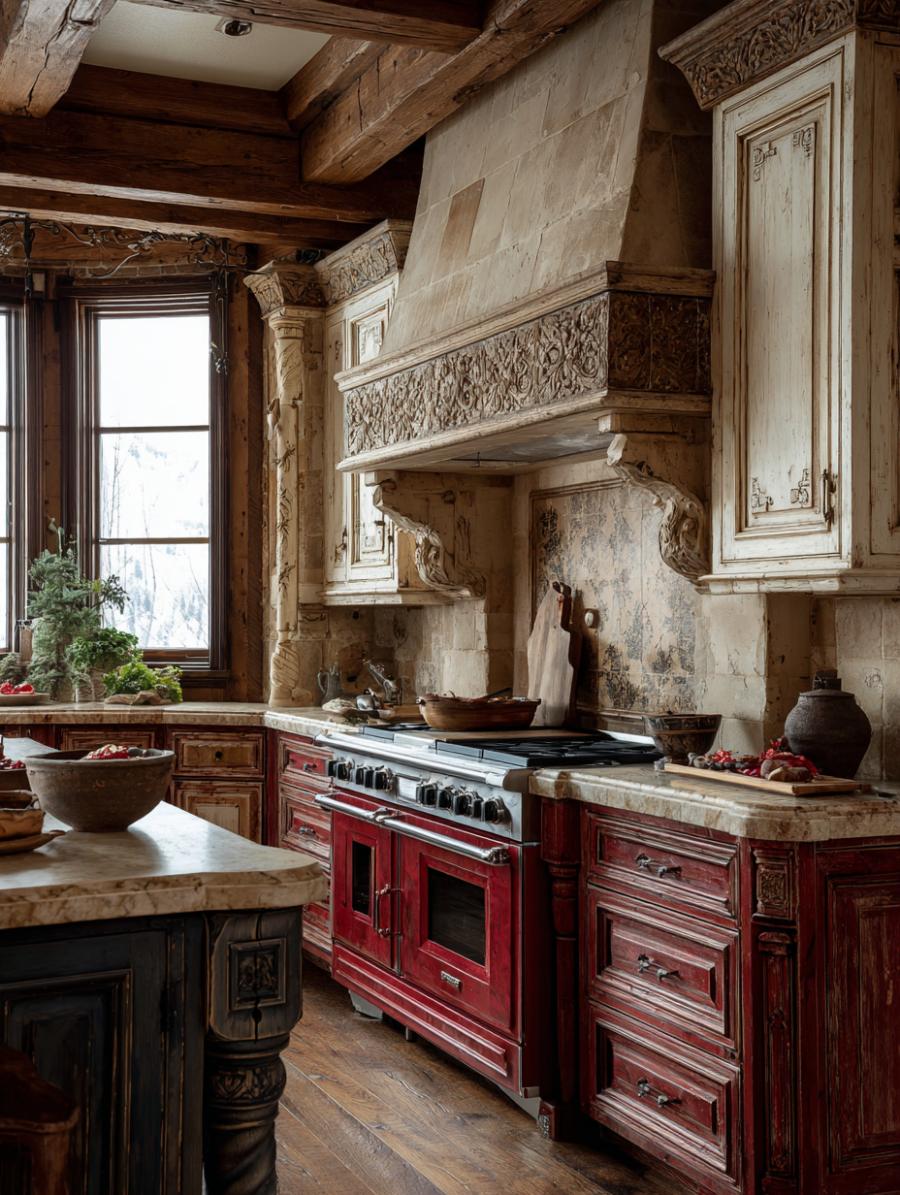
This one stopped me. The carved limestone range hood with scrollwork corbels and decorative frieze looks like it belongs in a 16th-century Tyrolean estate. Antiqued cream upper cabinets with ornate panel details flank it. Below, the base cabinets are a distressed burgundy with visible brush strokes and wear patterns that suggest decades of use.
Try This: If you’re drawn to this distressed finish but working with existing cabinets, a chalk paint in a deep red followed by strategic sanding at corners and edges can approximate this aged quality. Seal with a matte wax.
The range itself is painted to match the cabinets with chrome knobs and handles. Cream stone tile with aged patina covers the backsplash. Exposed beams overhead, a small carved island with turned legs in black-brown wood, copper bowls holding fruit. Through the window, snow on distant peaks.
Sculptural Red Island Against Log Cabin Walls
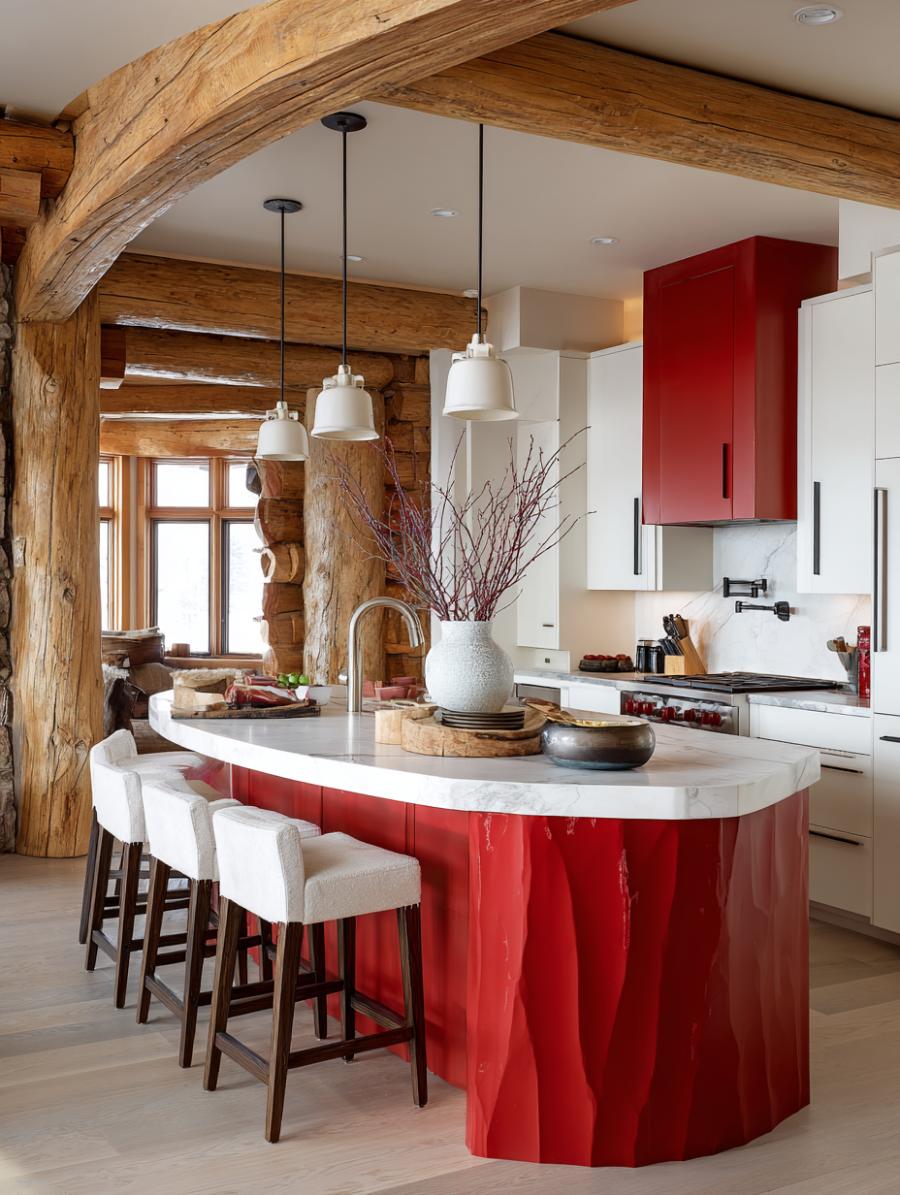
The island base has a faceted, almost crystalline texture in high-gloss cherry red lacquer. It curves at one end to accommodate seating, with cream bouclé upholstered stools tucked beneath a thick marble top. The perimeter cabinets are flat-panel white with minimal hardware, letting the island and the massive log structure do all the talking.
A curved timber beam arches overhead like a ship’s rib. Log walls at the far end glow golden in natural light from tall windows. Three white dome pendants hang at different heights. On the marble counter, a textured white ceramic vase holds bare red branches, a wooden serving tray, stacked plates. The floor is a bleached oak that reads almost grey.
Stone Arches and a Crimson Kitchen Island
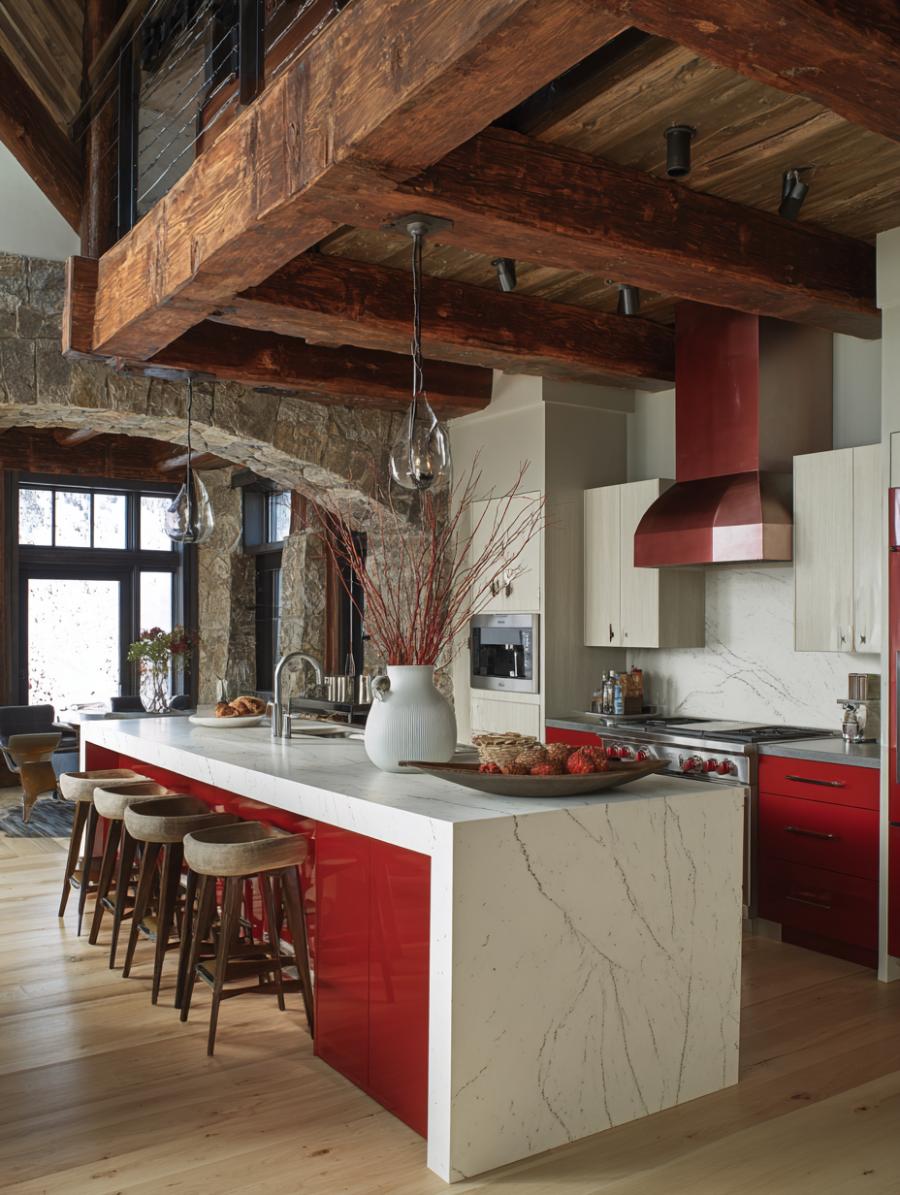
A massive stone arch frames the view from the kitchen into a darker living space beyond. The double-height ceiling reveals a loft level with iron railings. Below all that drama, the kitchen keeps its feet on the ground with glossy red lower cabinets, a terracotta-toned range hood, and cream flat-panel uppers.
The island is substantial. Red lacquer base, thick veined marble waterfall top, rounded-back leather stools in taupe with dark wood frames. Teardrop glass pendants hang from the timber beam ceiling. In a wooden bowl on the counter, red berries. A white ceramic pitcher holds bare branches with buds. The floor is pale wide-plank oak.
By The Numbers: Pinterest searches for “red kitchen cabinets” increased 89% between 2023 and 2024. The color has largely shed its outdated associations with 1990s cherry wood in favor of painted finishes in deeper, more modern tones.
Crystal Chandeliers Over Calacatta and Crimson
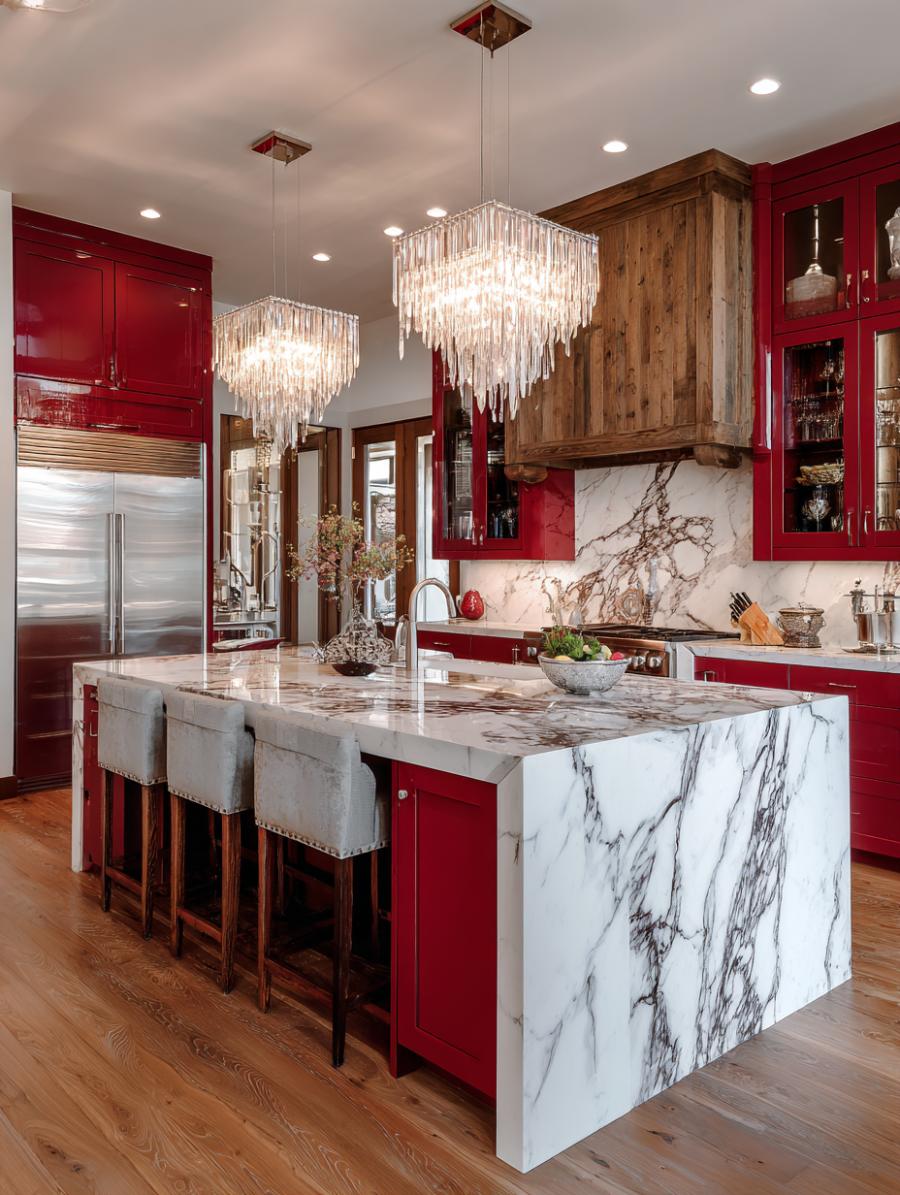
Two rectangular crystal chandeliers with cascading glass rods hang over an island that’s essentially a block of Calacatta marble with purple and grey veining so dramatic it looks like abstract art. The burgundy lacquered cabinets are high-gloss, reflecting the chandelier light. Glass-front uppers display barware and silver pieces.
Grey velvet bar stools with nailhead trim. A reclaimed wood range hood that grounds all the glamour. The backsplash continues the Calacatta behind the cooktop. Professional refrigerator in stainless, partially visible at the left edge. Through a doorway, cherry blossoms in a vase. The floor is a medium-toned oak with golden undertones.
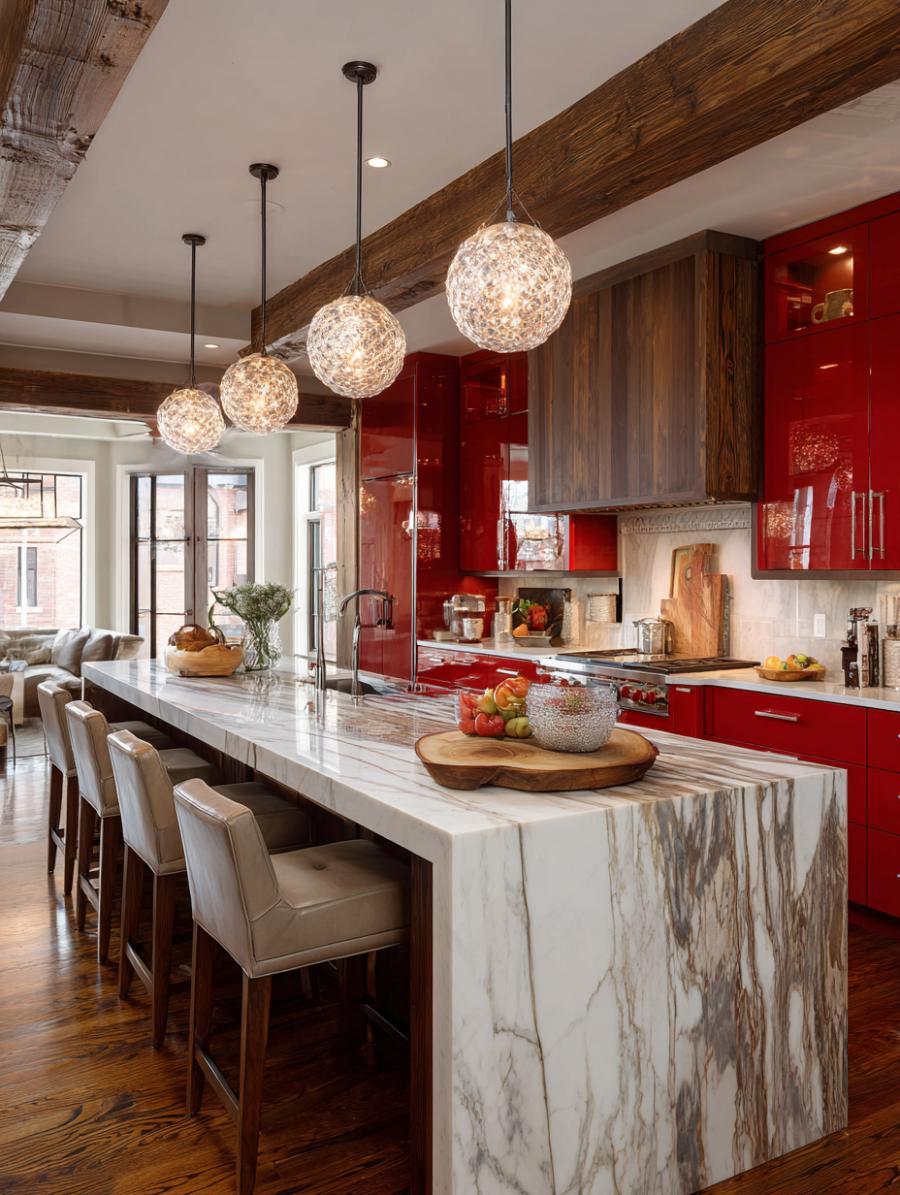
Where Rustic Beams Meet Lacquered Red
🔥 Would you like to save this?
Four globe pendants in textured crystal hang in a row from a thick reclaimed beam. The island below is a long rectangle of veined marble in warm cream and gold tones with a waterfall edge. Taupe leather bar stools line one side. The cabinets behind are glossy red with stainless bar pulls, and a weathered wood range hood breaks up the color with texture.
On the island, a wood serving board holds a crystal bowl of fruit. A glass vase with white flowers catches light from the french doors at the far end of the room. The floor is a darker oak with red undertones in its stain. Through the doors, a glimpse of a sitting area with neutral upholstery.
High-Gloss Red with Waterfall Marble and Globe Pendants

True red lacquer cabinets with brass hardware. The marble backsplash and waterfall island have strong grey veining against white, a combination that reads modern even in a rustic context. Three clear glass globe pendants hang from gold rods at different heights above the island. Walnut ceiling beams add warmth overhead.
Cream linen upholstered stools with walnut wood frames. Open shelving at the back holds white dishes and greenery. A wooden bowl of lemons sits on the marble. Fresh white roses and greenery in small vessels. The sink has a brass faucet that matches the cabinet hardware. Light pours in from a doorway on the right, catching the gloss of the cabinet fronts.
Red kitchens have a way of stopping you mid-scroll. There’s something about that particular shade of crimson against white marble that feels both rebellious and refined, like wearing red lipstick to a board meeting. I’ve been collecting images of these spaces for months now, and what strikes me most is how different each one feels despite sharing the same core palette.
These aren’t kitchens for the timid. At price points north of $100K, they represent a certain kind of confidence in design choices that most homeowners never quite muster. But here’s what I find interesting: the red and white combination actually has deep roots in architectural history, from Scandinavian farmhouses to Italian country estates. We’re not inventing anything new. We’re just spending more money on it.
That High-Gloss Cherry Situation with the Calacatta Slab
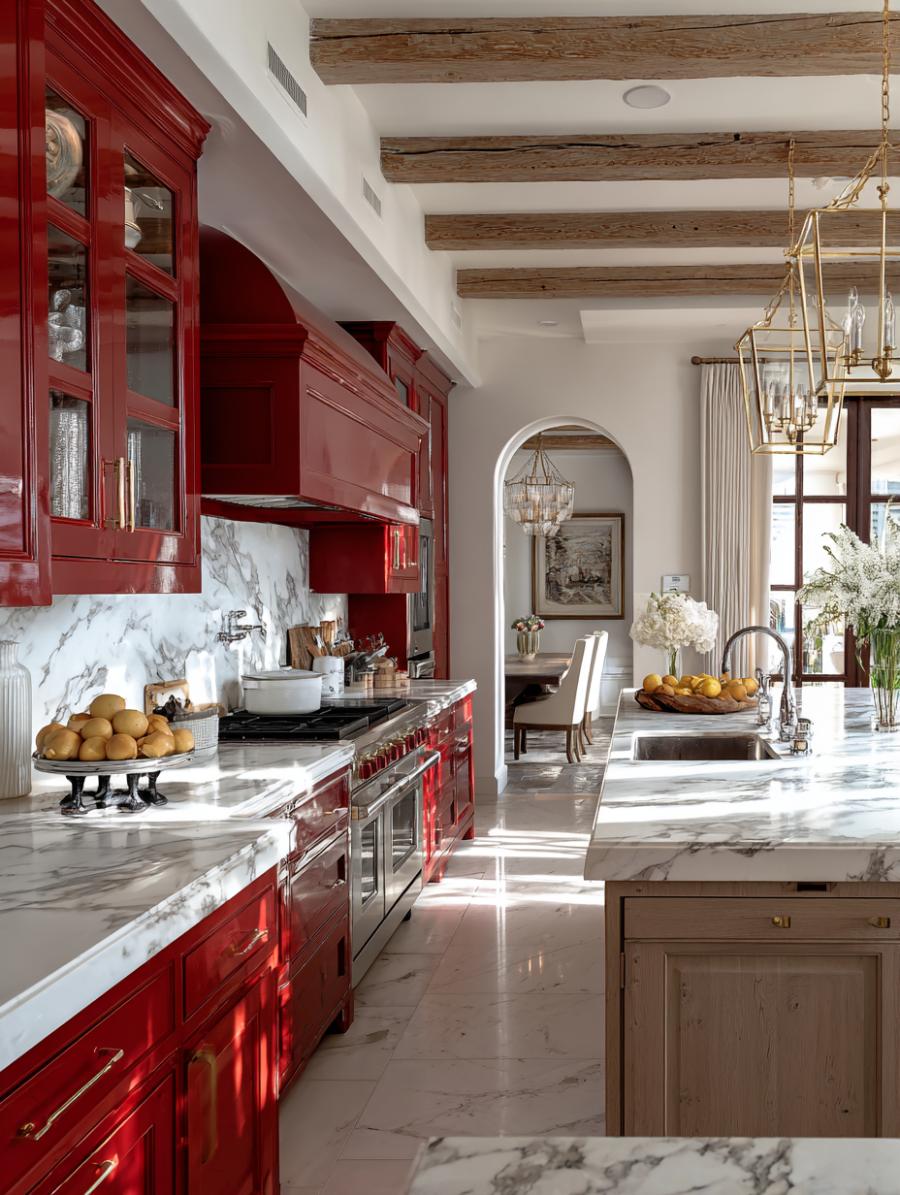
The lacquer finish on these cabinets catches light like a sports car in a showroom. You can see the reflection of the brass cabinet pulls in that glossy surface, which tells you immediately this isn’t paint from the hardware store. Those reclaimed ceiling beams running parallel overhead have a weathered grey-brown patina that grounds all that shine.
Look at the arched doorway leading to what appears to be a dining room with a crystal chandelier barely visible beyond. The taupe-toned island sits quietly in the foreground, its brass lantern pendants echoing the hardware on the red cabinetry. Fresh lemons in a wire basket, white hydrangeas in a clear vase. The staging is deliberate but the effect is lived-in.
Waterfall Marble Island in a Mountain Lodge Kitchen
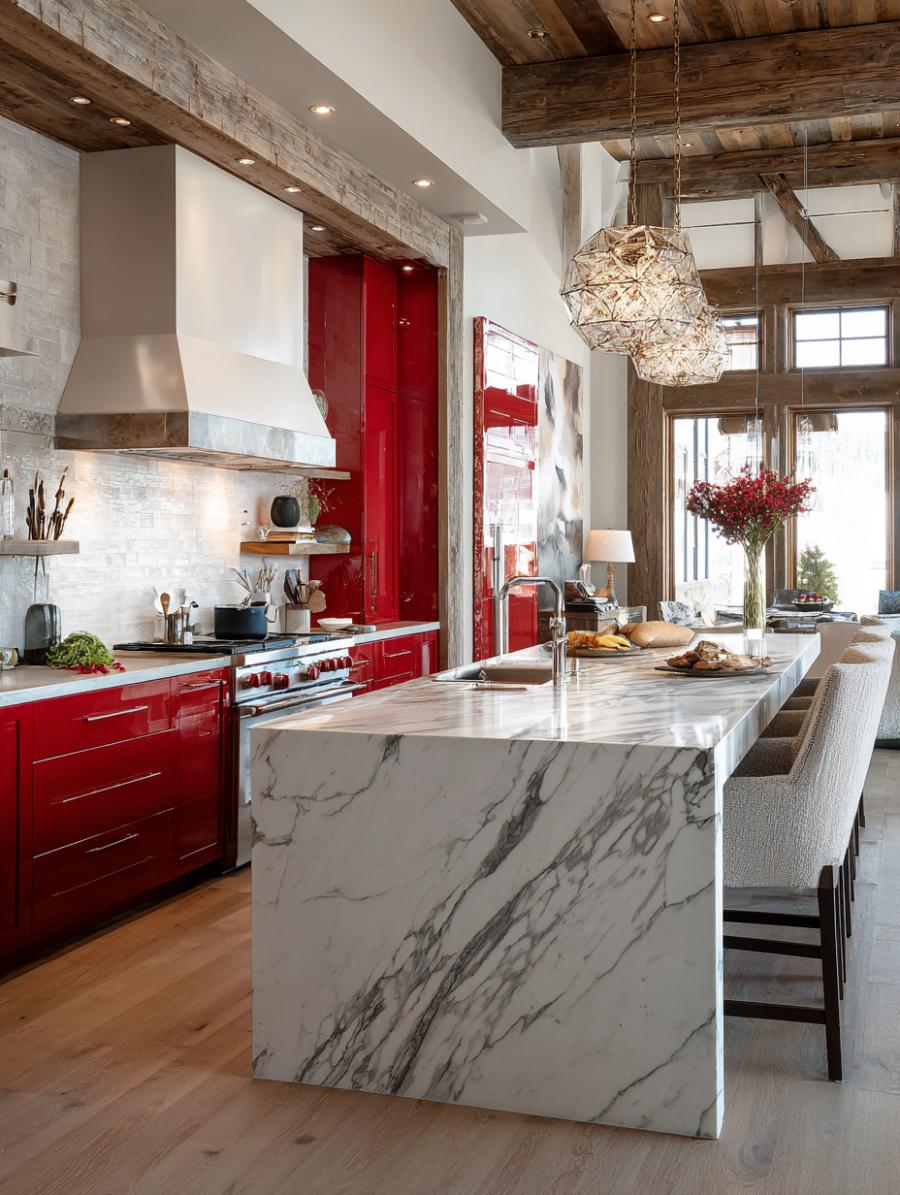
The veining on that waterfall island is aggressive. Grey striations cut diagonally across the white marble slab, continuing down the side panel in a way that took serious planning at the fabrication stage. Behind the lacquered red lower cabinets, there’s a stacked stone wall with a white range hood that almost disappears against it.
Red kitchens in Scandinavian countries date back centuries. The traditional Swedish Falu red paint was originally a byproduct of copper mining, making it both affordable and protective against harsh weather. Wealthy homeowners eventually brought this barnyard color indoors as a statement of connection to the land.
Bouclé fabric covers those counter-height chairs in a cream shade that photographs well against the scarlet cabinetry. The geometric pendant light overhead looks like folded metallic paper. Red winterberries in a tall vase near the windows add a seasonal touch without feeling forced. Natural light floods in from those timber-framed windows, revealing what looks like a snowy landscape outside.
A Hygge Kitchen with Serious Hardware
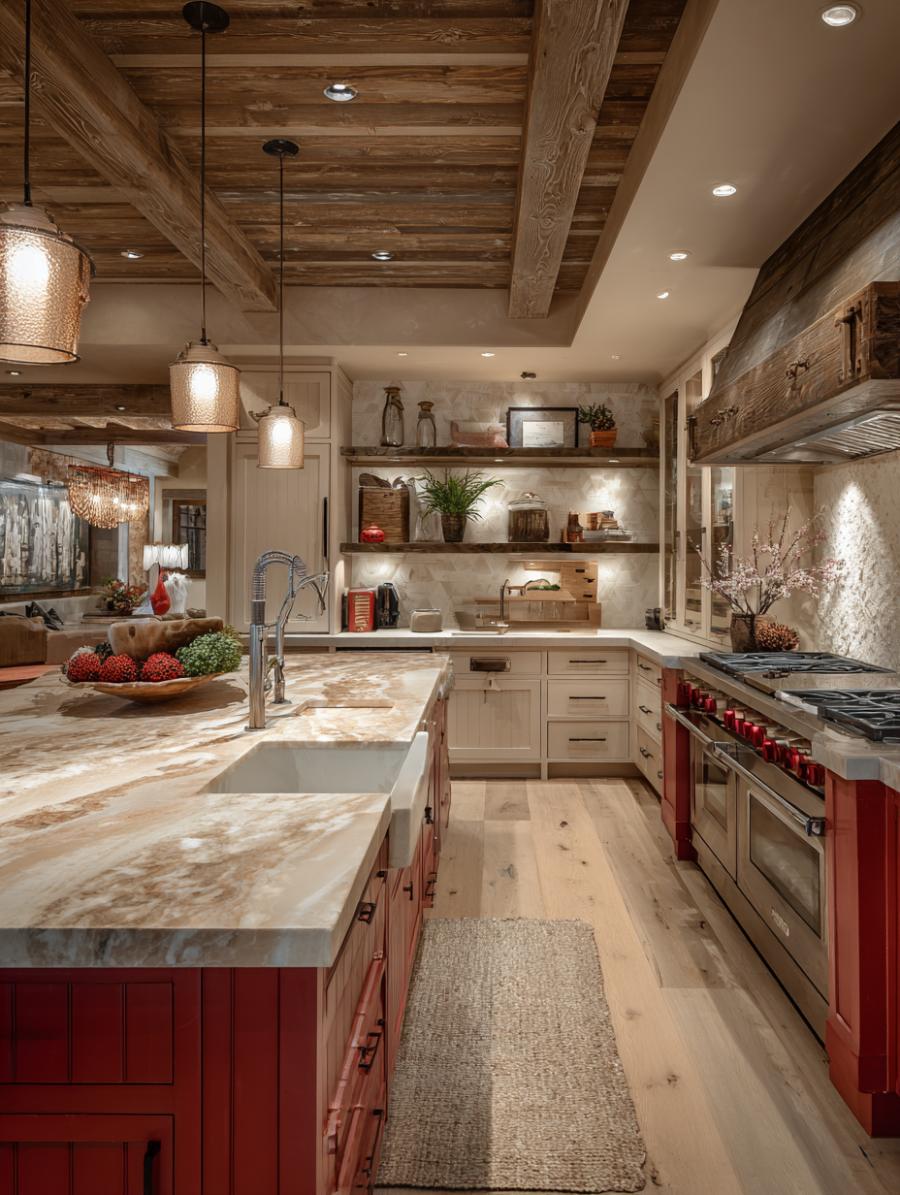
Hammered copper pendant lights. That’s what catches my eye first. Three of them hang at staggered heights over a farmhouse sink with a commercial-style faucet. The countertop has amber and cream veining that picks up the copper tones above.
Open shelving against a cream-colored stone tile backsplash displays wicker baskets, glass jars, and a red ceramic vase that ties into the island below. The ceiling is a full commitment: weathered planks running the length of the room with exposed beams that show their age in the best way. Cherry blossom branches in a vase near the range add a soft pink note. A grey woven runner protects the pale wood floor from traffic between the island and the perimeter cabinets.
Reclaimed Barnwood Island with Leather-Wrapped Stools
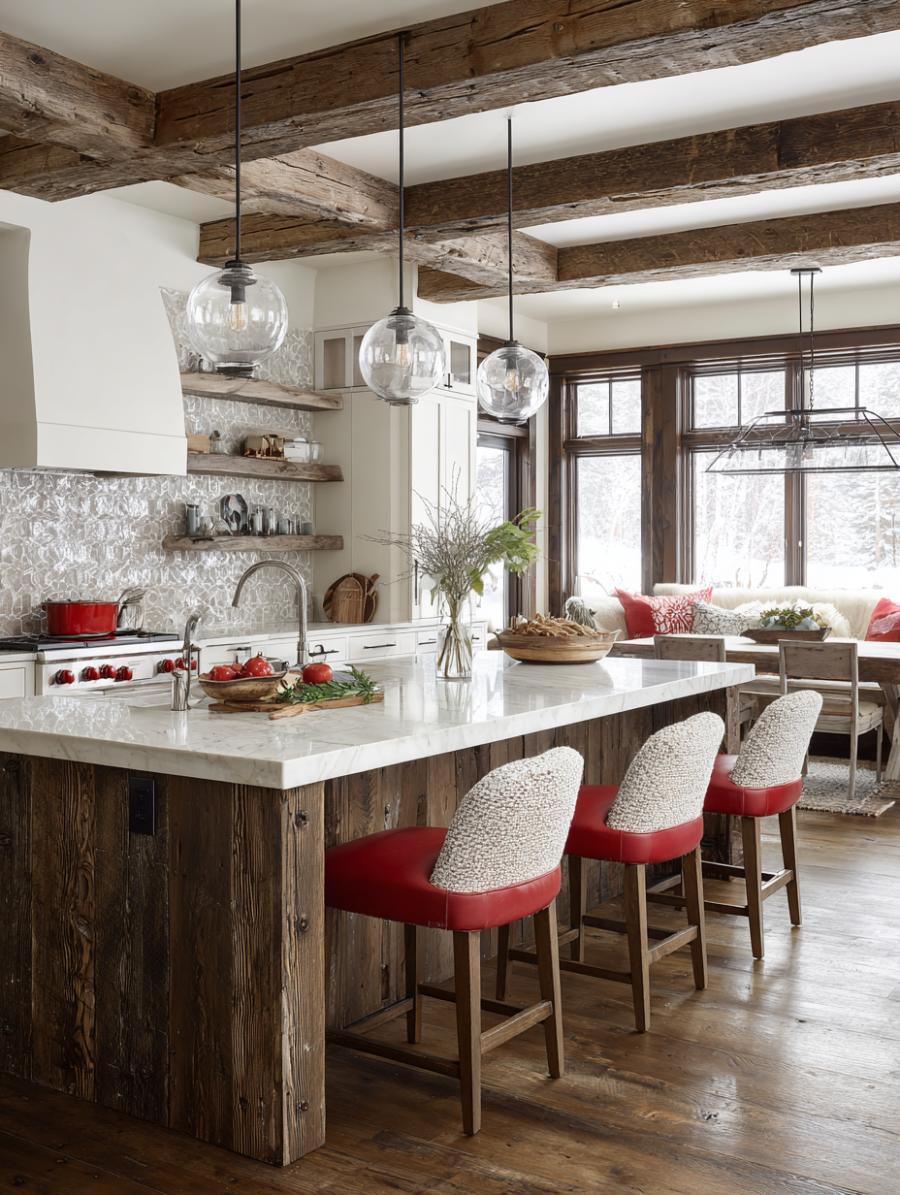
The barnwood on this island base has that silvered, weathered look that takes decades to develop naturally. Sitting atop it: a white quartz counter thick enough to make a statement. Four bar stools with cream bouclé backs and red leather seats line up underneath, and that combination is unexpectedly good.
Through the windows, snow blankets the landscape. A breakfast nook tucked into the corner has a built-in bench piled with coral and cream pillows, a sheepskin throw draped casually over one arm. The red Dutch oven on the stovetop is doing double duty as decoration. Clear glass globe pendants let all that natural light pass through without interruption. This is a kitchen designed for lingering.
“Color in the kitchen is an emotional decision dressed up as an aesthetic one.”
Stone Walls and Slate Floors in a French Country Revival
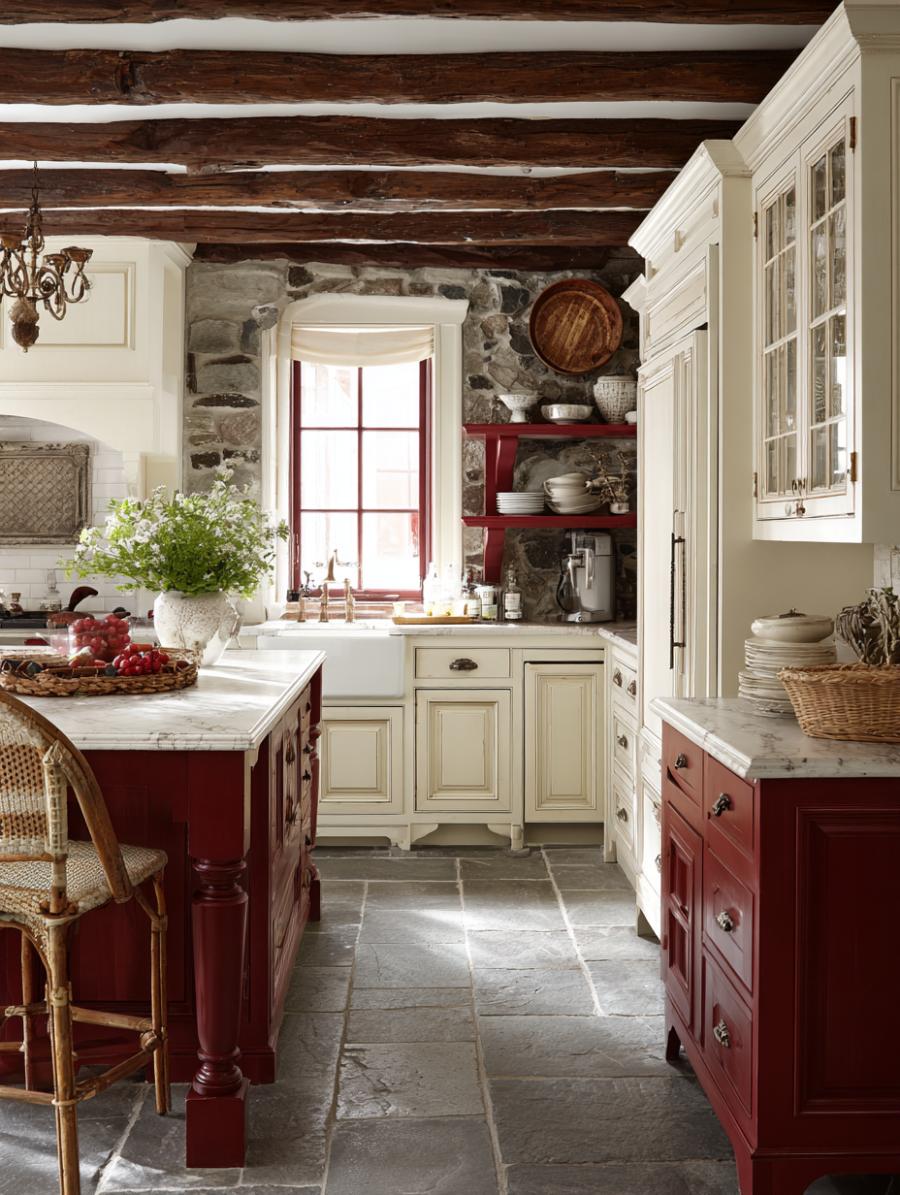
The fieldstone wall behind the sink is the real anchor here. Rounded river rocks in grey and tan tones, mortared together in an irregular pattern that suggests this building has stood for a century or more. Against it, cream-painted cabinets with a slightly distressed finish. Red open shelving holds white stoneware and a round wooden serving board.
Burgundy base cabinets and a matching island with turned legs sit on irregular slate floor tiles. The tiles have that natural cleft surface that shows every variation in color from charcoal to blue-grey. A wicker counter stool with curved arms pulls up to the island where white marble tops everything. The farmhouse sink has a polished brass faucet. Overhead, rough-hewn beams with visible bark edges stretch across the ceiling. Fresh white flowers in a weathered ceramic pitcher. Red cherries in a basket. Everything here says: someone lives well and has for a long time.
Nordic Farmhouse with a Crimson Anchor
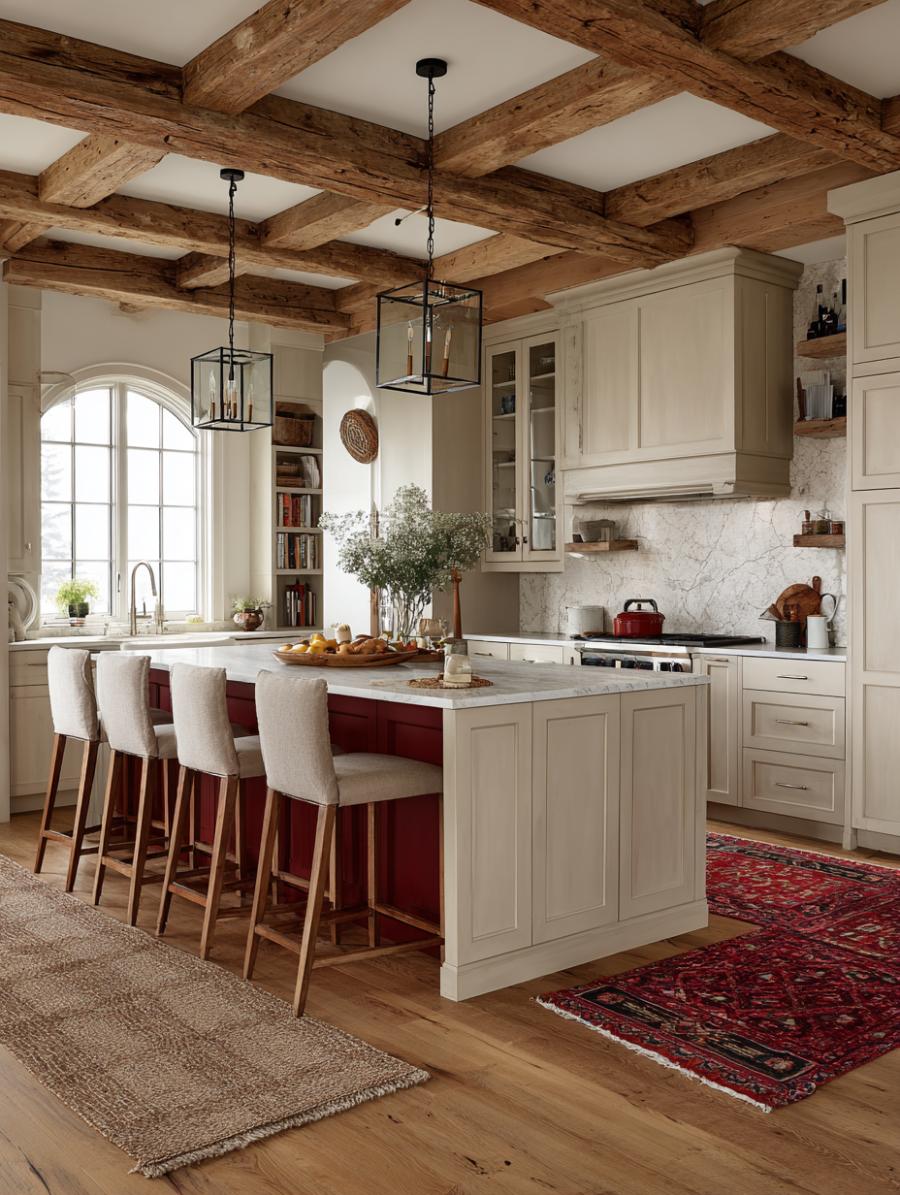
Here’s what gets me about this one: the color restraint everywhere except the island. Greige cabinetry. Cream walls. Honey-toned wide plank floors. Natural oak beam ceiling in a coffered pattern. And then this deep crimson island drops into the center of the room like an anchor.
Linen-upholstered bar stools with tapered wood legs line one side. The marble top has subtle grey veining. Black iron lantern pendants hang from chains, their geometric frames casting interesting shadows. An arched window over the sink lets in soft light. On the floor, a Persian-style runner in reds and blues creates a corridor of color that connects back to the island. The red kettle on the stovetop is a nice callback. Built-in shelving near the corner holds cookbooks and a woven basket. Olive branches in a glass vase. This kitchen knows what it’s doing.
If a full red island feels like too much commitment, start with one element: a red range, a set of bar stools, or even just open shelving painted in a barn red shade. Live with it for six months before deciding to go bigger.
Whitewashed Beams and Beadboard in a New England Cottage

The beams overhead have been whitewashed, but not uniformly. You can still see the grain and the knots, the places where the original wood color bleeds through. Below them, burgundy glass-front cabinets with brass hardware sit against a wall of white subway tile.
The beadboard island wears a cream paint that matches the perimeter cabinetry. Two bar stools upholstered in red and white ticking stripe fabric pull up to the marble-topped peninsula. A wall-mounted pot filler reaches over the range. Stainless steel double ovens are built into the adjacent wall. Fresh red roses in a silver vase. A Persian rug in faded reds and blues anchors the work triangle. The whole effect is old money coastal, the kind of kitchen where someone’s grandmother probably made clam chowder from scratch.
Regency Glamour with Gold Trim and Coffered Ceilings
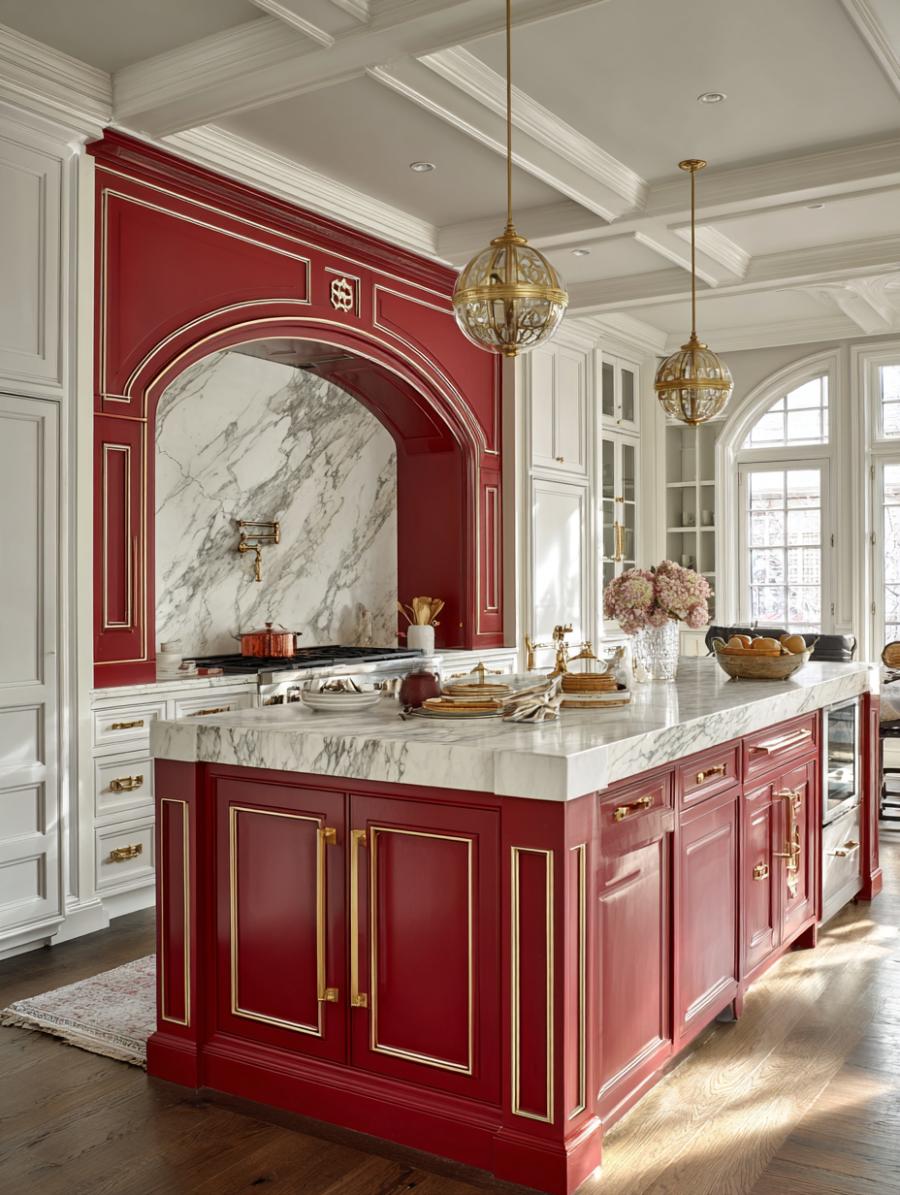
Now we’re somewhere else entirely. This is red as formal statement. The range alcove is framed in crimson panels with gold pinstripe trim, an arched opening revealing the Calacatta marble behind it. The island picks up the same treatment: red lacquer, gold detailing, brass bar pulls that catch the light.
Coffered ceilings in white frame the space above. Two brass globe pendant lights with intricate metalwork hang over the island. The countertop is thick marble with dramatic grey veining. Copper pots sit ready near the range. Pink hydrangeas in a crystal vase. Hardwood floors in a medium brown tone warm up all that formal architecture. This kitchen belongs in a Georgian townhouse or a very confident suburban renovation.
Calacatta with Gold Veining and an Arched Window Wall
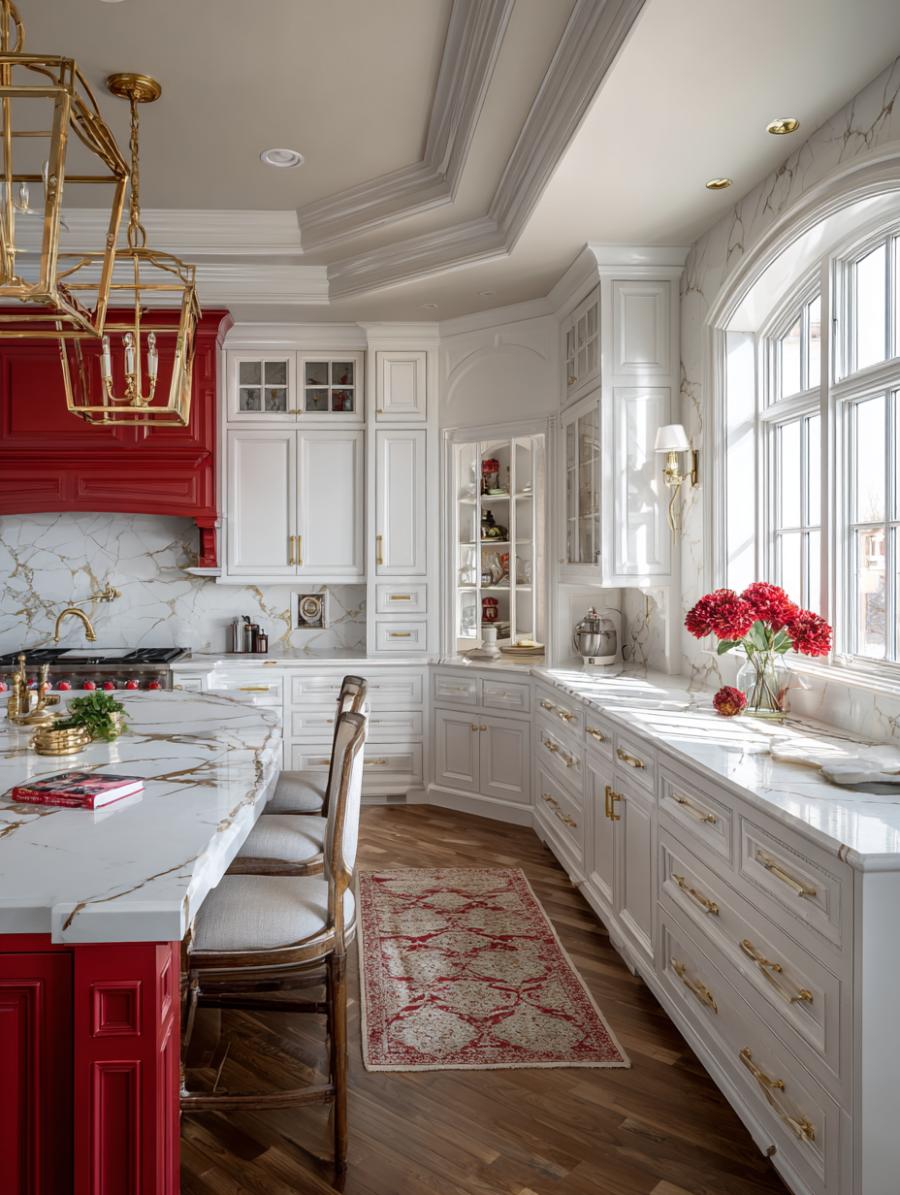
The marble here has gold veining that changes the entire temperature of the room. Against it, a red lacquered range hood dominates the cooking wall. White cabinetry with curved corner units and glass-front uppers fills the perimeter. Brass hardware everywhere: pulls, hinges, the wall sconces, the oversized lantern pendant.
The gold veining in the marble creates a visual bridge between the warm brass hardware and the cool white cabinetry. Without it, the red would feel isolated. With it, there’s a continuous thread of warmth running through every surface.
Red peonies in a glass vase sit on the counter near a massive arched window that floods the space with natural light. The runner rug has a worn, faded quality in cream and burgundy that softens all those hard surfaces. Two French-style bar stools with linen seats and curved backs tuck under the island. This is the kind of kitchen that makes you want to host dinner parties you’d normally never attempt.
Distressed Planks and a Cherry Red Range Wall
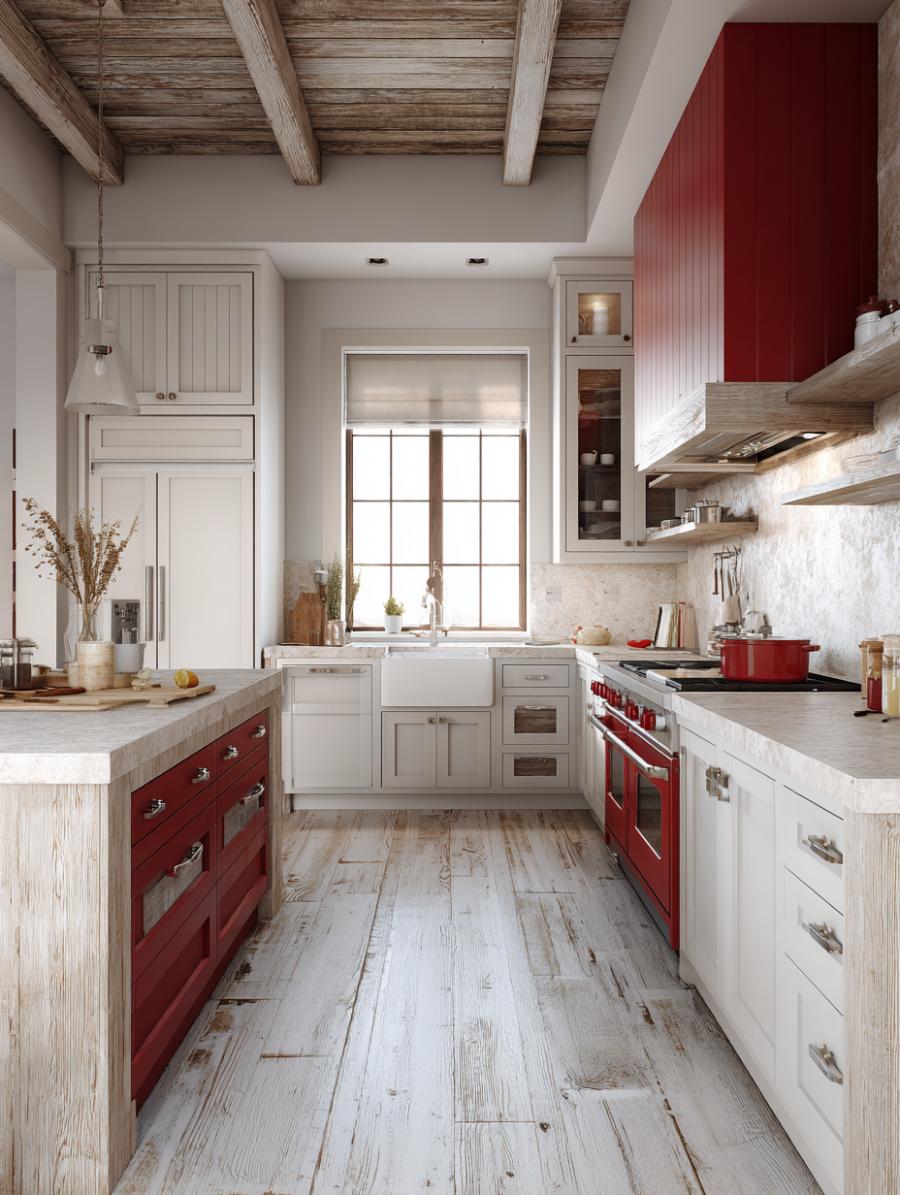
The floor here is whitewashed planks with visible grain and deliberate distressing. Against it, a deep cherry red range and matching range hood create a focal wall. The perimeter cabinets wear a soft grey-white with beadboard panel doors. Red base cabinets under the peninsula add another layer of that saturated color.
Weathered ceiling beams match the floor treatment. A pendant light with an industrial cage hangs near the sink window. The farmhouse sink has that classic apron front in white porcelain. Stone tile backsplash in cream tones. A red Dutch oven on the stove, red knobs on the range. Dried flowers in a ceramic vase. This kitchen could be in Sweden or Vermont or somewhere in the Pacific Northwest. It doesn’t care about geography. It cares about texture.
Shiplap Refrigerator Surround in Brick Red
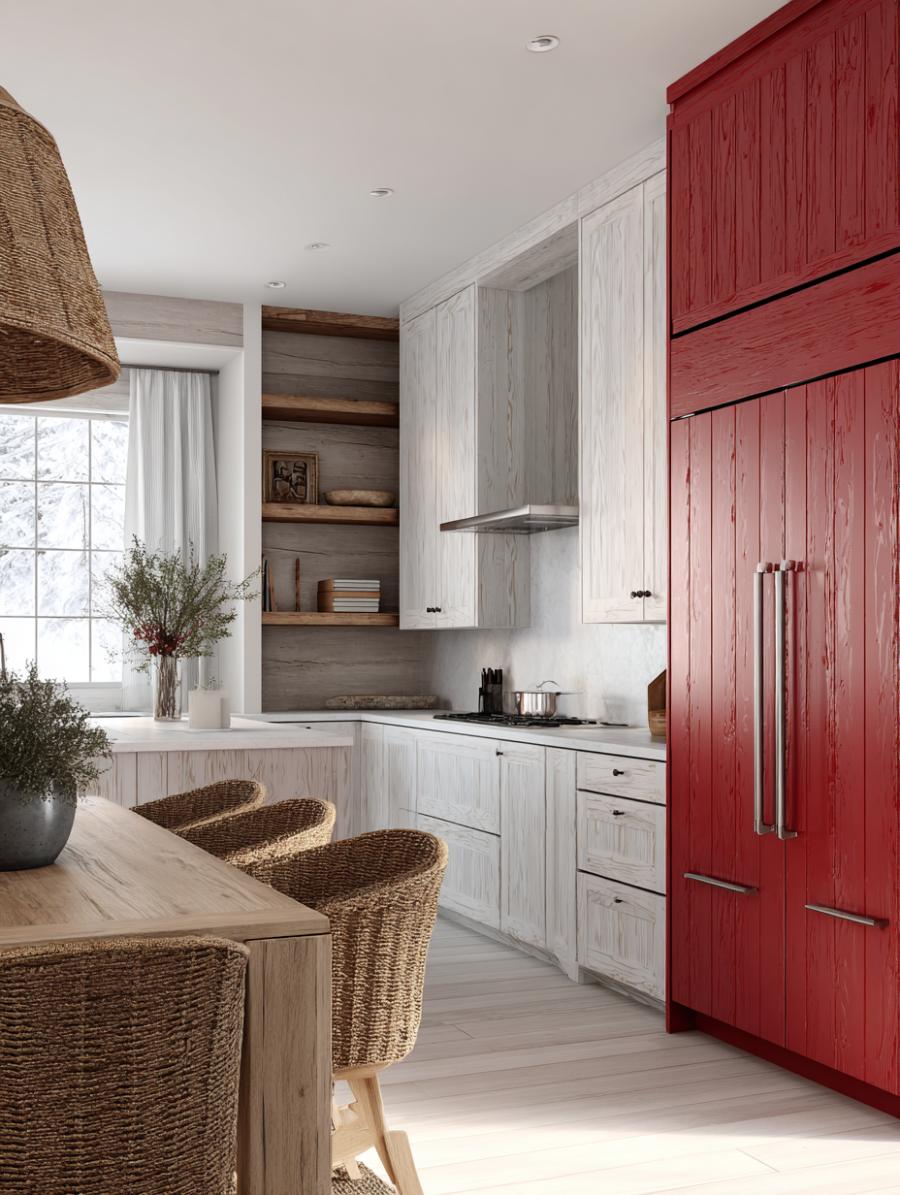
The refrigerator has been paneled to match a floor-to-ceiling red shiplap surround. It’s the kind of detail that adds $15,000 to a project but makes the whole room feel intentional. Against the opposite wall, whitewashed wood cabinets with visible grain blend into a shiplap backsplash.
Woven seagrass bar stools curve around a natural oak dining table. An oversized woven pendant shade hangs above. The stainless hood vents into the ceiling above the range. A recessed shelf in grey-brown reclaimed wood holds books and frames and small decorative objects. Eucalyptus and red berries in a dark ceramic vase. Snow outside the window. This kitchen knows exactly what season it is.
Terracotta Tile Backsplash with Bleached Wood Cabinetry
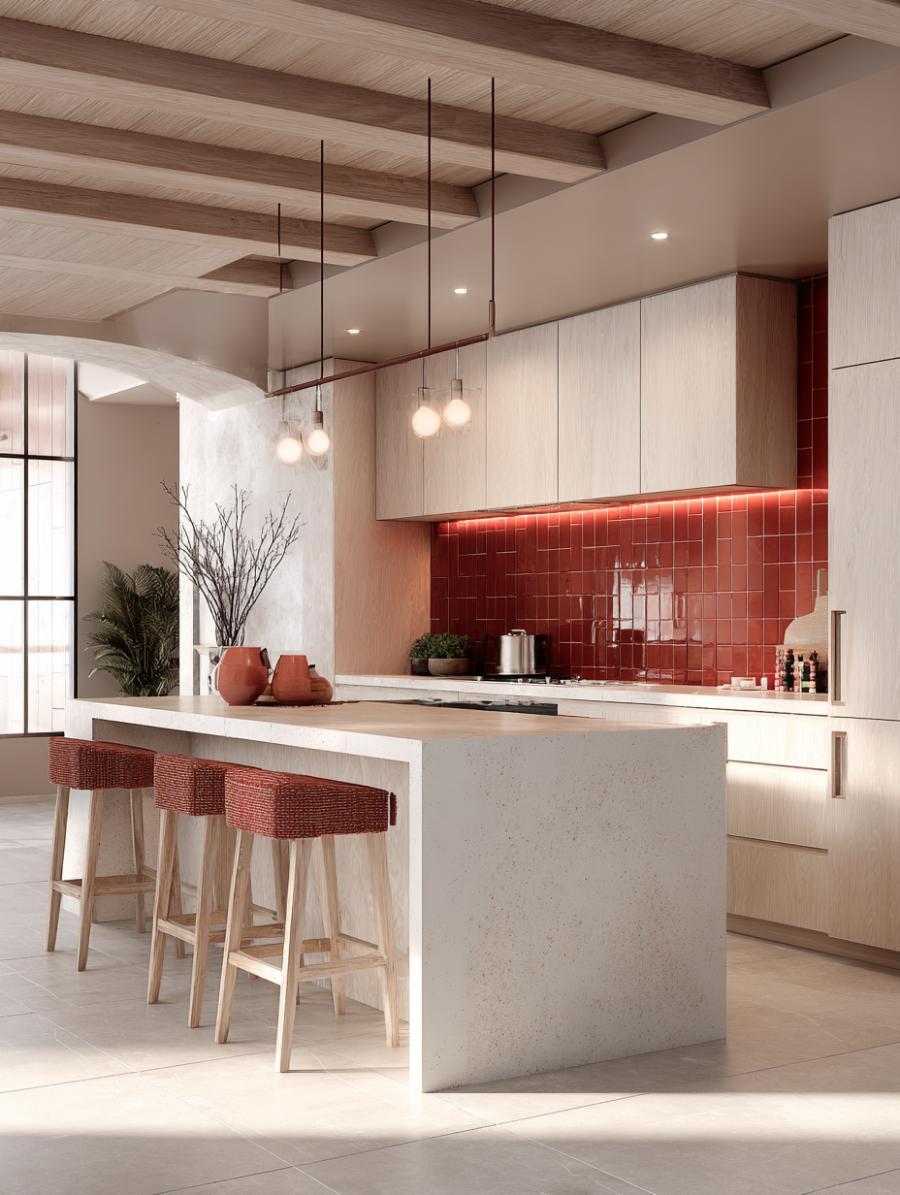
Square terracotta tiles with white grout lines run floor to ceiling behind the cooktop. It’s a warmer, earthier take on red that reads almost Mediterranean. Bleached oak cabinetry with minimal hardware flanks both sides. The island wears a white speckled quartz or terrazzo that picks up the terracotta warmth.
Two bar stools wrapped in rust-colored woven cord sit beneath. Exposed beam ceiling in pale wood tones. An arched doorway leads to a living space beyond where branches in a vase create silhouettes against the window. Copper pendant lights with exposed bulbs hang on thin black cords. Terracotta pottery on the counter echoes the backsplash. This is the most modern interpretation in the bunch, proof that red and white can feel thoroughly contemporary when you adjust the materials.
Twelve kitchens later, and the common thread isn’t really the red. It’s the confidence. Every one of these spaces committed fully to a vision and then executed it with materials that cost real money. The marble slabs alone in some of these could fund a modest bathroom renovation elsewhere. But that’s what separates aspirational design from actual design: following through.
Deep Burgundy Cabinets and Veined Marble Create a Kitchen Worth Lingering In
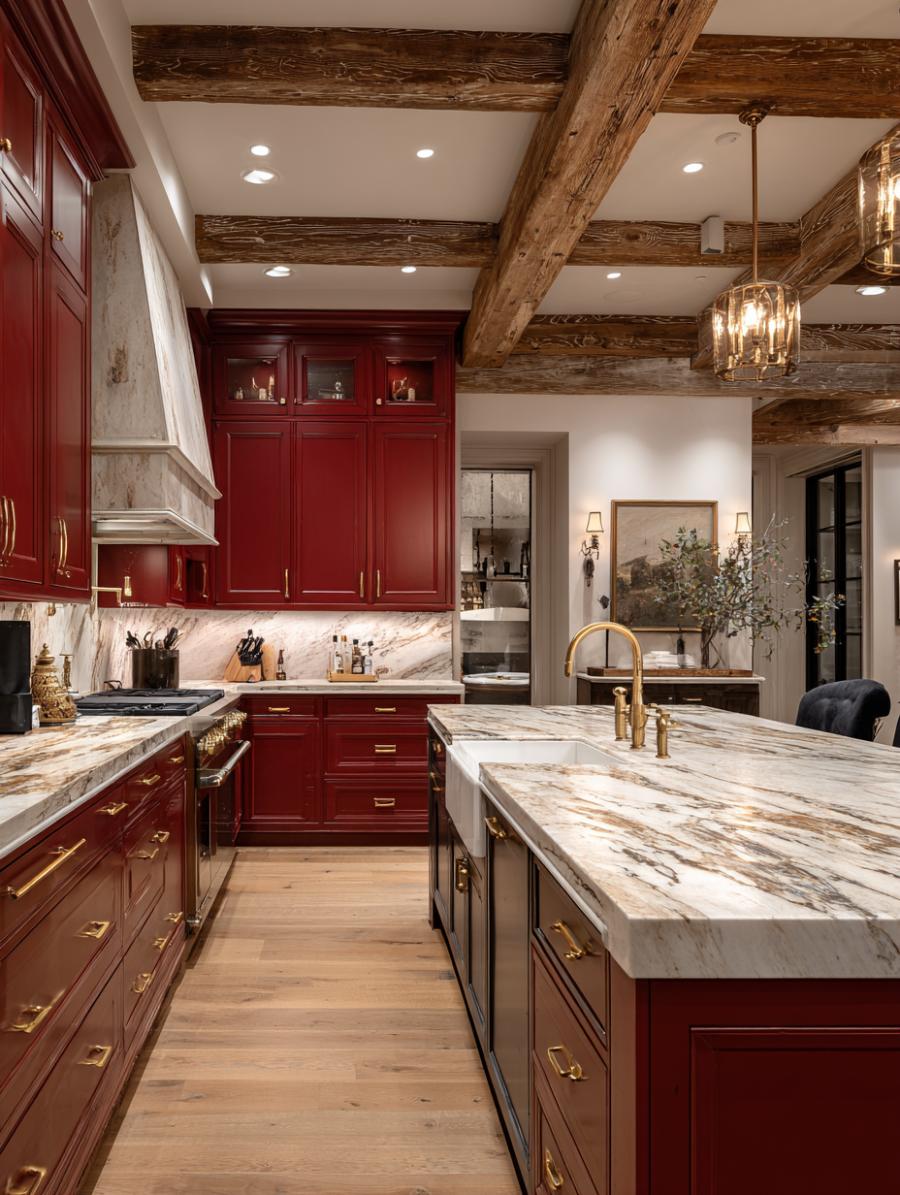
Those reclaimed wood ceiling beams sit heavy and dark against the white ceiling, each crack and grain line visible from below. The burgundy cabinetry runs floor to ceiling on the left wall, its matte finish interrupted only by glass-fronted upper cabinets displaying small decorative objects. Brass bar pulls catch light from the recessed fixtures overhead.
What strikes me most is the marble selection. The countertops and backsplash feature a cream base shot through with brown and grey veining that reads almost like a landscape painting. The range hood wears a stone veneer that matches, creating an unbroken sweep of pattern behind the cooktop. A farmhouse sink sits in the island beneath a brushed gold bridge faucet, and the wide-plank oak flooring underfoot shows just enough wear to feel honest.
Waterfall Marble and Cream Leather Barstools Signal Serious Investment
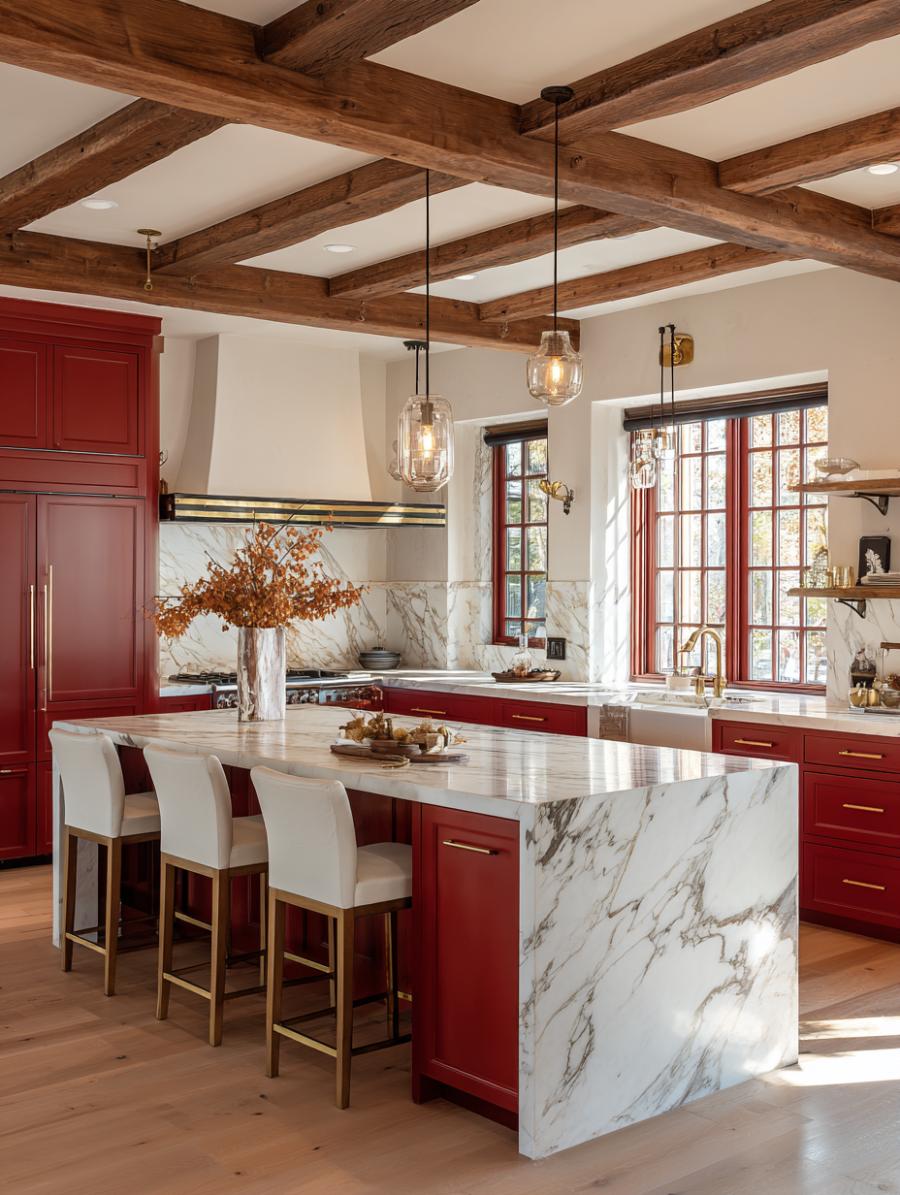
The waterfall edge on this island costs more than some entire kitchen renovations. Calacatta marble with its distinctive grey veining cascades down the side in one unbroken slab, meeting the pale oak floor without apology. Three cream leather barstools with brushed gold legs wait at the overhang, their low backs maintaining sightlines through the space.
Why It Works: The ceiling beams run in a crosshatch pattern here rather than parallel lines, creating visual depth that makes the room feel taller. That grid of weathered timber against the white ceiling gives the eye something to travel across while the burgundy cabinets anchor everything below.
Dried branches in amber and rust tones fill a marble vase on the island, picking up the warm undertones in both the wood and the red cabinetry. Behind the range, the backsplash tiles are cut larger than in most kitchens, each one a full slab of veined marble that reduces grout lines and reads more like a feature wall.
When the Range Hood Becomes a Design Object

That custom range hood stops conversations. A swooping white plaster form tapers upward like a piece of sculptural art, but the bottom edge is wrapped in a thick band of brushed gold that matches the hardware throughout the room. It hovers above a professional-grade range set into marble that continues right up to the ceiling.
The galley layout here puts everything within reach. Crimson cabinets line both sides, their brass pulls running horizontally on drawers and vertically on doors. A vintage-style runner in faded tans and greys softens the hardwood underfoot. At the far end, cream cabinets with glass fronts break up the red and connect visually to the bright marble surfaces. Someone placed cookbooks and small plants on an open floating shelf, the kind of casual styling that makes a room feel occupied rather than staged.
By The Numbers: Searches for “burgundy kitchen cabinets” have increased 87% year over year, with the shade outpacing both navy and forest green as the trending dark cabinet color for 2024.
Red Lacquer Against Salvaged Barnwood in a Converted Loft
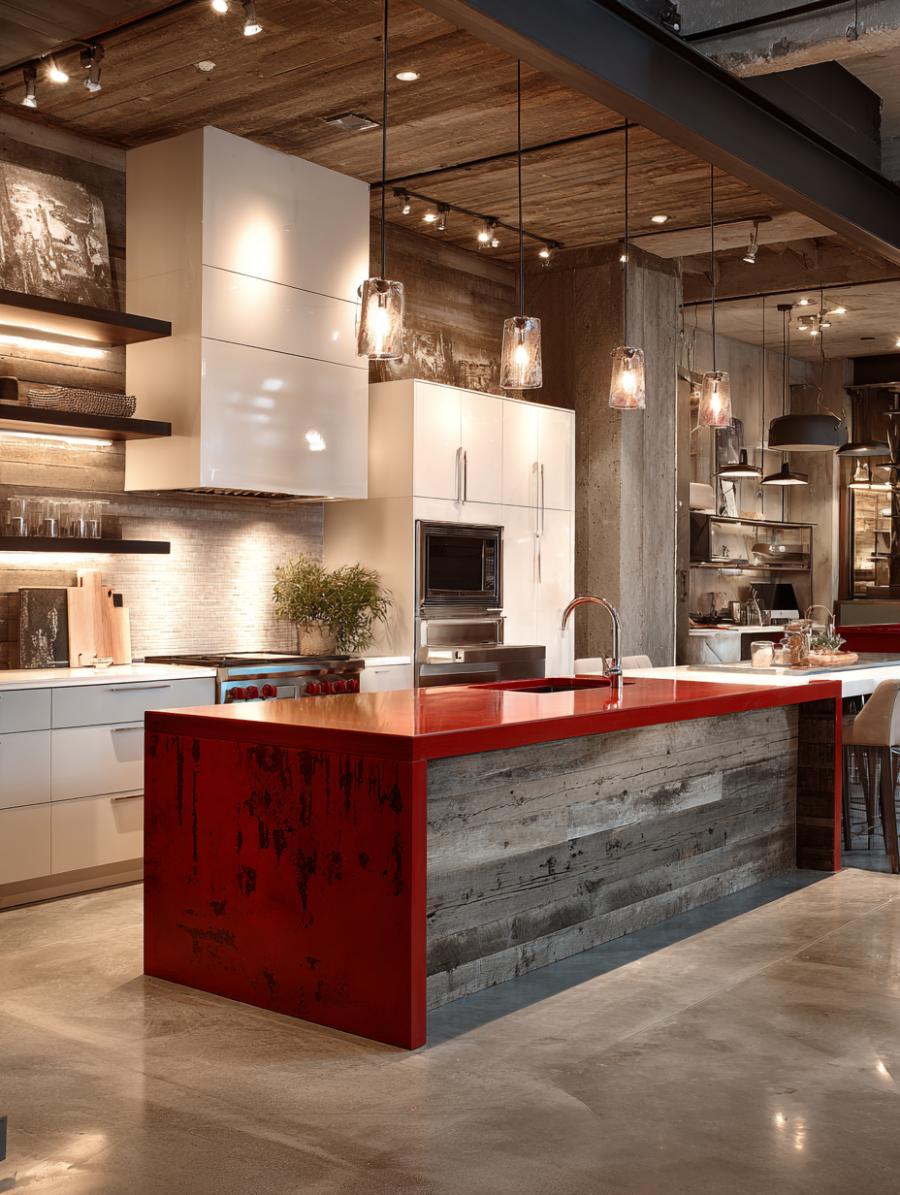
The island in this loft kitchen tells two different stories depending on which side you approach. From the front, it reads as a solid block of glossy red lacquer with intentional distressing that reveals darker tones beneath, almost like aged enamel on a vintage car. Walk around to the back and you find silvered barnwood planks running horizontally, their grey patina untouched and authentic.
Overhead, reclaimed timber boards form the ceiling, their varied widths and weathered surfaces contrasting with the high-gloss white upper cabinets below. Glass pendant lights hang on thin black cords at staggered heights above the island. The polished concrete floor reflects all of it back, doubling the visual information in a way that makes the space feel larger than its footprint suggests.
An abstract painting in grey and cream tones leans against the exposed brick on a floating shelf. Fresh herbs grow in a small pot near the sink. Behind the range, a linear mosaic backsplash in taupe and cream picks up the neutral tones from the ceiling while letting the red island remain the undisputed focal point.
Concrete, Reclaimed Timber, and a Red Wall That Changes Everything
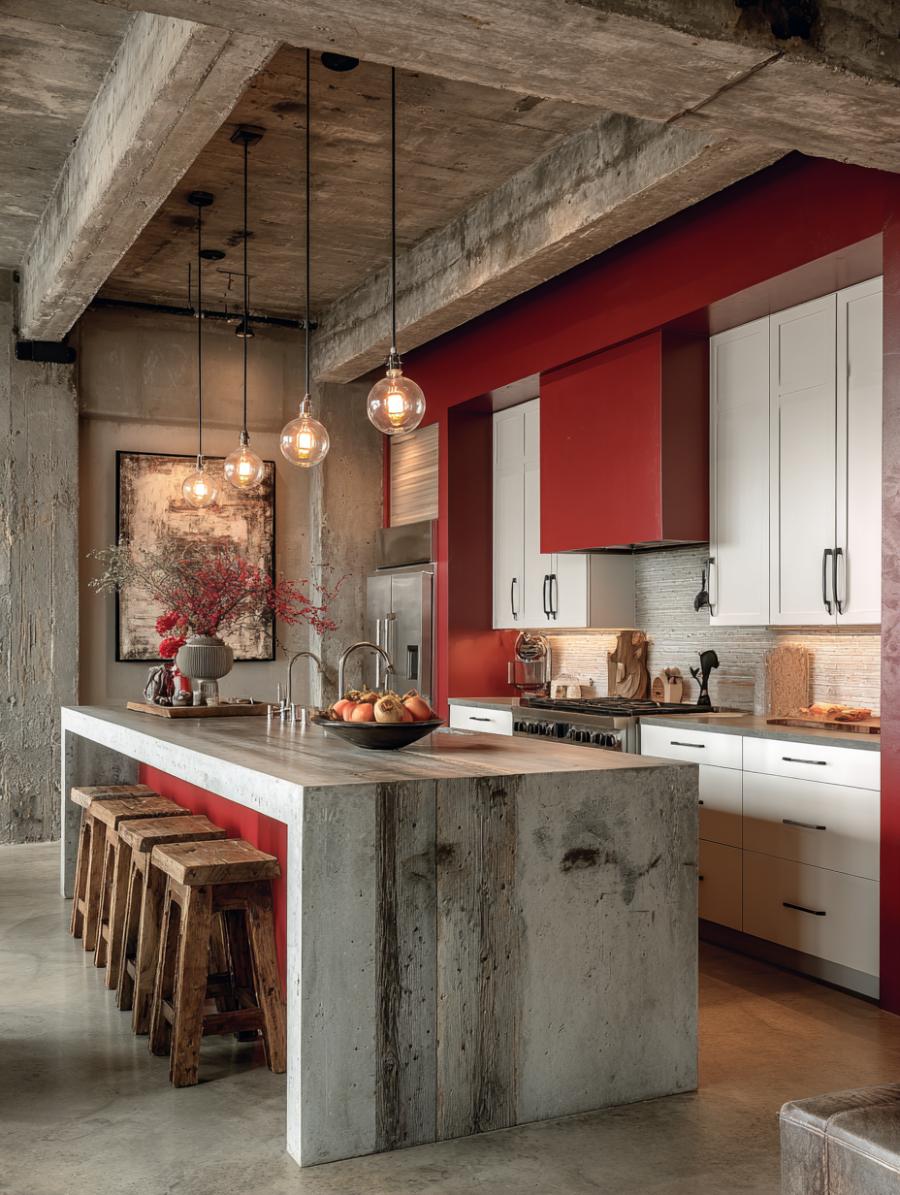
Raw concrete dominates this loft kitchen in a way that should feel cold but somehow does not. The ceiling beams are poured concrete, massive and unfinished, their grey surfaces marked with the grain patterns from their wooden forms. Against one wall, a deep terracotta red creates an alcove for white shaker cabinets and a stainless range, framing the cooking zone like a painting.
Try This: If committing to red cabinets feels like too much, a painted accent wall behind your cooking zone achieves a similar impact for a fraction of the cost and can be repainted when trends shift.
The island base is made from weathered grey wood planks that match the concrete in tone but not in texture. A butcher block top adds warmth at working height, and rough-hewn timber stools tuck underneath for casual seating. Globe pendant lights on black cords cluster above, their amber filaments glowing against all that grey.
Branches bearing red berries fill a vase on the counter. A bowl of peaches sits near the edge of the island. Small gestures of color and life that prove industrial spaces need not feel sterile. The linear tile backsplash behind the range reads almost like woven linen from a distance, another layer of texture in a room built from them.