🔥 Would you like to save this?
Change nothing in a kitchen but the cabinet doors and you get a different room. The same layout, counters and lighting can read as a Georgian butler’s pantry, a Copenhagen apartment or a California beach house. The door profile is doing most of that work: how wide the frame is, whether the panel steps back or rises forward, whether the light falls into a groove or slides across a slab.
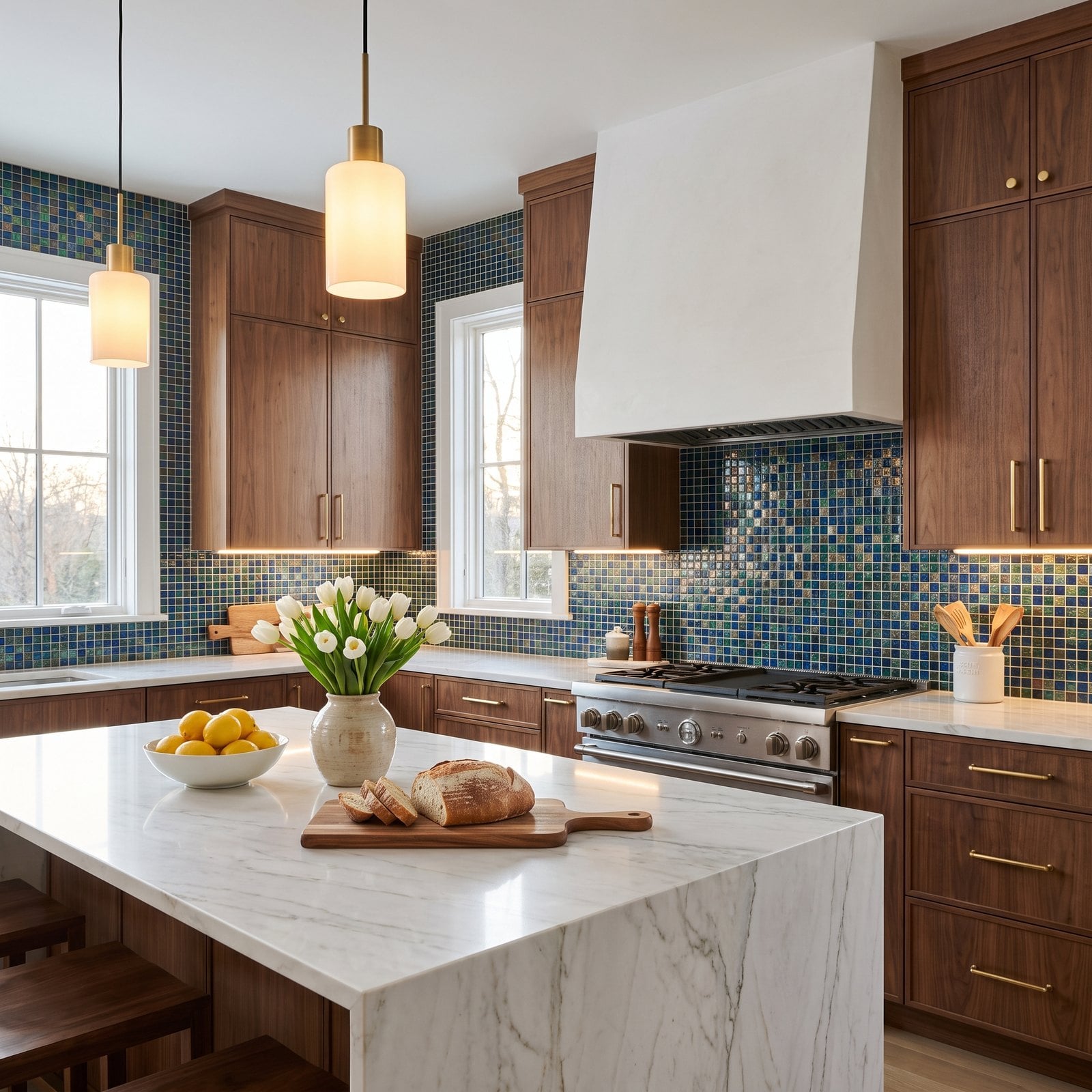
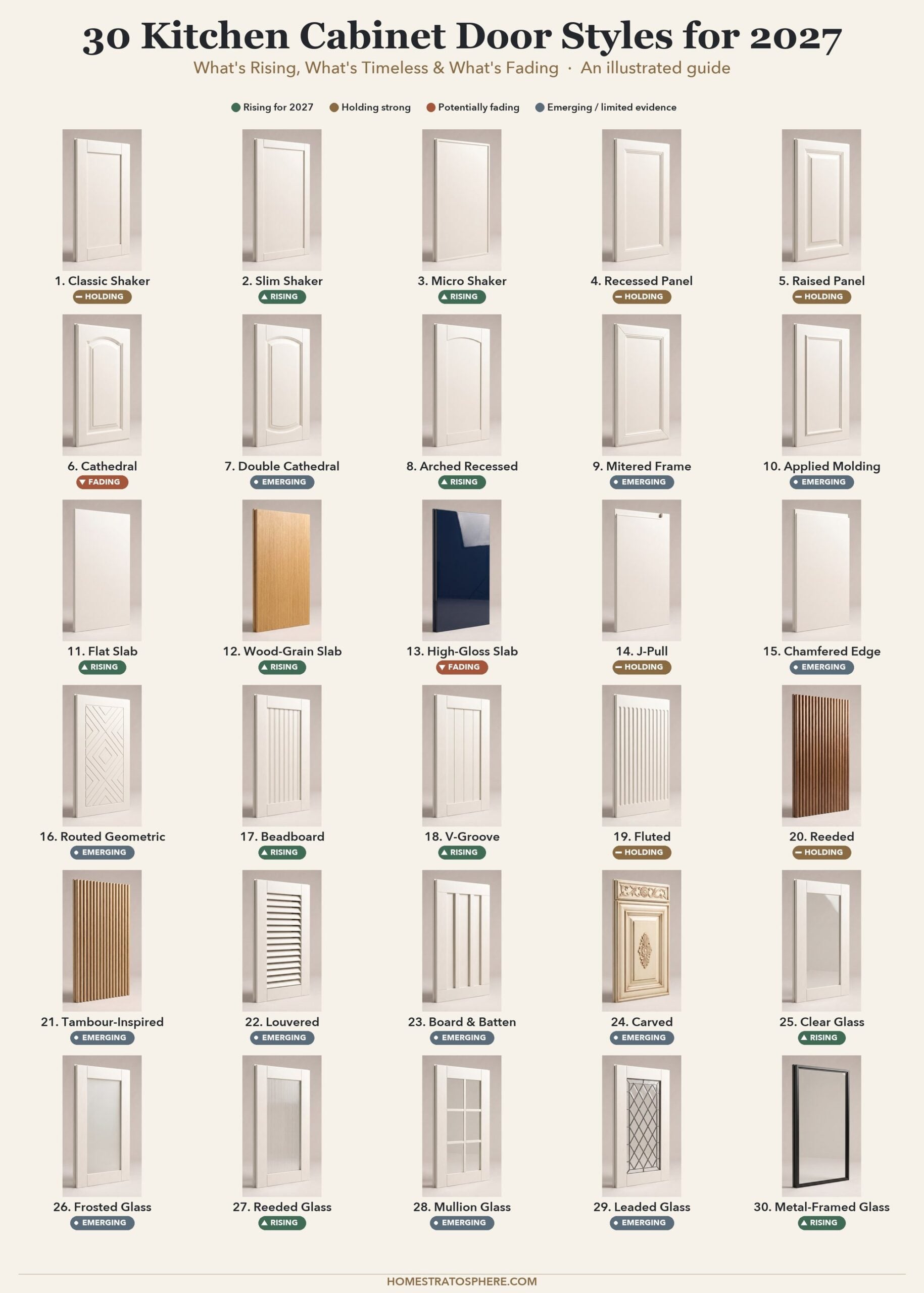
That is why the door is the decision worth getting right, and the one most worth looking ahead on. Cabinets tend to stay put for many years, so a door chosen now has to look right well into the 2030s. Below are 30 cabinet door styles, each drawn on the same 15-by-30-inch door in the same light so you can compare them like for like. Each one is also shown installed in a real-feeling kitchen and rated two ways, using two kinds of evidence: what the industry research forecasts for 2027, and what Home Stratosphere’s own readers actually save, love and pick when they see these doors in kitchens on our site.
In order to come up with the very specific design ideas, we create most designs with the assistance of state-of-the-art AI interior design software. Also, assume links that take you off the site are affiliate links such as links to Amazon. this means we may earn a commission if you buy something.
The Cabinet Door Styles to Watch in 2027
We read the major 2025 and 2026 trend studies, including the Houzz U.S. Kitchen Trends Studies, the NKBA Kitchen Trends Reports, MasterBrand’s dealer and designer surveys and Kitchen & Bath Design News manufacturer roundups, alongside designer forecasts in Homes & Gardens, Livingetc and Domino. Here are the door styles with the strongest positive evidence. These are forecasts, not facts about 2027: NKBA’s 2027 report and Houzz’s 2027 study had not been published when this guide was written.
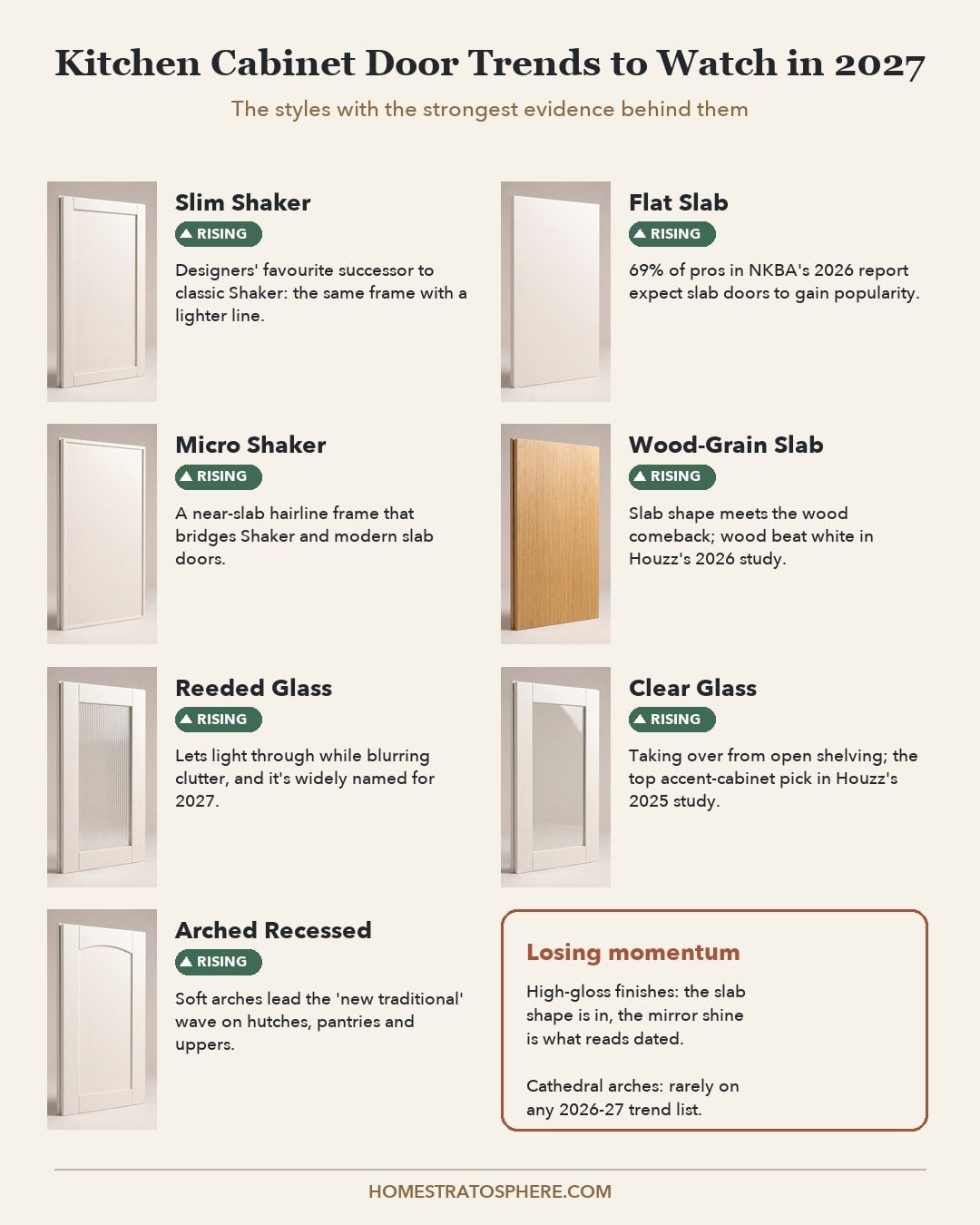
- 2. Slim Shaker (High confidence): Narrow-frame Shaker is the clearest successor to the classic, keeping the familiar frame while looking lighter and more modern.
- 11. Flat-Panel Slab (High confidence): Slab doors have the strongest forward-looking pro data of any profile, especially in warm wood and matte finishes.
- 3. Micro Shaker (Medium confidence): The ultra-thin-frame version of Shaker is gaining ground as a bridge between Shaker and slab doors.
- 12. Wood-Grain Slab (Medium confidence): Wood-faced slab doors combine the two strongest signals in the data: slab profiles and the wood comeback.
- 27. Reeded Glass-Front (Medium confidence): Reeded glass is one of the most-mentioned door details heading into 2027: it lets light through while blurring clutter.
- 25. Clear Glass-Front (Medium confidence): Glass-front uppers are replacing open shelving as the way to display dishes while keeping dust out.
- 8. Arched Recessed Panel (Medium confidence): Soft arched panels are one of the best-supported ‘new traditional’ details heading into 2027, best used on a hutch, pantry or uppers.
Two numbers anchor the forecast. In the NKBA’s 2026 Kitchen Trends Report, 69% of the 634 design professionals surveyed expected flat slab doors to gain popularity and 59% said wood grain is growing (PHCP Pros, 2025). In Houzz’s 2026 study of 1,780 renovating homeowners, wood overtook white as the most popular cabinet colour, 29% to 28% (Houzz, 2026).
The Styles That May Be Losing Momentum
Here the evidence is thinner, and we would rather say so than invent a decline. Only two styles have direct, credible signals of fading:
- High-gloss slab (#13), medium confidence. Homes & Gardens and Hunker both list high-gloss and highly lacquered cabinetry as on the way out in 2025 and 2026. The slab shape itself is rising; it is the mirror shine that is losing favour.
- Cathedral raised panel (#6), low confidence. It is named as dated in one sponsored contractor segment and is absent from every designer and manufacturer trend list we reviewed. Arches in general are coming back (see #8), just simpler ones.
Two more nuances. Fully fluted kitchens are being called overdone, but fluting used as an accent is still widely specified, so we classify fluted doors as holding. Classic Shaker and raised panels are not fading on the evidence: Houzz’s homeowner data shows Shaker at 64% of remodels in the 2022 study and 61% in 2025, with raised panels steady at 12 to 13% (Houzz, 2022; Houzz, 2025).
What Home Stratosphere’s Own Readers Say
Industry surveys ask designers and remodelers what they expect. We also have a direct record of what readers do. Every kitchen image on Home Stratosphere carries save, Pin It and love/dislike buttons, and our gallery runs head-to-head image votes. For this guide we used AI image analysis to identify the cabinet door style in each of the 2,250 kitchen images readers engaged with between August 31 and October 11, 2026, across 194 articles. We then matched them against 1,432,410 image views, 4,321 saves (1,069 of them to Pinterest), 12,244 love or dislike reactions and 2,936 head-to-head votes.
Because some articles get far more traffic than others, we score each style against the other images in the same article. A score of 100 means a door style performs exactly like its neighbours; 129 means 29% more saves than the images around it.
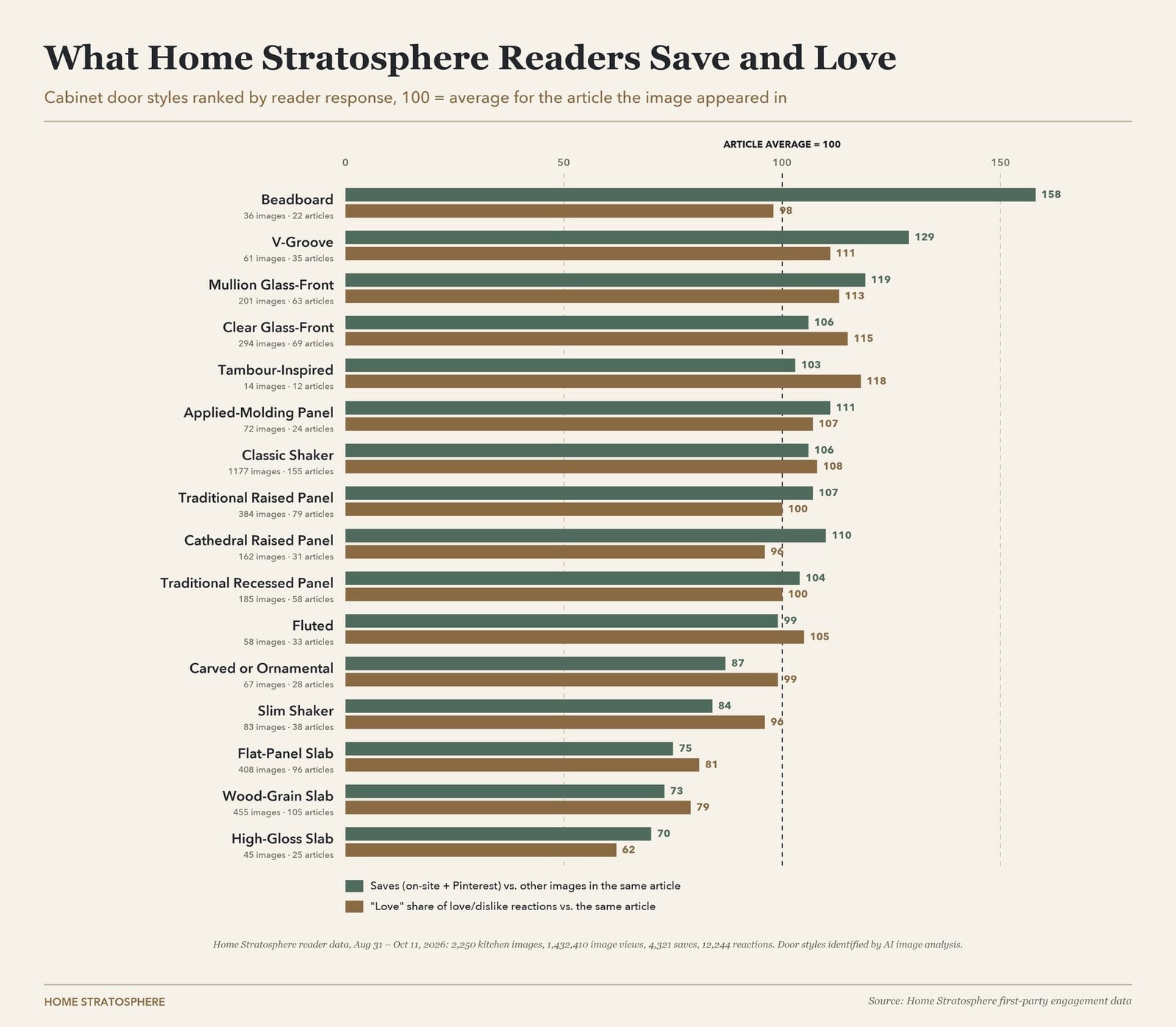
- Cottage texture wins the save button. Beadboard kitchens drew 58% more saves than the images around them, and V-groove 29% more. These are the doors readers bookmark for later.
- Glass-front uppers are reader favourites. Mullion glass scored 119 on saves and 113 on love; clear glass-front scored 115 on love. Both agree with the industry signal for glass.
- Shaker earns its place. Across 1,177 images in 155 articles, classic Shaker beat its neighbours on both saves (106) and love (108). That is remarkable for the most common door on the site.
- Slab doors underperform with our readers. Flat slab (75), wood-grain slab (73) and high-gloss slab (70) all drew fewer saves and a lower love share than the images around them. High-gloss also won only 21% of its head-to-head votes.
- Inset beats frameless. Inset kitchens scored 111 on saves and 110 on love; frameless kitchens scored 68 on both (see the mounting section below).
About this data: it reflects Home Stratosphere’s audience, which leans toward traditional and transitional homes; many images are design renderings; and readers react to the whole kitchen, not just the doors. Door styles were identified by AI and spot-checked, and styles with too few images are marked as not yet measurable. Treat the scores as a strong reader-preference signal, not a market-share figure.
Classic and Traditional Cabinet Door Profiles
1. Classic Shaker
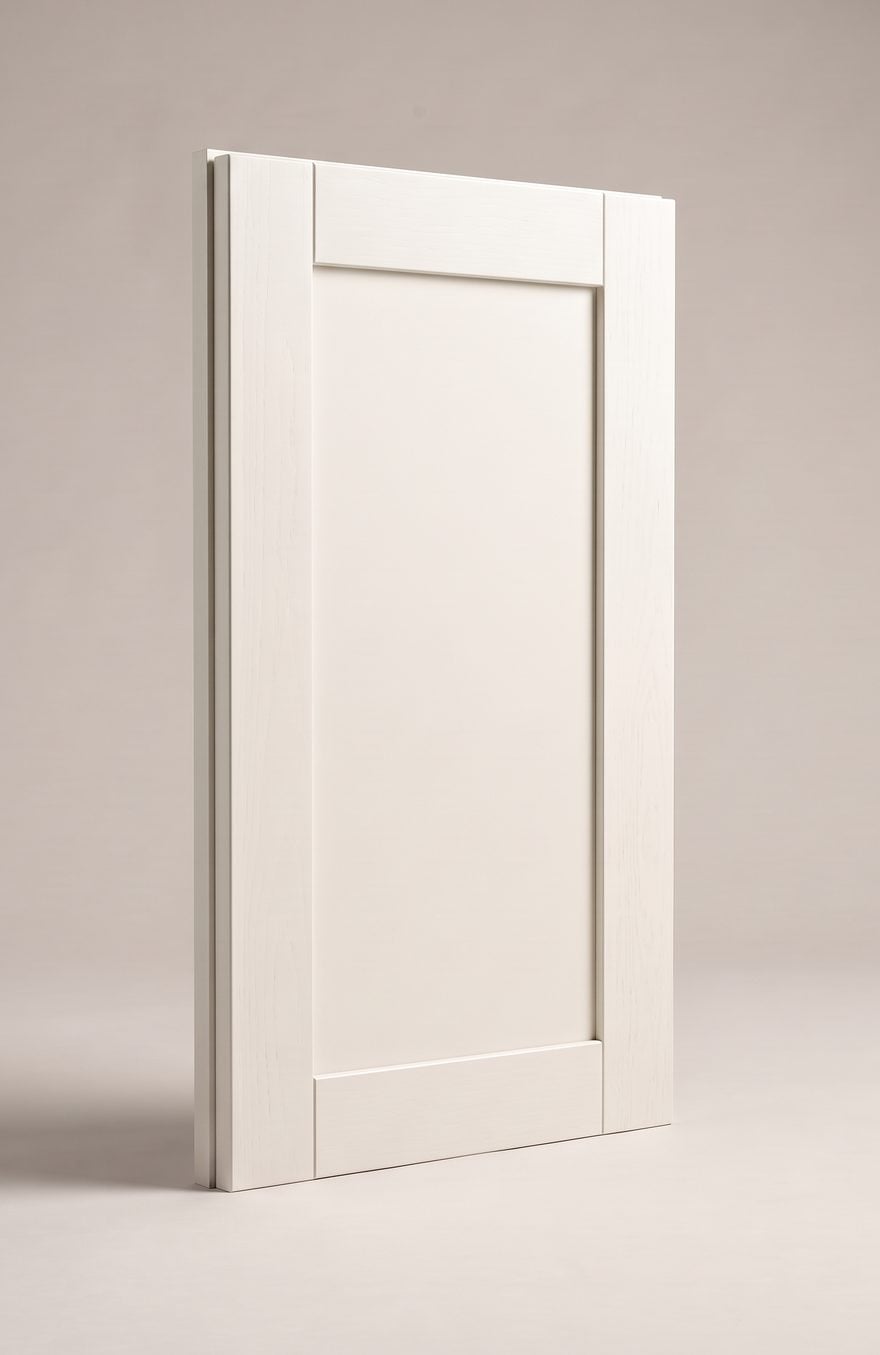
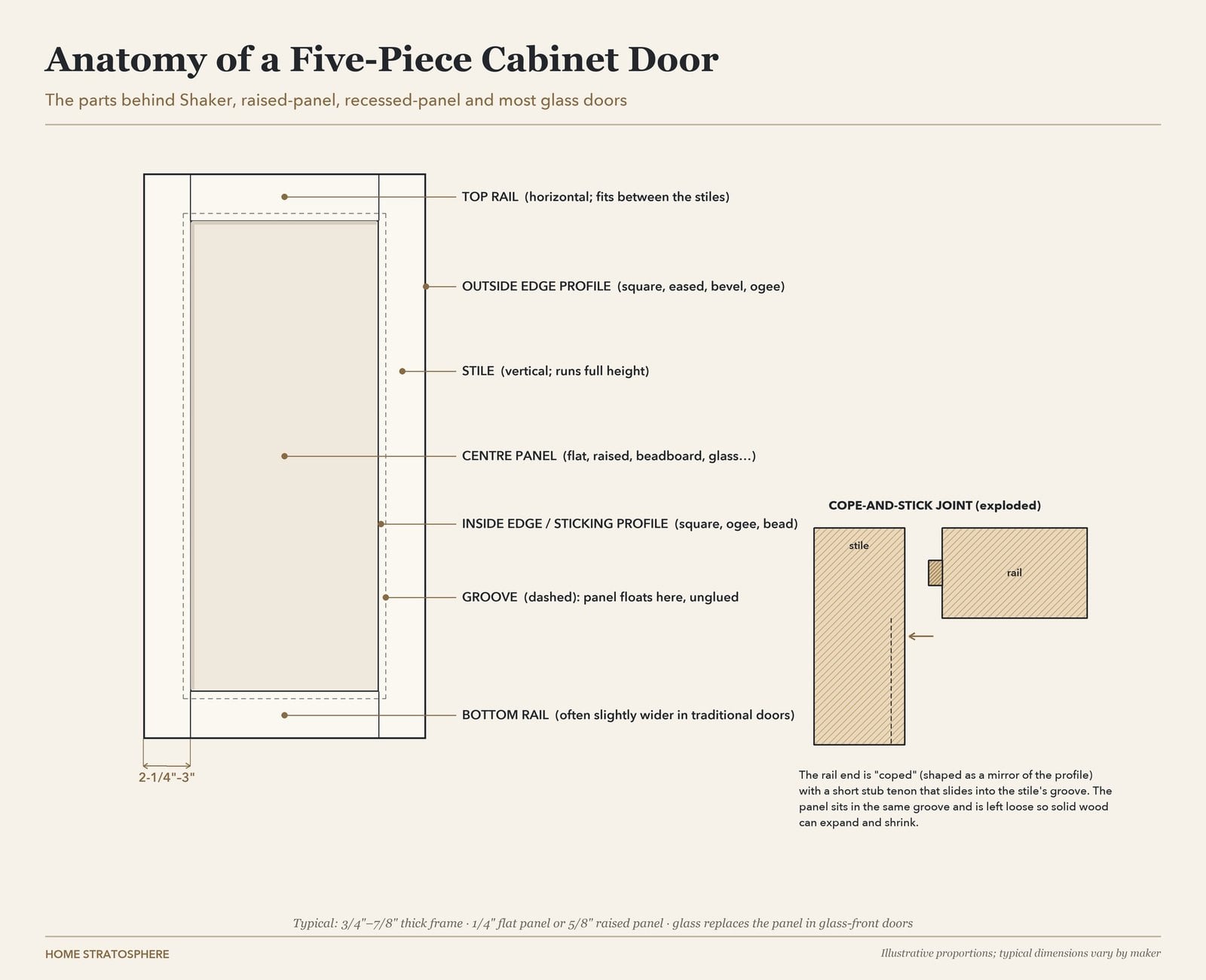
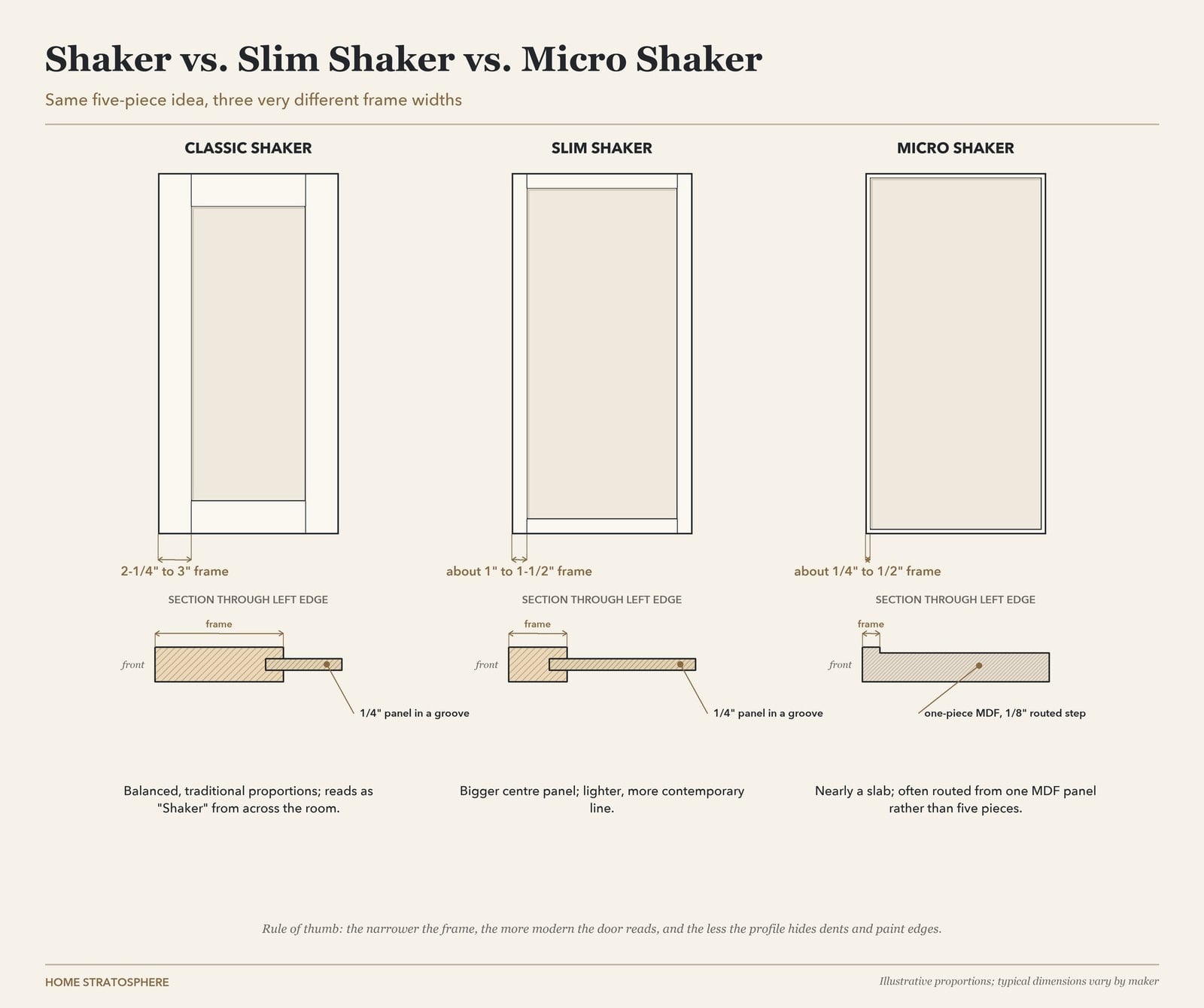
Four square-edged frame pieces around a flat, recessed centre panel. Nothing curved, nothing carved, which is exactly why it works almost everywhere. The frame is usually 2-1/4 to 3 inches wide, wide enough to read as a frame from across the room.
Home Stratosphere reader data: above average reader response. Saves 106, love share 108 (100 = the average of the article the image appeared in), across 1,177 images in 155 articles.
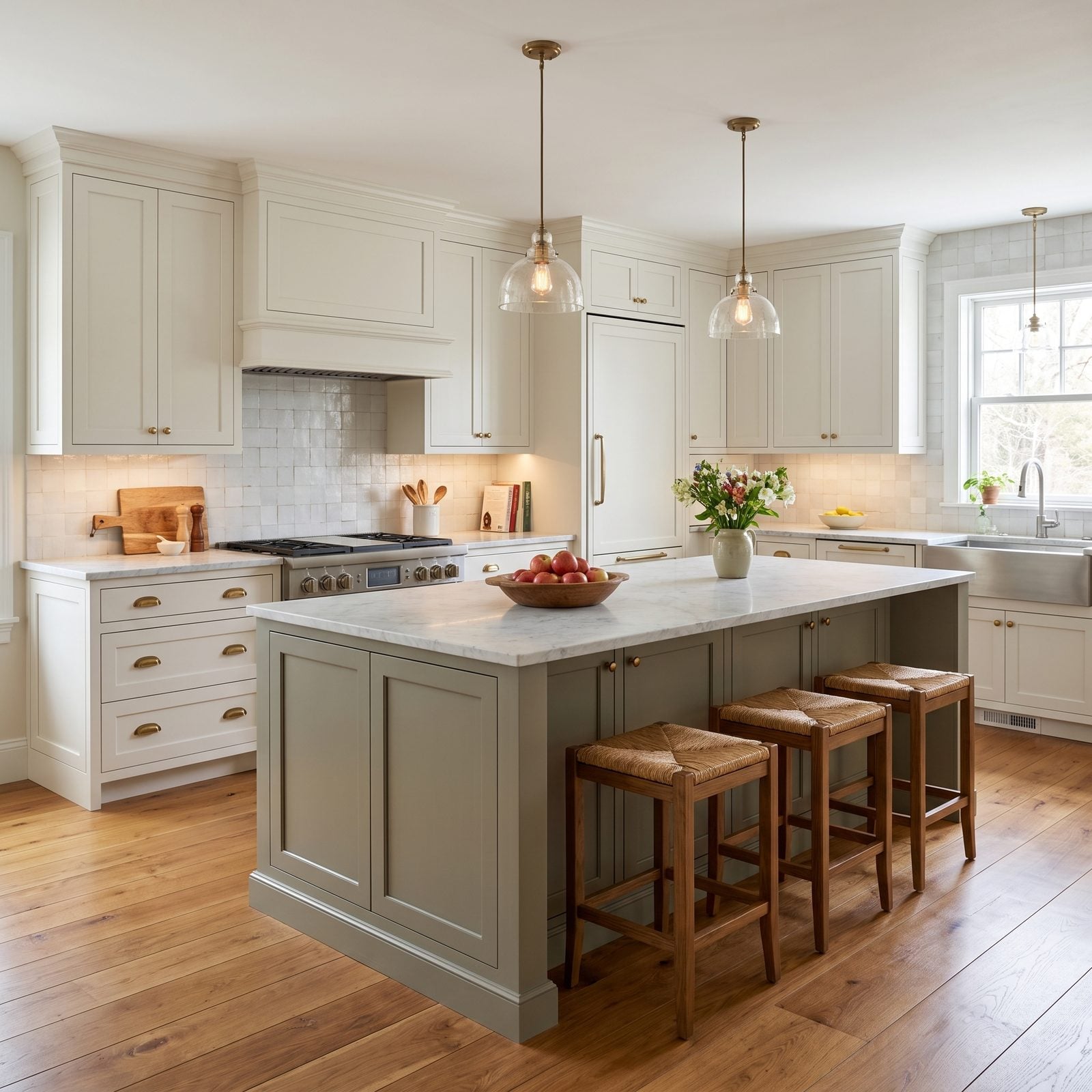
- Best kitchen styles: Transitional, farmhouse, traditional, coastal, and even restrained modern kitchens.
- Finishes and colours: Painted whites and creams, soft greens, navy, stained oak or walnut.
- Relative cost: $$ (moderate) compared with the other doors here
- Cleaning: Easy. The square inside corner collects a little grime; wipe it with a damp cloth folded over a finger.
- Durability: Very good. Painted MDF centre panels avoid the hairline crack that can appear where a solid-wood panel meets painted rails.
Designer move: Pair it with a two-tone scheme (painted perimeter, wood or deeper-colour island) to keep a familiar profile from feeling generic.
Mistake to avoid: Don’t mix in raised-panel or arched doors elsewhere in the same kitchen. Shaker looks best when it is the only profile.
What the research says: Houzz homeowner studies show Shaker as the top door style every year: 64% (2022 study), 60% (2024), 61% (2025). MasterBrand’s 2026 dealer/designer survey says Shaker ‘remains the most popular cabinet door style’, and KBDN’s June 2026 manufacturer roundup quotes Crystal Cabinet Works: ‘Shakers are still the champ’. The counterpoint: Share has eased from 64% (2022) to ~60-61%. Designers say plain/chunky Shaker is being supplemented (Real Simple/MasterBrand 2026: ‘decorative details over plain Shaker’; H&G Mar 2026 ‘paneled’ cabinets; Judi Cooper: ‘thick rails…aren’t going to stick around’). Secondary outlets report a 2026 Houzz figure of 58% but this could not be verified on a loadable page. Sources: Houzz, 2022; Houzz, 2024; Houzz, 2025; MasterBrand, 2025; Kitchen & Bath Design News, 2026; Real Simple, 2026; Homes & Gardens, 2026.
2. Slim Shaker
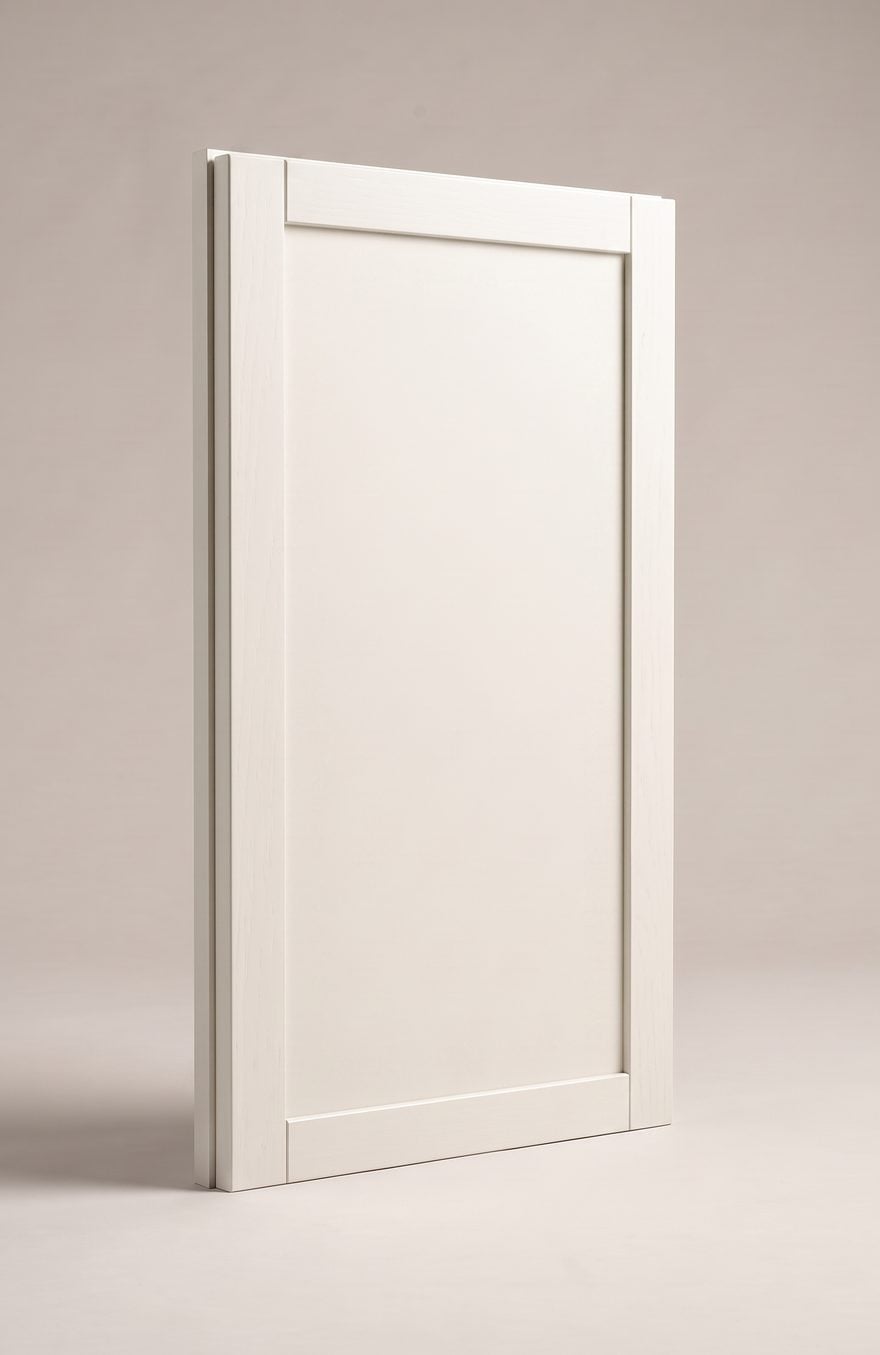
The same five-piece logic with the frame cut down to roughly 1 to 1-1/2 inches. The centre panel grows, the door looks lighter, and the kitchen reads as more contemporary without losing the warmth of a frame.
Home Stratosphere reader data: below average reader response. Saves 84, love share 96 (100 = the average of the article the image appeared in), across 83 images in 38 articles.
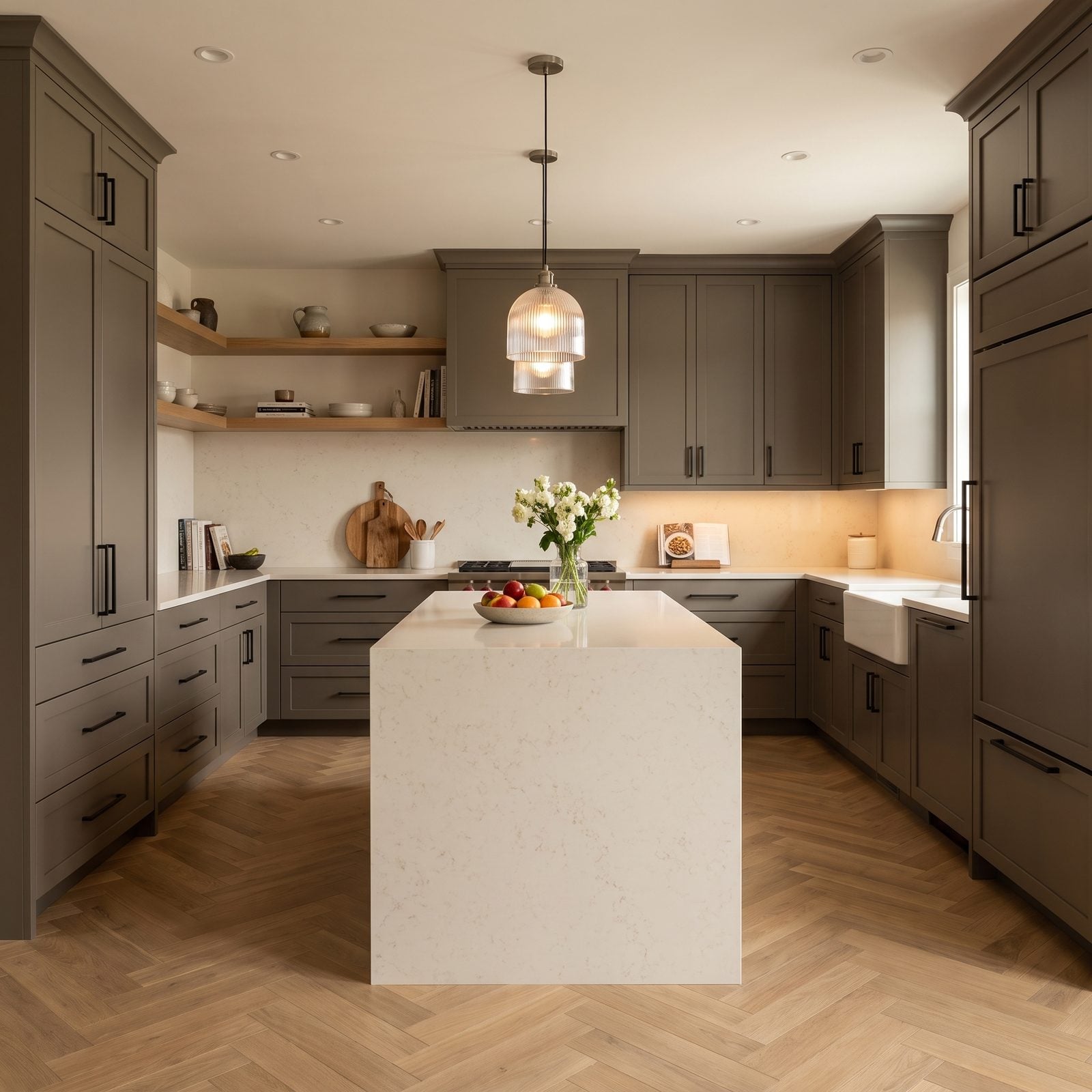
- Best kitchen styles: Contemporary transitional, Scandinavian, Japandi-leaning and modern farmhouse kitchens.
- Finishes and colours: Greige, taupe, putty, mushroom, inky blue-black and rift oak.
- Relative cost: $$ (moderate) compared with the other doors here
- Cleaning: Easy. There is less inside corner to collect dust than on a classic Shaker.
- Durability: Good. Narrow solid rails need good joinery; ask whether doors are solid wood frames or one-piece MDF.
Designer move: Use slim edge pulls or long thin bars. Chunky cup pulls fight the lighter frame.
Mistake to avoid: Don’t put slim Shaker on very large tall pantry doors without a mid-rail; wide expanses can bow and look flimsy.
What the research says: Four of 18 Domino designers named slim Shaker for 2026 (‘Slim Shaker is the new classic’ – Barrett Cooke). KBDN June 2026: Huntwood says ‘Slim Shaker styles continue to be one of the strongest trends’, QCCI says its slim Shaker ‘remains very popular’, WoodHarbor reports ‘strong demand for very narrow-framed doors’. Judi Cooper (The Spruce): ‘Expect to see more skinny shaker cabinets in 2026’; KBIS 2026 coverage highlighted ‘Ultra-slim rails and stiles’. The counterpoint: No quantitative share exists for slim vs classic Shaker; Houzz does not break it out. Evidence is designer/manufacturer opinion, though from many independent voices. Sources: Domino, 2025; Kitchen & Bath Design News, 2026; The Spruce, 2025; Kerrie Kelly Design Lab, 2026; Block Renovation, 2026; Wickes, 2026; USA Cabinet Express, 2026.
3. Micro Shaker
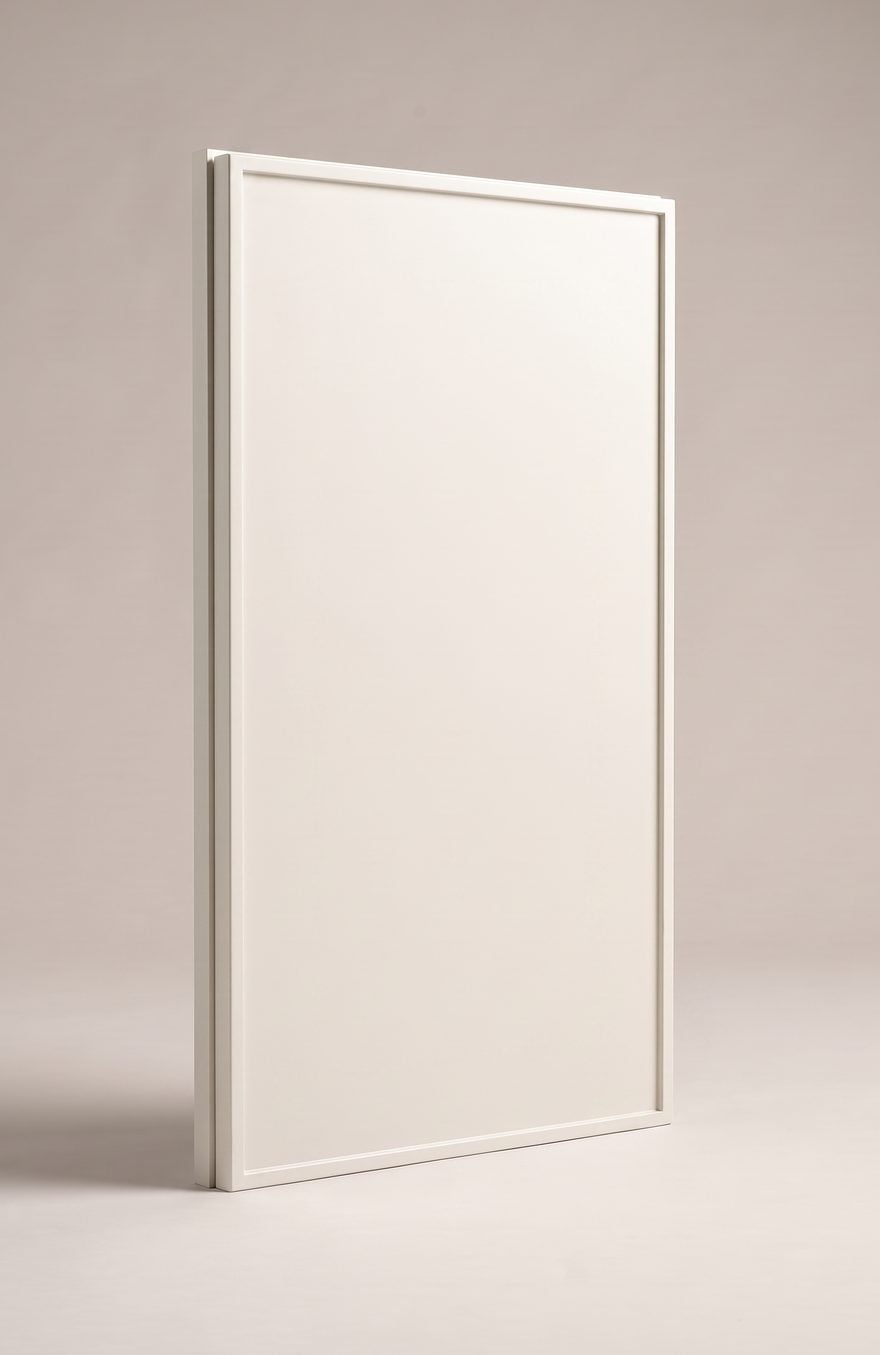
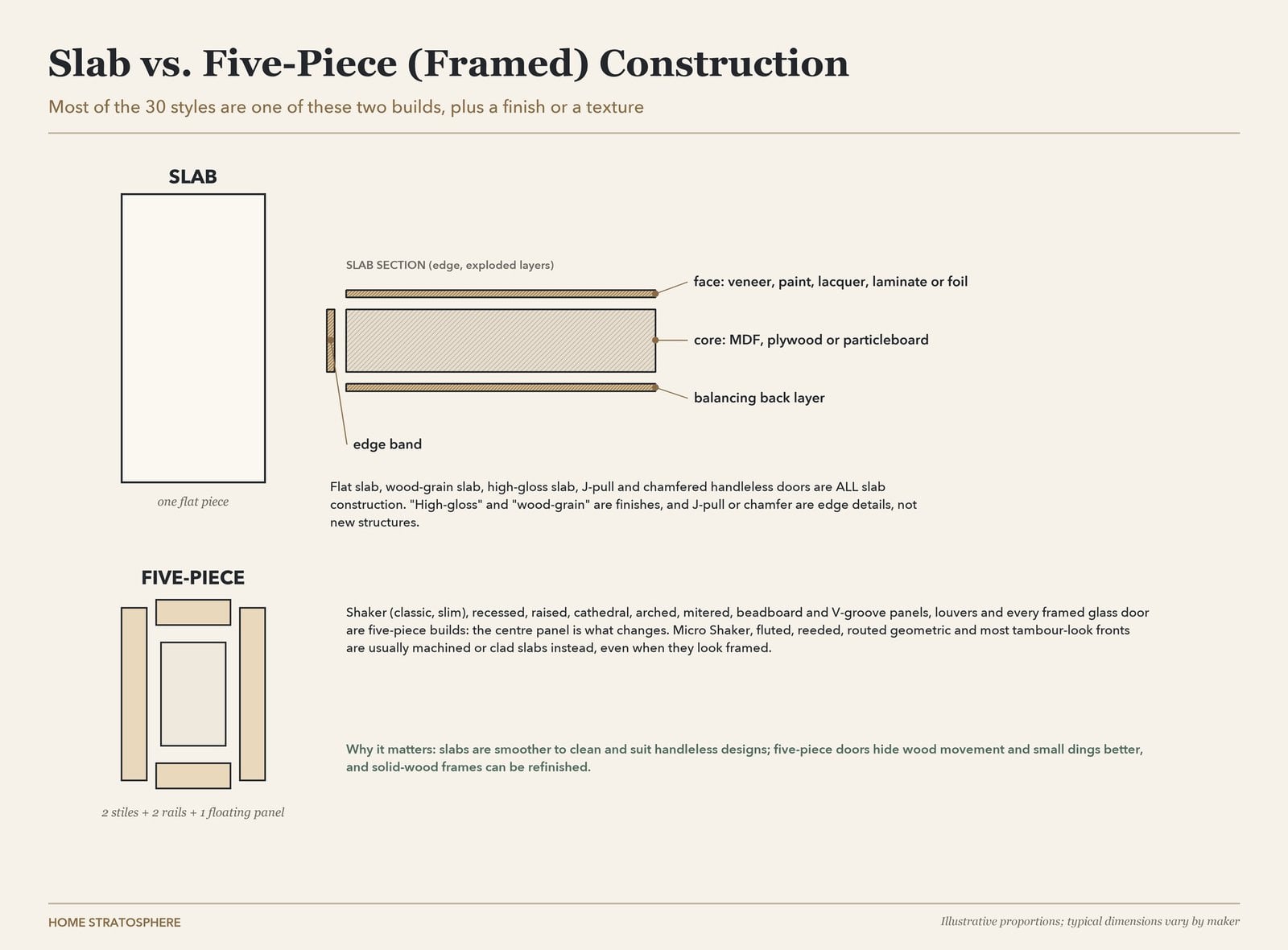
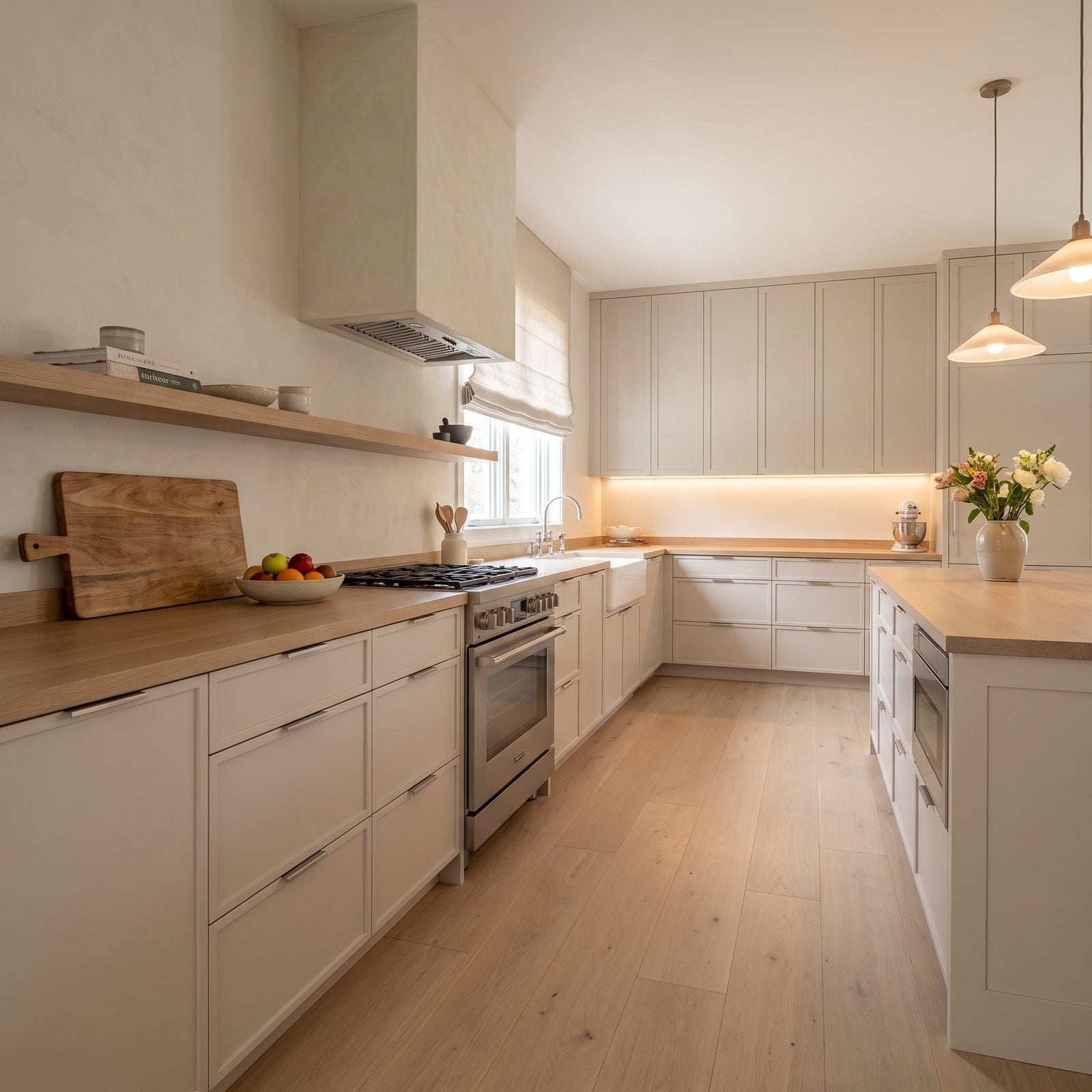
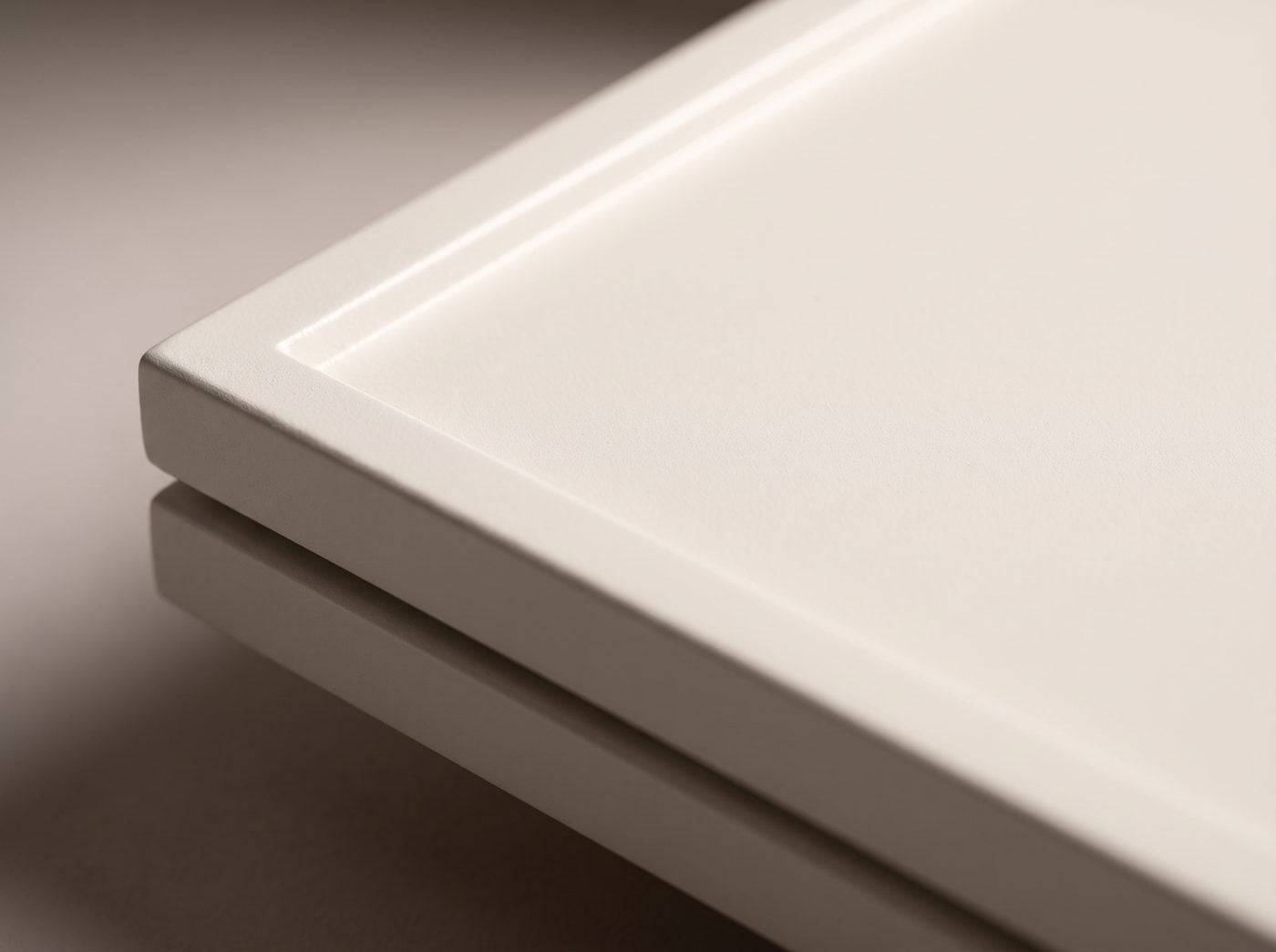
A frame so thin, often 1/4 to 1/2 inch, that the door reads as a slab with a pencil-line border. It is usually machined from a single MDF panel rather than assembled from five pieces, which keeps the tiny frame crisp and crack-free.
Home Stratosphere reader data: too few images yet to measure reliably (1 kitchen image in our sample).
- Best kitchen styles: Minimalist, Scandinavian, European-modern and quiet-luxury kitchens.
- Finishes and colours: Matte putty, chalky whites, clay, sage, and painted oak-tone or lacquer finishes.
- Relative cost: $$ (moderate) compared with the other doors here
- Cleaning: Very easy. It is nearly as smooth as a slab.
- Durability: Very good on one-piece MDF. The shallow routed step is less prone to paint cracking than a five-piece joint.
Designer move: Choose it when you love slabs but want a hint of shadow line. It photographs beautifully under raking daylight.
Mistake to avoid: Don’t buy it from a photo alone. The border can disappear under flat overhead light, so see a sample door in your own kitchen.
What the research says: H&G’s 2026 cabinet trends list includes micro Shaker; Richard Davonport: ‘Micro Shaker is gaining momentum because it represents the natural evolution of Shaker cabinetry.’ KBDN June 2026: Crystal says ‘narrow Shakers and micro Shakers help bridge the gap between Shaker and slab’; Covered Bridge: ‘Mini Shaker…gaining traction’; Primary Kitchen launched a DS514 Micro Shaker. The counterpoint: Terminology overlaps with slim Shaker; no sales data. Some evidence is UK-centric (Davonport, Wickes) and retailer-sourced. Sources: Homes & Gardens, 2025; Kitchen & Bath Design News, 2026; Domino, 2024; Wickes, 2026.
🔥 Would you like to save this?
4. Traditional Recessed Panel
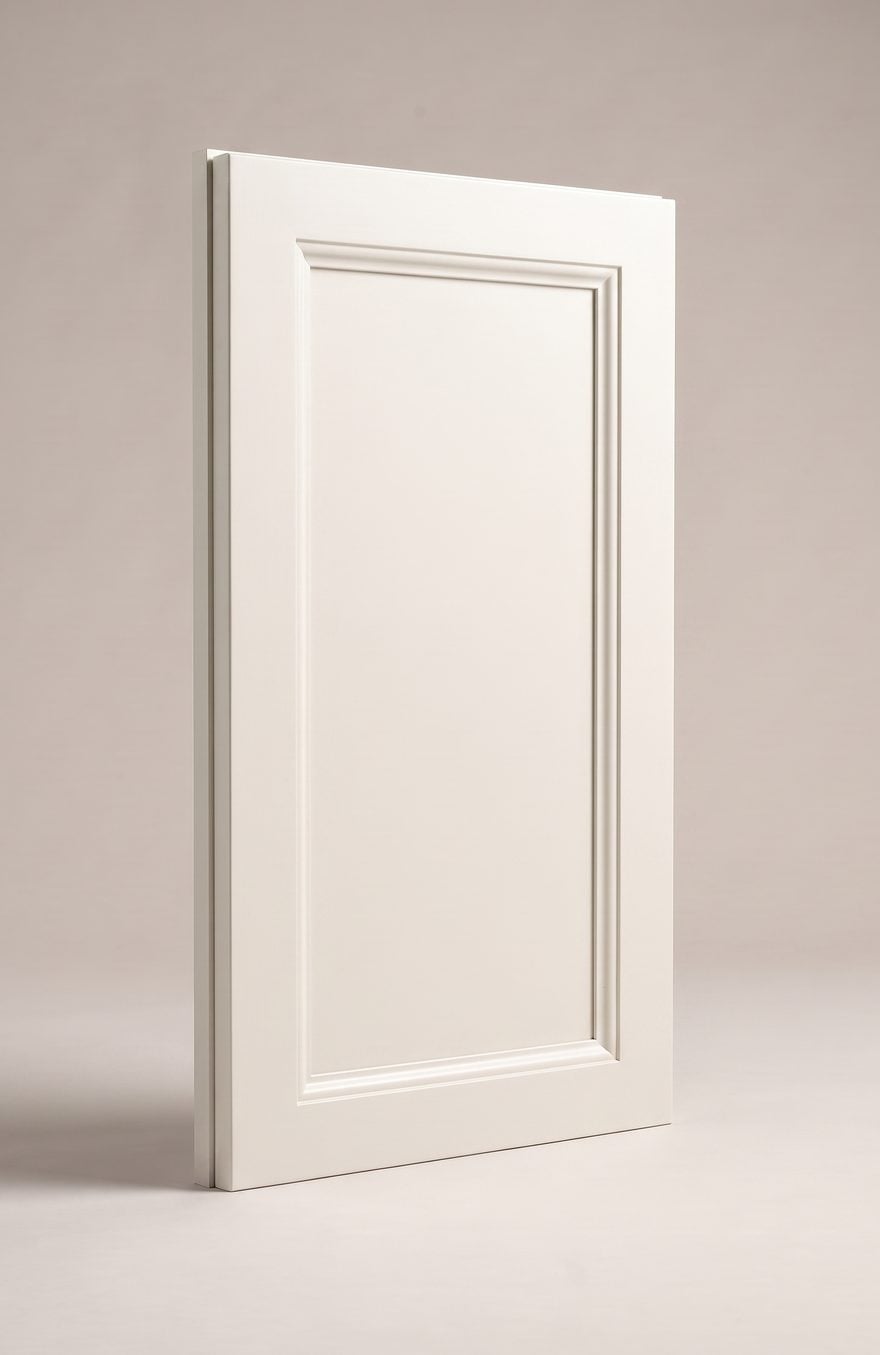
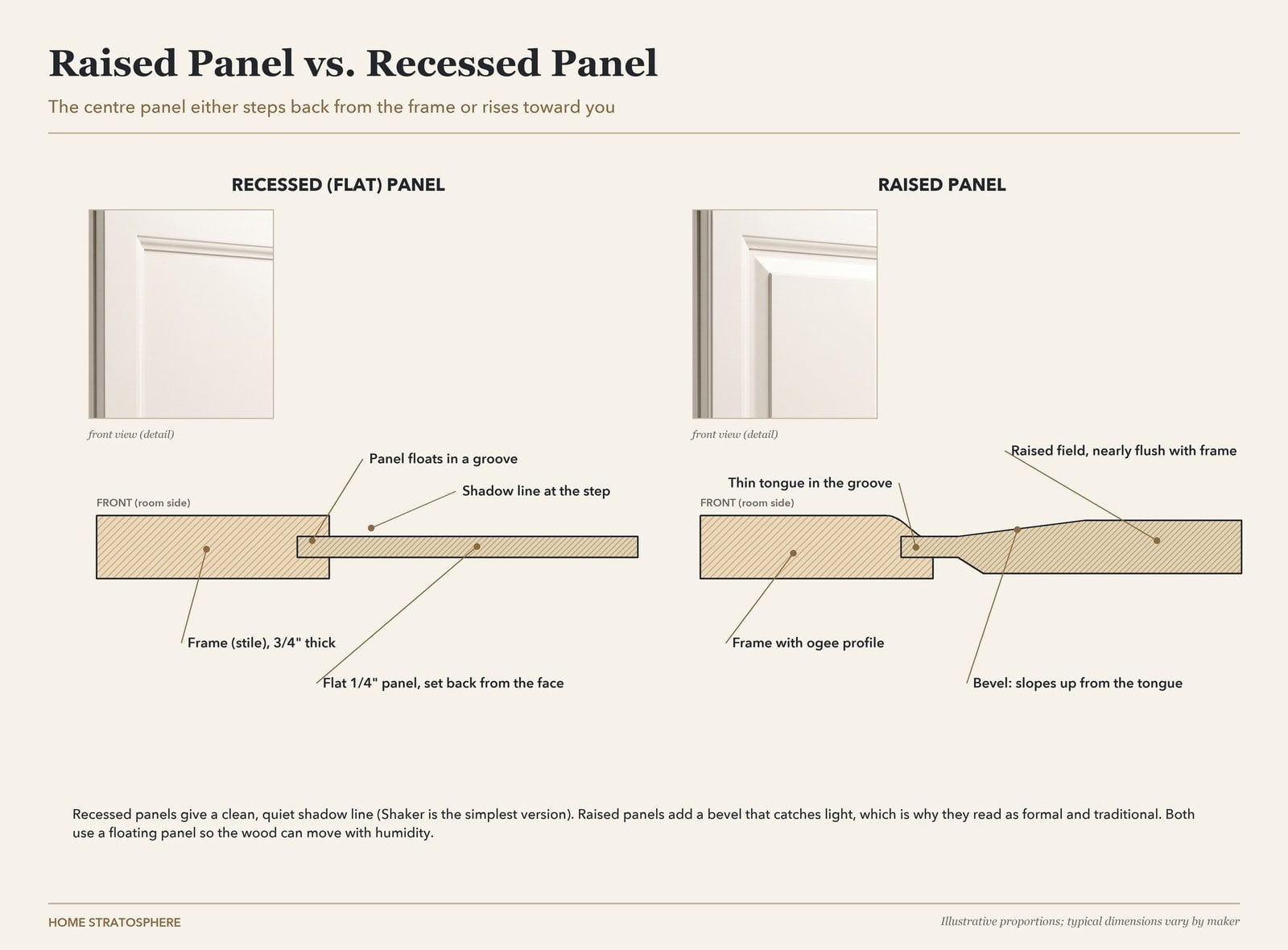
A flat recessed centre panel like Shaker, but the frame’s inside edge carries a moulded profile (ogee, cove or bead) that steps down into the panel. It is the bridge between plain Shaker and full traditional.
Home Stratosphere reader data: about average reader response. Saves 104, love share 100 (100 = the average of the article the image appeared in), across 185 images in 58 articles.
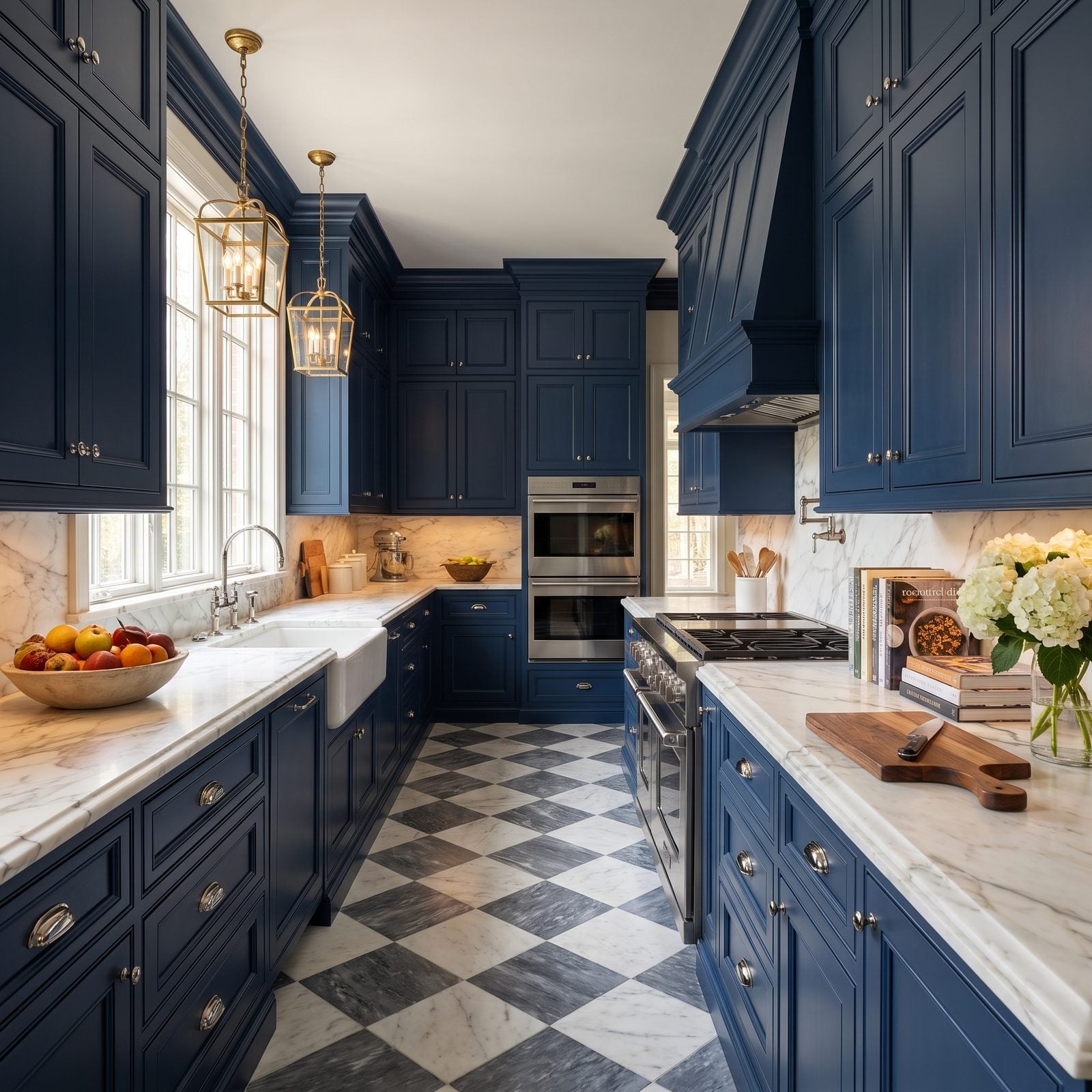
- Best kitchen styles: Georgian, colonial, traditional and classic transitional kitchens.
- Finishes and colours: Navy, deep green, creamy whites, glazed finishes, cherry and walnut stains.
- Relative cost: $$$ (higher) compared with the other doors here
- Cleaning: Moderate. The moulded profile holds dust and kitchen grease in its curves.
- Durability: Good. A painted profile can show wear where hands grab the door edge.
Designer move: Repeat the same moulding family in the crown and the island panels so the profile looks intentional.
Mistake to avoid: Avoid heavy dark glazes in the profile unless the room is formal. They can tip a kitchen toward 2005.
What the research says: KBIS 2026 show coverage lists ‘Beaded recessed panels’ and ‘Chamfered interior profiles’; KBDN 2026 quotes Covered Bridge on ‘rails with beads and beveled interior edges’ for transitional/traditional work; Fabuwood’s new Echo door adds a 45-degree bevel; Domino designer Sarah Randolph predicts ‘The inset door with a beveled edge’. The counterpoint: No quantitative data separate profiled recessed panels from Shaker. Evidence points to detailed recessed panels holding/returning rather than surging. Sources: Cabinet IQ, 2026; Kitchen & Bath Design News, 2026; Kitchen & Bath Business, 2025; Domino, 2025.
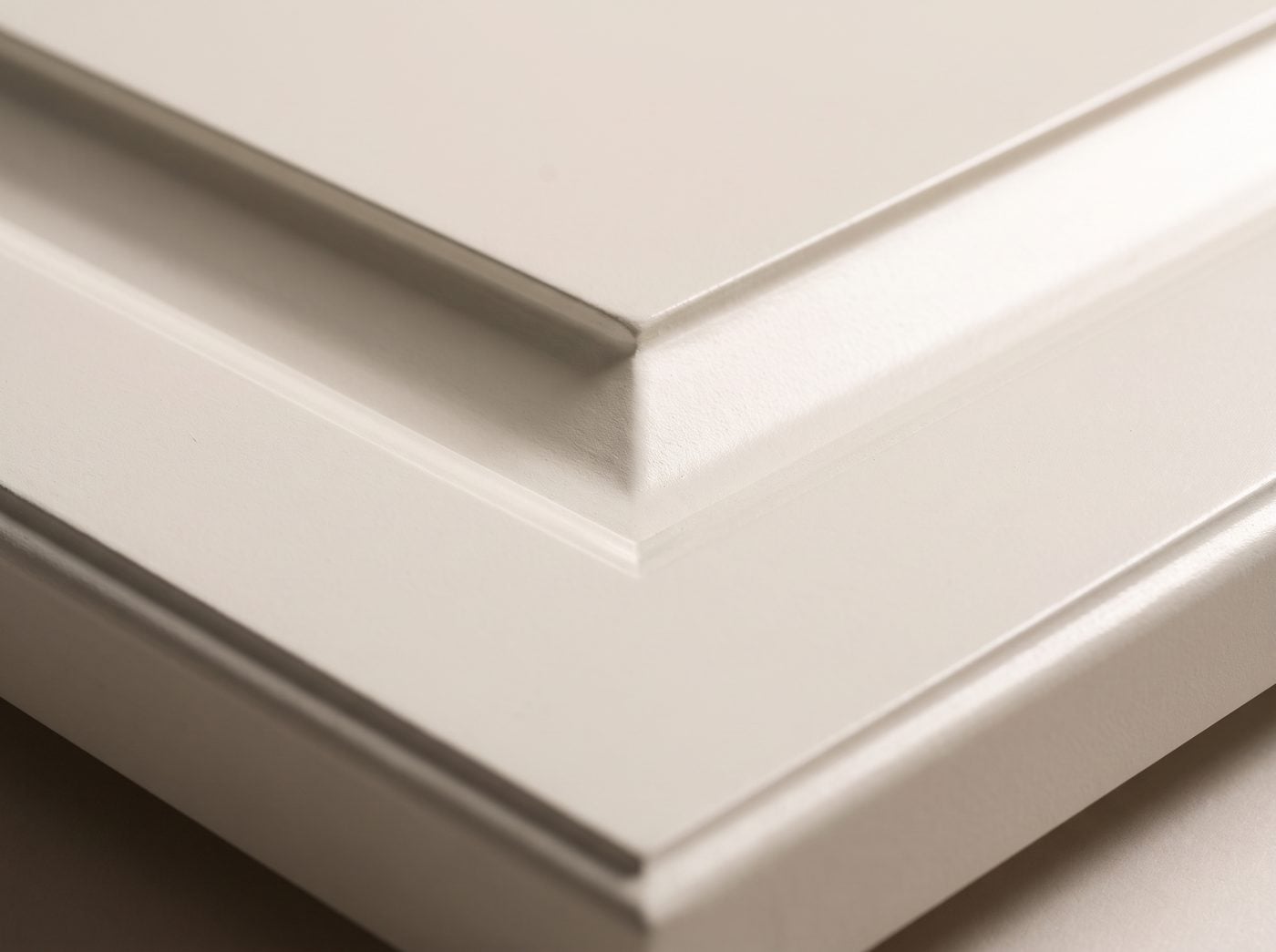
5. Traditional Raised Panel
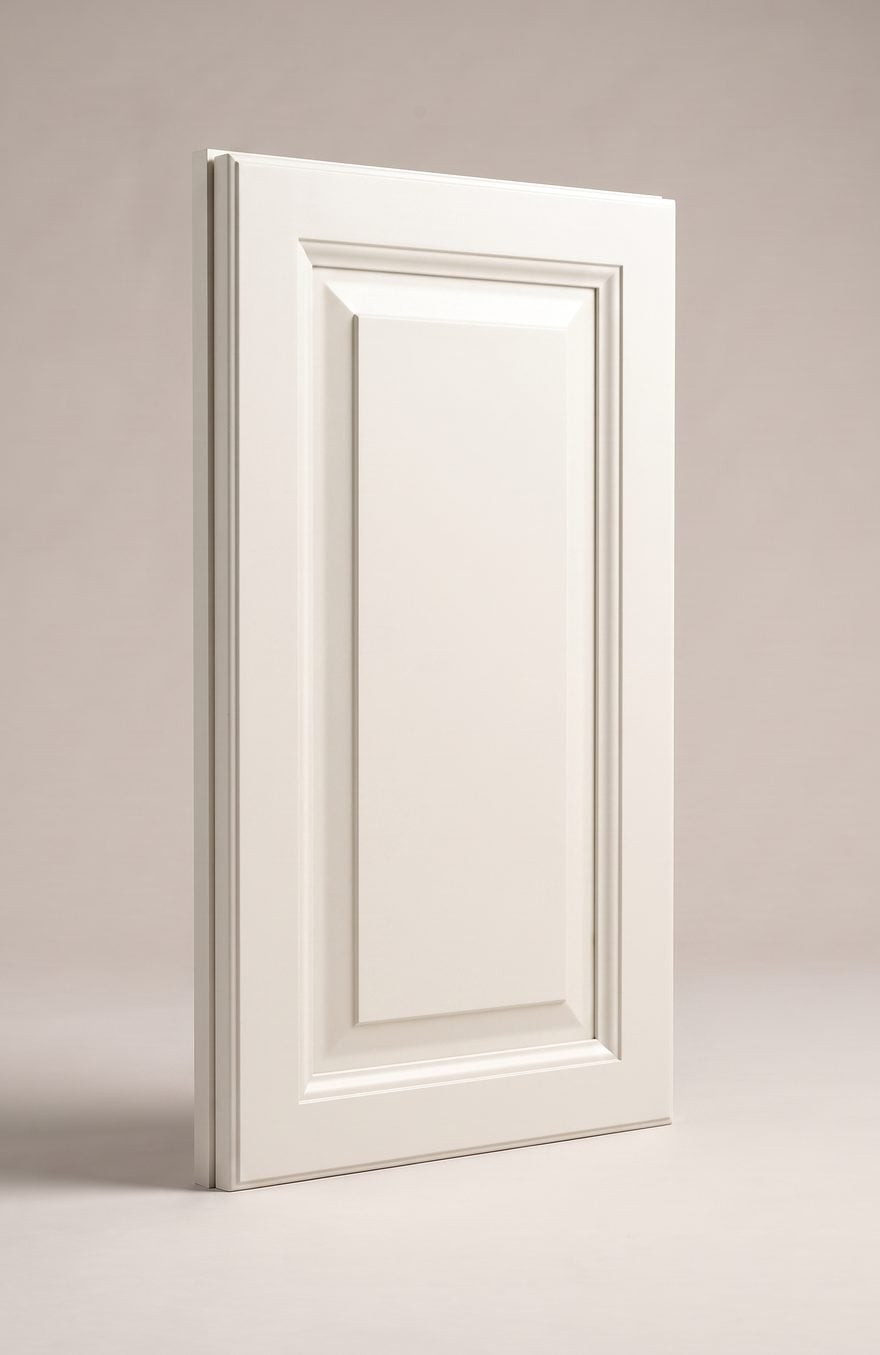
The centre panel rises toward you, with a bevel sloping down to the frame on all four sides. The bevel catches light, which gives this door its formal, dimensional look.
Home Stratosphere reader data: about average reader response. Saves 107, love share 100 (100 = the average of the article the image appeared in), across 384 images in 79 articles.
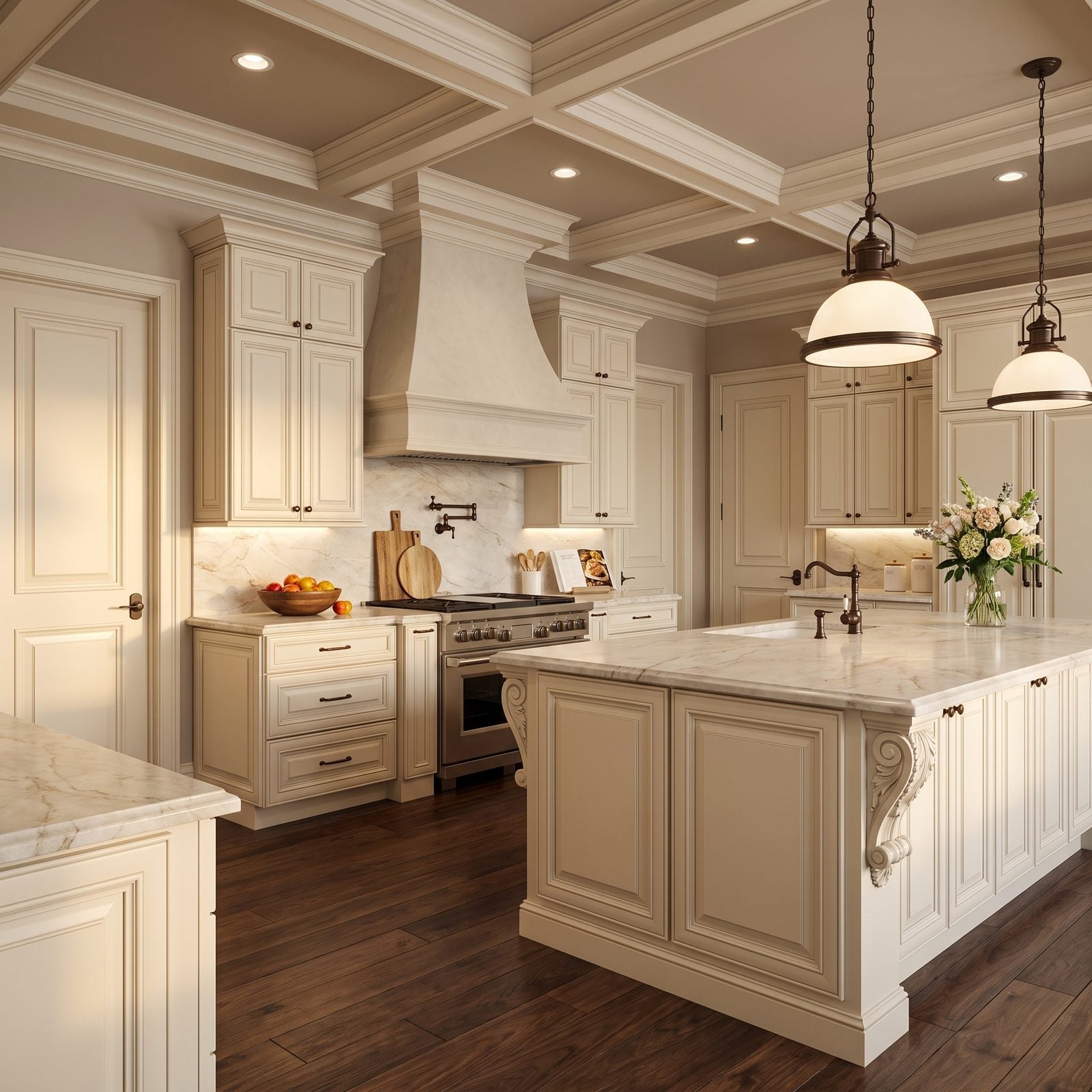
- Best kitchen styles: Traditional estates, classic colonials and old-house restorations.
- Finishes and colours: Ivory, antique white, warm wood stains, glazed creams.
- Relative cost: $$$ (higher) compared with the other doors here
- Cleaning: More effort. Dust settles on the bevels and in the profile.
- Durability: Very good in solid wood. Expect a fine seasonal line where a painted solid panel moves.
Designer move: Keep it to a calm palette and modern lighting so it reads as classic rather than dated.
Mistake to avoid: Don’t pair raised panels with ultra-modern slab appliances and handleless details. The styles argue.
What the research says: Houzz shares are stable: 13% (2022) and 12% (2025) of renovating homeowners. MasterBrand 2026: ‘flat panel and subtle raised-detail doors are rising’; KBDN 2025 Crystal: ‘simplified raised panels are becoming increasingly popular’; Real Simple 2026 says raised-panel is making a comeback in traditional kitchens; Houzz says traditional style rose 5 points. The counterpoint: A sponsored contractor segment (Fox 11/Kitchen Tune-Up, May 2026) lists ‘Raised panel door style’ as dating a kitchen; a retailer (USA Cabinet Express) expects ornate raised panels to fade while restrained ones return. Comeback evidence is for simplified versions. Sources: Houzz, 2022; Houzz, 2025; MasterBrand, 2025; Kitchen & Bath Design News, 2025; Kitchen & Bath Design News, 2026; Real Simple, 2026; Houzz, 2025.
6. Cathedral Raised Panel
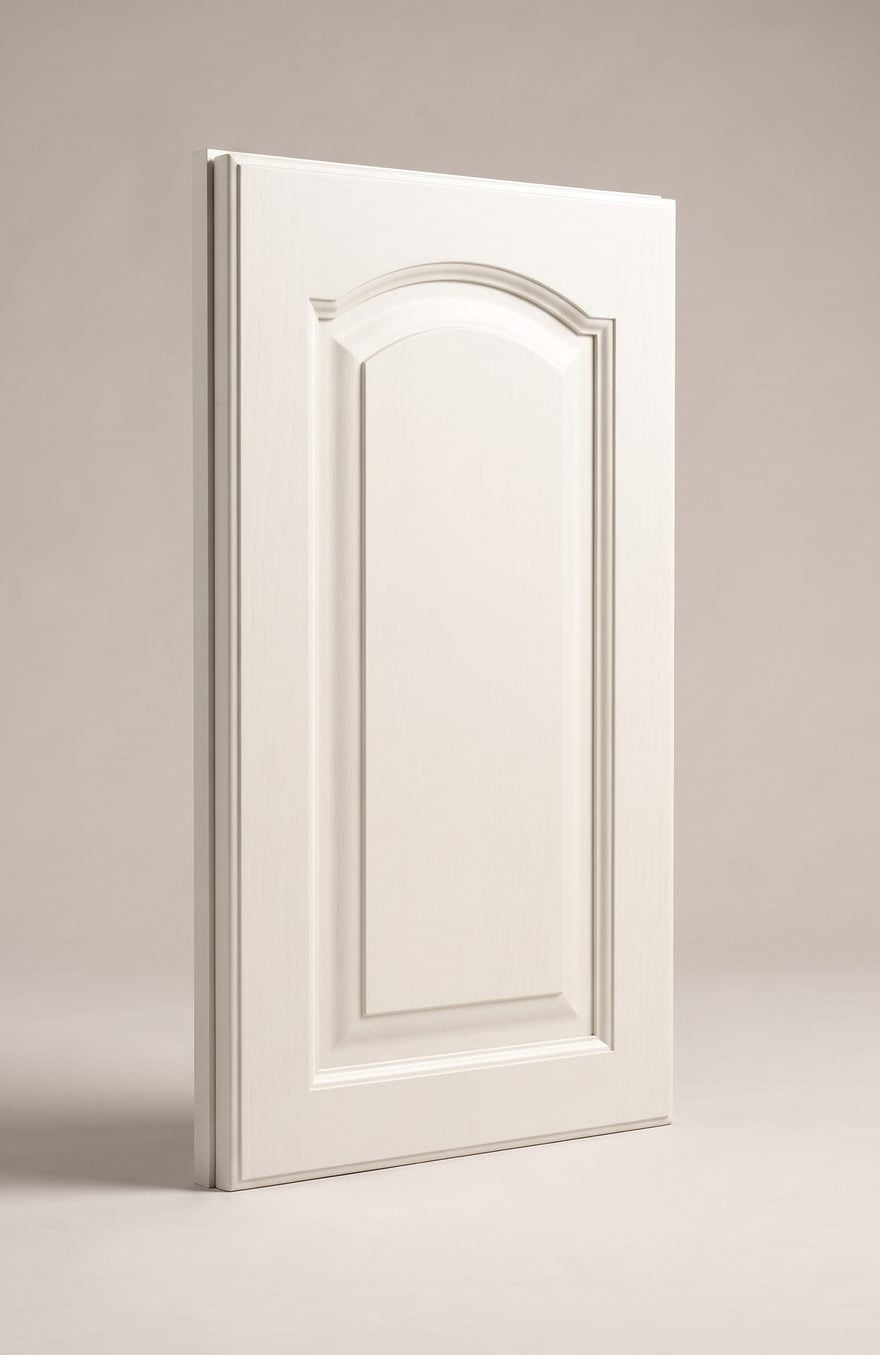
A raised panel whose top rail is cut in an arch with small shoulders at each end: the cathedral shape. It is the most recognisable door of the 1990s and early 2000s.
Home Stratosphere reader data: about average reader response. Saves 110, love share 96 (100 = the average of the article the image appeared in), across 162 images in 31 articles.
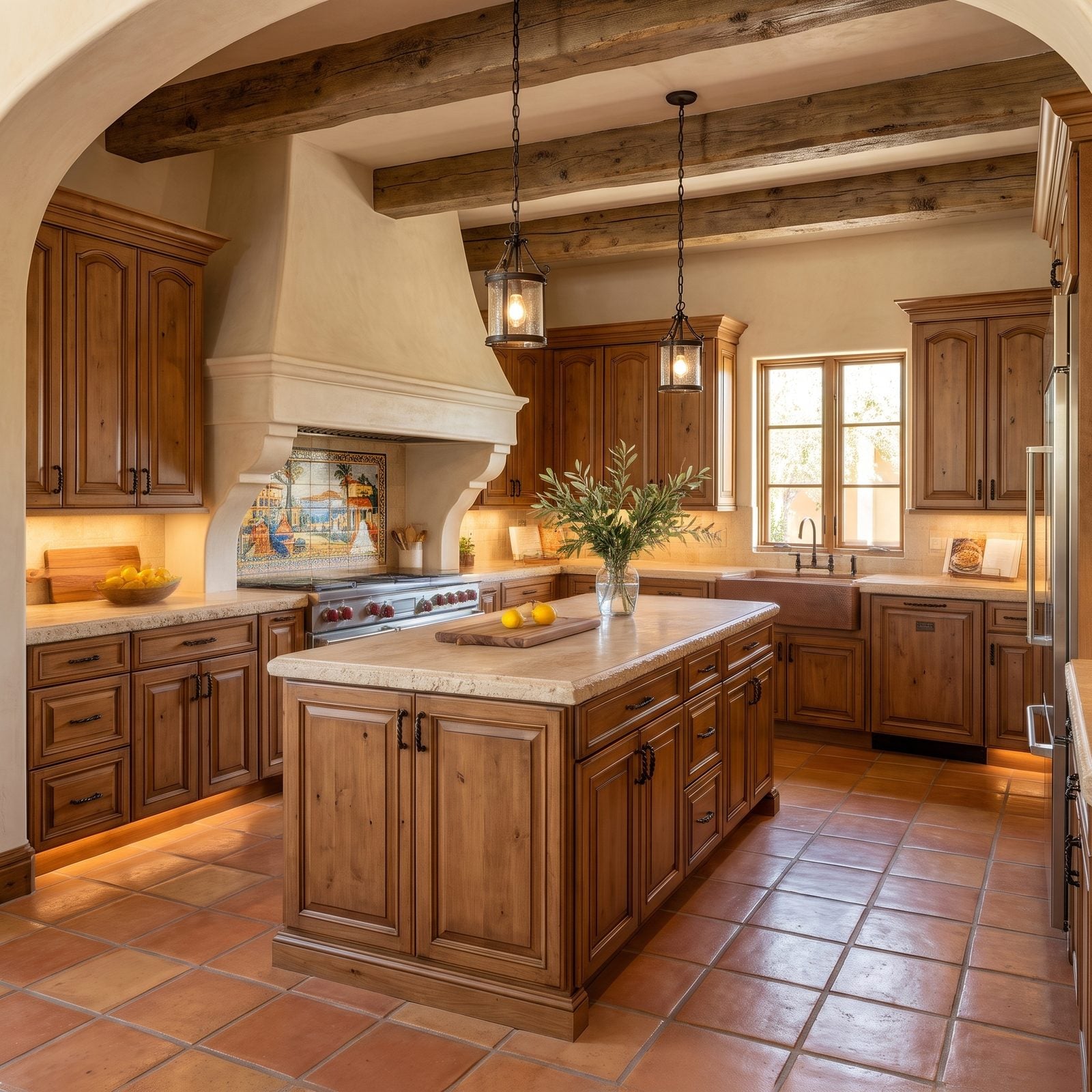
- Best kitchen styles: Old-World, Tuscan and Mediterranean kitchens, and period-correct homes from that era.
- Finishes and colours: Stained alder, knotty cherry, glazed maple, warm hand-rubbed finishes.
- Relative cost: $$$ (higher) compared with the other doors here
- Cleaning: More effort. The arch and bevel collect dust.
- Durability: Very good. These doors are usually solid wood and built to last.
Designer move: Use it only on uppers or a feature hutch, and keep the lowers simpler, if you want the warmth without the full-era look.
Mistake to avoid: Don’t put cathedral doors in a minimalist house; the arch is an architectural statement that needs the room to back it up.
What the research says: The only direct 2025-26 mention found is negative: a sponsored Kitchen Tune-Up segment lists ‘Cathedral style arch on upper cabinet doors’ among features that outdate a kitchen. Cathedral doors are absent from every designer and manufacturer trend list reviewed (Domino, KBDN, H&G, MasterBrand), while designers predict ‘busy applied moldings’ and heavy detail will fade. The counterpoint: The fading evidence is weak (sponsored/commercial). Interest in arches in general is rising (see #8), so a simplified arched door is not the same as the classic cathedral profile. Sources: Fox 11 Living, 2026; The Spruce, 2025; USA Cabinet Express, 2026.
7. Double Cathedral Panel
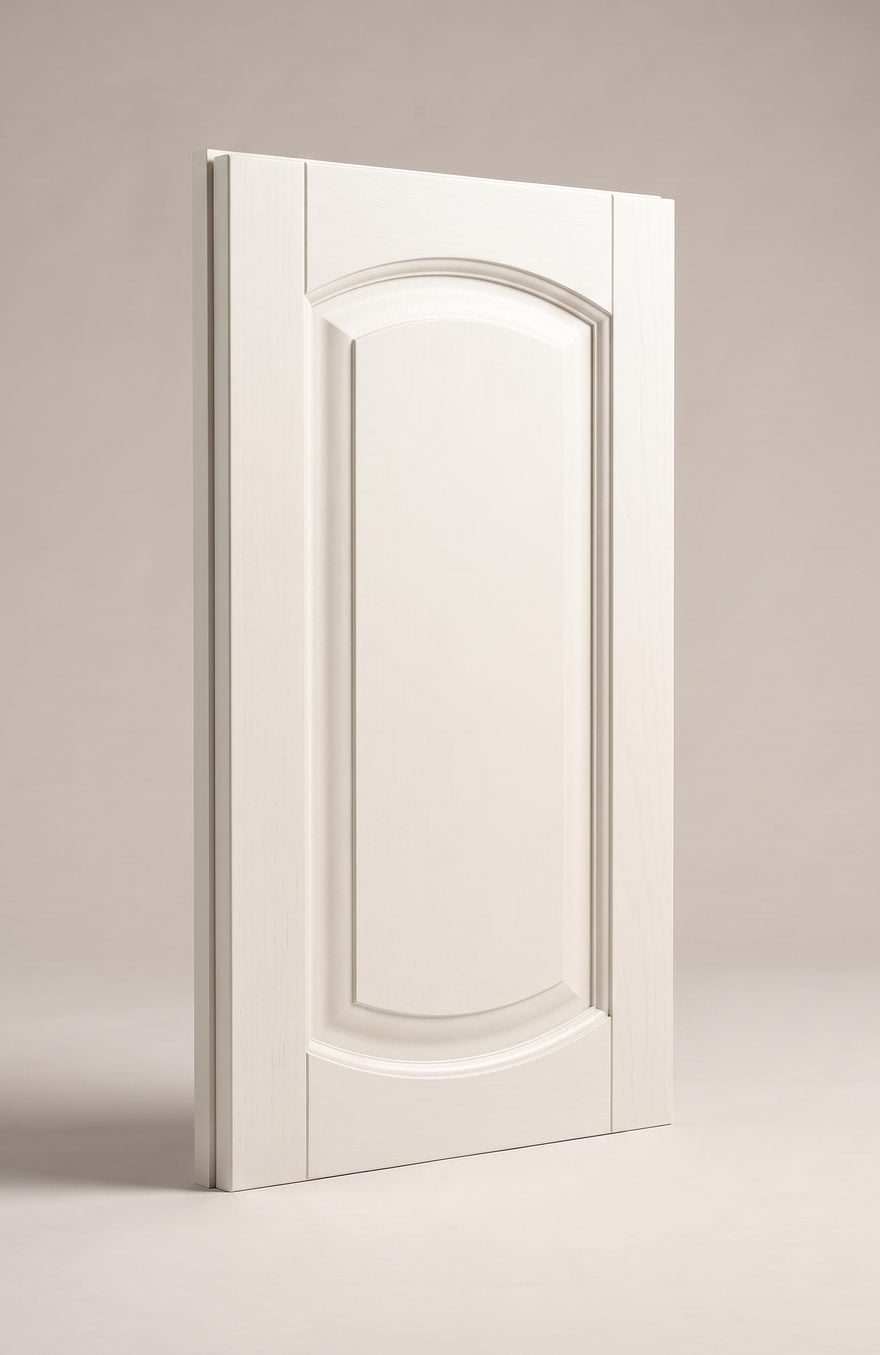
Arched at both the top and bottom rails, so the raised panel has a curve at each end. It is more decorative than a single cathedral, and rarer.
Home Stratosphere reader data: too few images yet to measure reliably (0 kitchen images in our sample).
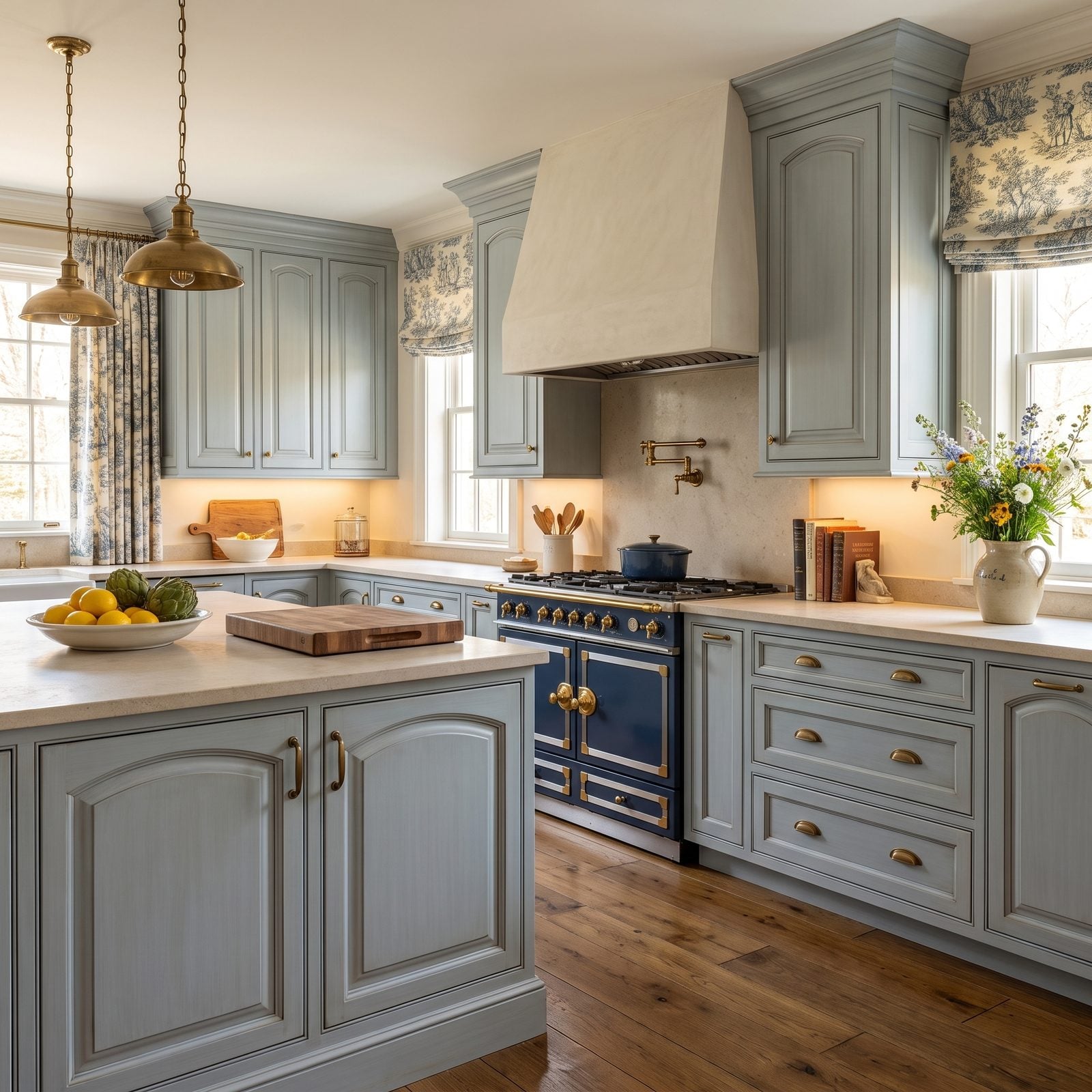
- Best kitchen styles: French country, Old-World and ornate traditional kitchens.
- Finishes and colours: Soft French blue-grey, cream with a light glaze, aged wood stains.
- Relative cost: $$$$ (premium) compared with the other doors here
- Cleaning: More effort, with two arches of bevel to dust.
- Durability: Very good. These are usually solid wood.
Designer move: Limit it to one wall or a statement hutch, and let a simpler door run elsewhere.
Mistake to avoid: Don’t paint it a bright stark white. Softer, chalkier colours keep the curves from looking like builder-grade 1998.
What the research says: No 2025-2026 source reviewed mentions double cathedral doors, positively or negatively. The counterpoint: None found. Do not infer fading purely from its traditional character. No 2025-26 trend source covered this style directly.
8. Arched Recessed Panel
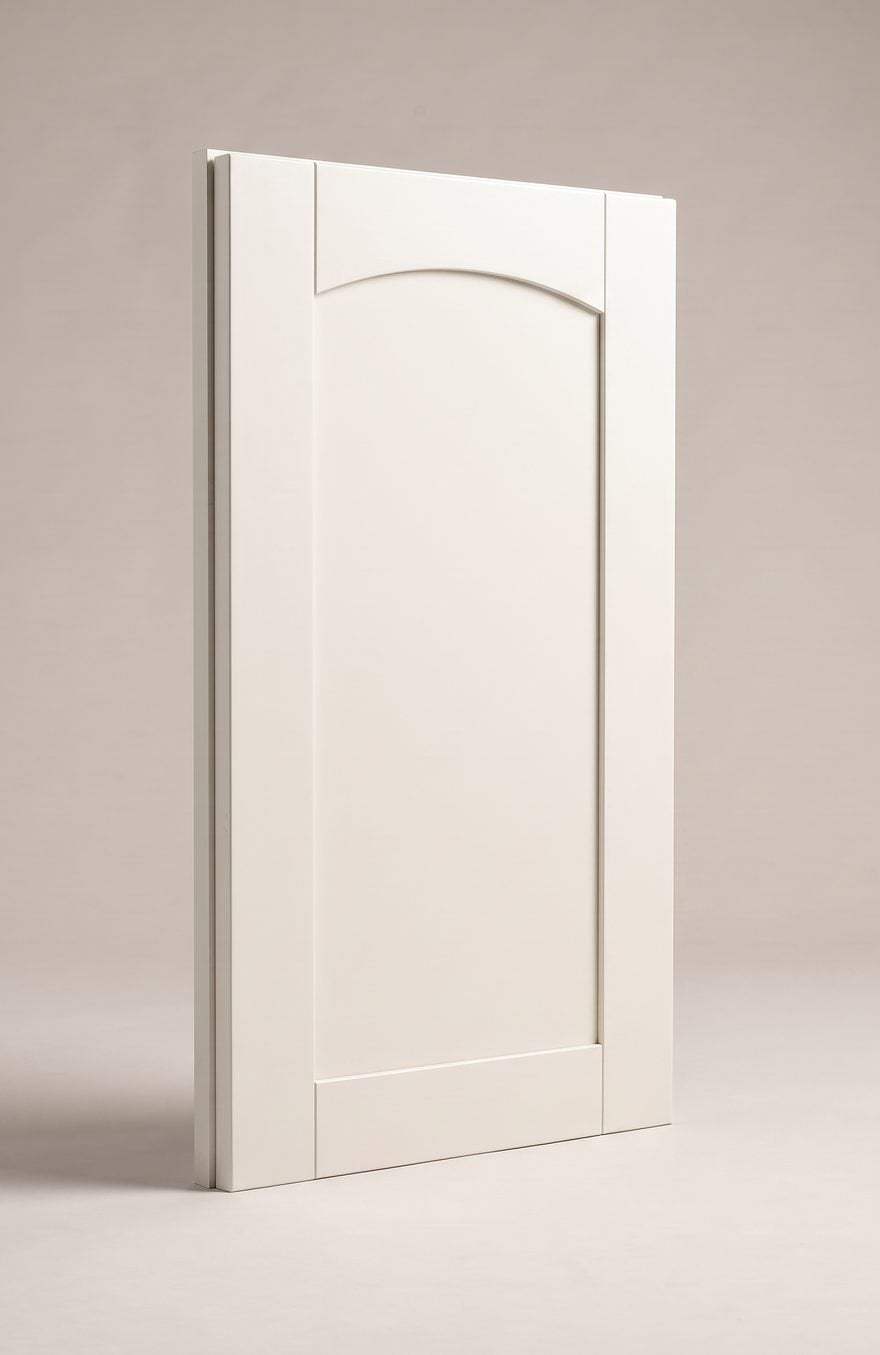
A flat recessed panel with a single smooth arch along the top rail. It has none of the cathedral’s shoulders and no bevel, so it is softer and more modern than a cathedral door.
Home Stratosphere reader data: too few images yet to measure reliably (4 kitchen images in our sample).
🔥 Would you like to save this?
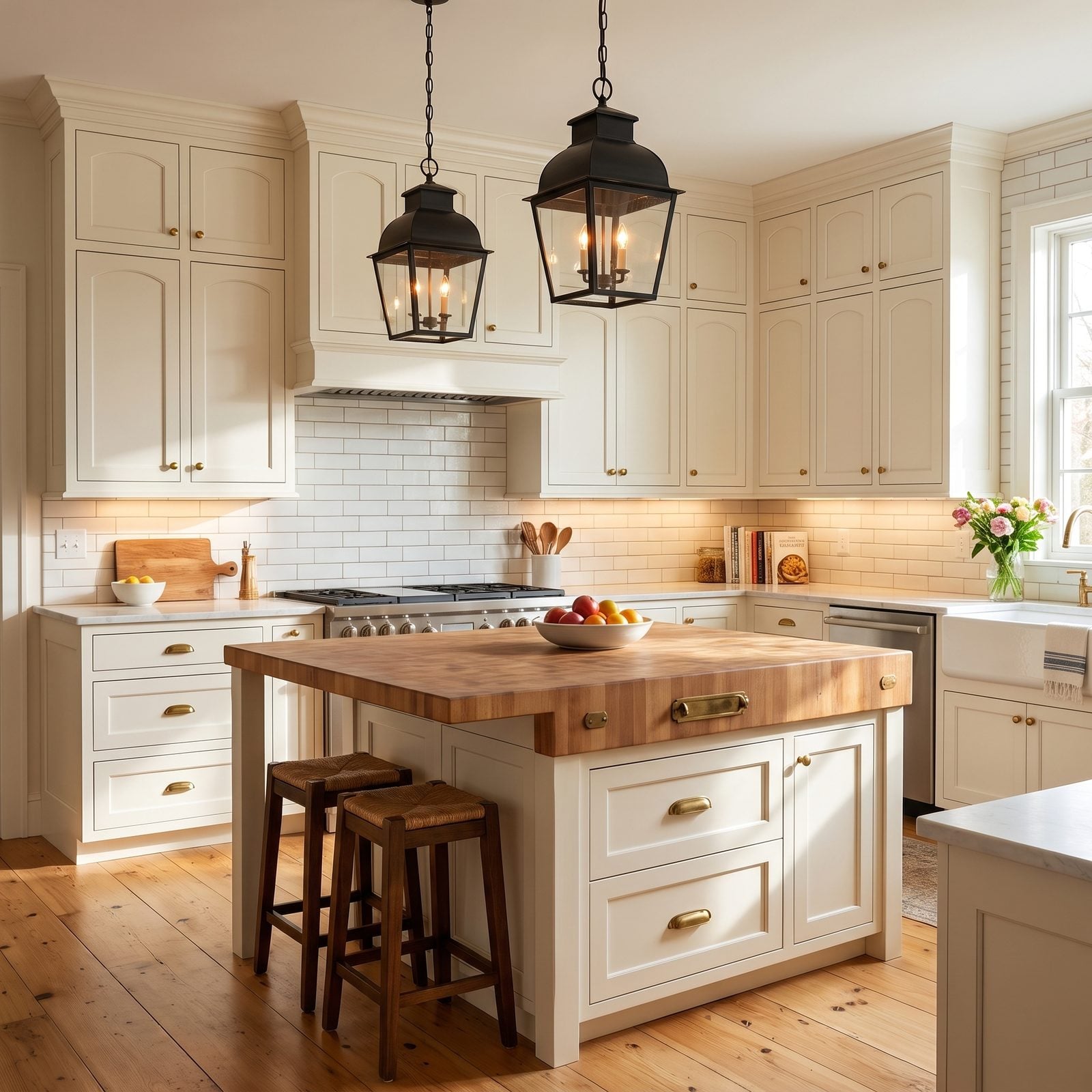
- Best kitchen styles: Modern farmhouse, cottage and transitional kitchens leaning into curves.
- Finishes and colours: Creamy whites, mushroom, muted greens, natural oak.
- Relative cost: $$$ (higher) compared with the other doors here
- Cleaning: Easy to moderate. The flat panel wipes easily.
- Durability: Good. Arched rails are cut from wider stock, which keeps them stable.
Designer move: Echo the arch somewhere else, such as a range alcove, a window or a doorway, so the curve feels like architecture.
Mistake to avoid: Don’t arch every door including drawers and tall pantries; a few arched uppers say more than forty.
What the research says: MasterBrand’s Stephanie Pierce on arched doors: ‘I don’t see them falling out anytime soon’ (Real Simple, Jul 2026). KBDN June 2026: Crystal says ‘Radius and arched cabinets are becoming more popular’; Plain & Fancy says radius doors are trending; KBDN 2025: ‘arched doors and simplified raised panels are becoming increasingly popular’. KBIS 2026 floor showed ‘Arched or eyebrow cabinets’; Houzz 2026 cites ‘curves, arches and scalloped edges’. The counterpoint: Livingetc (Jun 2026) quotes Fiona Ginnett saying curved cabinetry/islands are over (inefficient, costly) – this concerns curved carcasses rather than arched door panels. Designers favour subtle use (H&G 2027). Sources: Real Simple, 2026; Kitchen & Bath Design News, 2026; Kitchen & Bath Design News, 2025; Cabinet IQ, 2026; Houzz, 2025; Homes & Gardens, 2026.
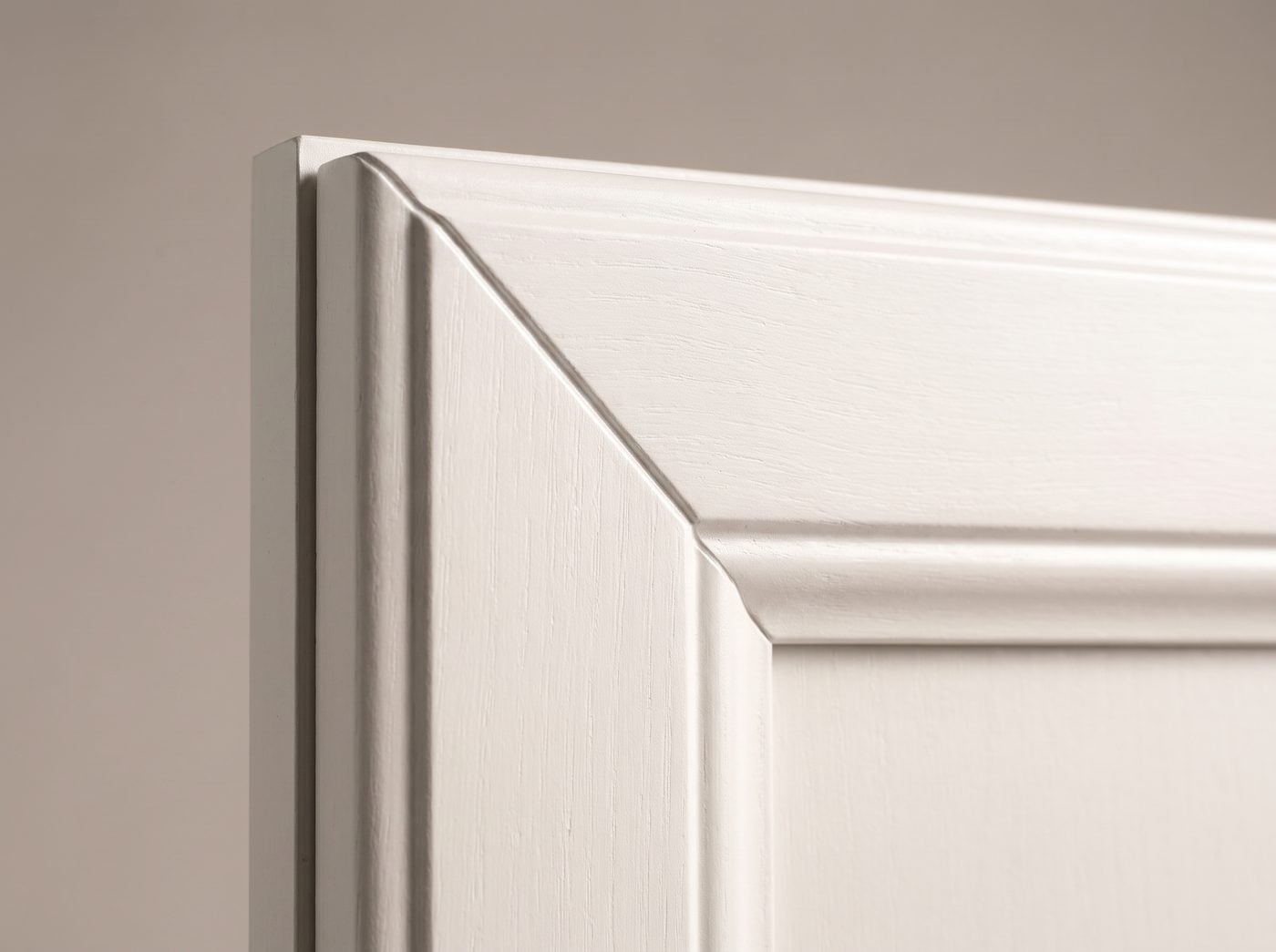
9. Mitered-Frame Panel
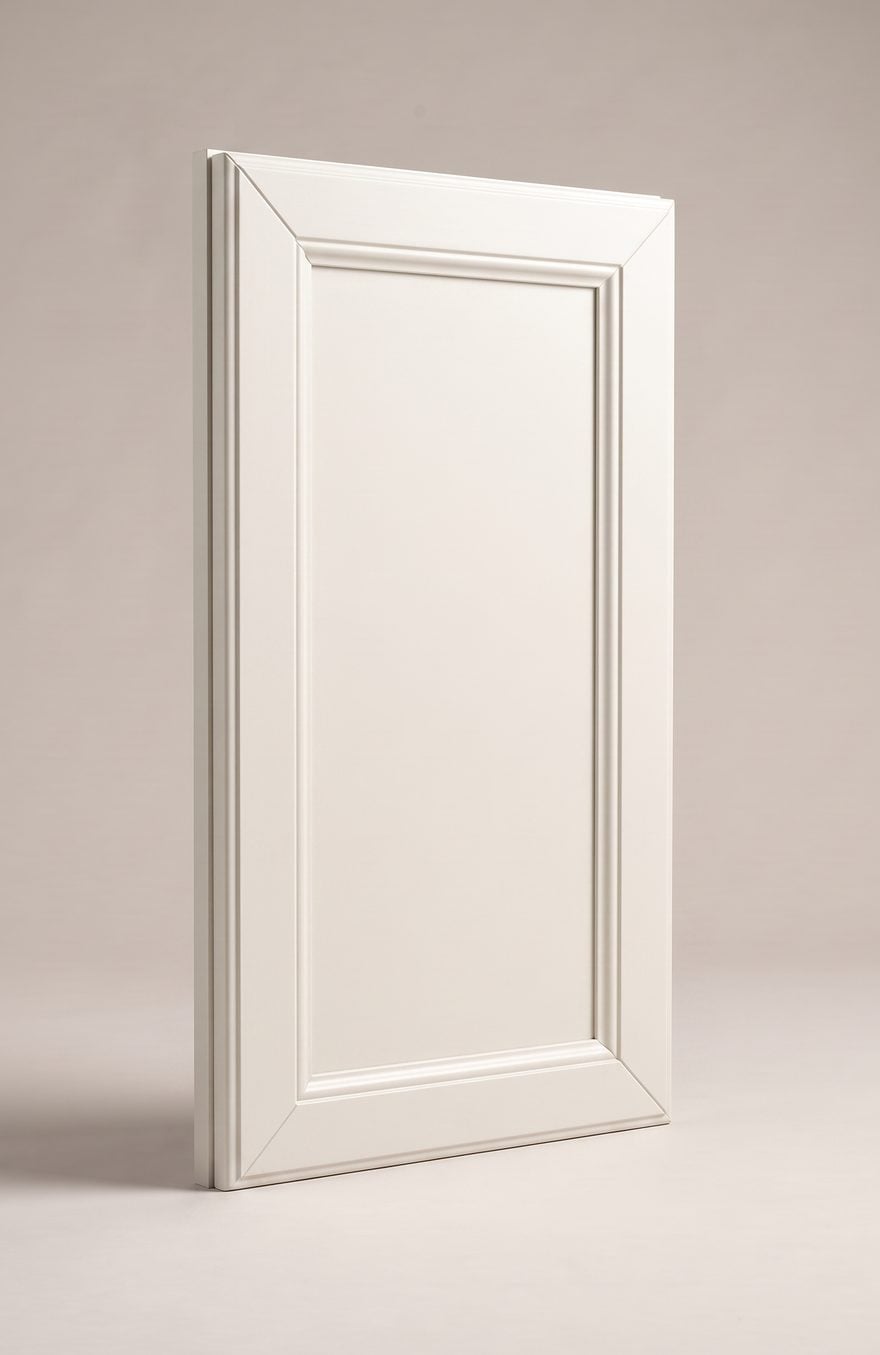
The frame pieces meet at 45-degree corners like a picture frame, so a moulded profile can wrap continuously around each corner. Shaker and cope-and-stick doors use square butt joints instead.
Home Stratosphere reader data: too few images yet to measure reliably (1 kitchen image in our sample).
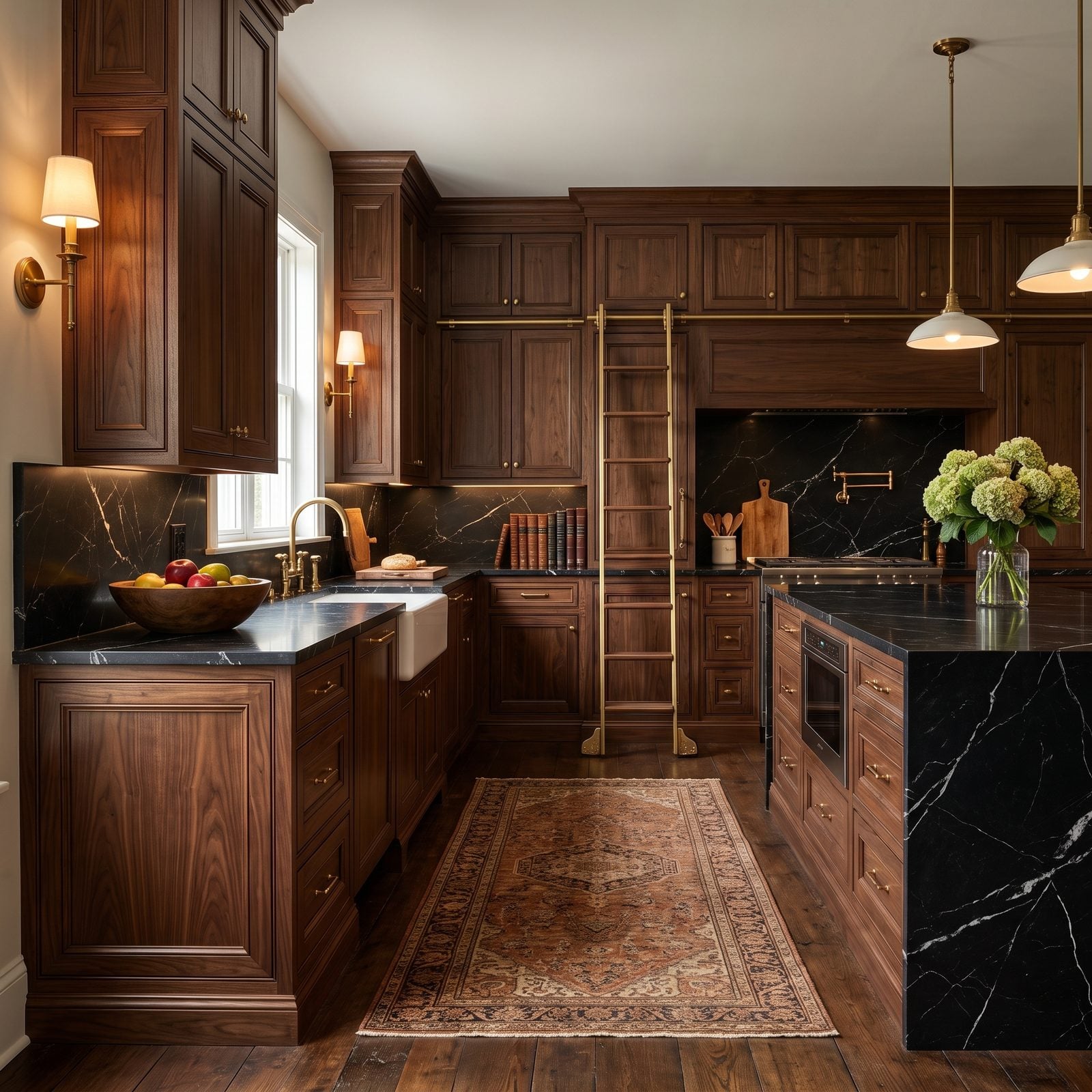
- Best kitchen styles: European traditional, library-style and classic kitchens with rich wood.
- Finishes and colours: Walnut, cherry, quartersawn oak; also painted in traditional schemes.
- Relative cost: $$$ (higher) compared with the other doors here
- Cleaning: Moderate, because of the profiled frame.
- Durability: Good. Miter joints can open slightly with humidity swings, so look for splined or well-glued corners.
Designer move: Choose it in a stained wood, where the continuous grain around the corner is part of the beauty.
Mistake to avoid: Don’t specify mitered doors in a humid space without climate control; open miter seams are hard to hide in paint.
What the research says: Only one source: KBIS 2026 show-floor coverage lists ‘Raised panel and mitered doors’ among returning details. The counterpoint: None found. Sources: Cabinet IQ, 2026.
10. Applied-Molding Panel
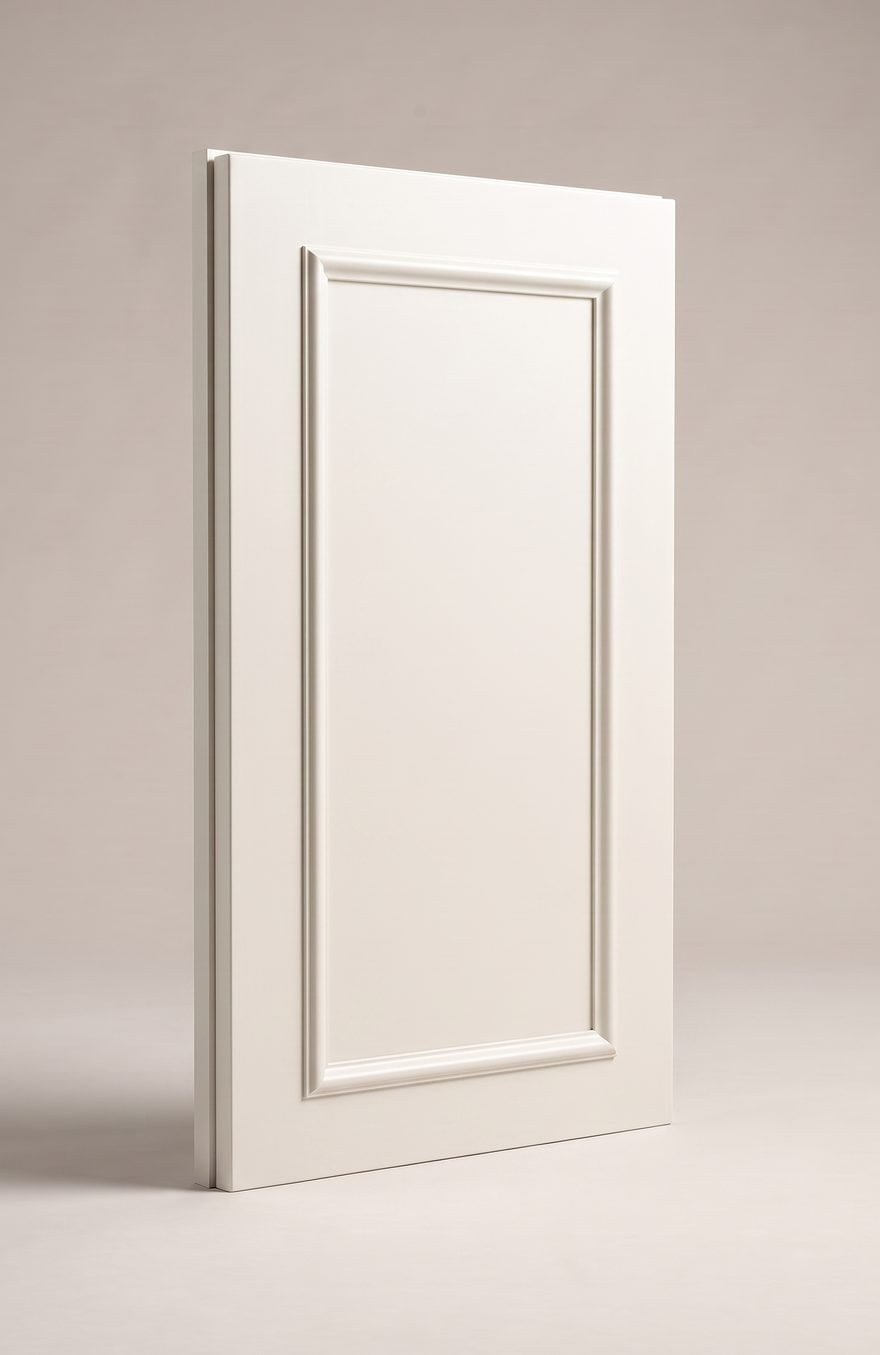
A decorative moulding is applied to the door face, usually a flat slab or a simple panel, to create a raised outline. It is the cabinet version of Parisian wall panelling.
Home Stratosphere reader data: above average reader response. Saves 111, love share 107 (100 = the average of the article the image appeared in), across 72 images in 24 articles.
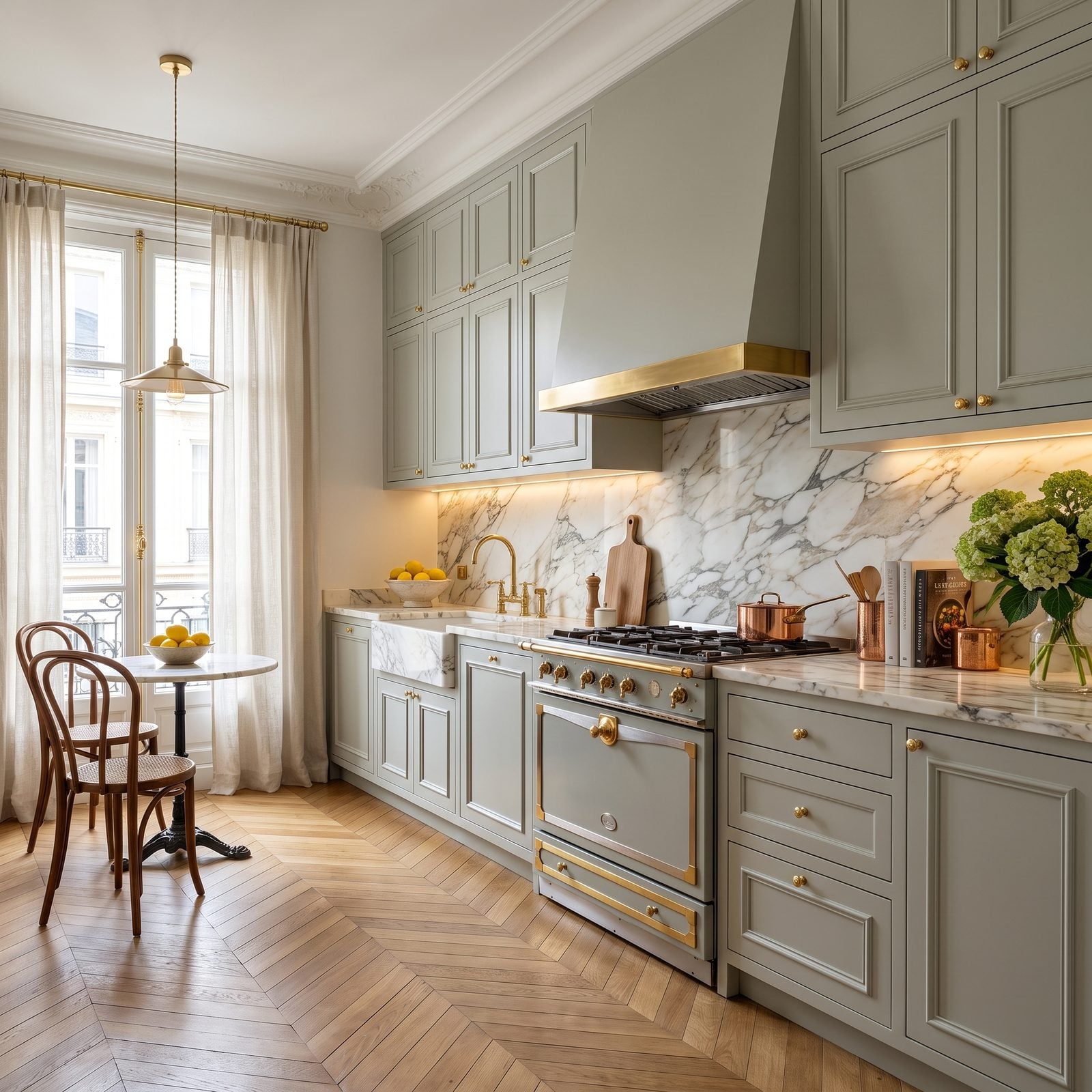
- Best kitchen styles: Parisian, neoclassical, glam and refined traditional kitchens.
- Finishes and colours: Soft sage-grey, putty, black, creamy white, with brass or nickel knobs.
- Relative cost: $$$ (higher) compared with the other doors here
- Cleaning: Moderate. The moulding’s top edge collects dust.
- Durability: Good. Glued, pinned moulding can loosen over many years of heat and humidity near ranges and dishwashers.
Designer move: Keep the moulding inset proportional, about 2 to 3 inches from the edge, and identical on every door.
Mistake to avoid: Don’t use applied moulding on drawer fronts narrower than about 6 inches; the rectangle gets cramped.
What the research says: Mixed signals: KBDN 2025 (Premier Custom Built) reports ‘an increase in more ornate doors with applied moldings’; H&G 2026 suggests decorative molding instead of a standard Shaker panel; a Domino designer predicts exterior decorative trim around cabinets. The counterpoint: Judi Cooper (The Spruce, Oct 2025): ‘busy applied moldings aren’t going to stick around next year’; a retailer projects heavy applied molding fading. Net evidence is contested. Sources: Kitchen & Bath Design News, 2025; Homes & Gardens, 2025; Domino, 2025; The Spruce, 2025; USA Cabinet Express, 2026.
Contemporary and Minimalist Cabinet Doors
11. Flat-Panel Slab
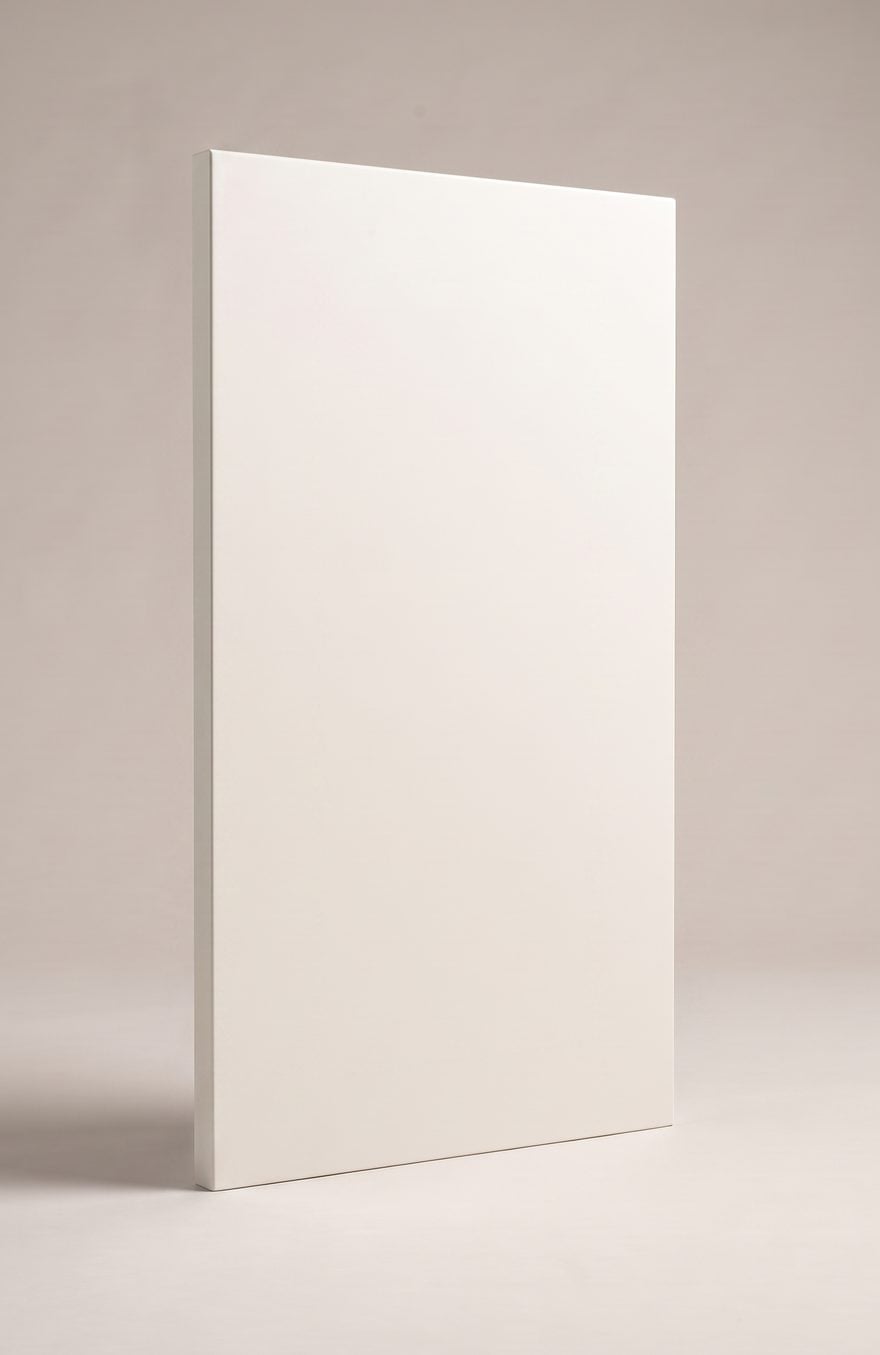
One flat piece with no frame and no profile. It is the foundation of modern kitchens, and the canvas for the finishes, textures and edge details that follow.
Home Stratosphere reader data: well below average reader response. Saves 75, love share 81 (100 = the average of the article the image appeared in), across 408 images in 96 articles.
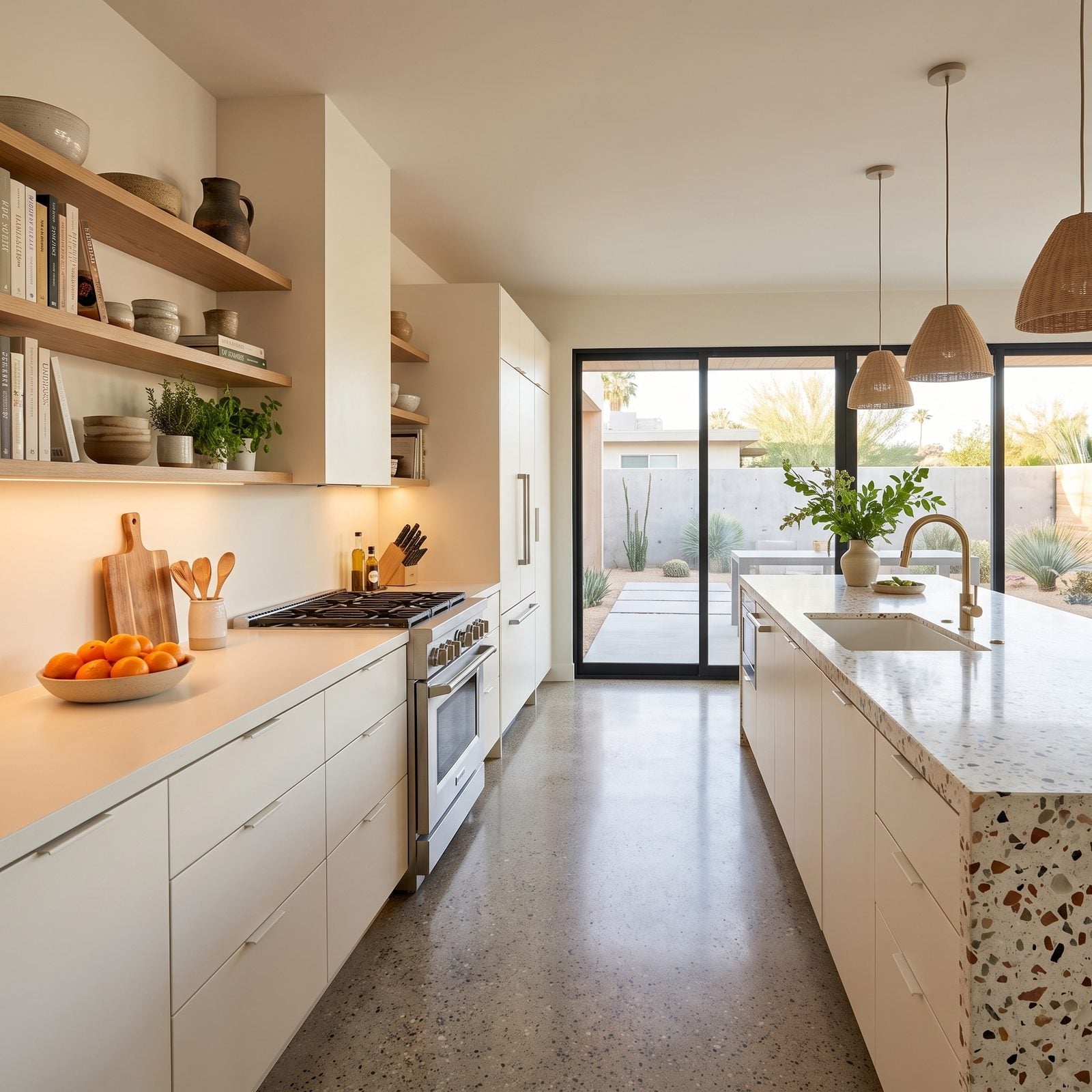
- Best kitchen styles: Modern, mid-century, California modern, minimalist and European kitchens.
- Finishes and colours: Matte lacquer, painted MDF, laminate, veneer, Fenix-type super-matte.
- Relative cost: $ (lowest) compared with the other doors here
- Cleaning: Easiest of all. There are no grooves.
- Durability: Depends entirely on the surface. Laminate and super-matte resist wear; painted MDF can chip at edges.
Designer move: Line up grain, gaps and handle positions precisely. Slabs reward perfect alignment and punish sloppy installation.
Mistake to avoid: Don’t pair a cheap slab with a big budget elsewhere. Thin edge banding is the first thing that looks cheap.
What the research says: NKBA 2026 Kitchen Trends Report: 69% of 634 professionals expect flat, slab cabinet doors to gain popularity; 60% say minimalism will be popular over the next three years. Houzz 2025: flat-panel is the No. 2 door at 22% (up from 17% in the 2022 study), and Houzz says slab fronts are ‘gaining ground’ even in traditional rooms. MasterBrand 2026: flat panel rising; KBDN 2026: Hacker says slab fronts ‘remaining a dominant selection’; 6 of 18 Domino designers cited flat/slab. The counterpoint: Still far behind Shaker in actual remodels (22% vs ~61%). Designers want slabs with grain, texture or a subtle edge rather than plain/gloss. Sources: PHCP Pros, 2025; Houzz, 2025; Houzz, 2025; MasterBrand, 2025; Kitchen & Bath Design News, 2026; Domino, 2025.
12. Wood-Grain Slab
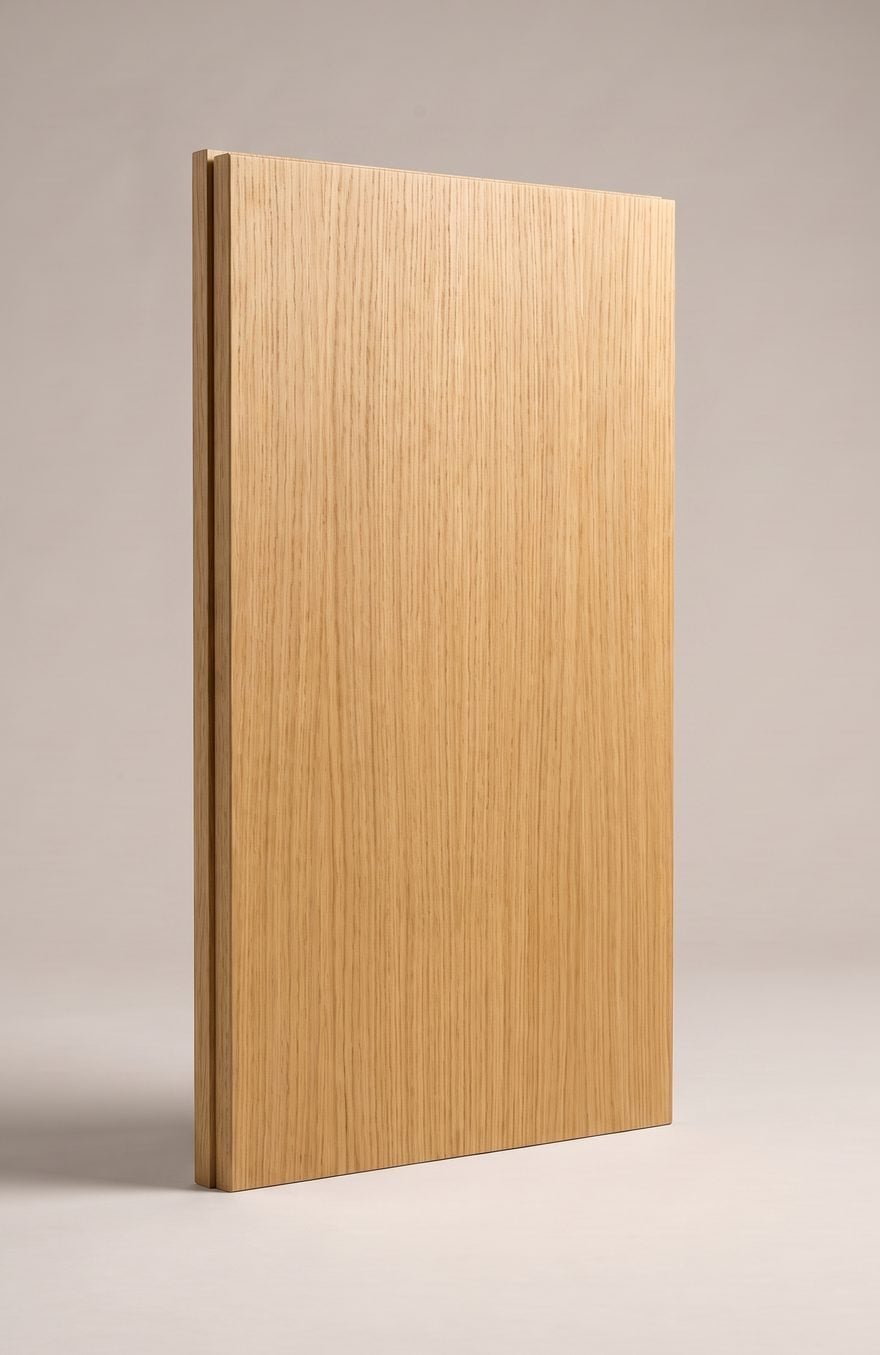
A slab whose real story is the wood, often rift-sawn or quartersawn oak with straight, quiet grain, sometimes grain-matched across a whole run so the pattern flows from door to door.
Home Stratosphere reader data: well below average reader response. Saves 73, love share 79 (100 = the average of the article the image appeared in), across 455 images in 105 articles.
🔥 Would you like to save this?
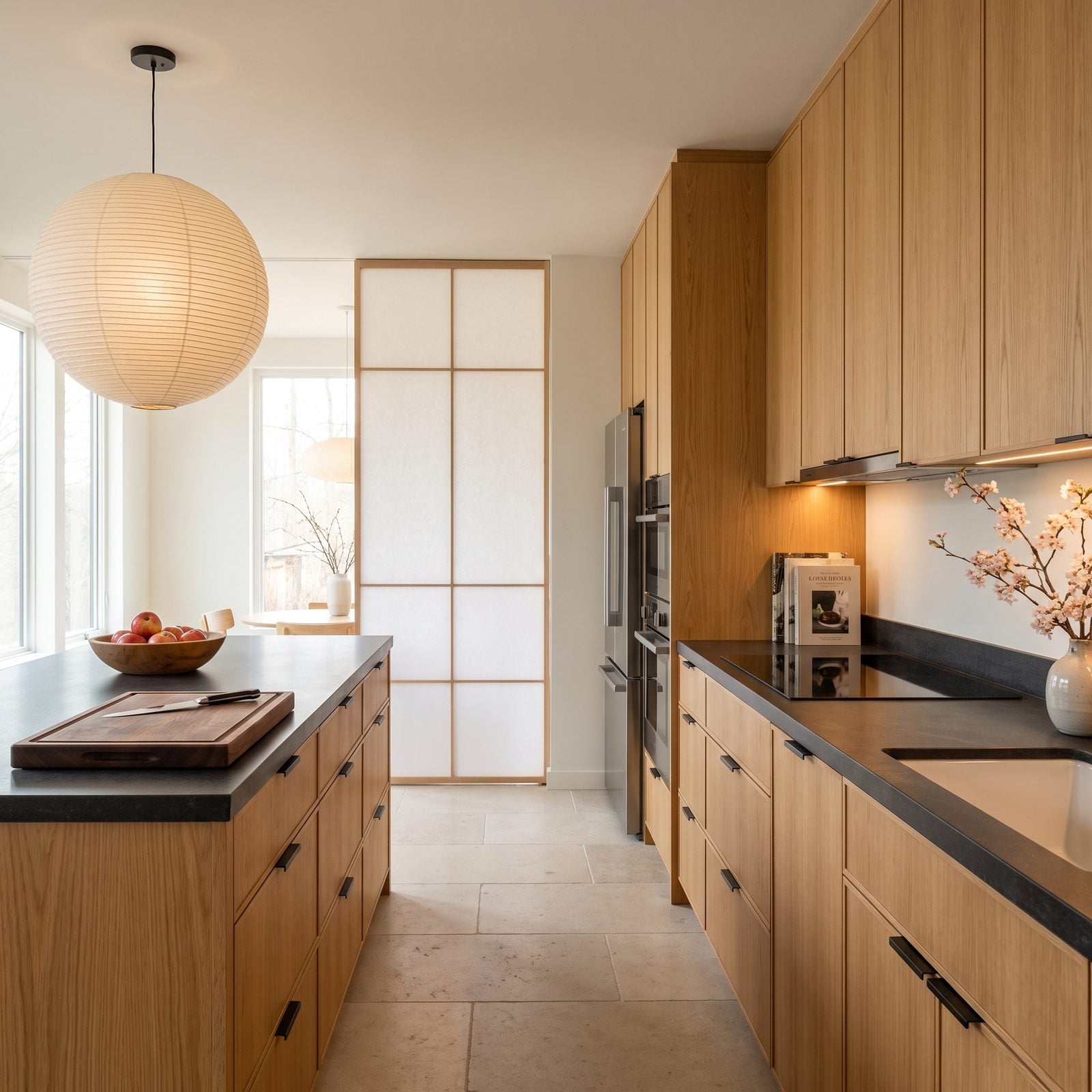
- Best kitchen styles: Japandi, Scandinavian, warm minimal, mid-century and California modern kitchens.
- Finishes and colours: Rift white oak, walnut, ash; matte oil or low-sheen lacquer.
- Relative cost: $$$ (higher) compared with the other doors here
- Cleaning: Easy, though matte finishes show greasy fingerprints near handles.
- Durability: Good. Real-wood veneer can be lightly refinished; textured laminate imitations cannot.
Designer move: Ask for sequence-matched veneer on a long run. It costs more and looks far more expensive than it is.
Mistake to avoid: Don’t let the grain run in different directions on neighbouring doors. Horizontal and vertical mixed by accident looks unplanned.
What the research says: Direct: KBDN 2026 quotes Covered Bridge clients ‘favoring slab doors with horizontal or vertical wood grains’; Domino’s Ghislaine Vinas: ‘let the wood grain come through’. Indirect but quantitative: NKBA 2026 – 59% say wood grain is growing (white oak 51%); Houzz 2026 – wood is the top cabinet color at 29%, up 6 points; MasterBrand 2027 – medium stains top for the first time in 15 years. The counterpoint: Wood stats are about finish/colour, not door profile; they apply equally to wood Shaker doors. H&G (Jun 2026) calls light oak + Taj Mahal quartzite repetitive; preference is shifting to mid/dark species. Sources: PHCP Pros, 2025; Houzz, 2026; MasterBrand, 2026; Kitchen & Bath Design News, 2026; Domino, 2025; Homes & Gardens, 2026.
13. High-Gloss Slab
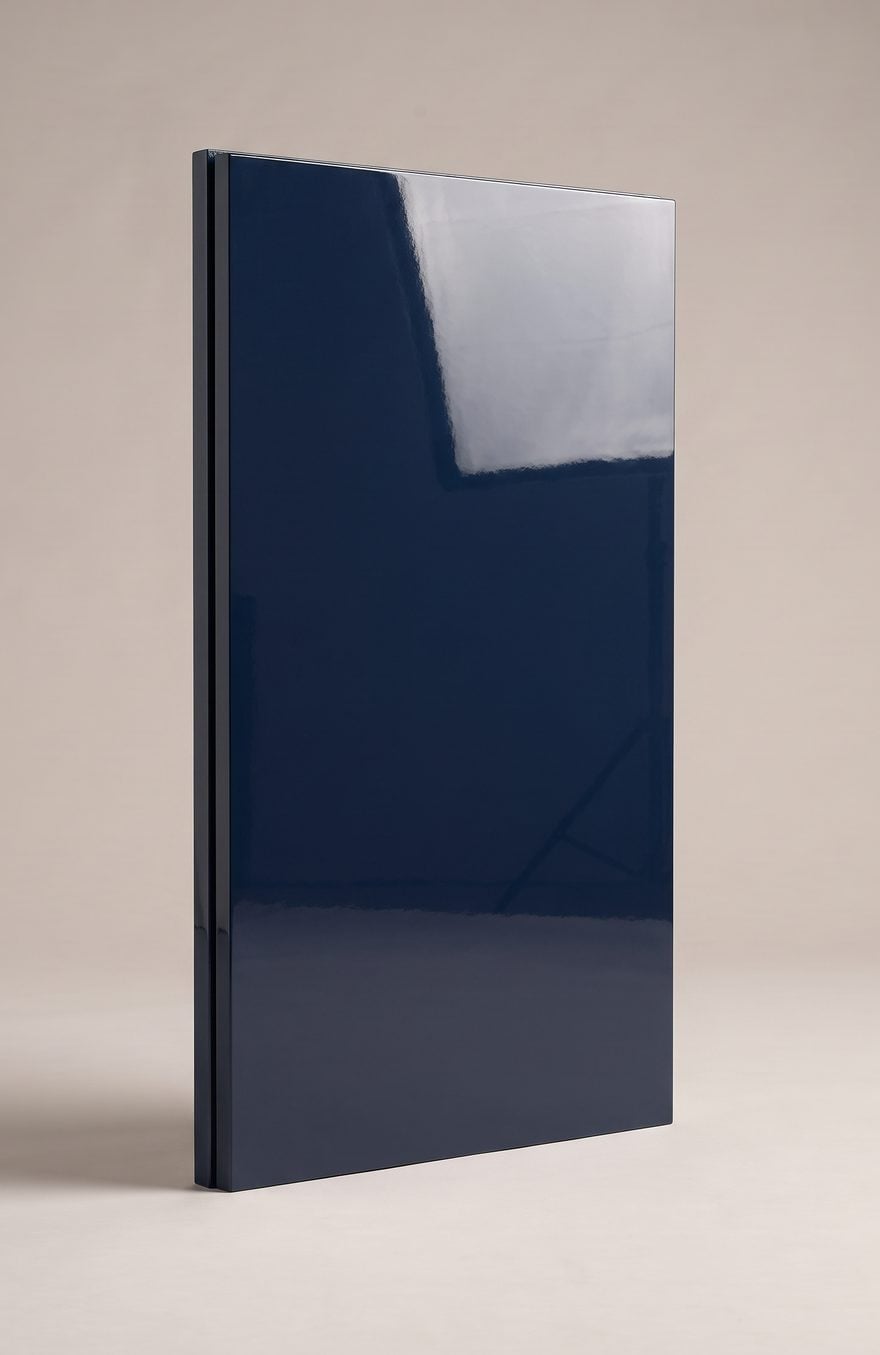
This is a finish on a slab, not a separate construction. A lacquer or acrylic surface polished to a mirror shine bounces light around the room and makes colour look saturated.
Home Stratosphere reader data: well below average reader response. Saves 70, love share 62 (100 = the average of the article the image appeared in), across 45 images in 25 articles.
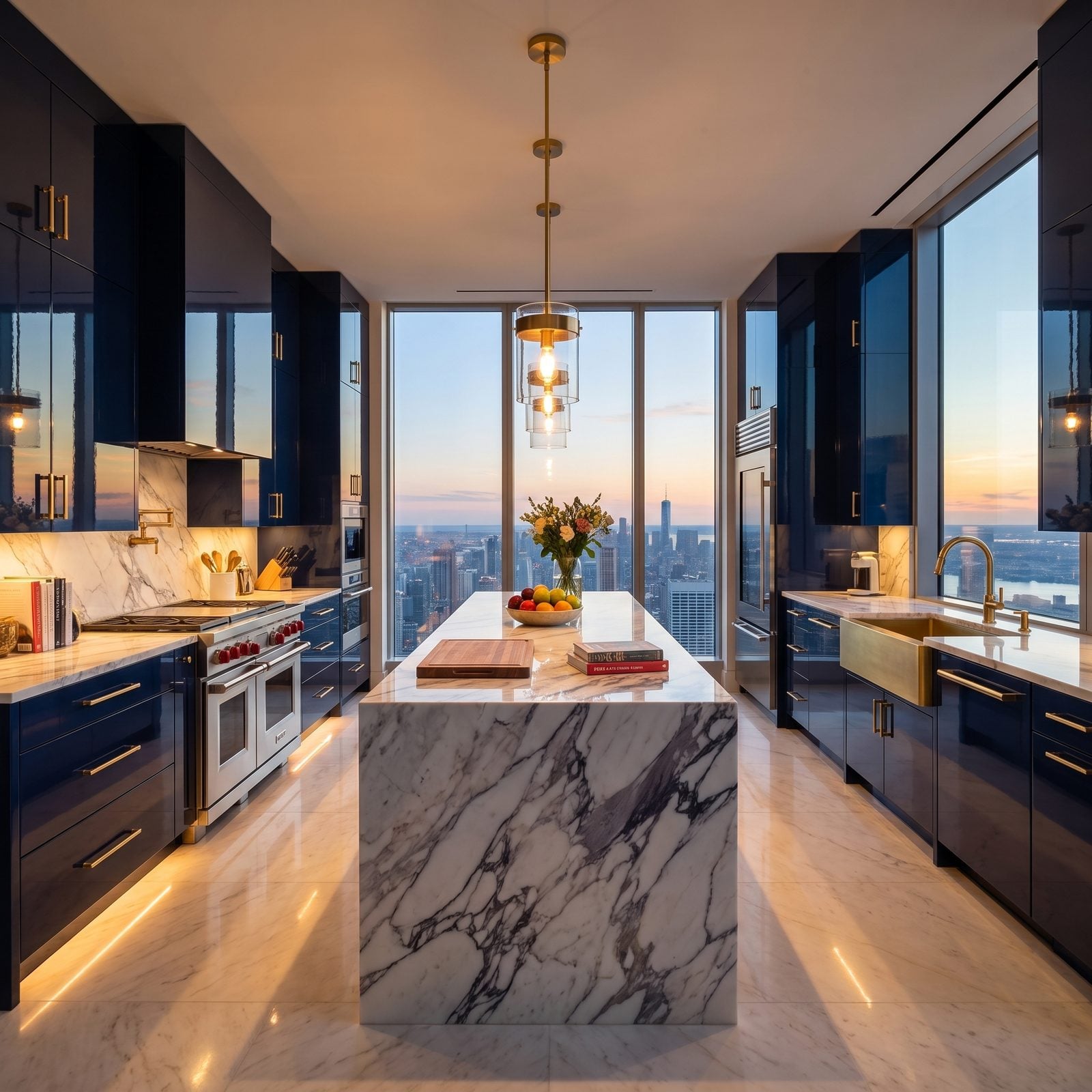
- Best kitchen styles: Glam, contemporary, urban apartments and small kitchens that need light.
- Finishes and colours: Deep navy, black, bordeaux, emerald and white lacquer or acrylic.
- Relative cost: $$$ (higher) compared with the other doors here
- Cleaning: Easy to wipe but shows every fingerprint and smear.
- Durability: Hard lacquer and acrylic can scratch. Light colours hide micro-scratches better than dark ones.
Designer move: Use gloss on the island or tall run only, and calm it with honed stone and wood.
Mistake to avoid: Don’t put dark gloss next to a sunny window, where every streak and dust particle shows.
What the research says: Homes & Gardens (Dec 2025): ‘glossy white cabinetry is losing its shine’; Hunker (Sep 2026) lists high-gloss finishes as on the way out, quoting Laura Stephens: ‘High-gloss cabinetry, which is hard to maintain… is becoming less popular’; H&G (Jun 2026) lists ‘highly lacquered finishes’ as fading. NKBA/Houzz favour matte, wood grain. The counterpoint: This is a finish, not strictly a profile; the slab form itself is rising. H&G 2026 also notes lacquered and coloured acrylic specialist finishes as a niche 2026 idea (Octavia Dickinson). No quantitative decline data. Sources: Homes & Gardens, 2025; Hunker, 2026; Homes & Gardens, 2026; USA Cabinet Express, 2026.
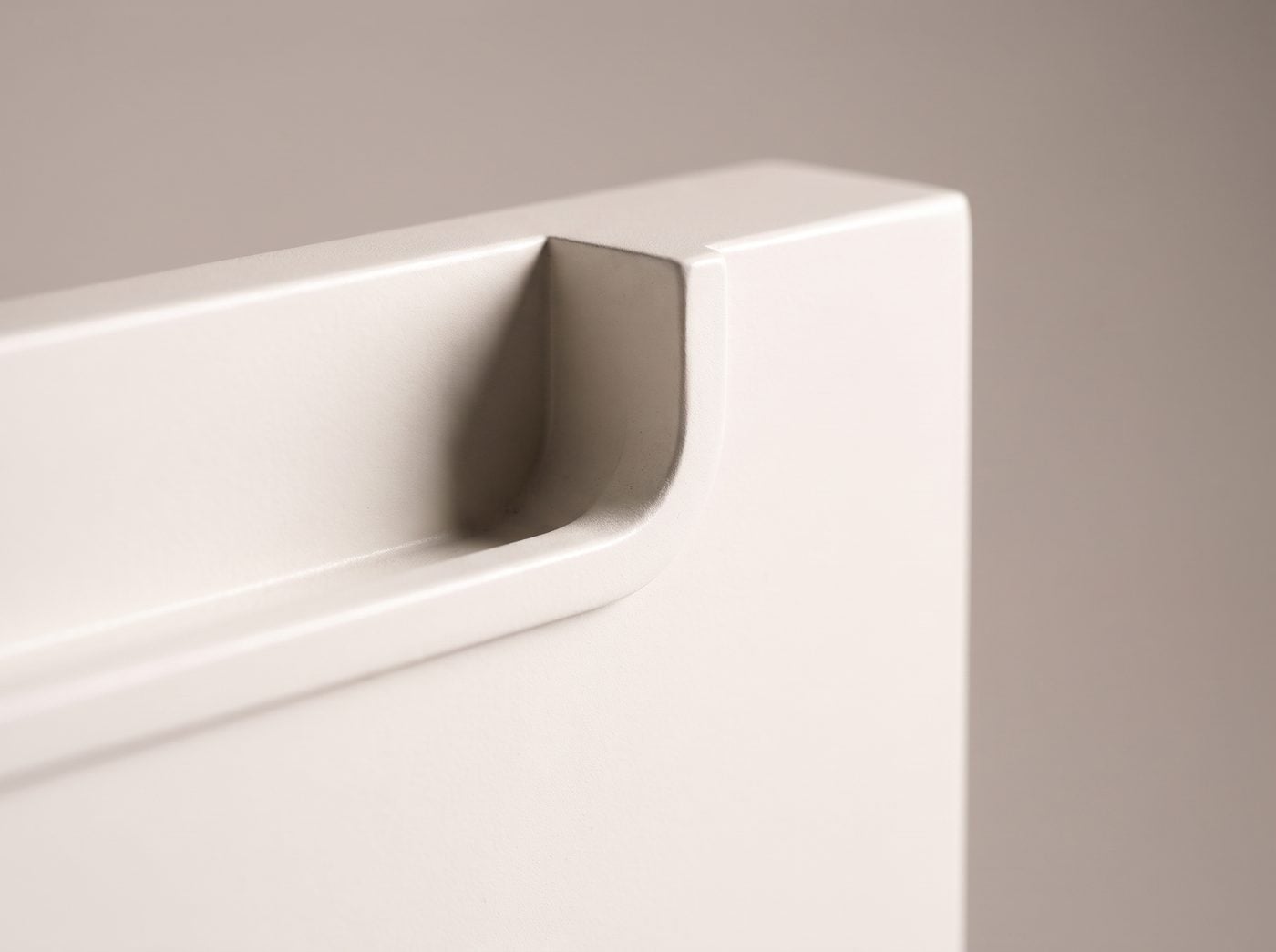
14. Integrated J-Pull
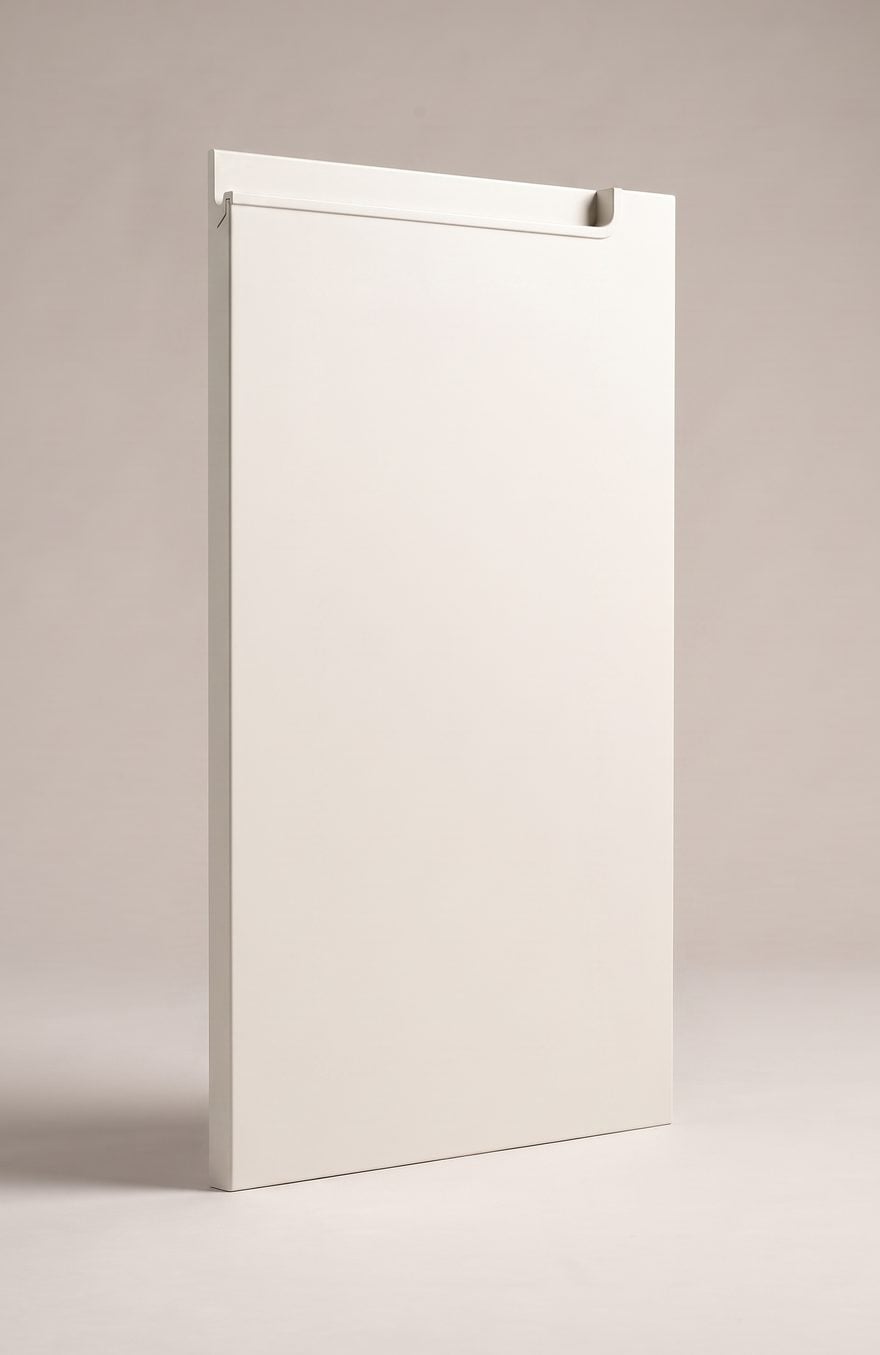
A slab door whose top or side edge is shaped into a J-profile channel you hook your fingers behind. No hardware at all, just a clean line.
Home Stratosphere reader data: too few images yet to measure reliably (3 kitchen images in our sample).
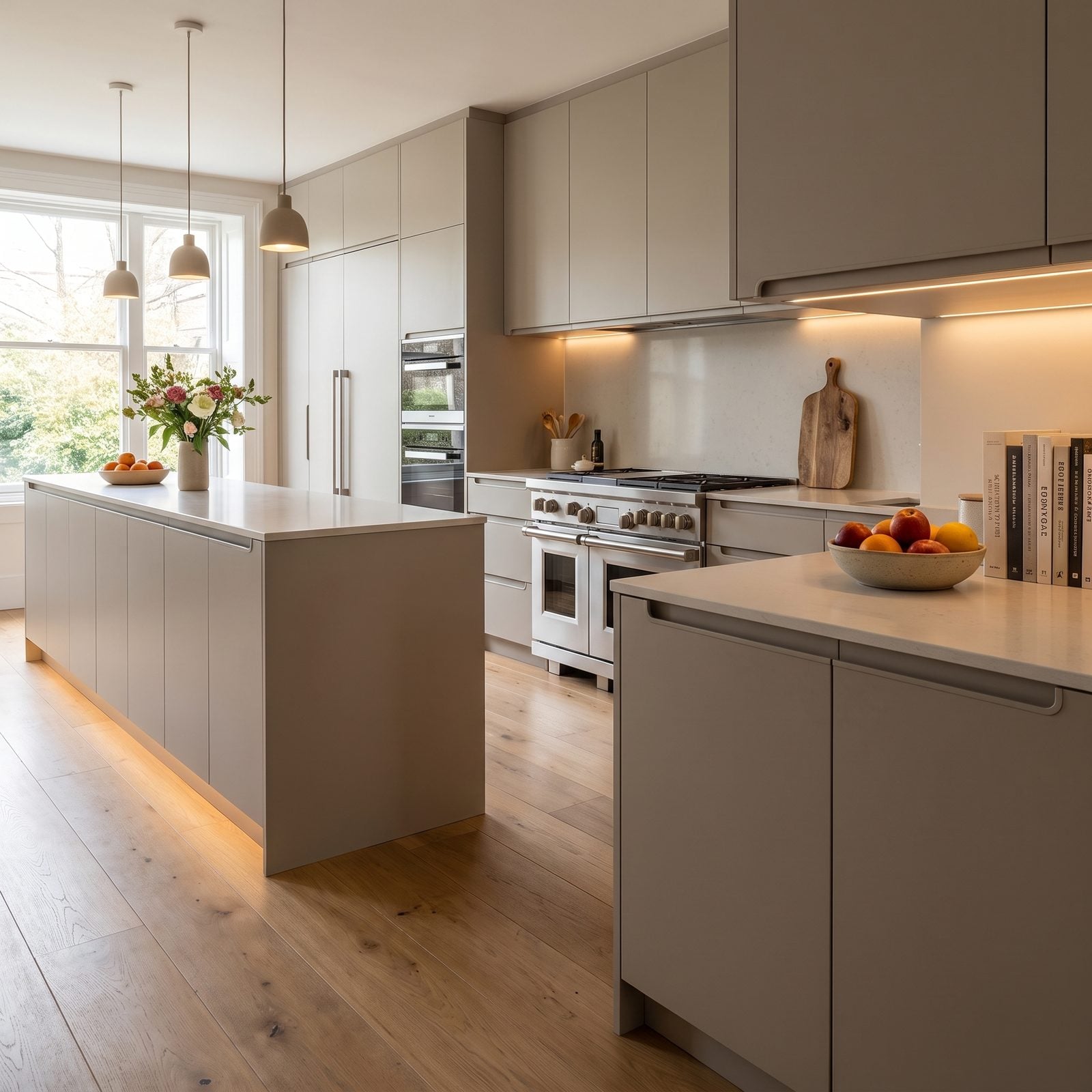
- Best kitchen styles: European minimalist, contemporary and small-space kitchens.
- Finishes and colours: Matte stone greys, warm whites, black, laminate and super-matte surfaces.
- Relative cost: $$$ (higher) compared with the other doors here
- Cleaning: The channel collects crumbs and splashes; vacuum or wipe it out regularly.
- Durability: Good. The edge takes the most hand traffic, so choose a hard-wearing surface.
Designer move: Use it on lowers and choose push-to-open or a rail for uppers so the grips aren’t over your head.
Mistake to avoid: Don’t specify J-pulls with very tall doors. Reaching the grip at the top of a pantry door is awkward.
What the research says: Livingetc (Feb 2026) calls handleless kitchens ‘here to stay’, citing integrated J-pulls and Gola rails; KBDN 2026 (Hacker): ‘Handle-less systems are also on the rise’; NKBA’s minimalism (60%) and panel-faced appliance figures support the handleless look indirectly. The counterpoint: Houzz 2026: 95% of renovating homeowners choose cabinets with handles (finger pulls 9%). H&G (Dec 2025) says handle-free cabinets are ‘falling out of favour’. Adoption in the US remains small. Sources: Livingetc, 2026; Kitchen & Bath Design News, 2026; PHCP Pros, 2025; Designers Today, 2026; Homes & Gardens, 2025.
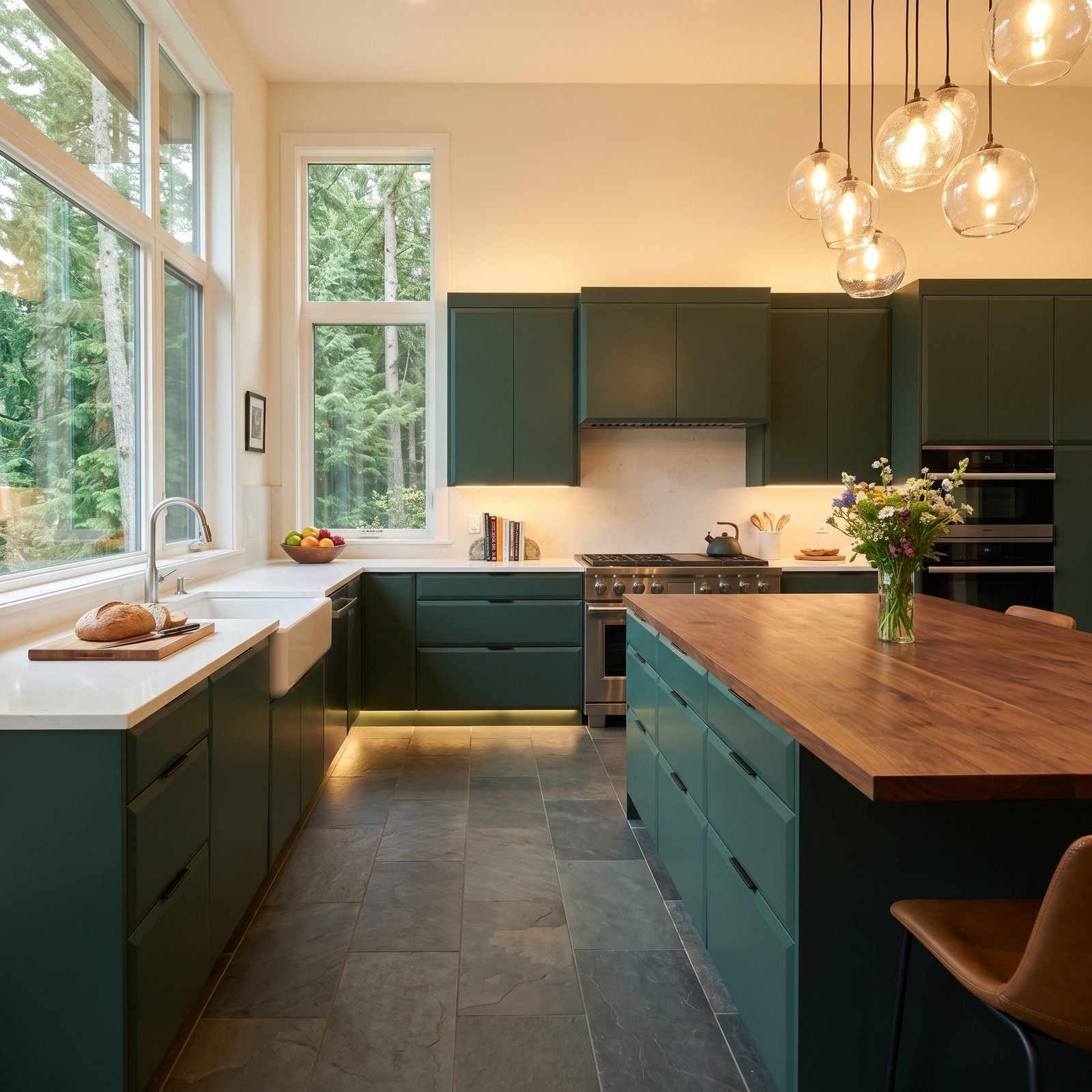
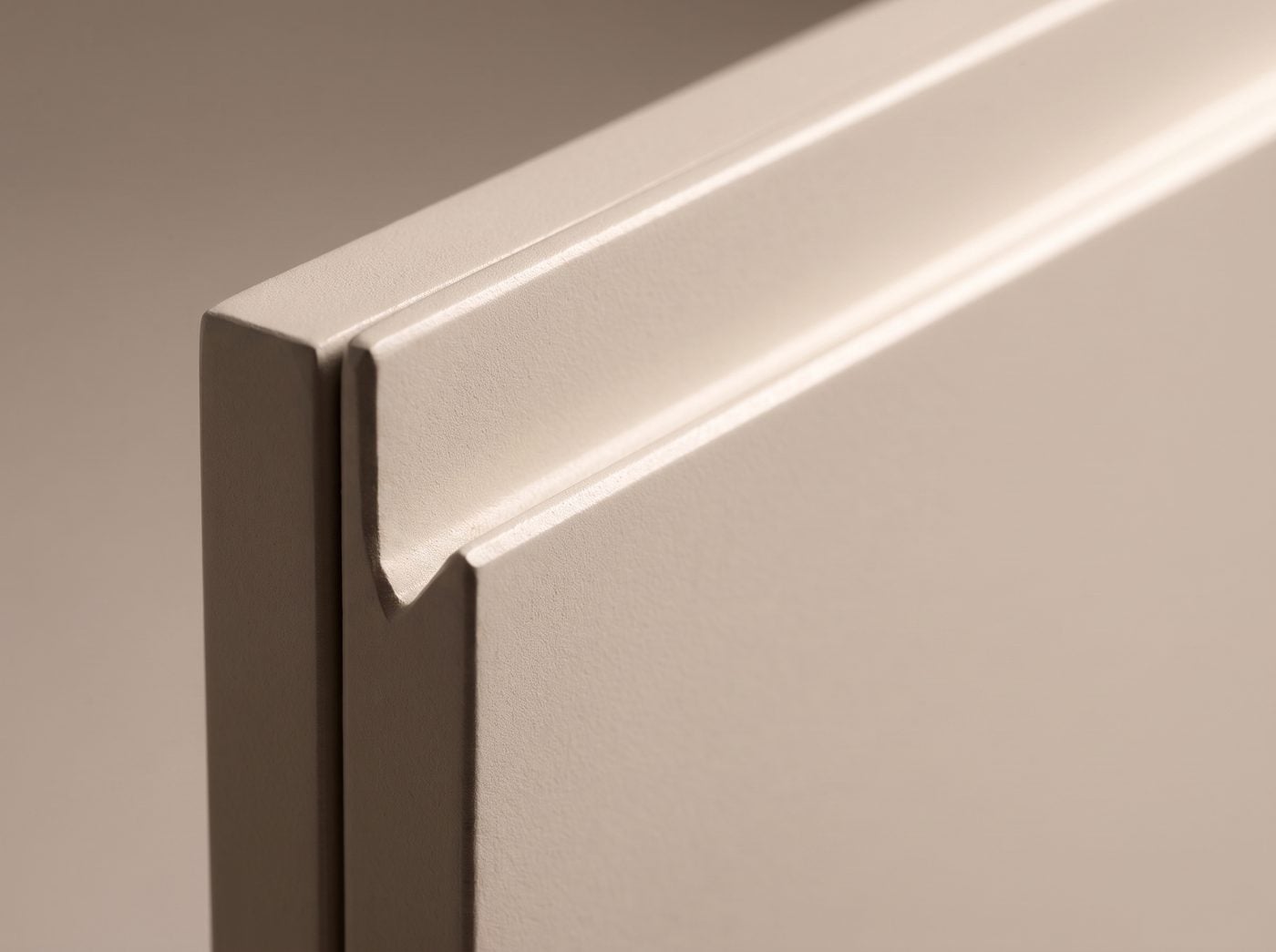
15. Chamfered-Edge Handleless
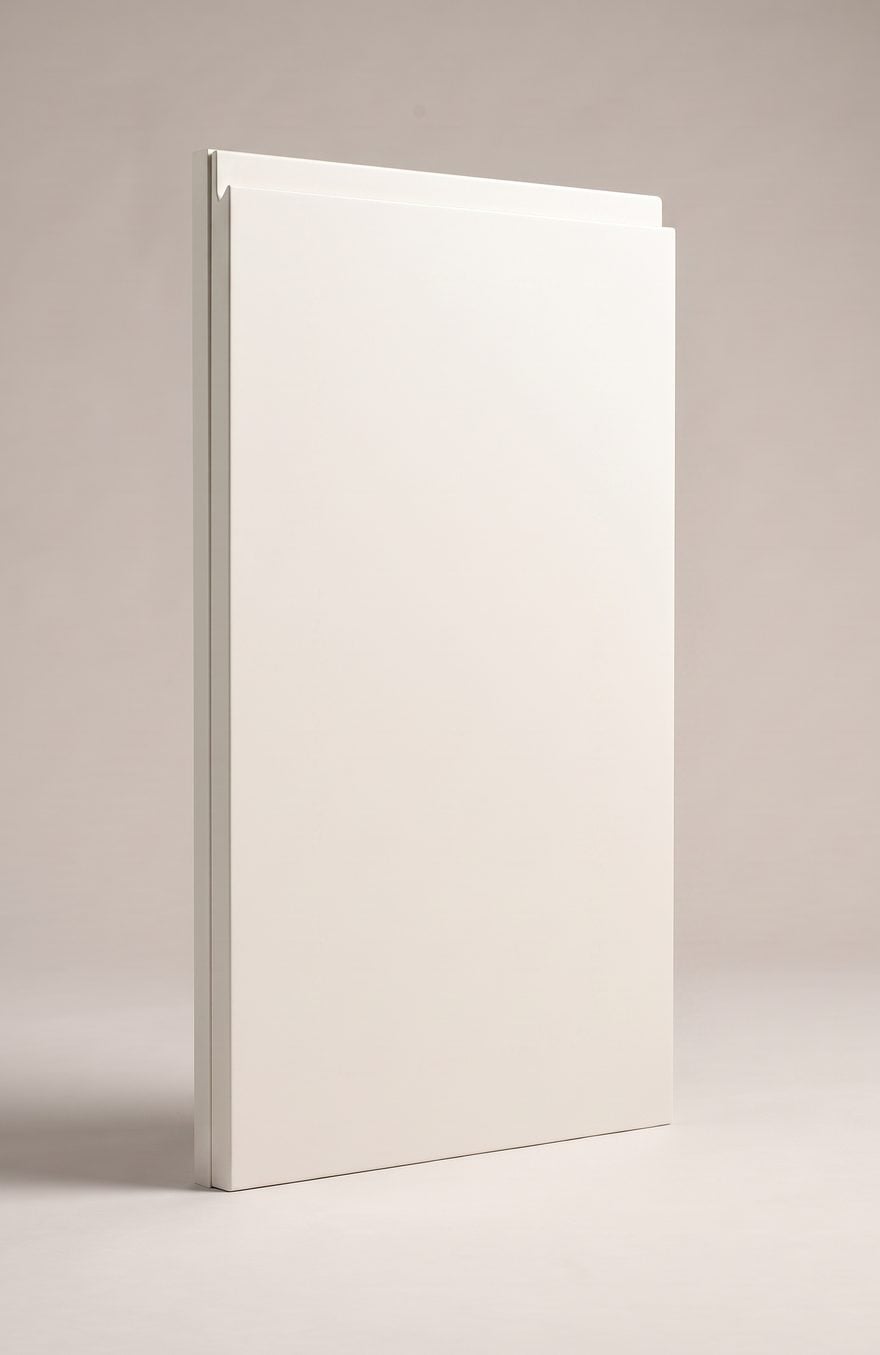
The door’s top edge is bevelled backward, creating an angled lip you can grip, or that works alongside a recessed metal channel. It is subtler than a J-pull and sharper-looking.
Home Stratosphere reader data: too few images yet to measure reliably (0 kitchen images in our sample).
- Best kitchen styles: Contemporary, Pacific Northwest modern and quiet-luxury kitchens.
- Finishes and colours: Deep greens, charcoal, stone greys, walnut and oak veneers.
- Relative cost: $$$ (higher) compared with the other doors here
- Cleaning: Easy. The chamfer is open, so it doesn’t trap crumbs like a channel does.
- Durability: Good. Painted chamfers can chip if knocked, so veneer or laminate hold up better.
Designer move: Use contrasting core colour (a wood edge on a painted face) to make the chamfer a design detail.
Mistake to avoid: Don’t choose a shallow chamfer on heavy doors. If you can’t grip it with wet hands, add a channel.
What the research says: Chamfers are frequently named as a detail: Domino’s Anu Jain (‘chamfered edges’), Kathy Kuo (‘chamfer edges’), Block Renovation (‘a gentle chamfer’), KBIS 2026 (‘Chamfered interior profiles’), Fabuwood Echo’s 45-degree bevel. The counterpoint: These are decorative chamfers, not specifically chamfered grip edges replacing hardware; handleless evidence is mixed (see #14). Sources: Domino, 2025; Homes & Gardens, 2025; Block Renovation, 2026; Cabinet IQ, 2026; Kitchen & Bath Business, 2025.
16. Routed Geometric Panel
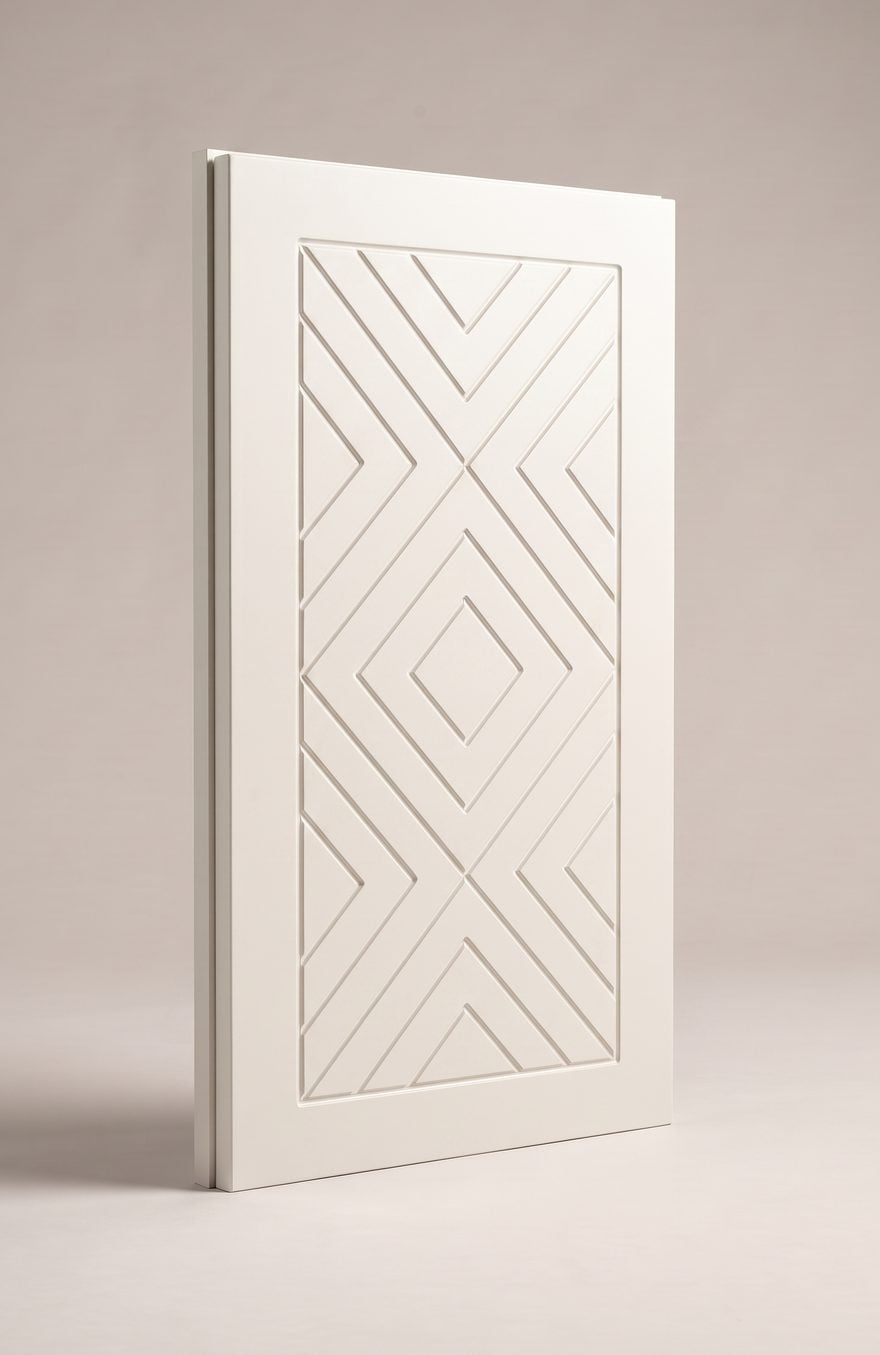
Shallow lines are routed into a slab to form diamonds, chevrons, grids or arcs. It is pattern without hardware or texture, and it suits colour-forward kitchens.
Home Stratosphere reader data: too few images yet to measure reliably (2 kitchen images in our sample).
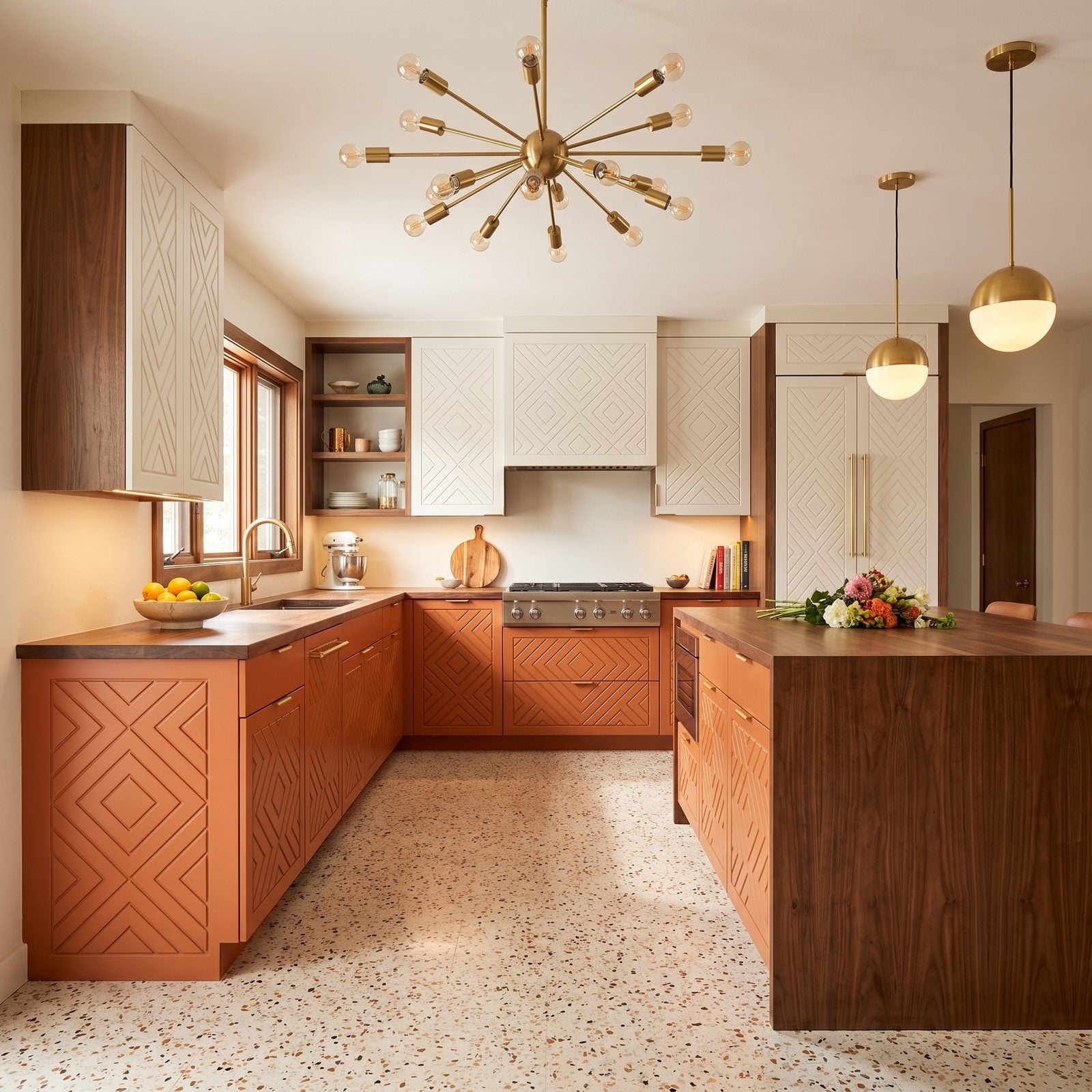
- Best kitchen styles: Mid-century, eclectic, Art Deco-inspired and playful modern kitchens.
- Finishes and colours: Terracotta, mustard, teal, and painted MDF (routing works best in MDF).
- Relative cost: $$$ (higher) compared with the other doors here
- Cleaning: Moderate. The grooves collect grease, especially near the range.
- Durability: Good in painted MDF; routed lines don’t open with humidity like joints do.
Designer move: Keep it to one feature zone, such as the island or lower run, and leave uppers plain.
Mistake to avoid: Don’t route a busy pattern beside a busy backsplash. One pattern per wall.
What the research says: Related signals only: Domino’s Mimi Meacham predicts slab doors with a subtle routed edge; Block Renovation mentions a routed edge on flat panels; H&G 2026 lists cut-outs, perforated fronts and patterned airflow panels (Kailee Blalock). The counterpoint: No source discusses routed geometric patterns on door faces. Sources: Domino, 2025; Block Renovation, 2026; Homes & Gardens, 2025.
Textured and Decorative Cabinet Doors
17. Beadboard
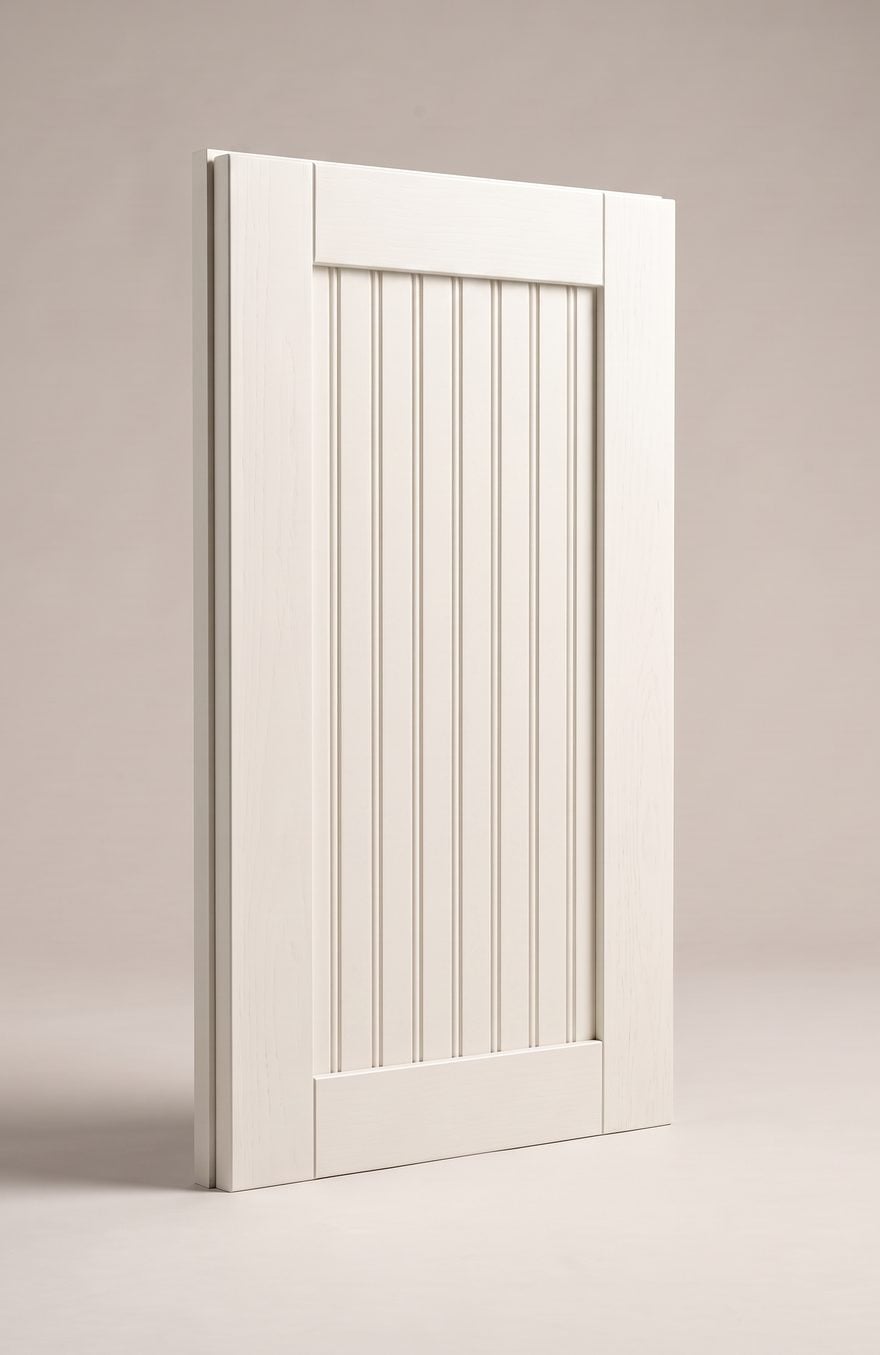
The centre panel is made of narrow strips separated by small rounded beads. It is the cottage door: casual, textural and nostalgic.
Home Stratosphere reader data: well above average reader response. Saves 158, love share 98 (100 = the average of the article the image appeared in), across 36 images in 22 articles.
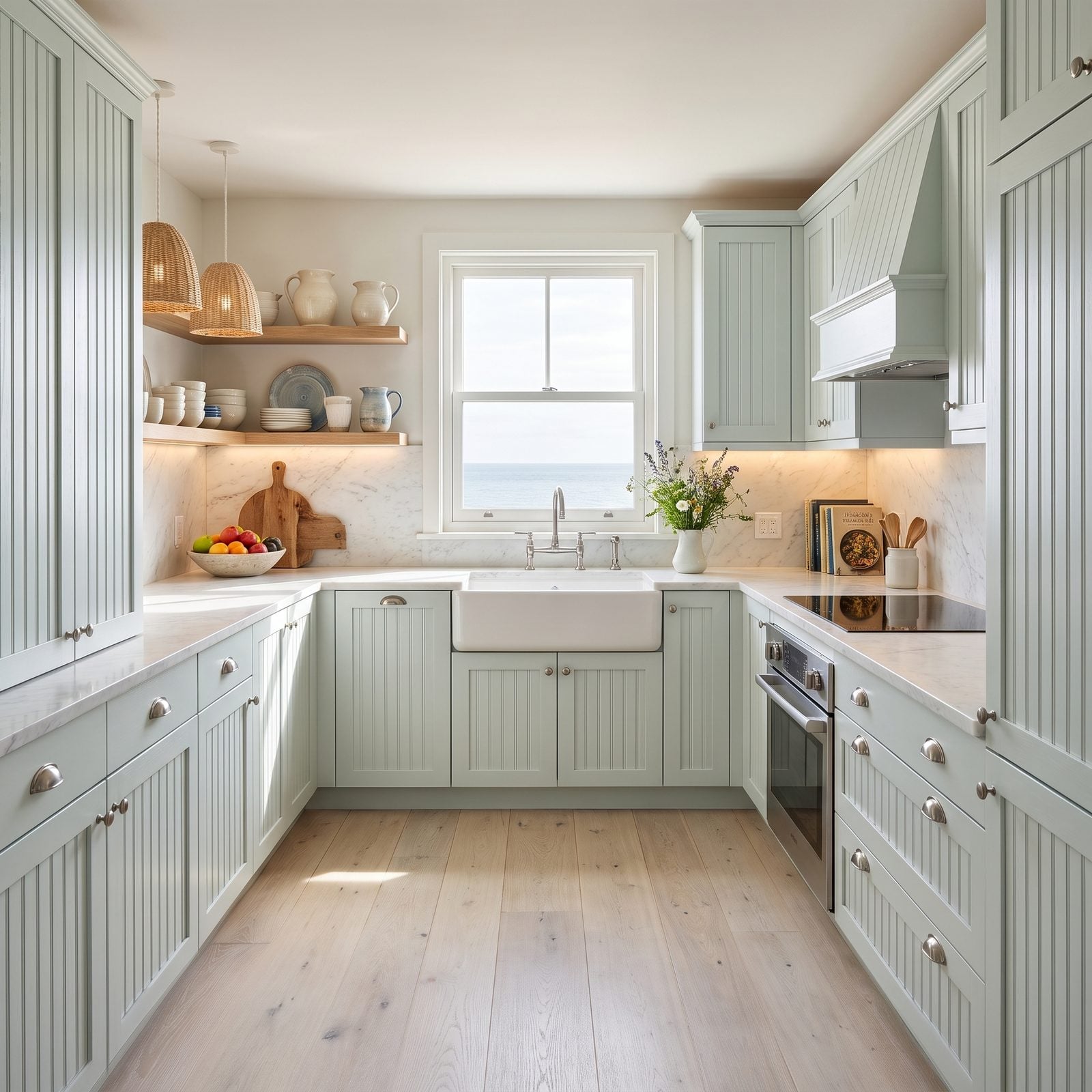
- Best kitchen styles: Coastal, cottage, farmhouse and Victorian kitchens.
- Finishes and colours: Seafoam, soft whites, butter yellow, pale blue, sage.
- Relative cost: $$ (moderate) compared with the other doors here
- Cleaning: More effort. Grime lines up in every bead.
- Durability: Good. Paint can crack along the bead lines over time on solid-wood panels.
Designer move: Use it on an island or a run of uppers to bring cottage texture in without overwhelming the room.
Mistake to avoid: Don’t choose beadboard behind a sink or range where splatter will settle into the grooves.
What the research says: Domino 2026: Drew Michael Scott predicts ‘a modern take on a beadboard-style cabinet’; Livingetc (Feb 2025): Phoebe Hollond uses beadboard on island sides; KBIS 2026 noted ‘Beadboard behind open shelving’ among returning details; H&G (Mar 2026) says shiplap-like paneled cabinets are taking some of Shaker’s role. The counterpoint: Evidence is a handful of designer mentions; KBIS sighting was beadboard on backs/walls, not doors. No quantitative data. Sources: Domino, 2025; Livingetc, 2025; Cabinet IQ, 2026; Homes & Gardens, 2026.
18. V-Groove
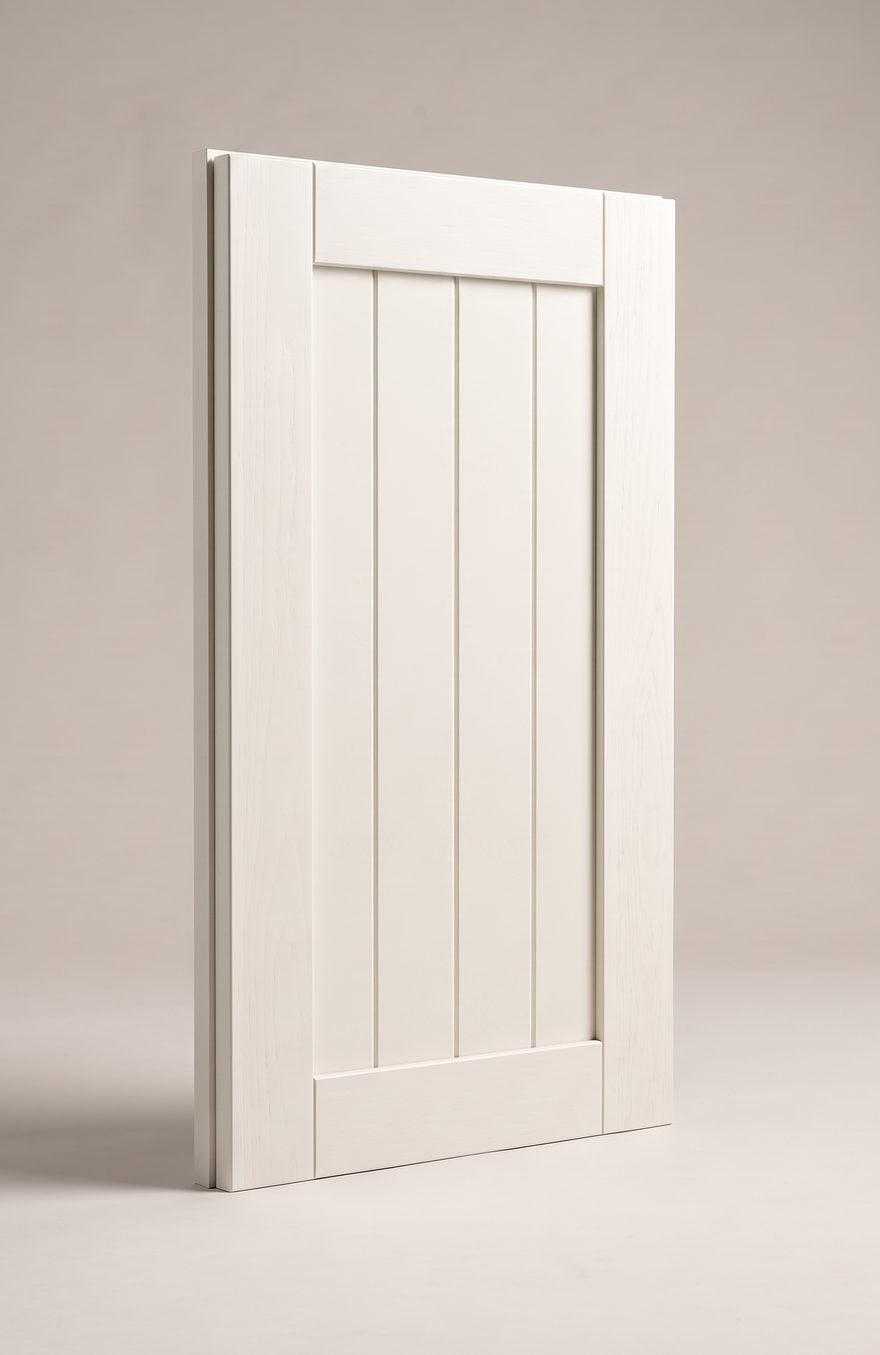
Wider planks separated by sharp V-shaped cuts, with fewer lines than beadboard. It has a tongue-and-groove, Craftsman or farmhouse feel, more structured than cute.
Home Stratosphere reader data: well above average reader response. Saves 129, love share 111 (100 = the average of the article the image appeared in), across 61 images in 35 articles.
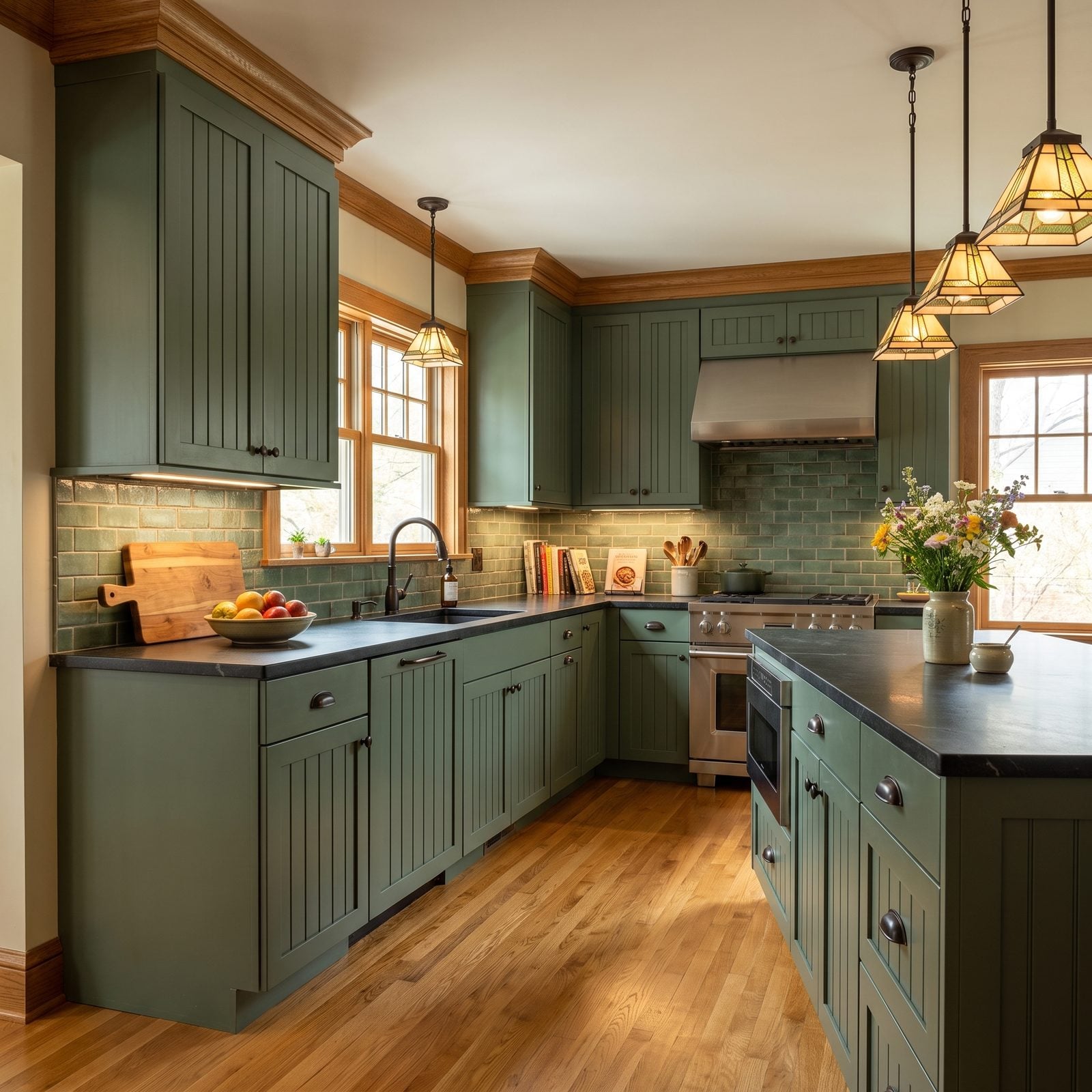
- Best kitchen styles: Craftsman, modern farmhouse, rustic and Scandinavian cabin kitchens.
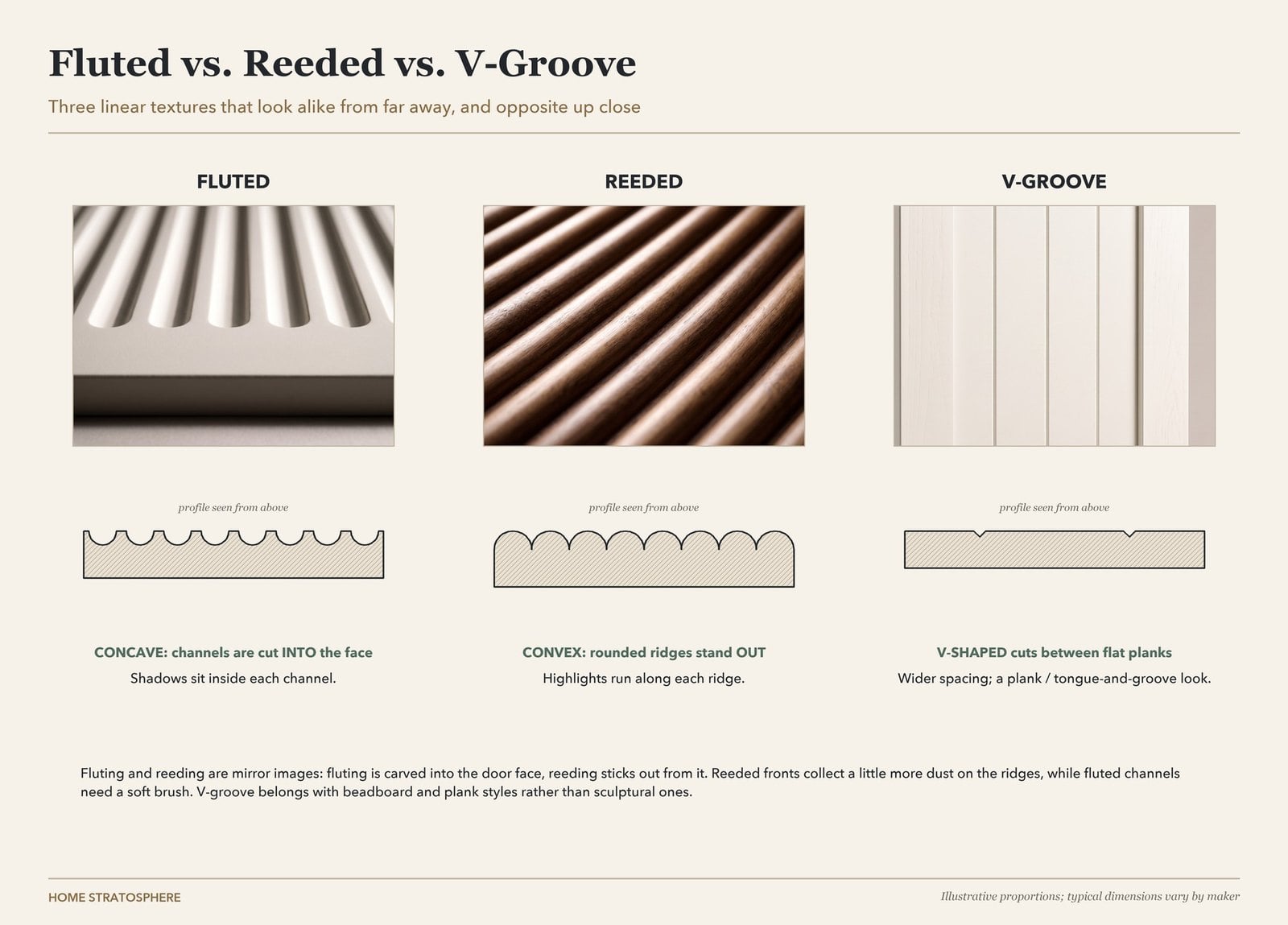
- Finishes and colours: Deep sage, olive, warm whites, natural or stained oak and pine.
- Relative cost: $$ (moderate) compared with the other doors here
- Cleaning: Moderate, with fewer grooves than beadboard.
- Durability: Good; the wider planks hide wear.
Designer move: Run the grooves vertically on doors and horizontally on drawer fronts only if your designer shows a mock-up first.
Mistake to avoid: Don’t combine V-groove and beadboard in one kitchen. They read as two near-miss versions of the same idea.
What the research says: H&G (Mar 2026) says paneled cabinets ‘reminiscent of shiplap’ are ‘quietly taking [Shaker’s] place’, citing deVOL’s Sebastian Cox range and Becky Shea (‘new traditionalism’); Amber Lewis’s 2027 outlook features paneled cabinetry. The counterpoint: Essentially one publication’s framing plus manufacturer examples; H&G itself says Shaker is ‘going nowhere’. Sources: Homes & Gardens, 2026; Homes & Gardens, 2026.
19. Fluted
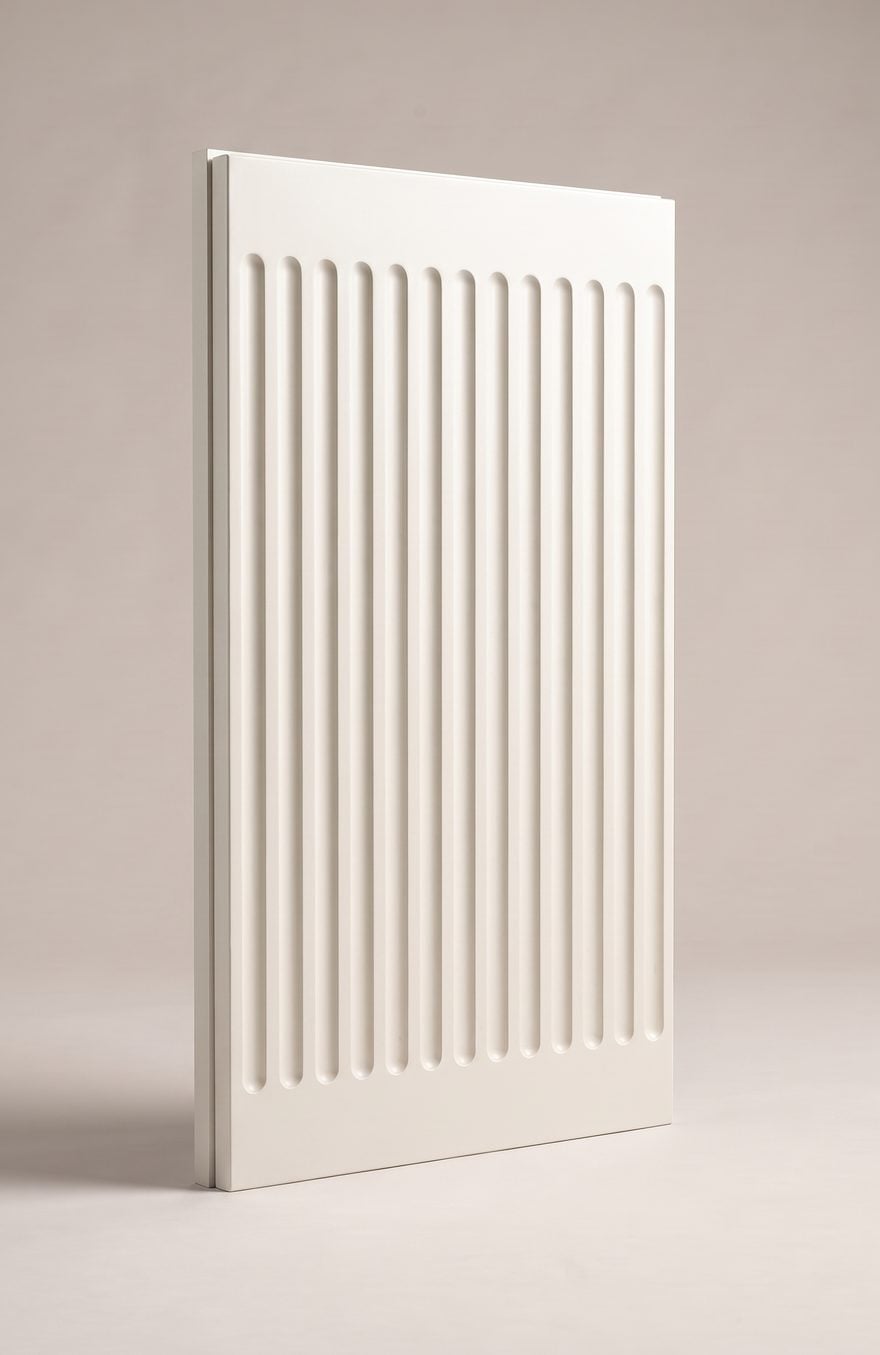
Fluting is a series of concave channels cut into the surface. It is a classical architectural detail that has moved from columns to islands, bars and statement doors.
Home Stratosphere reader data: about average reader response. Saves 99, love share 105 (100 = the average of the article the image appeared in), across 58 images in 33 articles.
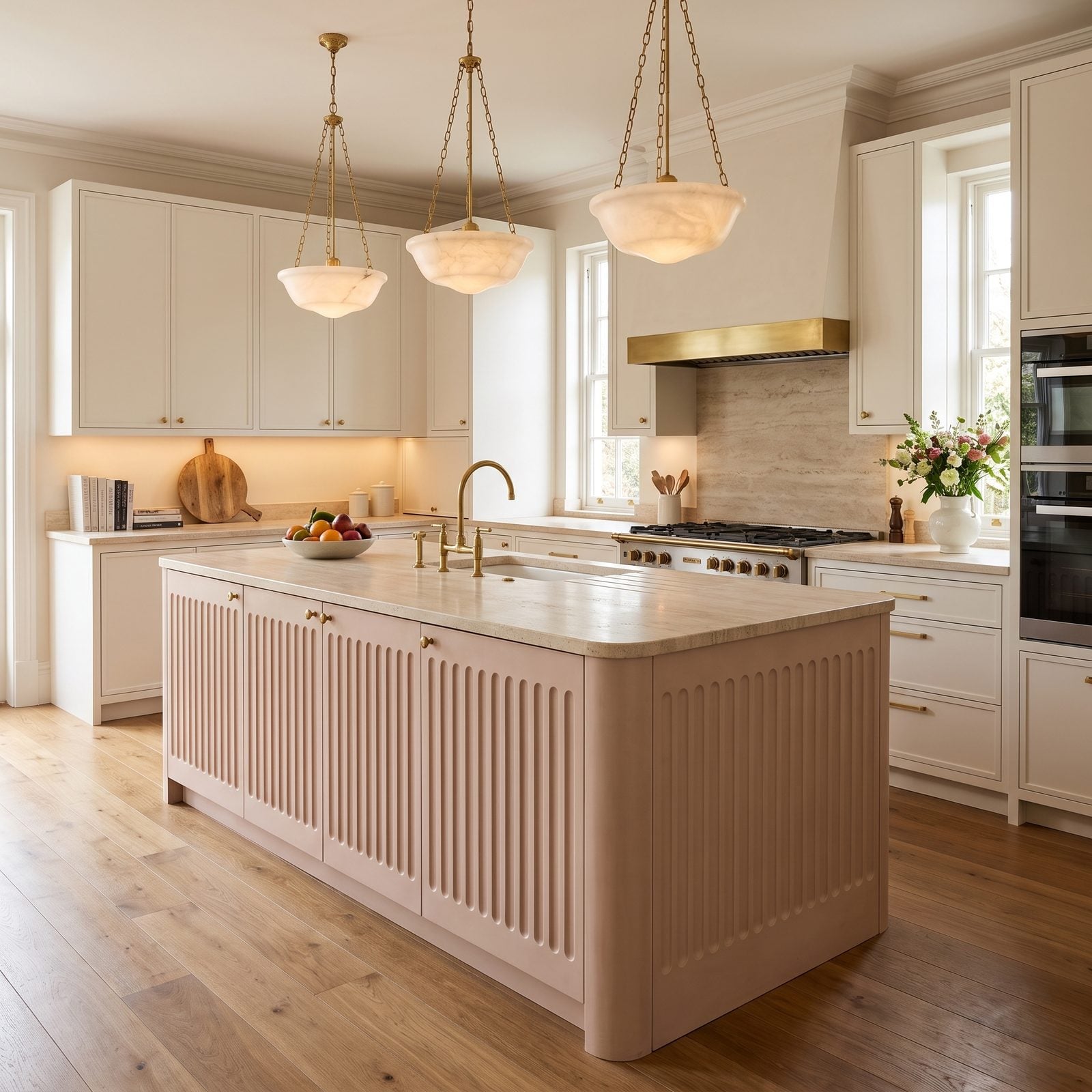
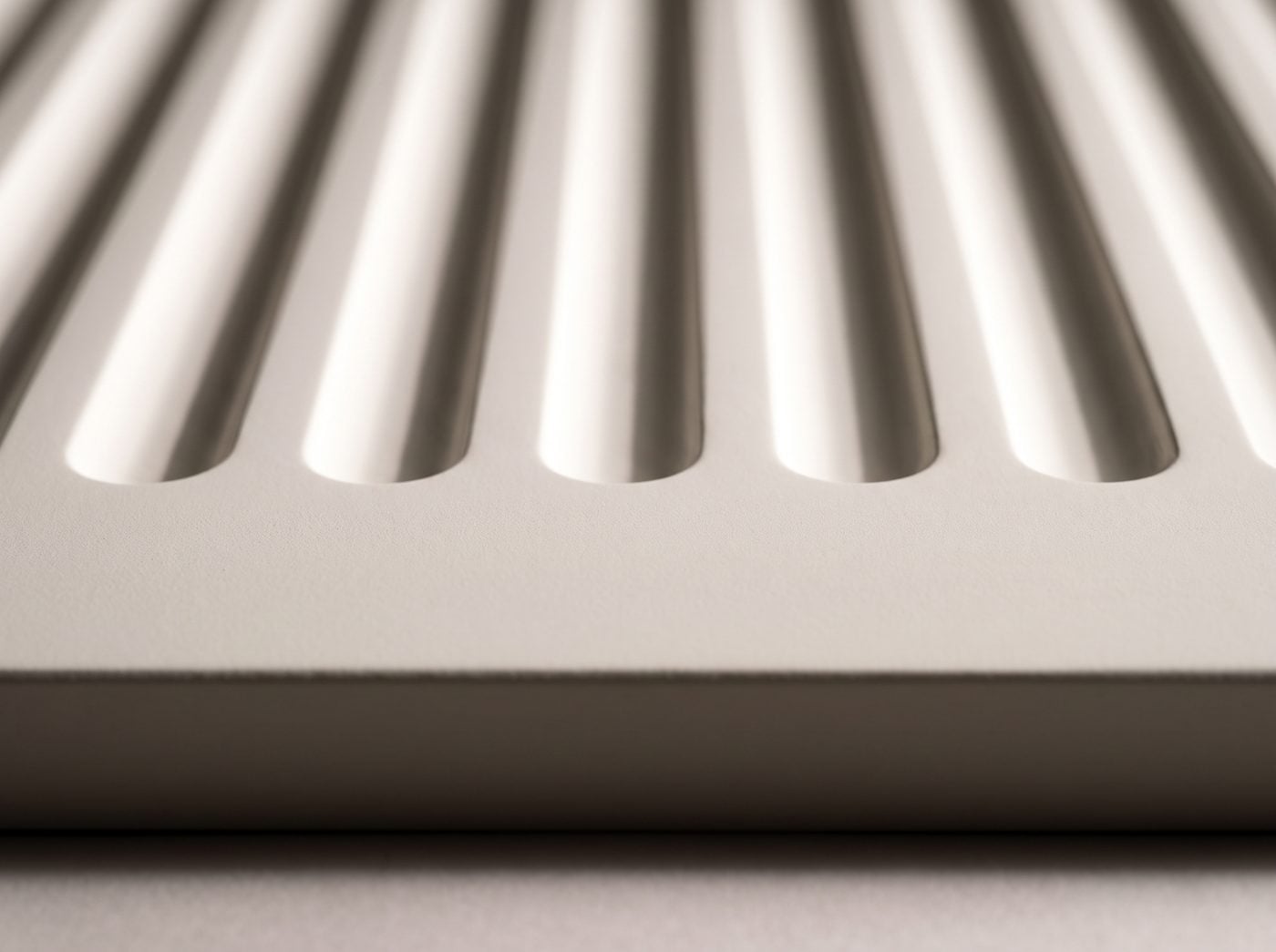
- Best kitchen styles: Luxe transitional, modern classic, Art Deco and organic modern kitchens.
- Finishes and colours: Plaster pinks and clays, cream, black, oak and walnut.
- Relative cost: $$$$ (premium) compared with the other doors here
- Cleaning: More effort. Use a soft brush or microfibre wand to clean each channel.
- Durability: Good. Painted flutes show chips on corners; wood flutes age well.
Designer move: Put fluting on the island or one feature run and keep the rest plain. Contrast is what makes it look expensive.
Mistake to avoid: Don’t flute every door. It turns a statement into a pattern and becomes hard to clean.
What the research says: Livingetc (May 2026): Blakes London calls fluting ‘the cabinet detail we are specifying more than ever right now’; KBDN 2026 (Hacker) cites ‘fluted textures’; UK retailer data: fluted kitchen searches ‘surged by 217 percent in the past quarter’ (2025). The counterpoint: Strong counter-signal: H&G (Jun 2026) lists ‘Fully Fluted Cabinetry’ as overdone (Kathy Kuo, Allison Lind); a 2025 KBB survey found 44.1% of pros used no fluted/reeded detail in the past year and 38.2% used it in only 1-24% of projects. Consensus: accent use holds, whole-kitchen fluting is fading. Sources: Livingetc, 2026; Livingetc, 2025; Kitchen & Bath Design News, 2026; Homes & Gardens, 2026; Kitchen & Bath Business, 2025; Country & Town House, 2025.
20. Reeded
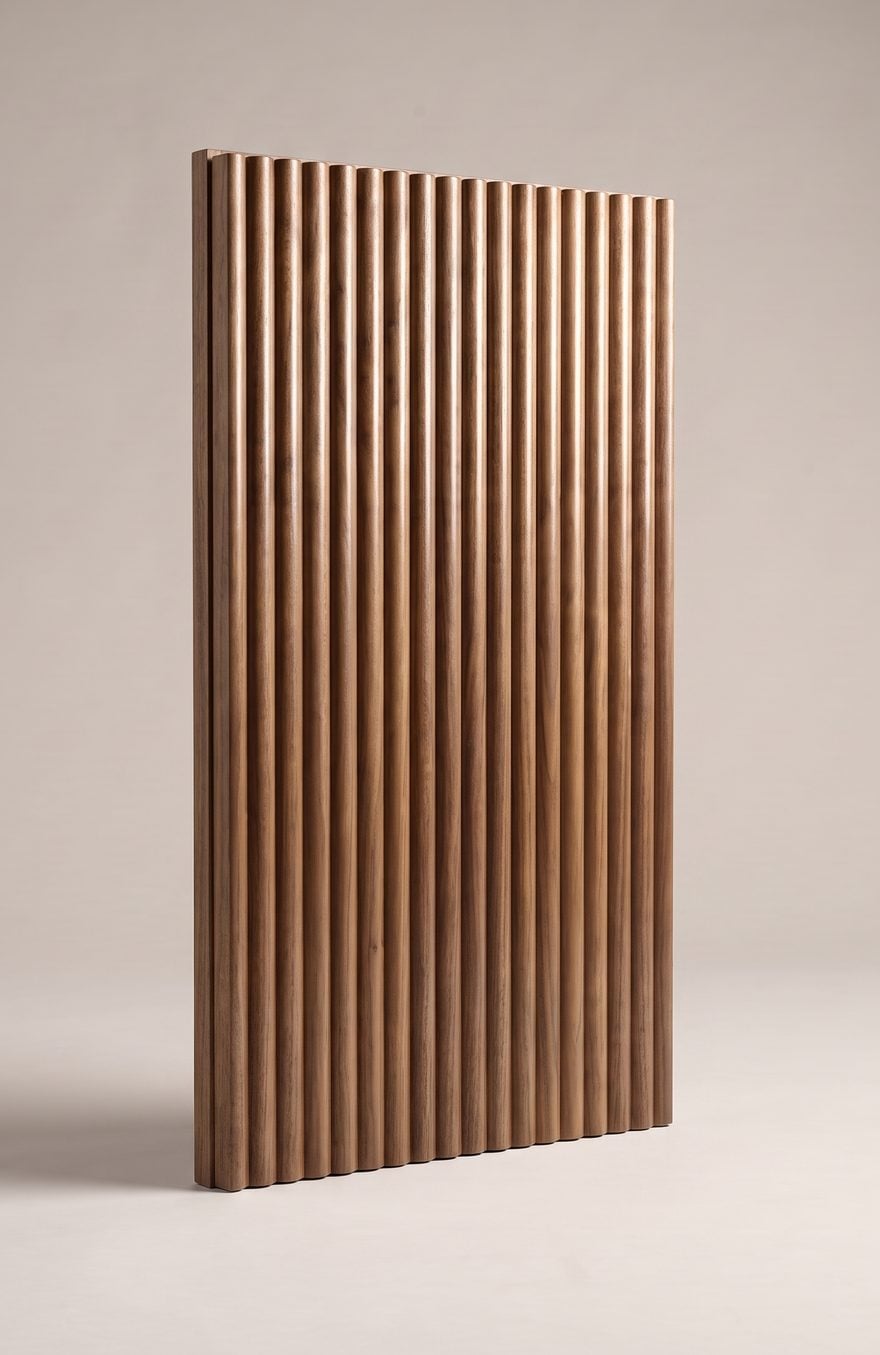
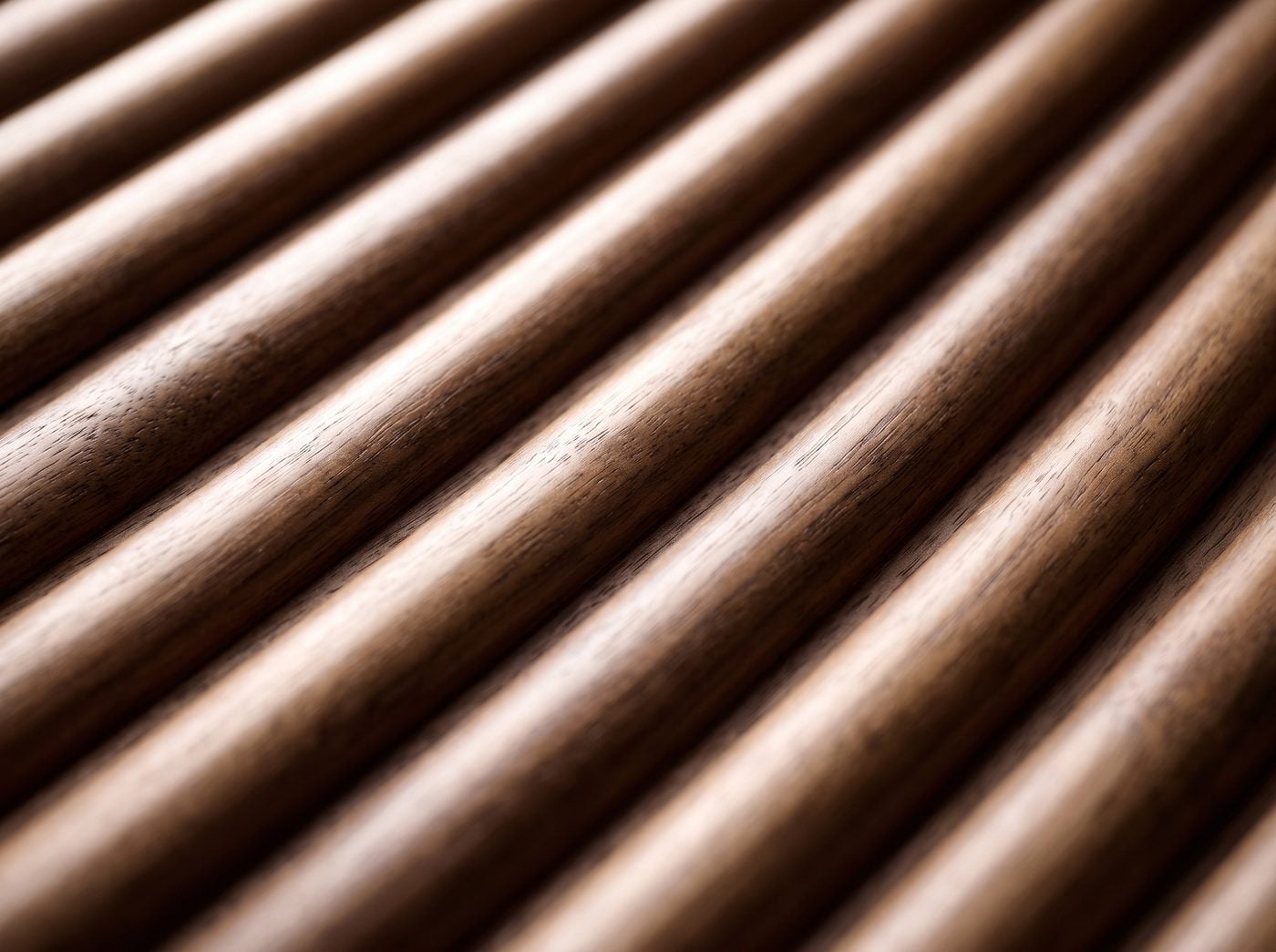
Reeding is the opposite of fluting: convex, rounded ridges that stand out from the face. It looks softer and more tactile, especially in walnut and oak.
Home Stratosphere reader data: too few images yet to measure reliably (24 kitchen images in our sample).
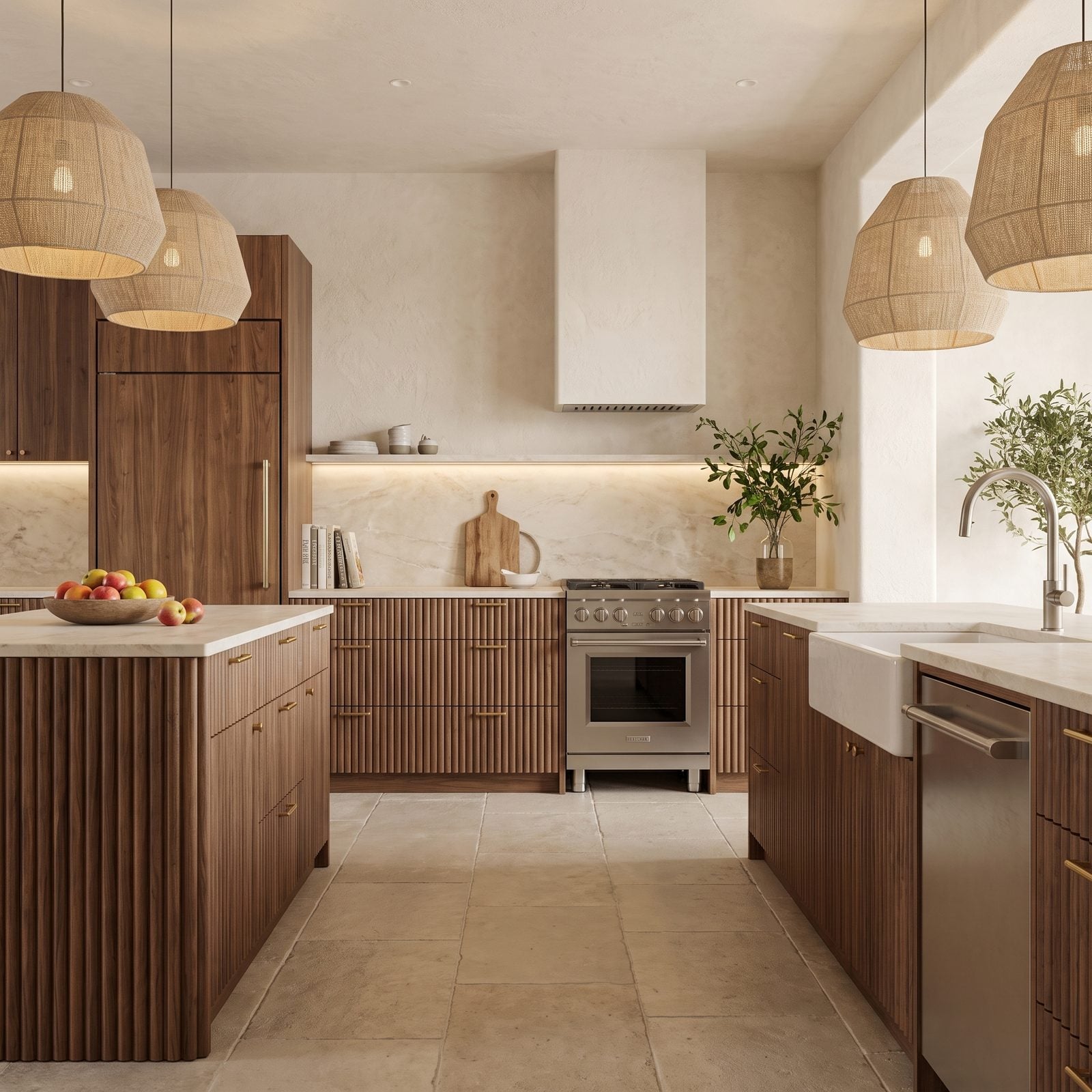
- Best kitchen styles: Warm modern, organic modern, Japandi and mid-century kitchens.
- Finishes and colours: Walnut, oak, cream and taupe painted finishes.
- Relative cost: $$$$ (premium) compared with the other doors here
- Cleaning: Moderate. Dust sits in the valleys between ridges.
- Durability: Good in solid or veneered wood; ridges hide minor scuffs.
Designer move: Use reeding as a cladding on the island or the base run with plain slabs above to balance it.
Mistake to avoid: Don’t confuse it with fluting when ordering. Ask for a sample and run your hand across it.
What the research says: KBDN 2026: Plain & Fancy says ‘Reeded doors continue to show incredible staying power’; CNC Cabinetry launched new reeded doors; KBDN 2025: Signature reports ‘some reeded panels’; Domino’s Galey Alix predicts ‘thin reeding around the border’; Real Simple 2026 lists reeded fronts. The counterpoint: H&G (Jun 2026): Allison Lind says ‘Fluting or reeding’ has become overdone when used everywhere; KBB 2025 survey shows limited actual uptake. Sources: Kitchen & Bath Design News, 2026; Kitchen & Bath Design News, 2025; Domino, 2025; Real Simple, 2026; Homes & Gardens, 2026.
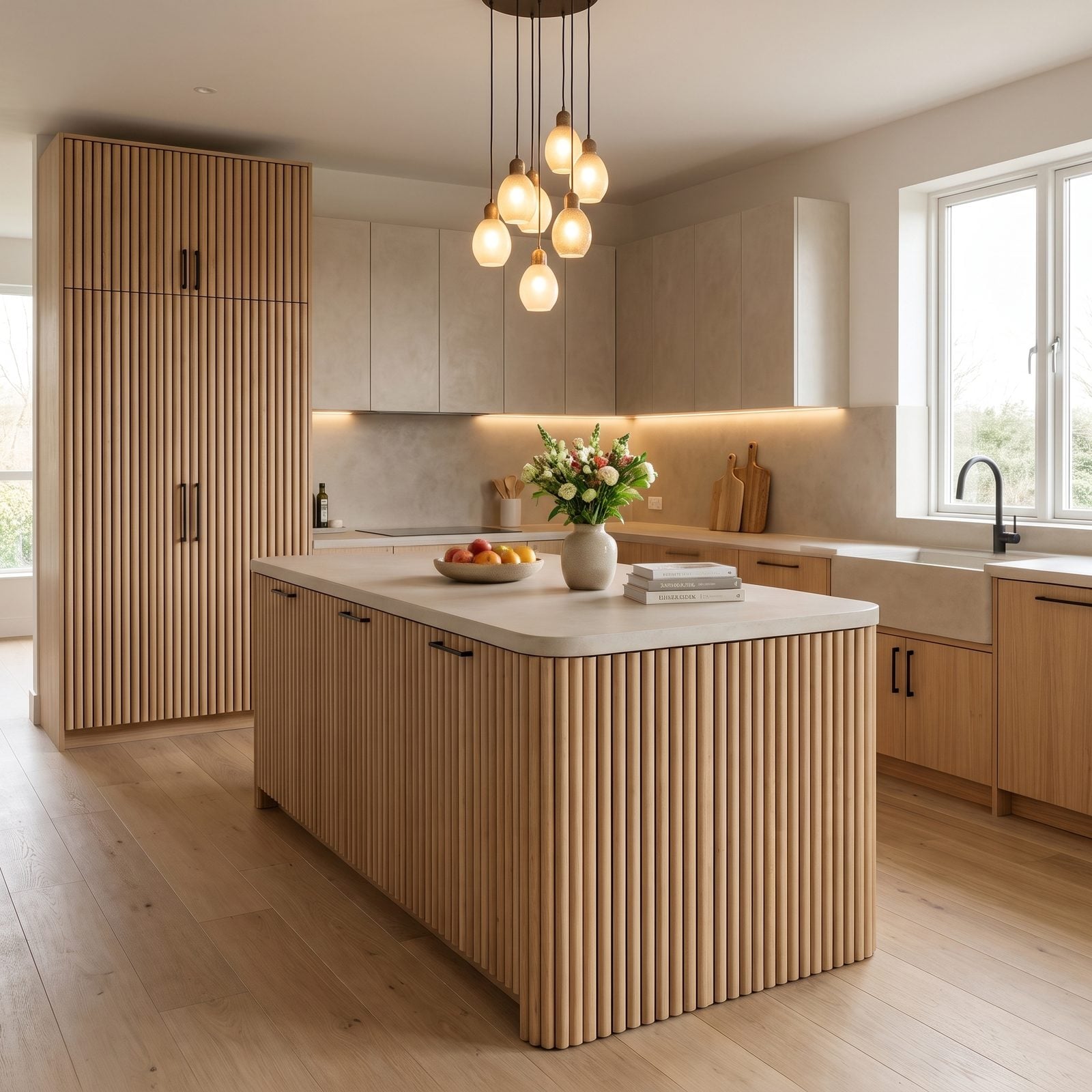
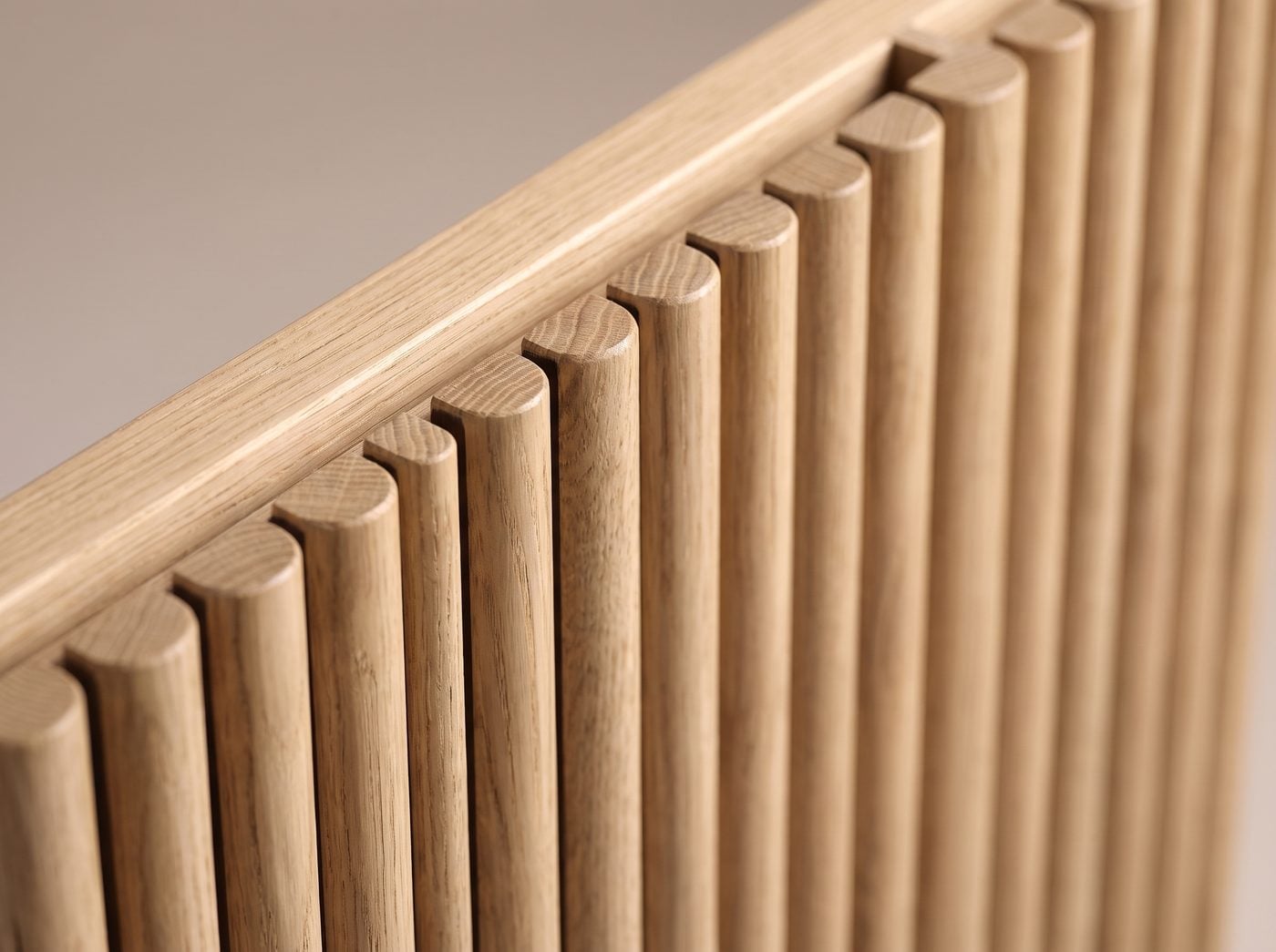
21. Tambour-Inspired
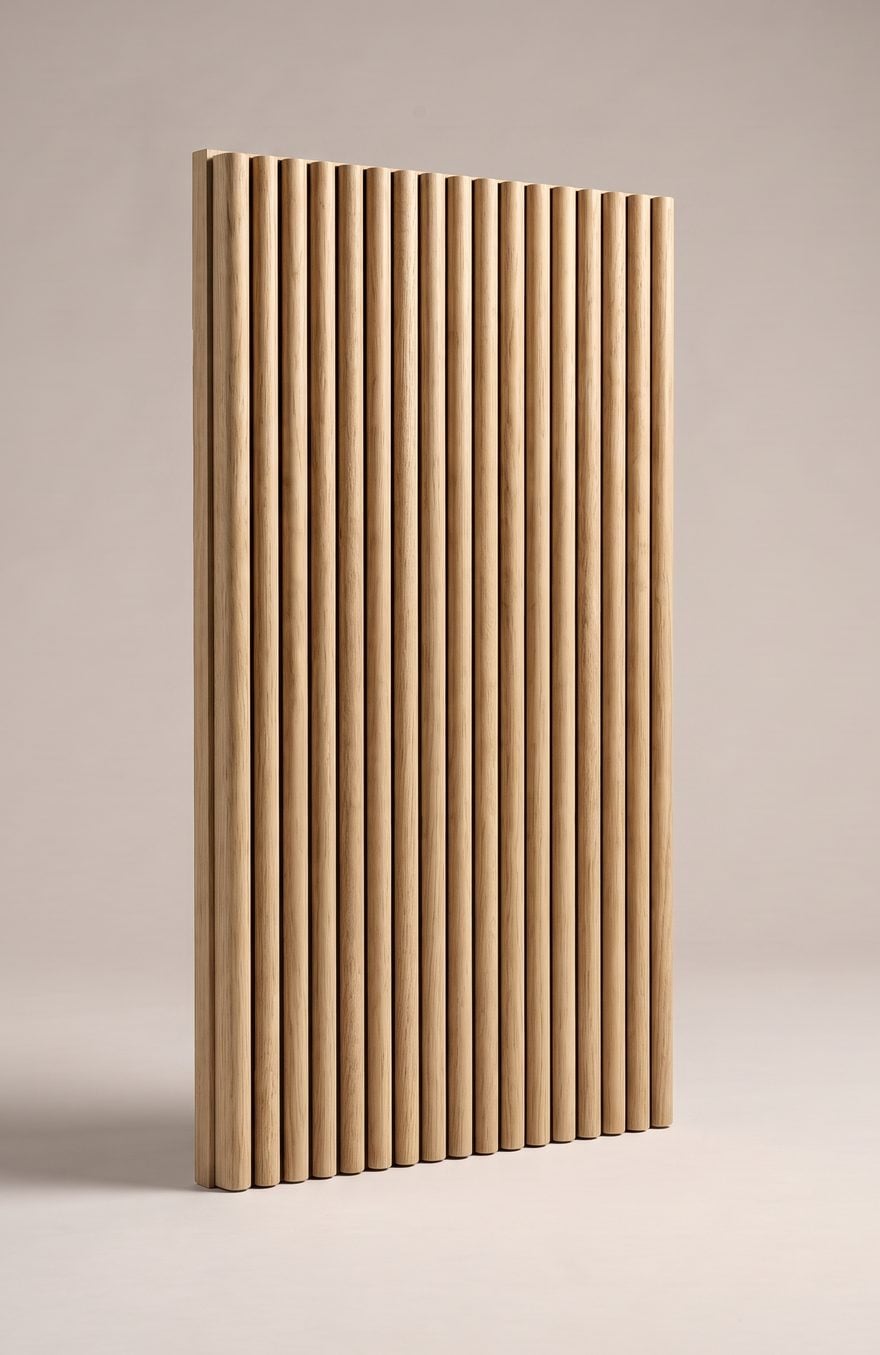
The door face is clad in closely spaced half-round slats, borrowing the look of a roll-top tambour. Most kitchen versions are fixed hinged doors; true sliding or rolling tambours exist for appliance garages and bars.
Home Stratosphere reader data: above average reader response. Saves 103, love share 118 (100 = the average of the article the image appeared in), across 14 images in 12 articles.
- Best kitchen styles: Japandi, warm minimalist and organic modern kitchens; also bars and pantries.
- Finishes and colours: White oak, walnut, ash, natural or lightly limed.
- Relative cost: $$$$ (premium) compared with the other doors here
- Cleaning: Moderate to more effort. There are gaps between slats.
- Durability: Good. Individual slats can be replaced on many systems.
Designer move: Use it on a tall pantry or appliance wall, where the vertical rhythm emphasises height.
Mistake to avoid: Don’t specify a working tambour where you need it to be airtight or child-proof. The mechanism is the weak link.
What the research says: Erin Coren (The Spruce) mentions ‘mixtures of tambour, seeded glass, and metal inserts’; a Livingetc 2026 image caption shows tambour fronts; MasterBrand 2027 says appliance garages are trending (a common tambour application – indirect). The counterpoint: No designer or data source names tambour as a major door trend. Sources: The Spruce, 2025; Livingetc, 2026; MasterBrand, 2026.
22. Louvered
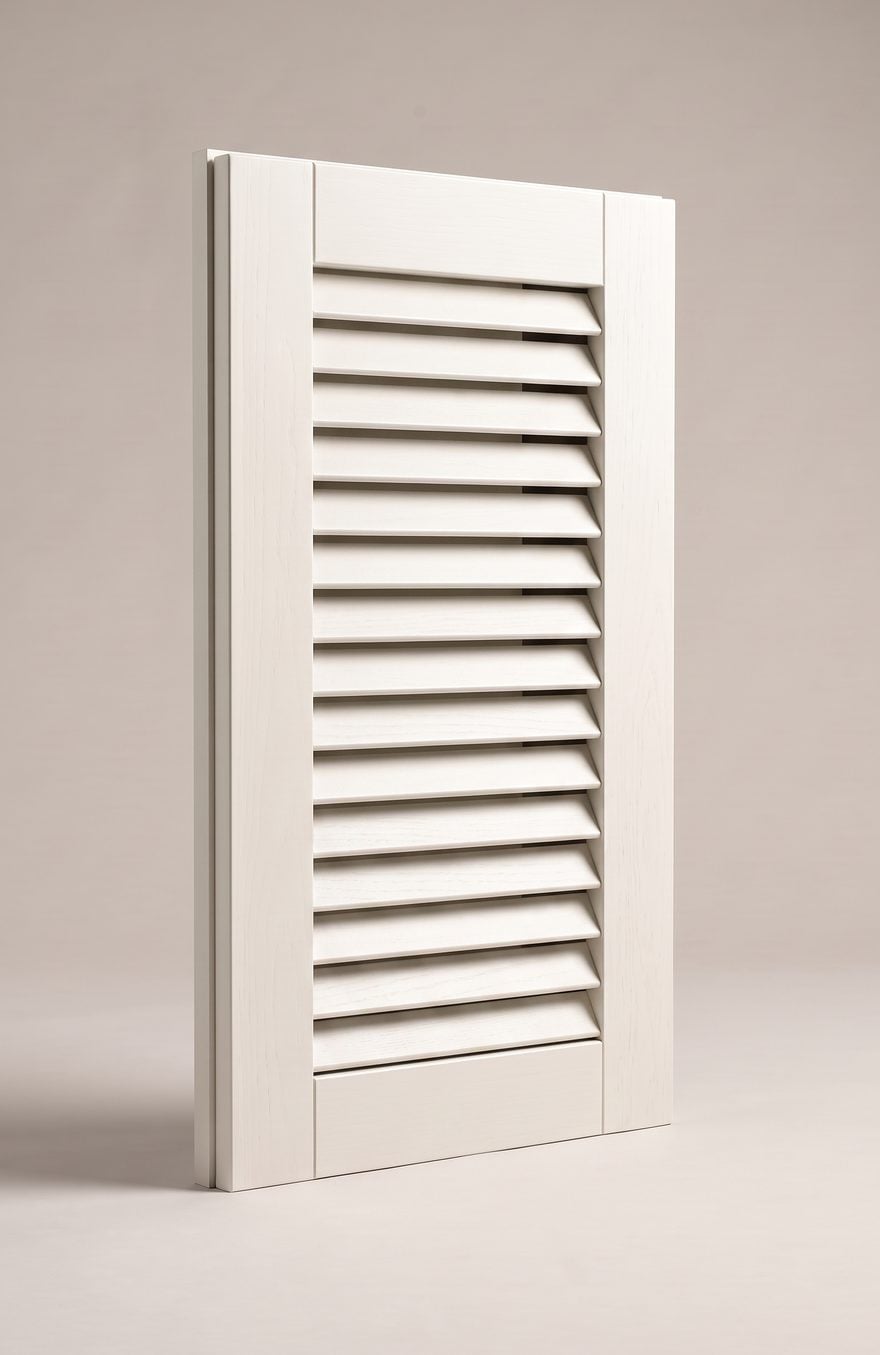
Horizontal angled slats within a frame. Louvers vent air, which is why they were born in hot climates and why they’re useful on pantries and laundry cabinets.
Home Stratosphere reader data: too few images yet to measure reliably (2 kitchen images in our sample).
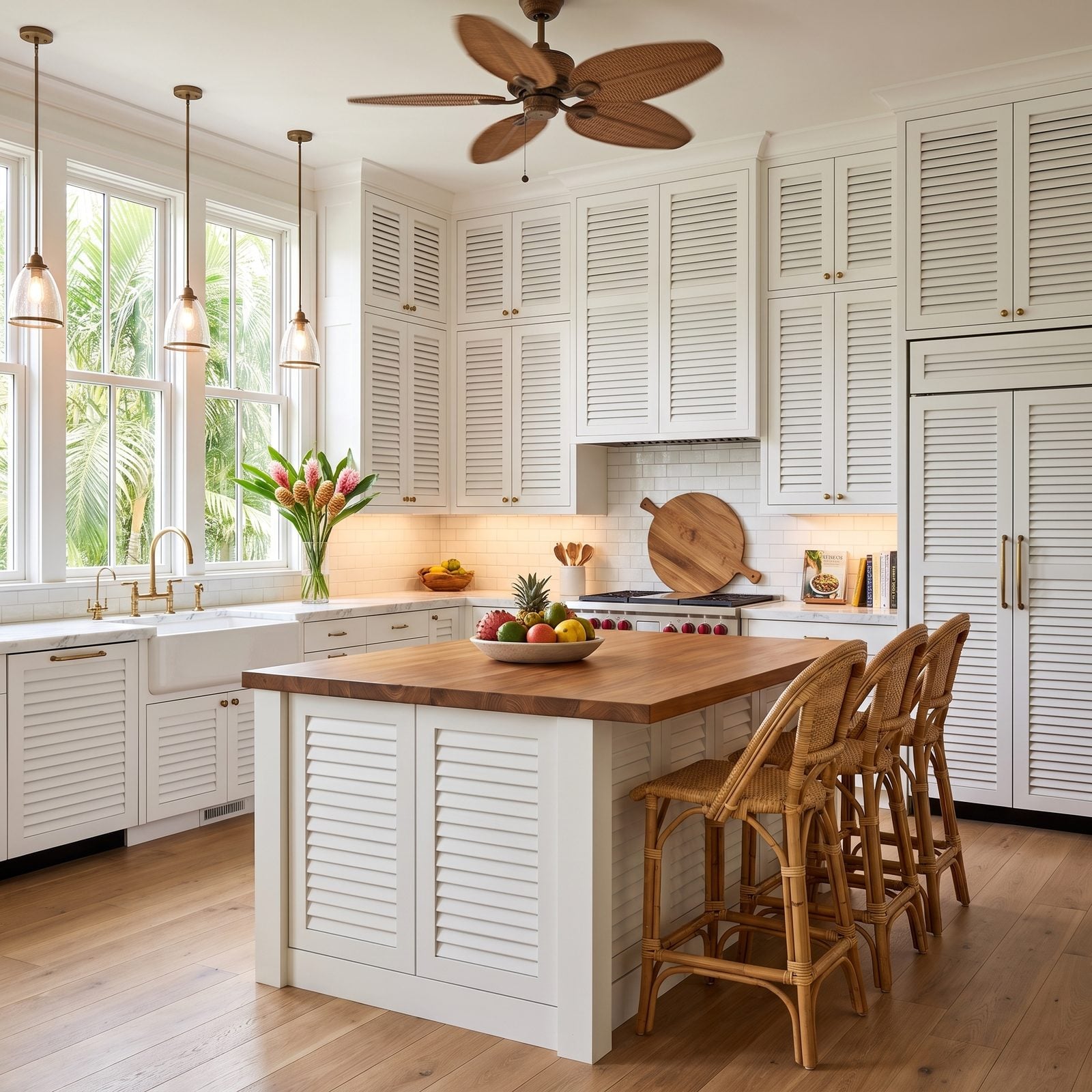
- Best kitchen styles: British Colonial, coastal, tropical, plantation and cottage kitchens.
- Finishes and colours: Crisp white, sea-glass green, natural teak tones, black.
- Relative cost: $$$$ (premium) compared with the other doors here
- Cleaning: Most effort of any door here. Every slat holds dust.
- Durability: Good if well made. Cheap louvers rattle or crack.
Designer move: Use louvers on pantry and appliance-garage doors where airflow helps, and keep the main runs solid.
Mistake to avoid: Don’t put louvers near the cooktop. Grease plus slats makes a cleaning chore.
What the research says: Only related mentions: KBDN 2025 reports door finishes may include ‘3-D louvered details’ (paraphrased, eggersmann); Domino’s Galey Alix mentions ‘simple slats’. The counterpoint: None found. Sources: Kitchen & Bath Design News, 2025; Domino, 2025.
23. Board-and-Batten Inspired
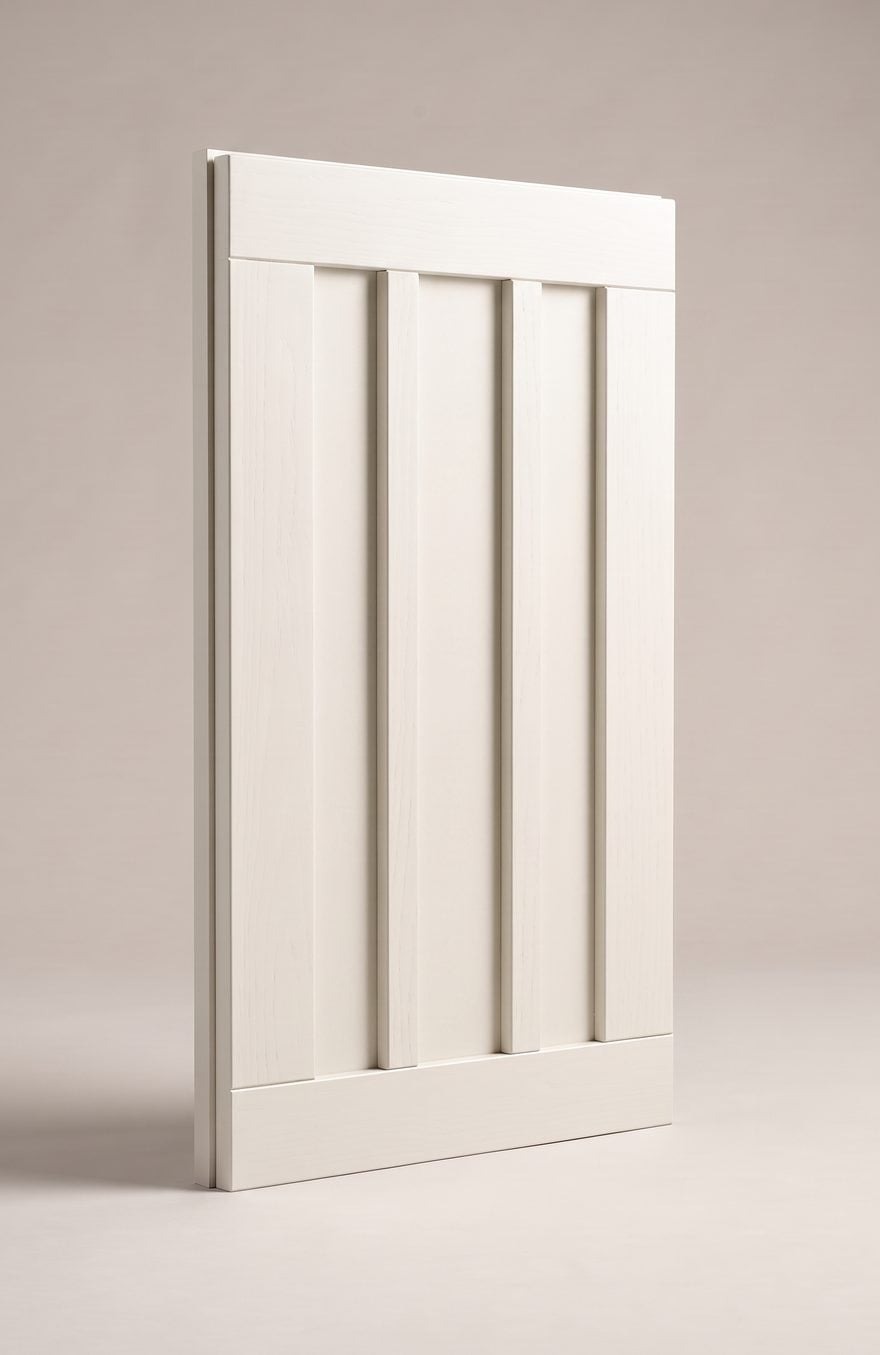
Battens applied on top of a flat face make a structured, barn-door pattern on a miniature scale. It is rustic and graphic, and less common than beadboard or V-groove.
Home Stratosphere reader data: too few images yet to measure reliably (14 kitchen images in our sample).
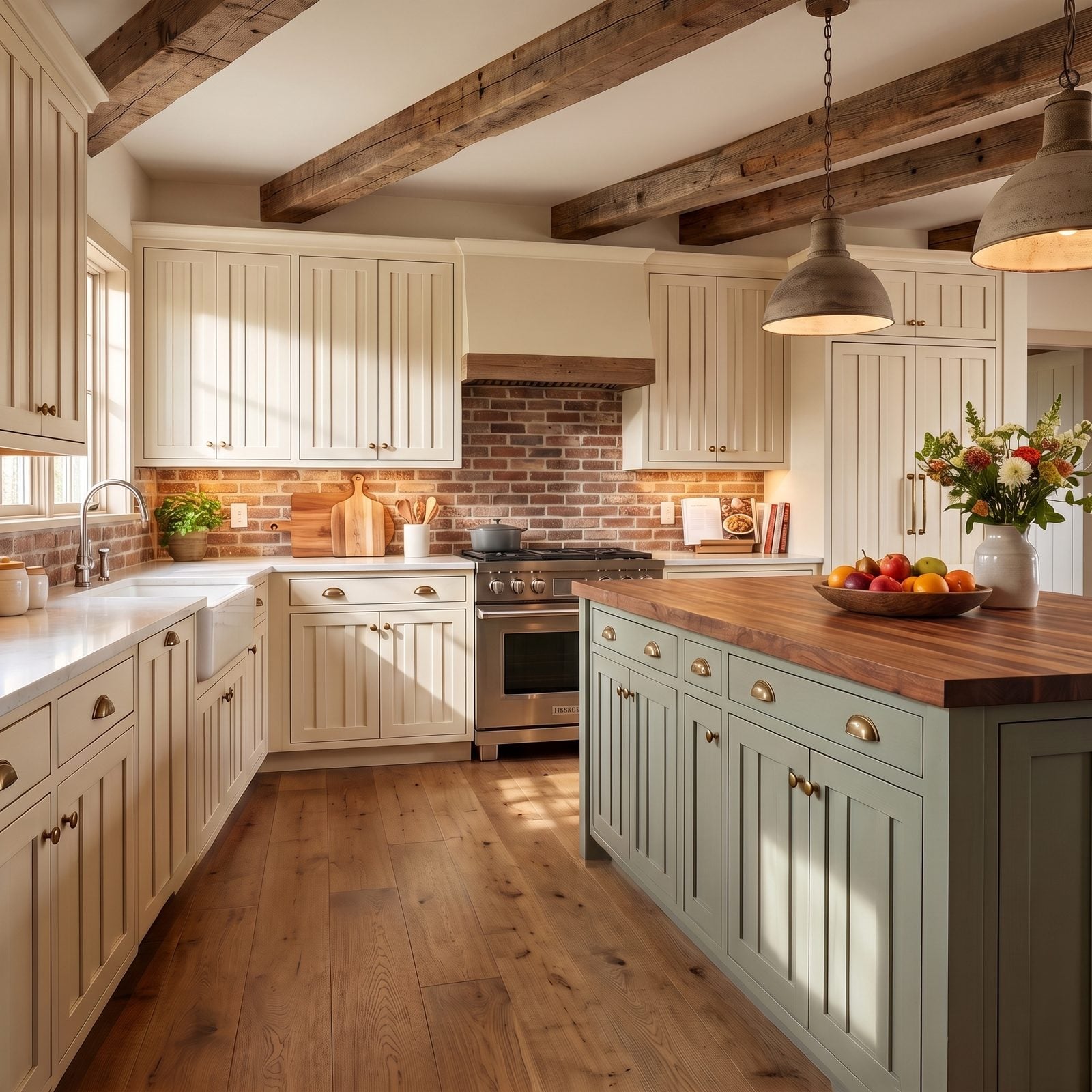
- Best kitchen styles: Rustic modern farmhouse, mountain and cabin kitchens.
- Finishes and colours: Warm whites, charcoal, sage; stained wood battens on painted faces for contrast.
- Relative cost: $$$ (higher) compared with the other doors here
- Cleaning: Moderate. Dust settles along the batten tops.
- Durability: Good. Applied battens must be glued and pinned well, especially on heavy doors.
Designer move: Use it on a pantry, island back or one wall of base cabinets, not all of them.
Mistake to avoid: Don’t scale battens down too far; skinny strips look like a craft project.
What the research says: H&G (Mar 2026) paneled-cabinet piece cites Becky Shea’s doors with ‘bullet hinges and strap detailing’ and deVOL’s ‘urban rustic’ plank look – close to board-and-batten but not named as such. The counterpoint: Single-publication evidence. Sources: Homes & Gardens, 2026.
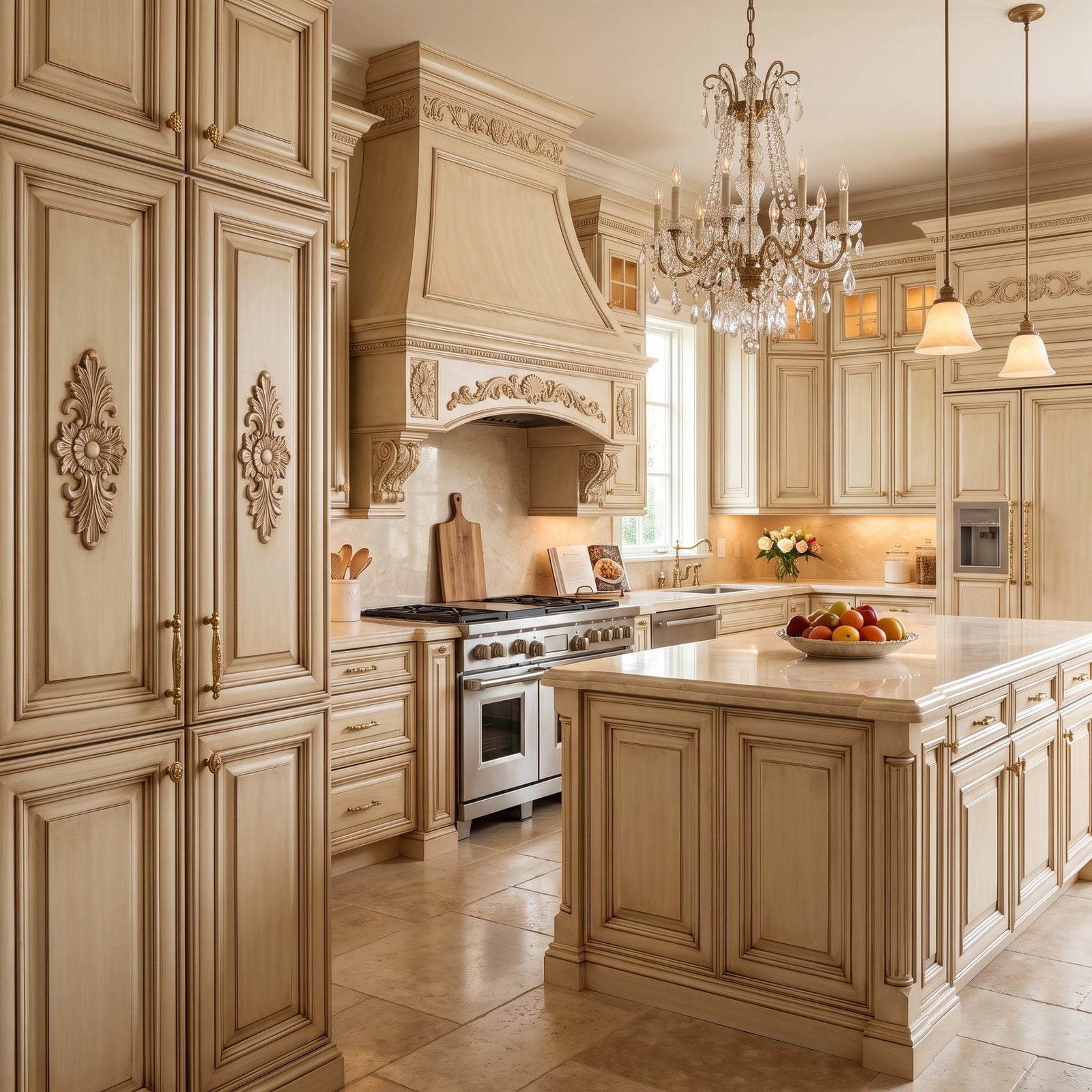
24. Carved or Ornamental
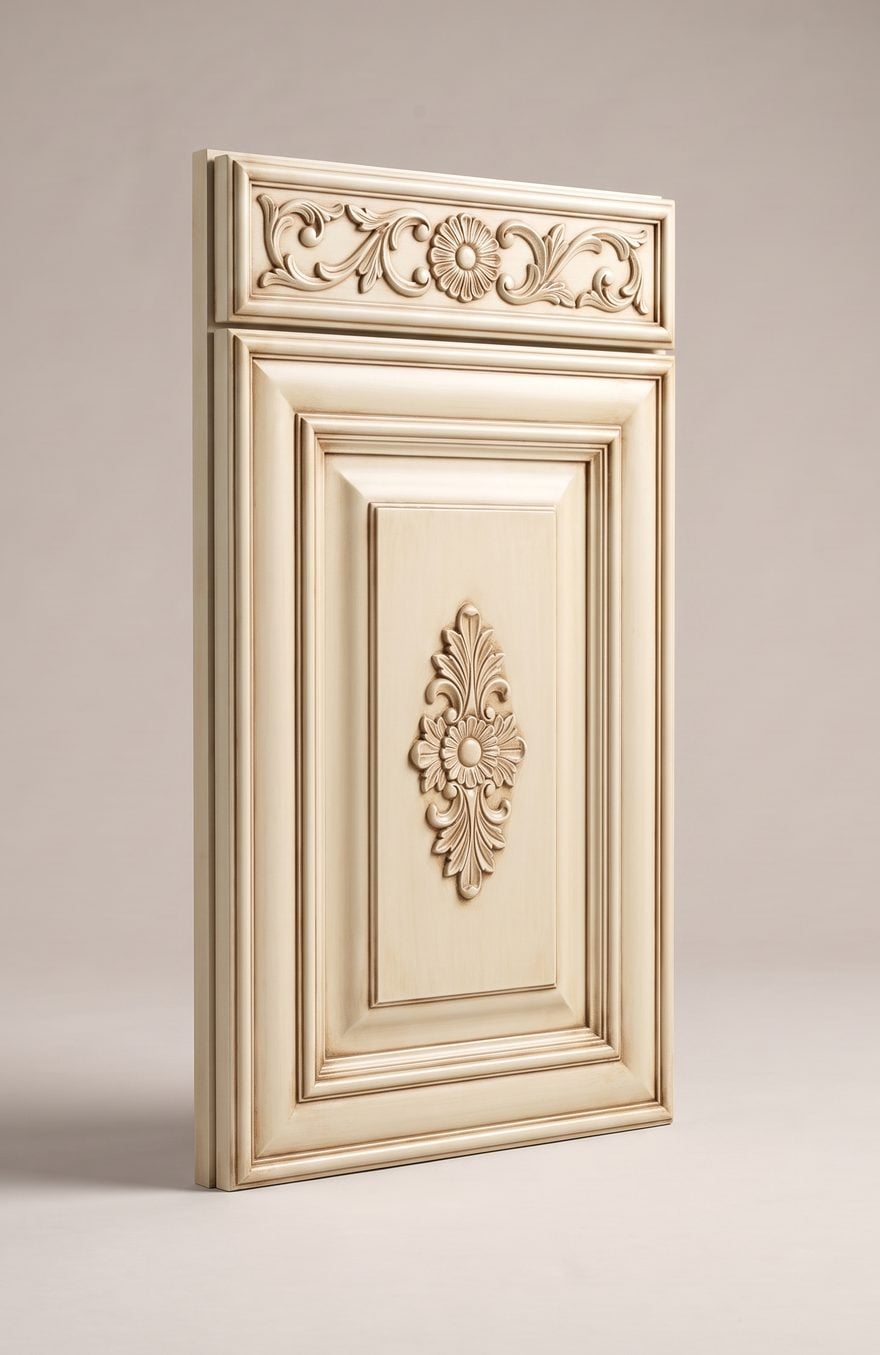
Hand- or CNC-carved rosettes, acanthus leaves, scrolls and relief work. This is cabinetry as furniture, and it carries the most era and style baggage of any door here.
Home Stratosphere reader data: below average reader response. Saves 87, love share 99 (100 = the average of the article the image appeared in), across 67 images in 28 articles.
- Best kitchen styles: Opulent European traditional, Old-World and historic estate kitchens.
- Finishes and colours: Antique creams with glaze, aged wood stains, gilded accents.
- Relative cost: $$$$ (premium) compared with the other doors here
- Cleaning: Most effort. Carving traps dust and grease.
- Durability: Durable in solid wood, but repairs to carving are skilled work.
Designer move: Concentrate carving on one piece, such as a range hood, island end or hutch, and keep doors around it calmer.
Mistake to avoid: Don’t choose machine-carved appliqués glued onto flat doors. They rarely look like true carving.
What the research says: Kathy Kuo (H&G Dec 2025) is ‘loving kitchen cabinets that feature rich traditional detailing – think accents like subtly carved corners’ and (Jun 2026) calls ‘traditional hand-carved wood details’ more timeless than fluting; Houzz notes traditional style up 5 points. The counterpoint: Ethan Charles: ‘Not necessarily ornate’; Judi Cooper expects busy moldings to fade; a retailer projects ornate profiles fading. Subtle carving has support, heavy ornament does not. Sources: Homes & Gardens, 2025; Homes & Gardens, 2026; The Spruce, 2025; Houzz, 2025.
Glass and Specialty Cabinet Doors
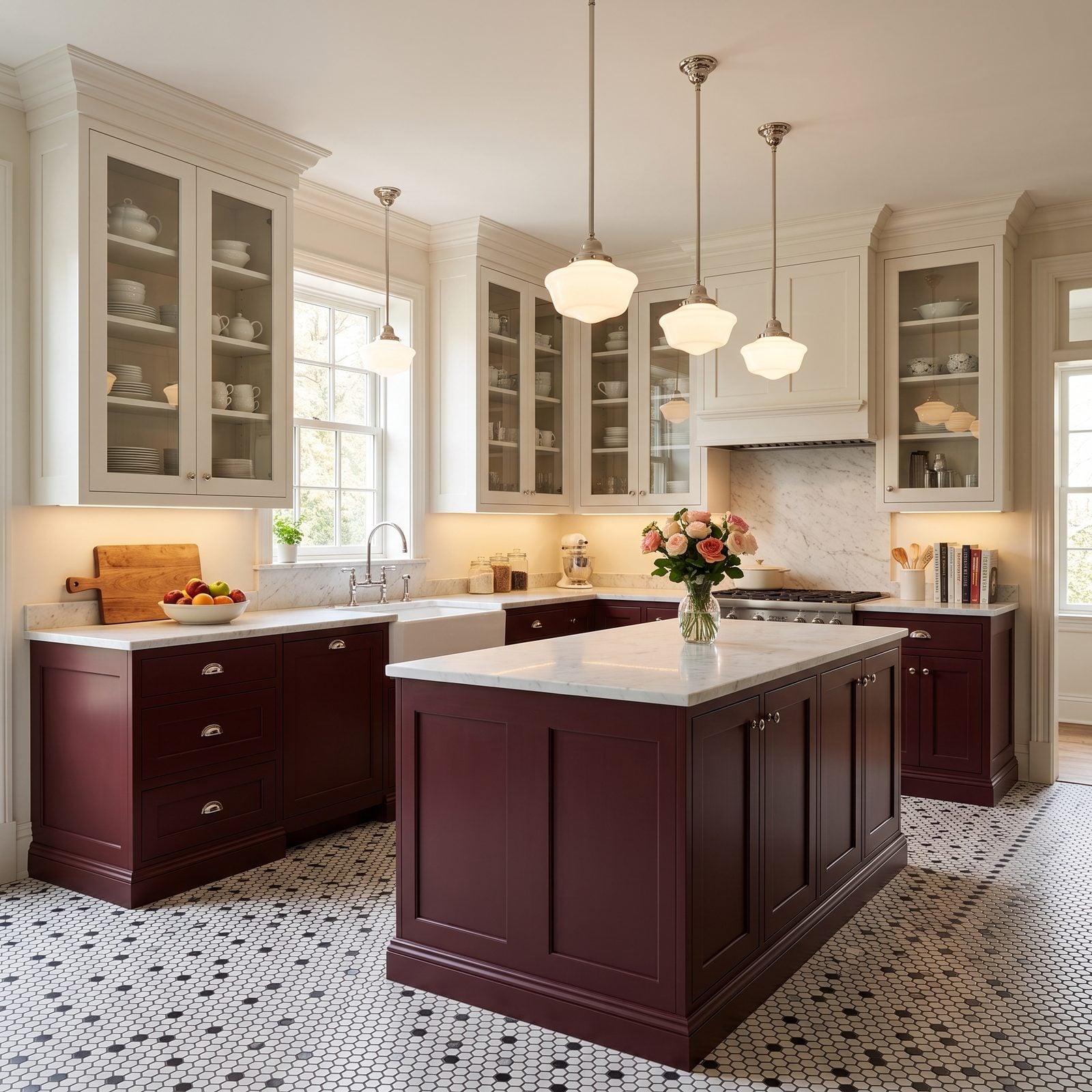
25. Clear Glass-Front
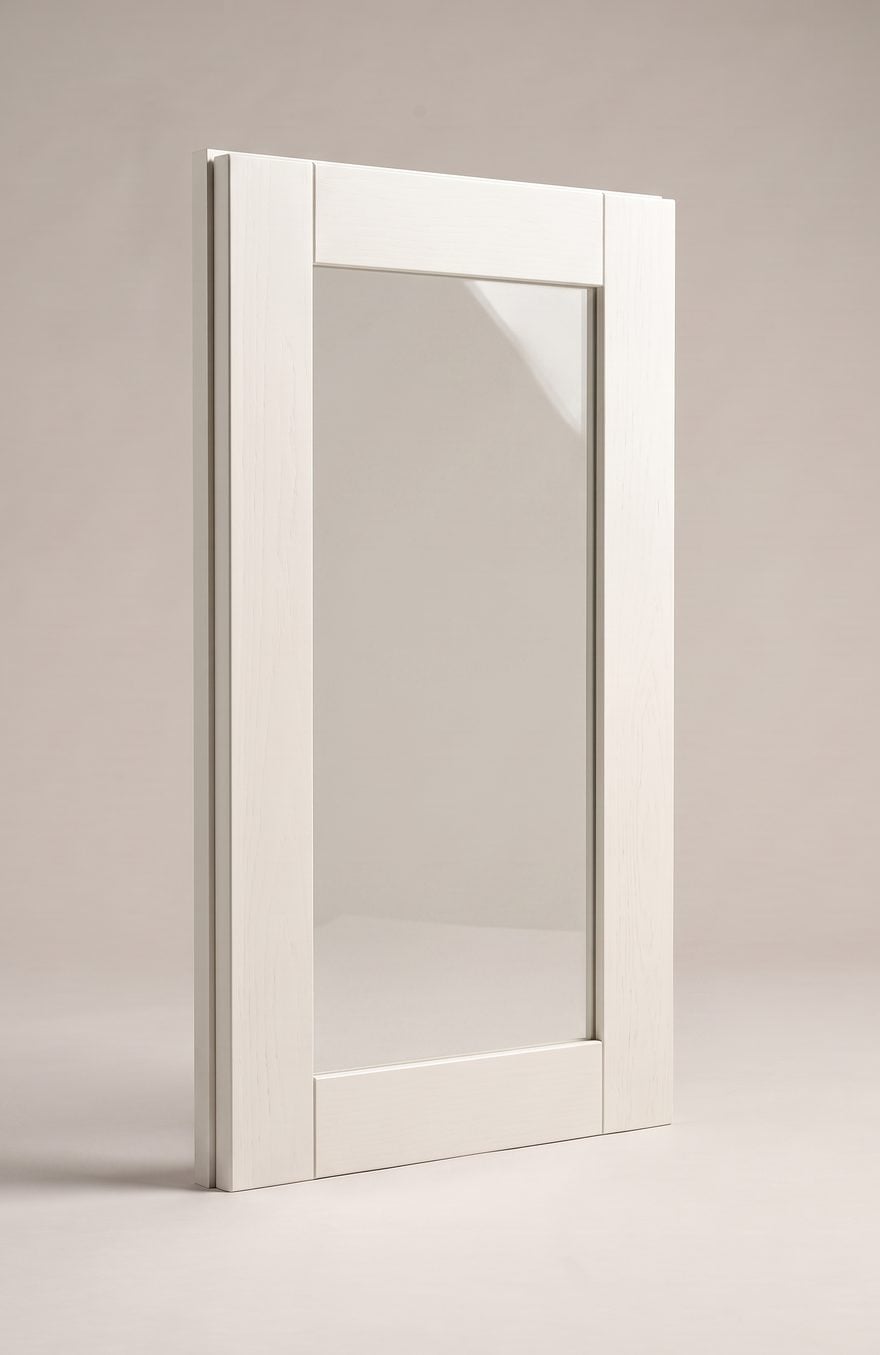
A framed door with a transparent glass insert. It is the oldest trick for making a kitchen feel lighter, with the catch that whatever is inside becomes decor.
Home Stratosphere reader data: above average reader response. Saves 106, love share 115 (100 = the average of the article the image appeared in), across 294 images in 69 articles.
- Best kitchen styles: Every style, from Victorian to modern farmhouse to industrial.
- Finishes and colours: Any frame finish; low-iron glass for the clearest view.
- Relative cost: $$$ (higher) compared with the other doors here
- Cleaning: Glass shows fingerprints on both sides; plan on wiping inside and out.
- Durability: Good. Use tempered glass for safety.
Designer move: Light the inside and keep displays to one or two colours.
Mistake to avoid: Don’t put clear glass on cabinets that will hold food packaging or mismatched mugs.
What the research says: The Spruce (2026): ‘Glass-front cabinets, in particular, are expected to be a significant trend in 2026’ as open shelving shrinks. Houzz 2025: glass-front is the top accent-cabinet choice at 36%. KBDN 2026: Wood-Mode sees ‘an increased use of metal and glass inserts in upper cabinets’; Crystal reports glass doors ‘in place of the open shelving’; KBDN 2025: four manufacturers cite growing glass-front use. The counterpoint: Sources rarely specify clear vs textured glass; much of the momentum is in reeded/textured glass. Glass-front’s main-run share is not reported on the Houzz pages verified; the 36% figure is for accent cabinets only. Sources: The Spruce, 2026; Houzz, 2025; Kitchen & Bath Design News, 2026; Kitchen & Bath Design News, 2025.
26. Frosted Glass-Front
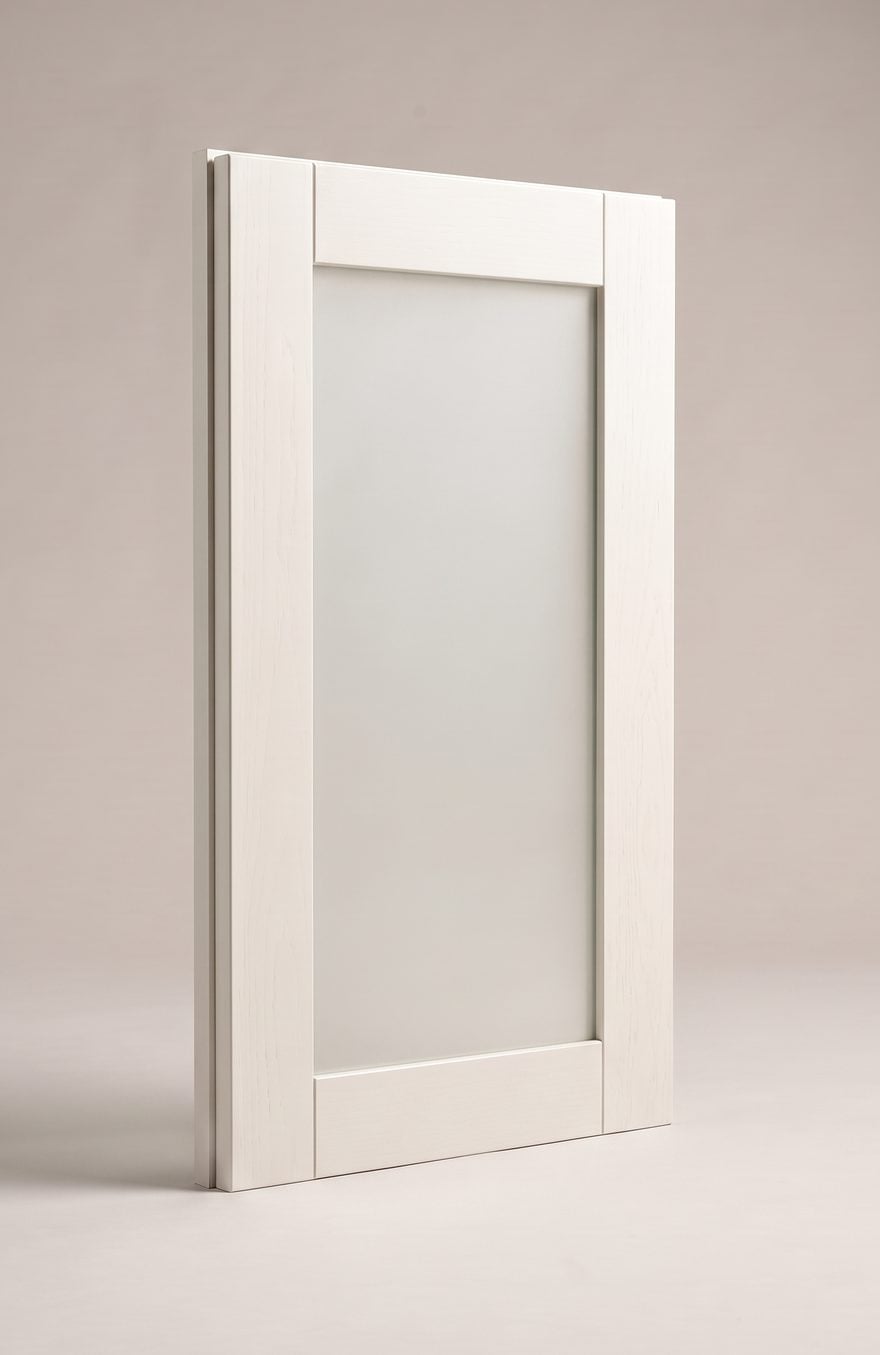
Satin-etched or acid-etched glass that glows rather than reveals. You get the lightness of glass without having to curate the contents.
Home Stratosphere reader data: too few images yet to measure reliably (7 kitchen images in our sample).
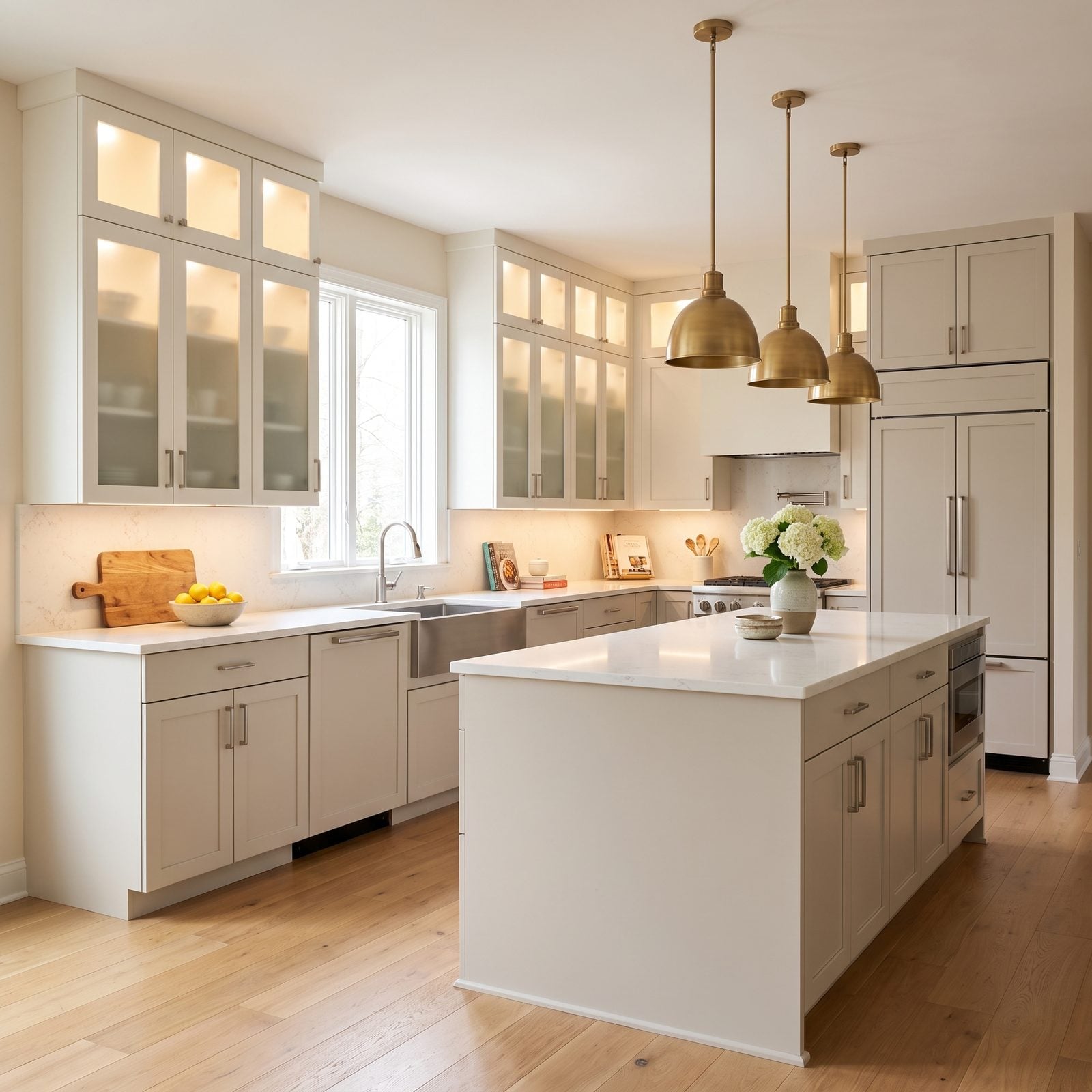
- Best kitchen styles: Modern transitional, contemporary and European kitchens.
- Finishes and colours: Pale frames, slabs or slim Shaker; satin-etched low-iron glass.
- Relative cost: $$$ (higher) compared with the other doors here
- Cleaning: Easy. Etched glass hides fingerprints better than clear.
- Durability: Good; tempered and laminated options are available.
Designer move: Add interior LED strips. Frosted glass lit from inside is one of the most flattering kitchen lights.
Mistake to avoid: Avoid cheap frosted film over clear glass. It peels and bubbles at the edges.
What the research says: No 2025-2026 designer, manufacturer or survey source reviewed names frosted/etched glass specifically. The counterpoint: None found. No 2025-26 trend source covered this style directly.
27. Reeded Glass-Front
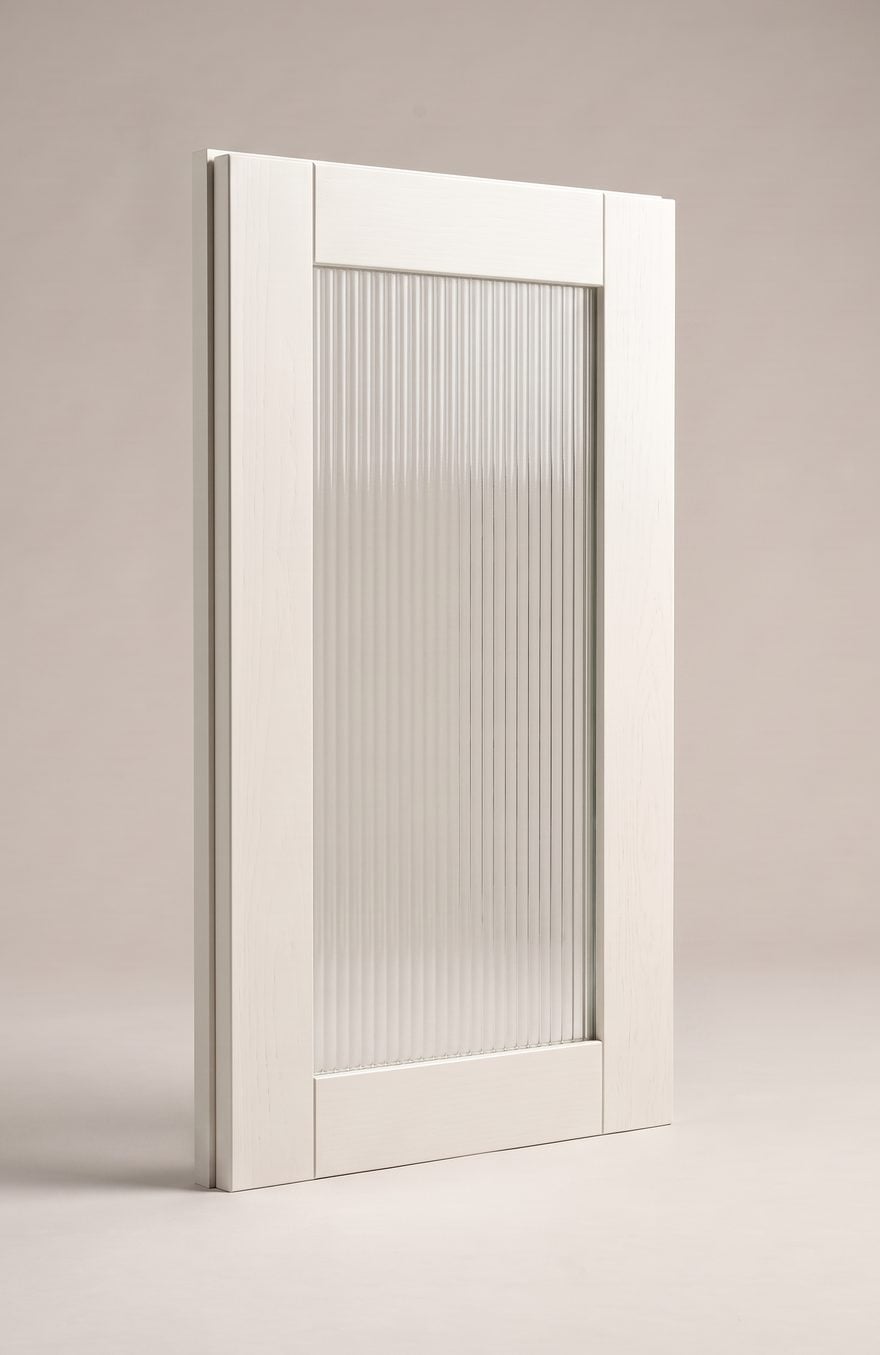
Glass with fine vertical ribs that blur what’s behind into soft streaks. It shows colour and shape without detail, and it is very much of the moment.
Home Stratosphere reader data: too few images yet to measure reliably (13 kitchen images in our sample).
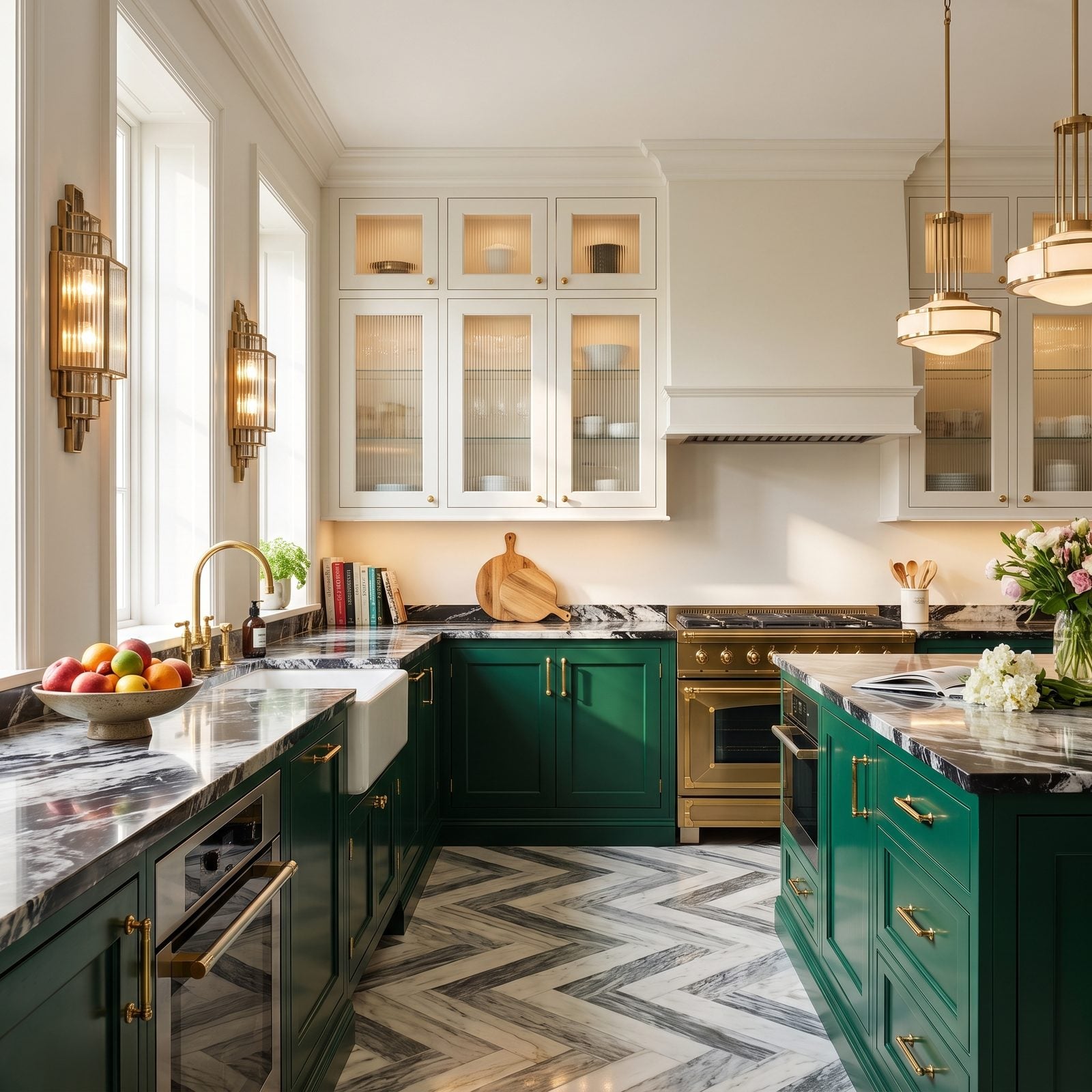
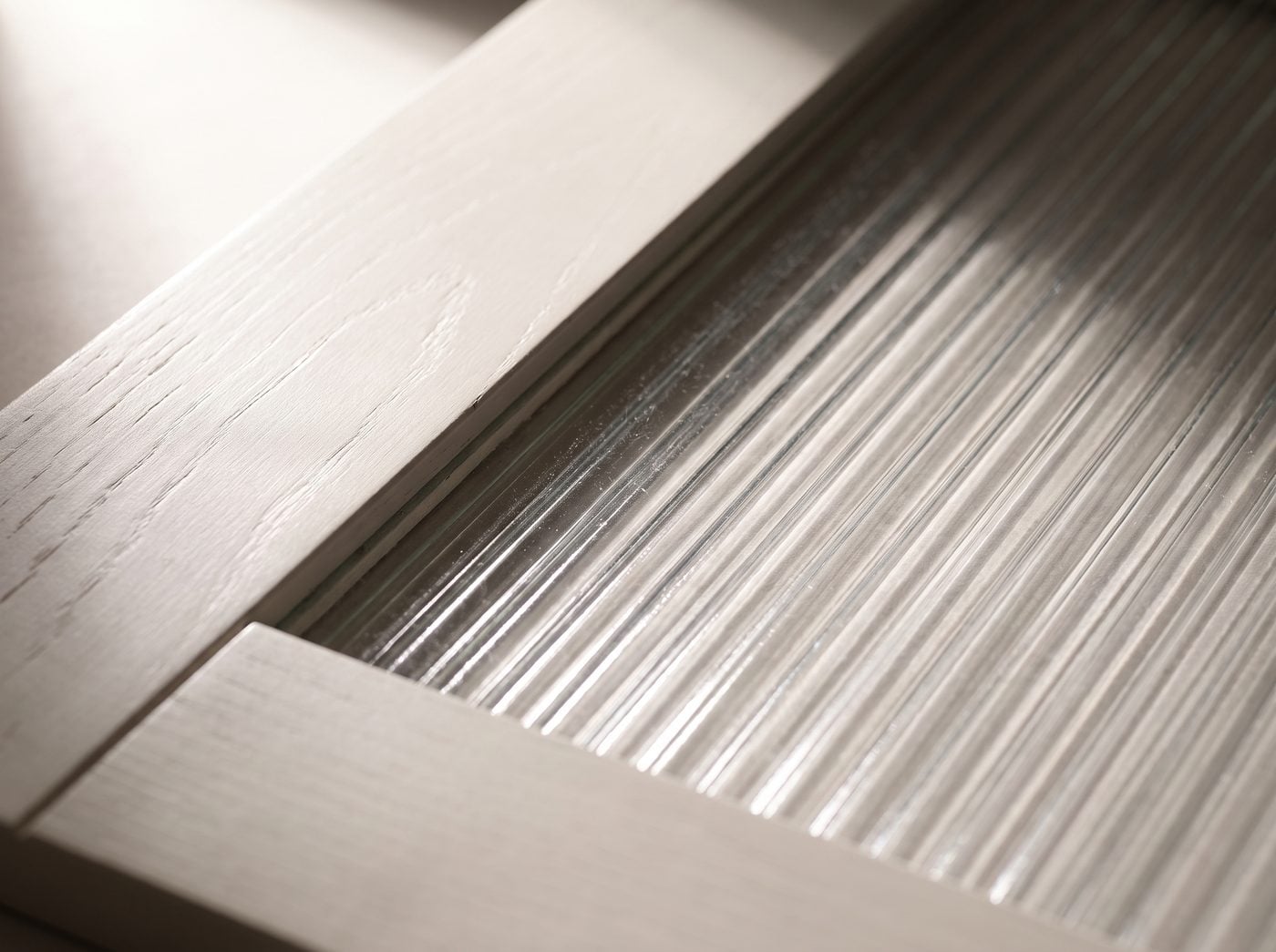
- Best kitchen styles: Art Deco, Hollywood Regency, modern classic, organic modern.
- Finishes and colours: Brass, black or painted frames; clear or tinted reeded glass.
- Relative cost: $$$$ (premium) compared with the other doors here
- Cleaning: Moderate; the ribs hold dust on the inner face.
- Durability: Good when tempered.
Designer move: Pair it with a strong lower-cabinet colour like emerald, oxblood or ink, and brass hardware.
Mistake to avoid: Don’t overdo it: reeded glass, fluted wood and reeded tile in the same kitchen is texture overload.
What the research says: Hunker (Sep 2026): designers break up tall cabinet runs by ‘bringing in glass (think stained or reeded)’; H&G 2027 outlook (Oct 2026): Jennifer Davis lists ‘reeded or fluted glass’ among old-world details; Livingetc (Mar 2025): ‘fluted glass kitchen cabinets are still on trend’; Domino’s Karin Bohn cites fluted glass; Livingetc Dec 2025 notes reeded glass. The counterpoint: Reeded/fluted solid doors are being called overdone (H&G Jun 2026), but no source applies that to reeded glass. No quantitative data. Sources: Hunker, 2026; Homes & Gardens, 2026; Livingetc, 2025; Livingetc, 2025; Domino, 2025; USA Cabinet Express, 2026.
28. Mullion Glass-Front
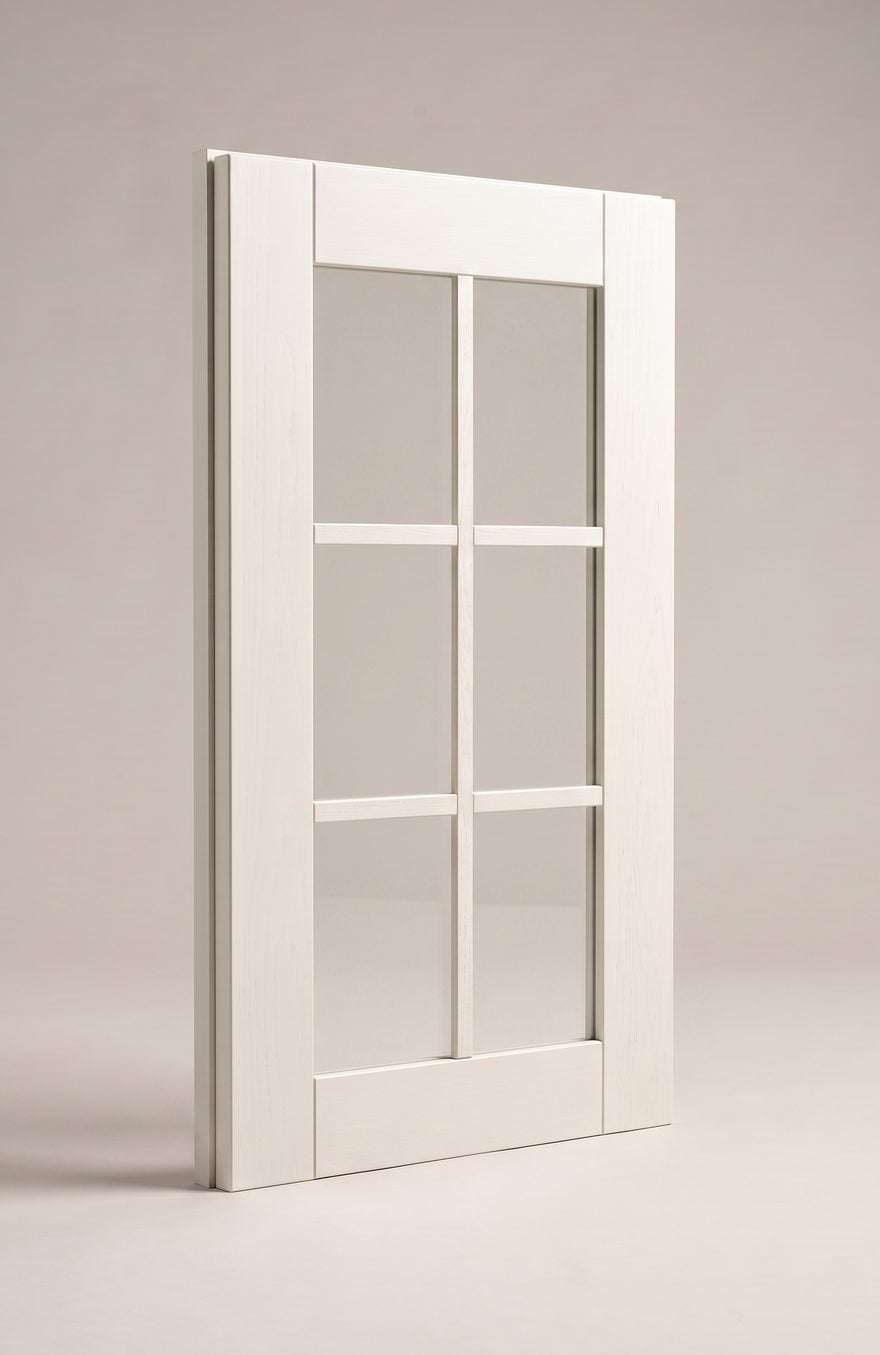
Glass divided into panes by mullion bars, sometimes structural, often applied. It is the classic English-country and colonial look, with roots in true divided-lite windows.
Home Stratosphere reader data: well above average reader response. Saves 119, love share 113 (100 = the average of the article the image appeared in), across 201 images in 63 articles.
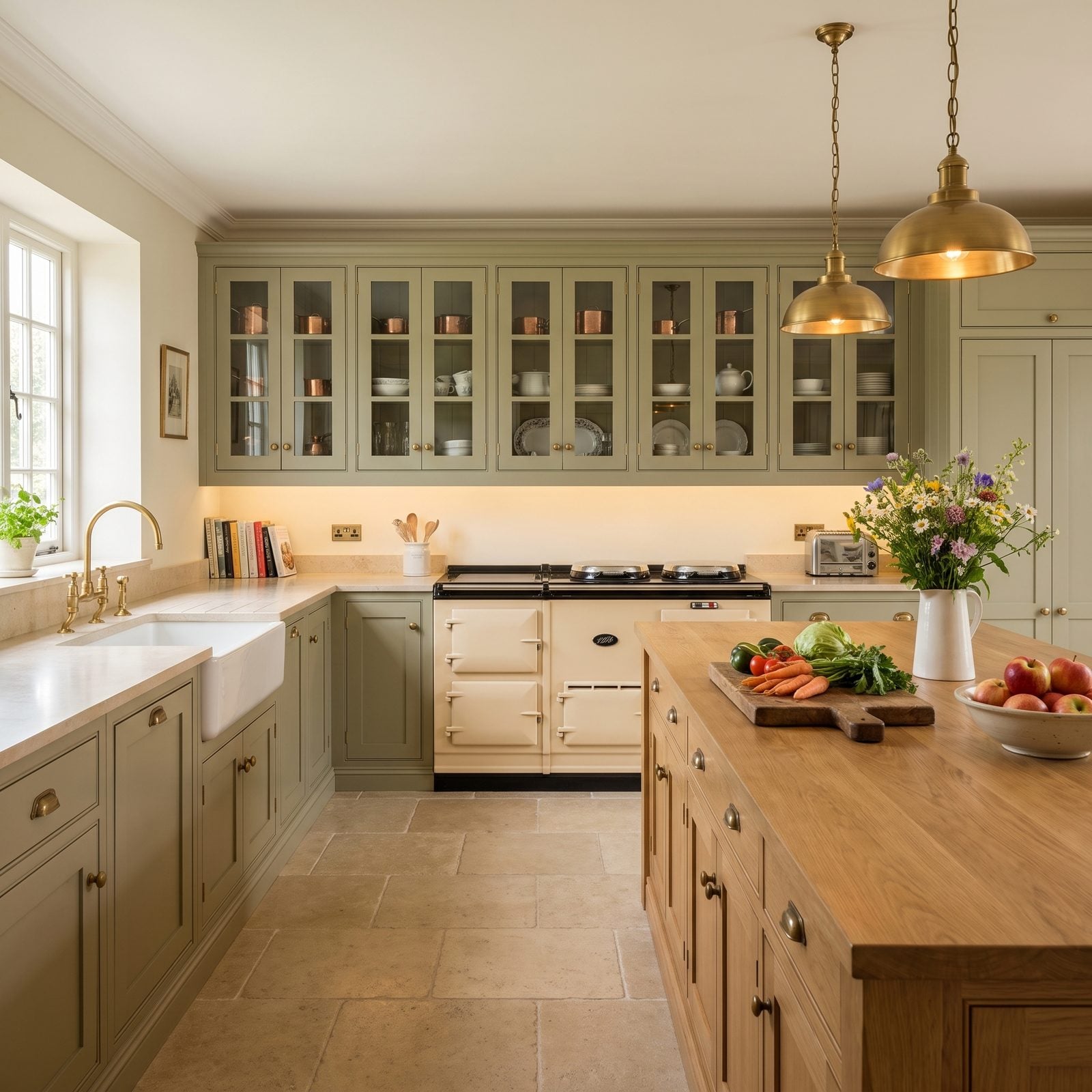
- Best kitchen styles: English country, colonial, farmhouse and traditional kitchens.
- Finishes and colours: Olive, sage, cream, navy; wood mullions matching the frame.
- Relative cost: $$$ (higher) compared with the other doors here
- Cleaning: Moderate, with many small panes and corners.
- Durability: Good. Applied mullions on a single pane are easier to clean and replace.
Designer move: Match the pane pattern to your windows (six-over-six, or a simple prairie grid).
Mistake to avoid: Don’t use tiny-pane mullions on small doors; it gets busy fast.
What the research says: KBIS 2026 floor coverage lists ‘Mullioned glass doors’ among returning traditional details; KBDN 2025 (Crystal) says ‘Glass-front and metal grille cabinets have become more popular’. The counterpoint: Two mentions only; no data. Sources: Cabinet IQ, 2026; Kitchen & Bath Design News, 2025.
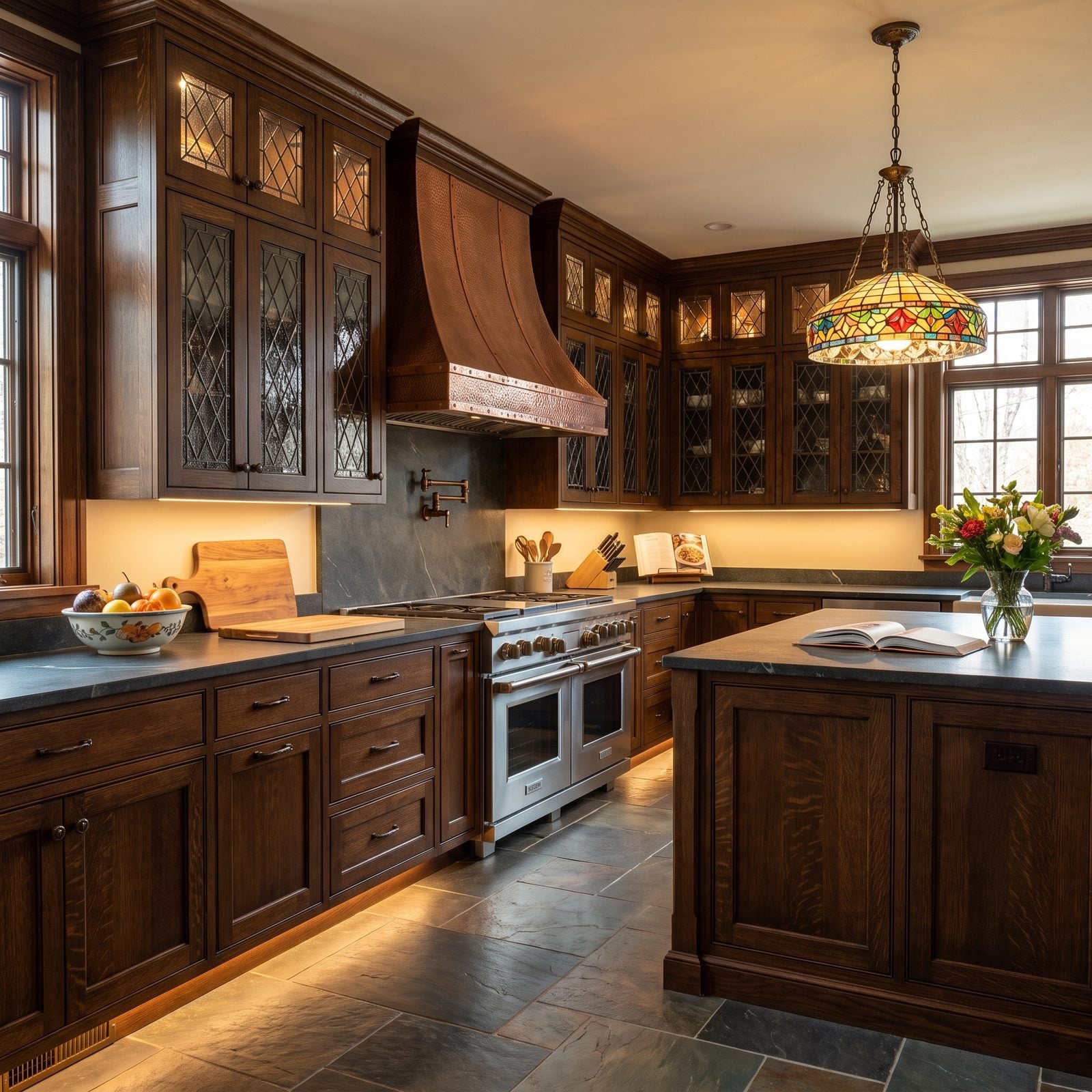
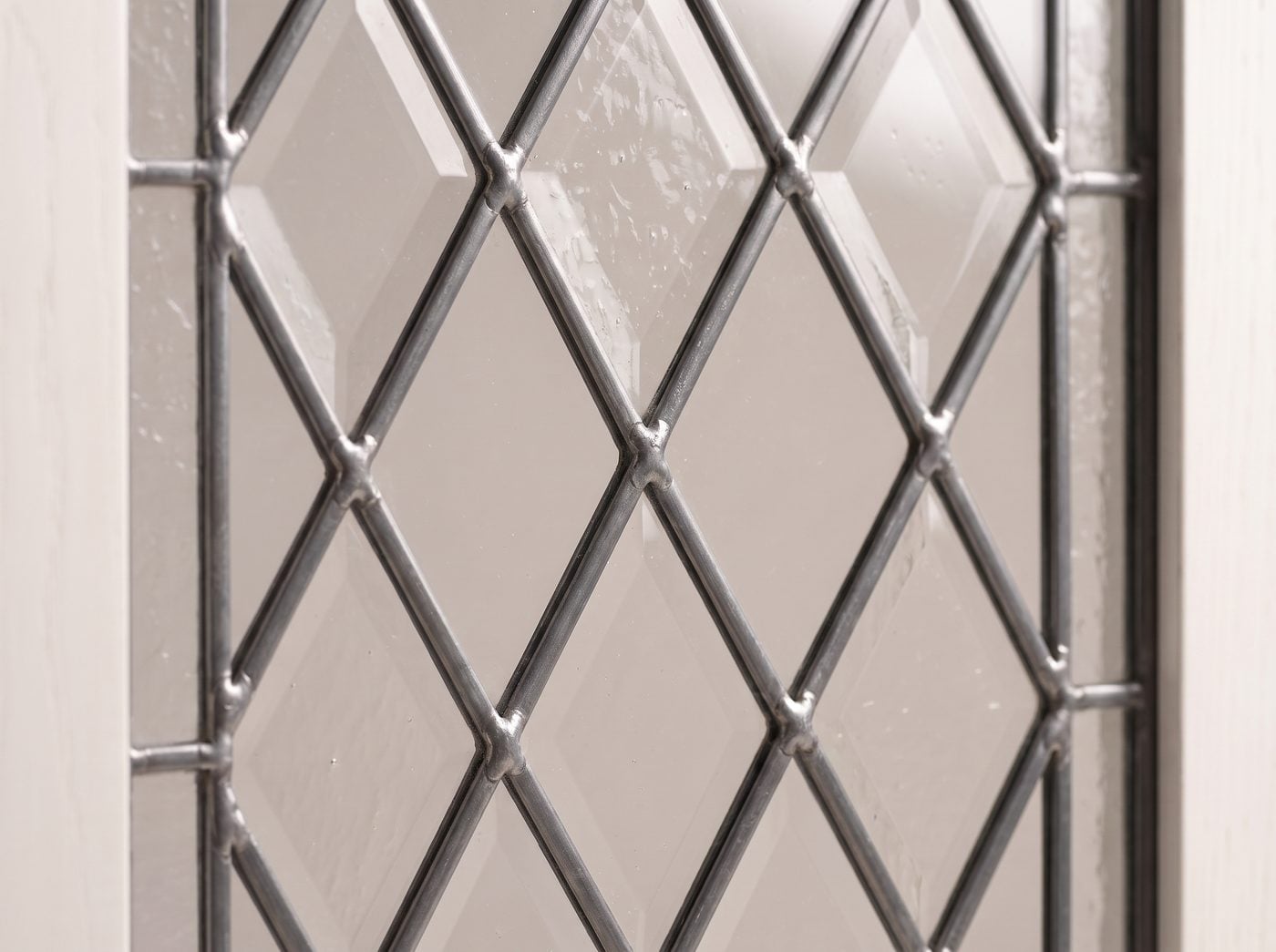
29. Leaded Glass-Front
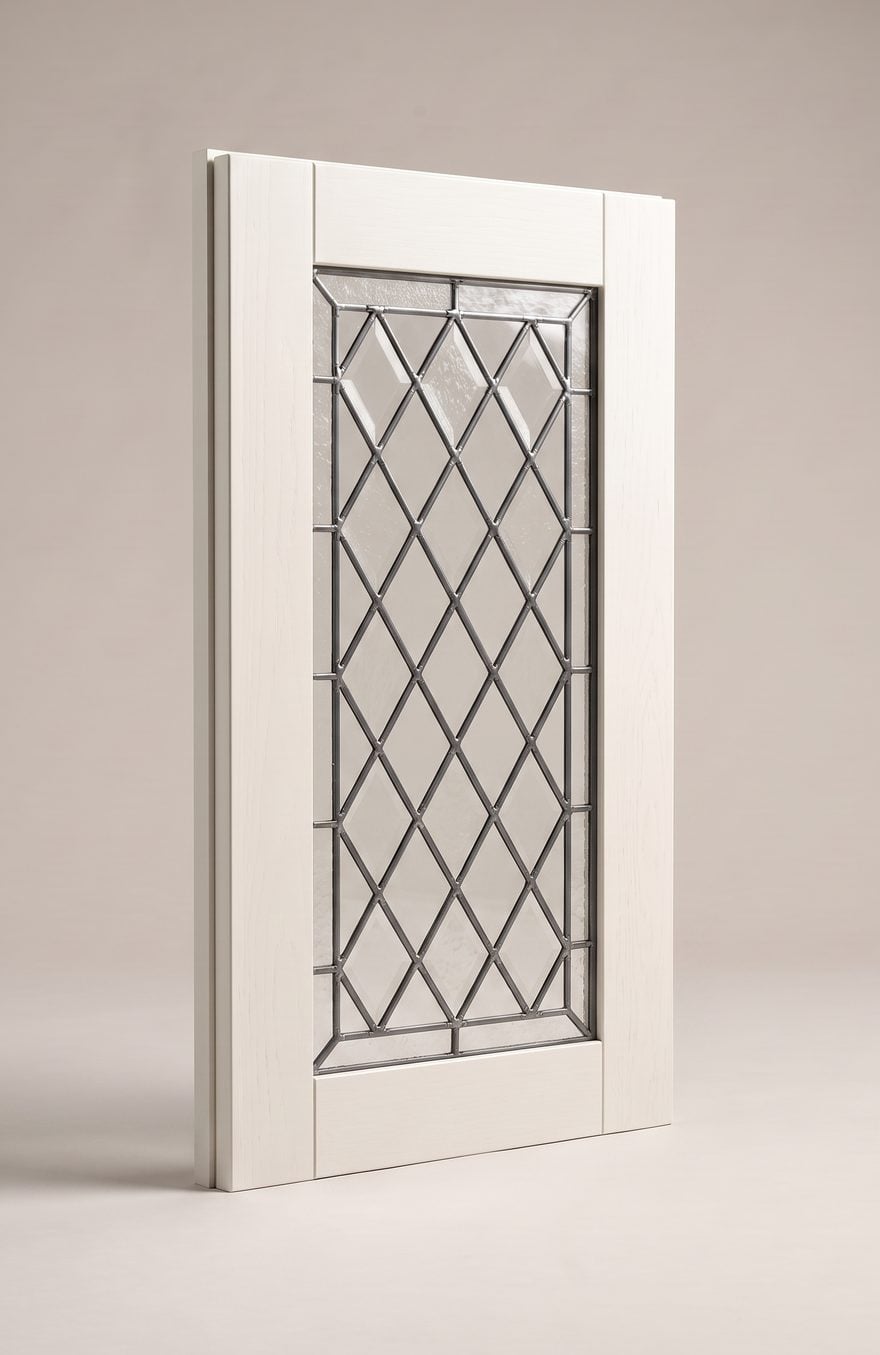
Small glass pieces joined by lead or lead-like cames in diamonds, arcs or Arts-and-Crafts patterns. It’s artisan, historic and sometimes made in solder-overlay imitation.
Home Stratosphere reader data: too few images yet to measure reliably (6 kitchen images in our sample).
- Best kitchen styles: Arts-and-Crafts, Tudor revival, Victorian and Old-World kitchens.
- Finishes and colours: Dark stained oak, cherry, painted creams; clear, seeded or textured glass.
- Relative cost: $$$$ (premium) compared with the other doors here
- Cleaning: Moderate. Wipe gently, because cames are soft.
- Durability: Good in true leaded panels. Overlay strips can lift over time.
Designer move: Use it on just two to four doors flanking a hood or window, like stained glass.
Mistake to avoid: Don’t put a busy leaded pattern next to a busy backsplash.
What the research says: Only an indirect mention: Hunker (Sep 2026) says designers are adding ‘stained or reeded’ glass to tall cabinet runs. No source names leaded glass doors as a trend. The counterpoint: None found. Sources: Hunker, 2026.
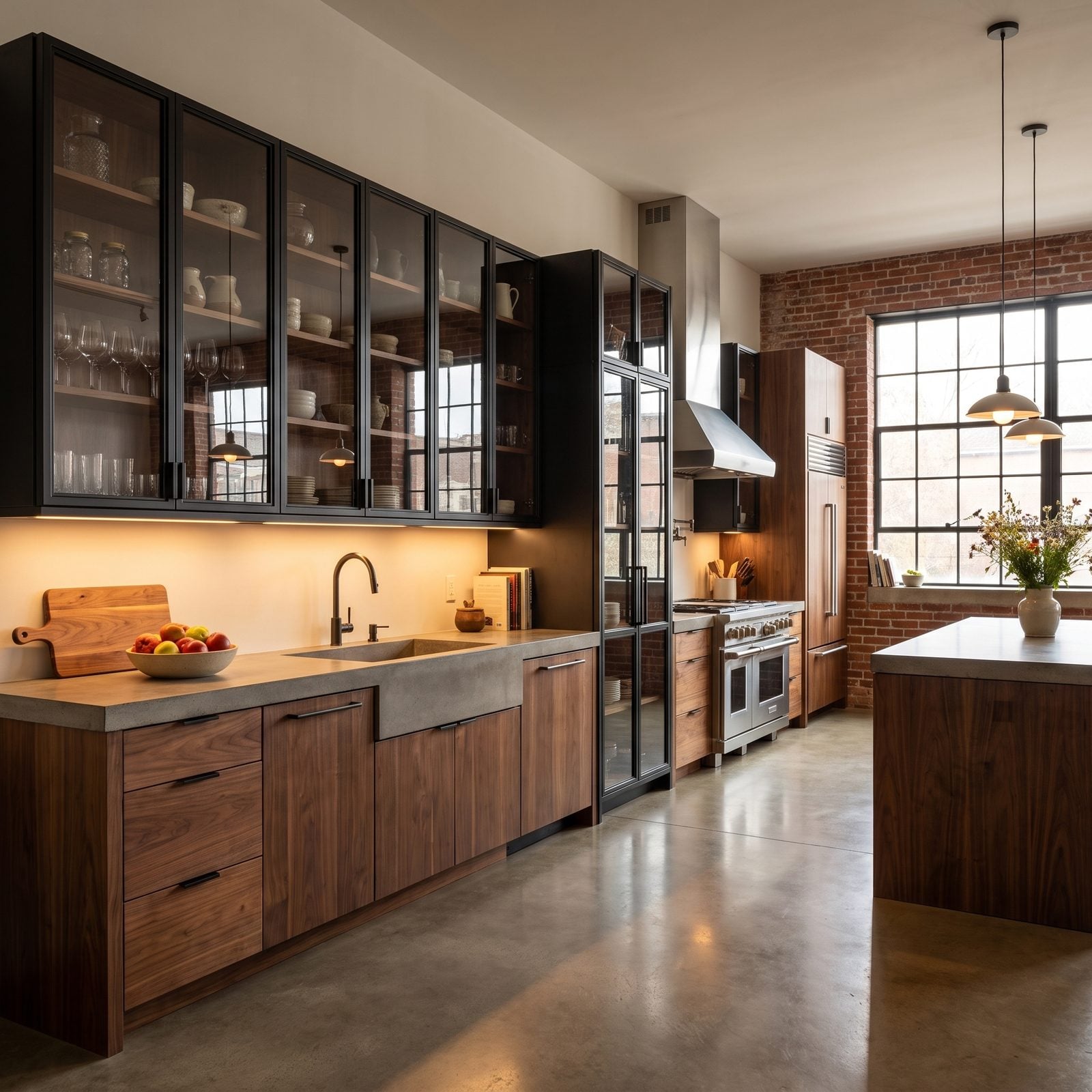
30. Metal-Framed Glass
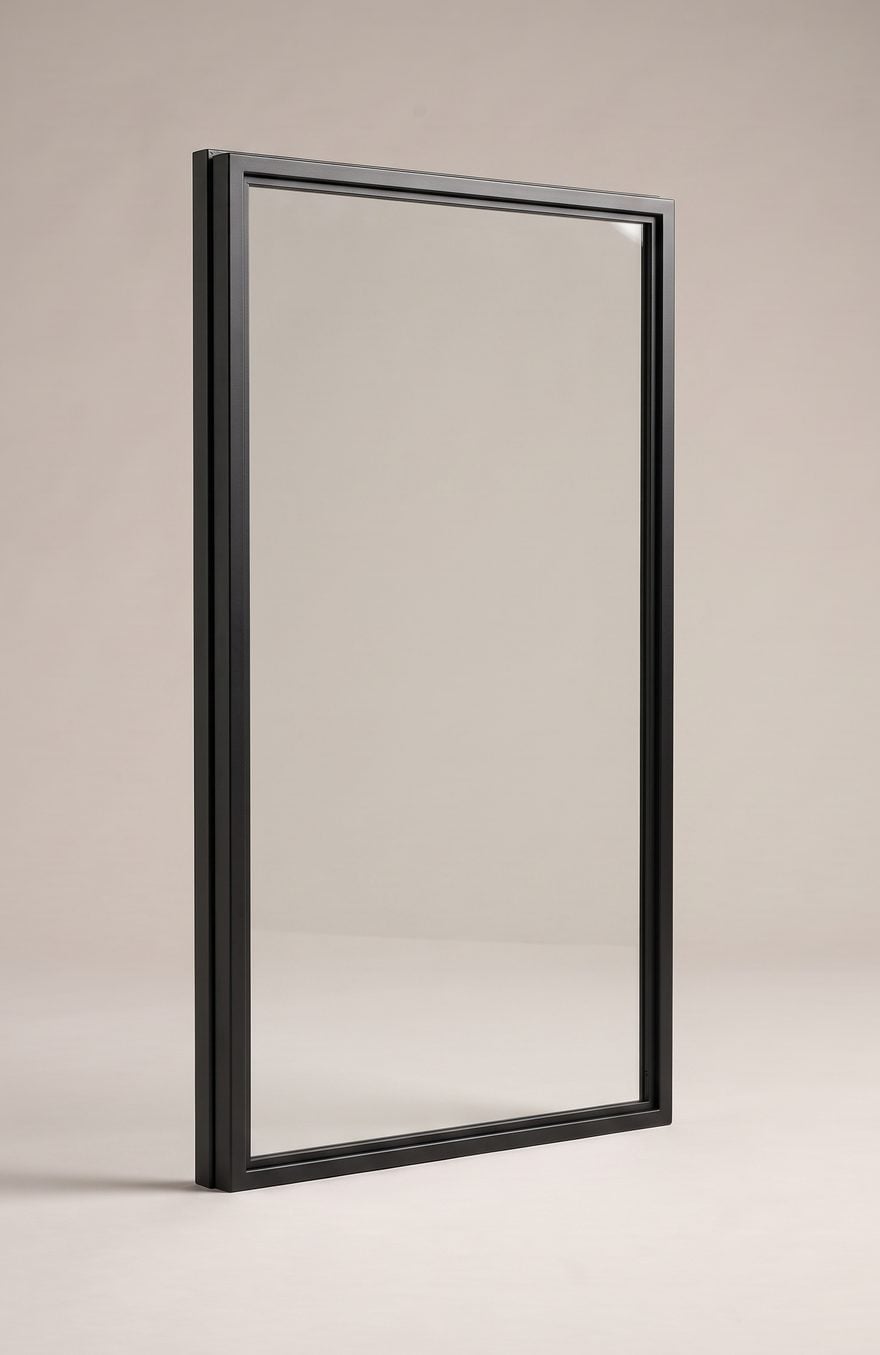
A slim steel or aluminium frame holding a large glass panel. It’s the industrial, factory-window look shrunk down to cabinetry.
Home Stratosphere reader data: too few images yet to measure reliably (23 kitchen images in our sample).
- Best kitchen styles: Industrial lofts, modern, Japandi and contemporary kitchens.
- Finishes and colours: Matte black, bronze, brushed brass frames; clear, reeded or smoked glass.
- Relative cost: $$$$ (premium) compared with the other doors here
- Cleaning: Easy. Wipe the glass; the metal frame is low-maintenance.
- Durability: Very good. Aluminium frames don’t warp the way wood can.
Designer move: Use metal-framed doors on tall glass cabinets or uppers, and ground them with warm wood lowers.
Mistake to avoid: Don’t mix several metal finishes in the frames, handles and lighting. Pick one dark metal and repeat it.
What the research says: KBDN 2026: Plain & Fancy cites ‘glass-front jewelry box cabinets and metal-framed inserts’; Wood-Mode: ‘increased use of metal and glass inserts’; WoodHarbor: ‘metal doors, wire inserts’; KBDN 2025 (Crystal): metal grille cabinets more popular; Real Simple 2026 and KBIS 2026 note wire-mesh/metal mesh fronts. The counterpoint: Much of the metal evidence is about mesh/wire inserts rather than slim steel glass frames; no quantitative data. Sources: Kitchen & Bath Design News, 2026; Kitchen & Bath Design News, 2025; Real Simple, 2026; Cabinet IQ, 2026.
Inset vs. Full Overlay vs. Partial Overlay vs. Frameless
These aren’t door styles. They describe how a door sits on the cabinet box, and any profile above can be mounted in more than one way. The choice changes the look as much as the profile does.
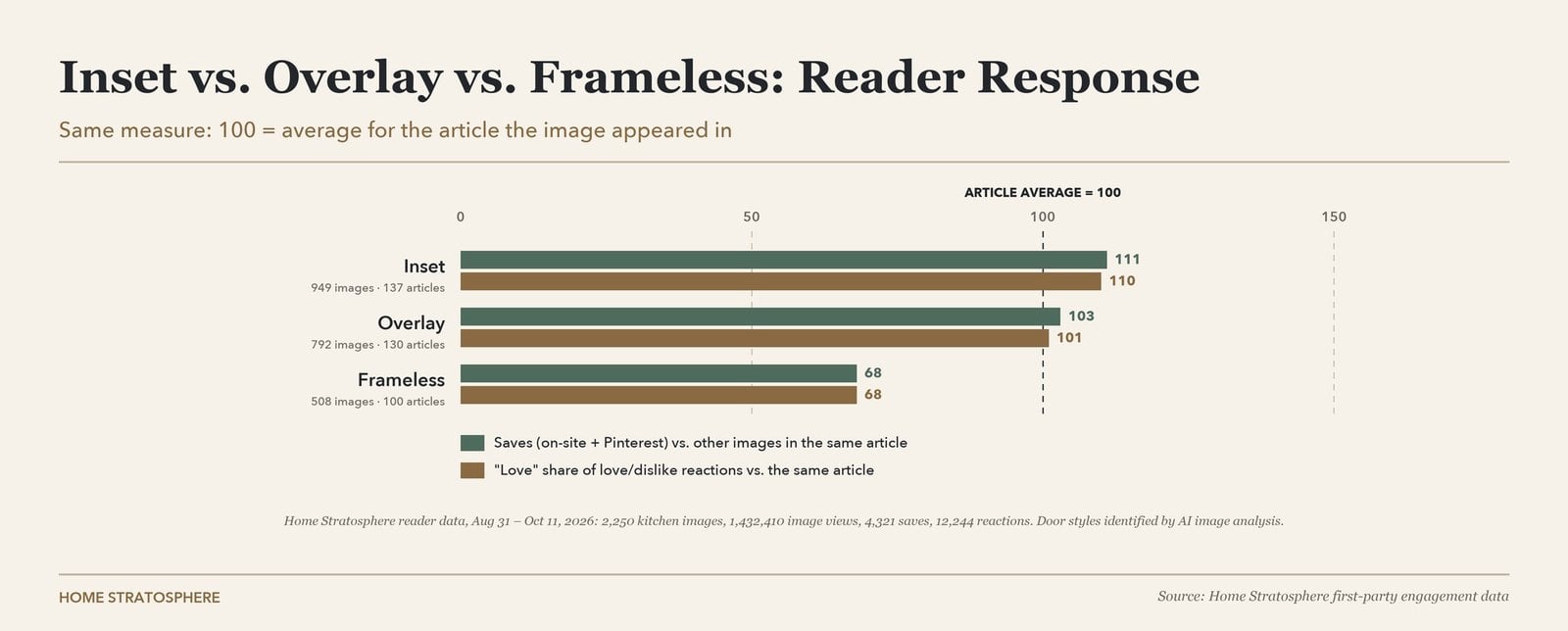
Our readers have a clear preference here. Inset kitchens scored 111 on saves and 110 on love against the other images in the same article, overlay kitchens were about average (103 and 101), and frameless kitchens trailed at 68 and 68.
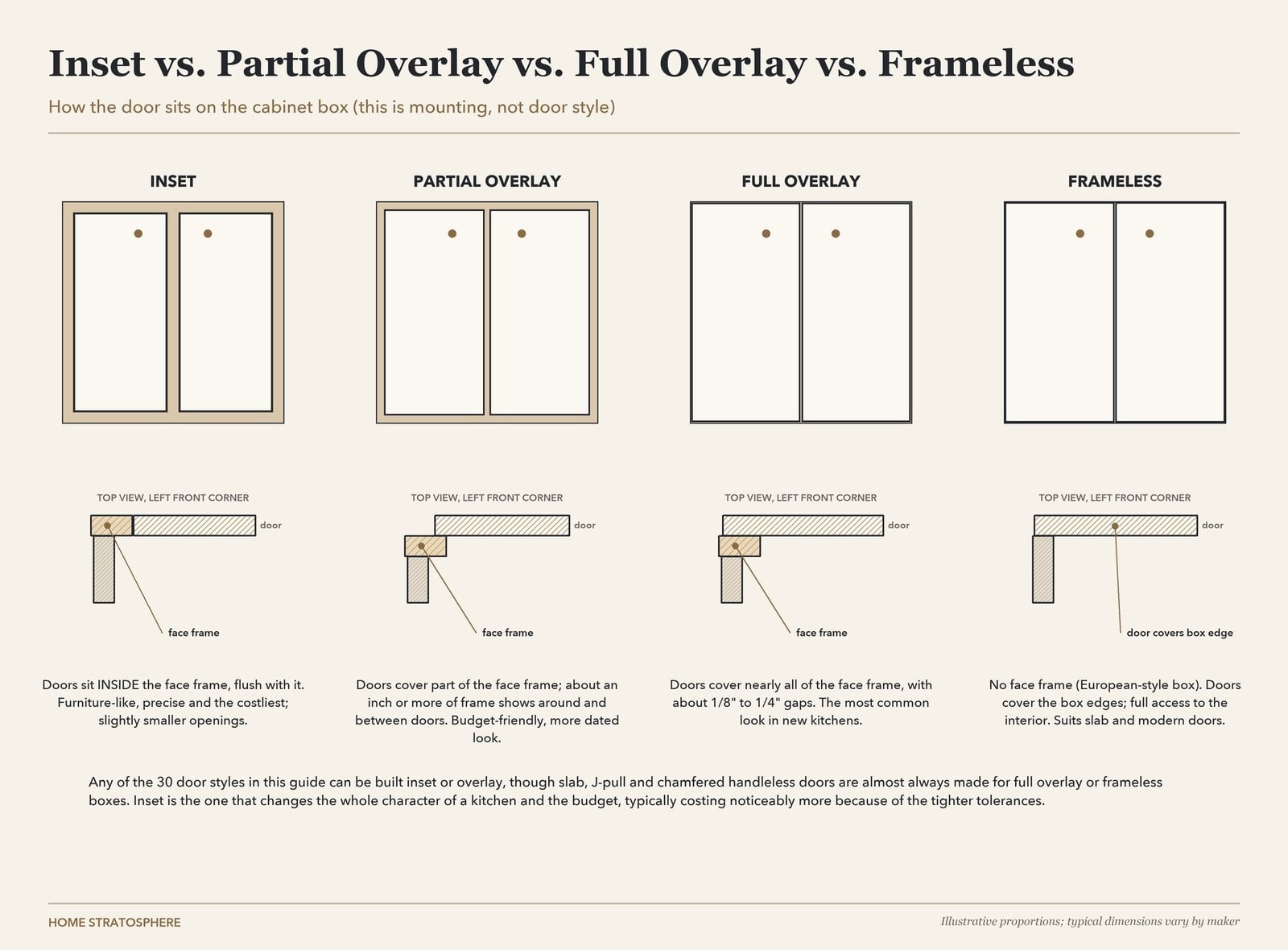
- Inset: the door sits inside the face frame, flush with it. It is the most furniture-like and precise option, usually the most expensive, and gives slightly smaller openings. Classic with Shaker, beadboard and glass-front doors.
- Full overlay: the door covers nearly the whole face frame, leaving small even gaps. It is the most common look in new kitchens and works with almost every style.
- Partial overlay: about an inch or more of frame shows around each door. It is the most budget-friendly option but reads as dated in many markets.
- Frameless (European): there is no face frame at all; doors cover the box edges and you get full access to the interior. It is the natural partner for slab, J-pull and chamfered handleless doors.
All 30 Cabinet Door Styles Compared
| Style | Visual character | Traditional to modern | Relative cost | Cleaning | Best applications | Industry 2027 outlook | HS reader saves (100 = avg) |
|---|---|---|---|---|---|---|---|
| 1. Classic Shaker | Clean, familiar frame | Transitional | $$ | Easy | Almost any kitchen | Holding strong (High) | 106 |
| 2. Slim Shaker | Lighter, crisper frame | Transitional-modern | $$ | Easy | Modern transitional, Scandinavian | Rising for 2027 (High) | 84 |
| 3. Micro Shaker | Near-slab with a pencil line | Modern | $$ | Very easy | Minimal, quiet-luxury | Rising for 2027 (Medium) | too few images |
| 4. Traditional Recessed Panel | Moulded, tailored | Traditional | $$$ | Moderate | Georgian, colonial | Holding strong (Low) | 104 |
| 5. Traditional Raised Panel | Dimensional, formal | Traditional | $$$ | More effort | Classic estates, period homes | Holding strong (Medium) | 107 |
| 6. Cathedral Raised Panel | Arched, Old-World | Traditional | $$$ | More effort | Tuscan, Mediterranean | Potentially fading (Low) | 110 |
| 7. Double Cathedral Panel | Ornate double arch | Traditional | $$$$ | More effort | French country, Old-World | Emerging / insufficient evidence (Low) | too few images |
| 8. Arched Recessed Panel | Soft curve, flat panel | Transitional | $$$ | Easy | Modern farmhouse, cottage | Rising for 2027 (Medium) | too few images |
| 9. Mitered-Frame Panel | Picture-frame corners | Traditional | $$$ | Moderate | Library-style, stained wood | Emerging / insufficient evidence (Low) | too few images |
| 10. Applied-Molding Panel | Panelled, Parisian | Traditional-transitional | $$$ | Moderate | Parisian, neoclassical, glam | Emerging / insufficient evidence (Low) | 111 |
| 11. Flat-Panel Slab | Smooth, seamless | Modern | $ | Very easy | Modern, mid-century, European | Rising for 2027 (High) | 75 |
| 12. Wood-Grain Slab | Warm, grain-led | Modern | $$$ | Easy | Japandi, warm minimal | Rising for 2027 (Medium) | 73 |
| 13. High-Gloss Slab | Reflective, saturated | Modern | $$$ | Easy (shows prints) | Glam, small urban kitchens | Potentially fading (Medium) | 70 |
| 14. Integrated J-Pull | Handleless line | Modern | $$$ | Moderate | European minimalist | Holding strong (Low) | too few images |
| 15. Chamfered-Edge Handleless | Handleless bevel | Modern | $$$ | Easy | Contemporary, quiet luxury | Emerging / insufficient evidence (Low) | too few images |
| 16. Routed Geometric Panel | Graphic pattern | Modern-eclectic | $$$ | Moderate | Mid-century, eclectic | Emerging / insufficient evidence (Low) | too few images |
| 17. Beadboard | Fine cottage texture | Traditional | $$ | More effort | Coastal, cottage | Rising for 2027 (Low) | 158 |
| 18. V-Groove | Plank texture | Transitional | $$ | Moderate | Craftsman, modern farmhouse | Rising for 2027 (Low) | 129 |
| 19. Fluted | Sculptural concave channels | Transitional | $$$$ | More effort | Islands, bars, feature runs | Holding strong (Medium) | 99 |
| 20. Reeded | Soft convex ridges | Transitional-modern | $$$$ | Moderate | Islands, warm modern | Holding strong (Medium) | too few images |
| 21. Tambour-Inspired | Slatted rhythm | Modern | $$$$ | More effort | Pantries, appliance walls | Emerging / insufficient evidence (Low) | 103 |
| 22. Louvered | Airy slats | Traditional | $$$$ | Most effort | Pantries, coastal, colonial | Emerging / insufficient evidence (Low) | too few images |
| 23. Board-and-Batten Inspired | Rustic, graphic | Transitional | $$$ | Moderate | Rustic farmhouse, cabins | Emerging / insufficient evidence (Low) | too few images |
| 24. Carved or Ornamental | Carved, furniture-like | Traditional | $$$$ | Most effort | Estate, Old-World | Emerging / insufficient evidence (Low) | 87 |
| 25. Clear Glass-Front | Open display | Any | $$$ | Moderate | Display uppers | Rising for 2027 (Medium) | 106 |
| 26. Frosted Glass-Front | Soft glow, hidden contents | Transitional-modern | $$$ | Easy | Uppers, contemporary | Emerging / insufficient evidence (Low) | too few images |
| 27. Reeded Glass-Front | Blurred, textured glass | Transitional | $$$$ | Moderate | Uppers, bars, Art Deco | Rising for 2027 (Medium) | too few images |
| 28. Mullion Glass-Front | Divided panes | Traditional | $$$ | Moderate | English country, colonial | Emerging / insufficient evidence (Low) | 119 |
| 29. Leaded Glass-Front | Artisan glass | Traditional | $$$$ | Moderate | Arts and Crafts, Tudor | Emerging / insufficient evidence (Low) | too few images |
| 30. Metal-Framed Glass | Thin dark metal, big glass | Modern-industrial | $$$$ | Easy | Lofts, bars, pantries | Rising for 2027 (Low) | too few images |
Which Cabinet Door Styles Are Most Likely to Dominate 2027?
The most credible forecast is not one exotic door. It is a shift in proportions and materials. Slab doors have the best forward-looking data of any profile, with 69% of NKBA professionals expecting them to gain. Slim Shaker has the broadest agreement among independent voices: designers polled by Domino and manufacturers quoted by KBDN, including Huntwood, QCCI and WoodHarbor, all describe narrow-frame Shaker as one of their strongest sellers. Combine those with the wood comeback (wood beat white for the first time in Houzz’s 2026 study, and MasterBrand’s 2027 survey puts medium stains at the top for the first time in 15 years) and the most likely new-build kitchen of 2027 has slim-framed or slab doors in warm wood or soft paint, with an accent of reeded glass, an arch or fluting in one spot (PHCP Pros, 2025; Domino, 2025; Kitchen & Bath Design News, 2026; Houzz, 2026; MasterBrand, 2026). Home Stratosphere readers add a caveat: the kitchens they save most are still Shaker, beadboard, V-groove and glass-front, so expect slim Shaker, with its familiar frame, to be the style that bridges the two.
Which Cabinet Door Styles Are Losing Popularity?
Fewer than the headlines suggest. High-gloss finishes and the cathedral arch are the only two with direct negative signals, and the cathedral evidence is weak. What designers consistently describe as tired is not a profile but an overdose: whole kitchens of fluting, busy applied mouldings, and all-white cabinets with matching hardware. If you love a style that is on a cooling list, scale it down to one feature rather than abandoning it.
Which Cabinet Door Styles Are the Most Timeless?
Classic Shaker is the safe harbour. It has topped Houzz’s door-style data for years and is still the choice of about six in ten renovating homeowners. Recessed and raised panels have outlived dozens of trends in the houses they suit. Simple clear glass-front and mullion uppers have been used for well over a century. The less a door depends on a texture or a finish to be interesting, the longer it tends to last. Our own reader data points the same way: classic Shaker, recessed and raised panels and glass-front uppers all match or beat the images around them on Home Stratosphere, year-round staples rather than one-season spikes. For more on the original, see our ultimate guide to Shaker kitchen cabinets.
How to Choose the Right Cabinet Door Style
- Start with the house, not the kitchen. A 1920s colonial wants recessed, raised or inset Shaker doors; a 1960s ranch can take slabs and wood grain; a new-build transitional house can go almost any direction. The door should look like it came with the architecture.
- Decide where texture lives. Pick one statement door, such as fluted, reeded, tambour or carved, for the island or one run, and let a calmer door do the rest.
- Be honest about cleaning. Every groove, bead and louver collects grease near the range. If you cook a lot, keep textured doors away from the cooktop.
- Match the door to the budget tier. Slabs and Shaker are the most economical; carved, louvered, fluted, reeded and leaded-glass doors cost the most, and inset mounting adds more.
- Choose hardware with the door. Slim frames want slim pulls; traditional panels can take cups and knobs. Our guide to the different types of cabinet hardware and how to pick hardware will help.
- See a real sample in your own light. Thin profiles like micro Shaker and subtle chamfers can disappear under flat overhead light.
Planning to paint instead of replacing? Read the cabinet painting mistakes that cost the most and our pick of the best paint for kitchen cabinets first. For colour inspiration, browse 31 cream-and-walnut kitchens poised to define 2027.
Frequently Asked Questions
What is the most popular kitchen cabinet door style?
Shaker. Houzz’s homeowner studies have put it far ahead of every other style, at 61% in the 2025 study versus 22% for flat-panel and 12% for raised-panel. Slimmer versions of Shaker are where the growth is.
Are Shaker cabinets going out of style?
No. Its share has eased slightly, from 64% in Houzz’s 2022 study to 61% in 2025, and designers are moving toward slimmer frames, but nothing in the 2025-26 research suggests Shaker is fading.
What is the difference between fluted and reeded cabinets?
Fluting is concave channels cut into the door face; reeding is convex rounded ridges standing out from it. They look similar from a distance and opposite up close (see the diagram above).
Are slab cabinet doors a good choice for 2027?
They have the strongest forward-looking support of any profile, with 69% of NKBA professionals expecting them to gain popularity. Warm wood grain and matte finishes are favoured over high-gloss.
Which cabinet door style is easiest to clean?
Flat slab and micro Shaker doors, followed by classic and slim Shaker. Louvered, carved, beadboard and fluted doors take the most effort.
What is the difference between inset and overlay cabinets?
Inset doors sit inside the cabinet’s face frame, flush with it; overlay doors sit on top of the frame. Inset looks more furniture-like and usually costs more.
Do glass-front cabinets make a kitchen look dated?
Not on current evidence. Glass-front was the top accent-cabinet choice in Houzz’s 2025 study, and designers describe glass uppers, especially reeded glass, as replacing open shelving.
Should every cabinet in a kitchen have the same door style?
Usually there is one main style, with at most one accent such as glass uppers, a fluted island or an arched hutch. More than two profiles in one room tends to look unplanned.
How We Built These Ratings
Each style was rated Rising, Holding strong, Potentially fading or Emerging (insufficient evidence), with a confidence level. High means several independent, relevant sources including quantitative data. Medium means several consistent qualitative signals. Low means the call is speculative or supported only indirectly. Manufacturer and retailer material counted as supporting evidence only. Broad trends, like the move to natural wood, were not taken as proof that a specific door style is rising. We could not run meaningful Google Trends comparisons, so none are included.
Separately, the Home Stratosphere reader scores come from our own first-party engagement data: save, Pin It and love/dislike taps and head-to-head votes on kitchen images, August 31 to October 11, 2026. Door styles were identified by AI image analysis, and each style is scored against the other images in the same article to remove traffic differences between articles. Styles with fewer than 12 images or 5 articles are marked as too few to measure. The two kinds of evidence are reported side by side rather than blended, so you can see where they agree and where they don’t.
Sources
- Houzz, “5 Kitchen Cabinet Trends Popular With Homeowners Now (2022 U.S. Houzz Kitchen Trends Study)” (2022-01-18)
- Houzz, “10 Top Kitchen Design Trends for Cabinets, Countertops and More (2024 U.S. Houzz Kitchen Trends Study)” (2024-02-06)
- Houzz, “See the Top Trends in Kitchen Cabinets, Countertops and More (2025 U.S. Houzz Kitchen Trends Study)” (2025-01-16)
- Houzz, “10 Kitchen Remodeling Trends to Know for 2026 (2026 U.S. Houzz Kitchen Trends Study)” (2026-01-13)
- Designers Today, “2026 Houzz Kitchen Trends Study Reveals Surge in Built-In Storage and Pantry Features” (2026-01-13)
- Houzz (Mitchell Parker), “25 Home Design Trends Defining How We’ll Live in 2026” (2025-12-30)
- PHCP Pros (NKBA report coverage), “NKBA | KBIS Releases Annual 2026 Kitchen Trends Report” (2025-09-18)
- MasterBrand (press release), “The New Era of Kitchen Design: MasterBrand Unveils 2026 Cabinetry Trends and ‘Lush Forest’ as Finish of the Year” (2025-09-15)
- MasterBrand press release via StockTitan, “Kitchen Design Aesthetics and Trends: MasterBrand, Inc. Unveils 2027 Cabinetry Trends and Finish of the Year” (2026-09-15)
- Real Simple (via Yahoo), “6 Cabinet Trends Designers Say Will Make All-White Kitchens Feel Dated in 2027” (2026-07-10)
- Kitchen & Bath Design News (KBDN), “Cabinet Trends: Warmth & Simplicity” (2026-06-18)
- Kitchen & Bath Design News (KBDN), “Kitchen Cabinets: Storage with Style” (2025-06-24)
- Kitchen & Bath Business (KBB), “Today’s Cabinetry and Storage Trends” (2025-05-30)
- Domino, “We Asked 18 Designers: What Kitchen Cabinet Style Will Rule in 2026?” (2025-12-10)
- Domino, “7 Kitchen Cabinet Styles Designers Are Digging for 2025” (2024-12-20)
- The Spruce (via AOL), “Say Goodbye to Bland Kitchens: 5 Kitchen Cabinet Trends You’re About to See Everywhere in 2026” (2025-10-25)
- The Spruce (syndicated via ideal.house), “Are Open Shelves Finally Out of Style in 2026? Designers Weigh In” (2026)
- Homes & Gardens, “The 9 Most Coveted Kitchen Cabinet Trends for 2026” (2025-12-19)
- Homes & Gardens, “Designers Have Called It: This Kitchen Cabinet Style is Replacing Shaker For a More Textured Take on the Classic Look” (2026-03-07)
- Homes & Gardens, “The Kitchen Trends Designers Say Already Feel Overdone in 2026” (2026-06-13)
- Homes & Gardens (Molly Malsom), “All the Best Kitchens in 2027 Will Embrace Imperfection – 9 Coveted Kitchen Trends Shaping Future Designs” (2026-10-11)
- Homes & Gardens, “Shea McGee Predicts the Biggest Kitchen Trends For 2027” (2026-09-26)
- Homes & Gardens, “Amber Lewis On the Future of Kitchen Design” (2026-09-17)
- Homes & Gardens (republished by InteriorDaily), “Kitchen cabinet trends designers say will date your space in 2026” (2025-12-24)
- Livingetc, “Fluted Kitchen Cabinets Are Being “Specified More Than Ever” Right Now” (2026-05-19)
- Livingetc, “Are Handleless Kitchens in Style?” (2026-02-16)
- Livingetc, “5 Kitchen Cabinet Trends Interior Designers Are Choosing for 2026” (2026-03-16)
- Hunker, “Kitchen Cabinet Trends On The Way Out In 2026 (So Far)” (2026-09-11)
- Cabinet IQ (Jan Rutgers), “KBIS 2026: Why “What’s Old Is New Again” in Kitchen Design” (2026-02)
- Kerrie Kelly Design Lab, “KBIS 2026: 7 Styles Defining the Future of the Whole Home” (2026-02)
- Kitchen & Bath Business (KBB), “Fabuwood Echo and Luxe Door Styles” (2025-12-18)
- Wickes (UK retailer), “Kitchen Trends Autumn 2026 (trade)” (2026)
- Block Renovation, “2026 Kitchen Cabinet Trends: Colors, Hardware, and More” (2026-03-02)
- USA Cabinet Express (retailer), “Kitchen Cabinet Door Styles: Most Popular Profiles And What We Expect For 2027” (2026-09-03)
- Fox 11 Living (sponsored; Kitchen Tune-Up), “Is Your Kitchen Outdated? (sponsored segment)” (2026-05-11)
- Livingetc, “Are Fluted Glass Kitchen Cabinets Still on Trend?” (2025-03-07)
- Country & Town House, “Are Fluted Kitchens Still On Trend?” (2025-05)
- Livingetc, “Beadboard Kitchen Cabinet Ideas” (2025-02-26)
- Livingetc, “Forget Flat Doors, Textured Kitchens Feel Way More Expensive – 8 Types Designers Are Reaching for in 2026” (2025-12-15)