🔥 Would you like to save this?
Green has officially taken over the kitchen. Not the tired sage of a few years ago, but deep forest greens, moody hunter tones, and clean celadon shades paired with crisp white to create kitchens that feel both alive and architectural. The green and white combination has become the defining palette of luxury kitchen design heading into 2026, and the results are impossible to ignore. These ten moodboards capture the range of what this color story can do, from maximalist drama to quiet restraint.
In order to come up with the very specific design ideas, we create most designs with the assistance of state-of-the-art AI interior design software. Also, assume links that take you off the site are affiliate links such as links to Amazon. this means we may earn a commission if you buy something.
Deep Forest Green Cabinetry with Marble Waterfall Island and Unlacquered Brass Hardware
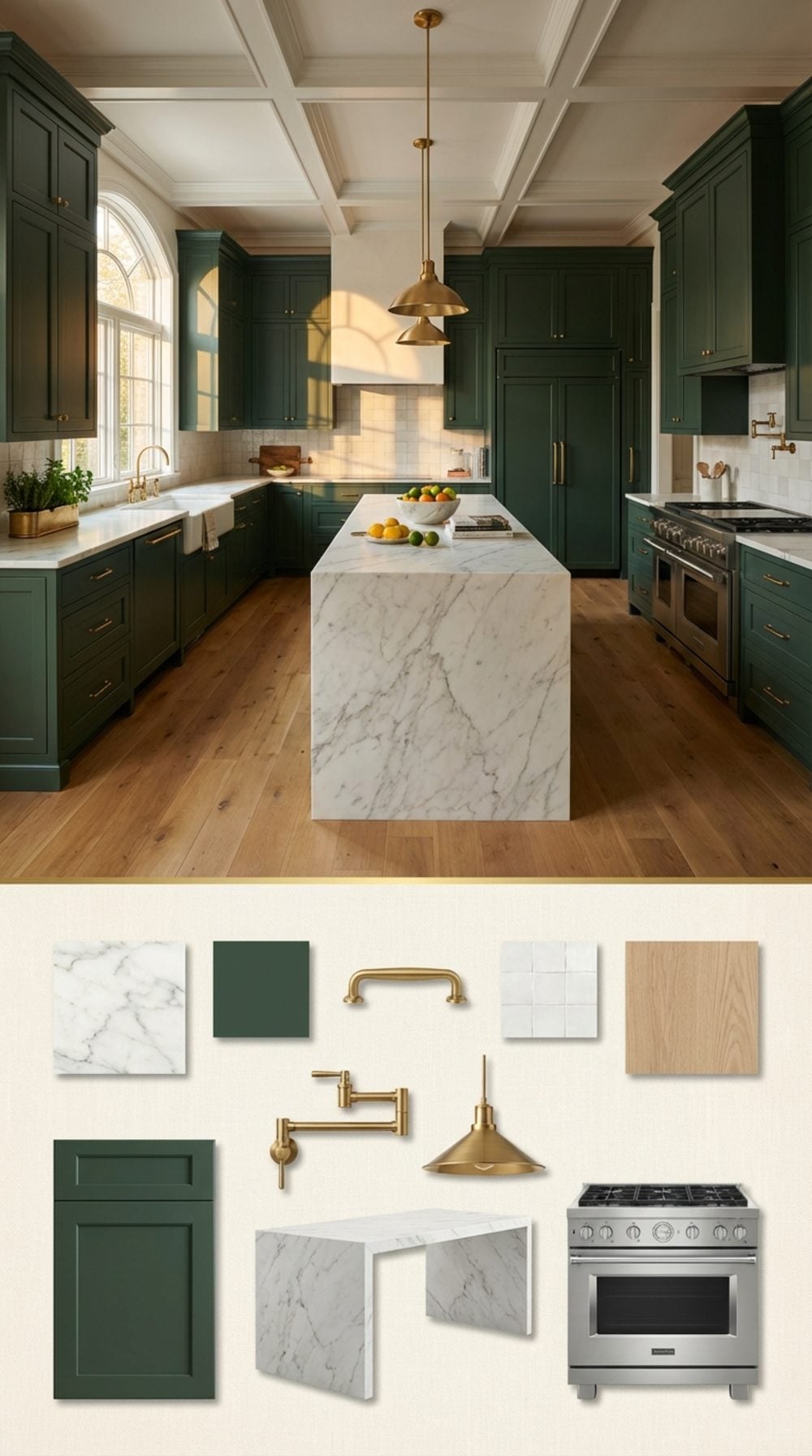
That forest green against Calacatta marble is a classic tension resolved beautifully: the depth of the painted cabinetry absorbs light while the marble waterfall island reflects it, keeping the kitchen from reading as a cave. The unlacquered brass hardware is the crucial third element here. It ages in place, developing a patchy patina that makes the whole room feel inherited rather than installed.
The integrated panel-ready refrigerator and dishwasher are a lesson in restraint. When appliances disappear into the cabinetry, the eye travels the full length of the room uninterrupted, which makes even mid-sized kitchens feel architecturally grand.
Sage Green Flat-Front Cabinetry with Quartzite Countertops and Matte Black Fixtures
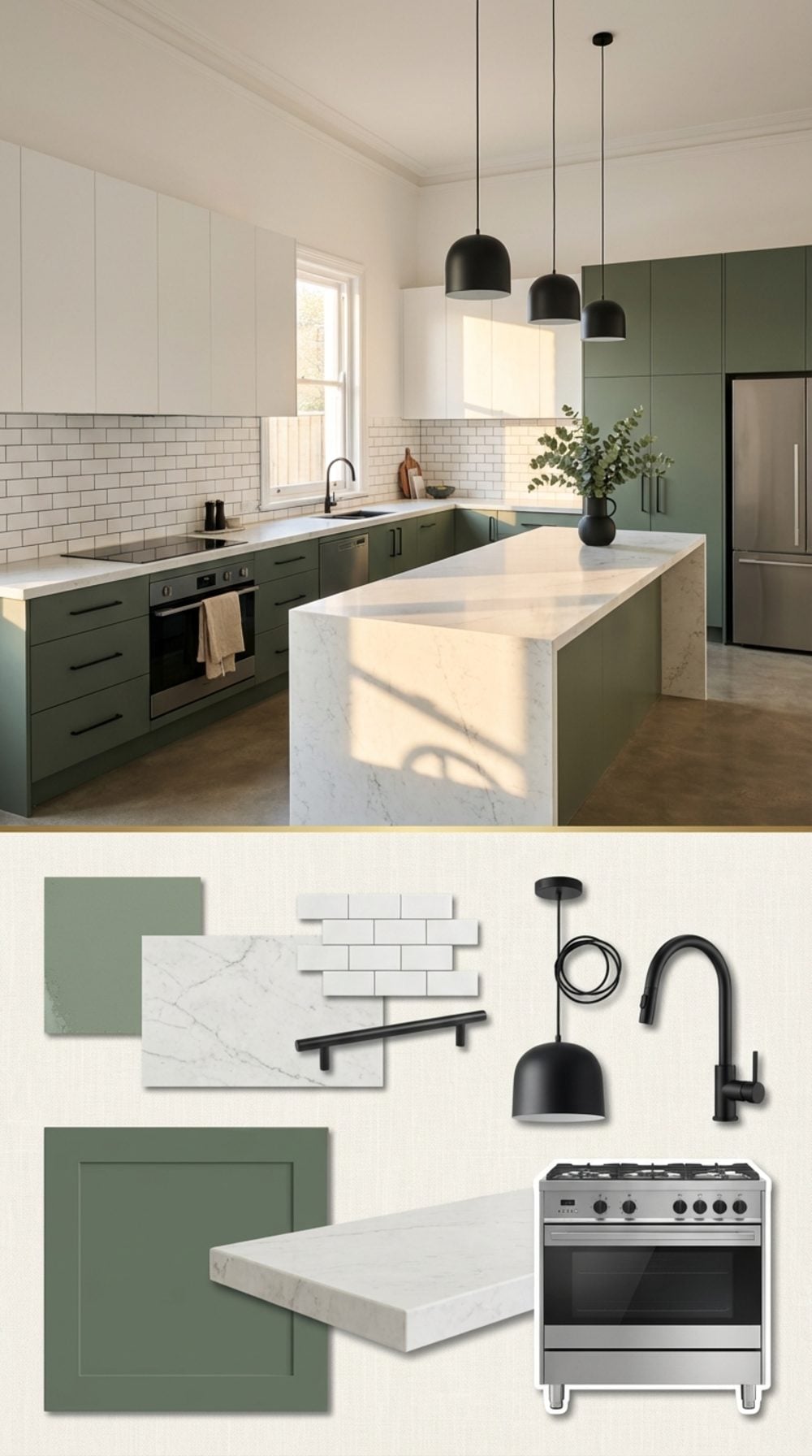
Sage green paired with matte black fixtures is a different kind of restraint than traditional neutrals, one with more personality. The color reads warm against the white quartzite but cools down against the concrete floors, which means the palette shifts slightly depending on where you stand in the room.
Flat-front cabinetry at this scale is essentially architecture. Without the shadow lines of raised panels, the wall of sage green flat-front cabinets reads as a single continuous plane, making the kitchen feel larger and more deliberate than its square footage suggests.
Hunter Green Lacquered Cabinetry with Fluted Glass Uppers and Polished Nickel Details
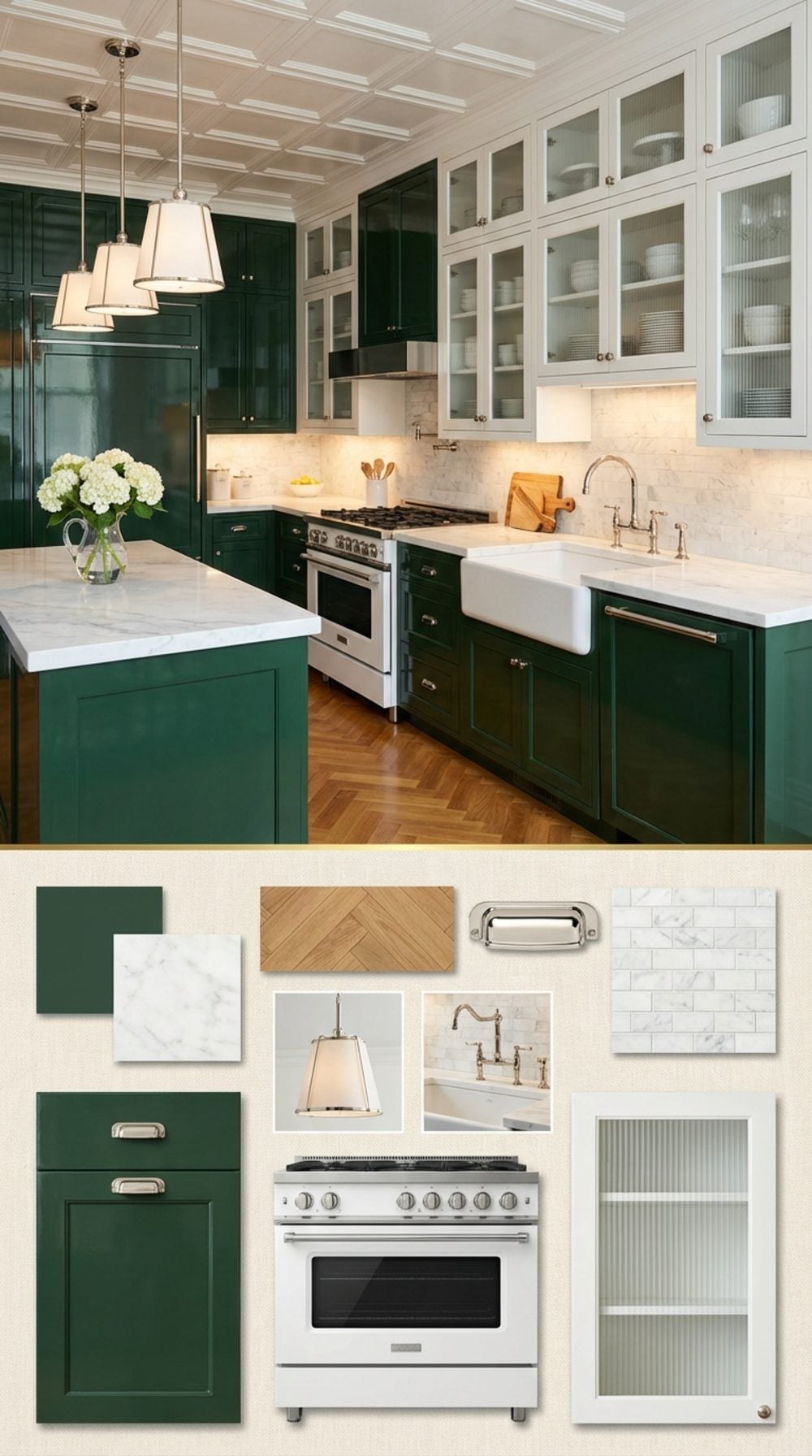
High-gloss lacquer in hunter green is a commitment, and this kitchen earns it. The reflective surface bounces the nickel fixtures’ cool light back across the room, creating a shimmer that matte paint simply cannot replicate. Against the Thassos marble (which has the whitest ground of any natural stone), the green reads almost jewel-like.
Fluted glass uppers are the design decision that keeps this from tipping into darkness. They break the solid color wall, introduce transparency, and give the eye a place to rest without sacrificing storage concealment. It’s the same visual logic as a window in a dark-painted room.
Celadon Green Inset Cabinetry with Soapstone Countertops and Aged Iron Hardware
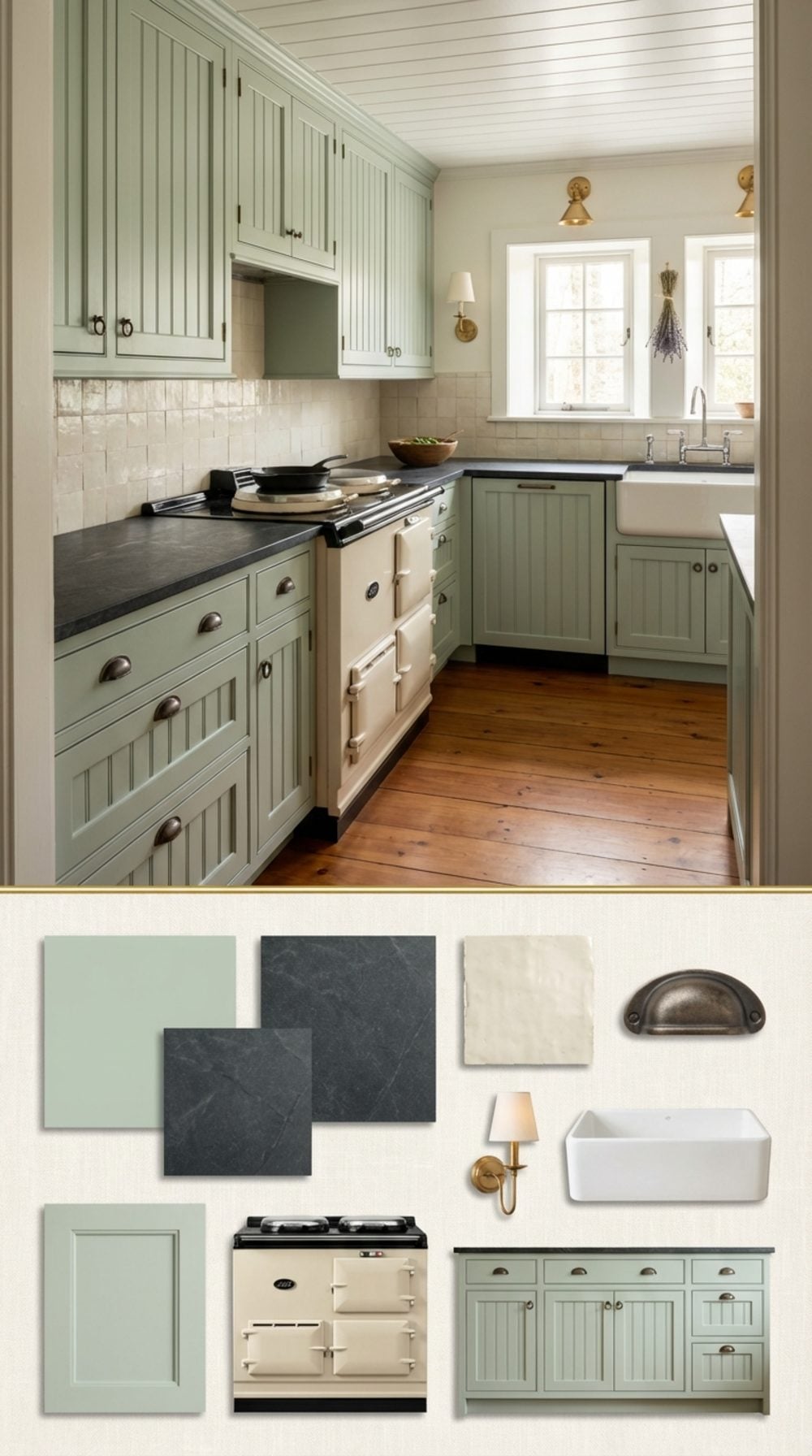
Soapstone is the counter material that changes the energy of a kitchen more than almost any other choice. Its cool, dense matte surface absorbs ambient light rather than reflecting it, which pulls the celadon green deeper and makes the whole room feel grounded. Add aged iron hardware and the kitchen reads like it has been in a house for generations.
Emerald Green Two-Tone Kitchen with Limewash White Walls and Waterfall Quartz Peninsula
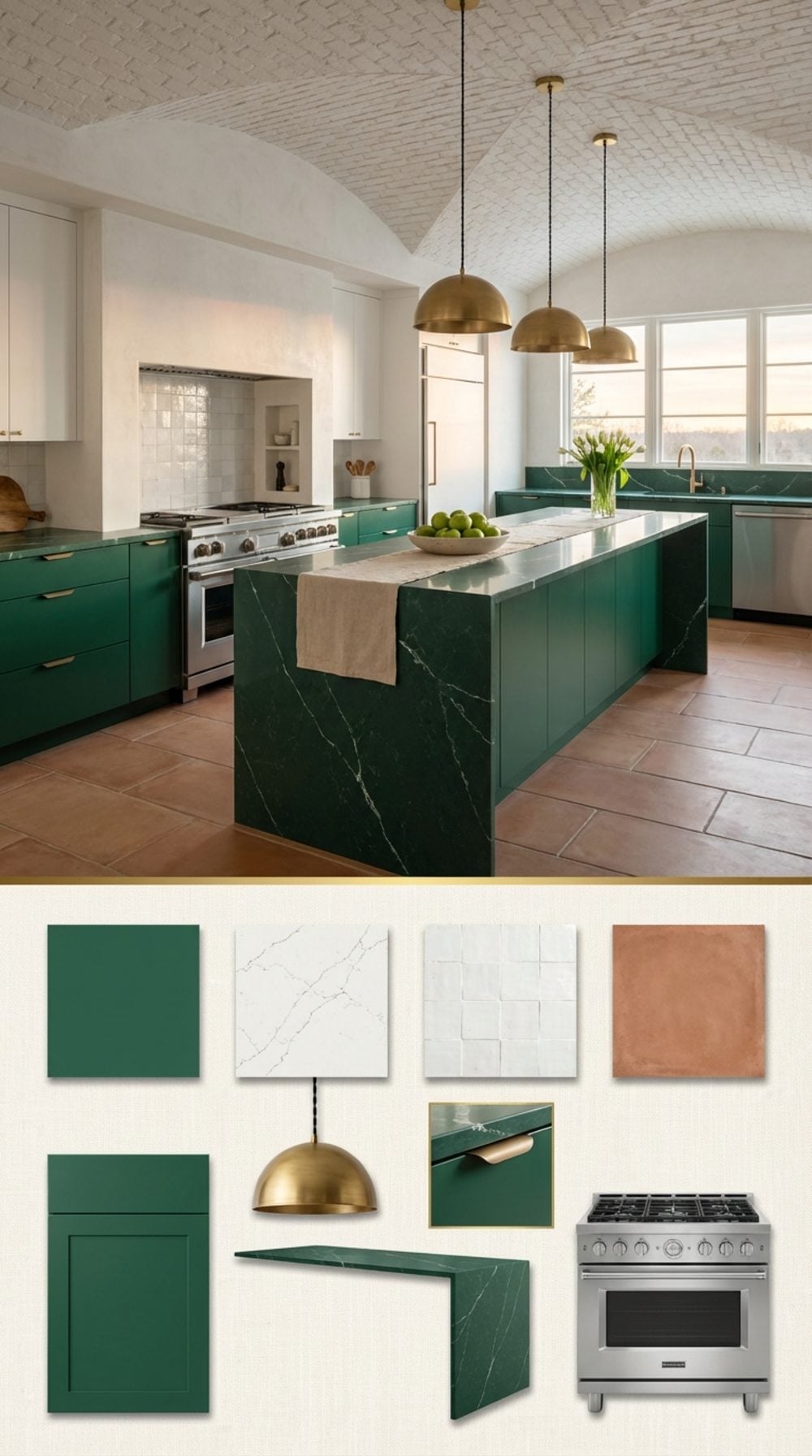
Limewash walls do something unusual in a kitchen: they absorb color from adjacent surfaces rather than competing with them. Here, the textured white limewash picks up warm amber tones from the terracotta tile below and cool green undertones from the emerald cabinetry, acting as a neutral that’s anything but flat.
Among the designs dominating kitchen redesign right now, the two-tone approach of emerald lowers against white uppers stands out for its ability to anchor a room without visually lowering the ceiling. The eye reads the white as sky and the emerald as ground, a spatial logic that feels intuitive the moment you step inside.
British Racing Green Cabinetry with Marble Slab Backsplash and Unlacquered Brass Fixtures
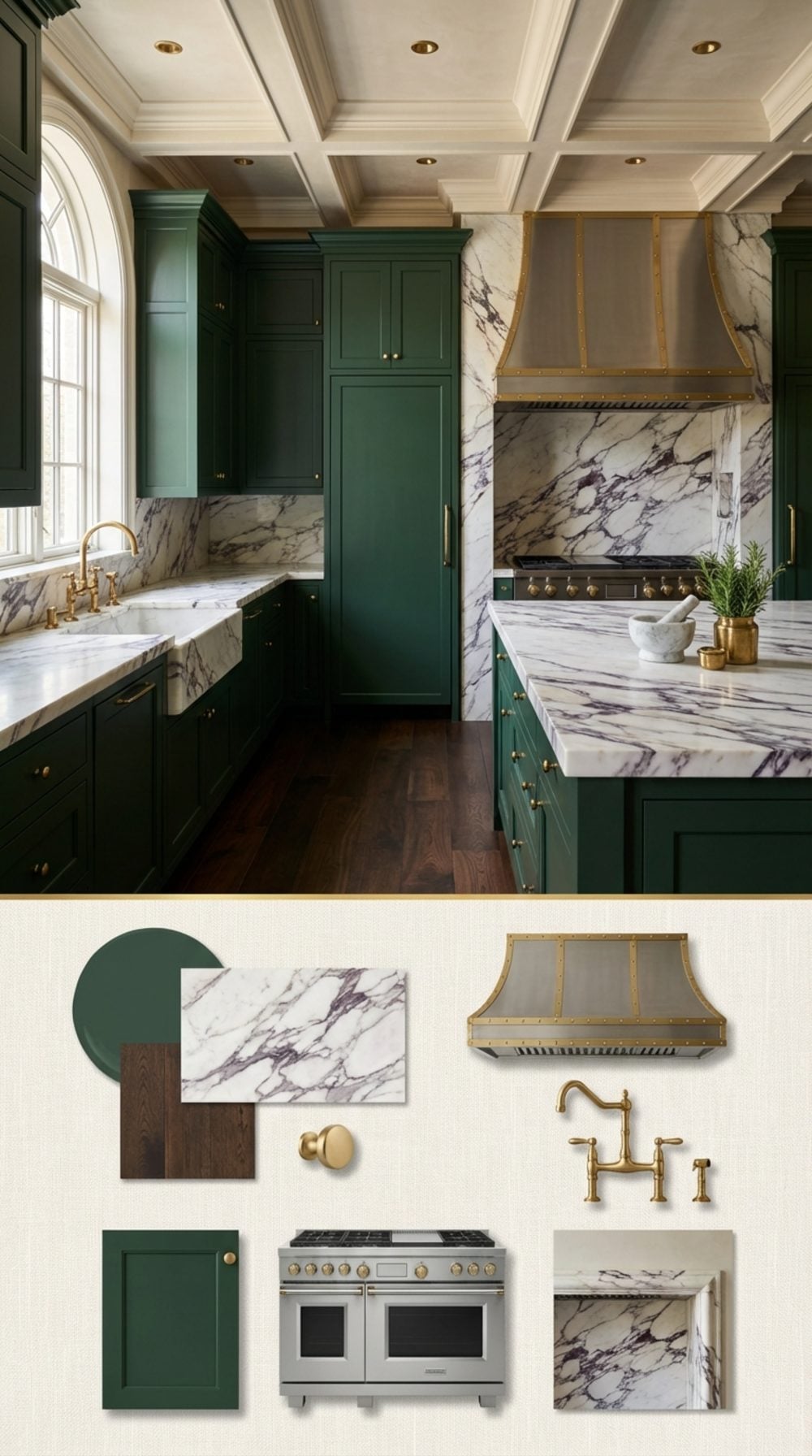
Calacatta Viola marble as a full-slab backsplash is an architectural gesture, not a decorating choice. A single continuous stone surface running counter to ceiling eliminates the visual break that most kitchens have at the 18-inch backsplash line, making the room feel taller by removing the interruption. Bookmatched from the countertop, the veining reads as continuous movement across the entire cooking wall.
British racing green against Viola marble’s purple-grey veining creates a color harmony that’s almost botanical: deep forest shadow against pale lichen. The unlacquered brass bridge faucet and cabinet hardware will patina unevenly over time, which actually strengthens the room’s naturalistic character rather than undermining it.
Pale Pistachio Green Scullery Kitchen with Aged Brass Fittings and Hand-Painted Tile Walls
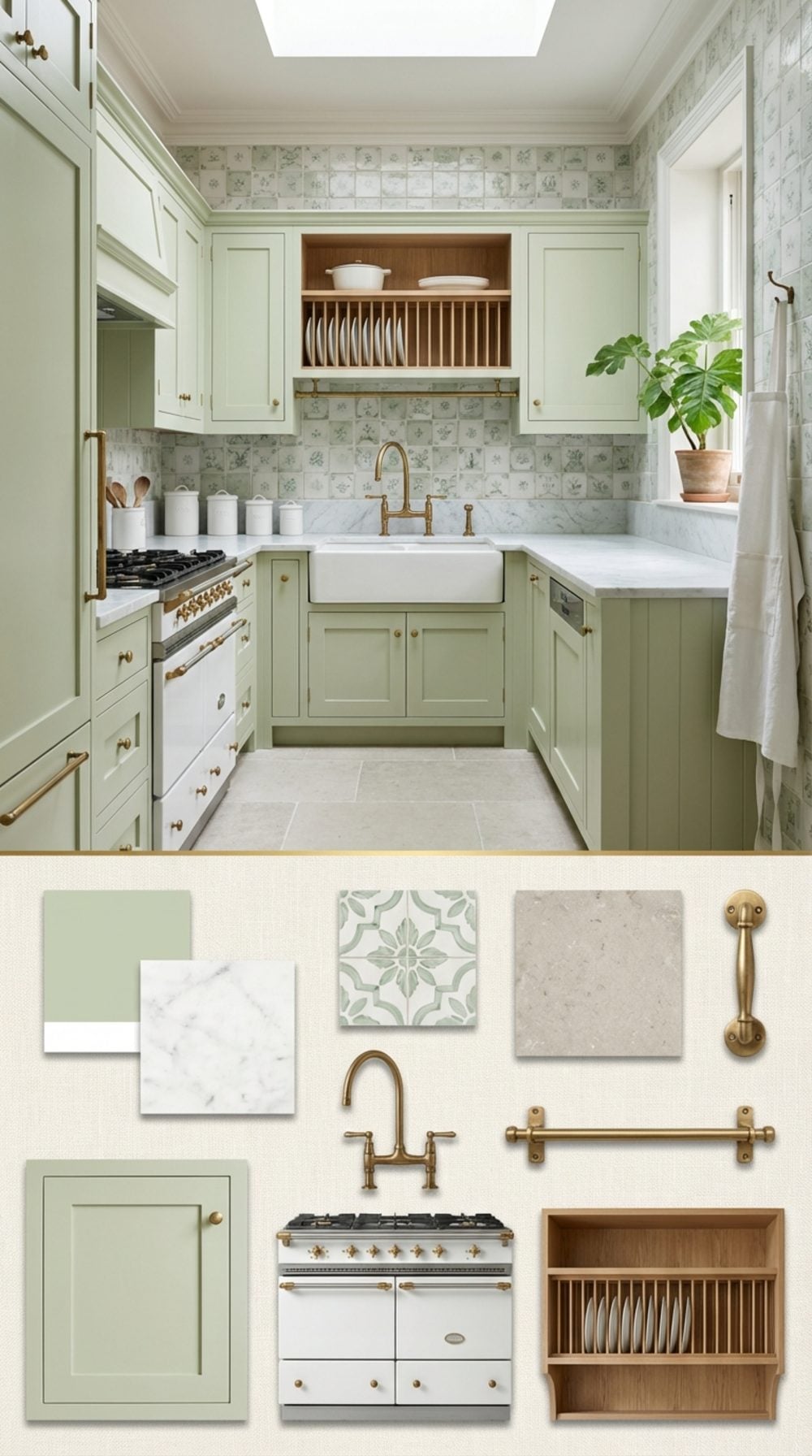
Hand-painted tiles above the cabinetry function like wallpaper that can’t bubble, peel, or date itself. In a narrow scullery, covering every vertical surface above the counter line in illustrated pattern compresses the room’s length while expanding its perceived height, a counterintuitive spatial trick that actually works.
Pistachio green sits at the edge of what reads as a neutral. In strong daylight from the skylight above, it registers as almost off-white. Under warm incandescent light, it shifts green. That perceptual instability keeps the room interesting across different times of day, which is exactly what a working kitchen needs.
Bottle Green Cabinetry with Fluted Plaster Range Hood and White Shiplap Ceiling
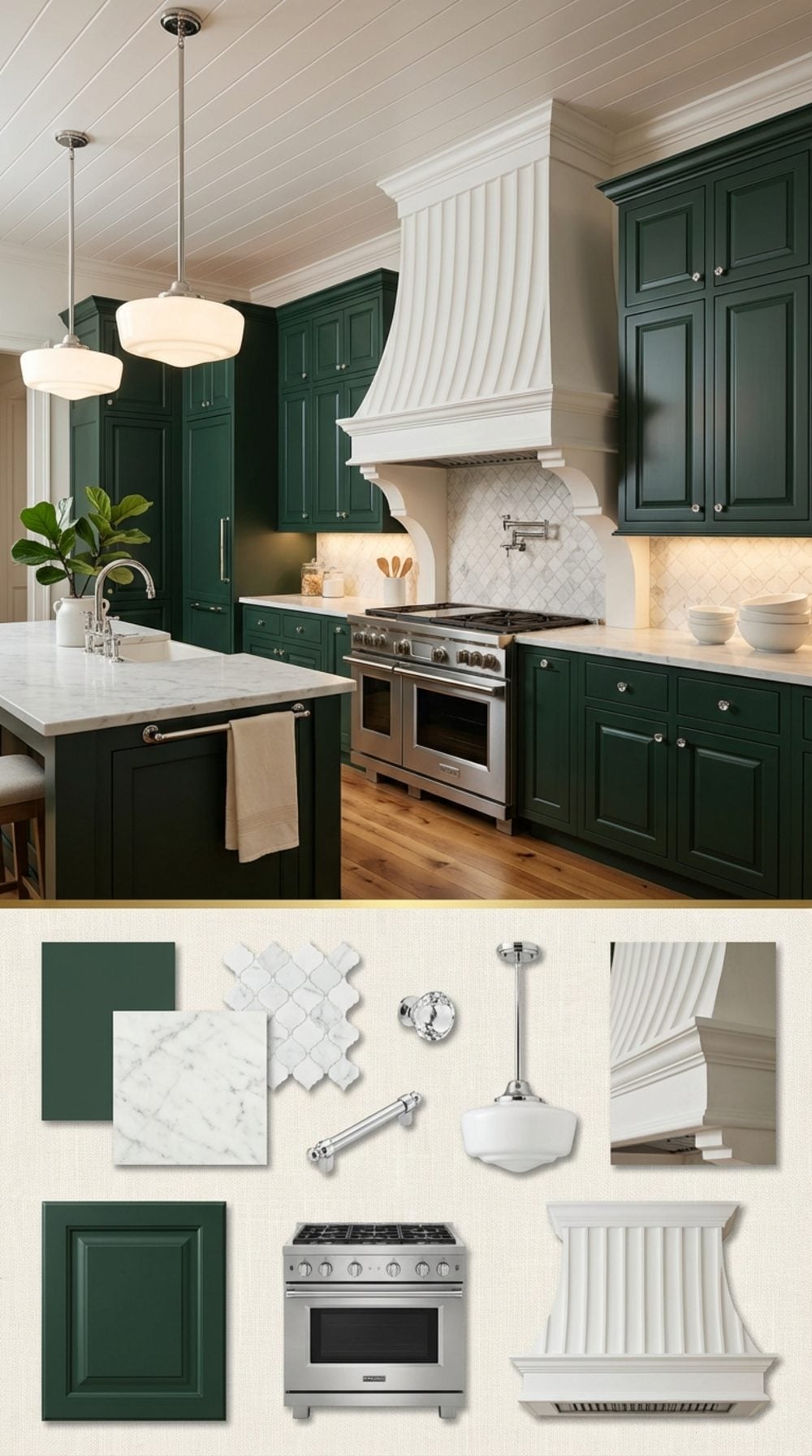
The fluted plaster range hood is the room’s structural argument: every other element exists to support it. Plaster reads as craftsmanship rather than millwork, and the vertical fluting draws the eye upward toward the shiplap ceiling in a continuous line that makes the kitchen feel like it was built by hand.
Bottle green with Carrera marble and chrome (rather than the now-ubiquitous brass) is a sharper, more European-feeling combination. The chrome reflects cool blue-white light, which keeps the dark cabinetry from reading as heavy, a distinction that matters enormously in kitchens with limited window exposure.
Dark Olive Green Kitchen with Terrazzo Floors, Fluted Oak Island, and Integrated Appliances
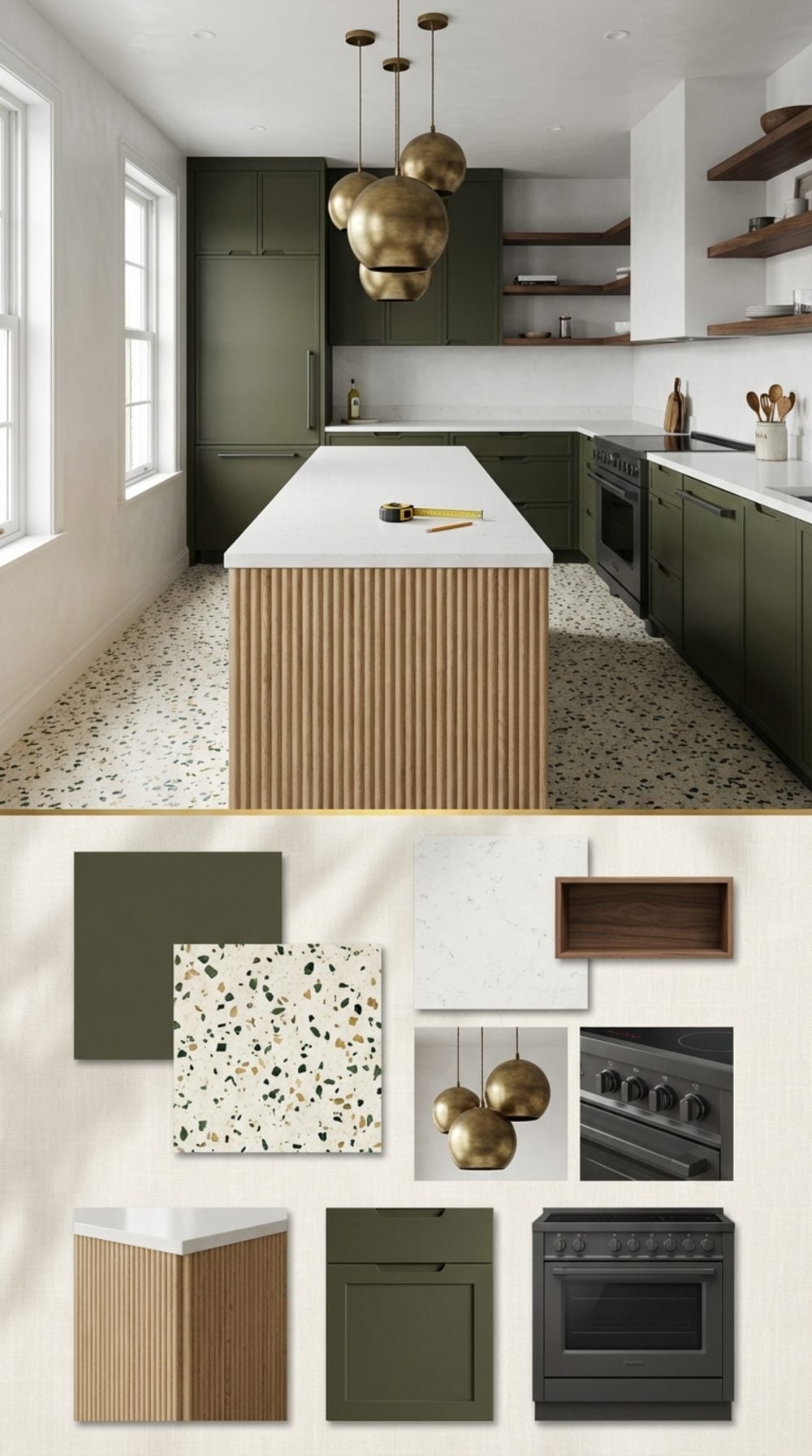
Eliminating upper cabinets entirely changes the room’s psychology. Without the visual compression of overhead cabinetry bearing down, the kitchen reads more like a living space than a utility room, which is the whole point. Dark walnut floating shelves provide structure without enclosure.
The fluted oak kitchen island is doing something technically clever: the vertical reed texture at eye level creates micro-shadows that make the island appear slightly three-dimensional, giving a flat-front kitchen its only moment of tactile depth. Terrazzo flooring with brass-toned chips ties the floor to the aged brass globe pendants overhead without any other connective element needed.
Soft Spearmint Green Shaker Kitchen with Carrara Marble and Polished Nickel Throughout
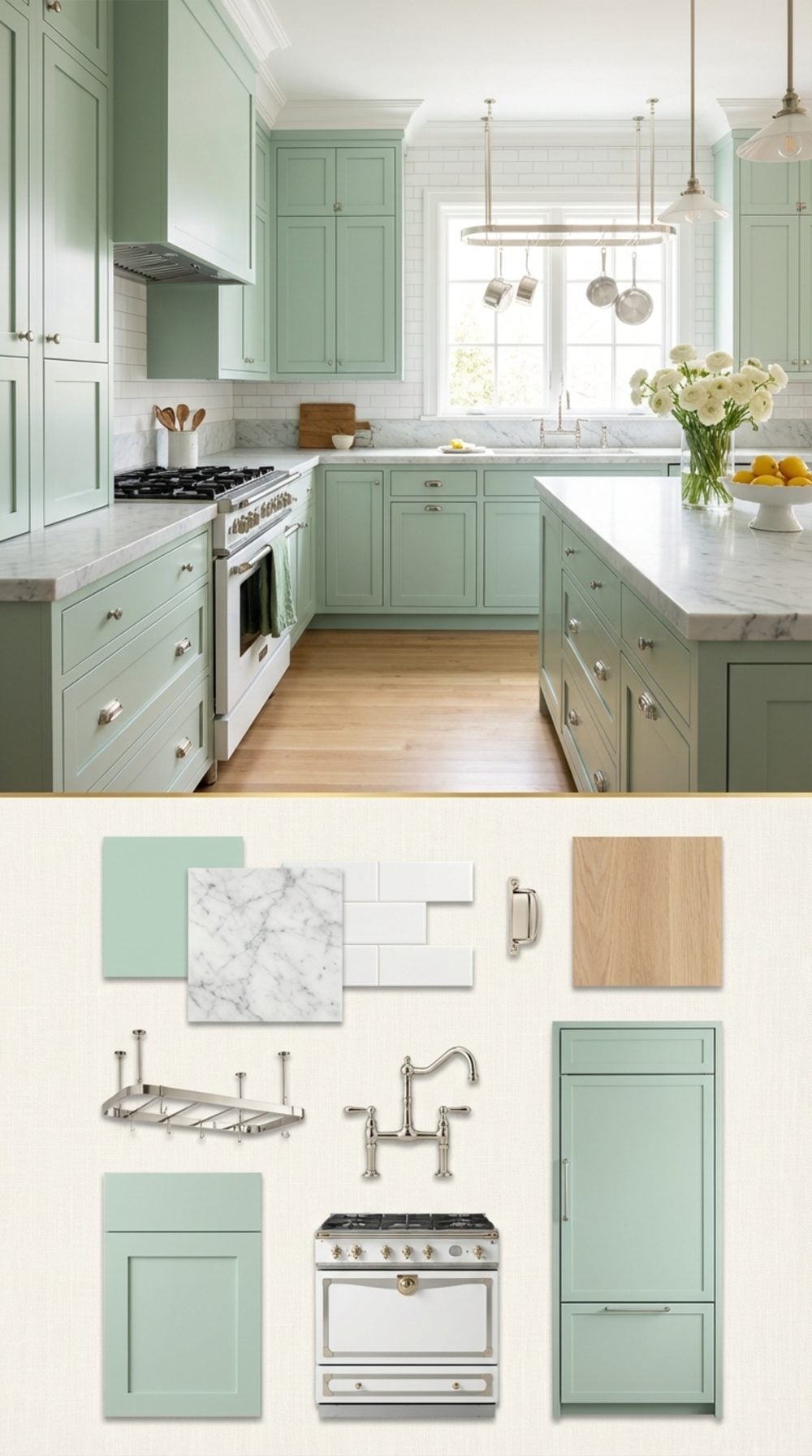
Spearmint sits lighter than sage and cooler than celadon, which makes it the rarest of things in green kitchen design: a shade that photographs beautifully under both natural light and artificial light without shifting into an unflattering tone. Against Carrara marble’s cool grey veining, it reads crisp rather than sweet.
This is exactly the kind of white kitchen remodel approach that works for long-term resale value: the green is present but never aggressive, and the Carrara marble, polished nickel, and white enamel range are all timeless enough to outlast trends by decades. The ceiling-hung polished nickel pot rack introduces a layer of working-kitchen authenticity that softens the formal composition without breaking it.
Verdant Vault: Moody Hunter Green Cabinetry with Arabescato Marble and Raw Brass Fixtures
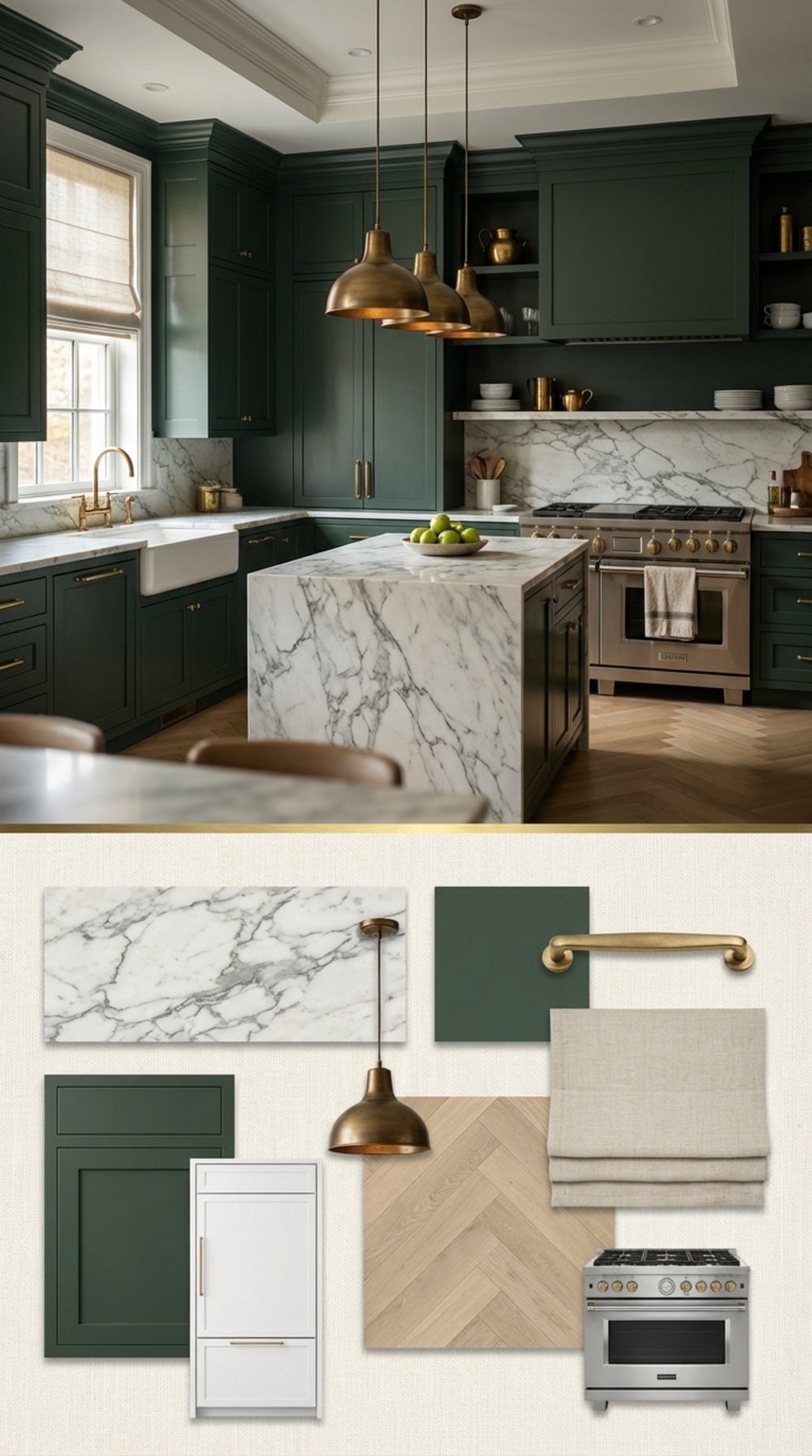
Hunter green and Arabescato marble is one of those pairings that looks like it was always inevitable. The white marble’s grey veining pulls exactly the right mineral quality out of the green cabinetry, preventing either from dominating. Raw brass, left unlacquered to develop its natural patina, is the critical third voice, warmer than polished brass, more grounded than chrome.
The integrated panel refrigerator and dishwasher aren’t just a luxury upgrade; they’re load-bearing aesthetically. A stainless appliance break in this palette would read as a mistake, not a contrast. Full integration lets the cabinetry read as continuous architecture, which is why this kitchen feels more like a room than a workspace.
Greenhouse Effect: Sage and Cream Kitchen with Terrazzo Floors and Arched Pass-Through
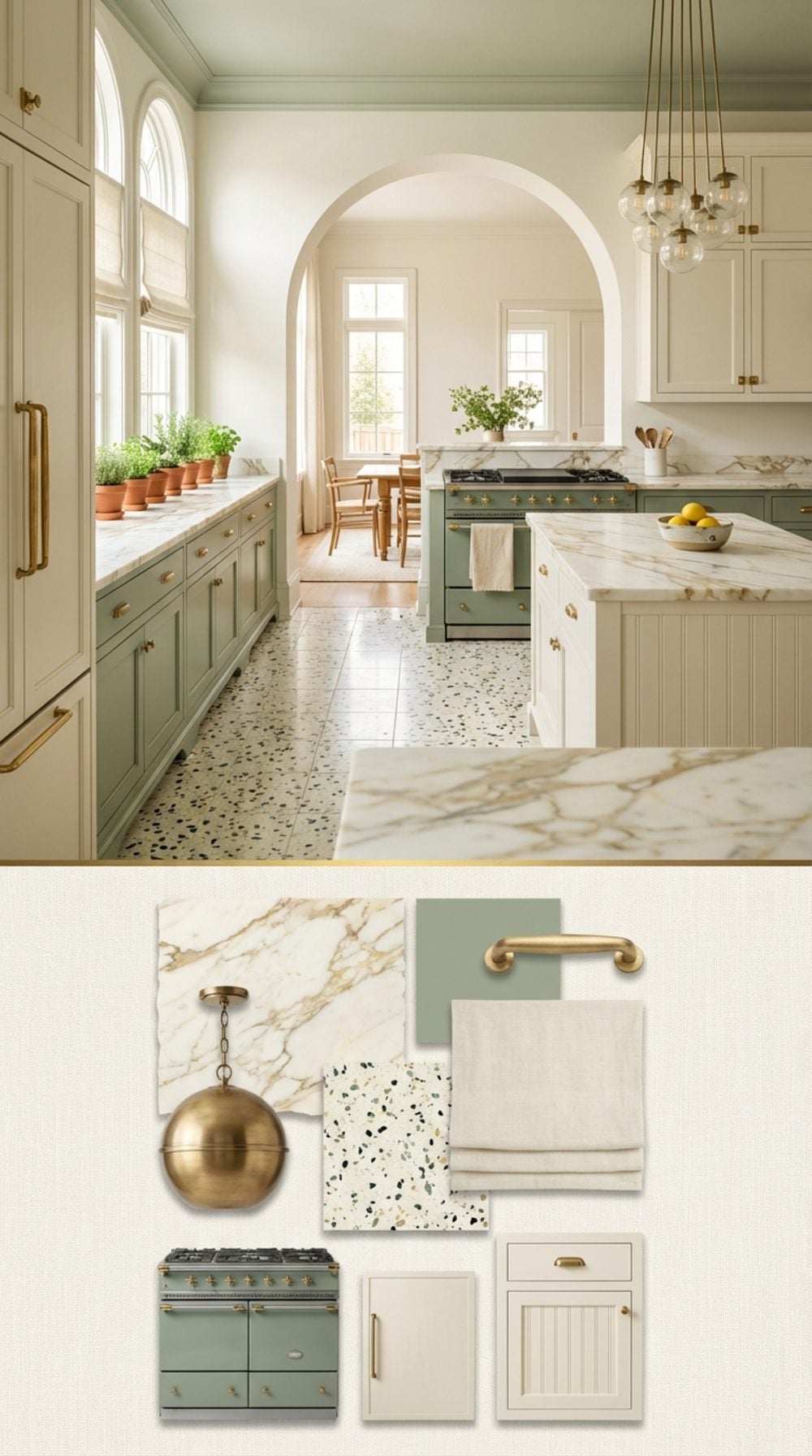
Sage green has a different job than forest green or hunter green in a kitchen. It doesn’t dominate, it collaborates. Paired with cream uppers and Calacatta gold marble, it creates a warmth that reads almost botanical, as though the kitchen has absorbed the quality of light from a well-tended garden.
The arched pass-through is doing structural storytelling here. Arches signal permanence and craft in a way that a square opening never quite manages, and in a kitchen this layered, terrazzo, wainscoting, globe pendants, the arch earns its place as the architectural punctuation mark.
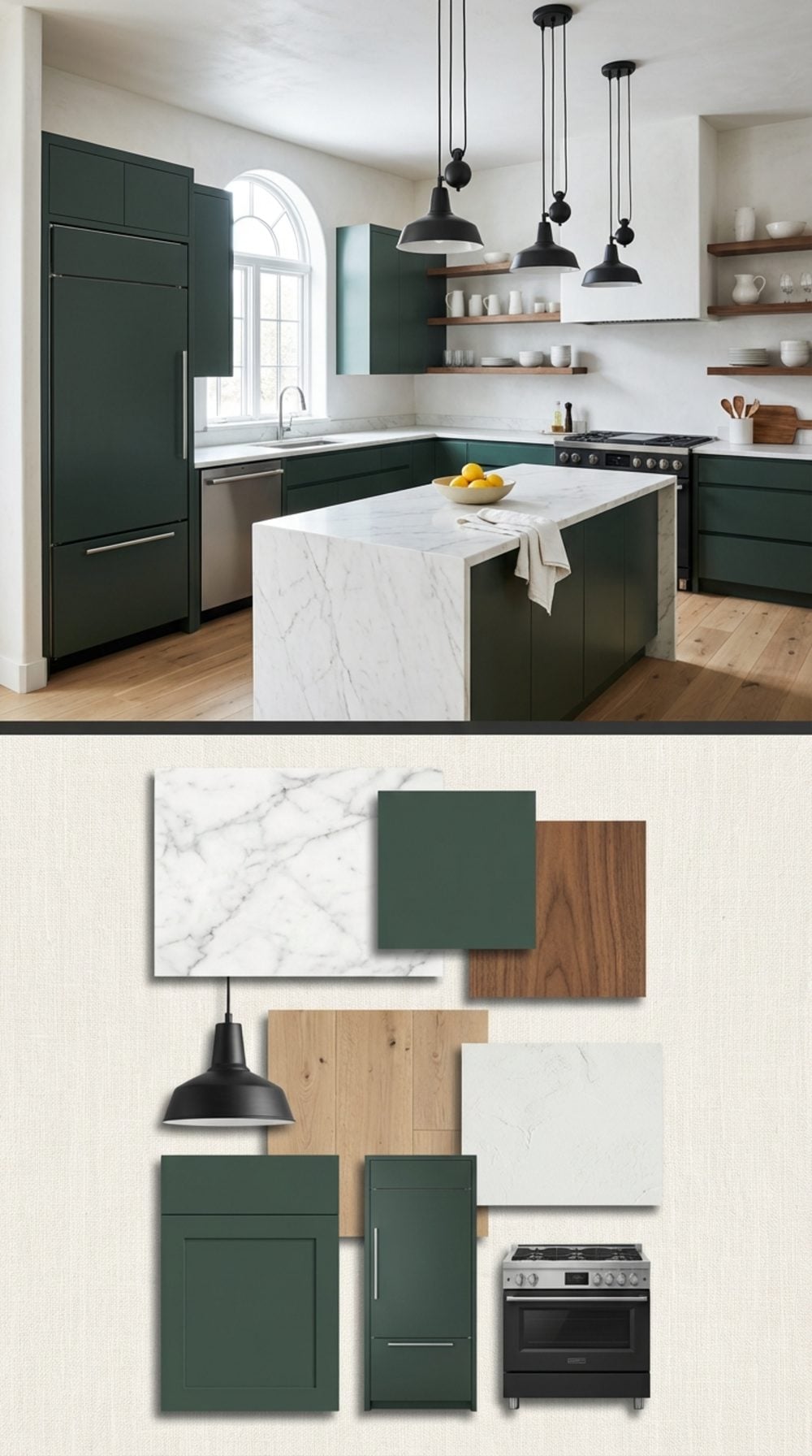
Nordic Forest: Deep Spruce Green Flat-Front Cabinetry with Integrated White Marble and Walnut Accents
🔥 Would you like to save this?
The Scandinavian design tradition has always understood that restraint is a form of confidence. This kitchen argues the same point in spruce green and walnut: no hardware, no fuss, no ornamentation beyond the materials themselves. Push-to-open cabinetry removes every last visual interrupt, so the eye travels the room unimpeded.
Statuario marble is the right call over Carrara here. Its bolder veining gives the white tones enough contrast to read against the deep spruce, while Carrara’s subtler pattern would wash out entirely. Material specificity like this is what separates a thoughtful kitchen from a merely expensive one.
Riviera Revival: Mint and Glossy White Kitchen with Zellige Tile and Lemon Yellow Accents
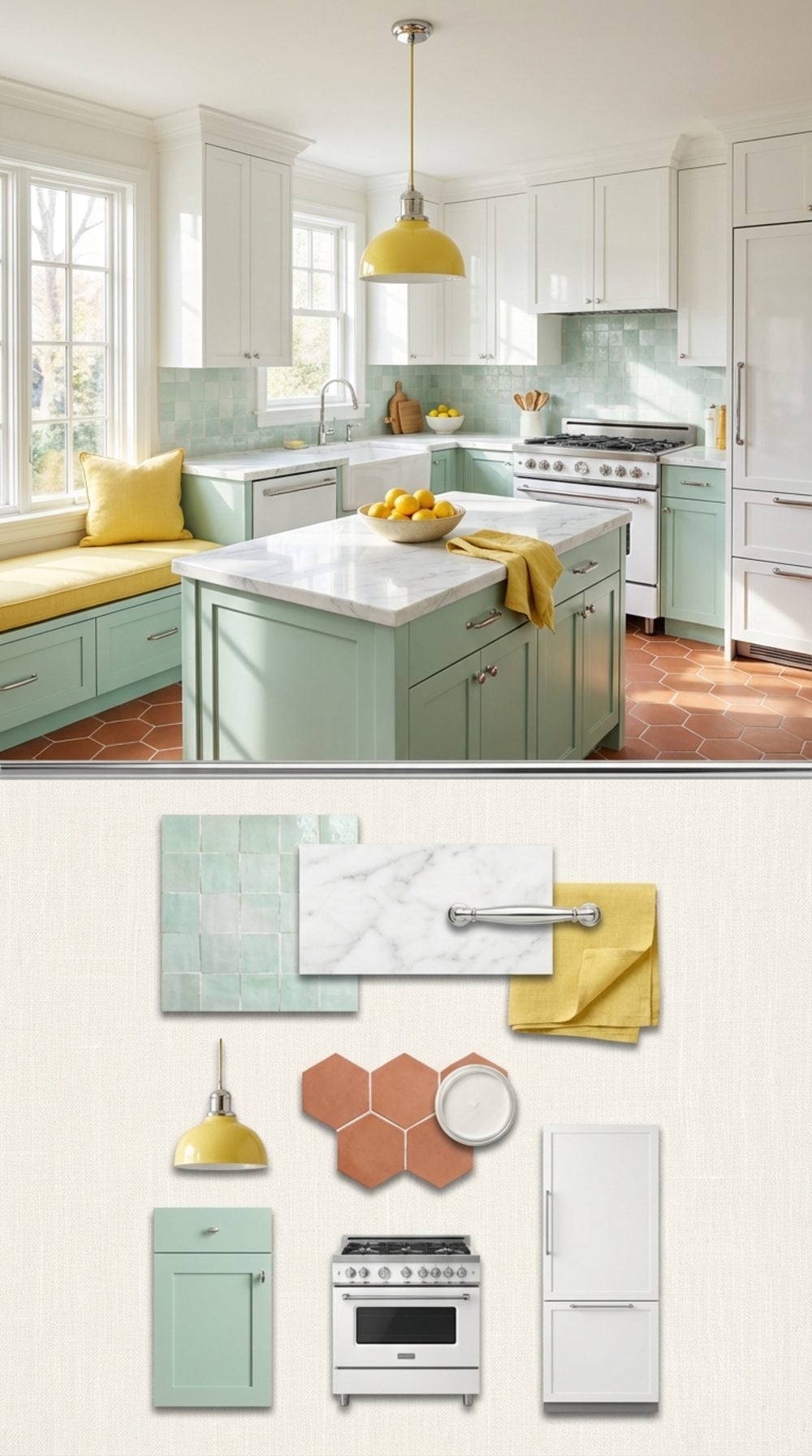
Zellige tile is one of those materials that photographs beautifully precisely because it isn’t perfect. Each handmade piece catches light differently, so a backsplash reads almost like water, shifting, alive, never flat. Against mint cabinetry and white marble, the effect is distinctly Mediterranean without being literal about it.
The lemon yellow ceramic pendant is the detail that keeps this from tipping into themed territory. One saturated accent, clearly intentional and unafraid, signals that someone made a real design decision here, not just followed a safe palette. That kind of confidence is what separates a kitchen that feels designed from one that merely looks expensive.
Dark Botanical: Blackened Forest Green and White Lacquer Kitchen with Volcanic Stone Countertops
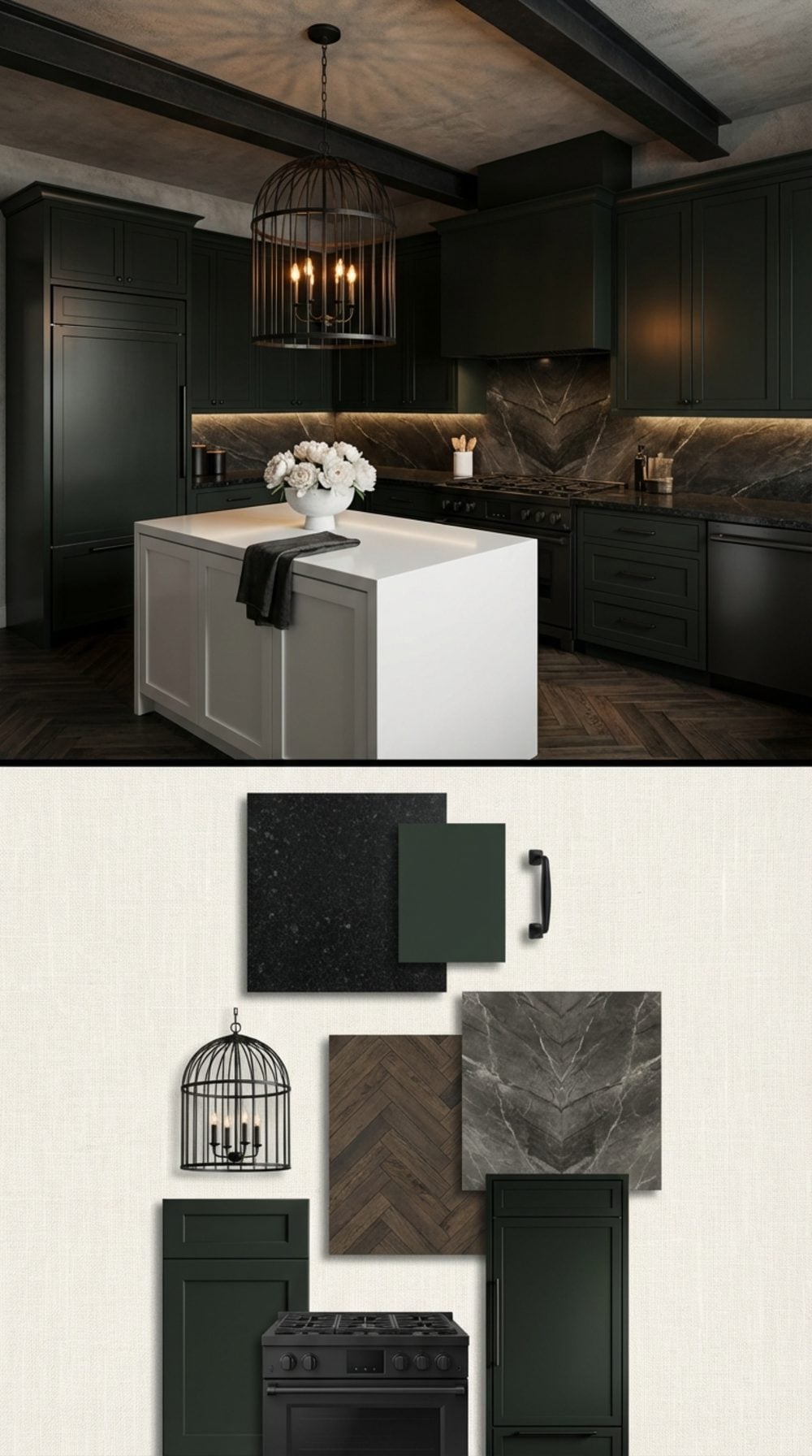
There’s a version of dark kitchen design that just reads as gloomy. This isn’t it. The difference is the white lacquer island, a single, deliberate break in the darkness that prevents the room from collapsing into itself. It creates contrast without undercutting the drama, functioning like a breath in the middle of an otherwise sustained, low note.
Honed granite over polished is the right textural call against lacquered cabinetry. Polished surfaces competing with lacquered ones create visual noise. Matte stone lets the lacquer do its work.
Coastal Conservatory: Sea Glass Green and Warm White Kitchen with Fluted Glass Cabinets and Rattan Details
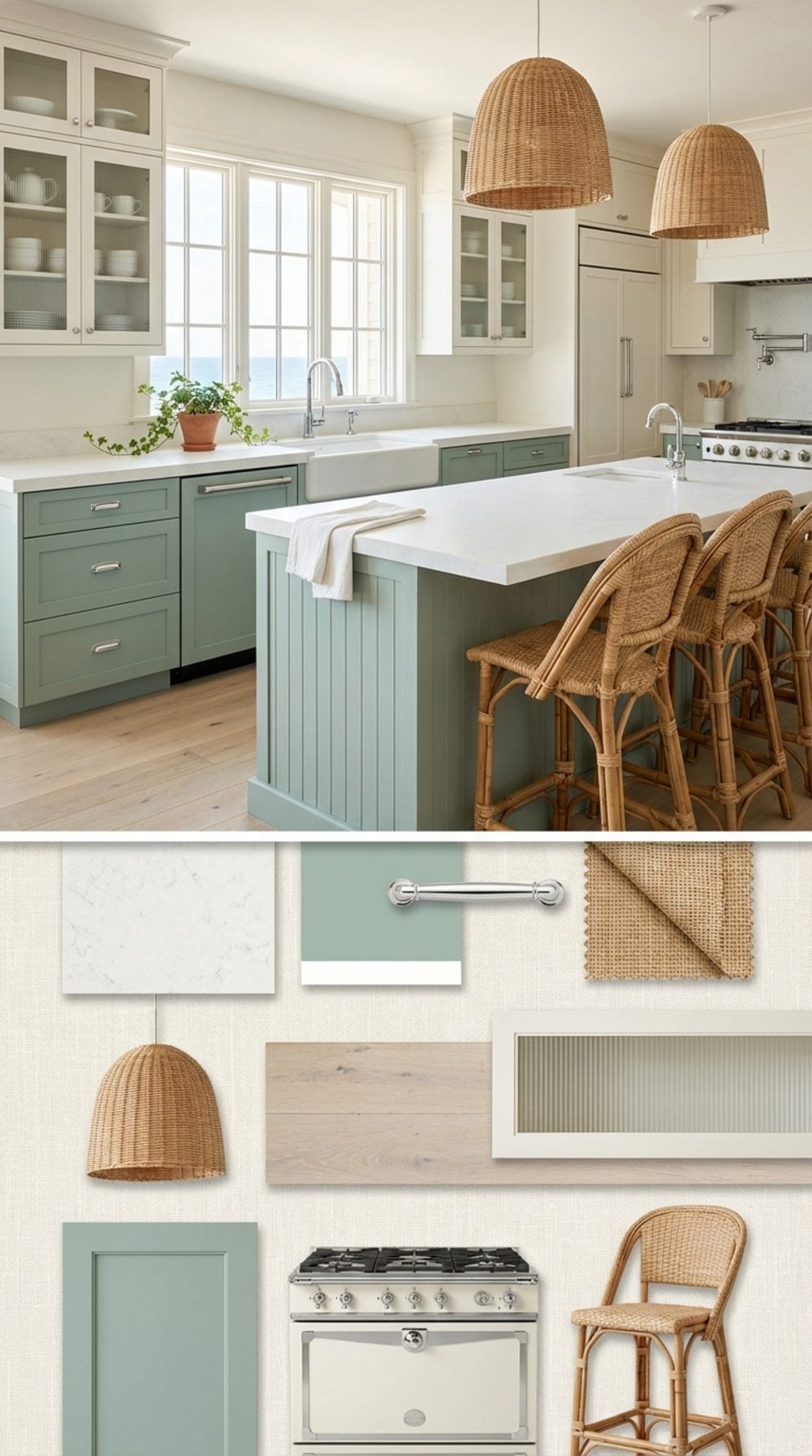
Fluted glass upper cabinets solve a problem that solid upper cabinets create: the visual weight of an unbroken cabinet bank above the counter line. The fluted texture diffuses the view of what’s inside, neat enough to show, private enough to forgive imperfection, while adding a layer of material interest that flat glass never achieves.
The rattan bar stools and woven pendants are doing something specific here: they’re adding organic texture in a kitchen that could otherwise feel too clean. Sea glass green already carries a coastal connotation, but without these tactile natural elements, the room would read as color-themed rather than truly considered.
Parisian Patisserie: Celadon Green and Cream Kitchen with Handpainted Tile and Antique Brass Pot Rack
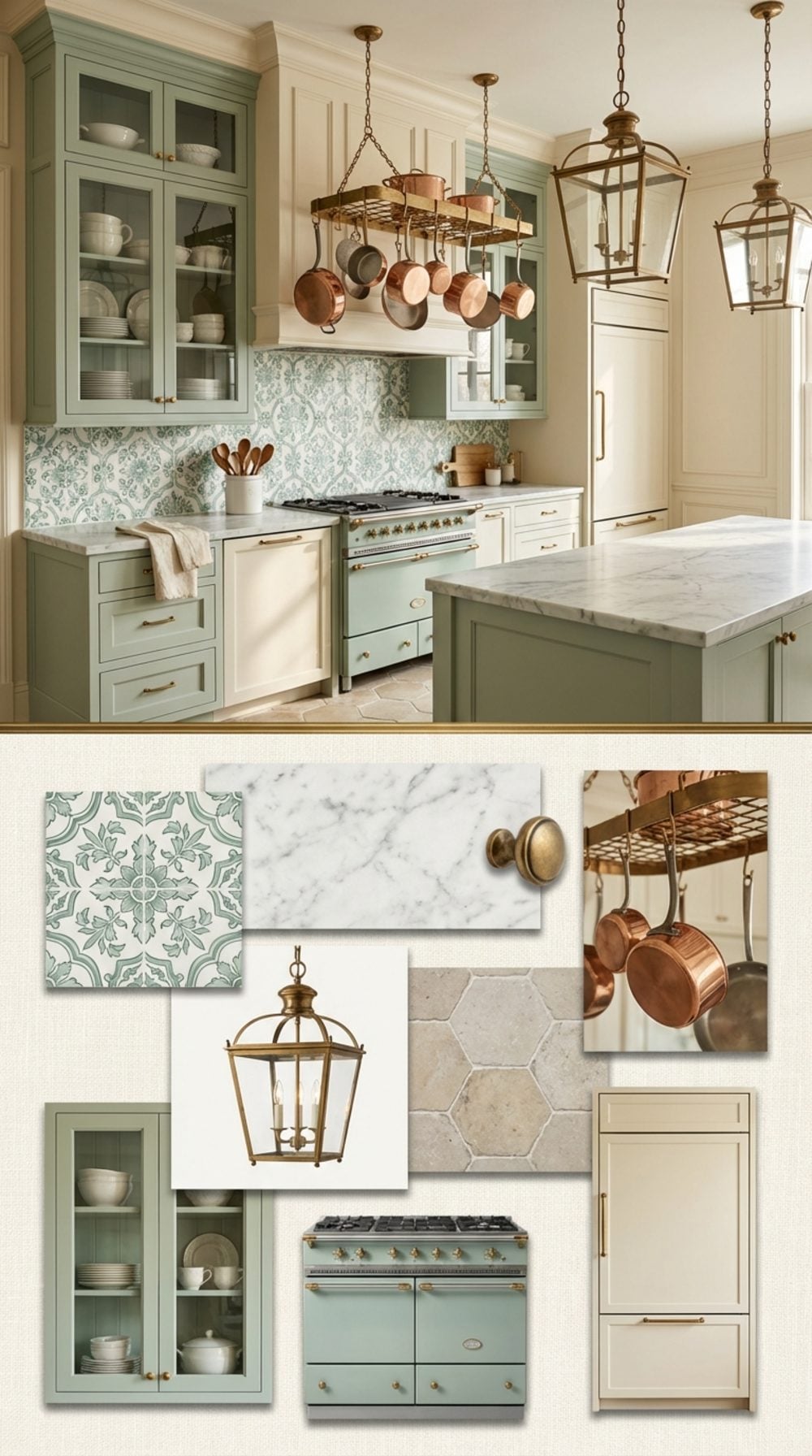
A celadon green kitchen references a specific emotional frequency: calm, aged, European, and quietly proud of its own history. Unlike sage (which reads fresh) or forest green (which reads bold), celadon carries a sense of time, as though the paint has been there for decades and simply suits the light perfectly.
Handpainted tile is the indulgence that earns its cost. No two tiles are identical, and over a range or a backsplash, that variation creates a surface that rewards close looking. Paired with antique brass and limestone floors, it places this kitchen in a tradition rather than a trend cycle.
Modernist Garden: Forest Green and Concrete White Kitchen with Exposed Steel Detailing and Greenhouse Windows
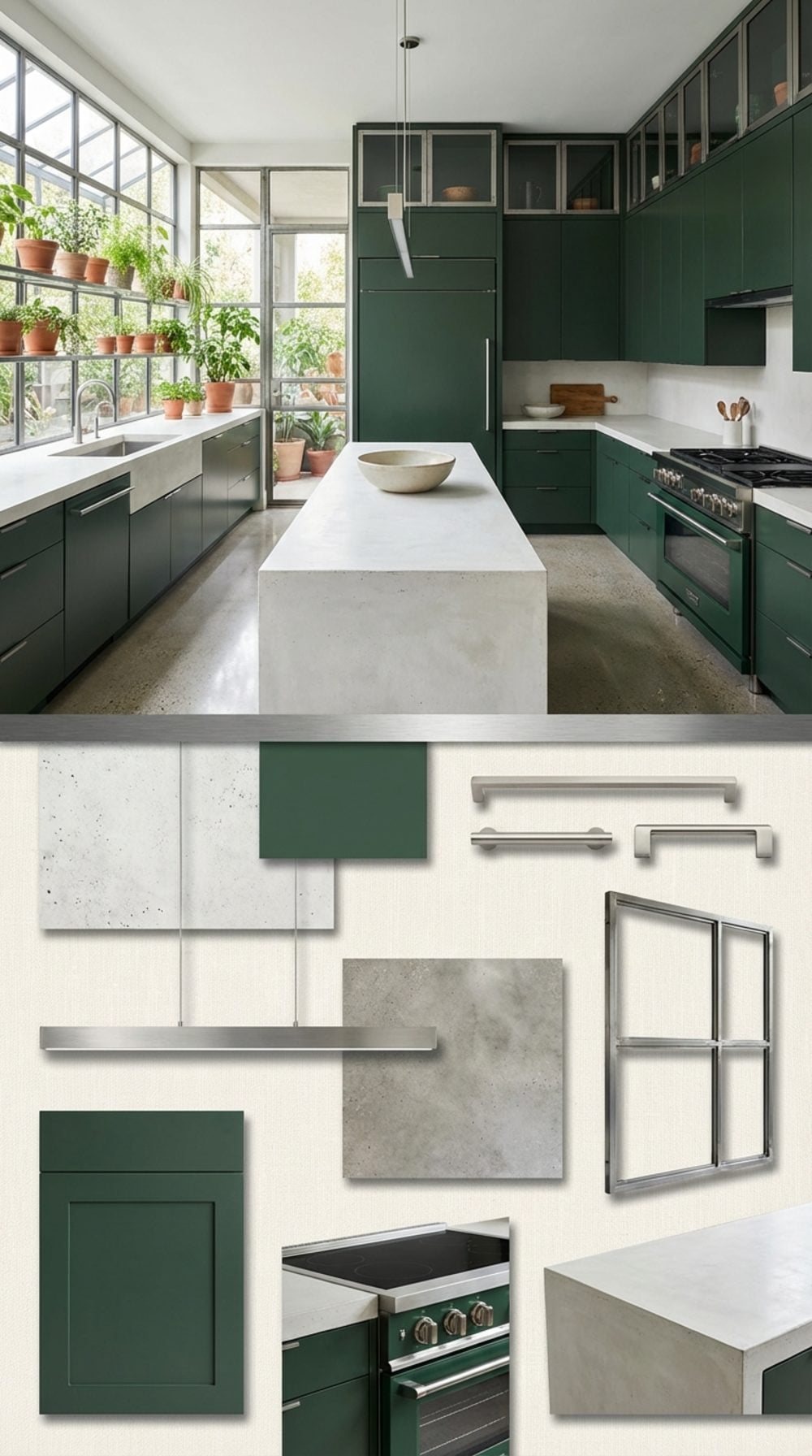
Biophilic design isn’t about putting a plant on a shelf. This kitchen understands that: the greenhouse windows along the entire sink wall flood the space with plant-filtered light, which has a measurable effect on both perceived air quality and mood. The forest green cabinetry isn’t just a color choice, it’s an extension of the outdoor-indoor continuum the windows establish.
Why Concrete Works Here
Raw concrete countertops are a polarizing material that earns its place in this context specifically. Against polished forest green lacquer, the concrete’s matte, granular surface provides textural relief without introducing a competing color. It’s the visual equivalent of a pause, and in a room this architecturally dense, pauses matter.
Deep Forest Green Shakers with Carrara Marble and Unlacquered Brass, Old-Money Kitchen Energy
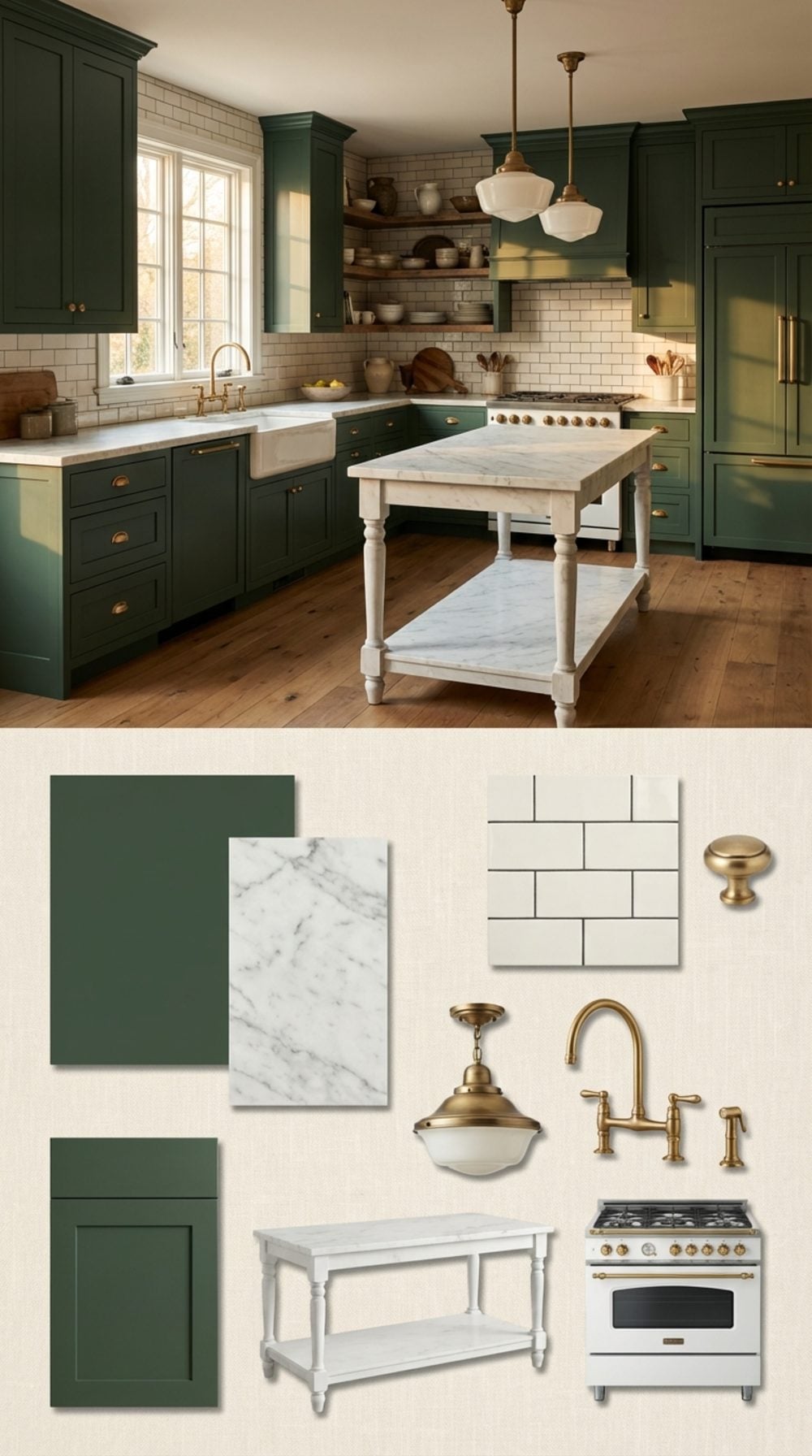
Unlacquered brass and forest green share a specific chemical relationship: the brass will patina over time to match the depth of the green, so the kitchen literally ages together. That’s old-money thinking applied to a color choice, nothing is meant to stay precious. The Carrara marble countertops reinforce this, their grey veining softened rather than stark against the deep cabinetry.
The white enamel range pulls serious visual weight here, anchoring the cooking wall without competing. A brass schoolhouse pendant over a white marble kitchen island is the kind of pairing that looks considered without being overthought.
Sage Green Flat-Front Cabinets, White Quartz, and Integrated Appliances, The Quiet Luxury Kitchen
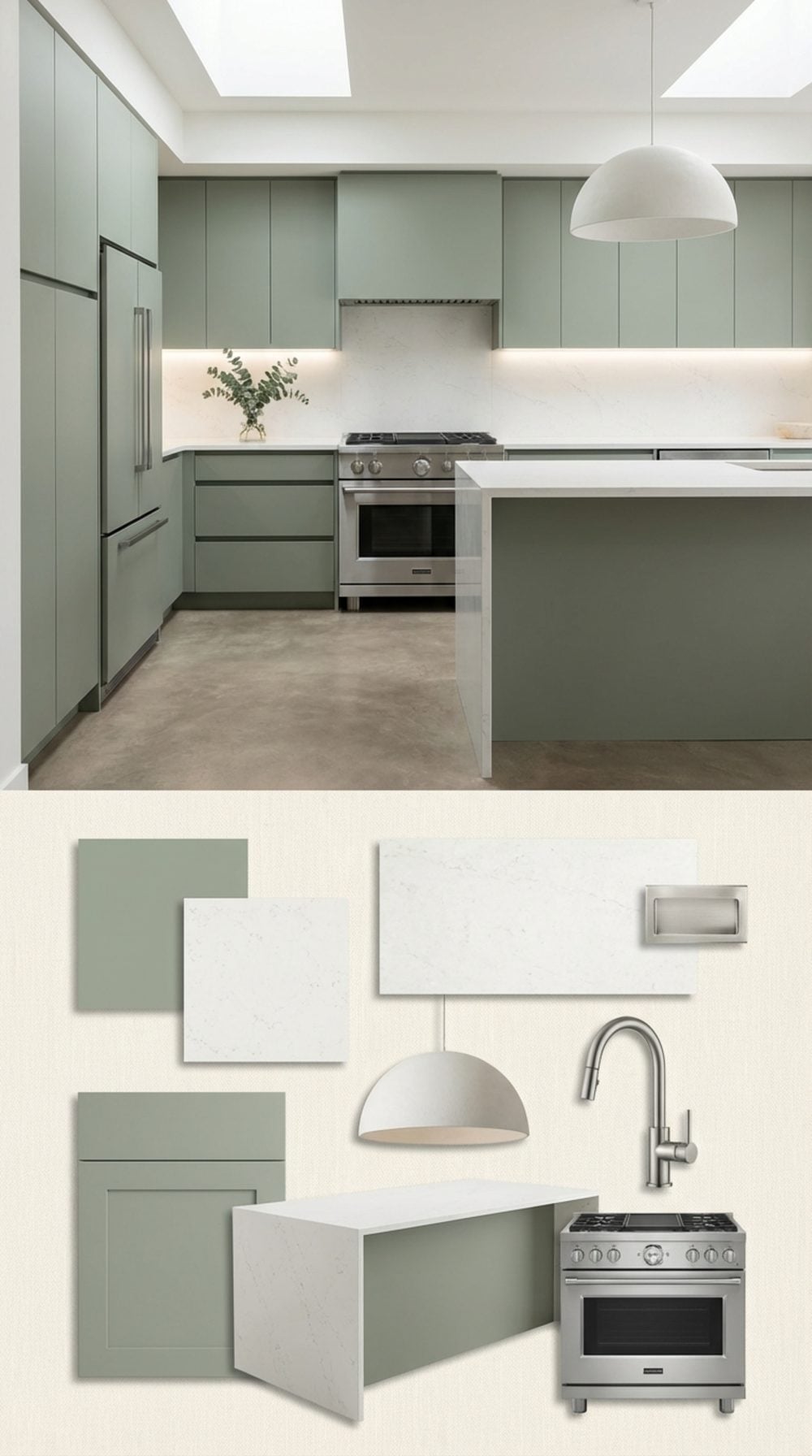
Everything in this kitchen is working to disappear, the integrated appliances flush with the cabinetry, the handleless doors, the low-contrast backsplash. That level of visual quiet is actually harder to achieve than maximalist layering. When nothing interrupts the eye, proportions become everything.
Sage green sits at an interesting psychological intersection: it reads as both calming and alive, which explains why it has replaced grey as the default ‘sophisticated neutral’ in high-end kitchens. The sage green flat-front cabinet paired with a white quartz waterfall island keeps the palette anchored without going cold.
Hunter Green Two-Tone Cabinetry, White Zellige Tile, and Matte Black Hardware, Maximalist Confidence
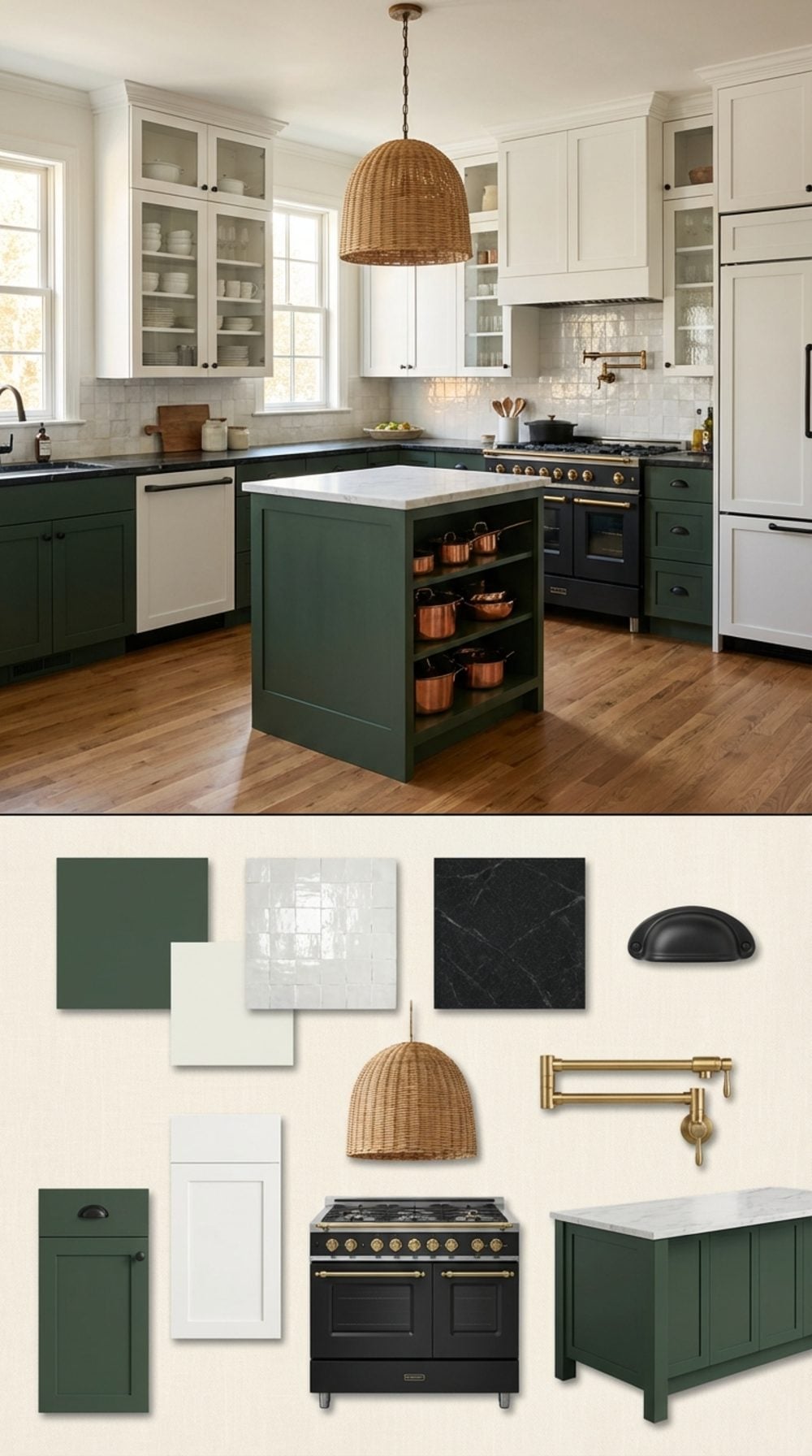
White zellige tile against hunter green cabinetry is a conversation about texture versus flatness, the tile’s handmade irregularity keeps the deep green from reading as heavy or static. Every time light shifts, those tiles catch it differently, and the whole room subtly changes.
The two-tone cabinet split (hunter green lower, white upper) solves a classic proportion problem: dark colors on lower cabinets ground the room without making it feel like the walls are closing in. That’s not a stylistic preference, it’s optical physics. Pair the look with a matte black kitchen hardware set and a rattan pendant light for the right amount of material contrast without chaos.
This is the kitchen for people who love the look of glam chalet kitchen remodels but want something that feels more grounded and less resort-coded.
Transitional Green and White Kitchen with Shaker Cabinets and Marble Countertops
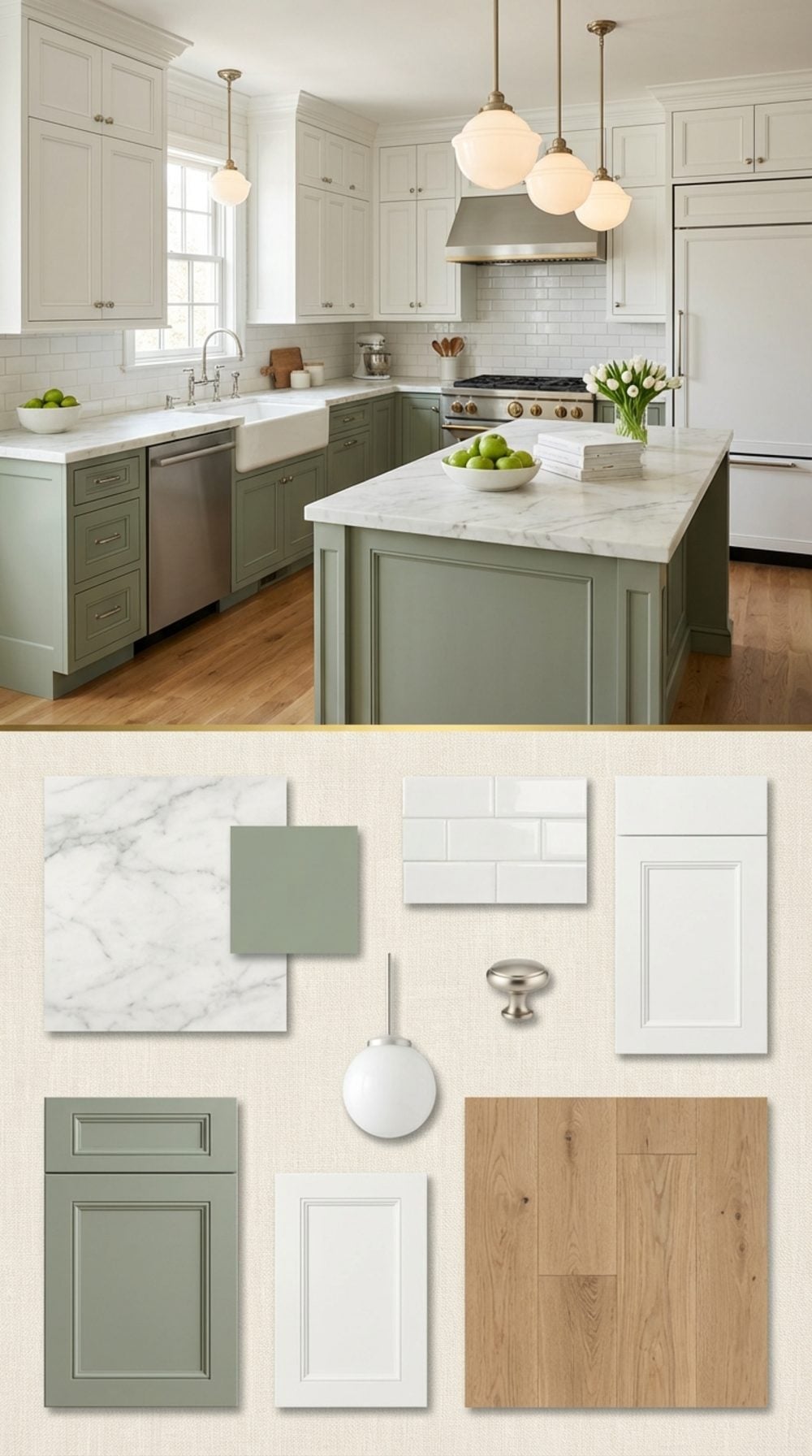
The two-tone split here is doing precise work: sage on the lowers grounds the room in something earthy while the white uppers keep the eye moving upward toward the crown molding. It’s a proportional trick as much as a color decision, making standard 9-foot ceilings read taller. The Calacatta marble countertop bridges the two tones without competing with either, its soft grey veining reads as neutral against both.
This is the kind of kitchen transformation designs that ages gracefully because it commits to nothing extreme. Swap the sage for forest green in ten years and the bones of the room still hold.
Organic Modern Green Kitchen with Curved Plaster Walls and Quartzite Stone
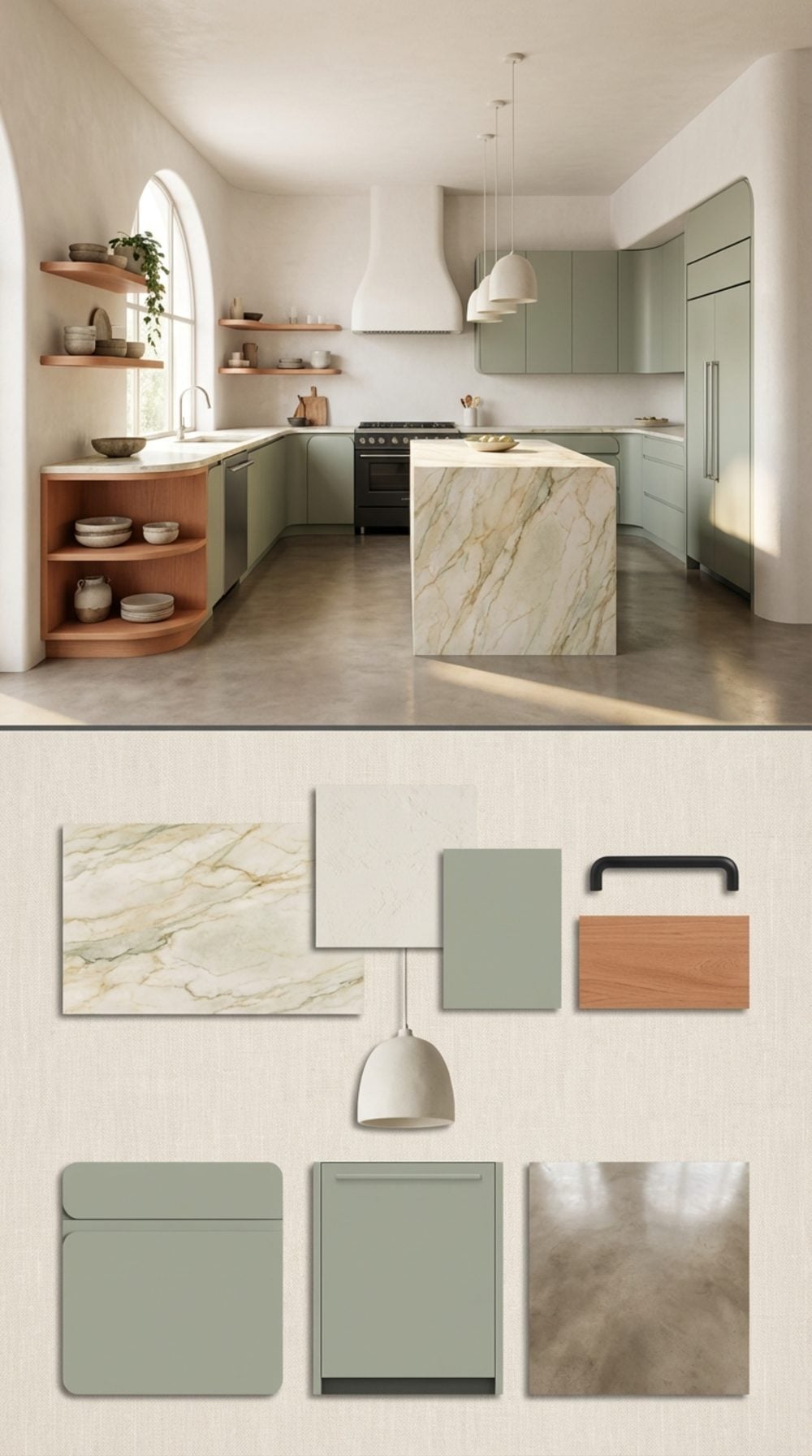
Curved plaster walls in a kitchen are a commitment, and this room earns it. The soft radius corners eliminate every hard edge, so the sage flat-front cabinetry reads as sculptural rather than architectural. That distinction matters: you’re not looking at a kitchen, you’re looking at a space that happens to have a kitchen in it.
The quartzite island is the one place the room allows real drama. Its cream-and-green veining mirrors the wall tones so closely it feels grown rather than installed, which is exactly the organic modern thesis.
Quiet Luxury Green Kitchen in Forest Green Lacquer with Unlacquered Brass
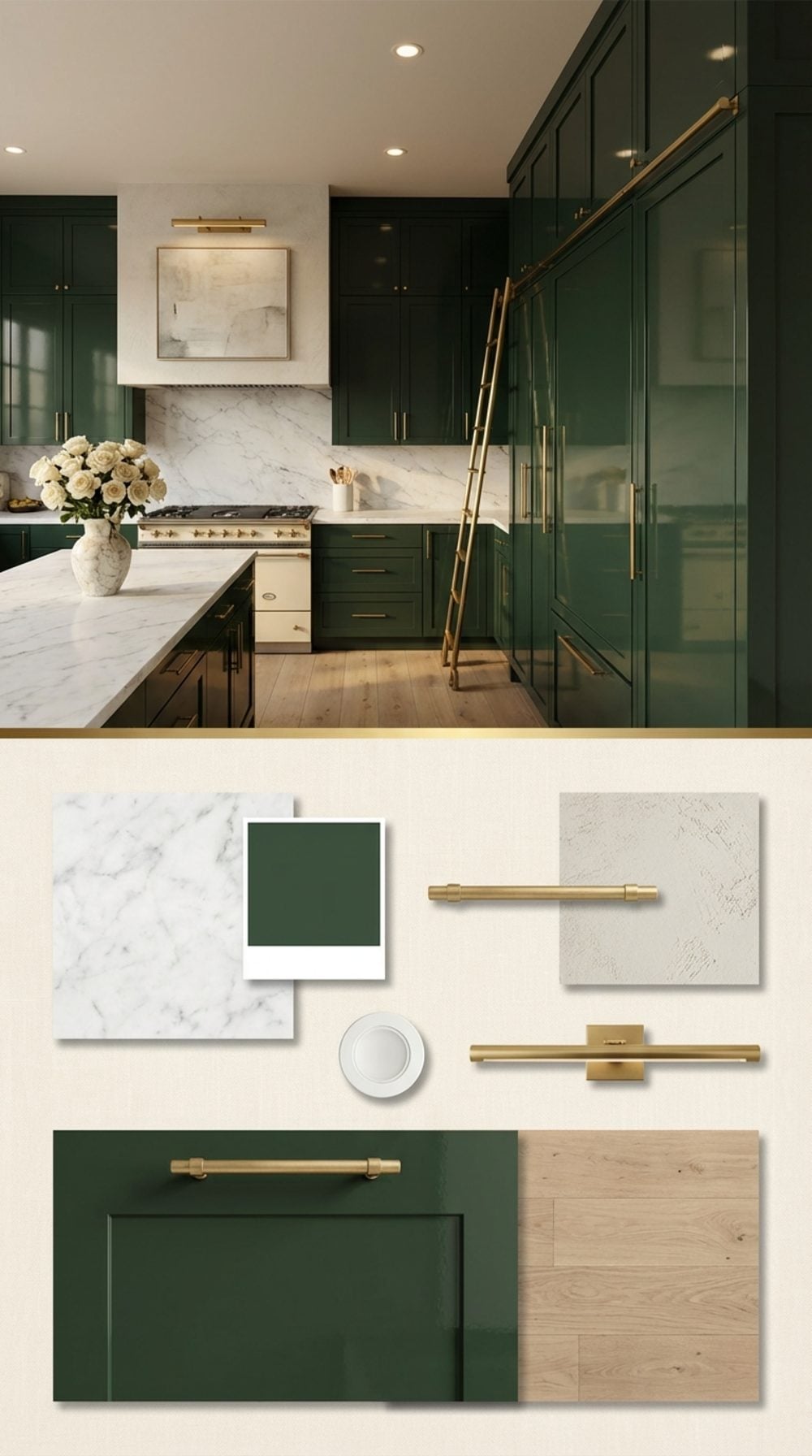
Forest green lacquer does something most bold colors can’t: it reads as restrained. The high-gloss surface absorbs light in a way that makes the color feel deep rather than loud, and against white Carrara marble, the contrast lands as sophisticated rather than jarring.
The unlacquered brass bar pulls are the only warmth in the room, and they’re doing significant emotional work, preventing the space from tipping into cold. This is the design logic behind ultra-luxury green and white kitchens: maximum restraint, maximum material quality, zero compromise.
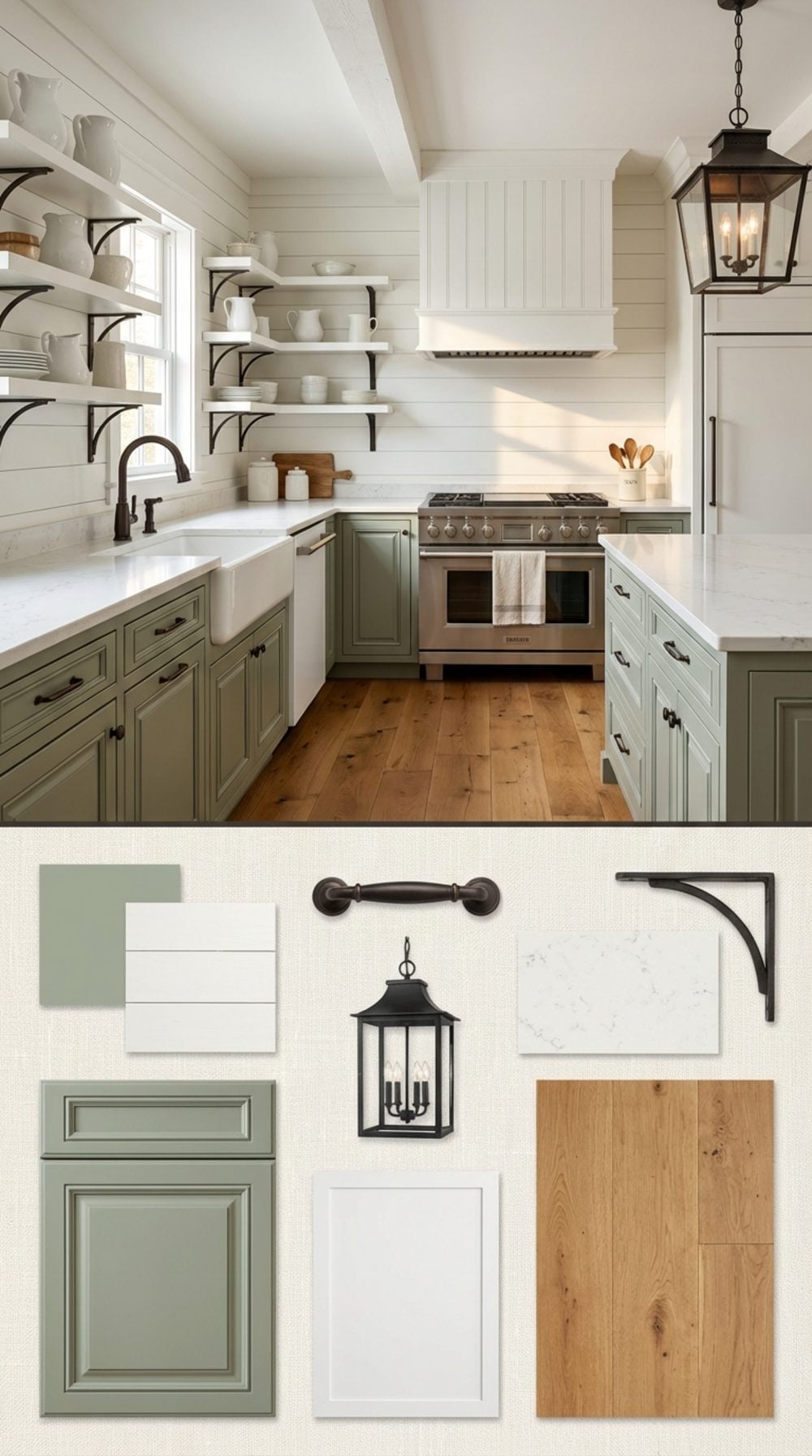
Elevated Modern Farmhouse Kitchen in Sage and Shiplap White
🔥 Would you like to save this?
Shiplap behind open shelving is a layering technique most farmhouse kitchens get wrong, they stack too much. Here, restraint on the shelves lets the wall texture breathe, and the sage lowers anchor the whole composition without competing with the white above. The oil-rubbed bronze faucet is the right hardware call: warmer than black, earthier than chrome, and perfectly tuned to the honey-toned reclaimed floors.
Warm Minimalist Kitchen in Sage Green with Walnut and Honed Limestone
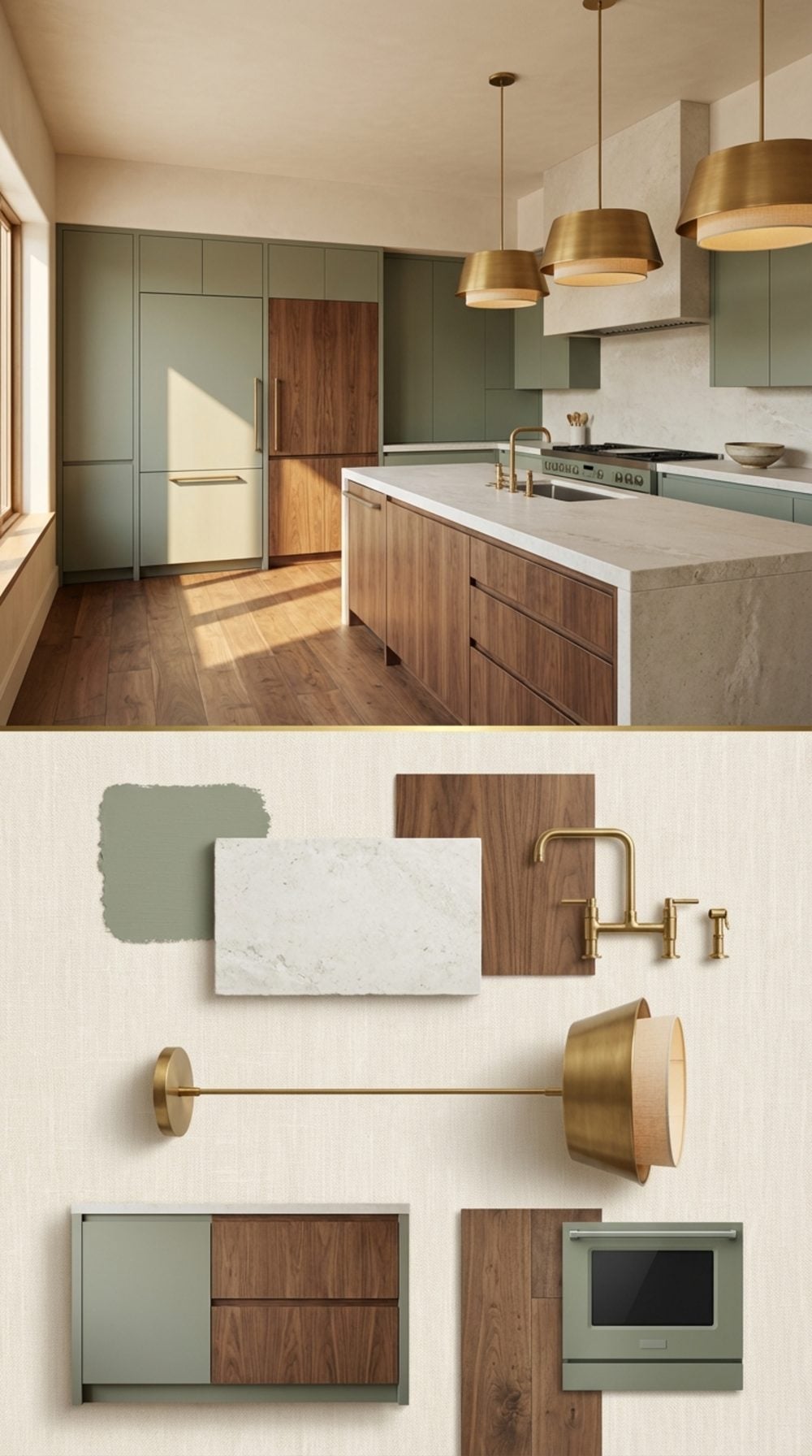
Walnut against sage is an underused pairing, warm enough to feel welcoming, restrained enough to avoid looking rustic. The island here uses walnut drawer fronts specifically (not the full cabinetry run), which keeps the warmth concentrated where you interact with the kitchen most. The honed limestone countertop handles the transition between tones: neither warm nor cool, just natural.
Two-Tone Bold Kitchen with Racing Green Lowers and Bright White Uppers
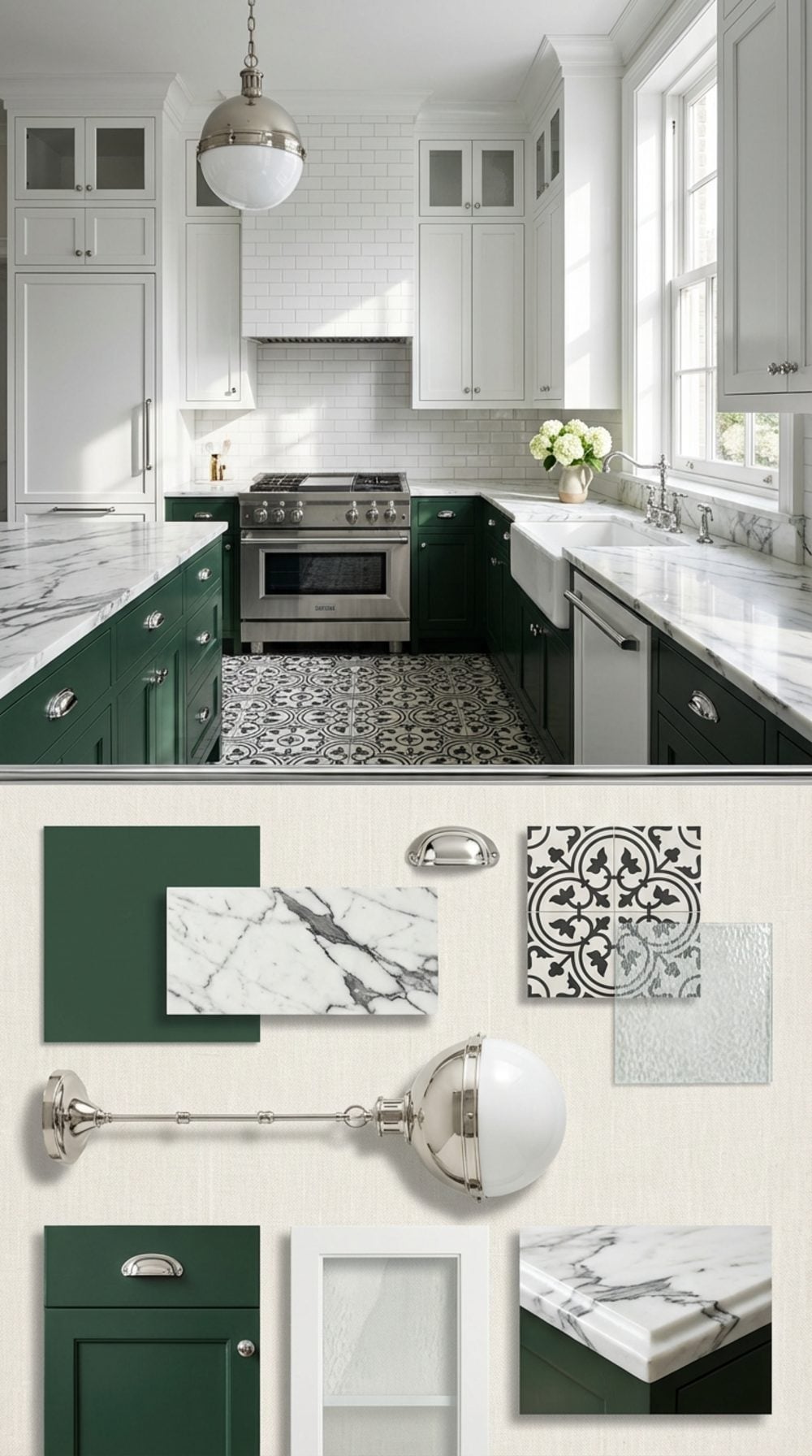
British racing green on lower cabinets is a design move that borrowed its confidence from automotive culture, and it shows. The color carries the same weight in a kitchen as it does on a vintage Jaguar bonnet: specific, unapologetic, and aging beautifully. Against bright white Statuario marble with that bold dark veining, the contrast is almost graphic.
The encaustic floor tile is what stops this from becoming a one-note exercise. The black-and-white geometric pattern adds a third visual rhythm below the two-tone cabinets, grounding the drama in something that reads as historical rather than trend-driven. These are exactly the green and white kitchen designs dominating kitchen conversation right now.
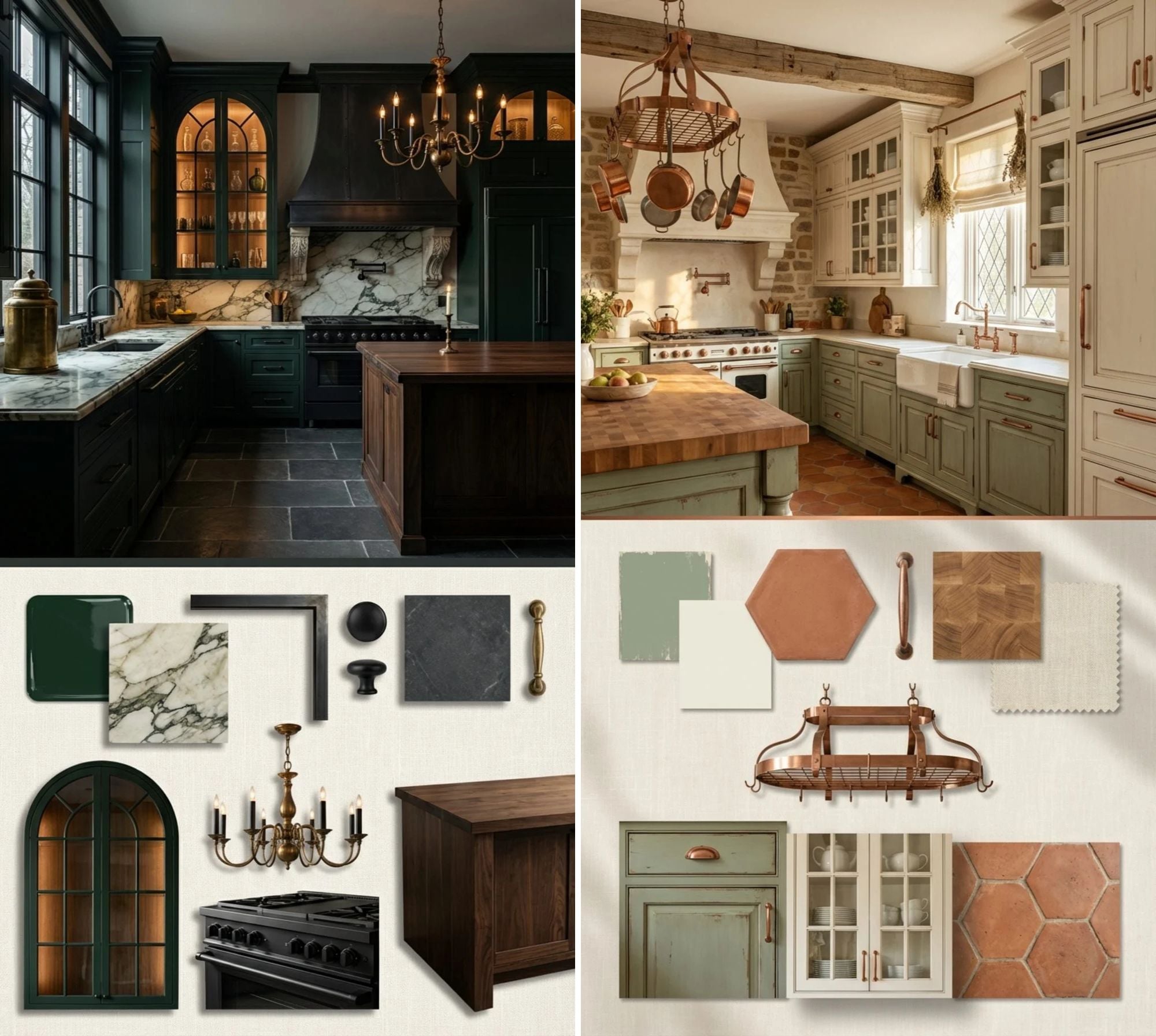
French Country Kitchen in Sage and Antique White with Terracotta and Copper
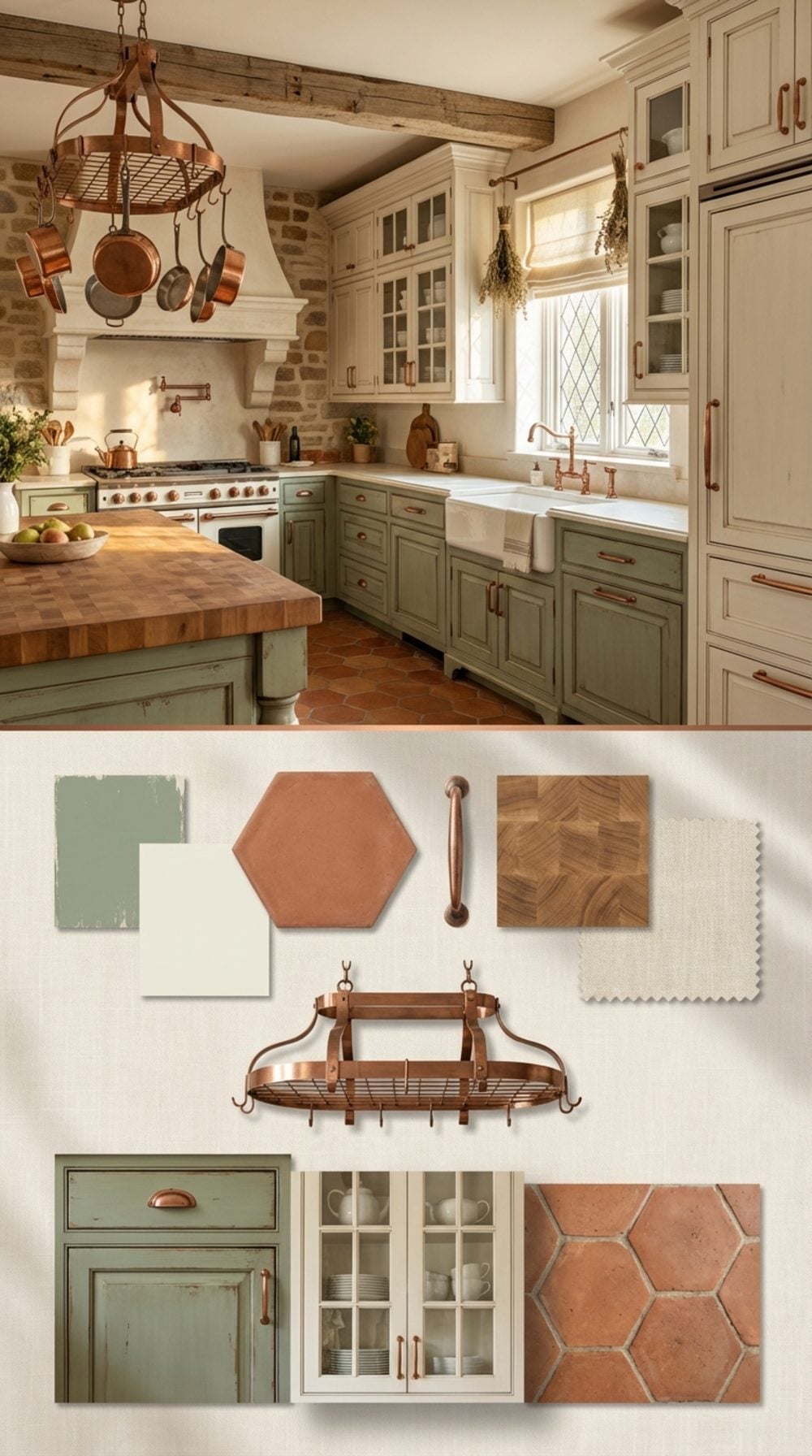
Copper and sage have a specific chemistry: both are colors you’d find in a Provençal herb garden, which is exactly the association a French country kitchen needs. The distressed finish on the sage lowers is not aging, it’s designed patina, and the difference is intentional. Distressed furniture looks deliberately worn; aged furniture just looks tired.
The terracotta hex floor does the most compositional work in the room, creating a warm layer below all the green-and-white activity above the counter line. That three-way color relationship, sage, antique white, terracotta, is lifted directly from Mediterranean architecture and it’s been working for about four centuries.
Dark Moody Gothic Kitchen in Bottle Green and Aged Bone White with Blackened Steel
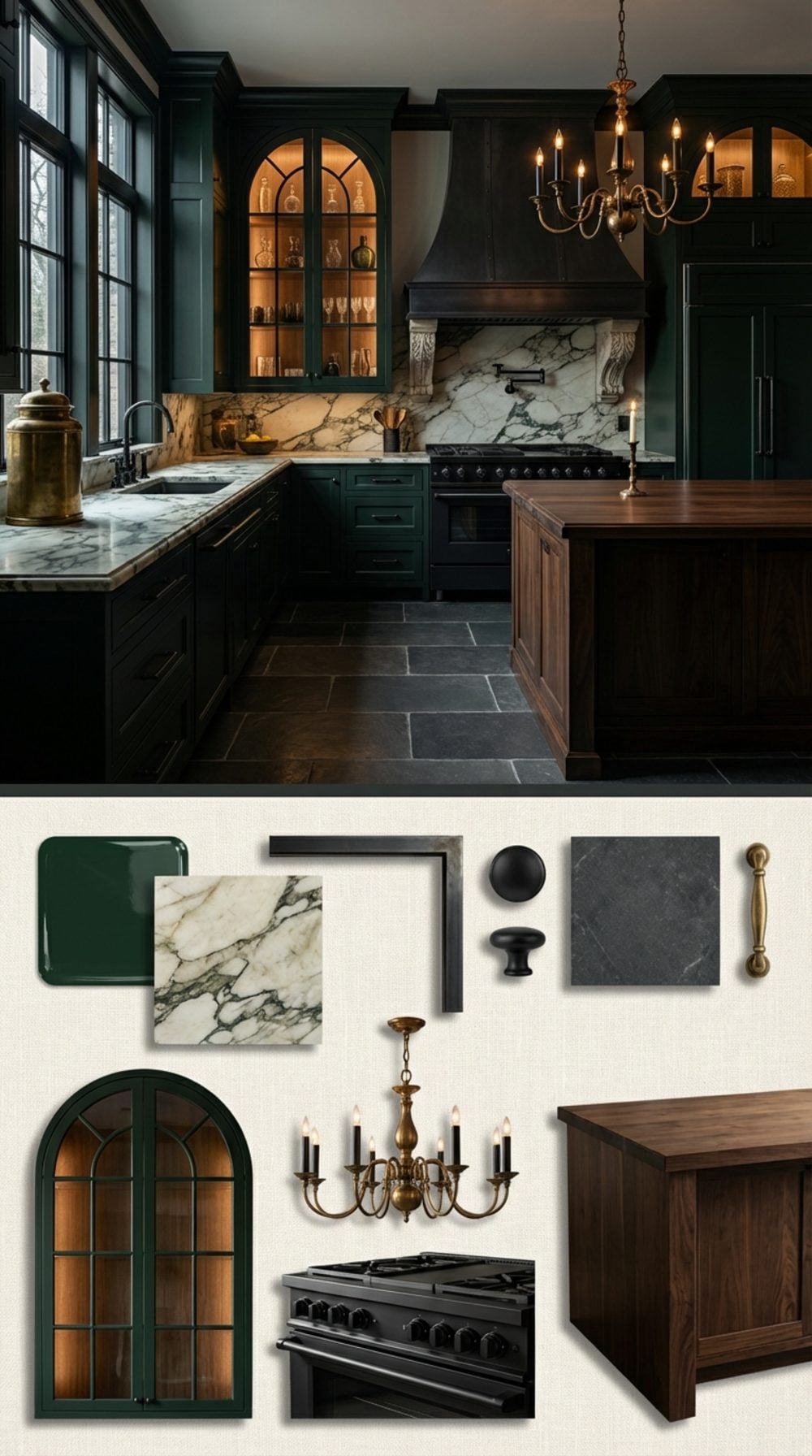
Bottle green at near-black depth reads like a different color entirely from sage or forest, it pulls toward the Gothic rather than the pastoral, and the arched glass cabinet fronts push that reading further. This is a room that knows what it is. The antique brass chandelier in black candle-arm style is the only warm tone in a room otherwise built from cool deep hues, which gives it disproportionate emotional weight.
Prospect-and-refuge psychology is visible here, the low, moody light and enclosed dark palette create a feeling of protected enclosure rather than openness. People who love this kitchen tend to prefer reading corners to panoramic views, and there’s nothing wrong with designing for that.