There was a specific smell to a 1980s American garage. Motor oil, WD-40, maybe a faint ghost of lawn fertilizer, and something else underneath all of it, possibility. The garage was where dads disappeared on Saturday mornings and didn’t come back until dinner. It was workshop, storage fortress, hobby cave, and neighborhood landmark all at once. If you grew up in suburban America during the Reagan era, these details will hit somewhere specific.
The Pegboard Wall Hung With Every Tool Known to Man
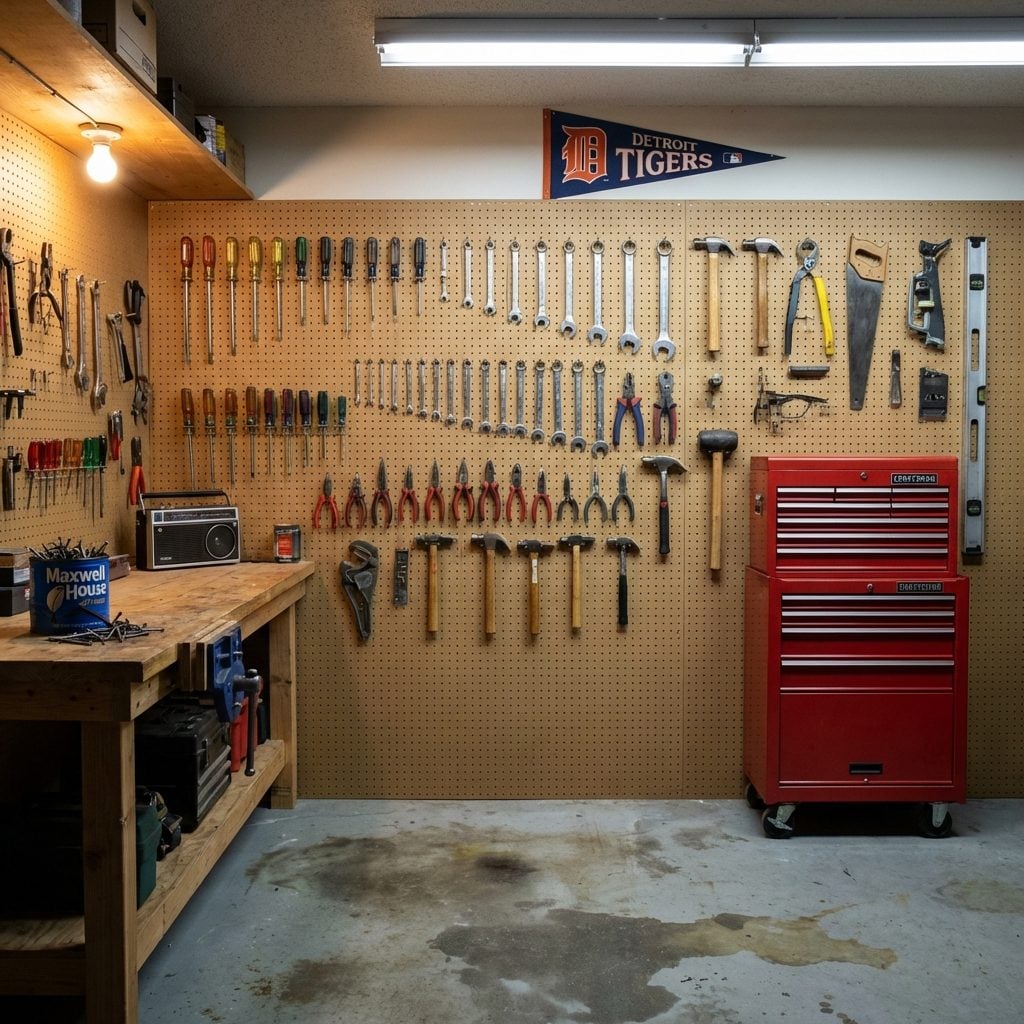
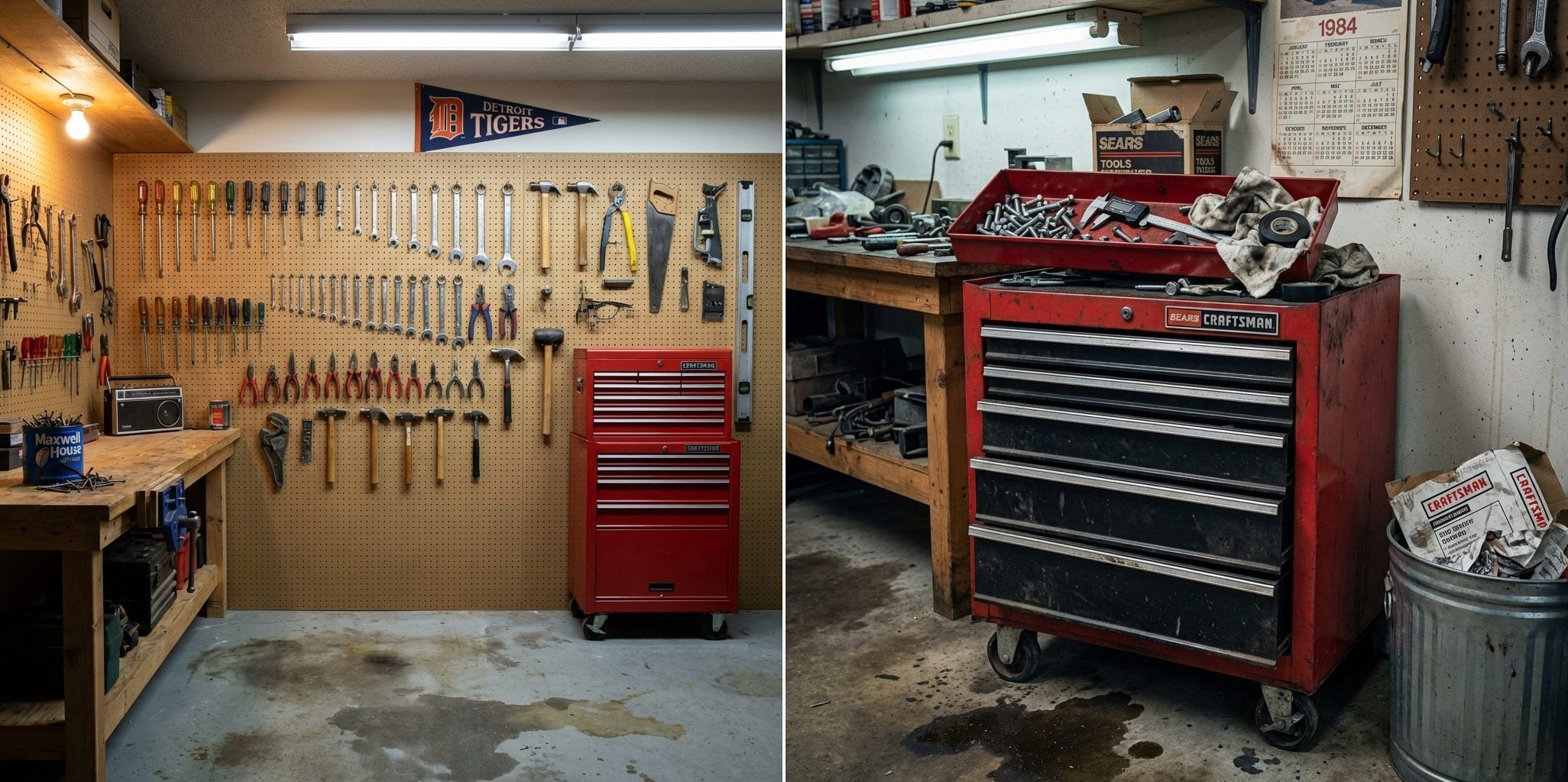
Those pencil-traced outlines around each tool were the clearest expression of a certain kind of dad brain. Every tool had a silhouette drawn around it on the pegboard so that, in theory, everyone who borrowed something would know exactly where it went back. In practice, the outline was more accusation than instruction. Half the hooks were empty, the silhouettes ghostly reminders of what used to be organized.
In order to come up with the very specific design ideas, we create most designs with the assistance of state-of-the-art AI interior design software. Also, assume links that take you off the site are affiliate links such as links to Amazon. this means we may earn a commission if you buy something.
The pegboard itself was a specific shade of pale tan, always. It came in four-by-eight sheets from the hardware store, pre-drilled with a half-inch hole every inch. The hooks were small, bent wire affairs that fell out if you looked at them wrong. The whole system was impractical and wonderful, and it was in approximately every garage in America from 1975 to 1995.
The Sears Craftsman Rolling Tool Chest in Battleship Red
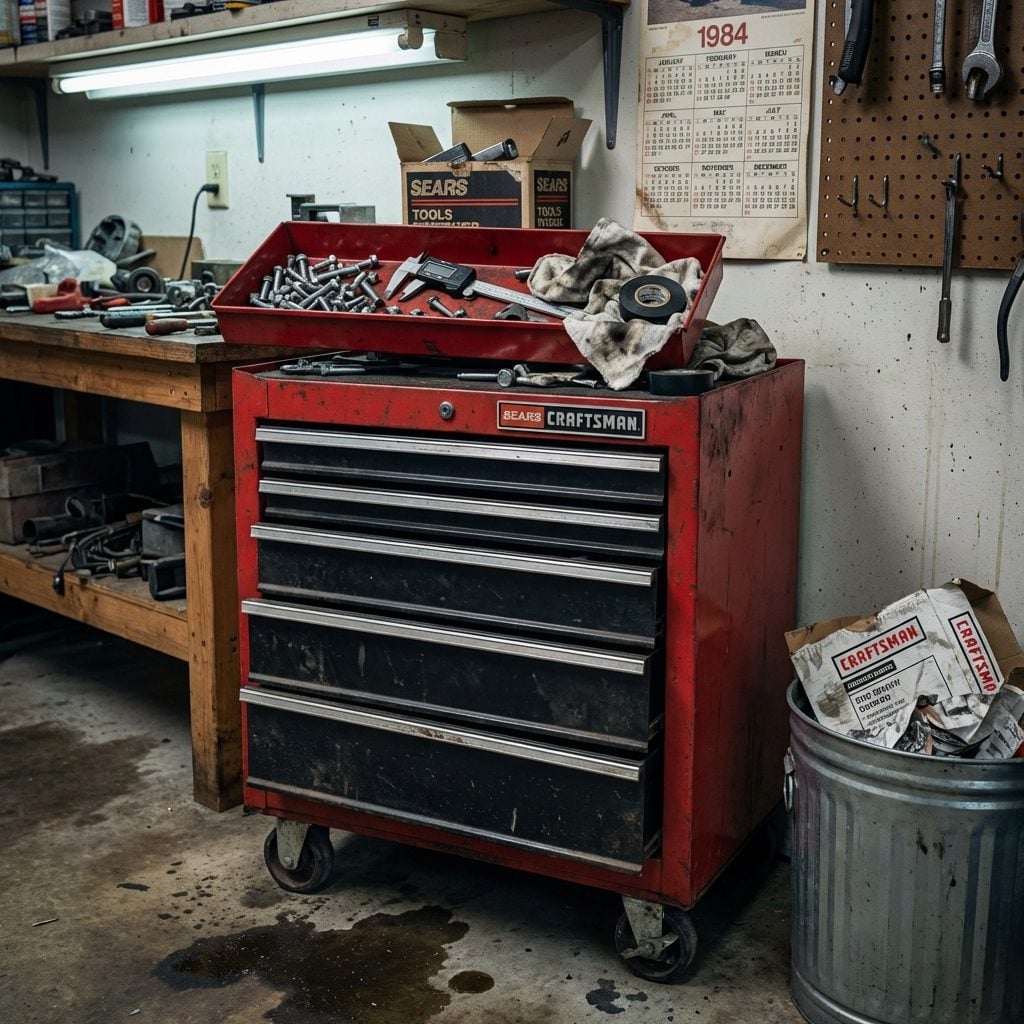
It was the prestige object of the suburban American garage, and everyone knew it. A Sears Craftsman rolling chest, always red, always chrome-trimmed, always heavier than it looked, signaled that the man who owned this garage was serious. Not a hobbyist. A guy with tools organized by type and then by size within type.
The drawers had a satisfying resistance when you pulled them. Nothing rattled because everything was laid flat in those rubberized foam inserts that somehow kept their shape for fifteen years. The top tray flipped open separately. You knew when someone opened the wrong drawer because everything shifted and something metallic fell forward with a clang that rang through the whole garage.
Craftsman’s lifetime guarantee meant those chests outlasted the marriages, the houses, and in some cases the original owners. Half of them are still in use today.
The Single Bare Bulb on a Pull Chain Dangling From the Ceiling
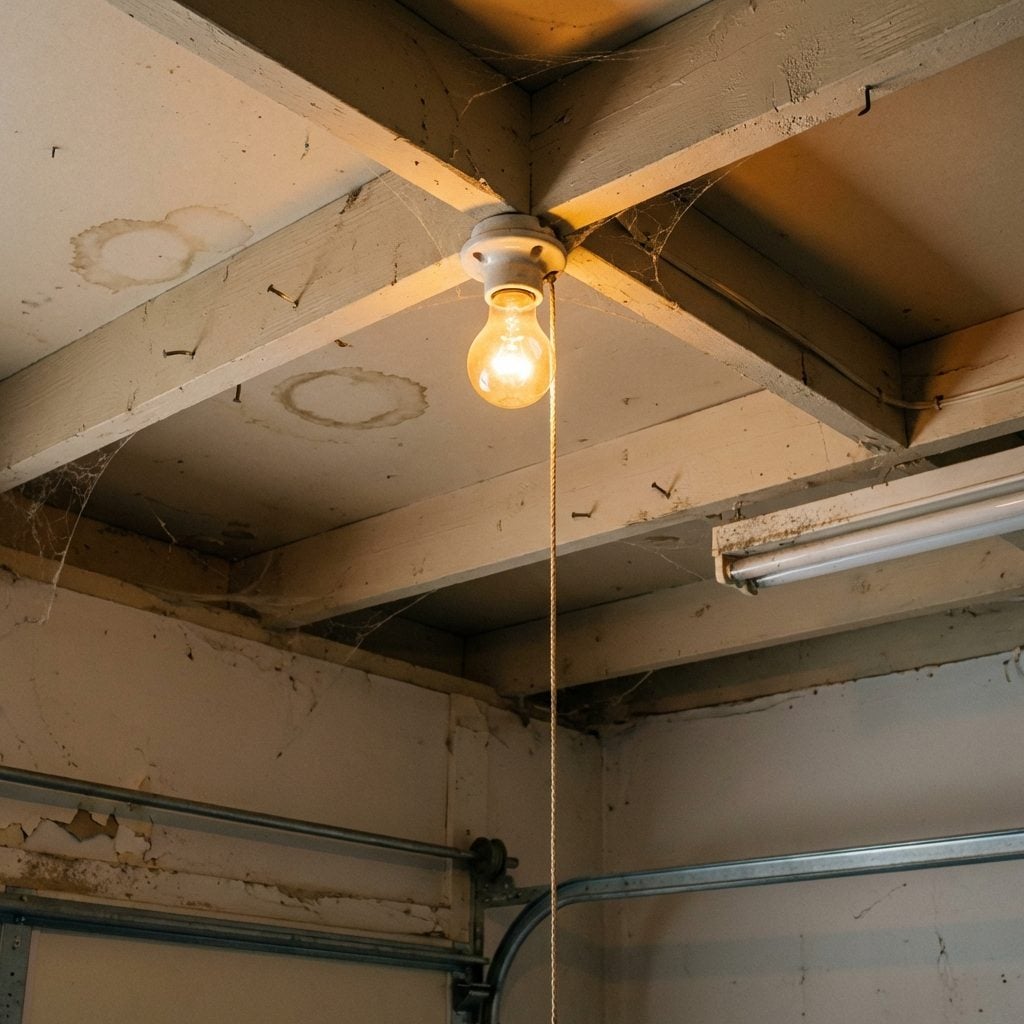
One pull and the whole garage blinked to life under that single warm bulb. One more pull and you were back in the dark. That pull chain was a daily ritual, the sound of it, the slight weight of the ceramic knob at the end, the way it swung after you let go.
The light it threw was more mood than function. It left half the garage in shadow, which made every project feel more dramatic than it was. For actual work, you needed the shop light. The pull-chain bulb was just for arriving.
The Electric Garage Door Opener With the Fat Remote the Size of a TV Clicker
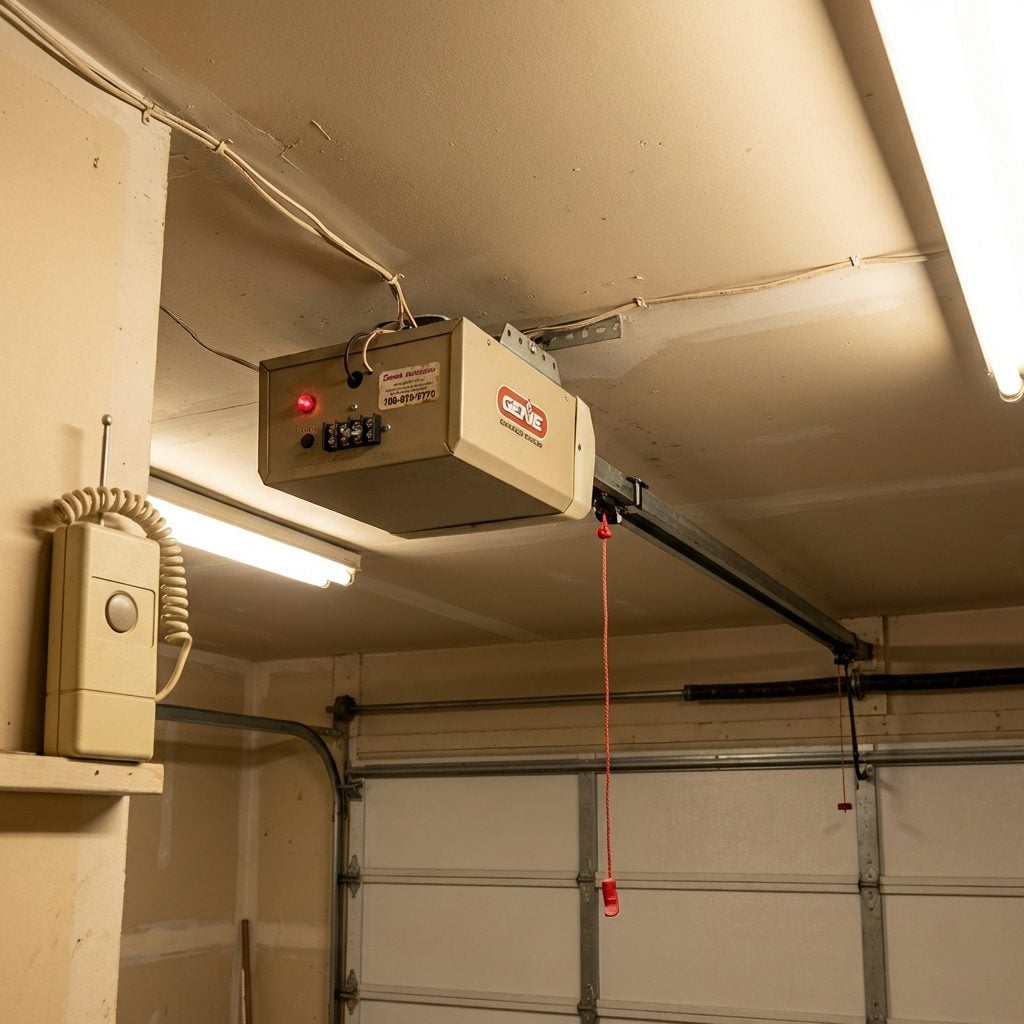
The garage door opener was the pinnacle of 1980s home technology. Before this, you got out of the car in the rain. Now you pressed one enormous button on a remote the size of a brick and the whole door groaned and shuddered upward while you watched from the driveway like you’d invented electricity.
That remote clipped to the sun visor and fell off constantly. It disappeared between seats. It developed a dead spot in the button that required pressing with your thumb at a specific pressure and angle. Everyone in the family eventually learned the exact technique required to make it work, and nobody wrote it down because it lived in muscle memory.
The unit itself made a sound like a very tired machine accepting its fate every single time it ran.
The Oil Drip Stain on the Concrete That Never Came Out
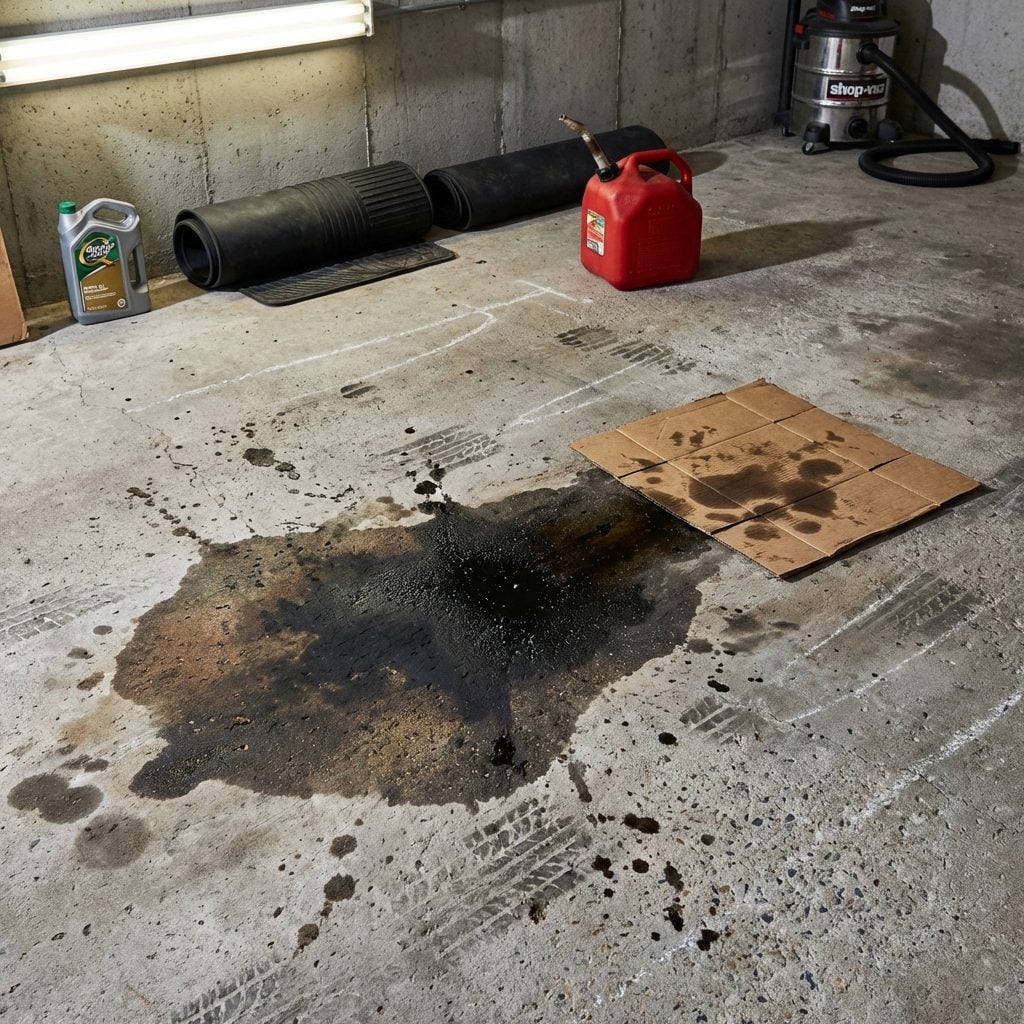
Every garage had at least one. That dark, spreading stain soaked into the concrete like it had somewhere to be, and no amount of kitty litter, dish soap, or concrete degreaser from the hardware store was ever going to touch it. It was just part of the floor now. A scar. A record of every car that had ever been left running a little too long.
Some dads put down cardboard under a dripping car as a temporary fix. The cardboard stayed there for four years.
The Wall-Mounted Pegboard Calendar From the Local Auto Parts Store
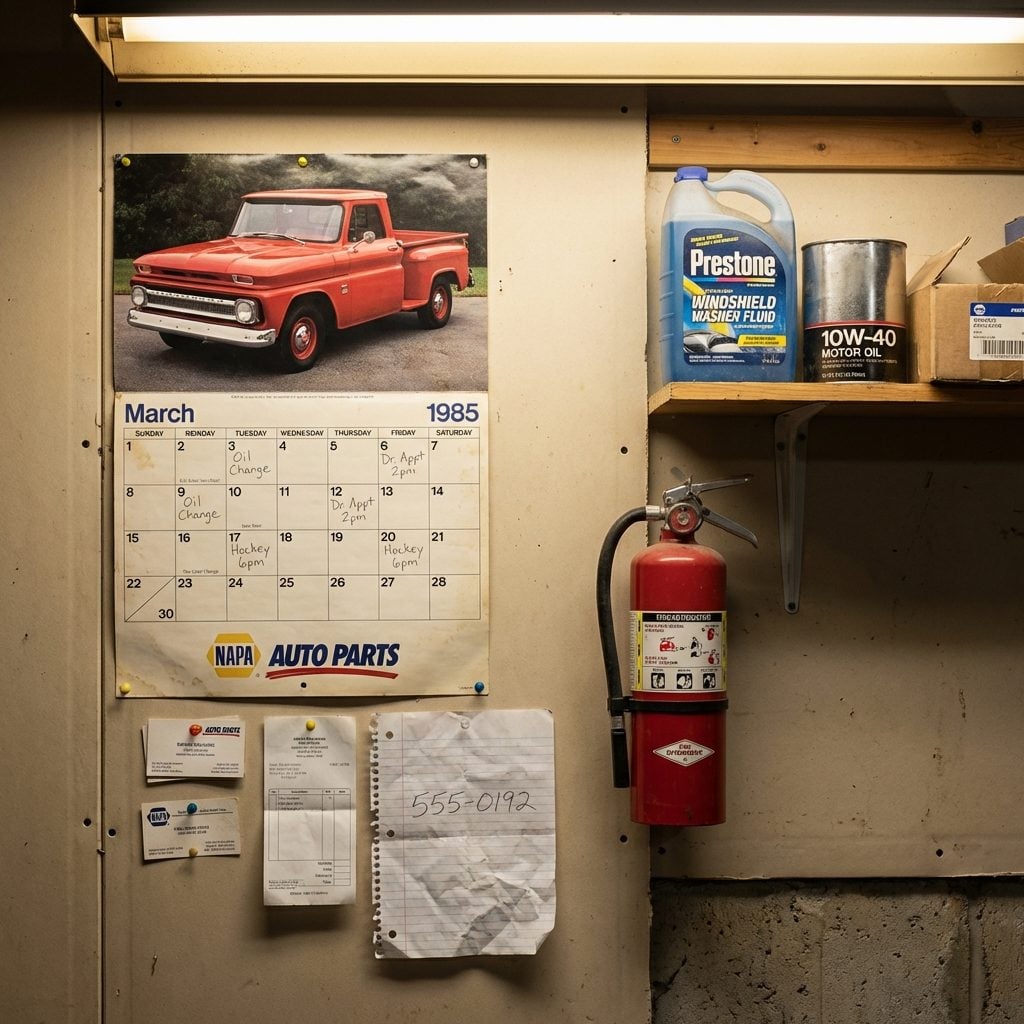
Every local auto parts store, tire shop, and oil change place sent these out at the end of the year, and they all ended up on the same garage wall. The paper was always slightly too slick, the grid squares always slightly too small, and the picture at the top was always either a muscle car or a landscape nobody had ever been to.
The handwriting in the date squares told you everything. Oil change intervals, hardware store hours, a phone number for someone named Dave with no last name. The garage calendar was the actual family scheduler, not the one on the fridge.
The Workbench Built From 2x4s and Plywood With a Vise Bolted to One End
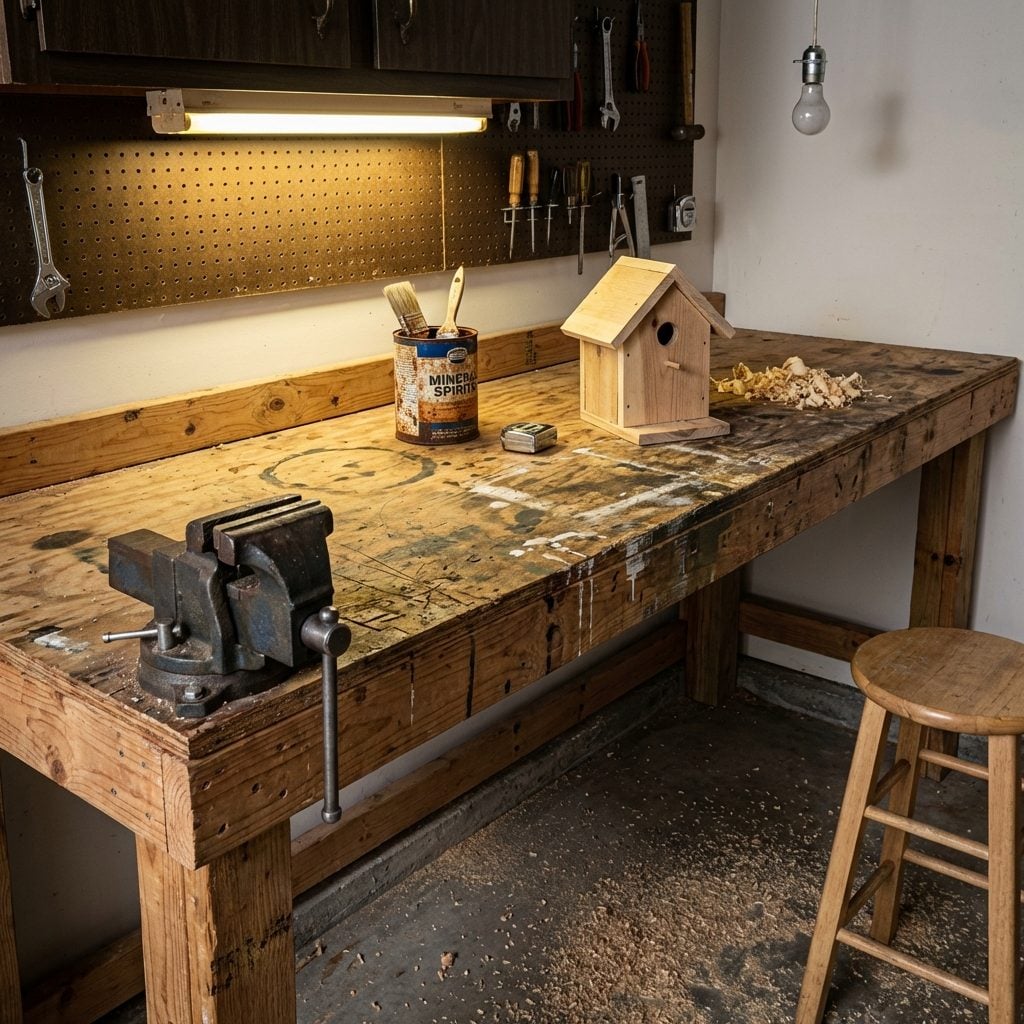
These workbenches were never bought. They were built from whatever lumber happened to be left over from the deck project, the fence project, the addition that only got half done. The 2×4 frame was always overbuilt by about 300 percent because the guy making it once saw a commercial where a truck drove over a Craftsman tool, and that energy carried into every construction decision he made for the next decade.
The plywood top was nominally smooth when it was new. Within a month it was a topographic map of every project that had ever touched it. The vise at the end was the piece de resistance, bolted through the top, tightened so hard that the mounting plate slightly cupped the wood around it. You held lumber in it, bicycle tires, parts that needed painting, and occasionally an entire door that needed re-hanging.
The Mini Fridge Plugged Into the Corner for the Weekend Beer Supply
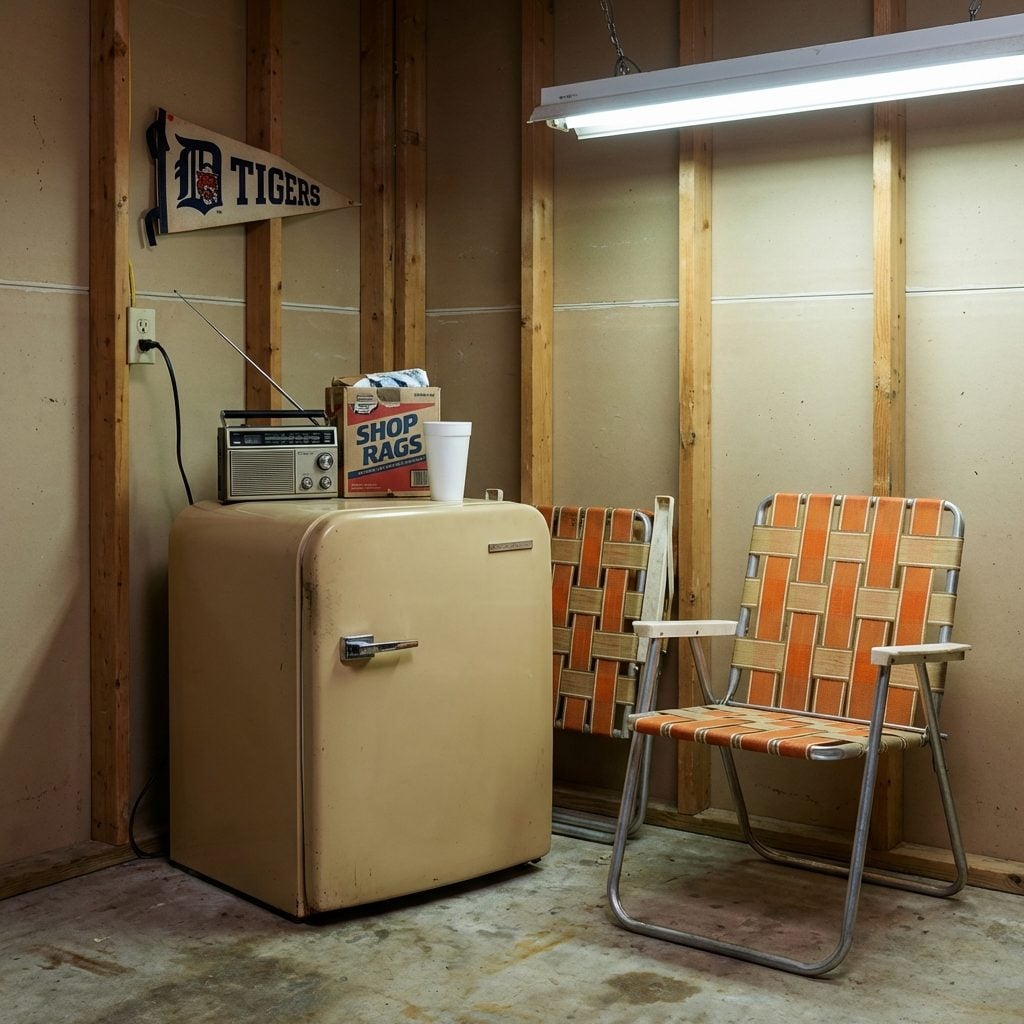
The mini fridge in the garage was not a convenience. It was a declaration of intent. It meant this garage was a destination, not just a room where the cars slept. It meant there was a reason to pull up a lawn chair and stay a while.
It always hummed slightly louder than indoor appliances, as if the garage air was too dense for it to work quietly. The shelves inside held one kind of beer, whatever was on sale at the grocery store that week, and maybe a jar of old pickles from three years ago that nobody ever threw out.
The Chest Freezer Humming Against the Back Wall Under Bags of Rock Salt
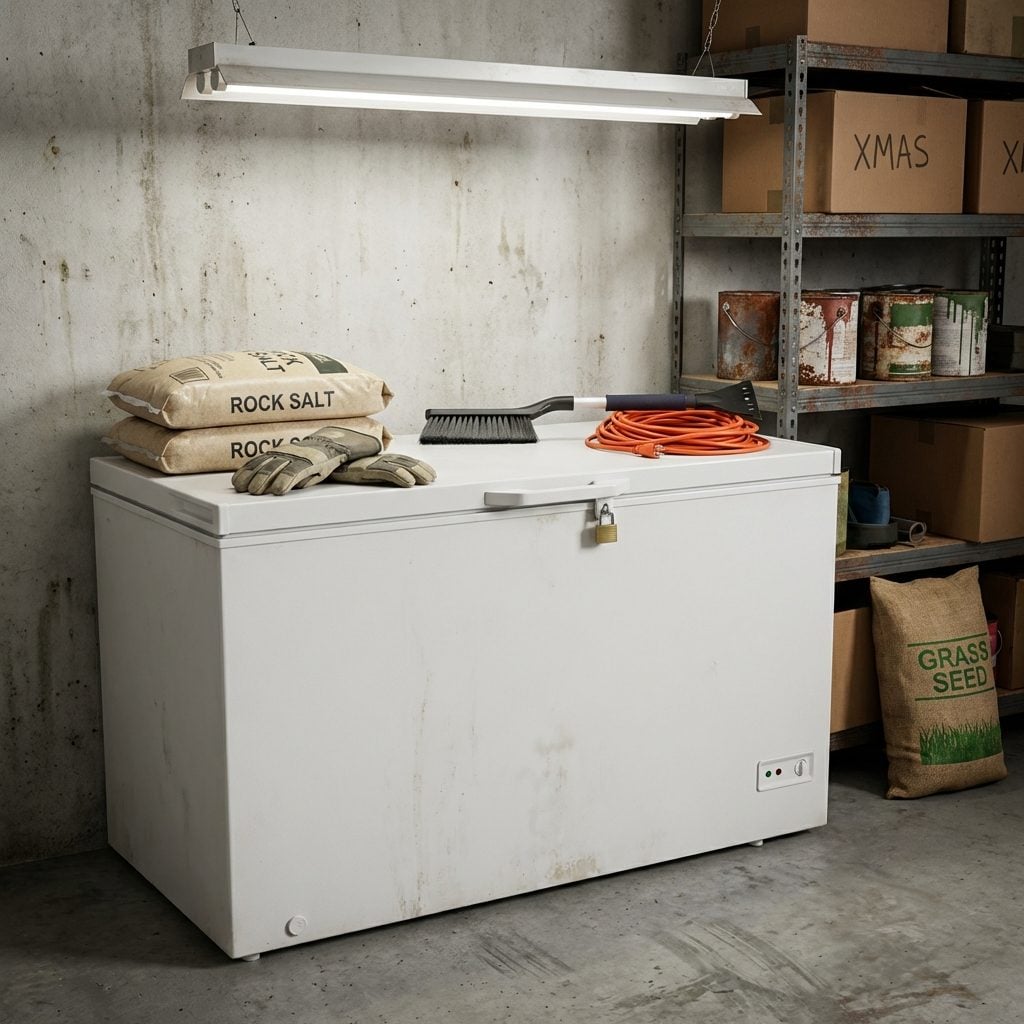
That chest freezer held the family’s second act of every major food purchase. Bulk ground beef from the warehouse club. The extra Thanksgiving turkeys. Venison from a hunting trip that was already two years ago. At some point there was a power outage for three days, and everything at the bottom of the freezer went bad, but the memory of that was the only time anyone actually emptied the whole thing.
The lid was always slightly hard to open, the seal working against you. And the contents were always organized in theory, labeled freezer bags, stacked by category, and in practice, a geological dig site where the ice cream from last Easter was somewhere in the third stratum.
The Shop-Vac That Was Never Used for Anything but Leaves and Sawdust
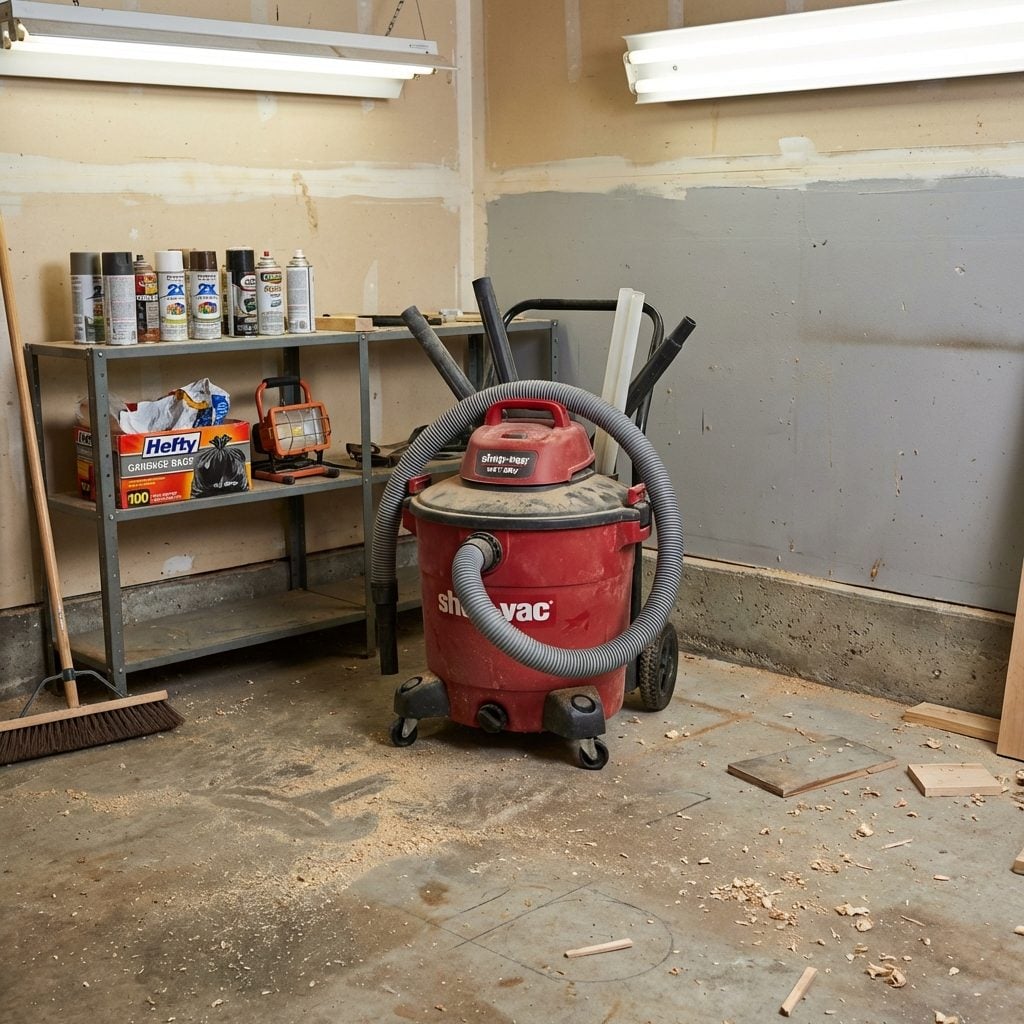
There was always a Shop-Vac. Always that specific configuration: drum on wheels, grey ribbed hose, a collection of plastic attachments that lived in the drum and fell out every time you moved the machine. The filter was either brand new or years past needing replacement, with nothing in between.
It inhaled sawdust, drywall dust, leaves that blew in under the garage door in October, and occasionally liquids, though everyone was a little nervous about that last part. It sounded like a jet preparing for takeoff and smelled like every project it had ever finished.
The Freestanding Metal Shop Stool That Nobody Was Ever Comfortable On
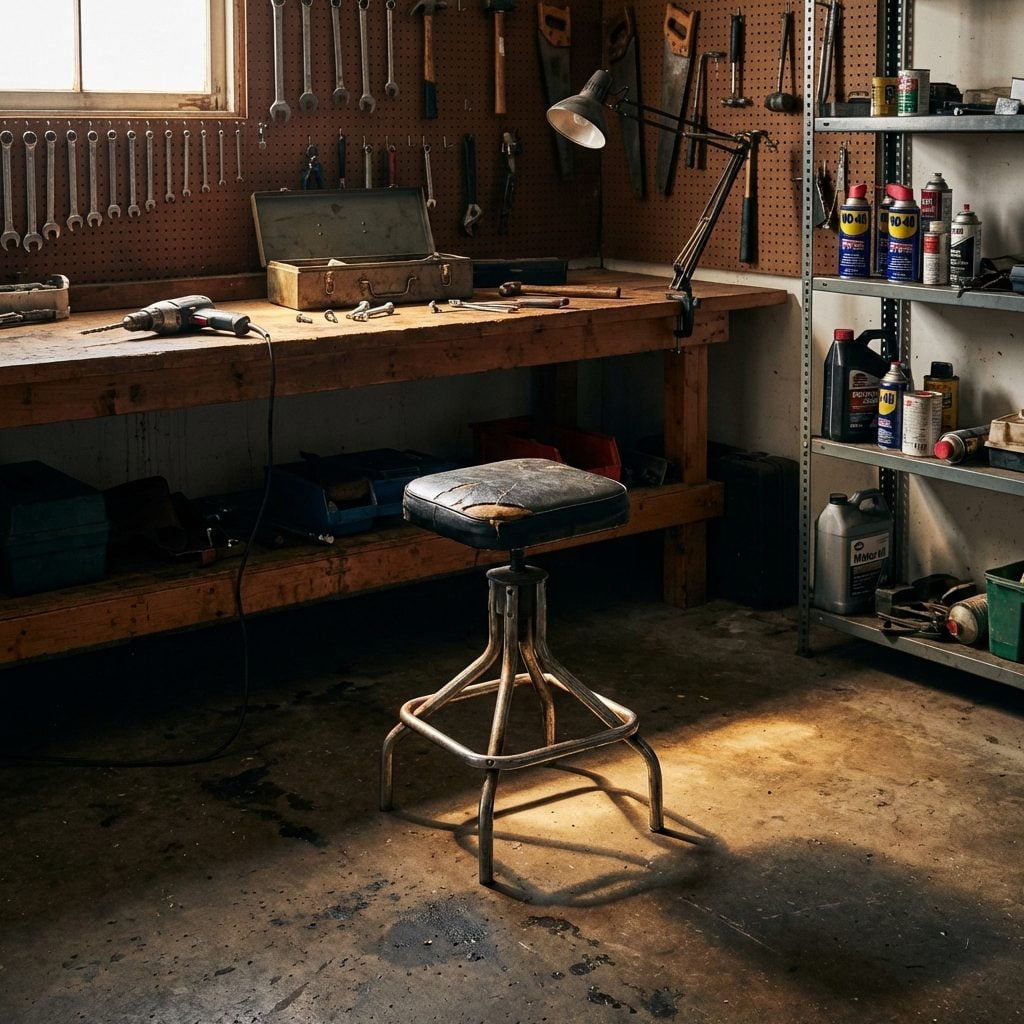
It had a round padded seat covered in cracked vinyl, usually black or dark red, and three or four splayed metal legs that wobbled slightly unless you sat perfectly still. The height was always wrong. Too tall for the workbench, too short for the countertop, exactly right for nothing.
Still, that stool lived in every garage, pulled up to whatever project was happening. It was where you sat to watch Dad work. Where you perched while handing over tools you didn’t know the names of. The seat was always cold in winter. The vinyl always stuck to bare legs in summer.
The Wall-Mounted Telephone Extension With the Extra-Long Cord
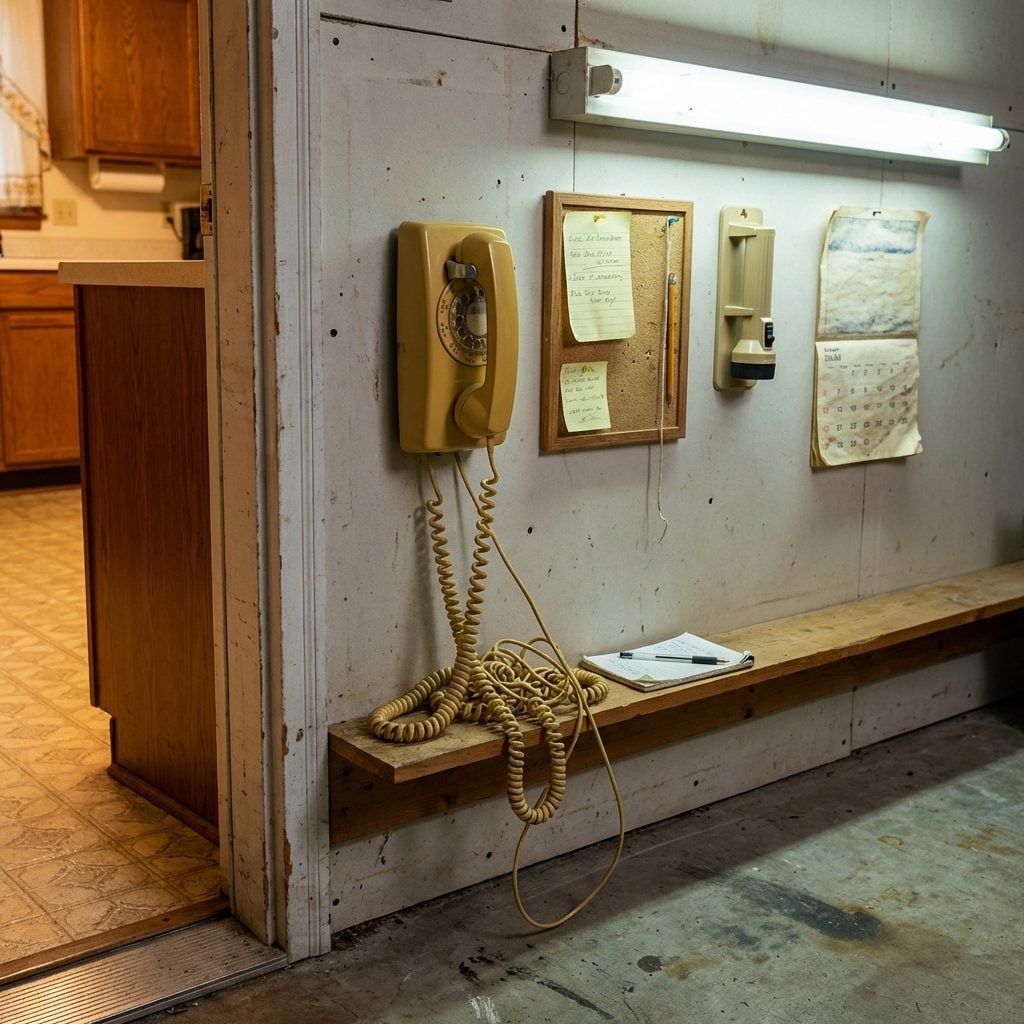
Before cell phones, the garage phone was a lifeline. It was always a wall-mount unit, usually the same avocado green or harvest gold as whatever was in the kitchen, bolted to the stud wall near the door to the house. The cord was at least fifteen feet long because someone had replaced the original short cord after tripping over it one too many times.
You could answer it with greasy hands because the receiver was already so grimy it didn’t matter. Calls from the garage were always short: “I’m in the garage,” followed by either “I’ll be in soon” or “Ask your mother.” The phone outlasted the decade by at least a decade. There was no reason to move it.
The Jar of Mystery Screws and Hardware That Accumulated for Eternity
🔥 Would you like to save this?
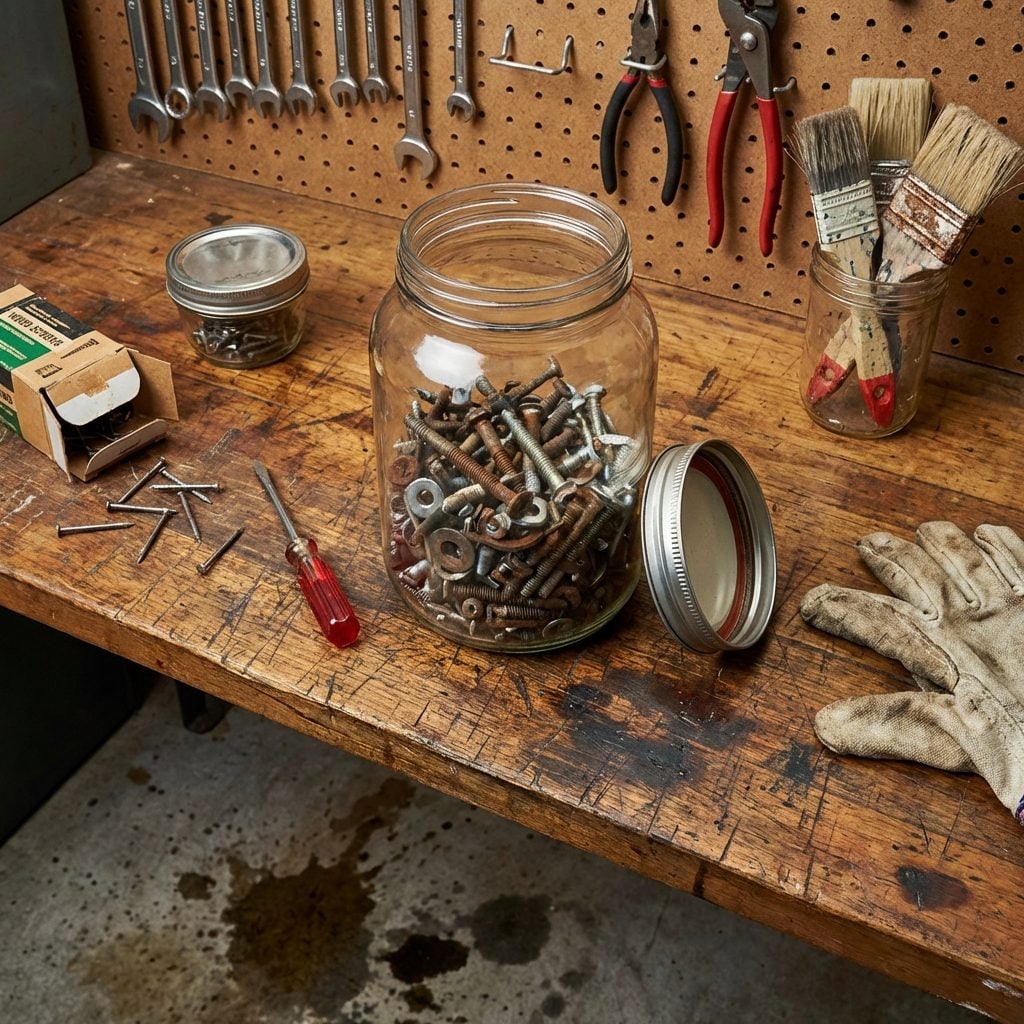
Every single garage had one. A large glass jar, sometimes a repurposed pickle jar, sometimes a wide-mouth mason jar, filled to the brim with loose screws, bolts, washers, wing nuts, and unidentified metal pieces that might be critical or completely useless. Nobody knew. Nobody was willing to find out.
The rule was simple: if a screw, nail, or piece of hardware didn’t have an obvious home, it went in the jar. The jar was consulted in moments of desperate improvisation. “I think I have one in the jar” was the 1980s garage equivalent of a search engine. It worked about thirty percent of the time.
The Folding Aluminum Lawn Chairs Stored Along the Far Wall All Winter
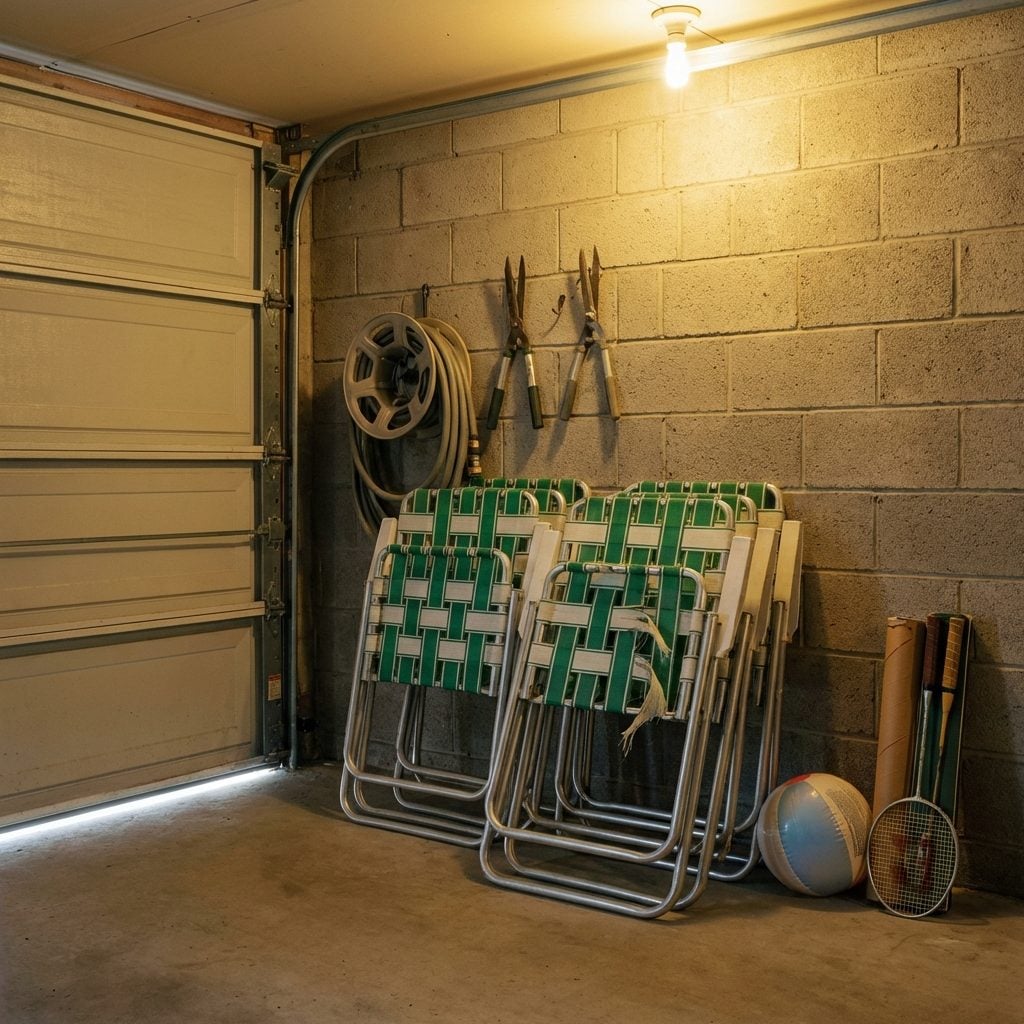
They were stacked on their sides against the cinder block wall from October until sometime in May, when someone would drag them out, unfold them in the driveway, and immediately sit down in the sun for the first time in months. The webbing was either nylon or the woven vinyl kind, usually in green and white or yellow and white stripes, and at least one chair had a broken strap that everyone just knew to avoid.
In the garage, they were an obstacle and a landmark. You walked past them every day for seven months. You knew their exact profile in the dark. When they came back out, it meant something. It meant summer was actually starting.
“When they came back out, it meant something. It meant summer was actually starting.”
The Pegboard-Mounted Fire Extinguisher Nobody Ever Checked
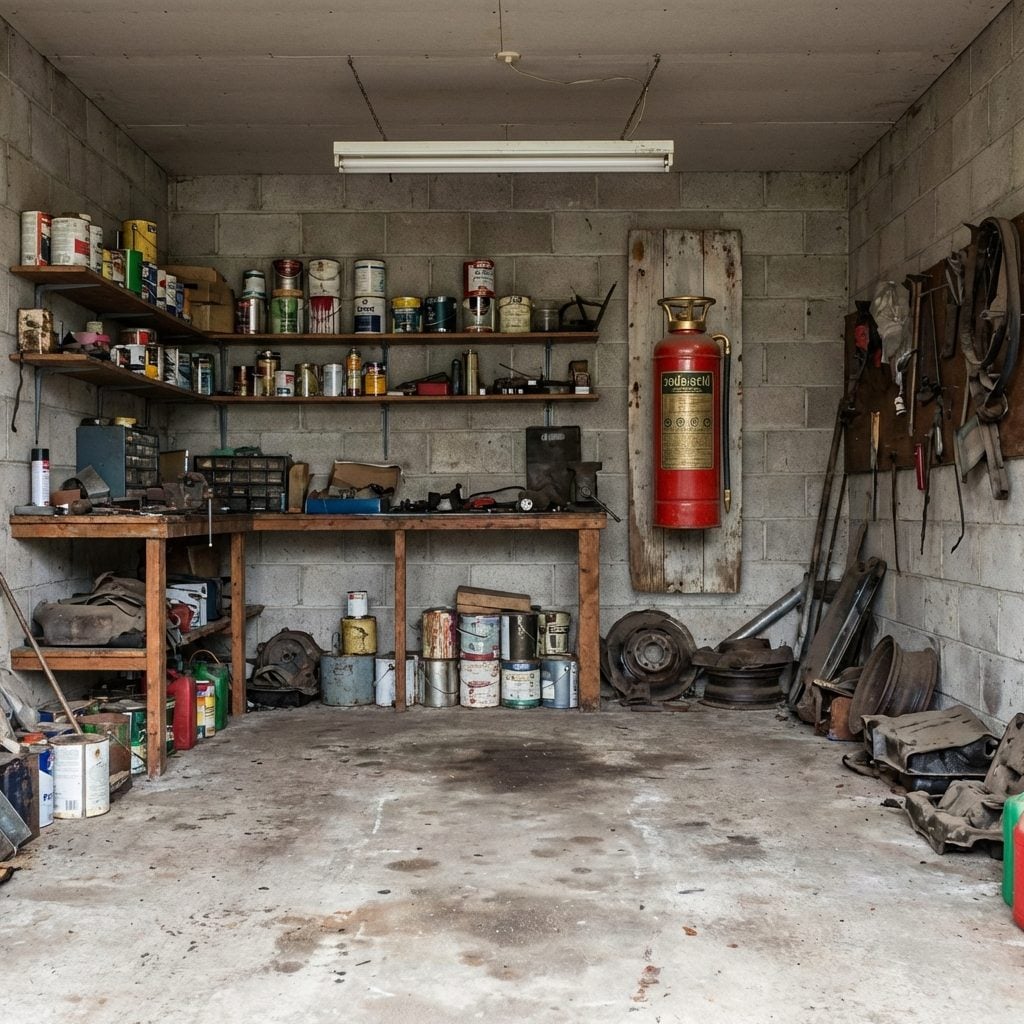
It hung on the pegboard for fifteen years and nobody touched it. Not once. The pin was still in, the inspection tag was from 1986, and there was a thin skin of dust on the nozzle that functioned as evidence of how safe everyone assumed the garage was at all times.
The idea was good, fire extinguisher in the garage, near the workbench, exactly where a fire might actually start. The execution was a vintage red fire extinguisher treated like permanent decor. It became invisible within a month of being mounted, blending into the pegboard like a coat hook or a spare level. Every few years someone would glance at it and say they should probably get it recharged. Nobody ever did.
The Big Bag of Rock Salt Leaning Against the Garage Door All Winter
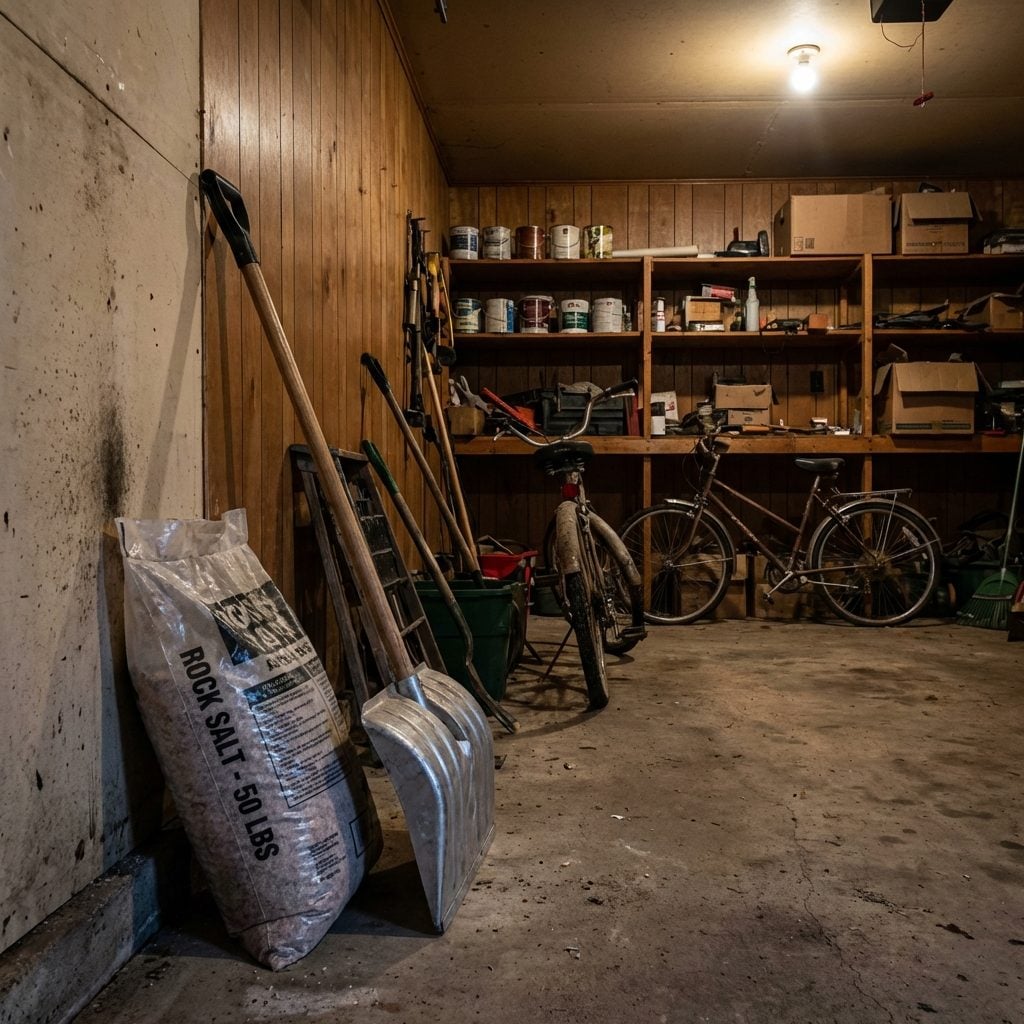
That bag never fully ran out and never got fully replaced. It existed in a permanent state of being almost empty, top folded down, a crusty ring of crystallized salt fused to the concrete beneath it, just enough left that throwing it away felt wasteful but not enough to actually do the whole driveway.
Rock salt in the 1980s came in paper bags, not plastic, which meant the bottom third was always damp and slightly disintegrating. You’d go to grab a handful and half the bag would come with it. The metal snow shovel leaning next to it had its own designated spot from October to April, and if you moved it, your dad somehow always noticed.
The Bicycle Hooks Screwed Into the Ceiling Joists With One Bike That Never Came Down
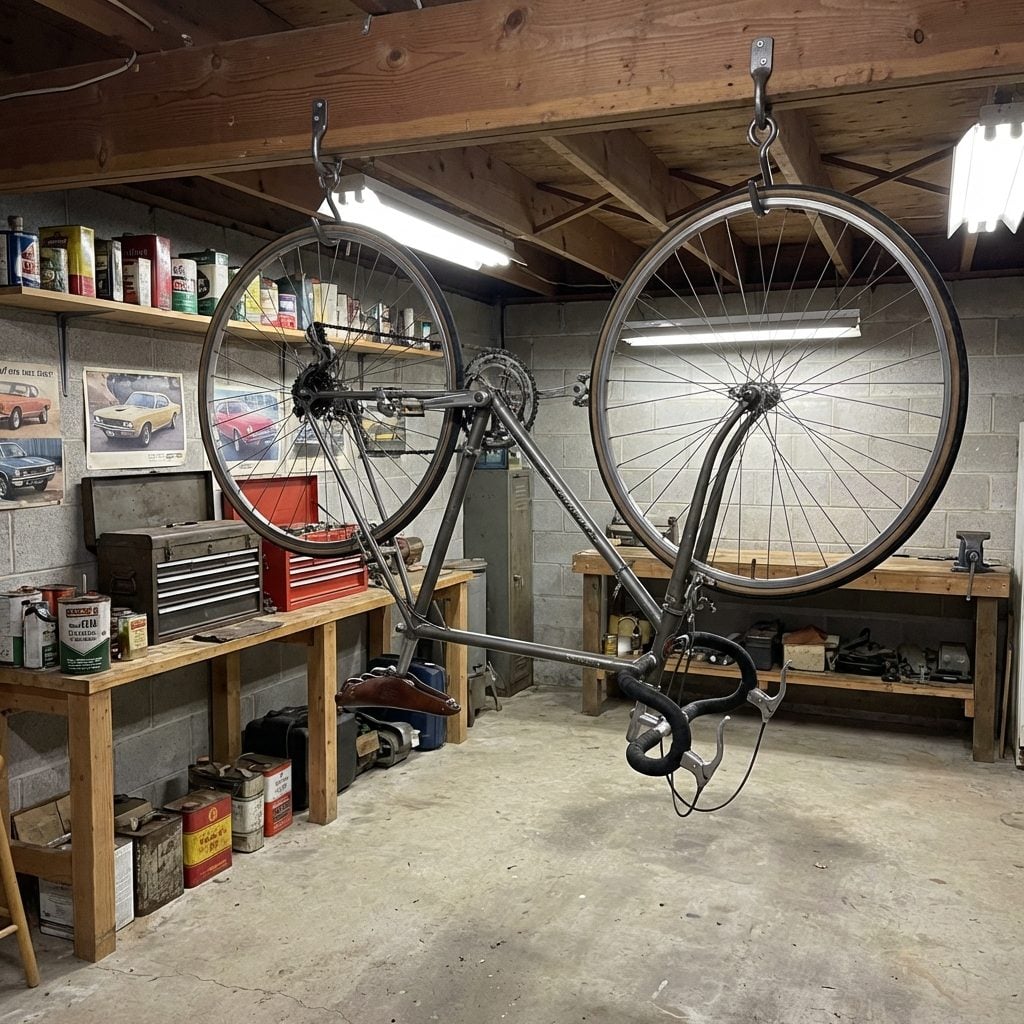
Whoever installed those hooks had a vision: an organized garage where the bikes lived on the ceiling, freeing up the floor, a vertical storage solution years ahead of its time. One bike did go up. It stayed up. The tire went flat sometime around 1989 and the whole situation became load-bearing nostalgia rather than functional storage.
The second hook stayed empty, a monument to bikes that never made it up there, the ones that just leaned against the wall or lay sideways behind the car. Getting a bike down from ceiling hooks required two people, a stepladder, and a sincere reason to be going for a ride, which was apparently always one too many requirements.
The Extension Cord Coiled on a Nail That Was Never Long Enough
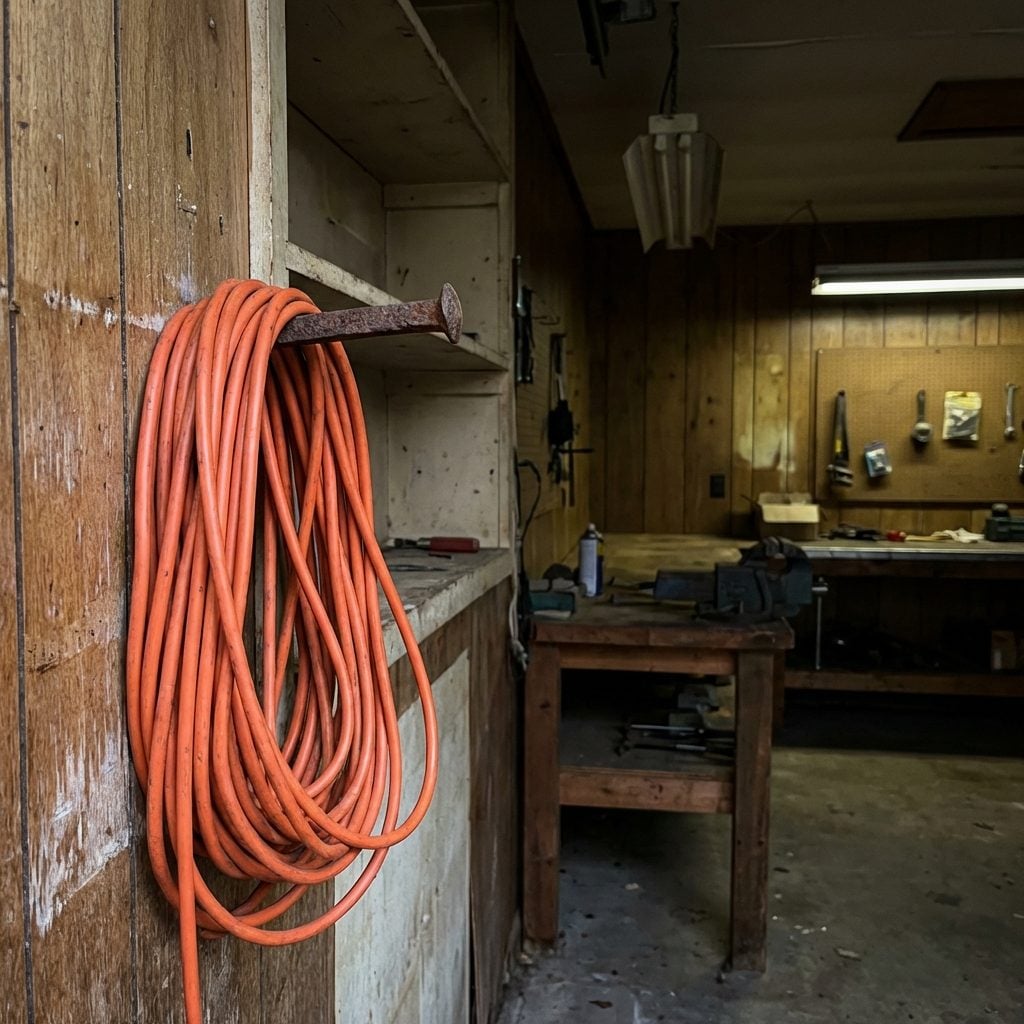
Orange. Always orange. Heavy-gauge, outdoor-rated, coiled on a nail by the workbench, and reliably about six feet shorter than whatever you actually needed it for. Every garage project involved dragging that cord to its full extension, the kink at the midpoint popping stubbornly upright, and then plugging in the drill or the sander at the maximum possible stretch.
The coiling method was a point of quiet pride for dads everywhere. Some did the over-under wrap. Some just looped it in rough circles. Either way, within two uses it had a permanent memory kink at the two-thirds mark that no amount of straightening ever fixed. The three-prong plug end always had a small crack in the orange casing from being dropped on concrete repeatedly. Nobody considered replacing it until it visibly sparked.
The Yellowed ‘Caution: Men at Work’ Sign That Gave the Whole Operation Official Status
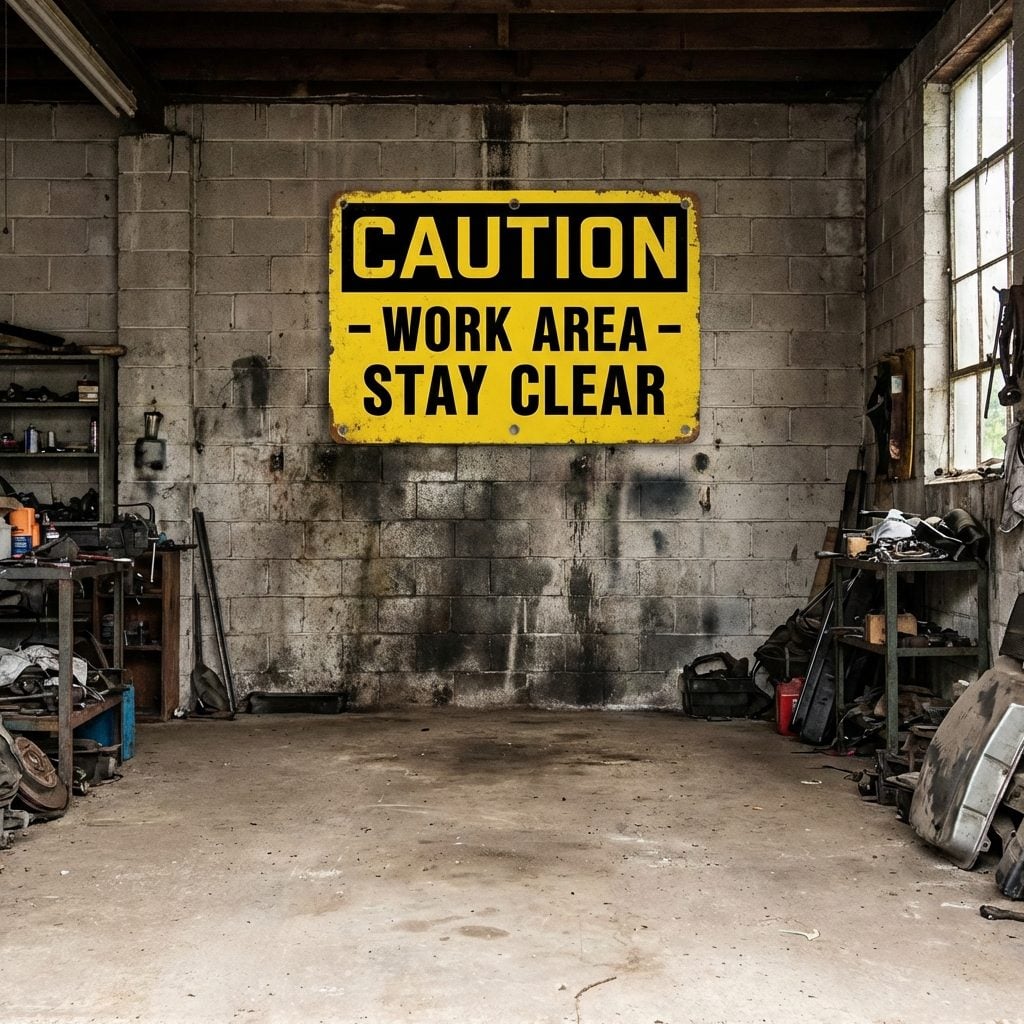
Nobody remembers buying it. It just appeared one day, screwed or zip-tied to the door frame, school-bus yellow with bold black text, and absolutely zero legal authority over anything happening in a residential garage on a Saturday afternoon.
But that wasn’t the point. The point was atmosphere. That sign said: this is a workspace, there are things happening here, proceed with awareness. It didn’t matter that ‘the work’ was occasionally just sitting on an overturned bucket eating a sandwich. The sign made it official.
The Pegboard-Mounted First Aid Kit With Bandages From the Carter Administration
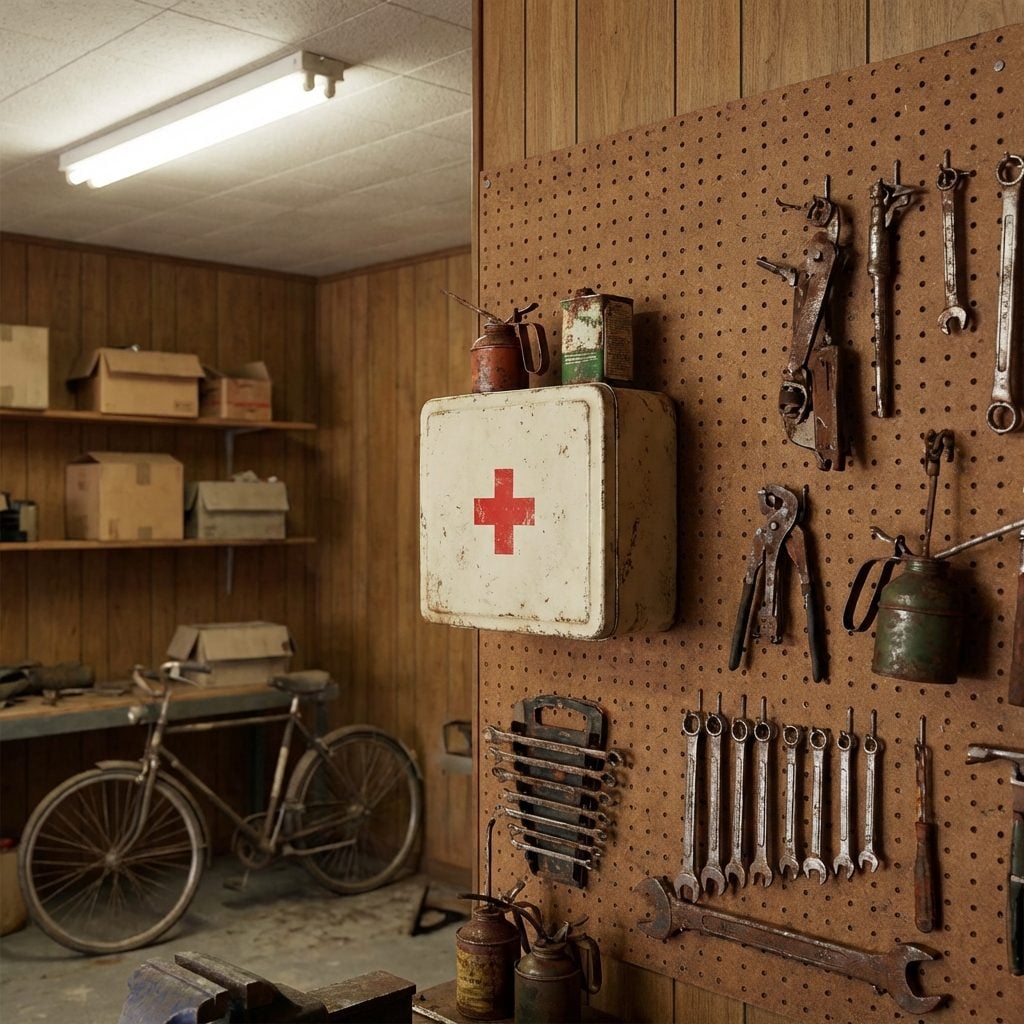
It was mounted at eye level, right there between the WD-40 and the hanging pliers, and nobody had opened it since approximately 1978. The bandages inside had gone translucent. The antiseptic cream tube was crimped flat. The tweezers had oxidized to a soft bronze.
Every garage had one of these white metal boxes with the peeling red cross sticker, and not one of them was ever properly stocked. The whole thing was more of a gesture toward safety than an actual safety measure. You got a splinter, you went inside and asked Mom. The kit just stayed on its hook, presiding over the workshop with quiet, useless authority.
The Transistor Radio or Boom Box Parked on the Workbench Tuned to the Classic Rock Station
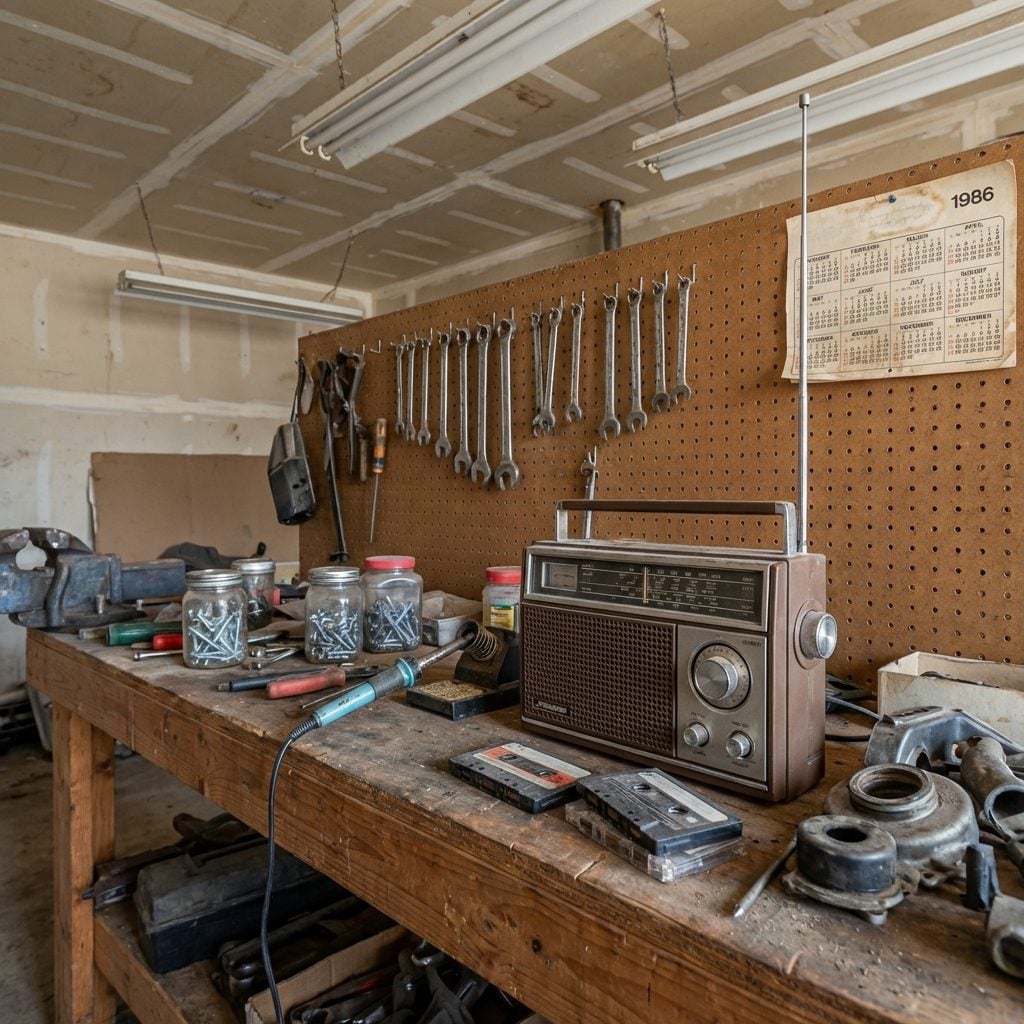
Classic rock came out of that thing whether you wanted it or not. Dad had found the one station that played Foreigner and Lynyrd Skynyrd on rotation and he was not changing it, ever, for any reason.
The boom box sat in the corner of the workbench like a co-worker who never left. Sawdust collected in the speaker grilles. The volume knob had a specific sweet spot between 4 and 5 where it didn’t crackle. If the antenna wasn’t angled just right, Bob Seger turned into static, and someone had to hold it in position while the other person finished cutting.
The Half-Empty Can of WD-40 That Was the Answer to Every Single Problem
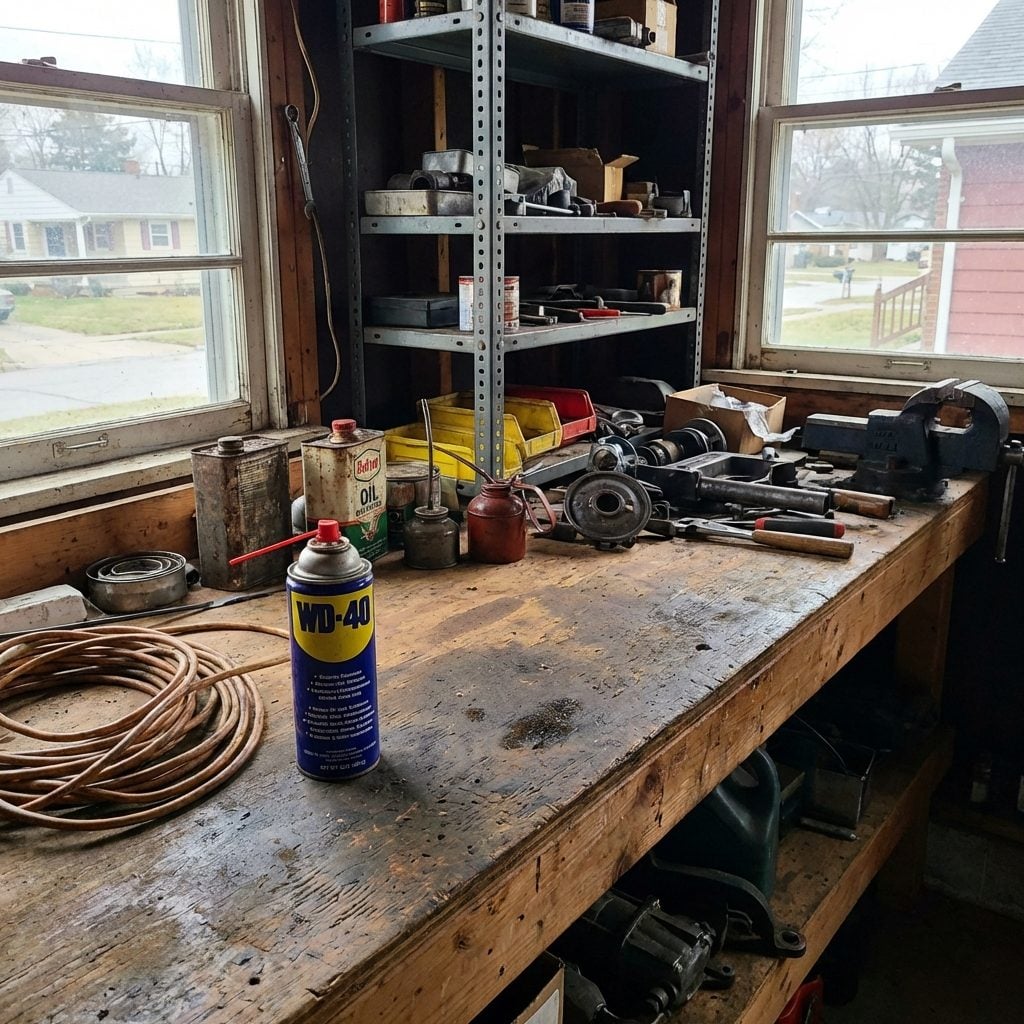
Squeaky hinge? WD-40. Stuck bolt? WD-40. Something that just felt like it needed attention? WD-40. The can lived on the second shelf from the top, right side, always slightly sticky on the outside from overspray, always lighter than you expected when you picked it up.
There was a spiritual confidence in reaching for it. It meant you had a plan. Whether that plan was correct was a separate conversation.
The WD-40 can was not a tool. It was a declaration of intent.
The Spare Tire Leaning Against the Wall That Had Been Flat Since 1983
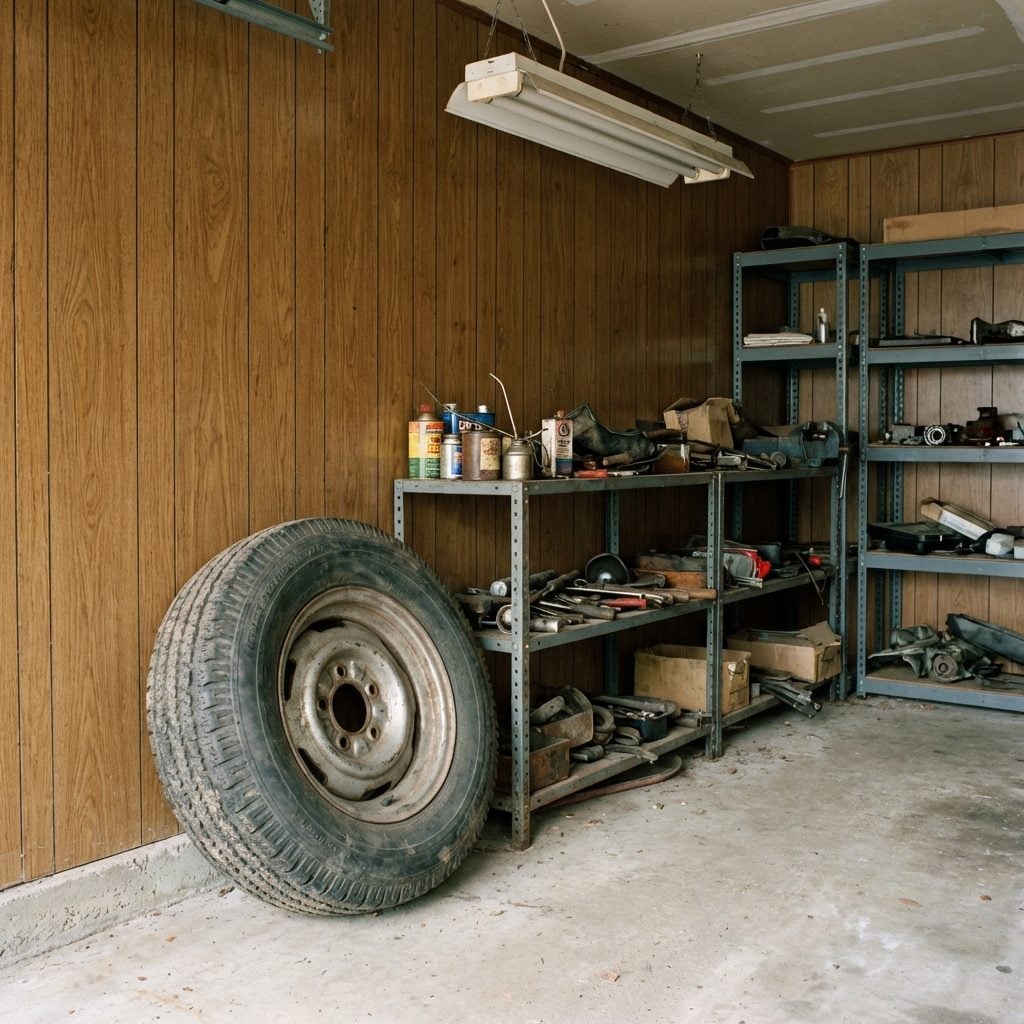
It had been there so long it had basically become structural. Moving it was not on the agenda. You walked around it without thinking, the same way you walked around that one fence post in the backyard. It was just part of the geography now.
The plan had always been to get it patched and keep it as an actual spare. That plan existed at some point in 1983 and was never revisited. By 1989 the sidewall had a crack in it and the whole thing was purely decorative.
The Hand-Lettered ‘DAD’S GARAGE’ Sign Burned Into a Piece of Scrap Wood
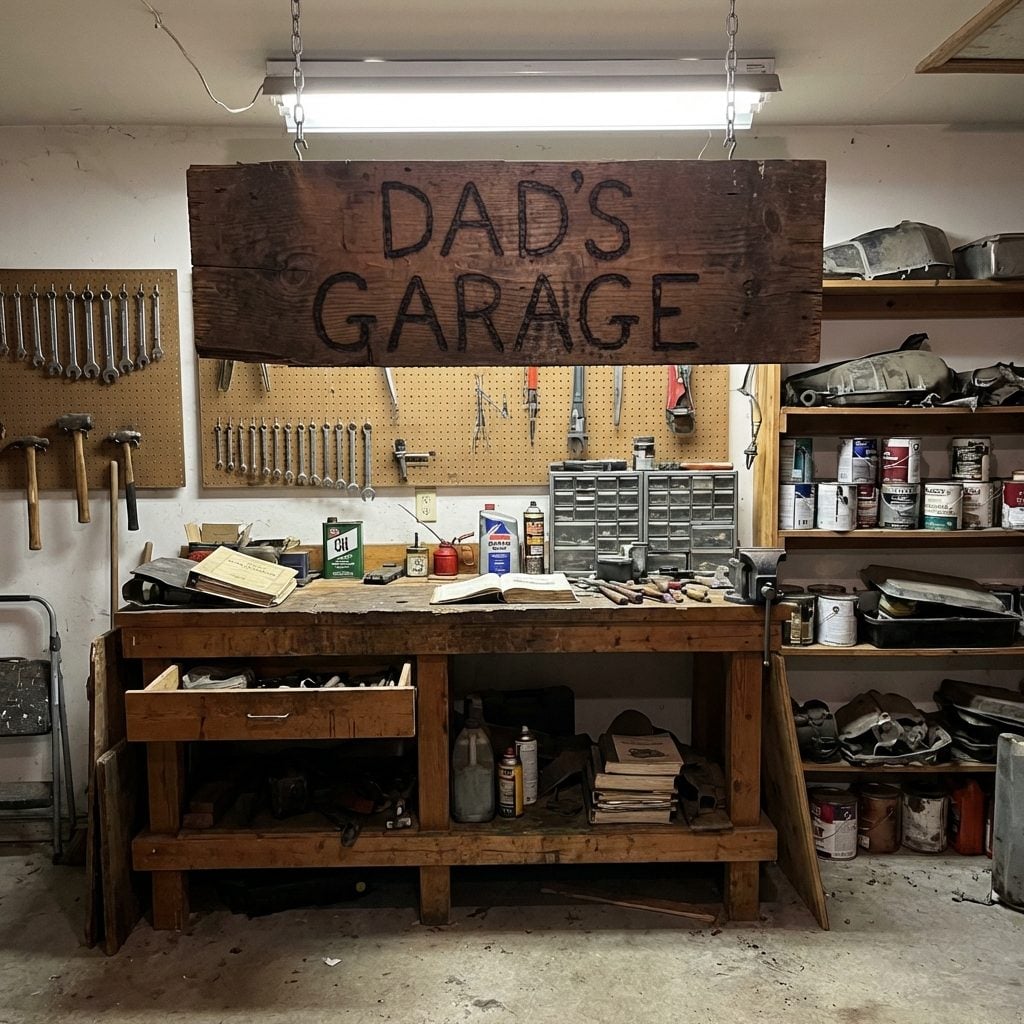
Someone got a wood-burning kit for Christmas and this was the result. The letters were slightly uneven. The apostrophe was a little too big. It didn’t matter at all because it was the most official thing in the entire garage.
These signs were a declaration of sovereignty. The house might have been a shared enterprise, but this 400 square feet of concrete and pegboard had a name on it now, burned right into a pine board, and the matter was settled permanently.
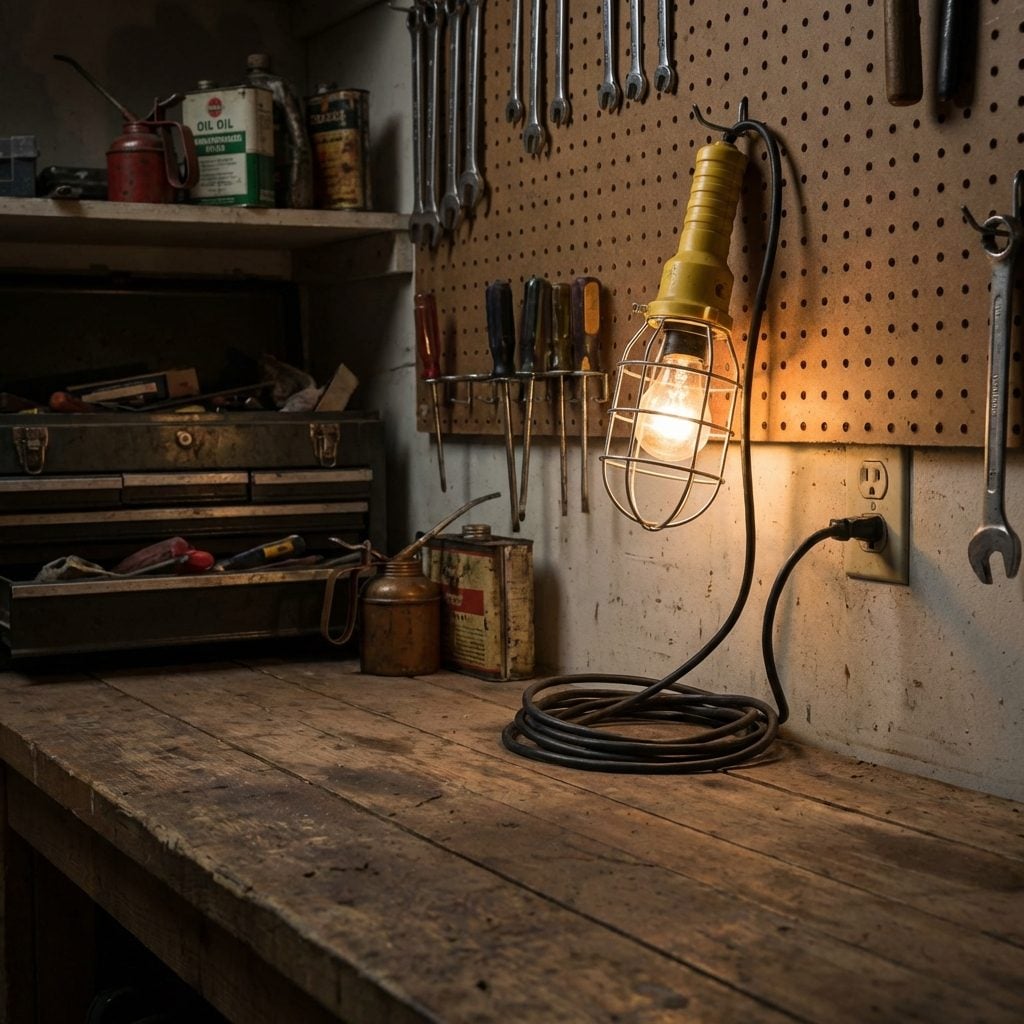
The Pegboard-Mounted Trouble Light With the Wire Cage Around the Bulb
🔥 Would you like to save this?
You could track it by the cord, that long orange extension cord snaking from the outlet across the ceiling joists, looping through hooks, always ending at wherever the work was happening. The trouble light was the garage’s only real task lighting, a single incandescent bulb caged in a wire basket so it wouldn’t shatter when it inevitably got knocked off the workbench and swung against something metal.
The wire cage was warm to the touch after twenty minutes. You learned that the hard way. Whoever designed it understood that garages were brutal environments, concrete floors, swinging arms, tight spaces under dashboards, and a naked bulb had no business being there.
When the main lights went off and dad crawled under the car with the trouble light, that orange cord trailing behind him was the only sign of life. The sound of a ratchet and a faint country station from the workbench radio. That was a Saturday.
The Plastic Wall Mount for the Garden Hose That Nobody Ever Used Properly
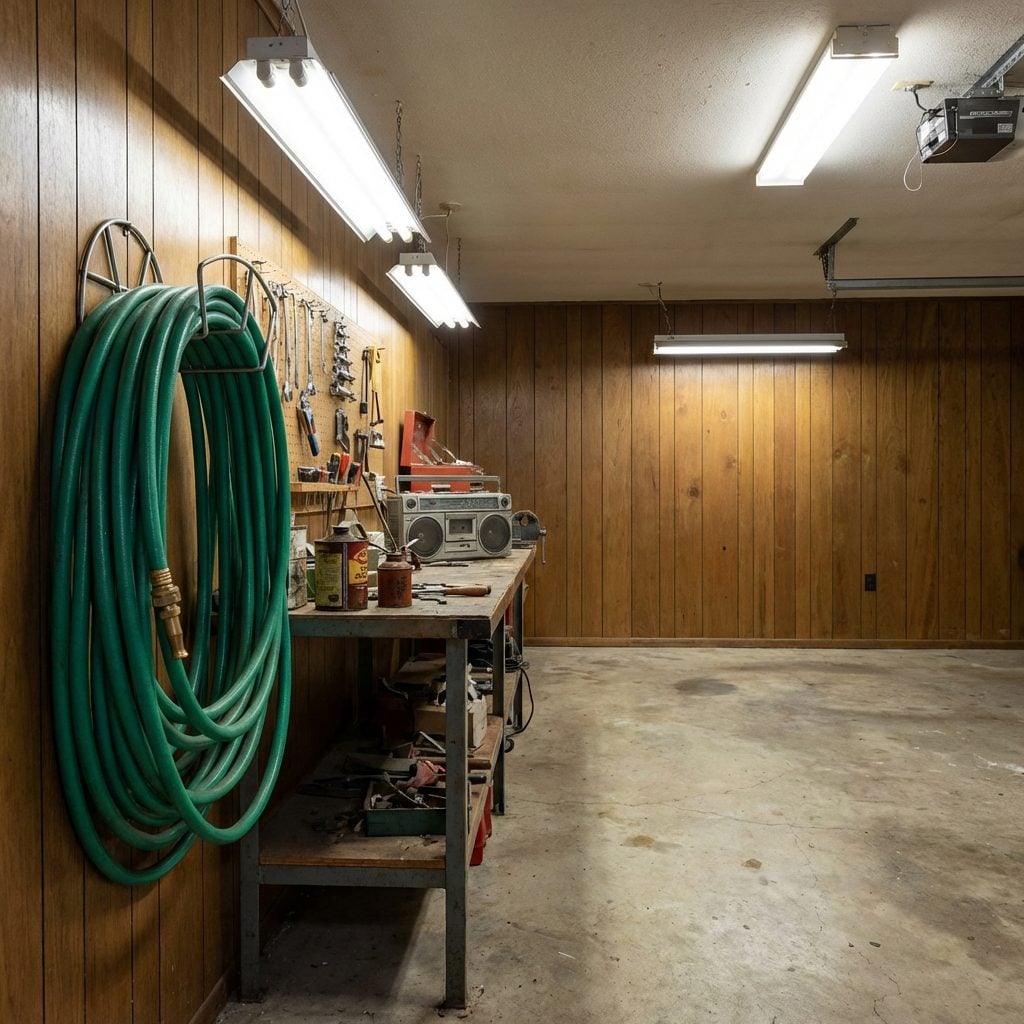
The instructions said it could hold up to fifty feet of hose in a neat coil. That was technically true. What the instructions didn’t mention was that no human being would ever actually do it that way, and within forty-eight hours of installation the hose would be drooped over the mount in a formless green pile, the nozzle dangling three inches from the concrete.
Still, the plastic wall mount stayed up. Taking it down would have meant admitting defeat, and no one in that garage was admitting defeat about anything.
The Wooden Stepladder Stashed Between the Wall and the Freezer
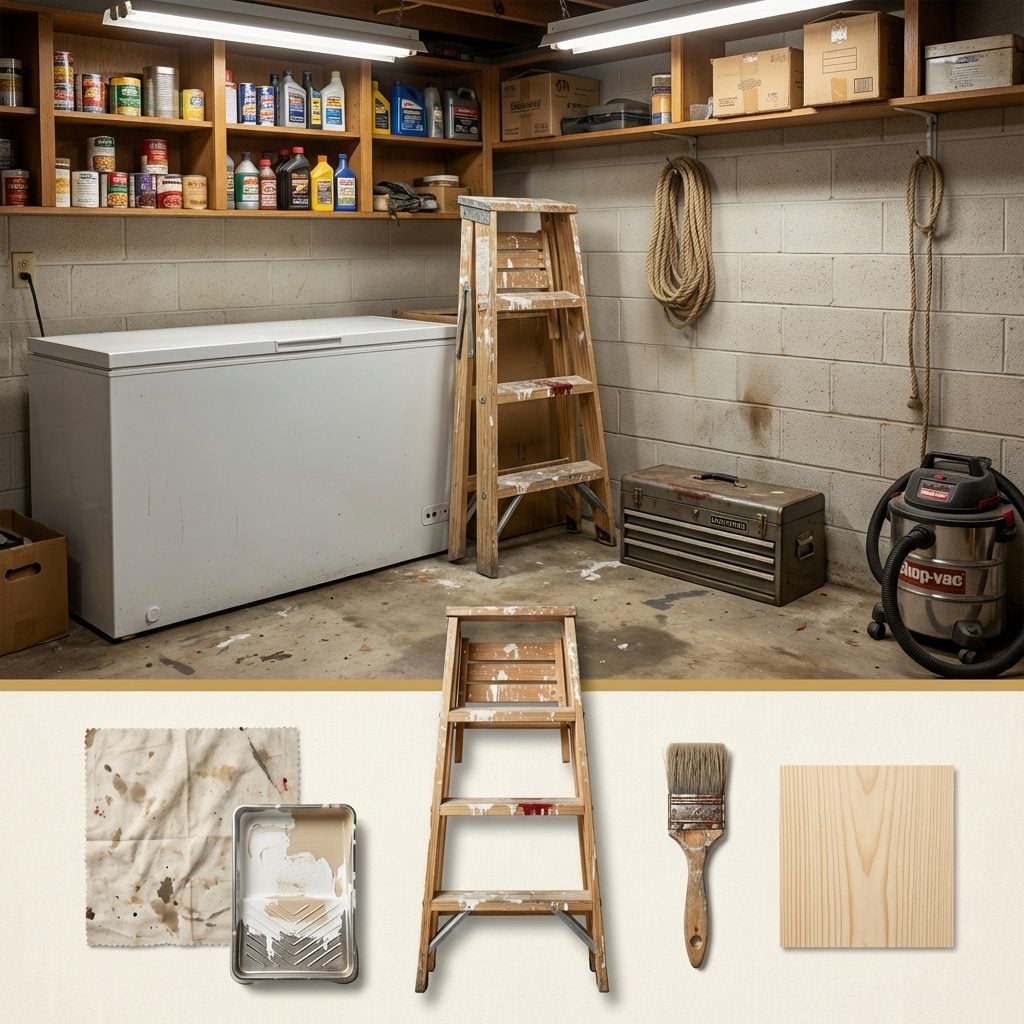
Every single paint job in the house lived on that ladder. White from the kitchen ceiling in 1982. A smear of the dusty rose from when mom did the guest room. A long streak of barn red from the shutters. It was an accidental archive of every improvement project the house had ever survived.
It lived in that slot between the freezer and the wall because there was no other slot. It fit exactly, which everyone accepted as a kind of divine planning. Getting it out required tilting it at a specific angle, banging a knuckle on the freezer lid, and muttering something under your breath.
That ladder held the whole house up, one paint job at a time.
The Mounted Pair of Deer Antlers or Trophy Bass That Had No Business Being in the Garage
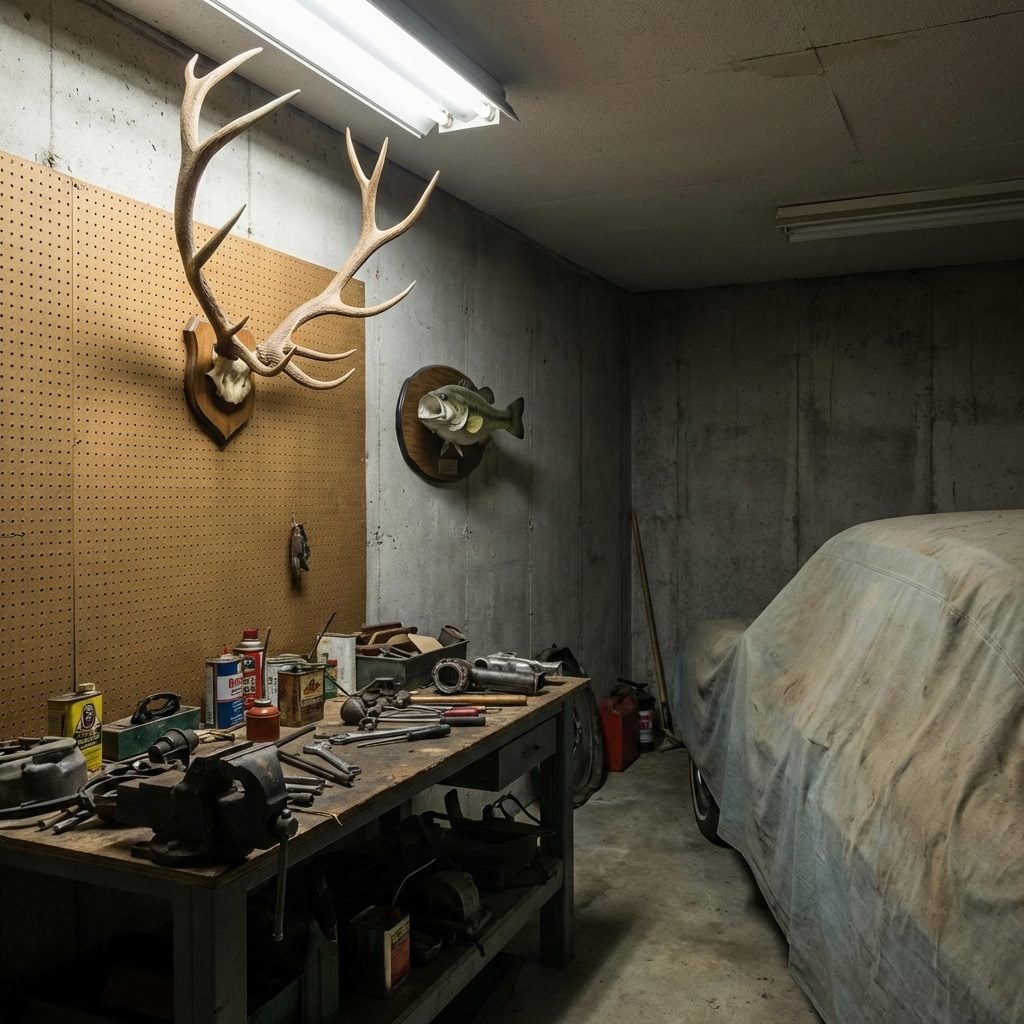
There was no explanation for why it was in the garage. It had not always been in the garage. At some point a decision was made, and that decision was final.
The trophy bass was particularly specific, some specific Saturday in some specific lake, commemorated forever in painted resin, mounted on a driftwood plaque, and ultimately exiled from the living room to hang above the socket wrenches. The deer antlers were more philosophical. They were just there. They had always been there. You stopped seeing them after a while, the way you stopped seeing the oil stain or the pegboard.
Together they gave the garage the energy of a roadside bait shop, which was exactly correct.
The Corkboard Pinned With Business Cards, Reminders, and a Key Nobody Could Identify
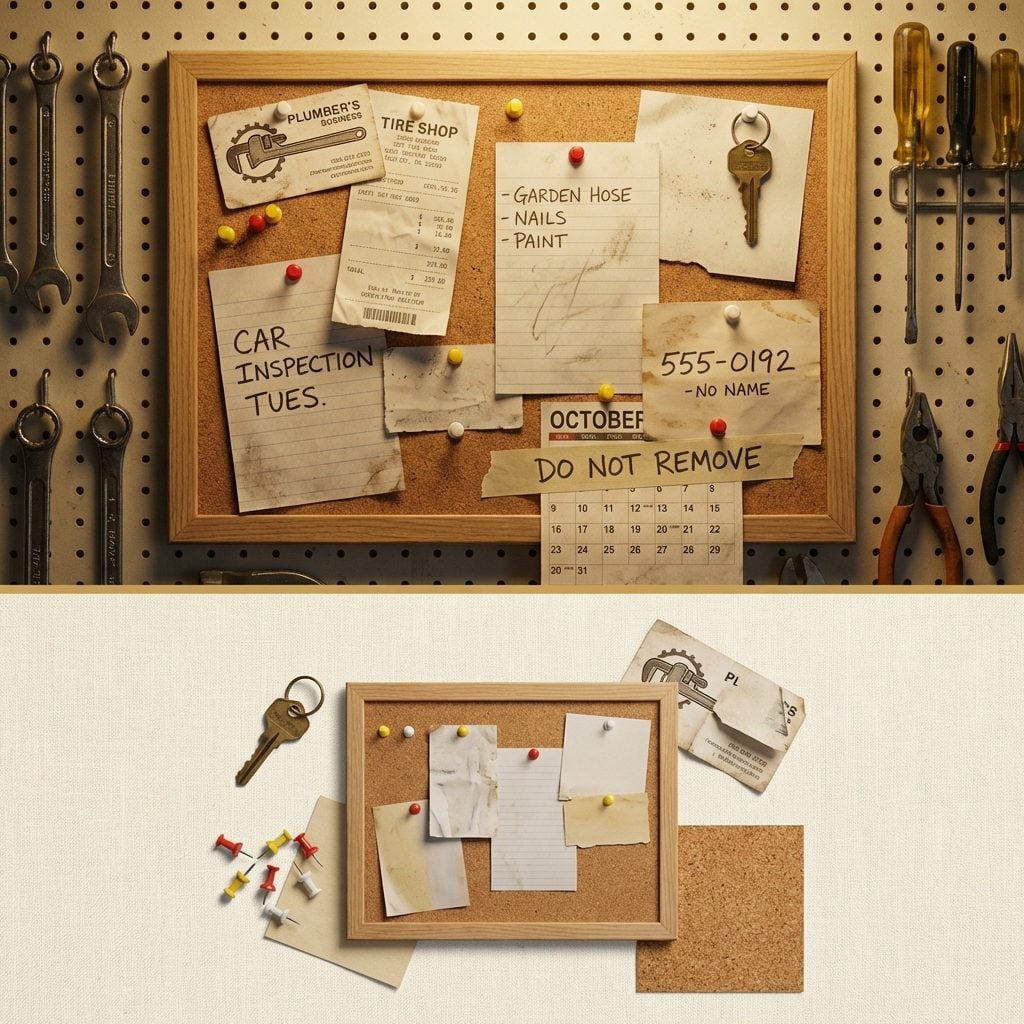
That key did not go to the house. It did not go to any car currently owned by the family. It did not go to the shed lock, the storage unit, the neighbor’s garage, or anything on the property. It had been hanging there since at least 1986 and no one was going to find out now.
The corkboard was the garage’s nervous system. Plumber’s number. Furnace filter size written in marker on masking tape. The name of the guy who does driveways. A reminder about something that had already happened or been forgotten entirely. None of it was organized. All of it was somehow exactly right when you needed it.