🔥 Would you like to save this?
You’ve checked your coat pocket three times. You’ve retraced your steps twice. You’re going to be late — again — and the keys are exactly where they were yesterday: nowhere you can find them. This foyer was designed specifically for you. Thirty-five transformations. Every style imaginable. Every one of them engineered around a single, non-negotiable, life-changing feature: a designated place for your keys. You’re welcome.
In order to come up with the very specific design ideas, we create most designs with the assistance of state-of-the-art AI interior design software. Also, assume links that take you off the site are affiliate links such as links to Amazon. this means we may earn a commission if you buy something.
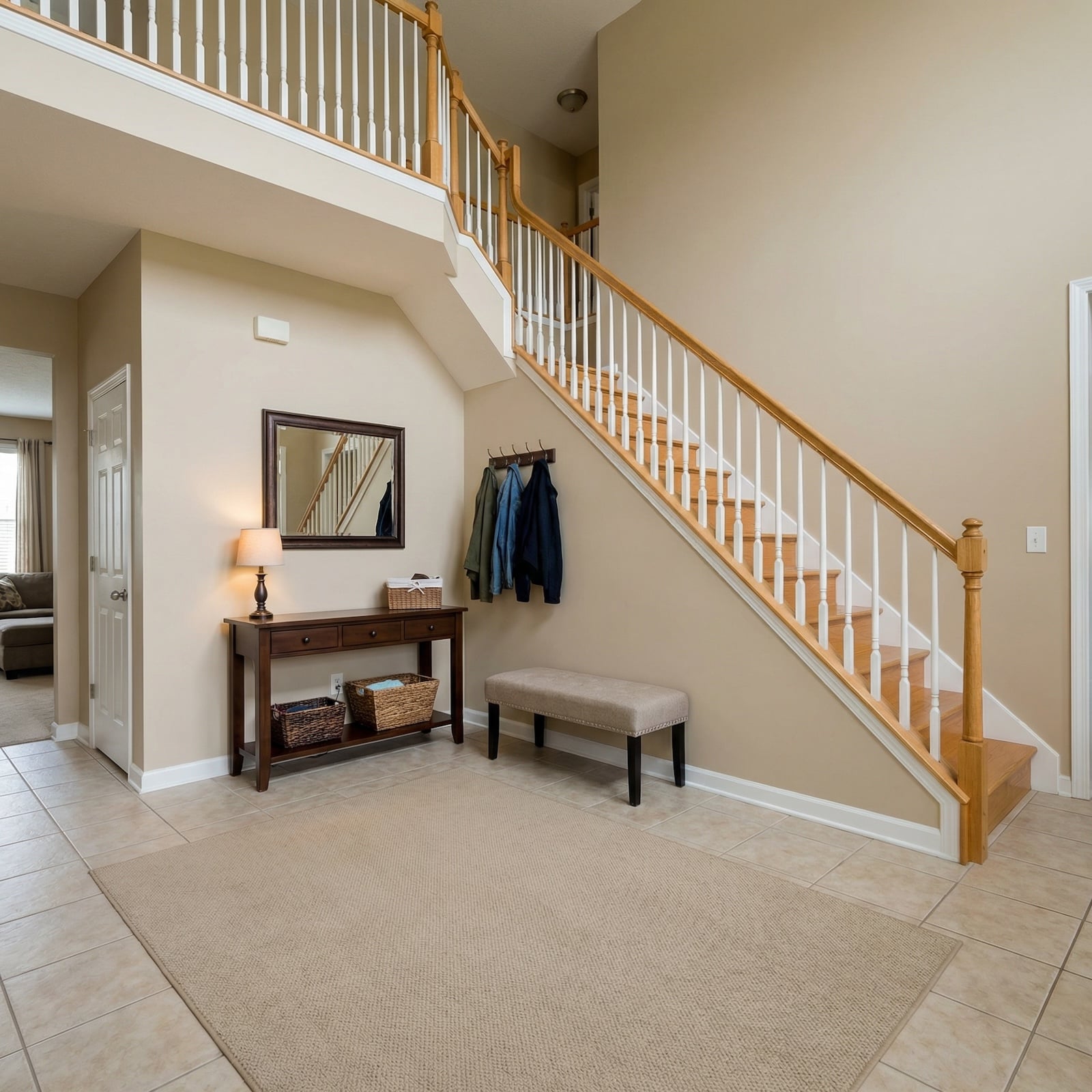
Most builder-grade foyers share the same problem: a bare wall, a single hook, and nowhere logical to put anything. Keys end up on the kitchen counter. Bags pile up by the door. The entry does nothing to help.
The foyers in this collection started in exactly that place and ended up somewhere far more functional. Each one got a dedicated spot for keys, a surface for mail, and some form of storage that actually fits how people leave and re-enter their homes. That shift from chaotic to organized is what separates a foyer that works from one that just exists.
Here are 30 before-and-after foyer makeovers worth studying, each one solving the small daily frustrations that a builder-grade entry never bothered to address.
From Oak Spindles and Beige to Concrete Panels and Floating Steel
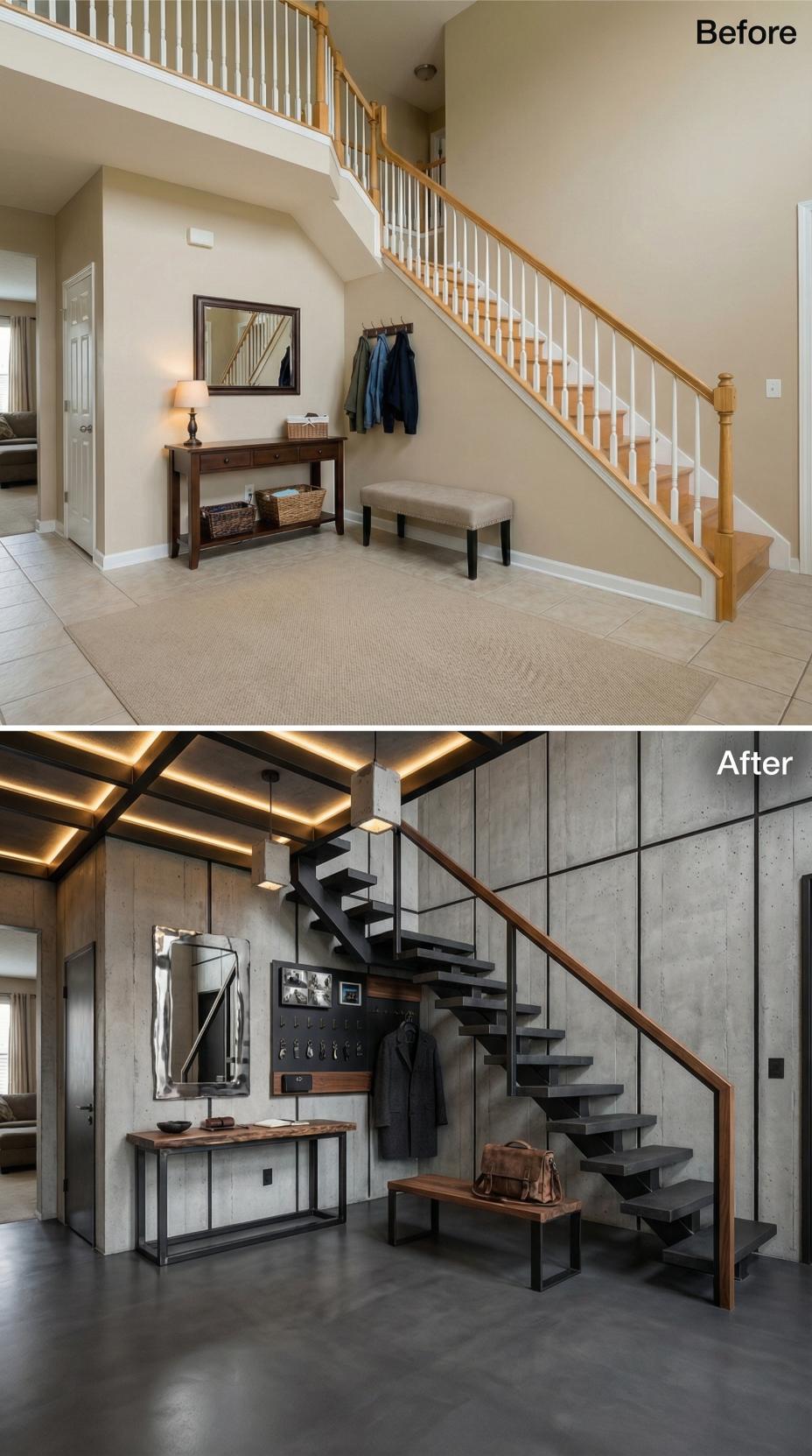
The before foyer leaned hard into builder-grade defaults: honey-toned oak railings, white-painted spindles, beige carpet meeting cream tile, and a dark-stained console table doing its best against blank walls. A coat rack screwed into drywall handled the daily chaos of jackets and bags.
The after gut-replaced nearly every surface. Concrete wall panels in raw gray now run floor to ceiling. A cantilevered steel staircase with open treads replaced the closed-riser wood original, its single walnut handrail the only warm note. LED strips recessed into a coffered black ceiling grid cast amber light downward, and a metal-frame console with a live-edge wood top finally gives keys somewhere to land.
Hunter Green Lacquer, Gold Balusters, and a Sunburst Marble Floor Replace Oak and Beige
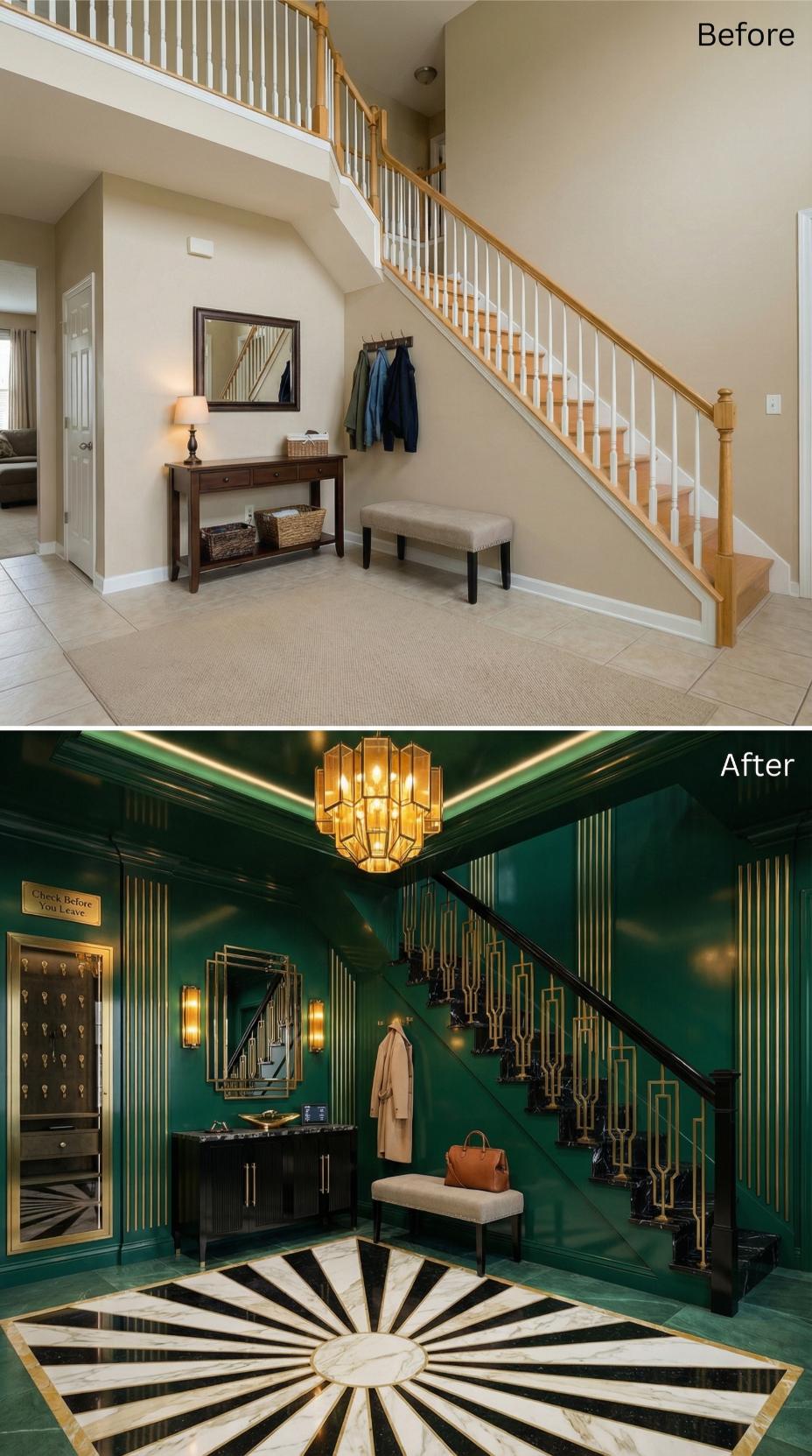
Glossy hunter green lacquer covers every wall surface, framed by vertical gold inlay strips that run floor to ceiling. Black-painted stair treads carry geometric gold metal balusters in a stacked rectangular pattern, replacing the original oak handrail and white spindles entirely. A sunburst medallion in black and cream marble anchors the floor, while an Art Deco chandelier with faceted brass panels hangs overhead. One hook still holds a coat.
Slat Ceiling, Black Steel Balusters, and a Wall Full of Hooks Replace Oak and Beige
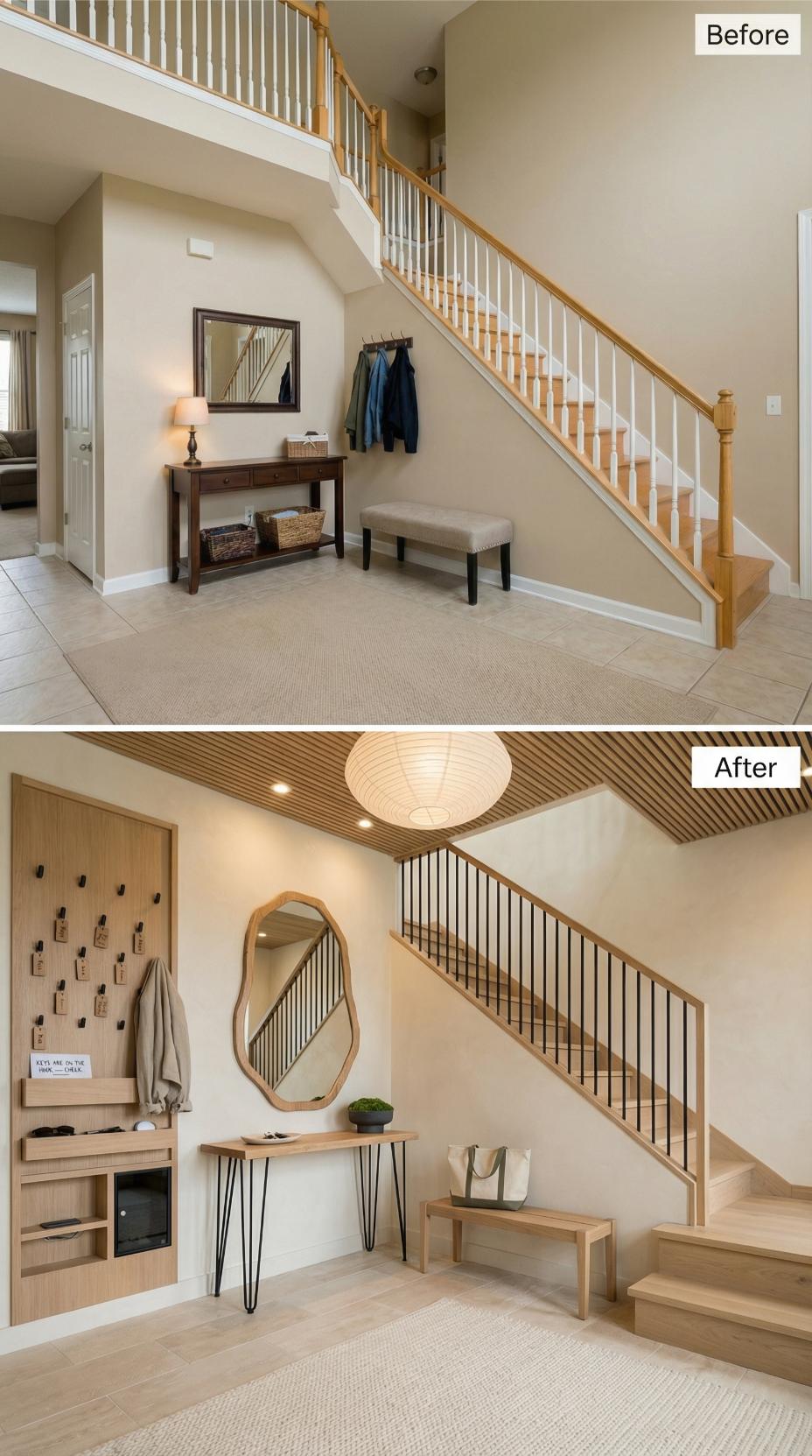
Builder-grade oak handrails and white spindles gave way to light maple stair components paired with flat black steel balusters, while a wood-slat ceiling treatment draws the eye upward and anchors the space below. A paper lantern pendant replaces whatever recessed grid was there before, casting diffused light over an organic-edged mirror in natural wood and a hairpin-leg console table in pale oak.
On the left wall, a full built-in panel in oak veneer holds a grid of matte black hooks, open cubbies, and a small charging shelf. It is the kind of storage system that actually solves the keys problem rather than decorating around it.
Concrete Walls, Cable Balusters, and a Smart Home Panel Replace Oak and Beige
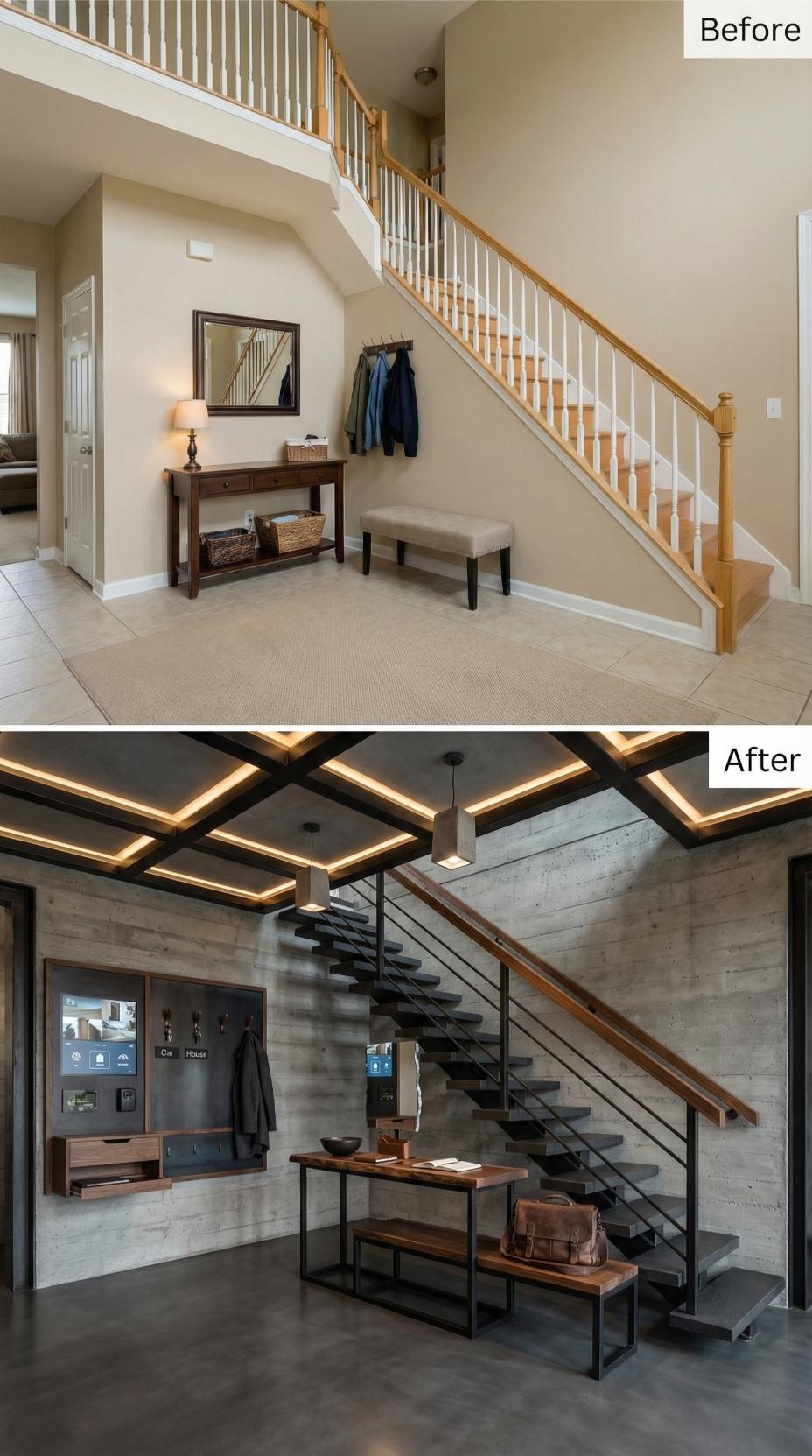
Bare concrete wall panels replace the original beige drywall on every side, and the staircase loses its oak handrail spindles in favor of steel cable tension rods beneath a walnut rail. Open risers on dark metal stringers let light pass through the entire run. A coffered ceiling grid of black steel frames recessed LED strips that wash the room in warm amber.
Below the stairs, a live-edge console on a square steel base holds a leather satchel and a small bowl. Mounted to the left wall, a wood-framed smart home panel with touchscreens, key hooks, and a pull-out drawer handles exactly what the title promises: keys, gone from the counter forever.
Navy Damask Walls, Barley-Twist Balusters, and a Key Cabinet That Solves Everything
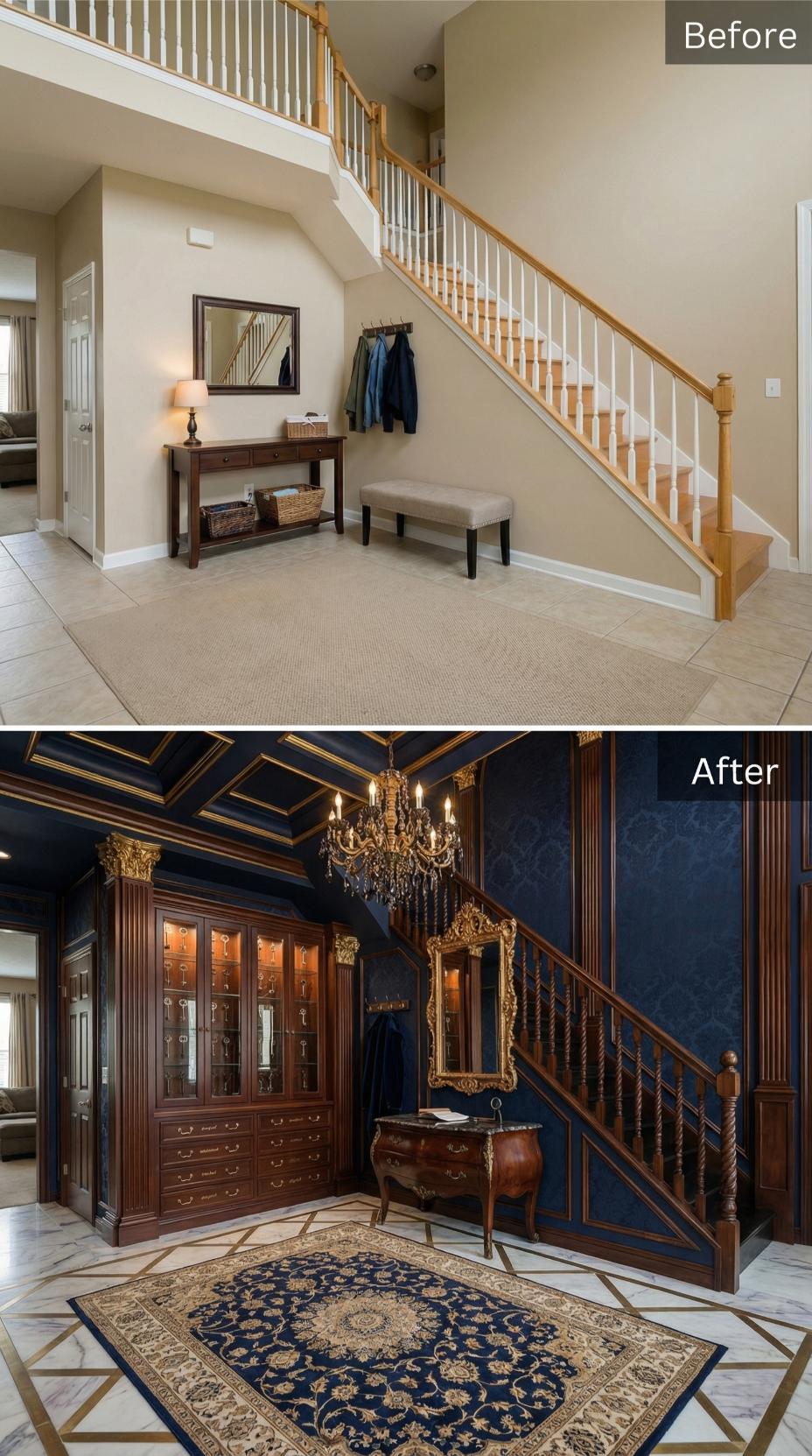
Dark navy damask wallpaper lines the walls floor to ceiling, anchored by coffered millwork with gold-leaf trim. The staircase swaps oak spindles for barley-twist mahogany balusters with a turned newel post. A bombe chest in marquetry veneer replaces the console table, topped with marble. The floor shifts from beige tile to inlaid marble with brass geometric banding. A bronze chandelier with candle-style arms hangs above an ornate gilt mirror. The large display cabinet with brass hardware stores keys in individual labeled slots, which is the detail everyone who loses their keys will clock first.
The Psychology Behind This: Rooms built around dark, saturated color tend to trigger a psychological shift toward slower, more deliberate behavior, which is exactly what an entryway designed to help people locate their keys actually needs. The visual weight of navy and gold signals formality, and formality, research suggests, nudges people to pause rather than rush. That pause is what keeps keys from vanishing into the abyss of a jacket pocket.
Terracotta Plaster, Exposed Ceiling Beams, and an Arched Niche That Solves the Key Problem
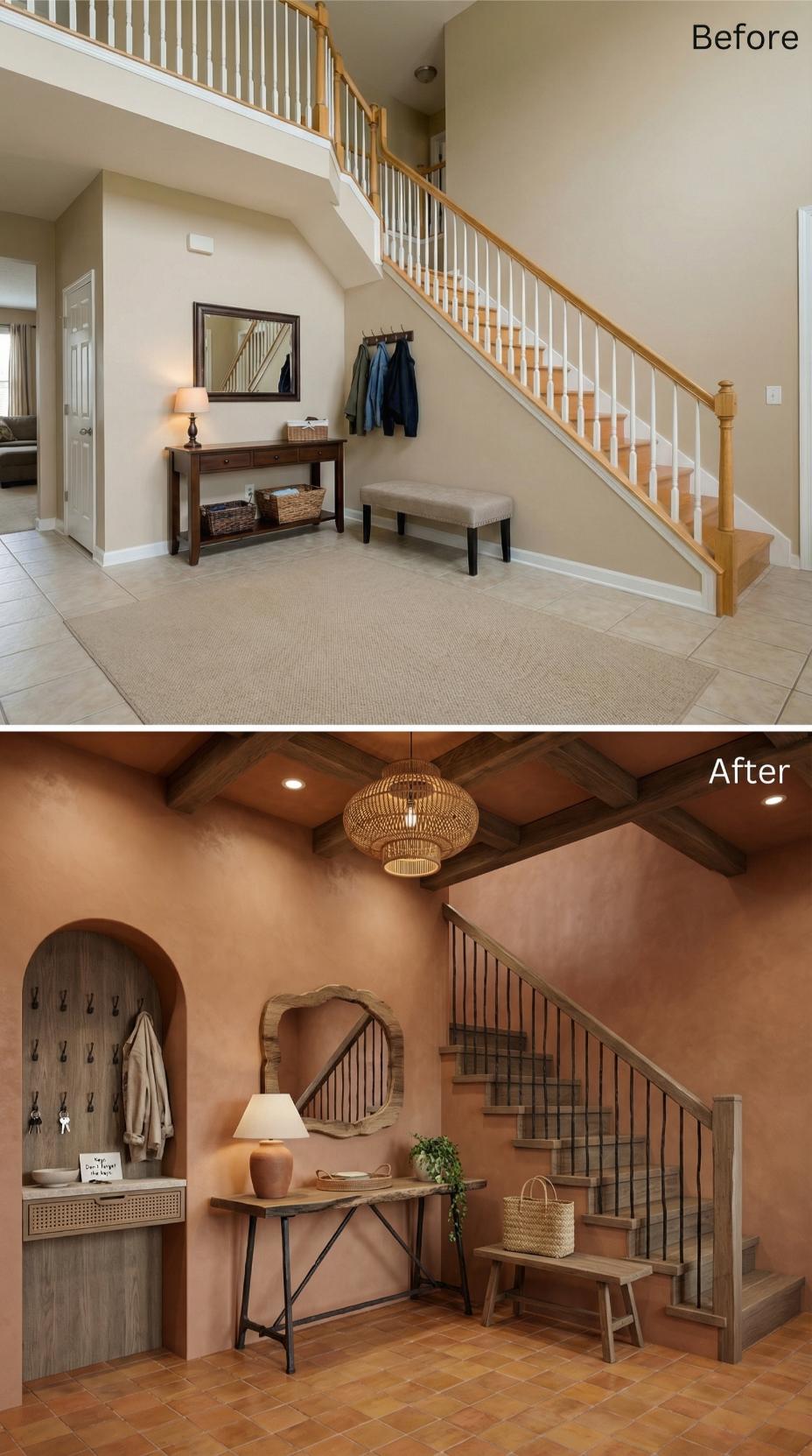
Warm terracotta plaster walls replace the original beige paint, and the shift changes the entire mood of arrival. Exposed wood ceiling beams run in a crossed pattern overhead, anchoring a rattan pendant that casts amber light across the space. Terracotta floor tiles laid in a grid reinforce the color story underfoot.
The arched niche cut into the left wall does real work: iron hooks hold coats, and a built-in cane-front console sits below, providing a dedicated drop zone for keys, bags, and everything that used to disappear. A live-edge mirror leans above a metal-frame console table beside it. The stair railing, now dark iron with raw wood newel posts, reads as intentional rather than stock.
Designer’s Secret: Venetian-style plaster applied over drywall creates the depth visible on these walls without requiring masonry construction. Two coats burnished with a steel trowel produce that layered, slightly reflective finish. The material also regulates humidity slightly, which helps in entry spaces exposed to outdoor air.
Burnt Orange Lacquer, Walnut Paneling, and Sputnik Pendants Fix a Forgettable Entry
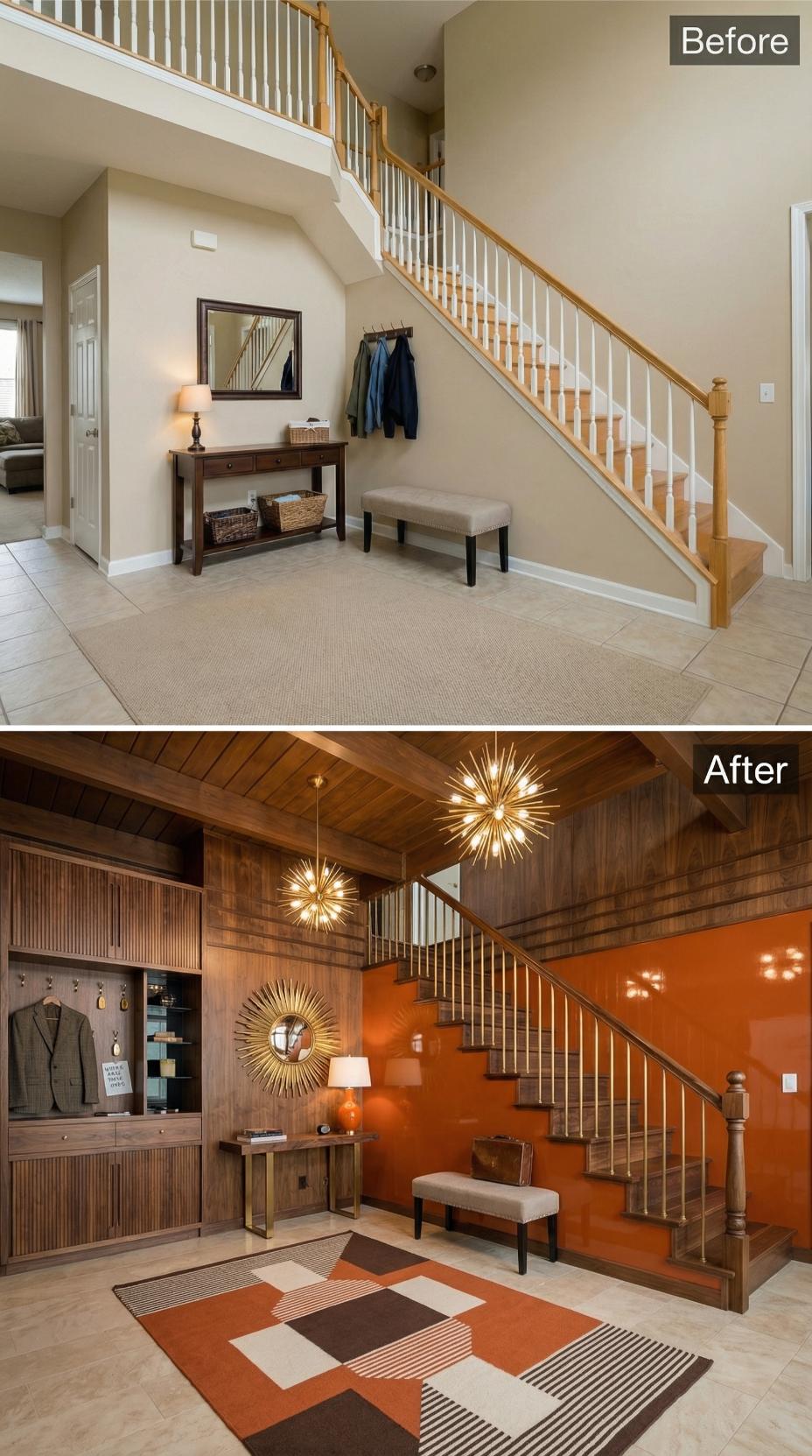
Lacquered orange walls replace the original beige, and walnut-veneered paneling wraps the adjacent wall floor to ceiling, housing open shelving, tambour-door cabinets, and coat hooks within a single built-in system. Two gold sputnik chandeliers drop from a wood-planked ceiling. A sunburst mirror anchors the console below.
In The Details: Tambour doors, the ribbed sliding panels visible on the lower cabinet faces, originated in French furniture making and use thin wood slats bonded to a fabric backing. They require no swing clearance, which makes them practical in tight entry corridors where a hinged door would interrupt foot traffic.
Gothic architecture proves it has plenty to say about foyer organization, too.
Crimson Plaster, Gothic Arches, and a Key Cabinet Labeled for Every Situation
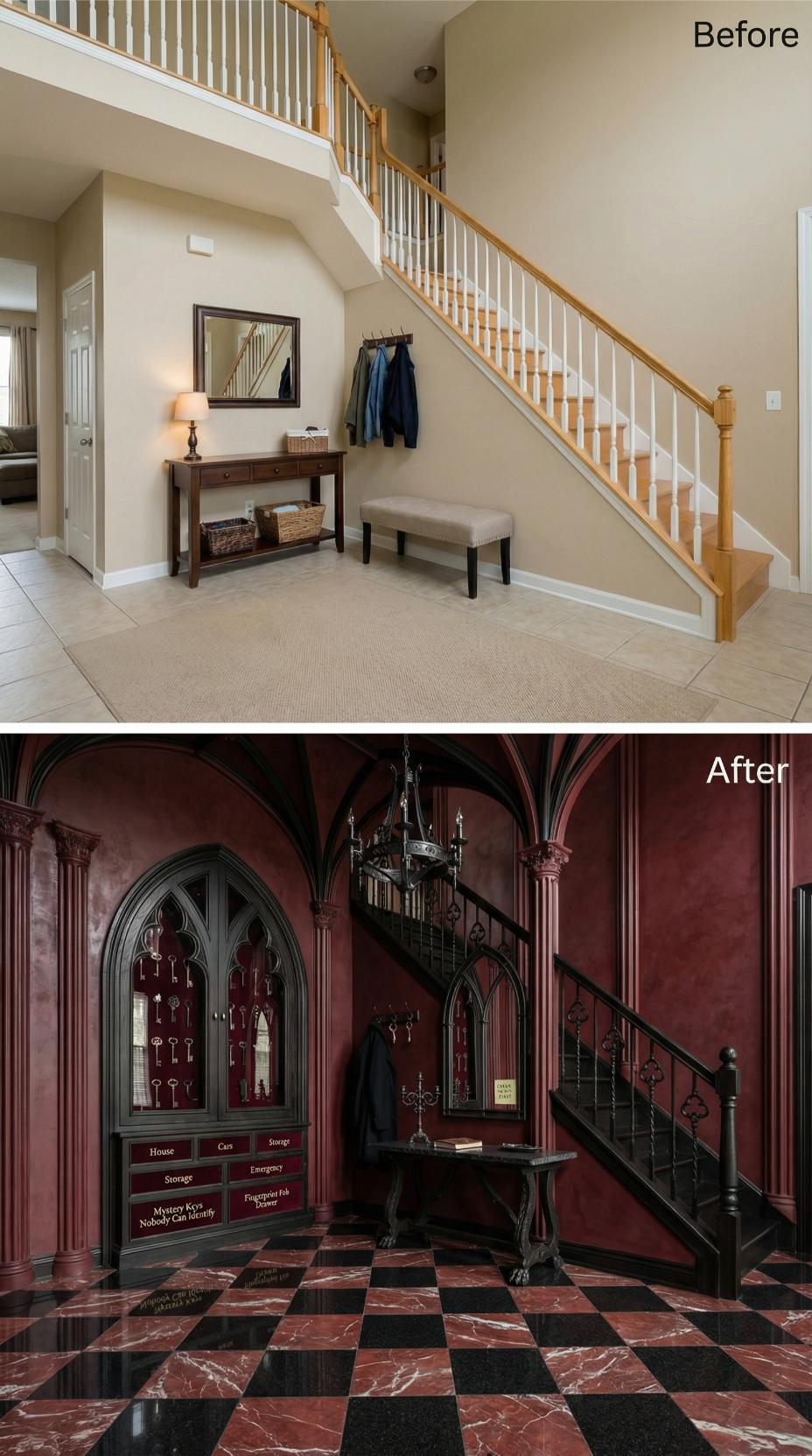
Where beige drywall and oak spindles once defined this entry, deep burgundy Venetian plaster now coats every surface, burnished to a low sheen that catches light without reflecting it. The checkered floor pairs red-veined marble tiles with polished black granite in a pattern that anchors the room with unmistakable intention. Wrought iron balusters with gothic tracery detail replace the original white-painted wood rail entirely.
The key cabinet is the functional centerpiece. Labeled drawers include categories like “House,” “Cars,” “Storage,” “Emergency,” and, with apparent self-awareness, “Mystery Keys Nobody Can Identify.” Pointed arch mullions divide the cabinet’s glass panels, echoing the larger arched doorway beside it. A candelabra-style console table sits below a smaller gothic mirror, and an iron chandelier hung on a decorative chain completes the vertical composition above the staircase landing.
Shiplap, Hairpin Legs, and a Whiteboard Niche for the Chronically Keyless
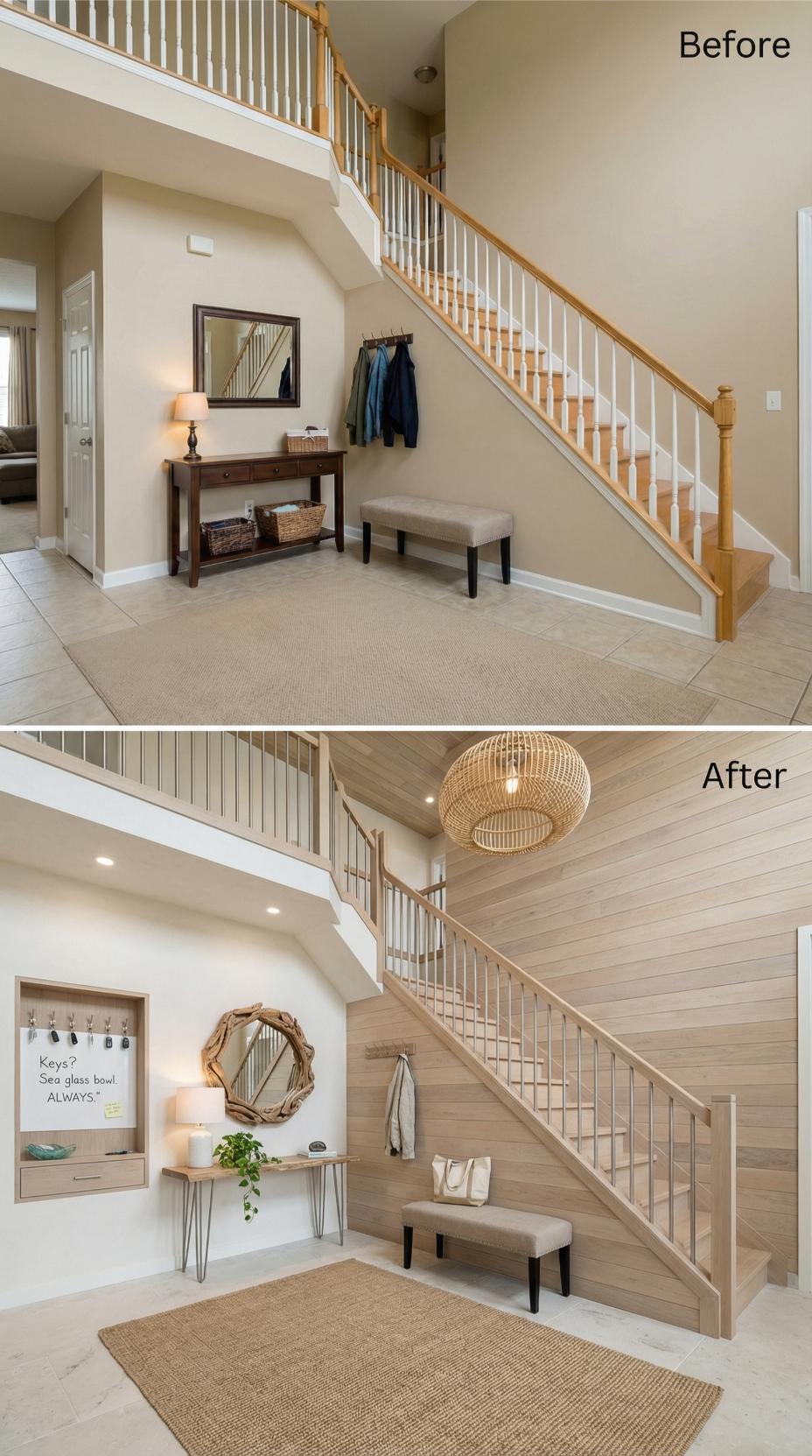
Horizontal shiplap in a whitewashed oak finish covers the wall behind the staircase, replacing what was a flat expanse of builder beige. The railing system swaps honey oak handrails and turned spindles for square-profile lumber with painted metal balusters at wider spacing, which opens the visual weight considerably. A woven rattan pendant with an exposed filament bulb hangs where recessed cans now supplement the light plan.
The console switches from a dark mahogany piece to a hairpin-leg table in raw steel. Beside it, a built-in niche holds a whiteboard panel and hooks at eye level, with a shallow drawer cabinet below. The handwritten note visible on the board reads “Keys? Sea glass bowl. ALWAYS.” A jute area rug anchors the floor zone, and a driftwood-frame mirror replaces the rectangular espresso version from before.
Worth Knowing: Shiplap boards installed horizontally on a staircase accent wall need to be scribed carefully around each stringer angle to avoid visible gaps at the rake line. Most installers cut each board individually at the stair pitch rather than running them full-length, which is slower but produces a cleaner result where the wood meets the stringer trim.
Gold Leaf, Crystal Candles, and Wainscoting Fix a Foyer That Had Nothing to Say
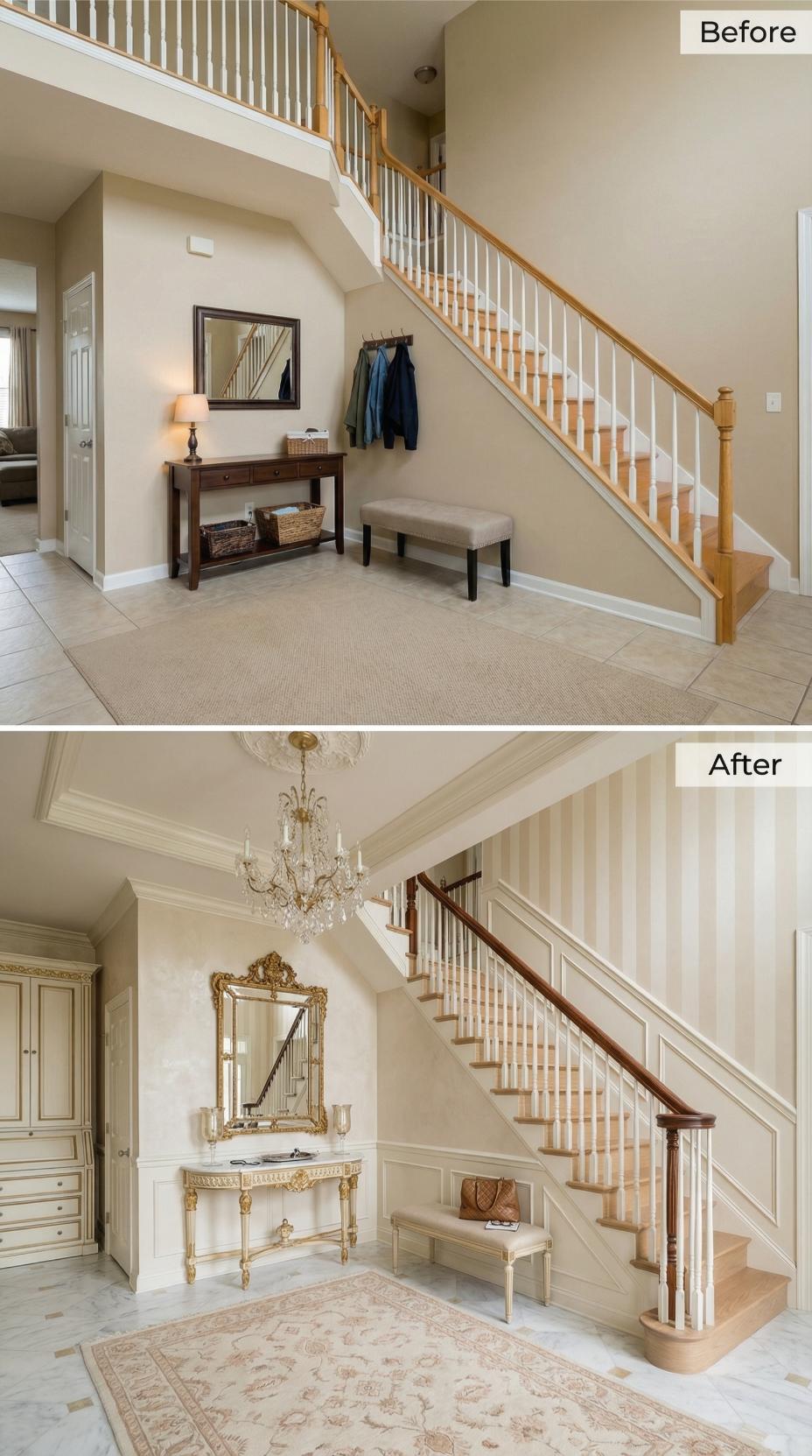
Ornate gilded console table legs, a crystal candelabra chandelier with a plaster ceiling medallion, and raised-panel wainscoting painted in warm ivory replace what was once oak handrail, white spindles, and a dark wood console from a big-box catalog. The stair runner disappeared entirely, leaving natural oak treads exposed beneath a handrail stained in dark walnut. Striped wallpaper above the wainscot adds vertical structure without requiring architectural changes.
The entryway bench switched from a simple upholstered rectangle to a French Louis XVI-style seat with carved legs and a cushion in cream fabric. Marble tile already existed in the original floor plan, but the renovation used it as the foundation for everything that followed rather than a detail buried under carpet edges.
Fun Fact: Crystal and brass chandeliers like the one installed here use candelabra-base bulbs, typically E12 sockets, which max out around 60 watts per arm and produce noticeably warmer color temperatures than standard A19 bulbs. Choosing bulbs in the 2200K to 2700K range keeps the gold finishes in the room from reading yellow rather than rich.
Forest Green Walls, Craftsman Millwork, and Encaustic Tile for the Perpetually Keyless
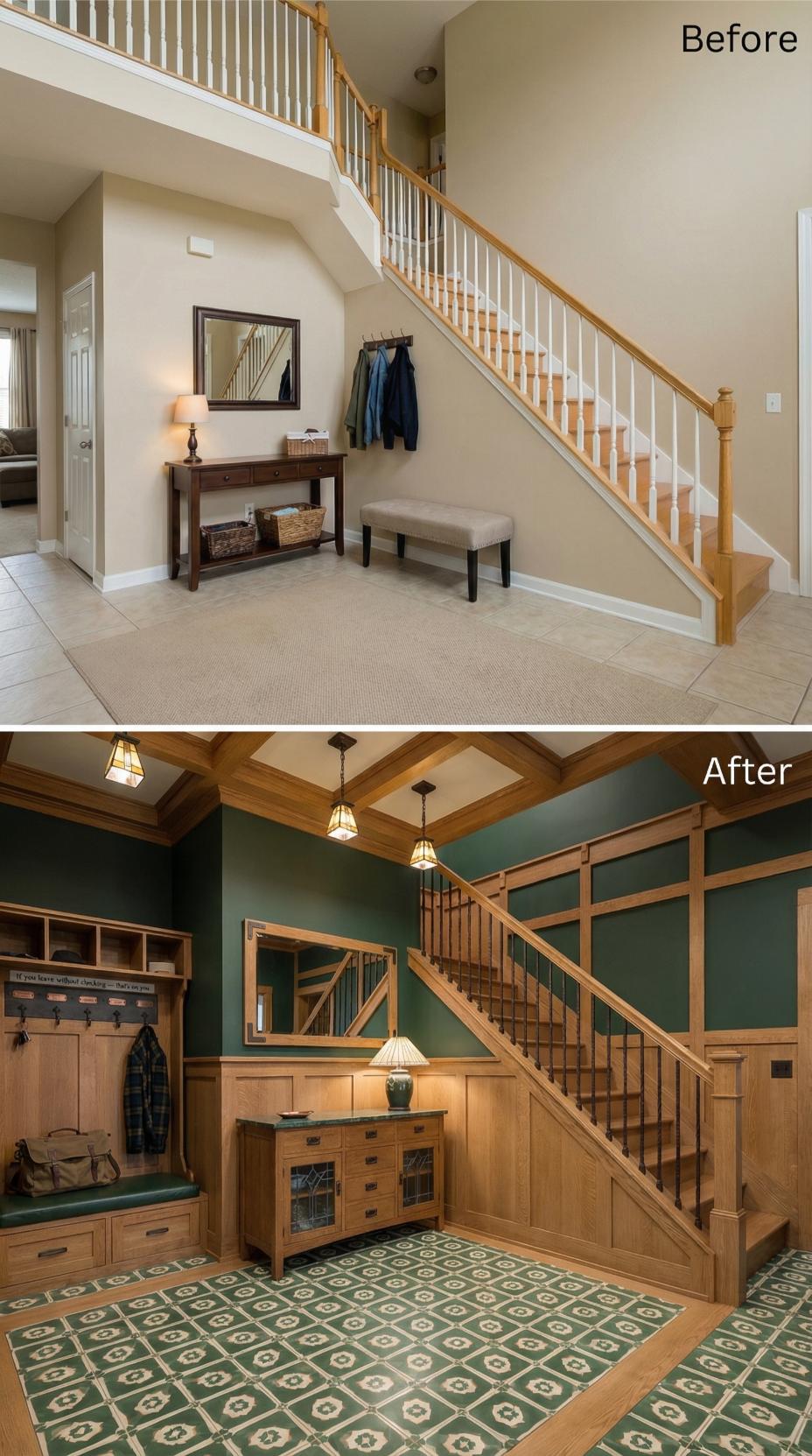
Quartersawn oak does more organizational work in this foyer than most mudrooms manage with an entire wall of cabinetry.
The after photo shows deep forest green walls framed by wide oak picture-frame molding, a detail that reads as wainscoting without requiring a full paneled installation. Pendant lanterns with amber art glass hang from a coffered ceiling, casting warm pools over a built-in mudroom unit with open upper cubbies, a bench with dark green leather cushioning, and lower drawers on full-extension hardware. An oak credenza with leaded glass cabinet doors sits beneath a reclaimed-style mirror framed in the same wood species.
On the floor, encaustic cement tile in a repeating geometric pattern coordinates the green palette from wall to ground. The staircase rail swaps white-painted balusters for wrought iron verticals set between oak newel posts with square craftsman caps. Every hook, cubby, and drawer pull has a designated purpose, which is exactly the kind of spatial logic that ends the morning key search.
Slate Blue Lacquer, Gold Moulding, and a Crystal Chandelier Replace Oak and Beige
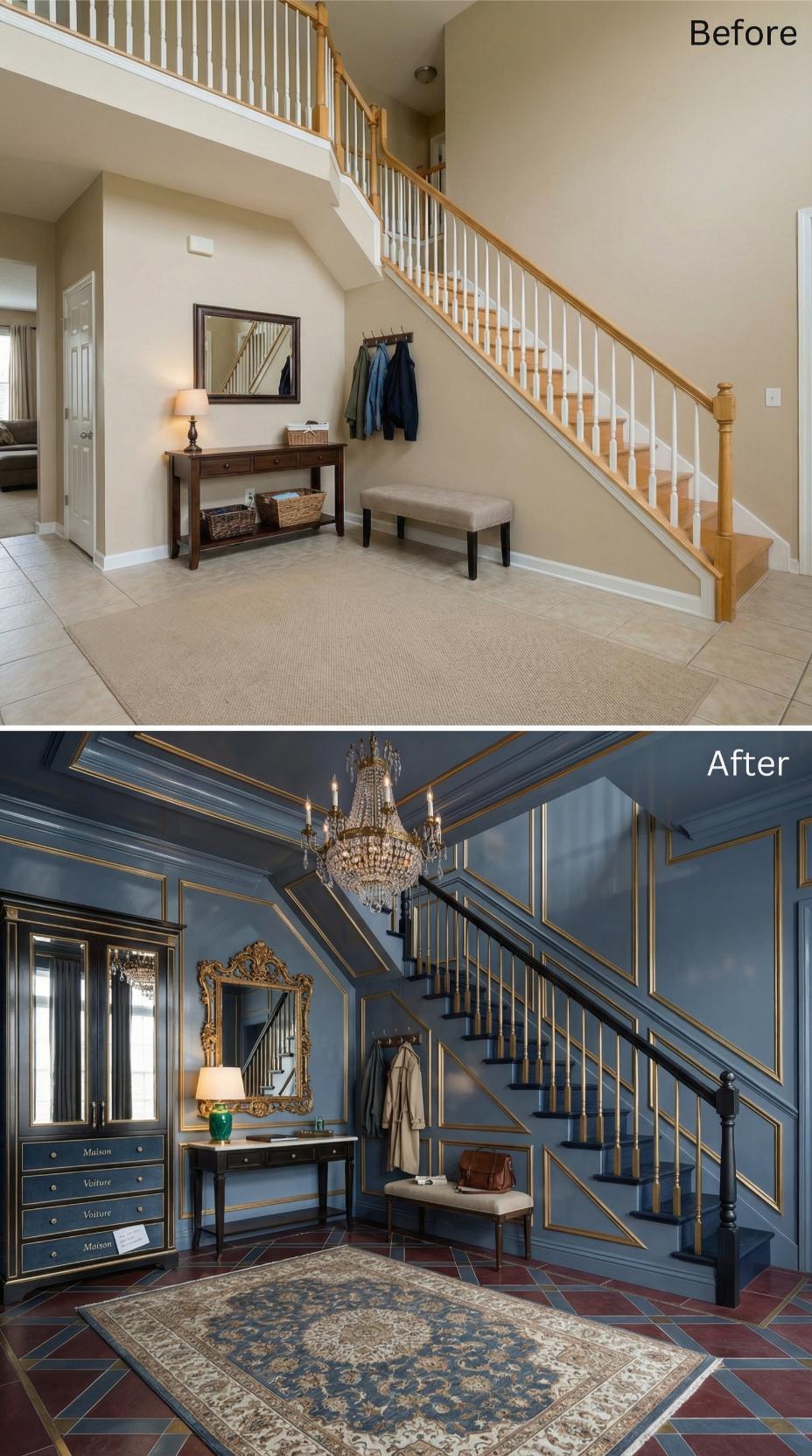
Slate blue covers every surface here, walls, stair risers, balusters, and ceiling trim, creating an envelope that reads as intentional rather than accidental. The stair rail and spindles are painted black, and gold leaf lines each panel moulding in tight rectangular frames that climb all the way up the staircase wall.
A crystal basket chandelier with brass arms anchors the center of the foyer. Below it, a geometric terracotta and slate tile floor grounds the space, topped with a traditional Persian rug in ivory and blue. The console table holds a green ceramic lamp, and a gilt-framed mirror with carved scrollwork hangs above it.
Why Panel Moulding Works Differently on a Stair Wall
Standard panel moulding installed on a flat wall follows a simple grid, but a staircase wall requires each rectangular frame to be cut at a matching rake angle so the pattern follows the stringer rather than fighting it. On this wall, the gold-painted moulding tracks the diagonal of the stair in progressively angled panels, which demands precise mitered returns at every corner. Getting that angle consistent across multiple panels is where most DIY attempts fail, and why the results here read as professional work rather than an approximation.
Wood Panel Walls, LED Cove Lighting, and Labeled Bowls for Every Key That Goes Missing
🔥 Would you like to save this?
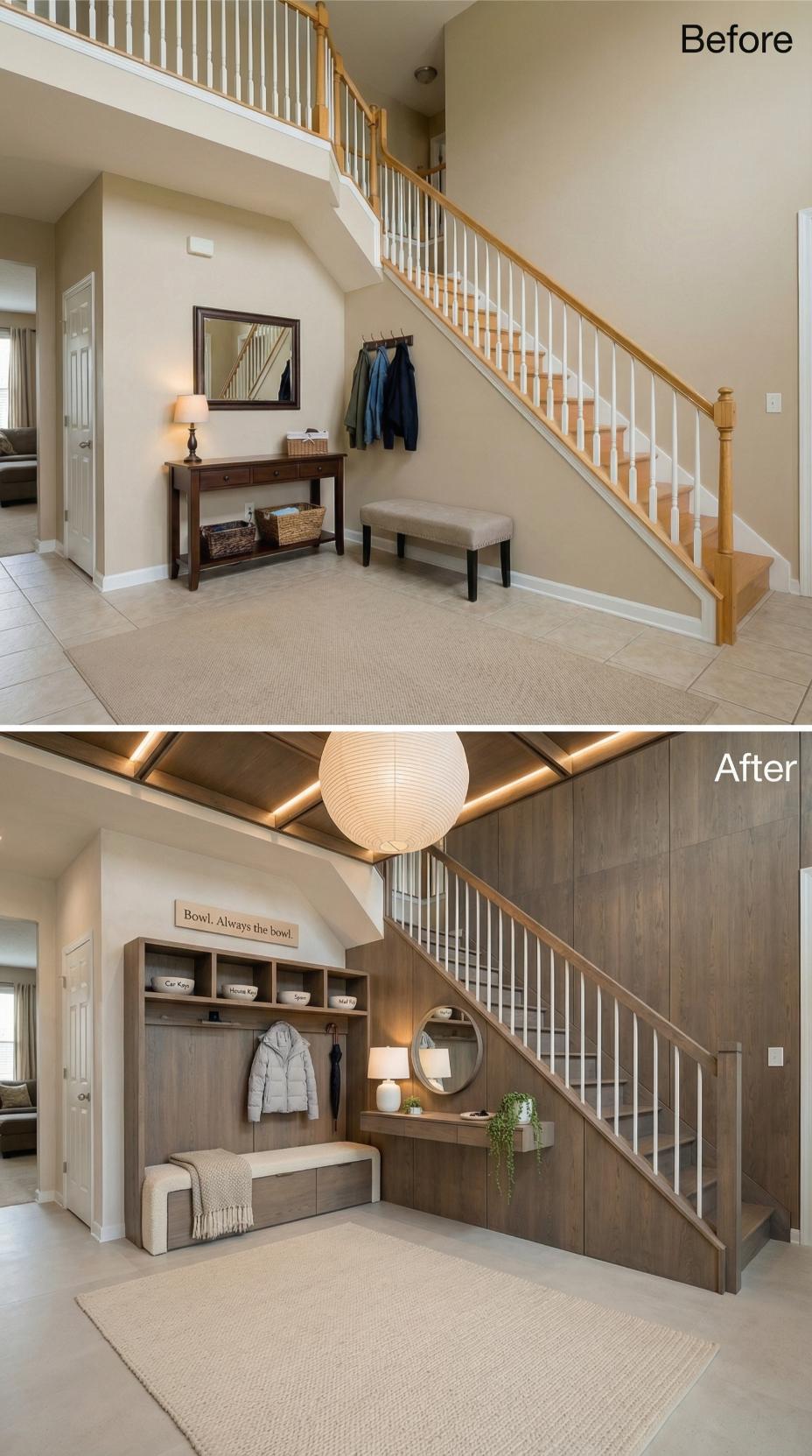
Flat-panel wood cladding in a gray-brown finish covers the entire stair wall and wraps the built-in mudroom unit, replacing the original oak railing and beige paint with something that reads closer to a furniture piece than a renovation. LED strip lighting runs along the ceiling’s angled soffit, casting a low amber line that outlines the staircase geometry without a single visible fixture.
The built-in unit combines open cubbies labeled Car Keys, House Keys, Spare, and Mail at the top with a hanging zone below and a storage bench upholstered in off-white fabric. A round mirror with a wood frame and a floating console holding a ceramic lamp and trailing pothos sit beneath the stairs. The paper lantern pendant anchors the ceiling and softens what would otherwise read as a very wood-heavy space.
Budget Tip: Flat-panel MDF wrapped in wood-look laminate costs a fraction of solid wood paneling and produces nearly identical results on a staircase accent wall. Many home improvement stores sell peel-and-stick wood-grain sheets wide enough to cover large sections without seams. Labeling open cubbies with printed or handwritten tags costs almost nothing and adds more daily function than any drawer organizer on the market.
Saffron Walls, Moroccan Lanterns, and a Mirror Gallery for the Chronically Keyless
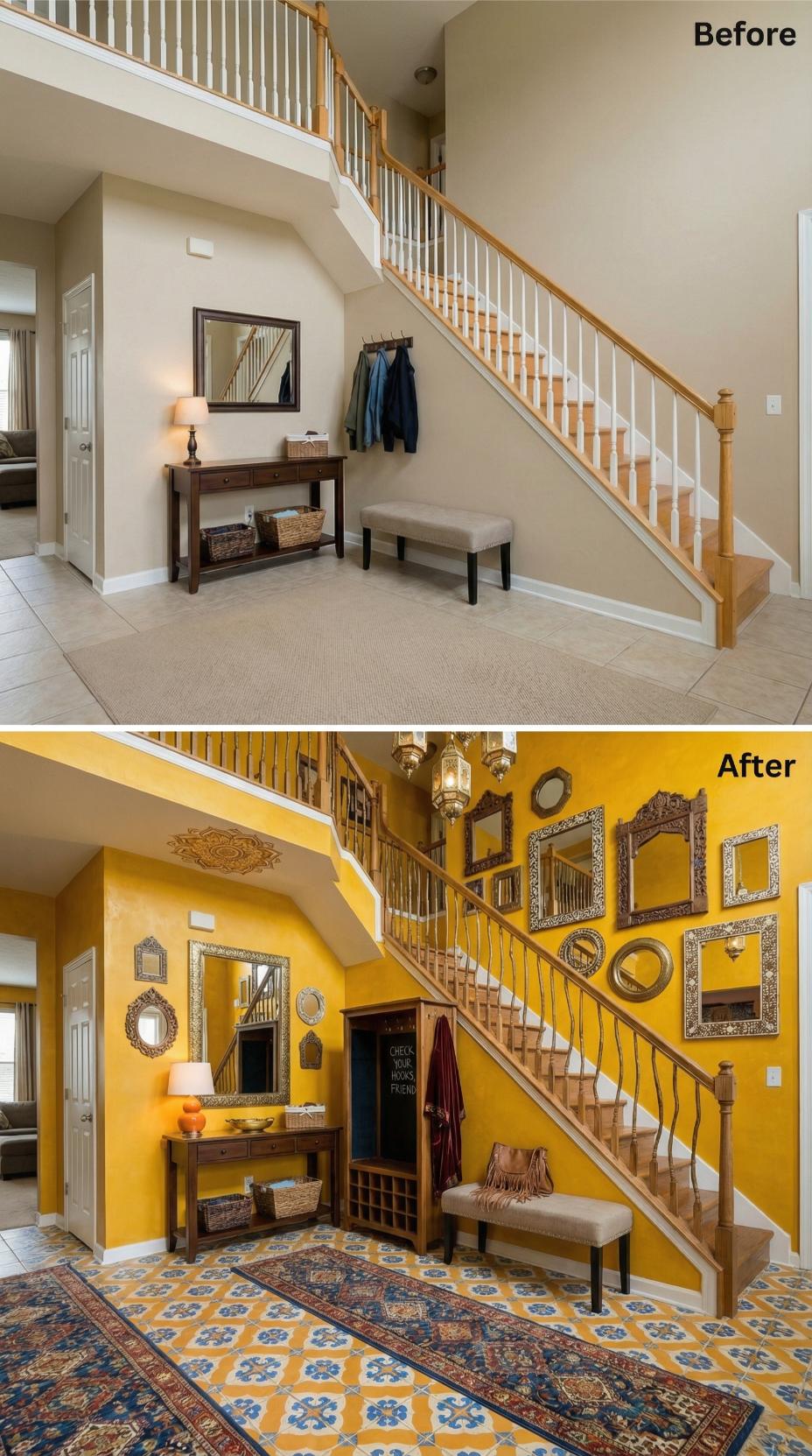
Builder-grade beige got painted over entirely in a deep saffron yellow, and the effect reads closer to turmeric than to anything found in a paint chip display. Gold-framed mirrors in at least eight different shapes and sizes climb the staircase wall in an arrangement that fills the vertical height without symmetry or repetition. A freestanding coat cabinet with a chalkboard panel on its door reads “CHECK YOUR HOOKS FRIEND,” which handles the key problem directly.
Moroccan brass lanterns hang from the upper landing, casting warm-toned light down the stairwell. The floor gets an encaustic-style tile in saffron, cobalt, and ivory laid in a medallion repeat that ties the rug pattern into the architecture. Underfoot, an area rug in deep red and navy anchors the console table zone. The lamp base switched from black to glazed orange, and the console now holds a shallow brass bowl rather than woven baskets.
Why a chalkboard cabinet door solves more than just key storage
The freestanding cabinet positioned at the corner of the staircase uses its door face as a communication surface, which adds a layer of daily function that a standard hook rail cannot provide. Chalkboard paint applied directly to a cabinet door costs almost nothing and turns a piece of furniture into a rotating reminder system for whoever walks in last. In an entry where multiple people share the same hooks, a labeled surface reduces the back-and-forth of “did you grab mine by mistake” that sends people back inside searching.
Black Treads, White Walls, and a Floating Shelf Replace Oak and Builder Beige
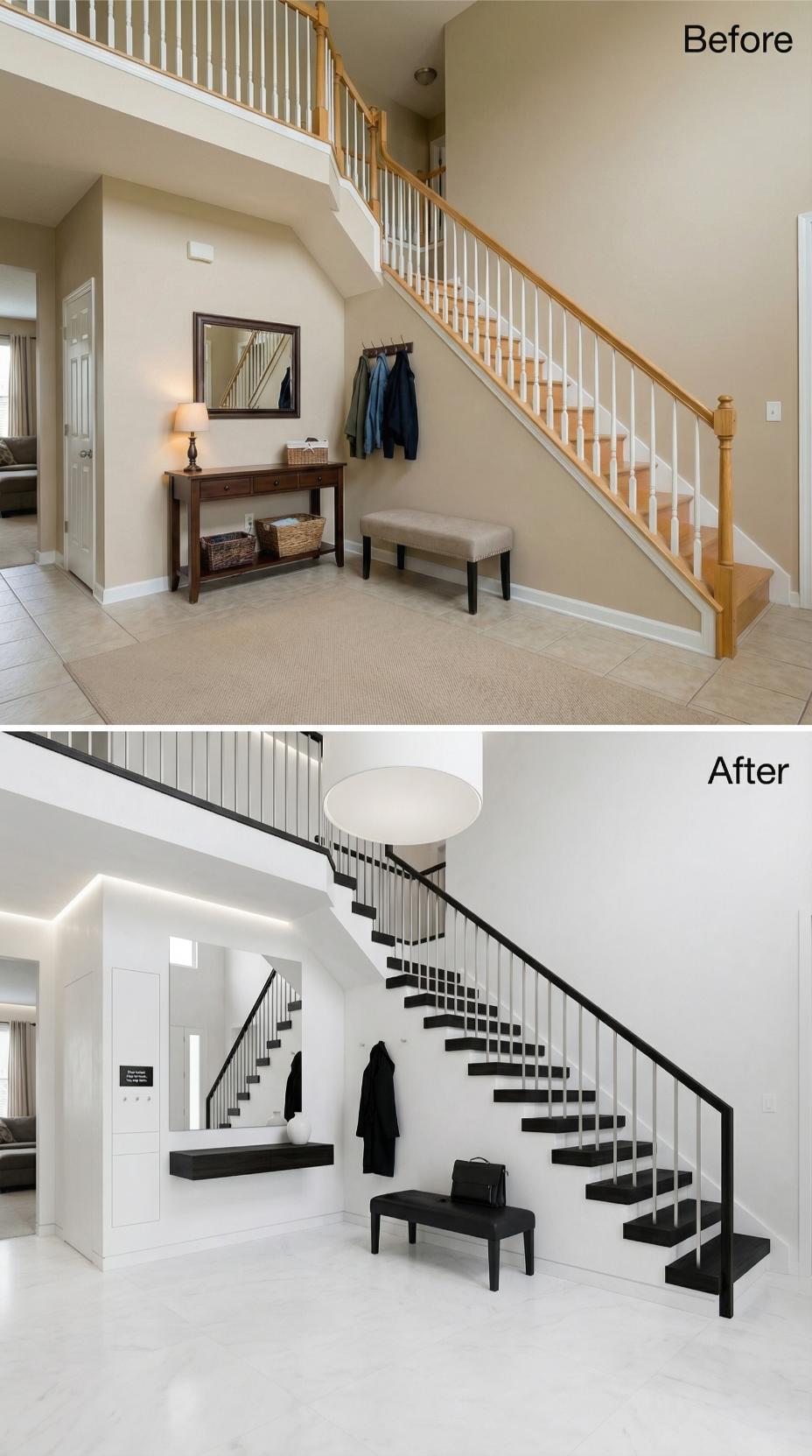
Painted beige walls and oak handrails with turned white balusters gave way to a monochrome scheme built around black-stained treads, a matte black steel handrail, and slim vertical metal spindles with a brushed finish. The stairs themselves appear to float, with open risers cutting visual weight from what was once a closed, heavy staircase. White walls, a large globe pendant, and LED strip lighting tucked under the upper landing create layered illumination without a single table lamp.
A low black floating shelf replaces the dark walnut console, and wall-mounted coat hooks stay in exactly the same position but now sit against shiplap-style white paneling. A black upholstered bench and a small framed mirror with integrated smart controls anchor the drop zone. Keys have nowhere to get lost.
By The Numbers: Open-riser staircases require treads with a minimum depth of ten inches under most residential building codes to meet nosing projection requirements. The black-stained treads visible here appear to use a hardwood species, likely maple or ash, finished with a pigmented oil or water-based polyurethane. Switching from carpet to hard stair treads typically adds between two and five years before the next required refinishing cycle.
Pink Silk Walls, Gold Rope Balusters, and a Crystal Chandelier for the Perpetually Keyless
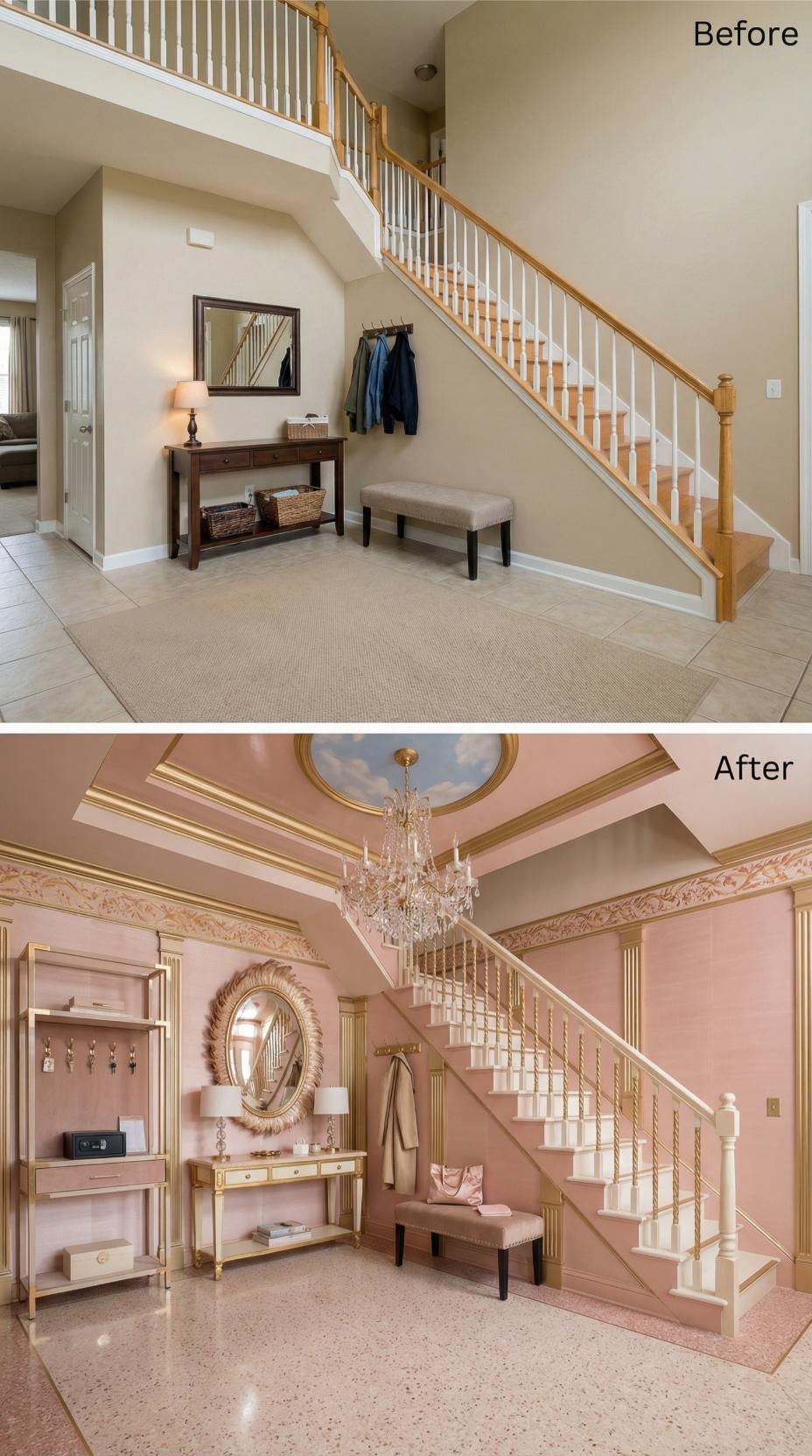
Dusty rose silk-finish paint covers every wall, and gilt rope-twist balusters replace the original oak handrail. A crystal chandelier with candelabra arms hangs from a coffered ceiling medallion painted with a trompe l’oeil sky. Crown moulding receives a full gold-leaf treatment.
A mirrored console with brass hardware sits below a sunburst mirror, and an open gold shelving unit to the left holds hooks, drawers, and a small lockbox, so keys actually land somewhere specific. Pink terrazzo flooring finishes the space at ground level.
Try This: Rope-twist balusters are turned on a lathe from solid wood, then painted or gilded, and they cost roughly two to four times more than standard square spindles. Installing them on an existing staircase requires removing each old baluster individually and drilling new angled holes into the treads. The visual payoff is significant enough that many designers reserve them for staircases visible from the front door.
Reclaimed Wood, Iron Balusters, and a Key Wall Replace Oak and Builder Beige
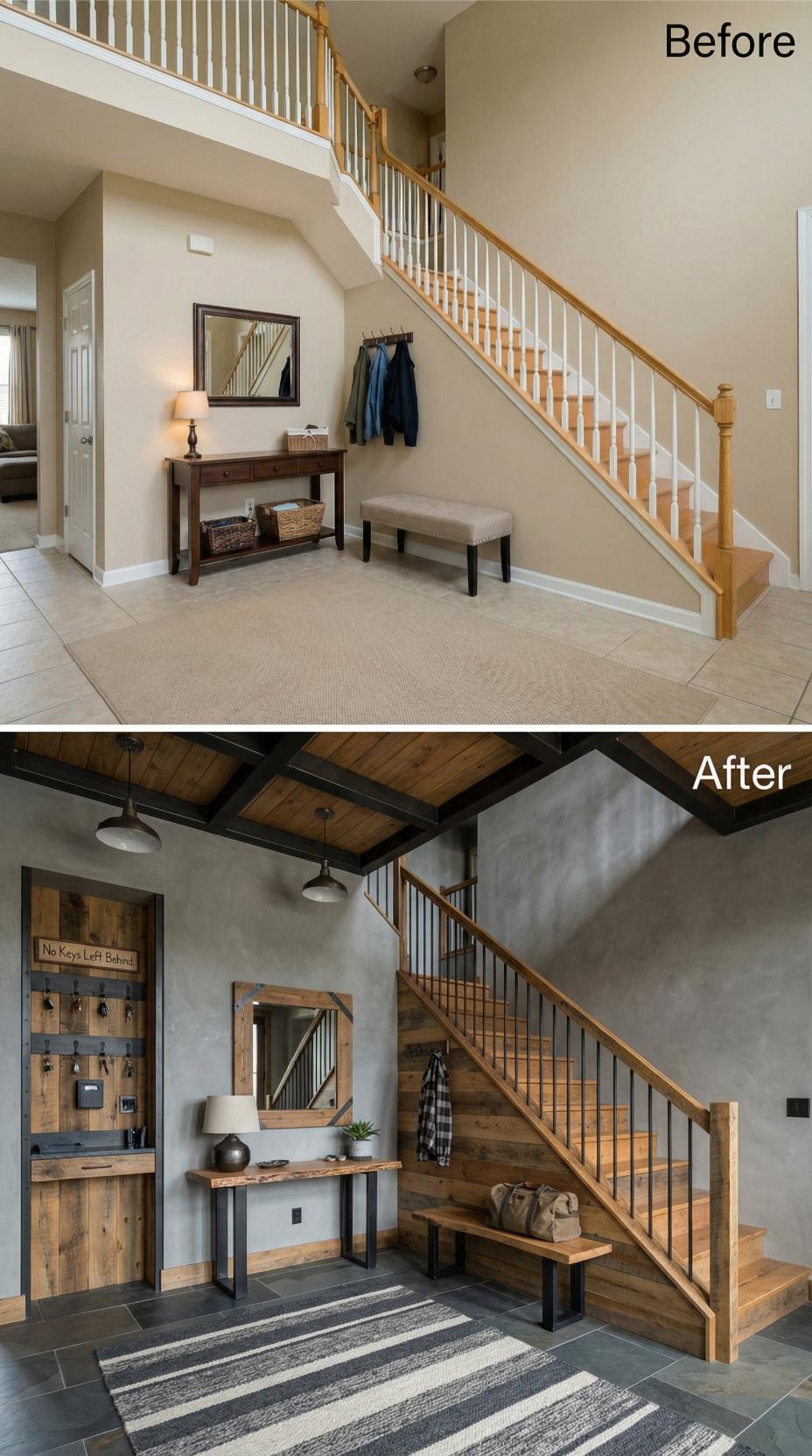
Raw-edge reclaimed planks run floor to ceiling on the staircase wall, and the same wood carries across a live-edge console table and a built-in key station framed in steel angle iron. That station does real work: individual hooks, a small lockbox, and a handmade sign reading “No Keys Left Behind” all confirm this renovation had a specific problem to solve.
Venetian plaster in a cool gray replaces the original beige drywall, and exposed black steel box beams cross a wood-plank ceiling overhead. Slate floor tile in a large-format running bond swaps out the old travertine. Iron balusters replace the white-painted spindles, keeping the natural wood handrail but giving the staircase an entirely different character.
Ask Yourself: Before committing to a wall-mounted key station, count how many keys your household actually uses daily, then double it. A station sized too small gets abandoned within weeks, and the keys end up on the counter anyway.
Glossy Red Lacquer, Marble Treads, and Chrome Balusters Replace Oak and Builder Beige
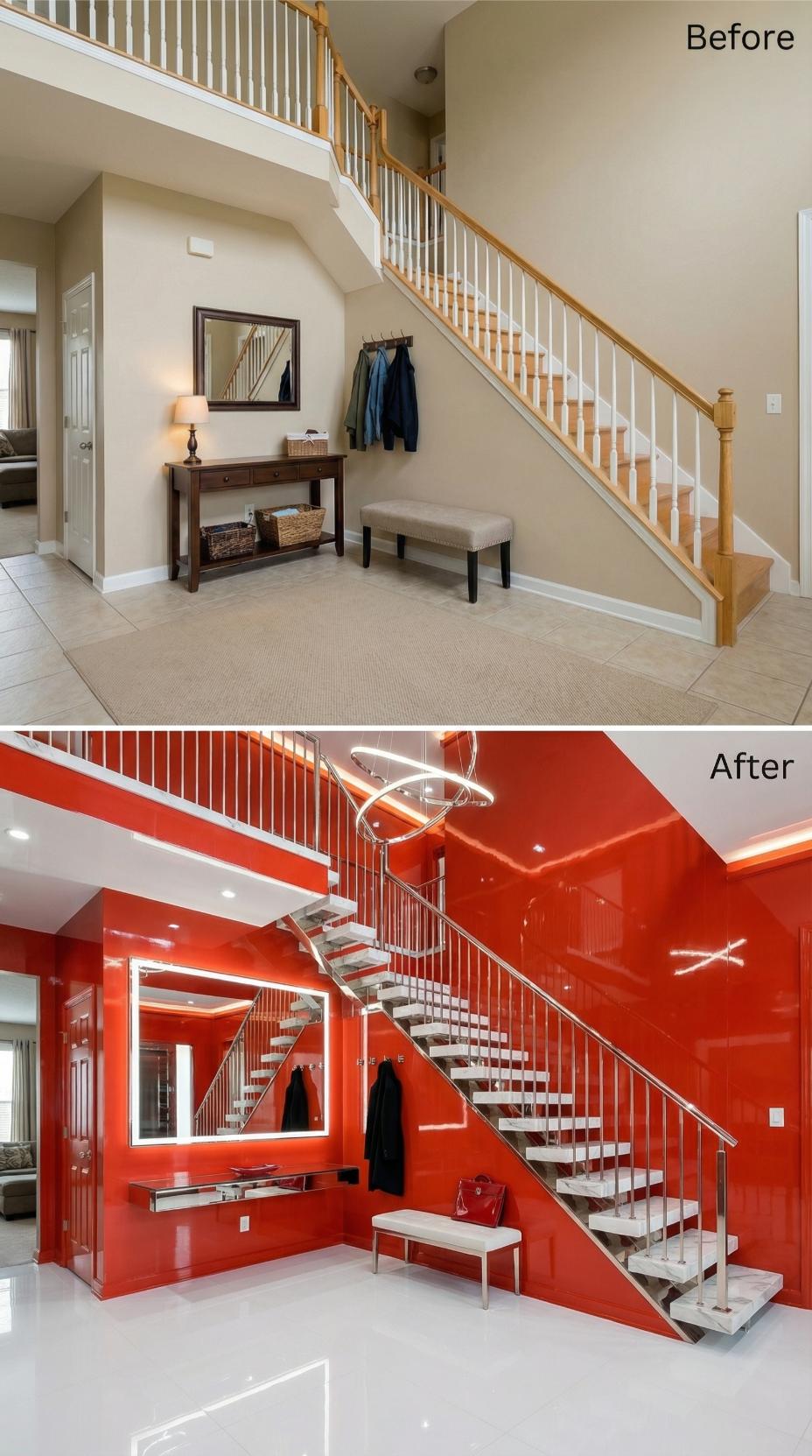
Red high-gloss lacquer covers every wall surface floor to ceiling, including the ceiling itself, creating a reflective shell that reads almost like automotive paint. The floating staircase uses white marble treads with no risers, supported by a central steel stringer, with chrome rod balusters running the full height of the rail.
A backlit rectangular mirror replaces the traditional framed version, and the console below it is a glass shelf cantilevered directly from the wall with no visible bracket. The white bench carries over from the original layout. A sculptural ring pendant with integrated LED strip lighting hangs mid-stair where the ceiling height peaks. The floor shifts to large-format white polished tile, which doubles the red reflection downward.
Material Matters: Chrome rod balusters like the ones installed here are typically welded or mechanically fastened to a steel top rail rather than mortised into wood, which means the entire railing assembly can be removed and replaced as a single unit without disturbing the treads. Marble treads require a minimum thickness of one and a quarter inches to resist cracking under point loads on an open-riser staircase.
Plum Walls, a Living Green Wall, and Globe Pendants Solve the Key Problem for Good
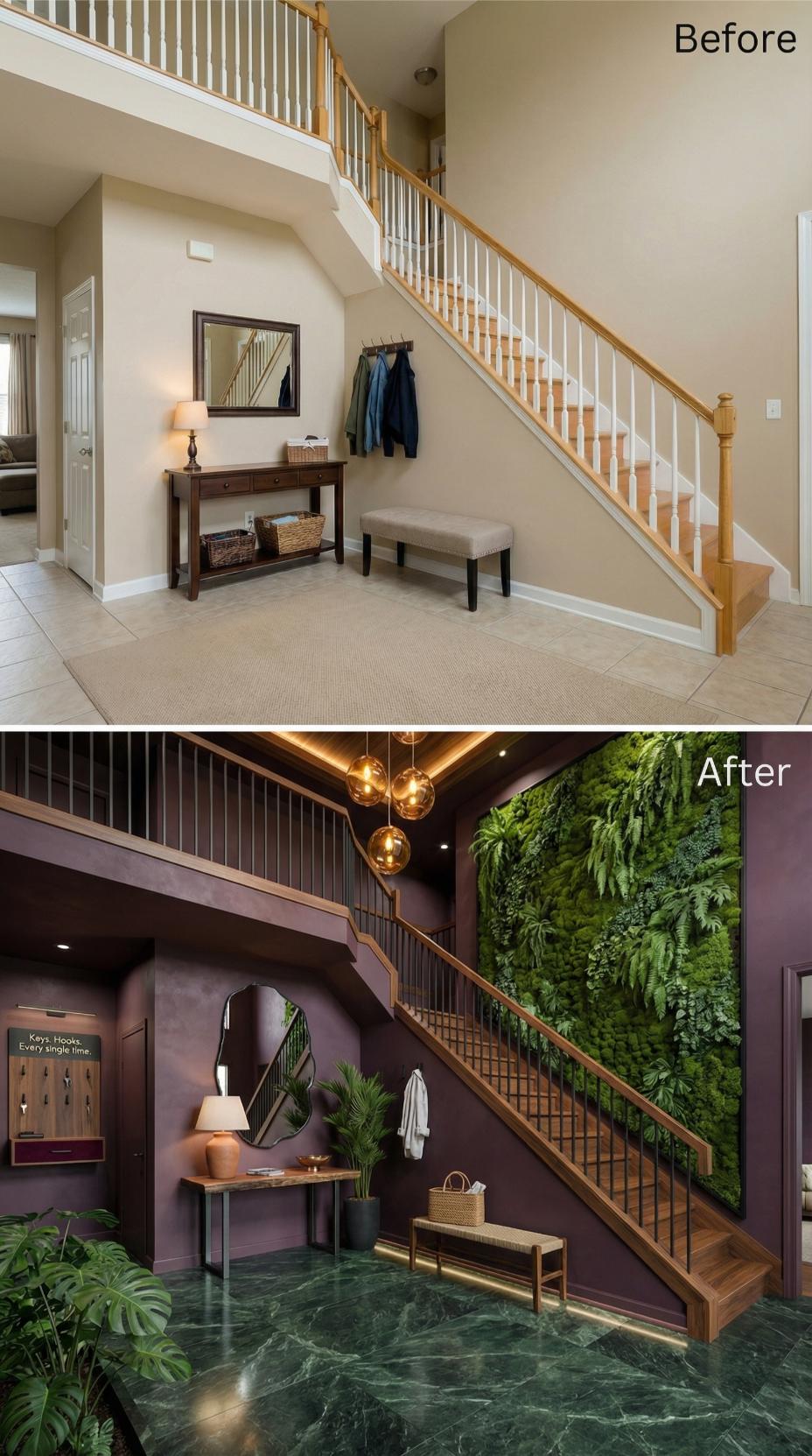
Aubergine plaster walls absorb the light rather than reflect it, which gives this foyer a sense of enclosure that beige never could. Walnut-stained stair treads and a blackened metal baluster system replace the original oak-and-white assembly. Three hammered brass globe pendants hang from a cove-lit ceiling, casting warm pools across a green marble floor with heavy veining throughout.
A floor-to-ceiling living plant wall runs the full height of the staircase side, mixing ferns, moss, and broad-leaf varieties in dense vertical layers. Under the stairs, a narrow metal console holds a ceramic lamp beside a key station mounted flush to the plaster. A slatted wood bench sits directly below the coat hook, making the drop-zone instinct almost automatic.
Walnut-stained stair treads and a blackened metal baluster system replace the original oak-and-white assembly.
Teal Walls, Mondrian Lockers, and a Scrolling LED Sign Replace Oak and Beige
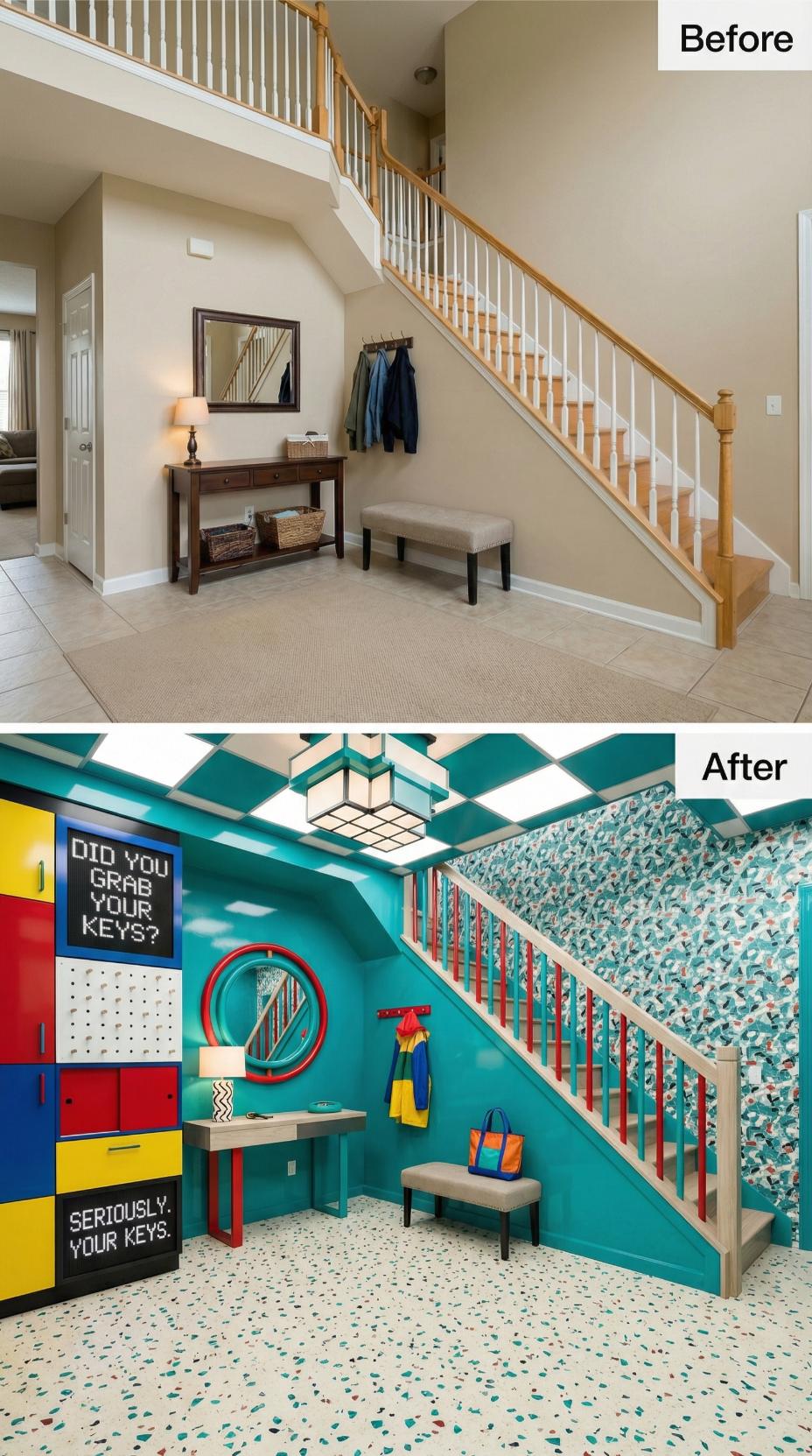
Teal-painted walls, red baluster accents, and terrazzo flooring displace every trace of builder beige, anchored by a Mondrian-style locker unit in primary red, yellow, and blue.
Common Mistake: Painting stair balusters two colors, natural wood uprights paired with red-painted lower sections here, requires careful masking at each joint or the overlap line will read as sloppy from the landing above. Most people tape only the horizontal rail and forget that diagonal stringers create angled bleed points where paint wicks under the tape. Pressing tape firmly along the full length of each joint before applying paint prevents the soft edge that makes painted balusters look unfinished.
Celestial Black and Gold Swallows a Beige Foyer Whole
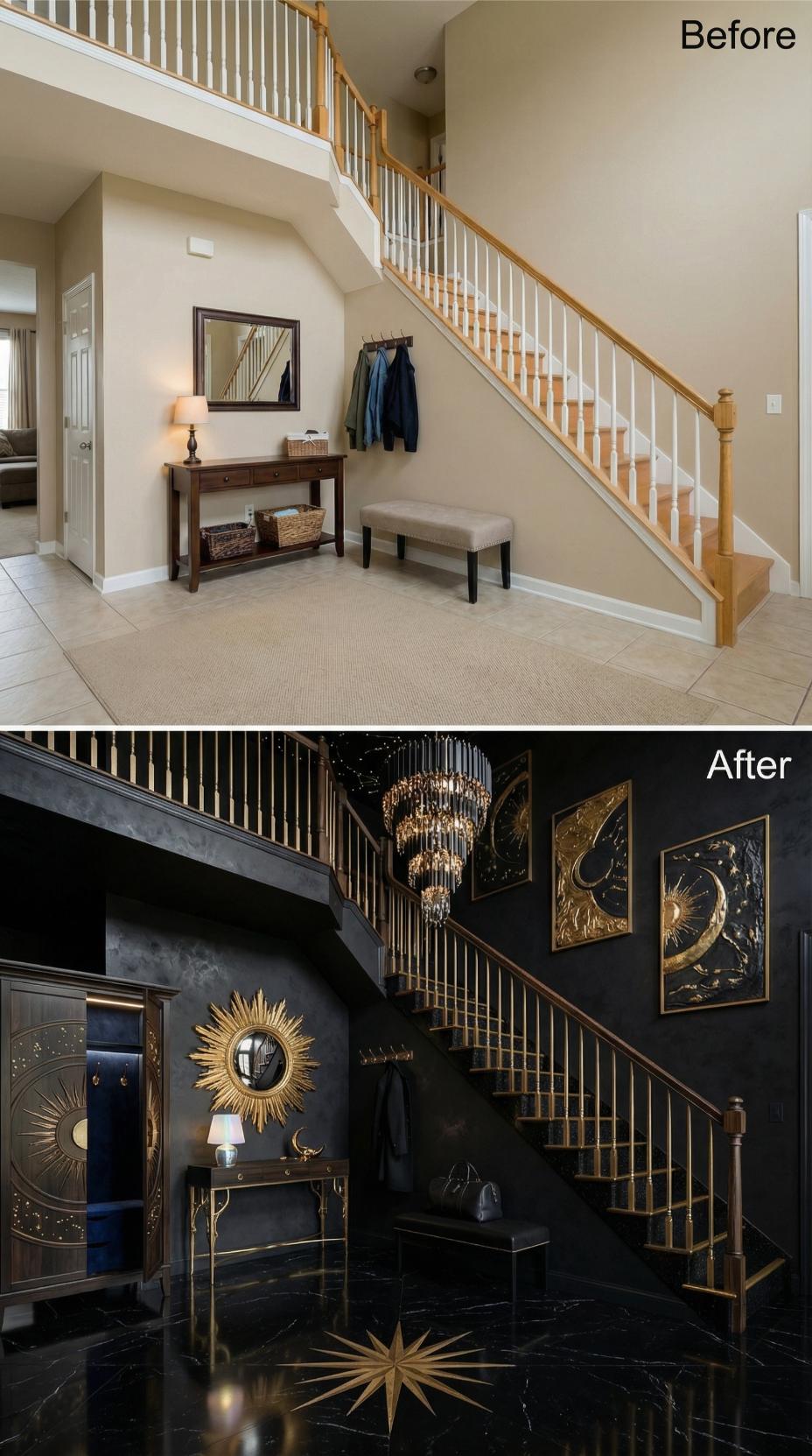
Matte black walls finished with a weathered plaster texture replace the original greige paint, and black-veined marble flooring takes over where beige tile sat before. A sunburst mirror in gilded metal anchors the entry console, which trades the previous dark-stained wood piece for a brass-legged table with celestial detailing. Framed relief panels depicting moons and suns in raised gold line the staircase wall, while a tiered crystal chandelier with brass fittings drops dramatically through the double-height void. The oak handrail and white balusters are now painted black with brass spindles throughout.
Color Story: Black absorbs light rather than reflecting it, which means artificial sources do more perceptual work in a dark foyer than in any pale-walled space. Positioning a chandelier directly above the entry path, as done here, concentrates that light exactly where someone stops to search for keys. Gold-toned metal nearby catches and scatters the beam, creating enough ambient glow to read labels on a key hook without a separate task light.
Sage Plaster Walls, Ginkgo Balusters, and Mosaic Tile Replace Oak and Builder Beige
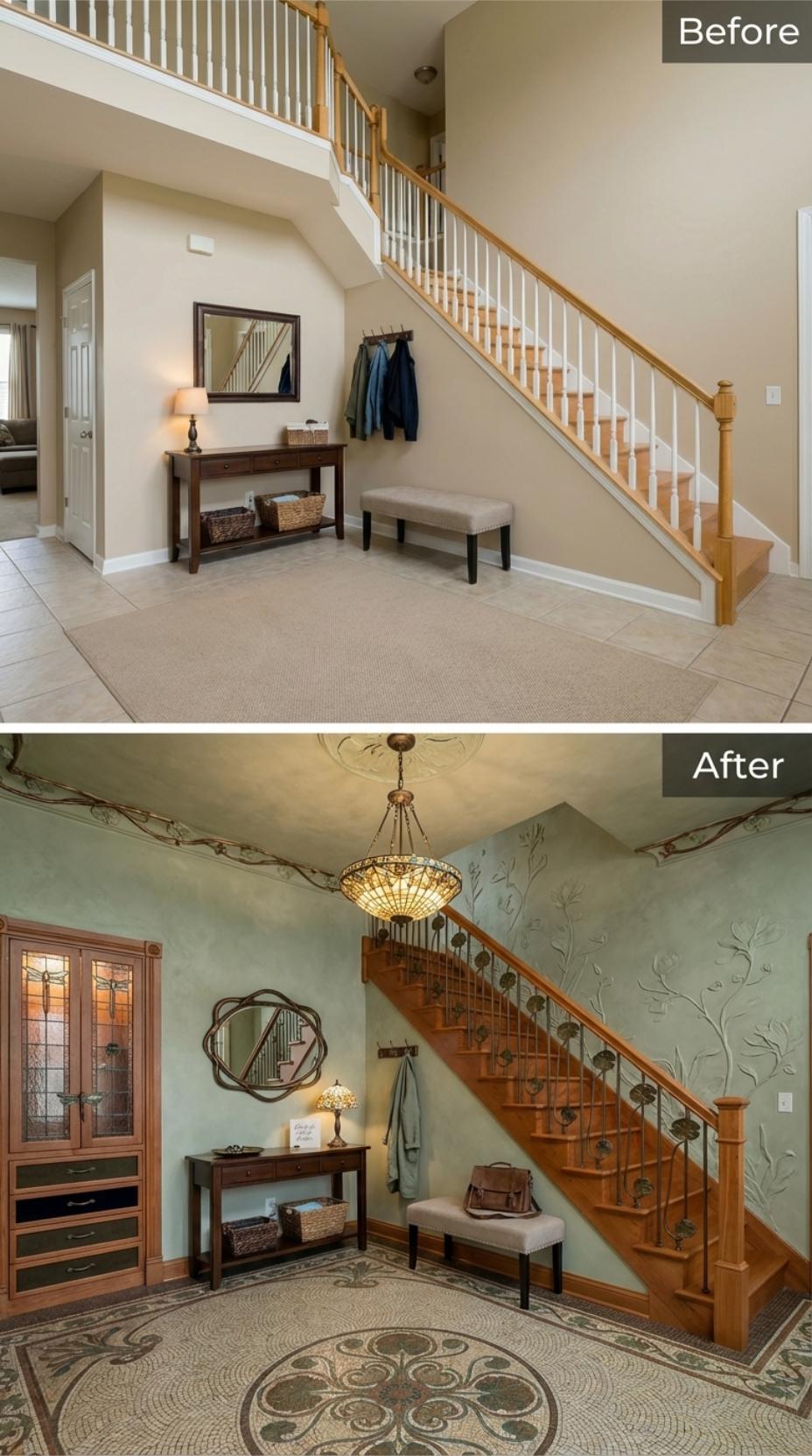
Venetian plaster in sage green covers every wall, and sculpted botanical relief work climbs toward a pressed-tin ceiling medallion holding a Tiffany-style pendant with amber slag glass panels.
Why Ginkgo-Leaf Balusters Change the Whole Staircase Reading
The cast-iron balusters shaped like ginkgo leaves replace standard turned spindles without altering the existing oak handrail or newel post. Because the leaf forms are open silhouettes rather than solid columns, they reduce visual weight on the staircase while pulling the botanical wall motif into three dimensions. Sourced from architectural ironwork suppliers, they typically install using the same top-and-bottom mortise points as wood balusters, making the swap more practical than the finished result suggests.
Copper Pipe Rails, Gear Chandelier, and Velvet Walls Swallow a Beige Foyer Whole
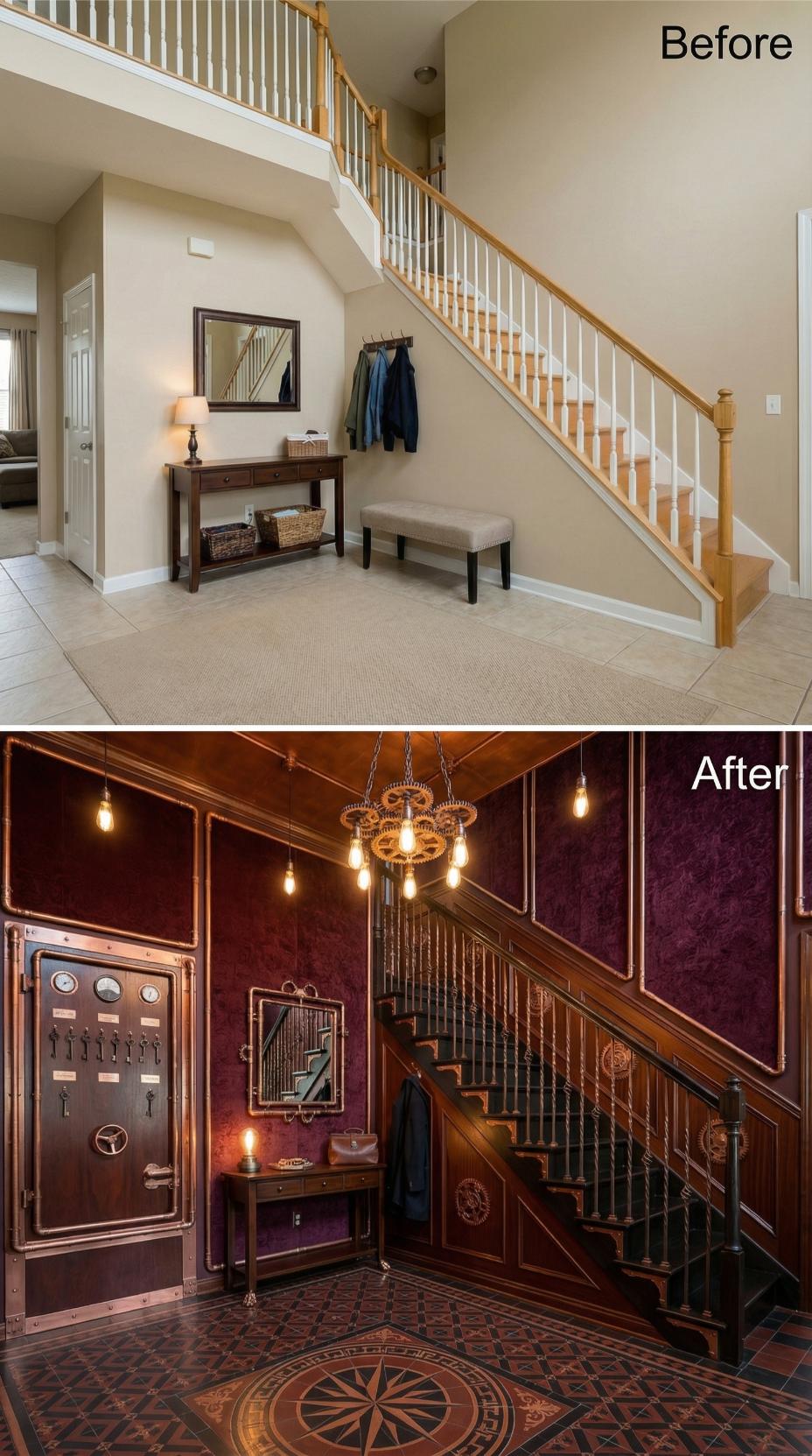
Oxblood velvet wallcovering panels, framed by copper pipe trim screwed directly into dark-stained wainscoting, replace every inch of builder beige visible in the before photo. Iron twist balusters and ebonized treads swap out the original oak stair, while a gear-and-chain chandelier with exposed Edison filament bulbs hangs where a flush-mount fixture likely lived before. The entry door, now clad in riveted copper plate with pressure gauges and a wheel latch, doubles as a key command center. Encaustic-style floor tile featuring a compass rose medallion grounds the whole scheme in something deliberate rather than decorative.
- Copper pipe used as decorative wall trim costs far less per linear foot than custom millwork and installs with standard plumbing brackets
- Pressure gauges mounted near an entry door can be wired to simple sensors that indicate whether doors are locked or unlocked
- Edison-style ST64 bulbs in a multi-pendant fixture like this one produce roughly 220 lumens each, enough for ambient mood but not task lighting near a key hook
Not every solution leans on color; sometimes raw material does all the talking instead.
Adobe Plaster, Floating Treads, and a Hobbit-Door Niche for the Perpetually Keyless
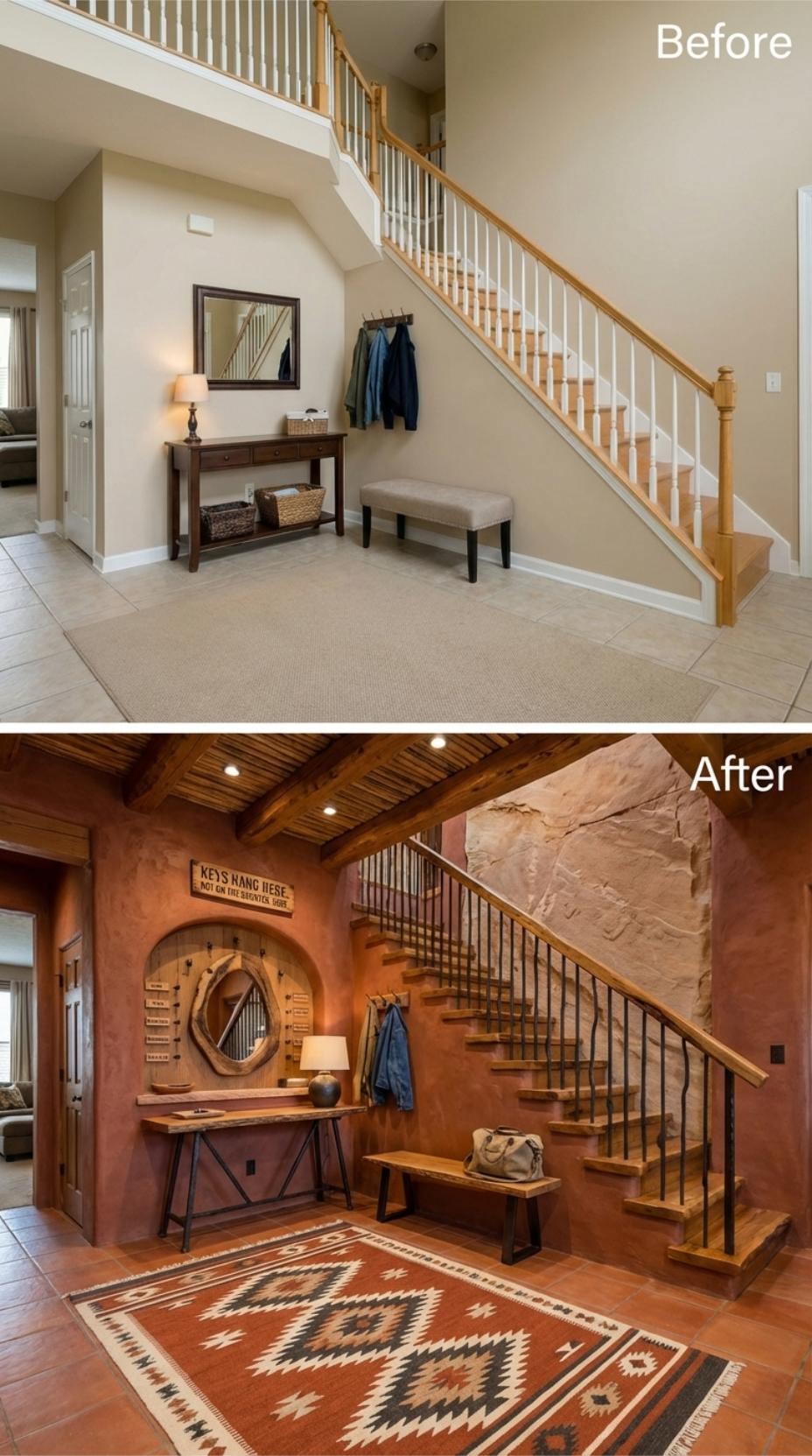
Warm terracotta plaster replaces beige drywall on every surface, and the staircase wall becomes exposed sandstone, textured as though pulled directly from a canyon face. Wrought iron balusters replace the oak-and-white spindles, and the treads themselves now float without risers, anchored to that stone wall.
The console table sits on welded steel sawhorse legs with a live-edge slab top. An arched niche with a round octagonal mirror anchors the key station, labeled with a sign reading “Keys Hang Here.” Exposed wood ceiling beams and a Southwestern kilim rug in rust, cream, and charcoal ground the whole entry in one cohesive material story.
Lavender Walls, Rose Wallpaper, and a Floral Rug Retire Oak and Builder Beige
🔥 Would you like to save this?
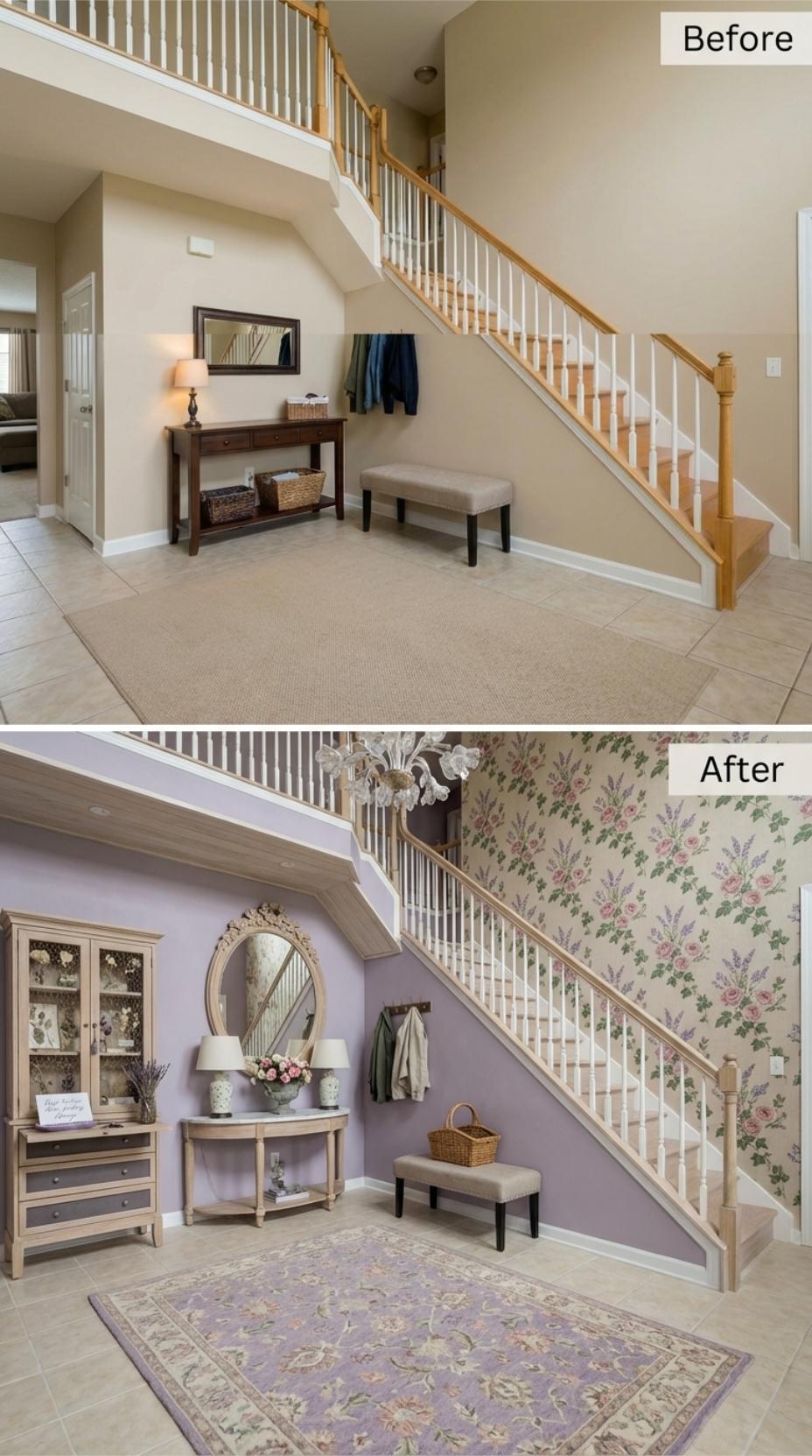
Soft lavender paint covers the lower walls while a cream-ground floral wallpaper climbs the staircase wall above, its pattern packed with pink roses, green ivy, and sprigs of purple lavender. The console table switches from dark-stained mahogany to a whitewashed demilune with carved legs, and an ornate oval mirror with a gilded gesso frame takes over from the flat rectangular one. A glass-front cabinet in the same whitewashed finish anchors the left wall, its interior backed with matching floral paper.
An antique-style area rug in dusty lavender and ivory pulls the color palette down to floor level, tying wallpaper to wall paint without any extra effort. A crystal and wrought-iron chandelier replaces the plain ceiling fixture overhead. The stair bench stays but gains a woven basket on top, finally giving the perpetually keyless somewhere logical to drop things on the way in.
Trend Alert: Floral wallpaper placed on a staircase wall benefits from professional installation because the angled ceiling line requires precise pattern matching at every diagonal cut, and a misaligned repeat becomes highly visible from the ground floor. Paste-the-wall formulas are generally preferred over paste-the-paper on tall stairwells since they allow repositioning on the wall surface before the adhesive sets. Budget roughly one additional roll per pattern repeat length to account for the diagonal waste cuts.
Slate Plaster, Bare Oak Treads, and a Paper Globe Replace Spindles and Builder Beige
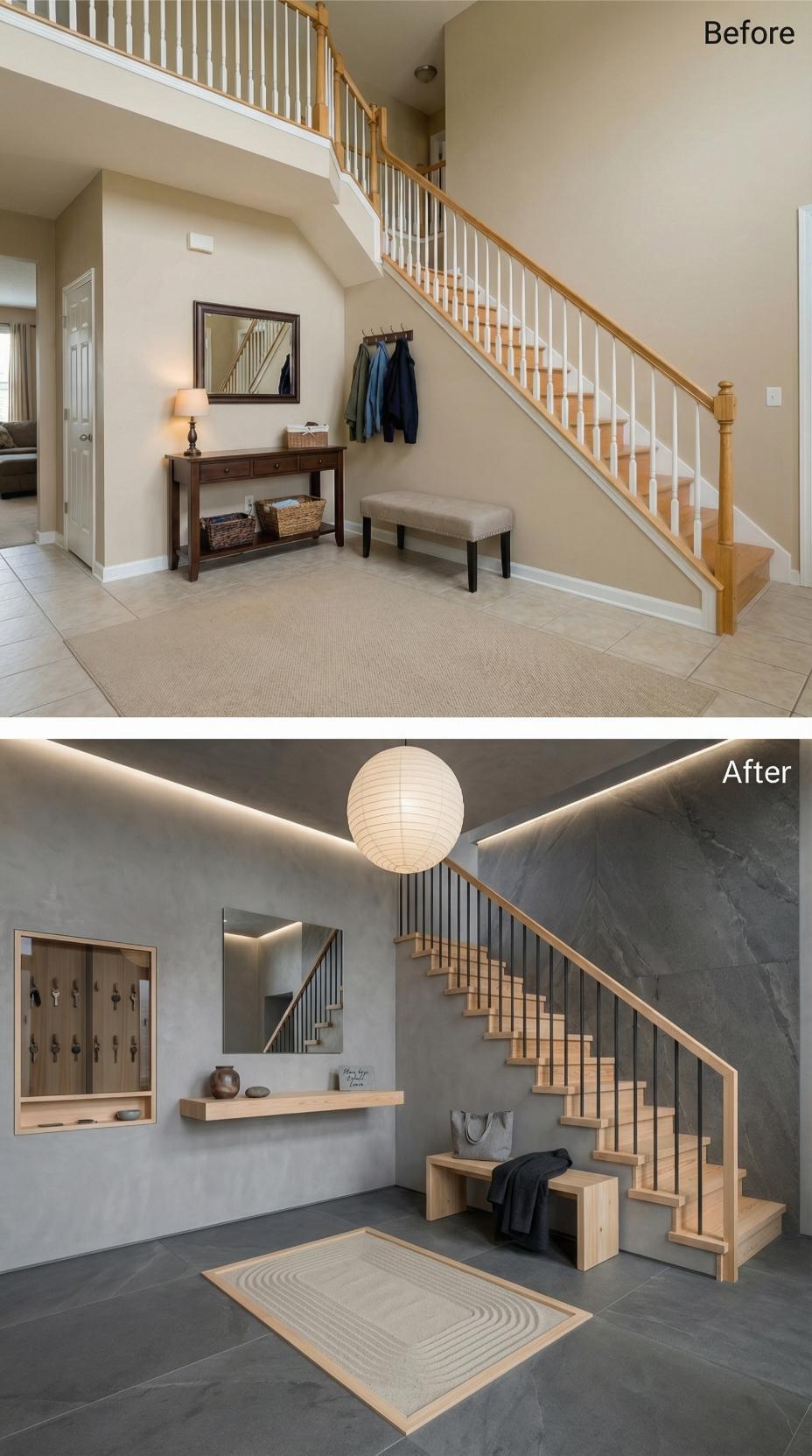
Light oak treads float on an open-riser staircase against a dark slate-look porcelain wall, while black steel rod balusters replace the original painted wood spindles. A Noguchi-style rice paper pendant drops from a ceiling edged in recessed LED strip lighting. Pale oak furniture keeps every surface readable.
Did You Know: Open-riser staircases create a natural landing zone visible from every step, which makes a simple bench beside the bottom tread one of the most functional spots to drop a bag and confirm keys before leaving. Floating shelves mounted at arm height beside a mirror use the same sightline logic, putting small objects exactly where eyes already land during a last-second check. Pairing both in the same foyer, as done here, cuts the odds of walking out without keys by giving two separate visual prompts instead of one.
Emerald Chinoiserie and Gold Balusters Bury Beige Beneath Lacquer and Peony
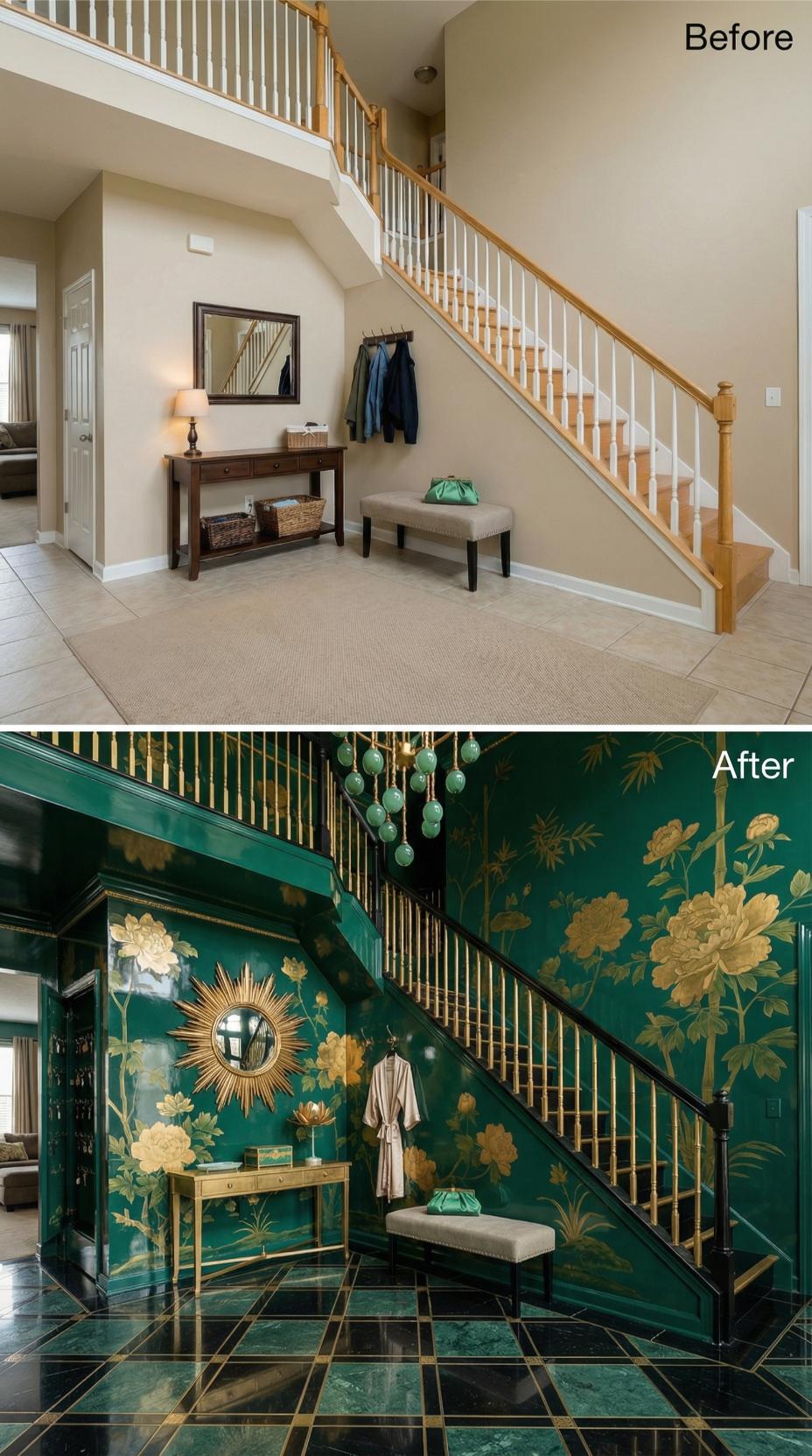
Builder beige had no chance against lacquered emerald green applied floor to ceiling, including over the stringer, the newel post, and every inch of molding. Gold-painted chinoiserie wallpaper covers the staircase wall and the entry wall behind the console, its peony and bamboo motifs scaled large enough to read from the upper landing. The balusters, now gold-finished metal rods, replace the original honey oak spindles entirely.
Green marble floor tiles laid in a grid with gilt grout lines anchor the space below, while a cluster pendant of jade-colored glass spheres hangs where a standard flush mount once lived. The console switched from dark stained wood to a gilt metal frame with a lacquered top. A sunburst mirror in aged gold replaces the rectangular brown-framed mirror visible in the before.
History Corner: Chinoiserie, the European interpretation of Chinese decorative arts, became fashionable in Western interiors during the late seventeenth century, driven largely by trade routes that brought lacquered furniture and painted silk panels into English and French homes. The peony motif shown here carries specific cultural weight in Chinese tradition, where it has symbolized prosperity and rank since the Tang dynasty. Hand-painted chinoiserie panels of this scale were historically commissioned for aristocratic dining rooms, which makes their migration into a residential foyer a relatively recent design development.
Dark Walnut Paneling, Terracotta Plaster, and Amber Pendants Bury Oak Spindles for Good
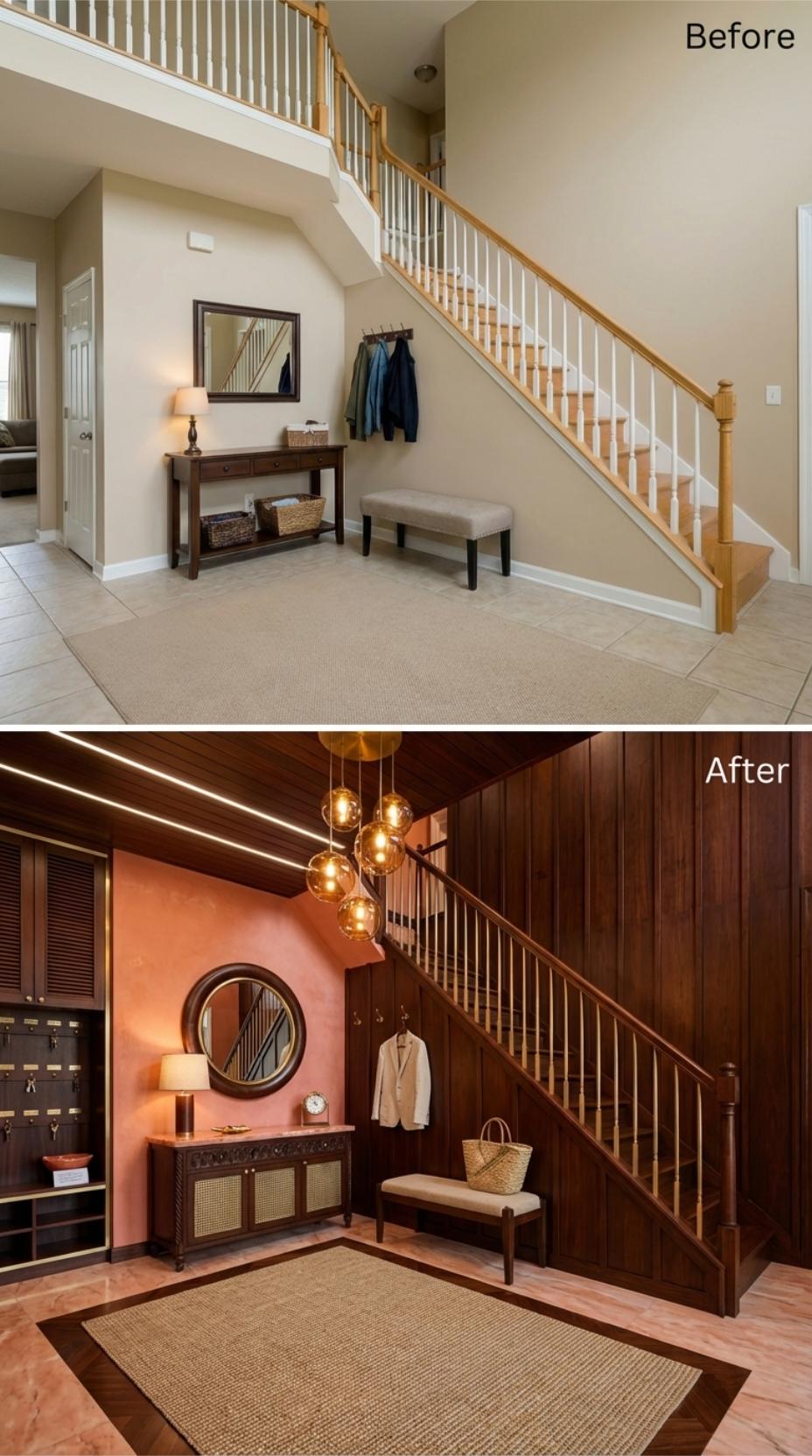
Vertical dark walnut tongue-and-groove panels wrap the staircase wall and ceiling soffit, pulling the eye upward toward a cluster of amber glass globe pendants suspended at staggered heights from a wood-clad ceiling with inset LED strip lighting. The handrail and balusters stay, but stained in deep walnut to dissolve into the paneling rather than contrast with it.
Against the left wall, a built-in locker system with slatted cabinet doors handles coats, bags, and the daily chaos of lost keys. The console below the round mirror swaps builder-grade simplicity for carved wood with cane-front cabinet doors, flanked by a ceramic table lamp on a terracotta plaster accent wall. Rose-veined marble tile on the floor anchors a natural fiber rug with a dark border inset.
Why It Works: Strip lighting recessed into a wood-clad ceiling soffit produces linear light without any visible fixture hardware, which makes the ceiling feel architectural rather than equipped. Pairing that with pendant clusters hung at three different drop lengths creates depth overhead that draws attention away from a foyer’s narrow footprint.
Hot Pink and Lime Green Check Every Surface, Including the Ceiling
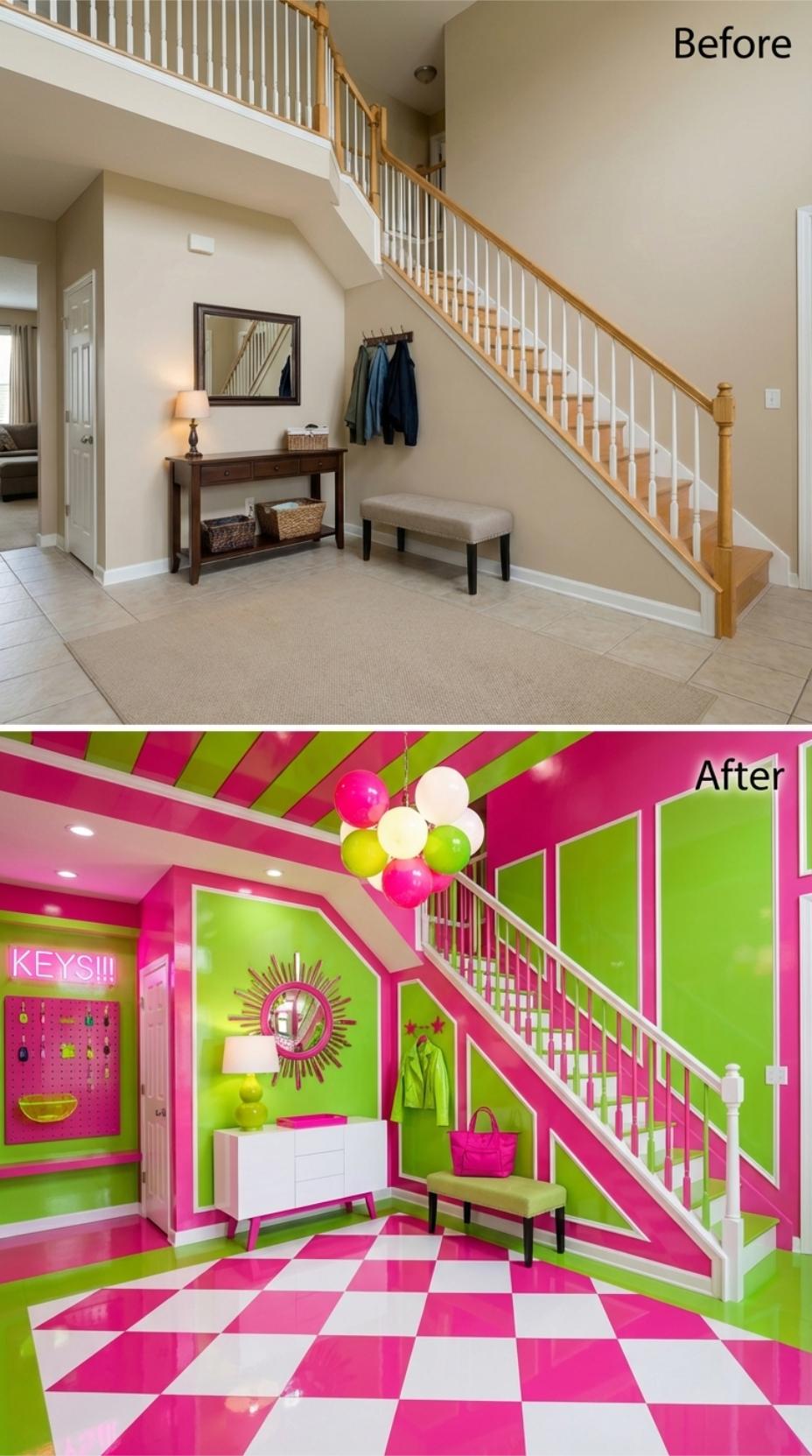
Checkerboard floors in hot pink and white epoxy set the tone before anyone looks up. Once they do, lime green wall panels outlined in magenta racing stripes converge at a ceiling that radiates the same two colors outward from a central cluster of pink, green, and white balloon pendants. The white balustrade from the builder-grade version survived, but it now reads as a deliberate graphic element against the green-painted stringer rather than a default finish.
A white lacquer console on hairpin-style legs replaced the dark wood table. A sunburst mirror in gold sits where a plain rectangle hung before. On the left wall, a hot pink pegboard mounts keys on individual hooks beneath a neon sign that simply reads KEYS, solving the whole problem the article is built around.
- Pegboard cut to fit a wall section accepts standard metal hooks spaced to hold individual key rings without stacking
- Epoxy floor coatings bond to concrete or plywood subfloors and cure to a high-gloss finish that resists scuffing from daily foot traffic
- Balloon-style pendant clusters use individual pendant cords ganged to a single canopy, which means each globe can be replaced independently if one burns out
Round Mirror Backlighting and Black Steel Rails Close Out 30 Foyers in Style
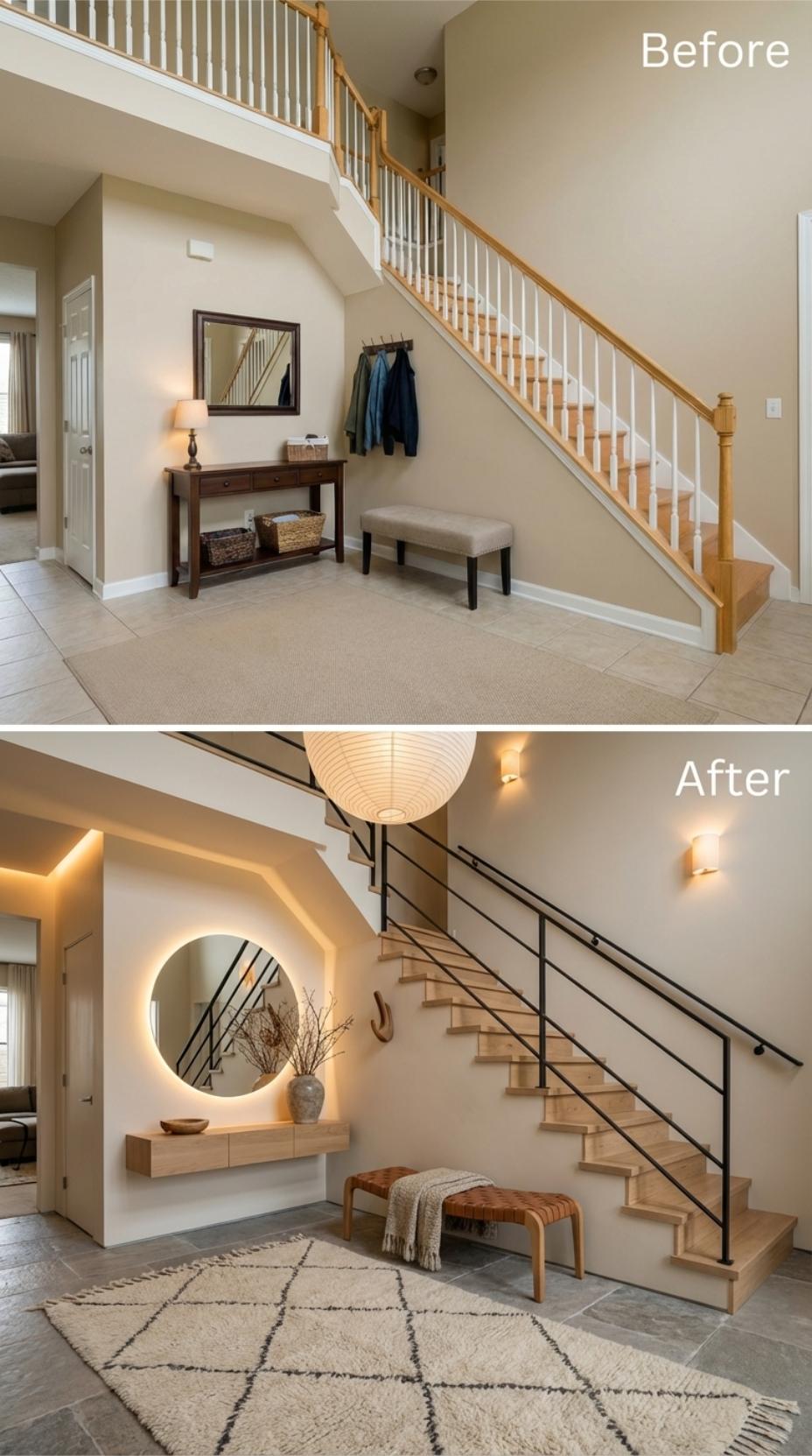
Oak spindles and honey-toned newel posts gave way to floating maple treads with open risers and a steel rail system finished in flat black. The baluster concept disappeared entirely. Wall-mounted sconces in a warm amber clay finish replace every overhead fixture, and a paper lantern pendant drops from the ceiling above the landing.
Below, a floating shelf in light ash replaces the dark console table. Behind it, a round backlit mirror casts a halo of amber light against the plaster wall, giving anyone hunting for keys a well-lit surface to work with. A Beni Ourain-style rug in ivory and charcoal anchors the floor. The woven leather bench beside the stair base gives the space its final edit.
The baluster concept disappeared entirely, replaced by a steel rail system that keeps sightlines open across the full stair run.