🔥 Would you like to save this?
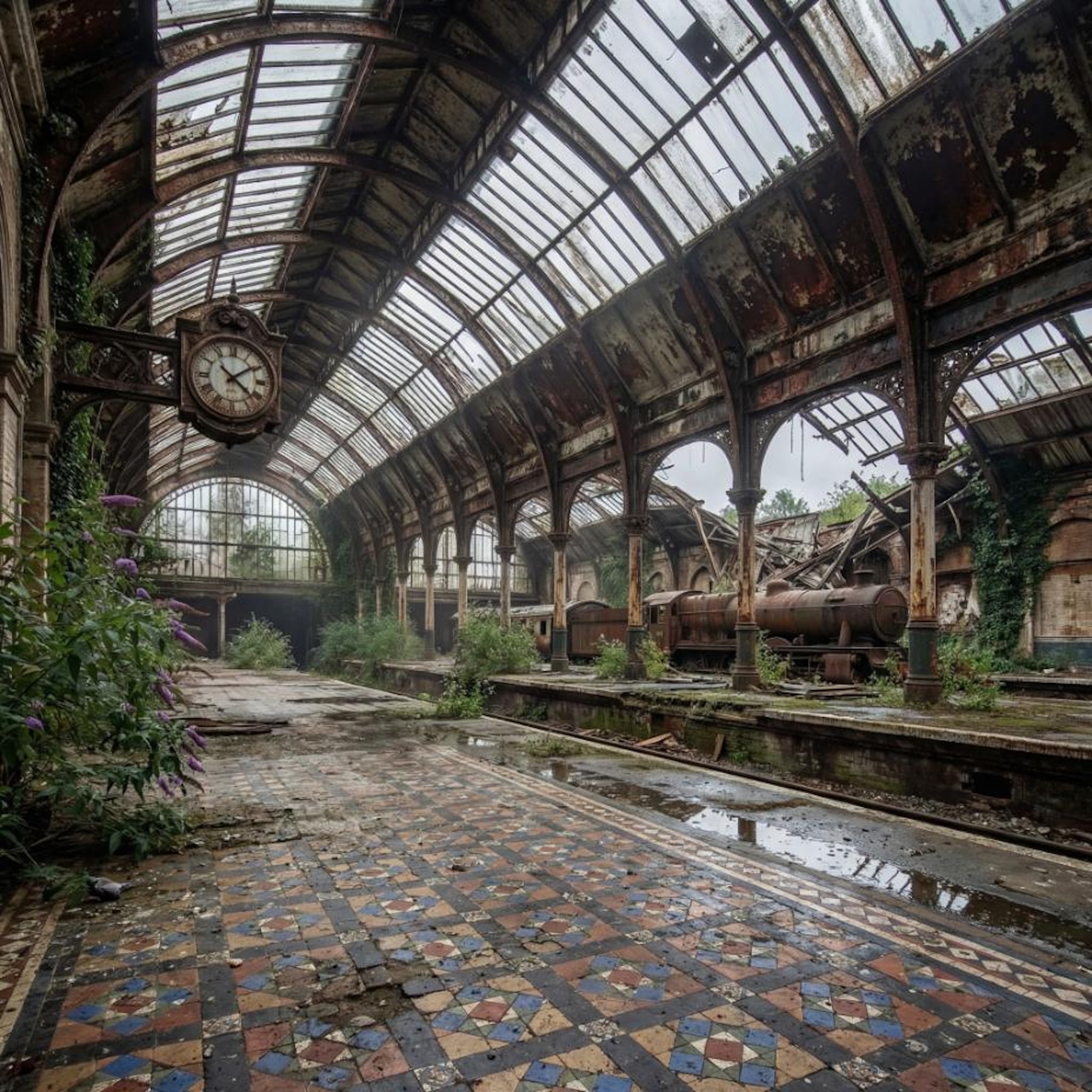
There is something deeply satisfying about watching a derelict building become a place people actually want to live in. The old ferry terminal sat empty for decades, its Beaux-Arts columns crumbling, its ticketing halls collecting dust and pigeons. Most cities would have torn it down. Instead, AI saw the bones of something worth saving, and what came out the other side is a collection of luxury residences that carry real architectural weight. These are not generic condos dressed up with crown molding.
In order to come up with the very specific design ideas, we create most designs with the assistance of state-of-the-art AI interior design software.
The terminal’s architectural history gives these homes something new construction rarely achieves: proportion, ornament, and age. Arched windows that once framed commuters now frame private living rooms. Grand public halls have been divided into residences without losing their sense of scale. The 32 before-and-after examples collected here show exactly how far a building can travel from abandonment to inhabited luxury, and why the bones of a Beaux-Arts structure are worth fighting to keep.
From Waterlogged Ruins to Gold-Vaulted Grandeur in One Radical Restoration

Where crumbling plaster and puddle-stained floors once defined a derelict Beaux-Arts ferry terminal, the barrel-vaulted ceiling now glows in backlit onyx panels framed by dark bronze ribs. A sculptural chandelier of staggered brass rods anchors the central axis above a long marble dining table surrounded by cream linen chairs.
The left wall houses a full bar clad in honey-toned onyx with a polished edge, flanked by floor-to-ceiling shelving stocked with glassware and wine bottles. A spiral staircase in blackened steel rises toward the mezzanine, while the original arched windows remain intact, framing unobstructed water views on both sides.
Moss-Draped Barrel Vault, Marble Floors, and a Terminal Reborn

Verdant moss and trailing ivy now cover the full length of the barrel-vaulted ceiling, replacing crumbling plaster with layered living walls that cascade down to white-painted classical moldings. Indoor olive trees flank a central reflection channel set flush into green marble flooring, drawing the eye straight toward the restored arched window at the far end.
The kitchen side features a waterfall-edge island in cream-and-gold veined marble, paired with deep forest-green cabinetry. A long dining table in natural oak seats eight on linen-upholstered chairs, while a velvet green sectional anchors the lounge zone mid-hall. Brass pendant fixtures and recessed ceiling spots provide layered light across the 80-foot run of the space.
Barrel Vault Preserved, Everything Beneath It Rebuilt from Scratch

Warm-toned wood slats line the restored barrel vault from end to end, their tight vertical spacing creating a ribbed ceiling that reads almost like a wooden nave. Integrated LED strips run along the ridgeline, casting a low, directional glow rather than flooding the space with overhead light. The original arched terminal window survives at the far wall, now reglazed and framing an unobstructed water view.
Below, the open-plan layout pairs a dark absolute black granite island with flat-front maple cabinetry in a matte natural finish. Green velvet sectional seating anchors the lounge zone, offset by a wall-mounted gas fireplace set flush into dark slate tile. Cedar or redwood canoes mounted on steel bracket rails run along the right wall, functioning as architectural objects rather than storage.
Crumbling Plaster Gone, Strip-Lit Barrel Vaults and a Wine Wall in Its Place

Concrete now seals the floor that once pooled with standing water. The barrel vault overhead was stripped back to raw stone ribs, and LED strip lighting runs along each arch in a warm amber line, pulling the eye from entry to the waterfront window beyond. A long dining table in dark-stained wood anchors the central axis, surrounded by black ladder-back chairs. To the right, a floor-to-ceiling wine display sits behind glass, lit from within, mounted in matte black steel shelving. A bar counter in black stone runs beside it.
On the left, four large-format framed prints hang at eye level above a low concrete bench. Behind them, open steel-framed bookcases back a seating area with a low-profile sofa in charcoal upholstery. A staircase with open steel risers and a cable railing climbs toward a mezzanine. The arched transept windows remain untouched, still flooding the hall with the grey light of the bay.
Gold Leaf, Reflecting Pool, and a Wine Wall Built Into the Old Ticket Hall

Cracked terrazzo and pooled rainwater have given way to honey-gold onyx cladding that lines the barrel vault from haunch to crown, backlit by recessed strip lighting. A lap-style reflecting pool runs the length of the central axis in polished black granite, flanked by cream bouquets in brass urns. On the right, floor-to-ceiling wine storage sits behind frameless glass, bottles organized in a grid that spans the full height of the original arched window bay. Indoor palms in gold-dipped planters anchor the left lounge, where low-profile sofas in ivory boucle face a slab coffee table in white marble.
A lap-style reflecting pool runs the length of the central axis in polished black granite, flanked by cream bouquets in brass urns.
Gold Coffered Ceiling, Marble Floors, and a Fireplace Where the Benches Once Sat

Restored gold-leaf coffers run the full length of the barrel vault, now lit from below by a curved LED cove that replaced decades of water damage. Cream bouclé sectional seating anchors the central axis, paired with a linear gas fireplace set into a stone plinth. A dark-walnut dining table with burgundy leather chairs occupies the right bay, while globe brass chandeliers hang at either end of the hall.
Budget Tip: Sourcing bouclé fabric by the yard from wholesale textile suppliers rather than through a designer showroom can cut upholstery costs by 40 percent or more. For a sofa of this scale, that difference often runs into thousands of dollars. Request sample swatches before committing, as bouclé weight and weave vary considerably between suppliers.
Barrel Vaults, Caramel Bouclé, and a Chandelier That Fills the Nave

Soaring limestone arches frame a living room anchored by a low-profile sectional in caramel bouclé, paired with an organic travertine coffee table. A pendant installation of ceramic discs in cream and terra cotta drops from the restored vault. On the left, terracotta-fronted cabinetry meets what appears to be a honed marble backsplash, while a curved plaster fireplace occupies the far right corner beside potted olive trees.
Color Story: Warm neutrals drawn from a single source material, in this case travertine, can unify disparate zones across an open plan without relying on paint. Pulling the same stone through countertops, coffee tables, and flooring accents creates tonal continuity that reads as intentional rather than accidental. Designers call this a material thread, and it costs nothing extra when specified early in the procurement process.
Slatted Cedar Ceiling, Strip LEDs, and a Living Room Built for the Water’s Edge

Strip lighting recessed into concentric cedar arches does more structural work than any chandelier could.
Thin-plank cedar boards run the full width of the barrel vault, their warm grain pulling every sightline upward before curving back down to white plaster walls. Two rings of LED strip lighting trace the arch’s geometry, casting an amber wash across the wood without a single visible fixture. Below, cream bouclé sectional seating anchors the floor plan, paired with a low travertine-slab coffee table and upholstered armchairs in the same ivory register. Decorative paddle oars hang flat against the left wall, treating the terminal’s nautical past as art rather than afterthought. An arched window at the far end frames a staircase and open water beyond, while sliding glass panels on the right dissolve the interior edge entirely into a terrace where a bonsai pine and lounge chairs face the bay.
Cedar slats and strip LEDs gave the previous unit its spine; here, the same vocabulary gets a living room test.
Cedar Vault, Dark Kitchen, Green Velvet: One Hall Divided Into Three Zones

Pale cedar slats line the barrel vault in even vertical runs, interrupted only by two recessed LED strips that follow the curve from spring to crown. Below them, the original arched windows remain unaltered, pulling in water views that no renovation budget could replicate. Green velvet sofas anchor the living zone, arranged around a slab-front fireplace set flush into a dark gray panel wall.
The kitchen runs along the right side in matte charcoal cabinetry with what appears to be a black marble or honed granite countertop. Open wood shelving breaks the run of upper cabinets, keeping the wall from reading as a solid block. A brass pendant drops above the counter, and wood-tread stairs with a brass rail climb toward a mezzanine. Splitting a single hall into distinct zones without partition walls depends almost entirely on ceiling treatment and furniture placement, and this layout proves the point.
Lap Pool, Slatted Ash Vault, and a Fireplace Placed Dead Center

Ribbed ash slats line the barrel vault above a lap pool flanked by travertine-clad lounge chairs, while a square gas fireplace anchors the seating zone on the left.
Editor’s Note: Indoor lap pools lose heat rapidly through evaporation, so pairing them with a radiant-heated wood floor, as seen here, recovers ambient warmth without overworking the HVAC system. Specifying slatted timber for a vaulted ceiling rather than drywall also improves acoustics in pool-adjacent rooms by absorbing sound that would otherwise bounce off hard plaster.
Slatted Ash Vault, White Plaster Walls, and a Fireplace Framing Open Water

Vertical-grain ash slats line the barrel vault overhead while white-plastered walls and a linear gas fireplace anchor the living zone below.
Style Tip: When converting a large historic hall into residential space, zoning with furniture placement rather than partition walls preserves sightlines to architectural features like arched windows. A sectional sofa oriented perpendicular to the main axis, as used here, creates a natural room boundary without blocking light or views. Rugs in a tone-on-tone neutral reinforce the boundary further without introducing visual noise.
Forest Green Lacquer, Brass Hardware, and Barrel Vaults Saved from Collapse

Where puddles pooled on broken mosaic tile and pigeons nested in the coffered plaster, a kitchen-and-living hall now runs the full length of the nave. Deep forest green cabinetry in a flat-panel profile lines the right wall, finished with unlacquered brass pulls that will patina over time. The countertops are white quartzite with tight grey veining, and the island seats five on slope-back bar chairs in oat linen. A brass candelabra chandelier hangs centered beneath the restored barrel vault, which is painted in the same forest green as the cabinets, trimmed in crisp white plaster molding with LED cove lighting tucked into the spring line.
To the left, a tufted green velvet sofa anchors the sitting zone, paired with a brass-frame coffee table at low height. Open shelving on a library ladder rail climbs a full-height bookcase. Herringbone white oak flooring runs wall to wall, uninterrupted across both zones, and a staircase clad in pale ash leads down toward the arched window framing open water.
The Psychology Behind This: Green used at ceiling height triggers a subtle grounding effect, pulling the eye downward rather than letting it drift into an uncomfortably tall volume. Pairing it with white at the arch perimeter keeps the vault legible as architecture rather than decoration. The result reads as shelter rather than spectacle, which is precisely why the space feels livable despite its scale.
Orchid Chandelier, Gold Rib Vaulting, and a Reflecting Pool Down the Nave’s Center

🔥 Would you like to save this?
Decades of water damage and debris are gone. In their place: white plaster walls finished to a high sheen, barrel vaults recoated in matte gold leaf with recessed coffers between each rib, and a floor-level reflecting pool running the full length of the central axis. A bronze figurative sculpture anchors the midpoint, placed on a limestone plinth where the original ticket benches once stood.
On either side, the hall splits into two distinct living zones without a single partition wall. Cream curved sofas in a tight-weave boucle fill the left bay. A long dining table in brushed brass with upholstered side chairs occupies the right, directly below a cascading cluster of gold sphere pendants. Cascading white orchids drop from the crown of the arch on a gilded armature, drawing the eye up to the full vault height before pulling it back down to the water view through the terminal’s original arched glazing.
By The Numbers: Reflecting pools used indoors as a design axis rather than a swimming feature average just 12 to 18 inches in depth, which reduces structural load significantly compared to a full residential pool. That shallow depth also allows the pool to double as a light-diffusion surface, bouncing natural light from arched windows back onto the vaulted ceiling throughout the day. Heating a feature pool of this scale costs roughly 60 percent less annually than heating a lap pool of equivalent square footage.
Surfboards, Warm Cedar Vaulting, and a Living Room Open to the Marina

Warm-toned cedar planks line the barrel vault and emit a strip of LED light at the spring line, drawing the eye toward the arched transom window that once faced a working dock. Cream linen sectionals anchor the center, flanked by a round travertine dining table and slatted wood room divider. Four painted surfboards mounted vertically on the left wall act as art.
Common Mistake: Hanging oversized decorative objects, such as surfboards or canoes, on walls with substantial vertical height is a common mistake when anchors are placed into plaster without locating the structural masonry behind it. In historic Beaux-Arts buildings, the original wall system is often brick or stone clad in a thin plaster layer, meaning standard drywall anchors will fail under the load. A masonry bit and sleeve anchor rated for the object’s weight are required, not toggle bolts designed for hollow-core construction.
Kayaks on the Wall, Marble Island, Bourbon Shelf: One Terminal Reborn Dockside

Mounting three kayaks vertically on a two-story plaster wall is a storage decision that doubles as sculpture.
Light ash covers both the barrel vault and the floor, so the eye reads the room as a single continuous material rather than a ceiling dropped onto a box. A dark navy curved sofa anchors the living zone, while cream upholstered chairs break the saturation without competing. The kitchen island runs in white marble with a dark navy base, echoing the sofa across the open plan.
A fully stocked bourbon shelf occupies the right wall inside a backlit wood cabinet, floor to ceiling. Brass pendant globes hang low over the bar counter. The arched window at the nave’s end frames open water directly, making the marina the room’s effective artwork.
Black Marble Island, Barrel Vault, and a Staircase Where the Waterfront Begins

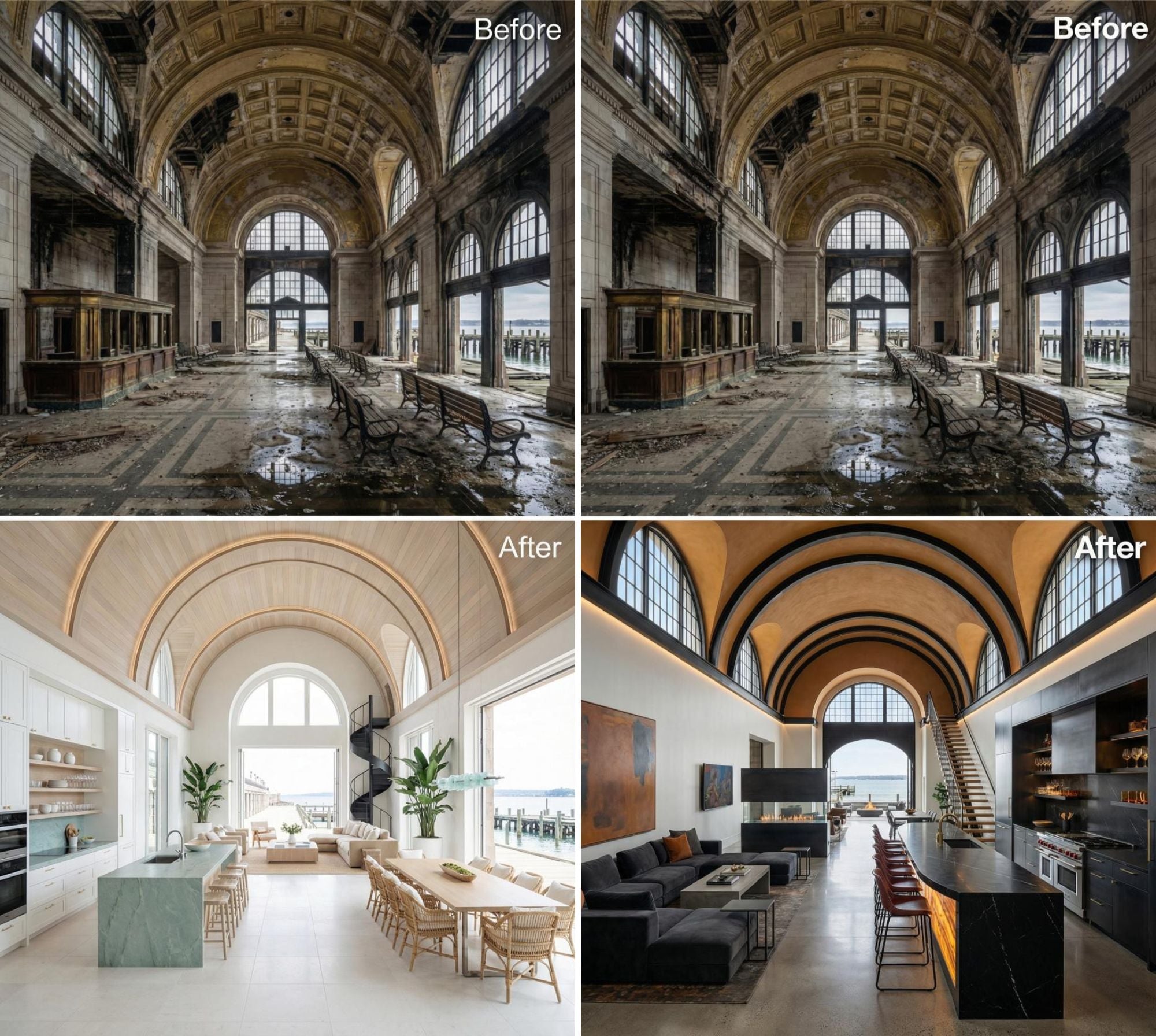
Black marble countertops run the full length of the kitchen island, flanked by cognac-leather bar stools and backed by floor-to-ceiling dark steel shelving. The barrel vault overhead is finished in ochre plaster, its arch framing a direct view through the terminal’s original arched doorway to open water.
History Corner: Ferry terminals built in the Beaux-Arts style between 1890 and 1920 were deliberately over-engineered, with load-bearing masonry walls thick enough to absorb the vibration of daily steamship arrivals. That structural excess is precisely what makes them viable for residential conversion today, since the bones rarely require replacement, only cleaning and repointing. The arched openings seen here were never infilled, surviving decades of abandonment intact.
Gold Pendants, Barrel Vault Strip Lighting, and a Kitchen Island That Anchors the Nave

Flat-sawn wood planks line the barrel vault above a coved strip LED that traces the arch’s full curve, casting amber light down white plaster walls onto pale oak flooring below. Two brass dome pendants hang over a dining table sized for twelve, while a matte black kitchen island with bar stools pulls the cooking zone flush against flat-panel walnut cabinetry. A green modular sofa anchors the living area at the left, set on a charcoal wool rug opposite a large oil painting in a carved wood frame.
Pro Tip: Strip LEDs installed inside a coved arch recess rather than surface-mounted will read as architectural light rather than decorative lighting, a distinction that matters during any historic preservation review. Recessing the channel also hides the driver housing, which can otherwise interrupt the clean line of a restored vault. Most residential LED drivers can be tucked into a shallow soffit box no deeper than three inches.
Where previous sections leaned into drama and contrast, this one strips everything back.
Barrel Vaults Replastered in Cream, Olive Trees, and a Kitchen Open to the Nave

Concentric arch ribs finished in plaster-white rise above a living room anchored by a travertine block coffee table, a linen sofa, and a pair of leather lounge chairs in tobacco brown. Olive trees planted in stone vessels pull the eye toward an arched opening and the water beyond, while pendant rods drop brass fixtures over a dining table set parallel to the nave’s axis. The kitchen sits left of the staircase, fitted with open shelving, marble counters, and a range in matte white.
Boat Dock at the End of the Nave, Cedar Vault Overhead, Marble Island at Center

Tongue-and-groove cedar lines the barrel vault and wraps down to the spring line, where recessed strip lighting marks the arch’s curve. A waterfall-edge marble island anchors the kitchen zone while the living area holds a low sectional in oatmeal fabric, a jute rug, and open sight lines straight to the water slip.
Style Math: Tongue-and-groove ceiling cladding installed parallel to a vault’s long axis visually compresses ceiling height, making a nave-scale volume feel proportional to residential furniture. Running the boards perpendicular to the arch’s curve would have the opposite effect, drawing the eye upward and reinforcing the cavernous scale the original terminal once had.
Grand Piano, Barrel Vault Strip Gold, and a Living Room Pulled Toward Open Water

Replastered in smooth off-white, the barrel vault now carries recessed gold-trim accent rings that arc toward a single arched window framing the harbor. A black lacquer grand piano anchors the near end of the nave, grounded by a hand-knotted wool rug in muted sage and charcoal. The seating group behind it uses low-profile sofas in a grey-green fabric, with dark wood occasional chairs pulled close. Sliding glass doors at the far right open to a teak deck where a marble-clad bath sits flush with the waterline.
- Recessed concentric trim rings painted in a metallic finish cost a fraction of applied gilt molding and read equally formal from below
- A grand piano placed off-center at one end of a nave-scale room anchors volume without consuming sightlines toward the water
- Sliding glass panels flush with a masonry wall face allow heritage structure and contemporary opening to coexist without casing bulk
Barrel Vault Outlined in Gold, Herringbone Oak, and a Dining Table Running the Full Nave

Subtly traced gold ribs follow each arch of the replastered vault overhead, drawing the eye down to a herringbone oak floor that runs uninterrupted from sofa to dining table. A sectional in greige wool anchors the living zone beside a travertine-top coffee table, while a long dark-stained dining table seats ten beneath a cluster of brass globe pendants.
Why the Gold Rib Detailing Works Harder Than It Looks
The gold lines tracing each vault rib are almost certainly applied as a thin metal leaf or gilded plaster bead rather than paint, which gives them a reflective quality that shifts with daylight angle. That distinction matters at nave scale: paint reads flat and decorative, whereas a physical bead catches raking light and registers as genuine architectural articulation. Replicating this on a historic conversion typically costs less than full cornice restoration, yet delivers comparable visual weight to the original ornamental program.
Oar-Lined Walls, Strip-Lit Barrel Vault, and Cognac Leather Facing the Waterfront

Decorative oars mounted horizontally on the left wall do the work that art typically handles in a double-height room, filling vertical space without competing with the restored barrel vault above. Concealed strip lighting traces the arch’s curve in warm amber, differentiating each recessed ring. Cognac leather sofas frame a low walnut coffee table, while a cantilevered walnut dining table sits beneath a linear candelabra pendant. Floor-to-ceiling glazing on the right opens directly to a waterside terrace.
Worth Knowing: Barrel vaults in Beaux-Arts terminals were typically constructed with a slight elliptical deviation rather than a true semicircle, which distributes lateral thrust more efficiently into the side walls. When replastering during renovation, matching that original geometry rather than correcting it to a perfect arc preserves the structural logic the engineers intended. Deviating from the original curve, even by a few degrees, can introduce concentrated stress points that become expensive to address later.
Barrel Vault Replastered White, Black Island, and Oak Floors Where Benches Once Rusted

Where water-damaged mosaic once buckled under decades of neglect, wide-plank oak now runs the full length of the nave. The barrel vault has been stripped of its ornate coffering and replastered in flat white, a deliberate move that redirects attention to the arch’s geometry rather than its surface. A matte black kitchen island anchors the left side of the plan, paired with flat-front cabinetry in pale ash and open shelving in the same finish.
The arched clerestory windows remain untouched, their original steel mullions left exposed against the new plaster. A dining table in oiled walnut seats eight along the right wall, below pendant bulbs on bare brass drops. At the far end, a sofa grouping faces the terminal’s original waterfront arch, now fully glazed, with a small olive tree centered beneath it in a low concrete planter.
Sage Island, Spiral Stair, and Barrel Vault Clad in Pale Ash Against Open Water

Bleached ash planks line the barrel vault in horizontal runs, their grain reading pale and even against white-plastered walls that once held soot and decay. A sage green stone island anchors the kitchen zone, its matte surface picking up the waterfront color visible through the arched window at the nave’s end. Rattan dining chairs surround a natural oak table on the right, while a black steel spiral stair rises near the water-facing wall, threading two levels without interrupting sightlines down the full length of the hall.
Terracotta Island, Brass Chandelier, Vaulted Nave Pulled Into a Single Open Plan

🔥 Would you like to save this?
Peach-toned Venetian plaster coats the barrel vault from spring point to crown, shifting the ceiling from a cavernous void into something closer to a warm enclosure. Arched wall niches in the same cream render house open shelving on the left, while a fluted terracotta kitchen island anchors the foreground with a waterfall edge in veined rose marble.
Brass arms of a sculptural candelabra-style chandelier hang mid-nave above a dining table in bleached stone with rounded ends. Curved terracotta sofas face a cast plaster fireplace at the terminal’s waterfront end, framing the original arched window. Oak plank floors run the full length without interruption, connecting kitchen, dining, and living zones through furniture placement alone rather than any wall or partition.
Palm Trees, Barrel Vault, and a Dining Table Running Toward Open Water

Cream plaster seals the barrel vault overhead, with cove lighting tracing the arch’s curve while indoor palms anchor the living zone against a long gold-legged dining table set with white upholstered chairs.
Oar Wall, Blue Tile Partition, and a Vaulted Living Room Open to the Pier

Wooden oars mounted in a horizontal row reference the terminal’s original waterfront function without leaning on nostalgia. Below them, a plaster staircase with open treads rises against the left wall, while a linen sectional and a rough-cut stone coffee table hold the nave’s center. Two black armchairs face the water through floor-to-ceiling sliding glass, and a blue zellige tile partition divides the dining area from the living zone without closing off either.
Strip lighting runs the full length of the barrel vault’s inner curve, washing the replastered ceiling in amber. Beyond the tile screen, a wood dining table seats six beneath a rod pendant cluster. The arched terminal window survives intact at the rear, framing the pier and open water beyond it. Cove lighting along the ceiling perimeter prevents the vault height from reading as cold despite the absence of rugs in the outer zone.
Terracotta Vault, Stone Fireplace Table, and Cream Bouclé Facing the Pier

Venetian plaster in a burnt sienna tone coats the barrel vault above two low-profile bouclé sofas, while a slab-base fireplace in raw granite anchors the room’s center axis and draws the eye toward floor-to-ceiling glass open to the waterfront dock.
Barrel Vault Washed White, Marble Island, and Ivory Sofas Running Toward Open Water

Lime-washed plaster covers the barrel vault from haunch to crown, with recessed strip lighting tracing the arch’s curve in warm amber. Two oversized ivory fabric sofas anchor the living zone on a jute rug, flanked by a floor lamp with a brushed-brass stem. A waterfall-edge marble island in veined white separates the kitchen, where open oak shelving holds ceramic vessels above panel-front cabinetry. Slatted-wood partitions divide the dining zone without closing the nave’s sightline to the arched waterfront window.
Barrel Vault Outlined in Cove Light, Warm Oak Floors, and Tropical Foliage at the Nave’s Center

Cove lighting recessed into each arch springer traces the full barrel vault in warm white, making the replastered ceiling read as architecture rather than ornament. Wide-plank oak runs the length of the nave, and a floating staircase with open timber treads rises near the central arch without interrupting sightlines to the water. A large-leaf tropical plant, potted directly into a raised stone plinth, anchors the middle of the plan.
Seating groups use off-white linen on low sofas with walnut bases, positioned to draw the eye toward the arched window opening onto open water. An oval walnut dining table with upholstered white chairs sits under a brass multi-arm chandelier. Abstract green canvas art on the left wall introduces the only saturated color in the room. Flush-profile white shelving flanks the kitchen zone, keeping cabinetry from competing with the vault above.
Kayaks Racked Above the Bar, Globe Pendants Cascading Into a Marble Dining Hall

Replastered in flat white, the barrel vault retains its arch geometry but loses every gilt trace, with recessed cove lighting tracing the curve instead. Blue kayaks mounted on brass wall brackets above open shelving pull the waterfront activity indoors. Below, a marble slab dining table seats twelve on navy velvet chairs with brass-tipped legs, while globe pendants in varying drop lengths cluster above the nave’s midpoint.
Marble Island, Globe Pendants, and Cove-Lit Arches Above a White Open Plan

Carrara marble wraps the island in full slab format, its grey veining running uninterrupted from countertop to base panel. Recessed LED strips follow the barrel vault’s curve in concentric bands, casting warm light down plastered white coffers that once shed plaster onto a flooded stone floor. Chrome globe pendants cluster above the dining end, their spherical forms echoing the arch geometry overhead. White lacquer cabinetry, integrated appliances, and a polished porcelain floor pull every surface into the same tonal range, letting the arched clerestory windows and the dark water beyond read as the room’s only contrast.