🔥 Would you like to save this?
Because some people cook to nourish. And some people cook to win. You know who you are — the one who researched your guest’s favorite restaurant before they arrived, plated the amuse-bouche with tweezers, and casually mentioned the La Cornue twice. This is the kitchen you deserve: professional-grade everything, marble that makes grown adults emotional, and enough show-off potential to ensure that nobody — nobody — hosts after you again.
In order to come up with the very specific design ideas, we create most designs with the assistance of state-of-the-art AI interior design software.
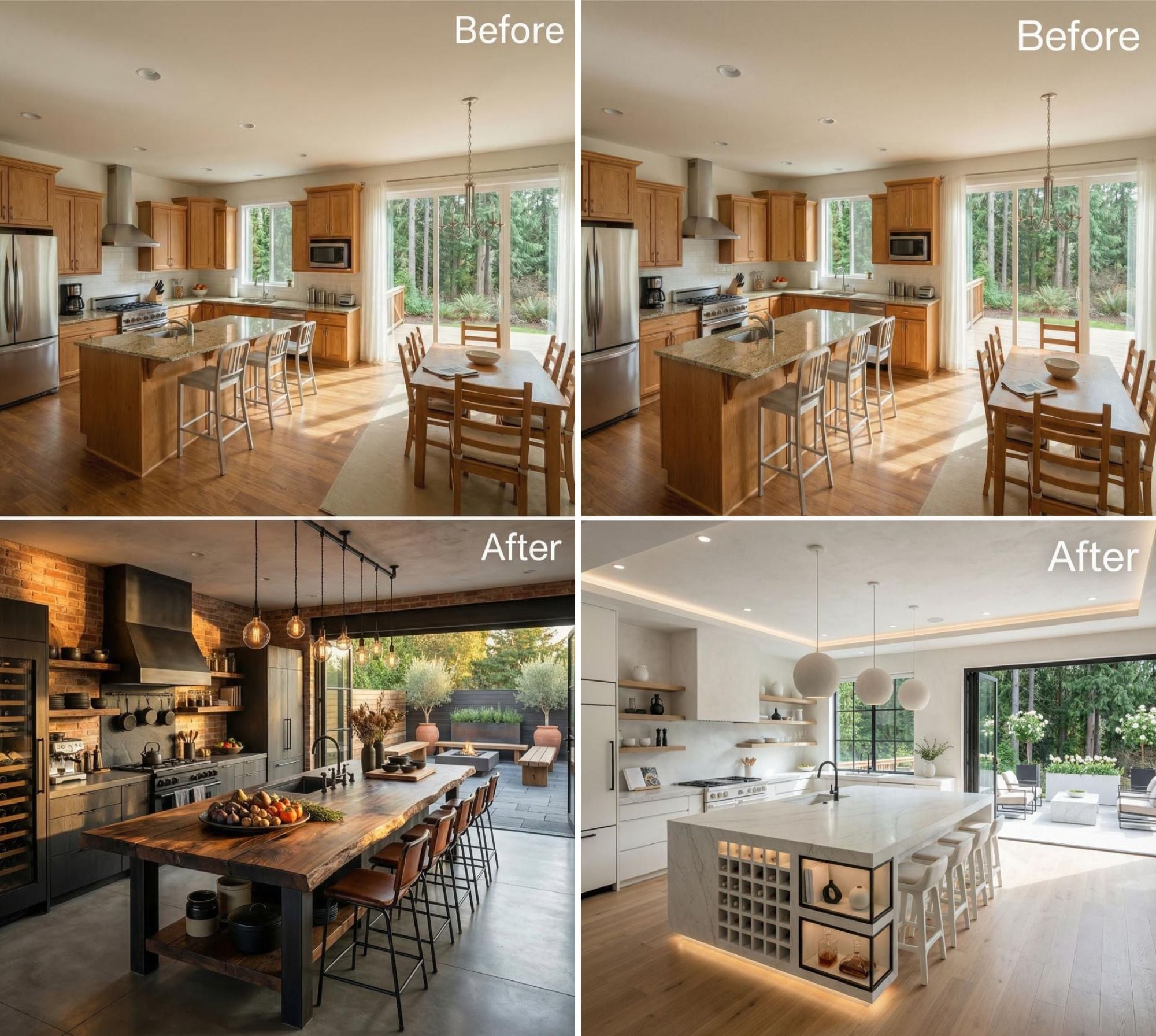
A builder-grade kitchen was never meant to impress anyone. It was meant to check a box, meet a code, and move inventory. Competitive hosts know the difference.
For anyone who entertains with intent, the kitchen is where reputations are made or quietly questioned. These 28 renovations all started in the same place: flat-panel cabinets in a forgettable finish, laminate counters, and lighting that belonged in a parking garage. What each homeowner did next says a lot about how seriously they take having people over.
The kitchens ahead show exactly what thoughtful upgrades look like in practice, from layout changes to material swaps that shift the entire feel of the space.
Navy Cabinets and Gold Trim Replace Oak in a Bold Kitchen Overhaul
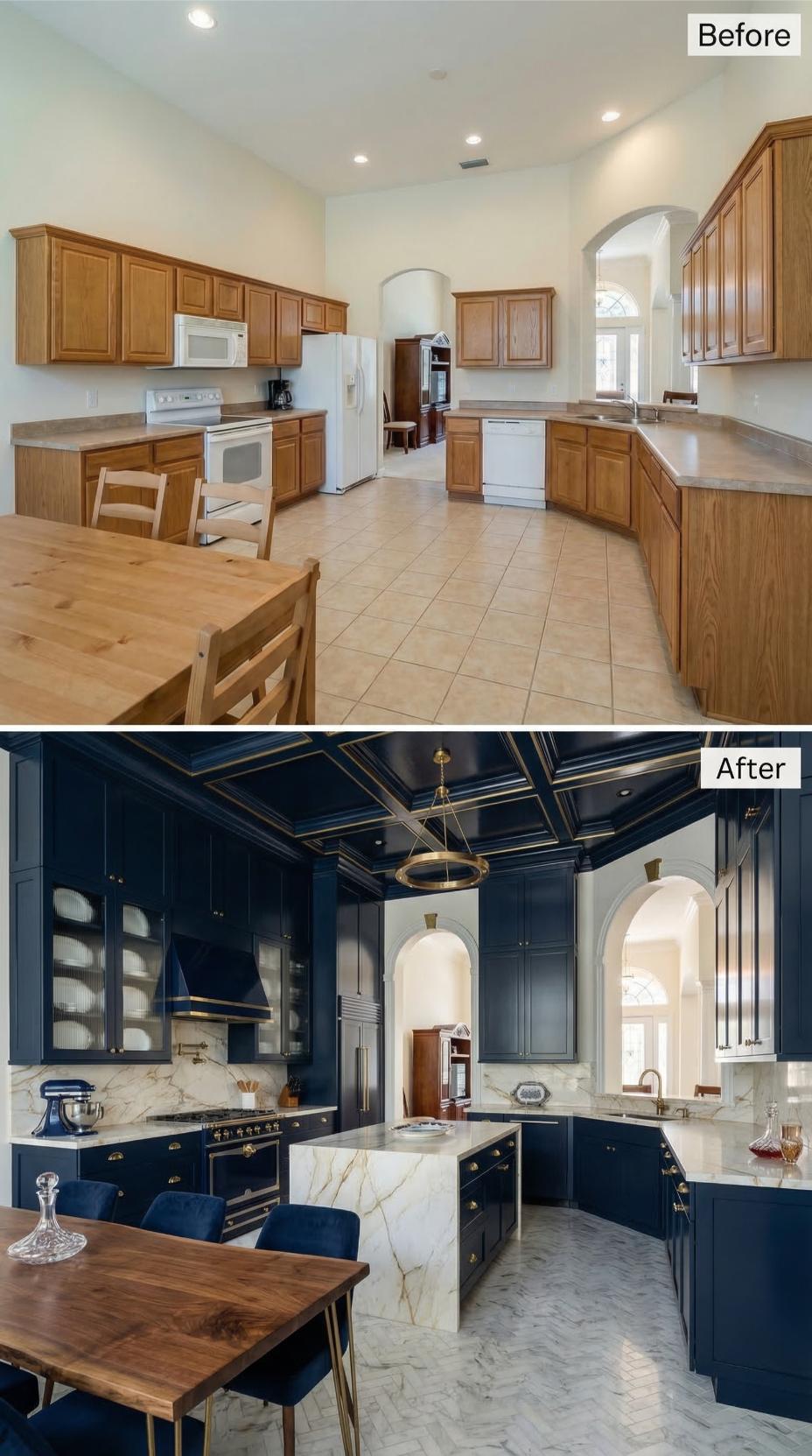
Flat-panel navy blue cabinetry with brass hardware replaces honey oak, while a coffered ceiling painted to match adds architectural weight the original builder-grade space never had.
Dark Green Cabinets and Marble Counters Overhaul a Dated Oak Kitchen
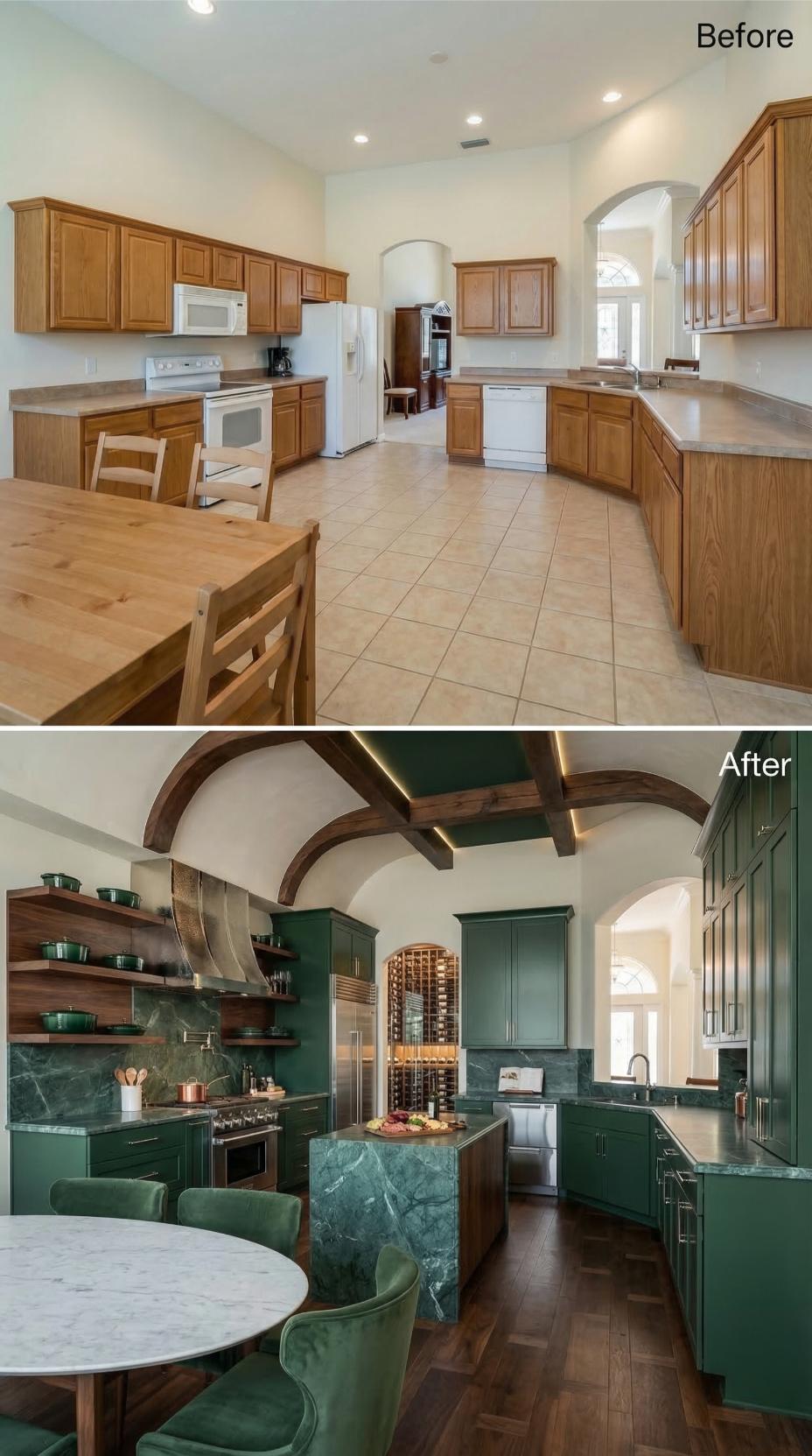
Hunter green cabinetry with brass hardware replaces honey oak, while verde marble waterfall islands and hammered metal range hoods anchor the space. Walnut open shelving and barrel-vault wood beams with cove lighting complete the shift.
Oak Cabinets Out, White Cabinetry and Marble Waterfall Island In
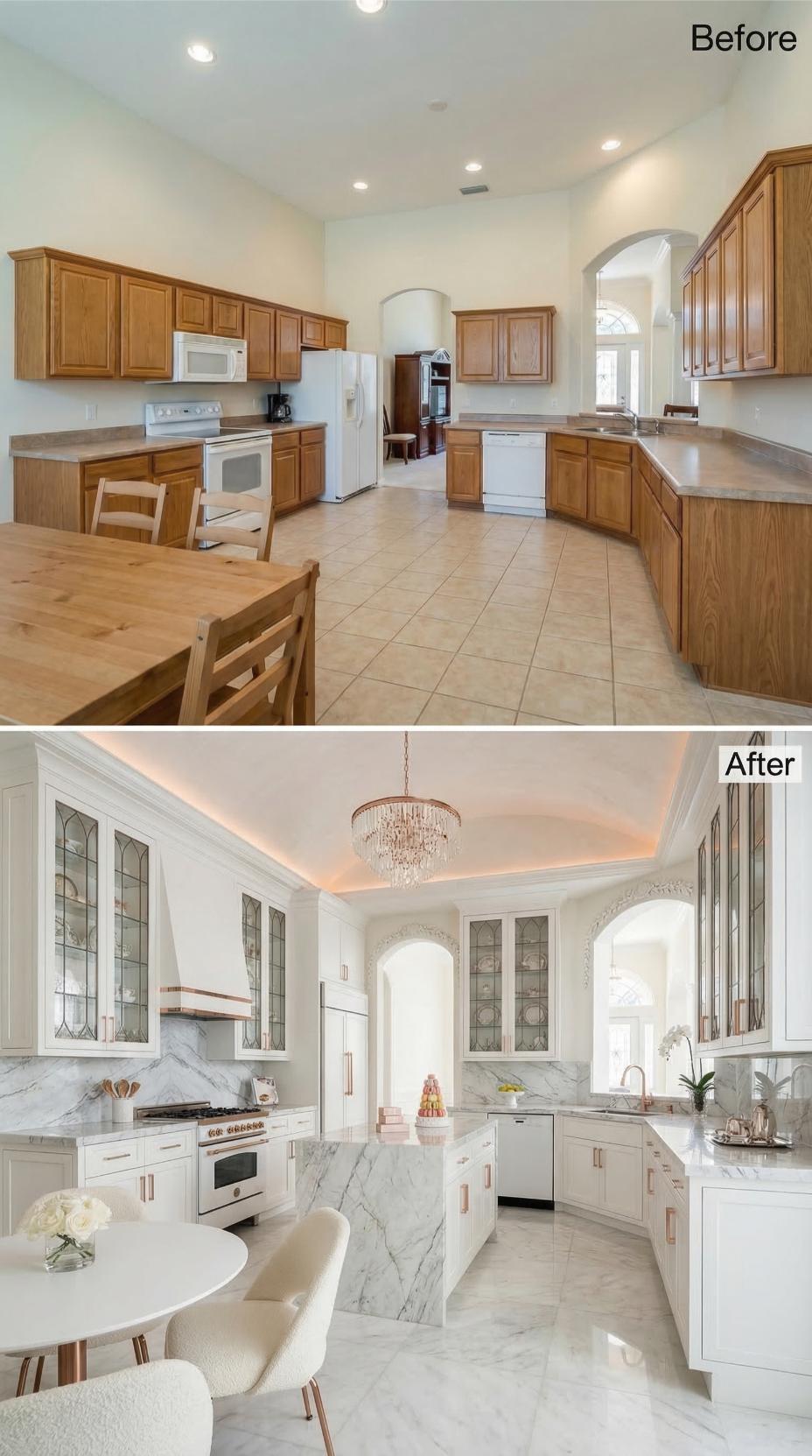
Leaded glass cabinet doors, copper hardware, and a Calacatta marble waterfall island replace honey oak and beige laminate counters in this complete overhaul.
Concrete Counters and Open Walnut Shelving Replace Honey Oak in a Dramatic Overhaul
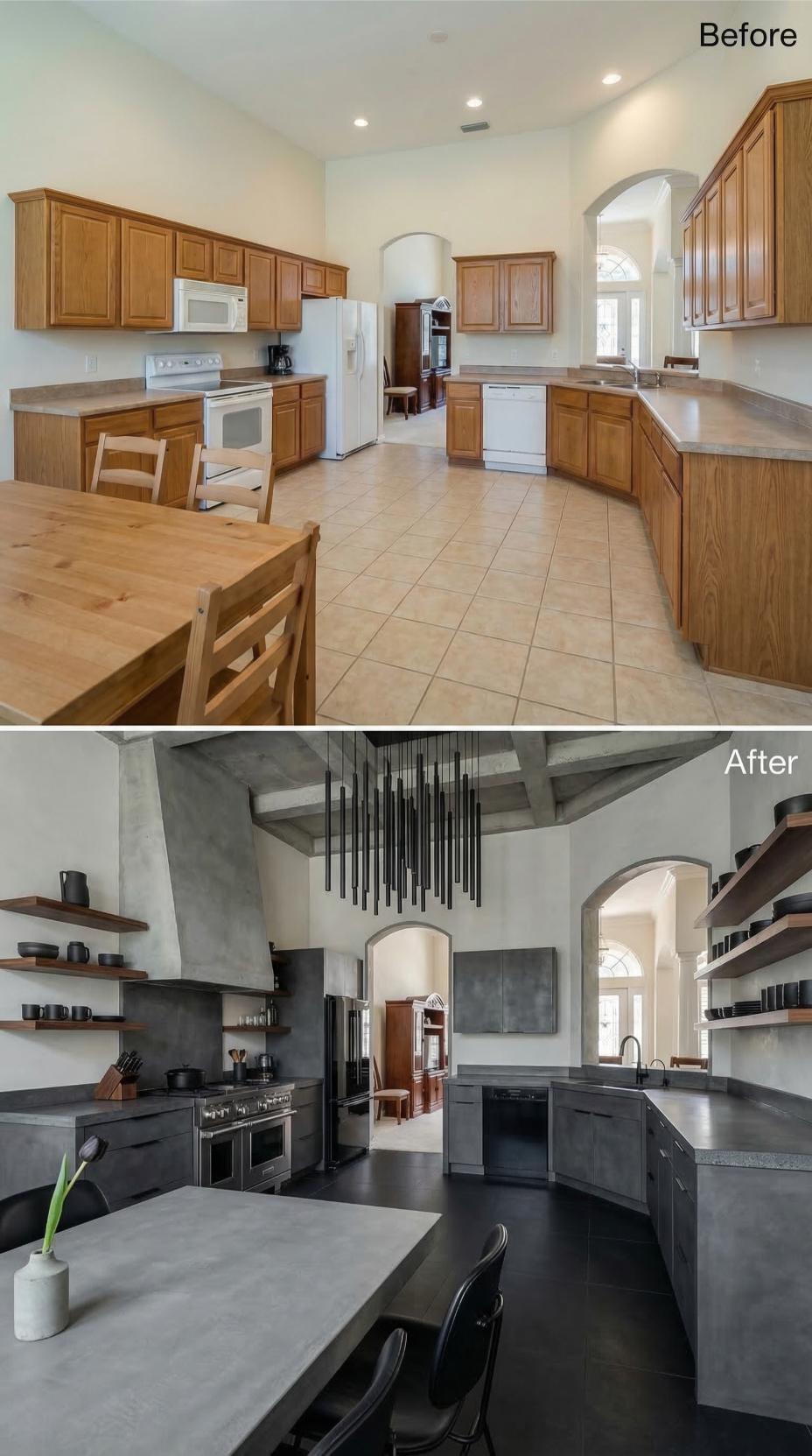
Raised-panel oak cabinets and beige tile gave way to concrete-finish cabinetry, dark hardwood floors, and open walnut floating shelves. A plaster range hood anchors the left wall above a stainless range, while rod-style pendant lighting drops from the vaulted ceiling.
Burgundy Lacquer Cabinets and Black Marble Floor a Builder-Grade Kitchen Behind
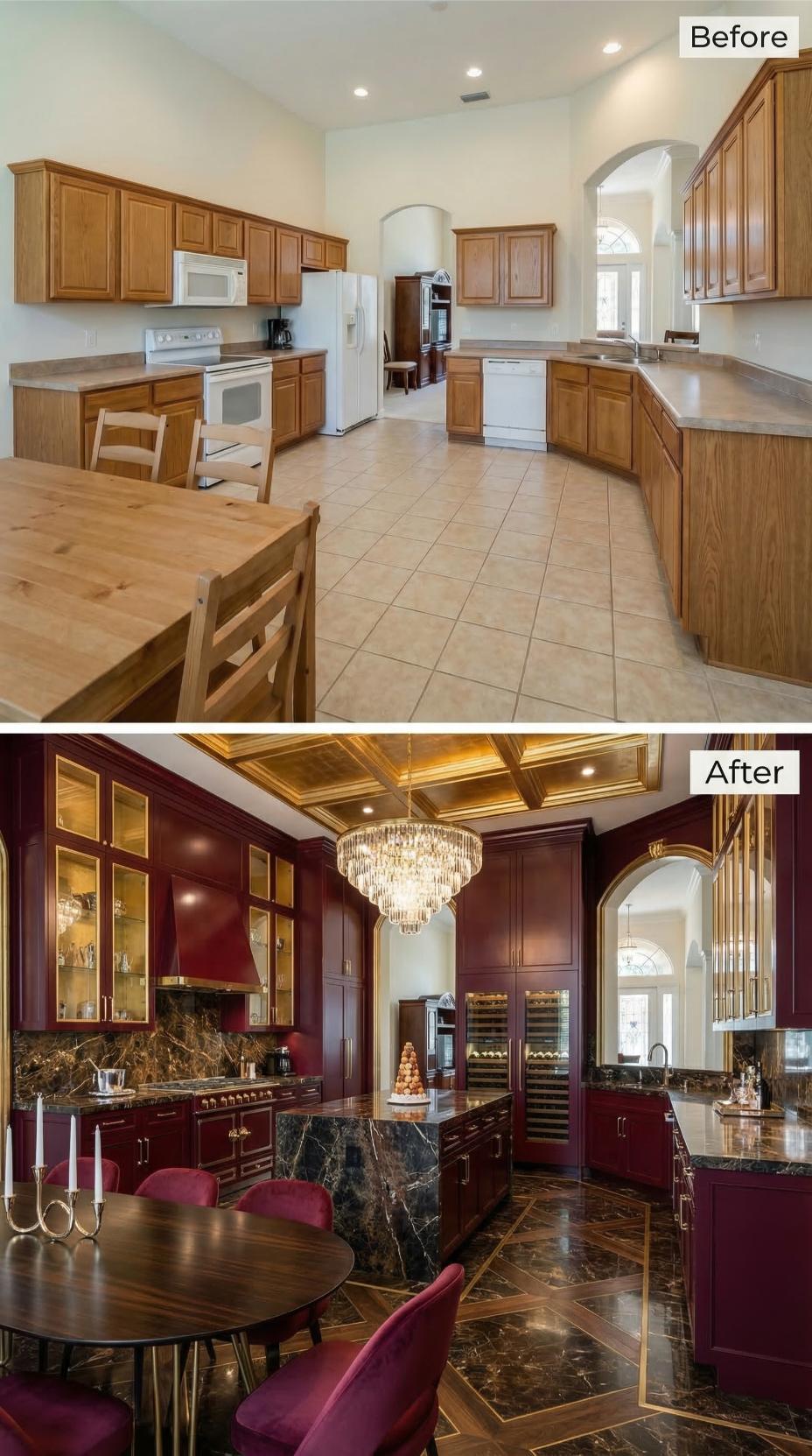
Honey oak and beige tile gave way to deep burgundy lacquer cabinets trimmed in brushed gold hardware. A coffered ceiling with gold-leaf insets anchors a tiered crystal chandelier overhead. Dark emperador marble covers the island, floors, and counters in a continuous vein pattern.
Wine refrigerators flank the island on the back wall, and glass-front upper cabinets display glassware against interior lighting. Velvet dining chairs in crimson pull up to a round walnut table, grounding the room without competing with the cabinetry.
Ask Yourself: Would your entertaining style actually support a kitchen this bold, or would the drama work against you during a casual weeknight dinner? Dark lacquer shows fingerprints and requires consistent upkeep, so factor maintenance into the appeal. Guests will notice this room before the food arrives.
Copper Range Hood and Coffered Ceiling Recast a Builder Kitchen in Black
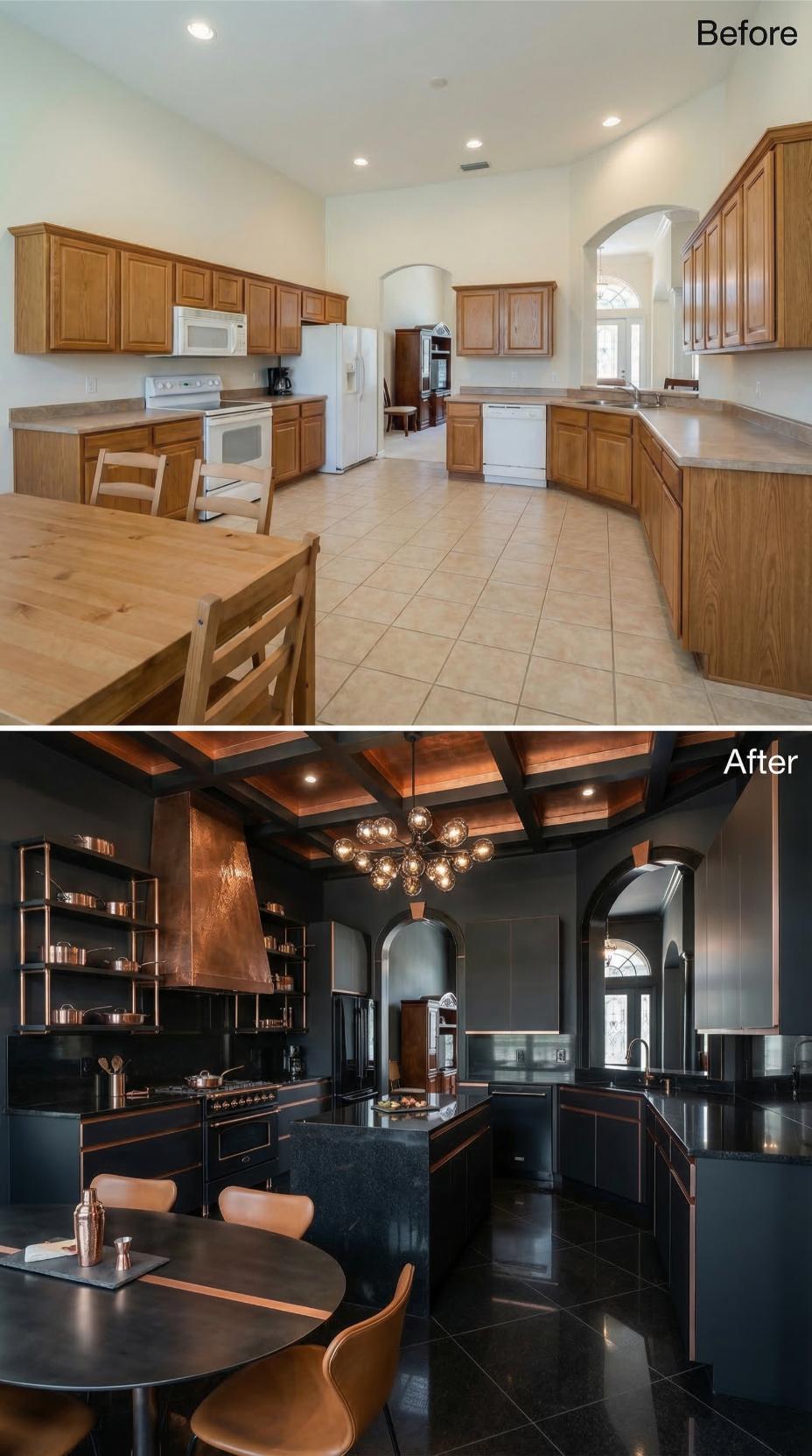
Oak cabinets and beige tile gave way to matte black cabinetry with copper pipe trim, black granite counters, and large-format black floor tile. A hammered copper range hood anchors the cooking wall, flanked by open copper-frame shelving holding copper cookware. The coffered ceiling, painted black with copper accents on the beams, adds structure overhead, while a globe chandelier with amber-tinted bulbs pulls light downward over the round dining table. Tan leather chairs ground the seating without breaking the palette.
- Copper details need regular polishing to keep patina consistent across shelving, hood, and trim
- Open shelving in a rental or host setting means cookware display becomes part of the room’s first impression
- Black granite requires sealing before hosting to prevent staining from food prep during events
Rococo Plasterwork and a Coffered Dome Swallow a Builder Kitchen Whole
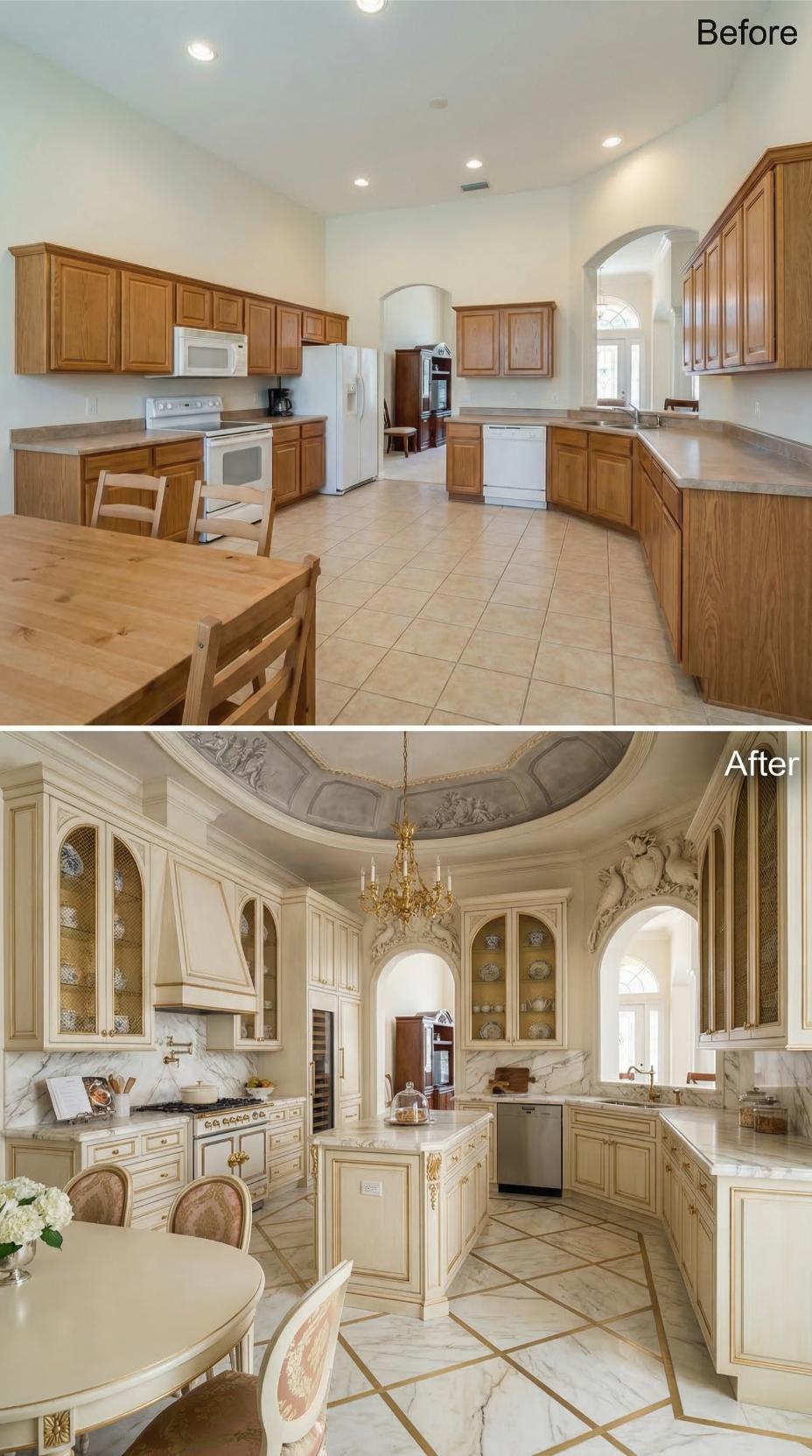
Cream-painted cabinetry with gold-leaf trim lines replaced flat oak boxes, and the ceiling became the loudest element in the room: a barrel-vaulted dome with bas-relief plasterwork depicting cherubs and foliate scrolls. Marble floors in a diagonal grid with brass inlay anchor the space below. A brass candelabra chandelier hangs at center, and arched glass-front cabinets with wire mesh inserts display blue-and-white porcelain. The kitchen island wears the same cream-and-gold finish as the perimeter cabinetry.
Color Story: Cream with gold-leaf detailing reads differently depending on the light source. Natural light from the arched window pulls the gold warm, while evening candlelight from that brass chandelier deepens the cream toward ivory. Hosts planning dinner parties should note that the color palette performs best after sundown.
Slate Blue Shiplap Ceilings and Brass Hardware Recast a Builder Kitchen for Serious Hosts
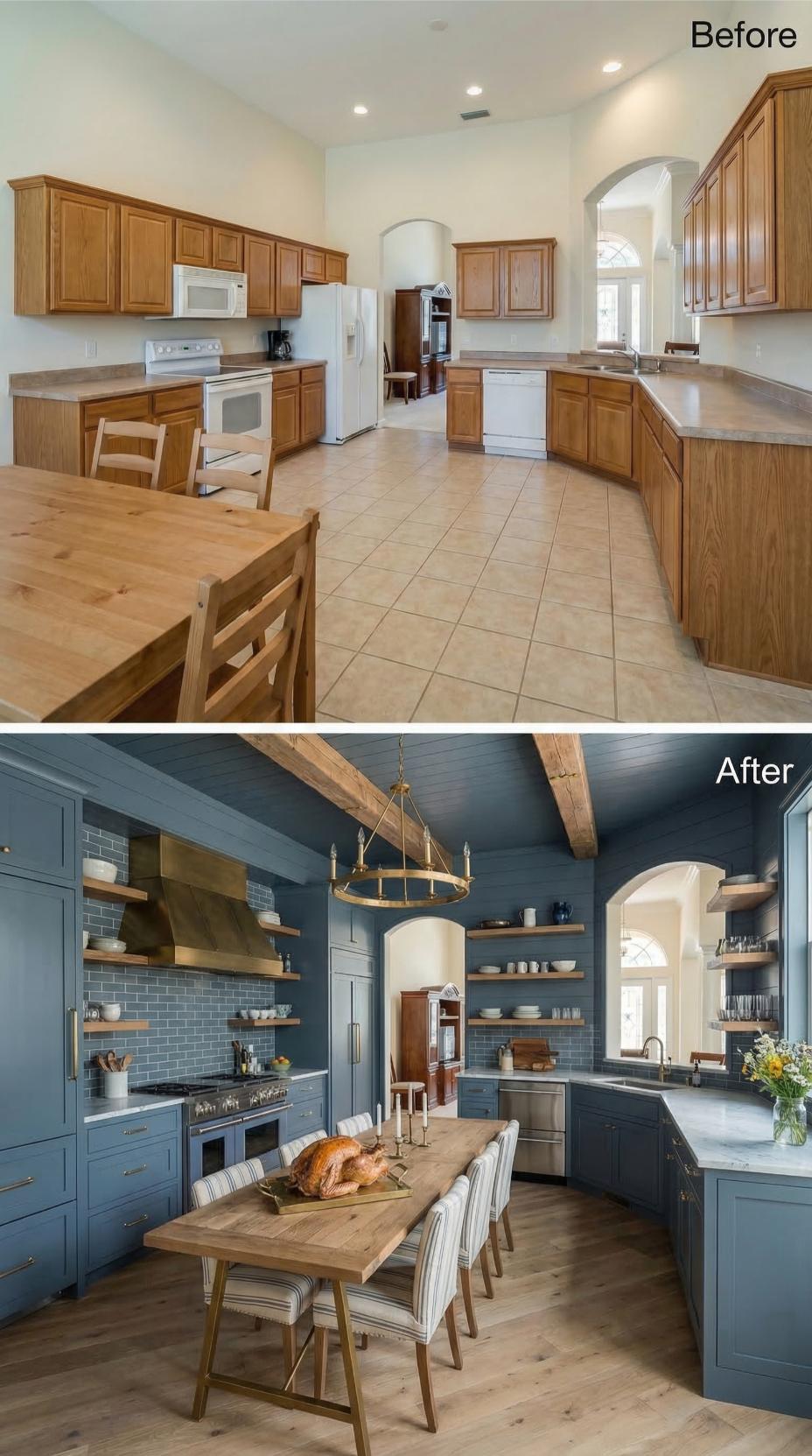
Every surface in the after photo carries the same slate blue, from the flat shiplap ceiling to the subway tile backsplash to the recessed Shaker cabinets, creating a visual pressure that the original honey-toned oak and beige tile never attempted. Brass pulls, a brass range hood, and a ring chandelier with candle-style lights hold the warmth in check rather than softening the palette entirely.
The reclaimed wood ceiling beams and a long trestle dining table with linen-stripe upholstered chairs pull the room toward a farmhouse register without abandoning the boldness. White quartz counters run the perimeter and anchor the sink wall, while open wood floating shelves break the cabinet mass on both sides of the range.
Pro Tip: Painting the ceiling the same color as the walls and cabinets compresses visual height intentionally, which works in a large kitchen but can make a smaller one feel like a cave. Measure the square footage and ceiling height before committing to a full envelope color treatment. Rooms over 200 square feet with ceilings above nine feet tend to absorb it best.
Emerald Lacquer and Green Marble Pull a Builder Kitchen Into Dark Glamour
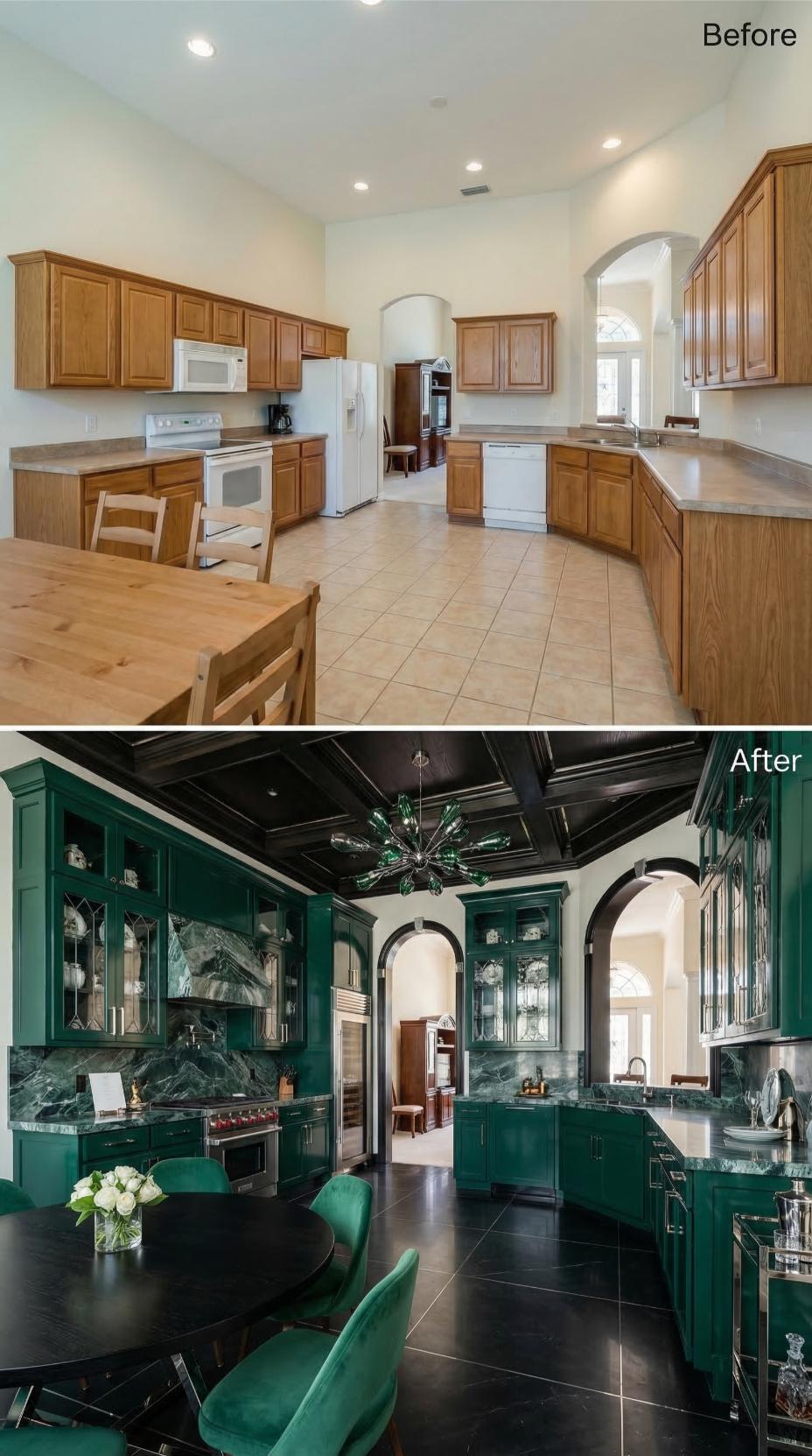
Forest green lacquer runs floor to ceiling across every cabinet face, with leaded glass inserts on the uppers catching light differently depending on angle. Green-veined marble covers both the backsplash and countertops, and the pattern reads almost painterly where the slabs meet at inside corners. A black coffered ceiling drops the visual plane and makes the room feel like a private dining club rather than a family kitchen. Chrome hardware keeps the palette from closing in completely.
The dining side swaps the original wood table for a black round pedestal topped with white roses in clear glass. Velvet chairs in the same forest green pull the seating into the cabinet color. A sputnik chandelier in matching green glass hangs from the coffered grid, connecting ceiling to floor without a single neutral interruption.
Painted ceilings carry drama well, but sometimes the ceiling itself becomes the entire design statement.
Coffered Beams and Hand-Painted Panels Pull a Builder Kitchen Into Tuscan Territory
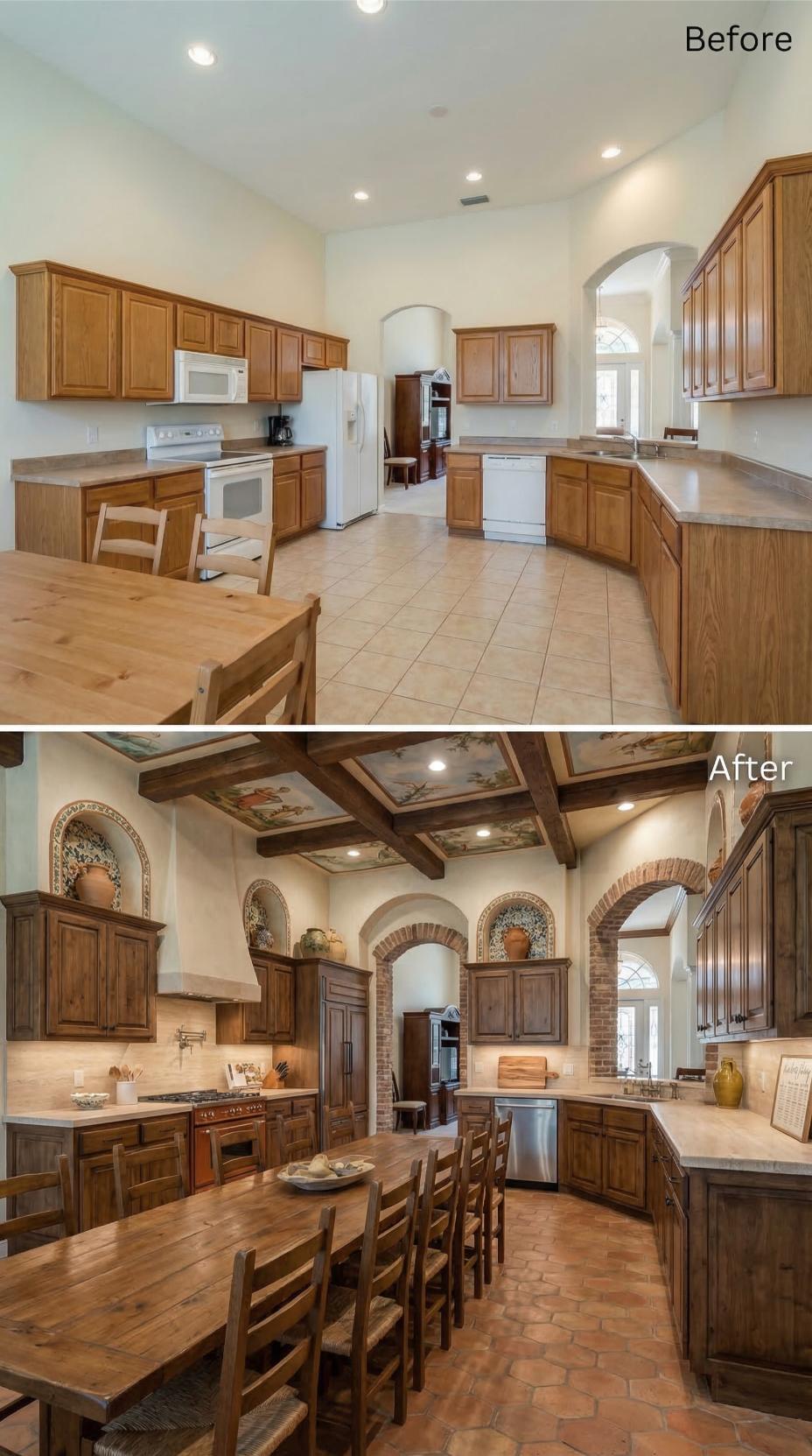
Dark-stained alder cabinets replace the original honey-toned oak across every run, while reclaimed brick surrounds the archways and frames the range alcove. Hand-painted botanical panels drop into each coffered bay overhead, giving the ceiling more visual weight than any backsplash could. Terracotta pavers replace the original large-format ceramic tile underfoot, and the stainless dishwasher is the only appliance that acknowledges the current century.
Blush Cabinets, Gold Trim, and Leaded Glass Recast a Builder Kitchen in Regency Pink
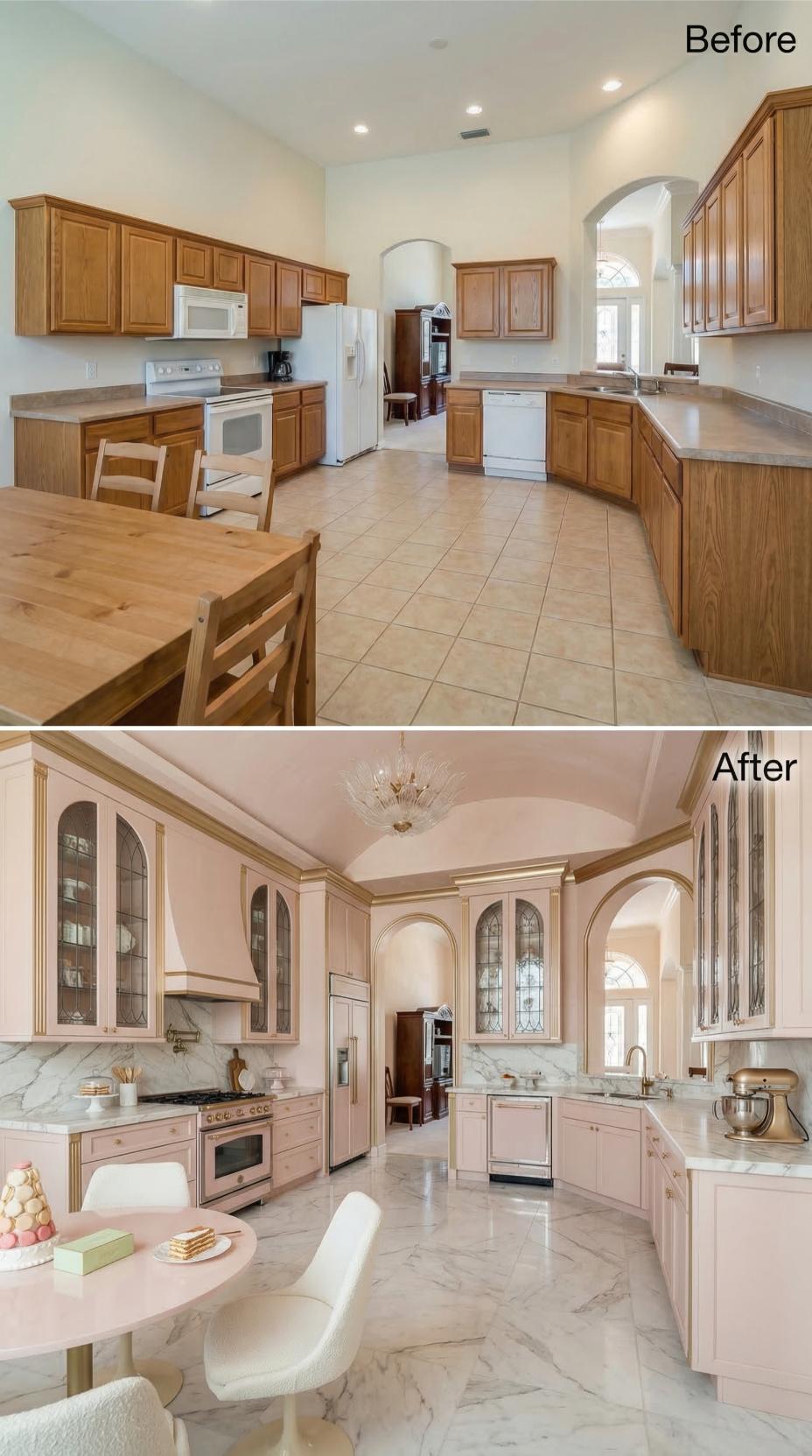
Blush-painted cabinetry with gold molding trim replaces the original oak, while arched glass cabinet doors with lead detailing and a marble-veined porcelain floor signal a complete shift in register. A crystal chandelier anchors the barrel-vaulted ceiling, and panel-ready stainless appliances keep the wall surface unbroken.
Black Lacquer Cabinets and Veined Marble Swap Out Warm Oak for High-Contrast Drama
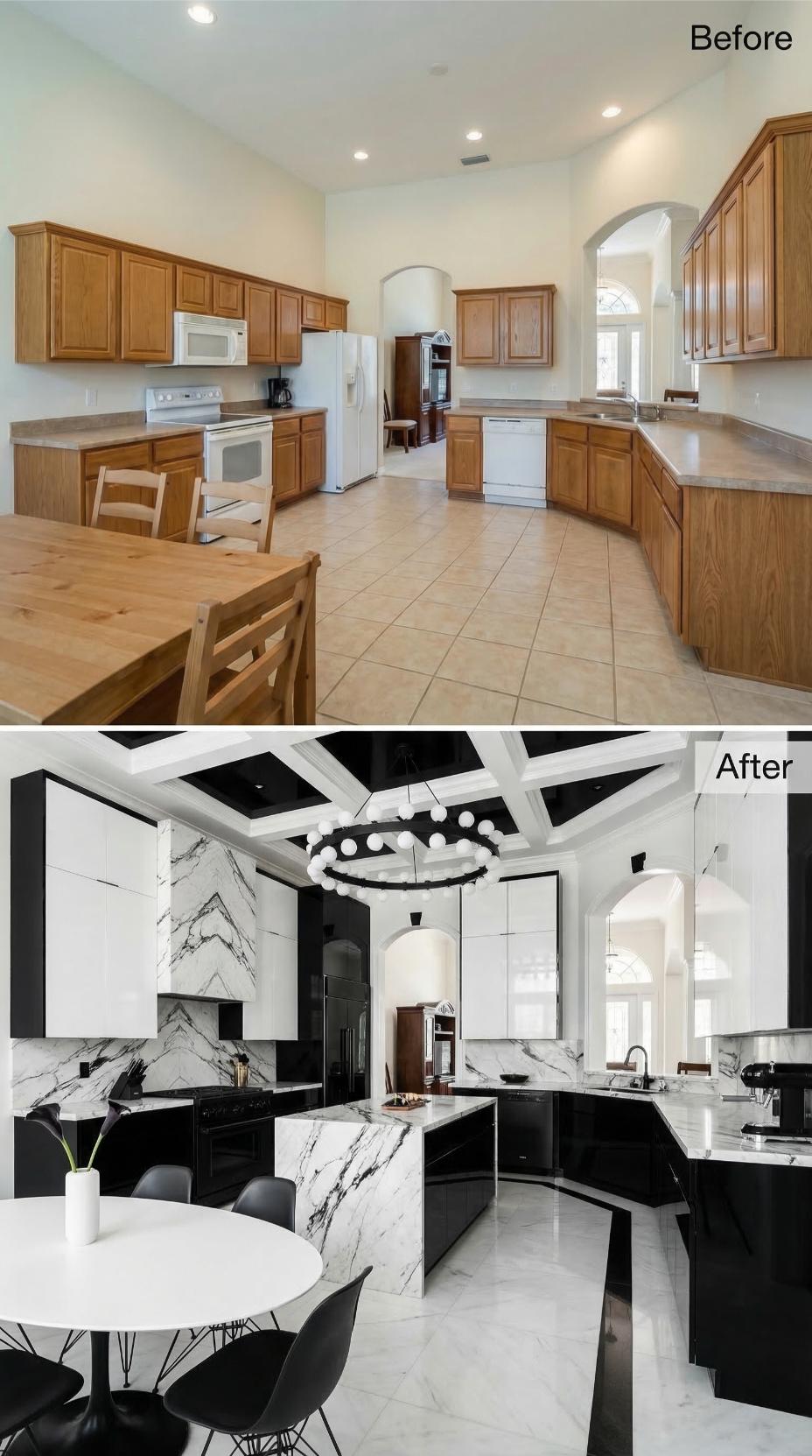
Glossy black lower cabinets pair with white uppers and floor-to-ceiling marble slab backsplash, while a coffered ceiling finished in black lacquer anchors a round globe chandelier above the new island.
Budget Tip: Marble-look porcelain slabs cost roughly 40 to 60 percent less than natural stone and require no sealing, which matters when a kitchen island sees heavy prep work during back-to-back dinner parties. Sourcing consistent veining across wall panels and countertops is easier with porcelain because large-format slabs come from a single production run.
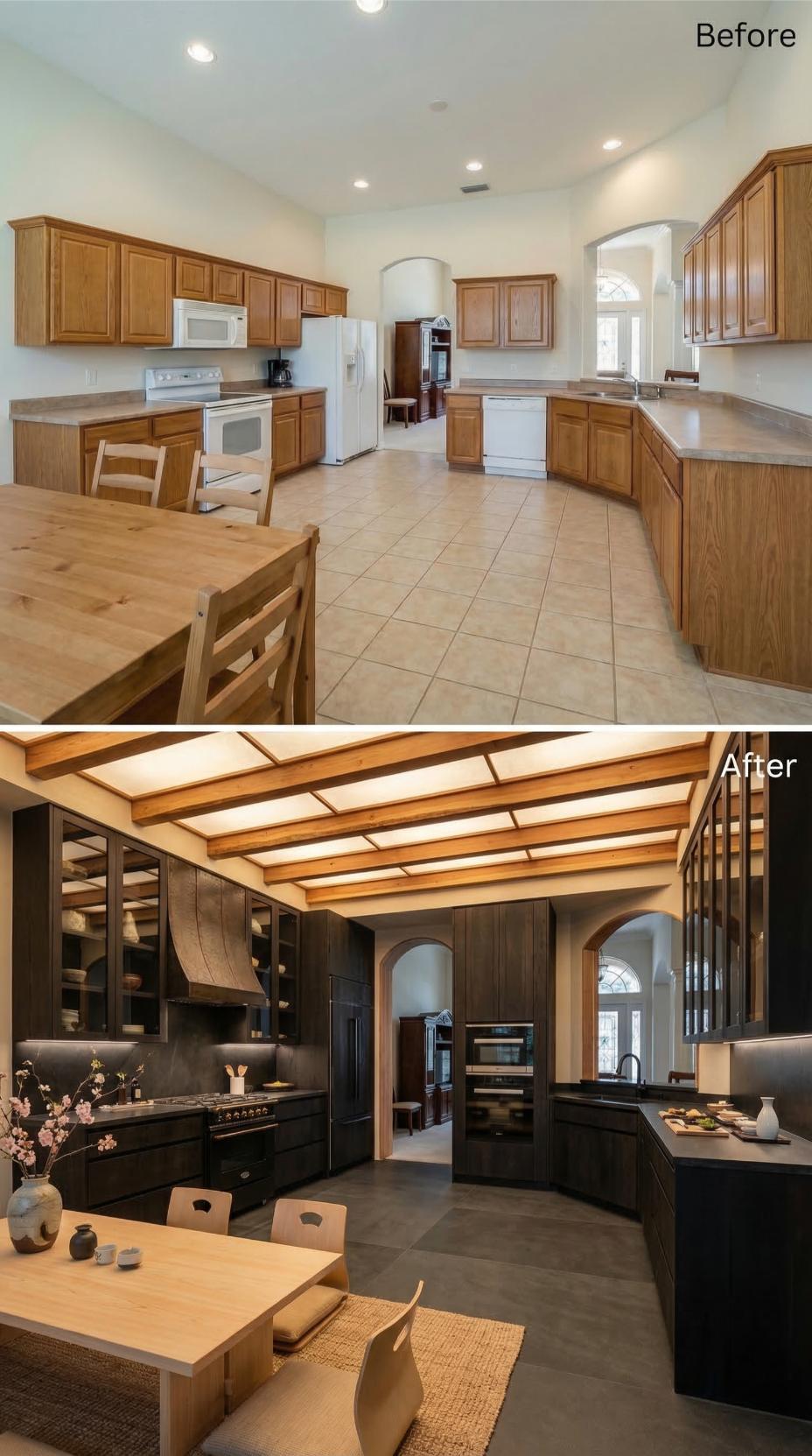
Backlit Cedar Ceiling Panels and Charcoal Cabinetry Bury a Honey-Toned Builder Kitchen
🔥 Would you like to save this?
What was once a U-shaped kitchen defined by raised honey oak cabinets and beige ceramic tile now runs entirely in dark-stained flat-panel cabinetry and large-format charcoal slate flooring. The ceiling is the sharpest departure: parallel cedar beams frame translucent panels lit from behind, casting warm diffused light across the whole room without a single pendant or chandelier.
A slate-colored range hood anchors the cooking wall above a professional gas range finished in matte black. Open glass-front upper cabinets on the left display dishware rather than concealing it. The dining side retains a natural maple table with linen-cushioned chairs, which keeps the room from reading as a pure showpiece.
Trend Alert: Backlit ceiling panels are gaining ground as an alternative to recessed lighting in kitchens with high ceilings, because they spread light evenly without casting the harsh downward shadows that can make dark cabinetry look flat. Cedar is a practical choice for the framing because it resists warping in humidity-prone cooking environments. The effect reads more architectural than decorative, which tends to age better than fixture trends.
Cobalt Lacquer Cabinets and a Herringbone Walnut Floor Bury Builder Oak in Bold Color
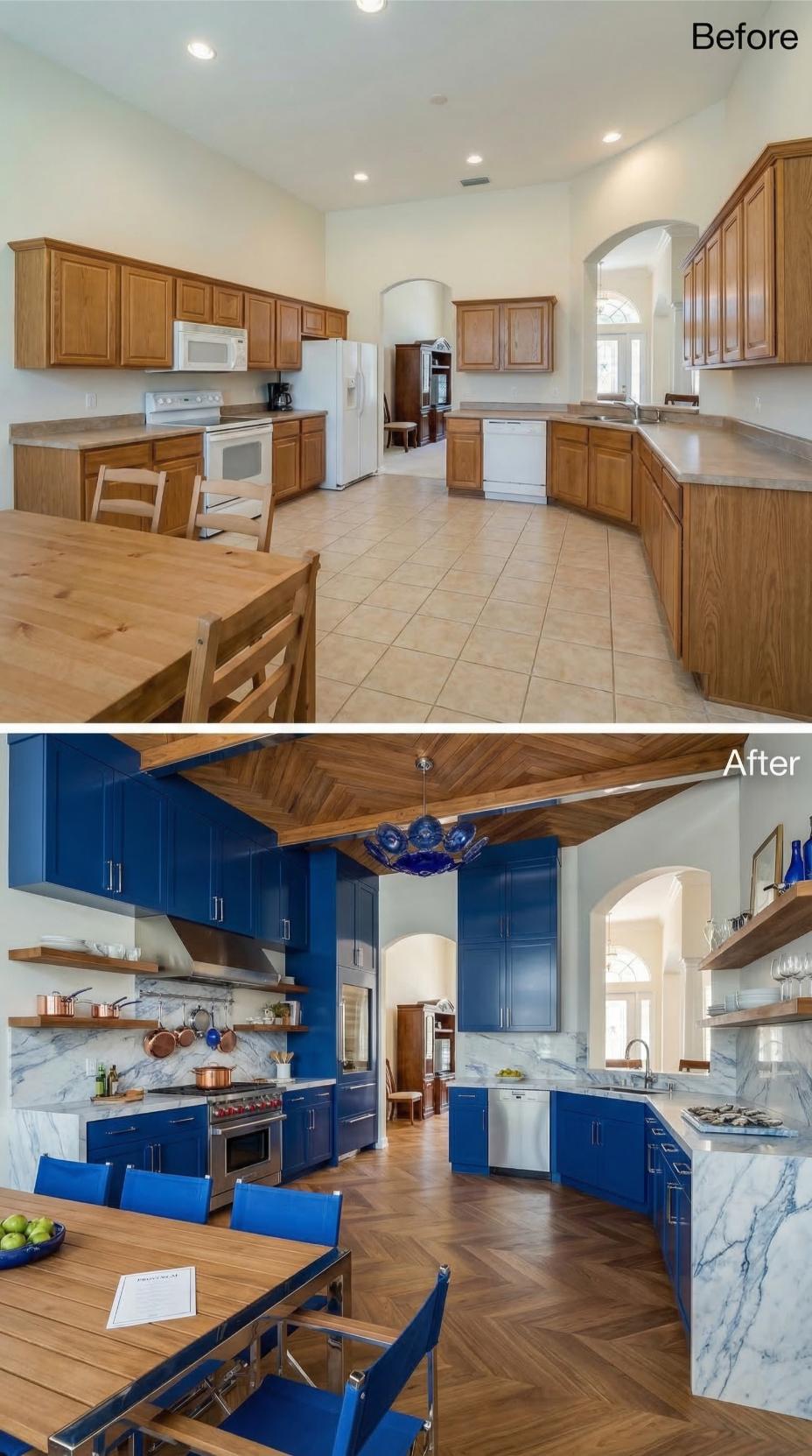
Cobalt blue lacquer runs floor to ceiling on every cabinet face, paired with brushed nickel pulls that keep the hardware from competing with the color. The backsplash is book-matched Carrara marble with heavy grey veining, and the same slab wraps the peninsula waterfall edge. Overhead, a herringbone walnut ceiling drops a warm wood tone against all that saturated blue, anchored by a cobalt blown-glass chandelier that echoes the cabinet color deliberately. Blue upholstered dining chairs at the walnut table extend the palette into the eating area without adding a third material to manage.
Wisteria Ceiling Mural and Green Marble Floors Bury Builder Oak in Botanical Drama
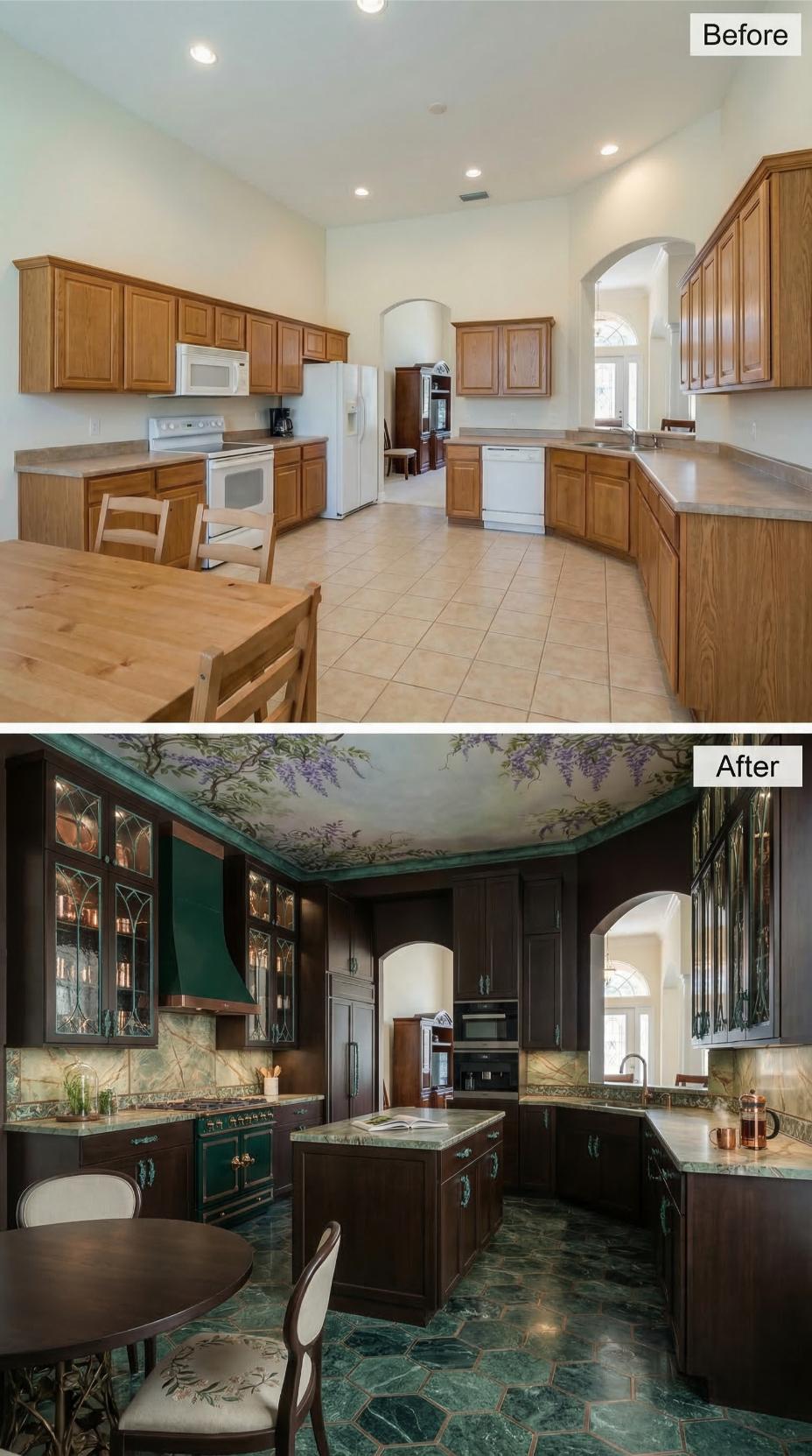
Dark espresso cabinetry with leaded art-glass doors frames a hand-painted wisteria mural that covers the entire ceiling, replacing recessed-lit beige with something closer to a Victorian conservatory.
Style Math: Leaded glass cabinet inserts typically add between $200 and $600 per door depending on the complexity of the pattern, but they do double duty by hiding clutter while still letting copper cookware read as a design element through the glass. Green quartzite or verde marble flooring in an irregular flagstone layout costs more to install than standard tile because cuts must be fitted individually. Pairing it with a coordinating backslab backsplash in the same stone family creates visual continuity that makes a large kitchen feel intentional rather than assembled.
Crimson Lacquer Cabinets and a Coffered Ceiling Pull Builder Oak Into Dark Drama
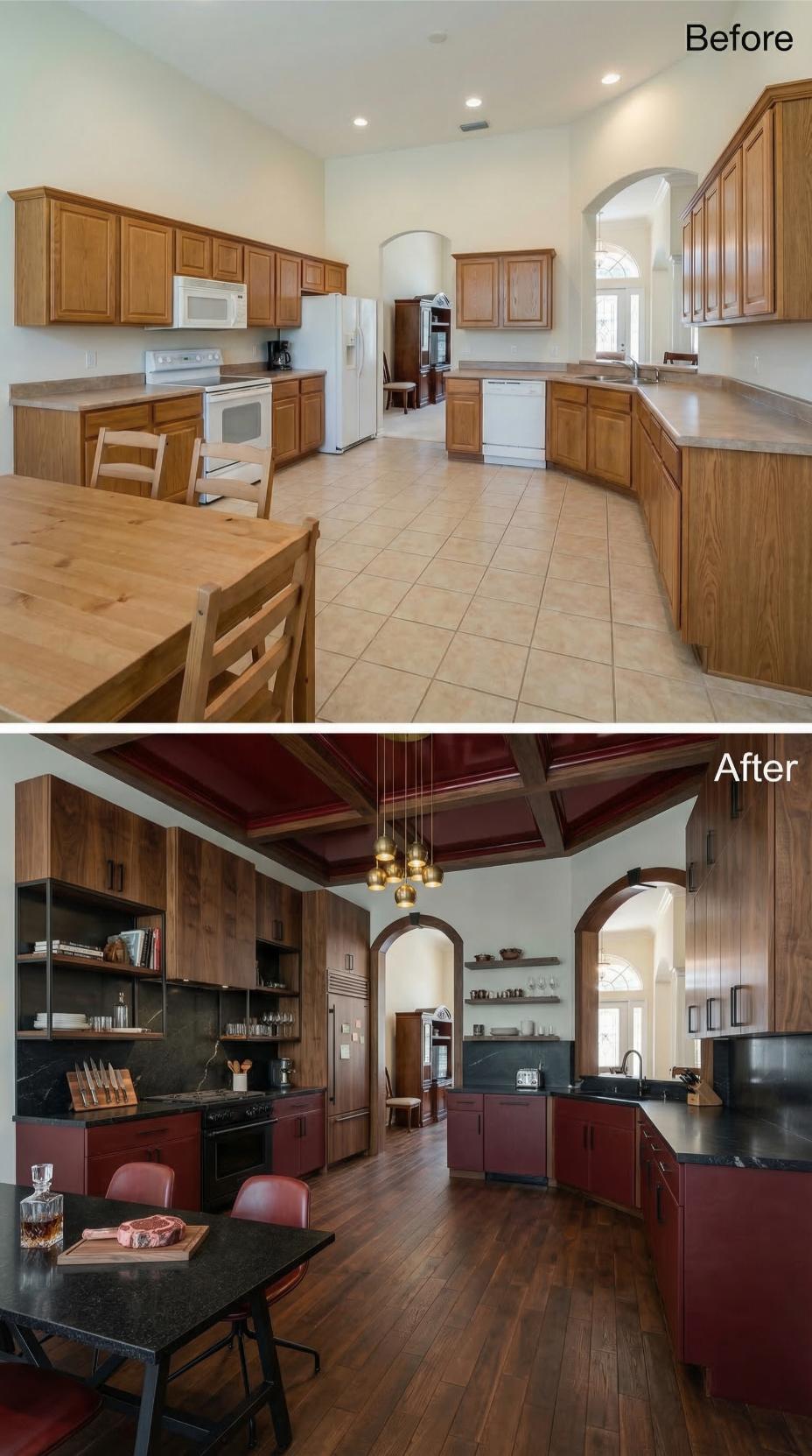
Walnut-toned upper cabinets stay, but crimson lacquer lowers and black slab countertops cut the warmth in half. The coffered ceiling, finished in the same deep red with dark wood beams, pulls the eye upward instead of letting the tall walls go unused.
Pendant globes in brushed brass hang low over the dining table, which now holds a granite-look black top on steel legs. Dark hardwood planks replace the beige tile, and open steel shelving along the left wall gives glassware a place to perform.
Designer’s Secret: Painting a coffered ceiling insert the same color as the lower cabinets creates a visual loop that anchors a tall kitchen, preventing the upper half of the room from feeling disconnected from the work zone below. In a kitchen used for competitive hosting, that sense of enclosure reads as intentional atmosphere rather than a low ceiling. The technique works best when at least one other surface, here the countertop, repeats the dark tone to complete the circuit.
Lavender Lacquer and Barrel-Vaulted Plasterwork Bury Honey Oak in French Palace Drama
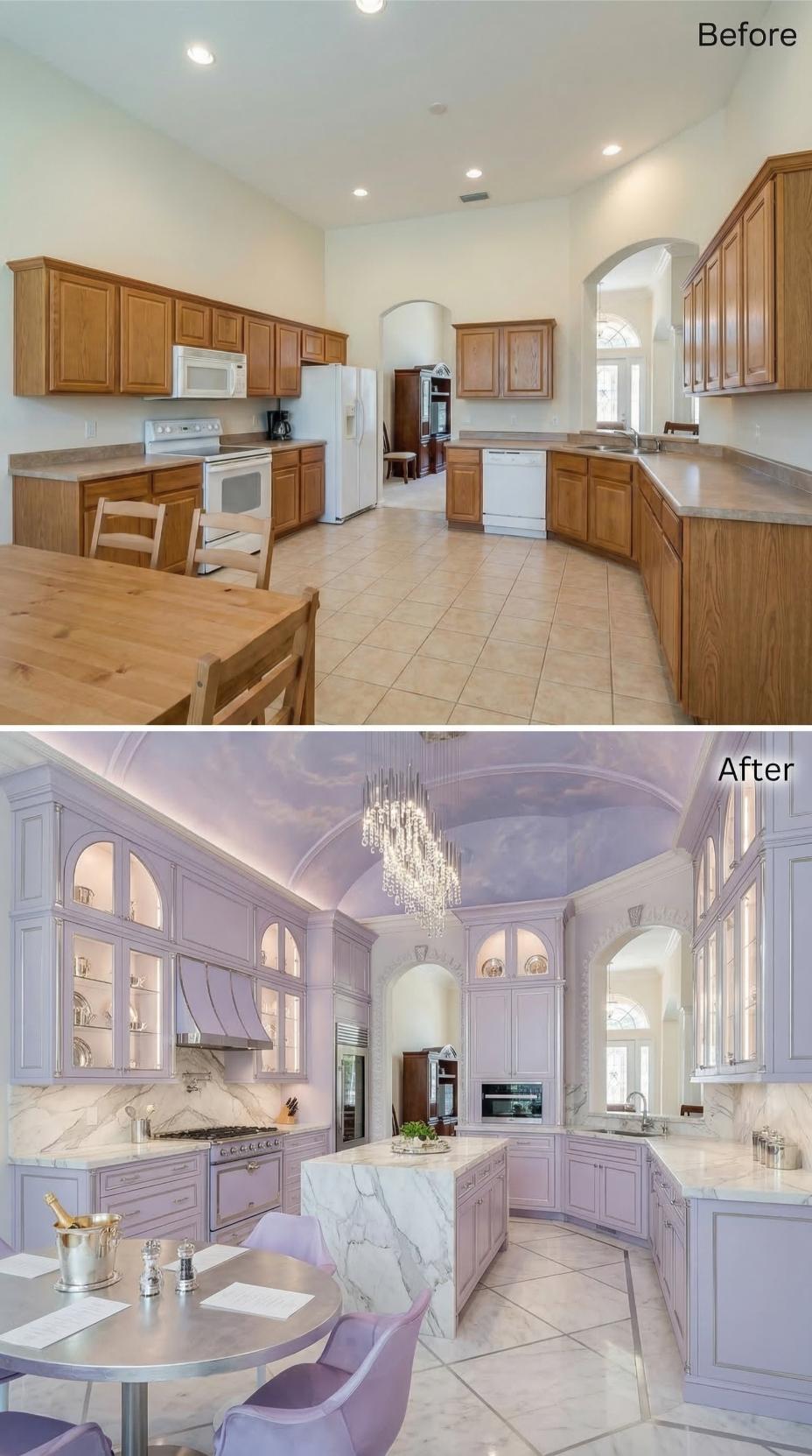
Red oak cabinets and beige laminate countertops are completely gone. In their place: lavender-painted cabinetry with raised-panel molding, arched glass inserts lit from within, and a barrel-vaulted ceiling painted in a soft sky mural with warm violet undertones. A crystal cascade chandelier drops from the vault’s center, and a marble island with thick waterfall edges anchors the room’s new geometry.
The range wall gets a custom plaster hood flanked by marble slab backsplash running floor to upper cabinet. Hosts entertaining more than eight people will notice the layout retained its U-shape, which keeps workflow intact regardless of how theatrical the room looks. One practical note: cabinet interiors painted to match the lavender exterior make the glass-front displays feel intentional rather than accidental, since mismatched shelving color would undercut the whole effect at close range.
Mughal Arches and Hand-Painted Coffered Panels Bury Builder Oak in Spice-Route Drama
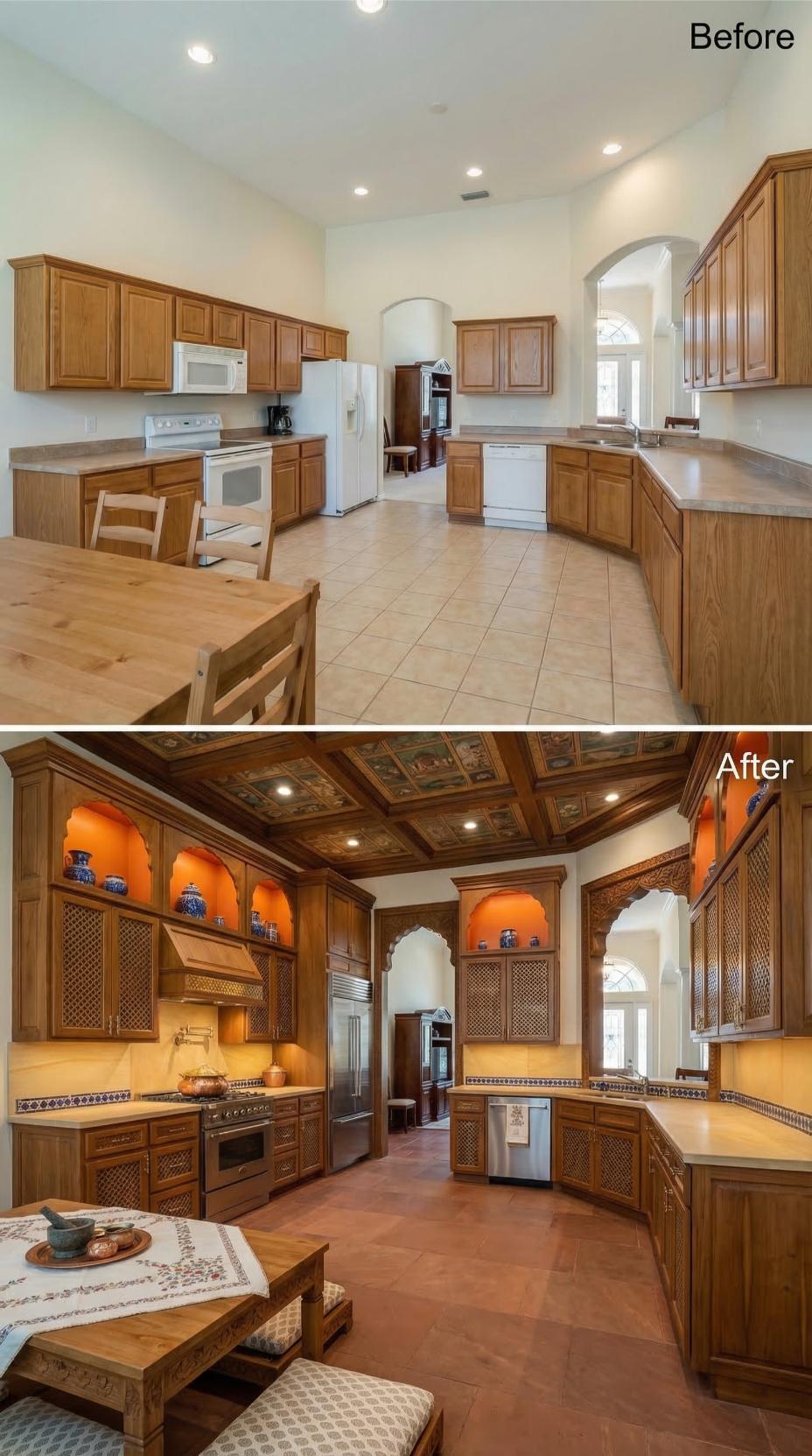
Honey oak cabinets and white appliances gave way to something far more specific: a kitchen built around Mughal architectural vocabulary. Carved jali latticework replaces flat cabinet doors, orange-painted niches with horseshoe arches hold blue-and-white ceramic vessels, and a coffered ceiling carries hand-painted panels framed by dark wood molding. Terracotta floor tiles replace the original beige ceramic, pulling warmth up from the ground.
Stainless steel appliances, including a commercial range and panel-ready refrigerator, handle the practical side without disrupting the aesthetic. Blue Talavera tile runs along the backsplash as a border. The wooden table at center gains bench seating with upholstered cushions, suggesting a kitchen built as much for lingering as for cooking.
Why Jali Cabinet Doors Work Harder Than Glass Inserts
The carved jali screens visible on the lower cabinet doors serve the same display function as glass-front cabinetry without requiring interior lighting to read well. The open lattice geometry creates depth through shadow, changing character as daylight shifts across the room. Sourcing jali panels through woodworkers who specialize in South Asian or Moorish joinery typically costs more upfront than stock glass inserts, but the pattern itself becomes a fixed architectural detail rather than a finish that dates quickly.
Plum Lacquer Cabinets and Black-Gold Marble Swap Builder Oak for Dark Regency Drama
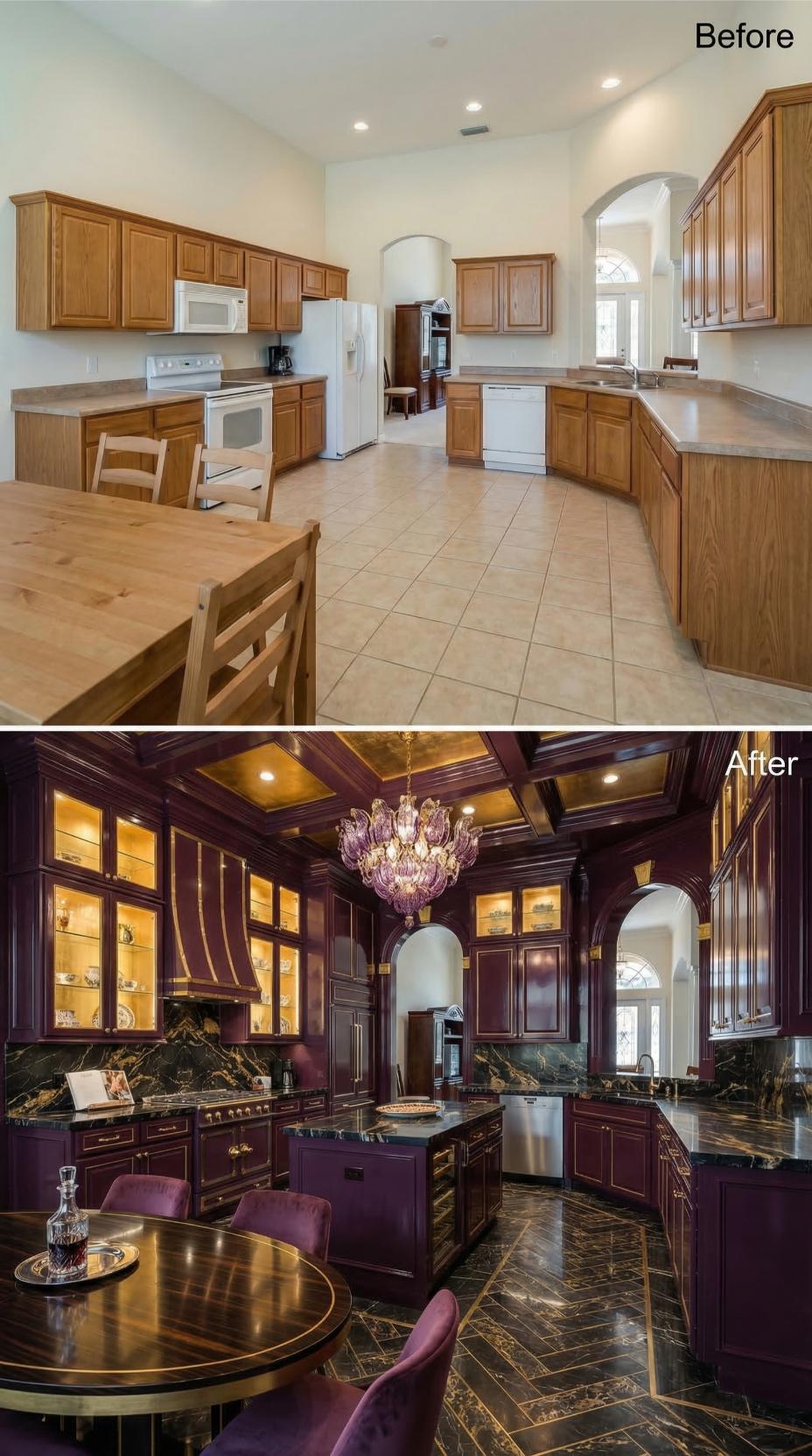
Every surface here rejects the original honey oak and beige tile in favor of deep plum lacquer cabinets with brass hardware and gold inlay detailing on the range hood. The countertops and floor read as the same black-and-gold veined marble, laid in a herringbone pattern underfoot, which pulls the room’s color story from ceiling to ground.
A coffered ceiling with gold-leaf inserts and a Murano-style amethyst glass chandelier handle the overhead work. Glass-front uppers with interior lighting display china and glassware as part of the room’s decor rather than hiding it. Round tables with velvet seating in the same plum tone signal that this kitchen is built around performance hosting, not quick weeknight meals.
The countertops and floor read as the same black-and-gold veined marble, laid in a herringbone pattern underfoot, which pulls the room’s color story from ceiling to ground.
Sage Shaker Cabinets and Green Soapstone Swap Builder Oak for a Kitchen Worth Competing In
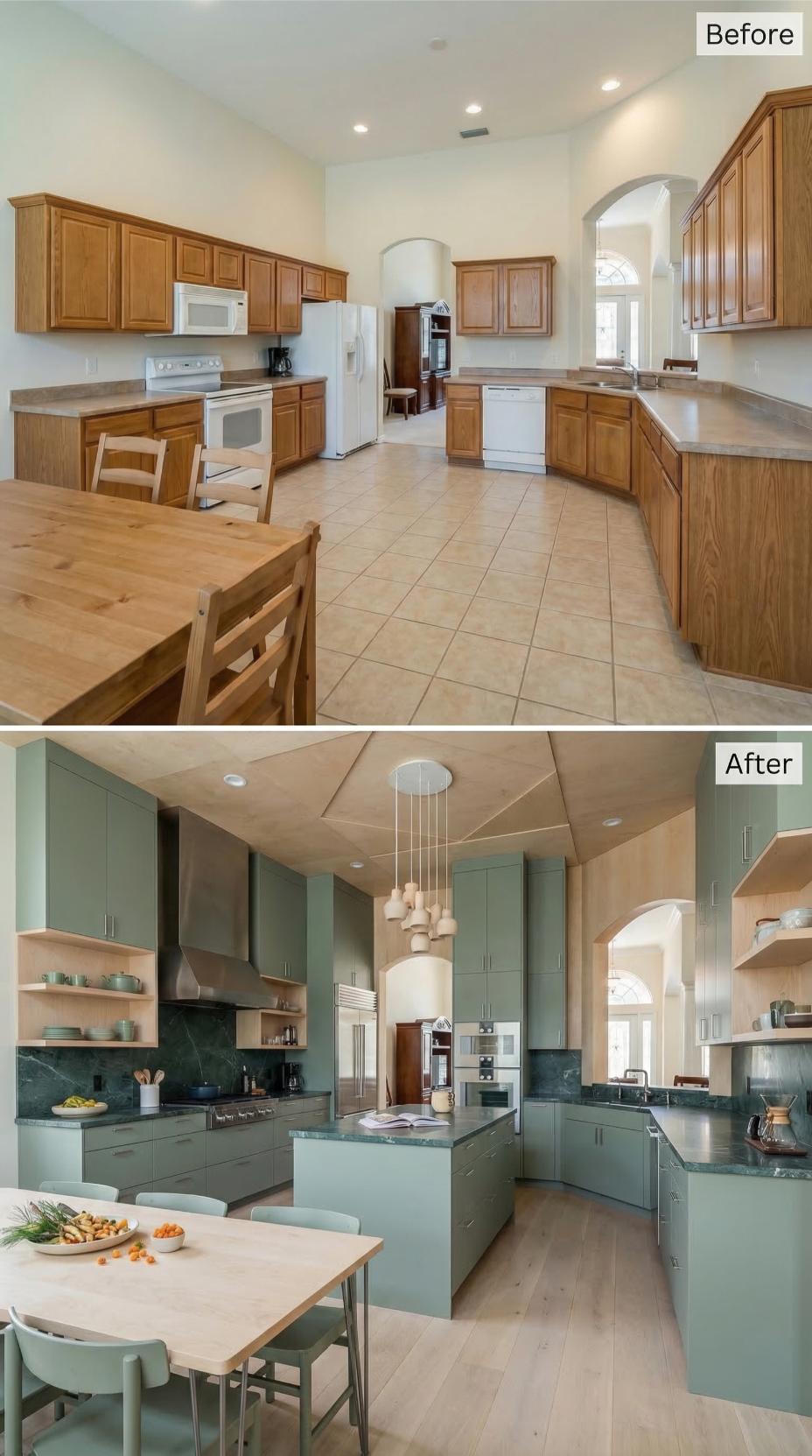
Flat-front sage green cabinets in a muted blue-green finish replace the raised-panel oak originals, paired with open shelving in raw maple that breaks the wall of color. A center island carries what reads as green soapstone or dark verde marble, and a matching backsplash in the same material grounds the cooking zone. Pendant clusters in ceramic drop from a coved ceiling above the island, while light hardwood flooring replaces the original large-format beige tile, shifting the whole room from dated neutral to considered restraint.
Black Cabinets, Gold Coffered Ceiling, and Black Marble Bury Builder Oak in Dark Opulence
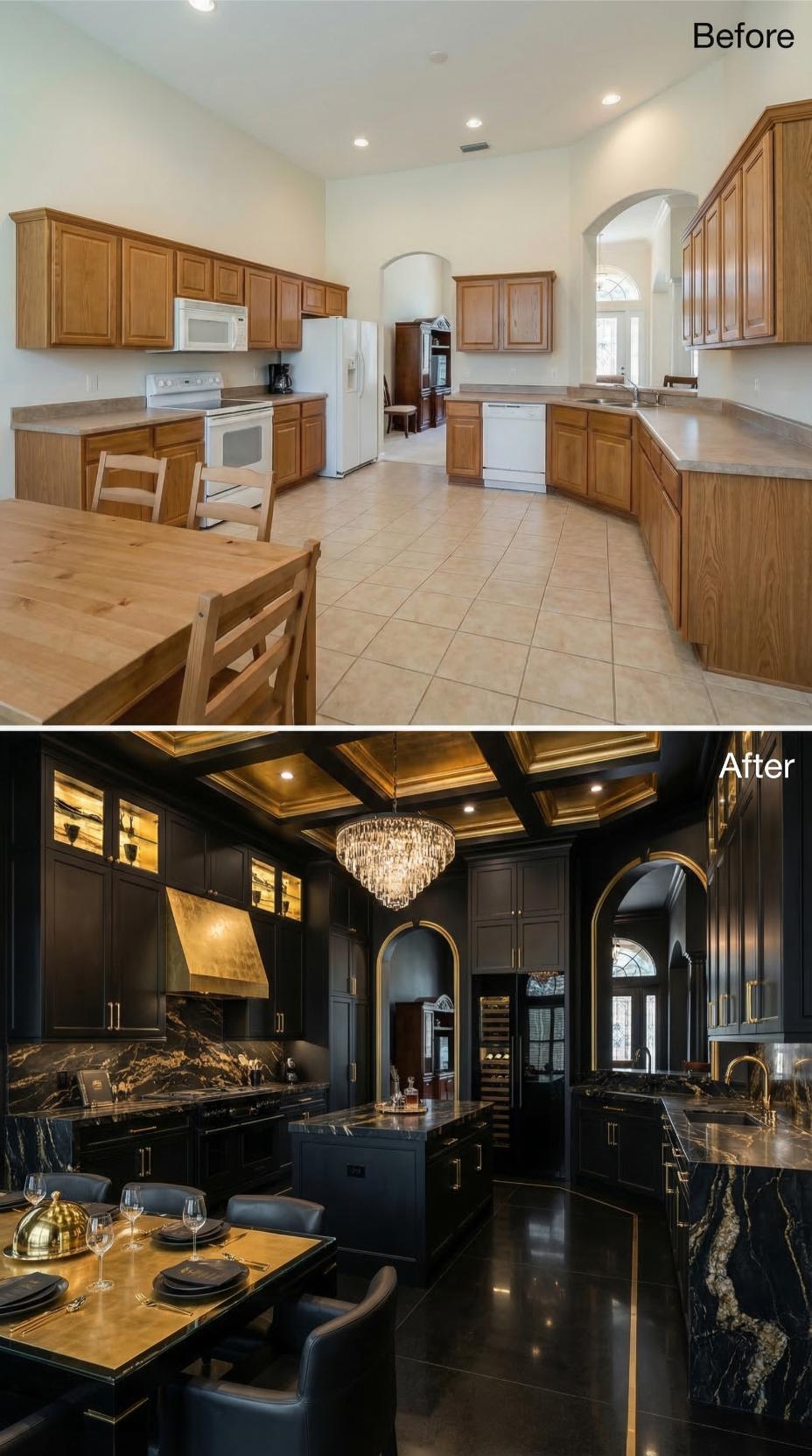
Matte black cabinetry with brass hardware lines every wall, while a coffered ceiling finished in gold leaf pulls the eye upward toward a crystal chandelier centered above the island.
Gilded Coffered Ceiling and Malachite Trim Pull Builder Oak Into Venetian Palace Territory
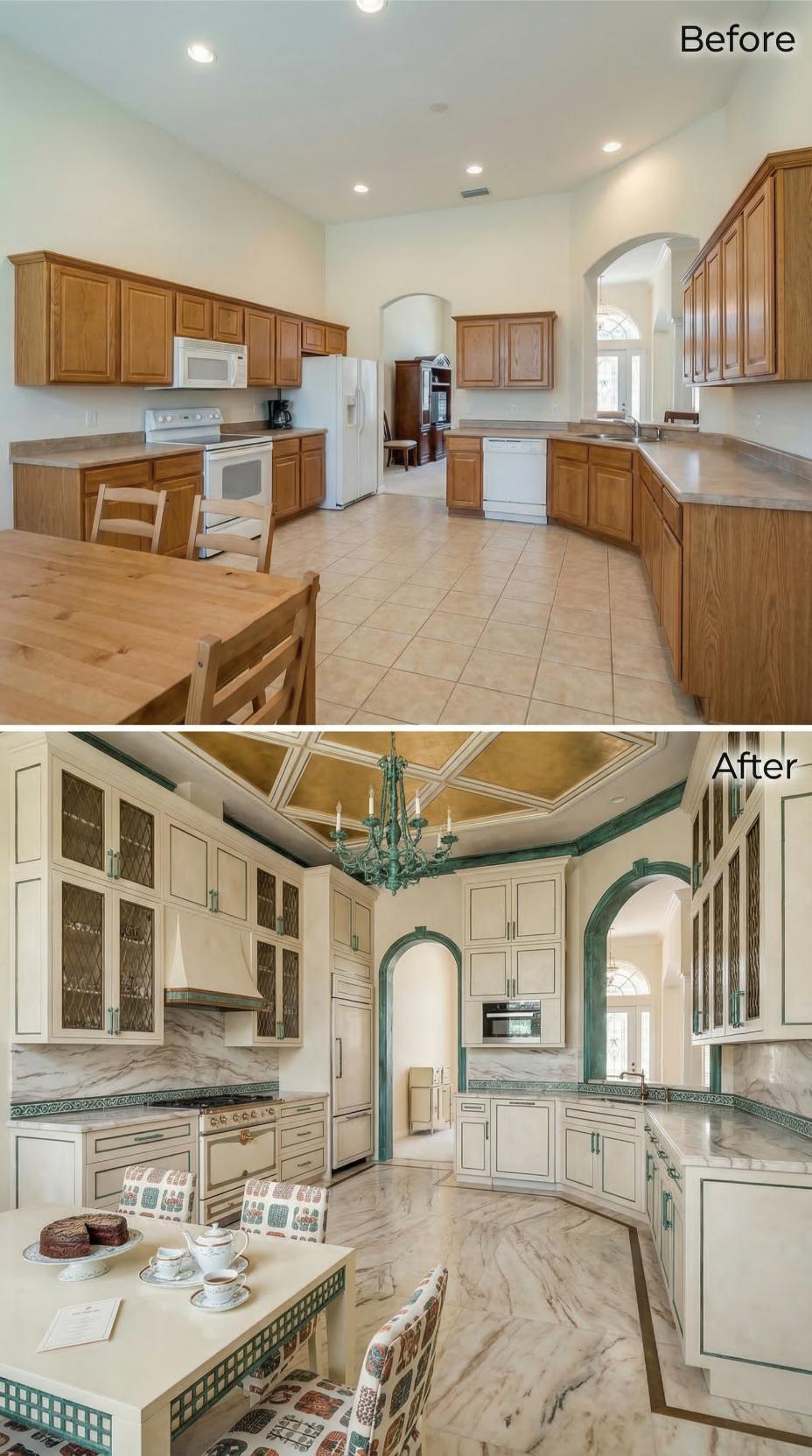
Cream-painted cabinets with hand-applied antiquing replace the original honey oak, and the shift is structural as much as cosmetic. Leaded diamond-pane glass inserts fill the upper doors, malachite-green trim outlines every arch and molding, and a coffered ceiling finished in gold leaf draws the eye up into a tray that reads closer to a palazzo than a suburban kitchen. A verdigris chandelier with candle-style arms hangs at center.
The marble floor runs in large irregular slabs with gray and cream veining, bordered by a malachite inlay pattern that mirrors the ceiling trim. At the island, floral-print upholstered chairs in rust and green repeat the palette without matching it exactly. The range hood is plaster-white with a malachite tile border, and the backsplash behind the range continues the marble slab up the wall. For hosts who want a kitchen guests remember, the malachite border alone does more work than an entire cabinet replacement.
Orange Lacquer Cabinets and Cove Lighting Swap Builder Oak for Bold Competition-Ready Drama
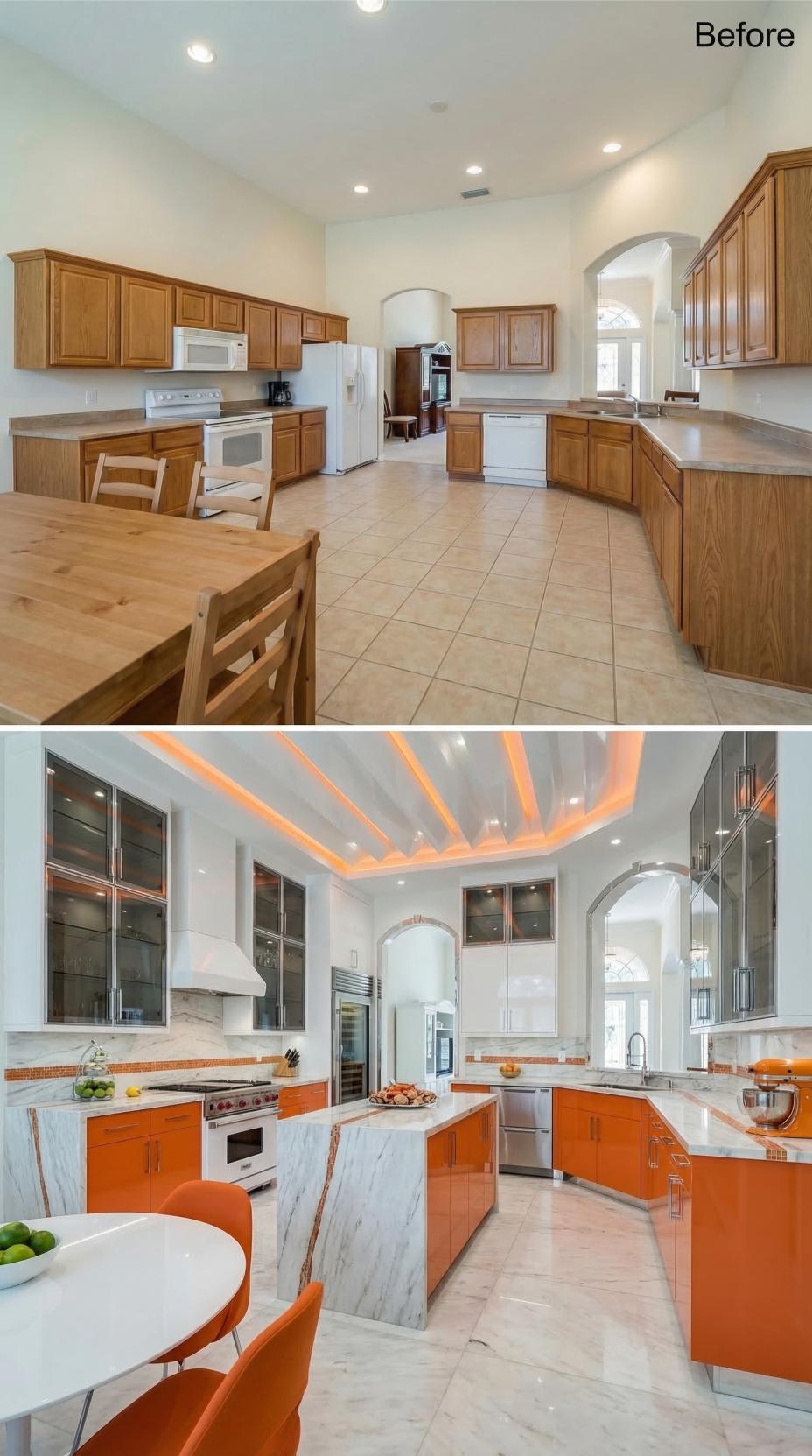
Builder-grade oak cabinets and white appliances gave way to flat-front orange lacquer base cabinets topped with thick marble counters that carry grey veining across both the perimeter and a full waterfall island. Glass-front upper cabinets with brushed steel frames replace the original solid wood doors entirely, opening the wall line without losing storage.
Warm amber cove lighting runs the length of a coffered ceiling detail, casting orange light that reinforces the cabinet color from above rather than fighting it. Stainless appliances, including a professional range with a white hood surround, anchor the cooking wall. The arched passage carried over from the original layout grounds the new design in the room’s existing architecture.
Renaissance Ceiling Panels and Red Marble Backsplash Pull Builder Oak Into Old World Drama
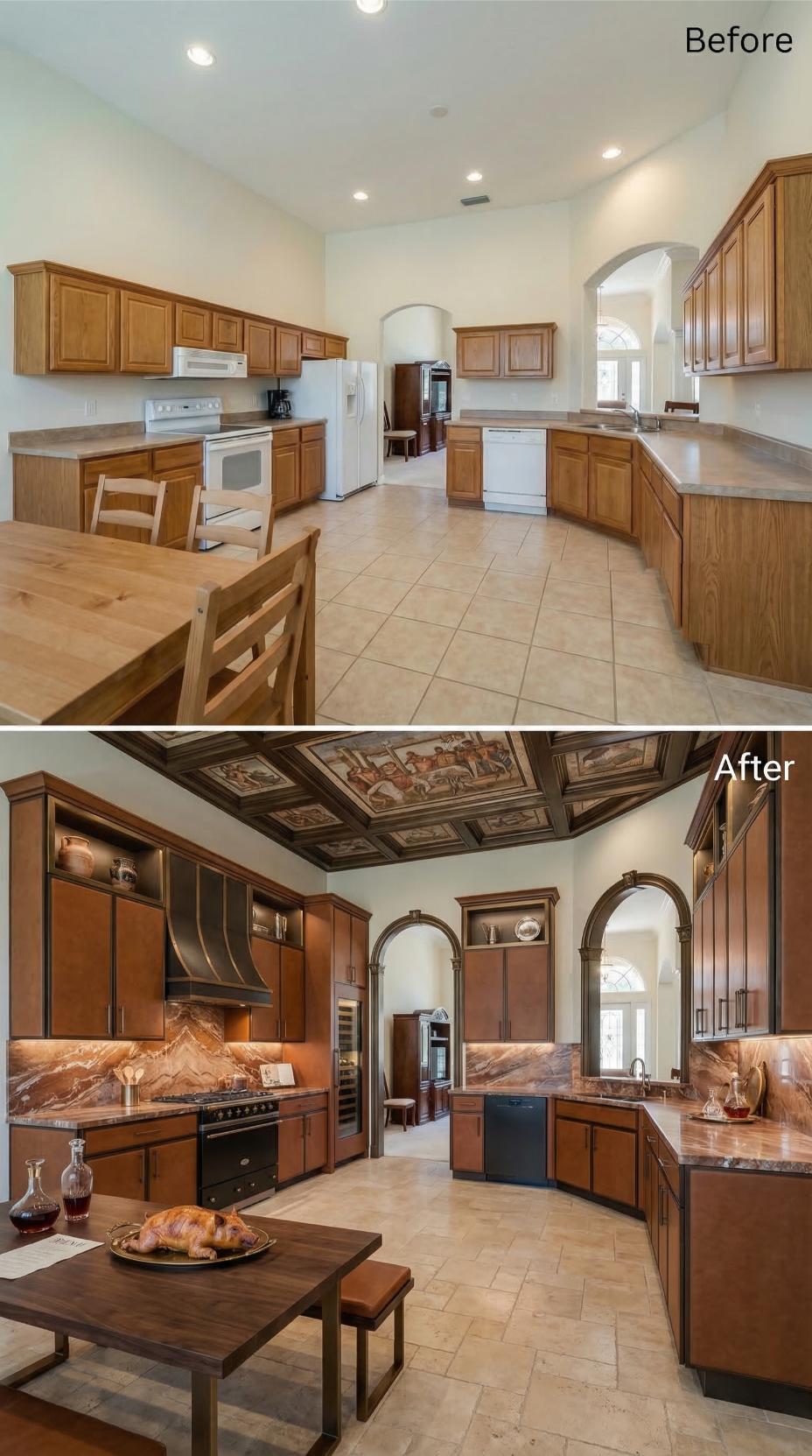
Richly stained raised-panel cabinets replace honey oak while a hand-painted coffered ceiling featuring figurative Renaissance scenes commands the room’s upper half, grounding the space without a single recessed can in sight.
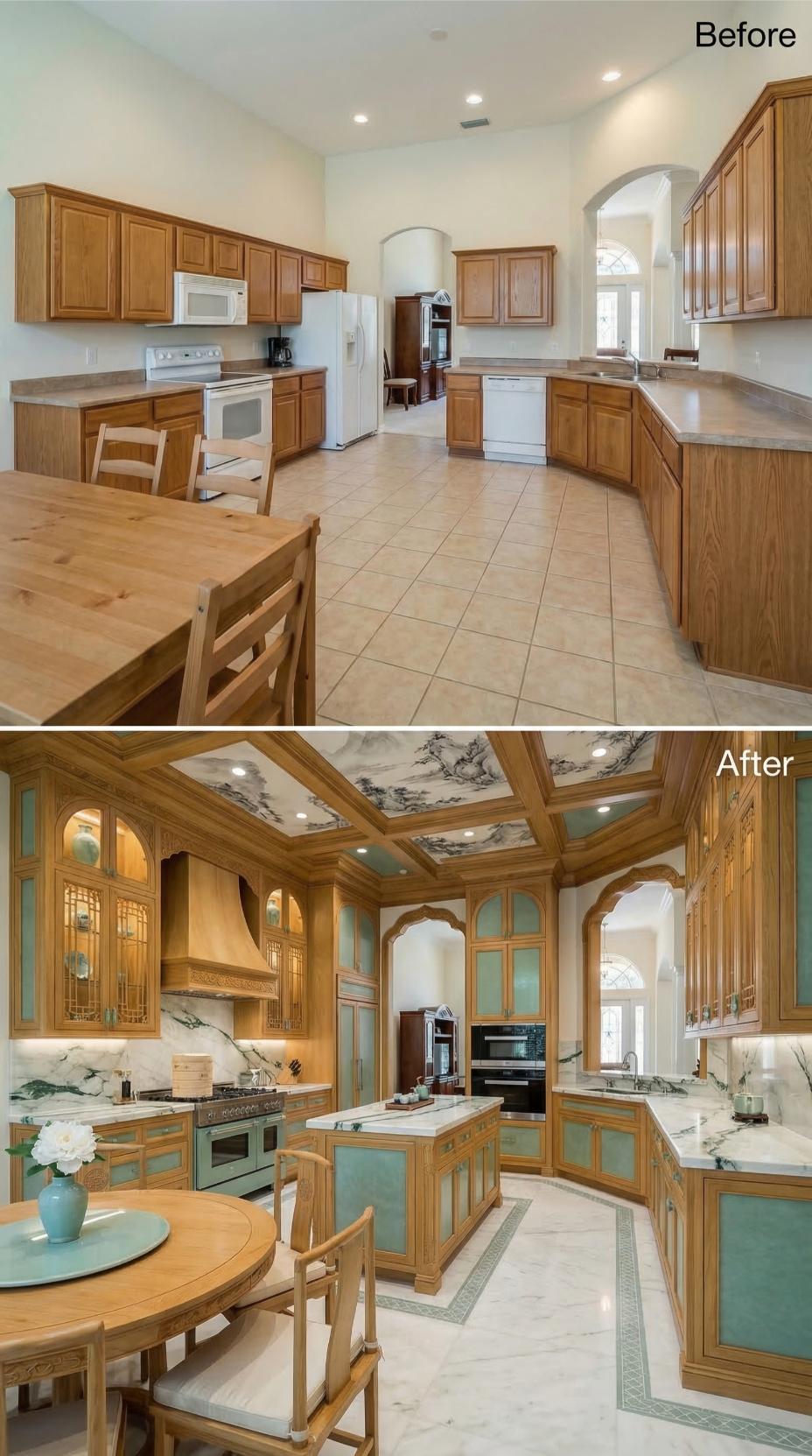
Celadon Cabinet Panels and Hand-Painted Coffered Squares Bury Builder Oak in Ming Dynasty Drama
🔥 Would you like to save this?
Oak cabinets with builder countertops gave way to a kitchen defined by celadon-painted cabinet panels framed in carved natural oak, a kitchen island with white-and-green veined marble countertops, and a range hood dressed in ornamental woodwork. The coffered ceiling carries ink-wash landscape paintings in each recessed square, referencing classical Chinese shan shui brushwork. Mosaic inlay borders the marble tile floor where it meets the island.
Glass-fronted upper cabinets with geometric lattice muntins display ceramics behind lit interiors, while a professional-grade range in pale seafoam green ties the appliance color back to the cabinet panels. The arched pass-through from the original layout survives intact, now framed in carved molding that reads as intentional rather than incidental. Hosts competing on visual impact will note that the ceiling painting alone changes the room’s entire axis.
Brick-Trimmed Arches and Coffered Talavera Panels Swap Builder Oak for Spanish Colonial Authority
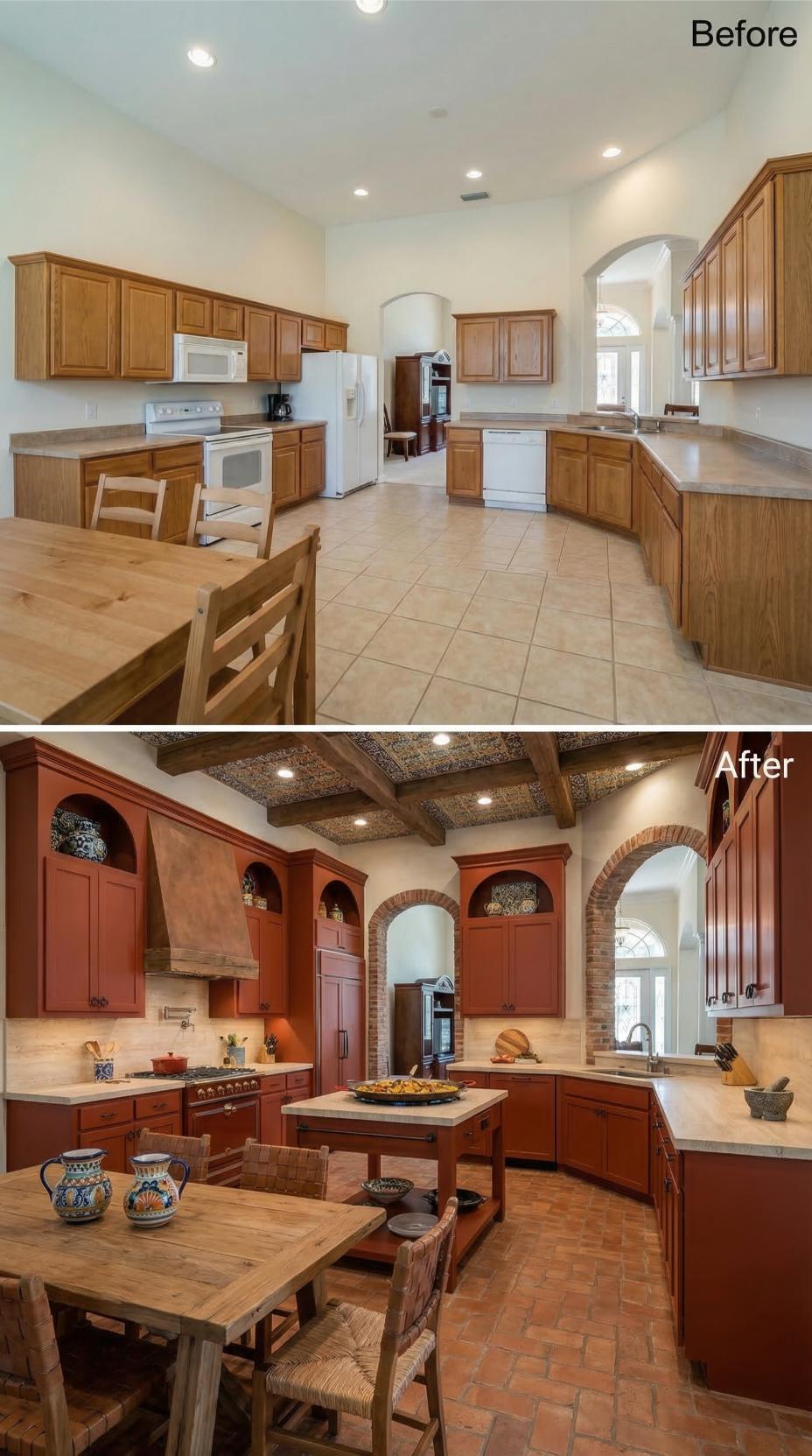
Terracotta brick borders the pass-through arch while exposed wood beams frame recessed Talavera-tile ceiling panels overhead, pulling the eye upward in a way flat recessed lighting never could. The cabinets are painted a deep adobe red with oil-rubbed bronze hardware, and rush-seat chairs around the pine farm table echo the handcraft running through every surface material.
Chinoiserie-Painted Cabinets and Gold Coffered Ceiling Swap Builder Oak for Palace-Grade Blue
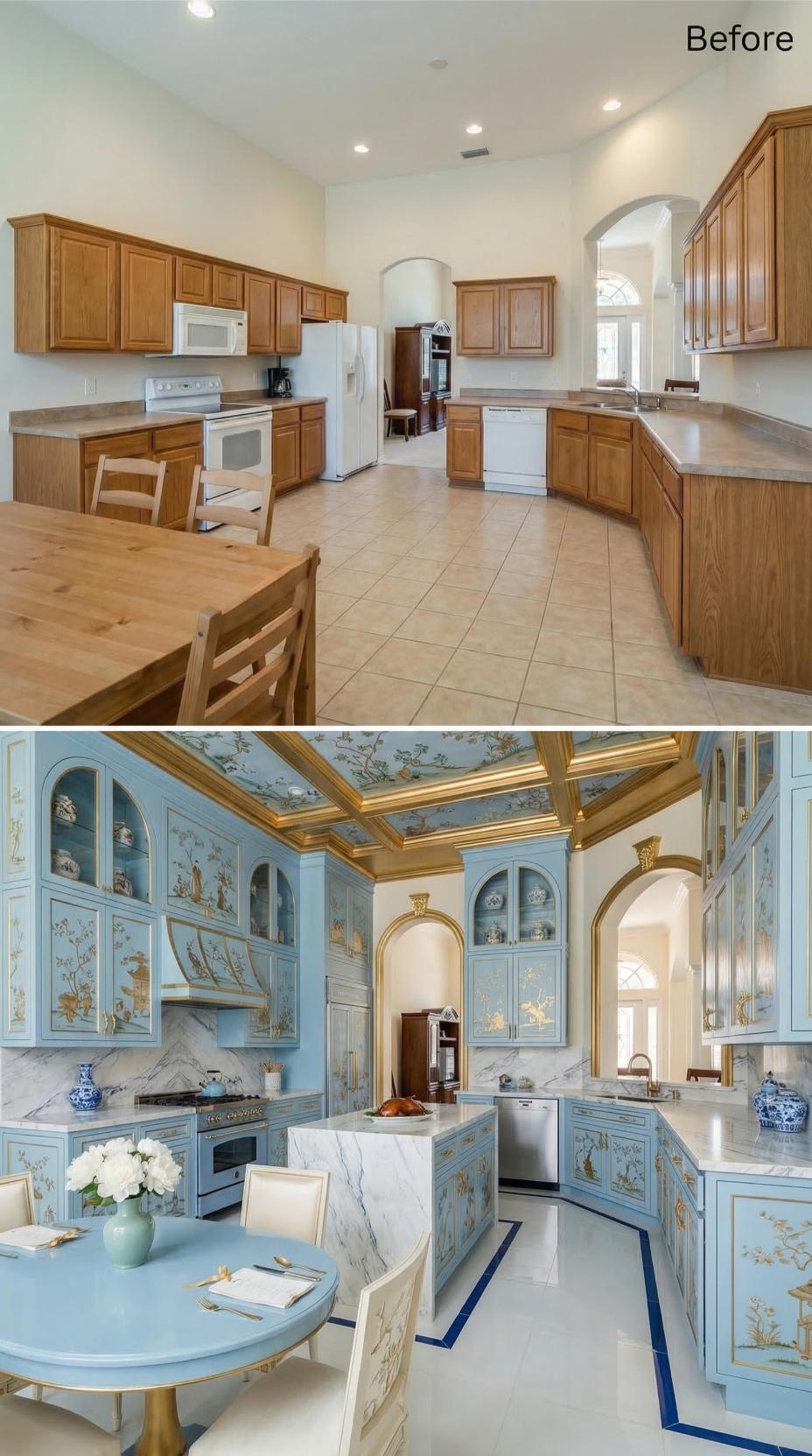
Powder blue cabinets hand-painted with gold chinoiserie botanicals replace the original honey oak across every run of cabinetry, including the range hood, island, and breakfast table base. Gold-leaf molding frames each coffered ceiling panel, which carries the same painted chinoiserie pattern as the cabinet doors, creating a continuous decorative surface overhead. Arched display niches with glass shelving replace what were once flat upper cabinets, and blue-and-white porcelain pieces reinforce the palette without needing additional color.
White marble countertops with soft gray veining surface the island and perimeter runs, while a navy border stripe inlaid into the white floor tile anchors the kitchen’s footprint. Brass hardware pulls run thin across each door. Competitive hosts should note that chinoiserie panels on cabinet faces require touch-up care that standard painted cabinets do not, particularly near the range where heat and grease accelerate surface wear.
Forest-Ceiling Kitchen Swaps Builder Oak for Copper, Green Marble, and Living Canopy Drama
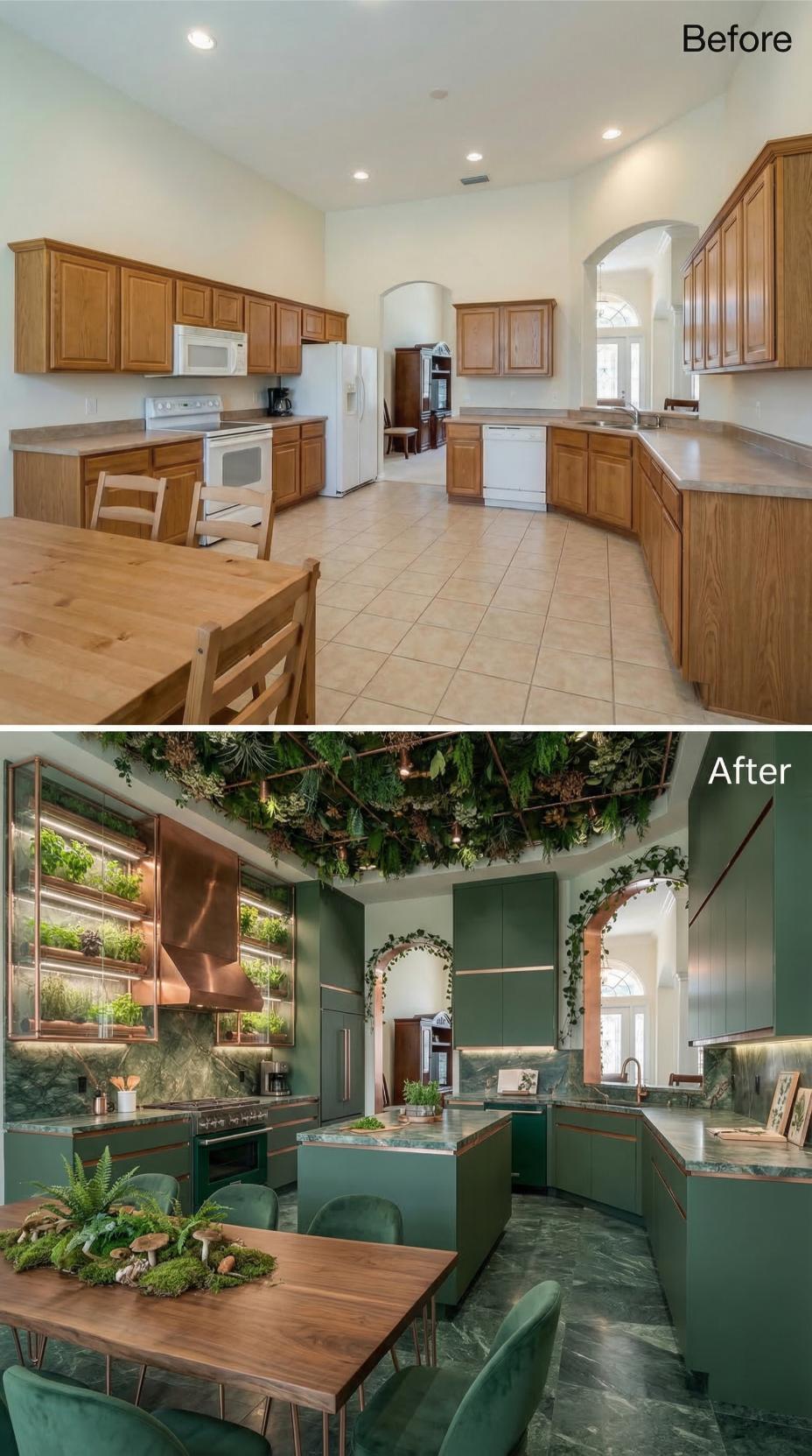
Copper-framed grow shelves mounted above the range hold herbs under LED strips, pulling the ceiling into active use rather than dead space. Dark sage flat-panel cabinets run floor to ceiling, their edges trimmed in raw copper that echoes the range hood. Green marble countertops carry veining across the island and perimeter without interruption, while the dining table keeps its walnut top with hairpin legs as a grounding contrast against velvet chairs in the same sage register.