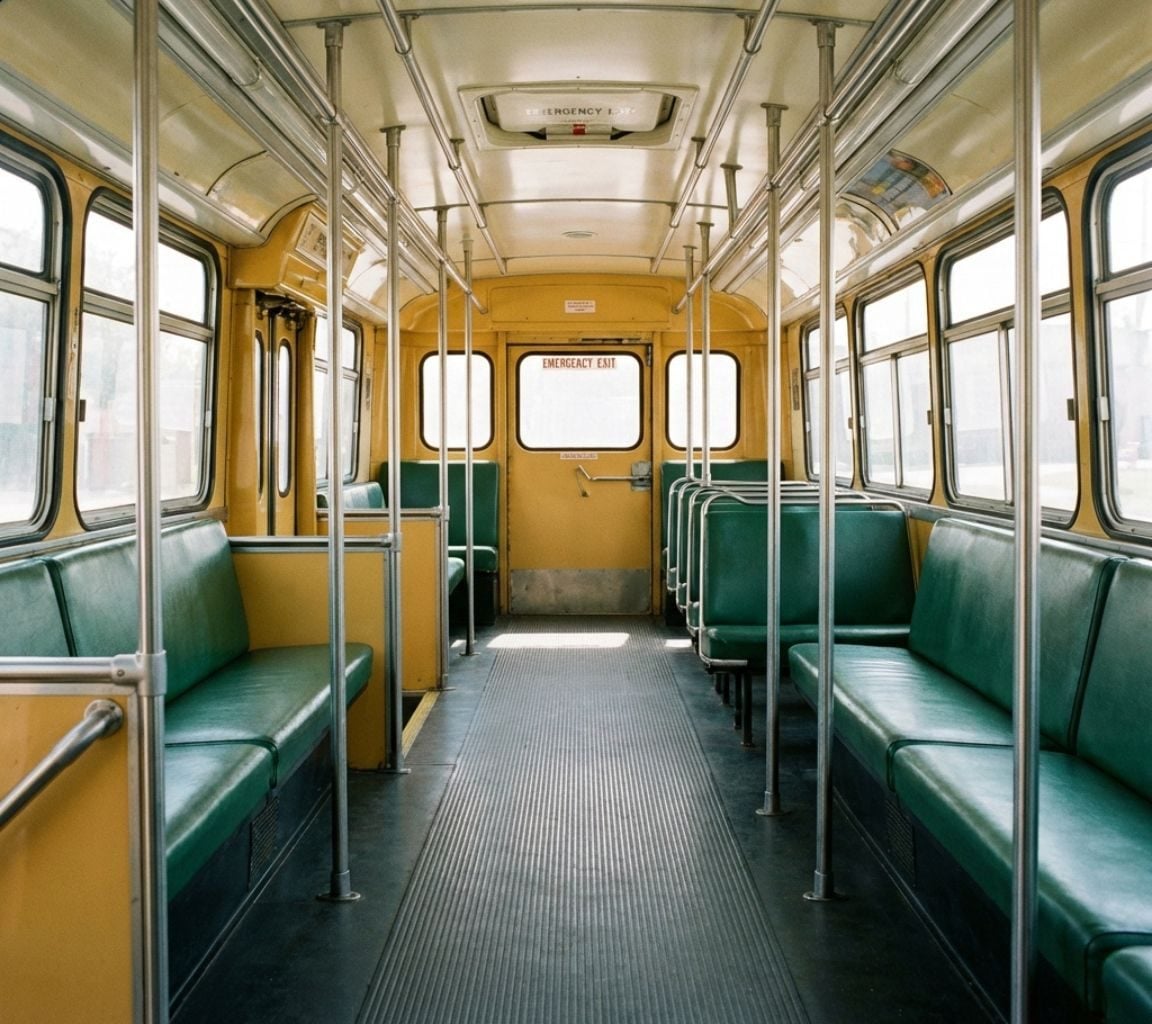
Somewhere between a retired city route and a total reinvention, these 30 transit bus conversions prove that the most exciting real estate right now rides on four wheels. Each one starts from the same gutted shell: a decommissioned public bus with bolted floors, fluorescent strips, and zero charm. What comes next is the fascinating part. From Tokyo micro-luxury to moody gothic minimalism, these interiors don’t compromise on a single detail, and they’ll completely change what you think a home needs to be.
Warm Minimalist Luxury With Bouclé, Cognac Leather, and Walnut Wood
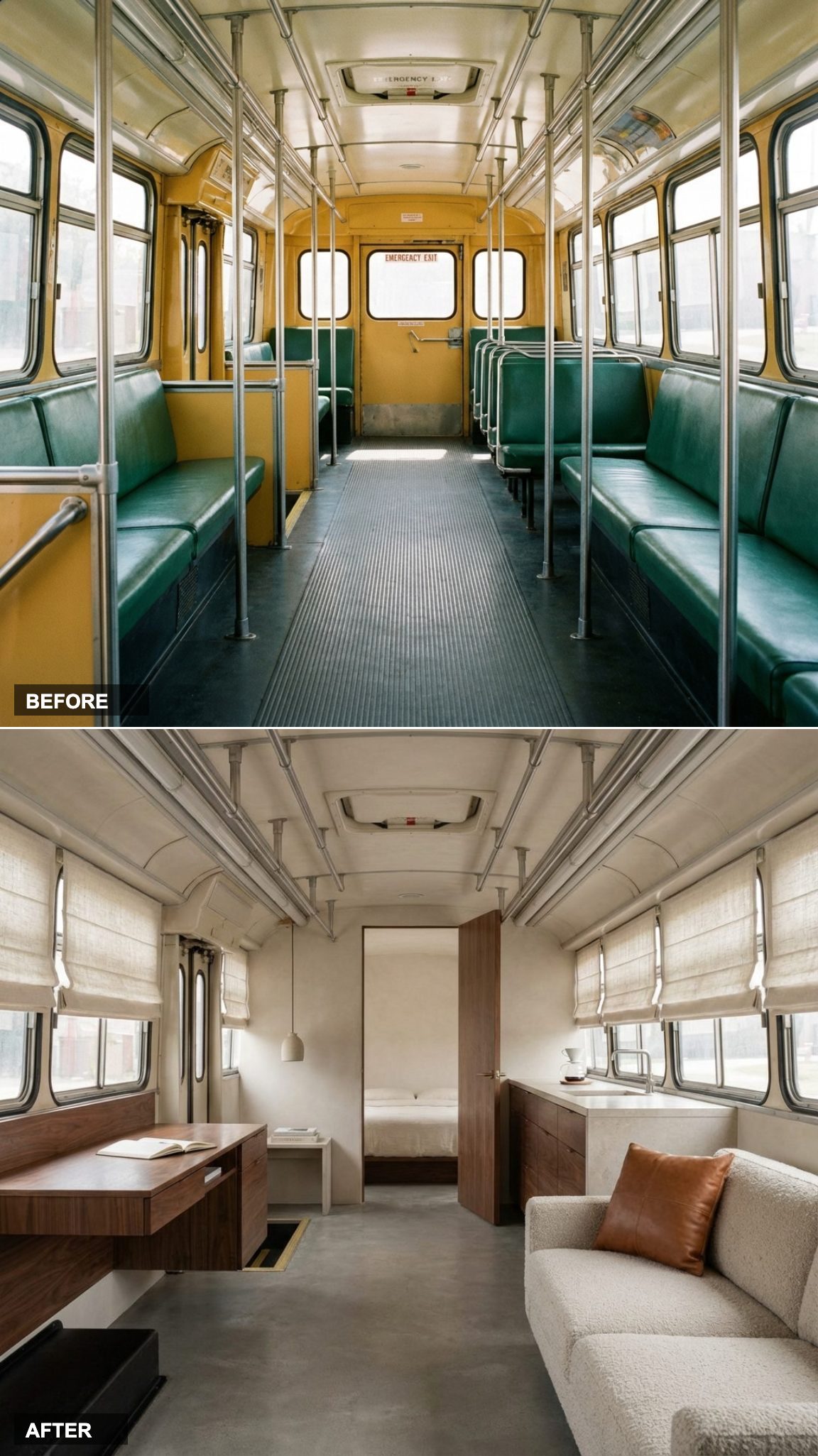
The oatmeal bouclé sofa does the heavy lifting here. In a space this narrow, a low-profile seat with clean legs prevents visual clutter while the cognac leather throw pillow adds just enough warmth to keep it from reading cold. The floating walnut workstation is the smart move: wall-mounted furniture is the single biggest trick in any compact space, and here it carves out a proper desk without eating floor area.
In order to come up with the very specific design ideas, we create most designs with the assistance of state-of-the-art AI interior design software.
What makes this conversion feel like a real home rather than a novelty is the commitment to a single material palette. Walnut, linen, and leather, nothing fights, nothing distracts.
Brutalist Bus: Poured Concrete Seating and Black Leather in a Mobile Stronghold

Brutalism in a bus is either the most logical pairing ever or a complete provocation, possibly both. The poured concrete bench sofa with black leather cushions plays into the bus’s industrial skeleton rather than disguising it, which is a bolder and more honest design choice than most conversions attempt. The cantilevered concrete side table echoes the sofa’s material and doubles the architectural statement.
This is a space that knows exactly what it is and refuses to apologize.
California Modern Meets the Open Road: Sand Linen, Woven Leather, and White Oak
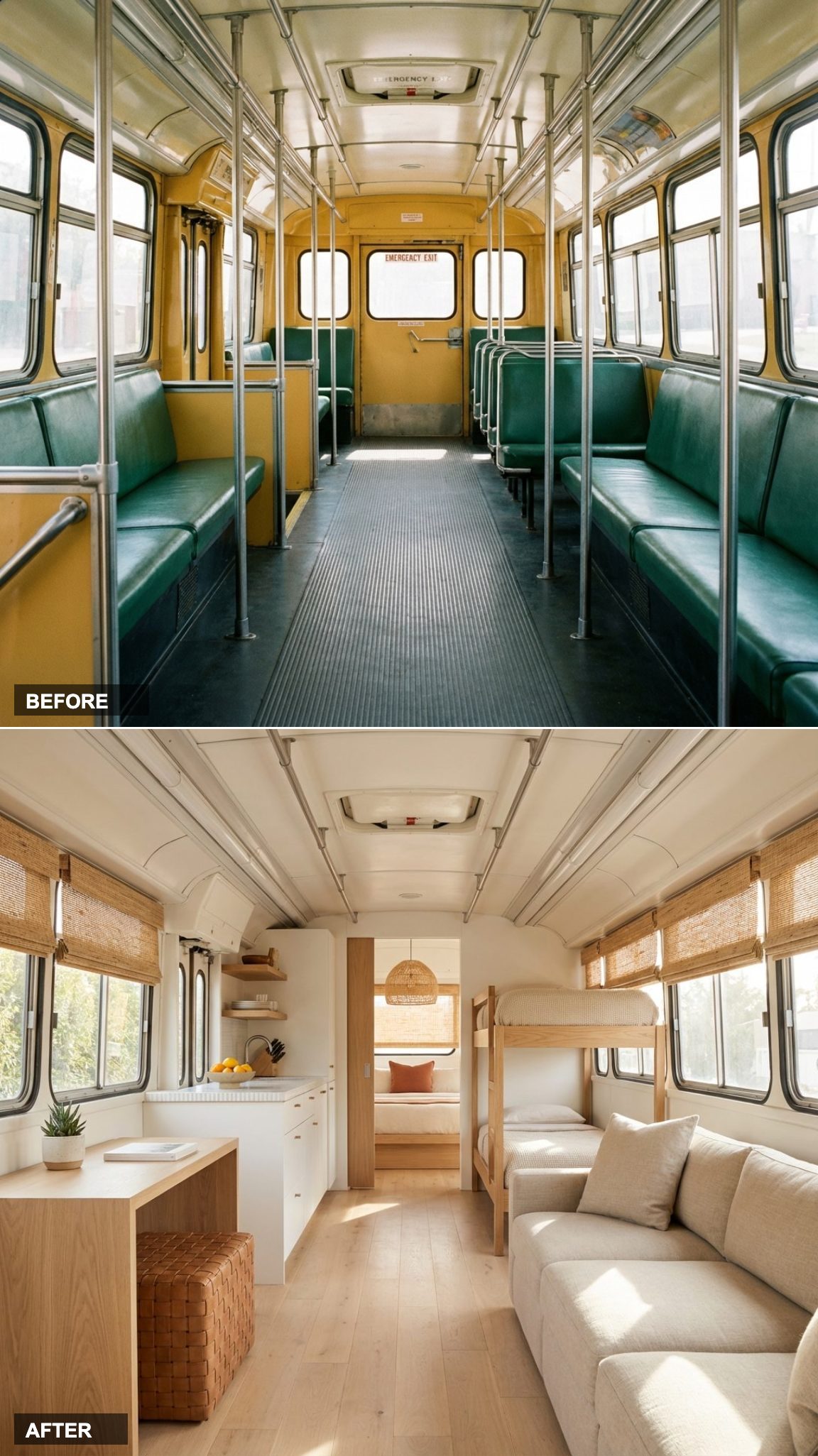
California modern has a signature move: it takes organic textures and puts them in clean, unfussy compositions. The sand-toned performance linen modular sofa is the California answer to high-traffic living, beautiful and functional in the same breath. Woven leather ottoman, white oak accents, and plenty of diffused light through large windows complete the look of a Malibu guest suite that happens to have an engine.
The best Pacific Northwest interiors don’t try to replicate nature, they invite it in through material choice alone.
Japandi on Wheels: Ash Frames, Oatmeal Linen, and Black-Steel Precision
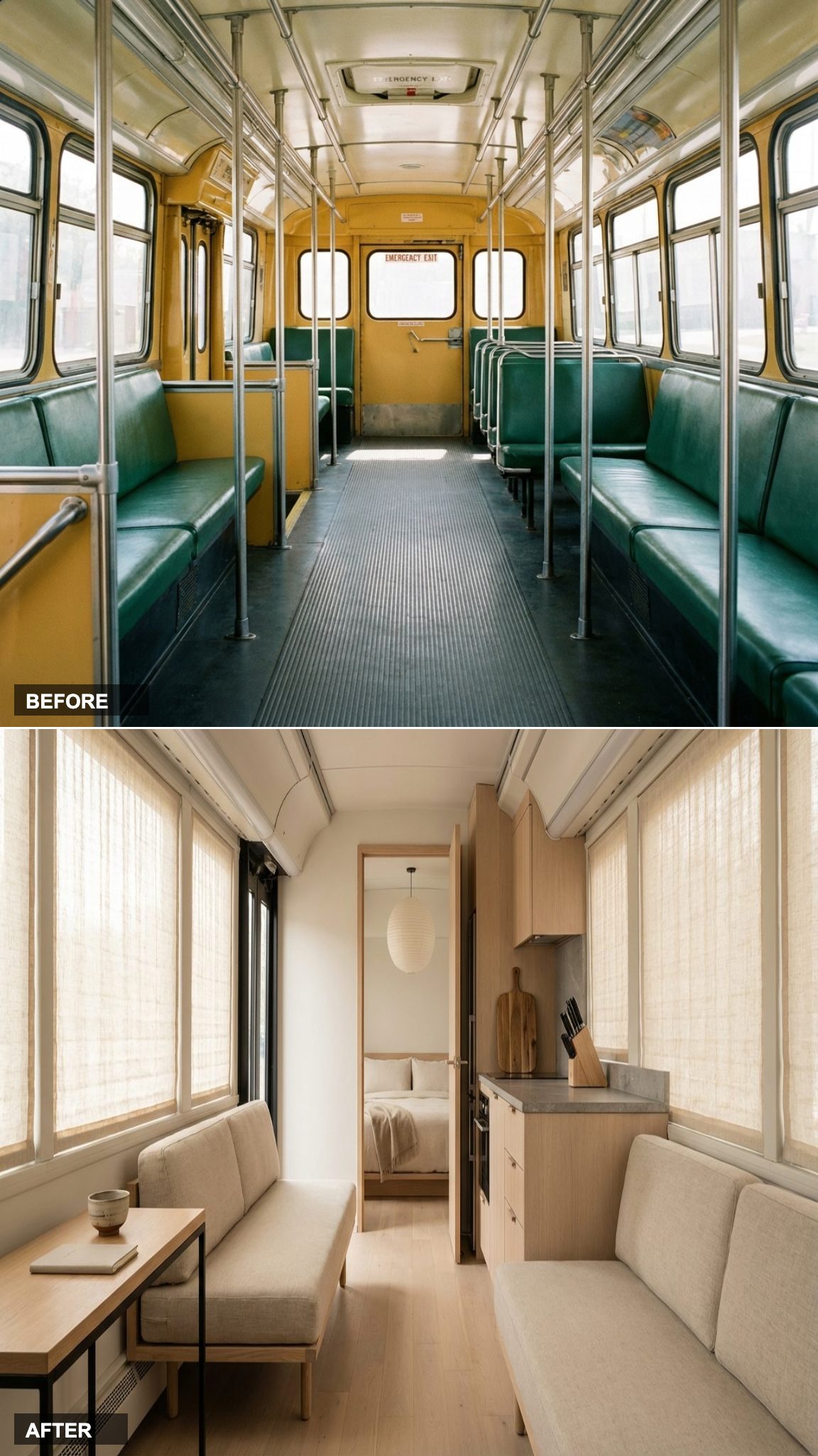
Japandi, the design language that fuses Japanese and Scandinavian sensibilities, turns out to be almost perfectly suited to bus conversion interiors. Both traditions prioritize restraint in small spaces, quality over quantity of objects, and natural materials over synthetic ones. The ash-framed sofa in oatmeal linen and the slim oak-and-black-steel workstation feel like furniture designed specifically for this kind of living.
Lodge Modern: Moss Green Velvet, Live-Edge Wood, and Mountain Cabin Energy
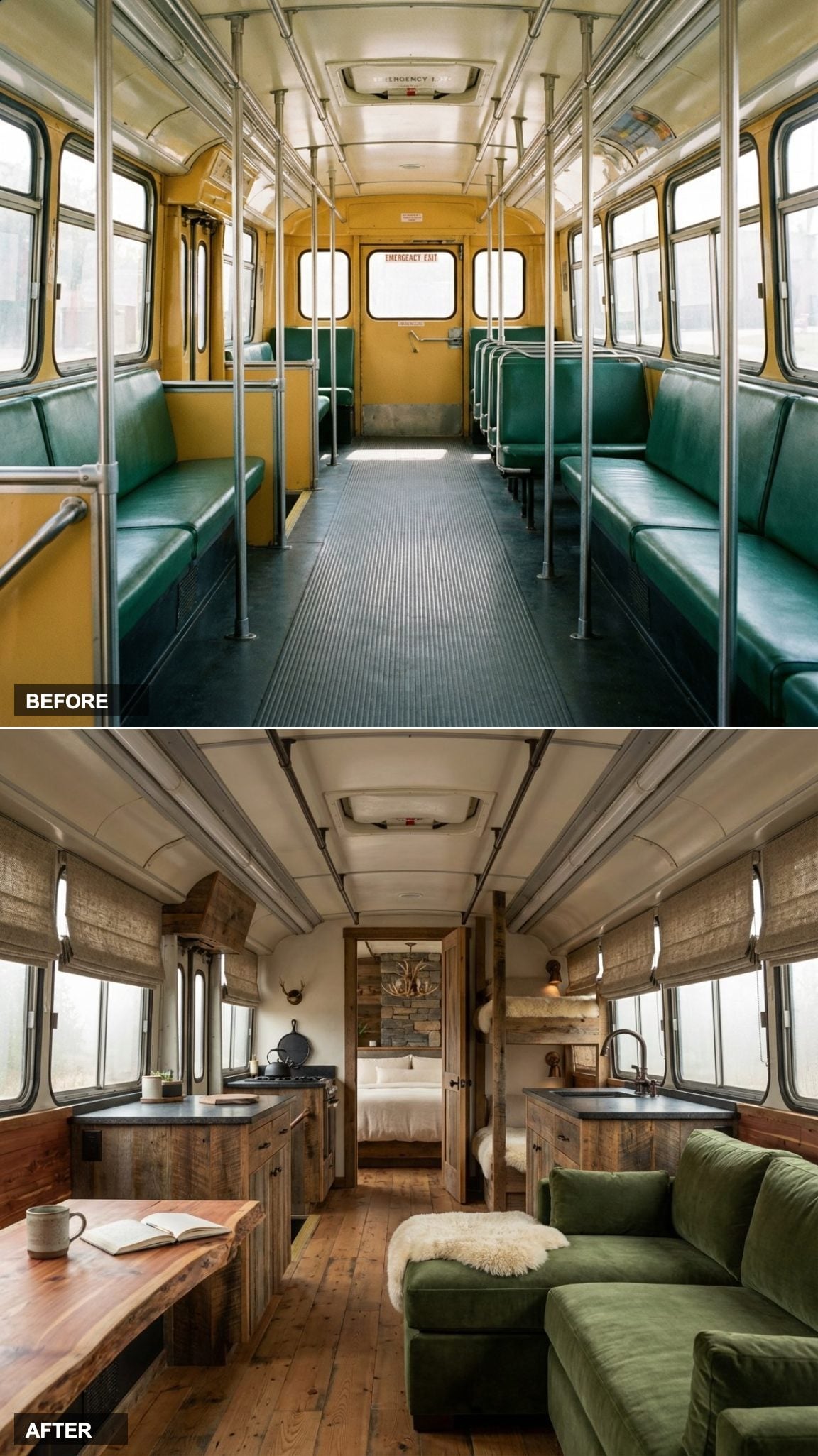
The live-edge workstation is the detail that sells this conversion completely. It references the forest without being literal about it, and the irregular edge introduces organic movement into a space that is fundamentally rectangular. Paired with a deep moss green velvet sectional and a sheepskin throw, the interior reads like a private mountain cabin that someone had the good sense to make mobile.
Coastal Contemporary Calm: White Slipcover, Driftwood Coffee Table, and Salt Air Vibes
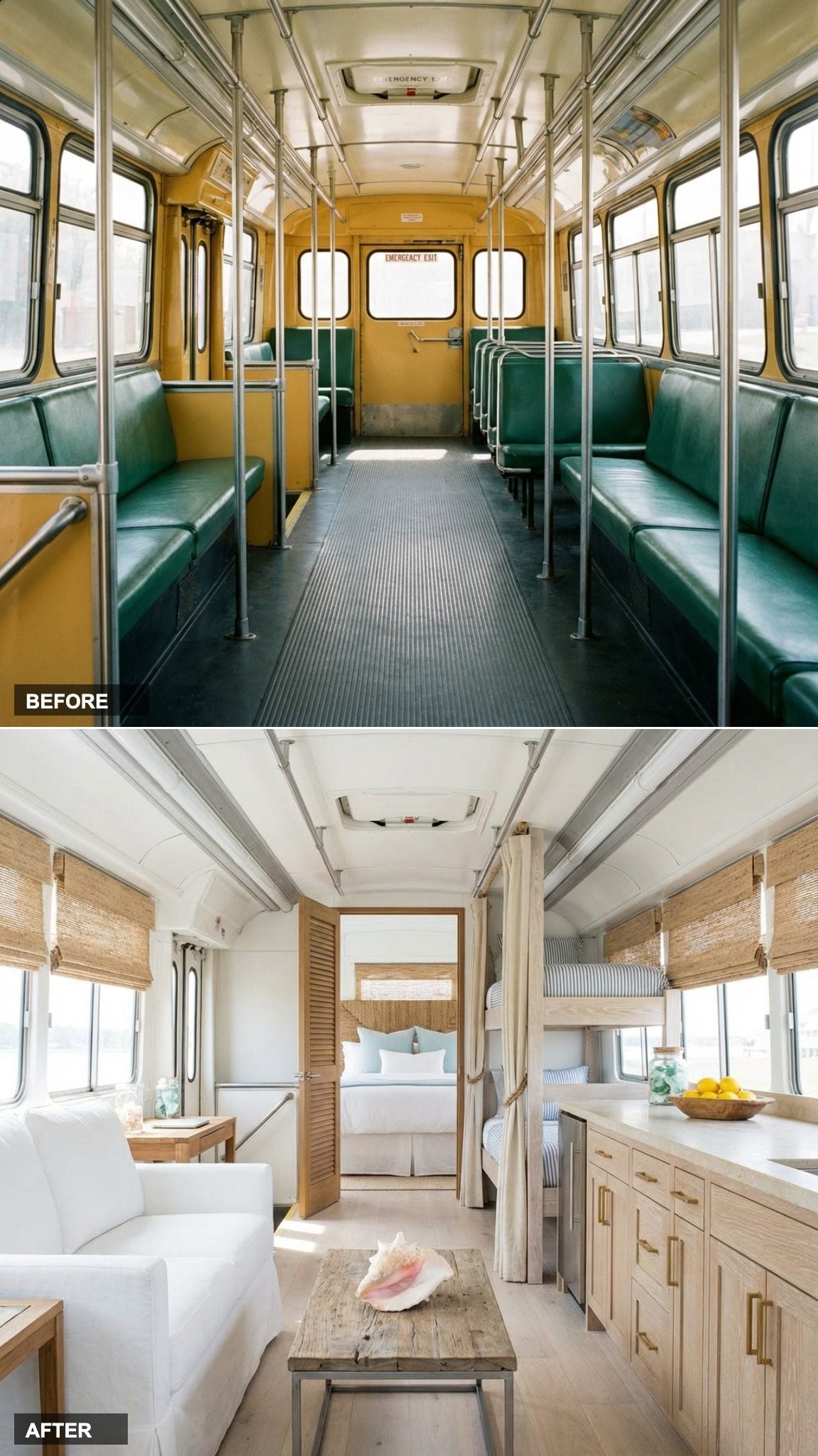
White slipcovered sofas belong near water, or at least near a design philosophy that pretends they do. The driftwood-and-steel coffee table with a shell or coral accent object is the coastal detail that anchors the whole composition. Light pours in through the bus’s existing windows and bounces off the white linen in a way that makes the narrow interior read as genuinely airy.
Organic Modern Curves: Cream Bouclé, Travertine, and Architecture in a Compact Frame
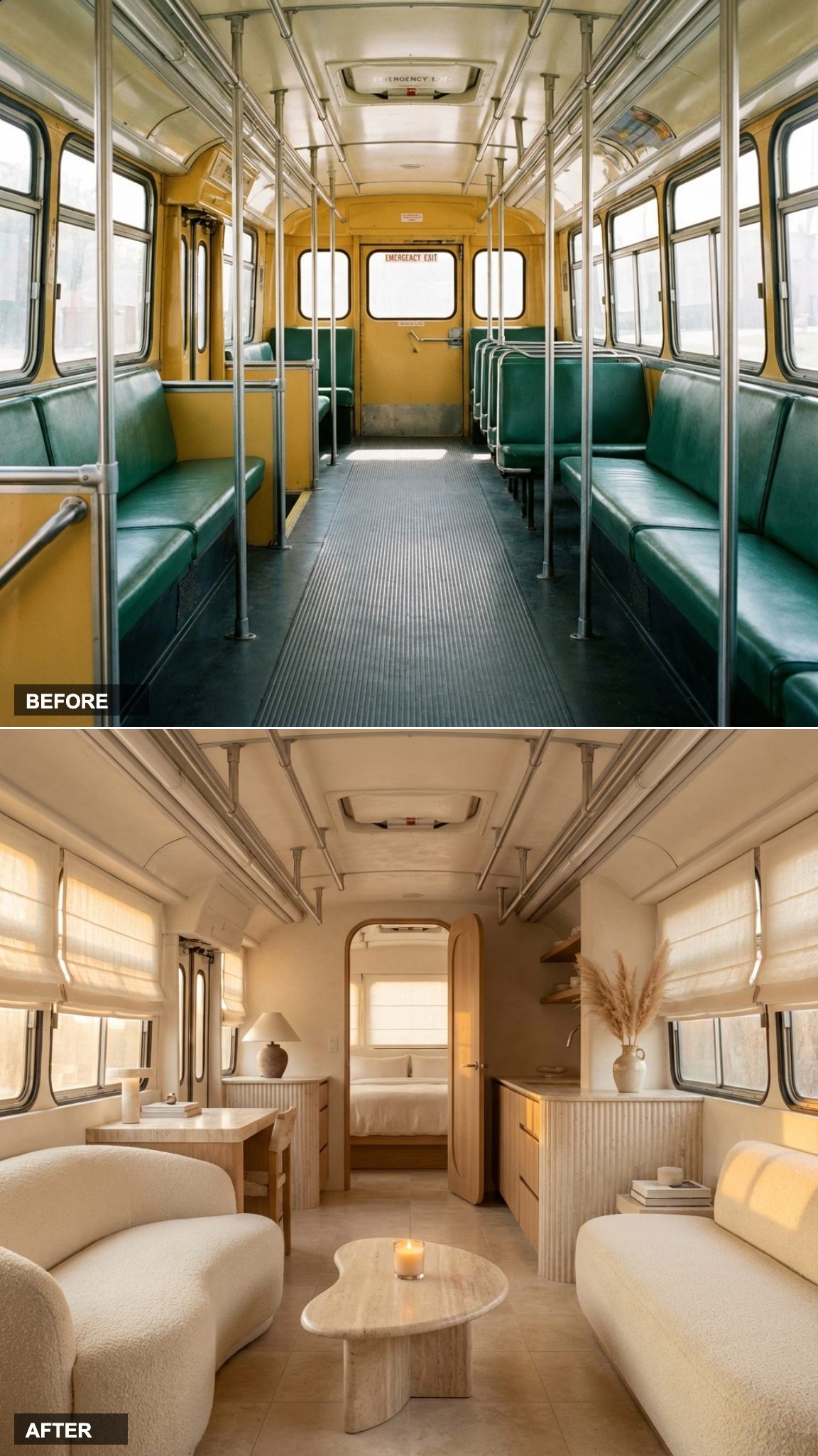
The curved cream bouclé sofa is doing something important here that goes beyond aesthetics. In a long, narrow rectangular space, a curved piece breaks the linear rhythm and forces the eye to pause rather than travel straight through. Travertine, with its natural pitting and warm cream tones, echoes the bouclé’s texture and color while adding geological weight to what is otherwise a very light palette.
This is one of the most spatially intelligent choices in the entire series.
Art Deco Revival in Emerald and Brass: Glamour at 60 Miles Per Hour
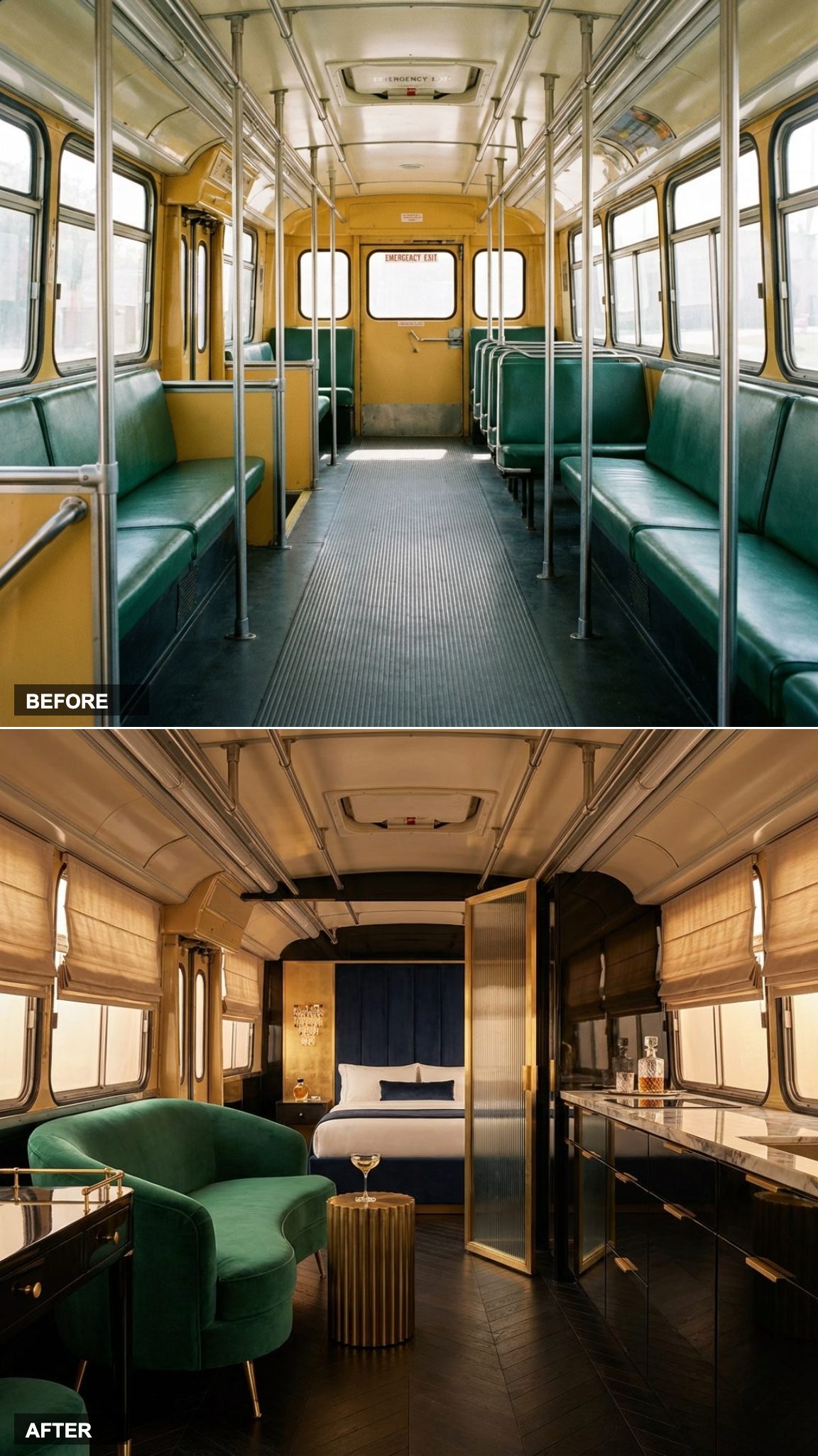
The curved emerald velvet sofa on brass legs is a piece of furniture that announces itself. Art deco design is about declaring arrival, the bold geometry, the rich materials, the gold accents that catch light from every angle. The fluted brass side table beside it is the kind of detail that rewards close inspection: the vertical fluting references 1920s and 1930s architectural columns and brings a formal elegance to a mobile interior.
This conversion doesn’t whisper. It never whispers.
Wabi-Sabi Industrial: Worn Leather, Patinated Brass, and the Beauty of Imperfection
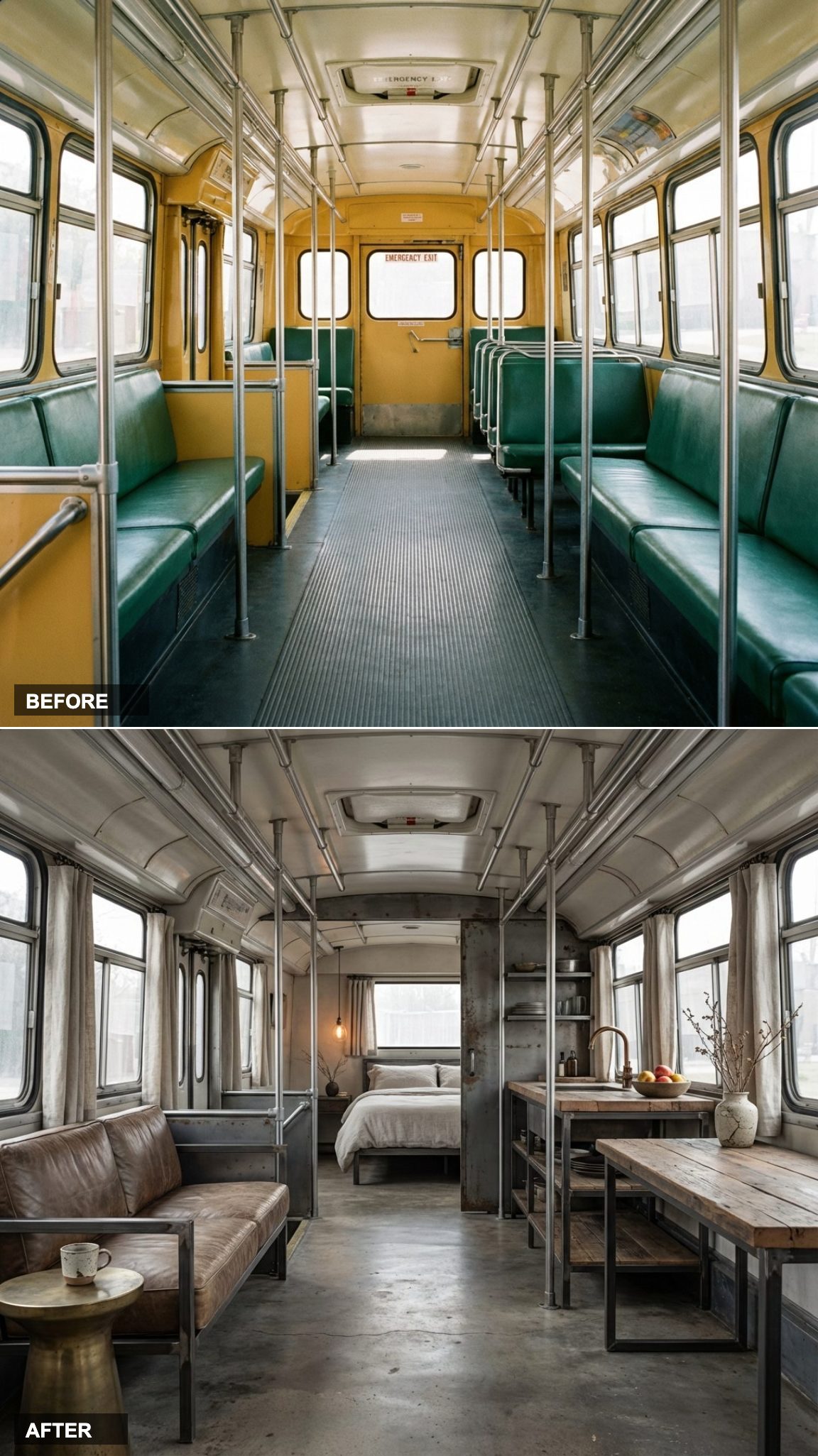
Patinated brass develops its surface character over time, the oxidation, the variation in tone, and wabi-sabi design celebrates exactly that kind of material honesty. The worn leather-and-raw-steel sofa carries the same philosophy: a surface that shows its history rather than hiding it. Together, they create an interior that seems to have existed for decades while being assembled only recently.
Tokyo Micro-Luxury: Compact Charcoal Wool, Sliding Walnut Panels, and Fold-Away Intelligence
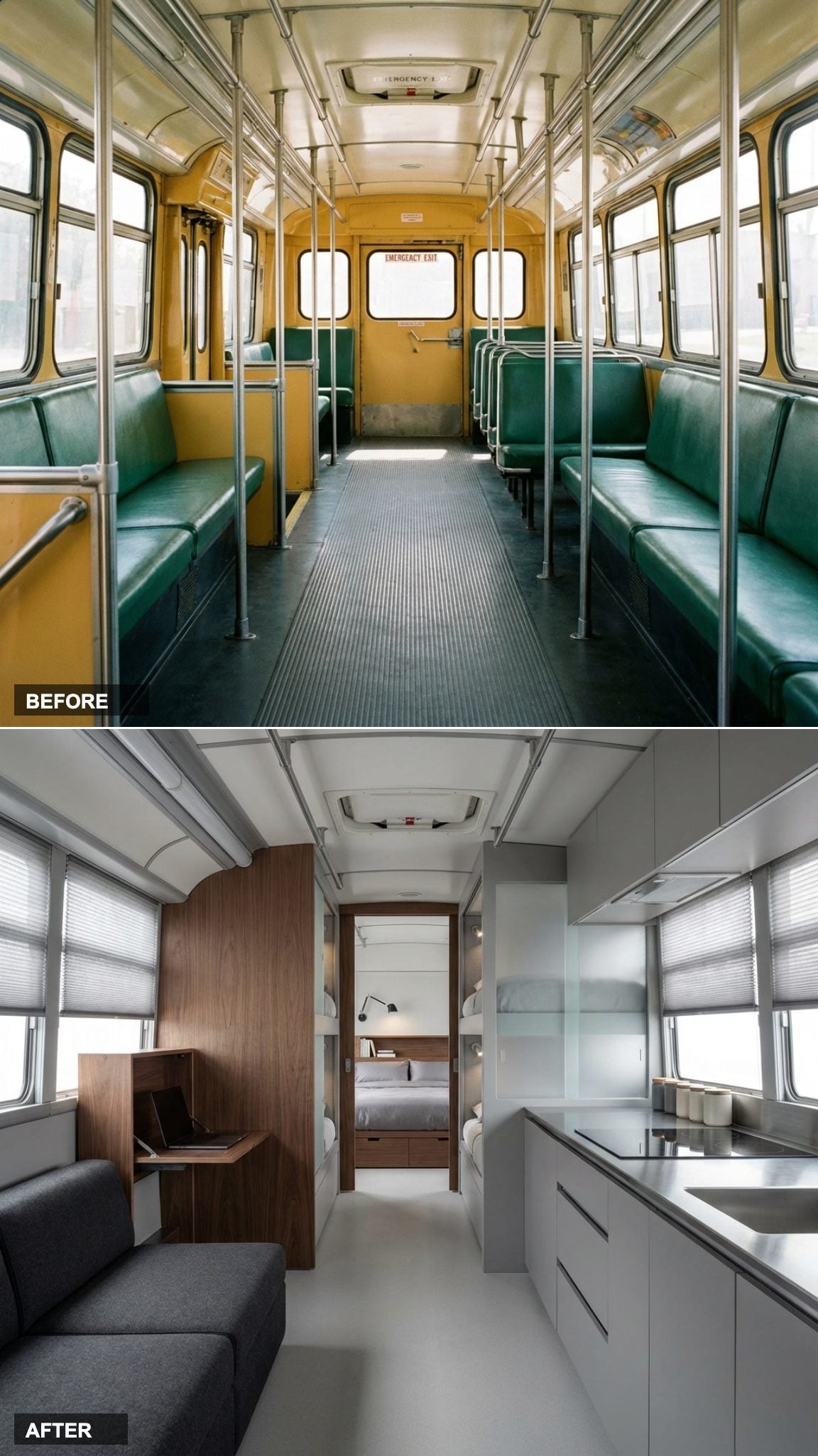
Tokyo apartments have been solving the small-space problem for decades, and this conversion imports that expertise directly. The sliding walnut panel that conceals a fold-away element is the Japanese micro-apartment move translated to a bus interior: every surface has a secondary function, and the space reconfigures based on need rather than being locked into a single layout. The compact charcoal wool modular sofa is similarly adaptable.
French Contemporary Refinement: Stone Grey Linen, Brass Legs, and Fluted Oak Panels
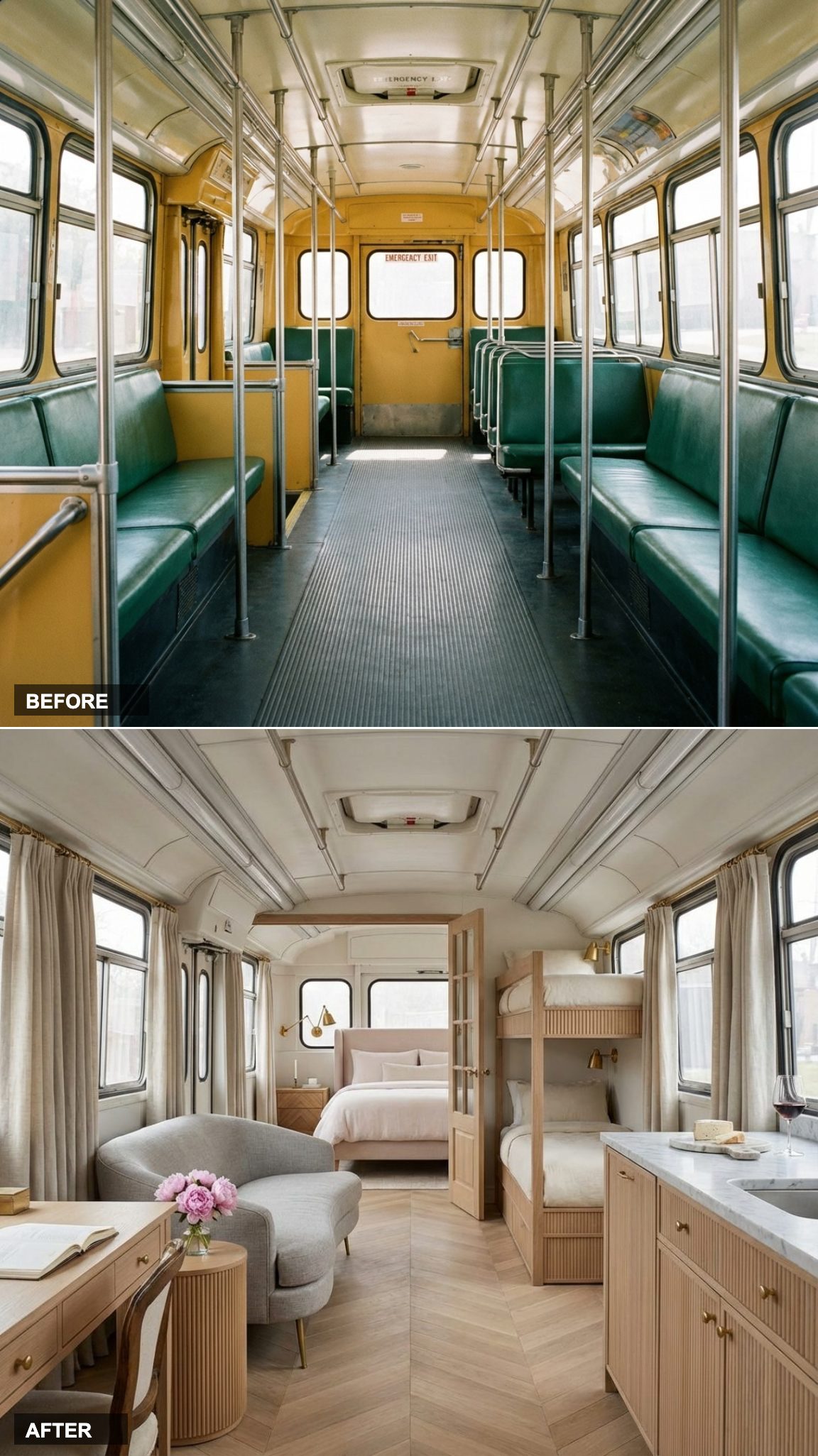
The curved stone grey linen sofa on slim brass legs is a piece that could exist in a Paris apartment on the Rive Gauche. French contemporary design has a particular gift for combining architectural precision, the fluted oak side table, the clean brass hardware, with materials that are soft to the touch. Nothing in this conversion feels rigid despite the fact that every piece is very deliberate. That ease is the hardest thing to design for.
Parisian Minimal: Ivory Bouclé, Marble Surfaces, and the Quiet Confidence of Almost Nothing
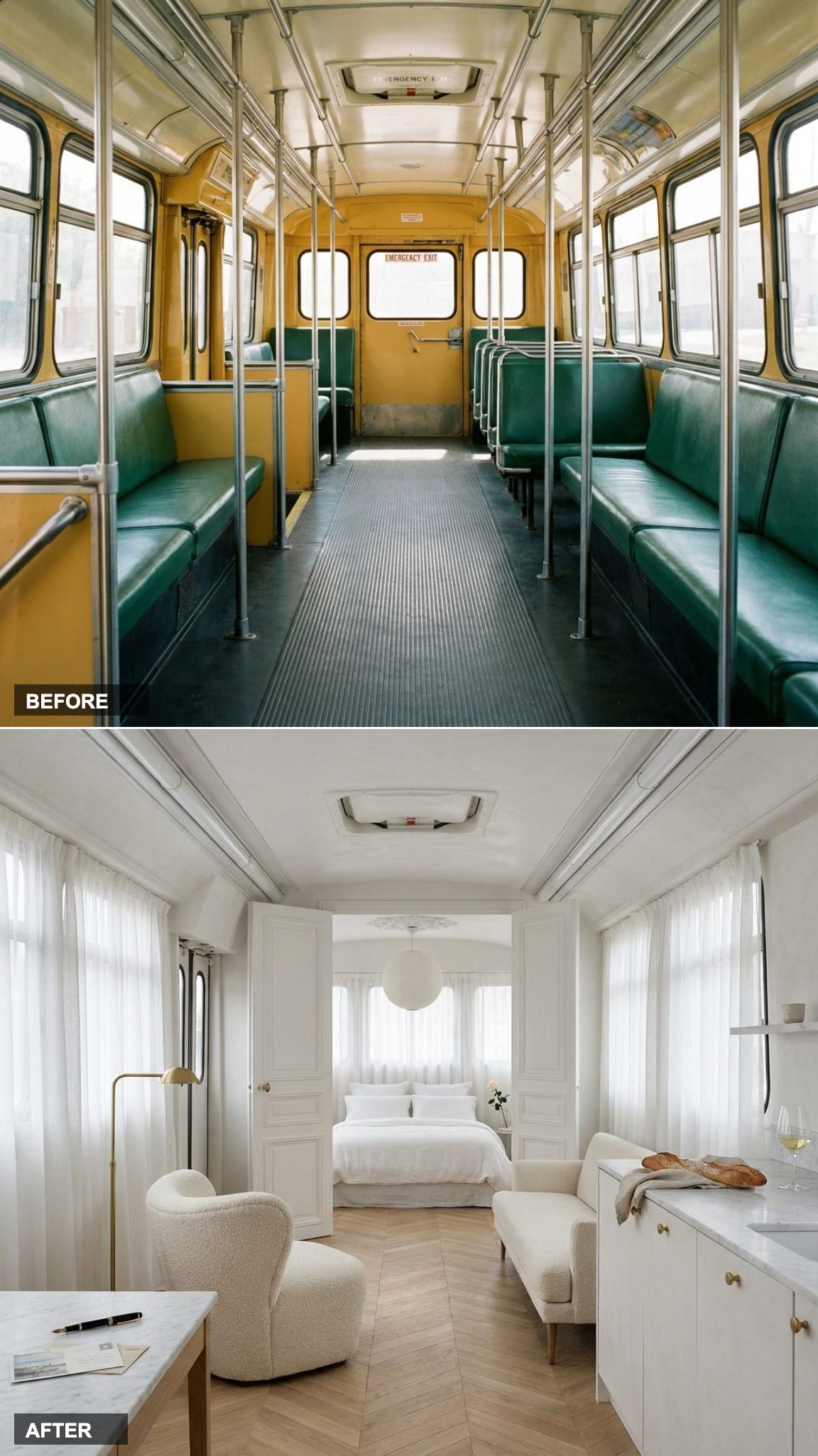
The sculptural ivory bouclé armchair is the kind of piece that earns the adjective “architectural” without trying. Paired with a slim matching sofa and a marble-topped surface, the composition achieves what Parisian minimal design has always chased: a space that looks considered without looking decorated. The restraint is total. No pattern, no layering, no visual noise. Just two exceptional pieces of furniture, one excellent material, and the quality of afternoon light through the windows.
After 30 conversions, this is the one that proves you don’t need a concept, a narrative, or a mood board. Sometimes two good pieces in a clean room is everything.
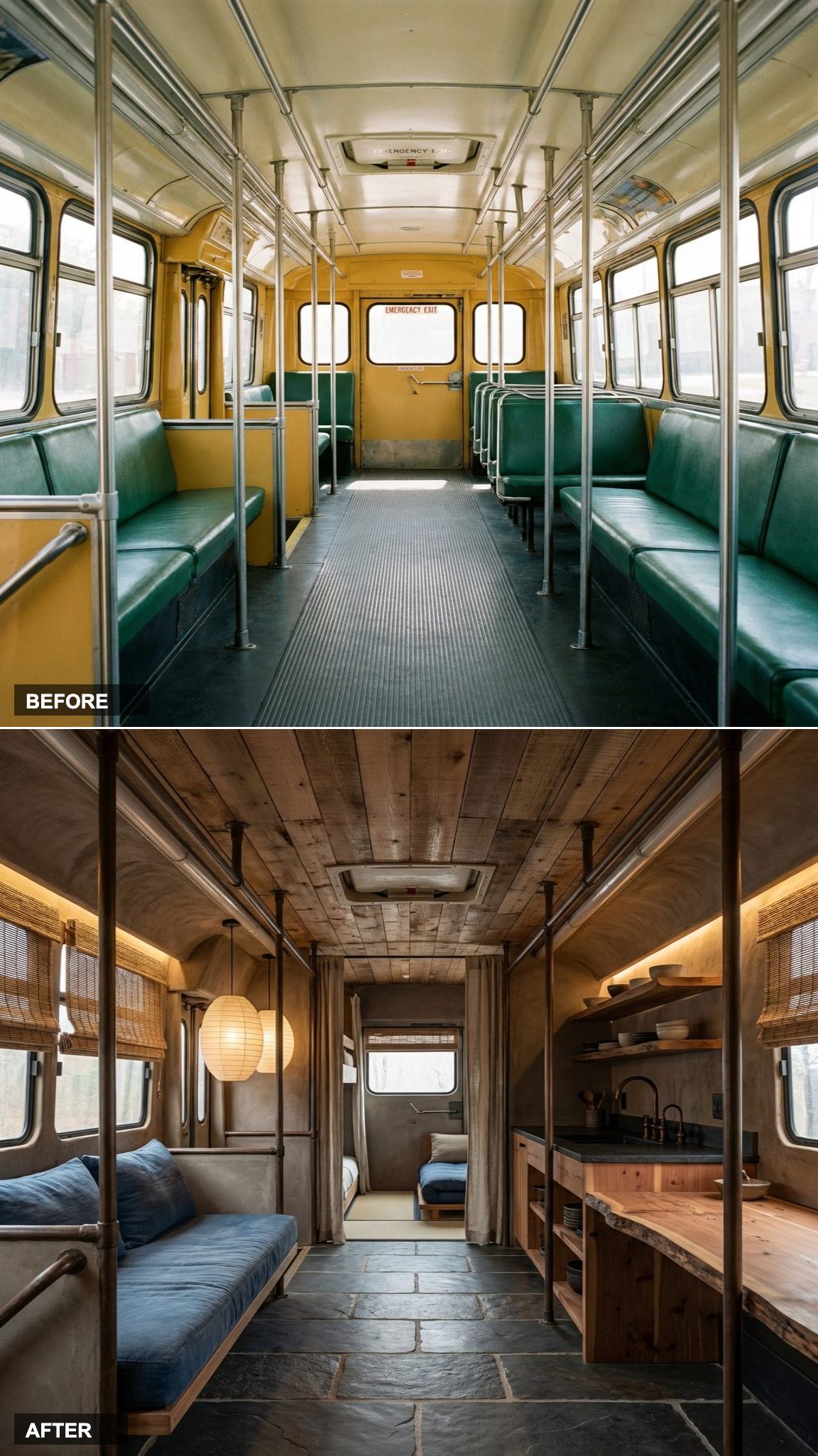
Wabi-Sabi in Motion: Cracked Clay, Aged Cedar, and Imperfection as a Design Choice
🔥 Would you like to save this?
Every surface in this redesign has been allowed to show its history, the clay plaster crackles at the seams, the cedar ceiling is knotted and raw, the slate floor is unpolished. What looks like neglect is actually extremely deliberate.
Wabi-sabi is the Japanese aesthetic philosophy of finding beauty in impermanence and incompleteness. In a bus conversion, it’s also honest: you’re not pretending the vessel is something it isn’t. The aged copper fixtures against the raw clay walls create a conversation between two materials that both patina beautifully with time.
Scandinavian Modern: Birch, Bone White, and the Tyranny of Clutter Finally Defeated
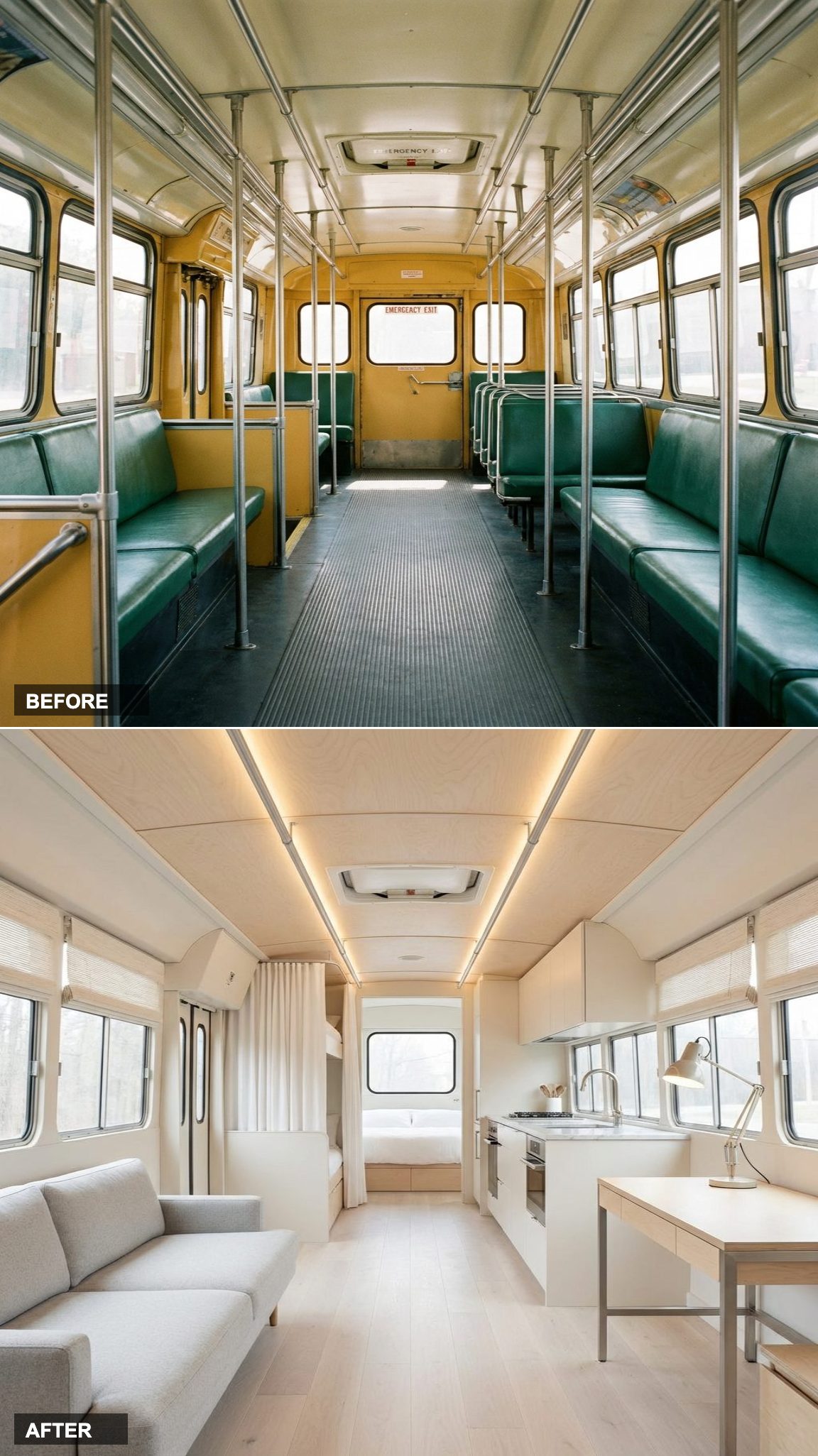
The single biggest design decision here is the ceiling. Birch veneer paneling running the full length of the bus converts the arched overhead from a liability into the most interesting architectural surface in the space, warm without being heavy, pale enough to bounce light all the way to the rear.
Industrial Loft on Wheels: Blackened Steel, Raw Concrete, and Edison Bulbs That Mean It
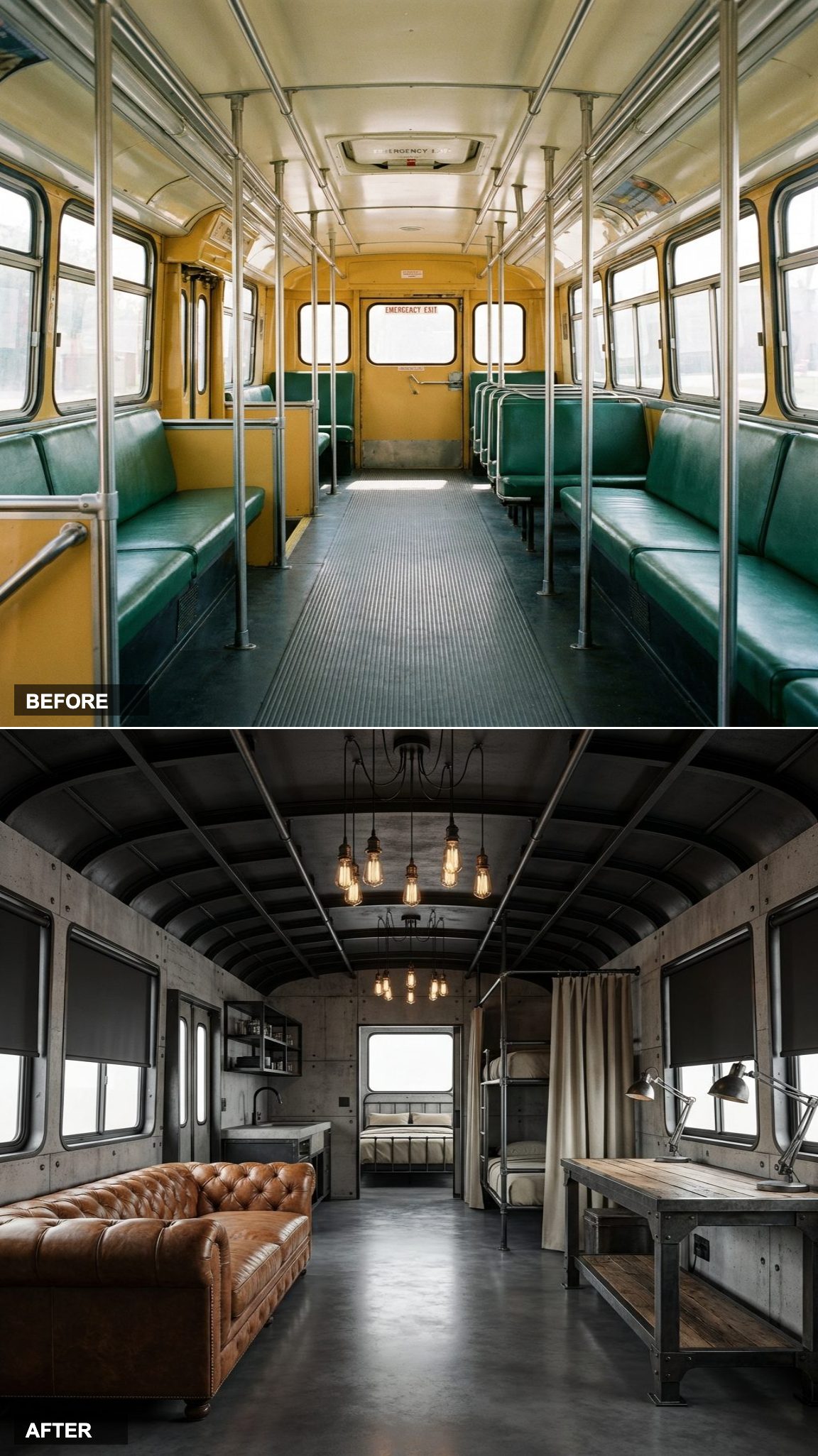
Most industrial interiors fail by being too clean. The successful version of this redesign leans into friction: the cognac leather Chesterfield against raw concrete board creates a material contrast that feels lived-in from day one. The exposed steel ribs of the original bus ceiling, now painted flat black, stop being a constraint and become the whole aesthetic.
California Modern: White Oak, Sage, Rattan, and the Pacific Coast Perpetually Just Outside
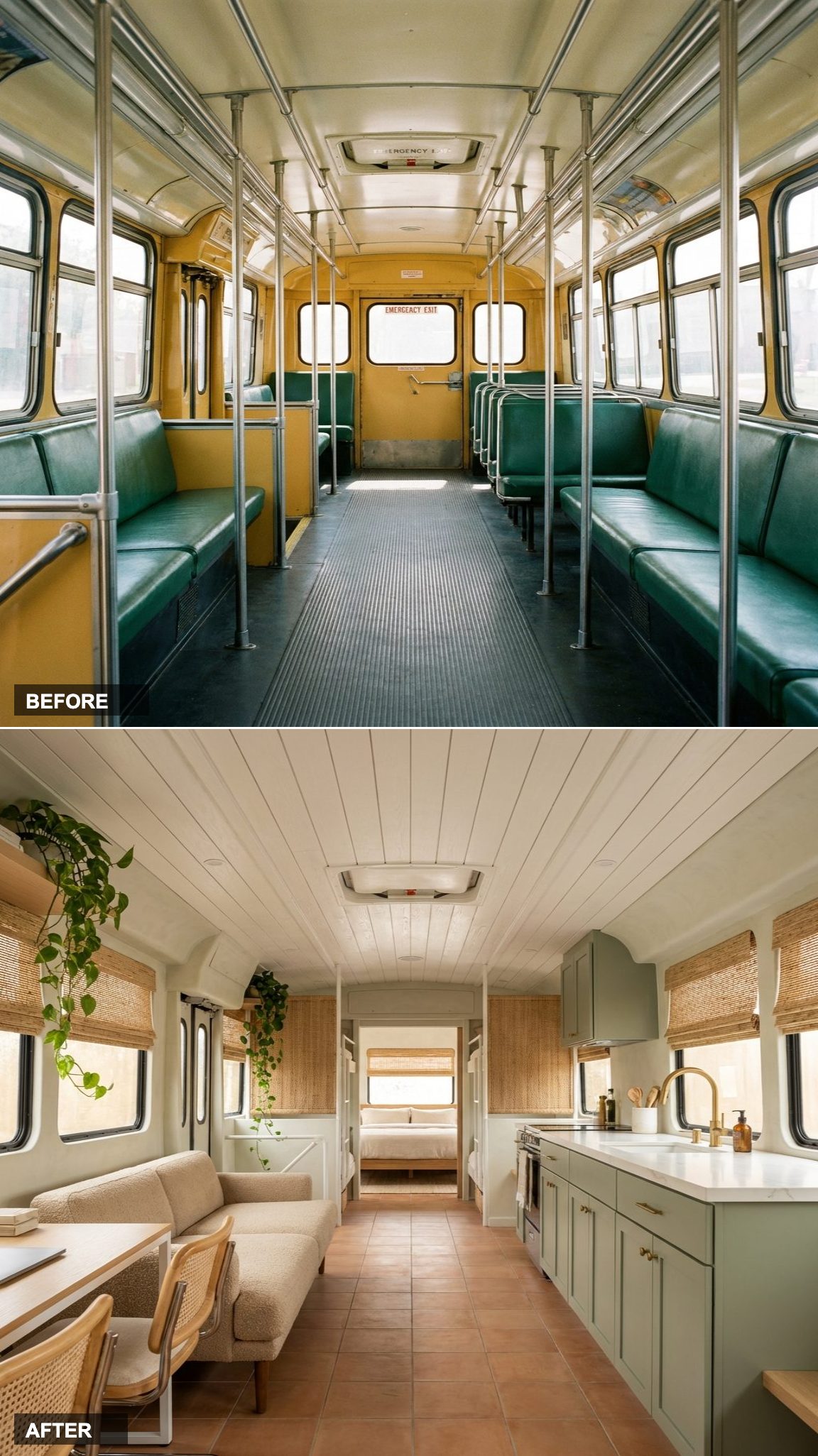
Sage walls and terracotta floors are a pairing that rarely fails because they’re drawn from the same California landscape, the chaparral and the clay canyon roads. In this bus, they anchor a palette that could easily tip into Instagram-generic but stays honest through the use of real materials: honed quartz, woven jute, solid white oak.
The trailing pothos on the workstation does more than look decorative. Research on biophilic interiors consistently shows that even a single live plant improves perceived air quality and occupant mood in enclosed spaces.
“The best California interiors never announce themselves. They let the light do the talking.”
Pacific Northwest Contemporary: Dark Fir, Forest Green, and Rain-Day Atmosphere Made Permanent
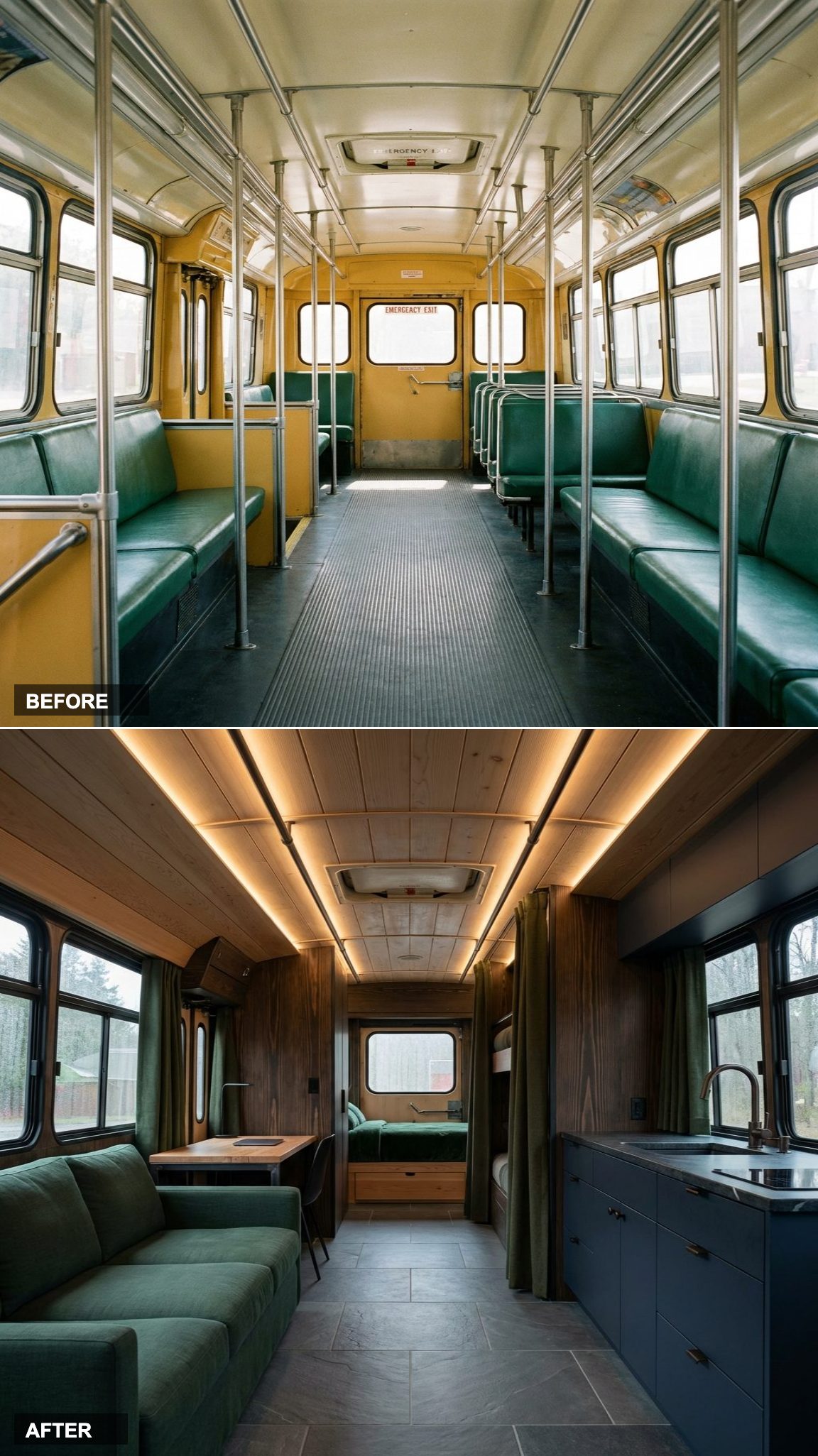
The vertical grain Douglas fir panels on the walls and ceiling create a directionality that pulls the eye forward through the bus, making the long narrow footprint feel intentional rather than cramped. Paired with soapstone counters that have the same cool gray undertone as the slate floor tile, every material is pulling in the same chromatic direction.
Japandi Serenity: Smoked Oak, Ivory Plaster, and the Exact Midpoint Between Two Continents
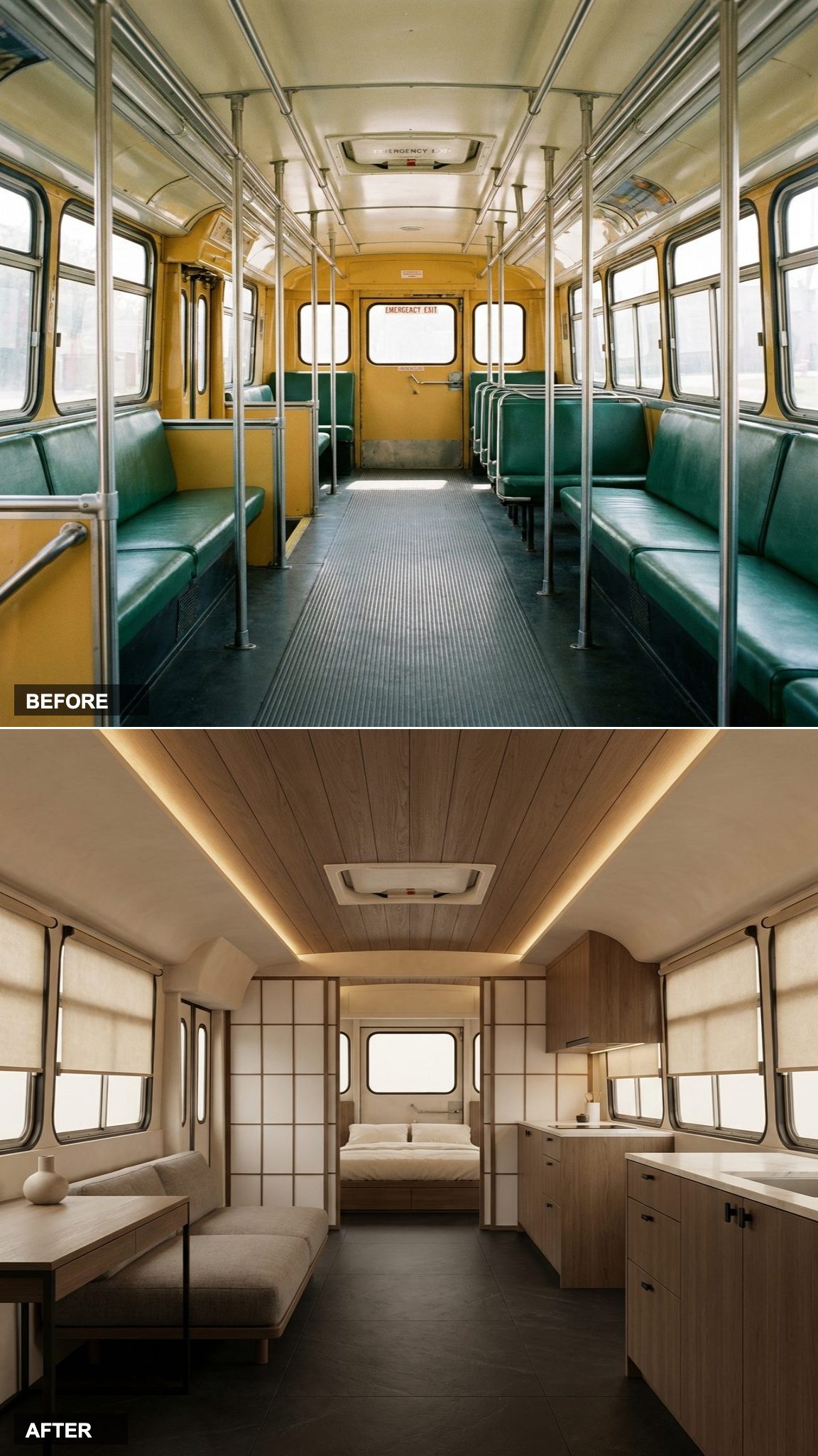
Japandi lands in a very specific design register: quieter than Scandinavian, warmer than Japanese minimalism. The key tension in this redesign is between the smoked oak (warm, organic) and the matte black porcelain floor (cool, architectural). That friction between dark floor and pale walls is exactly what gives the space its particular weight.
Coastal Contemporary: White, Driftwood, Navy, and a Horizon Line Built Into Every Detail
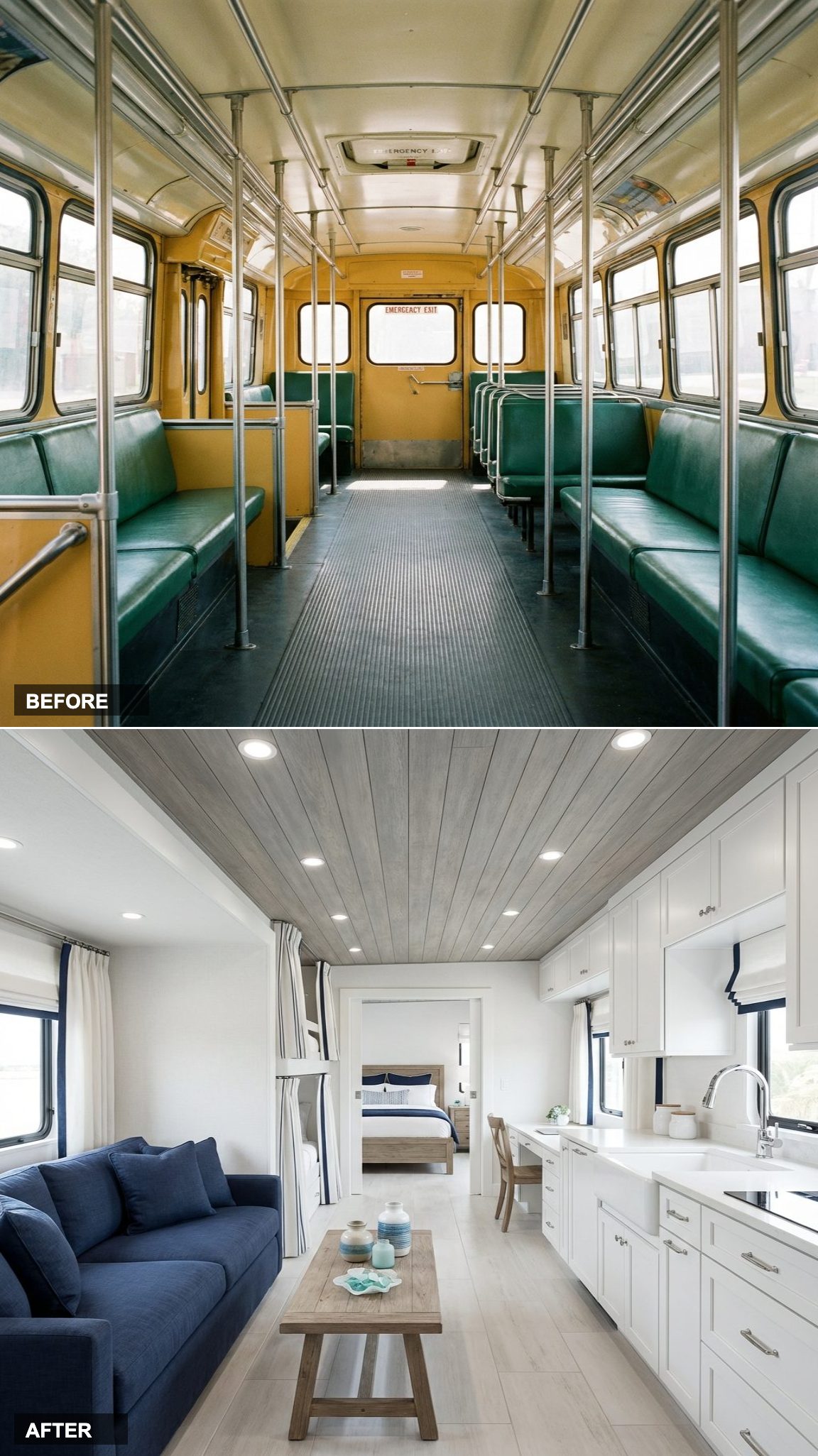
Navy against white is the oldest coastal pairing in residential design, and it’s still working because the contrast ratio is built into the aesthetic rather than layered on top. Here, the driftwood gray shiplap ceiling is the mediating third, it stops the blue-and-white from reading as nautical kitsch and keeps it grounded in contemporary coastal territory.
- The whitewashed porcelain floor reflects daylight deep into the rear bedroom.
- Driftwood elements add organic texture without introducing a competing color.
- The navy linen sofa anchors the living zone without breaking the sight line.
Organic Modern: Curved Plaster, Terracotta, and Everything Shaped Like It Grew That Way
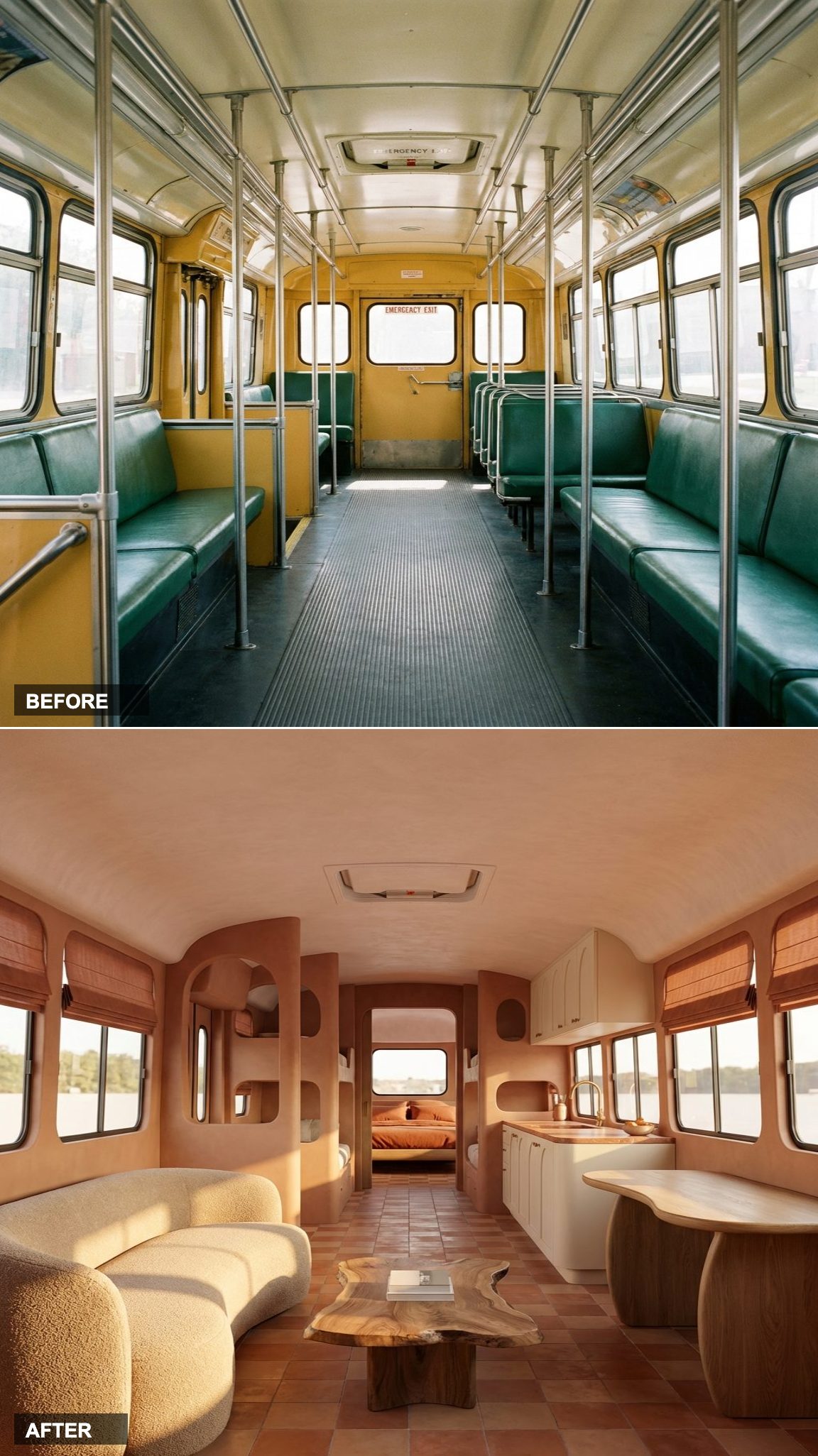
The curved plaster transitions at every corner and wall junction are not decorative, they’re structural to the style. Hard angles in organic modern are like typos: they break the visual sentence. The arched bunk dividers echo the bus’s own arched ceiling, making the original bones of the vehicle feel like they were always part of the design intention.
Art Deco Revival: Emerald Lacquer, Gilded Millwork, and Glamour That Has Absolutely No Apologies
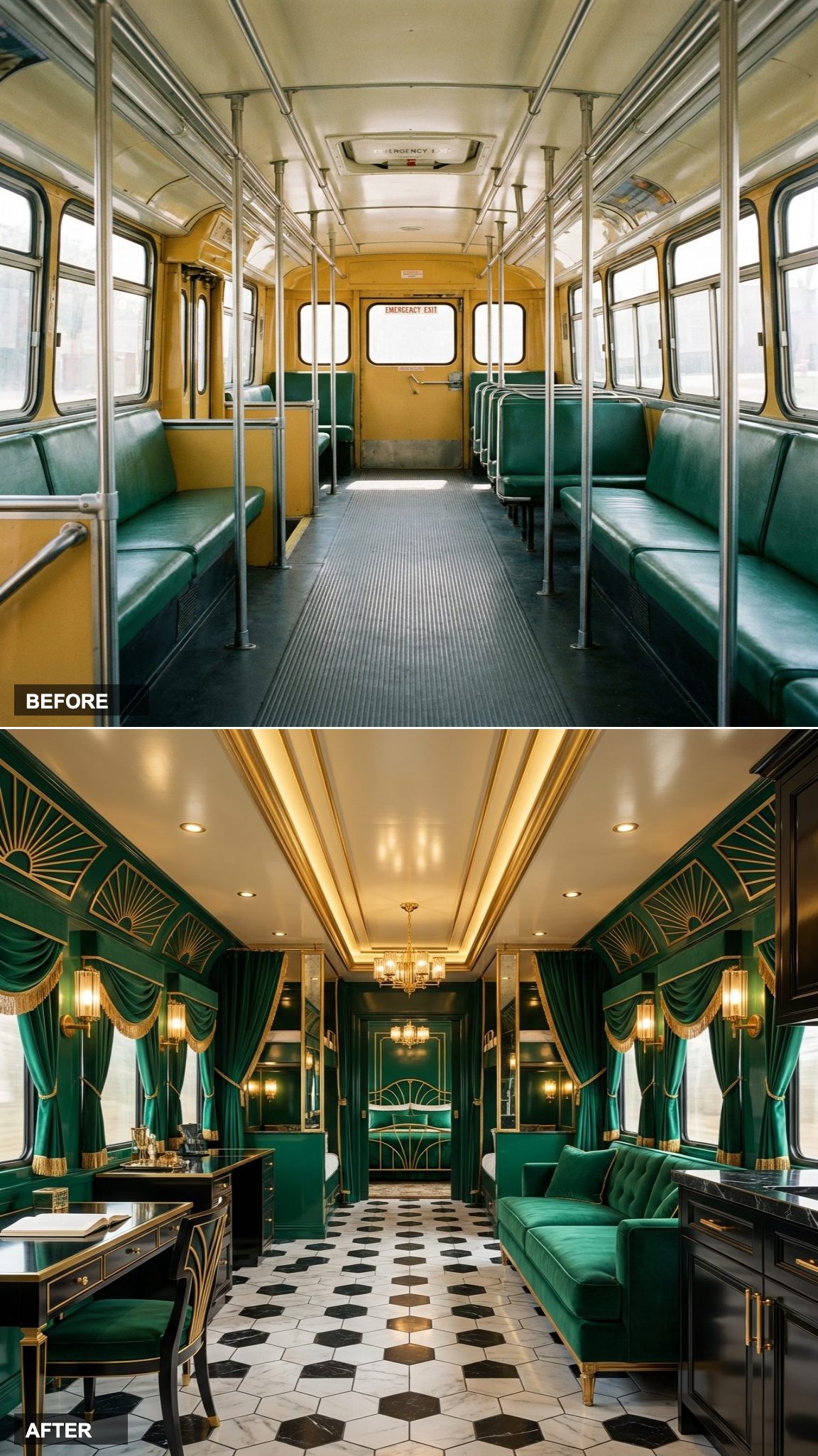
Emerald lacquer walls with gilded sunburst millwork in a former city bus is either the most committed design move in this entire list or the most unhinged, and the honest answer is both. Art Deco is at its best when it ignores the rules about what a space is supposed to be, and a transit bus is the perfect candidate for that kind of categorical refusal.
Nautical Luxury: Teak, Navy Canvas, Brass Cleats, and a Superyacht That Forgot to Stay on the Water
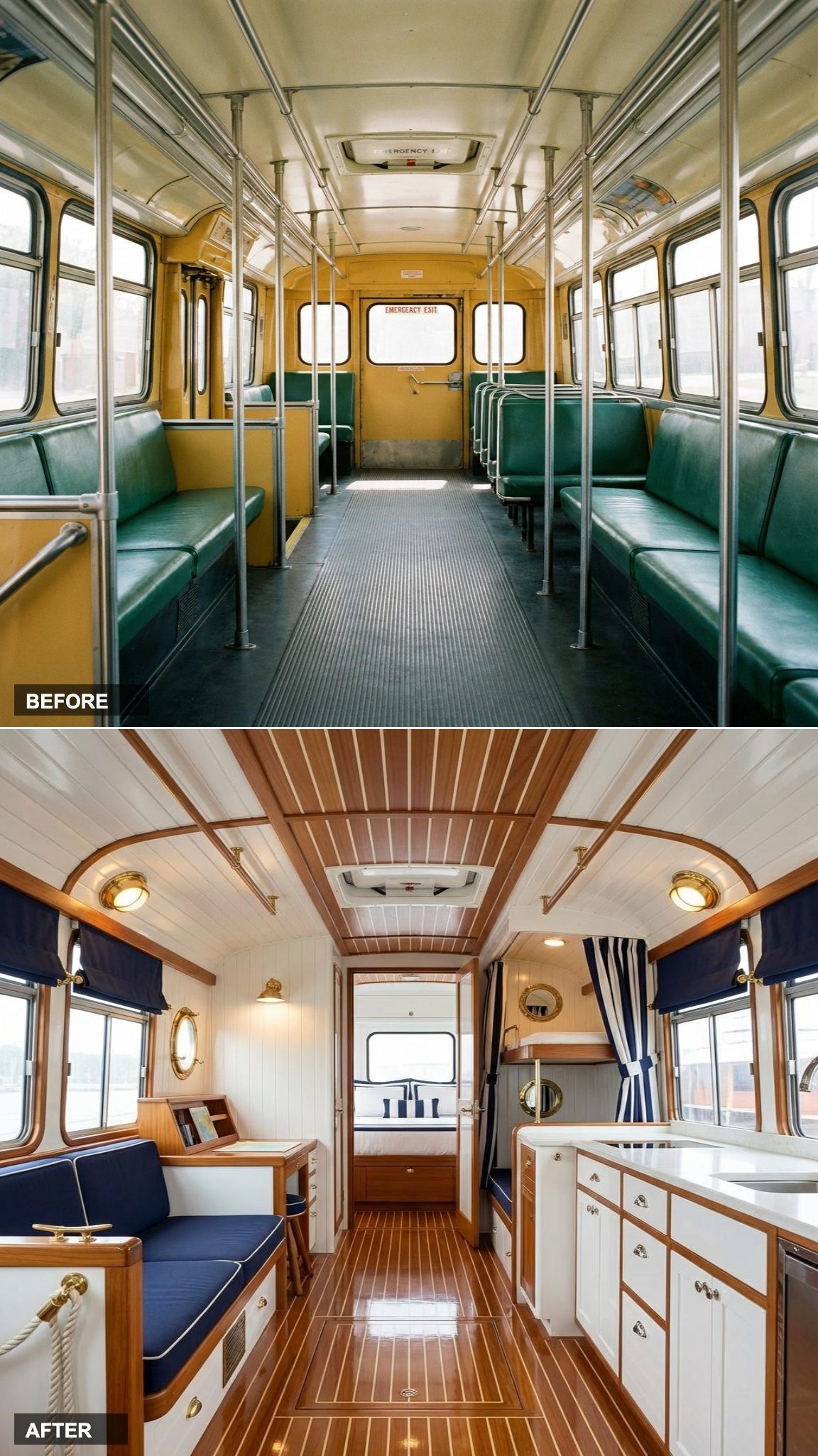
Teak and holly strip flooring on the ceiling, borrowed directly from classic sailing yacht interior design, is the detail that makes this redesign earn its nautical claim. It’s not anchor motifs or lobster prints. It’s the actual materials and joinery techniques from superyacht construction, applied to a vehicle that travels on an entirely different kind of surface.
Tokyo Micro-Luxury: Glossy Black Lacquer, Shoji, and the Japanese Art of Making Less Do Everything
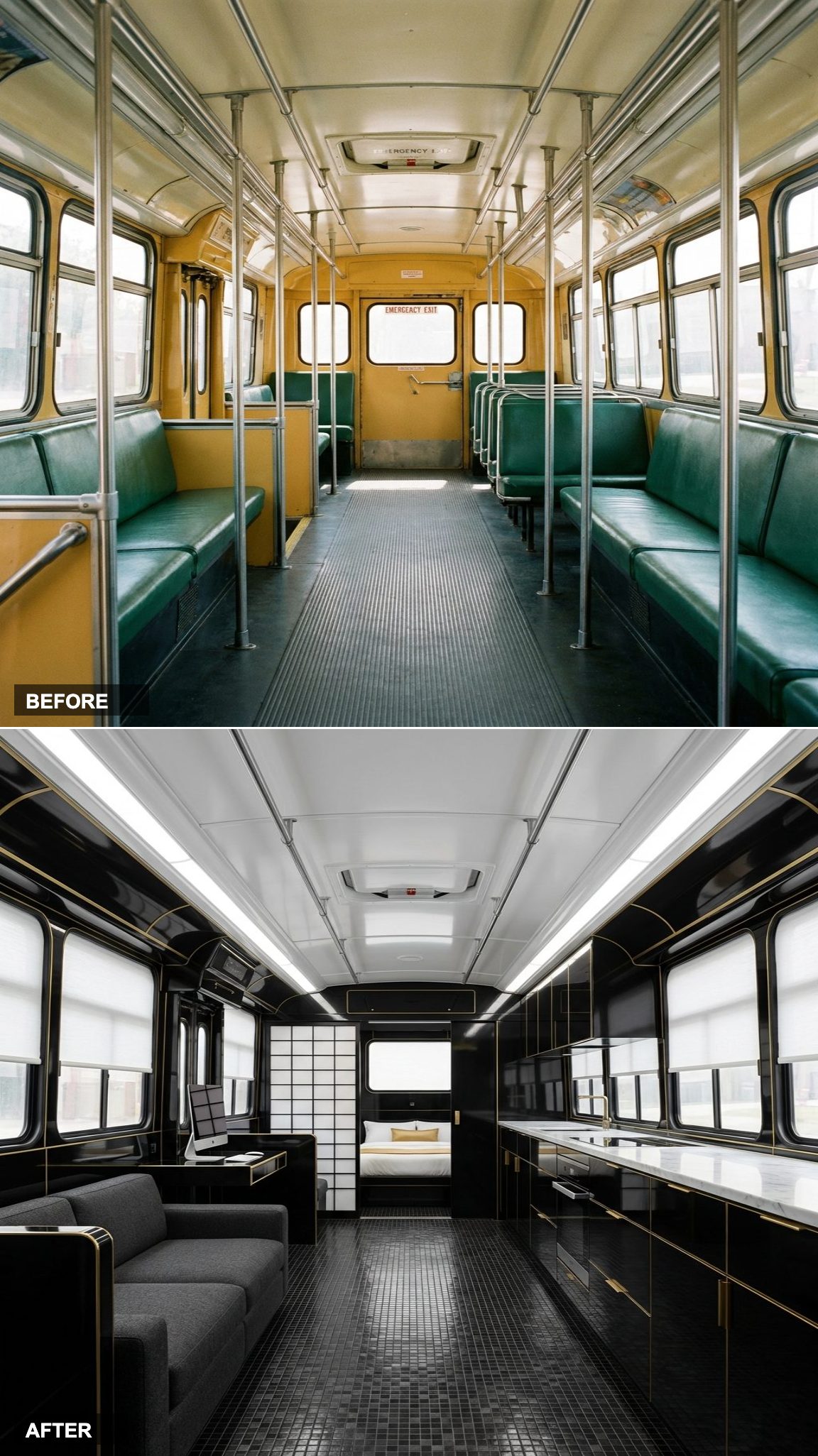
High-gloss black lacquer in a small space is a counterintuitive move that actually expands the perceived volume: the reflective surfaces bounce light and replicate the opposite wall, which in a narrow bus doubles the apparent width. The thin gold inlay line detailing is the only decorative concession, and it carries the weight of an entire accent palette on its own.
Soft Industrial: Dusty Rose, Aged Steel, and an Argument That Hard and Soft Are Not Opposites
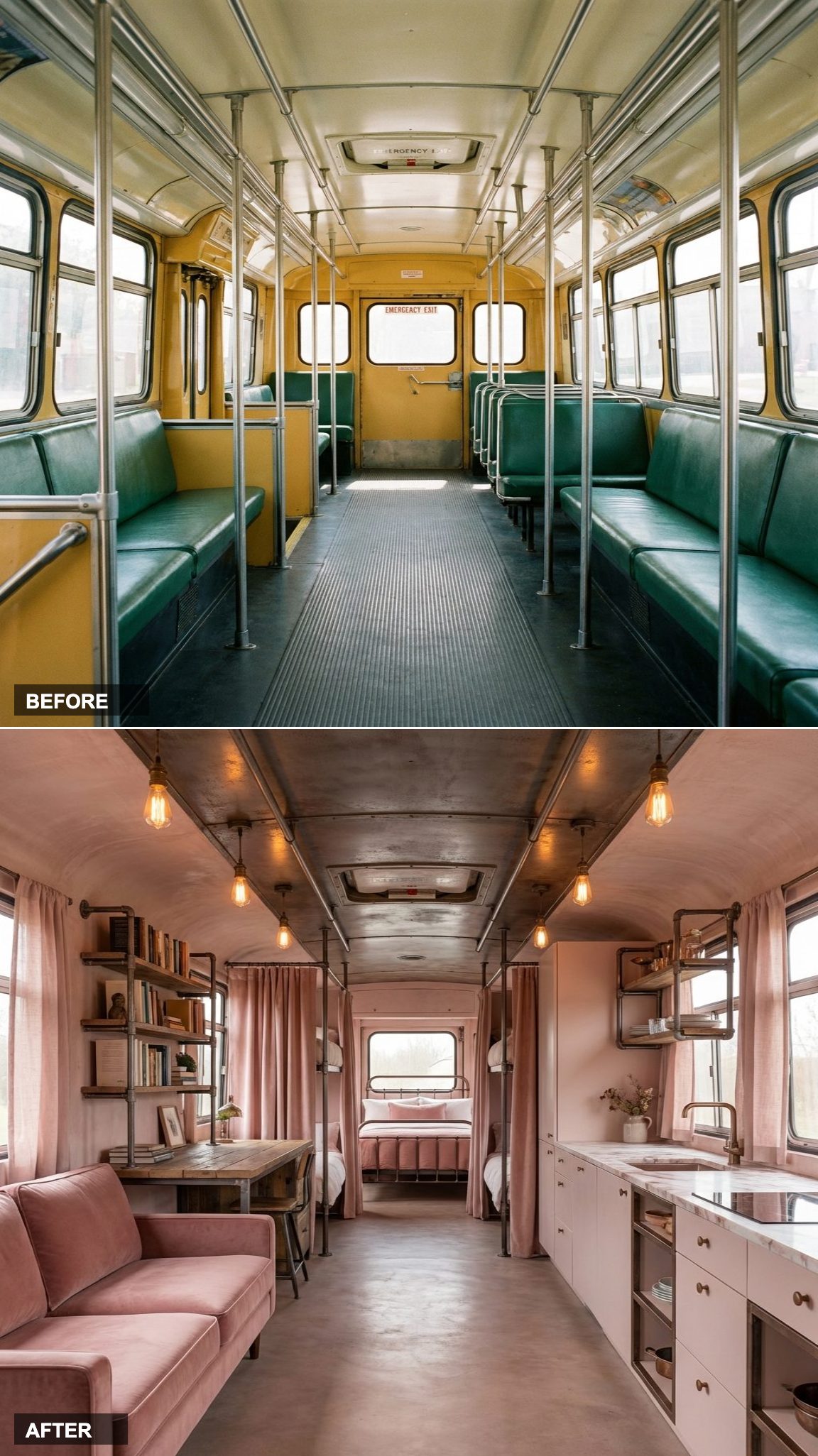
Dusty rose plaster against an exposed patinated steel ceiling is a material pairing that shouldn’t work as well as it does. The rose pulls warm; the aged steel pulls cool, and the temperature tension between them is what gives this redesign its particular texture. Neither material is pretending. Both are exactly what they are.
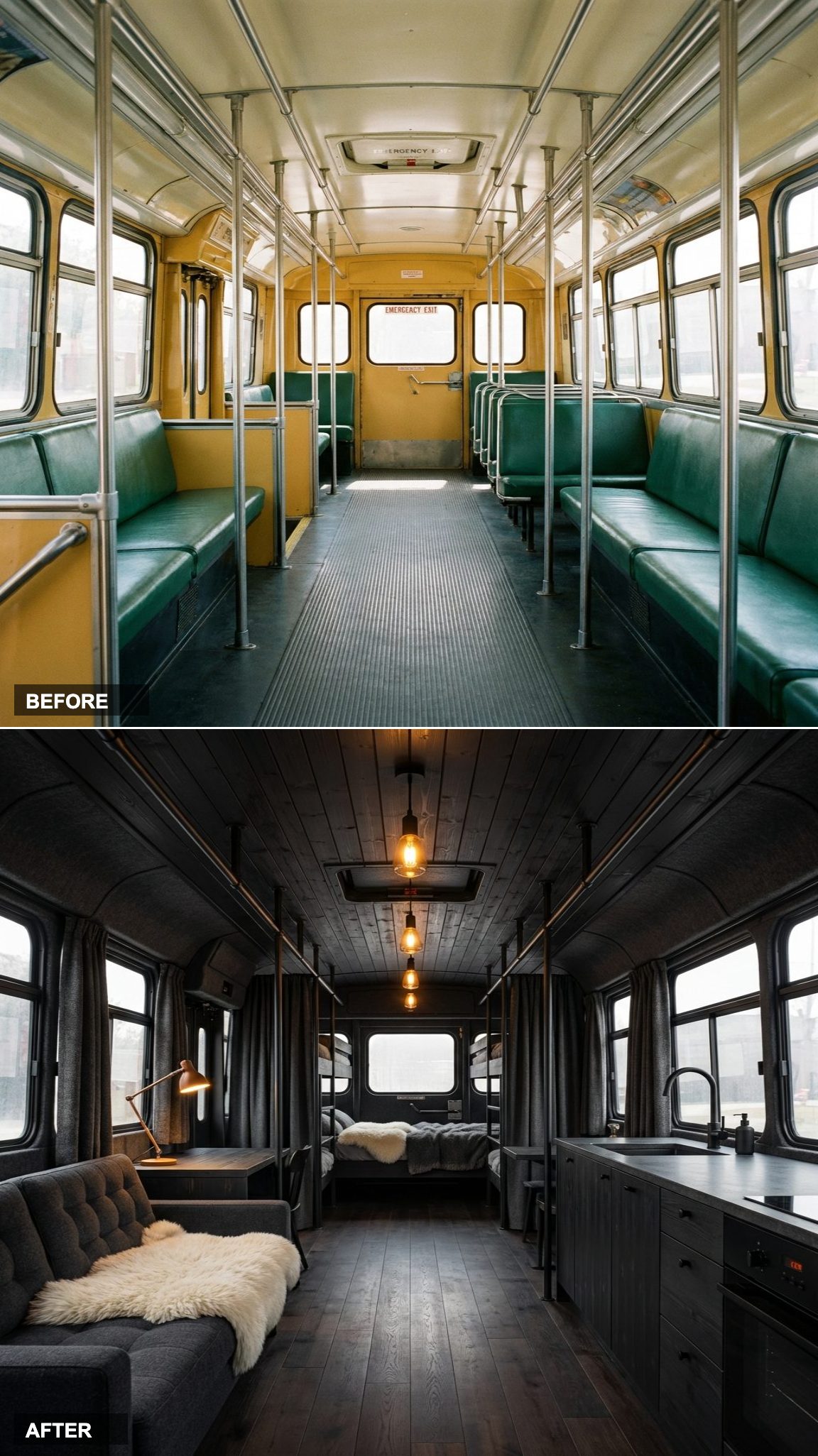
Nordic Dark: Charcoal Felt, Black Stained Pine, and the Hygge You Never Expected to Find in a Bus
🔥 Would you like to save this?
Charcoal wool felt on the walls is one of those material choices that registers before the eye can name it: the space absorbs sound, the surface has real tactile depth, and the color is dark enough that the amber pendant lighting becomes dramatic rather than merely functional. Nordic dark is less a visual style than a sensory one, and the wool felt is carrying most of the sensory load here.
French Contemporary: Dove Gray Paneling, Gold Leaf, and Parisian Restraint With a Budget That Has No Ceiling
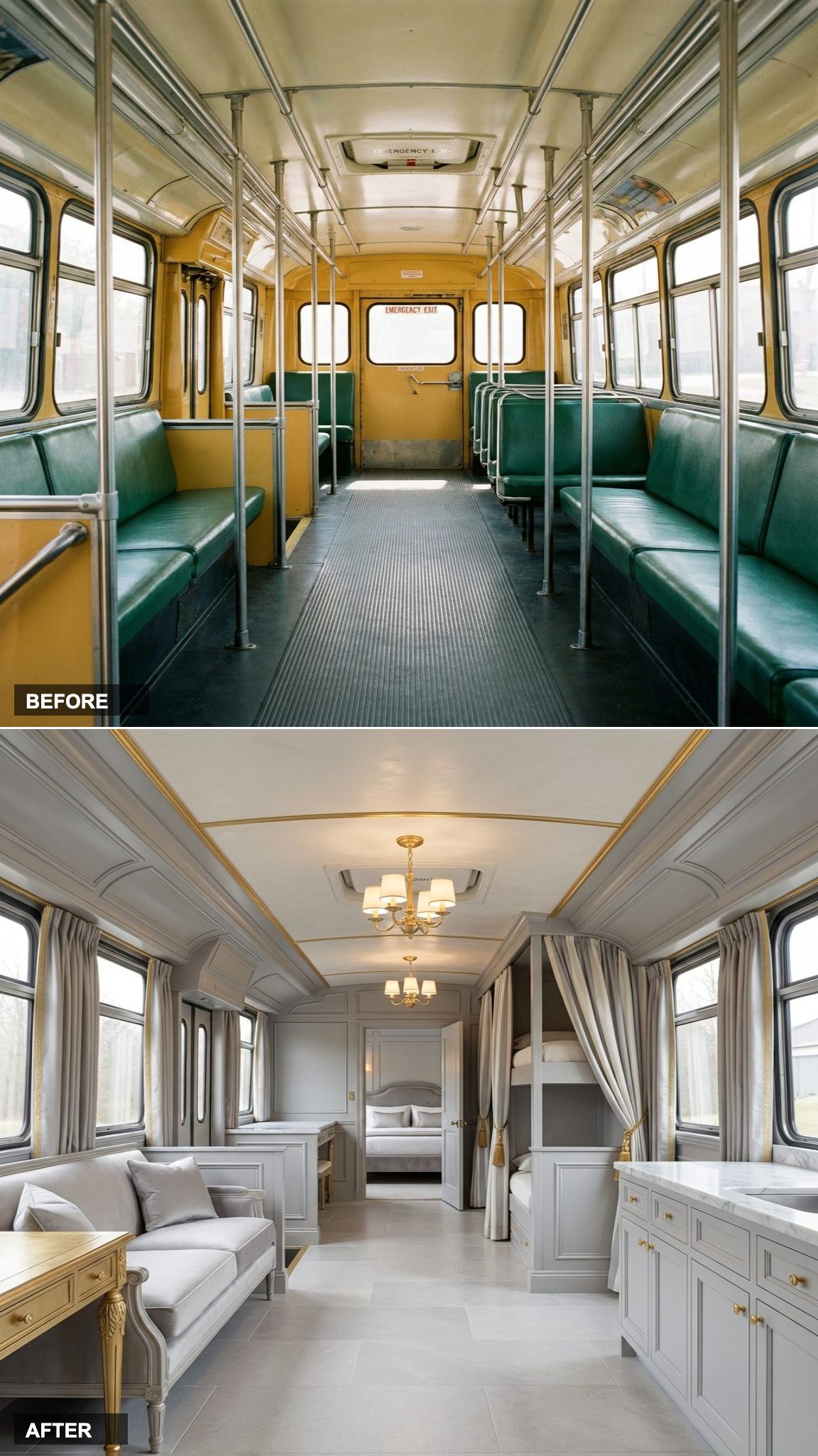
The boiserie paneling on the walls does something architecturally useful in a long narrow space: the vertical panel divisions create a rhythm that breaks the tunnel into discrete visual bays. In traditional French interiors this was purely decorative. Here it’s doing structural compositional work on top of looking expensive.
Parisian Minimal: Raw Plaster, Black Steel, and the Confidence to Leave the Walls Mostly Empty
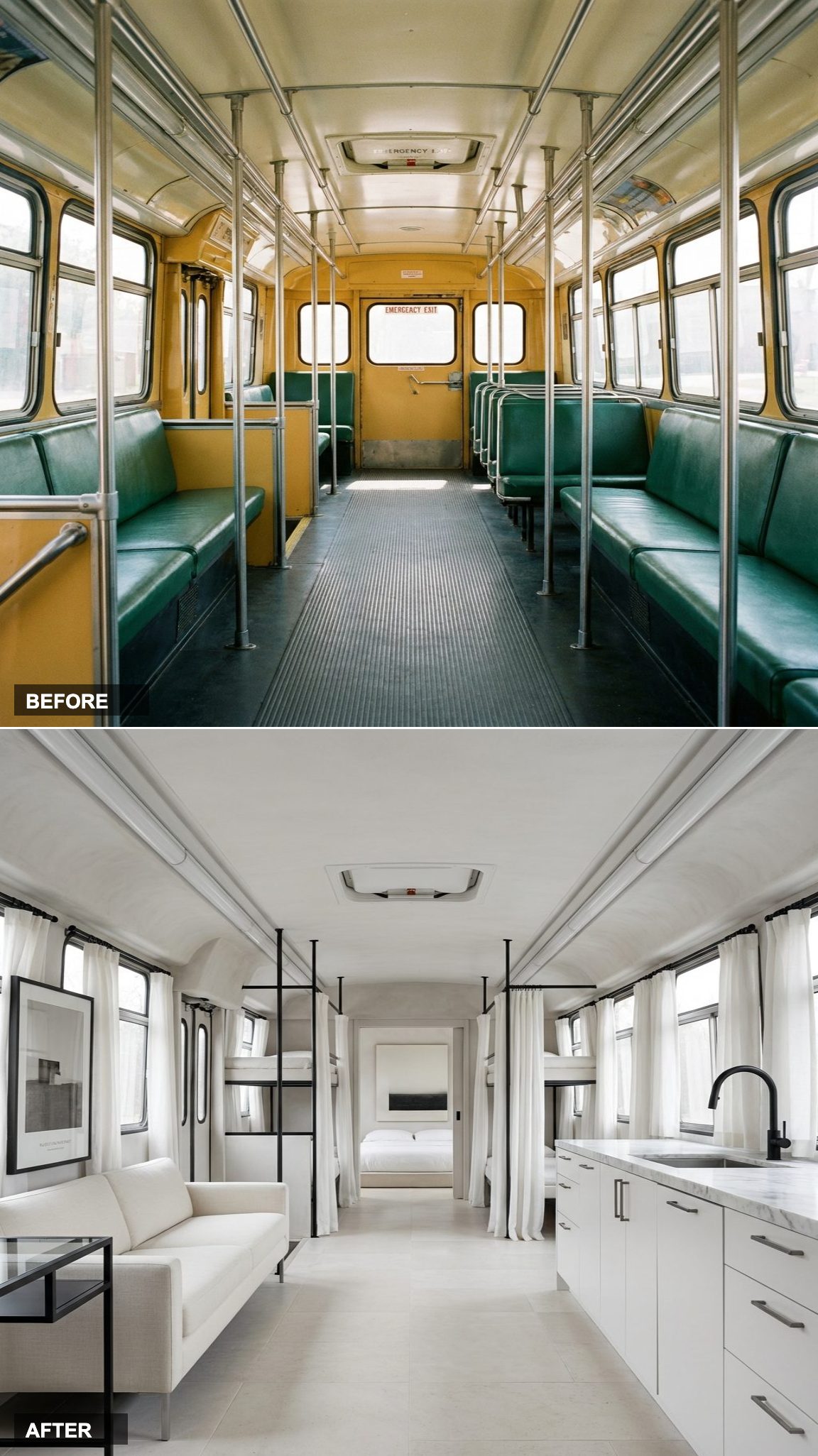
Raw plaster walls that are intentionally left bare are the hardest design move to pull off because they demand that every other decision be exactly right, the wrong sofa proportion, the wrong black in the steel hardware, a single over-decorated surface would expose the emptiness immediately. The singular framed museum print in the living zone is the only content that the walls offer, and it earns that position completely.
This is the only redesign in the series where the before bus and the after bus are separated entirely by subtraction rather than addition. Less was added here than in any other version, and it is, arguably, the most considered of the thirty.
Scandinavian Calm Turns a Bus Shell Into a Nordic Sanctuary
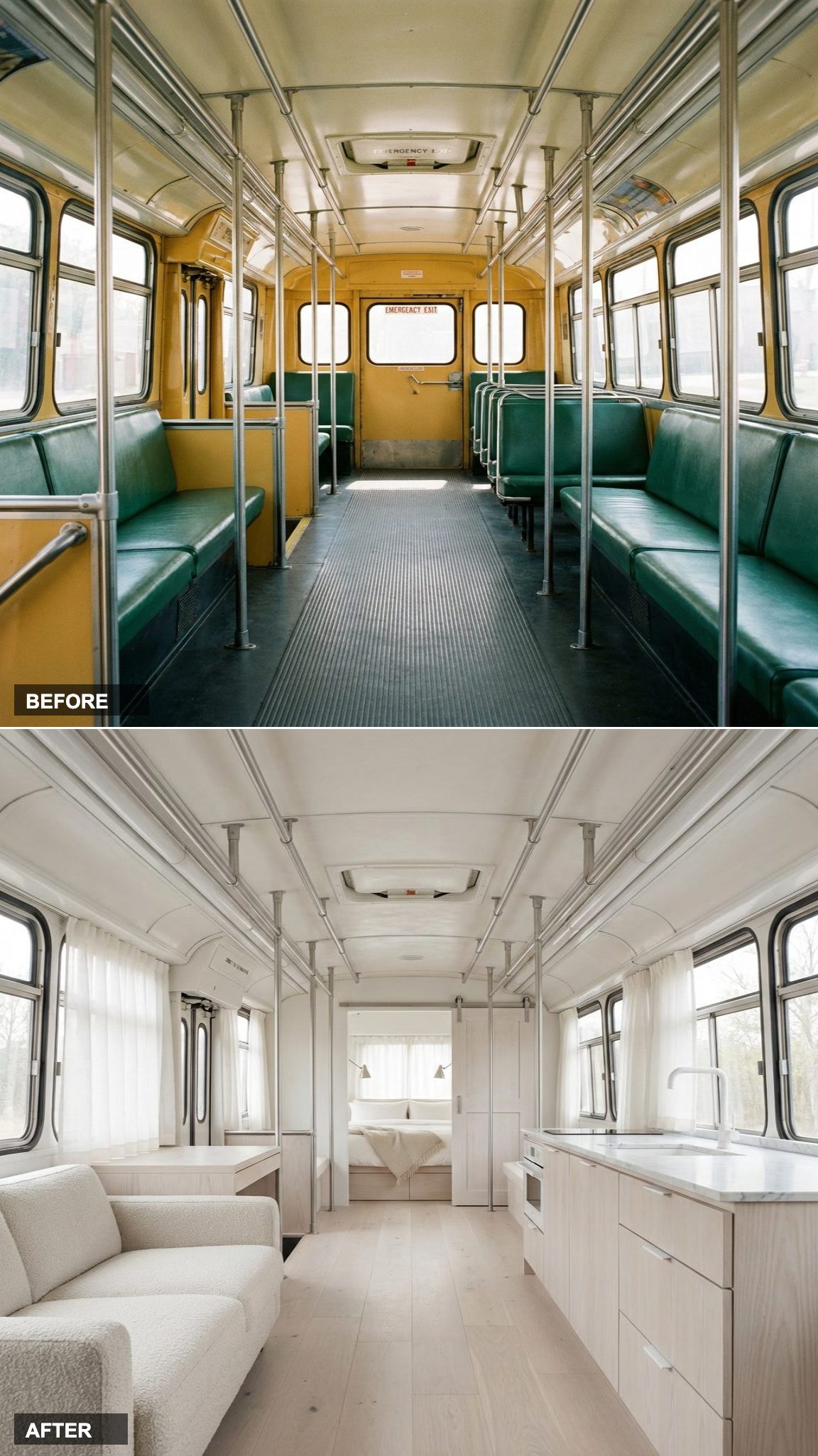
Blonde birch plywood lines every wall, the ceiling drops with acoustic wool panels in oatmeal white, and the kitchen is a clean run of matte white cabinetry with integrated appliances and a single-basin concrete sink. There is not a single piece of hardware that isn’t brushed nickel.
Scandinavian design works in compressed spaces because it never tries to fill them. The negative space here is the design decision.
Lodge Modern: When a Bus Conversion Borrows From Big Sky Country
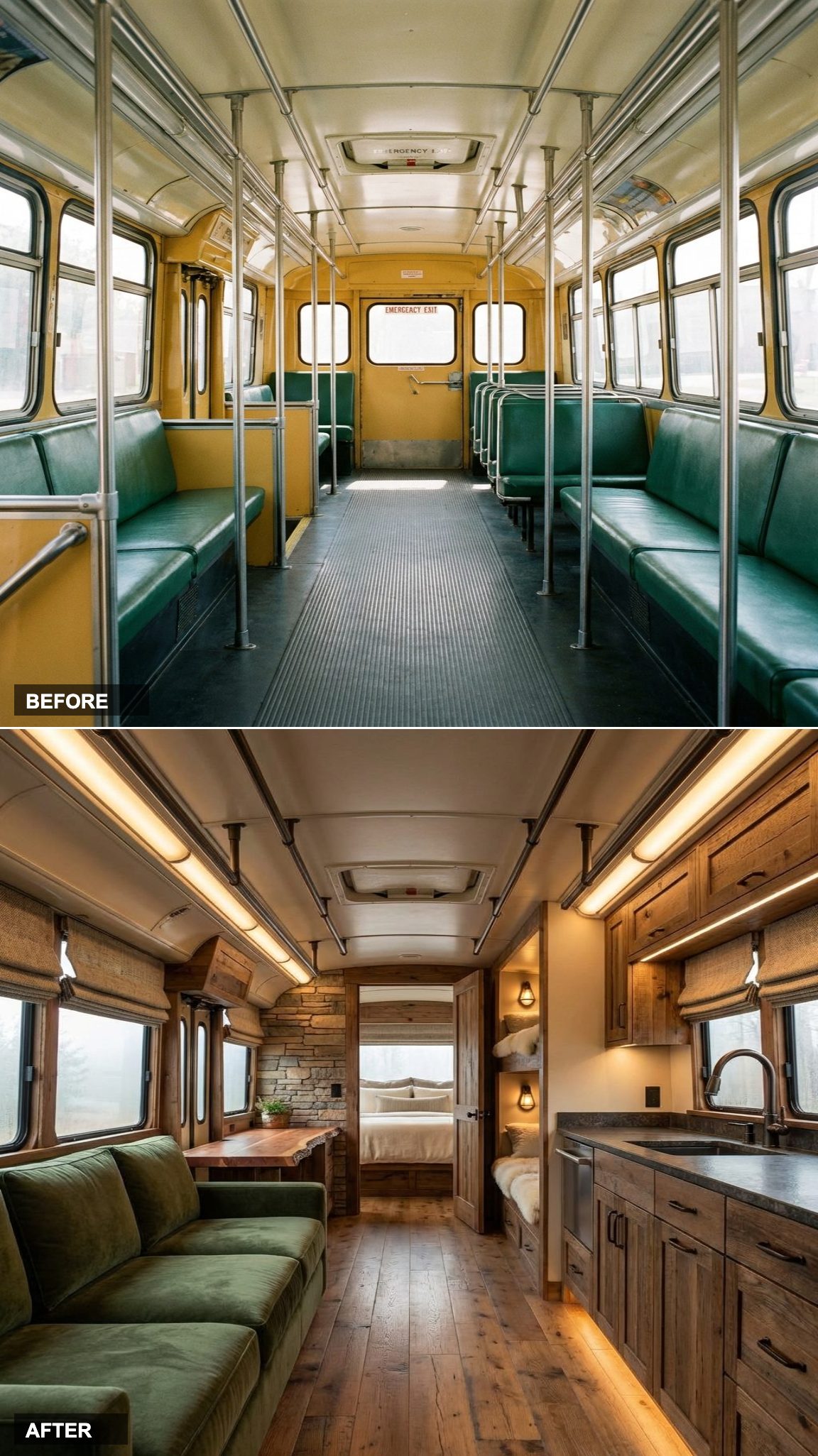
Rough-sawn Douglas fir planks run the full ceiling length, a river-stone feature wall anchors the living zone, and the lounge seating uses cognac leather with chunky wool throws in charcoal and rust. The kitchen counter is live-edge black walnut slab, and the pendant lights are hand-blown amber glass.
It shouldn’t work in this footprint. Somehow it does.
Brutalist Luxury Proves Raw Concrete Belongs in a Rolling Home
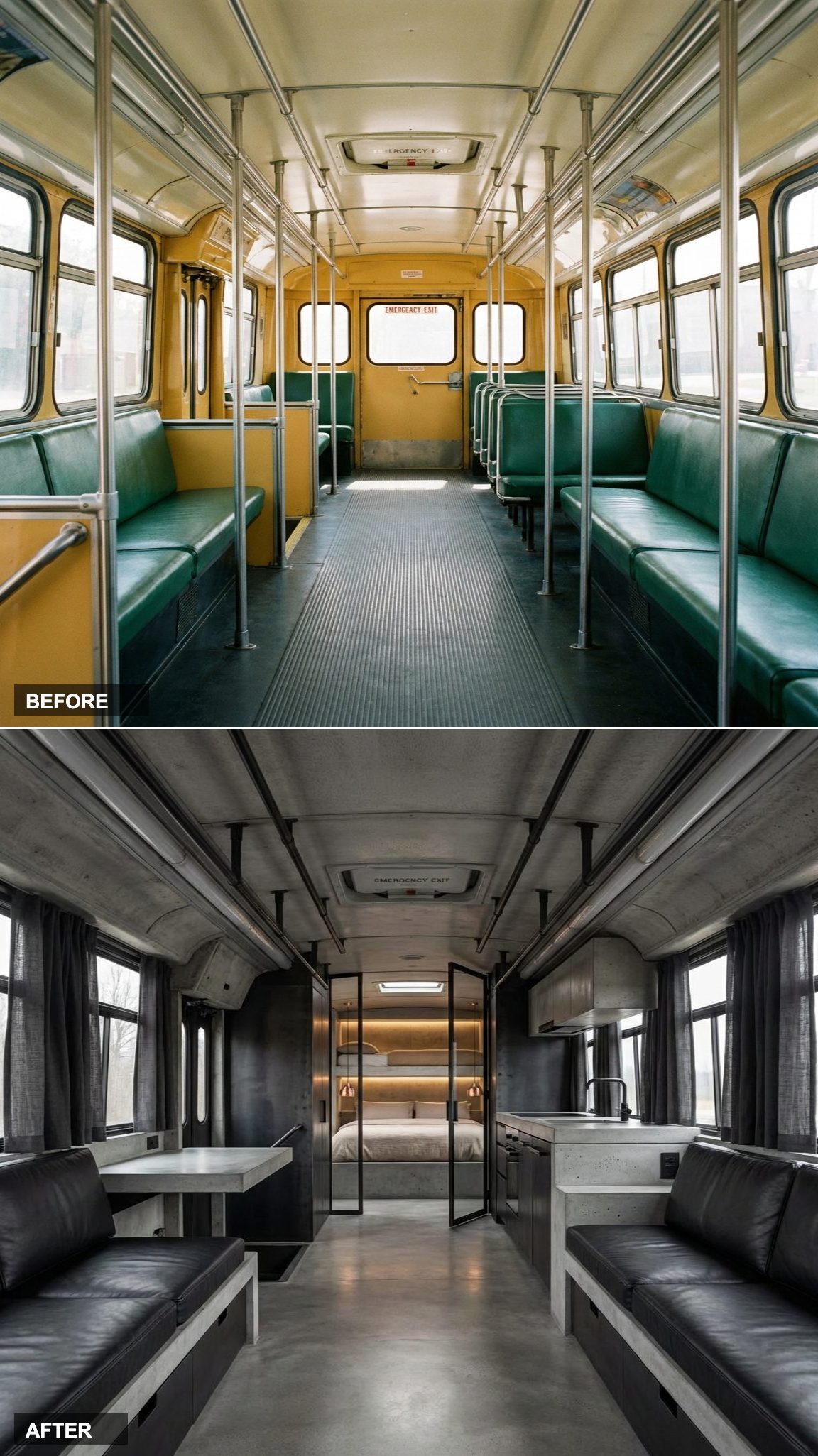
Micro-cement covers every surface, walls, ceiling, floor, counters, in a single continuous pour-grey tone that turns the entire interior into one cohesive sculptural object. Against it: a single black leather Corbusier-style daybed, a low steel-framed dining table, and one enormous art photograph backlit behind the bed.
“The bus stops being a bus the moment you stop decorating it and start sculpting it.”
This conversion commits completely. There is no warm wood to soften the concrete, no decorative pillow to apologize for the severity. That commitment is what makes it work.
Resort-Contemporary: A Five-Star Hotel Room That Also Does 65 MPH
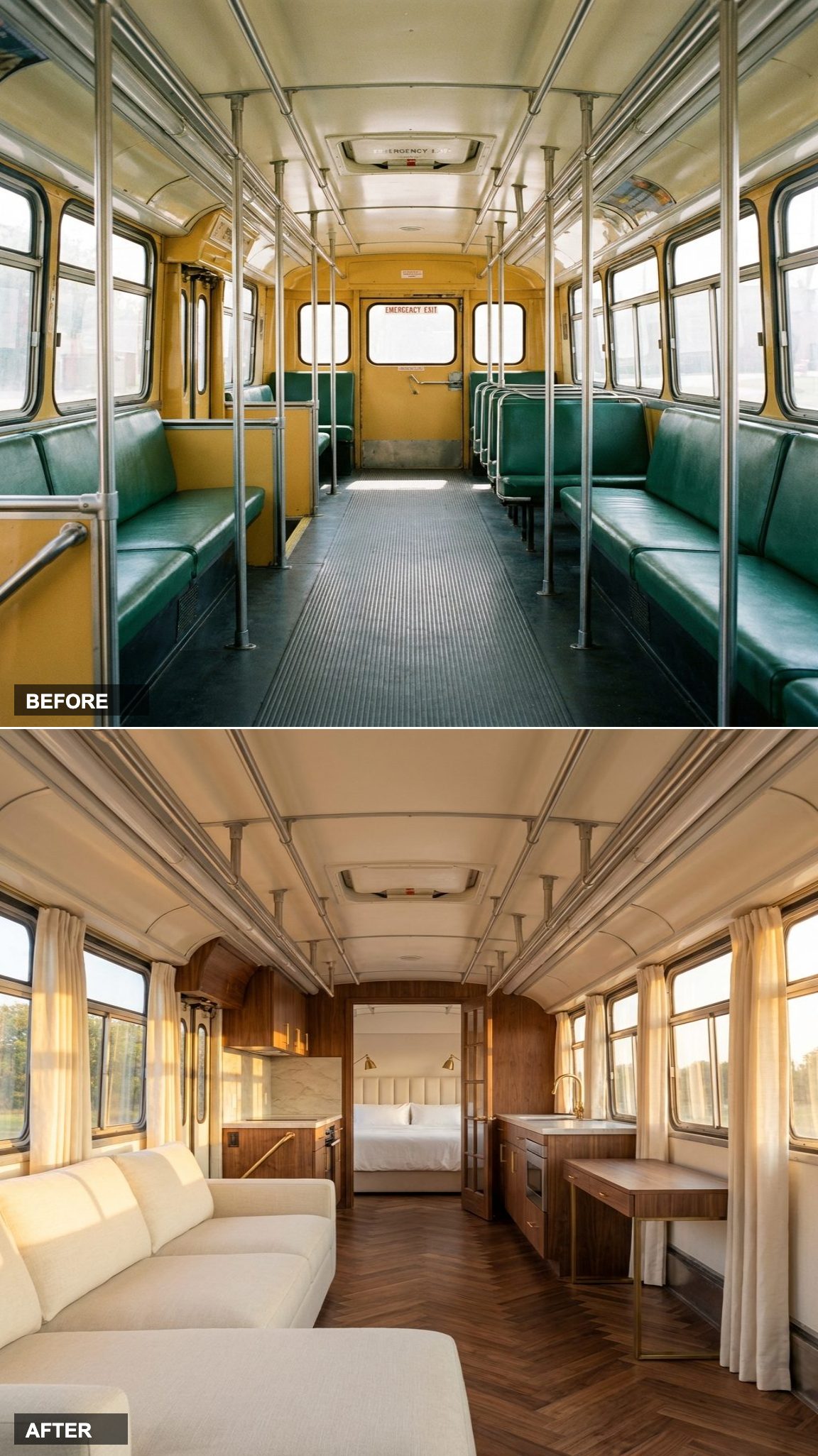
Linen-wrapped walls, a floating vanity with backlit mirror, and a king-sized platform bed with 600-thread-count bedding in cloud white, the rear suite of this conversion reads as a boutique hotel room that happens to transition into a fully equipped kitchen and lounge at the front. The color palette is sand, taupe, and bone throughout, broken only by matte black fixture hardware.
Haute Alpine Chalet: A Swiss Mountain Lodge With an Engine
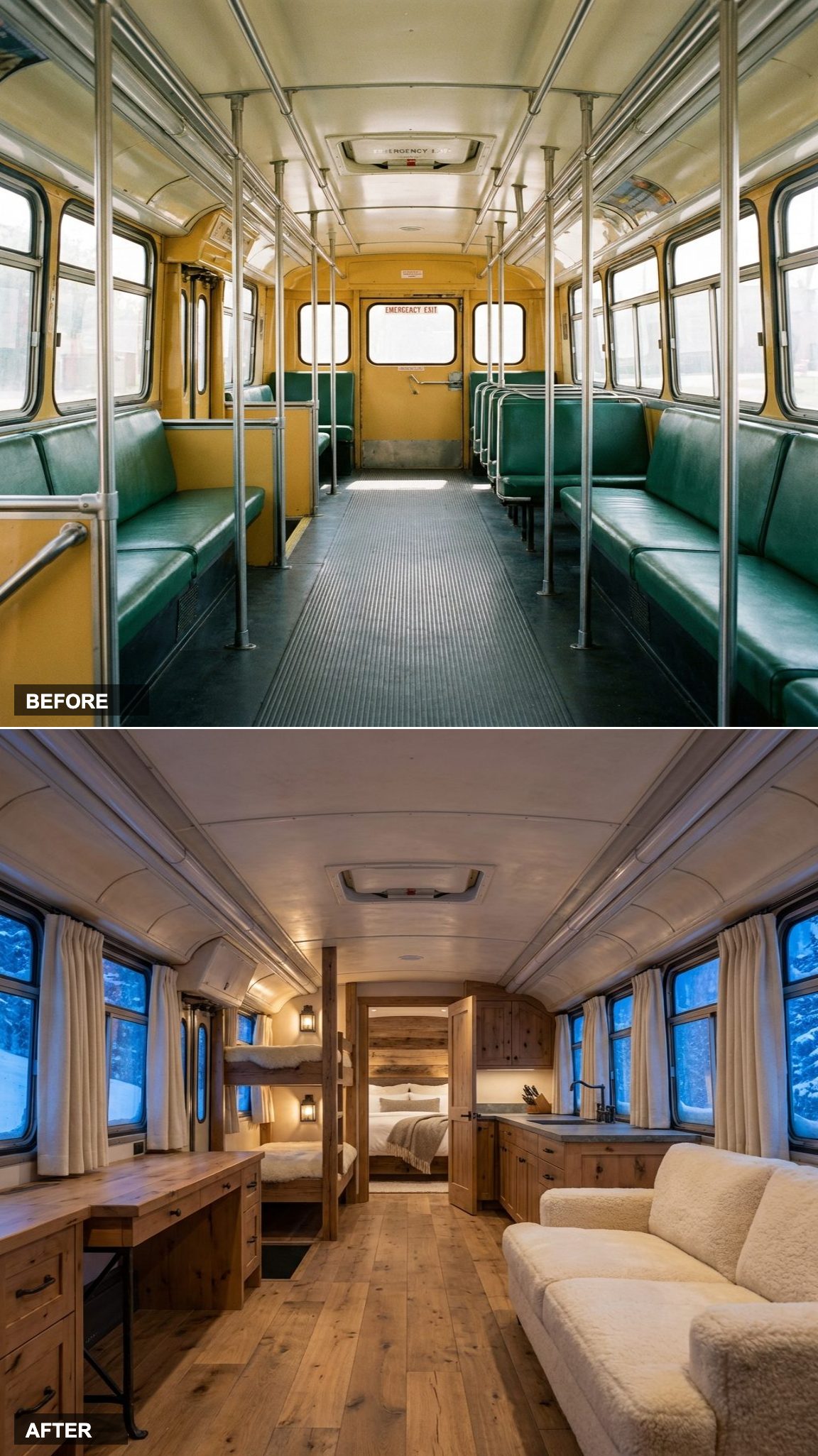
Horizontal reclaimed pine planks, grey-white with age and heavily textured, clad every wall from the driver’s area to the emergency exit. The kitchen runs white Corian counters with a hand-hammered copper sink, and the bedroom at the rear has a pitched wooden ceiling insert that mimics an alpine cottage roofline within the bus profile. Sheepskin throws, a cast-iron pot on the cooktop, antler hooks beside the entrance.
Midnight Luxury: A Bus Interior So Dark and Rich It Barely Looks Real
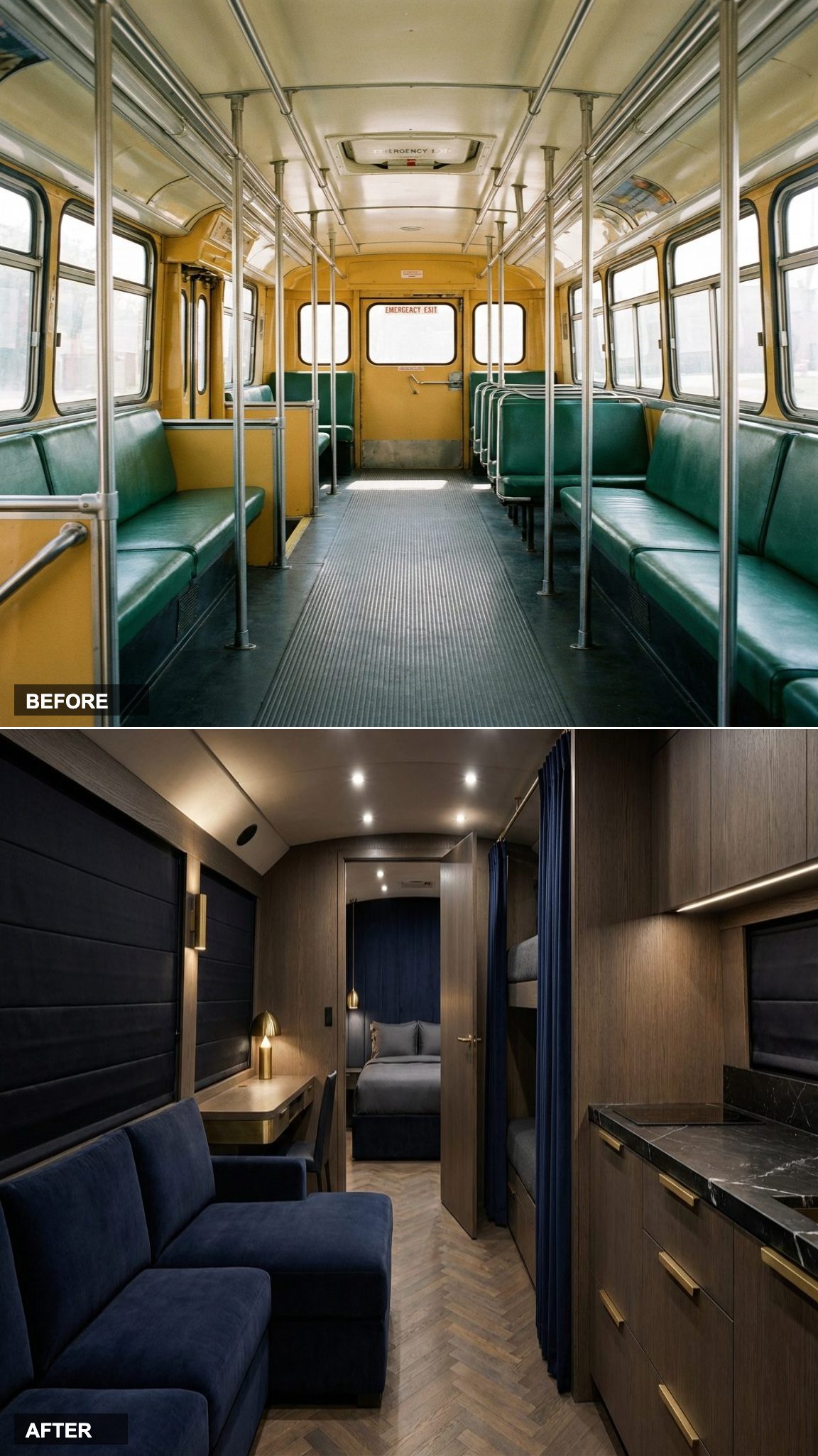
Every surface reads at least three shades darker than your instincts say it should. Charcoal lacquered walls, deep espresso hardwood floors, black-veined marble counters in the kitchen, and a bedroom done in obsidian headboard upholstery with graphite linen bedding. The only relief: hairline brass detailing on every cabinet frame and a row of warm amber sconces along both walls that cast the whole interior in firelight tones.
Dark interiors in narrow spaces are a psychological risk. Here, the warm lighting frequency is what saves it. Without those 2200K sconces, this would read as a cave. With them, it reads as a den, which is a different thing entirely.
Coastal Modern Turns a City Bus Into a Beach House That Travels
🔥 Would you like to save this?
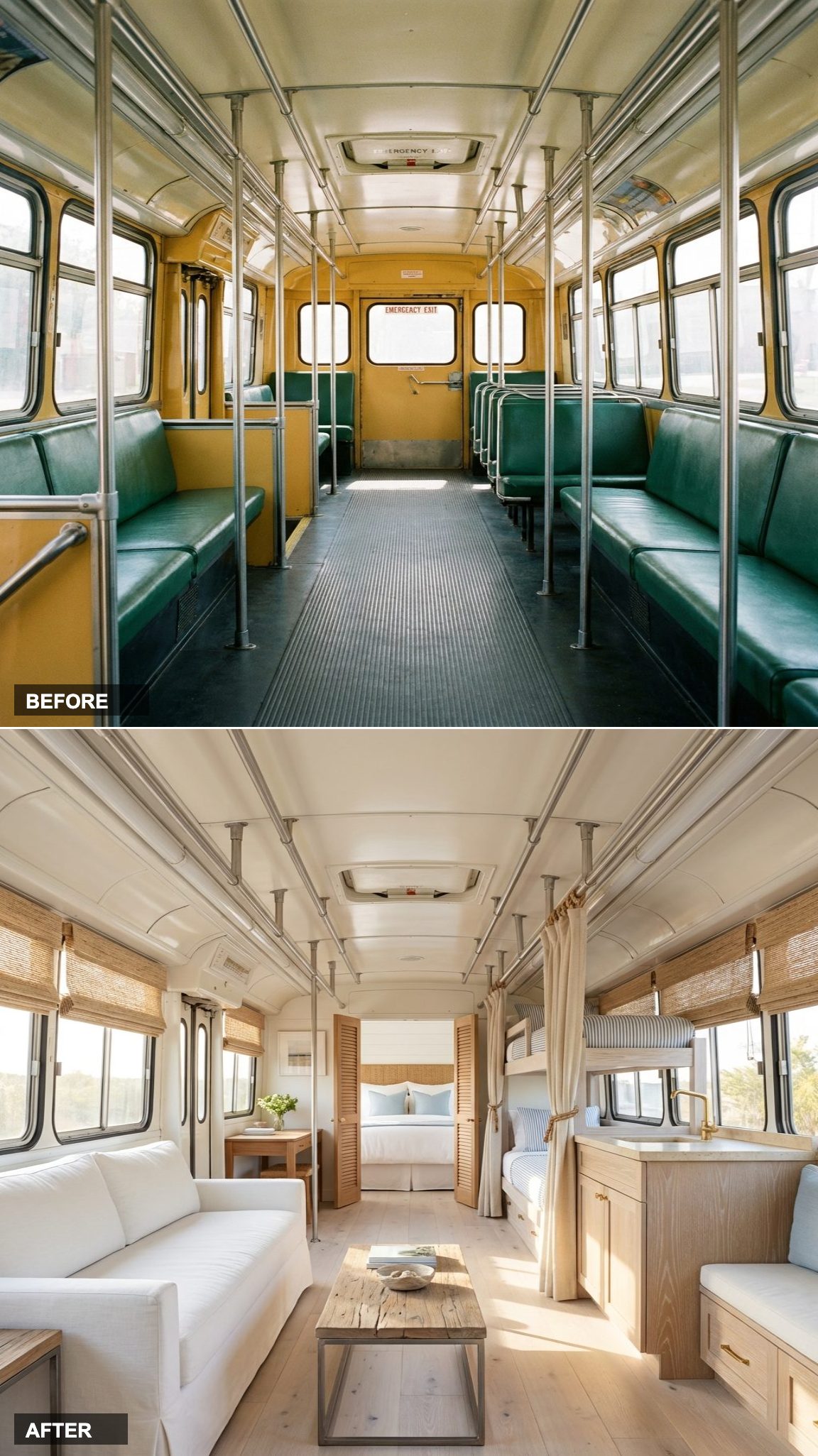
Whitewashed shiplap, sea-glass tile in the kitchen, and weathered teak shelving give this conversion a consistent coastal vocabulary without drifting into nautical cliché. The lounge palette is driftwood grey and warm white, the bedding is stonewashed Belgian linen, and every window has been fitted with plantation shutters in natural white, the single detail that most convincingly makes you forget you’re inside a bus.
Copper and Concrete: Industrial Materials Pushed Into Unexpected Luxury
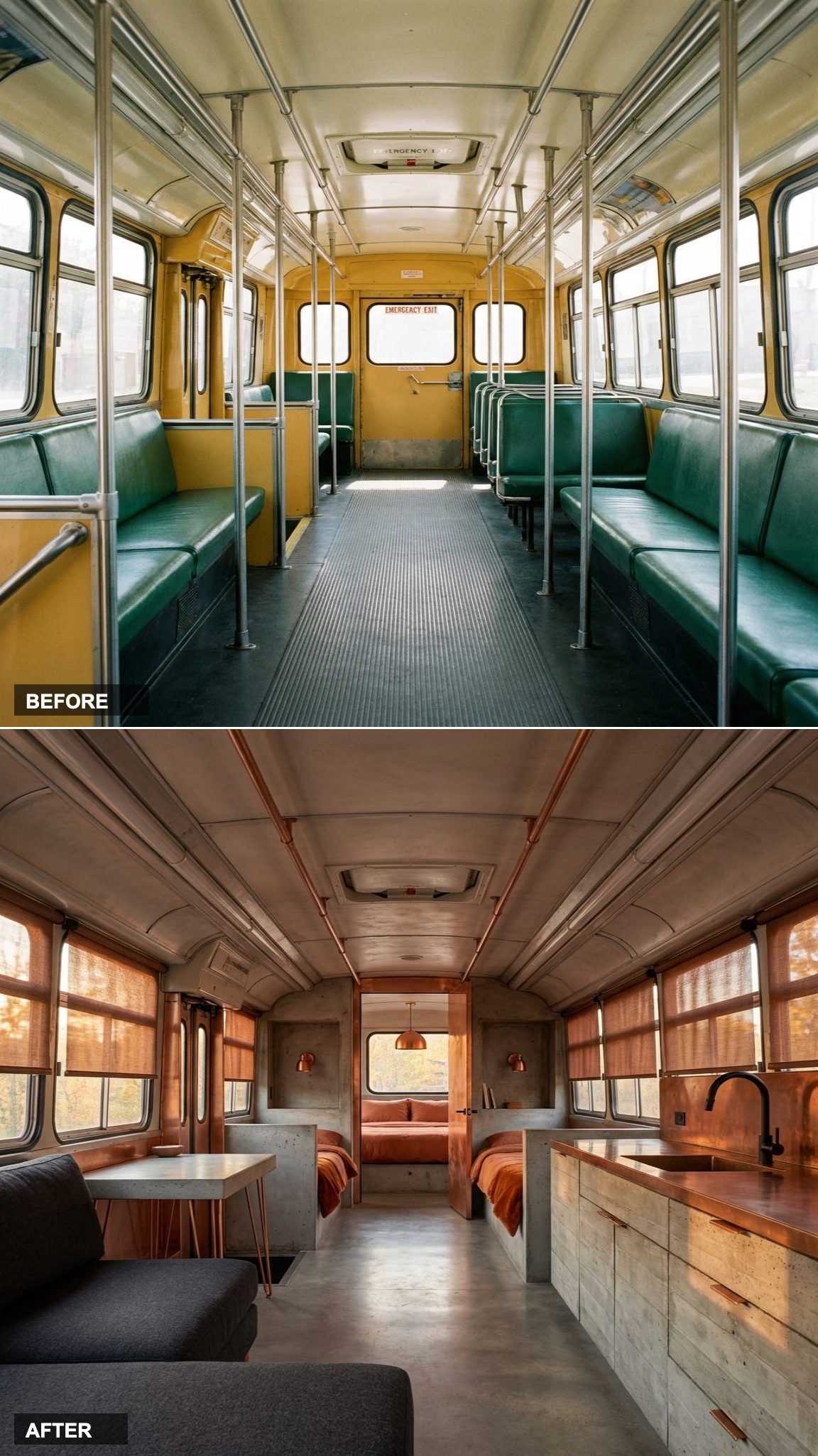
Polished copper sheeting covers the ceiling in large flat panels, casting the entire interior in a warm rose-gold light that shifts with the time of day. Against it: raw concrete floors, a poured concrete kitchen counter with an integrated copper sink, and matte black steel cabinetry. The bedroom uses a low platform bed with cognac leather upholstery and linen bedding.
Copper is doing structural work here, it functions as the lighting plan and the color palette simultaneously. As sunlight enters through the bus windows and bounces off the copper ceiling, the interior becomes self-illuminating in a way no fixture could replicate.
Dark Academia Rides the Highway in This Book-Filled Rolling Study
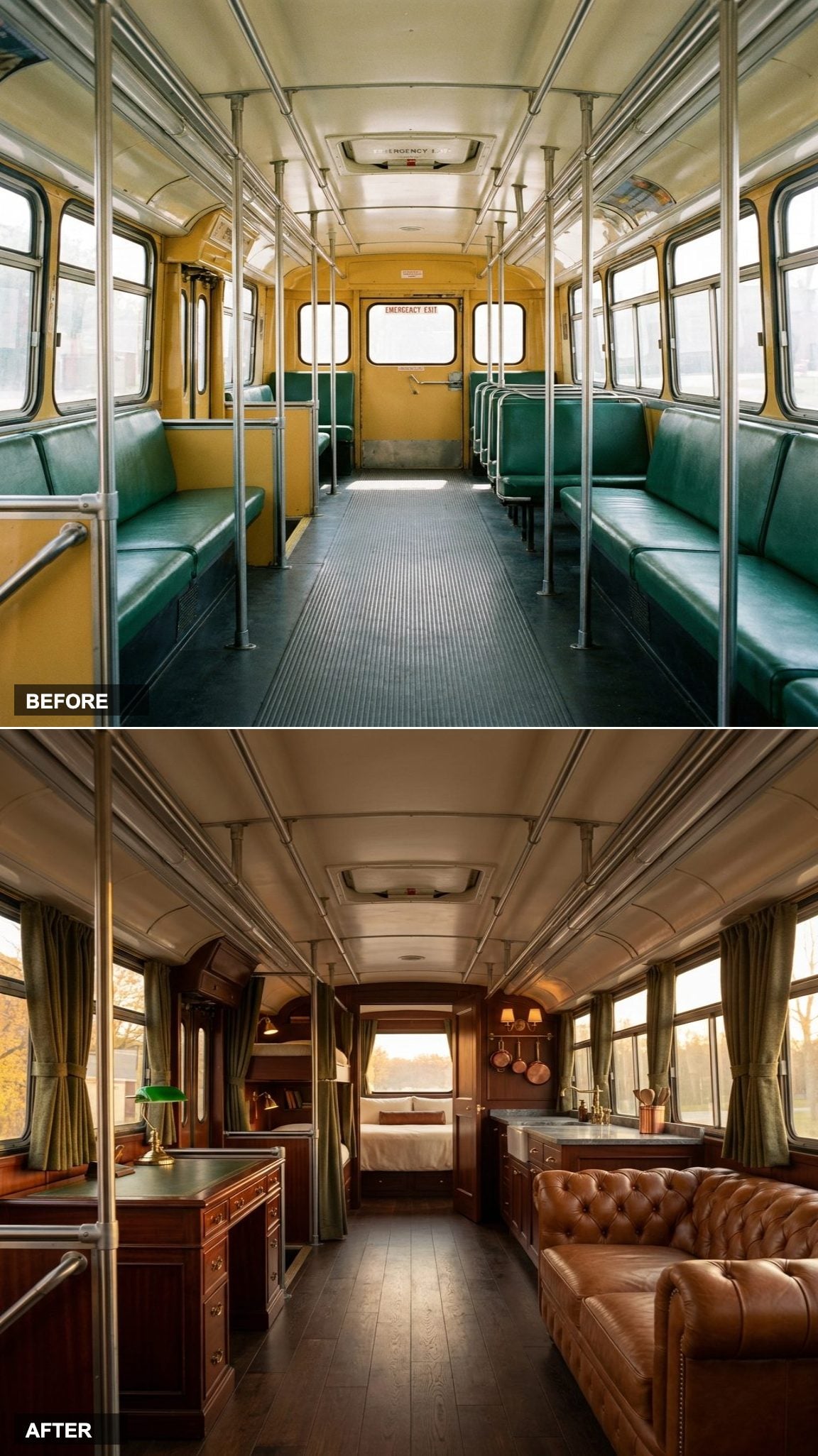
Floor-to-ceiling built-in bookshelves line both sides of the bus from the entrance to the kitchen partition, filled with leather-bound volumes, brass-capped bookends, and a rolling library ladder on a brass track. The walls are painted in Oxford-library green, the kitchen runs dark walnut cabinetry with unlacquered brass hardware, and the reading nook above the rear wheel well is upholstered in tufted burgundy leather.
Dark academia interiors draw on a fantasy of inherited knowledge, the sense that the space predates you and will outlast you. Achieving that in a bus conversion requires one counterintuitive move: buying old things and installing them as if they’ve always been there. The library ladder costs $400. The illusion it creates is priceless.
Desert Modern: Adobe Warmth and Brutal Sun Inside a Bus Shell
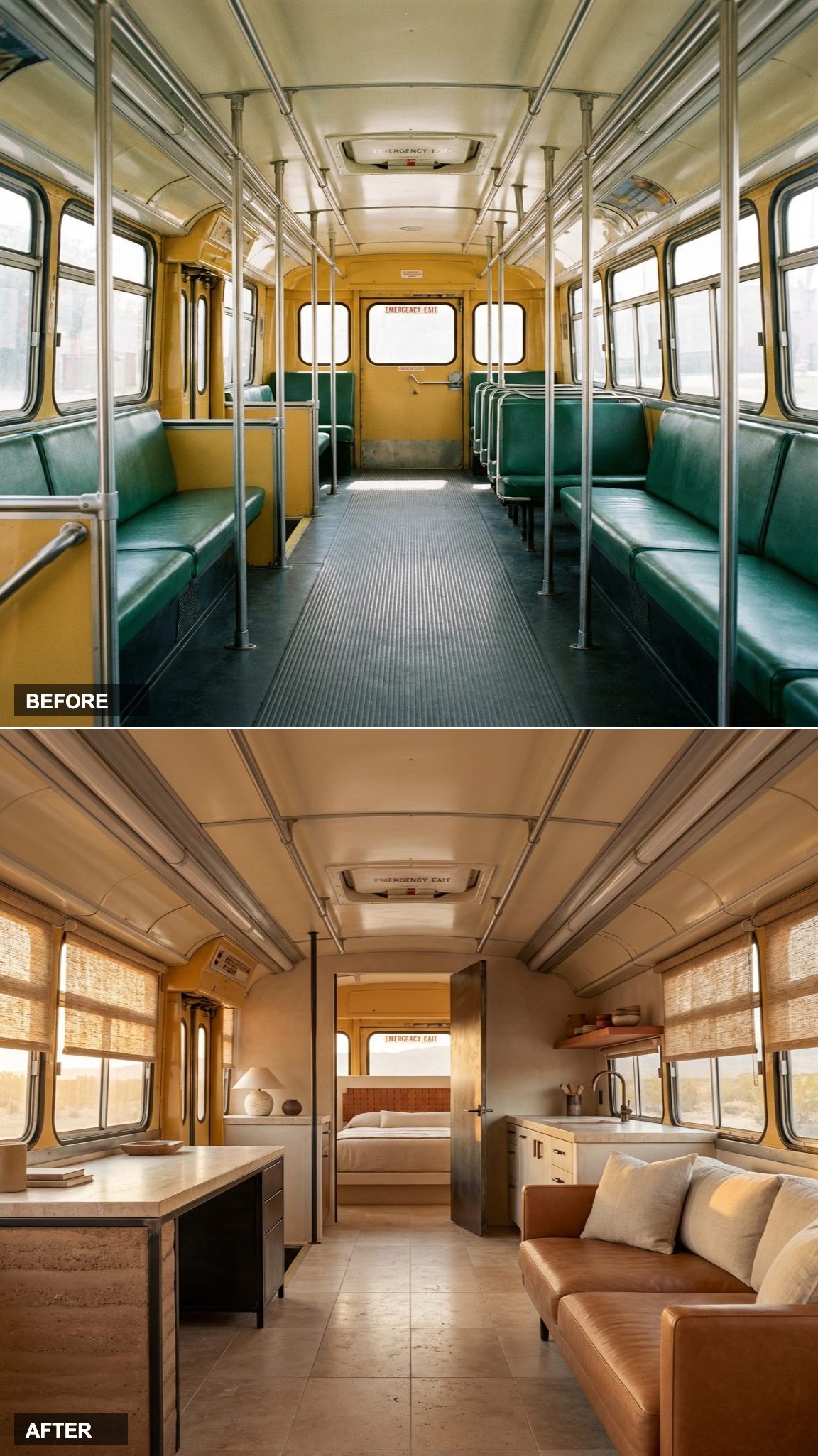
Terracotta-toned plaster walls, saltillo tile floors, a kitchen in raw adobe brick with a hand-hammered copper range hood, and a bedroom dressed in Pendleton wool blankets in rust and sand. The joinery throughout is mesquite, dense, dark, and heavily grained, and every light fixture is a hand-thrown ceramic piece with a warm amber bulb. This conversion feels like it was built in Marfa and never left.
Tropical Modern: A Bali Villa That Goes Wherever the Driver Points
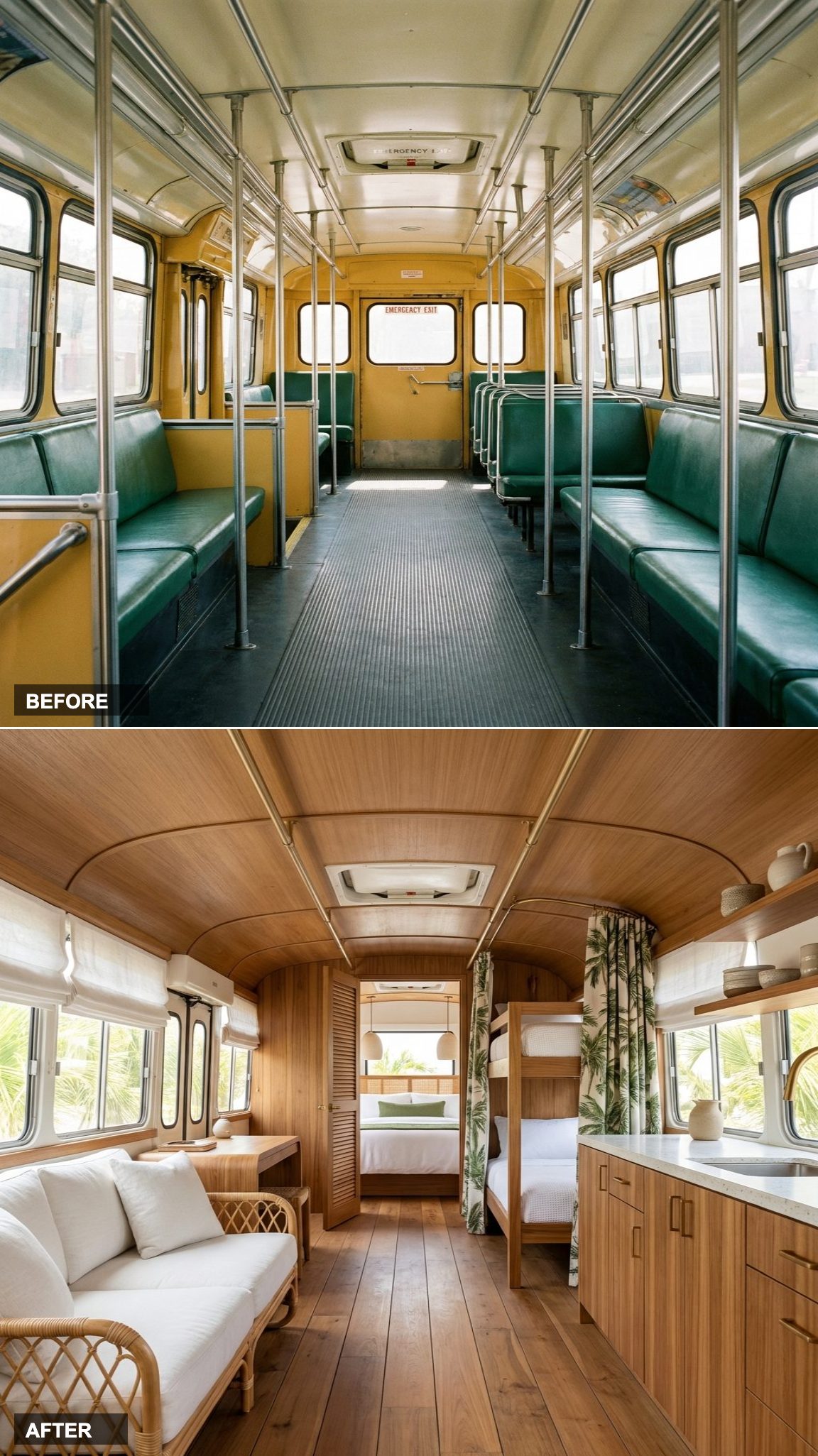
Split rattan wall panels, a ceiling of slatted bamboo with integrated LED strips casting warm gold light downward, a kitchen in jungle green cabinetry with black granite counters, and hanging tropical plants at every window. The bedroom uses a carved teak bed frame with sheer white mosquito-net curtains gathered at the corners, impractical, romantic, and completely committed to the bit.
“The plants are doing more design work than any piece of furniture in the room.”
Noir-Glam: Old Hollywood Darkness With the Swagger of a Rolling Speakeasy
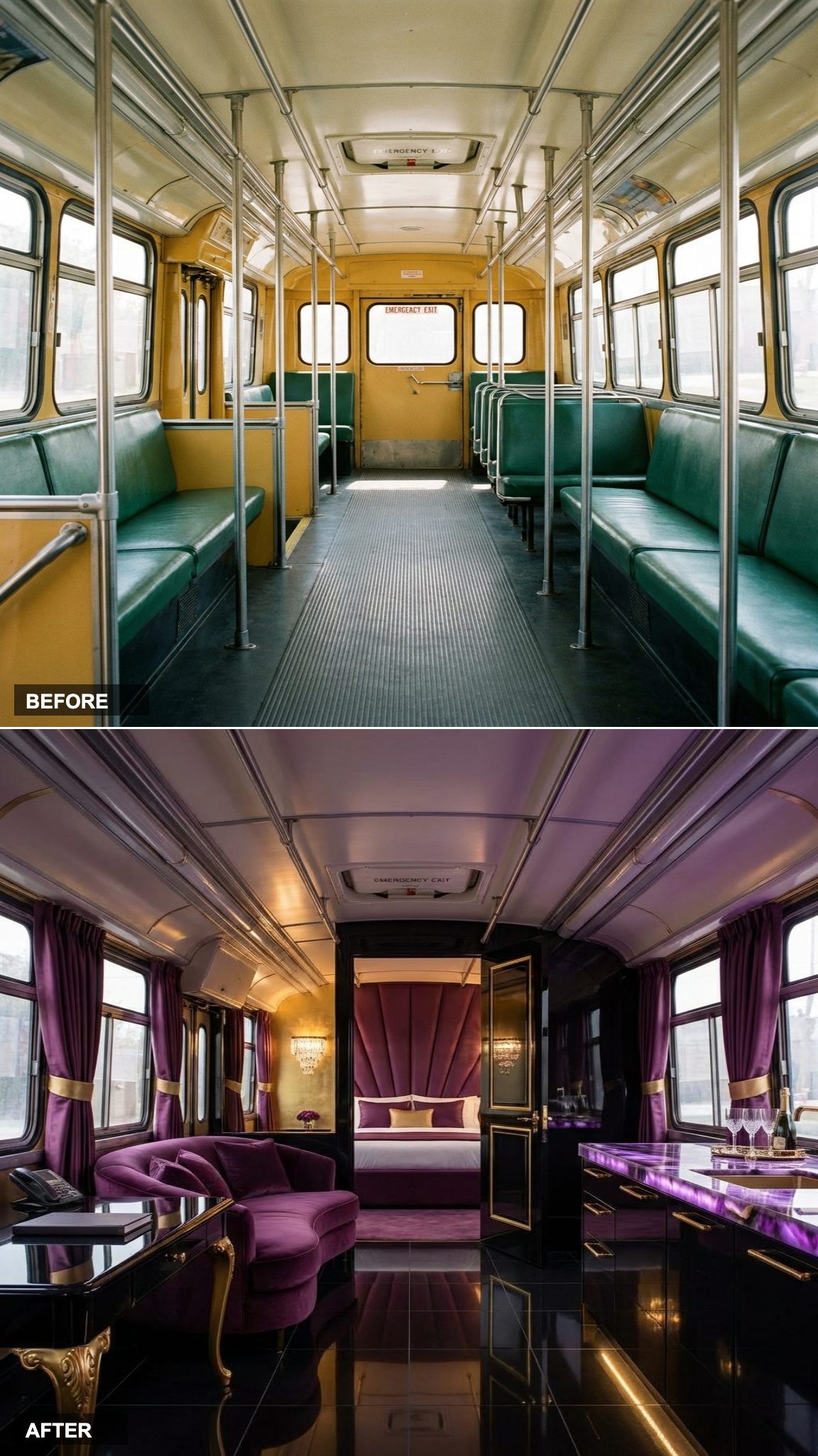
Smoked mirror panels on both side walls visually multiply the interior while casting everything in a glamorous, slightly shadowed reflection. Black lacquer cabinetry, a kitchen with deep charcoal marble and polished chrome fixtures, velvet banquette seating in inky plum, and a bedroom with a tufted black headboard and champagne satin bedding lit from below by a strip of amber under-bed lighting. The overall effect is less home and more scene.
Smoked mirror is the single most transformative material available in a narrow space. It does what white walls claim to do, create the illusion of more room, but with depth and atmosphere instead of brightness. In a bus conversion, where every square inch is real estate, that perceptual expansion is worth more than actual square footage.