🔥 Would you like to save this?
Across the Midwest, old barns rot quietly in fields, their timber frames warping under decades of snow and wind. Most get torn down. A rare few get saved and rebuilt into something entirely unexpected. What sets this collection apart is the scale of change involved. These are not simple renovations. AI took structures on the edge of collapse and reconstructed them as full luxury residences, preserving original wood and stone while adding modern kitchens, soaring ceilings, and high-end finishes. The gap between the before and after states here is genuinely hard to process. The 35 examples ahead prove that the bones of a prairie barn can support a very different kind of lifestyle.
In order to come up with the very specific design ideas, we create most designs with the assistance of state-of-the-art AI interior design software.
Collapsed Roof, Cracked Earth — Now Skylights and a Living Wall

Three circular skylights punch through the restored cathedral ceiling, flooding the interior with daylight that the corrugated metal roof once blocked entirely. The original timber trusses remain, stripped and wire-brushed to a dark gray finish that reads almost like weathered steel against the white-painted sheathing between the rafters. Arched knee braces, kept intact from the barn’s frame, now anchor a floor-to-ceiling bookshelf built directly into the gable wall behind the seating area.
The kitchen runs along the right wall in flat-front cabinetry finished in sage gray, paired with a waterfall-edge island topped in honed concrete or a pale quartz. Living walls of dense layered greenery — ferns, philodendrons, trailing vines — replace what were once rotting vertical planks. At the far end, full-height glass opens directly onto open prairie.
Sunken Seating, Skylights, and a Barn Frame That Refused to Die

Curved amber velvet sectionals drop into a recessed conversation pit anchored by a low black fireplace surround. Above, the original timber trusses remain exposed against dark-painted purlins, while a ridge of glass skylights pulls daylight down the full length of the nave. Floor-to-ceiling shelving lines the west wall in matte black steel with warm amber-lit display niches.
Pro Tip: Sunken conversation pits require precise structural planning when converting a barn with earthen or uneven subfloors. Excavating for a pit often reveals opportunities to pour a radiant-heat concrete slab at the same time, which adds comfort without raising ceiling height. Budget for waterproofing at the pit perimeter, especially in Midwestern climates where frost heave can stress below-grade edges.
Rusted Farm Equipment Gone, Round Skylights and Floor-to-Ceiling Bookshelves In Its Place

Two circular skylights punch through the darkened roof structure, flooding the exposed timber trusses with natural light that the collapsed corrugated panels never allowed. The original post-and-beam frame was retained and stained a deep espresso, anchoring built-in shelving that runs wall-to-wall in warm honey-toned oak. Rolling library ladders hint at the vertical scale.
Seating clusters around a live-edge coffee table in what was once a dirt floor covered in loose hay. Terracotta brick lines one wall beside a wood-burning fireplace, while a grid of floor-to-ceiling glass panels at the far end frames an unobstructed view of open prairie. Rust-orange upholstery on the sectional and armchairs pulls the exterior palette inside.
The Arched Glass Wall and Its Structural Compromise
Installing floor-to-ceiling glazing within a load-bearing barn arch required engineers to redistribute the roof’s lateral thrust through a concealed steel collar tie system hidden above the timber purlins. Unlike standard window installations, this opening had to preserve the arch geometry exactly, so custom-bent steel mullions were fabricated to follow the original curved profile of the frame. The result carries both the structural load and the sightline to the horizon without interrupting the timber aesthetic.
Sage Plaster Walls and a Glass Ridgeline Erase Memories of Collapsed Roof
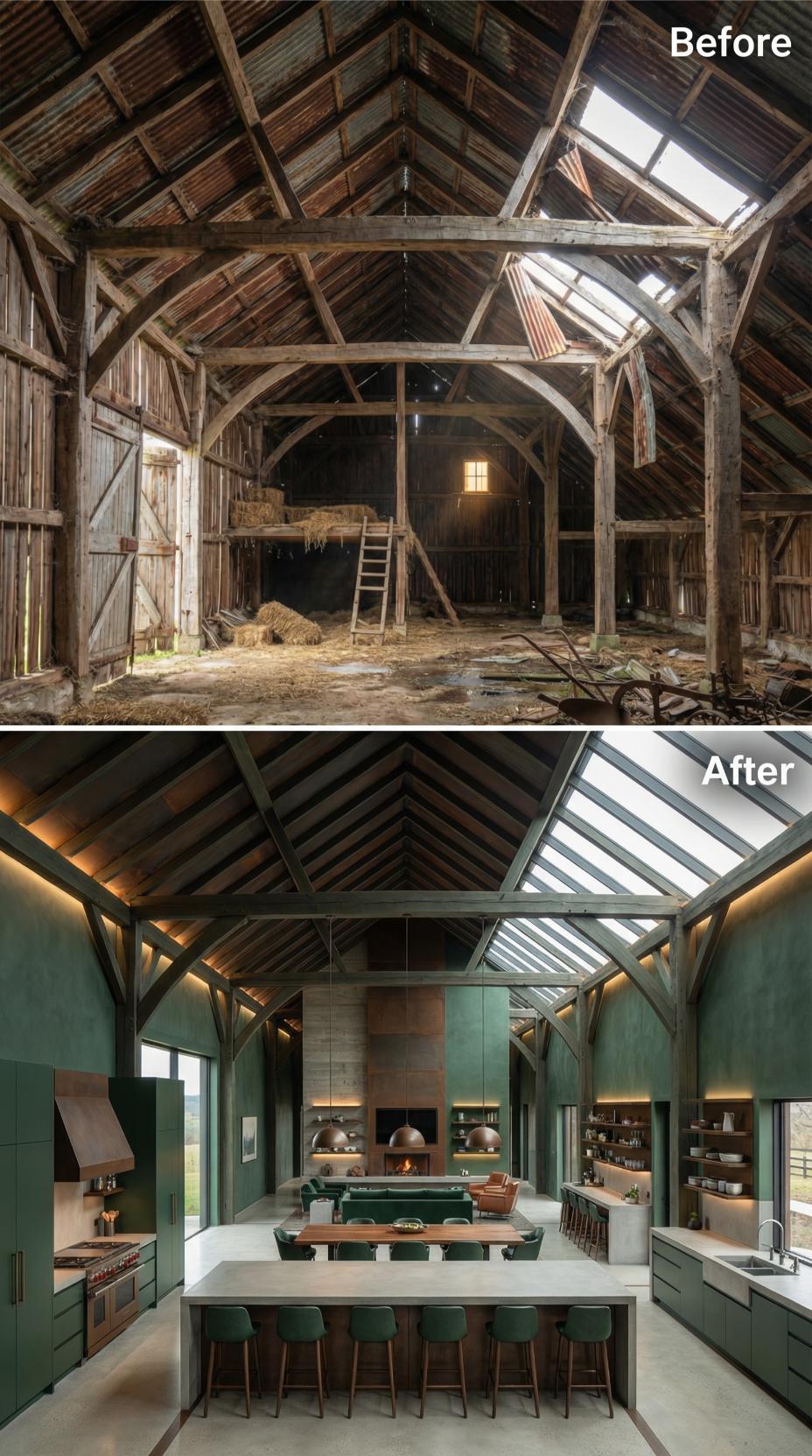
Aged timber trusses and arched knee braces were kept intact and dark-stained rather than sanded pale, anchoring the space in its agricultural past. Against them, forest green cabinetry in a flat-front profile runs the full length of both sides, finished with what appear to be brass pulls. A waterfall concrete island seats four on wood-and-steel counter stools.
The fireplace surround is poured concrete, tall and narrow, flanked by open walnut shelving with integrated LED strip lighting. Bronze dome pendants hang low over the seating area behind the island. Where corrugated metal once let in rain, a full-length ridgeline skylight now floods the space with controlled daylight.
Why It Works: Preserving original timber frames during a barn conversion requires treating the wood for insect damage and moisture before any finish is applied, a step that can add weeks to a project timeline but prevents structural failure within the first decade. The dark stain used here also serves a functional purpose, as it masks grain inconsistencies across beams salvaged from different parts of the structure. Pairing dark-stained wood with deep green walls works because both tones share the same cool undertone, keeping the palette from fragmenting across the high-volume space.
Blush Plaster, LED Rafters, and a Bar Cart That Replaced the Hay Loft

Dusty rose plaster walls anchor a living room where the oak timber frame stays exposed overhead, now fitted with linear LED strips that trace each rafter run to the ridge.
Style Math: Blush plaster plus dark-stained timber plus warm LED strip lighting equals a color palette that reads as both rustic and residential without leaning too hard into either. The bar counter appears to be a travertine or limestone slab on a matte base, which pulls the stone tones already present in the floor tile into the seating zone. Getting that tonal consistency across three distinct material families, wood, stone, and fabric, is harder than it looks and is usually the work of a single sourcing decision made very early in the design process.
Hay Loft Gone, Glass Ridge and Teal Cabinetry Running the Full Length

Brass-trimmed lower cabinets in deep teal anchor the kitchen side, paired with a stone-topped island and bar stools upholstered in matching teal leather. A ridge skylight runs the entire spine of the restored timber frame, flooding the concrete-washed walls with even, natural light. Indoor trees in brass planters divide the kitchen from a living zone anchored by a low sectional sofa facing floor-to-ceiling glass.
A ridge skylight runs the entire spine of the restored timber frame, flooding the concrete-washed walls with even, natural light.
Black-Stained Rafters, Skylights, and a Kitchen Island Where the Hay Once Sat

Charcoal-stained timber trusses run the full cathedral length of this converted barn, their original arched forms now painted black against smooth concrete-toned plaster walls. Skylights cut directly into the roof pitch flood the space with daylight, while a clerestory window at the far gable end frames a view of open fields. The kitchen island stretches nearly the length of the room in what appears to be honed concrete or thick resin-cast stone, paired with woven rattan barstools along one side.
A fireplace with a flush concrete surround anchors the living area, where a linen sofa, natural fiber armchairs, and a jute rug create a seating arrangement that feels unhurried. Woven bamboo or grass-cloth panels hang floor to ceiling at the far window wall, softening the industrial scale of the structure without competing with the blackened wood overhead. No decorative ceiling pendants, no visible hardware flourishes. The restraint is the point.
Color Story: Charcoal and warm flax dominate this palette, with the blackened timber providing contrast against plaster walls that read closer to warm white than grey in direct sunlight. The woven panels at the gable end introduce a raw textile note that bridges the agricultural origin of the structure and its current residential use. Concrete surfaces throughout hold the composition together without adding another color to the mix.
Circular Skylights and Sage Cabinetry Inside Walls That Once Held Hay

Four circular skylights punch through the darkened timber roof, dropping pools of natural light onto a concrete island with bar seating below. Sage-painted cabinetry runs the full perimeter, paired with brass-framed frosted glass partitions that divide the kitchen from a lounge anchored by a low sectional sofa.
Designer’s Secret: Round skylights in a vaulted barn conversion aren’t purely decorative — their circular geometry distributes diffused light more evenly across asymmetrical timber trusses than rectangular glazing would. Designers often position them in pairs along the ridge to balance the natural light load on both sides of the open-plan floor plate.
Where the previous conversion kept its palette restrained, this one commits fully to drama after dark.
Navy Walls, Gold Lattice, and a Barn Frame Lit Like a Cathedral at Night

At night, the original timber trusses read entirely differently under warm LED strip lighting tucked along each rafter run. The wood, left in its natural state rather than stained, glows amber against walls painted a deep navy that would have been unthinkable inside a working barn. A gold lattice panel anchors the dining zone, doubling as a room divider without closing off the vaulted ceiling above it.
The kitchen runs along the left wall with open shelving backlit in amber, dark lower cabinetry, and a concrete island with bar seating. A sectional sofa in charcoal sits on a geometric wool rug, facing the dining table. Floor-to-ceiling glass at the far end replaces what was once a solid wall, pulling the night sky and a lit pool directly into the sightline from the kitchen.
Where the last conversion leaned dark and moody, this one moves in the opposite direction entirely.
Whitewashed Timber, Ridge Skylights, and Open-Plan Living Inside a Prairie Ruin

Lime-washed oak trusses run the full length of the vaulted ceiling, their pale finish pulling natural light down from a continuous glass ridgeline that replaced collapsed corrugated roofing. The living area anchors the space with a low linen sofa, a slab dining table in raw oak, and a built-in shelving wall finished in warm greige plaster. A fireplace with a flush stone surround sits opposite floor-to-ceiling sliding glass panels that open directly to a pool terrace.
Terracotta Tile, Ridge Skylights, and Original Timber Left Exactly Where It Stood

What was once a collapsing prairie barn, its floor covered in rotted hay and its roof open to the sky, now holds a full open-plan residence without discarding a single original rafter. The exposed timber frame was cleaned, treated, and left in place, with ridge skylights installed along the full length of the peaked ceiling to flood the interior with natural light. Warm terracotta tile runs wall to wall across the floor.
Plaster walls in a clay-toned ochre warm the space without competing with the wood overhead. The kitchen island features a wood countertop and bar seating with leather-backed chairs in a burnt sienna. A pendant light in matte black hangs low over the dining area, and built-in shelving with flush panel doors lines the far wall in a caramel-toned wood veneer. At the far end, full-height glazing replaced the original barn door opening.
Editor’s Note: When original barn timbers are retained structurally rather than purely decoratively, engineers typically sister new lumber alongside compromised sections rather than replacing visible beams outright, preserving the aged patina while meeting load requirements. In this conversion, that approach allowed the full queen-post frame to remain visually intact from floor to ridge.
Floor-to-Ceiling Bookshelves and Navy Upholstery Inside Salvaged Oak Trusses

Original oak timber trusses run the full length of the vaulted ceiling, their arched knee braces left exposed and refinished rather than concealed behind drywall. Skylights cut directly into the roof plane flood the ridge with natural light, casting sharp diagonal shadows across the herringbone wood ceiling decking above. Floor-to-ceiling bookshelves line both side walls, built in a warm honey-toned wood that contrasts against slate-blue cabinetry anchoring the kitchen zone on the left.
A concrete island with a farmhouse sink runs parallel to a long dining table in solid oak, surrounded by navy upholstered chairs. The living area at the far end holds a deep sectional in the same navy fabric, positioned to face a window wall framing an unobstructed view of open farmland. A copper pendant hangs over the dining table, and a fireplace built into the right bookshelf wall grounds the room without competing with the structural drama overhead.
Try This: When lining barn walls with built-in bookshelves, structural blocking must be added between the original timber posts to give shelving units a solid anchor point. Without it, shelves fastened directly to weathered barn siding can pull away under the weight of a full book load. Planning the blocking before insulation goes in saves a costly teardown later.
Salvaged Oak Trusses, Ridge Skylights, and Caramel Leather Seating Across an Open Prairie Floor

🔥 Would you like to save this?
Exposed timber trusses, retained from the original structure, now anchor a great room finished in warm sand plaster, with skylights cut along the full ridge to flood the interior with natural light.
By The Numbers: Barn conversions that retain the original timber frame typically reduce structural material costs by 18 to 25 percent compared to new construction of equivalent square footage. The ridge skylight system visible here spans nearly the full interior length, a glazing approach that requires custom steel flashing channels to prevent thermal bridging between the old wood and new glass.
Ebonized Rafters, Ridge Skylights, and Limestone Walls Pulled from a Prairie Wreck

Dark-stained timber trusses run the full cathedral length, painted in what reads as shou sugi ban black against cream limestone cladding that lines the interior walls. Skylights slot between each rafter pair along the ridge, flooding the floor below with even, white daylight. On the left, a stone fireplace anchors built-in shelving stocked with ceramics. The seating arrangement centers on a low slab coffee table, cream upholstered sofas, and a single caramel armchair.
The right side runs a bar counter on raised stools, backed by open bottle shelving in the same ebonized finish as the trusses. Beyond the dining table, floor-to-ceiling glazing frames a pool and tree line. None of the original bones were buried.
- Skylights positioned between rafters rather than through them preserve structural integrity while maximizing light per bay
- Limestone wall cladding provides thermal mass, reducing heat loss through walls that once had gaps wide enough to see daylight
- Bar counters built along the long wall of a barn conversion make efficient use of the narrow end zones that resist standard furniture placement
Concrete Ceiling, Steel-Darkened Trusses, and Glass Where the Prairie Pours In

Architects kept the scissor-truss silhouette intact and finished the vaulted ceiling in smooth concrete gray, while the original timber posts were stripped, treated, and stained a deep charcoal. Floor-to-ceiling glazing replaced the barn’s end wall entirely, pulling in unobstructed field views. A bleached-oak dining table anchors the kitchen side, where a concrete island runs parallel to bar seating along its length.
History Corner: Midwestern barns built before 1920 were often framed using mortise-and-tenon joinery rather than metal fasteners, meaning the structural connections were cut entirely by hand. When a conversion retains those joints, engineers must assess each one individually for load capacity, since no two hand-cut joints perform identically under modern residential stress calculations.
Ridge Skylights, Bleached Timber Walls, and a Fireplace Where the Barn Doors Once Hung

Bleached wood paneling lines every wall from floor to ridge, pulling the gray undertones out of the salvaged timber trusses above. The skylights run the full length of the peak in parallel strips, flooding the concrete floor with midday light that no single window could produce. A slab-front kitchen in warm putty anchors the left side, paired with a stainless range and a waterfall island edged in what reads as honed stone.
The living zone sits centered beneath the highest point of the vault, with linen upholstery and a long dining table in raw oak separating it from a concrete fireplace surround on the right wall. Floor-to-ceiling glass closes the far gable end, framing an exterior pool and open farmland beyond.
Fun Fact: Barn roofs retrofitted with continuous ridge skylights require a structural ridge beam strong enough to carry the added load of glazing, which often means replacing the original ridge board entirely with an engineered lumber or steel alternative. In this conversion, the skylight strips appear to run nearly the full length of the interior, suggesting the ridge was rebuilt rather than modified. That single structural upgrade accounts for a significant portion of the natural light that makes the bleached paneling read as warm rather than cold.
Curved Glass Roof, Marble Counters, and Open Living Where Prairie Light Now Owns the Room

Replacing rotted corrugated roofing with a barrel-vaulted glass ceiling is one of the most structurally demanding moves a barn conversion can make, and here it paid off completely.
The original arched timber trusses were retained and painted a pale limestone white, then glazed between with segmented skylight panels that flood the interior with unfiltered daylight from ridge to eave. A marble waterfall island anchors the kitchen zone on the left, paired with professional-grade stainless ranges and gray slab cabinetry without visible hardware. The living area runs the full length of the opposite side: a low sectional in oatmeal fabric, a marble slab coffee table, and a wall-mounted screen recessed into smooth plaster. A gas fireplace sits flush within the plaster surround, framed by built-in shelving with arched openings that echo the truss geometry overhead.
bold_hook: When a barrel-vault glass roof replaces timber and corrugated sheeting, the original curved trusses rarely carry enough load on their own. Engineers typically introduce a hidden steel spine running the length of the ridge, bolted discreetly behind the whitewashed timber so the historic profile stays intact while the glazing load transfers safely to the foundation.
Geodesic Glass Roof, Bleached Maple Trusses, and an Open Kitchen Where Hay Once Rotted

Pale maple trusses carry a geodesic glass roof across the full length of the main living volume, filling every surface with moving shadow patterns as the sun shifts. The triangulated glazing sits within an arched frame that mirrors the original barn’s pitch, though every material underneath it is new. Walls are finished in smooth limestone plaster, warm enough to read ivory without crossing into cream.
Below, the layout runs dining table to island to range without a wall interrupting the sight line. The island countertop appears to be honed white stone, flanked by leather bar stools in cognac. A built-in shelving grid flanks the fireplace surround, and a pendant in oxidized bronze drops low over the dining table, grounding the scale of the room without competing with the roof above it.
Prairie Glass and Concrete Tile Unify the Interior

Hay bales and a rusted ladder gave way to a kitchen-to-living sequence anchored by a continuous ridge skylight that runs the full length of the vaulted ceiling. The original arched timber trusses were retained and darkened with a steel-toned finish, set against wall cladding of reclaimed vertical-grain pine. Pendant lighting with a domed bronze shade hangs above a solid wood dining table paired with molded white Panton-style chairs.
At the far end, a floor-to-ceiling glass gable wall frames an unobstructed prairie view. The kitchen island runs long and low, finished in honed dark concrete with an integrated sink. Built-in shelving with open cubbies lines the right wall alongside a flush-mounted television. Concrete floor tile in a warm gray runs continuously, tying the dining, kitchen, and living zones into one unbroken plane beneath forty feet of reclaimed wood overhead.
Chalk-White Timber Arches, a Ridge Skylight Strip, and Marble Counters Over an Open Prairie Floor

Painted chalk-white, the original mortise-and-tenon timber arches read almost architectural against corrugated metal ceiling panels left in their natural gray. A continuous skylight runs the full ridge, pulling midday light deep into the open-plan space. Below, a marble waterfall island anchors the kitchen while an arc pendant light in brushed steel hangs low over the dining table.
Purple Velvet, Ridge Glazing, and Walnut Millwork Inside a Barn That Once Stored Hay

Plum-toned velvet upholstery covers an L-shaped sectional and a pair of armchairs arranged around a marble-slab coffee table on a deep burgundy rug. The fireplace anchors the back wall, flanked by floor-to-ceiling walnut shelving units that frame a wall-mounted television. Overhead, the original timber trusses were retained and darkened, pulling the eye toward a central ridge skylight that runs the full length of the vaulted ceiling and floods the room with flat, even light.
Purple plaster walls read closer to eggplant than lavender, holding their own against the warm wood tones without fighting them. To the left, a kitchen with grey cabinetry and what appears to be a marble backsplash sits open to the main room. On the right, floor-to-ceiling glass panels expose a pool deck and a row of mature trees beyond it, replacing what was once corrugated barn siding rotting above a floor of hay and debris.
Copper-Clad Rafters, Ridge Glazing, and Concrete Counters Over an Open Barn Floor

Warm-toned cedar panels line the underside of the roof between whitewashed timber trusses, with a continuous ridge skylight running the full length of the vault and flanking clerestory windows flooding the floor below. The kitchen sits to the left with sage-green lower cabinetry, a concrete island, and copper-faced upper cabinet fronts that pull the ceiling’s warmth downward.
A freestanding fireplace anchors the dining zone, where leather chairs in a burnt-sienna finish ring a stone-topped table. Behind it, a full-height glazed gable wall frames an unobstructed view of the surrounding property. What was once a dirt floor holding rusted farm equipment now carries polished concrete underfoot, connecting every zone without a single partition wall in sight.
Darkened Rafters, Ridge Skylights Cut Into Both Roof Planes, and a Stone Fireplace Tower Anchoring Open Ground

Walnut-stained timber trusses frame a vaulted ceiling where paired skylight strips now run the full pitch on each side, flooding the kitchen island, dining table, and leather sofa below with natural light that the rotting corrugated roof once blocked entirely.
Darkened Timber Arches, Ridge Glazing on Both Slopes, and Sage Plaster Where Prairie Rot Once Lived

Sage-green plaster walls pair with ebonized timber arches and a continuous ridge skylight system that runs the full length of both roof planes, flooding marble tile floors with midday light. A fieldstone fireplace tower anchors the far wall, flanked by floor-to-ceiling glass panels and two potted olive trees in brass-finished planters. Sage upholstered dining chairs surround a walnut table at center, while a wine display column with brass frame occupies the left kitchen wall.
Marble Island and Limed Trusses Anchor the Room

🔥 Would you like to save this?
Limed oak trusses retain their arched geometry from the original barn frame, now cleaned and sealed against walls finished in warm white plaster. Four skylights cut along both roof planes flood the vaulted ceiling with even daylight. A waterfall-edge marble island anchors the kitchen, flanked by flat-front cabinetry in a greige wood veneer and professional-grade stainless ranges. Open shelving in bleached wood runs the full height of the east wall, while a round pendant in frosted white glass marks the dining table below.
Ridge Lighting and Concrete Plaster Refine the Volume

Darkened original trusses run the full cathedral length, their arched knee braces preserved and stained near-black against concrete-finish plaster walls. Strip lighting recessed along the ridge line runs parallel to the roof pitch, replacing what was once open corrugated sheeting admitting weather rather than light. A waterfall-edge marble island anchors the kitchen zone, with ladder-back dining chairs in a brass-tone metal finish lining both sides.
At the far end, a fireplace with a brass hood pendant above it sits framed by floor-to-ceiling steel-grid windows that pull in the flat horizon. Open shelving with integrated LED underlighting lines the right wall, while a range with a plaster hood occupies the left. Marble tile floors in a large-format vein-cut pattern unify both zones without interruption.
Sunken Lounge and Full-Height Glazing Recast the Space

Four oval skylights punch through the restored rafter system, flooding the vaulted ceiling with diffused midday light that the original corrugated roof never allowed. Reclaimed heavy timber trusses, sanded and sealed rather than stained, anchor the ridge while warm brick wraps both side walls floor to beam. Below, a curved built-in banquette in burnt-orange upholstery rings a low fire pit table set into a sunken platform, with a dining table and pendant cluster positioned directly in front of full-height glazing that frames an open prairie view.
Weathered Trusses, Continuous Ridge Glazing, and Blue Plaster Walls Inside a Barn That Once Stored Straw

Aged timber trusses, left raw and unfinished, run the full length of the vaulted ceiling while a continuous ridge skylight floods the nave with natural light. The walls are finished in a matte blue-gray plaster that reads closer to slate than navy, paired with a sectional sofa in charcoal velvet arranged around a low wood-slab coffee table. A fireplace with a flush surround anchors the right wall beside floor-to-ceiling walnut shelving. At the far end, a full-width steel-framed glazed wall opens to an unobstructed prairie view, replacing what was once a collapsed corrugated panel held up by rotted cross-members.
Oak Trusses and Full-Height Glass Frame the View

Restored oak trusses frame a ridge fitted with two large skylights that pull open sky directly into the nave. Where the gable end once held rotted board siding, full-height glass now frames an unobstructed view of rolling prairie. Linen sofas, a live-edge travertine coffee table, and a lit stone fireplace anchor the floor below a wall of book-filled shelving that runs the full length of the room, accessed by a leaning library ladder.
Ebonized Trusses, Full-Gable Glazing, and Olive Velvet Seating Replace Prairie Ruins

Original timber trusses were retained and darkened to a near-espresso finish, their mortise-and-tenon joints left exposed against a ceiling painted the color of charcoal. Sage-toned plaster panels line the side walls, replacing the rotted board-and-batten that once let prairie wind through. A sectional in olive velvet anchors the near end, while a fireplace clad in flat black steel sits flush with the left wall beneath a triangular built-in bookcase finished in brass. Floor-to-ceiling glazing at the far gable floods the space with open-field light.
Bleached Trusses, Oval Skylights, and Full-Gable Glass Where Prairie Debris Once Rotted

Where hay bales and rusted farm equipment once covered an earthen floor, whitened timber trusses now span a vaulted ceiling fitted with four oval skylights that punch through both roof planes. The original structural arches were cleaned, lightened with a lime-wash finish, and left exposed against a dark-stained roof deck. Floor-to-ceiling glass fills the gable end, framing an unobstructed view of open farmland from a seating arrangement built around a low rectangular coffee table and a sofa upholstered in oat-colored fabric.
Built-in bookshelves line both side walls in warm oak, backlit with recessed LED strips set into each horizontal shelf. A concrete fireplace surround anchors the left wall, its flush face sitting flush with the shelving run. A cantilevered staircase with open risers and a glass rail leads to a mezzanine level visible above. Pendant lights with burnished bronze shades hang at dining height over a round table surrounded by leather-seat chairs.
Oiled Oak Trusses, Gable Glazing Floor to Ceiling, and Terra-Cotta Leather Seating on Reclaimed Prairie Ground

Rot, scattered hay bales, and a collapsed corrugated roof section once defined this space. The conversion kept every major timber truss visible, oiling the oak to a medium brown that reads warmer than raw wood without masking the grain. Large skylights cut into both roof planes run the full length of the ridge, and the south-facing gable was replaced entirely with steel-framed glass, framing an unbroken view of flat prairie and distant mountains.
At ground level, a sectional sofa in burnt-orange leather anchors the seating zone alongside a pair of low lounge chairs in the same fabric. A freeform travertine coffee table sits between them. Flanking both sidewalls, floor-to-ceiling steel-framed bookshelves carry ceramics, books, and decorative objects. Two olive trees planted in rectangular concrete planters introduce vertical green mass without competing with the timber geometry above. Black dome pendant lights hang over a long oak dining table near the glass wall, and a fireplace finished in dark plaster closes the far corner.
From Prairie Ruins to Vaulted Living: One Barn’s Complete Reinvention

What was once a collapsed hay loft, rusted farm equipment, and dirt floors now holds one of the more considered open-plan interiors in contemporary barn conversion. The original timber-frame structure was preserved and bleached to a soft gray, with the exposed ridge beam and cross-bracing left fully visible against dark-stained roof decking. Skylights now run the length of the pitch, flooding the space with natural light.
At ground level, a floor-to-ceiling copper fireplace surround anchors the living zone, paired with a low linen sectional and a marble waterfall island separating the kitchen. Copper hood detailing echoes the fireplace finish. Built-in shelving in light ash flanks a wall-mounted television on the right, while a rolling library ladder in matching copper hardware serves the open bookcase opposite.