Close your eyes and picture it: the low hum of the console TV, the faint chemical sweetness of carpet shampoo, and that particular quality of afternoon light that only existed through vertical blinds. The ’80s family room was its own ecosystem, a room that made complete sense to everyone who lived in it and would baffle anyone who stumbled into one today. Here are the things that made it unmistakable.
The Wood-Paneled Console TV That Nobody Was Allowed to Touch

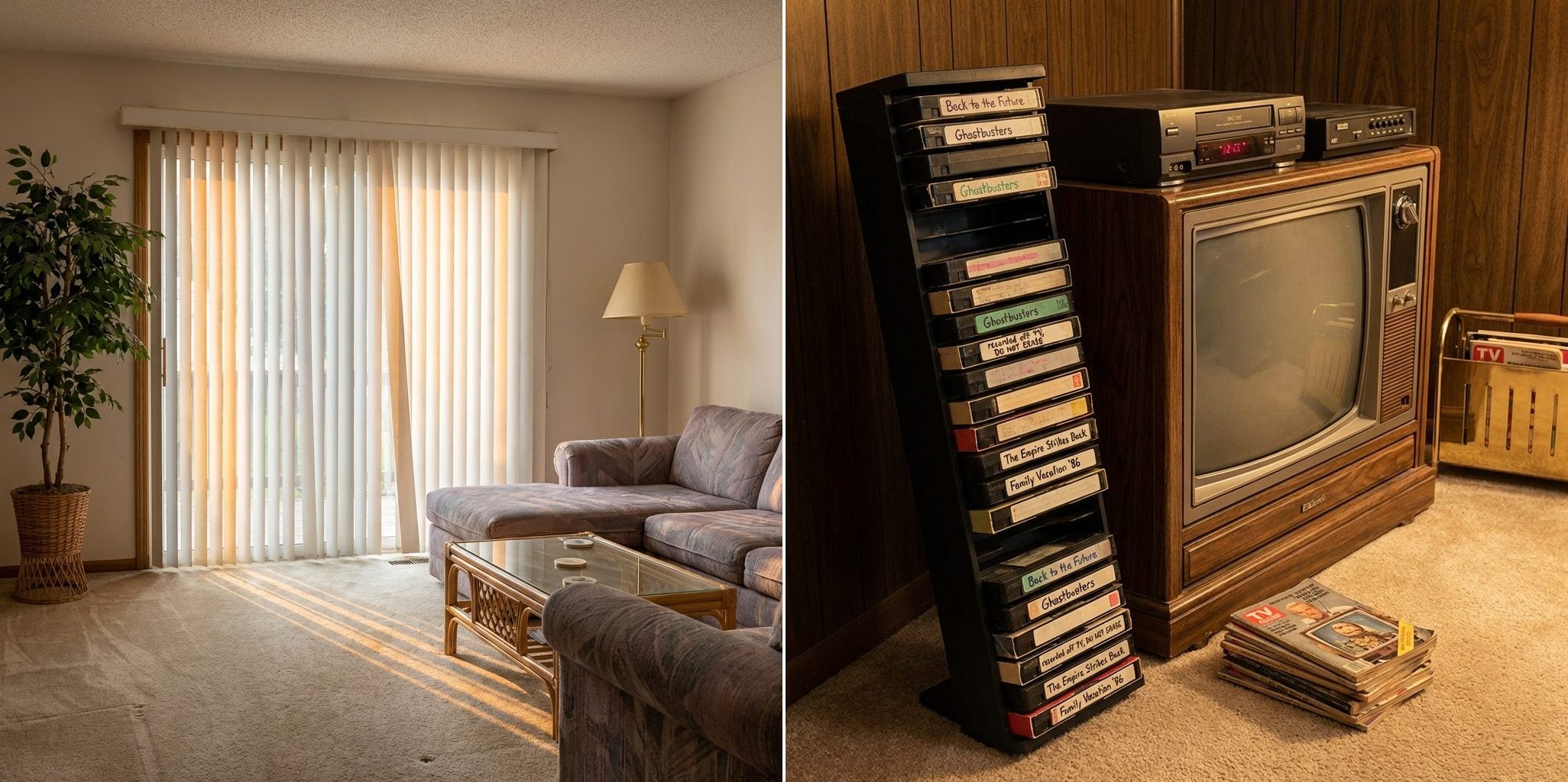
It weighed somewhere between 200 and the actual moon, and it sat in the corner of the family room like a piece of furniture that happened to also receive ABC. The wood-grain paneling on the sides wasn’t decorative irony, it was a deliberate design choice meant to make a television look like a credenza. And it worked, mostly, because nobody knew any better.
In order to come up with the very specific design ideas, we create most designs with the assistance of state-of-the-art AI interior design software.
You adjusted the volume by physically walking to the TV and turning a dial. The channel dial clicked through twelve positions. There were maybe seven channels. This was fine. Nobody questioned it.
Vertical Blinds That Clattered Like a Xylophone Every Time the AC Kicked On

That sound. That specific cascading plastic clatter when the central air turned on and sent a gust through the room, every vertical blind slat swaying and tapping against its neighbors in a wave motion that took a full ten seconds to settle. We heard it so many times it became white noise.
Vertical blinds existed in approximately 100% of homes with sliding glass doors from 1979 to 1997. They were the default, the obvious choice, the thing you got because that’s what you got. Their replacement, cellular shades, plantation shutters, literally anything else, is one of the quiet design revolutions nobody wrote a manifesto about.
The Sectional Sofa With the Wedge Piece Nobody Ever Sat In

Every sectional had a wedge piece. It sat at the corner and served no function that a regular cushion couldn’t have served better. It was too short to lie across. Too awkward to sit in at an angle. Too far from the TV to be comfortable. You could put a throw pillow on it. That was the wedge’s one job, and the throw pillow usually slid off.
The sectional itself, though, that was the status symbol of the ’80s family room. A sectional said you had enough square footage to accommodate a sofa that couldn’t be moved through a standard doorway. It said you were serious about watching television. It said you’d arrived.
The Brass Floor Lamp With Three Settings: Off, Bad, and Worse

Three-way bulbs were a scam. The jump from 50 to 100 watts was barely perceptible, and the jump from 100 to 150 was the kind of brightness that made everyone squint and say “okay that’s too much.” So the lamp lived on medium, always. The 150-watt setting was like a warning shot.
The brass finish on these lamps had a specific quality, not shiny, not matte, somewhere in between, with slightly worn patches where hands had touched the switch over thousands of evenings. By 1993, brushed nickel had arrived and suddenly all that brass looked extremely dated. By 2019, brass was back and extremely chic. The ’80s family room was ahead of its time and nobody gave it credit.
A Fruit Bowl on the Coffee Table That Contained Only Fake Fruit

Nobody questioned the fake fruit bowl. It sat on the coffee table in every family room in America and it looked like fruit and it was not fruit and this was acceptable. The wax apples were the right color. The plastic grapes had a convincing bloom. The foam banana had a slight curve that was, honestly, more perfect than any real banana ever managed.
What were they for? Unclear. Ambiance, maybe. The visual suggestion of a household that ate well. Pick one up and the weight was wrong, too light, plasticky, and the whole illusion collapsed instantly. So nobody picked them up. They just sat there, forever, being almost fruit.
The VHS Tape Tower That Leaned at a 15-Degree Angle and Was Still Standing in 1997

Every tape in that tower had a handwritten label in marker on the spine, and at least three of them said some version of “DO NOT RECORD OVER” in emphatic capital letters. Somebody had recorded something important on those tapes, a holiday, a TV special, a movie that was airing for the first and maybe only time, and the instruction was non-negotiable.
The tower itself leaned because VHS cases were never quite perfectly uniform, and after 40 tapes the slight variations added up to a visible tilt. It should have fallen. Physics says it should have fallen many times. It didn’t. It held together through the late ’80s and most of the ’90s on pure stubbornness alone.
The Carpet With a Geometric Pattern That Somehow Made the Room Feel Smaller and Also Fine

Patterned wall-to-wall carpet was the ’80s interior designer’s solution to a problem nobody else noticed. The pattern showed vacuum lines beautifully. It hid stains philosophically, not by making them invisible, but by making them arguable. Was that a stain or a darker diamond in the repeat? The jury was always out.
The palette was almost always in the mauve-grey-cream family, with occasional detours into dusty rose or teal. These colors don’t exist in nature, exactly. They exist specifically in 1986, in a carpet sample book at a flooring showroom in a strip mall, and nowhere else.
The Cable Box With the Actual Physical Row of Buttons

It had its own wire. Its own separate wire that ran from the wall across the carpet or along the baseboard and connected to the TV through a channel-3 workaround. To watch cable, you set the TV to channel 3, then used the cable box to actually change channels. This was how television worked and it made total sense at the time.
The buttons were satisfying, firm, clicky, each one a commitment. You couldn’t accidentally land on a channel. You had to mean it. Scrolling was impossible. Surfing meant pressing numbered buttons in sequence until something looked good. This was slower and, honestly, possibly better.
The Framed Print of a Southwest Geometric Pattern That Was in Every House on the Street

There it is. Right above the sofa table. Terracotta, teal, cream, and brown, in a pattern loosely inspired by Navajo textiles and executed by a company that had a warehouse in New Jersey. Every house on the block had one. They weren’t identical, yours might have been horizontal where the neighbor’s was vertical, but they were unmistakably from the same design moment.
“It wasn’t art, exactly. It was the thing you put on the wall to signal that the room was finished.”
Nobody bought these at galleries. They came from furniture stores, catalog orders, or the home section of a department store that no longer exists. They were the ’80s equivalent of a gallery wall, a single, large, safe choice that ended the decorating conversation.
The Brass and Smoked Glass Coffee Table With Sharp Corners That Drew Blood

Every single ’80s family room had one, and every single child in those rooms has a shin scar to prove it. The smoked glass top, that particular dark amber-grey tint, sat in a heavy brass frame with corners that jutted out at exactly knee height. It was basically furniture as obstacle course.
The glass was always slightly sticky near the edges from years of sweating soda cans and pizza boxes placed directly on the surface. Coasters existed. Nobody used them. And yet somehow these tables survived decades while the people around them did not emerge unscathed.
The Wicker Peacock Chair in the Corner That Nobody Ever Actually Sat In

It was a throne. It was also completely impractical. The rattan peacock chair with its enormous fan-shaped back sat in the corner of the family room like a piece of royalty that had wandered in from a different house and decided to stay.
Sitting in it made a sound like walking through a pile of leaves. The seat cushion, usually in a bold geometric print, had flattened to approximately the thickness of a magazine. Nobody claimed it. Nobody moved it. It just existed in the room’s ecosystem as a statement of the decade.
The Giant Potted Ficus Tree That Was Either Thriving or Completely Dead, No In Between

It stood in the corner by the sliding glass door, reaching toward the popcorn ceiling with ambitions it could never quite fulfill. The ficus was the family room’s attempt at bringing the outdoors in. The results varied wildly.
If it was thriving, there was a carpet of dried leaves permanently embedded in the shag beneath it that no vacuum ever fully claimed. If it had given up, and many did, the remaining branches held a few yellowed, papery leaves like a tree clinging to dignity. Either way, it stayed. Moving it felt like admitting defeat.
The Encyclopedia Britannica Set Nobody Ever Opened Past the Letter ‘D’

🔥 Would you like to save this?
Displayed on a dedicated shelf or tucked into the base of the entertainment unit, the encyclopedia set was the family’s declaration of educational ambition. The full set, usually 26 volumes plus a yearbook supplement, stood in matching burgundy or brown faux-leather spines with gold lettering. It looked like it had answers to everything.
In practice, the A, B, C, and D volumes were worn smooth from actual use (school projects, mostly). Everything from E onward was pristine. Some families had the World Book version. Both sat largely unbothered past third grade. The internet made them obsolete but most families held onto them for another ten years out of guilt.
The Sears Portrait Studio Photo in an Oval Brass Frame, Mounted at Exactly Eye Level

You know the one. Soft-focus background in a graduated blue-to-grey fade. Everyone in coordinating but not matching outfits. At least one person in a turtleneck. The whole composition slightly formal in a way that everyday life never was.
These portraits hung at precise eye-level on the family room wall, usually in an oval brass frame with a small hanging hook, positioned with the same gravity as actual fine art. The fact that the same blue-grey gradient background appeared in approximately every third house in America somehow made each family’s version feel completely personal and unique to them.
The Carpet Squares in a Sunburst or Geometric Pattern That Defined ‘Formal’ From ‘Casual’

Some family rooms had wall-to-wall in one color. The ambitious ones had a pattern. Specifically: a low-pile carpet in a sunburst, medallion, or interlocking geometric print in colors like burnt sienna, harvest gold, and cream that somehow made the entire room feel like the inside of a kaleidoscope viewed through amber glass.
The pattern hid stains. This was the primary design goal and it succeeded. You could lose a grape, a crayon, and a Hot Wheel in that carpet and the pattern would simply absorb them into its logic. The rug didn’t end where the stains were. The stains ended where the rug decided they didn’t matter anymore.
The Stacked Stereo Components in a Tower That Required a Manual the Size of a Textbook

The receiver. The tape deck. The turntable. The equalizer (which nobody ever adjusted but which looked incredibly serious with its row of sliding controls). Each component stacked neatly on top of the last in a dedicated space in the entertainment unit, connected by a tangle of red and white RCA cables at the back that no one dared disturb.
Operating the full system required knowledge that was passed down like oral history. Dad knew the sequence. Maybe one older sibling. Touch the wrong input selector and you got nothing but silence and a look of mild parental disappointment. The speakers, which flanked the setup on the floor or on stands, were large enough to use as side tables. Some families did exactly that.
The Knick-Knack Shelf That Held Porcelain Figurines, A Snow Globe, and Truly Nothing Practical

Usually mounted on the wall or occupying the top shelf of the entertainment unit, the knick-knack collection was a physical record of every vacation, holiday gift, and impulse purchase from the previous fifteen years. Hummel figurines. A brass eagle. A snow globe from Niagara Falls. A ceramic owl with glass eyes that watched you from across the room.
Dusting it required removing every single object, wiping the shelf, and replacing them all in the exact same order, a task that happened approximately twice a year and that everyone resented. The collection was never curated or reduced. It only ever grew, adding one piece per occasion like a slow geological process depositing layers of family memory.
“The ceramic owl watched. It always watched.”