🔥 Would you like to save this?
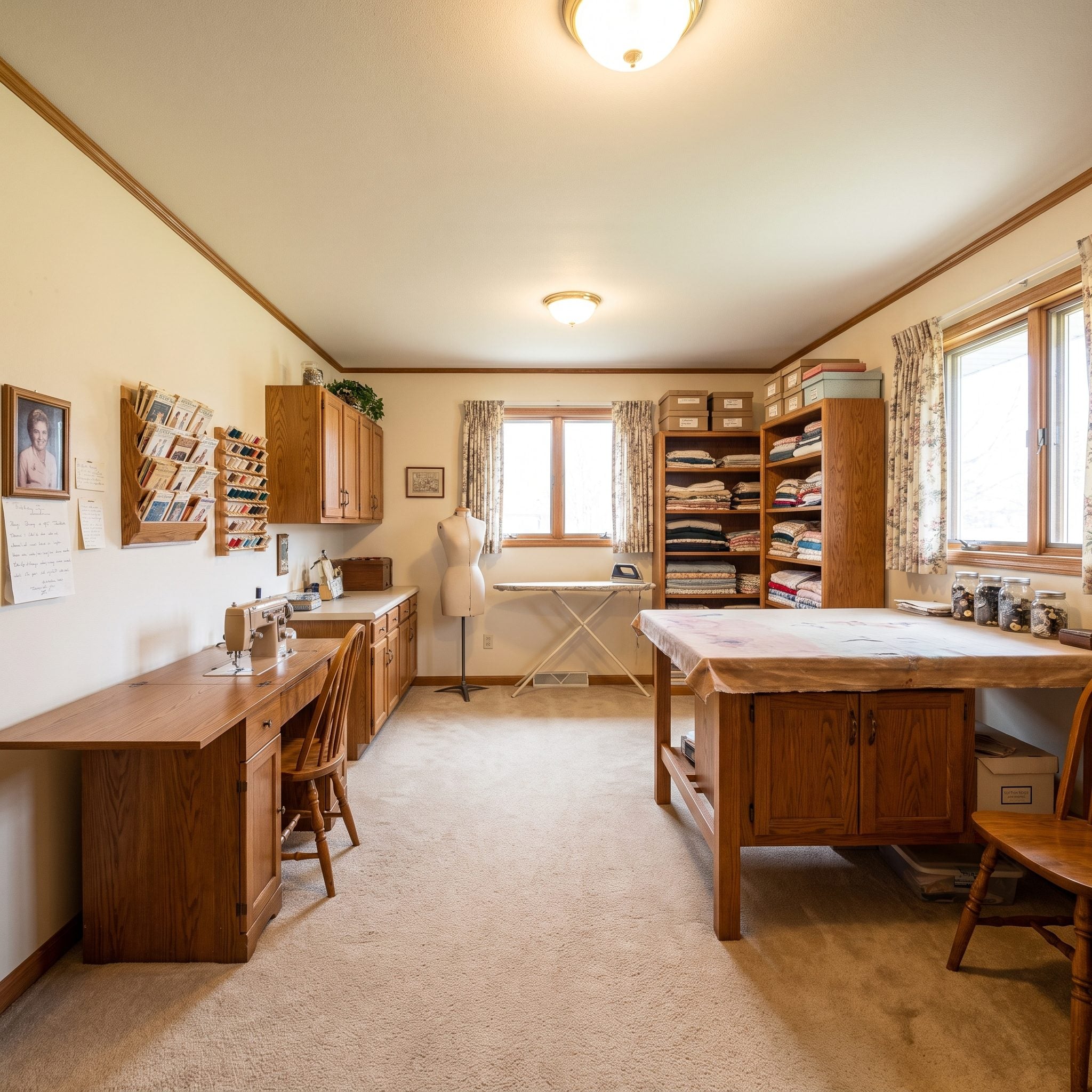
The before has all the ingredients of a serious sewing room and almost none of the pleasure. Mauve walls. A floral border. Fluorescent light flattening everything beneath it. Work surfaces that feel temporary, storage that feels accumulated, and an older sewing machine competing with the room instead of belonging to it.
Then AI gets hold of the same basic shell and starts making increasingly unreasonable suggestions. Walnut libraries. Pale-oak ateliers. Emerald lacquer. Curved stone islands. A Mediterranean workroom, a Victorian salon, a black-and-ivory couture studio and several rooms that appear to have acquired their own dressmakers overnight. The useful question isn’t whether you’d reproduce any one of them exactly. It’s which move finally makes you look back at the mauve original and realize what was missing.
In order to come up with the very specific design ideas, we create most designs with the assistance of state-of-the-art AI interior design software. Also, assume links that take you off the site are affiliate links such as links to Amazon. this means we may earn a commission if you buy something.
These 34 transformations keep changing the traffic pattern, work surfaces, storage, lighting and entire personality of the room without losing sight of its actual job. Some are restrained enough to borrow tomorrow. Others are pure design fantasy with very stealable ideas hiding inside. Same starting point. Thirty-four radically different answers.
Considering a bigger transformation? Compare home equity offers from participating lenders while you plan.
34. From Mauve and Fluorescent to Warm Modern Atelier
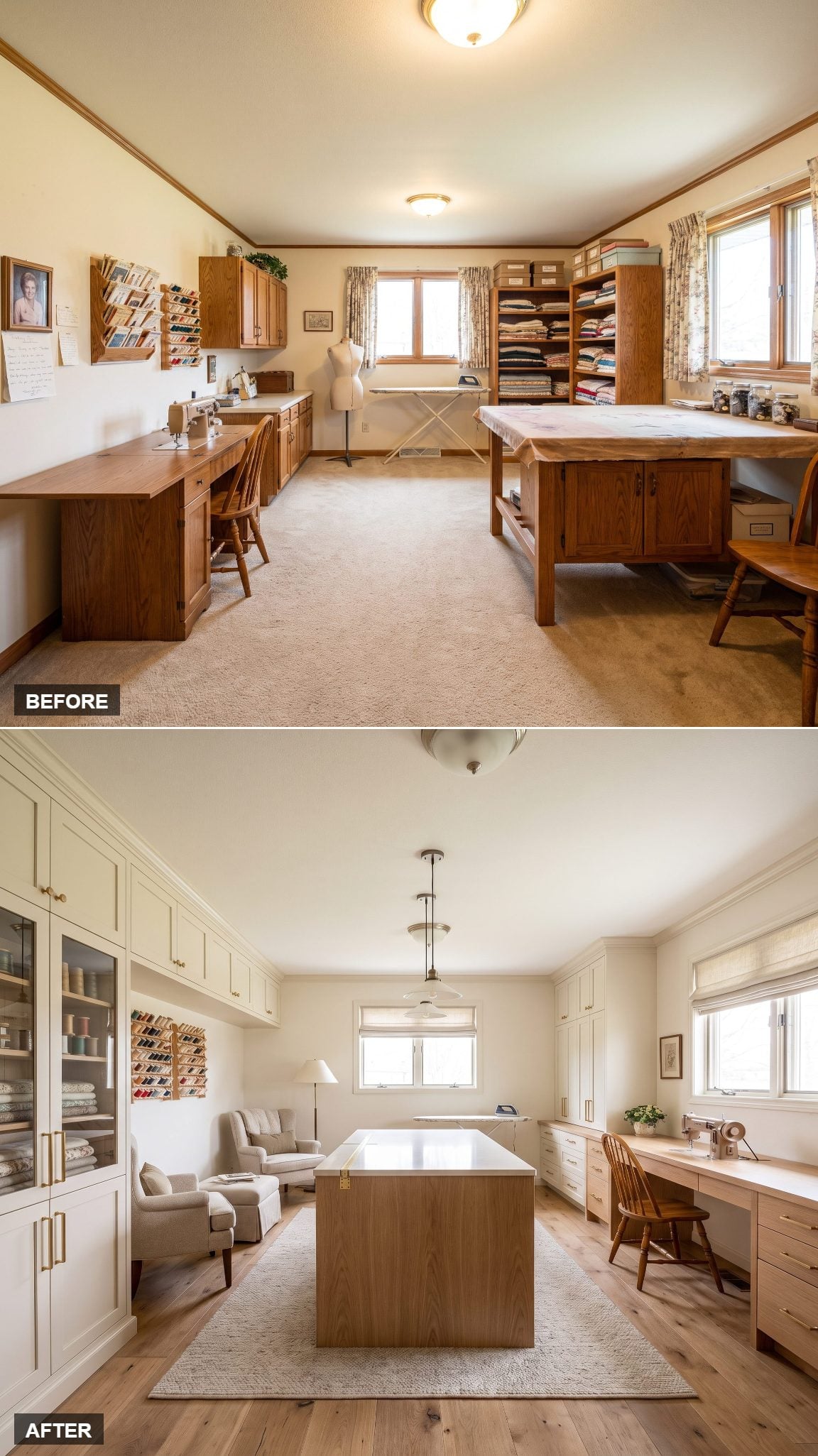
The single worst thing in the before may be the light. That fluorescent tube flattens everything beneath it and makes the mauve feel less nostalgic than tired. Remove it and the room already has a fighting chance.
A waterfall-edge white-oak table takes the center, warm greige plaster replaces the old wall color, and a brass task lamp brings the light down where actual work happens. The vintage machine gets its own console instead of being treated like something to hide. Nothing here screams transformation. That’s why it works.
33. Art Deco Glamour With an Octagonal Center
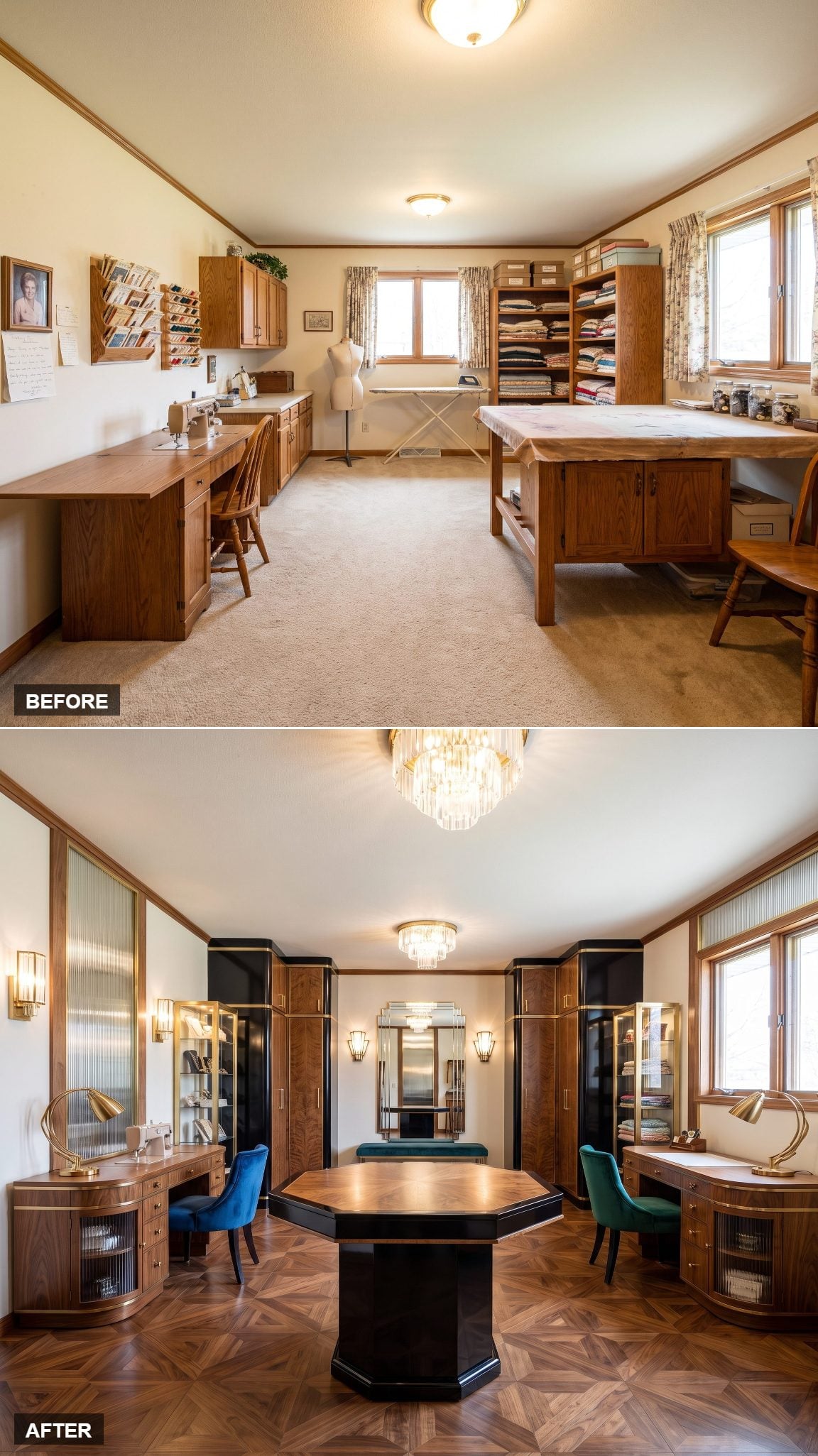
Then restraint leaves the building. A large octagonal cutting table commands the center while matching sewing stations flank it, turning a formerly accidental room into something almost ceremonial.
Emerald walls, brass inlay, a fan-motif mirror and black-and-gold geometry underfoot push the glamour hard. The symmetry keeps all that decoration disciplined. Without it, this could become a costume. With it, the room knows exactly what decade it wants to flirt with.
32. Scandinavian Studio With Room to Move
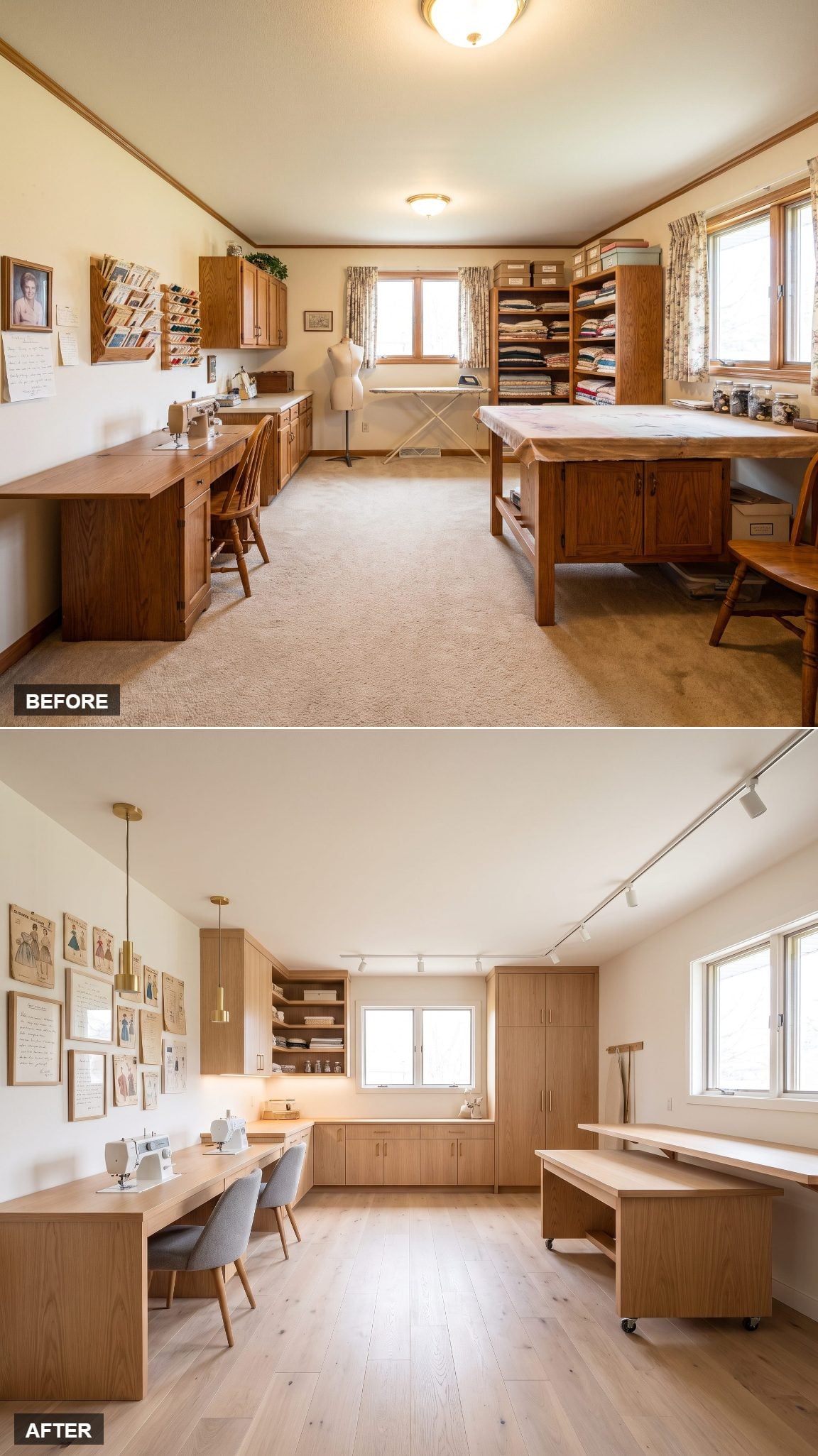
After all that emerald and brass, this one practically opens a window. Storage and sewing stations move to the perimeter, leaving the center gloriously empty. Pale ash floors, white walls and black task lamps do almost nothing theatrically — which is the point.
A charcoal runner, one trailing plant and a mug on the sill are enough decoration. More importantly, the floor is clear enough to unfold patterns, turn around with fabric in your arms and work without negotiating an obstacle course. It’s one of the most genuinely usable layouts in the gallery.
31. Grandmillennial Couture, Color Without Chaos
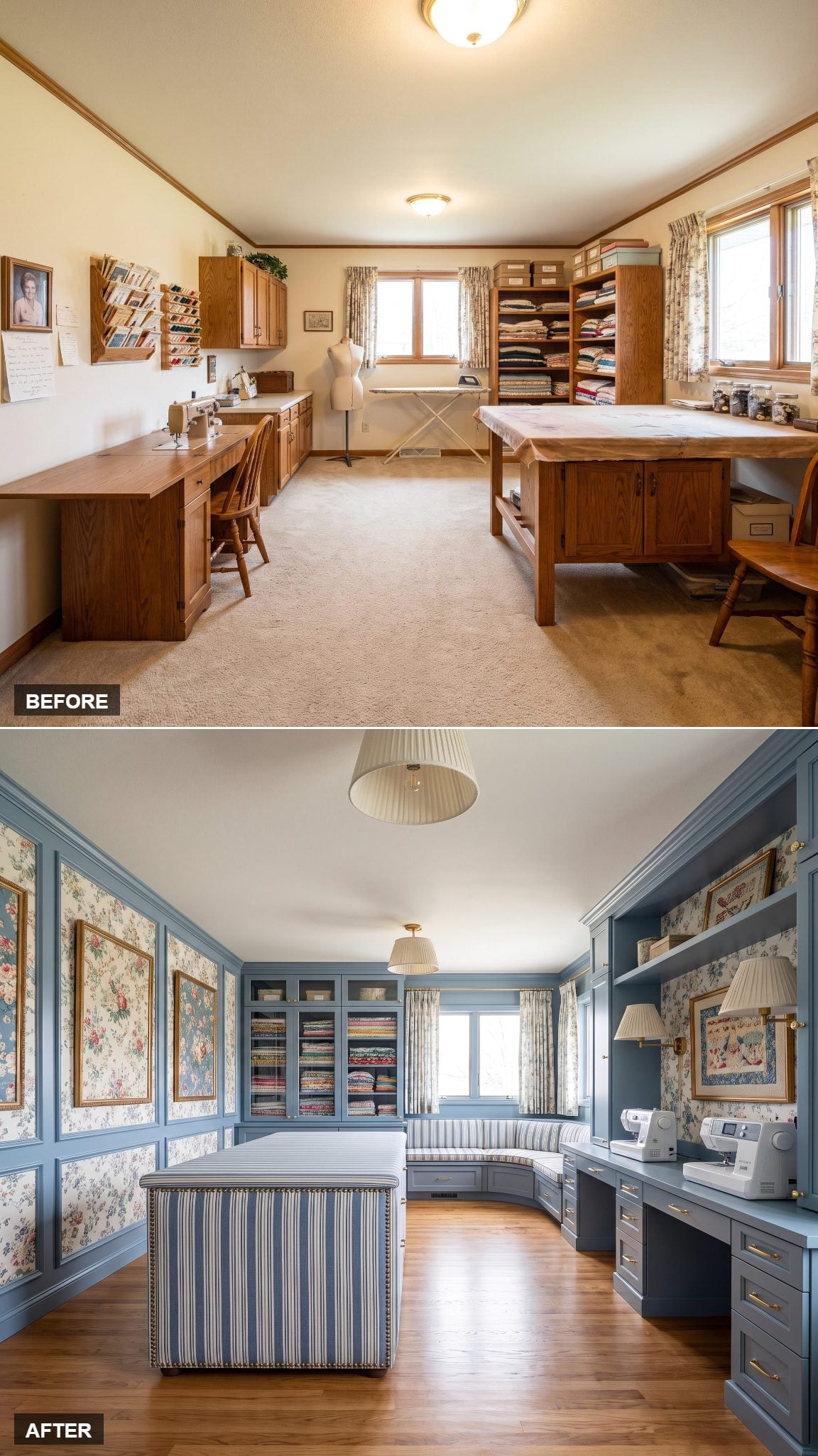
This version keeps more of the old-fashioned sewing-room spirit while making every bit of it look intentional. A scalloped pink cutting island lands toward the center, sewing machines move to a skirted station, and botanical pattern returns to the walls without feeling like leftover decoration from another era.
Chinoiserie lamps, a ruffled Roman shade and framed vintage sewing prints pile on the personality. There is a lot happening, but the color family holds it together. Maximalism with a spine.
30. High-Fashion Black-and-Ivory Atelier
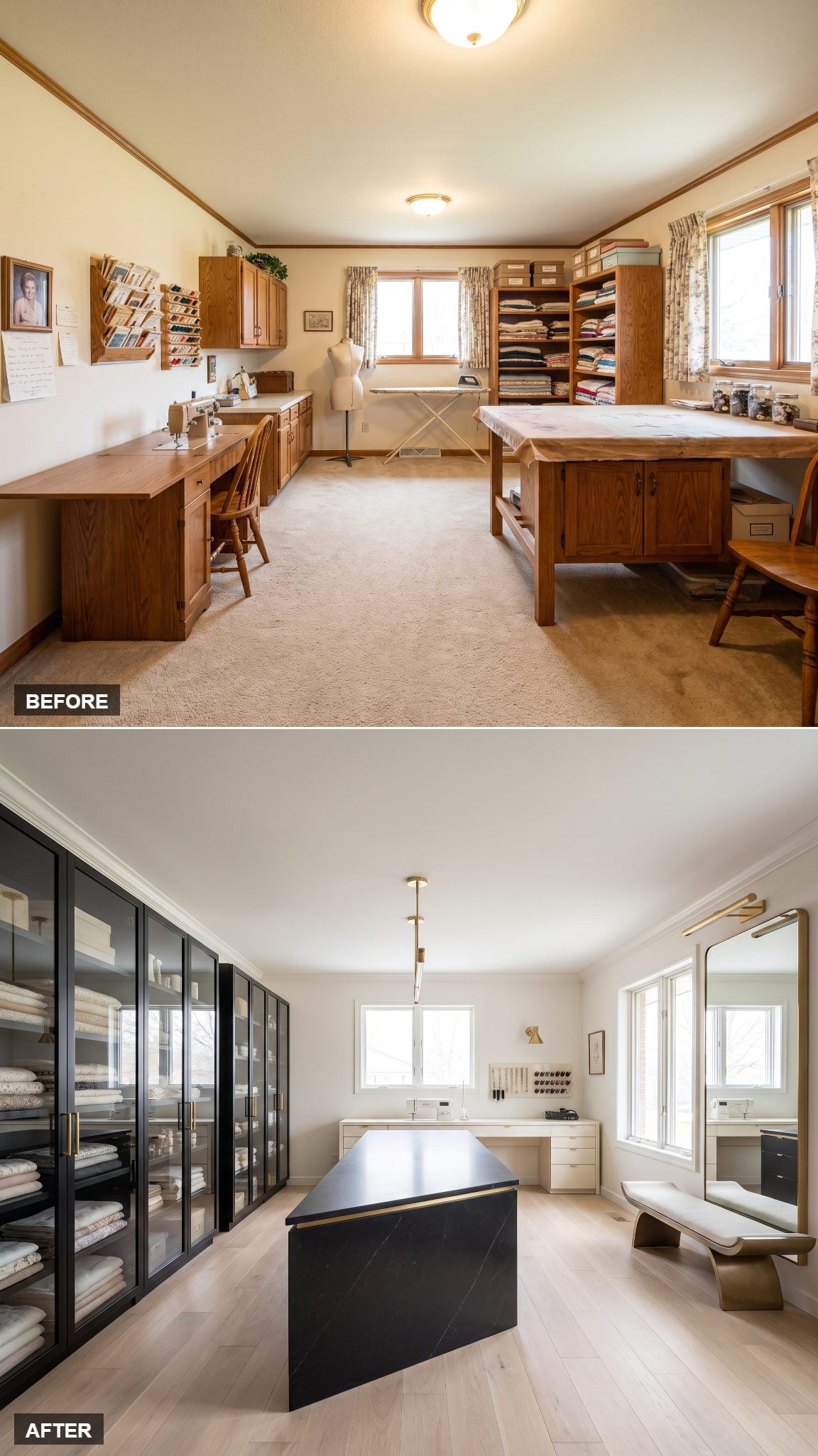
A long black stone cutting island slices diagonally across the floor, immediately breaking the square-room predictability of the before. Diagonal furniture consumes space differently, but visually it turns the entire room on.
Ivory walls, black lacquered cabinetry and brass fittings keep the palette graphic. A dress form waits in one corner, pattern paper sits nearby and a single black task lamp arcs over the stone. The drama comes from treating the work surface as sculpture.
29. Heirloom Details Get a Much More Luxurious Setting
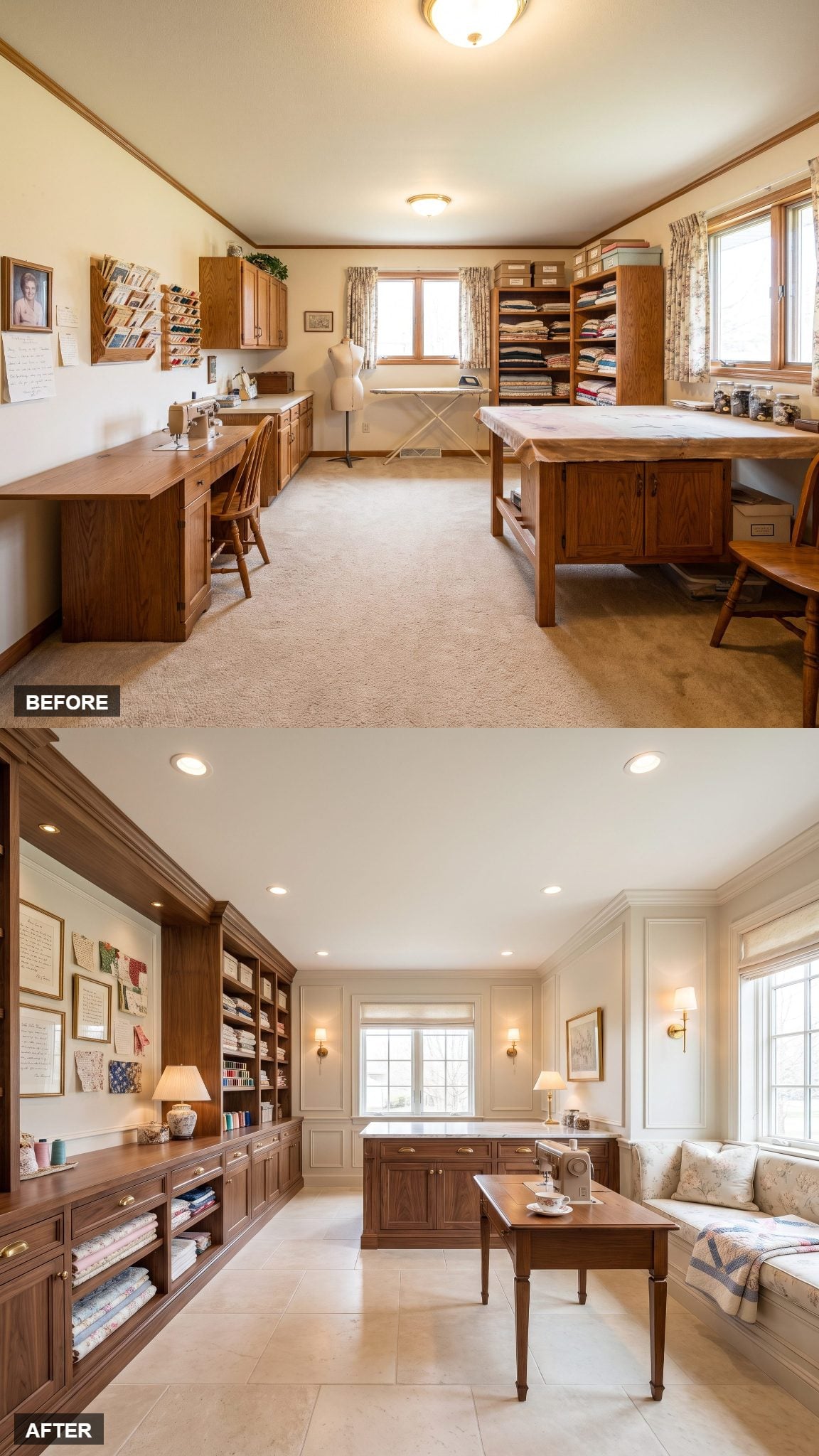
This version proves that updating an old-fashioned sewing room doesn’t require erasing every trace of sewing history. A vintage-style desk stays freestanding near the window while the rest of the room becomes considerably more polished.
Framed pattern notes and fabric scraps turn humble working materials into wall art. Walnut cabinetry and cream stone bring the luxury, while a floral linen chair gives the nook enough softness to keep the room from feeling like a showroom. It has some of the ease of a country guest room, except somebody clearly intends to get work done.
28. Dark Walnut Tailoring Library
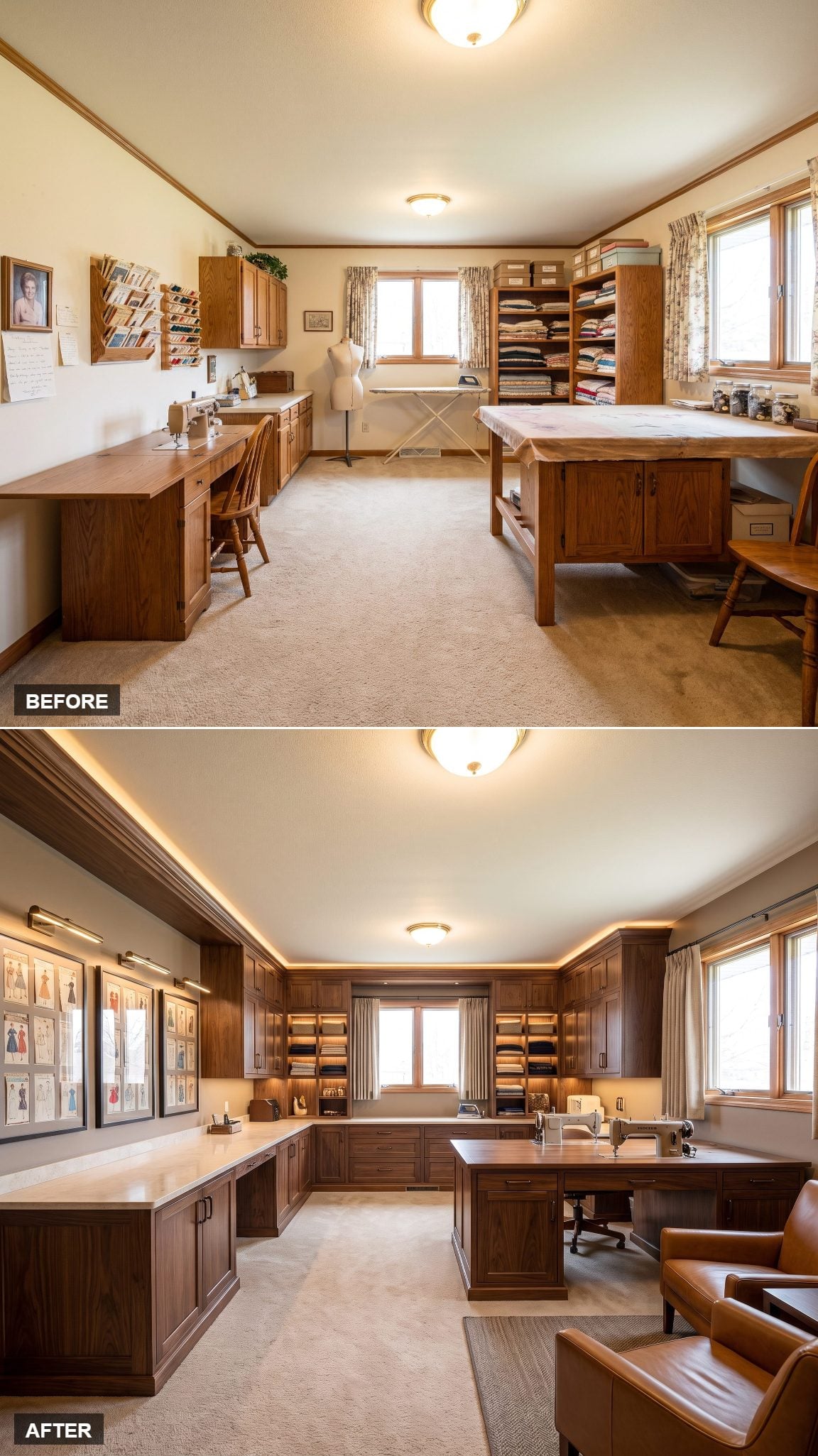
Now turn the lights down. Floor-to-ceiling walnut takes over the rear wall, fabric cubbies glow from within, and brass hardware almost disappears against the wood until it catches the light.
A leather-topped work surface and oxblood stool make this feel less like a hobby room than a tailoring library. It practically smells of wood polish and old books, or it would if pixels had a scent. Not universally lovable. Completely committed.
27. Coastal Retreat, Light as Sea Glass
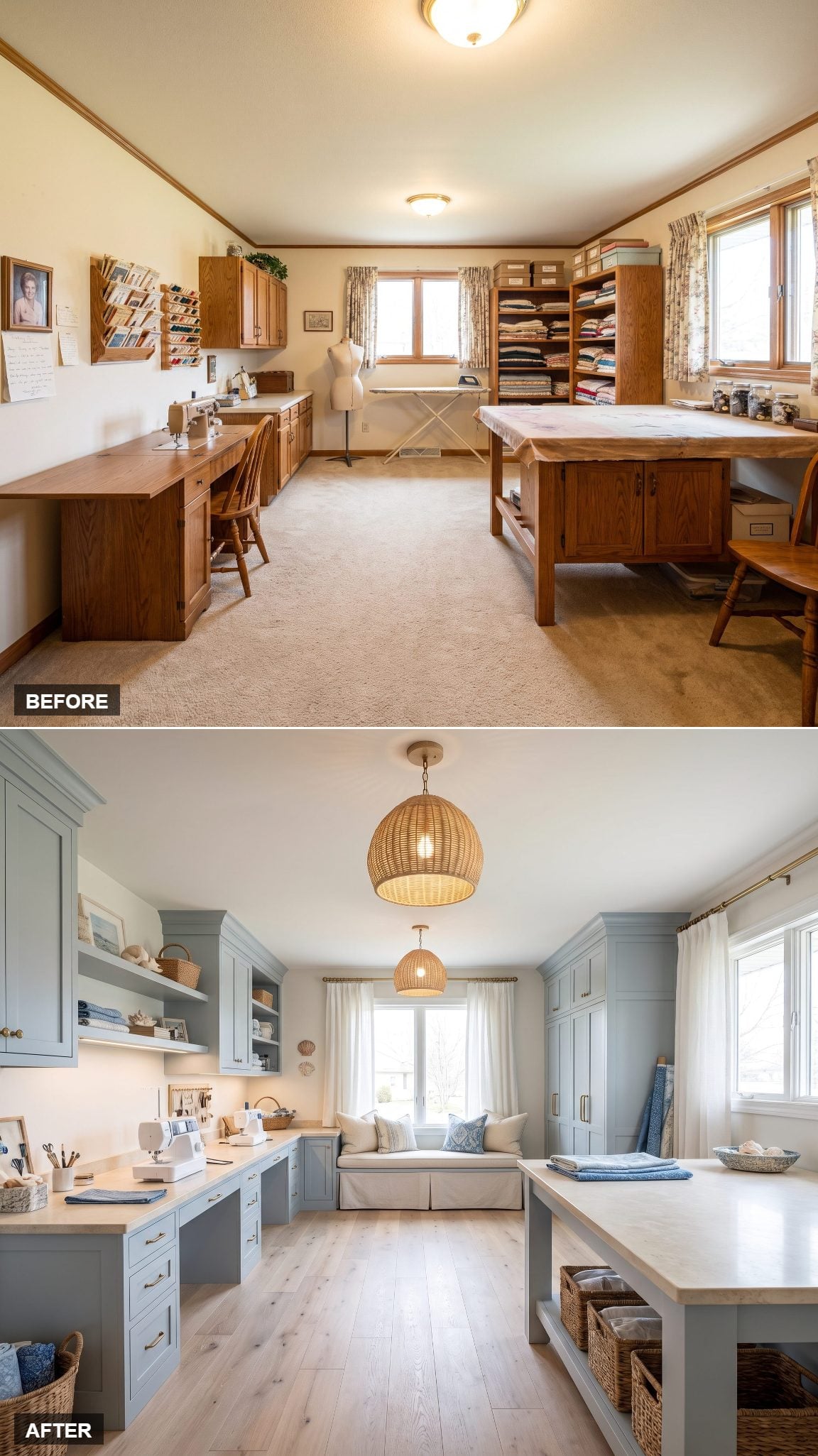
The pendulum swings back toward daylight. An L-shaped work station turns from the window wall to the rear in pale blue-gray, while whitewashed paneling and woven baskets replace the heavier storage of the original room.
A divided-light window, linen Roman shade and rattan pendant give it the cottage shorthand without requiring anchors or seashell-patterned fabric. There is, admittedly, still a jar of shells on the sill. Nobody is perfect.
26. A Parisian Couture Workroom With Actual Bones
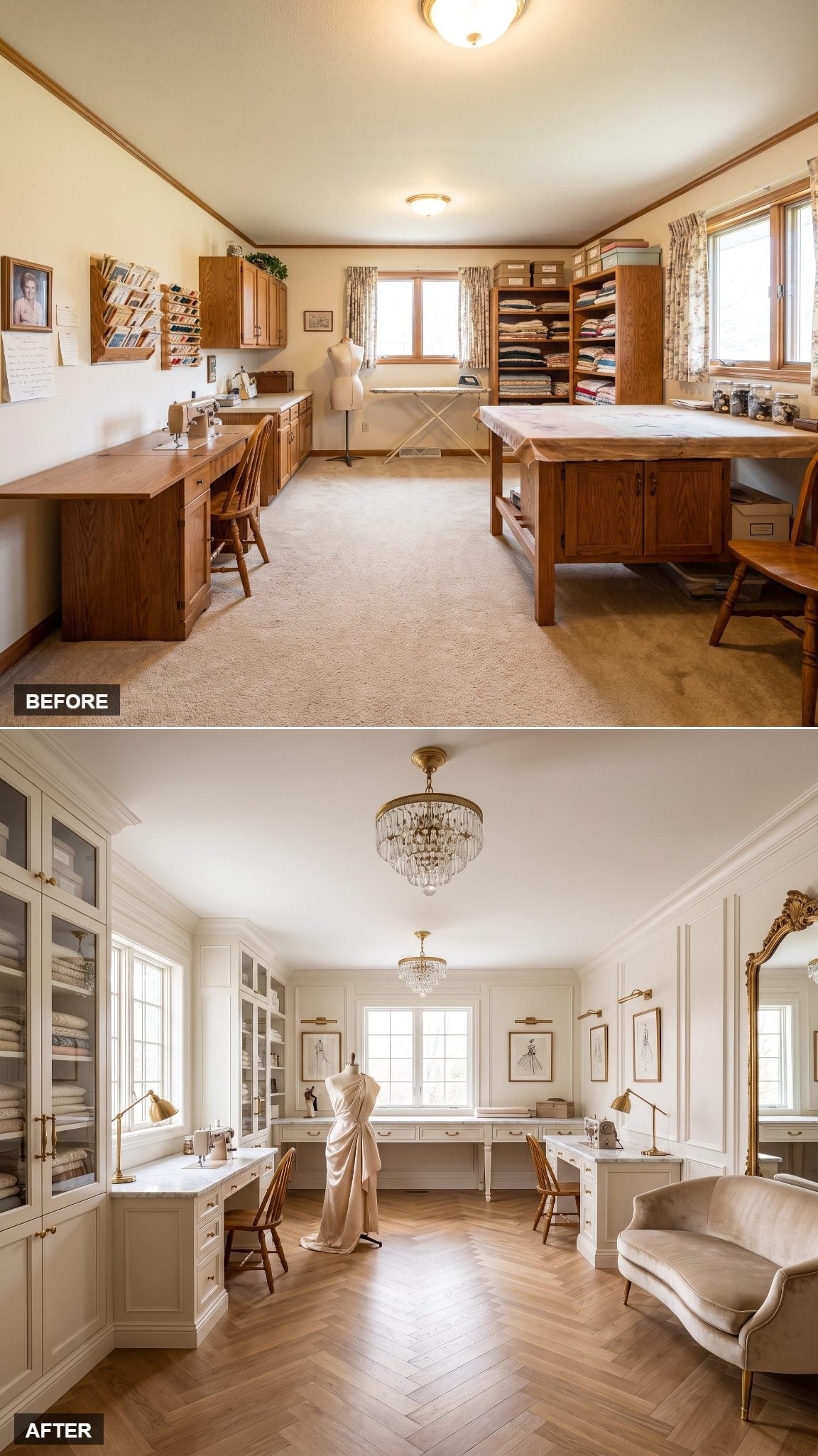
Forget the standard center island. A long marble-topped cutting table runs across the room while fluted paneling in chalky pale gray gives the walls actual presence.
An antique gilt mirror leans nearby, a crystal-armed sconce warms the corner and a dress form waits with a half-pinned muslin. Large uninterrupted tables are useful in dressmaking because fabric needs room to be measured, marked and cut without being constantly folded back on itself. Here the working surface becomes the room’s architecture.
25. Japandi Calm With a Low Center Table
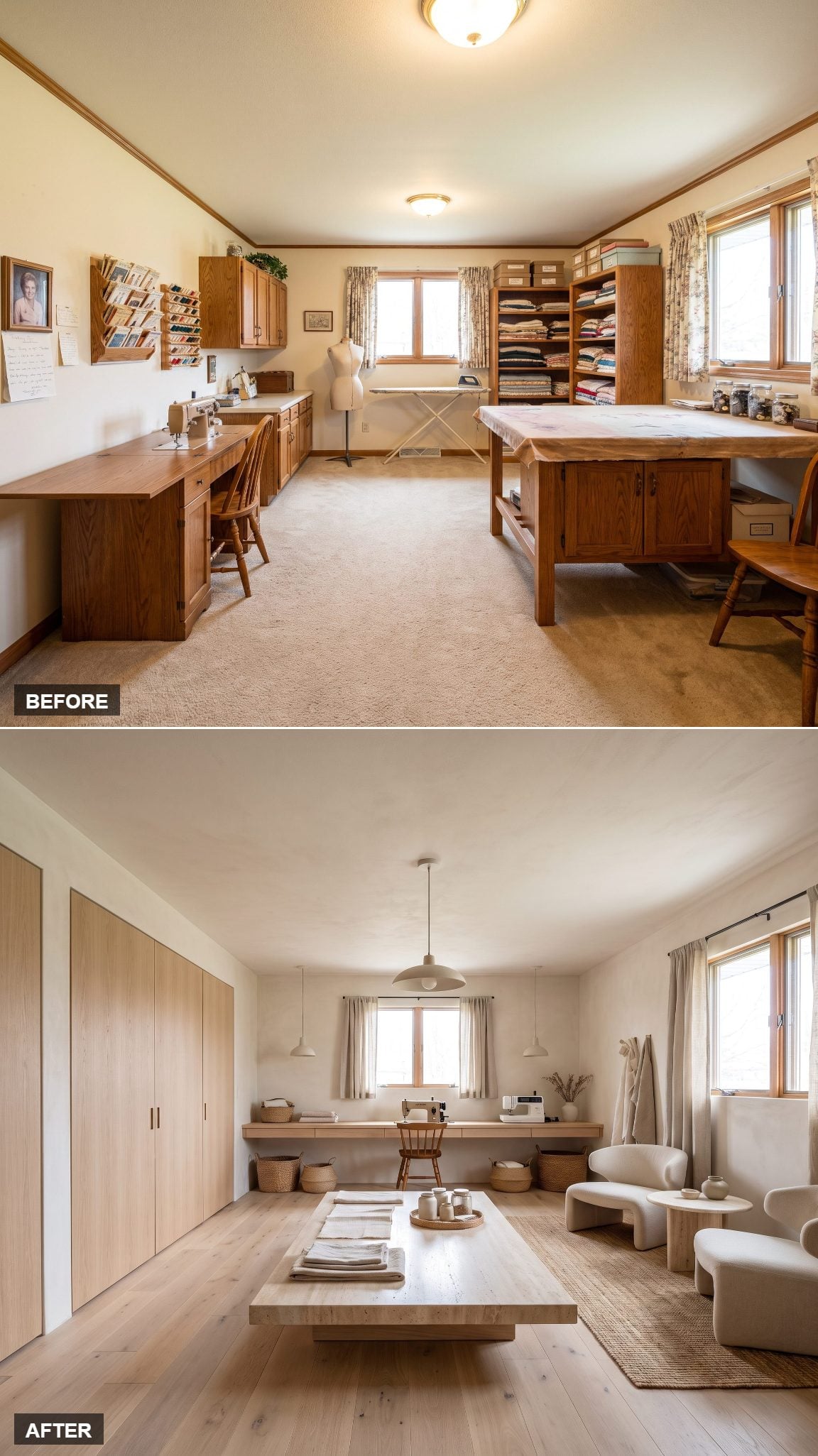
The floral border, mauve walls and brass rings vanish. In their place sits an oversized low cutting platform in pale oak, a long floating workstation and enough warm white to let the materials breathe.
Linen arrives in oat and clay. A single stem sits in a hand-thrown vase. Low furniture and long, uncluttered sightlines make the composition feel quieter without requiring anything else to announce itself. The whole space seems to exhale.
24. Chinoiserie-Inspired Sewing Room With Hand-Painted Botanical Panels
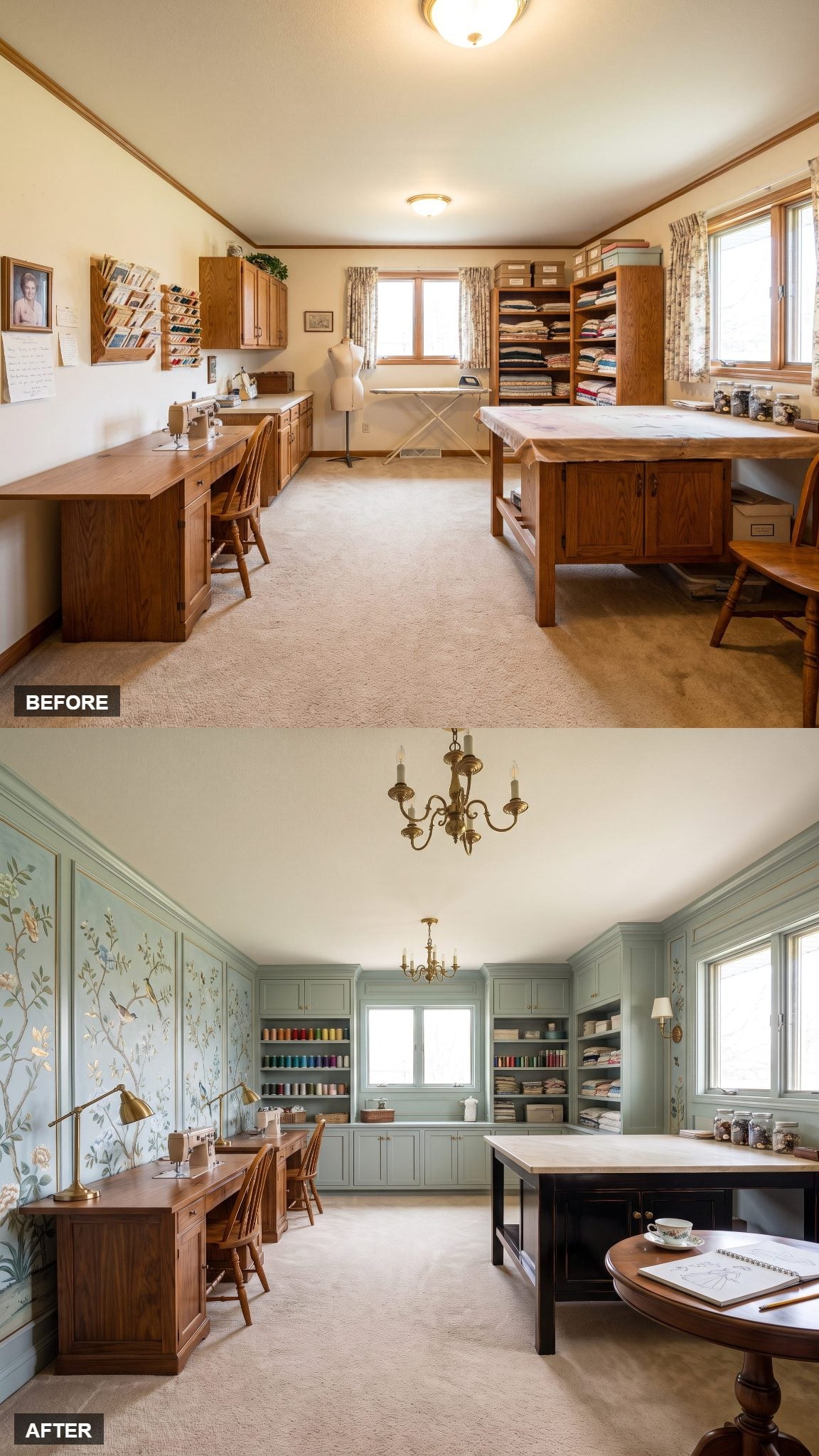
The walls get the splurge here. Birds and branches spread across hand-painted botanical panels, which means everything in front of them can afford to settle down.
Celadon cabinetry retreats into the palette while a tea-and-sketching table takes the window. That smaller table is a smart counterpoint to the work surfaces: somewhere to draw, pin notes or sort through ideas before the machinery gets involved. Decorative without drowning the work.
23. From Folding Table to Italian Modern Atelier
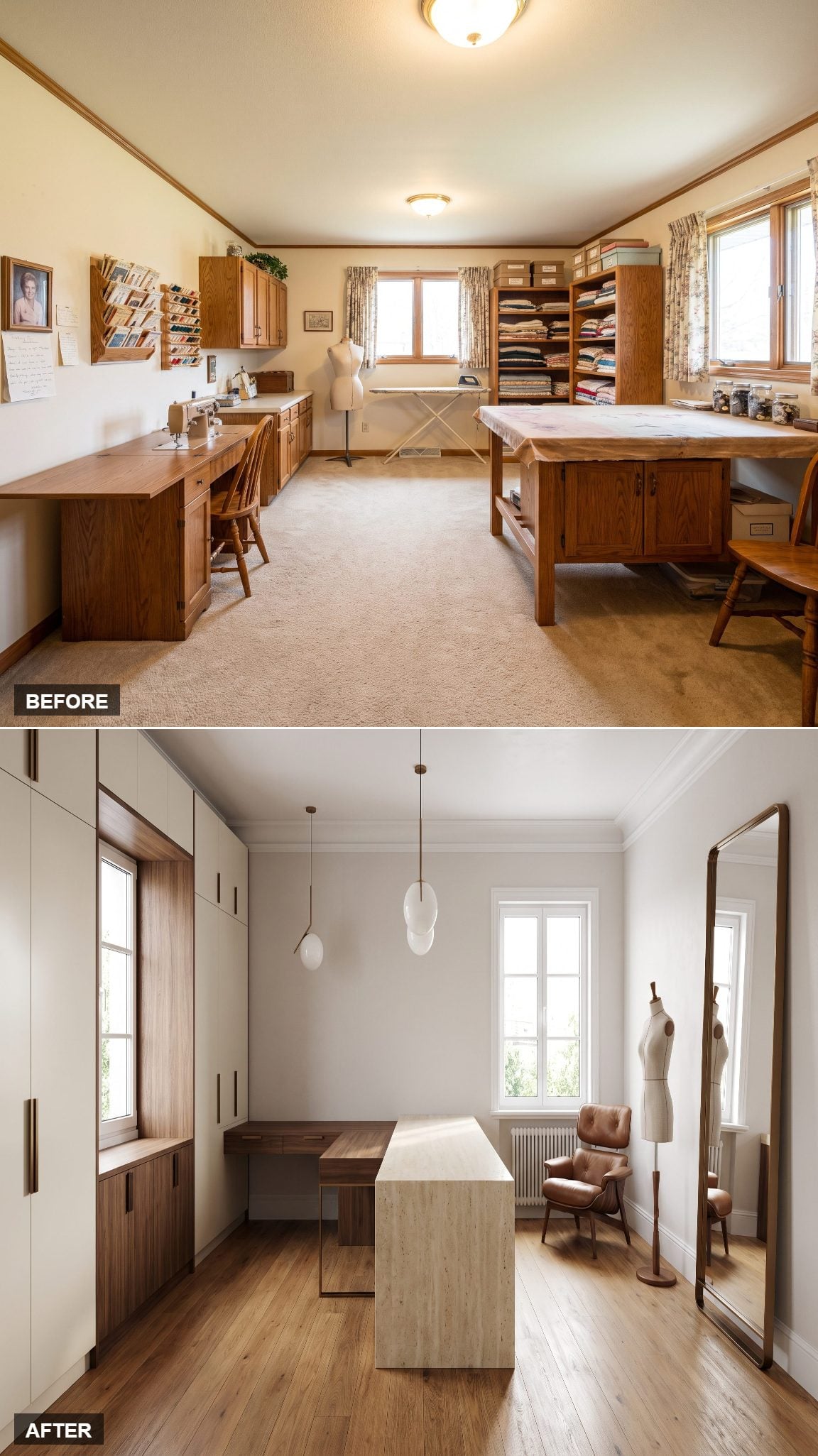
The old folding table was doing a permanent job with temporary furniture. That was the problem in one sentence.
Now a long walnut sewing desk meets a pale stone-topped cutting counter in a T-shaped layout, separating machine work from the larger surface needed for fabric. A pressed shirt hangs nearby, coffee sits beside the scissors and the room feels less decorated than equipped.
22. Moody Plum Couture Room
🔥 Would you like to save this?
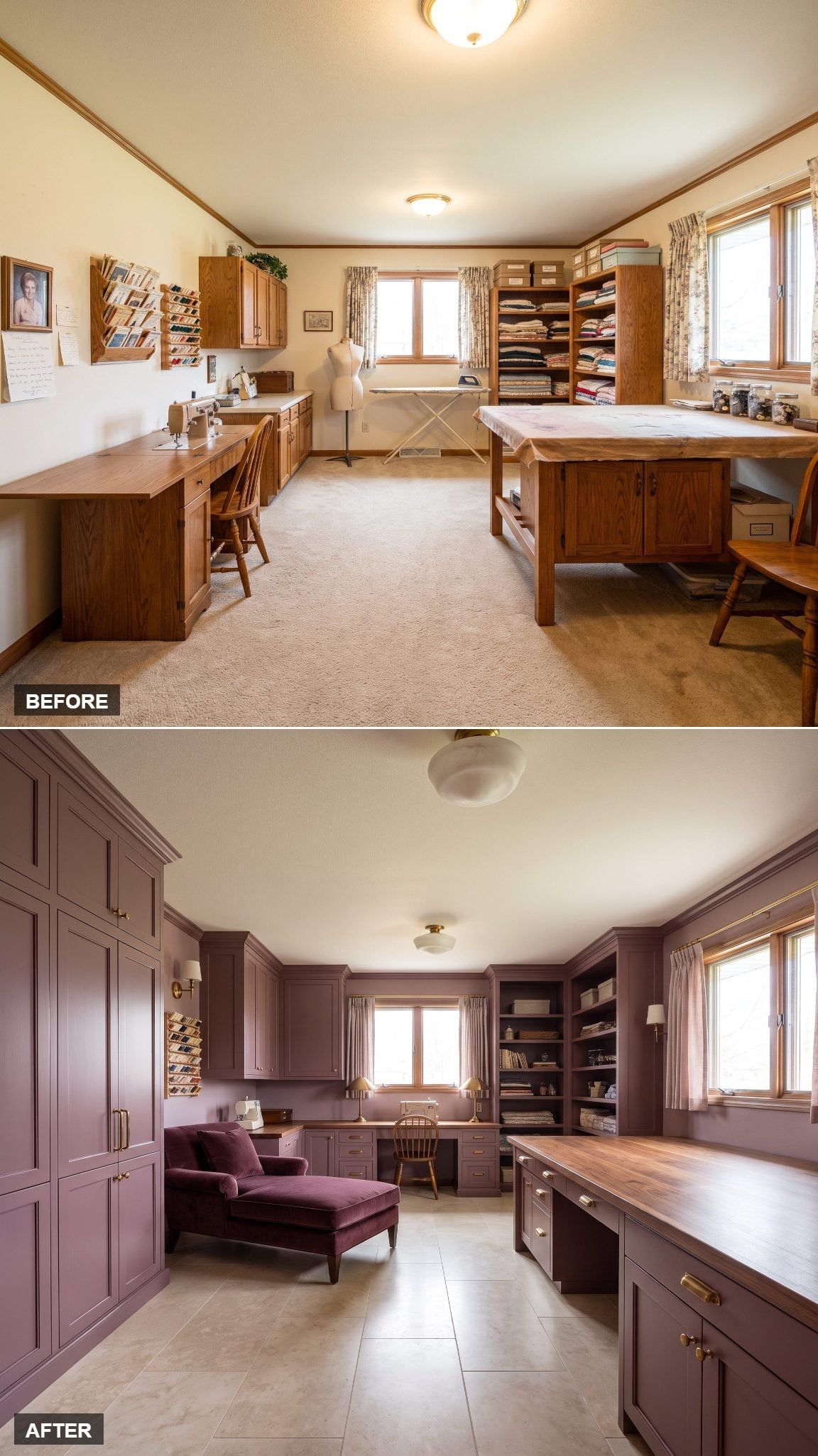
No island this time. A cutting peninsula comes off the right wall while sewing desks slide beneath the windows where daylight can actually reach the work.
Deep plum covers the walls and full-height cabinetry, with brass task lamps throwing warmer pools across the surfaces. A velvet plum stool disappears beneath the counter while bright thread and pale fabric jump against all that aubergine. Dark doesn’t have to mean murky when the task lighting is doing its job.
21. Mediterranean Luxury Craft Room
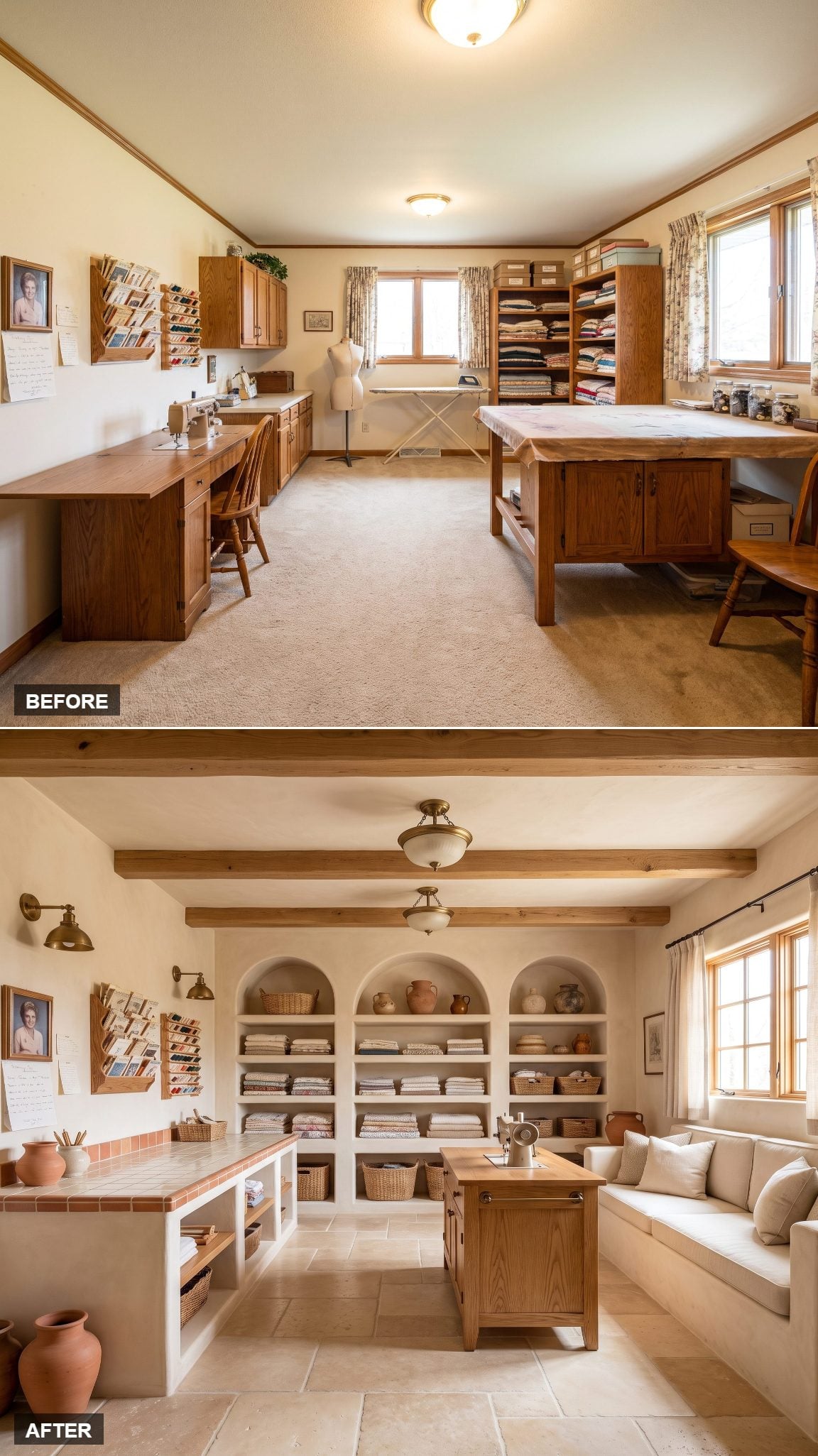
Boxy cabinets never arrive. Instead, arched plaster niches take over the rear wall and turn storage into part of the architecture.
A long tiled worktable runs down one side in terracotta and cream. Whitewashed plaster, a jute runner, folded linens and dried lavender do the rest. It feels like a sewing room borrowed from a stone house near the coast — sunlit, slightly dusty and in no visible hurry.
20. Blue-and-Walnut Heritage Studio
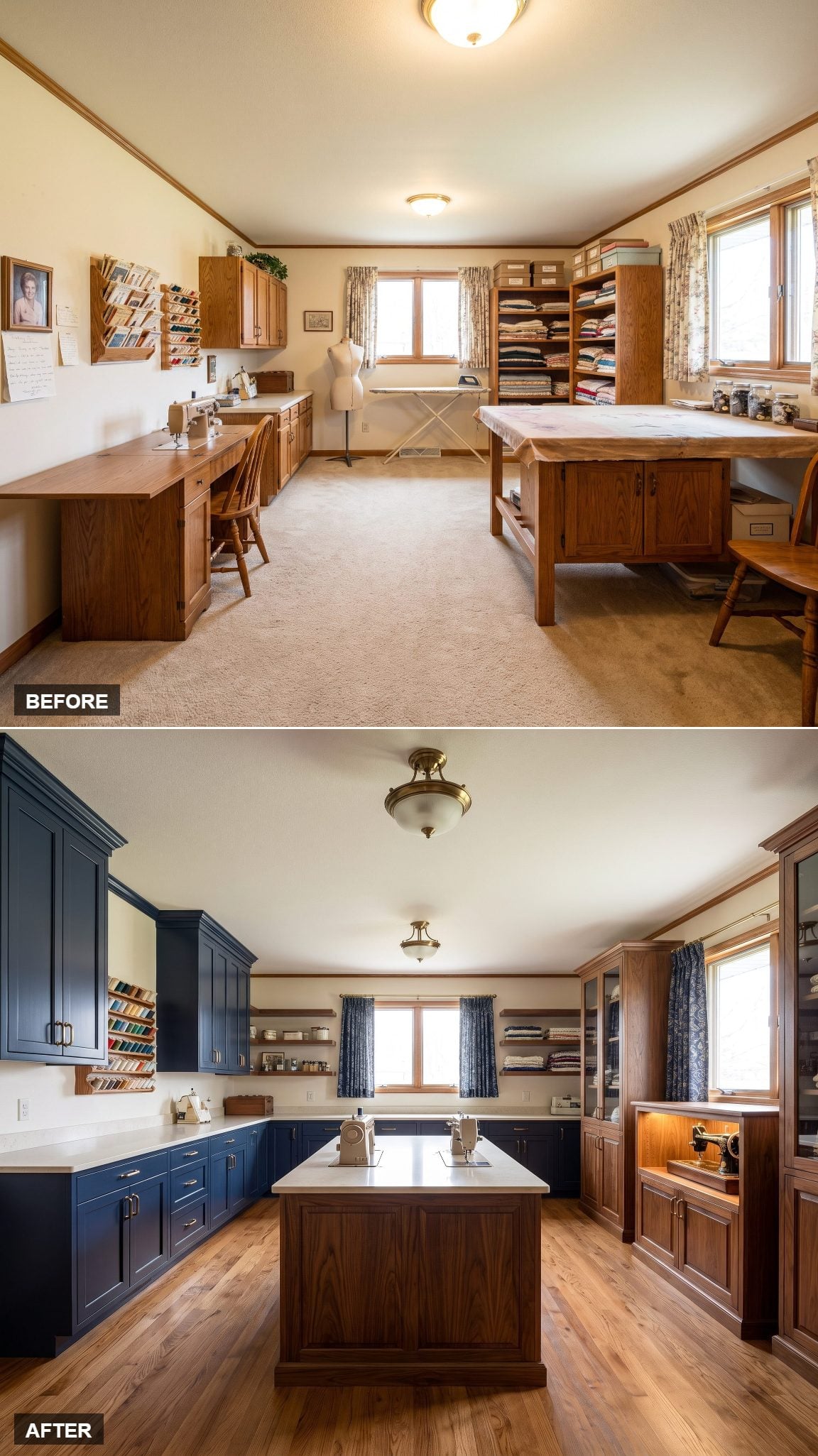
The centerpiece is a double-sided sewing island with machines facing opposite directions, giving two projects or two people their own territory.
Cutting moves to a long counter at the rear. Heritage blue cabinetry meets walnut tops and aged brass, while a vintage machine gets polished rather than hidden. A pincushion and fan of thread spools make the tools part of the color story.
19. Organic Modern Textile Atelier
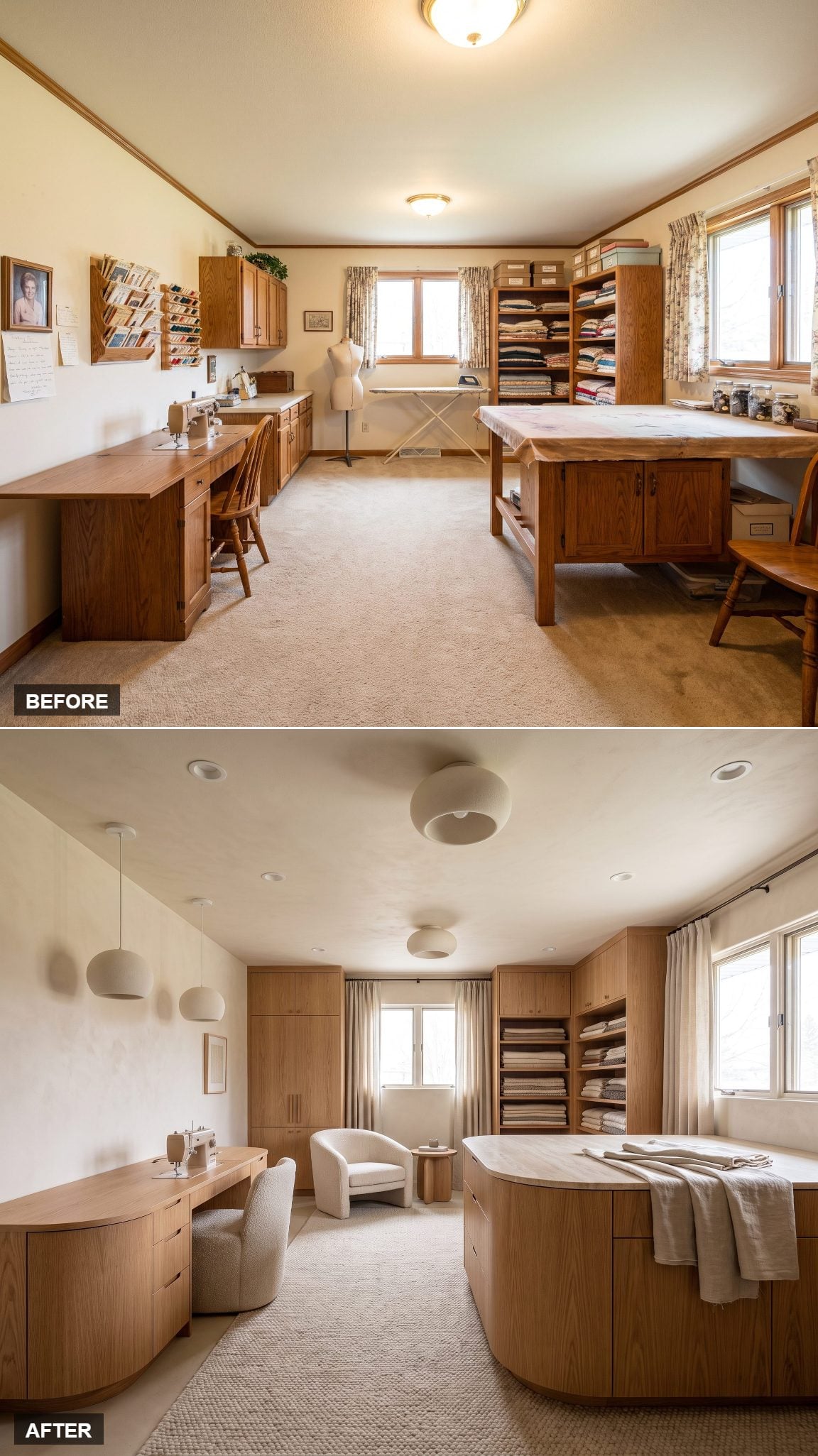
Curves take over next. A kidney-shaped cutting island floats off center while a rounded sewing workstation follows the wall instead of fighting it.
Warm oatmeal plaster, pale wood, bouclé and one trailing plant keep the palette almost aggressively gentle. More important, the curves create a less rigid path through a room where someone may be stepping around fabric, circling a table and moving repeatedly between tasks.
18. Luxury French Country Workroom With a Dedicated Sewing Alcove
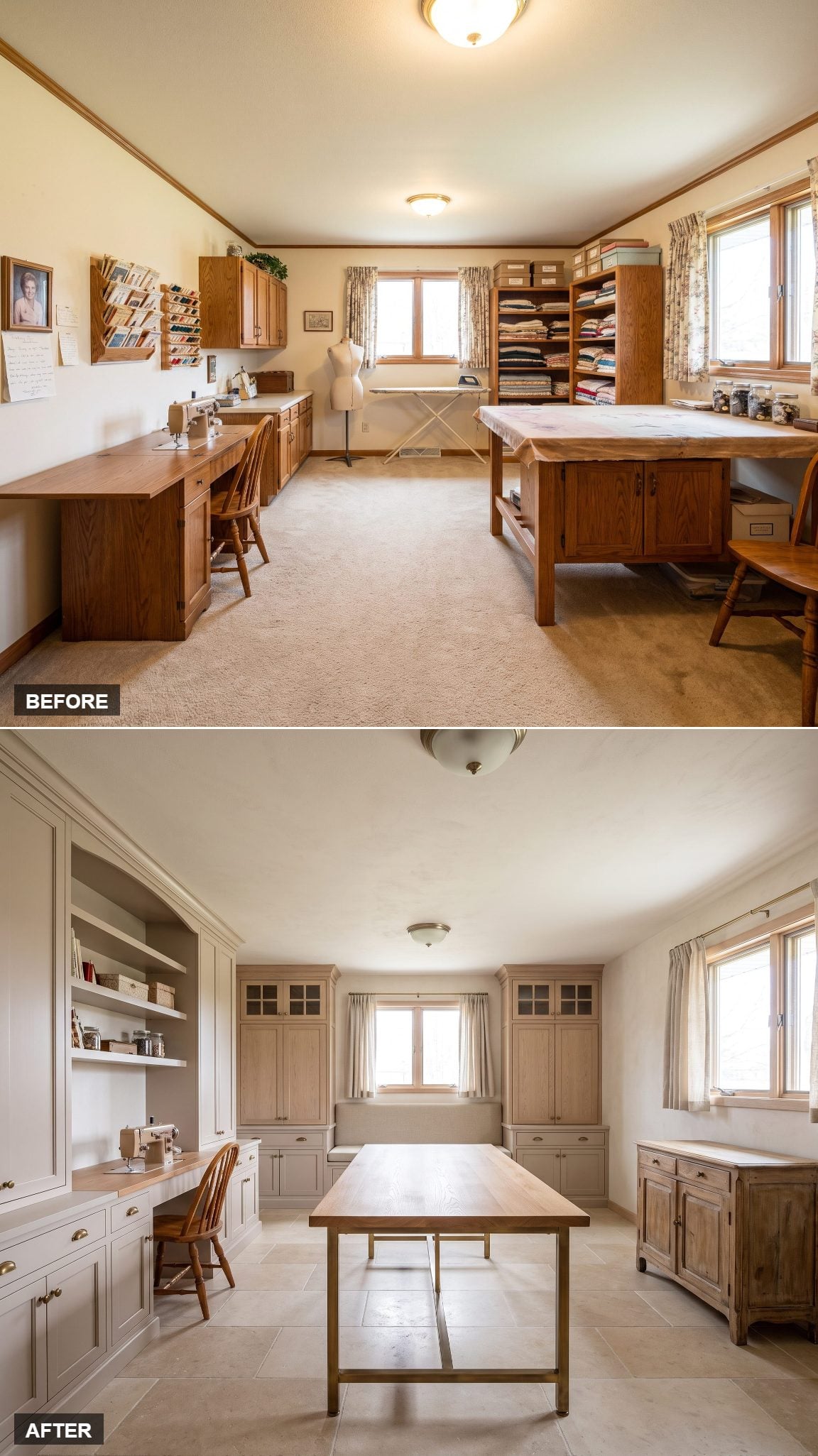
The cutting table takes the middle while the machines move into a dedicated alcove, so two completely different jobs stop competing for the same surface.
Pale-oak cabinetry reaches up the walls beneath cream stone, and the farmhouse-style center table sits on a chalky gray-green base. Linen stacks, eucalyptus and an old thimble keep the polished room from becoming anonymous. It borrows the softness of a country guest room and gives it a job.
17. The Gallery Atelier That Whispers
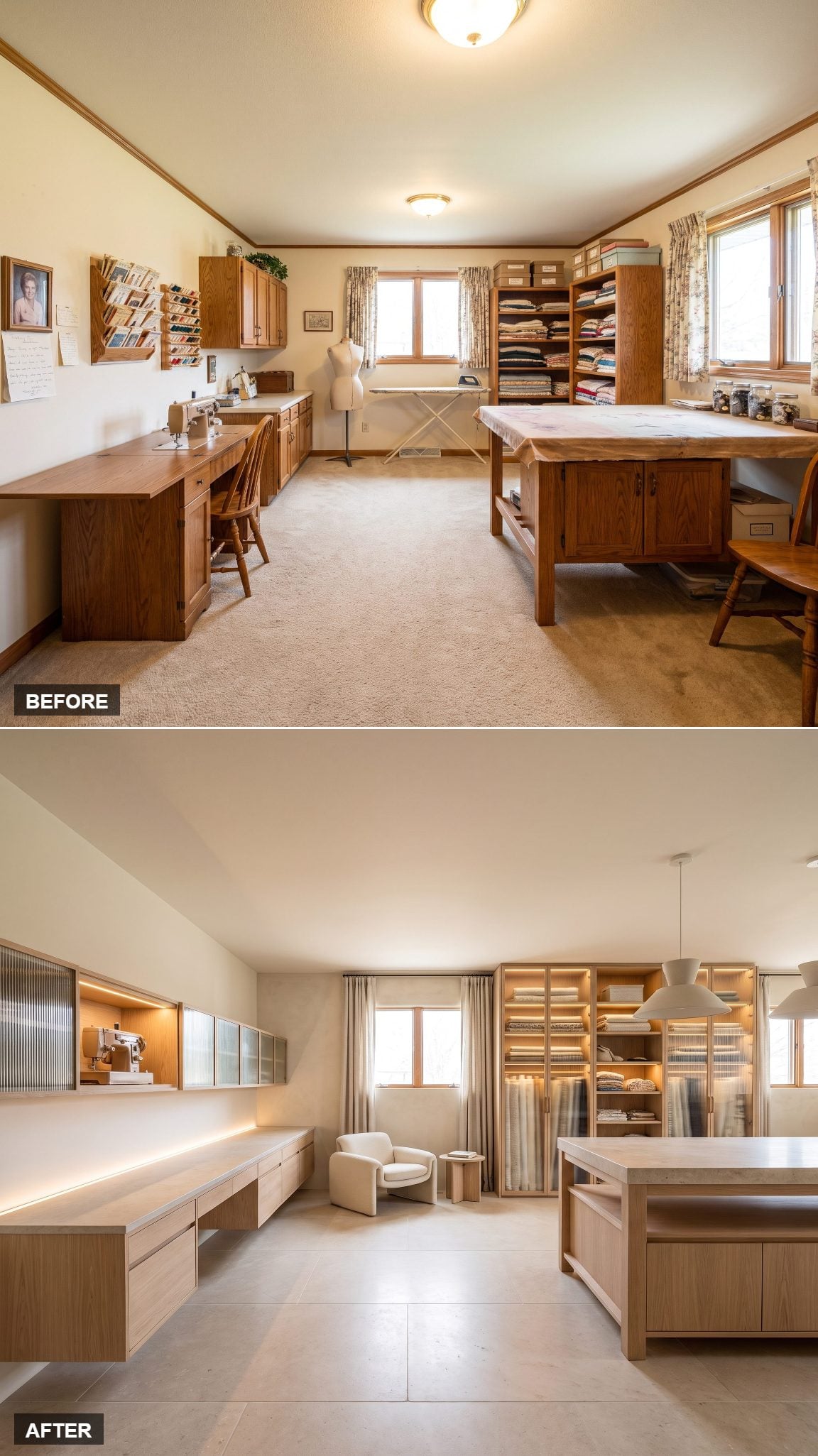
After so many cabinets, niches and work zones, this one does almost nothing. A floating sewing console takes one wall, a square cutting island sits in the middle, and everything around them goes white.
One framed textile hangs like art. A ceramic vase holds a few stems. Compared with the crowded shelving and assorted furniture in the original, the empty space is almost confrontational. That restraint takes nerve.
16. Jewelry-Box Emerald Atelier With Brass Mesh Cabinet Inserts
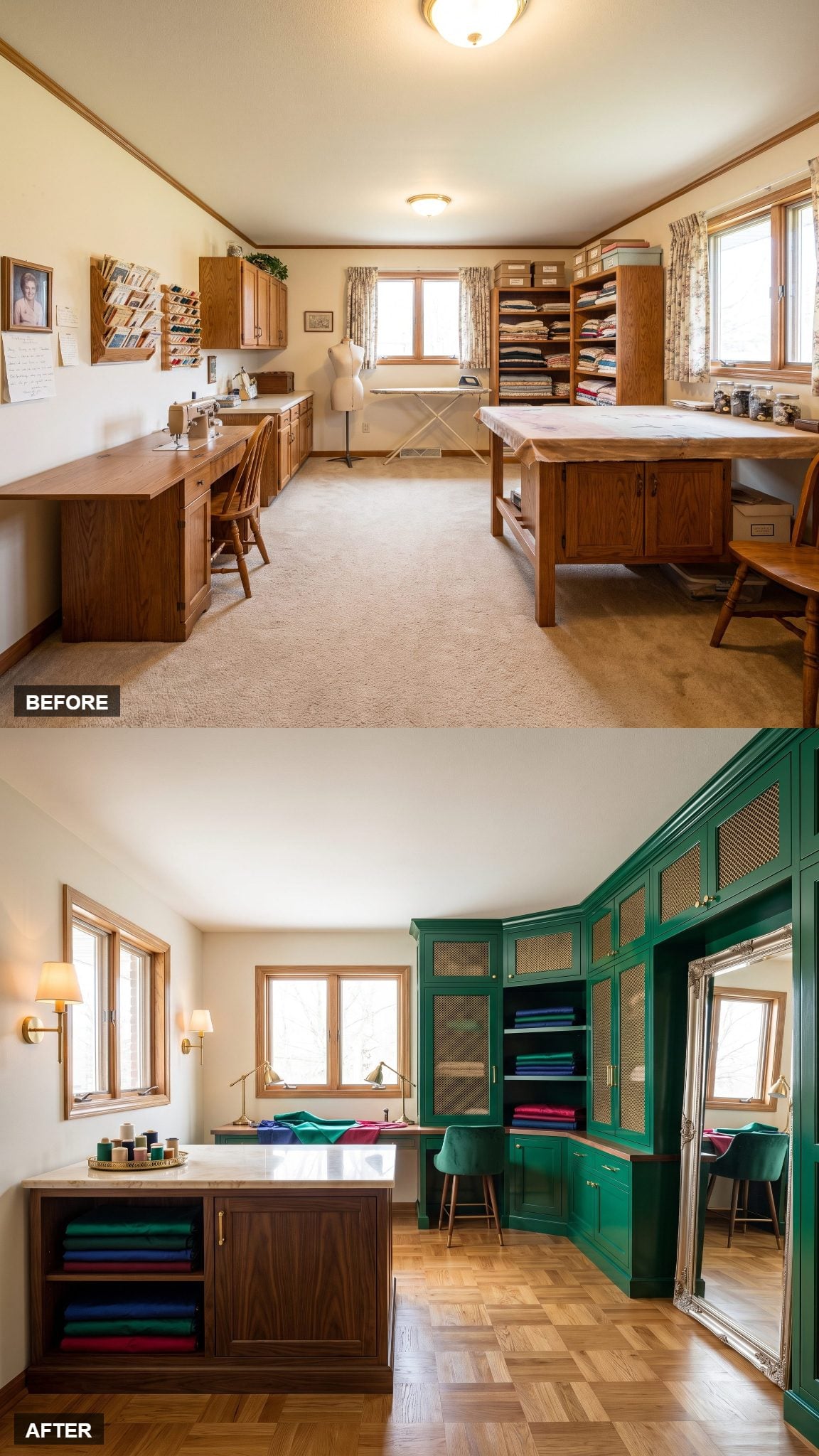
Deep emerald lacquer and brass mesh turn storage into jewelry. The room is small, dense and glowing, with the cabinetry doing far more decorative work than anything sitting on the counters.
A square walnut island with a marble top stays back from the window light, while a fitting zone and full-length mirror take the front. The dark green gives bright fabrics and thread colors a particularly strong backdrop.
15. California Casual Luxury Studio in White Oak and Warm Plaster
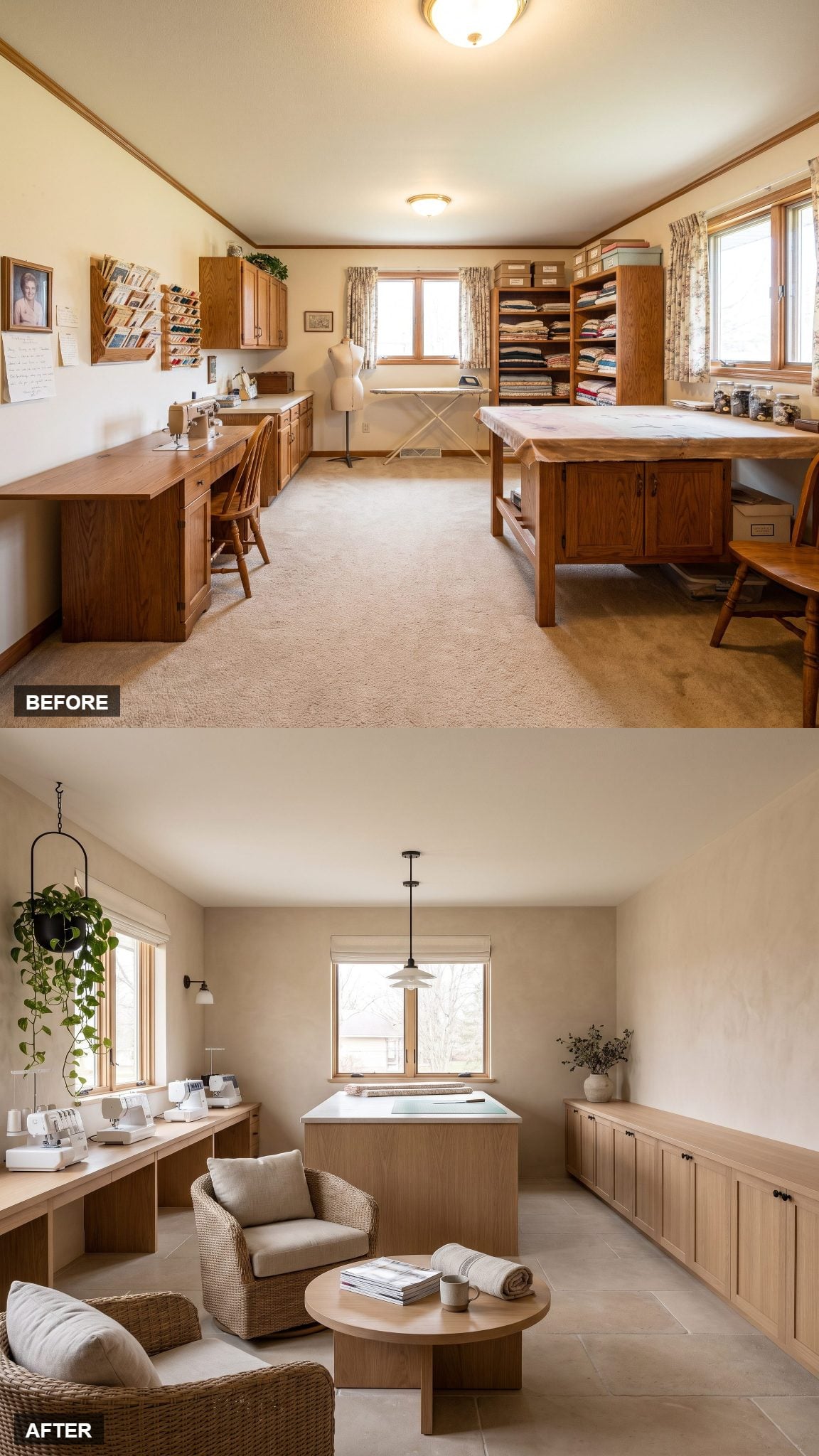
This one deliberately gives away working space. Instead of packing another cabinet into the center, two swivel chairs and a small round table create a lounge zone in the middle of a sewing room.
White oak, warm plaster and woven linen make the room feel more like a weekend than a workshop, while black accents keep everything from dissolving into oatmeal. If you want your workspace to behave a little more like a favorite living room ideas corner, this is the direction.
14. Modern Victorian Sewing Salon With a Circular Worktable and Aged Brass
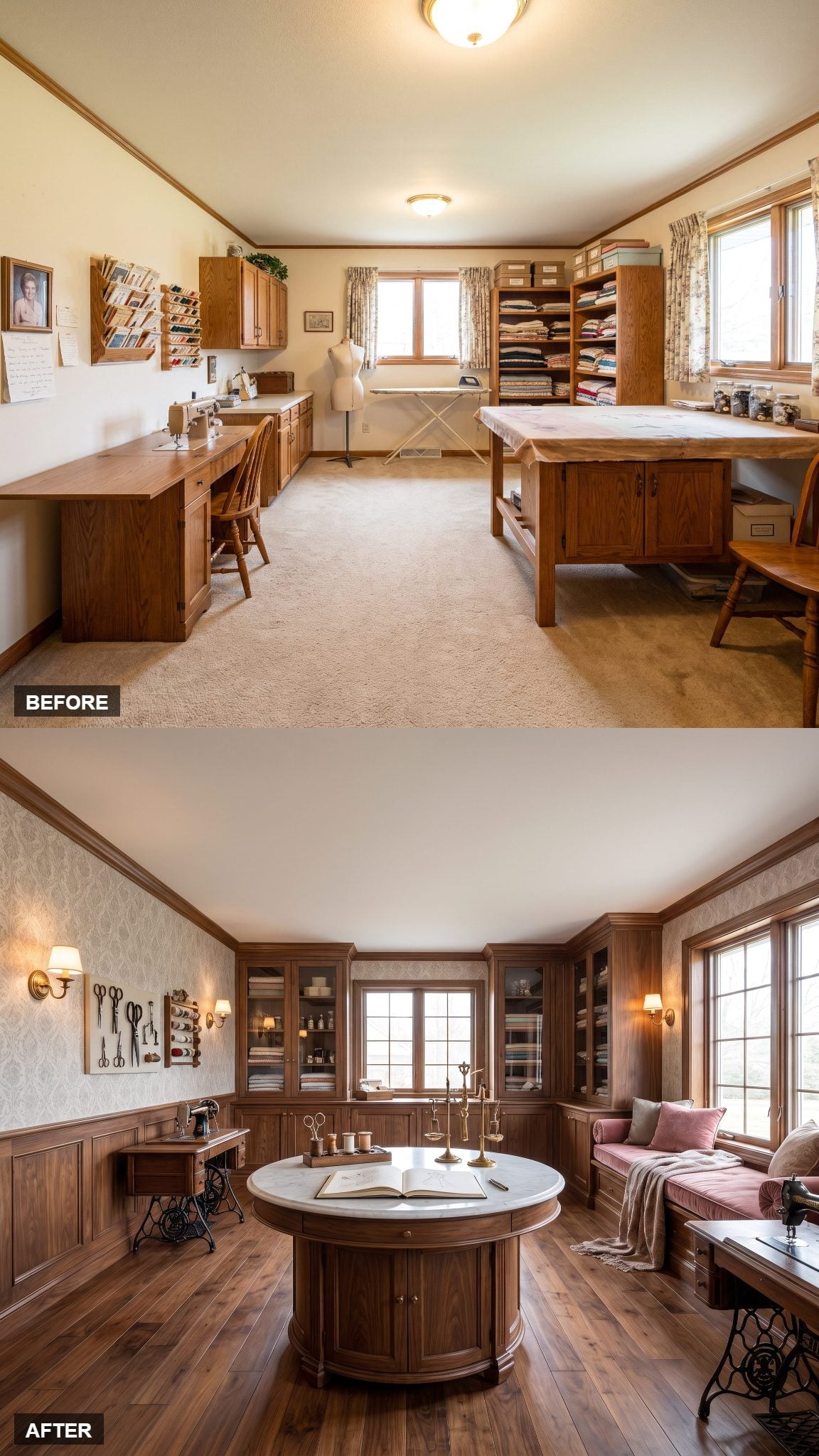
The round marble-topped worktable changes the circulation immediately. You can approach it from every side instead of squeezing around the corners of another rectangle.
Dusty rose at the window and paneled walls soften the formality, while antique scissors displayed on little brass stands provide a sharp link back to traditional needlework. The old object gets the attention without requiring the entire room to become a period piece.
13. Fashion-House Production Suite in Pale Oak and Ivory Lacquer
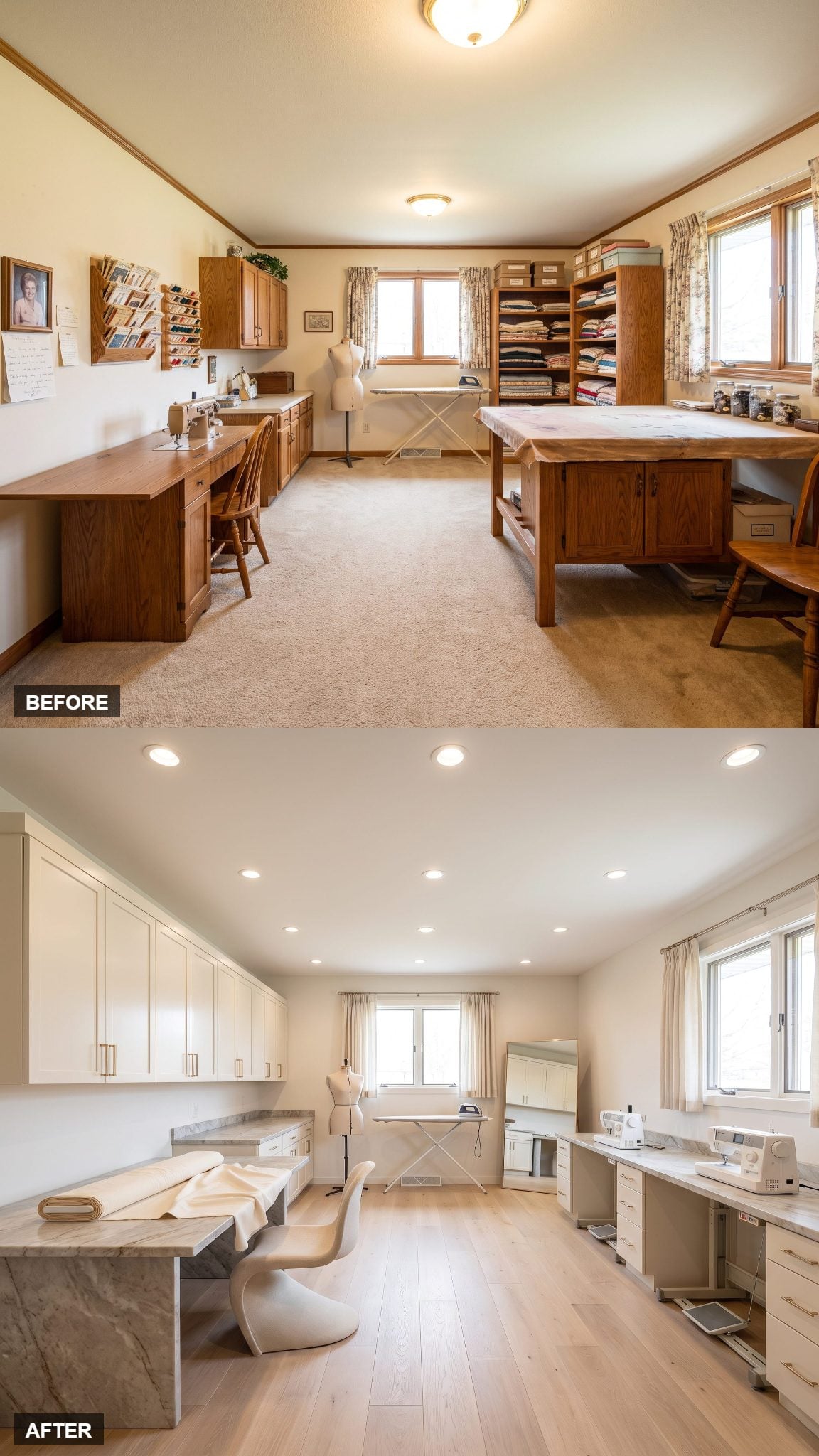
This room stops asking one table to do four jobs. Cutting happens up front, two sewing stations occupy the back, and fitting gets the daylight.
Cabinetry stays mostly on one wall so the middle remains clear enough to move fabric and garments between stations. Pale oak and ivory lacquer keep all that organization from feeling institutional. The layout is the luxury.
12. Quiet Luxury Cashmere-Tone Studio
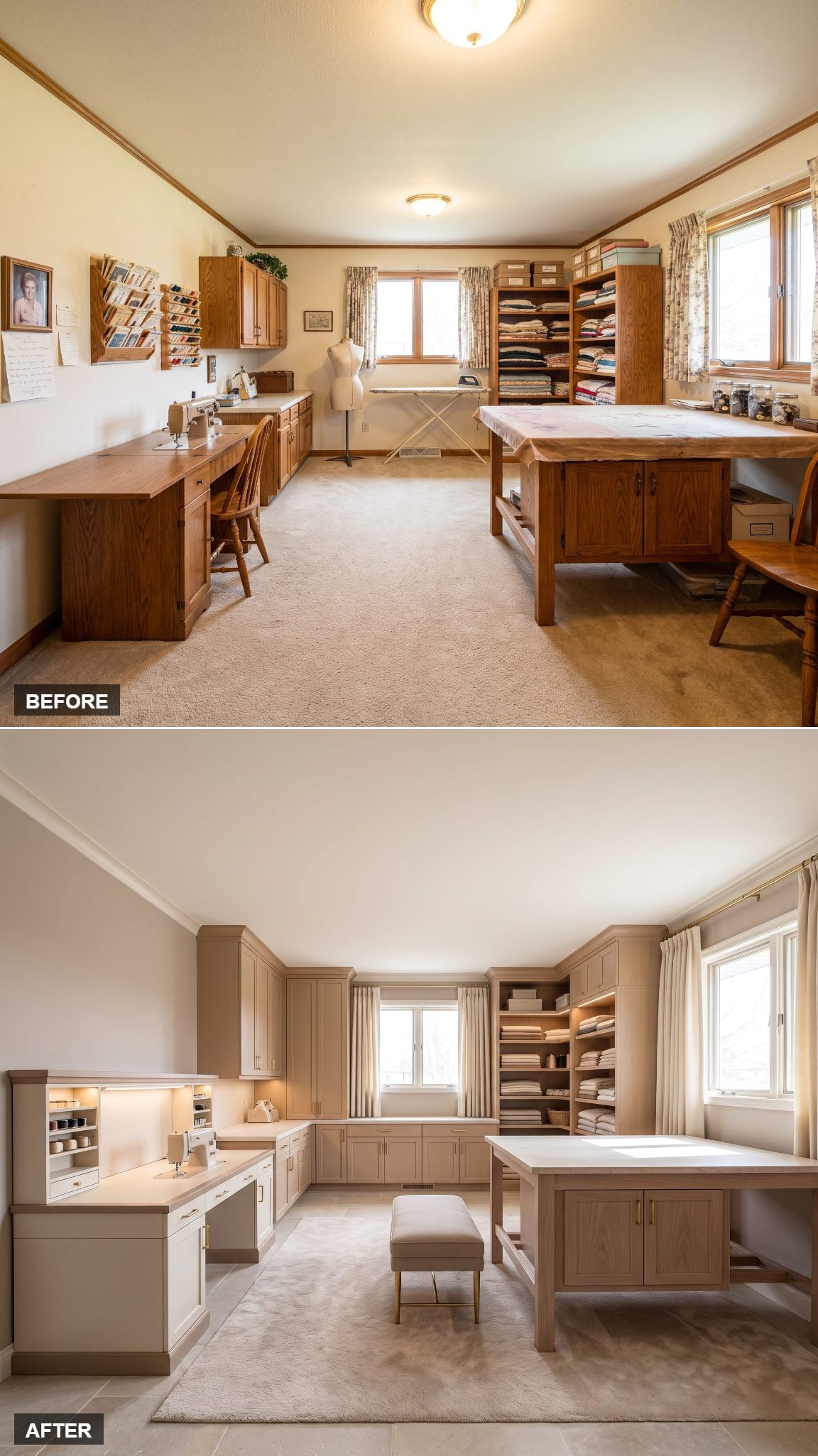
The cutting table moves toward the windows while a long sewing console takes the opposite wall. Then almost every color gets turned down.
Greige cabinetry, oatmeal stone and undyed linen shades filter the room into one soft register. A wool throw, ceramic vase and muted thread spools barely interrupt it. Nothing shouts because nothing needs to.
11. Heritage Museum-Meets-Working Studio in Walnut and Limestone
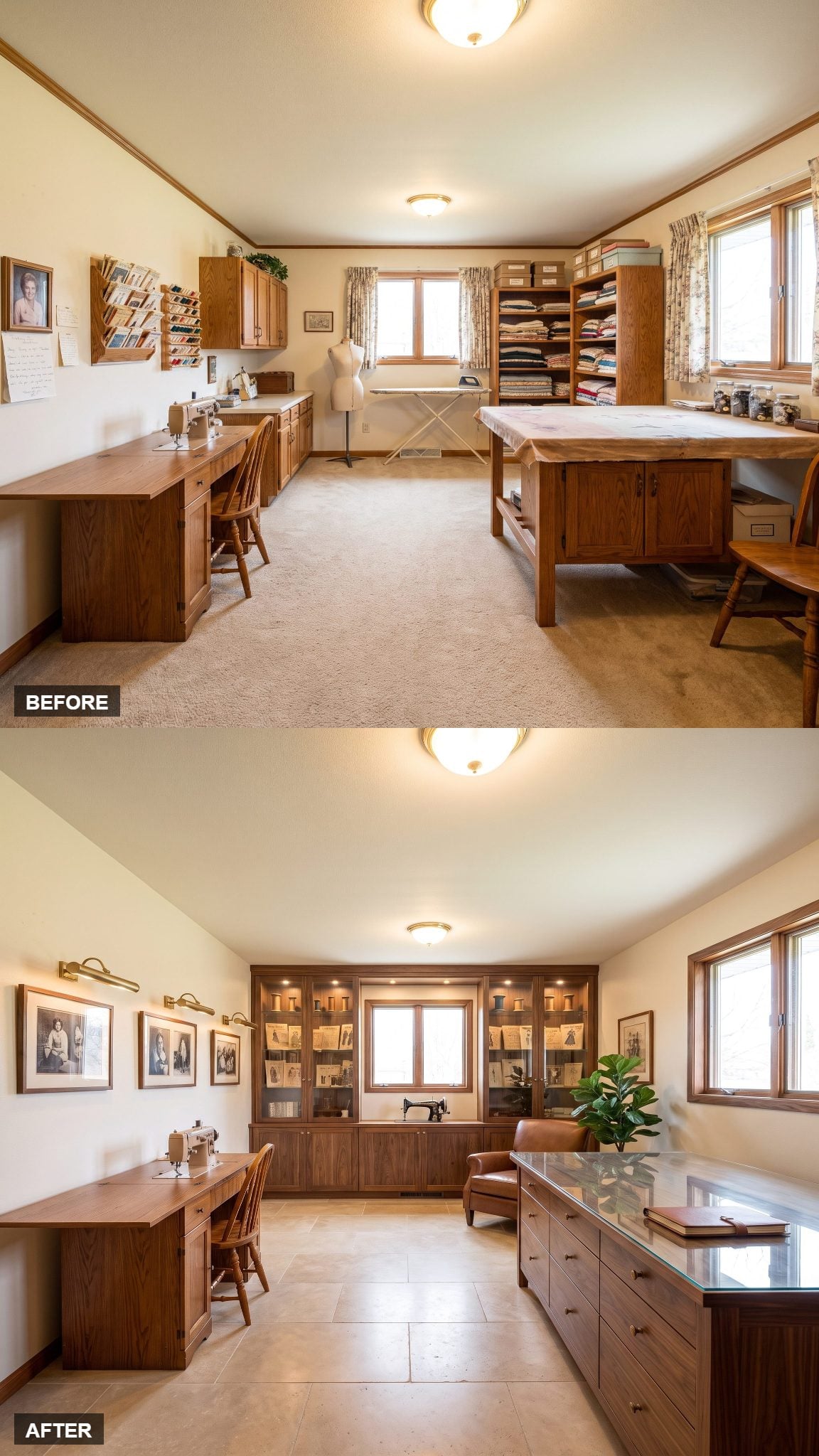
This version asks what happens when the old sewing equipment becomes part of the display instead of disappearing into drawers or under covers.
The rear wall becomes an illuminated archive of thread, photographs, an older sewing machine and small working objects. Walnut and limestone keep the display grounded, while the cutting table ensures the room hasn’t turned into a museum where nobody is allowed to touch anything.
10. Luxury Loft-Style Textile Workshop With Two Parallel Worktables
🔥 Would you like to save this?
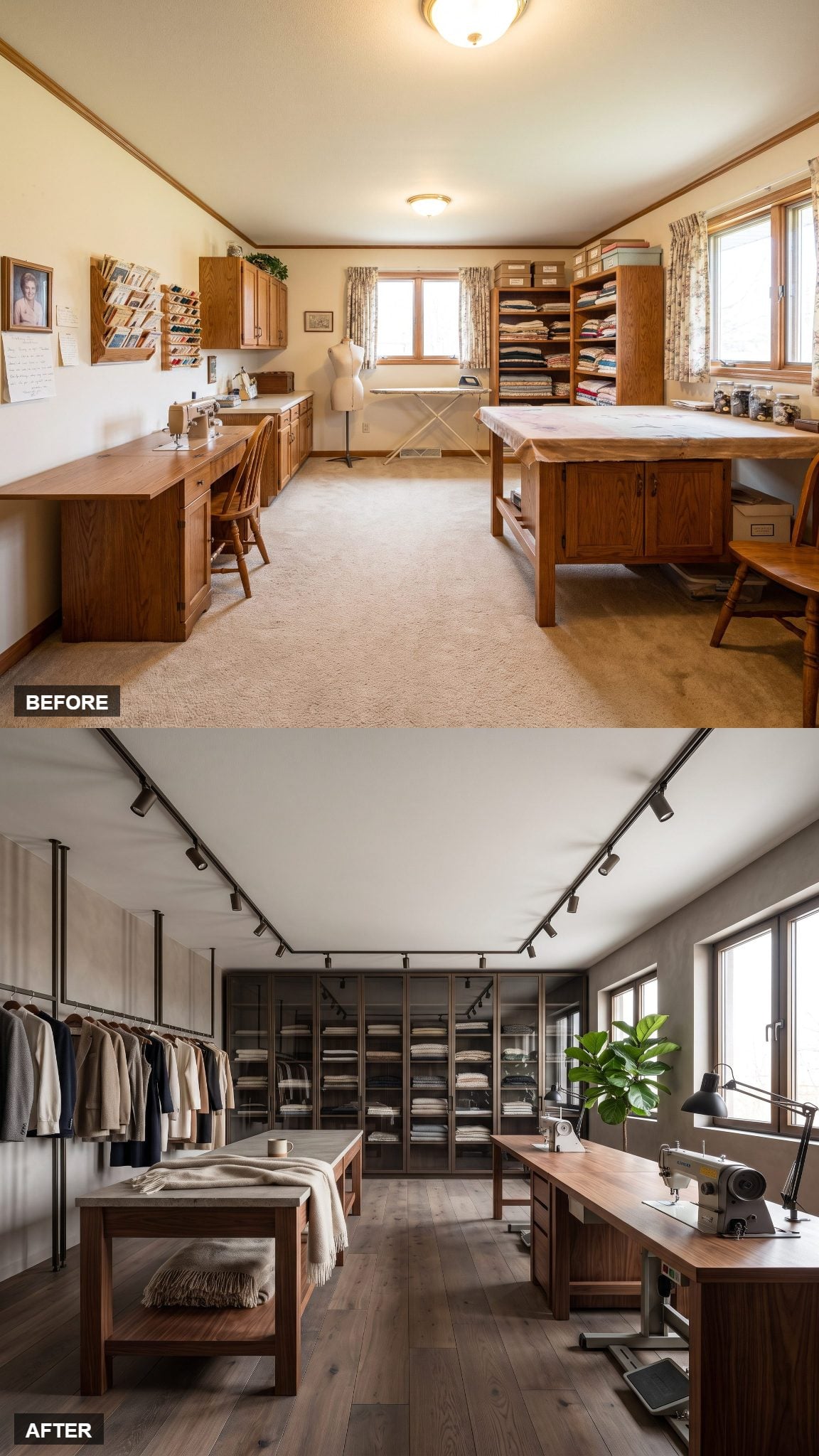
Two tables instead of one island. It sounds minor. It completely changes the workflow.
One surface handles cutting while the other stays dedicated to sewing, so unfinished work doesn’t have to migrate every time the task changes. Smoked oak floors and bronze-framed glass cabinets bring the loft weight, while warm gray plaster stops the room from going industrial-cold.
9. Luxe Garden-Inspired Sewing Retreat in Sage and Veined Cream Stone
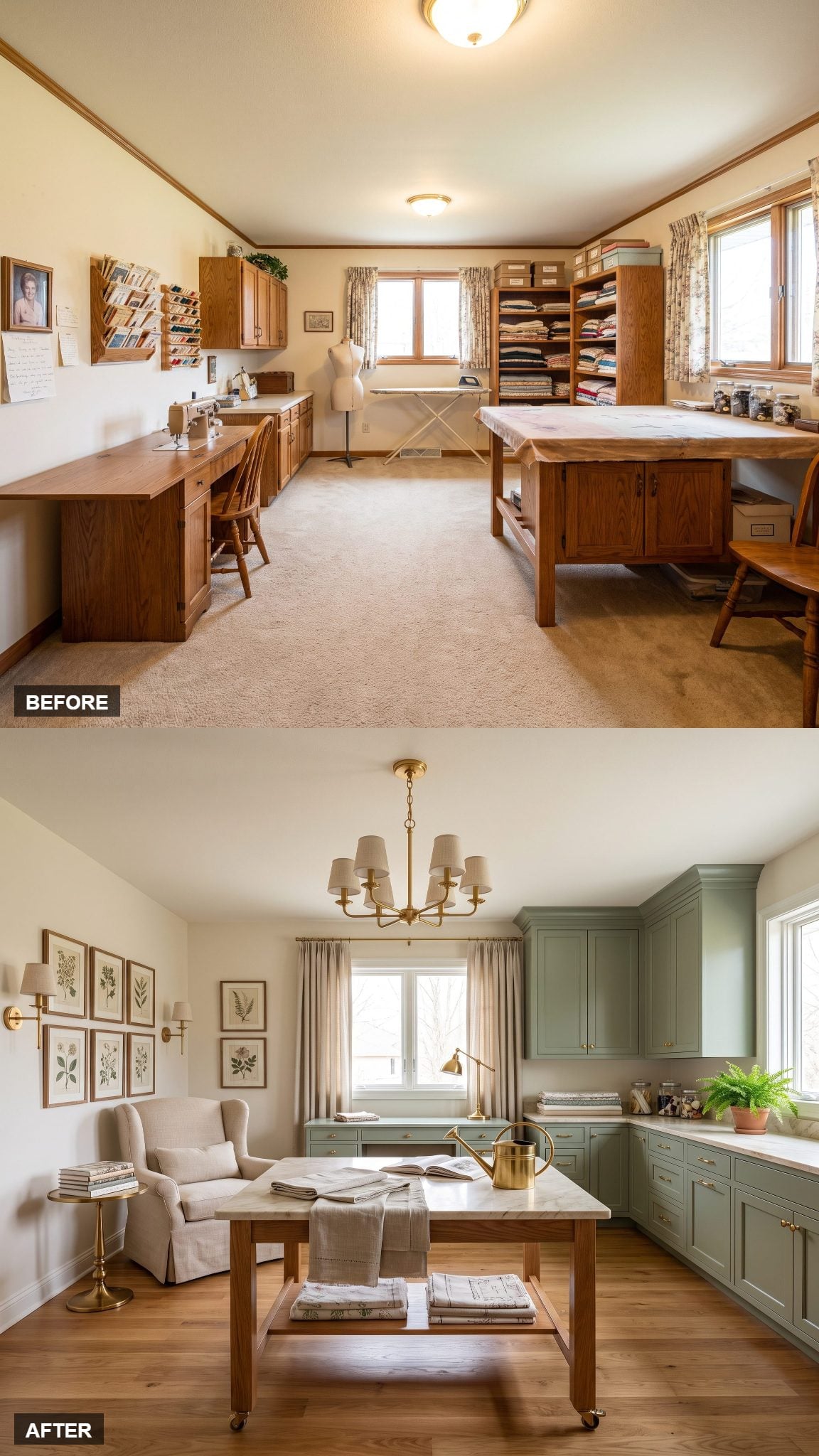
The sewing desk claims the wall between the windows, putting the work close to generous daylight without making the entire room revolve around a center island.
Sage lacquer gives the cabinetry a garden-room softness, while oak flooring and a linen armchair warm the edges. It has the polish of an indoor studio and the loose mood of a glam shed that somehow got promoted into the main house.
8. Modern Classic Sewing Library
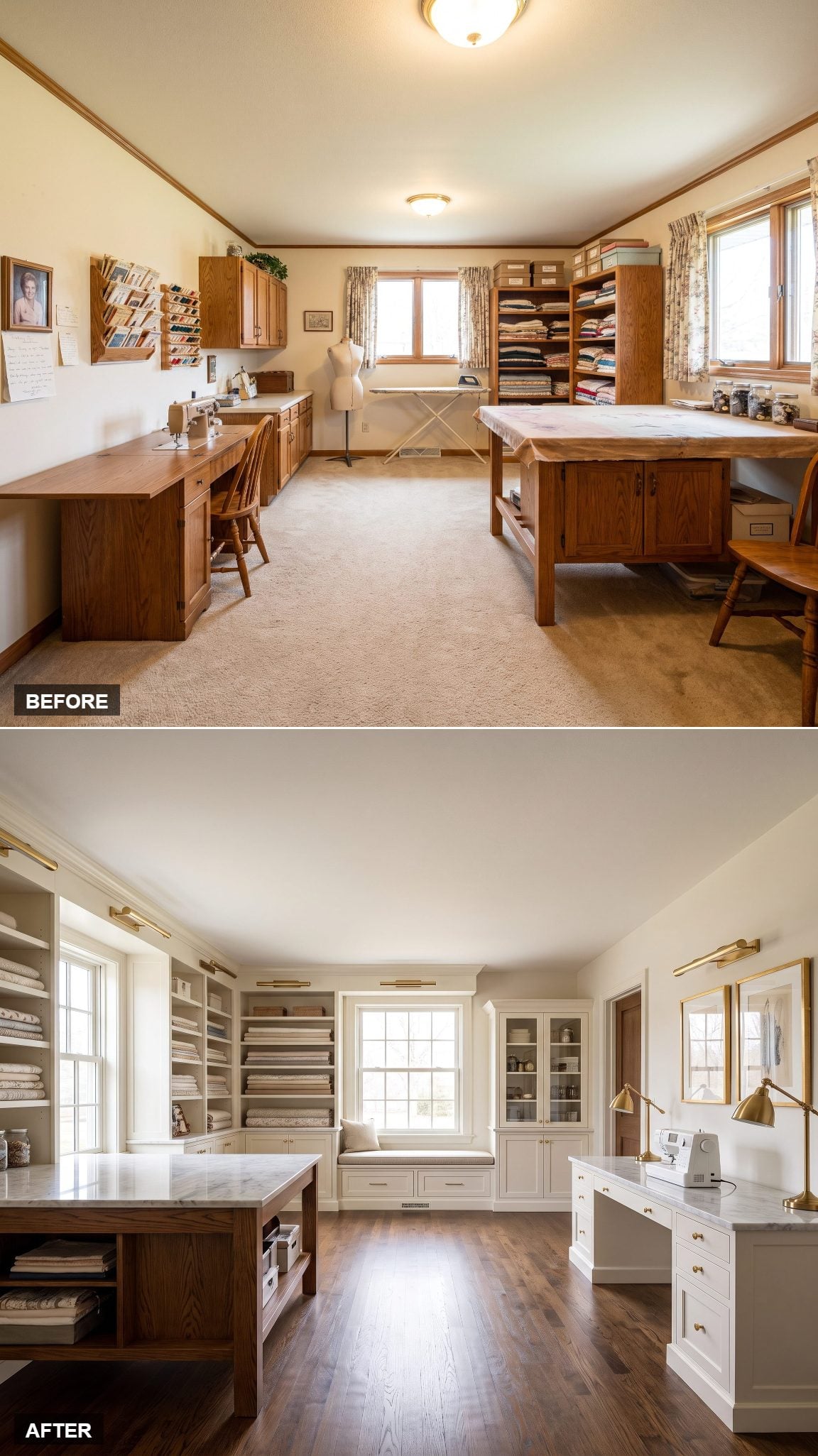
Build a library wall around the windows and let fabric become the collection.
Integrated cabinetry frames the glass, bolts stack like books and a window seat provides somewhere to hand-stitch or sort through a pattern away from the main worktable. The sewing machine moves off to the side so the view can breathe.
Soft gray millwork, linen cushions and pattern books borrow the logic of built-in living room ideas without forgetting that this is still a working room.
7. Sculptural Contemporary Atelier With a Crescent Cutting Island
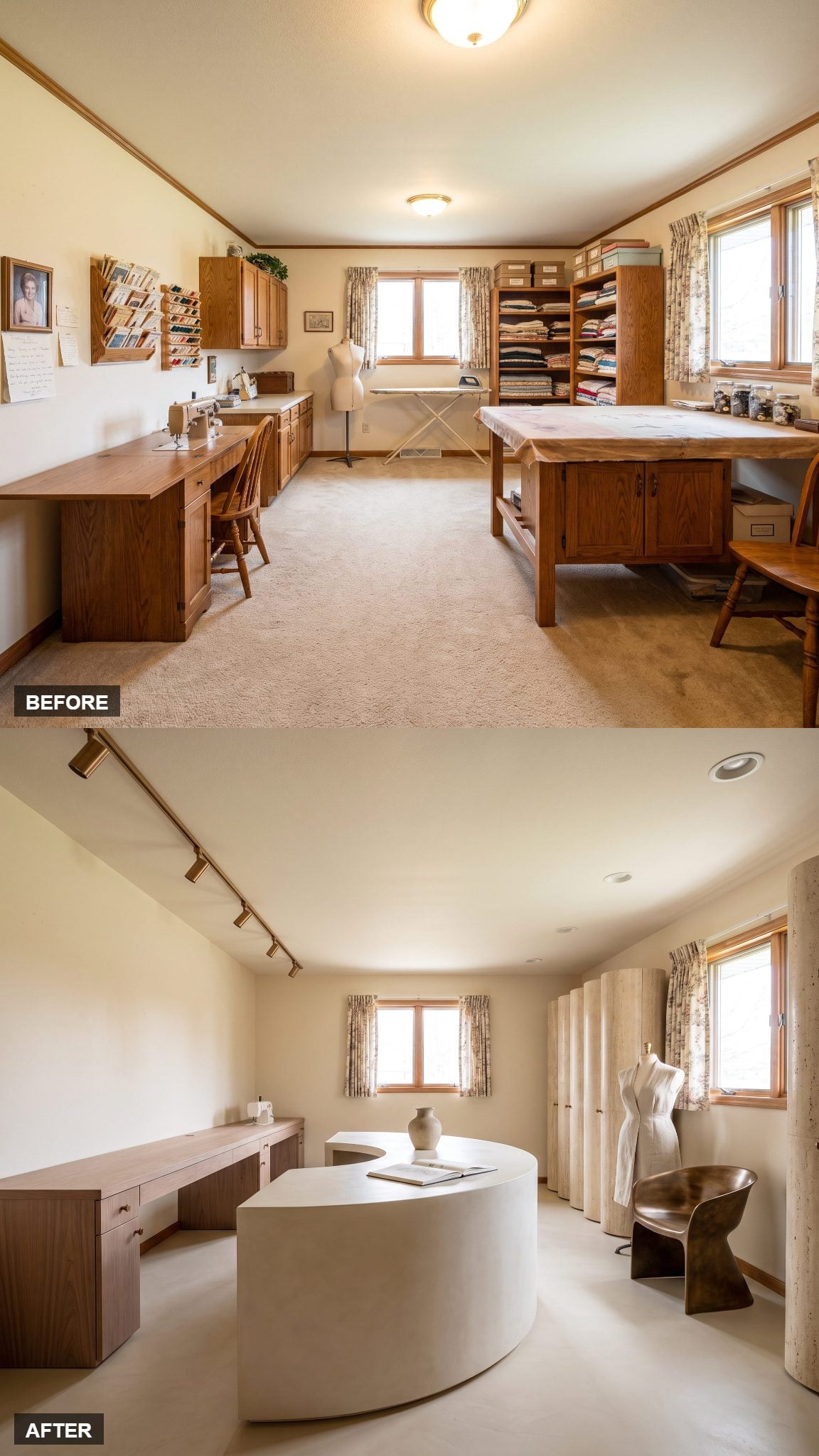
The before is all right angles. The crescent island breaks that rhythm in one move.
Ivory microcement wraps the curve while travertine cylinders repeat the roundness elsewhere. In a room full of tools, boxes and folded fabric, those softer outlines make the entire composition feel less rigid.
6. Boutique Fashion-Studio Layout
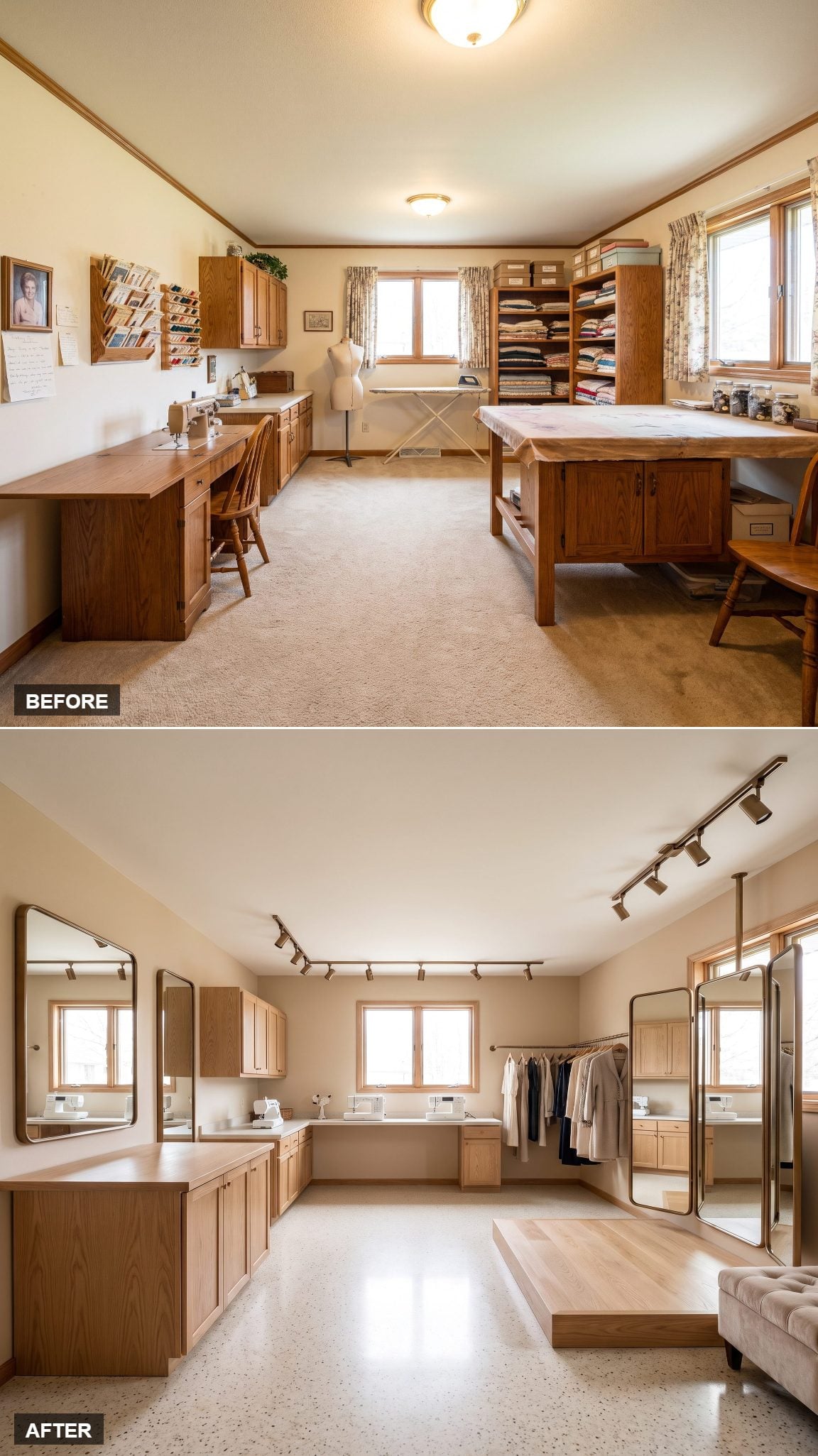
Move the sewing zone across the back, put the cutting island to the left and suddenly the room starts behaving like a private showroom.
Garments hang where you can actually see them. Thread spools become wall color. A full-length mirror gives finished work somewhere to be judged. Soft-white cabinetry, brushed brass cabinet hardware and a tailored bench finish the shift from hobby corner to something considerably more ambitious.
5. Luxury Conservatory-Inspired Sewing Atelier
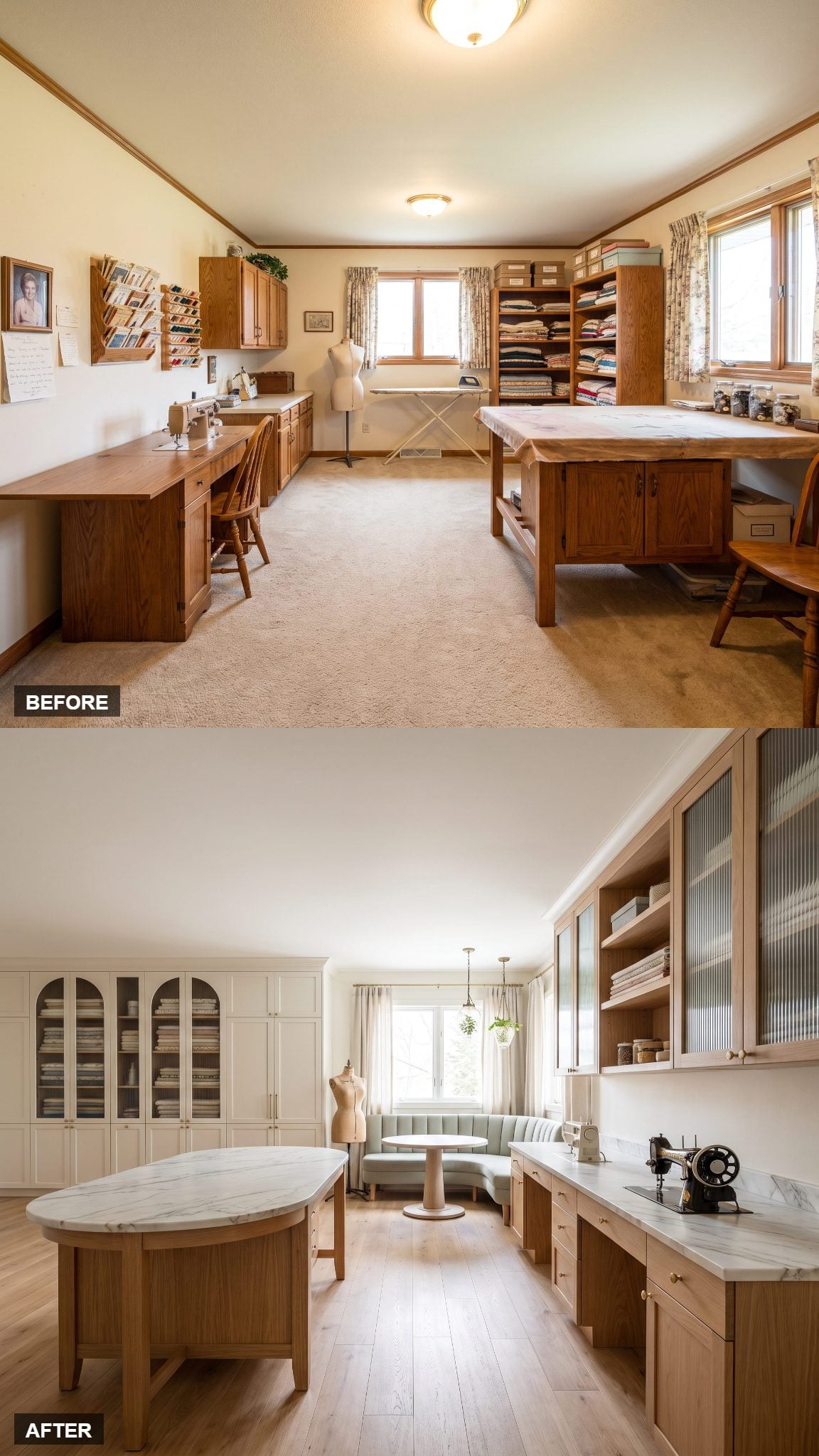
Arched glass-front cabinets turn stacked fabric into display instead of concealment. Storage becomes the room’s prettiest wall rather than the thing everyone tries to disguise.
Pale green-gray on the banquette brings a garden-room note inside, while Calacatta tops and unlacquered brass stop it from tipping into cute. A vintage sewing machine stands restored and illuminated like a small monument, with a vintage sewing basket nearby handling the less ceremonial bits.
4. Luxury Library-Style Sewing Atelier
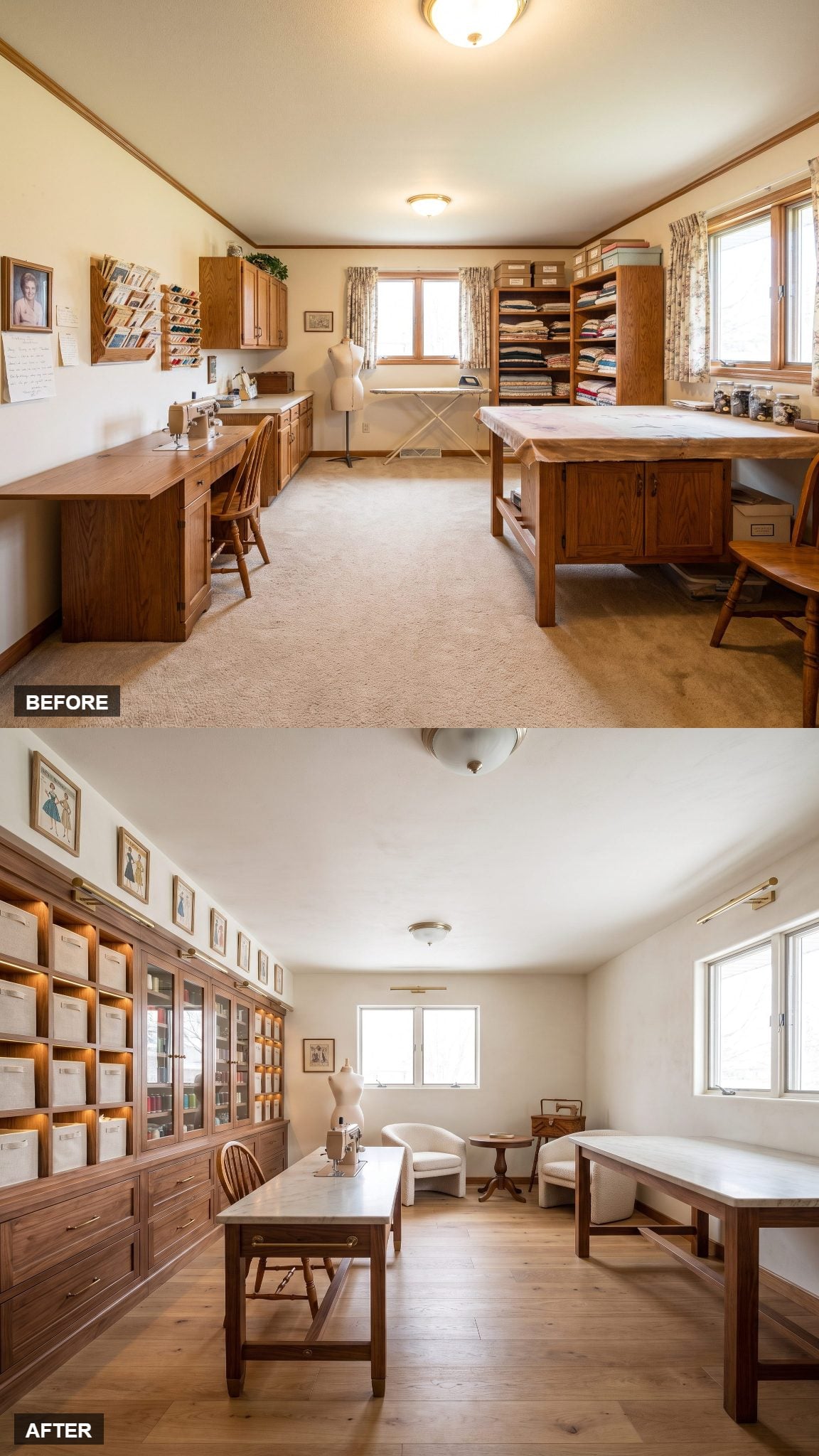
Treat fabric like books and the room changes register. Walnut climbs the left wall in illuminated cubbies, while glass-front cases corral thread and smaller tools.
Creamy bouclé chairs in the rear announce that this is somewhere to linger as well as labor. The picture lights are doing more than their size suggests: they turn a practical storage wall into a collection.
3. Elegant Curved Couture Studio in Cream Lacquer
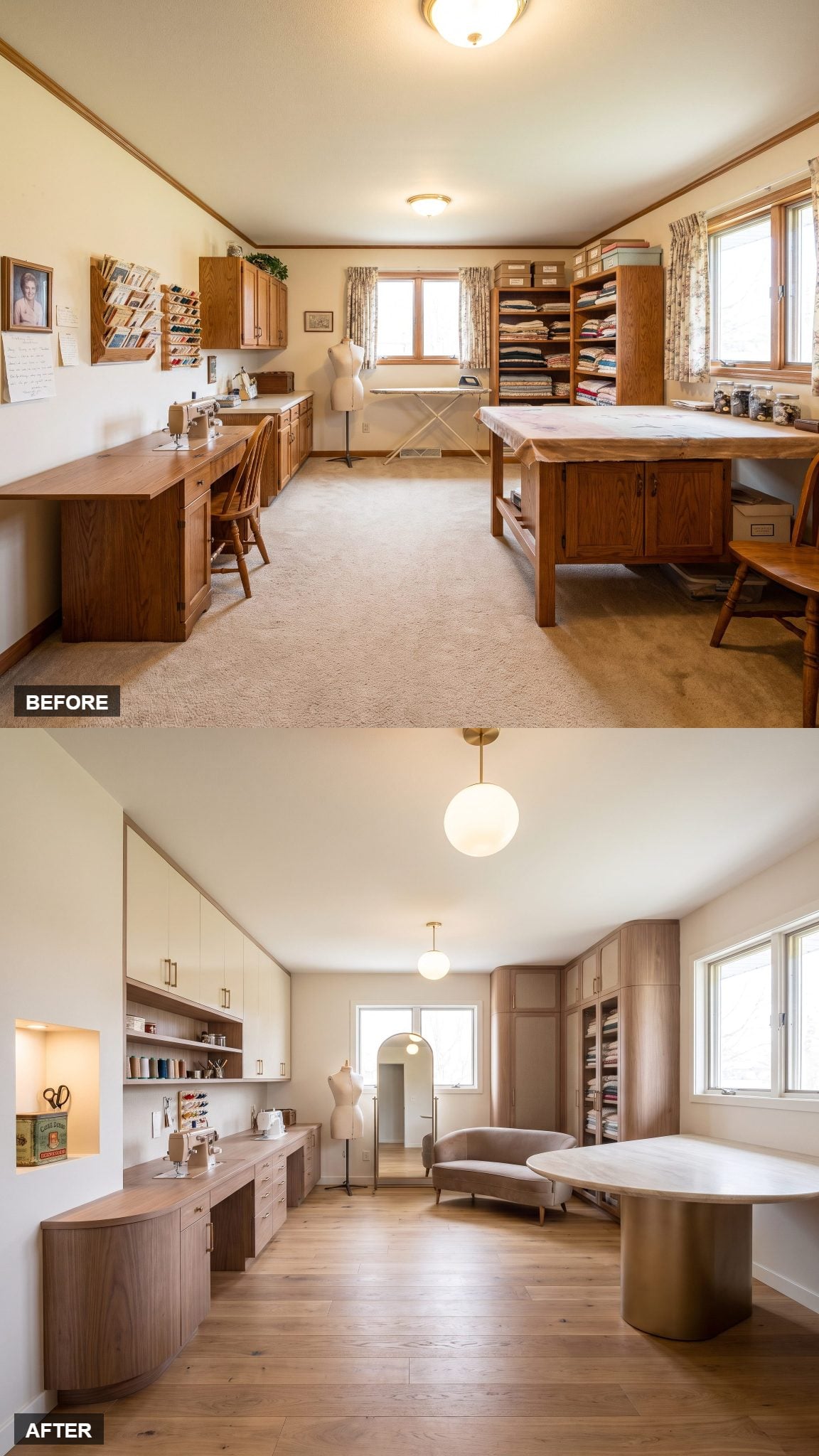
This is the full-commitment version of the curved-room idea. The sewing station rolls from the back wall toward the left, the cutting table becomes a teardrop and even the cabinets lose their hard corners.
Cream lacquer and softly veined limestone keep the geometry from becoming futuristic, while a curved velvet settee at the window turns the fitting area into somewhere you’d actually sit. Recessed niches give a vintage sewing tin and scissors their own little spotlight — a nod to sewing-room history without turning the room into a shrine.
2. The Ultimate Bespoke Sewing Suite
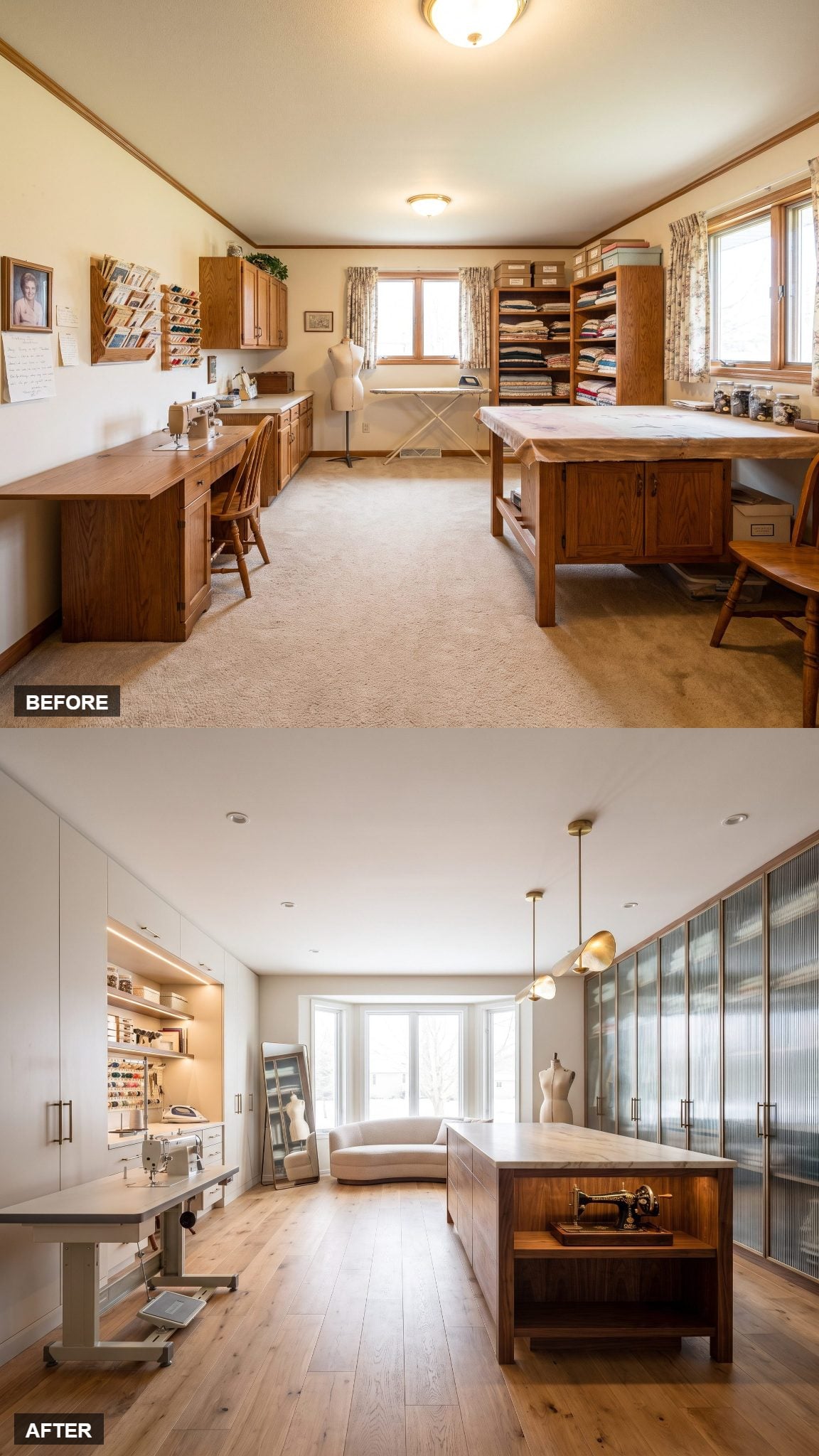
Four zones, one room. Cutting happens at the rear island, stitching takes the front-left corner, fabric storage occupies the right wall and the windows become a fitting area with a curved sofa.
Book-matched walnut and creamy quartzite bring the luxury, but the smarter move is circulation. Each job has somewhere to happen without requiring the room to be reset first.
This is what happens when a hobby room gets designed like a working couture house.
A vintage sewing machine sits in the fitting zone as a displayed design object rather than equipment that has to be hidden away. Older tools and ultra-polished finishes can share the same room without either one pretending to be the other.
1. Ultra-Luxe Textile Gallery With Central Runway
🔥 Would you like to save this?
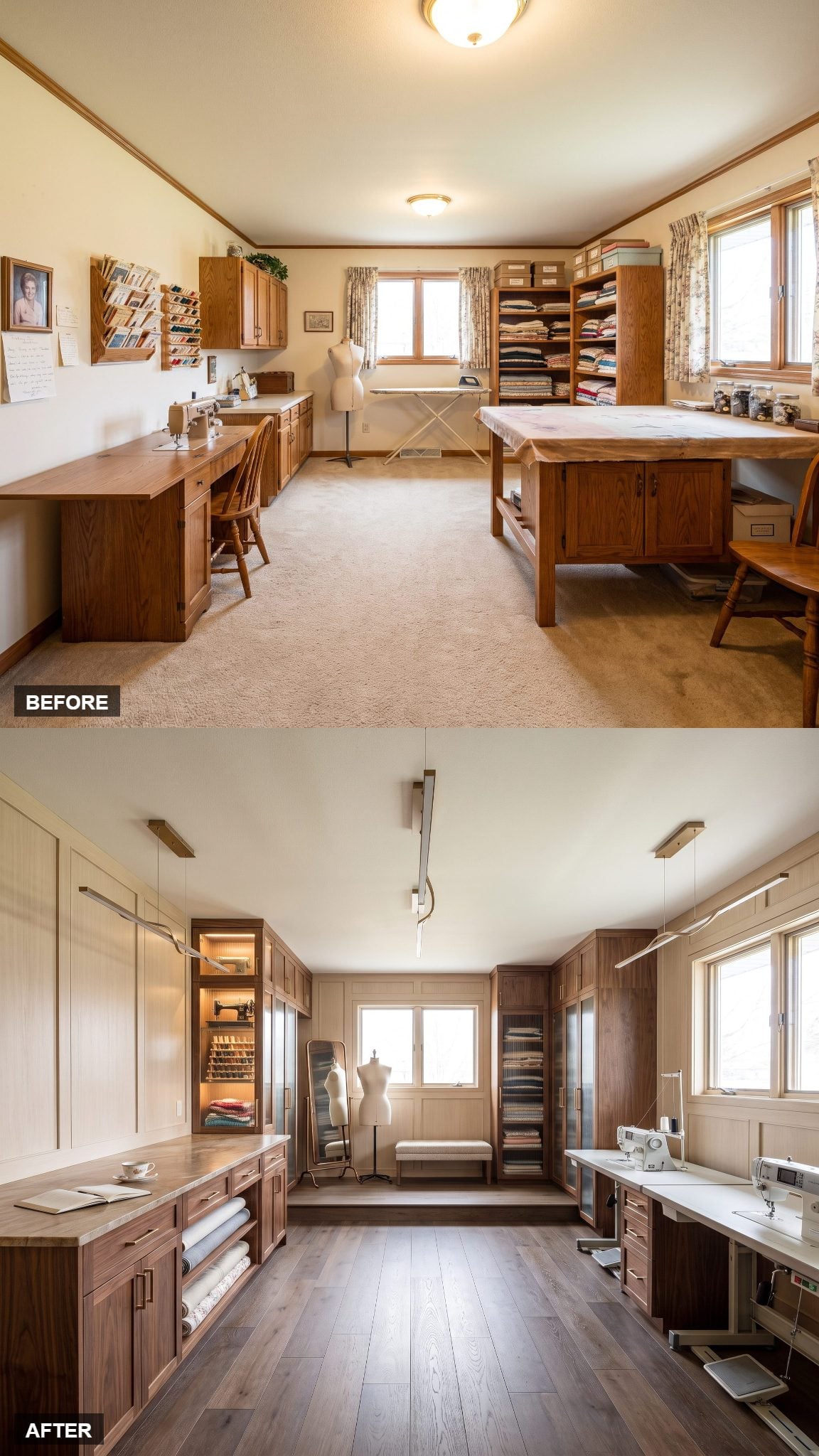
Most sewing rooms fight desperately for floor space. This one gives the center away. Every major work zone moves to the perimeter, leaving a long smoked-oak spine aimed directly at the fitting platform and bronze mirror.
A quartzite work counter occupies the left wall with drawers and fabric storage underneath; twin sewing stations face it across the room. Two projects can stay alive at once without one machine colonizing the only usable surface.
The final move brings the gallery back to the tools that made the original room a sewing room in the first place. One illuminated walnut glass display cabinet holds a vintage machine, wooden thread rack and folded remnants. Instead of being hidden as clutter, the working history becomes part of the architecture.