
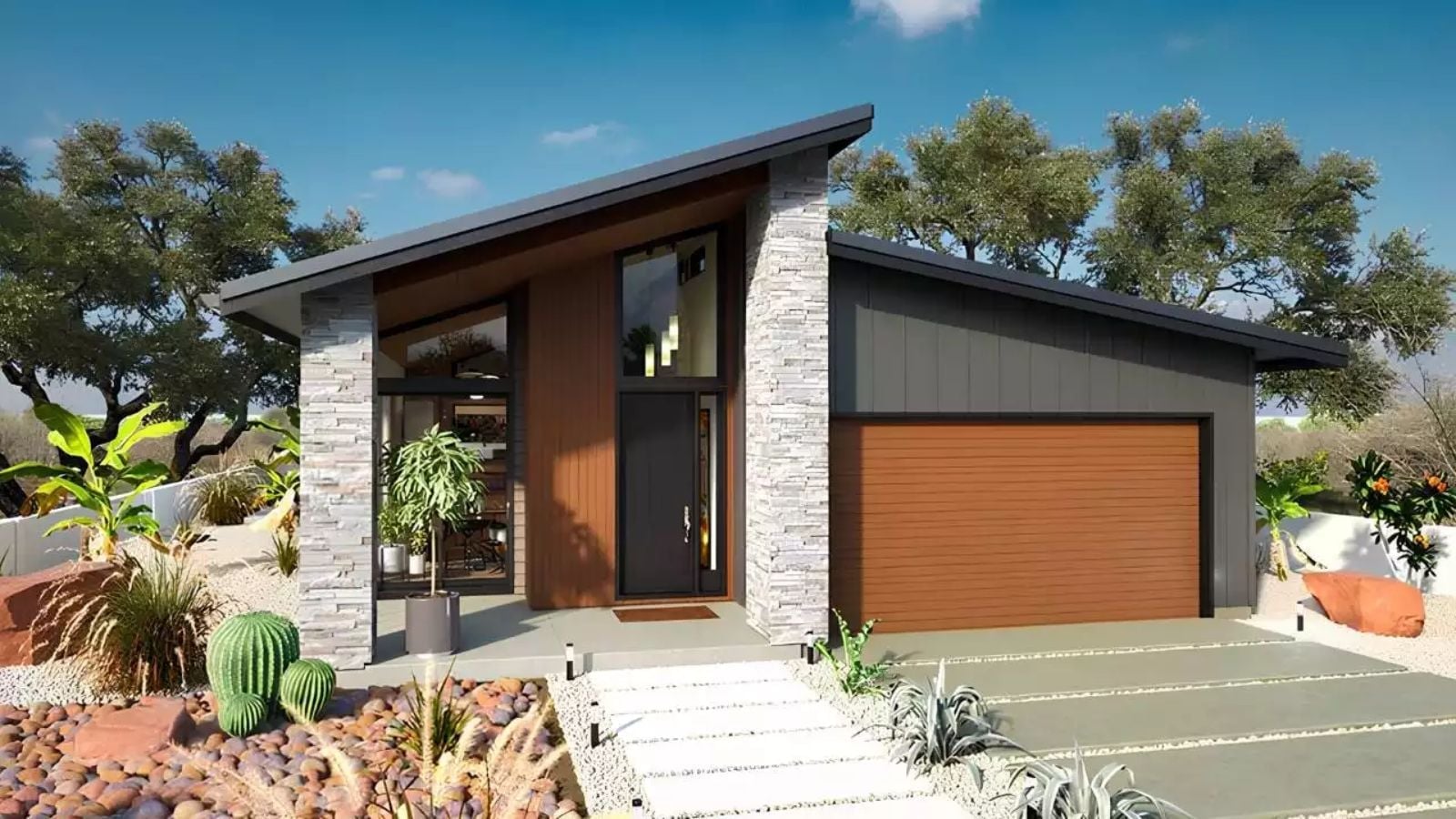
Cookie-cutter subdivisions don’t fail because they’re small — they fail because every wall chops the light and the family into separate rooms, so kids do homework in one corner while dinner gets cold in another and nobody’s actually together. The Clear View fixes the layout problem: open-concept living, a vaulted covered patio, clean sightlines from the kitchen to the backyard, and three bedrooms that stay out of each other’s way.
Specifications
- Sq. Ft.: 1,327
- Bedrooms: 3
- Bathrooms: 2
Floor Plan
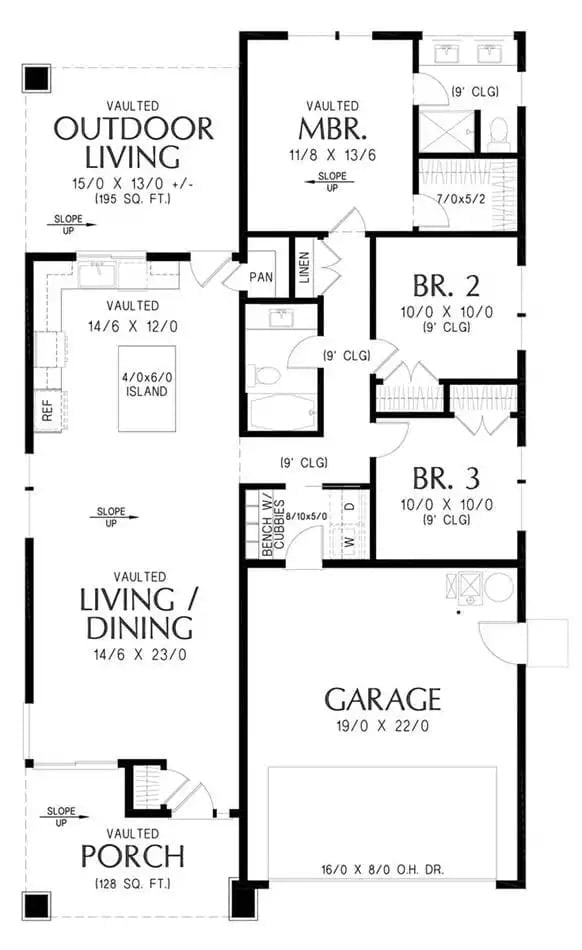
All three bedrooms sit on the right side of the plan, with the master suite separated from BR. 2 and BR. 3 by enough distance to actually matter. The vaulted living, dining, and kitchen run open toward a covered outdoor living area, and a mudroom with bench and cubbies connects the garage to the main hall without dumping bags directly into the kitchen.
Dark Siding, Stone Column, and a Covered Patio That Actually Has Room to Breathe
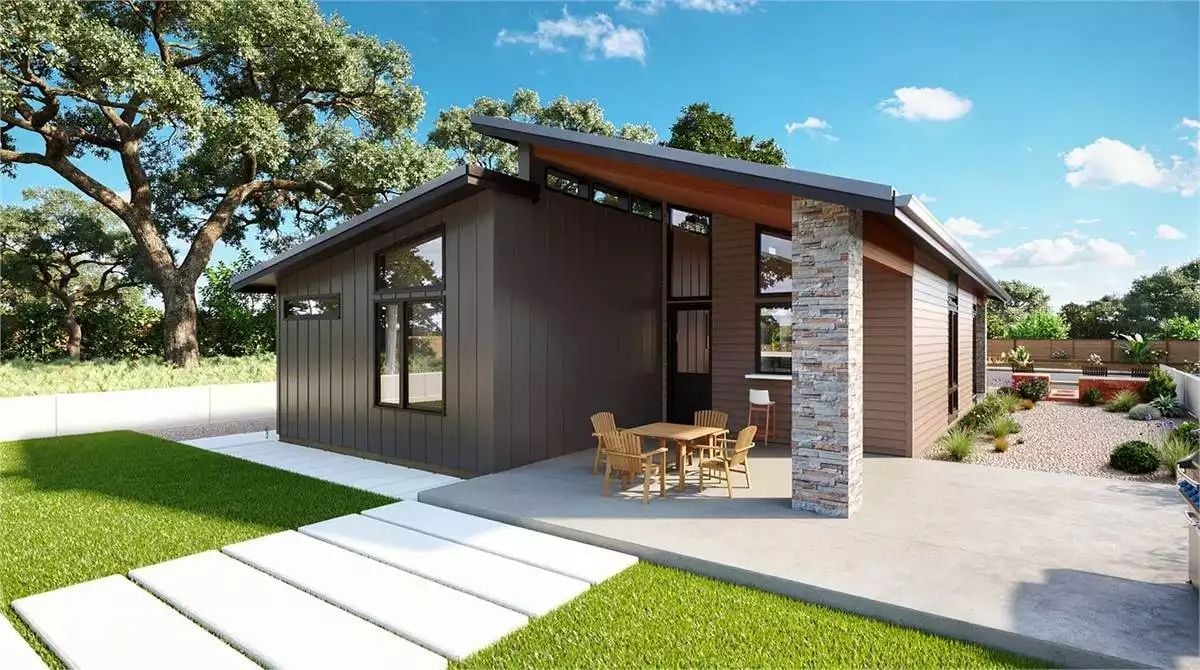
Vertical dark grey siding anchors the left volume while warm cedar-toned horizontal planks wrap the right wing — two finishes that could easily fight each other but don’t, mostly because the stacked stone column at the covered patio gives both something to resolve against. Out front, a wood dining set sits on poured concrete under the overhang. Clerestory windows along the roofline pull light into what would otherwise be a sealed-off façade, and that detail alone separates this exterior from anything you’d find in a standard subdivision.
Walnut, White Linen, and a Fireplace You’ll Actually Use in October
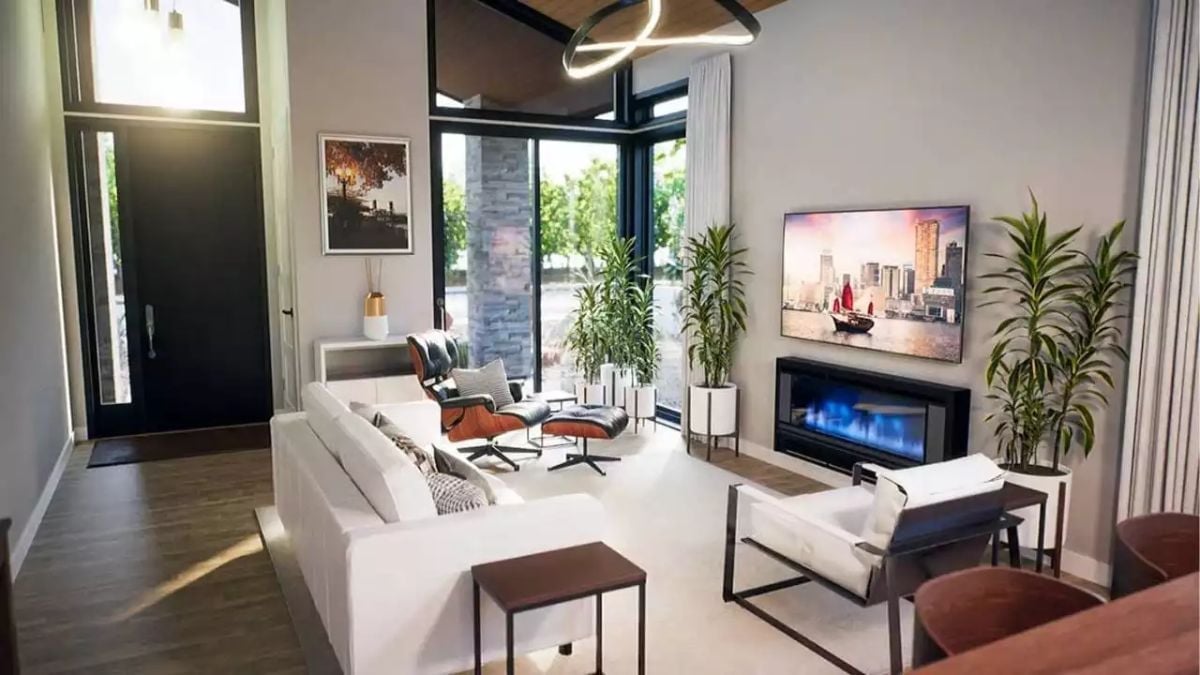
That Eames lounge chair earns its spot — real natural light behind it, not staged beside a blank wall. The wall-mounted fireplace burns blue at the base, which reads more like an architectural detail than a heat source, and honestly that’s fine. What’s doing the real heavy lifting is ceiling height: the ring pendant pulls the eye upward without competing with the windows, and the white linen sofa gives the walnut tones somewhere to breathe.
Red Pendants, Warm Wood Ceiling, and a Kitchen Island Worth Gathering Around
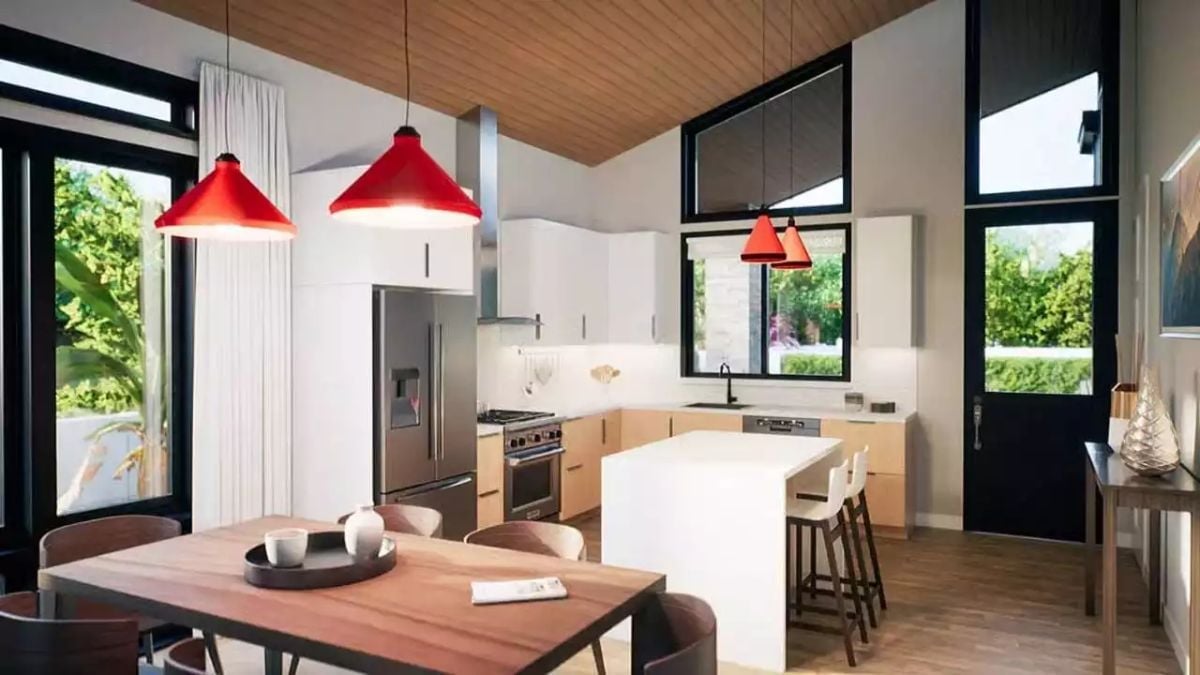
The cone-shaped red pendants are the whole argument for this kitchen. Everything else — wood-planked ceiling, light maple lower cabinets, white quartz island with bar seating — stays grounded so the lights can land without a fight. Simple formula, hard to mess up.
Try This: Swap builder-grade pendant fixtures for bold single-color shades — red, cobalt, forest green. One strong color repeated in multiples reads as a decision rather than a mistake. Keep everything else neutral and let the fixtures carry it.
Globe Lamps, a Low Platform Bed, and Walls That Actually Earn Their Gray
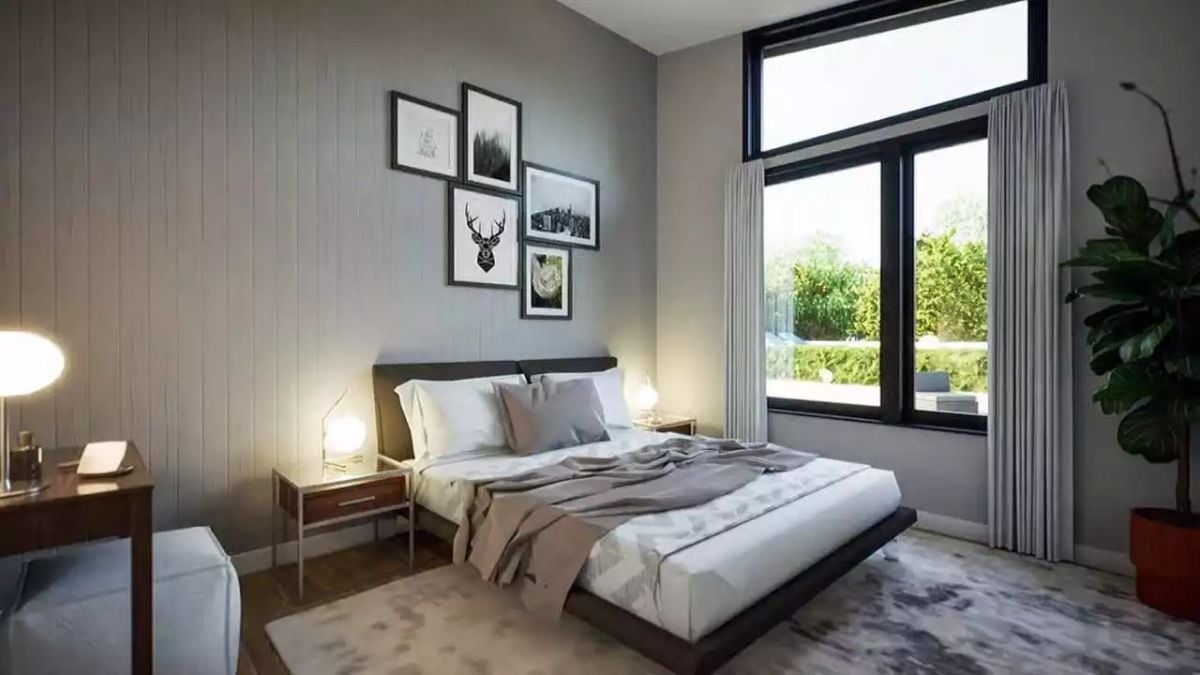
Warm-toned globe lamps on each nightstand do their job without announcing themselves. The platform bed sits low enough that the ceiling reads taller than it probably is, and five black-framed prints above the headboard are grouped tight — no scattered gallery-wall chaos, just a clean block of art that holds the wall without overwhelming it.
Designer’s Secret: Matching lamps on either side of the bed create balance, but swapping one for a taller floor lamp breaks the symmetry in a way that feels collected rather than staged. It’s a small move that reads as personality, and it costs almost nothing to try.
Lighted Mirrors, Matte Black Fixtures, and a Double Vanity That Pulls Its Weight
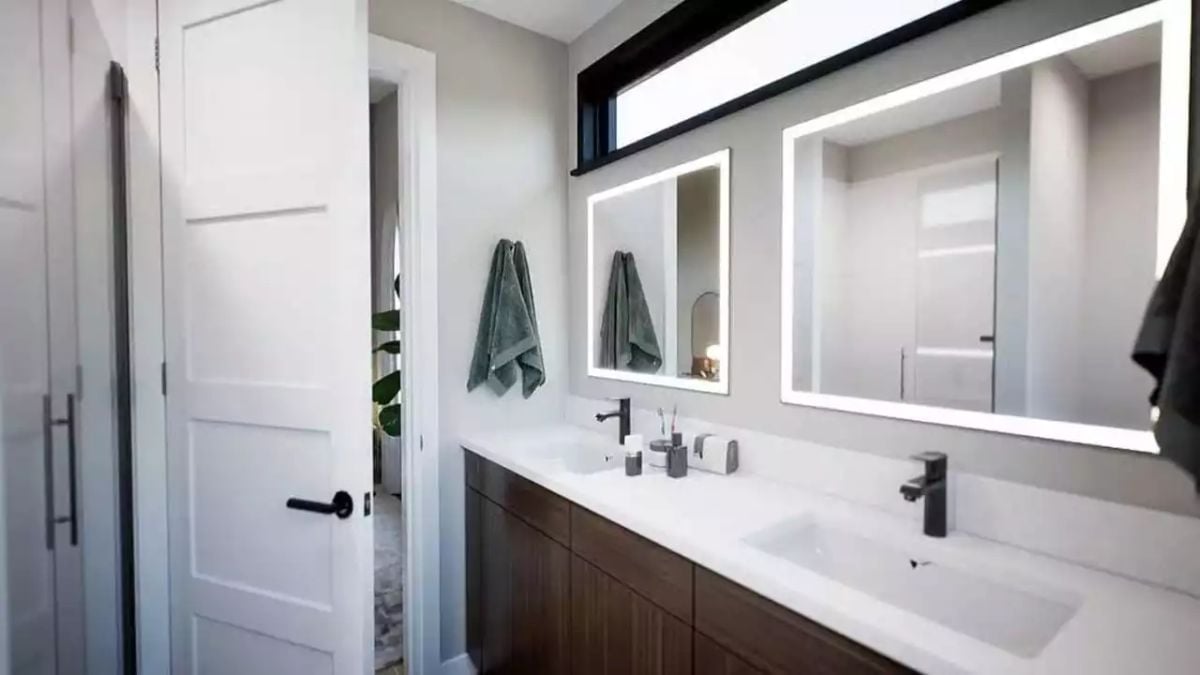
Matching sinks with off-center faucet placement is one of those small decisions that reads far more intentional than it costs.
Warm wood cabinetry against a white countertop keeps the palette from tipping cold, and the backlit mirrors do genuine work here — they cut the need for overhead lighting, which flattens every face it hits. Most bathrooms skip this and you can always tell.
Pin It
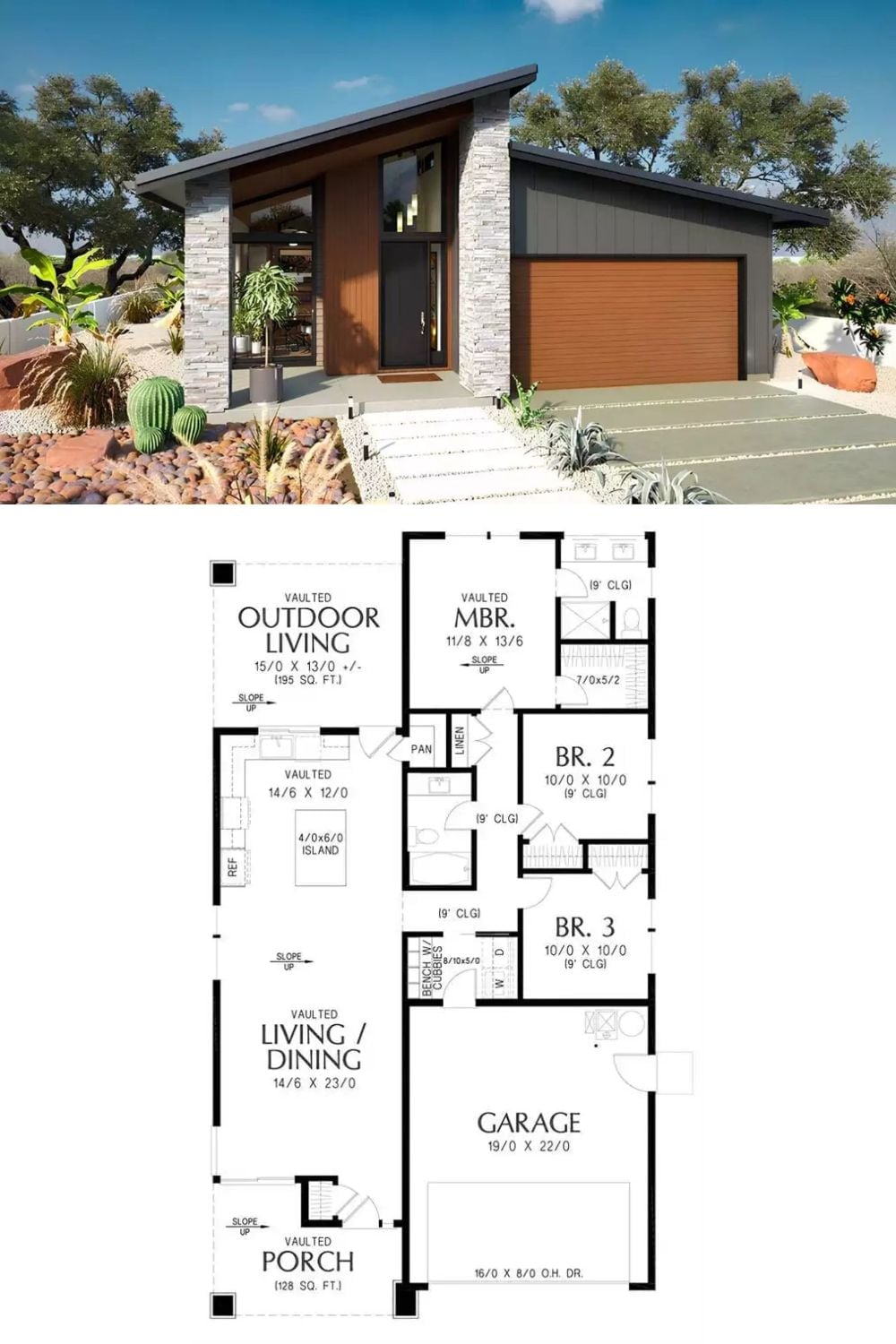
The exterior rendering shows a mid-century modern home with stone columns, wood siding, and a two-car garage. Below it, the floor plan lays out three bedrooms, vaulted interior spaces, and a 195-square-foot covered outdoor living area that’s large enough to actually use.
Editor’s Note: Vaulted ceilings aren’t just a visual upgrade — hot air rises, and in an open-plan layout where cooking heat and smells travel freely, that matters. If you’re building from a plan like this, make sure your HVAC contractor is sizing the system for cubic footage, not just square footage. Most don’t ask unless you push them on it.