🔥 Would you like to save this?
Somewhere along the way, the ceiling fan got sentenced without a trial. Out went the blades; in came the sculptural pendant, the plaster flush mount, the chandelier that looked magnificent and moved exactly no air while everyone underneath it quietly roasted.
In order to come up with the very specific design ideas, we create most designs with the assistance of state-of-the-art AI interior design software. Also, assume links that take you off the site are affiliate links such as links to Amazon. this means we may earn a commission if you buy something.
The problem was never really the fan. It was the brass pull chain, the yellowing white paddles, the swollen light kit, the wrong scale, the awkward downrod and the builder-grade fixture installed wherever the electrical box happened to land. Modern fans have changed. More important, designers have finally stopped treating them like embarrassing machinery that needs to apologize for being useful.
These 36 rooms make the case from every direction. Some fans disappear into the ceiling. Others go black, brass, walnut or woven and become part of the architecture. A few are essentially sculpture with a motor hidden inside. The choice is no longer fan or good design. The interesting question is what happens when the fan becomes part of the design in the first place.
36. A Natural-Wood Fan That Echoes the Room’s Furniture
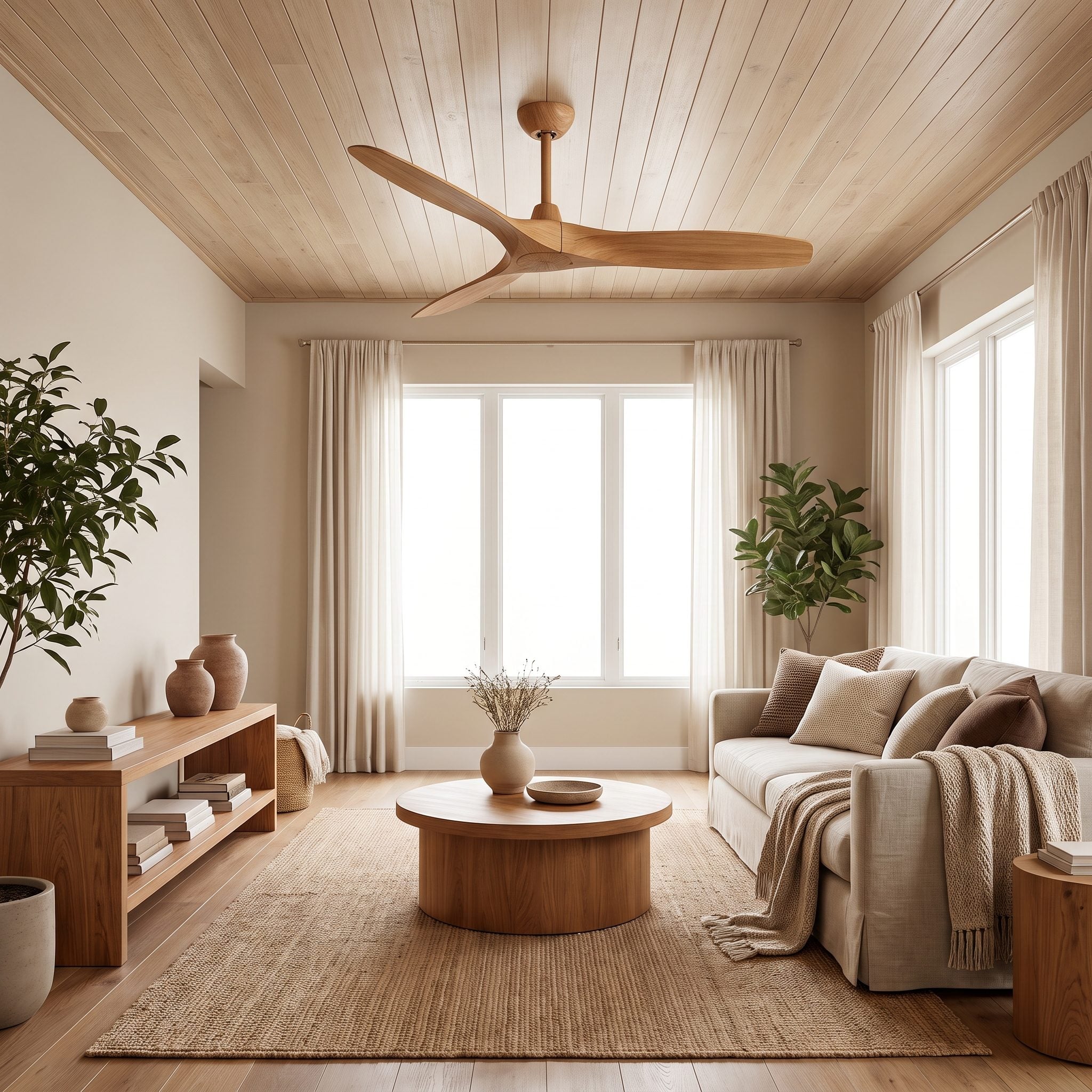
A fan doesn’t have to match the ceiling if it matches the room. Walnut blades above a walnut dining table turn the fixture into another piece of the material palette rather than an appliance that somehow wandered onto the ceiling.
The important part is tone, not botanical accuracy. Medium walnut can live comfortably with oak, leather and aged bronze if the warmth is similar. Cool gray faux wood floating above a room full of warm cherry is where the whole thing starts coming apart.
This works especially well in a retro dining room, where a walnut ceiling fan can pick up the furniture without adding another metal finish to the room.
35. An Industrial Loft Where a Large Metal Fan Looks Completely Natural
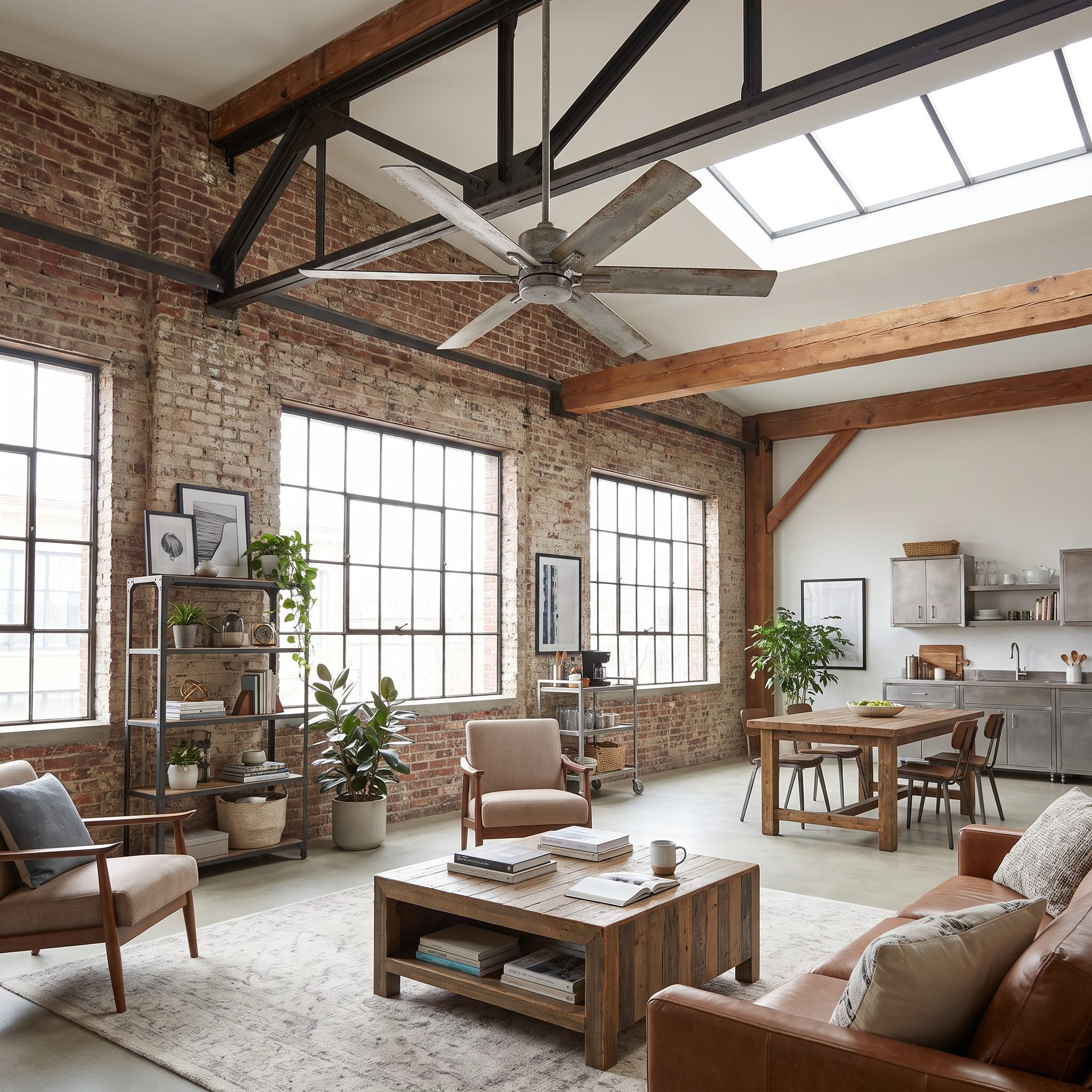
If any room can handle visible machinery, it’s this one. Brick, steel, exposed conduit, open joists and ductwork already admit how the building works. A polished little ceiling fan pretending to be jewelry would be stranger than the big metal one.
A large metal ceiling fan can hold its own against high ceilings and exposed structure, while a long downrod simply becomes one more honest piece of hardware in the composition.
Pair that mechanical honesty with an oversized black iron pendant light and the two fixtures feel related rather than competitive.
34. A Fan Chosen to Match a Color-Drenched Ceiling
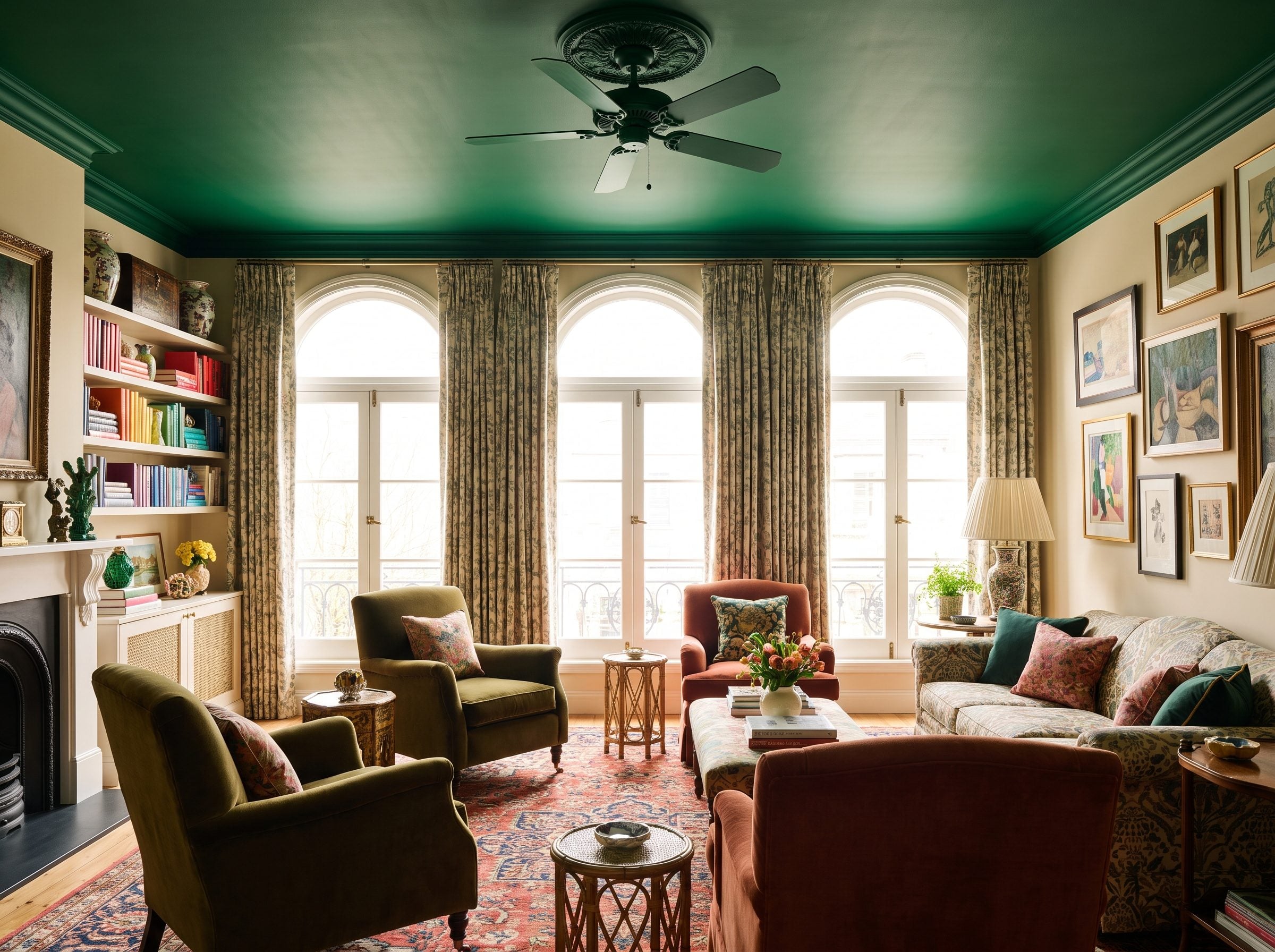
Color drenching gives the disappearing-fan idea considerably more attitude. Paint the ceiling olive, charcoal, terracotta or navy, then choose a fan that stays within the same tonal family.
The blades don’t vanish in the literal sense. They simply stop creating another interruption. That’s particularly useful in a room already committed to color, such as a terracotta family room or a saturated space borrowing some of the drama of a navy powder room.
33. An Oversized Fan That Finally Looks Proportional in a Great Room
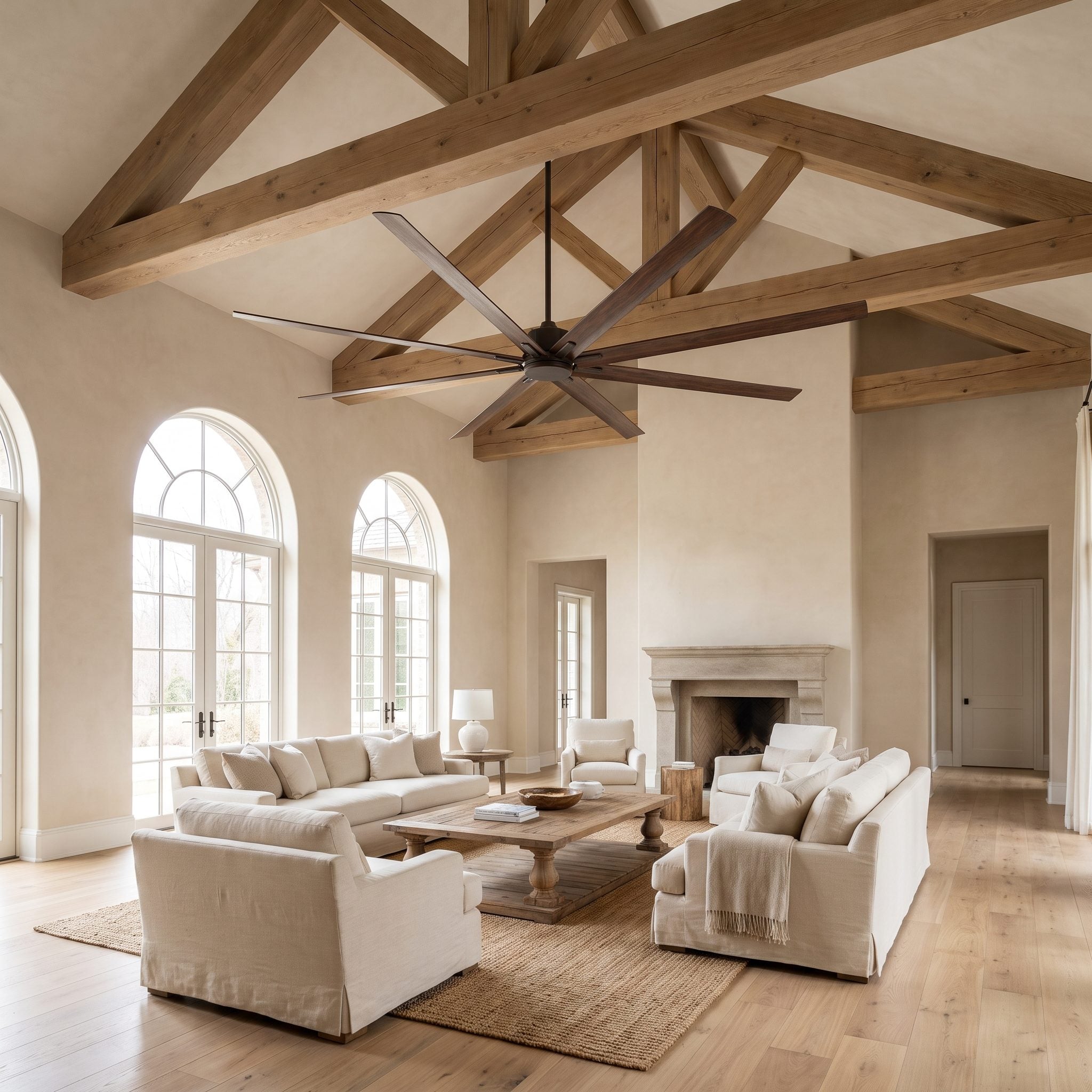
A standard 52-inch fan can look comically timid in a great room with a soaring ceiling. That’s not evidence that large rooms shouldn’t have fans. It’s evidence that scale matters.
Rather than relying on one magic percentage, use the manufacturer’s room-size and airflow guidance. This fan-sizing guide illustrates how blade spans increase with room dimensions, while this larger-fan guide shows how far the category now extends.
Very large or elongated rooms may ultimately work better with more than one fan rather than a single heroic machine in the center. That’s a layout and airflow question, not a universal square-footage cutoff.
32. A Quietly Elegant Fan in a Hotel-Inspired Primary Suite
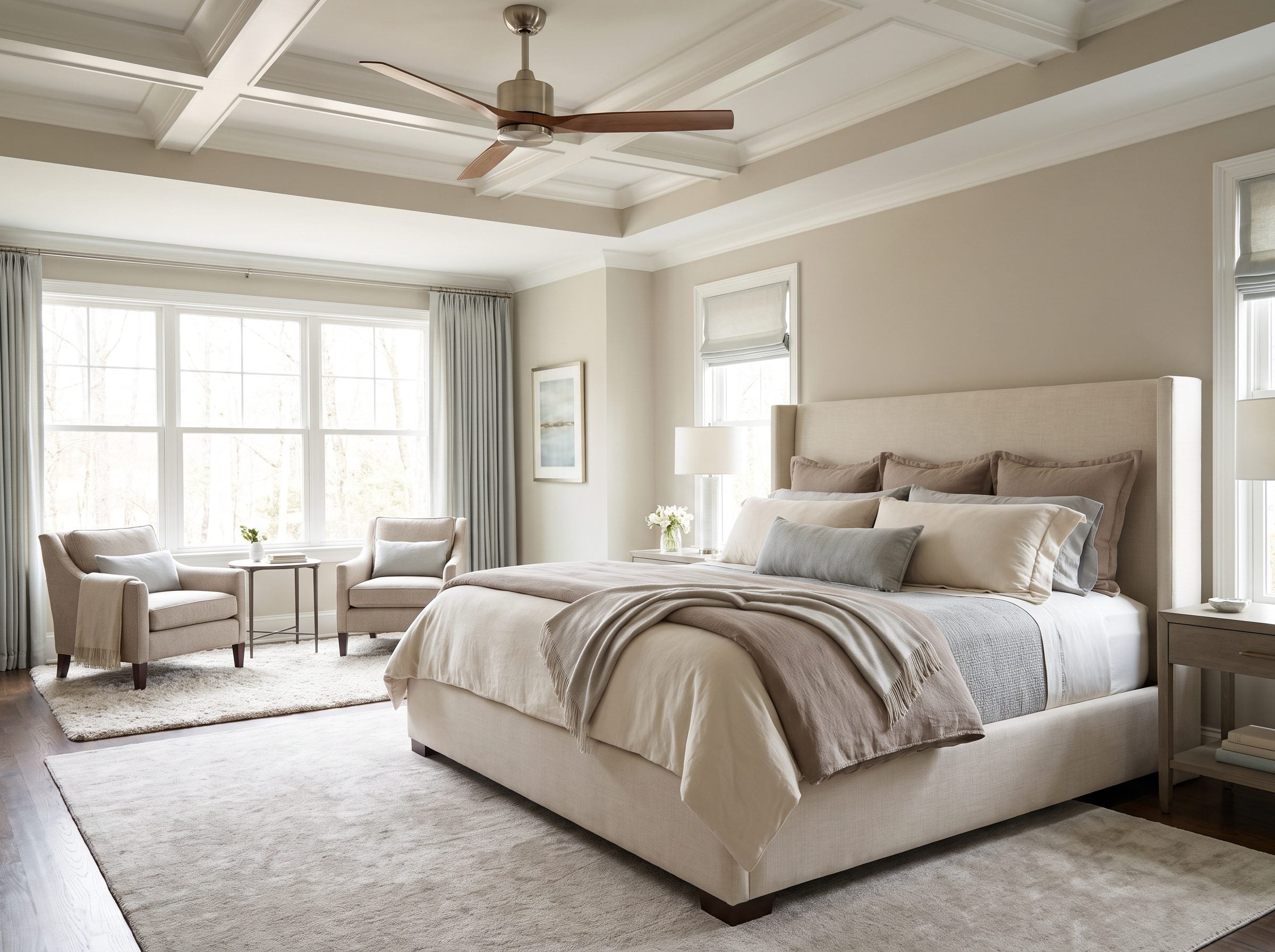
The useful lesson from luxury-hotel design isn’t that every expensive suite has a fan. They don’t. It’s that hospitality interiors routinely prove useful equipment can be specified without letting it dominate the room.
This hospitality fan guide makes the same case: quiet operation, appropriate scale and restrained finishes matter more than simply removing the fixture.
A bedroom sizing guide can help narrow the blade span, but measured clearance remains the final test. On a nine-foot ceiling, a short downrod can bring the fan into a useful airflow zone while keeping the blades comfortably above the seven-foot minimum.
Repeat the warm metal in sconces or a brass picture light and the fan becomes part of a quieter, hotel-like hardware palette.
31. A Midcentury Room Where a Propeller-Like Fan Fits the Architecture
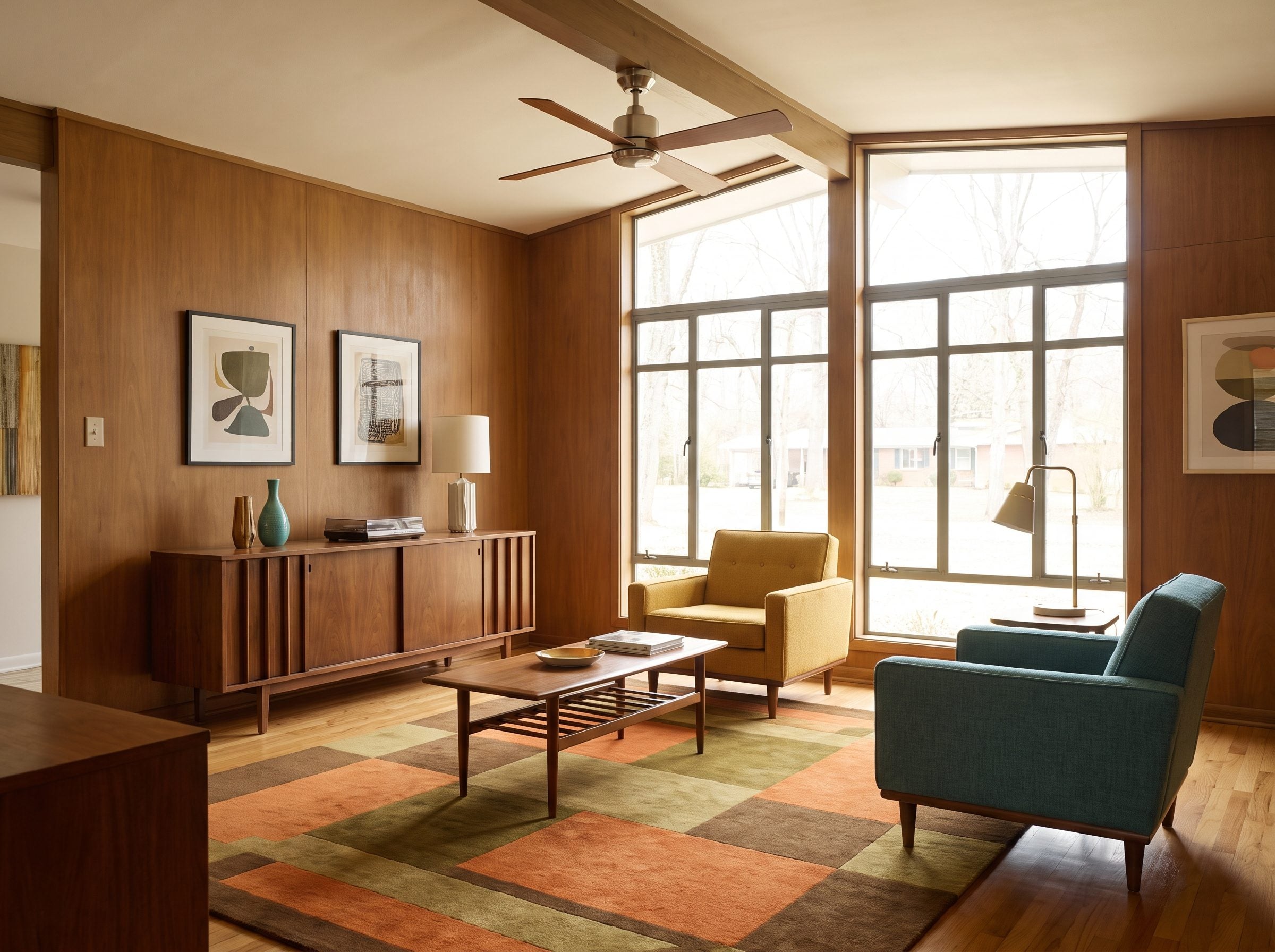
Some fans don’t need to disappear because their geometry already belongs in the room.
Ron Rezek’s work helped push the ceiling fan away from historicist ornament and toward a much cleaner industrial form. Design Within Reach’s Ball fan and this additional Ball reference show the vocabulary clearly: sphere, blades, almost nothing else.
That reduction sits naturally beside low furniture, walnut cabinetry, aluminum accents and other midcentury forms. No need to invent a historical connection stronger than the visual one. The shapes simply agree.
30. A Ceiling Fan Over a Dining Table That Actually Looks Sophisticated
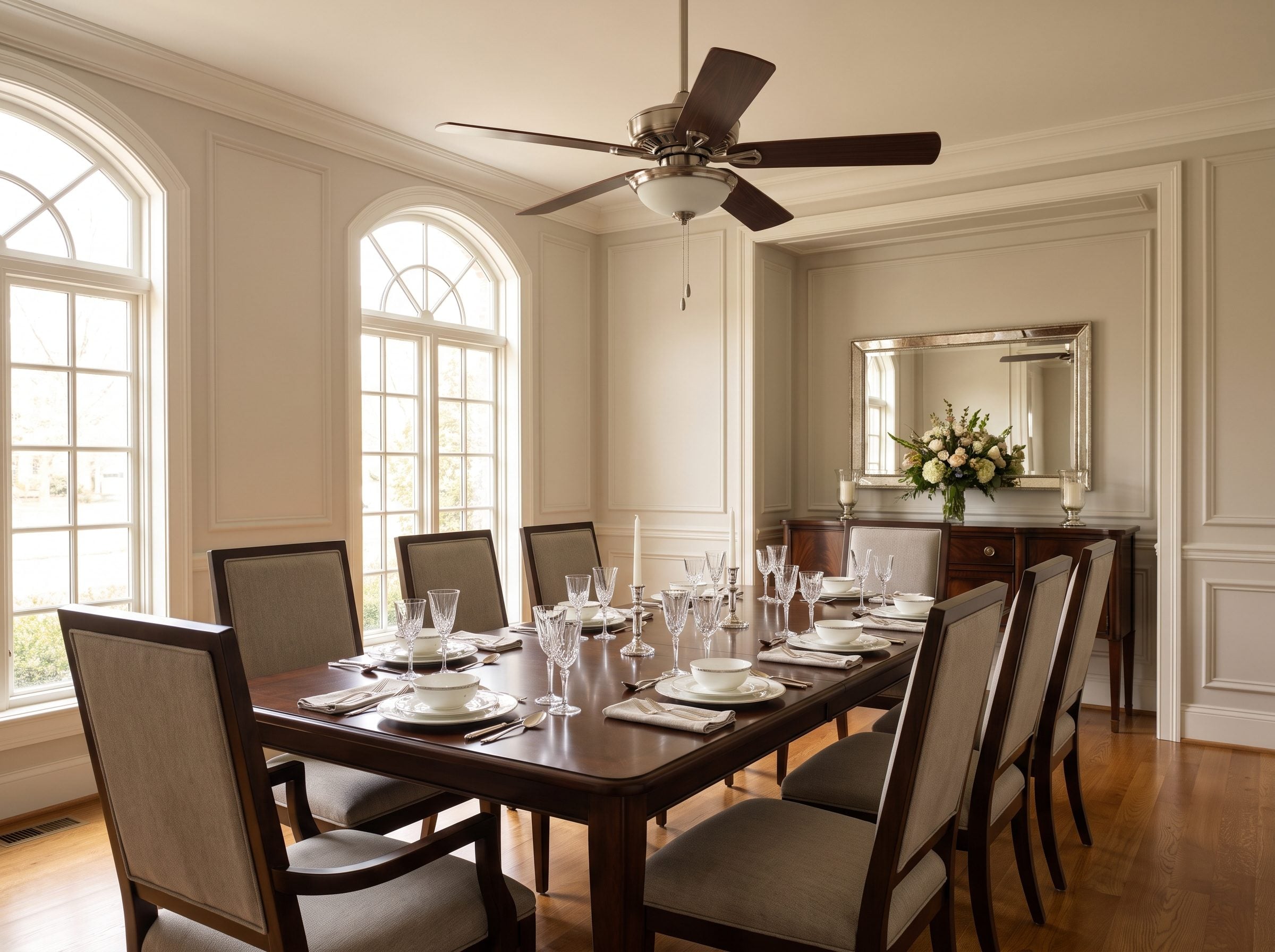
The dining room used to be where ceiling-fan tolerance went to die. Then manufacturers started making fixtures that understood they were hanging over furniture rather than in a garage.
Clearance remains non-negotiable. ENERGY STAR gives seven feet as the general minimum blade clearance, while higher mounting can make sense where ceiling height allows. This dining-room discussion looks specifically at fans over tables.
The hybrid category has even acquired its own name: the fandelier. This comparison shows how manufacturers are blending fan and decorative-light proportions.
In a retro dining room, warm metal can make the idea feel particularly natural. A few aged brass accents nearby keep the ceiling fixture from having to carry the entire metallic story alone.
29. A Tropical Room Where the Ceiling Fan Feels Like Part of the Architecture
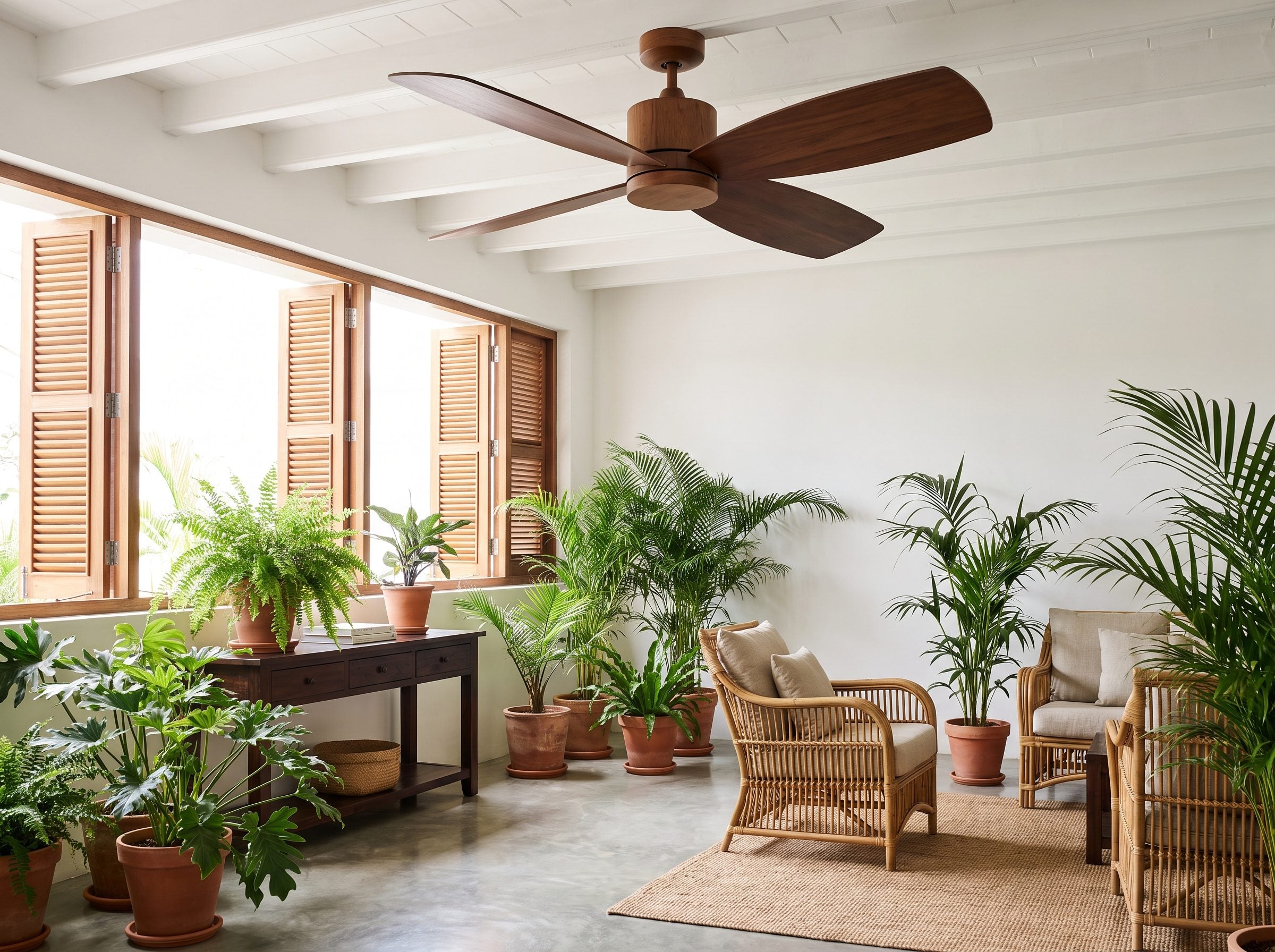
Long before the electric ceiling fan, large manually operated punkahs moved air through interiors in South Asia. This history of punkahs describes the cloth-covered frames swung by ropes, while this additional history looks at their broader cultural context.
Electric fans gradually displaced those labor-intensive systems as electrification expanded. The useful design lesson today is simpler: in a warm, textured room, an overhead fan doesn’t have to feel foreign. Woven cane, shutters, jute and a rattan lounge chair give the fan a material context.
That’s much more convincing than dropping a tropical fan into an unrelated room and expecting the blades to create the atmosphere by themselves. The same rule applies anywhere: a fixture belongs when the room gives it something to talk to, just as a burgundy great room works because its colors repeat rather than appear once.
28. A Sculptural Fan That Looks More Like Modern Art Than an Appliance
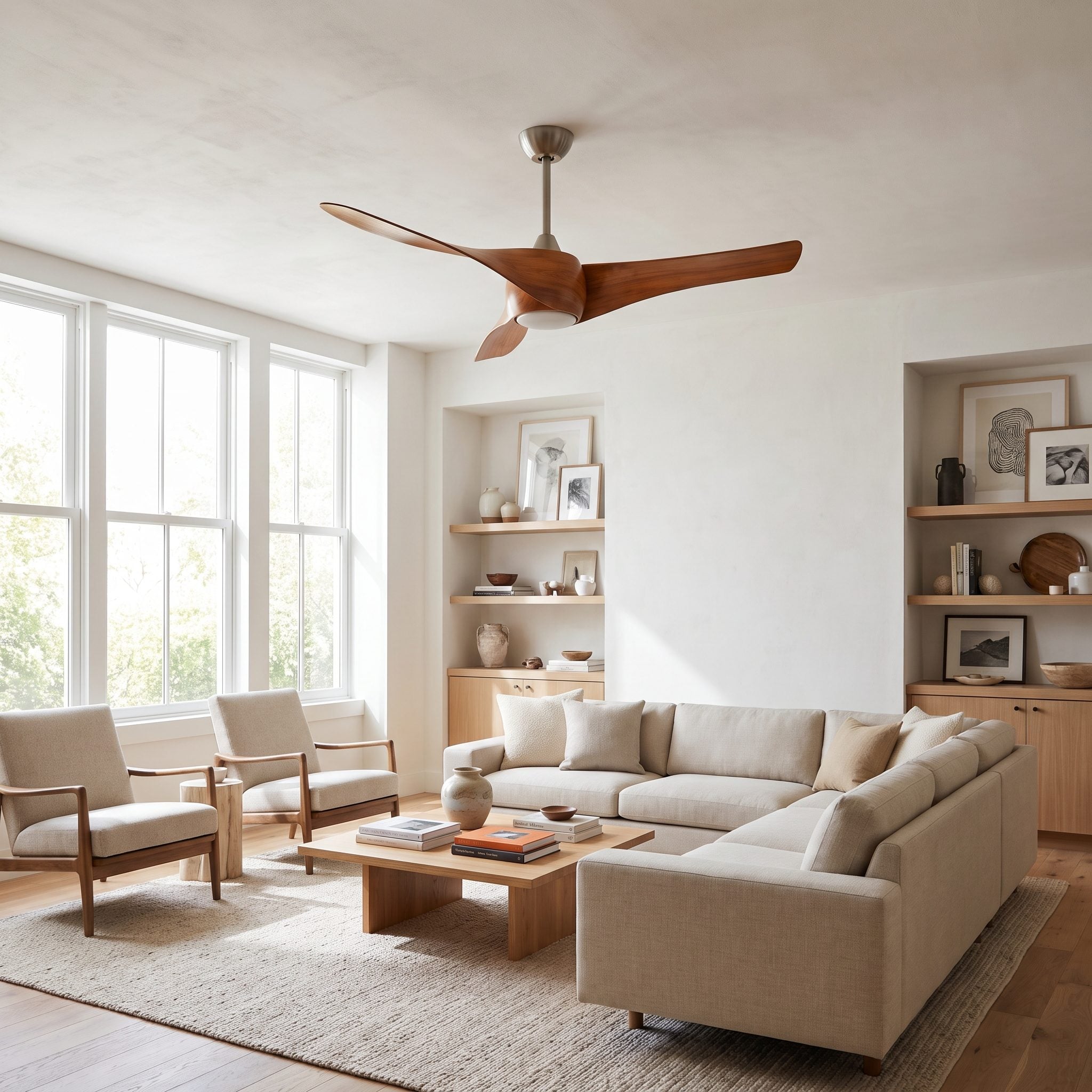
The Minka-Aire Artemis makes the anti-fan argument considerably harder to maintain. Its three curved vanes flow into one another rather than reading as separate paddles stuck onto a motor.
This Artemis reference shows the 58-inch form and the finish options that helped turn it into a recognizable design object. The fan has also received design-industry recognition, which is a safer and more meaningful claim than pretending every example is literally sitting behind museum glass.
The interesting shift is conceptual. Once a fan can behave like kinetic sculpture when it’s off and become a blur when it’s on, hiding it seems beside the point.
27. A Fan Making an Open-Plan Kitchen and Living Area Feel Unified
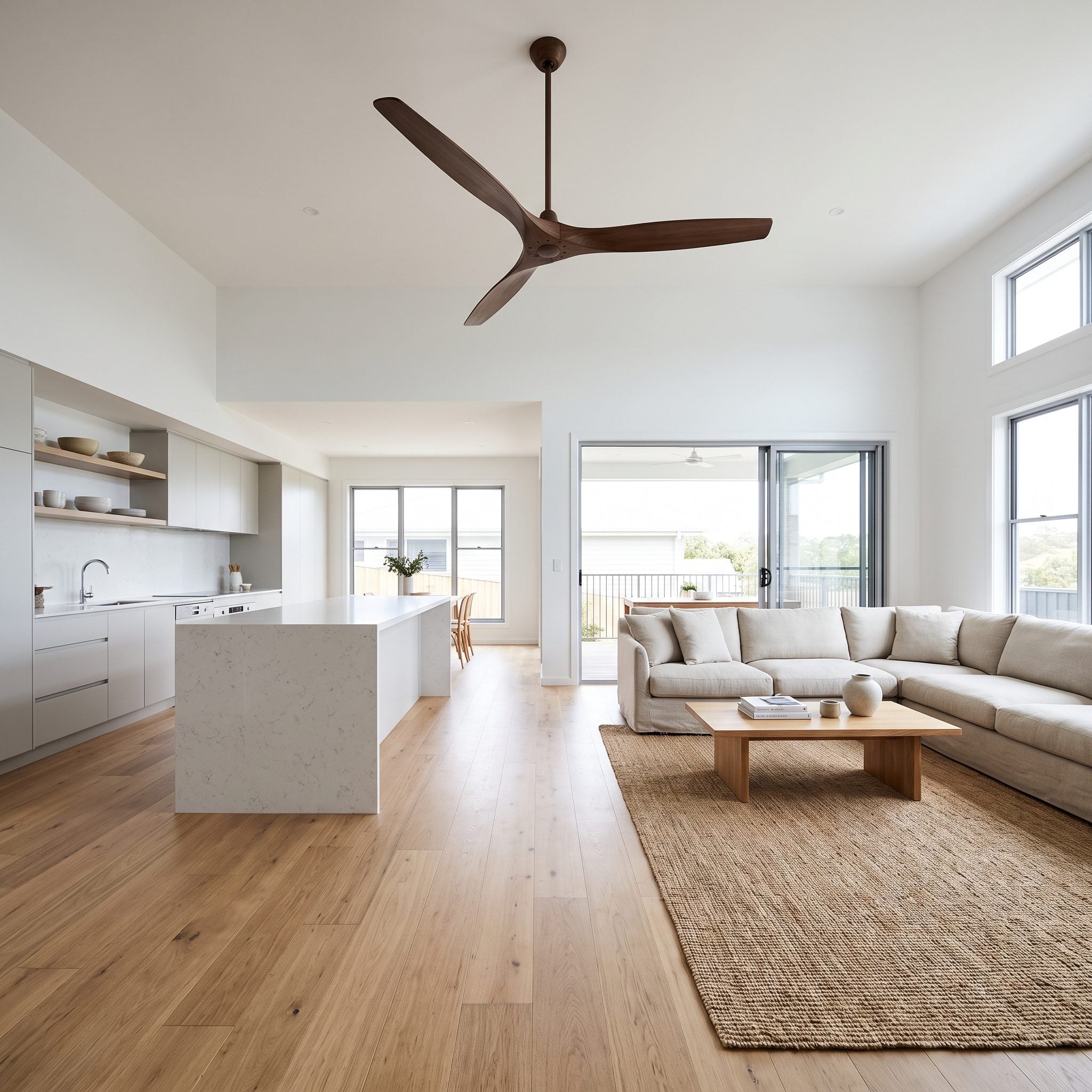
Open-plan rooms often have no obvious ceiling punctuation. Kitchen over here, sofa over there, a large rectangle of drywall floating above both.
One substantial fan can provide a visual center if the room dimensions and airflow requirements support it. Retail guides such as this ceiling-fan buying guide scale blade spans upward with larger rooms, but an unusually long plan may still be better served by multiple fans.
Finish is the bridge. Black blades answering a black range hood, or warm metal answering cabinet hardware, can connect kitchen and living-room materials without adding another decorative theme.
26. A Sleek Fan in a Minimalist Bedroom
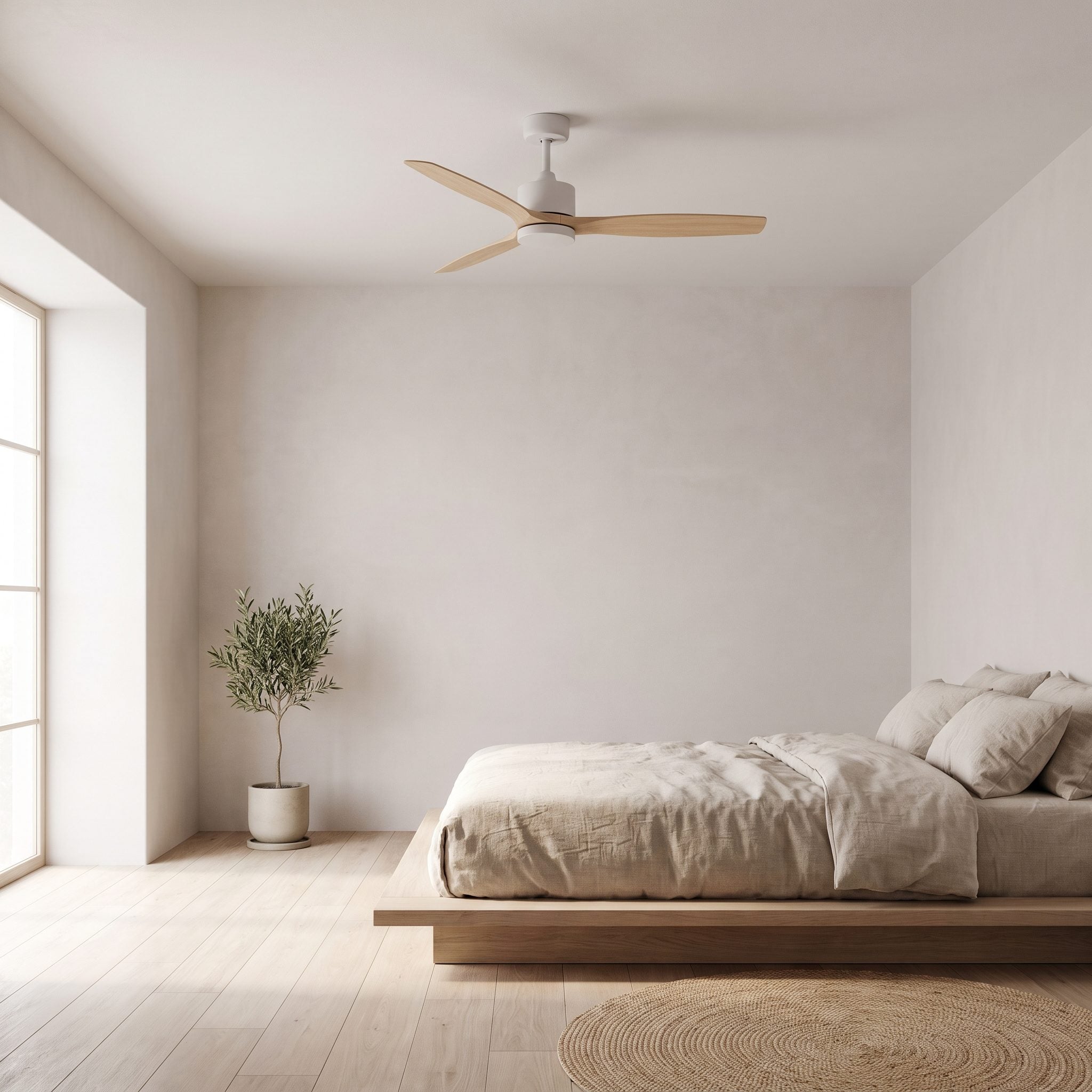
Minimalism doesn’t require pretending summer doesn’t happen. It requires editing.
For a 10-by-10 bedroom, sizing guidance commonly lands in roughly the 36-to-42-inch range rather than automatically installing the 52-inch fan used downstairs. This size guide and ENERGY STAR’s fan basics are useful references when checking dimensions and clearance.
Three quiet blades, a shallow housing and no decorative clutter let the object settle into the negative space. Paint or specify it close to the ceiling color and there’s very little left for the eye to argue with.
25. A Fan Centered Between Exposed Wood Beams
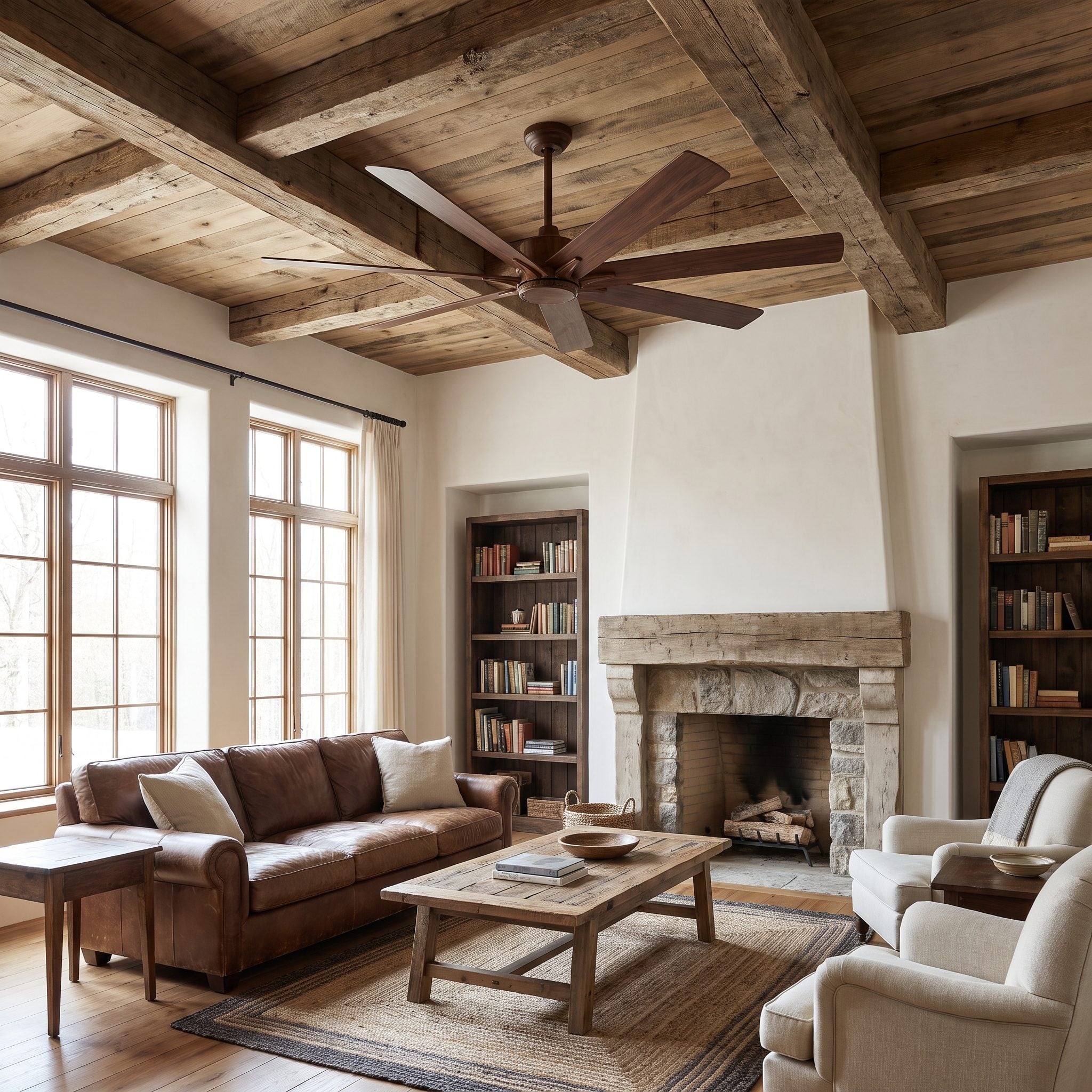
Exposed beams solve one of the fan’s biggest aesthetic problems: they give it an obvious address. Center the fixture in a structural bay and the placement no longer looks arbitrary.
Lighting designers use the same alignment instinct around beams, as these exposed-beam lighting examples demonstrate. Fan clearances still matter; this clearance discussion and this sloped-ceiling overview illustrate the kinds of spacing issues that need to be checked.
Electrical support matters even more. A ceiling fan needs a fan-rated mounting box or another manufacturer-approved support system secured appropriately to the structure. This beam-installation overview shows the general approach, but the actual box and support have to be rated for the fan being installed.
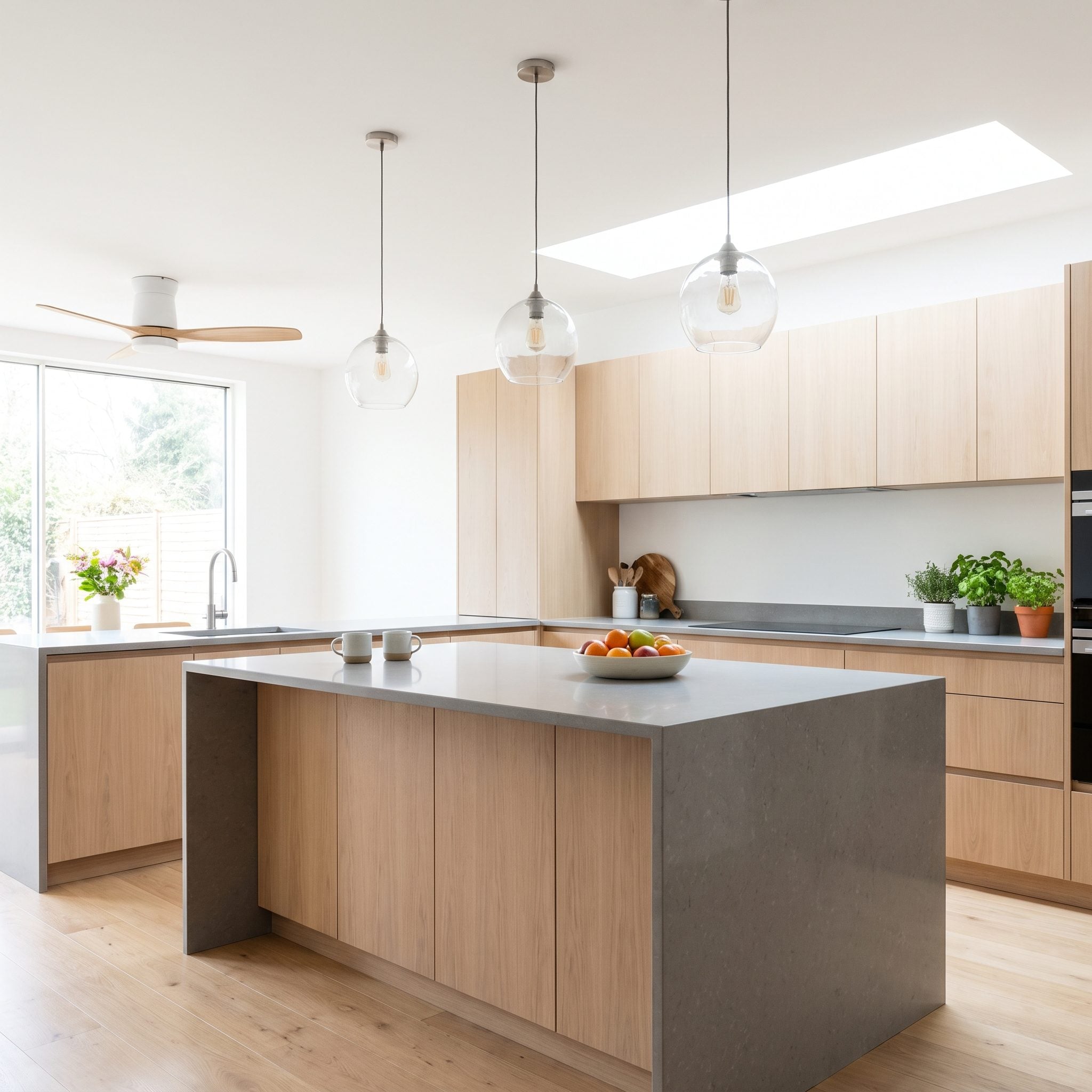
24. A Kitchen Fan That Doesn’t Compete With the Pendant Lights
🔥 Would you like to save this?
A fan and pendant lights aren’t fighting for the same job unless you force them into the same patch of ceiling.
Keep the pendants over the island, where they provide focused light. Move the fan toward the breakfast area or another clear circulation zone, where it can move air without visually colliding with the pendants. Pendant heights often begin somewhere around 30 to 36 inches above a counter, then adjust for fixture scale and sightlines.
Matching the finishes does the rest. A slim fan that echoes the brass pendant lights reads as part of the same kitchen rather than a second ceiling scheme.
23. A Modern Farmhouse Room With a Restrained Fan Instead of a Rustic Cliché
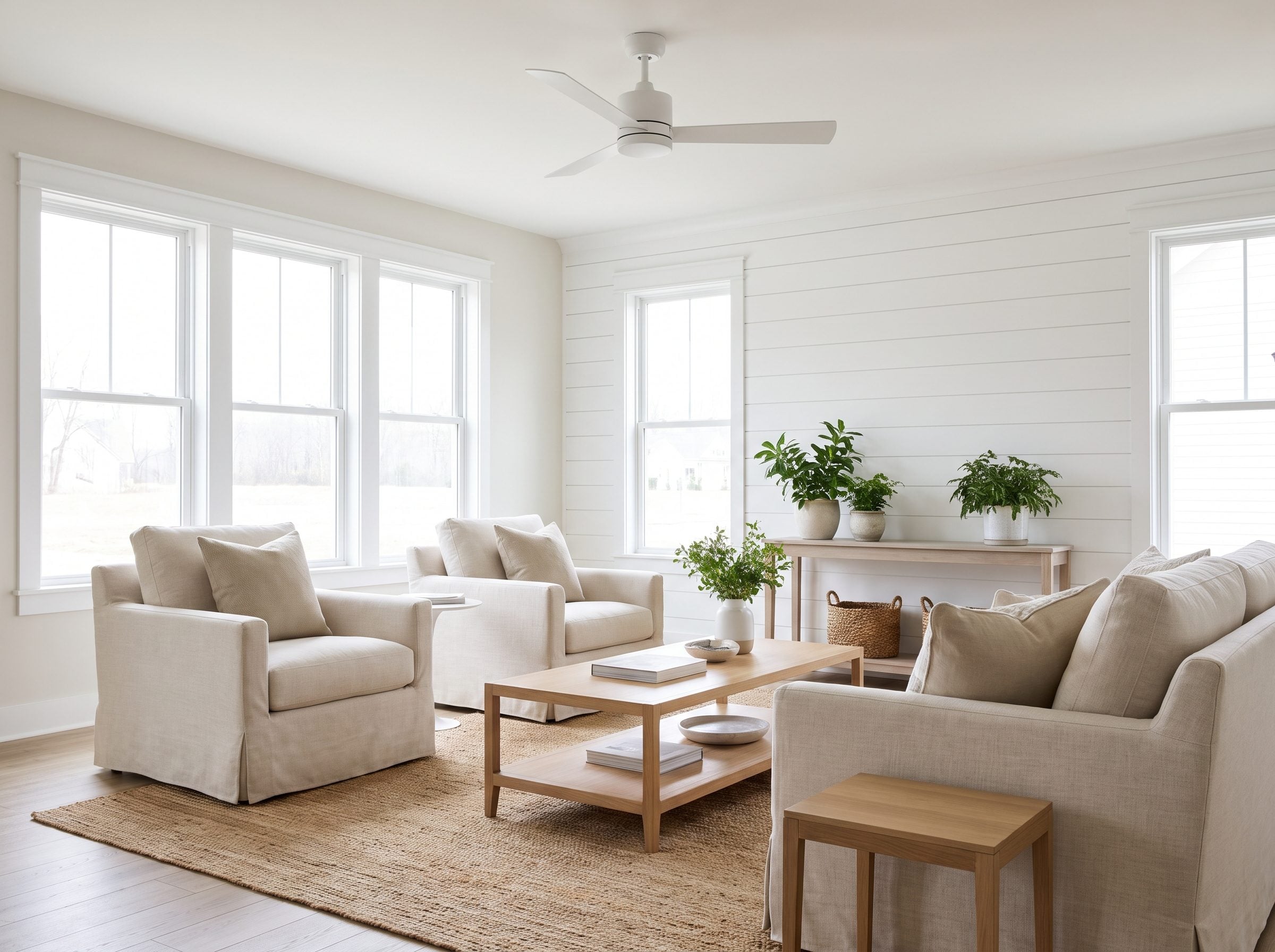
Modern farmhouse didn’t need every ceiling fixture to cosplay as a windmill. One quiet fan in matte black or oil-rubbed bronze is usually enough.
Let the shiplap, beams, windows and furniture establish the room’s character. The fan can simply repeat the darker architectural hardware and stay out of the competition.
Against a burgundy great room palette or something much paler, the principle is the same: buy air movement, not a farmhouse mascot.
22. A Fan Coordinated With the Room’s Brass or Bronze Finishes
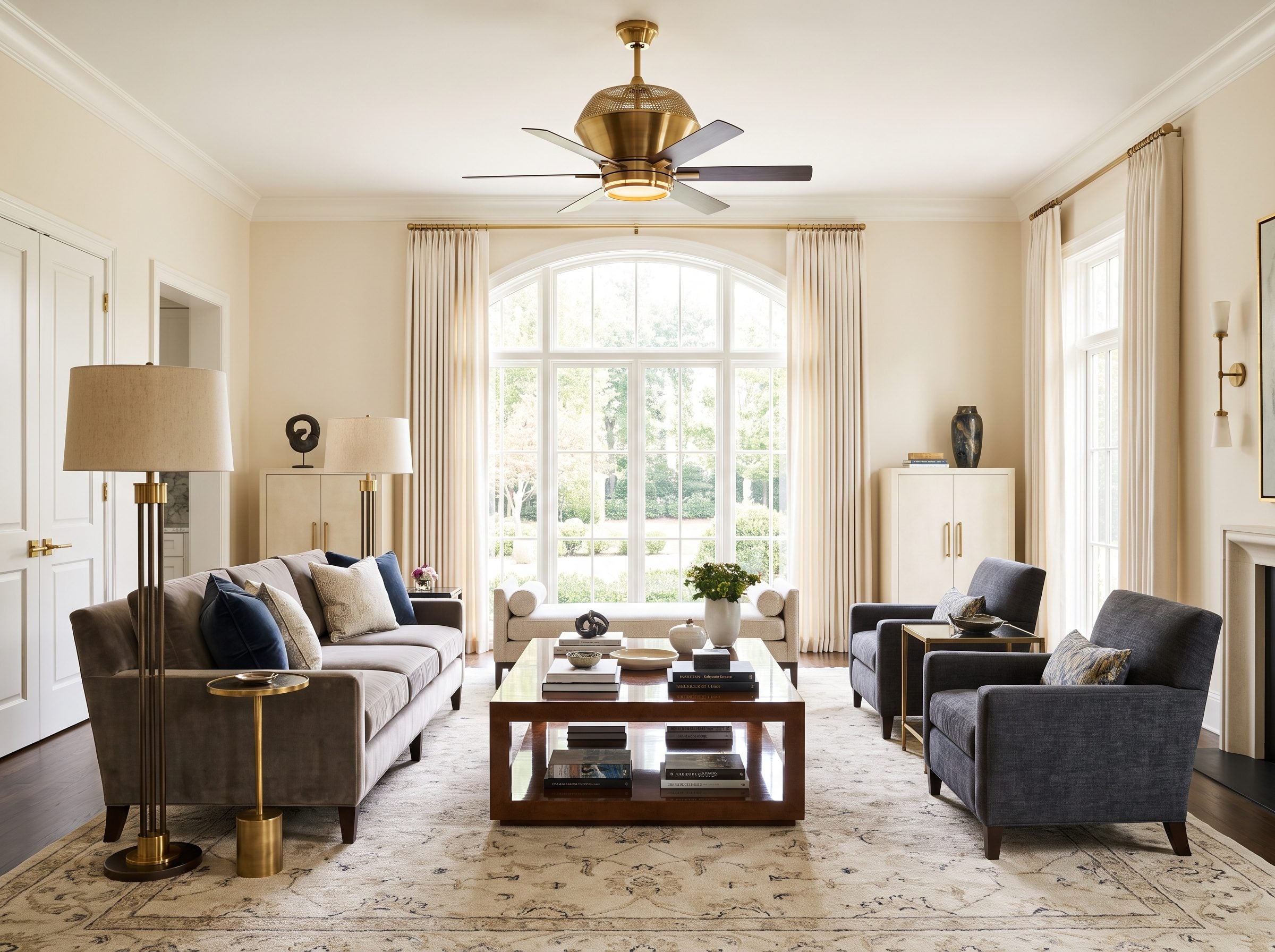
A fan starts behaving more like a light fixture when its finish joins the room’s other metals. Aged brass overhead, aged brass on the sconces, another warm note on the drawer pulls: suddenly the ceiling isn’t running a completely separate material scheme.
The fan you hate may simply be the wrong finish for everything around it.
This can work in a burgundy great room or a quieter bedroom where an antique brass ceiling fan echoes the warmer hardware already present.
21. A Screened Porch Where the Fan Helps Create an Outdoor Living Room
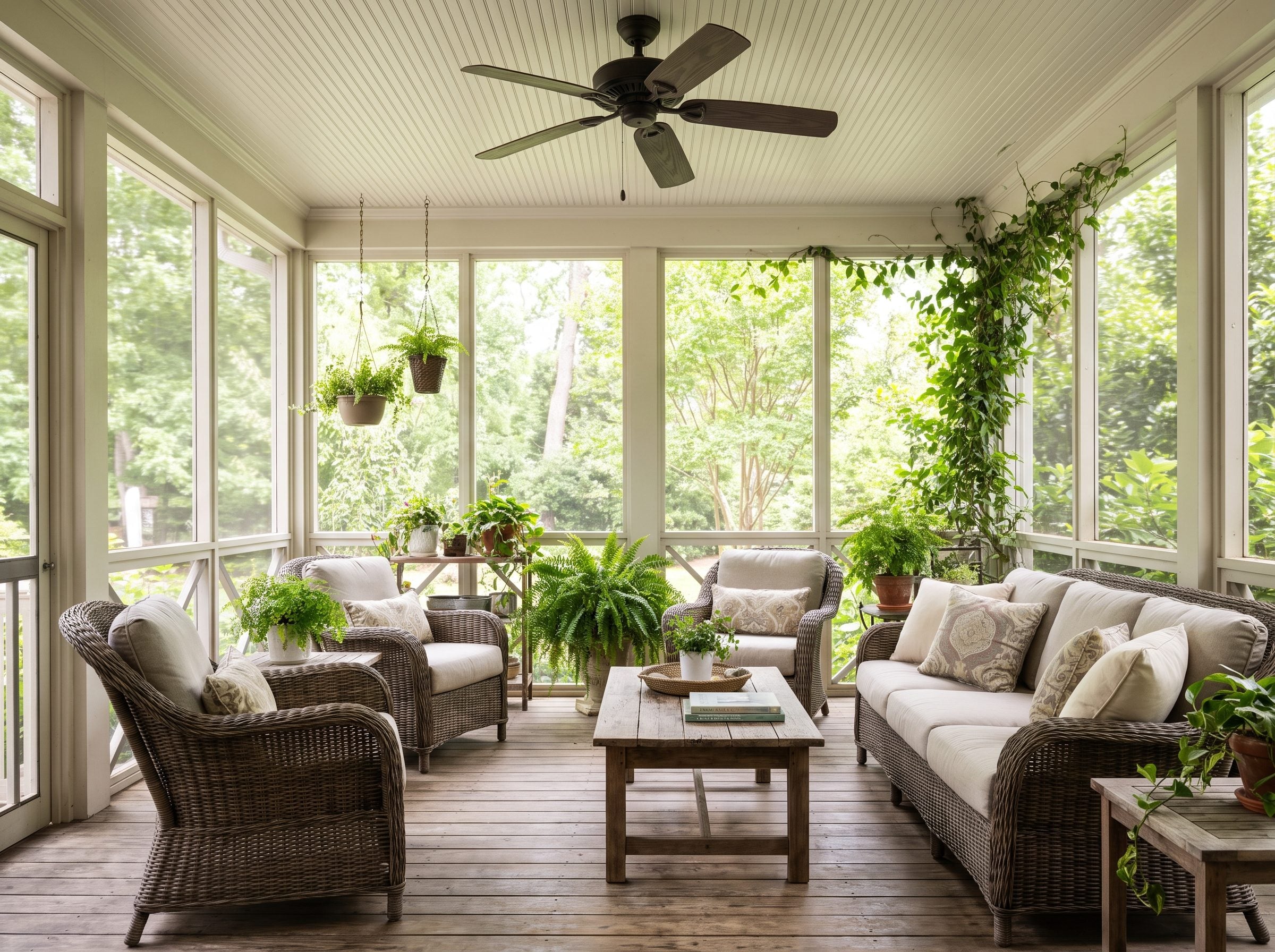
On a screened porch, the fan doesn’t need an aesthetic defense. Comfort already won the argument.
Moving air can make the space feel more comfortable and can interfere with mosquito flight and the cues mosquitoes use to find people. These discussions of porch airflow and fans and mosquitoes explain the basic idea. Think deterrent, not invisible force field.
Size the fan to the porch and choose the correct environmental rating. Another outdoor sizing reference can help narrow the options. Damp-rated fans belong in protected humid locations; wet-rated models are required when the fan can receive direct water exposure.
A teak outdoor sofa, an indoor-outdoor jute rug and a properly rated bronze outdoor ceiling fan turn the screened shell into a real room. The same comfort-first instinct can rescue a bonus room makeover indoors.
20. An All-White Ceiling Fan That Practically Disappears Into the Ceiling
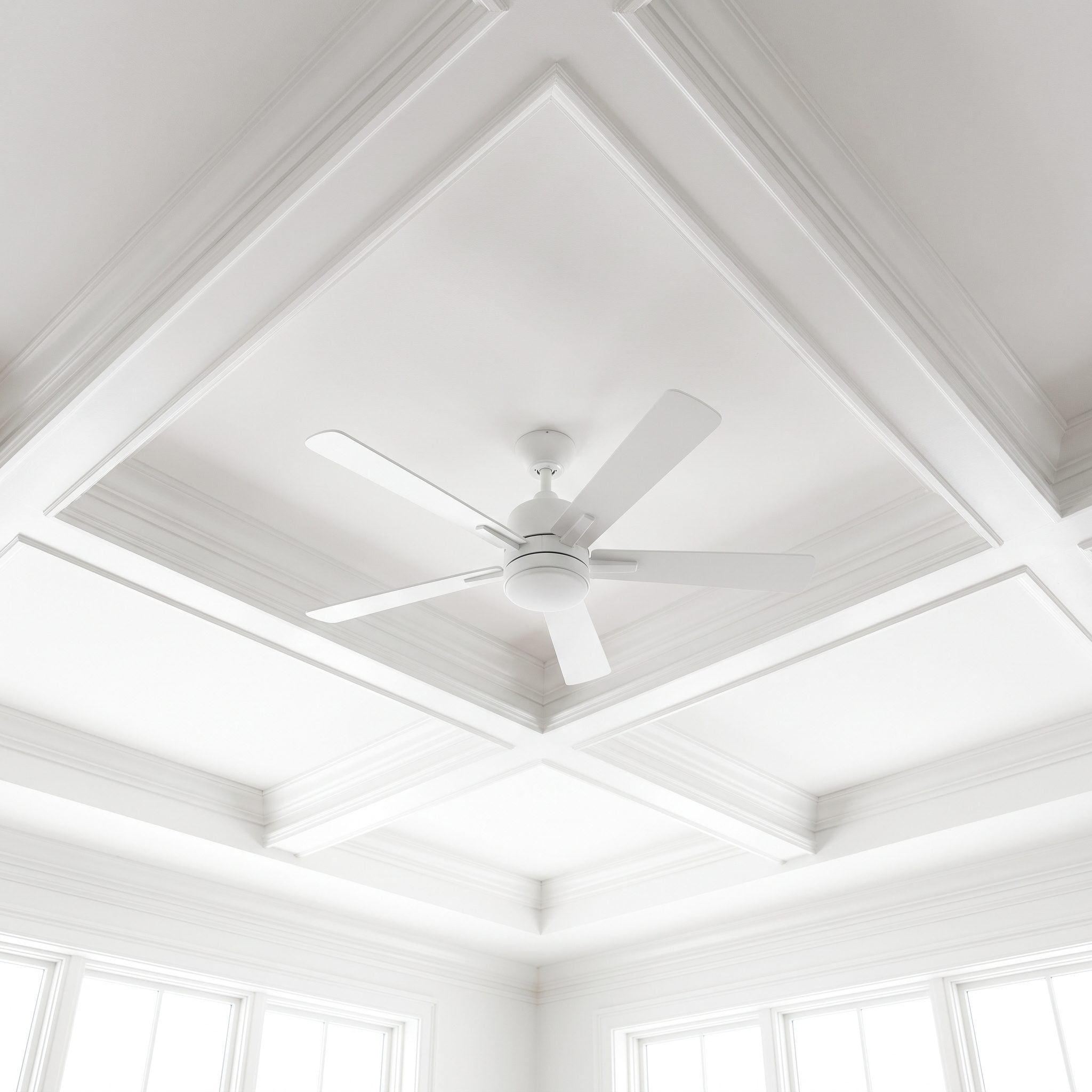
This is the stealth approach. Housing, blades and mounting hardware all stay within the same white family as the ceiling, so the fan stops breaking the plane every time you look up.
That matters especially on an eight-foot ceiling, where there isn’t much vertical real estate to begin with. Keep the body shallow, lose the dangling ornament and suddenly 52 inches of moving machinery can feel less intrusive than a decorative light fixture half its size.
19. A Large Fan Suspended in a Double-Height Living Room
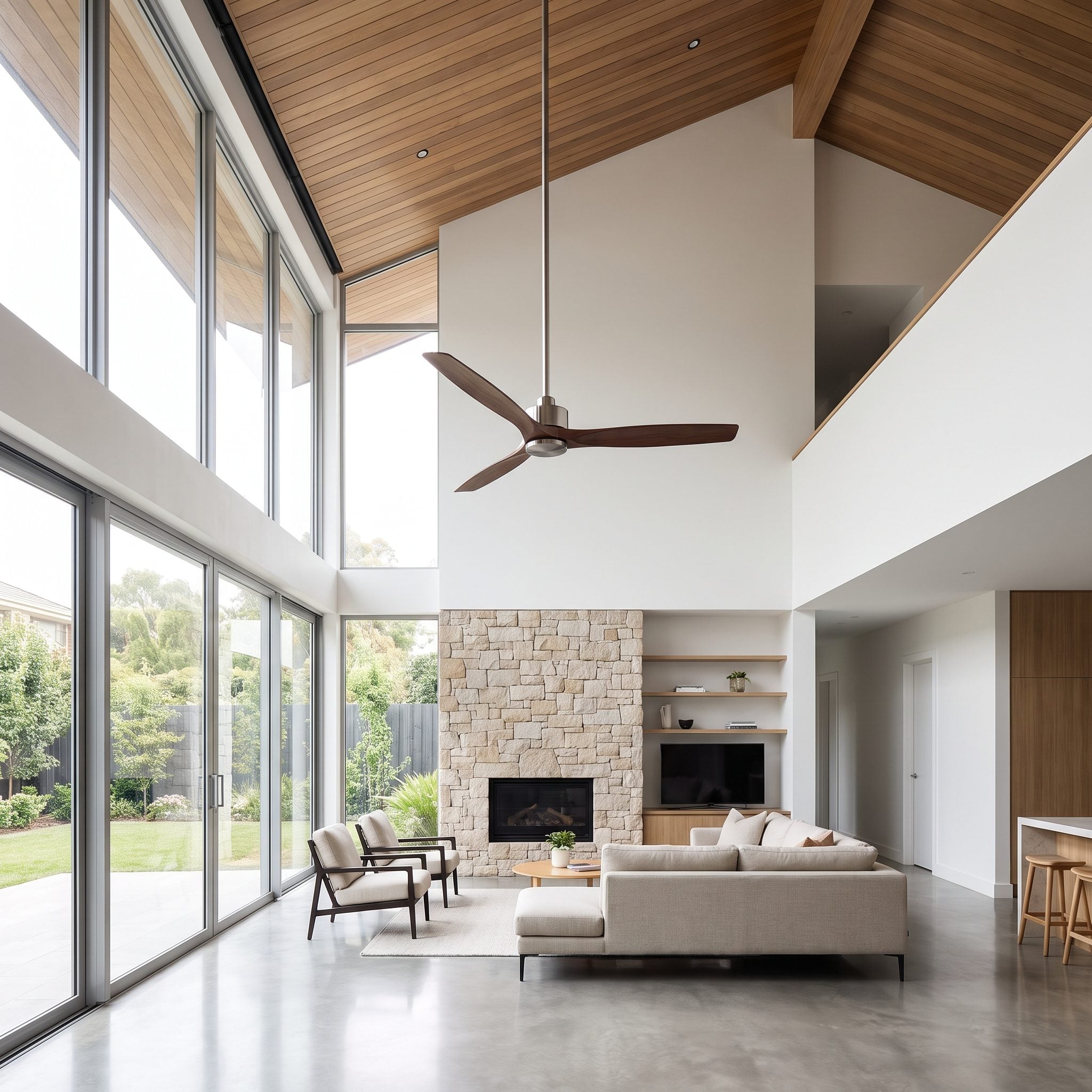
A cathedral ceiling doesn’t need a fan marooned at the peak. The whole point of a downrod is to bring the blades closer to the occupied part of the room.
General guidance often places fan blades around eight to nine feet above the floor when ceiling height allows, while still maintaining at least the seven-foot safety minimum. This vaulted-ceiling guide covers that basic relationship.
Longer downrods make high installations possible, while sloped ceilings may require compatible adapters. Some systems accommodate substantial roof pitches, as this vaulted-ceiling installation overview illustrates.
Reverse operation can also help circulate stratified warm air during heating season, although the effect depends on the room and fan settings rather than acting as a substitute for the heating system.
18. A Fan With an Integrated Light That Doesn’t Look Like an Afterthought
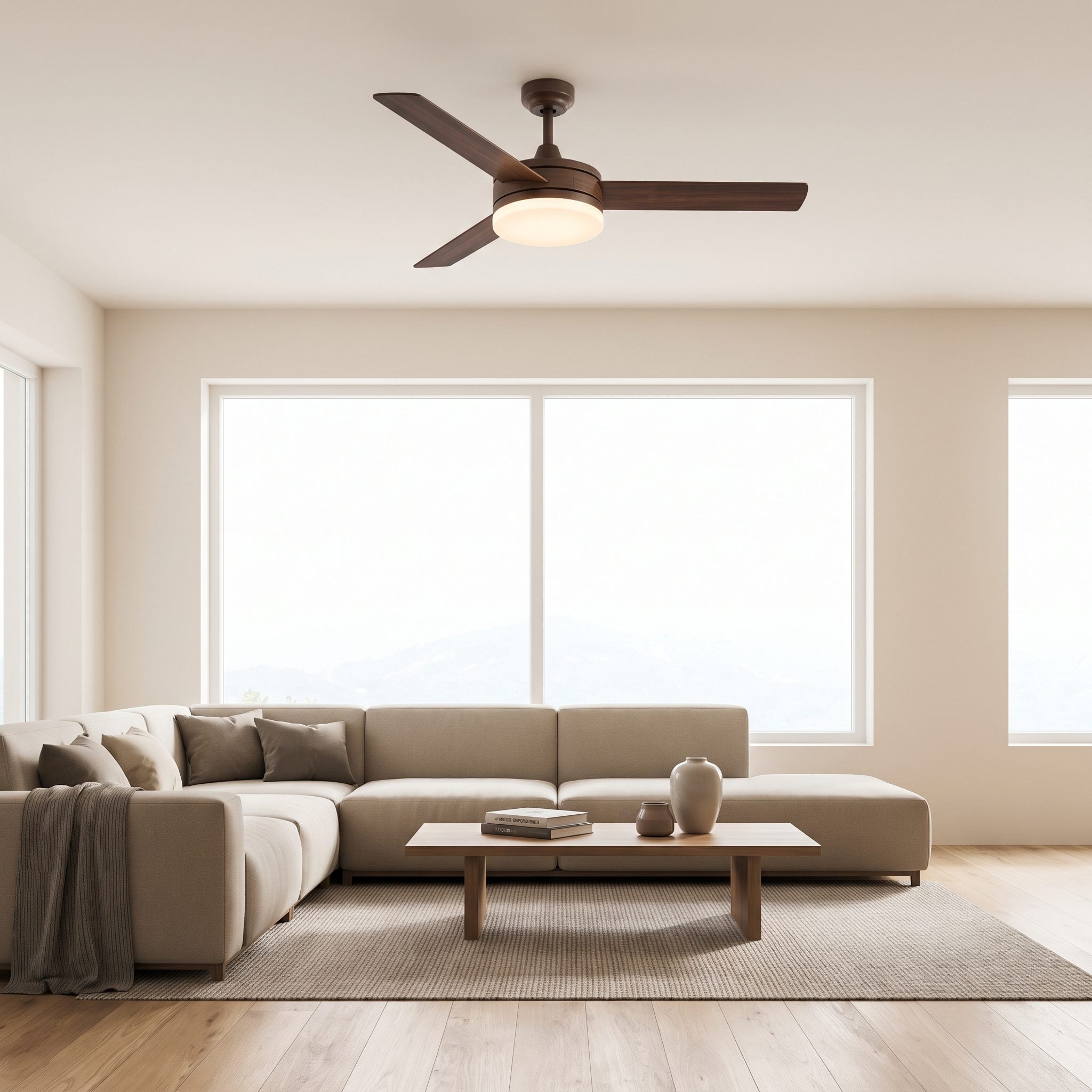
Or keep the light and make it behave.
Modern integrated LEDs can sit almost flush with the motor housing, turning what used to be a dangling glass bowl into one continuous object. From below you read a disc rather than a lamp screwed onto a machine.
The light kit doesn’t have to look like something the fan picked up on the way home.
In a bedroom or bonus room makeover, a bright integrated fixture may reduce the need for additional overhead lighting, although whether it can replace recessed lights entirely depends on room size, lumen output and how the space is used.
17. A Fan Coordinated With Black Window Frames and Hardware
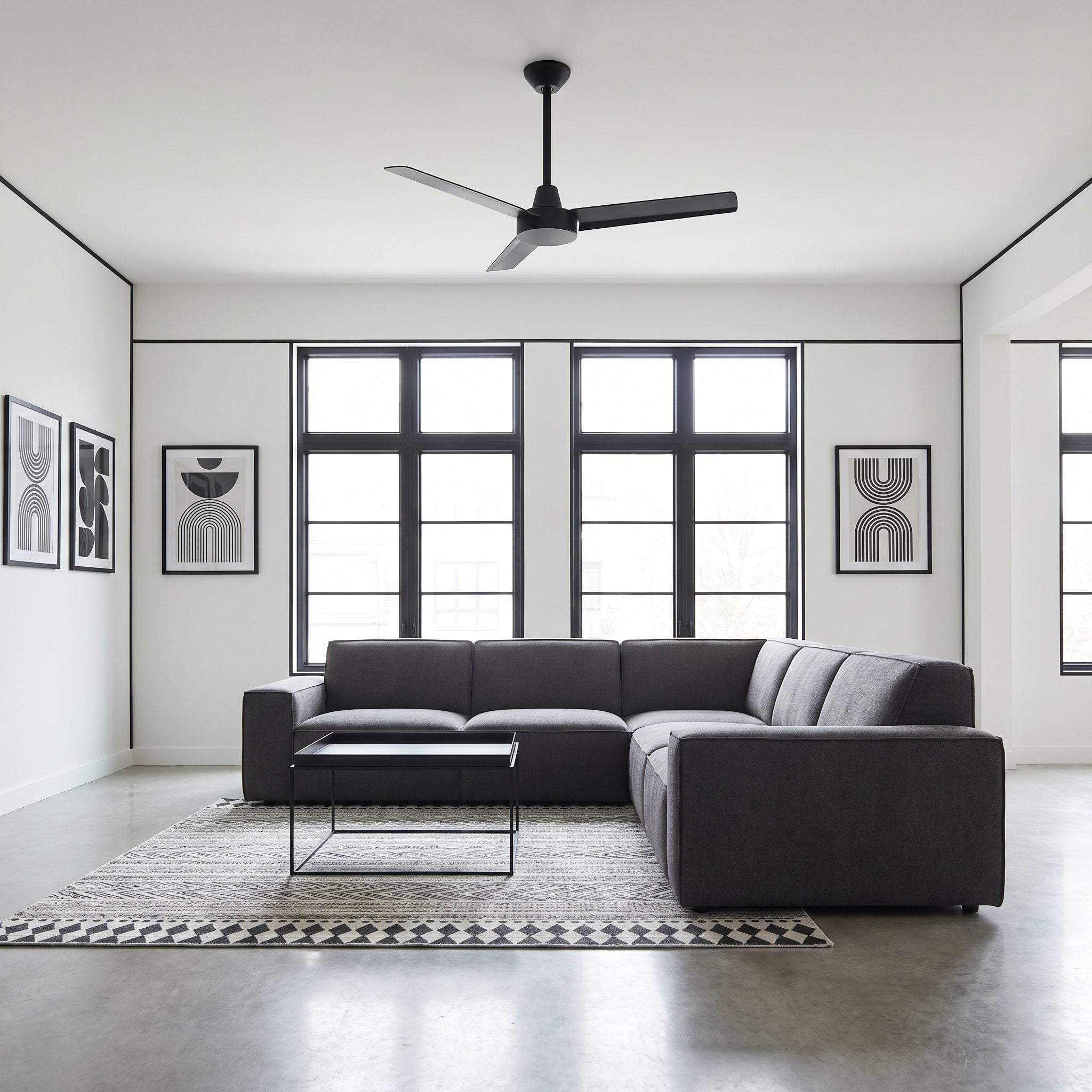
If the windows, curtain rods, door hardware and cabinet pulls are already black, a brushed-nickel fan can feel like it arrived from another house.
Make the fan black and the ceiling simply joins the existing hardware system. The principle is more useful than any trend date: repeat a dominant finish enough times and the eye recognizes a language rather than a pile of unrelated objects.
The same logic can extend from a nearby navy powder room into the larger living area, while a black ceiling fan gives the ceiling its share of the contrast.
16. A Fan Centered Over an Outdoor Dining or Lounge Area
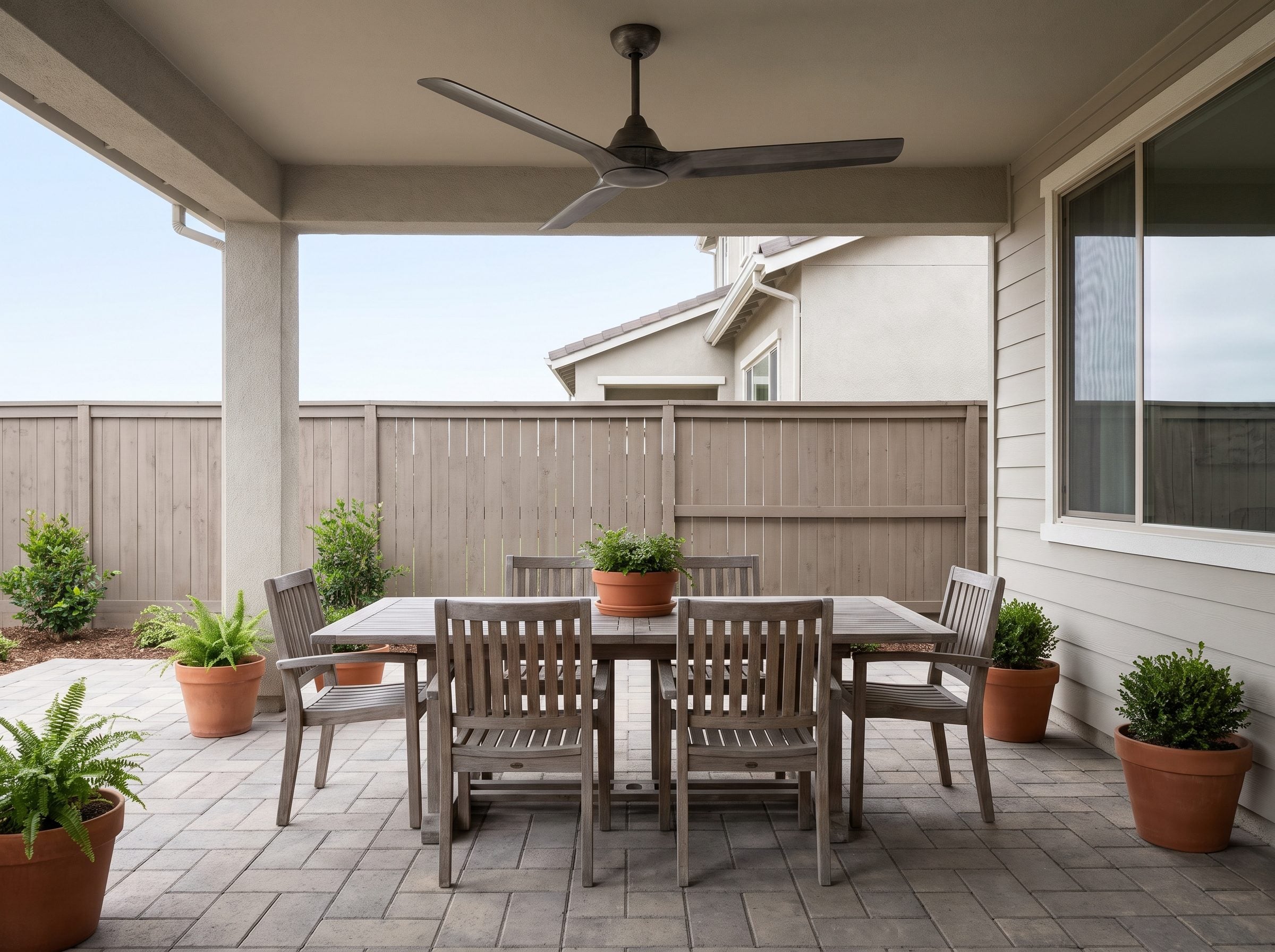
Outside, center the fan on the life happening underneath it, not automatically on the concrete slab.
If everyone eats at one end of the patio, that’s where the airflow belongs. Keep the blades at least seven feet above the walking surface and respect the required clearance from beams and walls.
Environmental rating is the bigger decision. This damp-versus-wet overview, this outdoor fan guide and Hunter’s rating explanation all point to the same practical distinction: damp-rated for protected humid spaces, wet-rated where direct water exposure is possible.
15. A Minimal Three-Blade Fan in a Contemporary Living Room
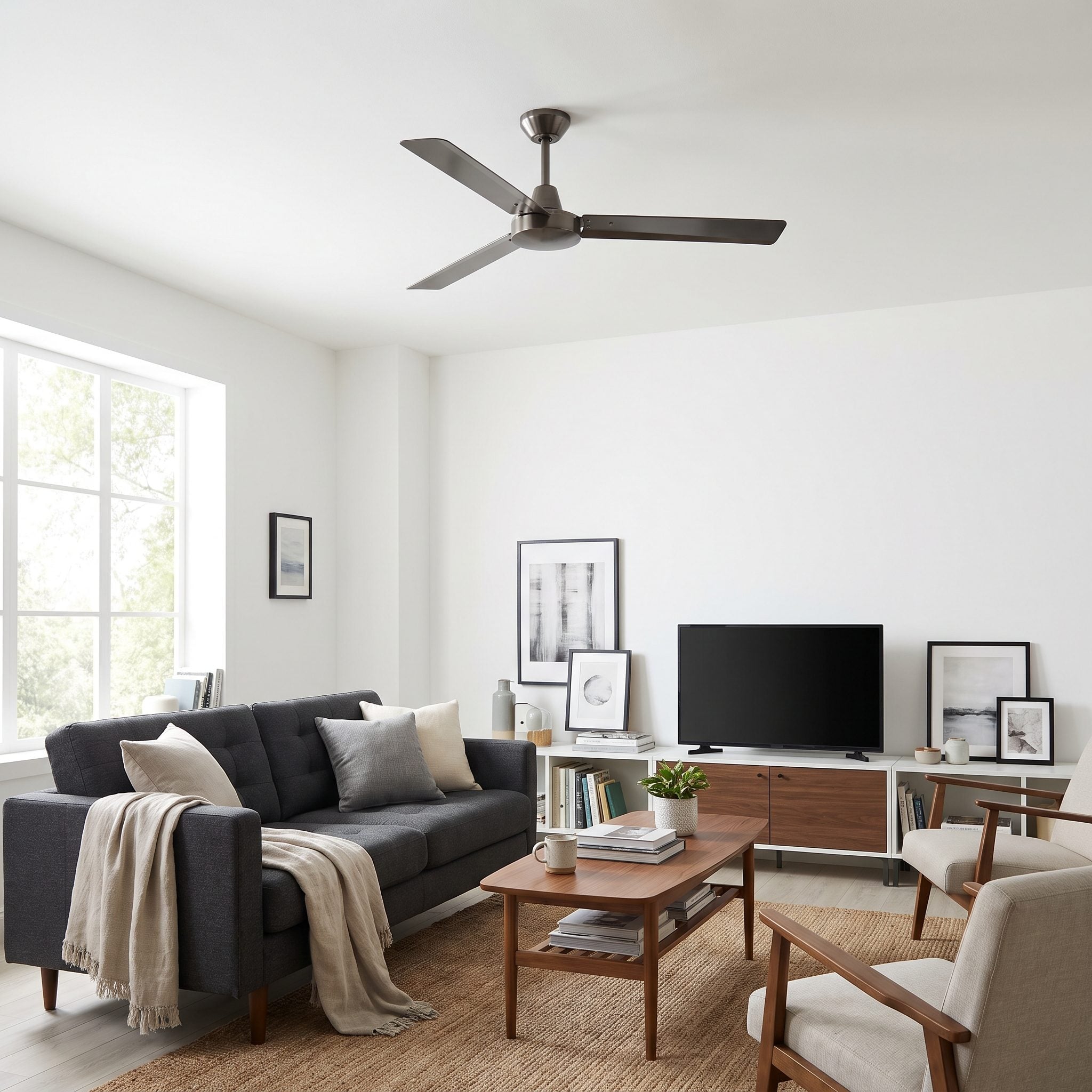
Three blades don’t automatically mean better engineering, and DC motors don’t require a three-blade layout. What has changed is that contemporary manufacturers increasingly combine slimmer housings, efficient motors and pared-back blade profiles into one much cleaner object.
Minka-Aire’s Wave, Aviation and Concept families helped make the look familiar: long, shaped blades and little of the visual bulk associated with older five-blade fixtures. You can browse the same general category in three-blade ceiling fans, while this Aviation example shows how aggressively the silhouette can be simplified.
Many modern DC-motor fans also use less electricity and offer a wider range of speeds than conventional AC designs, although actual wattage varies considerably by model. These overviews of AC versus DC fans and current motor differences are useful places to compare the technologies.
14. A Wood-Blade Fan Making a Traditional Bedroom Feel Warmer
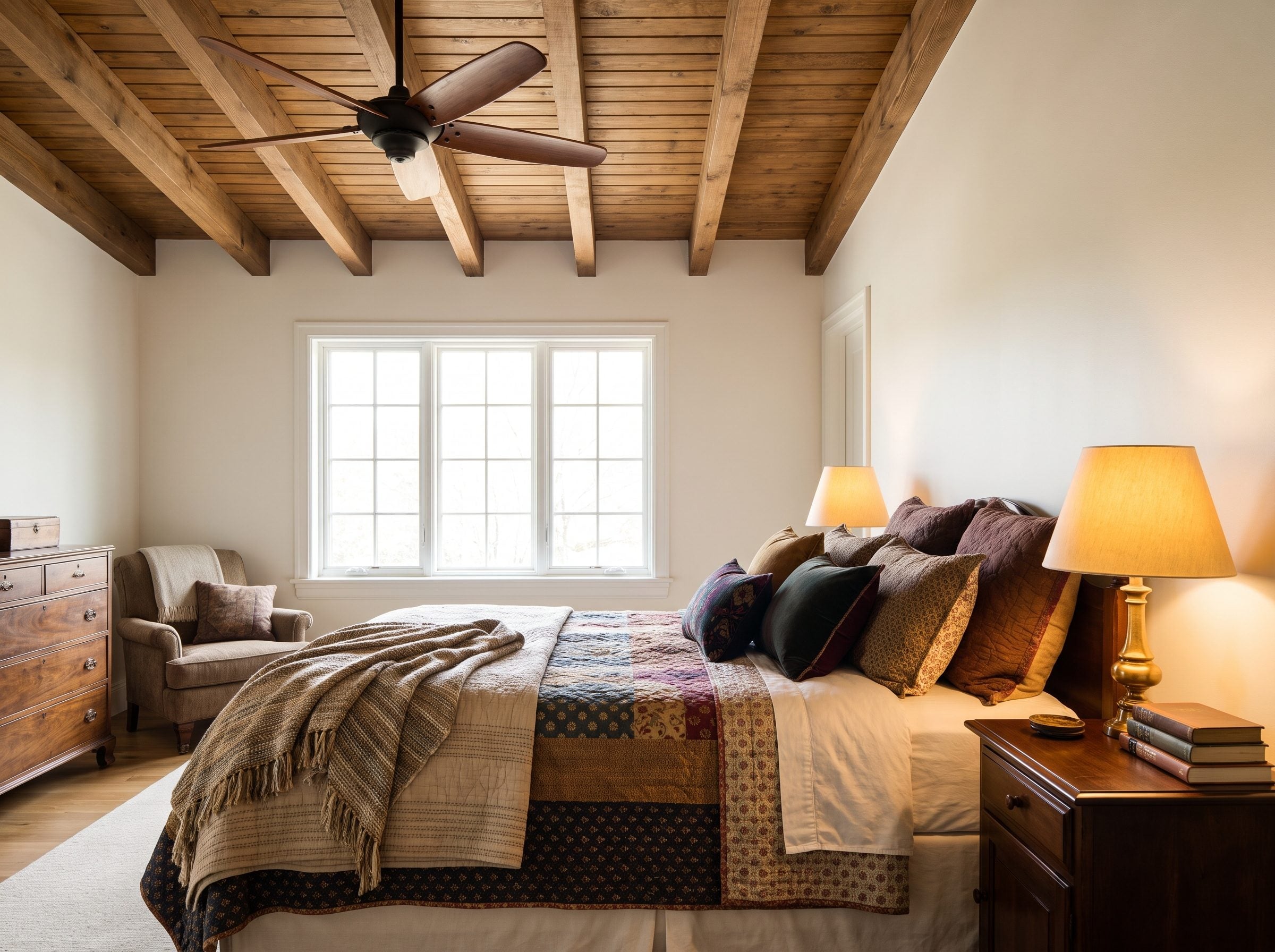
In a traditional bedroom, the job changes. The fan doesn’t need to become invisible or aggressively modern. It needs to stop looking like white plastic hardware floating above furniture with actual warmth.
A walnut-blade fan can pick up the bed, nightstands, leather and warmer metal finishes without matching every piece exactly. That’s why wood blades feel different here than in the earlier dining room: the goal is not concealment. It’s continuity.
The same color logic works in a warm terracotta family room. Wood carries the warm side of the palette upward rather than leaving the ceiling as a separate white zone.
13. A Fan Deliberately Contrasting With the Ceiling
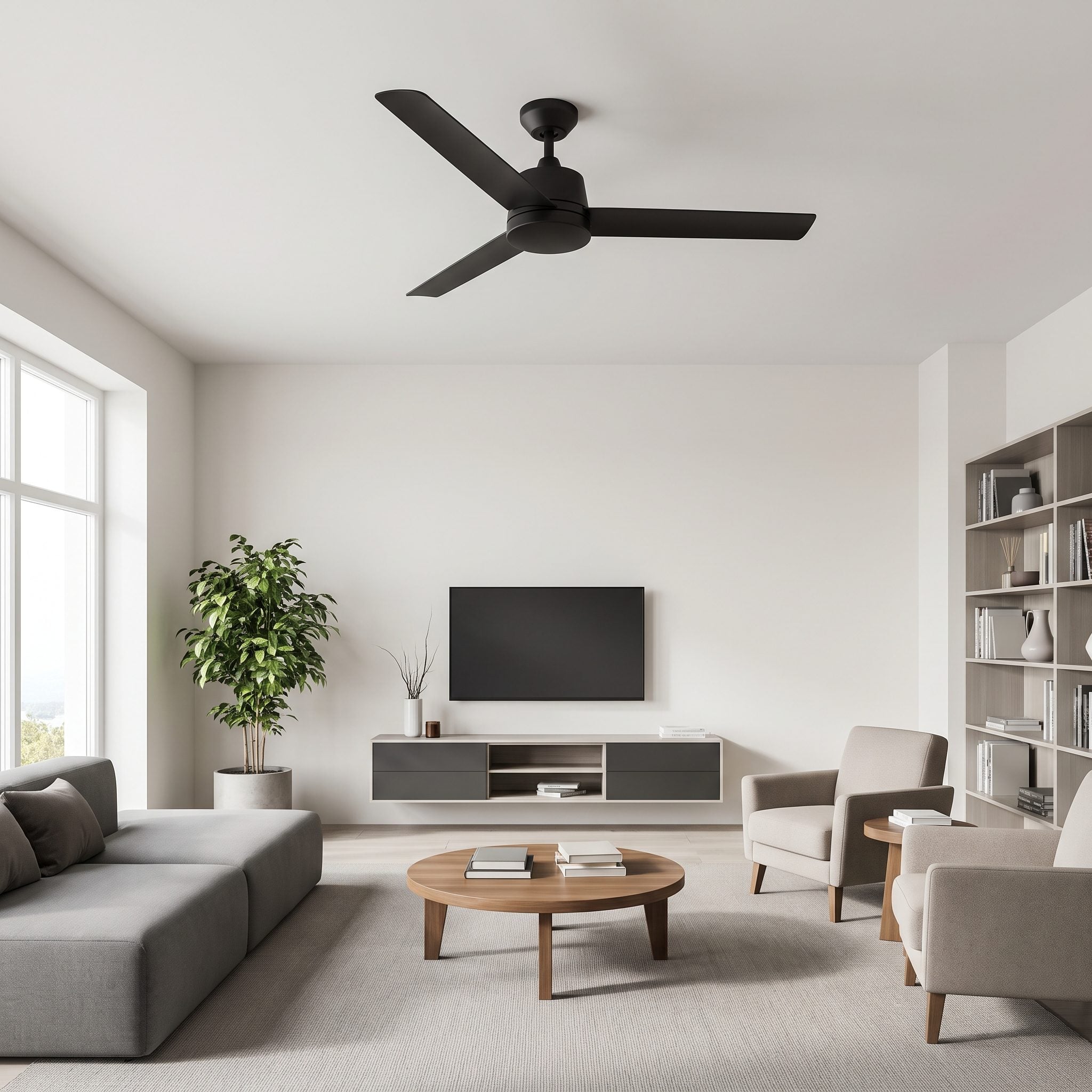
And now the reverse argument. A matte-black fan on a white ceiling doesn’t need forgiveness. The contrast is the design.
Aged brass against soft white, walnut against pale plaster, oil-rubbed bronze against cream: a fan can operate under the same rules as sconces, cabinet pulls and black-framed mirrors. Once you treat the fixture as an accent rather than something to camouflage, the old obsession with making every blade disappear starts looking unnecessarily timid.
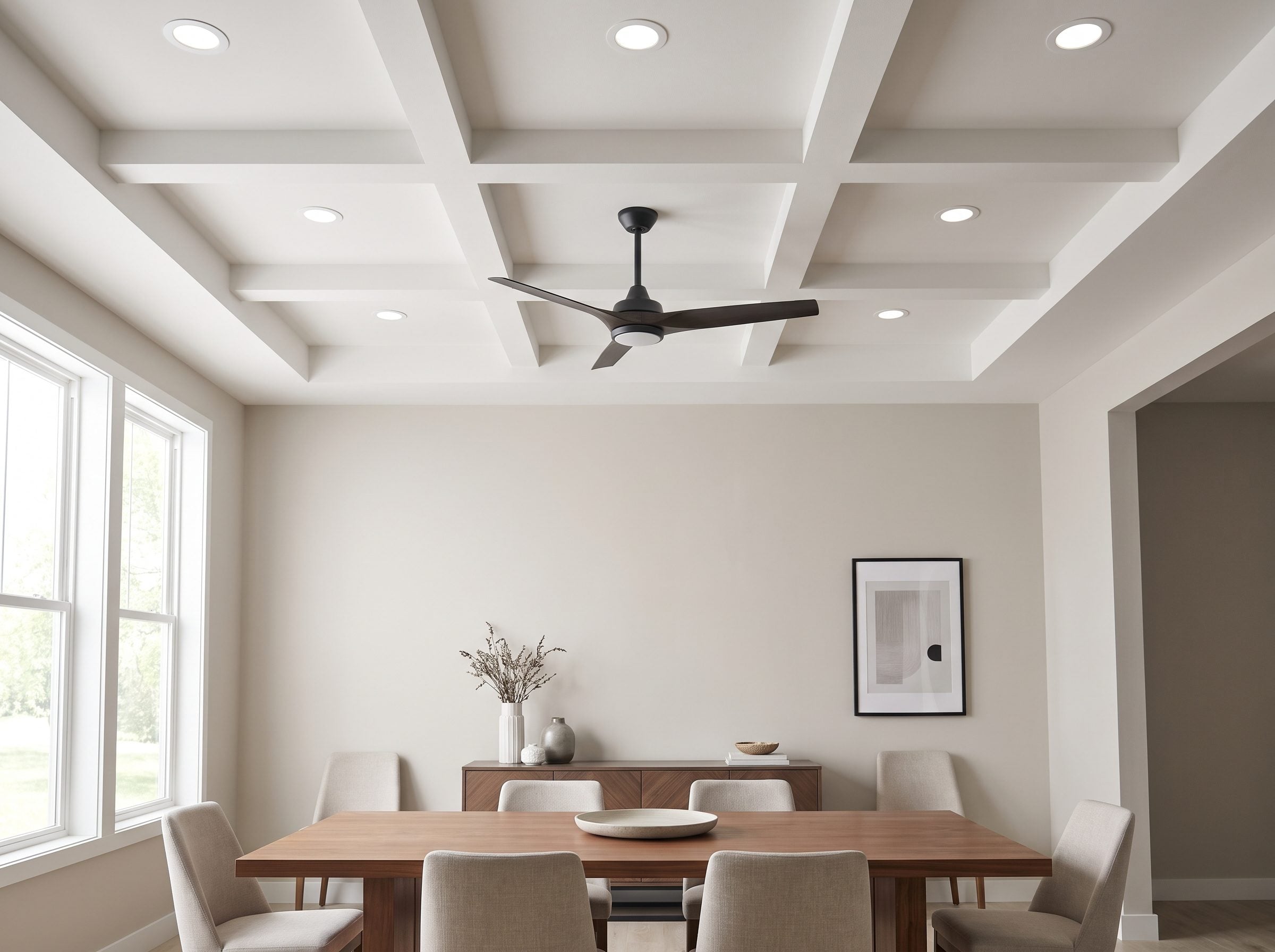
12. A Fan and Recessed Lighting Doing Separate Jobs in a Dining Room
🔥 Would you like to save this?
The fan doesn’t have to illuminate Thanksgiving dinner. Let it move air and let the lighting system handle light.
Recessed fixtures around the perimeter can provide the adjustable illumination while the central fan loses the glass bowl entirely. Over a retro dining room, a clean black fixture and a walnut dining table have enough visual relationship without asking the fan to become a chandelier too.
Separate the jobs and both systems get simpler.
11. A Long-Downrod Fan That Complements a Vaulted Ceiling
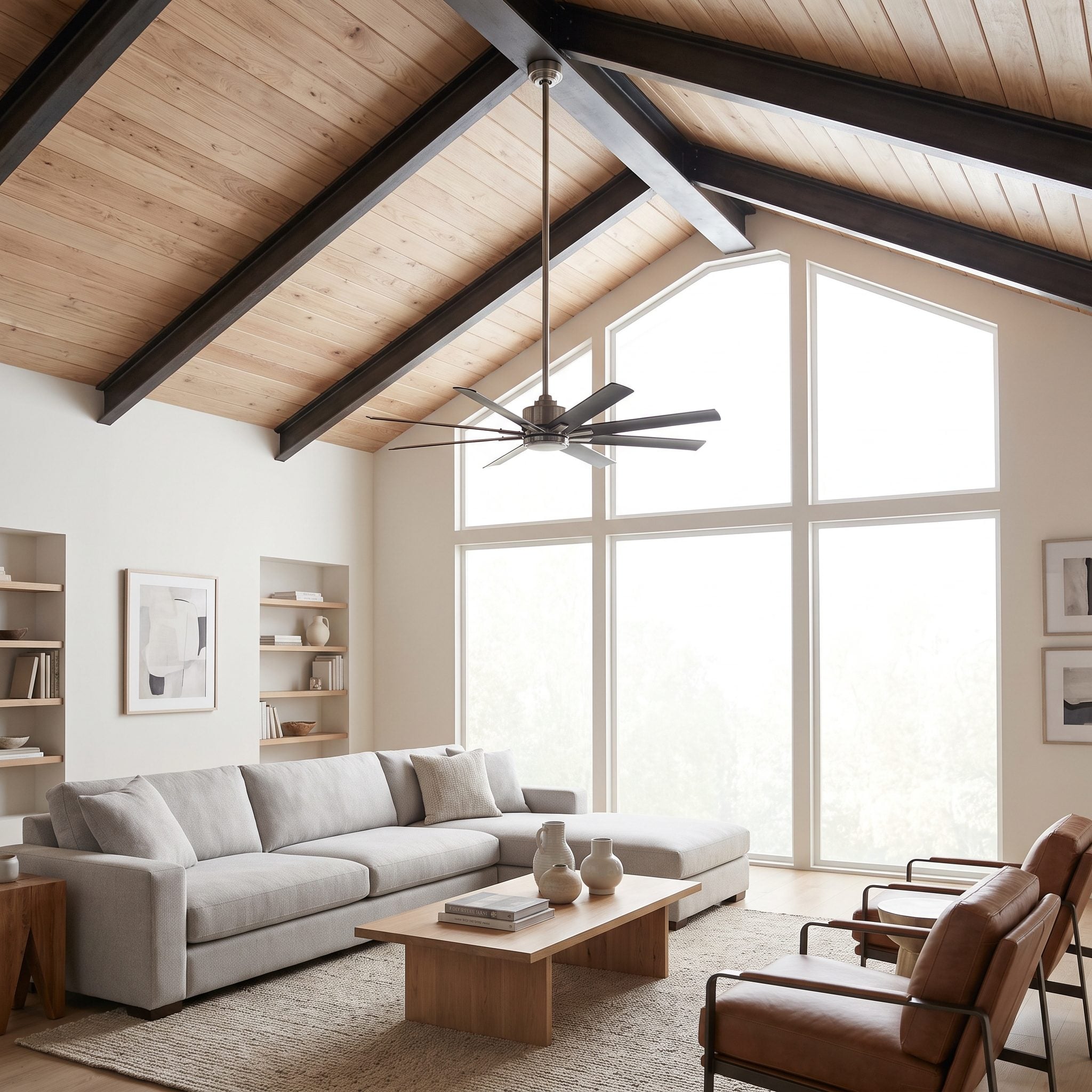
This one is about mechanics more than scale. A beautiful fan hung too close to the peak can still look stranded and move air where nobody lives.
This downrod guide walks through the basic calculation, while this additional downrod reference explains how ceiling height affects the drop. Another mounting-height guide covers the same relationship from the finished-room side.
On sloped ceilings, choose a model and mounting system actually approved for the angle. This vaulted-fan guide addresses those installations, while this lighting resource is another place to check manufacturer-specific options.
The goal is not “always eight feet” or “always nine.” It’s safe clearance plus a drop that puts the fan in a useful relationship with the occupied room.
10. A Low-Profile Fan That Works Beautifully on a Lower Ceiling
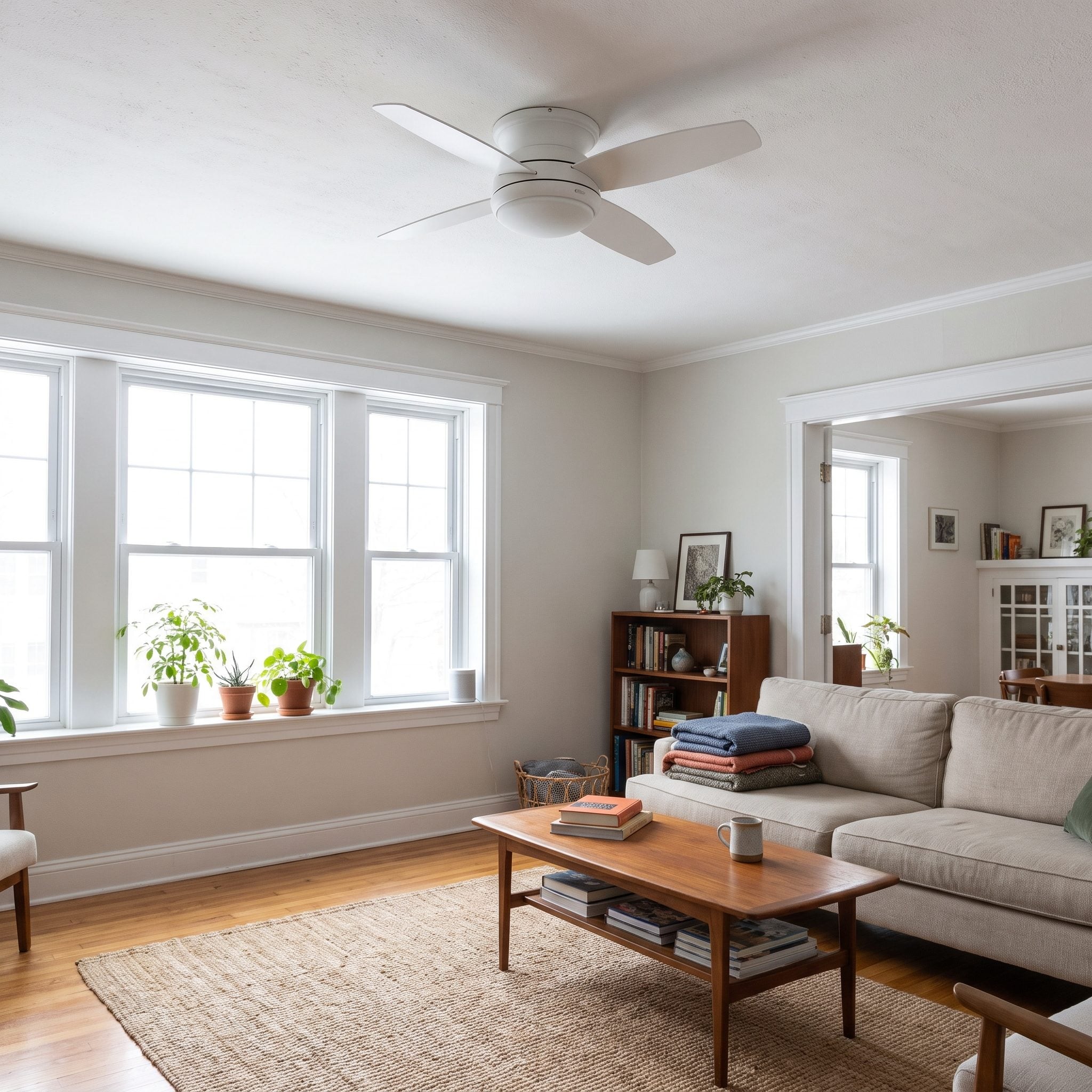
An eight-foot ceiling doesn’t banish the ceiling fan. It just removes the margin for a lazy installation.
Fan blades generally need at least seven feet of clearance above the floor, which is why low-profile or hugger designs make sense when the ceiling itself is only a foot higher than that. Today’s better versions use shallow housings, cleaner blades and integrated lighting instead of the beige pancakes that gave the category its reputation.
9. A Walnut-Blade Fan in a Warm Wood-Rich Interior
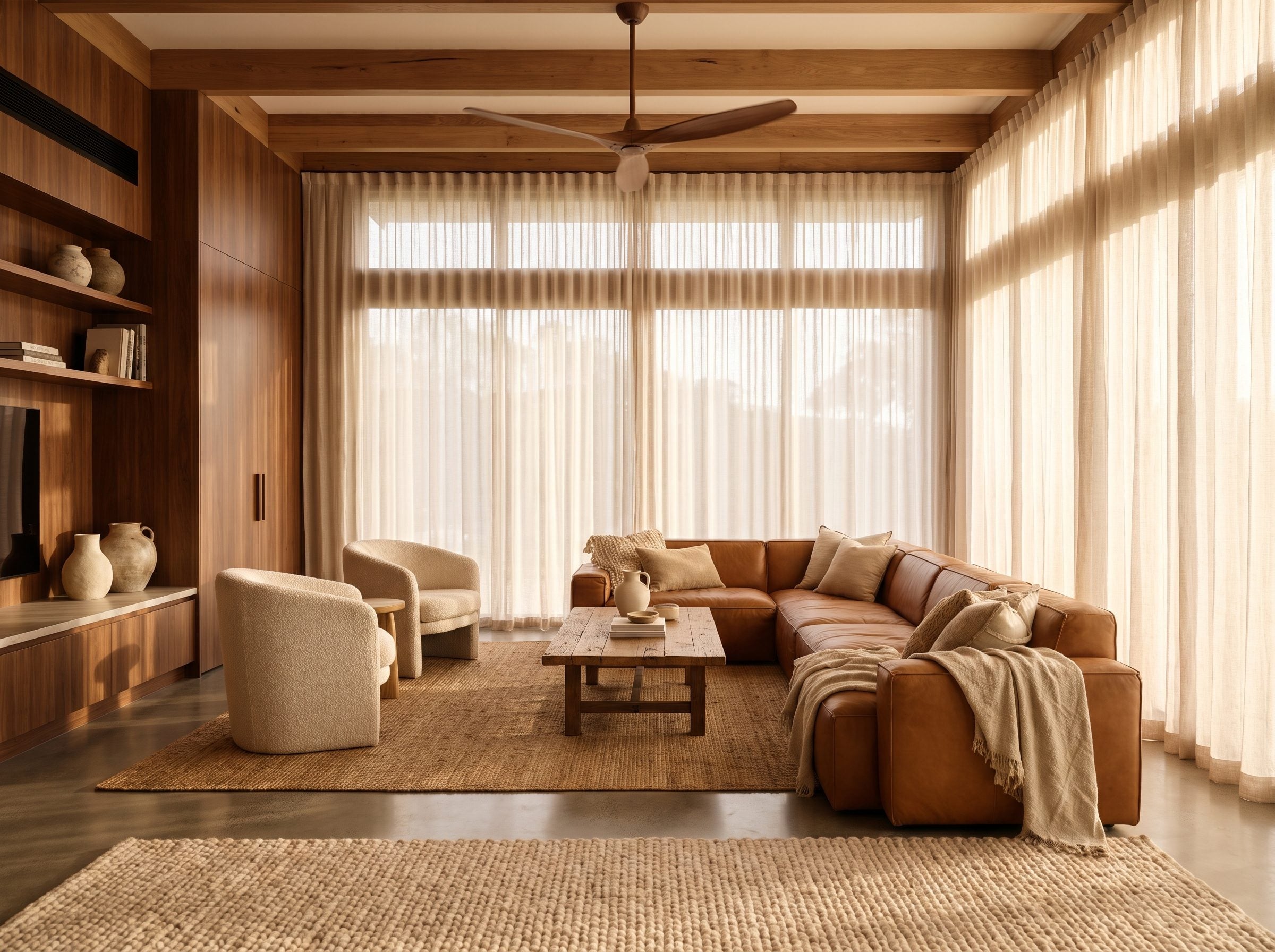
Here’s where the wood-fan idea becomes a lesson in scale rather than just matching.
A smaller walnut fan can echo a coffee table, shelving or flooring without becoming a second piece of furniture floating overhead. This fan-sizing guide is a better starting point than treating 20 or 25 percent of room width as a universal rule.
Warm walnut blades pull existing brown and amber tones upward. If you’re choosing between real veneer and faux wood, judge the finish from the floor rather than six inches away in a showroom. A convincing matte surface can beat expensive material with an obviously artificial stain.
8. A Fan Above the Bed Instead of a Decorative Light Fixture
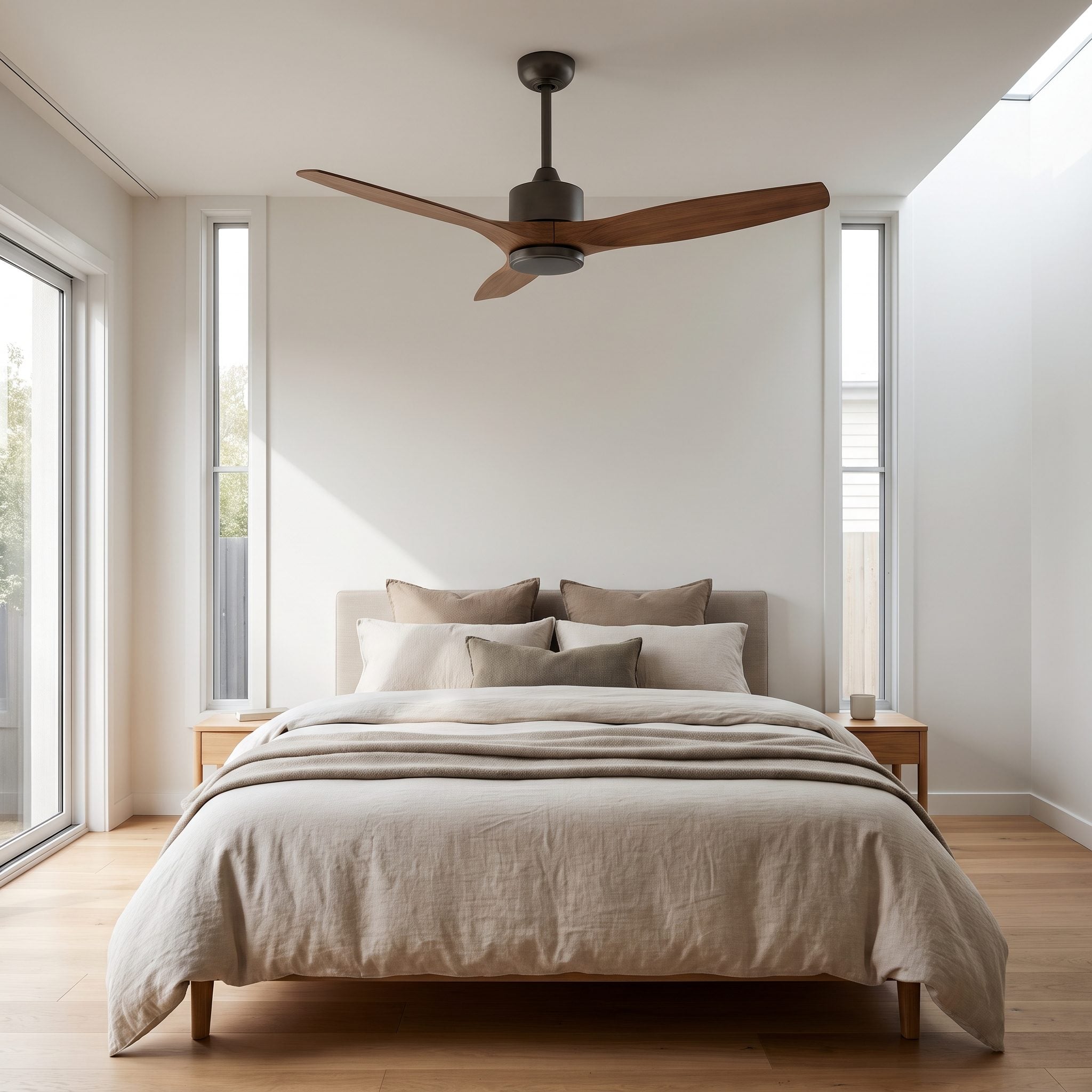
The bedroom chandelier has one undeniable advantage: it looks terrific in the listing photos. The fan has another advantage. It moves air while you’re asleep.
For a roughly 10-by-10 room, guidance often puts the fan somewhere around 36 to 42 inches, depending on the specific model and layout. This size-and-height guide provides one reference point.
Centering a fan in the room generally supports even air circulation, although some bedroom layouts emphasize the bed zone. This bedroom fan guide discusses the tradeoff.
The newer flush models make the aesthetic choice less painful. Wood, black, brass and integrated LEDs can all look intentional above a linen headboard without pretending the fixture is a chandelier.
7. A Fan Without a Light Kit That Looks Clean and Architectural
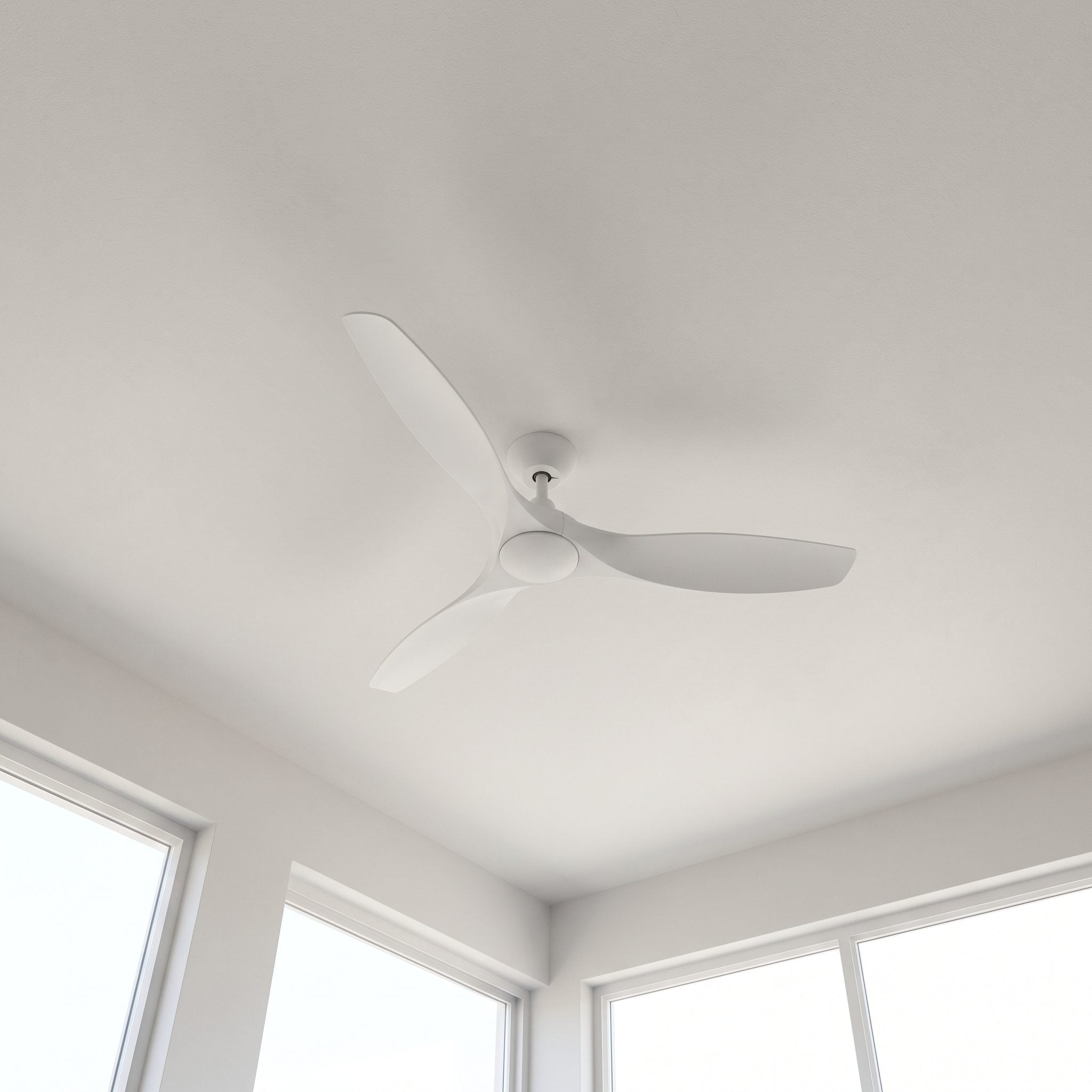
Take away the bulbous bowl light and an ordinary fan can lose half its visual baggage in about five seconds.
The advantage is primarily aesthetic, not some guaranteed leap in airflow. Fan-with-light versus fan-without-light comparisons such as this one are better treated as a question of lighting needs, cost and appearance than as proof that a central light kit automatically destroys performance.
Let recessed fixtures, floor lamps or sconces handle the room lighting, then give a matte black ceiling fan one job and one clean silhouette.
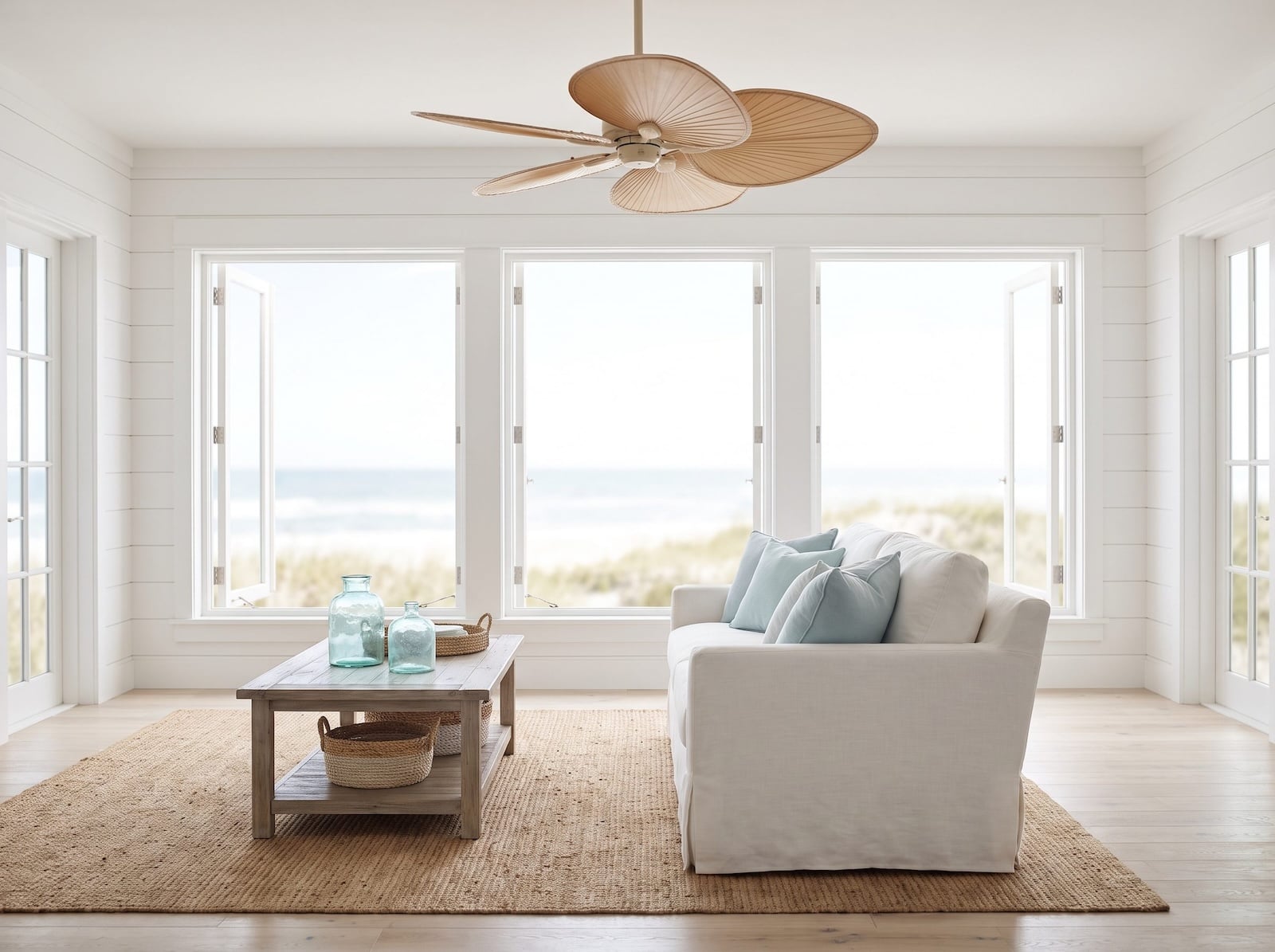
6. A Coastal Room With a Light, Organic-Looking Fan
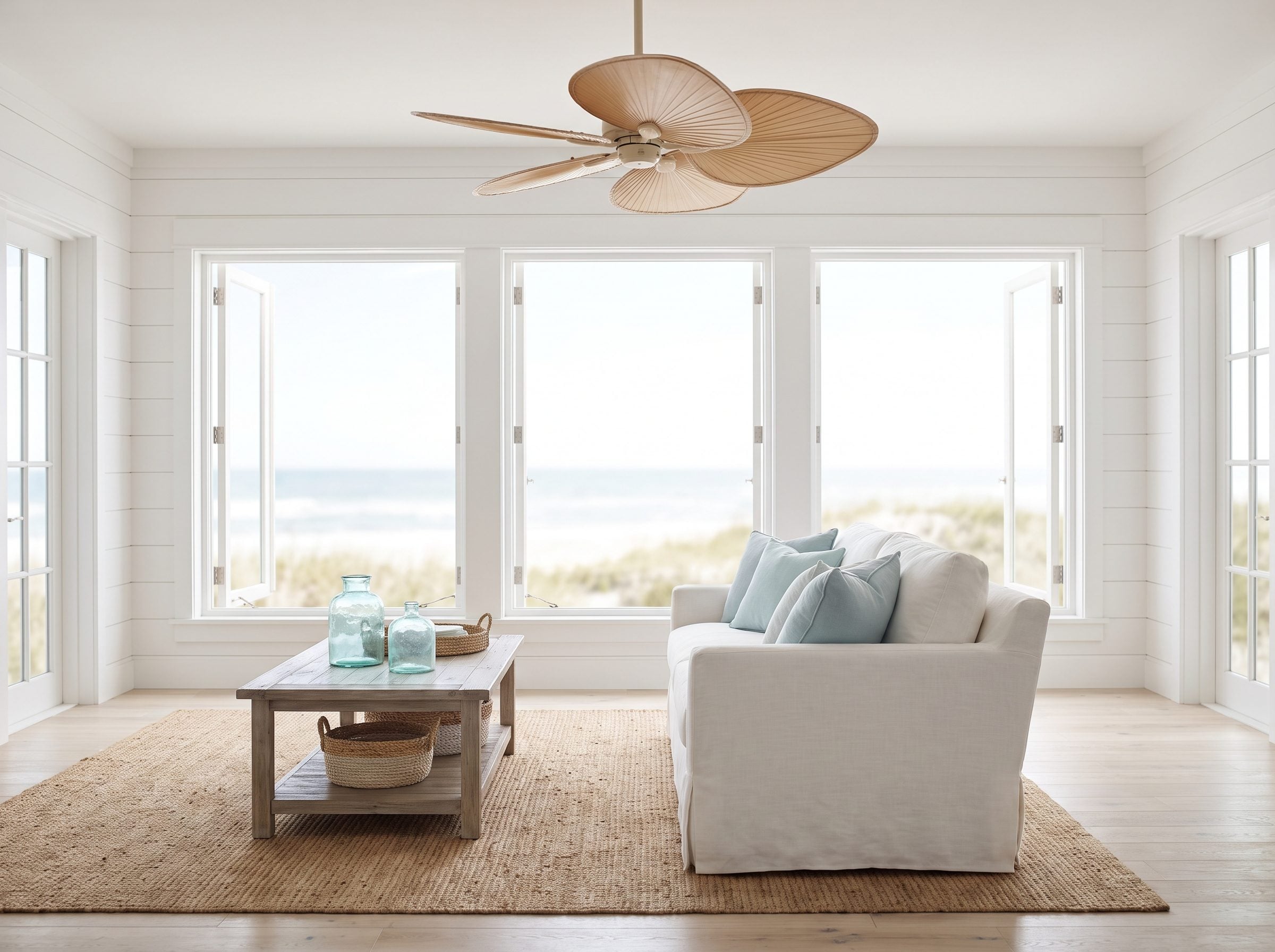
Coastal rooms don’t need another anonymous white object overhead. Texture is the better camouflage.
Woven-looking blades catch light differently from painted metal or plastic and immediately connect with jute, rattan, pale oak and linen elsewhere in the room. A nearby rattan pendant light can reinforce the material story without turning the whole house into a beach-resort gift shop.
5. Two Matching Fans Creating Symmetry in an Extra-Large Great Room
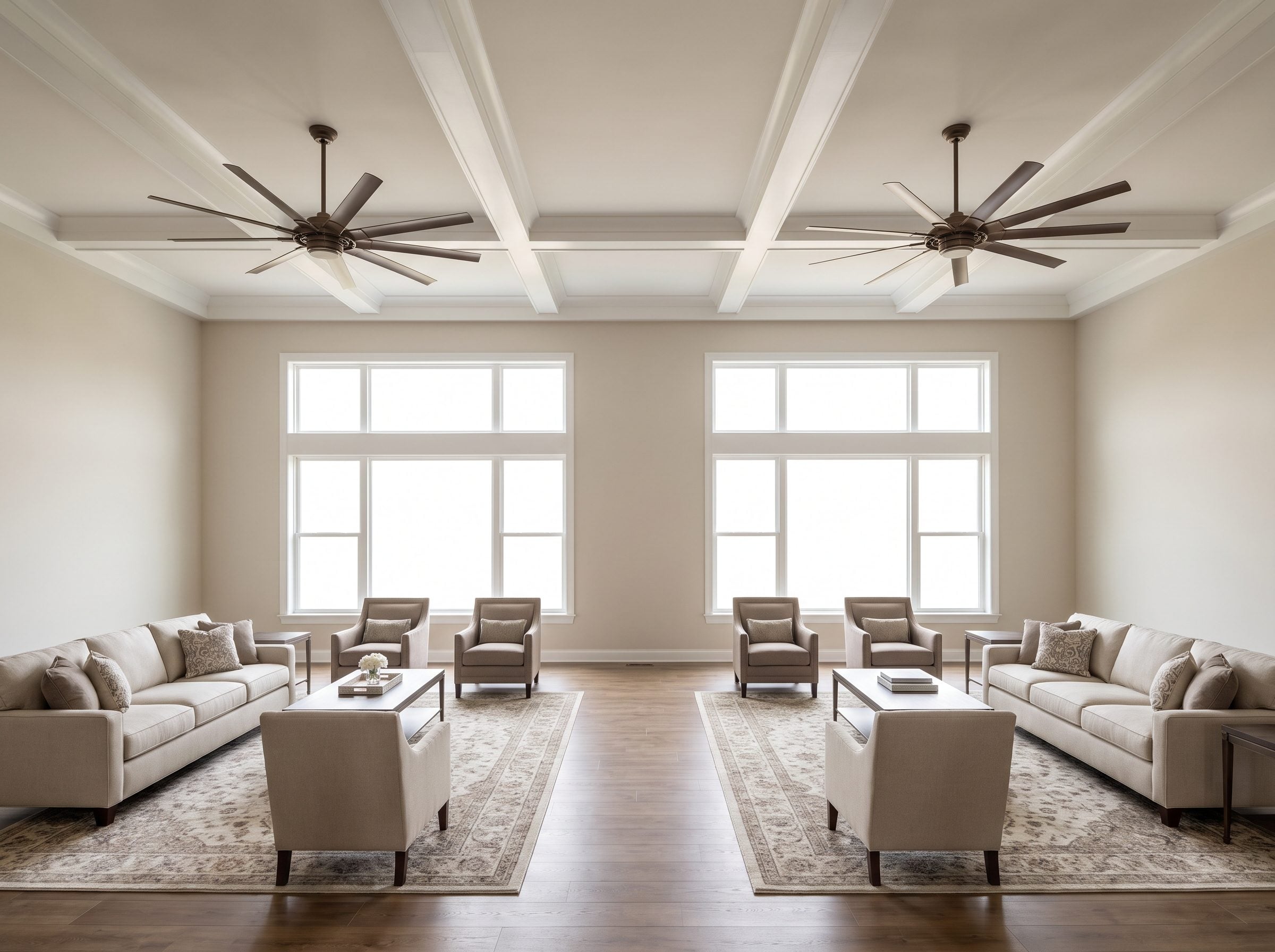
Sometimes one enormous fan is the wrong answer to an enormous room.
Two identical fans can distribute airflow across a long footprint while giving the ceiling a deliberate rhythm. The exact performance comparison depends on CFM, fan spacing, room geometry and mounting height, so don’t treat “two 52s beat one 72” as a law of physics.
A great room with multiple seating zones is a natural place to consider the pair. Same blade span, same finish, same mounting height. The symmetry is what keeps the ceiling from looking like the electrician ran out of ideas halfway across it.
4. A Matte-Black Fan That Becomes a Crisp Architectural Accent
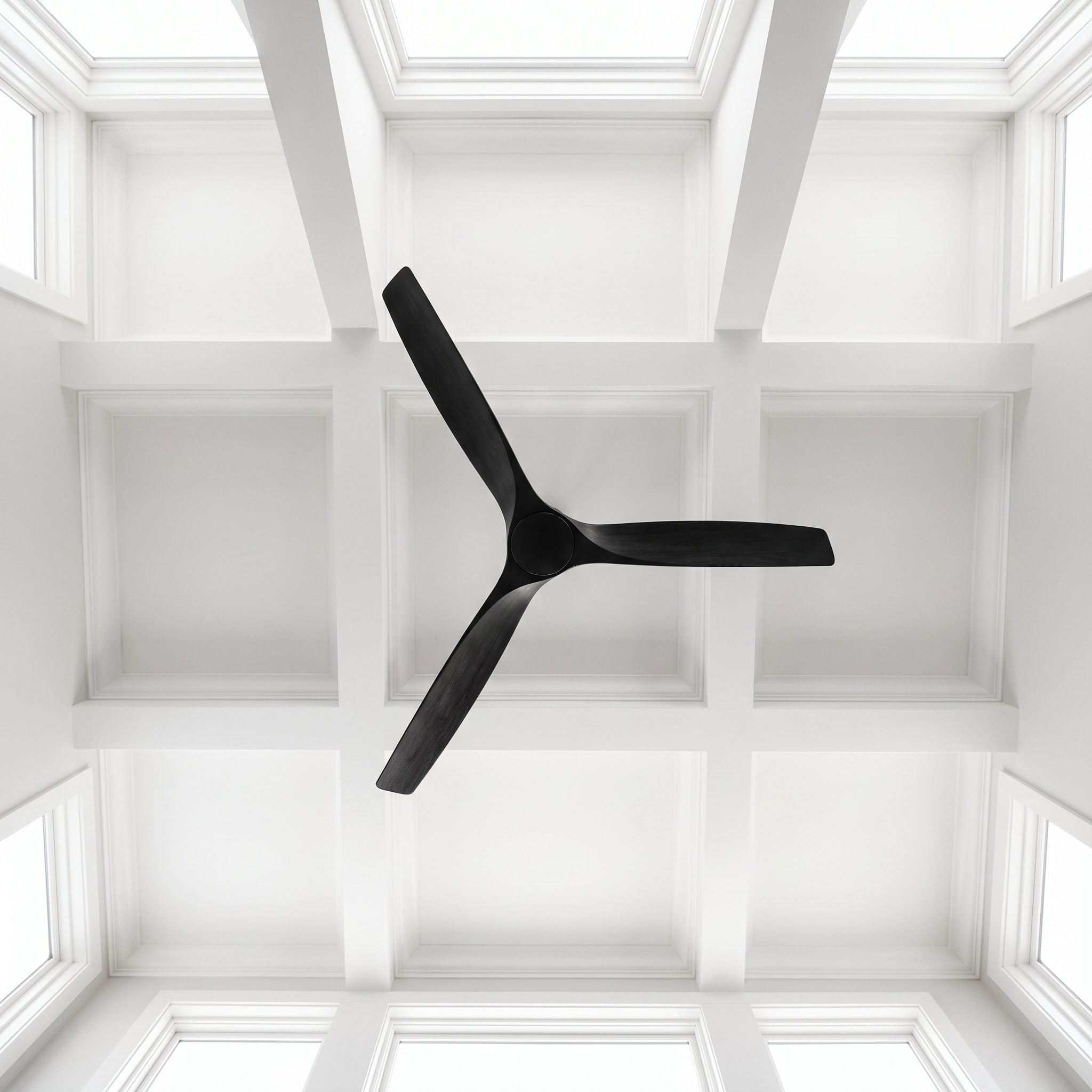
Now do the exact opposite. Don’t hide the fan at all.
Against a white ceiling, three slim black blades become punctuation: one strong dark line overhead that can answer black window frames, a floor lamp, picture frames or hardware elsewhere in the room. The success comes from editing the silhouette rather than disguising it.
Skip the giant frosted bowl underneath. A low-profile body with either no light or a flush integrated LED keeps the geometry clean. Matte black doesn’t magically hide dust, but it does avoid the yellowed-plastic effect that can make an older white fixture look tired.
3. A Transitional Room With a Simple Fan That Doesn’t Fight the Décor
🔥 Would you like to save this?
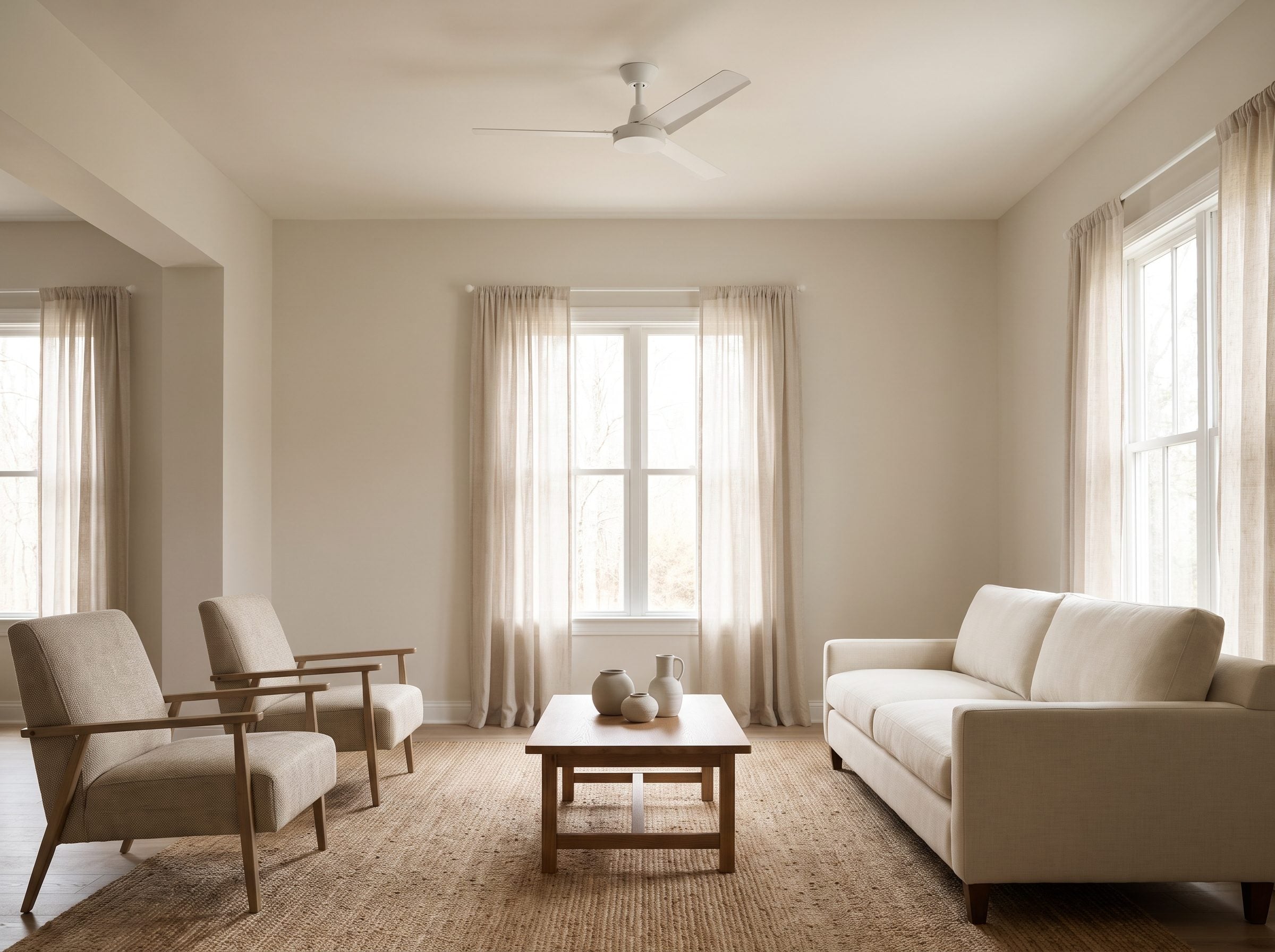
Not every fan needs a manifesto. Sometimes the achievement is simply not ruining a good room.
Three matte-black blades, a slim housing, sensible clearance, little ornament. The traditional elements in the room keep their authority while the fan quietly leans contemporary. That’s almost the definition of transitional design.
A burgundy great room or a neutral space can use the same strategy. Pick up an existing hardware finish and let the furniture carry the personality. Even a black linen sofa can give a dark fan enough company to feel intentional.
2. Matching Fans Running Down a Long Covered Porch

A long porch gives repetition a chance to become architecture. One fan over dining, one over seating, one over the swing: suddenly the ceiling has rhythm rather than one lonely fixture trying to serve forty feet of space.
A protected covered porch may be suitable for damp-rated equipment, but direct rain exposure changes the requirement. This outdoor-rating guide explains the distinction.
Run identical bronze outdoor ceiling fans down the axis and let each correspond to a real activity zone. Repetition works because the spacing looks planned.
1. A Statement Fan That Becomes the Ceiling’s Main Decorative Feature
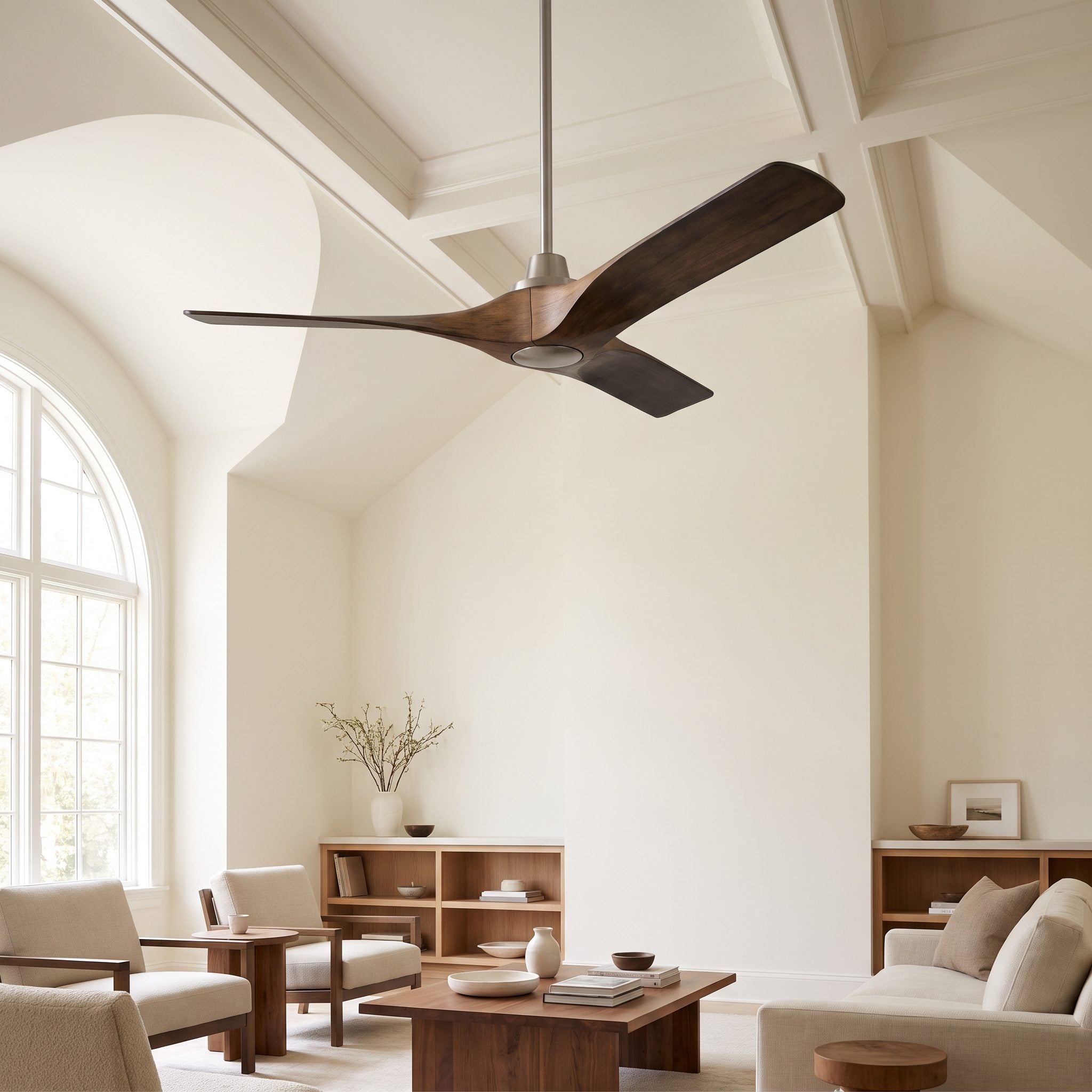
And here’s the reversal that makes the whole gallery make sense. After decades spent trying to make the fan disappear, designers finally have enough good-looking options to do something much more interesting: make the fan the ceiling.
Modern Forms is one example of where the category has gone. Its own design-trend material shows fans treated as decorative fixtures, with materials and integrated lighting doing work that once belonged almost exclusively to chandeliers. Other current fan-design roundups make the same broader point: manufacturers are no longer assuming every fan should disappear.
Let lamps and sconces provide the softer ambient light. Give the ceiling one strong object instead of a decorative fixture and an apologetic fan competing for the same territory. Black, sculptural, wood, brass, almost invisible or impossible to miss — the good version is the one that looks as though somebody chose it.
That’s the case these rooms make. The ceiling fan didn’t need to be exiled from good interiors. It needed better proportions, better materials, better placement and considerably less frosted glass.