🔥 Would you like to save this?
Your foyer is doing you dirty. Every day you walk through that door carrying the full weight of the world, and what greets you? Beige walls. Ceramic tile. A coat hook that cost eleven dollars. You deserve a decompression chamber — a space that physically pulls the anxiety out of your body before you take another step. These ultra-luxury foyer transformations were designed specifically for your nervous system. You’re welcome.
In order to come up with the very specific design ideas, we create most designs with the assistance of state-of-the-art AI interior design software.
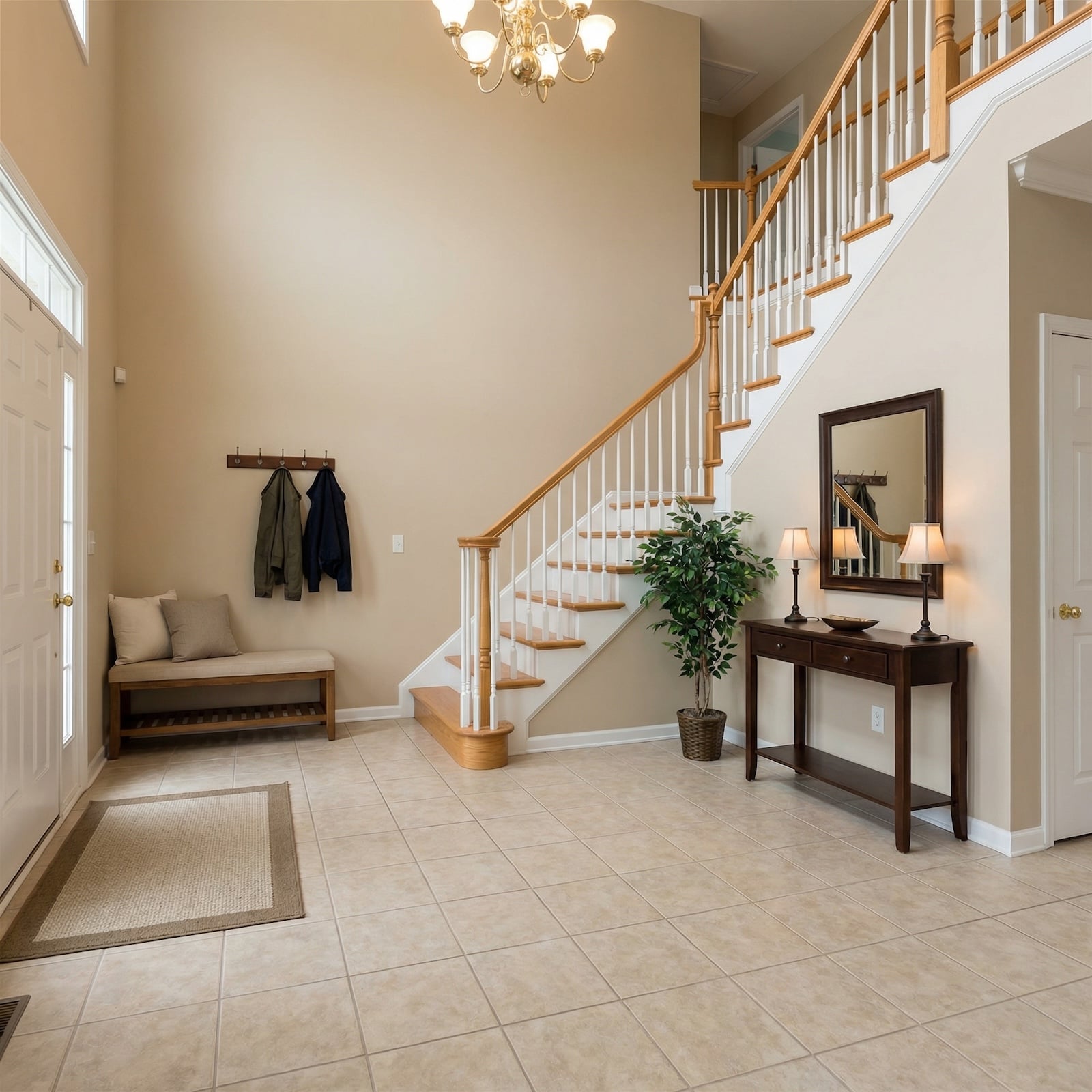
A builder-grade foyer is a specific kind of disappointment. It tends to arrive with a coat closet that barely closes, overhead lighting that flatters no one, and flooring that looks temporary even after a decade. For people who already feel the low hum of anxiety at home, that entry point sets the wrong tone before they’ve even taken off their shoes. These 33 before-and-after foyers prove that the fix doesn’t have to be a gut renovation. Thoughtful changes to lighting, storage, and scale can shift the entire feeling of a space.
The foyer carries more psychological weight than most rooms its size. It’s the first thing seen when the door opens and the last thing experienced before leaving. For anxious people, that threshold matters. Clutter at the entry raises stress. Poor lighting creates unease. The makeovers collected here address those specific pressure points, showing what changes when a foyer is designed with calm and function as the actual goal.
Japandi Foyer Swap: Beige Tile Out, Dark Hardwood and Cedar Lattice In
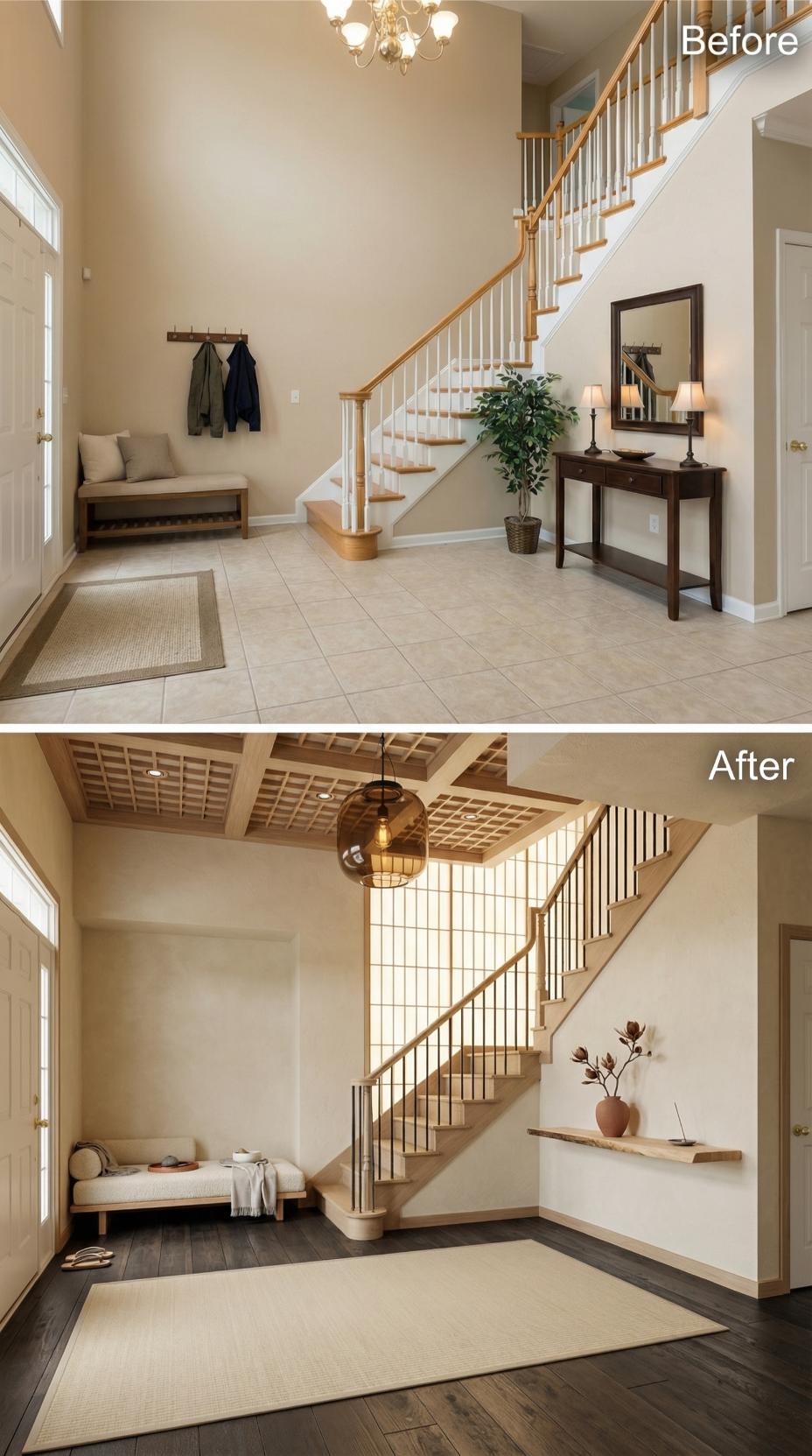
Dark-stained hardwood planks replace the original beige ceramic tile, and the shift in floor material alone changes how the room reads. A cedar lattice ceiling panel with recessed lighting sits above a rattan globe pendant, while the oak stair railing loses its white-painted balusters in favor of slim black metal spindles. Against the right wall, a live-edge shelf holds a single terracotta vase with dried magnolia stems. The seating area keeps a low maple daybed with a loose linen throw in place of the hook-laden coat bench.
Navy Paint and Globe Pendants Replace Beige Walls in a Two-Story Foyer
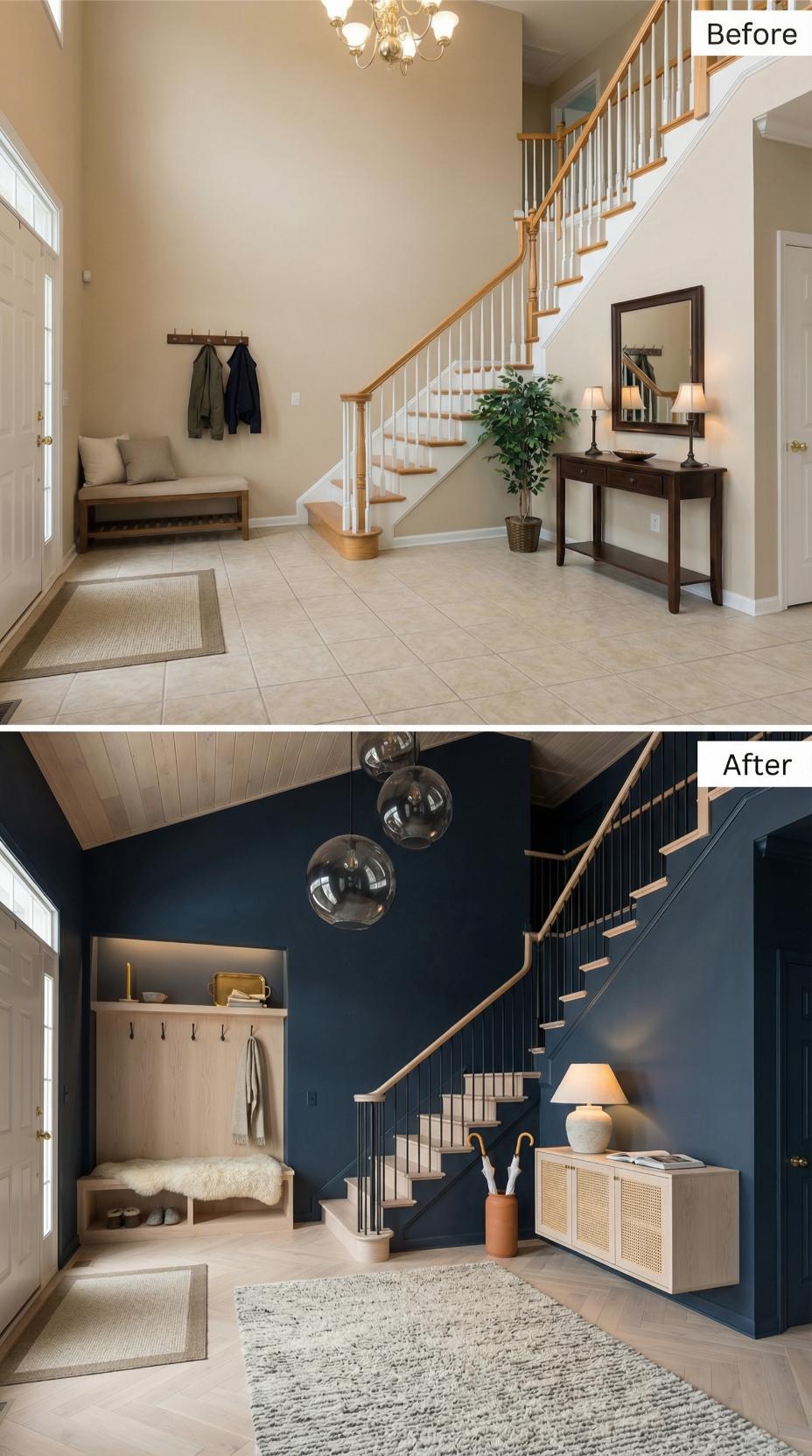
Sw navy blue covers every wall and the stair risers, pulling the balusters and newel post into the same deep tone while the natural oak handrail holds its warmth against the contrast. Two smoked glass globe pendants hang at staggered heights where a brass chandelier once sat. The built-in mudroom alcove swaps the freestanding bench for maple shiplap panels with integrated coat hooks, and a cane-front credenza anchors the opposite wall beside an umbrella stand in terracotta ceramic.
Dusty Rose Walls and Brass Stair Balusters Replace Beige in a Two-Story Foyer
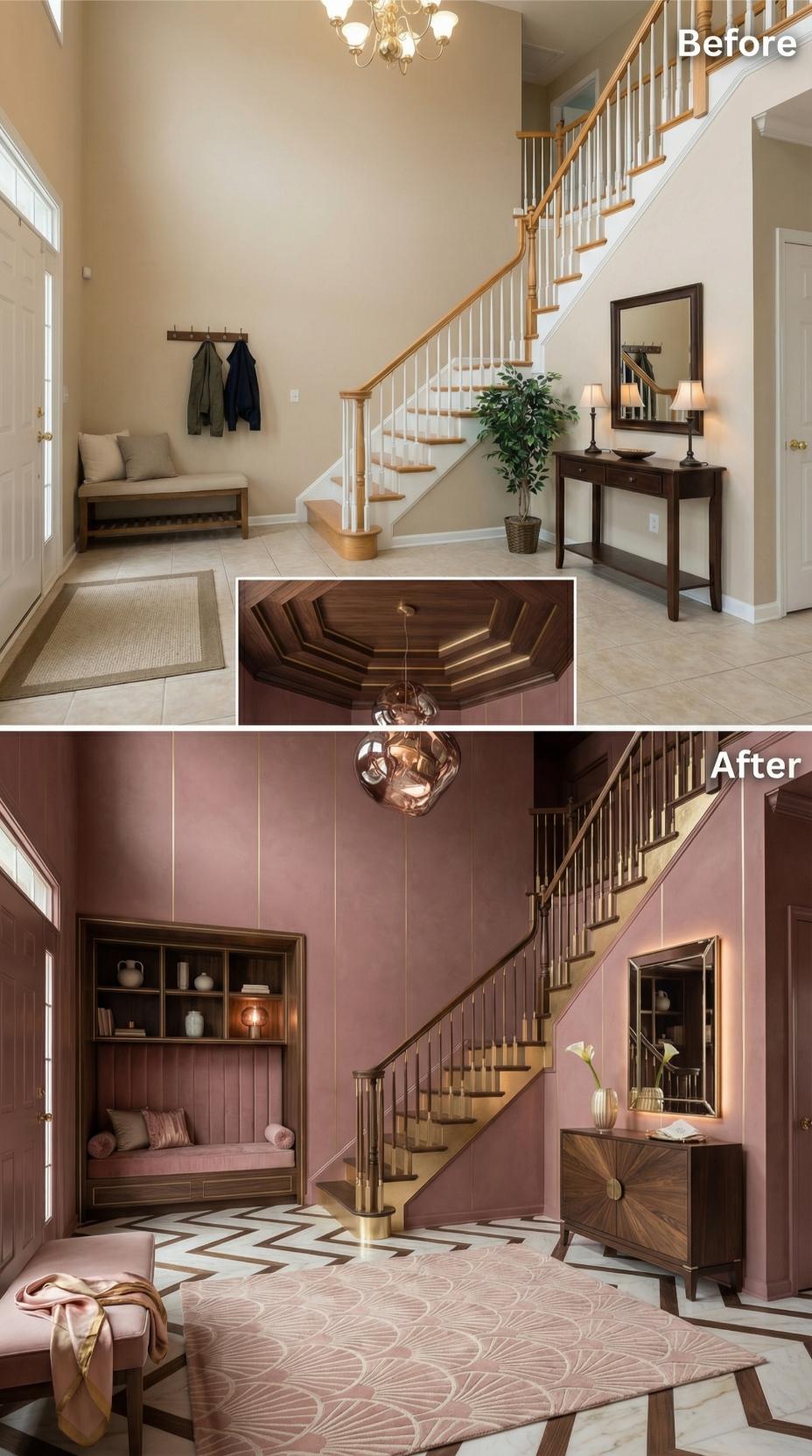
Mauve plaster walls with vertical walnut panel trim set the tone the moment the front door opens. The staircase got a complete overhaul: honey-toned oak treads replaced by dark walnut with brass balusters, the newel post finished in gold.
A built-in nook now occupies the left wall, fitted with open walnut shelving and a channel-tufted blush velvet bench seat. Underfoot, a cream rug with Art Deco scallop print sits over a chevron-inlay tile floor in cream and walnut tones. A rose-gold globe pendant cluster handles the lighting work the old chandelier could not.
Did You Know: Rose or mauve in an entryway is sometimes called a “threshold color” in chromotherapy, because pink-adjacent hues are thought to lower the heart rate on arrival. Designers working with anxiety-sensitive clients have used it specifically in transition spaces like foyers for that reason. The psychological effect is subtle but measurable in how quickly a person’s shoulders drop when they walk in.
Botanical Wallpaper and Built-In Shelves Replace Bare Beige in a Two-Story Foyer
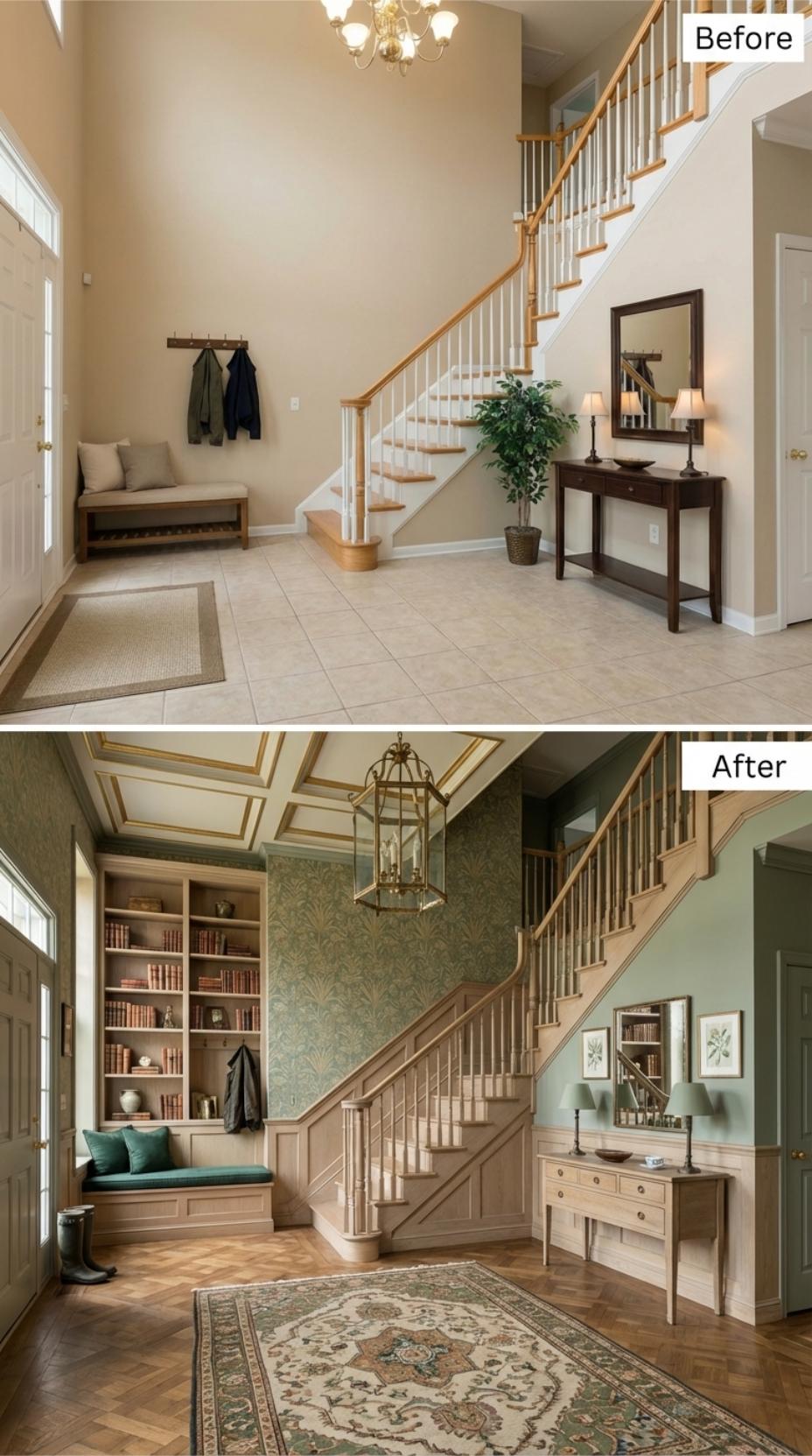
Bare beige walls and a coat rack nailed to drywall were doing this foyer no favors.
The after version introduces a botanical-print wallpaper in sage and cream that runs the full height of the staircase wall, with wainscoting below it in painted wood paneling. Built-in shelving flanks the entry bench on the left, finished in the same warm cream as the trim, with open cubbies holding leather-bound books and ceramic objects. The bench itself gains a tufted cushion in forest green velvet with matching throw pillows.
A brass lantern pendant with glass panels replaces the original chandelier, casting a warmer color temperature across the herringbone oak floor. The stair railing shifts from honey-toned wood with white balusters to a bleached oak finish throughout. A wool runner in ivory and terracotta anchors the center of the floor, pulling the green and gold tones together without overworking the palette.
Lavender Plaster Walls and Wrought Iron Balusters Replace Builder Beige
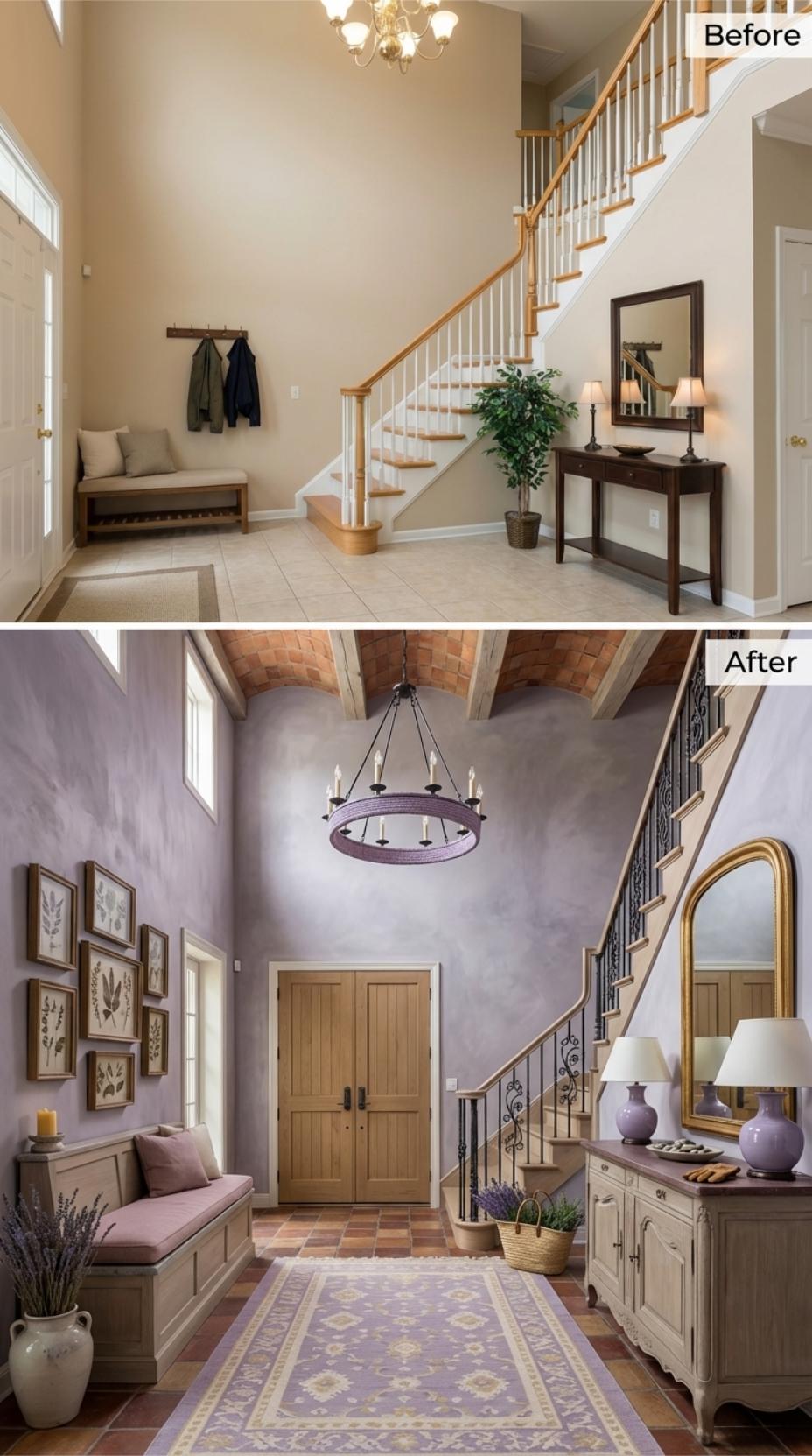
Lavender walls in an entryway are a quiet act of defiance against every beige foyer ever built.
Venetian plaster in a soft violet-grey replaces the original flat beige paint, and the texture alone changes how light reads across the walls at different hours. Terracotta tile in a running bond pattern covers what was once generic cream ceramic. A round candle chandelier with a woven purple ring frame hangs where a brass cluster fixture used to live. The staircase railing swaps oak spindles for scrolled wrought iron balusters. On the right, a painted wood credenza in an antler-cream finish holds a ceramic lamp with a lavender glaze base. Dried lavender bundles and a botanical gallery wall anchor the left side, and a runner in a geometric diamond pattern in pale violet and ivory pulls the floor together.
Charcoal Plaster Walls and Cluster Pendants Replace Beige Tile in a Two-Story Foyer
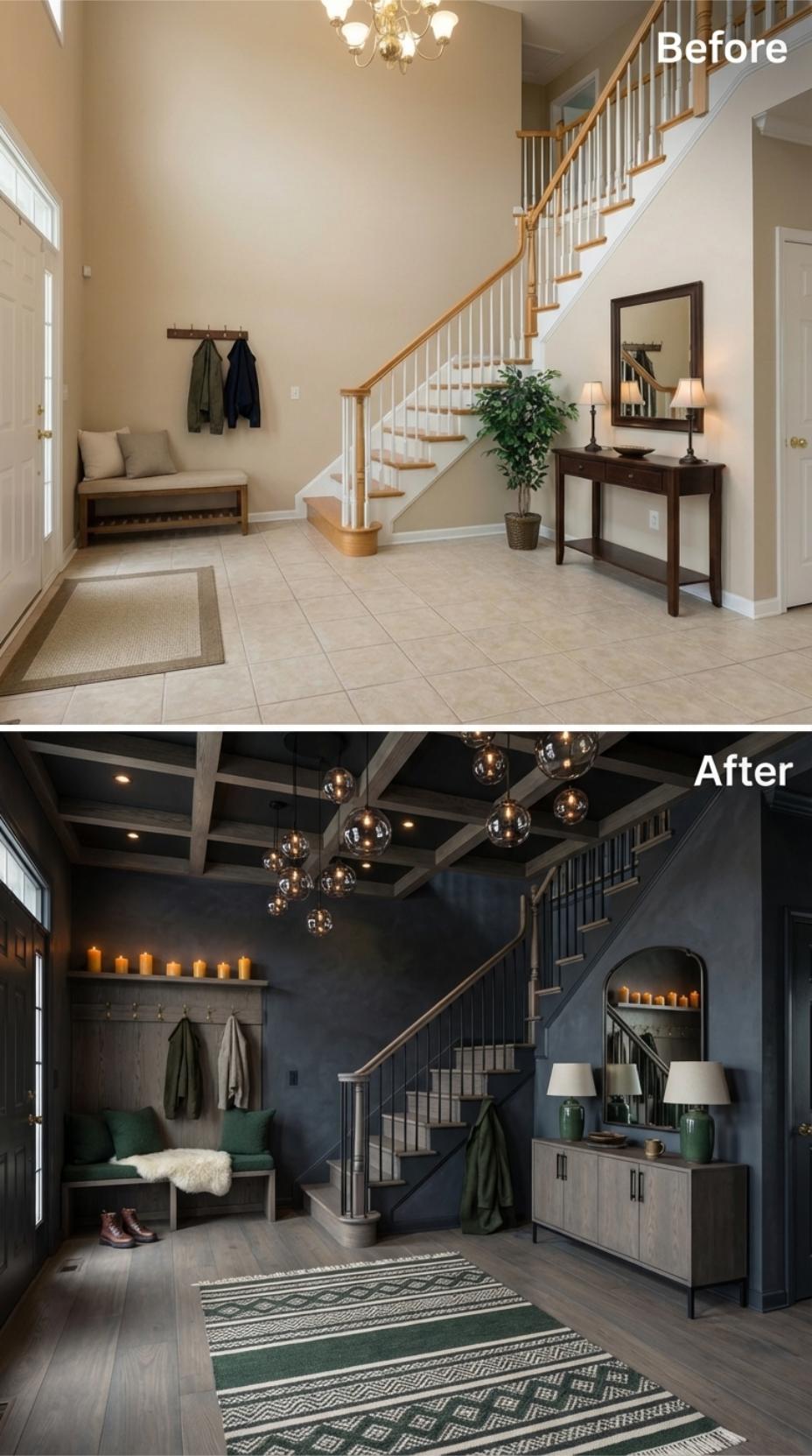
Charcoal plaster covers every wall surface, including the ceiling coffers framed by exposed wood beams painted the same near-black tone. Overhead, a cluster of smoked-glass globe pendants replaces the original brass chandelier, each sphere a slightly different diameter to break up the symmetry. The stair railing swaps oak wood spindles for slender black metal balusters.
A patterned runner in forest green and cream anchors the wood-plank floor, while a low credenza with flat-panel doors and brushed-nickel pulls holds two ceramic table lamps with linen shades. On the left wall, a built-in bench with green cushions and a white sheepskin throw sits below coat hooks. Pillar candles line a floating shelf above.
Quick Fix: Painting ceiling coffers and beams the same dark tone as the walls compresses visual noise without requiring structural changes. It reads as intentional rather than oppressive because the light sources pull the eye upward. This technique works especially well in high-entry foyers where the upper volume can feel disconnected from the rest of the space.
Venetian Plaster in Slate Blue and Wrought Iron Balusters Replace Builder-Grade White
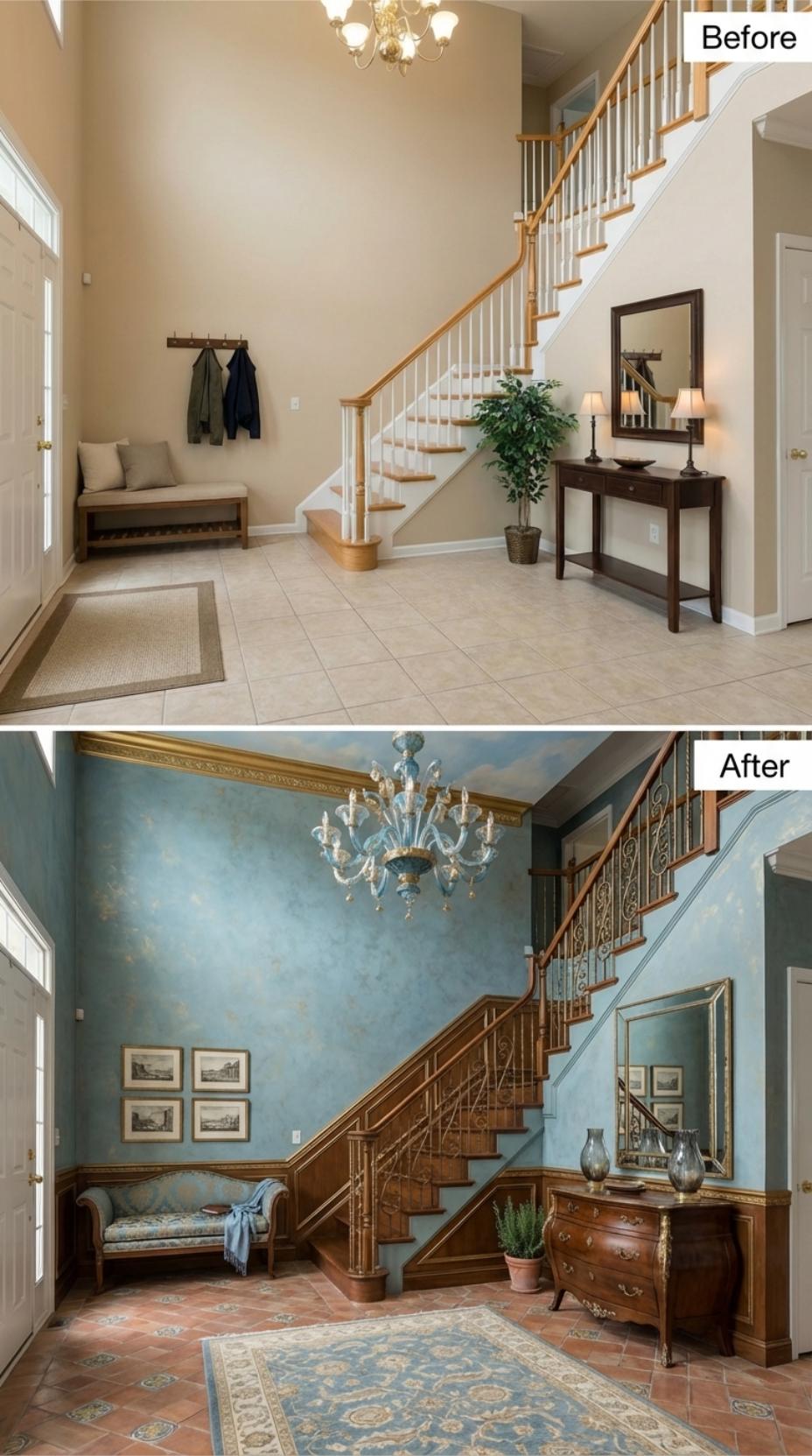
Powdery blue Venetian plaster climbs the walls beneath a gilded crown molding band, anchored by a Murano-style blown glass chandelier in matching teal. Walnut stair treads with scrolled iron balusters replace the original oak-and-white spindles entirely.
Why It Works: Blue in the 490–500 nanometer wavelength range is consistently linked to reduced cortisol response, making it one of the few bold wall colors that can actually quiet an entry rather than stimulate it. The gilded molding line draws the eye horizontally, which interrupts the verticality of a two-story foyer and reduces the sense of exposure that high ceilings can trigger in anxious visitors. Terracotta tile on the floor grounds the cool plaster above it, preventing the room from reading as cold.
Plum Venetian Plaster and Wrought Iron Balusters Replace Beige Tile in a Two-Story Foyer
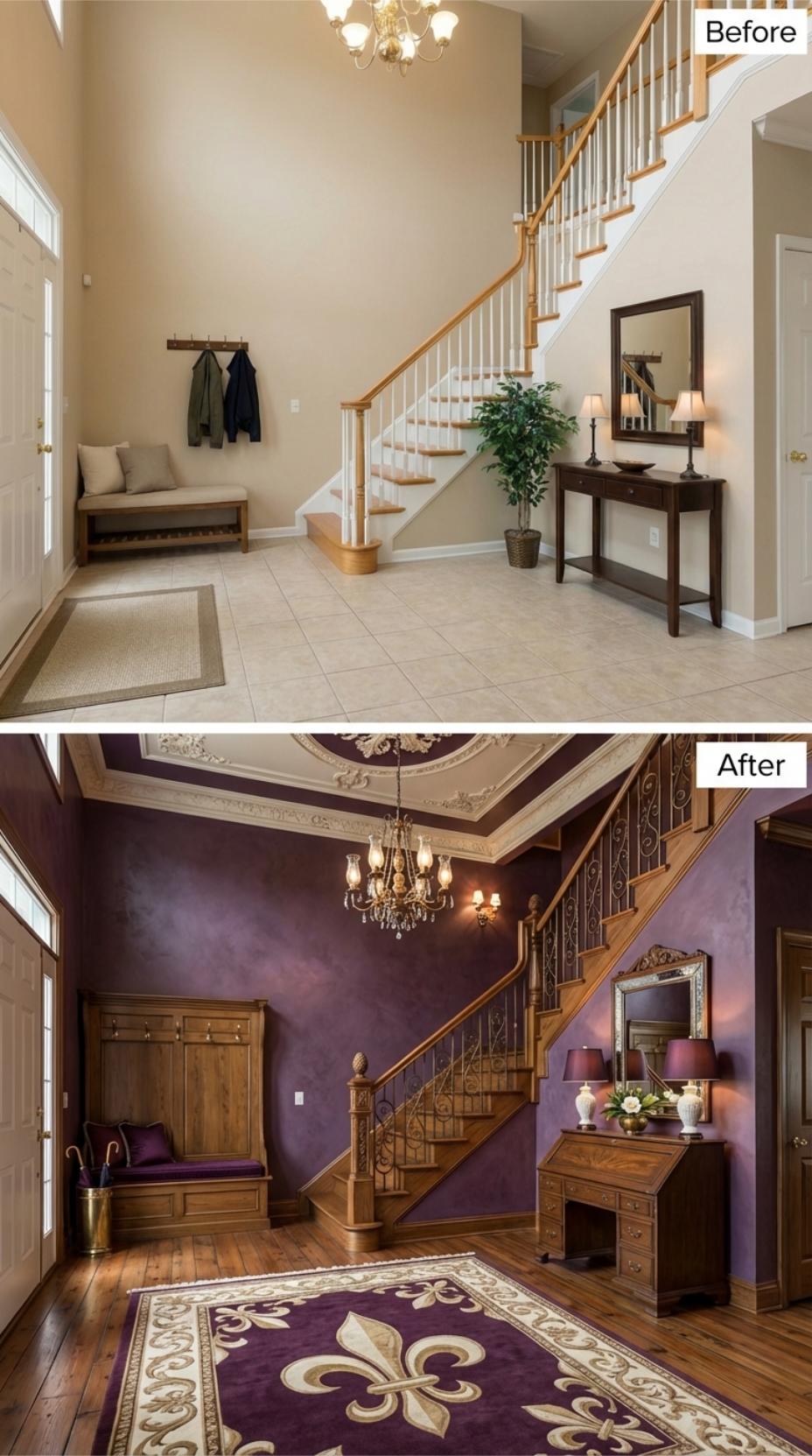
Builder-grade beige tile and white spindle balusters gave this foyer the personality of a rental listing. Now, plum-toned Venetian plaster coats every wall surface, applied with enough variation to catch light differently at each hour of the day. Ornate plaster crown medallions at the ceiling add architectural weight without construction work. The staircase railing swaps white wood for wrought iron with scroll detailing, paired with a warm oak handrail and a carved pineapple newel post.
Wide-plank hardwood in a medium walnut stain replaced the ceramic tile. A purple fleur-de-lis wool rug anchors the entry with a formal geometry. The console, now a secretary-style oak cabinet, sits beneath a framed mirror flanked by white ceramic lamp bases with deep burgundy shades. Wall sconces beside the staircase add a secondary light layer that the original chandelier alone could not provide.
Fun Fact: Deep purple sits at roughly 380–450 nanometers on the visible spectrum, the shortest wavelength the human eye reliably detects. Historically, that rarity made purple pigment expensive enough to reserve for ceremonial spaces, which is part of why it still reads as deliberate and considered in an entry hall rather than casual.
Saltillo Tile and Adobe Plaster Pull a Builder Foyer into New Mexico Territory
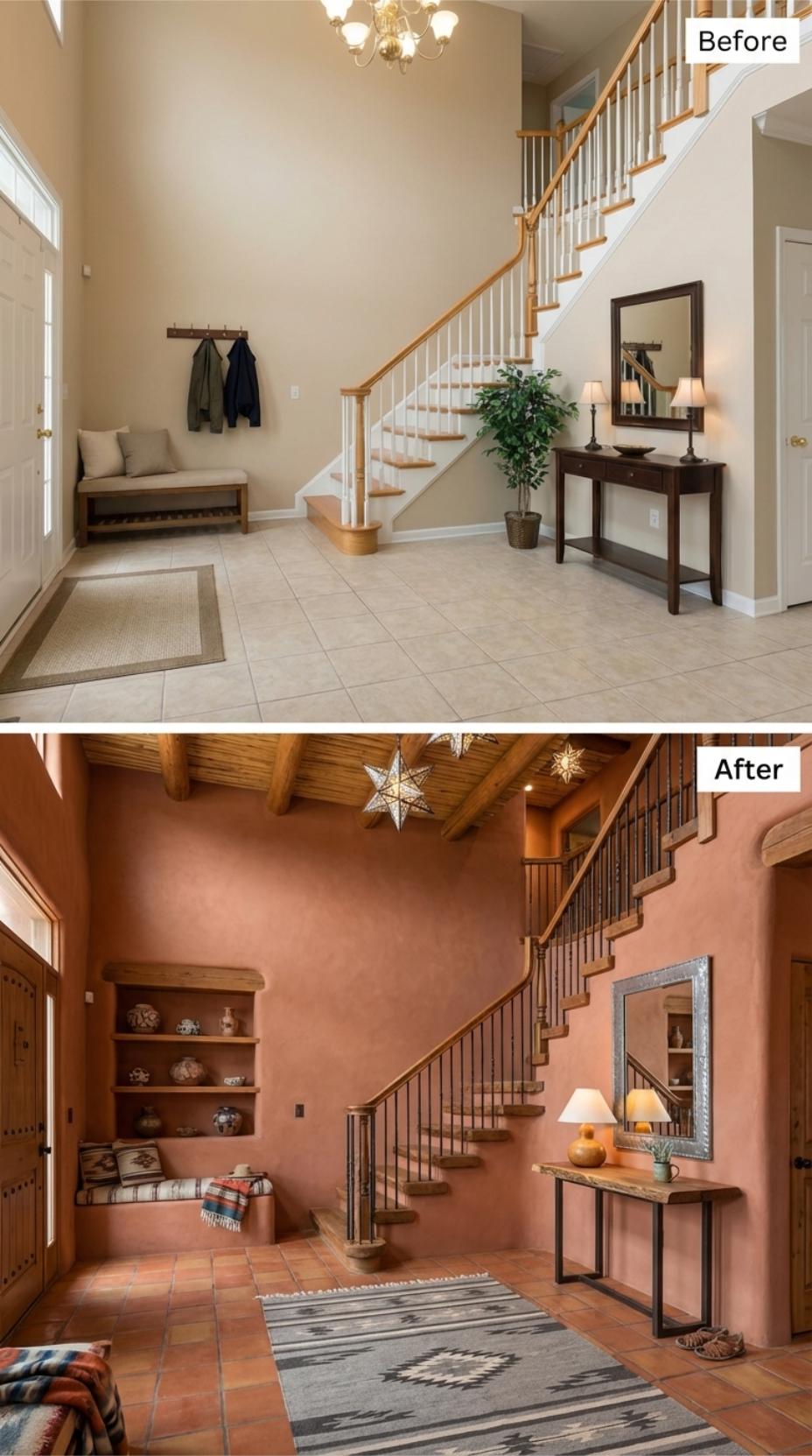
Terracotta saltillo tile replaces the original cream ceramic, and the walls shift from flat beige to a hand-applied adobe plaster in a warm canyon rose. Exposed vigas run across the ceiling, and a Moravian star pendant hangs at center alongside a smaller punched-tin fixture. The staircase loses its oak rail and white balusters in favor of wood treads framed by simple square iron spindles.
Built-in niches along the left wall hold Pueblo pottery and ceramic vessels, replacing the wall-mounted coat hooks with something that holds visual weight. A live-edge console on iron legs takes over from the dark-stained console table, and a Zapotec-style flatweave rug runs down the center of the floor. The mirror frame swaps dark wood for hammered silver.
Pro Tip: Terracotta tile is porous and benefits from a penetrating sealer applied before grouting, not after. Skipping this step allows grout to stain the tile face permanently during installation. Resealing annually keeps the color from fading in high-foot-traffic entry zones.
Striped Wallpaper, Dark Wainscoting, and a Library Wall Pull a Builder Foyer into Victorian Territory
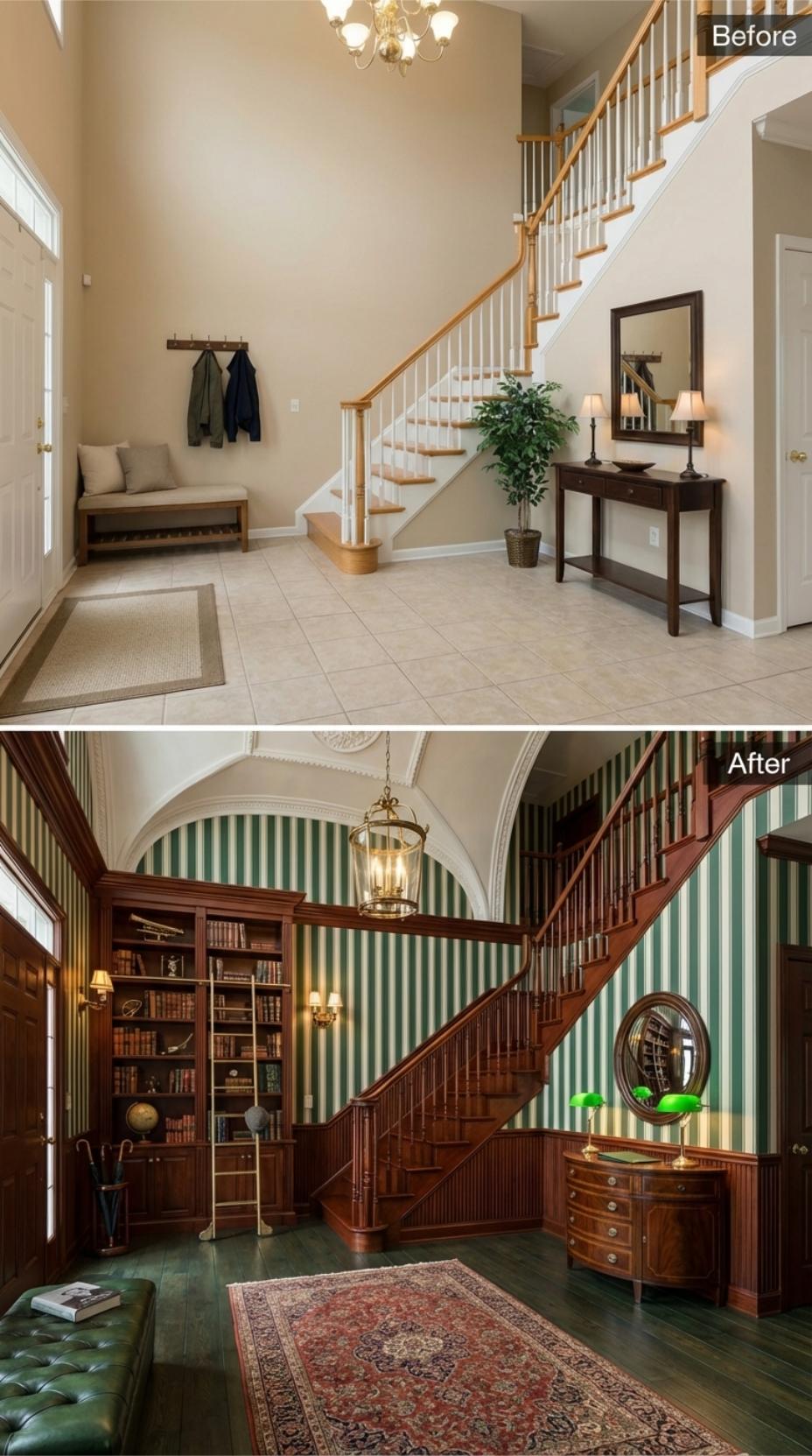
Green and white vertical stripe wallpaper runs from chair rail to ceiling, punctuated by dark walnut wainscoting and picture-rail molding. The staircase railing, previously a honey-oak and white spindle assembly, is now a solid mahogany balustrade with turned newel posts. A lantern-style brass pendant replaces the original chandelier.
A built-in bookcase with a brass library ladder anchors the left wall, filled with leather-bound volumes and a tabletop globe. Underfoot, a Persian runner in red and burgundy lays over stained dark-green hardwood. A tufted green leather bench sits opposite a serpentine-front chest topped with two banker’s lamps.
In The Details: Vertical stripes on walls do more than suggest height. Studies in environmental psychology show that strong vertical pattern repetition draws the eye upward and stabilizes peripheral visual focus, which can reduce the sense of spatial disorientation some people feel in double-height entry halls. Pairing that pattern with dark wainscoting below creates a defined horizon line that grounds the room.
Antler Chandelier and Knotty Pine Paneling Replace Beige Tile in a Two-Story Foyer
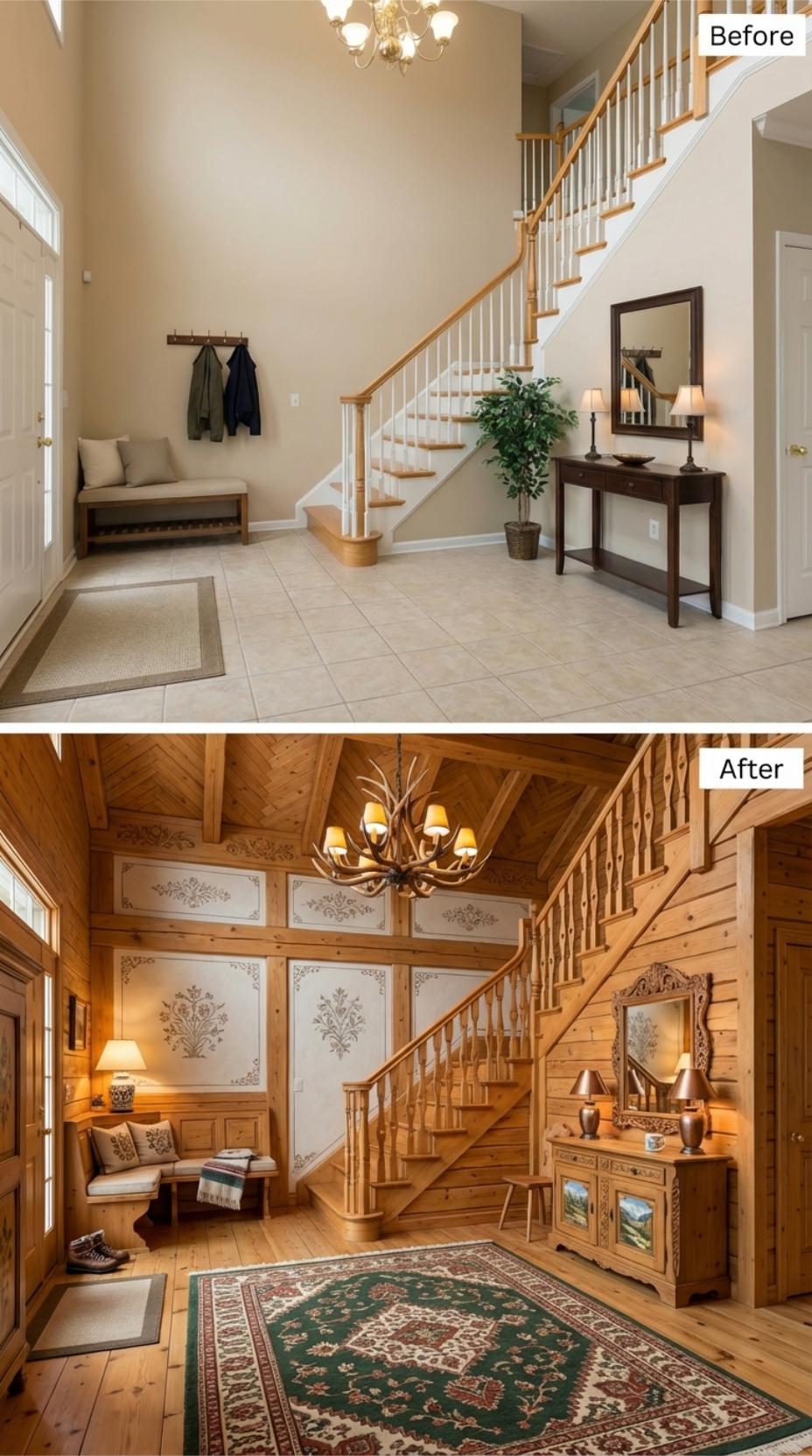
Wide-plank pine floors in a honey finish replace the original ceramic tile, and knotty pine tongue-and-groove paneling runs floor to ceiling on every wall. The staircase gets rebuilt with turned wood balusters and a carved newel post. A six-arm antler chandelier anchors the ceiling where a basic fixture once hung.
Hand-stenciled botanical panels break up the paneling with cream-on-cream floral motifs. A carved pine dresser with copper-finish lamps and a landscape painting replaces the dark console table. A wool area rug in forest green with a cream medallion pattern grounds the entry. Boots beside the bench and a plaid throw on the seat signal that this foyer is meant to be used, not admired from a distance.
Designer’s Secret: Antler chandeliers are often assumed to be heavy, but most commercially produced versions use resin castings rather than actual antler, keeping the fixture weight under 15 pounds and within standard ceiling box limits. That detail matters in two-story foyers where junction boxes are rarely reinforced for heavy pendants. Swapping the canopy hardware to a fan-rated brace adds a safety margin without requiring an electrician to open the ceiling.
Cobalt Plaster and Carved Walnut Pull a Builder Foyer into Spanish Colonial Territory
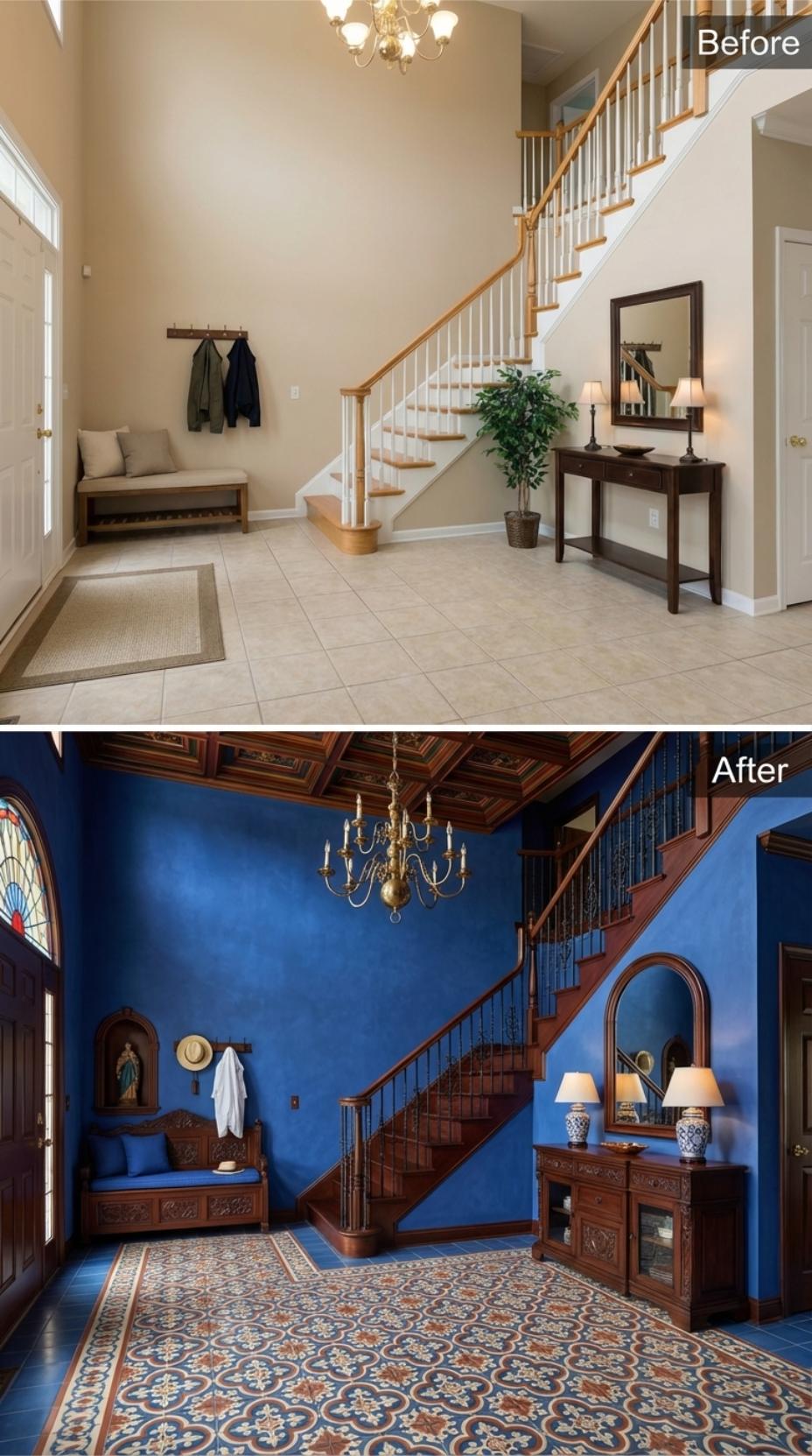
Cobalt plaster covers every wall surface from baseboard to coffered ceiling, and the effect reads less like paint and more like pigment soaked into the architecture itself. Encaustic cement tiles in a medallion pattern repeat across the floor in the same blue, anchored by rust and cream. The staircase railing swaps builder-grade oak for dark walnut balusters with forged iron spindles. A brass candelabra chandelier hangs low enough to feel intentional.
The entry bench is carved walnut with mortise-and-tenon joinery visible on the arms, cushioned in cobalt velvet. A console cabinet with leaded glass doors holds two blue-and-white ceramic lamps beside an arch-topped mirror. A stained glass window in the left wall introduces amber and teal, repeating the floor’s color logic overhead.
History Corner: Spanish Colonial architecture reached its peak influence in California and the American Southwest between roughly 1915 and 1940, largely driven by the 1915 Panama-California Exposition in San Diego, where the Churrigueresque facades introduced carved wood and polychrome tile to a broad American audience. Encaustic cement tile, a key material in that revival, is made by pressing pigmented cement into molds rather than firing it, which is why the color runs through the full thickness of each tile rather than sitting as a glaze on top. That construction method makes repairs almost invisible, since a chipped edge exposes the same color as the surface.
Moss Wall Art and Wavy Wood Ceiling Panels Replace Beige Tile in a Two-Story Foyer

🔥 Would you like to save this?
Preserved moss in three distinct textures — ball moss, flat sheet moss, and lichen clusters — covers the entire staircase wall in a composition of deep green, navy, and off-white. Bleached birch branches emerge from the installation at irregular intervals, with air plants tucked between them. Wavy light-maple panels ripple across the ceiling above, backlit to cast warm indirect light downward.
Navy plaster walls anchor the remaining surfaces. The original oak stair rail and white balusters gave way to light maple newel posts and matte black metal balusters. Underfoot, wide-plank hardwood in a pale ash tone replaced the builder tile, and a navy grid-weave rug grounds the entry sequence.
Common Mistake: Preserved moss walls require no irrigation or soil, but they do require stable indoor humidity, ideally between 40 and 60 percent. Spaces that run very dry in winter, particularly those with forced-air heat and no humidifier, can cause the moss to become brittle and shed. A simple plug-in humidistat costs under thirty dollars and prevents the most common failure mode.
Dark Walnut Panels and a Paper Lantern Pendant Replace Beige Tile in a Two-Story Foyer
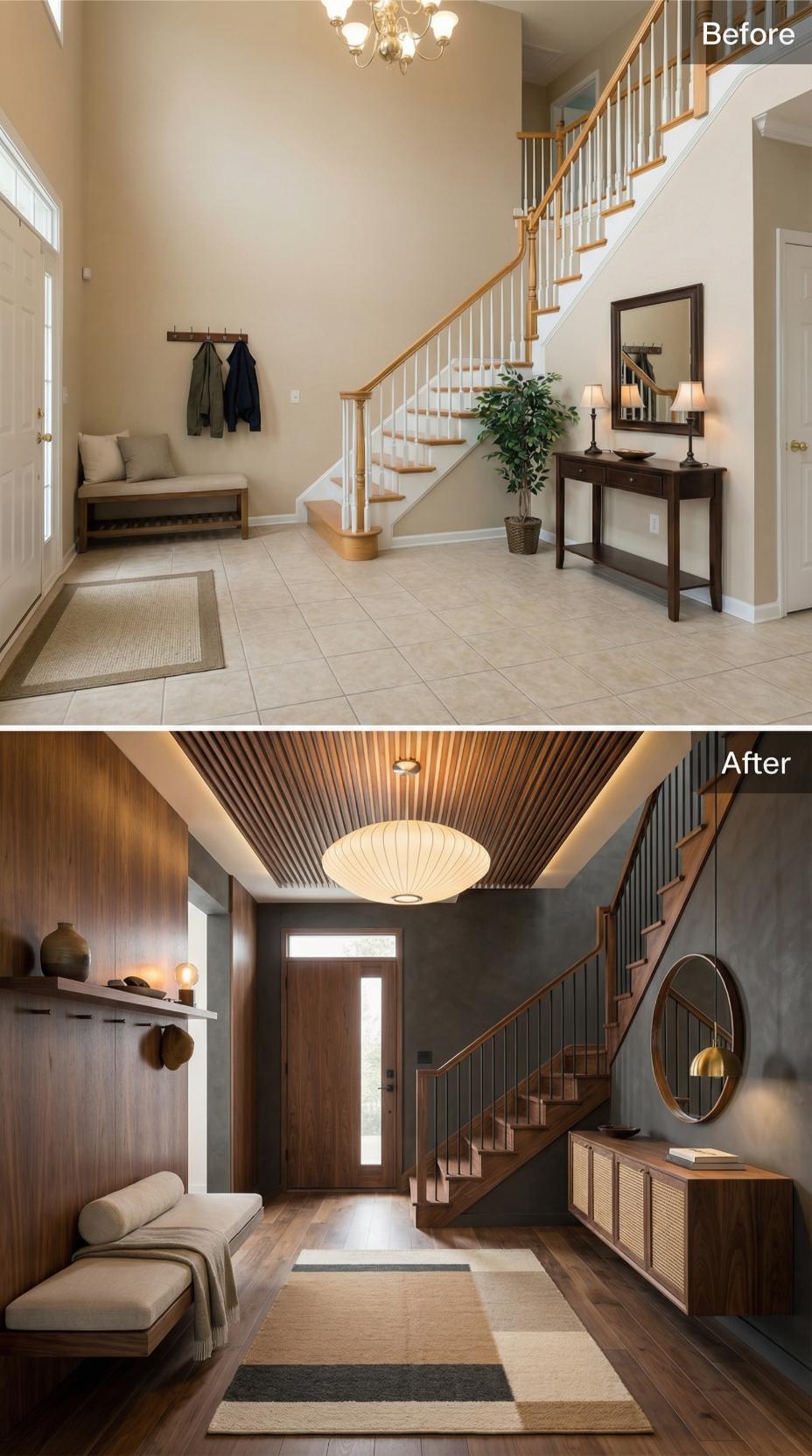
Slatted walnut panels line the ceiling and wrap the walls, while textured concrete plaster in slate gray grounds the space without competing for attention.
Ask Yourself: whether your foyer ceiling is doing any work at all. Wood slat ceilings absorb sound differently than drywall, reducing the hollow echo that makes large two-story entries feel unsettled rather than welcoming. If ambient noise is part of what raises your stress at the door, the ceiling is worth addressing before the walls.
Sculptural Wood Chandelier and Horizontal Steel Balusters Retire a Two-Story Builder Foyer

Warm oak flooring replaced the original large-format beige tile, and the shift alone changes how the room holds light. The staircase lost its white-painted wood balusters in favor of horizontal black steel rails with a natural wood handrail, a detail that reads more furniture than architecture.
On the console side, a low oak credenza with flush-front drawers replaced the dark-stained traditional table. A round plaster mirror sits above it alongside a ceramic lamp with a linen shade and a stoneware vase. The chandelier overhead is the defining move: interlocking bent-wood rings with integrated LED strips, more sculpture than fixture.
- Horizontal steel balusters open sightlines without removing the railing structure entirely
- Flush-front cabinetry on a console table eliminates ornamental carving that can read as visual clutter
- Interlocking bent-wood pendant forms cast layered shadows on high ceilings, giving bare walls texture without paint or wallpaper
Rust Plaster Walls and Coffered Cedar Beams Give a Two-Story Foyer Its Nerve Back

The walls read as a deep iron-oxide red, applied in a matte plaster finish that absorbs light rather than bouncing it. Cedar beams form a coffered grid overhead, with amber LED strip lighting tucked into each recess. Two amber glass pendants hang from the grid on black stems, casting a low, concentrated glow.
Open-shelf mudroom units in knotty wood line the left wall, stacked with ceramic vessels, boots, and a sheepskin bench cushion. The stair railing swapped white-painted balusters for black steel verticals with a live-edge wood console below. A striped wool runner in charcoal and gray anchors the entry without fighting the walls.
Material Matters: Iron-oxide pigments used in clay or lime plaster have been documented in architectural finishes dating back to Roman-era interiors, where the same red-earth compounds were mixed directly into wet plaster for permanent, fade-resistant color. Unlike painted walls, pigmented plaster does not peel or chip at the surface because the color is distributed through the material itself. This makes it a practical choice for high-traffic entries where walls absorb regular contact from bags, hands, and outerwear.
Floating Oak Treads and Cove Lighting Replace a Builder Staircase and Chandelier

Bare oak treads with no risers replace the original white-painted stringer staircase, and slim curved metal balusters stand in for the honey-toned wood railing that once dominated the space. Cove lighting runs along the ceiling perimeter, casting an even wash of amber light that removes shadow pockets entirely. A low bench in bleached maple sits against the left wall, and a cantilevered shelf under the staircase holds ceramic vessels in sand and warm ivory tones. The pendant fixture, a smoked glass disc in bronze, pulls visual weight downward without competing with the architecture.
Cove lighting runs along the ceiling perimeter, casting an even wash of amber light that removes shadow pockets entirely.
Sage Plaster, Maple Trim, and a Paper Lantern Swap Out Beige for Breathing Room

Soft sage walls replace the original beige, and the shift does something immediate: the foyer stops feeling like a waiting room. Light maple trim runs as horizontal banding across the walls, adding structure without weight. Black steel balusters on the open staircase replace white-painted spindles, and the globe paper lantern pendant pulls the eye up without the visual noise of a chandelier.
A low maple bench sits near the entry, its clean lines keeping the floor zone uncluttered. Dark slate tile grounds the space where beige ceramic once floated. A shallow floating maple shelf holds a ceramic cup and a small plant, doing the job the dark console table once did with half the mass.
What the Horizontal Trim Banding Actually Does
Rooms with high ceilings can feel exposing rather than grand, and that open vertical space registers as unpredictable for people prone to anxiety. Running horizontal trim bands across the walls at regular intervals interrupts that vertical drop and creates what designers sometimes call a datum line, a visual anchor that tells the nervous system where it is in the room. It costs far less than wainscoting and installs without structural work.
Wrought Iron Balusters and Lantern Pendants Pull a Builder Staircase into Tuscan Territory

Every surface in the after photo has been reworked. The white-painted balustrades with oak handrail are gone, replaced by a staircase with stone treads and forged iron spindles. Terracotta floor tile and ochre-toned plaster walls set a Mediterranean register that the before photo’s cream tile and flat beige walls never suggested was possible.
A stone arch with built-in bench seating occupies the left wall, and a trio of cage-style lantern pendants descends from exposed timber ceiling beams. The console table swaps dark-stained wood for a live-edge plank on trestle legs, flanked by brass oil-style lamps. A geometric wool rug grounds the floor in rust and ivory.
Worth Knowing: Wrought iron contains trace amounts of slag, a byproduct of the smelting process, which gives hand-forged balusters their characteristic surface texture. That slight irregularity is not a defect. It is what distinguishes forge work from the smoother, more uniform look of cast or extruded metal spindles sold at most building supply retailers.
Exposed Trusses, Floating Walnut Treads, and Dark Stone Tile Replace a Builder Foyer

Gone are the white spindle balusters and beige tile. In their place: cantilevered walnut stair treads with black steel rod railings, dark slate-look floor tile, and a vaulted ceiling defined by stained wood king-post trusses with LED strip lighting tucked along the ridge.
A built-in niche on the left wall, framed in walnut with a cushioned bench below, replaces the freestanding coat rack. Globe pendant lights in smoked glass hang from the truss assembly. A live-edge console table on hairpin-style legs sits beneath a vertical mirror near the base of the stairs.
Color Story: Smoked glass pendants filter incandescent or warm LED light into an amber-gray tone that reads softer than exposed bulbs and avoids the stark contrast that can make high-ceilinged entries feel cold and clinical. Designers sometimes call this “filtered warmth,” where the shade does as much work as the bulb itself. Pairing that quality of light with dark floor tile keeps the eye from bouncing between too many contrasting surfaces.
Mustard Plaster Walls and Black-Painted Balusters Retire a Builder Staircase

Ochre-yellow plaster covers every wall surface from baseboard to ceiling, a saturated pigment choice that makes the two-story volume feel intentional rather than accidental. The oak handrail and white-spindle staircase from the builder version got painted flat black, balusters included, which reads as a single architectural decision rather than a finish swap.
On the right, a pine dresser with brass hardware holds a round wood-framed mirror and a pair of pewter-finish lamps. A straw hat sits at the base of the stairs. Left of the staircase, a black built-in bench unit displays blue-and-white transferware ceramics. Wide-plank pine floors replace the beige tile entirely, and a jute rug grounds the center.
- Painting stair balusters and handrail the same black tone unifies the staircase without replacing the structure
- Ochre and black is a high-contrast pairing that holds visual weight in tall two-story foyers where pale walls tend to disappear
- Transferware ceramics in blue and white introduce pattern without adding physical clutter to a space people pass through quickly
Batik-Blue Wallpaper and Carved Teak Turn a Builder Foyer into Something Ancestral

Blue-and-gold damask wallpaper covers every wall from baseboard to ceiling, and the pattern’s density does something counterintuitive: it quiets the space rather than crowding it. The original white spindle balusters are gone, replaced by dark turned wood with a honey-teak finish that runs up a staircase now clad in matching carved newel posts. A brass pendant lantern hangs low from exposed wood rafters stained in the same warm oak tone as the trim.
On the left wall, a built-in carved daybed with a canopy header sits recessed into the wainscoting, fitted with striped indigo-and-cream upholstery. A gilded baroque mirror anchors the console opposite. Dark slate tile flooring runs the full length, grounding what could easily tip into excess.
Try This: Layering a single color across wallpaper, upholstery, and floor tile is called tonal stacking, and it works because the eye reads the space as unified rather than busy. Anxious people often respond better to high-pattern rooms than expected, provided the palette stays within two or three hues. Keeping the wood tones consistent throughout is what holds it together.
Craftsman Coffered Ceiling and Stained Glass Panels Retire a Builder-Grade Two-Story Entry

Brick wainscoting now lines the lower walls, topped by board-and-batten paneling stained to match the oak stair rail. Mica-shade lamps on a mission-style console replace the dark console table and single potted plant. A coffered ceiling with recessed amber panels anchors a lantern chandelier that casts gold across the brick floor inlay below.
Why Brick Wainscoting Works Harder Than Paint in a High-Traffic Foyer
Fired clay brick absorbs minor scuffs and contact without showing wear the way painted drywall does, making it a practical choice at shoulder height near a staircase landing. In the after photo, the wainscoting runs to a consistent chair-rail height and then transitions cleanly into the paneled section above, which keeps the proportions from feeling heavy despite the amount of material on the walls. Brick also holds thermal mass, meaning the foyer stays cooler in summer and releases stored warmth slowly in winter, a small but real comfort benefit in an entry that sees frequent door openings.
Stone and iron take over where plaster and paint left off in the previous section.
Stacked Stone Accent Wall and Coin-Disc Chandelier Retire a Builder Entry

Flat beige walls and white baluster spindles gave this two-story foyer nothing to hold onto. The renovation replaces both with a floor-to-ceiling stacked fieldstone wall in cool gray and charcoal tones, anchored by exposed cedar ceiling beams that run parallel to the staircase. Floating treads in warm-toned wood attach to wrought iron balusters, and a coin-disc pendant in hammered brass casts pooled amber light downward onto the stone surface.
On the left, a built-in wood bench with burgundy cushions and embroidered pillows replaces the old coat-rack bench. A Persian-style rug in crimson, navy, and gold grounds the space at floor level. Across from the staircase, a console on sawhorse-style legs holds a table lamp and sits beneath a silver-leafed mirror frame. The deep plum plaster on the remaining walls keeps the stone from reading as a stage set.
Log Walls, Antler Chandelier, and Forest-Green Ceiling Replace Beige Builder Entry

🔥 Would you like to save this?
Horizontal pine log walls and wide-plank hardwood floors replace the original ceramic tile, anchored by a resin antler chandelier and dark-green tongue-and-groove ceiling planks above exposed timber beams. A plaid built-in bench nook with knotty-pine shelving stands where a plain coat rack once hung.
Birdseye Maple Paneling and a Coffered Ceiling Retire Beige Tile and White Balusters

Birdseye maple wall panels with dark inlay borders replace what was once flat beige drywall, while a sage-painted coffered ceiling overhead introduces structure where there was none. A brass-and-frosted-glass globe chandelier anchors the center, and a checkerboard rug in cream and gold grounds the slate floor beneath it.
Hammock Nook, Vertical Garden, and Terracotta Plaster Retire a Beige Builder Entry
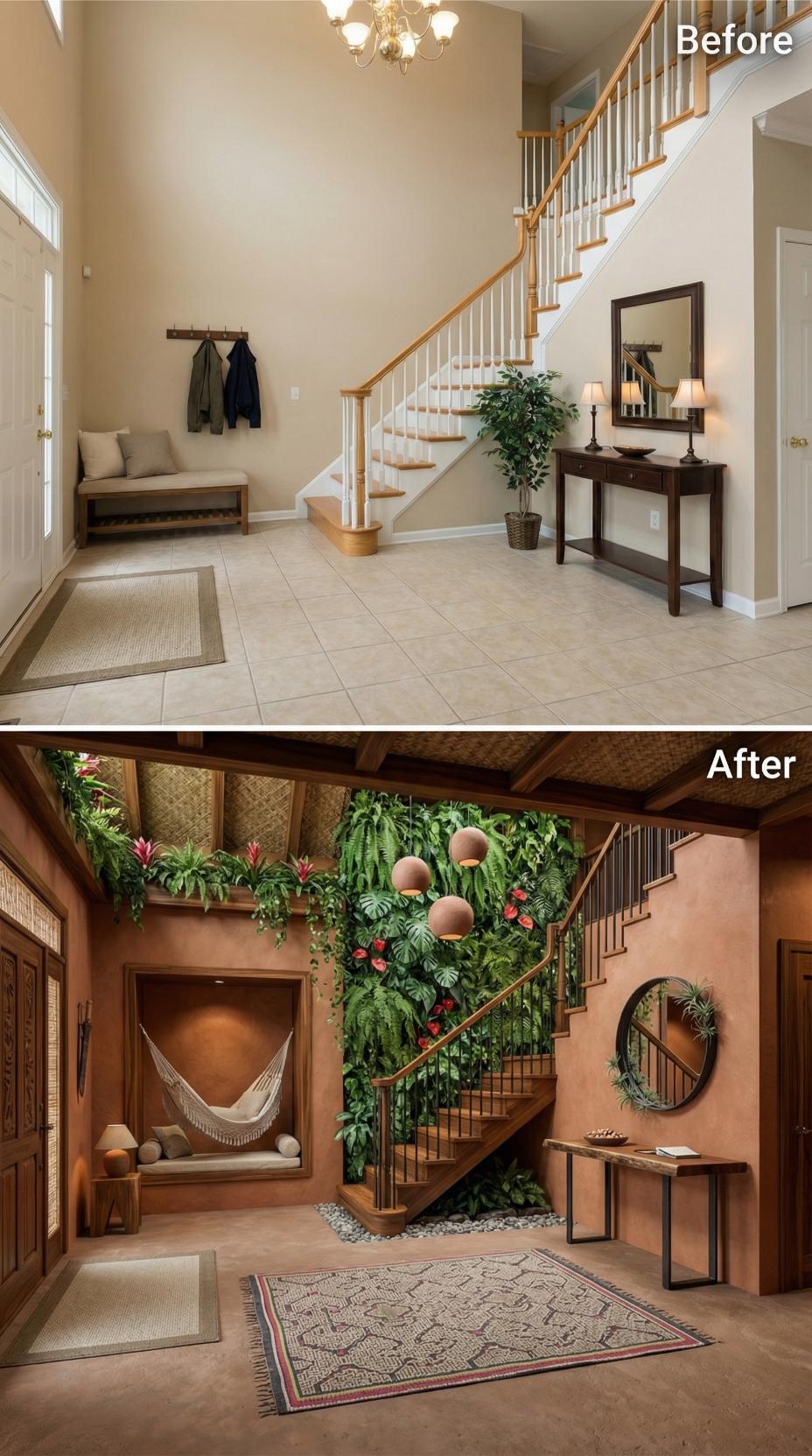
Warm terracotta plaster covers every wall surface, replacing the original taupe paint with a finish that reads almost adobe in its depth. A living plant wall anchored behind the staircase runs floor to ceiling with monstera, ferns, anthurium, and trailing vines, pulling oxygen and visual weight toward the center of the space. Pendant lights shaped like unglazed ceramic spheres hang at varying heights above the landing. Most notable is the recessed hammock nook cut into the left wall, lit by a single warm bulb overhead, with a woven cotton hammock and cushions sized for sitting, not sleeping. That one detail does more for foyer anxiety than any rug or mirror could.
Adinkra-Stamped Walls and Kente Cloth Replace Beige Tile and White Balusters

Gold Adinkra symbols repeat across terracotta plaster walls, and a sunburst mirror in brass anchors the staircase side while kente-patterned runners in red, gold, and green pull the eye toward carved oak furniture below.
Cable Railings, Stacked Slate, and Glass Globe Pendants Retire White Balusters

Honey-toned open-riser treads replace the closed white staircase, and horizontal cable railings with a black steel frame do the structural work the old spindles handled. Three teal blown-glass globe pendants cluster above the landing, suspended from a cedar tongue-and-groove ceiling warmed by recessed LED strip lighting. A live-edge mirror in a raw wood frame and a hairpin-leg console replace the dark stained entry table, while a built-in bench with storage drawers fills the under-stair space. Stacked slate covers the left wall from floor to ceiling beside a solid wood door.
Venetian Plaster in Fired Coral and Cane-Panel Furniture Retire White Balusters
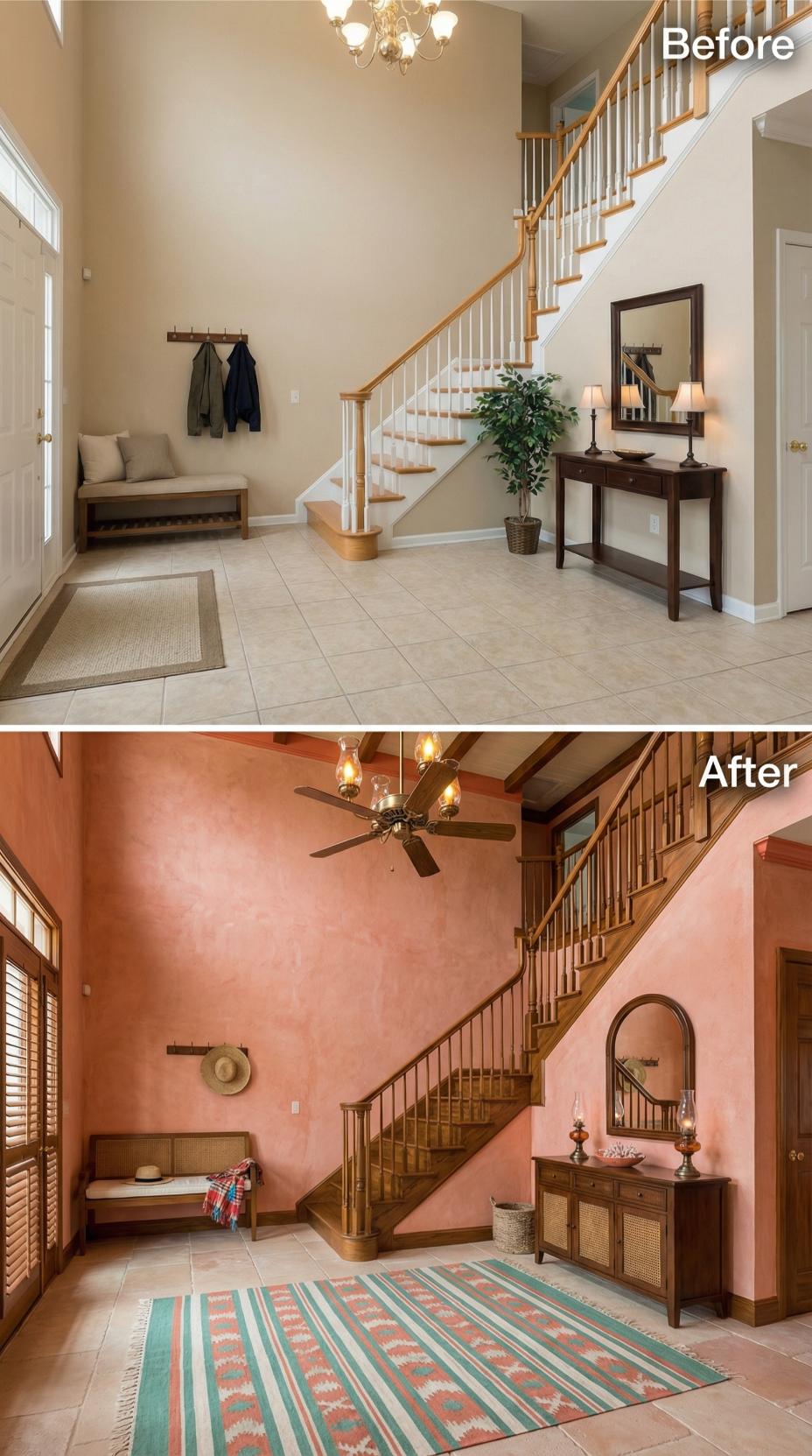
The walls carry the weight here. Venetian plaster in a fired coral tone covers every surface from baseboard to ceiling peak, and the finish has enough variation in it to read as depth rather than flat paint. Exposed wood beams with a medium walnut stain run horizontally across the upper volume, and a ceiling fan with dark-stained blades replaces what was a modest chandelier. The staircase balusters shift from white-painted wood to natural spindles that match the handrail, pulling the whole structure warmer.
At floor level, a flat-woven Kilim-style runner in teal, coral, and cream anchors the entry without competing with the walls. The entry bench swaps its neutral upholstery for cane paneling on the back rail and a plaid wool throw in red and cream. Beside the stair, a cane-front console with a single drawer holds hurricane glass oil lamps and a shallow bowl. An oval mirror with a carved wood frame replaces the rectangular dark-stained one from before.
Shoji Paper, Black-Stained Stairs, and Cedar Ceiling Beams Replace Beige Tile
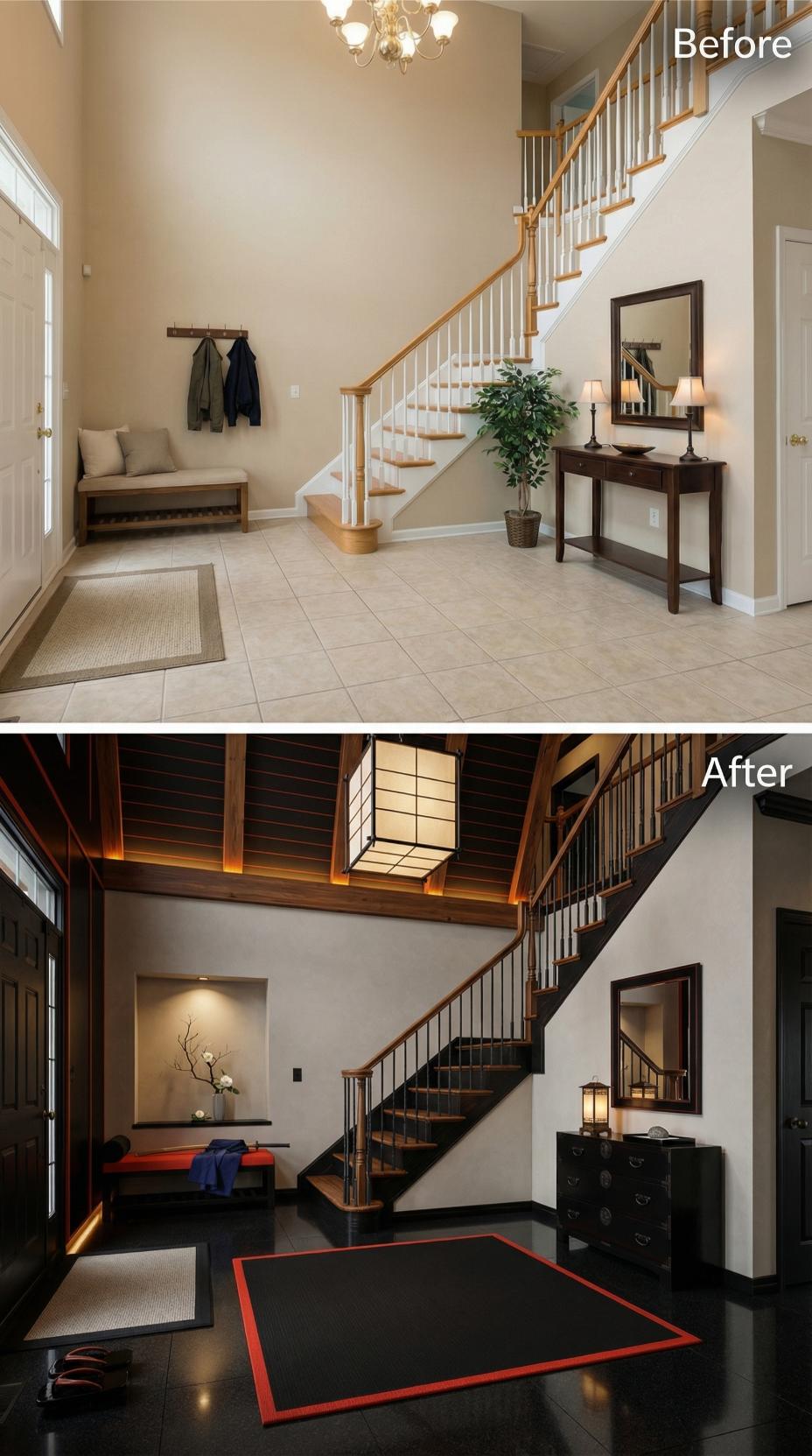
Builder-grade cream tile and white-painted balusters gave way to black granite-look flooring, a dark area rug with a red lacquer border, and stair risers finished in near-black stain. The original oak handrail was kept but darkened to match walnut-toned newel posts, while the white spindles were replaced with slender iron balusters. A recessed niche in the left wall holds a branch arrangement in a ceramic vase under a single warm downlight, replacing the coat-hook bench entirely.
Overhead, exposed cedar beams run parallel to the stair pitch, and a shoji-style pendant, square-framed with rice paper panels, anchors the double-height volume. On the right wall, a tansu chest with cast-iron ring pulls replaces the console table, and a lantern-style sconce sits beside the original dark-framed mirror. Amber strip lighting runs along the beam soffits. People prone to sensory overload often respond well to this palette: dark floors reduce reflected glare, and paper-diffused light cuts visual sharpness without dimming the room.
Whitewashed Plaster, Aegean Blue Accents, and a Curved Staircase Close Out the Series
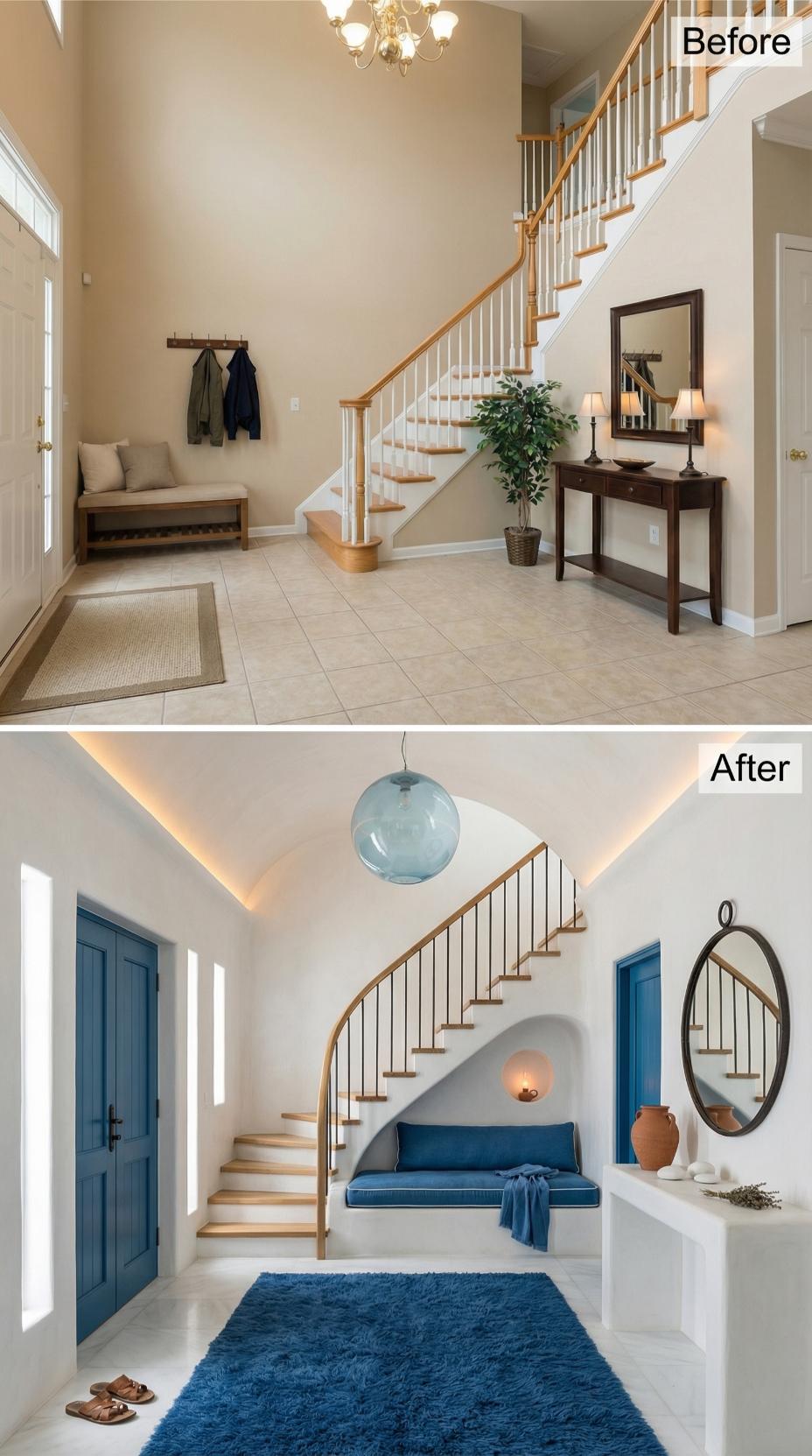
Every surface in the after reads white, but not the flat drywall white of the before. The plaster has a slight texture that catches cove lighting installed where the ceiling meets the upper wall, producing a warm gradient rather than a harsh lit edge. The staircase retains natural wood treads but gains slim iron balusters and a curved profile that sweeps rather than cuts across the room. Under the stairs, a built-in bench upholstered in cobalt velvet sits inside a plaster niche with a sconce recessed directly into the arch.
A hand-blown glass globe pendant in pale aqua hangs from the ceiling center. The front door is painted a saturated Aegean blue that repeats in a second door frame on the right wall, creating an axis rather than an accent. A deep-pile blue rug anchors the floor. On the console ledge, a terracotta urn and dried botanicals keep the palette from reading like a resort lobby. Sandals left near the entry suggest someone actually lives here.
Moss Wall and Warm Oak Replace Beige Tile in a Two-Story Foyer

Floor-to-ceiling preserved moss covers the entire left wall, mixing flat sheet moss, reindeer moss, and ferns with several mounted air plants. Warm LED strip lighting runs along a slatted wood ceiling, casting amber light downward and making the greens read almost phosphorescent at night. The original white spindles and oak-stained handrail stay, but the staircase now reads completely differently against deep teal venetian plaster on the adjacent wall.
Reclaimed-looking wide-plank oak floors replace the builder-grade beige tile, and a live-edge console table with hairpin-style legs sits beneath the stairs. A jute rug grounds the entry. The pendant above is an open geometric wire orb holding air plants rather than a bulb, which keeps the ceiling from feeling busy despite the slatted treatment above it.