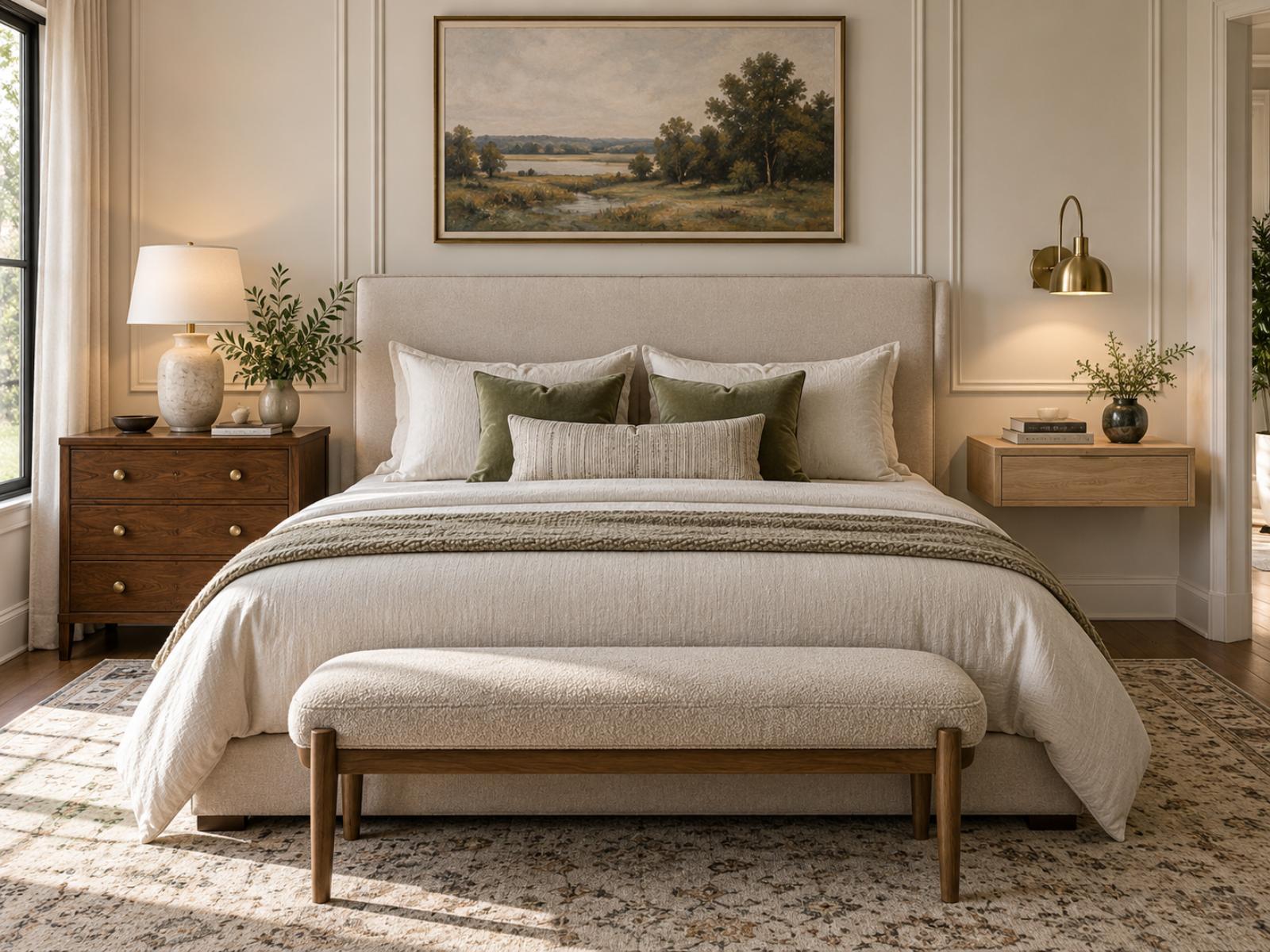
🔥 Would you like to save this?
Matching nightstands might be one of the safest purchases in home decorating.
You need two nightstands. You find one you like. You buy two of them.
Problem solved.
Furniture stores make this easy. Beds, dressers and nightstands have been sold as matching sets forever. There’s symmetry. There’s no agonizing over whether walnut works with painted oak.
And yet when I dug into Home Stratosphere’s bedroom preference data, matching nightstands were the configuration our readers responded to least strongly of the three we could reliably report on.
Mismatched nightstands scored a Preference Index of 200.
Floating nightstands scored 167.
Matching pairs?
96.
Twice the Bedroom Average
| Nightstand configuration | Preference Index | 95% confidence interval | What the data says |
|---|---|---|---|
| Mismatched | 200 | 142–281 | Measurably above average |
| Floating | 167 | 142–197 | Measurably above average |
| Matching pair | 96 | 83–110 | Not measurably different from average |
The Preference Index measures reader “keeps”—love and save actions relative to estimated image exposure—against the average for the bedroom category.
100 is average.
So an index of 200 doesn’t mean 200% of readers liked mismatched nightstands. It means the measured keep rate was roughly twice the bedroom-category average.
Two Results Clear the Bar. Matching Pairs Don’t.
I don’t want to crank out research articles where we spot a big number and immediately declare an enormous decorating trend.
The confidence intervals matter.
Mismatched nightstands come in at 200, with an interval of 142 to 281. Floating nightstands are 167, with an interval of 142 to 197.
Both sit entirely above 100.
That’s why I’m comfortable saying both configurations performed above the bedroom-category average in our measured data.
Matching pairs are different.
Their index is 96, but the interval runs from 83 to 110. Because it crosses 100, our data doesn’t establish that matching pairs perform below average. Statistically they’re sitting in the average zone.
So the finding isn’t:
Readers hate matching nightstands.
They don’t appear to.
It’s more interesting than that:
Readers showed unusually strong engagement with mismatched and floating nightstands, while matching pairs generated no comparable lift.
Even the bottom of the mismatched interval is 142. Floating has the same lower bound. Matching pairs top out at 110.
| Configuration | Low end of 95% CI | Index | High end of 95% CI |
|---|---|---|---|
| Mismatched | 142 | 200 | 281 |
| Floating | 142 | 167 | 197 |
| Matching pair | 83 | 96 | 110 |
The exact magnitude will get clearer as we collect more data. The direction is already interesting.
Maybe Matching Is the Safe Choice, Not the Exciting One
Why would this happen?
I have a theory.
Matching nightstands make sense. Mismatched nightstands make a room interesting.
Think about a perfectly coordinated bedroom set. Matching bed. Matching dresser. Matching chest. Matching nightstands. Maybe even two matching lamps sitting on top of the matching nightstands.
Nothing is wrong with it.
In fact, that’s the point.
There’s almost nothing to react to.
Now imagine an old walnut chest on one side of the bed and a small painted table on the other. Or a traditional three-drawer nightstand beside a simple pedestal table.
Suddenly there’s a little tension in the room.
It looks like somebody assembled the room instead of ordering it.
And that may matter enormously when we’re measuring image engagement rather than furniture purchasing.
We’re Measuring the Image, Not the Checkout
Home Stratosphere readers encounter thousands of design images. They react to individual images and save the ones they want to keep. That’s what we’re measuring.
We are not measuring furniture sales.
We’re not asking whether somebody would spend $699 on a nightstand. We’re observing how strongly readers respond when they see a bedroom containing a particular design attribute.
Related questions. Not the same question.
A matching pair may be easier to buy, more practical, and may sell extremely well. It may even be what the person who saved the mismatched photo eventually purchases. Our data can’t tell you.
What it tells you is that mismatched and floating bedside configurations are generating unusually strong visual engagement.
For a visual industry, that’s useful.
Floating Might Be the More Important Finding
The mismatched number makes the better headline. 200 is hard to ignore.
But if I made bedroom furniture, I’d spend more time on floating nightstands.
The index is 167 with a tighter interval of 142 to 197. That’s a robust signal.
And unlike “mismatched,” floating is an identifiable product category.
You can manufacture it. You can put it in a collection. You can feature it in room photography. You can test it against a conventional freestanding nightstand.
Why might it work? More exposed floor. Less visual weight. Looks custom. I don’t know, and neither does the data. Our data tells us what happened. It doesn’t tell us why.
That’s a line I’m going to keep drawing with this research.
Maybe Nightstands Aren’t the Story
Perhaps perfectly matching furniture is the story.
Furniture has always been easy to sell in suites. Here’s the bed. Here’s the dresser. Here’s the mirror. Here’s the chest. And here are two identical nightstands.
Congratulations. Your bedroom is finished.
But look through higher-end interior design and you’ll see the opposite. Furniture deliberately mixed. Different periods. Different materials. Old with new. Something chunky beside something delicate.
The room is supposed to look like it evolved rather than arrived on a delivery truck Tuesday afternoon.
Designers call this a collected look. We didn’t ask our readers whether they prefer collected bedrooms, so I’m not claiming we’ve proven anything about it.
But the nightstand result is consistent with it.
The Merchandising Experiment I’d Run
The obvious conclusion would be that furniture companies should sell more mismatched nightstands.
Except how do you manufacture “mismatched”?
There’s a more interesting possibility:
Coordinated nightstands that aren’t identical.
Same collection. Same approximate dimensions. Same wood or complementary finishes. But two different designs—one with drawers, one with an open shelf. One rectangular, one with rounded edges. One mostly wood, one incorporating stone or metal.
Instead of merchandising:
Matching Nightstand Pair
you could merchandise:
Build Your Bedside Pair
Would it sell? I haven’t the foggiest idea. This dataset doesn’t measure sales.
But it’s exactly the test I’d run after seeing these numbers.
The Biggest Mistake Would Be “Matching Nightstands Are Dead”
They’re obviously not. An index of 96 isn’t even statistically below average.
And there are other explanations for what we’re seeing. Mismatched nightstands could disproportionately appear in professionally designed rooms—rooms that contain other attributes readers love. Floating nightstands might cluster in particular architectural styles. Image composition itself could matter.
This is observational behavioral data, not a controlled experiment.
Which is why I treat the Preference Index as an opportunity detector rather than a set of decorating commandments. It says: something interesting is happening over here. Then we keep measuring.
The really useful data will come from intersections. Does the mismatched effect hold up in traditional bedrooms? Modern ones? Do two different wood tones outperform one painted piece beside one natural? Are floating nightstands especially strong in small rooms?
And eventually: is the gap getting bigger or smaller over time?
The Takeaway
I wouldn’t tell a furniture retailer to throw out its matching nightstands.
I’d tell them this:
Matching pairs aren’t giving us much of an engagement lift. Less conventional bedside arrangements are.
Mismatched, 200. Floating, 167. Matching pairs, 96. And both unconventional configurations have intervals sitting entirely above the bedroom average.
That’s enough for me to keep watching.
Because the most interesting possibility isn’t that people suddenly hate matching nightstands.
It’s that perfectly matched furniture might solve the practical problem of furnishing a bedroom without solving the visual problem of making somebody want the bedroom.
Those are two very different things.
And for anyone selling furniture based largely on how good it looks in a photograph, that’s worth knowing.
About This Research
Home Stratosphere measures reader interactions with individual images across our published design content. Images are tagged by design attributes, allowing us to compare observed reader response across materials, colors, styles and configurations.
The Preference Index compares keeps—love and save actions per estimated impression—for an attribute value with the average for its category. 100 represents the category average.
The current export covers tagged content published from November 10, 2025 through September 8, 2026. Impressions are sampled and scaled estimates, and the Preference Index is intended for comparison within a category, not across unrelated categories. This measures image preference rather than article performance or purchase behavior.