🔥 Would you like to save this?
An old fish cannery is almost perversely well suited to becoming a spectacular bedroom. The ingredients that once made the building harsh — long roof spans, oversized openings, exposed structure, concrete, metal, proximity to the water — become exactly the things a conventional new build has to work very hard to imitate. The challenge is knowing when to leave that industrial scale alone and when to introduce something soft enough to make sleeping there seem remotely sensible.
In order to come up with the very specific design ideas, we create most designs with the assistance of state-of-the-art AI interior design software. Also, assume links that take you off the site are affiliate links such as links to Amazon. this means we may earn a commission if you buy something.
These 26 AI before-and-after concepts imagine different ways that collision could play out. They are design studies rather than documented renovations, so the interest is not in pretending a particular truss, wall, or floor survived a real construction project. It is in seeing what happens when cannery-scale architecture meets marble, velvet, copper, glass, timber, skylights, soaking tubs, even a grand piano. Some ideas preserve the visual toughness of the shell. Others throw luxury at it with absolutely no restraint. The best ones manage both at once.
26. Kayaks on the Wall Make the Waterfront History Impossible to Ignore
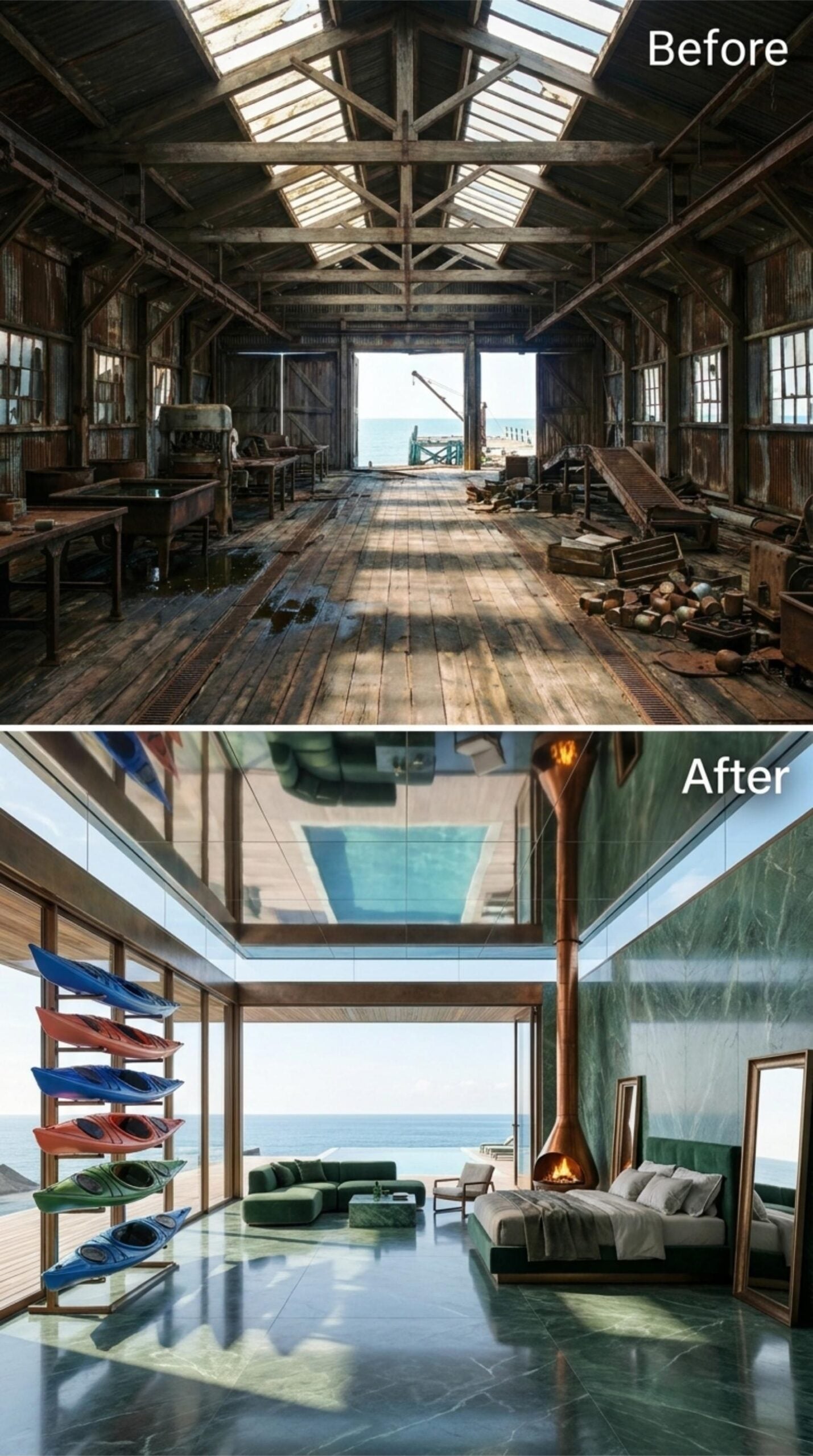
Start with the least bedroom-like object in the room. Colorful kayaks climb the left wall in a vertical rack, turning functional waterfront gear into something halfway between storage and sculpture. In a cannery-inspired conversion, that feels far more convincing than decorating with a few tasteful pictures of boats.
Green marble runs wall to wall beneath a suspended copper fireplace with a broad flared hood. The materials are extravagant, but the kayaks keep the room attached to the water outside instead of letting it drift into anonymous resort luxury.
25. Rose Gold Geometry Turns the Entire Roof Into a Skylight
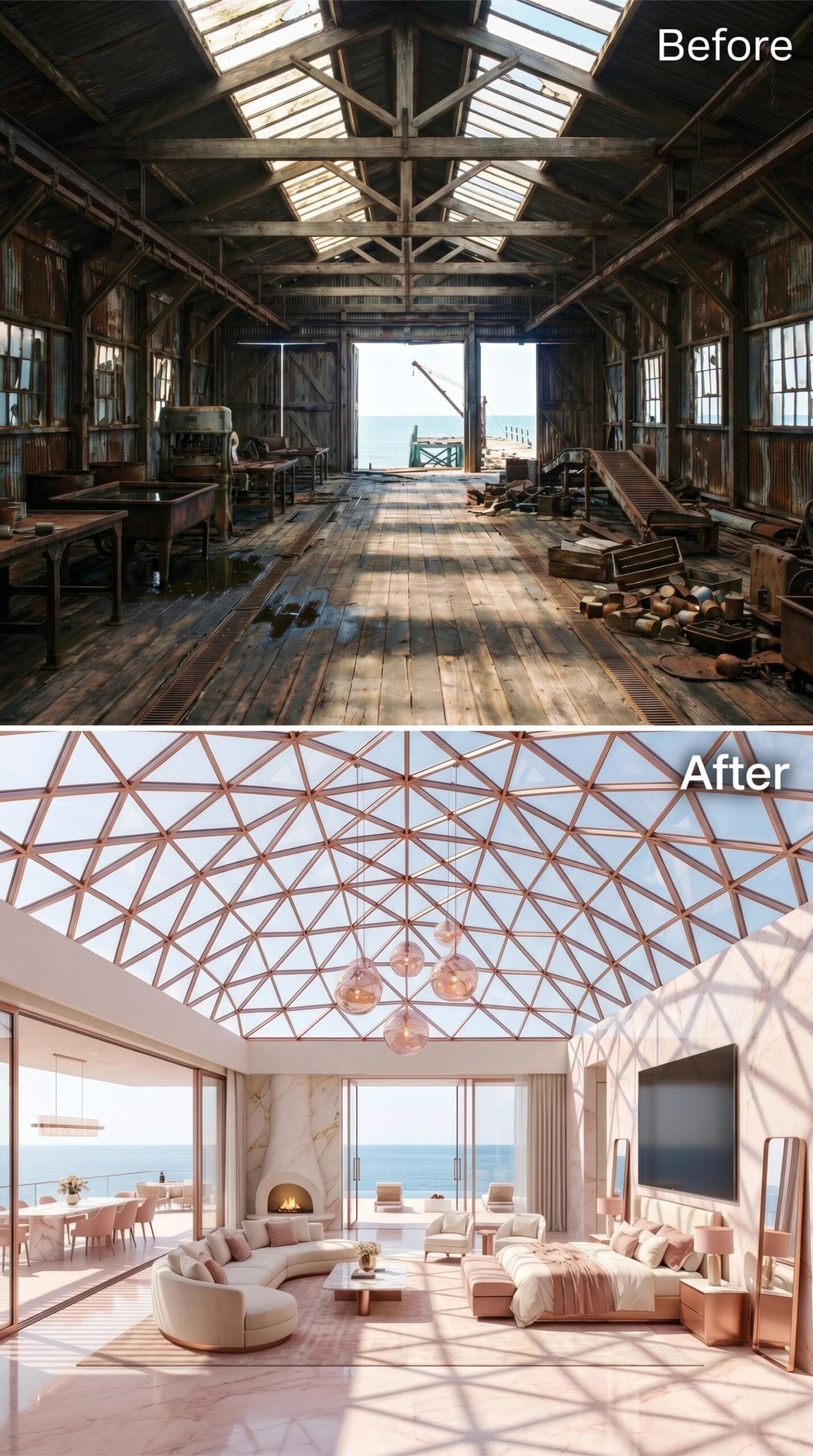
A triangulated glass canopy changes the bedroom before a single piece of furniture enters it. Rose-gold framing traces the geometry overhead, and daylight breaks into shifting triangular shadows across the pale floor.
Below all that structure, the furnishings deliberately go soft: a curved cream bouclé sofa, blush bedding, smoky-pink pendants. The contrast is the point. Hard geometry gets the roof; rounded upholstery gets everything humans actually touch.
Worth Knowing: Triangulated roof systems can span large areas efficiently because loads are distributed through a network of smaller structural elements. In a concept like this, that geometry also gives an industrial-scale room a strong visual order before furniture has to solve anything.
24. Royal Blue Leather Makes Black Marble Look Almost Restrained
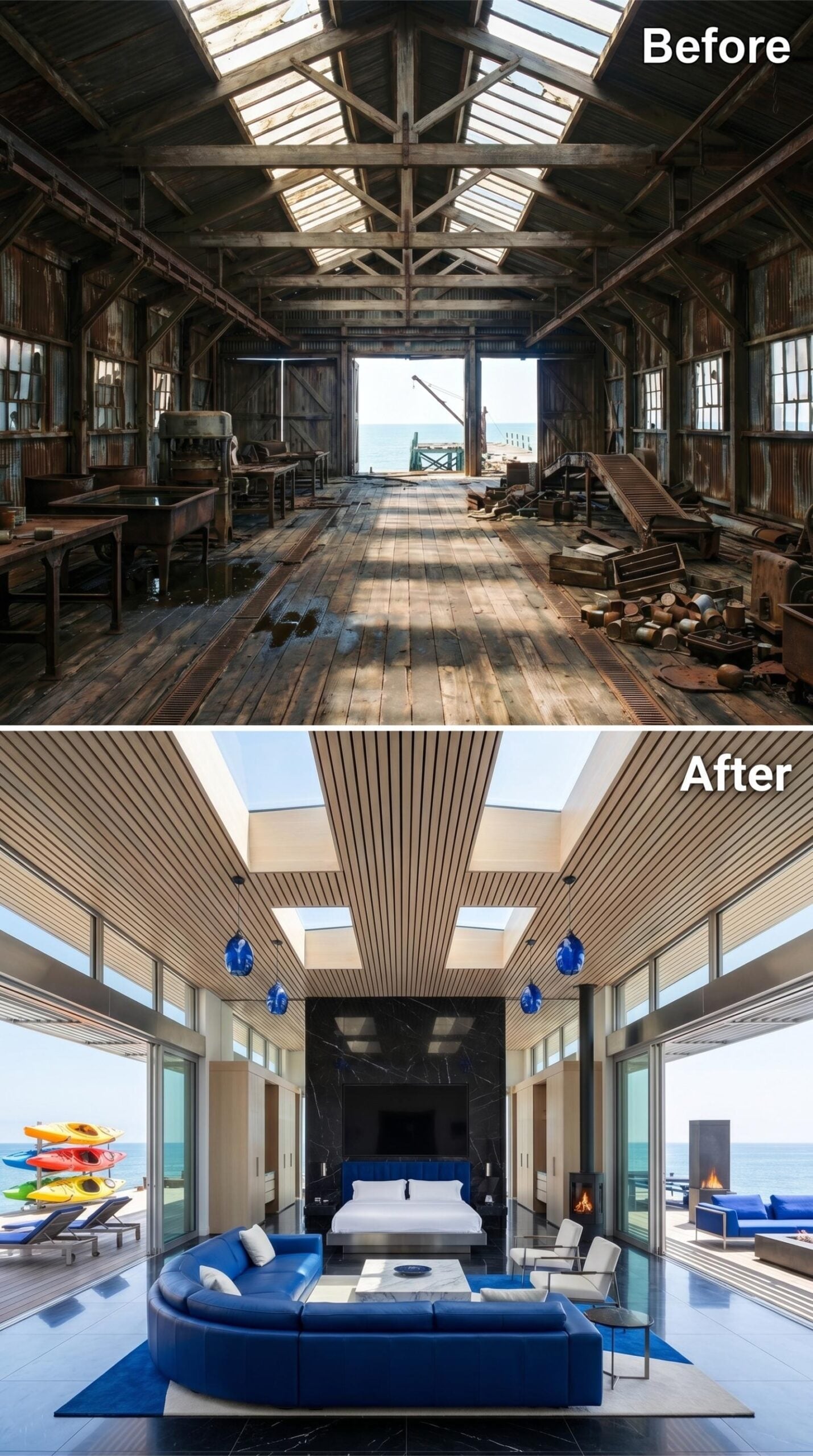
The curved sectional arrives in full cobalt and immediately eliminates any possibility of this becoming another beige coastal suite. Matching blue glass pendants carry the color upward, where a slatted wood ceiling opens around twin skylights.
Behind the bed, black marble with pale veining creates a dense vertical plane against all that glazing and open water. The room works because it commits. One saturated color, one very dark stone, then enough wood and daylight to stop either from swallowing the space.
23. A Grand Piano Under a Rattan Oculus Changes the Entire Brief
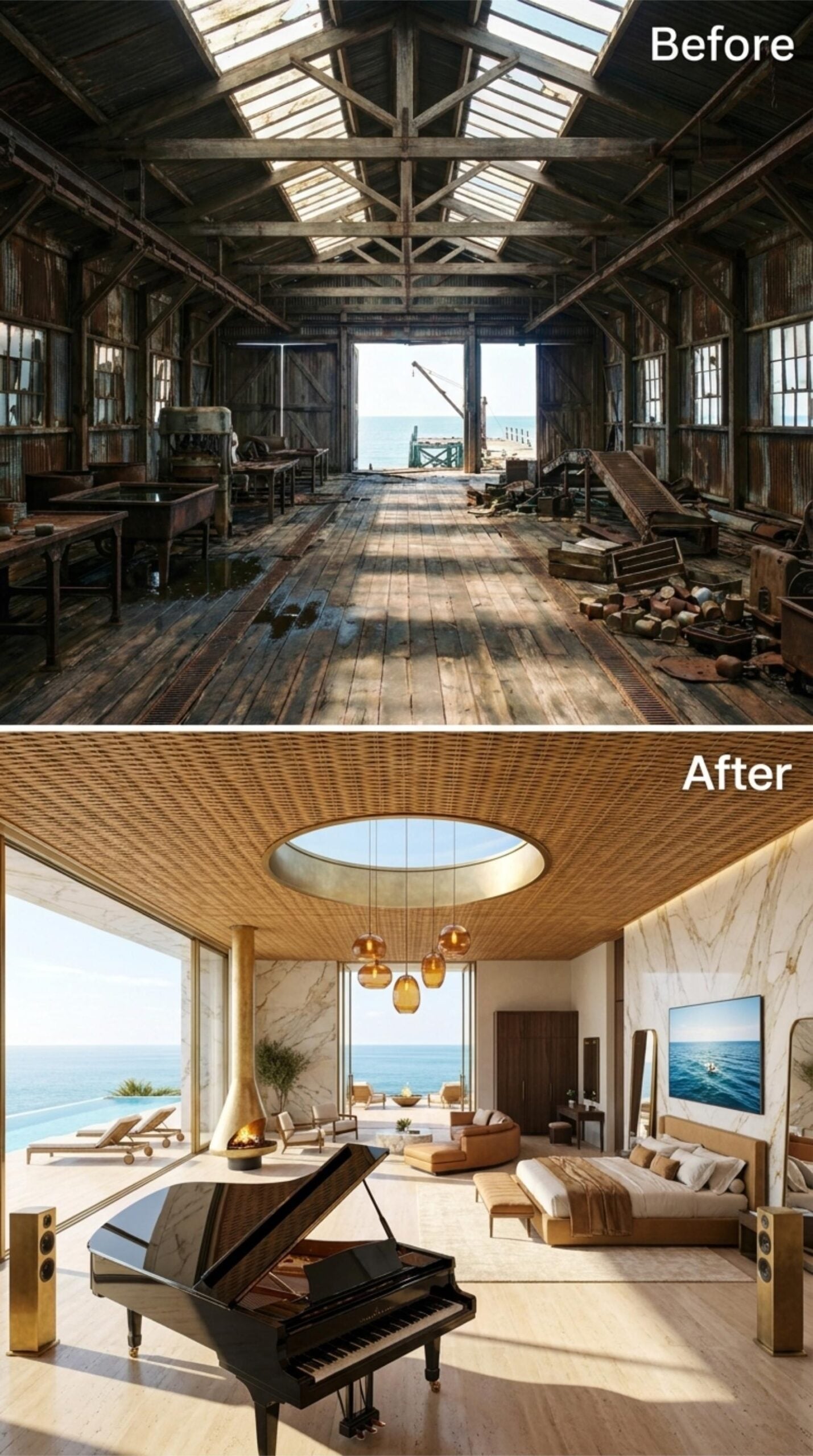
A primary bedroom with a grand piano is already operating under different rules. Put that piano beneath a circular skylight cut into a woven rattan ceiling and the room stops behaving like a bedroom with a sitting area and starts behaving like a private salon that happens to contain a bed.
Amber globe pendants hang beneath the oculus, while the bed faces the ocean through a full-width glass wall. Rattan is the surprise here. Against all the polished stone and metal elsewhere in the gallery, its woven texture makes the scale feel human.
22. Cream Bouclé Lets the Marble Wall Be the Loudest Thing in the Room
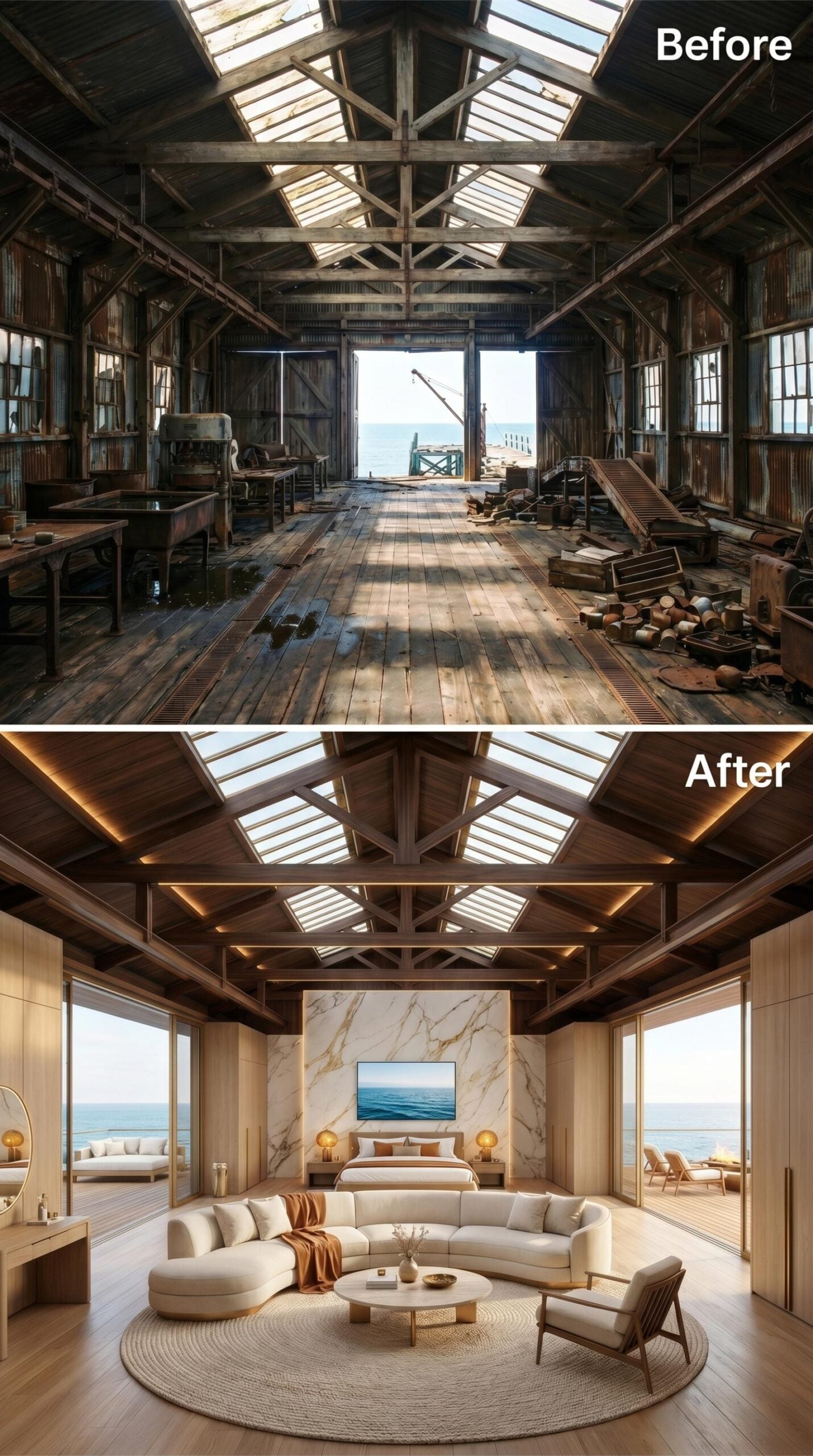
Warm oak runs the length of the floor while an off-white bouclé sectional curves around the sitting area. There is plenty of furniture, but almost none of it asks for attention.
That restraint clears the stage for the marble wall behind the bed. Gold veining moves through white stone like an enormous abstract painting, while skylights and ocean glazing supply two very different kinds of daylight.
In the Details: Curved seating is particularly useful in a room dominated by long walls, roof trusses, and hard rectilinear surfaces. It introduces a different geometry without requiring extra ornament.
21. A Marble Soaking Tub Turns the Bedroom Into Something Closer to a Private Spa
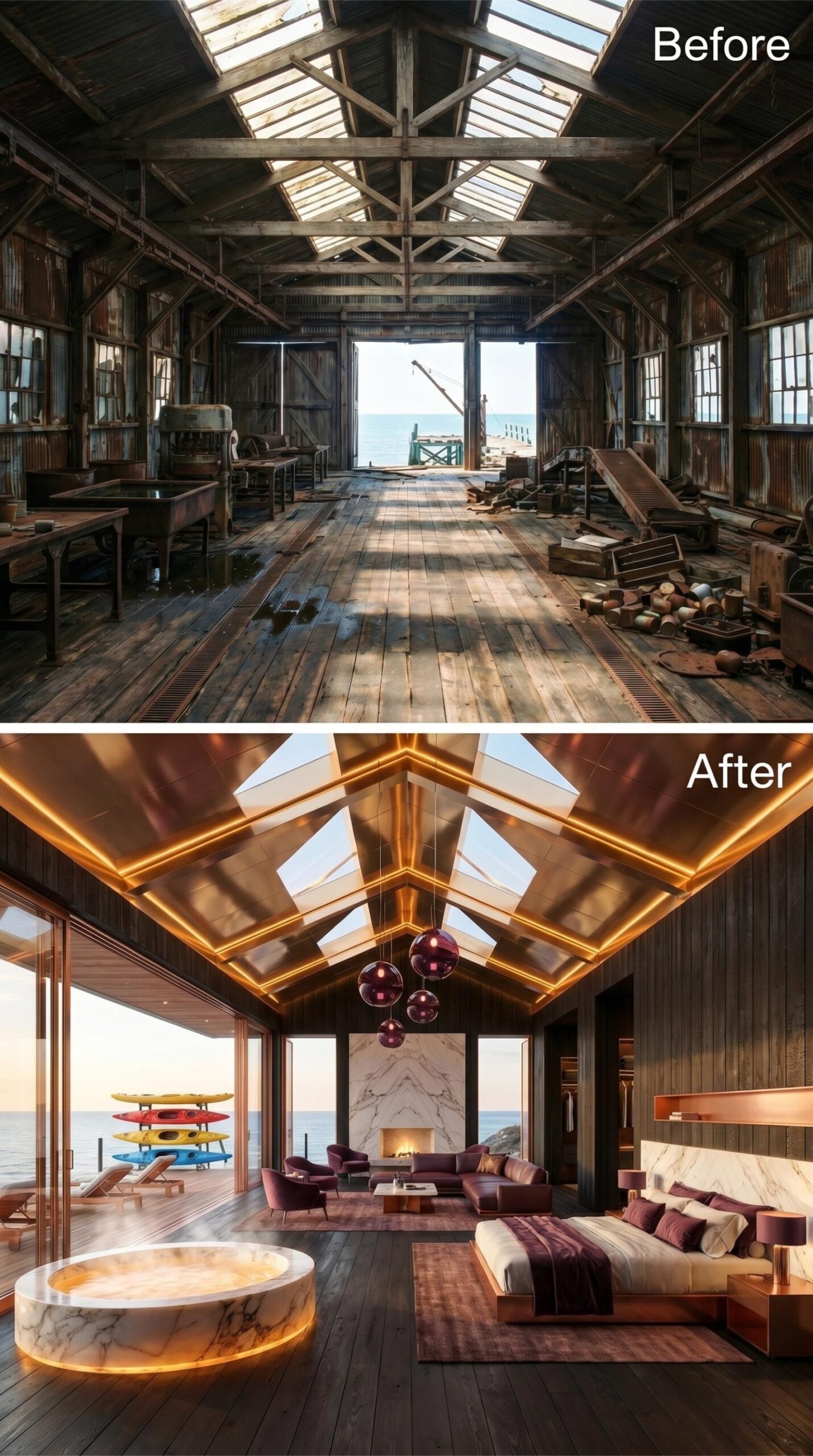
The circular marble tub in the foreground changes the function of the entire suite. Lit from beneath with amber light, it occupies the room like a piece of furniture rather than something relegated to a separate bathroom.
Dark wood clads both side walls, plum seating forms a second zone around the fireplace, and globe pendants hang beneath exposed roof structure traced with warm light. Outside the windows, stacked kayaks provide a useful reminder that all this theatrical luxury is happening beside working water.
20. Copper, Amethyst, and Plum Make the Barrel Vault Feel Almost Operatic
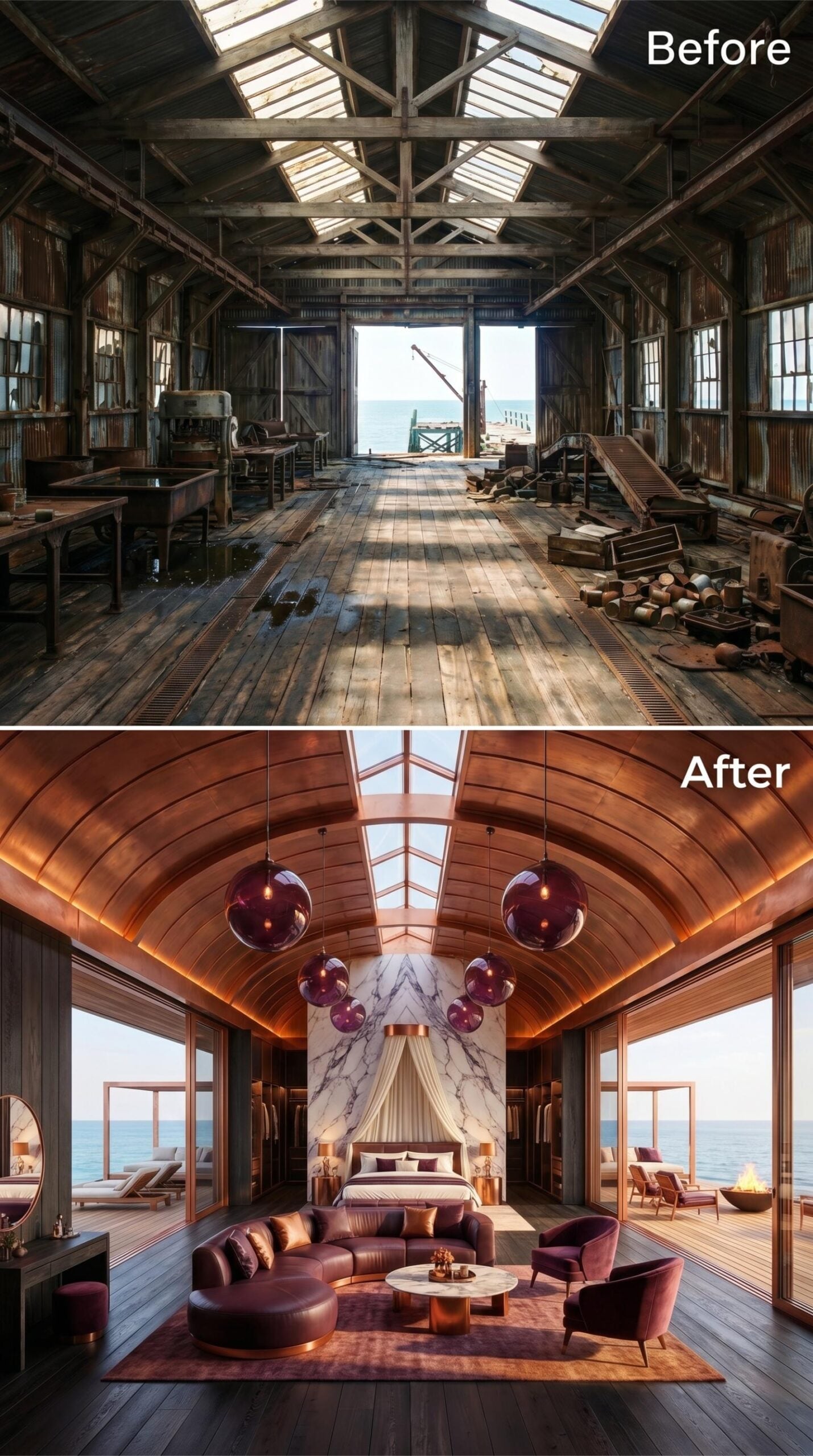
Copper wraps the entire barrel vault in horizontal bands, catching concealed amber light at the spring line of the curve. Three amethyst globes hang at different heights below, while a plum velvet sectional repeats the room’s deepest color near the floor.
The marble behind the bed introduces cream and violet veining, and the full-height glazing beyond prevents the palette from becoming too enclosed. The ceiling is theatrical enough already; the ocean gives it somewhere to release.
Try This: Concealed lighting along the base of a curved ceiling can emphasize the arc without filling the vault with visible fixtures. The architecture becomes part of the lighting composition rather than merely something being illuminated.
19. Pale Gold Plaster Gives the Eye Somewhere to Rest
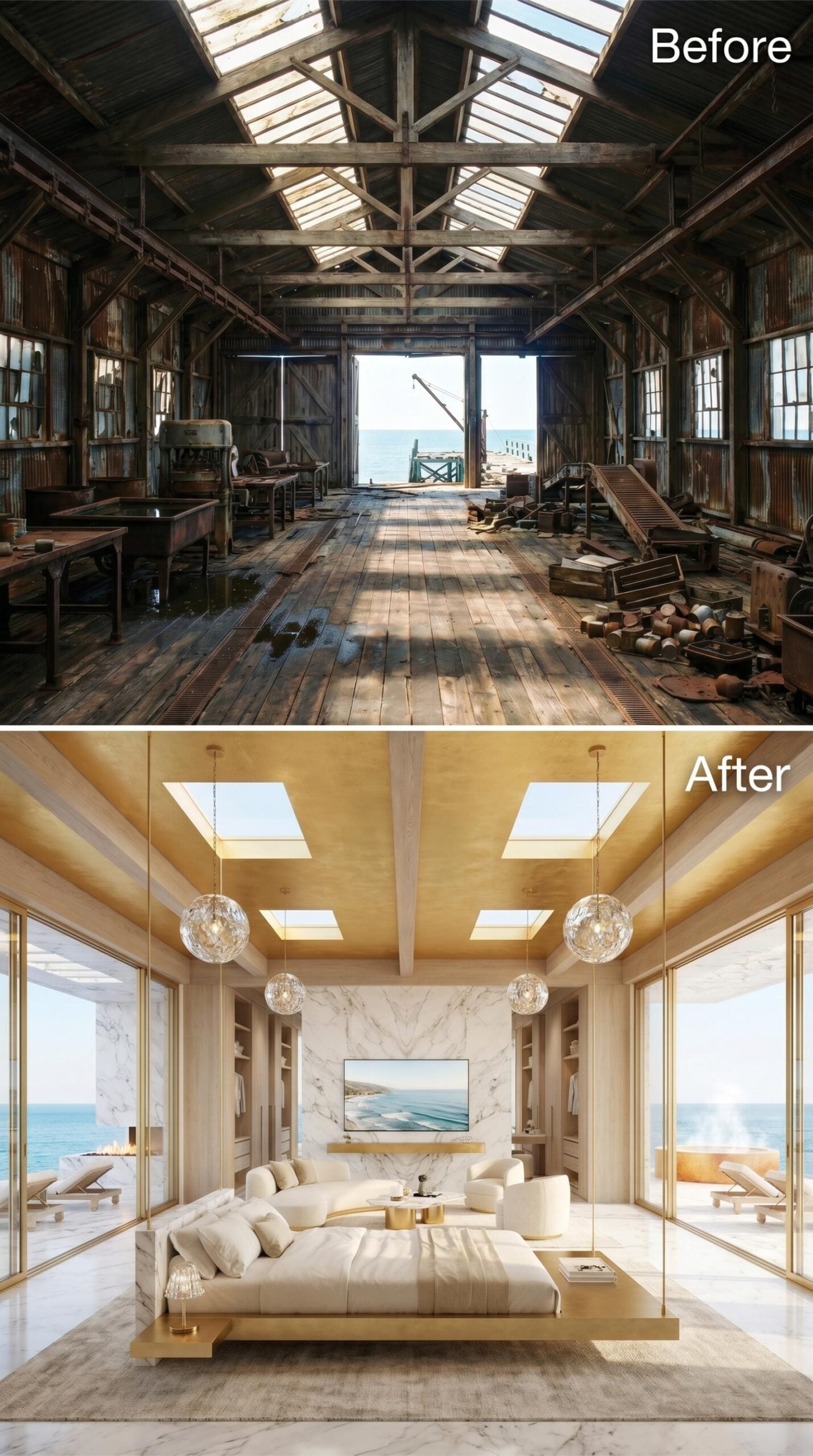
After copper, cobalt, and plum, this room feels almost quiet. Pale gold plaster catches the overhead light without turning reflective, and four flush skylights run along the ceiling in a disciplined line.
The bed stays low on a honey-toned platform and nearly everything around it remains cream. A marble headwall contains the television and built-in shelving without demanding that either become a decorative event. Here the ocean gets the drama.
18. Brushed Steel Folds the Ceiling Like Industrial Origami
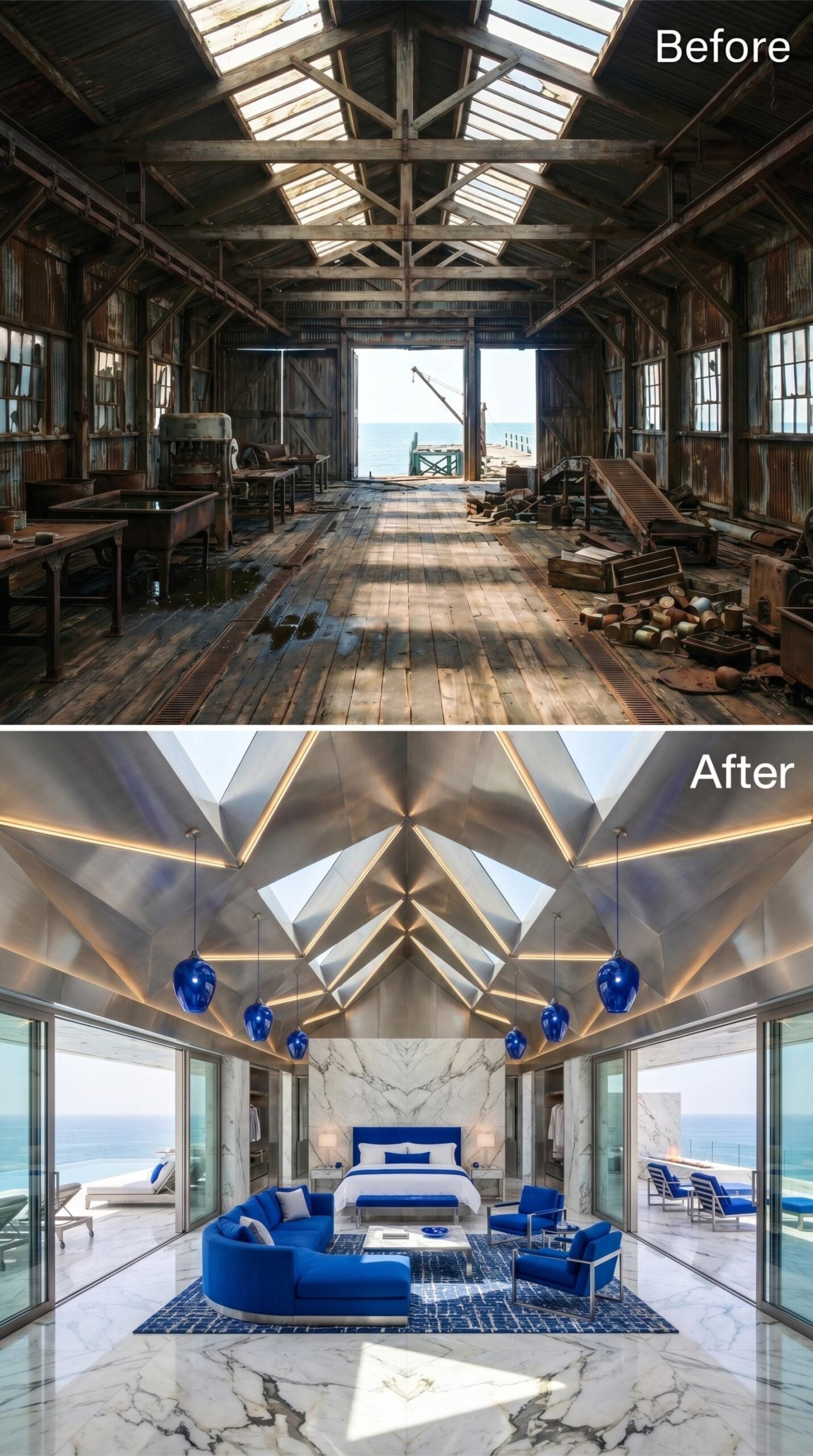
Faceted brushed-steel panels fold around the skylights in sharp planes, with concealed LED strips buried along the creases. It is one of the few concepts that lets the industrial side of the premise stay visibly hard-edged.
Six cobalt pendants drop through that silver geometry and repeat the sectional color below. White marble flooring keeps the lower half luminous, while the terrace and open water beyond the glass make the metallic ceiling feel less enclosed than it otherwise might.
17. Cognac Leather Keeps a Copper Ceiling From Feeling Too Precious
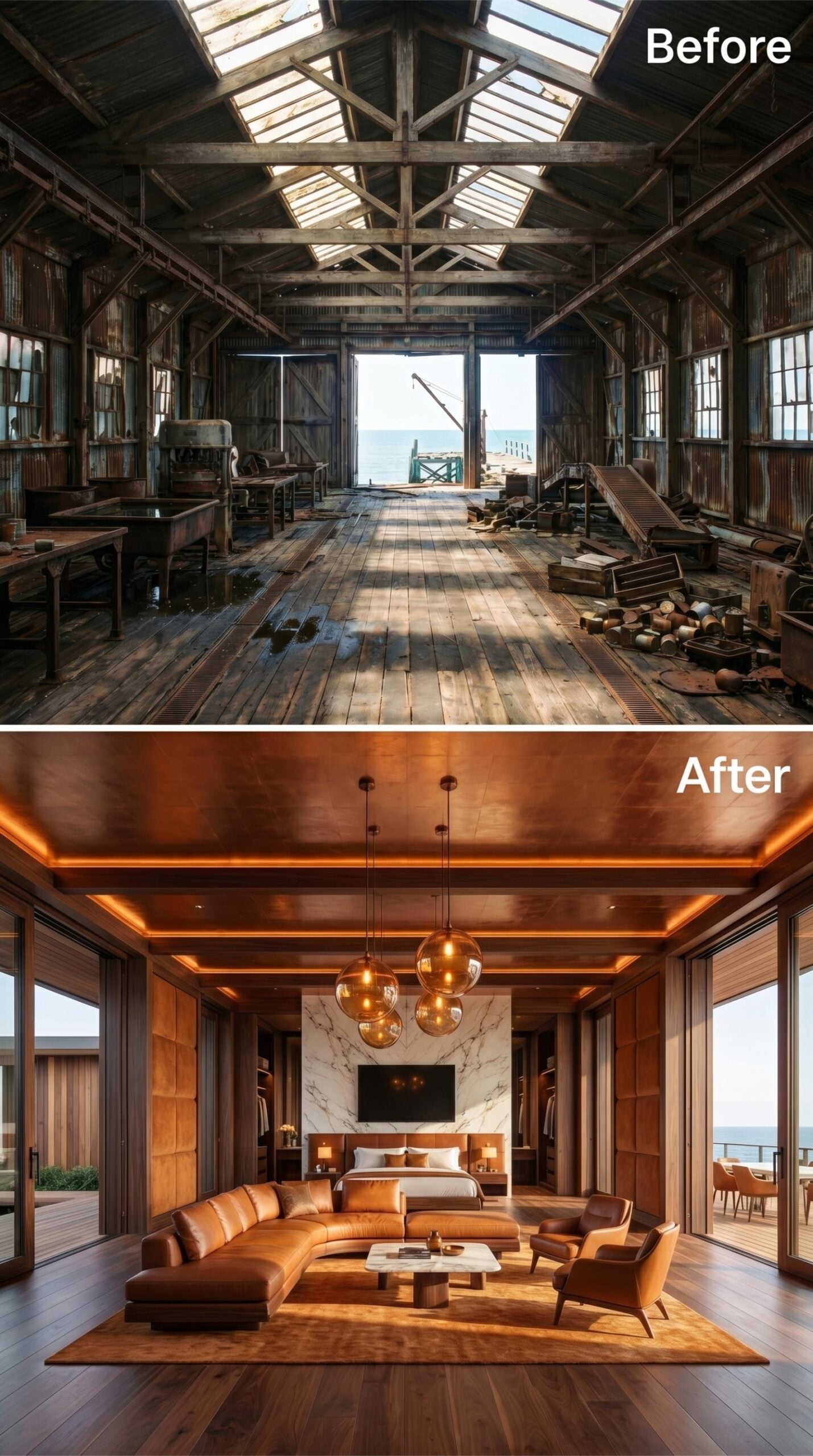
Cognac leather is a useful counterweight to all the polished surfaces here. The sectional curves around a marble table while burnished copper panels fill the tray ceiling above, lit along the perimeter rather than from one obvious source.
Amber globes hang loosely through the middle, but the full-height marble slab behind the bed supplies the strongest vertical plane. Glass on both sides keeps the sea in peripheral view even when you are looking straight ahead.
Common Mistake: Uplighting and decorative pendants can coexist, but they need a hierarchy. If every source has equal brightness and visual importance, the room quickly becomes a lighting showroom instead of a bedroom.
16. A Glass Dome Above Green Marble Plays Transparency Against Weight
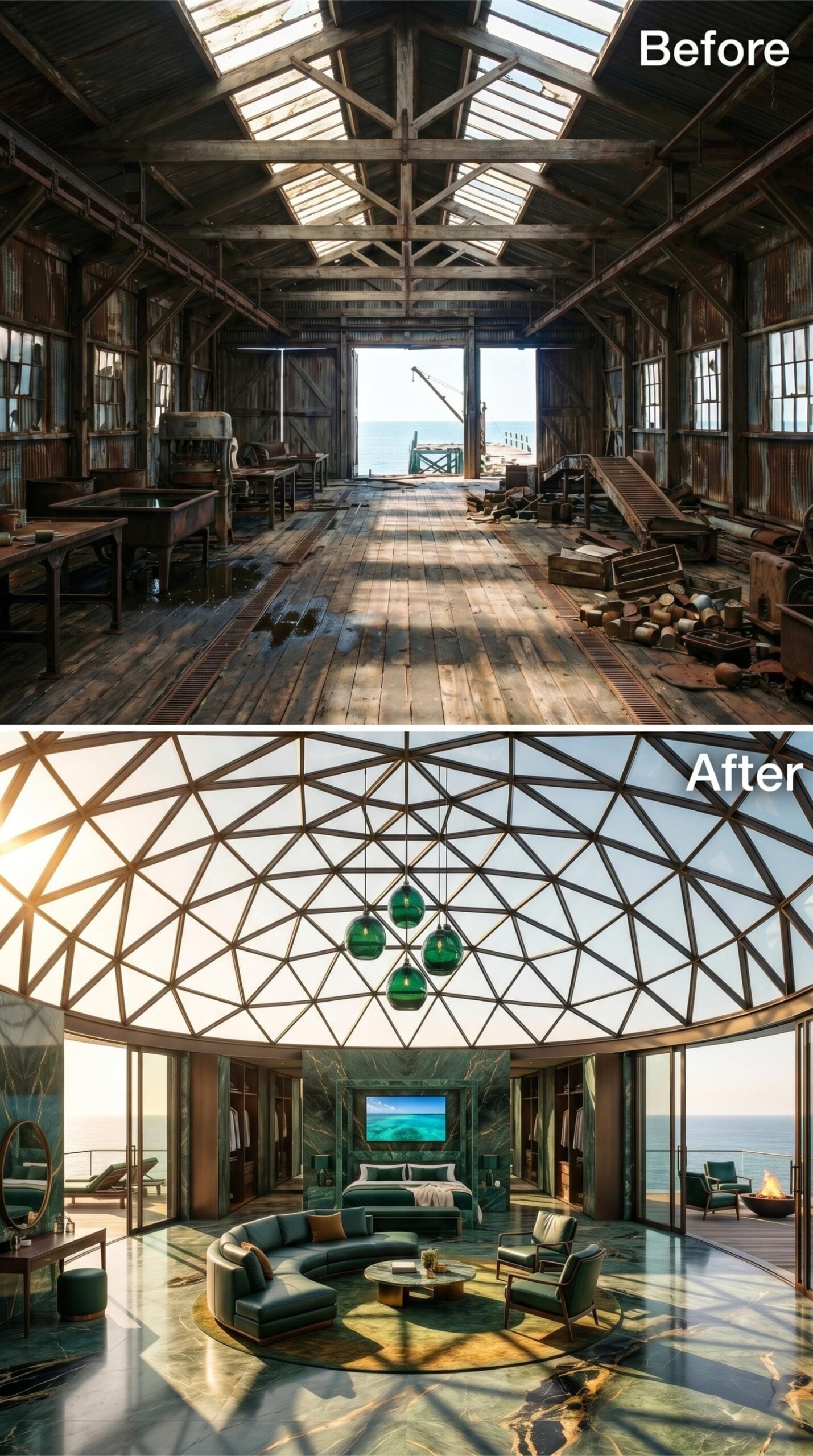
The roof is almost entirely transparent; the floor is anything but. A triangulated glass dome floods the room with coastal light while polished green-veined marble creates a dense, reflective surface beneath it.
Forest-green velvet repeats that color in the curved sectional, and three blown-glass pendants hover beneath the steel framework. The strongest idea is the vertical contrast: air and sky overhead, dark mineral color underfoot.
15. A Gold-Woven Vault Makes Corrugated Geometry Feel Deliberately Luxurious
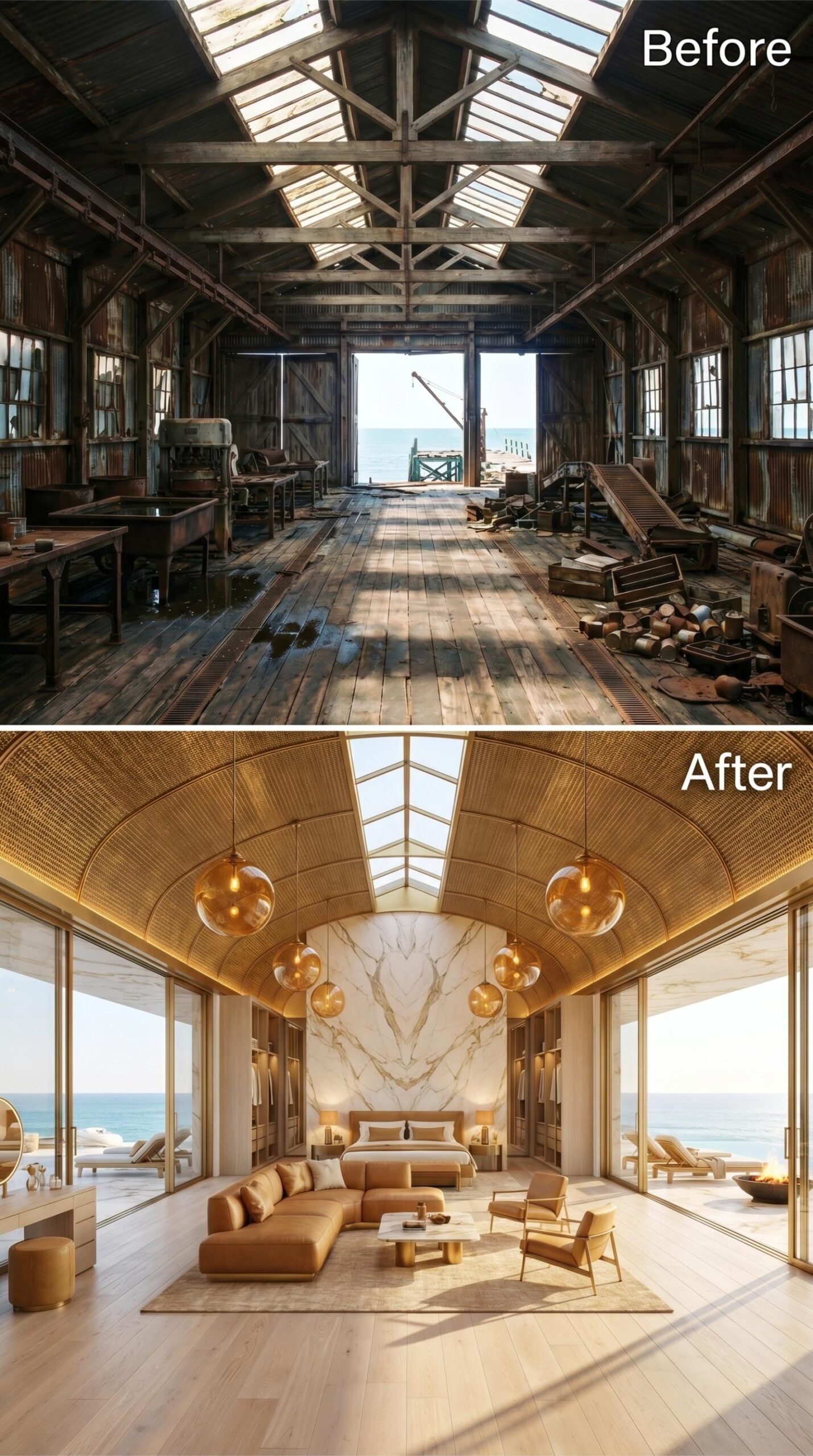
The barrel vault keeps an industrial corrugated rhythm but interprets it through gold-toned woven panels. A ridge skylight cuts through the top, letting daylight fall directly over the bed and marble headwall.
Caramel leather seating and amber glass globes bring the warmth down to human height. The room is ornate in material but surprisingly simple in geometry: one long vault, one central ridge, one uninterrupted view toward the sea.
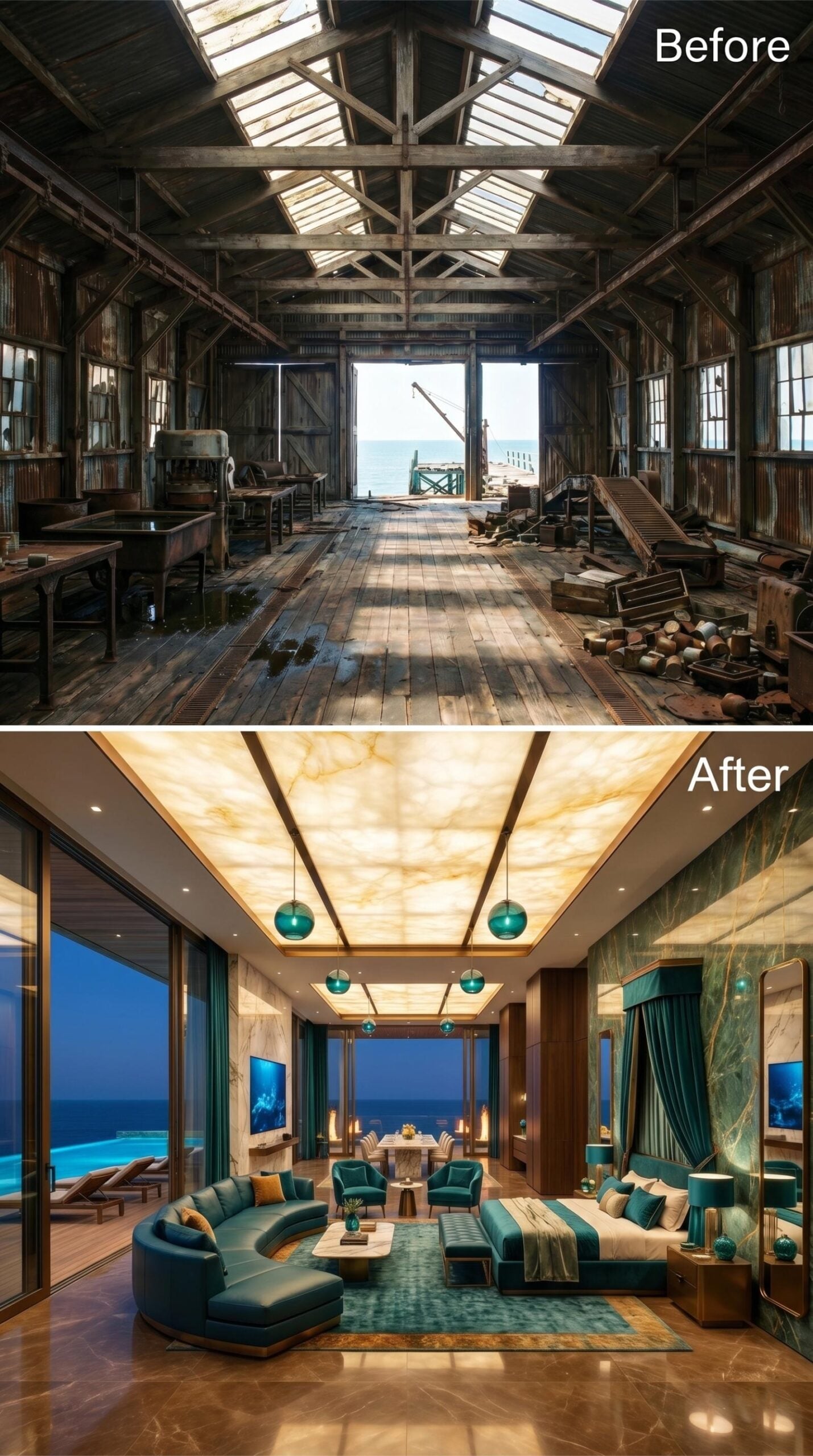
14. Backlit Onyx Turns the Ceiling Into a Geological Light Box
🔥 Would you like to save this?
The ceiling glows instead of merely reflecting. Translucent onyx panels diffuse amber light across the entire room, creating a luminous canopy with no obvious fixture at its center.
Teal velvet takes over below: curved sectional, bed upholstery, and glass pendants all repeat the same cool family. Green marble on the accent wall bridges that color to the warmer stone overhead, while night outside the glazing gives the whole palette room to intensify.
- Translucent stones such as onyx are especially effective when backlit because light can travel through thinner areas of the material.
- Repeating one upholstery color across lounge and sleep zones can visually connect an open-plan suite without making every furniture piece identical.
- Colored glass fixtures feel more integrated when their hue already exists elsewhere in the room.
13. Green Marble and Brushed Gold Give the Ocean-Facing Bed a Formal Frame
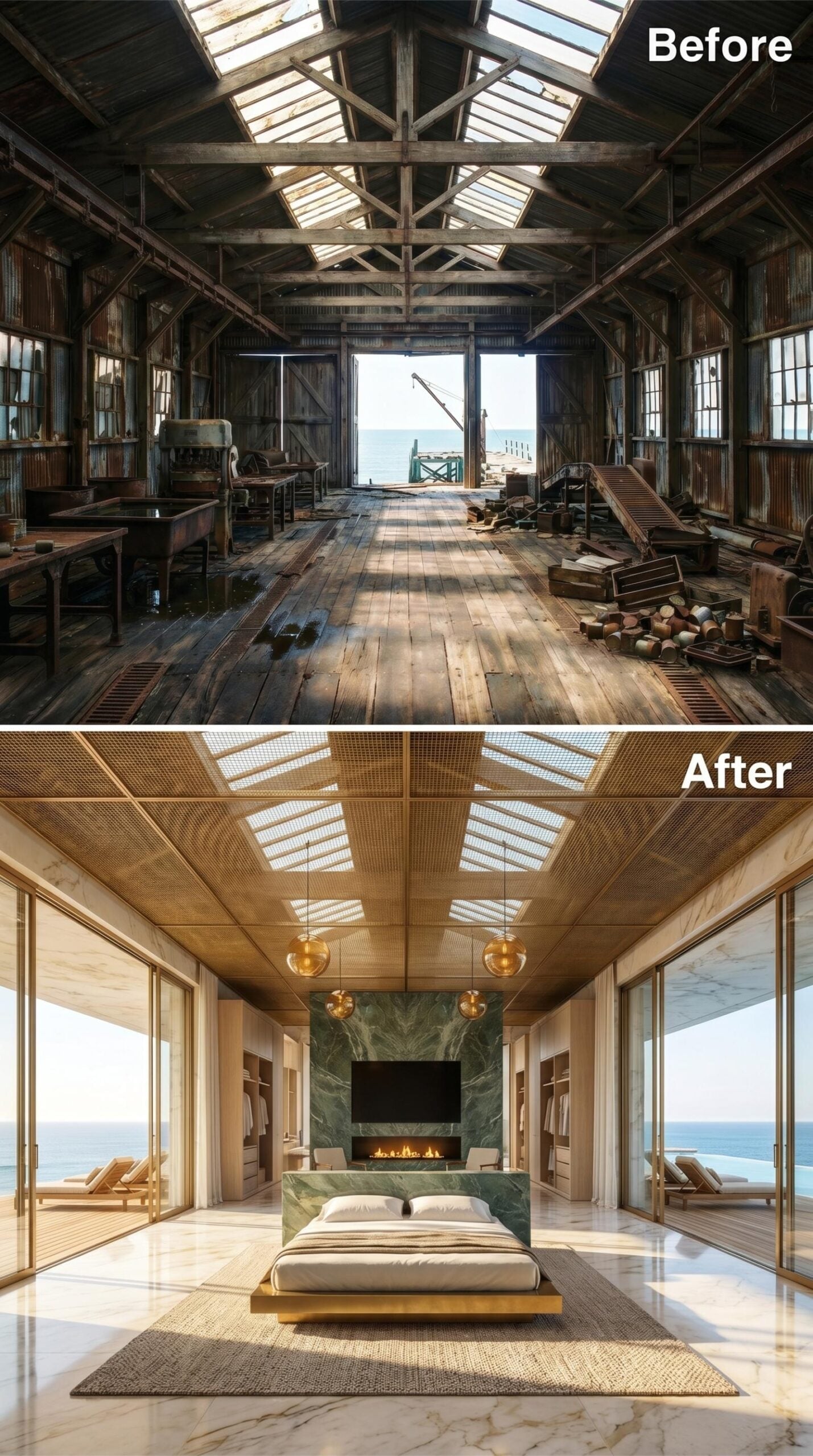
Verde marble rises floor to ceiling around the fireplace, giving this concept a far more formal center than the glass-heavy rooms around it. The bed sits low on a brushed-gold platform, turning the green-and-metal combination into something almost jewel-like.
Skylight panels overhead keep that density from becoming oppressive. The most useful lesson here is simple: when one stone is this assertive, the rest of the room does not need another competing surface.
12. Cobalt Blue Against Copper Makes the Long Vault Feel Electric
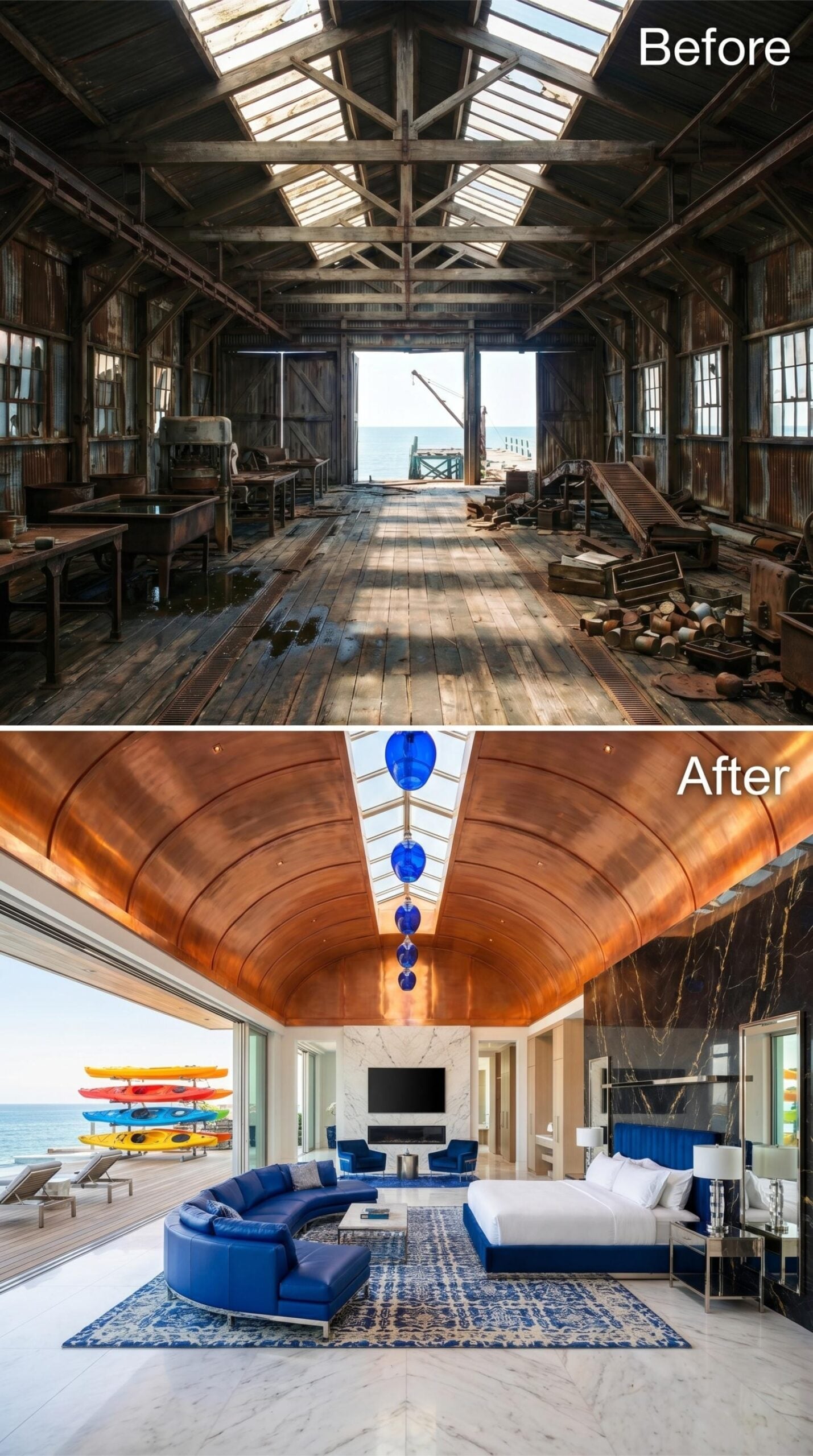
Copper cladding follows the barrel vault from one end of the room to the other, emphasizing its long industrial axis. Instead of matching that warmth, the furniture pushes directly against it with a cobalt sectional and blue-and-white rug.
A blue glass pendant drops from the skylight ridge, connecting the color on the floor to the highest point overhead. Outside, kayaks stacked near the water provide another burst of color that feels incidental enough to be believable.
Why the Blue Pendant Matters
The pendant is not simply another object hanging from the ceiling. Its position along the skylight ridge links three levels of the room at once: copper above, cobalt upholstery below, and blue water beyond the glass.
11. Blush Marble and Diffused Ceiling Panels Make Everything Look Like Dawn
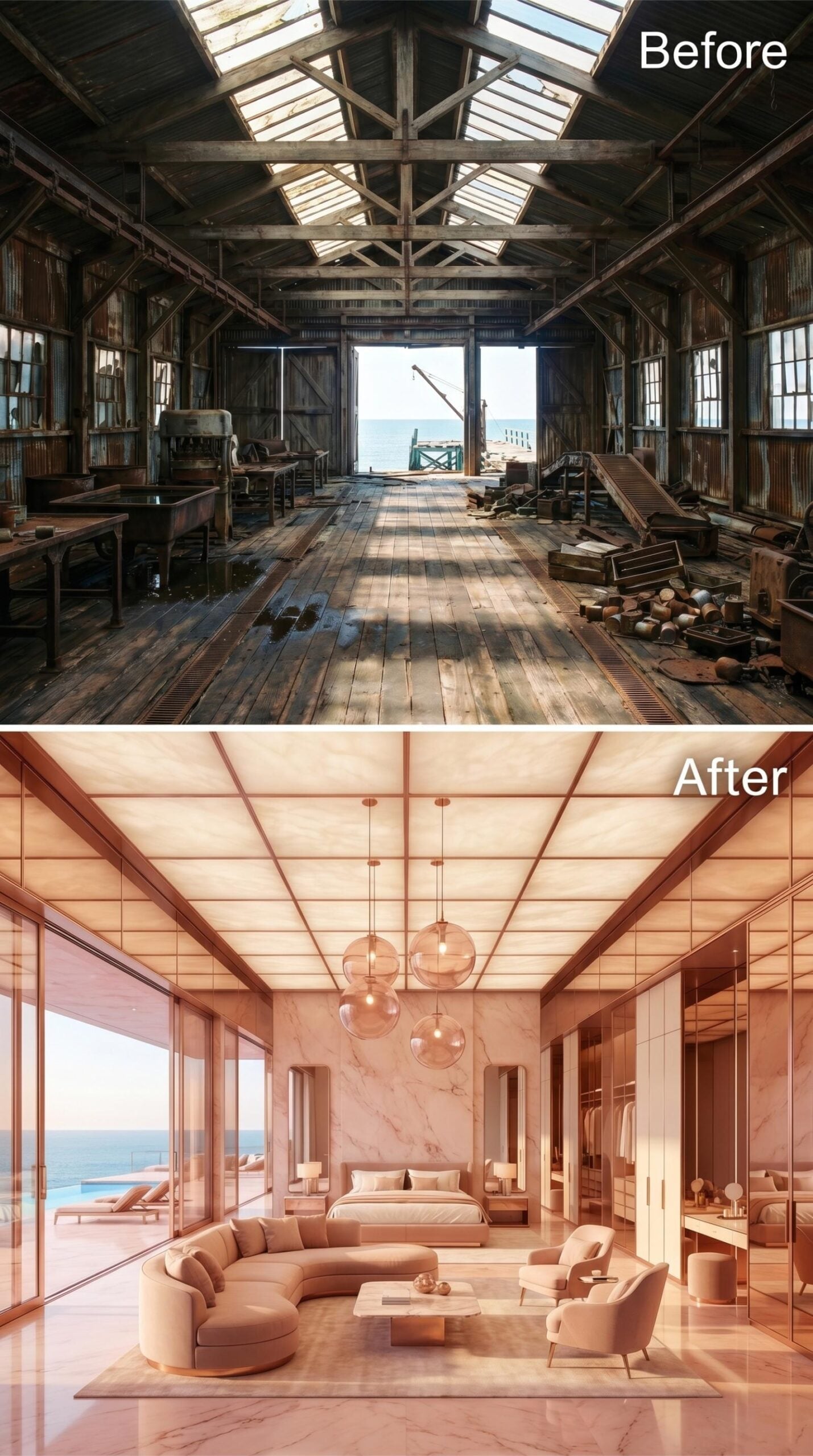
Translucent ceiling panels spread warm light broadly instead of creating bright pools beneath individual fixtures. Against rose-toned marble running from floor to headwall, the entire room takes on the color of very early morning.
Three copper-tinted glass globes hang at staggered heights over the sitting area. Their job is less about illumination than scale: they bring the ceiling visually closer to the furniture without interrupting the openness toward the water.
10. Perforated Brass Turns the Vault Into a Giant Lantern Shade
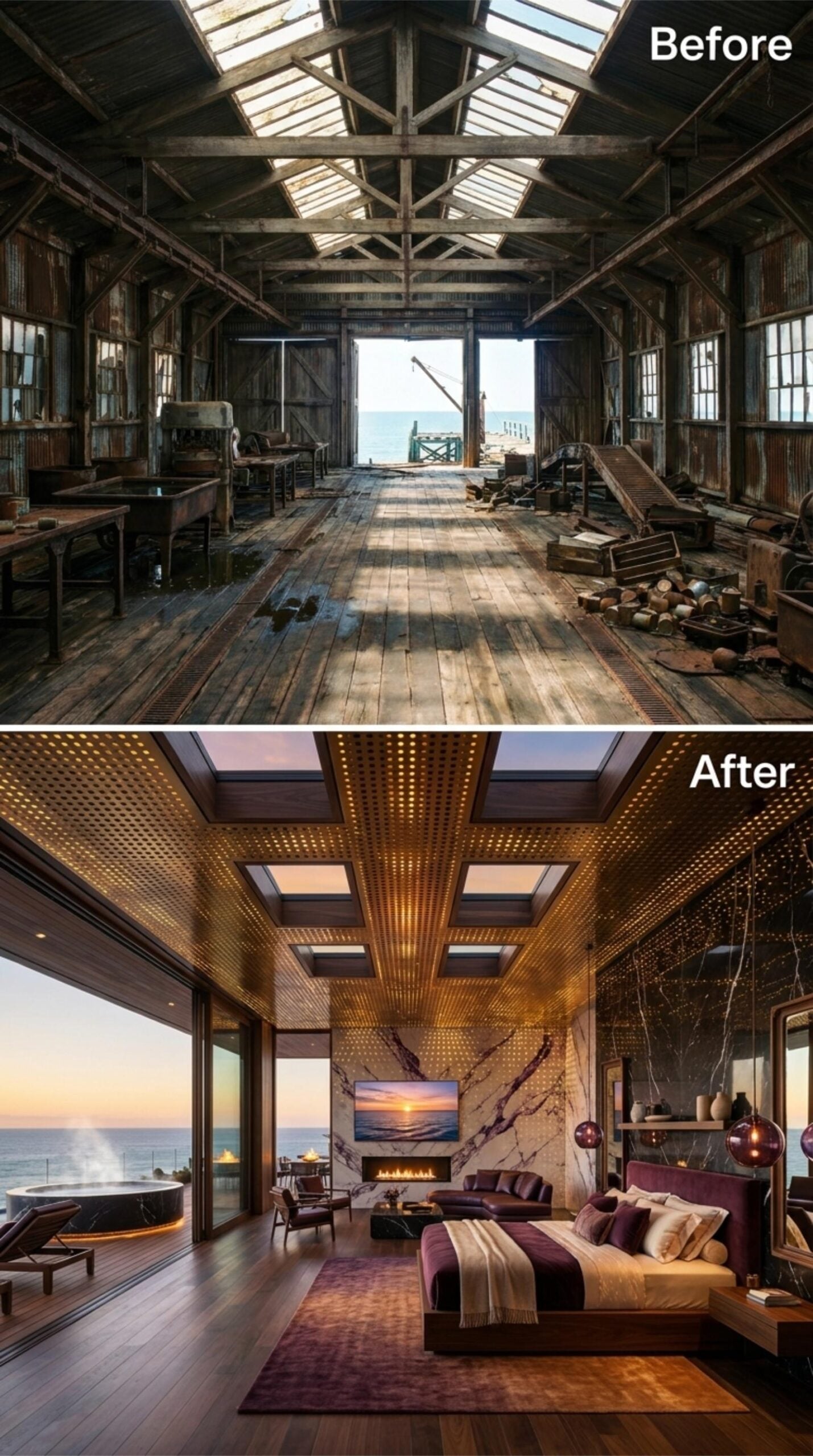
Brass mesh covers the vault from end to end, with embedded illumination catching thousands of perforations across the surface. Skylights cut through at intervals, so the ceiling moves between solid metal and open sky.
Below, the fireplace wall stays comparatively straightforward in veined marble with a linear gas insert. Plum upholstery on the bed prevents the brass from becoming the only warm color in the room.
9. Caramel Leather Curves Around the Fire Instead of Hugging the Walls
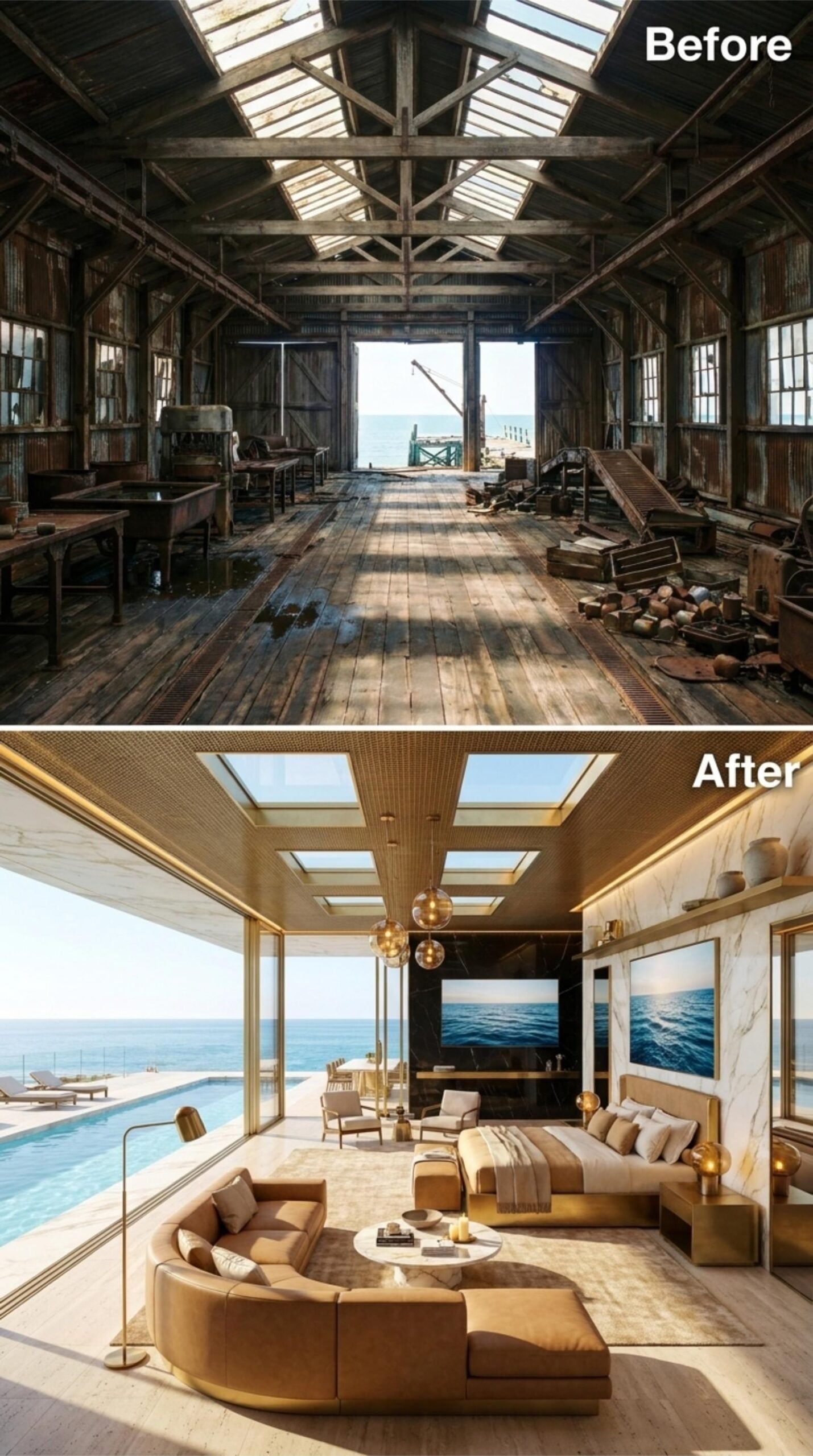
A full-arc caramel sectional creates its own room inside the larger shell. It never touches the walls, which allows circulation to continue around it while still giving the sitting area a clear boundary.
Brass globes descend at three heights, skylights bring the sky overhead, and black marble gives the fireplace wall enough contrast to survive beside all that water and glass. This is zoning by furniture rather than construction.
8. A Copper Geodesic Dome Makes Cobalt Furniture Feel Almost Graphic
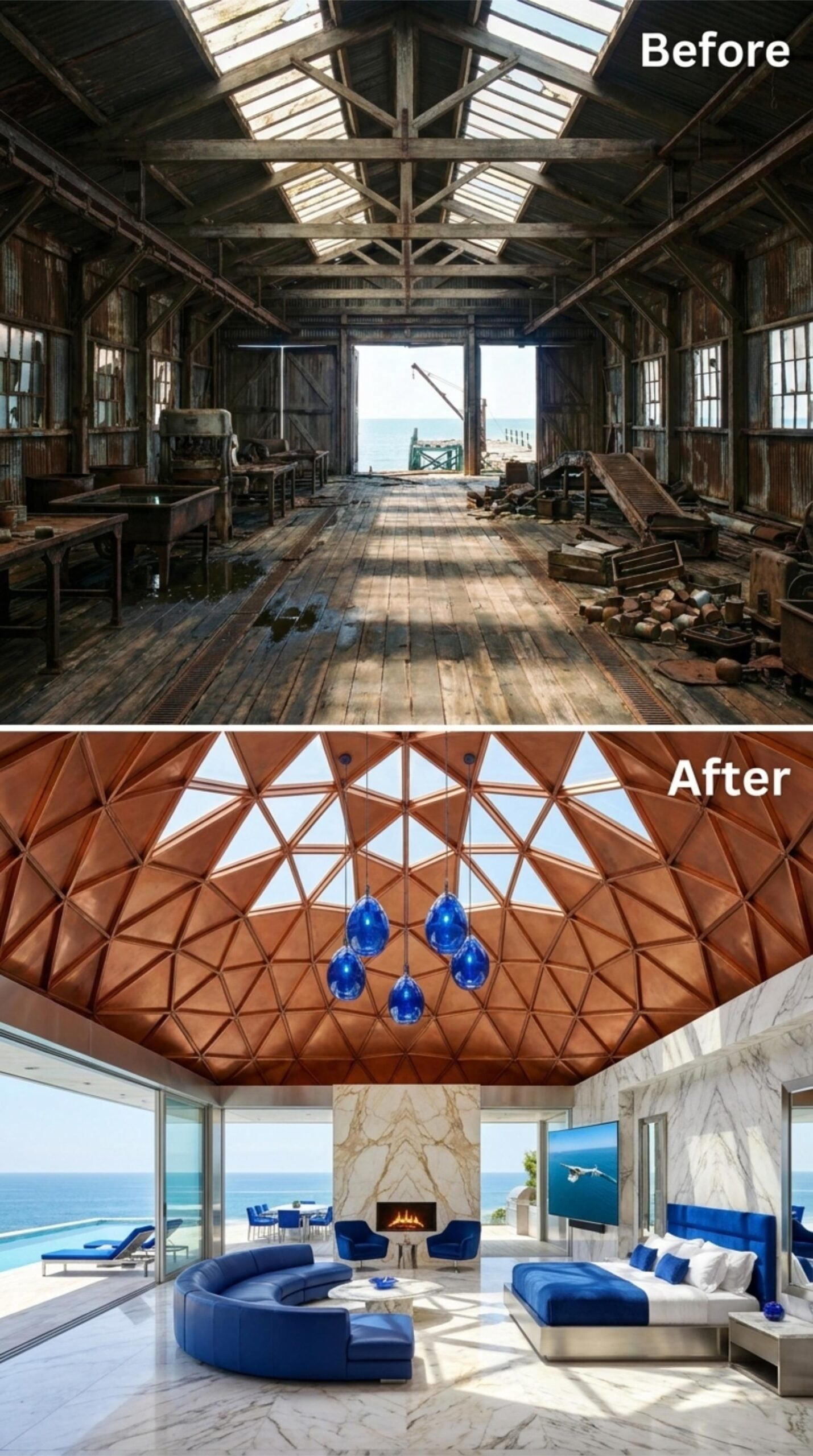
Where the earlier geodesic room used transparency, this one goes opaque. Copper triangles cover the dome overhead and create a faceted metallic shell over an intensely blue interior.
The sectional, bed linens, and pendant lights all use variations of cobalt. With ocean views on three sides, the blue does not feel like an isolated accent; it feels as though the exterior has leaked into the furniture.
7. Navy Blue Makes a Copper Barrel Vault Feel Built for Night
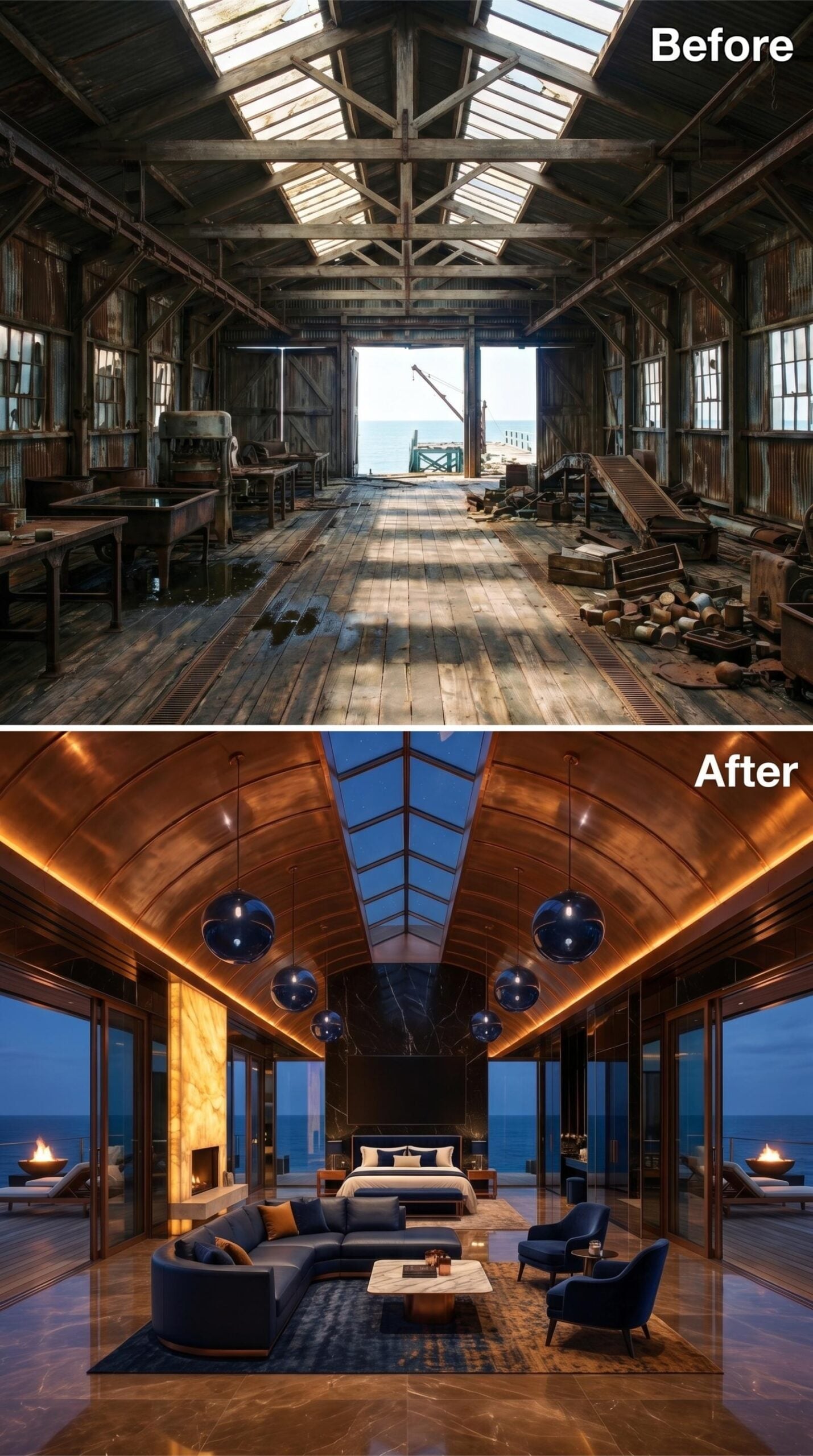
At night, the copper barrel vault changes character completely. Amber light traces the curve from below while a narrow skylight spine preserves a strip of whatever remains of the sky.
Midnight-blue globes hang against the copper without trying to outshine it, and the navy sectional nearly disappears into the darker lower half of the room. Fire bowls outside repeat the amber glow at a distance, extending the palette beyond the glass.
6. Violet Velvet Lets Copper Change With the Sunset
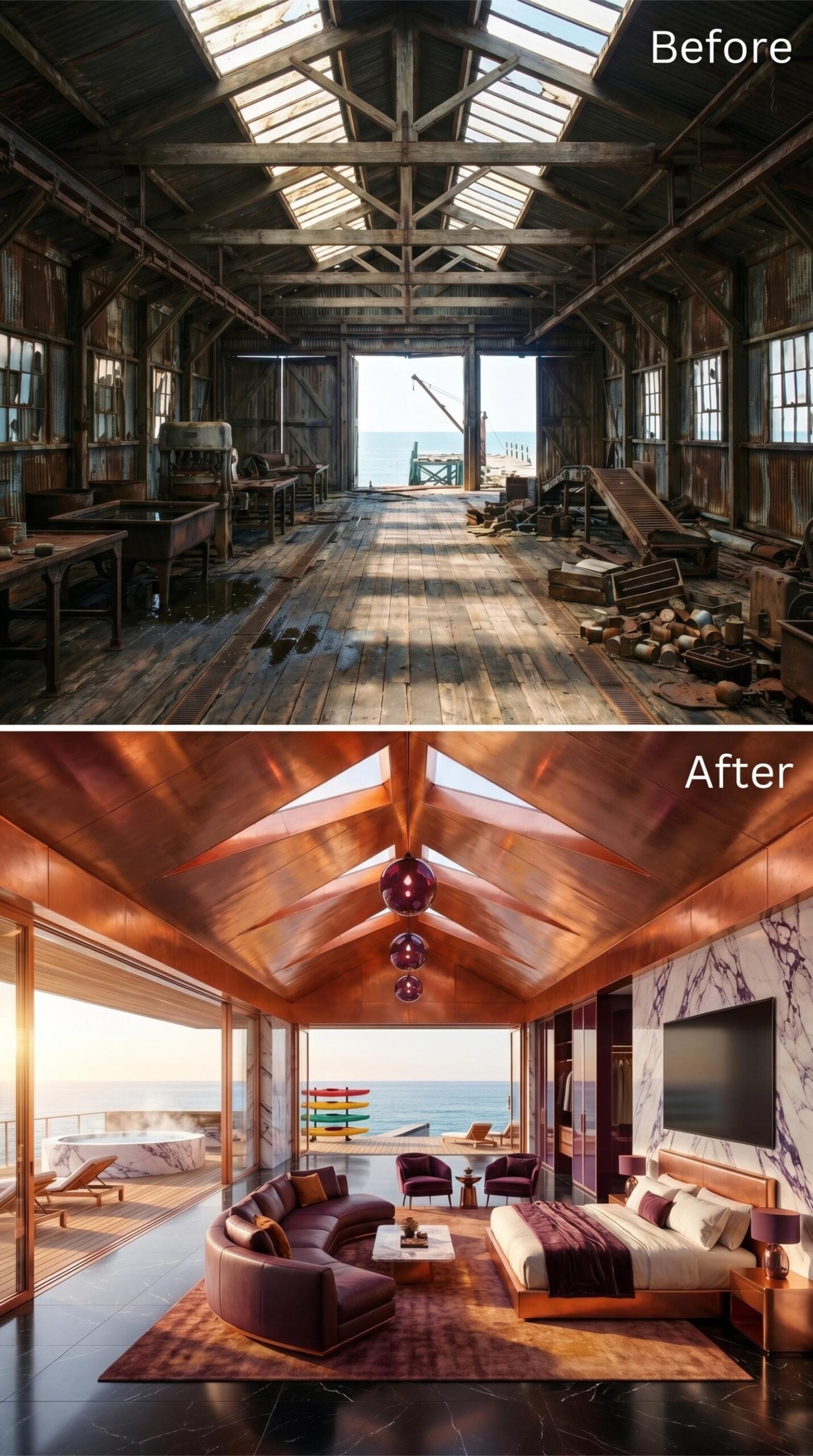
Copper is useful precisely because it refuses to hold one color. As daylight changes, its surface can move from bright orange-gold toward deeper brown and amber, giving the ceiling a different presence at dusk than at midday.
The violet sectional and purple-veined marble refuse to recede either. Pendant spheres descend from the ridge in a loose cluster, while the glazed wall and kayaks outside keep the saturated interior connected to something less polished.
5. A Backlit Onyx Headwall Makes Teal Velvet Feel Cooler by Comparison
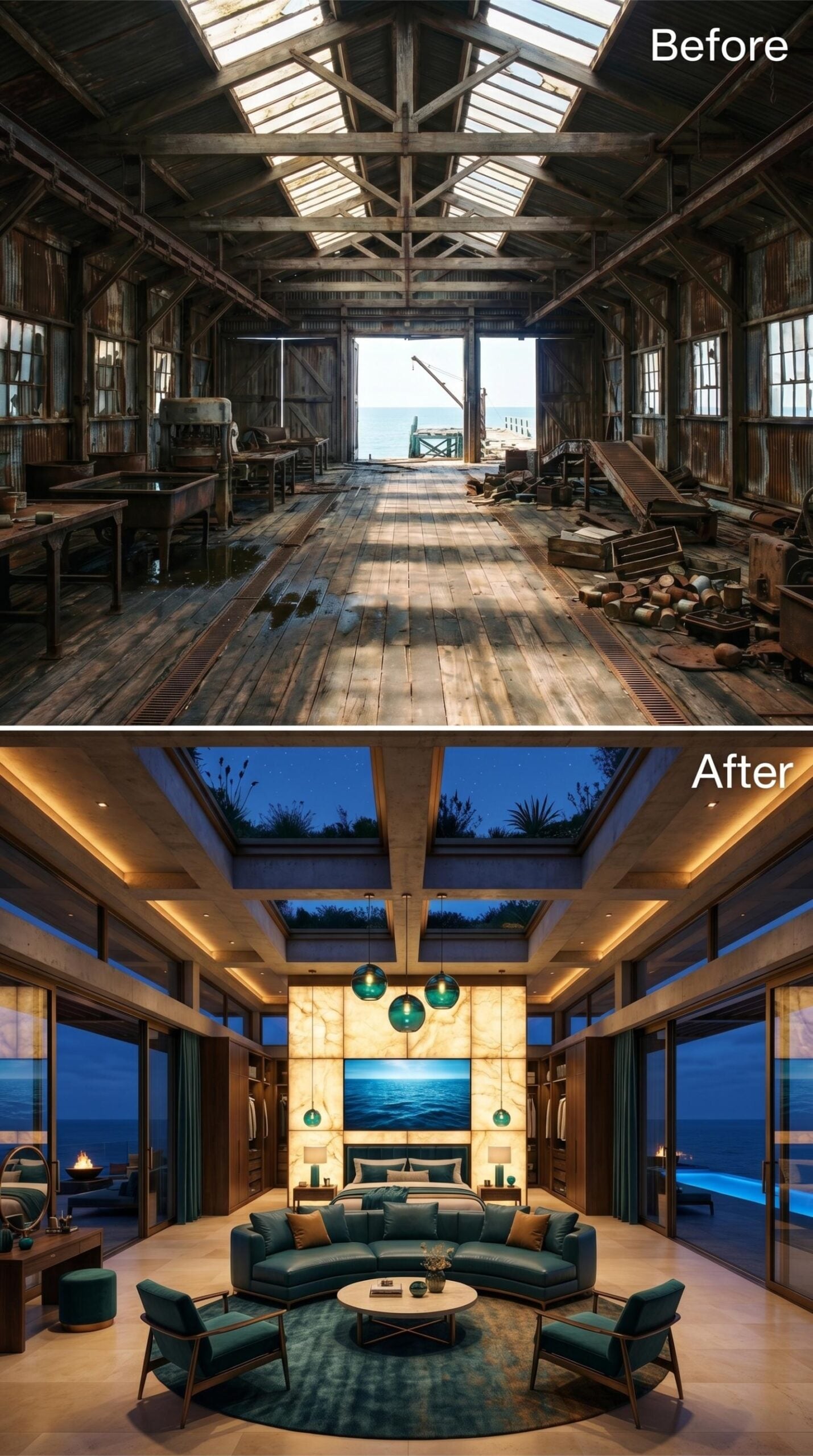
This time the luminous stone moves from the ceiling to the bed wall. Backlit onyx glows in warm amber behind the mattress while teal velvet occupies almost everything in front of it.
A curved sectional and matching armchairs bring the cool color toward the center, with a round travertine table interrupting the repetition. Green glass pendants float above the seating, and cove lighting follows the ceiling tiers without demanding equal attention.
Fun Fact: Onyx is prized for backlighting because many varieties are translucent enough for light to reveal veining and mineral variation from within. Thickness, mineral composition, and the particular slab all affect how much light passes through, which is why the glow can vary dramatically from piece to piece.
4. Gold Ceiling Geometry Pushes Plum Velvet Straight Into Maximalism
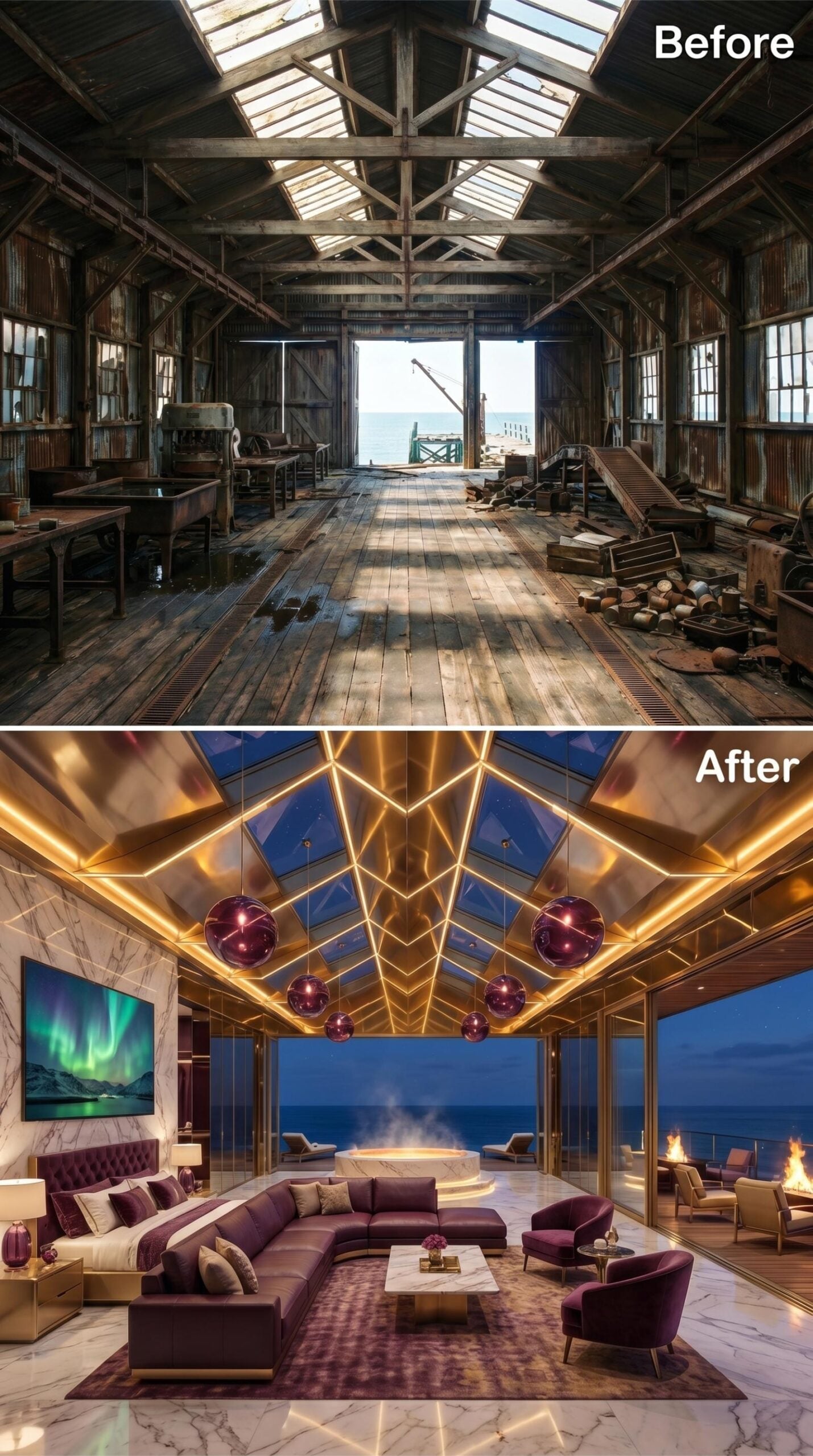
Gold LED channels cross the ceiling in mirrored chevrons, framing the skylight bays like an enormous piece of jewelry. Amethyst globes hang between them, and a plum sectional wraps around the center below.
A circular feature set into the marble floor appears to function as a soaking or water element, adding another reflective surface beneath the ceiling. An aurora image introduces green against all the burgundy and gold. On paper, it sounds like five ideas too many. In a room this large, the excess becomes the character.
Style Tip: Large-volume rooms can accommodate stronger color and larger gestures than compact bedrooms, but scale is not a free pass. Repeating a limited group of materials keeps theatrical choices from turning into unrelated ones.
3. A Slatted Walnut Ceiling Reintroduces Warmth Without Losing the Long Industrial Axis
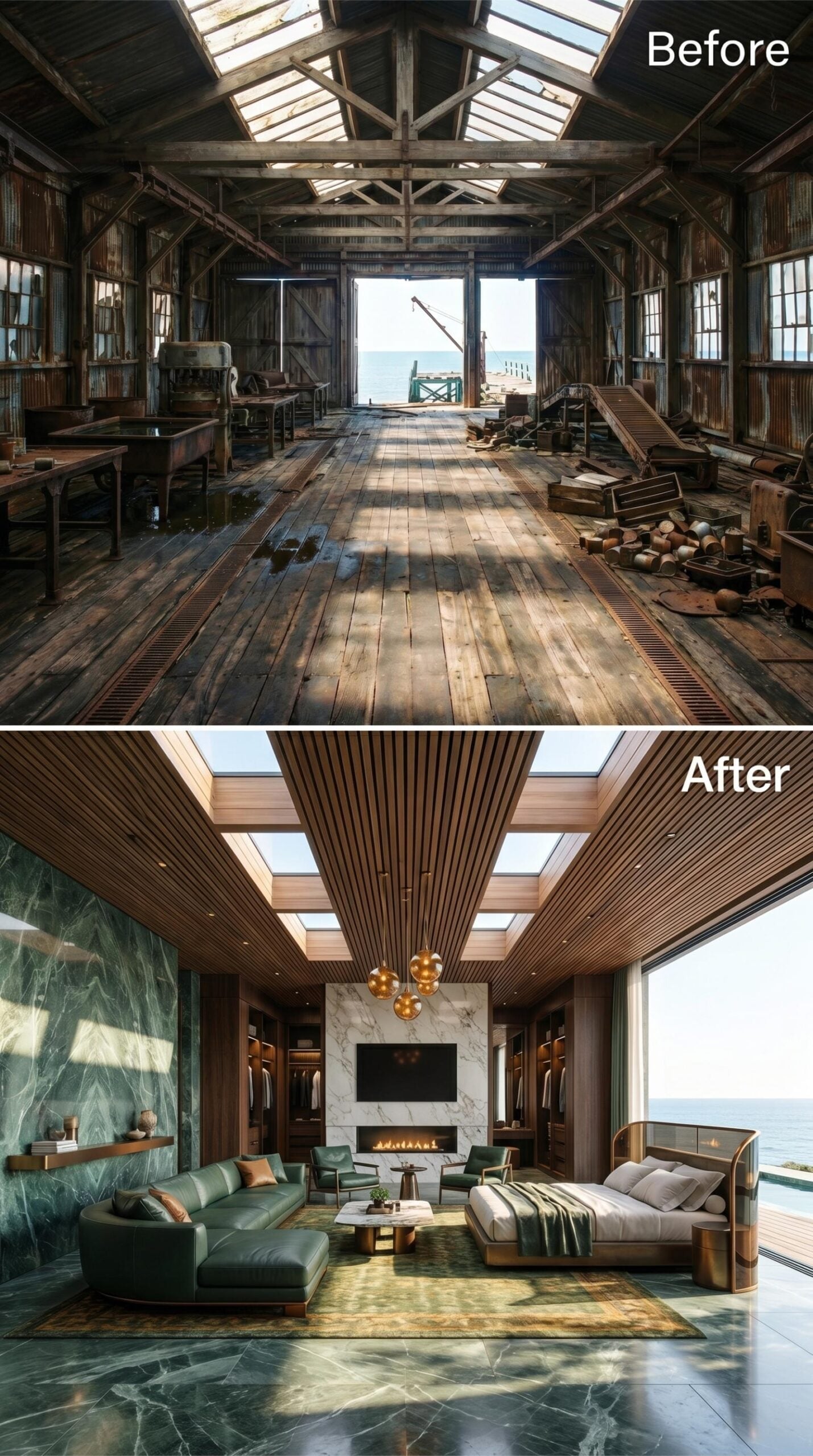
Walnut slats run the full length of the ceiling, emphasizing the room’s depth rather than disguising it. Three skylights interrupt that rhythm and move daylight across the surfaces below.
White-veined marble rises around the linear fireplace, while forest-green leather defines the sitting area. The bed faces directly toward the glass wall and open water, making the length of the room work in favor of the view instead of against it.
2. Curved Green Leather Turns Verde Marble Into a Full-Room Color Story
🔥 Would you like to save this?
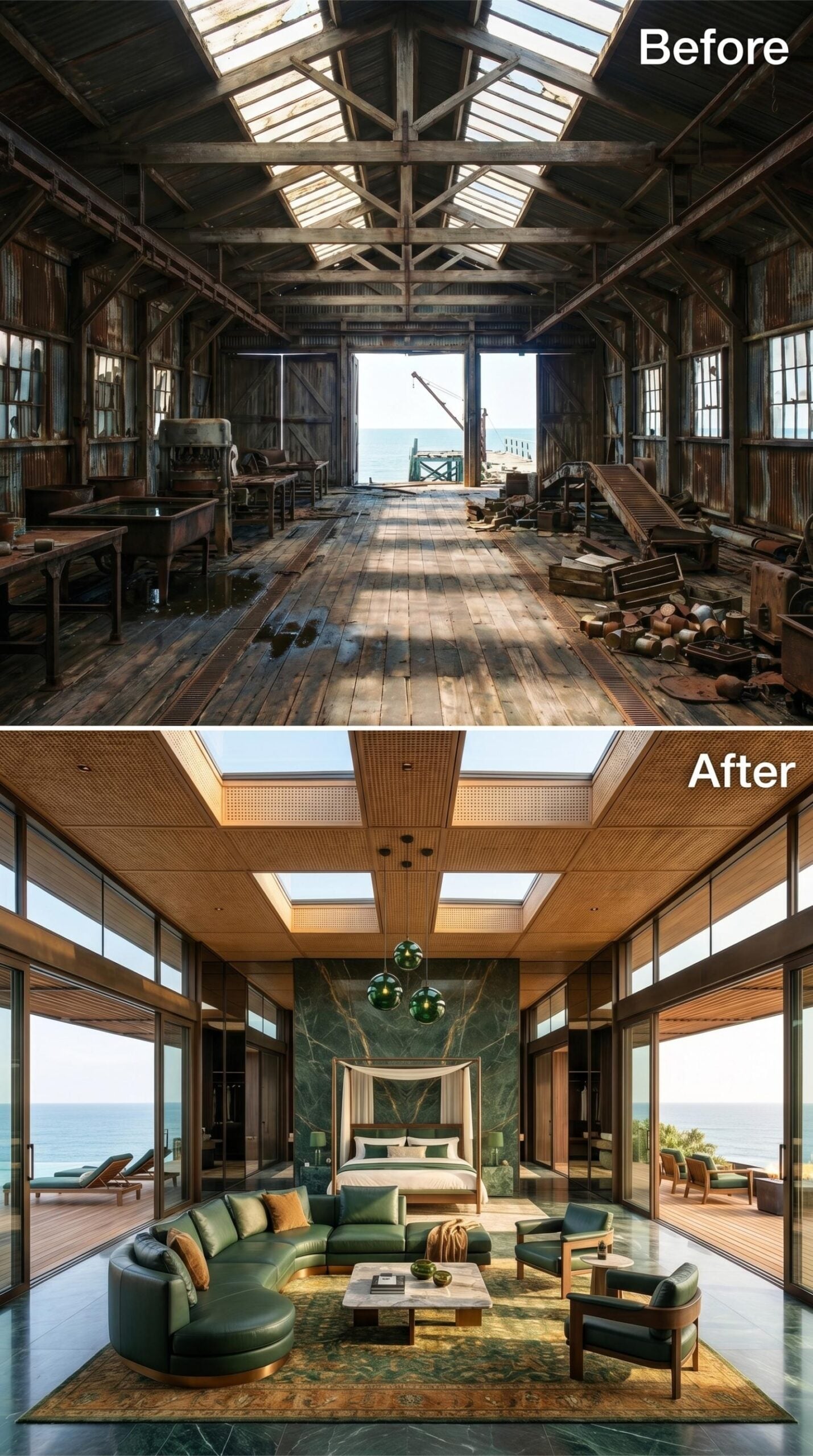
Dark green leather wraps the sectional in a broad curve while verde imperial marble climbs the entire wall behind the canopy bed. Smoked-green pendants hang low enough to bring the light down toward the furniture rather than leaving everything at the mercy of the soaring ceiling.
What keeps the monochromatic approach alive is variation in surface: polished stone, smooth leather, glass, timber overhead, and the moving water beyond. The color repeats. The textures do not.
1. A Teal Zellige Ceiling Makes the Night Sky Look Like Part of the Finish
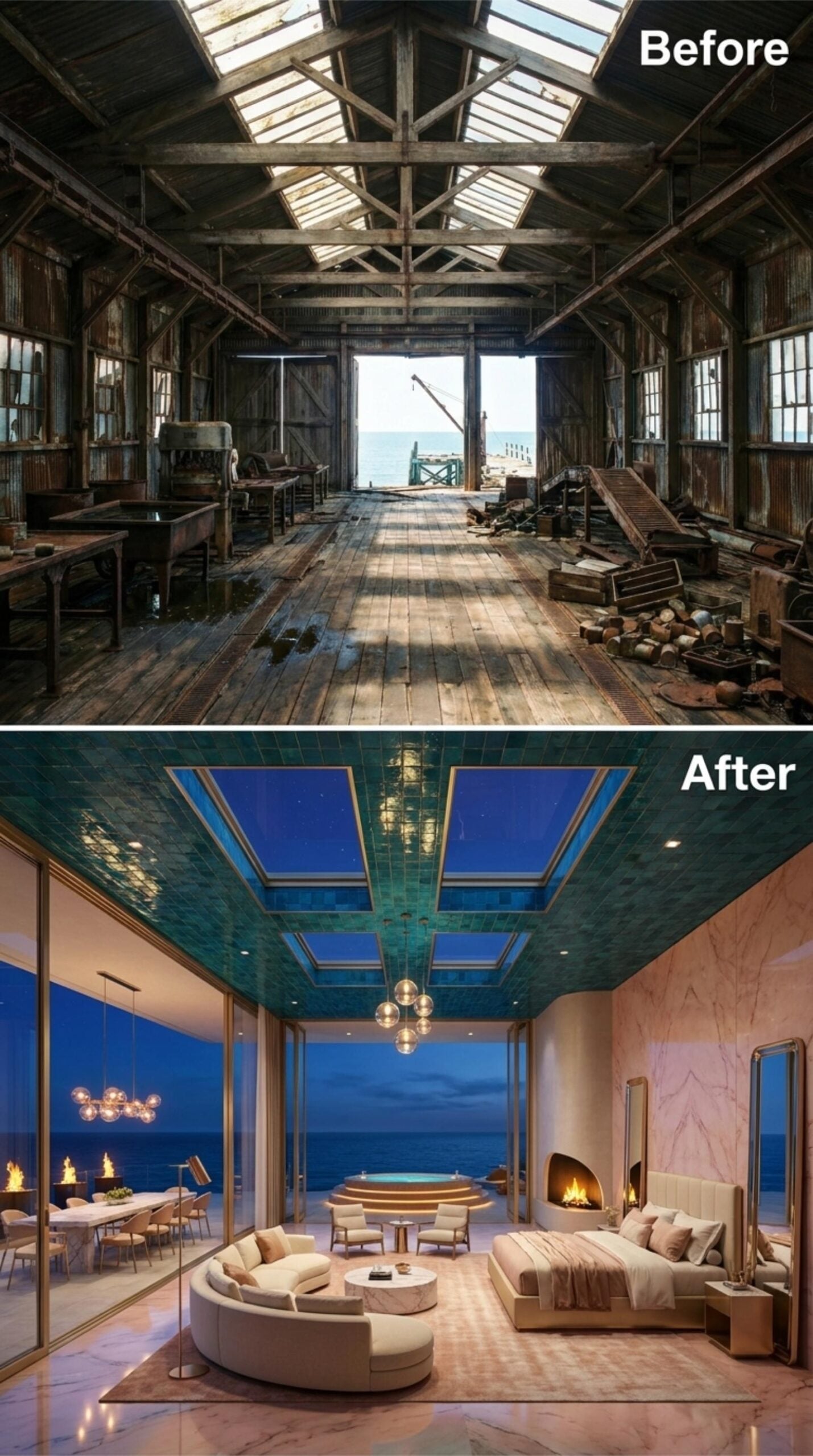
Six skylights puncture a ceiling faced in deep teal zellige, and at dusk the openings begin to look less like windows than darker pieces of the same blue surface. The irregular shine of the tile keeps the ceiling active even after daylight disappears.
A circular cream bouclé sectional provides the one major pale shape in the room. On the right, rose-veined marble surrounds the fireplace and introduces warmth beside a simply dressed bed. Beyond both is the black-blue ocean.
It is a fitting place to end because the best of these concepts never completely erase the building’s imagined industrial scale. They use it. Big roof spans become luminous ceilings. Waterfront utility becomes kayak storage. Hard geometry gets softened with velvet, leather, rattan, and curved furniture. Marble and copper may be far removed from a working cannery floor, but the drama comes from the same source: a huge shell beside the water that was never designed to be delicate.
That contradiction is what makes the experiment interesting. A conventional bedroom begins by asking how to make four walls comfortable. These begin with a much stranger question: how luxurious can a former industrial volume become before you stop believing there was ever a cannery underneath it?