🔥 Would you like to save this?
White bathrooms had a remarkably long reign. White tile, white vanities, chrome fixtures, a little gray marble for excitement. Somewhere along the way, the pursuit of cleanliness became an architectural obsession with making every surface look as though nobody had ever touched it. The result could be immaculate, expensive, and about as inviting as a dentist’s office.
In order to come up with the very specific design ideas, we create most designs with the assistance of state-of-the-art AI interior design software. Also, assume links that take you off the site are affiliate links such as links to Amazon. this means we may earn a commission if you buy something.
Now the pendulum is swinging toward something with considerably more character. Travertine carries the irregular bands of geological time. Walnut and oak introduce grain that no factory-perfect laminate can imitate. Terracotta, copper, honey-colored tile, and warm plaster bring depth to walls that once depended on polished white surfaces to announce their luxury. Even the lighting has changed. Instead of blasting every corner with recessed downlights, designers are using concealed illumination, sculptural pendants, and daylight to reveal what the materials can do.
But a warm bathroom isn’t simply a beige bathroom with brass faucets. The best examples use proportion, texture, architectural openings, and the relationship between materials to create their atmosphere. A curved glass-block partition can be as compelling as a monolithic stone tub. A cedar-lined sauna can change the character of an entire room. A green soaking tub can make the familiar combination of wood and tile suddenly look entirely different. Across these 39 contemporary bathrooms, the interesting question isn’t whether warmth has replaced white. It’s how much more expressive a bathroom becomes when every surface no longer has to behave itself.
39. Hammered Copper Turns This Bathroom Into a Spectacle
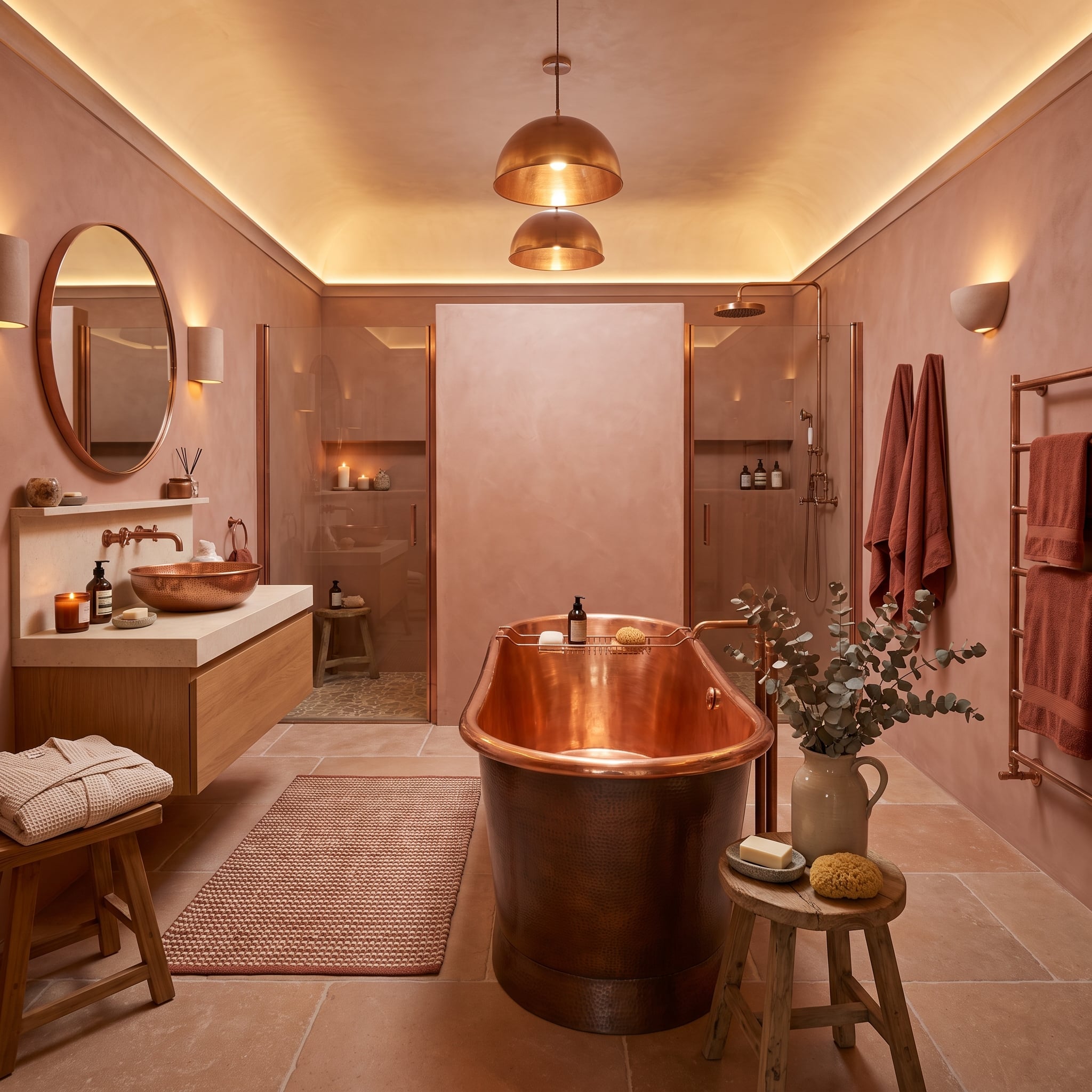
Hammered copper appears in three striking forms: a freestanding soaking tub, a vessel sink, and two broad dome pendants. Each surface catches the light differently. The tub’s curved sides display the metal’s irregular texture, while the pendants introduce a smoother silhouette overhead. Against muted clay-colored plaster, the copper becomes the room’s dominant architectural expression rather than an isolated decorative accent.
A walk-in shower occupies the wall behind the tub, with built-in niches interrupting the plaster surface. Rust-colored towels and a stoneware vessel extend the palette without matching the copper exactly. Rather than scattering metallic accents around the room, the design explores how one material can take on several distinct forms.
38. A Curved Glass-Block Wall Makes the Shower Impossible to Ignore
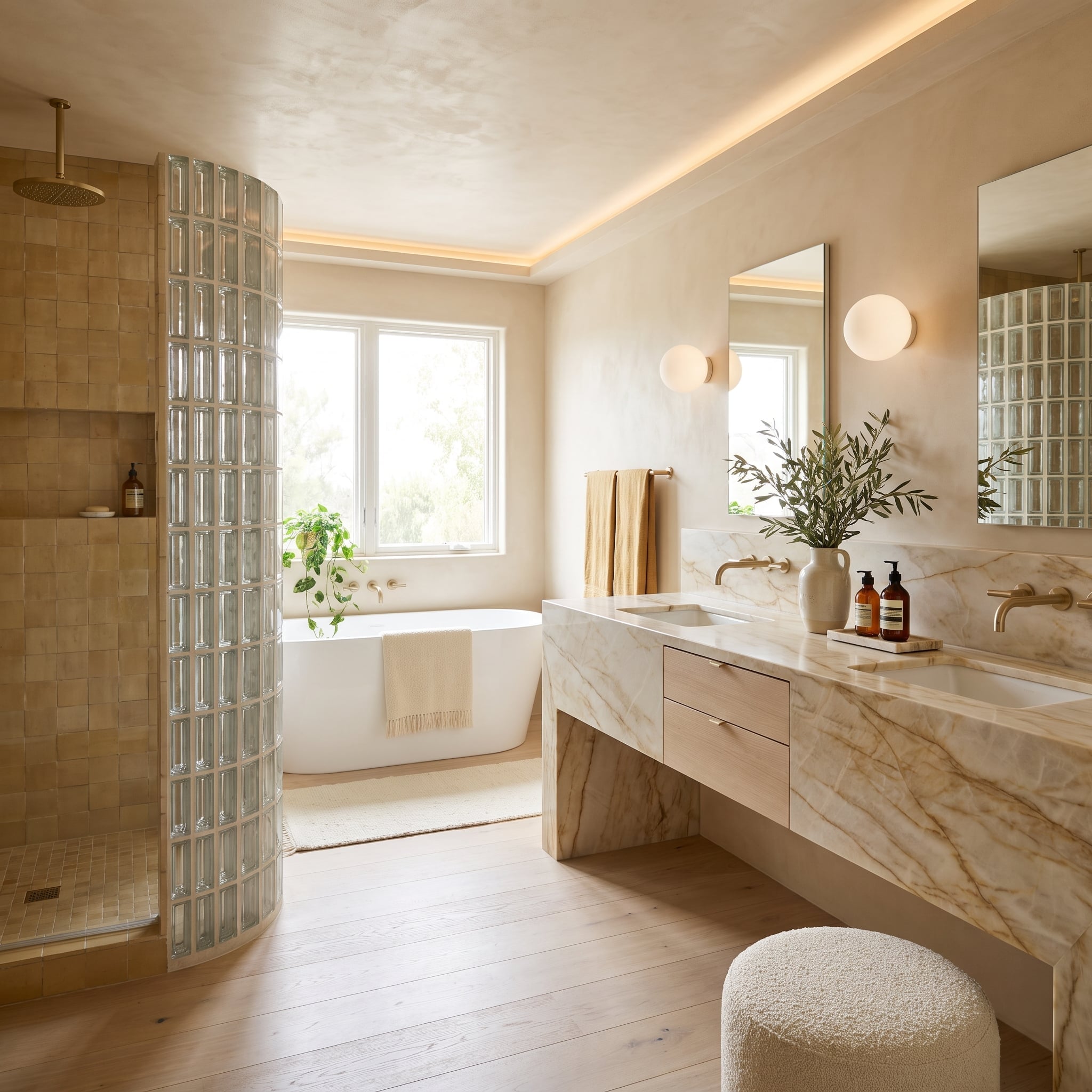
A sweeping wall of glass blocks separates the shower from the freestanding tub, introducing a translucent curve into a room otherwise organized around straight lines. The blocks obscure detail without eliminating light, allowing the warm-toned shower surfaces to register as color and texture beyond the partition.
On the vanity side, a marble slab extends down the cabinet face, carrying its veining from horizontal countertop to vertical surface. Wood flooring introduces another strong material contrast. Its presence in a bathroom requires careful moisture protection, but visually it shifts the room away from the conventional all-stone treatment. The glass-block wall remains the decisive feature: sculptural, functional, and far more expressive than an ordinary clear-glass enclosure.
37. A Domed Hammam-Inspired Bathroom Gives Marble an Entirely Different Setting
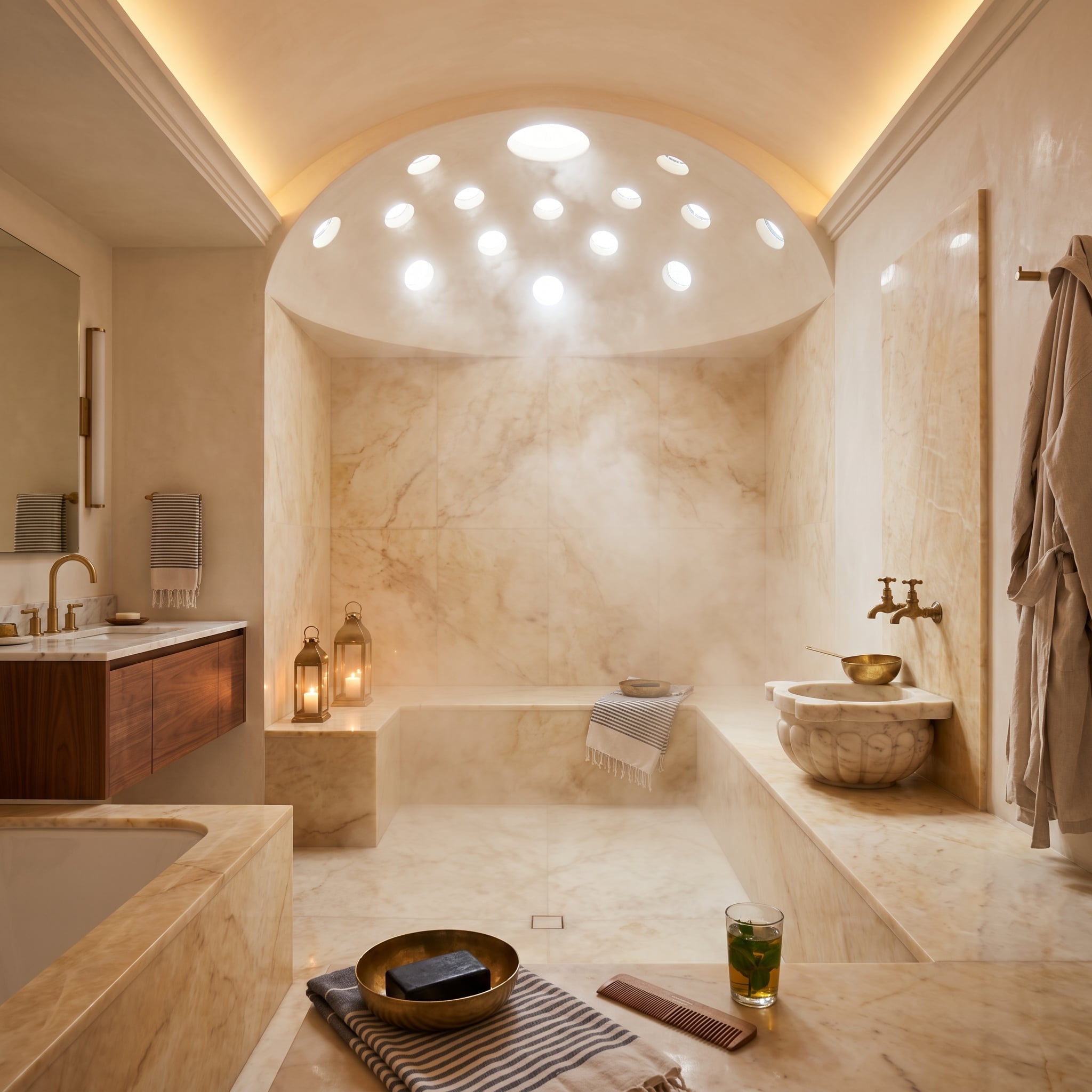
A domed ceiling punctuated by circular skylights transforms this bathroom into a composition of arches, stone, and filtered light. Cream marble rises across the walls and bathing platforms, its warm veining providing movement without requiring contrasting tile patterns.
Antique-finish brass spigots, a sculptural stone basin, and decorative lanterns introduce references to traditional bathing interiors. Across the room, a floating walnut vanity brings the design back toward contemporary cabinetry. The historical influences emerge through architectural forms and materials rather than an accumulation of ornamental accessories.
36. Sage Tile and a Green Soaking Tub Make an Unexpectedly Convincing Pair
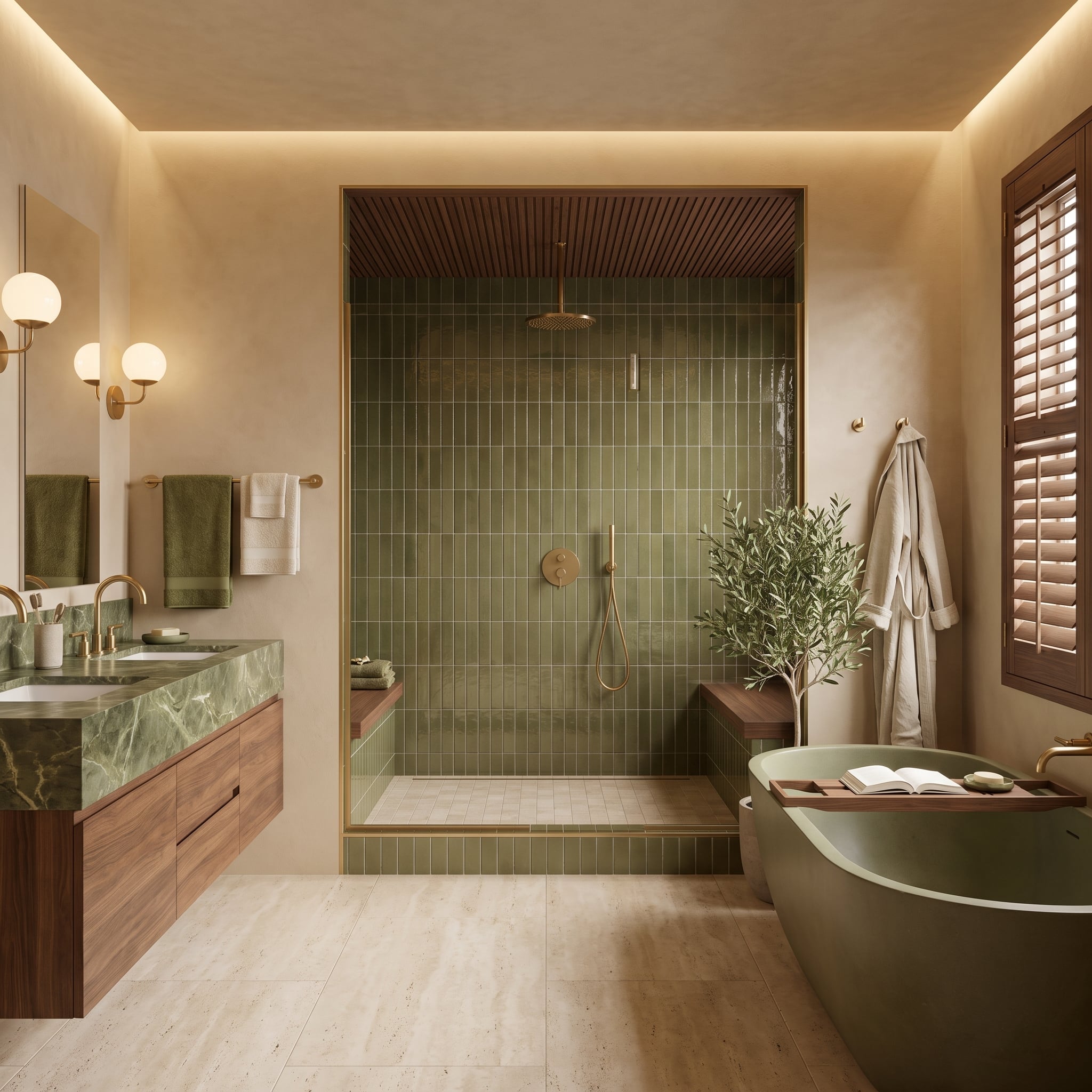
The olive-green soaking tub immediately distinguishes this bathroom from the familiar parade of white freestanding baths. Its color relates to the vertically arranged sage tiles inside the shower, where variations in the glazed surface create a subtle pattern of reflected light.
A floating walnut vanity introduces a darker, richer tone, while green-veined stone connects the cabinetry to the bathing fixtures. Brass adds warmth without overwhelming the green. Rather than using a single accent wall, the design distributes its color through several different materials, giving the palette depth and continuity.
What Our Readers Say
- Not everyone is ready to give up on white: in our readers’ votes, bathroom photos with white accents got hearts 54% of the time, vs 47% for other images in the same articles.
- Home Stratosphere readers who picked a cosy and moody feel for their home were more likely to choose wood window frames, 34% vs 10% of everyone else.
From Home Stratosphere reader polls and votes.
35. Cedar, Concrete, and Glass Bring a Sauna Into the Bathroom
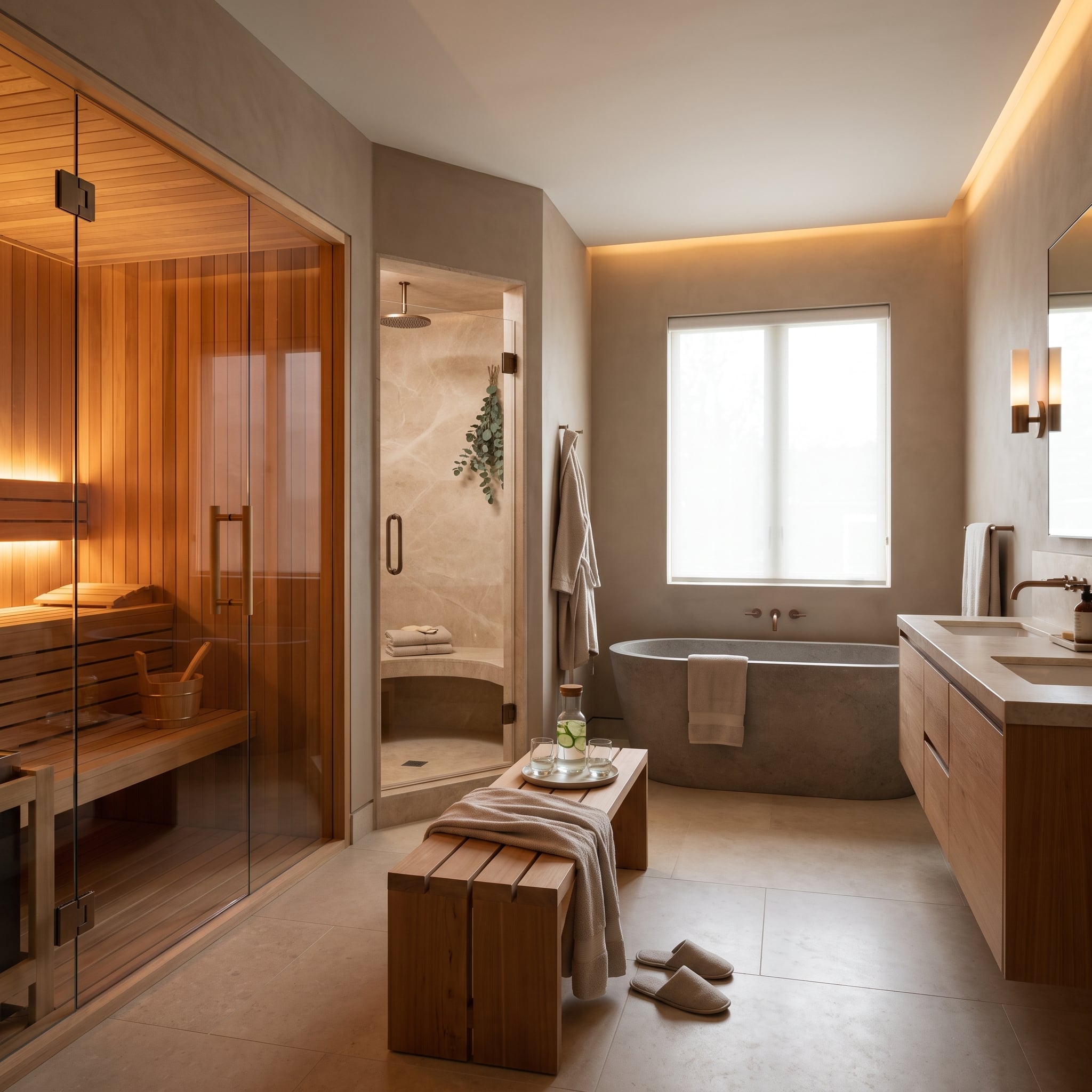
A cedar-lined sauna stands behind a full-height glass enclosure, making the warm timber visible throughout the bathroom. Instead of concealing the sauna as a separate utility space, the design allows its vertical wood lining to become one of the room’s principal architectural surfaces.
A concrete soaking tub and rainfall shower introduce cooler, harder materials, creating a deliberate contrast with the cedar. A timber bench provides a transitional element between the different bathing areas. The glass enclosure preserves sightlines across the room while displaying the sauna’s distinctive material character.
34. Backlit Amber Stone Turns the Vanity Wall Into a Light Source
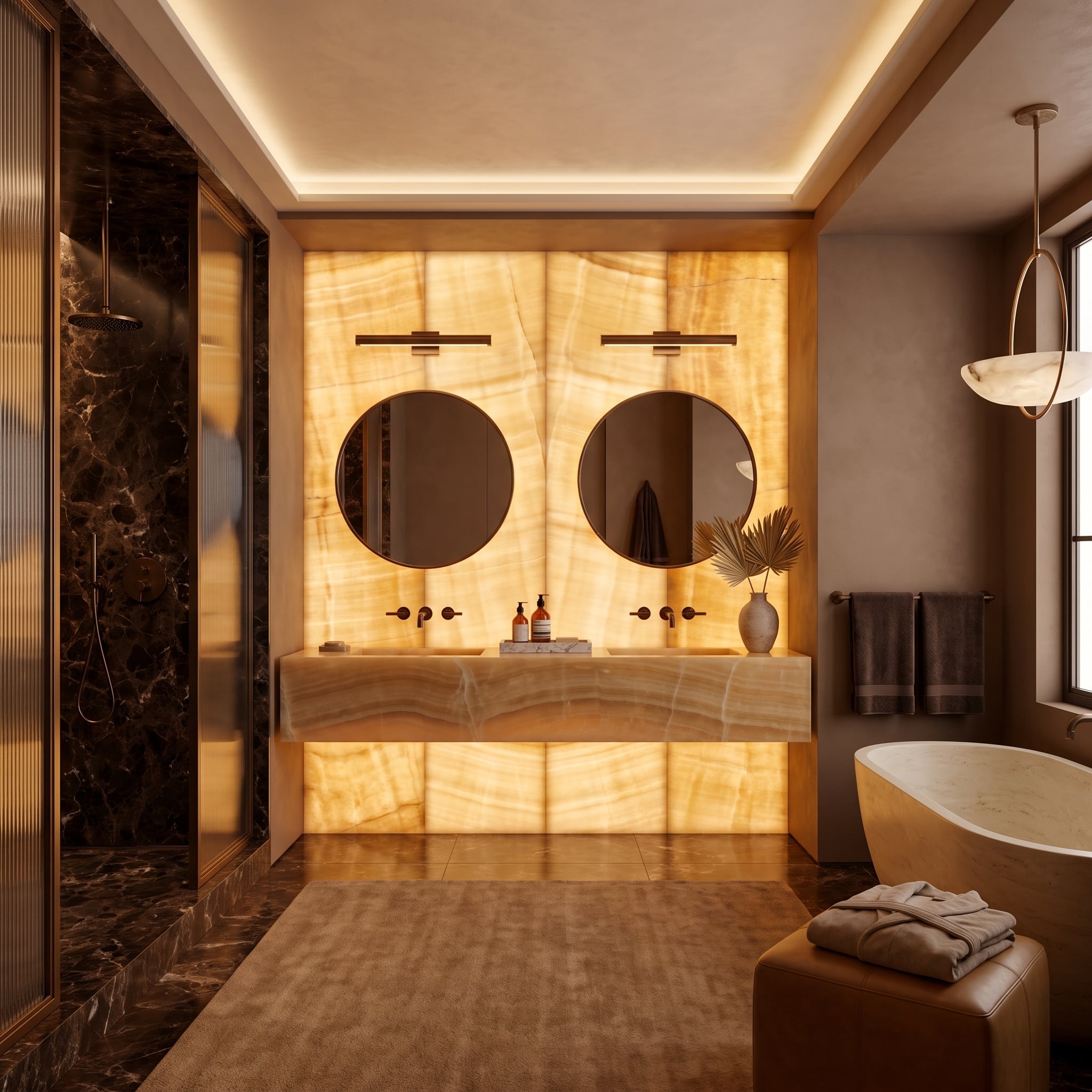
An illuminated amber stone wall gives this bathroom an extraordinary focal point. Light filtering through the stone reveals intricate variations in its veining, creating an effect ordinary wall sconces or painted plaster cannot reproduce.
Two circular mirrors interrupt the glowing wall, their symmetrical placement providing order against the irregular stone pattern. Dark marble inside the shower introduces a strong counterweight, while the freestanding tub occupies a comparatively quiet corner. Backlit natural stone requires carefully coordinated lighting, support, and material selection, but the visual result demonstrates why designers sometimes treat the wall itself as the principal fixture.
33. A Japanese-Inspired Soaking Room Finds Its Warmth in Wood and Garden Light
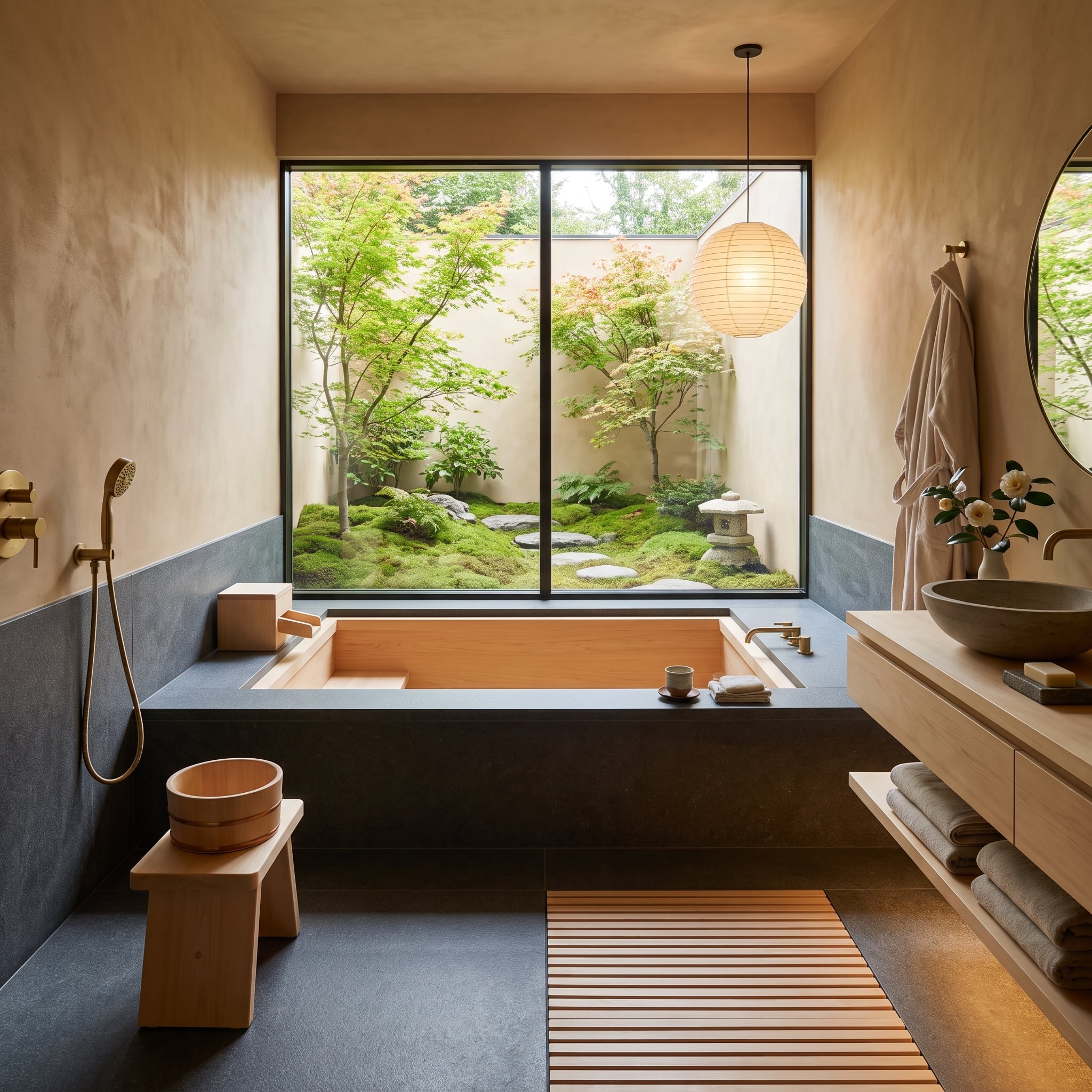
A deep wooden soaking tub sits within a dark stone surround, its pale timber introducing warmth against the nearly black base. A low wooden stool and bathing bucket reinforce the Japanese-inspired arrangement, while a paper lantern provides a softer alternative to conventional bathroom lighting.
Beyond the window, moss, Japanese maples, and a stone lantern establish a garden backdrop. The contrast between the sheltered bathing area and the greenery outside is central to the composition. Traditional Japanese bathing separates washing from soaking, and the distinct stool and tub arrangements reflect that approach. Here, the relationship between water, wood, and garden is as important as any individual fixture.
32. A Concrete Soaking Tub Gives Honey-Colored Stone a Sculptural Counterpoint
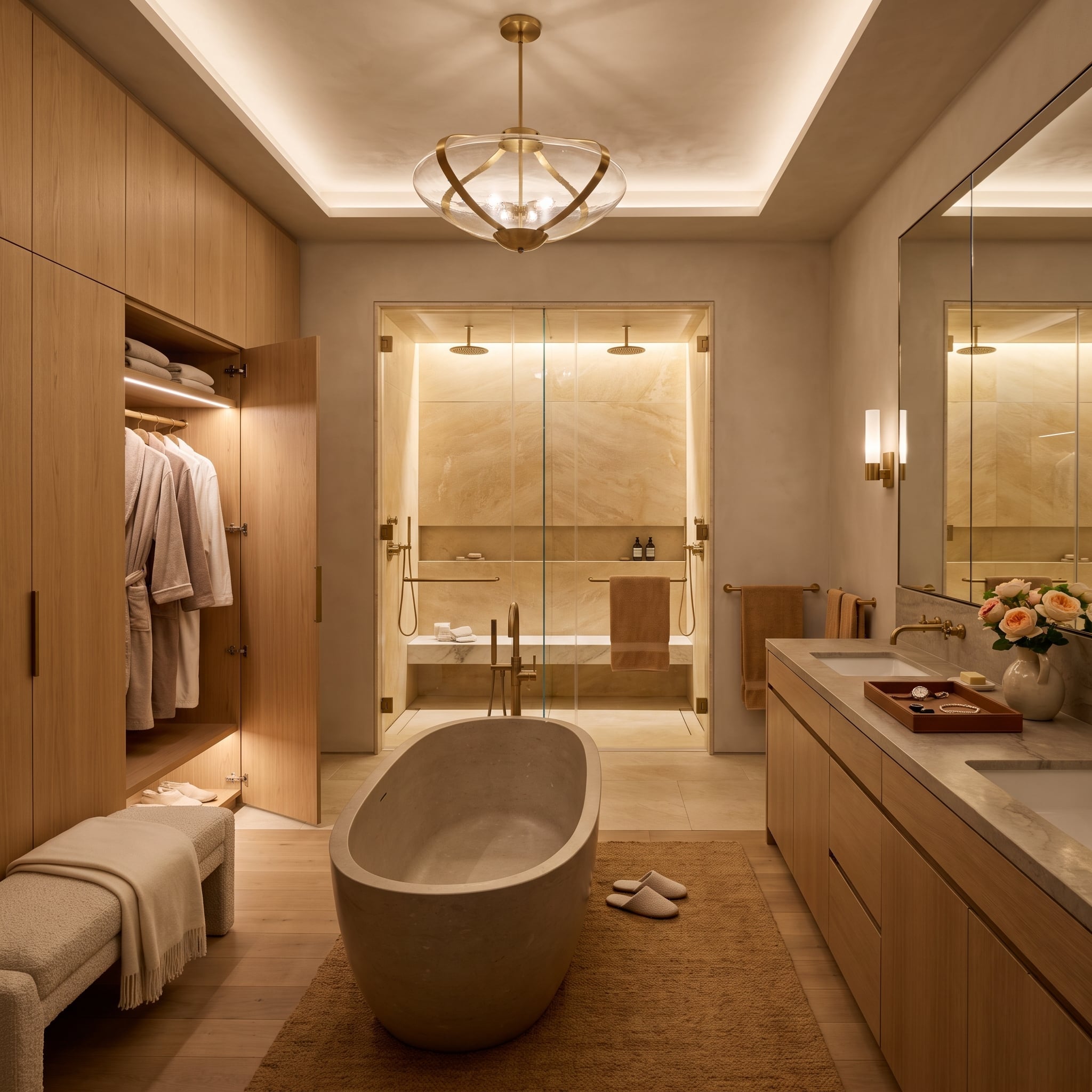
A matte concrete soaking tub provides a sculptural center against honey-colored stone in the shower. The stone’s gentle tonal variation gives the enclosure depth, while the tub’s simpler surface allows its shape to stand apart.
Flat-front white oak cabinetry extends across the vanity wall, paired with a thick pale countertop and warm metallic fittings. The materials form three distinct visual layers: smooth concrete, patterned stone, and timber grain. Their differences give the bathroom more interest than a completely coordinated suite of polished surfaces would offer.
31. Terracotta Scallops Give a Plaster Bathroom Its Defining Curve
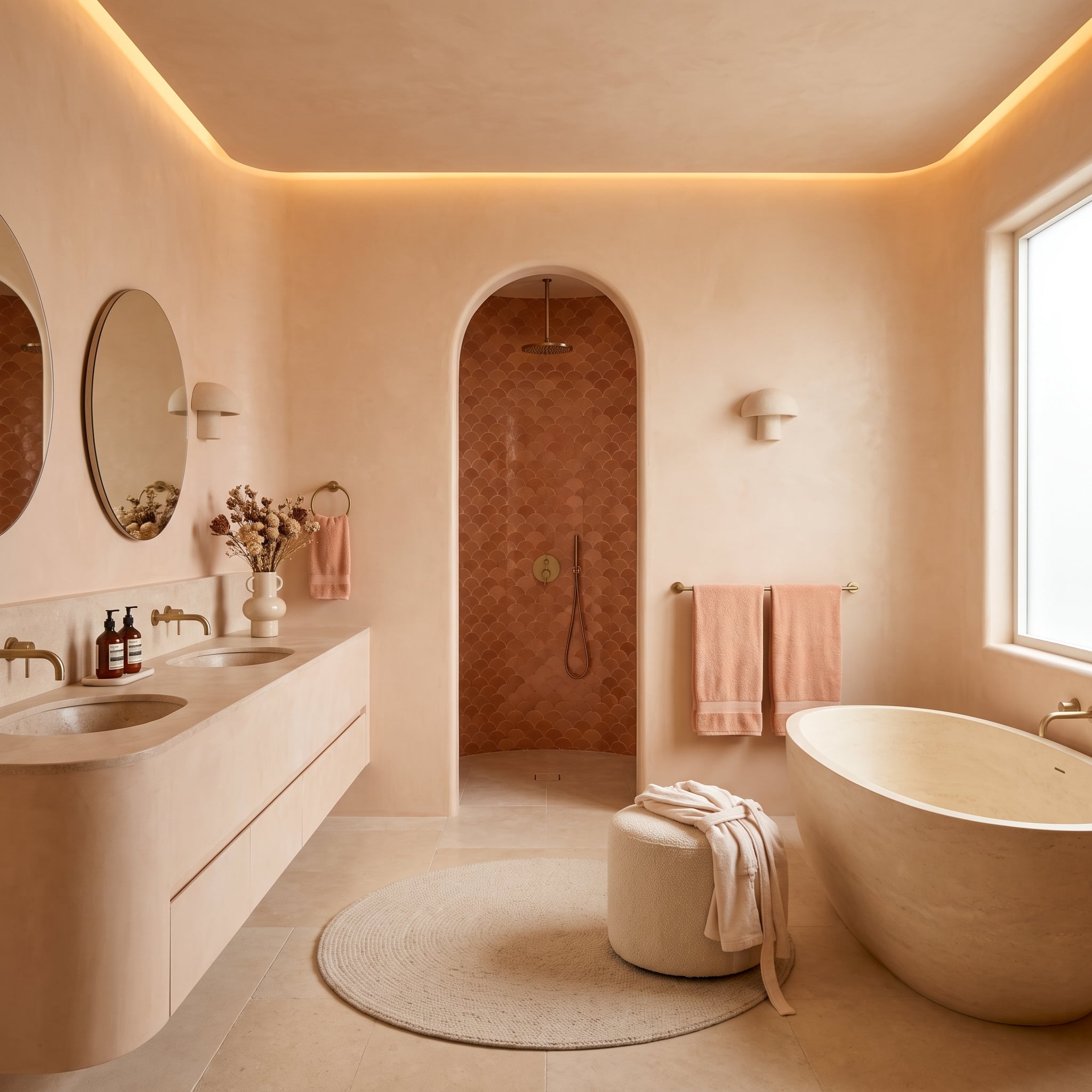
Blush-toned plaster surrounds an arched shower opening lined with scalloped terracotta tile. The curved tile edges introduce a repeating pattern that contrasts with the larger, uninterrupted plaster surfaces.
Concealed ceiling lighting washes the walls in a warm glow, emphasizing the soft variations in their finish. Brass fixtures remain close to the surrounding palette, avoiding the sharp contrast that chrome or black hardware would introduce. The shower niche supplies the room’s decorative character through geometry rather than additional colors.
30. A Stone Tub Opens Directly Onto a Mediterranean-Style Courtyard
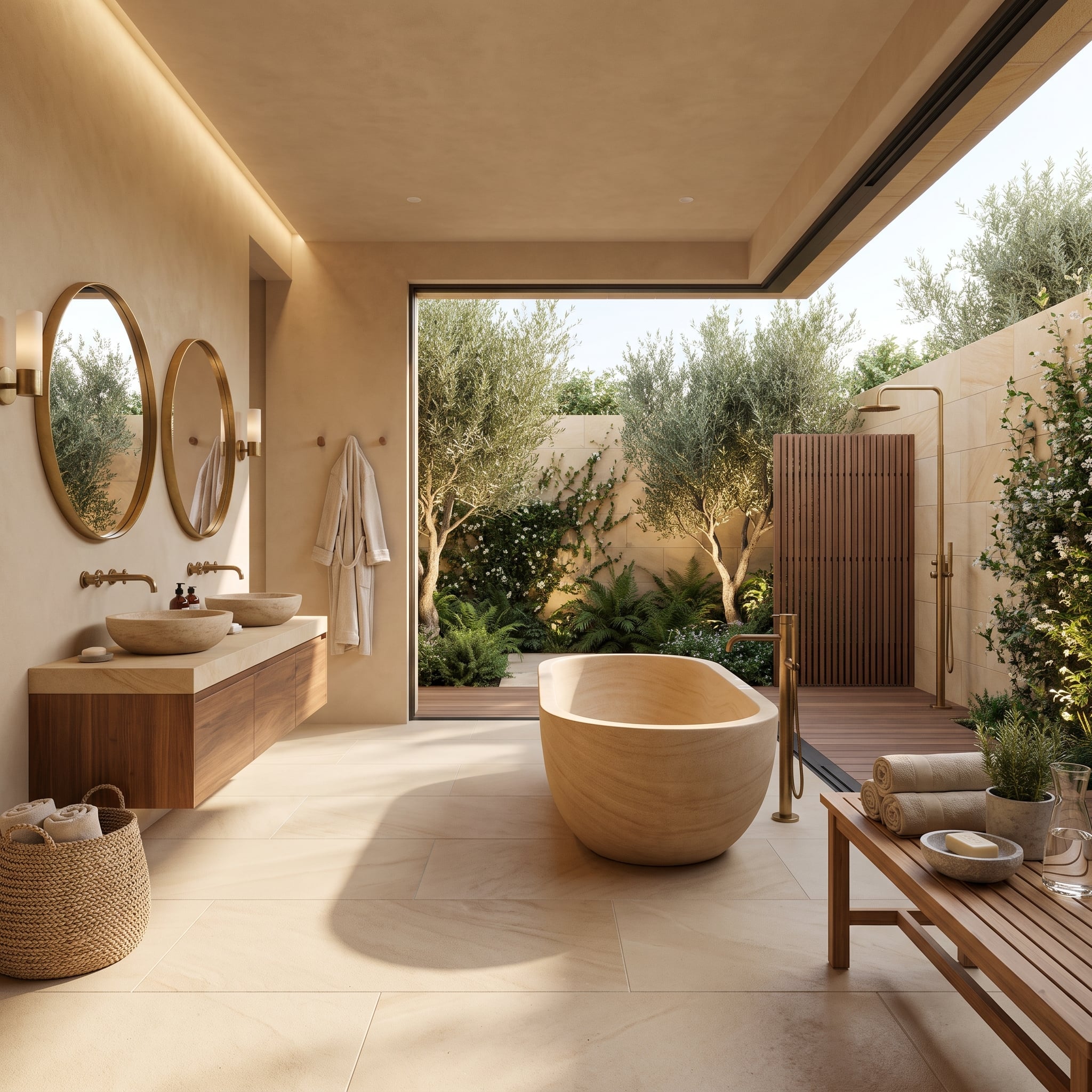
A substantial stone soaking tub occupies the threshold between the bathroom and an adjoining courtyard. A wide opening allows the outdoor deck and planted garden to become part of the room’s composition, extending the view well beyond the bathing area.
Stone vessel sinks rest on a floating walnut vanity, with round brass-framed mirrors establishing a more formal arrangement indoors. Outside, olive trees and climbing greenery soften the architectural enclosure. A timber-lined outdoor shower extends the bathing facilities into the courtyard. The transition between sheltered stone surfaces and open-air planting is the room’s defining feature.
29. Rose Marble and a Bouclé Chair Give This Bathroom the Character of a Sitting Room
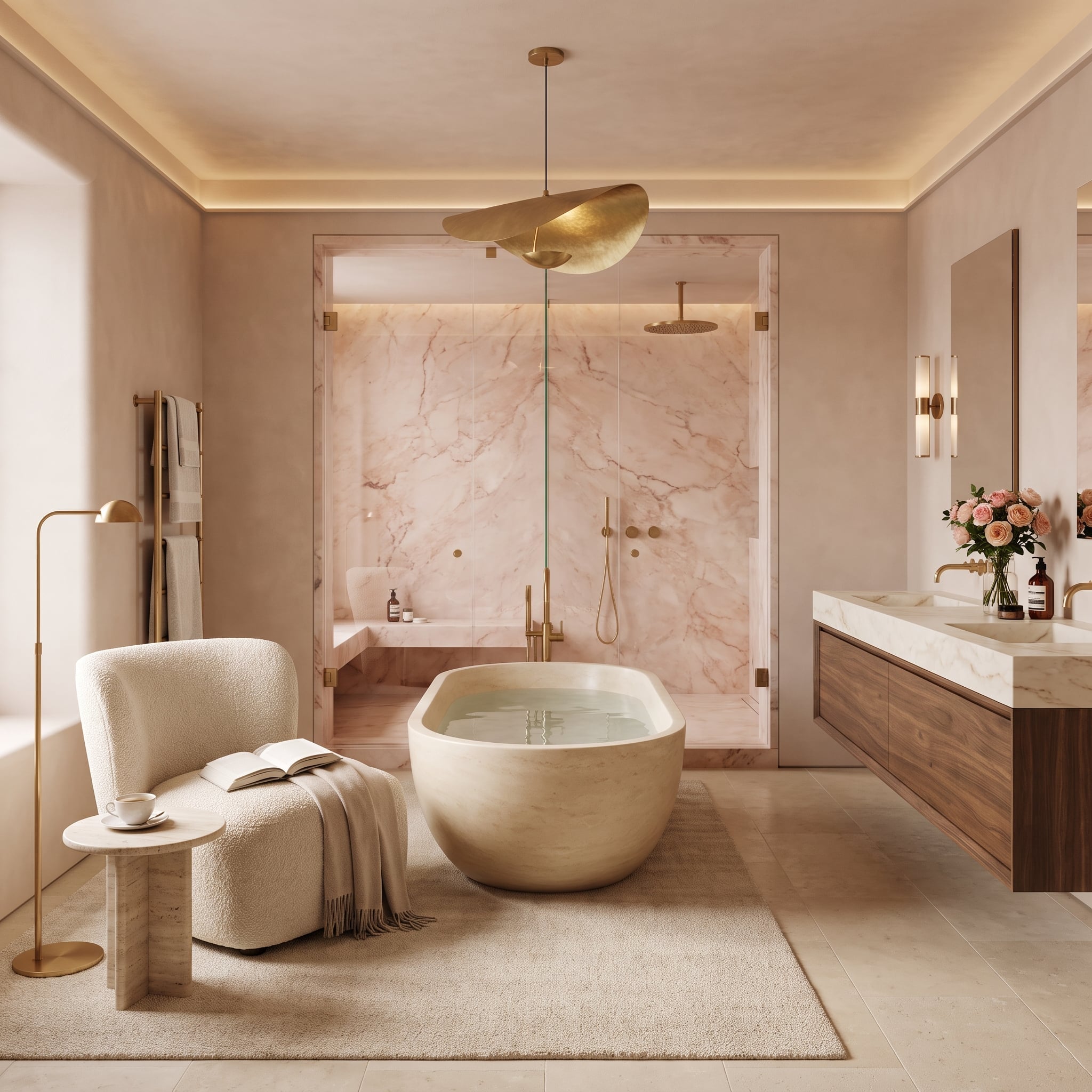
Pink-veined marble surrounds the shower, its broad pattern establishing the room’s principal color. A low, rounded stone tub introduces a contrasting silhouette, while brass fixtures provide a warmer metallic note against the pale surfaces.
The unexpected bouclé armchair gives the room the atmosphere of a private sitting room, although upholstered furniture requires careful placement away from splashing. Its generous proportions also change the scale of the space. Rather than treating every available surface as part of the bathing zone, the design makes room for furniture, textiles, and a more relaxed arrangement.
28. Honey-Glazed Tile Gives a Simple Vanity Wall Remarkable Depth
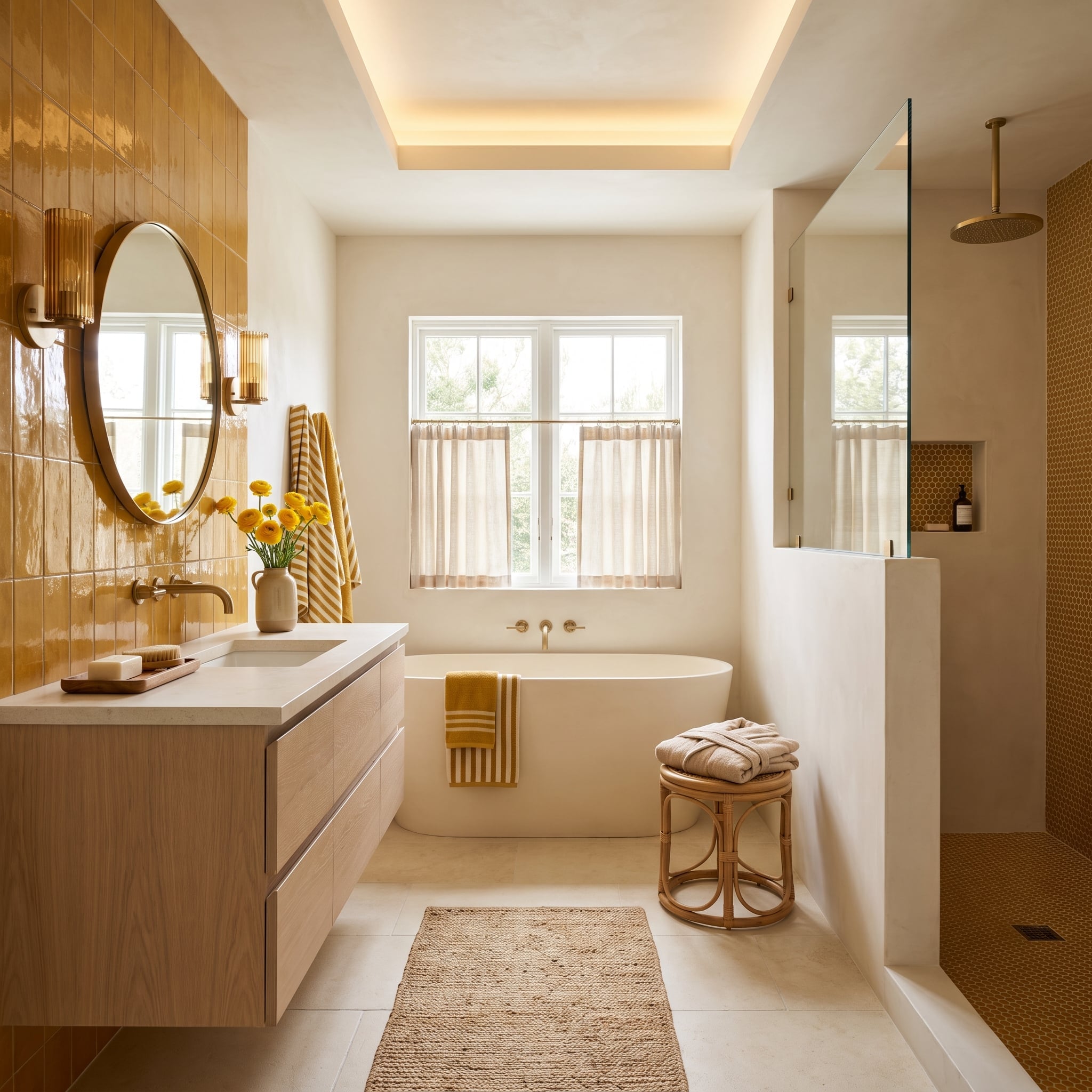
Amber-glazed tiles rise vertically behind the vanity, their reflective surfaces creating variations of gold and caramel across the wall. The arrangement draws attention upward toward the tray ceiling, where concealed lighting adds another warm layer.
A floating oak vanity introduces a quieter wood grain beneath the expressive tile. The cream soaking tub and neutral floor provide visual relief, while a rattan stool adds a different natural texture. The contrast between glossy ceramic and matte materials gives the room depth without requiring a complicated color scheme.
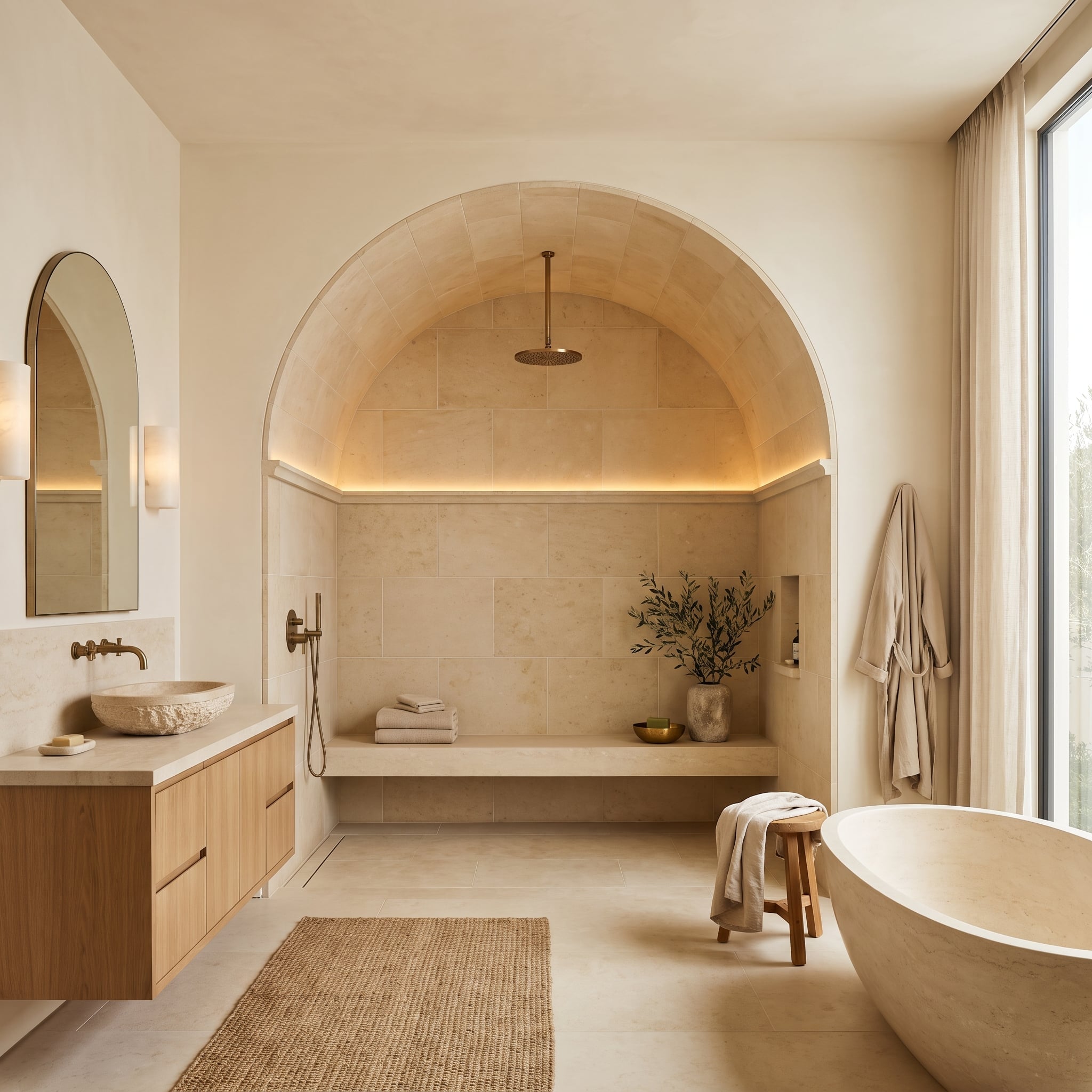
27. A Barrel-Vaulted Shower Turns Travertine Into Architecture
🔥 Would you like to save this?
A barrel-vaulted shower opening gives this bathroom an architectural feature far more distinctive than a conventional rectangular enclosure. Cream travertine follows the curved surface, making the vault’s shape visible through the stone’s subtle bands and tonal changes.
Concealed lighting traces the recess, illuminating the curved ceiling without a prominent fixture interrupting it. Outside the shower, a freestanding stone tub and floating oak vanity continue the restrained material palette. The vaulted form provides the drama; the surrounding surfaces allow it to remain the focal point. Proper waterproofing and ventilation are essential regardless of the ceiling’s shape.
26. Chocolate-Brown Tile Makes White Oak Look Almost Luminous
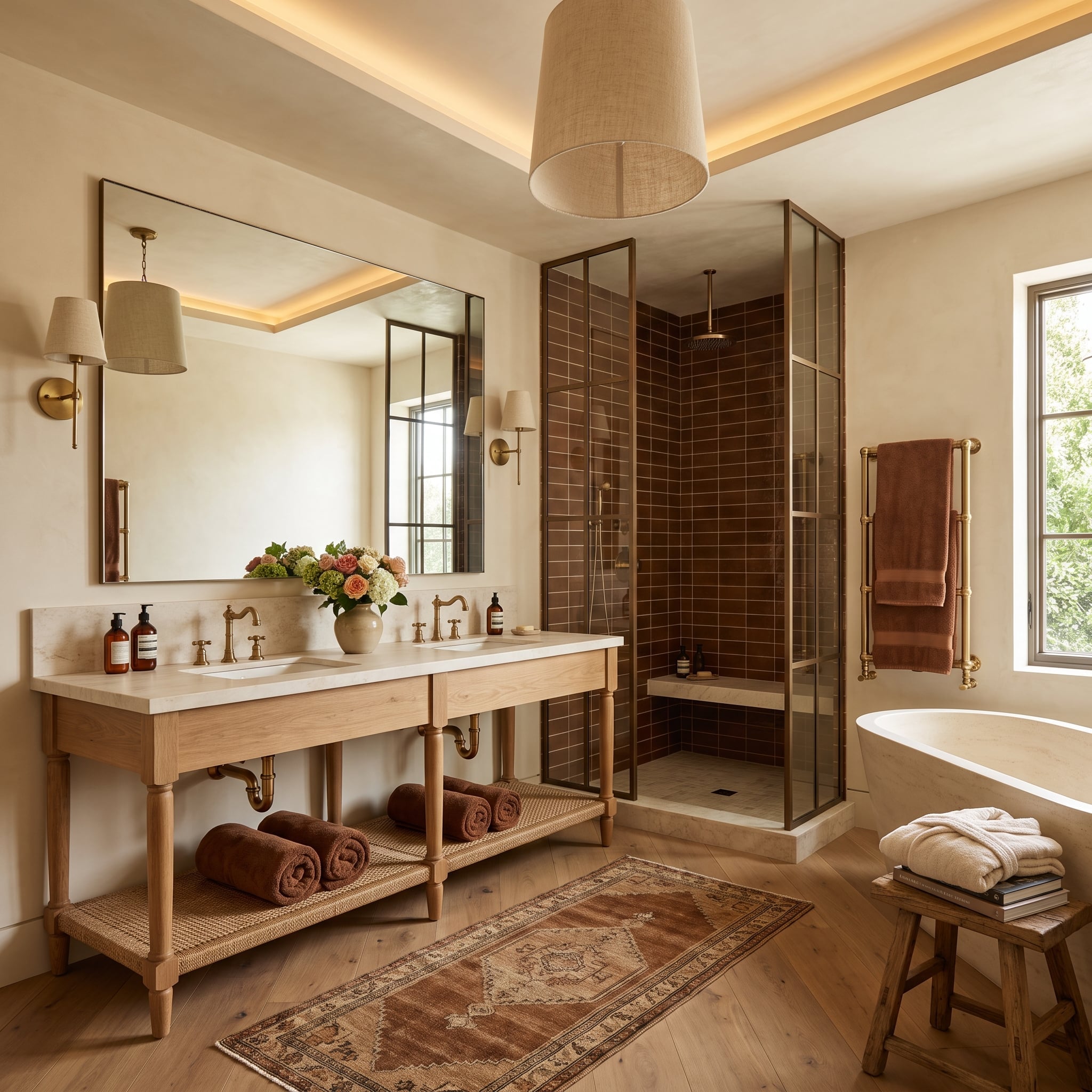
Chocolate-brown subway tile covers the shower walls, creating a dark, saturated backdrop for the brass enclosure and fittings. Its running-bond pattern introduces a familiar architectural rhythm, but the unusually deep color changes the character of the surface.
Opposite the shower, an open-leg oak vanity appears noticeably lighter against the dark tile. A cream stone countertop, rust-colored towels, and patterned rug introduce smaller variations in the palette. The contrast between the substantial tiled enclosure and the comparatively delicate vanity gives the room its balance.
25. A Reeded Oak Vanity and Sculptural Pendant Give Travertine a Softer Side
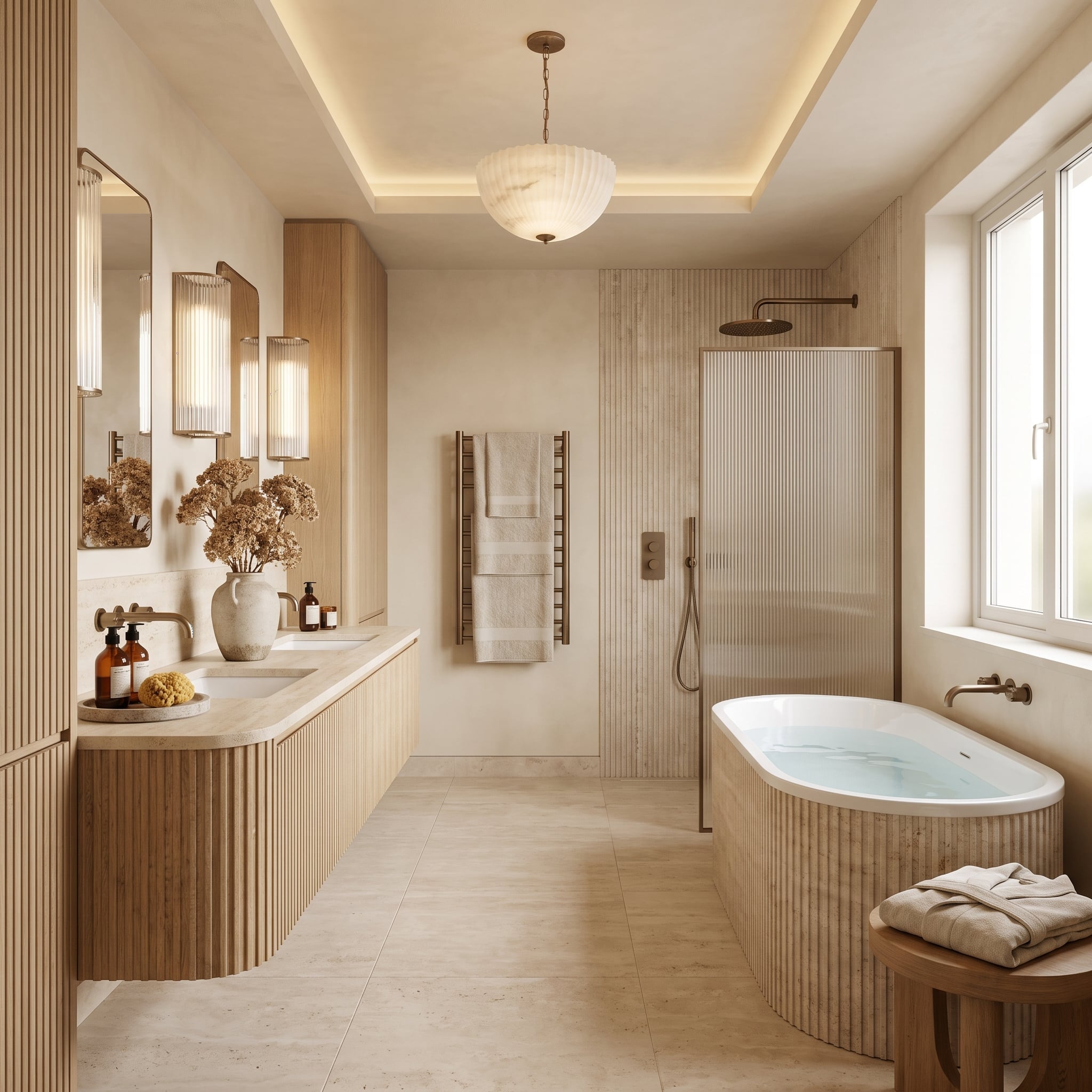
Closely spaced vertical grooves run across the oak vanity, creating a fine pattern beneath the broad surfaces of the travertine countertop and floor. A reeded treatment on the freestanding tub repeats that rhythm in a different material, giving the two fixtures a visual relationship without making them identical.
A pale sculptural pendant hangs beneath the tray ceiling, diffusing light across the room. Bronze fittings introduce restrained metallic accents. The most interesting quality is the variation in texture: grooved timber, softly patterned stone, and smooth plaster occupy distinct positions without disrupting the limited palette.
24. A Garden Window Gives Teak and Travertine an Almost Tropical Setting
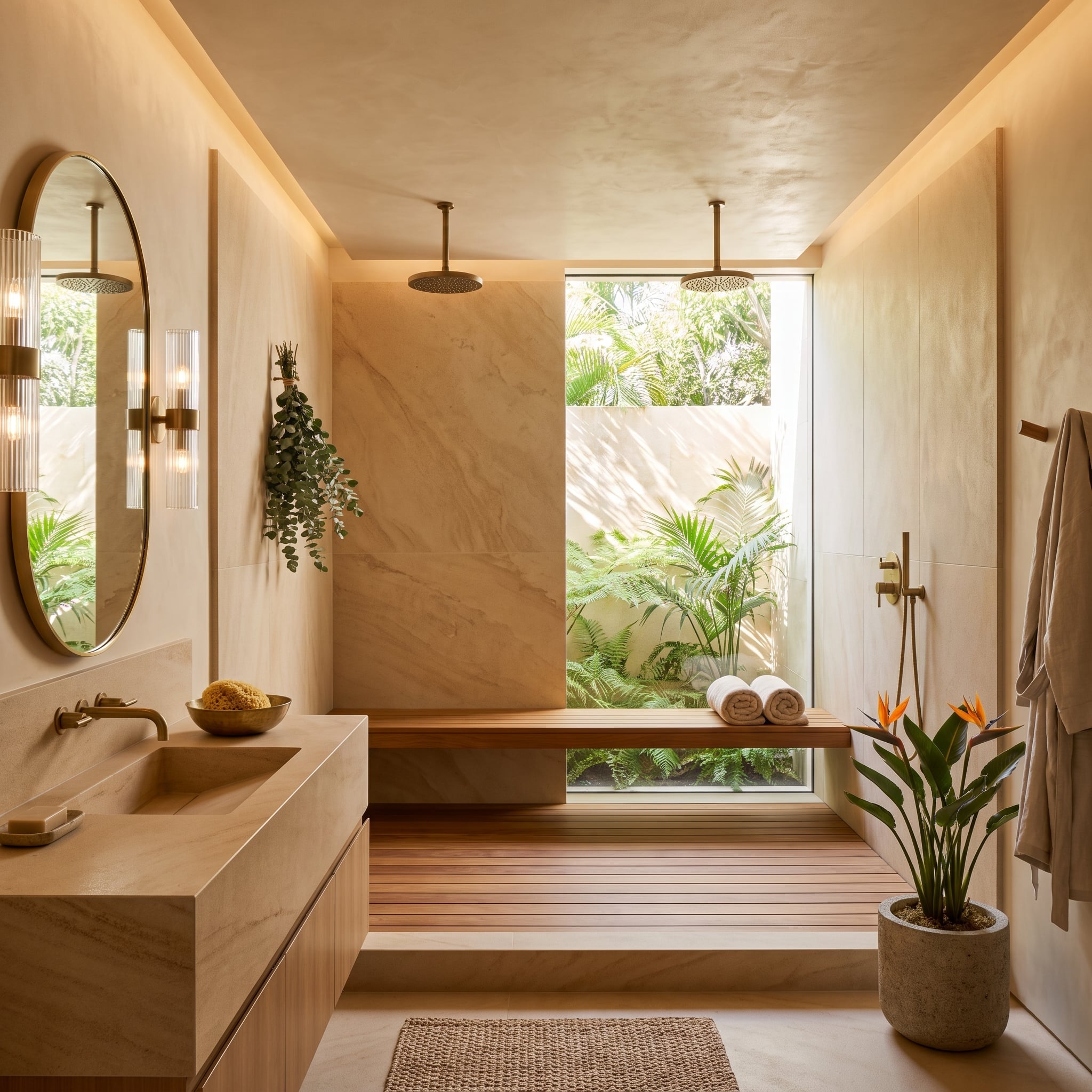
A broad window fills the bathing area with views of dense greenery, creating a vivid backdrop for sand-colored plaster and travertine. The stone’s veining remains relatively quiet, allowing the planting outside to supply much of the visual movement.
Teak slats define the shower floor, with a matching bench extending the timber treatment into the wet area. Two overhead rain heads establish separate shower positions, while hanging eucalyptus introduces another natural element. The open arrangement depends on careful drainage and waterproofing, but the architectural effect is compelling: the bathroom reads almost as an extension of the garden.
23. Checkerboard Travertine Gives a Brass-Framed Shower an Unexpected Backdrop
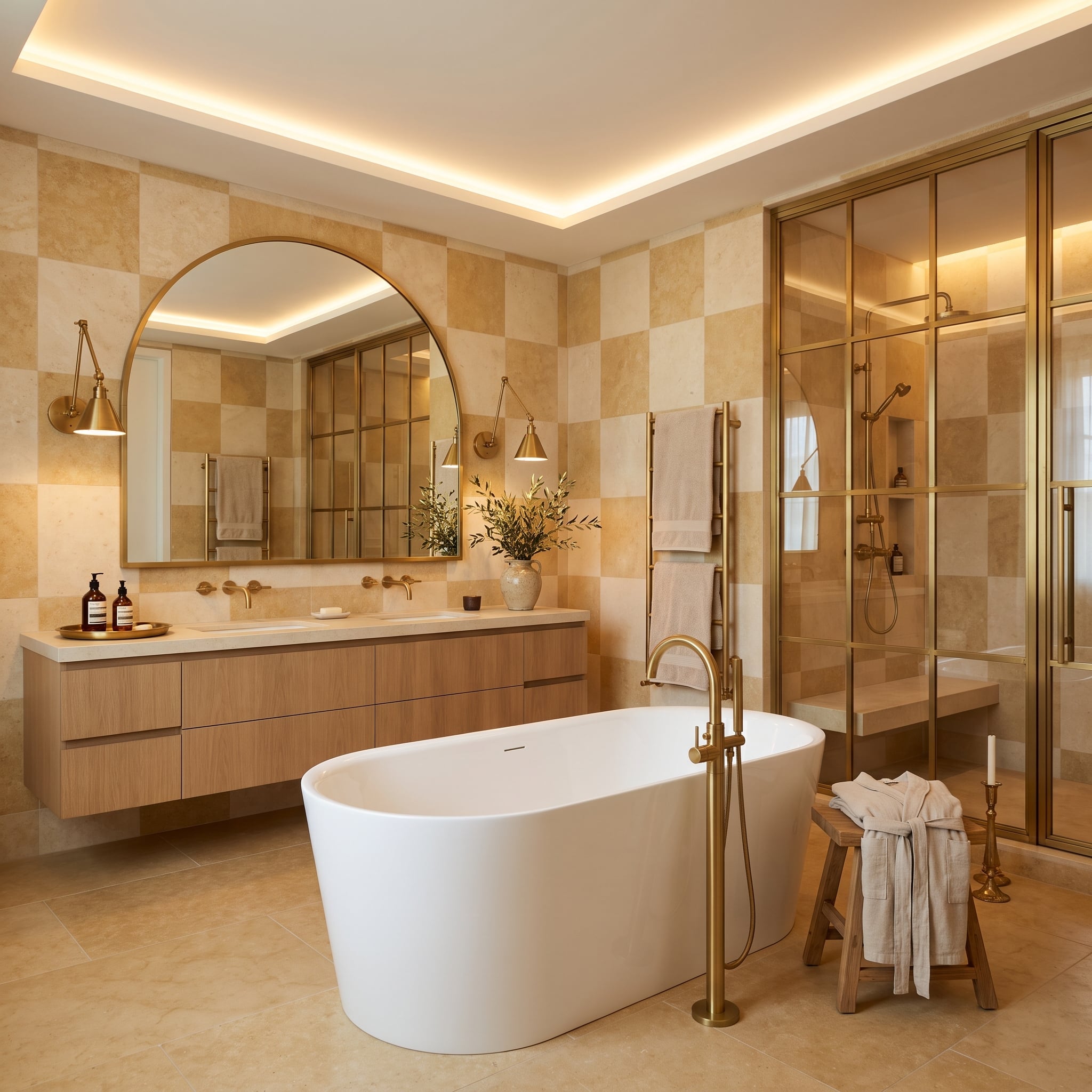
Alternating tones of travertine form a checkerboard pattern across the walls, bringing graphic structure to a material usually celebrated for its subtle veining. The pattern is bold, but the related stone colors keep it from overwhelming the room.
A brass-framed shower enclosure introduces another geometric layer through its narrow metal divisions. The floating oak vanity provides a strong horizontal counterpoint, while an arched mirror softens the arrangement with a single prominent curve. Brass appears across several fixtures, connecting the different architectural elements without requiring them to match in shape.
22. Caramel-Glazed Tile Makes a White Soaking Tub Look Deliberately Spare
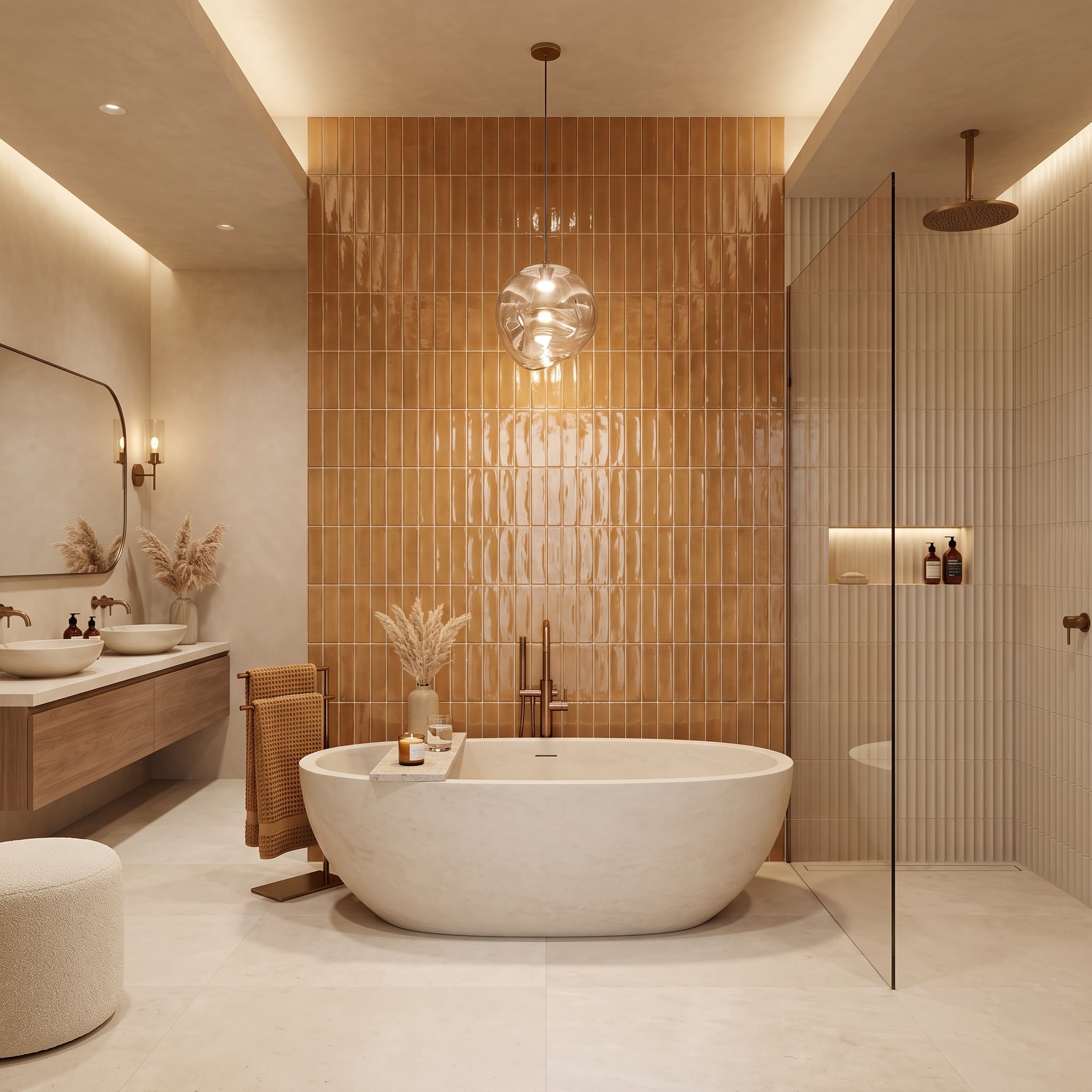
Glossy caramel tiles climb from floor to ceiling behind a freestanding white tub, creating a richly reflective surface that changes character as light moves across it. The tub’s simple oval outline becomes more pronounced against the warm, textured background.
Brass fixtures continue the palette through the tub filler, shower fittings, and towel rail. A frameless glass partition separates the adjacent shower without interrupting the tile wall’s visibility. The contrast is straightforward but effective: one expressive surface, one restrained fixture, and very little visual interference between them.
21. An Indoor Olive Tree Changes the Entire Character of a Travertine Bathroom
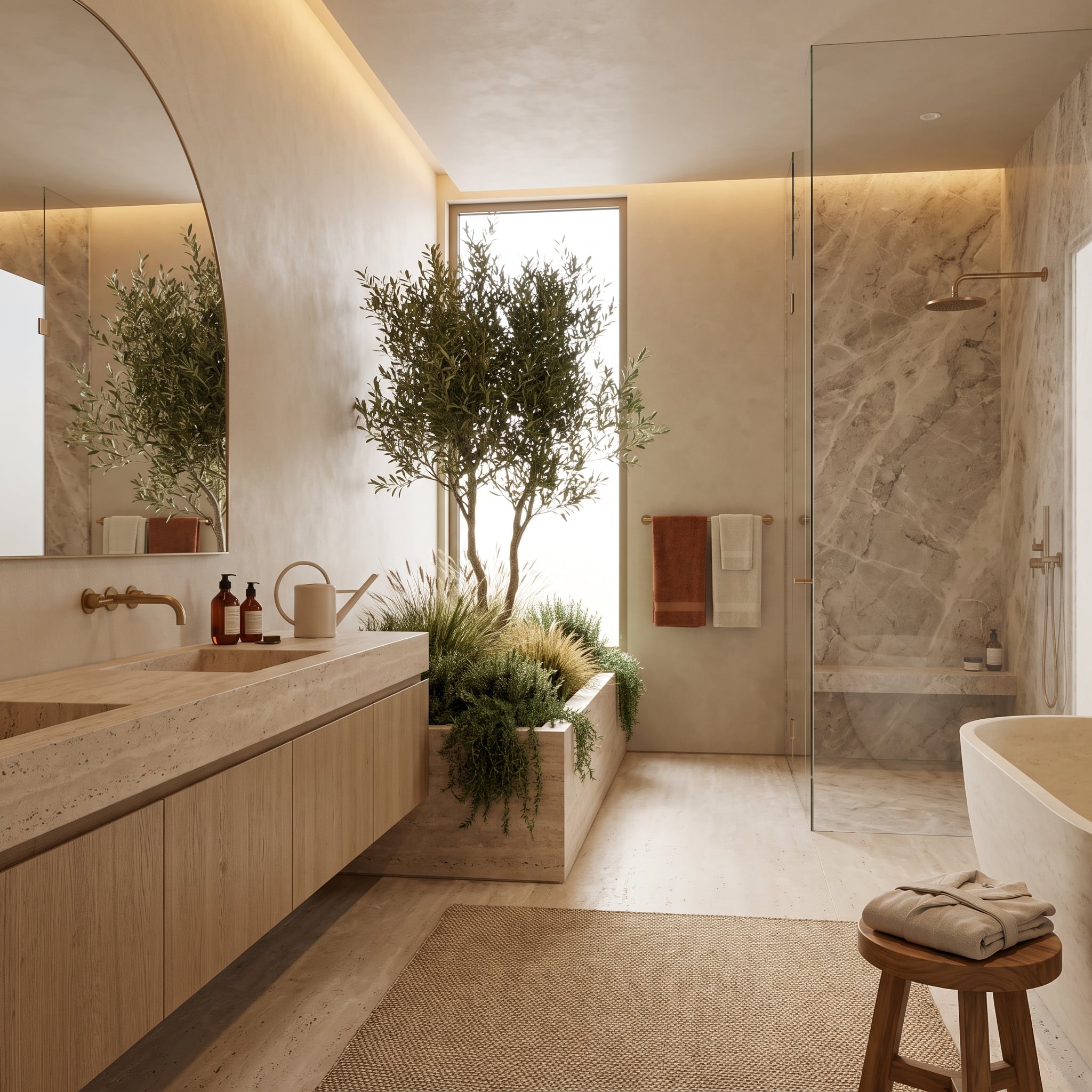
A mature-looking olive tree rises from a built-in planter beside a tall window, introducing a branching organic silhouette into a bathroom dominated by stone and straight cabinet fronts. The planting becomes an architectural element, not merely an accessory on the vanity.
Light oak cabinetry and a travertine countertop establish a warm foundation, while wall-mounted brass faucets introduce finer metallic details. An arched mirror repeats the softer geometry of the tree canopy. The room’s strongest relationship is between the controlled mineral surfaces and the irregular form of the greenery.
20. A Pink Terrazzo Floor Brings Unexpected Energy to an Oak Bathroom
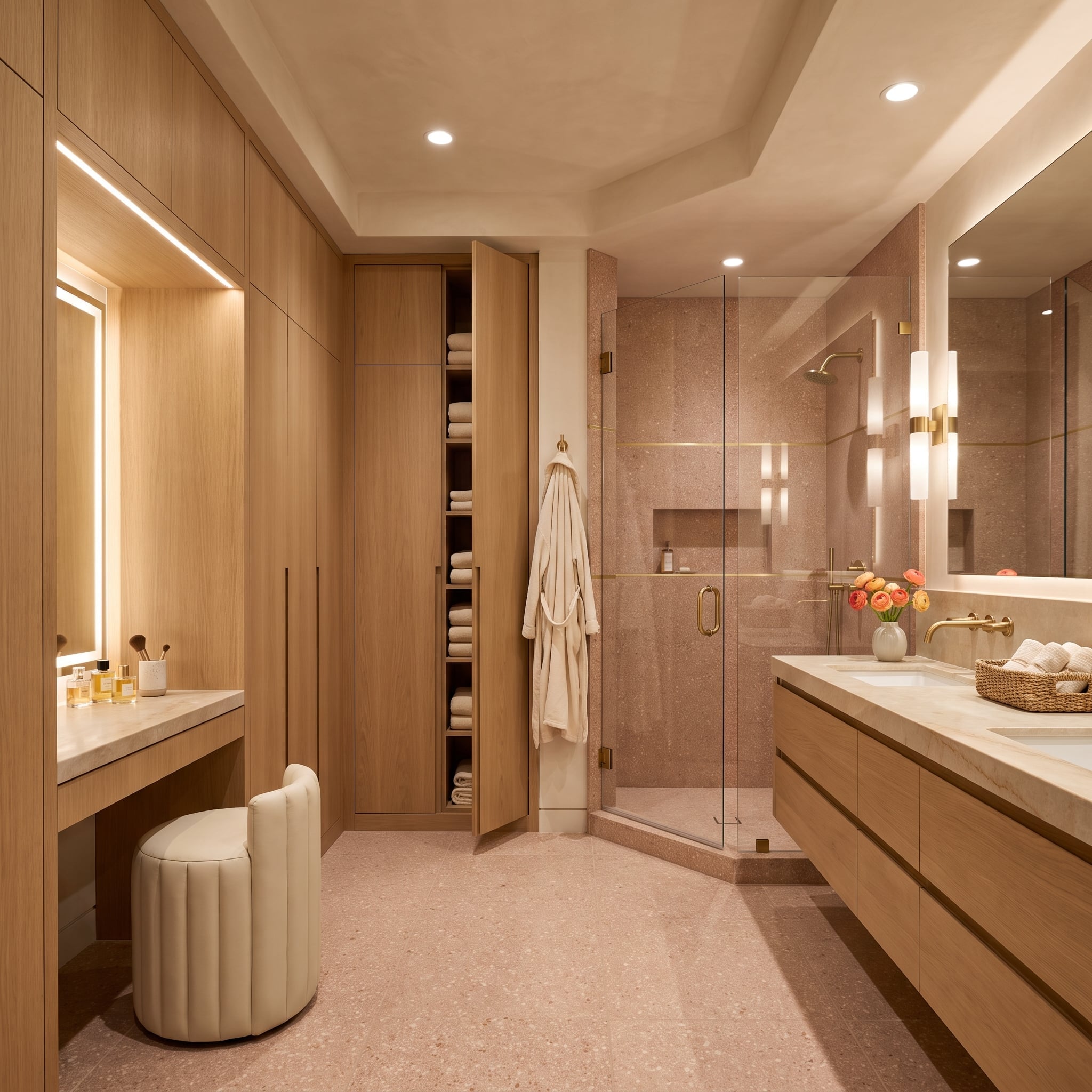
Blush terrazzo spreads across the floor, introducing scattered fragments of color beneath extensive pale oak cabinetry. The contrast between the terrazzo’s irregular pattern and the cabinetry’s consistent grain gives the room an appealing visual tension.
A recessed makeup station sits within the full-height millwork, its illuminated mirror integrated into the cabinet arrangement. The station reads as part of the architecture rather than a separate piece of furniture. The patterned floor introduces visual energy without requiring decorative tile on every wall.
19. A Red Marble Shower Interrupts an Otherwise Quiet Travertine Bathroom
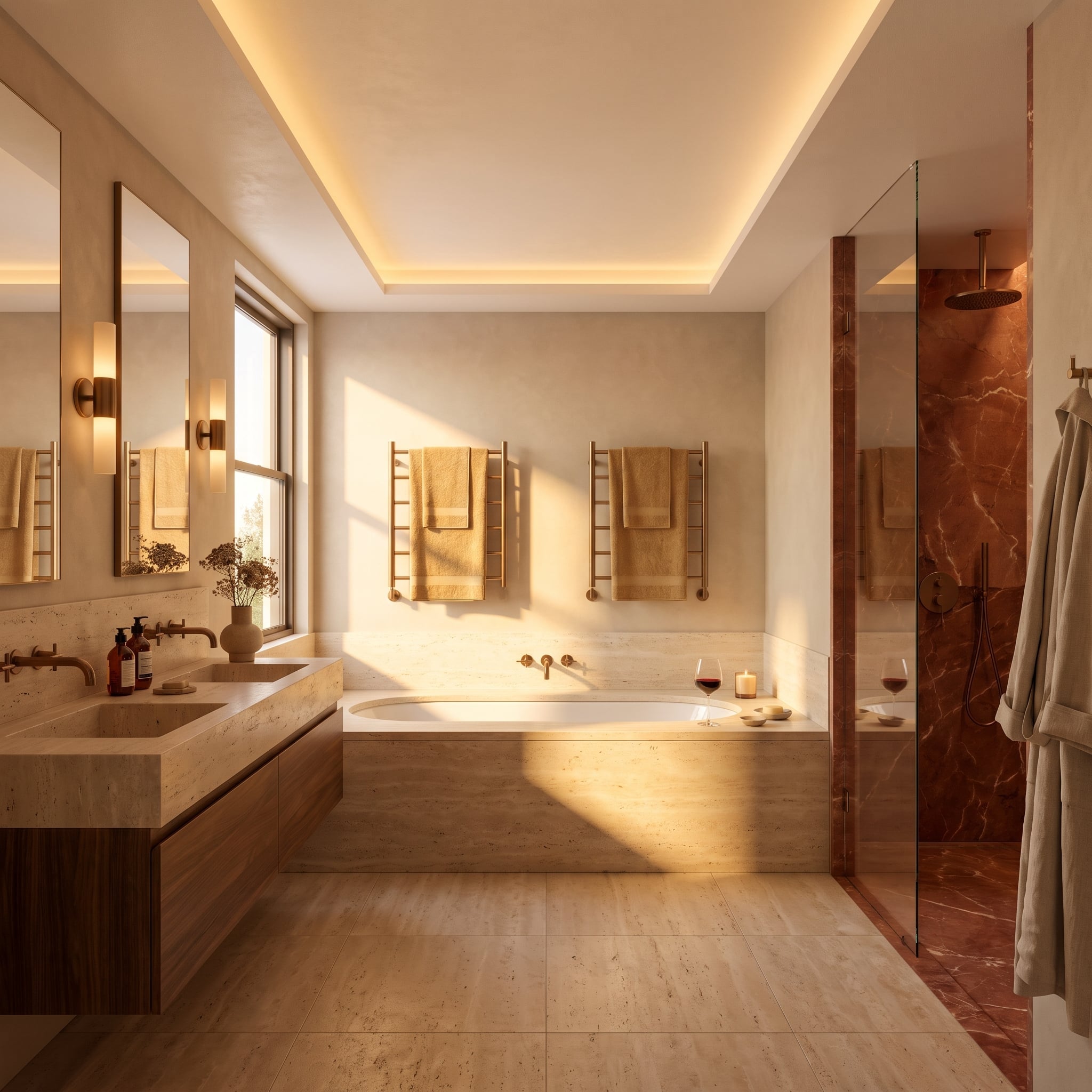
Travertine extends across the bathing platform and floor, creating a continuous pale stone setting. Two heated towel rails mounted side by side introduce a measured symmetry, their slender metal profiles contrasting with the larger stone surfaces.
The shower provides the surprise. Deep red marble covers the enclosure, bringing saturated color and dramatic veining into an otherwise restrained composition. A brass rain head and matching fixtures connect the shower to the surrounding bathroom. The contrast between pale travertine and richly colored marble gives the room its distinctive character without sacrificing the continuity of its stone finishes.
18. A Slatted Cedar Ceiling Gives a Concrete Tub a Warmer Architectural Frame
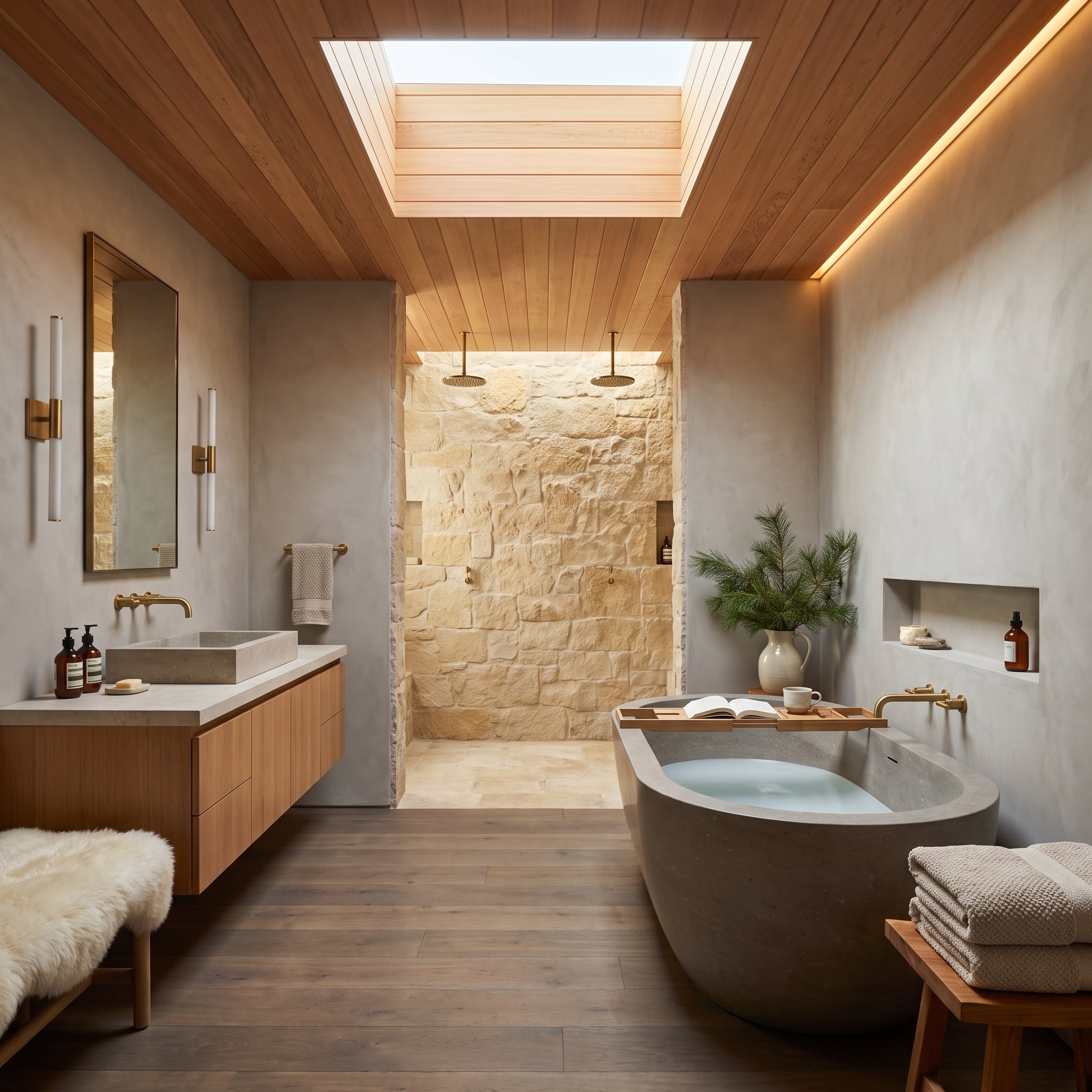
Cedar planks run the length of the ceiling, establishing a continuous timber surface above the bathing area. Their warm grain contrasts with the matte concrete tub below, whose broad, unadorned shape gives it a distinctly sculptural presence.
Rough-cut stone lines the shower enclosure, introducing a more irregular texture behind the tub. Brass fittings add a restrained metallic accent. The regular spacing of the cedar planks plays against the rugged stone enclosure and the tub’s smooth, uninterrupted curves. The contrast is particularly effective overhead, where the timber brings warmth to a room dominated by mineral surfaces.
17. A Sage Herringbone Shower Brings Pattern Into a Wood-Floored Bathroom
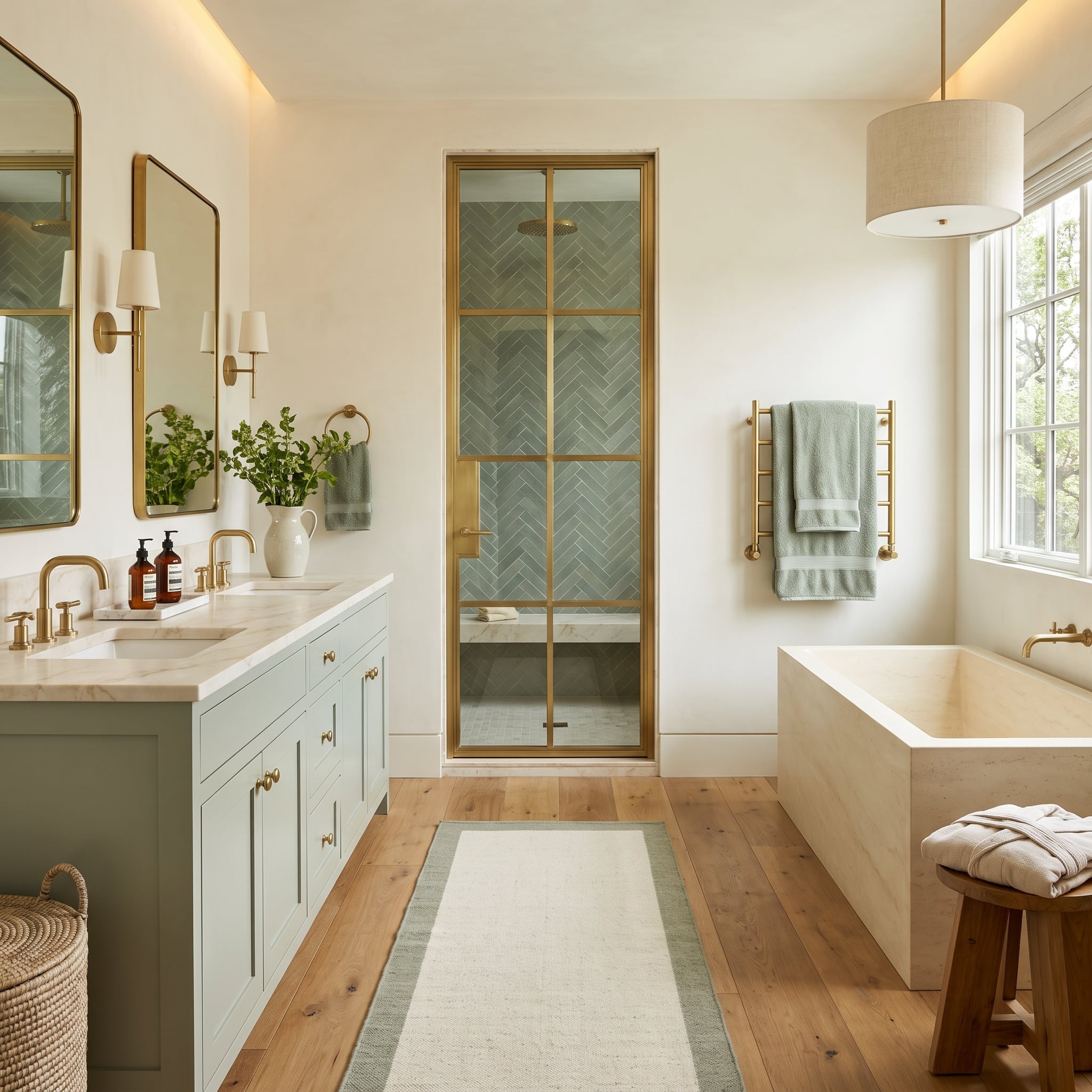
Sage-green herringbone tile introduces a fine diagonal pattern inside the shower, framed by slender brass-colored metal divisions. The enclosure creates a distinct architectural zone while allowing the tile to remain visible from the rest of the bathroom.
Wide-plank oak flooring brings a warmer, more continuous grain to the surrounding space. A pale sage vanity relates to the shower without duplicating its pattern, while a substantial stone-look soaking tub introduces a simpler geometric form. The different surfaces work together because each has a clearly defined role. As with any bathroom using wood flooring, moisture protection and careful detailing are essential.
16. A Square Skylight Puts an Ochre Stone Tub in the Spotlight
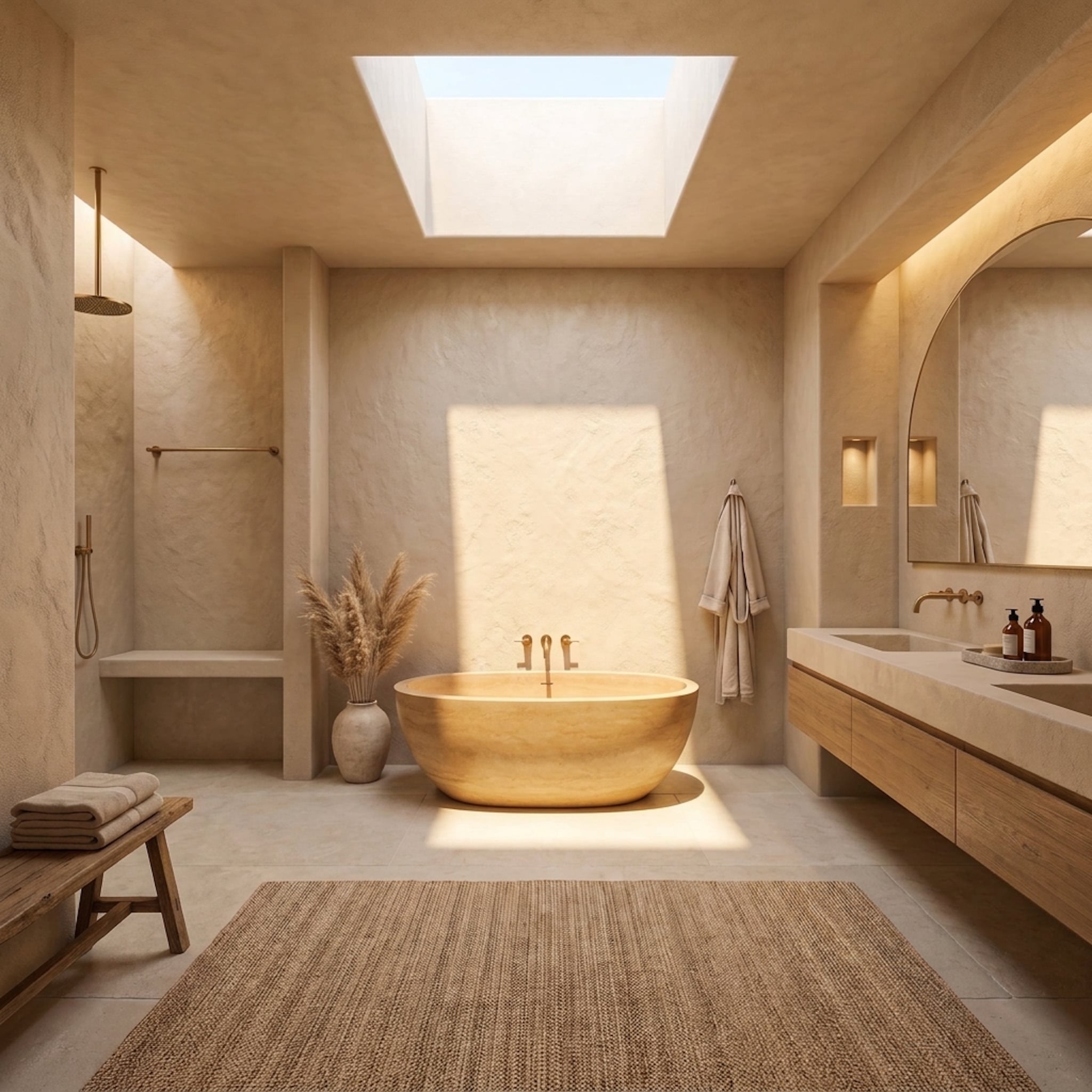
A square skylight directs daylight toward an ochre-colored stone tub, making the bathing fixture the clear center of the composition. The surrounding plaster walls remain deliberately quiet, allowing the tub’s color and mass to carry the room.
A floating oak vanity introduces a horizontal timber element, while wall-mounted brass faucets preserve the tub’s uncluttered outline. Dried grasses and a simple floor covering add softer textures. The most effective detail is architectural rather than decorative: the overhead opening gives the stone a changing relationship with natural light throughout the day.
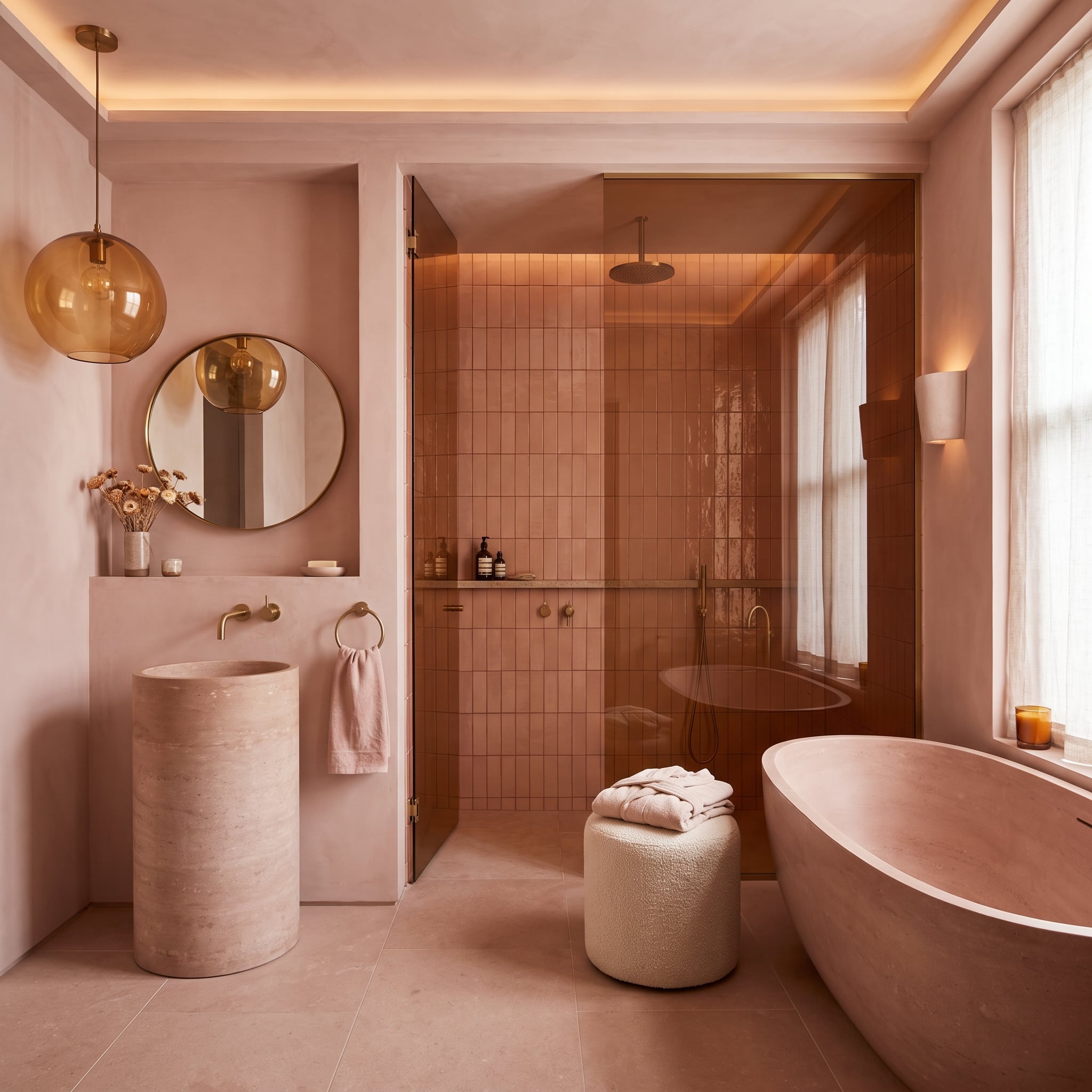
15. An Arched Shower and Terracotta Tile Give Blush Plaster More Definition
🔥 Would you like to save this?
Dusty rose plaster establishes the room’s soft background, while terracotta-glazed tiles inside the shower introduce a deeper and more reflective version of the same color family. The relationship creates variation without requiring a dramatic change in hue.
A cylindrical travertine pedestal sink stands apart from the wall, its solid form contrasting with the more delicate brass-framed mirror and amber glass pendant. The absence of a conventional vanity gives the room a more open arrangement, although it also reduces enclosed storage. The combination of rounded stone, glazed tile, and plaster is unusually cohesive.
Not everyone agrees on terracotta: in our readers’ votes, images with terracotta accents got fewer hearts than other images in the same articles, 47% vs 54%.
14. A Monolithic Travertine Bathroom Finds Drama in Almost No Contrast
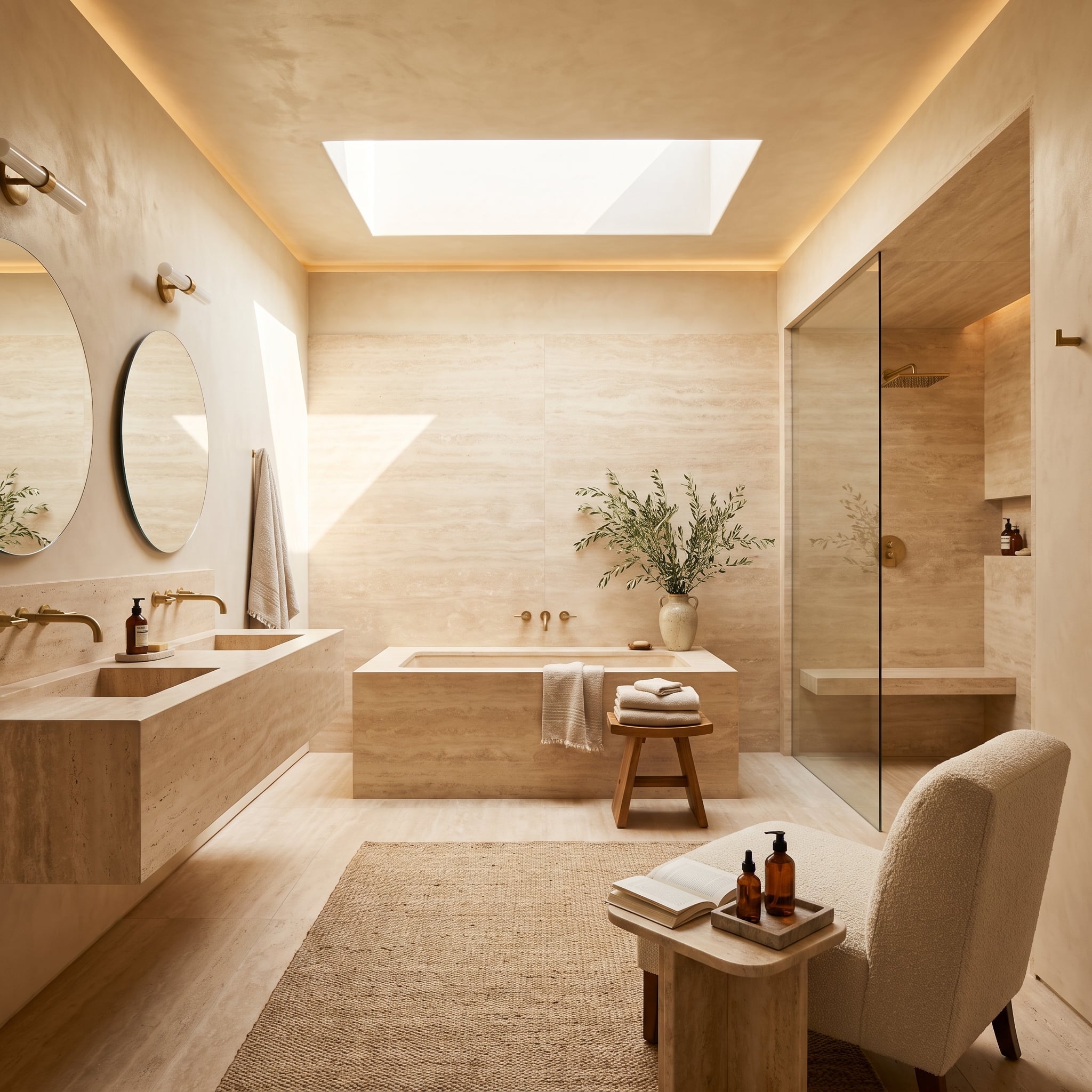
Warm, travertine-like stone finishes extend across the walls, bathing platform, and double vanity, creating the impression of a room carved from one continuous material. Subtle changes in the stone’s banding provide the visual movement that contrasting tiles or cabinet colors might ordinarily supply.
Daylight enters through a skylight, revealing the surface variations from above. Concealed ceiling lighting offers a second source of illumination, while brass fixtures introduce small metallic interruptions. An upholstered chair adds a softer, furniture-like presence. The room depends on proportion, texture, and light rather than a conventional hierarchy of accent materials.
13. Burnt Terracotta, Walnut, and Greenery Give This Bathroom a Richer Palette
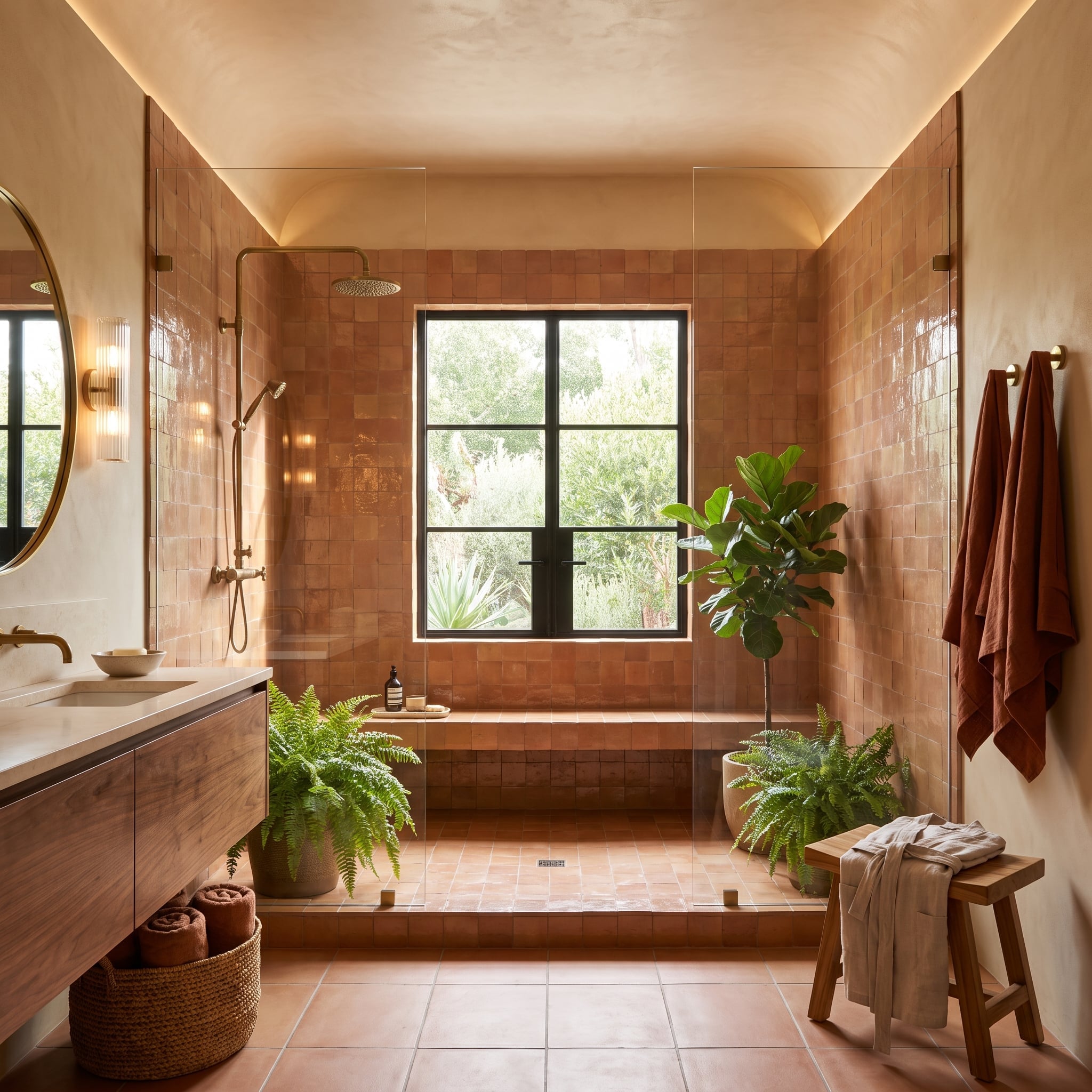
Burnt-terracotta tiles cover the shower walls, their uneven glazed surfaces creating a lively pattern of reflected light. Brass fittings complement the tile’s warm undertones, while a walnut vanity introduces a darker wood finish beyond the shower.
A fiddle-leaf fig and smaller ferns bring green into the room, establishing a contrast with the dominant clay tones. Woven storage and concealed ceiling lighting add further texture. Against the saturated terracotta, the foliage introduces a cooler color and more irregular shapes, giving the bathroom a richer visual range than an entirely tonal scheme would provide.
12. A Reeded Wood Wall Gives a Black Soaking Tub an Unexpected Setting
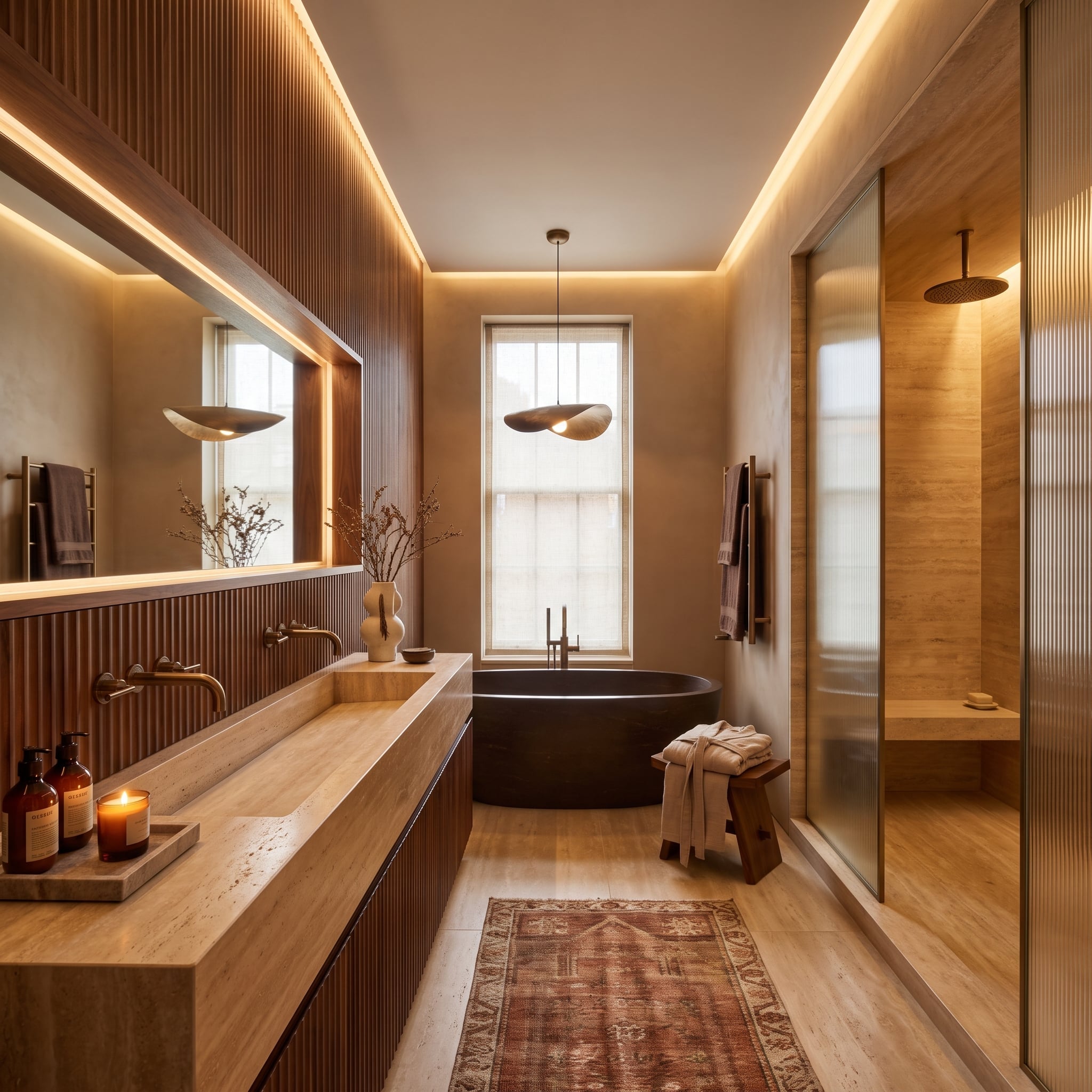
Vertical reeded wood paneling covers the vanity wall, creating a finely textured surface that extends from floor to ceiling. Concealed lighting near the top emphasizes the grooves and brings out variations in the wood’s tone.
At the opposite end, a matte-black freestanding tub introduces the strongest contrast in the room. Its dark, smooth silhouette stands apart from the warm timber and pale stone vanity. The black fixture gives the surrounding materials a more pronounced presence, while the fine vertical paneling prevents the large timber wall from appearing flat.
11. A Powdery Sage Bathroom Lets Herringbone Tile and Garden Views Share the Attention
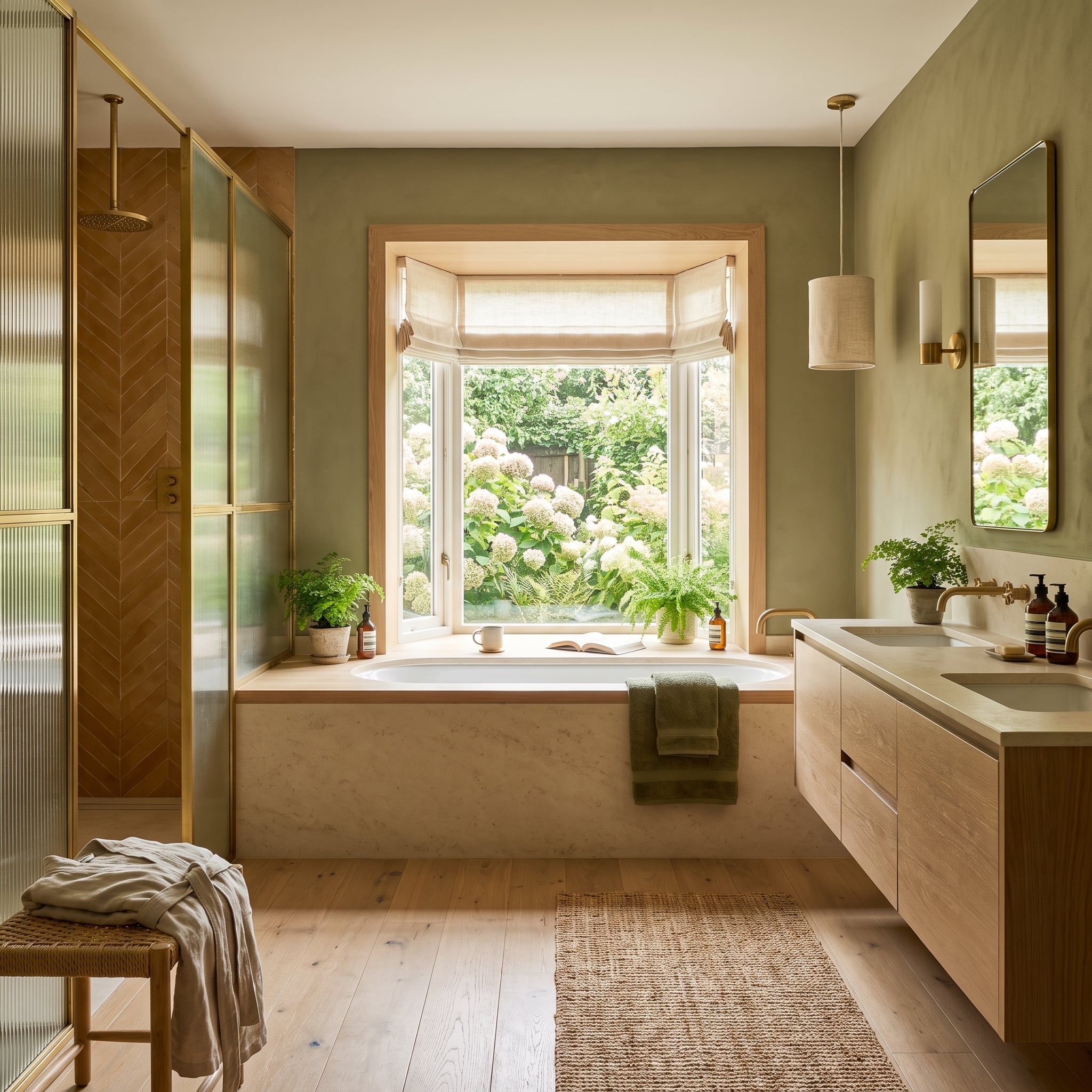
Sage-green plaster covers the walls, giving the room a softer color foundation than conventional white or gray. Beyond the window, flowering shrubs and garden planting extend the palette outdoors, creating a relationship between the interior finishes and the surrounding landscape.
Oak cabinetry and a pale marble tub surround introduce warmer materials, while brass fixtures provide restrained highlights. Herringbone tile contributes a finer geometric pattern against the broader wall surfaces. The sage walls seem to draw their color from the garden outside, while oak and pale stone keep the room from becoming an exercise in green-on-green decoration.
10. A Rattan Mirror and Woven Pendants Change the Mood of a Stone Bathroom
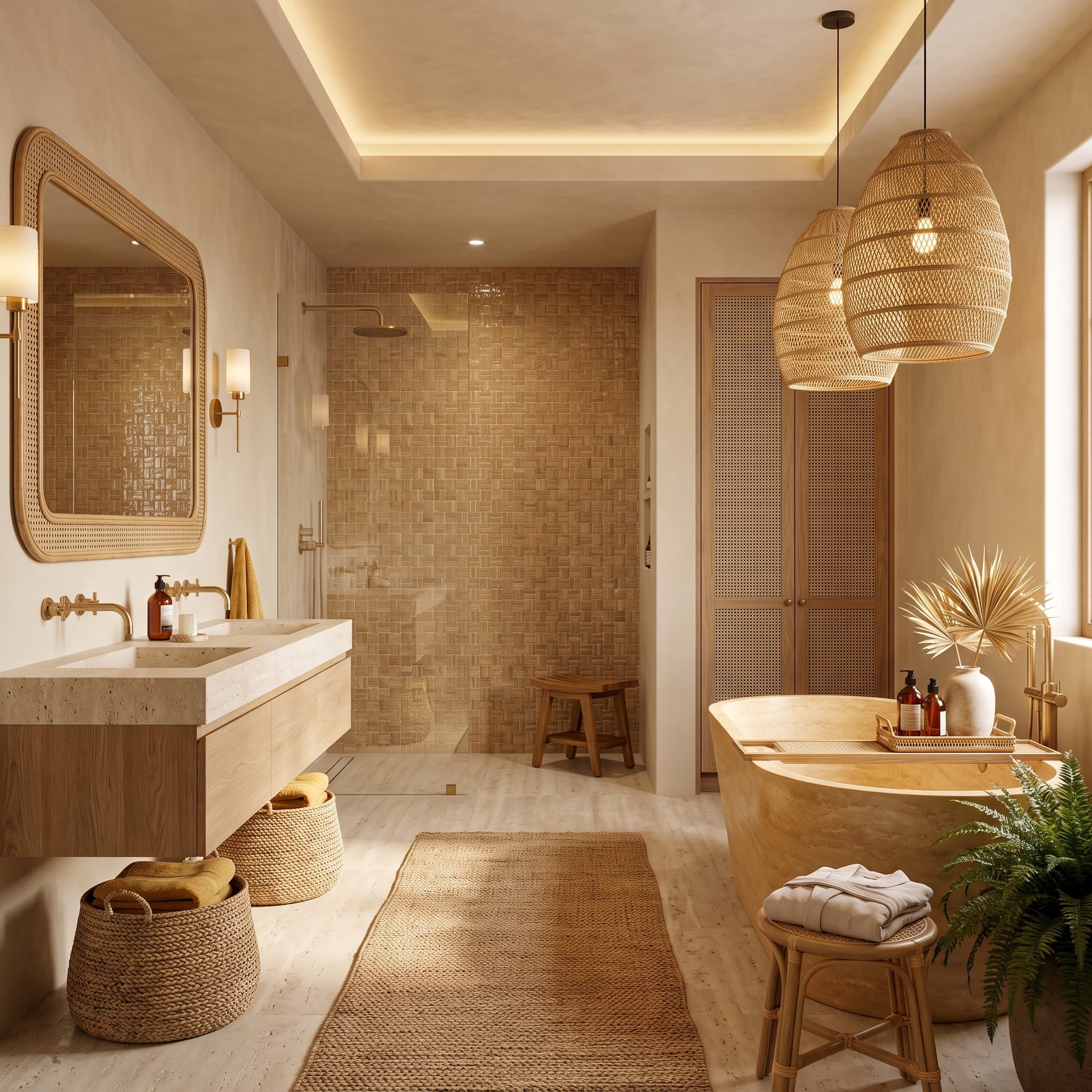
Woven pendants hang above a stone soaking tub, introducing a light, open texture against the heavier mineral surfaces below. Their intricate construction creates a distinctive silhouette without relying on polished metal or glass.
A rattan-framed mirror repeats the woven character at the vanity, where travertine and timber establish a quieter foundation. Brass wall-mounted fixtures provide small metallic accents. The natural fibers introduce visual softness and a finer scale of detail to a room otherwise dominated by substantial stone forms. The result is a bathroom with the material richness of a carefully furnished living space rather than the uniform finishes of a conventional spa.
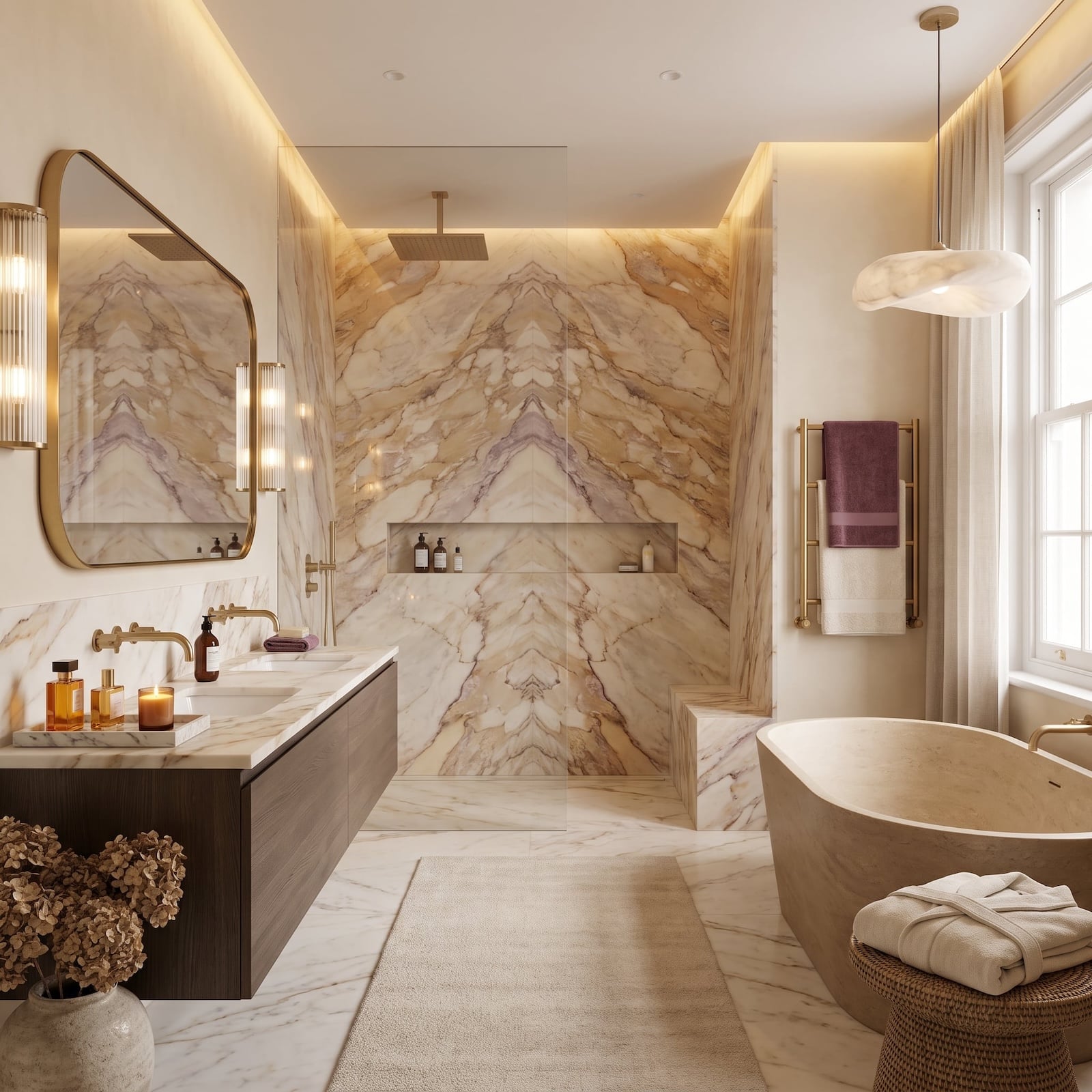
9. Bookmatched Marble Turns the Shower Into a Geological Mural
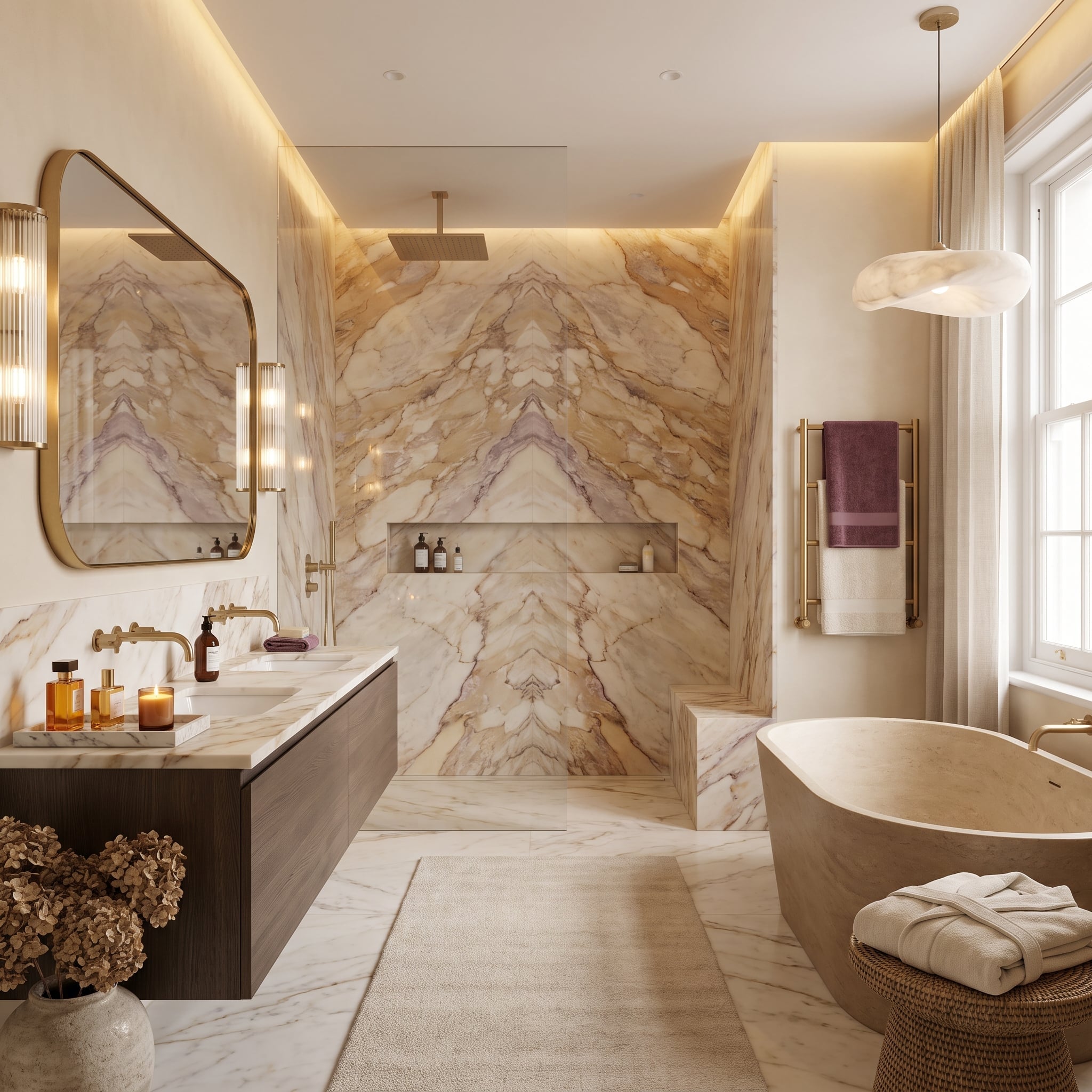
Mirrored marble veining spreads across the shower walls, forming a symmetrical pattern of cream, amber, and violet. The effect resembles a large-scale abstract mural, but the design comes entirely from the stone’s natural movement.
A freestanding tub in a related warm stone tone occupies the foreground, its simple shape contrasting with the elaborate wall pattern. Brass fittings add a consistent metallic finish across the bathing areas. Bookmatching uses adjacent stone slabs arranged to mirror their veining, making careful selection and installation particularly important. Here, the marble itself supplies nearly all the decoration the room requires.
8. Linen Curtains and Pale Oak Give a Bathroom a More Domestic Character
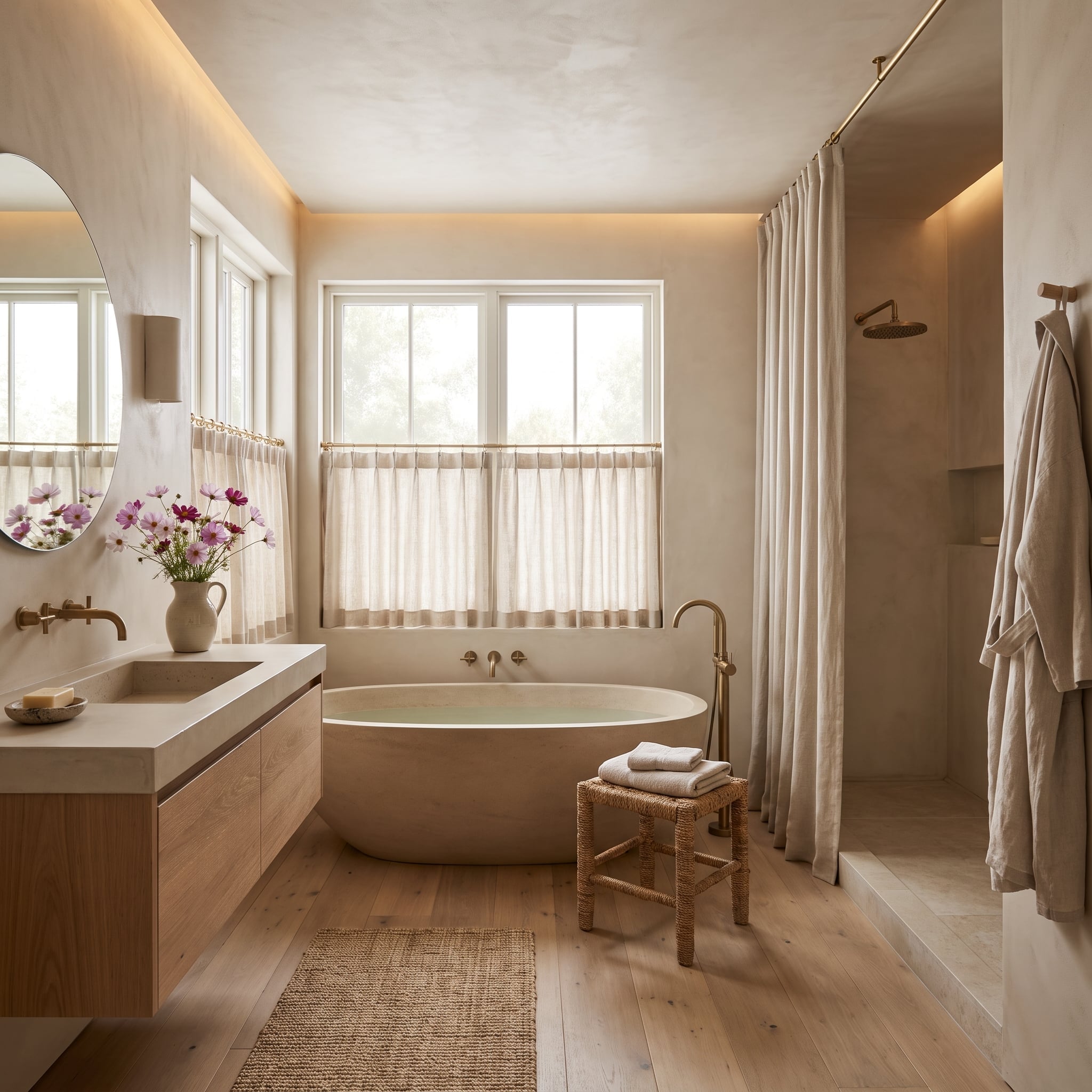
Café-style linen curtains cover the lower portion of the windows, allowing daylight to enter above while providing a measure of privacy. Their relaxed fabric texture contrasts with the stone and timber surfaces elsewhere in the room.
Wide-plank pale oak flooring extends beneath a freestanding tub, while matching wood cabinetry introduces a consistent grain at the vanity. Brass fixtures and a simple robe hook give the space smaller functional details. The curtains are the distinguishing feature: they make the bathroom feel connected to the language of residential interiors rather than exclusively to that of a spa.
7. Amber Glass Pendants Bring a Second Layer of Light to Warm Plaster
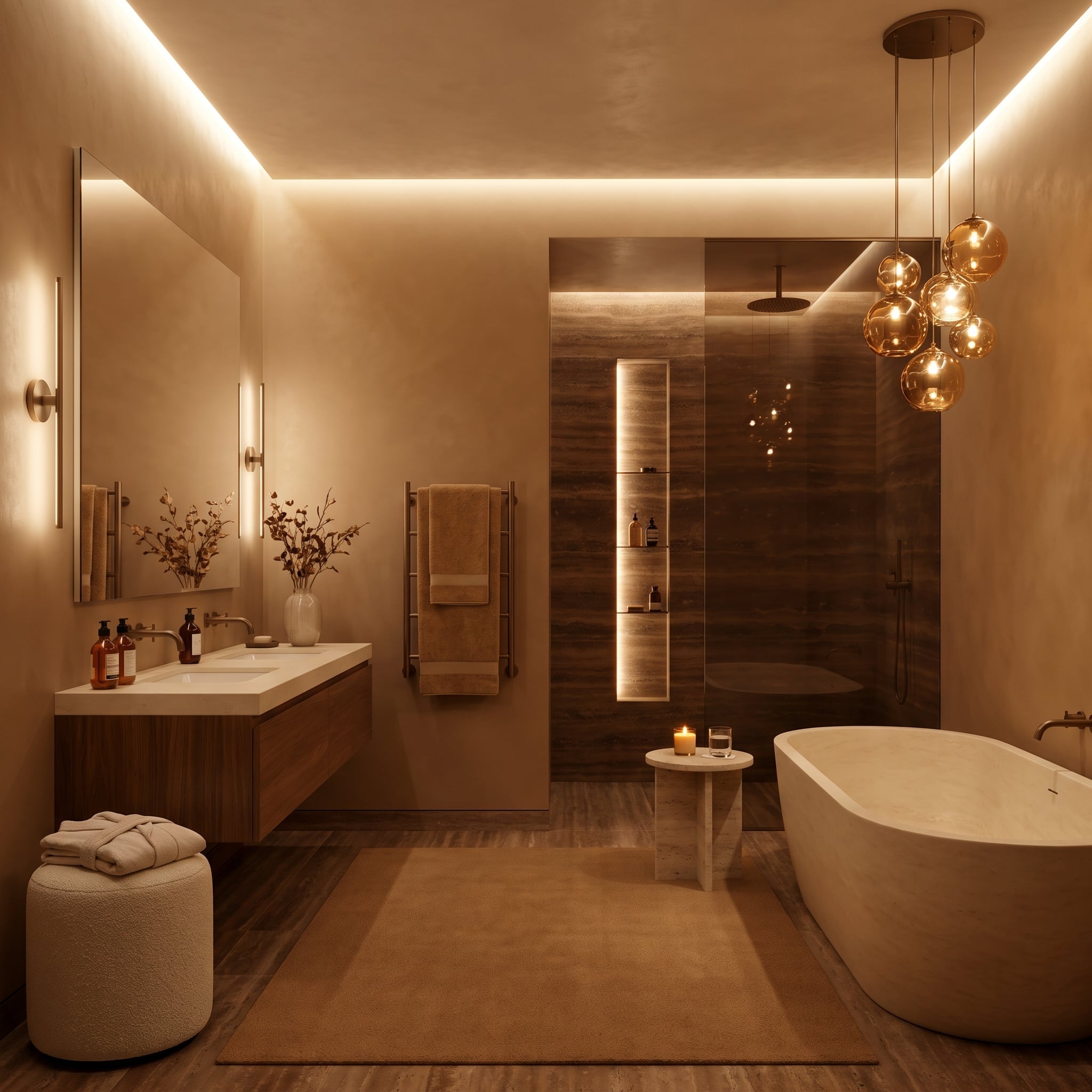
A cluster of amber glass spheres hangs at staggered heights above the freestanding tub, creating a sculptural composition within the otherwise restrained room. Their translucent surfaces catch and diffuse light, introducing a warmer focal point than a conventional row of recessed fixtures.
Concealed lighting traces the ceiling perimeter, washing the plaster walls from above. A floating walnut vanity provides a darker counterweight beneath its pale stone countertop. The room uses lighting in two distinct ways: the pendant cluster as a visible decorative element and the cove illumination as a quieter architectural treatment.
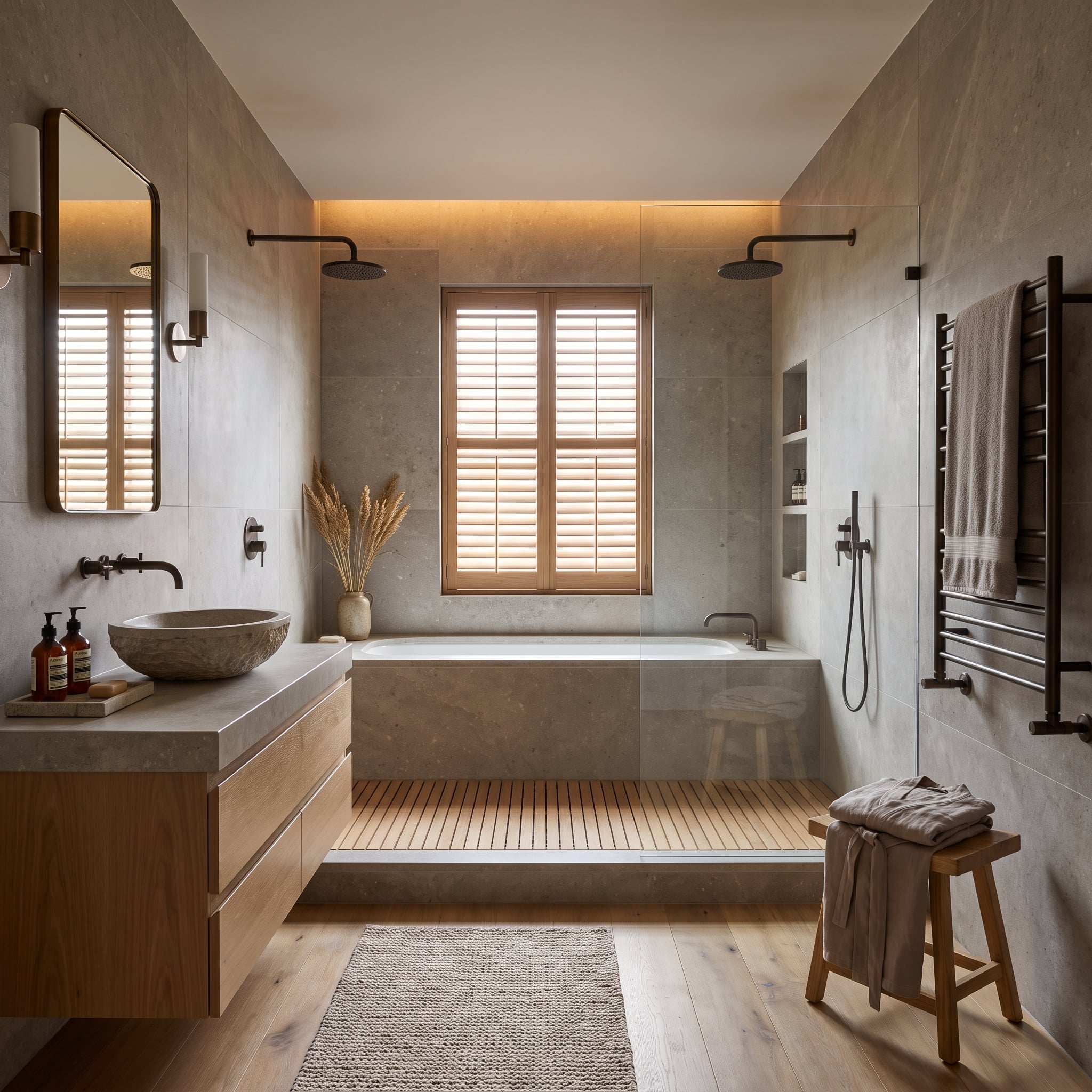
6. Teak Shower Flooring and Twin Rain Heads Give Travertine a Spa-Like Edge
🔥 Would you like to save this?
Large-format travertine tiles establish a continuous warm stone backdrop, their horizontal bands contrasting with the timber elements at the vanity and shower. A stone vessel basin introduces a smaller sculptural form against the broad tiled surfaces.
The shower is distinguished by its teak floor treatment and twin overhead rainfall fixtures. The wood brings a darker, more tactile surface into the wet area, contrasting with the smoother travertine walls. Teak is valued for its natural resistance to moisture, although proper drainage, ventilation, and maintenance remain essential in a shower. The arrangement brings together the durability of stone and the warmer character of timber without allowing either material to dominate the entire room.
5. Dark Walnut and a Slatted Ceiling Insert Give a Pale Stone Bathroom More Depth
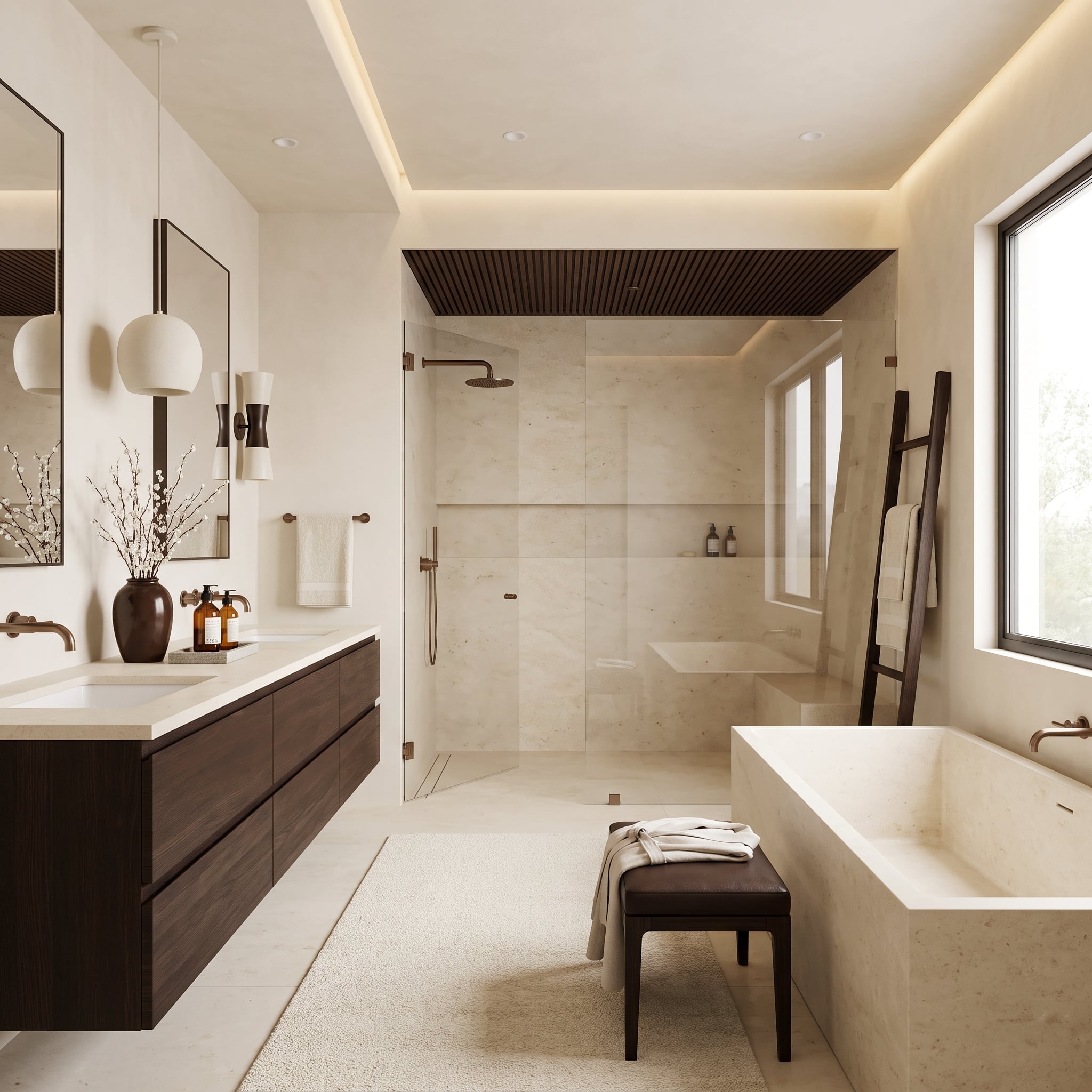
Dark walnut cabinetry floats beneath a pale stone countertop, creating a pronounced contrast at the vanity. The timber’s deep grain introduces richness without relying on an accent wall or highly patterned tile.
Above, a slatted wood ceiling insert marks the shower zone, bringing another linear pattern into the room. Cove lighting around the ceiling perimeter emphasizes the relationship between the dark timber and lighter stone surfaces. Changes in wood tone, orientation, and scale introduce variety within a relatively limited palette.
4. Microcement, Roman Shades, and a Pedestal Basin Make Minimalism Feel Less Severe
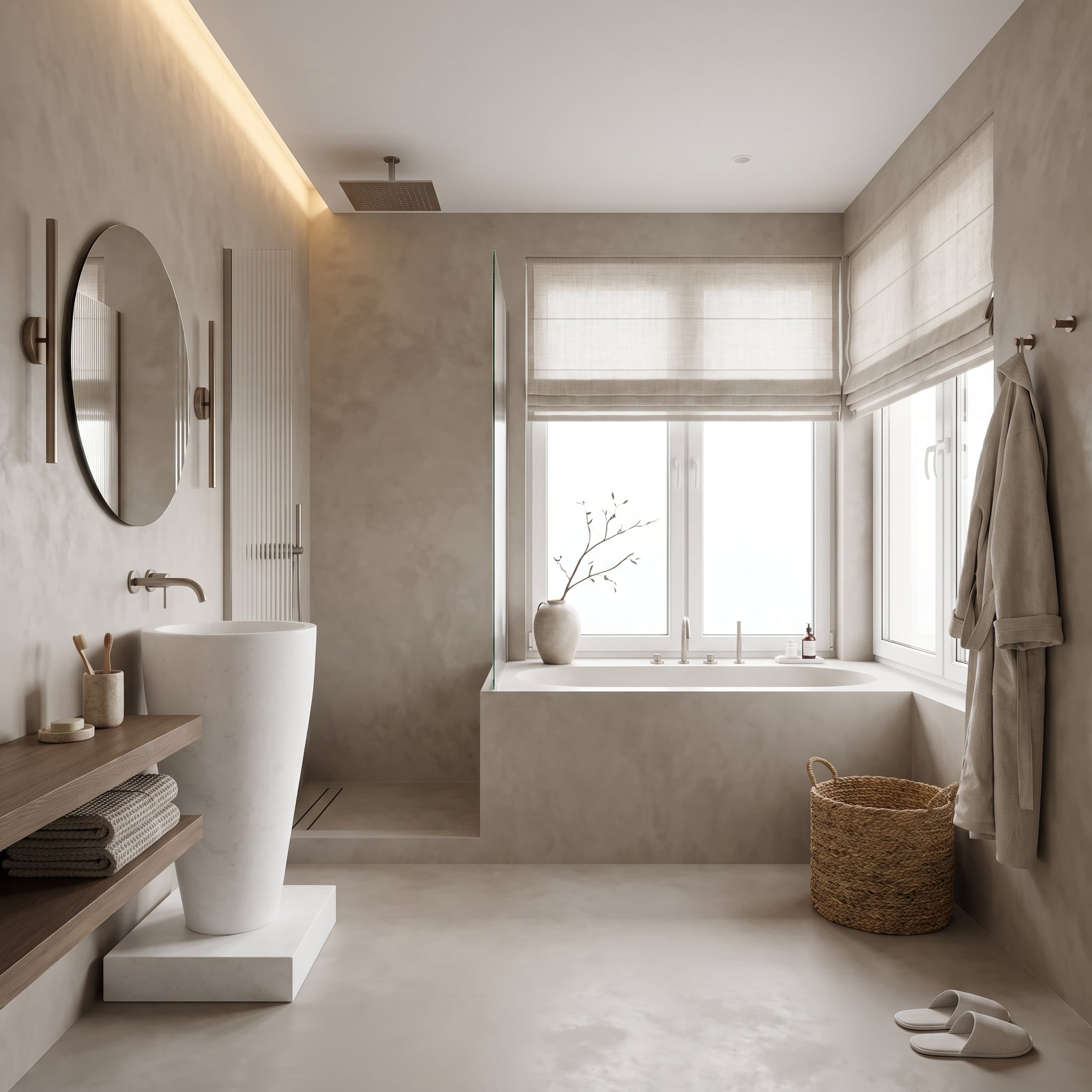
Greige microcement-style surfaces extend across the walls and floor, creating a nearly continuous backdrop for a freestanding pedestal basin. The limited color variation places greater emphasis on the basin’s proportions and the subtle texture of the surrounding surfaces.
A narrow walnut shelf introduces a strong horizontal line beside the basin, while linen Roman shades soften the daylight entering through the window. Bronze sconces flank an oval mirror, providing a more decorative counterpoint to the spare architectural treatment. The design relies on a few carefully distinguished shapes rather than extensive cabinetry or ornamental tilework.
3. Rift-Cut Oak and Arched Brass Mirrors Give a Double Vanity Its Own Rhythm
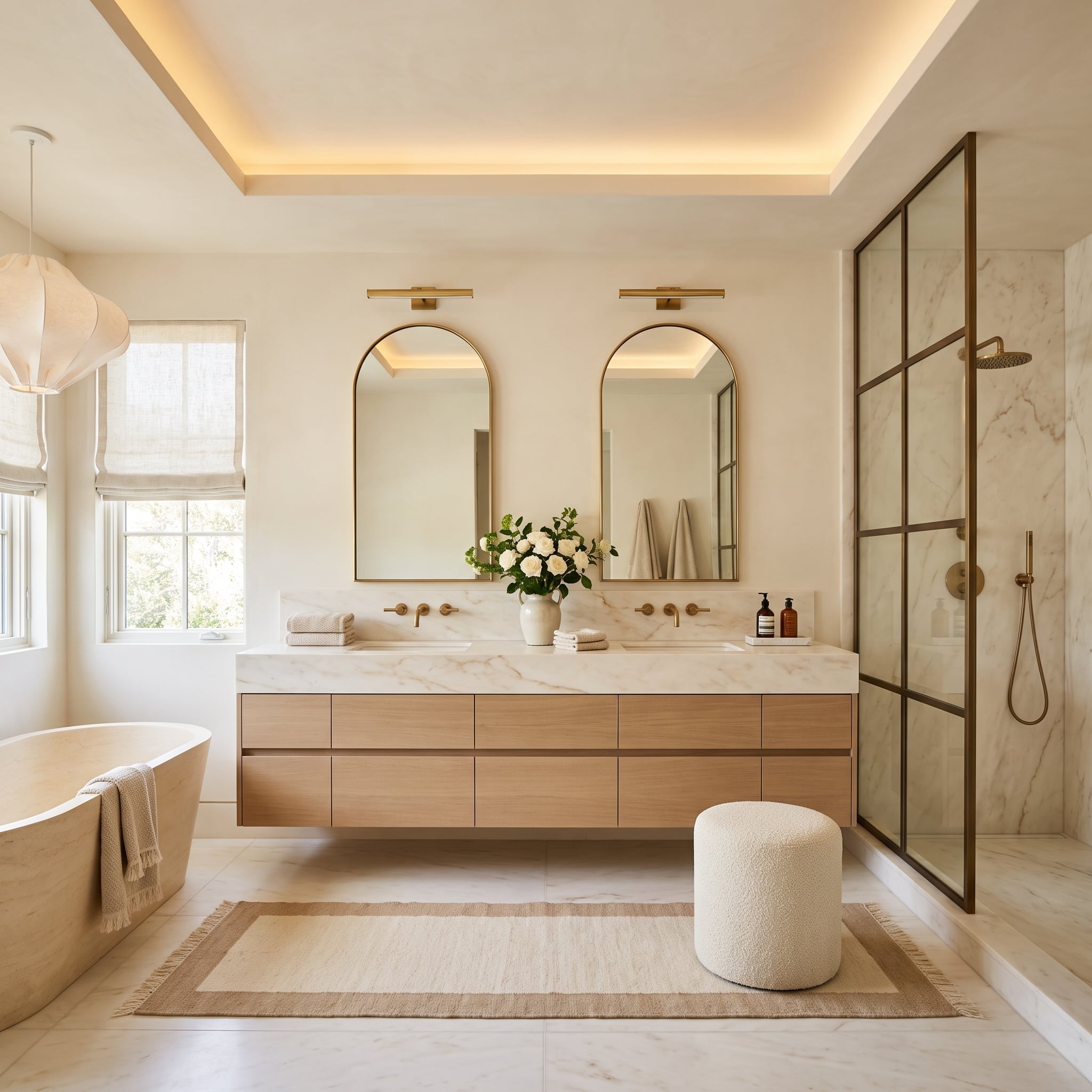
Linear-grain oak cabinetry extends across the double vanity, its relatively consistent pattern creating a calm foundation beneath the pale stone countertop. Two arched brass-framed mirrors introduce vertical emphasis and softer curves above the straight cabinet fronts.
Concealed lighting within the tray ceiling spreads illumination across the upper walls, reducing the need for prominent overhead fixtures. The mirrors give each basin a defined position, while the continuous cabinetry keeps the vanity reading as one architectural element. The repeated arches establish a measured rhythm against the straight oak grain, allowing the vanity to feel unified without becoming rigidly symmetrical.
2. An Arched Plaster Shower Makes Conventional Tilework Look Almost Unnecessary
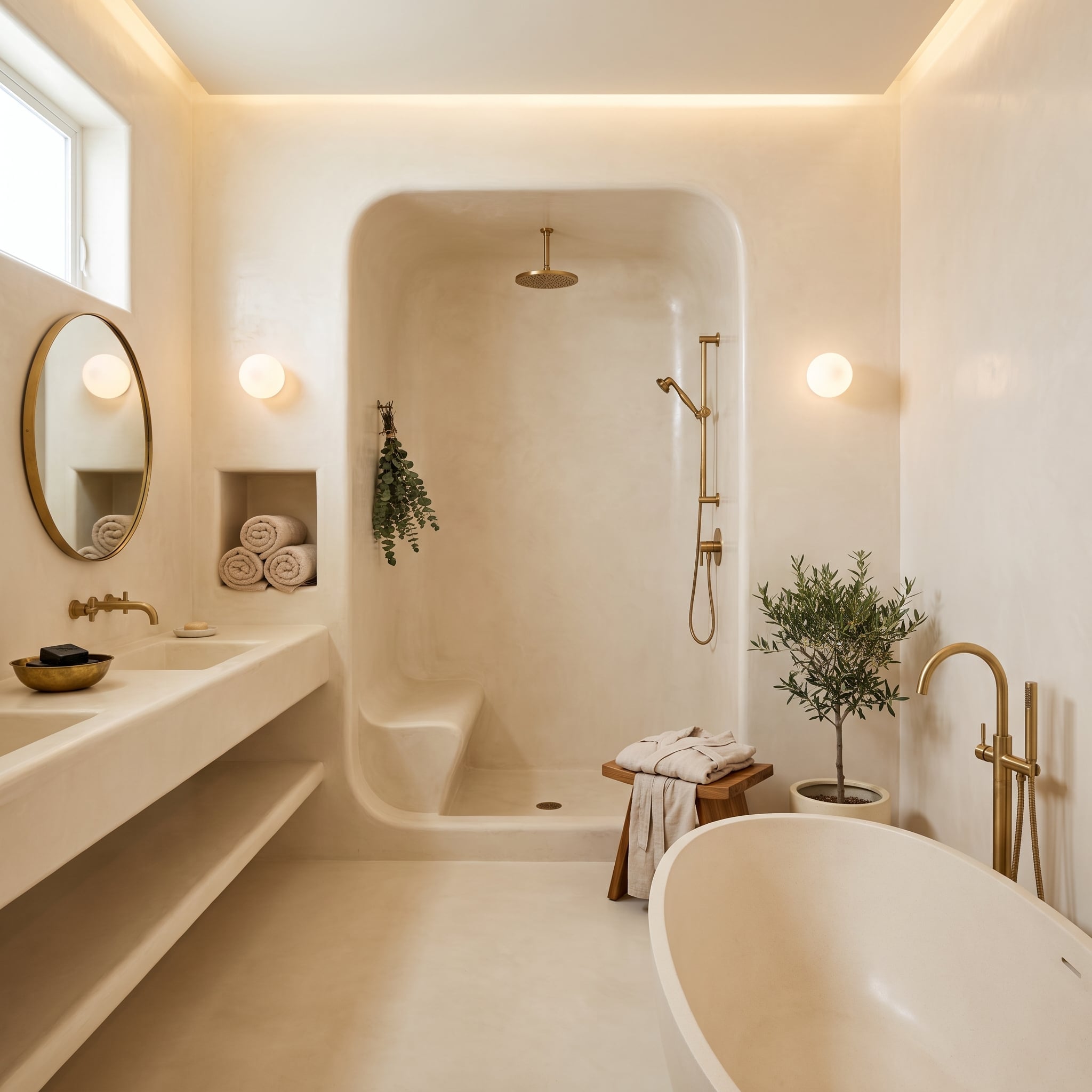
A broad plaster arch frames the shower, establishing the room’s most important architectural feature without relying on patterned tile. The continuous-looking wall finish allows the curve itself to carry the composition, while brass fittings provide a warm metallic contrast inside the recess.
A built-in niche accommodates folded towels, and a freestanding stone tub occupies the adjoining area beside a small timber stool. An olive tree introduces a vertical organic form against the smooth plaster. The design depends on the relationship between curved openings, solid stone, and restrained fixtures. In wet areas, a plaster-like appearance must be supported by a suitable waterproof finish and construction system.
1. A Round Travertine Tub Makes This Plaster Bathroom Feel Almost Carved From Stone
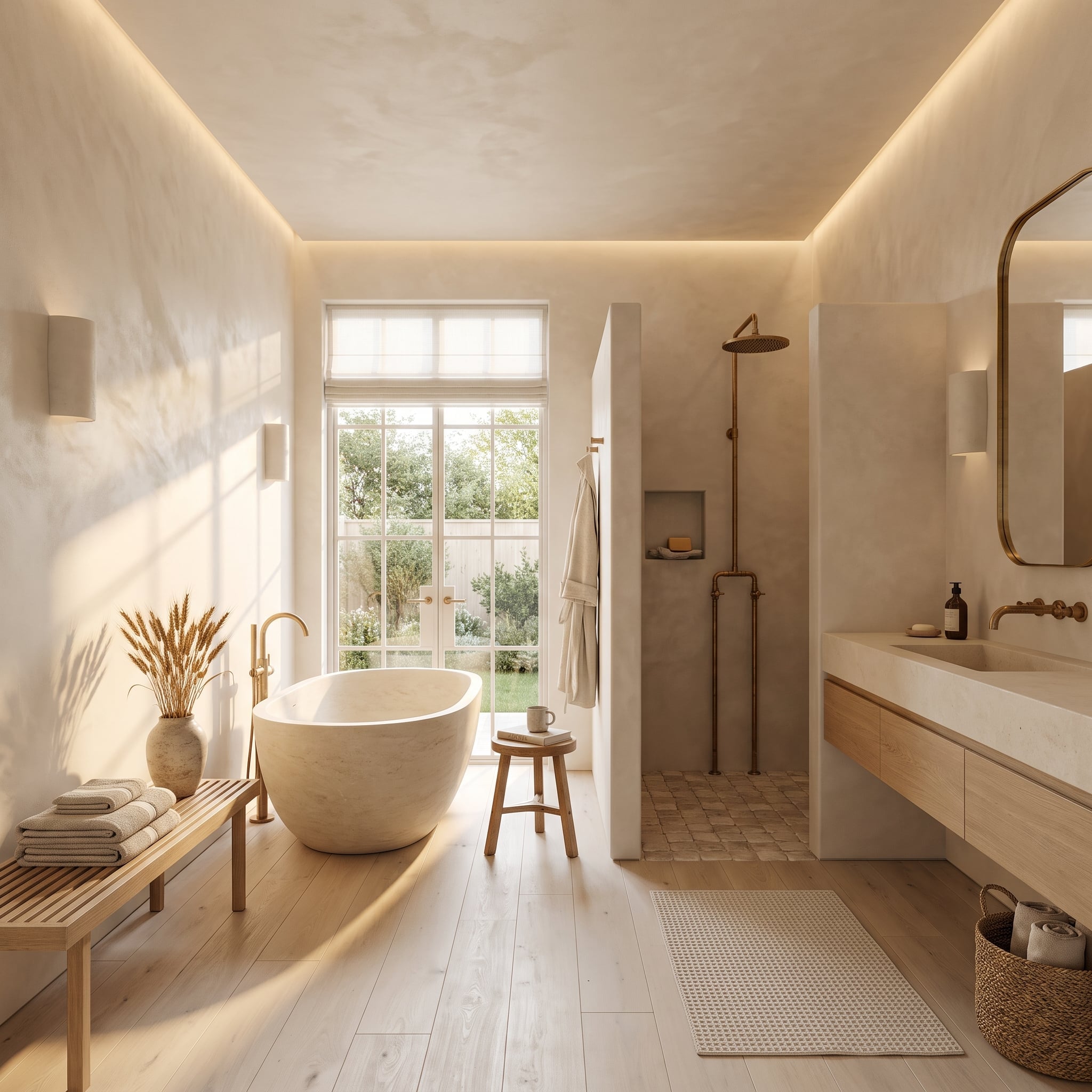
Limewash-style plaster covers the walls in a softly varied neutral tone, allowing a round travertine soaking tub to stand out through its shape and natural banding. Wide-plank oak flooring introduces a continuous timber surface beneath the bathing area, connecting the pale stone to the darker grain of the wood.
Brass fixtures serve the tub and open shower, while concealed ceiling lighting provides an even wash across the plaster. At the far end, a grid-pane window brings garden light into the room. The composition is unusually restrained, but not visually empty. The rounded stone tub, exposed shower fittings, broad timber planks, and subtly textured walls each contribute a different architectural quality without requiring another color or decorative motif.