🔥 Would you like to save this?
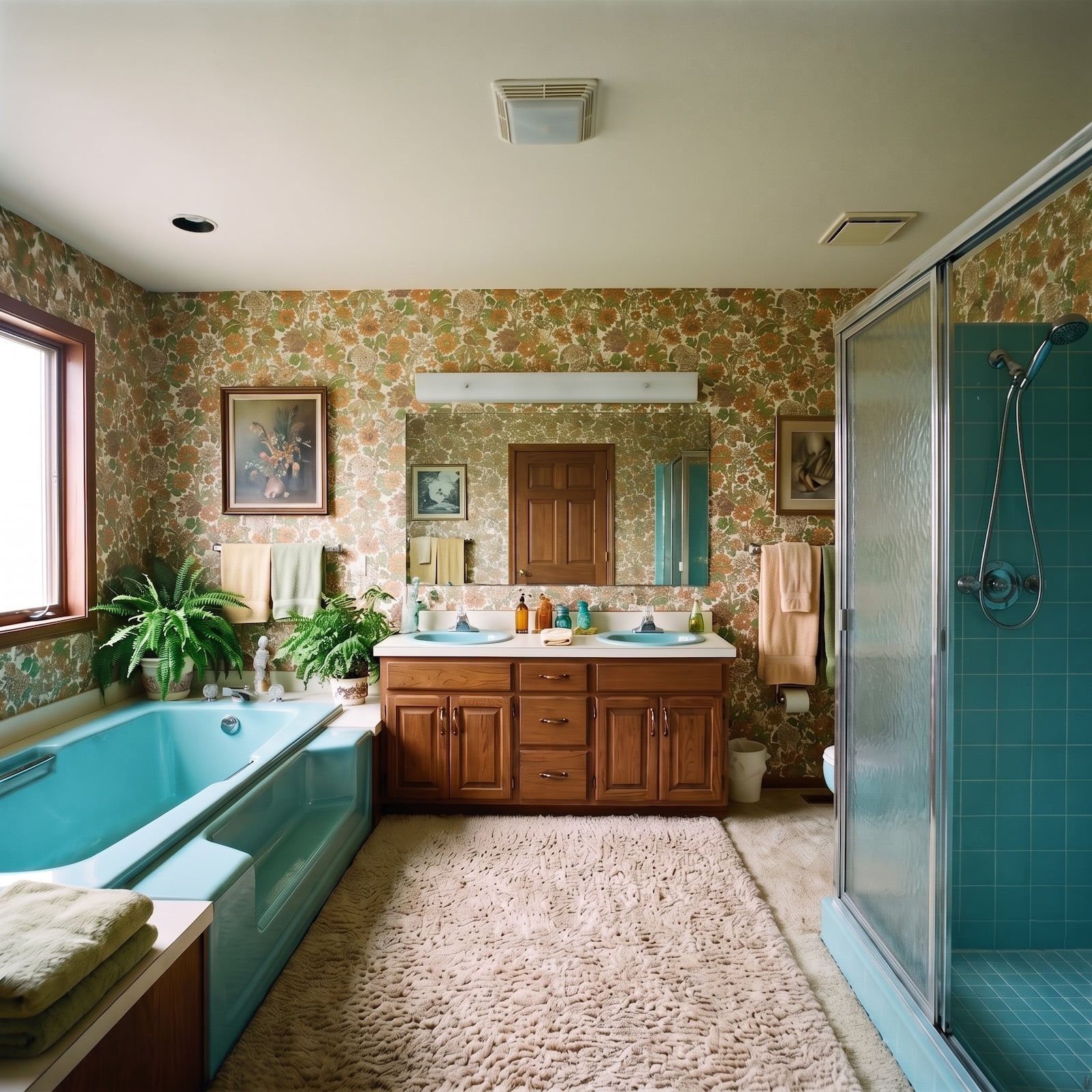
Floral wallpaper from floor to ceiling. A bathtub in a color that once passed for daring. Tile, lighting, and cabinetry all competing for attention, with very little of it deserved. The 1960s bathroom had personality to spare, but decades later, that personality can feel like a room refusing to move on.
In order to come up with the very specific design ideas, we create most designs with the assistance of state-of-the-art AI interior design software. Also, assume links that take you off the site are affiliate links such as links to Amazon. this means we may earn a commission if you buy something.
Strip away the wallpaper and the possibilities become considerably more interesting. A plain ceiling can turn into an architectural centerpiece. A conventional vanity can disappear into a wall of stone or become a sculptural piece of furniture. Marble, plaster, terrazzo, copper, walnut, and even living greenery can change the character of the same basic space beyond recognition. Some approaches are restrained enough to make the old bathroom seem almost impossibly cluttered. Others are every bit as extravagant as the original, just with an entirely different sense of proportion.
These 38 transformations explore how far a dated bathroom can travel without necessarily changing its footprint. From quiet oak-and-limestone interiors to glowing onyx ceilings and jewel-colored marble, the question isn’t simply what to remove. It’s what deserves to take its place.
38. Cobalt Walls and Porthole Mirrors Give This Bathroom a Nautical Edge
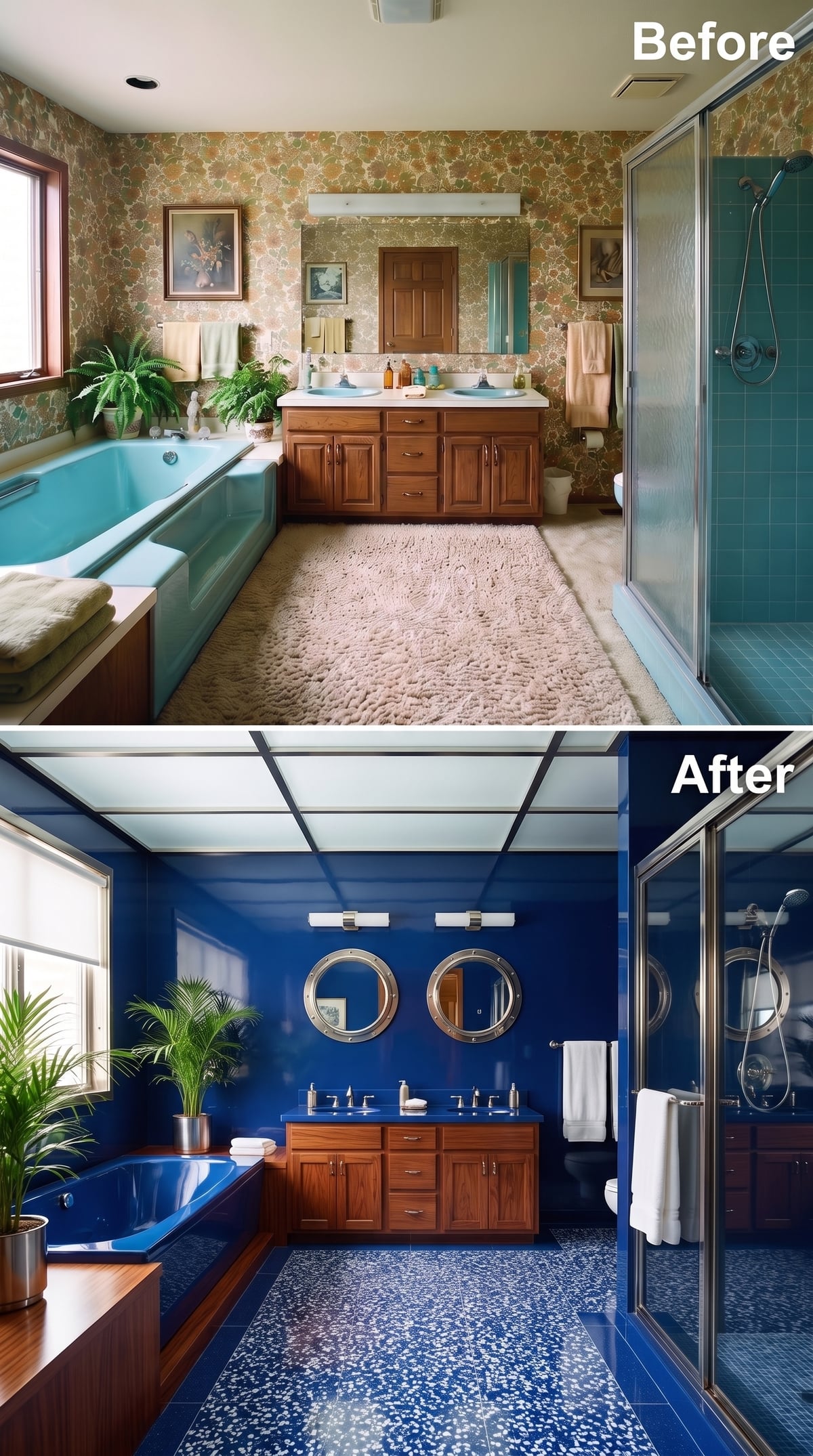
Cobalt blue takes possession of the walls, turning an ordinary bathroom enclosure into a saturated architectural statement. The glossy finish intensifies the color, while speckled blue terrazzo introduces variation underfoot. Instead of treating blue as an accent, the design makes it the defining material experience.
Round brass-framed mirrors supply the nautical reference. Their porthole proportions are distinctive against the uninterrupted cobalt, and the warm metal provides a sharp contrast to the cool palette. The result has the confidence of a themed interior without relying on anchors, rope, or other literal maritime decoration.
37. Backlit Onyx Turns a Dark Bathroom Into a Glowing Lantern
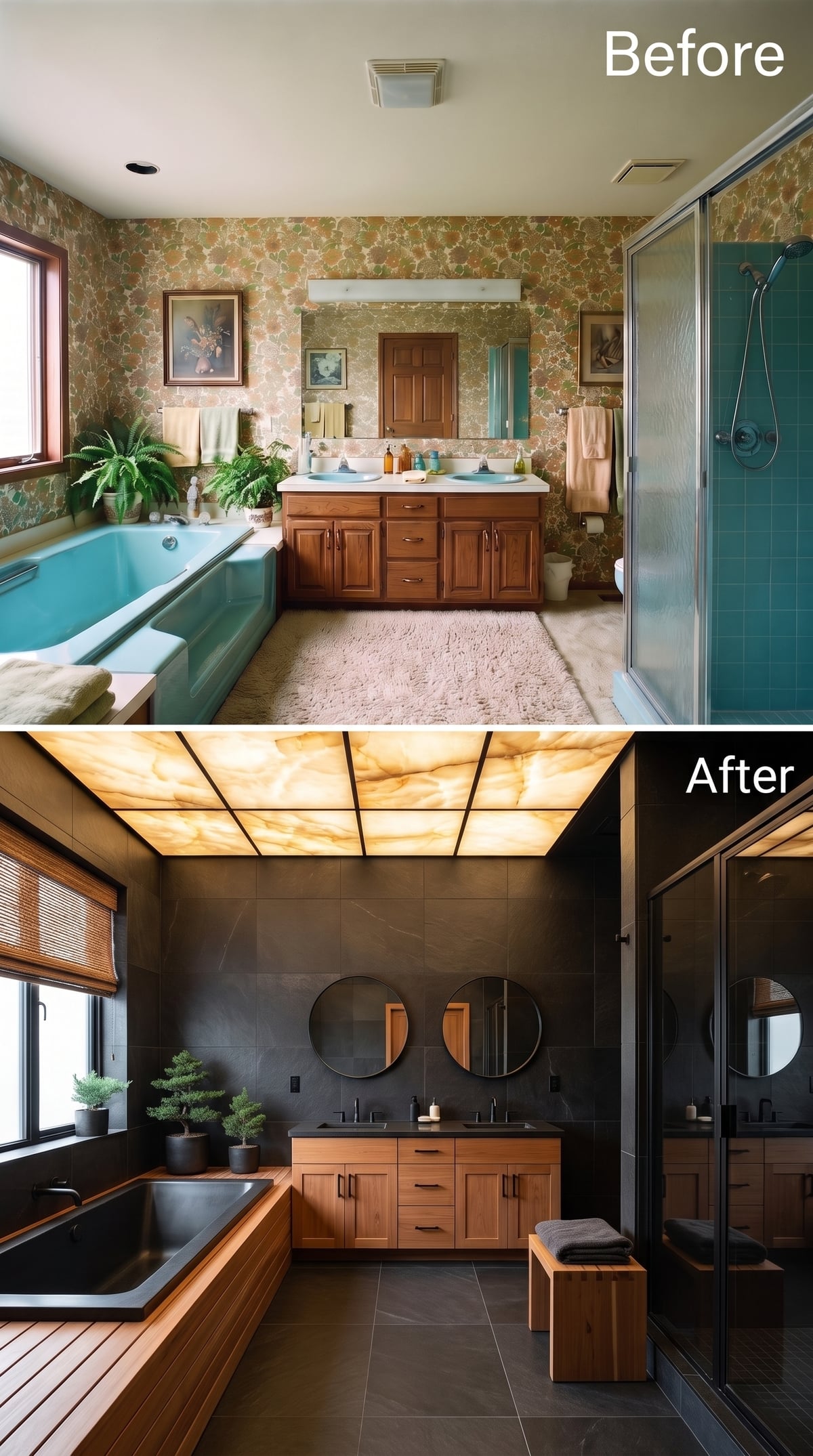
The ceiling becomes an enormous luminous surface, its translucent onyx panels glowing amber within dark framing. Instead of scattering small points of light across the room, the design creates a broad illuminated plane overhead. Against black slate walls, that warmth becomes almost theatrical.
Natural oak cabinetry interrupts the dark surfaces with visible grain and a lighter tone. A black soaking tub, round mirrors, and restrained window shades maintain the strong geometry. The contrast between glowing stone, matte slate, and warm timber gives the room its character, making ordinary ceiling lighting seem remarkably unambitious.
36. Shiplap-Style Ceiling and Whitewashed Oak Bring the Bathroom Back to Earth
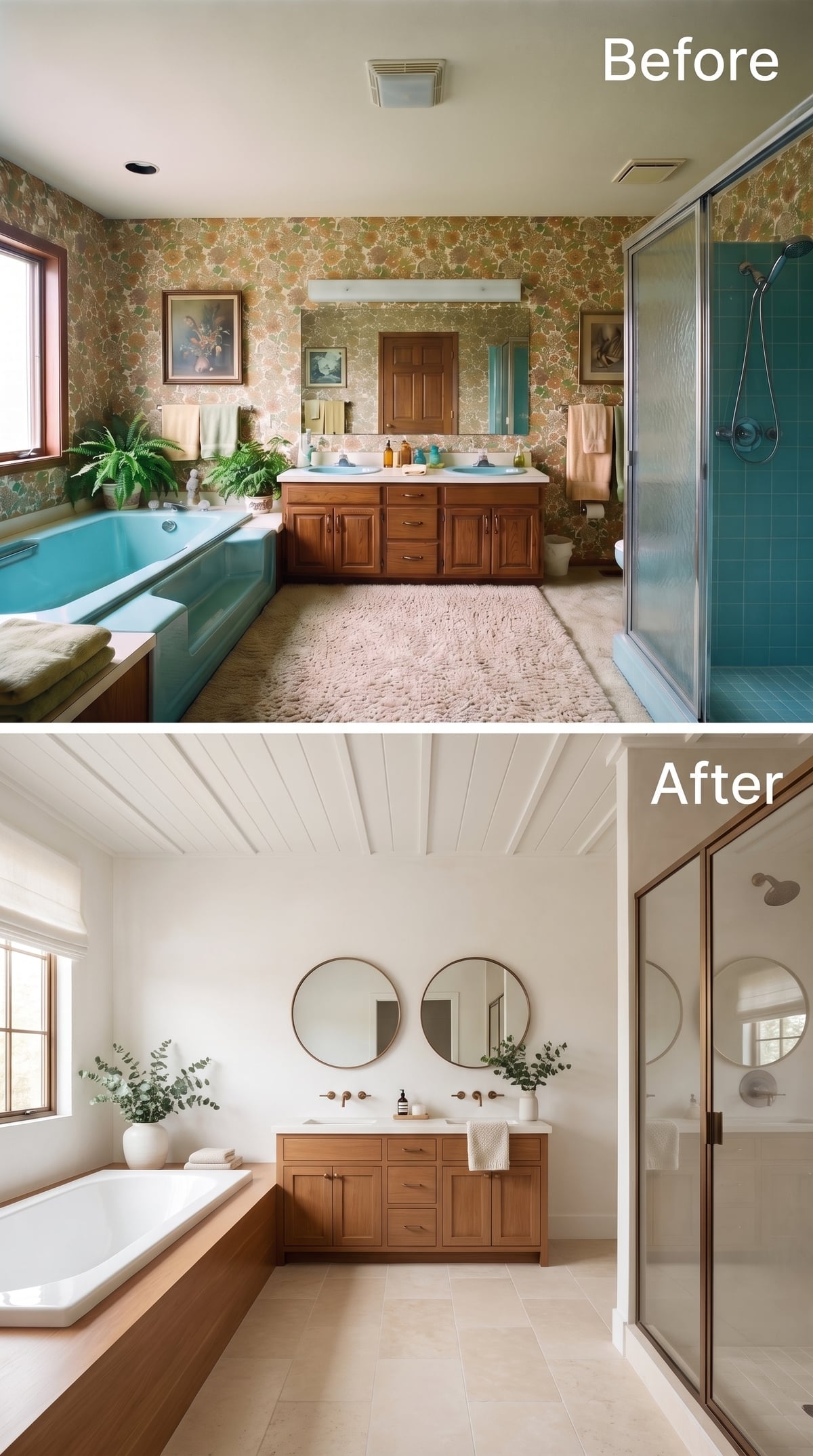
White ceiling planks introduce a measured rhythm overhead, replacing decorative clutter with a single architectural texture. The oak vanity below has traditional cabinet detailing, but its warm finish and straightforward proportions keep the composition relaxed rather than nostalgic.
Two bronze-framed round mirrors establish symmetry above the sinks, with matching wall-mounted faucets leaving the countertop relatively clear. Sandy limestone-look flooring and an oak-toned tub surround complete the restrained palette. Compared with the intensely colored bathroom before it, this design demonstrates how much can be achieved with a few closely related materials.
35. Green Marble Covers Nearly Everything, but Walnut Gives It Room to Breathe
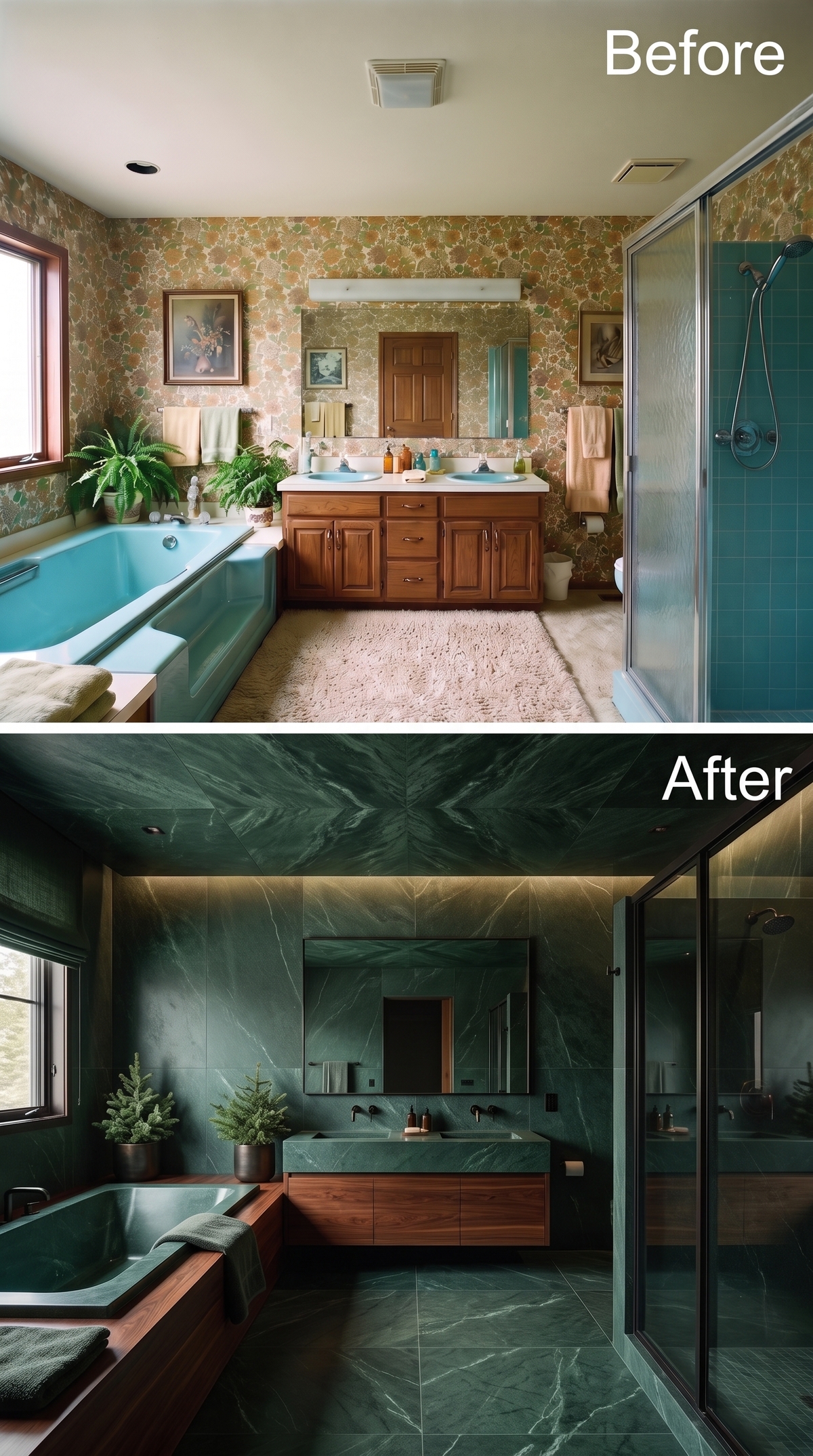
Deep green marble extends across the walls, floor, and vanity surface, creating a room defined almost entirely by the stone’s veining. The color is unusually assertive for a bathroom, but the uninterrupted treatment gives the design a clear architectural identity rather than a collection of unrelated accents.
Walnut cabinetry breaks the marble into manageable planes. The wood surround at the tub repeats the vanity material, while black faucets and a rectangular mirror avoid introducing another competing finish. Perimeter lighting reveals variations in the green stone and gives the darker surfaces a warm edge.
34. Sage Plaster and Blonde Wood Replace Pattern With Proportion
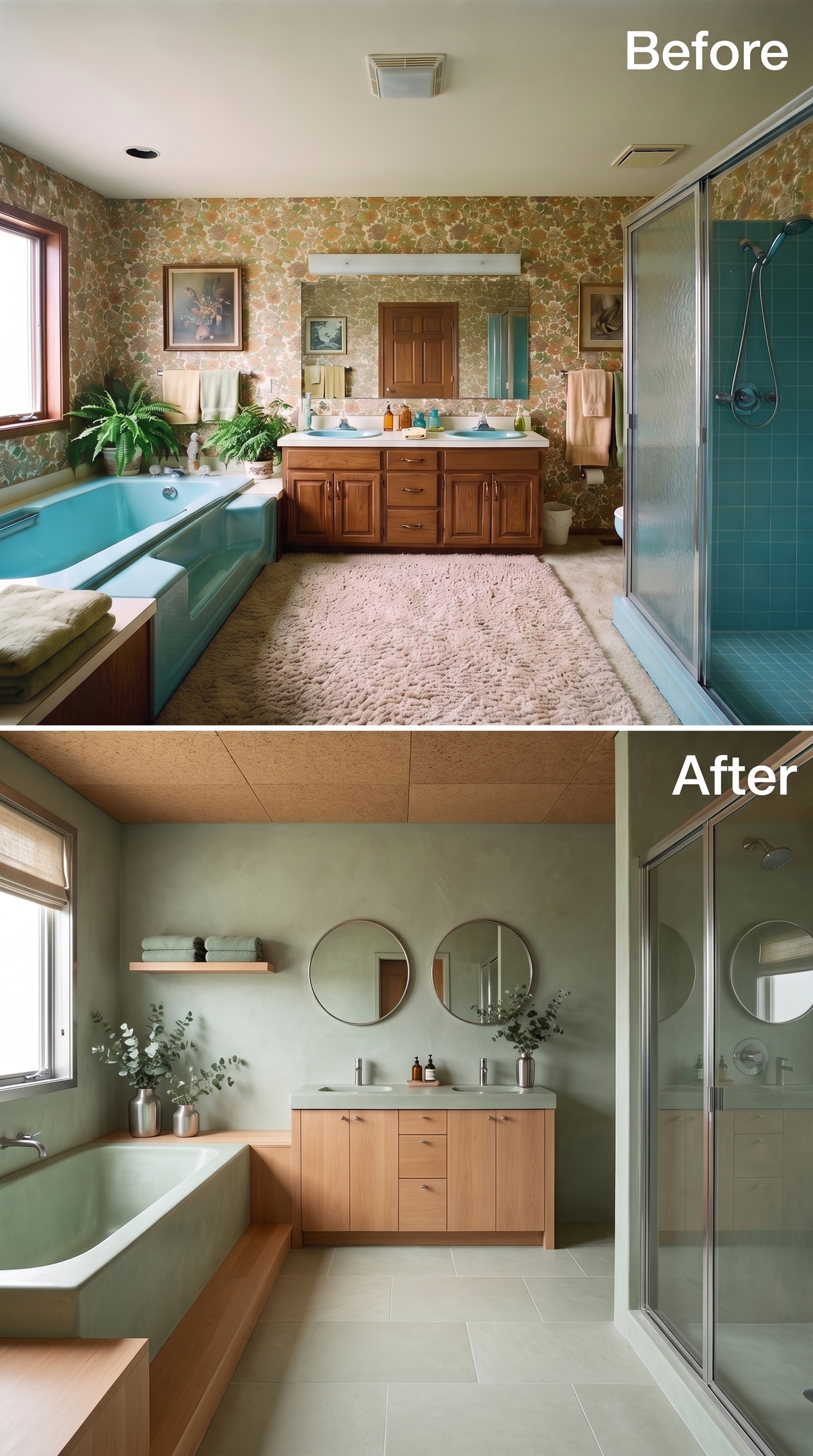
Muted sage plaster brings color back to the bathroom without reviving the visual commotion of patterned wallpaper. The matte surface provides a soft backdrop for blonde wood cabinetry, whose broad horizontal proportions give the vanity a low, furniture-like presence.
Large cream floor tiles limit the number of visible joints, while a wood-framed tub surround connects the bathing area to the vanity. Two round mirrors interrupt the otherwise straight lines. The palette is quiet, but the relationship between the pale timber, green plaster, and generous floor tiles gives it considerable definition.
33. Blue Sodalite Marble Meets a Painted Sky Overhead
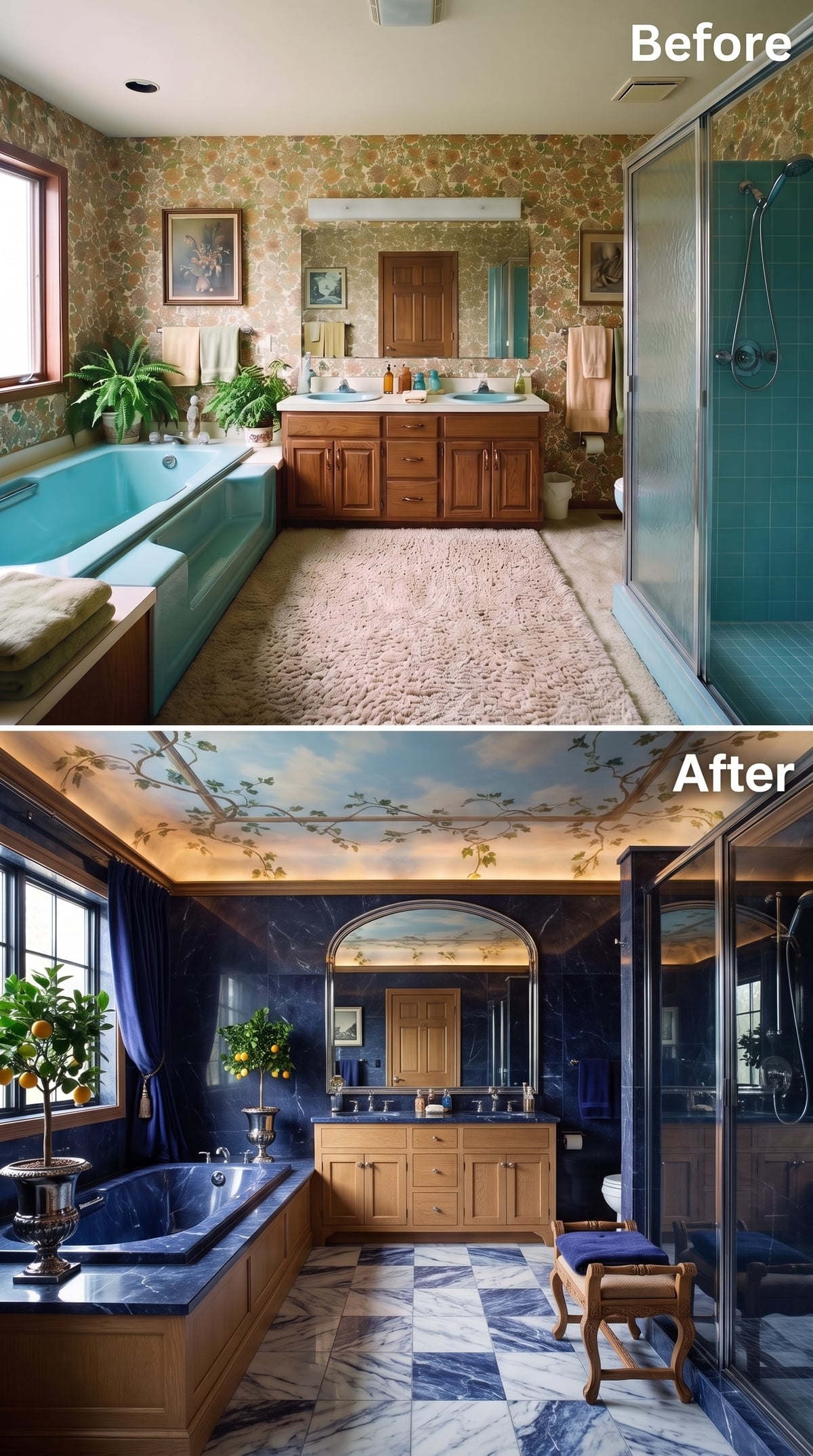
Deep blue sodalite dominates the walls, its pale veining creating movement across the saturated stone. The material already has enough pattern to command the room, yet the ceiling introduces an entirely different decorative language: a painted sky with branches and soft clouds.
Rather than extending the stone overhead, the mural opens an imaginary view above it. Light wood cabinetry offers a visual interval between the two expressive surfaces. The combination is extravagant, but the distinction between mineral pattern below and painted imagery above gives each element a recognizable role.
32. Leather-Toned Plaster and a Diamond Ceiling Turn Warmth Into Drama
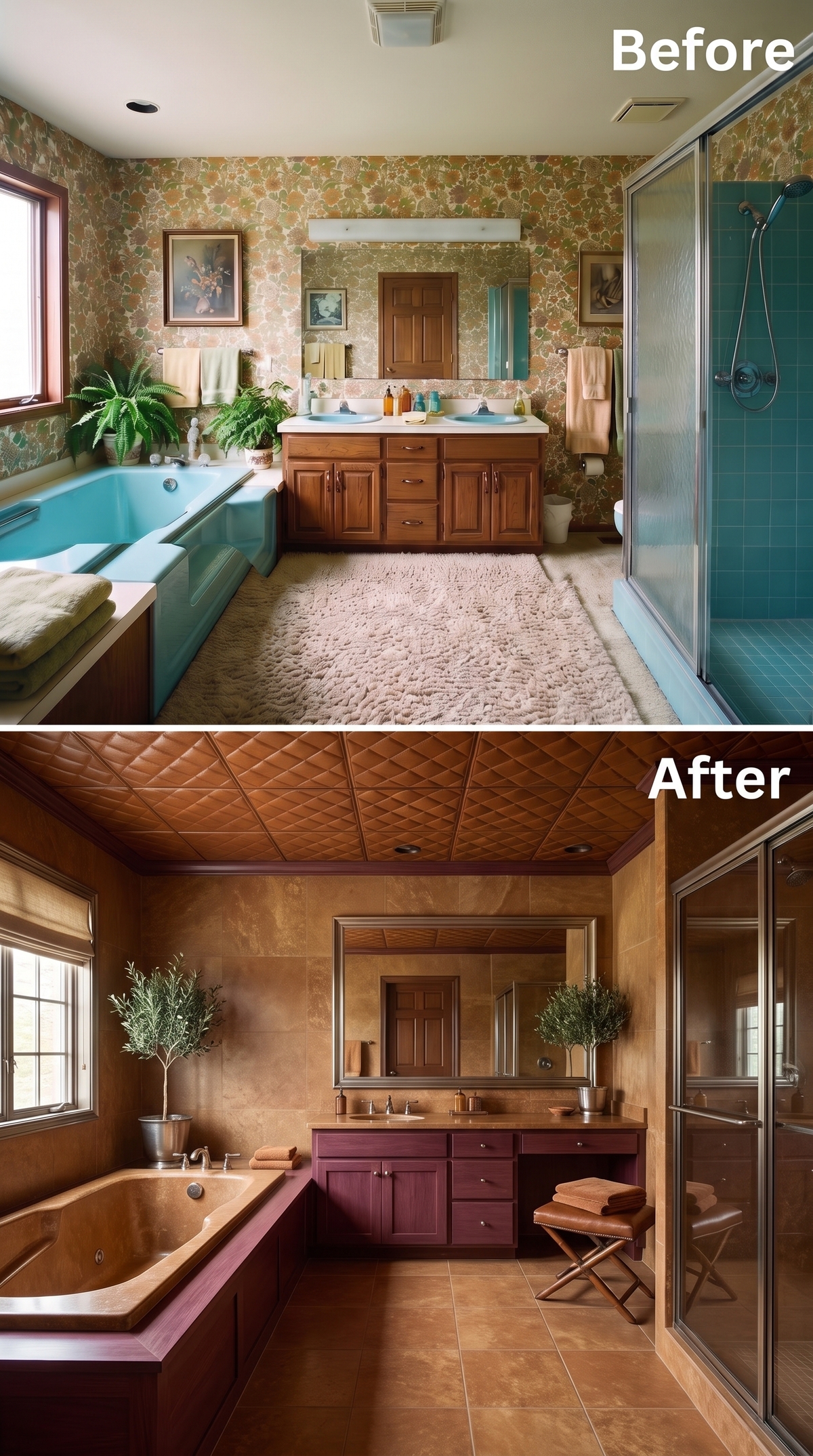
Cognac-colored plaster covers the walls, establishing a palette closer to leather, clay, and aged terracotta than conventional bathroom neutrals. The diamond-patterned ceiling carries those warm tones overhead, adding geometry to an otherwise softly textured enclosure.
Burgundy vanity cabinetry introduces a deeper red note, while sandy floor tiles keep the lower portion of the room lighter. Olive-green foliage provides a contrasting color without disturbing the earthy palette. The combination draws on Southwestern materials and colors but replaces rustic informality with precise surfaces and strong pattern.
31. Hammered Gold Over Concrete Creates an Unexpected Material Collision
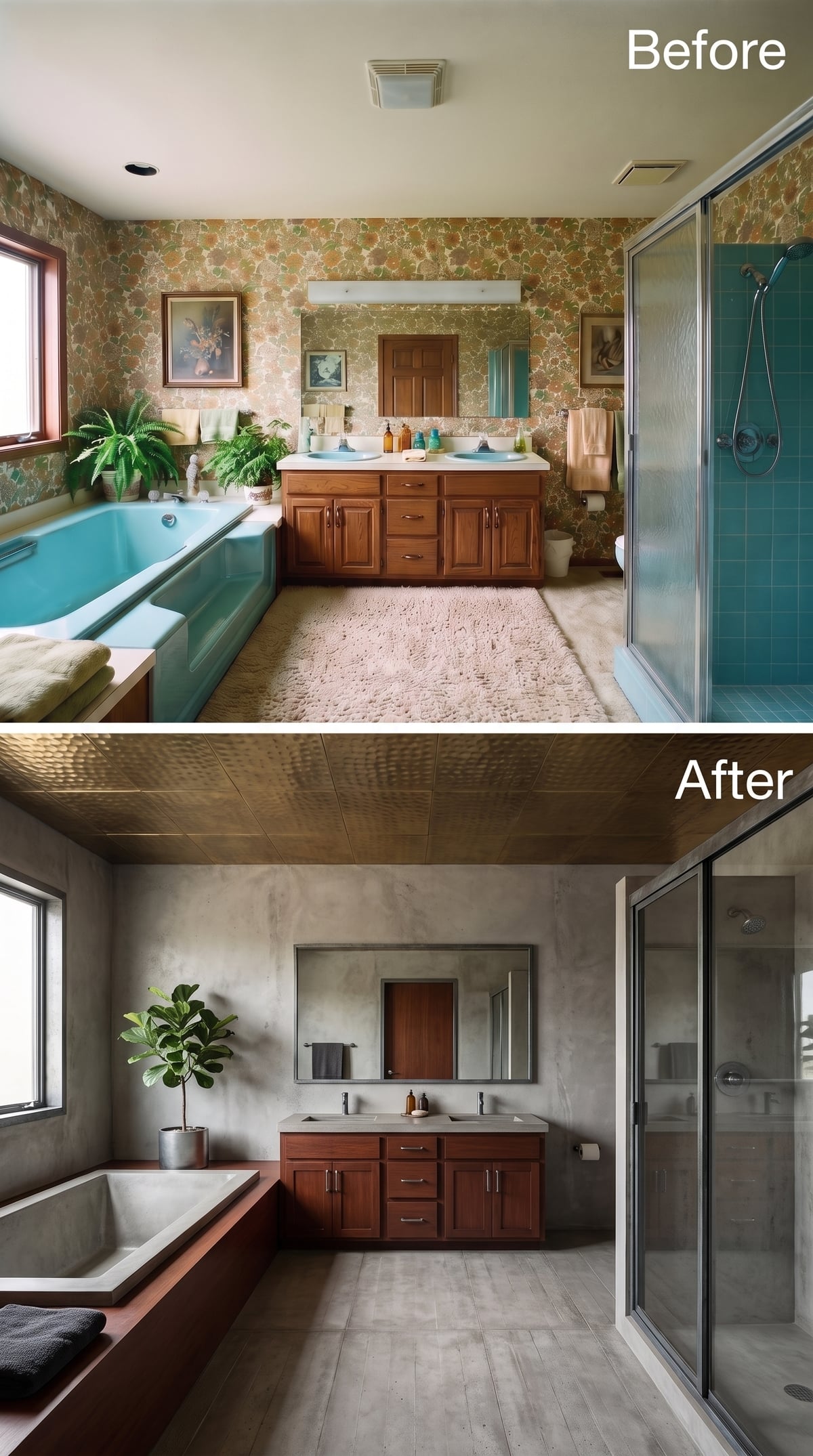
Raw-looking concrete plaster and a hammered gold ceiling belong to very different decorative traditions. One suggests industrial restraint; the other recalls ornate metalwork. Bringing them together gives the room a tension that a uniformly minimalist scheme would lack.
Walnut cabinetry forms the transition between those extremes. Its rich brown grain complements the metallic warmth overhead while retaining enough natural texture to sit comfortably against the concrete walls. The ceiling supplies reflected light and intricate surface detail; the walls remain deliberately plain.
30. A Copper Soaking Tub Gives Textured Plaster a Dramatic Counterpart
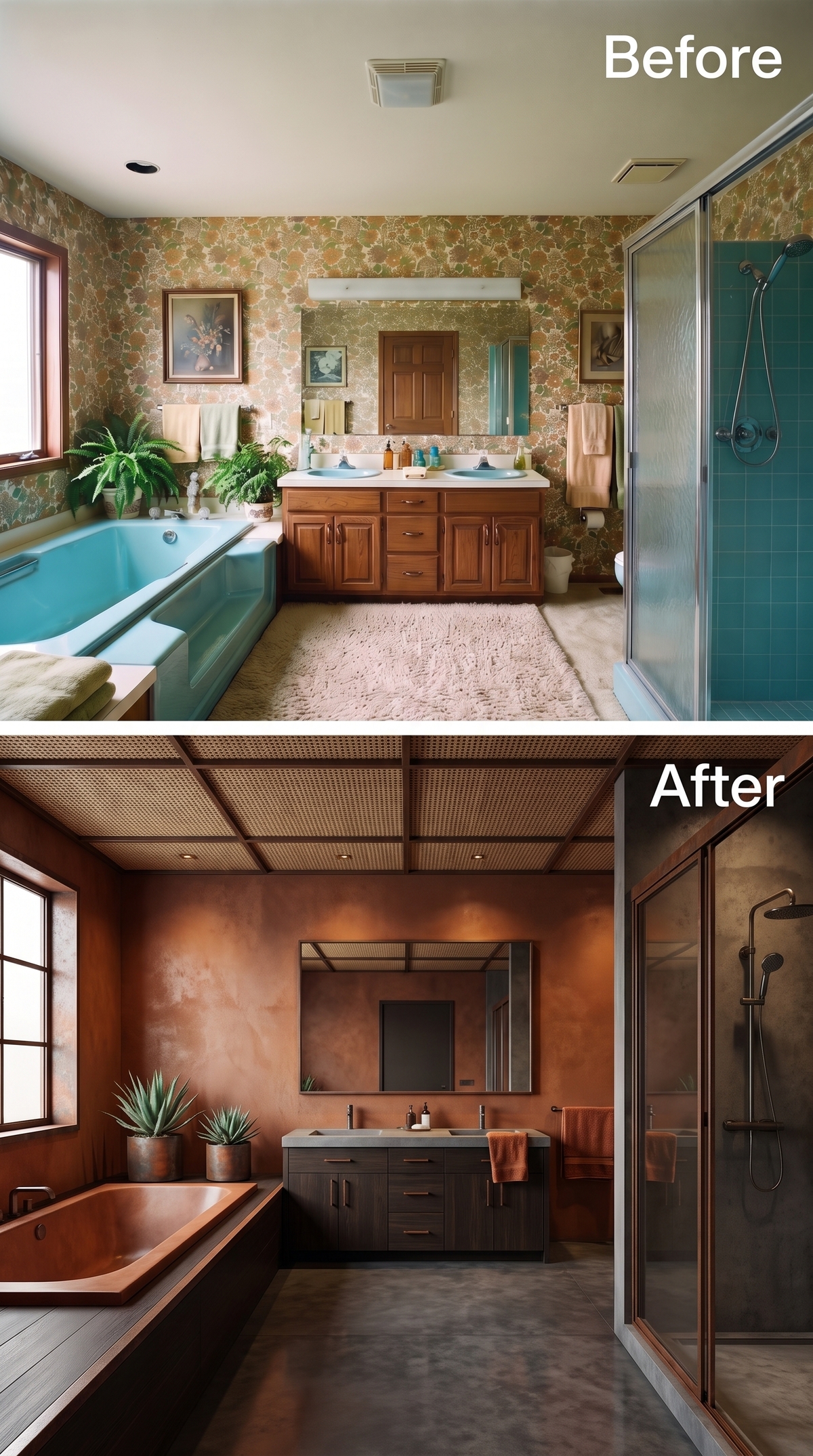
A copper soaking tub immediately changes the hierarchy of this bathroom. Its rounded metallic surface stands apart from the surrounding burnt-sienna plaster, providing a clear focal point amid the earthy finishes. The copper’s reflective quality also distinguishes it from the matte walls.
Overhead, woven-grid ceiling panels introduce a second kind of texture. A concrete-topped vanity with dark cabinetry adds a cooler, more restrained material to the composition, while bronze fixtures connect the metal finishes. Rather than relying on a conventional white tub, the design treats bathing furniture as the room’s principal decorative object.
29. Ribbed Plaster and Oak Give a Neutral Bathroom Architectural Muscle
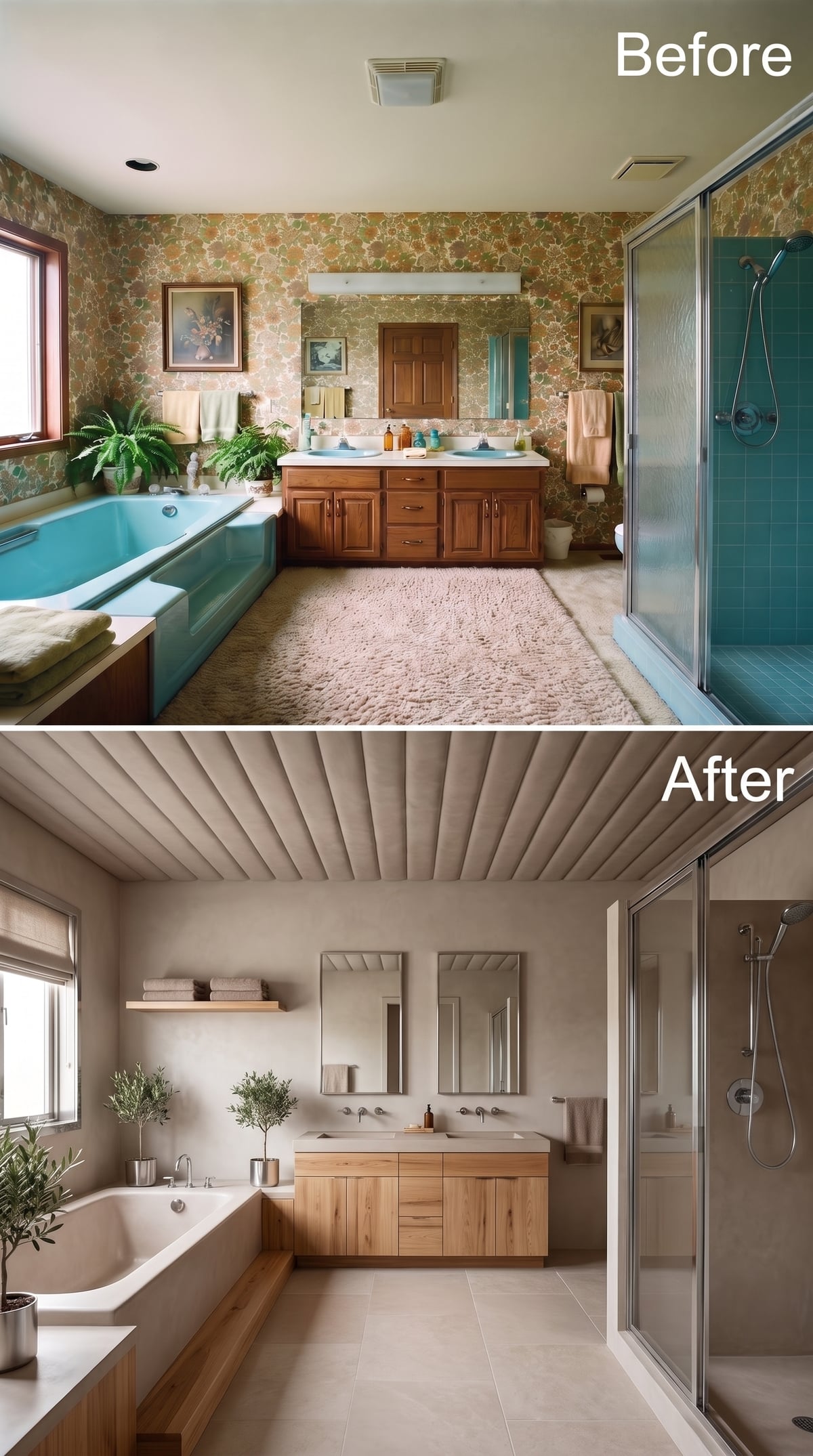
Long ribs in the plaster ceiling establish a strong directional pattern above an otherwise restrained room. Their repeated lines give the overhead surface depth, turning an area usually finished with flat paint into a major architectural feature.
A light oak vanity, rectangular mirrors, and wall-mounted faucets provide crisp geometry below. The stone-finish tub surround and large neutral floor tiles maintain the limited palette. The ceiling’s relief becomes especially noticeable because the cabinetry and surrounding surfaces avoid unnecessary ornament.
28. Turquoise Mosaic Meets a Ceiling With a Mind of Its Own
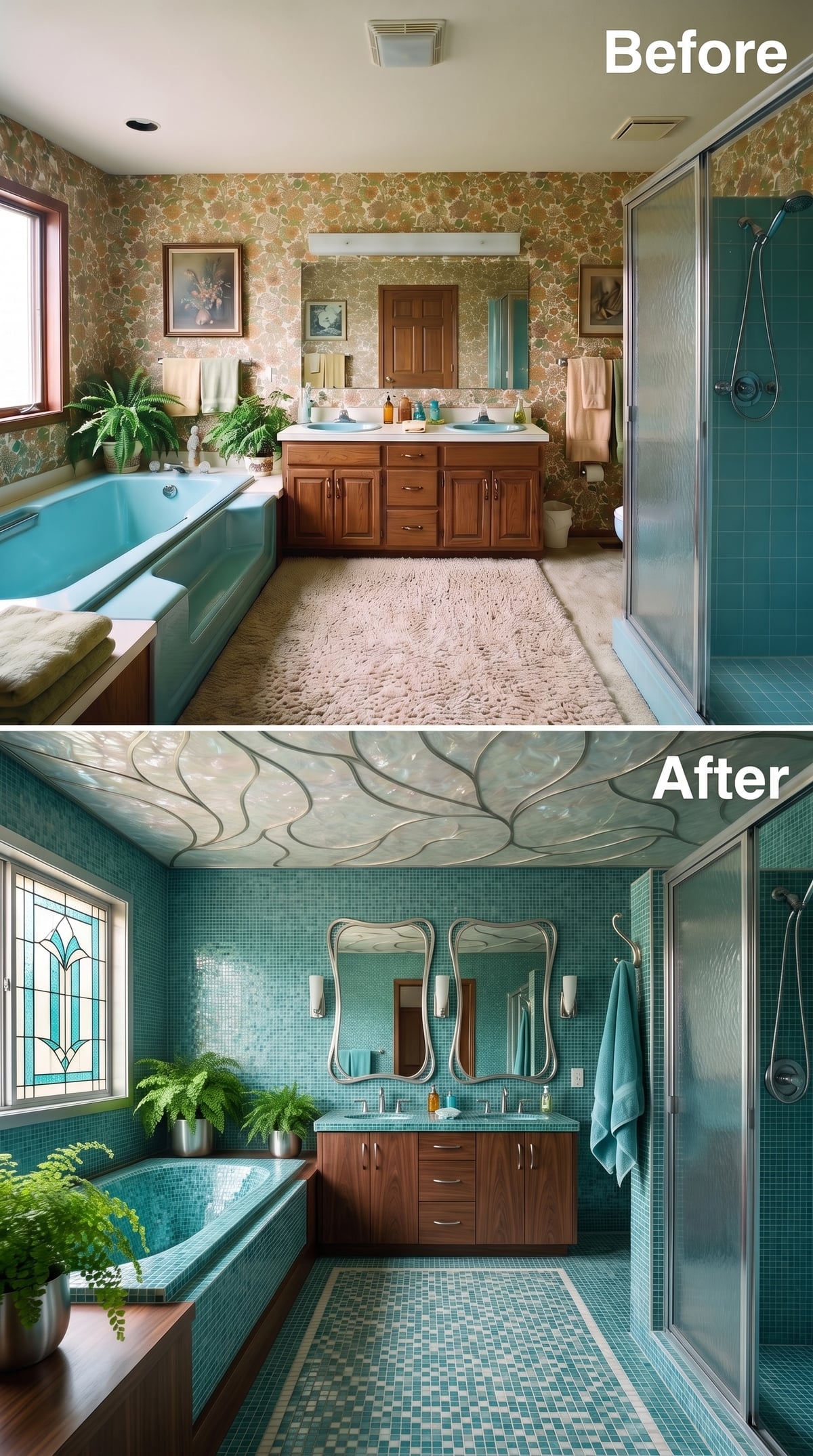
Small turquoise mosaic tiles cover the major surfaces, creating a dense field of color and fine-grained pattern. Walnut cabinetry interrupts the blue with a broad horizontal band of natural wood, giving the vanity wall a contrasting material and a stronger sense of scale.
The ceiling departs from the tile’s strict geometry with flowing pearl-and-silver forms. Curving mirrors echo those overhead shapes, while a stained-glass window repeats the turquoise palette in a different medium. The design is unapologetically decorative, but the repeated curves connect its most unusual features.
27. Emerald Plaster and Gold Hardware Bring Back the Pleasure of Color
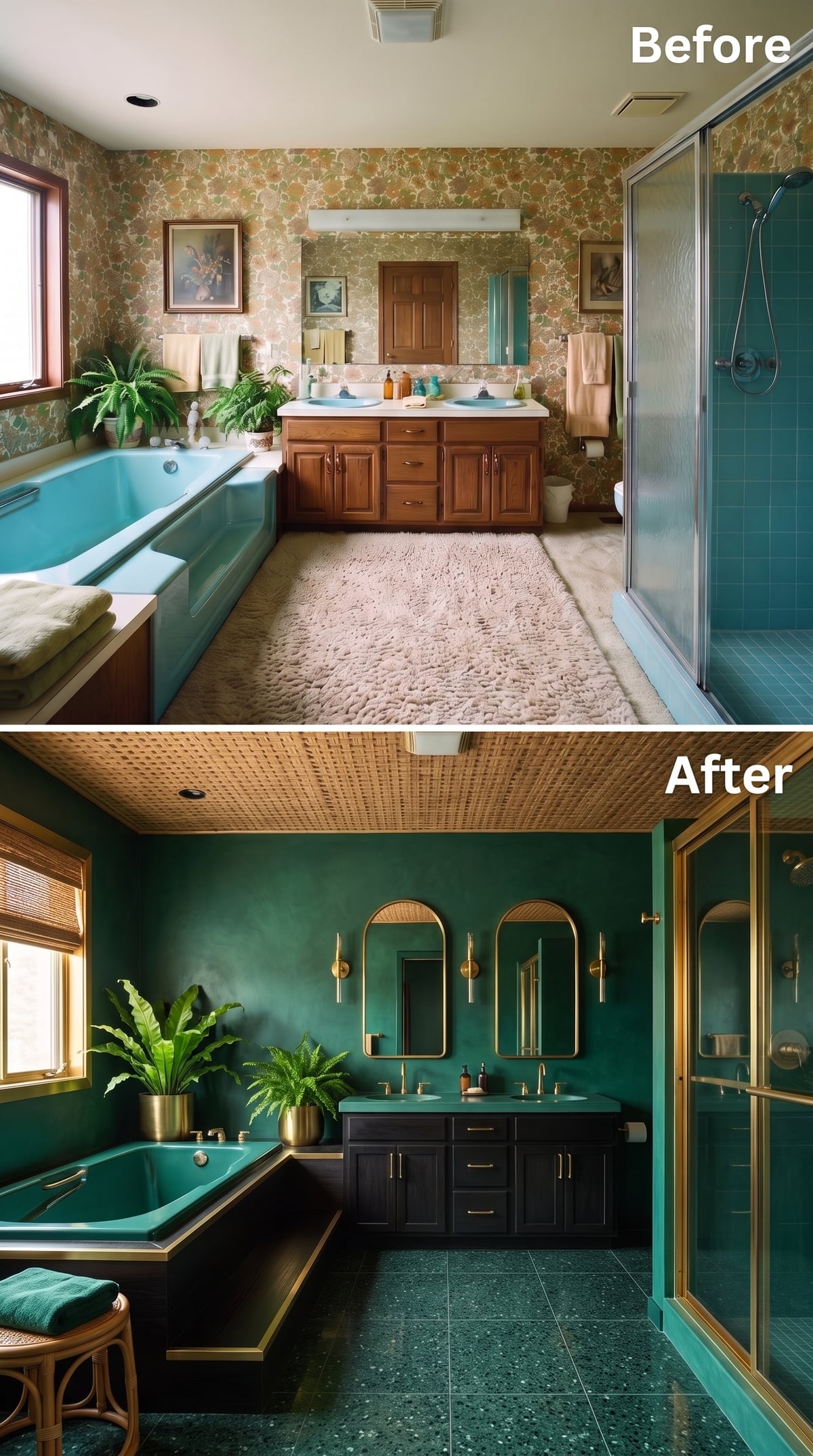
Emerald plaster envelops the walls in a rich, saturated green. Instead of contrasting it with stark white fixtures, the design introduces arched gold mirrors and brass sconces, allowing warm metal to stand out against the darker color.
A rattan ceiling changes the texture overhead, while teal terrazzo carries the green family onto the floor. Dark vanity cabinetry provides a stable base for the mirrors and fixtures. The result revisits the idea of a colorful bathroom without reproducing the familiar combination of colored porcelain and busy wallpaper.
What Our Readers Say
- In bathroom images, our readers gave brass more hearts than the other pictures in the same articles, 55% of the time versus 46%.
- Black metal went the other way in bathrooms, earning hearts from readers 32% of the time against 48% for the other images in the same articles.
From Home Stratosphere reader polls and votes.
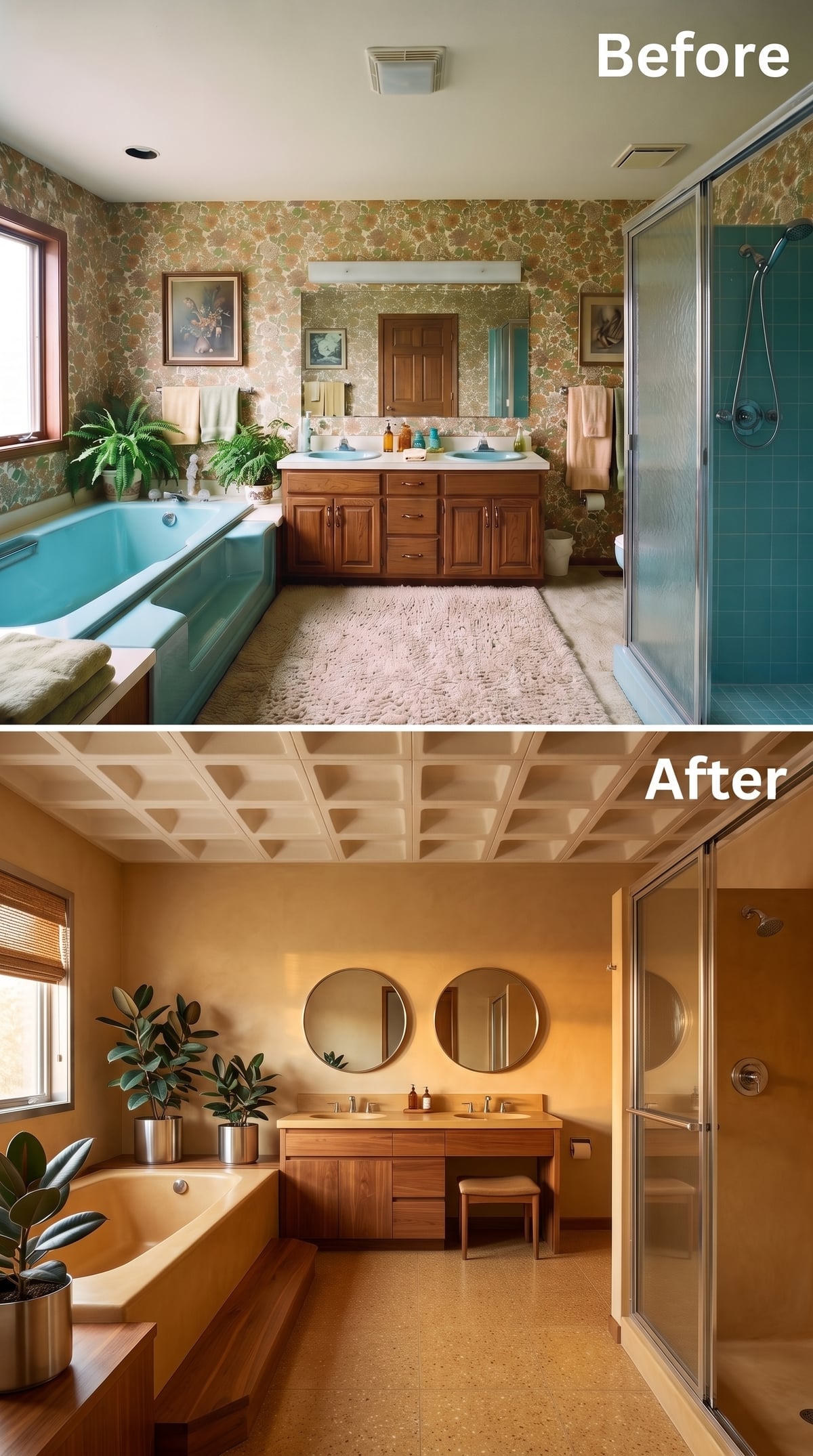
26. Coffered Ceilings and Cork Flooring Make an Unusual Partnership
🔥 Would you like to save this?
A coffered ceiling introduces formal architectural structure, while the warm cork-toned flooring gives the room a softer, more natural character. The combination avoids the coldness sometimes associated with stone-heavy bathrooms, replacing it with closely related wood and earth tones.
The cedar-toned vanity reinforces that warmth, and round mirrors contrast with the ceiling’s rectangular compartments. If cork is specified for a real renovation, the product and installation system must be suitable for bathroom moisture. Visually, its subdued texture provides a compelling alternative to glossy ceramic tile.
25. Rouge Marble and a Parquet Ceiling Take the Bathroom Into Grand-Hotel Territory
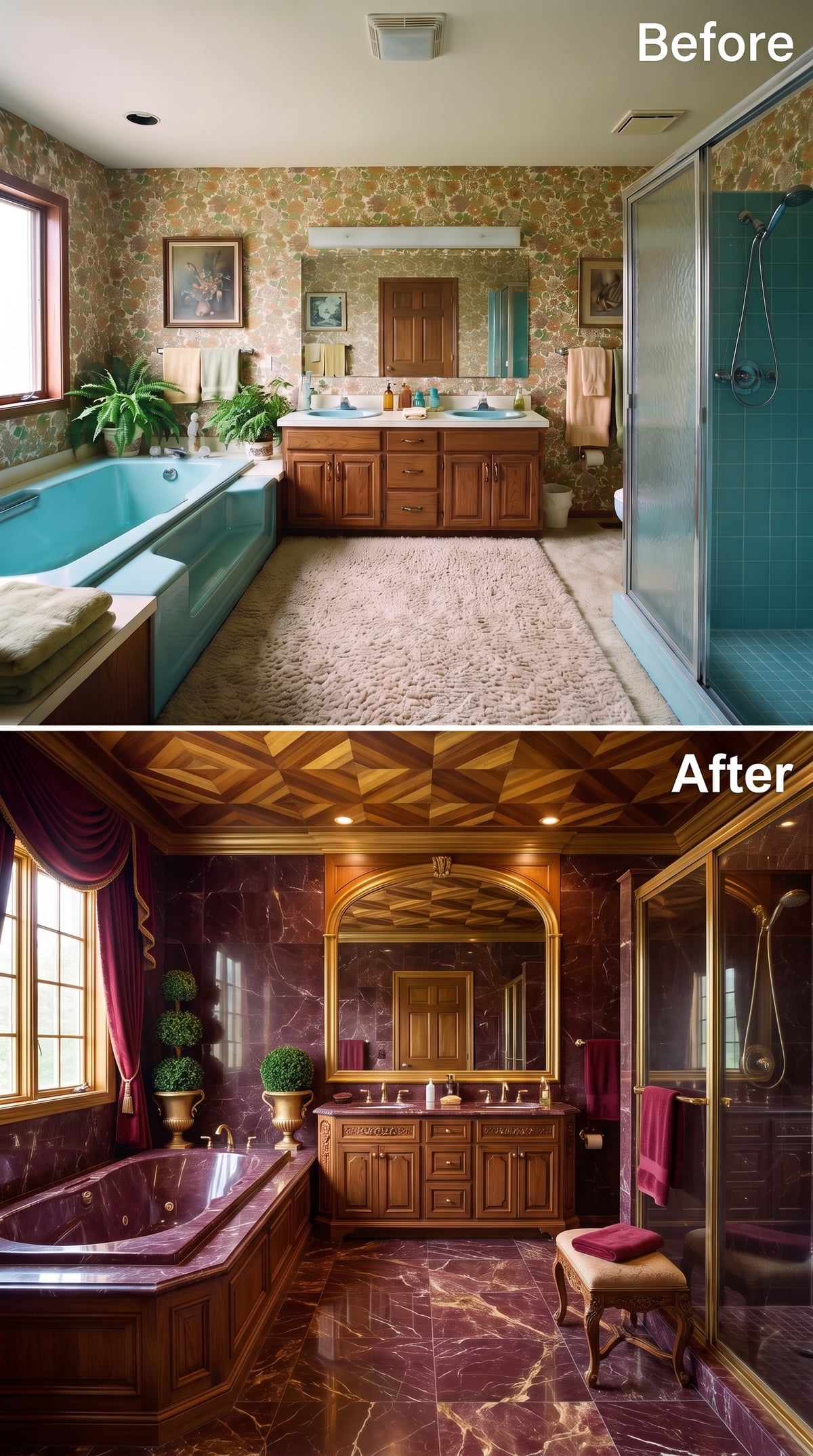
Rouge marble covers the walls and bathing area with dense red veining, creating a richly patterned enclosure. Against that stone, a carved walnut vanity and gilded mirror frame introduce furniture-like detail associated with traditional luxury interiors.
The parquet-patterned ceiling extends the ornament overhead, while crimson drapery and brass planters deepen the palette. Almost every surface has a distinct decorative character. What prevents the room from dissolving into unrelated embellishments is the consistent use of reds, browns, and golds across the stone, wood, and metalwork.
24. Rattan Coffers and Encaustic Tile Give Olive Plaster a Patterned Foundation
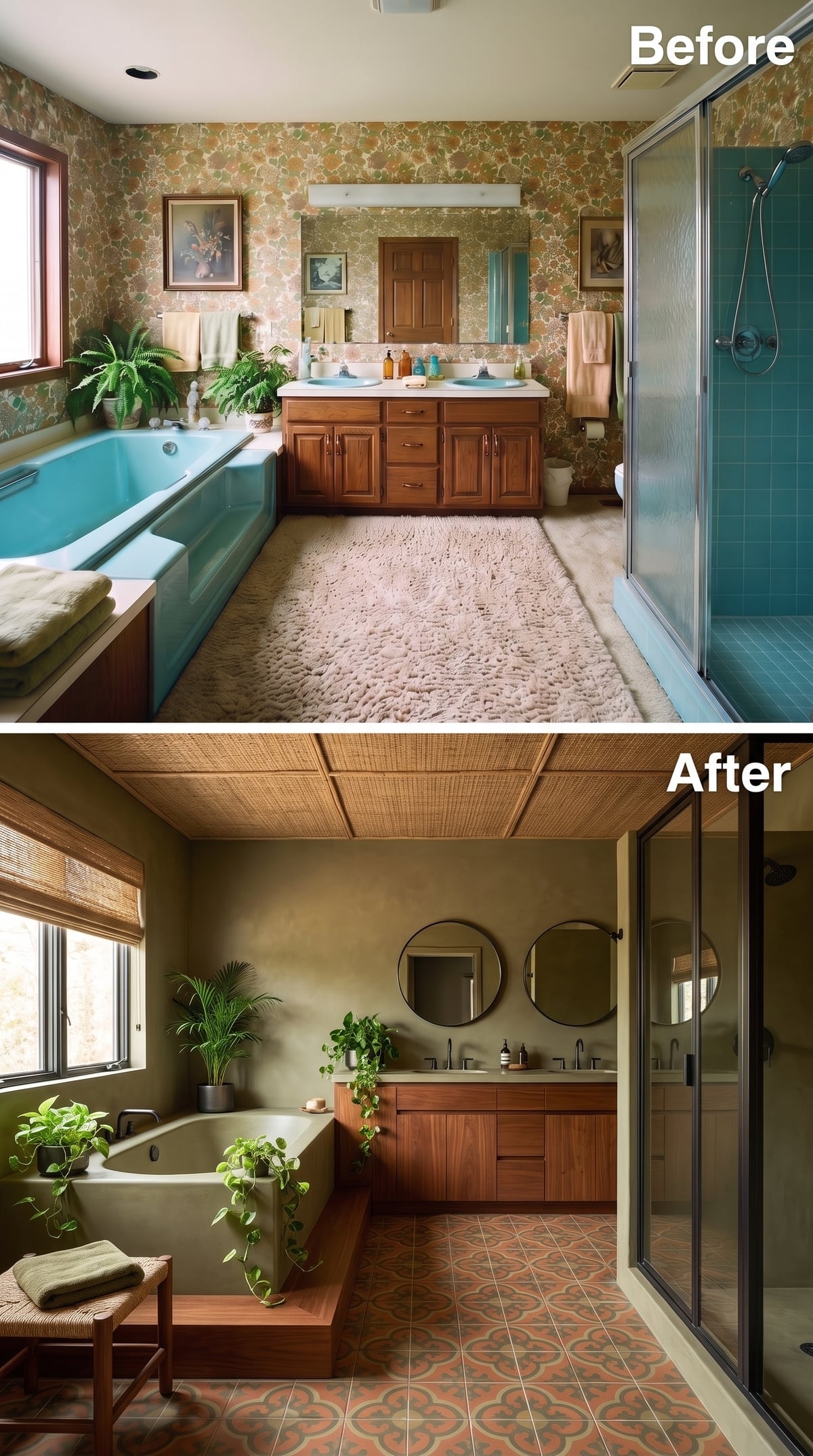
Olive plaster provides a subdued background for a much more intricate collection of materials. The coffered rattan ceiling adds a woven texture overhead, while geometric floor tile combines terracotta and sage in a pattern that links the warm and cool elements of the palette.
Walnut cabinetry and round mirrors give the vanity wall a more conventional structure. A concrete tub on a raised wood platform introduces a substantial, sculptural form. Natural-fiber ceiling treatments require careful attention to ventilation and moisture exposure, but the visual effect here is an appealing alternative to another expanse of painted drywall.
23. Peach Plaster and Scalloped Ceilings Trade Straight Lines for Curves
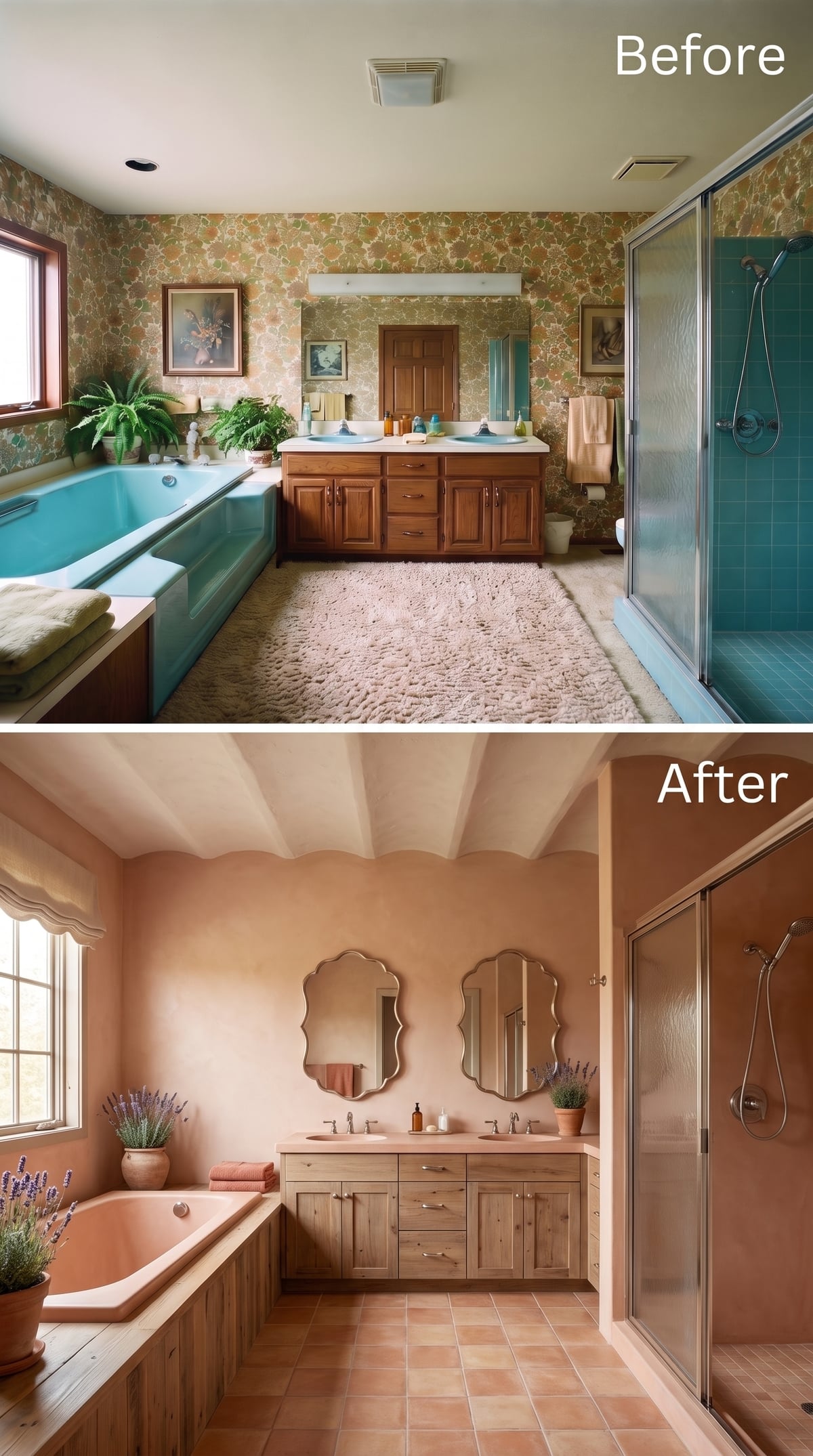
Peach-terracotta plaster wraps the room in a warm mineral color, but the ceiling is what gives the design its unusual silhouette. Scalloped arches interrupt the familiar right angle between wall and ceiling, introducing a series of soft curves overhead.
Wavy-edged mirrors repeat that geometry above the double vanity, while knotty wood cabinetry and terracotta floor tiles strengthen the earthy palette. Lavender plants provide a small contrasting note. The recurring curves give the bathroom a more sculpted character than a conventional arrangement of rectangular mirrors, cabinets, and tile.
22. A Living Wall Turns the Vanity Into a Garden
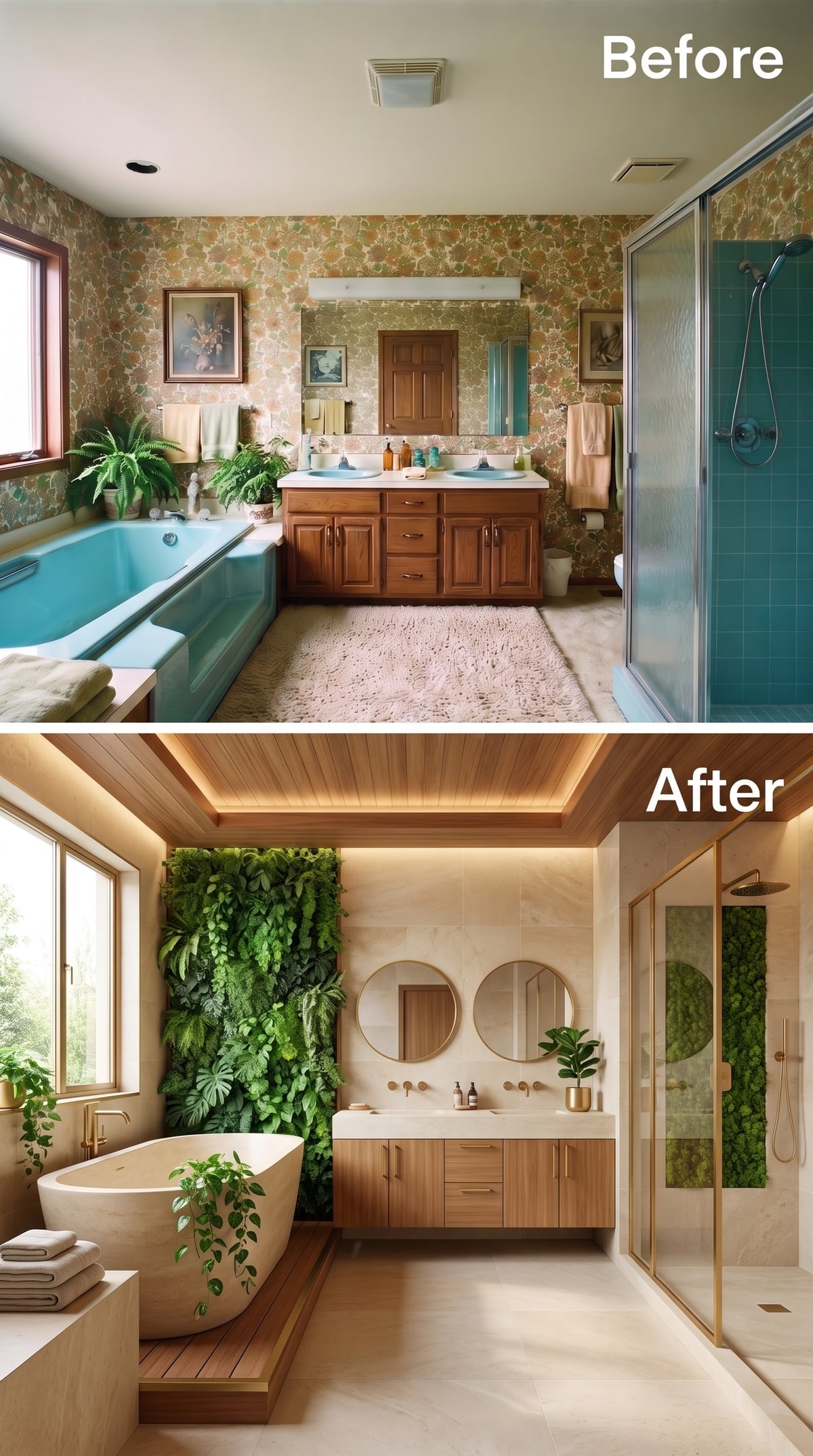
A wall of moss and tropical foliage rises behind the floating vanity, replacing the usual tile or plaster backsplash with a dense vertical composition of greenery. The planting introduces irregular shapes and several shades of green into a room otherwise organized around clean horizontal lines.
Wood cabinetry and a plank ceiling give the vegetation a natural counterpart, while brass-framed mirrors add controlled geometry against the foliage. A stone soaking tub on a teak platform provides a quieter sculptural element. A living wall would require an appropriate irrigation, drainage, lighting, and maintenance system, but as a design statement, it radically changes the relationship between bathroom and garden.
21. Gray Plaster and Walnut Give Cool Minimalism a Warmer Side
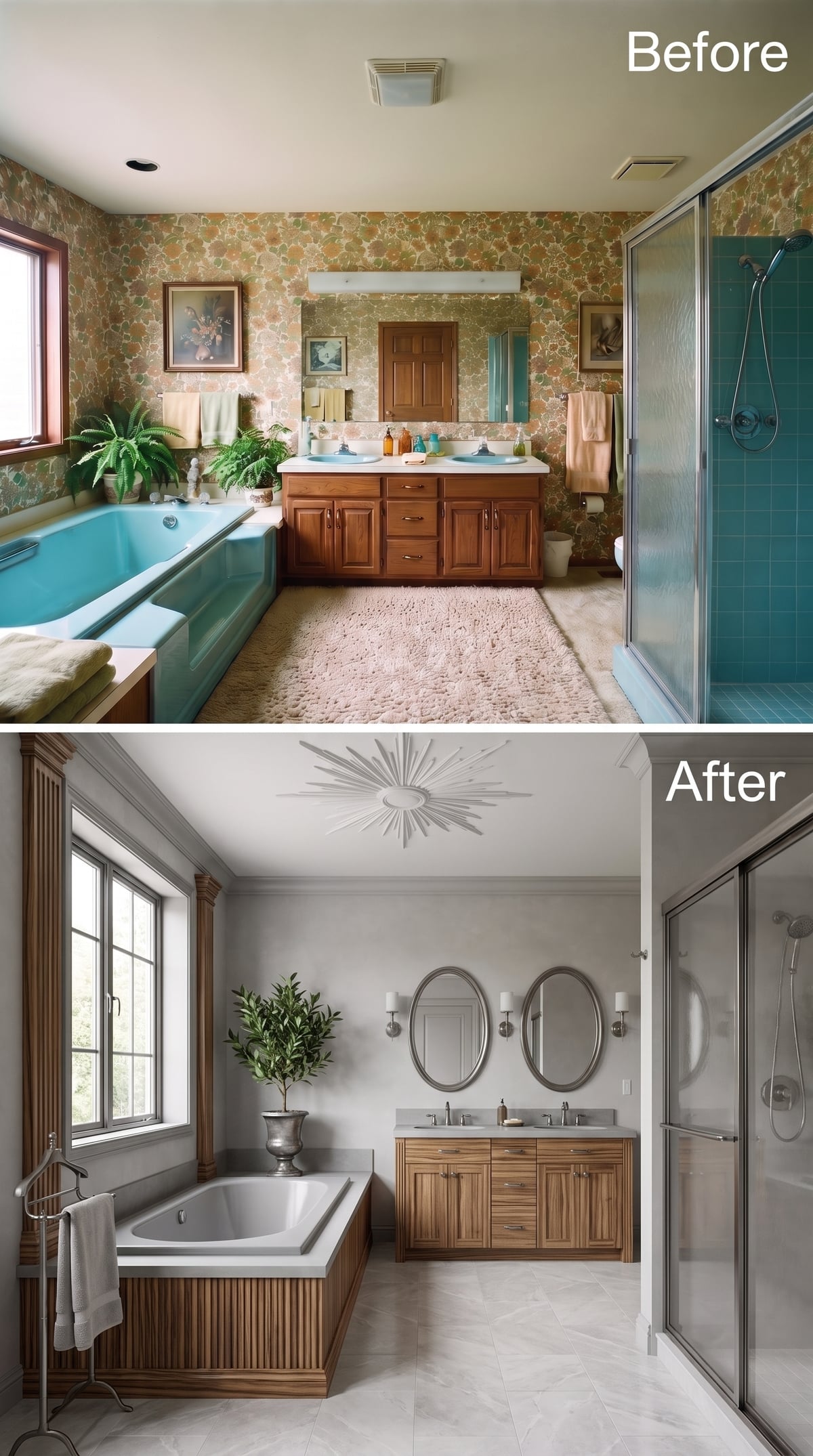
Soft gray plaster establishes a cool, even backdrop, with subtle variation appearing where the sconces illuminate the wall. Walnut-toned cabinet fronts introduce warmth through natural grain, creating a contrast that feels more substantial than another gray-and-white scheme.
Oval mirrors soften the vanity’s rectangular outline, while slatted wood detailing on the tub surround repeats the cabinetry’s color. A decorative ceiling medallion introduces relief overhead without changing the restrained palette. The room’s interest comes from the difference between smooth plaster, patterned wood, and carefully placed curves.
20. Rose Marble and a Pleated Ceiling Give Pink an Architectural Makeover
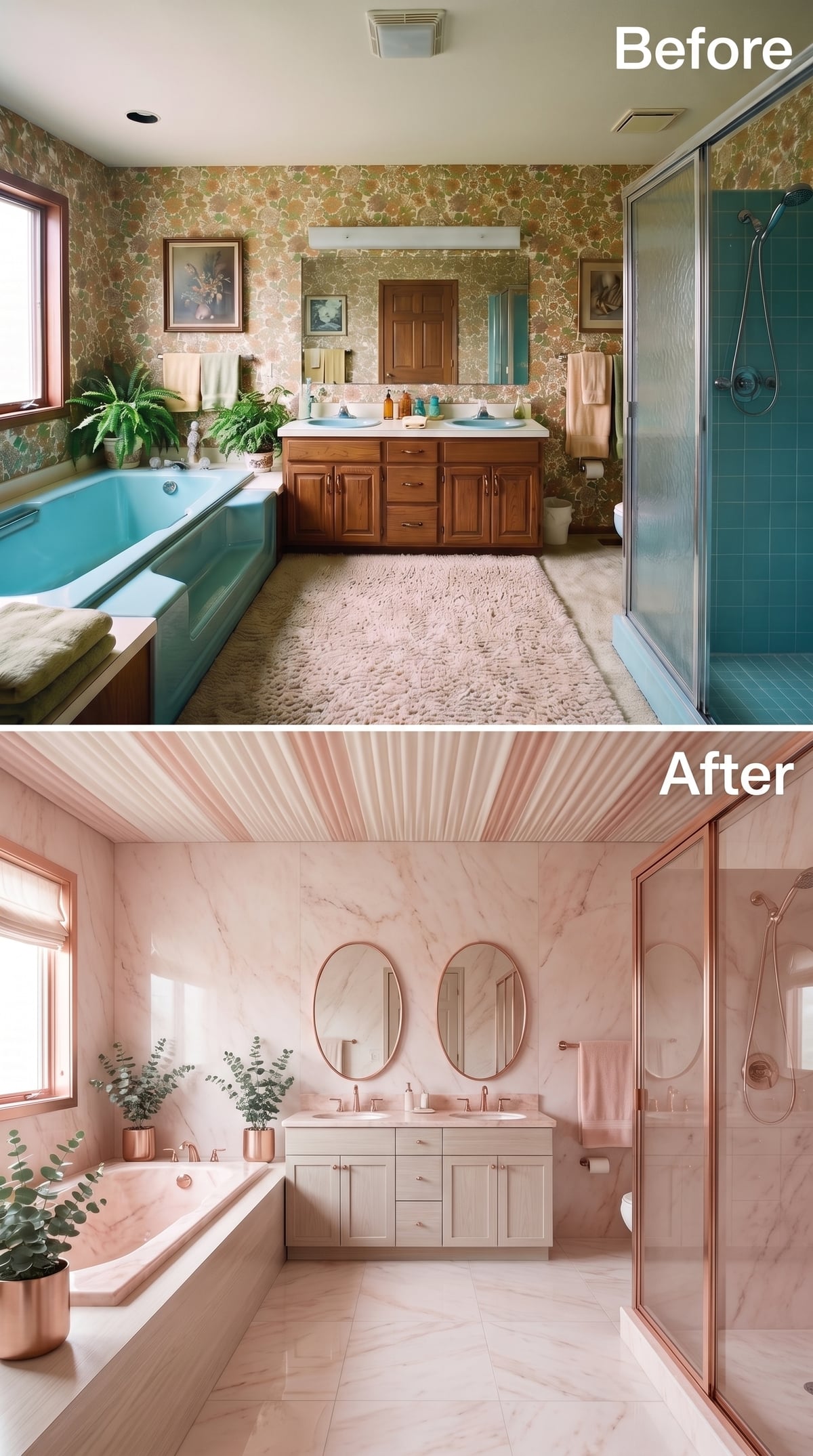
Blush marble extends across the walls, carrying natural-looking veining through a palette associated with some of the most recognizable bathrooms of the mid-20th century. Here, however, the pink is expressed through stone rather than colored porcelain fixtures.
A pleated ceiling radiates outward above the room, adding strong sculptural movement. White floating cabinetry provides relief from the pink surfaces, while rose-gold fixtures repeat their warmth in a reflective finish. The design revisits a familiar historical color but gives it an entirely different architectural setting.
19. Butter Yellow and a Slatted Wood Ceiling Make a Case for Gentle Color
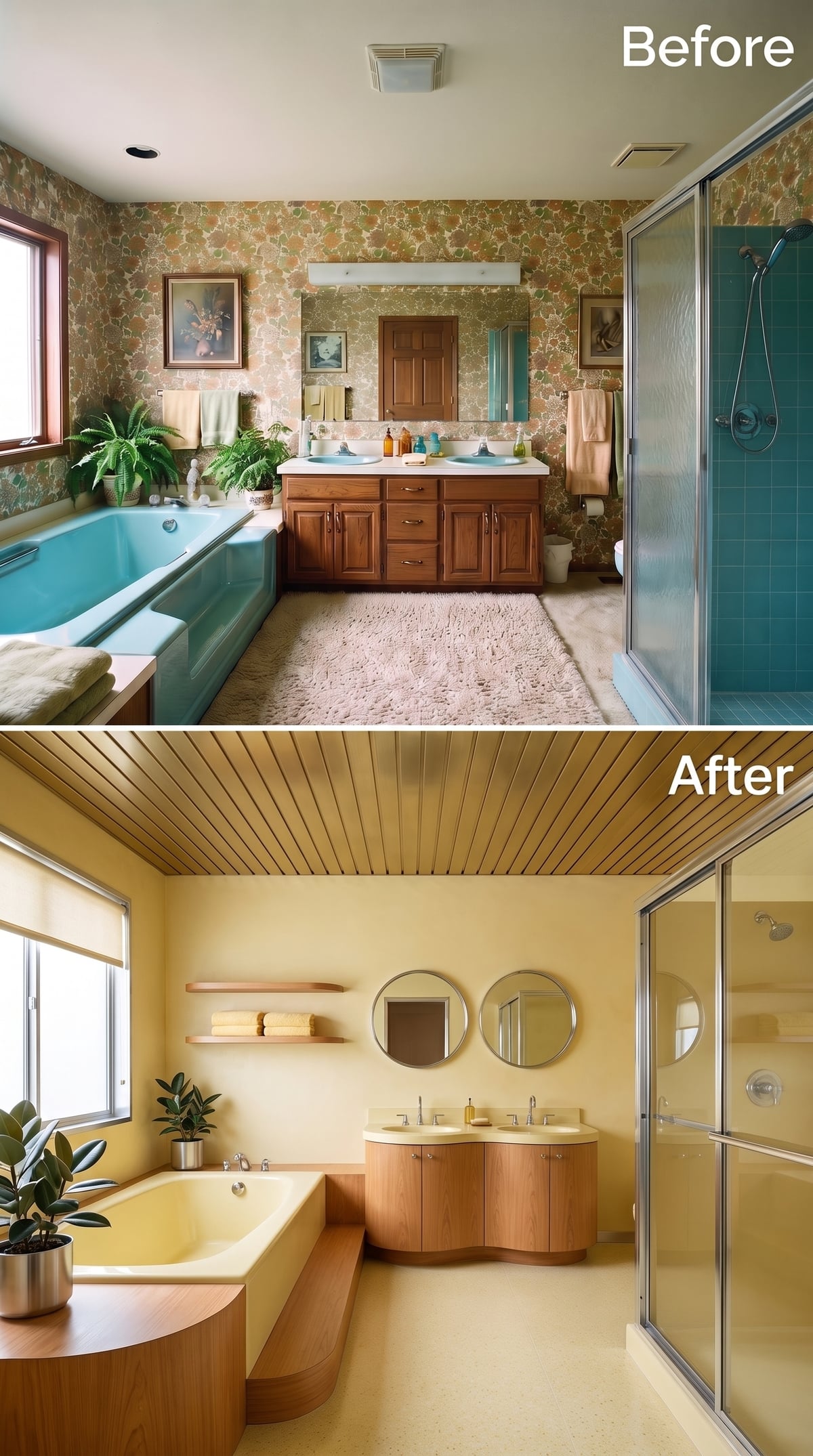
Butter-yellow plaster brings warmth without the saturation of mustard or ocher. The soft color works alongside the natural wood ceiling, whose radiating slats introduce a directional pattern above the double vanity.
Curved wood cabinetry provides another departure from conventional straight-edged bathroom furniture. Two round mirrors establish individual stations above the sinks, repeating the gentle geometry of the vanity. The result is a room defined by warm color and rounded forms rather than elaborate surface decoration.
18. Black Marble and Brass Bring a More Formal Kind of Drama
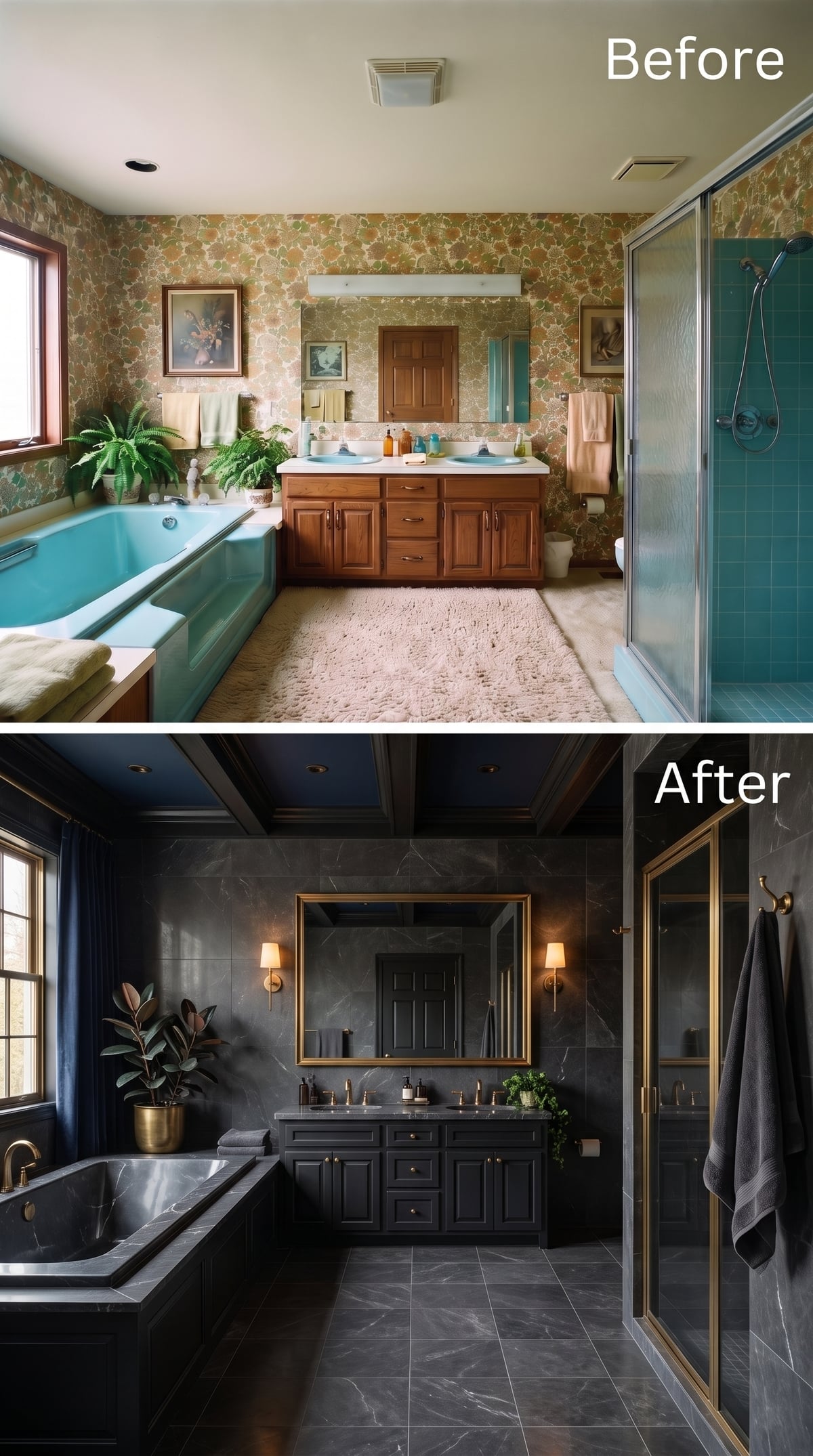
Black and charcoal marble create a dramatic envelope, with pale veining breaking across the darker surfaces. The room’s brass accents become especially prominent against that background, bringing warmth and reflected light to a palette that might otherwise feel severe.
A gold-framed mirror gives the vanity wall a formal focal point, while the ceiling treatment adds another layer of architectural detail. Rather than trying to lighten the entire room, the design concentrates brightness in metalwork and selected illuminated surfaces. The effect is deliberate, enclosed, and distinctly luxurious.
17. Mauve Plaster and a Basketweave Ceiling Turn an Old-Fashioned Color Into Something Unexpected
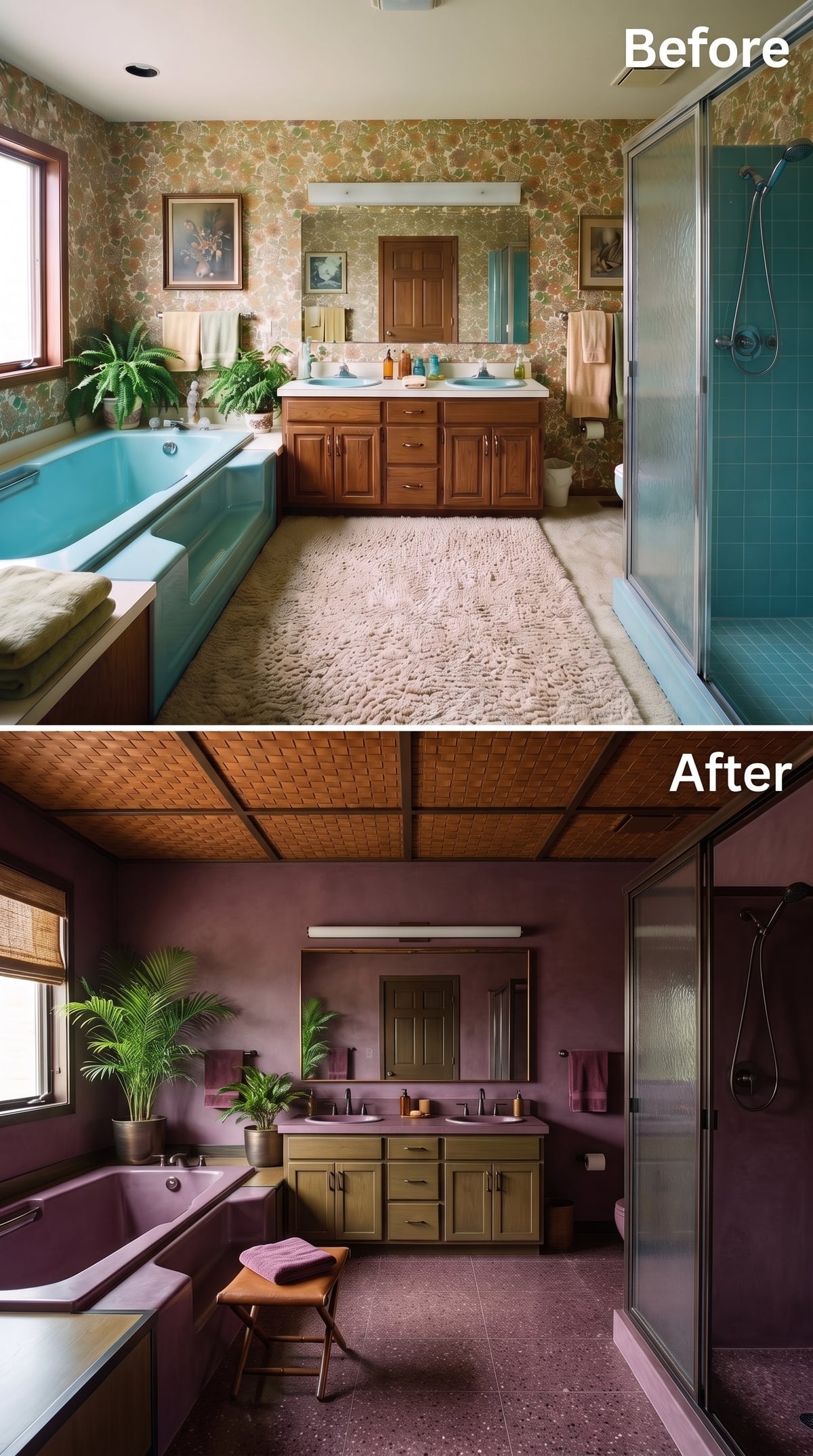
Dusty mauve plaster gives the walls a muted, almost fig-colored richness. Rather than matching it with more pink, the design introduces sage-green cabinetry, allowing the vanity to stand apart from the warmer background.
Overhead, terracotta-colored basketweave tile sits between dark wood beams, producing a ceiling with considerable depth and pattern. Mauve-toned terrazzo connects the floor to the walls, while plants and a small wooden stool provide more informal details. The combination makes an older color family feel deliberate through unusual material pairings.
16. Slate Blue Venetian Plaster Meets Live-Edge Wood and Dark Penny Tile
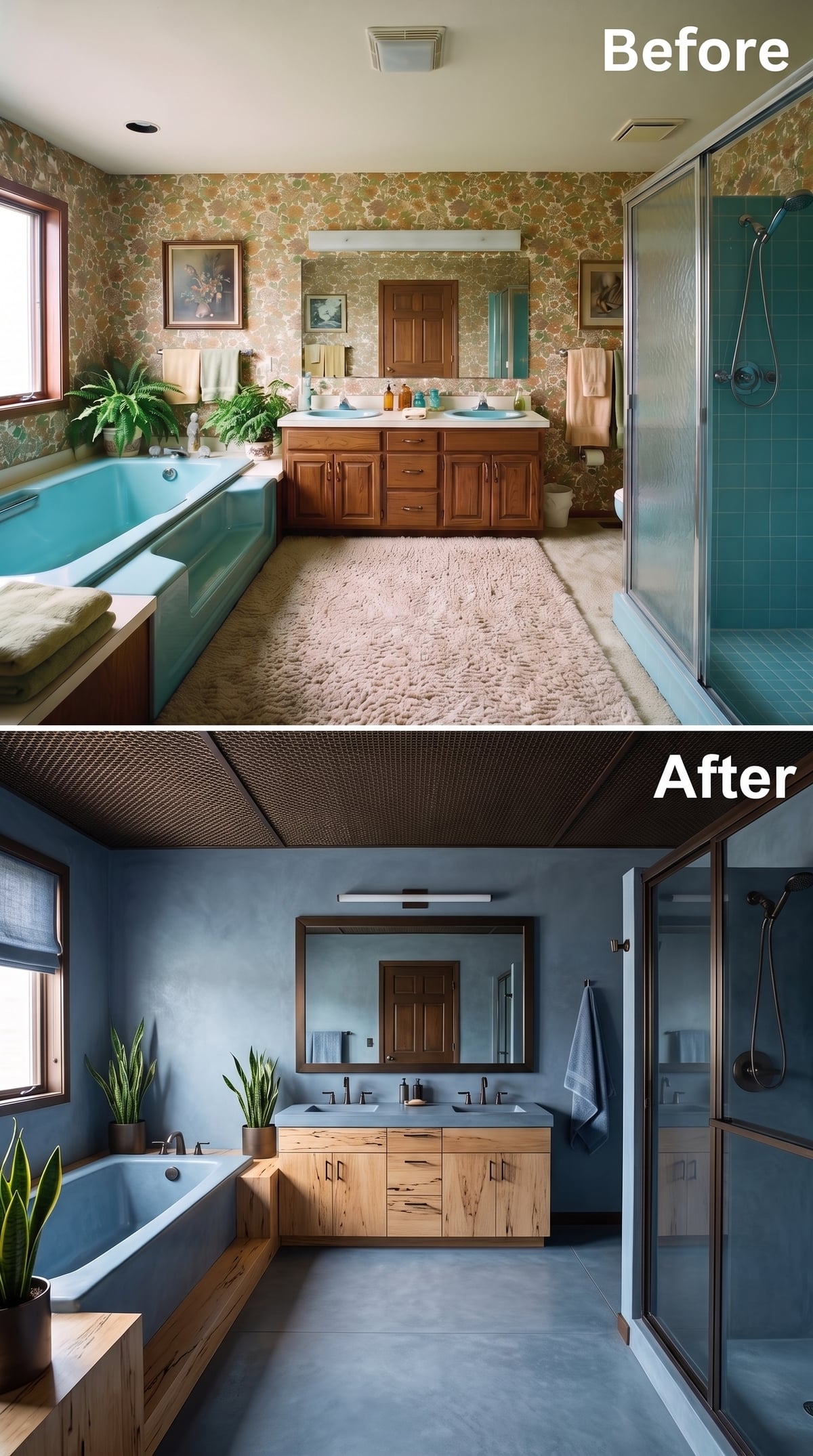
Slate-blue Venetian-style plaster gives the walls a layered, mineral appearance, while a dark penny-tile ceiling extends the cool palette overhead. The small circular tiles introduce a tight repeated pattern against the broader movement of the plaster.
A live-edge wood vanity brings a markedly different geometry to the room. Its irregular natural outline contrasts with rectangular sinks and the disciplined repetition of the ceiling tiles. Matte bronze fixtures contribute warmth without competing with the grain. The wood’s individuality is especially apparent against the controlled blue surfaces.
15. Warm Plaster and a Rose Marble Tub Push the Bathroom Toward Old-World Opulence
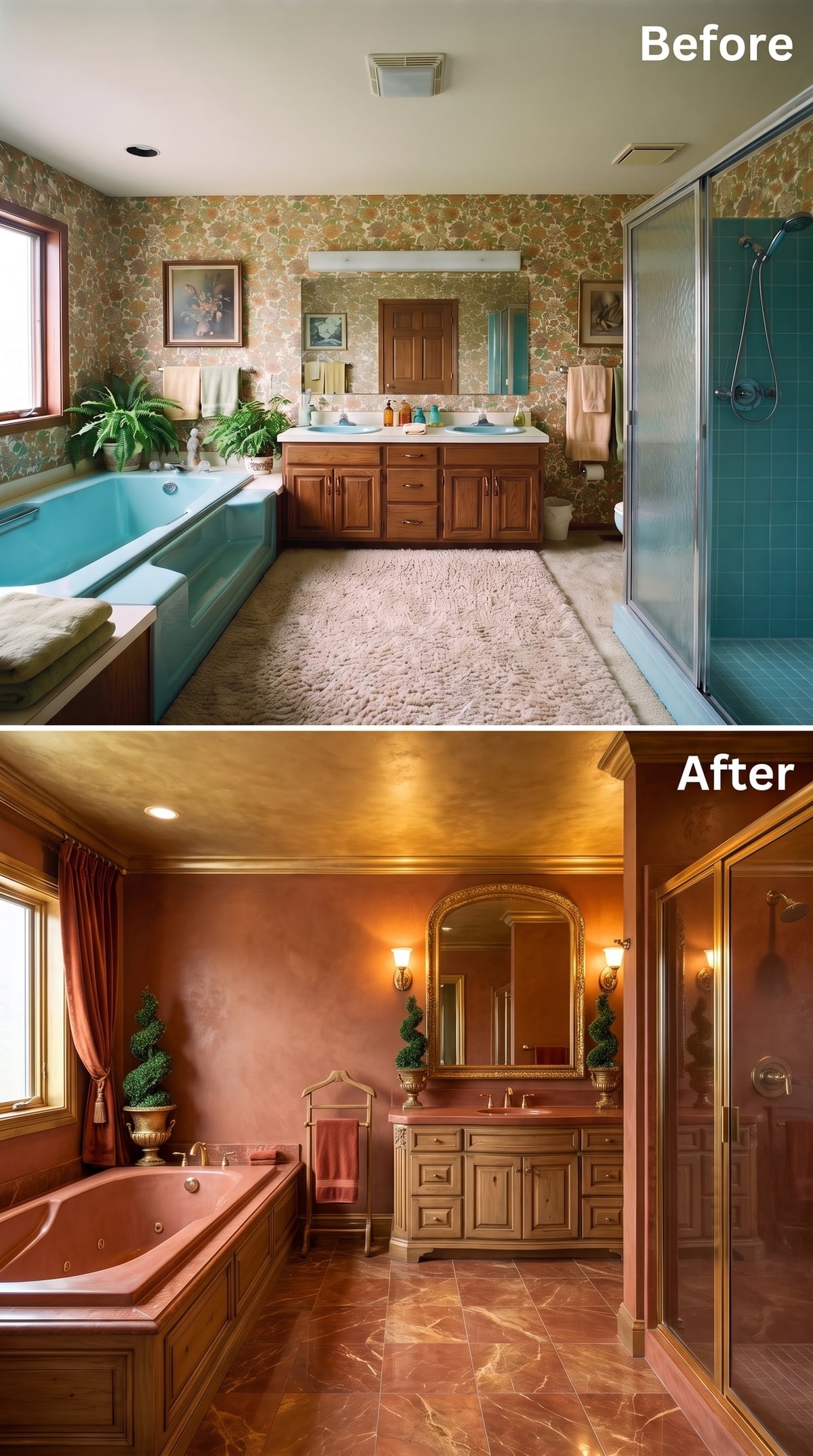
Saturated terracotta plaster creates a warm backdrop for gilded crown molding, elaborate mirror framing, and traditional candelabra-style sconces. The combination favors ornament and strong color rather than the restraint common to contemporary spa bathrooms.
A rose-marble tub surround and matching countertop deepen the pink-red palette. Raised-panel wood cabinetry introduces traditional furniture detailing, while gold planters repeat the metalwork. The room has a highly decorative identity, with stone, plaster, and gilding arranged around a consistent family of warm tones.
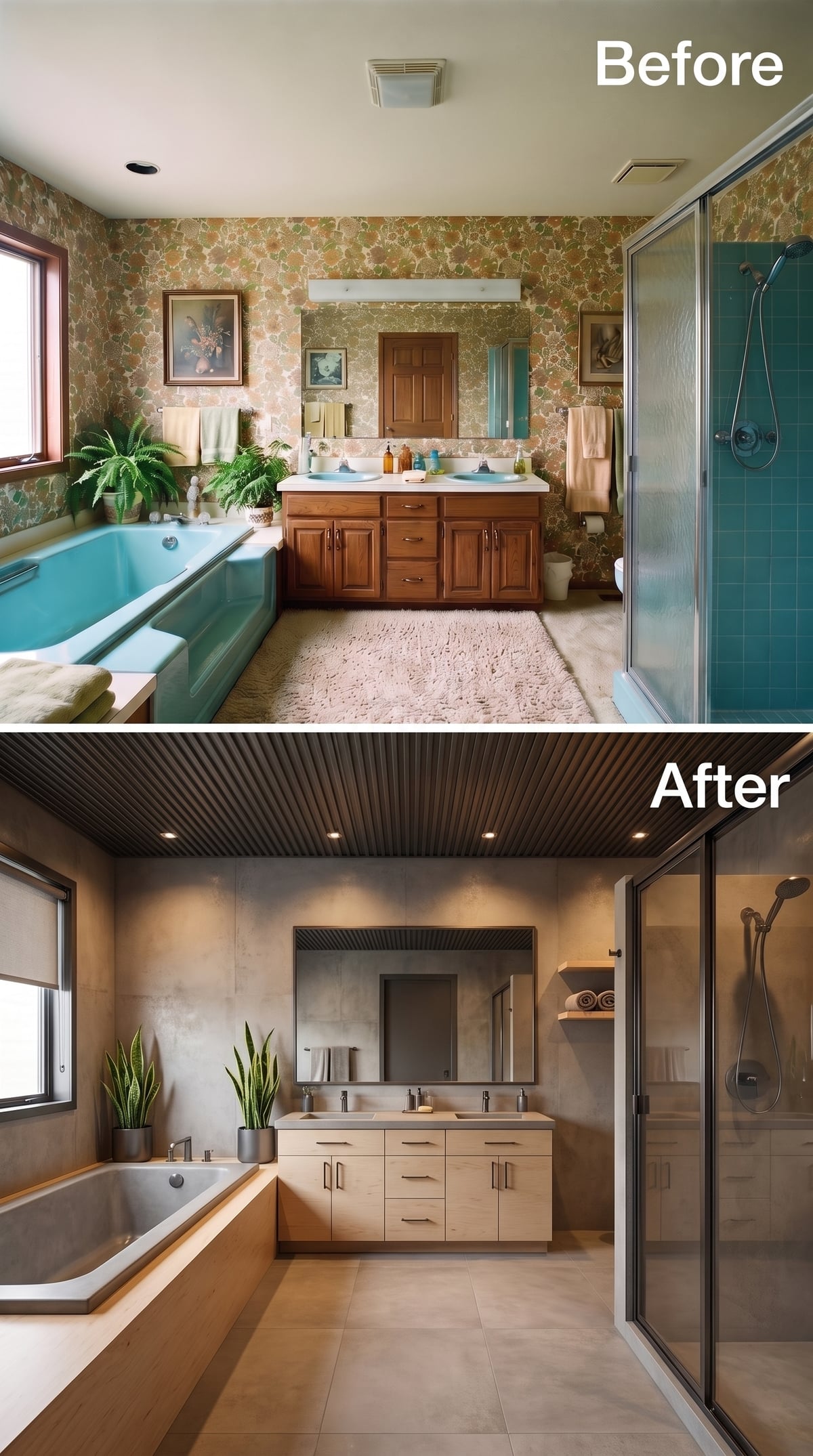
14. Concrete Walls and a Dark Slatted Ceiling Give the Bathroom a Sharper Edge
🔥 Would you like to save this?
Warm concrete plaster provides a continuous backdrop for a room organized around crisp rectangular forms. Large stone-look floor tiles reinforce that geometry, while a light maple vanity introduces a softer material beneath the broad mirror.
The dark slatted ceiling creates a striking overhead contrast. Recessed lighting emphasizes selected areas, and the black-framed glass shower establishes a clear boundary without a solid partition. A wood-framed soaking tub completes the arrangement, balancing the industrial character of the plaster with the warmth of natural timber.
13. Sand-Toned Limewash and Floating Maple Find Strength in Simplicity
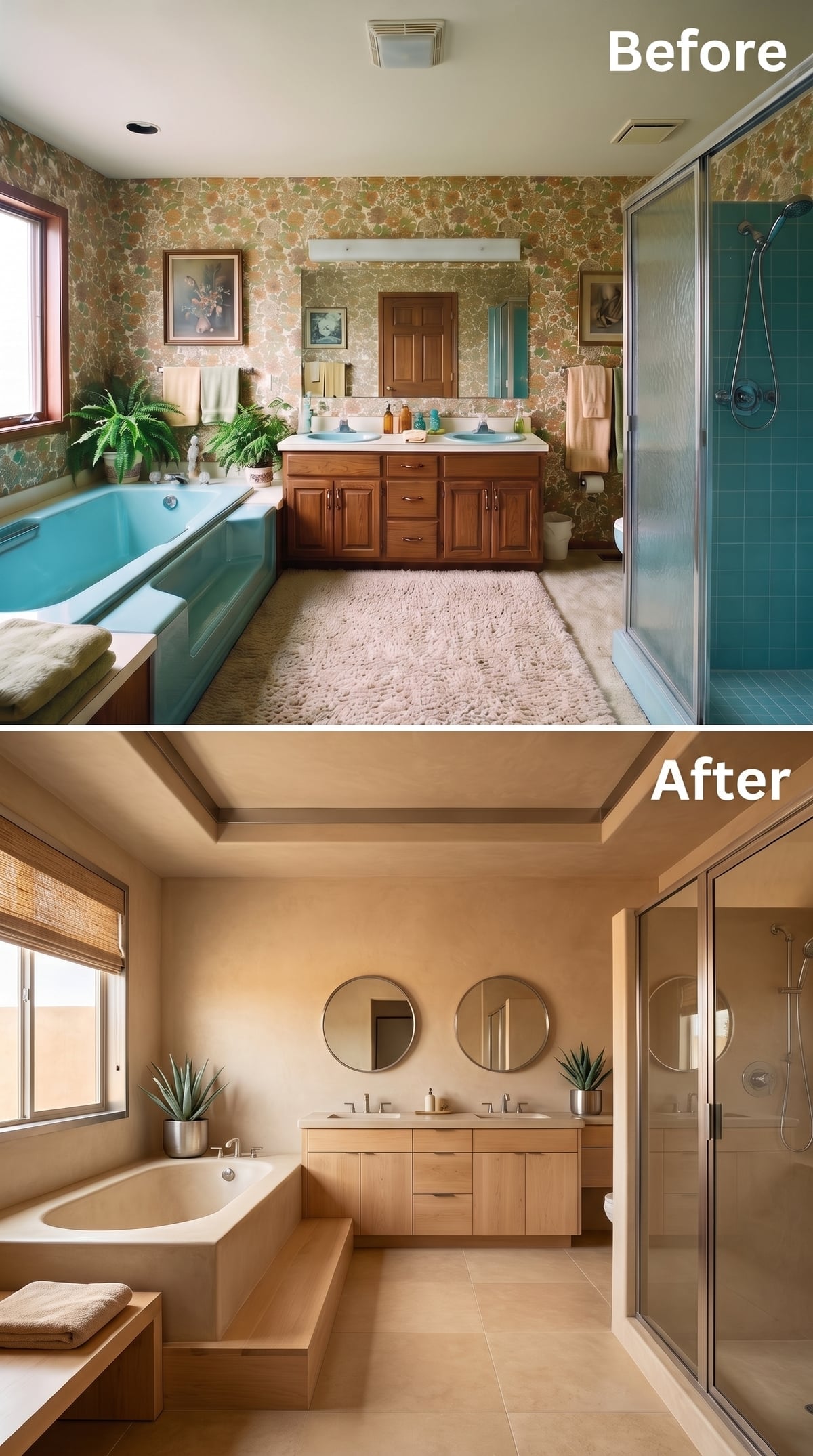
Biscuit-colored limewash-style plaster creates a warm, gently varied surface across the walls. Its subdued finish allows the floating maple vanity to become the room’s strongest horizontal element, with the open floor beneath giving the cabinetry a lighter appearance.
Two round mirrors establish symmetry without introducing heavy frames or elaborate decoration. The close relationship between wall color and wood tone gives the room continuity, while the floating cabinet and circular mirrors provide enough geometric contrast to prevent the palette from becoming monotonous.
12. Arched Mirrors and a Ribbed Ceiling Make Cream and Gold Feel Architectural
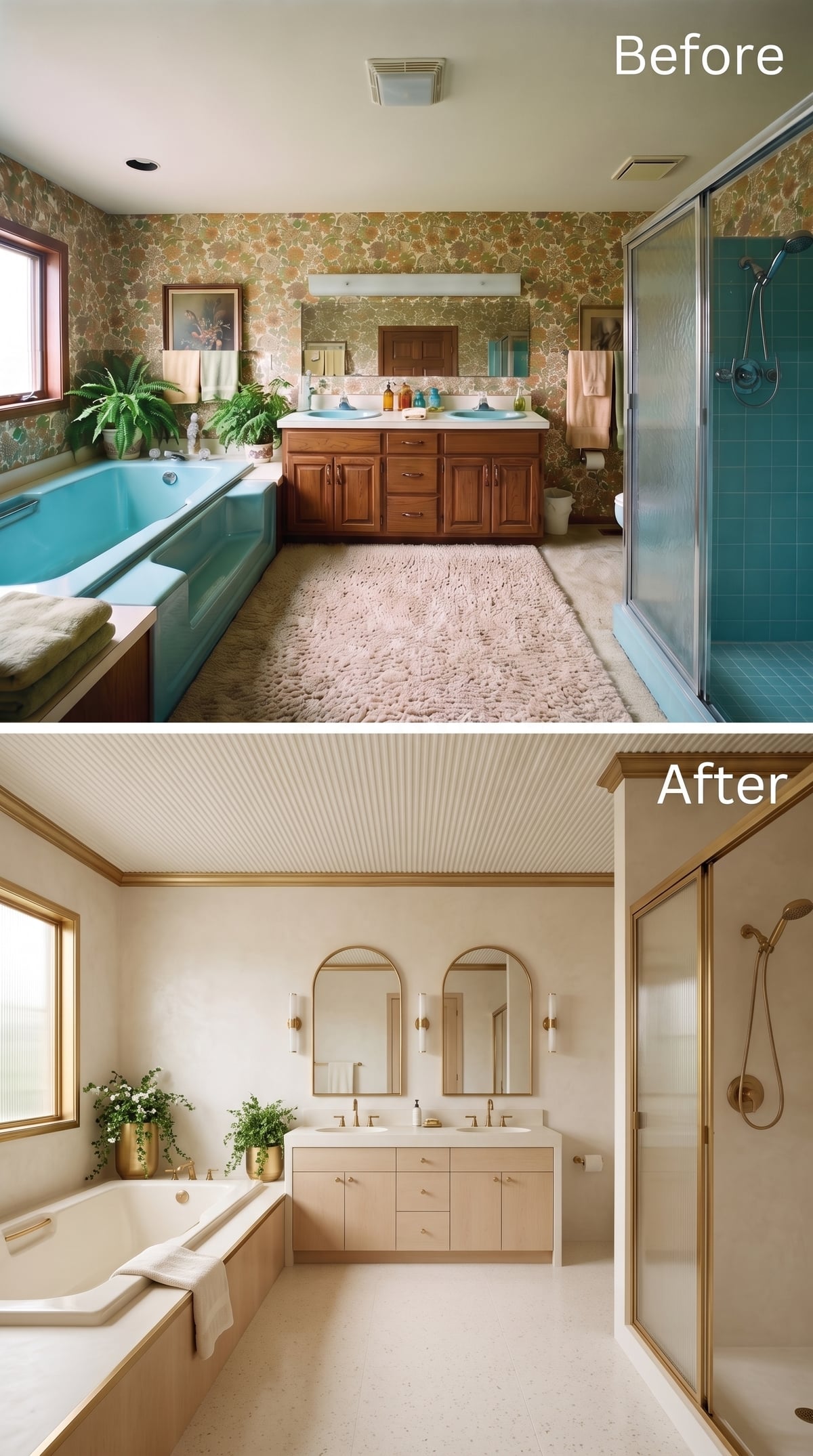
Cream plaster and a ribbed ceiling share a warm white palette, creating a continuous background for gold trim and pale maple cabinetry. The ceiling’s repeated lines introduce relief, while gilded perimeter molding defines the transition between wall and overhead surface.
Arched mirrors provide a contrasting silhouette above the double vanity. Separate sconces give each sink its own lighting arrangement, and the floating cabinetry leaves more of the floor visible. The gold details are concentrated around the mirrors, ceiling edge, and accessories rather than scattered indiscriminately across every surface.
11. Whitewashed Oak and Subway Tile Give Traditional Materials a Cleaner Outline
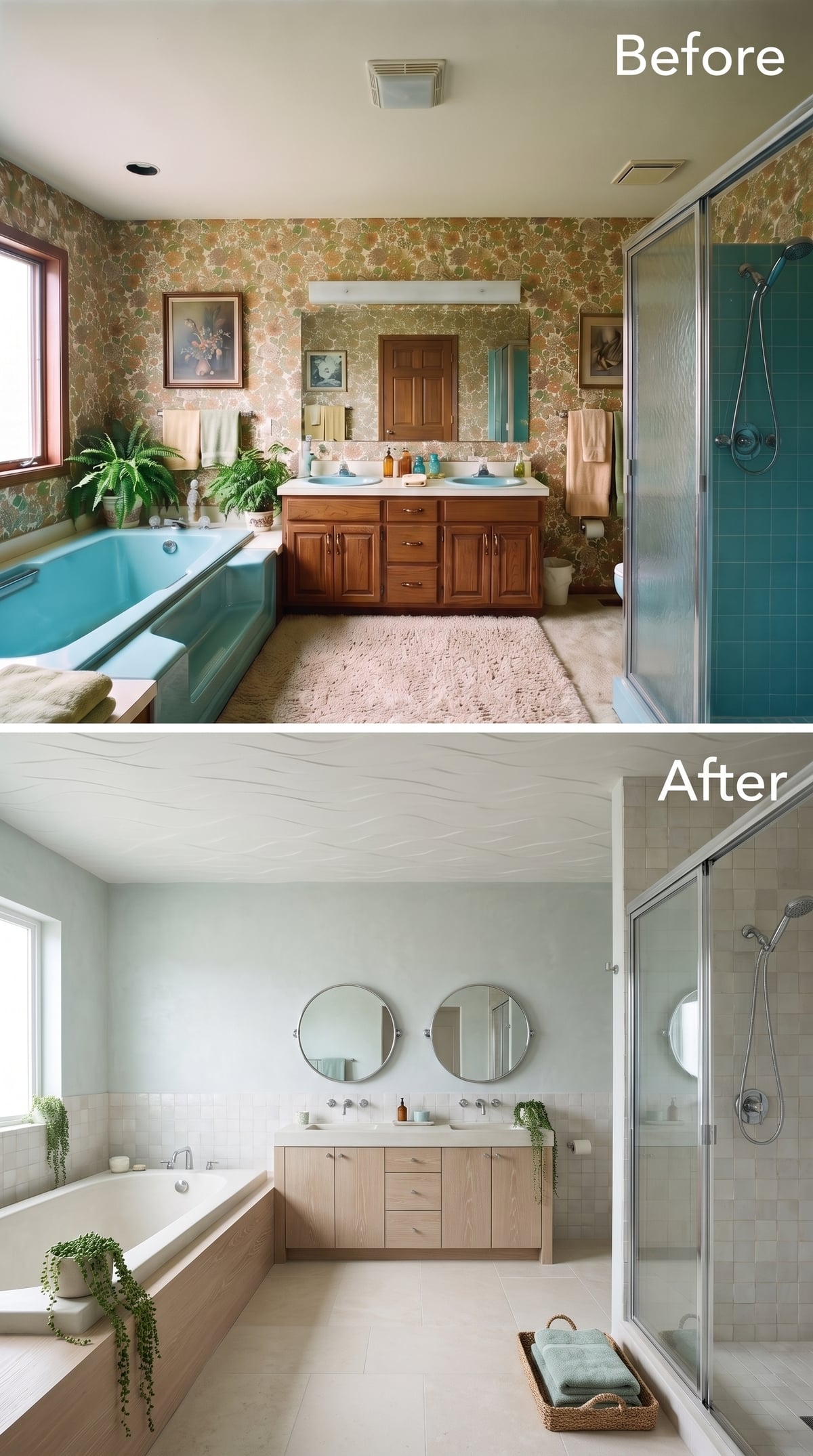
Whitewashed oak cabinetry introduces visible grain without the darker weight of traditional stained wood. The pale vanity sits comfortably beside white subway tile, whose repeated rectangular pattern provides texture without a strong color contrast.
A pair of round mirrors breaks up the straight lines of the cabinetry and tile. Trailing pothos introduces a vivid green accent against the otherwise pale surfaces. The composition relies on familiar materials, but the light finish, simple geometry, and restrained planting give them a more contemporary relationship.
Subway tile does well with Home Stratosphere readers too: images featuring it got hearts 49% of the time, compared with 44% for other images in the same articles.
10. Marble Slabs and Walnut Coffers Transform the Ceiling Into Architecture
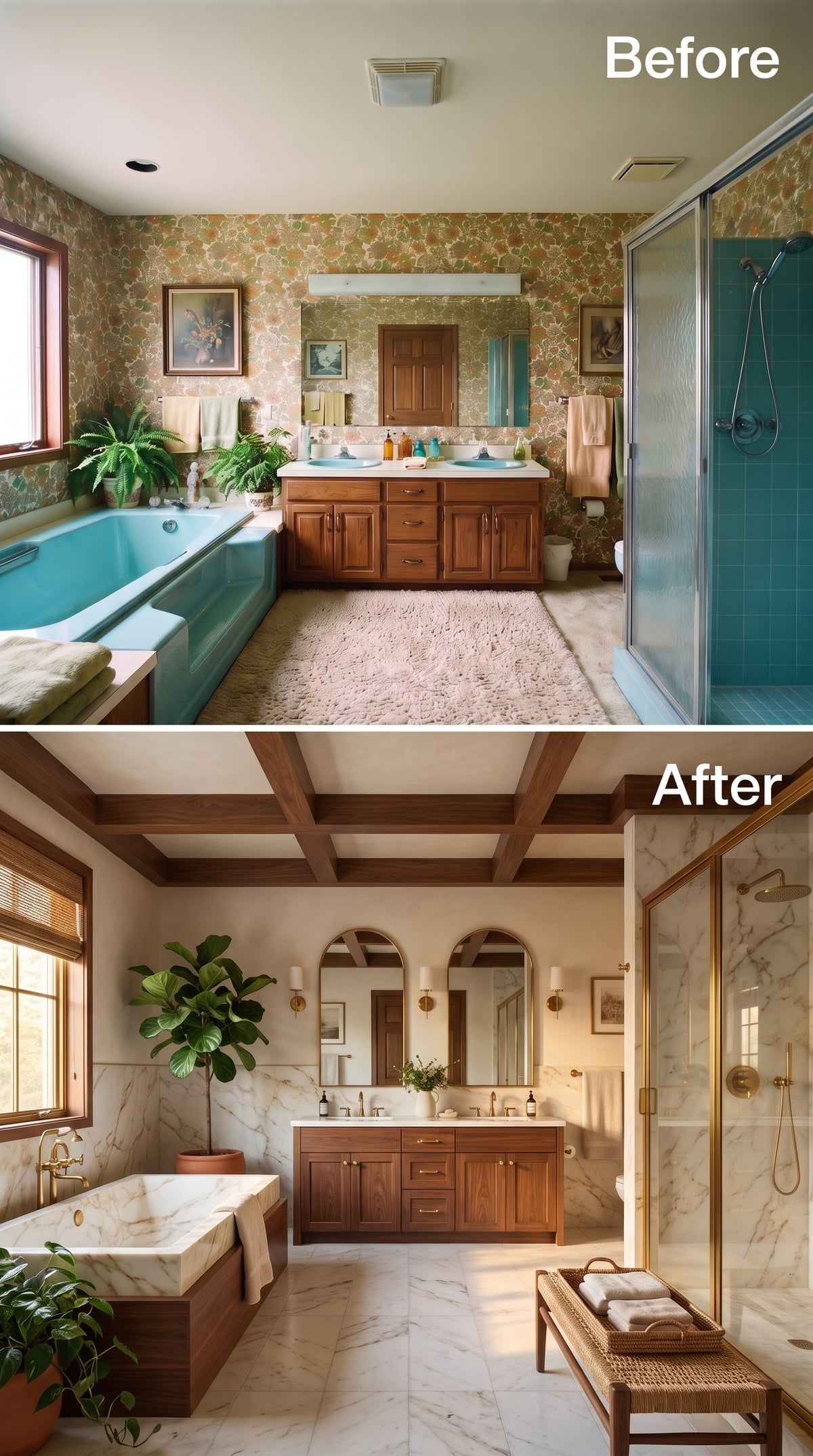
Walnut beams divide the ceiling into a strong grid, introducing the kind of architectural treatment more commonly associated with formal living spaces. Below, large marble surfaces create a quieter field of natural veining, preventing the room from becoming a competition between small decorative patterns.
Brass fixtures connect the vanity and shower, while arched mirrors provide relief from the repeated rectangles overhead. The contrast between dark wood, pale marble, and warm metal gives the bathroom a substantial, almost residential-suite character rather than the anonymity of a conventional spa interior.
9. Chevron Wood Overhead and Copper Fixtures Redefine the Neutral Bathroom
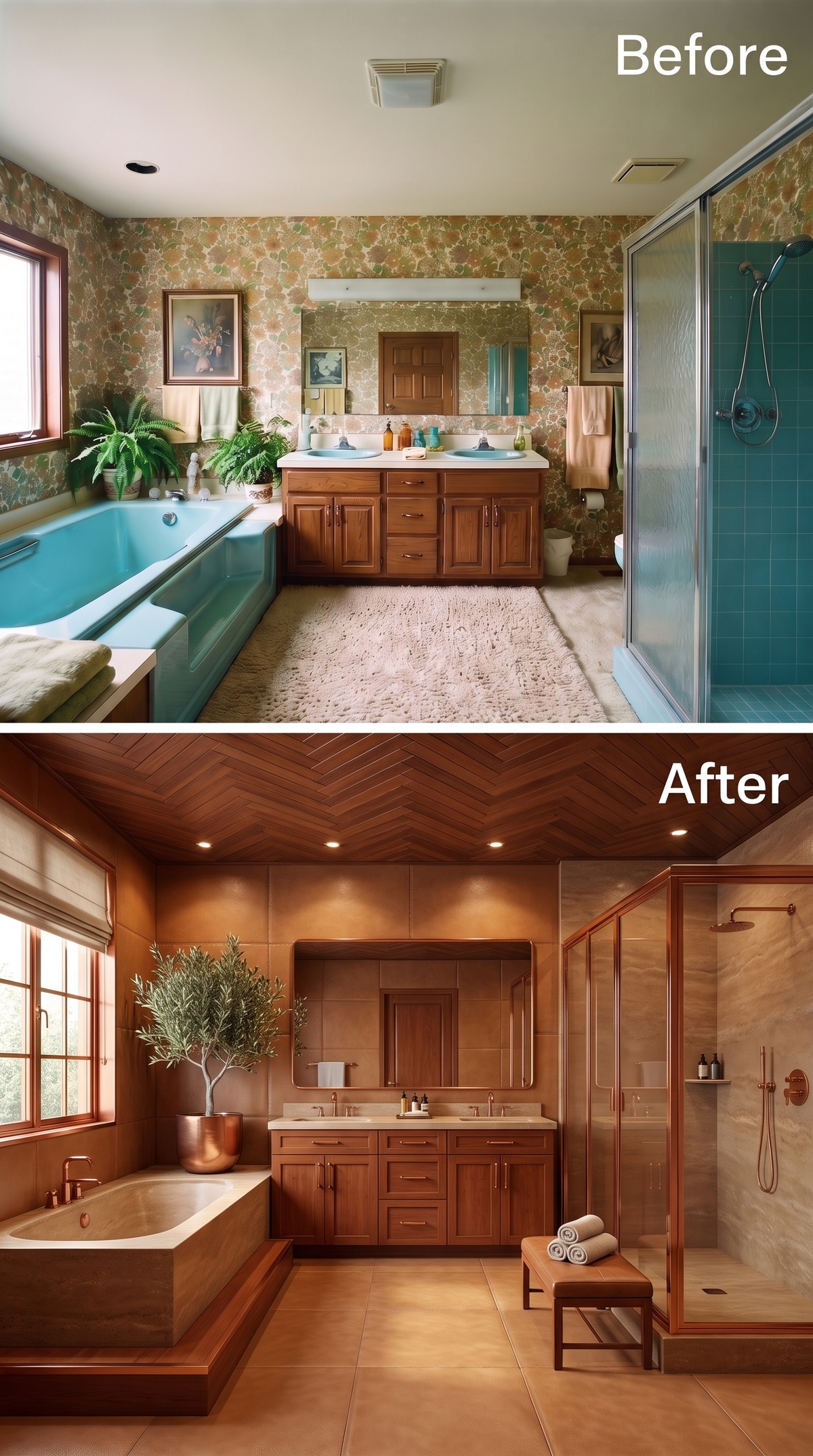
Chevron-patterned wood planks cover the ceiling, their angled arrangement introducing movement into a room otherwise organized around straight cabinet lines and broad stone surfaces. The pattern is pronounced enough to become an architectural feature without relying on strong color.
Walnut cabinetry and copper pulls extend the warm material palette down the vanity wall. Copper-toned shower fixtures repeat the metal, while stone around the raised soaking tub introduces a cooler counterpoint. The ceiling supplies geometry; the stone and cabinetry provide visual stability.
8. Travertine and Bronze Create a Bathroom Built Around Stone
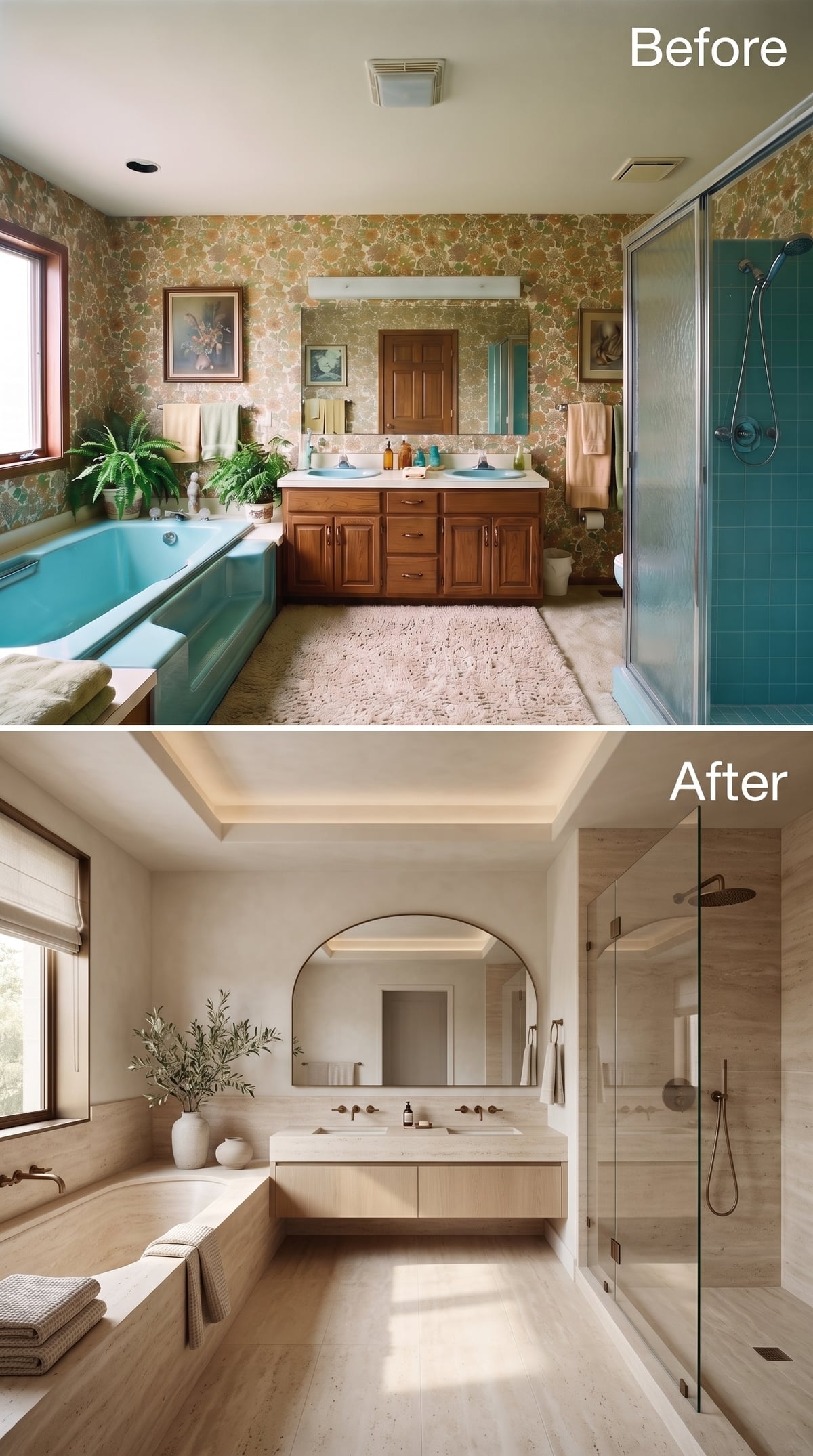
Travertine extends across the floor, walls, and tub surround, creating a continuous field of warm beige stone. The material’s natural-looking variation supplies subtle movement, allowing the room to remain visually interesting without contrasting tile patterns.
A floating wood vanity picks up the amber tones in the stone, while an arched mirror introduces a single strong curve. Bronze fixtures add a darker metallic note. For a built renovation, the stone’s finish, sealing, and suitability for wet areas would require careful specification, but the design’s visual strength comes from the continuity of its surfaces.
7. Rose Gold and Coffered Detailing Warm Up an Ivory Marble Bathroom
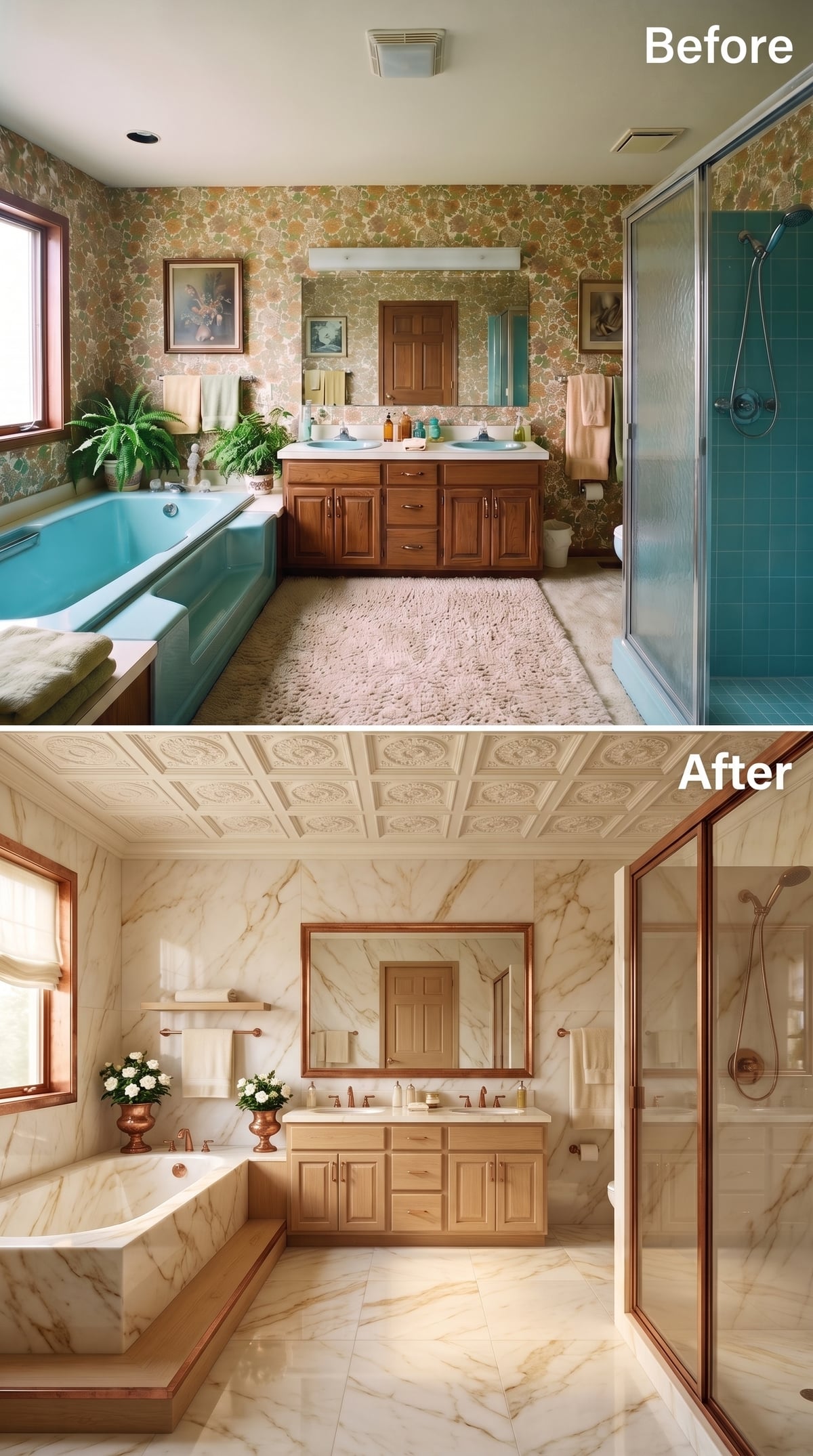
Ivory marble wraps the walls in soft, cream-colored veining, creating a lighter interpretation of a stone-lined bathroom. Maple cabinetry continues the warm undertones without matching the marble exactly, giving the vanity its own recognizable material character.
Rose-gold faucets, towel fittings, and tub hardware introduce a delicate metallic contrast. Above, a coffered ceiling with medallion detailing adds ornament to an otherwise restrained arrangement. The room balances decorative overhead architecture with the quieter surfaces of the marble and pale wood.
6. Plaster Walls and a Stone Tub Turn Minimalism Into a Material Study
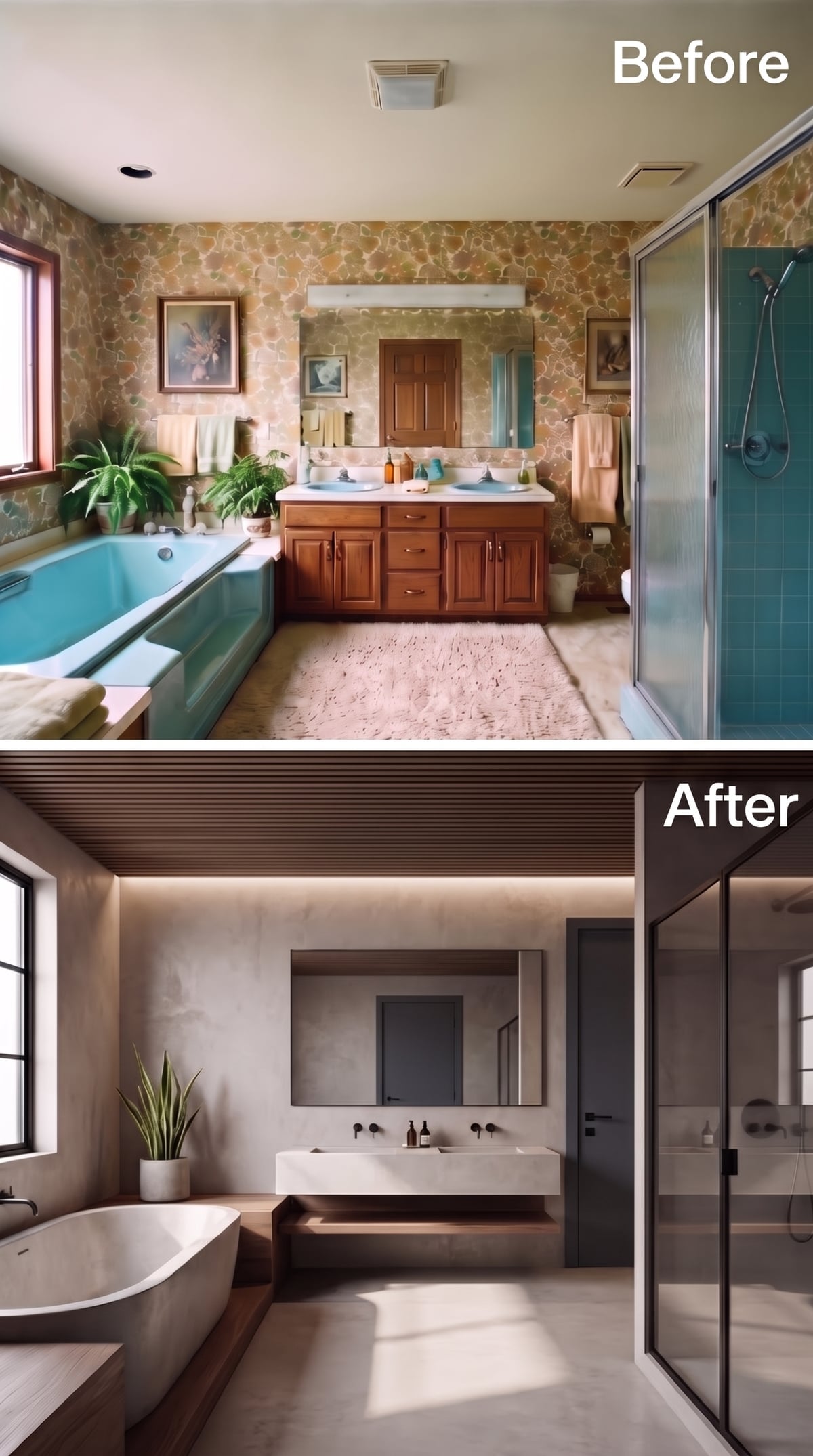
Linen-colored plaster creates a soft, mineral backdrop for a stone vanity and matching freestanding tub. Their substantial forms give the room a sculptural character, while the limited palette keeps attention on proportion and surface texture.
Wall-mounted black faucets introduce crisp details against the pale stone. A slatted wood ceiling with integrated linear lighting adds warmth and a repeated pattern overhead. The composition brings together three distinct material qualities: matte plaster, dense-looking stone, and finely divided timber.
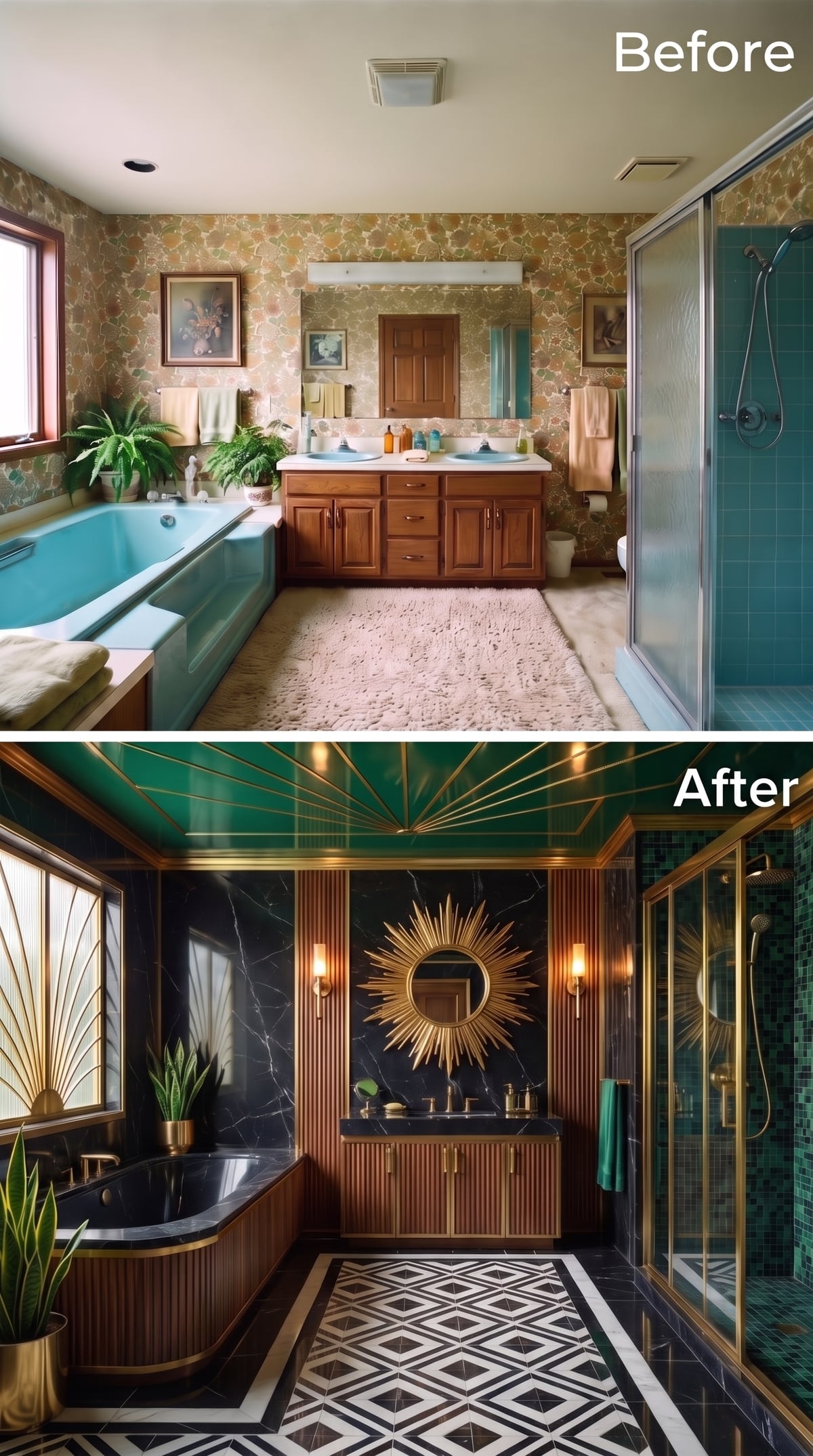
5. Art Deco Geometry Gives Black Marble a Glamorous Counterpoint
🔥 Would you like to save this?
Black marble with white veining establishes a dramatic background for a fluted walnut vanity edged in gold. The vertical cabinet detailing contrasts with the irregular movement of the stone, while a large sunburst mirror introduces the geometric ornament associated with Art Deco interiors.
Emerald mosaic in the shower brings saturated color into the predominantly black-and-gold palette. A black-and-white geometric floor strengthens the period reference, while brass hardware connects the separate surfaces. The result borrows Art Deco’s geometry and material richness without depending on a literal historical reproduction.
4. Stone Basins and a Slatted Ceiling Bring Sculptural Weight to a Pale Bathroom
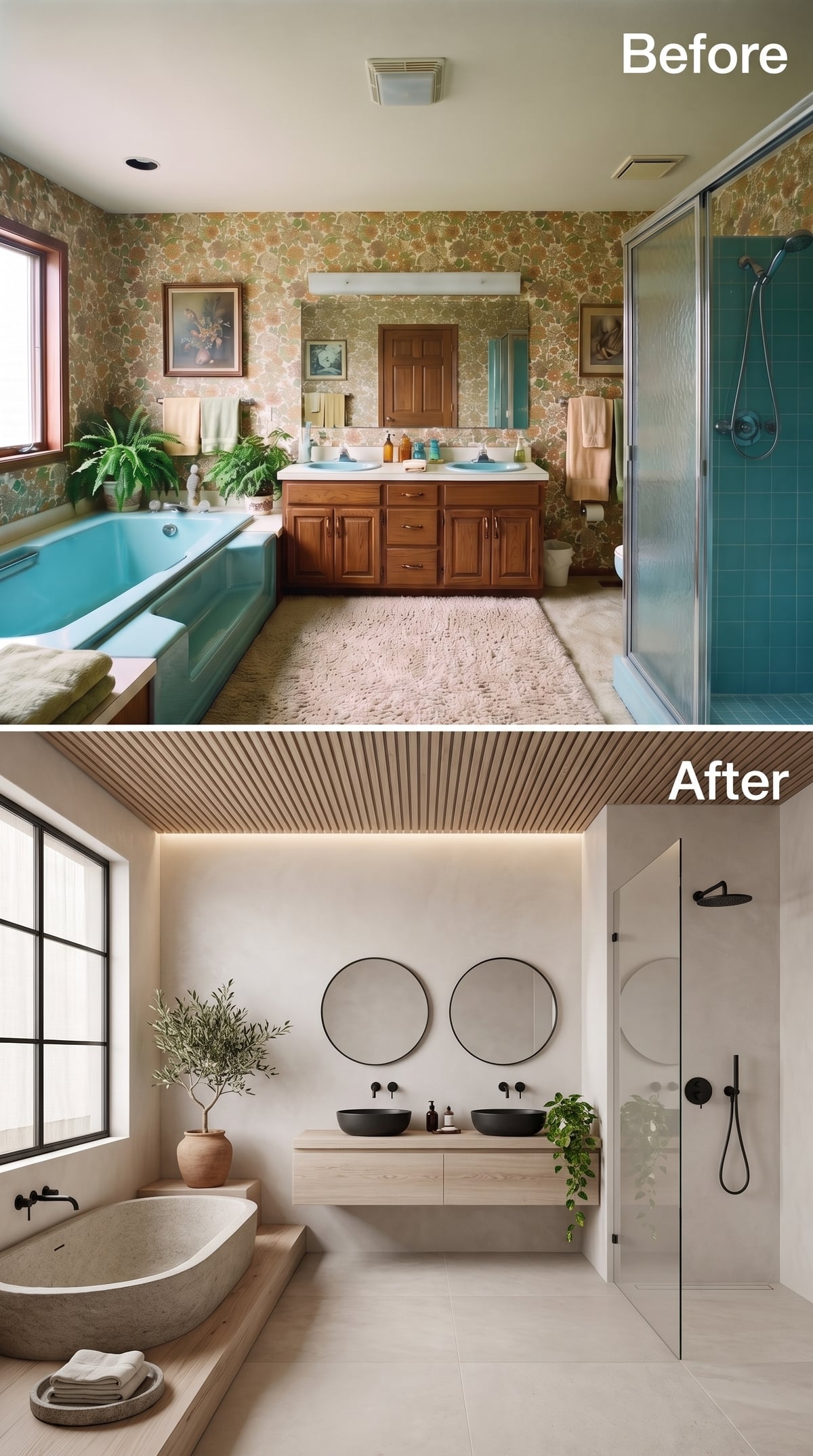
Pale travertine-look surfaces cover the walls and floor, establishing a light, nearly continuous background. Against that restraint, two matte black vessel basins become the most prominent objects on the vanity. Their dark forms create a clear contrast with the blonde wood cabinetry beneath them.
A substantial stone-look soaking tub adds another sculptural element, while a slatted ceiling and integrated lighting introduce warmth overhead. Frameless shower glass preserves the view across the room. The design succeeds through the contrast between pale enclosure, dark basins, and the solid-looking forms of the bathing fixtures.
3. Terrazzo From Floor to Ceiling Turns the Entire Bathroom Into One Pattern
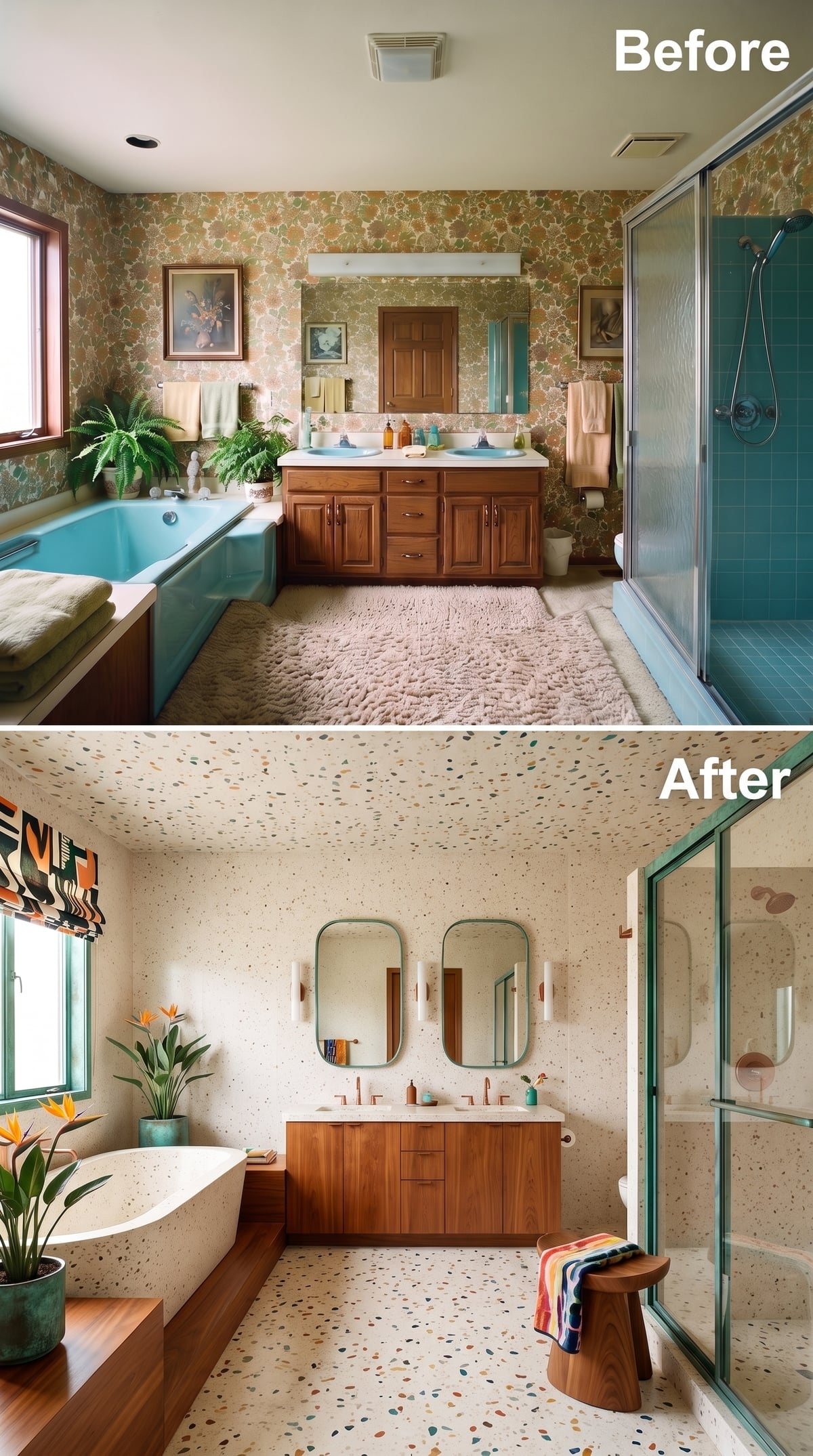
Terrazzo spreads across the floor, walls, and ceiling, replacing separate decorative zones with one continuous patterned surface. The aggregate creates fine visual movement everywhere, while the consistent material treatment makes the room feel enclosed within a single architectural shell.
A walnut vanity interrupts that continuity with a broad band of natural wood. Teal-framed mirrors and copper-toned faucets add carefully placed accents against the terrazzo. The ceiling treatment is particularly unusual: rather than leaving the overhead plane blank, it extends the material experience in every direction.
2. Warm Plaster and Saltillo Tile Give the Bathroom an Adobe-Inspired Character
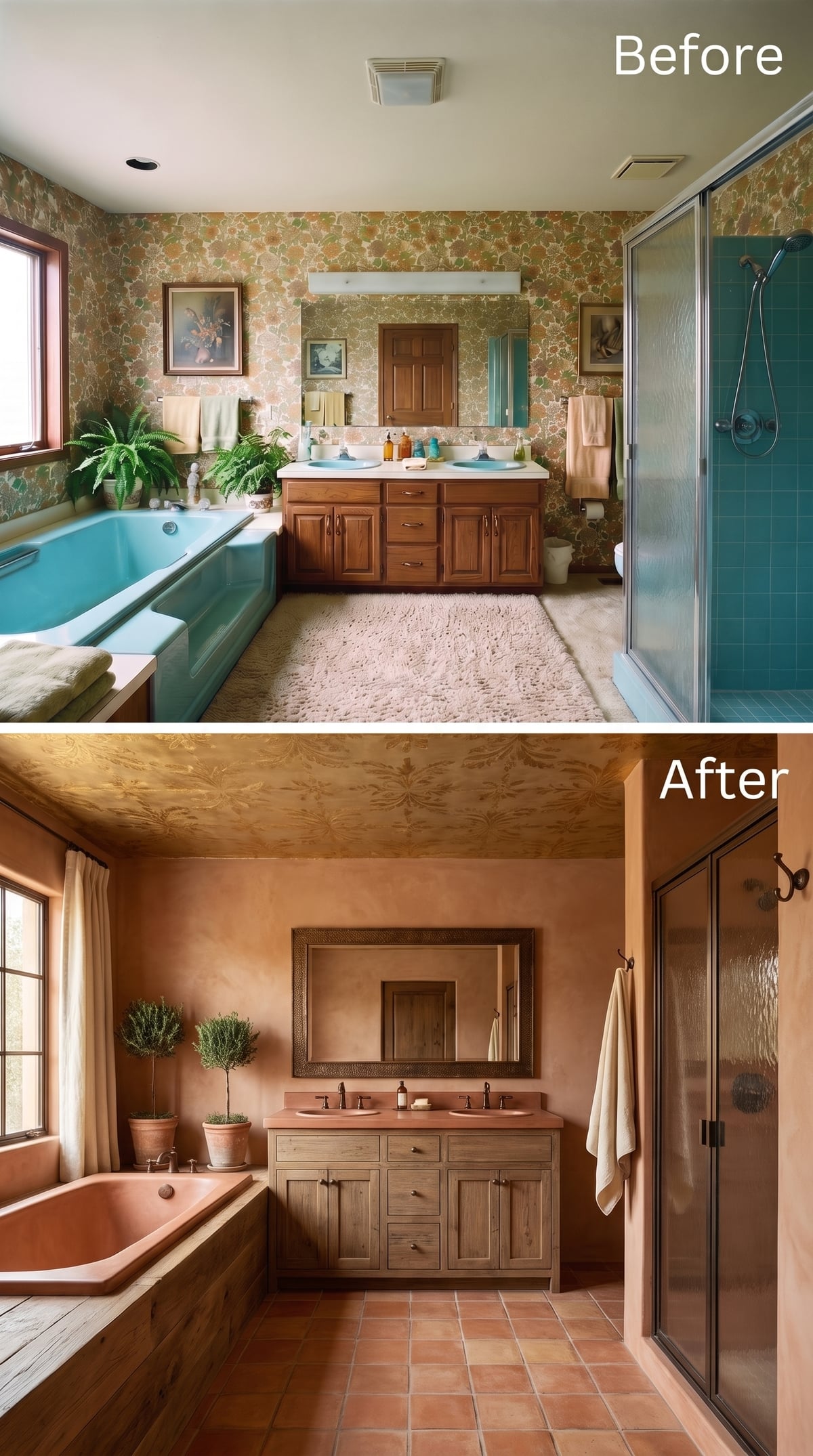
Adobe-colored plaster wraps the walls and ceiling in a continuous earthy tone, giving the room a softly sculpted appearance. Saltillo-style floor tile reinforces that warmth through its clay coloring and visible variation, while a bleached wood vanity introduces a noticeably lighter surface.
The palette draws from traditional Southwestern materials without reproducing an old-fashioned rustic bathroom. The contrast between pale cabinetry and terracotta surroundings is especially effective, allowing the vanity to remain distinct within an otherwise closely related range of colors.
1. Dark Vanity, Terrazzo Floor, and Chrome Trim Bring Back a Sharper Kind of Glamour
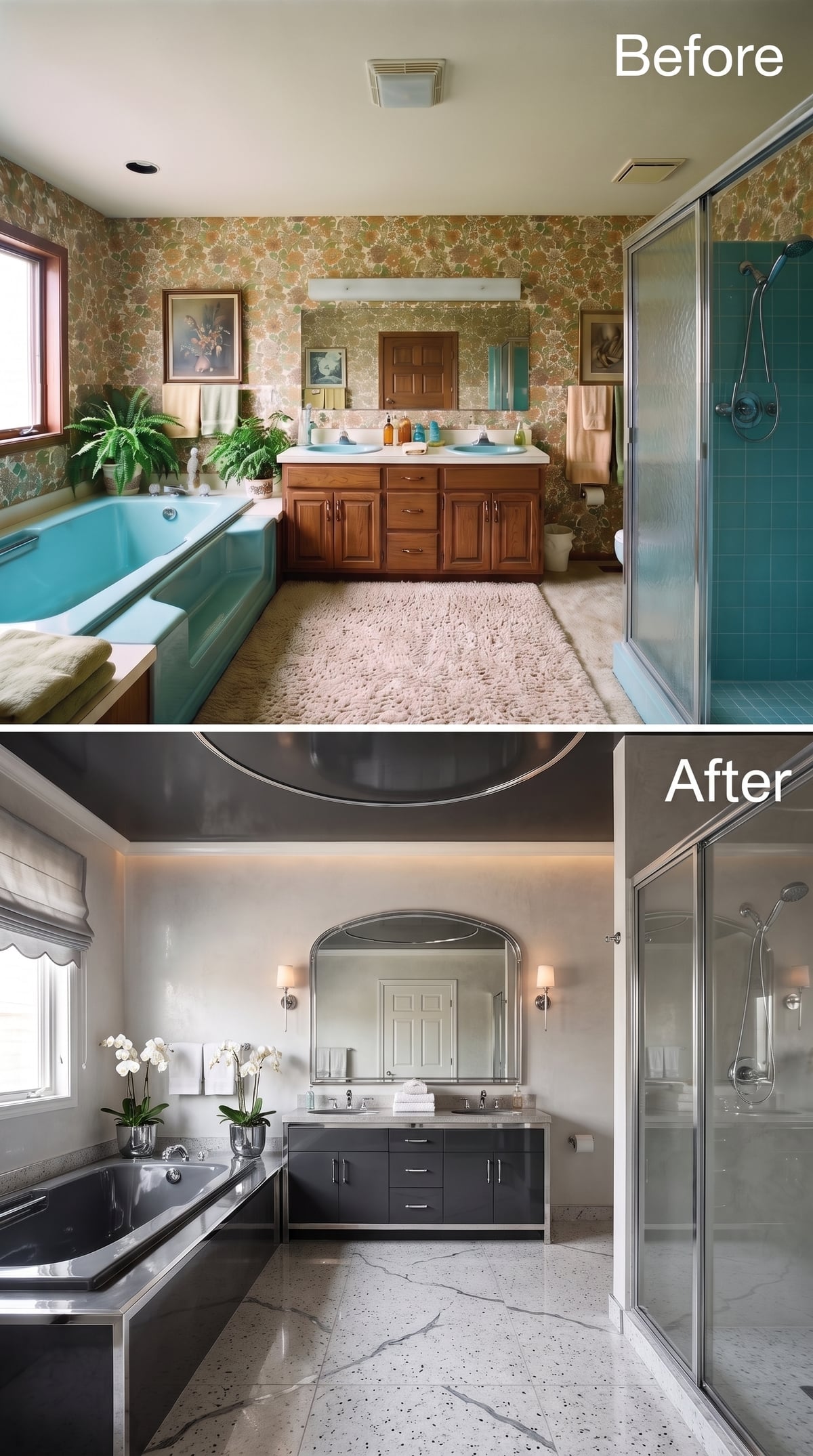
Charcoal cabinetry and polished chrome create a crisp, high-contrast vanity arrangement. An arched mirror interrupts the dark wall with a strong curved outline, while symmetrical sconces provide focused lighting around the sink area.
White terrazzo flooring introduces a much lighter surface below the dark cabinetry. A black tub surround edged in chrome repeats the vanity’s metallic detailing, giving the bathing area a direct connection to the rest of the room. The result is glamorous without depending on ornate furniture or elaborate wall coverings: dark finishes, reflective metal, and a sharply defined arrangement of shapes provide the drama.