
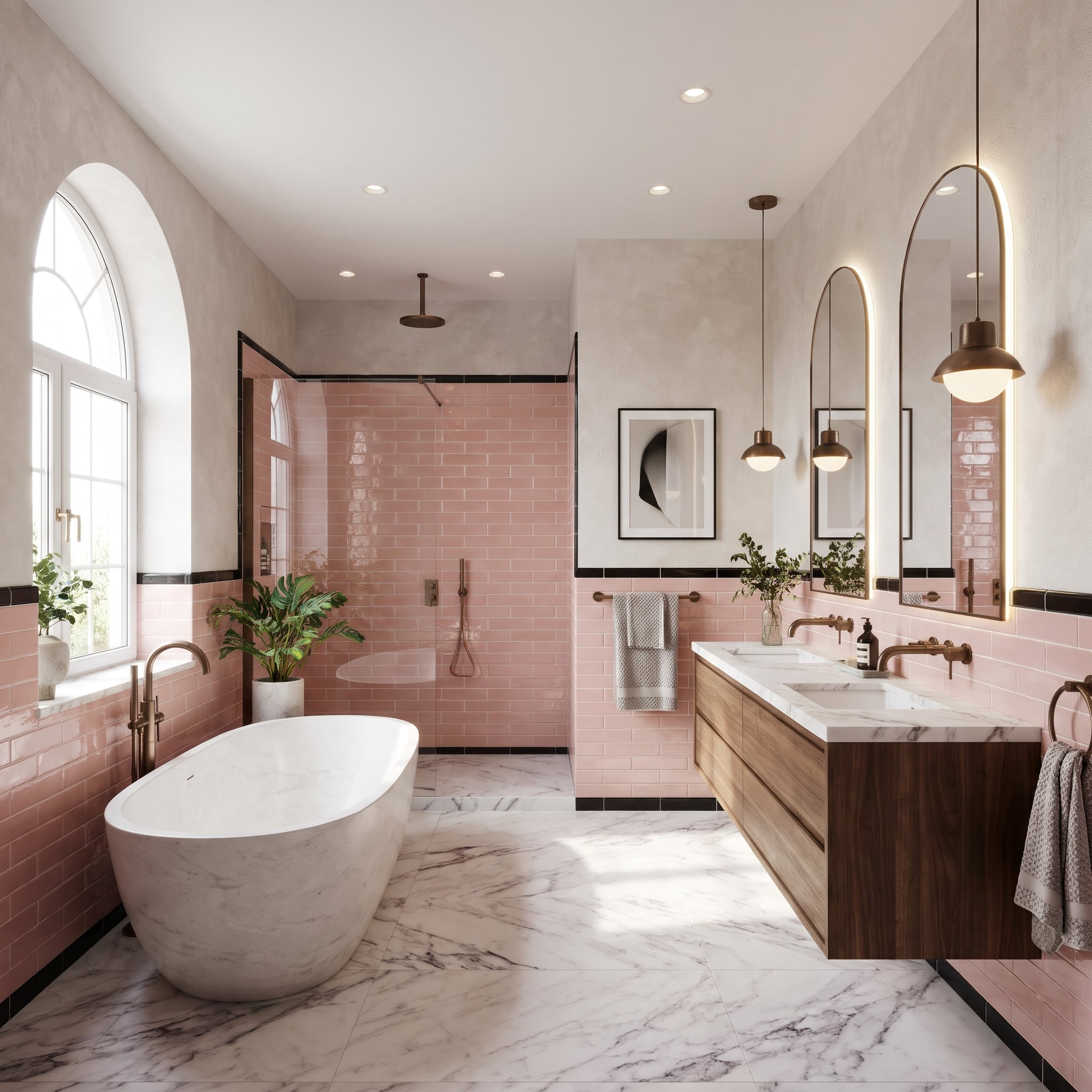
The pink bathroom of the 1950s had an admirably uncompromising attitude toward color. Pink went on the walls, into the bathtub and across the floor, and if the sink could be pink too, so much the better. Seven decades later, the temptation is to blame the color for everything from the fluorescent strip above the mirror to the shower door that rattles in its aluminum track. Pink has been taking the rap for some fairly questionable company.
In order to come up with the very specific design ideas, we create most designs with the assistance of state-of-the-art AI interior design software. Also, assume links that take you off the site are affiliate links such as links to Amazon. this means we may earn a commission if you buy something.
Contemporary designers approach the same color with a different set of architectural instincts. A wall of square ceramic tile becomes a field of vertically stacked rose-colored tile. A pink laminate counter becomes a substantial stone vanity, and a bathtub acquires the silhouette of a sculpture. Even the old pink-and-black combination has possibilities that extend well beyond its midcentury origins.
Some of these transformations bring pink down to a single basin; others give the color more territory than it ever occupied before. Forest green, plum, walnut and pale stone make for radically different partnerships, while changes to the lighting, storage and bathing arrangements do at least as much work as the palette. Pink belongs in the contemporary bathroom. The interesting question is how much more the color can do when the architecture catches up.
27. Pink Leaves the Laminate and Lands in a Block of Marble
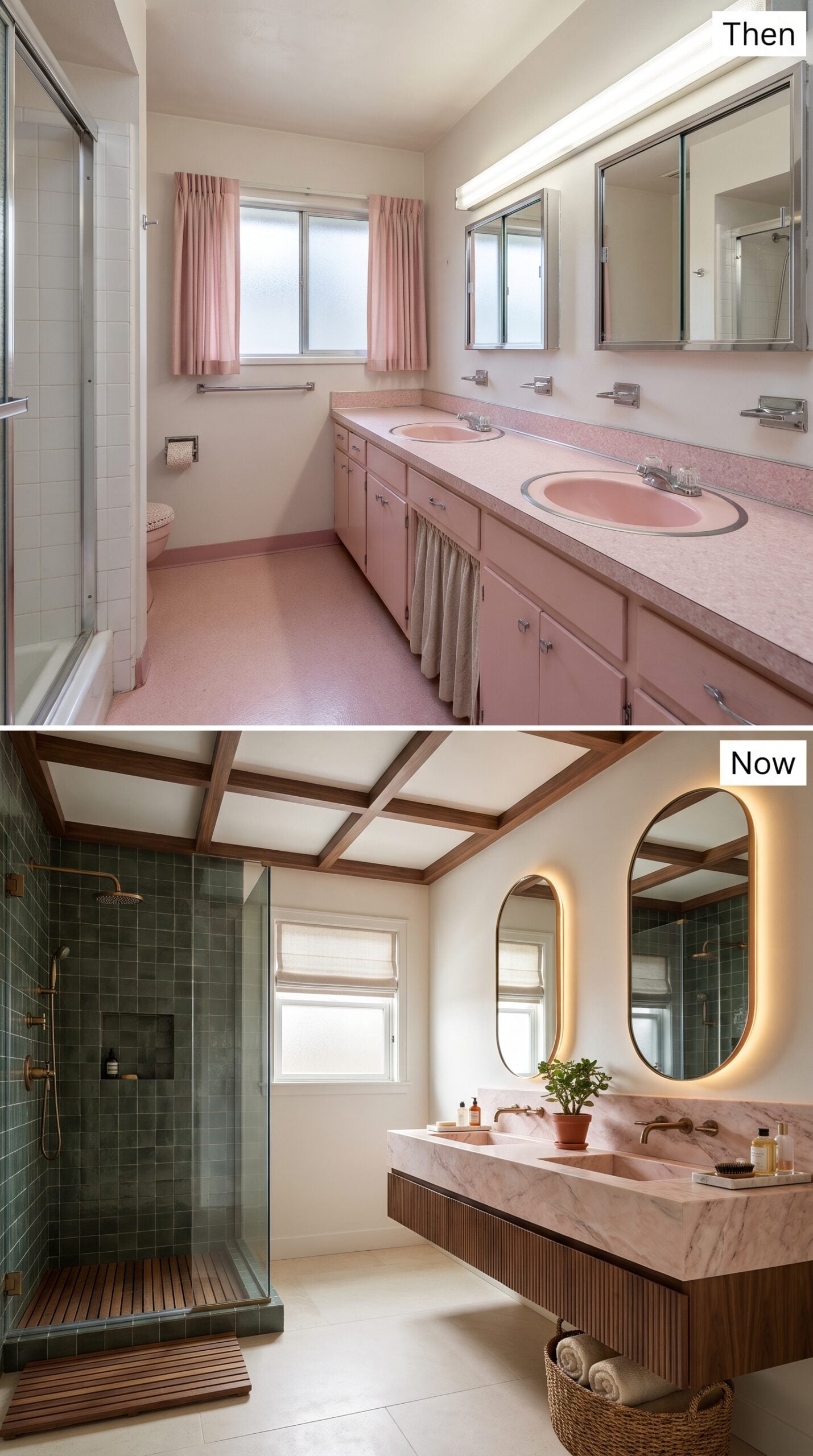
The midcentury double vanity makes a determined case for pink: two inset basins, a speckled countertop and painted cabinet fronts, all accompanied by a long fluorescent-style strip. The contemporary design keeps the two-sink arrangement and concentrates the color in a substantial rose-colored stone countertop with integrated rectangular basins. Forest-green square tile takes possession of the shower.
A floating fluted walnut vanity replaces the floor-standing cabinets, leaving pale tile visible beneath it. Two illuminated mirrors with arched tops and rounded lower corners take the place of the rectangular medicine cabinets. A wooden ceiling grid, bronze-toned shower fittings and a slatted wood shower floor insert add warmth. Pink no longer has to carry the entire room.
26. The Pink Shower Loses Its Aluminum Frame
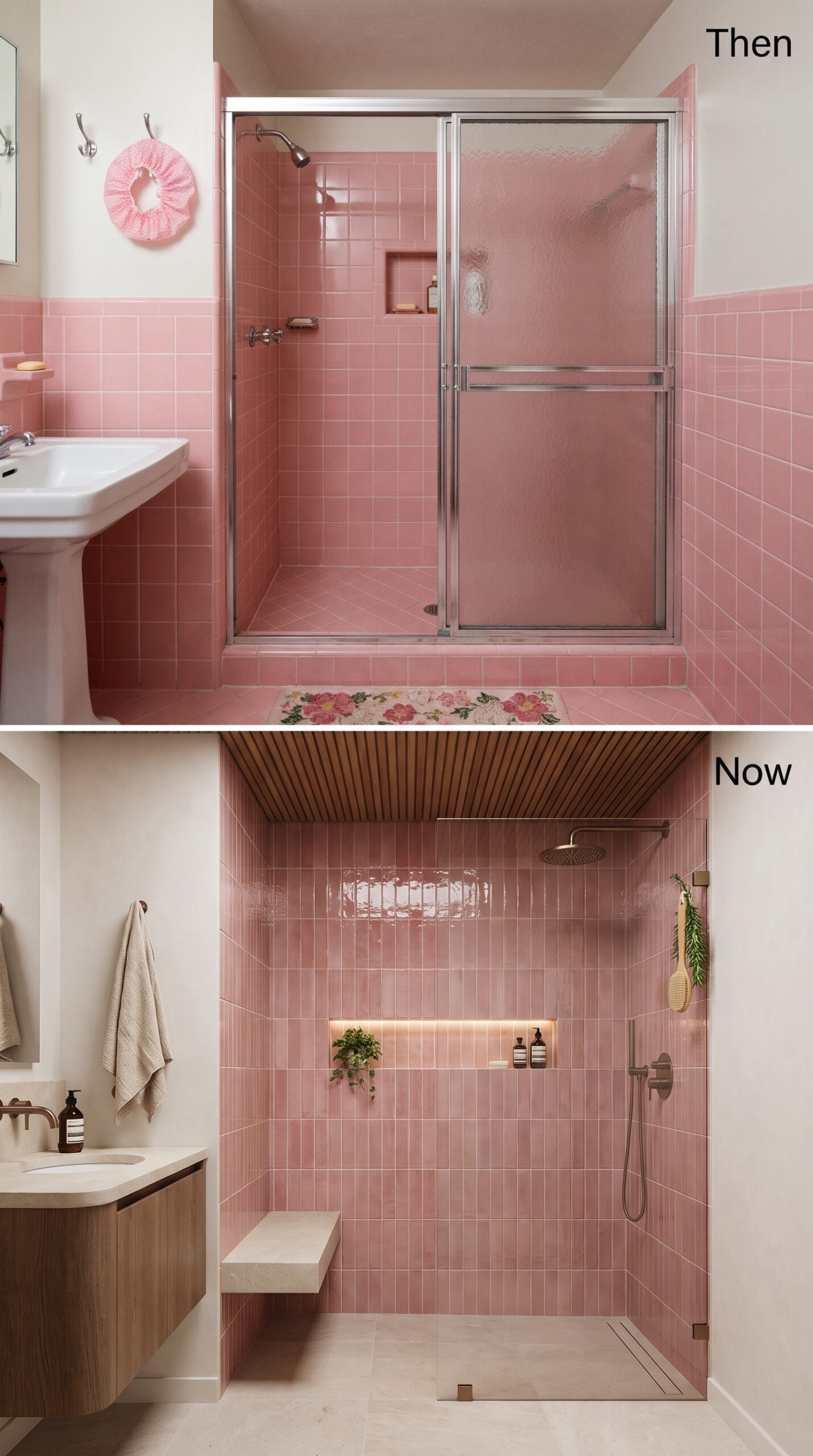
The earlier shower is a particularly good lesson in how an enclosure can date an otherwise appealing color. A raised threshold, an aluminum-framed sliding door and a grid of square tiles make pink feel firmly attached to another era. The contemporary version gives the shower vertically stacked rose-colored tile, a long illuminated niche and a floating stone bench.
A frameless glass screen, pale floor tile and a linear drain clear the visual clutter at the entrance. The wood-slatted ceiling draws the eye into the alcove, while the rounded vanity softens the outline of the cabinetry outside it. The color remains unmistakably pink; nearly everything about the way the shower is organized has changed.
Planning Detail: A curbless shower requires coordinated floor elevations, appropriate slope, drainage and a continuous waterproofing system. If wood is used overhead, specify a moisture-suitable assembly with effective ventilation and maintainable finishes.
25. Three Pink Fixtures Return With an Entirely Different Finish
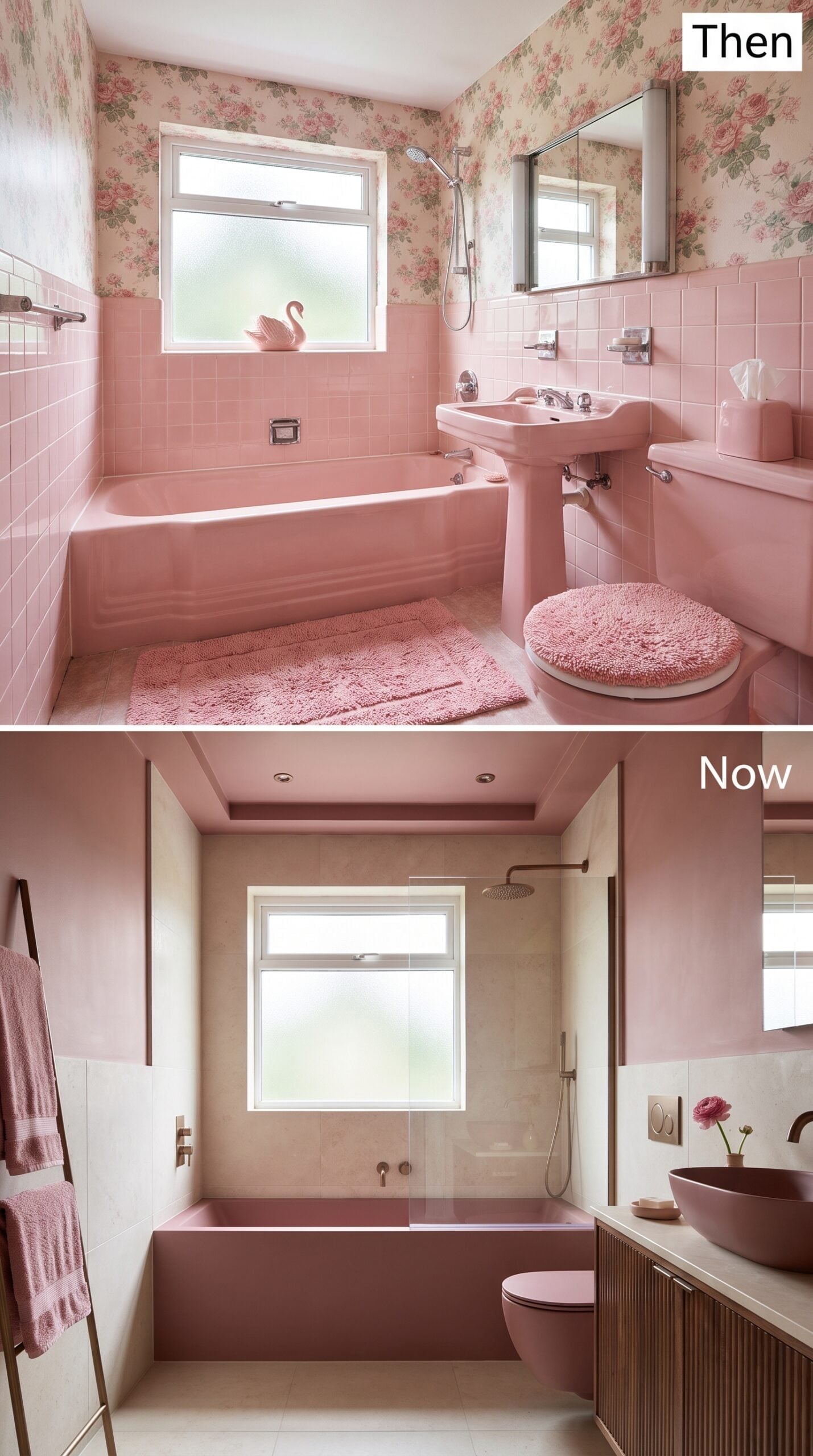
The coordinated pink bathtub, toilet and basin was a signature of many midcentury bathrooms. All three return here in dusty rose, with the chalky appearance of matte finishes in place of the familiar ceramic shine. The fixtures belong together without looking like a matching set from a department store.
Large pale stone-look tiles give each fixture room to register. Fluted walnut adds a fine vertical grain, and bronze-toned fittings bring a smaller, brighter note. The wall-mounted toilet also leaves the floor visible beneath it. The old trio of fixtures has acquired an entirely new personality without changing its allegiance to pink.
24. Botanical Green Gives the Pink Tile a New Partner
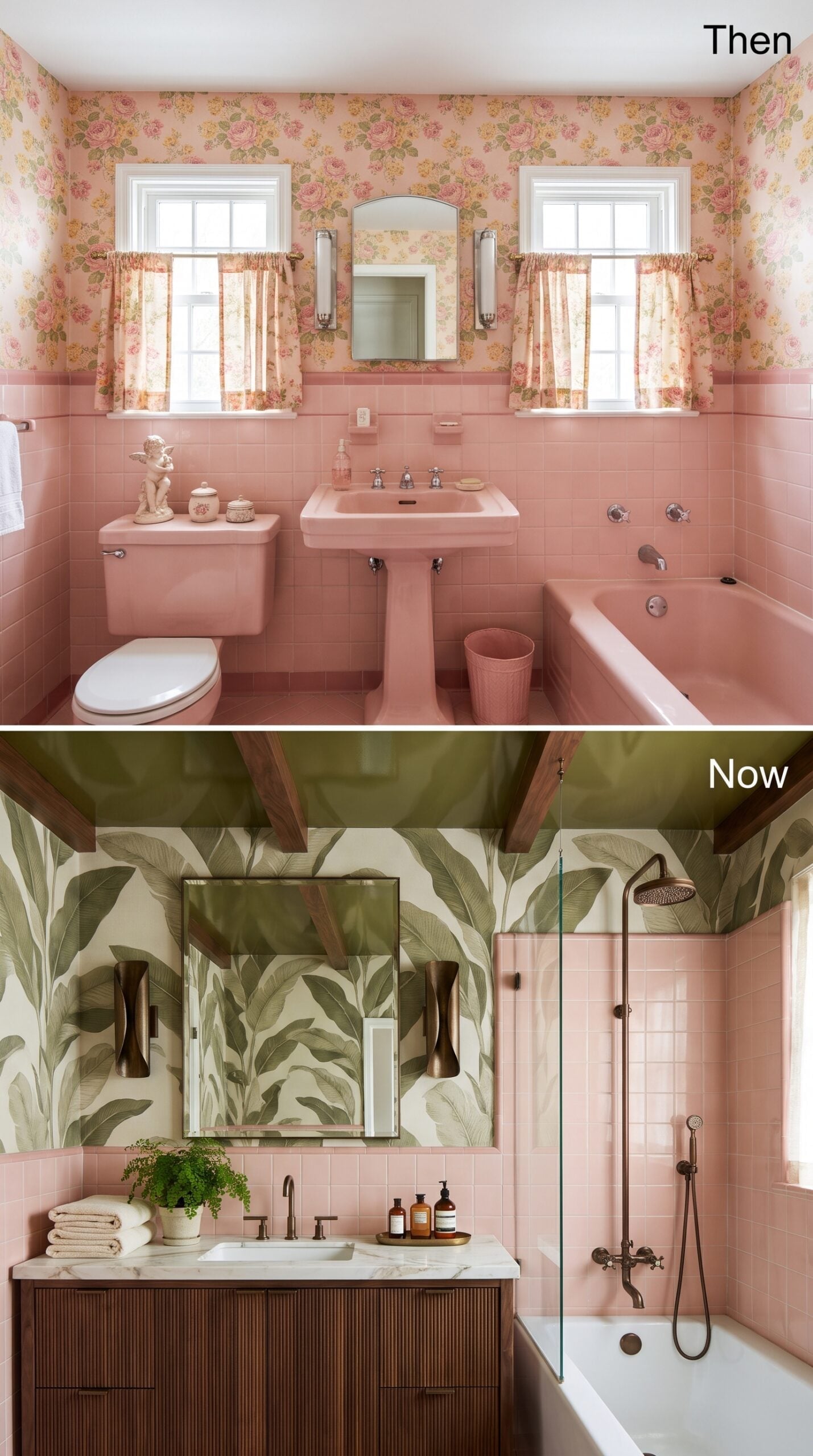
Pink ceramic tile has a graphic regularity that lends itself to an adventurous second pattern. Banana-leaf wallpaper takes over where the tile ends, and the olive ceiling between dark beams draws the green upward. The horizontal division between tile and wallpaper becomes a feature in its own right.
Fluted walnut and bronze-toned fittings add texture and warmth. Green is no apologetic neutralizer for pink; it has enough presence to meet the color on equal terms. The midcentury bathroom wainscot becomes the foundation of an exuberant botanical interior.
Renovation Tip: An exposed shower riser may reduce disruption to existing tile when the supply connections and valve arrangement are compatible. Keep wallpaper outside direct spray zones unless the specified wall system is designed for that exposure.
23. What If the Entire Bathroom Were Cut From Rose Stone?
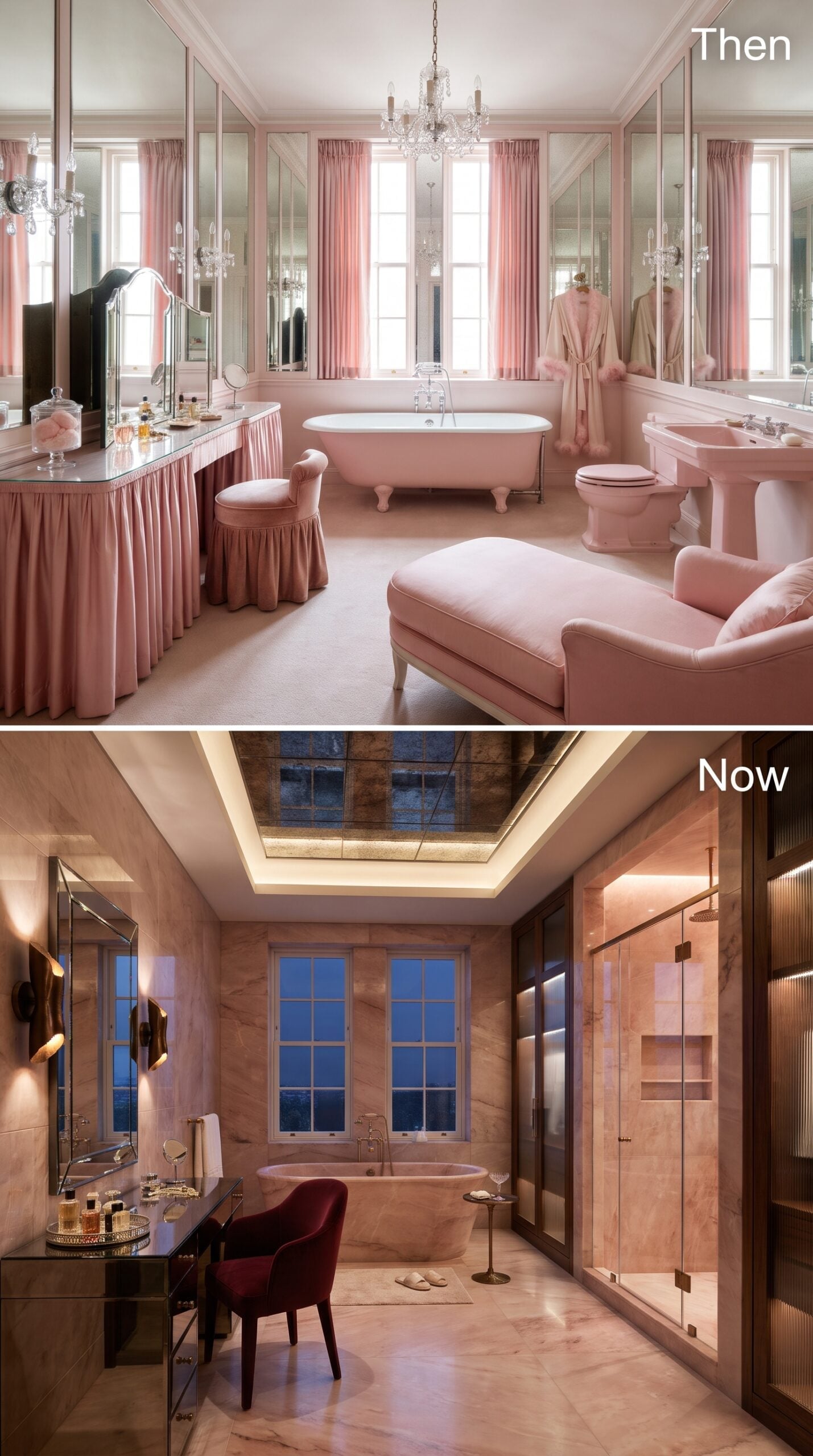
The midcentury enthusiasm for repeating pink across several surfaces reaches a new extreme here. Veined rose marble covers the walls, floor and tub surround, exchanging a regular grid of ceramic joints for the irregular movement of the stone. A burgundy chair deepens the color scheme.
An antiqued mirrored ceiling multiplies the reflections of the windows, with perimeter lighting tracing its edge. Walnut cabinetry with reeded glass fronts and bronze shower hardware punctuate the expanse of stone. Anyone looking for a restrained dose of pink has come to the wrong bathroom. The color has been given nearly the entire room.
What Our Readers Say
- Not everyone is sold on pink: in our Hot or Not photo matchups, pictures dominated by pink won 36% of the time, below the 45% their position alone would predict.
- The safe alternative isn’t a clear winner either: grey-dominant bathrooms got hearts from our readers 58% of the time, versus 63% for the other images in the same articles.
From Home Stratosphere reader polls and votes.
22. A Pink Pedestal Sink Gets Its Own Walnut Architecture
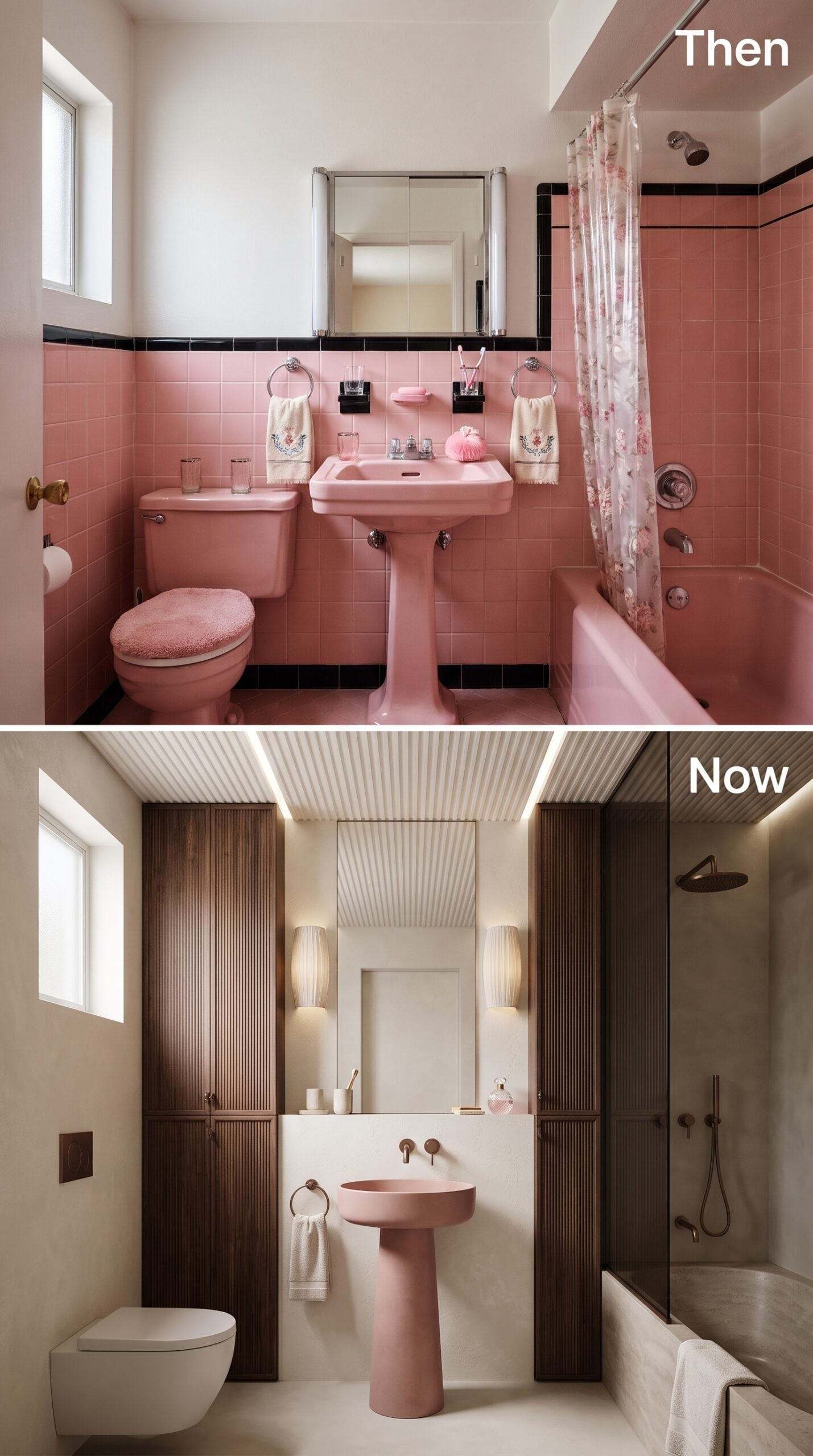
The humble pedestal sink has acquired a rather grand address. Fluted walnut towers rise on either side of a rose-colored stone pedestal, giving its round basin the prominence of a sculptural object. Projecting bronze-toned wall faucets keep the rim clear.
Plain plaster sets off the wood grain and rose stone, and the surrounding cabinetry supplies the storage that a pedestal sink lacks. The arrangement combines the compact footprint of a familiar fixture with the visual weight of built-in furniture. The modest pedestal sink now commands an entire wall.
Planning Detail: Wall-mounted faucets require space for plumbing and accessible service connections. A wall-mounted toilet also needs a compatible concealed carrier and cistern, with the access and support specified by the manufacturer.
21. A Faceted Pink Bathtub Takes the Corner Window
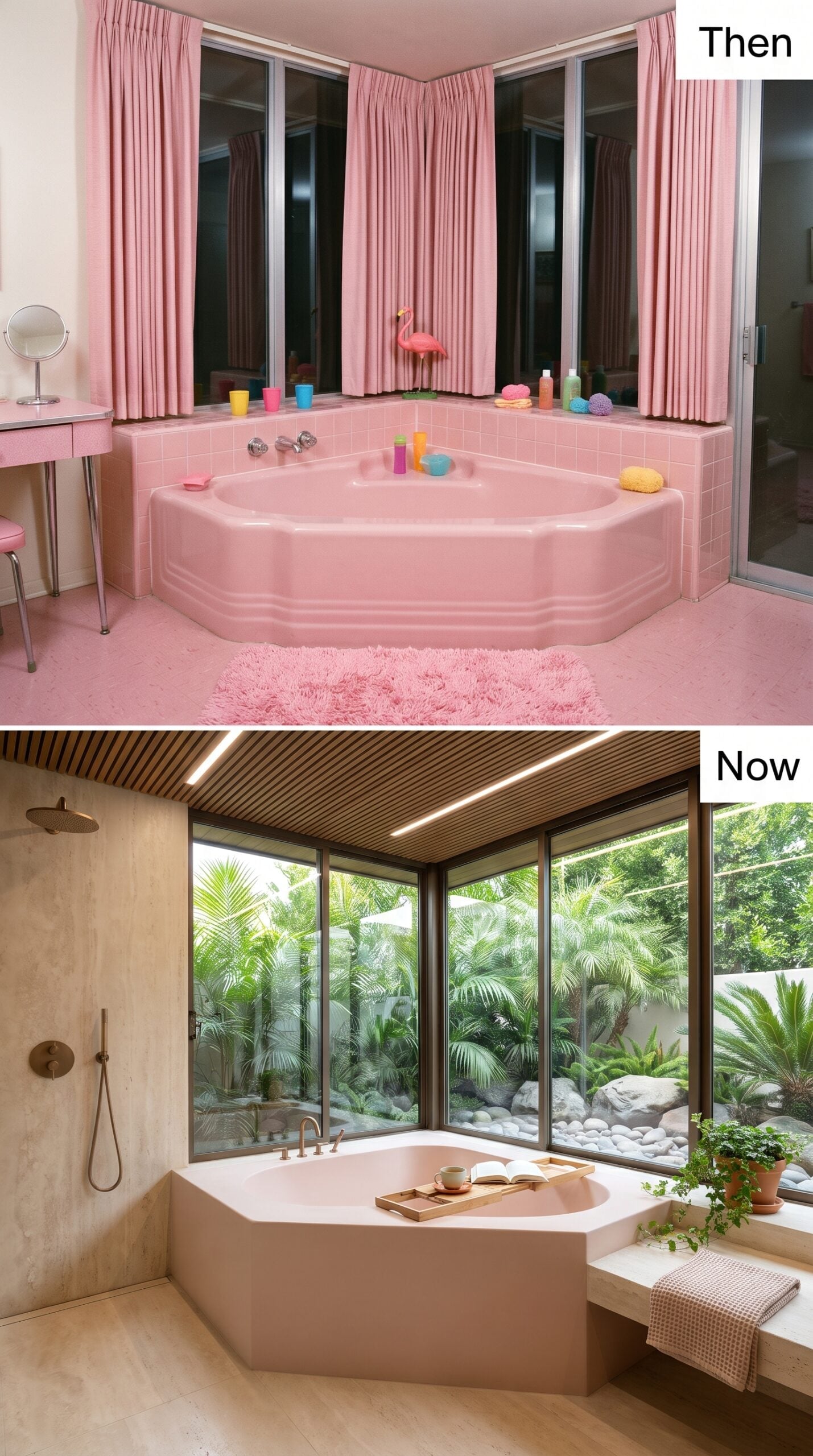
Pink moves into an angled tub shell that follows the intersection of two glazed walls. Unlike the rounded enameled fixtures of the midcentury bathroom, this tub reads as a faceted object. The muted color makes the changes in plane easy to distinguish.
Bronze-toned window frames echo the bathing hardware, and a travertine ledge offers a place for towels and bath accessories. Palms beyond the glazing supply a broad field of green. The tub now has a relationship with the garden instead of relying on a matching sink and toilet to establish its place in the room.
Privacy Detail: Large windows next to a bathtub need a deliberate privacy strategy. Screened landscaping, obscured glazing or suitable moisture-resistant shades can provide screening, depending on the sightlines and the degree of privacy required.
20. From Pink Porcelain to a Vanity With the Presence of Sculpture
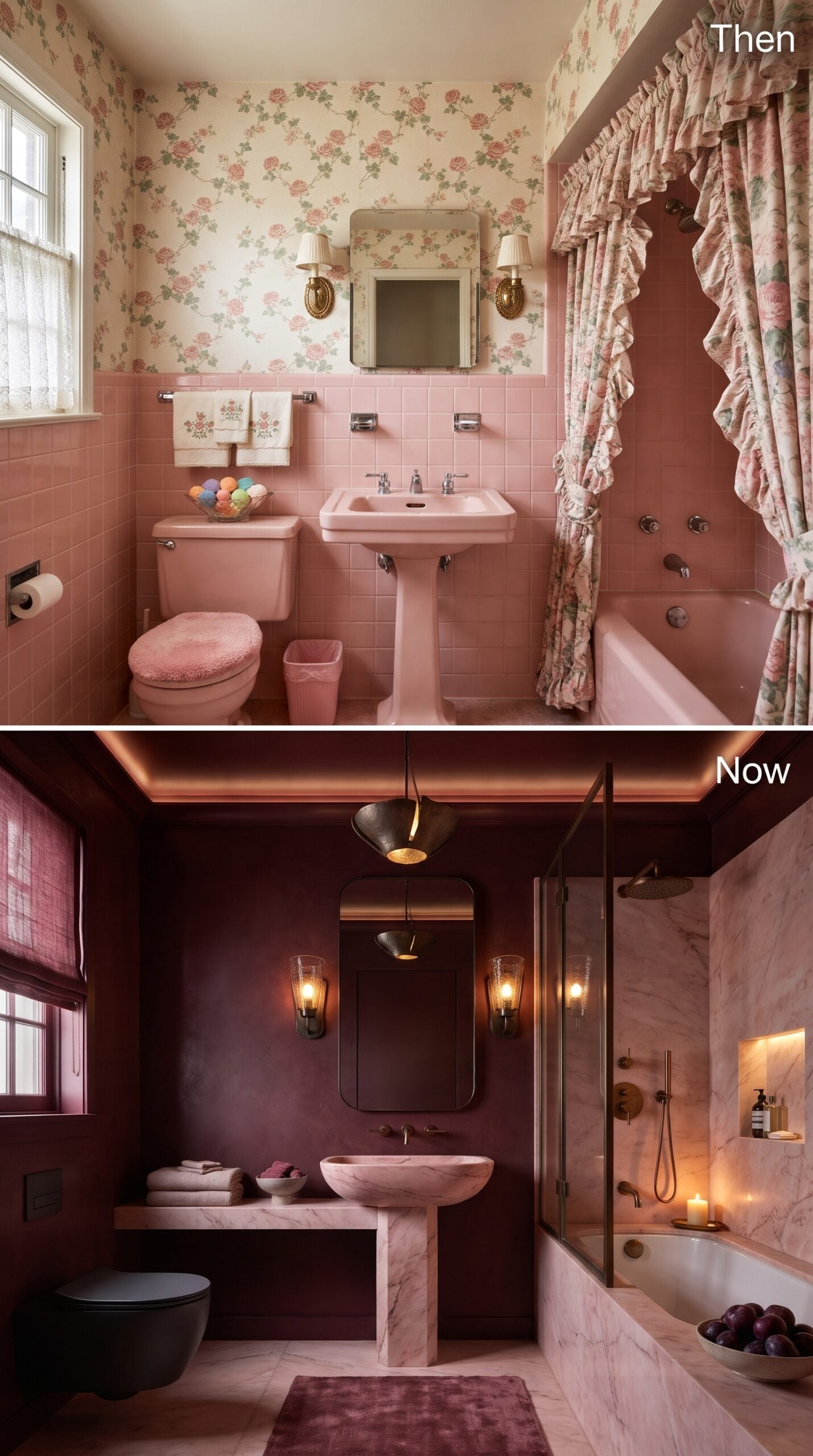
Pink porcelain put color into the midcentury bathroom through its most utilitarian objects. Here, a sculptural rose marble vanity turns that idea into something more monumental: the pedestal, projecting shelf and oval basin read as a single composition. Wall-mounted brass spouts keep hardware off the rim.
Plum-colored plaster gives the pink stone a darker backdrop. Warm perimeter lighting reveals the wall texture, while rose stone extends across the tub surround and into the shower. A matte black wall-mounted toilet supplies a graphic interruption. The color once supplied by a glazed fixture now comes with the weight, veining and presence of stone.
19. Terrazzo Makes the Pink Bathroom Less Predictable
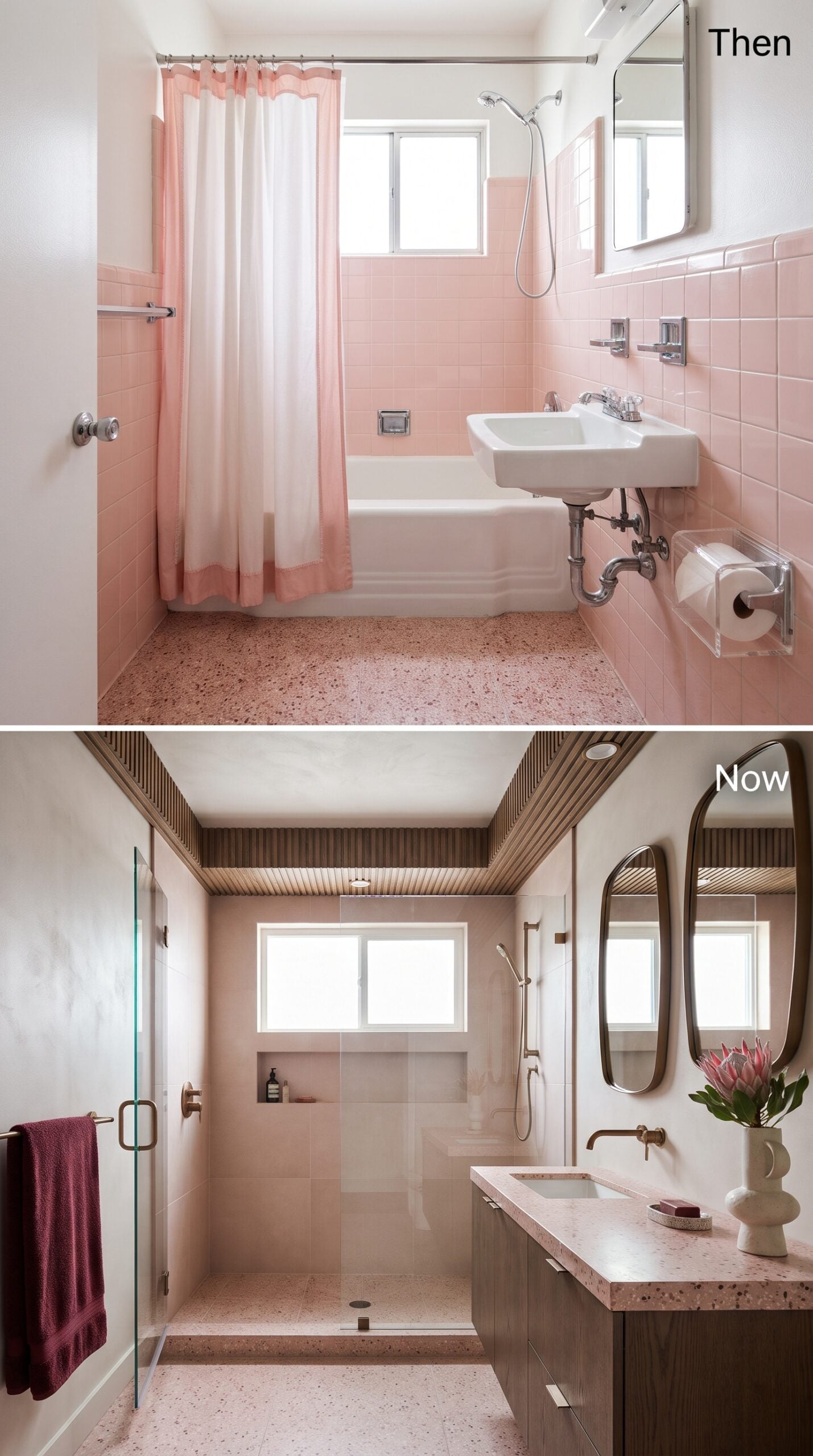
Terrazzo breaks pink into fragments. Small flecks and irregular chips give the rosy material a livelier pattern than a uniform ceramic grid, and the finish travels from the floor to the vanity top. Two surfaces that might otherwise have been selected independently now share a common visual thread.
A border of slatted wood overhead answers those small flecks with a much larger linear pattern, while glazed shower tile restores the regular grid. Terrazzo itself has a long design history; its use across floor and countertop gives the familiar material a fresh assignment.
Storage Detail: A long shower niche can consolidate toiletries into one recessed ledge. A niche beneath a window must be planned around the framing, plumbing and waterproofing, with horizontal wet-area surfaces sloped to drain into the shower.
18. Pink Lacquer Makes a Detour Through the Ceiling
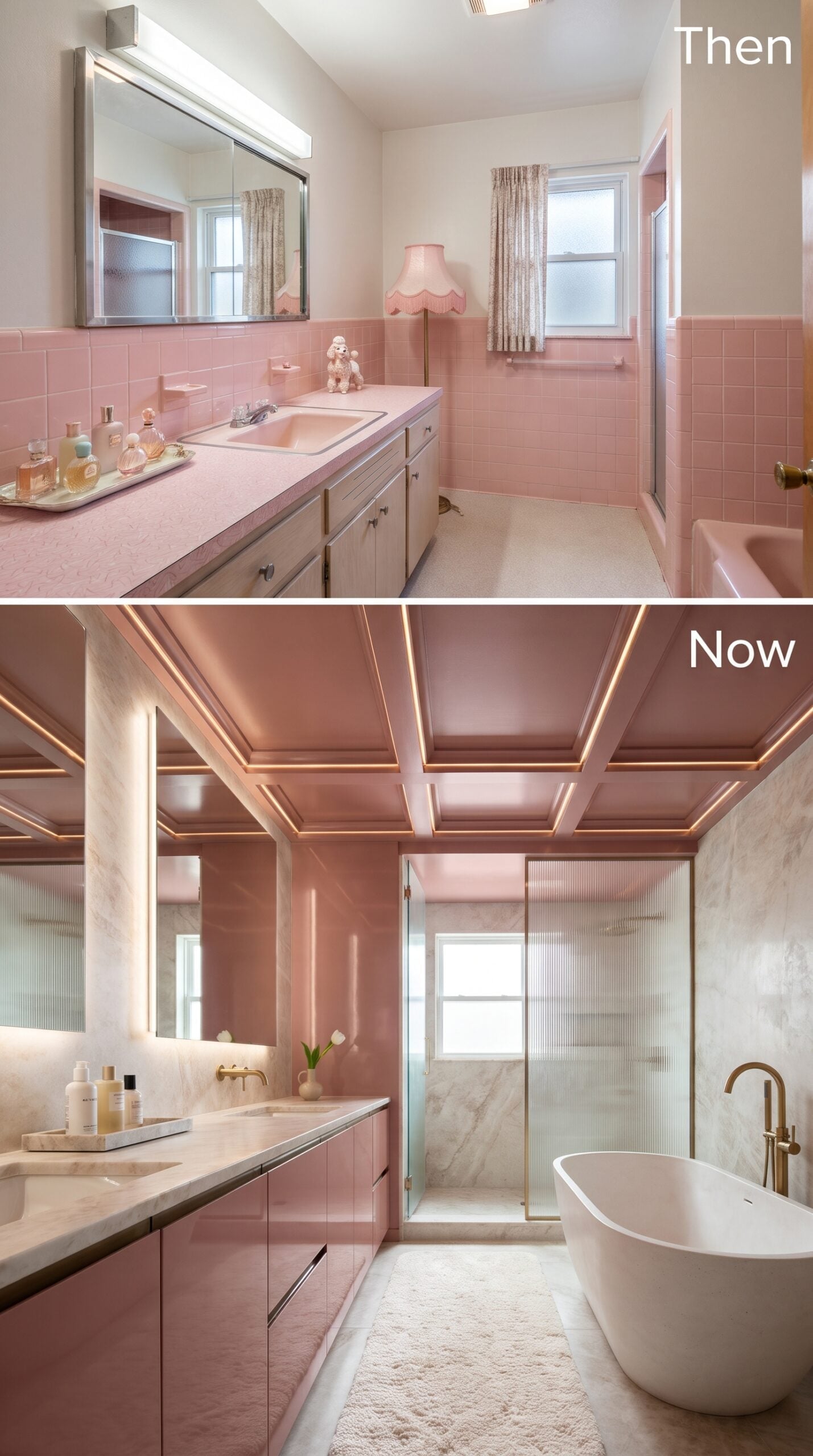
Midcentury bathrooms often carried pink across sinks, countertops, wall tiles and cabinet fronts. This glossy scheme sends the color overhead, repeating the drawer finish within the coffered ceiling. The eye travels between the two levels, making the cabinetry feel like part of the room’s architecture.
Marble offers an irregular pattern between the glossy finishes, while brass-toned fixtures contribute smaller reflections. Wall-mounted faucets and a freestanding tub filler keep hardware off the counter and tub rim. Pink needs no contrasting color to make an impression when light can play across it in so many ways.
Finish Detail: Glossy cabinetry can make fingerprints and water marks more visible. Choose a moisture-suitable finish, follow its cleaning instructions and consider recessed pulls to reduce contact with the drawer faces.
17. The Pink Tile Grid Learns to Turn a Corner
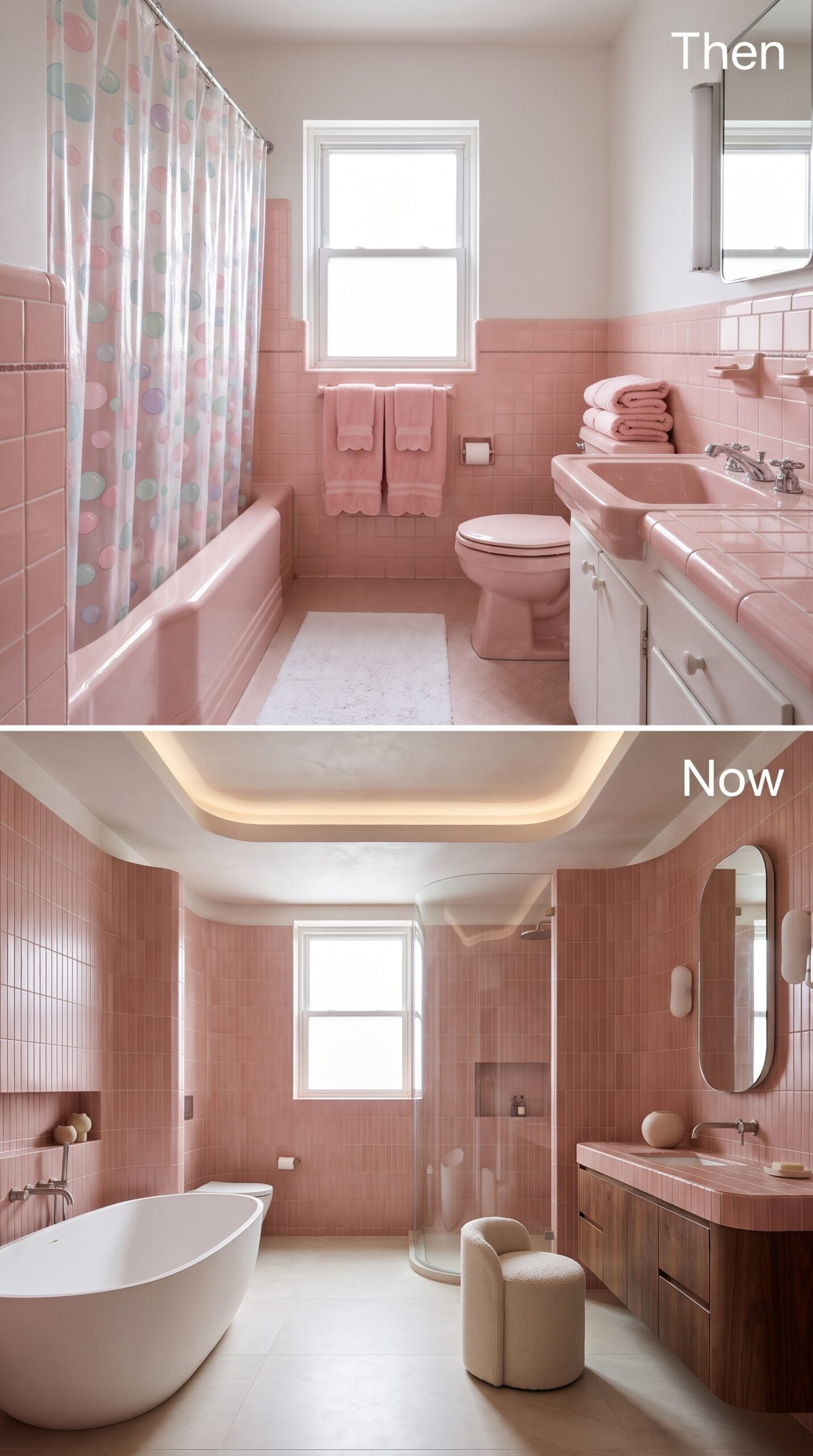
A grid of pink ceramic tile need not confine a bathroom to right angles. Stacking narrow rectangular tiles vertically allows the joints to follow a curved wall in small increments, and the rounded walnut vanity picks up the same sweep. The familiar material has acquired a new geometry.
The tiled countertop continues the pink finish, although grout joints near the basin will need regular cleaning. The most persuasive detail is the way the curved wall and the cabinetry follow one another. A pink bathroom built around a grid can still have an entirely different outline.
16. The Pink Wall Becomes the Light Source
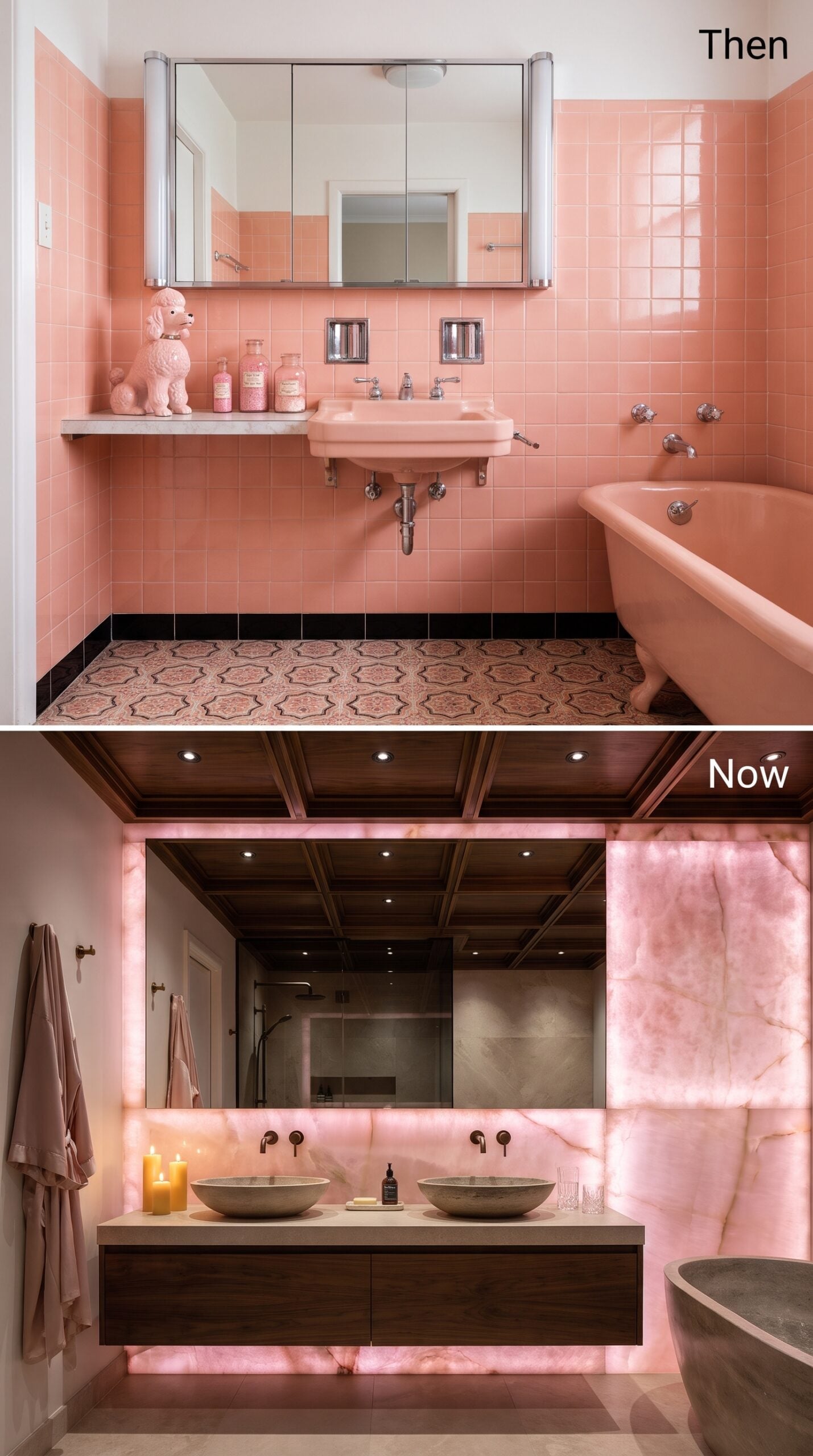
Glazed pink tile reflects the light that strikes it. Translucent rose onyx can be illuminated from behind, revealing cloudy variations and veins that become part of the lighting scheme. A floating walnut cabinet stands out against the glow, and dark coffered wood frames it overhead.
Two rough-textured vessel basins interrupt the luminous expanse, each served by its own bronze-toned wall spout. Their tactile stone finish offers a sharper contrast than another pair of matching pink fixtures would. The wall is no longer simply the recipient of light; it supplies it.
Lighting Detail: Backlit stone needs a suitably supported translucent panel, compatible lighting and electrical components, heat management and access for servicing. Specify separate dimming where appropriate so the decorative lighting can be adjusted independently of the task lighting.
15. Black Pencil Trim Is Too Good a Detail to Lose
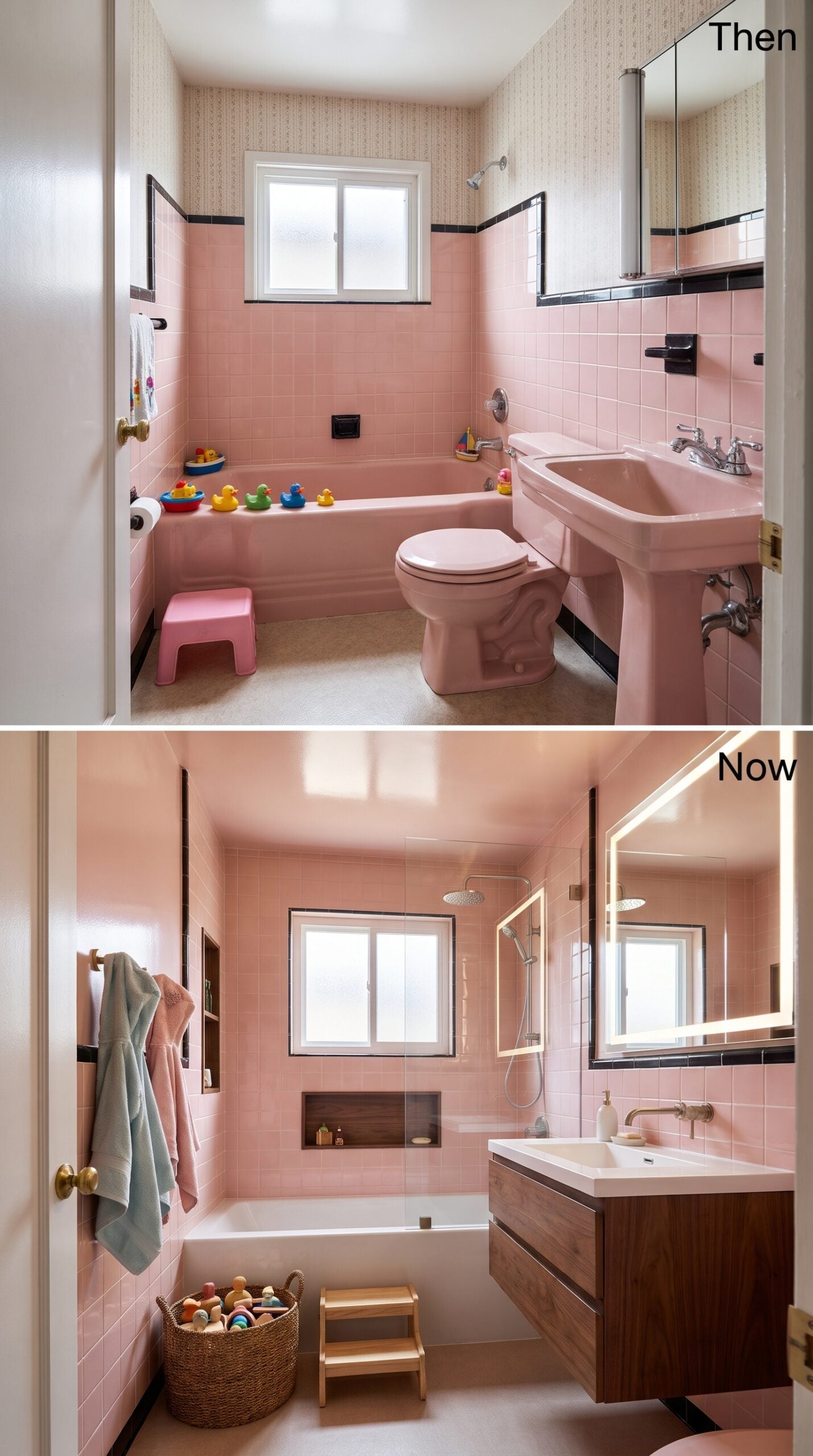
The thin black border associated with midcentury pink tile has a usefulness well beyond nostalgia. Its sharp lines define the window and mirror openings, giving the pink field a graphic structure. Floating walnut cabinetry, a white integrated vanity top and a broad backlit mirror bring the idea forward.
Recessed walnut shelves give toiletries somewhere to go besides the tiled ledges. The pink ceiling extends the color overhead, while a stool and toys suggest a bathroom equipped for family use. Pink and black retain their visual authority; storage and lighting do much of the updating.
Bathing Detail: A fixed glass screen can reduce shower spray while leaving part of the tub accessible. Its width and placement need to suit the showerhead, tub and intended use; a short panel will not contain all splashing.
14. Plum Replaces Pastel Pink and Marble Takes the Walls
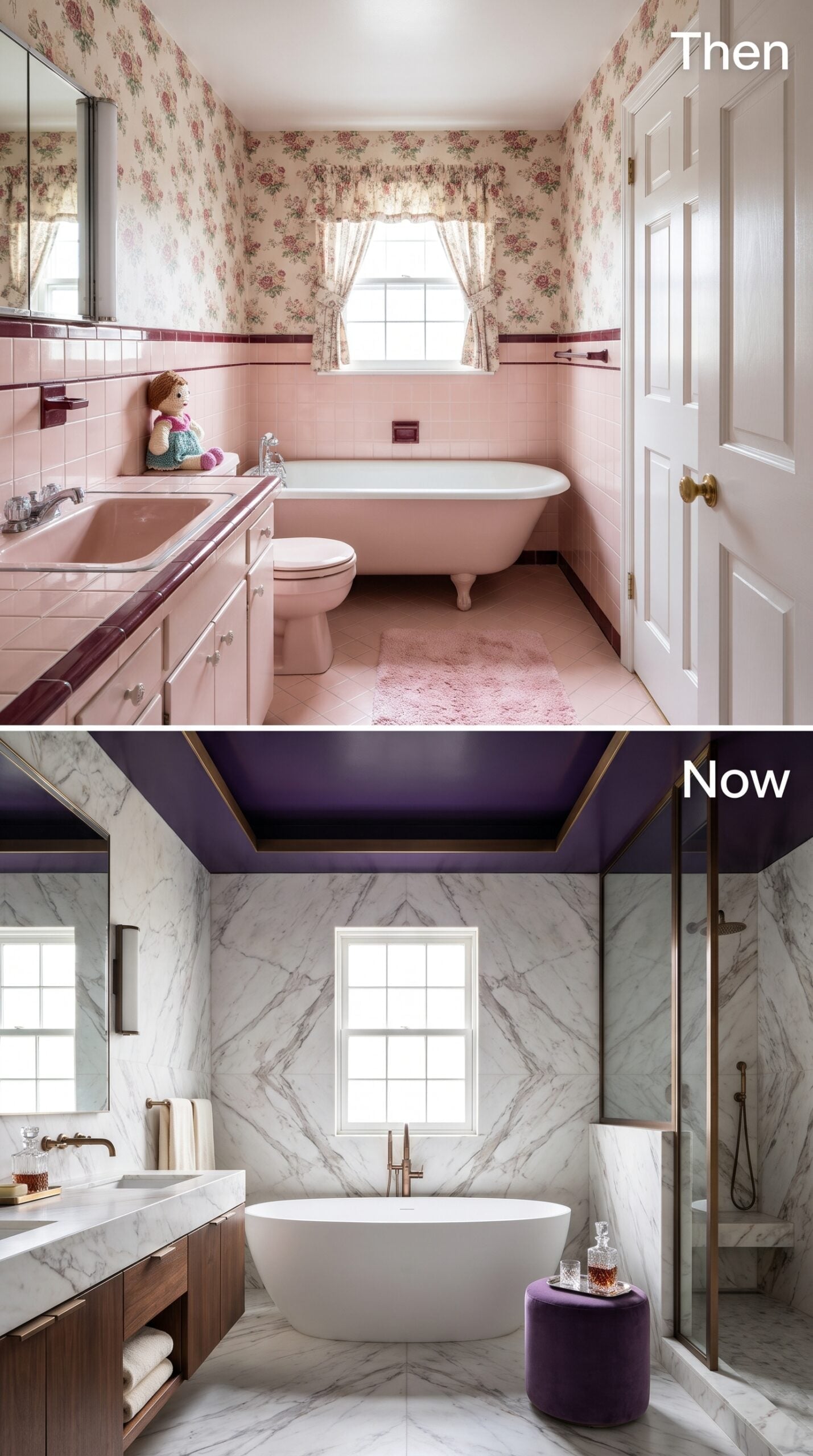
The pastel pink of the midcentury bathroom gives way to a more dramatic purple. The aubergine ceiling and velvet ottoman carry that rich color at opposite ends of the room. Mirrored gray veining in the marble creates a broad geometric motif behind the bathtub.
A freestanding tub and floor-mounted filler preserve an uncluttered outline in front of the stone. Fine metal trim around the tray ceiling echoes the bronze-toned plumbing. Two strategically placed areas of purple carry the color scheme, leaving the marble free to provide the pattern.
13. A Rose-Colored Shower Without a Glass Door
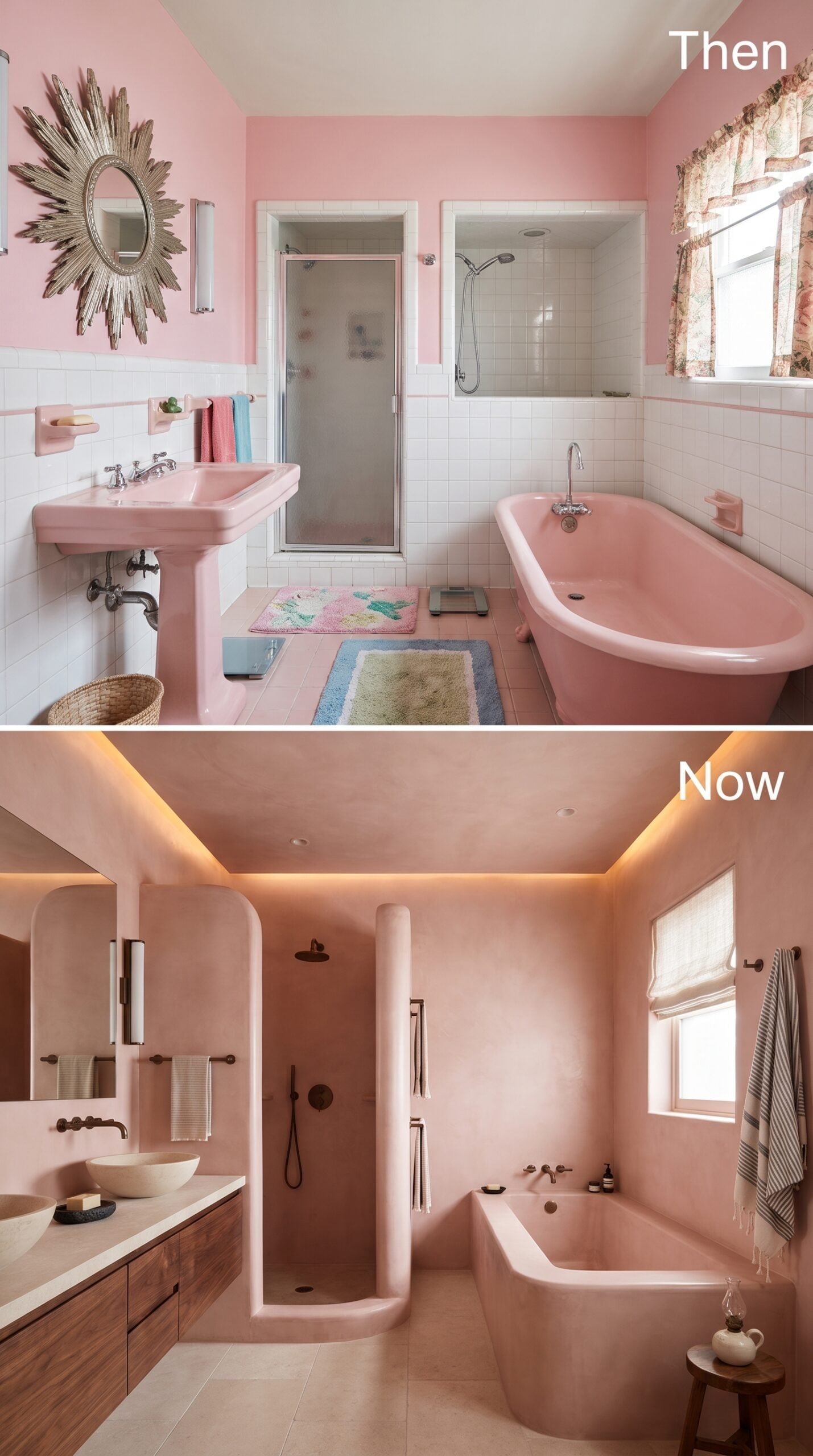
The rose-colored shower trades a conventional framed enclosure for a rounded partition. Its curved return and the arched opening opposite give the plaster a sequence of concave and convex surfaces. The built-in tub, with its squared outline, offers a useful counterpoint.
A concealed light washes the upper wall, picking out the plaster texture and changes in curvature. Without the regular interruptions of ceramic joints or a glass door, the partition becomes the focus. Pink now follows the shape of the room instead of imposing a grid upon it.
Shower Detail: A doorless shower needs adequate splash containment, appropriate floor slope and drainage. Specify a plaster or coating system approved for its intended wet-area exposure, including the required waterproof substrate.
12. The Checkerboard Changes Scale and Direction
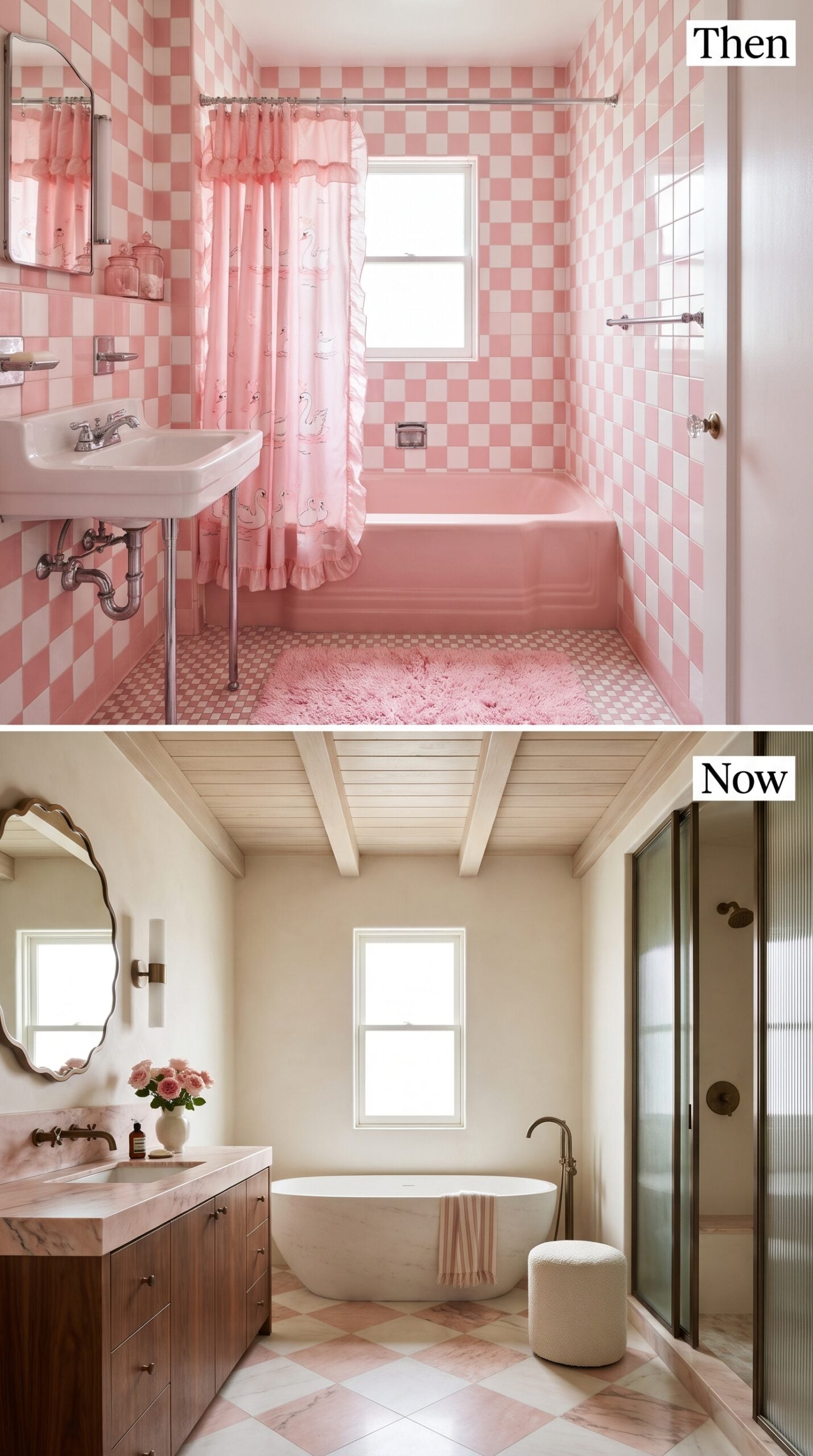
The checkerboard floor has long been a natural companion to pink bathroom fixtures. Enlarge the squares and turn them on the diagonal, and the old pattern acquires a new rhythm. Pink and white marble lead the eye toward the shower threshold, leaving the smooth plaster walls free of competing patterns.
Whitewashed beams echo the pale stone, and the pink marble vanity top repeats one half of the checkerboard. Bronze-toned plumbing and reeded glass framing supply finer details, while a scalloped mirror breaks the succession of diagonals and rectangles. The familiar pattern has survived; its proportions have changed.
Glass Detail: Reeded glass admits light while obscuring some details behind it; the degree of privacy varies with the pattern, lighting and distance. A smooth shower-facing surface can make cleaning easier, even when the outward-facing side is textured.
11. A Rose-Colored Room Drawn With Light
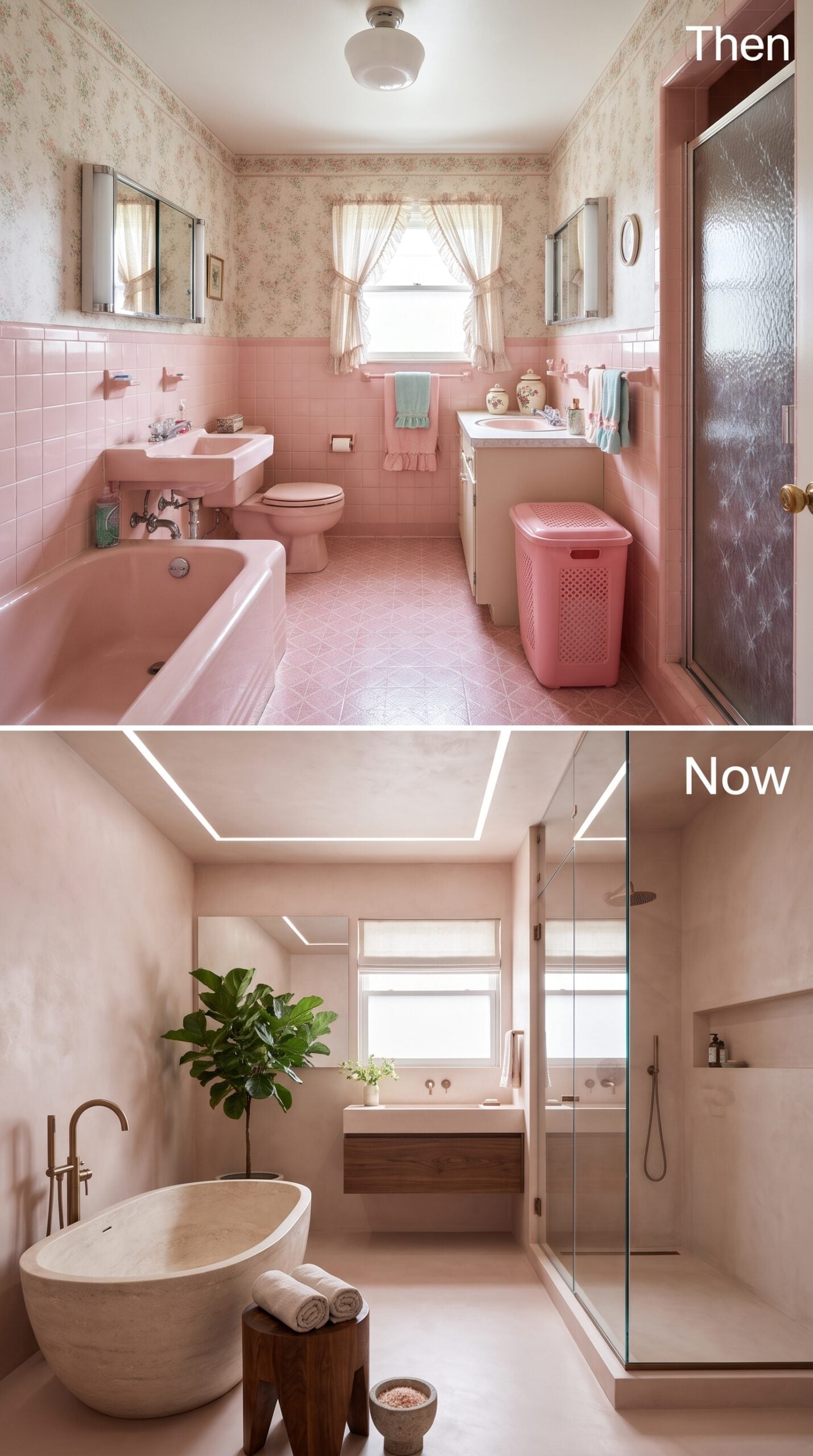
A recessed strip of light draws a luminous rectangle around this softly colored bathroom. Within it, an oval travertine tub supplies a curved shape, accompanied by a slender brass-toned floor filler. The outline of the room does some of the decorative work once assigned to patterned ceramic tile.
Broad areas of muted rose register the changes in shadow and brightness across the walls. Without a grid of small joints, the color can read as one continuous field. The tub commands attention through its shape and the lighting gives its surroundings definition.
Flooring Detail: Choose flooring and finishes suitable for wet, barefoot conditions. A matte appearance alone is not evidence of slip resistance; confirm the product’s intended use and performance with the supplier and installer.
10. Pink Goes From the Penny Tile to the Painted Ceiling
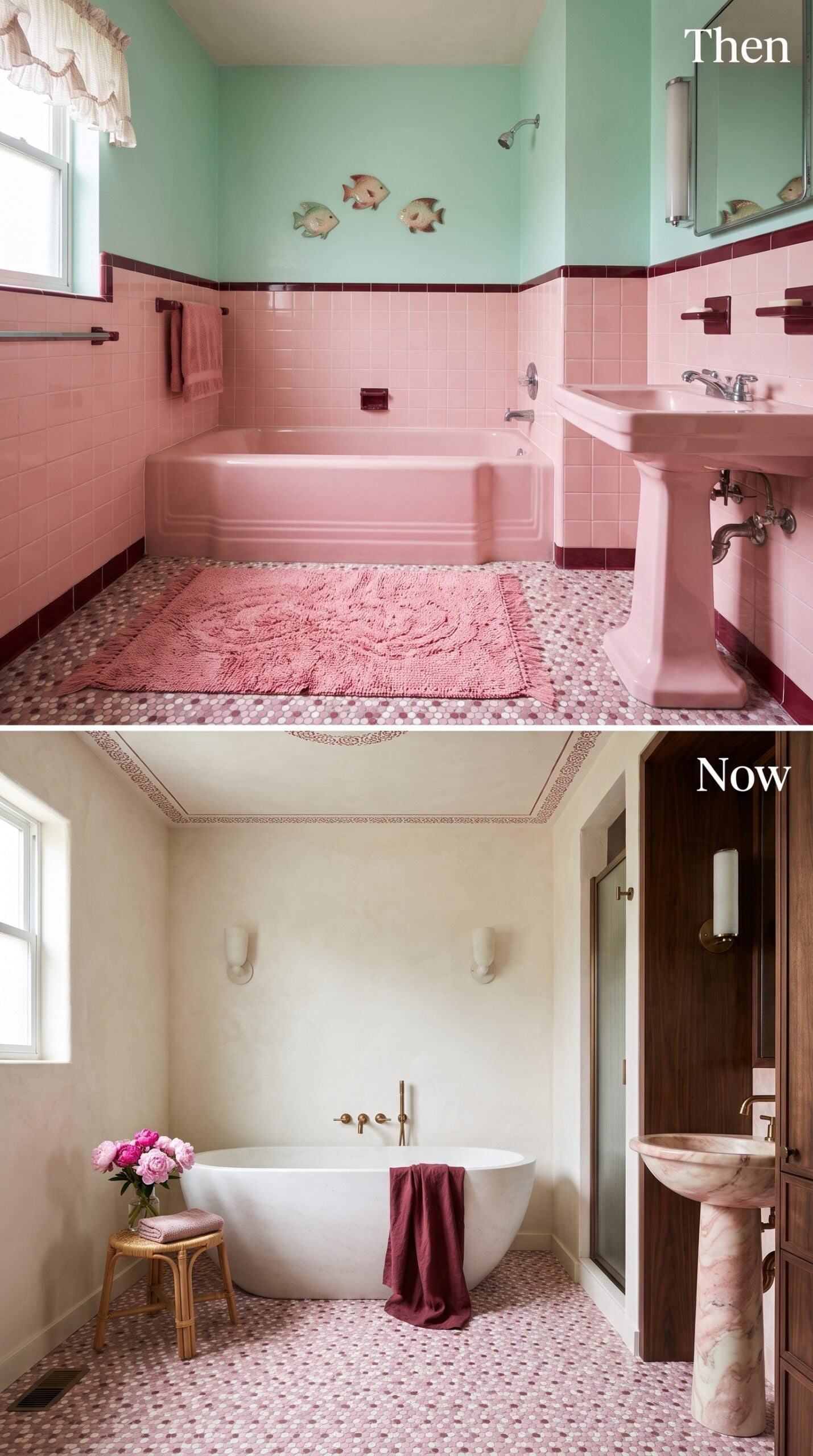
Pink travels through three distinct elements: the penny-round floor, a sculptural marble pedestal and a painted ceiling border. Walnut paneling gives the sink a dark backdrop, and broad areas of plain plaster leave space between the decorative elements.
The stenciled frieze picks up pink and burgundy tones from the floor mosaic, allowing the pedestal to connect patterns at different scales. The old habit of coordinating bathroom details survives, with a painted border taking the place of some of the ceramic ornament.
9. A Pink Soaking Tub Between Daylight and Concealed Light
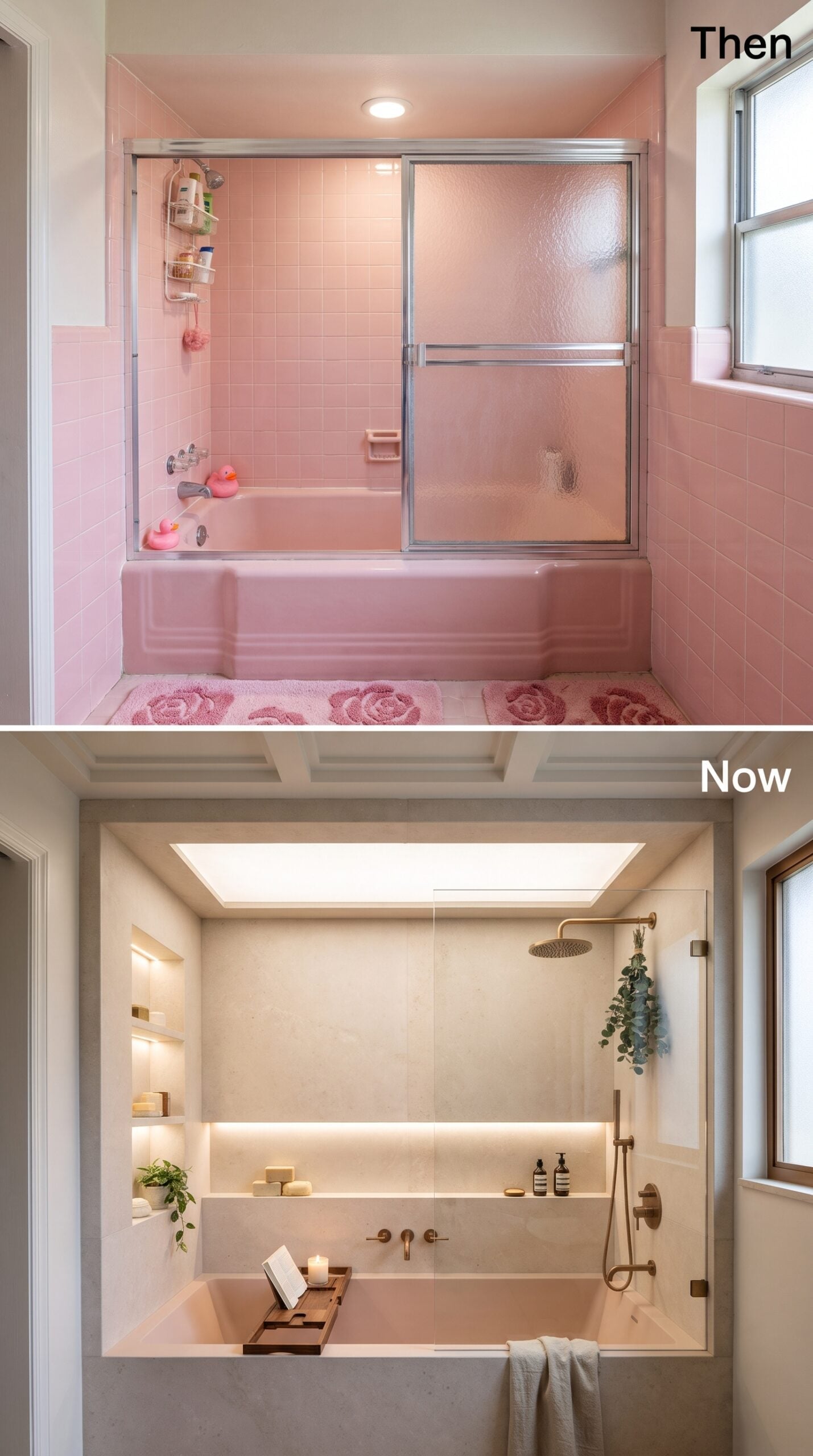
The familiar pink bathtub returns as a sculptural soaking tub in a pale alcove. Broad limestone-look panels create long, uninterrupted planes around it, with a skylight overhead and a recessed strip washing the wall beneath the ledge.
A bronze-toned wall-mounted filler sits above the bathing area, leaving the tub to supply the warmest color. Daylight changes with the weather, while the concealed strip draws a precise line along the alcove. Pink has become the focus without needing a matching sink or floor.
Lighting Detail: Plan illuminated ledges and skylights with the bathroom’s moisture conditions in mind. Select fixtures suitable for their installation location, provide access to service lighting components and coordinate the installation with the waterproofing and ventilation systems.
8. When Pink Gives Way to Green Stone and Copper
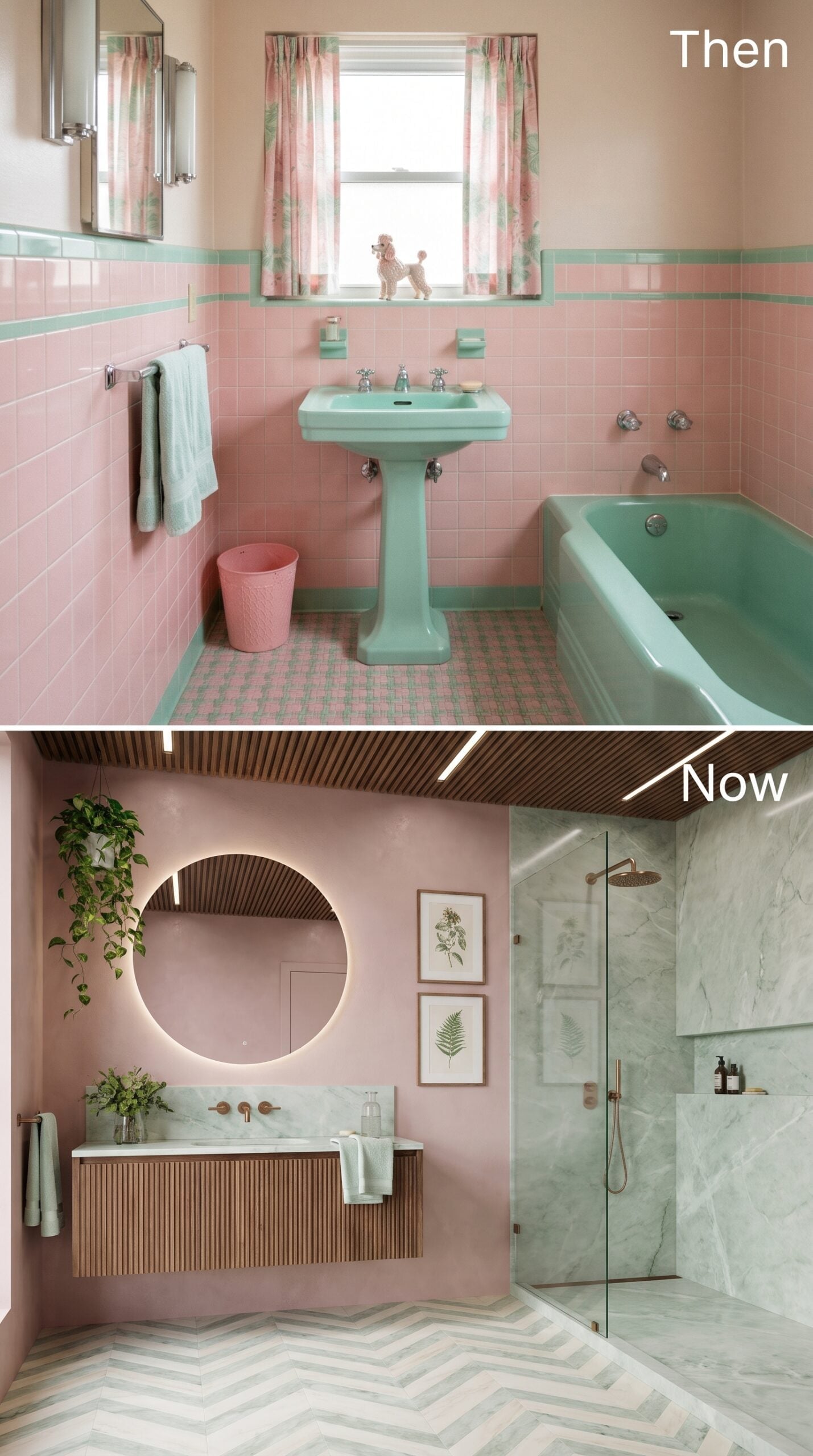
Not every midcentury bathroom needs to keep pink in the finished design. This transformation makes a deliberate departure: sage-veined marble runs across the shower walls and reappears at the low vanity backsplash. Brushed copper faucets provide a warmer note against the cool green stone.
A chevron floor stops at the shower glass, and linear lights between walnut ceiling slats provide a second directional pattern. A backlit mirror supplies softer illumination at the vanity. The old bathroom supplies the starting point, not a compulsory color scheme.
7. Pink and Pale Oak Make Room for the Garden
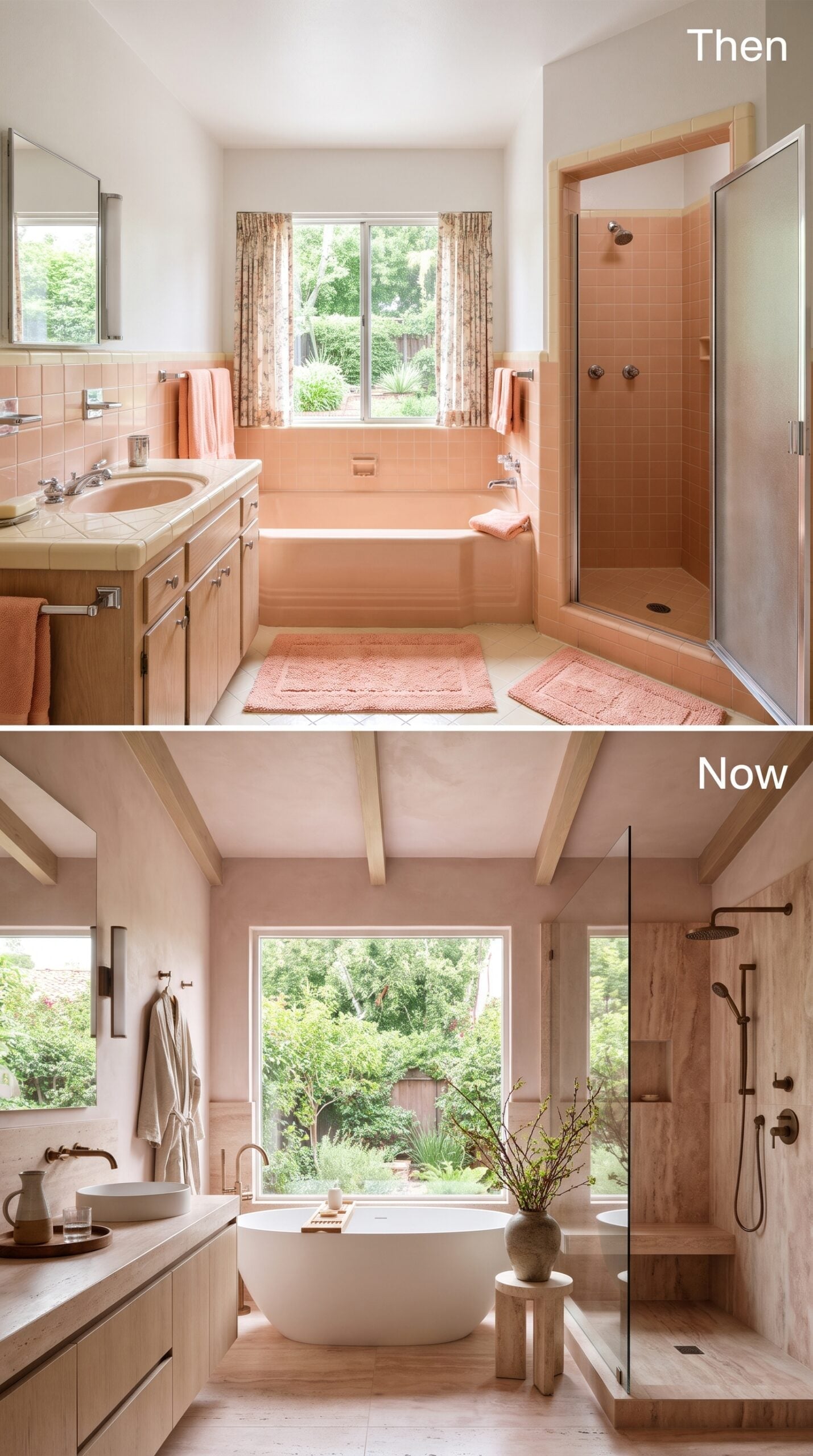
Pale pink can function almost as a neutral when a picture window takes command of a bathroom. The freestanding white tub occupies the foreground, with a shifting field of garden green beyond the glass. Rosy travertine and pale oak keep the room warm without a suite of matching pink fixtures.
Bronze-toned shower fittings echo the wall-mounted vanity spout, supplying fine dark accents against the light finishes. Ceiling beams add a measured rhythm overhead. Pink is part of the setting for the garden rather than a color that has to compete with it.
Color Detail: Sample pink paint and stone under the actual daylight and artificial lighting before committing to the palette. Colors with subtle undertones can appear markedly different depending on the orientation of the window and the lighting conditions.
6. Oxblood Replaces the Old Pastels
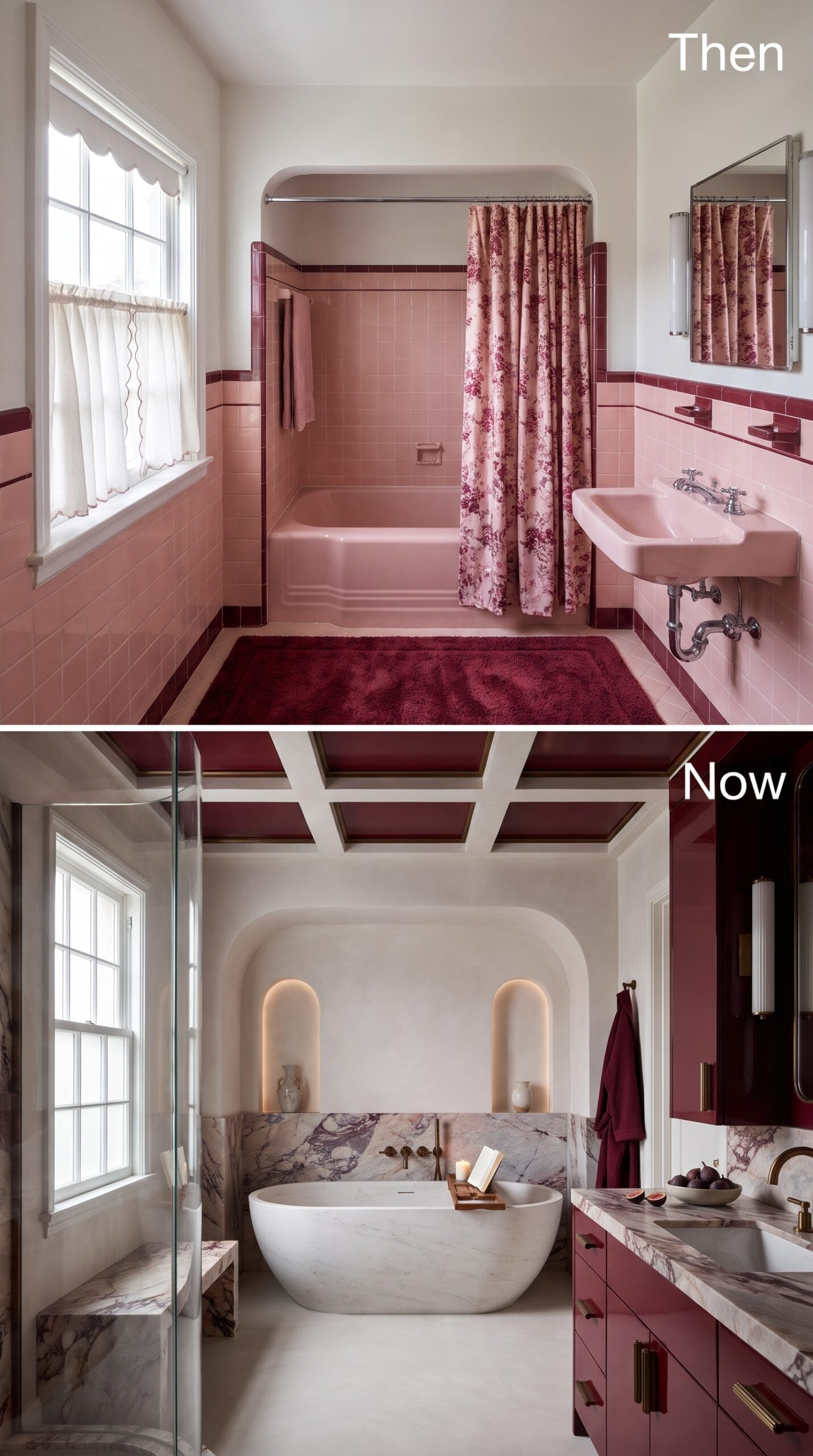
Burgundy lacquer on the vanity and within white ceiling coffers takes the historical bathroom palette in a darker, more saturated direction. Violet-veined marble around the tub offers a quieter variation, with the white beams keeping the glossy panels distinct.
Two illuminated arched niches interrupt the stone wainscot with a pair of simple openings. The branching veins, repeated arches and rectangular coffers each operate at a different scale. Here the old pastel pink gives way to the richness of oxblood, without surrendering the idea of a boldly colored bathroom.
5. The Ceiling Takes Over the Pattern From the Tile
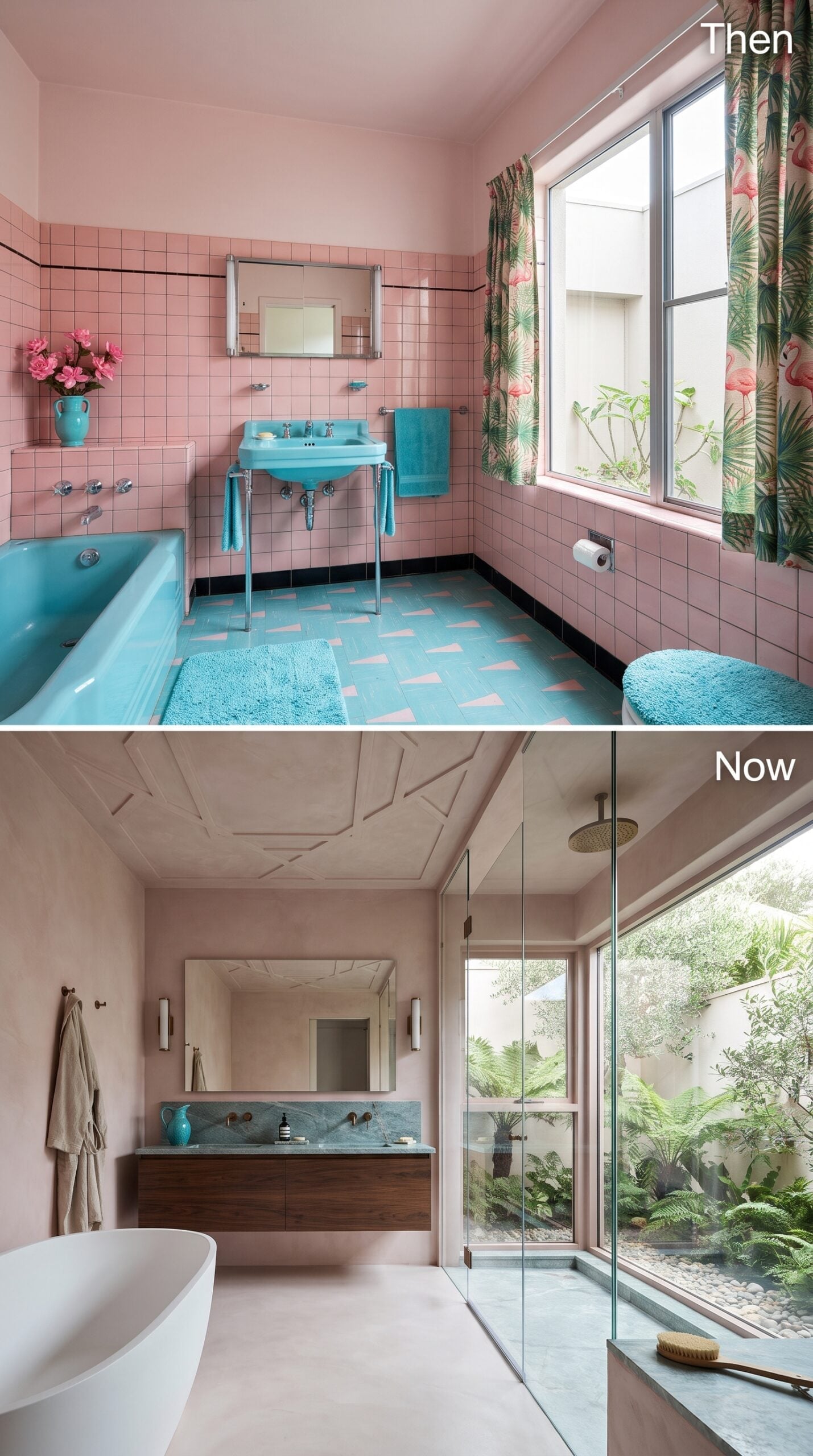
Small ceramic tiles supplied much of the pattern in a midcentury bathroom. A faceted plaster ceiling takes over that job here, creating a geometric arrangement of light and shadow. The soft pink walls remain smooth beneath it.
Ferns beside the shower glass offer a looser natural pattern against the precise ceiling relief. The mirror reflects the facets, bringing the overhead design into the vanity area without another applied motif. The pink stays understated; the architecture supplies the ornament.
4. The Bathtub Steps Out of Its Built-In Surround
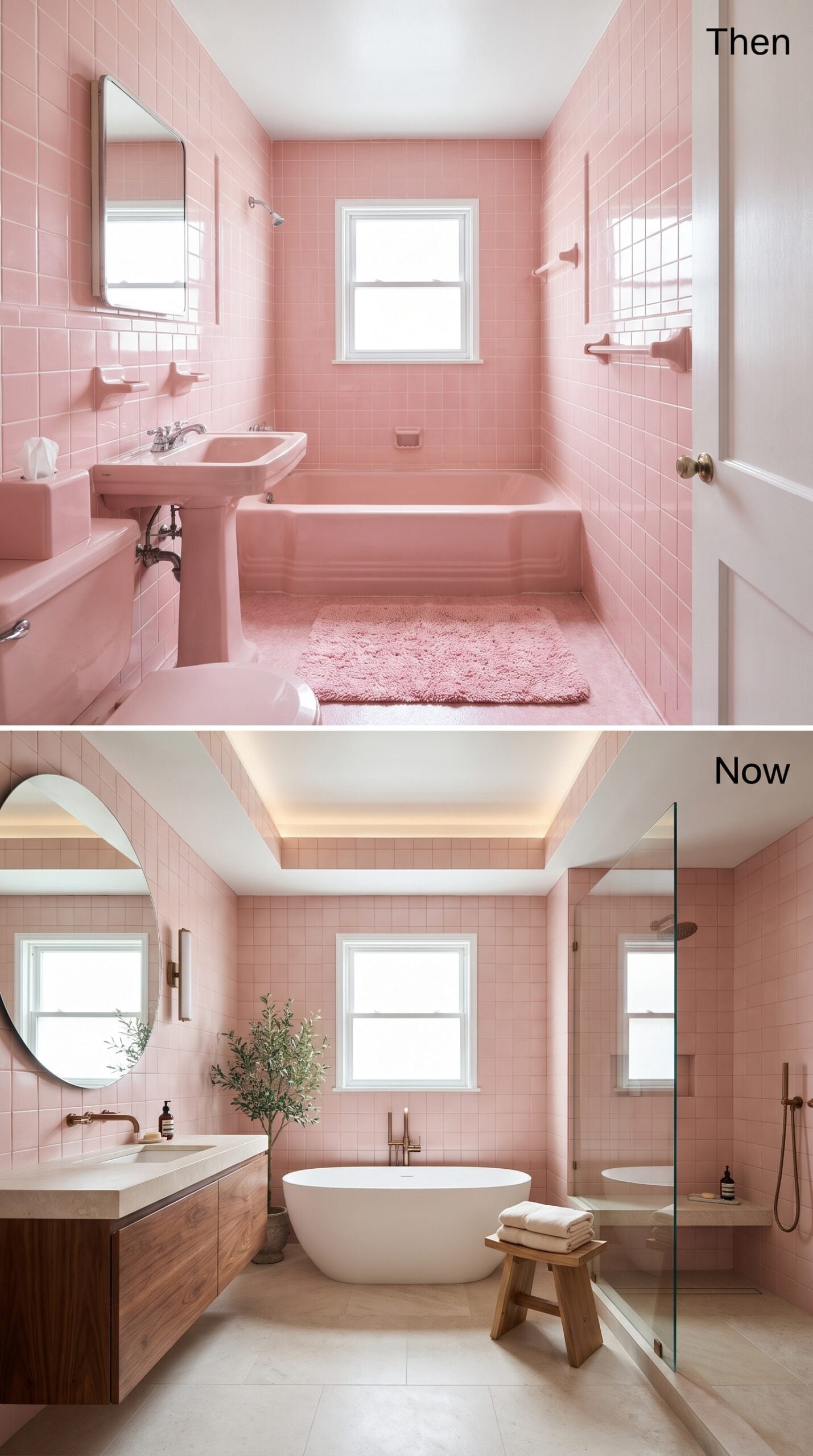
A built-in bathtub surrounded by pink tile gives the color a substantial presence, even when the fixture itself has little visual independence. A freestanding oval tub offers a different approach. Set away from the window wall, with a slender brass-toned floor filler behind it, the tub becomes an object in its own right.
Pale flooring runs beneath the floating walnut vanity, and a potted olive tree provides a natural shape between the fixtures. The transformation shifts the emphasis away from a coordinated pink suite toward open floor space and independent objects. Color need no longer dictate the placement of every fixture.
3. A Silver Ceiling Above Pink Tile and a Bench With Two Jobs
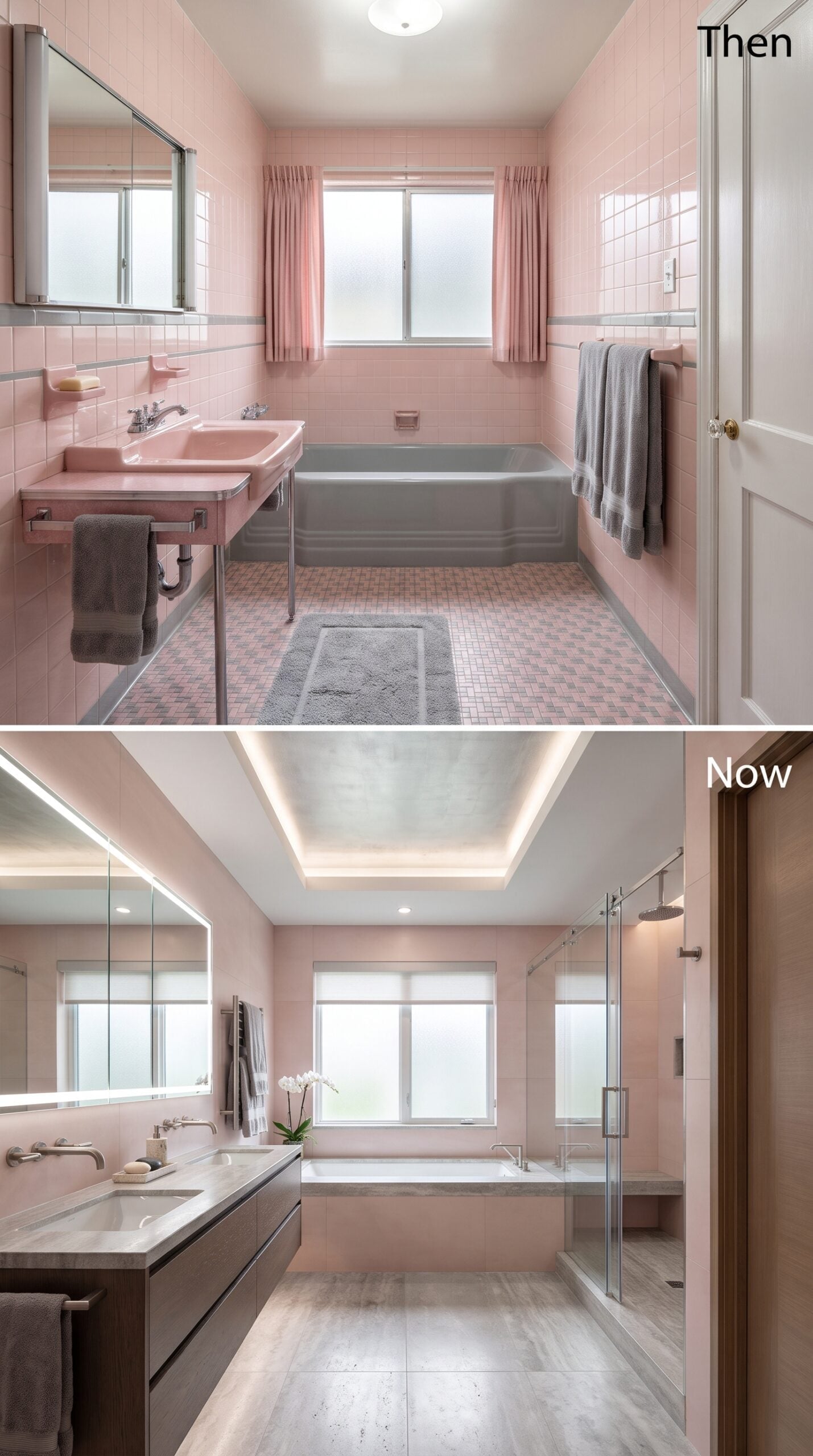
Large-format pale pink tiles reduce the number of visible joints, changing the rhythm of the old ceramic grid. Silver leaf catches concealed light in the tray ceiling, bringing reflection into the room without requiring a polished floor.
The most useful architectural move is the stone tub deck that continues through the shower enclosure to form a bench. One horizontal line connects two bathing arrangements, with the pink tile supplying a continuous backdrop. The ceiling catches the eye; the bench gives the design a practical dimension.
Construction Detail: Where a tub deck continues into a shower bench, coordinate the glazing, waterproofing and drainage details as one assembly. The bench surface should slope toward the shower and the enclosure must be detailed to prevent water from migrating into adjacent construction.
2. The Glass Block Stays. Pink Finds a New Address.
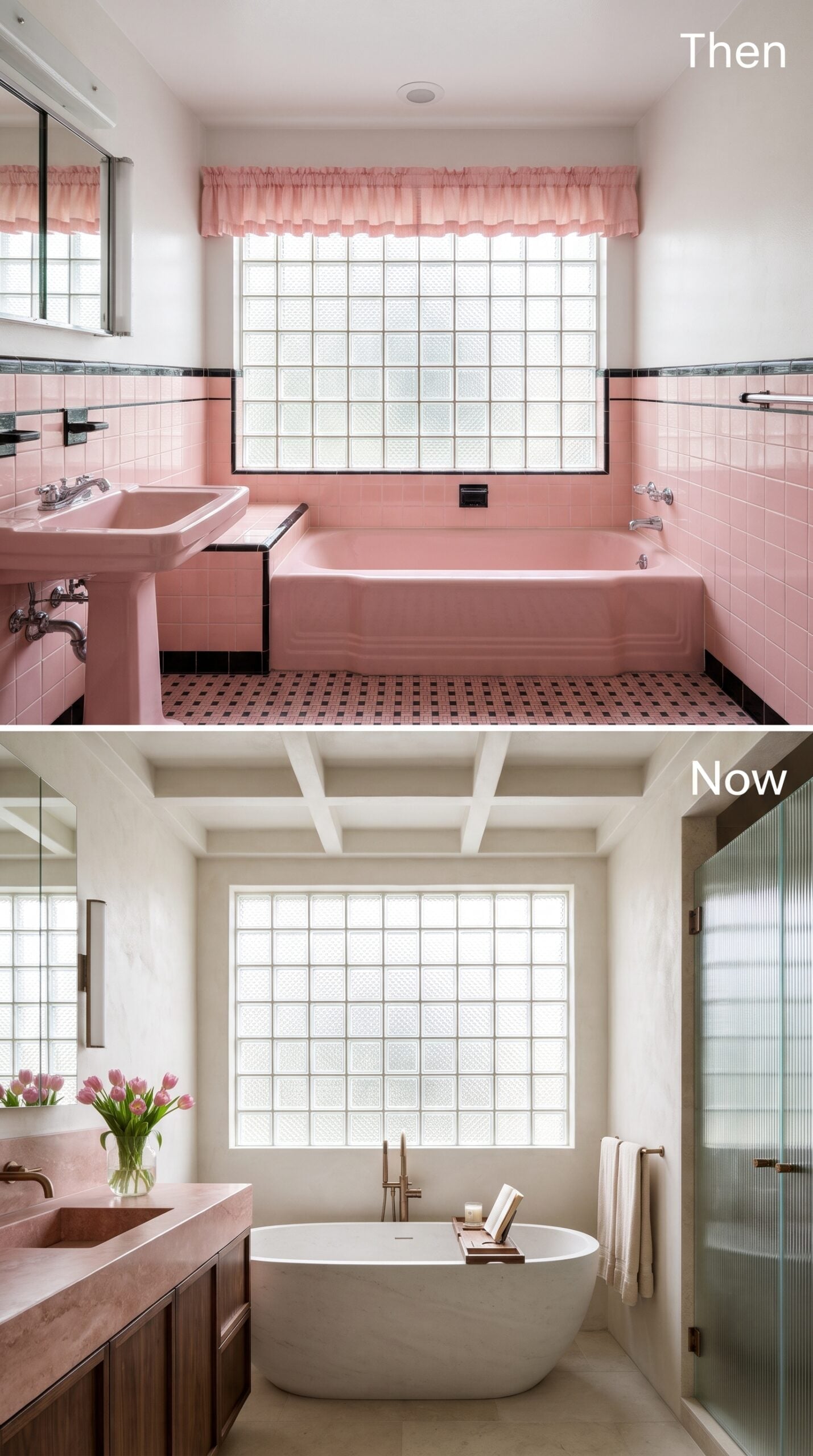
The glass-block window gave the earlier bathroom a strong architectural feature, although a gathered pink valance, matching sink and bathtub and a busy mosaic floor offered plenty of competition. The contemporary design clears the window of decorative clutter. White ceiling beams echo the translucent grid at a larger scale.
Pink migrates from the ceramic walls and fixtures into a substantial rose-colored stone vanity with an integrated basin. Walnut drawers and pale plaster set off a freestanding white tub, while reeded shower glass echoes the window’s diffused quality. The two translucent surfaces establish a coherent approach to light, and a relatively small area of pink commands considerable attention.
1. Pink and Black Still Have Plenty to Say
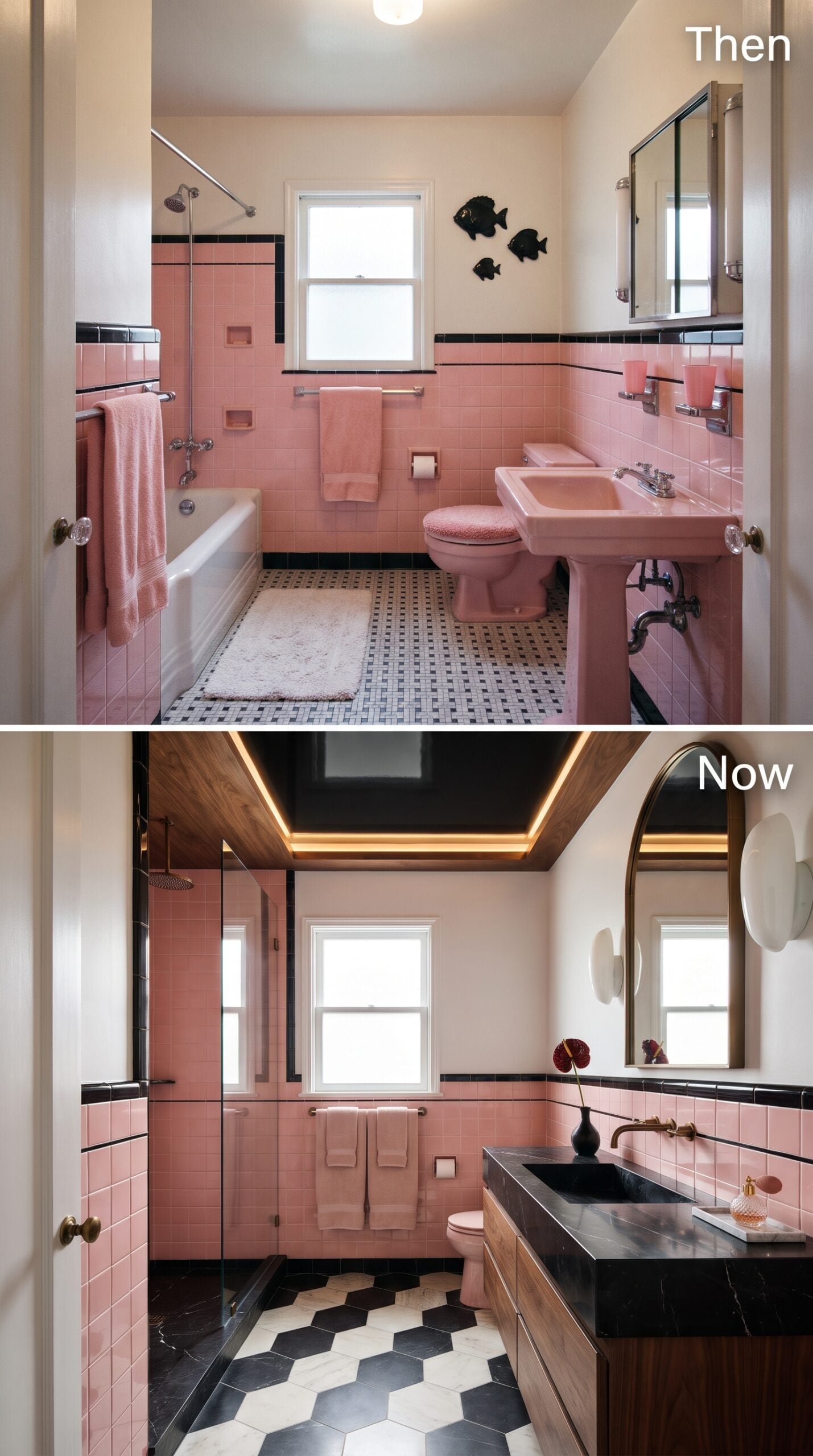
Pink and black formed one of the most recognizable graphic combinations in midcentury bathrooms. This transformation changes the scale of the dark accents: a black stone vanity top and integrated basin, a dark shower floor and a glossy black center within the ceiling. Walnut frames that overhead plane, with a slim line of light marking the transition.
Hexagonal floor tile and an arched mirror break up the rectilinear lines against the pink walls, and a bronze-toned spout supplies a warmer metallic detail. The color partnership remains immediately recognizable, even though the fixtures, lighting and finishes belong to a different era. Seventy years on, pink and black have hardly exhausted their possibilities. The palette never needed a demolition date.