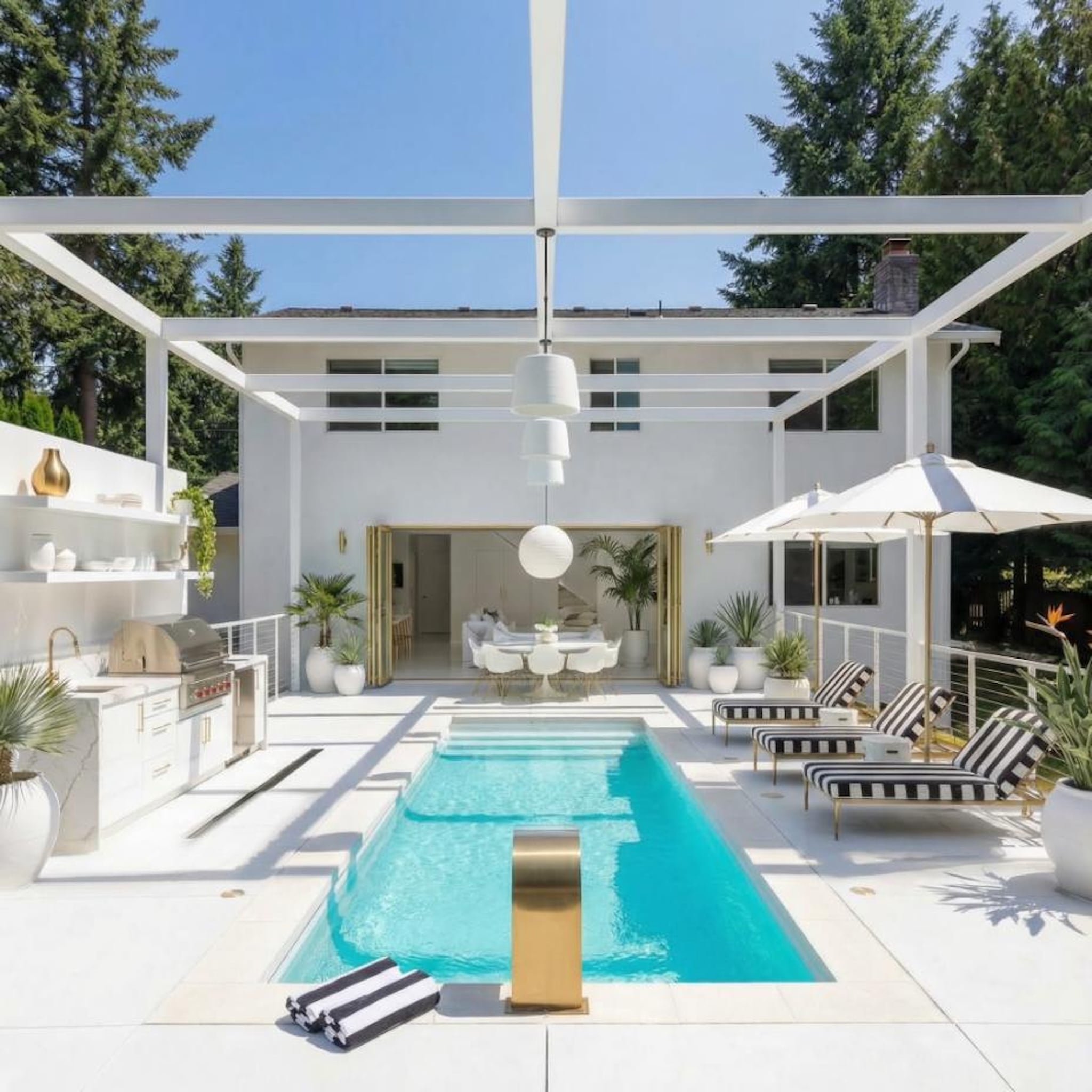
There’s a particular kind of backyard that exists in older Pacific Northwest homes: solid bones, decent size, and about thirty years of design neglect. Cracked brick, a lonely gas grill, maybe a plastic chair or two. The space works, technically, but it never actually invites you to stay. These 26 redesigns take that exact patio and push it into genuinely luxurious outdoor living territory, different materials, different moods, different philosophies, all sharing the same footprint. Think of it as the most expensive menu you’ve never had to choose from.
Cedar and Basalt: The Pacific Northwest Outdoor Kitchen It Was Always Meant to Be
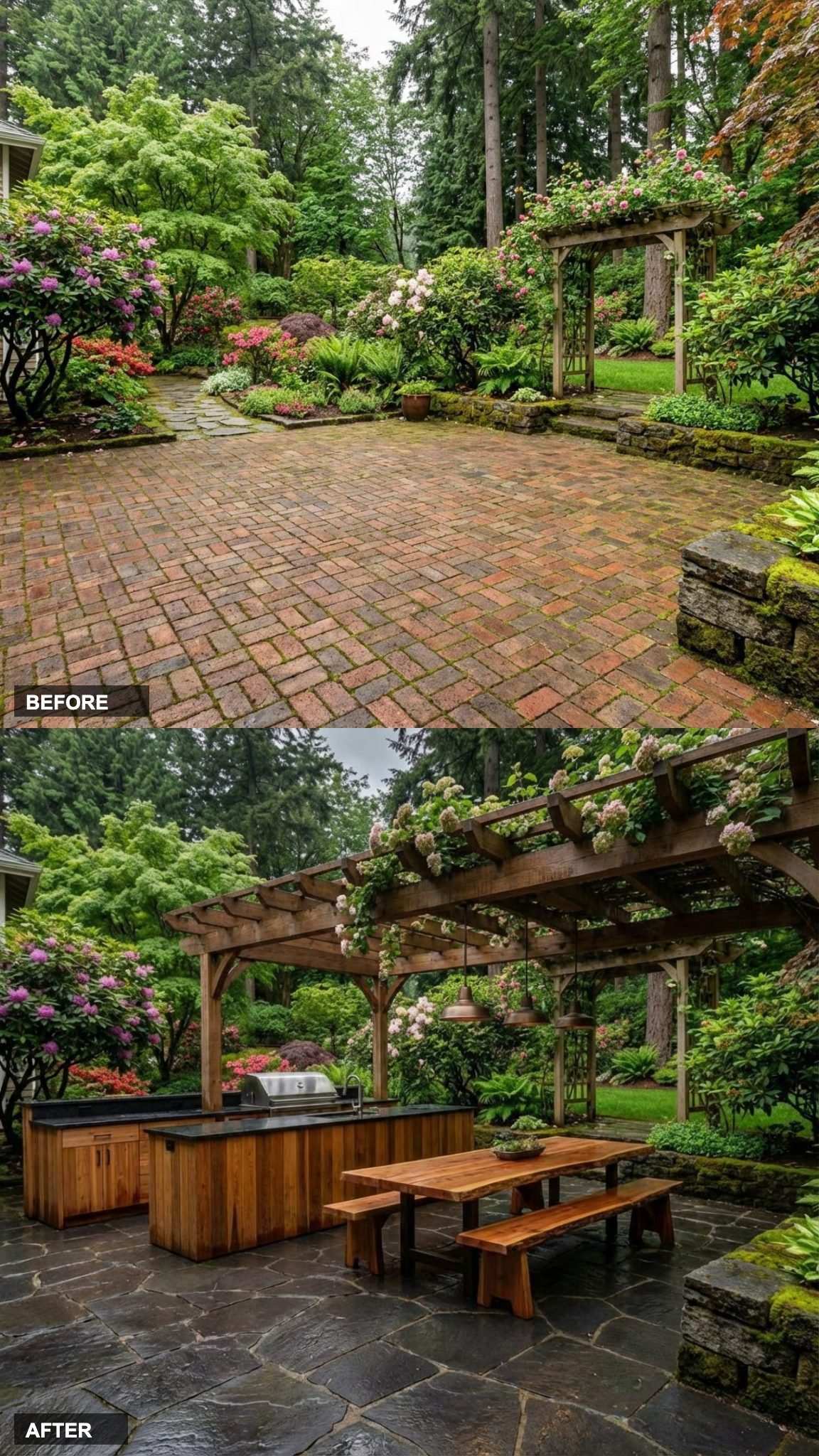
Cedar and basalt are almost embarrassingly well-matched for this climate. Cedar weathers the rain without rotting, and basalt, that dark, dense volcanic stone found naturally throughout the Pacific Northwest, holds heat, resists freeze-thaw cycles, and looks like it grew out of the ground on purpose.
In order to come up with the very specific design ideas, we create most designs with the assistance of state-of-the-art AI interior design software.
The before patio had nothing going for it except square footage. This version uses every inch: a full outdoor kitchen run built from sealed basalt countertops over cedar cabinetry, with integrated bar seating and a dining zone that actually has separation from the cooking area. The overcast light that flattens most patios here works beautifully against the dark stone.
Douglas Fir and Slate Turn a Forgettable Brick Slab into a Warm Outdoor Living Room
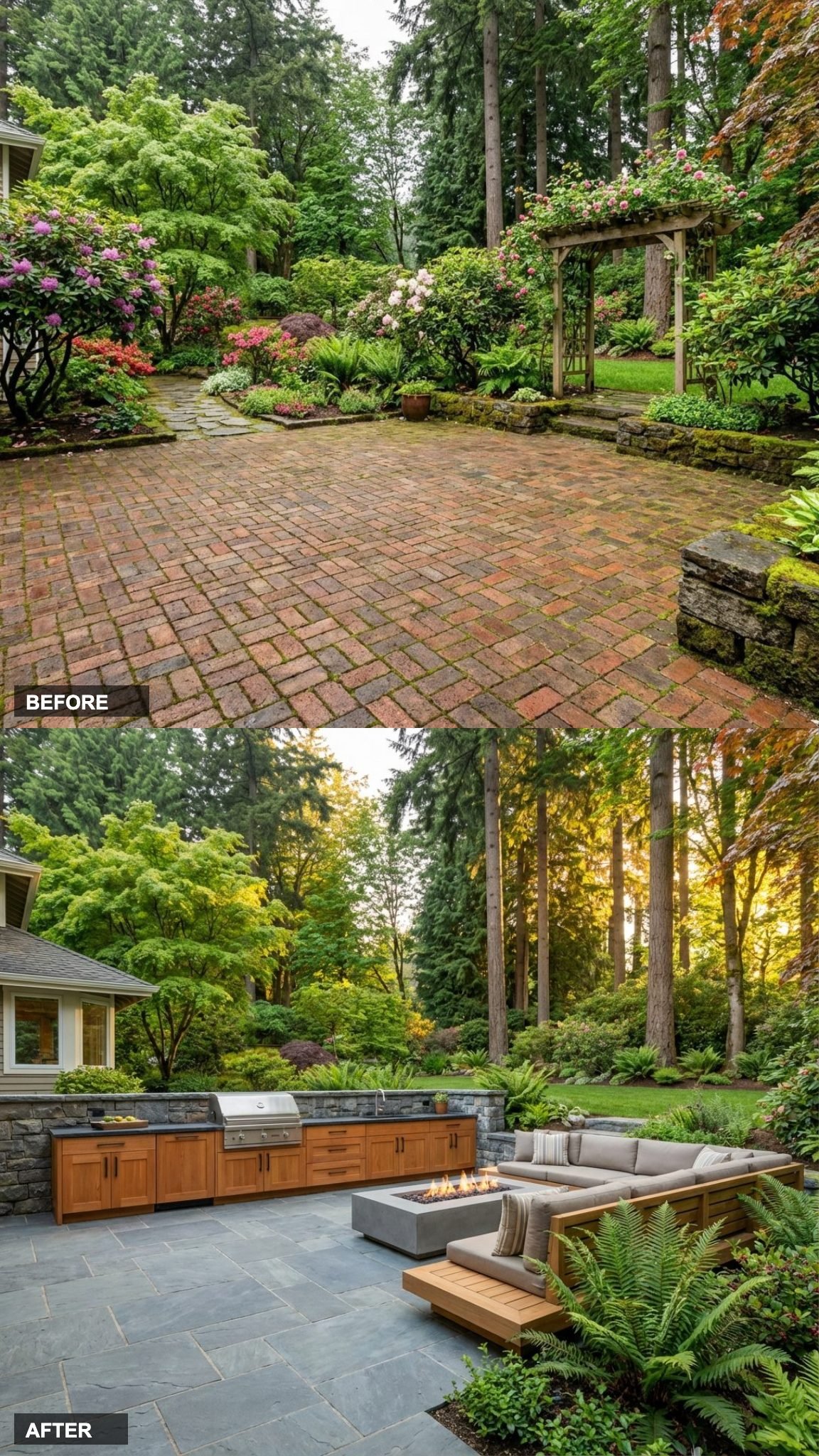
Douglas fir indoors reads rustic. Outside, with the right finish and the natural patina that Pacific Northwest humidity brings, it reads something closer to crafted. Paired with slate tile flooring, that cool blue-grey that shifts almost purple in the rain, this redesign leans into the grey skies rather than fighting them.
The lounge configuration here is the real win. Most outdoor kitchens sacrifice seating for appliances. This layout keeps both, with a built-in kitchen wall anchoring one end and deep-cushioned sectional seating facing it across a fire table. It’s the kind of space you’d actually spend a Tuesday evening in, not just a summer dinner party.
Reclaimed Oak and Poured Concrete Make a Case for Outdoor Dining That Feels Permanent
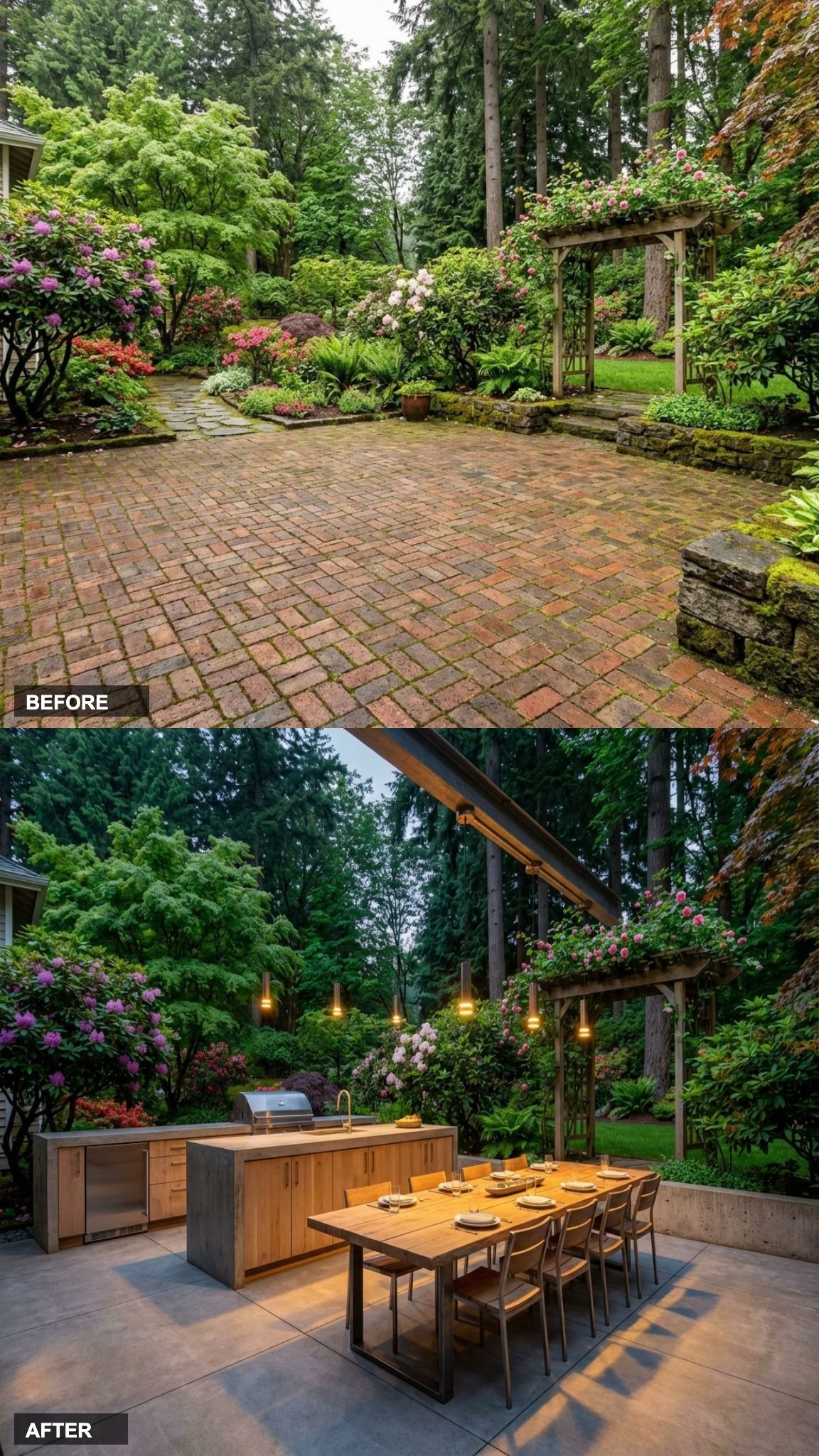
Poured concrete countertops have a weight to them, literally and visually, that manufactured surfaces can’t fake. When the aggregate is exposed and the surface is sealed with a matte finish, they photograph like stone but feel entirely custom. Reclaimed oak overhead in a pergola structure adds warmth that raw concrete alone would lack.
This dining-focused version prioritizes the table as the centerpiece. A twelve-seat concrete-top outdoor dining table sits under the oak pergola, with the kitchen built behind it rather than beside it, a subtle shift that makes the cooking feel like service rather than spectacle.
Teak and Travertine Bring a Resort Quality to the Same Old Backyard Footprint
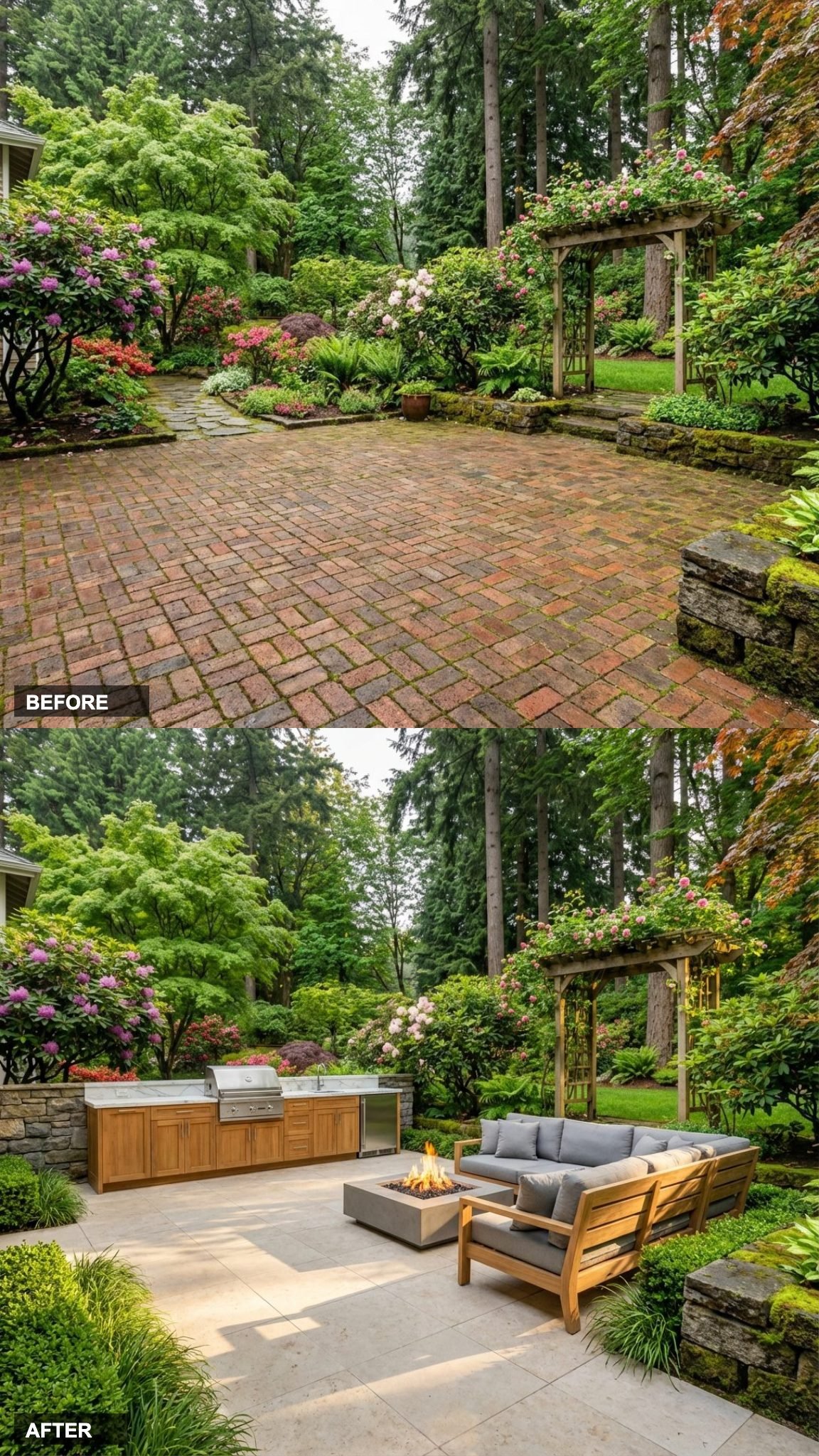
Travertine is having a long, slow comeback in outdoor design, its warm ivory tone and natural pitting catch afternoon light differently than polished stone, and it ages in a way that reads as character rather than wear. Teak, that tropical hardwood standard, is the obvious partner: honey-colored when new, silver-grey when left to weather, handsome either way.
The sanctuary framing in this version, low planting walls, integrated overhead structure, ambient lighting at grade level, creates the psychological boundary that makes a patio feel like a room rather than just a section of yard. That sense of enclosure is what most DIY outdoor spaces miss completely.
Shou Sugi Ban and Quartzite: High Contrast Drama for the Rainy Season Crowd
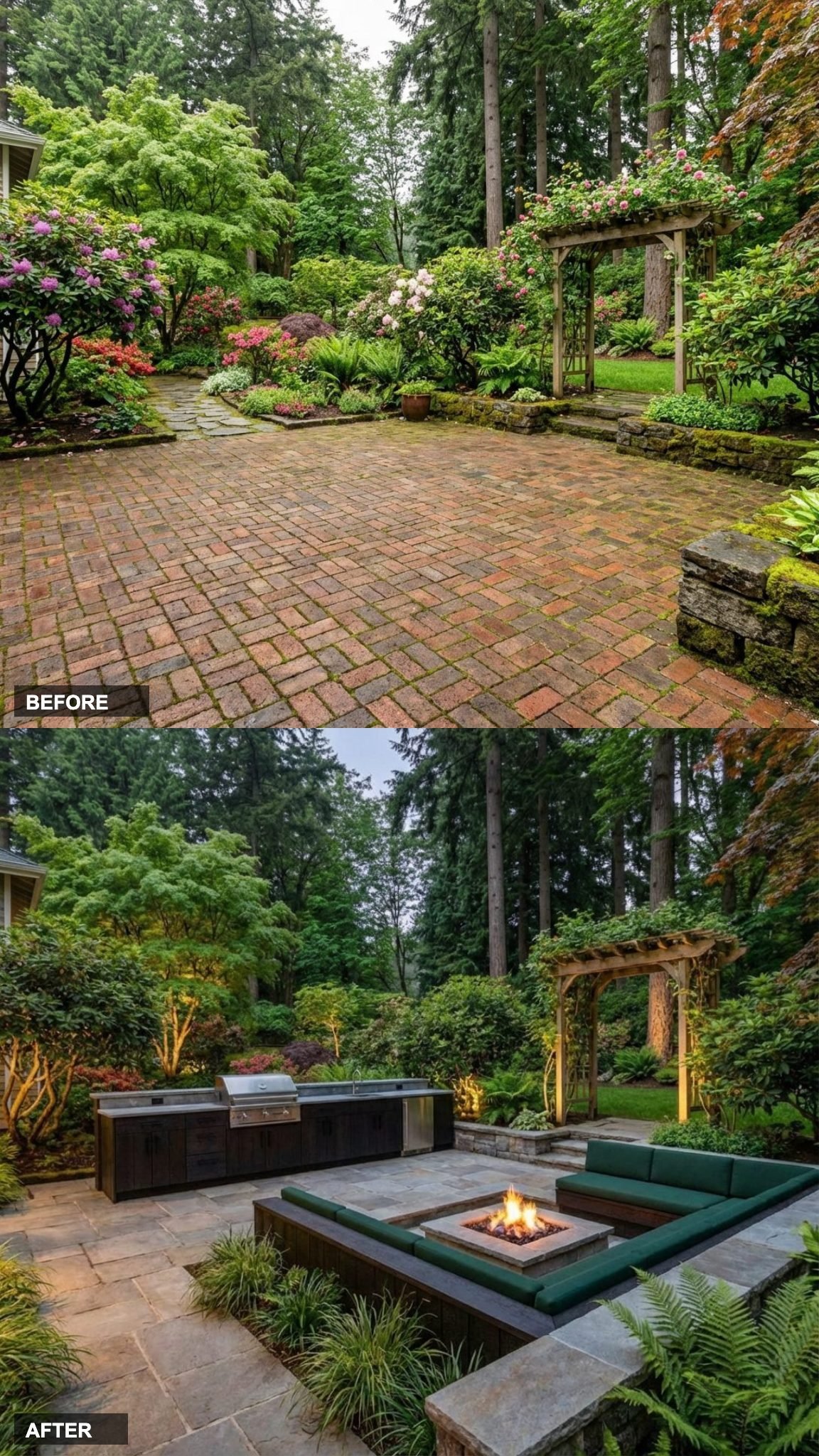
Charred wood outdoors is not a gimmick. Shou Sugi Ban, the Japanese technique of burning cedar or pine to carbonize the surface, creates a cladding material that is naturally water-resistant, UV-stable, and requires almost no ongoing maintenance. In the Pacific Northwest, where cedar siding rots if you look at it wrong, this is genuinely useful design.
The quartzite countertop and coping in this version push the contrast further: pale silver-white stone against near-black charred wood, with a fire feature centered in the layout to complete the high-contrast palette. The lounge seating is low to the ground and deep-cushioned in graphite performance fabric.
Walnut and Corten Steel in the Backyard: An Industrial-Organic Pairing That Actually Works Outside
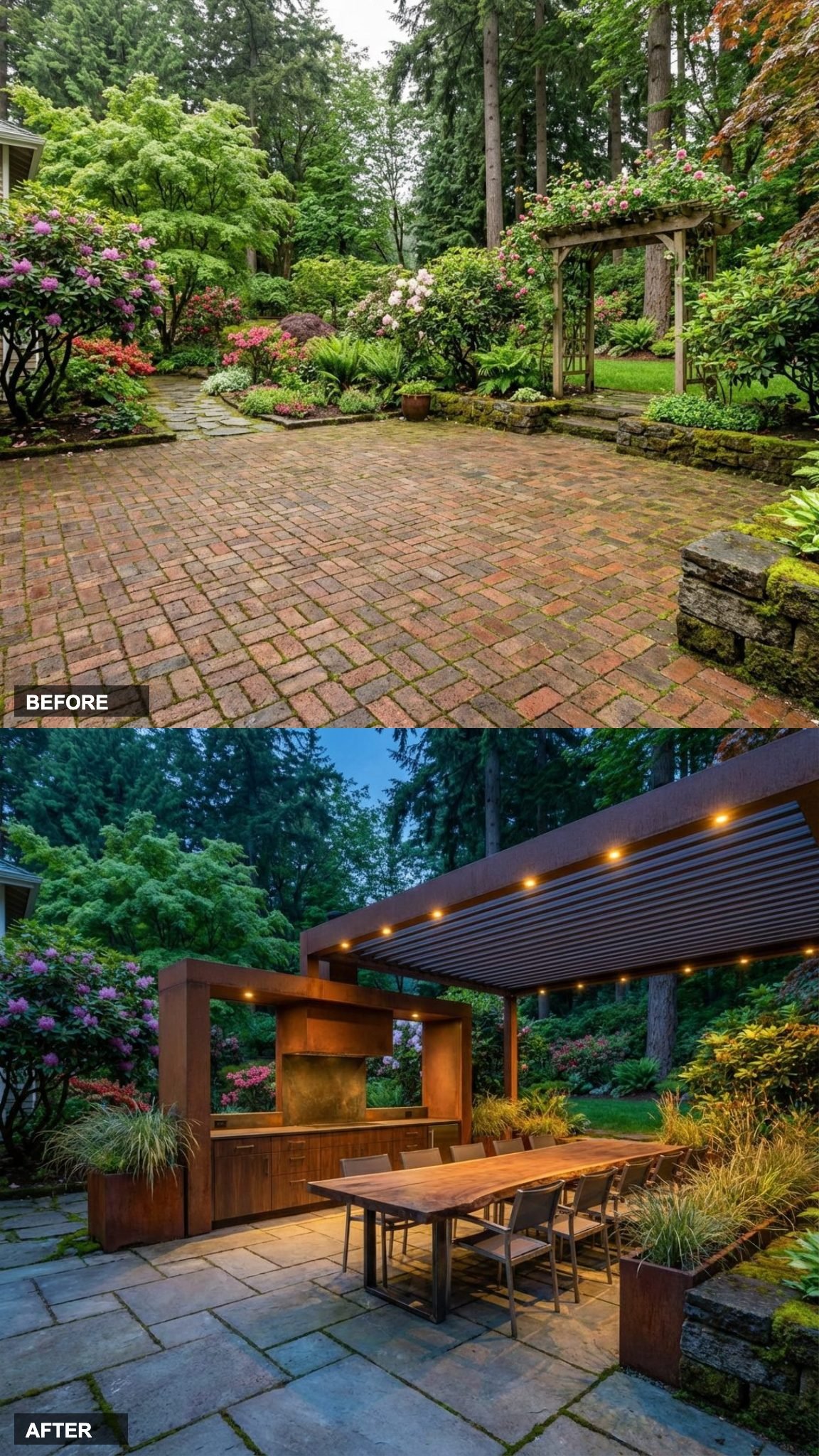
Corten steel was designed to rust on purpose. Its oxidized orange surface is a protective patina, not a failure, and in the Pacific Northwest rain, it develops that deep amber-brown finish faster than anywhere else. Against walnut’s rich chocolate grain, the combination reads simultaneously warm and edgy.
- The material logic: both walnut and corten age in place, meaning this space looks better at year five than it did on day one.
- The color payoff: the russet tones of weathered corten pull out the red in walnut grain, no stain required.
- The Pacific Northwest fit: both materials are built for wet conditions and require minimal sealing or treatment compared to painted surfaces.
Bamboo and Lava Stone Give This Northwest Patio an Unexpected Tropical-Volcanic Edge
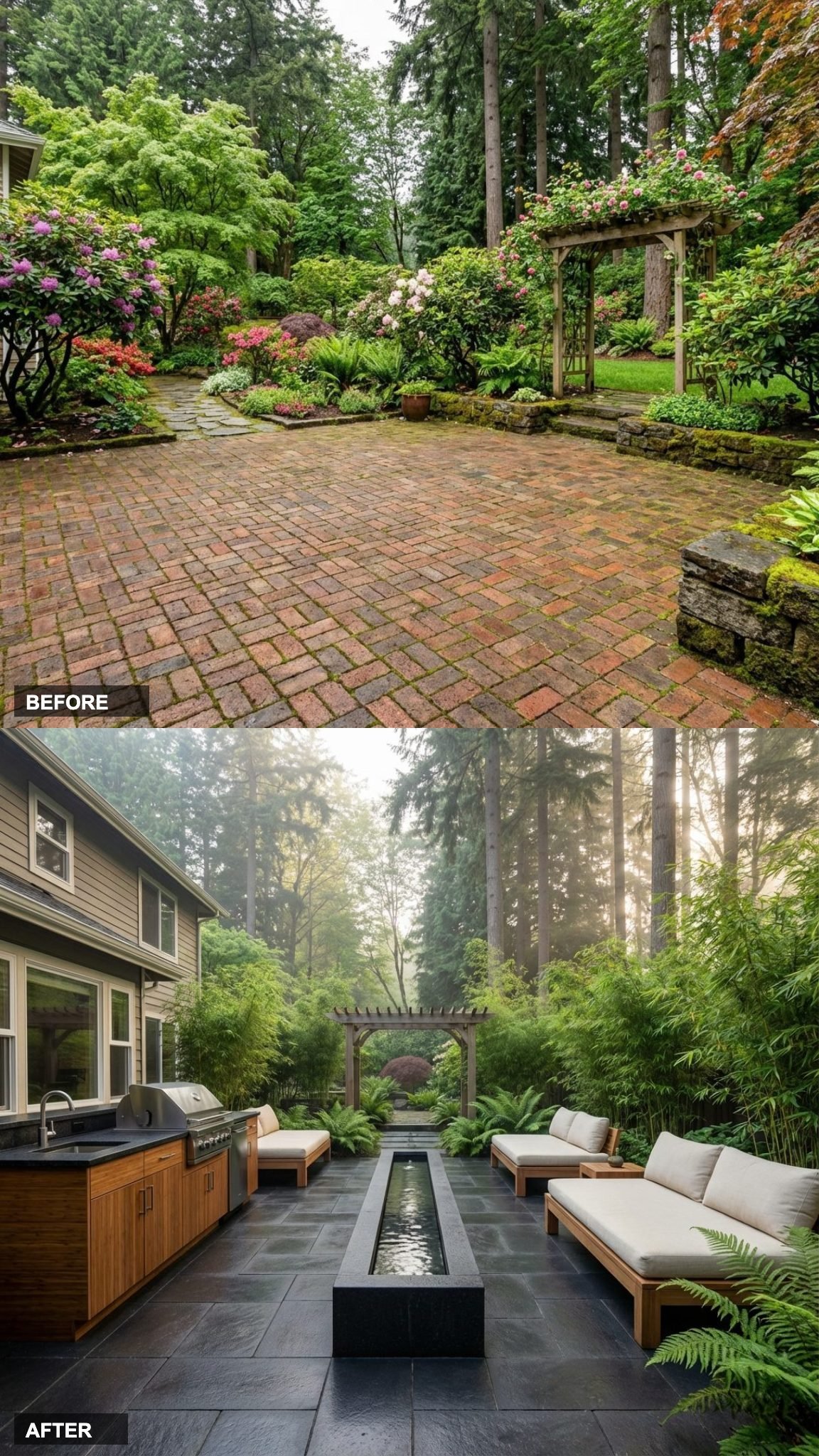
Lava stone countertops are genuinely underused in outdoor kitchens. The material is naturally porous but can be sealed to food-safe standards, and the texture, small craters and micro-fissures across the surface, catches light at low angles in a way that polished granite simply doesn’t. Paired with bamboo cabinetry and structural elements, the combination leans toward a Pacific Rim aesthetic that makes geographic sense given the region.
Cedar Shingles and Bluestone Build an Entertaining Terrace That Feels Like a Country Club Without the Membership
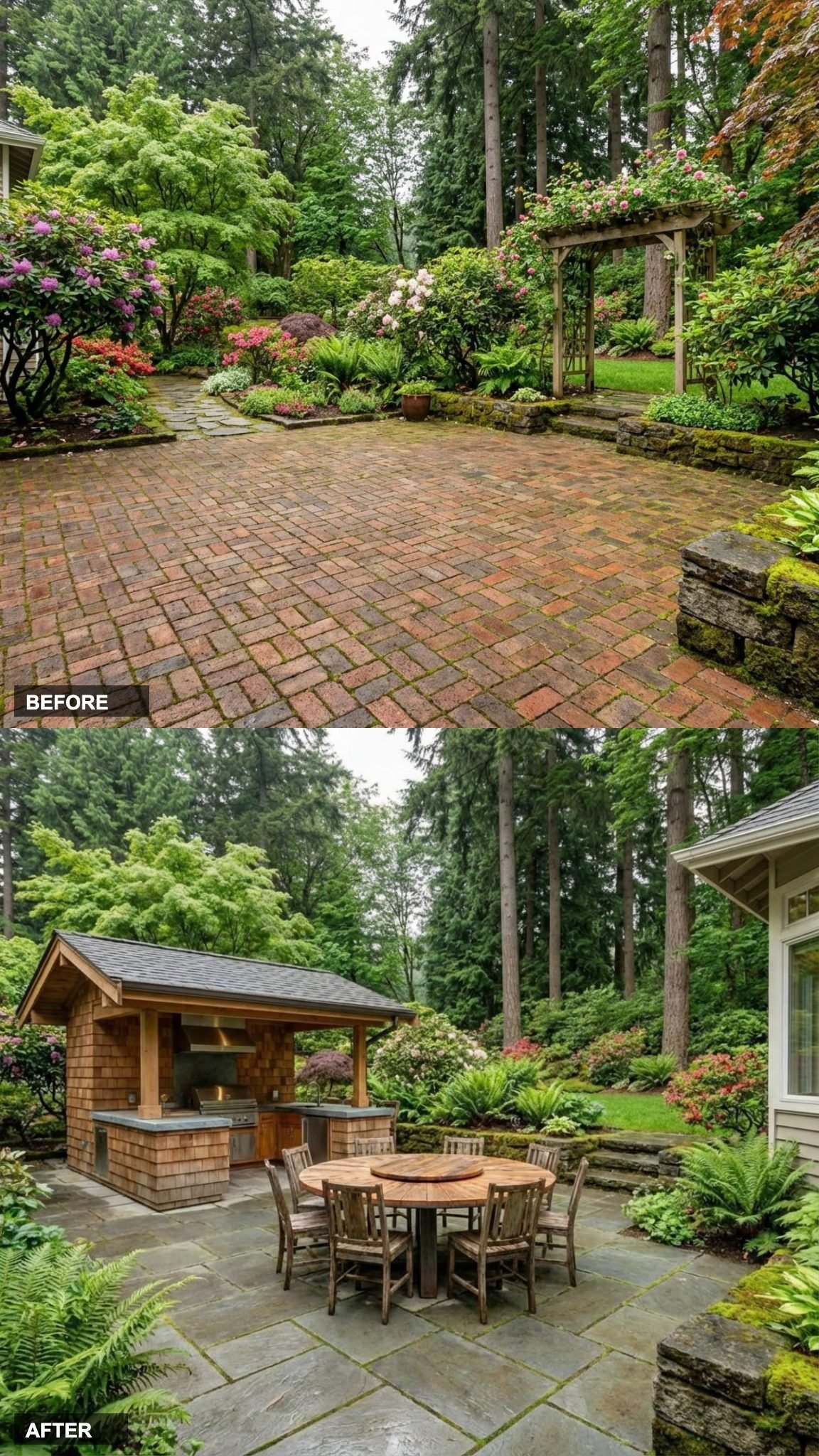
Bluestone is a designer’s reliable outdoor choice for a reason. That cool blue-grey tone is almost uniquely versatile, it reads modern against steel, traditional against cedar, and natural against plantings. When used as patio paving in large format tiles rather than small flags, it immediately signals a higher budget tier.
Cedar shingle cladding on the outdoor kitchen cabinetry is the inspired move here. It’s unexpected, shingles are a roofing and siding material, not typically a cabinet face, but the result reads as architecturally coherent in a Pacific Northwest setting where cedar shingle homes are a familiar vernacular.
Stripped White Oak and Concrete Take the Pacific Northwest Outdoor Kitchen Somewhere Scandinavian
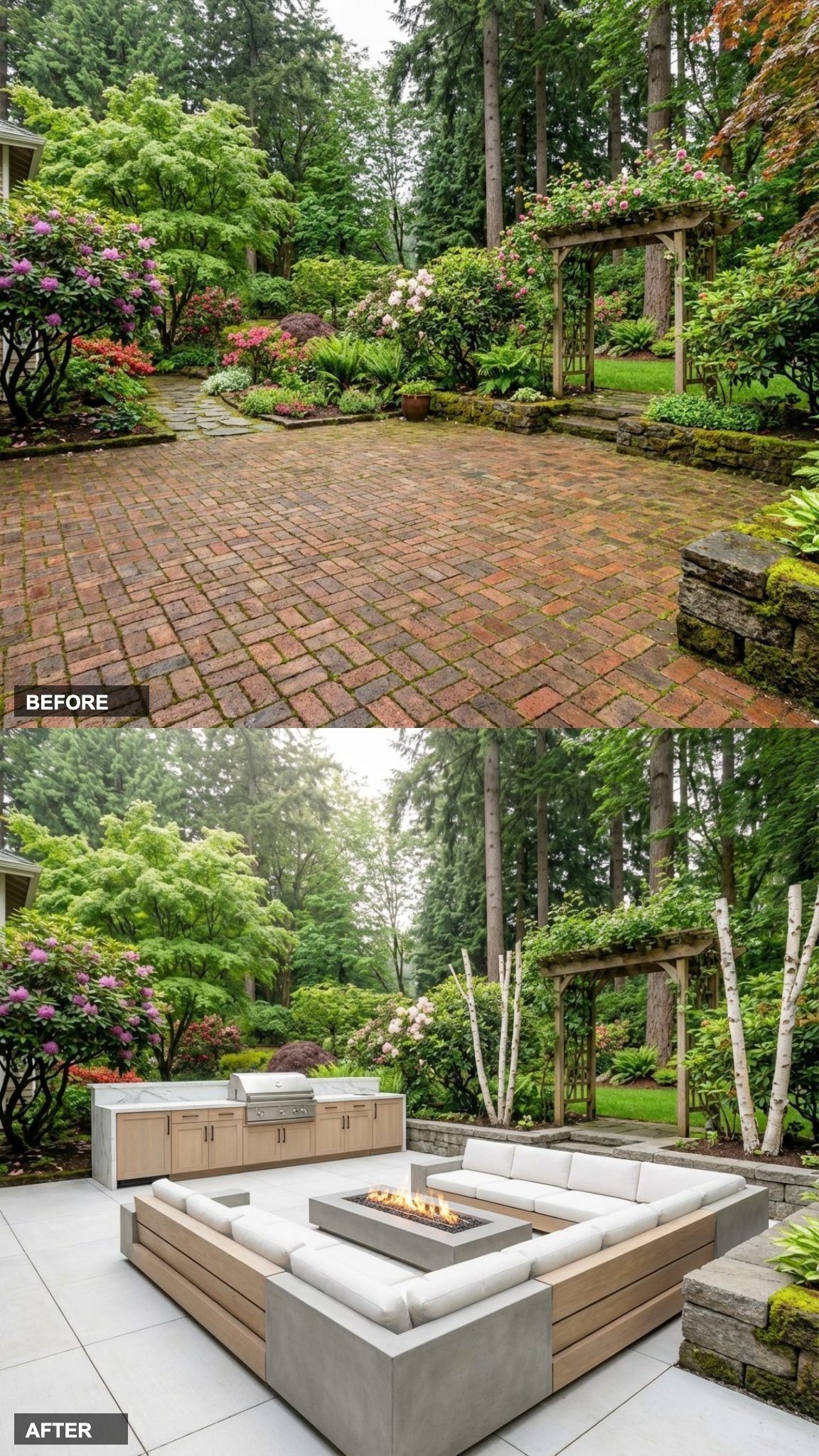
White oak, when stripped of its stain and wire-brushed to open the grain, has a pale Nordic quality that feels lighter than almost any other hardwood. Combined with smooth poured concrete surfaces and a restrained material palette, no ornamentation, no color beyond the natural tones of the materials themselves, this redesign lands in a specific place: Scandinavian outdoor living, where minimalism is a philosophy rather than a trend.
The lounge zone here uses low-profile teak furniture with off-white cushions, keeping the visual weight close to the ground. Overhead: a simple white oak pergola with clean orthogonal lines. It’s the kind of design that looks expensive because nothing is competing for your attention.
Lodge-Modern Cedar and Granite: Where Pacific Northwest Camp Aesthetic Meets Serious Outdoor Kitchen
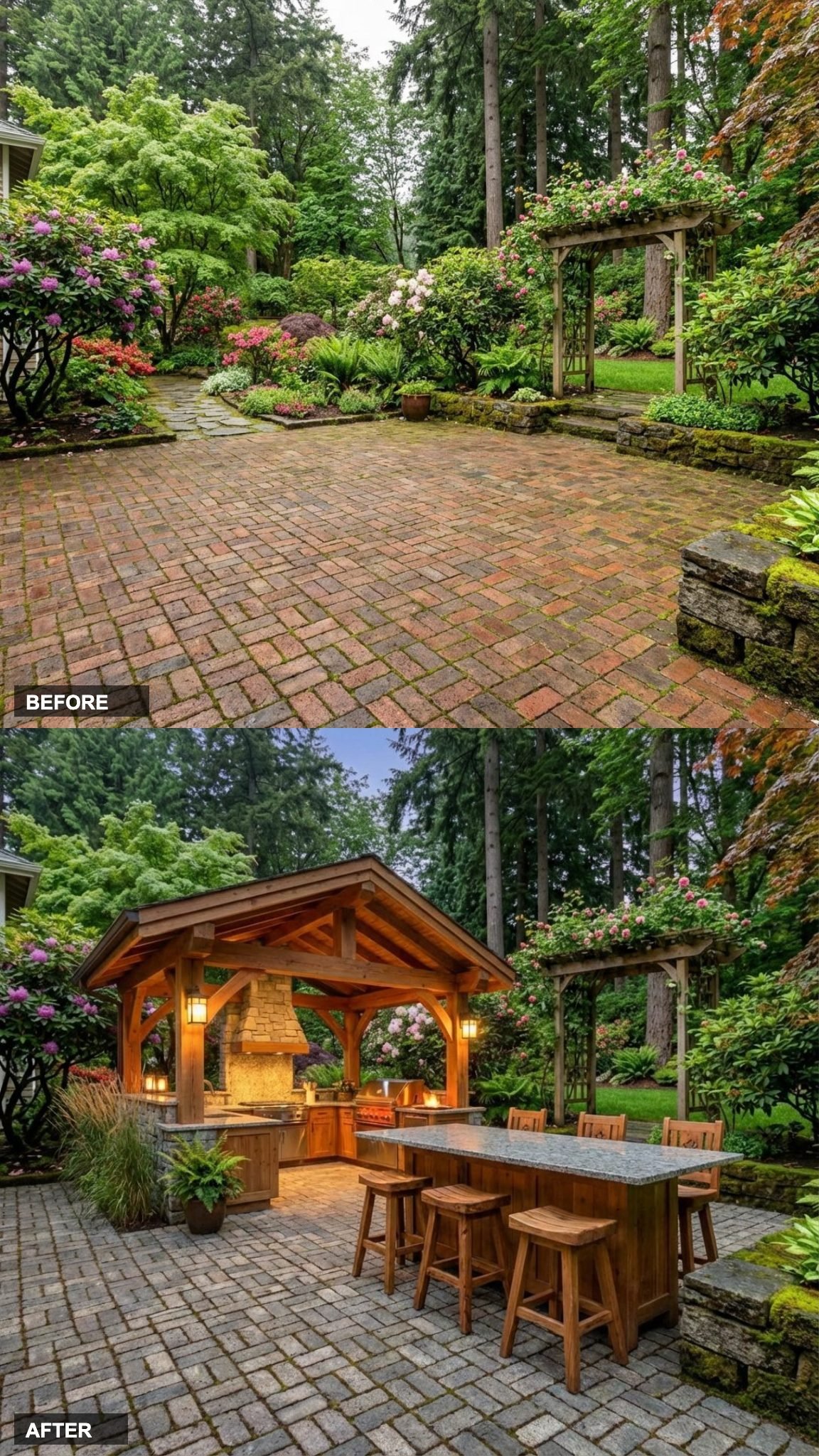
There’s a design register that sits between rustic lodge and modern restraint, and cedar with black granite hits it precisely. The warmth of unfinished cedar overhead and the solidity of dark granite countertops reference mountain architecture without tipping into cabin kitsch.
What Makes the Lodge-Modern Balance Work
The key is keeping the furniture and fixtures contemporary while letting the structural materials carry the organic warmth. Matte black fixtures, simple-profile bar stools, and a clean-line linear fire table prevent the space from feeling themed. The Douglas firs framing the yard become an asset here, they’re basically backdrop scenery for a forest-adjacent aesthetic.
Smoked Oak and Dekton: A Material Combination Built for People Who Actually Use Their Outdoor Kitchen
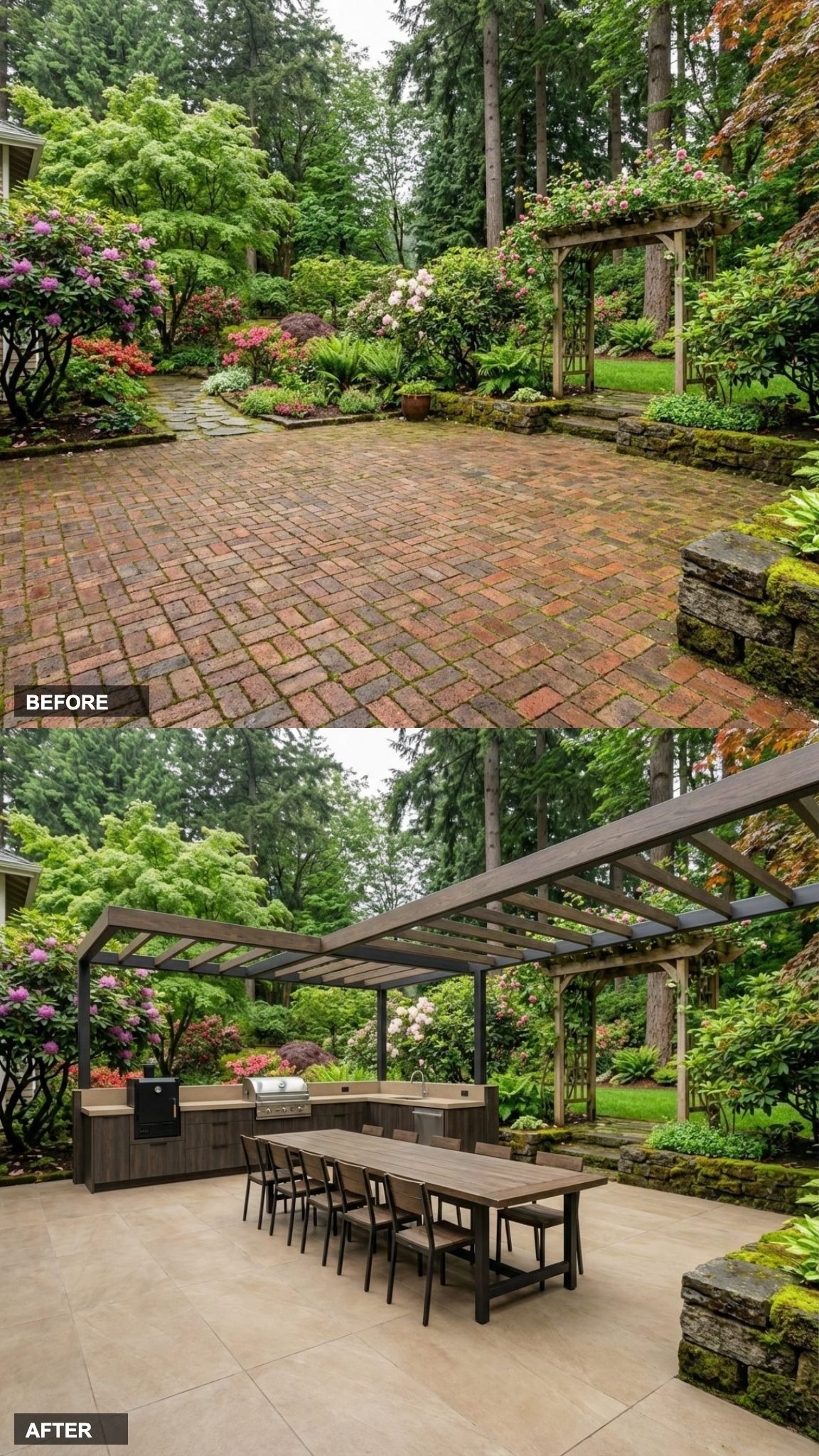
Dekton is a sintered stone, essentially compressed minerals fused at extremely high temperature, and it is genuinely indestructible for outdoor use. UV-stable, frost-proof, scratch-resistant, and available in slab sizes that allow seamless countertop runs. Smoked oak cabinetry gives it warmth it wouldn’t have alongside lighter woods.
This version prioritizes the dining experience: a long communal table in smoked oak sits center-frame, with the kitchen run visible behind it. The material story is coherent throughout, dark, serious, built to last. It’s the outdoor equivalent of a professional kitchen designed for someone who cooks.
Cypress Wood and River Stone Build the Kind of Fire Lounge That Keeps People Outside Until Midnight
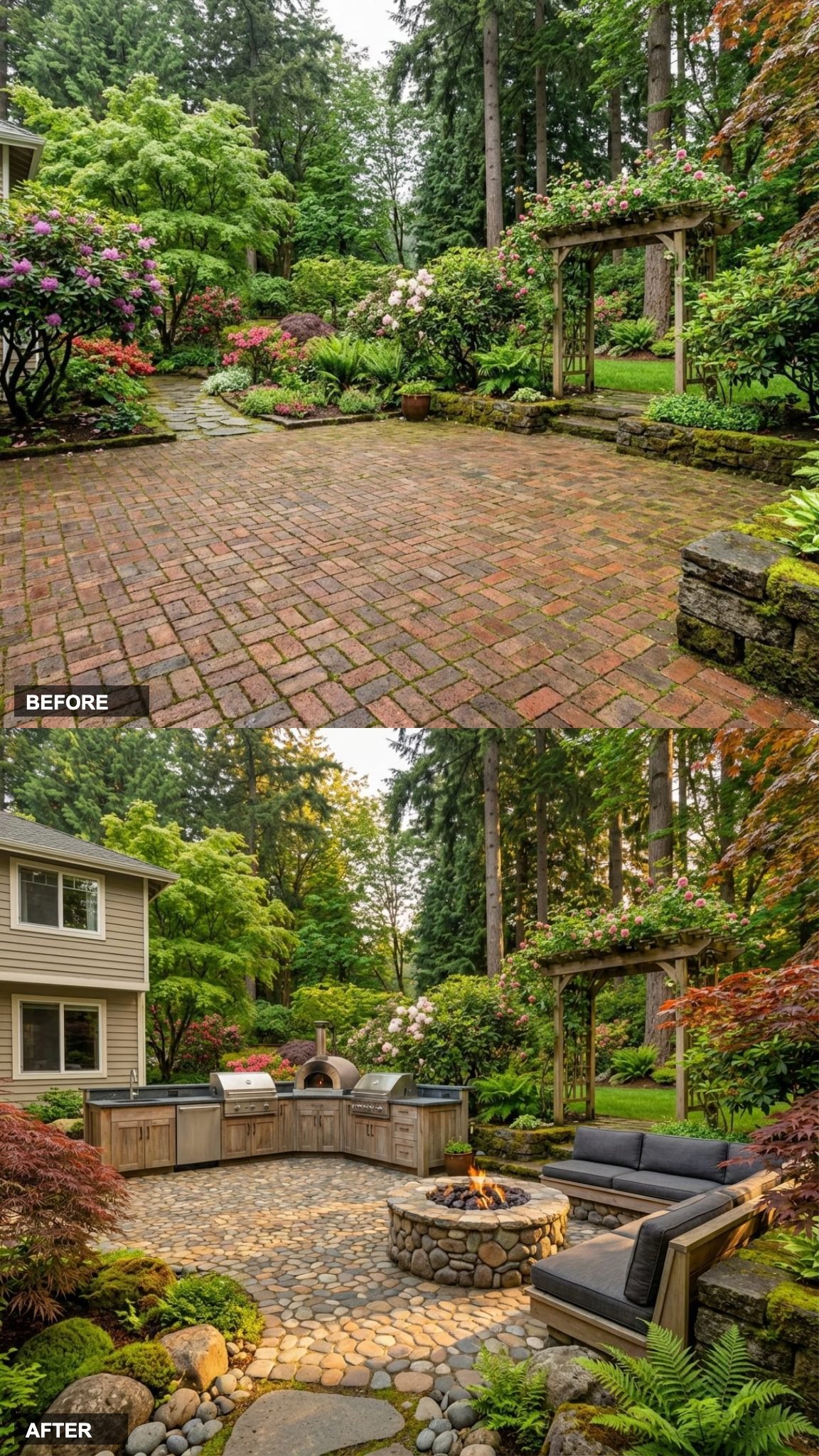
River stone has a specificity that quarried stone doesn’t. Each piece is shaped by actual water movement, rounded, varied in size, irregular in color, and that organic variability is what makes it feel earned rather than installed. Cypress wood brings its own story: naturally rot-resistant and with a grain pattern that’s tighter and more interesting than most softwoods, it turns grey outdoors in a way that reads silvery rather than weathered.
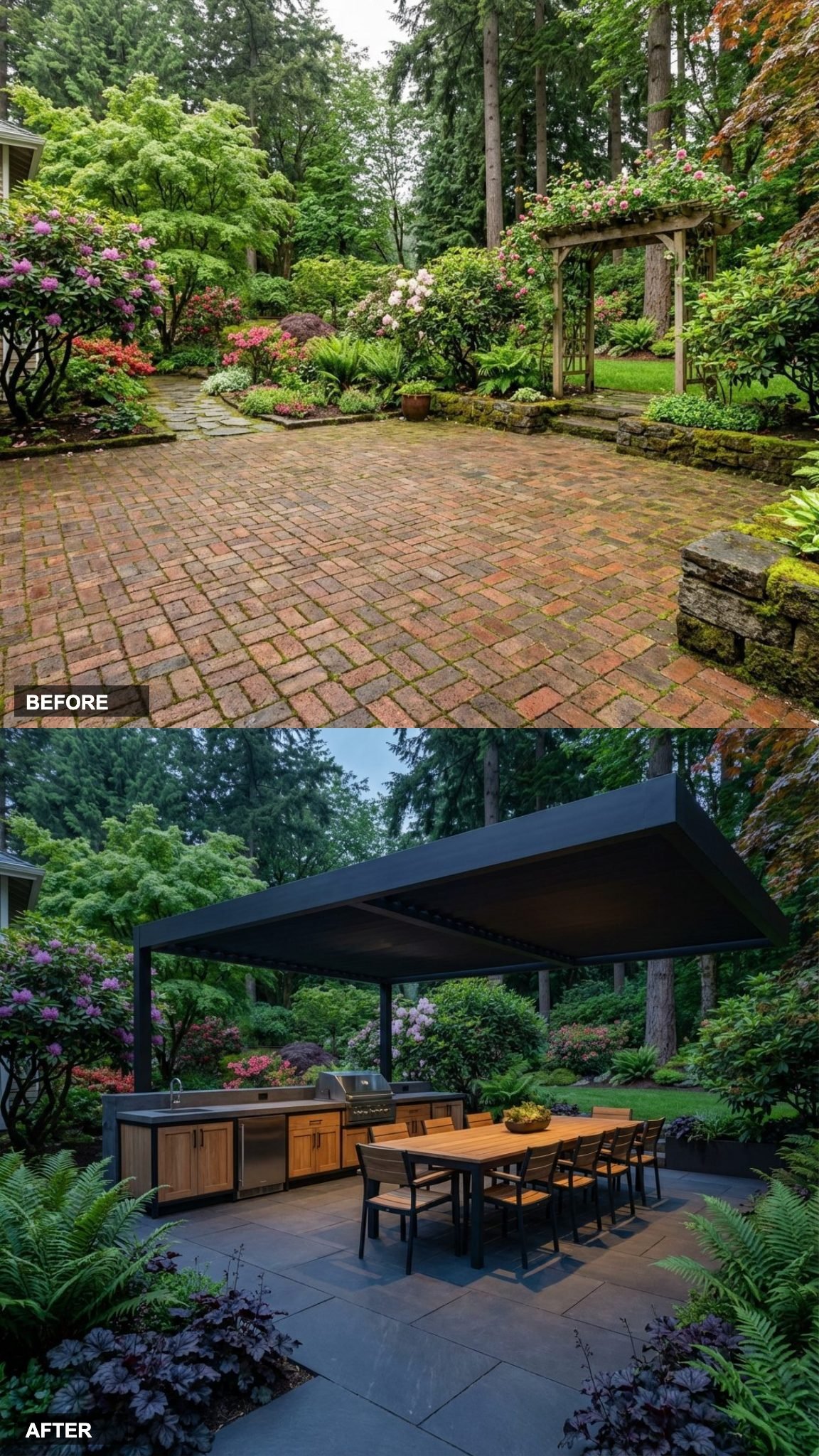
Matte Black Steel and Raw Teak: The Boldest Material Combination on This List
🔥 Would you like to save this?
Matte black outdoor kitchens photograph like editorial content. The finish absorbs light rather than reflecting it, which gives the space a density and intentionality that stainless steel, the default outdoor kitchen material, simply can’t match. Raw teak provides the necessary warmth to prevent the palette from reading cold or industrial.
This is the design for someone who wants their backyard to make a statement before anyone sits down. The seating is linear, the lines are sharp, the only softness comes from the teak grain and the planting borders at the edges. It asks something of you as a guest: dress the part.
“The bravest outdoor design decision is a dark material palette. Most people default to natural beige, matte black demands you commit.”
Pacific Walnut and Schist Stone Create a Lounge That Feels Rooted in the Geology of the Region
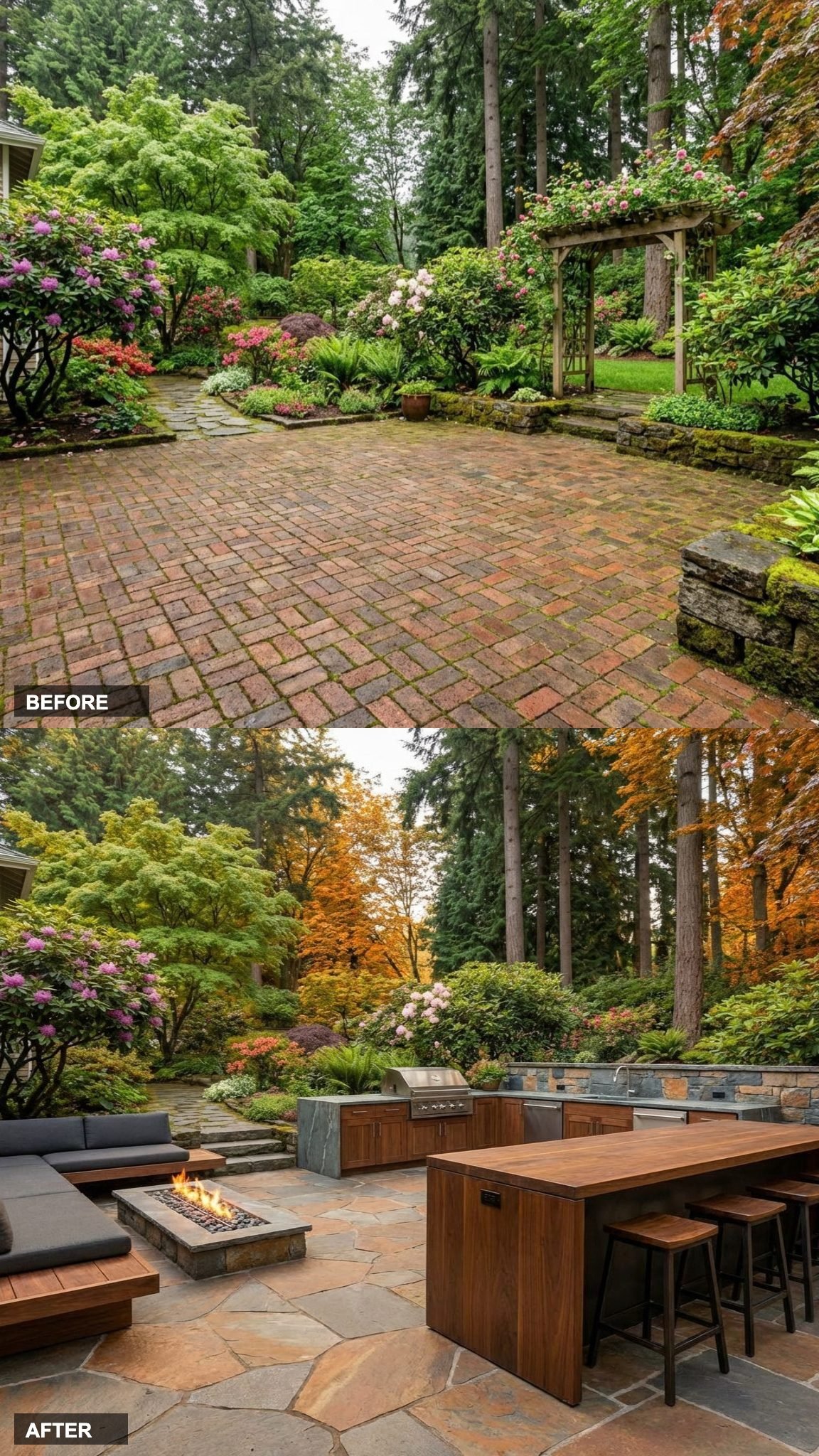
Schist is a metamorphic rock, layered, flecked with mica, split along natural planes rather than cut, and it’s found throughout Pacific Northwest geology. Using it as a patio surface and kitchen cladding material is a direct reference to the actual ground beneath the yard. Paired with Pacific walnut, a regional hardwood with that characteristic chocolate-and-purple grain, the material story becomes genuinely local.
Most outdoor design pulls from a generic luxury vocabulary. This version feels like it belongs specifically to the Pacific Northwest in a way that cedar and granite can’t quite achieve.
Raw Concrete and Thermally Modified Ash Build a Dining Pavilion That Looks Like Architecture
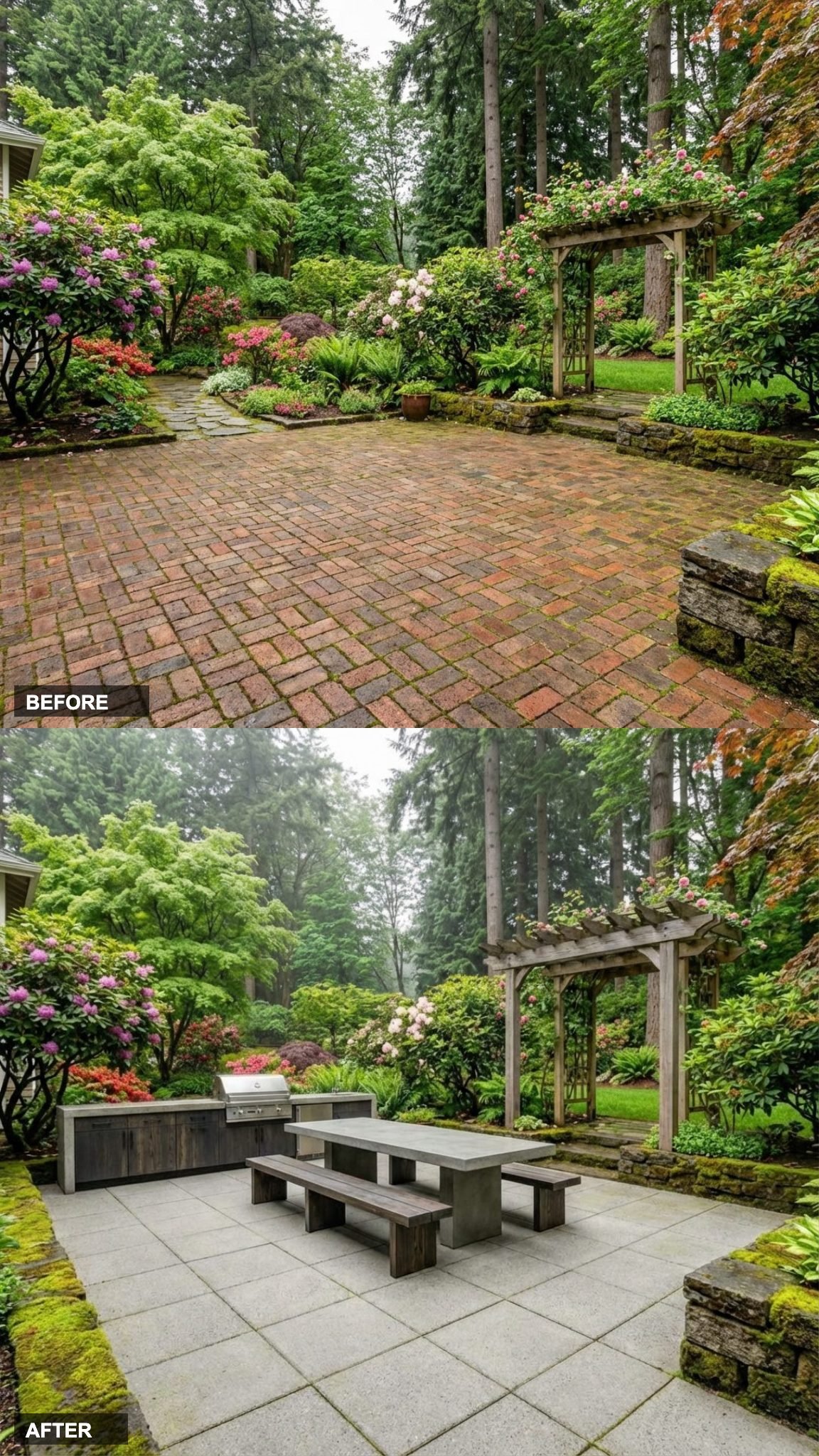
Thermally modified ash is a relatively new material in American outdoor design, wood heated to around 200 degrees Celsius in a low-oxygen chamber, which permanently changes its cell structure to resist moisture, rot, and insect damage without any chemical treatment. The result is a wood with a rich caramel-brown tone that holds indefinitely outdoors.
Combined with raw concrete, exposed aggregate, unpolished, slightly rough to the touch, the material conversation is about honesty. Nothing is pretending to be something it isn’t. The pavilion structure overhead gives this version an architectural weight the other designs on this list don’t quite reach.
Weathered Teak and Pietra Serena Stone: The Florentine Influence Nobody Saw Coming
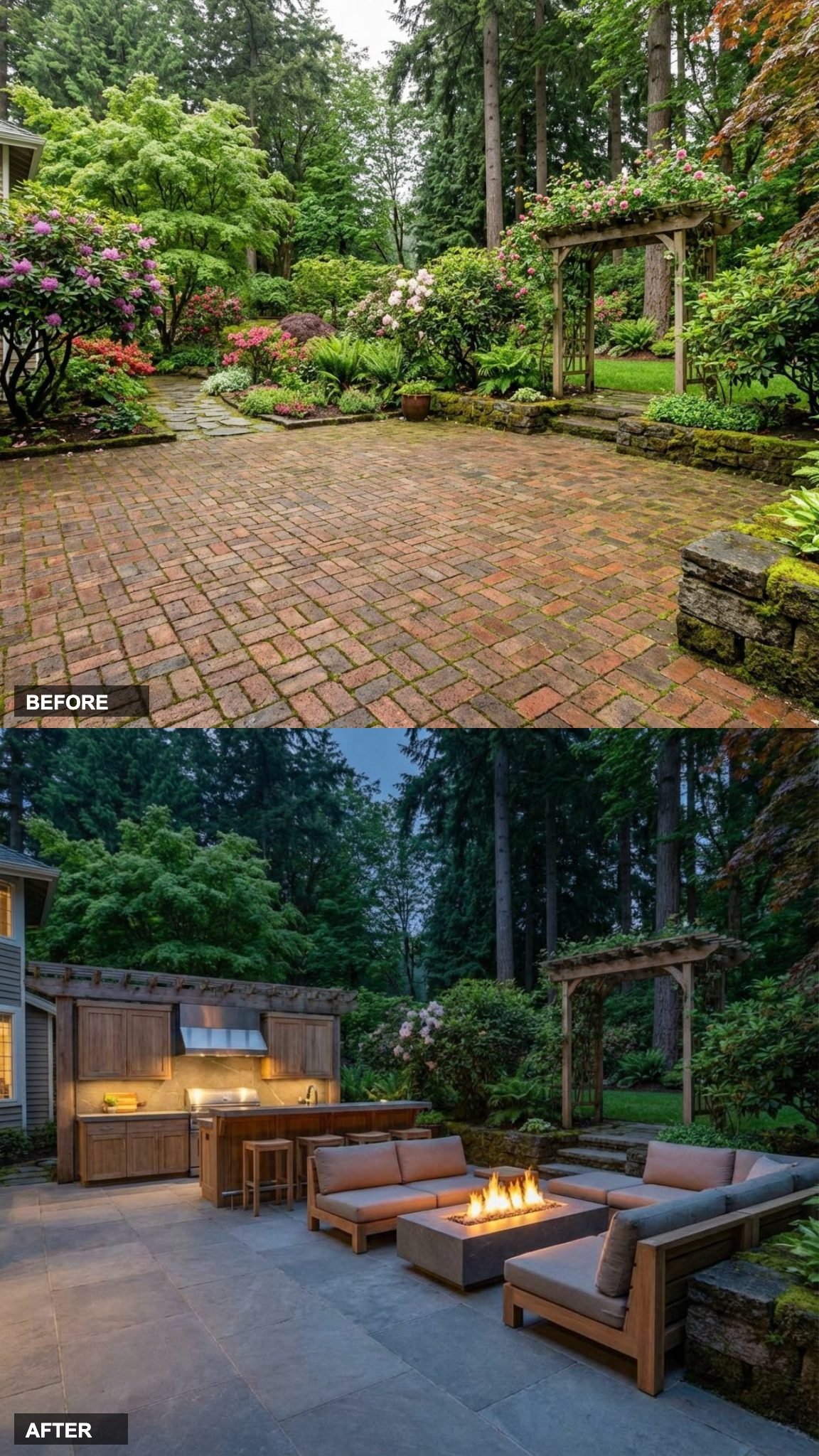
Pietra Serena is a blue-grey sandstone quarried near Florence and used in Renaissance architecture for centuries. It has that particular quality of Italian stone, fine-grained, cool-toned, tactile in a way that photographs differently depending on the light, and it reads as completely unexpected in a Pacific Northwest backyard.
Weathered silver-teak furniture and cabinetry alongside Pietra Serena paving and countertops creates a fire lounge with genuine continental sophistication. The overcast Pacific Northwest light, which tends to flatten warmer stones, actually suits Pietra Serena’s cool tone perfectly. It’s a material that was, coincidentally, designed for grey skies.
Cedar and River Cobble: The Outdoor Kitchen Sanctuary Version With a Water Feature That Earns Its Place
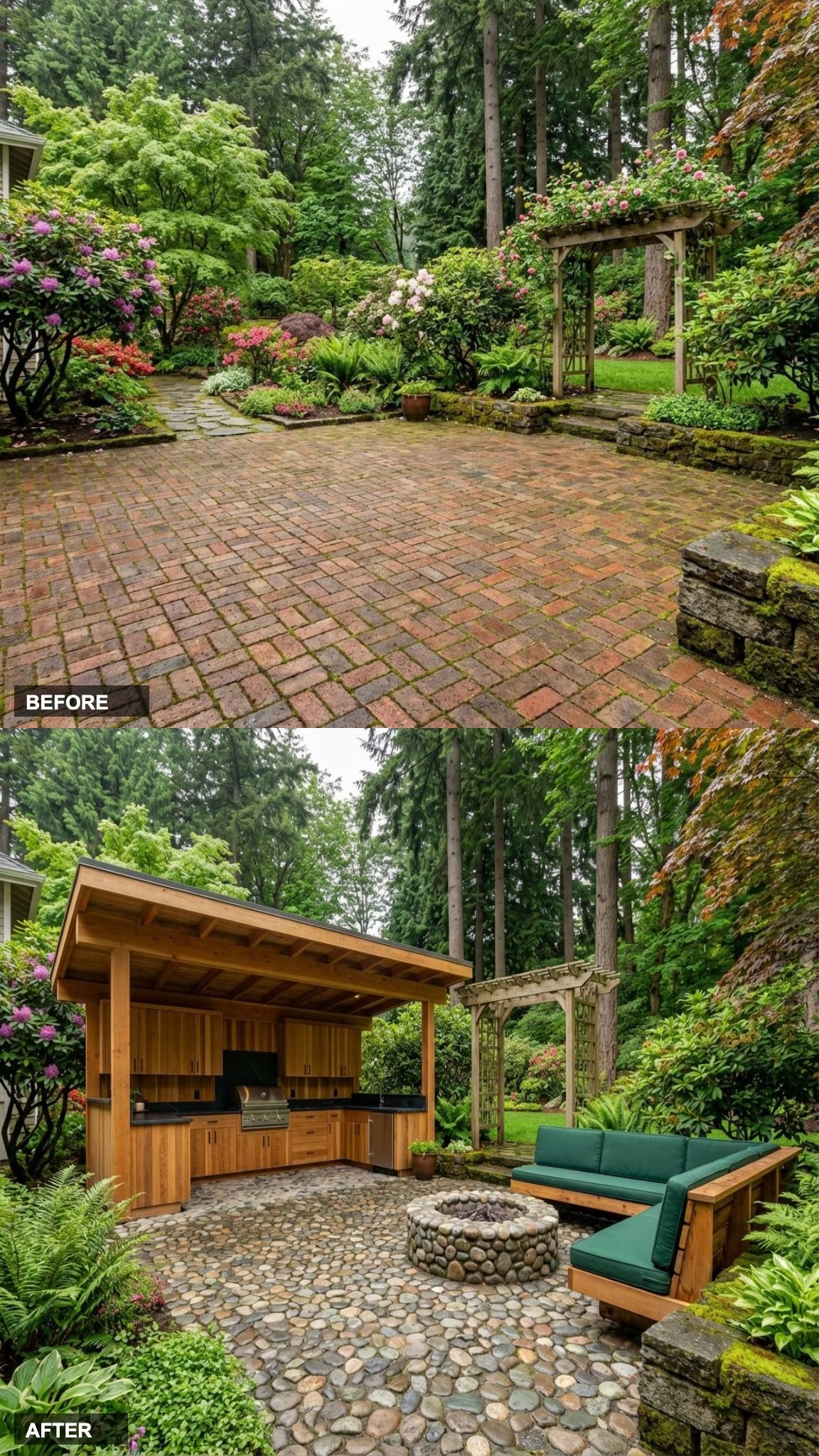
Water features in outdoor spaces often feel like afterthoughts, a pondless fountain dropped into a corner to generate white noise. This version integrates a low linear water wall into the kitchen structure itself, using smooth river cobble as both the patio paving and the water feature surround. Cedar cabinetry and overhead structure tie it together.
The sound dimension here is real: running water masks neighborhood noise and creates a psychological shift in how the space feels. Research on soundscaping consistently shows that water sound reduces perceived stress faster than almost any other ambient element. It’s design with an actual neurological payoff.
Shou Sugi Ban and Pale Limestone: A Light-and-Dark Outdoor Dining Retreat That Photographs Beautifully
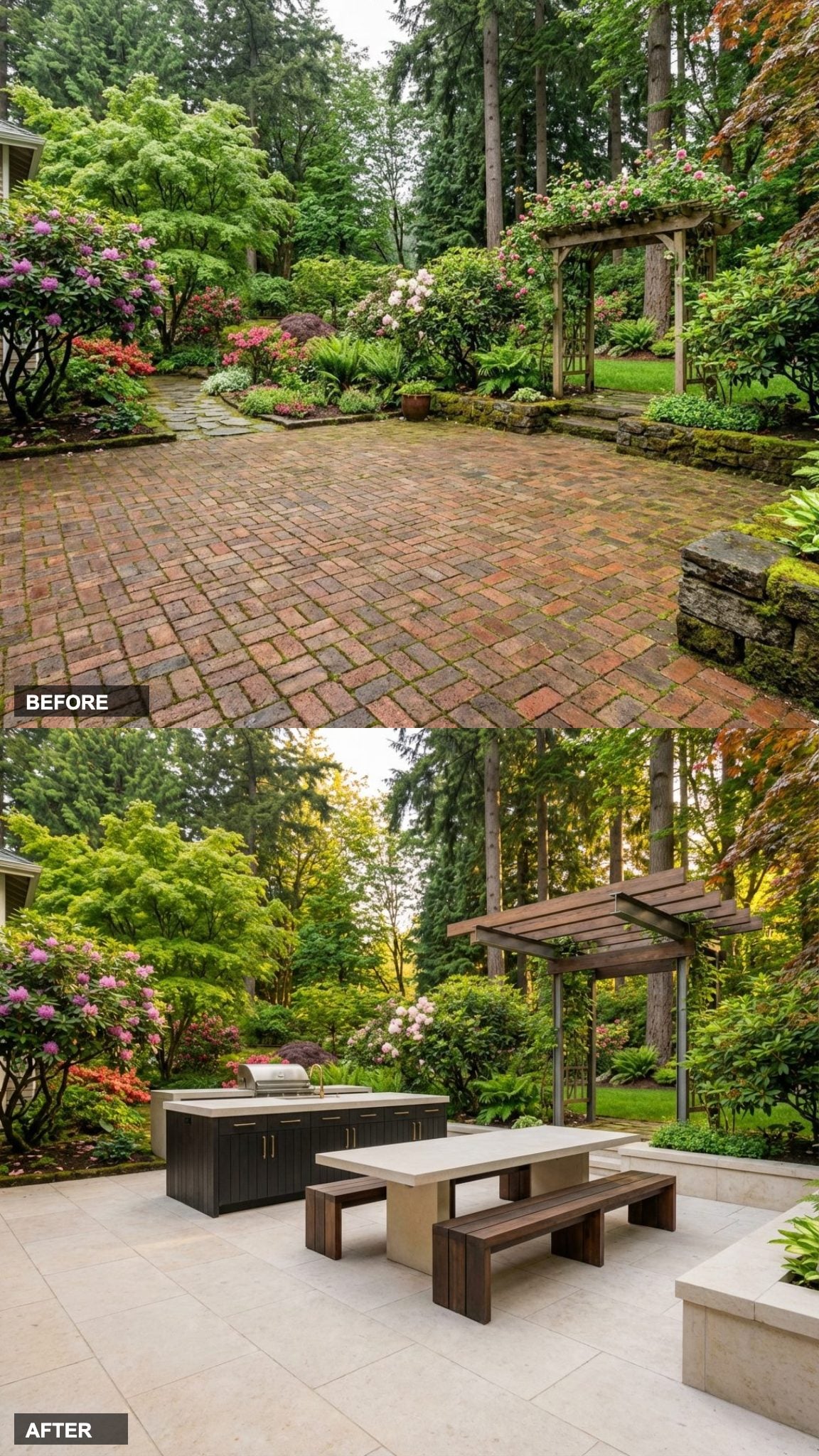
Most Shou Sugi Ban applications pair charred wood with dark stone, leaning into the drama. This version inverts that logic: black charred wood against pale limestone, a contrast so sharp it reads almost graphic. The limestone countertops and paving bring a warmth to the palette that prevents the charred surfaces from overwhelming the space.
For a dining retreat, the balance matters. You want enough visual interest to make the space feel designed, but not so much that eating there feels like sitting inside an art installation. This hits the line correctly.
Burnt Wood and Volcanic Basalt: Two Materials Shaped by Fire, Built for a Pacific Northwest Backyard
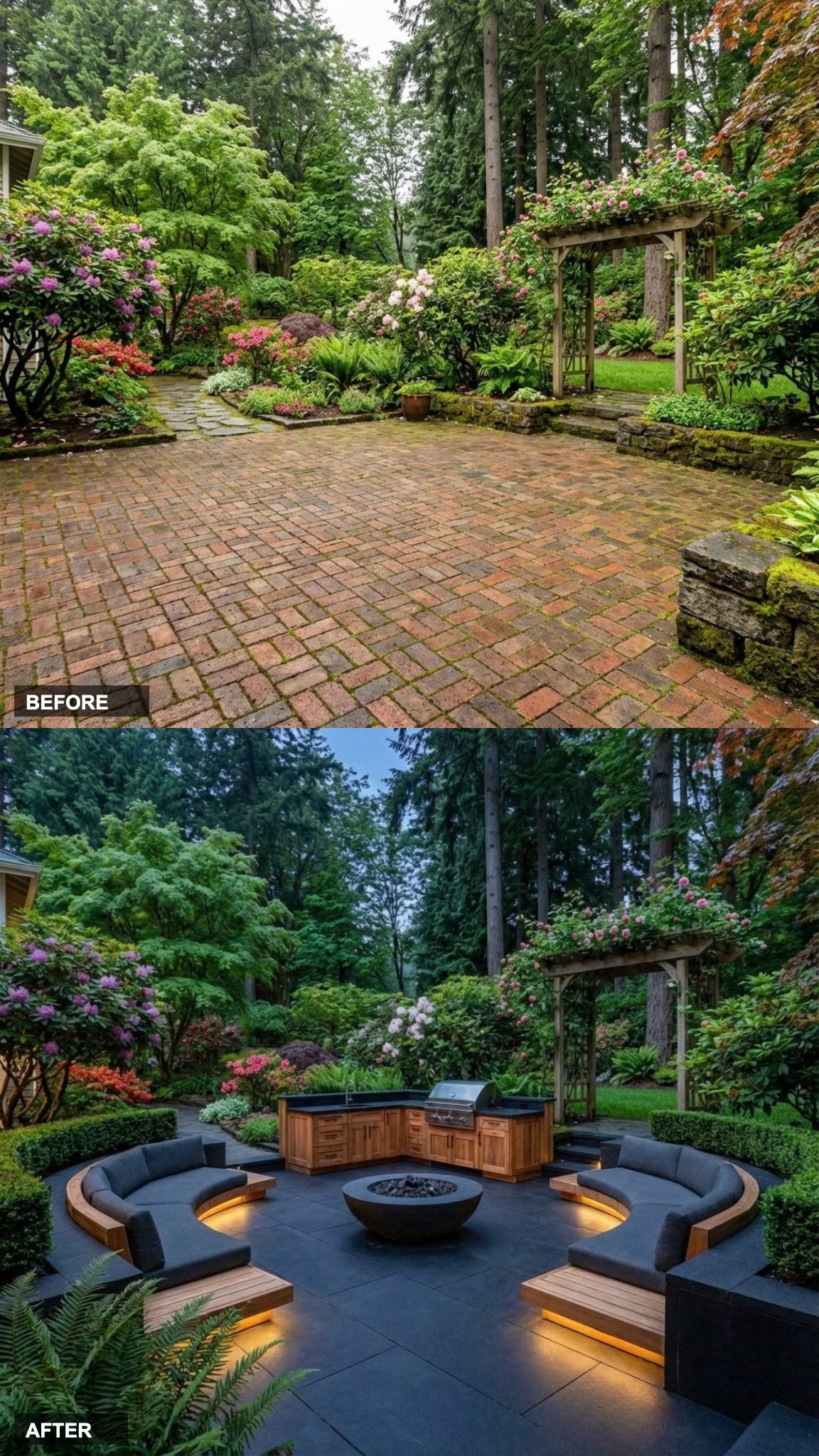
There’s a material coherence to this pairing that’s worth noticing: both basalt and Shou Sugi Ban are created or transformed by extreme heat. Basalt is cooled lava. Charred wood is carbon. Using them together feels less like a stylistic choice and more like a conceptual one, and that kind of thinking is what separates interesting outdoor design from expensive outdoor design.
Reclaimed Douglas Fir and Honed Granite: A Gathering Space That Honors the Material History of the Region
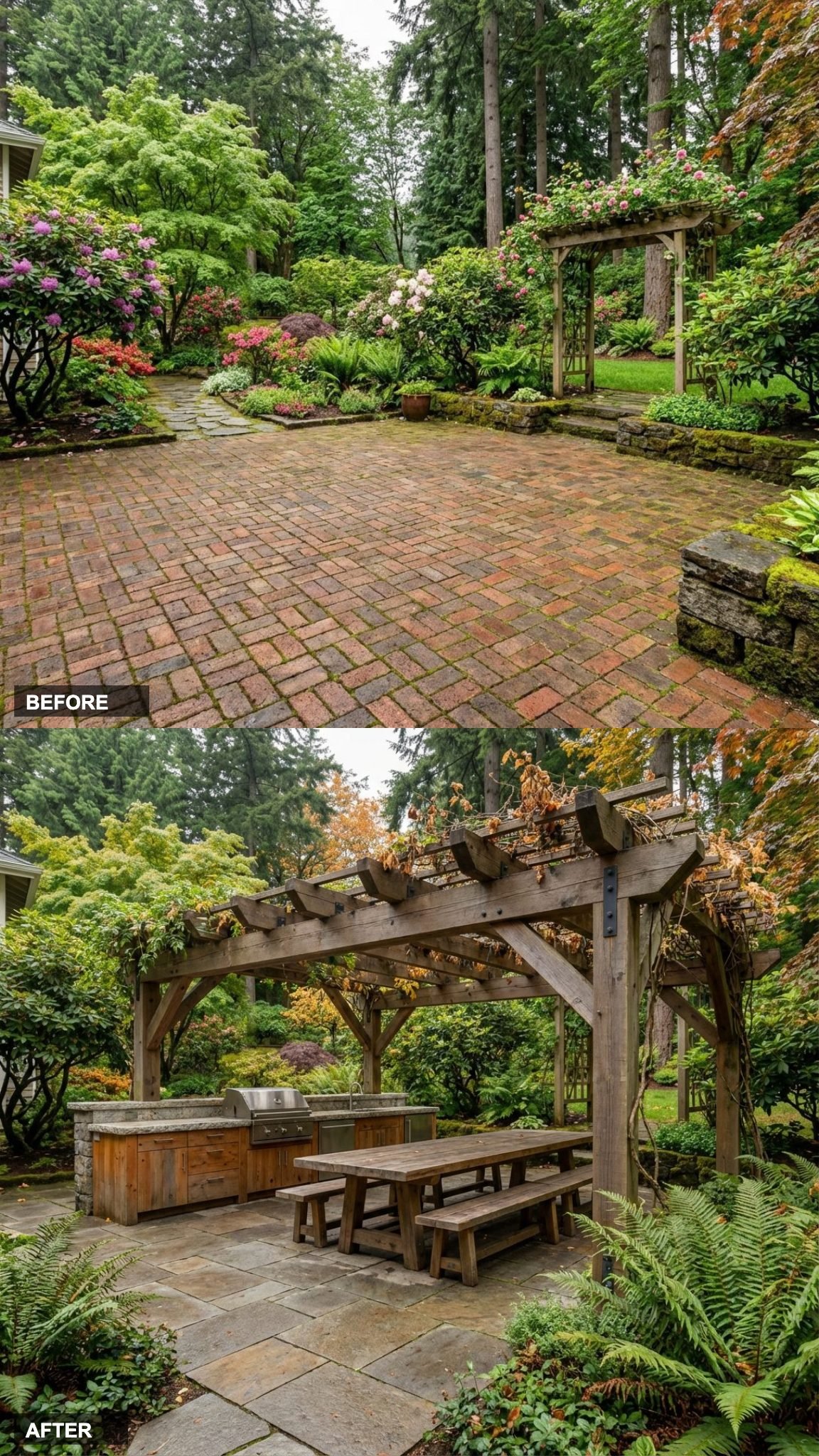
Reclaimed Douglas fir carries a specific visual record: old nail holes, saw marks, weathering patterns from a previous life as a barn floor or factory ceiling. Honed granite, the matte, non-reflective finish rather than the polished version, is similarly unshowy. Together they build a gathering space that feels inhabited rather than installed.
The gathering-focused layout puts a large central island at the heart of the design, with seating on three sides so cooking is always a group activity. No one stands at the grill alone while the party happens ten feet away. The design solves a social problem that most outdoor kitchens create.
Dark Walnut and Brushed Brass: An Outdoor Kitchen and Dining Lounge With Evening Party Energy
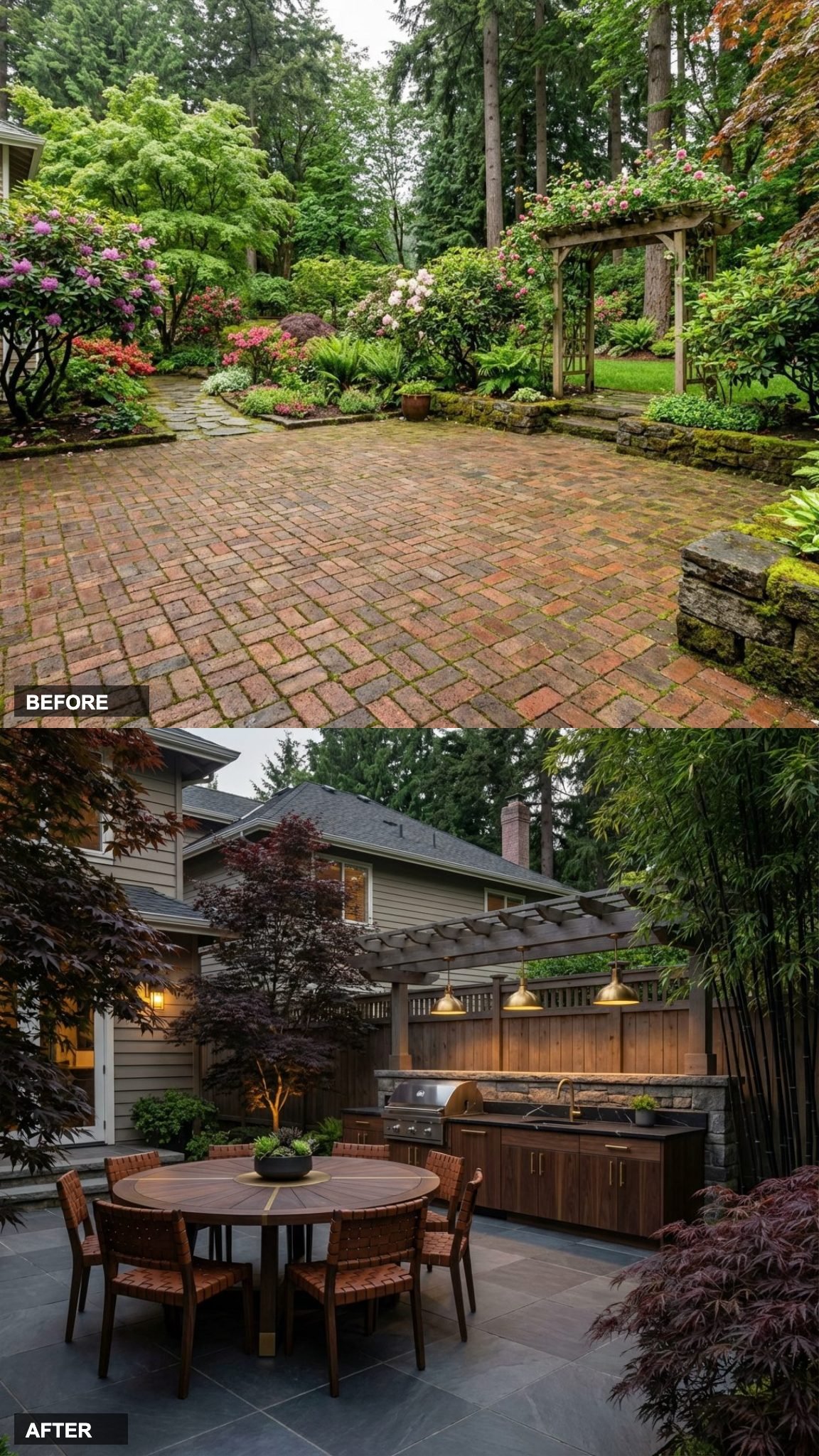
Brass outdoors sounds risky until you see it work. Brushed brass fixtures, faucets, cabinet hardware, pendant lighting, catch the warm tones in dark walnut and create an evening atmosphere that stainless steel never could. This is a space designed for after-dark entertaining: mood lighting built into the overhead structure, candle-height fixtures at the dining table, enough ambient glow to set a scene without flooding it.
Dark walnut cabinetry and countertop edges with brass hardware is essentially the outdoor version of a jewel-box dining room. The nighttime photographs of this space would look like a restaurant.
Pale Ash and Bleached Concrete: The Quiet, Airy Outdoor Entertaining Terrace for People Who Don’t Do Drama
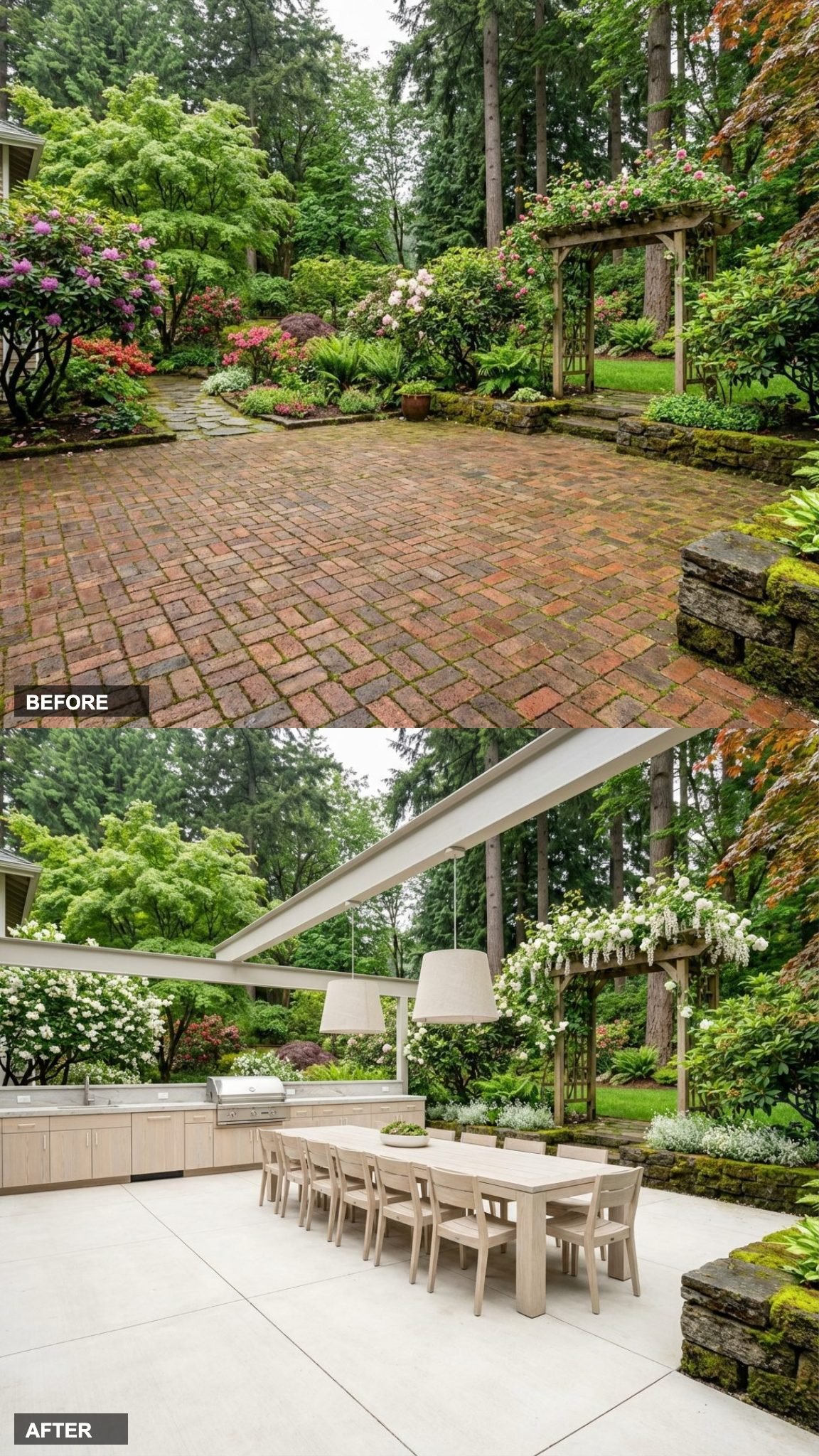
Not every outdoor kitchen needs to be a statement. This version makes a different argument: light ash wood, bleached and wire-brushed until it’s almost white, alongside pale concrete surfaces with a linen-grey undertone. The palette is deliberately calm, and that restraint reads as confidence rather than timidity.
The material logic holds up on practical grounds too. Light-toned paving reflects heat rather than absorbing it, which matters during the Pacific Northwest’s intensifying summer heat events. Pale ash weathers to a consistent silver-grey that requires no maintenance. This is the outdoor kitchen designed by someone who has built outdoor kitchens before and learned from the mistakes.
Raw Cedar and Sandstone With a Water Feature: The Most Serene Version of This Backyard on the List
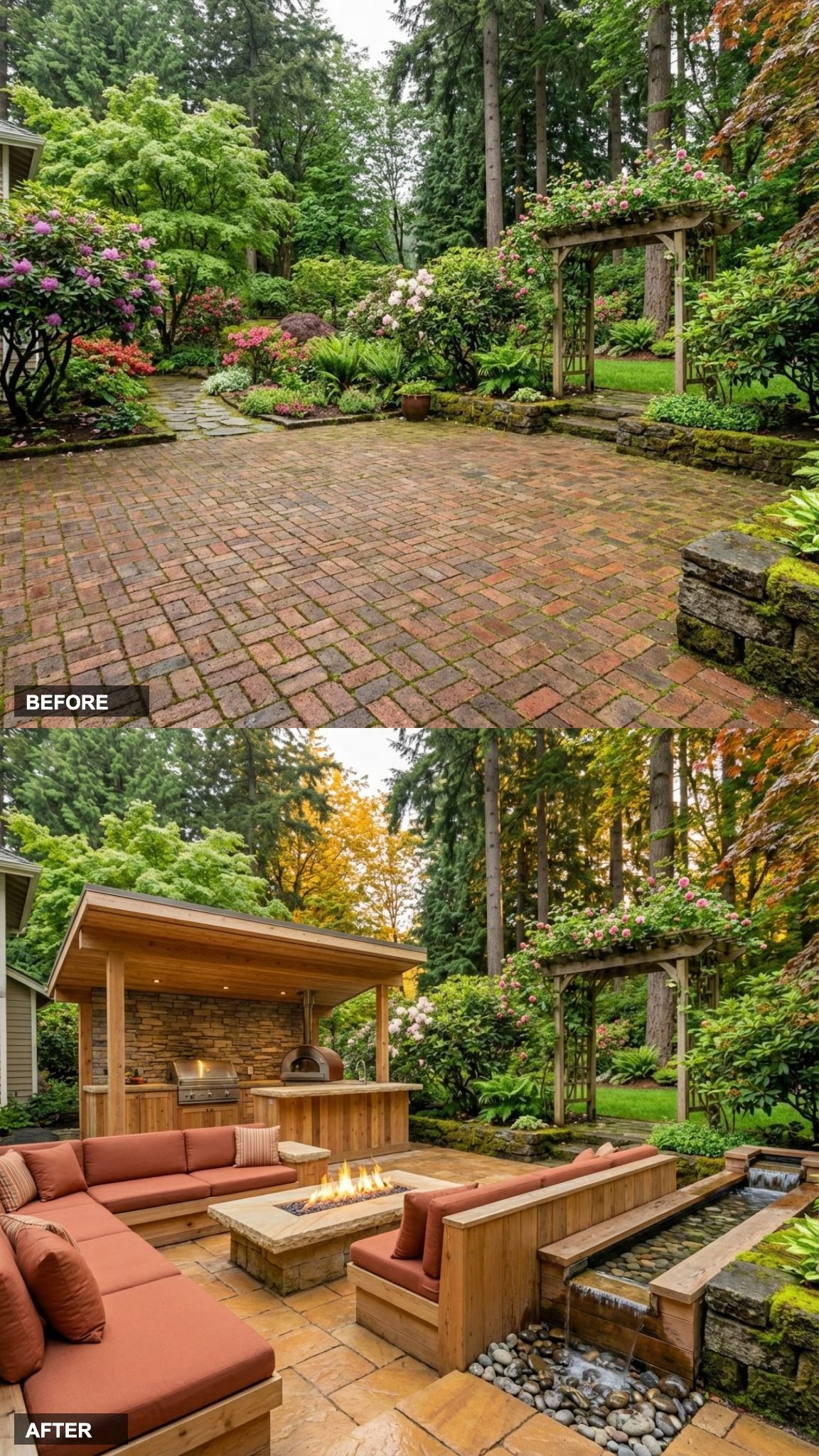
Sandstone has a warmth that most outdoor stones lack, a soft amber-beige that shifts toward gold in afternoon light. Combined with raw cedar and a water feature integrated into the kitchen structure, this version leans fully into the idea of an outdoor sanctuary rather than an outdoor entertaining space.
The distinction matters. An entertaining space is built for guests. A sanctuary is built for you. This design makes the case that the best outdoor kitchens serve both functions, and that running water, warm stone, and unfinished cedar are the materials most likely to pull it off.
Oiled Teak and Riven Slate: An Evening Lounge Built Specifically for Pacific Northwest Autumn
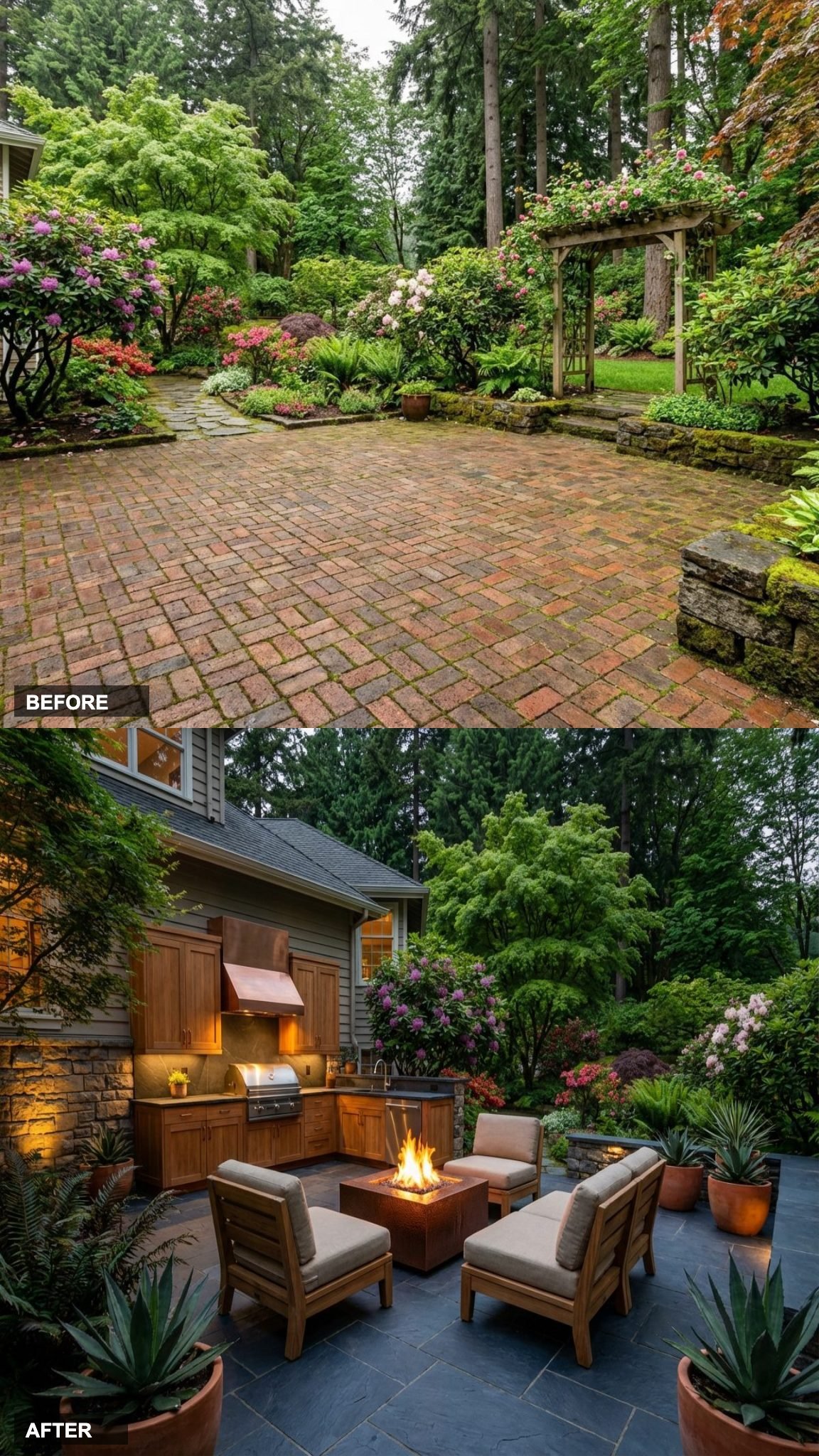
Riven slate, split along its natural cleavage planes rather than sawn, has a surface texture that holds interest in low light. The slight variation in plane catches candlelight and low-angle evening sun differently than flat stone, giving the patio floor a depth that flat tile can’t match. Oiled teak in a warm honey finish against that cool blue-grey slate creates an evening color story that’s actually better at 7pm than at noon.
This is a design optimized for October, not July. Covered overhead structure, radiant heat under the slate, fire integrated into the seating zone. It’s the Pacific Northwest outdoor space that acknowledges the actual climate rather than pretending summers last longer than they do.
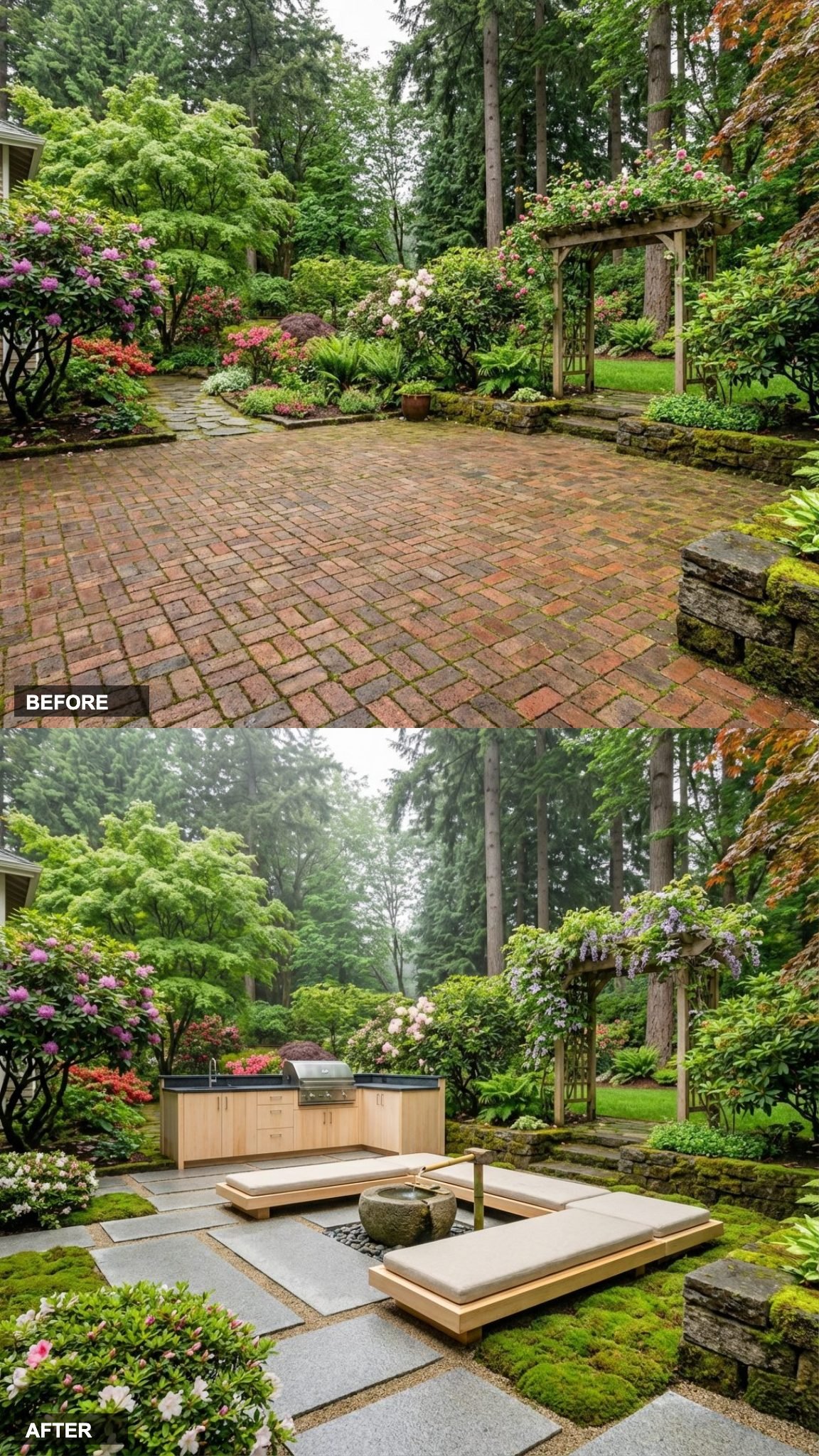
Hinoki Cypress and Moss Stone: A Japanese-Inspired Outdoor Kitchen That Redefines What a Meditation Lounge Can Do
🔥 Would you like to save this?
Hinoki cypress is the material of Japanese bath culture, used in traditional ofuro tubs for its fine grain, natural oils, and the subtle, clean scent it releases when wet. Using it in an outdoor kitchen and lounge structure is an import of that philosophy: the belief that materials should engage all the senses, not just the visual ones.
Moss stone paving, allowed to develop its natural moss cover in the Pacific Northwest humidity rather than sealed clean, adds a living surface layer that changes with the seasons. The kitchen here is restrained, narrow, precise, hidden behind shoji-influenced screens when not in use. The meditation lounge seating is low, cushioned in undyed linen, oriented toward the garden rather than the grill.
This is the version for someone who thinks about food as ritual rather than production, the design equivalent of a kaiseki restaurant that happened to end up in someone’s backyard.
Dark Bronze Steel and Reclaimed Redwood: The Fire Lounge Version That Ends the List on Its Own Terms
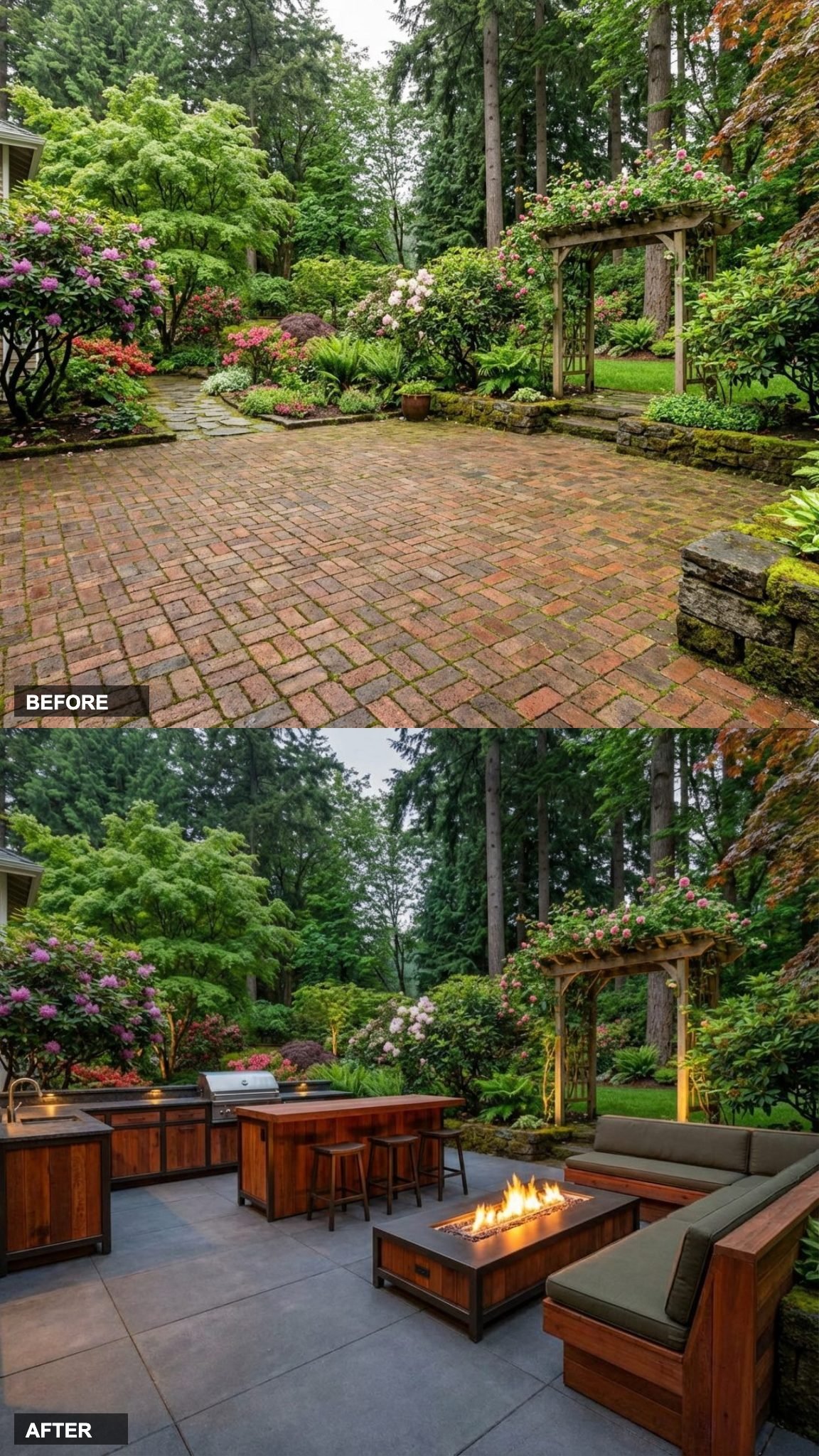
Reclaimed redwood carries decades of history in its grain, old-growth density, natural color variation, and the kind of character that no new-growth lumber can fake. Against dark bronze powder-coated steel, it creates a fire lounge with a weight and permanence that feels like the final word on what this patio could become.
Dark bronze is the finish that matte black wishes it were. Where black reads graphic and sharp, dark bronze reads warm and aged, closer to a worn patina than a design choice. With a reclaimed redwood ceiling and seating surround, plus a fire table built from the same steel, this outdoor kitchen doesn’t ask for your attention. It already has it.
From Crumbling Brick to a Moody Charcoal Concrete Outdoor Kitchen Pavilion
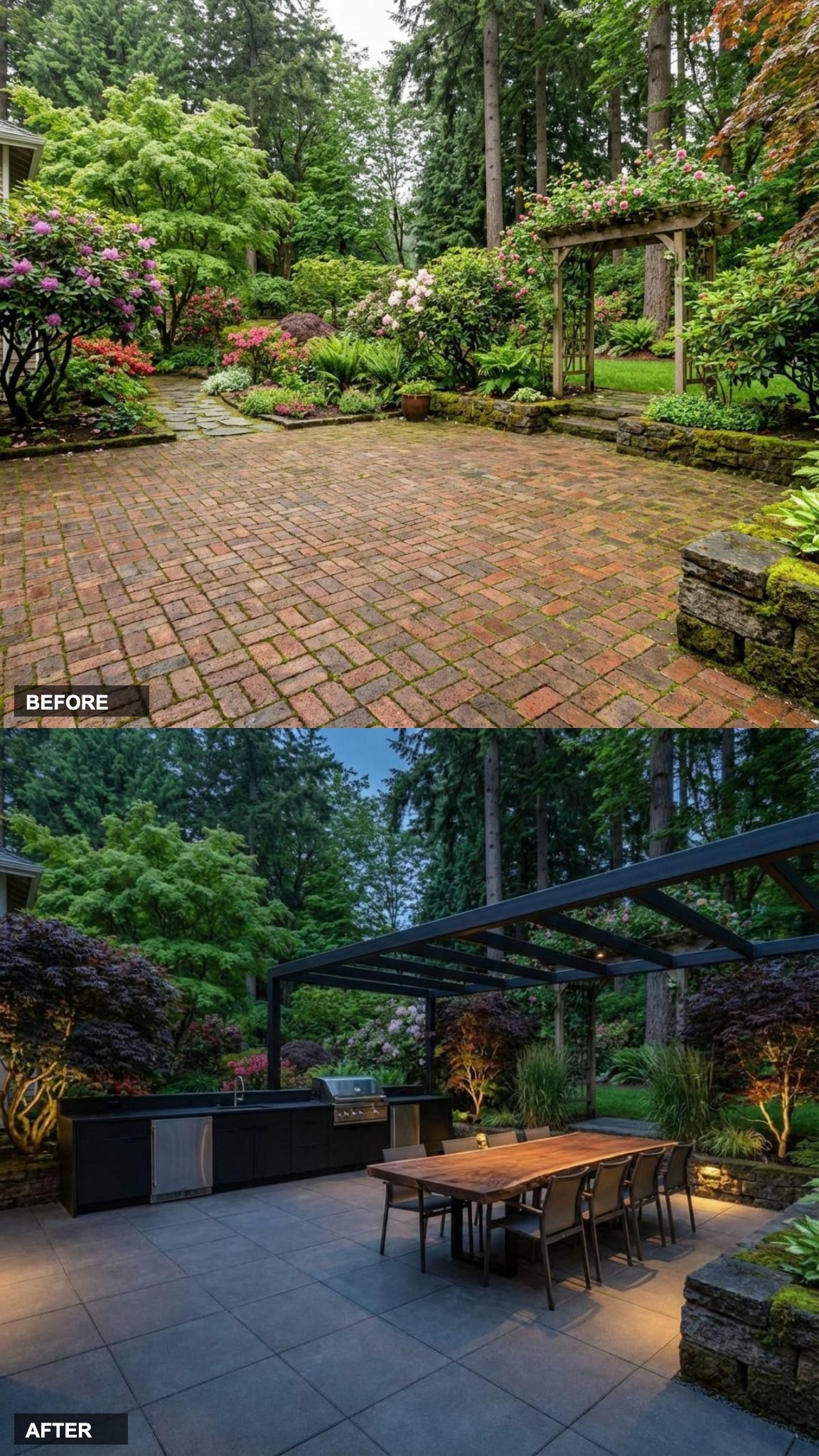
Charcoal concrete is doing something here that painted surfaces never quite pull off: it absorbs the grey Pacific Northwest sky rather than fighting it. The result feels less like an outdoor room and more like a deliberate extension of the landscape itself.
Honed concrete countertops, matte black steel cabinetry, and a board-formed concrete pavilion roof make this feel architecturally resolved rather than cobbled together. The integrated bench seating runs the full perimeter, which is a move that reads as generous rather than space-hungry. Dark material palettes on patios tend to ground a space psychologically, creating a sense of enclosure and calm that lighter schemes rarely achieve outdoors.
The Same Tired Slab, Now a Warm-Toned Resort Lounge With a Sunken Fire Pit
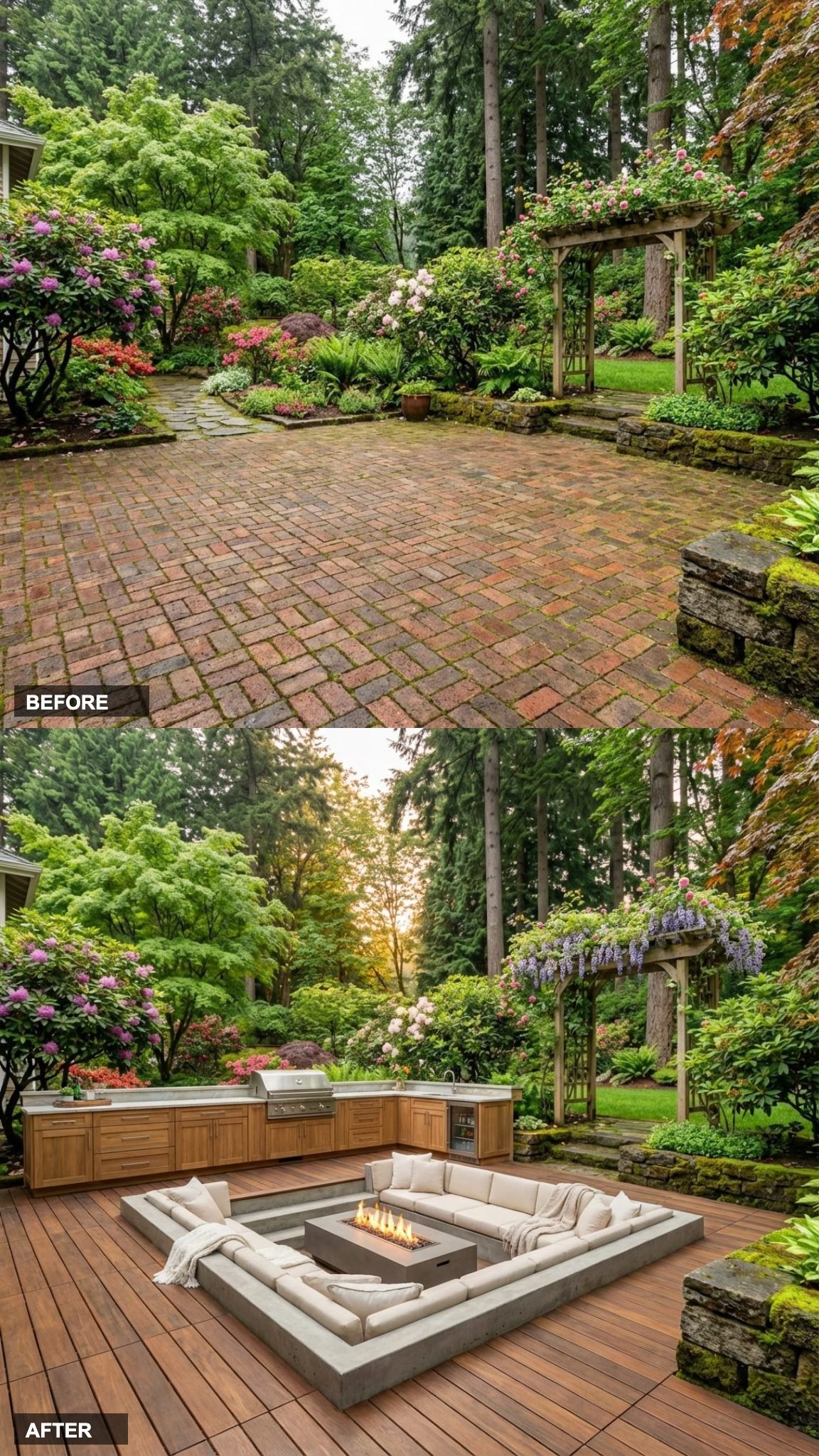
There is a very specific feeling that good resort design manufactures: the sense that you are exactly where you are supposed to be, and nowhere else matters. This transformation chases that feeling with travertine pavers, warm cedar millwork on the outdoor kitchen, and a sunken lounge pit lined with caramel-toned cushions thick enough to actually sink into.
The tonal range here stays narrow, amber, sand, honey, and dusty terracotta, which keeps the eye moving through the space rather than snagging on contrast. String lights strung loosely above the dining zone add warmth without committing to a chandelier moment that can feel forced outdoors.
The sunken lounge element is the single highest-impact change here. It creates a room-within-a-room effect that no amount of furniture arrangement can replicate on a flat plane.
Zen Restraint: A Japanese-Minimal Outdoor Kitchen That Lets the Trees Do the Talking
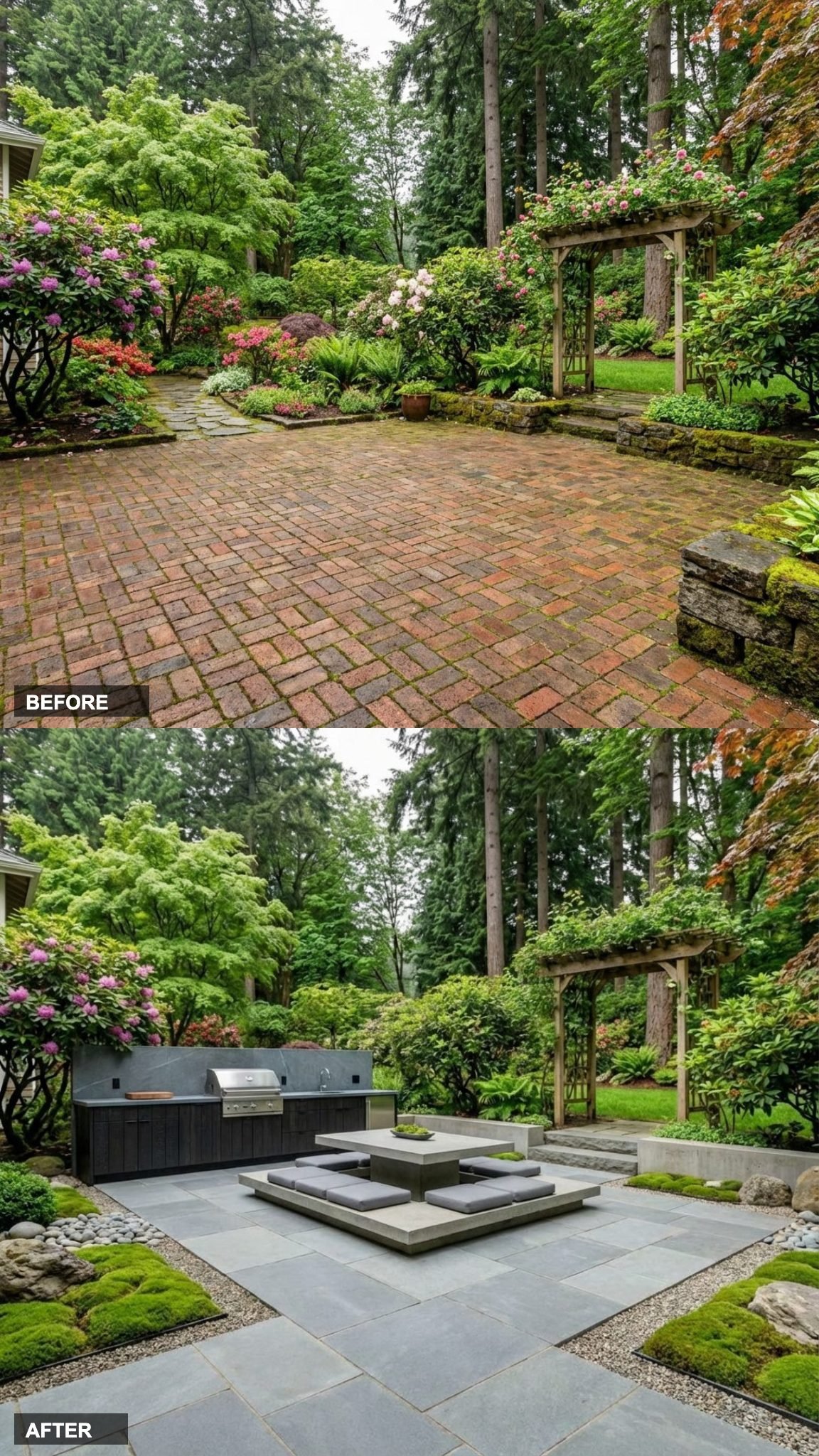
Ipe wood, raked gravel, and a single-basin stone prep sink. That is the entire material story, and it is enough.
Japanese minimalism earns its reputation not by adding carefully chosen things, but by removing everything that does not carry weight. The outdoor kitchen here is recessed low, almost flush with grade, so the Douglas firs remain the visual anchor rather than competing with a built structure. The cooking zone is concealed behind shou sugi ban panels when not in use, which is a detail that separates a considered design from a renovation.
- Dark charred wood weathers gracefully in wet climates without paint or sealant maintenance
- Low-profile structures read as part of the landscape, not imposed on it
- Negative space in the gravel field gives the eye somewhere to rest between focal points
Raw and Unapologetic: A Brutalist-Luxury Outdoor Entertaining Terrace
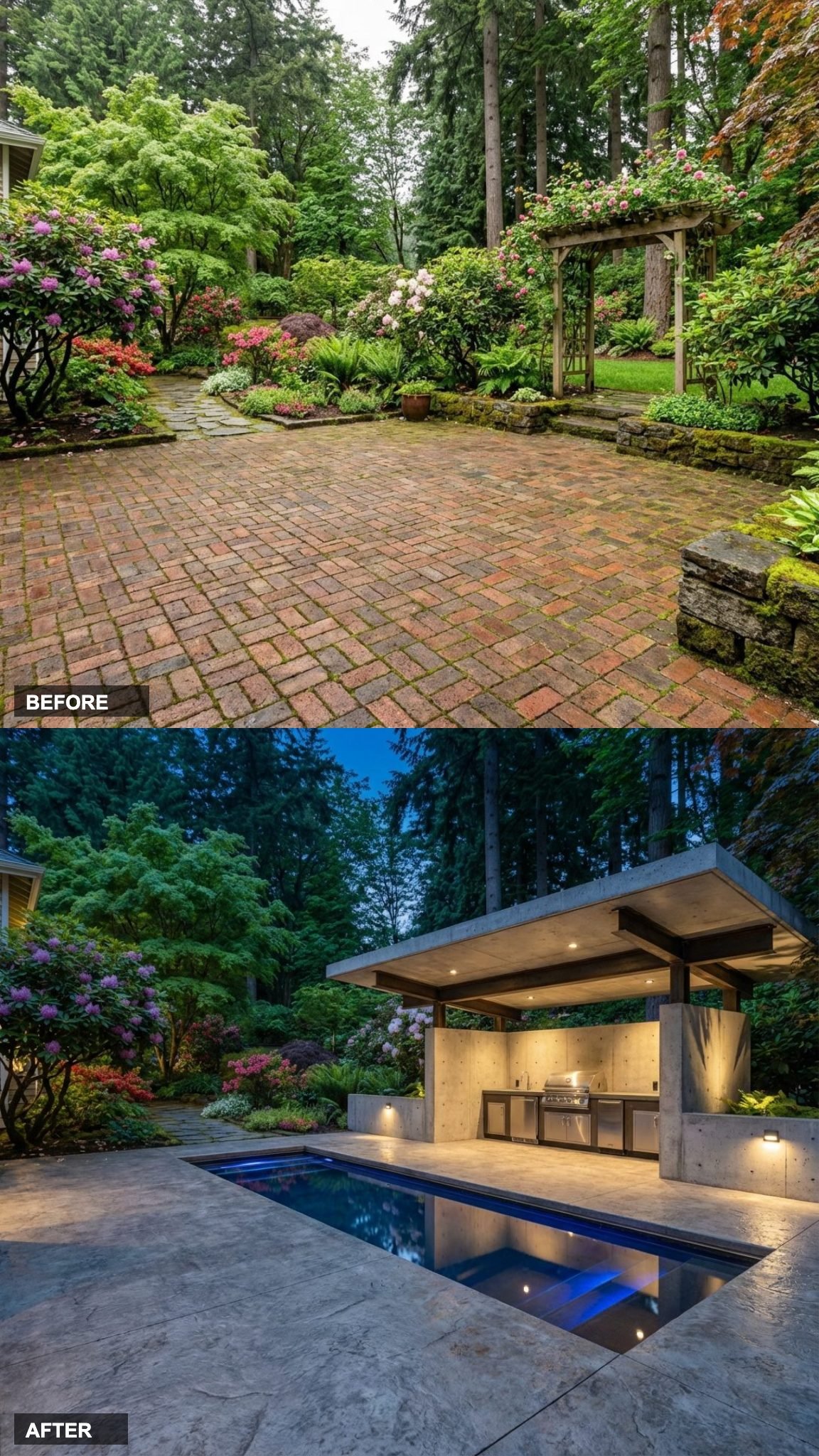
Brutalism outdoors is a genuinely brave choice, and this one lands it. Board-formed raw concrete walls, cantilevered concrete dining slabs, and exposed steel I-beam pergola members create a space that has more in common with a Herzog and de Meuron project than a typical backyard renovation.
What saves it from austerity is the layering: thick wool outdoor cushions in stone grey and rust, a fire table with a tall linear flame, and pendant lights in blackened steel hanging low over the dining surface. The Douglas firs behind actually complement this language better than they would a softer scheme, their stripped-bark trunks echo the raw concrete texture.
Limestone and Brass: When a Northwest Backyard Decides It Belongs in Provence
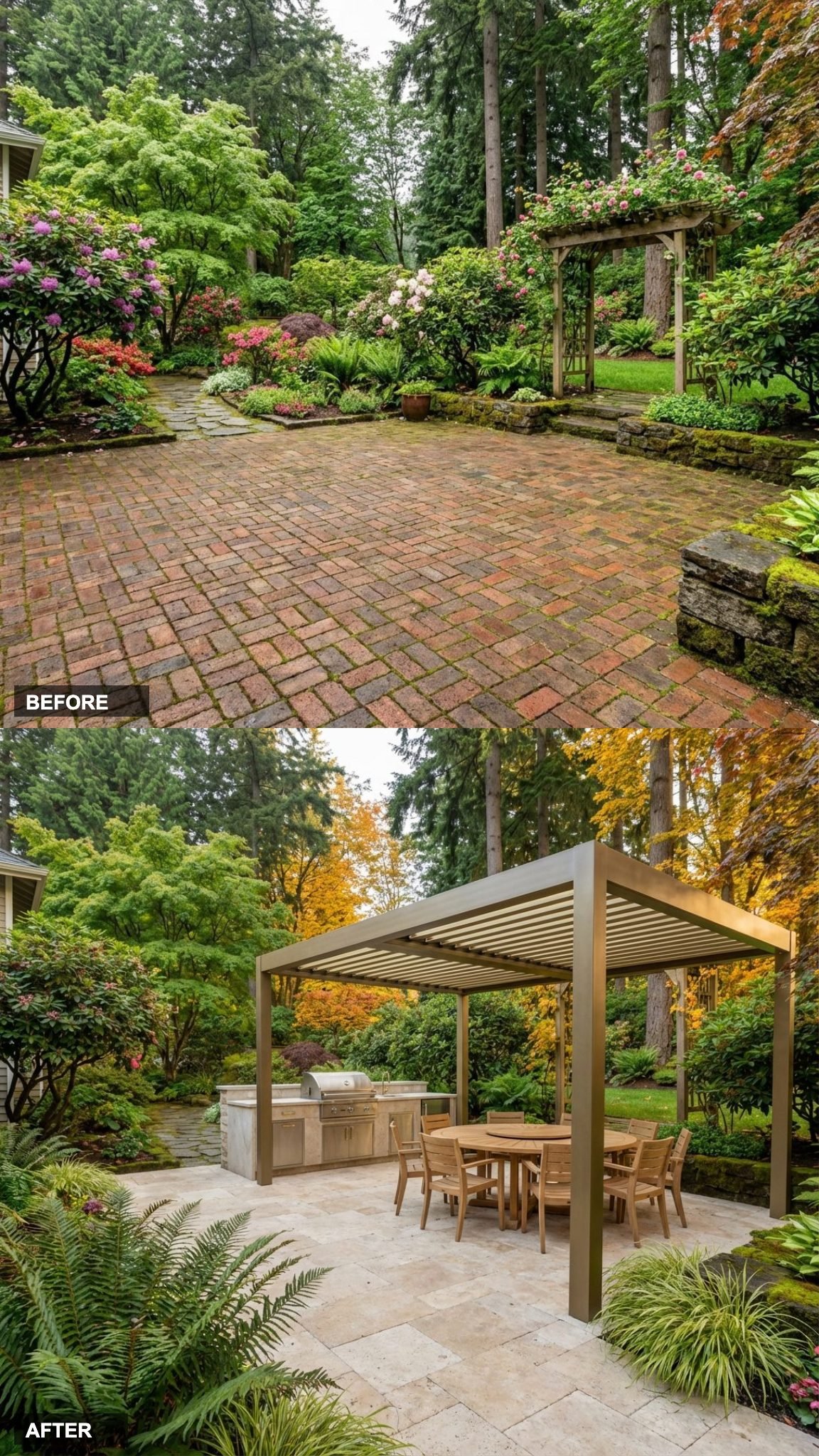
Warm limestone pavers laid in a slightly irregular ashlar pattern, unlacquered brass fixtures that will patina beautifully in Pacific Northwest rain, and a double-arch stone surround over the outdoor oven. This transformation is unabashedly romantic, and it earns it.
The outdoor kitchen here is built to cook seriously, deep countertop runs, a wood-fired oven as the focal point, and a prep sink positioned for a second person to work alongside the primary cook. Dining happens under a limestone-columned pergola draped with wisteria starters that will fill in over two seasons.