🔥 Would you like to save this?
Most powder rooms get treated like an afterthought — a spare sink, a builder-grade mirror, done. What a waste, when it’s the one room in the house where you can gamble on something loud and nobody’s going to live in it long enough to tire of the gamble. Marble with real drama in the veining. Walnut with grain you can read like a map. A layout that refuses to play it safe. The rooms below pair stone and wood in ways built for the next few years rather than the last decade. Small footprints, big decisions, and each one drags the two materials somewhere the others don’t.
49. Calacatta Viola Takes a Waterfall Turn Against Ribbed Walnut
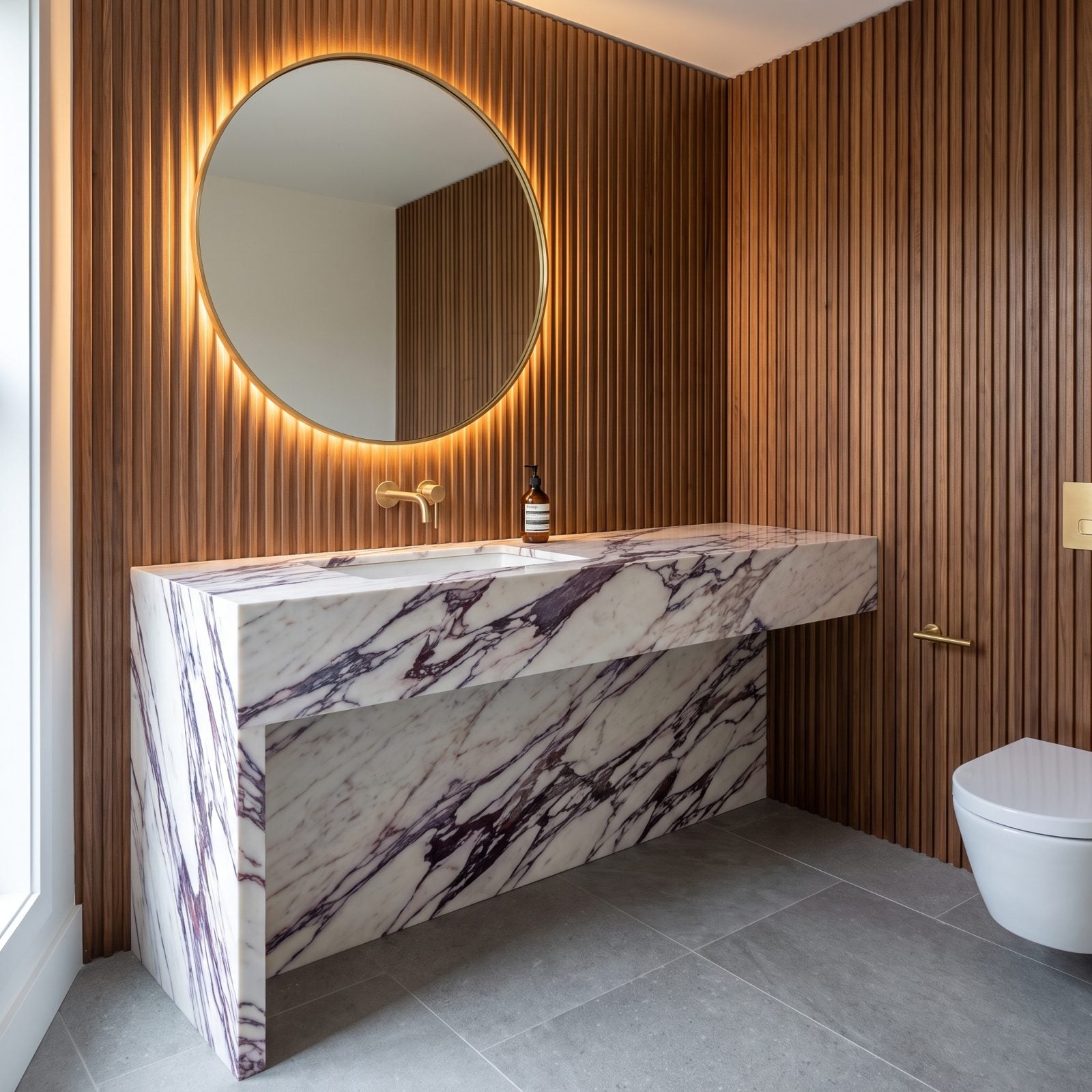
That waterfall edge is the whole argument here. Calacatta Viola runs from the counter straight to the floor, turning the vanity into one unbroken slab of stone, and the violet veins get to perform without interruption.
In order to come up with the very specific design ideas, we create most designs with the assistance of state-of-the-art AI interior design software. Also, assume links that take you off the site are affiliate links such as links to Amazon. this means we may earn a commission if you buy something.
The ribbed walnut behind it does the quiet work. Vertical fluting throws tiny shadows that keep the wall from going flat, so the purple marble stops feeling like it’s shouting into an empty room. One texture answers the other.
48. Backlit Translucent Stone Over a Dark Floating Walnut Vanity
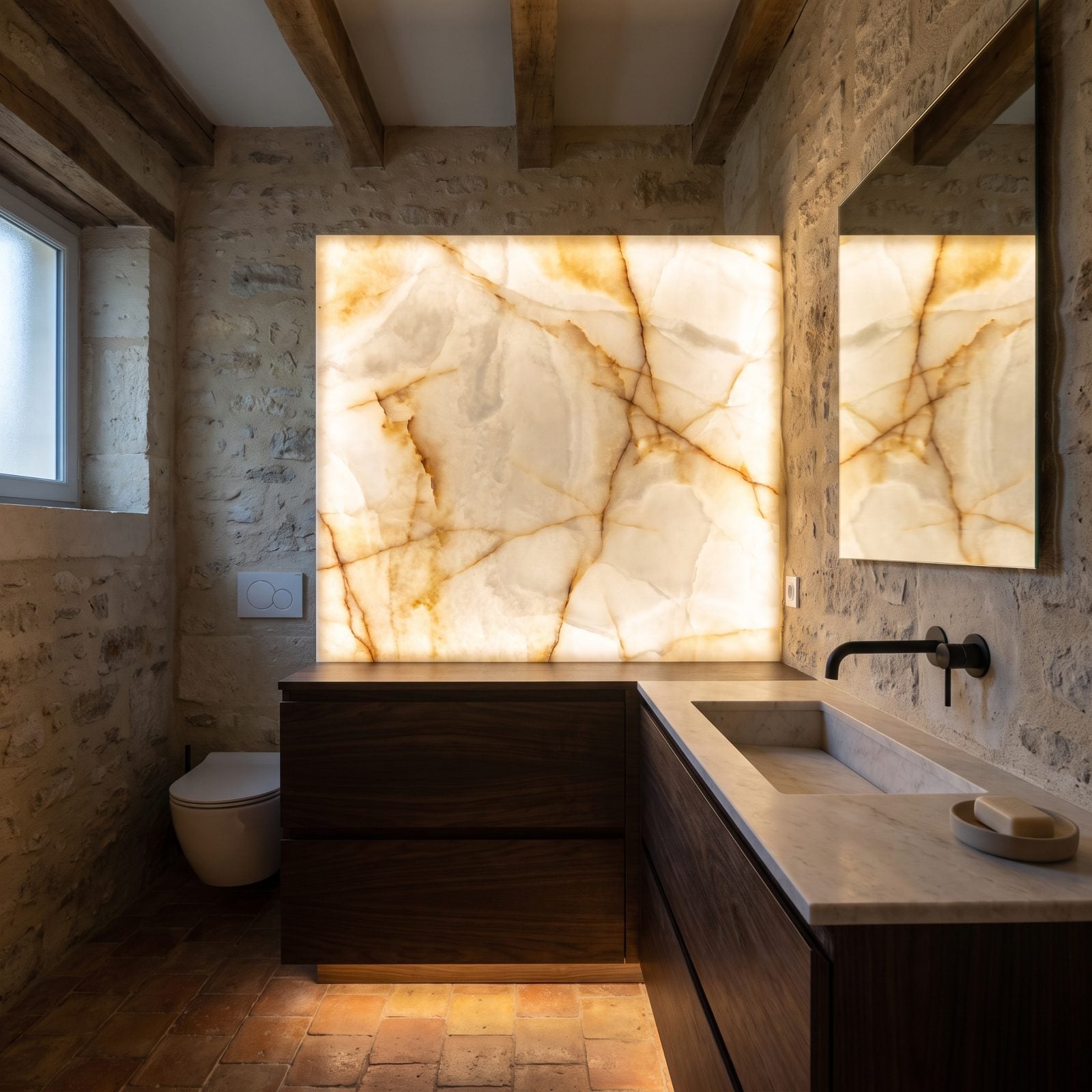
Backlighting marble goes wrong fast — usually it ends up looking like a casino bar. This one gets it right by keeping everything else dark and calm so the glowing stone becomes the actual light source.
The smoked walnut floating vanity grounds all that drama. Its near-black grain soaks up the warmth from the panel above instead of competing with it, and a matte black wall faucet keeps the hardware from stealing a single photon.
47. A Honed Carrara Trough on a Floating Walnut Console
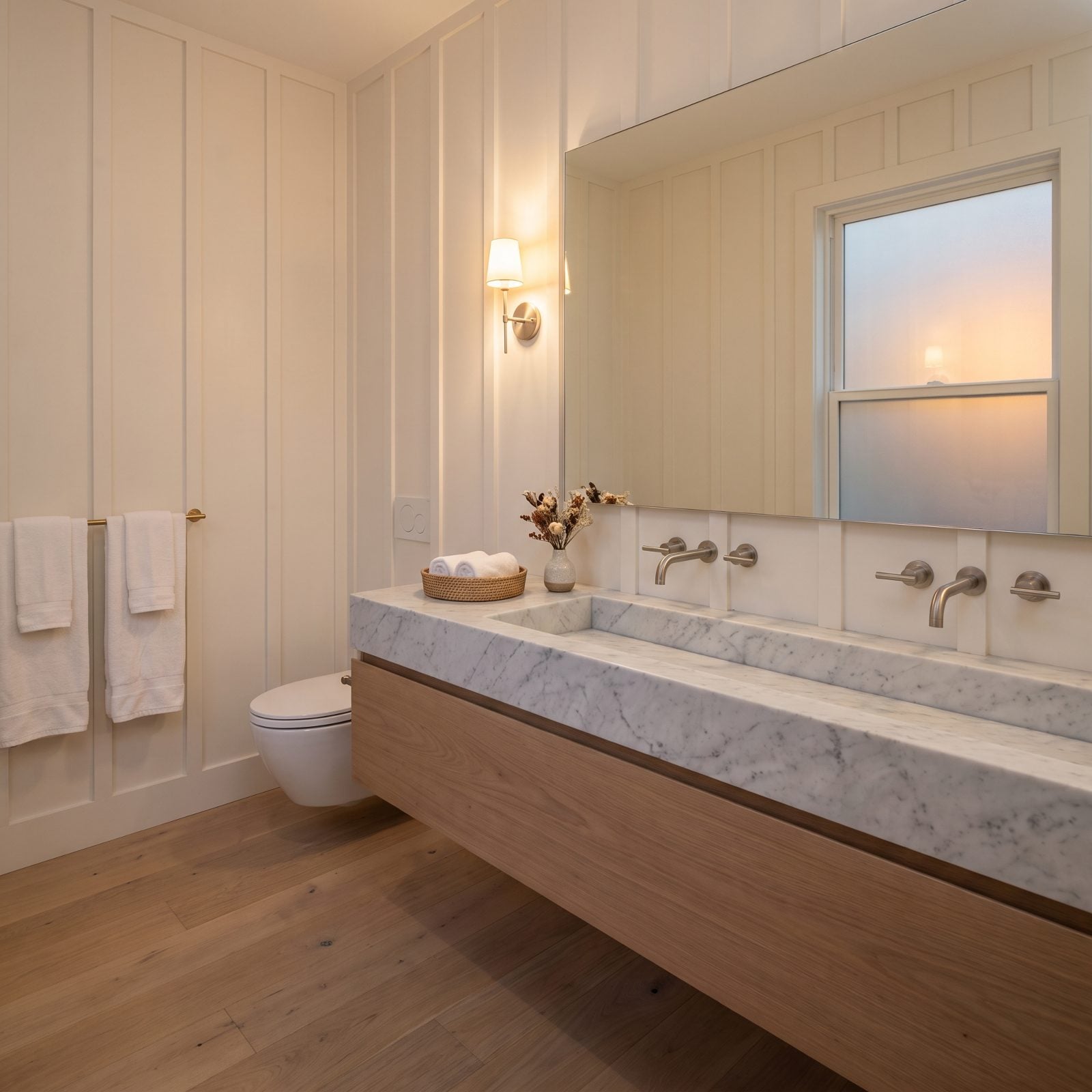
Not every marble has to roar. Honed Carrara, soft grey on cool white, is the quiet one of the family, and here it earns that by stretching into a long trough that feels more like a sculpture than a sink.
Pale blonde walnut underneath keeps the whole thing light. This is the room on the list that wouldn’t scare anyone — and yes, that’s exactly the point.
46. Rosso Levanto Jewel Box Framed in Smoked-Walnut Cabinetry
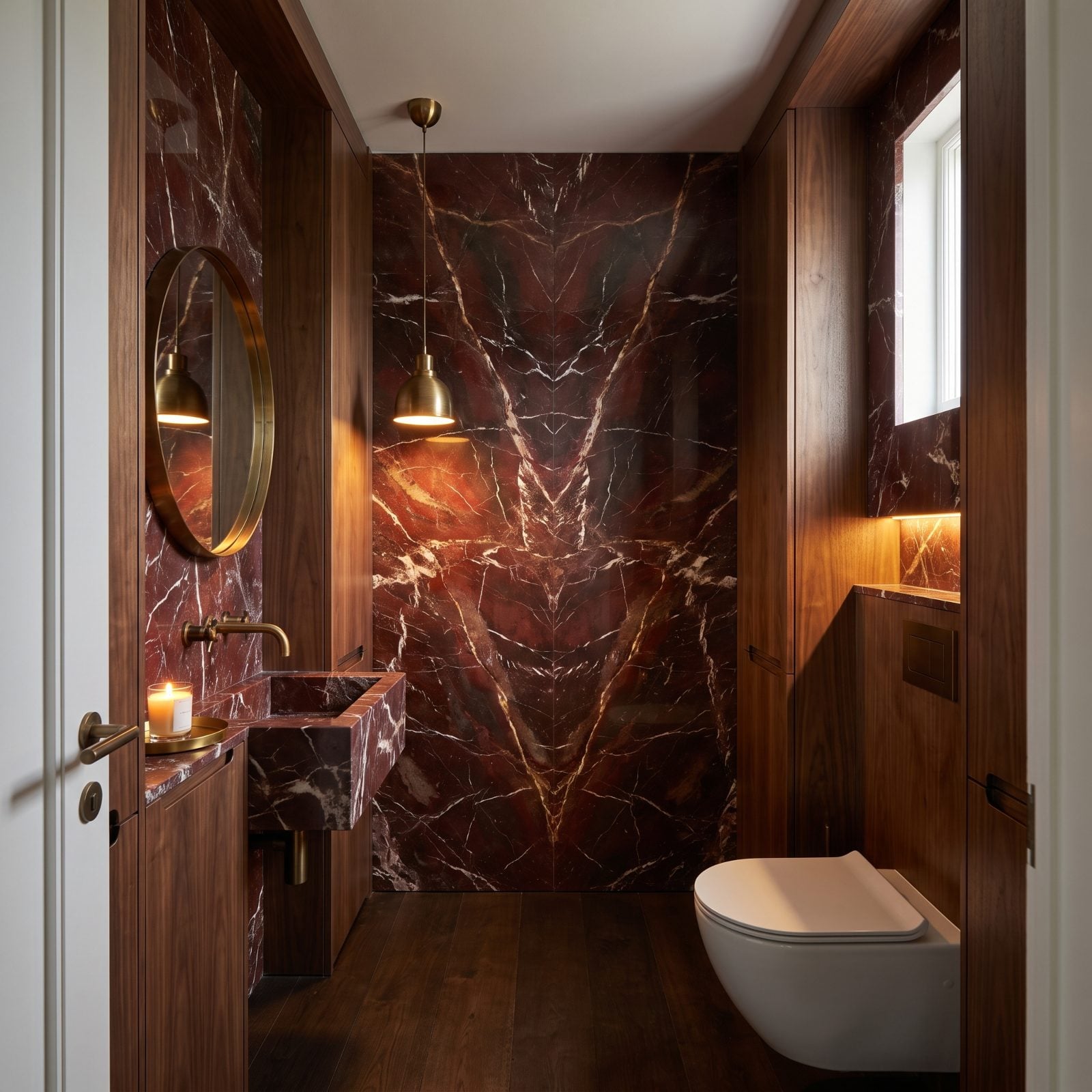
This one commits. Rosso Levanto wall to wall, oxblood stone shot through with white lightning, in a space small enough to pull it off without feeling like a crypt.
The smoked-walnut cabinetry is what keeps it warm instead of theatrical. Dark wood framing dark red reads cozy, like a library you could actually relax in, and a single brass pendant light does the mood work.
45. Verde Alpi Backsplash With Bookmatched Walnut Burl
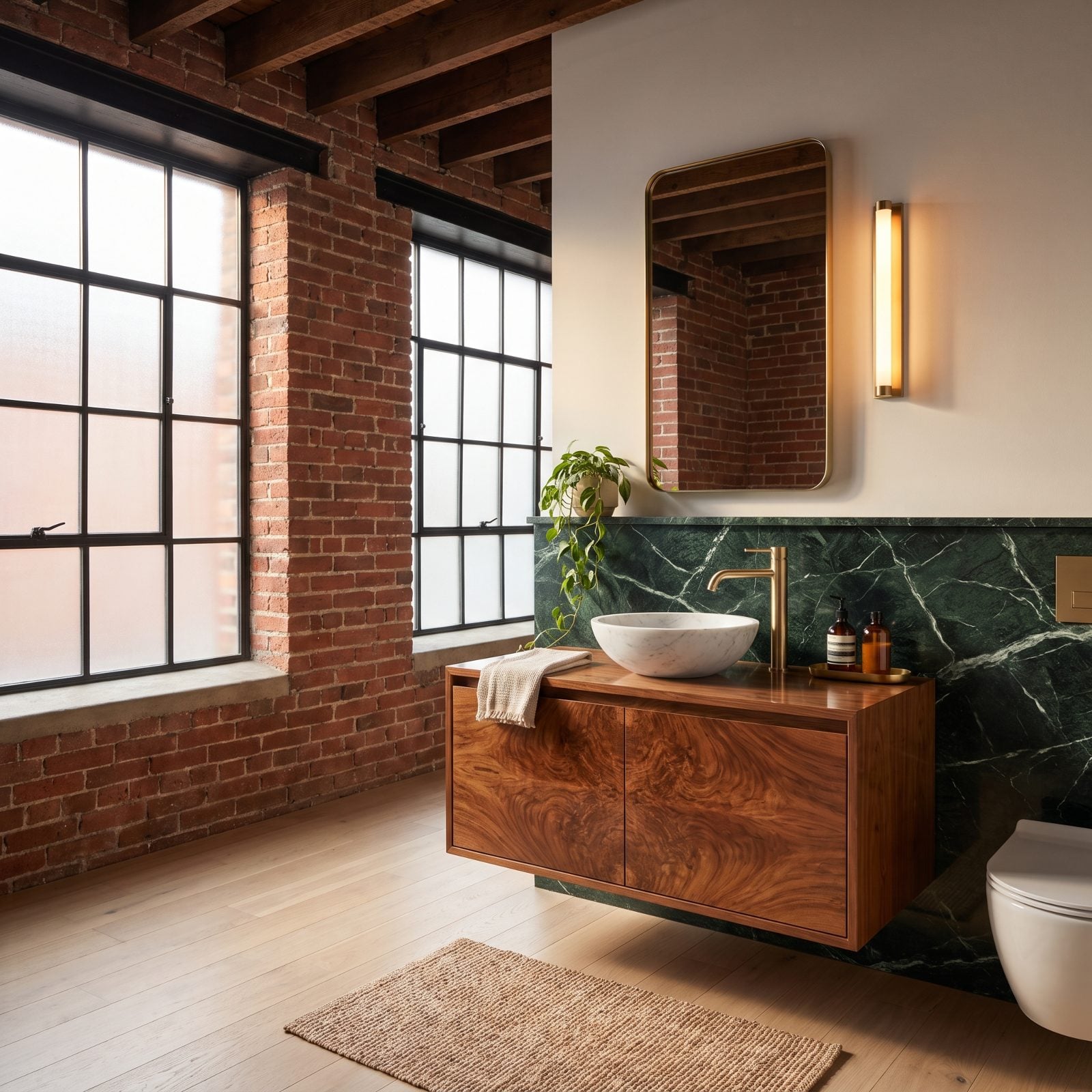
Green marble is having a moment, and Verde Alpi is the deep end of it. Here it runs as a full wainscot — from the floor up to a ledge across the whole wall, behind both the vanity and the toilet — which is smarter than it sounds.
The real star is the bookmatched walnut burl on the vanity. That swirling mirrored grain is almost too much on its own, so pairing it with a calm field of forest-green stone gives the eye a clean anchor. Burl everywhere would exhaust you. Burl plus one green backdrop sings.
44. Nero Marquina Pedestal Sink Standing Against Warm Walnut Paneling
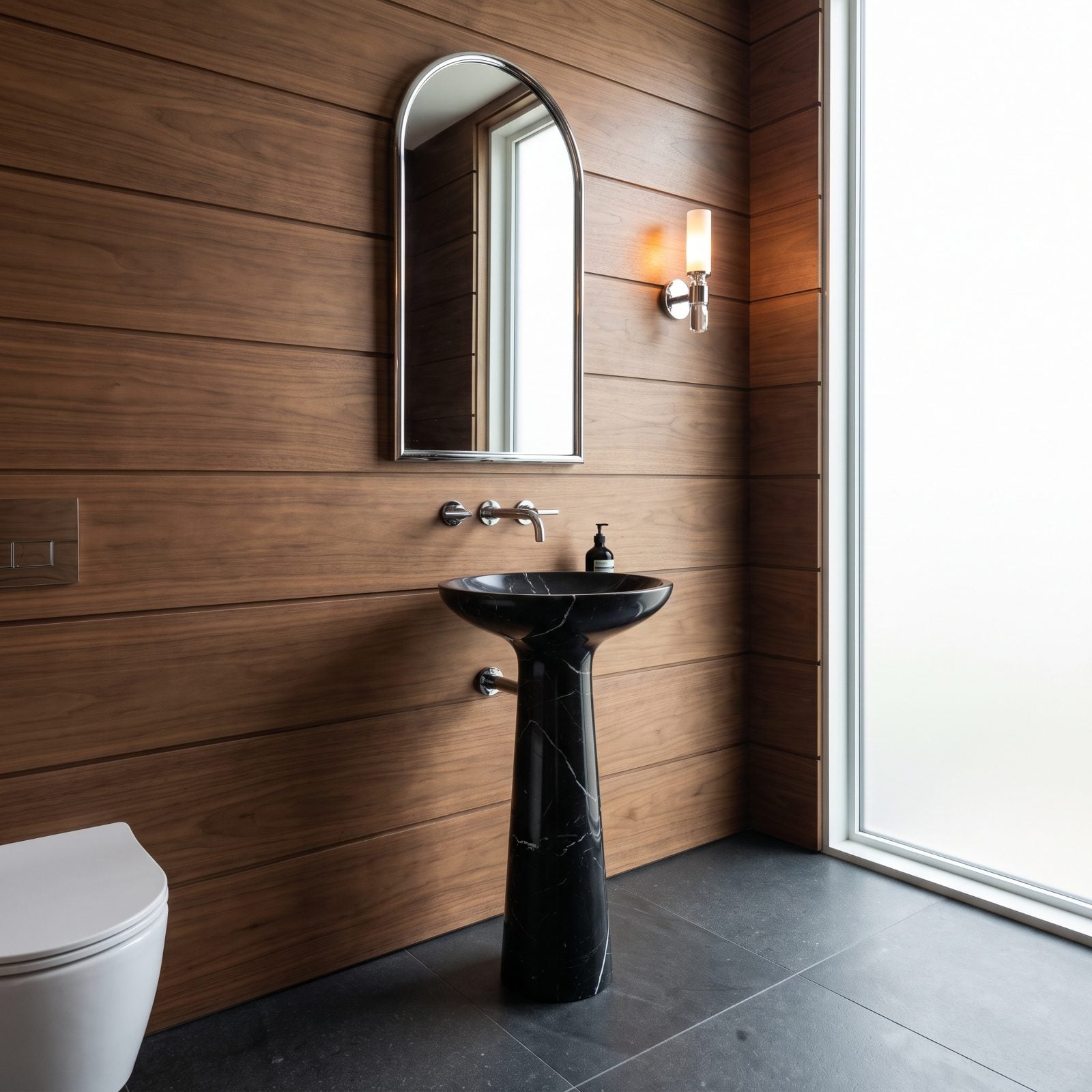
A pedestal sink is the move when you’ve got no room to hide. No vanity, no storage to fuss over, just a single carved object standing on its own.
Nero Marquina makes that object worth looking at. Black stone with hairline white veins, set against honey walnut paneling, is high contrast done with taste. The chrome faucet keeps it cool rather than gold-warm, which suits the graphic black-and-white play.
43. An Arabescato Cube Sink Set Into a Walnut Niche
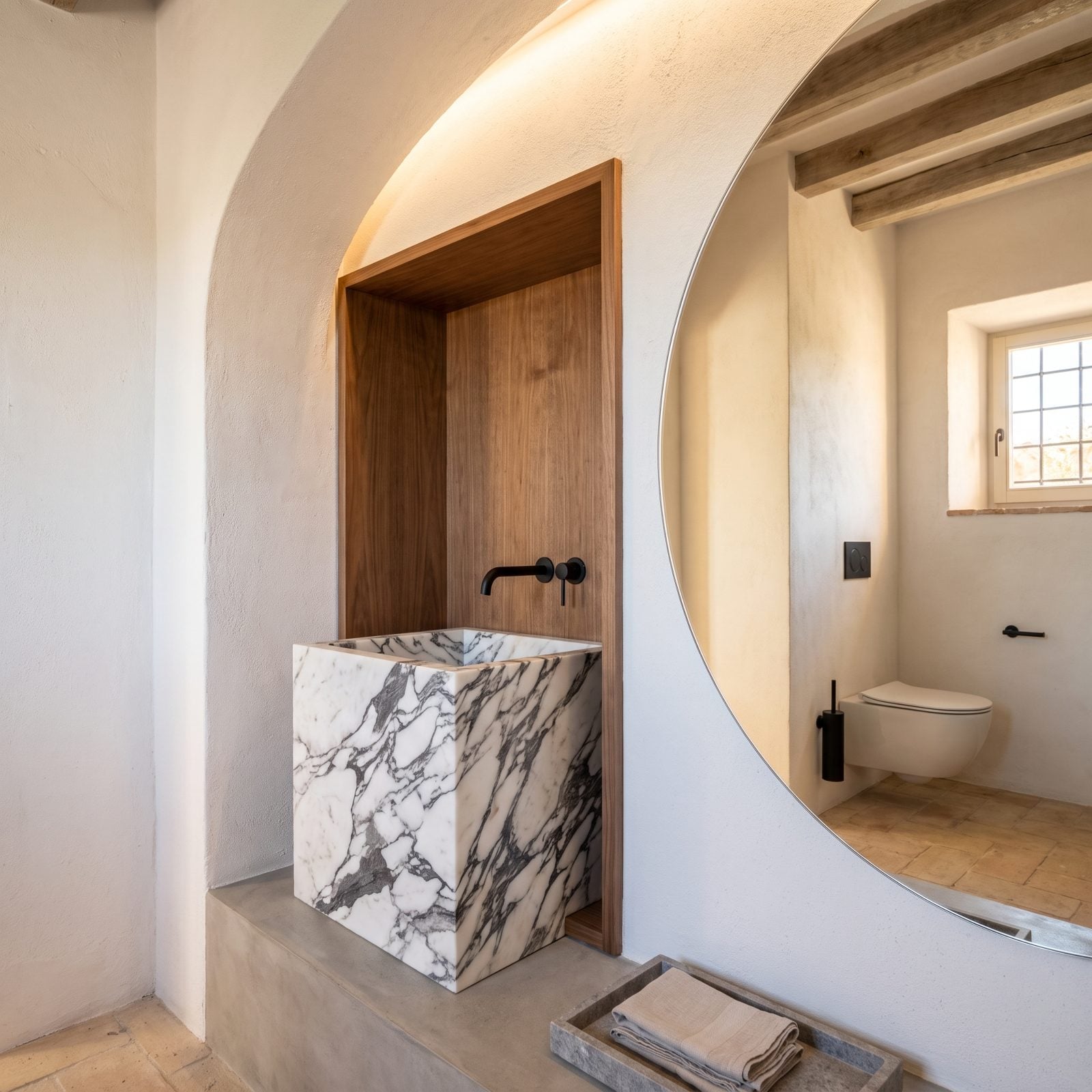
Setting the sink inside a recessed walnut niche turns a basin into an exhibit. The cube of Arabescato, with its branching grey veins splitting across white, sits framed like a piece in a gallery.
A hidden light strip at the top of the niche is the quiet genius. It washes down the stone so the veining reads even on a grey afternoon, and it makes the whole recess feel deliberate instead of like leftover wall.
42. Rosa Português Basin Softened by a Curved Walnut Vanity
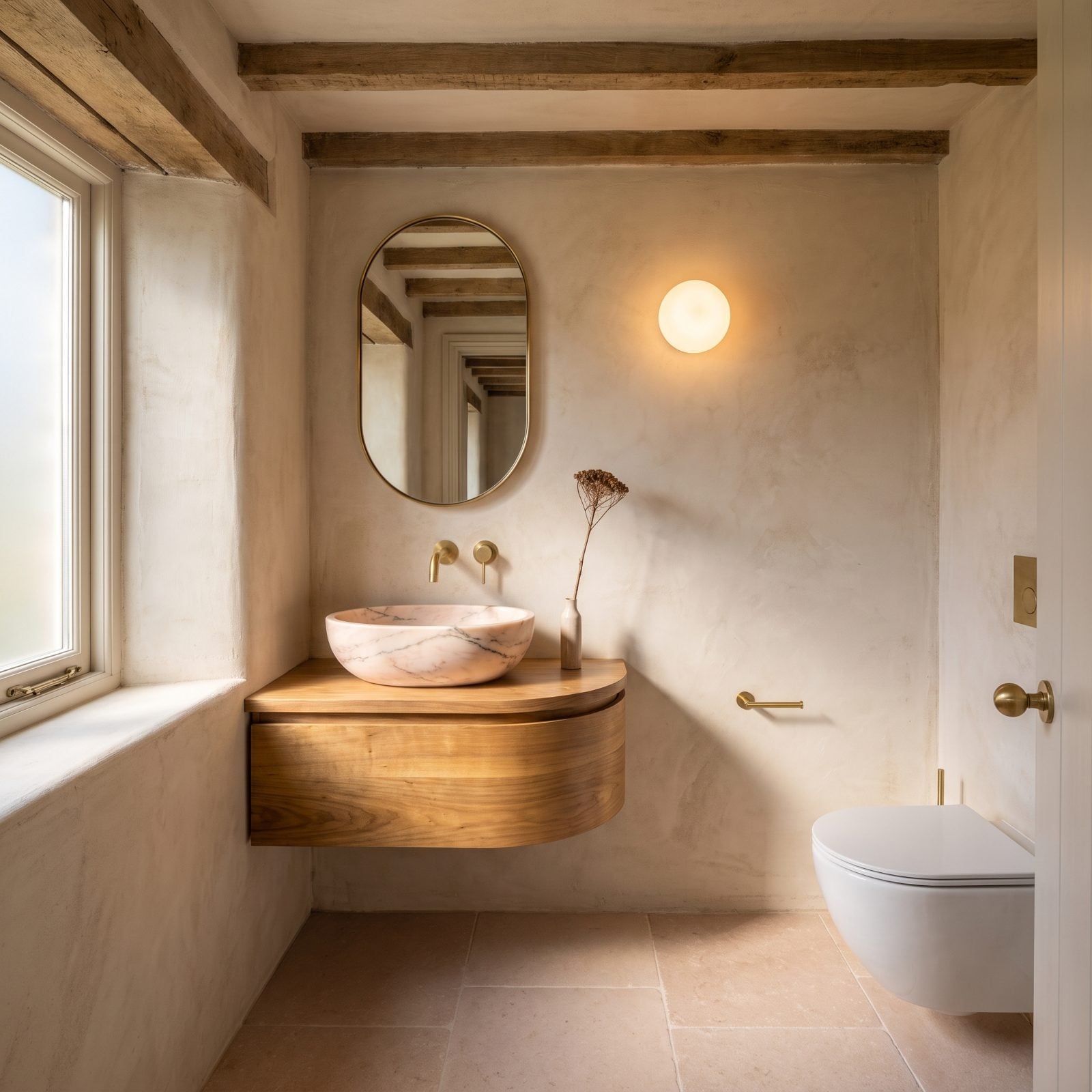
Pink marble sounds like a risk until you see Rosa Português done with a soft hand. This blush stone, veined in cream and grey, has none of the bubblegum problem — it reads warm, almost flesh-toned, like old plaster.
Every edge in the room is rounded. The curved walnut vanity, the oval mirror, the bowl itself. Nothing in here has a hard corner, and that softness is exactly why it feels calming instead of fussy.
41. Calacatta Macchia Vecchia Over a Live-Edge Walnut Shelf
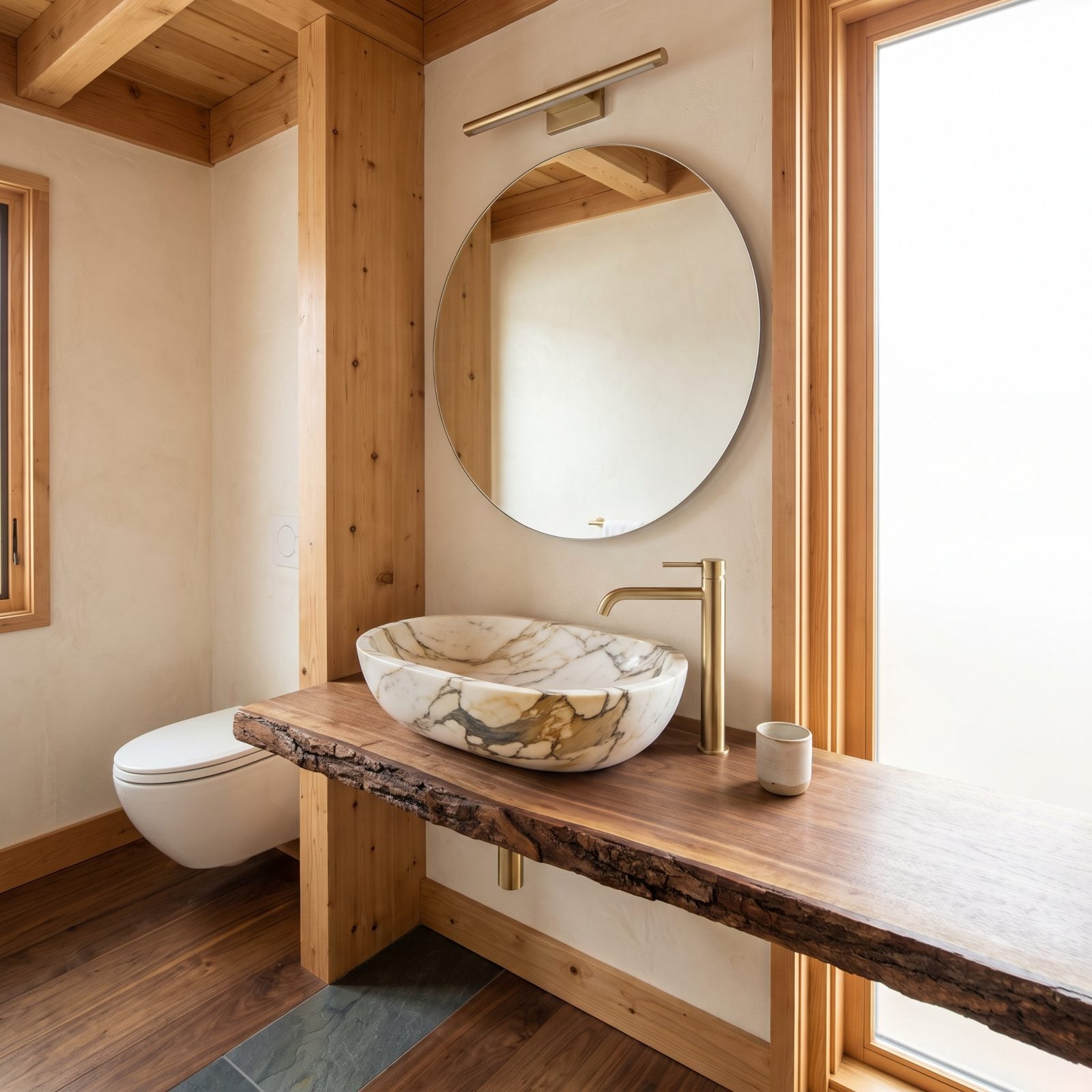
The live-edge walnut shelf is the detail that makes this one. Leaving that raw, natural bark line on the slab throws a curveball into a room full of polished stone, and the roughness is deliberate.
Calacatta Macchia Vecchia pools its gold veining in big patches, so the oval vessel sitting on that organic wood edge feels like a found object someone set down with care. Nature and craft, in one glance.
40. Emperador Basin Riding a Tambour-Walnut Vanity
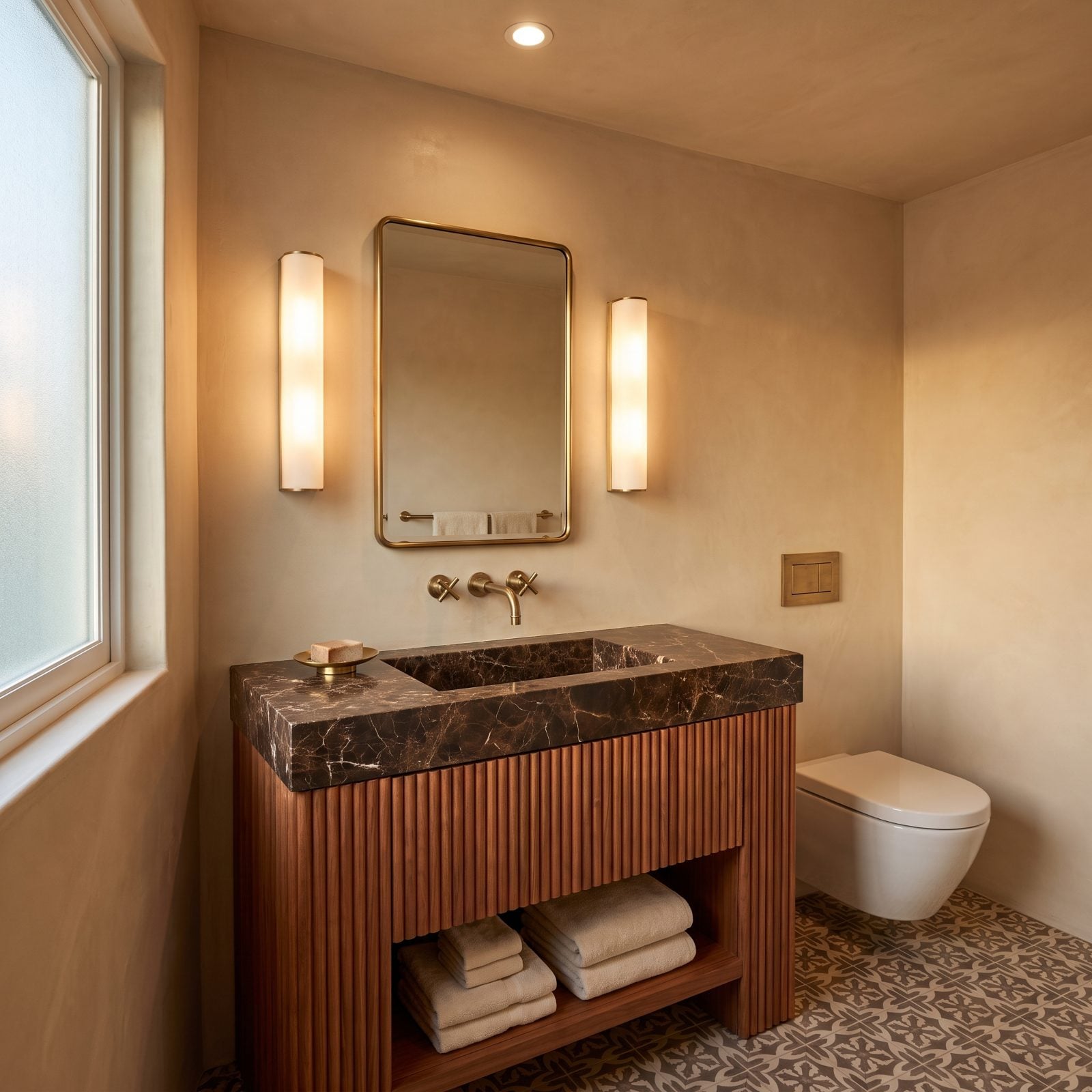
Brown on brown shouldn’t work this well. Dark Emperador, a chocolate stone threaded with cream, sitting on a tambour-walnut vanity where the whole front is rounded vertical reeds — it’s a tonal room that stays interesting because the textures refuse to match.
That tambour face begs to be touched. The reeding catches light along every ridge, so even in a warm monochrome scheme the vanity never flattens out. And the encaustic floor tile keeps your eye moving down at the base.
39. Breccia Capraia Splash Wall With a Pencil-Thin Walnut Vanity
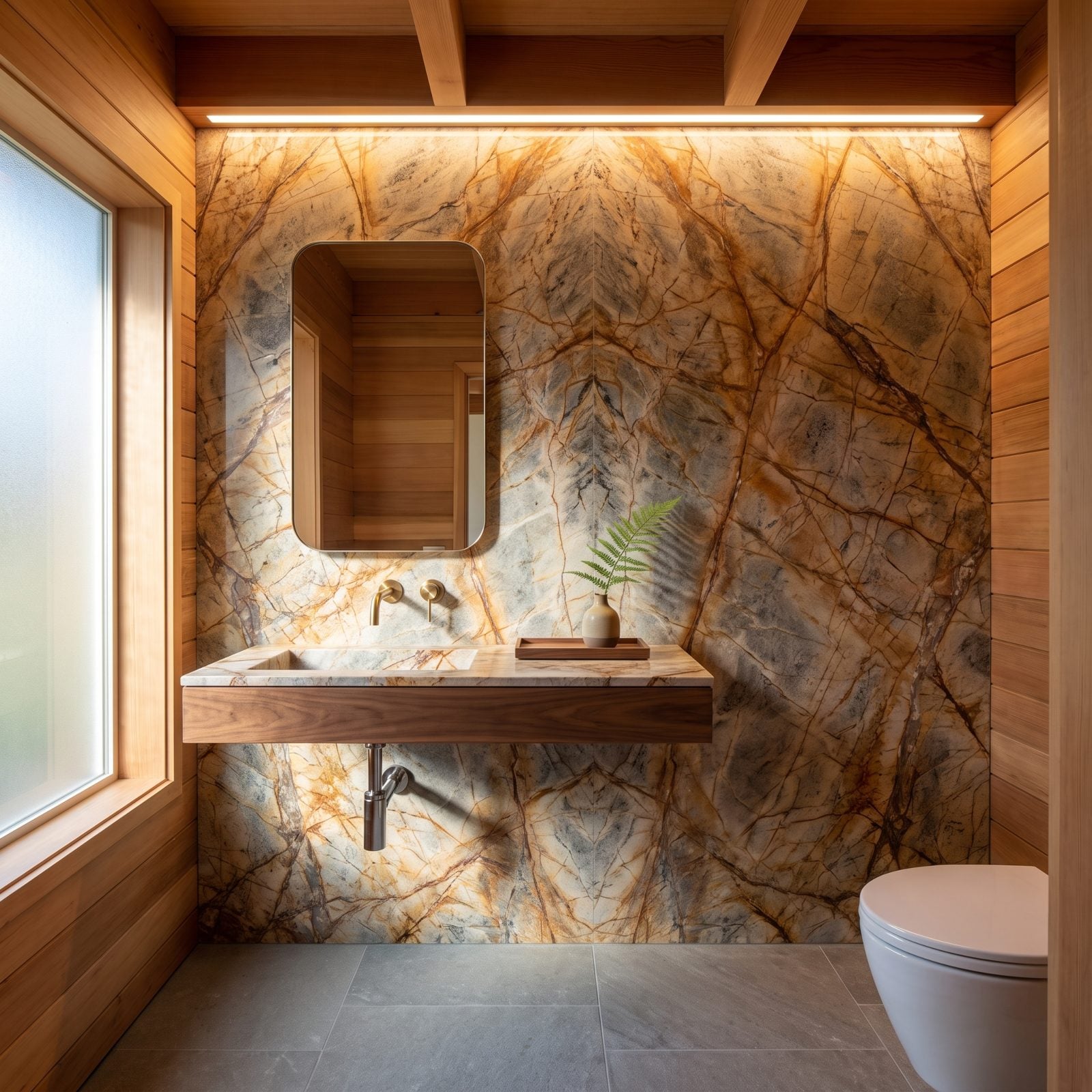
That splash wall is the entire event. Breccia Capraia throws rust, amber and grey across the stone like spilled paint, and the pencil-thin walnut vanity in front of it knows to stay out of the way. Barely eight inches deep, it reads as a floating line of warm wood rather than a piece of furniture.
The trick is restraint. When stone this loud fills a room, the wood has to whisper, and the brushed brass wall faucet picks up the warm tones without competing.
38. An Arched Alcove in Walnut, Marble Set Inside the Curve
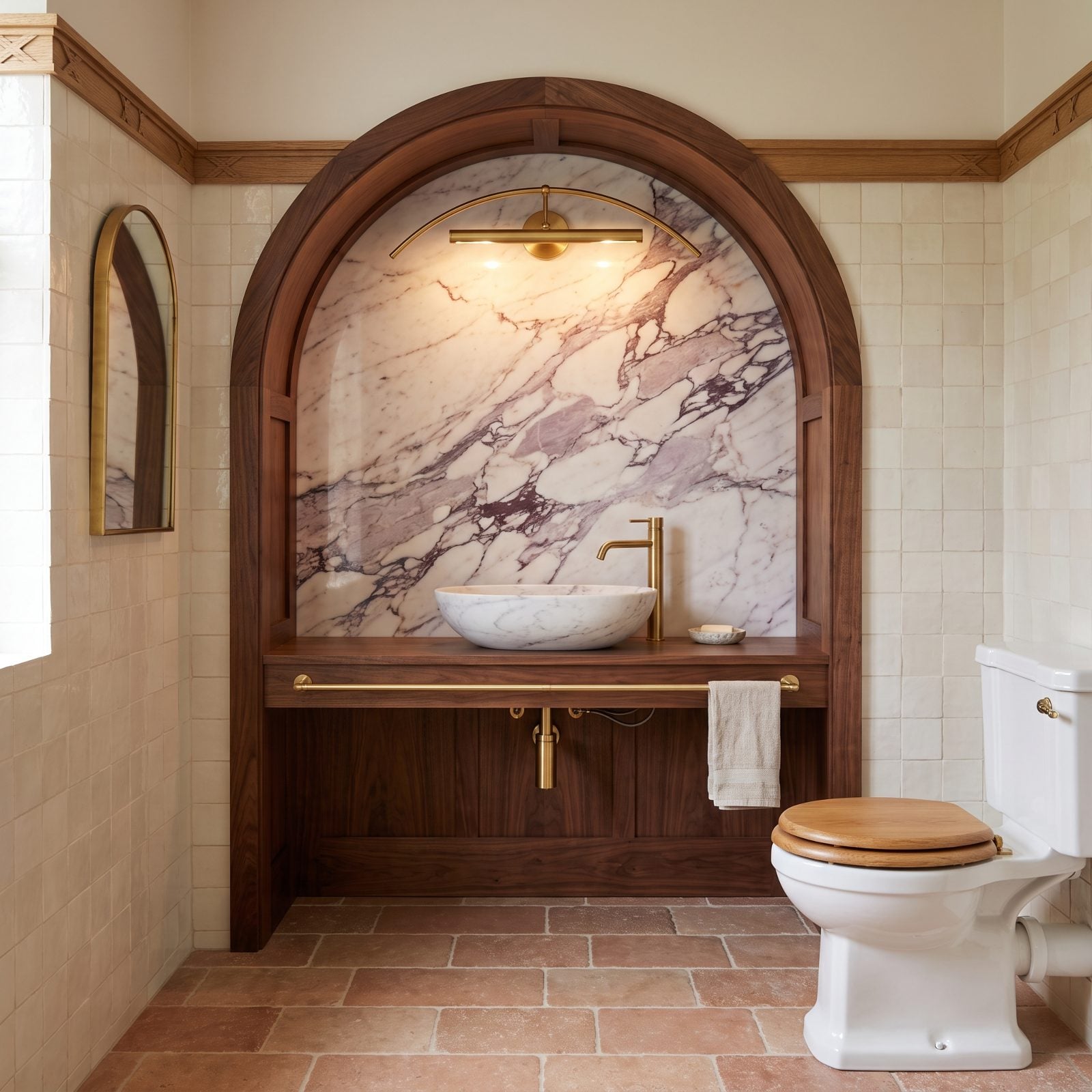
Frame a slab of Calacatta Viola inside a walnut arch and the marble turns into something closer to a painting. The curve draws your eye in and holds it, and the lilac-and-burgundy veining gets to perform inside its own frame.
The carved oval marble basin sits low inside the alcove so nothing breaks the arch line. An arched mirror on the side wall echoes the gesture without shouting about it.
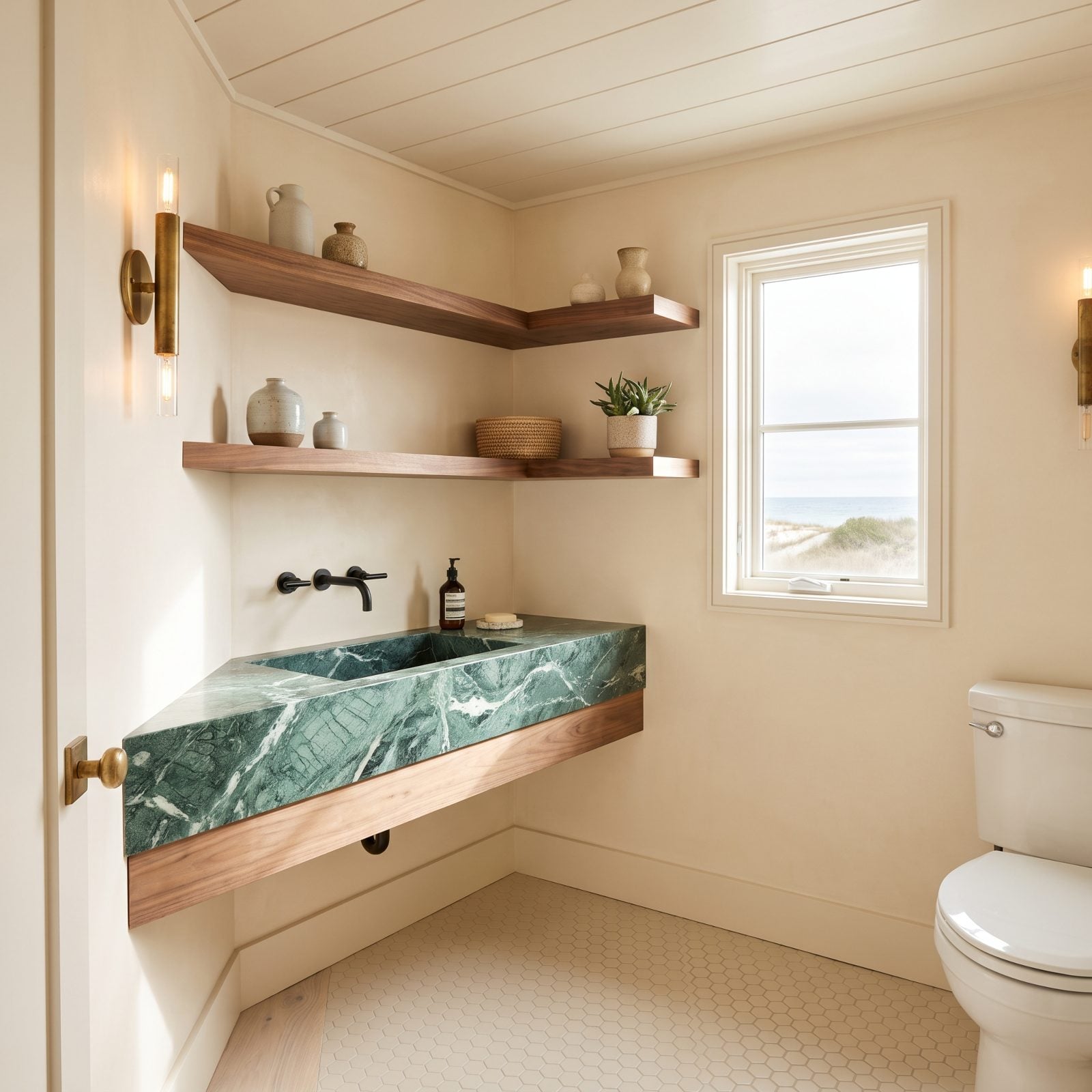
37. Triangular Corner Sink Carved in Marble, Walnut Shelving Wrapping Around
🔥 Would you like to save this?
Corner sinks usually feel like a compromise. This one doesn’t. The triangular basin is carved from a single block of green Verde Guatemala, and the emerald veining makes the tightest corner of the room the most interesting one.
Walnut shelves wrap both walls above it, so the storage follows the geometry instead of fighting it. Smart move in a four-foot footprint.
36. Off-Center Basin on a Long Walnut Run
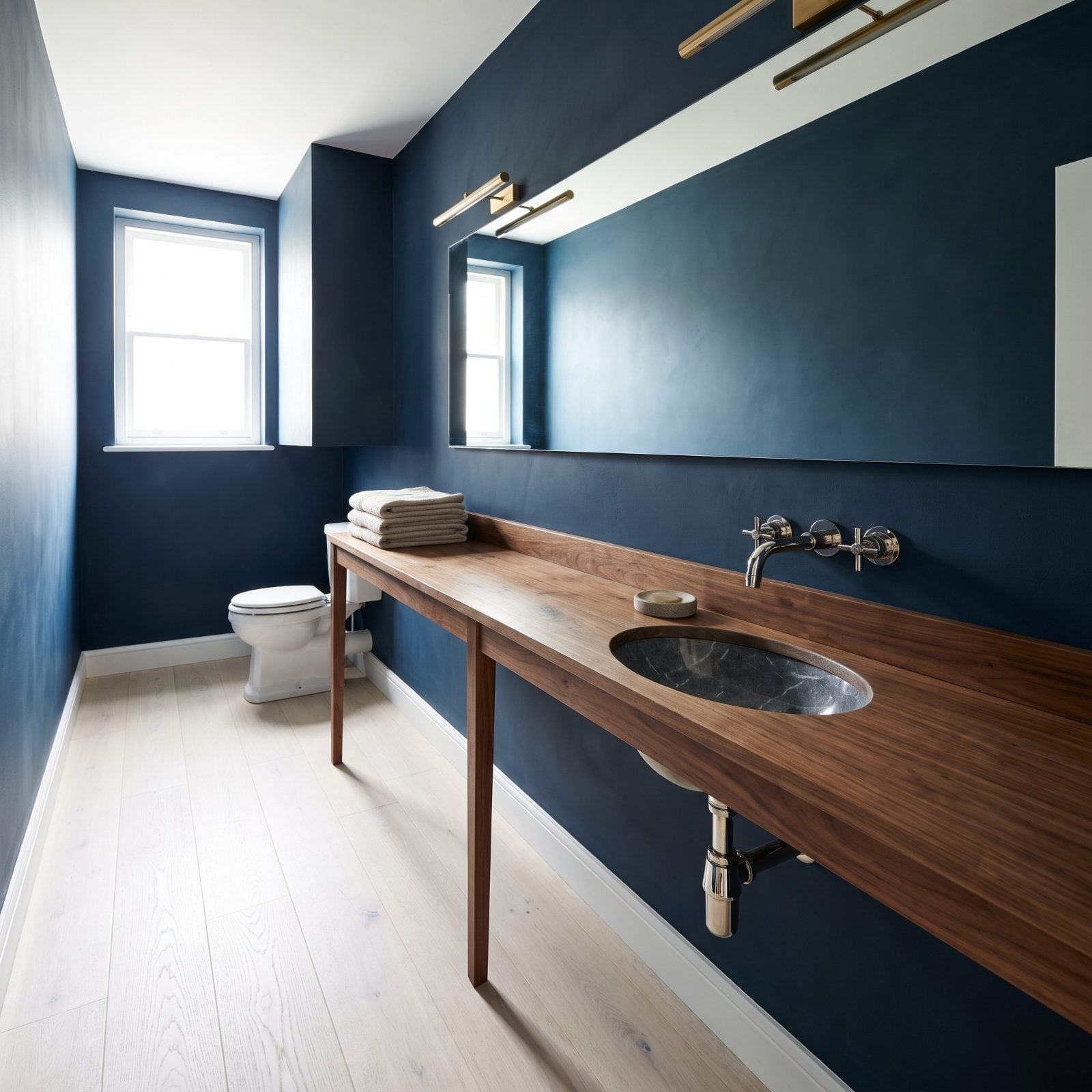
Pushing the basin to the right third breaks the symmetry rule on purpose, and the long open stretch of walnut counter to its left is what makes the room feel generous rather than empty. Negative space as a design decision.
Honed Grigio Carnico reads almost charcoal against the oiled walnut, a quiet contrast that keeps the deep ink walls from closing in.
35. A Freestanding Marble Column Basin Next to a Walnut Storage Tower
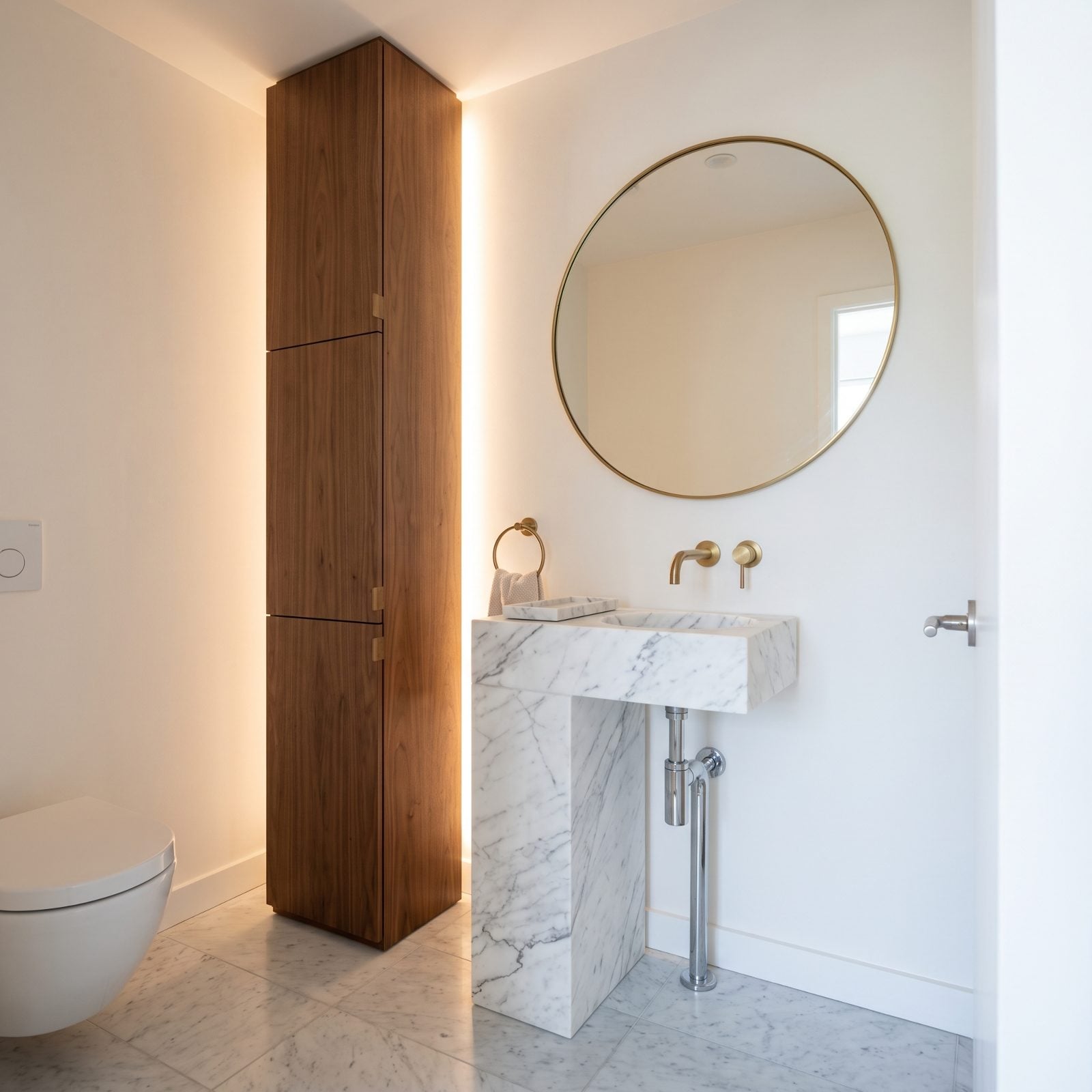
The marble basin is pure sculpture, a rectilinear block of Carrara with an offset leg and the rectangular bowl carved into its cantilevered top. A single polished chrome drain rises from the floor beside the leg, left exposed like part of a gallery installation.
Beside it, the slim walnut tower hides everything the sculpture can’t. One is for looking at, one is for living with, and that pairing keeps the room working without ruining the show. Slim brass edge pulls keep the surface clean.
34. Marble Console on Brass Legs, a Walnut Drawer Box Slung Below
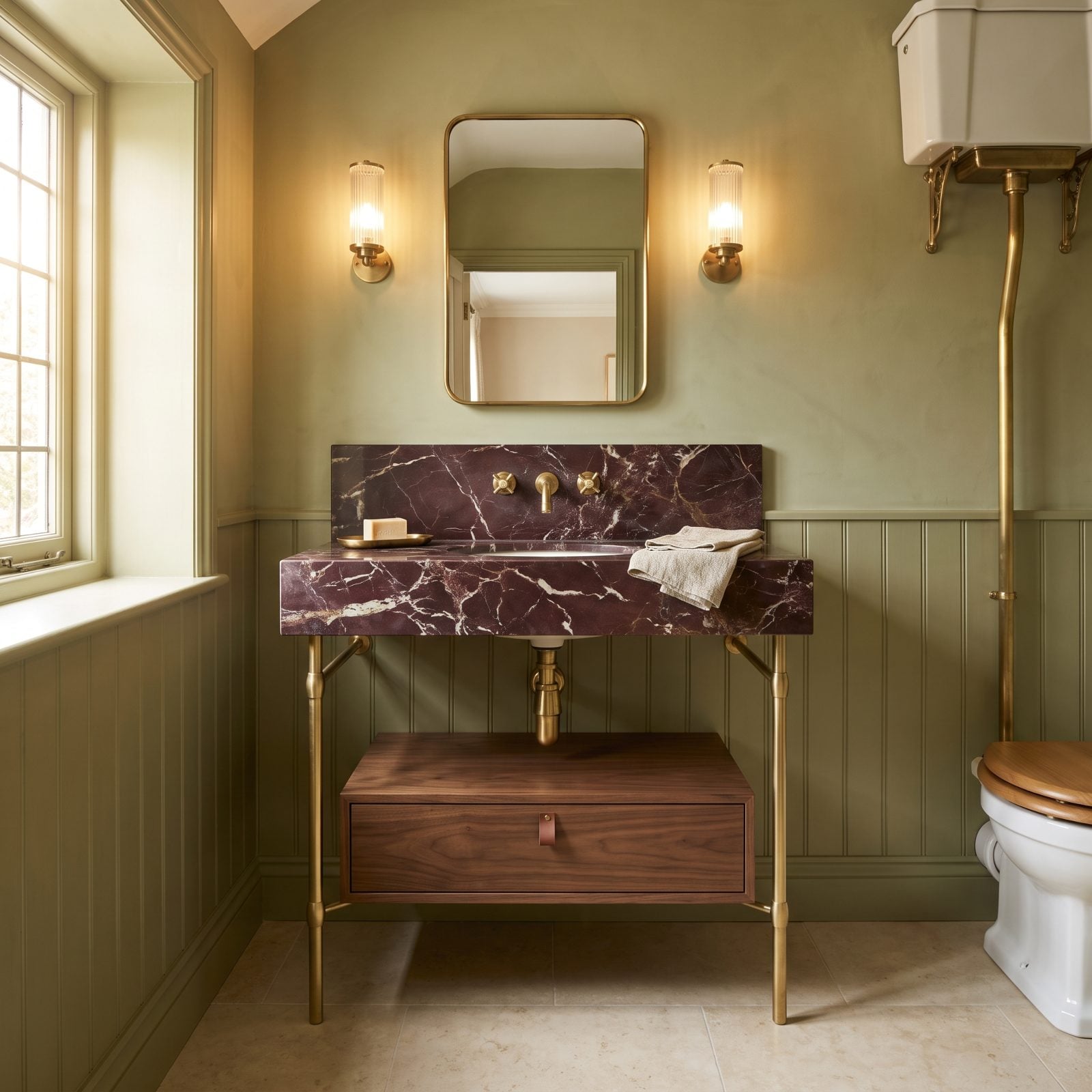
Brass legs do something sturdy walnut cabinetry can’t: they let the room breathe underneath. The Rosso Levanto slab floats on four tapered legs, and the open space below makes a small powder room feel twice its size.
A single walnut drawer box slung between the legs gives you somewhere to stash the spare rolls without blocking the light. Burgundy marble against olive walls is a deliberately warm pairing, almost edible.
33. A Wall-to-Wall Marble Ledge Over Handleless Walnut Cabinets
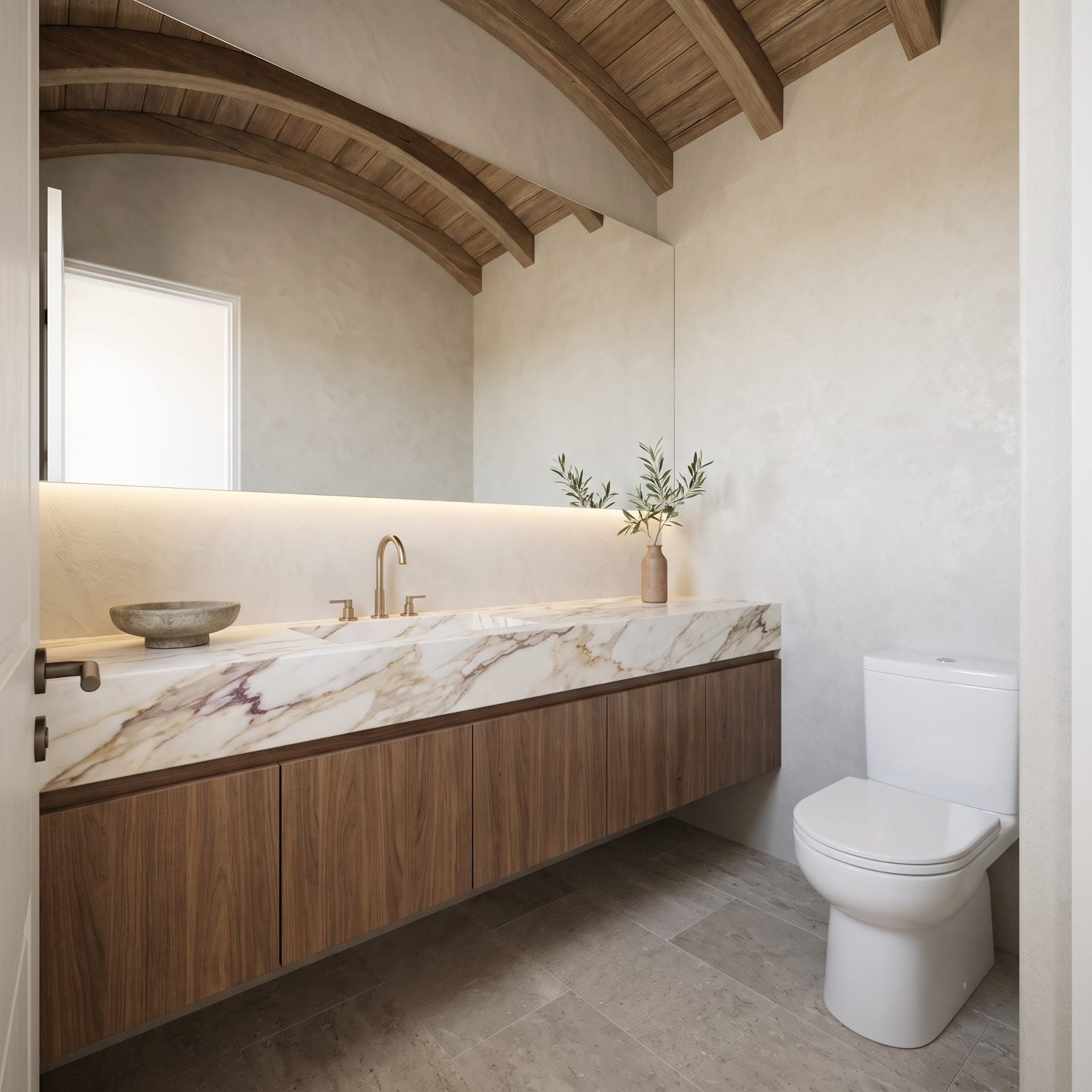
Mill the basin straight into a floating Paonazzo ledge and you get one unbroken horizontal line of stone, gold and plum veining running its full length to an open end with no seam, no lip, no bowl perched on top.
Handleless walnut cabinets below keep the whole lower half quiet so the ledge gets to be the story. That tight reveal line between the doors? You only notice it when it’s done right.
32. Split-Level Walnut Vanity With a Raised Marble Hand-Wash Block
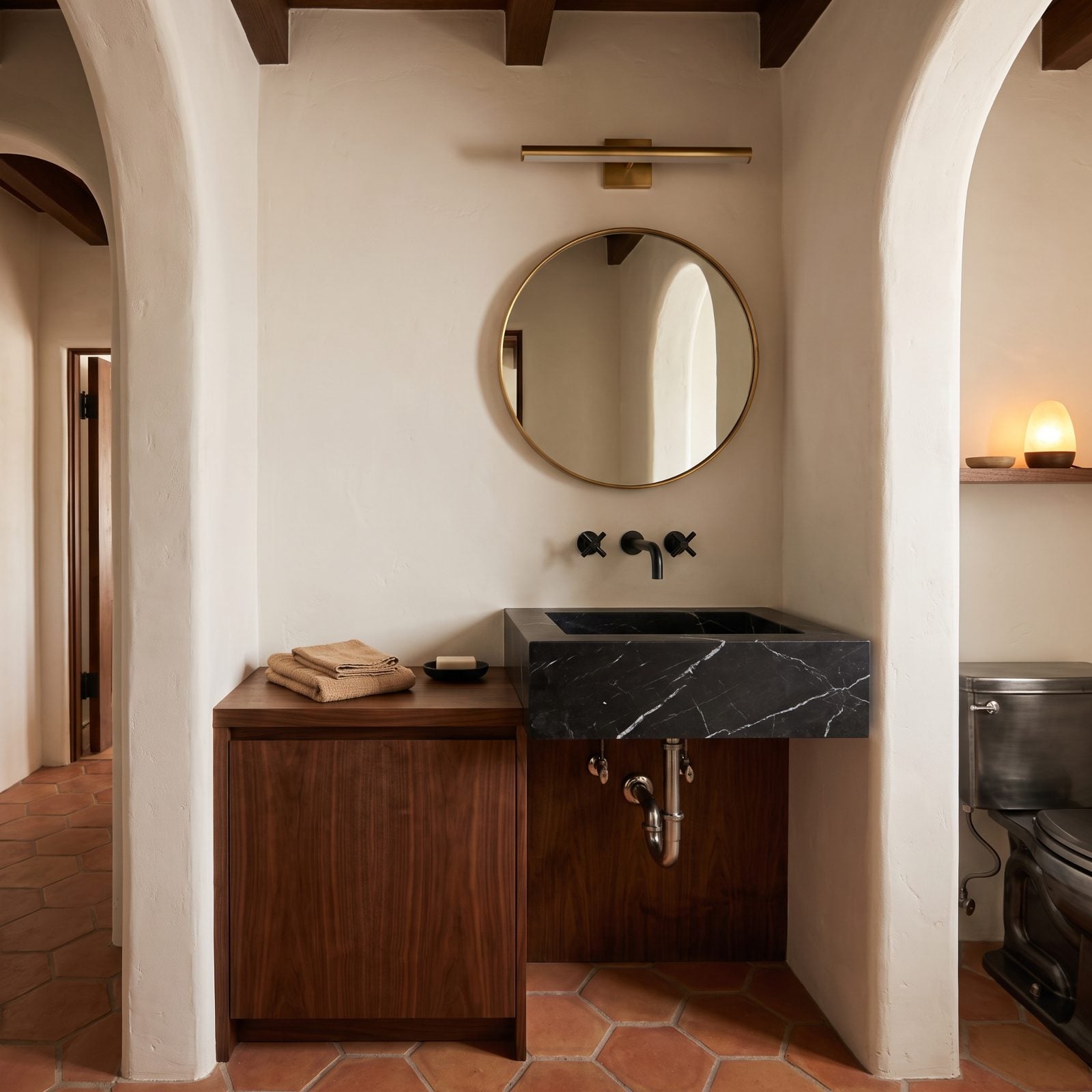
The level change is the whole idea. A raised Nero Marquina block sits proud of the walnut counter, its white veining snapping against the black, and that six-inch step gives a flat vanity some real shape.
The lower walnut section handles the towels and daily bits. The raised block handles the hand-washing and all the attention.
31. A Carved Oval Marble Sink on a Saddle-Shaped Walnut Stand
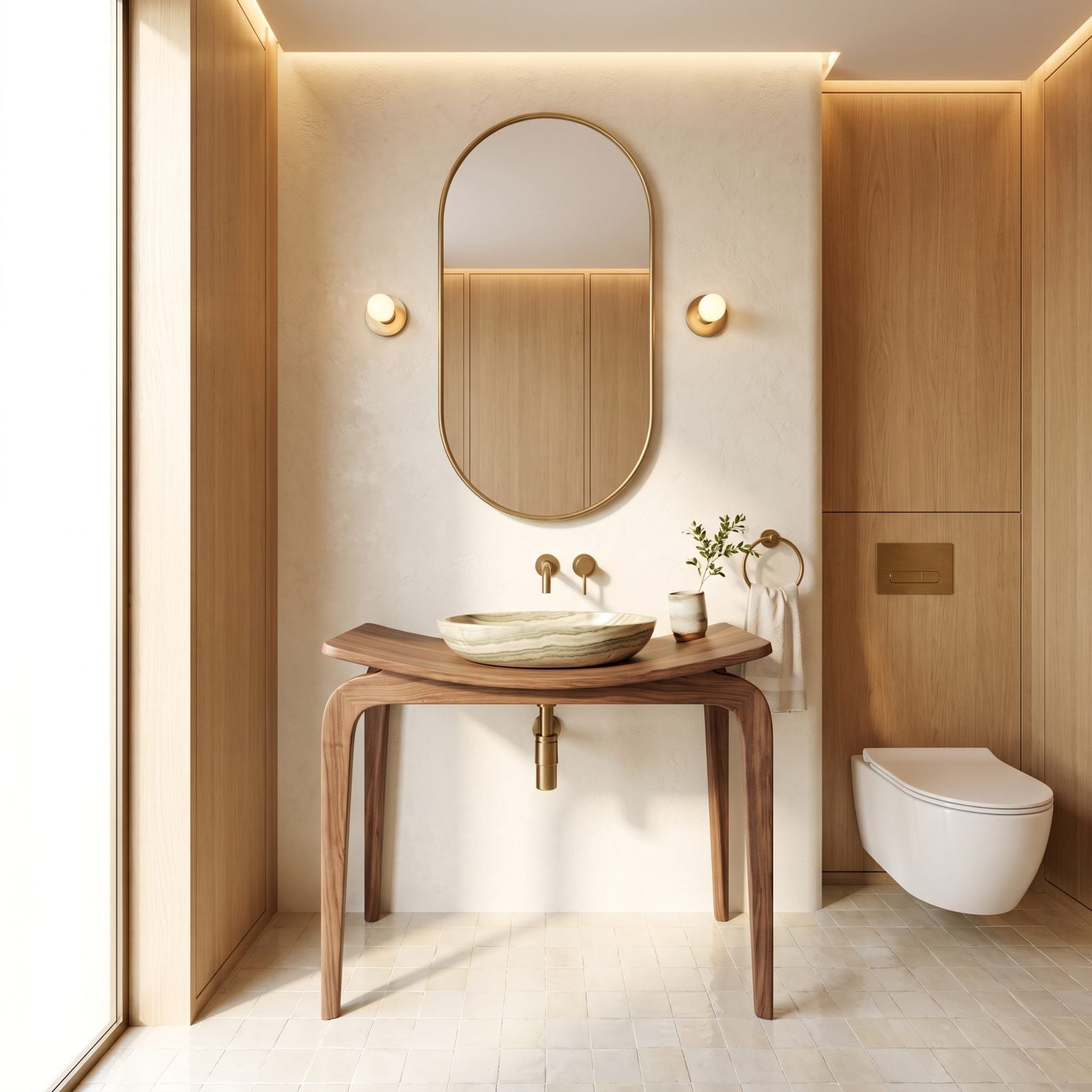
That saddle-shaped walnut stand is furniture-maker territory. Steam-bent and carved so the top dips to cradle the oval Cipollino basin like it grew there, with the wavy green banding in the marble echoing the curve of the wood.
Everything here is about the hand. Curved legs, a shallow organic bowl, soft cream plaster walls, the opposite of a hard-edged box vanity, and you feel the difference the second you walk in.
30. A Furniture-Style Walnut Washstand With a Tailored Marble Apron
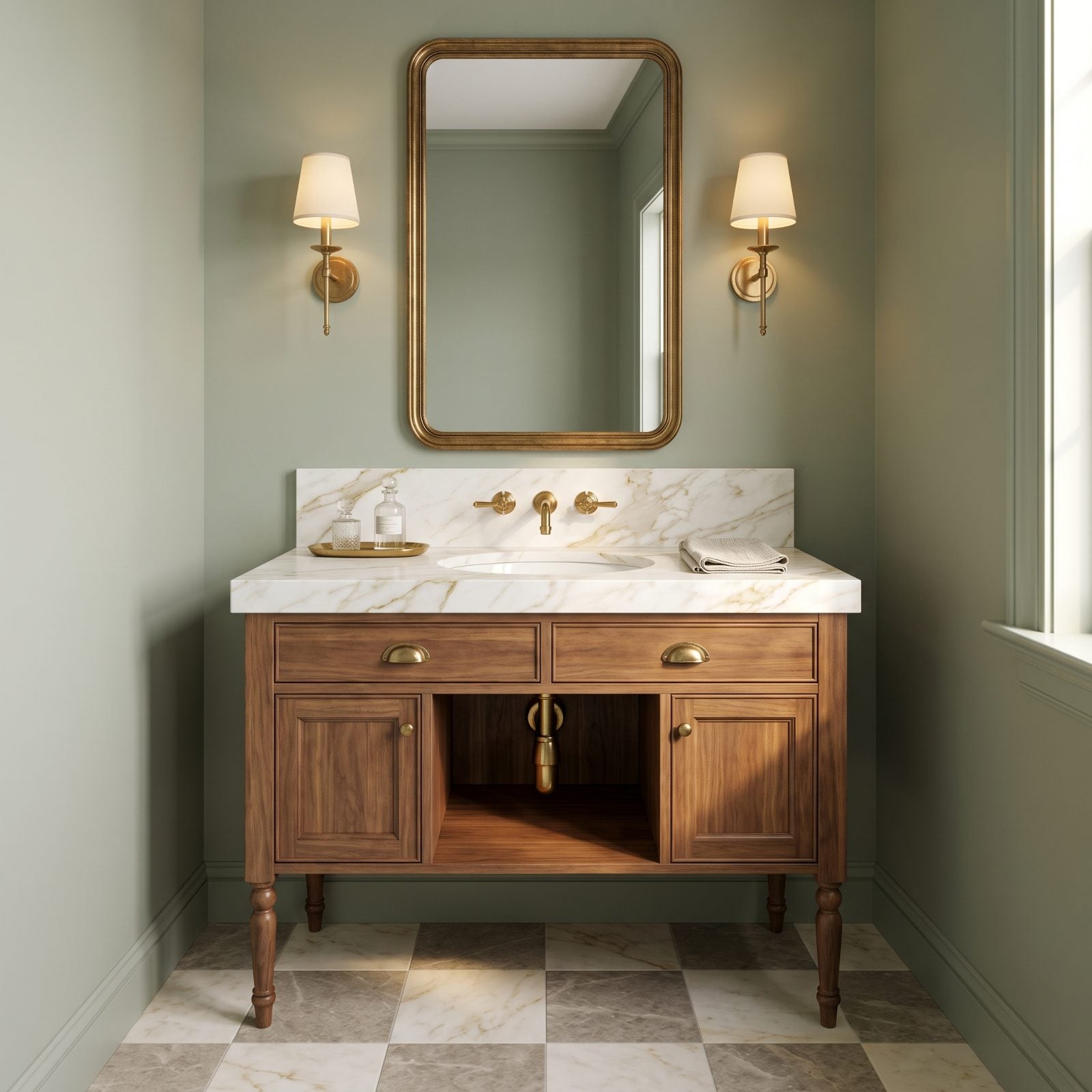
This one plays it traditional, and it earns the play. The washstand reads as a proper piece of antique furniture, turned legs, cup pulls, paneled sides, and the Calacatta Oro top with its dropped apron edge finishes it like a tailored skirt on a sideboard.
Against sage green walls and a checkerboard marble floor, the whole room feels like it has always been there. The brushed brass wall-mounted faucet, with its separate spout and lever handles, seals the period feel without tipping into costume.
29. An Antique Walnut Commode Reworked Into a Marble-Topped Vanity
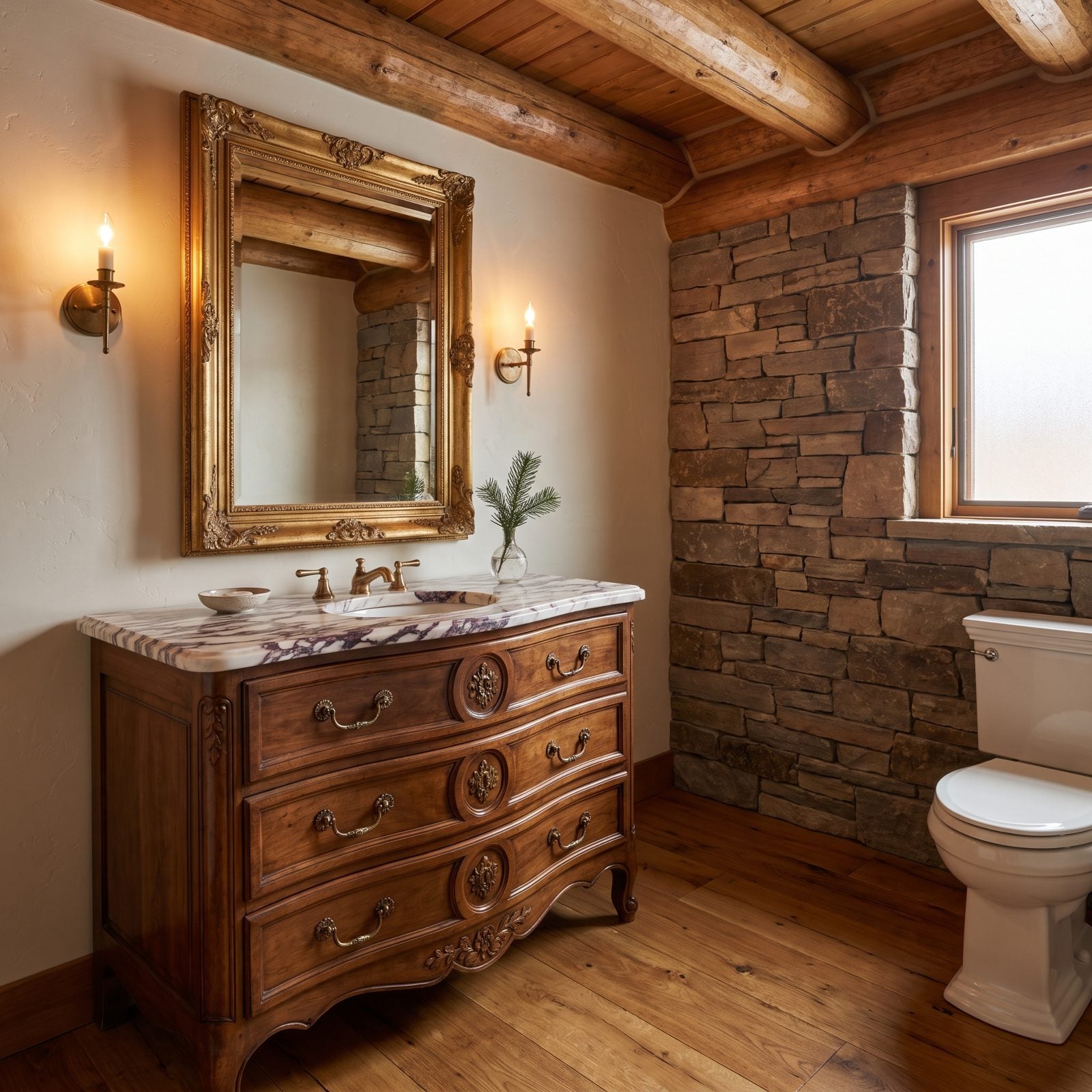
Taking a real antique and giving it running water is the oldest trick in the good-taste book, and it still works. That Calacatta Viola top, with its bruise-purple veining, has no business sitting on a 150-year-old walnut commode — which is exactly why it lands. The violence of the stone against that fussy carved serpentine front is the whole argument.
Here the marble is the splurge and the walnut is already paid for, salvaged and waxed back to life. The deck-mounted, two-handle widespread brushed-brass faucet set into the marble treats the plumbing as jewelry, leaving the drawer front intact all the way to the floor.
28. Scalloped Marble Rises Above Flat-Front Walnut Drawers
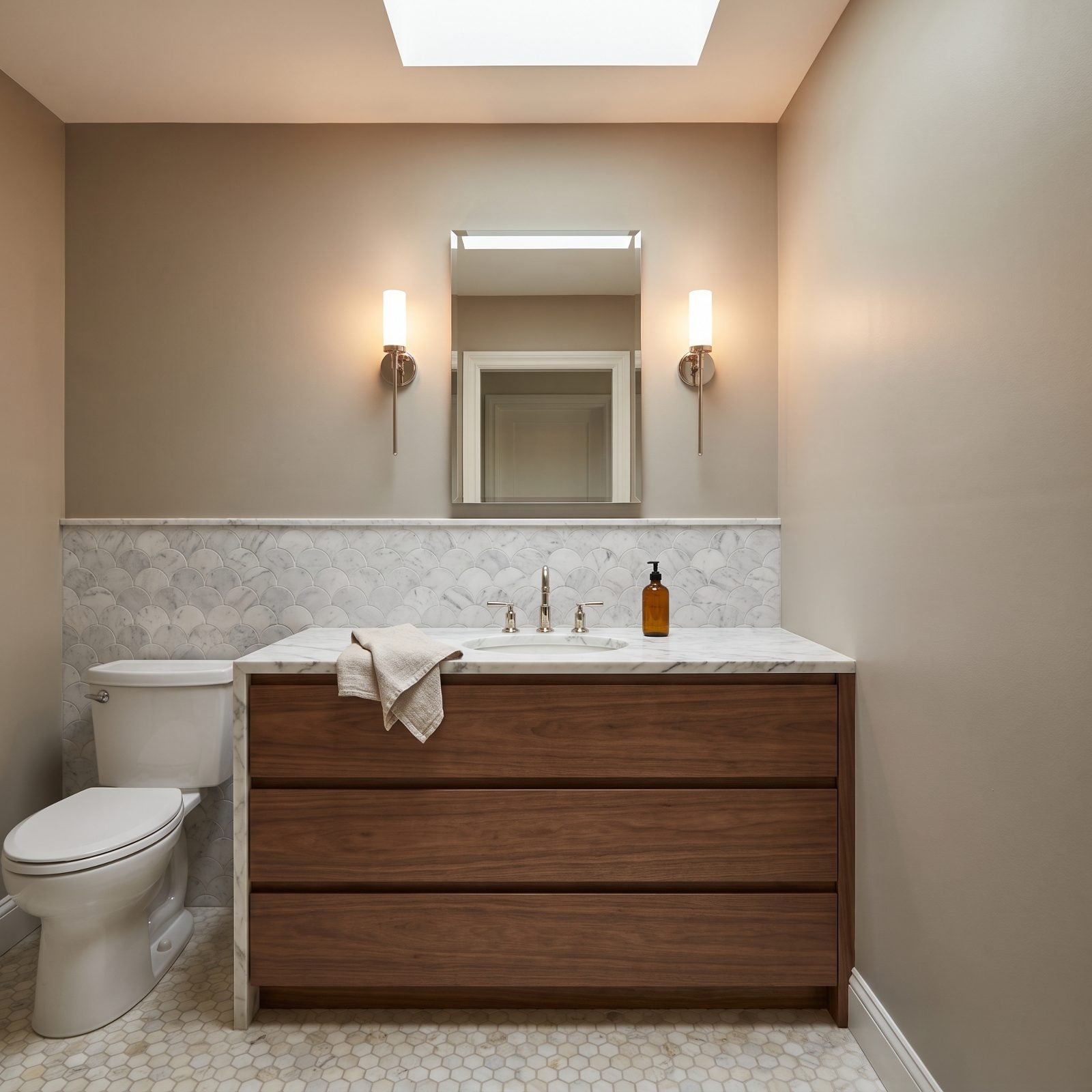
The scalloped marble backsplash is the loud one here, and it knows it. Fish-scale cuts in honed Arabescato catch light differently across every curve, so the wall shifts as you move. Below it, the flat-front walnut drawers go completely quiet — rift-sawn grain, no hardware, nothing to argue with the pattern above.
That restraint is the point. Give the stone one job and it does it.
27. A Marble Checkerboard Floor Under a Floating Walnut Vanity
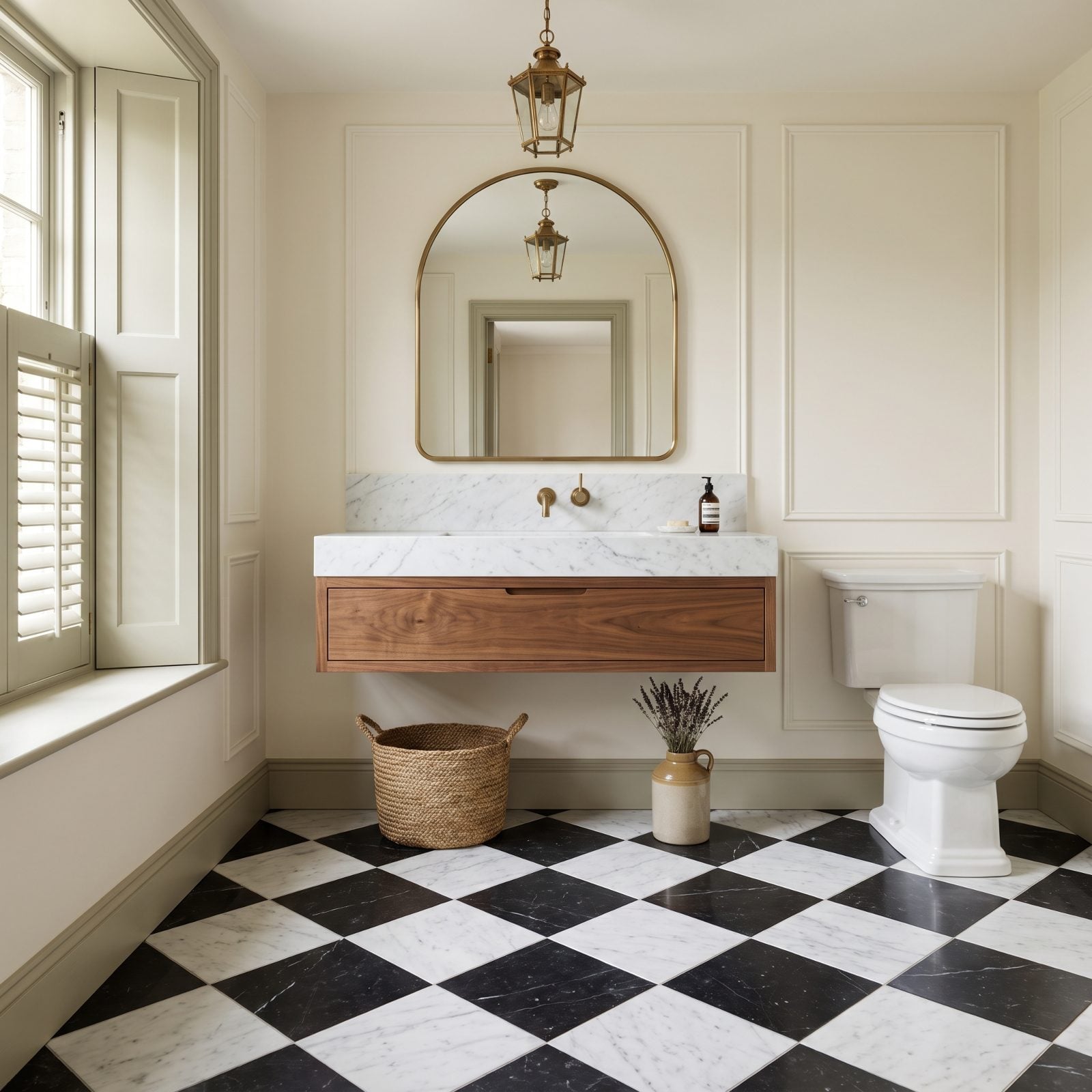
That diagonal checkerboard floor in Carrara and Nero Marquina is doing the heavy lifting, and floating the walnut vanity above it was the smart call. Legs would have chopped the pattern into pieces. The cantilever lets the whole black-and-white grid run uninterrupted underneath, so the floor reads as one continuous move.
It also makes a tight room feel bigger. Visible floor equals perceived space, and the eye reads that open stretch beneath the vanity as breathing room it does not actually have. The walnut and the aged brass faucet keep the graphic floor from going cold.
26. Walnut Wainscoting Grounds a Full-Height Marble Sink Wall
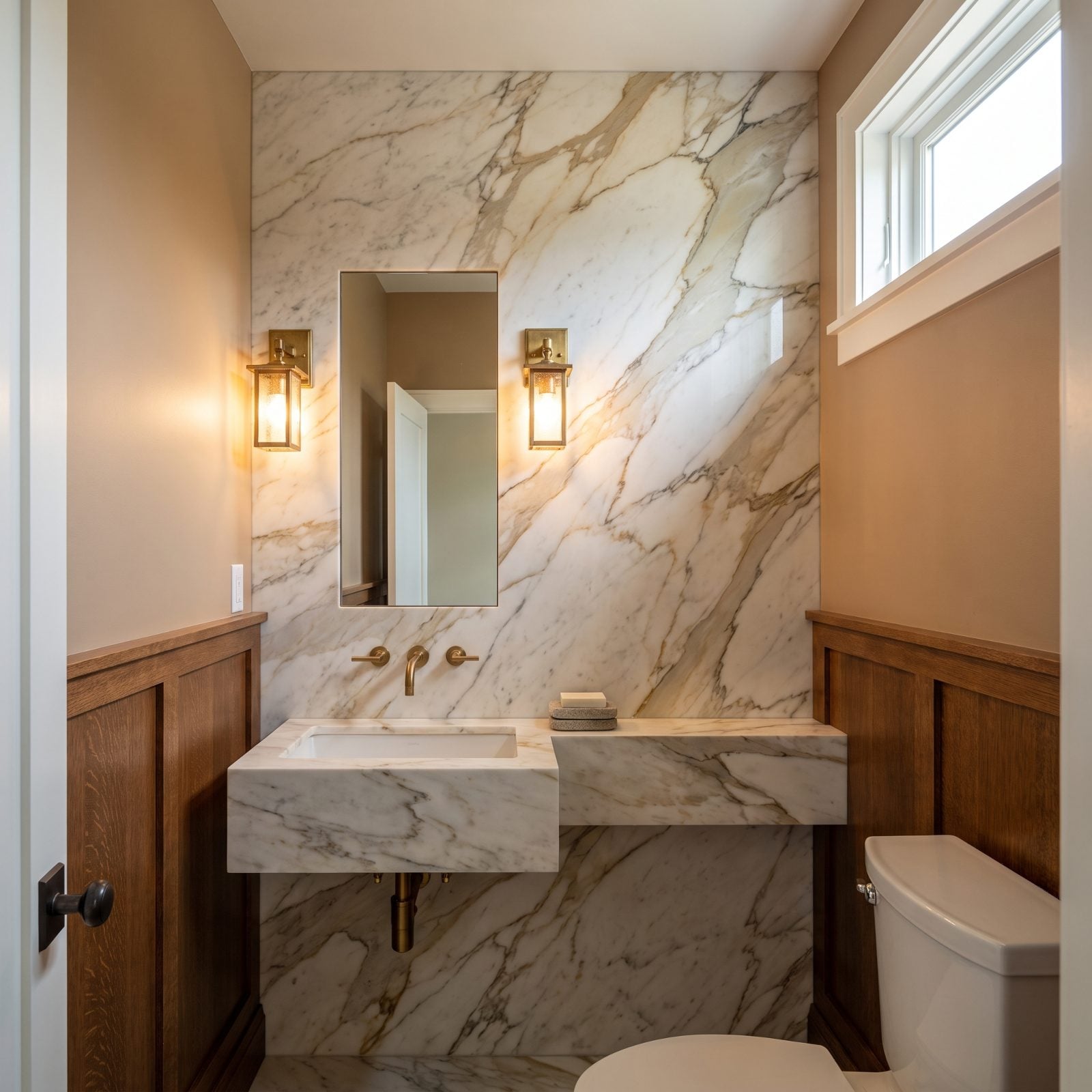
A full-height marble sink wall can drift loose from a room if nothing anchors it, and here the walnut wainscoting is the anchor. It wraps the lower third of the space in grounded vertical grain, giving the eye something solid before it travels up into all that Calacatta Gold veining.
Setting a white ceramic undermount basin into a solid marble block was the bold choice. No vanity, just stone, a crisp basin rim and a brass spout coming out of the wall. In a narrow room that reads as a contemporary utility room stripped back to its sculptural bones.
25. A Coffered Walnut Ceiling Caps a Marble Monolith Sink
🔥 Would you like to save this?
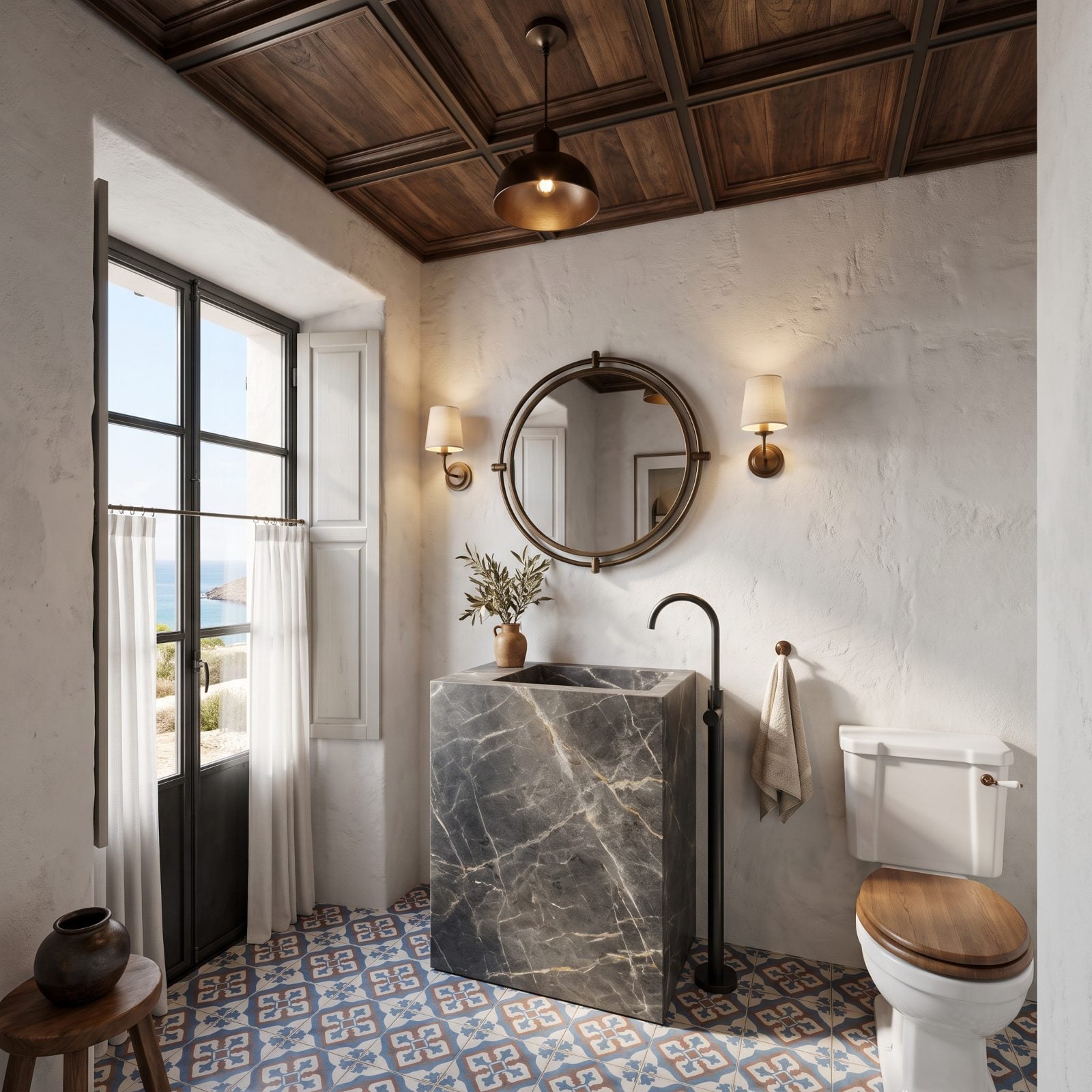
Look up first. The coffered walnut ceiling is the reason this room works, pulling your eye into those deep recessed squares and making a small footprint feel like it has somewhere to go. Height you cannot add gets borrowed from the ceiling plane instead.
Then the Grigio Carnico monolith sink holds the floor like a plinth in a gallery. One grey block, white veining, a hidden drain, nothing else. The matte-black floor-mounted spout keeps the whole thing feeling carved rather than plumbed.
24. A Marble-Framed Walnut Medicine Cabinet on a Bookmatched Wall
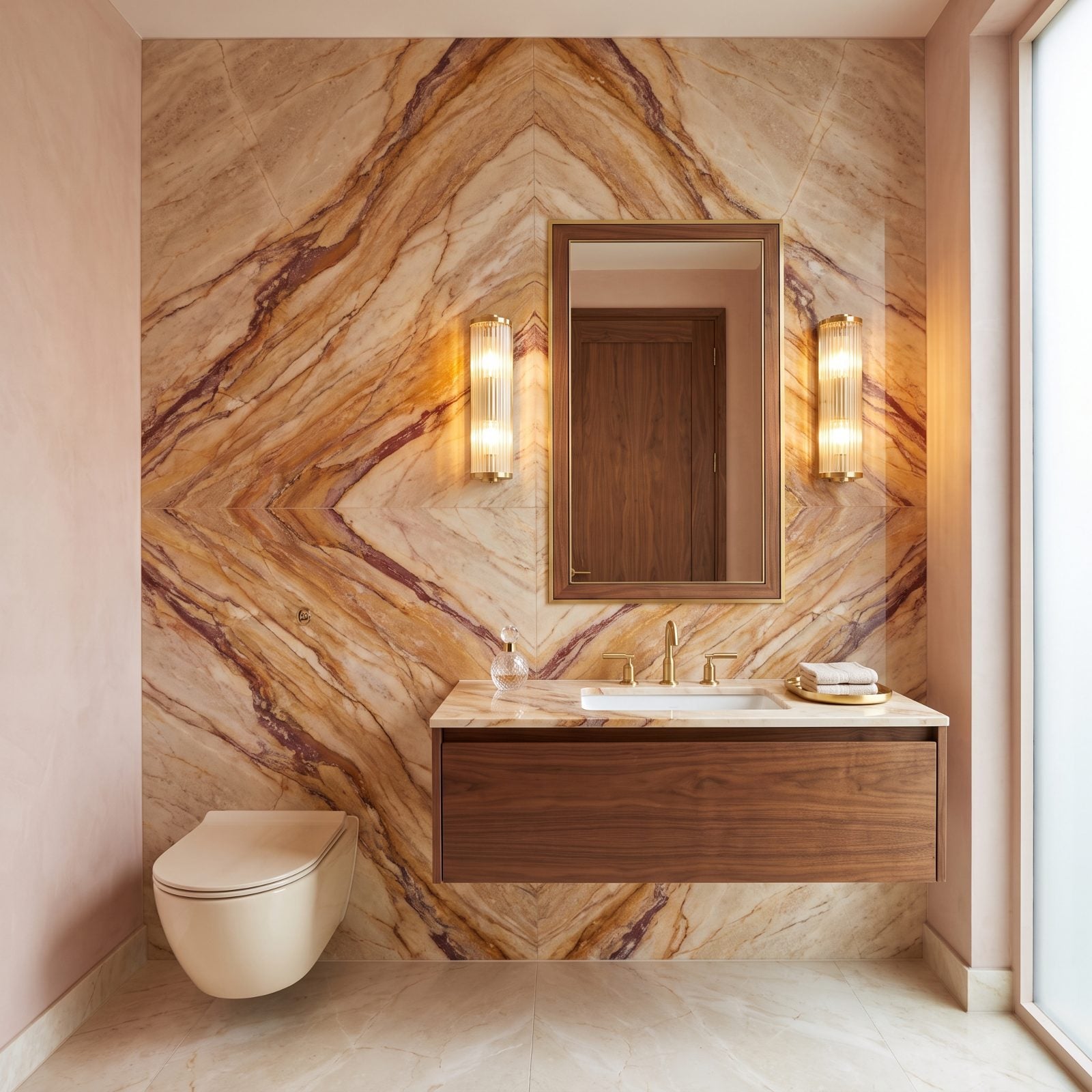
Bookmatching marble is showing off, and we are entirely for it. Two Breccia Capraia slabs mirror each other across a center seam so the amber and burgundy veining opens like butterfly wings. Hang a wide walnut-framed mirror straight onto that wall, finished with a slim brass edge, and you add warmth to the spectacle instead of fighting it.
The slim brass edge around the walnut frame is the only line that reads as hardware. Everything else is stone and grain.
23. A Marble Portal Mirror Floats Over a Wall-Hung Walnut Vanity
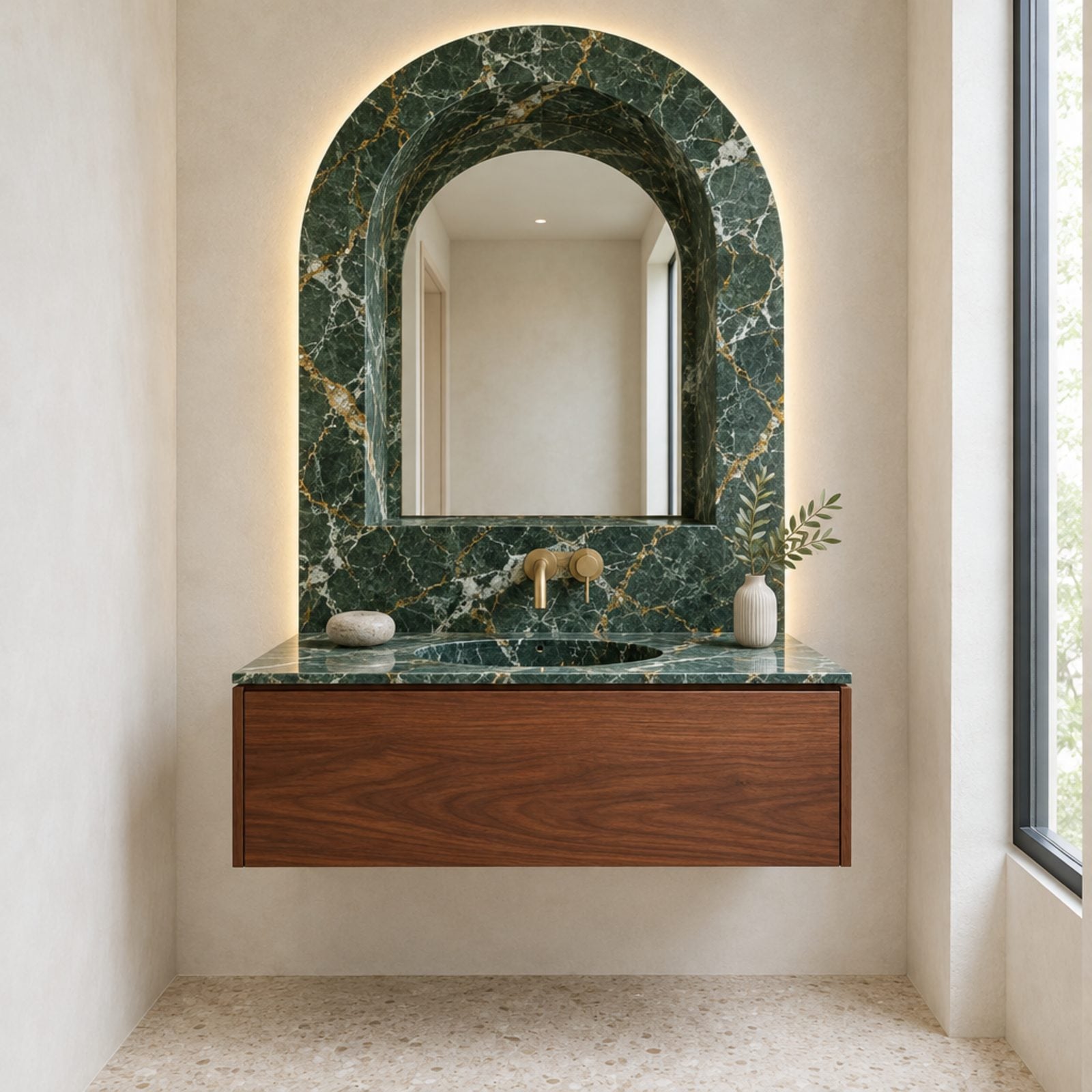
That Verde Alpi marble portal is the entire personality of the room — a thick arched ring of green stone carved so the mirror sits deep inside it, like a window punched through rock. A concealed halo of light behind it makes the whole thing seem to hover.
Underneath, the wall-hung walnut vanity stays deliberately plain so the portal reads as the single gesture. One drawer, one faucet, one idea.
22. A Walnut Peg Rail Set Into a Marble Splash Wall
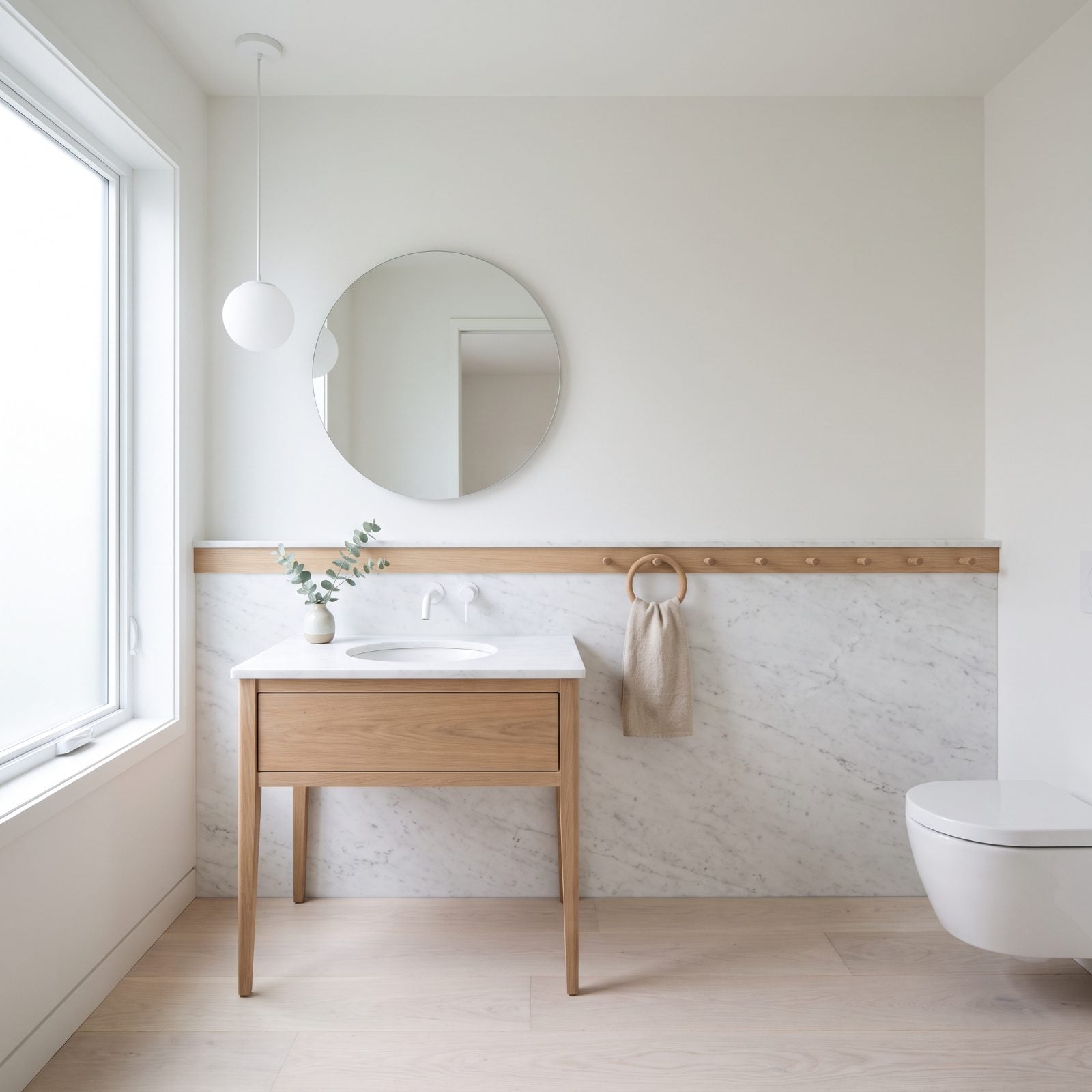
Only the Scandinavians would run a Shaker peg rail across a marble wall and make it look obvious. Blond walnut pegs stretch horizontal across pale Carrara, holding exactly one linen towel on a wooden ring. Function as decoration — the whole Nordic argument in a single rail.
Carrara is quiet as veined marble goes, white with soft gray veining, so the walnut warmth has room to register. Everything in here is pale on pale with one honey note doing all the work.
21. A Walnut Marquetry Vanity Threaded With Fine Marble Pinstripes
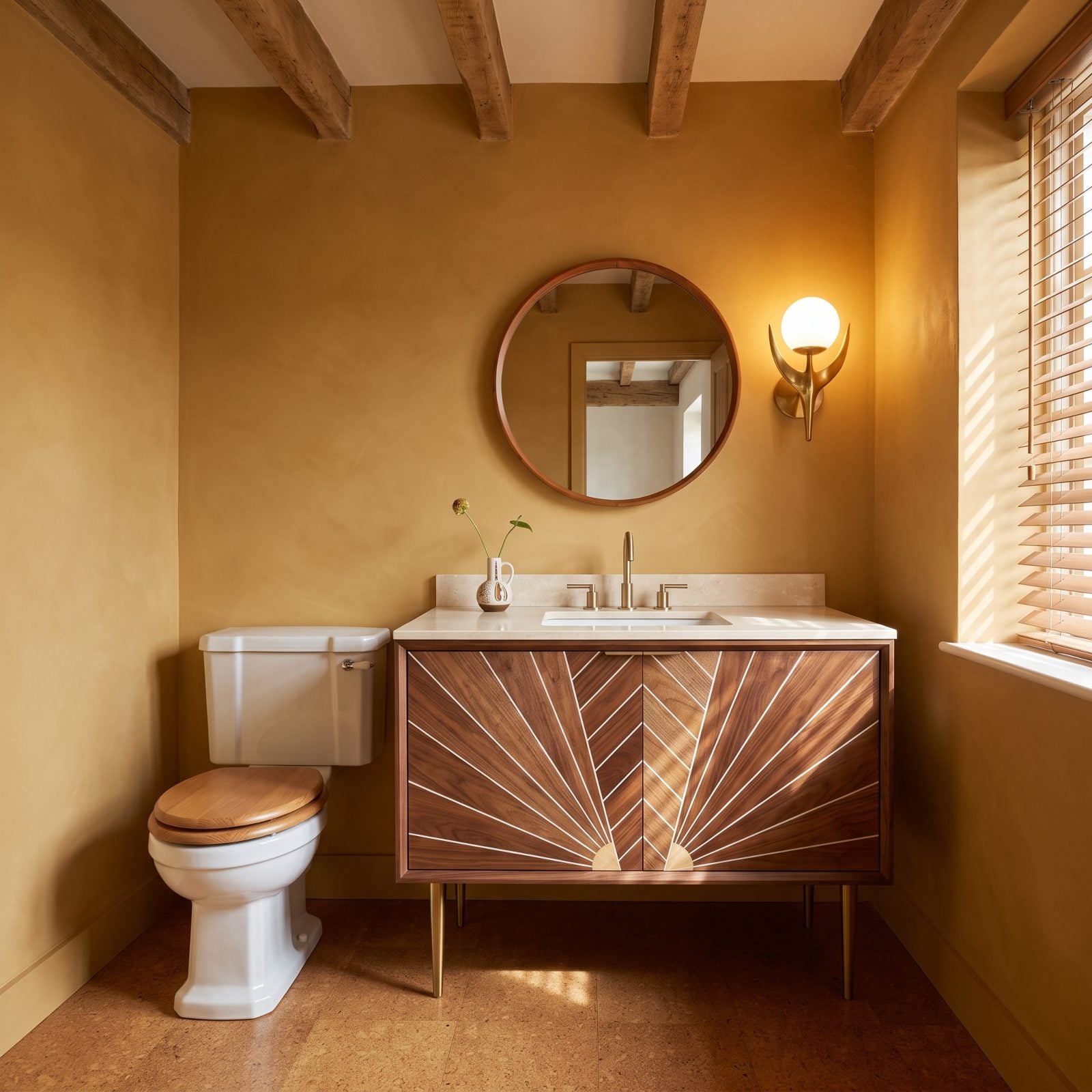
The front of this walnut vanity is the show. Marquetry in a sunburst-and-chevron pattern, pale to dark walnut tones laid like a puzzle, then threaded with hair-thin pinstripes of white marble set flush into the wood. Stone inlaid into timber is a finicky, old-world craft, and seeing it on a mid-century silhouette with tapered brass legs is the twist.
The Crema Marfil top keeps things calm above all that pattern — warm beige, barely any veining, letting the inlay stay the loudest voice in the room. Against the mustard-ochre walls it feels pulled from a 1960s salon.
20. A Perforated Marble Screen Veils Walnut Storage
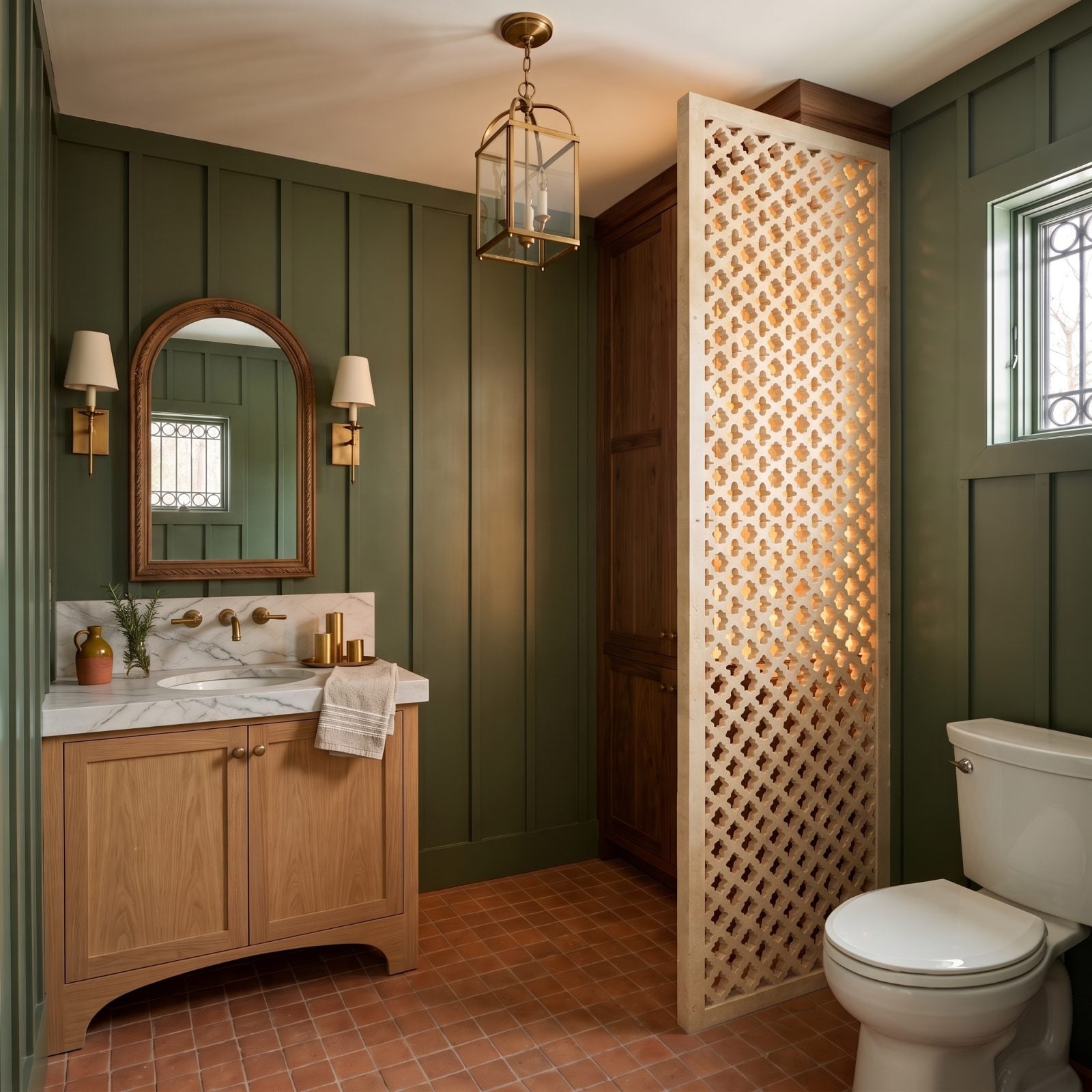
A carved marble jali screen standing in front of walnut storage is the quiet genius here. The quatrefoil lattice veils the cabinet, so the warm wood glows through the openings instead of sitting there as a plain door. Hide-and-reveal, the oldest move in Mediterranean building.
And the light does the rest. Warm light behind the screen pours through every quatrefoil cutout, turning the whole panel into a glowing lantern above the terracotta floor. The screen is practical, the glow is the gift.
19. A Walnut Slat Screen Hiding the Marble Hand-Wash Zone
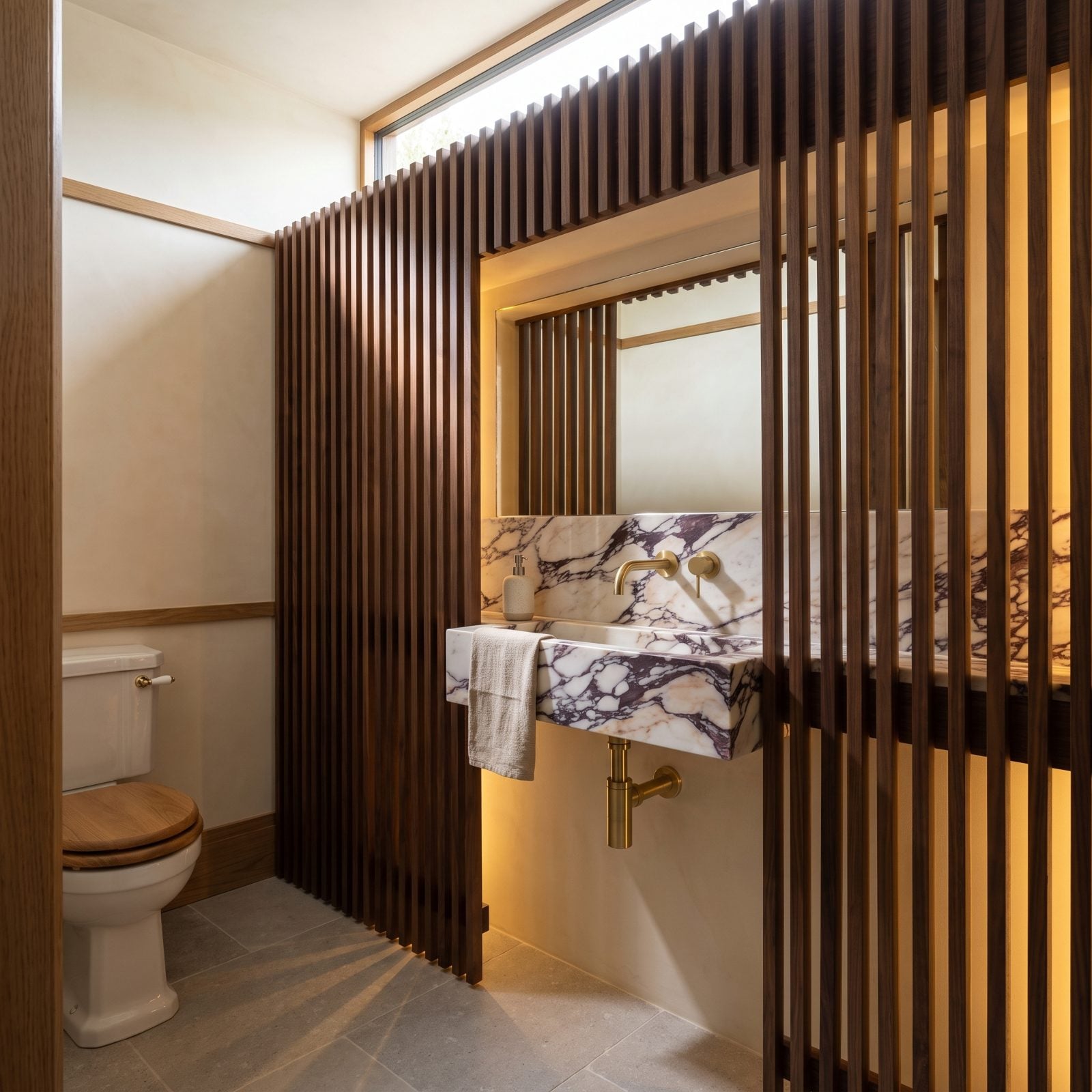
That walnut slat screen is the whole trick. It doesn’t hide the plumbing — the sink sits right in an open gap, brushed-brass bottle trap on full display — but what it really does is frame the view: you catch the stripes of light around the sink, and that framing does more work than any solid wall could.
In that gap sits a solid Calacatta Viola trough in that bruised aubergine and rust veining, lit from below until the stone almost hums. The brushed brass tap keeps all that walnut from reading too heavy.
18. Floor-to-Ceiling Walnut Pivot Door Over a Marble Threshold
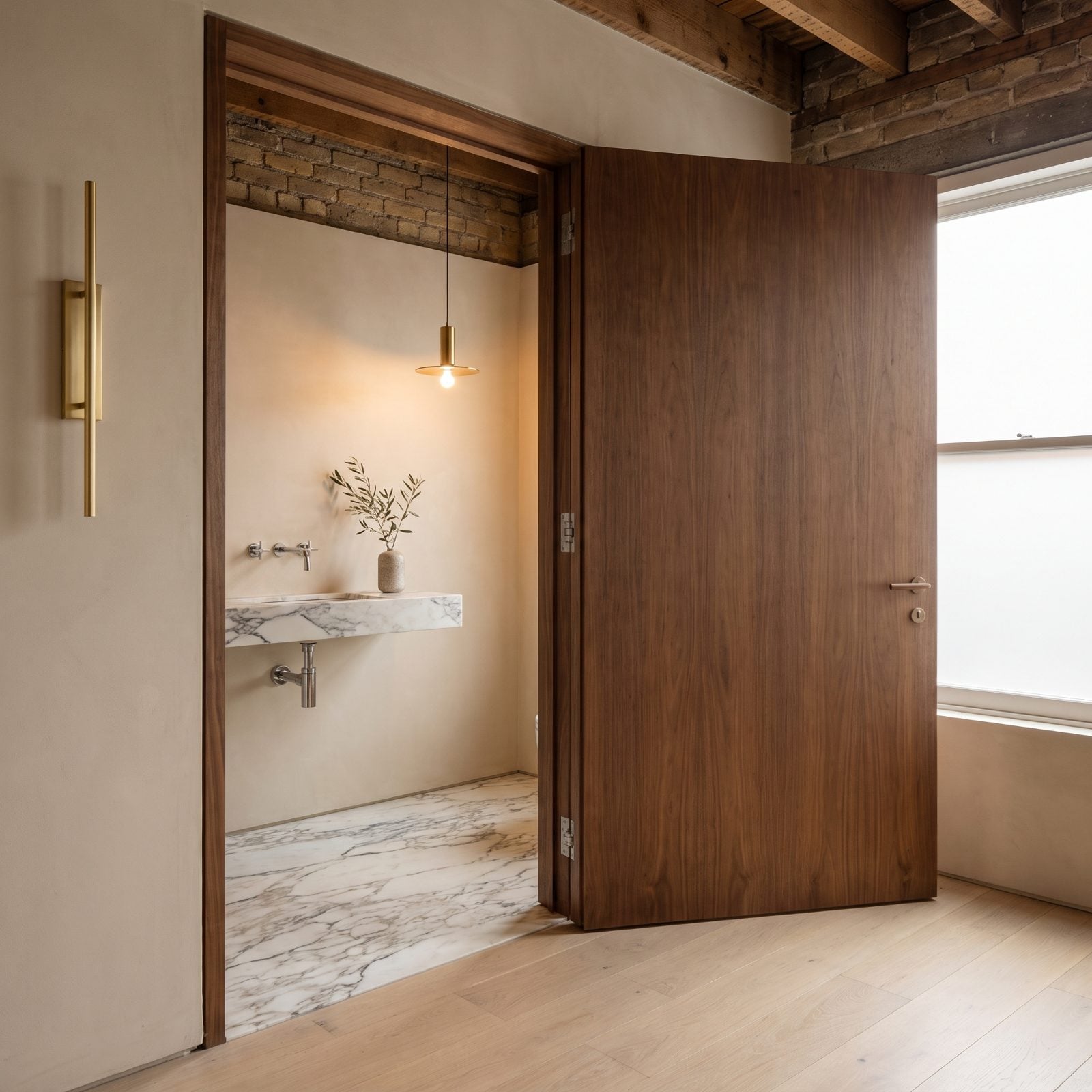
The door is the event here. A floor-to-ceiling walnut door turns on a concealed pivot, and the Arabescato floor stops crisply at the doorway where it meets the pale oak planks of the hallway — a clean, deliberate change of material.
Inside stays quiet on purpose. Oat plaster walls, a slim marble ledge sink, chrome tap. That restraint is exactly what lets the door land.
17. Tucked Under the Stairs, Wrapped in Marble Behind a Walnut Pocket Door
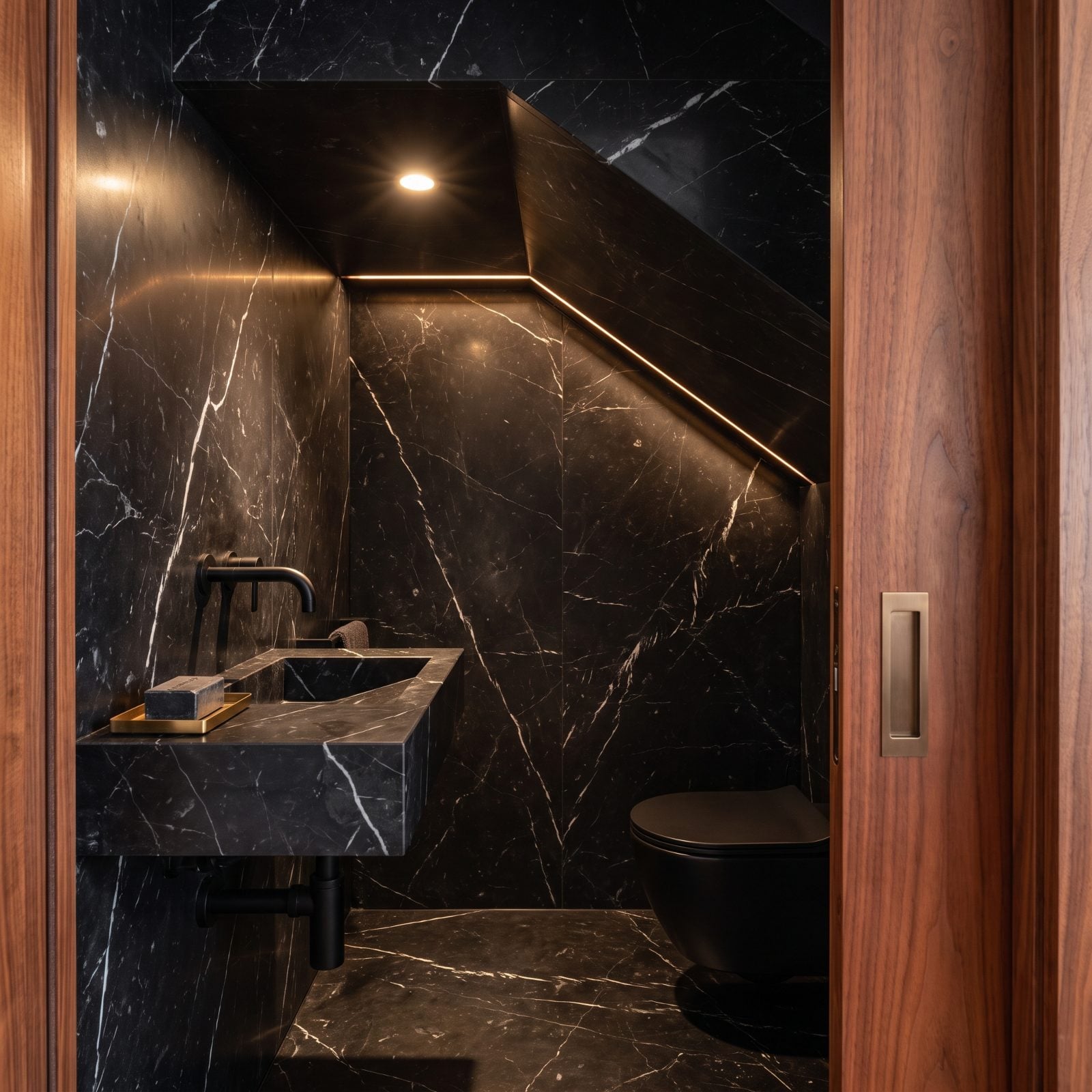
Dead space under a staircase usually becomes a closet nobody opens. Here it’s a black marble jewel box instead.
Nero Marquina wraps the walls and the raked ceiling, bookmatched so the white veining mirrors itself across the slope. The walnut pocket door slides flat into the wall — the only sane move in a footprint this tight. Overhead, a warm bronze strip follows the stair angle and keeps the dark stone from turning the whole thing into a cave.
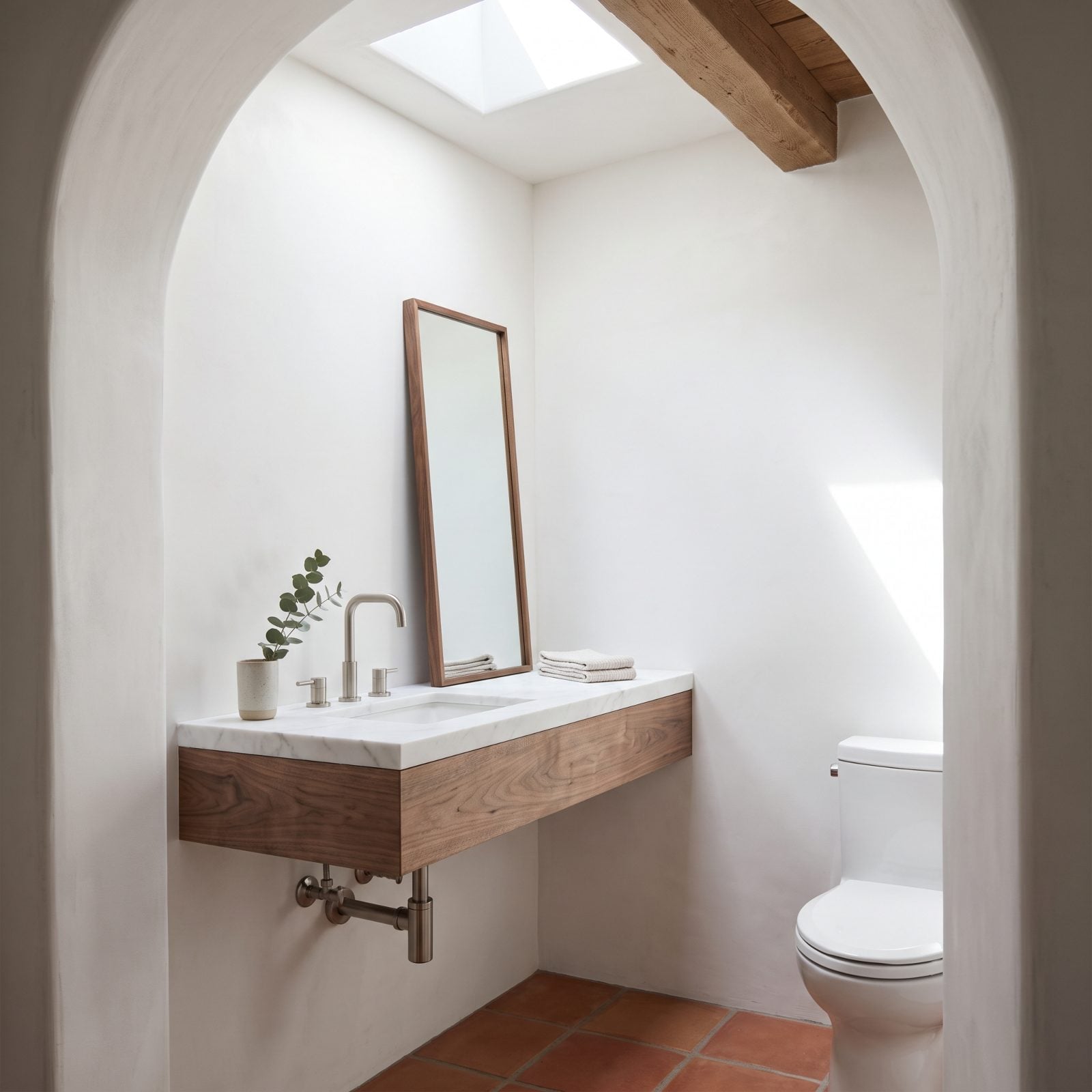
16. Daylight From Above, Pale Marble and Sun-Washed Walnut
🔥 Would you like to save this?
A skylight dropped right over the vanity changes everything. Pale Thassos catches the light and throws it around a windowless footprint, and the sun-bleached walnut goes soft and warm rather than dark and brooding.
The thin marble top with its carved integral basin keeps the whole thing light on its feet.
15. Japandi Calm With Tumbled Marble and Oiled Walnut
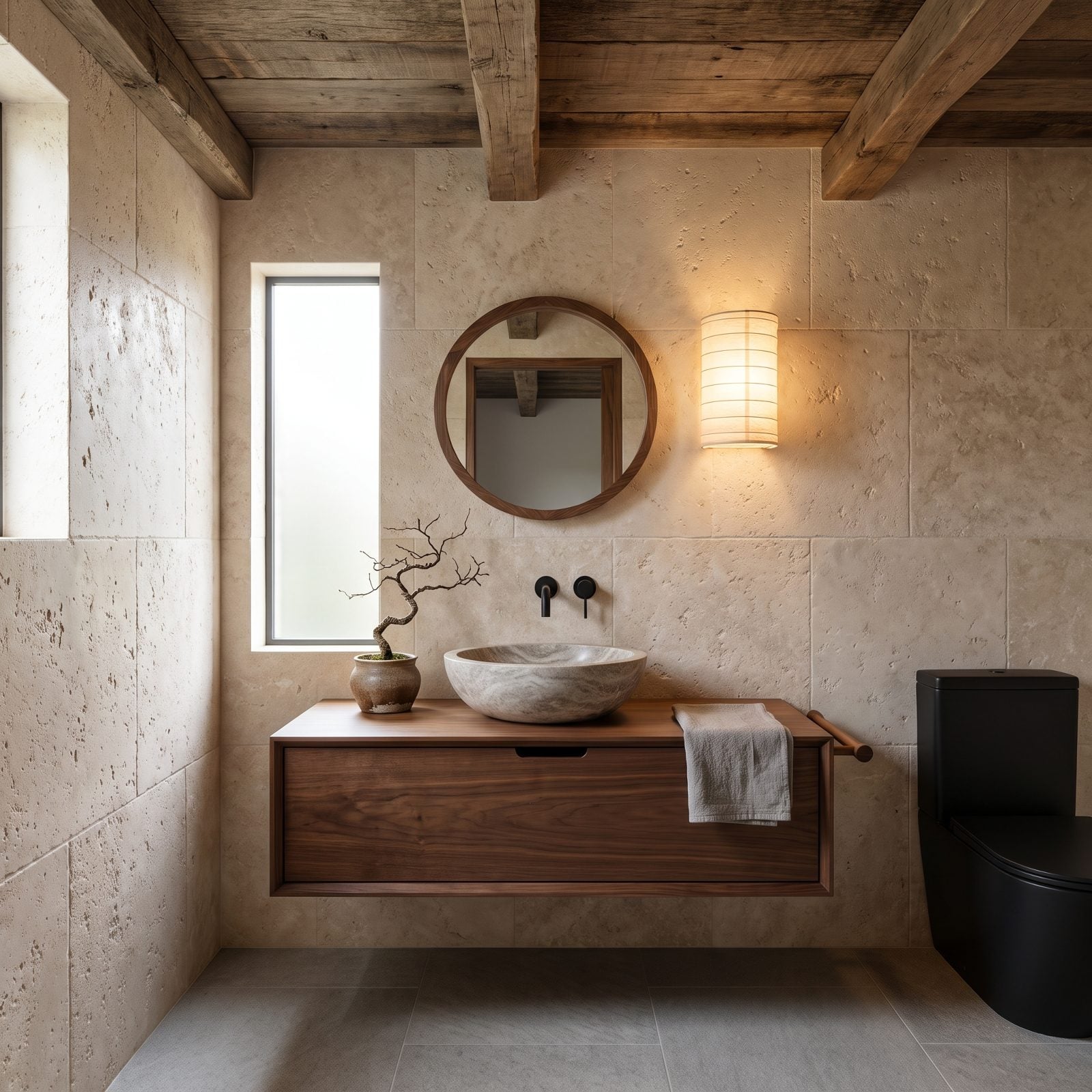
Everything in here is matte, low, and a little imperfect. The marble is tumbled soft so it reads like weathered stone instead of polished slab, and the oiled walnut vanity sits low with a single finger-pull drawer — no hardware to catch the eye.
A paper lantern handles the light. The whole room asks you to lower your voice.
14. Stepped Marble and Walnut Inlay in Full Deco Mode
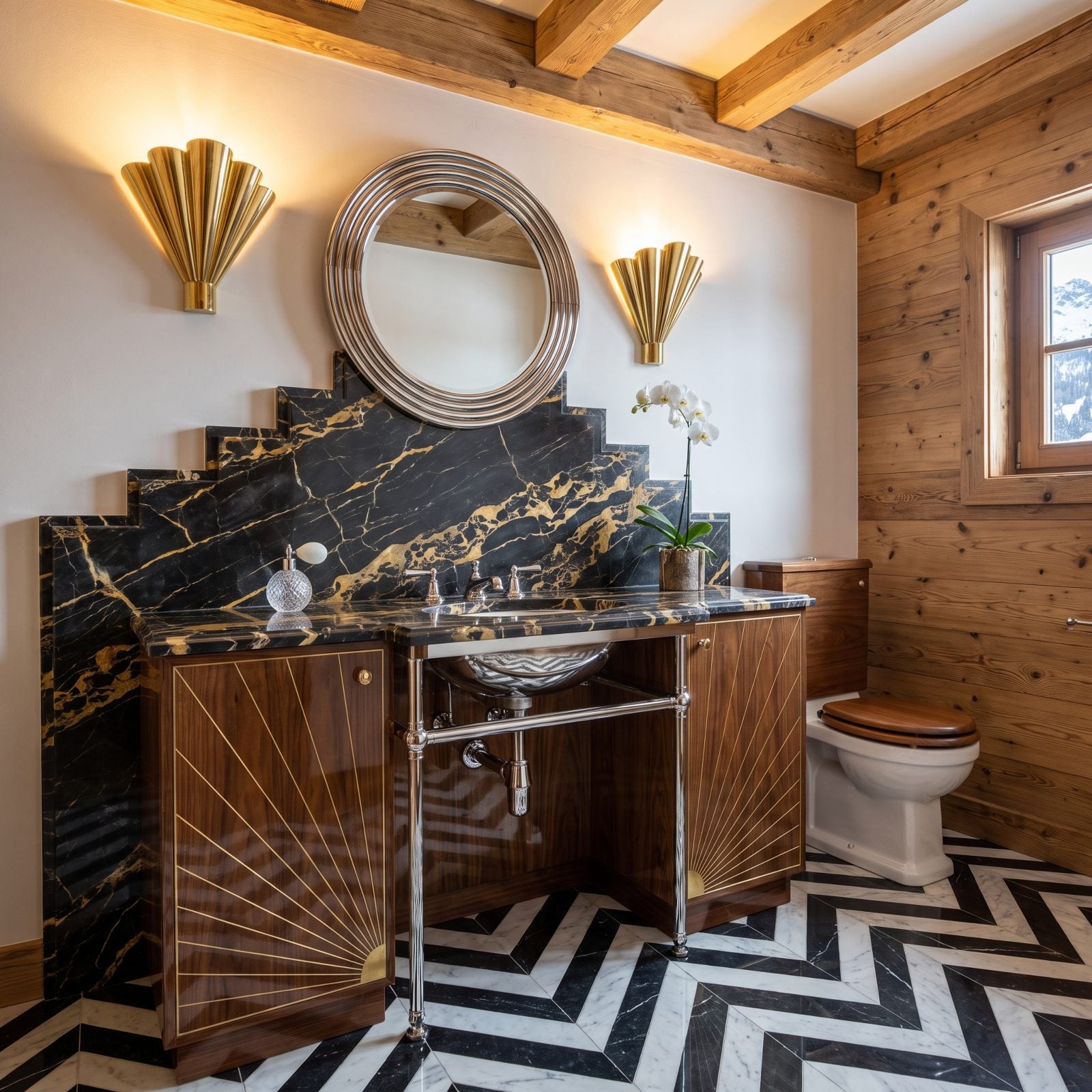
Deco never did subtle, and this room refuses to apologize for it. A stepped feature wall in Portoro (that’s the black stone with the gold-yellow veining) stacks into geometric tiers, while the glossy walnut vanity answers back with inlaid brass stringing in a sunburst.
Fan-shaped brass sconces and a chevron marble floor finish the argument. It’s a lot. But that’s the whole appeal of the style, and it earns every bit of it.
13. A Sculpted Midcentury Walnut Vanity Under a Thin Marble Slab
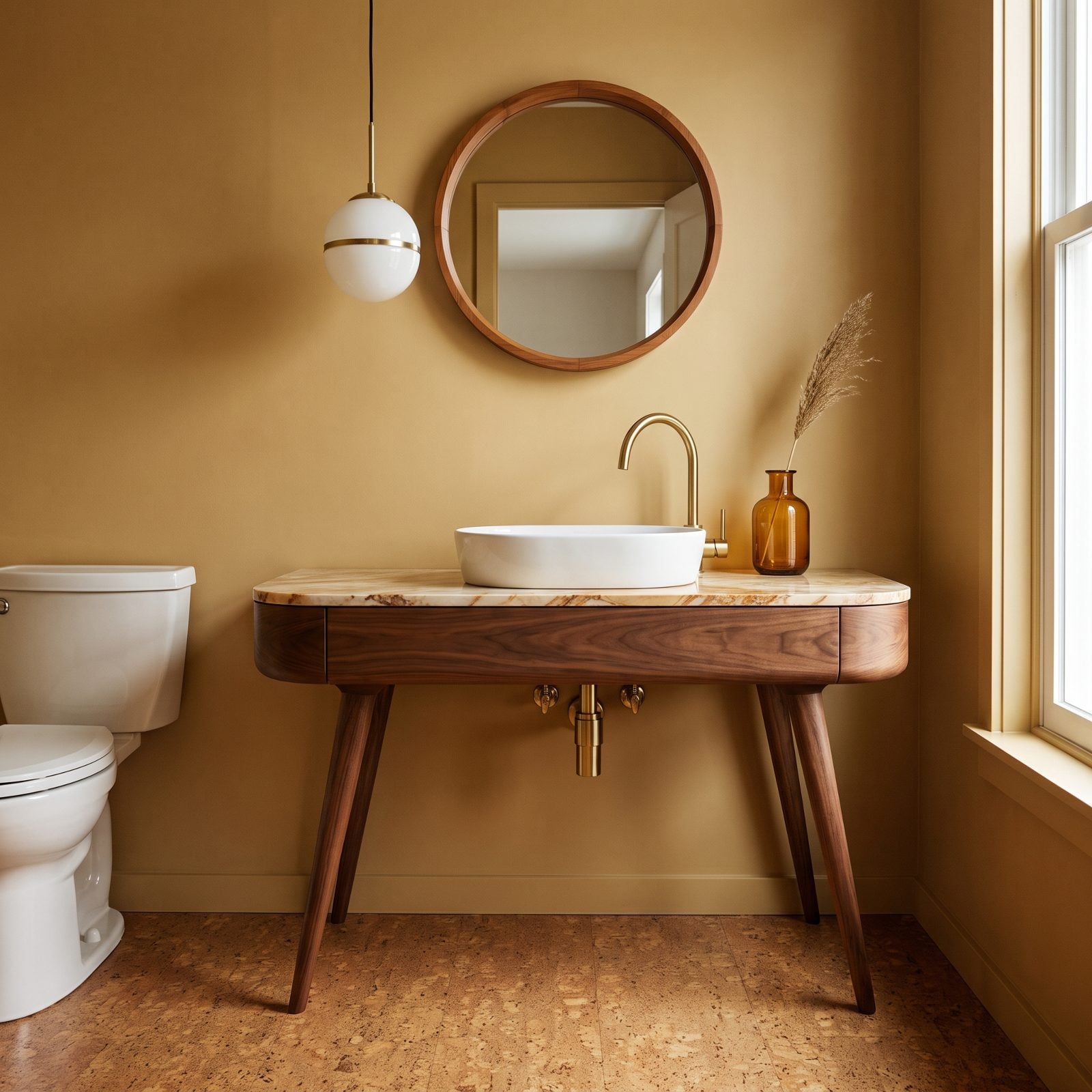
That vanity has legs, literally — tapered, angled walnut legs on a rounded cabinet body, the kind of furniture-not-fixture thinking midcentury designers did best. The marble top is cut thin on purpose, so the piece reads as a sideboard that happens to hold a sink.
Warm Breccia in cream and rust picks up the mustard plaster behind it. A milk-glass globe pendant does the rest.
12. Chunky Marble and Saw-Cut Walnut in a Brutalist Key
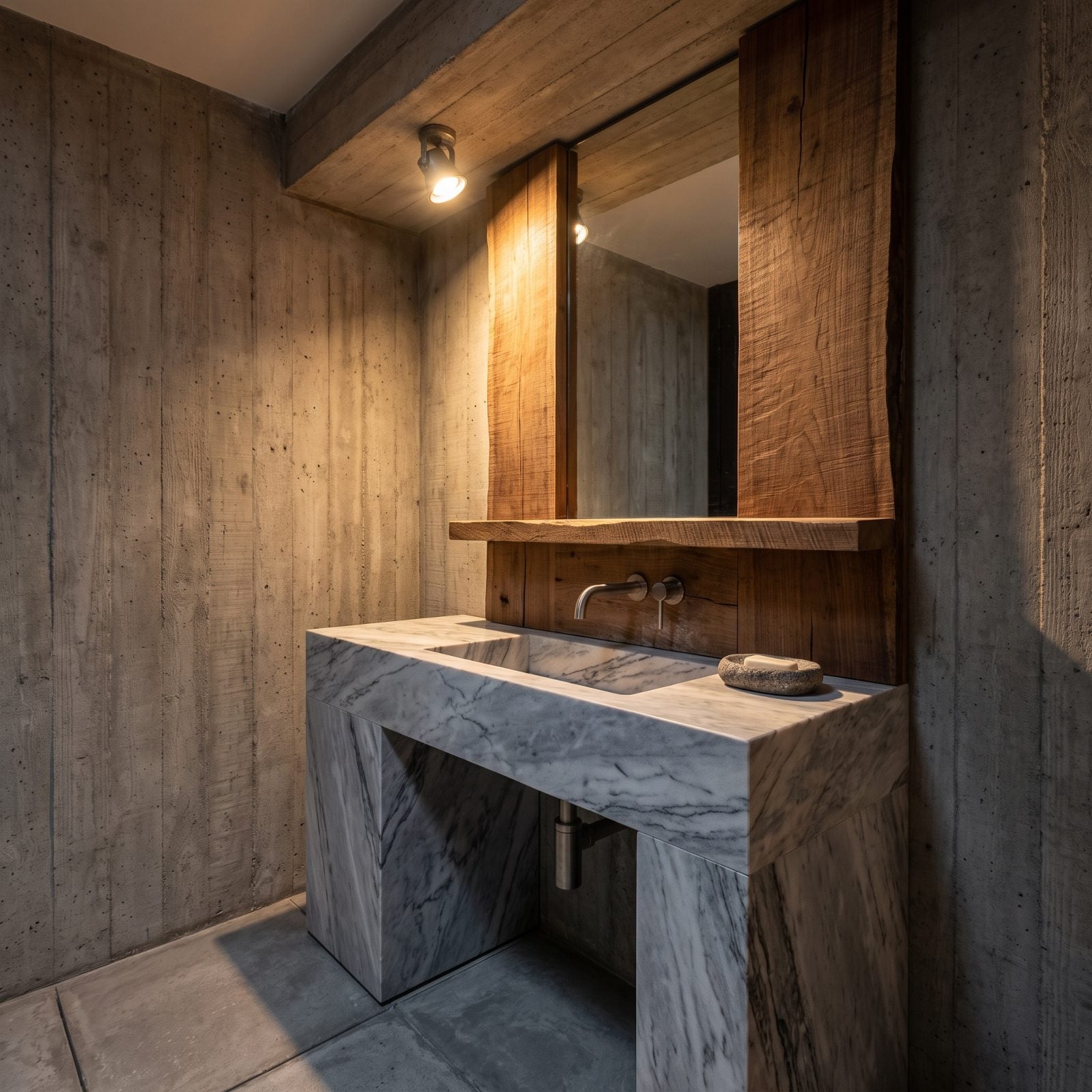
Weight is the whole idea. The washstand is one carved block of grey Bardiglio, thick and blocky, with the basin cut straight into it, and board-formed concrete walls keep the room honest about what it’s made of.
The walnut, though, is left saw-cut and rough — nobody sanded it smooth — so you read the grain as texture against all that smooth stone. A single directional spotlight rakes across both and throws long shadows.
11. Soft Curves, Pebble-Edged Marble and a Rounded Walnut Vanity
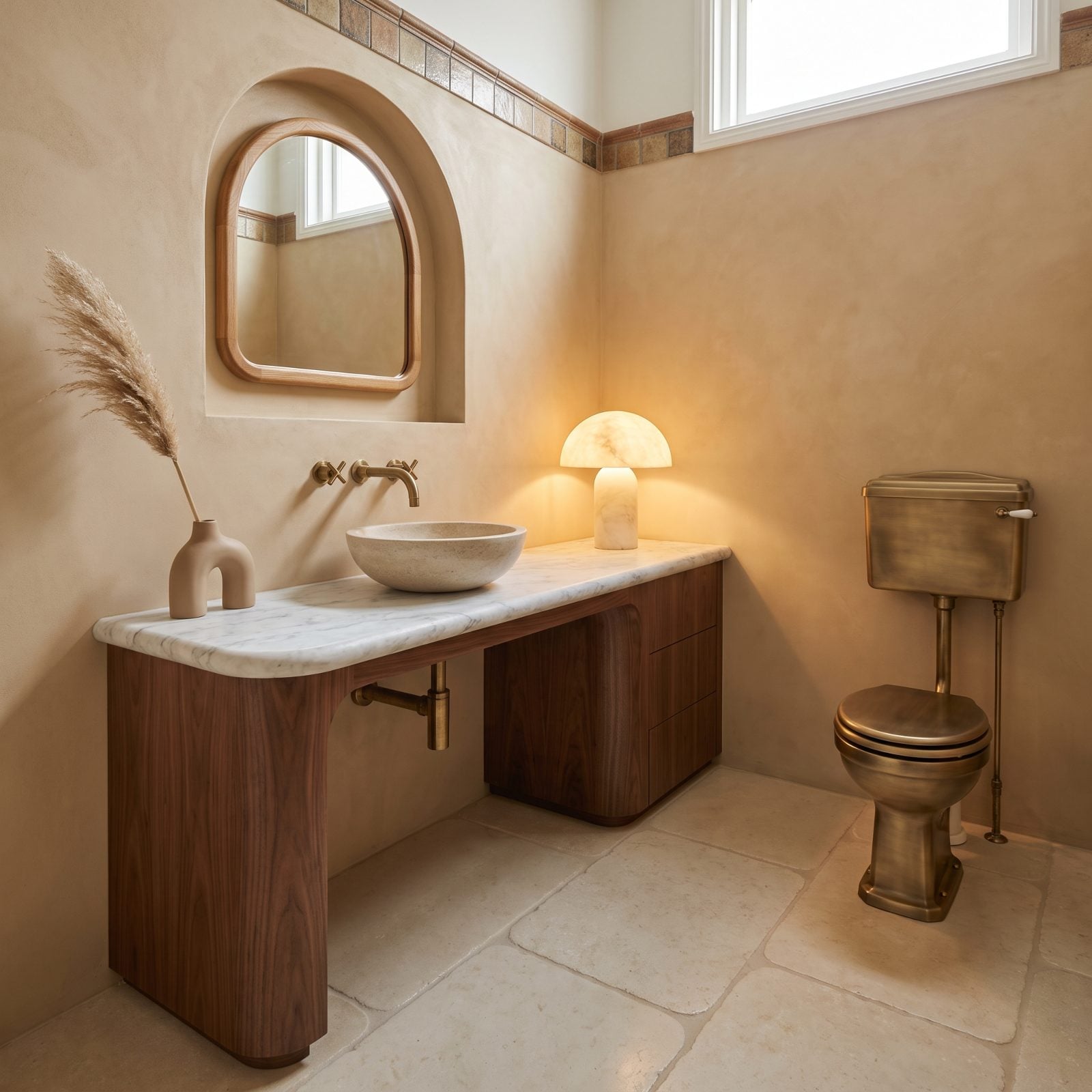
Hard corners are kept to a minimum. The walnut vanity curves in a smooth undulating form, and the Carrara top has a smooth, rounded bullnose edge rather than a crisp square one.
Sandy limewash walls and an arched niche carry that softness up and around the space. An alabaster lamp glows warm so nothing ever casts a sharp shadow.
10. Yacht-Inspired, Glossy Walnut and Seamless Marble
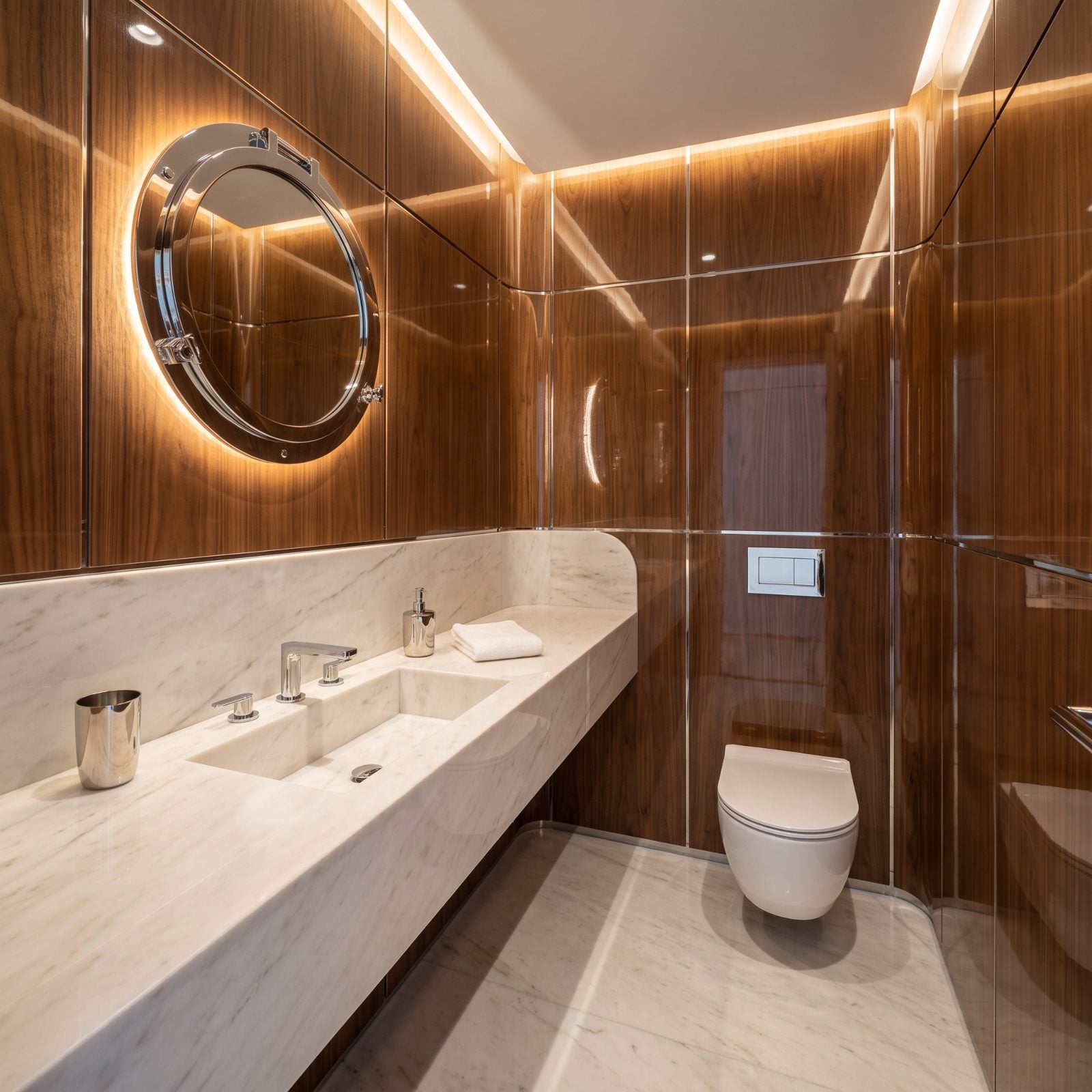
Boat builders solved small-space luxury a long time ago, and this room borrows the whole playbook. High-gloss walnut paneling runs floor to ceiling with thin chrome reveals between the panels, and the marble vanity flows as one continuous slab with no seam where the sink meets the top.
A porthole mirror and chrome rails push the nautical read without tipping into costume. Concealed LED behind the glass makes the lacquered walnut gleam.
9. Boutique-Hotel Mood: Dark Marble Walls and Walnut Panels
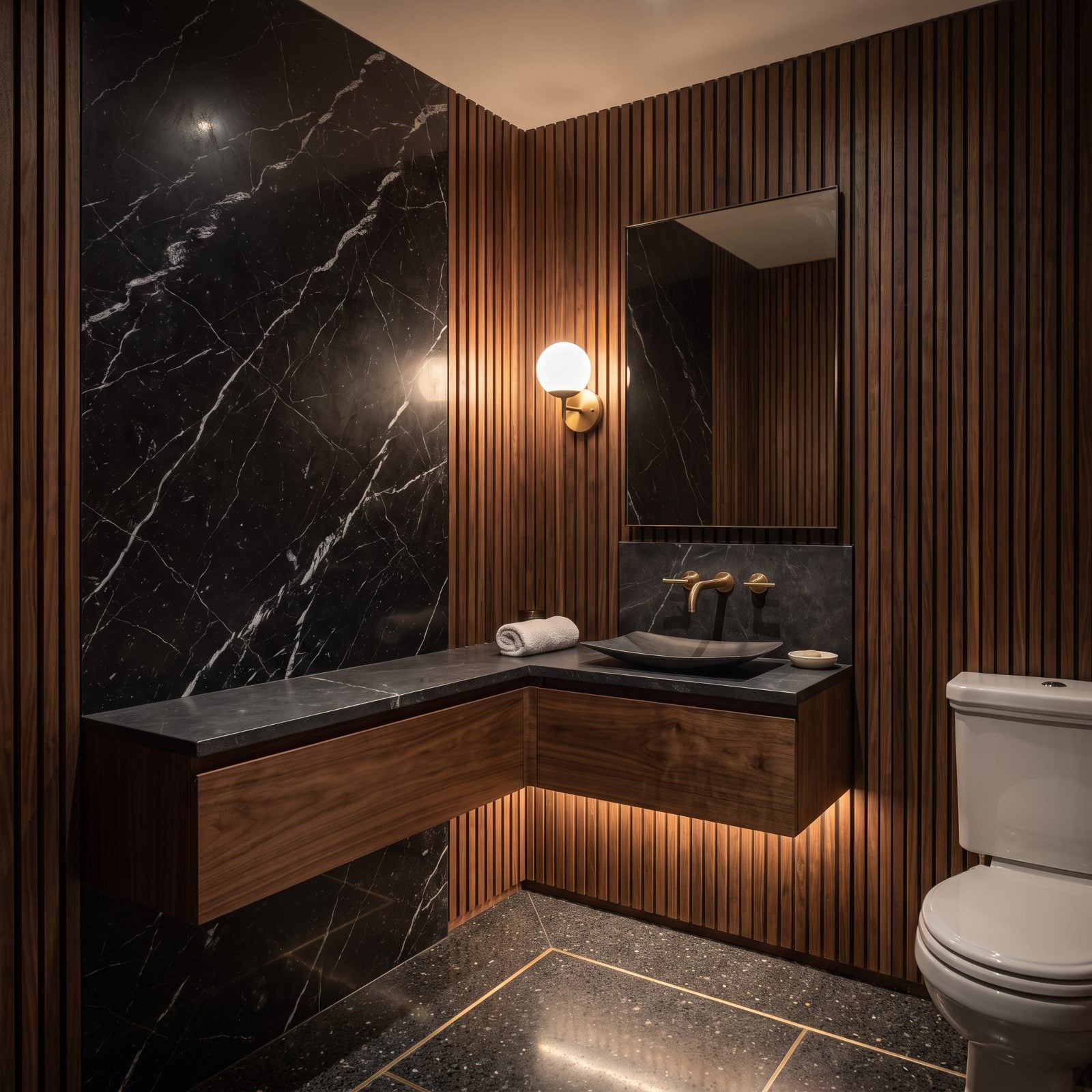
That slatted walnut wall glowing under a thin line of warm LED is the whole mood here. It reads like a hotel bar after midnight, the kind of room that makes you lower your voice without knowing why.
All that white veining slashing through black Nero Marquina could easily take over. The walnut keeps it honest. One surface runs cold and glossy, the other warm and tactile, and the brass faucet referees between them.
8. A Living Wall Meets Green Marble and Warm Walnut
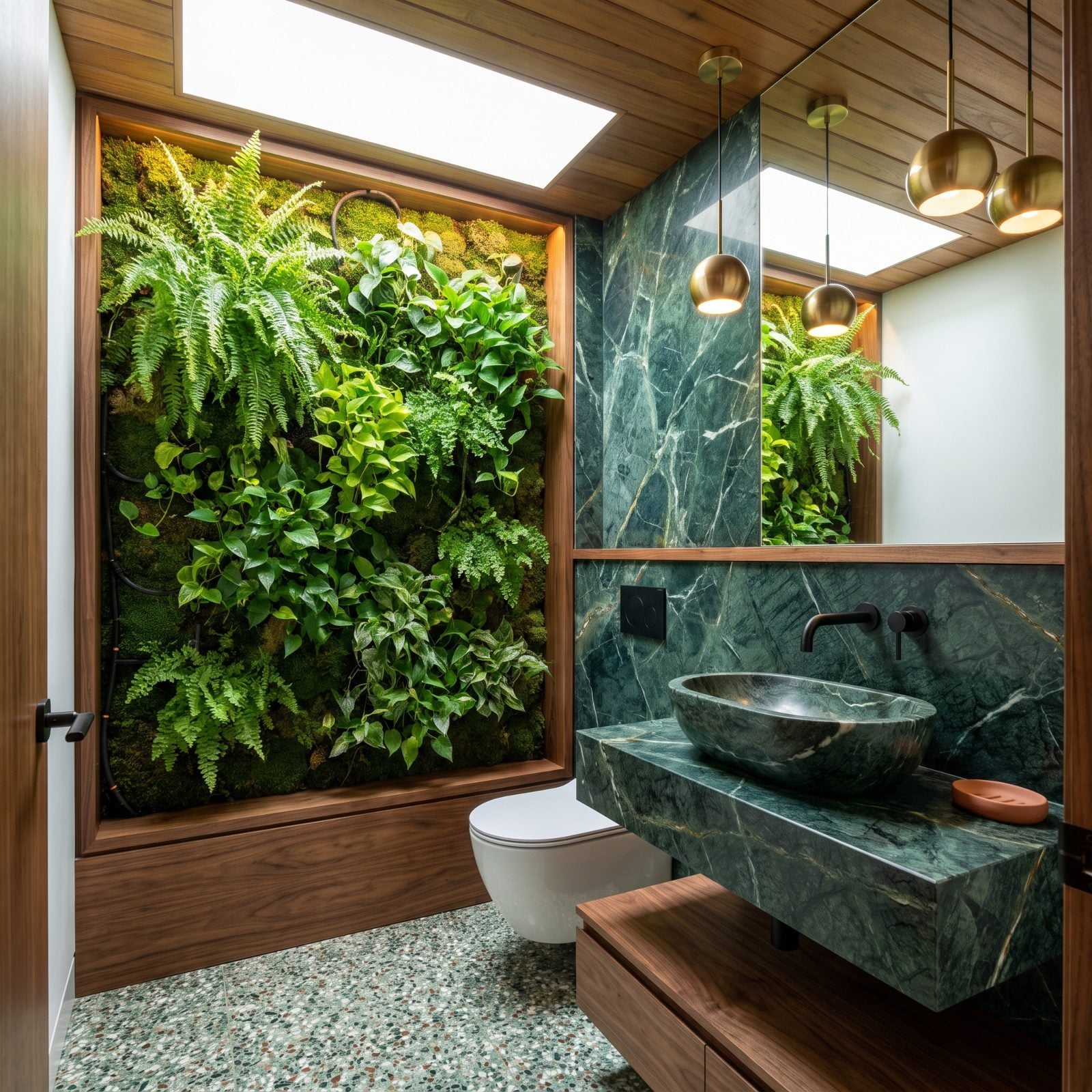
A wall of ferns and pothos sits right beside a slab of Verde Alpi marble, and the green in the stone and the green of the leaves answer each other so the room feels like one idea instead of a plant stapled onto a bathroom.
That walnut planter frame does real work, grounding the soft foliage with a hard warm edge. Want the feeling somewhere else in the house? The same instincts show up in good sage living room schemes.
7. Graphic Black-and-White Marble Against Raw Walnut
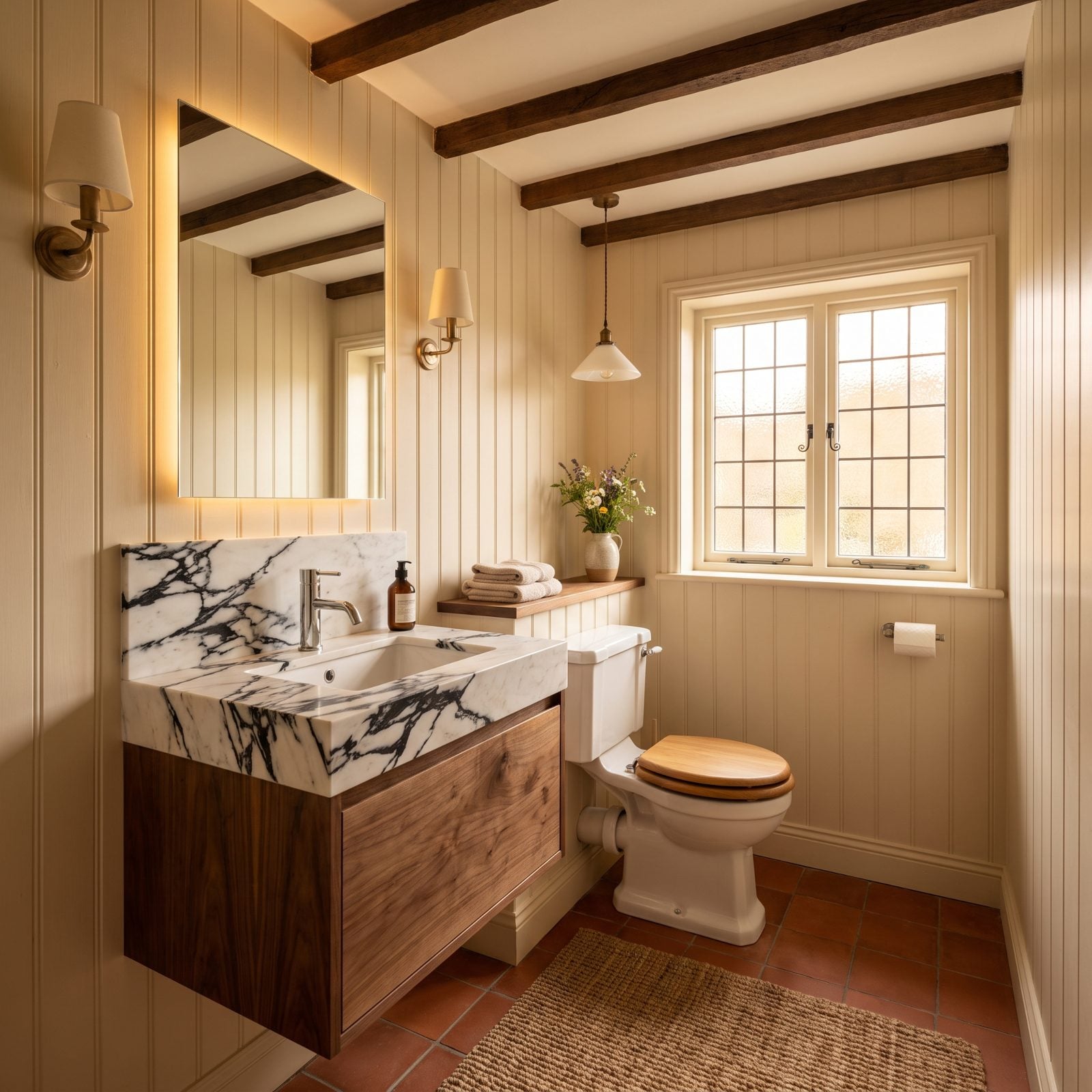
Panda White marble, its black veins running in wild, random streaks across slab and backsplash like ink dropped in water. It’s the loudest thing in the room, and it should be.
Raw oiled walnut underneath is the smart move. Glossy wood would have fought back. This matte, open-grained finish just soaks up the attention and lets the stone do the talking.
6. Burgundy Marble Softened by Pink Plaster and Walnut
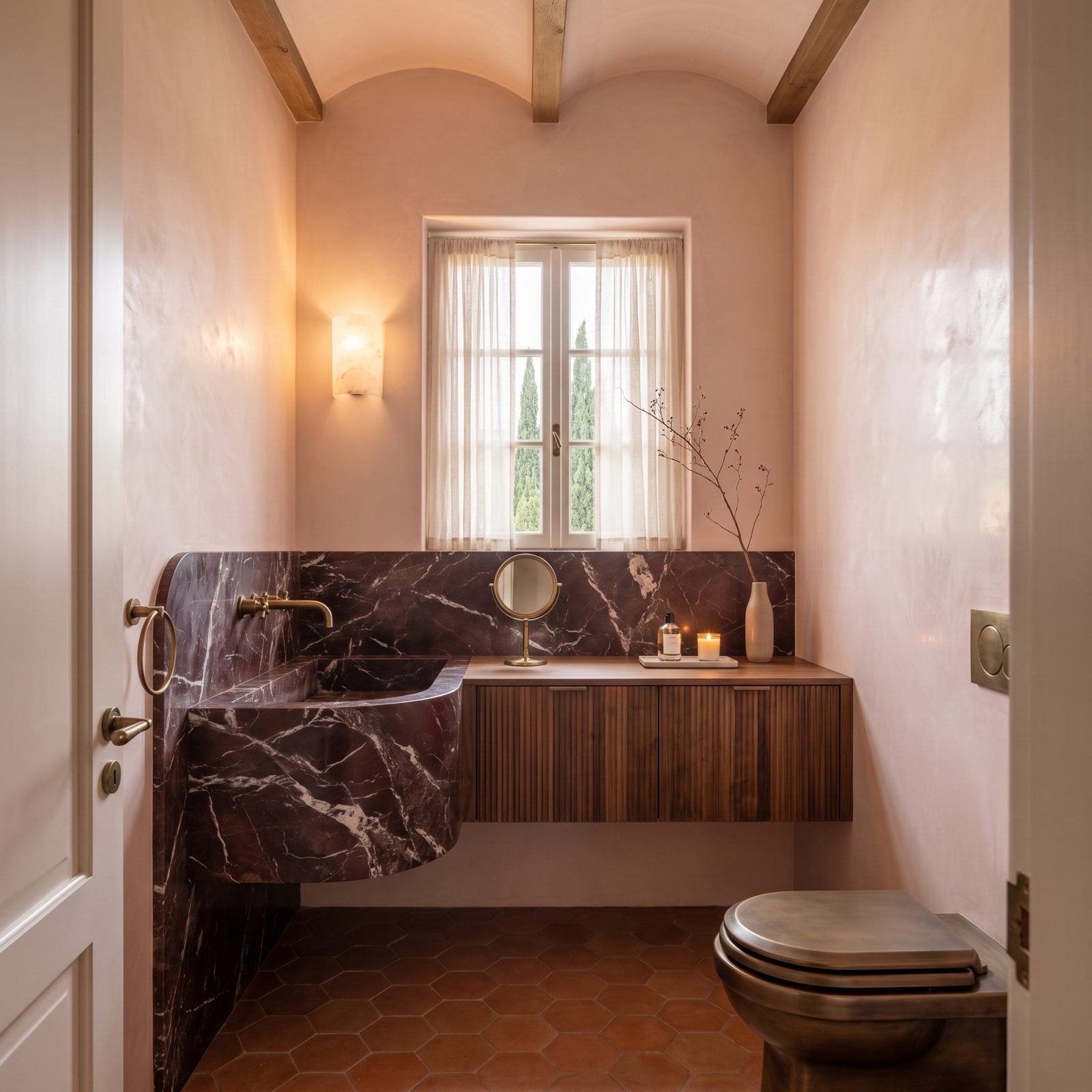
Burgundy marble can read heavy, almost Victorian. The blush plaster around it drags the whole scheme toward something softer and more modern, and because pink and oxblood are cousins on the color wheel, they hum rather than clash.
Those fluted walnut drawer fronts catch the warm sconce light and throw little shadow lines across the vanity. Quiet detail. It keeps the eye moving.
5. A Sunken Planter Tucked Between Marble Basin and Walnut
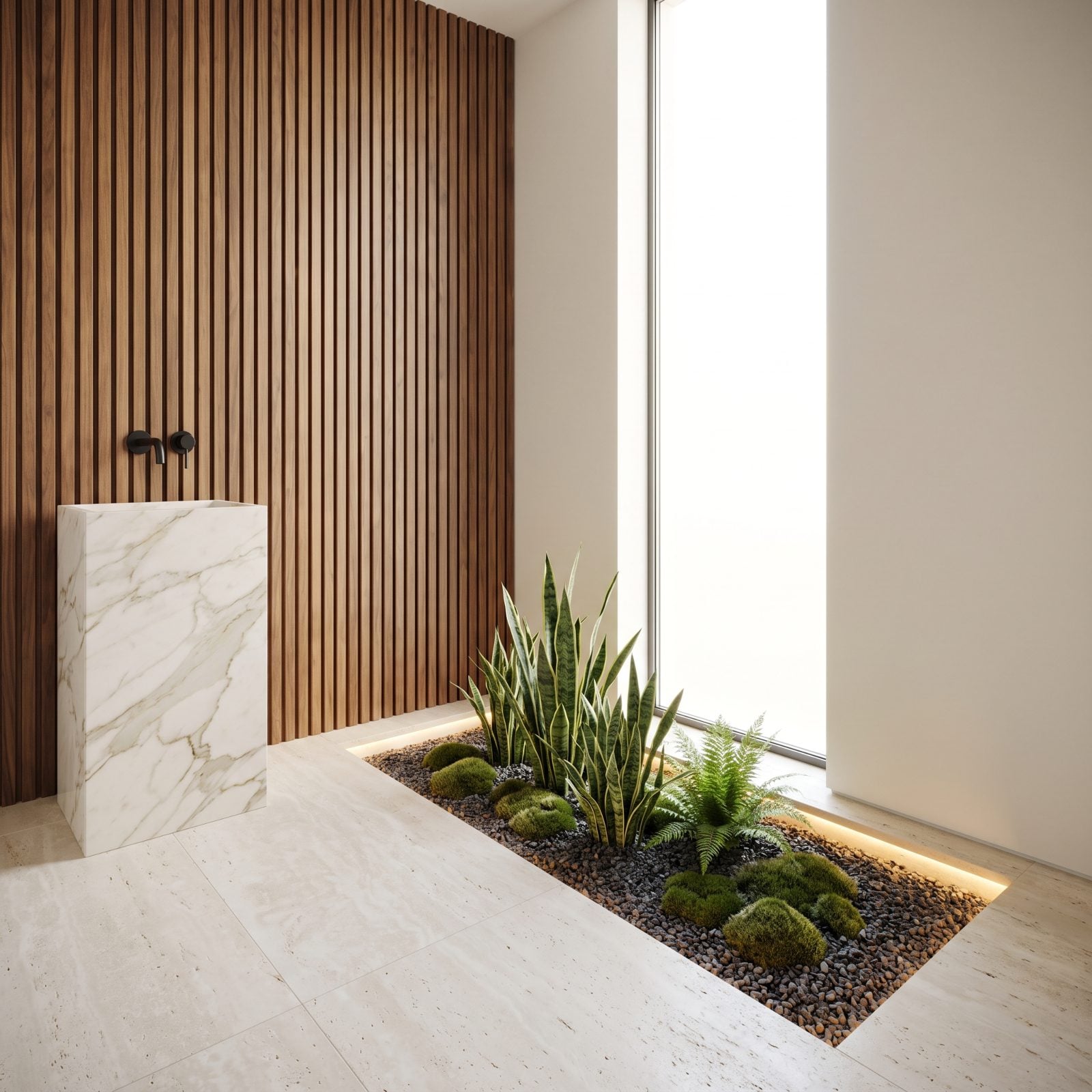
The sunken planter is the whole trick. Instead of a plant perched on a ledge where it gets knocked over, it drops into a recessed trough in the floor between the basin and the wall, lit from a tall window above.
Calacatta Gold on the pedestal, walnut slats behind, and a ribbon of green moss and snake plant running along the base. The planter pulls your eye down and makes a tiny room feel like it has depth and a secret.
4. Lime-Plaster Walls, a Carved Marble Basin, Walnut Ledge
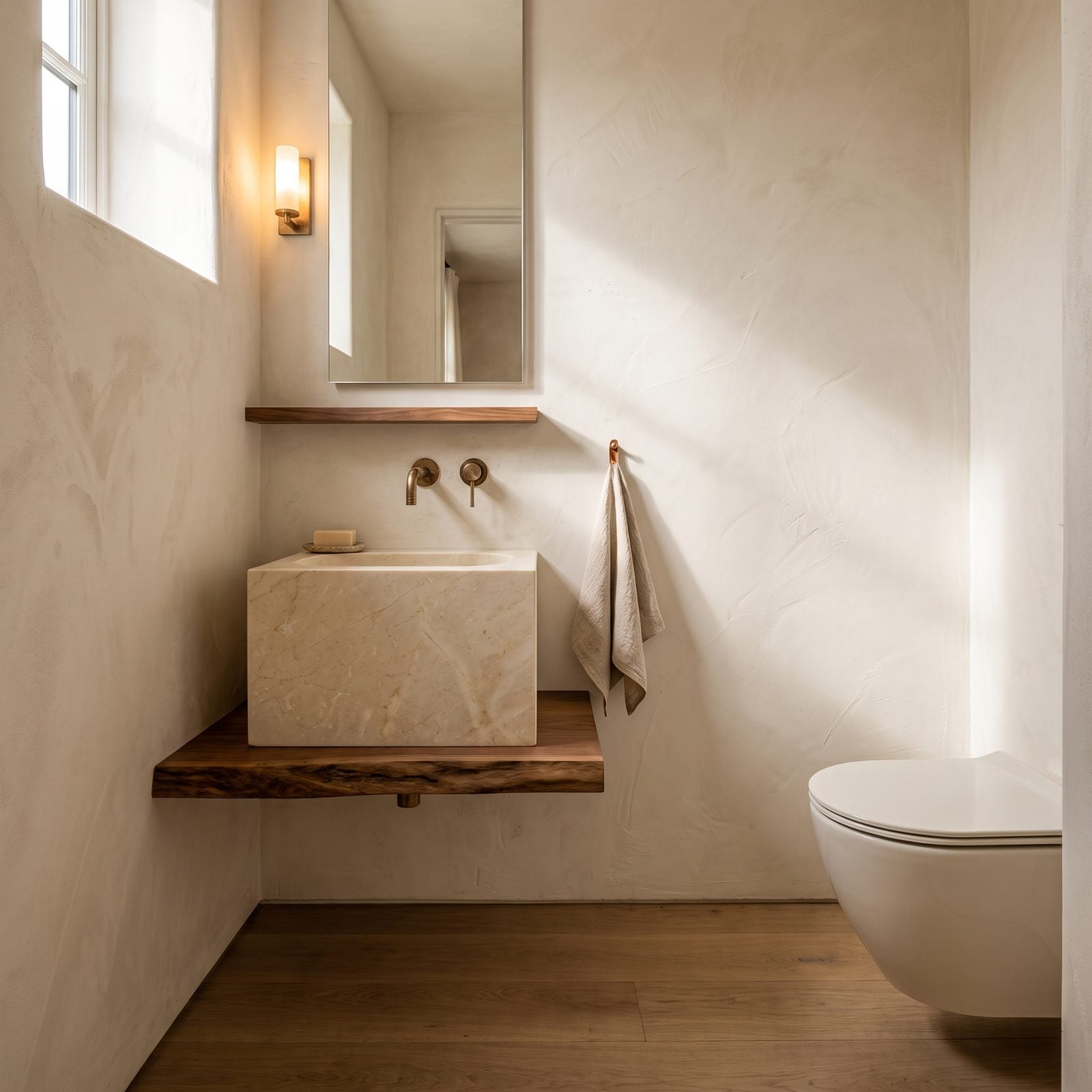
Everything in this room is about touch. The lime plaster carries real trowel marks you’ll want to run a hand across, the Crema Marfil basin is a solid carved block with weight you can feel from the doorway, and the walnut ledge keeps its live edge.
Here the stone plays accent, not headline. One honeyed basin against a sea of soft plaster, and that’s the point: restraint.
3. Stainless Steel Cutting Through Marble and Walnut
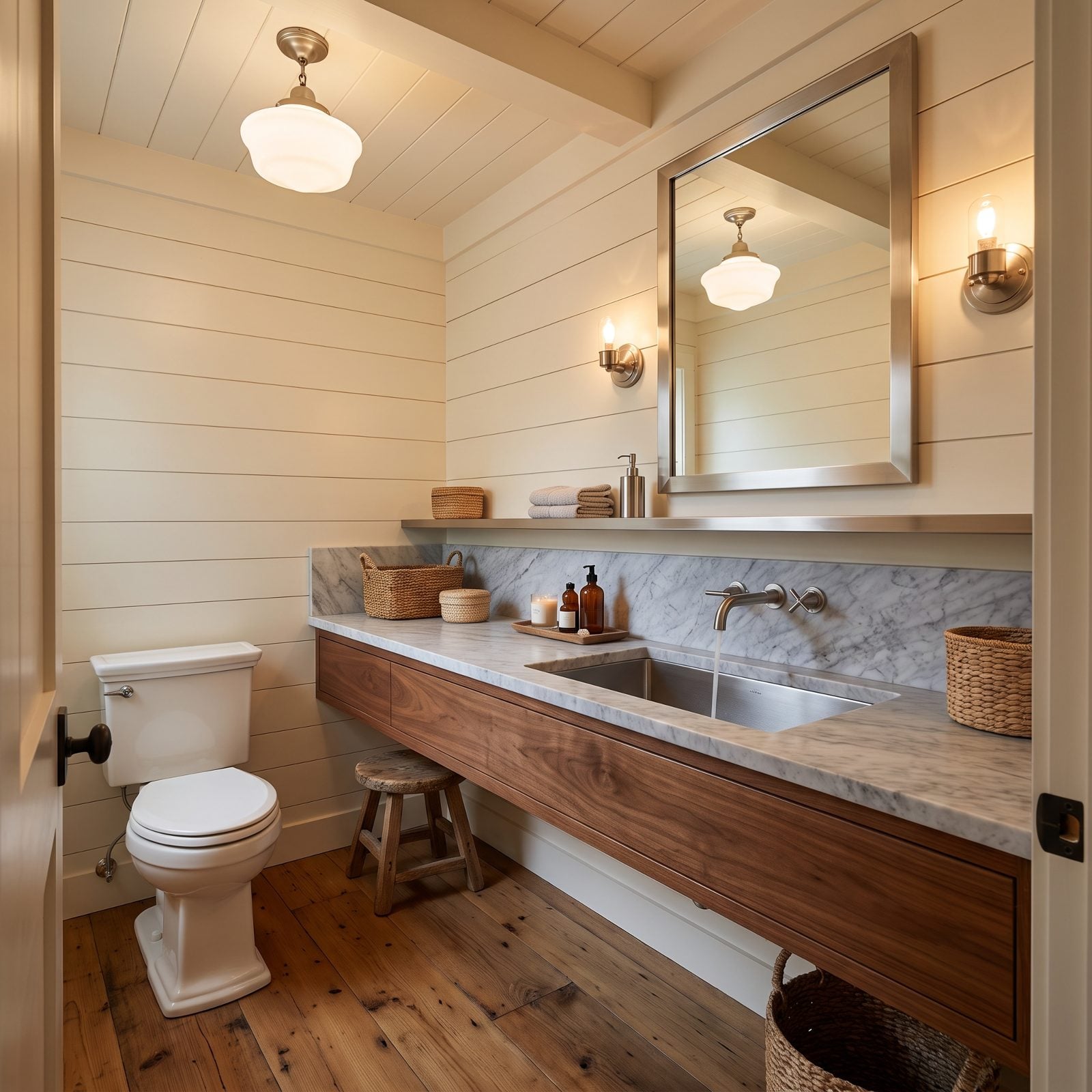
Stainless steel in a powder room sounds like a mistake until you see it do this. The brushed undermount sink and matching faucet throw a cool industrial edge against warm walnut and grey-veined white Carrara, and that friction is what keeps the room from going sleepy.
Steel also bounces light hard and clean, which in a tiny space is a gift. That same push and pull between warm wood and cool metal reads well in a contemporary utility room too.
2. Hidden Behind Walnut Panels, a Marble Surprise Inside
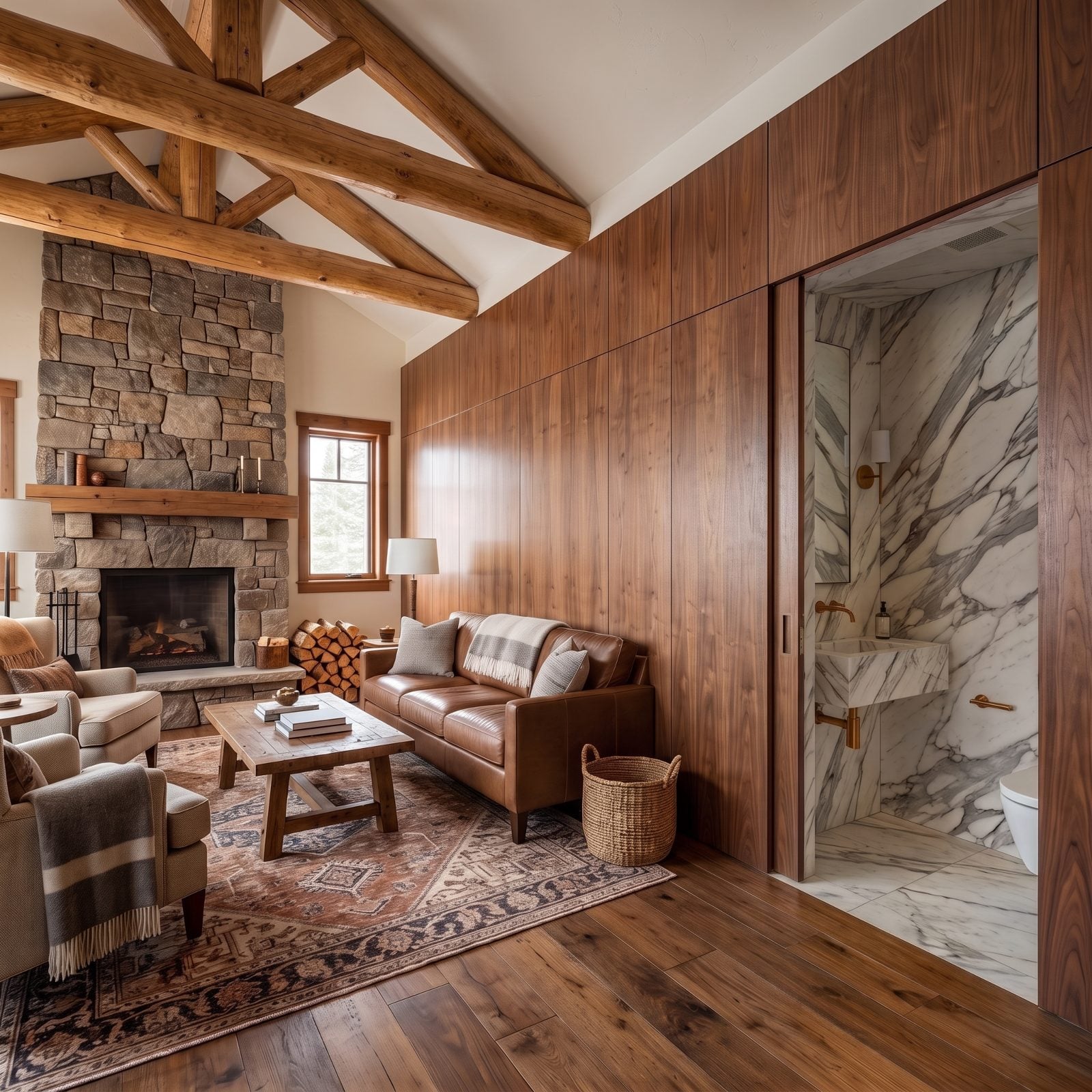
From the living room it’s just a wall of matched walnut grain. Then one panel slides aside into its pocket and there’s a room lined in swooping Arabescato marble, glowing warm inside.
The whole effect depends on those panels being boring on purpose. Flat, continuous, with only a small recessed pull to give it away. The surprise only lands because the outside gives so little up.
Call it the magician’s sleeve of interior design. You’d never guess the drama waiting behind that calm face.
1. A Bronze-Mirror Ceiling Over Marble and Walnut
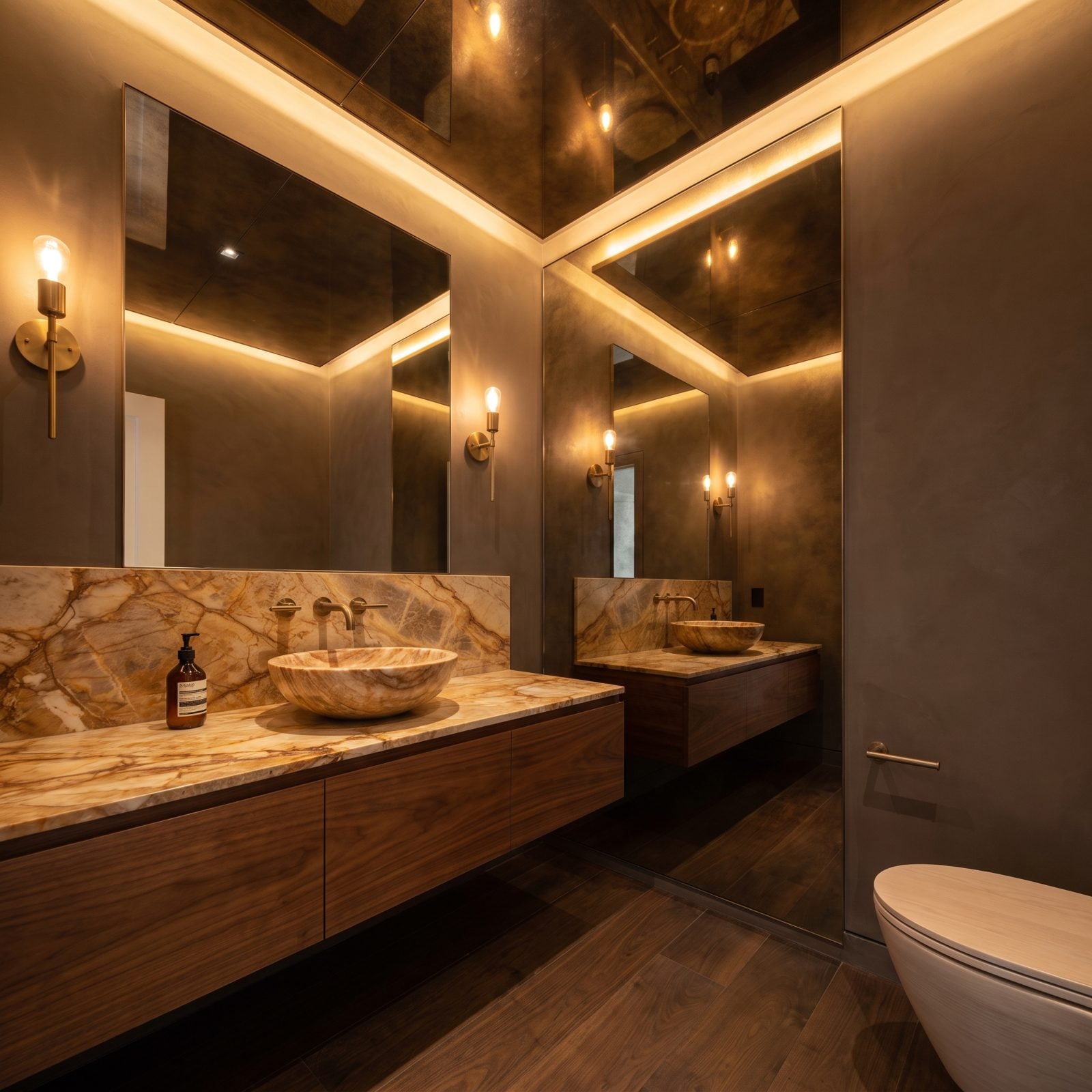
Look up. The antiqued bronze-mirror ceiling catches the warm veining of the Breccia Capraia marble and the walnut below, then smears it all into a soft golden reflection so the room reads twice as tall and twice as rich.
Bronze mirror instead of plain silvered glass is what keeps it warm. Silver would have gone cold and clinical, while this holds the amber tones of the stone. A little of the same glamour instinct turns up in the best glam family room ceilings.