
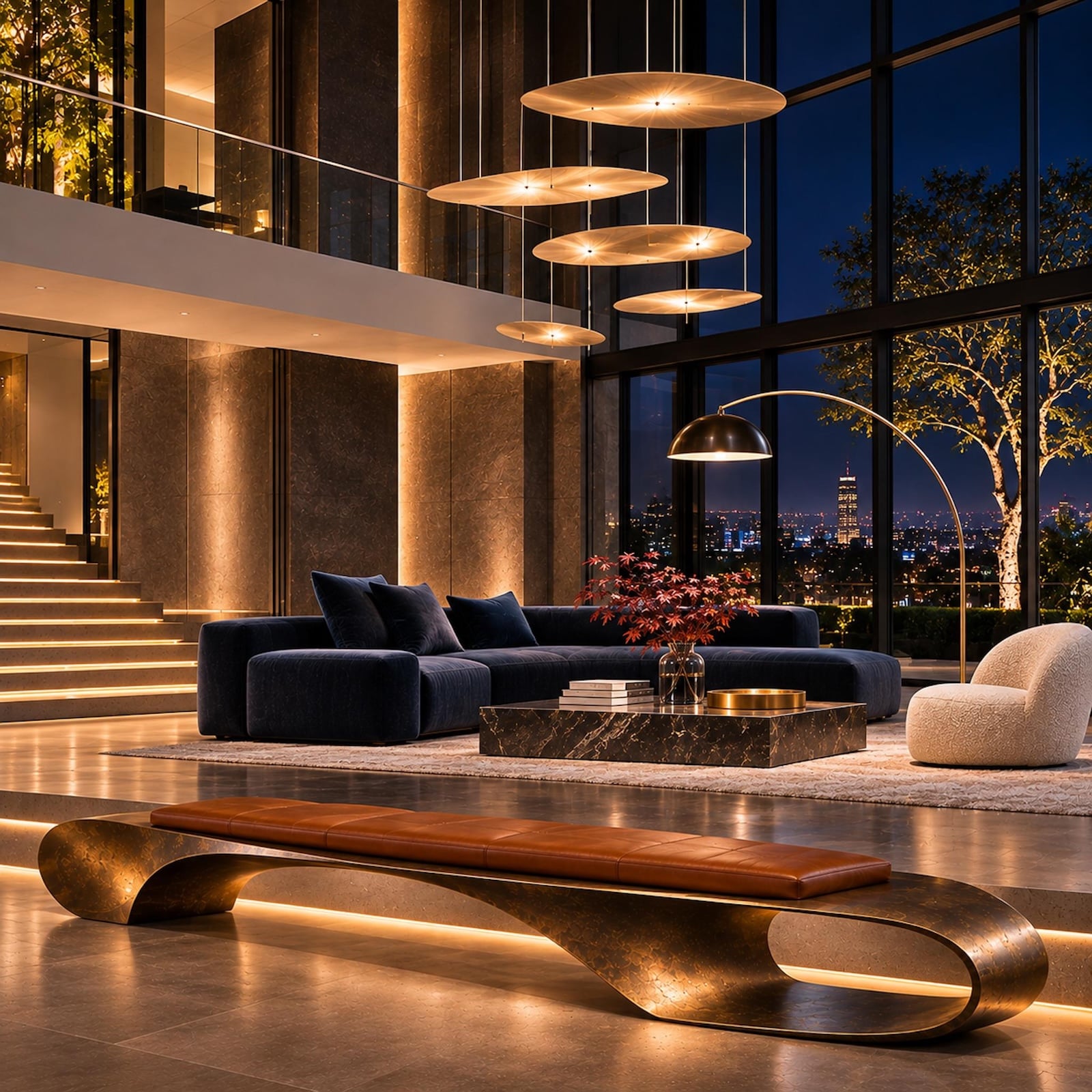
A chair can be a knot of oxblood leather. A cabinet can carry a hammered landscape across its doors. A room divider can fold daylight into gold. Furniture starts to get interesting when the familiar outline of an everyday object gives way to something far less predictable.
In order to come up with the very specific design ideas, we create most designs with the assistance of state-of-the-art AI interior design software. Also, assume links that take you off the site are affiliate links such as links to Amazon. this means we may earn a commission if you buy something.
The finest of these designs do more than command attention. A transparent tabletop exposes the geometry of its steel supports; a suspended textile composition brings rhythm to a double-height room; a sweep of velvet reorganizes the entire seating plan. From the grain of walnut to the glint of polished metal, the artistic decisions determine how each piece relates to the architecture and how the room is used.
These 35 living room concepts put the expressive possibilities of furniture to work, with bold experiments in shape, material, craftsmanship and structure. Some would require specialist fabrication and engineering before they could become functional pieces, yet all pose the same tantalizing question: why hang all the art on the wall when the furniture can make an argument of its own?
35. When a Chair Ties Itself in Knots
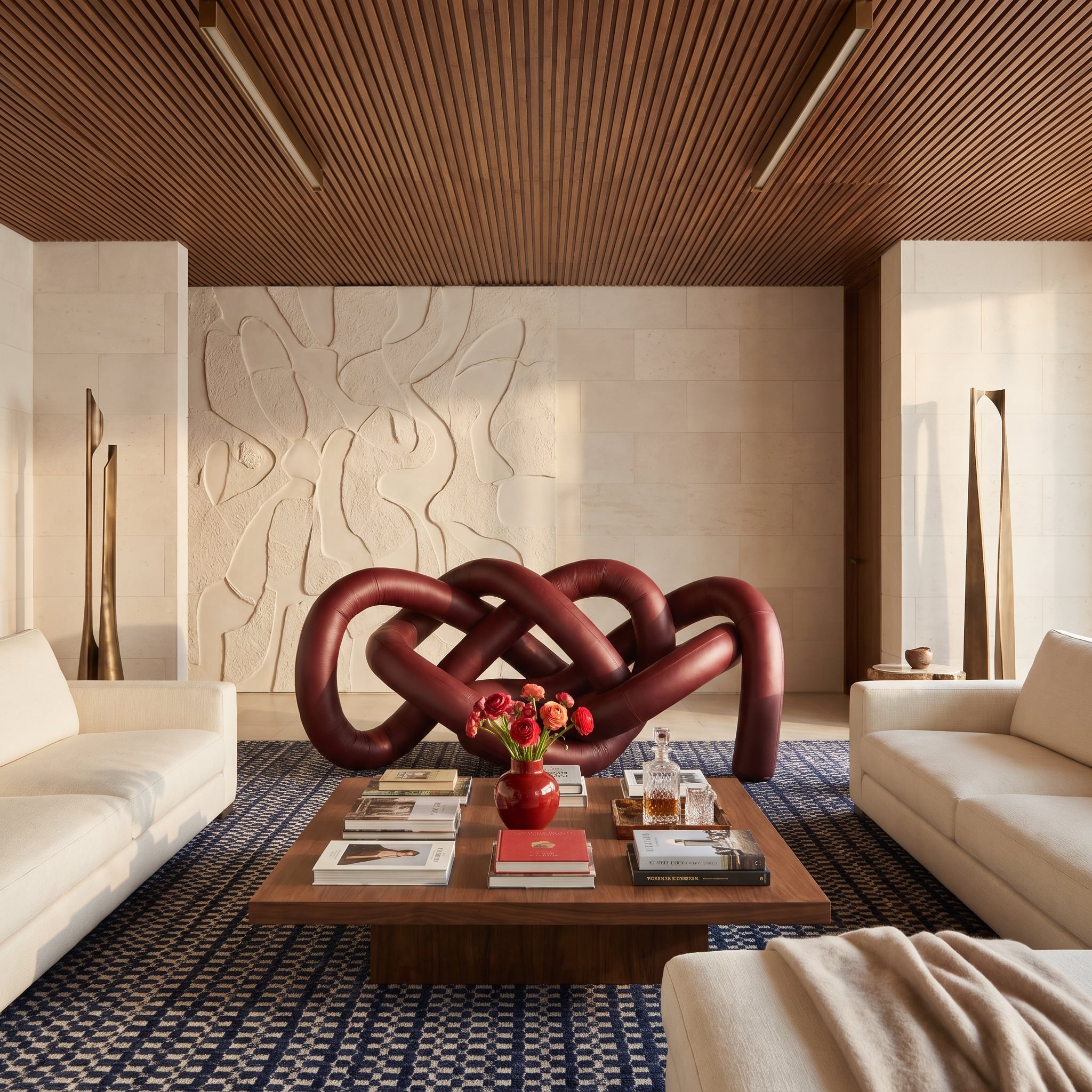
Thick tubes of oxblood leather twist through one another with the exuberance of an enormous knot. Seat, back and arms appear to merge into a single tangle of upholstery. Against the carved plaster relief, the chair resembles a drawing that has escaped into three dimensions.
Two cream sofas frame the knot, giving its deep red color an almost theatrical presence. A restrained echo of red in the accessories extends the color beyond the chair. The delight is in the contradiction: something that looks hopelessly tangled still suggests a place to sit.
Color Study: A small accessory in the dominant upholstery color can carry that shade across a room. Leave some neutral space between the accents so the eye can appreciate the larger form.
34. When the Most Interesting Part of the Table Is Underneath It
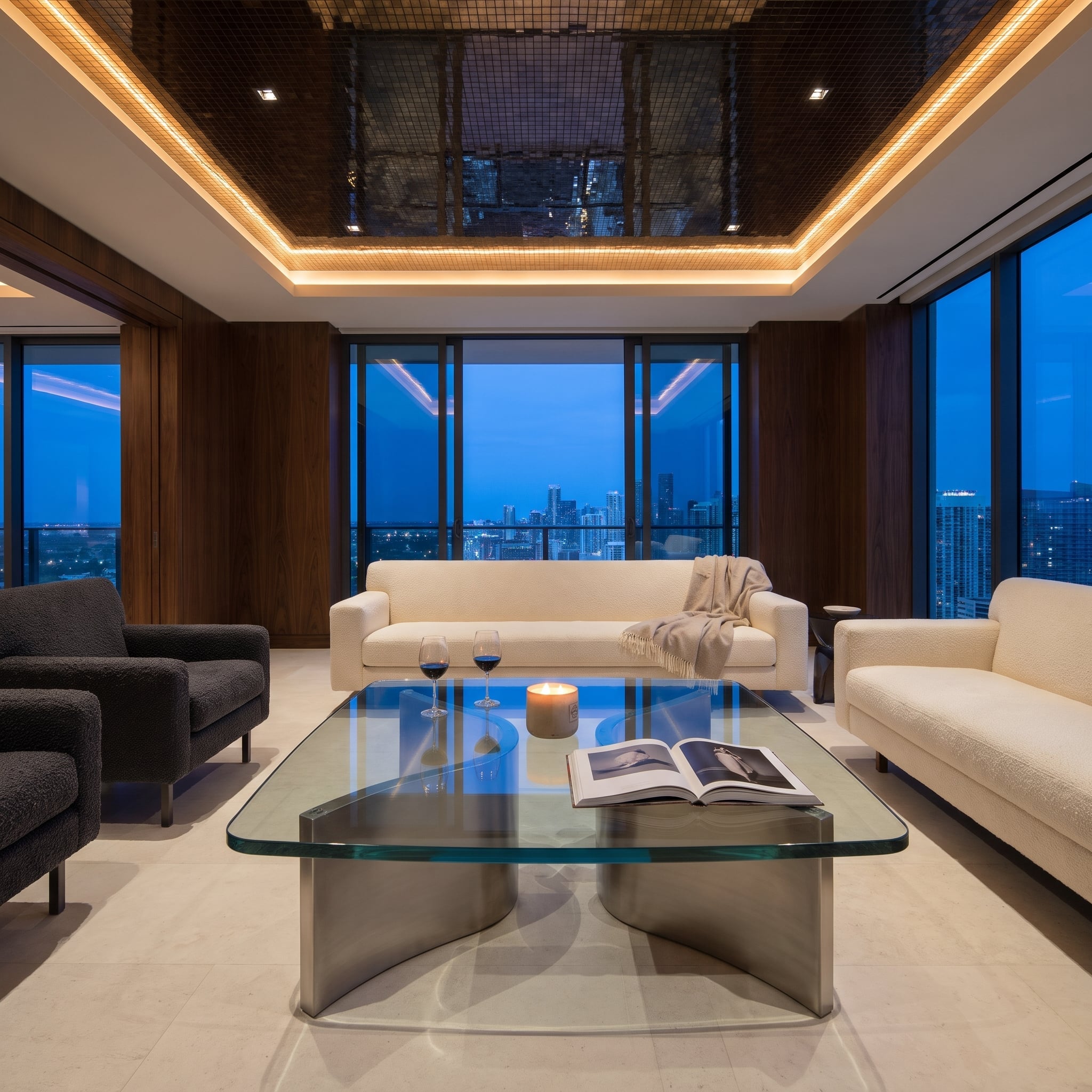
A pair of brushed steel crescents meets beneath a substantial glass tabletop. The transparency makes the base the main event, revealing the overlapping half-moons from above as well as from the side. Move around the table and their outlines change.
The green tint is characteristic of conventional glass containing iron; it is particularly apparent along the edge, where light can travel through more of the glass. Cream bouclé sofas soften the gleam of steel and glass. Here, the table’s most decorative feature is precisely the part a solid top would conceal.
Pro Tip: Choose furniture-grade safety glass with suitable thickness, support and finished edges. A transparent top also means that fastenings, pads and the underside of the table remain on display.
33. A Woven Screen That Turns the Air Into Architecture
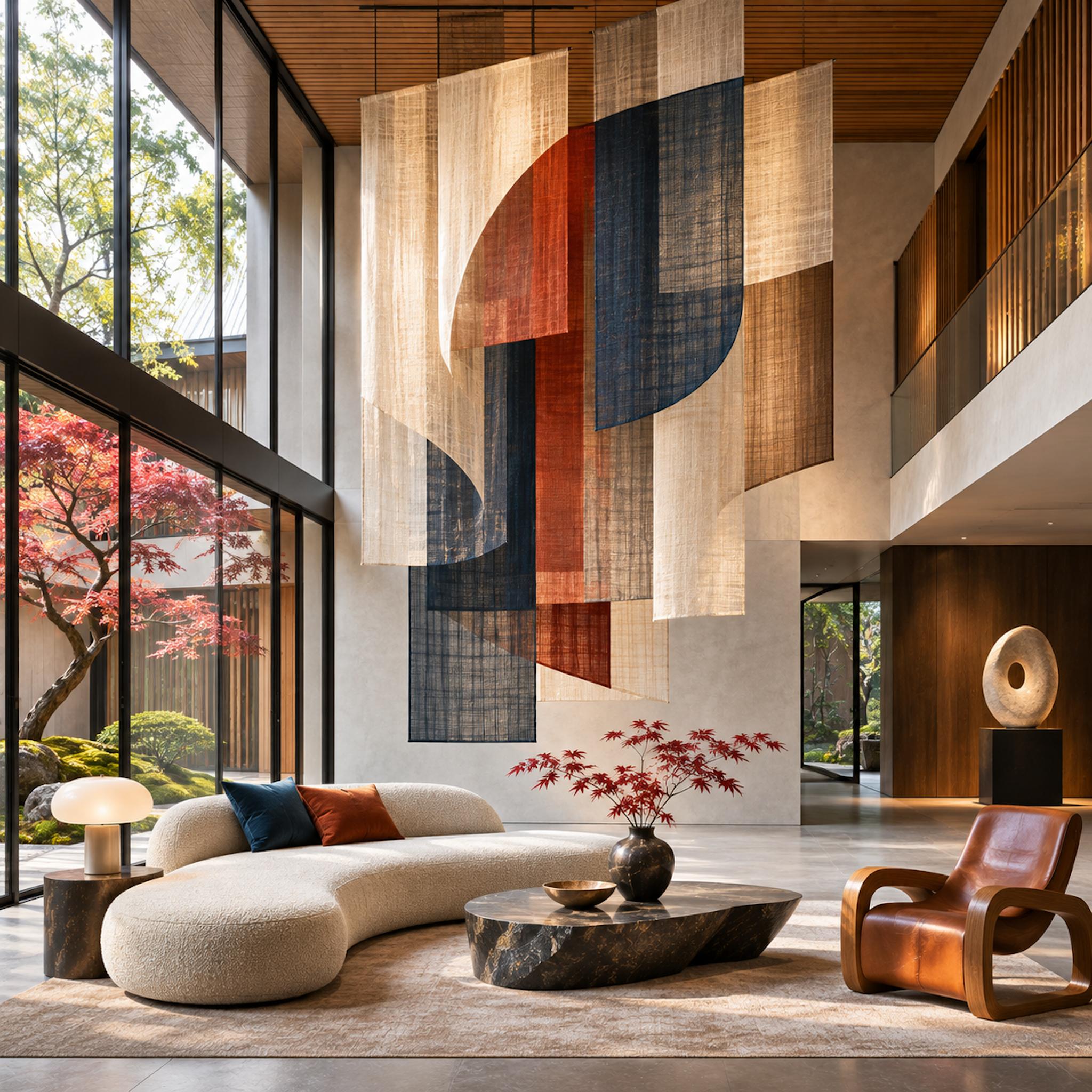
Suspended textile panels descend through the double-height room at varying lengths and depths. The composition brings broad passages of rust, indigo and natural linen tones into contact, with curved color boundaries crossing the rectangular edges of the panels. Daylight filters through the open weave and reveals the overlapping layers.
Rather than dividing the floor plan, the hanging panels give the expanse above the seating a rhythm of its own. The garden’s red maple picks up the rust tones beyond the glazing, while discreet suspension lines leave the layered weave in command. An installation on this scale would require secure overhead anchorage and textiles suitable for the applicable fire-safety requirements.
What Our Readers Say
- Asked which accent chair they would buy, 57% of Home Stratosphere readers chose a wingback, and most of those who explained their pick said it came down to looks.
- In our reader polls on coffee tables, wood took 53% of the vote, while stone drew 19% and glass just 8%.
From Home Stratosphere reader polls and votes.
32. A Rose Velvet Lounger With Roots of Bronze
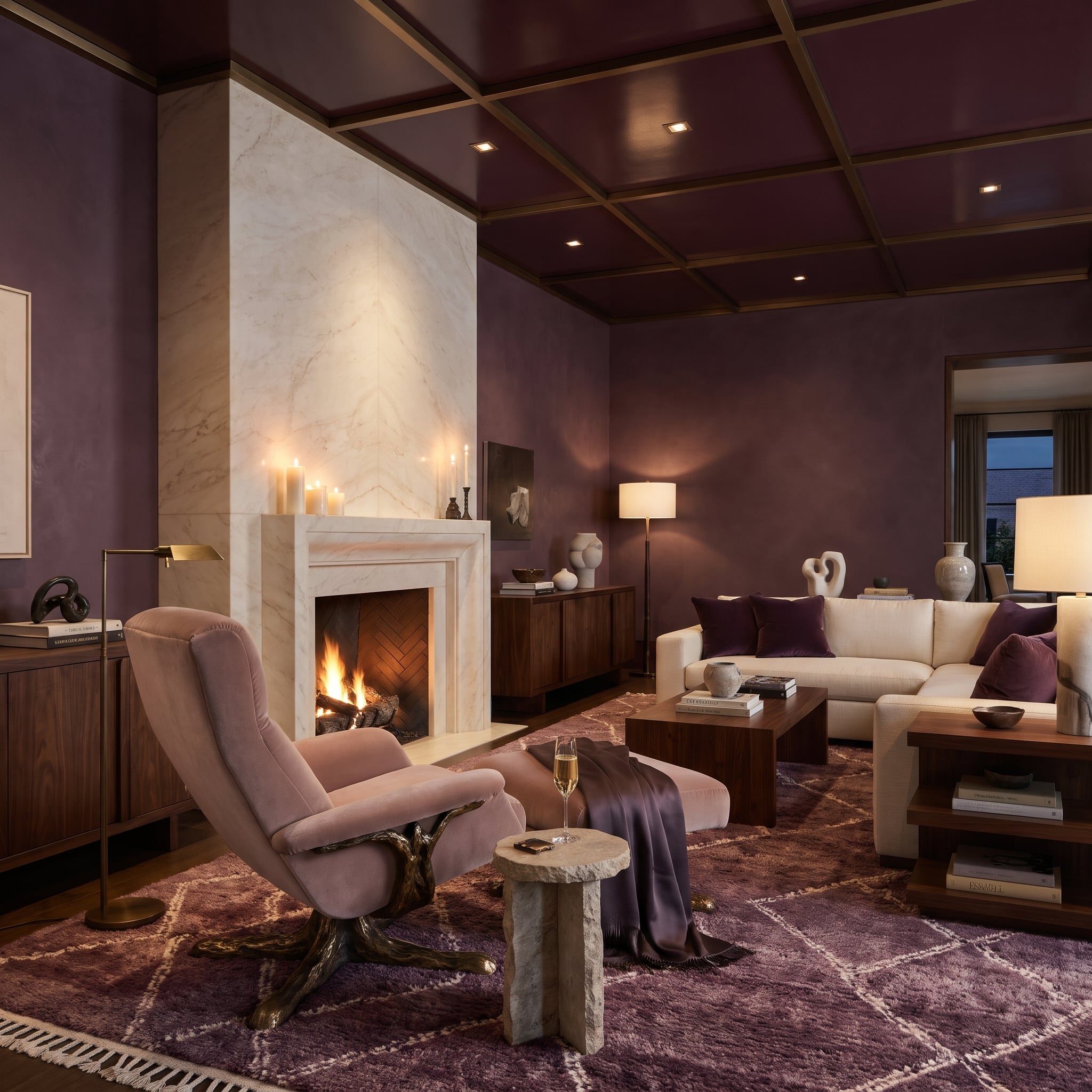
Bronze-colored branches spread across the plum rug and climb into the arms of a dusty-rose velvet lounger. The irregular network makes the seat look as though it has grown out of the floor. Plush velvet nestles among the metallic tendrils.
Squared walnut furniture makes the branching base look even wilder, while a rough stone pedestal keeps the natural imagery going. An open position reveals the branching arms and feet, details that would disappear against a wall.
In the Details: Projecting supports can become tripping hazards. Allow generous circulation around an unusually shaped base, especially where the chair sits beside a frequently used path.
31. A Coffee Table With a Split Personality
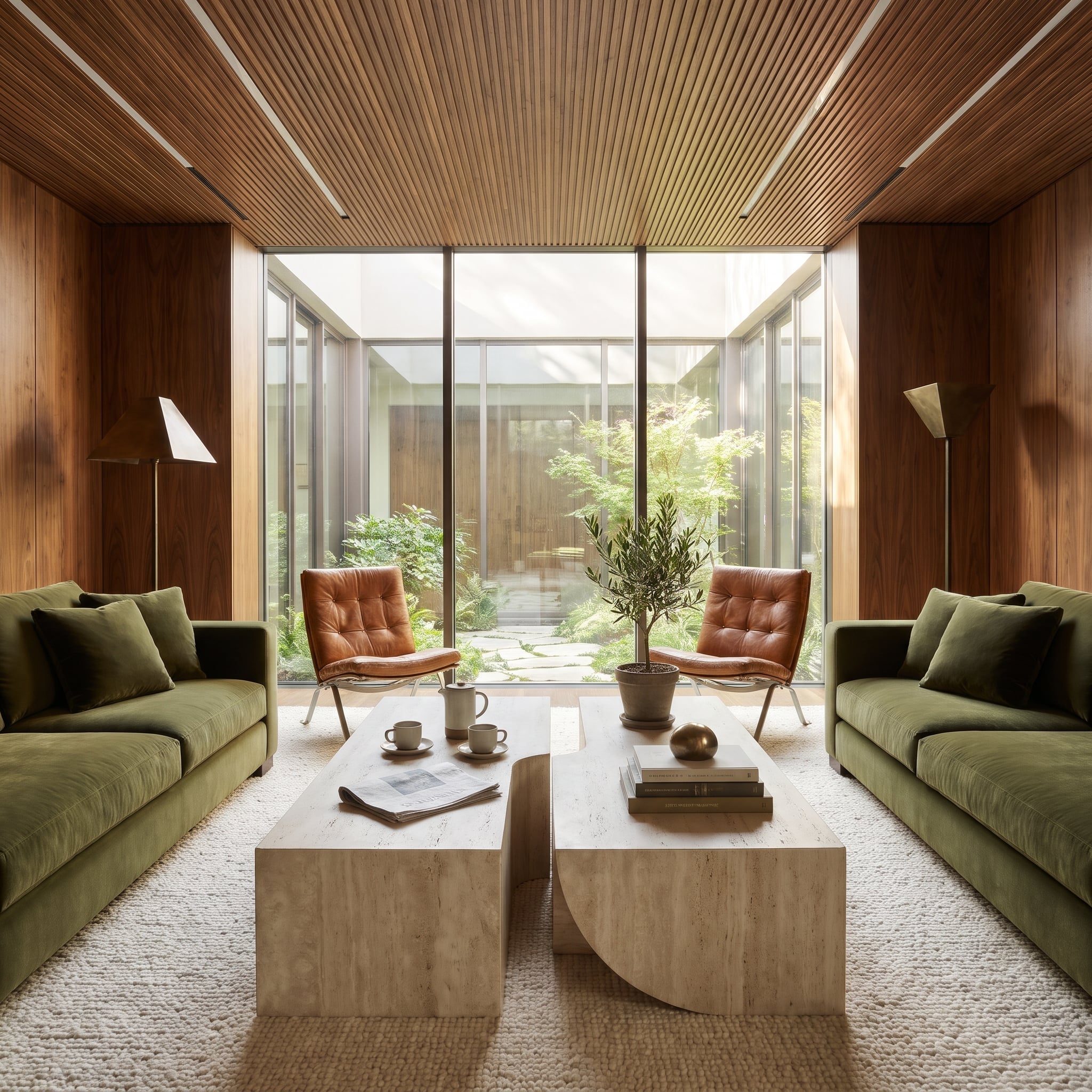
A curved seam divides the travertine coffee table into two complementary blocks. The line continues down the front, so the joint remains visible from the sofas as well as from above. A sliver of shadow separates the concave edge from its convex companion.
The paired forms suggest a modular table, provided each section has a stable base and can be moved safely. Even when the halves meet, the seam gives a seemingly simple block a surprisingly intricate identity.
30. Steel With the Delicacy of Folded Paper
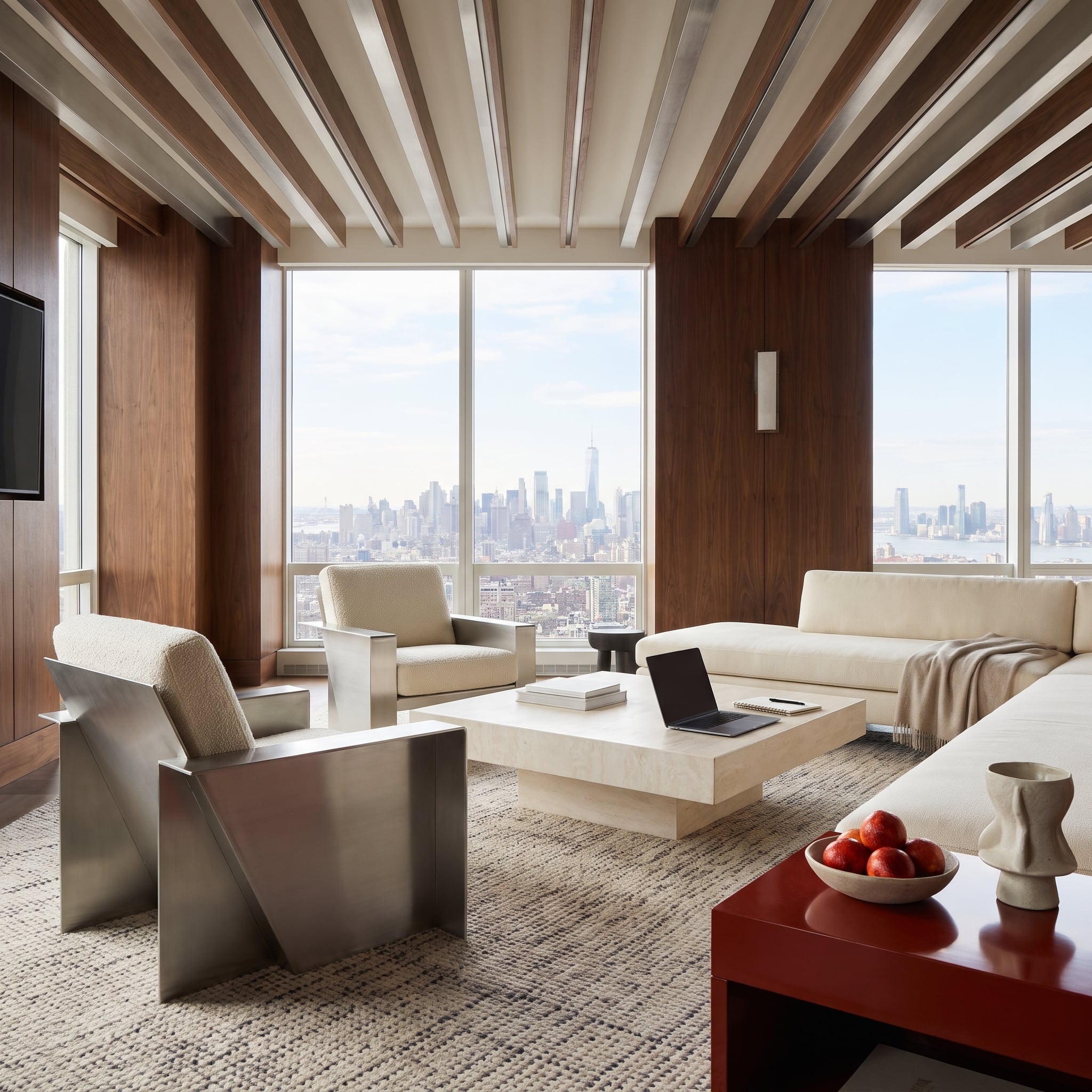
Steel shells give these armchairs the sharp creases of oversized origami. Inward-sloping planes make the edges conspicuous, with cream bouclé cushions nestled inside. The contrast is as tactile as it is visual: hard, sharply defined edges surround the soft upholstery.
Metal channels in the walnut ceiling catch the light, while a red lacquer side table supplies a burst of color against the pale stone. A remarkably economical combination: two chairs and a splash of red lend the room an entirely different temperament.
Comfort Check: Seat depth, back angle, armrest height and the treatment of exposed edges all contribute to comfort. Padding alone cannot compensate for awkward proportions.
29. A Hammered Copper Landscape Across Four Cabinet Doors
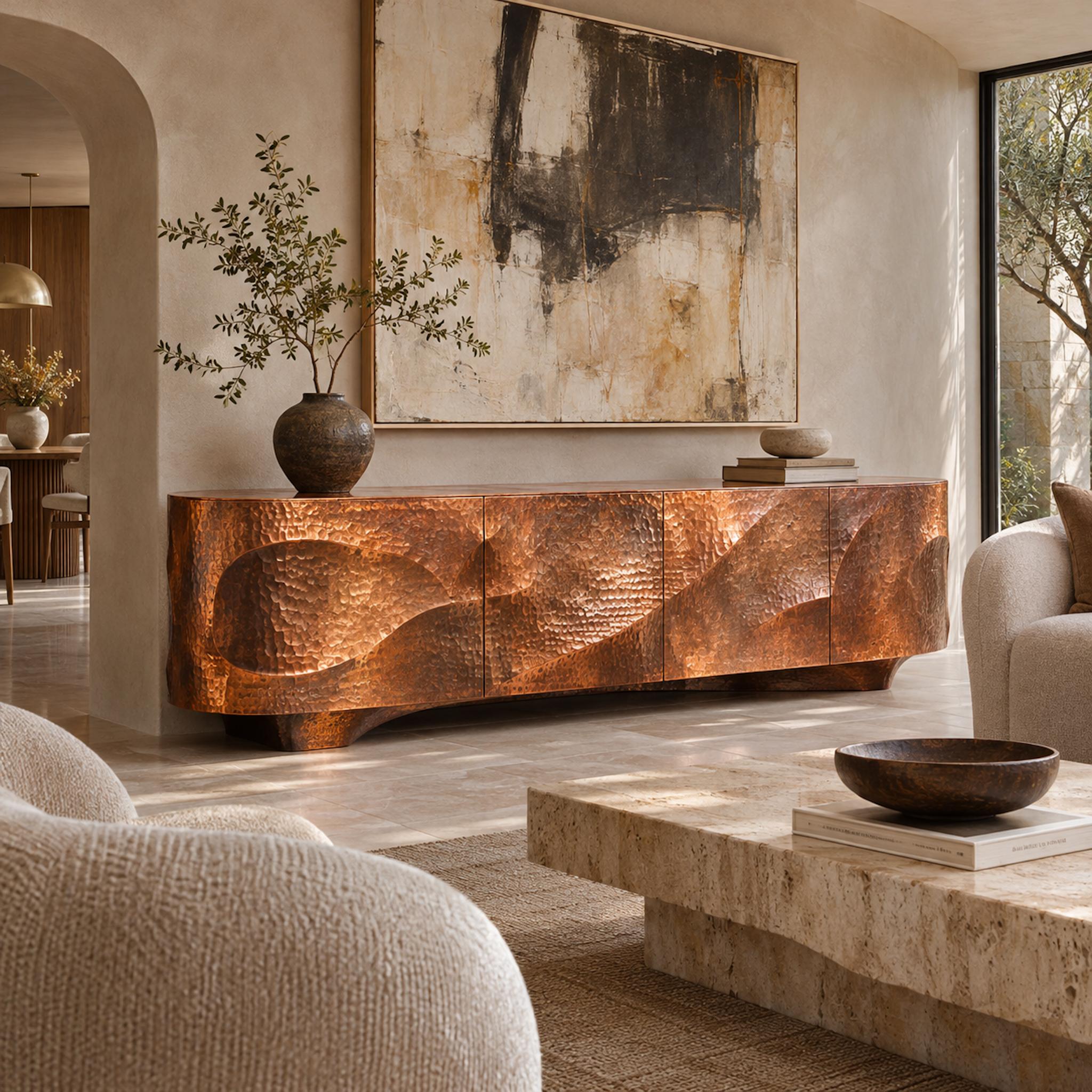
A continuous swell of copper travels across four cabinet doors, rising and receding in broad, shallow curves. Hundreds of small, hammered impressions catch the daylight differently across the relief. The door seams interrupt the metal only at narrow intervals, preserving the sense of a single composition.
A pale plaster wall gives the copper its full chromatic range, from dark russet in the hollows to bright orange at the raised edges. Rounded ends and low supports make the cabinet look substantial without the severity of a rectangular metal box. The art resides in the skin of a functional storage piece, with surface treatment doing the work of ornament.
28. Two Wooden Hoops and a Chair That Looks Ready to Roll
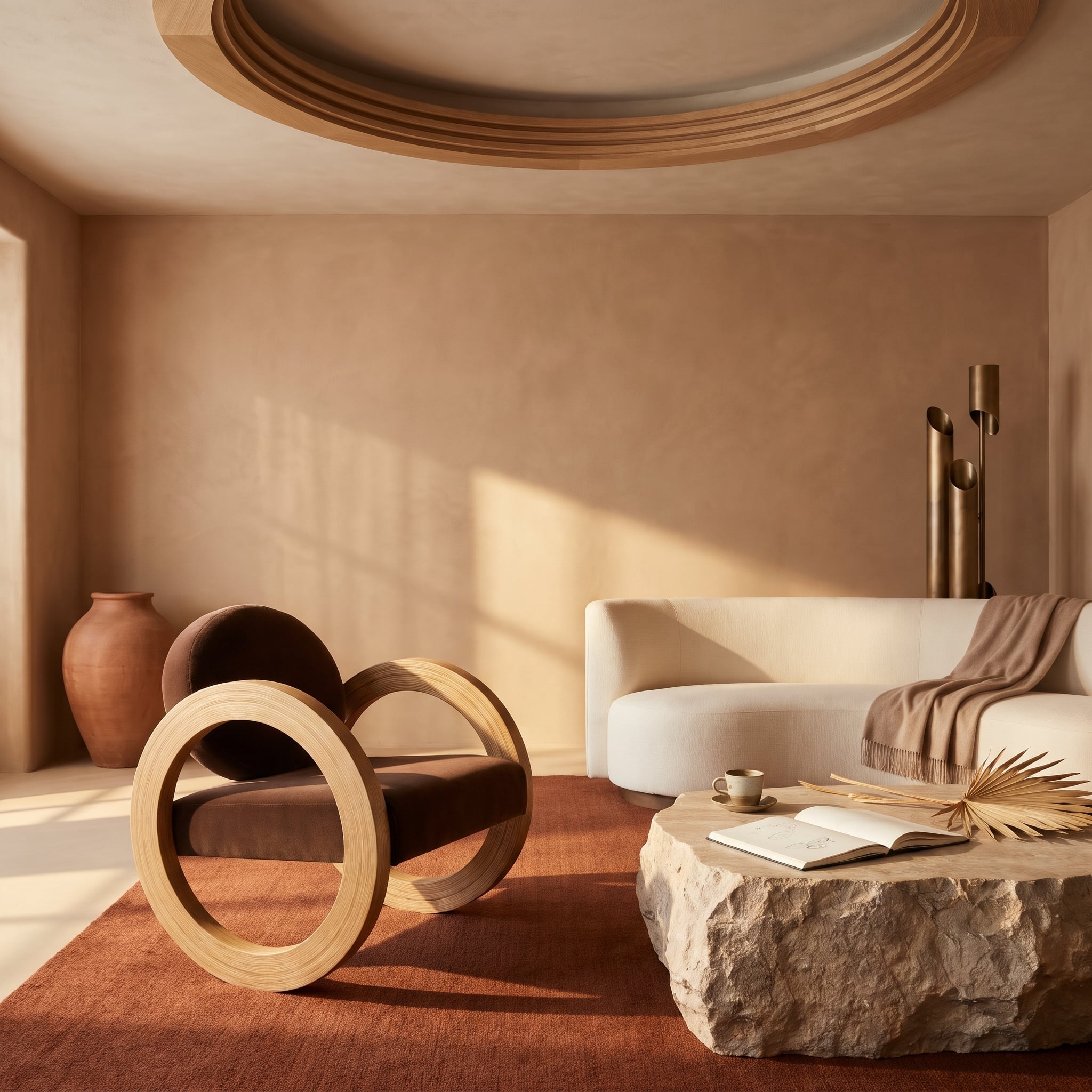
Two enormous wooden rings dominate this lounge chair. Fine parallel lines along their edges suggest laminated construction, turning a detail of fabrication into ornament. Chocolate velvet fills the gap between the hoops; a round back cushion looks almost like a third wheel.
Light passes through the circular openings, sparing the substantial wooden structure from looking cumbersome. The rough stone table on the rust rug breaks the mathematical precision of the circles. Those enormous circles lend a static piece of furniture an unusually animated profile.
Material Matters: Exposed layers can be ornamental in laminated wood and plywood. A transparent finish can emphasize the stripes; the wood and its finish should also be suitable for the intended use.
27. The Sofa That Refuses to Face One Direction
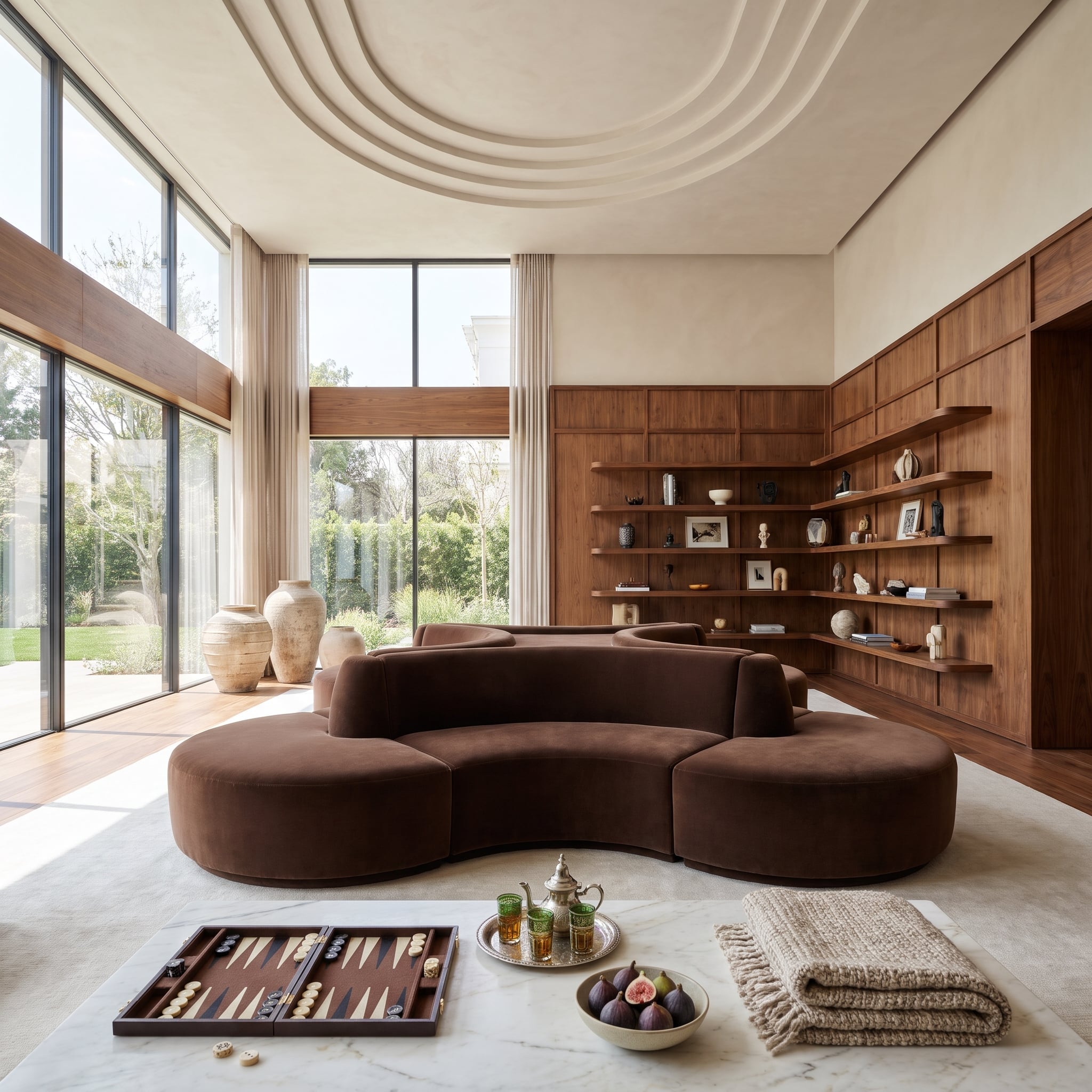
Two chocolate velvet sofas appear to meet back-to-back in a loose S. Their rounded ends turn a normally secondary side view into one of the most interesting aspects of the seating. Instead of the usual front and back, the arrangement offers two inviting faces.
Stepped plaster coves overhead amplify the sweep, although the sofa’s more useful trick happens at floor level. Two conversation areas can occupy opposite sides of the same seating arrangement, with generous circulation around both ends.
Space Planning: Give each seating zone its own reachable table and suitable reading or task lighting. Two conversation areas can share one seating arrangement without competing for a single focal point.
26. An Armchair With Nothing to Hide
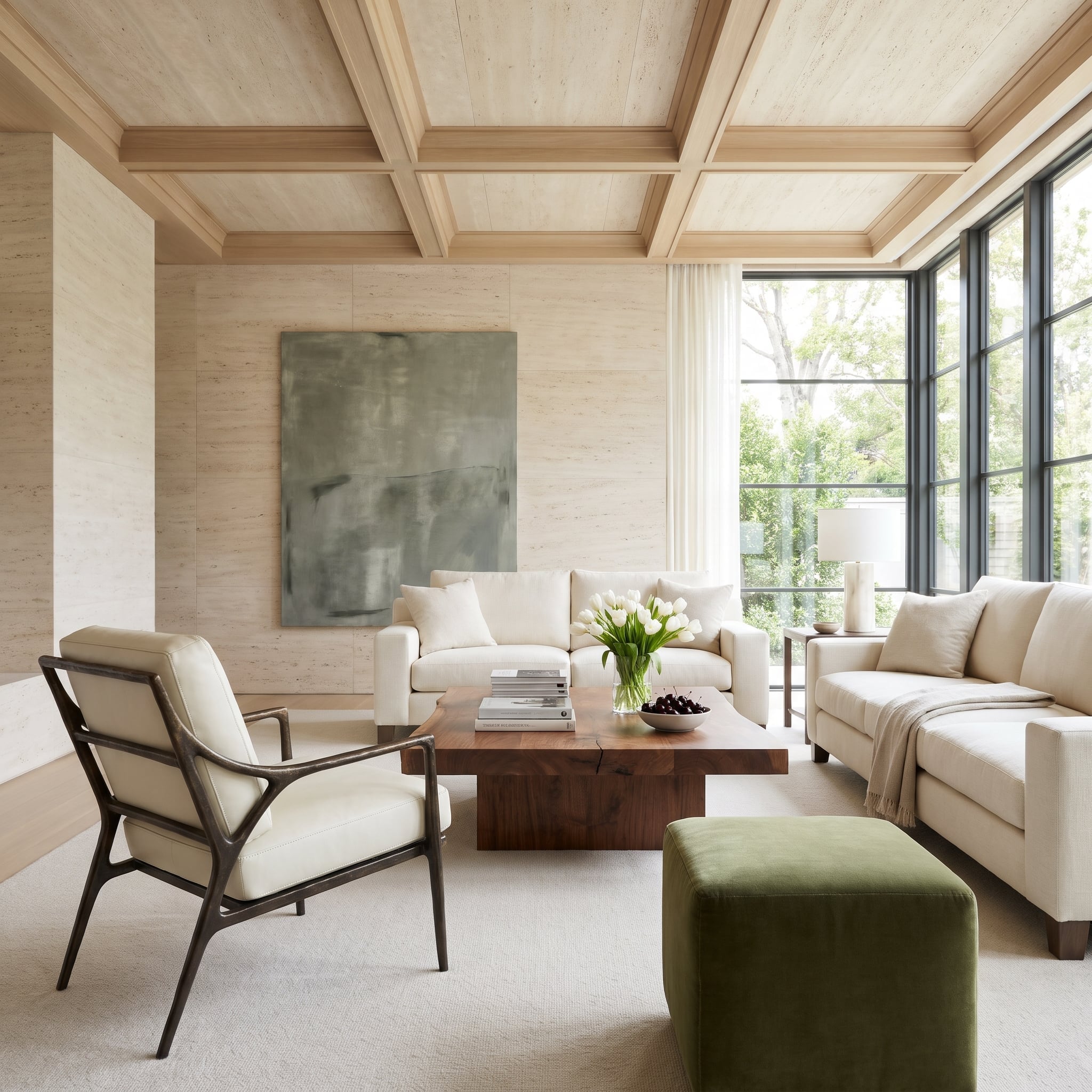
Dark metal branches fork and rejoin around cream leather cushions, making every conspicuous junction part of the design. Against pale travertine, the slender structure has the precision of an ink drawing. Open triangles between the branches allow the floor and walls to remain visible through the frame.
The nearby walnut slab is all mass, its natural-looking fissure running across the top. An olive velvet ottoman adds a softer, low-slung note. Skeletal metalwork, hefty timber and pliant upholstery make an absorbing trio precisely because none attempts to imitate the others.
Style Tip: A contrasting floor or wall makes open metalwork easier to see. Test the chair from several angles before placing it; a side view can reveal connections hidden from the front.
25. Saddle Leather Suspended Between Slender Bronze Supports
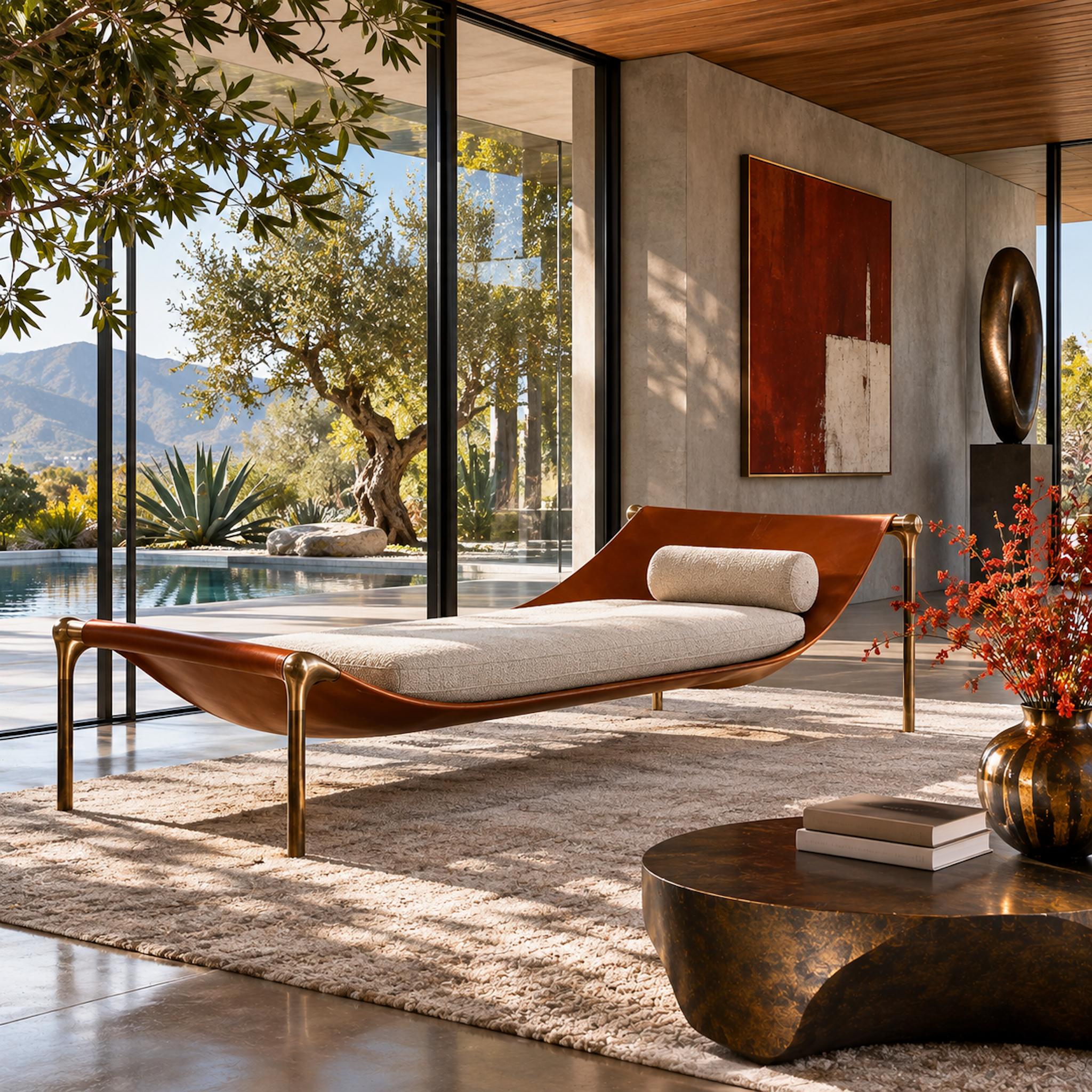
A broad sling of cognac-colored leather dips between two slender metal end frames before rising into an inclined back. The pale fitted cushion and cylindrical bolster follow the sweep of the leather, leaving its edges exposed. There is no massive plinth to interrupt the view beneath the seat.
In a glass-walled pavilion overlooking a pool and desert landscape, the open structure keeps the low horizon visible across the room. Fine metal connections and the unbroken leather surface establish the daybed’s identity. The appeal lies in the tailoring and the economy of the frame, with very little material doing a remarkable amount of visual work.
24. Where Does the Bookcase End and the Ceiling Begin?
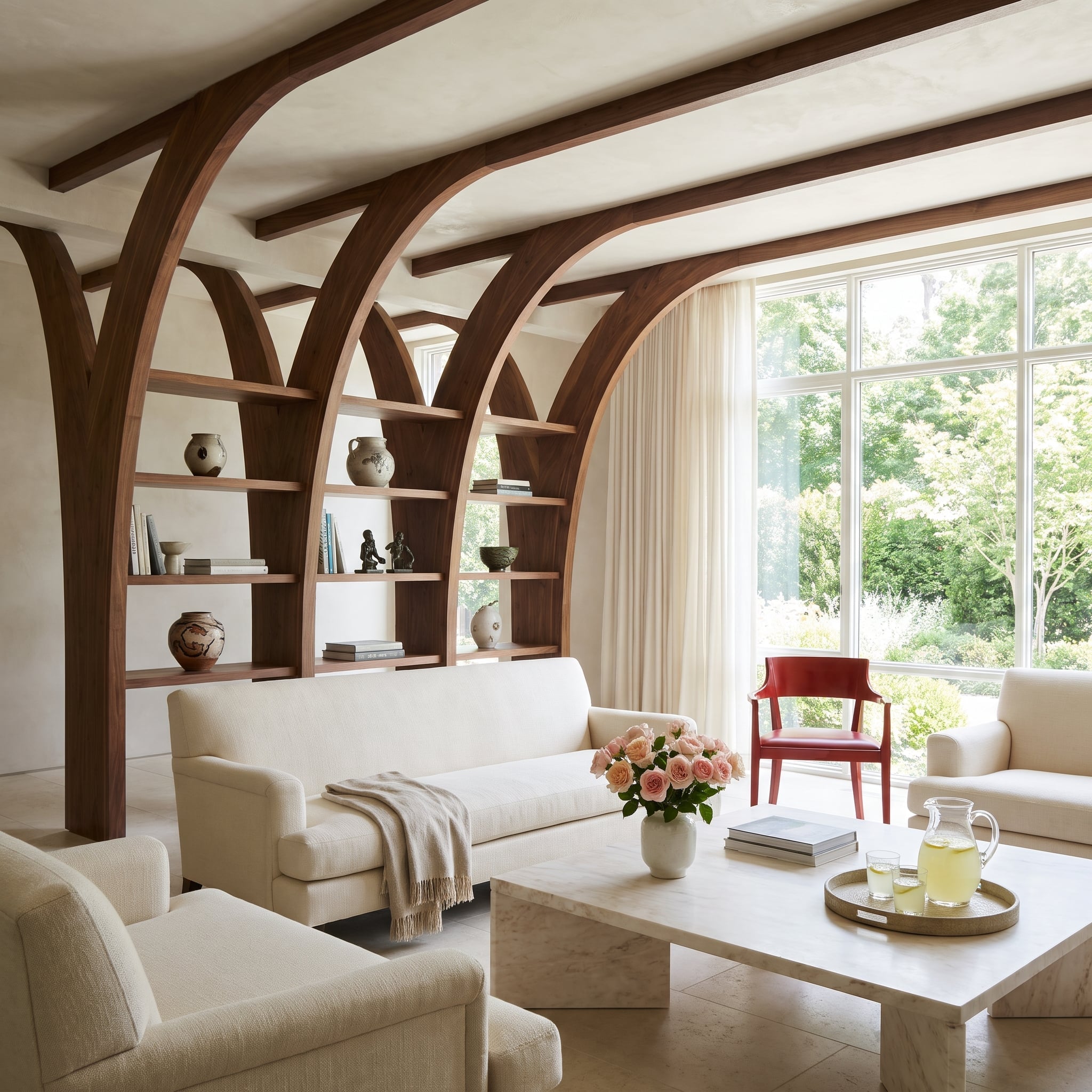
Walnut ribs rise from the floor and branch into the ceiling, turning a wall of shelves into something resembling a grove. Pottery, books and small bronze figures punctuate the gaps between the uprights. Much of the shelving remains empty, allowing the branching pattern to take precedence over the objects on display.
The distinction between cabinetry and architecture becomes wonderfully elusive. Solid marble and pale stone offer a foil to the branching woodwork; cream upholstery brings a quieter horizontal line. Near the window, a red chair supplies the one sharp punctuation mark in this otherwise earthy palette.
23. A Velvet Tulip on a Brass Stem
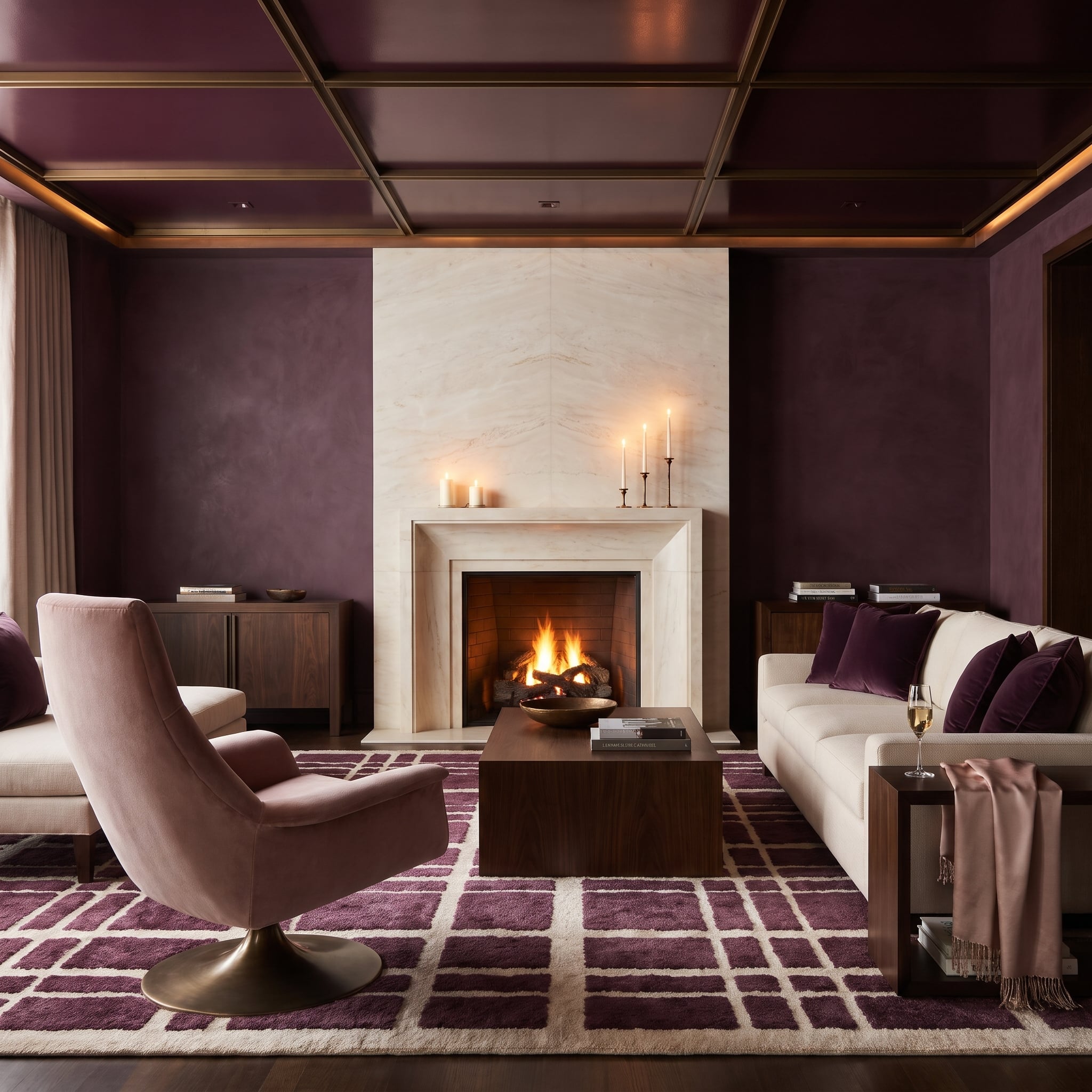
A petal-like seat rises from a flared brass pedestal, giving this pale-rose chair the form of a tulip. The sweep of velvet above a narrow metallic stem turns the usual proportions of an armchair on their head. Plum walls deepen the pink by contrast.
If fitted with a swivel mechanism, the pedestal could let the chair serve both the fireplace and the conversation area without shifting its base. Its compact base also exposes more of the patterned rug. A single central support can make even a generously upholstered seat look surprisingly light.
Practical Detail: Check pedestal stability and allow space for the full rotation of the chair, including the arms and the occupant’s legs. Nearby tables should sit outside that path.
22. Where the Quarry Ends and the Coffee Table Begins
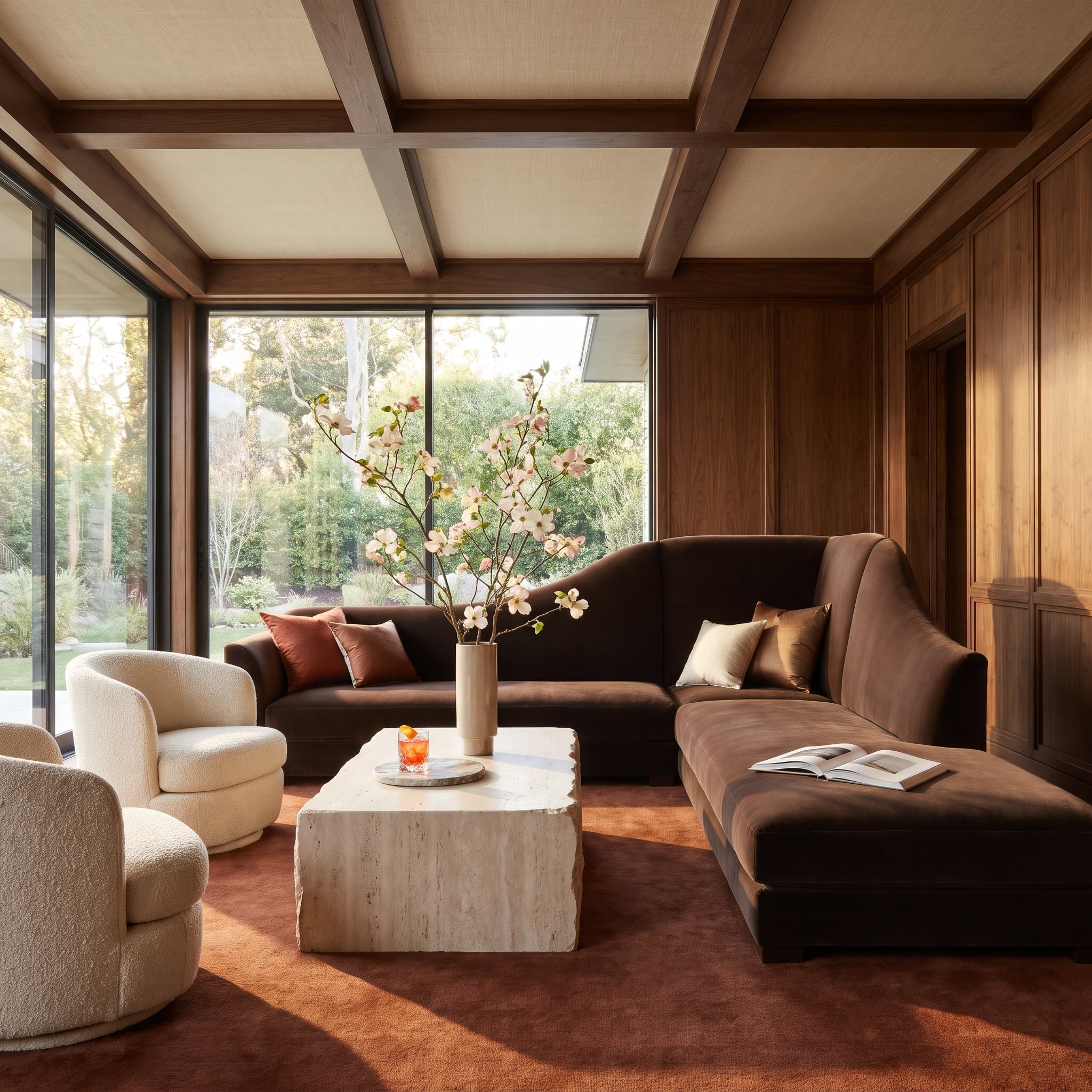
A broad travertine table presents a smooth top and deeply textured sides. The irregular edges have the geological presence of a quarry fragment, while the level upper surface suggests a usable tabletop. Two treatments of the same stone produce two entirely different effects.
Across from the block, a chocolate sectional rises into a tall upholstered wing before dropping toward its chaise. Low bouclé swivel chairs complete the group. The craggy edges make the smooth, upholstered curves around them all the more pronounced.
Stone needs no carved ornament when the finish itself can supply the drama.
21. The Armchair That Makes Steel Look Inflatable
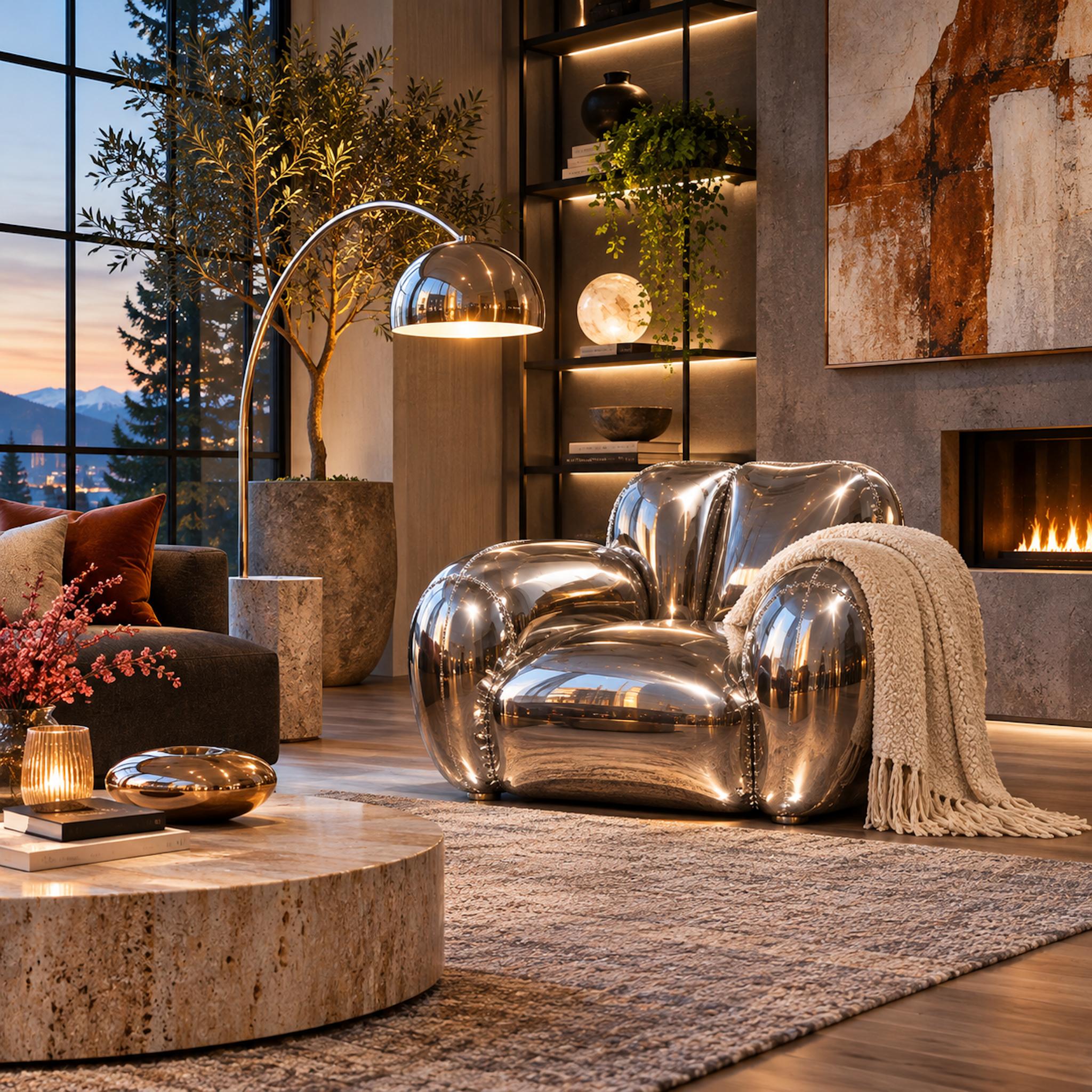
Rounded arms, a pillowy back and a swollen seat give this chair the unmistakable outline of an inflatable lounger. The mirror-polished metallic surface supplies the surprise: the softness is an optical illusion. Narrow seams trace the inflated-looking volumes and turn the familiar language of upholstery into a study in reflective metal.
The chair gathers fragments of the fireplace, windows and surrounding furniture across its curved surfaces. A cream throw supplies actual softness and breaks up the metallic sheen. Inflated-metal fabrication offers a plausible route to this kind of sculptural shell, although its strength, edge treatment and comfort would need to be resolved before the design could function as everyday seating.
20. The Best View of These Chairs Is From Behind
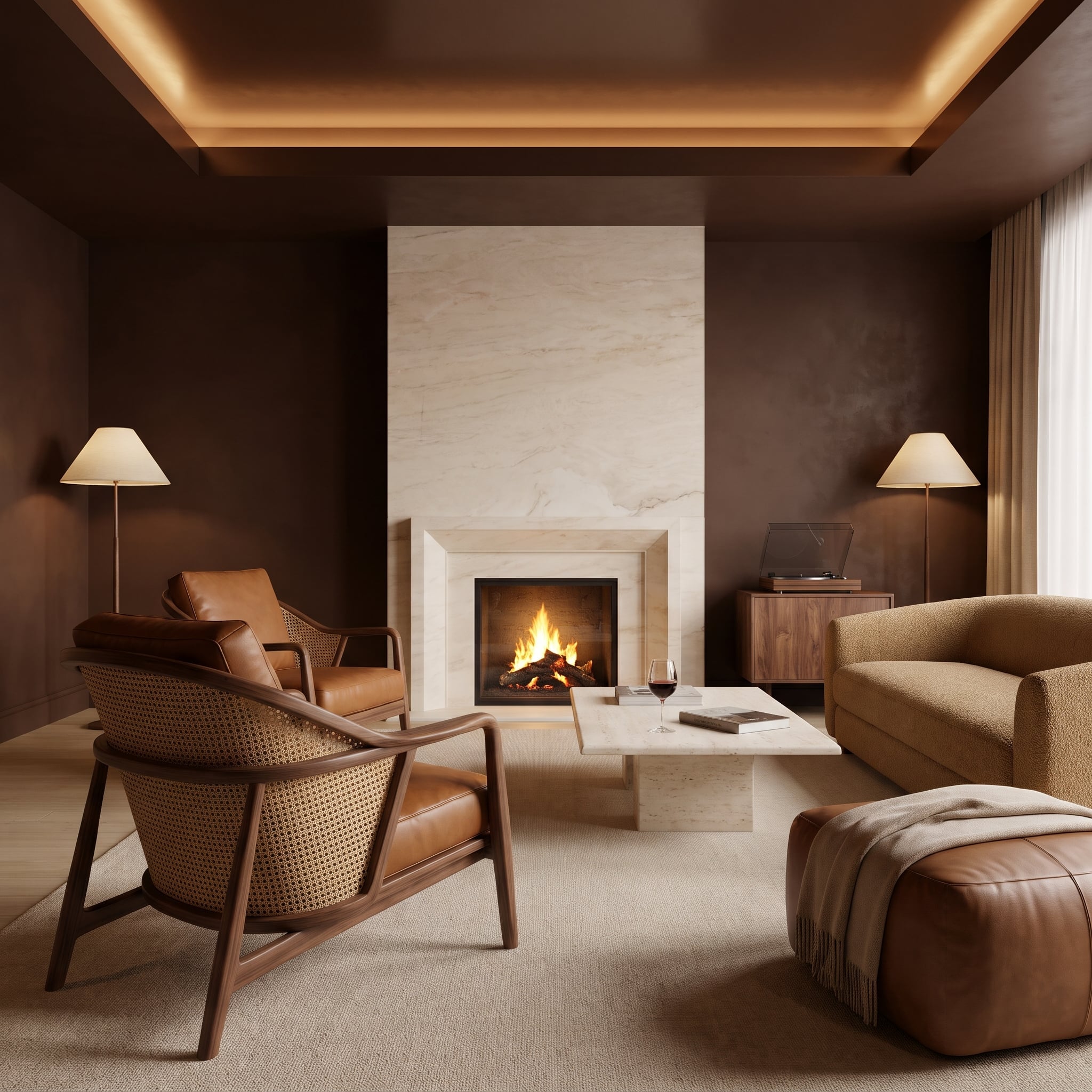
The walnut lounge chairs save their finest detail for the rear. A sweeping rail frames the curved cane shell before continuing toward the arms, with cognac leather cushions visible through the open weave. The woven back becomes an independent decorative surface.
Turned toward the seating area, the chairs present their woven shells to the rest of the room. Pale carpeting helps distinguish them from the dark walls. In an open-plan room, a piece of furniture has no obligation to keep its best side facing the sofa.
19. A Bridge Where the Sofa Should Be
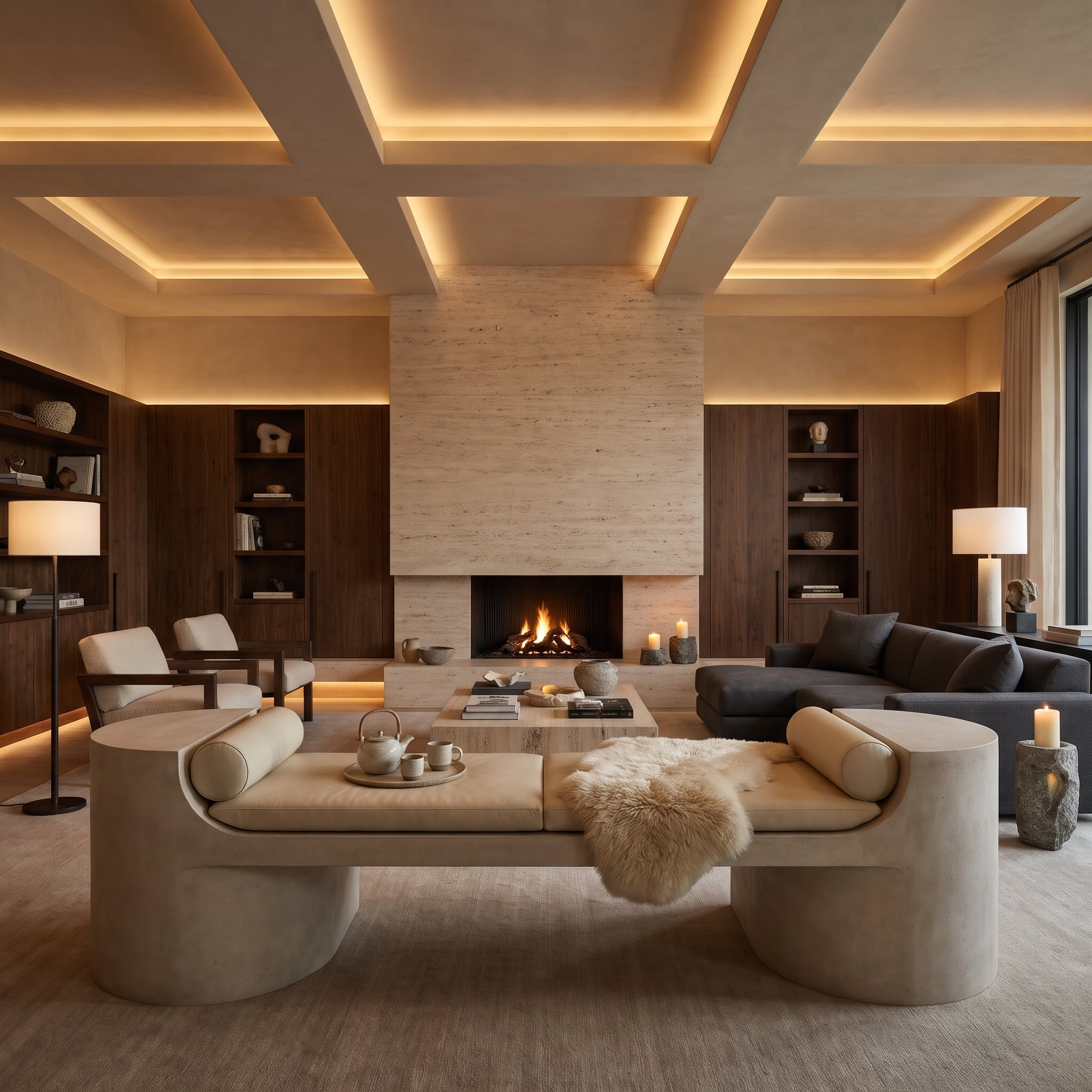
Two rounded pedestals meet a broad, scooped platform, giving the daybed the unmistakable outline of a bridge. Its chalky, plaster-like finish makes the daybed feel like an extension of the architecture. Leather cushions and cylindrical bolsters settle into the shallow cradle.
Facing the travertine hearth, the daybed sits low enough to leave the fireplace visible above it. A sheepskin softens the mineral palette. The generous platform invites reclining while its low profile keeps the room oriented toward the hearth.
18. A Wingback That Trades Curves for Creases
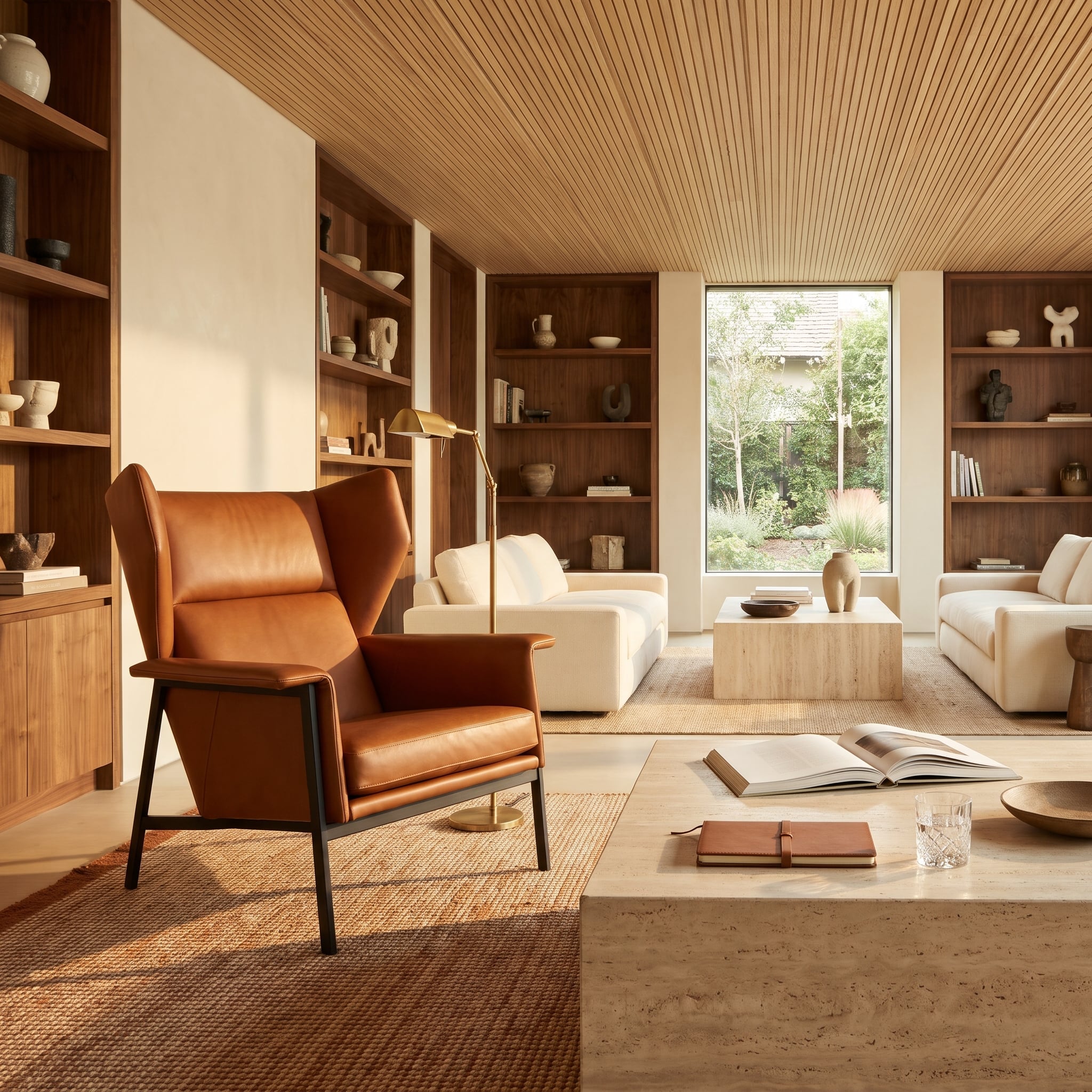
Cognac-colored upholstery reshapes the traditional wingback into a composition of sharp planes. A slender black steel cage surrounds the seat, raising it above the jute rug and leaving a margin of open space around the upholstered shell.
Beside the massive travertine block, the chair looks almost weightless. Where a traditional wingback conceals much of its structure, this design displays the supporting frame as a separate element. The warm cognac tone tempers the severity of the steel and pointed wings.
17. Folded Brass Turns a Room Divider Into Origami
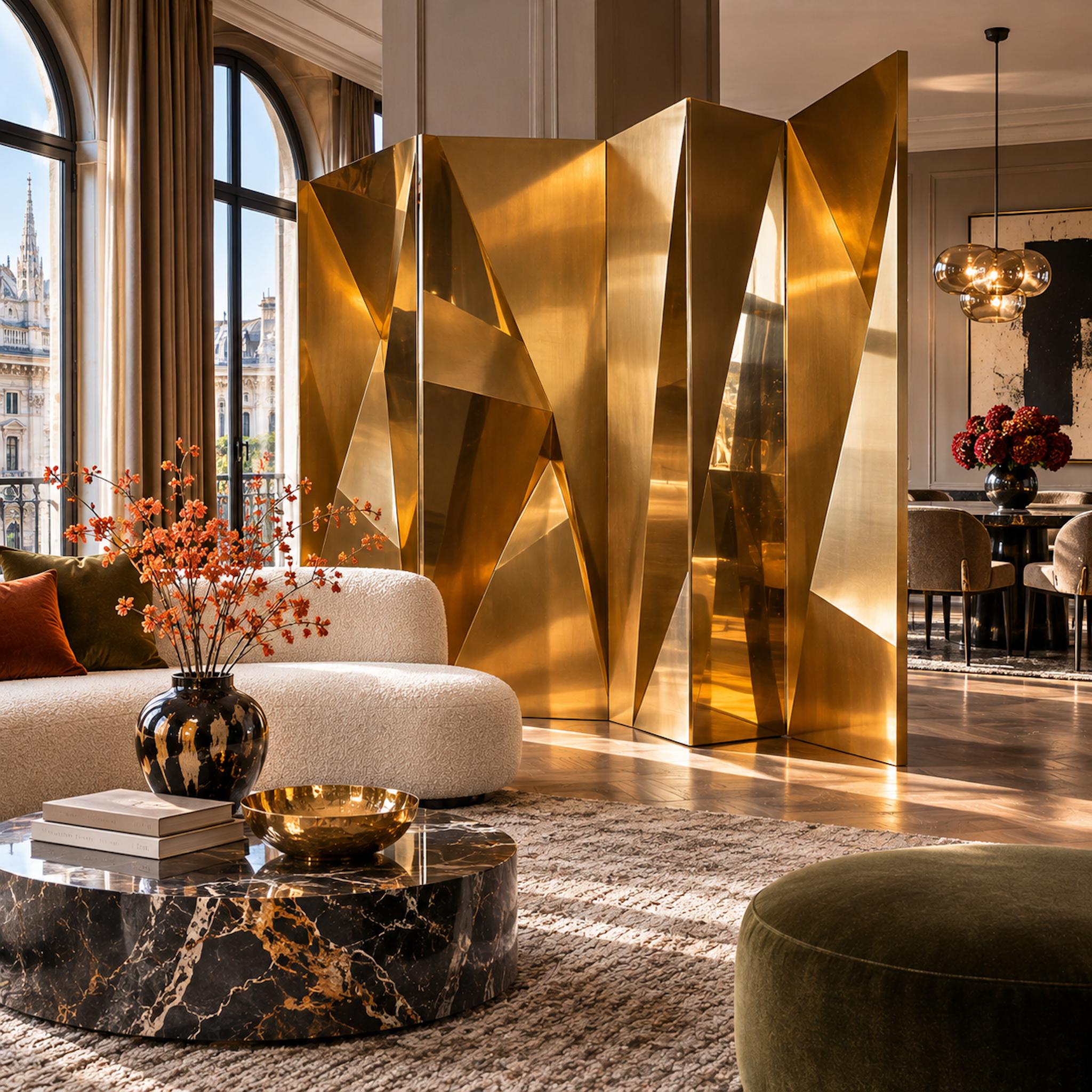
A series of sharply folded brass-colored planes turns a freestanding screen into an architectural sculpture. Broad brushed surfaces give way to more reflective facets as the folds change direction. The varying heights prevent the screen from reading as a conventional flat partition.
Against tall arched windows and traditional wall moldings, the angular metal introduces an assertively contemporary geometry. The screen separates the dining area from the living room without closing either off completely. Each fold captures a different portion of the daylight, making the surface look different as the viewing position changes. A full-scale version would require stable supports or secure anchoring.
16. Pebbles Big Enough to Sit On
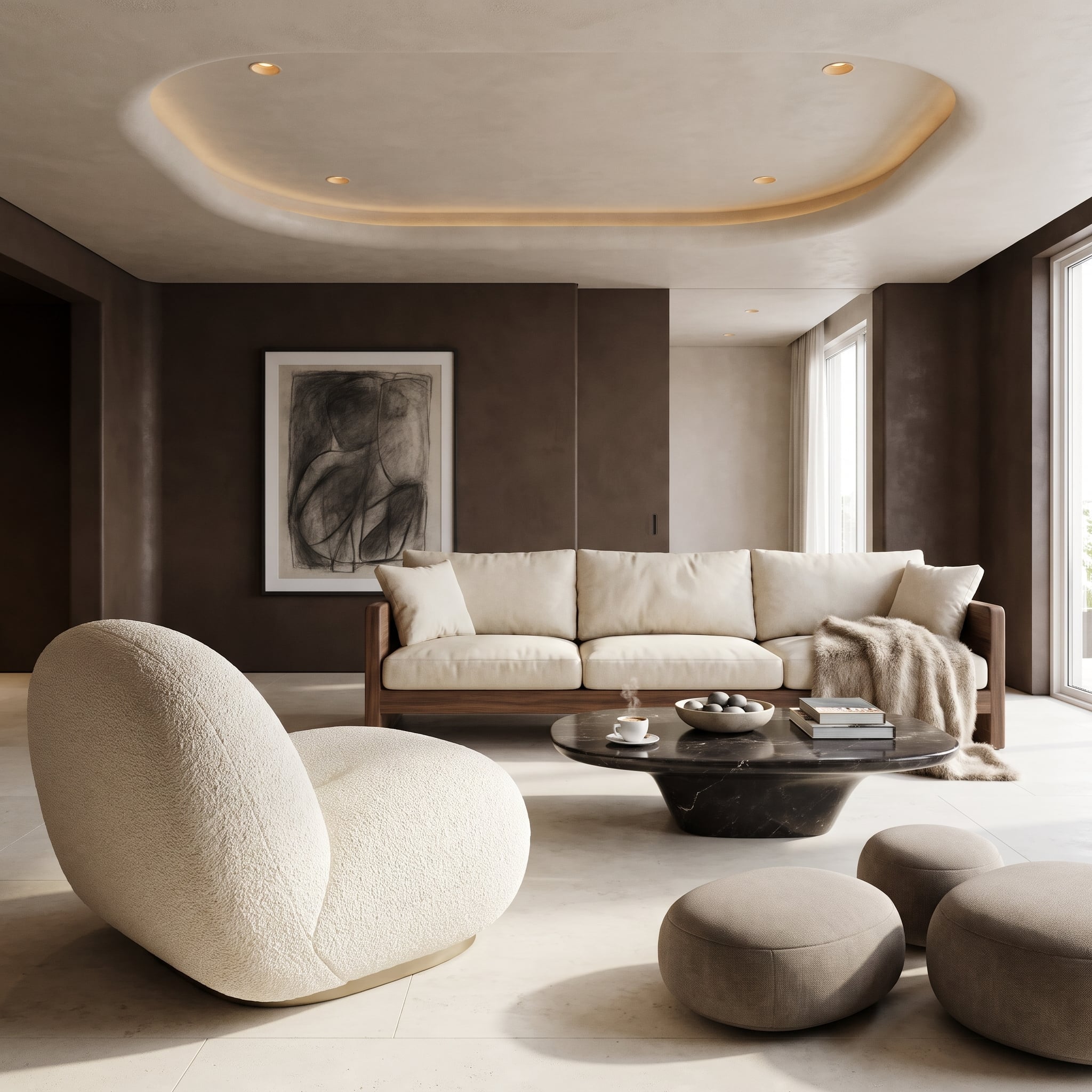
The bouclé lounge chair rolls from back to seat in one soft hook, with a slender brass-colored plinth underneath. Three taupe poufs resemble smooth river stones, their individual shapes lending themselves to flexible seating arrangements.
The dark marble table stands upright amid all those low forms, its tapered pedestal flaring at the floor. Veining adds movement of a different kind to the stone. Above, a rounded tray ceiling continues the softer lines, while the scattered poufs give the composition a freedom that matched chairs could not provide.
15. Where the Armrest Ends and the Leg Begins
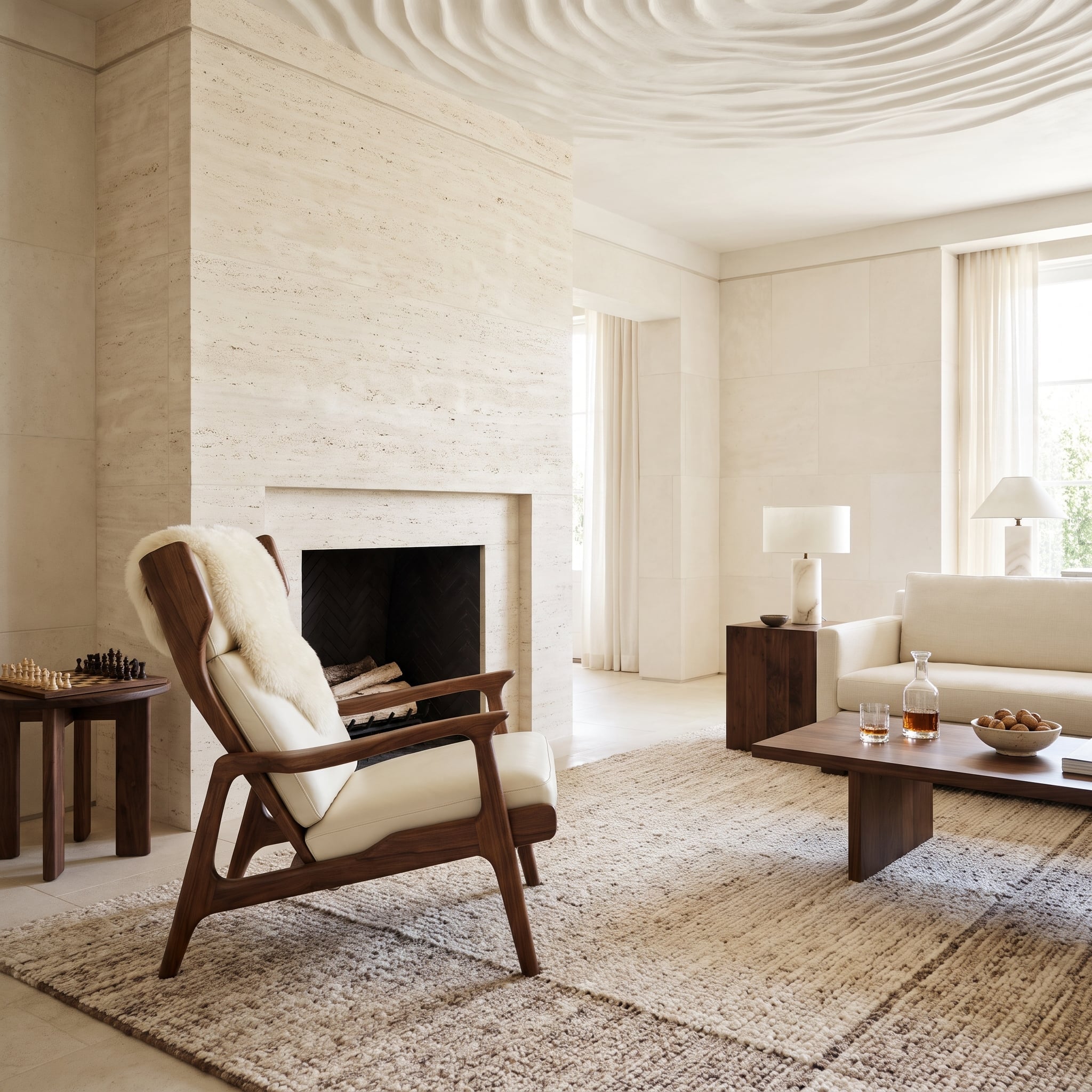
The walnut arms of the lounge chair sweep forward and descend to become the front legs in an apparently continuous line. Against the travertine hearth, the frame has the clarity of a drawing. Pale leather cushions fill the interior without obscuring the long wooden contours.
The grain and smooth transitions give the frame an elegance that applied ornament could never achieve. In side light, the rounded outer edge and sculpted inner surface become distinct, allowing the craftsmanship to command attention without sacrificing the delicacy of the silhouette.
Styling Detail: Keep a loose throw at the headrest or upper back if the frame is a feature. A textile can add seasonal warmth without hiding the line from armrest to leg.
14. The Daybed That Leaves the Floor Behind
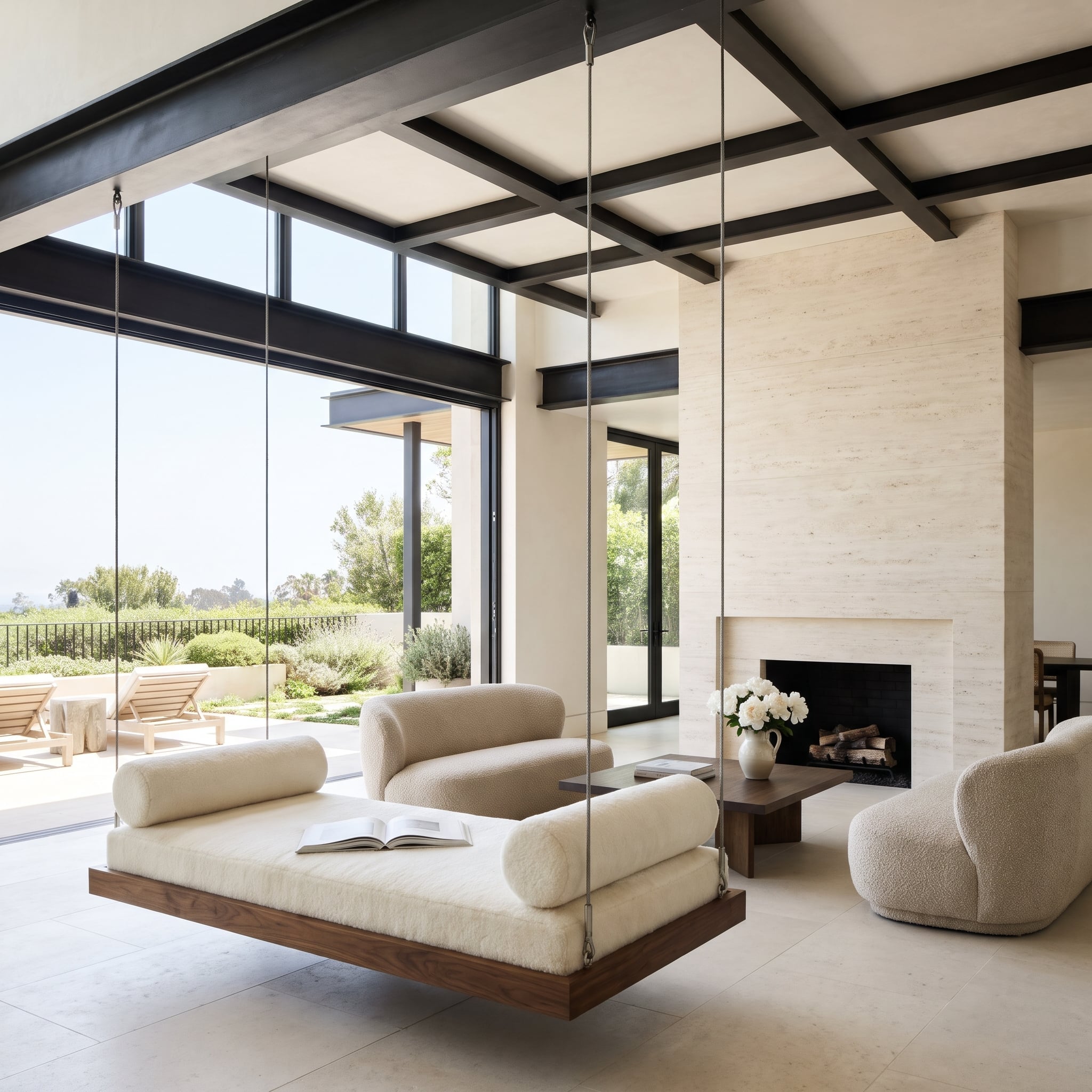
Four steel cables descend from the dark ceiling structure toward the corners of a walnut platform. Beneath the daybed, a narrow band of daylight separates the wood from the limestone floor. Removing conventional legs changes the entire character of the piece; the cables become slender vertical accents above the seat.
Cream shearling covers the mattress and bolsters, softening the crisp edge of the platform. The low platform keeps the garden beyond the glazing in view. Such a suspension calls for professionally assessed structural anchorage and rated components capable of supporting both static and dynamic loads, as well as sufficient clearance for movement.
13. When Bronze Looks Almost Liquid
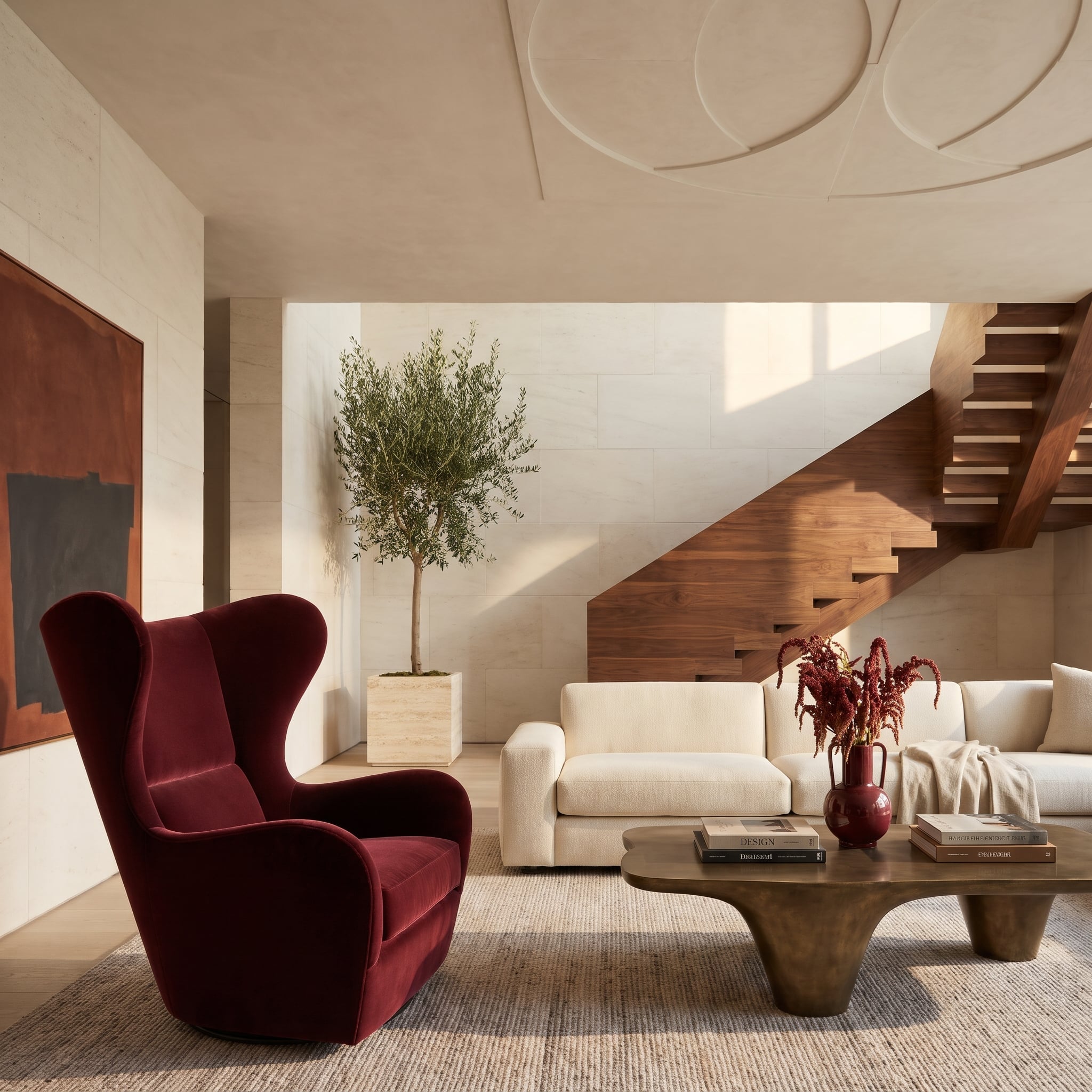
Burgundy velvet rises into broad wings that curl around the seat like cupped hands. Across the rug, the bronze-colored coffee table seems to flow into its supports, a dark patinated finish emphasizing the transitions between top and legs.
Velvet and metal approach the same fluid silhouette from opposite directions. Behind them, the walnut staircase slices a hard zigzag through the room. The bronze looks all the more fluid for having such an uncompromising straight-edged neighbor.
12. A Chair That Wears Its Leather in a Lattice
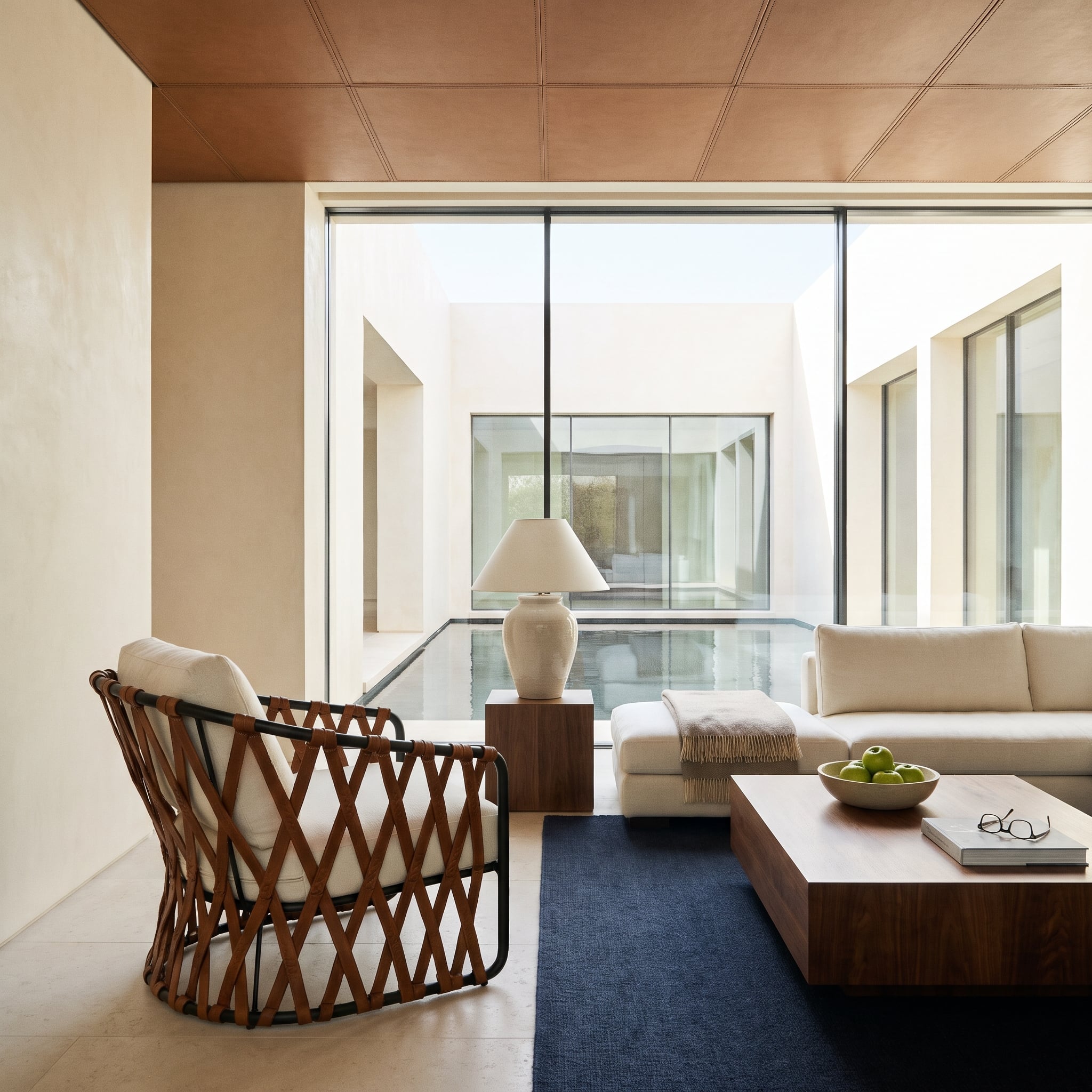
Diagonal cognac straps cross a black tubular frame, forming a lattice around the cream seat cushion. Dark rails mark the limits of the weave, while the open pattern makes the chair look like a drawing composed of broad diagonal strokes.
Stitched leather-like panels overhead echo the straps at a different scale. Solid walnut blocks and a cream sectional provide a calmer foil. In a room opening onto a courtyard, the open lattice allows the eye to travel through the sides of the chair.
Material Detail: Open weaving can provide texture without the visual weight of solid upholstery. If using a related finish overhead, select a suitable ceiling system that meets applicable fire-performance requirements.
11. A Conversation Sofa That Rewrites the Floor Plan
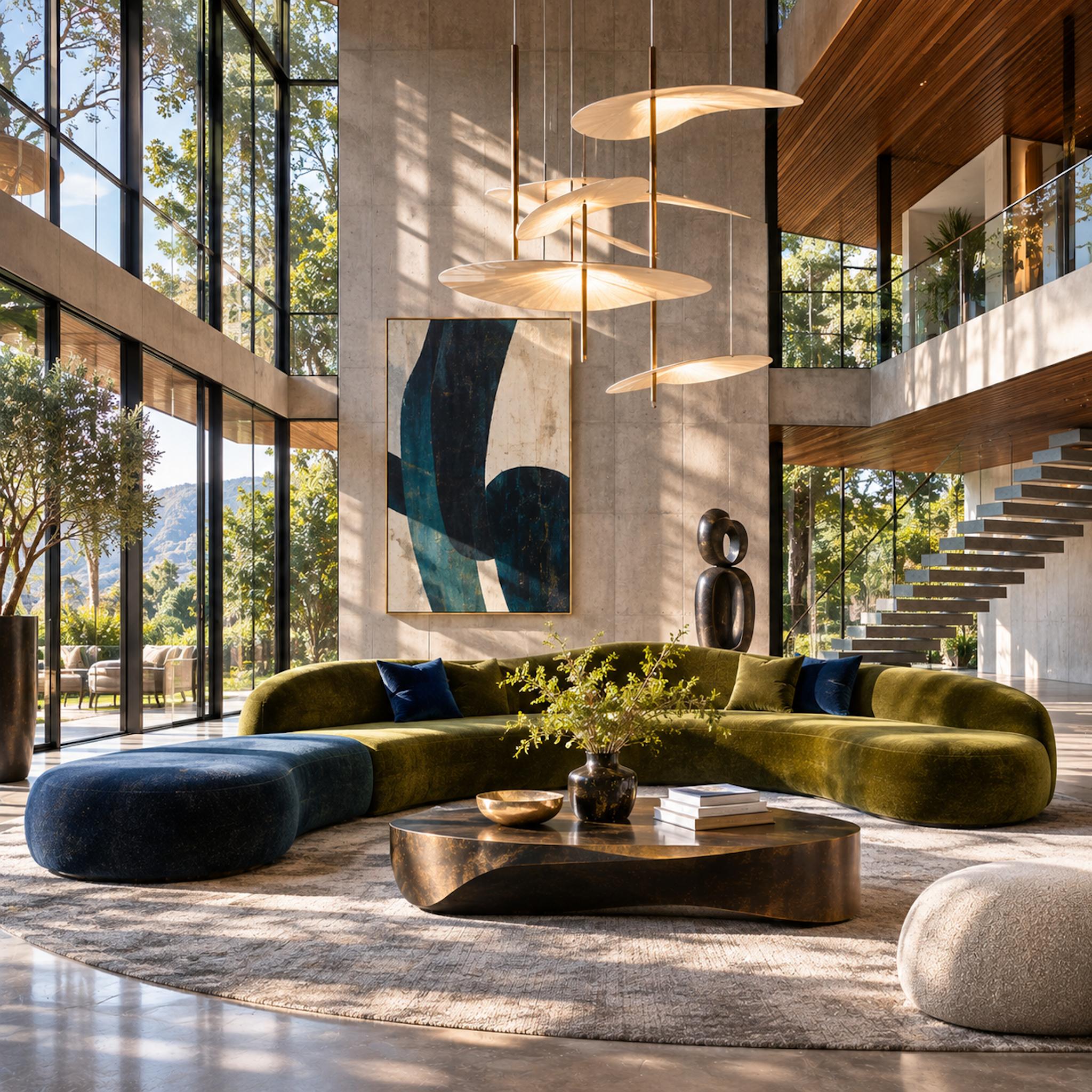
Olive-green velvet sweeps across the double-height living room in a broad, asymmetrical arc. A deep-blue extension pushes the seating outward at one end, changing the rhythm of the silhouette. Low, continuous upholstery keeps the full sweep of the sofa visible against the immense vertical space.
The seating arrangement establishes its own territory within the open plan, with a central table and clear views beyond the curved ends. Freed from the perimeter walls, the sofa defines a conversation area of its own. The blue module gives the arrangement an emphatic ending without closing off the surrounding space.
10. A Steel Chaise Drawn in the Shape of a Z
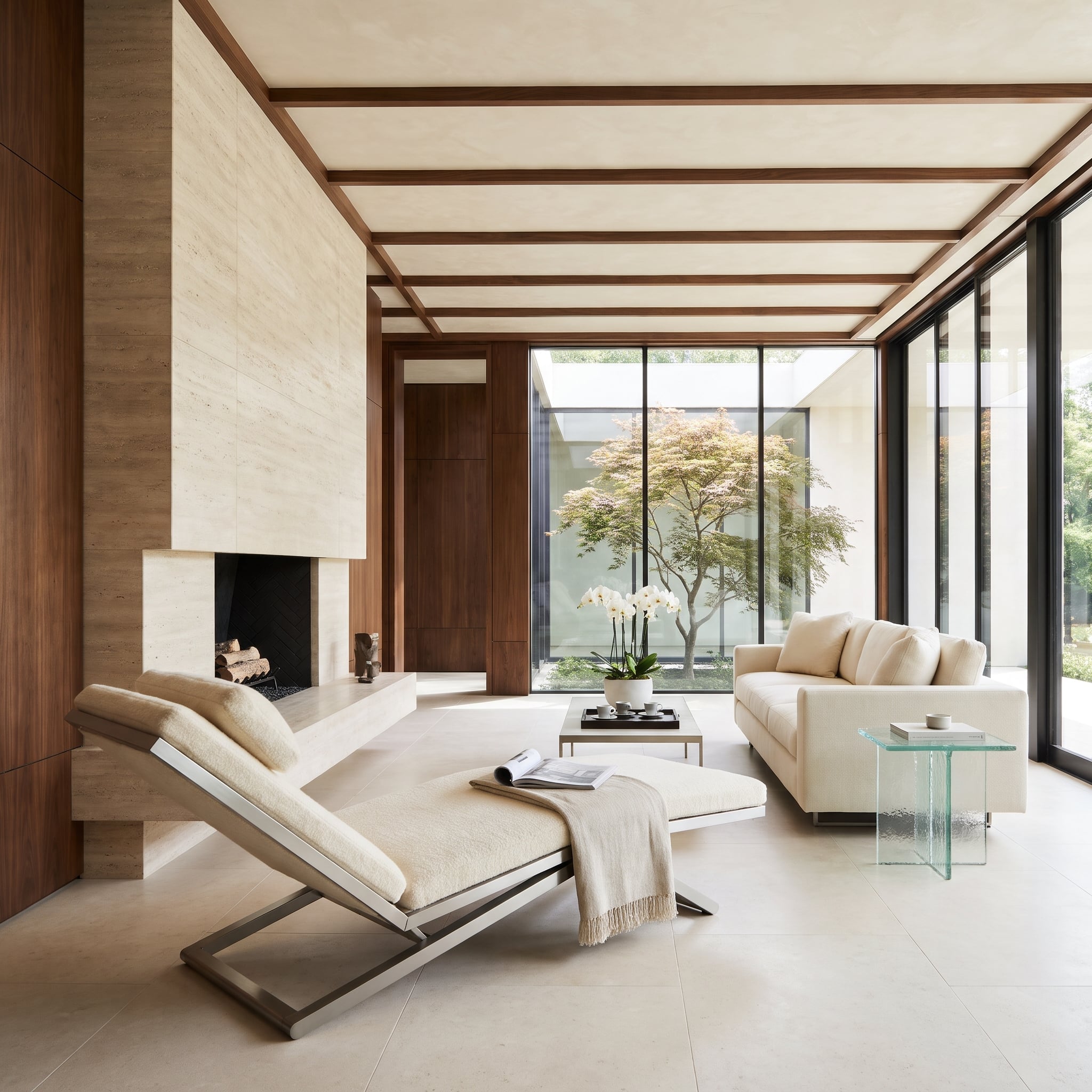
The brushed metal base of this chaise traces a pronounced Z. Its sharp turns give the supporting structure an identity almost independent of the long reclining surface above. The empty space between the angles is part of the composition.
Travertine and walnut provide an uncluttered background for the metal edges, while a rippled-glass side table introduces a contrasting texture. From the side, the chair’s graphic character is particularly striking; turning it toward the center of the room would reveal more of its distinctive base.
9. When Walnut Behaves Like Ribbon
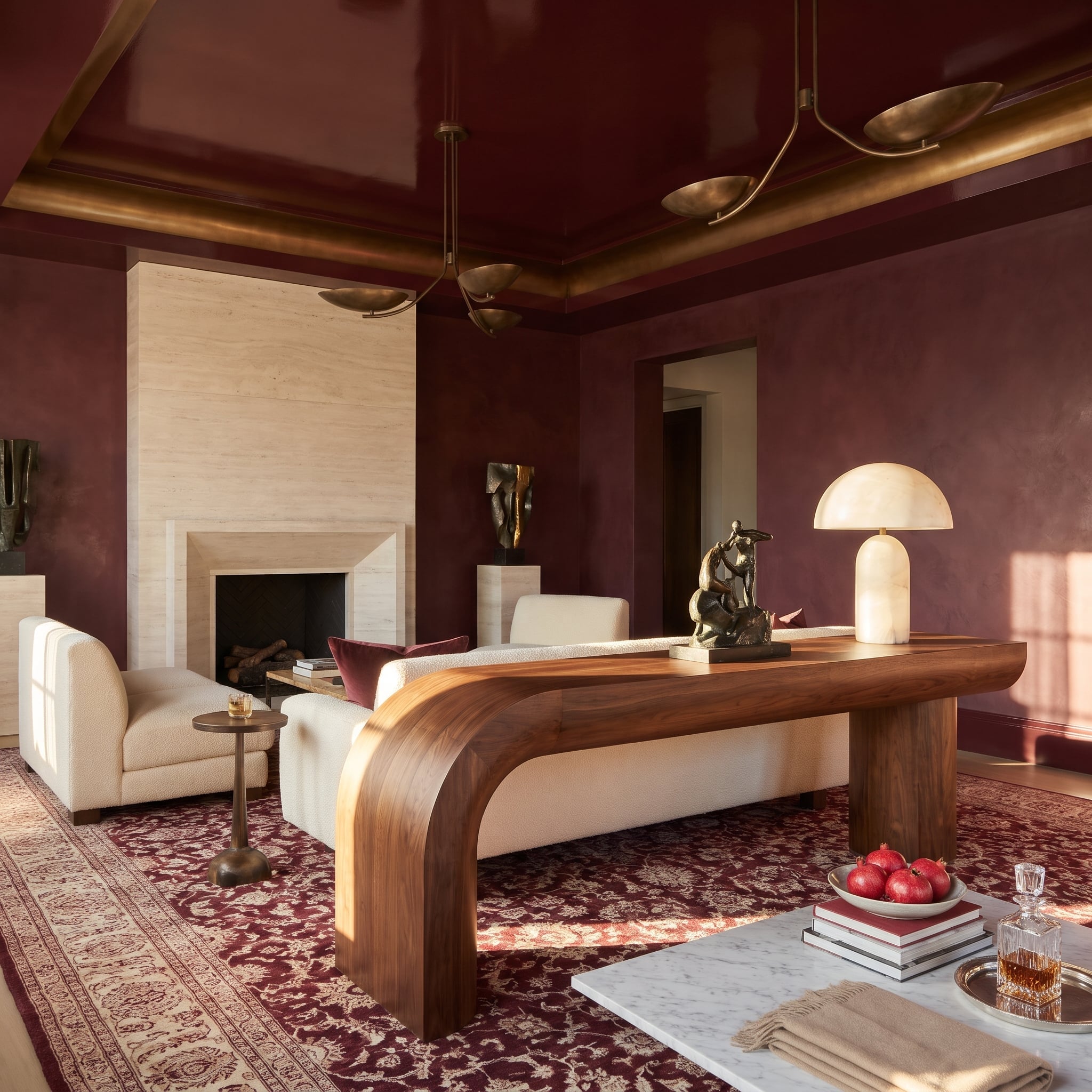
Behind the bouclé sofa, a thick walnut console curves down toward the floor in a single sweeping gesture. Tabletop and support seem to merge, with the grain following the turn of the wood. The end of the console becomes its defining feature.
An alabaster lamp glows against oxblood plaster, bringing a little radiance to the dark timber. Behind a sofa, a console normally earns its keep through lighting and display. The curling end gives the back of the seating group an architectural presence of its own.
8. A Woven Egg Chair That Defies the Floor
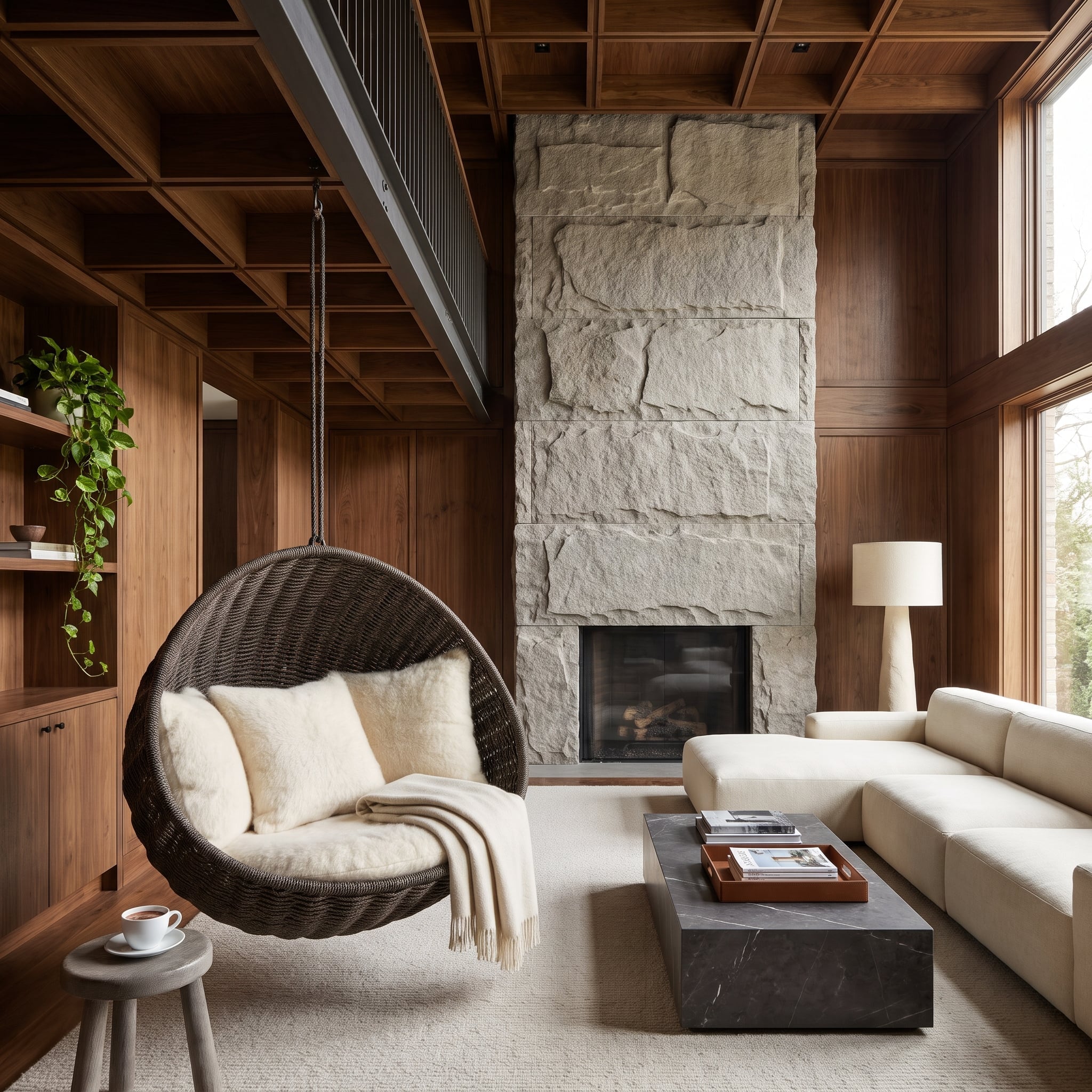
A woven egg chair hangs beneath the steel mezzanine, its basket-like shell filled with cream cushions and sheepskin. A slender suspension gives the seat an extraordinarily light appearance beside the immense limestone chimney.
The rough-cut stone anchors a composition built around the apparent freedom of the suspended seat. A small wooden stool offers a convenient surface without competing with the basket. Installation requires suitable structural anchorage, appropriately rated suspension hardware and clear space for the chair’s full range of movement.
7. The Sculpture Is Half Walnut, Half Empty Space
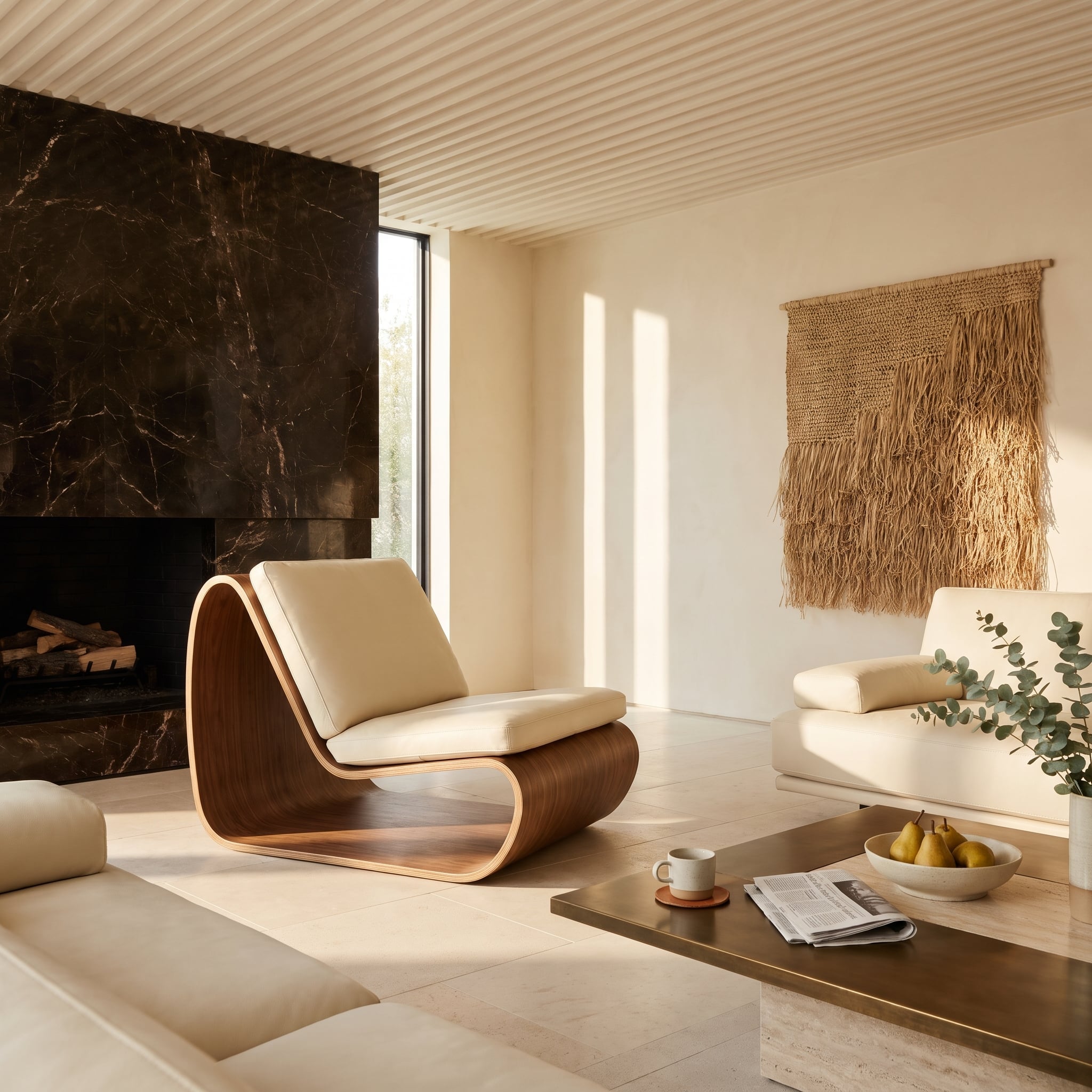
Walnut folds back on itself twice beneath cream leather cushions, tracing a broad ribbon against the dark marble hearth. The lower loop frames a patch of pale stone floor as neatly as a window frames a view.
Alternate bands of wood and open space spare the substantial chair from looking ponderous. Its sculptural character depends on the precision of each turn, with the voids doing as much for the composition as the timber. The restraint of the cream upholstery leaves the extraordinary profile uninterrupted.
6. Chrome, Smoked Glass and the Weight of Marble
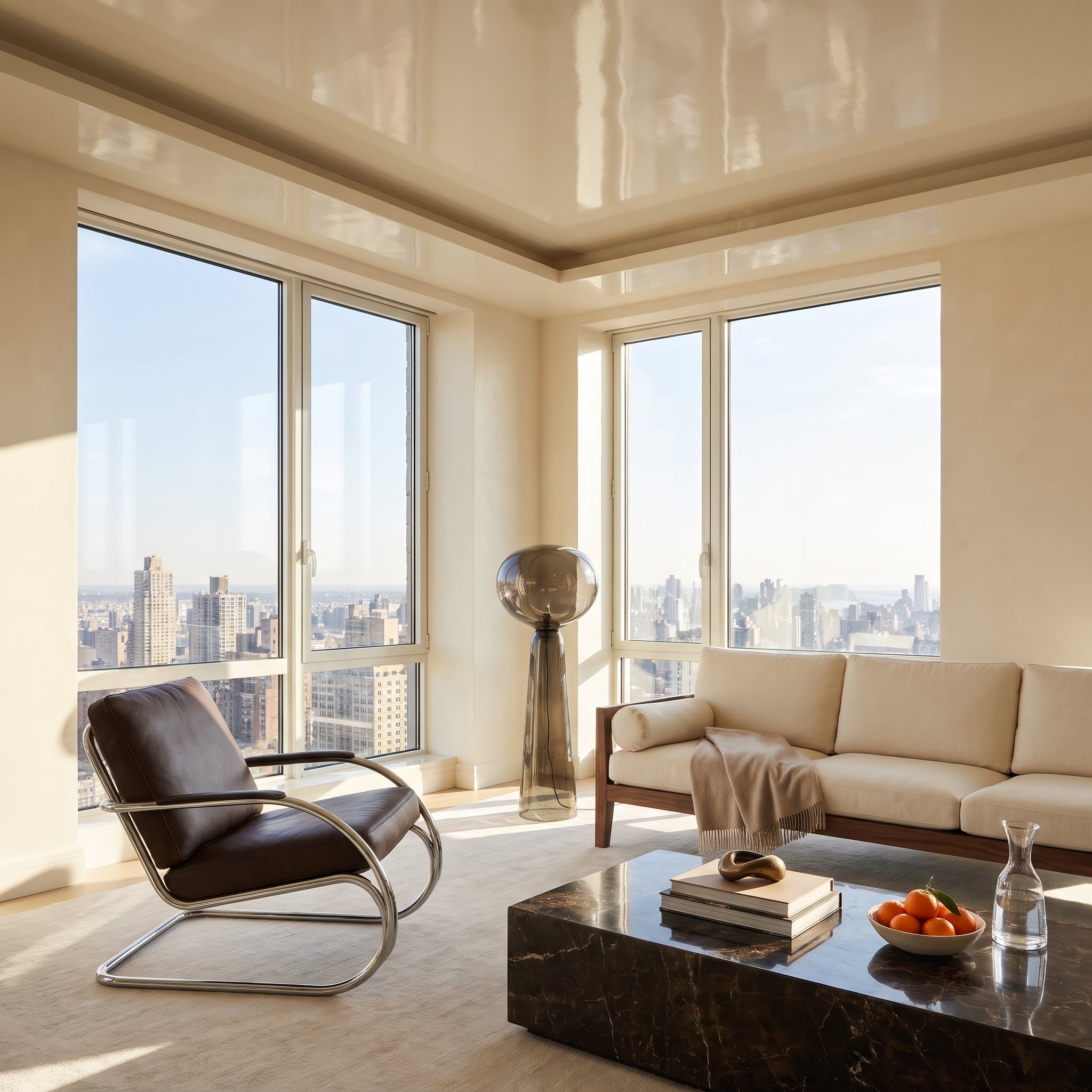
Chrome tubing turns beneath the espresso leather chair in the manner of a cantilever, creating the impression of a seat projecting beyond its support. The narrow gleaming lines give the dark upholstery a seemingly improbable lightness.
Nearby, a smoked glass lamp has the rounded translucency of a bubble, while a dark marble block table sits squarely on the floor. Daylight reflected by the glossy ceiling catches the chrome and glass. Together the three pieces turn visual gravity into a design principle: a slender line, a translucent volume and an uncompromising mass.
5. A Cocoon in the Middle of the Living Room
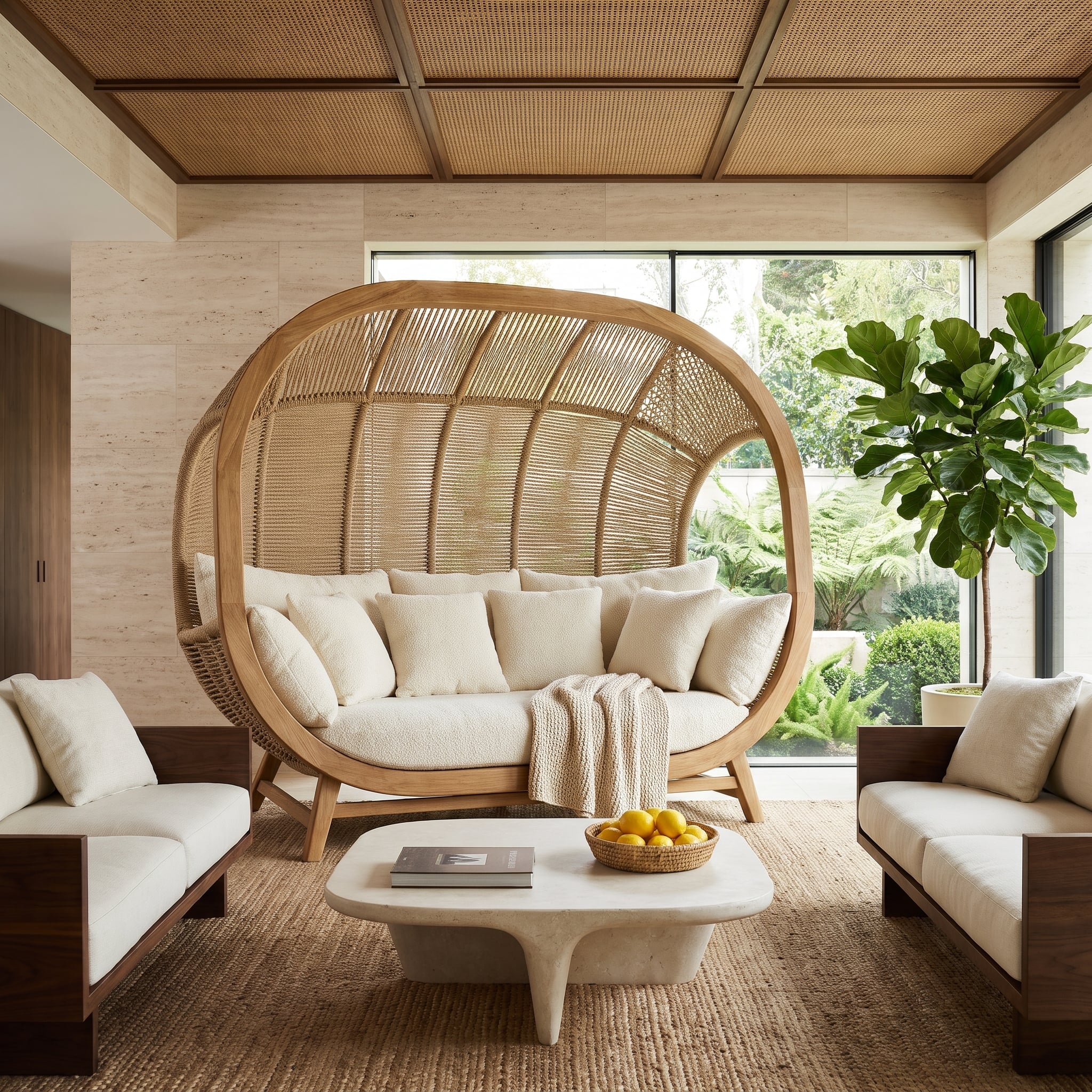
An oval teak-colored structure encloses a generous reclining surface, with twisted rope stretching across its curved shell. The daybed creates the impression of a private retreat in the middle of a shared room. Daylight passes through the weave, keeping the enclosure visually connected to the garden.
Rectangular walnut-framed sofas offer a more conventional place for conversation. Overhead cane paneling extends the woven texture at an architectural scale. The intimate dimensions of the cocoon offer a counterpoint to the expansive seating area, introducing a more personal scale into the room.
Comfort Check: Before choosing a deep cocoon seat, consider how easily occupants can enter and rise from it. Keep the opening clear and leave sufficient space around the shell for circulation.
4. Steel Crosses Swords Beneath a Leather Chaise
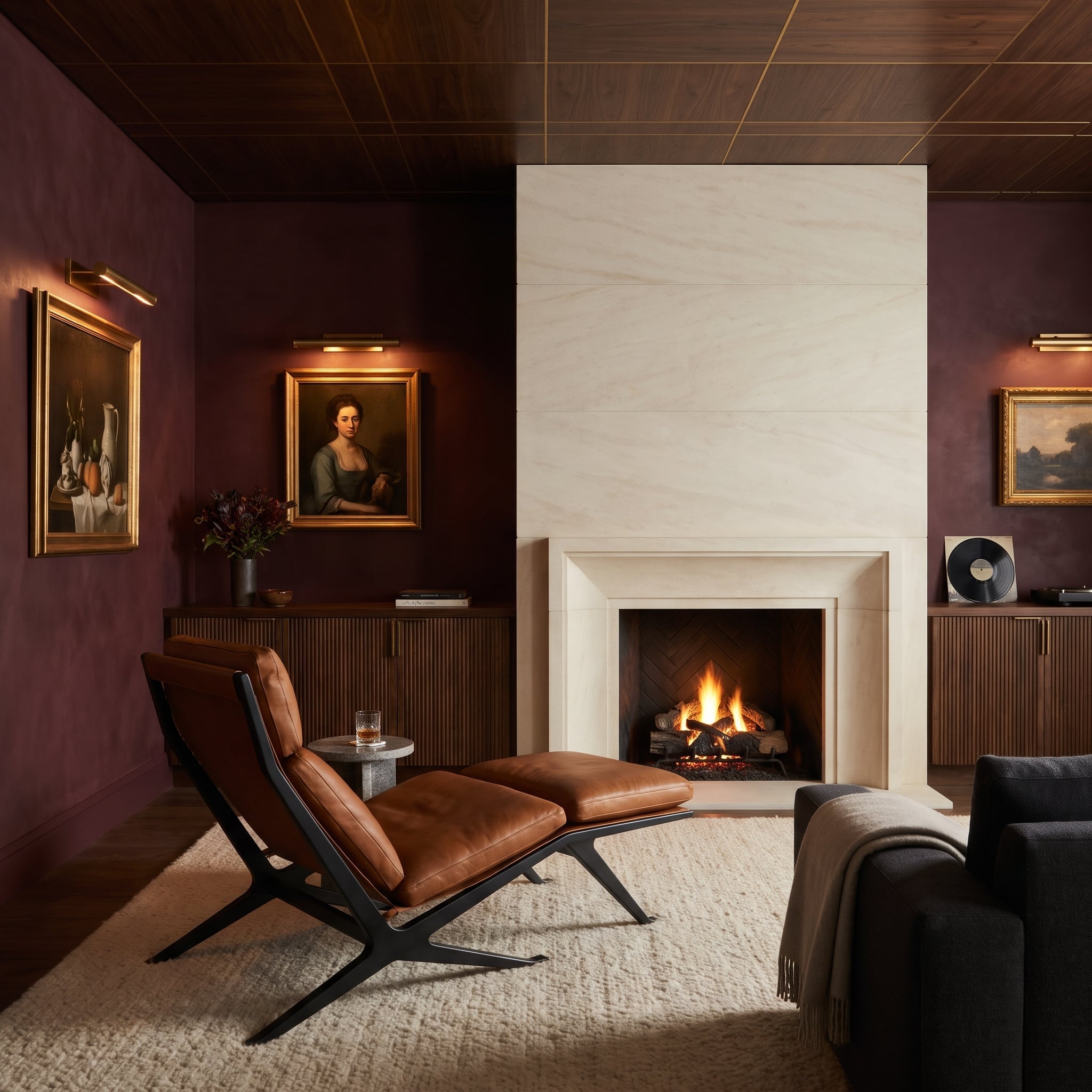
Black steel members intersect beneath the tan leather chaise, forming a trestle-like base of crisp angles. Above them, the long upholstered surface offers a softer, continuous line. The meeting of steel and leather is particularly striking where the seat tips upward.
Plum plaster and pale limestone make the dark supports conspicuous from across the room. The intersecting supports introduce a lively diagonal rhythm against the calm expanse of leather. The underlying structure becomes the piece’s ornament.
3. Olive Leather Within a Continuous Wooden Loop
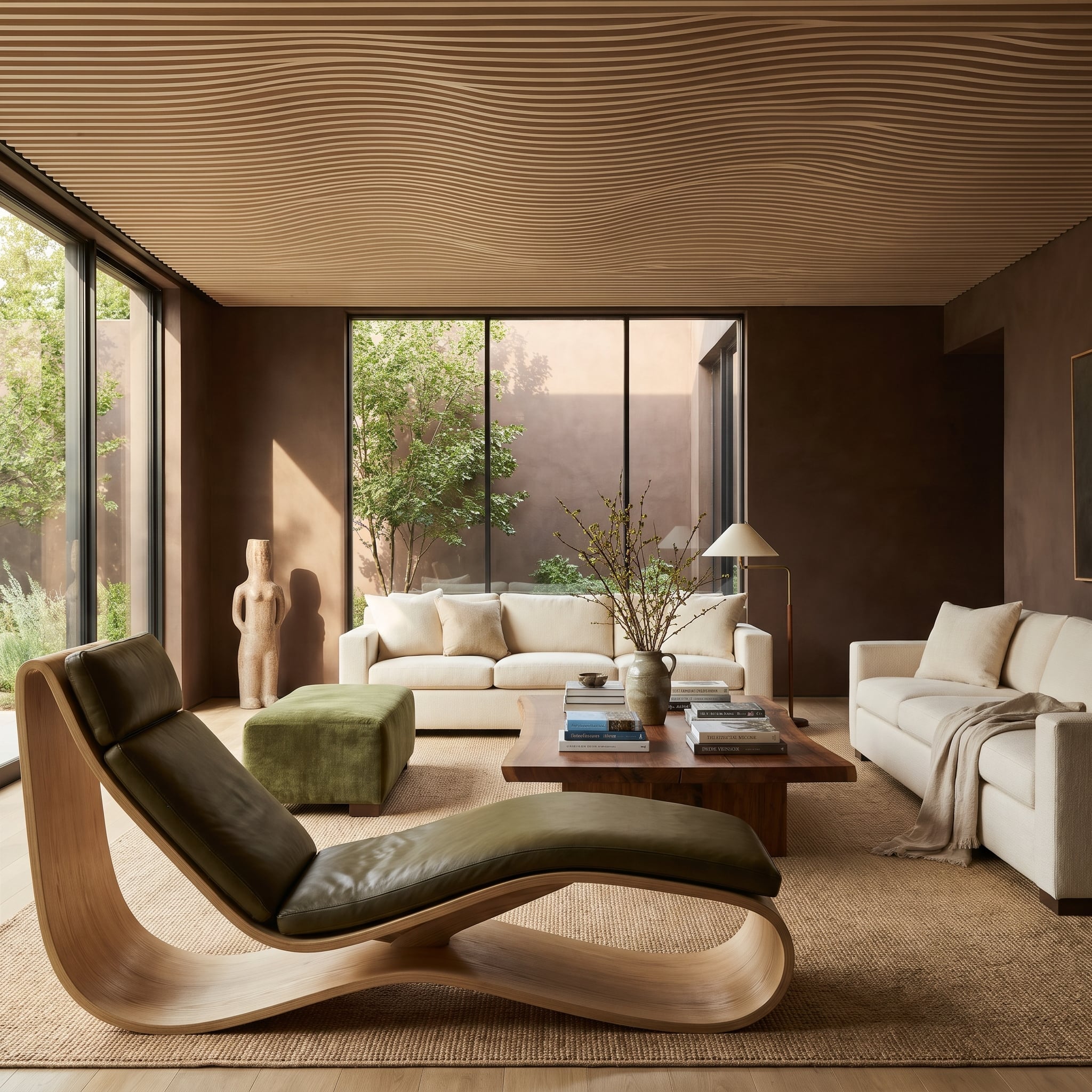
A broad wooden loop sweeps around the olive leather chaise in an apparently continuous line. The generous opening beneath the upholstery balances the heft of the timber, while the tapering edges carry the eye along the profile of the reclining seat.
Rippling wooden slats overhead extend the flowing lines on a larger scale. An oblique position reveals the open base and the angle of the reclining seat together. Olive leather supplies a subdued note of color among the warm timber tones.
2. A Ribbon of Bronze Draws the Line Between Two Levels
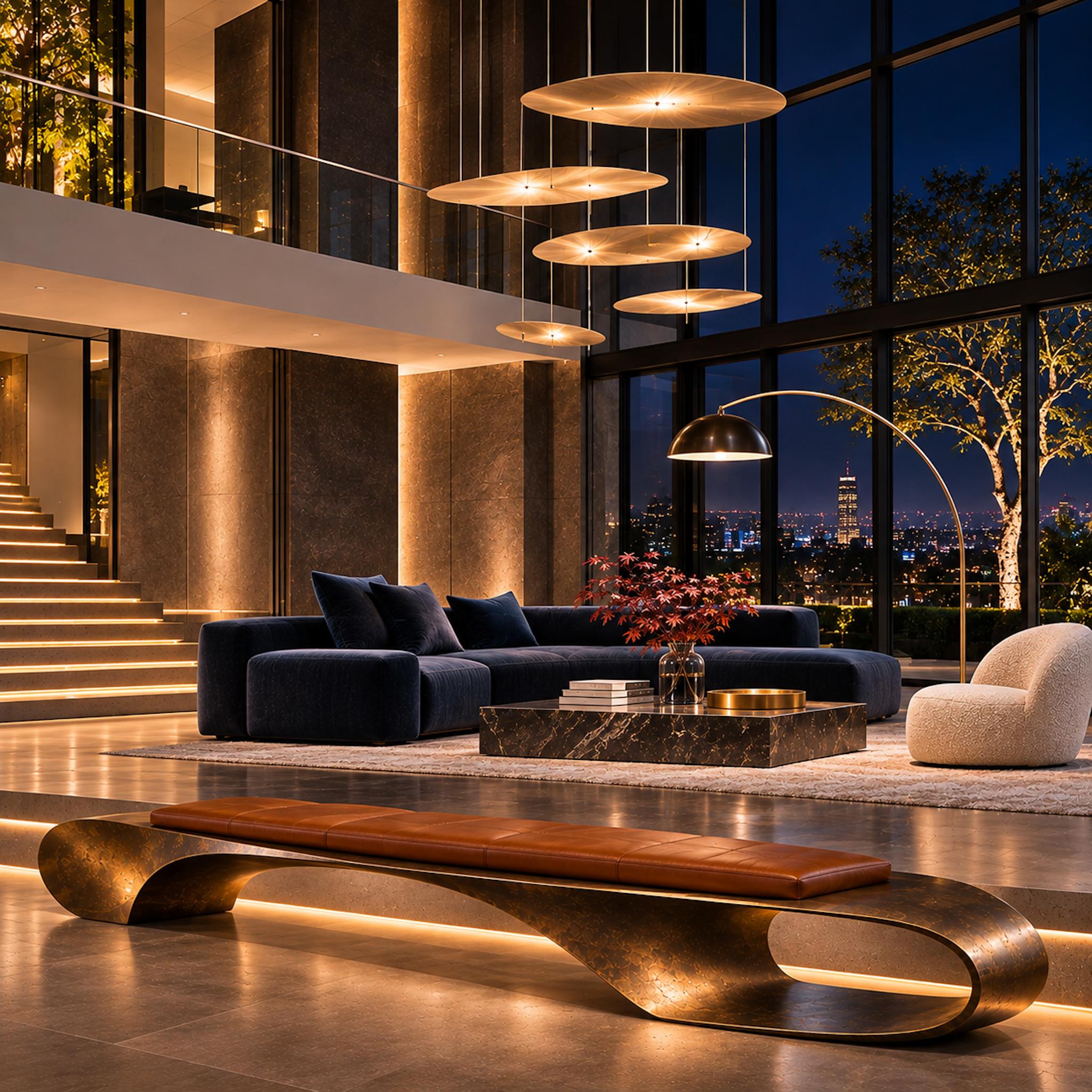
A long ribbon of bronze-colored metal sweeps down at either end of a saddle-brown leather seat. One end curls into an open loop; the other turns inward beneath the cushion. In profile, the bench is an exercise in positive and negative space, with the slender seat balanced visually by the broad curves of its base.
Placed along the change in floor level, the bench establishes a boundary without interrupting the view into the double-height lounge. Concealed step lighting picks out the curves and the mottled metallic finish. The bench is beautifully economical in its purpose: a single piece of seating articulates the architecture and supplies the room’s most compelling sculptural line.
1. A Wingback That Borrows Its Architecture From the Sea
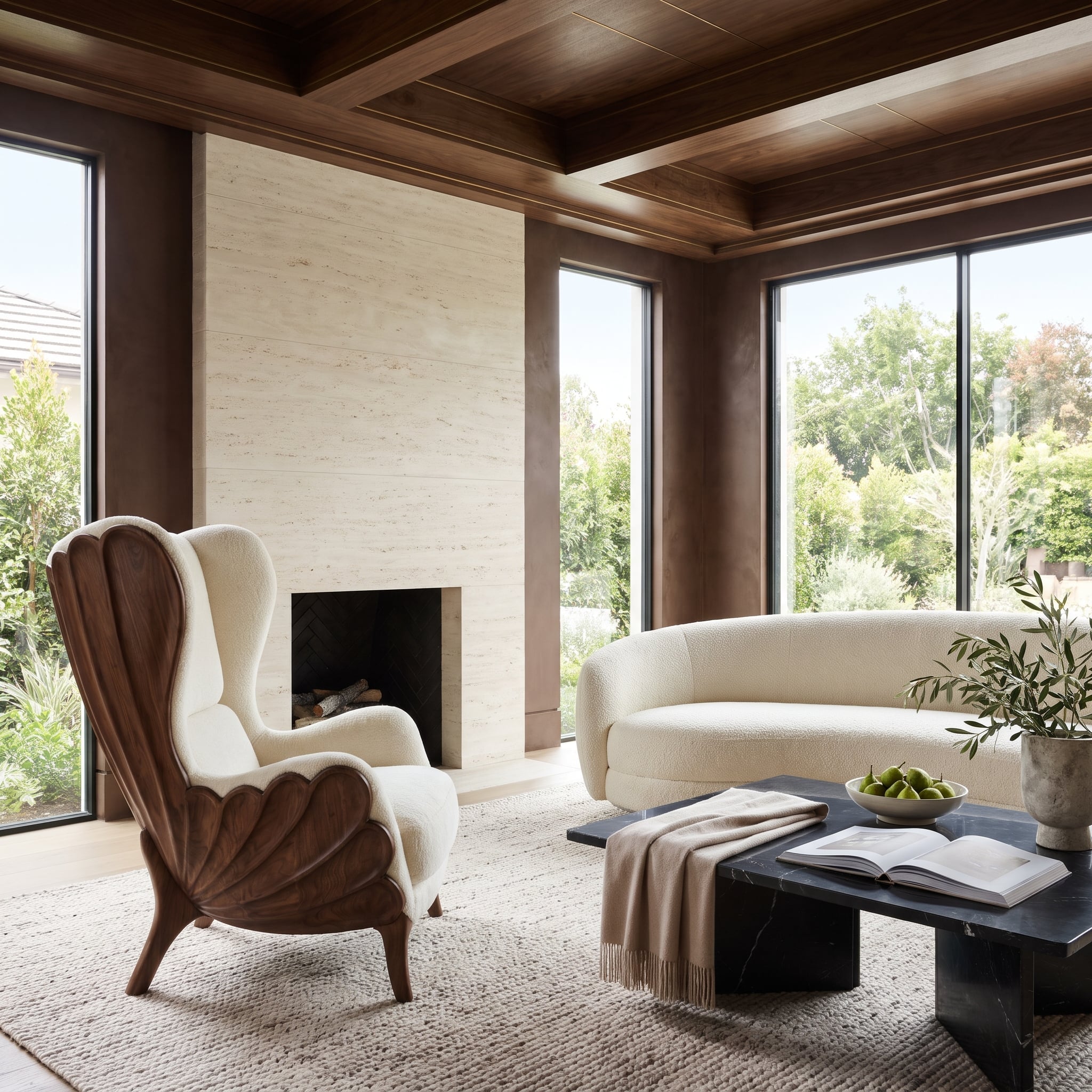
Scalloped walnut ribs fan across the back and arms of this magnificent wingback. Window light catches the raised edges and falls into the hollows between them, giving the shell the depth of carved relief. Cream bouclé nestles inside the wooden lobes, softening the imposing exterior.
The coffered ceiling extends the walnut palette, and the horizontal grain of the travertine hearth offsets the radiating ribs. Unlike an ordinary upholstered wingback, the chair treats its outer shell as the main attraction. There is no need for a pedestal or a display case when the outer surface of a chair can hold the attention as completely as a piece of sculpture.
Among our readers, those who picked a wingback as their one accent chair were more likely to choose traditional shelving too, 84% versus 60% of everyone else.