🔥 Would you like to save this?
The television above the fireplace has been treated as an interior design felony for years. Too high to watch comfortably, too close to the heat, and too much black glass competing with the room’s architectural centerpiece. The objections aren’t nonsense. But somewhere along the way, sensible design advice became an absolute prohibition, and some rather spectacular living rooms are making a convincing case for reconsideration.
In order to come up with the very specific design ideas, we create most designs with the assistance of state-of-the-art AI interior design software. Also, assume links that take you off the site are affiliate links such as links to Amazon. this means we may earn a commission if you buy something.
The difference between a design disaster and a beautifully integrated fireplace wall comes down to proportion, placement, and materials. Low linear fireboxes can create more flexibility for screen height, while stone, plaster, timber paneling, and built-in cabinetry give the television and fireplace a coherent architectural setting. Recessed screens, articulated mounts, and mirror televisions offer further possibilities. None overrides the essentials: comfortable viewing angles, heat management, ventilation, and manufacturer-specified clearances.
These 34 living rooms explore what happens when the fireplace and television stop fighting for attention and start working together. From emerald zellige and dramatic marble to sculptural travertine and concealed screens, the best designs turn an awkward pairing into an architectural asset. The rulebook may be burning, but good design still requires a cool head.
34. Emerald Zellige Gives the Television Some Serious Competition
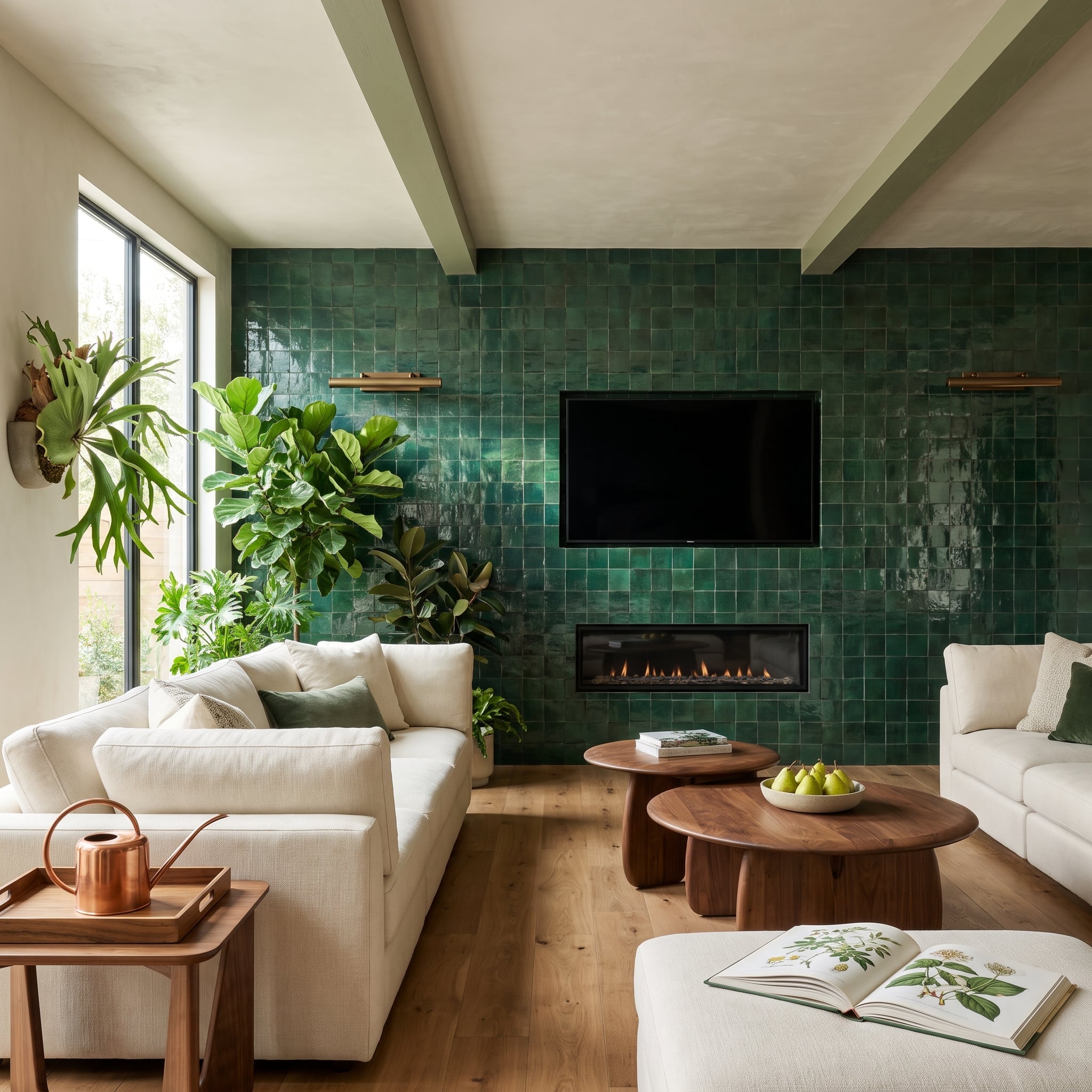
Emerald green tile is hardly the conventional solution to making a television less conspicuous. Yet the glossy, irregular surface gives this fireplace wall a richly textured architectural identity. Individual tiles catch the daylight differently, creating a shifting field of greens rather than a perfectly uniform backdrop.
The linear fireplace establishes a horizontal base beneath the screen. Exposed ceiling beams introduce a contrasting rhythm overhead, while walnut nesting tables and copper accents bring warmth to the saturated green.
Traditional Moroccan zellige is glazed terracotta, valued for its variations in color, surface, and edge. That variation is precisely what makes the wall interesting. The television occupies its place in the composition without becoming the only thing worth looking at.
33. Black Slate Gives a Switched-Off Screen Somewhere to Disappear
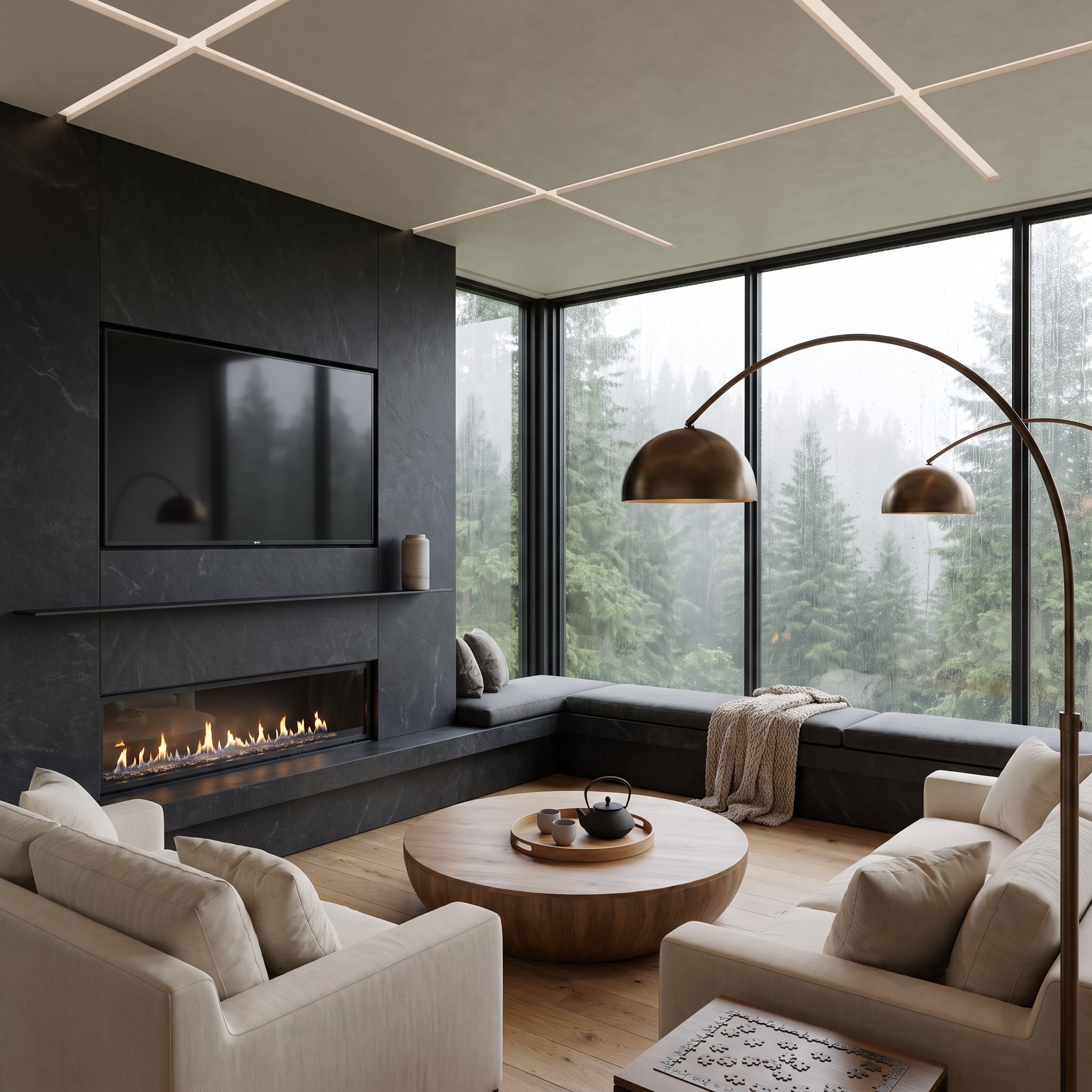
Against a pale wall, an inactive television can resemble an enormous black rectangle. Against charcoal slate, its outline becomes considerably less pronounced. The dark cladding turns what might have been a visual interruption into part of a continuous architectural surface.
The linear fireplace sits low beneath the screen, while cream upholstery prevents the composition from becoming oppressive. A substantial wood drum table adds another natural material, and the double arc lamp introduces a sculptural counterpoint to the rigid stone.
Beyond the glazing, rain-darkened trees provide a completely different texture: irregular branches, muted greens, and atmospheric daylight. The room’s strongest quality is the contrast between that softness and the disciplined fireplace wall.
Design Detail: Dark cladding can reduce the contrast around an inactive television. It does not solve excessive mounting height or heat exposure, which require separate consideration.
Not everyone is sold on an all-dark scheme, though: living room images dominated by black got hearts from our readers 15% of the time, versus 28% for other images in the same articles.
32. Whitewashed Brick and Walnut Built-Ins Give the Screen Some Company
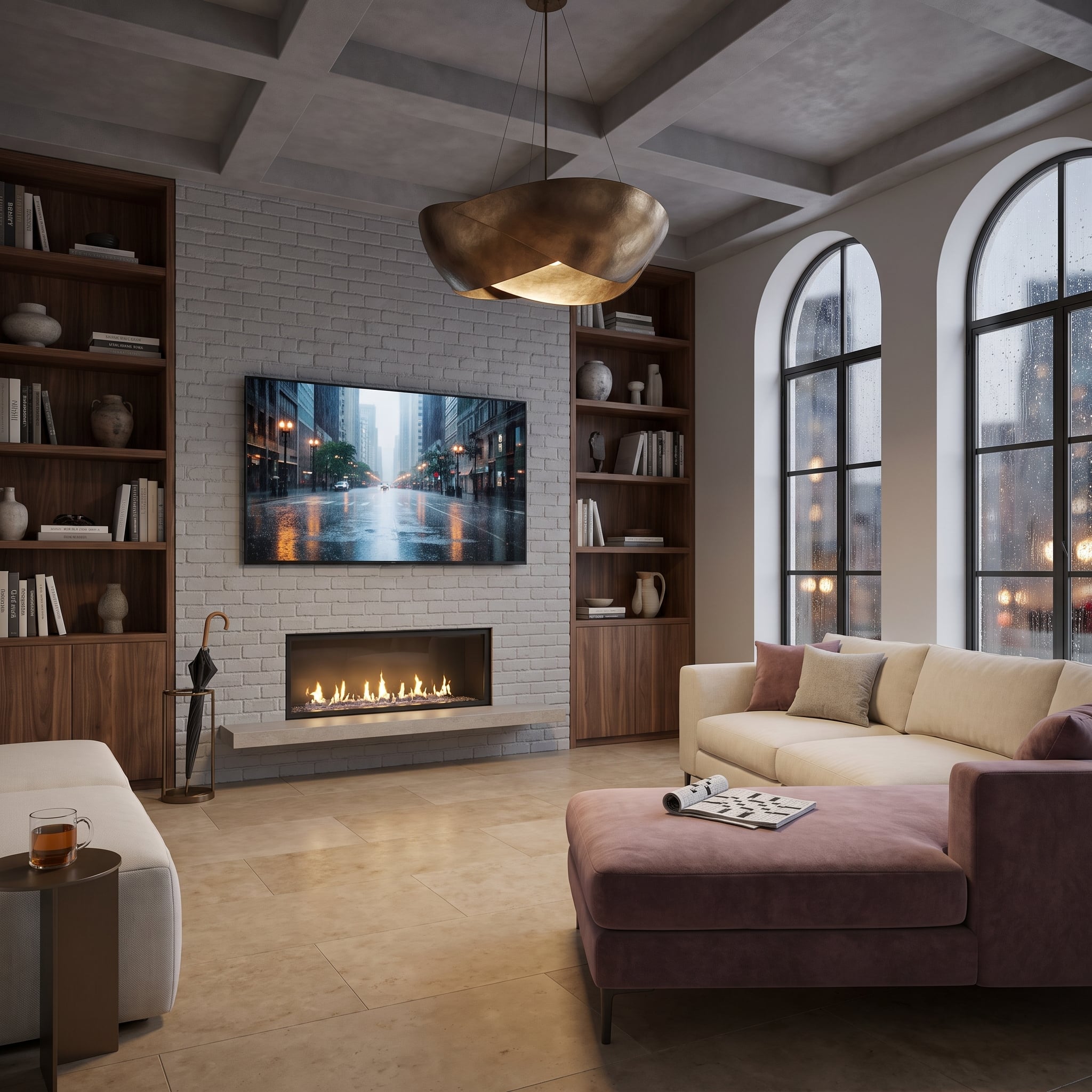
Whitewashed brick supplies texture without the visual weight of dark masonry. Mortar joints remain visible beneath the finish, giving the fireplace wall an architectural rhythm that smooth plaster would lack.
Walnut built-ins frame the central television and linear fireplace, extending the composition across the room rather than concentrating everything in one narrow vertical stack. Coffered ceiling details reinforce the orderly geometry overhead.
A cream sofa and dusty rose velvet sectional introduce softer colors, while rain-streaked arched windows add another layer of texture. The television isn’t concealed. It simply has enough architectural company to stop looking like an afterthought.
31. A Mirrored Ceiling Meets a Fireplace Wall of Dark Marble
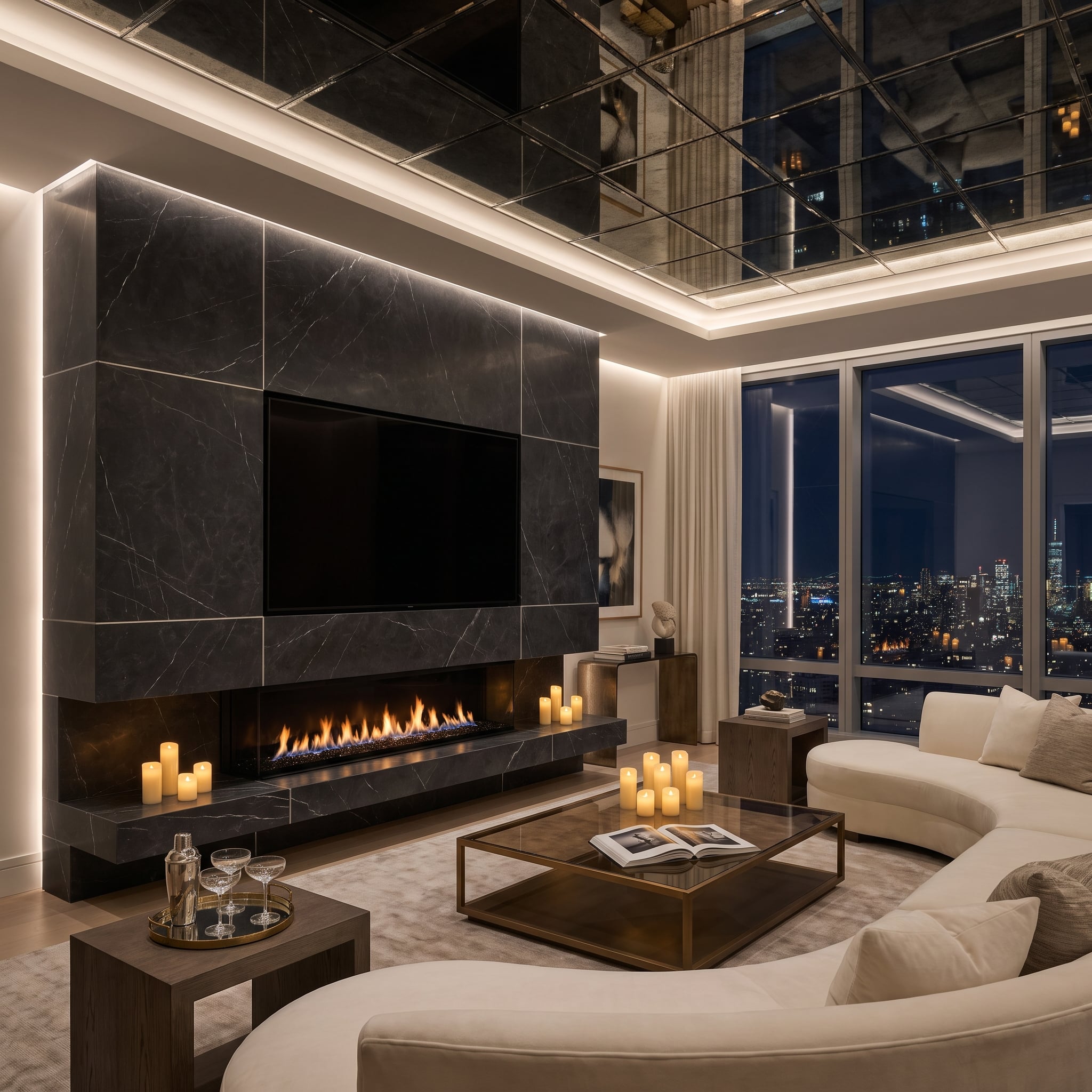
Smoked mirror overhead, dark veined marble ahead, and a nighttime skyline beyond the glass. Restraint isn’t the governing principle here, although the composition is more disciplined than its materials initially suggest.
The television occupies the marble surface above a broad linear fireplace. Its dark frame works with the stone rather than interrupting it, while the horizontal flame introduces a concentrated band of warm light. Reflections across the ceiling extend the room’s visual complexity.
Curved cream seating supplies relief from the polished dark finishes. Candles, amber cove lighting, and the fireplace create several layers of illumination. The television belongs to a deliberately theatrical architectural setting, one that has no intention of pretending otherwise.
30. Fluted Oak and Rust Velvet Take the Edge Off the Screen
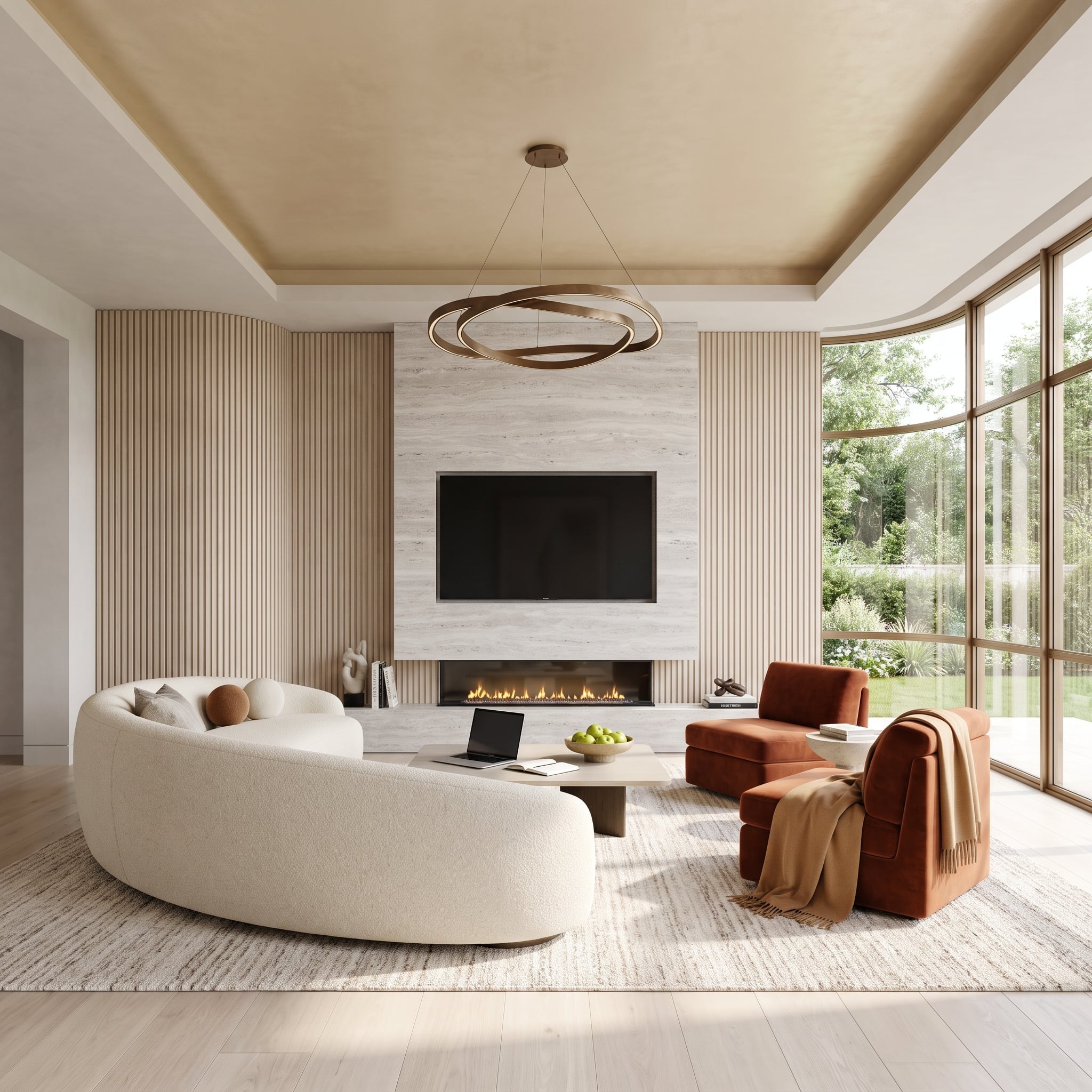
Vertical oak slats flank a pale travertine fireplace surround, introducing enough texture to make the television part of a composed wall rather than an isolated appliance.
The linear firebox establishes a broad horizontal opening beneath the screen. Across the room, a curved cream bouclé sectional draws the seating inward, while rust velvet armchairs supply the saturated color missing from the restrained stone and timber palette.
A bronze ring pendant adds another shape overhead. Vertical timber, horizontal flame, curved seating, and circular lighting create a lively interplay of geometry without allowing any one feature to overwhelm the others.
What Our Readers Say
- Asked which living room wall paint they would buy, our readers chose greige most often at 46%, ahead of green at 31% and white at 19%.
- In our Hot or Not photo matchups, living room pictures with dark wood tones won more of their head-to-head matchups than expected, 60% against 53% from position alone.
From Home Stratosphere reader polls and votes.
29. Calacatta Viola Marble Refuses to Play Second Fiddle to a Television
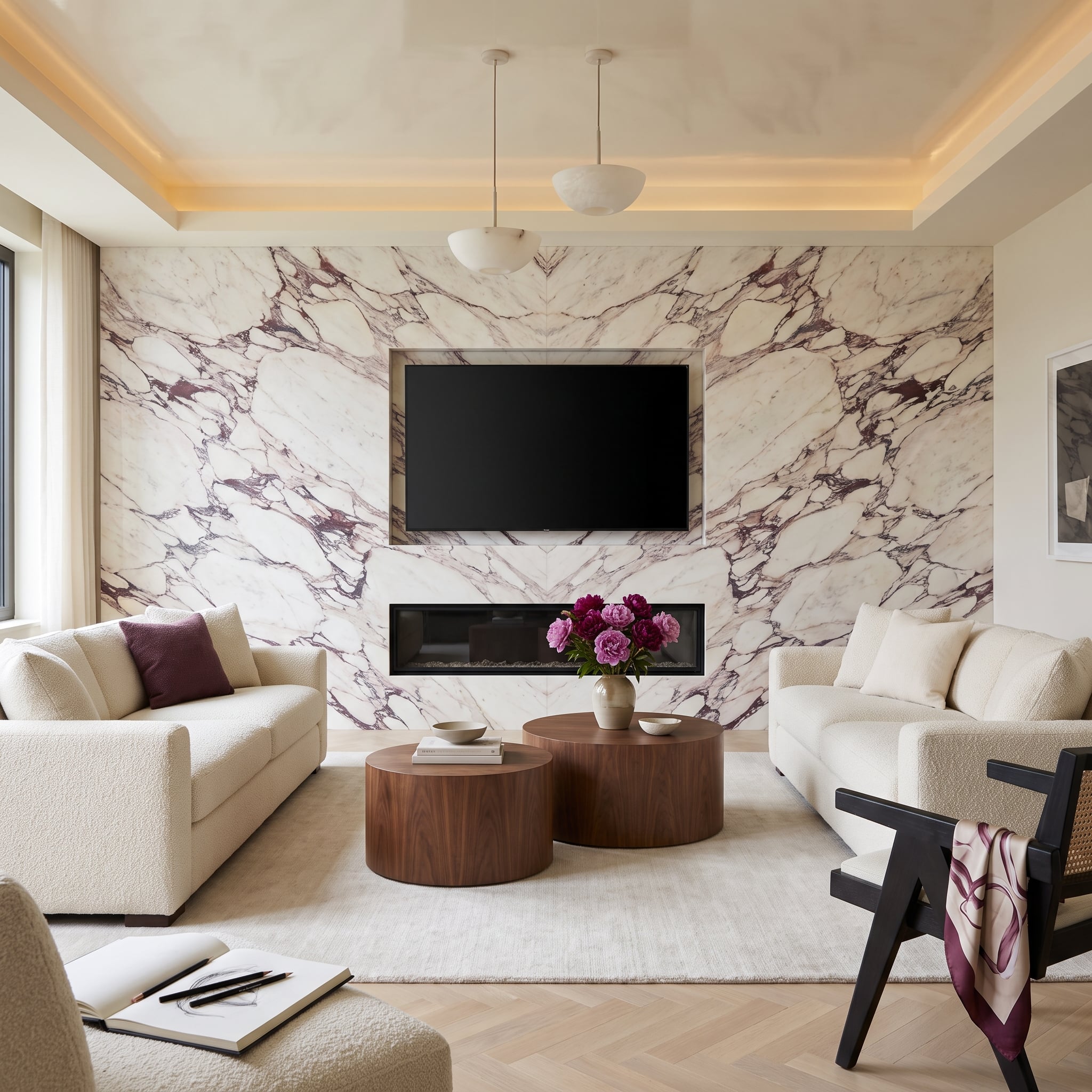
With its dramatic burgundy veining, Calacatta Viola has little interest in behaving like a neutral backdrop. That is precisely why the television doesn’t dominate this living room. The marble provides a powerful composition of its own.
The recessed screen sits within the stone face, above a long horizontal fireplace. Two oval walnut coffee tables introduce warmth and softer geometry, while pale bouclé sofas give the marble sufficient space to command attention.
Perimeter cove lighting illuminates the upper walls without adding another prominent fixture. The result is opulent, certainly, but the television and fireplace remain neatly contained within the larger stone composition.
Material Alternative: Large-format porcelain can reproduce dramatic marble veining, although fabrication, seams, installation costs, and suitability around a particular fireplace should all be evaluated before selecting a finish.
28. A Glowing Grid Ceiling Changes the Mood of an Oak Fireplace Wall
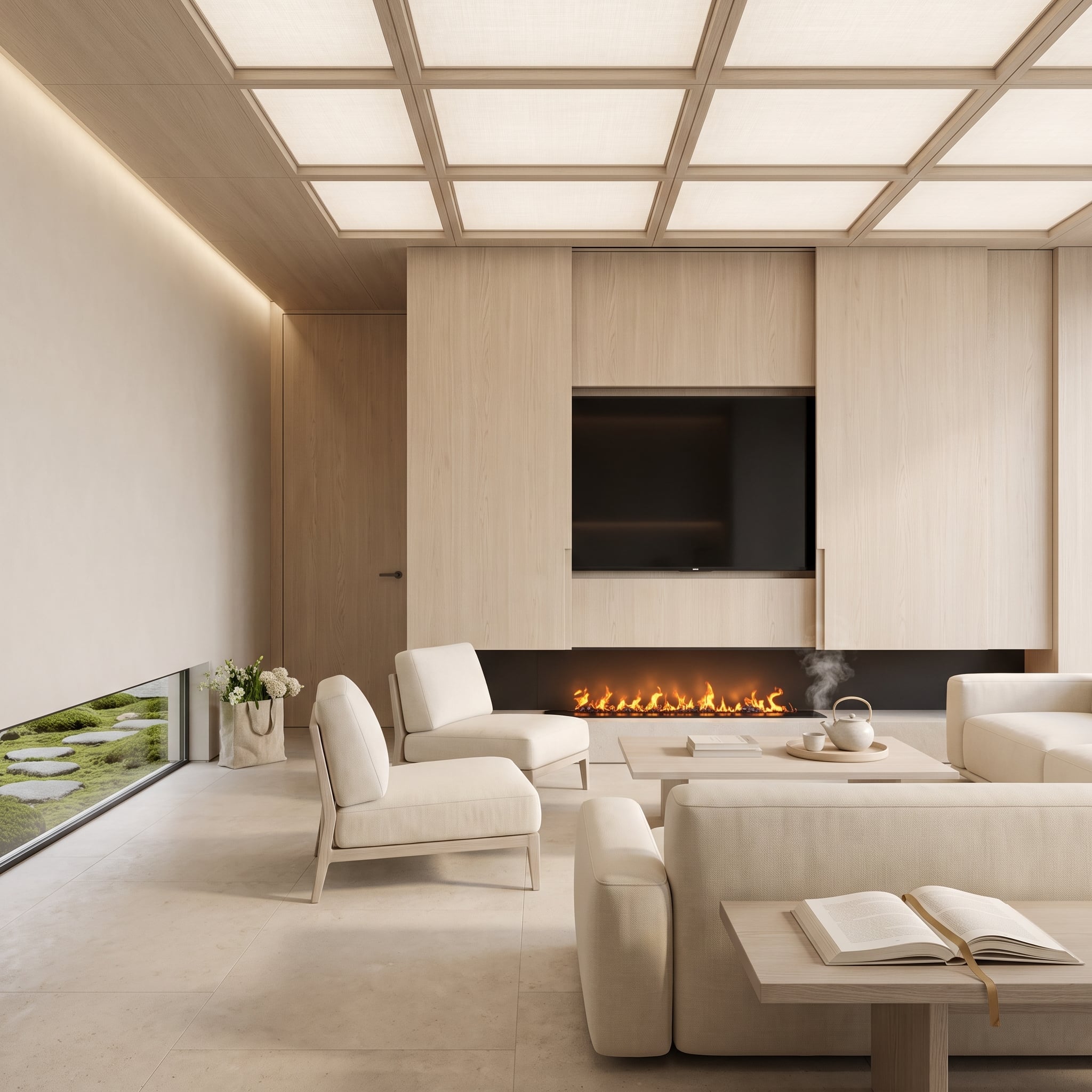
Bleached oak millwork covers the fireplace wall, integrating the television into a continuous surface of pale timber. The linear fireplace sits close to the floor, establishing a strong horizontal line beneath the screen.
The ceiling delivers the unexpected move. Backlit gridded panels distribute diffused illumination across the room, creating an even glow that contrasts with the concentrated brightness of the flames.
Low-profile linen seating, a restrained wooden table, and the quiet grain of the oak prevent the luminous ceiling from becoming overwhelming. The room’s boldest architectural decision isn’t the television above the fireplace. It’s turning the ceiling into a major source of ambient light.
27. Double-Height Plaster Gives the Fireplace Wall Monumental Scale
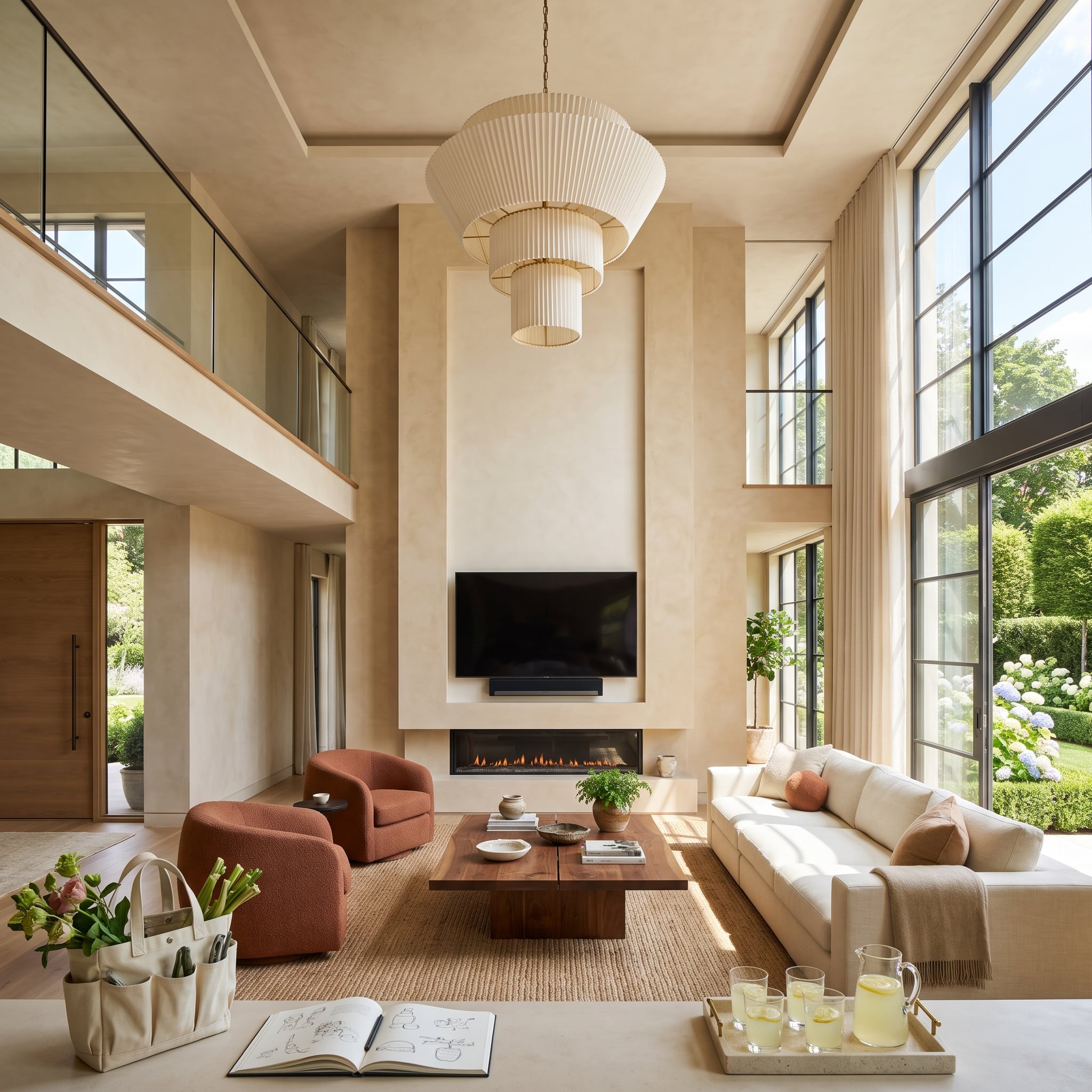
A double-height wall can make a conventional fireplace appear undersized. Here, a broad linear burner and centrally mounted television establish a substantial composition against sand-toned plaster.
The softly varied finish keeps the tall surface from looking blank. A tiered paper pendant introduces a second vertical feature, while rust bouclé chairs and low seating restore a more intimate scale beneath the soaring ceiling.
The generous wall height makes the arrangement visually convincing, although the television still needs to be positioned for comfortable seated viewing. Architectural grandeur and practical screen placement remain separate considerations.
26. Deep Navy Paneling Makes the Entire Room Part of the Composition
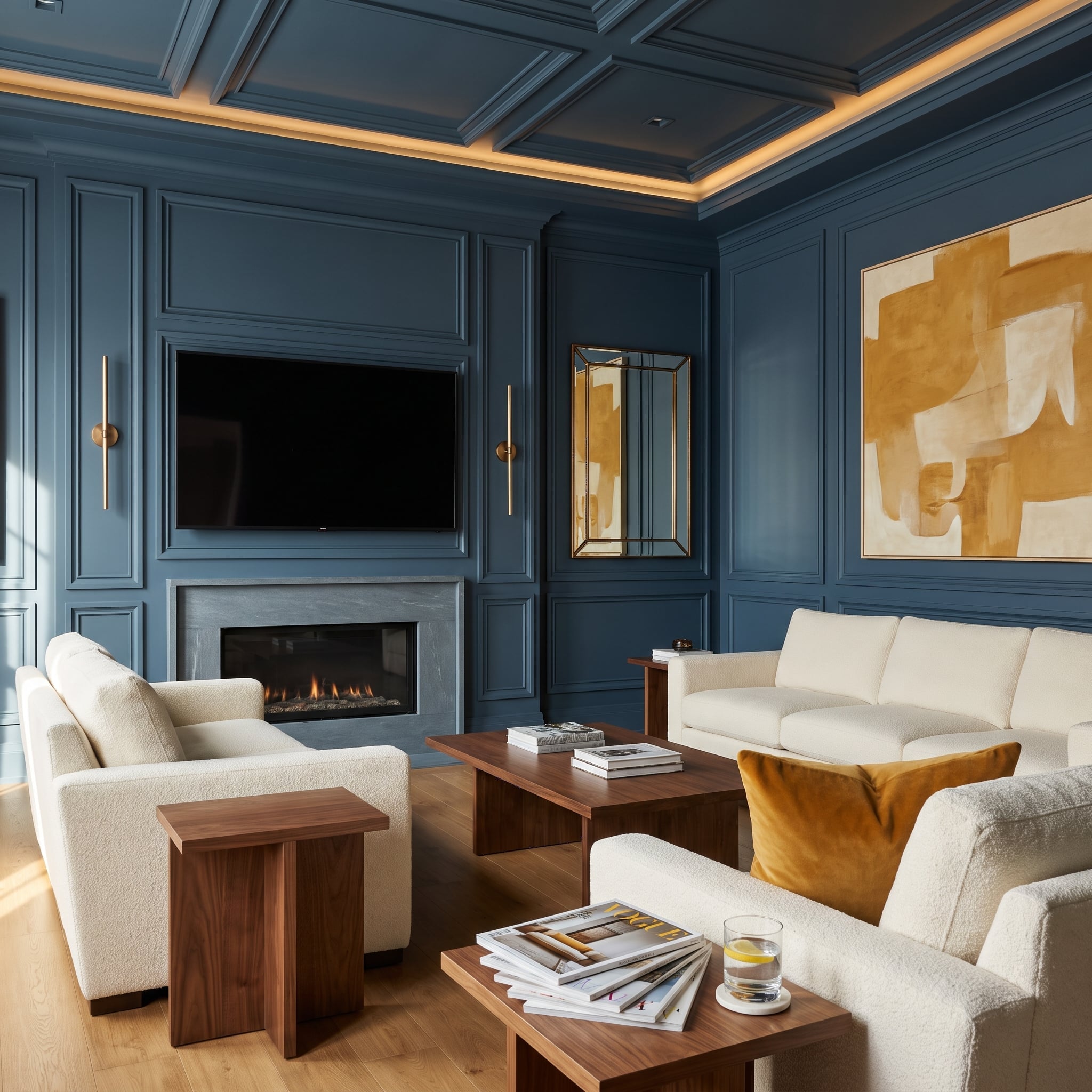
Deep slate-blue moves from the baseboards across the walls and into the coffered ceiling, giving this living room a remarkably unified envelope. Rather than singling out the fireplace wall with a contrasting finish, the design treats the entire interior as one composition.
The television and fireplace share that saturated architectural setting instead of being framed by a separate, attention-seeking media wall. The dark finish helps the screen settle into the room, while the surrounding paneling gives the fireplace a more substantial visual context.
Brass sconces, ochre artwork, and walnut coffee tables punctuate the blue. Cream bouclé seating establishes a lighter foreground, preventing the saturated color from feeling oppressive. Color does much of the architectural work here, allowing the television and fireplace to remain functional features without dictating the character of the entire room.
25. A Swing-Out Television Turns the Fireplace Wall Into Adjustable Architecture
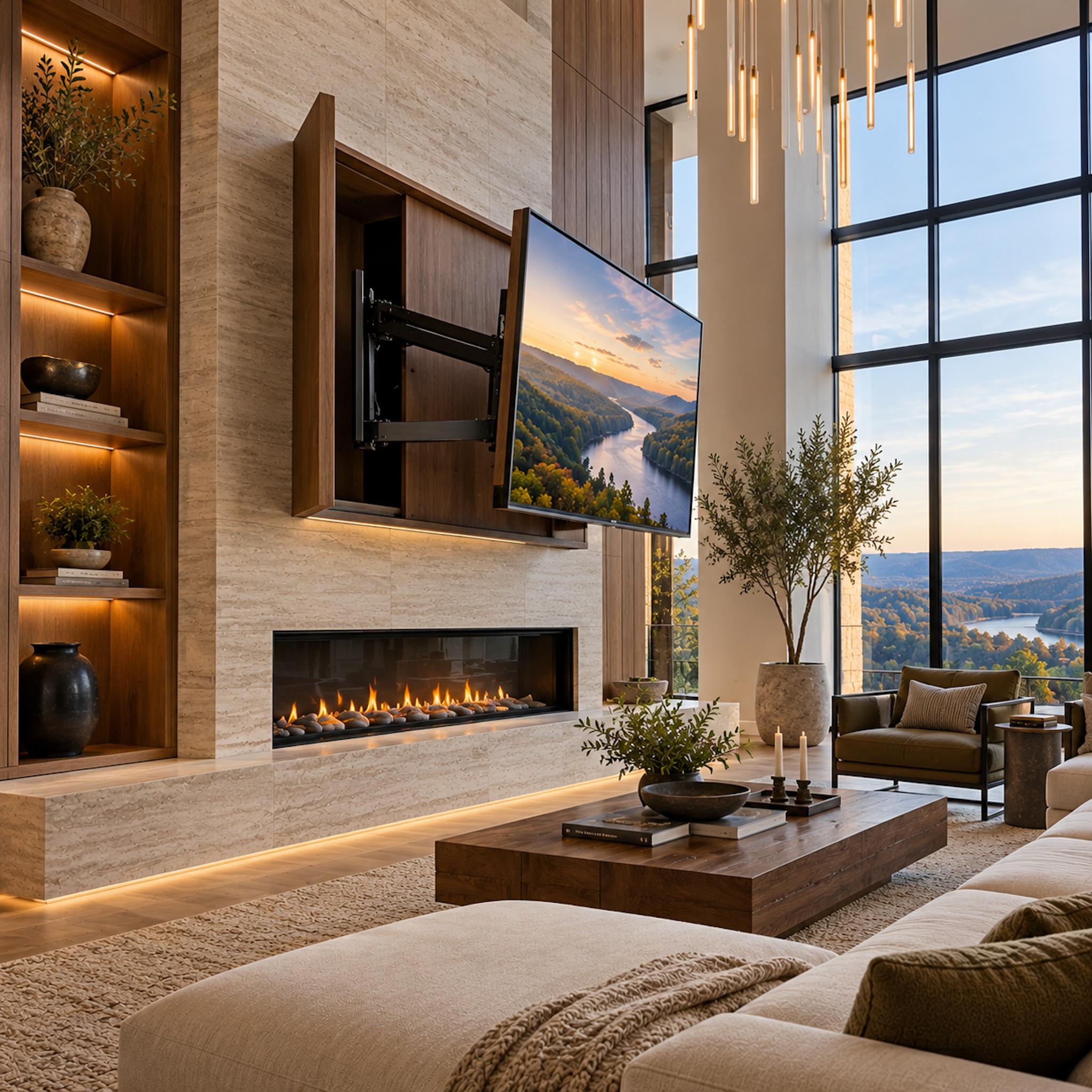
Most fireplace televisions remain fixed to the wall, leaving the seating arrangement to accommodate the screen. This one reverses the relationship. A substantial articulated mount extends from a wood-lined recess above the limestone fireplace, allowing the television to swing outward toward the room.
The mechanism is conspicuous when extended, but the architecture gives it a place to retreat. Pale limestone establishes a monumental central wall, while the wood-lined recess defines the television’s resting position. Illuminated walnut shelving adds warmth beside the stone, and a long linear firebox provides a horizontal base.
A generous cream sectional, low timber coffee table, and cognac lounge chairs create a relaxed seating area beneath the double-height ceiling. Beyond the glass, a wooded river valley provides another focal point. The movable television makes particular sense in a room with so much happening beyond the screen: its viewing angle can change without forcing the furniture into one rigid arrangement.
24. Terracotta Plaster Wraps the Fireplace in Warmth
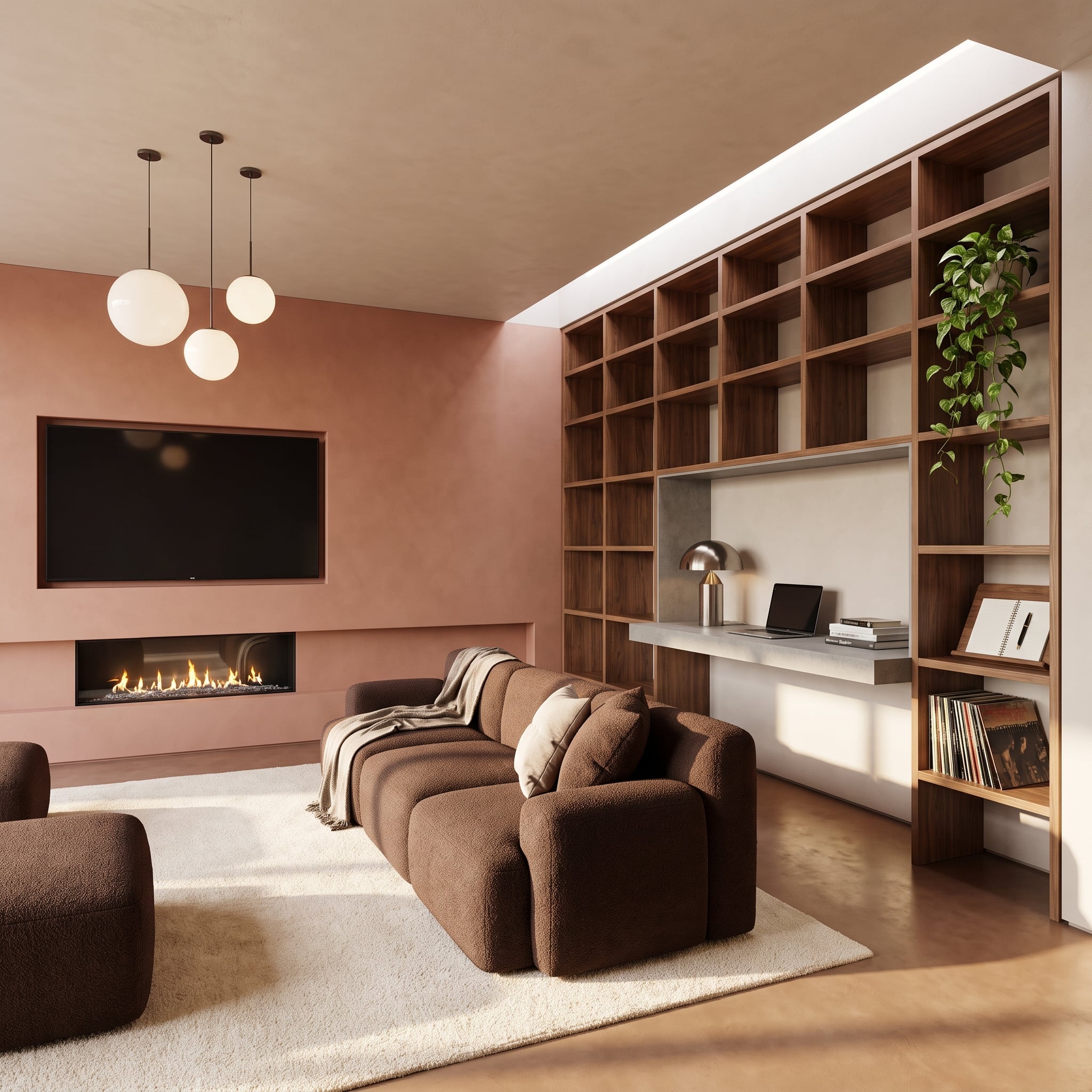
Dusty terracotta plaster extends across the fireplace wall and continues overhead, wrapping the room in a warm, earthy color. Against that continuous finish, the television becomes less of a separate black object and more of a component within the architecture.
Walnut shelving introduces a second functional zone, complete with an integrated desk ledge. Globe pendants bring rounded forms into a room otherwise dominated by broad plaster planes and rectilinear cabinetry.
The strongest decision is the continuity of the finish. Instead of surrounding the fireplace with one material and the television with another, the design lets color and texture connect them.
23. A Black Stone Fireplace Tower Divides the Living and Dining Rooms
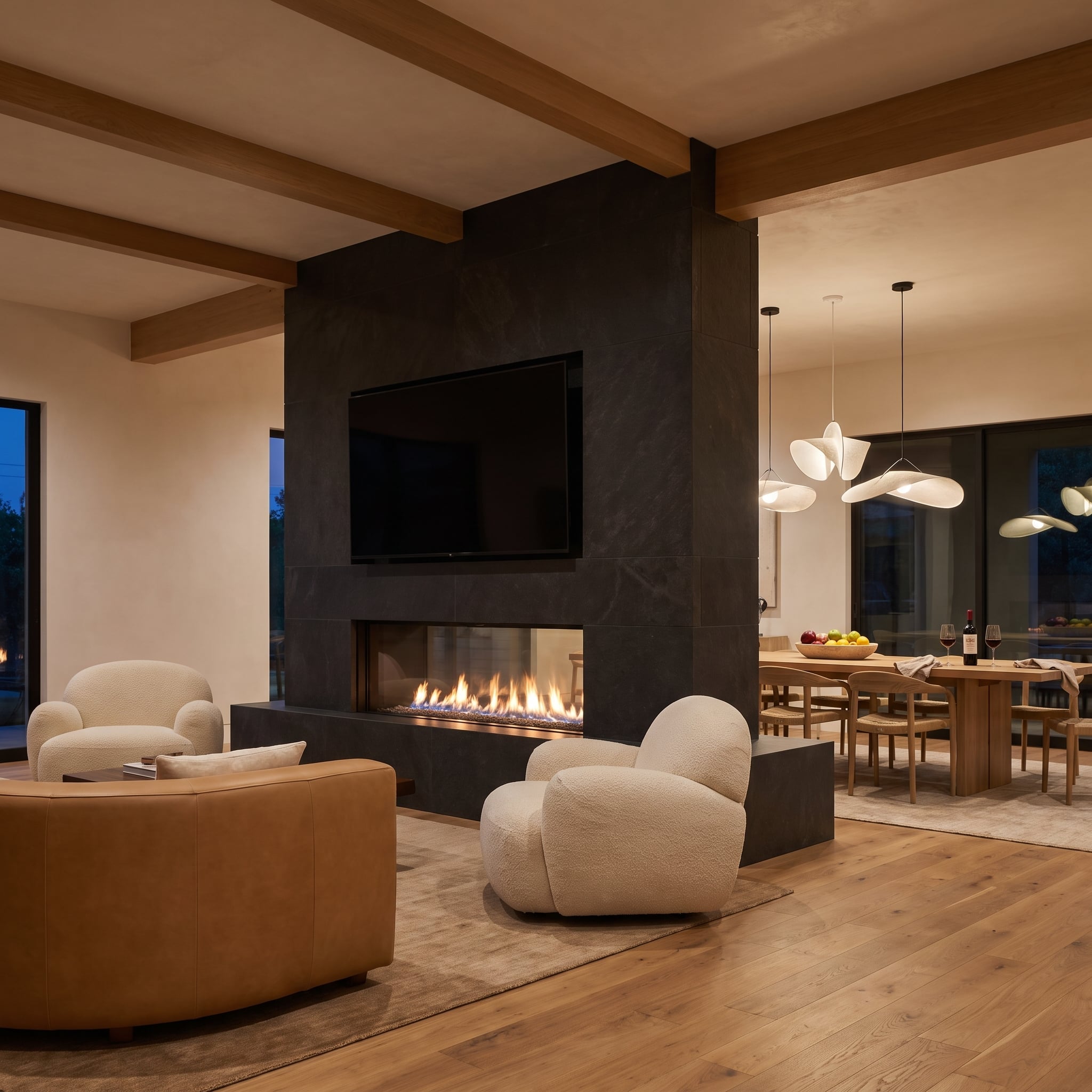
This fireplace wall has a second architectural responsibility: separating the living and dining areas. A tall charcoal stone volume provides that division without closing off the open plan.
The television occupies the living-room face, while a double-sided fireplace allows the flame to be appreciated from both spaces. Exposed wood beams continue across the ceiling, visually connecting the rooms despite the substantial stone divider.
Curved leather seating and pale bouclé armchairs soften the living-room side. In the dining area, sculptural white pendants establish a different atmosphere. The stone tower becomes a shared architectural feature rather than an arbitrary barrier.
Construction Note: Double-sided fireplaces require appliance-specific enclosure details, ventilation, and clearances. Their heating performance should be assessed using manufacturer specifications rather than assumed to be superior to other arrangements.
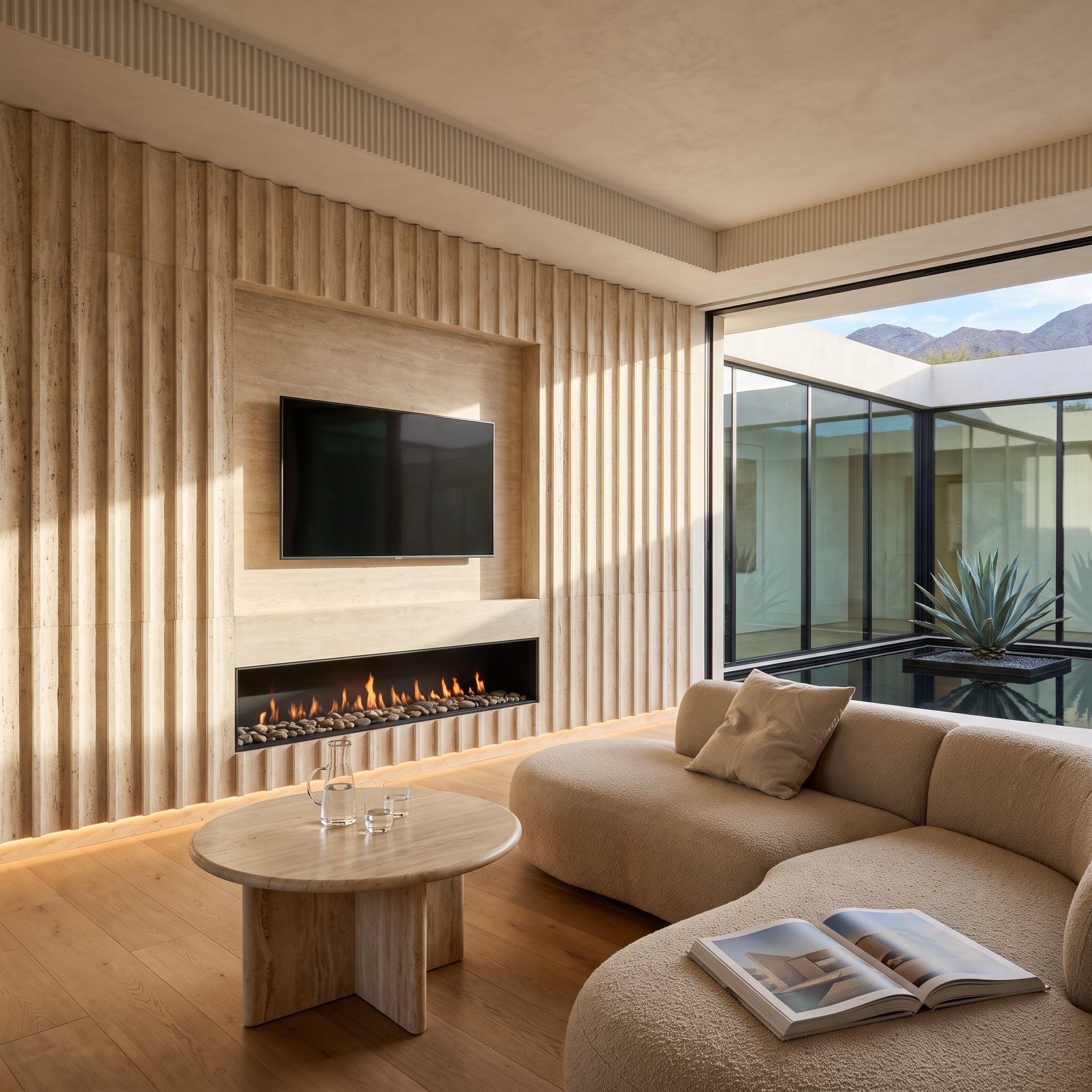
22. Fluted Travertine Gives the Screen a Sculptural Backdrop
🔥 Would you like to save this?
Vertical fluting transforms this travertine fireplace wall from a flat surface into something closer to architectural sculpture. Light catches the raised ribs, while narrow grooves produce shadows that shift throughout the day.
The television occupies a smooth central section, contrasting with the textured stone around it. A low linear firebox filled with river stones establishes a horizontal counterpoint beneath the screen.
The curved bouclé sectional softens the hard geometry, and floor-to-ceiling glazing opens the room toward a courtyard planted with an agave. The relationship between the stone’s vertical rhythm and the furniture’s curves gives the interior its distinctive character.
21. A Slatted Walnut Ceiling Brings Warmth to a Charcoal Media Room
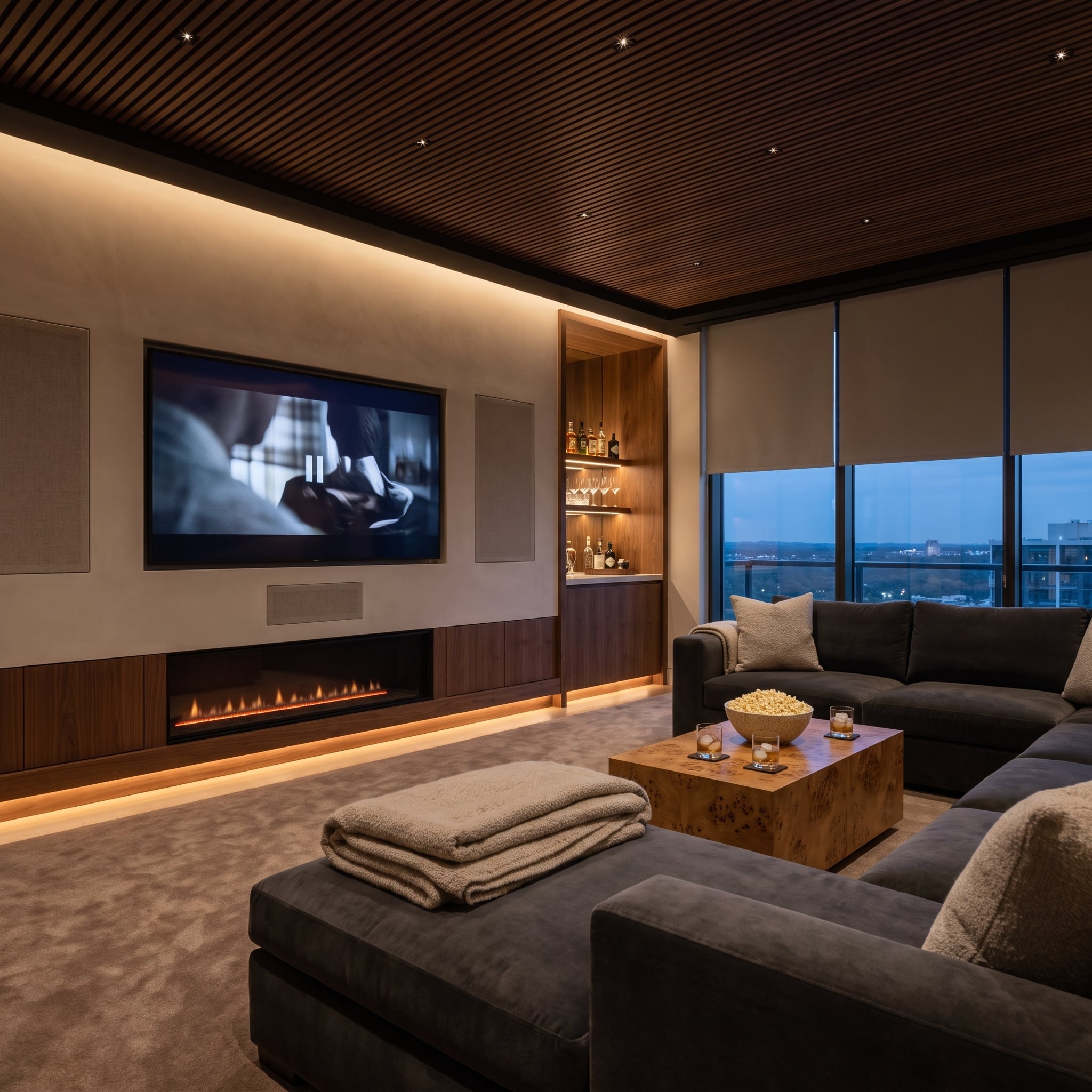
The ceiling carries much of this room’s character. Narrow walnut slats establish a continuous rhythm overhead, while perimeter cove lighting illuminates the timber without exposing a row of prominent fixtures.
Below, a long, shallow fireplace sits beneath the television. Charcoal velvet sectionals reinforce the darker palette, while a burl wood coffee table introduces irregular grain and a contrasting organic form.
An integrated bar extends the room’s function beyond television viewing. Dark upholstery, warm timber, and carefully placed lighting create an interior equally suited to conversation and entertainment.
Acoustic Detail: Slatted wood ceilings can contribute to sound control when designed with suitable spacing, backing, and absorptive materials. Decorative slats alone should not be assumed to provide substantial acoustic absorption.
20. Pale Plaster and a Winter Birch Forest Create a Different Kind of Fireplace Drama
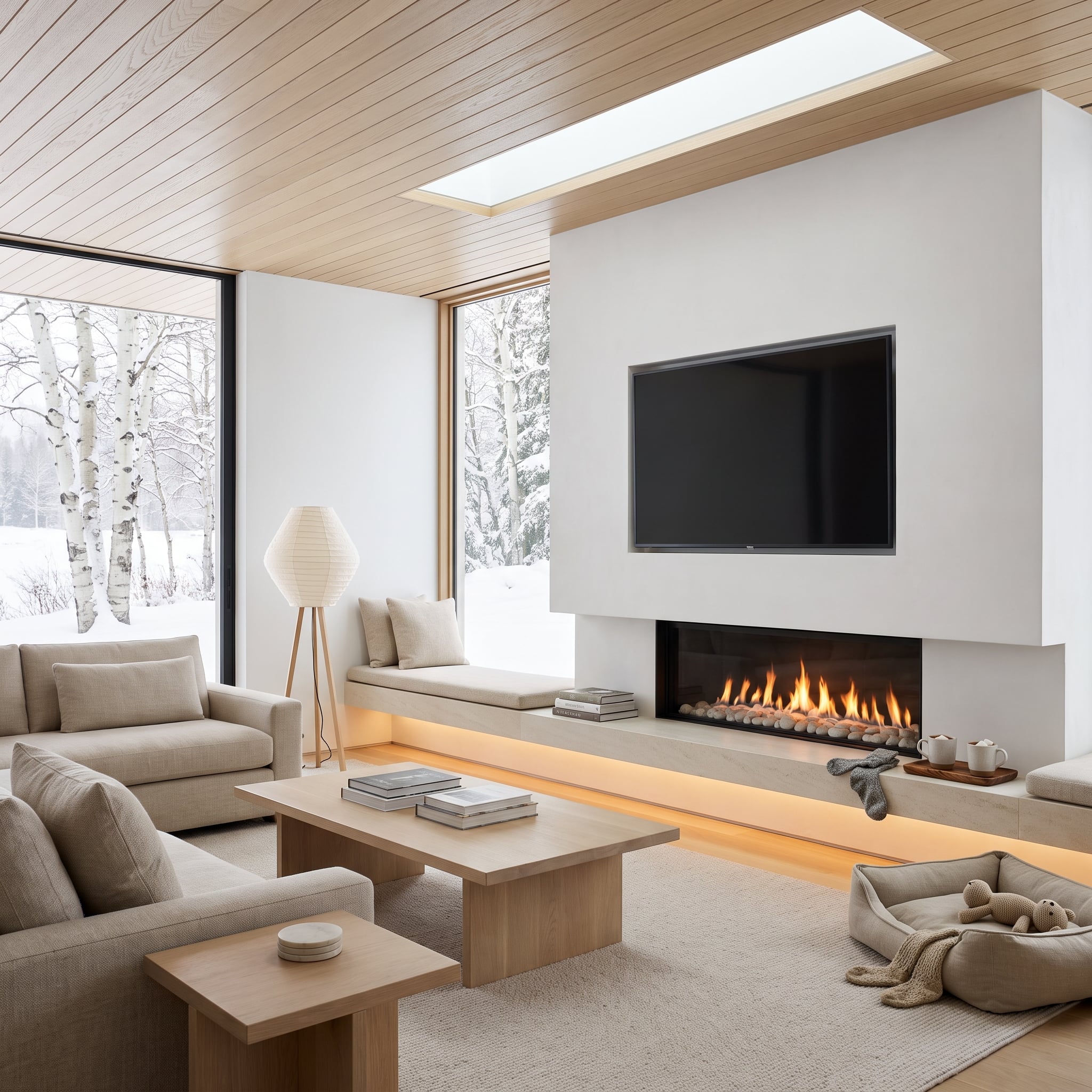
A pale plaster fireplace wall, ash ceiling planks, and winter light create an unusually quiet setting for the television. Unlike dark media walls that visually absorb the screen, this room allows it to remain visible against an almost white backdrop.
The linear fireplace runs beneath the television, with river stones adding texture along the firebox. A floating hearth ledge incorporates concealed lighting, introducing a soft amber glow at the base of the composition.
Linen sofas and a low oak coffee table keep the seating relaxed. Through the windows, slender birch trunks repeat the vertical rhythm of the interior’s pale timber. The result is a light-filled alternative to the conventional dark media wall.
19. Amber Glass Cabinets Turn the Fireplace Wall Into a Display Gallery
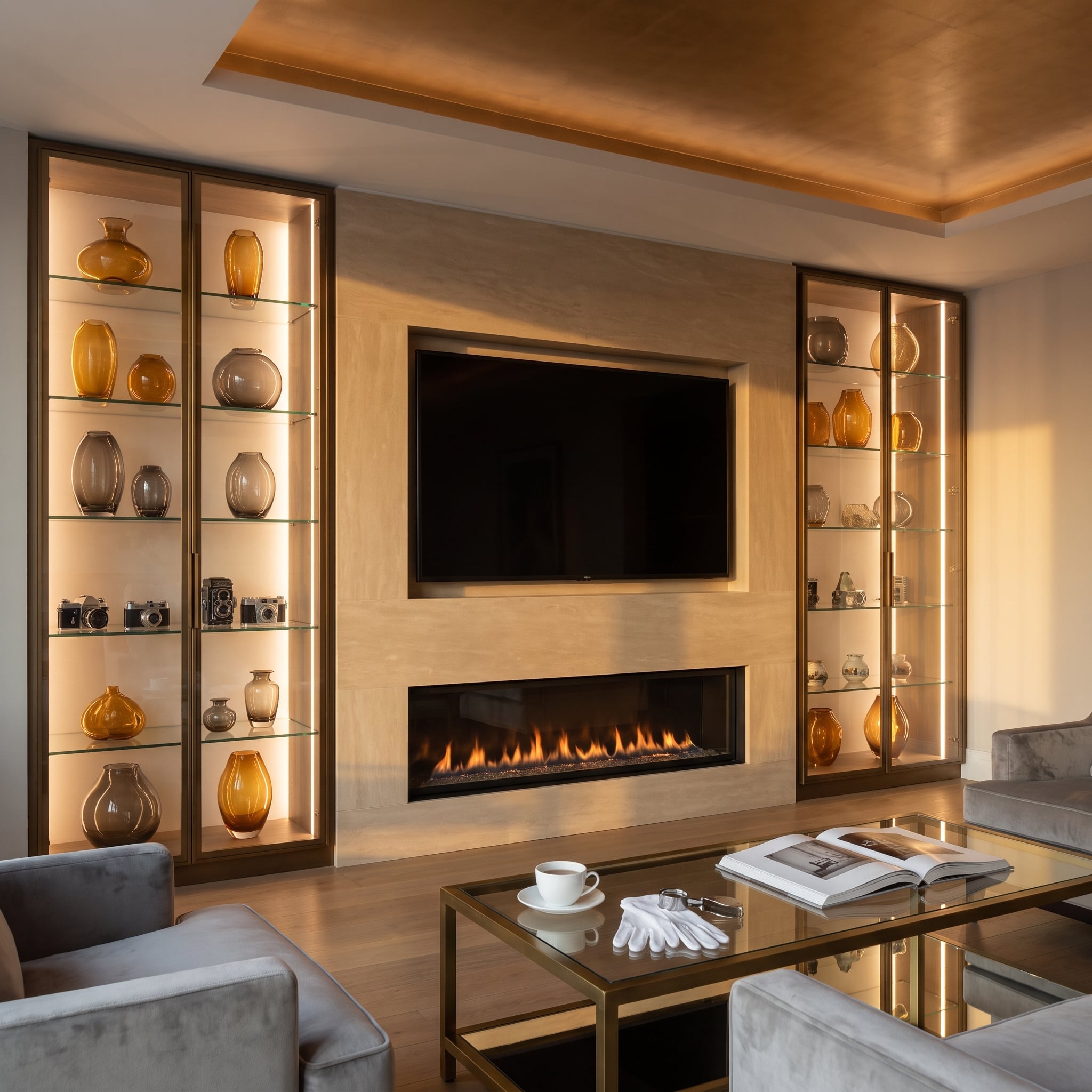
Two floor-to-ceiling glass cabinets flank the fireplace wall, transforming what might otherwise be a straightforward television installation into an elaborate display composition.
Bronze frames and glass shelves hold amber and smoked-glass vessels, vintage cameras, and smaller objects. Integrated lighting illuminates the collections without introducing conventional bookcase shelves that would interrupt the glow.
The television and linear fireplace occupy the limestone-toned central panel. Their stacked arrangement is balanced by the tall display cabinets, creating a symmetrical composition with considerable detail beyond the screen.
Glass shelving allows light to travel between levels, giving the cabinets a sense of transparency despite their height and extensive contents.
18. A Lacquered Caramel Ceiling Steals the Spotlight From the Fireplace
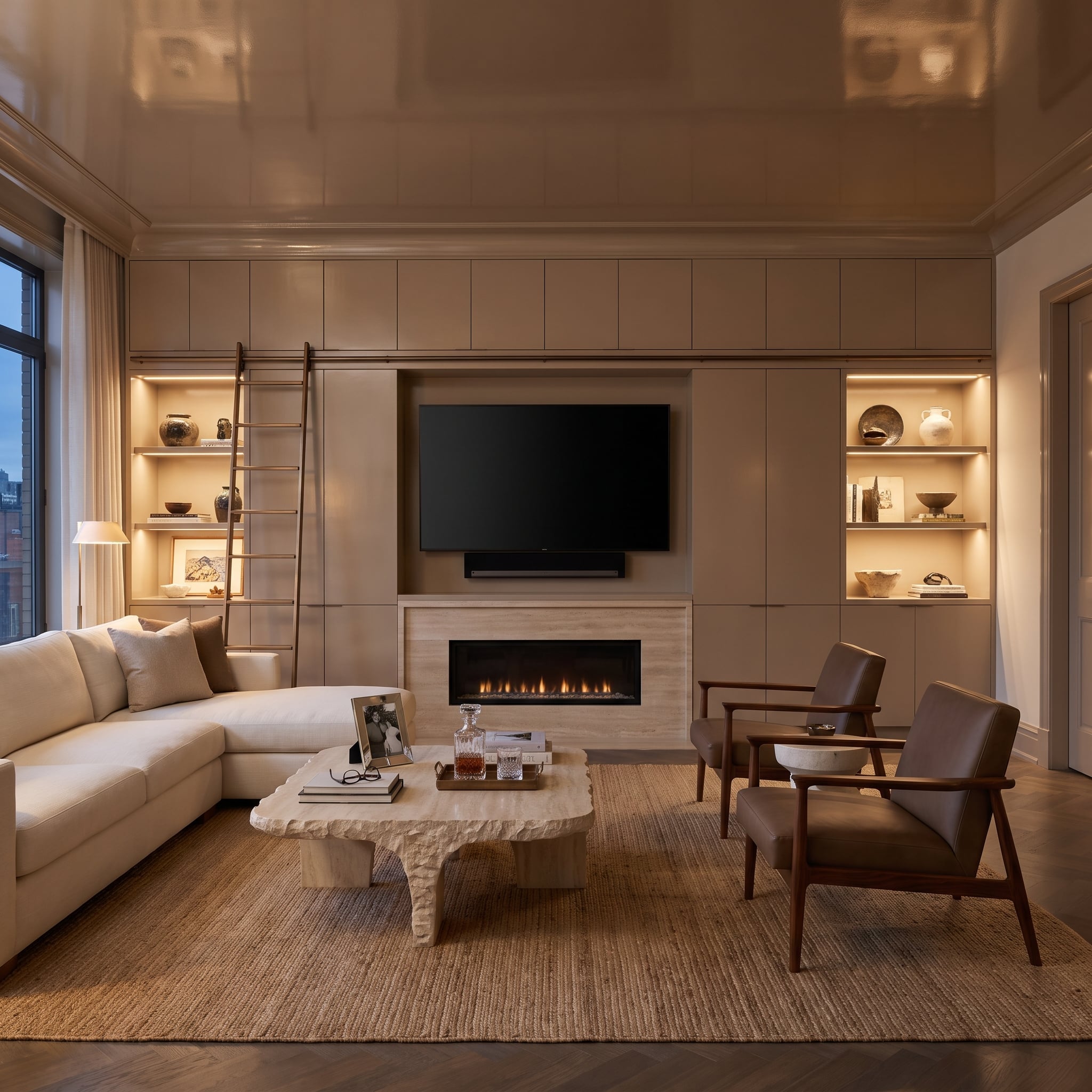
The high-gloss caramel ceiling is the first thing to register in this living room. Its reflective finish catches light from the windows and fireplace, bringing a warm sheen to the entire upper plane.
Below, taupe cabinetry stretches across the wall, interrupted by illuminated display shelves and a pale travertine fireplace surround. The television occupies the entertainment wall above the fireplace, but the surrounding millwork gives the arrangement a more complete architectural setting than a screen mounted against an otherwise empty surface.
Dark cognac leather armchairs add depth to the caramel and taupe palette. The contrast is appealing: expressive overhead, controlled and orderly below. By allowing the ceiling to command attention, the design prevents the television and fireplace from becoming the room’s only visual event.
17. Fluted Cream Stone Holds Its Own Against a Desert Sunset
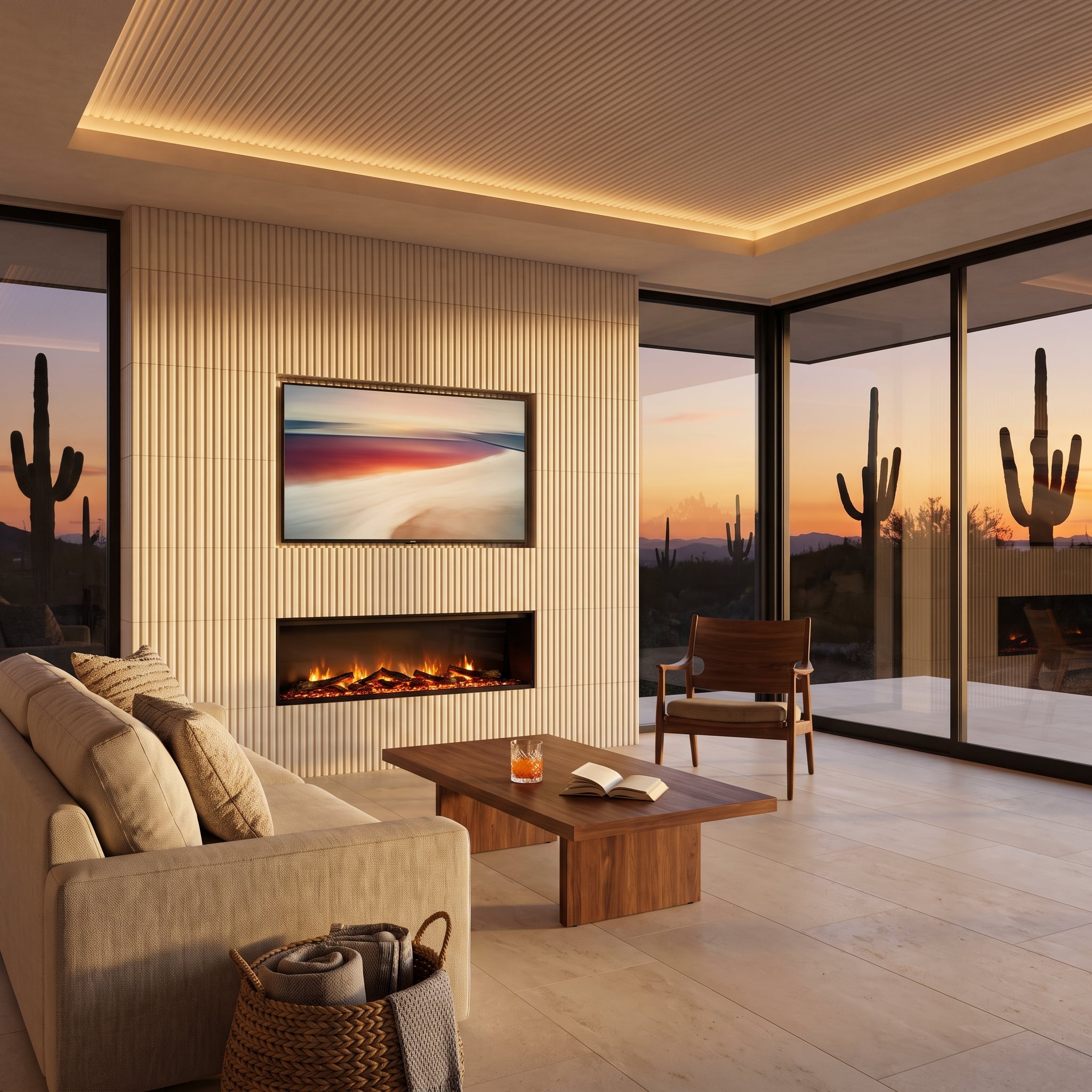
A desert sunset is difficult competition for any interior feature, particularly when saguaro silhouettes fill the windows. This fireplace wall responds with texture rather than color.
Fluted cream stone rises behind the television, its vertical grooves catching the warm light. A broad linear firebox occupies the lower portion of the wall, while cove lighting traces the ceiling perimeter.
The interior acknowledges the landscape without imitating it. The stone has enough relief to remain interesting in daylight, while the flames provide a more intimate focal point after sunset.
Material Detail: Ribbed stone and porcelain panels require careful attention to joint placement, groove alignment, structural support, and fireplace clearances, particularly across large wall surfaces.
16. Coffered Walnut and Amber Pendants Give a Pale Fireplace Wall Some Depth
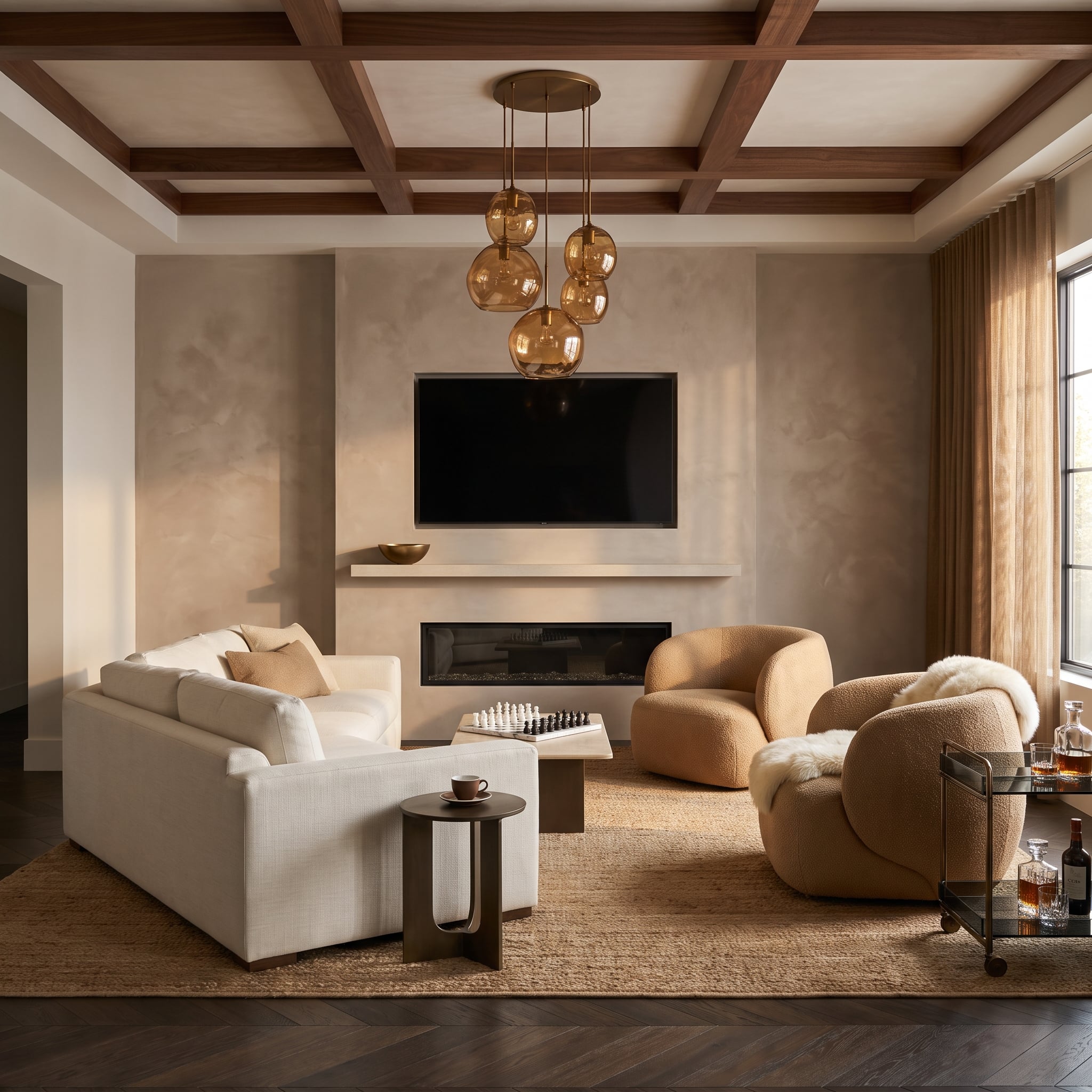
Warm greige plaster establishes a quiet fireplace backdrop beneath a coffered walnut ceiling. The television occupies the wall above a linear gas insert, while a substantial plaster hearth ledge gives the lower composition a clear horizontal boundary.
Amber blown-glass pendants descend at different heights, drawing attention toward the ceiling’s deep timber framework. Caramel bouclé armchairs introduce another warm tone, and a jute rug grounds the seating without adding a busy pattern.
A bar cart near the room’s edge extends the entertaining function without interrupting circulation. The fireplace wall remains comparatively simple because the ceiling and lighting supply so much of the architectural detail.
15. A Swing-Out Screen Gives a Dark Stone Fireplace Wall Room to Move
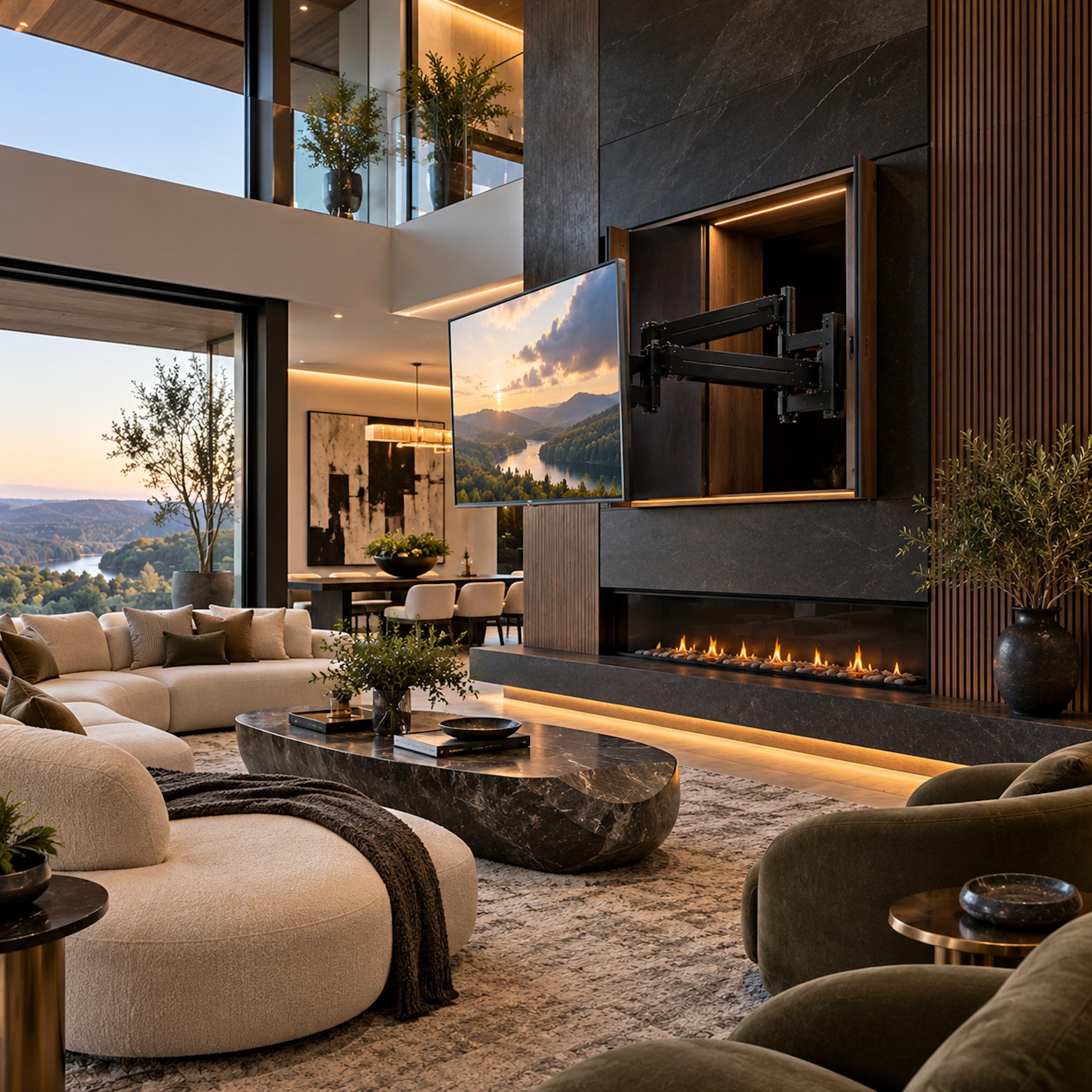
Charcoal stone, a soaring ceiling, and a sweeping cream sectional give this living room the proportions of a private architectural showcase. Then the television swings out from the fireplace wall on a substantial steel arm, introducing a decidedly mechanical element to the polished setting.
The mount projects from a wood-lined recess above the linear fireplace, allowing the screen to turn toward different parts of the seating area. Its exposed framework contrasts with the dark stone and narrow timber slats, making the mechanism an intentional visual feature rather than something to be concealed at all costs.
The curved sectional wraps around a monumental stone coffee table, while olive-toned lounge seating and a glass-railed upper level add depth to the composition. Where the pale limestone version at #25 emphasizes the relationship between television and landscape, this darker interior makes a spectacle of the moving screen itself. The contrast between heavy stone, soft upholstery, and articulated steel is what gives the room its edge.
14. A Walnut Fireplace Cabinet Makes the Television Feel Built In
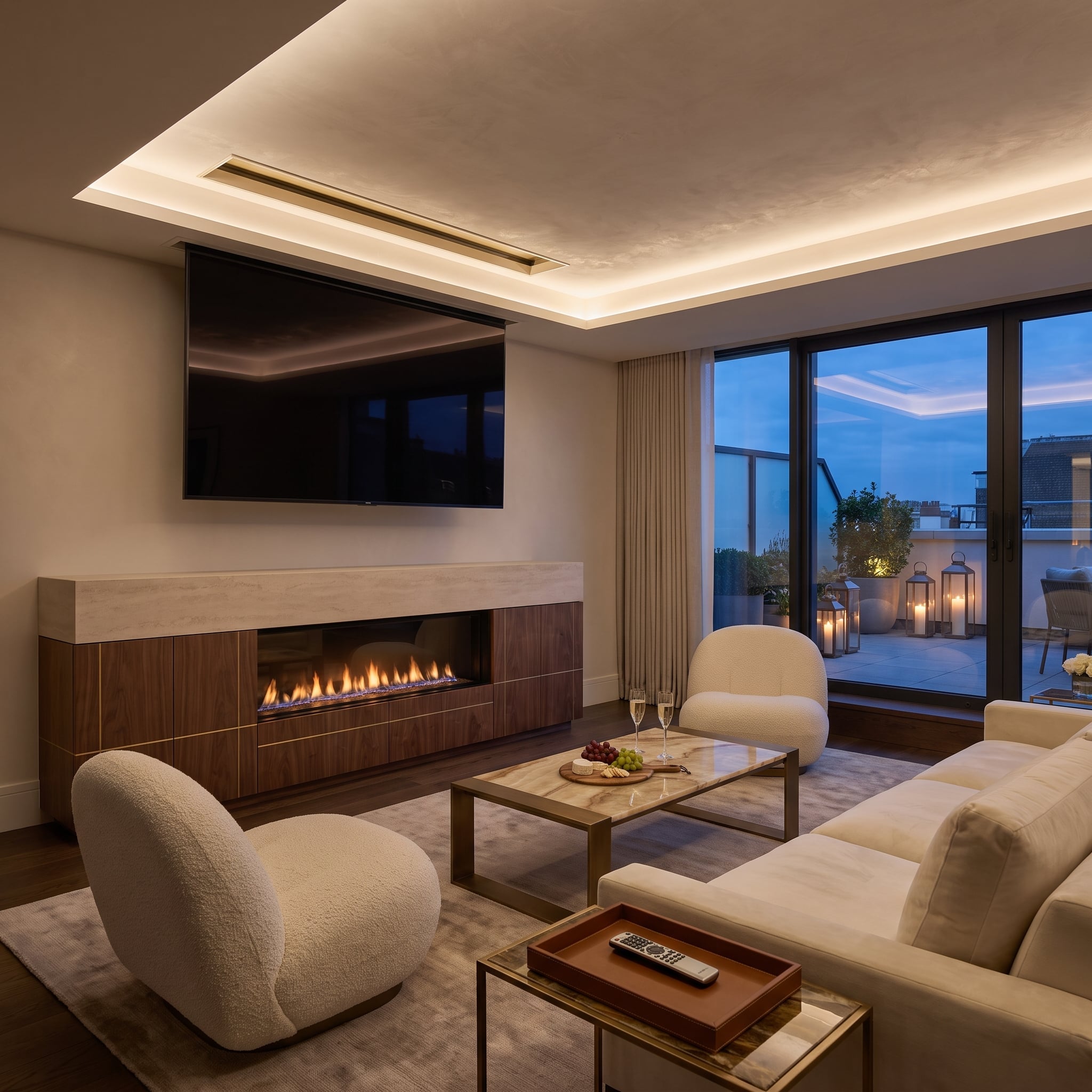
Walnut cabinetry with delicate brass inlay gives the fireplace a furniture-like quality, while the television sits against a smooth plaster surface above it. The contrast between detailed timber and restrained wall treatment helps each element remain distinct.
Ivory bouclé armchairs brighten the warm palette. Cove lighting around the tray ceiling supplies broad ambient illumination, while lanterns on the adjoining terrace extend the lighting arrangement beyond the glass doors.
The television occupies a central position, but timber, lighting, and upholstery have equally important roles. The result feels closer to a carefully furnished living room than a dedicated media installation.
13. Dark Microcement and an Alabaster Lamp Create a Dramatic Evening Room
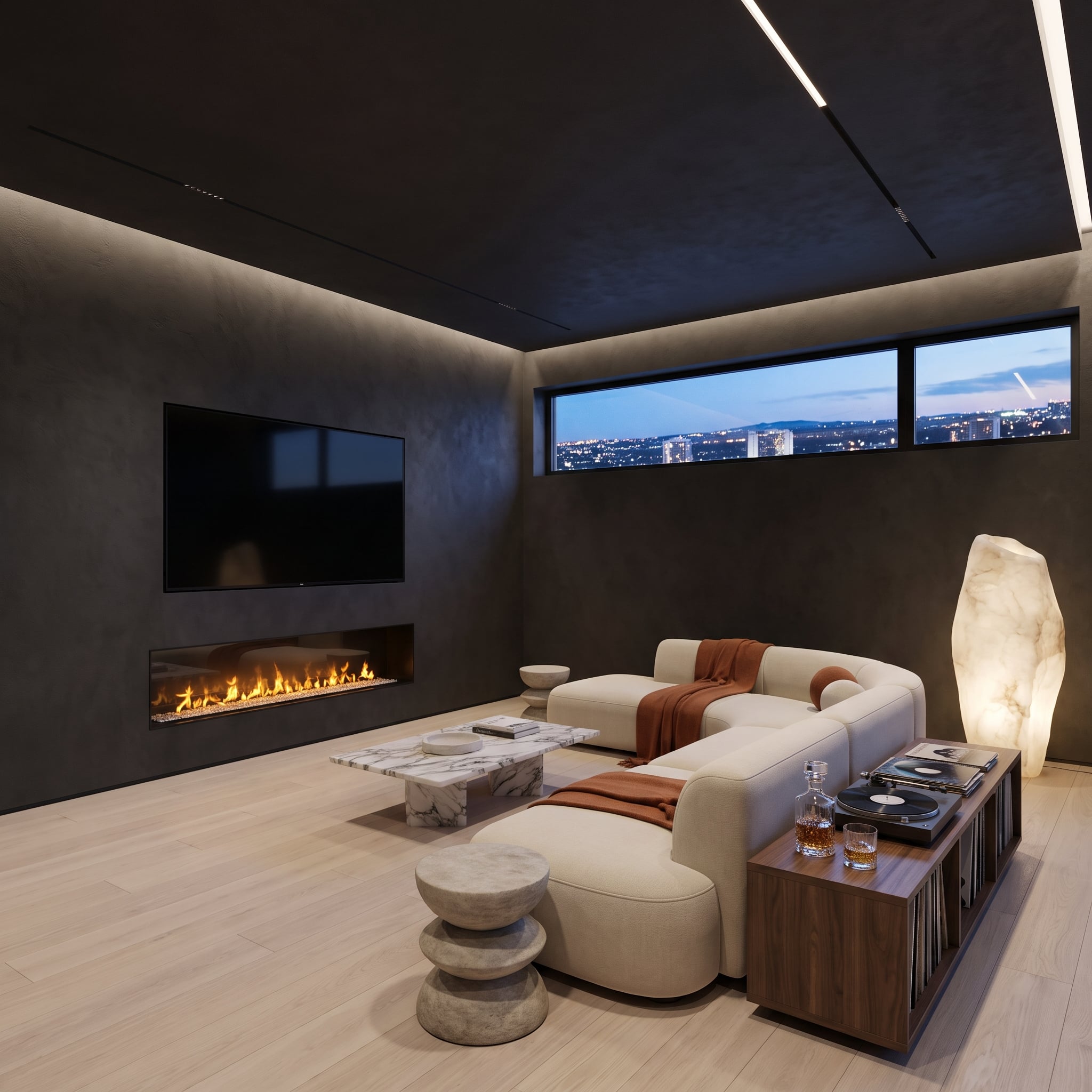
Dark microcement wraps the walls and ceiling, creating an almost continuous charcoal envelope. Within it, the television and linear fireplace form a restrained arrangement, their dark surfaces sitting comfortably against the surrounding finish.
Cream bouclé seating provides the strongest contrast. A marble-topped coffee table, walnut credenza, turntable, and sculptural alabaster lamp introduce different materials without breaking the limited palette.
The lamp is particularly effective. Its milky illumination occupies the visual middle ground between the fireplace’s amber glow and the cool blue cityscape beyond the windows. The room has plenty of darkness, but no shortage of depth.
12. Herringbone Oak and Rust Bouclé Warm Up a Travertine Fireplace Wall
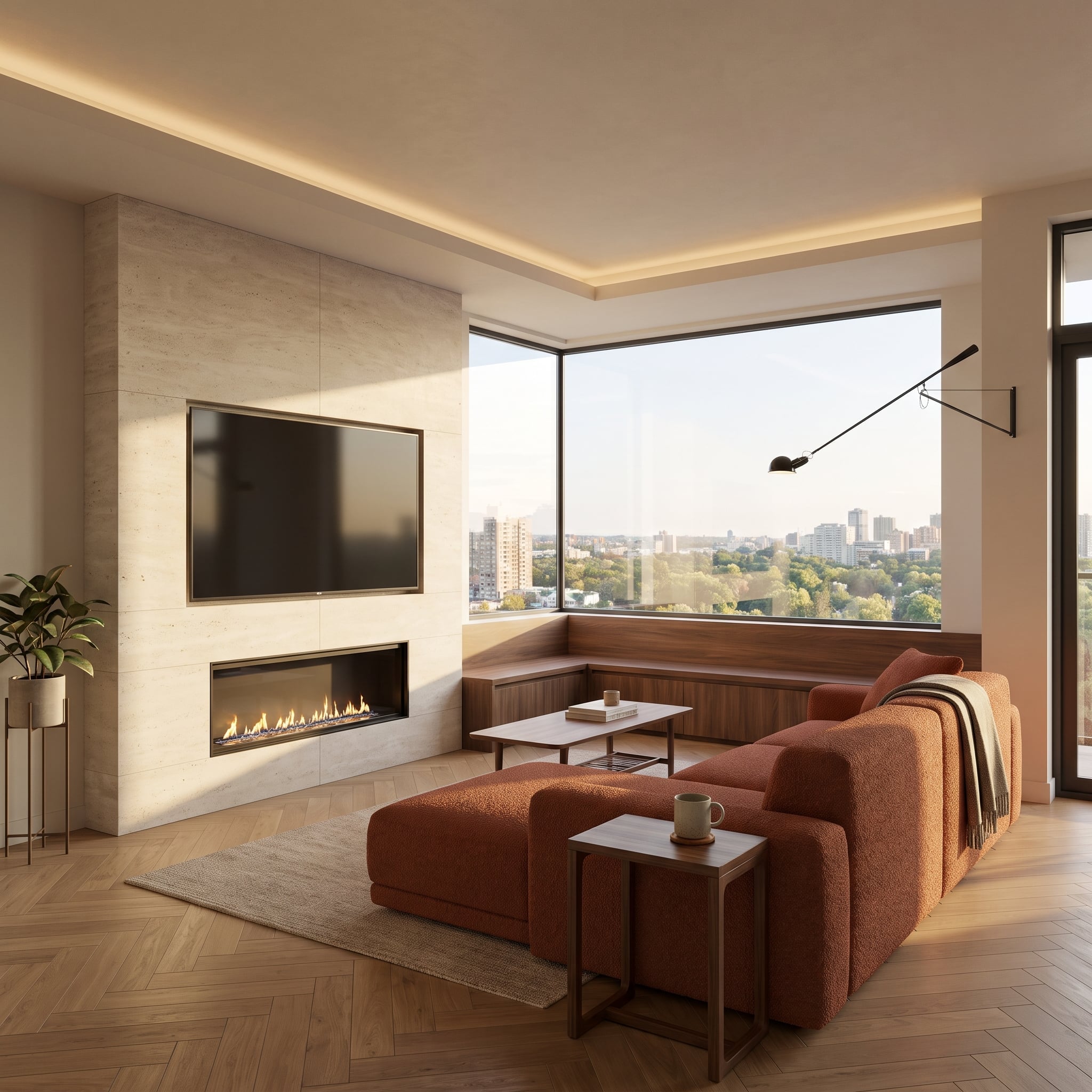
Cream travertine gives the fireplace wall a pale, substantial backdrop for the television. The linear firebox extends across much of the lower wall, reinforcing its broad proportions.
Warmth comes largely from the furniture and floor. A rust bouclé sectional picks up the stone’s warmer undertones, while herringbone oak adds a finer pattern beneath the seating. Corner glazing opens the interior toward the landscape.
A built-in walnut bench follows the window line, giving the seating arrangement another architectural edge. Expansive glass, warm upholstery, and carefully detailed timber prevent the stone fireplace wall from feeling overly formal.
11. A Marble Fireplace Wall Looks Almost Tailored Beneath a Walnut Ceiling
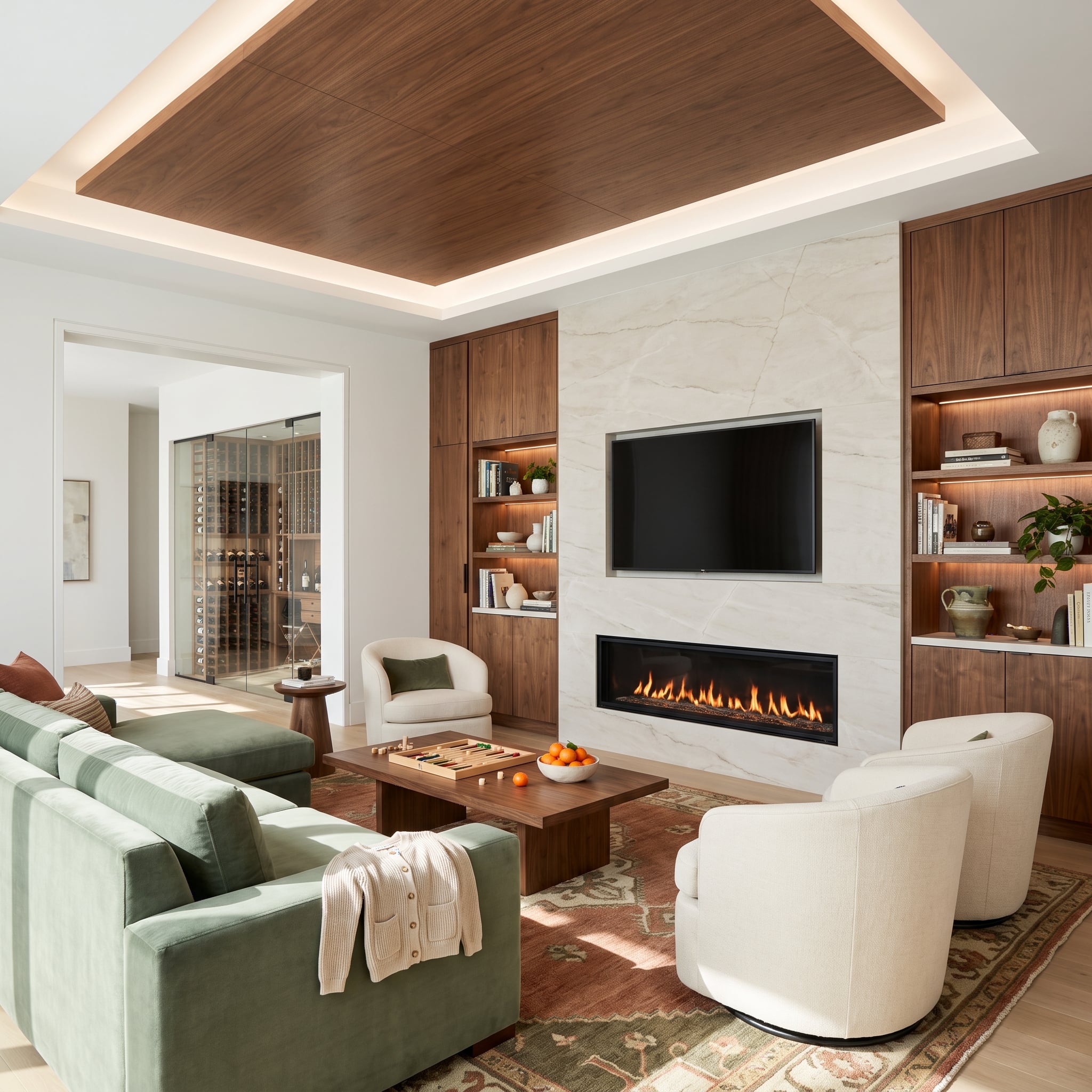
Warm walnut paneling forms a coffered ceiling inset with concealed lighting, directing attention toward a tall white marble fireplace surround below.
The television is integrated into the stone face, with a linear gas fireplace beneath it. Marble veining gives the wall visual movement without requiring additional decoration around the screen.
Overhead, the walnut inset introduces warmth and a clear architectural boundary. The arrangement is polished but straightforward: one central wall, two functional elements, and carefully controlled detailing.
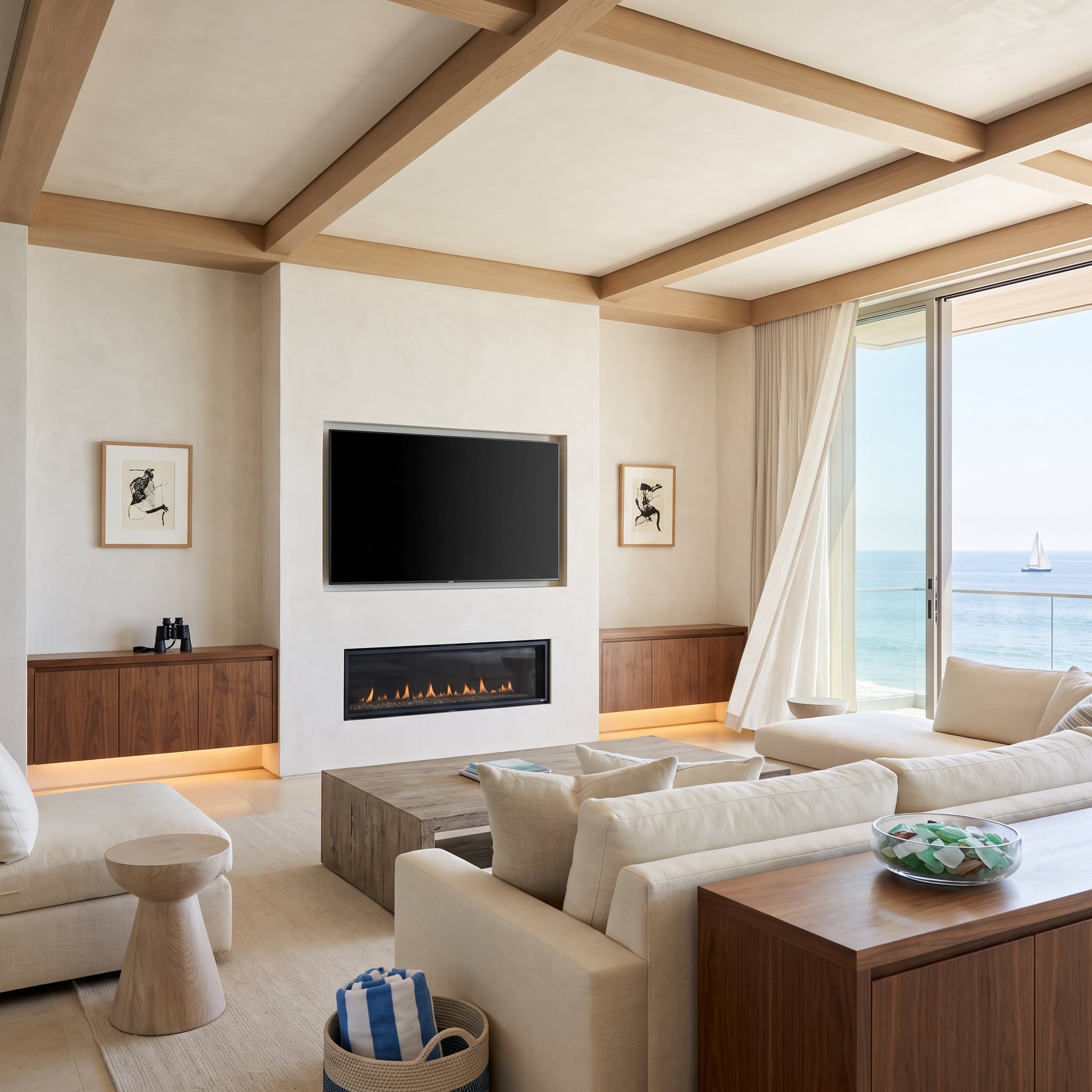
10. Coffered Oak, Ocean Views, and a Fireplace Wall That Doesn’t Fight the Horizon
🔥 Would you like to save this?
Natural oak coffers bring warmth overhead, while pale plaster keeps the fireplace wall quiet enough to coexist with the expansive ocean view.
The television sits above a ribbon-style gas fireplace, with low walnut cabinetry extending to either side. Concealed lighting at the base introduces a soft amber line without interrupting the broad plaster surface.
Cream linen sectionals face the fireplace, while sliding glass doors frame the water and a distant sailboat. Sea-glass accents and woven textures reinforce the coastal palette without turning the room into a collection of nautical motifs.
The fireplace wall provides an interior focal point, but the architecture leaves the horizon plenty of room to compete.
9. Matte Black, Walnut Slats, and Bouclé Chairs Make a Sharp First Impression
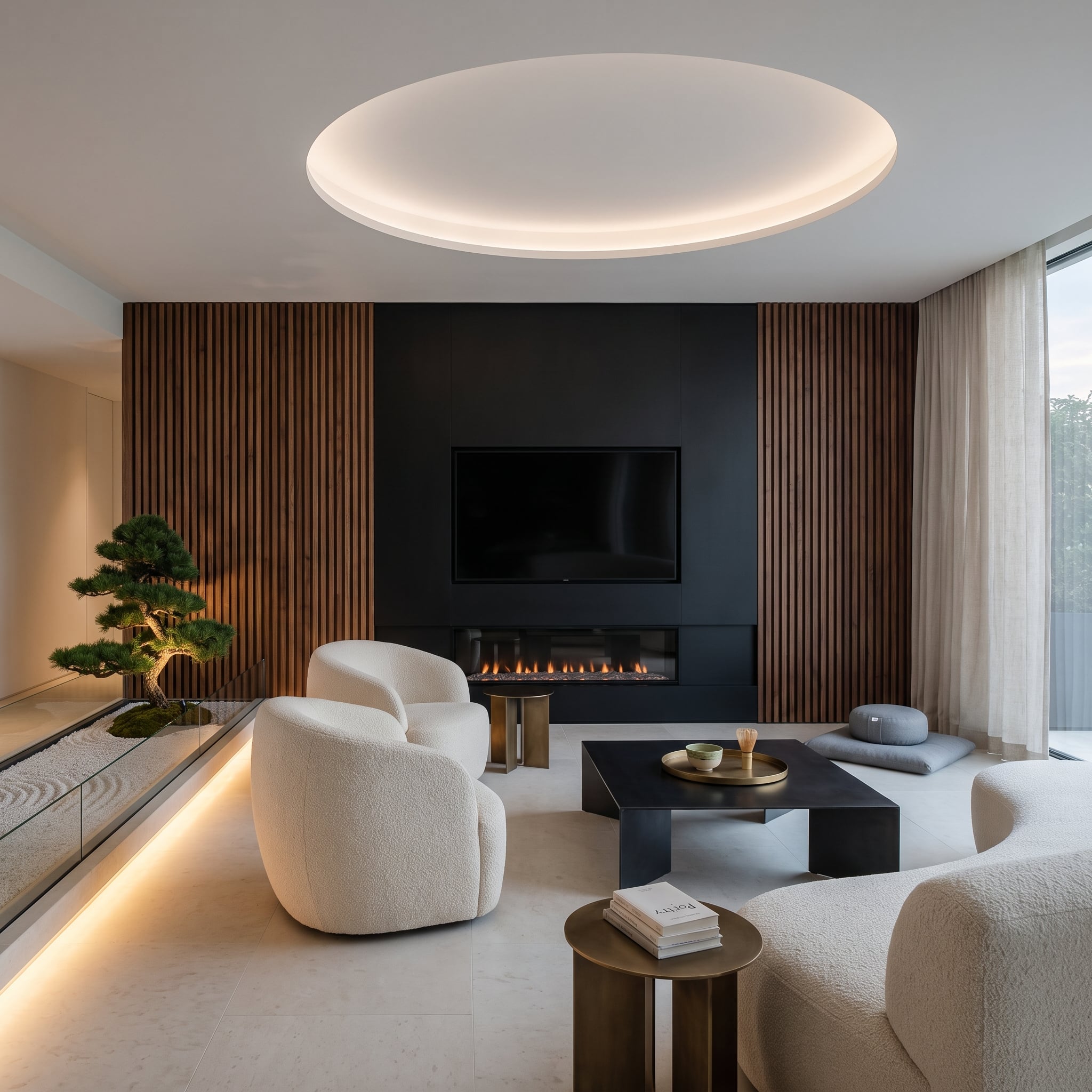
A matte black fireplace wall establishes a strong central feature, with the television positioned directly above a narrow linear gas fire. Vertical walnut slats flank the dark surface, adding warmth and a contrasting pattern.
Bouclé swivel chairs soften the geometry and allow the seating to turn between the fireplace and other parts of the room. An oval cove light overhead repeats the furniture’s curves, balancing the hard-edged central wall.
Only a few materials are needed. Black provides depth, walnut introduces texture, and pale upholstery prevents the composition from becoming severe.
8. Light Oak, a Lake of Autumn Color, and a Fireplace Wall That Knows When to Be Quiet
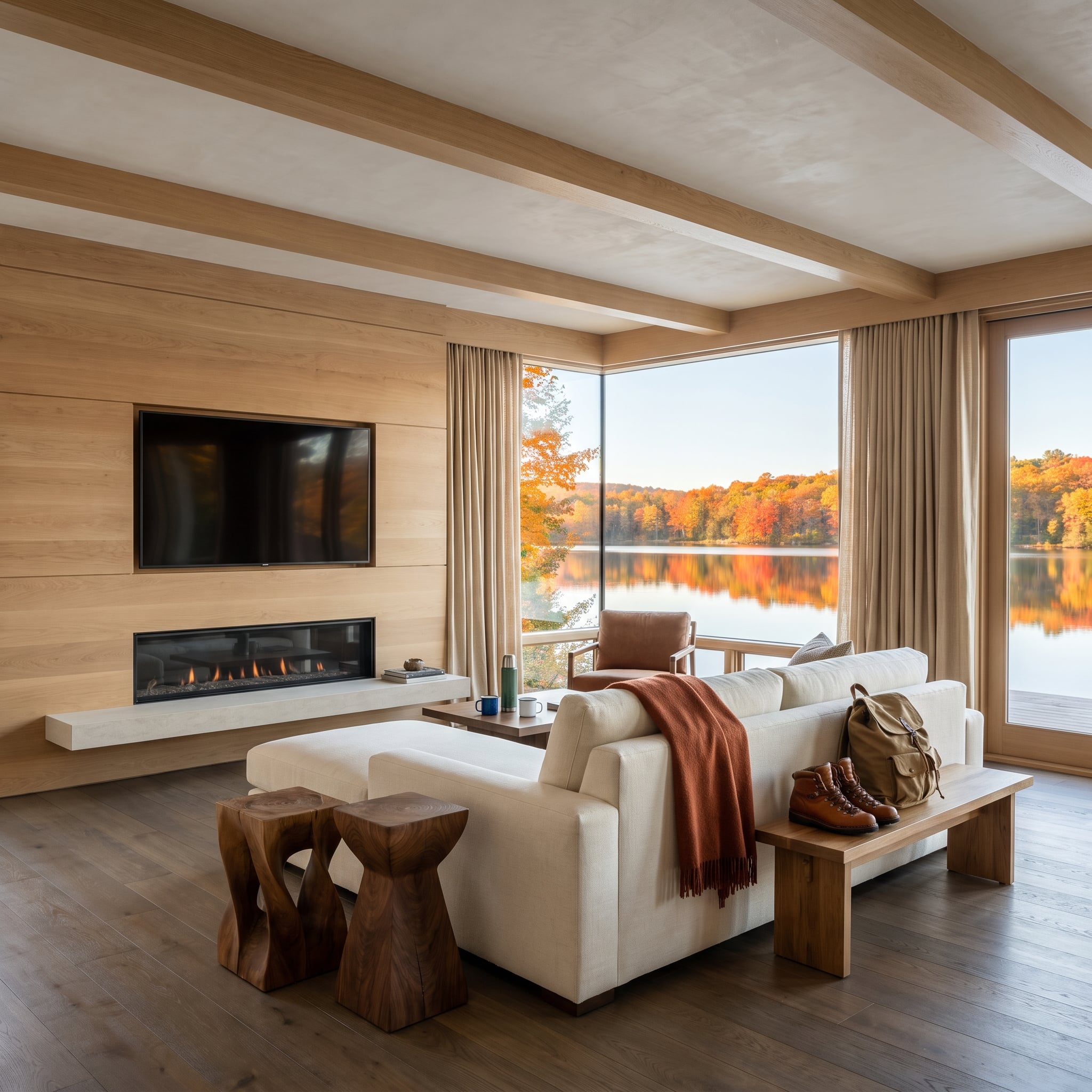
Autumn has already supplied this living room with a spectacular color scheme. Outside the corner windows, orange, gold, and crimson trees reflect across a still lake. Inside, the architecture wisely avoids trying to outdo them.
Wide-plank oak cladding covers the fireplace wall and continues across the exposed ceiling beams. A television sits above the long, low gas fireplace, both contained within the timber surface. The floating stone hearth introduces a crisp horizontal accent without requiring a conventional mantel.
A cream sectional, rust wool throw, and leather chair echo the landscape’s warmth. Sculptural wood stools bring a rougher texture into the seating area, while a bench behind the sofa provides another practical surface.
Against a view this vivid, the television doesn’t need to disappear. It simply doesn’t need to dominate.
7. The Mirror Above This Fireplace Has a Second Job
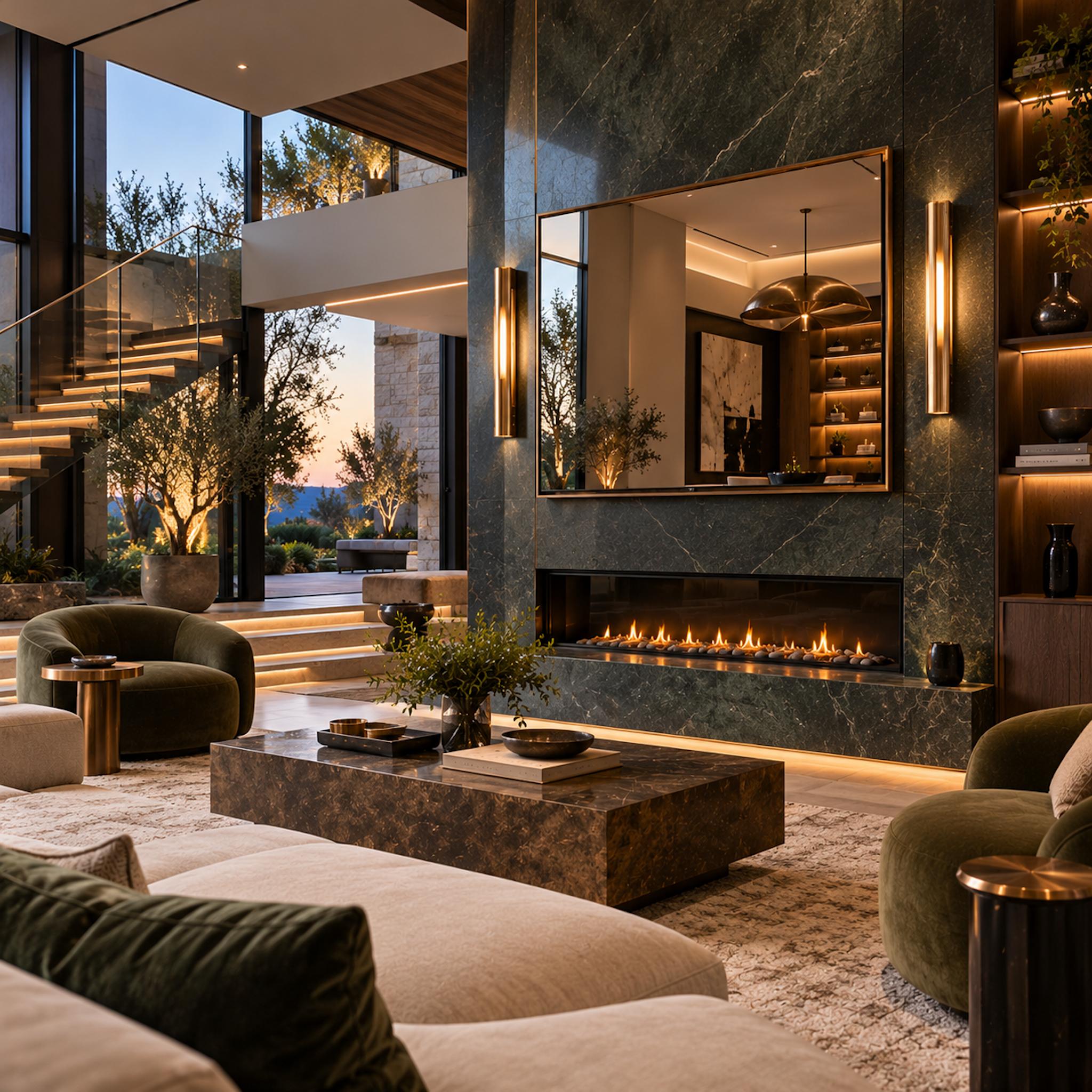
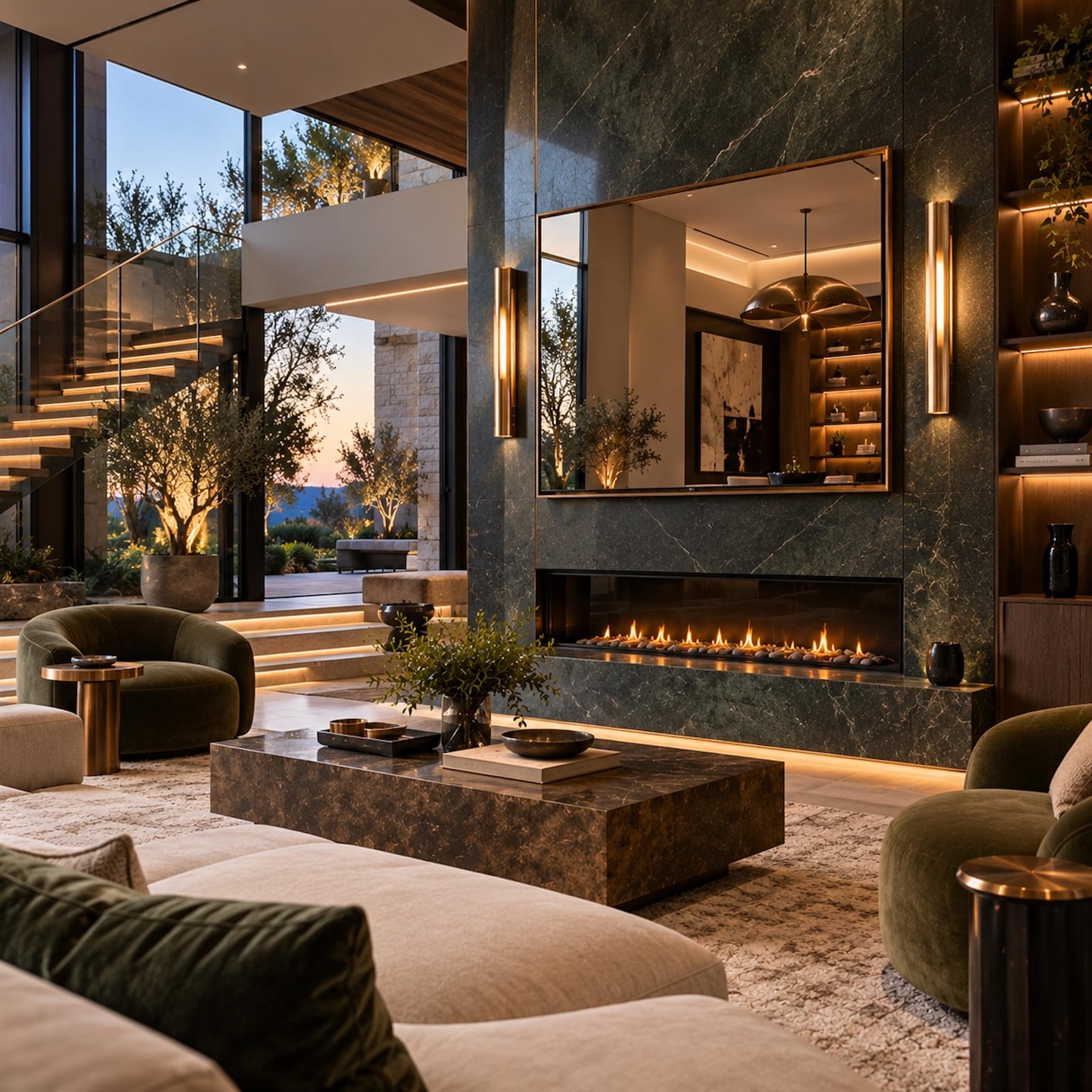
At first glance, the large bronze-framed mirror above this fireplace appears to be another decorative feature in an exceptionally polished living room. The reflective surface, however, can also conceal a television, allowing the television image to become visible through specialized mirror glass when switched on. No sliding artwork, folding doors, or articulated arms are required.
Dark veined stone rises around the mirror and broad linear firebox, while slender brass sconces emphasize the vertical composition. An illuminated floating staircase brings another architectural dimension to the room. Olive velvet chairs, a cream sectional, and a monumental stone coffee table supply contrasting shapes and textures.
The mirror’s reflection extends the apparent depth of the interior, turning a potentially conspicuous television into a reflective architectural feature when inactive. It is an elegant answer to the black-screen problem, although the mirror glass, display brightness, and ambient lighting must be carefully matched for satisfactory viewing.
6. Plaster Niches and an Olive Tree Give a Media Wall Mediterranean Character
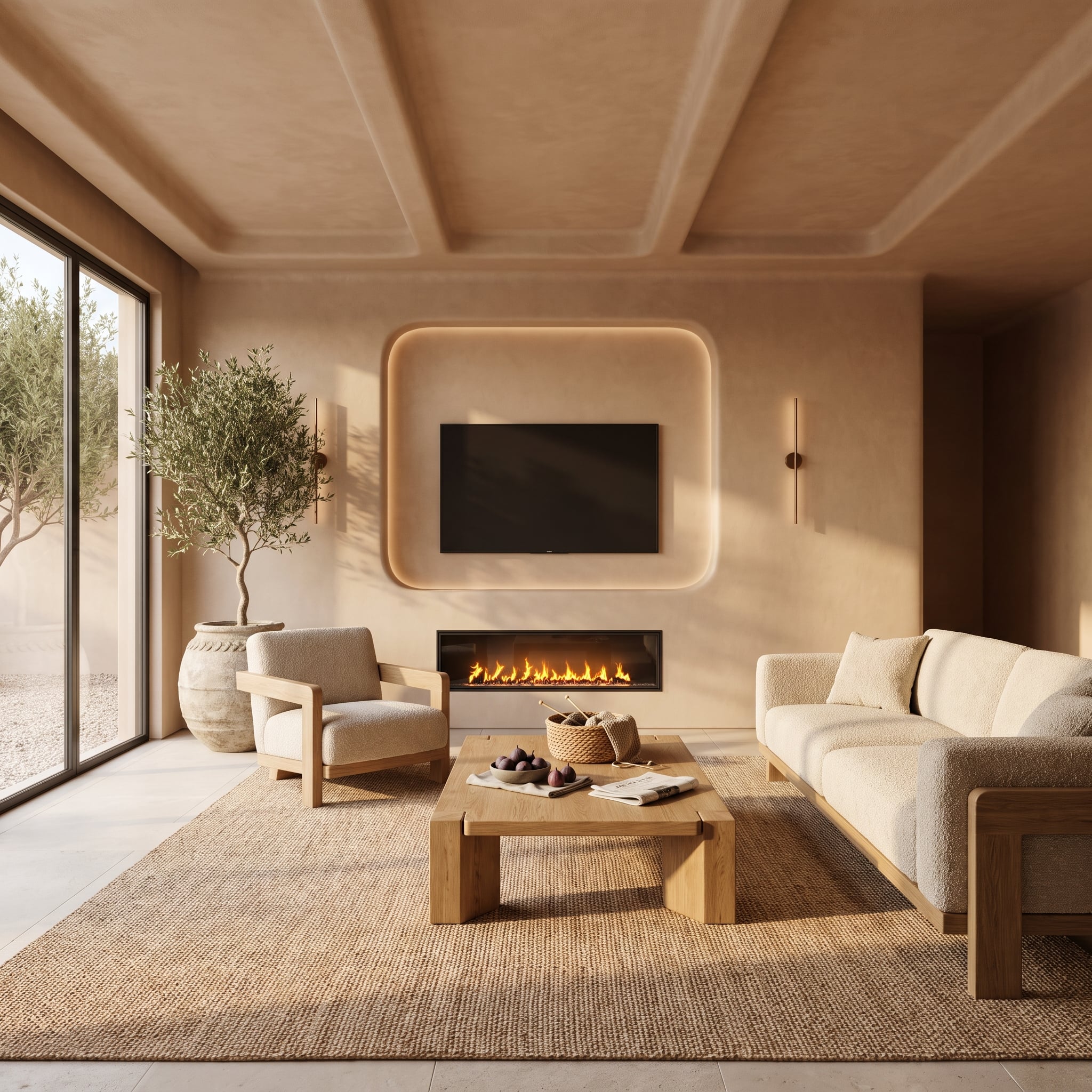
Rounded plaster niches introduce a softer architectural language around the television and fireplace. Instead of treating the screen as a rectangle attached to a flat wall, the design incorporates it into a broader arrangement of sculpted openings.
Sand-colored plaster provides continuity across the room. Oak-framed sofas and armchairs establish a natural material palette, while bouclé upholstery softens the furniture’s structural lines.
A mature olive tree in a weathered concrete planter adds an irregular organic silhouette. Rounded recesses, pale plaster, and natural timber create a room far removed from the usual dark media-wall formula.
5. A Walnut Media Wall Hides More Than Just the Television Wiring
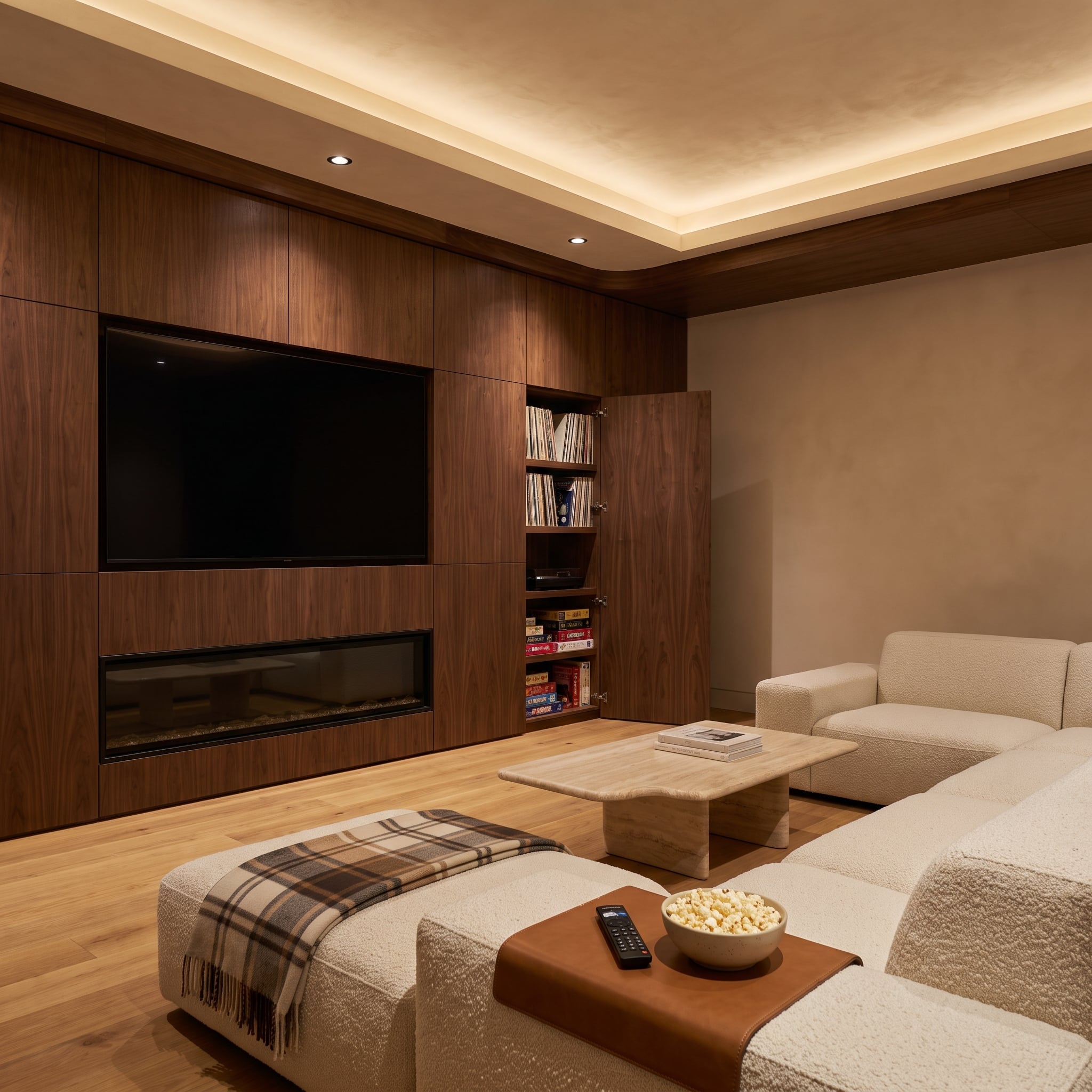
Walnut paneling extends across the fireplace wall, integrating the television into a continuous run of millwork. The linear gas fireplace sits below, while adjacent cabinets provide storage for records, board games, and media equipment.
That practical storage distinguishes the room from a purely decorative fireplace composition. The wall accommodates entertainment equipment and everyday belongings without leaving them scattered around the seating area.
Warm cove lighting traces the tray ceiling, and a cream bouclé sectional brightens the dark timber. The visual order comes from cabinetry that performs several functions at once.
Brown-heavy rooms tend to fare well with our readers, too: in Hot or Not matchups, living room pictures dominated by brown won 61% of the time, versus 53% expected from position alone.
4. An Ocean View and a Travertine Wall Share the Room Without Competing
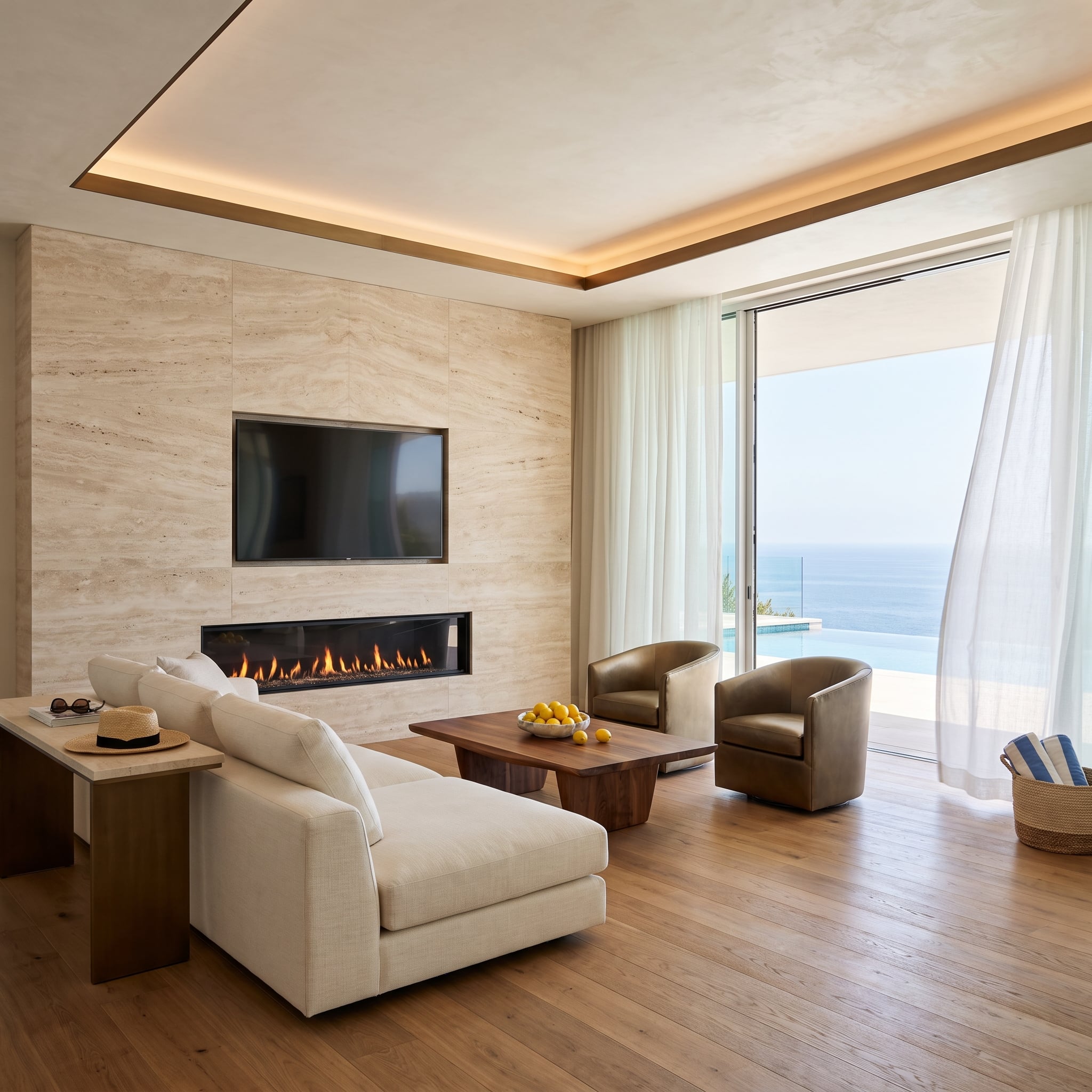
Broad travertine cladding creates a quiet fireplace wall opposite a spectacular stretch of ocean. The television occupies the upper portion of the stone surface, with a low linear burner beneath it.
Olive leather swivel chairs offer a particularly practical response to the room’s competing attractions. They can turn toward the fireplace and television or face the glass doors and infinity pool beyond.
The stone’s subtle veining gives the interior enough character without drawing attention away from the horizon. Rather than arranging every seat permanently toward one focal point, the design acknowledges two very different views worth enjoying.
3. White Plaster and a Long Ribbon of Fire Keep the Arrangement Almost Minimal
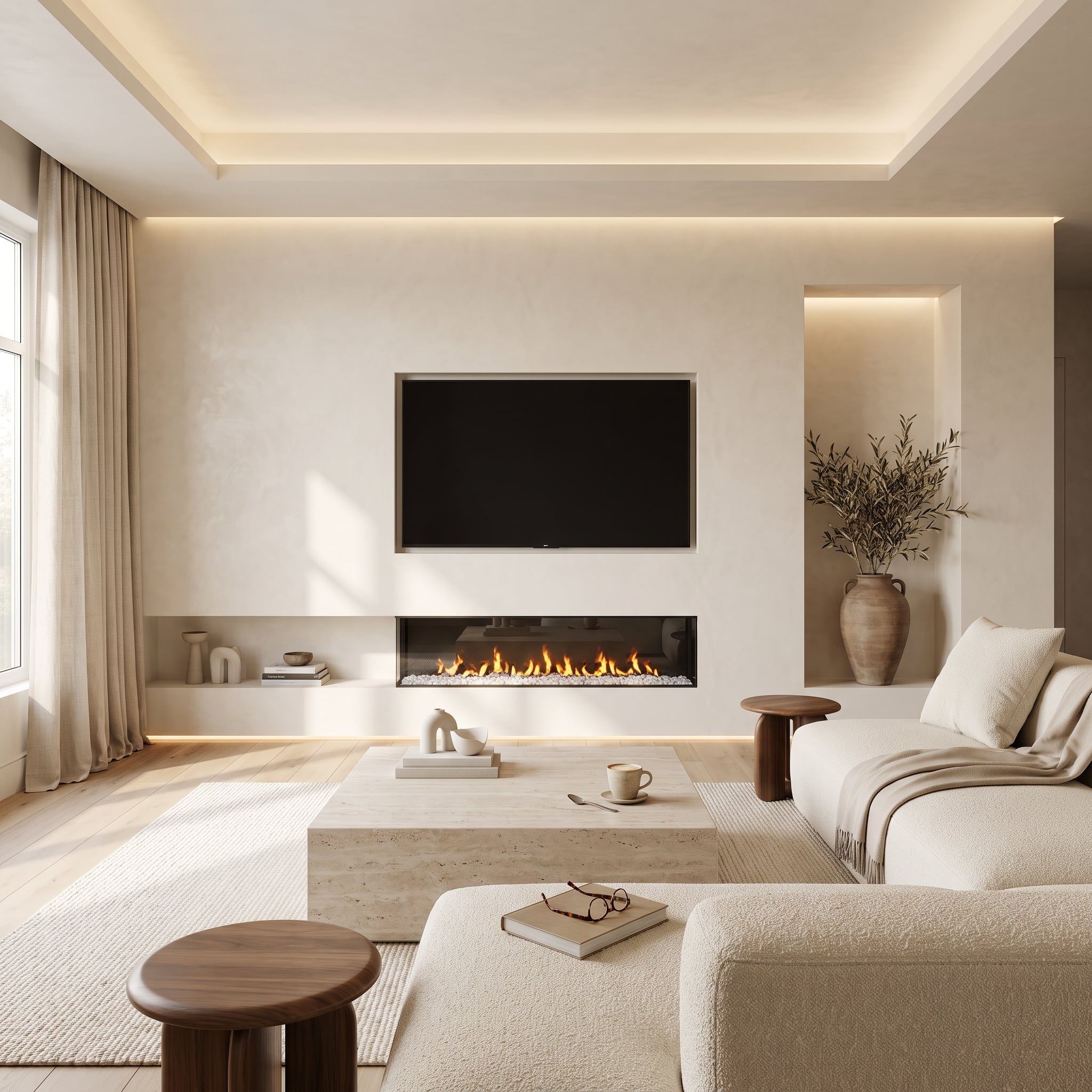
A pale plaster wall provides the setting for a recessed television and an exceptionally broad linear fireplace. With little decorative detailing around either element, their proportions become the main architectural statement.
The fireplace stretches horizontally across the lower wall, establishing a visual base for the screen. Fine variation in the plaster catches daylight, giving the restrained finish a degree of depth.
Concealed cove lighting reinforces the room’s simple geometry. The absence of a projecting mantel or elaborate surround keeps the composition unusually clean, although the installation still depends on appropriate clearances and heat management.
2. Walnut Shelving and Two Green Chairs Give the Fireplace Wall Some Breathing Room
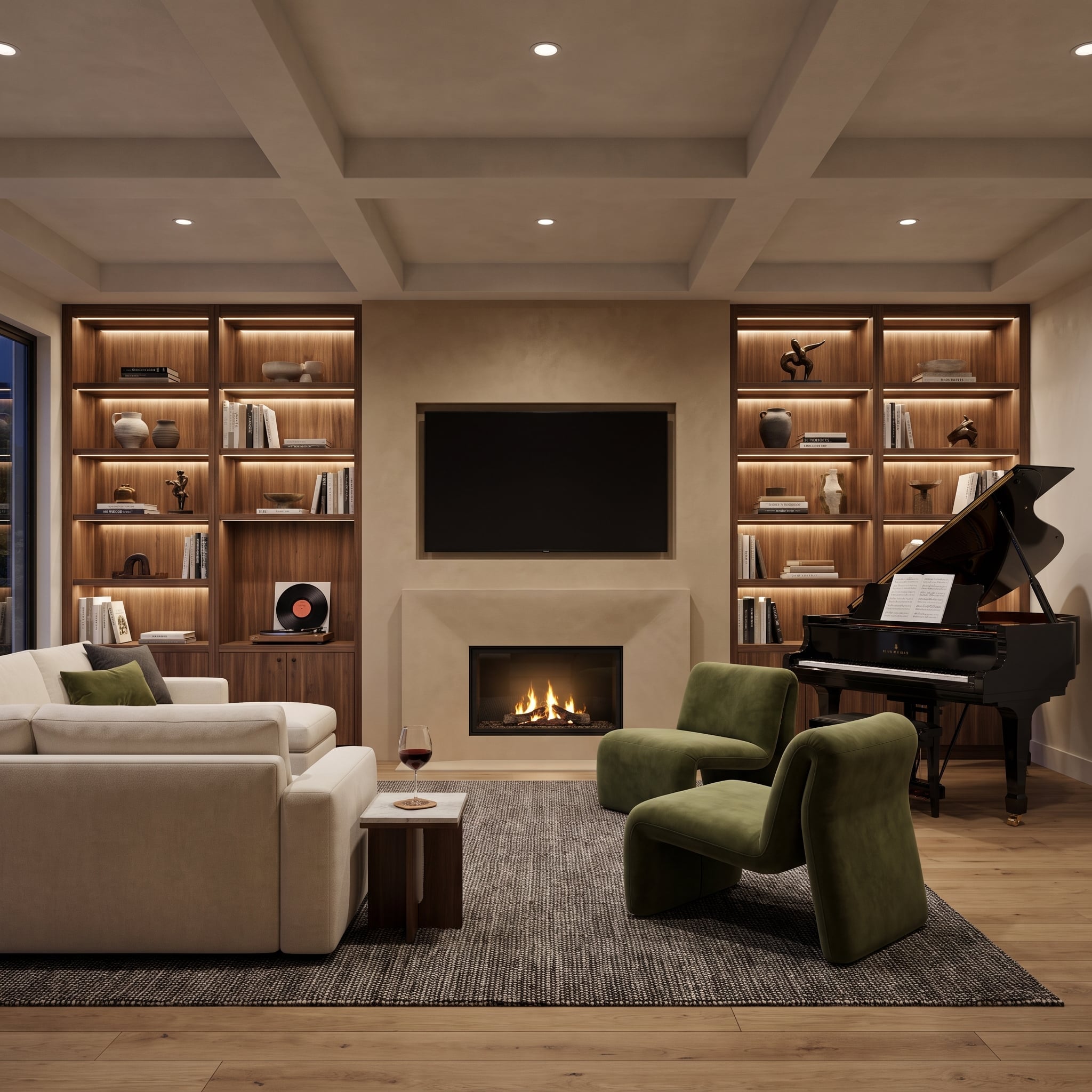
Backlit walnut shelving frames a plaster fireplace wall, giving the television and linear gas insert a broader architectural setting. The shelves provide texture, storage, and warm illumination, while the central plaster panel remains comparatively simple.
Two olive green velvet chairs introduce a welcome burst of color against the neutral wall and timber. Their placement establishes a conversation area that doesn’t depend entirely on the screen.
The most appealing aspect of this room is the balance between its functions. The television is integrated into the architecture, the fireplace remains low and horizontal, and the seating arrangement makes space for conversation rather than treating every chair as a theater seat.
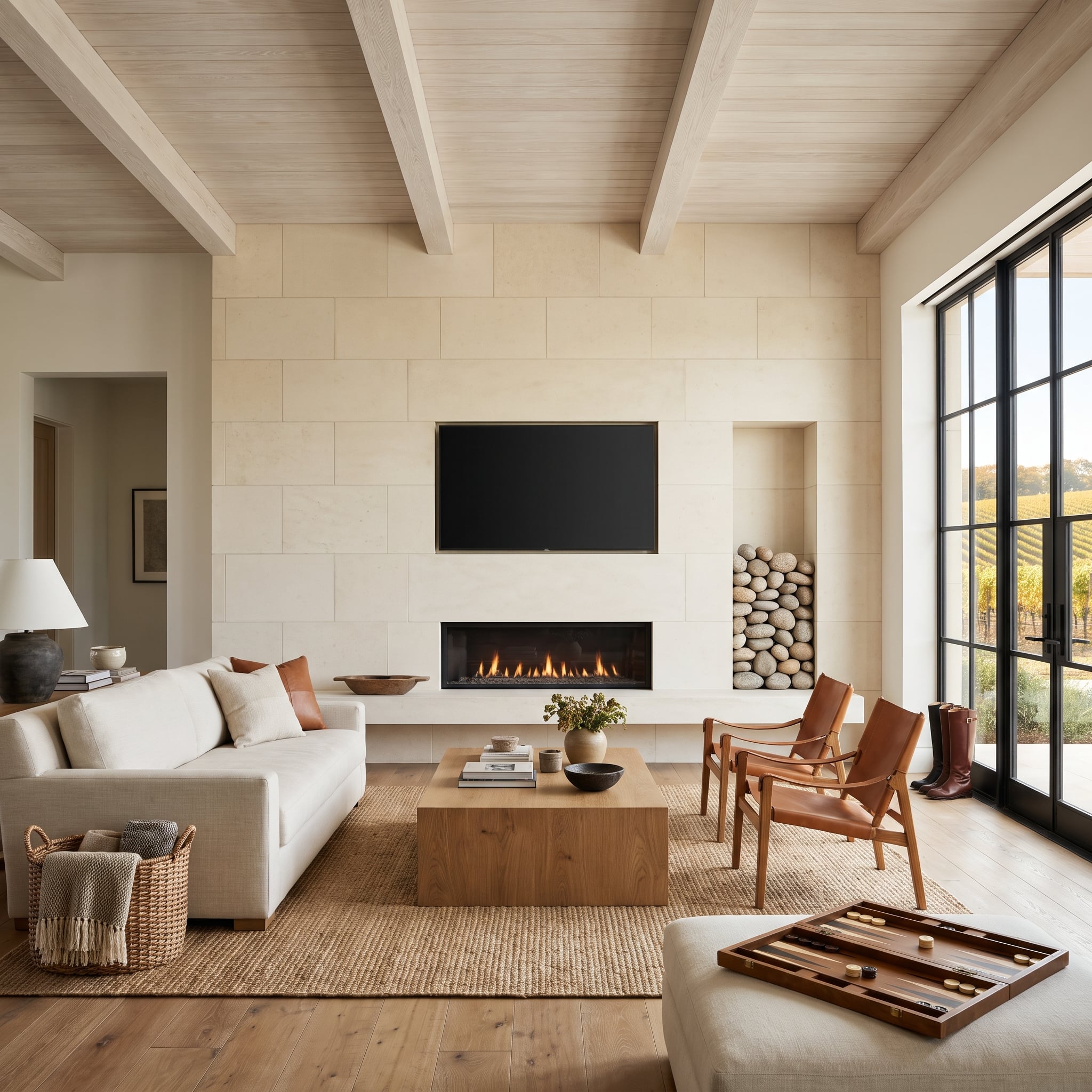
1. River Stones Give This Limestone Fireplace Wall Its Finishing Touch
🔥 Would you like to save this?
Cream limestone establishes a quiet backdrop for the television and linear fireplace, but the most interesting detail sits below the flame: a niche filled with river stones.
The rough, irregular stones introduce a natural counterweight to the smooth screen and precisely finished cladding. The fireplace’s elongated opening reinforces the room’s horizontal proportions without requiring a bulky traditional mantel.
There is a useful lesson in the relationship between the elements. The screen occupies the upper portion of the composition, the flame provides a narrow band of movement, and the river stones give the lower wall texture and visual weight. Nothing is especially complicated, yet every element has a clear architectural purpose.
Planning Consideration: A long, low fireplace can leave more flexibility for comfortable television placement than a tall traditional firebox. Actual mounting options depend on the fireplace and television manufacturers’ clearance, temperature, and installation requirements.