
Around 1970, Italian furniture design subjected the living room to a rather splendid demotion. Sofas lost their legs, cushions acquired the dimensions of small mattresses, and upholstery began spreading across the floor like a piece of inhabitable architecture. Mario Bellini’s Camaleonda turned the sofa into a landscape of rearrangeable modules, while Afra and Tobia Scarpa’s generously gathered Soriana made a virtue of the very folds that conventional upholstery had spent decades trying to eliminate. Sitting down was becoming a considerably more interesting proposition.
In order to come up with the very specific design ideas, we create most designs with the assistance of state-of-the-art AI interior design software. Also, assume links that take you off the site are affiliate links such as links to Amazon. this means we may earn a commission if you buy something.
The implications extended well beyond furniture. Lower the sofa and a window acquires greater prominence, a ceiling becomes more expressive, and a slab of travertine can assume the sculptural authority of a monument. Walnut, smoked glass, cognac leather and tobacco-colored velvet belong to this vocabulary, certainly, although so do vermilion lacquer, electric cobalt, polished chrome and the deliciously improbable optimism of Space Age design. The Italian seventies were considerably more mischievous than their present reputation for handsome brown interiors might suggest.
What makes these ideas compelling today is their capacity to reorganize a room around the pleasures of occupying it. A conversation pit creates a shared enclosure in place of the conventional hierarchy of sofa and armchair. Independent upholstered modules accommodate changing furniture plans, while adjustable backrests allow for everything from upright conversation to extravagant indolence. Luxury here has less to do with the quantity of marble than with the intelligence of the arrangement. Even the most expensive sofa is a rather ordinary object if the room has nothing interesting to say about how people sit.
39. When the Sofa Sinks Into the Architecture
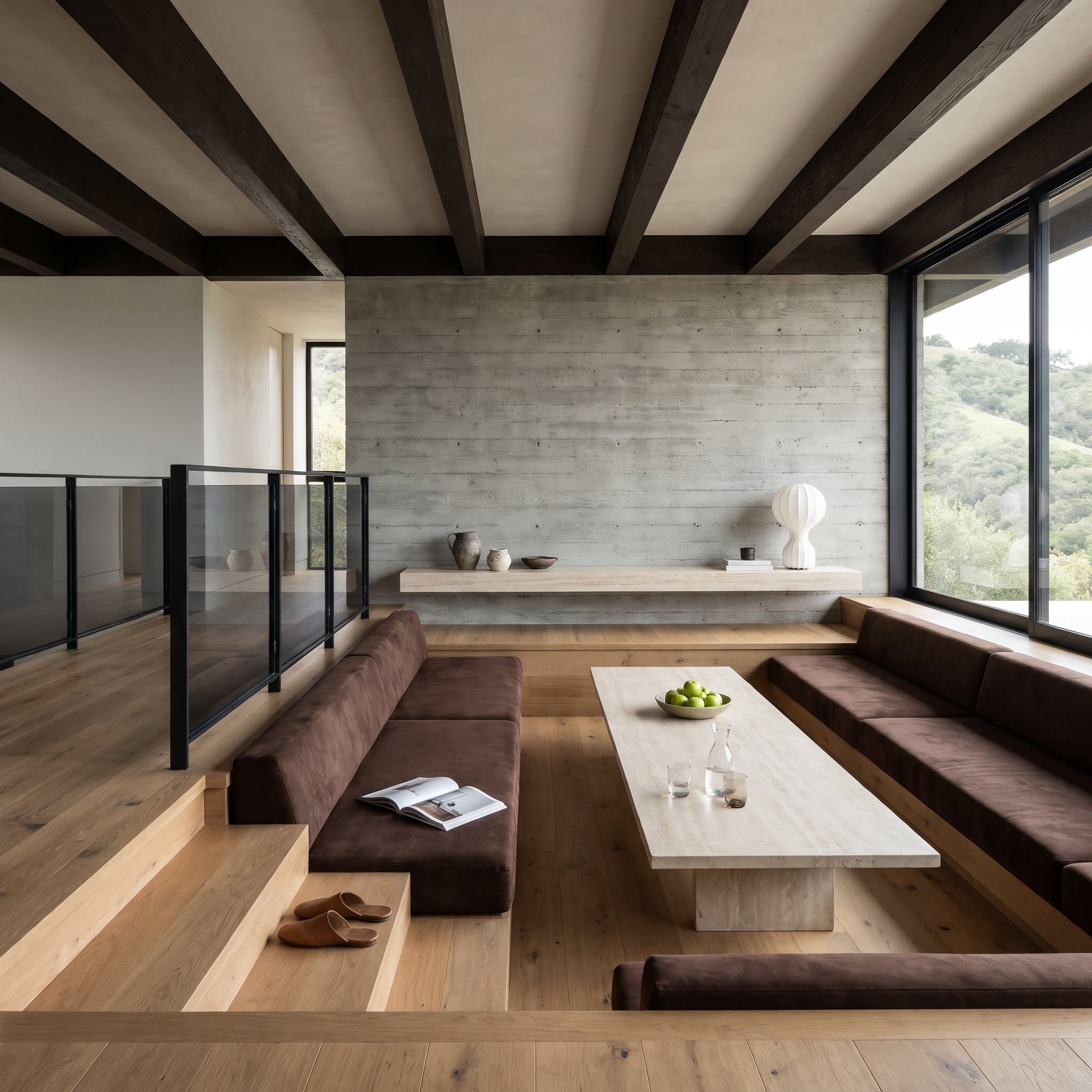
A change in floor level gives this conversation pit an identity separate from the surrounding living space. Chocolate velvet cushions line oak platforms on three sides, their generous dimensions transforming the recessed area into something halfway between furniture and a small interior courtyard.
Board-formed concrete supplies a wonderfully uncompromising backdrop to the softness of the upholstery. The low travertine coffee table leaves an open field of vision between the inward-facing seats. The luxury resides as much in the organization of space as in the selection of materials.
Recessed seating requires careful consideration of access, step visibility and circulation, particularly in households with young children or people with limited mobility. Integrated lighting and clearly defined steps can improve visibility, although an accessible route and appropriate safety provisions remain essential considerations.
38. Cobalt, Vermilion, and the More Rebellious Side of Italian Design
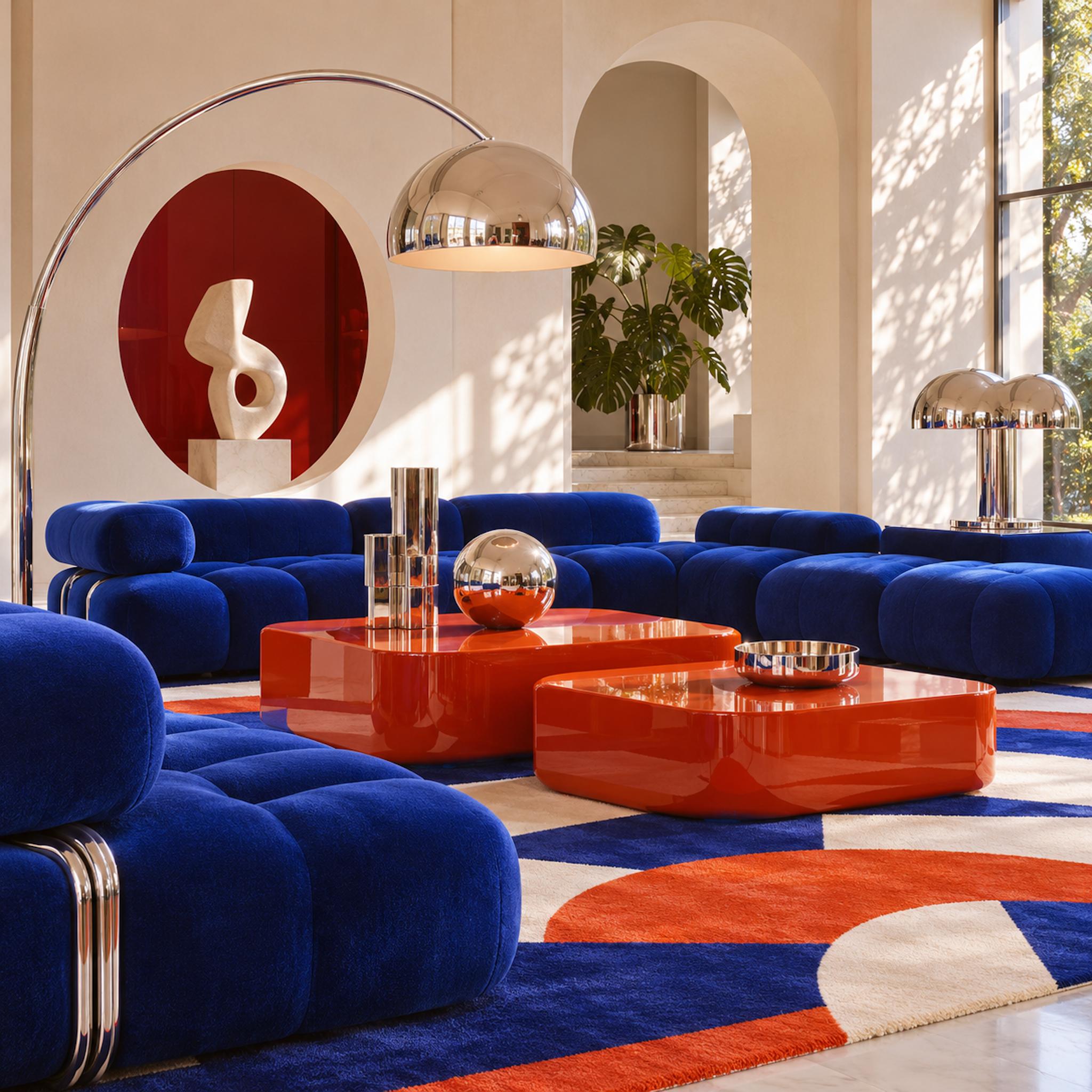
Anyone inclined to associate the Italian seventies exclusively with chocolate leather and tobacco velvet might reconsider in the presence of this collision of cobalt and vermilion. Rounded blue upholstery spreads across the floor in generous modules, while two glossy red-orange coffee tables appear almost liquid against the dense pile of the geometric rug.
A monumental chrome arc lamp sweeps over the seating, its reflective dome picking up the polished metal details of the furniture. The pale walls give this formidable concentration of color room to maneuver. Even the circular sculpture niche participates, supplying another vermilion surface above the sofas.
The exuberant palette echoes the experimental spirit of Italy’s radical design movements, which questioned inherited ideas about domestic furniture. The conventional three-piece suite seems an extraordinarily timid proposition beside these enormous blue cushions and gloriously insolent red tables.
37. A Bronze Sculpture Around Which an Entire Room Revolves
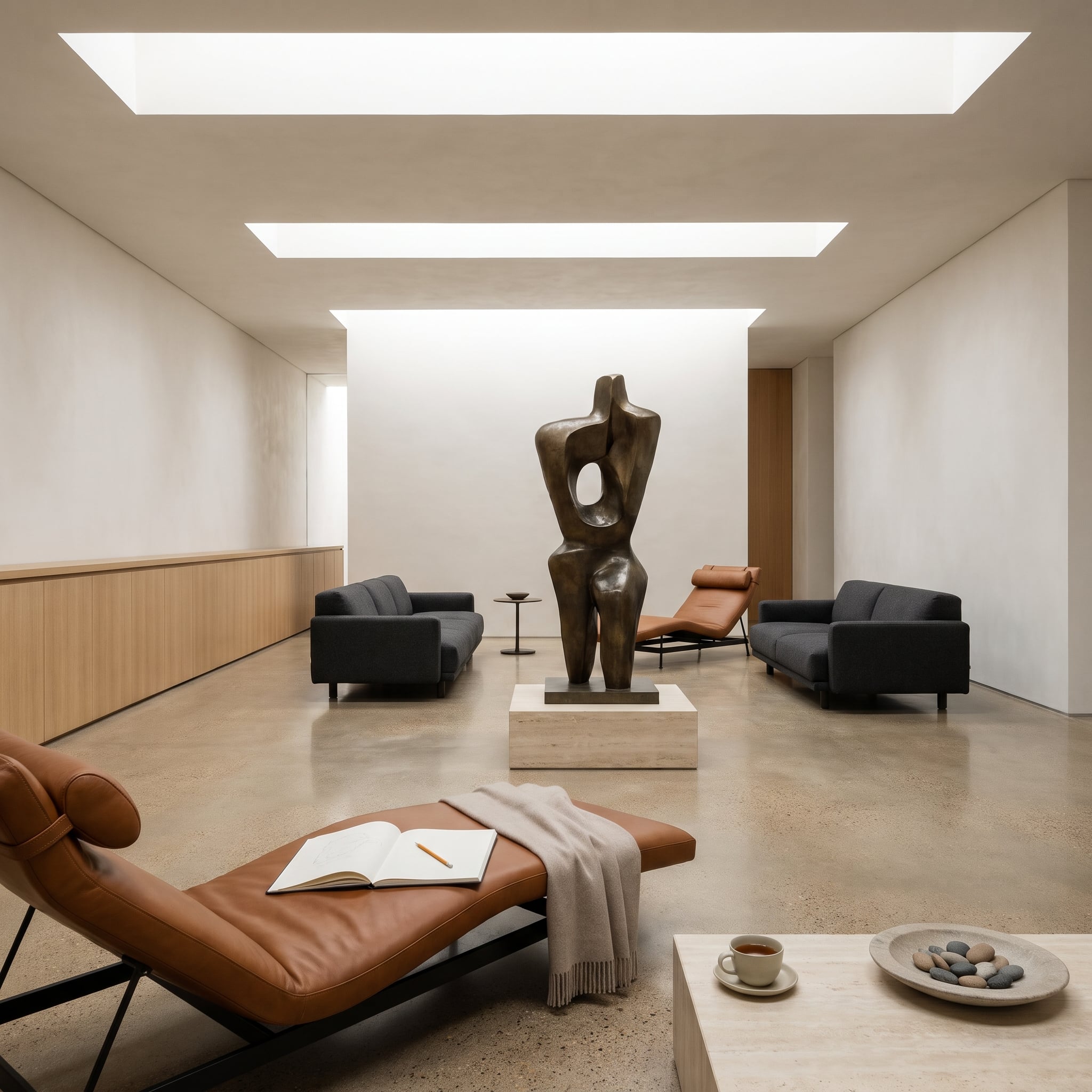
A dark biomorphic sculpture commands a travertine plinth at the center of this exceptionally disciplined interior. The surrounding furniture consists almost entirely of horizontal forms: charcoal sofas on slender black frames and elongated leather chaise longues that emphasize the expansive concrete floor.
Skylights reveal subtle differences between the polished concrete, bronze-toned sculpture and natural stone. Even the smaller objects enjoy the luxury of empty space around them. The sculpture has acquired the prominence usually reserved for a fireplace or monumental painting, largely because the furniture relinquishes so much of the vertical space.
36. Burgundy Lacquer Beneath a Ceiling of Gold
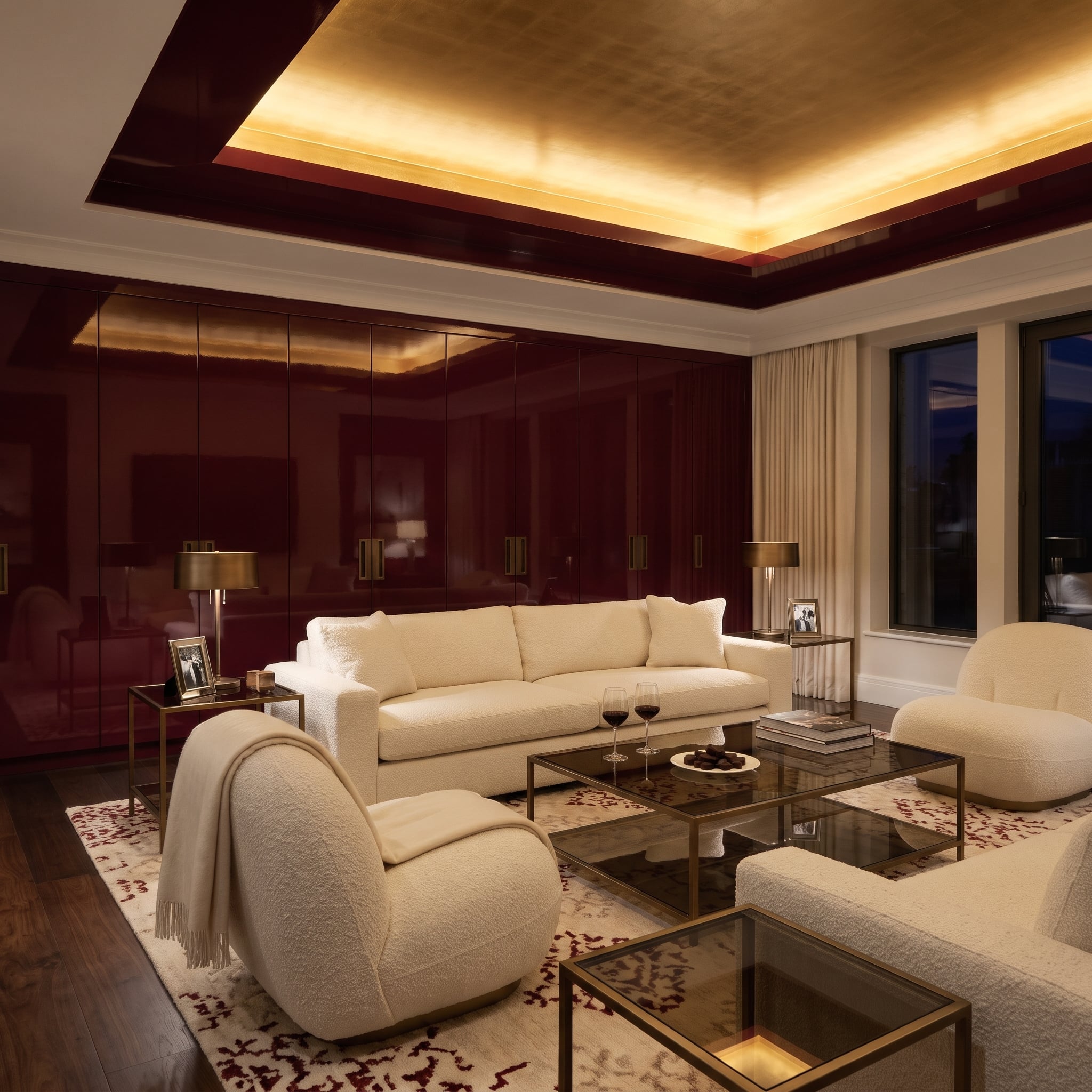
Deep burgundy lacquer brings something of the jeweler’s cabinet to the scale of an entire wall. Brass hardware punctuates the glossy panels, while reflections from the illuminated gold ceiling acquire a reddish warmth across the dark surface.
Cream bouclé provides an inspired counterpoint. Its soft, irregular texture gives the seating considerable presence beside all those polished surfaces, despite the modest furniture height. The pale upholstery also prevents the concentrated red and gold from becoming oppressive. An additional dose of glamour would probably be one dose too many.
Material Matters: High-gloss lacquer produces more pronounced reflections than matte wall finishes. Consider the placement of lamps and windows carefully, since bright reflections can become distracting across an uninterrupted glossy surface.
35. An Olive Tree Between the Living Room and the Sea
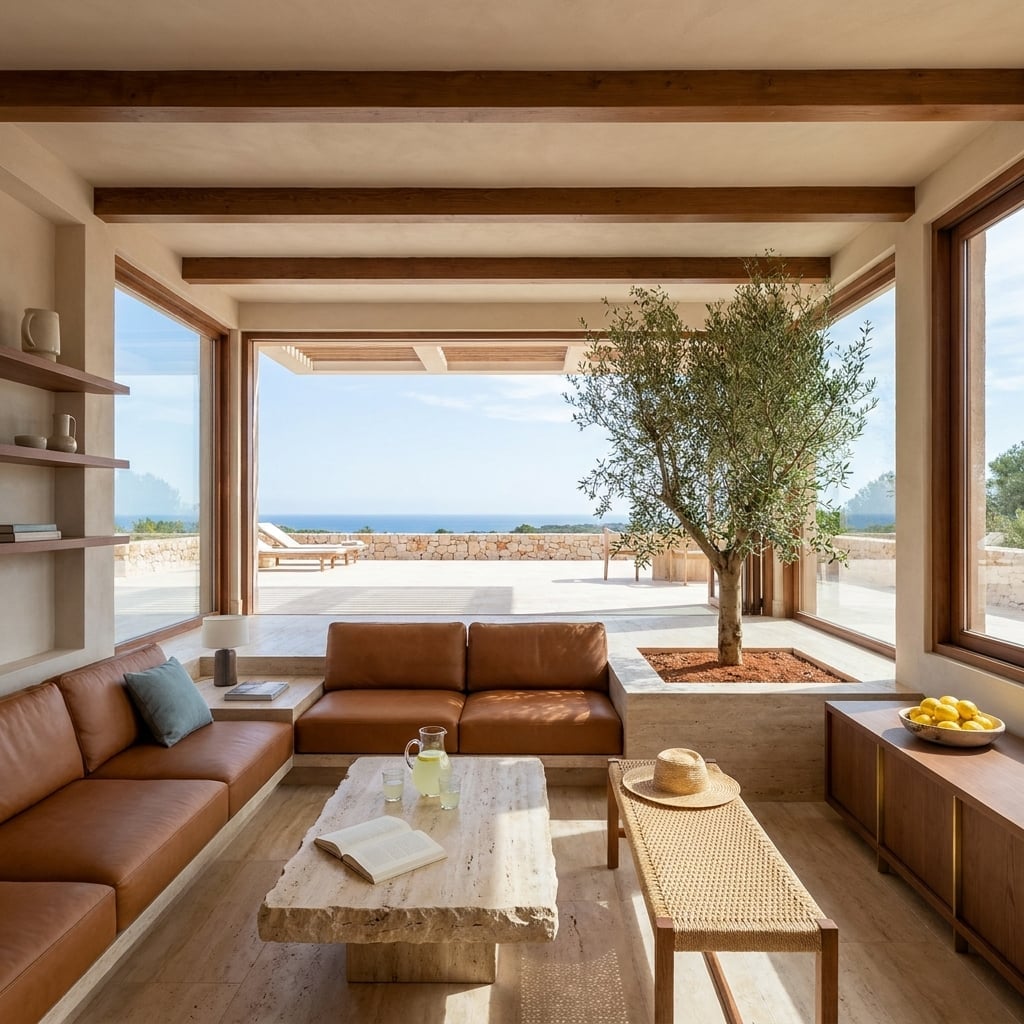
Cognac leather acquires an altogether different character in strong coastal sunlight. Gathered around a broad slab of travertine, the sofas preserve the view toward the terrace and the water beyond. Their amber tones have a natural affinity with the pale stone and muted greens of this Mediterranean-inspired setting.
An olive tree occupies a built-in planter near the edge of the room, spreading its irregular branches beneath the orderly progression of the ceiling beams. Its canopy becomes part of the interior’s spatial structure. A conventional potted plant would have considerably less authority in a room of this scale.
Indoor Planting: Olive trees require abundant light, well-draining soil and adequate root space. An architectural planter of this scale also needs suitable drainage and protection against moisture damage to adjacent building materials.
34. What Happens When Chrome Replaces Brass?
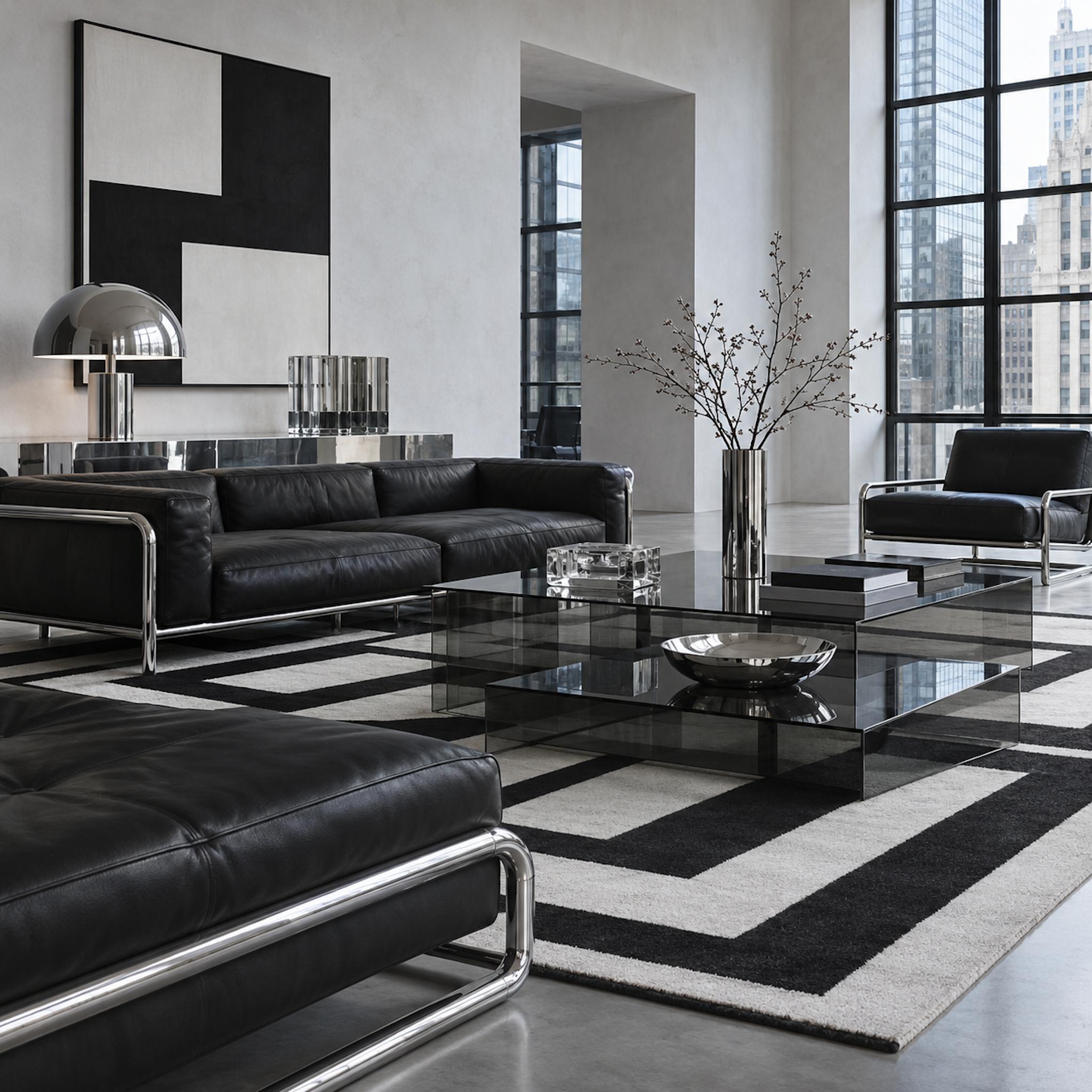
Polished tubular chrome gives this metropolitan living room a cooler, more graphic kind of luxury. Black leather sofas and lounge chairs sit within exposed metal frameworks, their horizontal lines extending across a boldly patterned black-and-white rug. The curved junctions of the tubing provide much of the ornament.
Overlapping smoked-glass coffee tables substitute transparency and reflection for the heavy stone monoliths favored in many contemporary interiors. Tall industrial-style windows admit cool daylight, while large-scale geometric artwork echoes the angular pattern underfoot.
The austerity recalls a strand of European modernism that continued to influence Italian furniture design throughout the seventies. Chrome has one particular advantage over more discreet finishes: every polished curve advertises the ingenuity of the furniture’s visible framework.
33. A Terracotta Sectional Beneath a Halo of Light
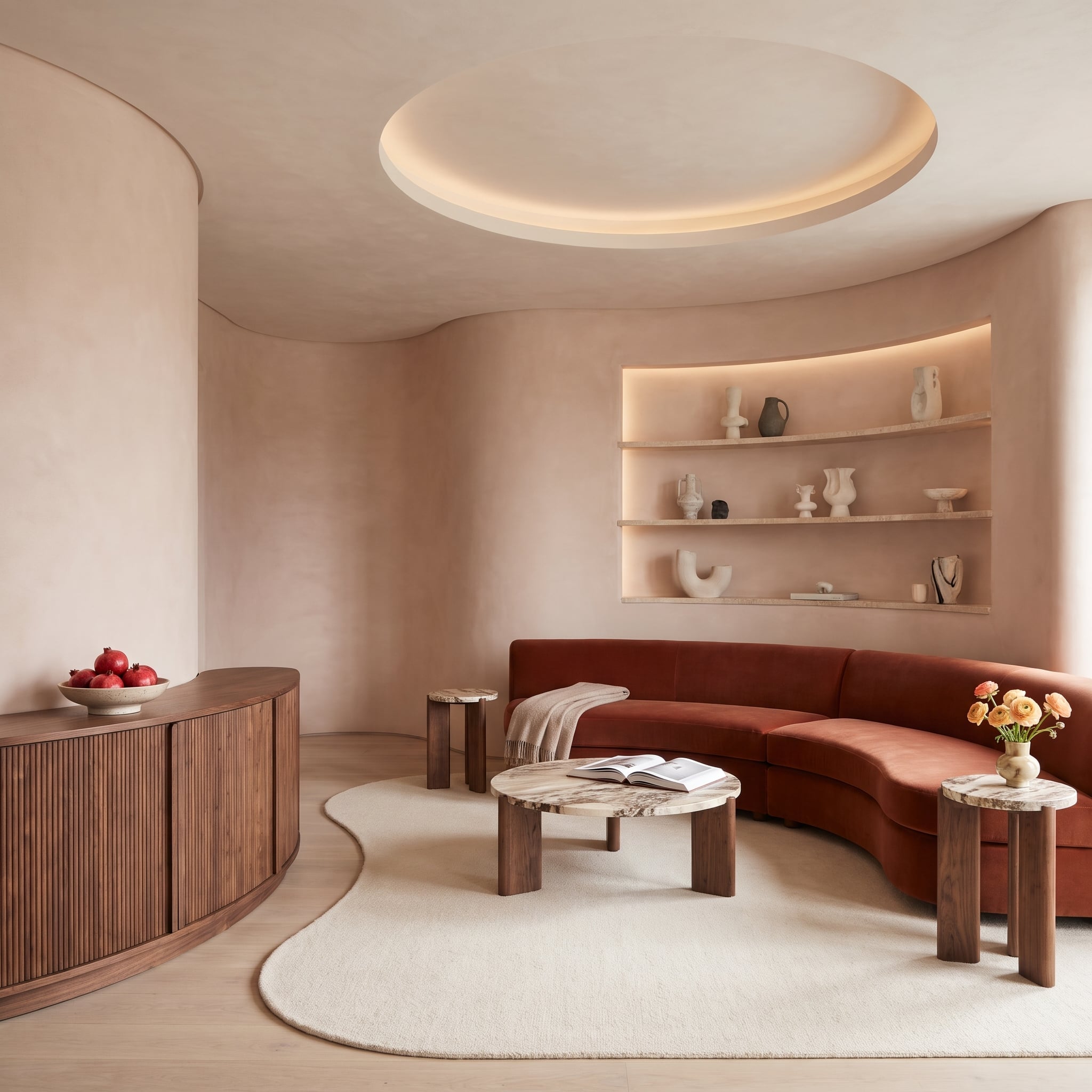
Terracotta velvet follows the sweep of the curved plaster wall, giving the sectional an unusually intimate relationship with the room itself. The neighboring plaster carries a paler version of the same earthy pink, softening the distinction between furniture and surroundings.
Concealed uplighting defines a circular ceiling recess without placing a chandelier in the space between ceiling and seating. Two complementary curves govern the interior: the substantial upholstered form below and the luminous circle above. The geometry has sufficient decorative character without a collection of objects hanging from the ceiling.
32. Amber to Near-Black Along a Single Leather Sectional
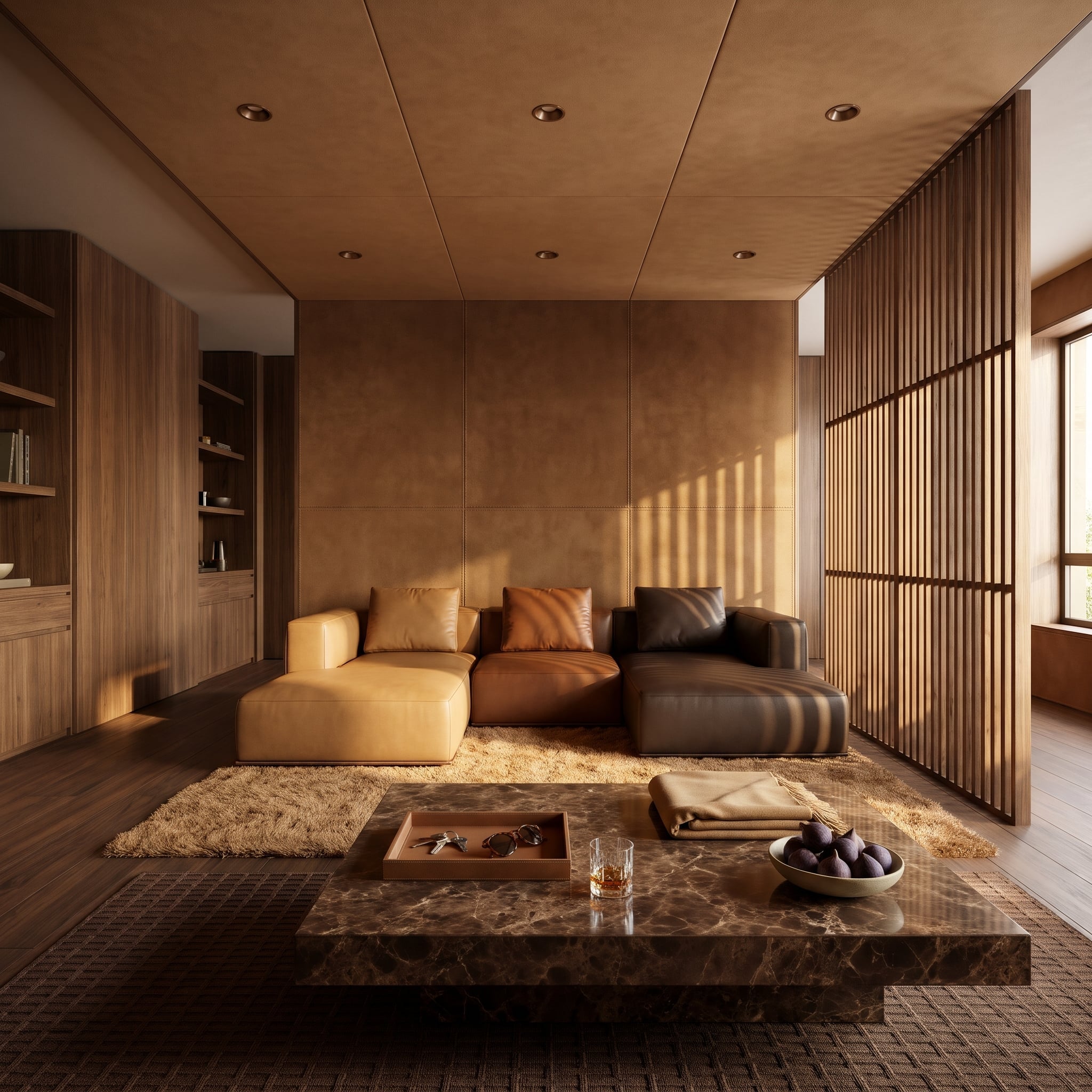
Three shades of leather transform the sectional into a remarkably sophisticated color study. Pale amber develops into cognac and then near-black, each upholstered section retaining its own identity within the larger piece. The surrounding wall panels and rug contain quieter variations of those same colors.
A thick Emperador marble coffee table adds the expressive veining of natural stone to this carefully orchestrated spectrum of brown. Its dark surface is especially striking beside the paler leather at one end of the sectional.
Daylight filtered through a floor-to-ceiling slatted wood screen produces another pattern, casting narrow bands of light and shadow across the interior. Such screens can provide partial visual separation while preserving some daylight and connection between adjoining spaces. The shadows become a fleeting form of decoration requiring neither paint nor wallpaper.
31. The Sofa That Became an Enormous Mustard Cushion
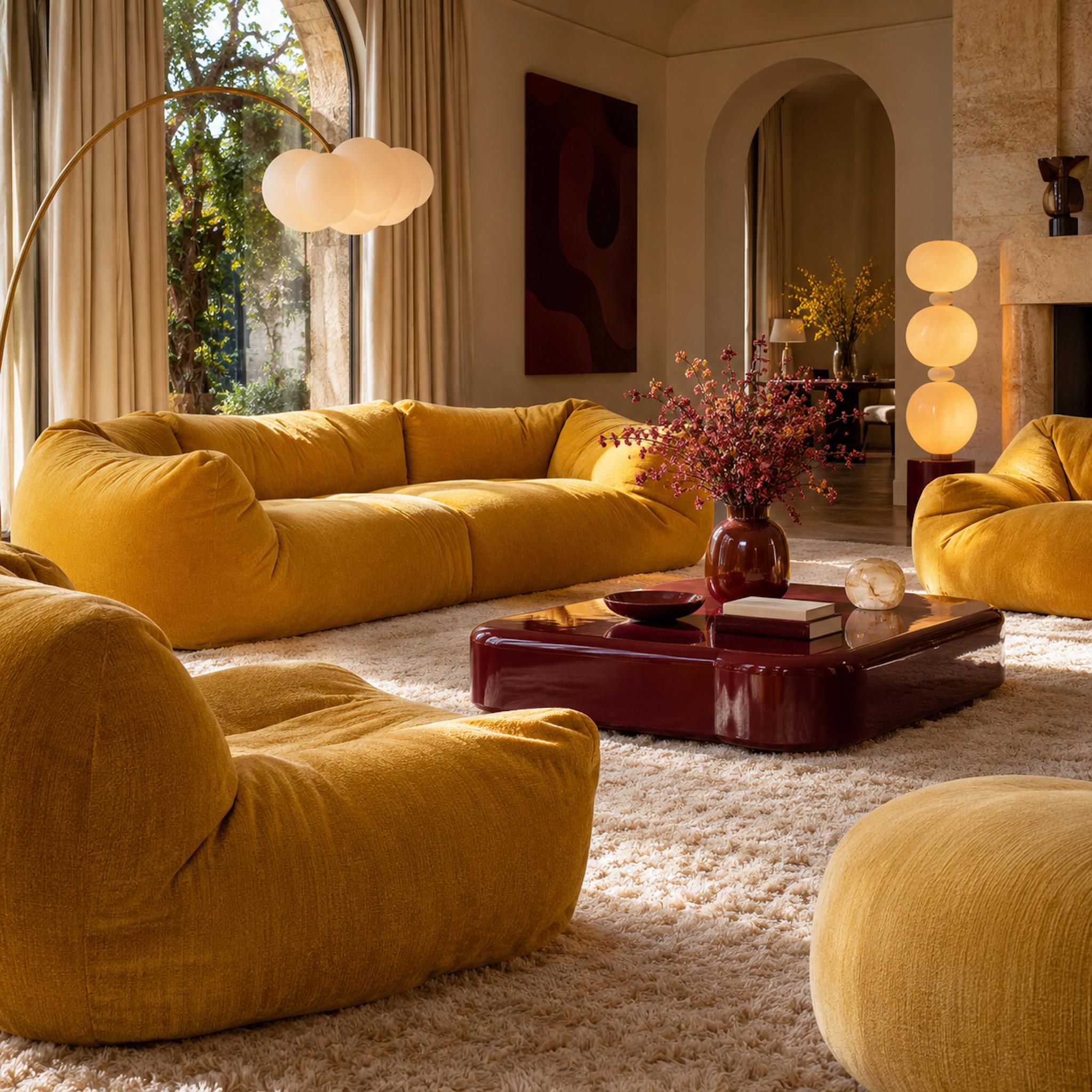
The distinction between armrest, seat and backrest nearly disappears in these generously upholstered mustard-yellow forms. Soft creases replace rigid edges, and the entire sofa appears to occupy the floor like an immensely comfortable cushion. The approach recalls the unconventional upholstery of Mario Bellini’s Le Bambole, introduced in 1972.
A low burgundy lacquer table has an almost confectionery richness against the golden upholstery. Cream carpeting extends beneath the furniture, while arrangements of spherical lamps repeat the rounded forms at several elevations around the room.
The traditional setting makes the furniture especially intriguing. Arches, a substantial stone fireplace and tall curtains provide a stately backdrop for upholstery of such conspicuous informality. The delicious incongruity lies in the meeting of architecture that stands to attention and furniture that appears incapable of doing so.
30. Steel-Blue Velvet Above the City at Night
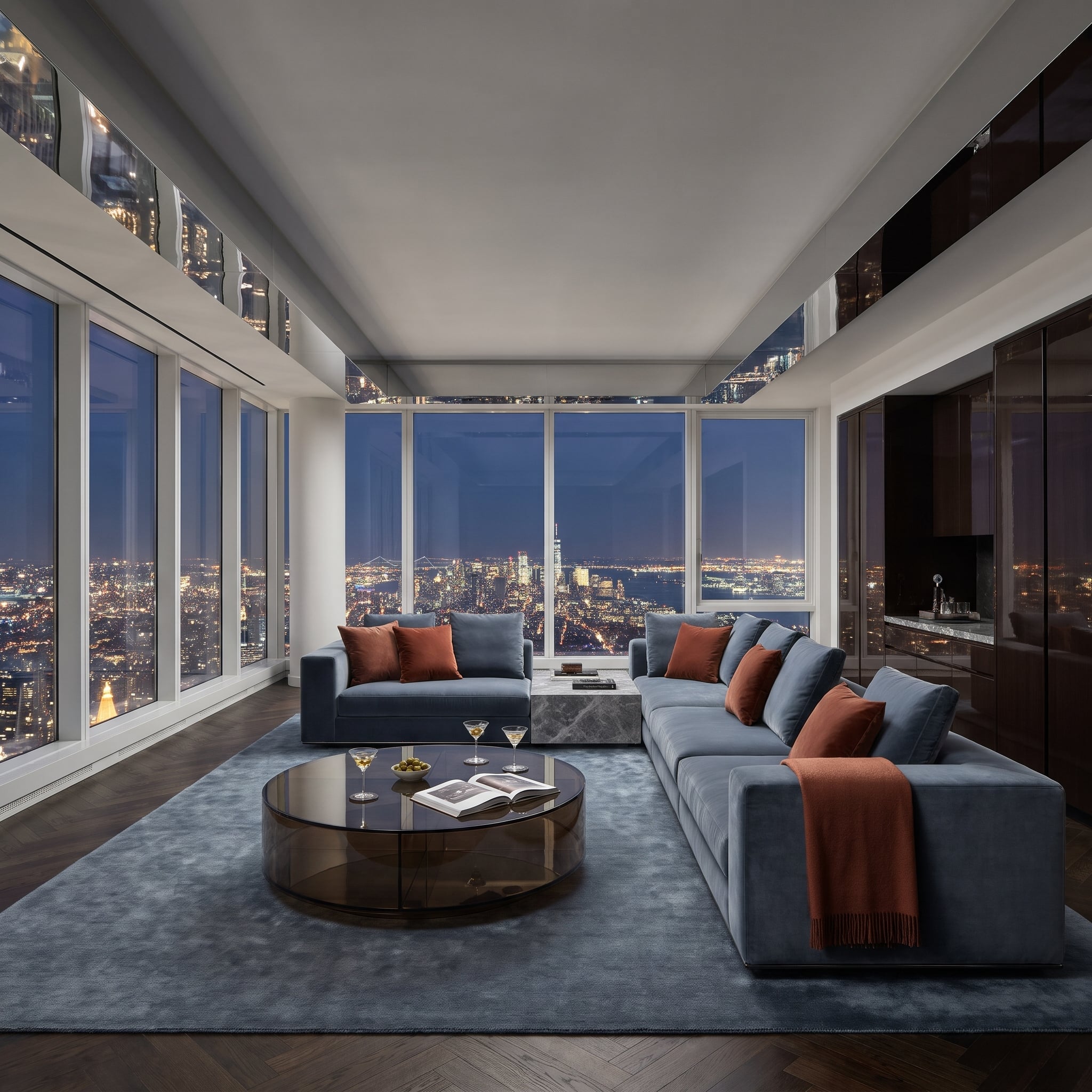
Slate-blue sectionals leave an extravagant expanse of illuminated skyline visible through two glazed walls. Against the distant geometry of the city, the broad upholstery establishes a much more intimate foreground. An oval smoked-glass coffee table continues the horizontal emphasis.
Rust-colored cushions punctuate the cooler palette with concentrated areas of warmth. A marble slab between the sofa sections brings a harder mineral surface into the upholstered landscape, while an orange throw extends the warmer colors across another part of the seating.
Color Story: Velvet can appear lighter or darker according to the direction of its pile, the angle of illumination and the position of the viewer. This makes a single upholstery color capable of producing surprisingly varied tones across a large sectional.
29. Two Curved Sofas Beneath Coffered Arches
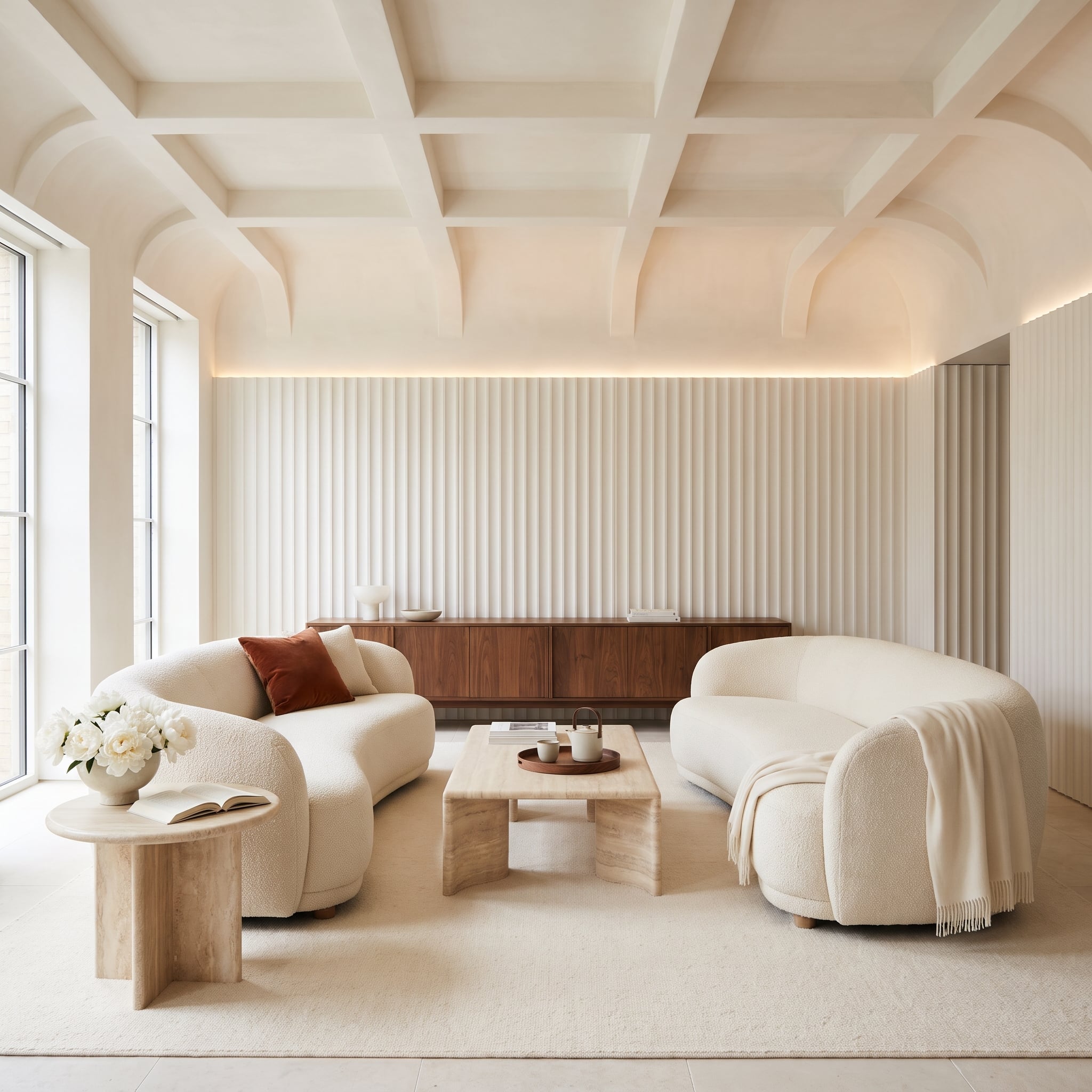
Two cream bouclé sofas face each other across a travertine coffee table, their rounded profiles leaving an unusually generous interval of space beneath the elaborate ceiling. The arched coffers acquire greater prominence because so little furniture obstructs the view upward.
A walnut credenza draws a horizontal line against the fluted plaster. Elsewhere, the cream rug, pale upholstery and naturally banded stone rely on differences of surface more than changes in color. A single rust-colored cushion acquires surprising significance within that restrained palette.
Natural light reveals the irregular loops of the bouclé and the markings in the stone. The pleasure of a near-monochromatic room often lies in the extraordinary differences between materials that appear almost identical in color.
28. A Mirrored Ceiling Over Hammered Metal and Black Leather
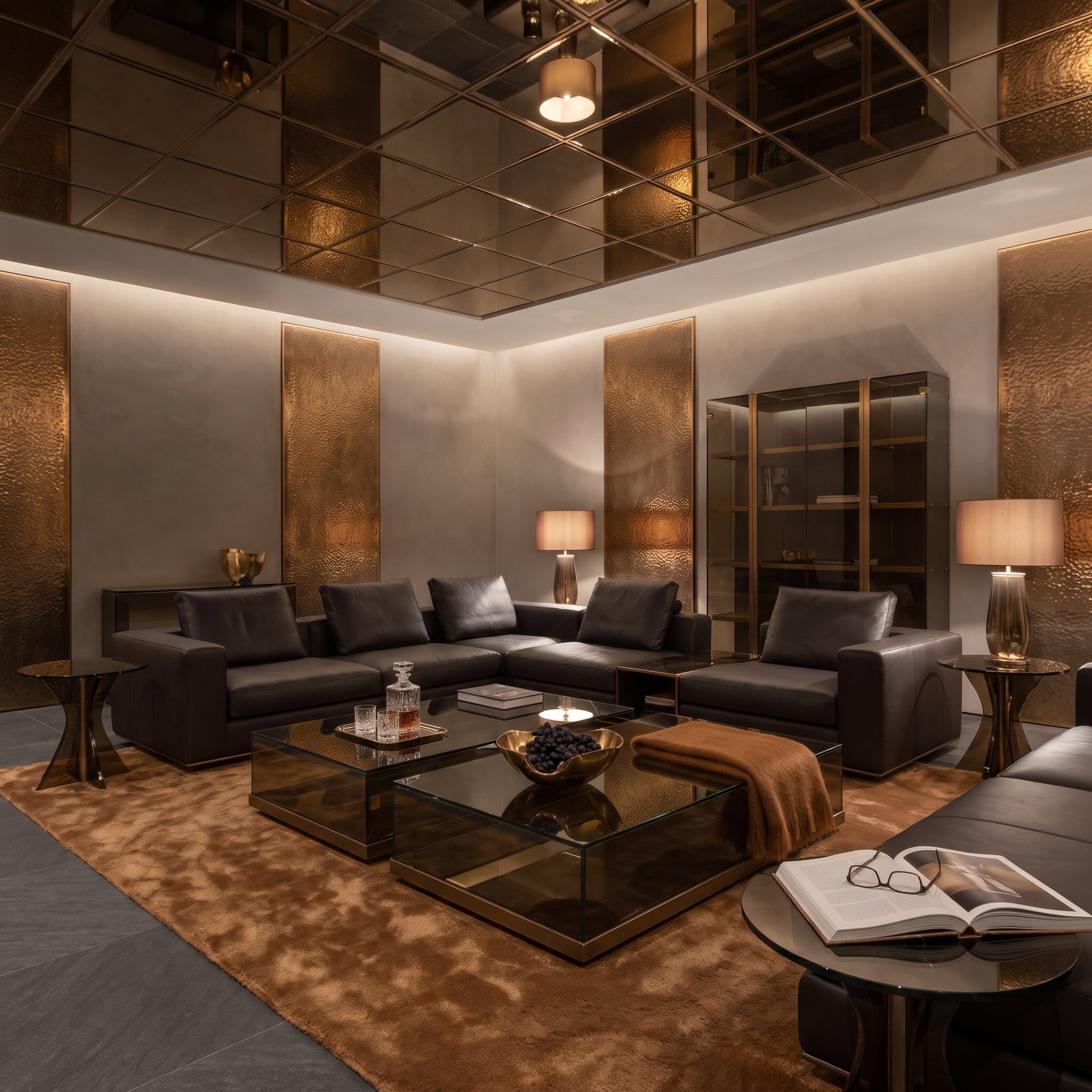
Bronze-toned hammered metal gives the walls a wonderfully irregular complexion, while the mirrored ceiling brings fractured versions of the interior into the space overhead. Its warm tint makes the reflections feel closer to polished antique metal than conventional mirror glass.
Near-black leather supplies a relatively disciplined silhouette beneath all this reflective decoration. Brass-framed smoked-glass tables divide the central space, and a caramel-colored rug distinguishes the seating area from the surrounding floor.
Cylindrical lamps cast smaller pools of light near the furniture, their reflections changing with the viewing angle. The room possesses the visual richness of a jewelry box, with black leather taking the place of its velvet lining.
27. The Pavilion Where the Sofa Barely Interrupts the Landscape
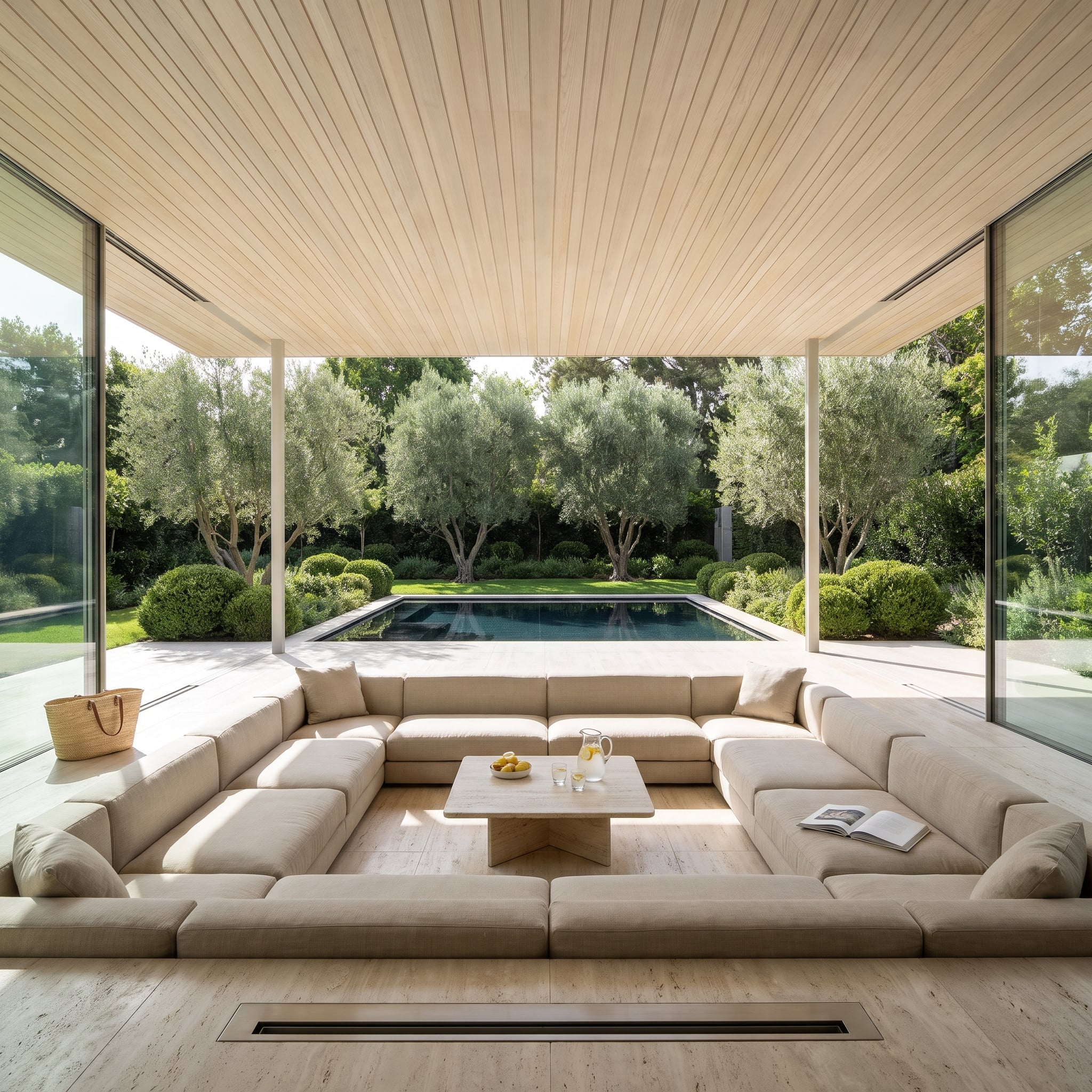
Pale ash cladding extends across the ceiling of this Mediterranean-inspired pavilion, giving the broad surface the warmth of sun-bleached wood. Below, cream linen upholstery forms a low, inward-facing arrangement that preserves the view toward the pool and olive trees.
The sectional borrows the intimacy of a conversation pit without necessarily requiring an actual depression in the floor. Seating wraps around the coffee table on three sides, creating a distinct gathering place within the otherwise open interior.
Travertine and pale upholstery share the coloring of the terrace. The sofa backs remain sufficiently unobtrusive to preserve the landscape as part of the room, even when viewed from across the interior. Such an expansive setting has little need of another monumental object competing with the scenery.
26. When Velvet and Abstract Painting Share the Same Palette
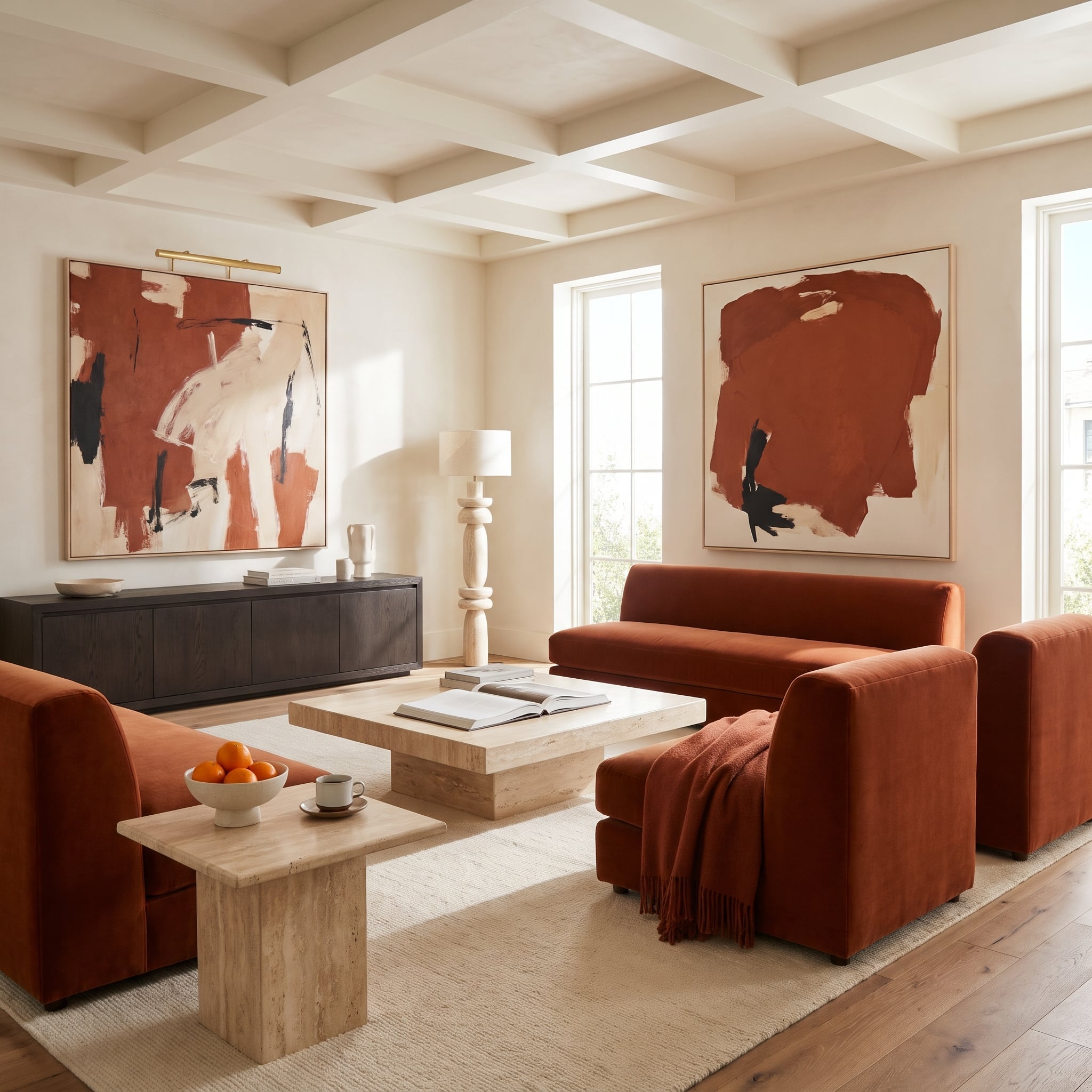
Four rust-colored seating pieces spread across the floor, their substantial proportions matched by the stacked travertine slabs of the coffee tables. Overhead, the coffered ceiling establishes a more expansive pattern of horizontal and vertical lines.
Two large abstract paintings take up the burnt sienna of the upholstery, interrupted by broad passages of black brushwork. The dark gestures prevent the repeated color from becoming excessively harmonious. A wood credenza and sculptural column lamp supply quieter shapes along the rear wall.
Material Care: Velvet benefits from cleaning methods appropriate to its fiber and construction, while travertine requires protection from acidic substances and staining liquids. Both can develop attractive character over time, although neither is immune to damage from everyday use.
25. A Burgundy Sofa That Changes Its Mind About Height
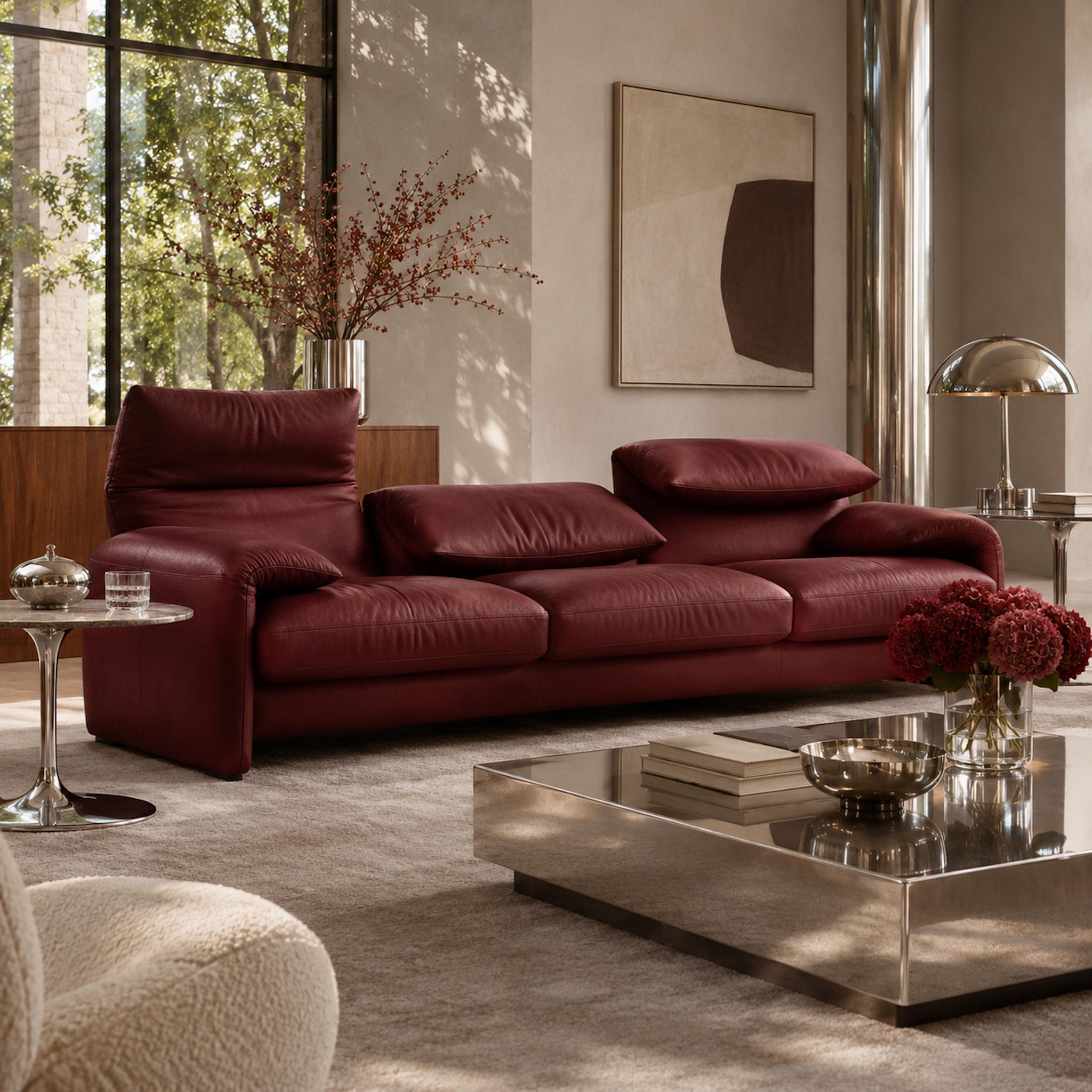
Must a low sofa remain low when someone wants to sit upright? The folding backrests of this burgundy leather design suggest the ingenious flexibility of Vico Magistretti’s Maralunga, designed in 1973. One section rises into a supportive headrest, while its neighbors retain the more languorous proportions of a lounging sofa.
The leather takes on a richness somewhere between claret and oxblood. Polished metal tables offer a cooler contrast, and the understated abstract painting leaves the changing height of the upholstery as the principal visual event.
There is a particular intelligence in furniture that accommodates different sitting preferences without compromising its appearance. The beauty of the Maralunga idea lies in making the distinction between an upright sofa and a lounging sofa largely unnecessary.
24. An Evening in Amber Onyx and Gold Mosaic
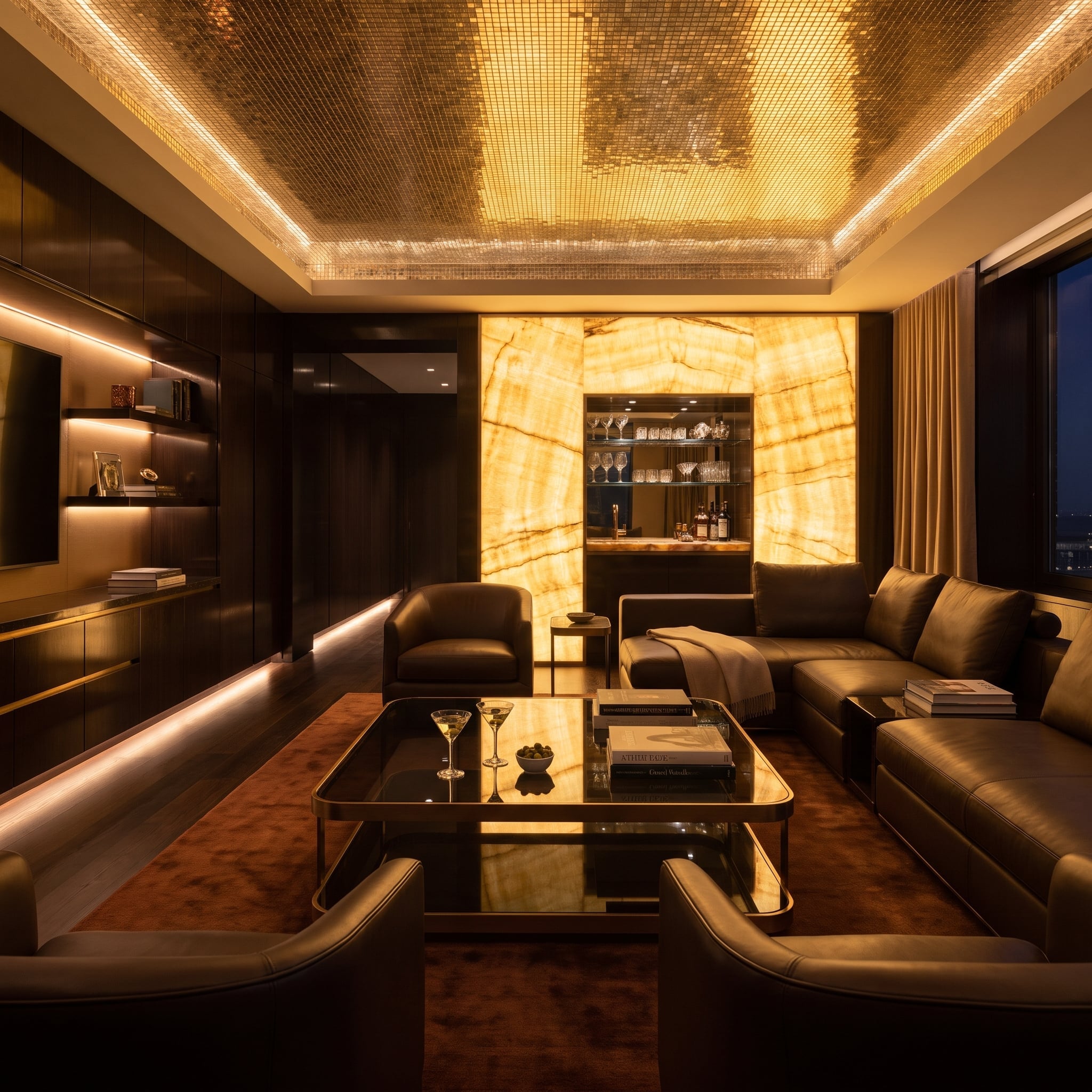
Backlit honey-colored onyx occupies the far wall with the radiance of an enormous piece of amber. Dark leather seating acquires a handsome silhouette against the illuminated stone, while a brass-framed glass coffee table contributes a more transparent presence between the substantial cushions.
Small gold mosaic tiles bring a finer scale of ornament to the recessed ceiling. Concealed perimeter lighting catches their individual reflective surfaces, and the built-in bar and dark wood shelving supply the decorative richness of a private lounge.
The comparatively modest height of the seating allows the spectacular finishes to remain visible. There is something appealingly theatrical about a room in which the walls and ceiling provide the spectacle and the furniture supplies the composure.
23. Floating Oak Treads Above a Burnt-Sienna Sectional
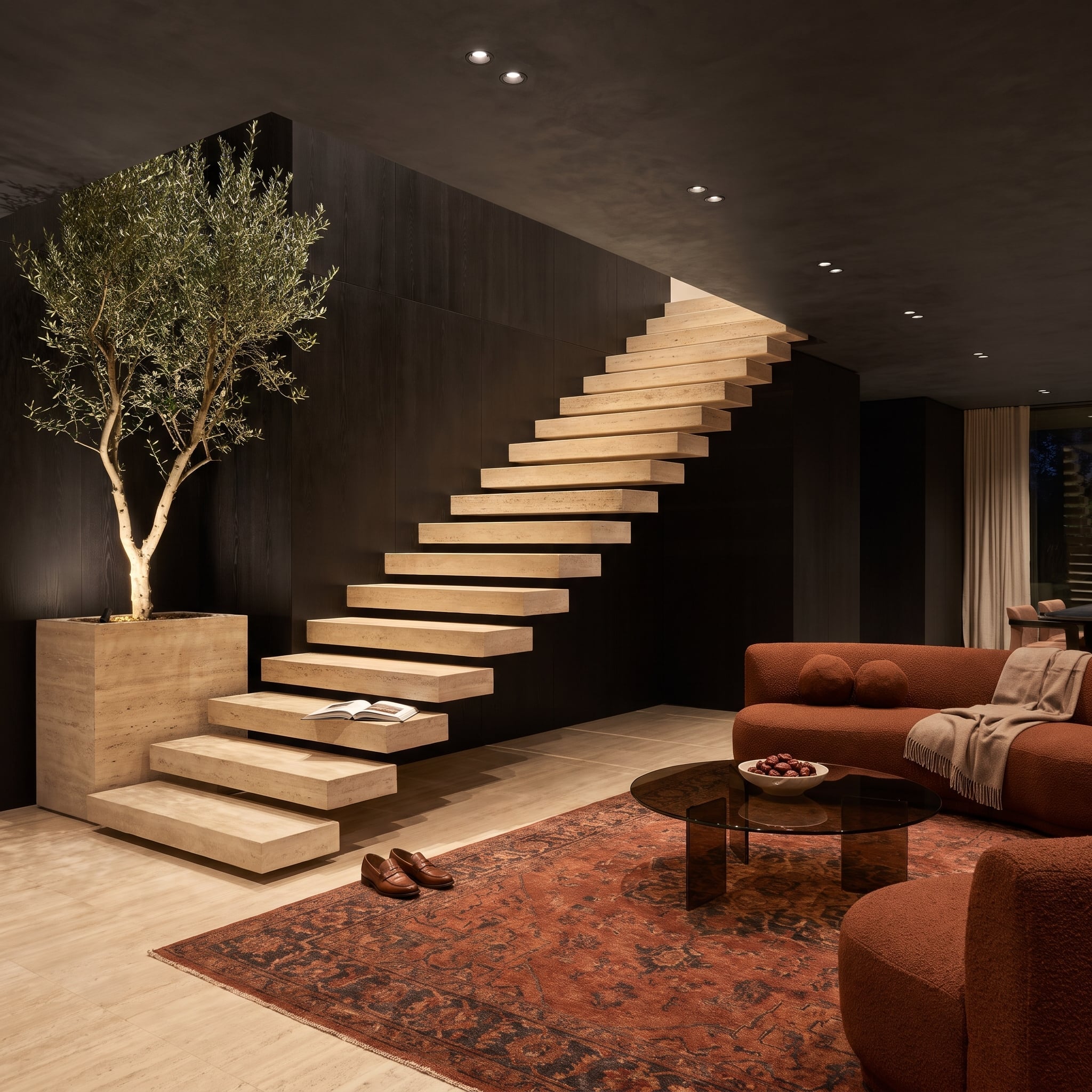
Oak stair treads project from a dark-paneled wall in a striking ascending sequence. Their apparent lightness provides an elegant counterpoint to the substantial burnt-sienna bouclé sectional below. The warmth of the oak finds an echo in the earthy upholstery.
A Persian-style rug defines the seating area, while a circular smoked-glass coffee table offers a moment of transparency among the dense textile surfaces. An olive tree in a stone planter interrupts the staircase’s orderly lines with a much less predictable vertical form.
Architectural Detail: Cantilevered stairs require appropriately engineered structural support. Real installations must also incorporate handrails, guards and other safety provisions wherever required by applicable building regulations. Discreetly detailed glass or metal guards can help retain the visual lightness of the design.
22. A Milan-Inspired Apartment With No Spare Inches for Grandeur
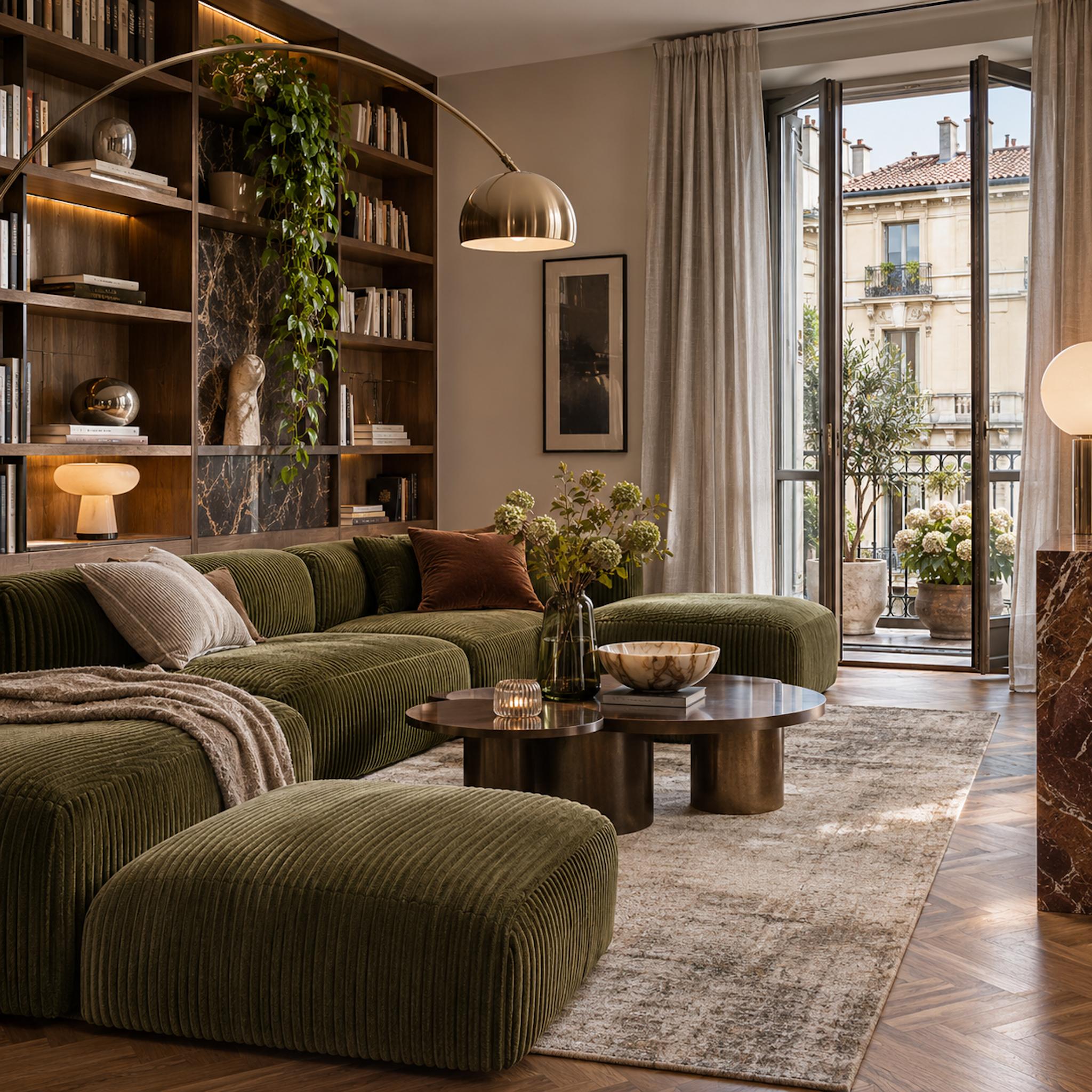
Ordinary ceiling heights need not preclude extraordinary furniture. A modular sofa in moss-green wide-wale corduroy occupies the heart of this compact apartment, accompanied by a matching ottoman that can extend the lounging area or provide an additional seat. The broad ribs give the upholstery a decidedly seventies character.
Walnut bookshelves incorporate lighting, decorative objects and dark marble accents within a single wall of cabinetry. Low nesting tables preserve flexibility, while a sweeping arc lamp illuminates the seating without consuming valuable coffee-table space.
French doors open onto a modest urban balcony framed by neighboring buildings. The pleasures of low living become particularly apparent at this scale. There is no monumental ceiling to inflate the sense of space, no panoramic expanse of countryside and no surplus of square footage. The furniture has to accomplish considerably more with considerably less.
21. Aubergine Velvet Beneath a Gilded Dome
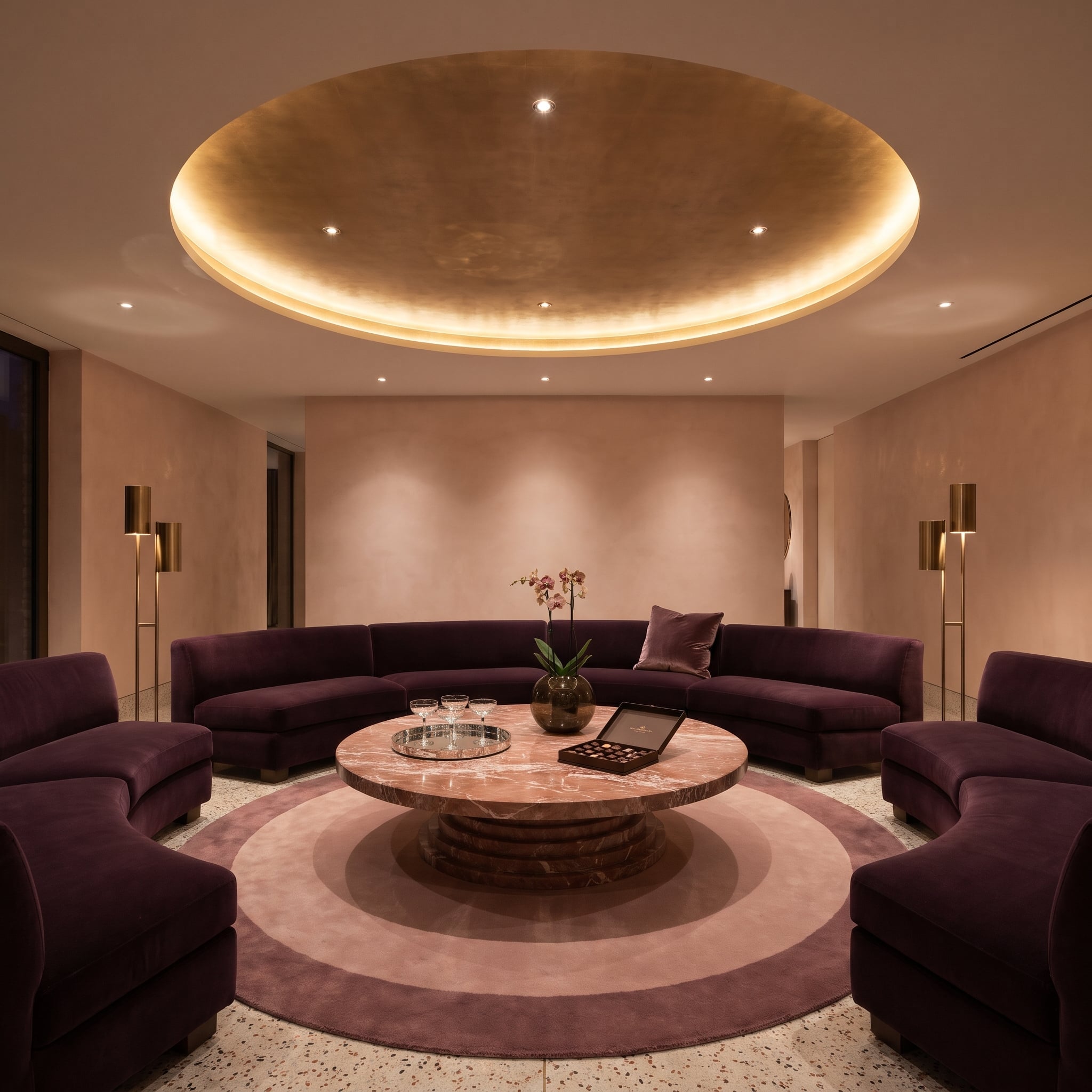
A gilded ceiling recess establishes the circular geometry of this unusually sumptuous living room. The terrazzo floor, concentric rug and pink marble coffee table repeat the theme at progressively smaller scales, as though the furnishings were tracing the outline of the dome above.
Aubergine velvet recalls the decorative richness of historic European salons, although the seating belongs to a considerably less formal conception of domestic life. Its purple undertones supply an intriguing contrast to the concentrated warmth of the ceiling.
The circular layout dispenses with the usual emphasis on a single rectangular sofa. The central table becomes the common point of reference for the surrounding seats, and the considerable grandeur overhead belongs equally to everyone below.
20. A Living Room With the Composure of a Sculpture Gallery
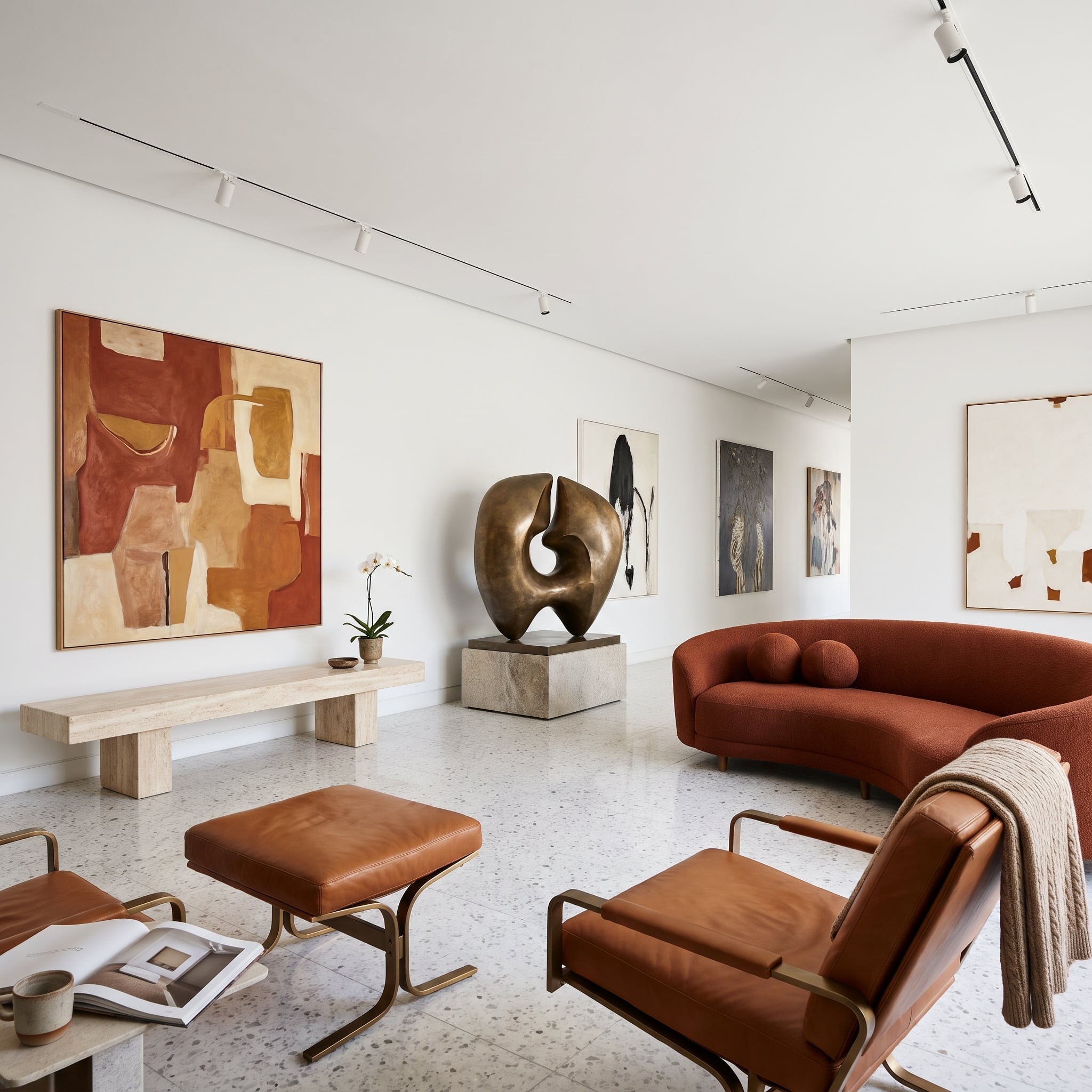
Terrazzo, travertine and a bronze-toned sculpture establish a setting of gallery-like restraint. The curved rust bouclé sofa makes a warm, tactile departure from the harder materials, with cognac leather armchairs extending the colors toward amber.
Thin black track-lighting rails form a discreet framework overhead, allowing individual works of art to receive focused illumination. The exposed metal frames of the armchairs also reveal more of the patterned floor than fully upholstered bases would.
The sofa has acquired some of the expressive qualities of the artwork surrounding it. Its sweeping form is sufficiently sculptural to hold attention without a coating of decorative cushions. The furniture belongs in the company of the bronze figure because both possess such distinctive silhouettes.
19. Forest-Green Velvet and a Game of Backgammon
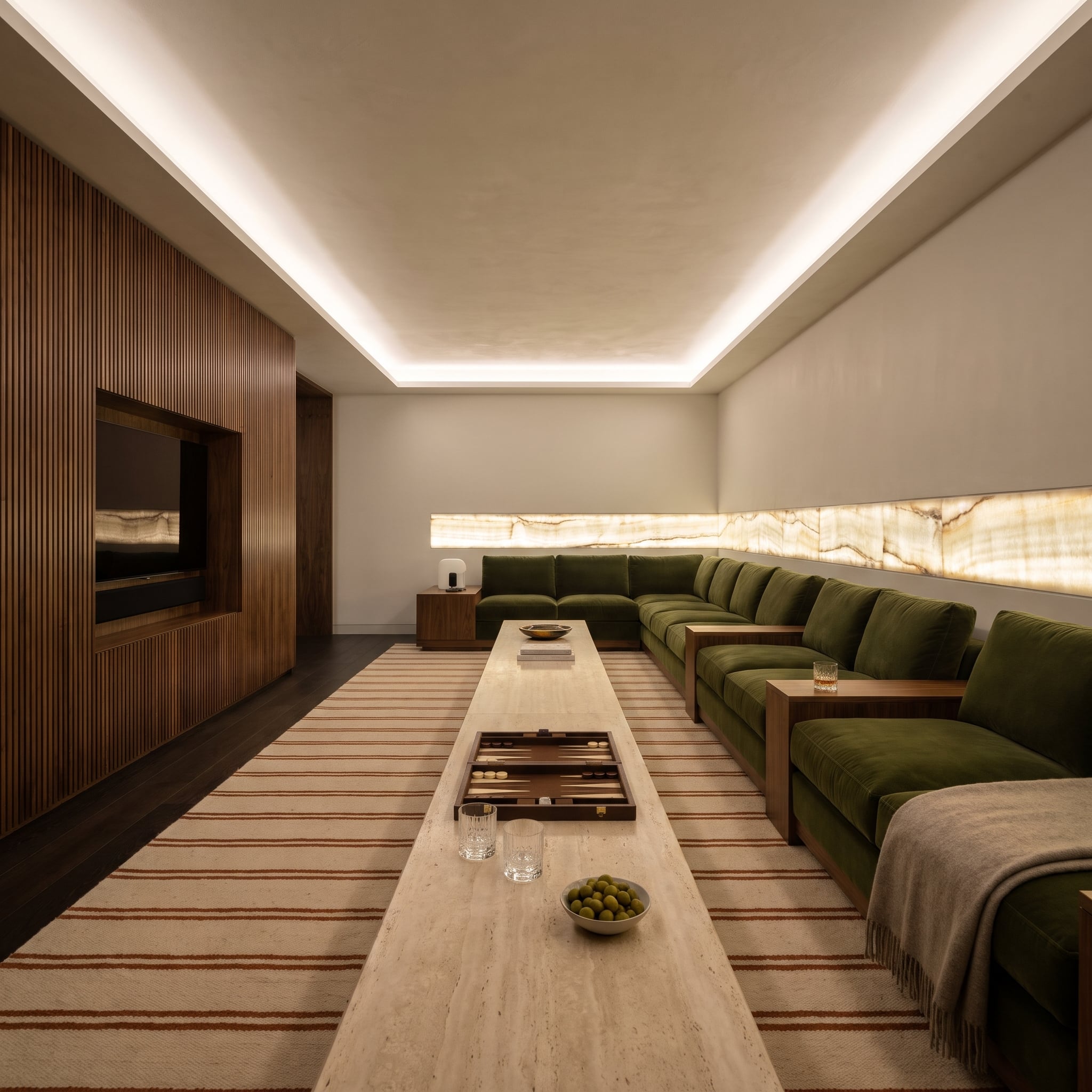
Forest-green velvet and exposed walnut give this U-shaped sectional the cultivated character of a private club. Its deep upholstery surrounds a travertine coffee table where a backgammon board supplies a more engaging centerpiece than the customary stack of enormous decorative books.
Backlit onyx creates an amber-toned wall of illumination behind the seating. Across the room, fluted walnut panels frame a recessed television, giving the screen a discreet position within the cabinetry.
The striped wool rug adds another horizontal pattern beneath the furniture. Games, conversation and television all have a place in the room, without the television acquiring its familiar status as the most important piece of equipment in the house.
18. A Room Shaped Like Its Own Curved Sofa
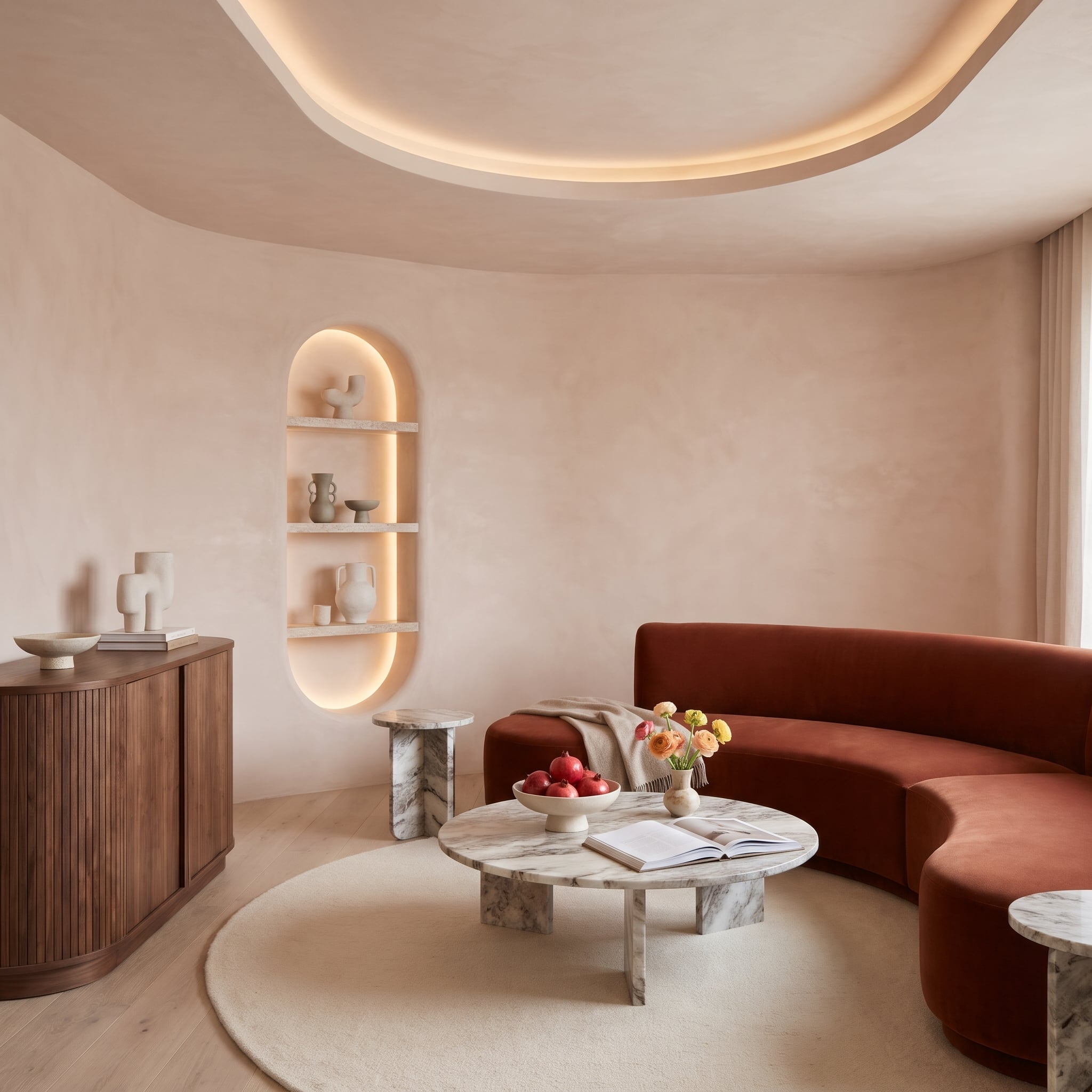
Rounded plaster walls establish an organic outline that the burnt-sienna sectional appears almost to inhabit instead of furnish. The upholstered curve continues the sweep of the room, while an illuminated ceiling recess repeats the movement overhead.
Two marble coffee tables contribute the more unpredictable geometry of natural veining. An arched display niche accommodates ceramic objects, and a dark walnut sideboard supplies a welcome interval of straight lines among the profusion of curves.
Design Detail: A circular rug can reinforce a curved seating plan, particularly when the coffee tables and ceiling details follow related geometries. Rounded furniture and rugs also offer a relatively straightforward way to introduce curves without altering the structure of a room.
17. Caramel Leather Gathered Inside Chrome Restraints
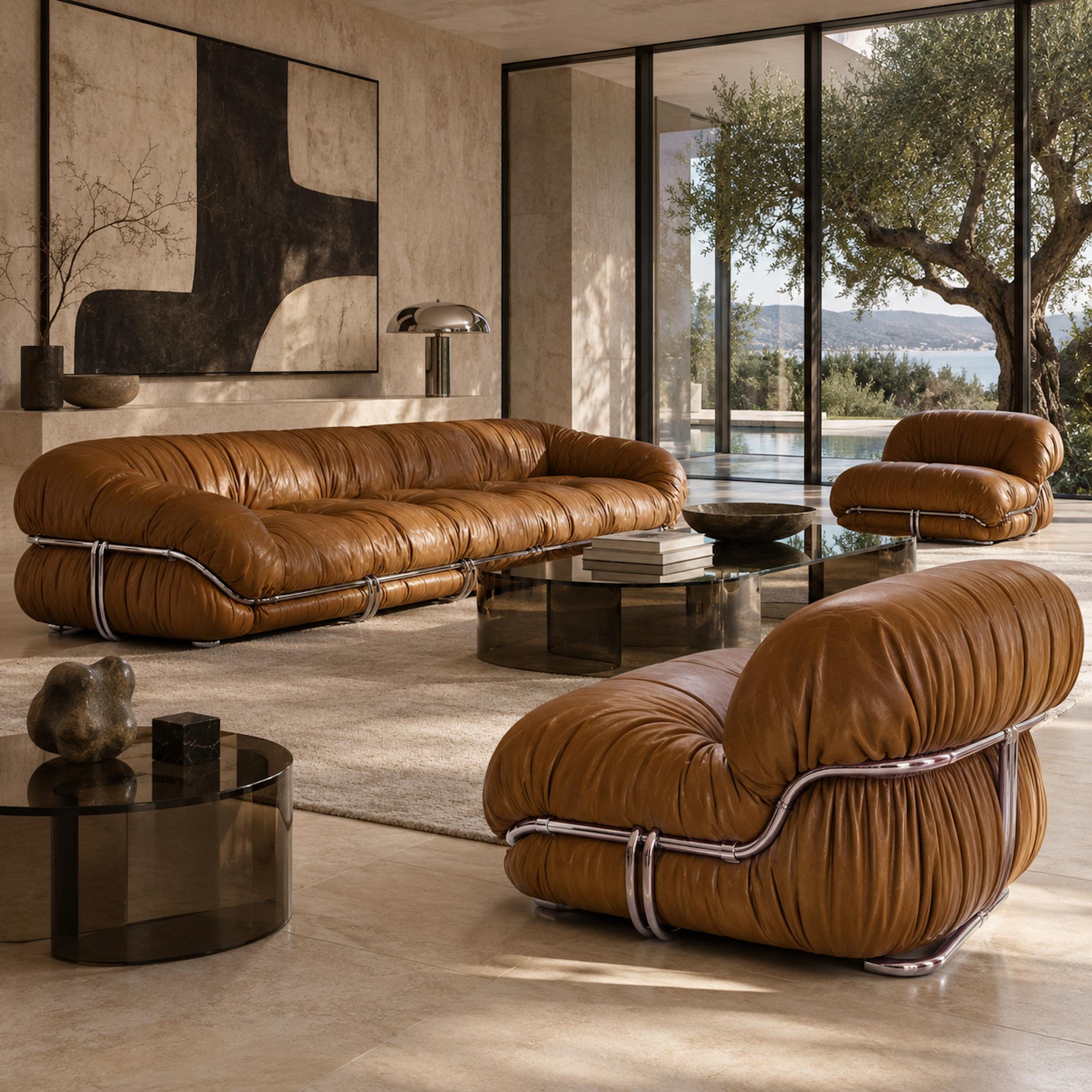
These extraordinary rolls of caramel leather appear to be held in place by their own jewelry. Polished metal frameworks wrap around the generously gathered upholstery, following the contours of the seats and backs. The furniture evokes the Soriana collection designed by Afra and Tobia Scarpa in 1969.
Smoked-glass tables offer firmer outlines in the center of the room, while a large abstract painting echoes the organic shapes of the upholstery. Pale stone walls and flooring provide an understated setting for the unusually expressive furniture.
Beyond the glazing, an olive tree and distant coastal landscape offer a quieter version of the earthy palette. The brilliance of the Soriana concept lies in making visible restraint part of the furniture’s decorative language. The apparent tension between hard metal and abundant upholstery supplies an ornament that additional embellishment would only obscure.
16. Black Leather Between Two Cubes of Travertine
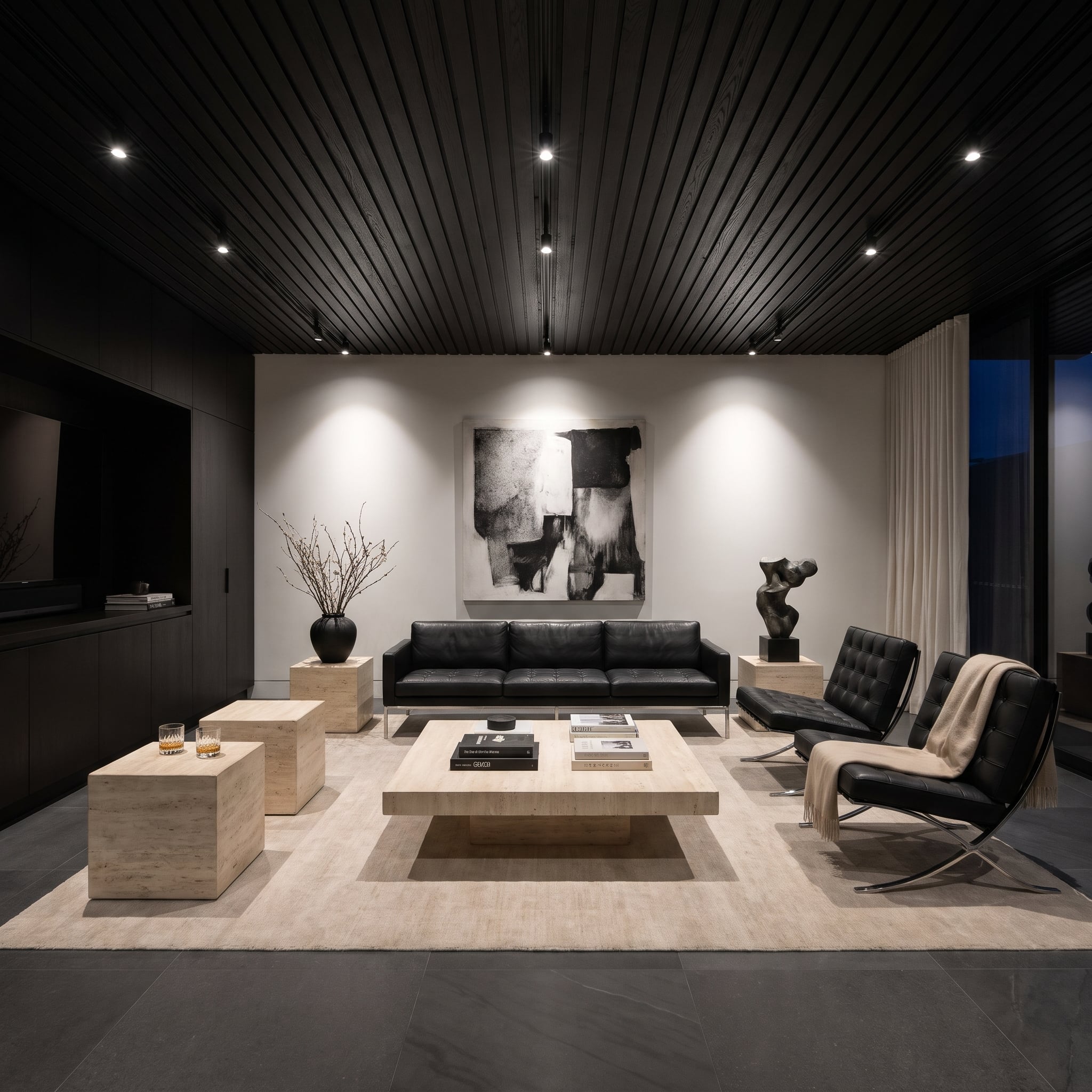
Barcelona-style lounge chairs face a low black leather sofa across an arrangement of pale stone. The chairs borrow the vocabulary of a modernist design introduced in 1929, demonstrating how comfortably earlier furniture traditions can coexist with later Italian-inspired interiors.
Travertine cubes stand on either side of the sofa with the presence of small architectural blocks. Their natural cavities and markings bring texture to a room otherwise governed by the smoothness of black upholstery and a white wall.
Recessed lighting illuminates the large abstract canvas above the seating. The tables are almost pieces of sculpture in their own right, and the modest furniture height leaves the wall available for a single commanding work of art.
15. Two Living Rooms Under One Coffered Ceiling
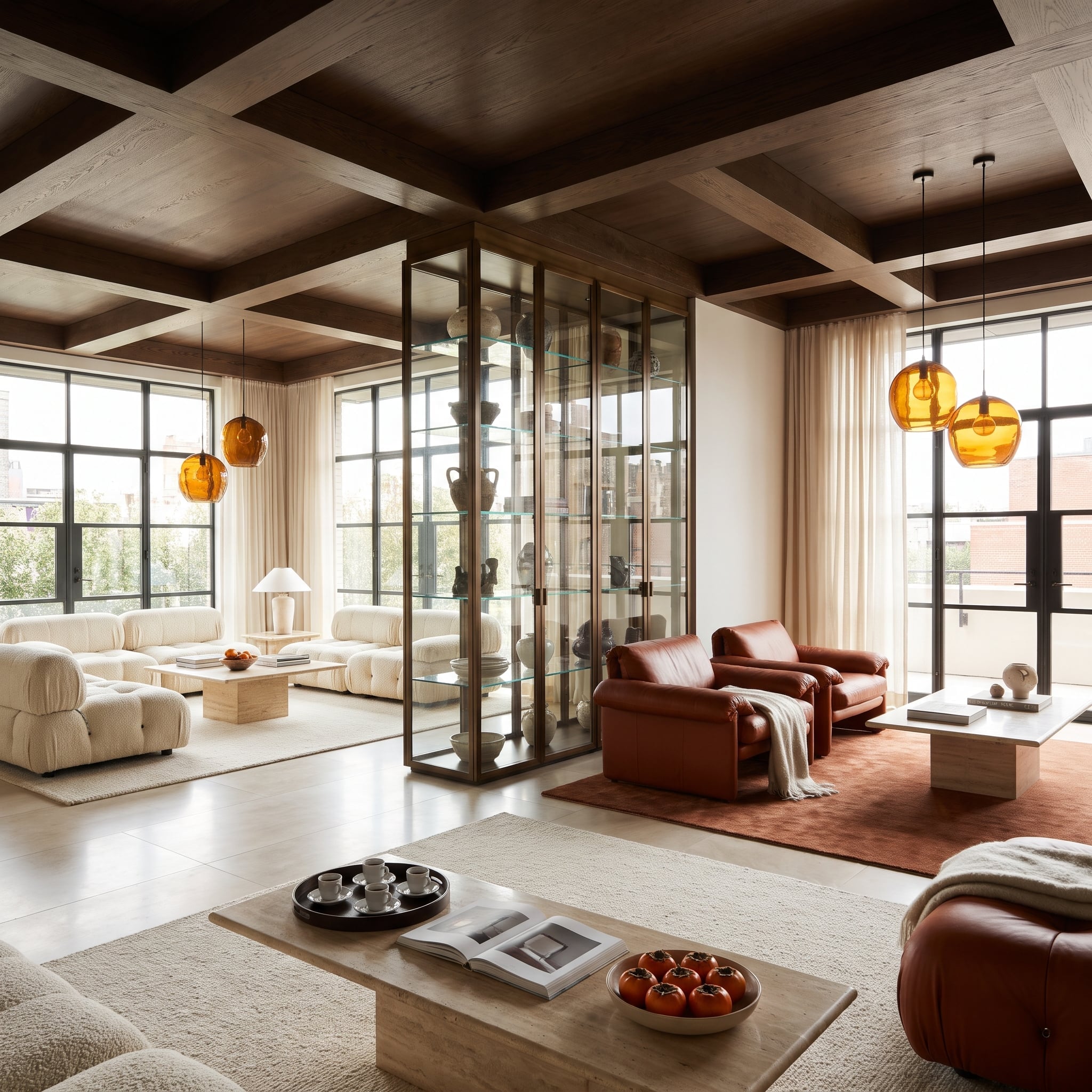
A glass display cabinet divides this open interior into two distinct seating areas without introducing a solid wall. Cream bouclé sectionals furnish one side, while cognac leather armchairs gather around a rust-colored rug on the other. Each group possesses an identity of its own.
The coffered wood ceiling extends across both areas, providing an uninterrupted framework overhead. Amber glass pendants enrich the appearance of the cognac leather and reddish rug, while the pale upholstery in the neighboring area maintains its lighter character.
Separate furniture groupings allow the room to accommodate different kinds of gatherings. The glass cabinet provides partial separation without entirely interrupting the view. A large living room need not resemble a furniture showroom in which every available seat faces the same coffee table.
14. Chocolate Lacquer Above a Private Collection of Ceramics
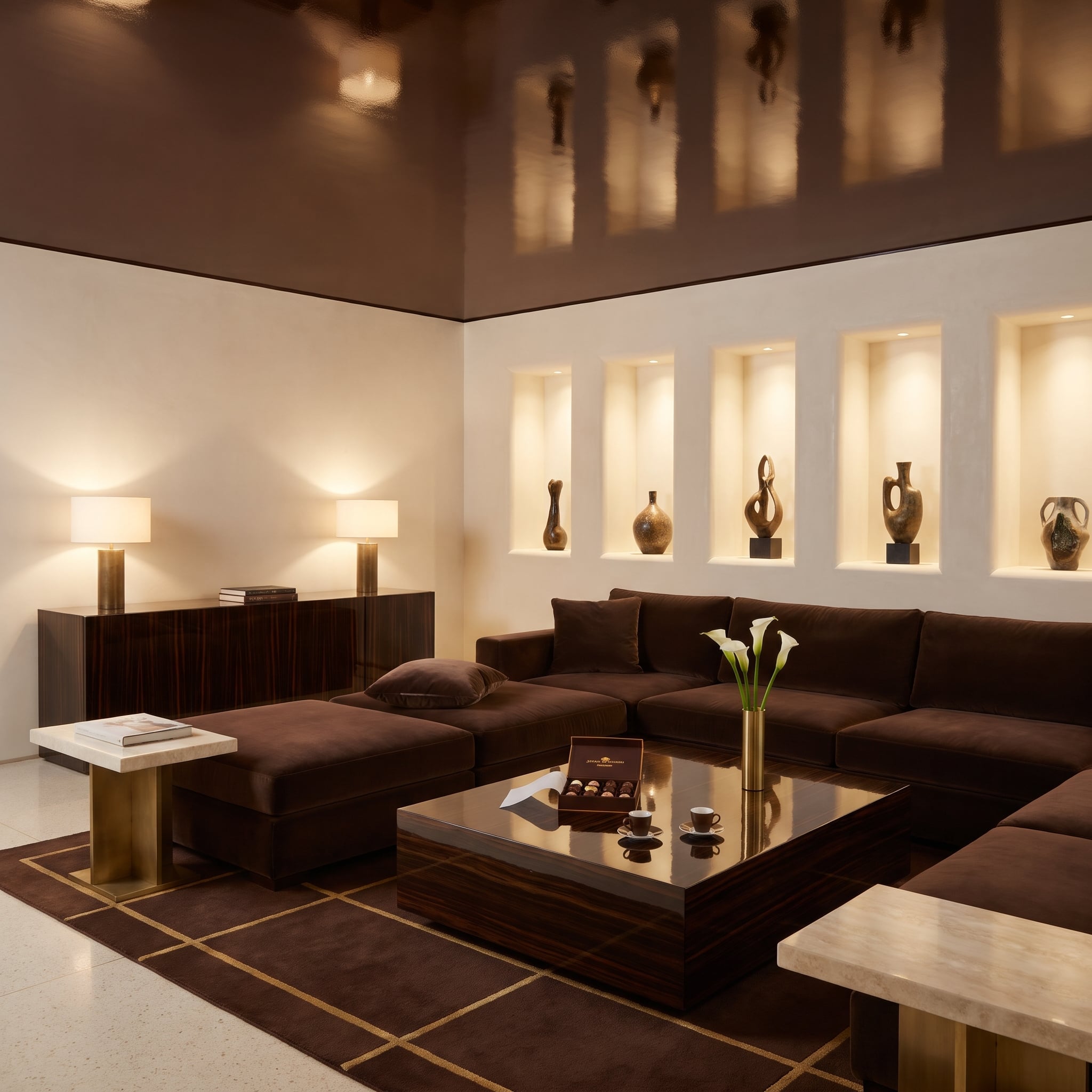
Deep chocolate lacquer gives the ceiling an unexpectedly sumptuous presence. Reflections lend depth to the dark surface, while the rich color creates a sense of enclosure above the expansive espresso velvet sectional. A glossy, dramatically grained coffee table supplies another reflective plane near the floor.
Individually illuminated wall niches accommodate ceramic and sculptural objects with passages of shadow between them. The vessels acquire the individuality of a private collection, considerably removed from the visual congestion of conventional display shelving.
A gold grid across the chocolate-colored rug adds a more graphic pattern beneath the velvet. Brown appears throughout the interior in several guises: glossy, matte, grained, softly upholstered and illuminated. The color possesses far more decorative range than its rather unfair reputation might suggest.
13. Low Bouclé Seating Beneath a Constellation of Gold Discs
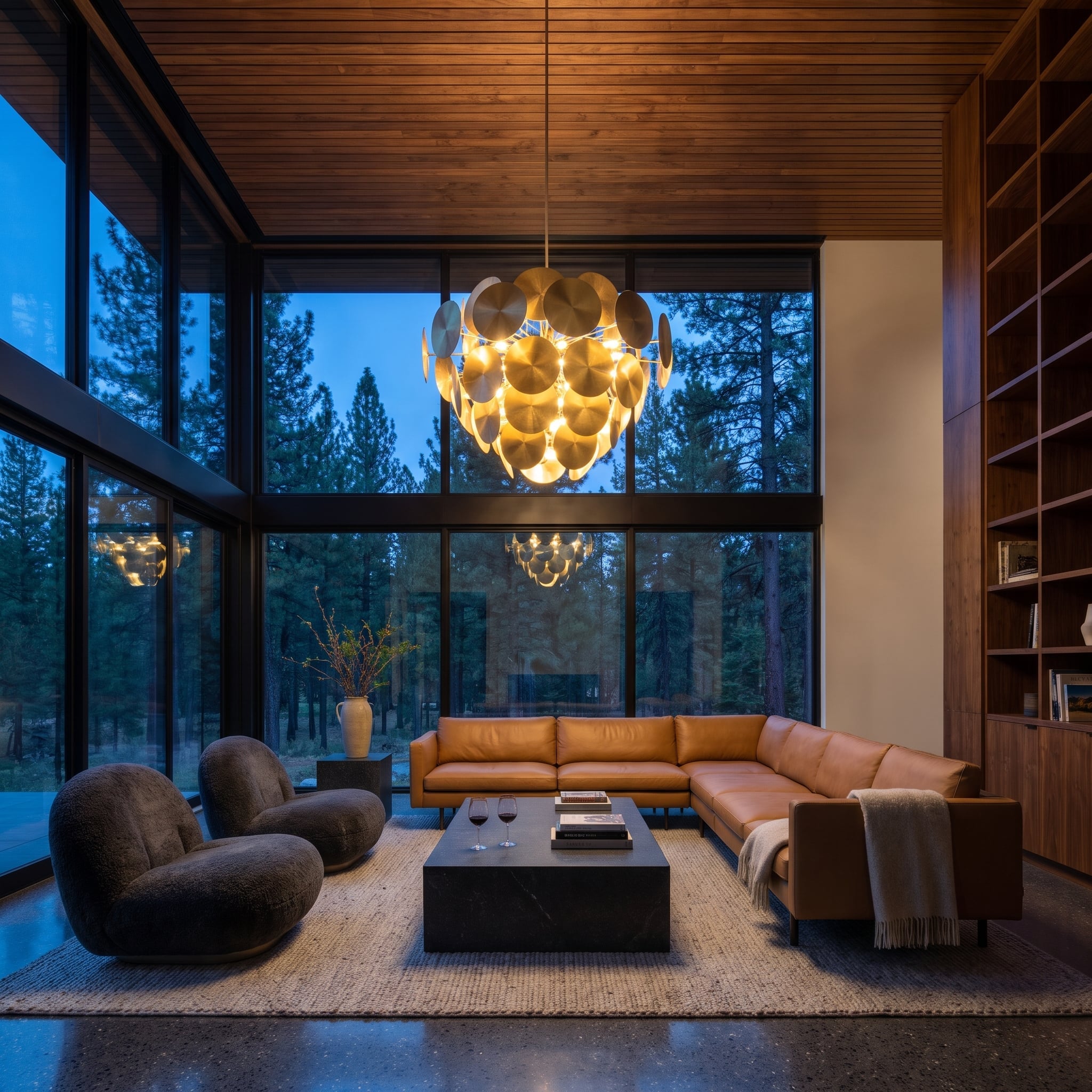
Rounded bouclé seating supplies a soft, organic silhouette beside extensive glazing and the forest landscape beyond. The upholstered forms have an intimate scale in relation to the tall windows, leaving the trees visible from several points across the room.
Overhead, gold-colored discs establish a pattern of their own. Their reflective surfaces provide an indoor counterpart to the more irregular play of light among the trees. The substantial chandelier makes particularly good use of the space left vacant by the low furniture.
The contrast between tactile upholstery and polished metal gives the interior much of its character. With such an expansive view beyond the windows, the furniture can remain comparatively understated while the lighting supplies a more theatrical presence overhead.
12. What If the Floor Became the Furniture?
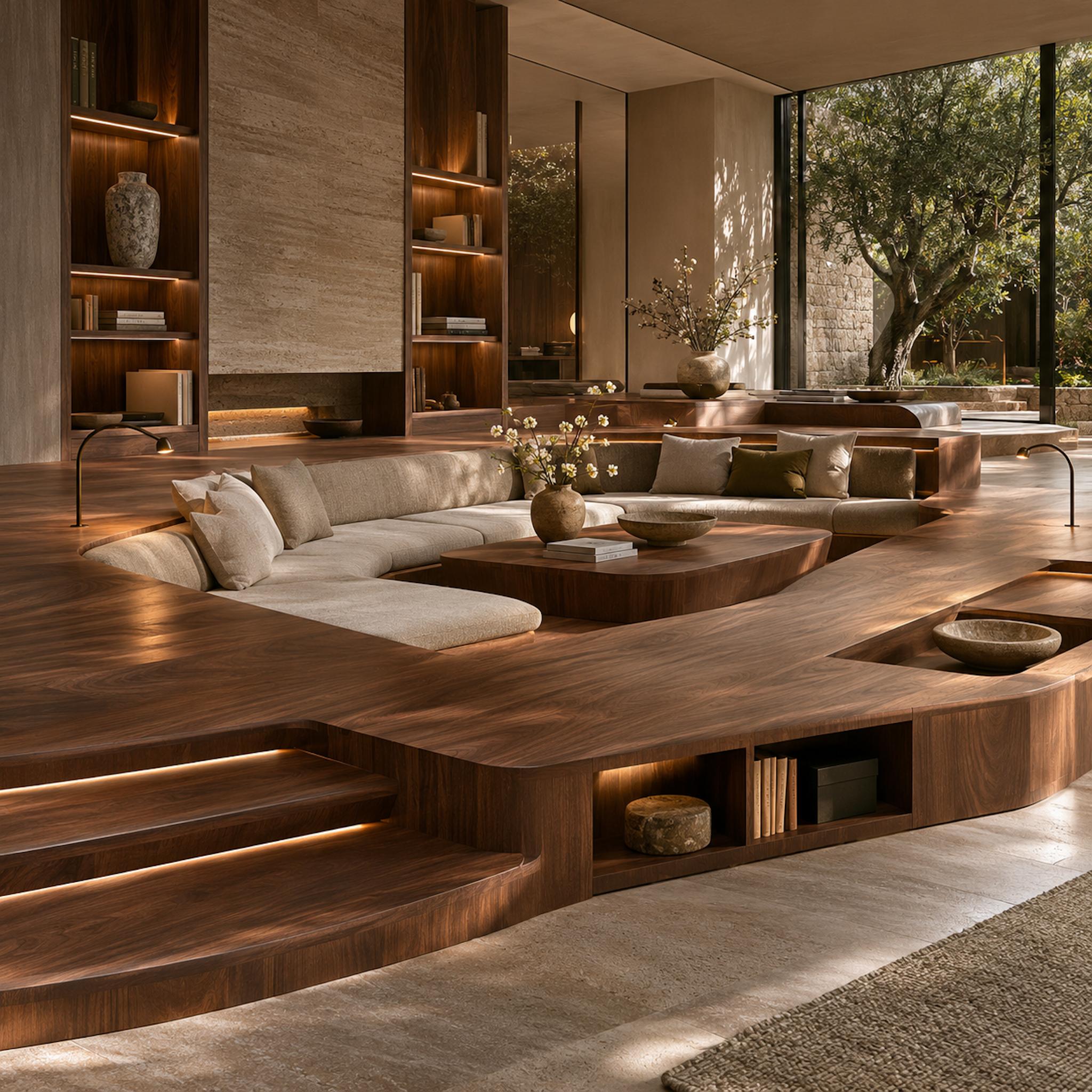
An extravagant walnut platform transforms the living room into an exercise in ambitious joinery. Upholstered seating nestles within its broad perimeter, while shelves, occasional surfaces and reading lamps become features of the surrounding woodwork. The distinction between sofa, floor and cabinetry has almost vanished.
Curved edges soften the enormous horizontal surface, and concealed lighting emphasizes the outer steps. The central table continues the rich walnut grain, with cream cushions offering a restrained note against the extensive woodwork.
A real installation of this concept would require a clearly defined entrance into the seating area, something not readily apparent here. Comfortable seat dimensions, safe changes in level and access for upholstery replacement would also need careful planning. Its decorative ambition is considerable, although the most impressive version would make the practical details every bit as elegant as the joinery.
11. A Freeform Oak Table Against a Grid of Travertine
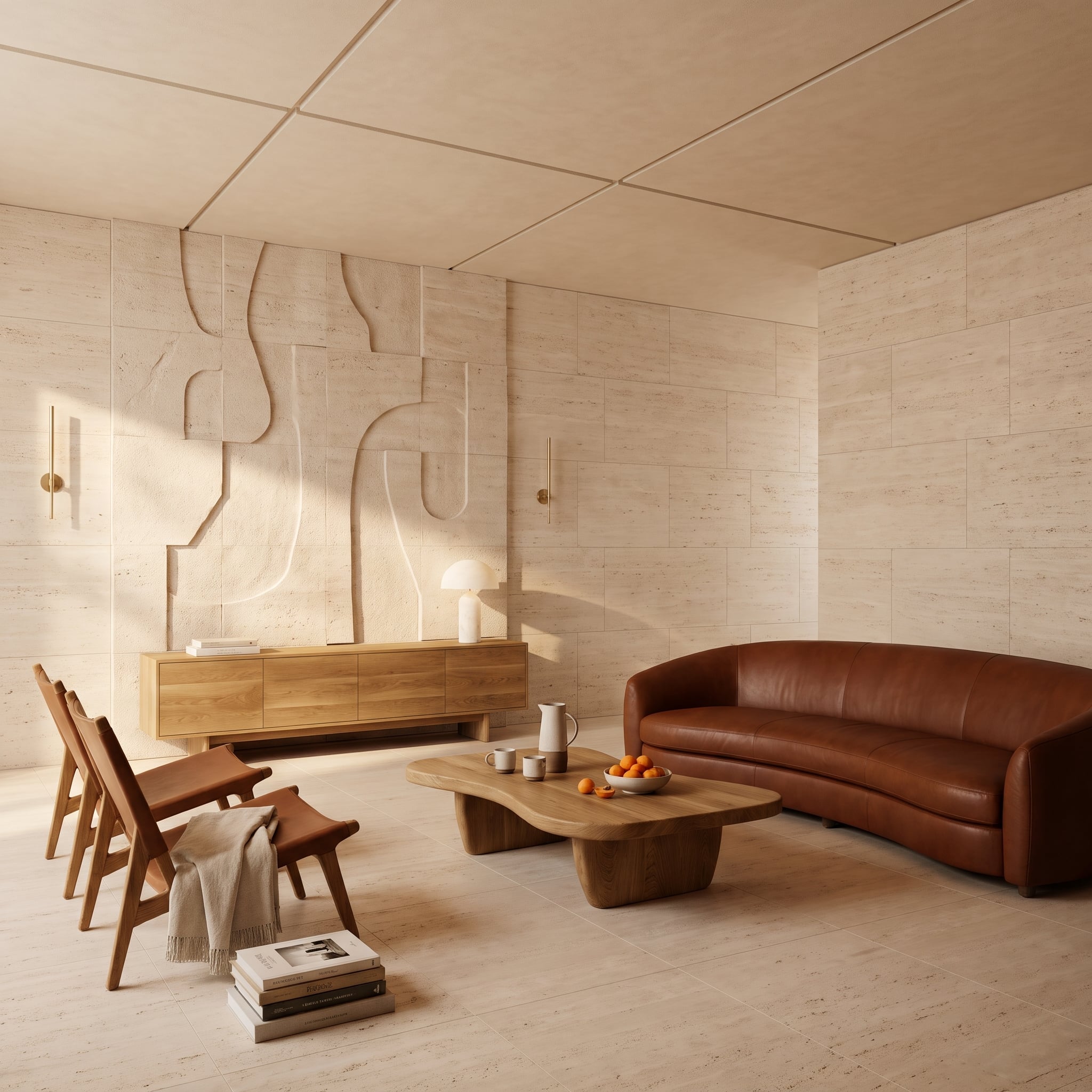
A curved cognac leather sofa occupies the foreground of an interior built around a narrow spectrum of earthy colors. Travertine wall panels establish a rectilinear background, while the floor and timber credenza extend those colors across different materials.
The organic-edged oak coffee table makes the most conspicuous departure from that orderly setting. Its freeform silhouette seems especially expressive against the grid of the stone panels. Wall-mounted relief artwork similarly interrupts the disciplined divisions of the wall.
Travertine has a long architectural history in Italy, and its appeal continues to owe much to the visible character of natural stone. The table offers a companion piece in another material: the stone records its geological formation, while the timber preserves something of the shape and grain of a tree.
10. A Constellation of Opal Glass Above Red Lacquer
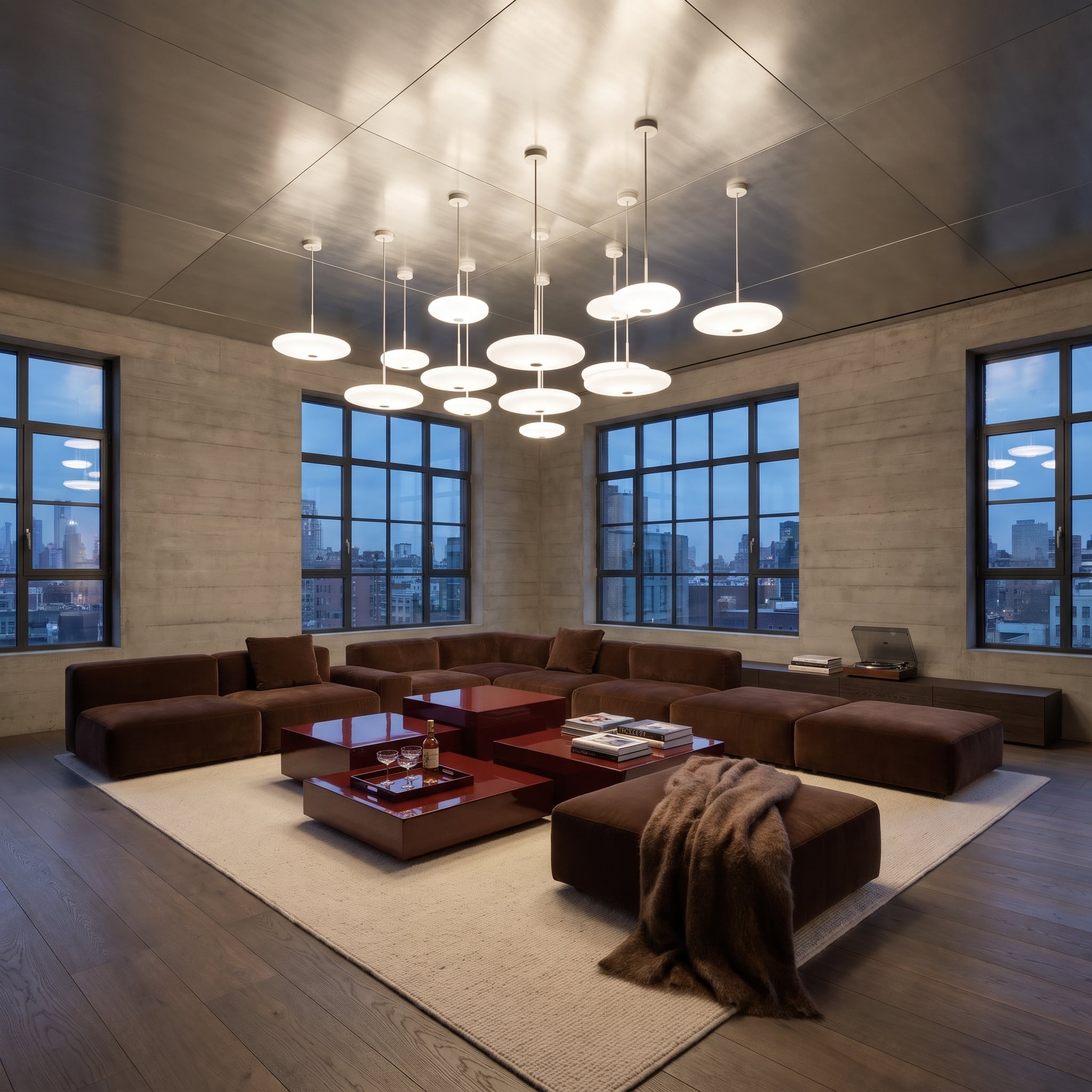
A collection of illuminated discs hangs at different elevations above a chocolate velvet sectional. Their opal surfaces produce a soft glow against the board-formed concrete, giving the formidable architecture a surprisingly delicate quality.
Red lacquer coffee tables supply the interior’s most emphatic color. Set at slightly different heights, their glossy surfaces interrupt the matte expanses of brown upholstery and concrete. Under the suspended lights, the red acquires a particularly lustrous character.
The luminous discs almost appear to float above the deep cushions. Lowering the furniture has liberated an enormous volume overhead for a lighting installation that might feel intrusive above a more upright sofa.
9. An Oval Display Niche in a Room Without Abrupt Corners
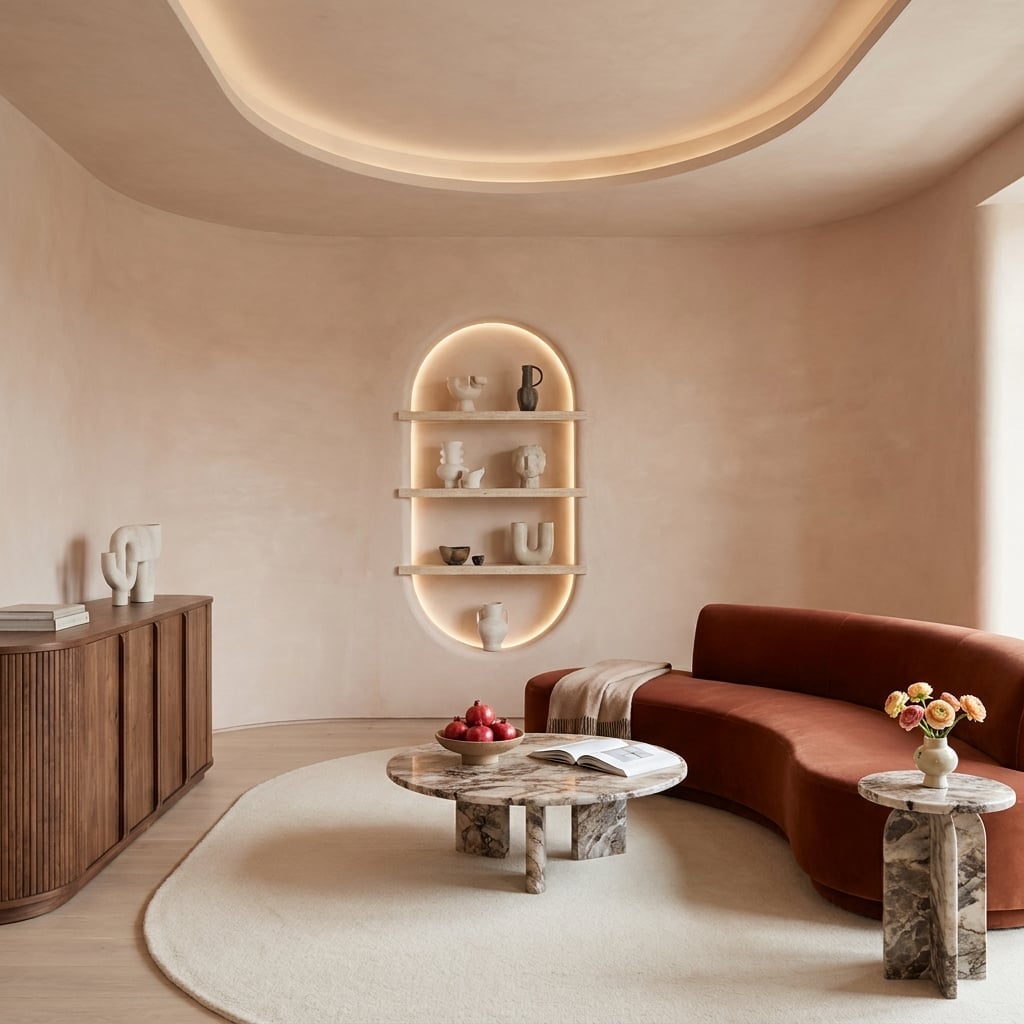
A tall oval niche gives this curved plaster interior something of the playful character of seventies Space Age design. Illuminated shelves display ceramic objects against a warm background, their rounded enclosure distinguishing them from conventional rectangular cabinetry.
Terracotta velvet follows the contour of the neighboring wall, while two marble coffee tables supply the unpredictable patterns of natural veining. A fluted walnut credenza provides a finer decorative pattern through its closely spaced vertical grooves.
The modest furniture height leaves the oval shelving visible from across the room. Upholstery, storage and plasterwork share a visual language without requiring every object to have precisely the same shape. The credenza’s straight edges are especially welcome among so many rounded forms.
8. A Monumental Stone Fireplace Above Low-Slung Seating
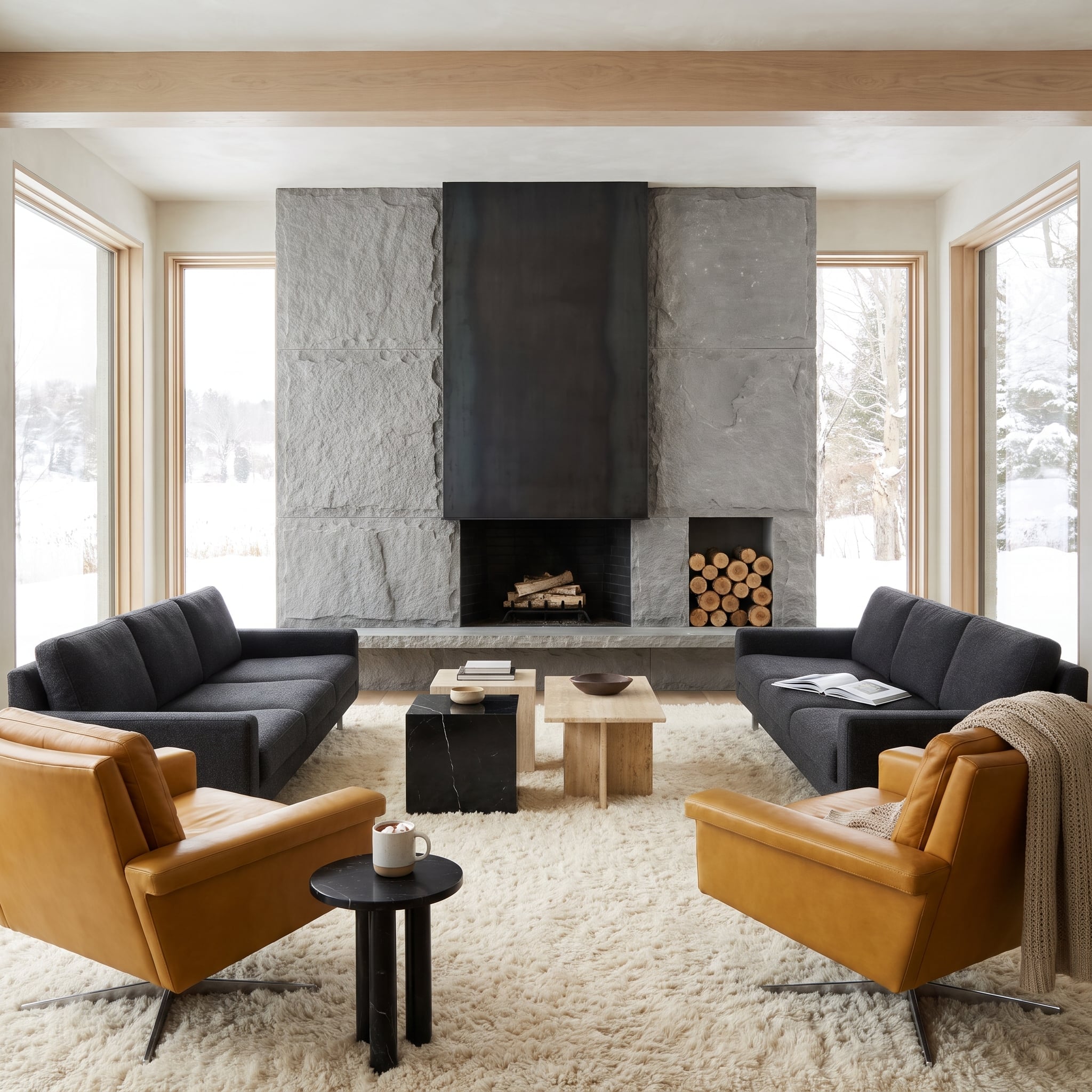
Gray split-face stone rises from hearth to ceiling behind an imposing blackened steel fireplace hood. The substantial vertical structure provides a powerful contrast to the charcoal sofas, whose long frames emphasize the width of the room.
Cognac leather swivel chairs occupy the foreground, warming the cooler tones of the stone. A pale shag rug spreads a softer surface beneath the travertine coffee table and black marble side table. The differences between the two stones become especially apparent beside so much irregular masonry.
Furniture Arrangement: Swivel chairs offer particular flexibility in a living room with several focal points. They can turn toward a conversation, fireplace or window without requiring the surrounding furniture to be moved.
7. Brass Discs Beneath an Expansive Cedar Ceiling
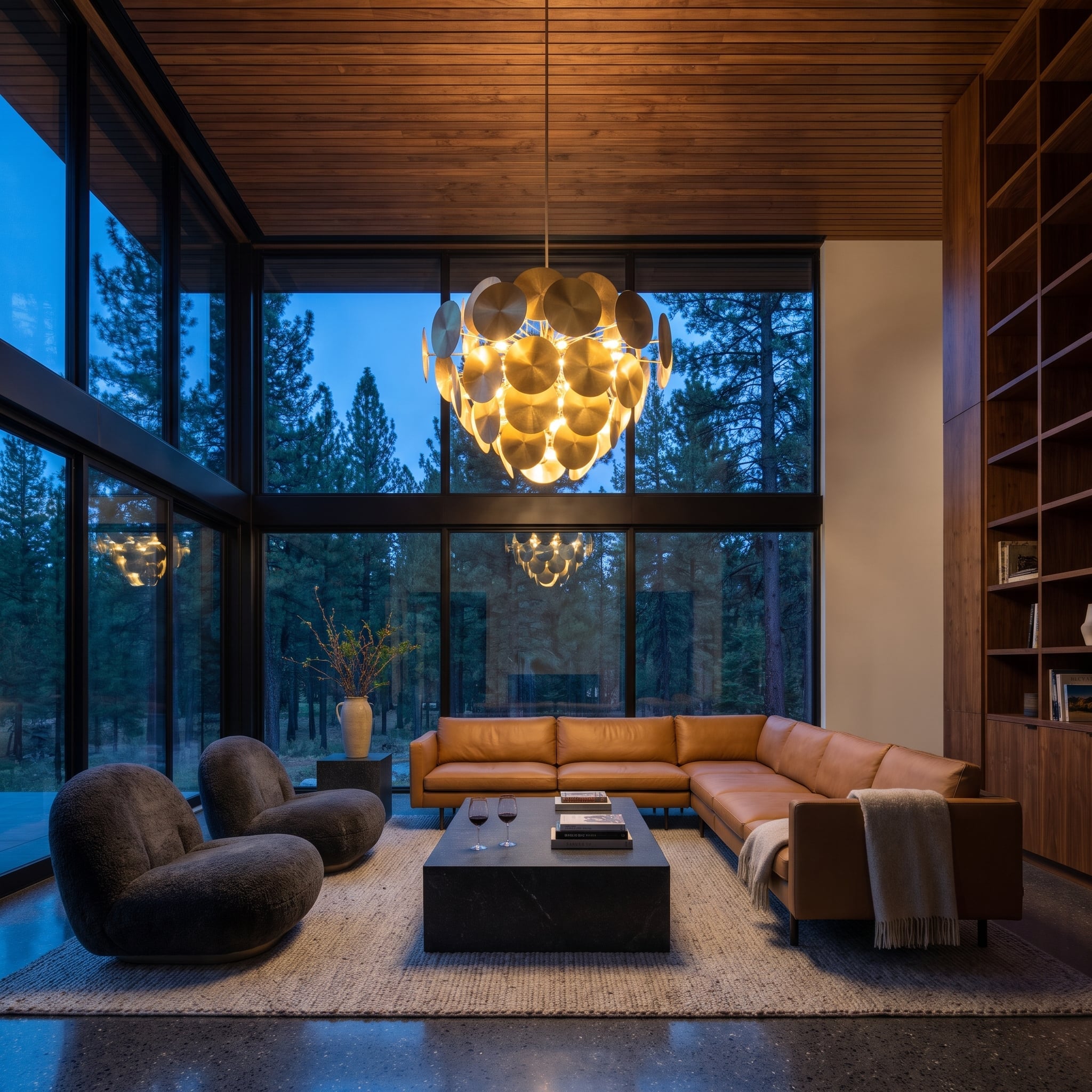
Overlapping brass-colored discs gather beneath the timber ceiling in a sculptural assembly of reflected light. Their metallic surfaces offer a more concentrated version of the warm colors present in the cedar overhead and the cognac leather below.
The sectional preserves generous sightlines across the glazing. During daylight hours, the surrounding landscape contributes another source of visual interest; after dark, the cluster of discs takes on a more pronounced identity as an illuminated sculpture.
Layered metal fixtures can shield or redirect light, producing different reflections according to the shape and orientation of their components. Their sculptural presence gives this expansive ceiling a focal point without requiring the sofa beneath it to assume equally monumental proportions.
6. Olive Velvet, Green Marble, and the Richness of Fluted Walnut
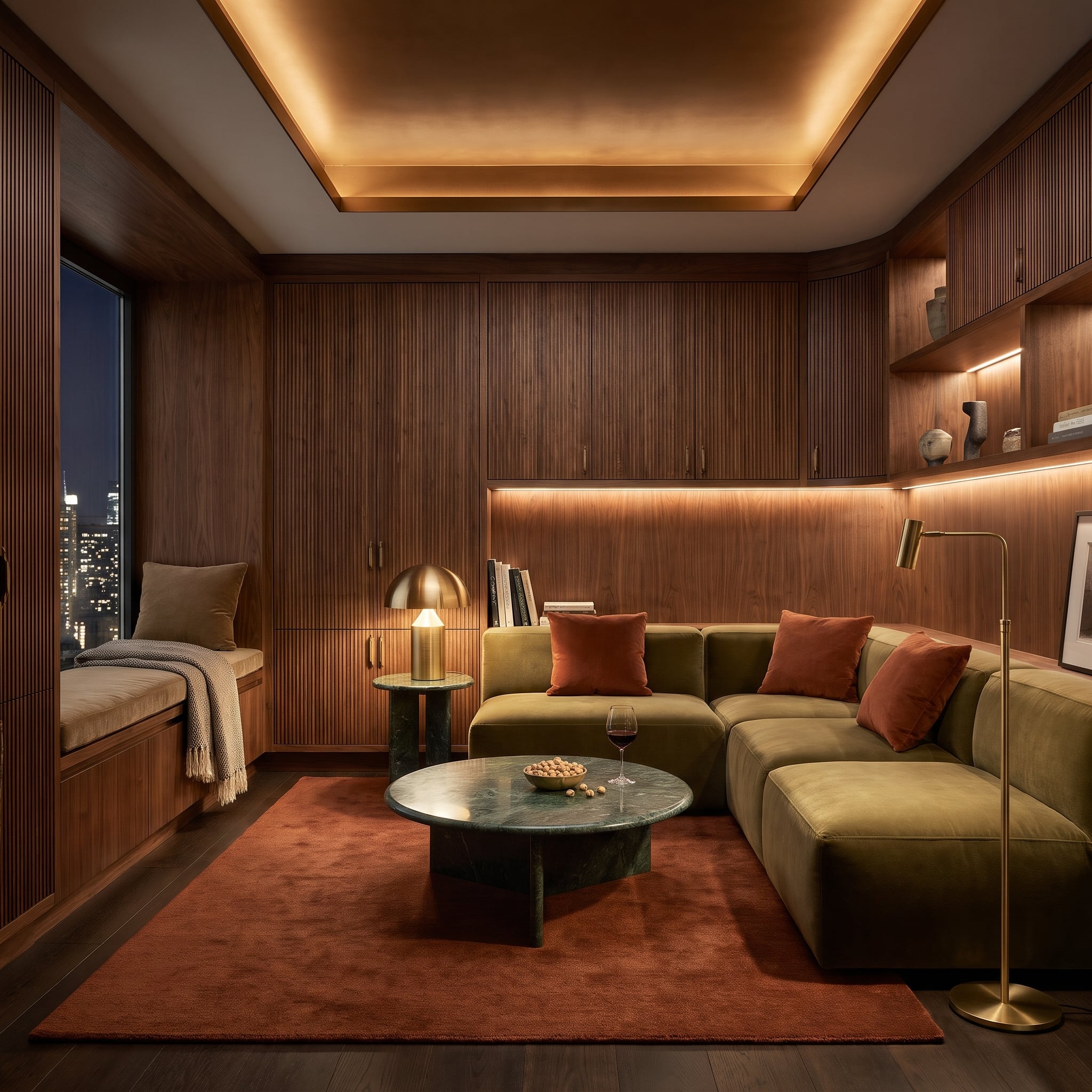
Fluted walnut wall panels create a succession of narrow shadows around this enveloping interior. Their vertical lines provide a handsome foil to the extended proportions of the olive velvet sectional, while the concealed lighting brings out the wood’s warmer tones.
A green marble coffee table supplies natural veining within the closely coordinated palette. Rust cushions and a terracotta-colored rug punctuate the olive and walnut with more concentrated warmth. The combination has something of the coloration of a landscape in late autumn, translated into generously upholstered domestic comfort.
Material Matters: Fluted paneling acquires different visual characteristics as the direction of illumination changes. Grazing light emphasizes the depth of the grooves, while more diffuse lighting produces a comparatively even appearance. The effect can give a single wood finish considerable tonal variation.
5. Amber Onyx Between Two Long Cognac Sofas
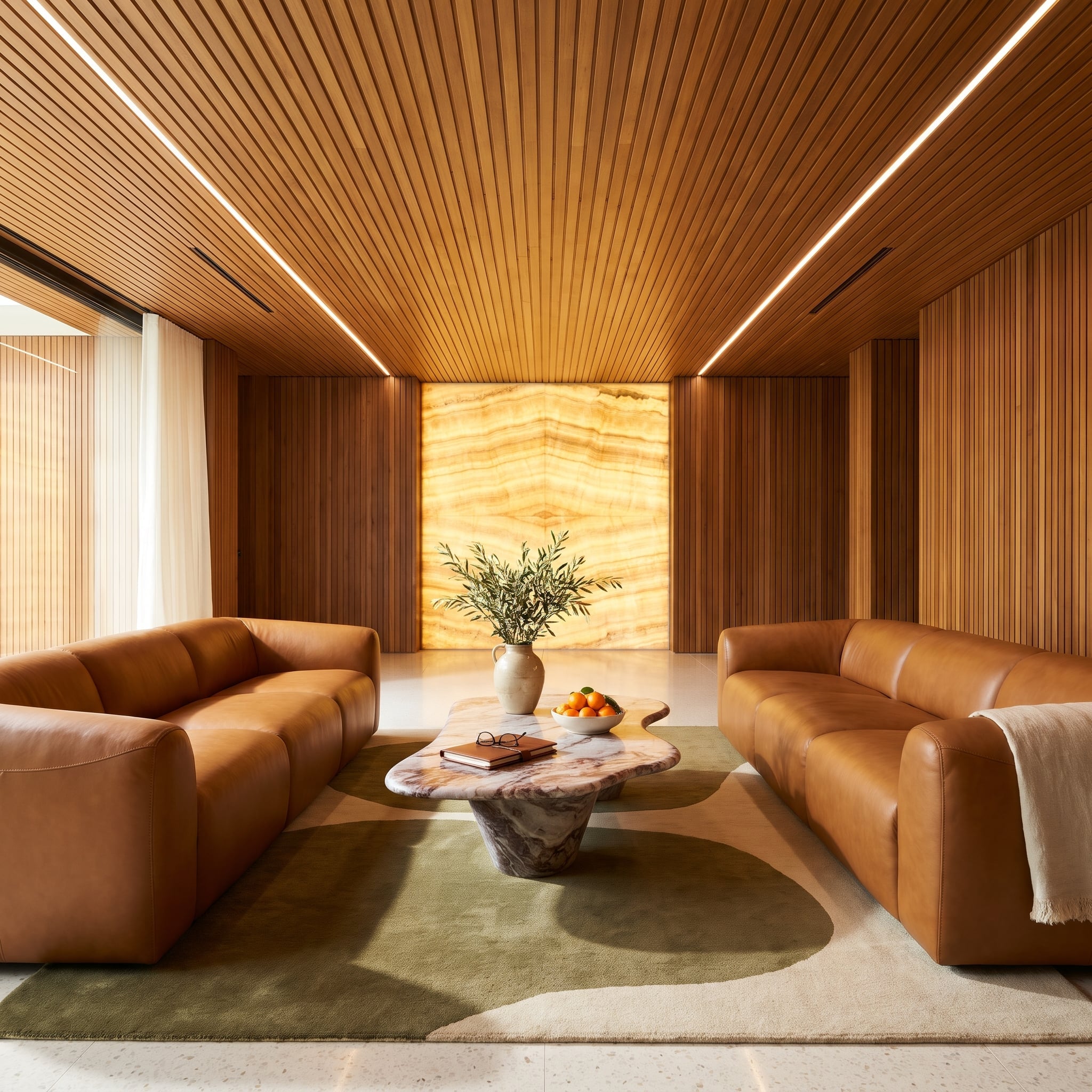
Two cognac leather sofas face each other across an organically shaped marble coffee table. Their modest backs leave the illuminated onyx wall and the narrow divisions of the slatted wood ceiling clearly visible from across the room.
The luminous stone contributes an extraordinary concentration of amber, with natural markings revealed through backlighting. An abstract olive-and-cream rug develops a more irregular outline beneath the leather seating, preventing the symmetry from becoming overly formal.
Ceiling slats introduce a much finer pattern above the broad upholstered forms. The furniture has relatively little ornament of its own, leaving the luminous stone, expressive marble and graphic rug to supply the more extravagant touches.
4. A Horizontal Window Above a Landscape of Terracotta Linen
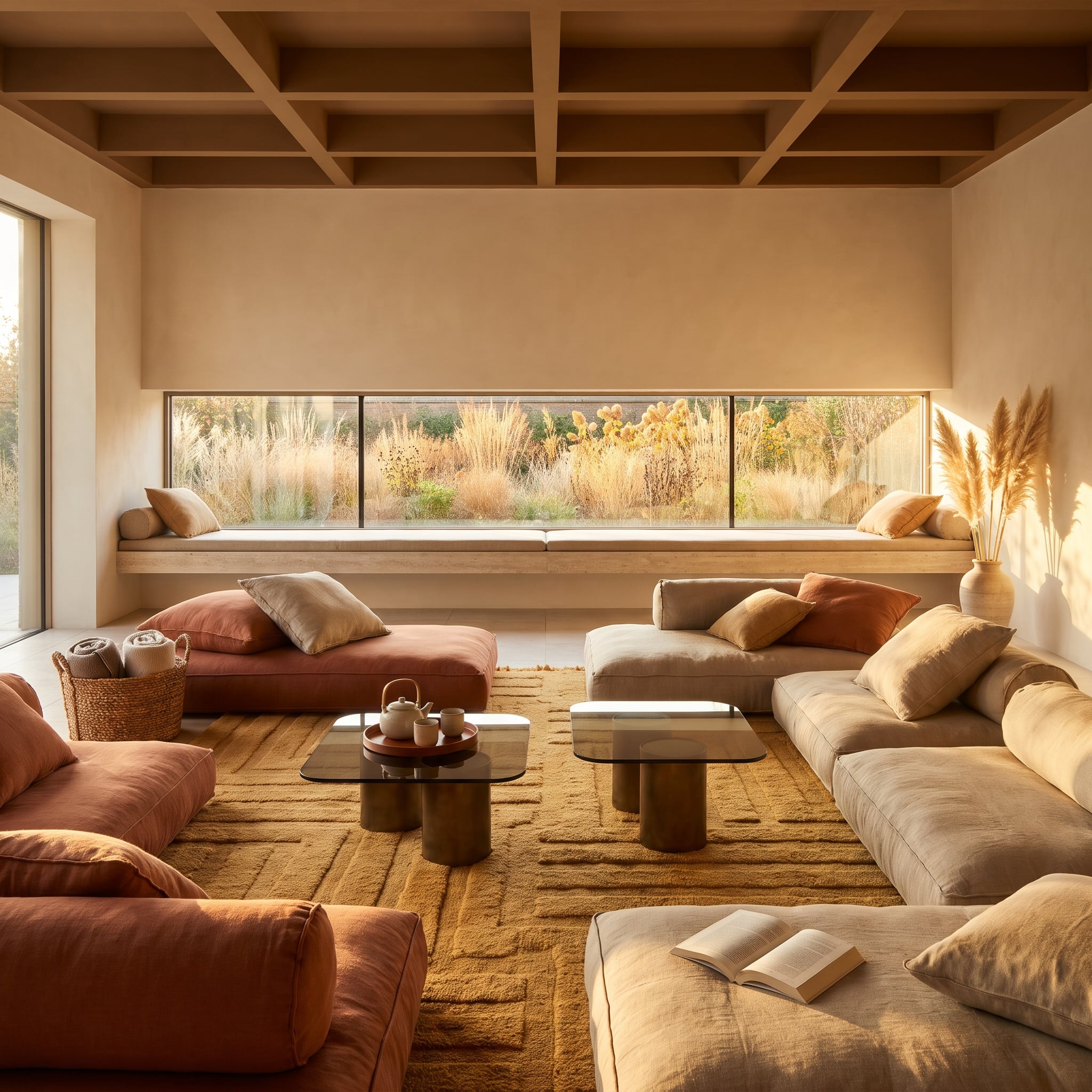
Broad terracotta linen sectionals establish a distinctly horizontal interior beneath an elaborate walnut ceiling. Their generous cushions and modest backs bring attention to the golden Moroccan-style rug, whose geometric pattern extends across much of the visible floor.
Two coffee tables with bronzed cylindrical bases occupy the center, supplying circular forms among the rectangular ceiling coffers and elongated sofa sections. The substantial bases give the tables an appreciable sculptural presence despite their limited height.
A horizontal clerestory window opens a narrow view toward grasses in shades of amber and wheat. The landscape appears almost as a continuous frieze above the terracotta cushions. Furniture and glazing reinforce the unusually broad proportions of the room, allowing horizontal lines to become its defining characteristic.
3. A Library Furnished With a Landscape of Leather Cushions
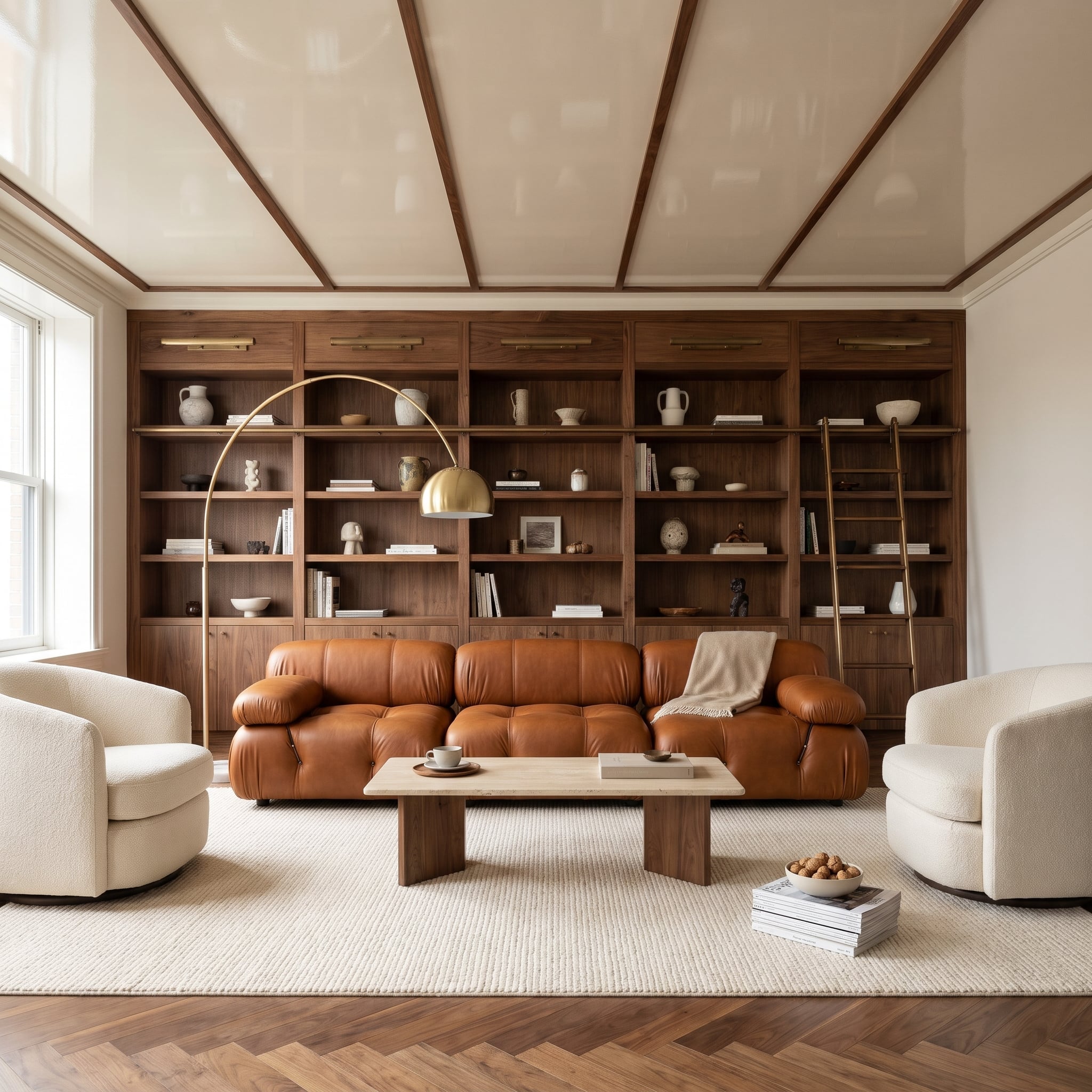
Floor-to-ceiling walnut shelving gives this living room the cultivated character of a private library. Against its tall divisions, a Camaleonda-inspired sofa in cognac leather spreads across the floor in a series of generously tufted forms, introducing an element of extravagant informality among the orderly bookshelves.
Two cream bouclé swivel chairs supply a softer contrast, their rounded silhouettes complementing the deep upholstery of the modular sofa. A brass arc lamp extends over the seating, drawing a sweeping line between the horizontal furniture and vertical storage.
Bellini’s original Camaleonda, designed in 1970, explored the possibilities of rearranging independent upholstered modules. The idea remains particularly compelling in a room devoted to more than one activity. Reading, conversation and lounging can coexist within the same furniture plan, with modular pieces offering the possibility of adapting it as circumstances change.
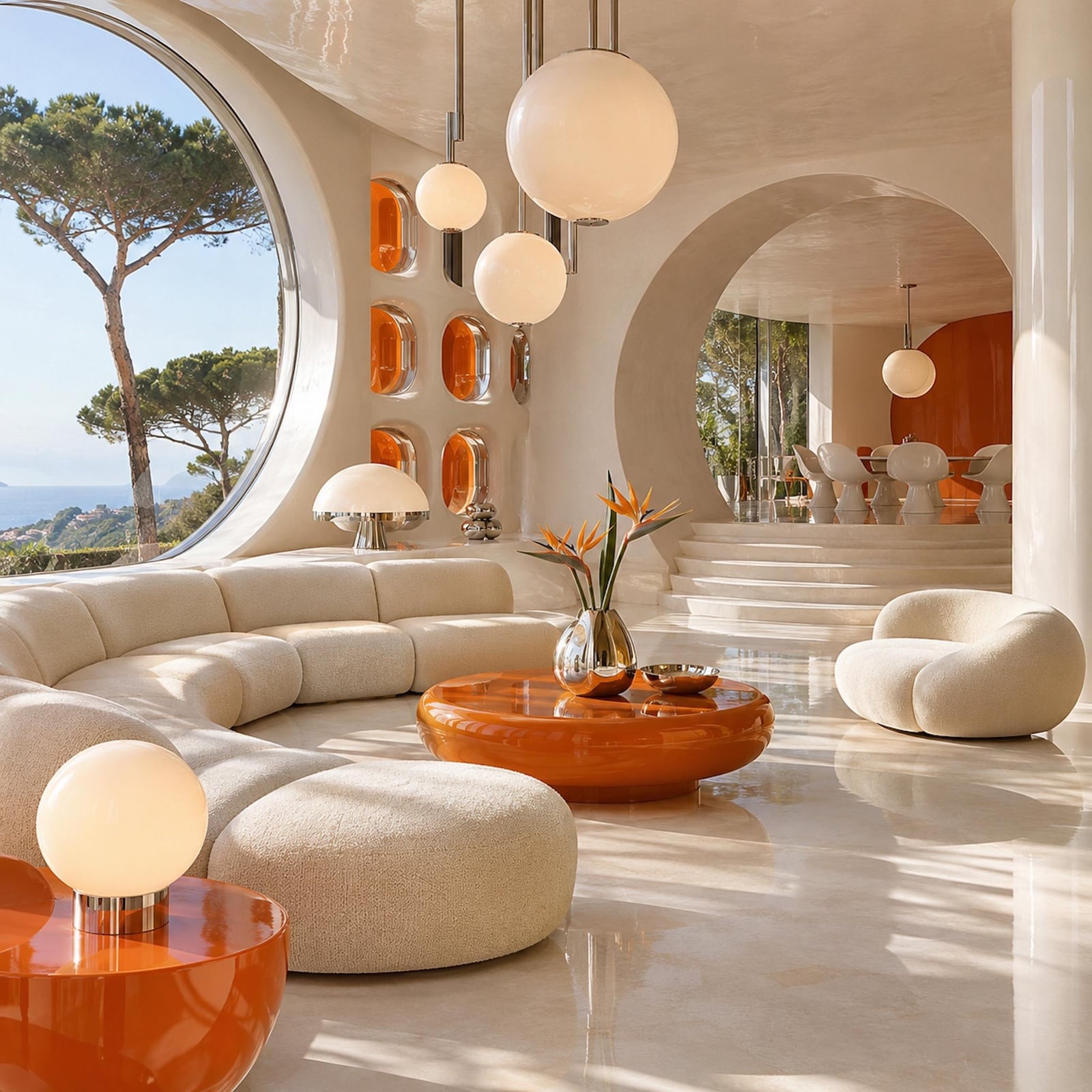
2. When the Italian Living Room Went to Outer Space
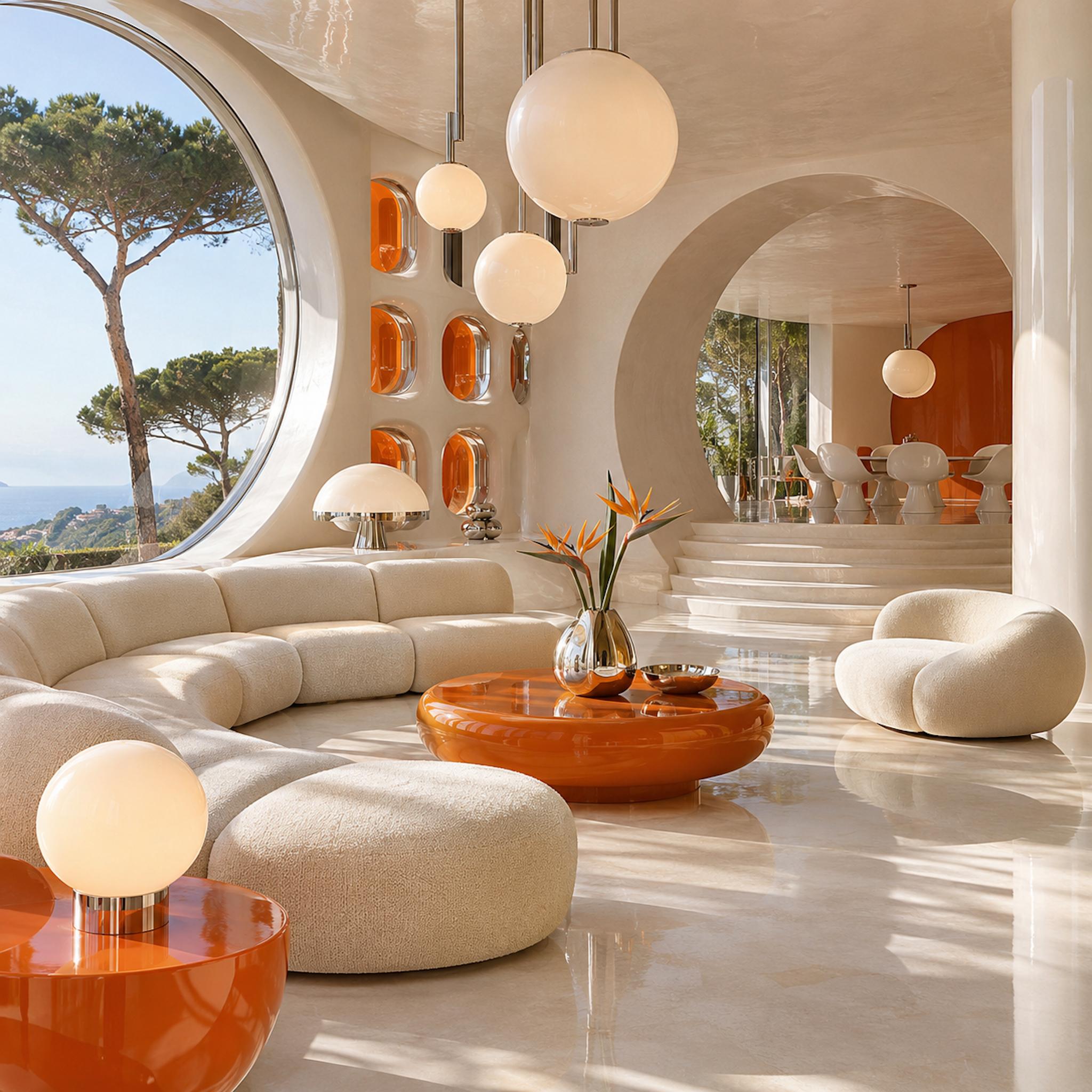
An enormous circular window frames umbrella pines and a distant coastal landscape in an interior that appears to have borrowed its geometry from a particularly optimistic vision of the future. Rounded ivory seating occupies the foreground, while glossy orange tables add delightful concentrations of saturated color.
The curves extend well beyond the furniture. A circular opening reveals the adjoining dining area, where sculptural pedestal chairs continue the futuristic vocabulary. Spherical pendants descend on slender polished metal supports, and orange capsule-shaped wall details give the architecture another dimension of playful ornament.
The interior recalls the experimental spirit of Italian Space Age design, when molded forms, synthetic materials and unconventional shapes challenged inherited ideas about domestic furniture. Even the window has abandoned its customary rectangular proportions. The low seating belongs to a world of intersecting circles, enormous curves and the wonderfully irreverent notion that a living room need not resemble anything that came before it.
1. The Conversation Pit as a Room Within a Room
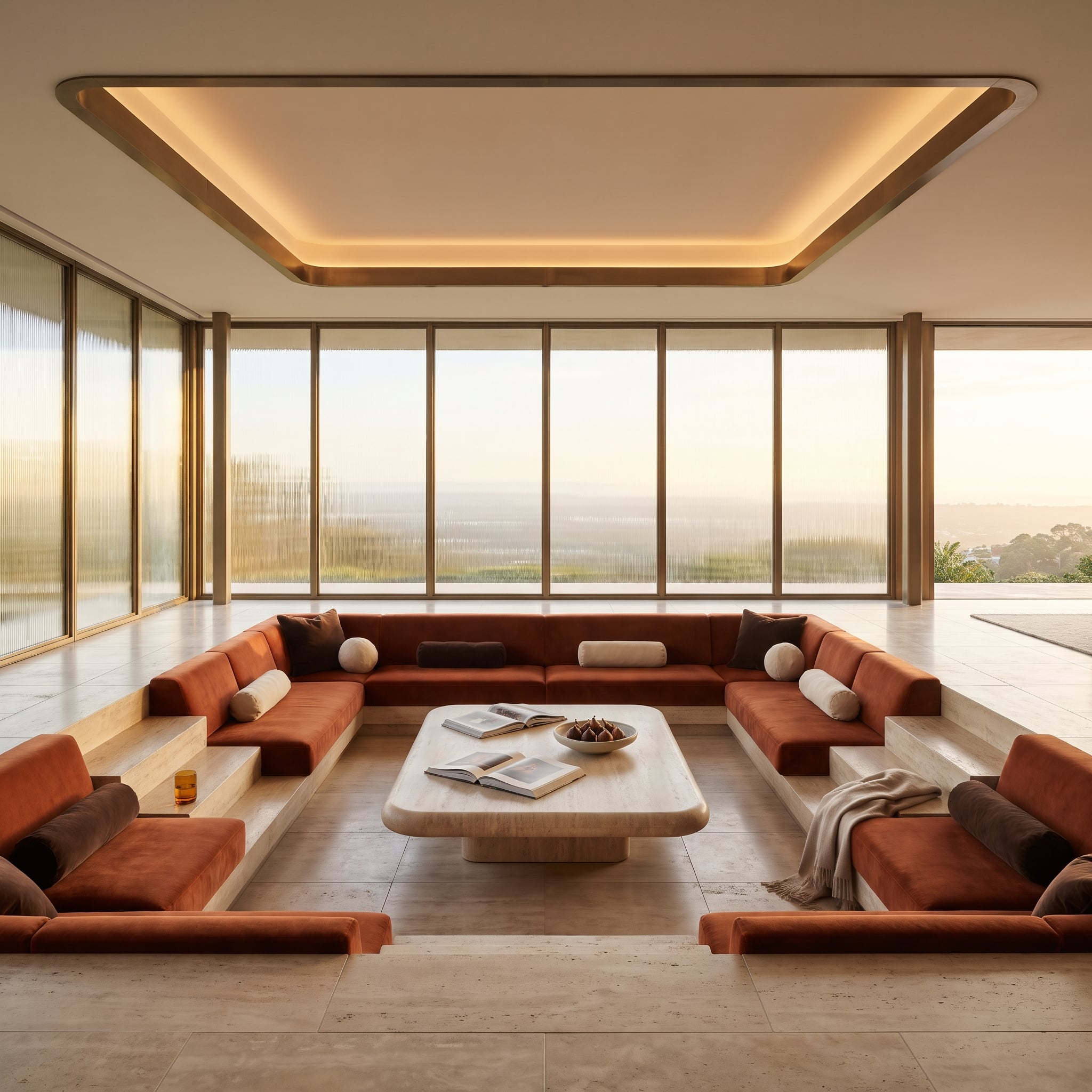
Rust-orange velvet wraps the three sides of a recessed conversation pit, creating an intimate enclosure within an otherwise expansive living room. Inward-facing seats gather around a low travertine table, while the modest backs preserve views toward the panoramic glazing and distant landscape.
Cove lighting illuminates the squared ceiling recess from its perimeter, repeating the geometry of the seating below without placing a suspended fixture between the occupants and the view. Cylindrical cushions in cream and near-black supply smaller sculptural forms across the continuous expanse of velvet.
The conversation pit predates the Italian furniture revolution of the seventies, although its intimacy shares much with that period’s experiments in modular and informal seating. Its enduring appeal lies in the way the room itself can shape a gathering. The sofa has become architecture, and the architecture has acquired the hospitality of a sofa.