🔥 Would you like to save this?
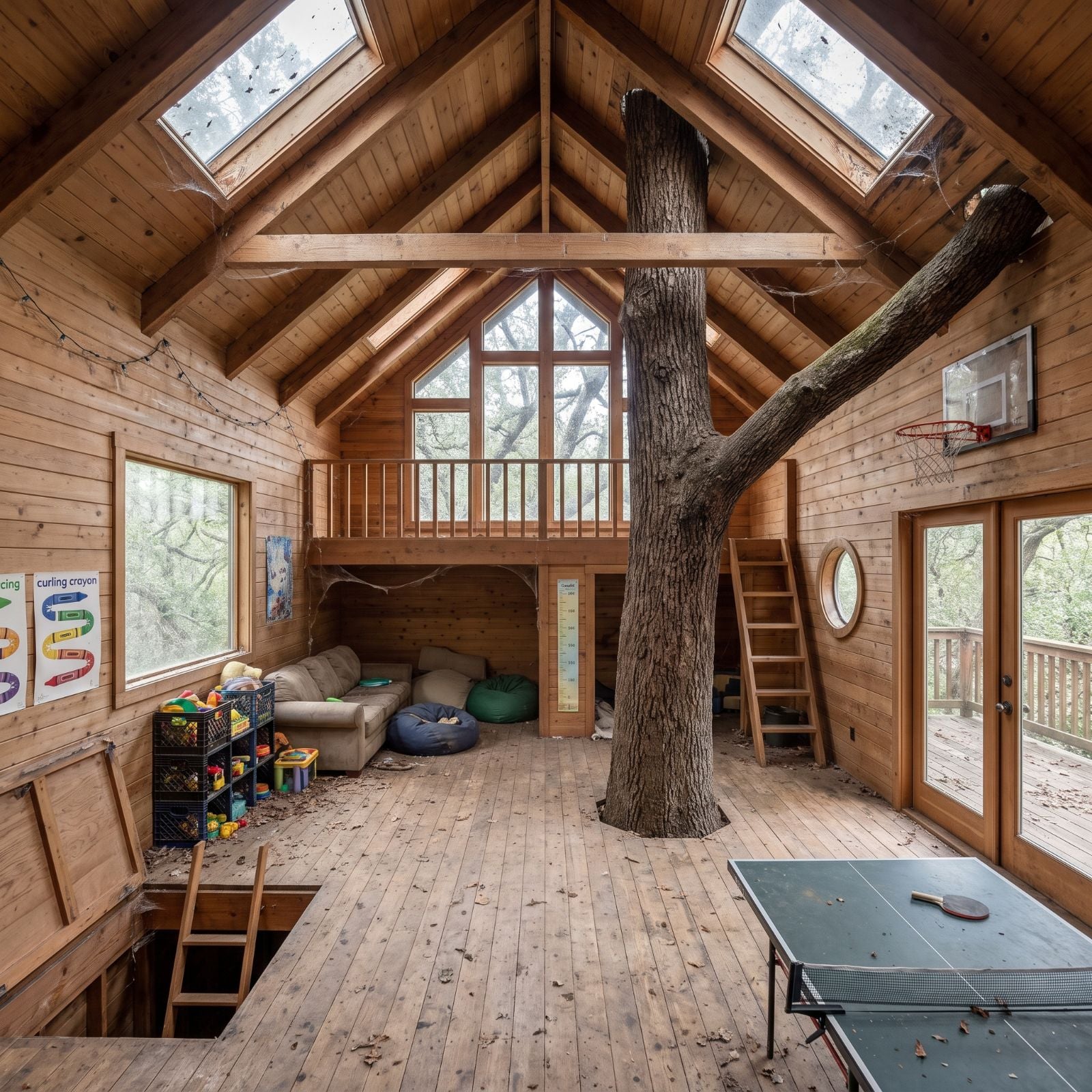
A backyard treehouse has an expiration problem nobody thinks about while the kids are still hauling bean bags upstairs. Then the basketball hoop goes quiet, the toy bins empty, and suddenly there is a surprisingly substantial little building sitting among the branches with electricity, floor space, a loft, and one enormous tree running straight through the middle of the argument.
In order to come up with the very specific design ideas, we create most designs with the assistance of state-of-the-art AI interior design software. Also, assume links that take you off the site are affiliate links such as links to Amazon. this means we may earn a commission if you buy something.
That is where this AI design study begins. The same basic treehouse becomes the starting point for 35 entirely different second acts. These are concepts, not photographs of completed renovations, so the changes ahead are best read as design experiments: What happens if the old playroom becomes an industrial loft? A private library? A plaster-walled retreat? An Art Deco salon? A room so unapologetically floral it appears to have mugged an English country house on the way home?
The tree is the useful constraint. Every scheme has to reckon with a piece of living architecture that cannot politely move three feet to the left. Some concepts surround it with gravel or planting. Others set staircases, kitchens, fireplaces, sofas, and dining tables against it. The strongest ones stop treating the trunk as the difficult part of the room and make everything else rise to the occasion.
35. Brick, Black Steel, and Cognac Leather Give the Treehouse an Industrial Streak
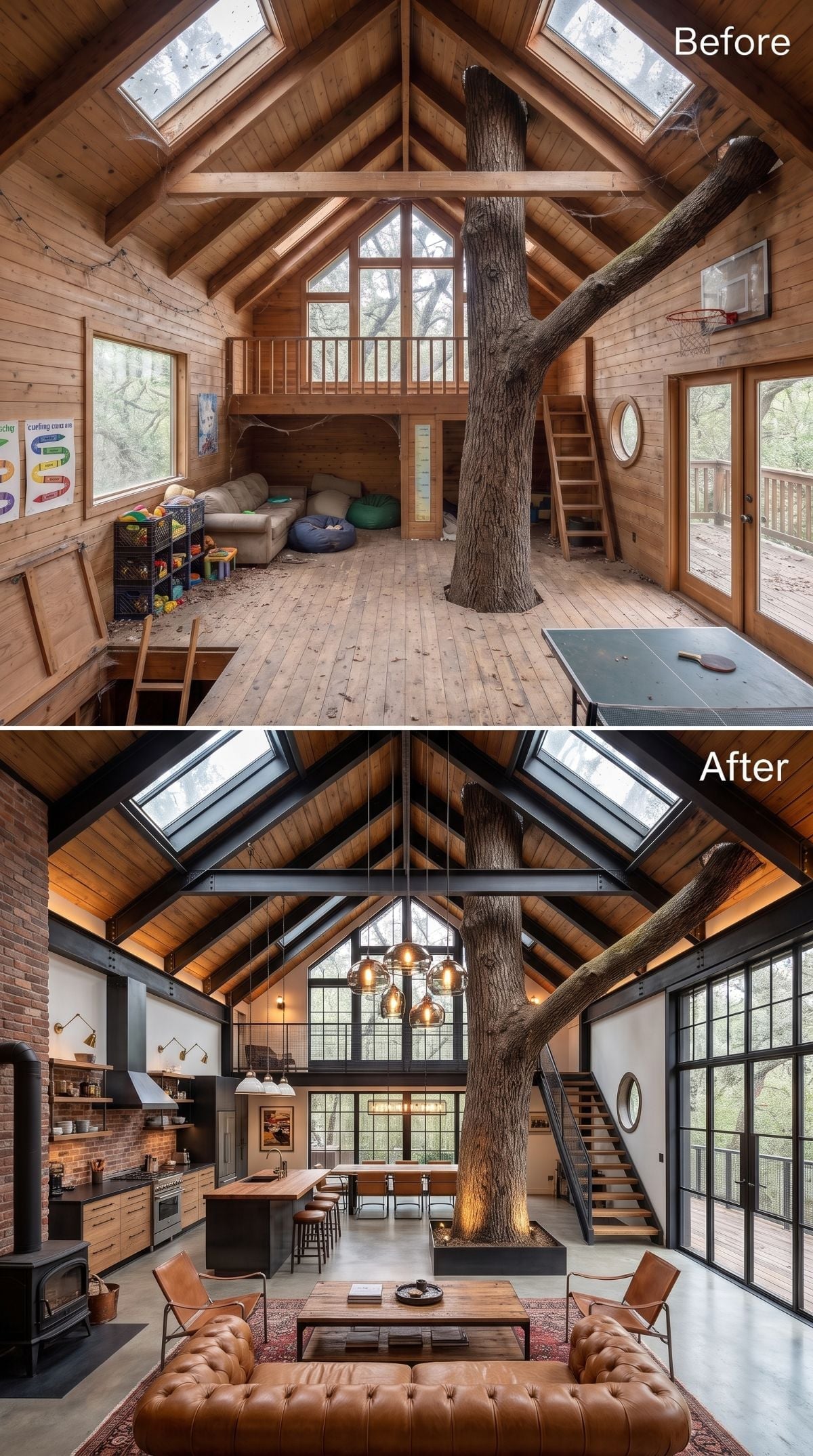
Raw brick, black-painted rafters, concrete flooring, and steel-framed glazing send the first concept as far from children’s playroom territory as possible. The living trunk rises through the middle like a column nobody ordered and nobody would dare remove.
A reclaimed-look dining table sits close to the tree beneath smoky glass pendants, while a cognac Chesterfield-style sofa faces a compact stove. Open steel stairs keep the loft visually connected to the lower level. The palette is hard-edged, but the leather, timber, and bark keep all that black and gray from turning the room into a machine shop with cushions.
Design Note: When a live trunk passes through a finished floor, the important issue is not disguising it. Any real build would need enough clearance for growth, movement, moisture, and maintenance. Visually, leaving that transition obvious can be far more convincing than pretending the floor and tree are one fixed object.
34. Shoji-Style Screens Give the Loft a Completely Different Kind of Quiet
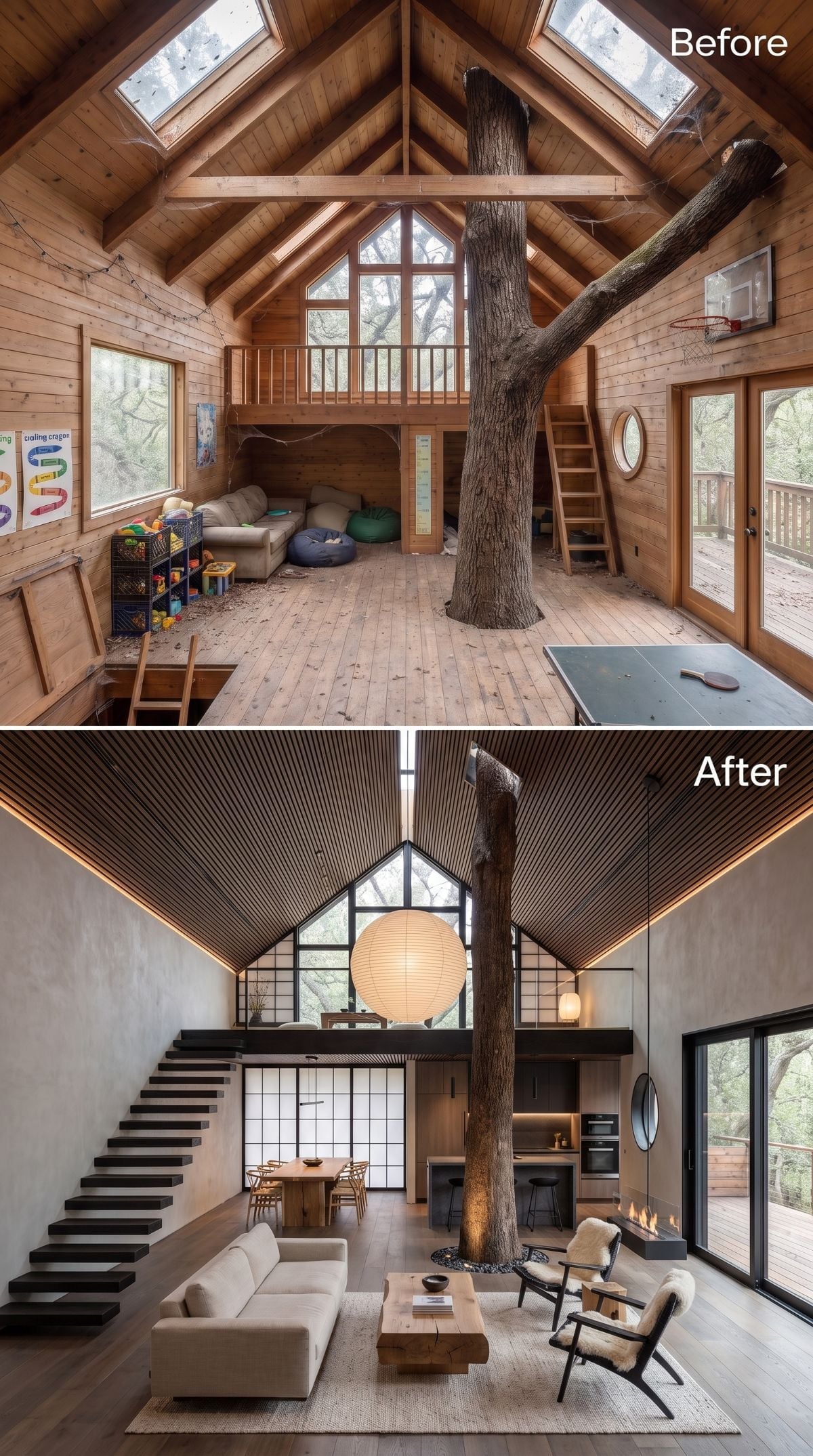
The next version goes almost silent. Dark wood slats draw attention to the vaulted ceiling while translucent shoji-style panels give the loft a light, orderly boundary rather than a heavy railing.
A gravel bed circles the trunk at floor level, visually separating living bark from finished interior without turning the tree into a piece of furniture. Floating stairs preserve the open volume beside it. Compared with the industrial room, nearly every gesture here is quieter, but the tree becomes even more noticeable because there is so little competing for the eye.
33. Emerald Velvet and Gold Take the Treehouse Somewhere Between Paris and Oz
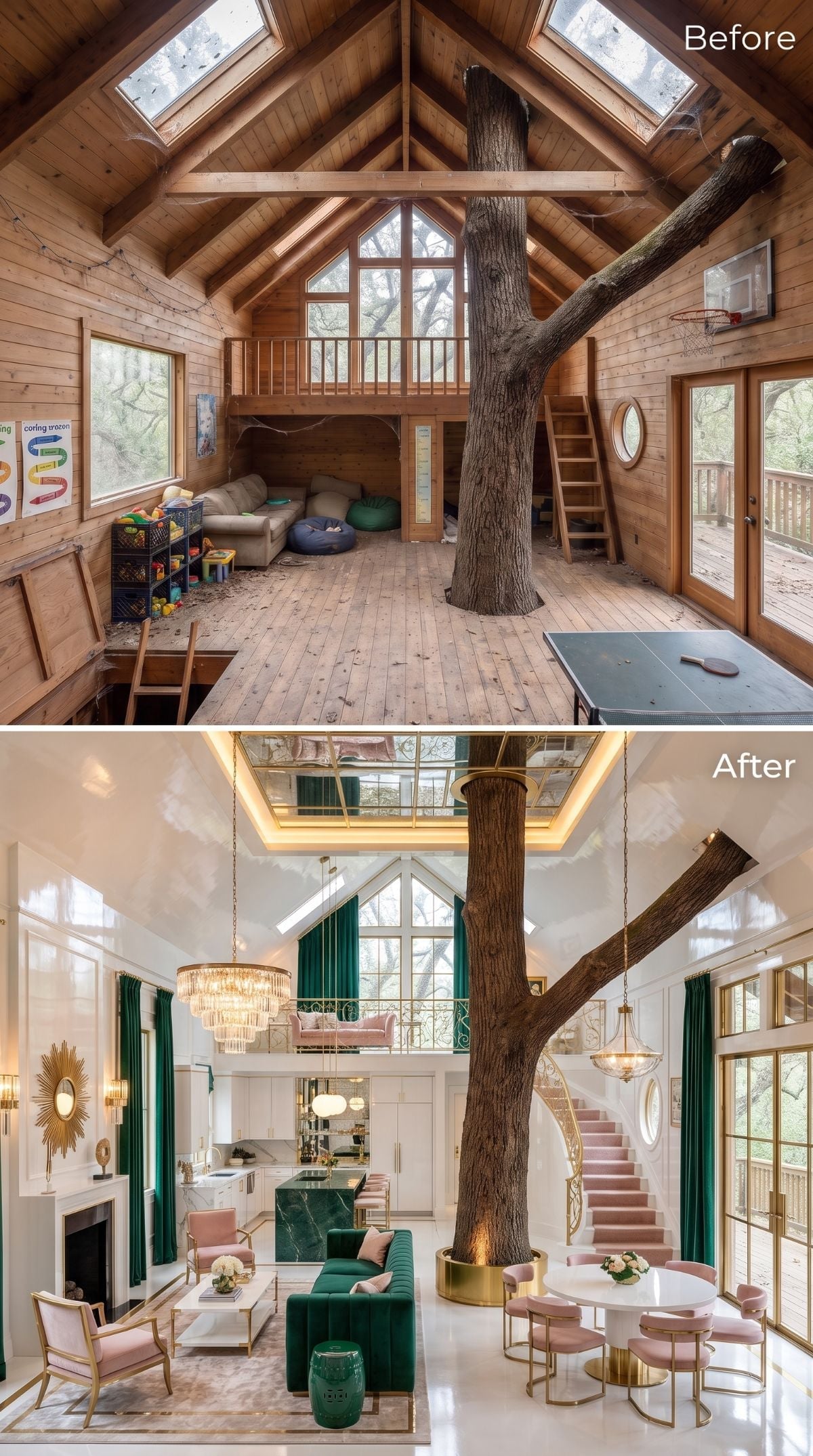
Restraint has left the building. Emerald velvet, blush upholstery, crystal pendants, green marble-look surfaces, ornamental railings, and enough warm metal to light a small theater transform the treehouse into a salon in the woods.
The trunk meets the floor inside a polished brass-toned collar, turning that awkward junction into a deliberate flash of metal. Tiered pendants descend through the tall space while cove lighting follows the ceiling line above. Pink stairs curl toward the loft. The natural oak is still the strangest thing in the room, which may be why the entire composition works.
Color Move: Repeating one warm metal at the tree base, railing, lighting, and hardware gives an exuberant palette some discipline. The green and pink can misbehave because the metallic details keep introducing the same note.
32. Paint Everything White and Suddenly the Tree Gets Very Loud
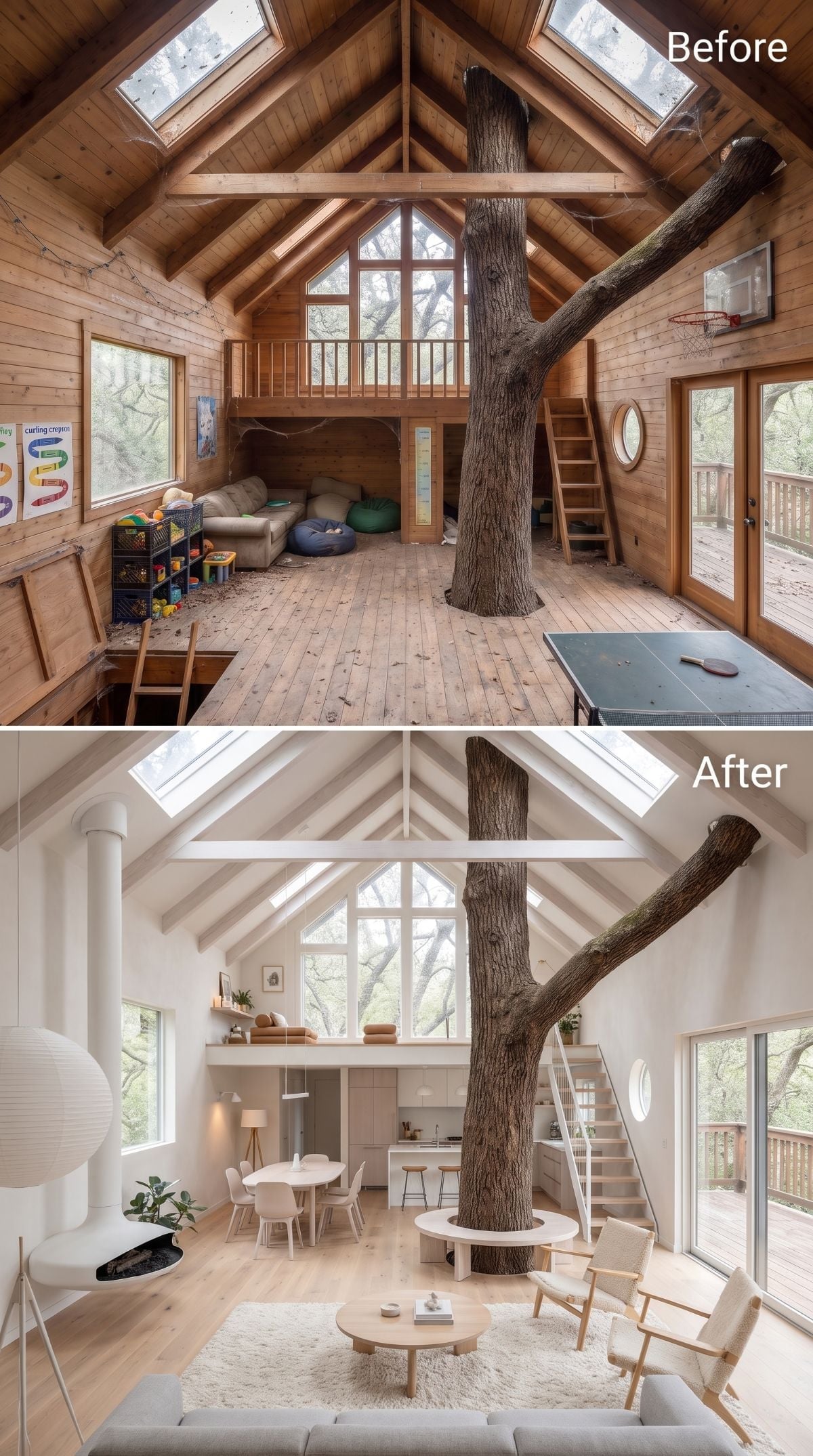
White walls, white rafters, pale flooring, and almost no visual clutter turn the tree from one more rustic surface into the darkest, most irregular thing in the room.
A circular bench wraps around its base and a round dining table repeats the curve nearby. Off to one side, a suspended black fireplace supplies the only piece bold enough to challenge the trunk for attention. It is the architectural equivalent of cleaning the kitchen counter and discovering there was marble under all that mail.
31. Spanish Colonial Gives the Treehouse Terracotta, Talavera Blue, and a Proper Staircase
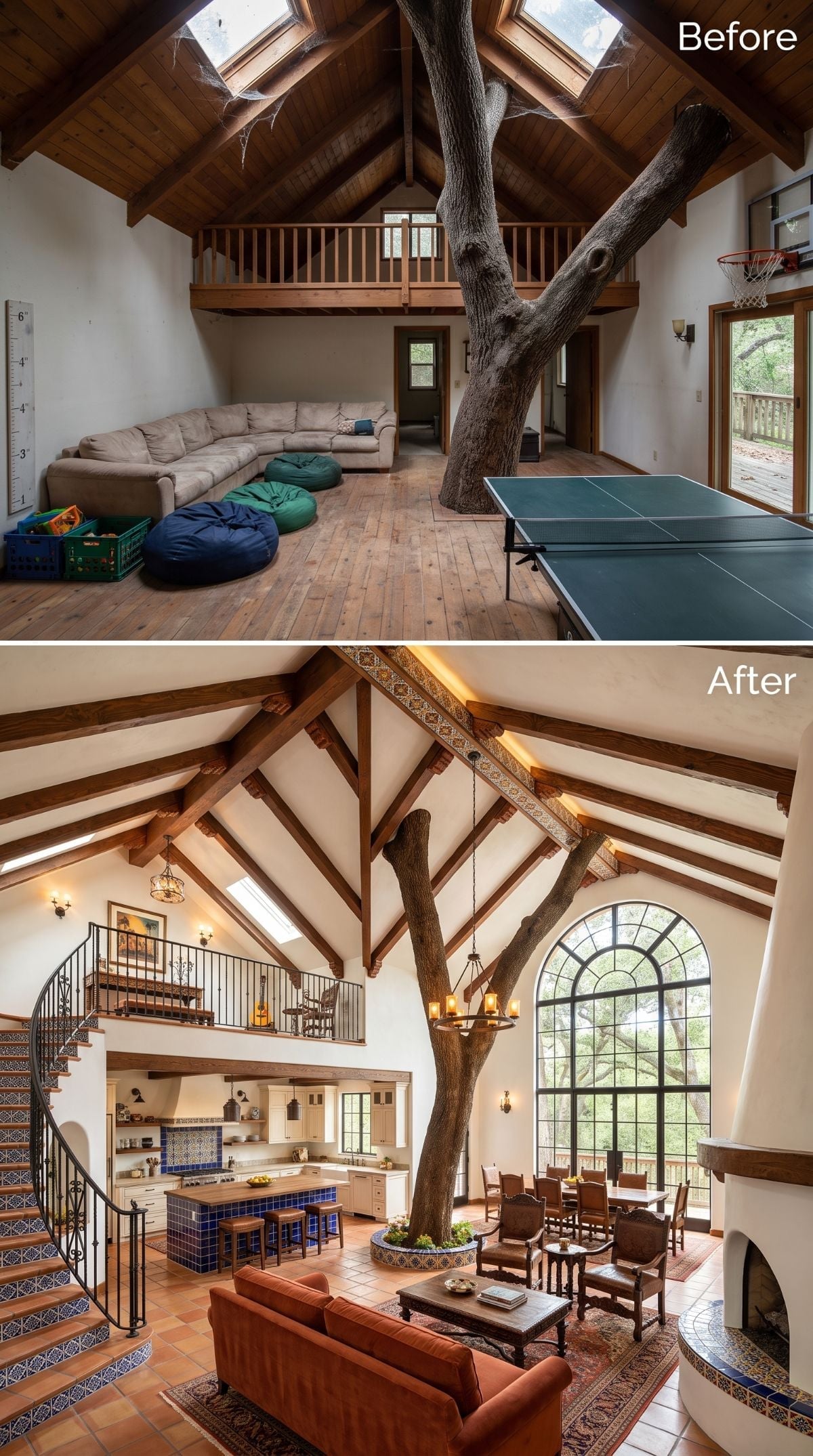
Rough plaster, terracotta flooring, exposed timber, and a curving wrought-iron stair give this concept a Spanish Colonial vocabulary without trying to make the backyard pretend it has moved to Seville.
Blue patterned tile on the island supplies the sharpest color in the room, while an arched window frames the leafy canopy beyond. The tree rises from a raised ceramic surround near the center. Pattern is concentrated rather than sprayed everywhere: tile here, ironwork there, warm plaster around it. The room knows when to stop.
Pattern Lesson: A concentrated panel of blue-and-white tile can carry more visual weight than repeating the motif across an entire room. In a small structure already dominated by timber and a live trunk, one strong patterned surface is plenty.
30. Mid-Century Furniture Finds a Very Un-Mid-Century Room
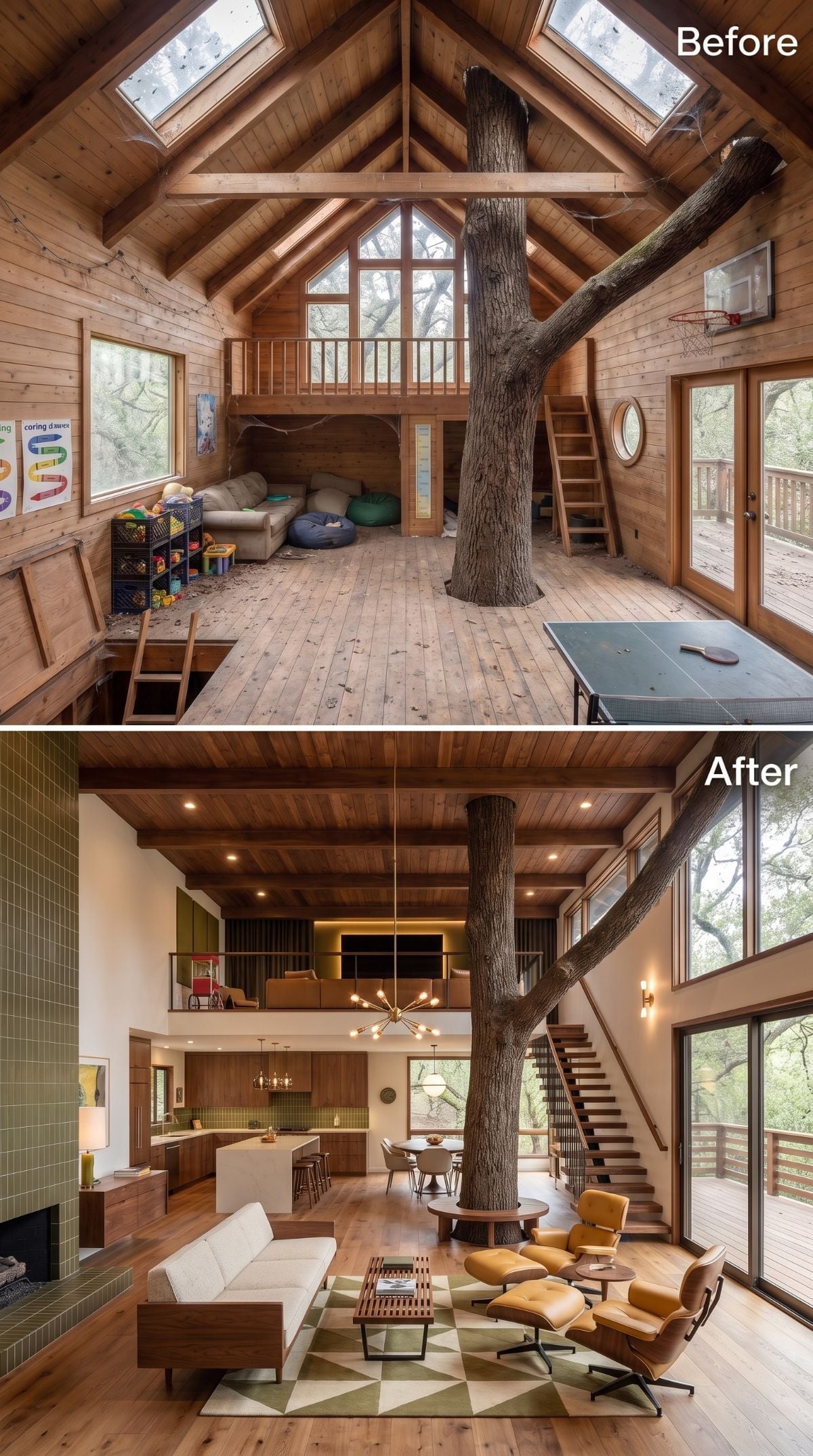
A pair of cognac lounge chairs and a Sputnik-style chandelier pull the room toward mid-century design while the soaring roof and tree trunk refuse to cooperate with the period assignment.
That mismatch is the appeal. Clean-lined furniture gives the lower level discipline, while open stairs move lightly toward the loft instead of building a solid wall beside the trunk. The tree remains a wildly organic counterpoint to all the walnut, leather, and starburst geometry.
Why the Open Stair Helps
Open treads preserve more of the view through the room than a visually solid stair would. That is especially useful here because the tree already occupies a substantial vertical slice of the floor plan. The staircase can be present without becoming a second massive object beside it.
29. Blue Toile on the Ceiling Makes the Treehouse Dress for Dinner
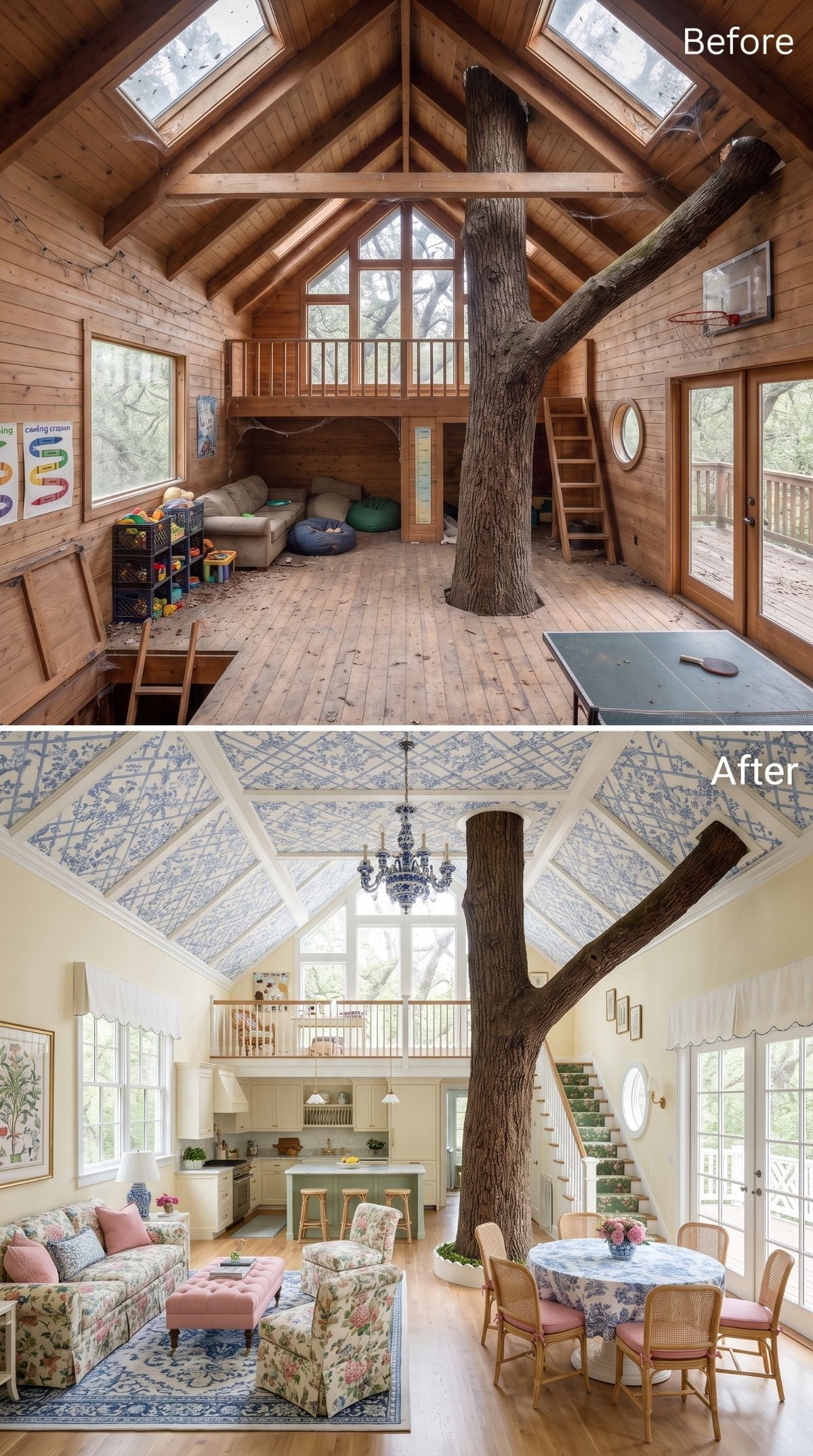
Soft yellow walls and blue-and-white toile between the rafters make this perhaps the least predictable answer to the original treehouse. The ceiling becomes decorative territory while the lower half stays warmer and calmer.
The trunk rises beside a skirted round table and cane chairs with pink cushions, giving the dining area the peculiar charm of an English country room interrupted by a forest. Floral upholstery continues the mood without asking the tree to join in. Somewhere a bean bag is feeling deeply betrayed.
28. Art Deco Turns the Living Tree Into the Only Curve It Cannot Control
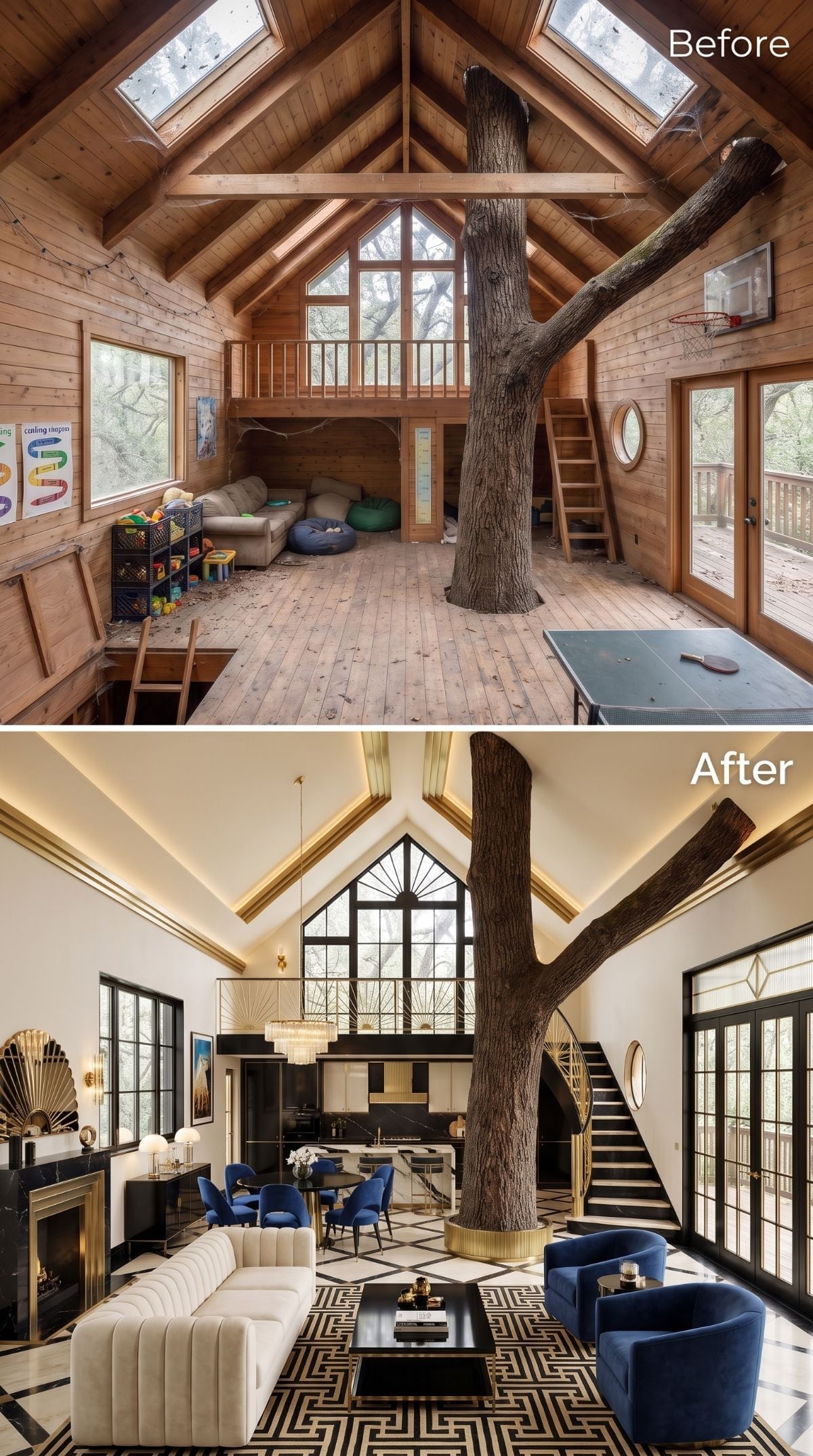
Black-and-white floor geometry, blue velvet, gold-toned details, black-framed windows, and cove lighting give this concept a hard graphic discipline.
Then the tree crashes through the center of it. A gold-toned drum detail at the base makes the collision feel deliberate, while a black-and-gold staircase and fan-shaped glazing carry the Deco references upward. The architecture wants symmetry. The oak has other plans.
27. Stone, Leather, and an Antler Chandelier Turn the Treehouse Into a Lodge
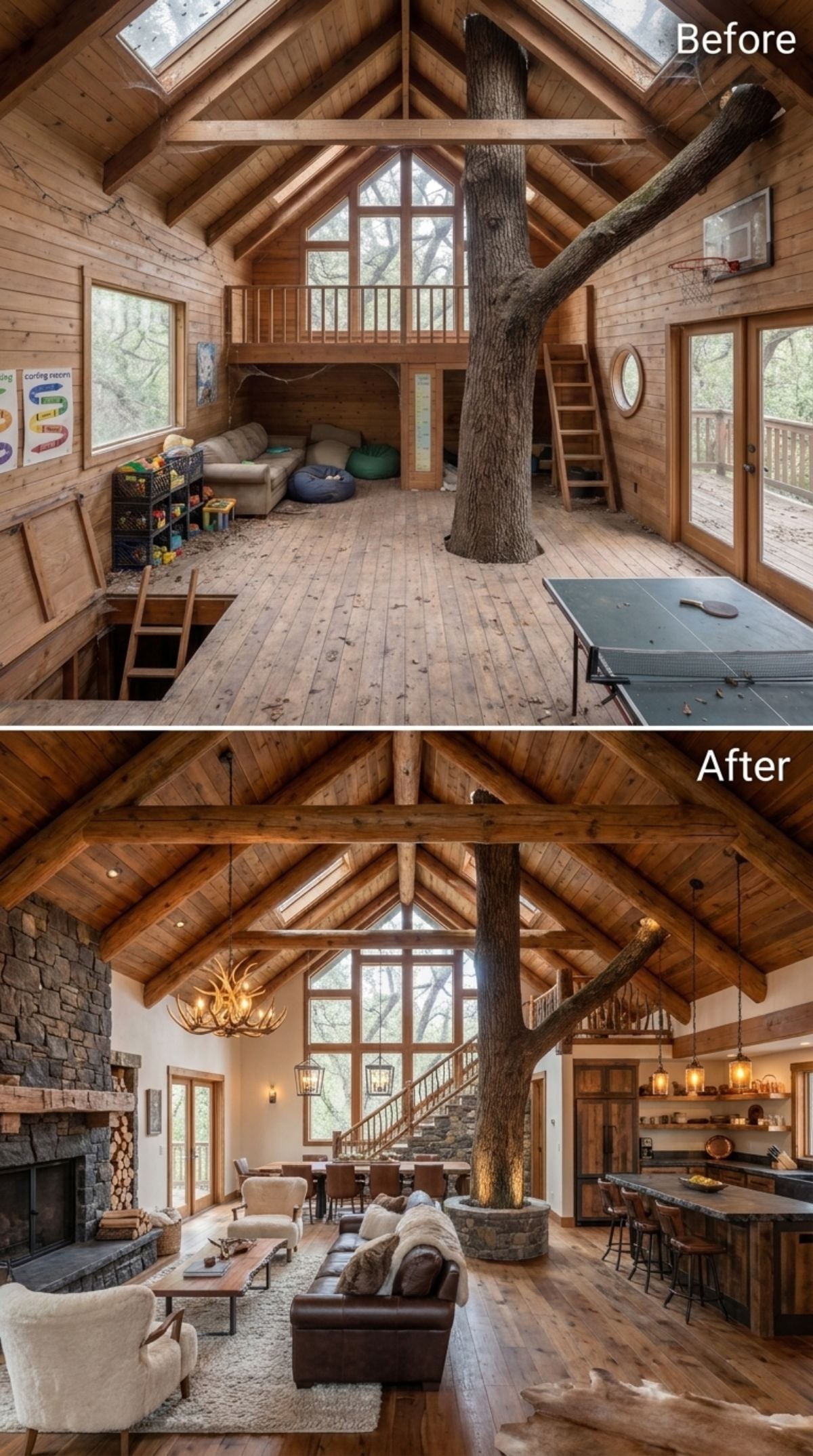
A floor-to-ceiling stone fireplace gives this version a much heavier center of gravity. Dark leather sofas, cream wool chairs, firewood storage, and an antler-style chandelier lean all the way into lodge territory.
The tree gets a rough stone surround of its own at floor level, linking it visually with the hearth without pretending the two are the same thing. Exposed rafters suddenly look entirely at home. This treehouse does not want to be sophisticated. It wants snow outside and something brown in a glass.
26. Plaster Arches Strip the Treehouse Down Until the Oak Looks Almost Surreal
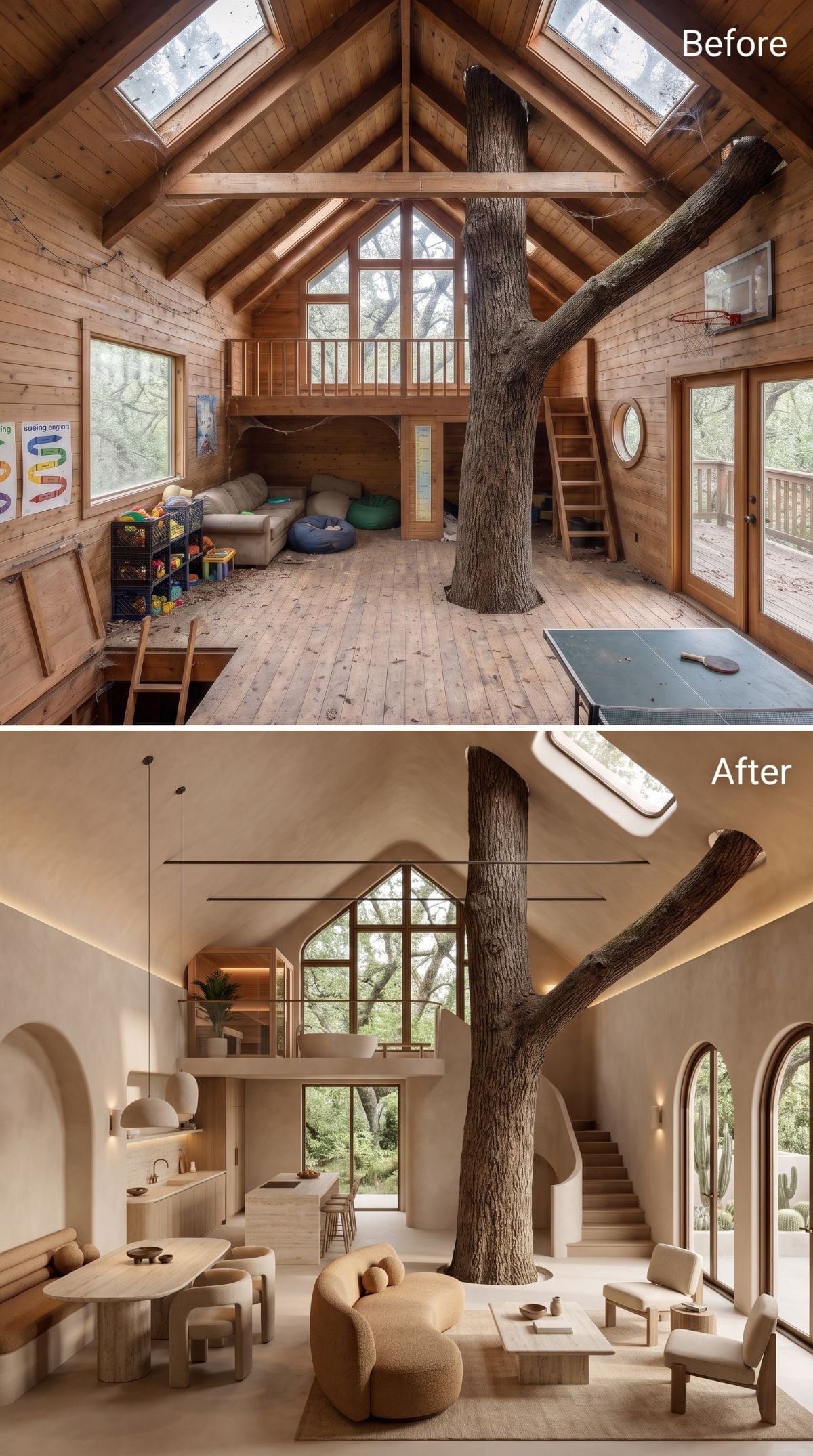
Smooth warm plaster covers walls, ceiling, and staircase until almost every hard transition has been softened into an arch or curve. Low bouclé seating and a slab dining table keep the furniture close to the ground.
Against all that controlled quiet, the tree looks enormous. Its bark, branches, and irregular profile refuse every rule the room has imposed on itself. That is the charm. Minimalism finally meets an object it cannot declutter.
25. Moroccan Lanterns Let the Ceiling Join the Party
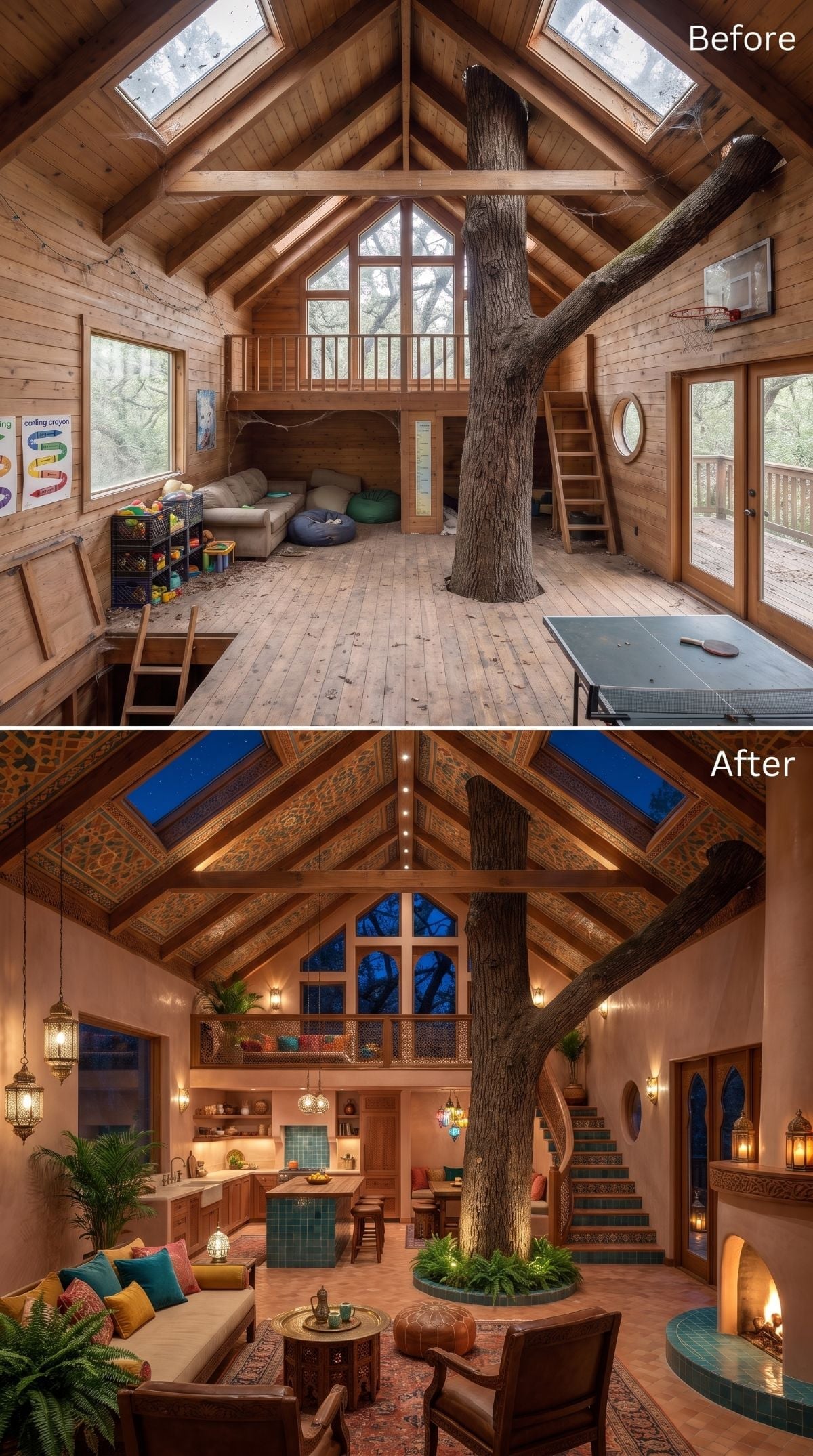
Painted geometric detailing runs along the beams while pierced brass lanterns hang into the tall volume below. Teal tile on the staircase gives the room a cool note against the warmer wood and plaster.
At floor level, ferns gather around the trunk so the living element does not stop abruptly where the interior begins. The overall effect is layered and decorative without covering every surface. The ceiling beams get pattern, the stairs get color, the tree gets greenery. Everybody receives one assignment.
24. White Shiplap and Powder Blue Give the Loft a Fresh Country Turn
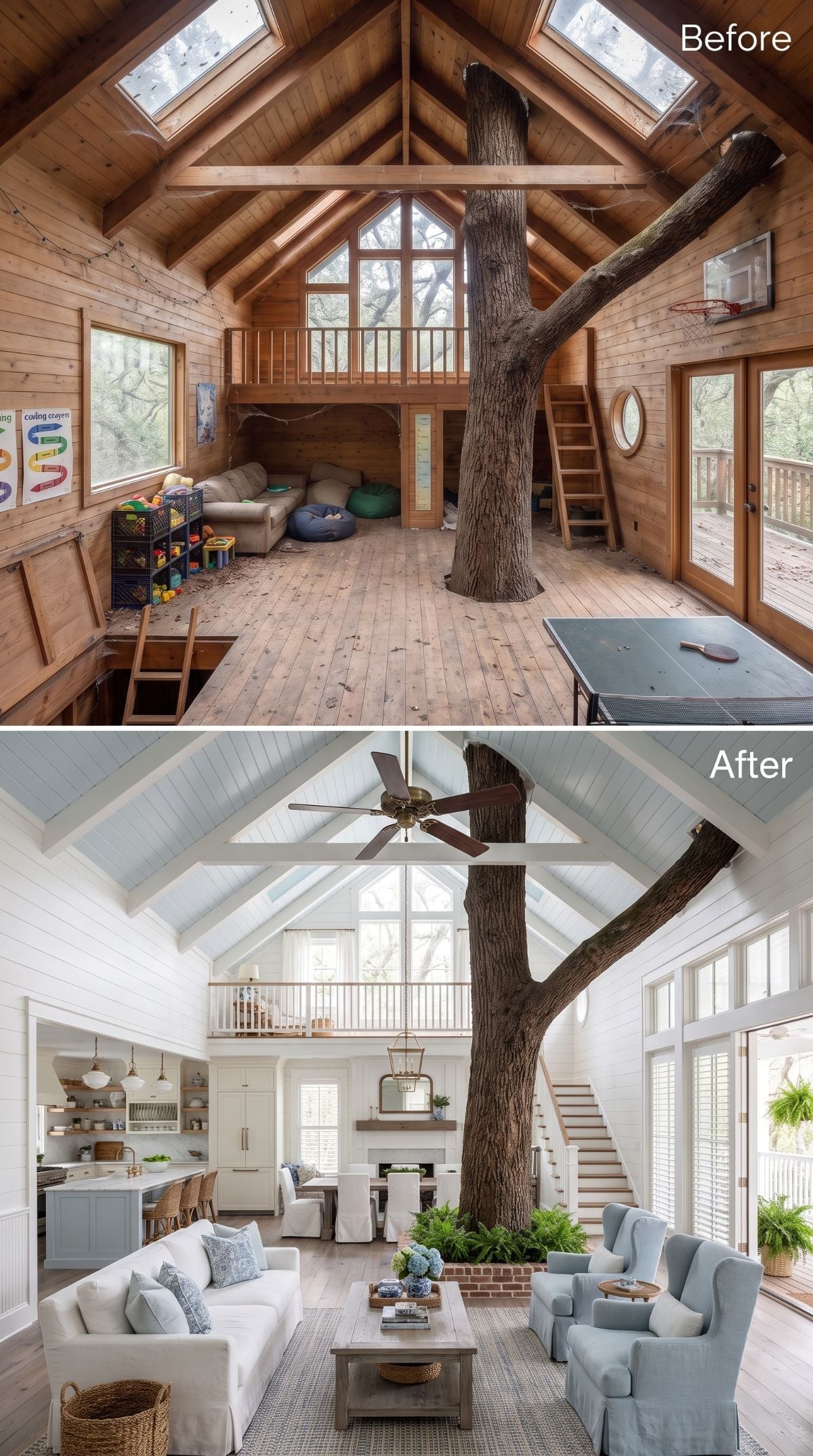
Bright white boards wrap the walls, ceiling, and rafters into one light shell, while powder-blue wing chairs provide the color the room needs without competing with the canopy outside.
A slipcovered sofa, reclaimed-look coffee table, painted kitchen cabinetry, and simple open shelving keep the lower level relaxed. Ferns cluster near the tree base, and a lantern pendant balances a ceiling fan farther across the room. Nothing here is revolutionary. It simply makes the old treehouse feel as if somebody finally opened the curtains.
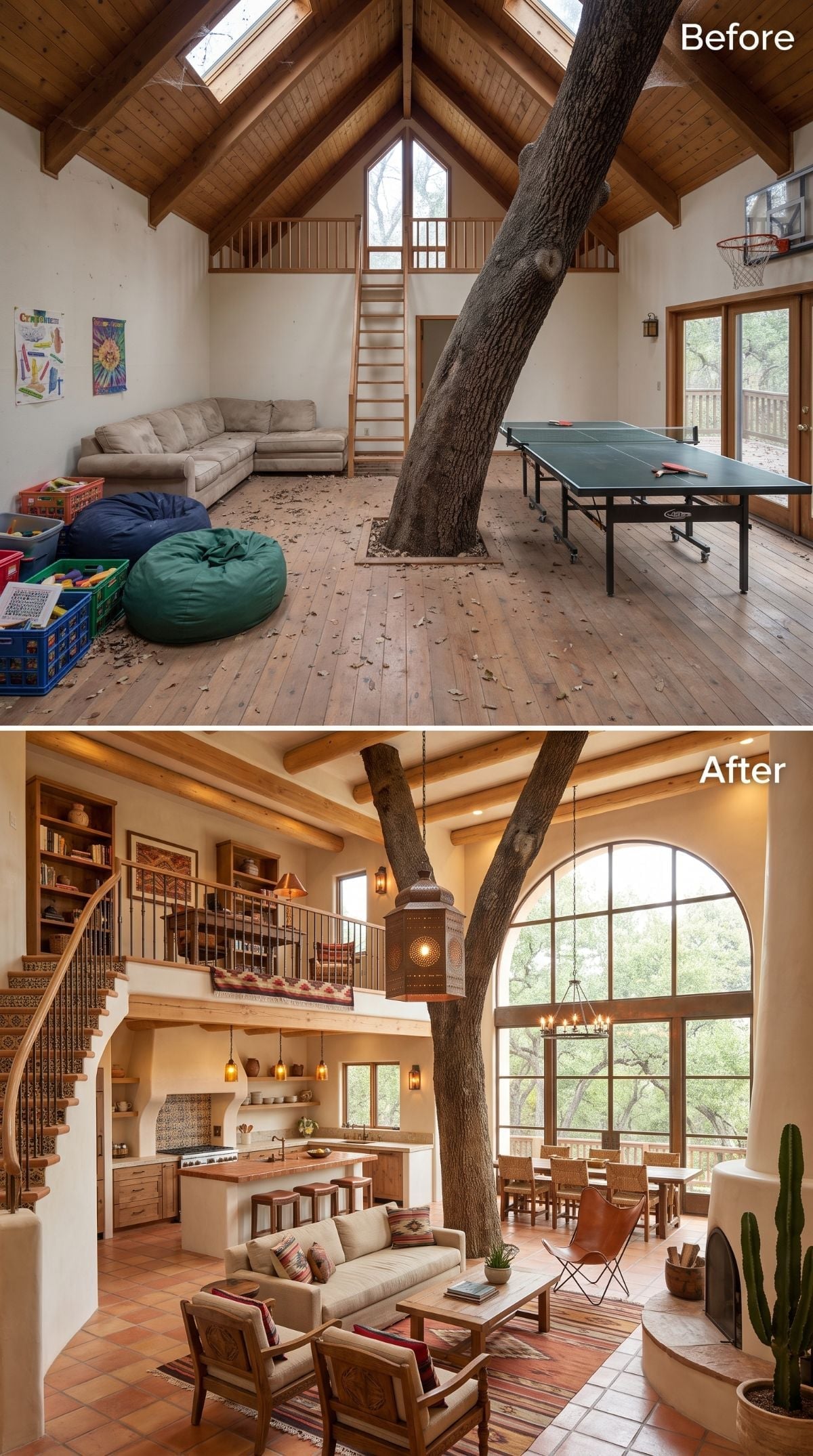
23. Adobe Tones and Terracotta Make the Tree Feel Native to the Room
🔥 Would you like to save this?
Warm adobe-look plaster and terracotta tile turn the interior into a field of earthy color that sits naturally beside the bark.
A curved stair follows the wall while a punched-metal lantern hangs lower than expected near the trunk. Linen upholstery, woven textiles, and a leather butterfly chair keep the furnishings visually light. The room has plenty of Southwest influence, but the real composition is simpler: clay, timber, fabric, tree.
22. Lavender Cabinets Make French Country the Wild Card Nobody Expected
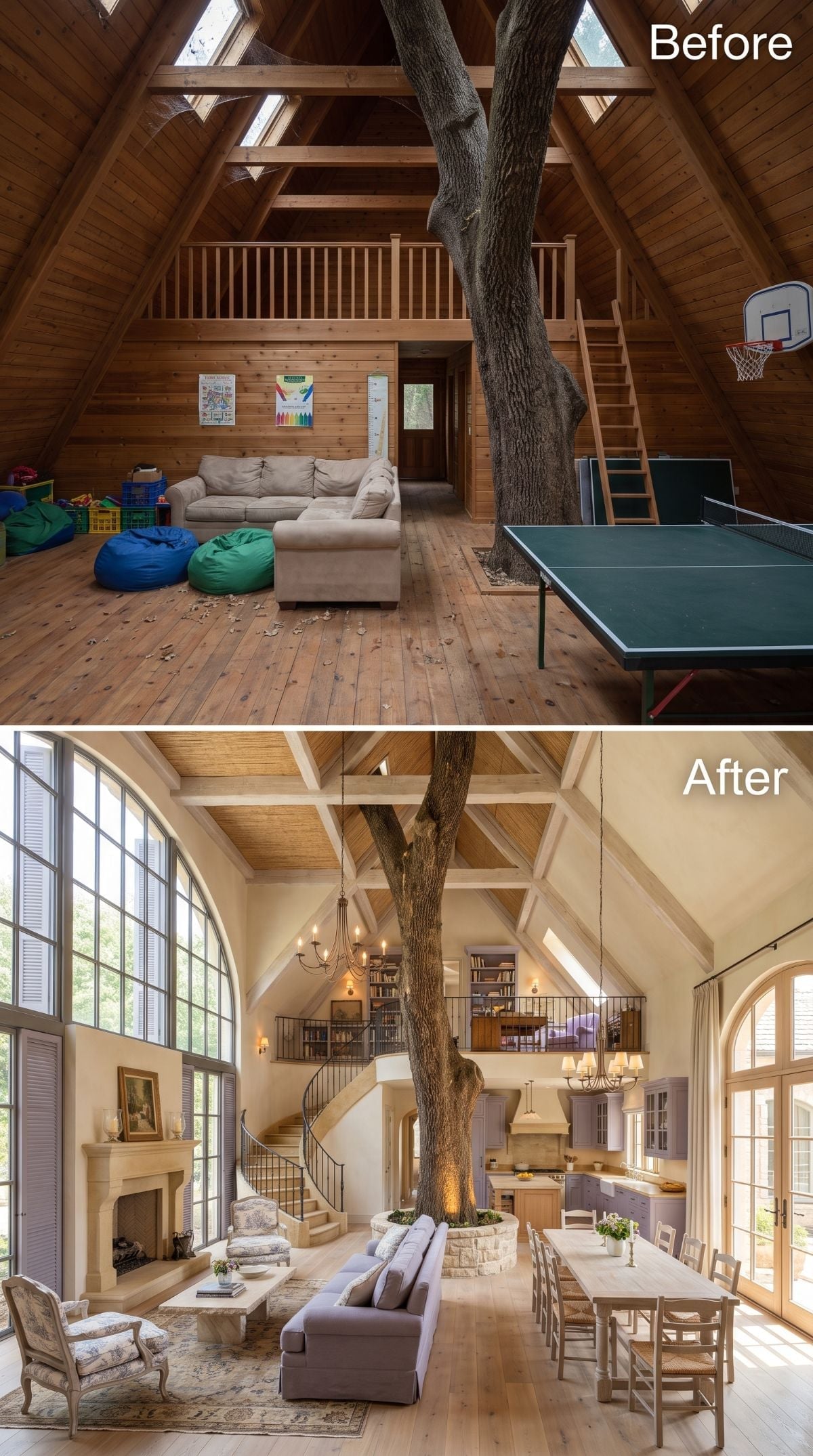
Lavender cabinetry immediately pulls this concept away from the gallery’s predictable oak-and-white options. A candle-style chandelier hangs over the sitting area while soft upholstery and warm wood bring the palette back toward earth.
The tree rises from a mortared stone ring set low to the floor, giving the base a rustic edge that suits the French-country mood without making it precious. Lavender and bark should not necessarily be friends. Here they appear to have worked something out.
21. Botanical Walls Turn the Vaulted Ceiling Into a Greenhouse Fantasy
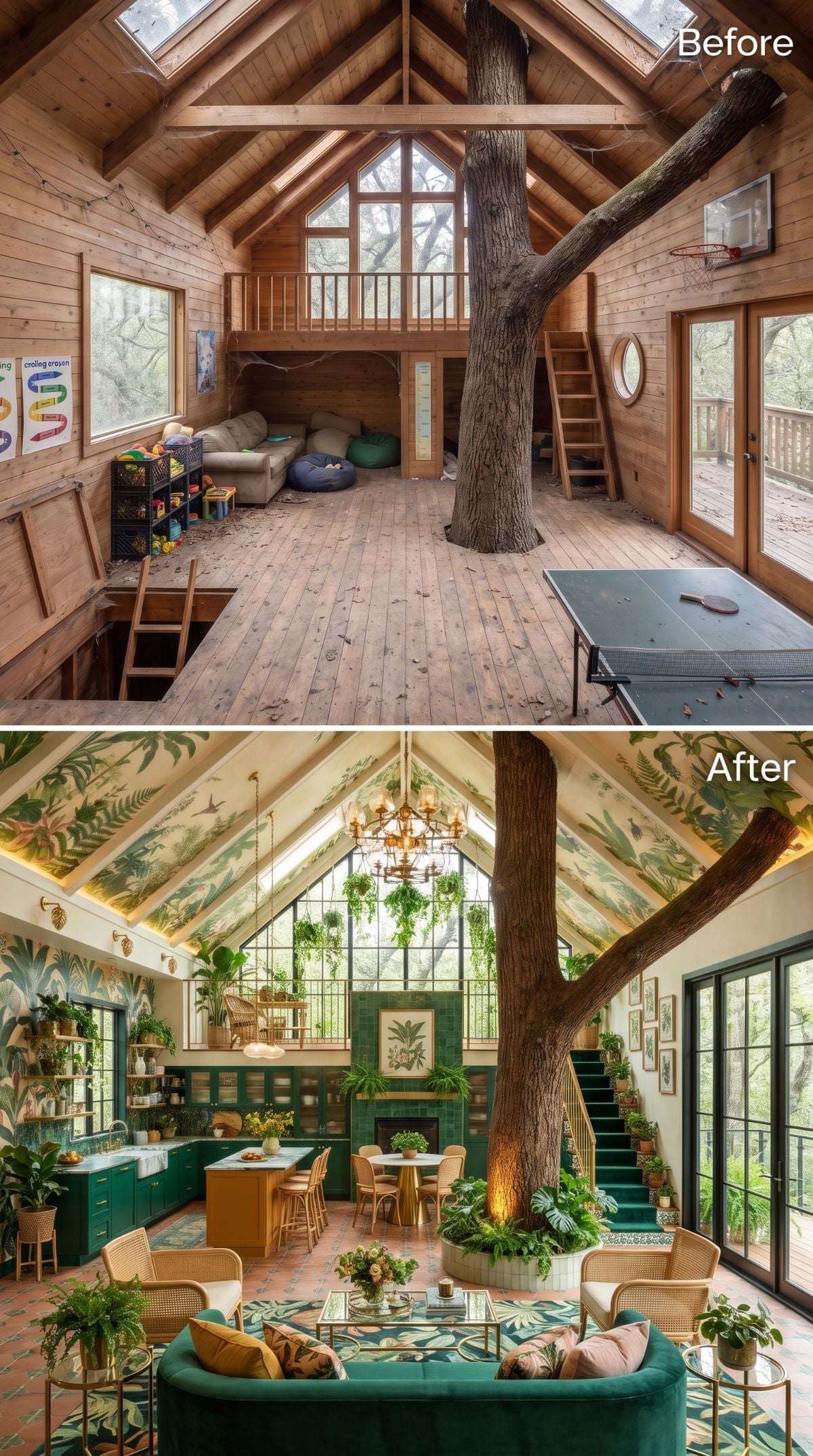
Leafy botanical imagery climbs into the rafters until the ceiling begins to echo the canopy outside. The effect is theatrical, but the color story stays surprisingly disciplined.
Deep green upholstery, slightly different green cabinetry, fern planting, and terracotta flooring build the room out of variations rather than exact matches. A candle-style chandelier hangs in the center while the staircase curves around the trunk. This may be the only interior where adding more leaves makes the actual tree look restrained.
Color Story: The greens work because they vary in depth. Forest upholstery, darker cabinetry, and softer foliage tones create layers rather than one matching set, while terracotta gives all that green a warm counterpoint.
20. Leather, Lantern Light, and a Fireplace Give the Treehouse a Winter Setting
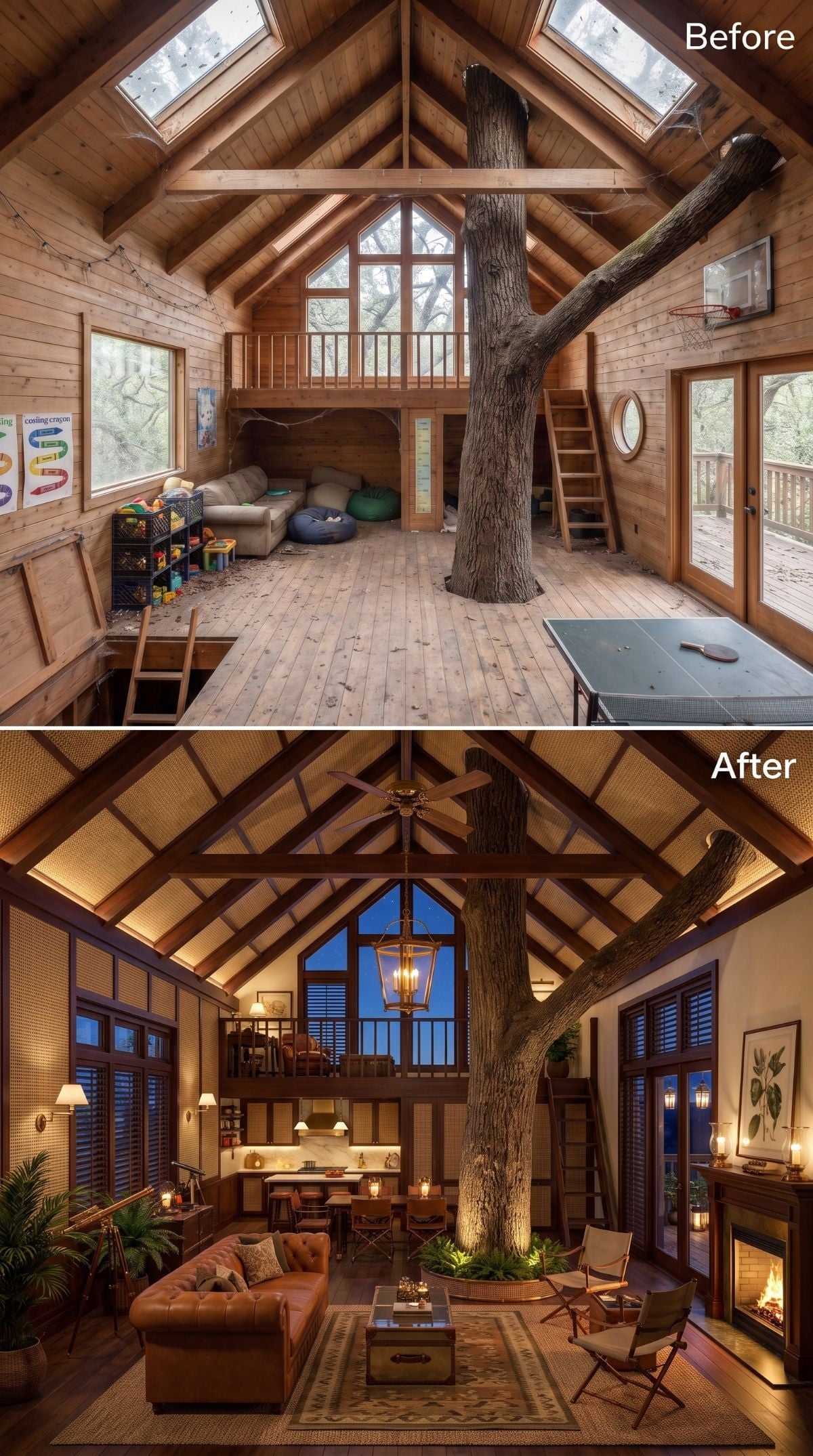
Amber lighting catches the bark from below while dark timber overhead compresses the palette into something warmer and more intimate.
A cognac button-tufted sofa faces the hearth, joined by a trunk-style coffee table and a large lantern pendant hanging from the ridge. Ferns soften the tree base and the loft remains visible above. The room still has the proportions of a treehouse, but emotionally it has moved straight into late November.
19. Green Velvet, Brass, and Crystal Turn the Tree Into Part of the Glamour
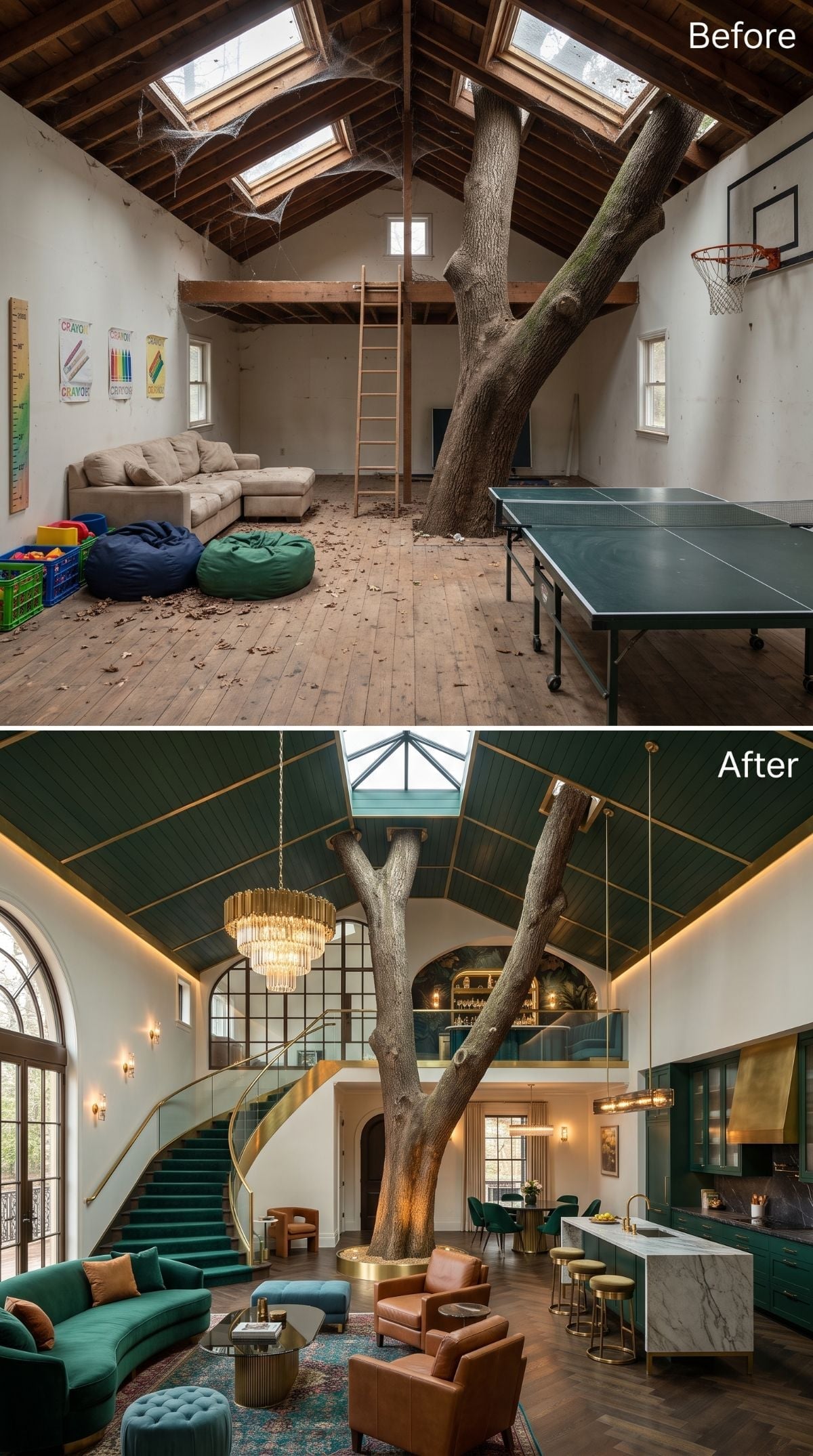
This second emerald scheme is less salon and more grand staircase. Deep green ceiling panels edged in brass-toned trim pull the eye upward toward a tiered chandelier, while a curved stair sweeps toward the loft.
Below, a marble-look island divides kitchen and lounge. A green velvet sofa and cognac chairs repeat the palette at floor level, while the tree occupies the middle with absolute indifference to all that polish. Glamour usually likes control. A living oak is a useful reminder that it cannot have everything.
18. White Plaster and Woven Pendants Let the Tree Do the Decorating
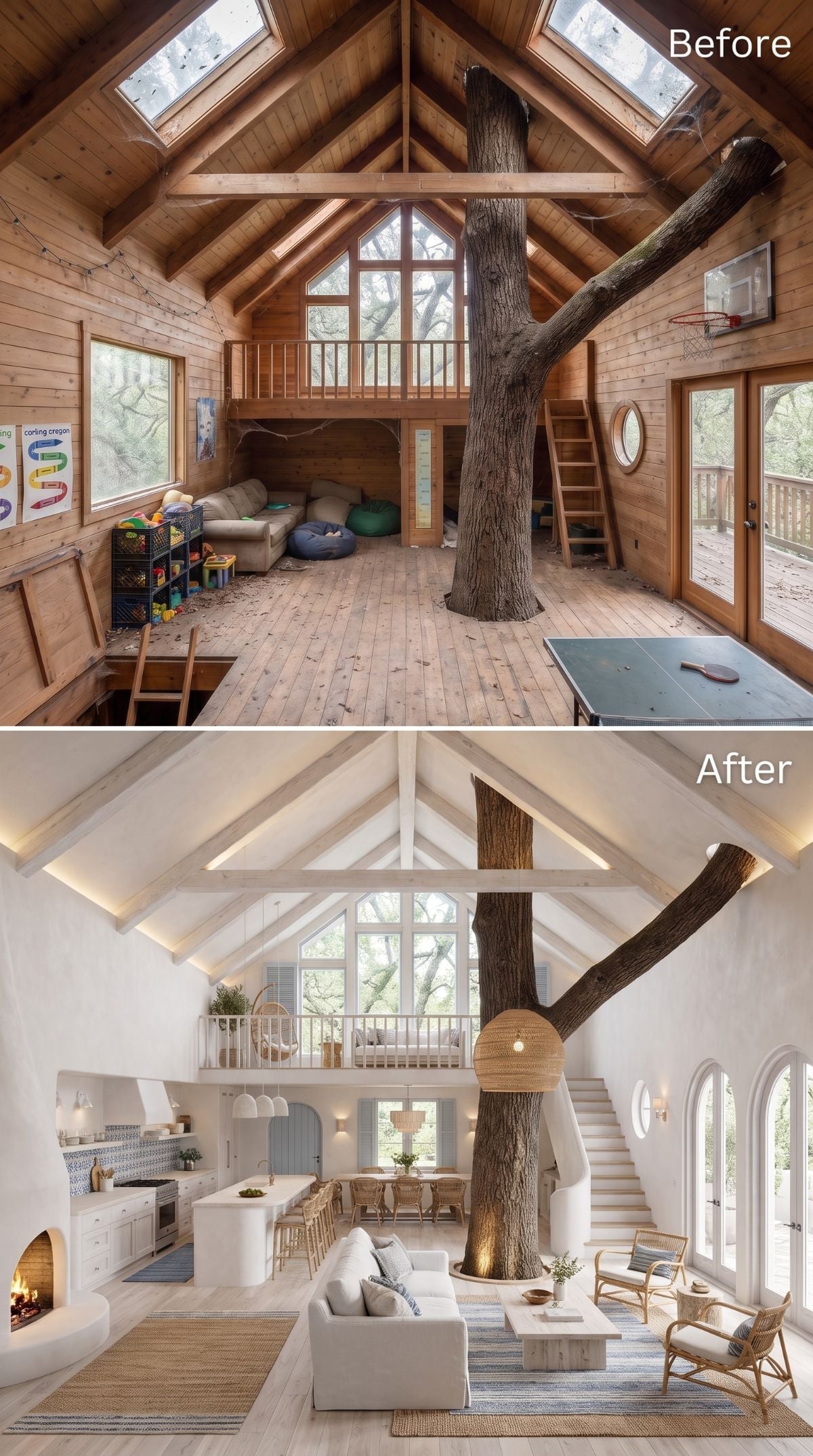
White plaster and painted trusses create a bright shell with almost no competing pattern. A woven pendant beside the trunk and cane furniture bring enough texture to keep the room from drifting into blank-gallery territory.
The kitchen sits quietly along one side while linen sofas form the main seating zone. Here the tree does not need a brass collar, stone wall, mural, or chandelier to explain why it matters. Bark against white plaster is enough.
17. Tuscan Drama Brings the Spiral Staircase, Firelight, and Wine
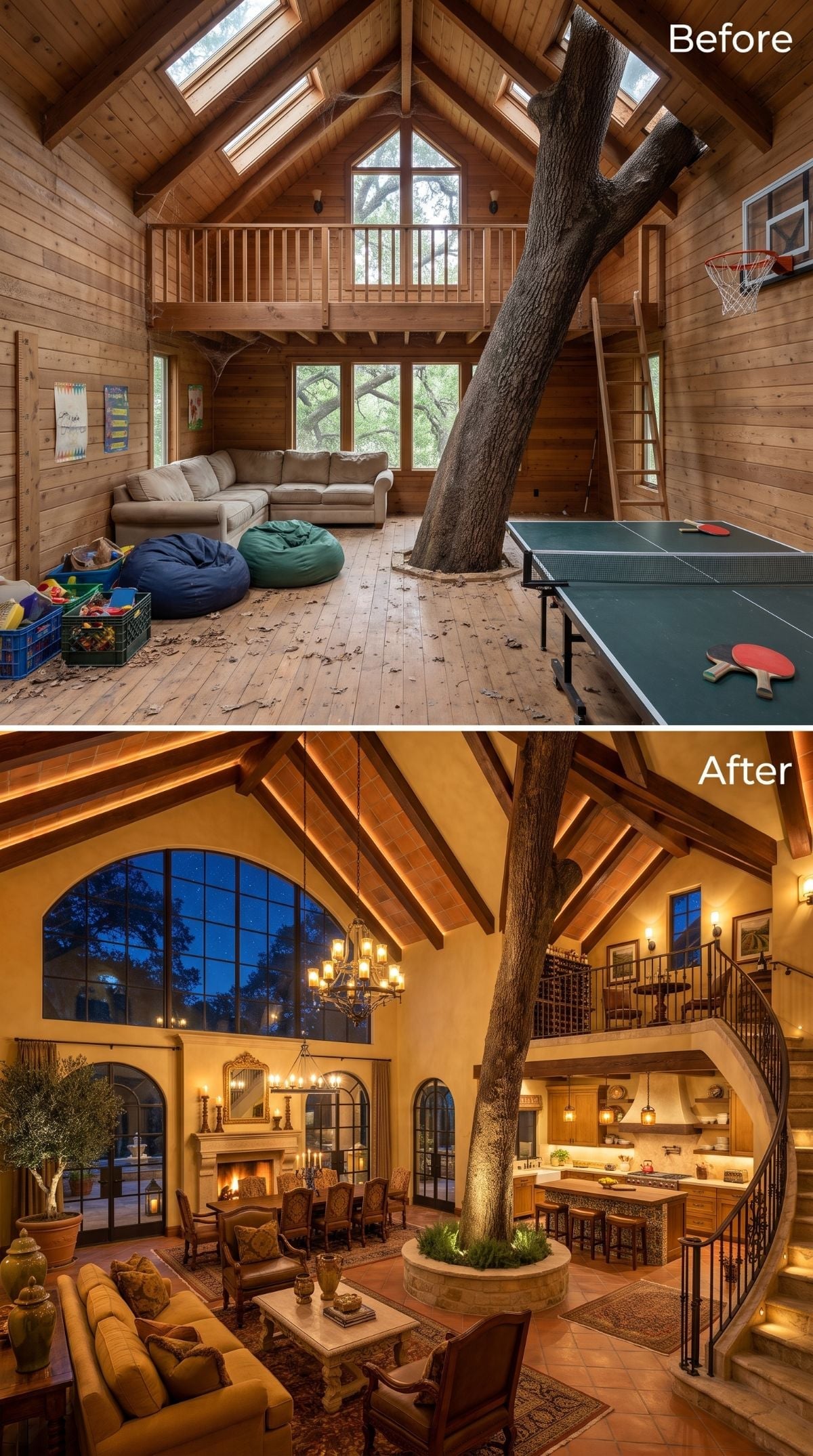
Ochre plaster saturates the room in warm color while a wrought-iron spiral stair curls toward the loft. Stone around the tree base and a lit fireplace add two rough-textured counterpoints to all that plaster.
Arched windows and a candle-style chandelier push the concept toward Tuscan fantasy, and what appears to be bottle storage upstairs makes the old children’s loft look suspiciously prepared for an entirely different age group. The bean bags have left the premises.
16. Rattan and Trailing Plants Pull the Treehouse Back Toward the Tropics
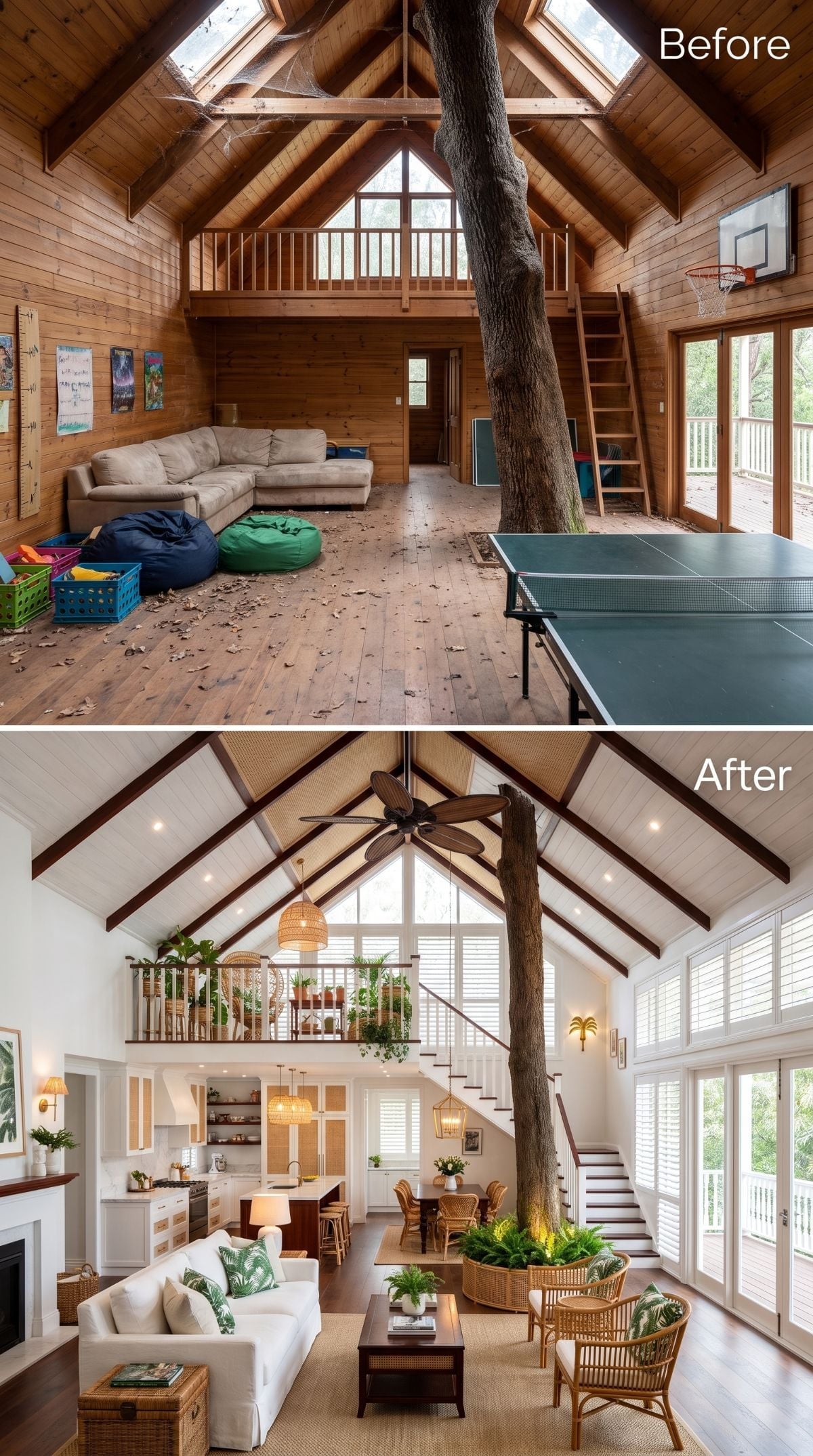
Painted ceiling boards lighten the vault while dark exposed beams preserve enough contrast to show its shape. Below, rattan chairs, a white linen sofa, jute, and tropical-print cushions keep the palette informal.
Plants spill over the loft railing and ferns gather around the trunk, creating a deliberate blur between the living tree and the softer vegetation around it. The wicker pendant and lantern-style sconces continue the natural texture without adding another major color. This one never forgets there is a garden outside.
15. Warm Greige Plaster Turns the Tree Into Sculpture
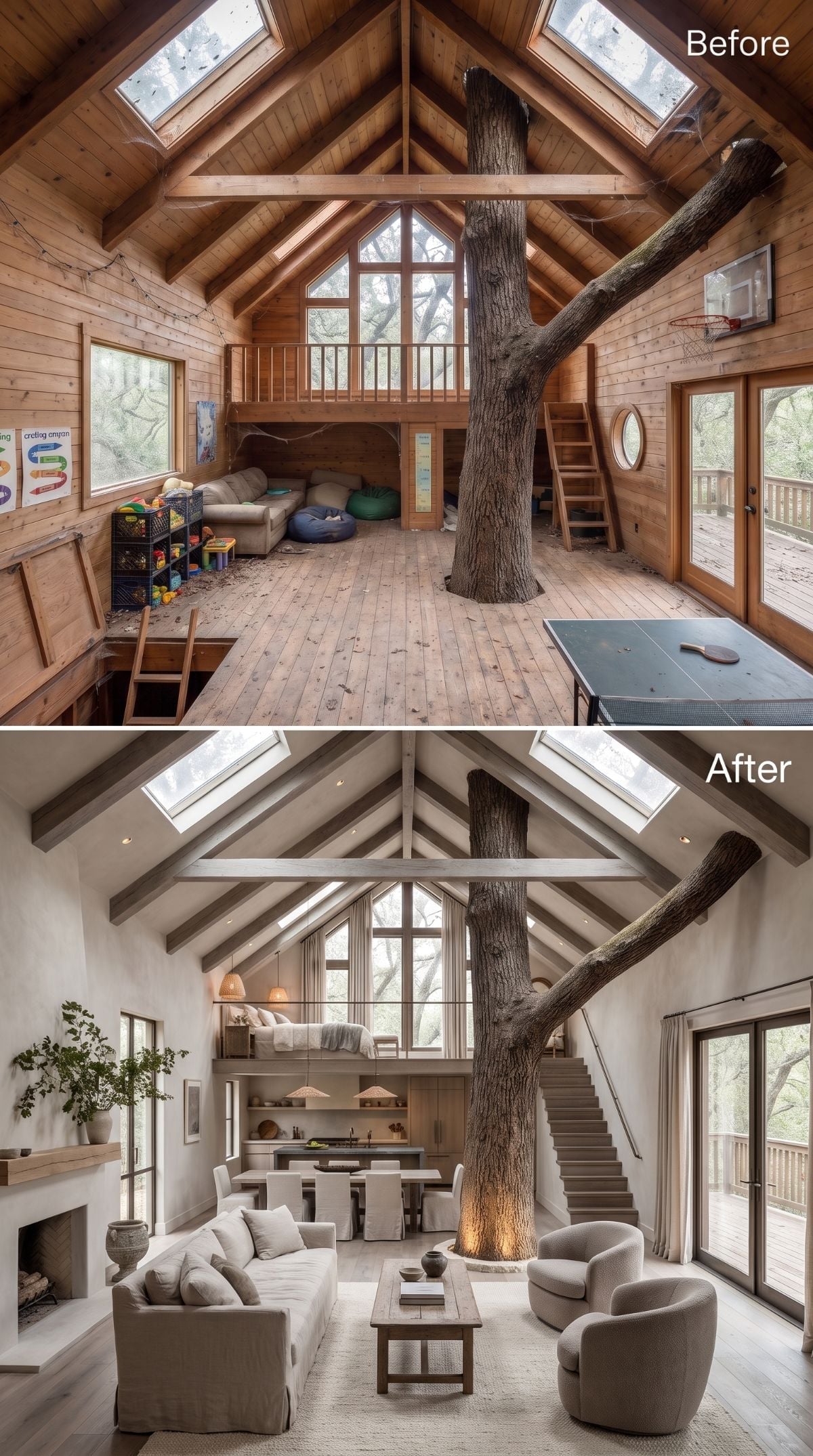
Warm greige plaster and muted beams pull nearly every background surface into the same quiet family. That leaves the irregular bark as the strongest texture in the room.
Low uplighting exaggerates the trunk’s ridges after dark, while linen upholstery and a slab-top coffee table keep the furniture understated. A solid loft edge makes the upper level feel more enclosed than many of the railing-heavy concepts. This is not the gallery’s most dramatic transformation, but it may be one of the easiest to imagine living with.
14. Terracotta and Iron Make the Treehouse Feel Like a Courtyard With a Roof
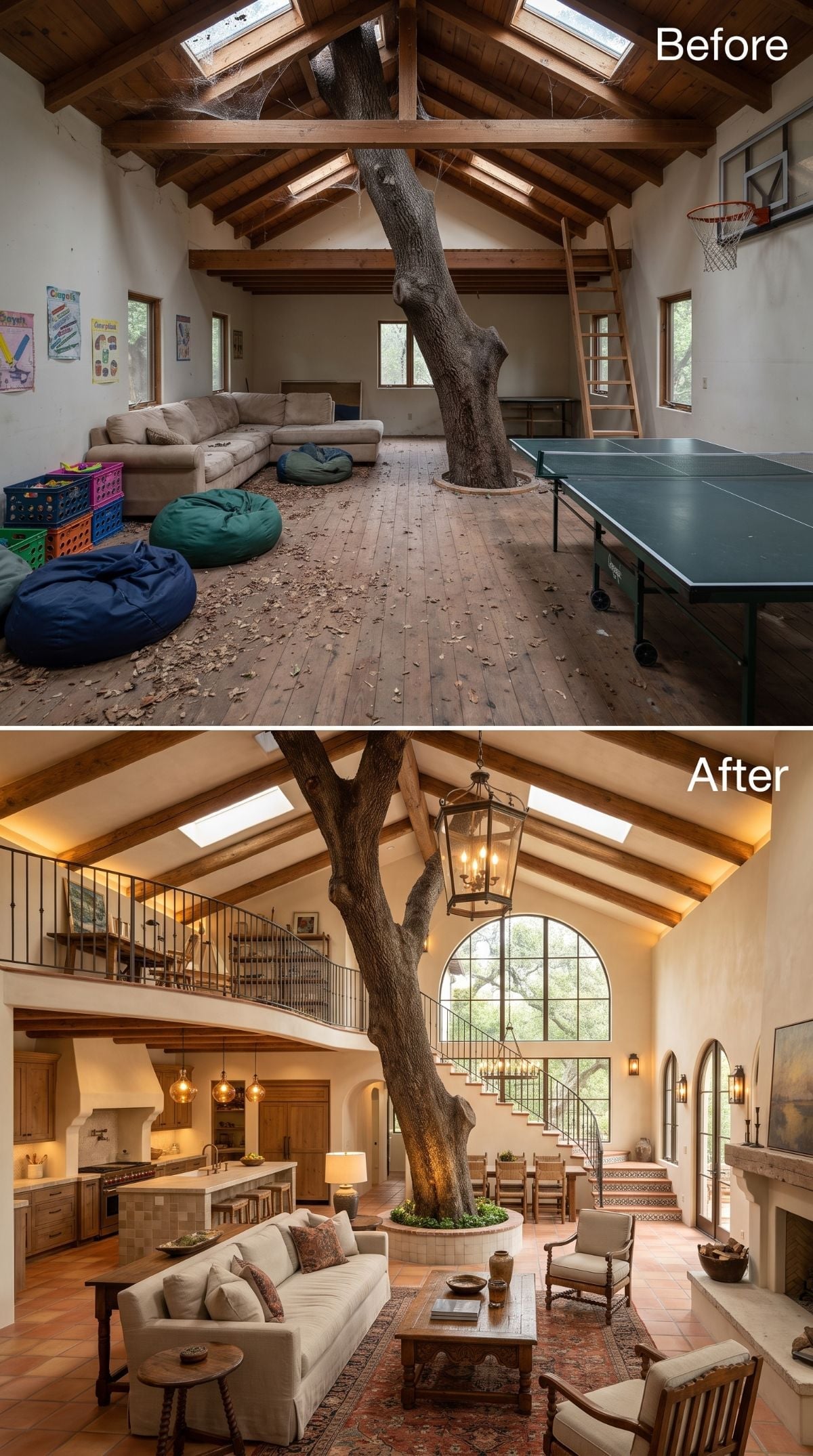
Terracotta-patterned flooring spreads beneath the entire room, giving the lower level the earthy continuity of a courtyard. Above, an iron mezzanine rail draws a dark line across the warm interior.
An arched steel-framed window sets the canopy beyond the glass into a much more formal composition, while the trunk rises through a low surround in the foreground. The room manages to feel both indoors and slightly not indoors, which is a particularly useful trick for a treehouse.
13. White Walls, Black Steel, and an Oversized Globe Go Almost Scandinavian
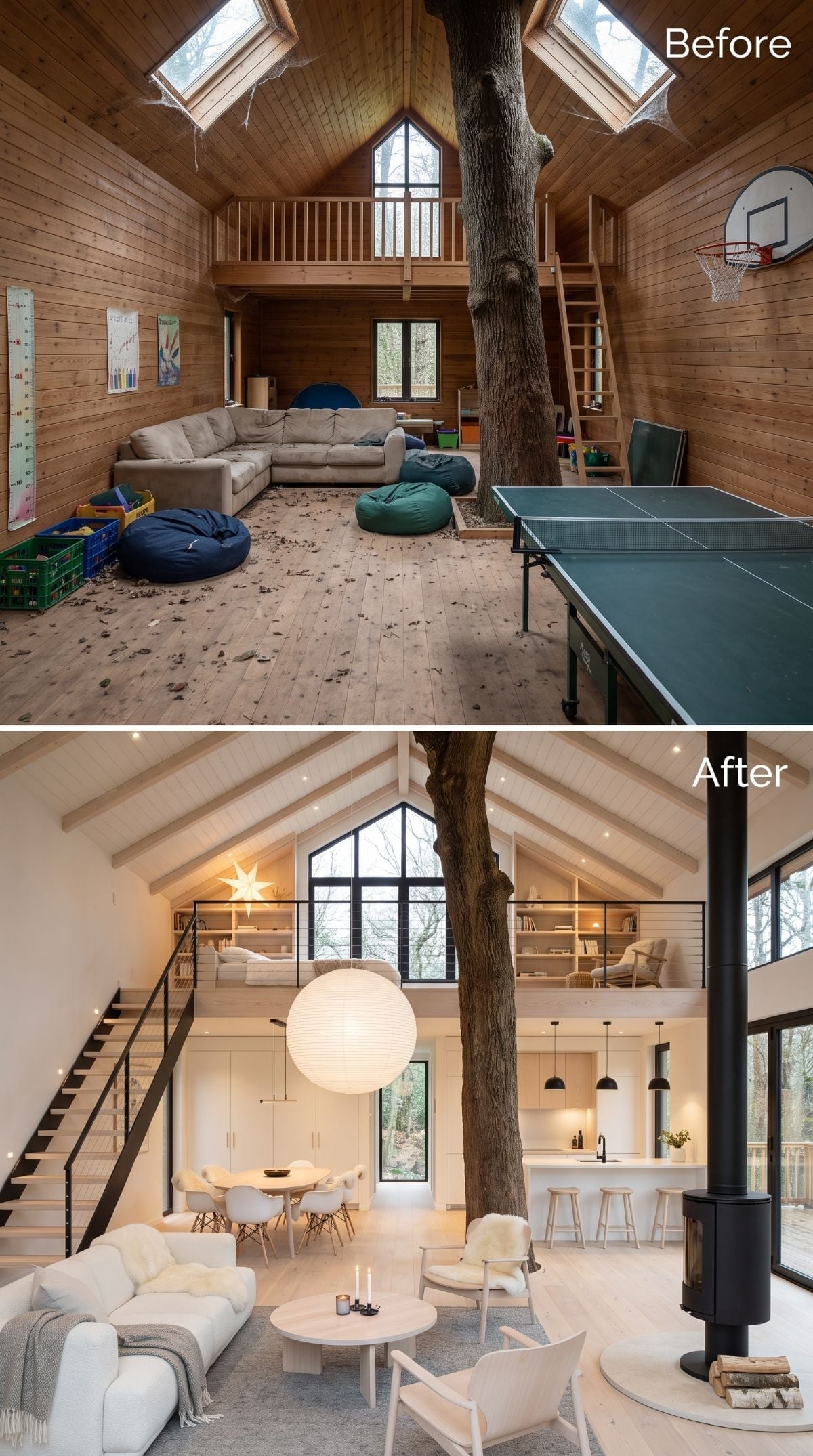
White plaster and painted rafters provide the lightest possible shell, while a black steel mezzanine rail gives the loft one precise dark edge.
A cylindrical stove stands beside the tree and a large paper globe pendant floats over a round table with molded chairs. The pendant is almost absurdly big. That is exactly why it works: the vaulted ceiling has been waiting decades for somebody to bring it an object with the nerve to fill the air.
12. Forest Green and Books Turn the Treehouse Into a Dark Library
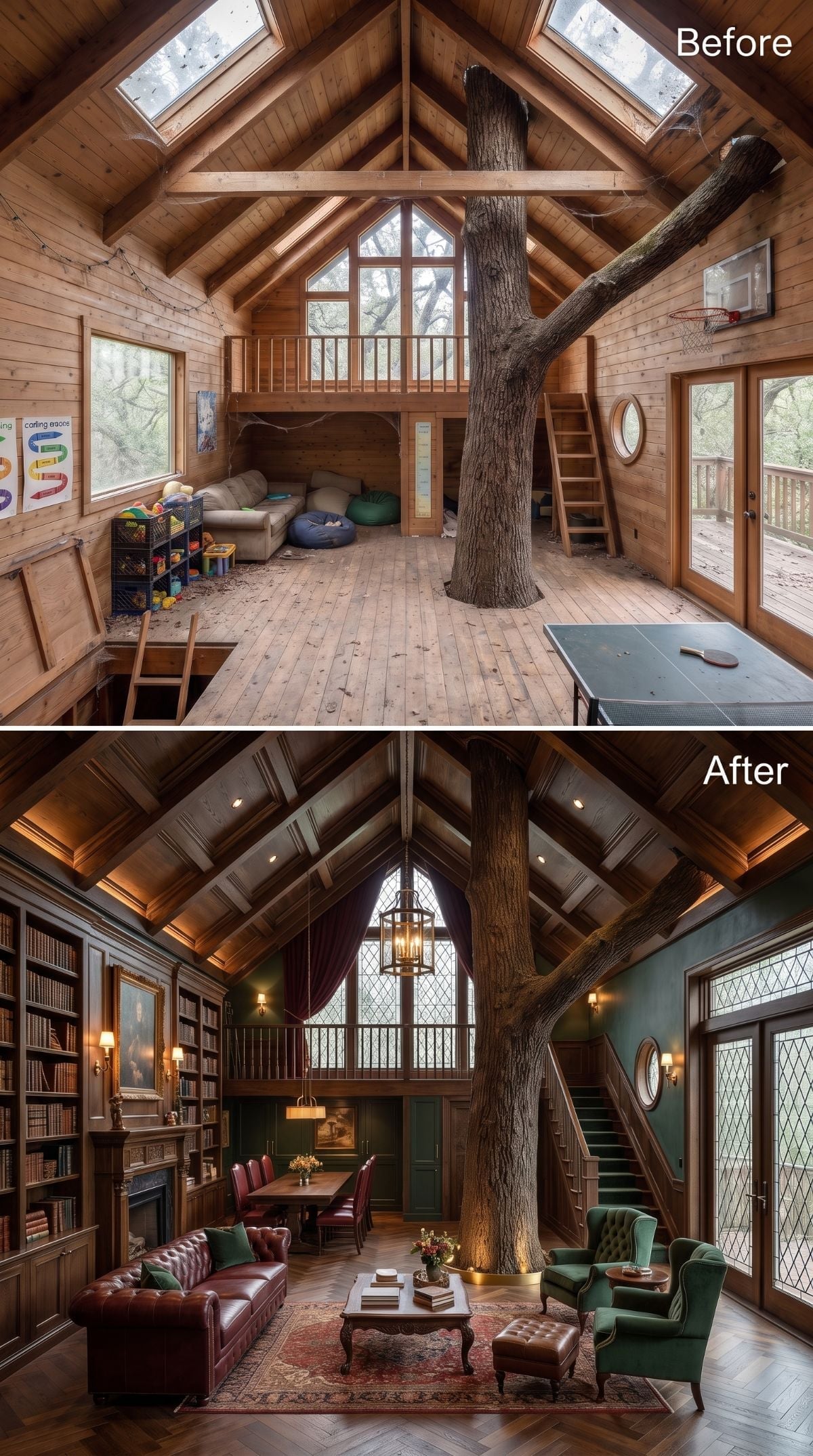
Nobody looks at a backyard treehouse and immediately thinks private library, which is precisely why this one is fun.
Forest-green walls, dark walnut shelving, burgundy leather, green wing chairs, velvet drapery, and lantern lighting give the room an old-library mood without needing to invent an owner with a title. The oak rises through all of it like the world’s least conventional reading lamp. Layered light at the ceiling, walls, and seating level keeps the dark finishes from turning into one uninterrupted shadow.
11. Macramé and Mosaic Tile Take the Treehouse Into Bohemian Territory
🔥 Would you like to save this?
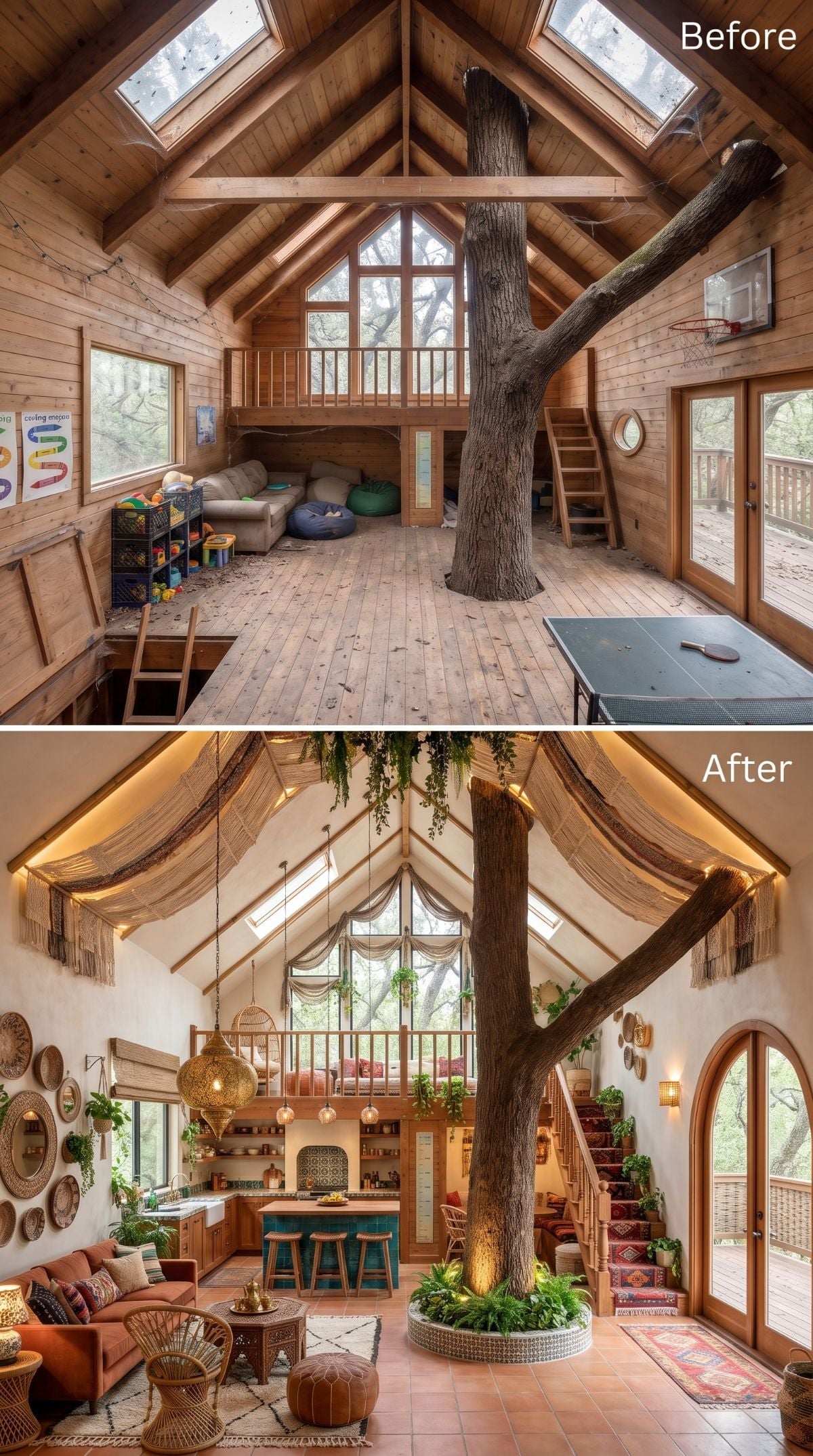
Macramé drapes along the ridge while terracotta flooring, a teal island, mosaic tile, rattan stools, and plaster walls pile on texture without requiring a matching suite of anything.
The tree rises from a fern-filled mosaic surround near the center. Unlike the more formal Mediterranean and Spanish concepts, this version loosens every edge. Pattern and craft replace symmetry. The result is less “designed room” than collection of good decisions accumulated by somebody with a very generous luggage allowance.
10. Sage Green and Linen Give the Treehouse Its Most Grown-Up Everyday Version
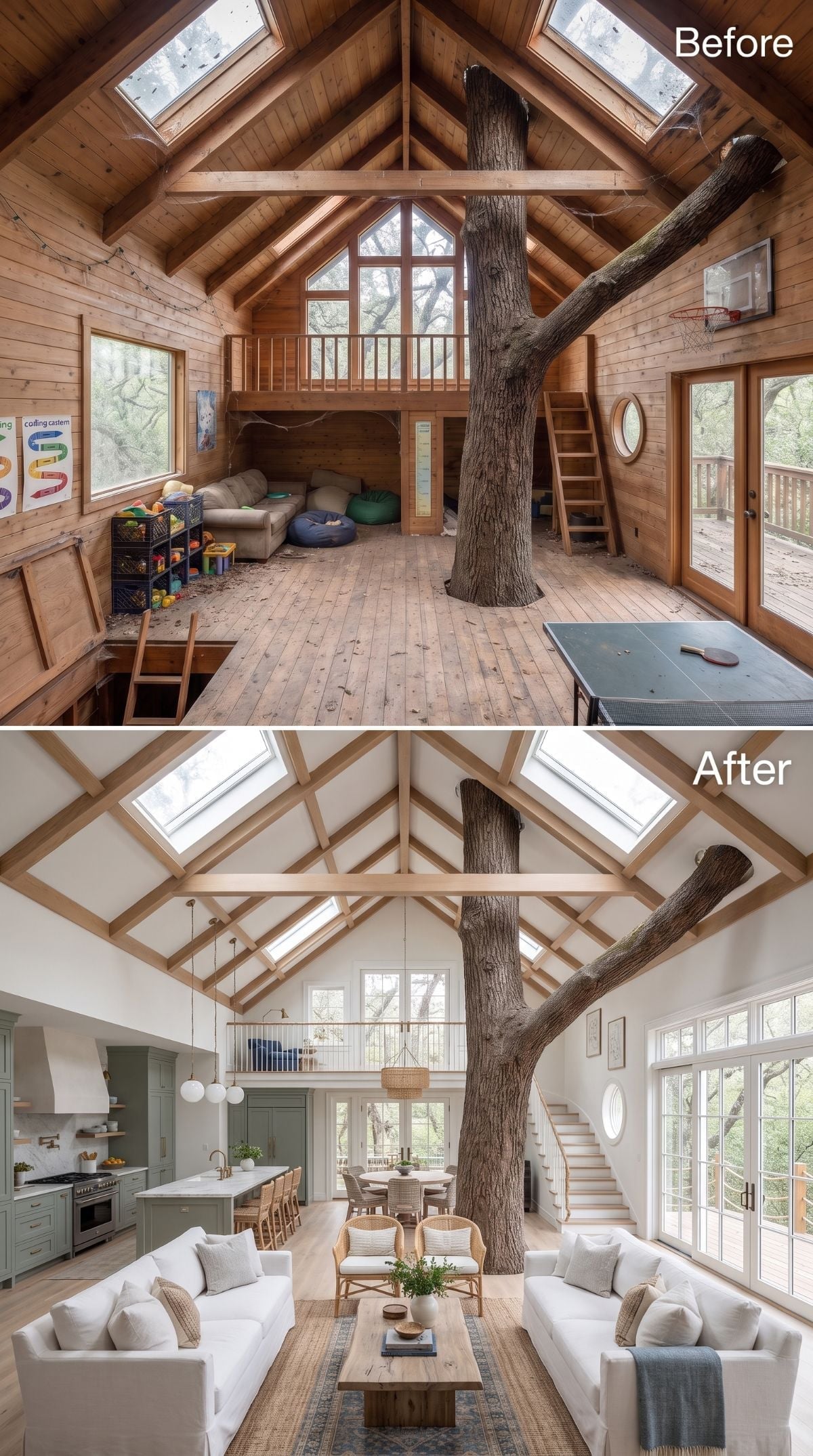
After the macramé, this one clears the visual table. White between exposed oak trusses brightens the ceiling while sage cabinetry introduces a muted color at the kitchen.
Two linen sofas and a broad slab coffee table make the living area feel genuinely usable, not arranged for a photograph. The trunk remains central and conspicuous, but the surrounding furniture does not perform acrobatics around it. Sometimes the smartest second act is simply making the room comfortable enough to use on a Tuesday.
9. Shiplap, Butcher Block, and Slate Blue Bring Back the Cottage Gene
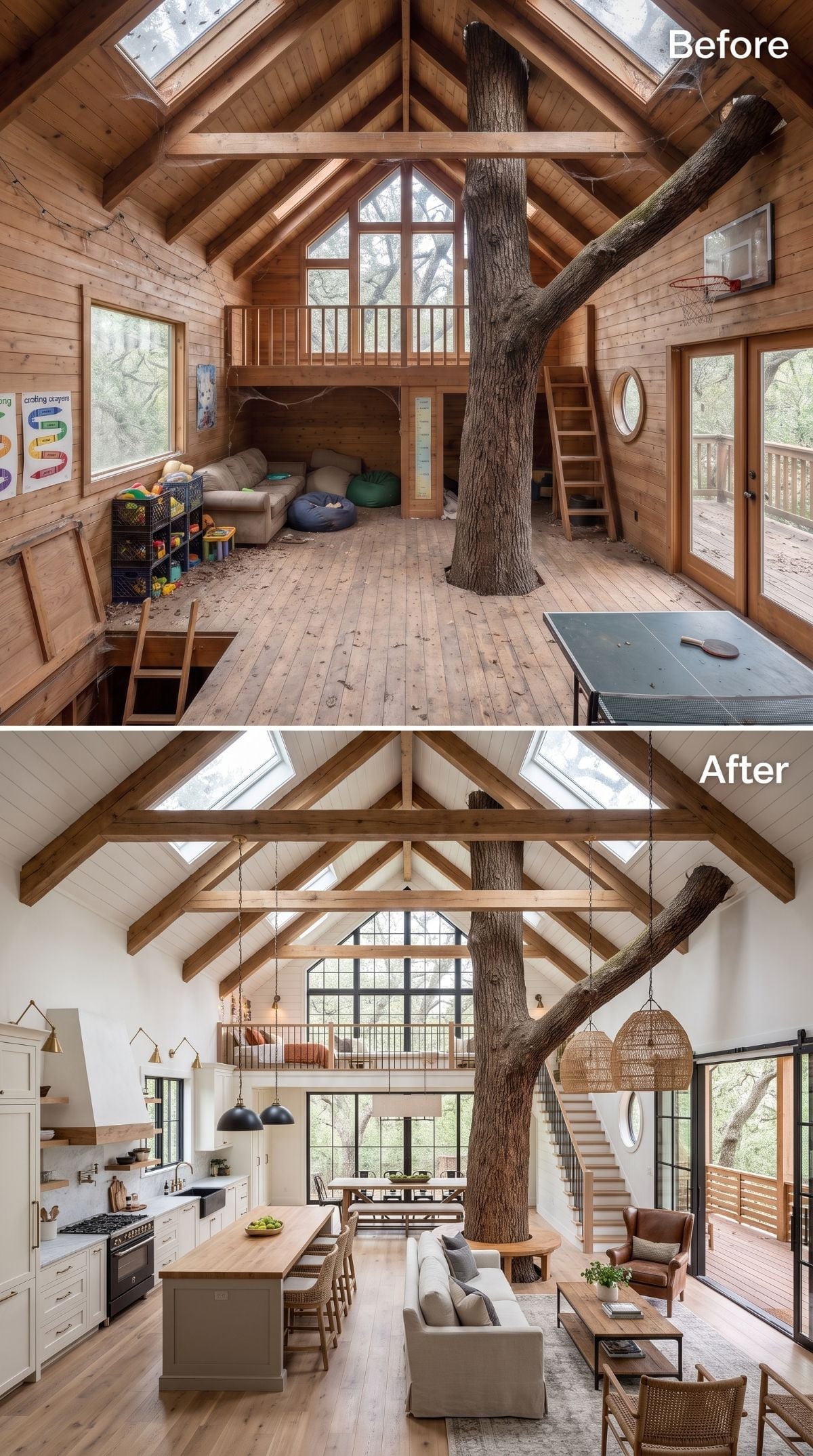
Cream-painted boards brighten the shell while exposed timber beams preserve a visible link to the original treehouse character.
A slate-blue island with butcher-block top gives the kitchen a strong center, and woven pendants bring softer texture overhead. Open stair treads keep the loft connected to the room below. This is less theatrical than the Deco or emerald schemes, but it has the useful virtue of looking like somewhere you might actually make coffee without first changing into velvet.
8. Dark Velvet and Gold Make the Oak the Celebrity Guest
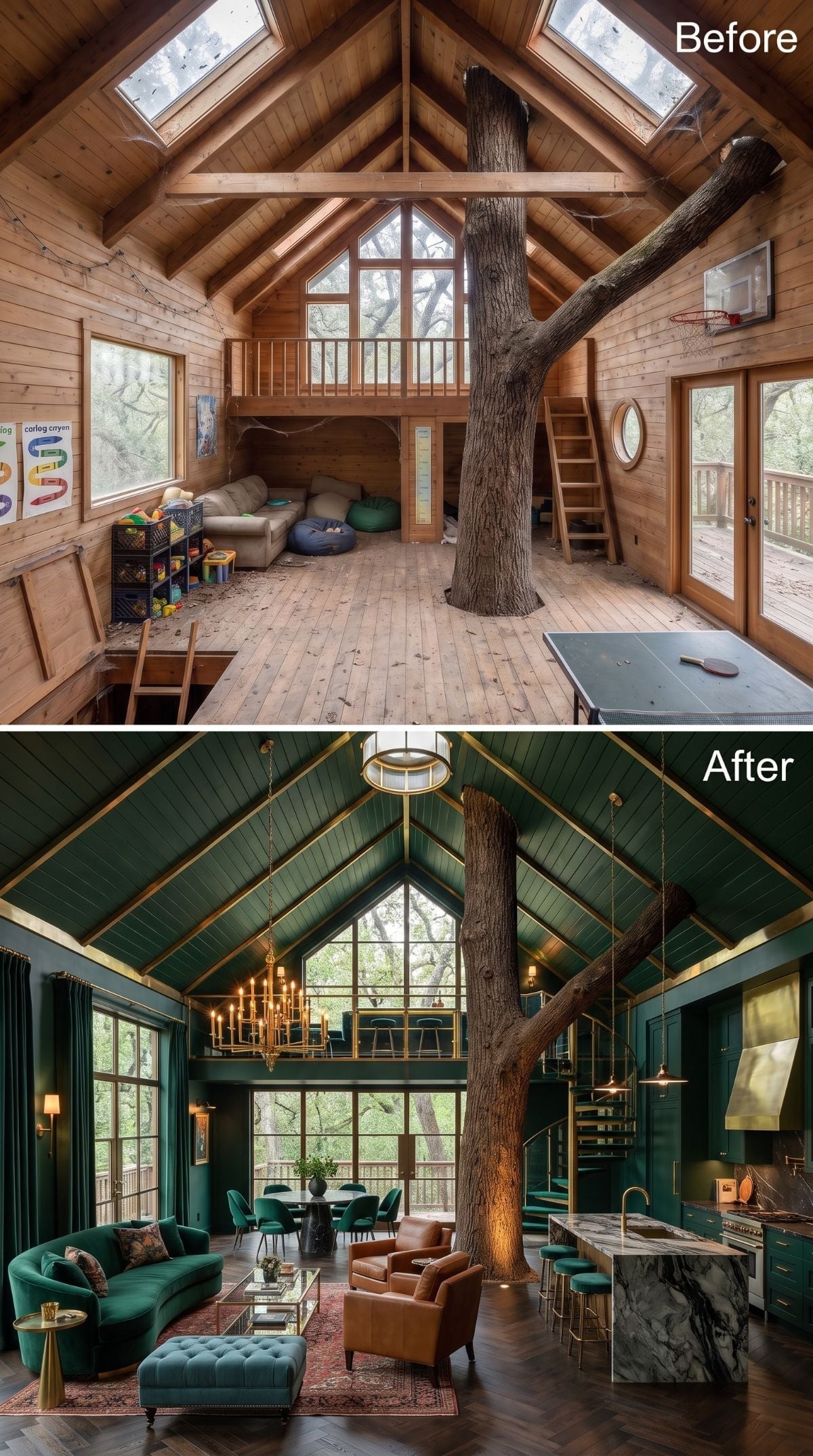
Emerald velvet returns, but this version keeps the palette darker and more concentrated. A deep green sectional faces cognac leather chairs while a dramatic marble-look waterfall island gives the kitchen its own visual authority.
Gold-toned trim follows the rafters overhead, turning the roof geometry into part of the decoration. Against that highly polished backdrop, the rough oak trunk becomes the room’s celebrity guest: underdressed, impossible to ignore, and apparently getting away with it.
7. Limewashed Calm Meets a Staircase That Barely Touches the Room
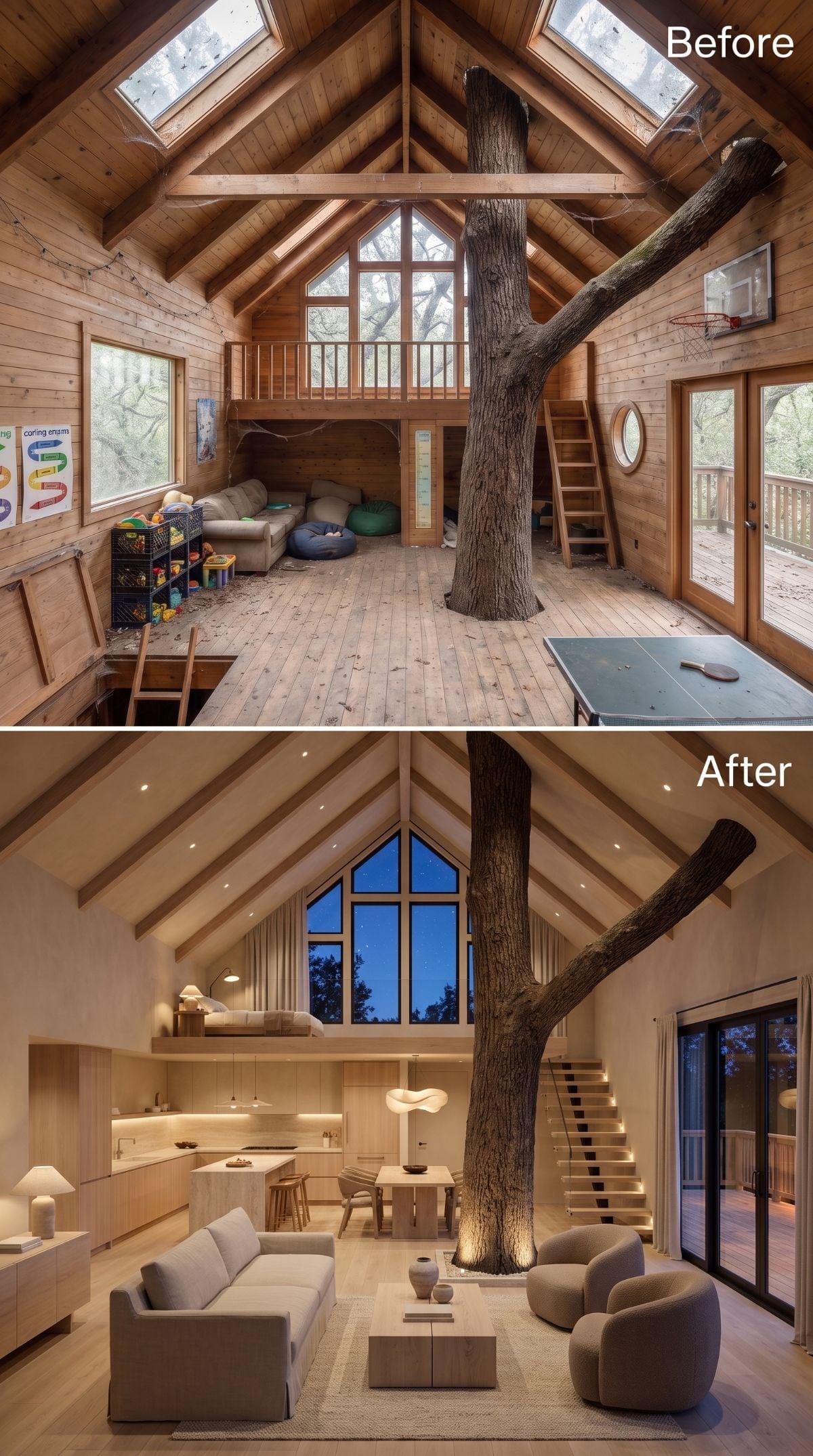
Warm sand-colored walls, pale ash-toned cabinetry, rounded linen sofas, and painted rafters turn the architecture into a muted backdrop.
The stair climbs on open treads with very little visual bulk beside the trunk. Uplighting brings bark texture forward after dark while the deck beyond maintains the connection to the trees outside. Where some concepts dress the oak in stone or brass, this one simply gives it light and gets out of the way.
Design Question: Before adding more features to an unusual room, identify the element that already owns the view. Here it is obviously the tree. Once that decision is made, the lighting, stair profile, and furniture can support it instead of competing for top billing.
6. Crystal, Herringbone, and Pink Velvet Give the Treehouse Ballroom Aspirations
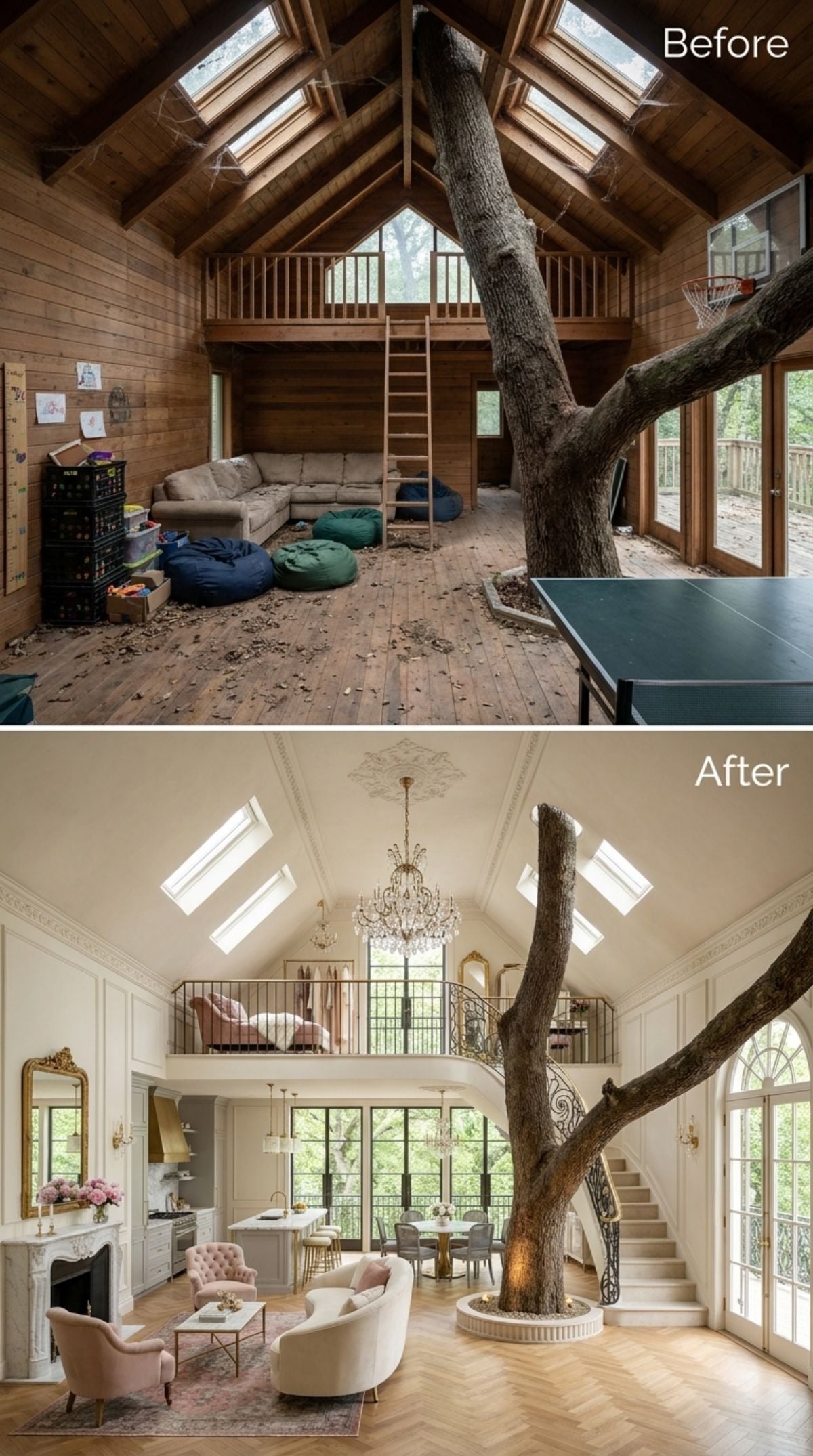
Warm white vaults, herringbone-pattern flooring, plaster molding, pink velvet chairs, and a crystal chandelier take the room perilously close to ballroom territory.
A curved stair wraps beside the tree while a marble-look fireplace gives the seating area another formal focal point. Iron loft railings provide enough dark contrast to stop all that cream and blush from floating away. The tree remains rough and asymmetrical in the middle of this extremely mannered room. Good. Somebody had to be.
5. Gravel at the Tree Base Makes the Quietest Concept One of the Smartest-Looking
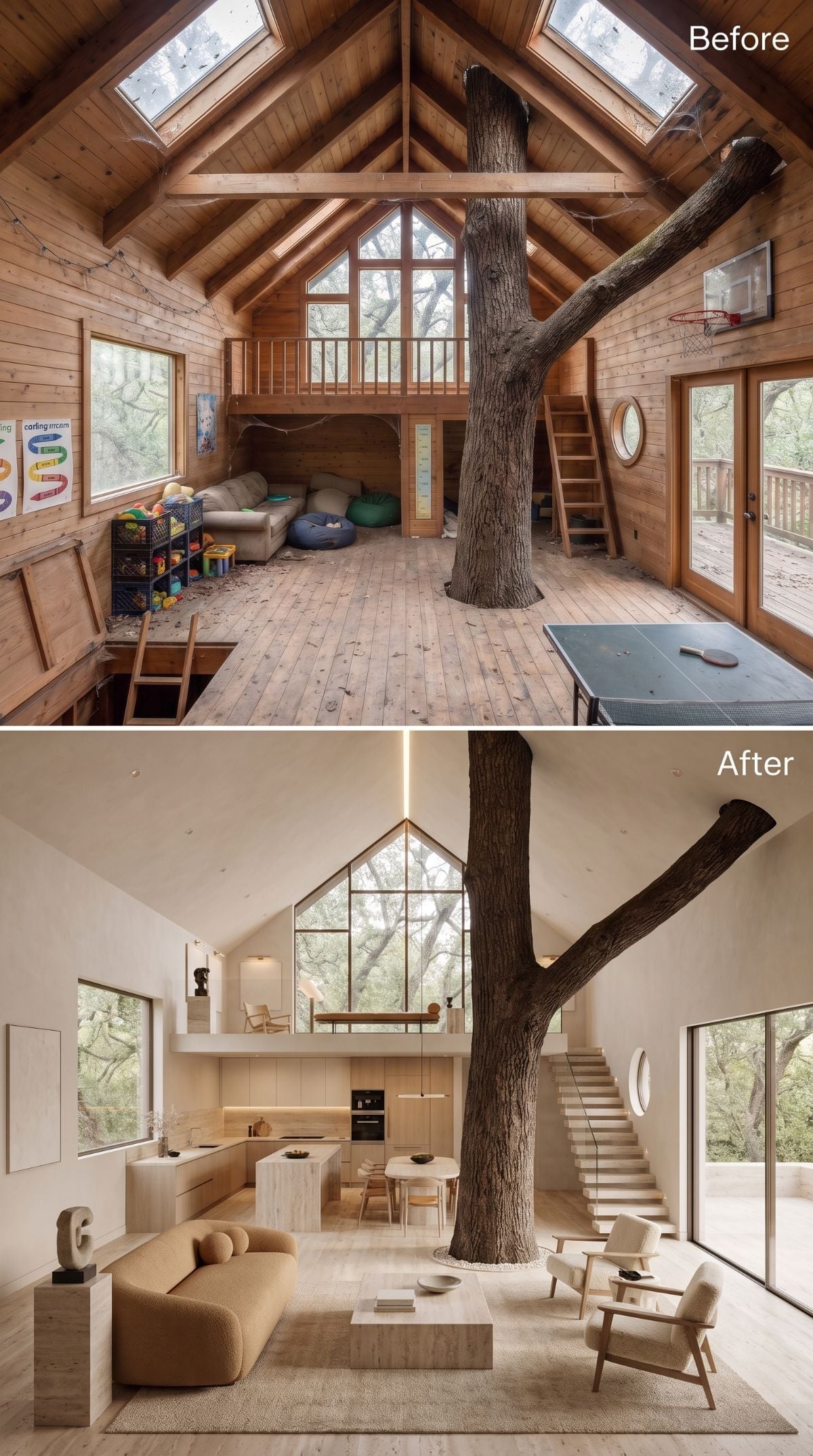
White plaster removes almost every background distraction while flat-front oak cabinetry introduces just enough warmth to keep the room from feeling sterile.
The memorable detail is at floor level: a loose-looking ring of pale gravel visually marks the transition around the trunk without building a decorative monument to it. Soft bouclé seating occupies the lounge and a small sitting area appears above. After chandeliers, gold balustrades, murals, and velvet, a circle of stones feels almost rebellious.
4. Firelight and Painted Rafters Give the Tree a Country-House Neighbor
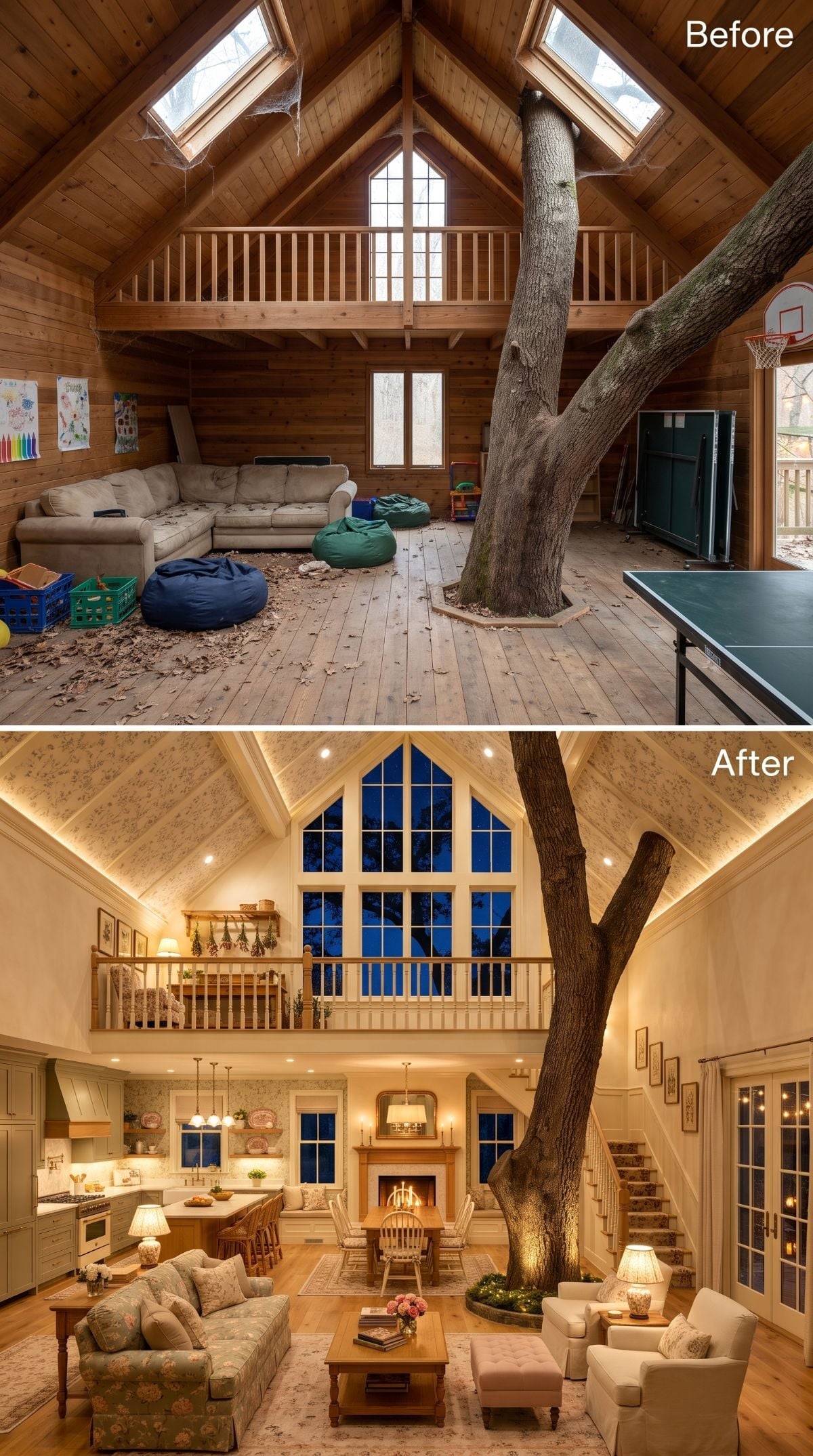
Warm cream walls and painted rafters soften the upper volume while discreet lighting follows the roofline rather than filling it with pendants.
A stone fireplace stands close behind the trunk, giving the two vertical elements an almost accidental partnership. Sage cabinetry and a butcher-block-look island bring country color into the kitchen, while floral pattern appears overhead near the loft. The result manages to be cozy without dressing every chair in checks.
3. Marble, Oak, and Curved Furniture Show How Far the Original Volume Can Travel
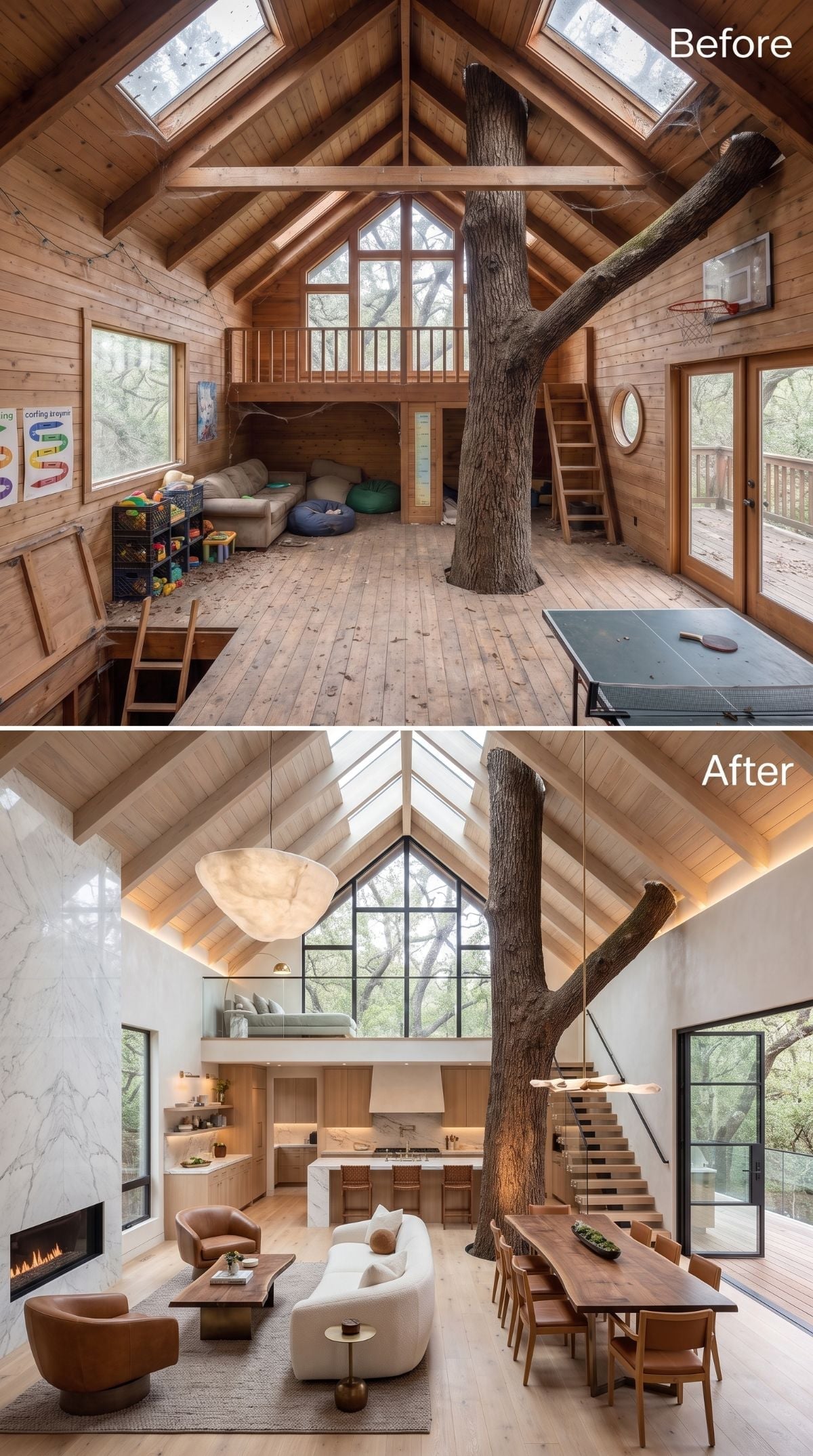
This calmer concept lets the proportions carry more of the drama. White plaster brightens the vaulted shell while light oak cabinetry and pale stone-look surfaces give the kitchen and fireplace a restrained material palette.
A long dining table bends gently near the trunk rather than insisting on a perfect rectangle. Open stairs climb toward the loft, and a curved cream sofa faces leather armchairs below. It is perhaps the cleanest demonstration of the central idea behind the whole gallery: once the tree is accepted as permanent, furniture can stop pretending the room is conventional.
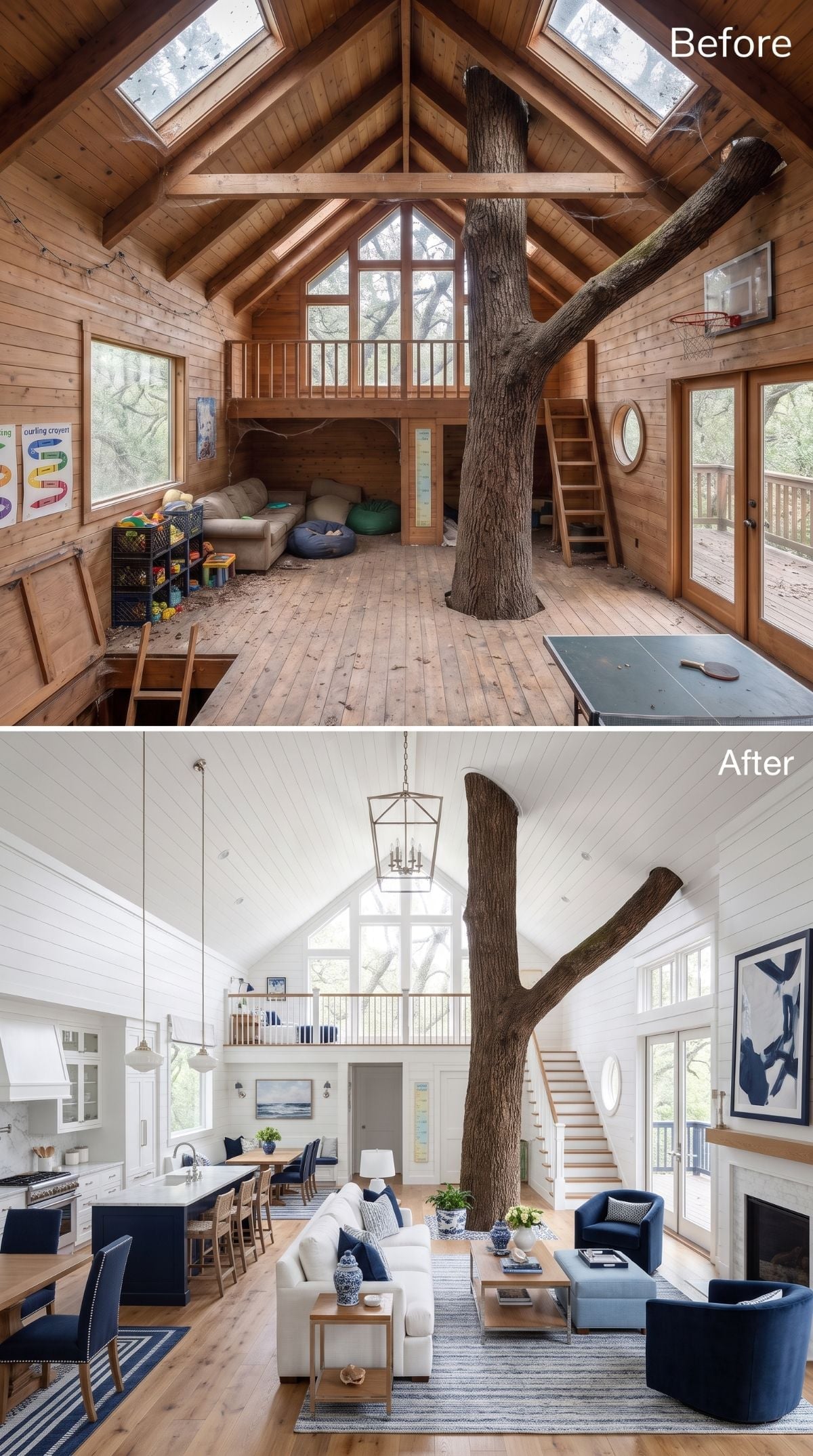
2. Navy Chairs Keep an All-White Treehouse From Floating Away
🔥 Would you like to save this?
Painted white boards and rafters turn the cathedral ceiling into one continuous bright volume, while navy barrel chairs provide the strongest color at floor level.
White linen sofas keep the seating loose and casual, and an aged-brass lantern adds warmth overhead. Clean oak stair treads introduce a small amount of natural wood beyond the trunk itself. The entire room could have dissolved into white-on-white politeness; the navy prevents the disappearance.
1. Floating Stairs and a Marble Island Bring the Treehouse Full Circle
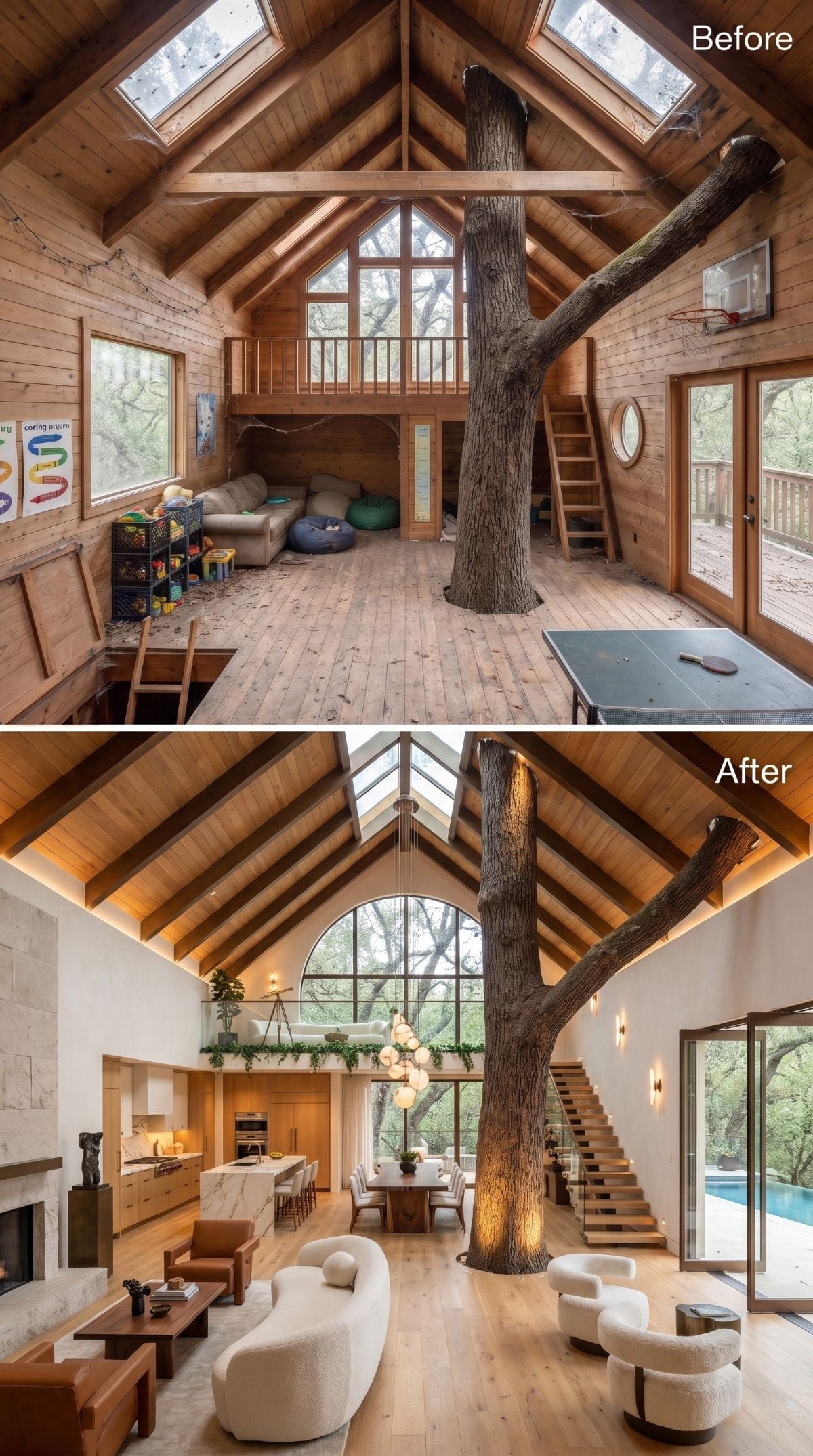
The final concept collects several ideas that have surfaced throughout the gallery without turning into a greatest-hits medley. Warm white plaster gives the vault a calm shell. Pale wood flooring keeps the lower level light. A marble-look waterfall island introduces one substantial block of pattern and polish.
The floating stair runs beside the trunk on open treads, keeping bark visible through the structure instead of walling it off. Globe pendants cluster over the dining area while cove lighting traces the roofline. Bouclé seating faces a stone fireplace, and glass doors open toward the pool outside.
After 35 versions, that juxtaposition feels like the right place to stop. The oak still looks a little unreasonable in the middle of a finished room. It should. Remove the problem entirely and you remove the thing that made the exercise interesting.
A conventional guesthouse could have straighter walls. A normal studio could put the staircase wherever it wanted. A backyard office would probably prefer not to negotiate with a mature tree every time somebody moved a chair. None of those rooms would have this particular tension.
That is the second life worth keeping. The treehouse can grow out of basketball hoops and bean bags without sanding away the oddness that made somebody build it in the first place. Whether the next chapter involves velvet, terracotta, plaster, books, records, fireplaces, or an indecent quantity of gold is almost beside the point. The tree was here first. Every good idea after that has to learn some manners.