
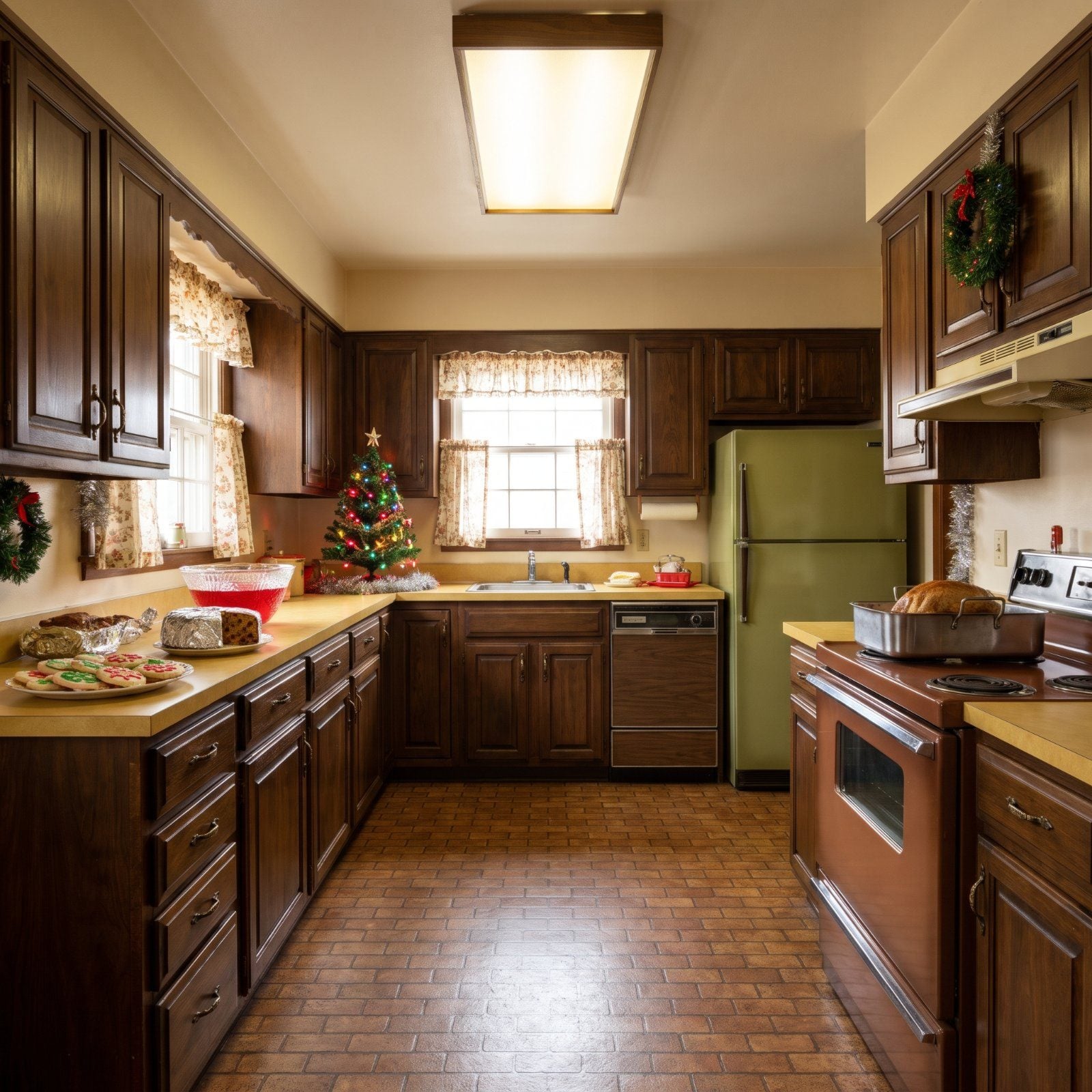
The smell hit you before you reached the kitchen — roasting turkey, cinnamon, and a faint plastic tang from the harvest gold laminate warming under a fluorescent box. Someone’s transistor radio played carols from the windowsill. The counters were busy, the cabinets were dark, and every surface had a job during the holidays. We lined up the 1975 Christmas kitchen against the one you’d walk into today, one feature at a time. The gap is wider than you remember.
39. Dark Walnut Cabinetry vs. Bright Painted Fronts
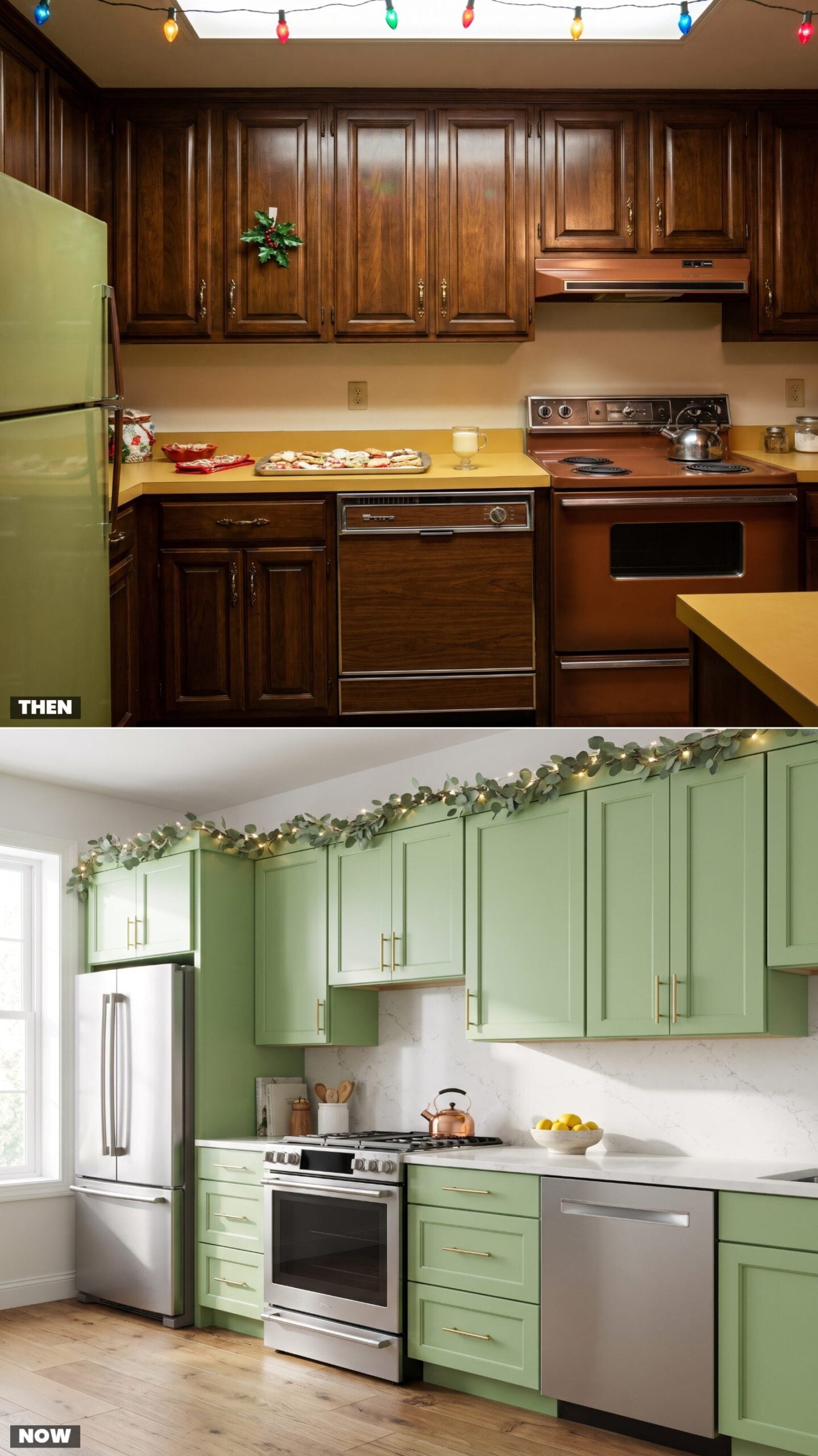
Dark cabinets in 1975 weren’t a style choice so much as a given. Walnut stain, raised panels, brass colonial pulls that caught cookie grease every December and held onto it until spring. The wood drank the light, so kitchens stayed dim no matter how many bulbs you added.
In order to come up with the very specific design ideas, we create most designs with the assistance of state-of-the-art AI interior design software. Also, assume links that take you off the site are affiliate links such as links to Amazon. this means we may earn a commission if you buy something.
Now the fronts are painted, and a soft sage or bone white does the opposite — it bounces the light back. Those slim brushed-brass bar pulls let the color carry the room instead of fighting it.
38. Harvest Gold Laminate vs. White Quartz Worktops
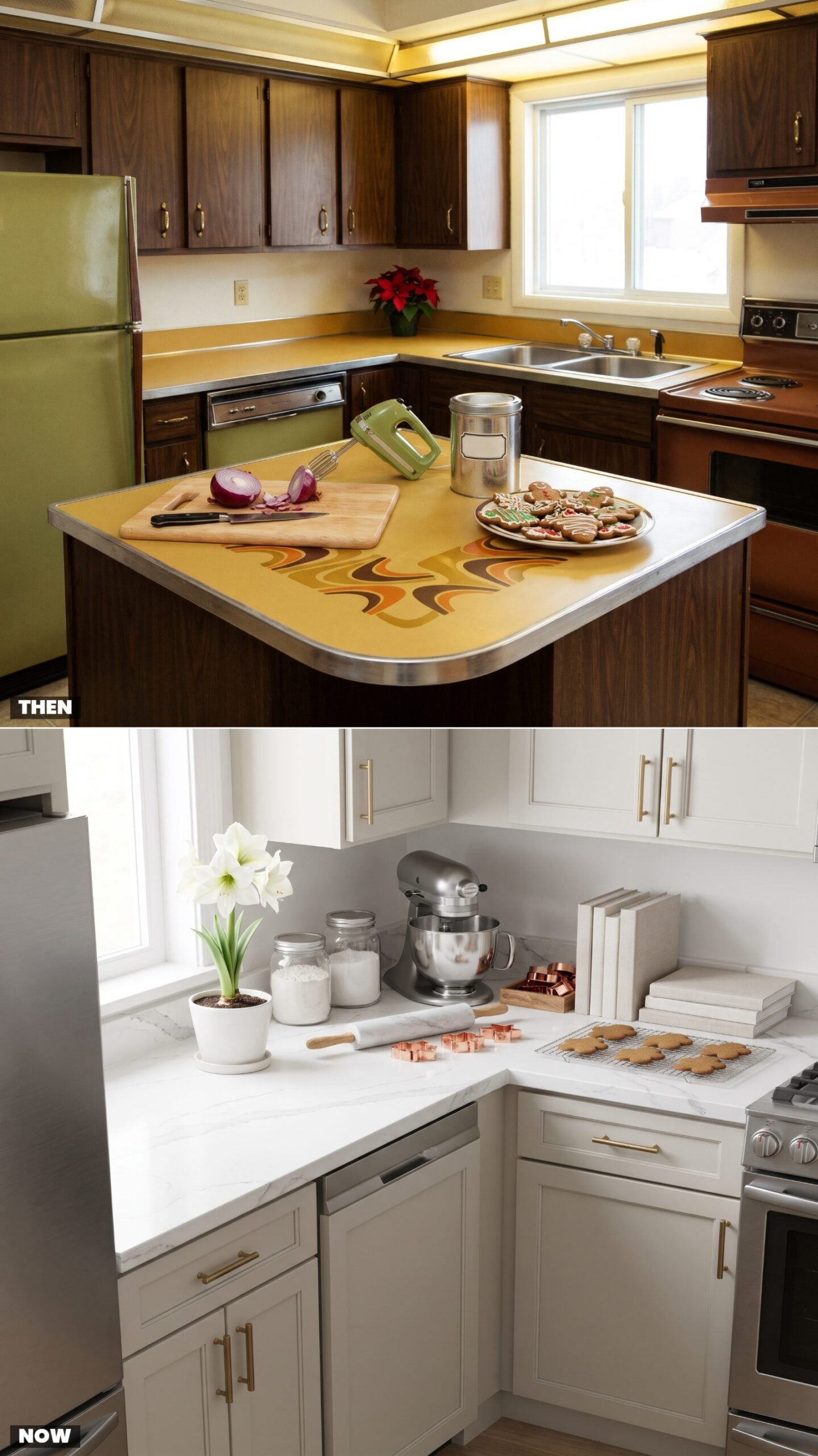
Harvest gold laminate had a sound. A hollow tap when you set a bowl down, a rolled metal edge that trapped crumbs you’d never fully dig out. Park a hot pan on it and it scorched, and by Christmas the spot near the sink always wore a worn pale patch.
Quartz took over because it does the one thing laminate couldn’t. You can roll out cookie dough straight on it and wipe it clean with nothing but a cloth.
As an Ohio countertop fabricator puts it, “A hot pan set directly on laminate can scorch or char the surface.”
37. Patterned Laminate Backsplash vs. Handmade Zellige Tile
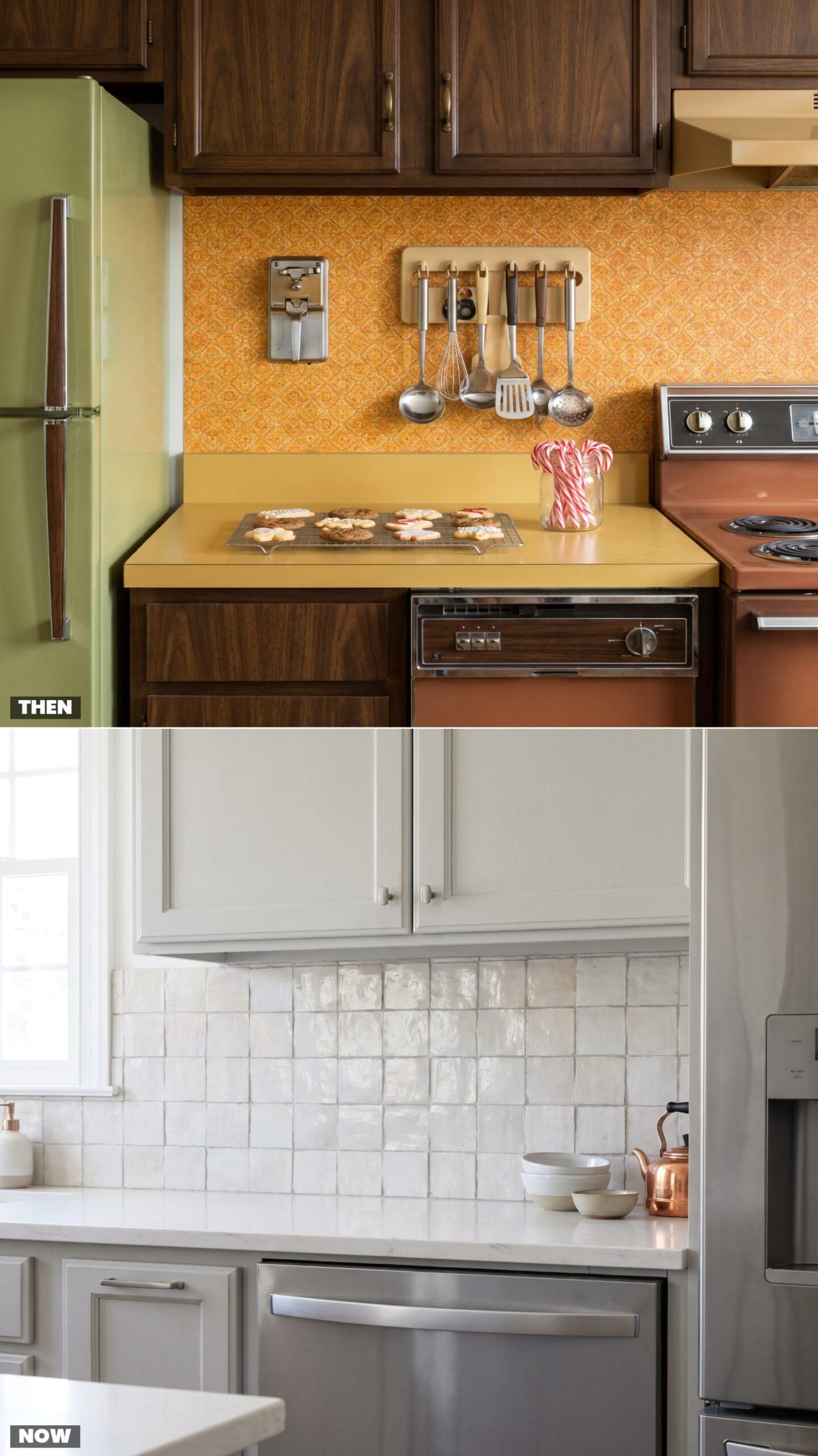
The 1975 backsplash was a single sheet of laminate glued to the wall, printed with a geometric pattern that felt cheerful on the showroom floor and dizzying by year three. It wiped clean. That was the entire selling point, and nobody loved it.
Handmade zellige flipped the logic. Each tile gets poured, glazed, and fired by hand, so no two sit flat. Light pools in the glaze and moves as you walk past. Picture yourself at the counter stirring gravy on Christmas morning while the wall behind the stove quietly shifts with the window light. That’s the whole thing.
36. Faux-Brick Sheet Vinyl vs. Wide-Plank Engineered Wood
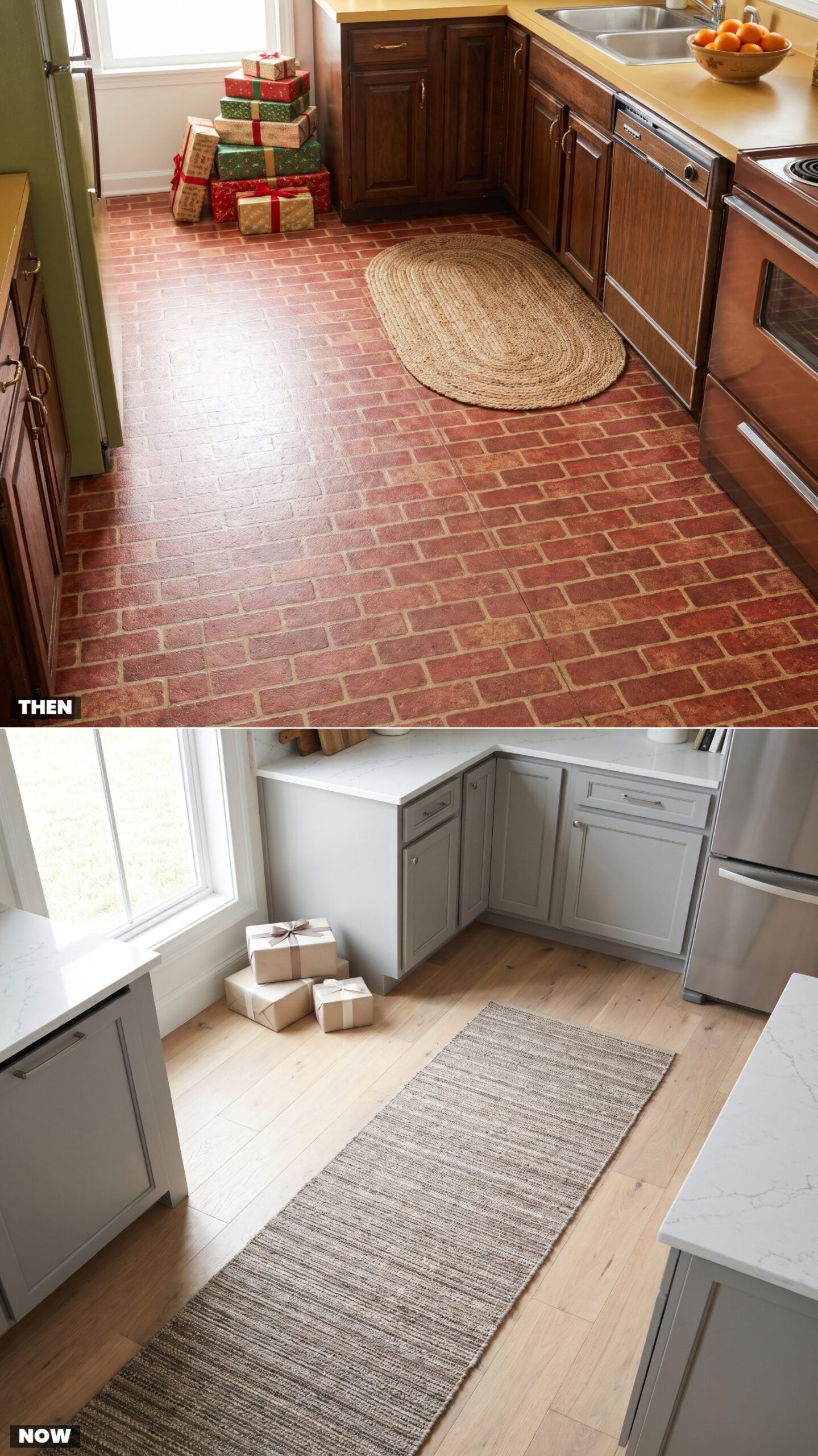
Sheet vinyl was the practical hero of the 1975 kitchen. Faux brick, faux slate, faux anything — printed on a roll and glued down in one piece so spilled cranberry sauce never found a grout line. The seam always curled eventually, usually right where you stood at the sink.
Wide-plank engineered oak reads as real wood because the top layer is real wood. It handles a holiday crowd without the babysitting that solid planks demand.
What Our Readers Say
- Asked which hardwood they’d want in a kitchen, about half of Home Stratosphere readers picked a medium tone, with light at 29% and dark at 18%.
- Pared-back kitchens aren’t a universal hit: in our readers’ heart votes, minimalist kitchen photos got fewer hearts than the other images in the same articles, 41% vs 56%.
From Home Stratosphere reader polls and votes.
35. Fluorescent Ceiling Box vs. Pendants on Dimmers
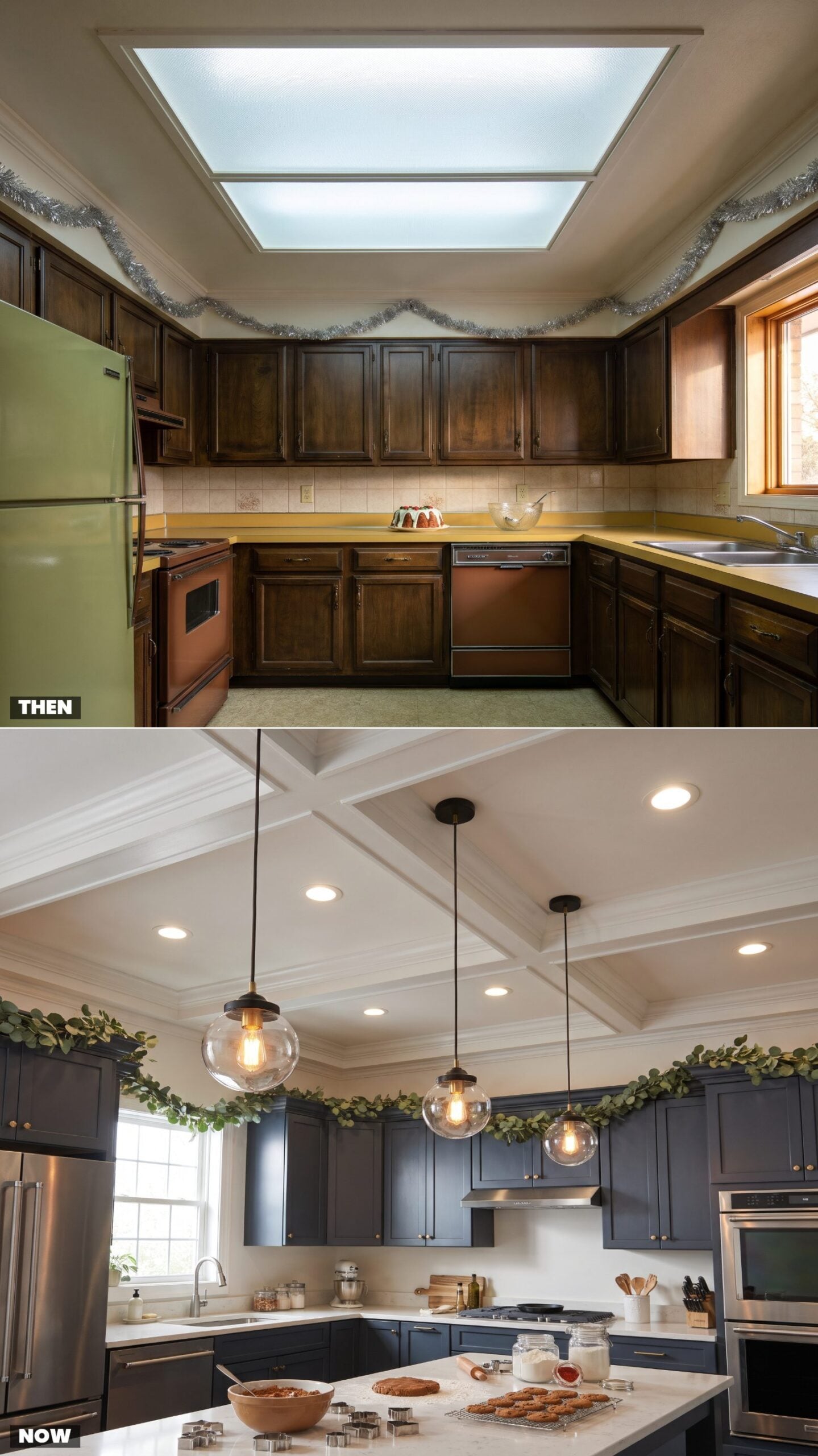
One big fluorescent box in the ceiling, humming faintly, flickering at startup, throwing light the exact color of a dentist’s office. It lit every corner equally and flattered nothing. Your Christmas ham looked grey under it. So did you.
Pendants on a dimmer fixed what designers spent decades naming. You get task light over the counter where you’re working and a low warm glow everywhere else once guests arrive.
34. Ruffled Café Curtains vs. the Bare Picture Window
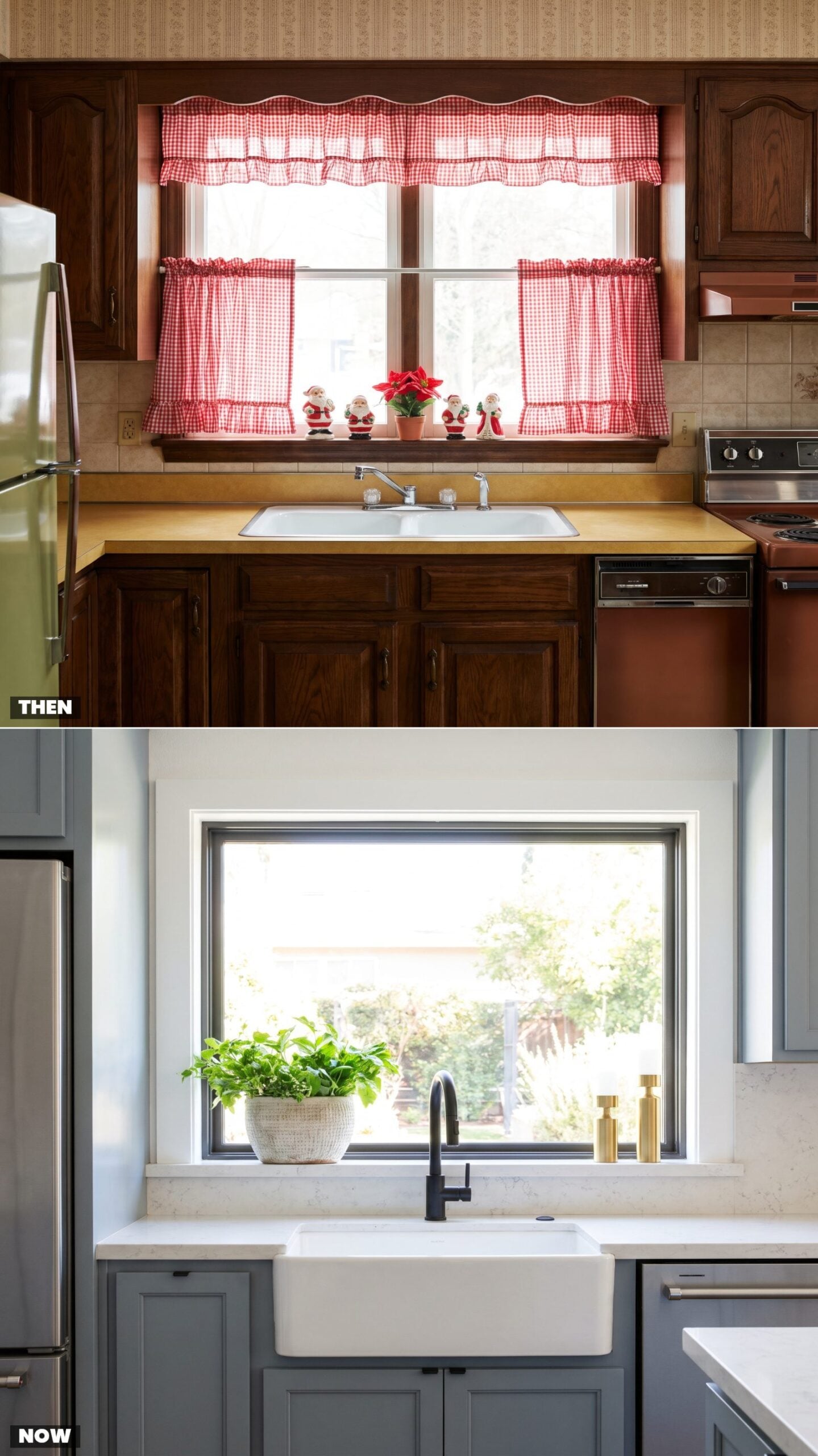
Every kitchen window in 1975 wore an outfit. Ruffled gingham café curtains on a tension rod, a matching valance across the top, a row of ceramic Santas on the sill come December. The fabric caught steam, held cooking smells, and went limp by New Year’s.
Now the window often wears nothing. The glass is the feature. A clean picture window over the sink pulls the outside in and lets morning light do the decorating.
33. Double-Basin Enamel Sink vs. Deep Apron-Front Workstation
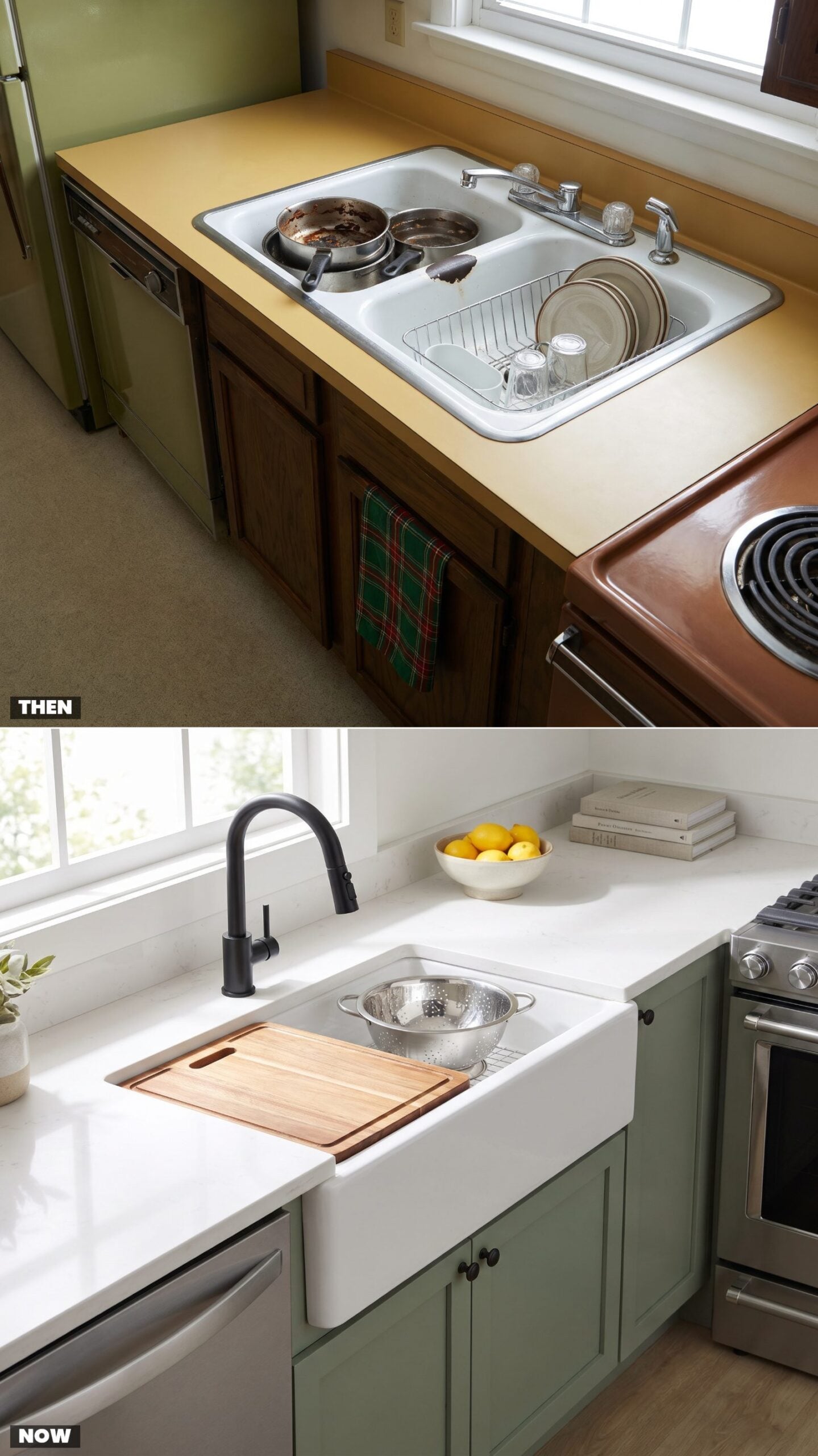
Two shallow basins of white enamel — one for washing, one for rinsing — because the dishwasher was often decorative at best. By Christmas the drain always wore a dark chip where the enamel had worn through to the metal underneath. You learned to live with it.
The apron-front workstation sink is a single deep basin with ledges built for a sliding cutting board and colander. One bowl, deeper than the old two combined, so a roasting pan actually fits.
32. Chrome Two-Handle Faucet vs. Touchless Pull-Down
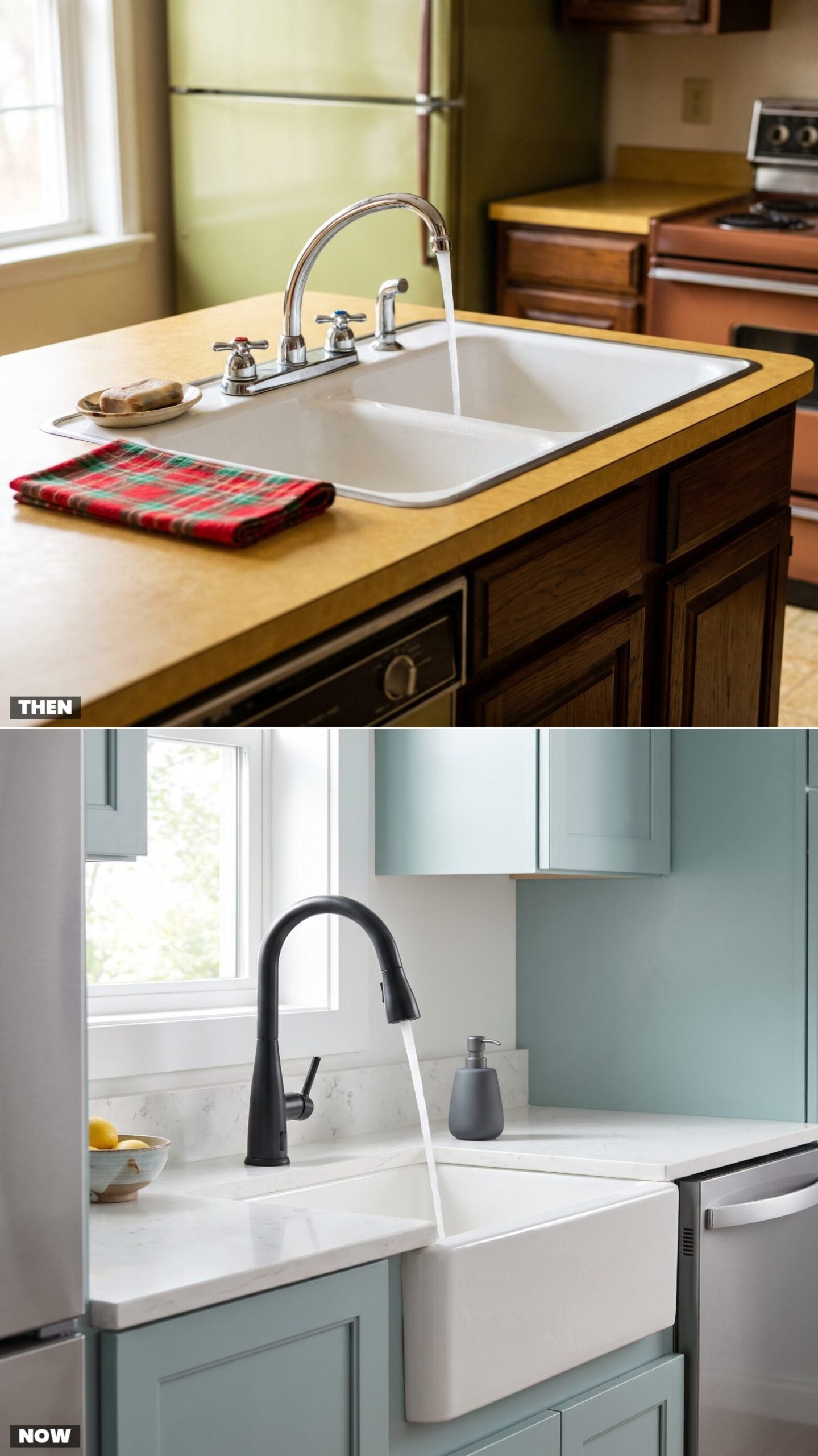
Red dot for hot, blue dot for cold, two cross-handle knobs you’d turn with the back of your wrist when your hands were covered in turkey grease. The chrome pitted over time and the swan-neck spout barely cleared the basin.
Touchless pull-down faucets earn their keep on one day a year above all others. Elbow the sensor with raw, giblet-covered hands and the water starts without you touching a thing.
31. The Kitchen Table as Prep Station vs. the Oversized Island
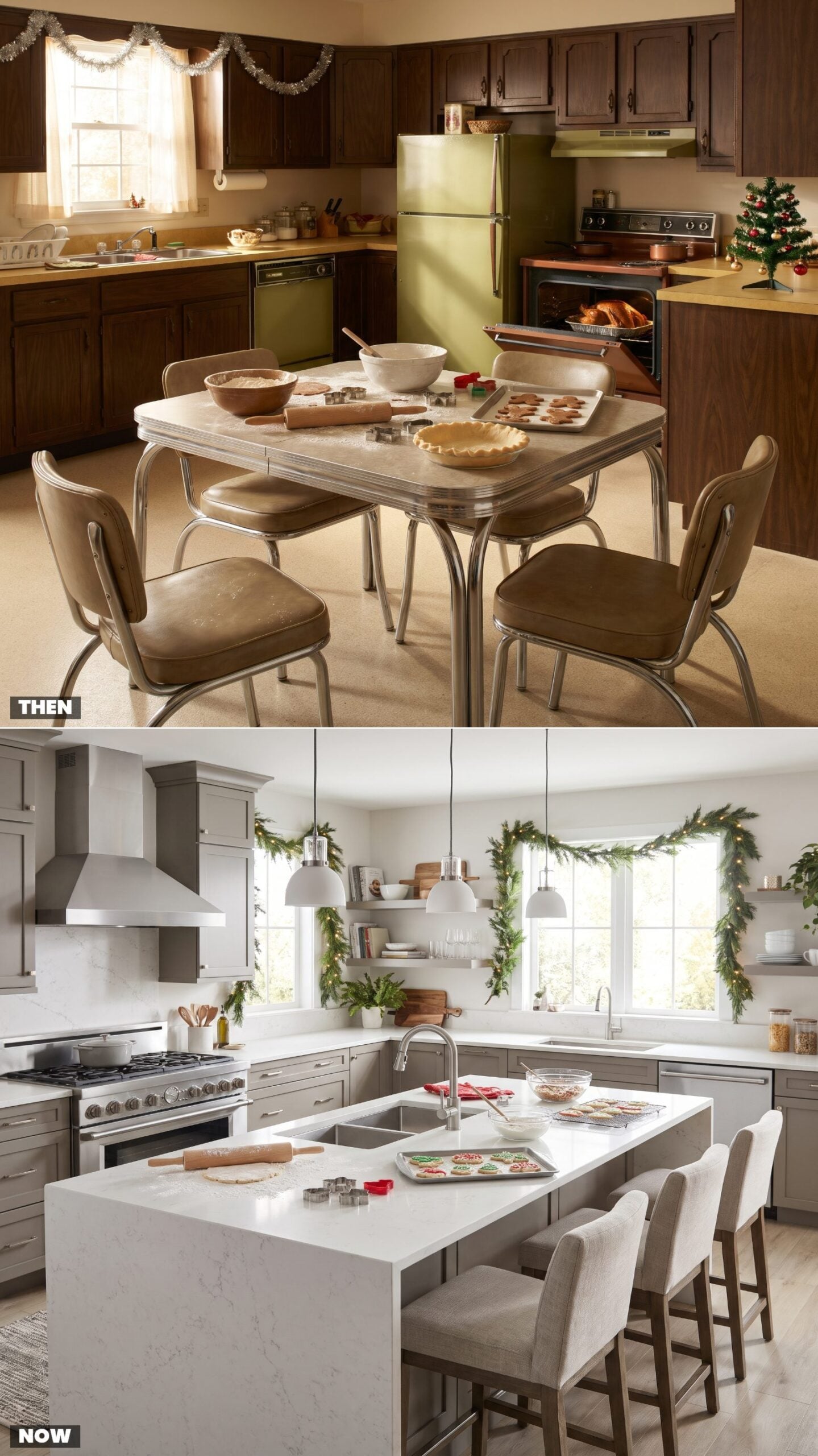
The 1975 kitchen rarely had an island. It had a table — usually Formica with chrome legs, dragged into the center of the room every December to become the prep station, the cookie assembly line, and the overflow buffet all at once. When the baking was done, you cleared it and ate dinner on the same surface you’d just floured.
The island does all of that and never moves. Counter-height stools on one side keep guests parked and talking while you work. A prep sink means you’re not crossing the room with a dripping colander.
30. Vinyl Breakfast Nook vs. the Built-In Banquette
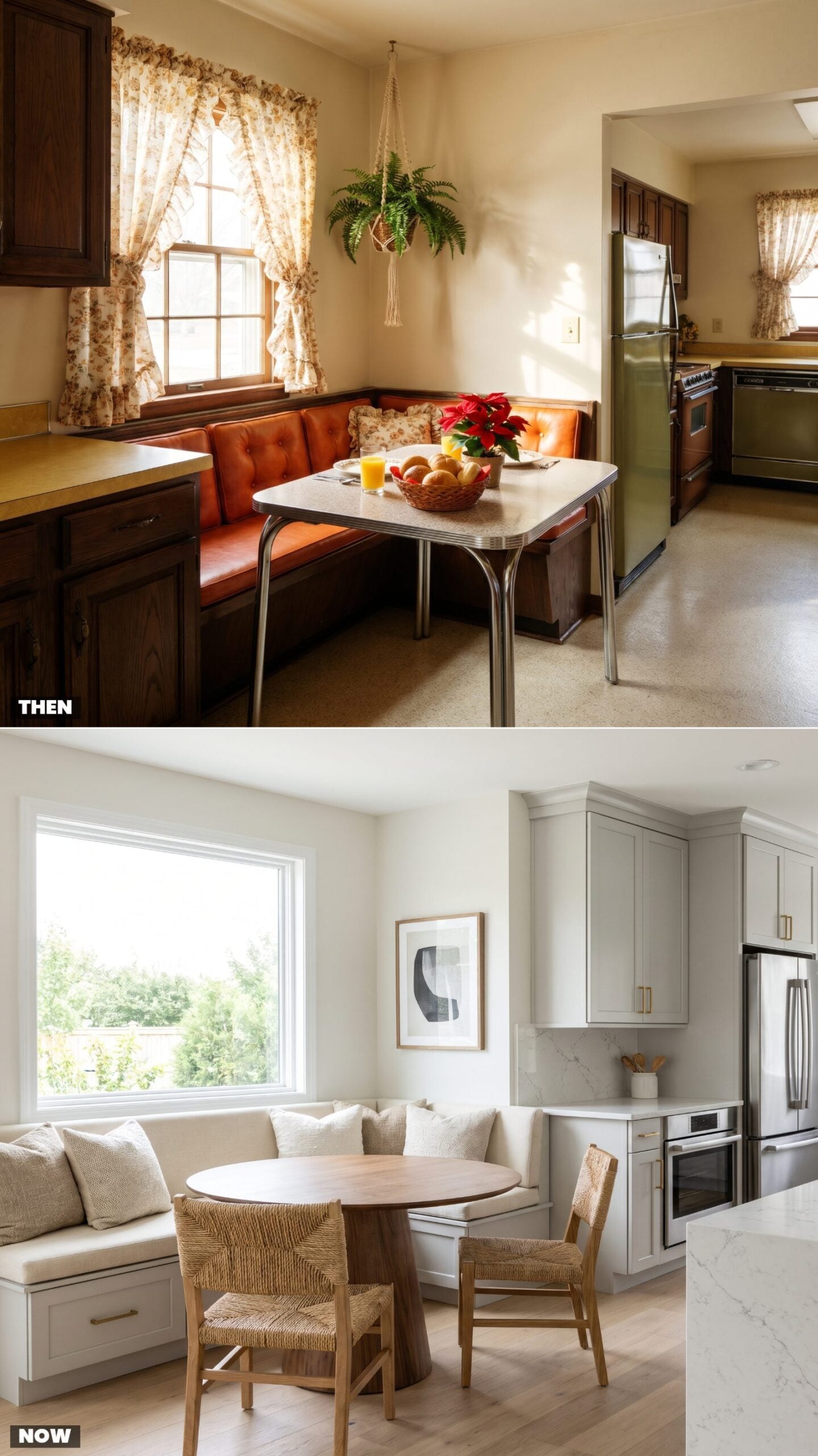
Orange vinyl, chrome legs, a corner bench you slid into and couldn’t easily escape once the table was set. The 1975 breakfast nook wiped clean with a sponge, which mattered when a kid knocked over their juice on Christmas morning. It also stuck to the backs of your legs in summer.
The modern banquette keeps the tuck-into-a-corner comfort and ditches the vinyl. Performance linen in a warm cream looks like upholstery and cleans like plastic. Add a couple of pillows and suddenly it’s the seat everyone fights for.
29. Closed Upper Cabinets vs. Curated Open Shelves
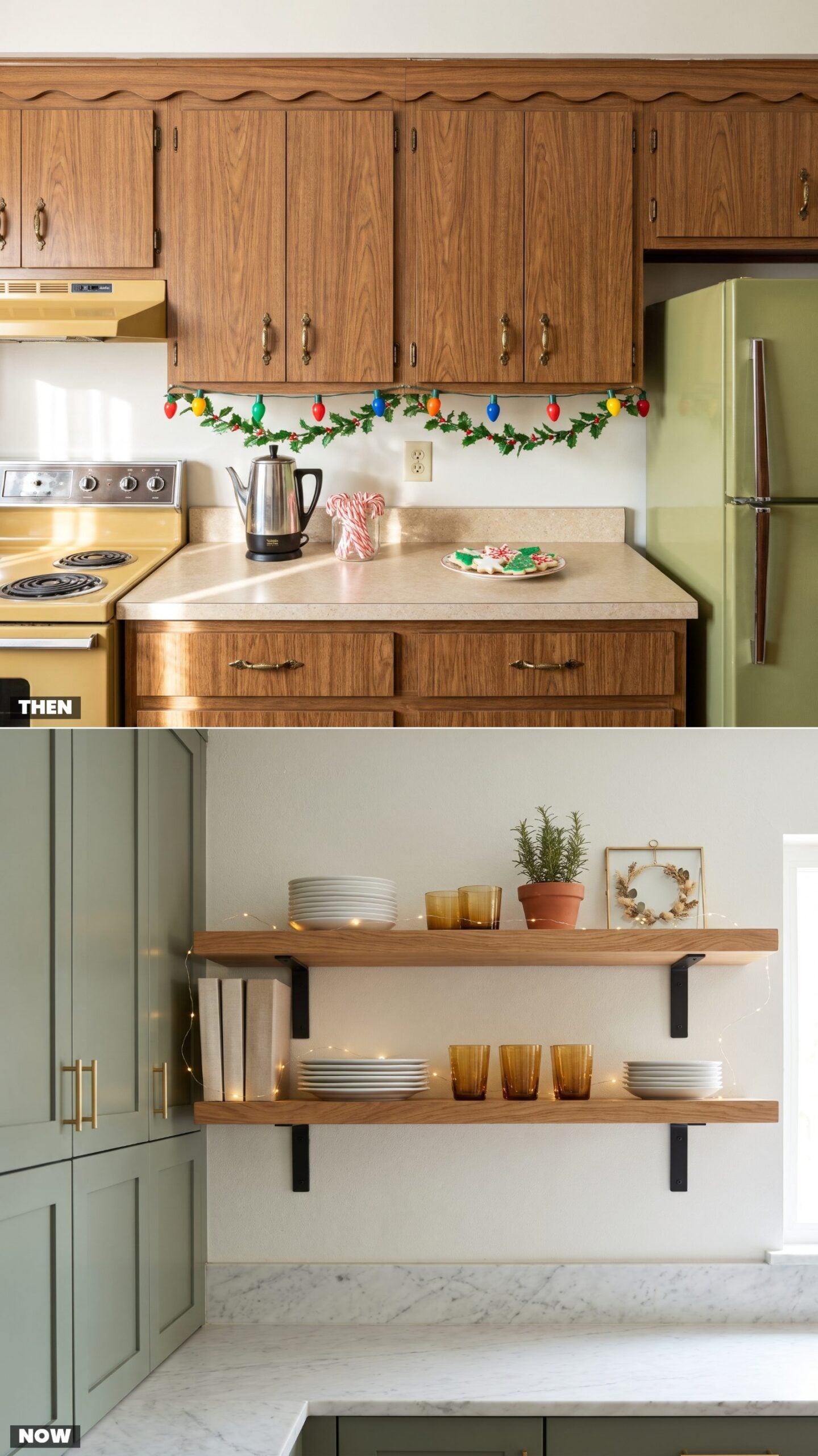
In 1975 the wall above the counter was a locked box. Wood-grain laminate doors, colonial brass pulls, everything hidden away whether it was the good china or a dented colander. Open shelving? Most hostesses would have told you it was an invitation for dust and judgment both.
Now those same inches are on display. Oak floating shelves hold white ironstone plates, a handful of amber glass tumblers, a small pot of rosemary. The sage cabinets below handle the real storage so the shelves get to be pretty. It reads lighter, breathes more, and makes your wall look taller.
Not everyone agrees on going open: when Home Stratosphere readers were asked which uppers they would hang, 74% picked solid doors, with open shelves at just 12%.
28. Shallow Cupboard Pantries vs. Walk-In Food Storage
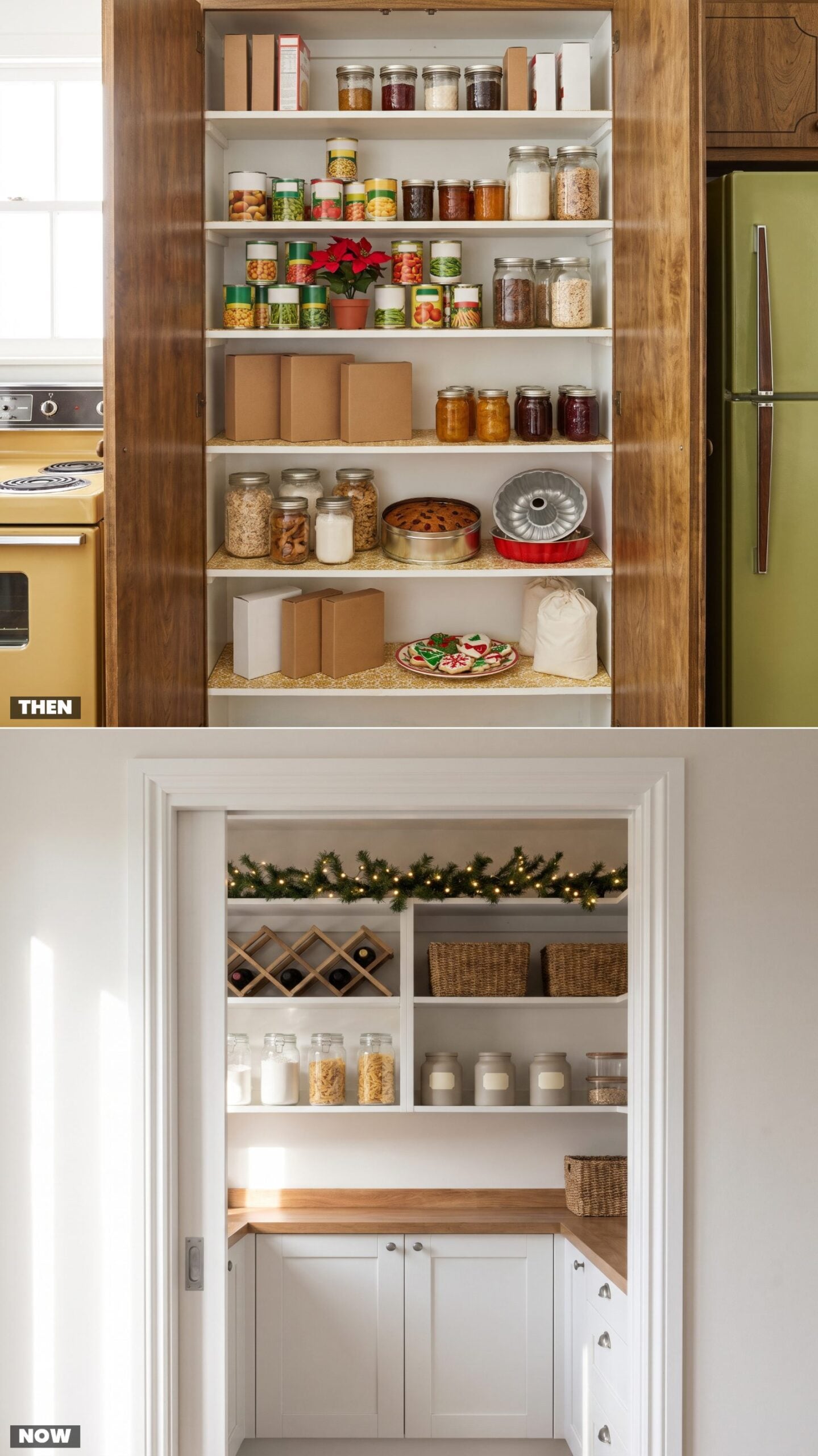
A 1975 pantry was often one shallow cupboard, maybe sixteen inches deep, with cans two rows thick and the back row a mystery until spring. Christmas meant cramming the fruitcake tin in sideways and praying the cranberry sauce hadn’t migrated to the floor.
Walk-in storage changed the math entirely. You get a small room of its own now — clear canisters, labeled jars, baskets for the bulk stuff, and enough shelf depth to stage a whole holiday dinner’s worth of ingredients without excavating. Honestly? Half the appeal is just seeing what you have before you buy a fourth can of pumpkin.
27. Harvest Gold Electric Ranges vs. Smart Induction Cooktops
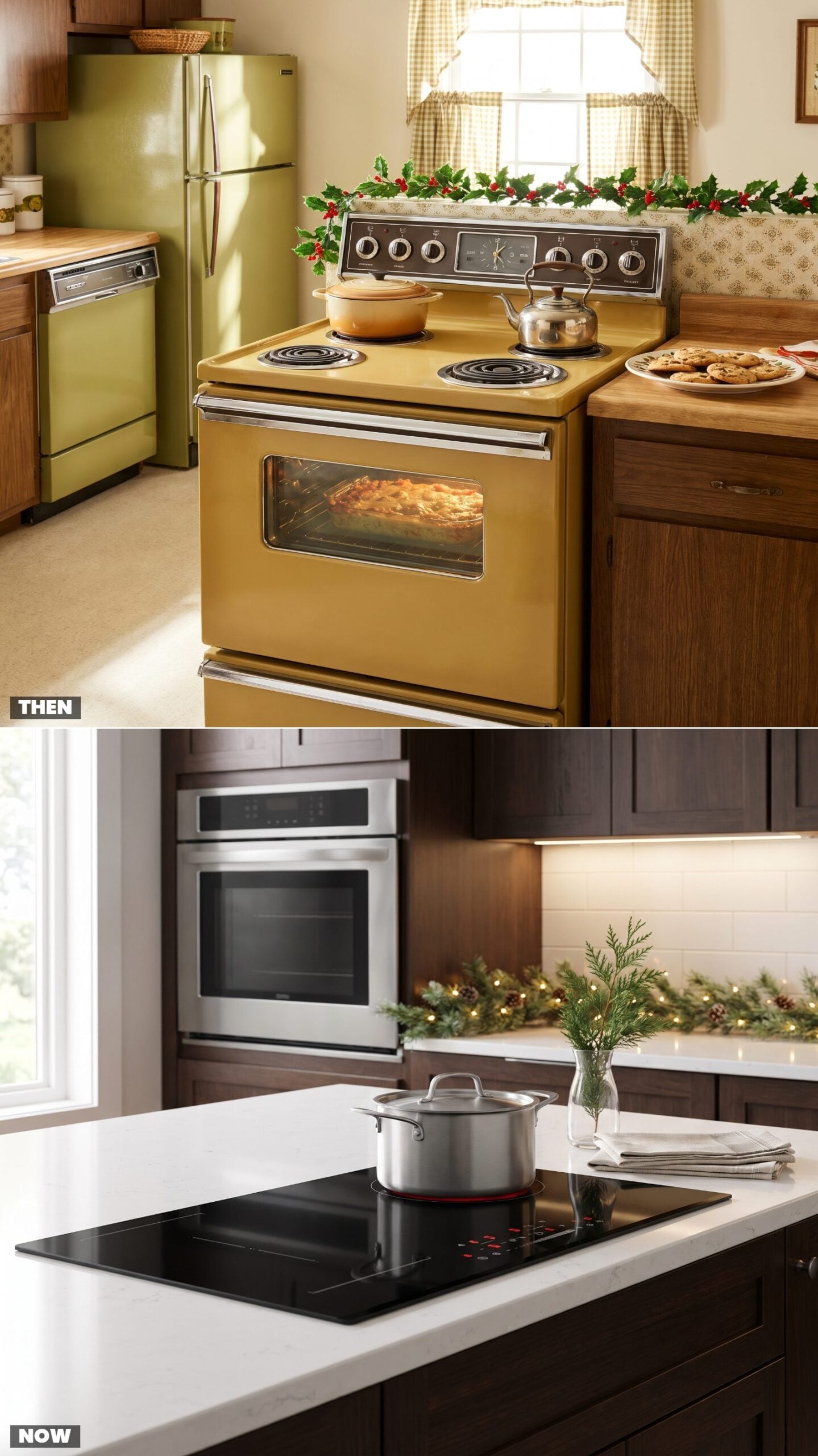
Harvest gold ranges ran the American kitchen, and those coil burners took their sweet time. You learned exactly how long before the casserole caught, because the dial lied and every cook knew it. The chrome drip pans never once came clean. Not for anybody.
Induction flipped the whole experience. Flat glass surface, near-instant heat, touch controls, and on the smart models an app that pings you when the water boils. One swipe and it’s clean. I resisted induction for years out of pure stubbornness, then cooked on one and felt silly about all of it.
26. Avocado Green Refrigerators vs. Panel-Ready French-Door Models
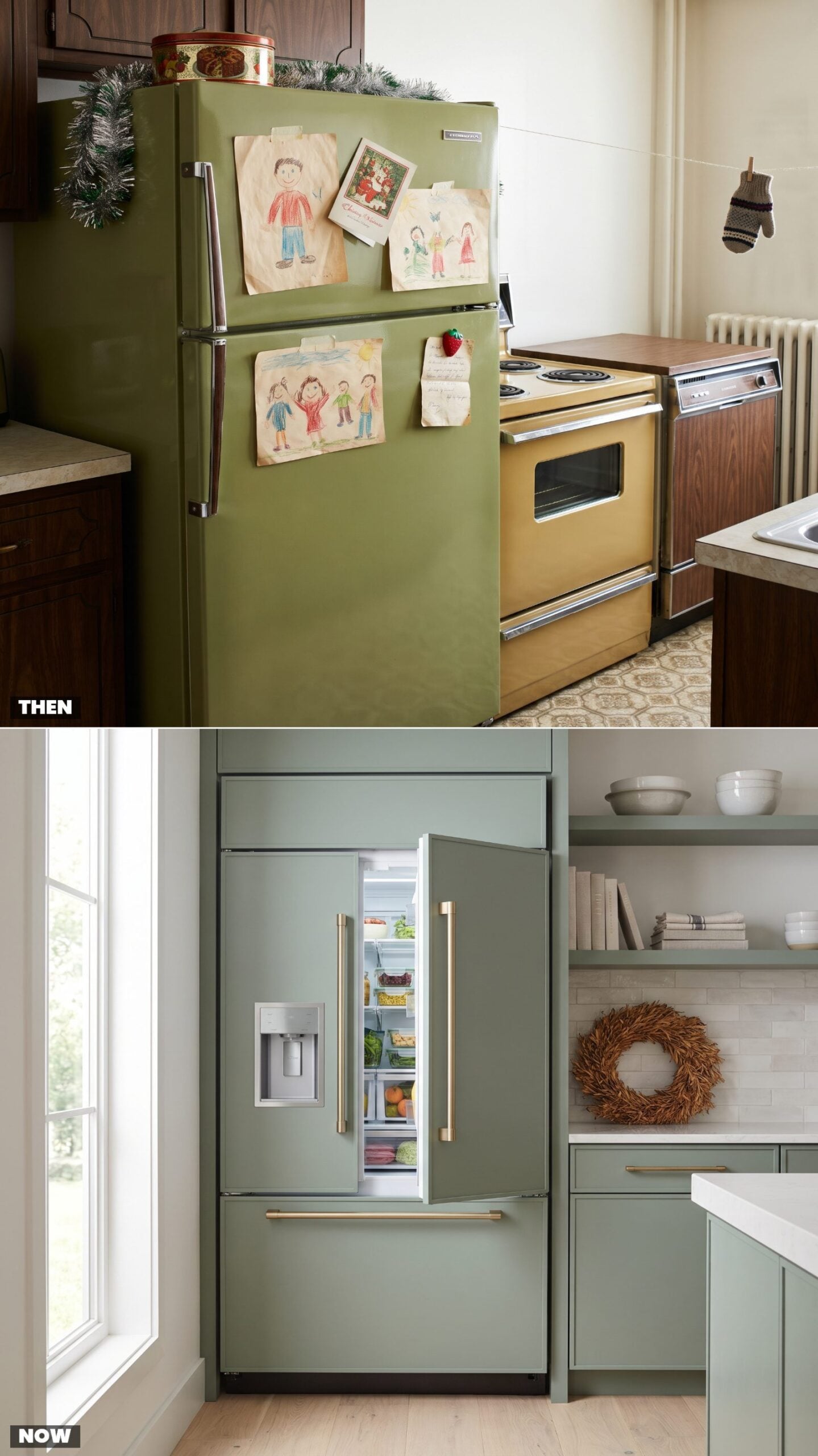
The avocado fridge was a landmark. It held the ham, the milk in glass bottles, and a collage of report cards and Christmas cards under fruit-shaped magnets. Nobody tried to hide it — the color was the point.
Panel-ready models do the opposite. Clad in the same sage cabinet fronts as everything around them, the fridge disappears into the run so your eye reads one continuous wall. Flush brass handles, no magnets, no clutter. A quieter kitchen, and a calmer one to cook in.
25. Countertop Microwave Ovens vs. Built-In Combi Ovens
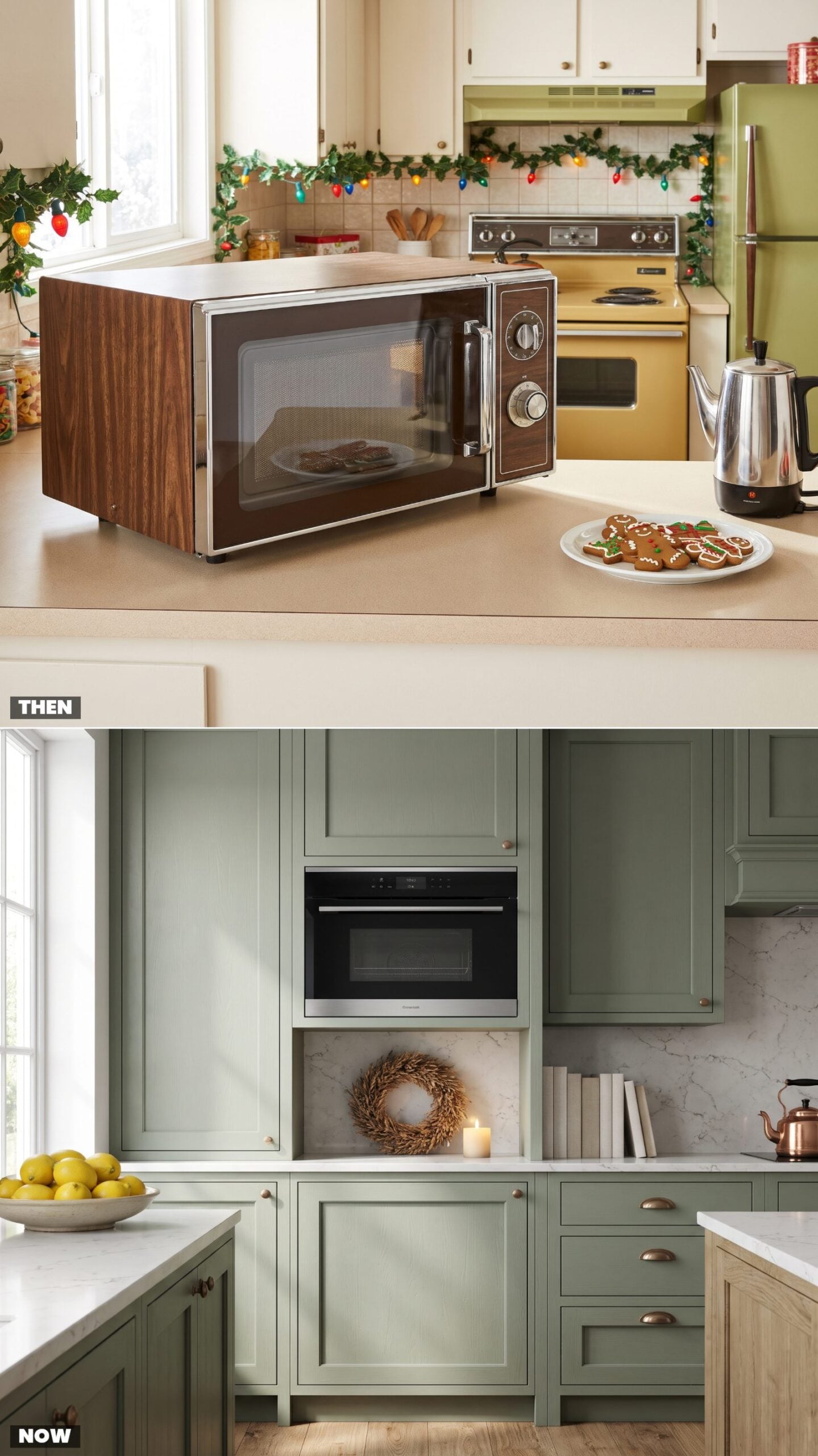
That first countertop microwave was a status object and a counter hog both — faux wood-grain panels, a latch like a bank vault, a dial you turned and hoped. It reheated the mashed potatoes and dried out the turkey if you looked away. Half the family was convinced it would sterilize them.
Built-in combi ovens tucked all of that into a cabinet column at eye level and added steam, convection, and real cooking power. The counter below is clear again. You get a second oven for Christmas overflow without sacrificing a single inch.
24. Electric Percolators vs. Built-In Espresso Stations
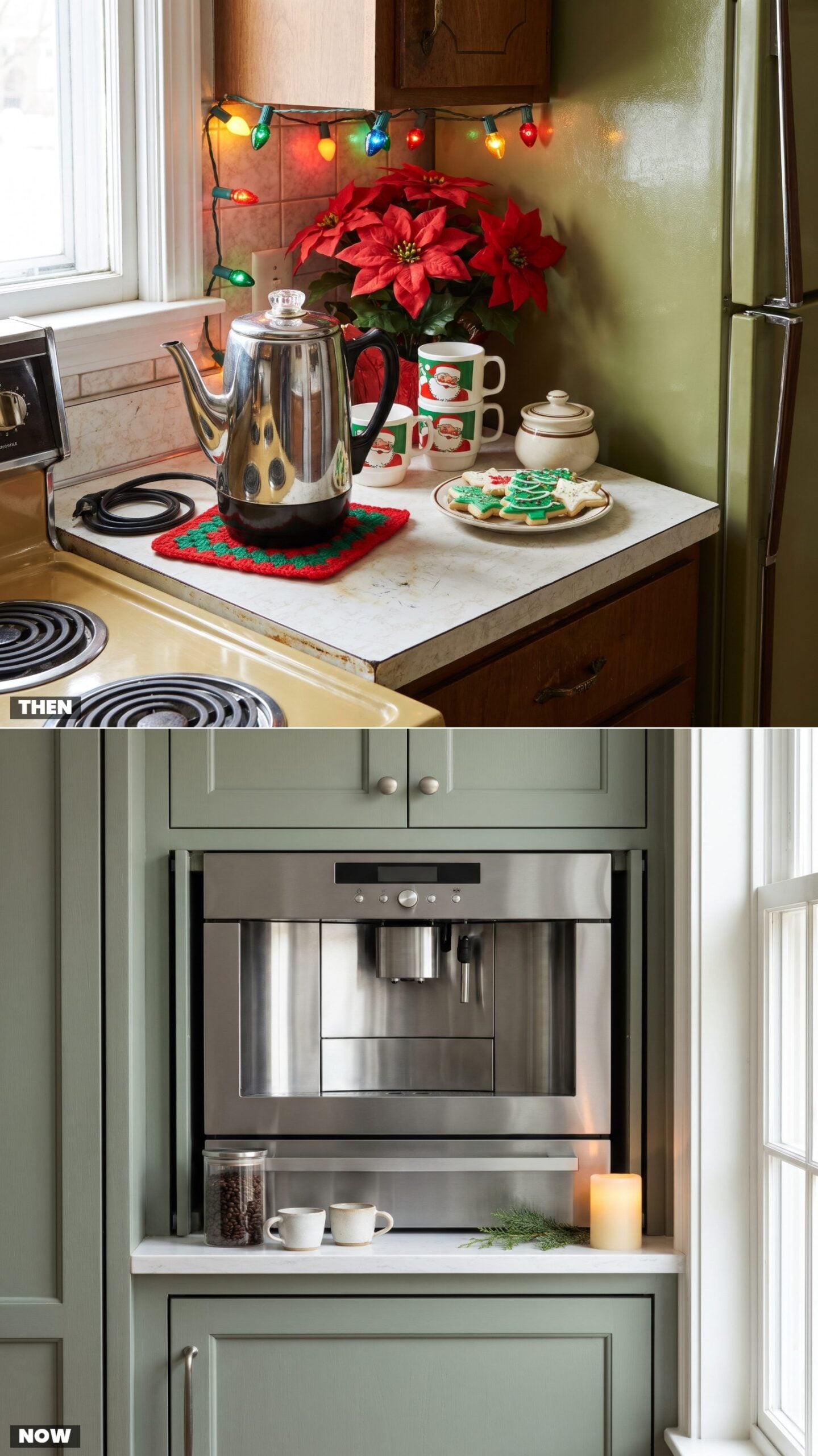
The percolator was the sound of Christmas morning — that steady gurgle, the glass knob darkening on top. It made strong, slightly bitter coffee that everyone drank black because that’s what was offered. The crocheted trivet underneath? Non-negotiable.
The built-in espresso station is the modern replacement, recessed into the cabinetry, grinding beans on demand, pulling shots that would have baffled anyone in 1975. A warming drawer keeps the cups hot. It’s an absurd amount of machinery for a cup of coffee, and I’d never go back.
23. Hand Mixers vs. Bowl-Lift Stand Mixers
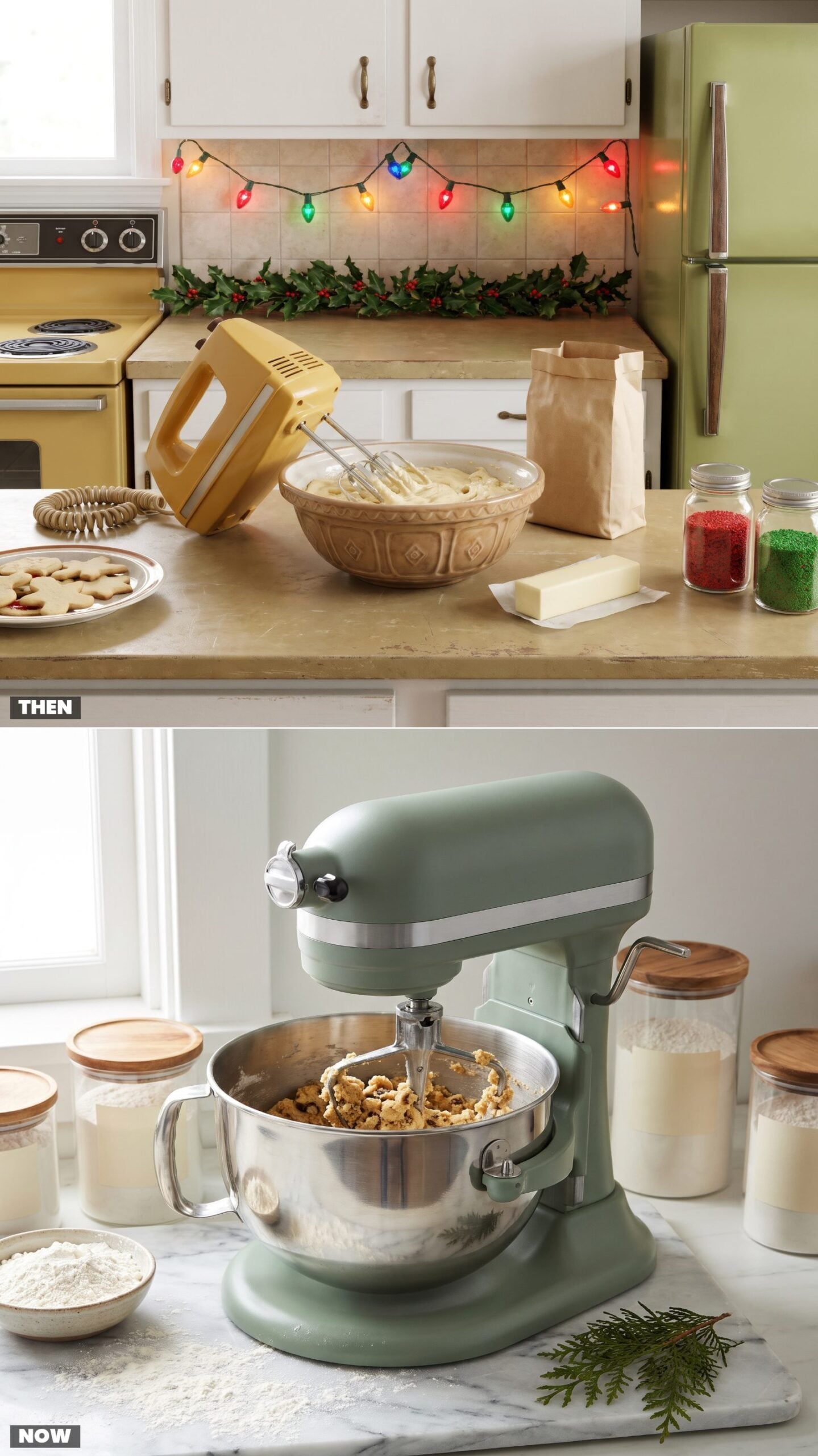
Christmas baking in 1975 meant gripping a handheld mixer, cord dangling, your arm going numb halfway through the second batch of cookie dough. The beaters flung batter if you tipped the bowl wrong. Everyone’s wrist knew the holidays were coming.
The sage stand mixer took the labor out of it. Lock the bowl, flip the switch, wander off to measure the next thing while it kneads the dough for you. It earns its counter space exactly twice a year — and those two weeks make it worth every inch.
22. Floral Slow Cookers vs. Programmable Multicookers
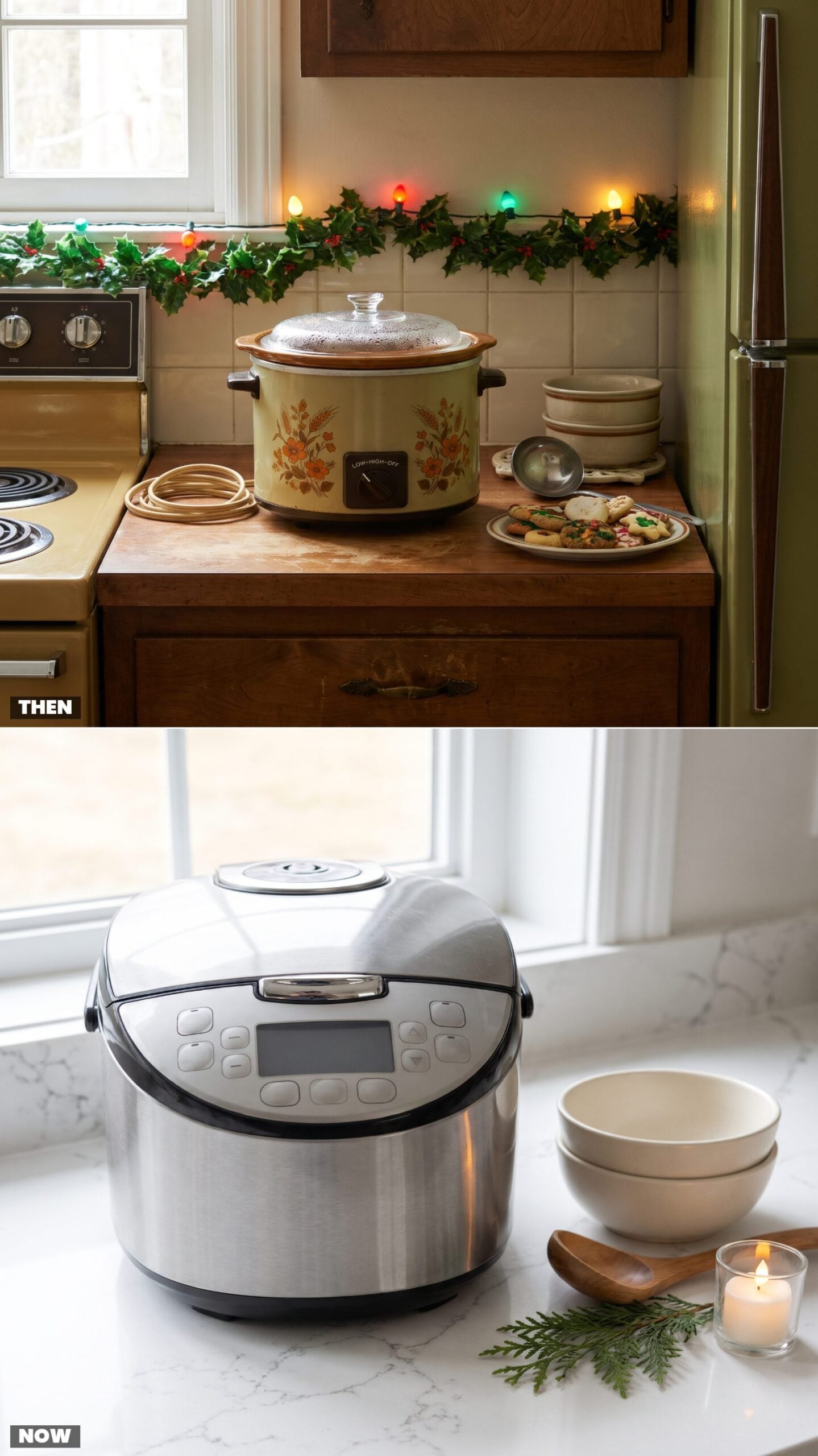
That wheat-and-floral stoneware crock was a fixture of the 1970s counter — cream and orange flowers, a dial with exactly three settings, a glass lid fogged with steam from the morning on. It made the party meatballs and the chili for the open house, low and slow all day.
The programmable multicooker does all that and seven other jobs besides. Pressure cook, steam, sauté, set a timer and leave for church, come home to dinner done. Smaller, quieter, and it won’t clash with a single thing in the room.
21. Avocado Fondue Pots vs. Compact Electric Fondue Sets
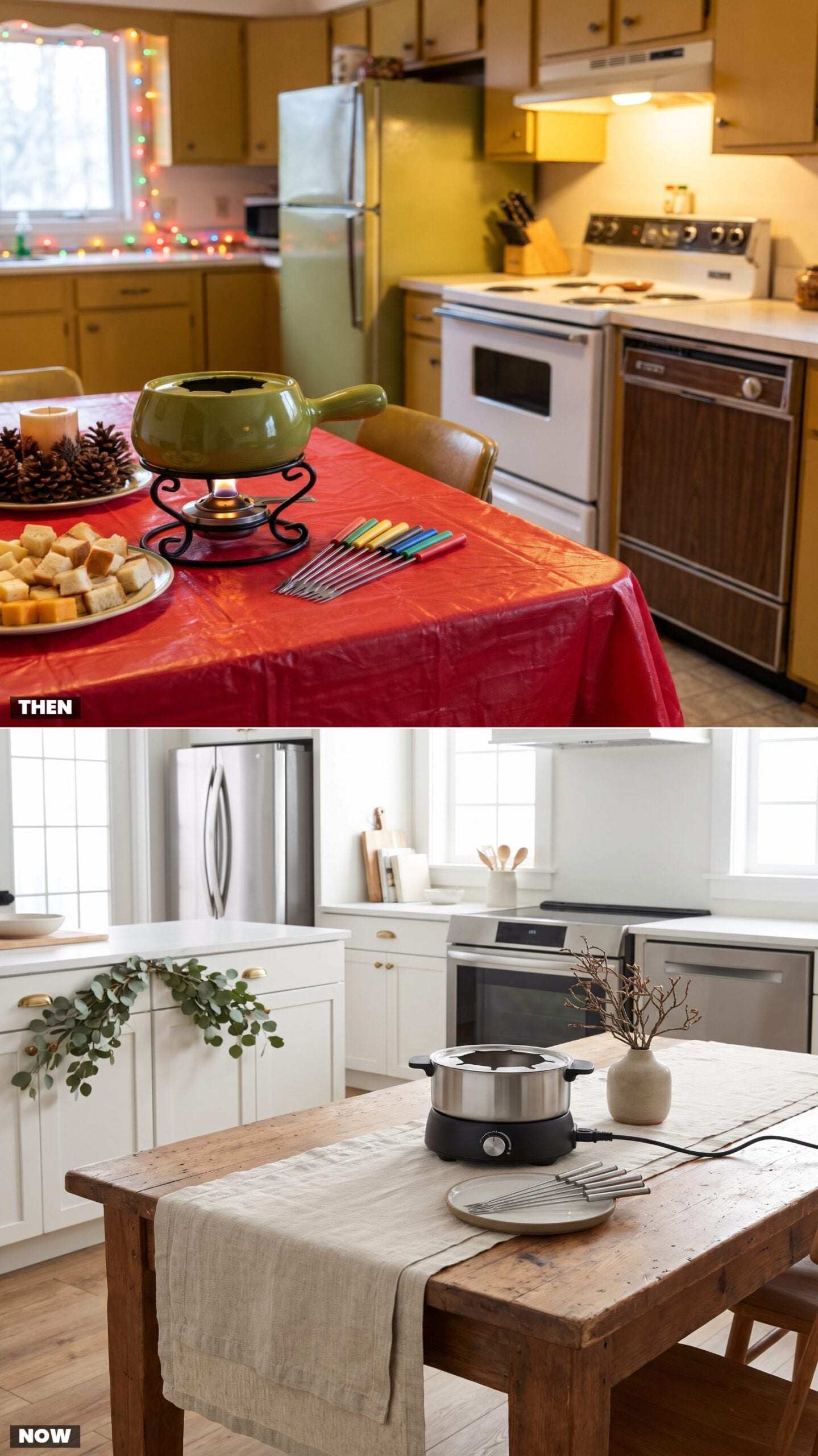
Every 1975 Christmas gathering had that moment where someone lit the little burner under the avocado pot and everyone leaned in with a long fork. The flame was open, the oil was real, and at least one person got the fork colors mixed up and ate your bread cube. Part party trick, part fire hazard.
The modern version plugs in, holds a steady temperature on a dial, and never asks you to pour fuel into anything. Smaller footprint, no open flame, cleans up in the sink. Less drama, which is probably the idea. Though I’ll admit the avocado pot had better stage presence.
20. Tabletop Tinsel Trees vs. Slim Pre-Lit Kitchen Trees
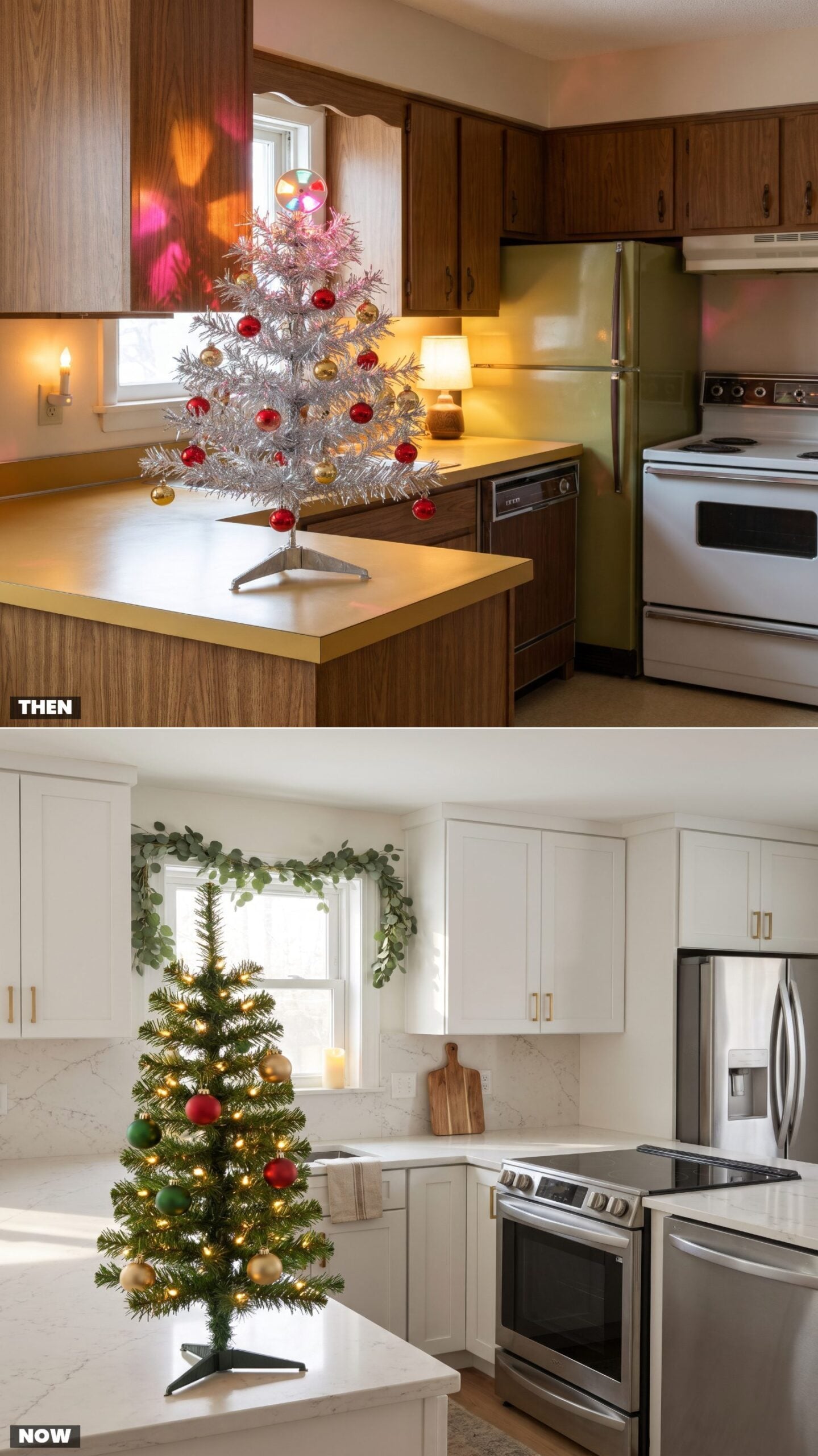
The aluminum tinsel tree was peak space-age Christmas. You stuck the foil branches into a central trunk, aimed a rotating color wheel at it, and watched it shift from pink to blue to amber while you did the dishes. It never dropped a needle because it never had one.
Today’s kitchen tree arrives slim, green, and already strung with warm LEDs before it leaves the box. Plug it in and you’re done. It leans toward real rather than retro, tucking into the corner by the fridge without taking the whole counter hostage.
19. Multicolored Incandescent Strings vs. App-Controlled LED Lights
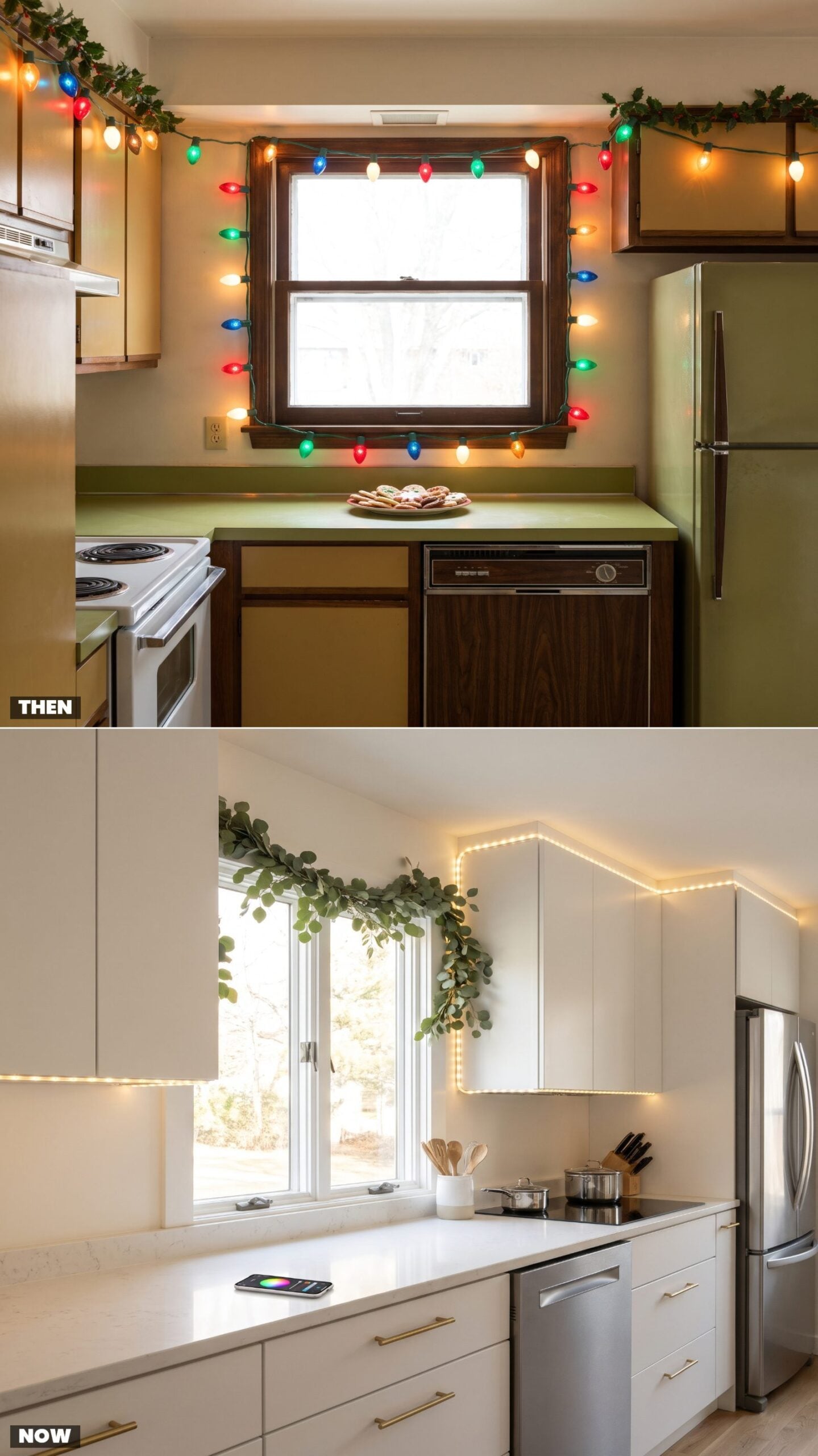
Those old incandescent strings ran hot enough to warm your fingertips, pulled real wattage, and had exactly one failure mode: the whole string going dark because of a single dead bulb you then hunted for one socket at a time. Christmas lighting was a maintenance hobby.
Now the strings stay cool to the touch, sip power, and bend to a phone. Dim them, set a warm-white glow, schedule them for dusk, or run a slow color fade if you want the retro feel without the retro heat. The hunt for the dead bulb is over, and good riddance.
18. Plastic Holly Garlands vs. Fresh Eucalyptus Swags
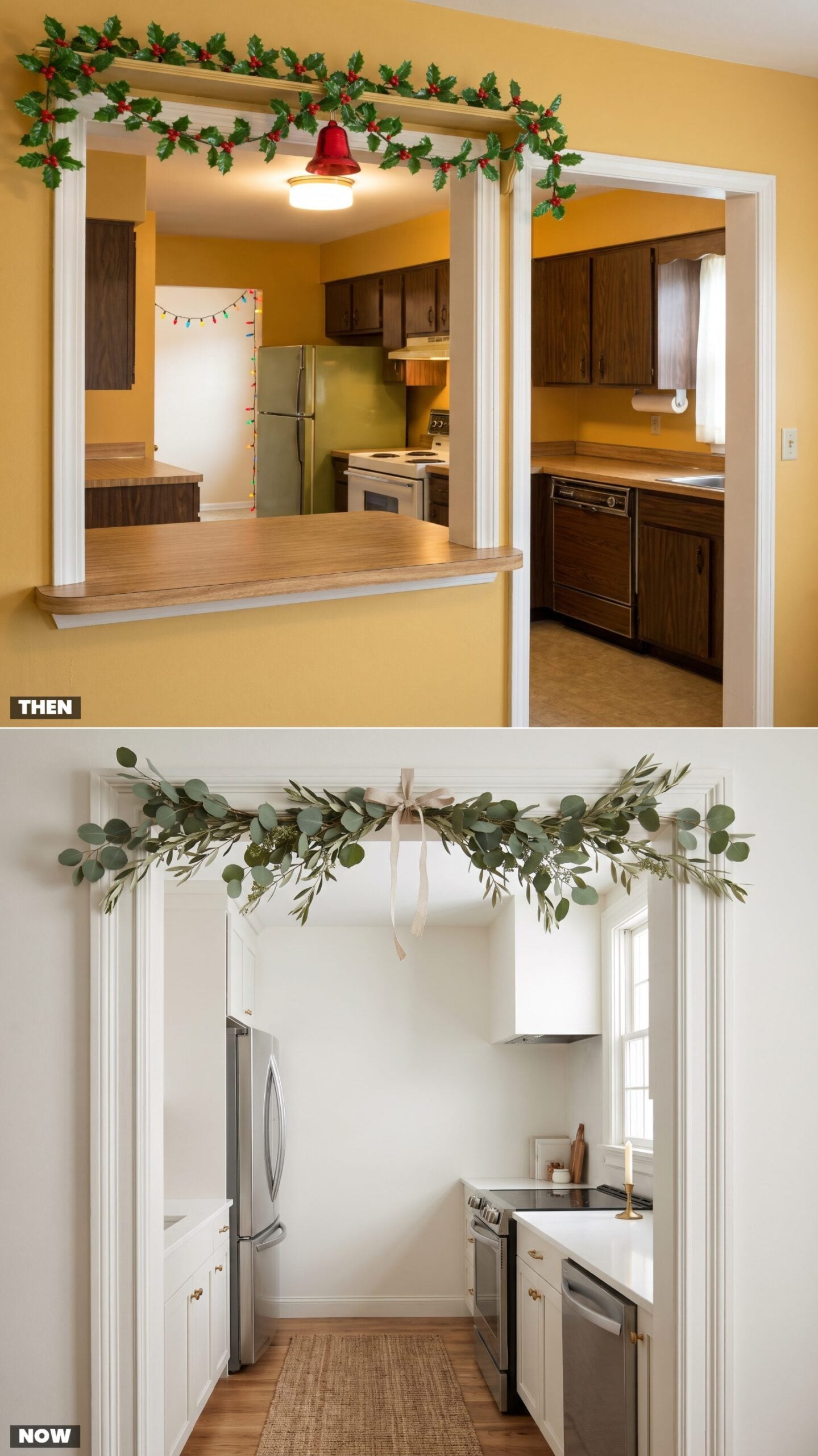
Plastic holly came out of the same storage box every December, shiny leaves slightly crushed, berries the color of a stop sign. It never wilted, which was the whole selling point, and it looked exactly as plastic as it was. You tacked it over the doorway and called it decorated.
Fresh eucalyptus changes the assignment. It drapes soft, smells faintly medicinal in a good way, and dries into something you can keep through January. Want more of that look elsewhere in the house? The same loose-greenery trick reads beautifully over a traditional hallway design too.
17. Plug-In Window Candles vs. Timer-Operated Flameless Candles
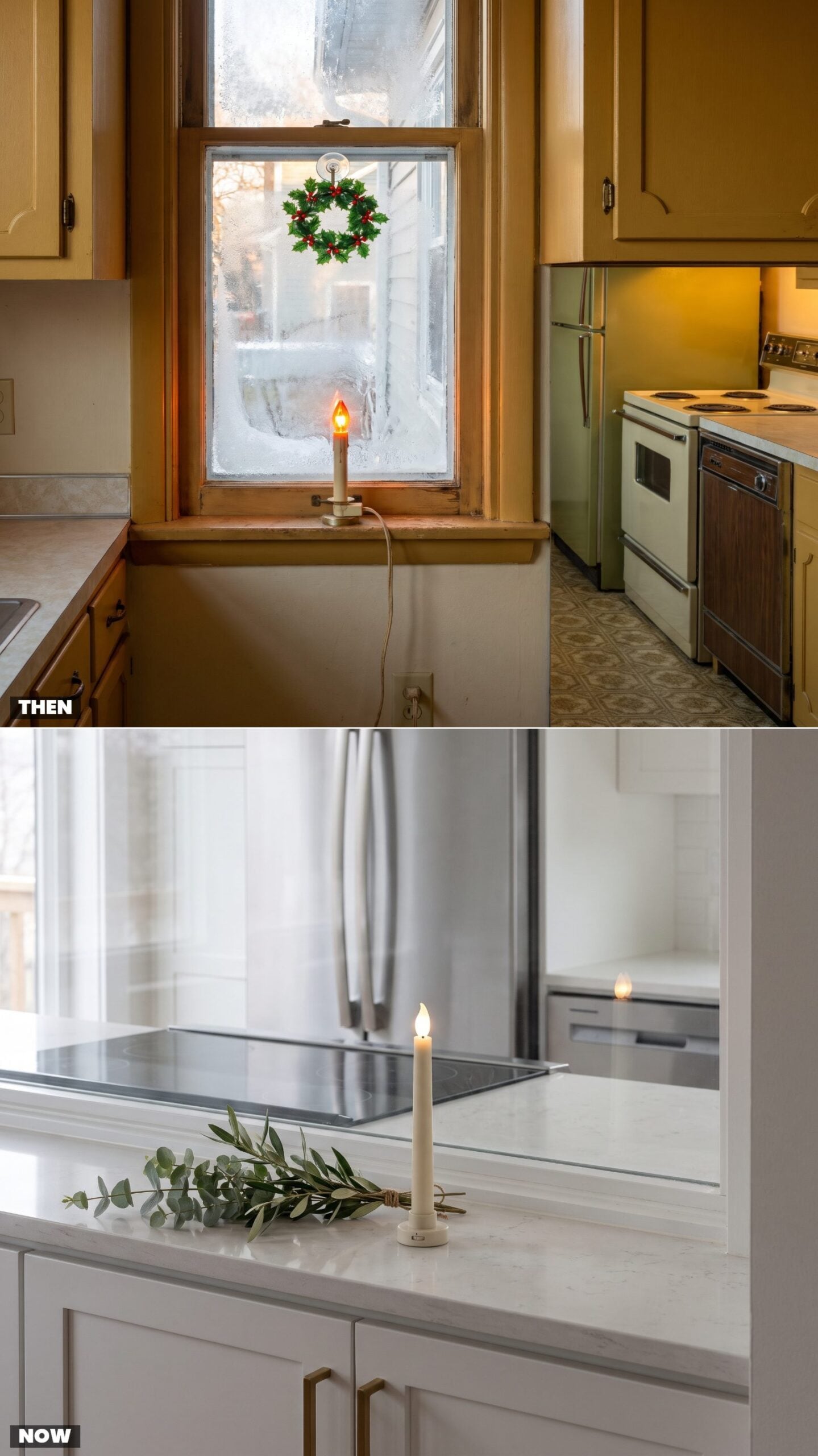
The plug-in window candle glowed a steady orange from a flame-shaped bulb, and its real signature was the cord. You could never fully hide it, so it ran down the wall to the nearest outlet and you stopped noticing it by December 10th.
The flameless version cut the cord entirely. Battery inside, a flicker that actually passes for a flame, and a built-in timer that clicks it on at dusk and off at bedtime without you lifting a finger. No cord, no bulb heat, no leaving it burning by accident.
16. Christmas Cards Taped Around Doorways vs. Clipped Card Displays
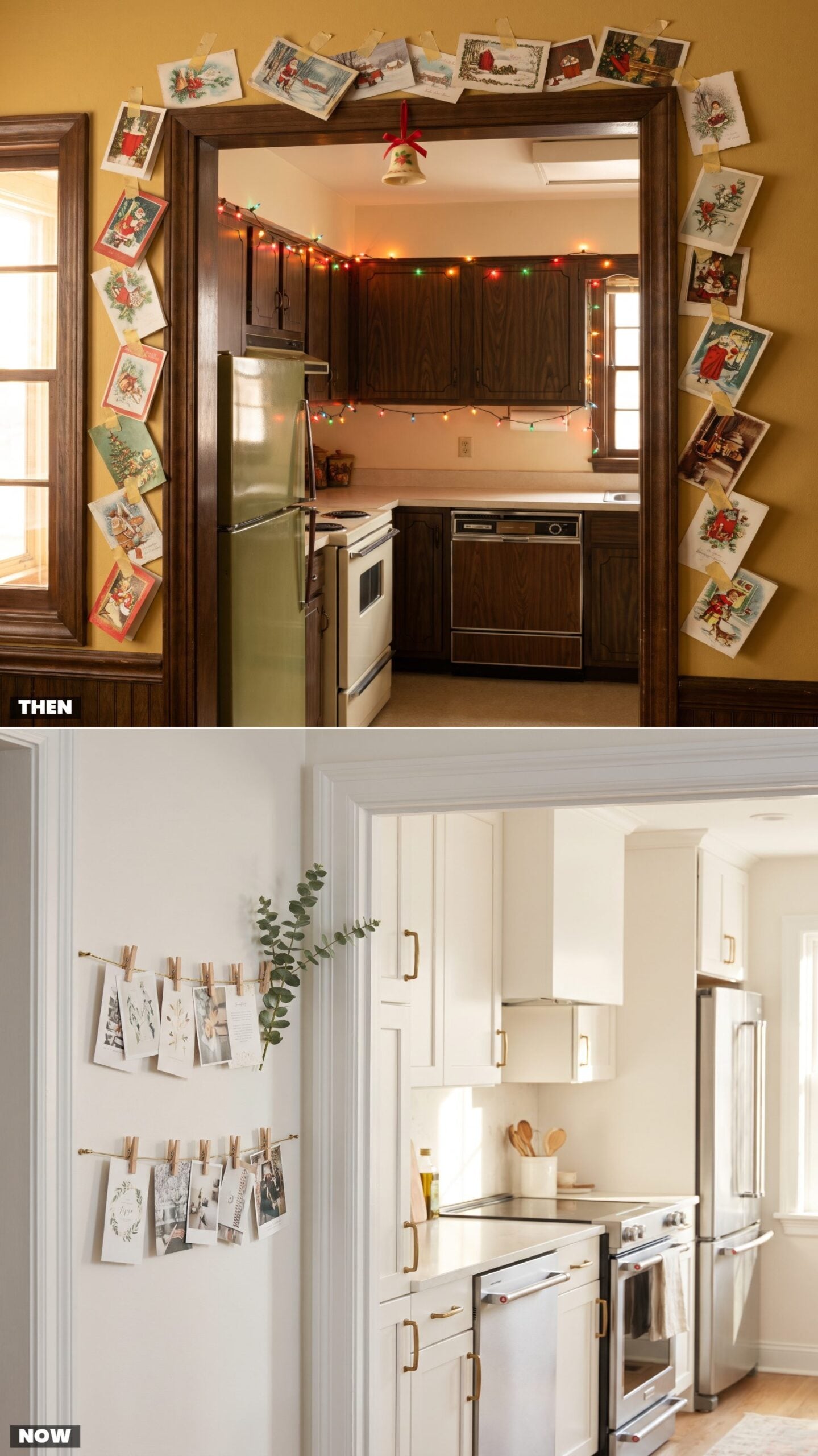
You remember the doorway buried in cards, taped up two and three deep, corners curling, a few falling off whenever someone slammed the back door. It was a running tally of who still thought of you, and it left little pale tape ghosts on the paint come January.
The clipped display does the same job without wrecking the wall. Run a length of twine or brass wire, hang the cards with small clips, swap them as more arrive. Even spacing, no tape residue, and the whole thing comes down in two minutes.
15. Plastic Tablecloths vs. Layered Linen Runners
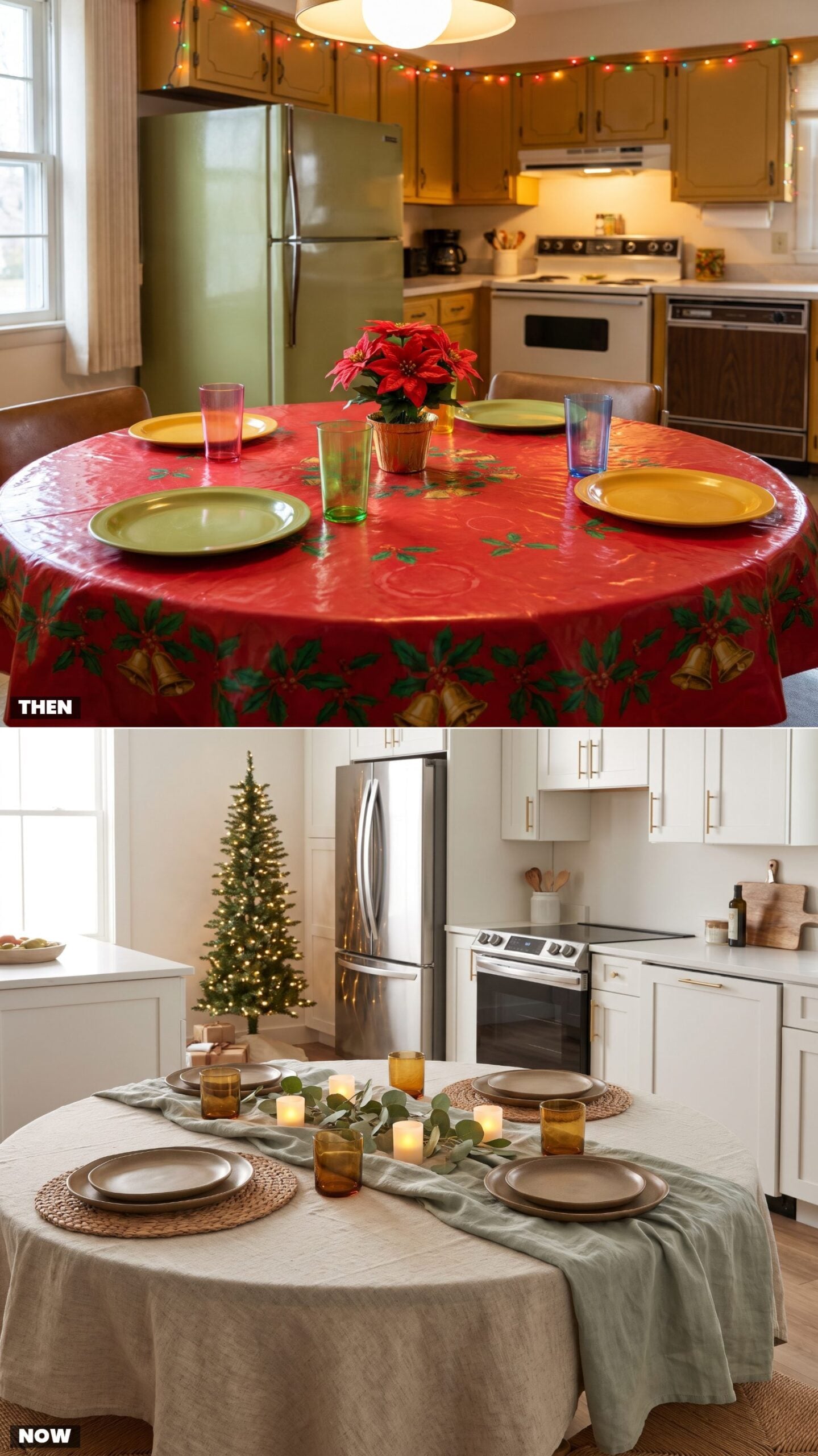
The red vinyl tablecloth printed with holly was the workhorse of the 1975 holiday table. It wiped clean with a dishrag, survived cranberry sauce and candle wax, and had that faintly sticky plastic shine you could feel under your elbows. Practical, cheerful, about as refined as a picnic.
Now the move is layering real cloth: a linen base, a contrasting runner down the middle, a bit of greenery over the top. It drapes instead of sticking and photographs soft. And yes, you have to actually wash it. That tradeoff is the whole appeal. The same tactile, lived-in layering turns up all over good farmhouse kitchen decor.
14. Candle-and-Pinecone Centerpieces vs. Sculptural Branch Arrangements
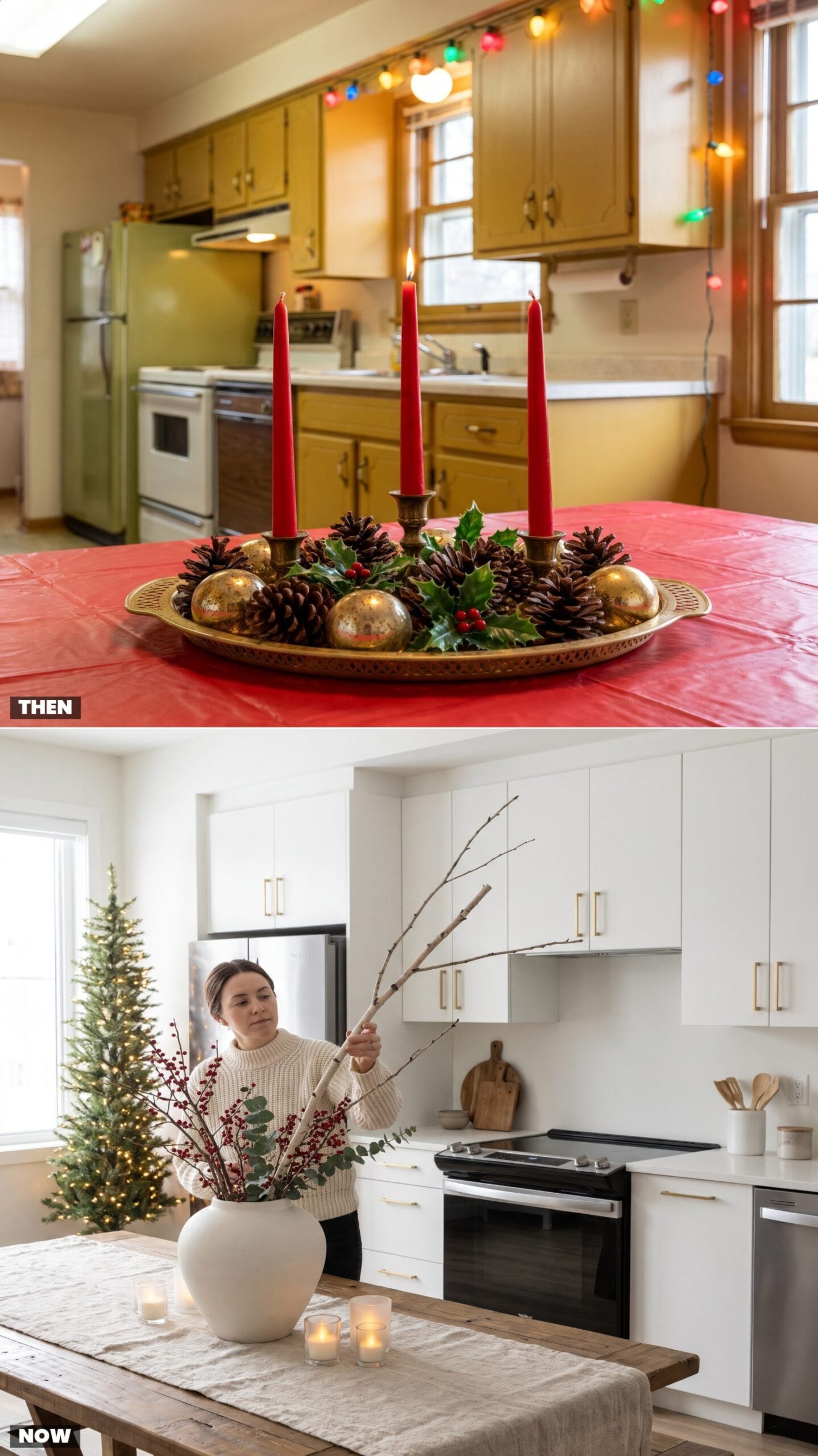
The classic 1975 centerpiece sat low and dense: a gold tray packed with real pinecones, plastic holly, a scatter of glass balls, and three red tapers you lit right over the mashed potatoes. Cozy, flammable, and impossible to see your dinner guests through.
The modern centerpiece goes tall and sparse instead. Bare branches, berry sprigs, maybe eucalyptus, set high in a vase so the sightline across the table stays open and the whole thing reads like sculpture. Flameless votives sit low at the base, so nobody’s sleeve catches fire reaching for the rolls.
13. Wrapping on the Kitchen Table vs. a Dedicated Island Wrapping Station
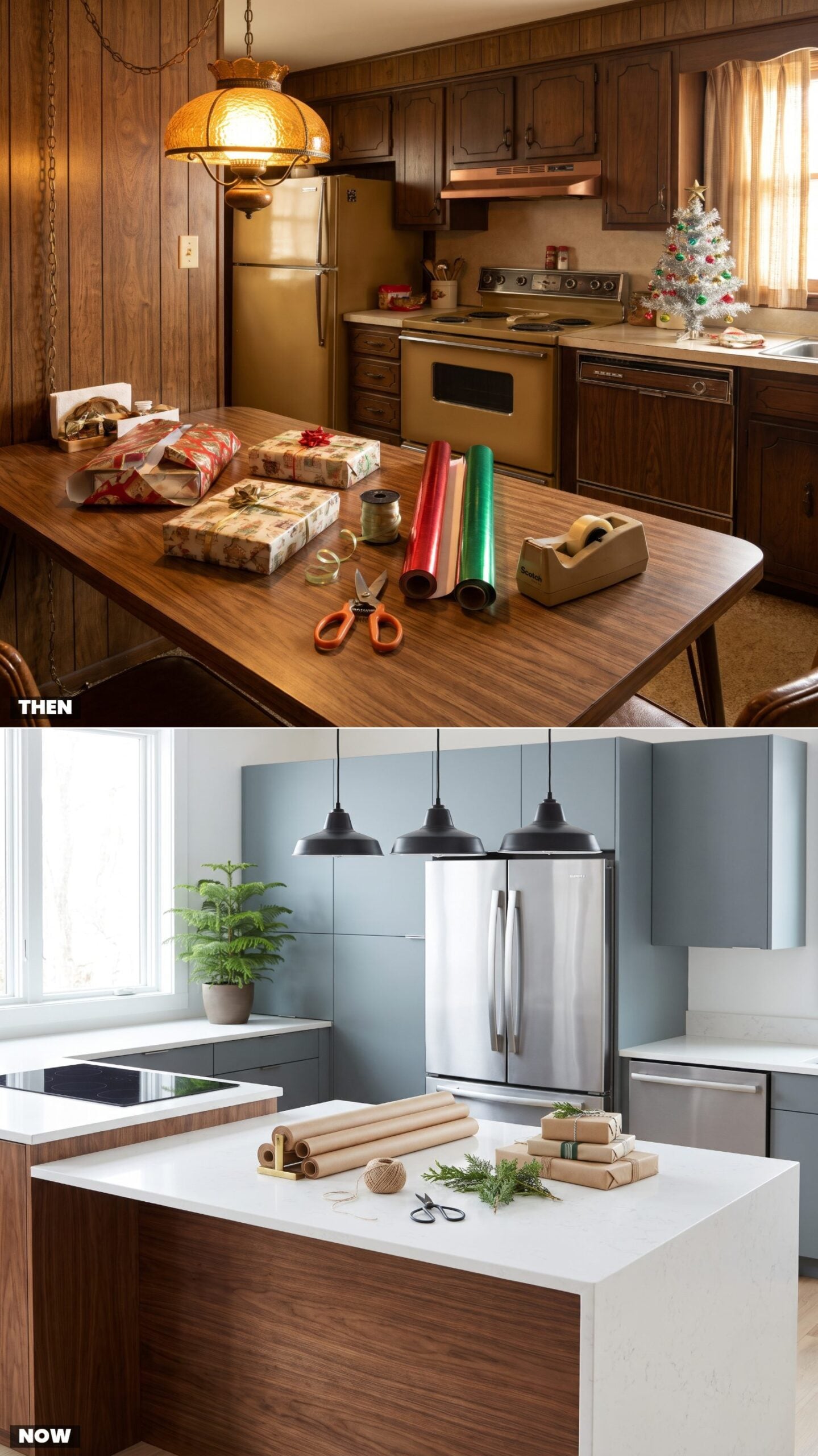
Wrapping happened wherever dinner wasn’t. You cleared the dinette table, covered it, and claimed it for an afternoon, and anyone who wanted a snack learned to eat standing up until the gifts were done.
The island changed the math. Taller, roomier, wipeable — so paper rolls live in a brass paper stand and nobody’s hunting for tape. And the kraft-and-greenery look photographs better, which, honestly, is half the reason it caught on.
12. Clunky Metal Cookie Presses vs. Ergonomic Press Kits in an Industrial Loft Kitchen
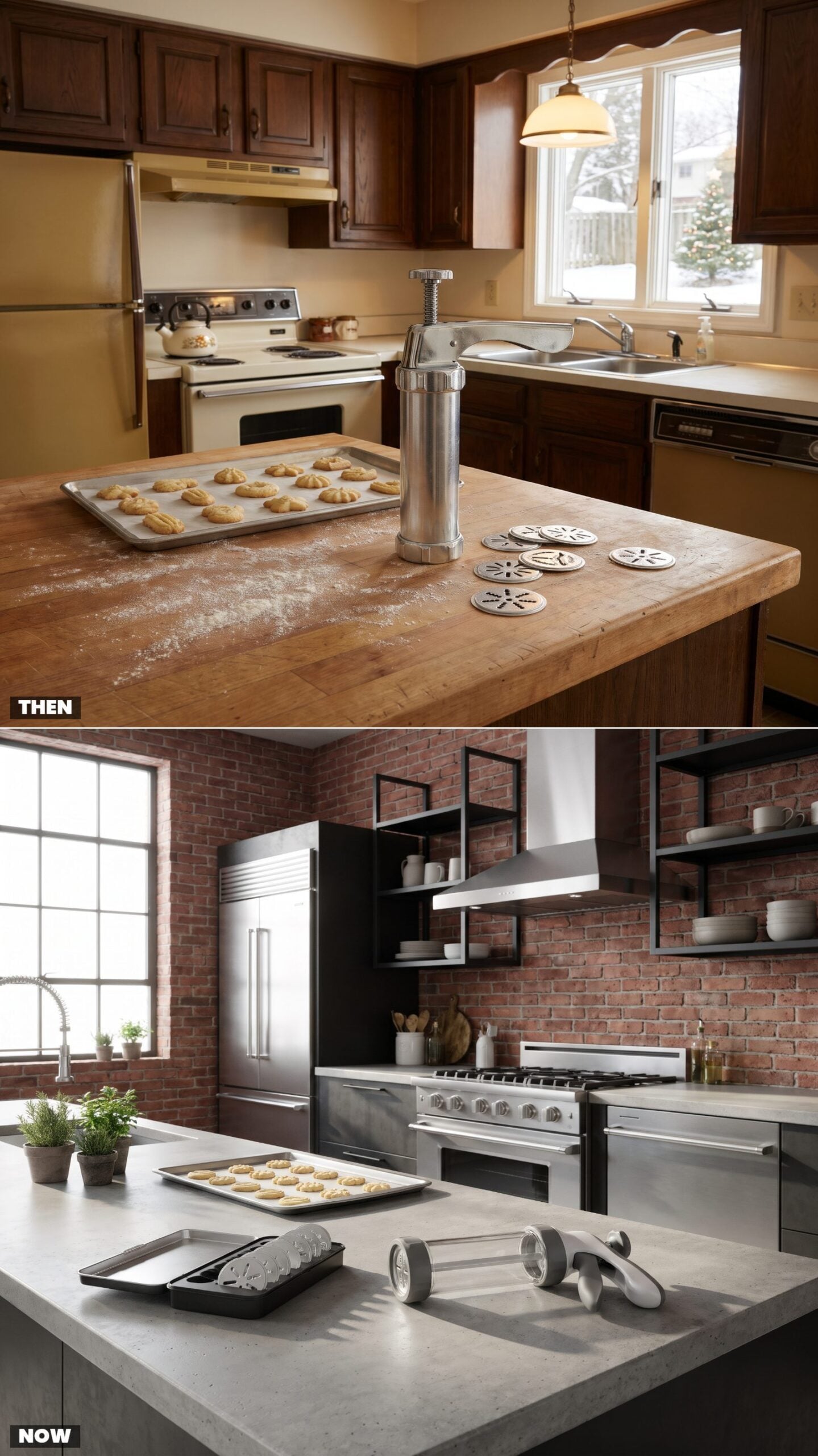
The old press ran on forearm strength. You twisted that plunger top, prayed the dough extruded in something resembling a tree, and more often got a blob. By cookie twenty your hand ached.
Trigger-grip presses took the wrestling match out of it — one squeeze, consistent shape, and a clear barrel so you can see the dough load. The disks store in a case instead of migrating to the junk drawer. Small change, big difference on a long baking day.
11. Tin Cookie Cutters vs. 3D-Printed Customs in a Scandinavian Kitchen
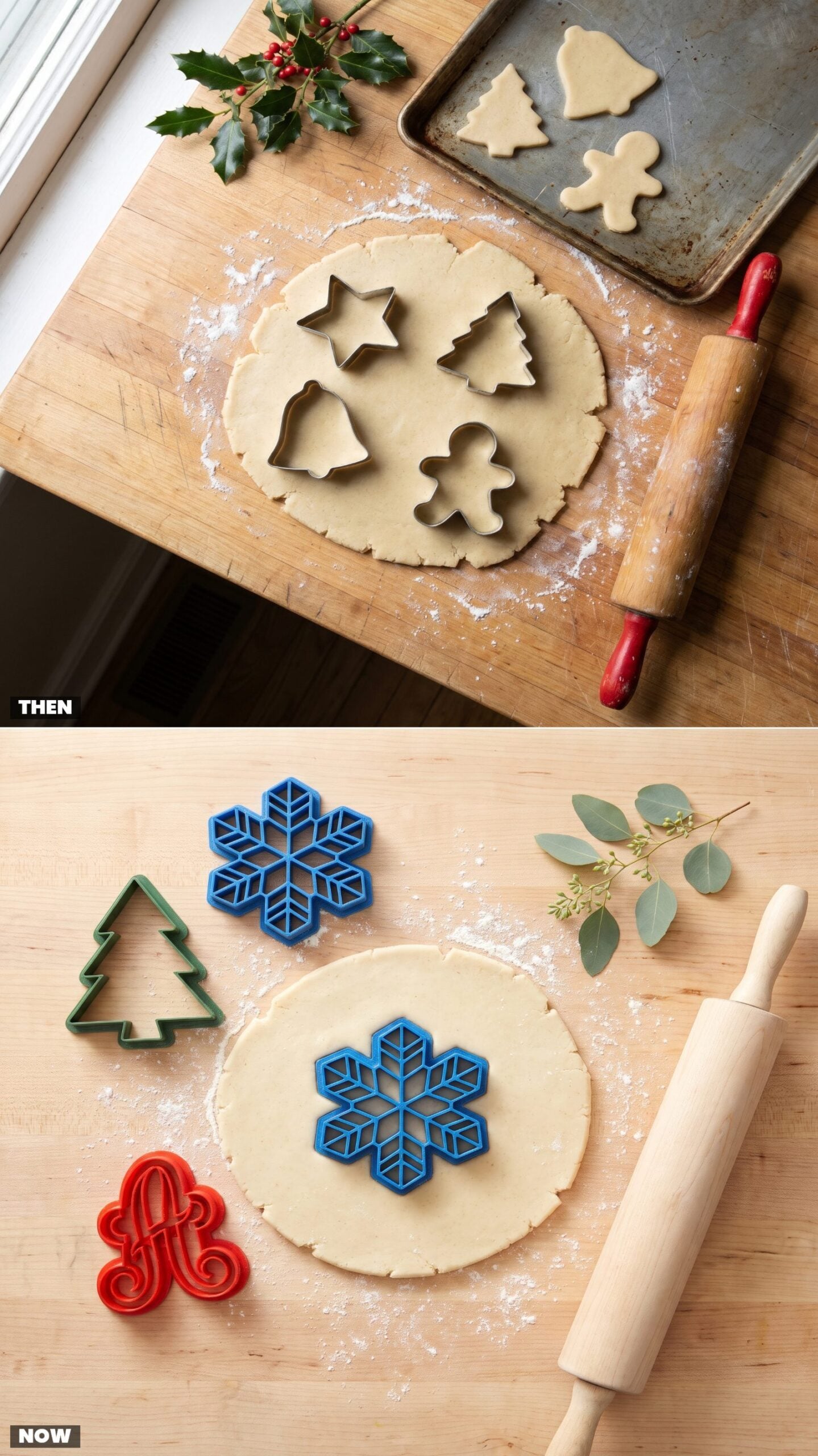
Tin cutters came in a tangled tin of their own, rusting a little at the seams, the gingerbread man always slightly bent from the year someone sat on him. They cut fine and lasted forever, which is why half of them are still in circulation.
Now you can print a cutter shaped like your dog, your house number, or a snowflake no tin ever managed. Costs almost nothing. Takes an afternoon.
10. Waxed-Paper Work Surfaces vs. a Marked Silicone Mat in a Coastal Kitchen
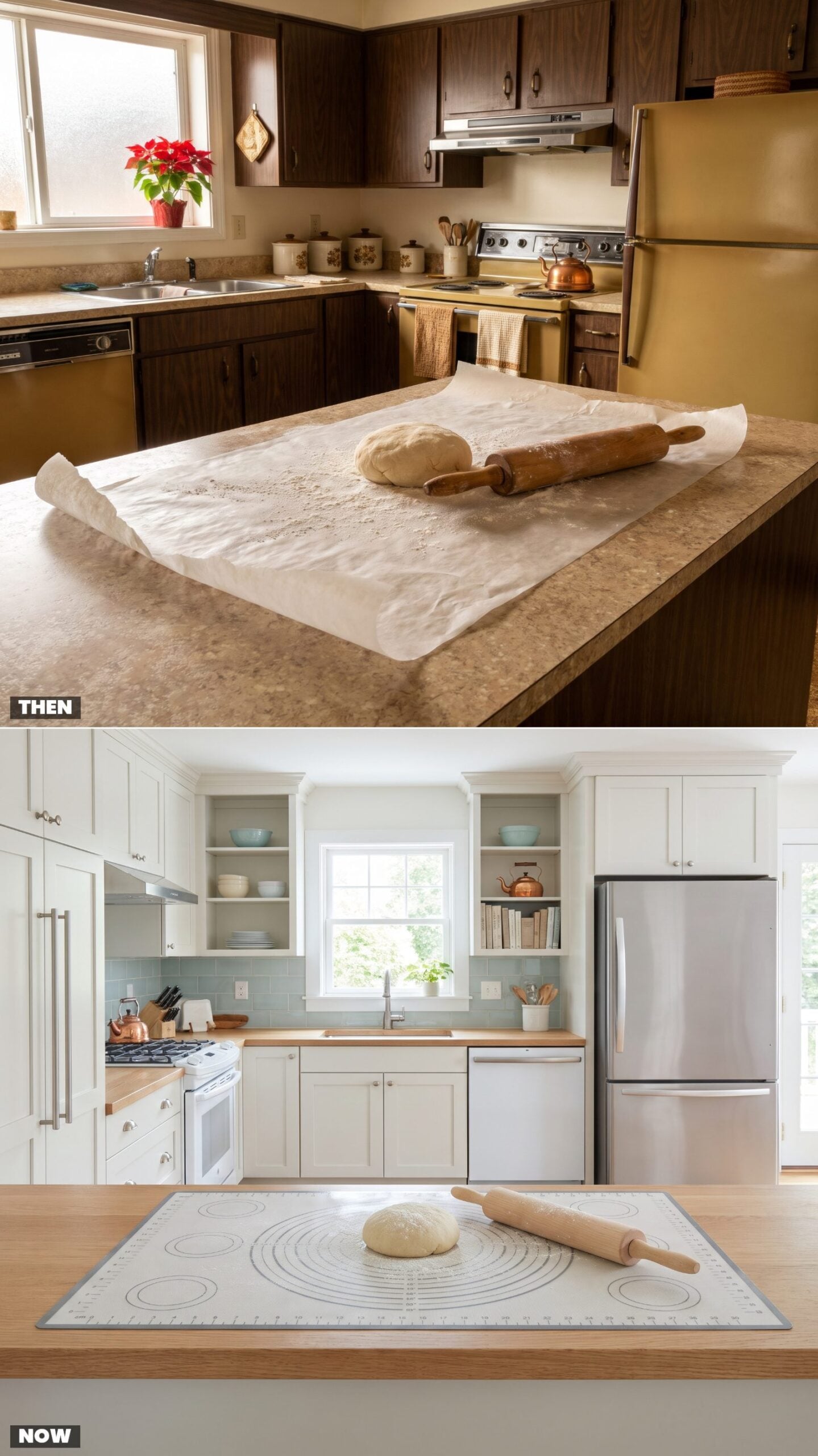
Waxed paper was the compromise surface. It kept flour off the Formica, but it slid, curled, and tore the moment you leaned into the rolling pin. So you taped it down. Everyone taped it down.
The silicone mat solves all three problems at once. It grips the counter, wipes clean, and the printed ring guides tell you exactly when your pie crust hits the right diameter — no more eyeballing, no more tape.
9. Speckled Enamel Roasters vs. a Stainless Roasting System in a Traditional Kitchen
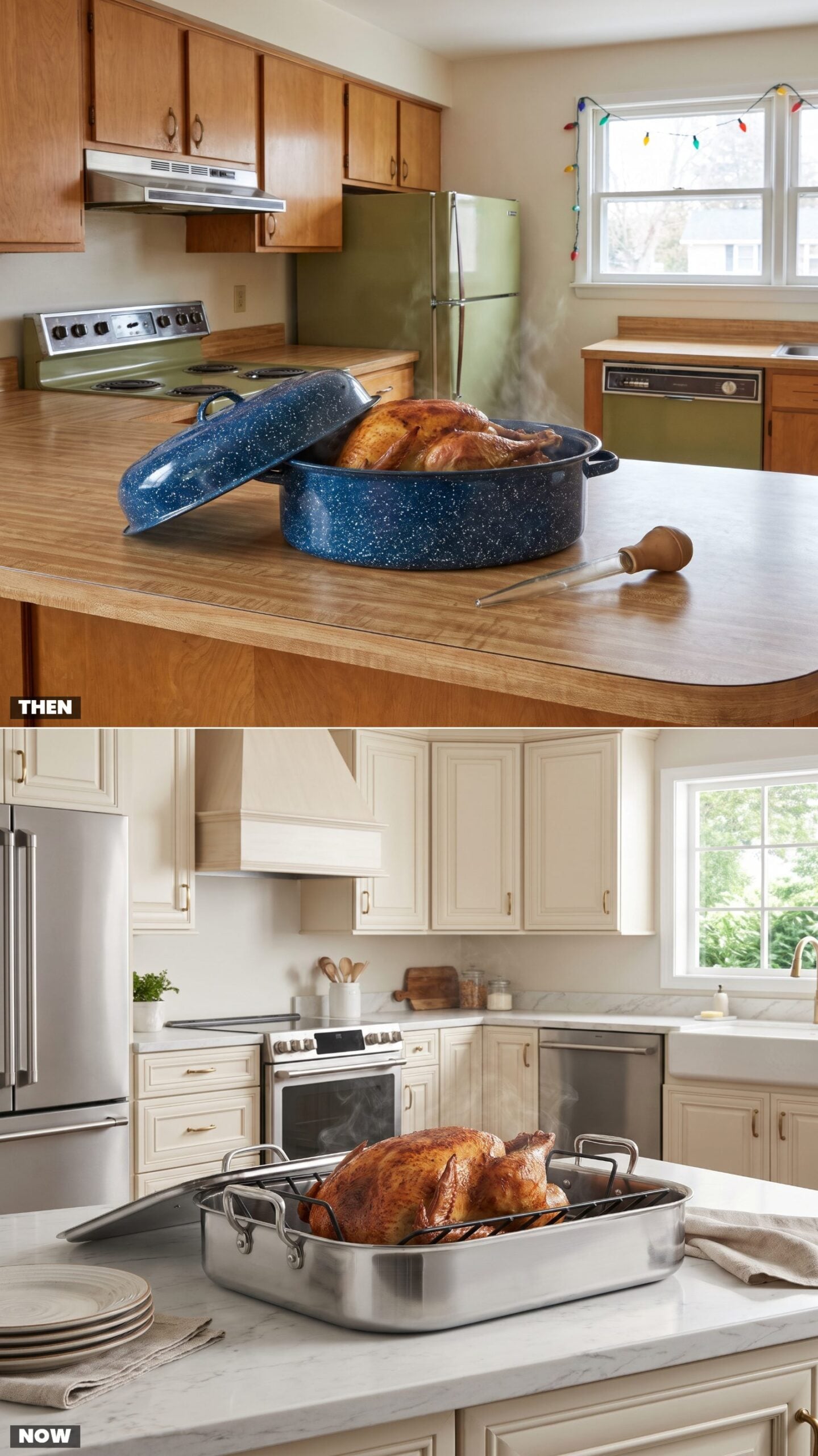
That speckled blue roaster came out exactly once a year, usually from the top of a cabinet nobody could reach without a chair. The enamel chipped at the rim, the lid rattled, and the thing weighed almost nothing until you loaded it with a twenty-pound bird.
Stainless roasting systems trade charm for performance. A rack that lifts the turkey off its own fat, loop handles you can actually grip with oven mitts, and a bottom heavy enough to go stovetop for gravy. The graniteware looks better on a shelf. The stainless cooks a better bird.
8. Pop-Up Turkey Timers vs. Wireless Probe Thermometers in a California Modern Kitchen
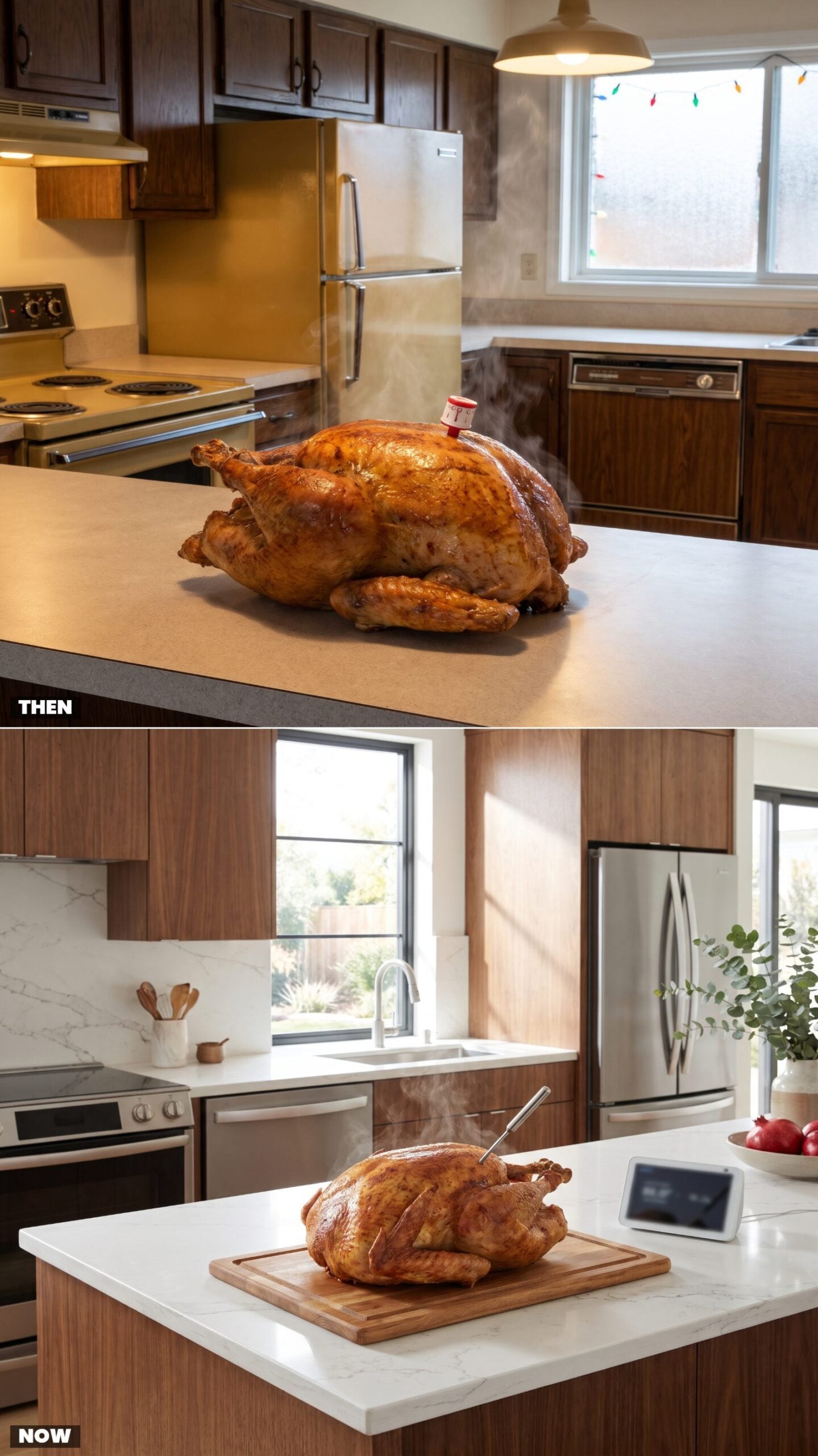
The pop-up timer was a tiny plastic act of faith. A dab of soft metal melted at a set temperature and shoved a red stick upward, and by the time it popped the breast had usually run five degrees past dry. It worked often enough that nobody questioned it.
Wireless probes killed the guesswork. The sensor stays in the bird, the reading lands on your phone from across the room, and an alert tells you to pull it the moment it hits temperature. You carve a juicier turkey. And you stop opening the oven door every ten minutes.
As a turkey hotline supervisor puts it, “A pop-up timer is definitely not accurate and it’s not deep enough in the meat”
7. Grooved Wooden Carving Boards vs. Oversized Juice-Channel Boards in a Mid-Century Modern Kitchen
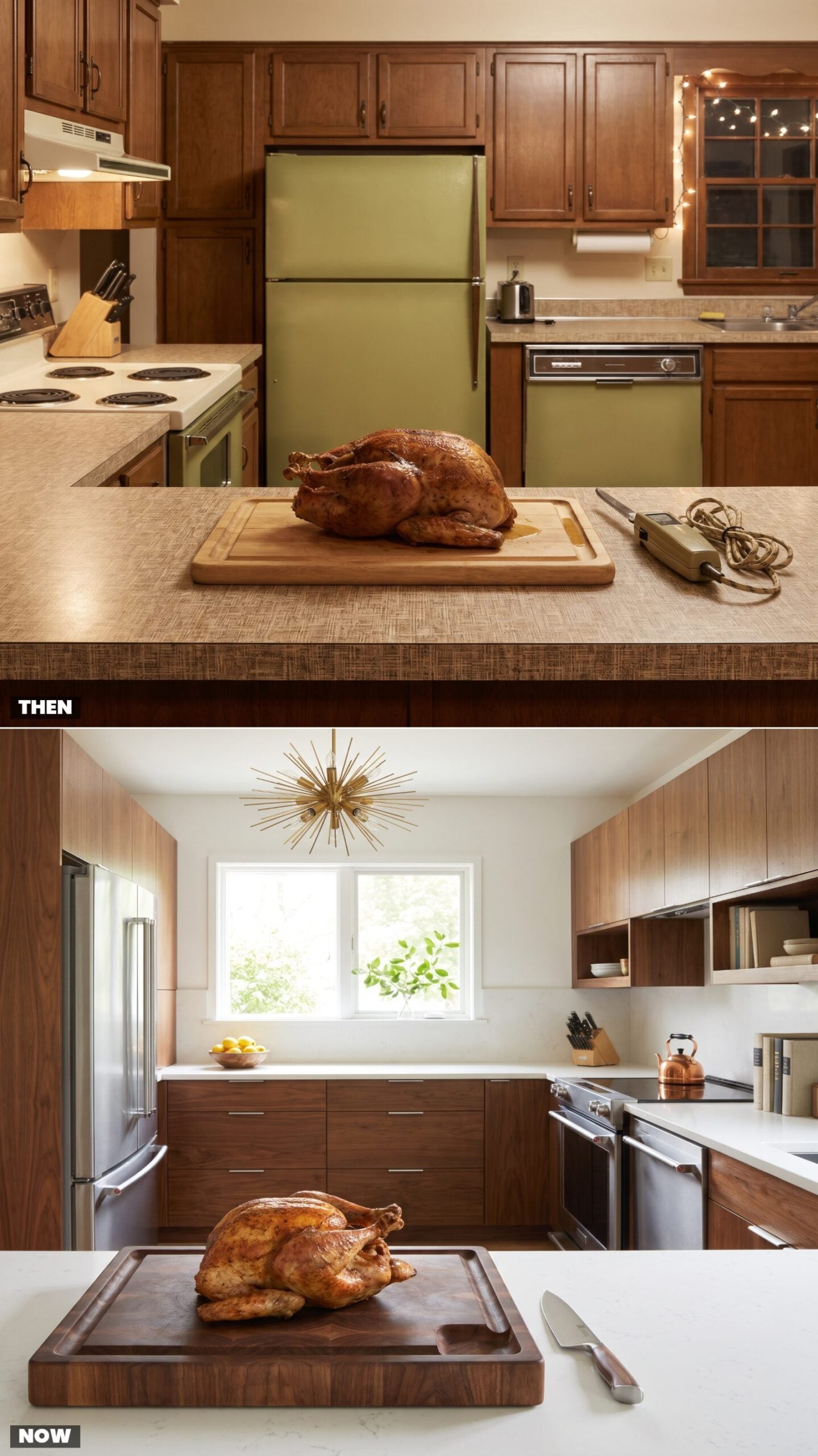
The old board had shallow grooves and the ambition of a saucer. Carve a turkey on it and the juices overran the edge within two slices, which is why a dishtowel was always stationed underneath like a sandbag.
The oversized juice-channel board solved the flood. A deep perimeter trench catches every drop and funnels it to a corner well you pour straight into the gravy, and end-grain walnut is kinder to your knife edge, so it stays sharp through the whole bird. Pair it with a walnut-handled chef’s knife and carving stops feeling like a brawl.
6. Cut-Glass Punch Bowls vs. Self-Serve Holiday Beverage Stations
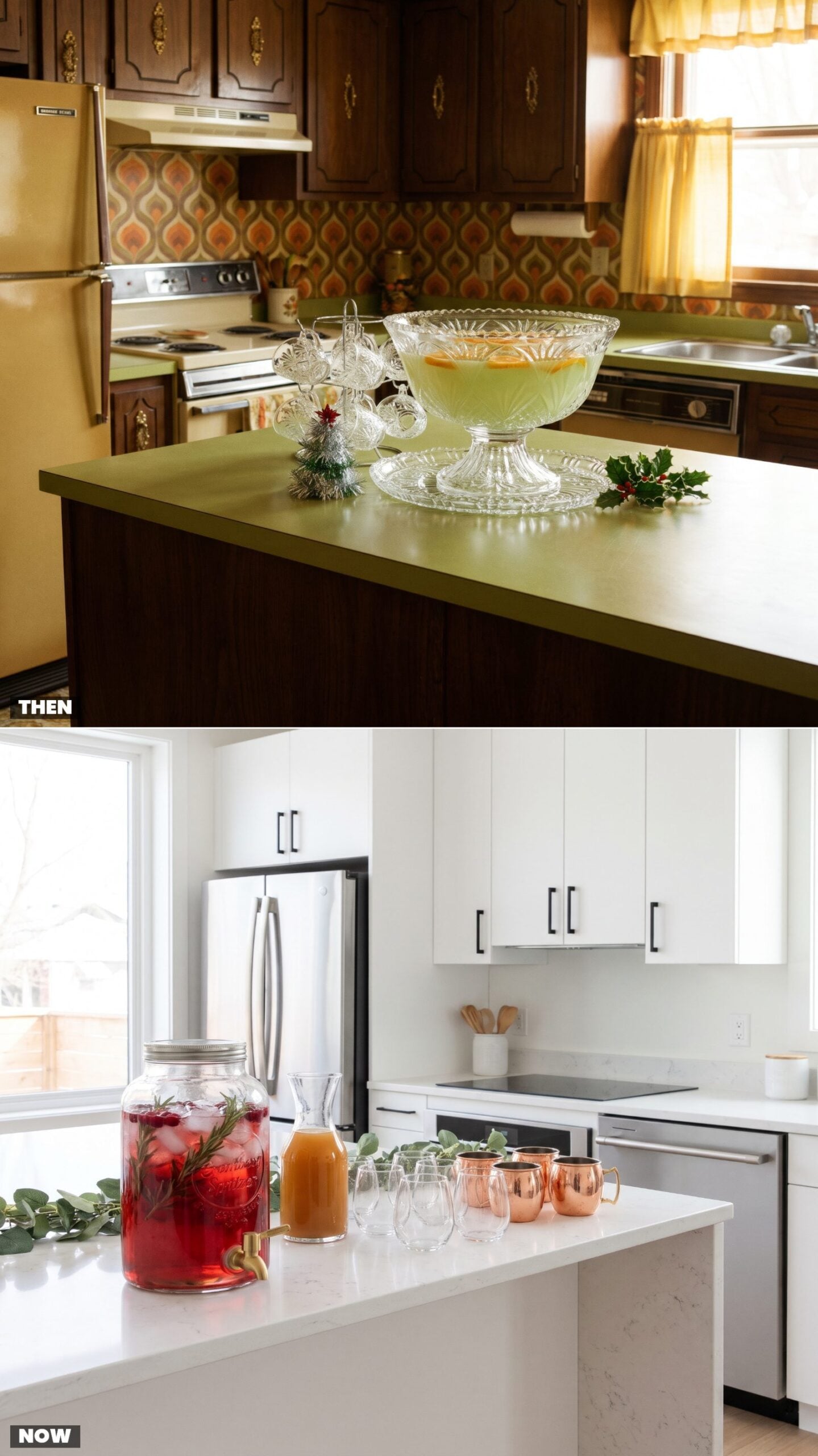
The punch bowl was the main event. Not the punch — the bowl. Pressed cut glass, heavy as a bowling ball, pulled down from the top shelf once a year and ringed with a dozen matching cups that clinked when you breathed near them. The punch itself? Usually ginger ale, sherbet, and whatever fruit happened to be on sale that week.
Now the counter holds a glass drink dispenser with a spigot, a carafe of cider, and a stack of reusable copper mugs. Guests pour their own. Nobody waits in line for a ladle, and the host finally gets to sit down.
5. Relish Trays Then, Grazing Boards with Little Bowls Now
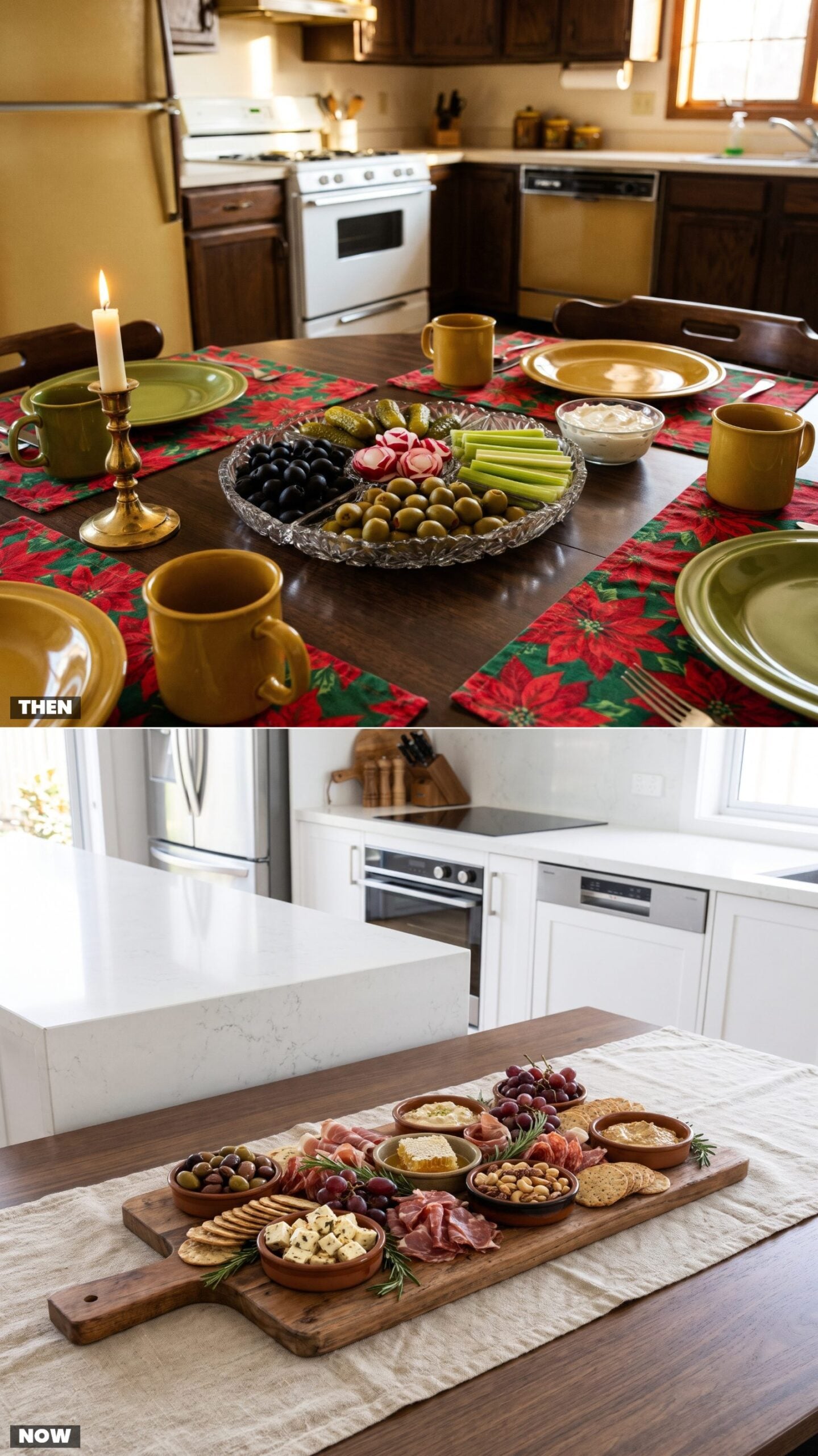
The relish tray was a small marvel of compartmentalized restraint — five sections, five snacks, each kept firmly in its lane. Olives never touched the celery. Radish roses got carved by hand the night before, and someone always swiped the last sweet pickle without asking.
Today that same instinct sprawls across a two-foot board. Little bowls everywhere, cured meats fanned out, honeycomb dripping onto the crackers. It eats up the whole table, and that’s rather the idea. The ladylike nibble gave way to the full-on graze.
4. Printed Metal Cookie Tins vs. Clear Airtight Canisters
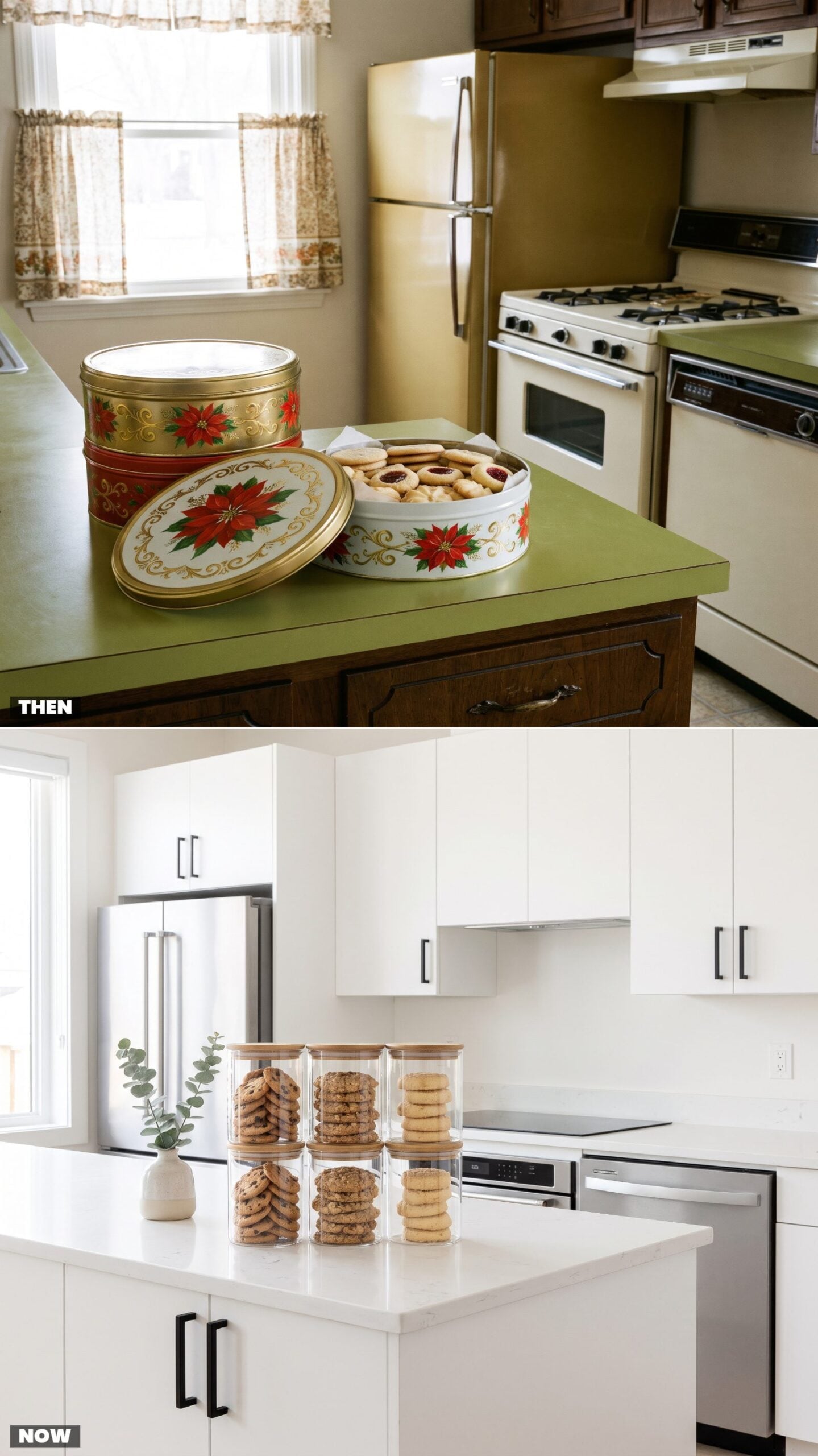
Everybody’s grandmother had the tin. You know the one — the Danish butter cookie tin, emptied of cookies decades ago and permanently repurposed for sewing notions. At Christmas the real ones came out, painted with holly and gold, packed with wax-paper layers so the spritz didn’t bruise the thumbprints.
The modern version shows its work. Clear glass airtight canisters with bamboo lids let you see exactly what’s left, which is either helpful or a problem depending on your willpower. I lean toward problem.
Clear isn’t the only option: in our reader poll on countertop canister sets, 43% would buy ceramic, ahead of glass at 33% and stainless at 19%.
3. CorningWare on Warming Trays vs. Induction Buffet Servers
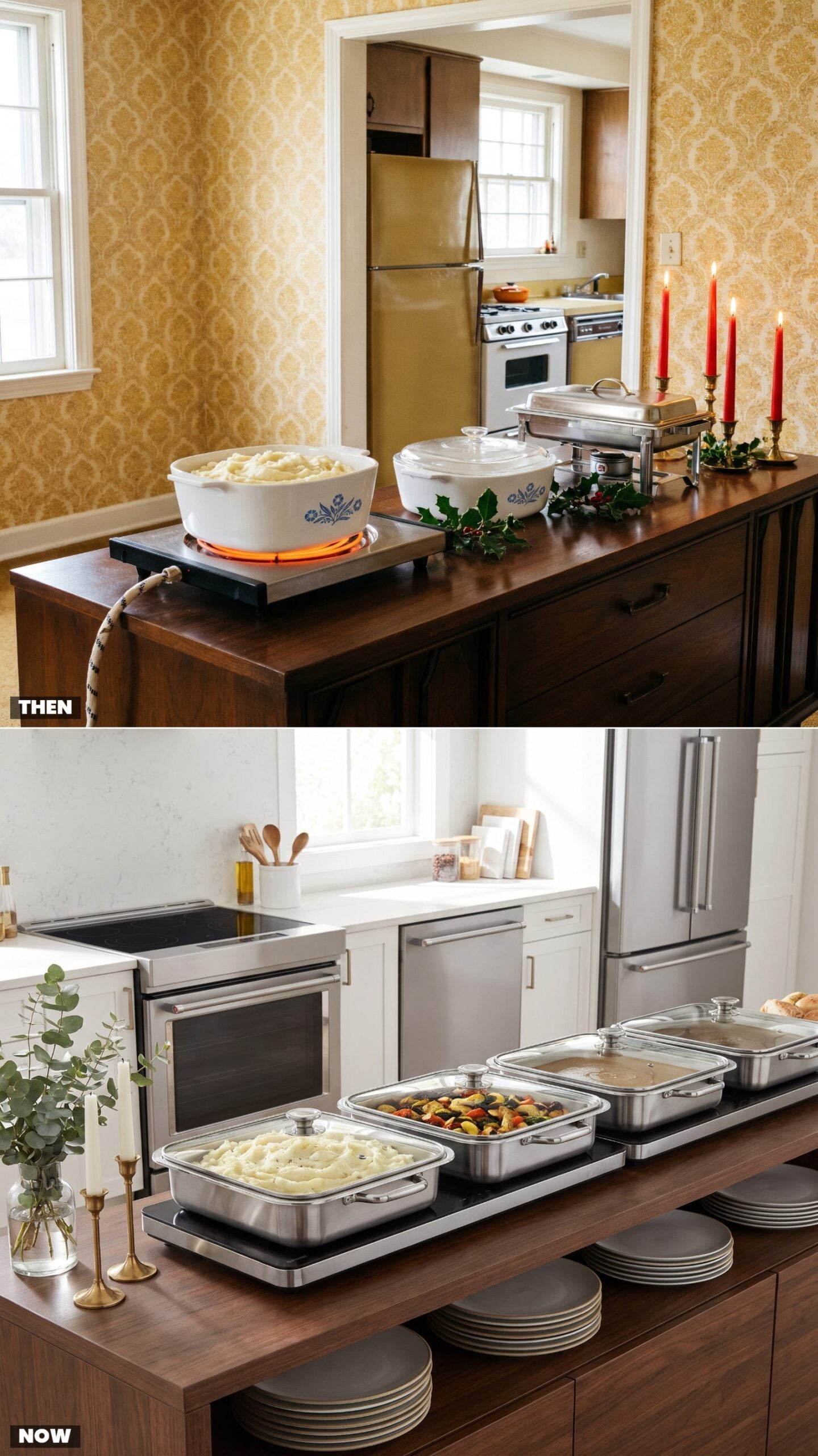
The blue cornflower CorningWare was the workhorse, and the electric warming tray was its loyal sidekick. You plugged in the tray hours ahead, lined up your casseroles, and prayed the cord didn’t get yanked by a cousin barreling through for seconds. The potatoes stayed warm. Sort of.
Now the buffet runs on induction — slim warming bases, glass-lidded chafers, no exposed coils lying in wait to brand a forearm. The food holds temperature evenly and the whole line looks less like a fire hazard.
2. Stackable Tupperware vs. Glass Snap-Lid Containers
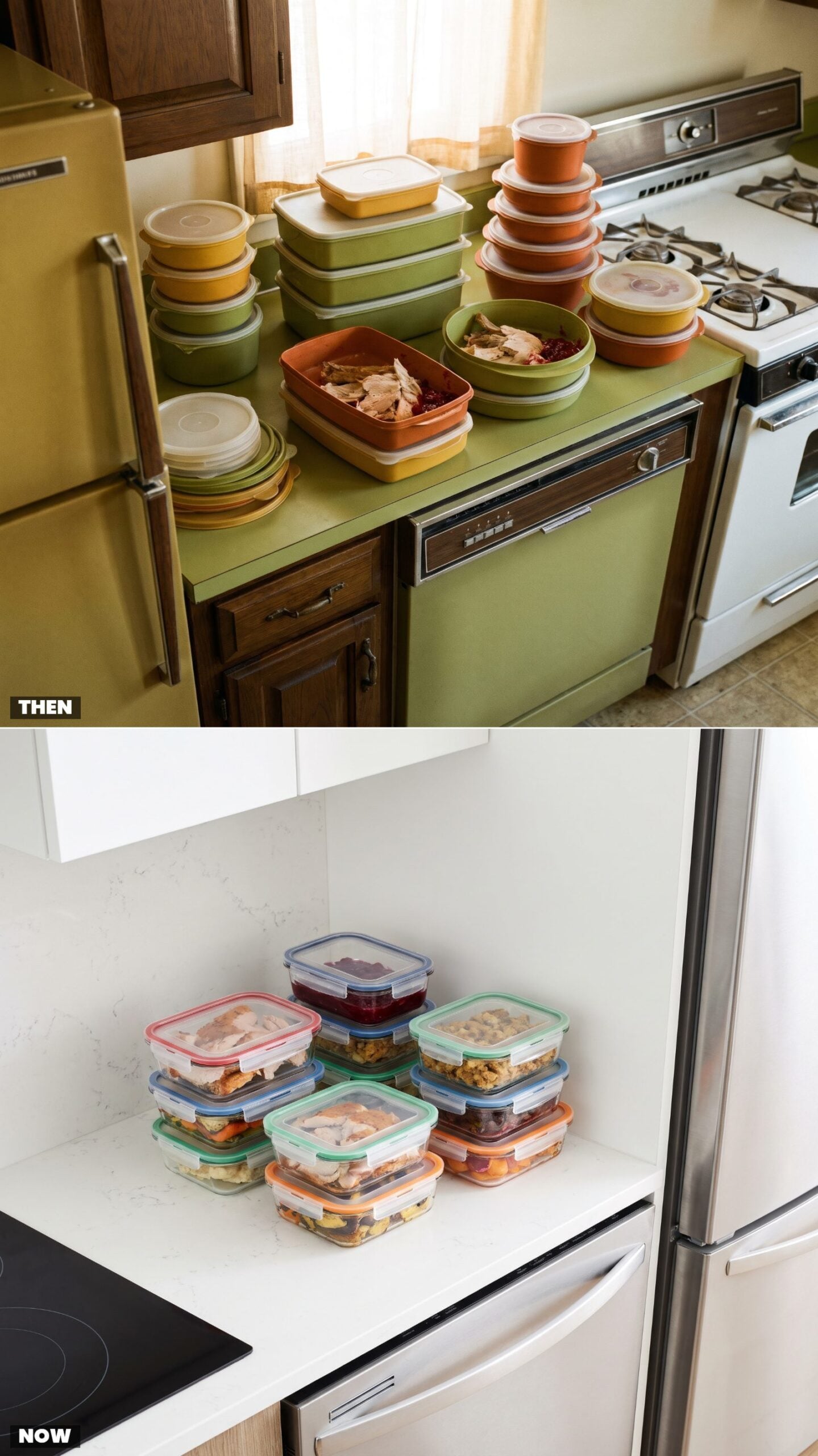
Tupperware was a social institution before it was a container. Harvest gold, avocado, burnt orange — bought at a party in someone’s living room and defended afterward like heirloom silver. You burped the lid. And you never, ever sent one home with a guest without demanding it back.
The glass snap-lid containers that replaced them are honest. You see the leftovers right through the side, they go in the microwave without warping, and nobody has to play detective over whether last week’s chili is still hiding in there.
1. One Kitchen Trash Can vs. Pull-Out Recycling and Compost
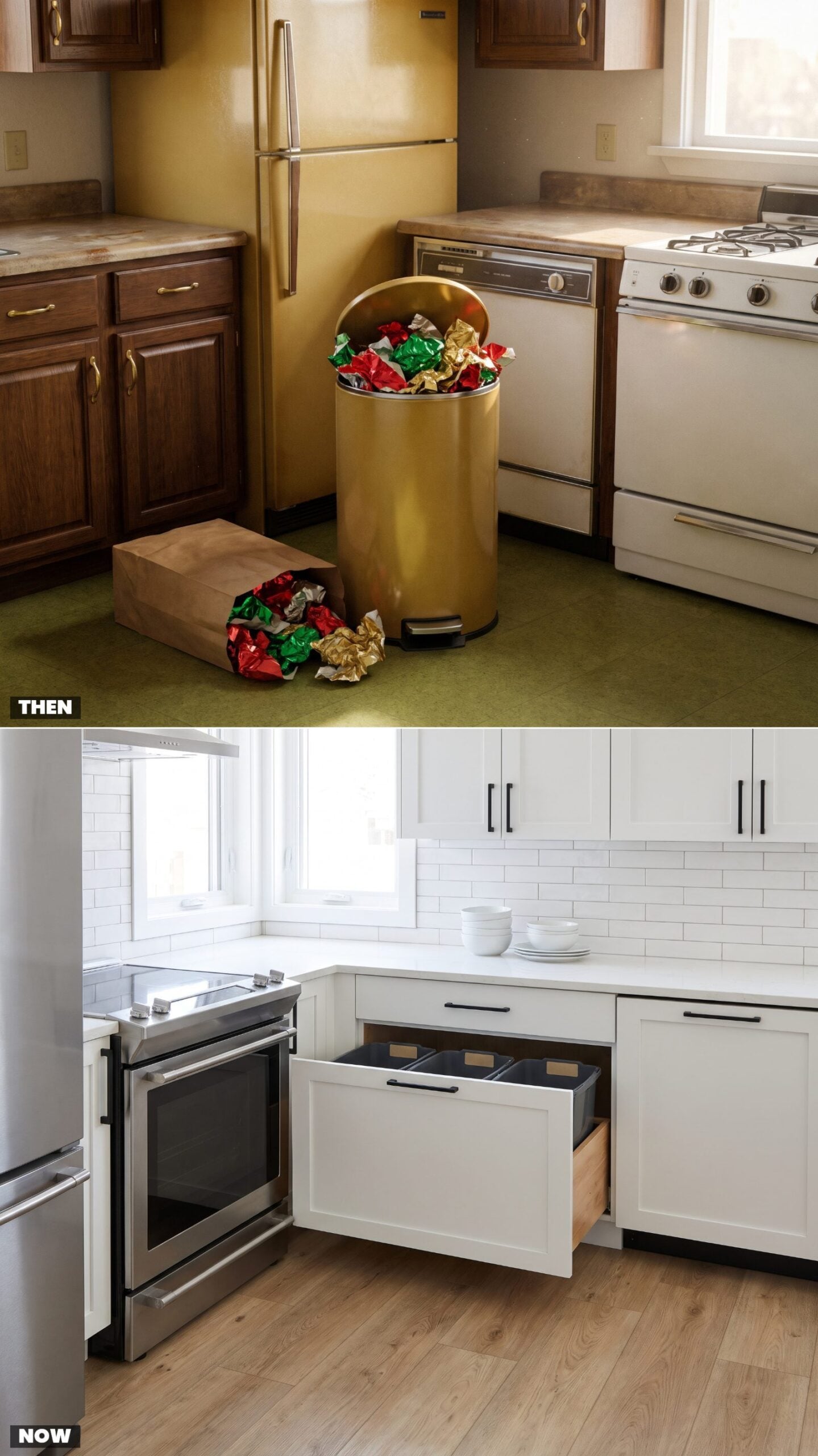
In 1975 the kitchen had one trash can and it held everything — turkey carcass, torn wrapping paper, the foil off the ham, all of it crammed into a single harvest gold step-can until the lid refused to shut. Nobody sorted a thing.
Open a cabinet now and a drawer glides out with three bins: trash, recycling, compost. Christmas morning wrapping paper gets triaged on the spot. It’s tidier, and it quietly nudges everyone in the house toward being a slightly better person — no lecture required.