
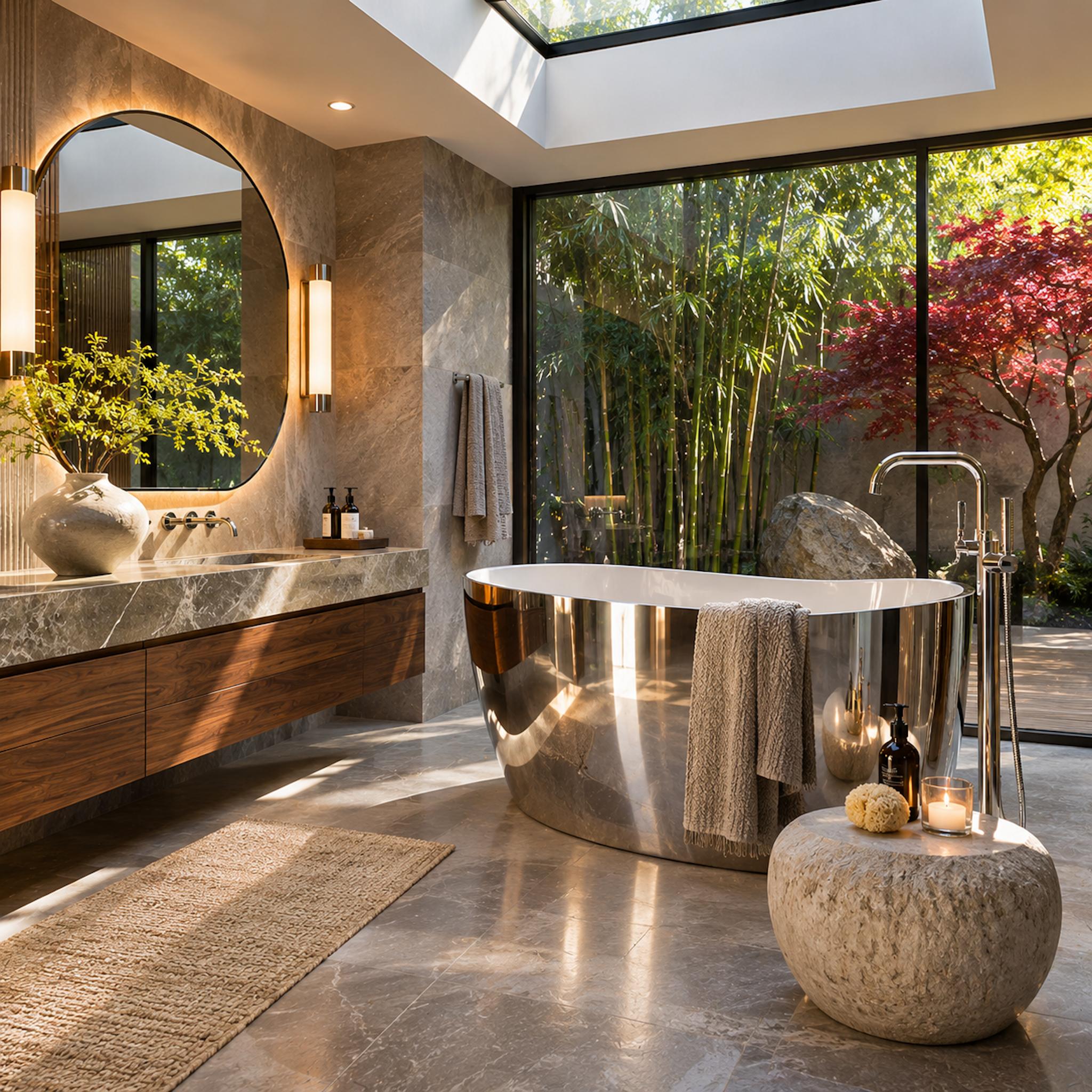
Chrome has a reputation problem. Too cold for a living room, too clinical for a bedroom, too shiny to be trusted with anything softer than a waiting-room chair. Then a steel frame slips beneath a velvet seat, a polished tube traces the curve of a bouclé sofa, and the alleged offender starts making the rest of the furniture look timid.
In order to come up with the very specific design ideas, we create most designs with the assistance of state-of-the-art AI interior design software. Also, assume links that take you off the site are affiliate links such as links to Amazon. this means we may earn a commission if you buy something.
The real trick is contrast, not camouflage. Chrome can support a substantial chair while barely interrupting the floor beneath it. Bent steel can turn a hard material into a fluid silhouette. Against walnut, travertine, oxblood lacquer, and rough plaster, its reflections become part of the architecture. And when mirror-polished stainless steel takes over an island, a shower enclosure, or an entire vanity, the metal stops playing a supporting role altogether.
Across these 38 interiors, steel bends into furniture, climbs library walls, supports marble slabs, and turns bathrooms into gleaming architectural spectacles. Some rooms whisper. Others practically require sunglasses.
38. The Sofa Wears Chrome Like Jewelry, While a Wall of Onyx Steals the Night
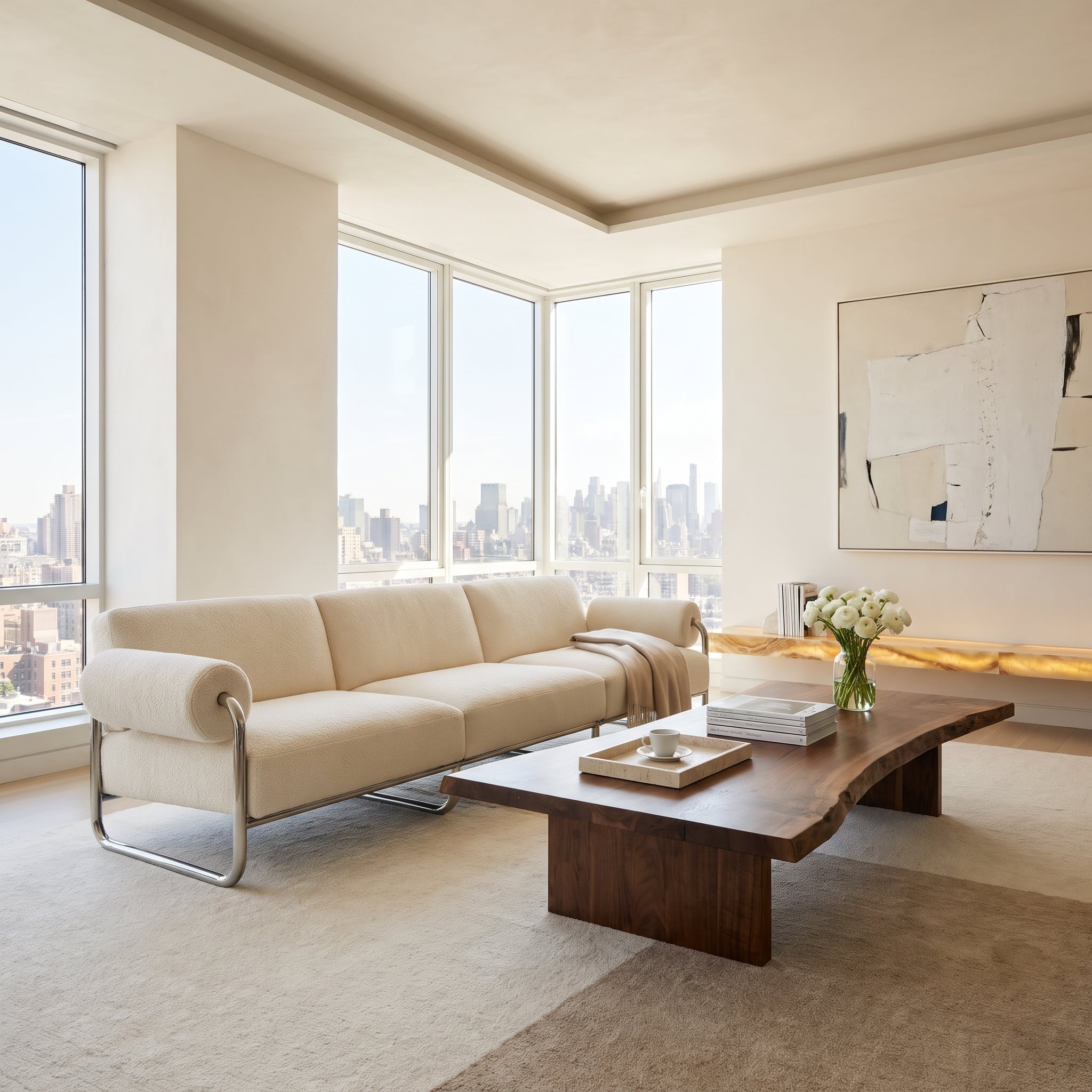
Enormous rolled bouclé arms give this sofa the proportions of upholstered architecture. Polished steel loops trace their curves and continue into a slim sled base, drawing a precise metallic outline around the generous upholstery.
Across the rug, a substantial live-edge walnut table supplies the opposite character: irregular, solid, and unapologetically heavy. Corner windows open the room toward the city, leaving the low furniture free to occupy the foreground without obstructing the view.
Then there’s the floating onyx shelf beneath the abstract canvas. Its illuminated amber veining turns an otherwise quiet wall into a second focal point, particularly after dark. Cloudlike upholstery, gleaming steel, rugged walnut, and stone with its own internal weather system create a room full of competing textures and remarkably little visual confusion.
The sofa supplies the curves. The onyx supplies the after-hours entertainment.
37. Terracotta Takes Over the Ceiling, and the Steel Chairs Refuse to Compete
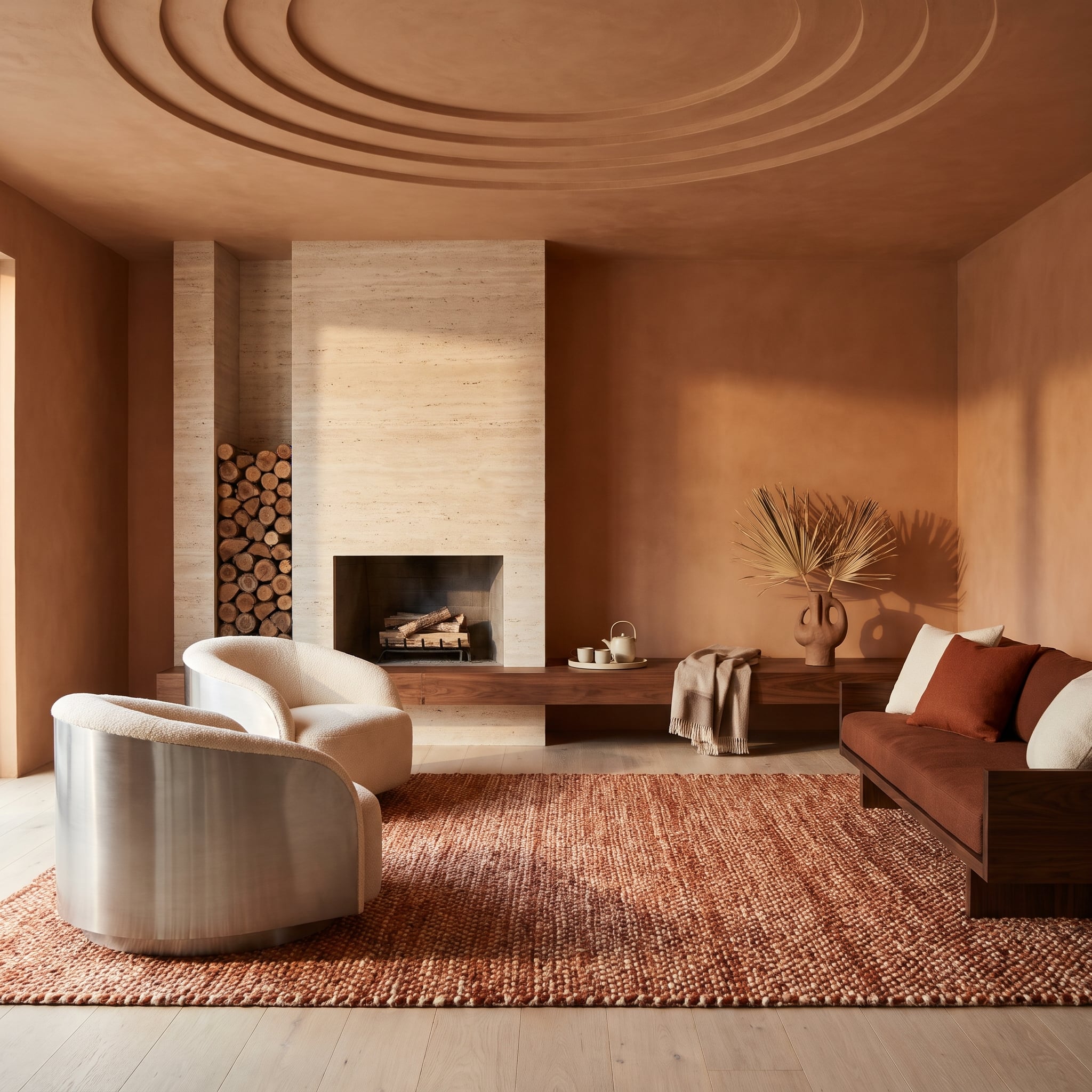
Terracotta plaster climbs the walls and continues overhead, where concentric ceiling rings give the room the appearance of a sculpted clay vessel. Against that continuous warm surface, elaborate furniture would have considerably more competition than it needs.
The bouclé swivel chairs answer with rounded backs wrapped in brushed steel. Their metallic bands provide definition without introducing another elaborate shape, while the woven rug brings a deeper rust tone beneath the seating.
A walnut ledge extends from the travertine hearth, establishing a strong horizontal line against the ceiling’s circular movement. The architecture swirls, the furniture curves, and the hearth gives the eye somewhere to settle.
When the ceiling is already performing, the chairs don’t need a solo.
What Our Readers Say
- Not everyone is sold on chrome yet: in Home Stratosphere readers’ heart votes, images featuring chrome got hearts 44% of the time, versus 56% for the other images in the same articles.
From Home Stratosphere reader polls and votes.
36. The Dressing Island Looks Like a Jewel Box That Forgot to Stay Small
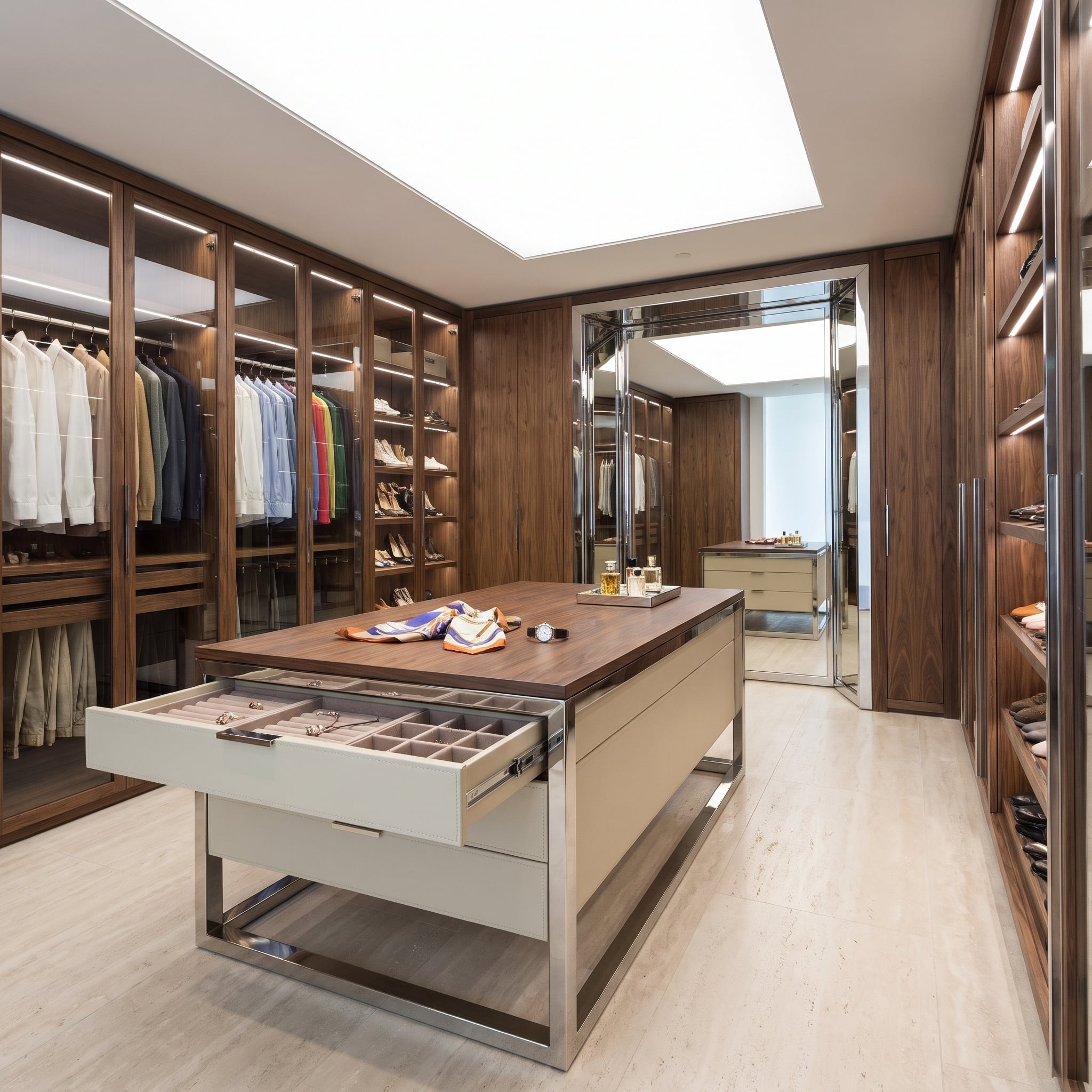
Stitched leather wraps the dressing island’s drawer fronts, while a polished steel framework lifts the entire cabinet above the travertine floor. The result looks less like conventional closet storage and more like an oversized piece of luxury luggage displayed in a gallery.
Open drawers reveal velvet-lined compartments for jewelry, turning organization into part of the design. The walnut countertop provides a surface for smaller accessories, while the exposed metal base gives the cabinet a lighter silhouette than its substantial dimensions suggest.
At the far end, a mirrored opening adds another layer of reflection. Illuminated glass-front wardrobes transform the clothing into a carefully ordered display, with polished metal connecting the central island to the surrounding architecture.
The open framework reveals a generous strip of travertine beneath the cabinet. Even the floor gets a place in the display.
35. Blue Velvet, Chrome Cantilevers, and a Chandelier With Absolutely No Modesty
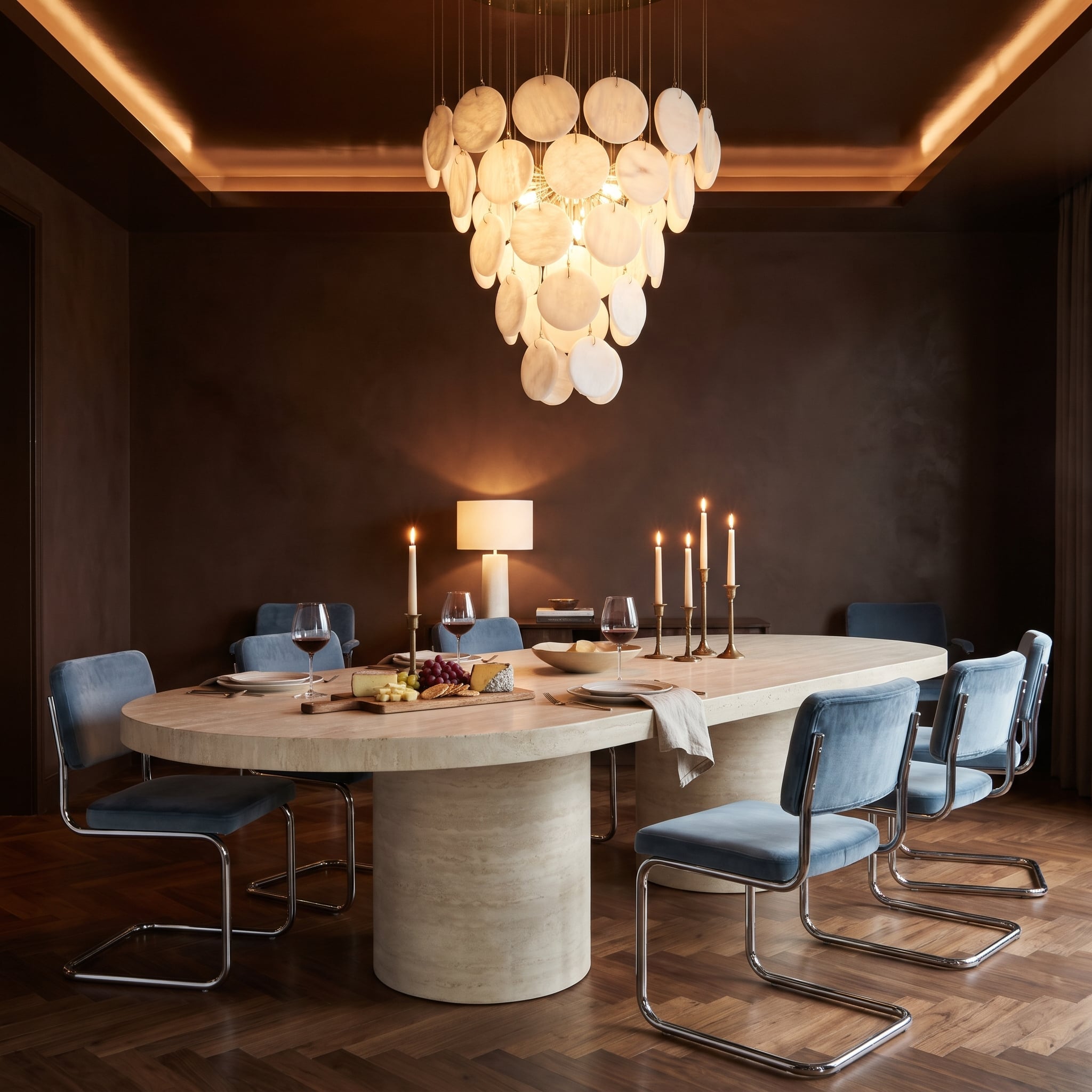
Dusty-blue velvet gives each dining chair a substantial upholstered body supported by relatively little visible metal. Polished steel bends beneath the seats in continuous cantilevered lines, bringing a sense of movement to the arrangement around the table.
Travertine takes a more monumental approach. Its racetrack-shaped top rests on two broad cylindrical supports, with rounded ends that soften the table’s considerable mass and simplify movement around its perimeter.
Overhead, alabaster discs tumble through a dramatic suspended composition. Their warm glow reveals variations within the stone, while the dark walls make the illuminated forms particularly prominent.
Fine metal lines, substantial stone cylinders, and an extravagant cloud of glowing discs operate at three different scales. None is remotely shy.
Subtlety has been invited to dinner. Nobody expects it to dominate the conversation.
34. The Kitchen Island Looks Like Liquid Steel, and the Walnut Refuses to Blink
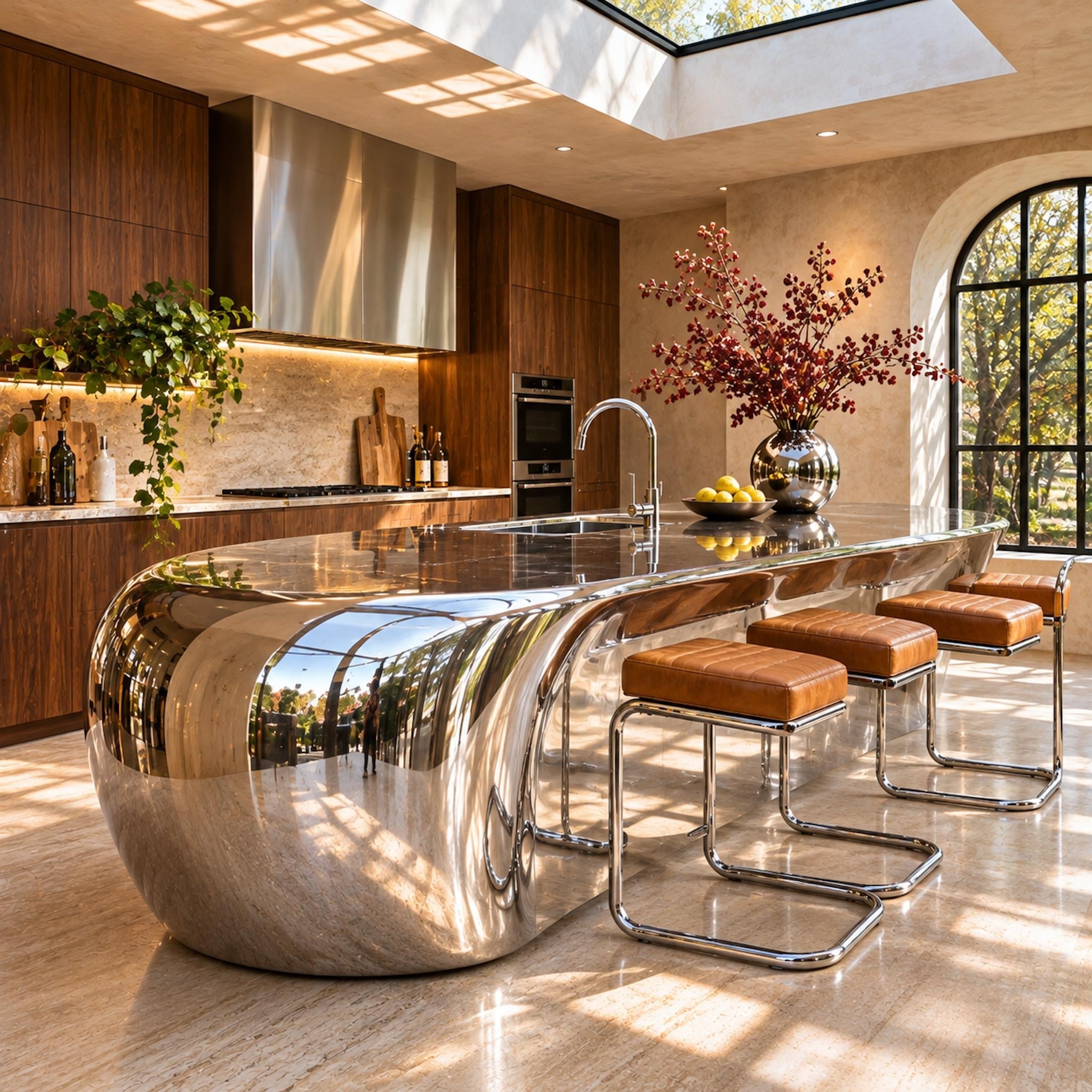
A mirror-polished stainless-steel island sweeps across the kitchen in one long, rounded form, its curved end reflecting the travertine floor, arched window, and stools in distorted ribbons. The integrated sink and gooseneck faucet interrupt the shining surface only where the work demands it.
Behind the island, walnut cabinetry brings the room firmly back to earth. A stainless-steel range hood repeats the cooler finish in a quieter, brushed form, while the stone backsplash and warm ceiling keep the setting unmistakably residential.
Cognac-leather cantilever stools line the island’s straight side. Their slim chrome frames pick up the metal’s shine, while their padded seats provide a welcome contrast to the almost liquid-looking cladding.
The island doesn’t borrow the spotlight. It manufactures its own.
33. A Folded Steel Console Makes the Entrance Before Anyone Else Does
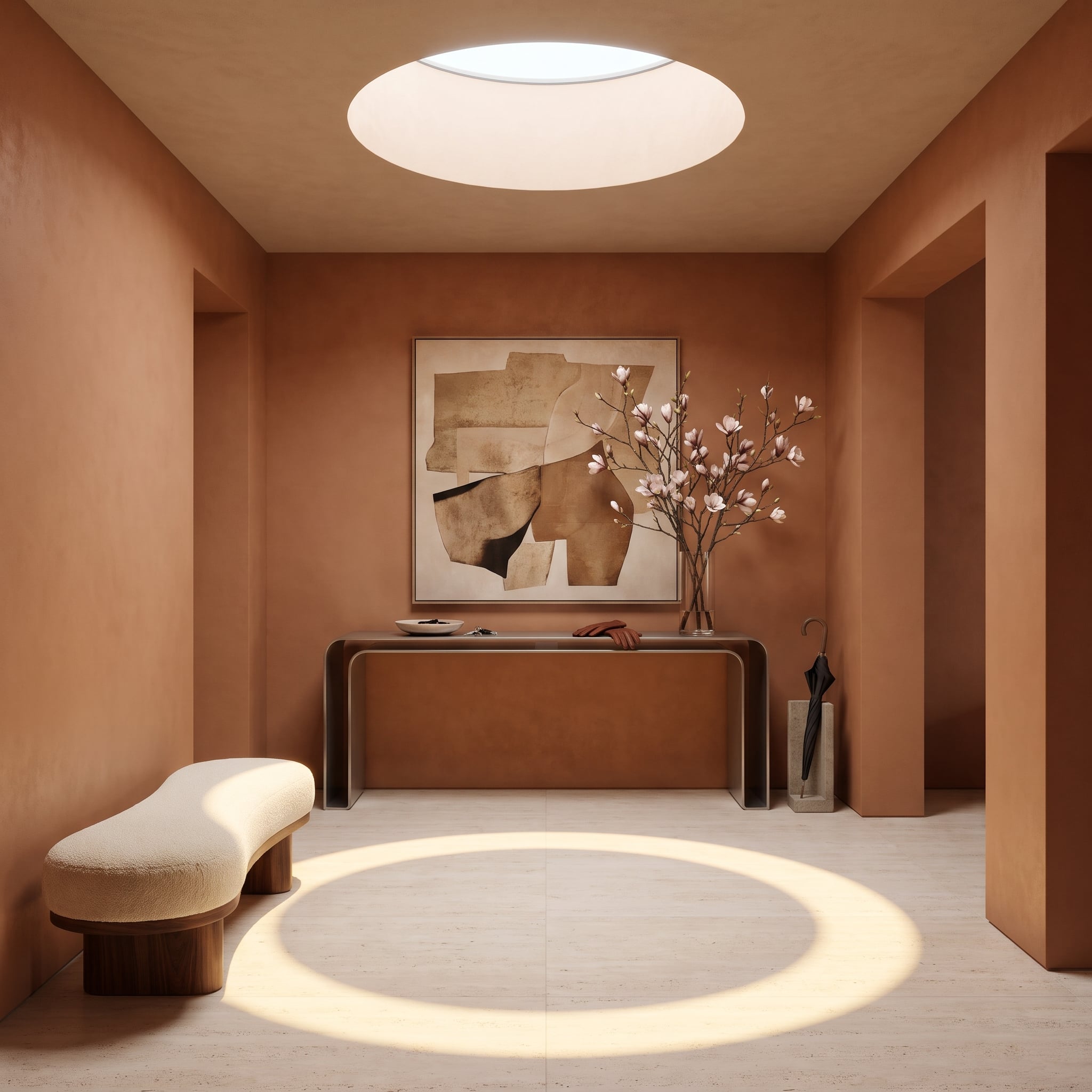
The console looks like a broad ribbon of brushed steel folded into furniture. Its open underside reveals the plaster wall behind it, giving the piece a surprisingly light presence despite the solidity of its material.
Across the travertine floor, a bouclé bench supported by walnut blocks offers a softer place to sit while removing shoes. One piece is sharply folded and metallic; the other is padded, grounded, and deliberately uncomplicated.
Overhead, the circular skylight introduces a pool of daylight that connects the two. Its geometry counters the angular console, while the stone floor provides a continuous surface beneath both pieces.
The steel console brings the sculpture. The bouclé bench handles the everyday business of coming and going.
32. Plum Lacquer Above, Polished Steel Below, and a Bar Waiting Behind the Paneling
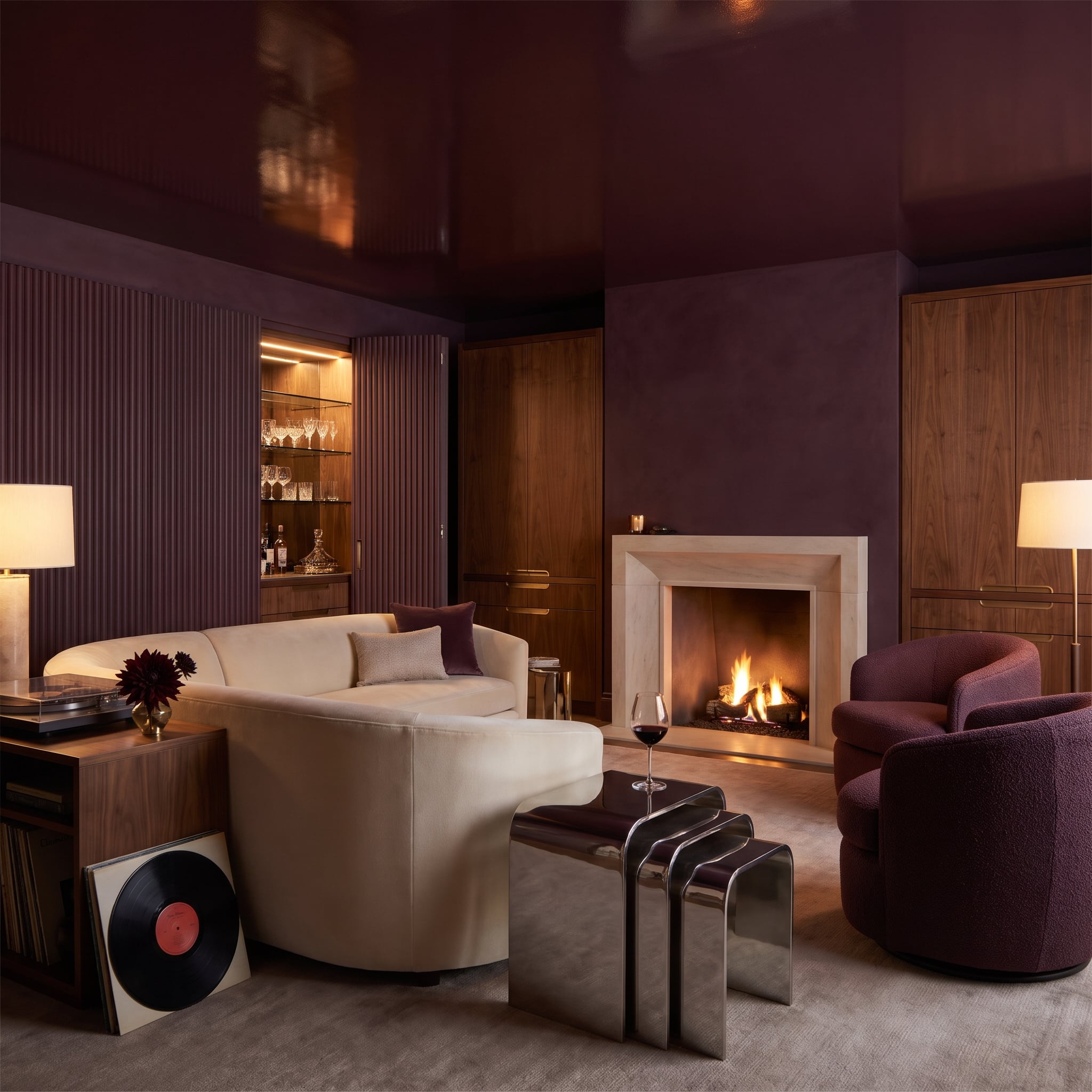
The plum lacquer ceiling reflects the room in broad, glossy passages. Beneath it, polished-steel nesting tables offer smaller, sharper reflections, their waterfall forms arranged at staggered heights in front of the curved cream sofa.
The separate tables can be distributed around the seating when additional surfaces are needed, then gathered into a compact arrangement. Curved velvet seating and bouclé swivel chairs surround them, their generous upholstery offsetting the crisp edges of the metal.
Fluted plum paneling conceals an illuminated glass bar. Open, it becomes a glowing focal point; closed, it returns the wall to its continuous rhythm. Above, the lacquer multiplies reflections while the paneling makes an entire bar disappear.
The tables move around. The bar disappears. Even the architecture has learned a party trick.
31. One Mustard Chair, One Courtyard of Ferns, and a Window That Refuses to Have a Corner
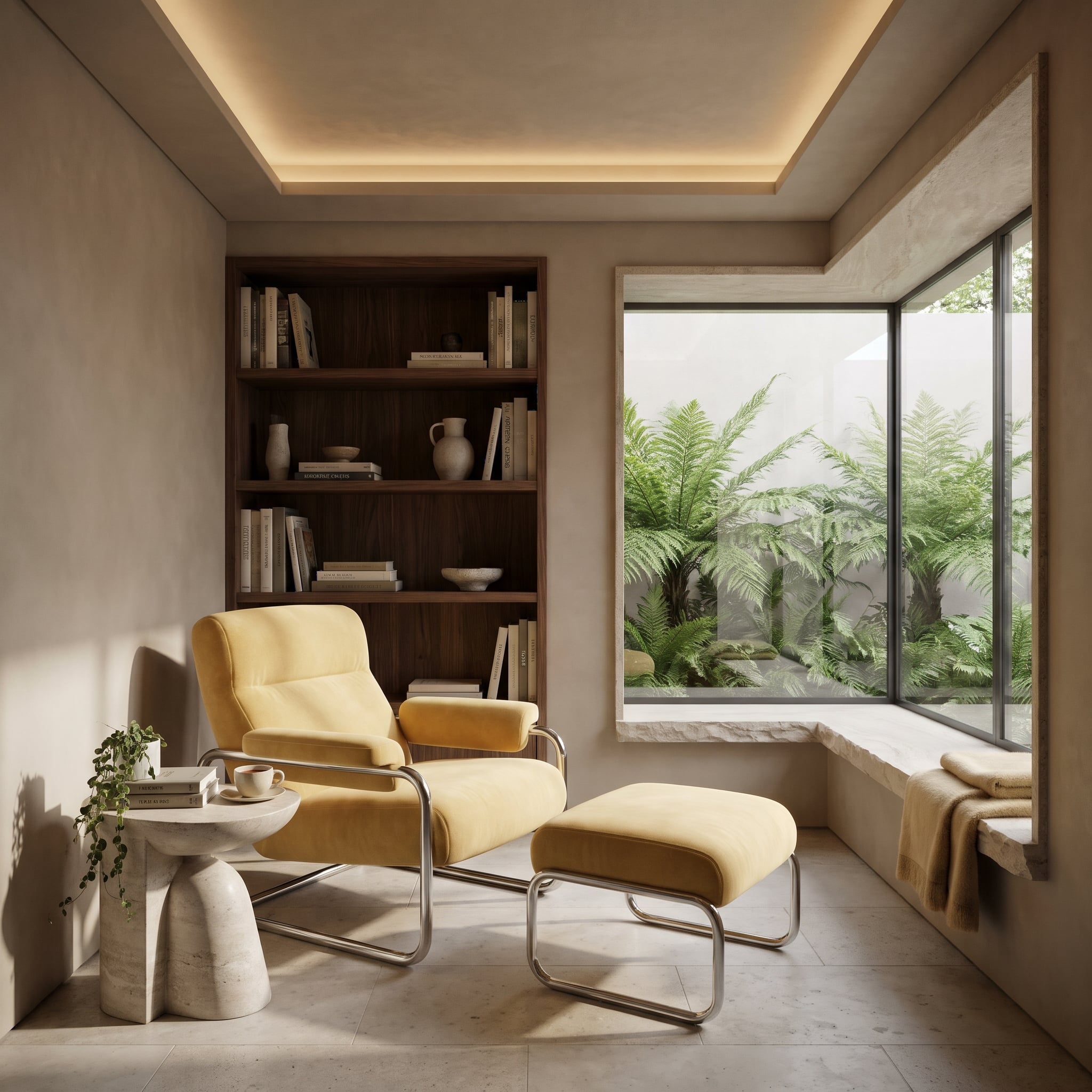
Tree ferns fill the courtyard beyond two meeting panes of glass. With no conspicuous corner post interrupting the view, the garden reads almost like a continuous landscape photograph.
The mustard velvet lounge chair answers with an equally fluid silhouette. A chrome tube bends beneath the seat and around its arms, while the matching ottoman follows the same geometry at a lower height. Together they form a coordinated arrangement without the visual bulk of a conventional upholstered recliner.
A rough-edged stone sill brings texture to the glazing, and recessed walnut shelving provides room for books without projecting into the seating area. The small travertine side table sits within comfortable reach of the chair.
The furniture has excellent curves. The view has an entire forest of them.
30. Eight Cream Cantilevers Against Cobalt Blue Make a Marble Table Look Almost Weightless
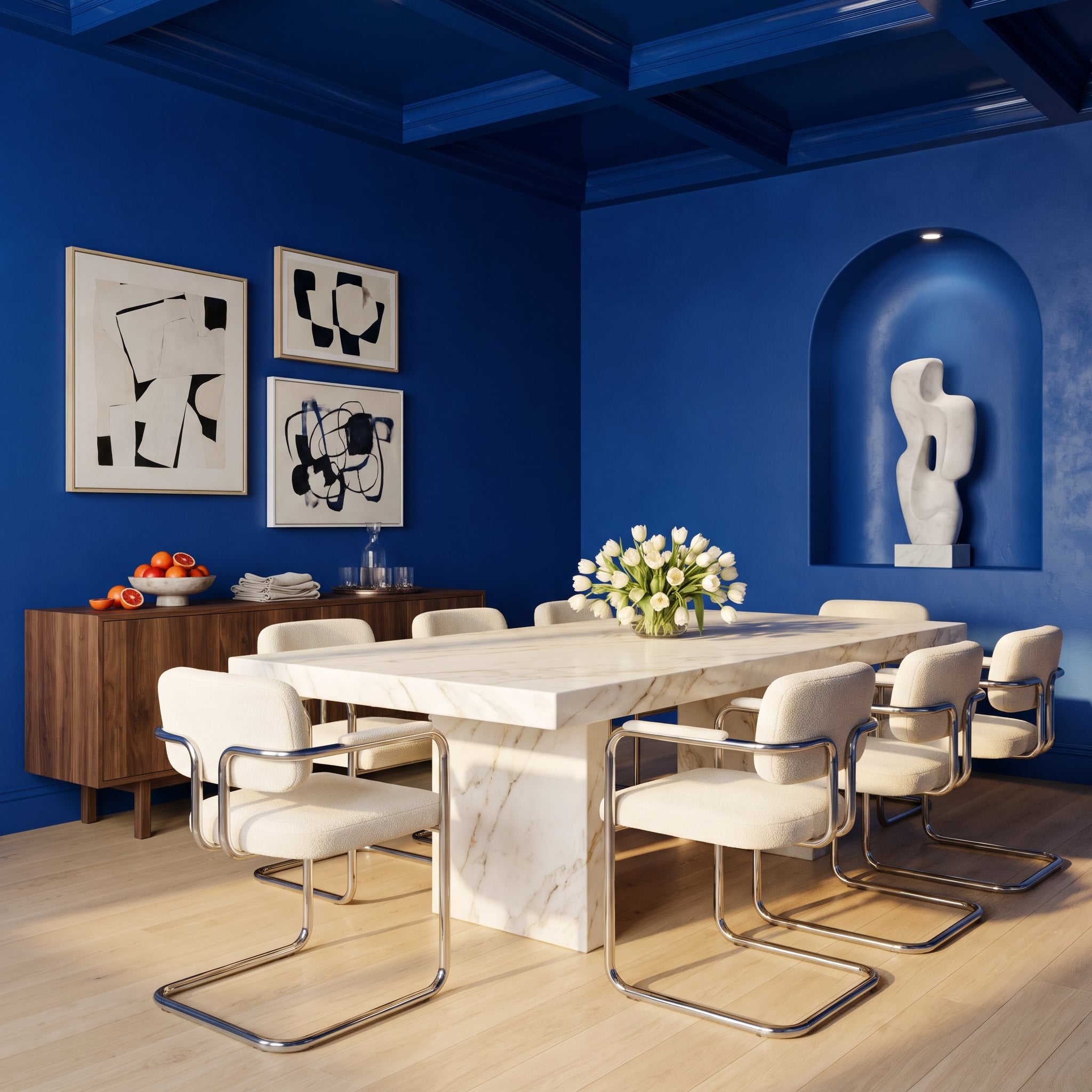
Cobalt blue covers the walls and continues into the ceiling coffers, creating a saturated architectural envelope around the dining area. The color is emphatic enough to make even the white marble table appear unusually luminous.
Eight cream bouclé chairs surround the slab, each supported by a slender cantilevered steel frame. Their open bases reveal the floor beneath the seating, giving the substantial tabletop an unexpectedly light-looking company.
The ceiling’s recessed geometry supplies depth without introducing another color, while the polished metal catches narrow highlights against the blue. Blood oranges on the table deliver a concentrated accent of warmth.
Eight chairs, one slab of marble, and enough blue to make the sky look underdressed.
When our readers disliked a dining room and gave a reason, “too cold” was among the top complaints at 16%, which is exactly what a saturated envelope like this helps chrome avoid.
29. The Conversation Pit Drops Below Floor Level, and Mocha Velvet Circles the Fire
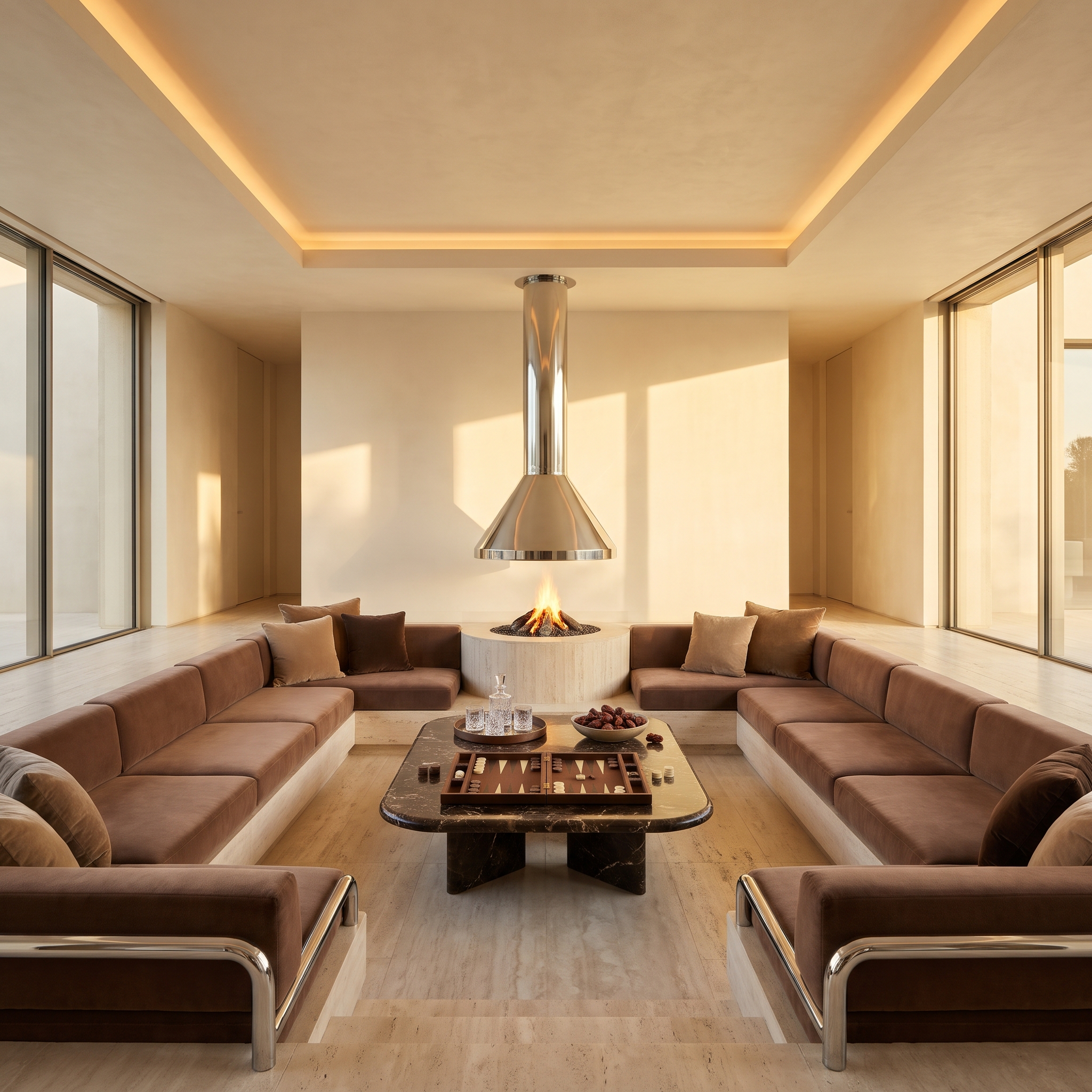
Sunken seating changes the social geometry of a room. Instead of arranging individual sofas around a coffee table, this conversation pit establishes a defined gathering place, with mocha velvet wrapping the lowered floor around a central travertine fire feature.
Chrome appears selectively at the ends of the upholstered runs. Those tubular arms establish clean stopping points for the generous seating, preventing the velvet from becoming one uninterrupted mass.
Above the fire, a suspended steel hood repeats the metallic finish on a much larger scale. Steel marks the ends of the seating and returns overhead as part of the fireplace composition, while the lowered floor gives the entire gathering area a sense of enclosure.
This isn’t furniture gathered around a fireplace. It’s an entire floor plan organized around the conversation.
28. A Desk Curls Like Poured Cream While Chrome Chairs Keep Their Angles Sharp
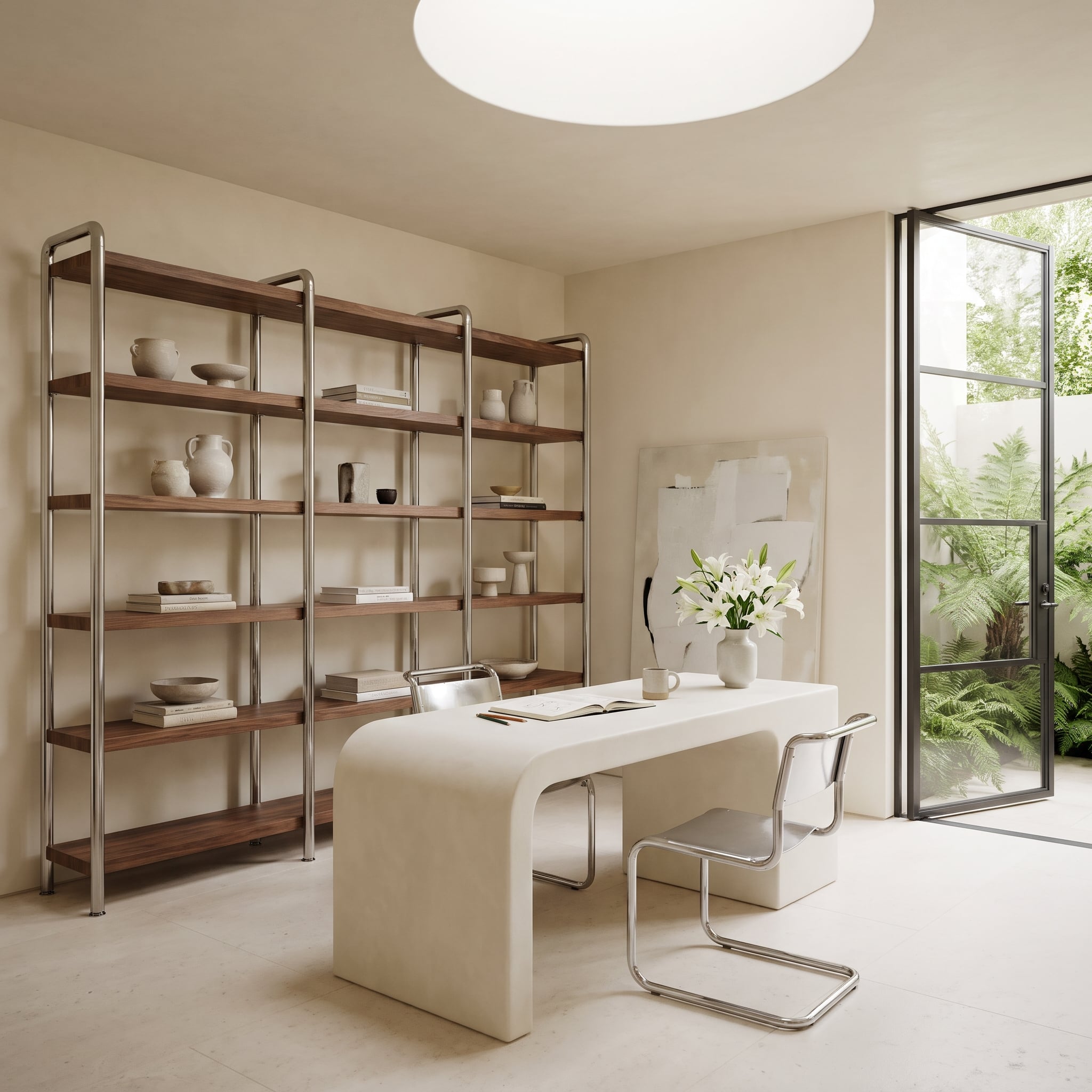
The desk looks as though a thick ribbon of cream-colored material has been folded over at both ends and allowed to settle onto the stone floor. Its rounded waterfall profile removes the familiar distinction between tabletop and legs, leaving one continuous sculptural form.
Beside it, the chrome cantilever chairs are all exposed structure, with slender bent tubes defining their sharp silhouettes. Their spare construction provides a striking foil for the desk’s generous curves.
Behind the desk, chrome shelving uprights rise into rounded arches, repeating the chair frames at a larger scale. Walnut shelves introduce horizontal bands of color and texture between the metal supports.
The desk has the softness of a sculpture. The chairs have the discipline of drafting instruments.
27. A Chrome Daybed Between the Swimming Pool and the Afternoon Nap
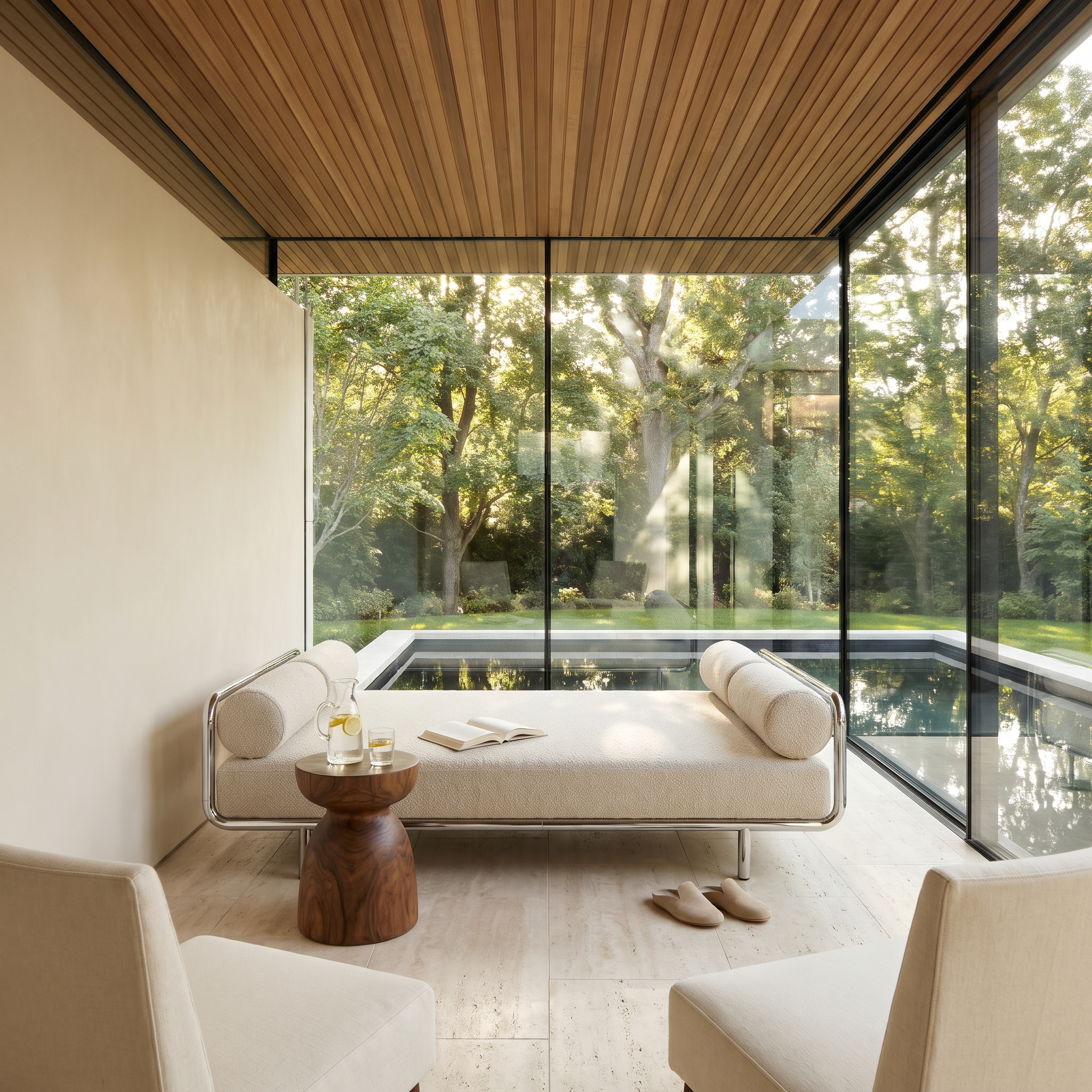
A low bouclé daybed occupies the foreground of this poolside room, its padded mattress contained within a continuous frame of bent chrome tubing. The metal follows the cushion’s perimeter with a rounded precision that echoes the pool edging beyond the glass.
The daybed’s backless profile preserves views toward the water from the seating behind it, while its slender support frame exposes the floor beneath the cushions.
Cedar slats overhead establish a warm architectural rhythm against the broad glass wall and reflective steel. The low furniture leaves the pool and terrace in full view, giving the room the relaxed character of a sheltered outdoor lounge.
26. Butter-Yellow Velvet Meets Oxblood Walls, and the Walnut Doors Catch Every Ray
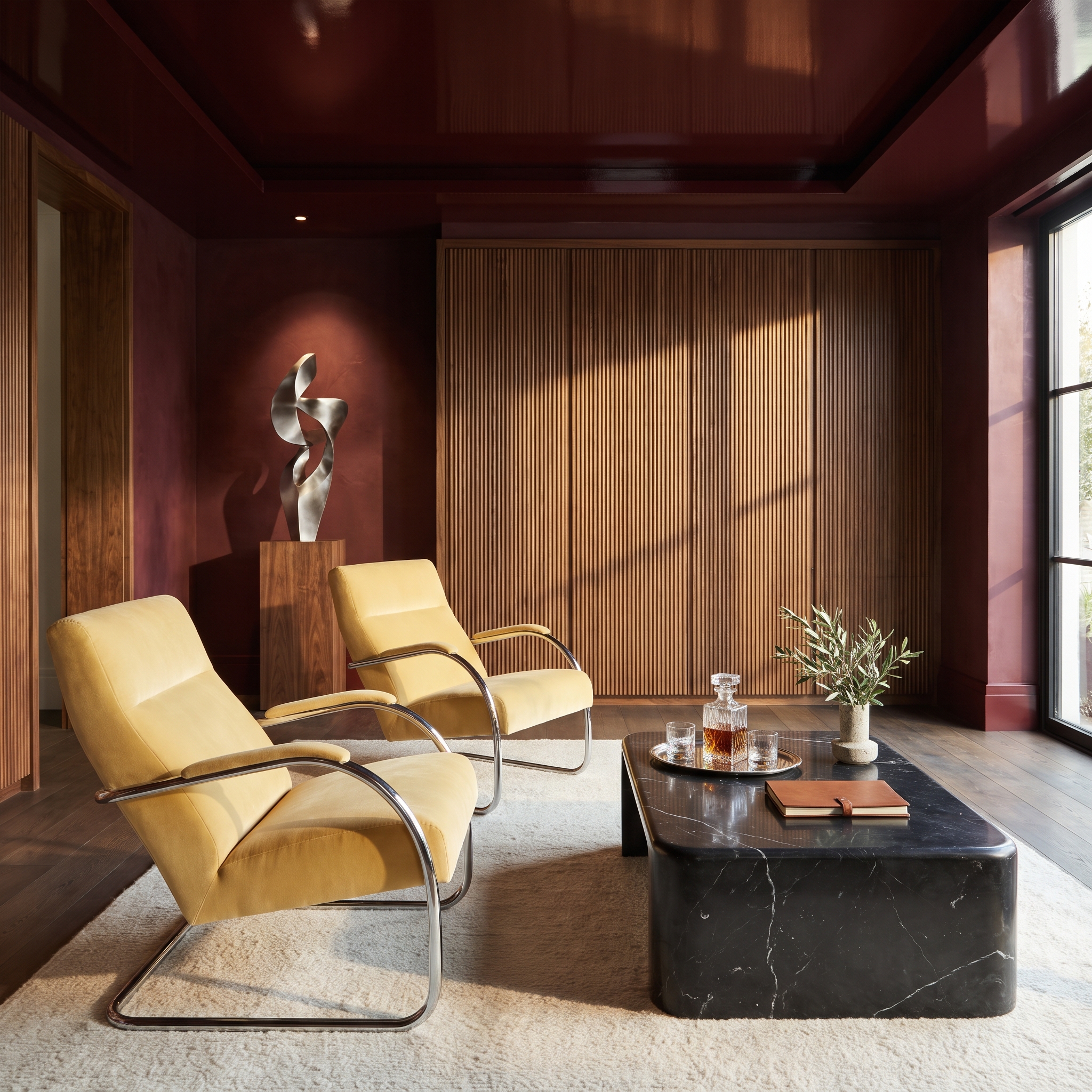
Butter-yellow velvet brings an unexpected brightness to this oxblood room. The chairs’ looped chrome frames introduce narrow highlights beneath the saturated upholstery, while the rounded black marble table follows their curves on a more substantial scale.
The lacquered ceiling adds another reflective surface, giving the dark palette a depth that flat paint would not produce. Yet the most interesting wall treatment may be the full-height reeded walnut doors.
Sunlight catches their vertical ribs in alternating bands of brightness and shadow, revealing the grain without interrupting the continuous surface with conspicuous handles. Against the polished ceiling and table, the wood’s quieter texture becomes especially valuable.
The velvet gets the first glance. The walnut earns the second.
25. Walnut Stairs Become a Sculptural Platform Beside a Chrome Loop Chair
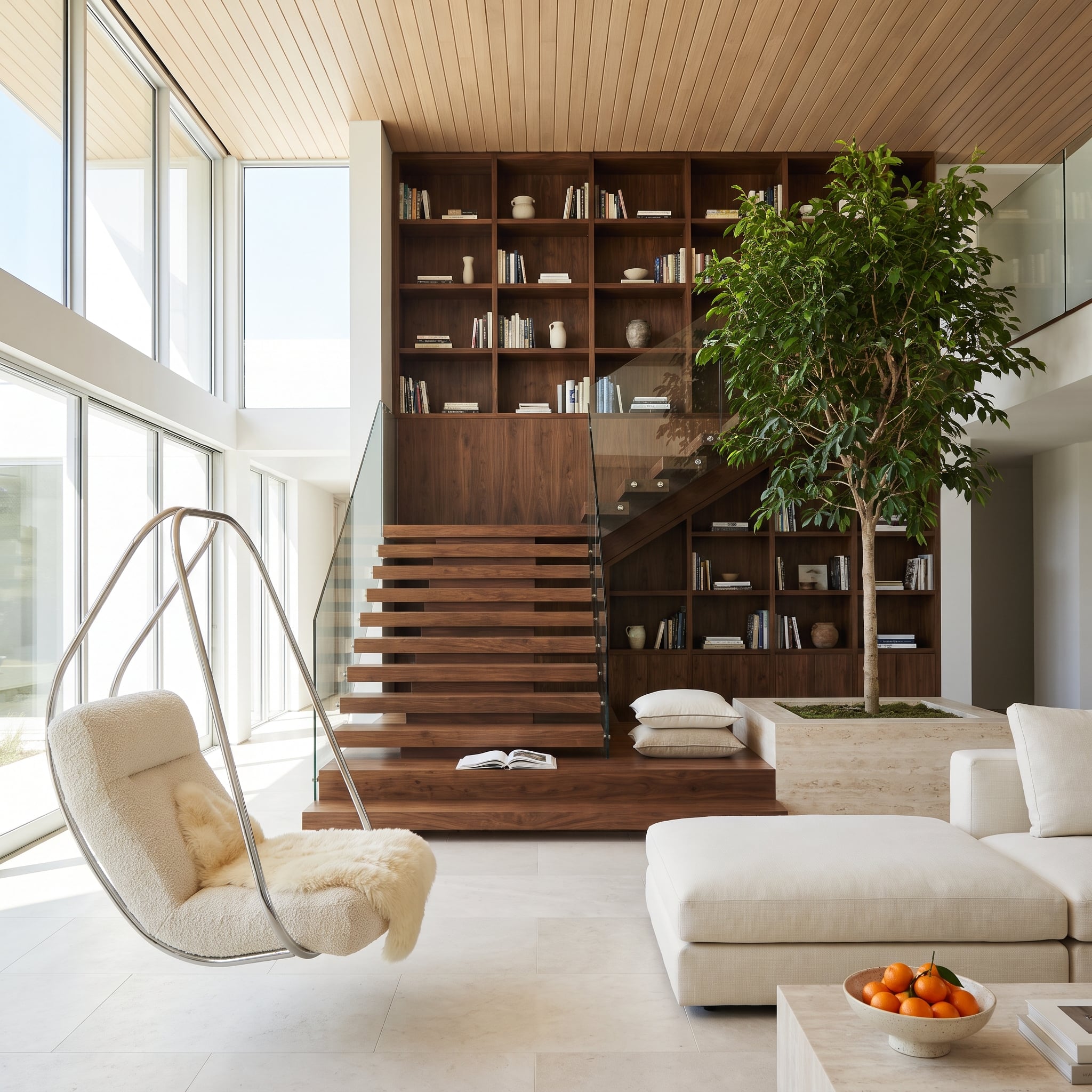
Walnut dominates the rear wall, beginning as shelving and continuing into a staircase whose lower treads widen into a series of stacked platforms. The transition gives the stair an architectural presence beyond its ordinary function of connecting floors.
In front of the dark wood, a bouclé lounge chair rests within a polished chrome loop. Its slender frame contrasts with the substantial walnut construction, while a sheepskin adds another layer of texture to the seat.
The lower stair platforms extend toward a travertine planter, linking the steps, surrounding floor, and greenery through a continuous composition. Their broad surfaces resemble architectural terraces, turning the staircase into an extension of the room’s furniture arrangement.
Light from the nearby window travels across the limestone floor and through the chair’s open frame. The staircase is substantial enough to command the room; the chrome chair appears almost weightless beside it.
24. A Curved Steel Shower Turns the Bathroom Into a Room Within a Room
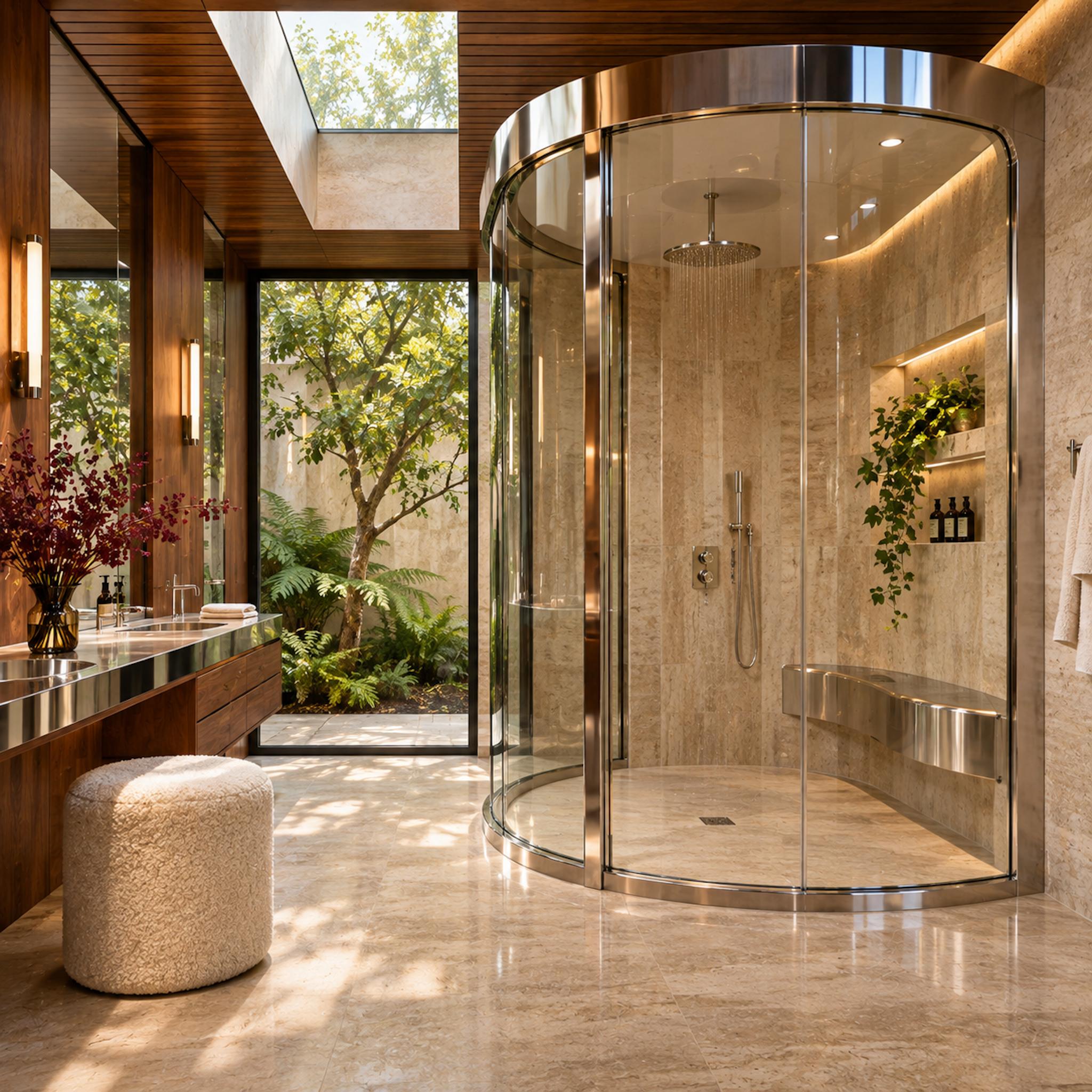
A broad arc of polished stainless steel crowns this glass shower, giving the enclosure the presence of a freestanding architectural pavilion. Curved glazing follows the metal frame, while a rain shower and wall-mounted hand shower keep the fittings comparatively restrained.
Inside, limestone-colored surfaces continue across the floor and walls, with a curved stainless-steel bench following the enclosure’s perimeter. Clear glass preserves the room’s proportions, while the metal framework draws a dramatic outline around the bathing area.
Walnut overhead, a long vanity to one side, and a planted courtyard beyond the window supply warmth and depth. The polished frame commands attention without closing off the room. Steel has become the architecture, not simply the hardware attached to it.
23. Mustard Leather Gives This Walnut Kitchen a Flash of Chrome and Color
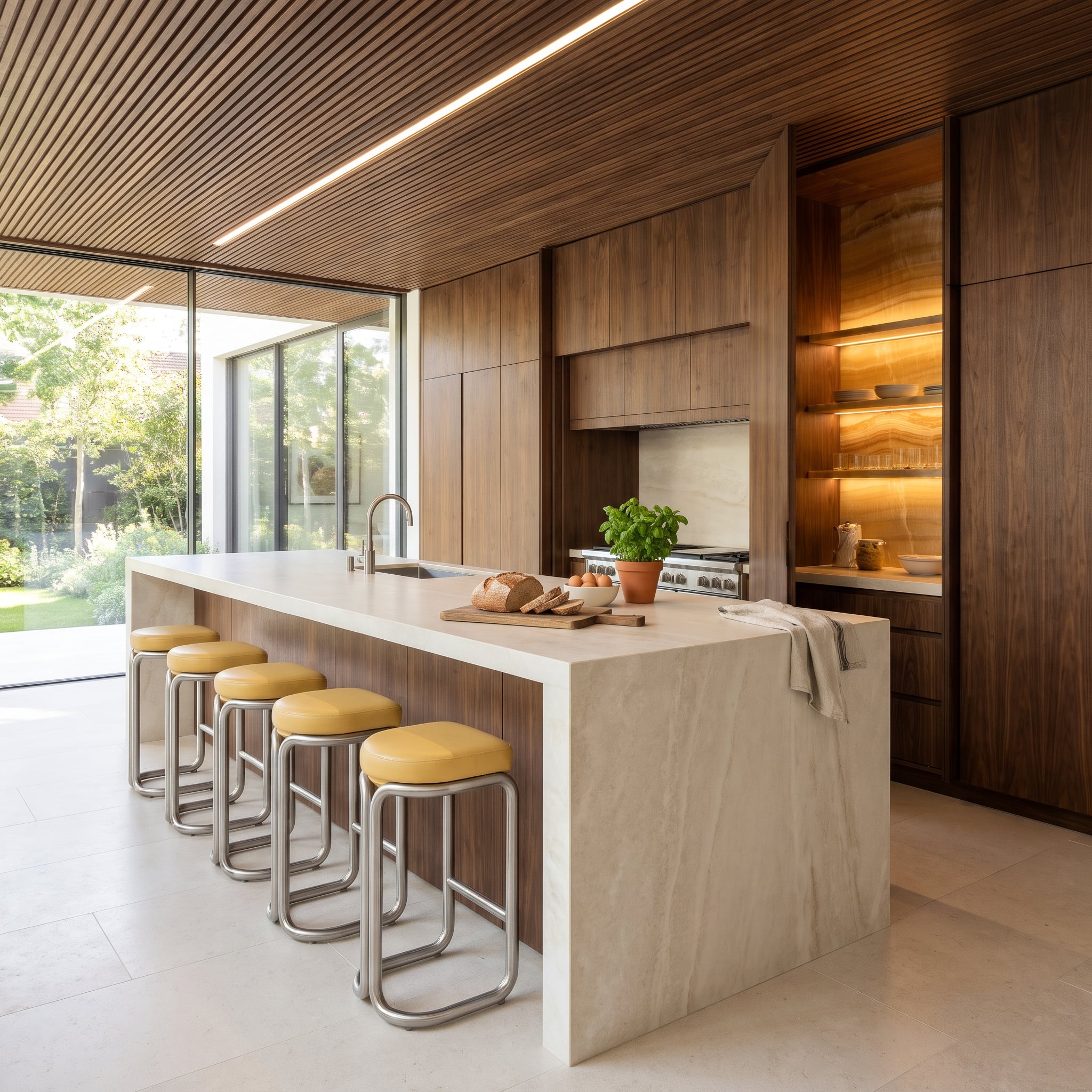
Five mustard-leather stools introduce the brightest color in a kitchen otherwise dominated by walnut, stone, and metal. Their rounded chrome bases leave the floor exposed beneath the island, while the leather brings a concentrated burst of color to the wood-paneled room.
Across the kitchen, a backlit onyx niche echoes the stools’ golden tone at eye level. The relationship connects a row of functional seats to a luminous architectural feature.
The waterfall island adds another kind of continuity. Stone veining travels from the horizontal countertop down the end panel, making the substantial surface read as one composed volume.
Walnut dominates the architecture, onyx lights up the background, and five yellow seats give the island a lively edge. The stools have done more for the room’s color scheme than an entire wall of paint.
22. A Skylight Meets a Garden Slot Above a Plunge Pool and Two Bouclé Chairs
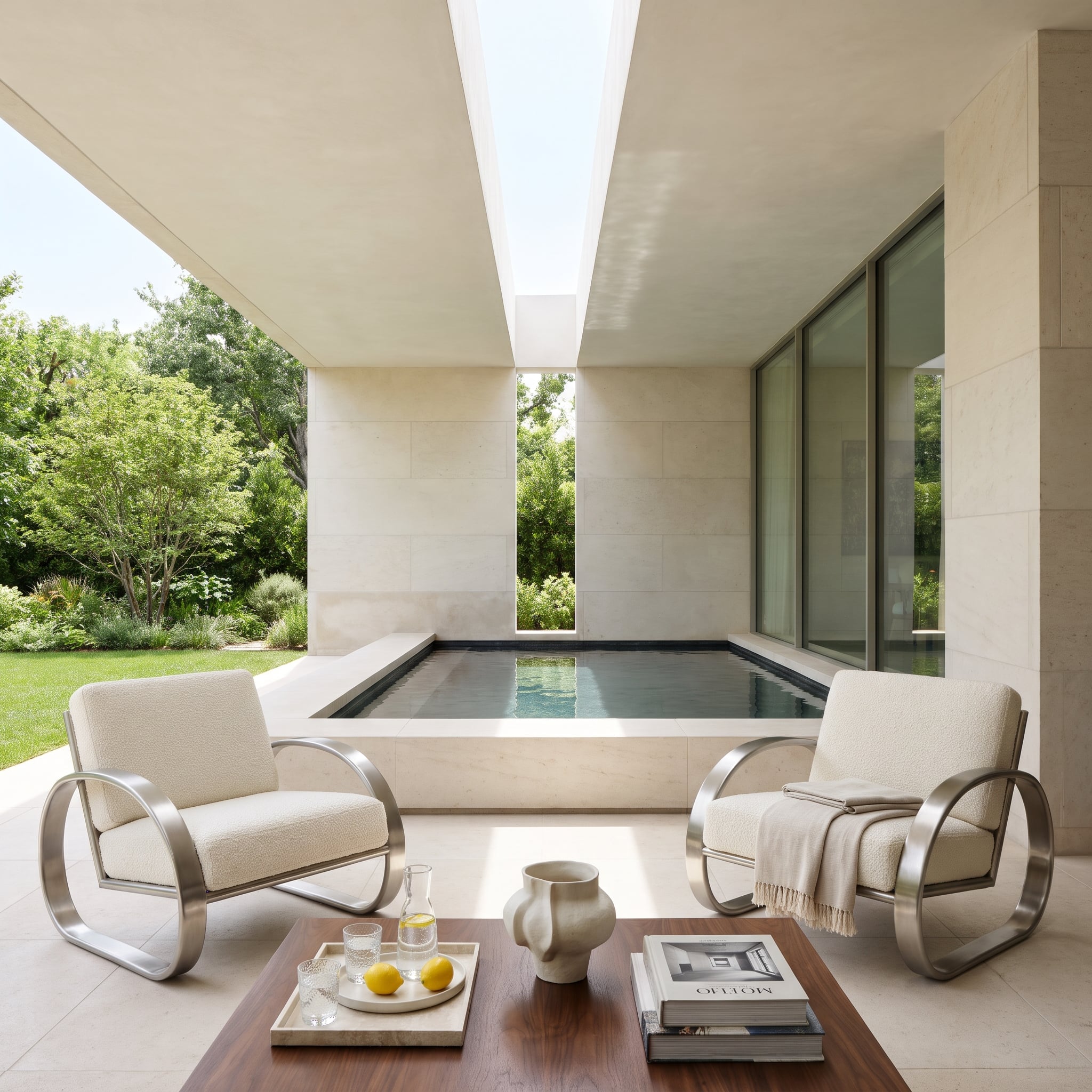
A skylight cuts across the ceiling above a plunge pool, aligning with a narrow opening in the limestone wall that reveals the garden beyond. Together, the two openings bring daylight into the room from different directions and establish a strong visual axis.
Two bouclé chairs with brushed-steel loops sit at opposite ends of a low table, leaving the center relatively open toward the pool and garden. Their rounded silhouettes interrupt the rectilinear limestone surfaces without obstructing the view.
The chairs face one another across the table, creating a compact conversation area beside the water. Beyond them, the garden opening draws the eye outward, while the skylight sends changing patterns of light across the stone.
21. A Split Steel Pedestal Holds Court Beneath an Antiqued Mirror Ceiling
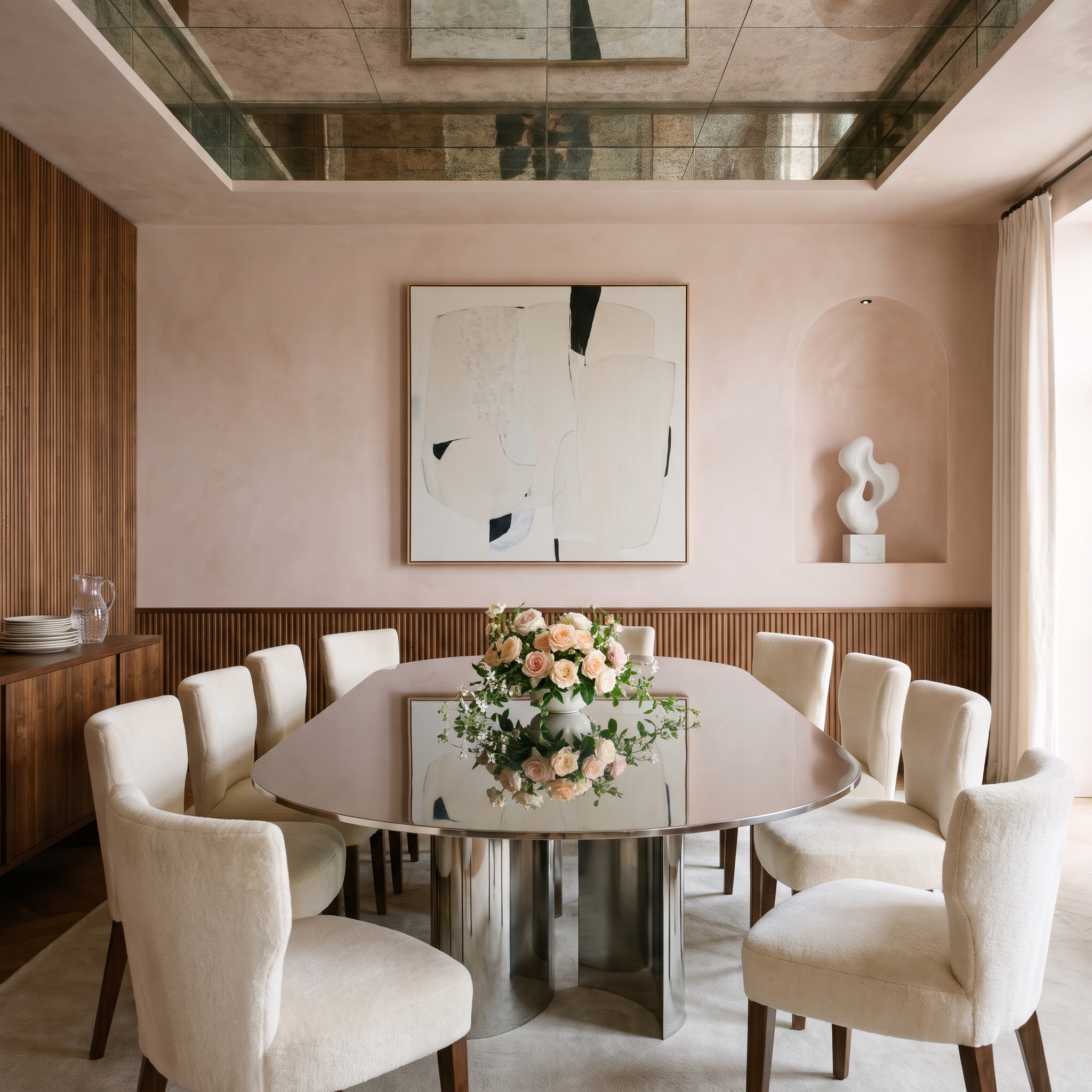
Two polished-steel half-cylinders support the dining table, their opposing curves separated by a narrow gap. The base reads almost like an abstract sculpture, especially beneath the reflective tabletop.
Surrounding chairs wear shaggy cream upholstery over curved backs, with walnut legs connecting them visually to the fluted wood wainscoting. Their generous texture offsets the precision of the central steel support.
Overhead, antiqued mirror panels introduce smoky, irregular reflections rather than the sharp duplication of conventional clear mirror. The treatment gives the ceiling visual activity without making every object below appear twice in perfect detail.
Blush plaster completes the palette, providing a warm background for the metal, mirror, and cream upholstery. The split pedestal remains the room’s most arresting piece of furniture, even with the entire ceiling working against it.
20. Bedside Steel Folds Like Origami While a Plaster Fireplace Claims the Opposite Wall
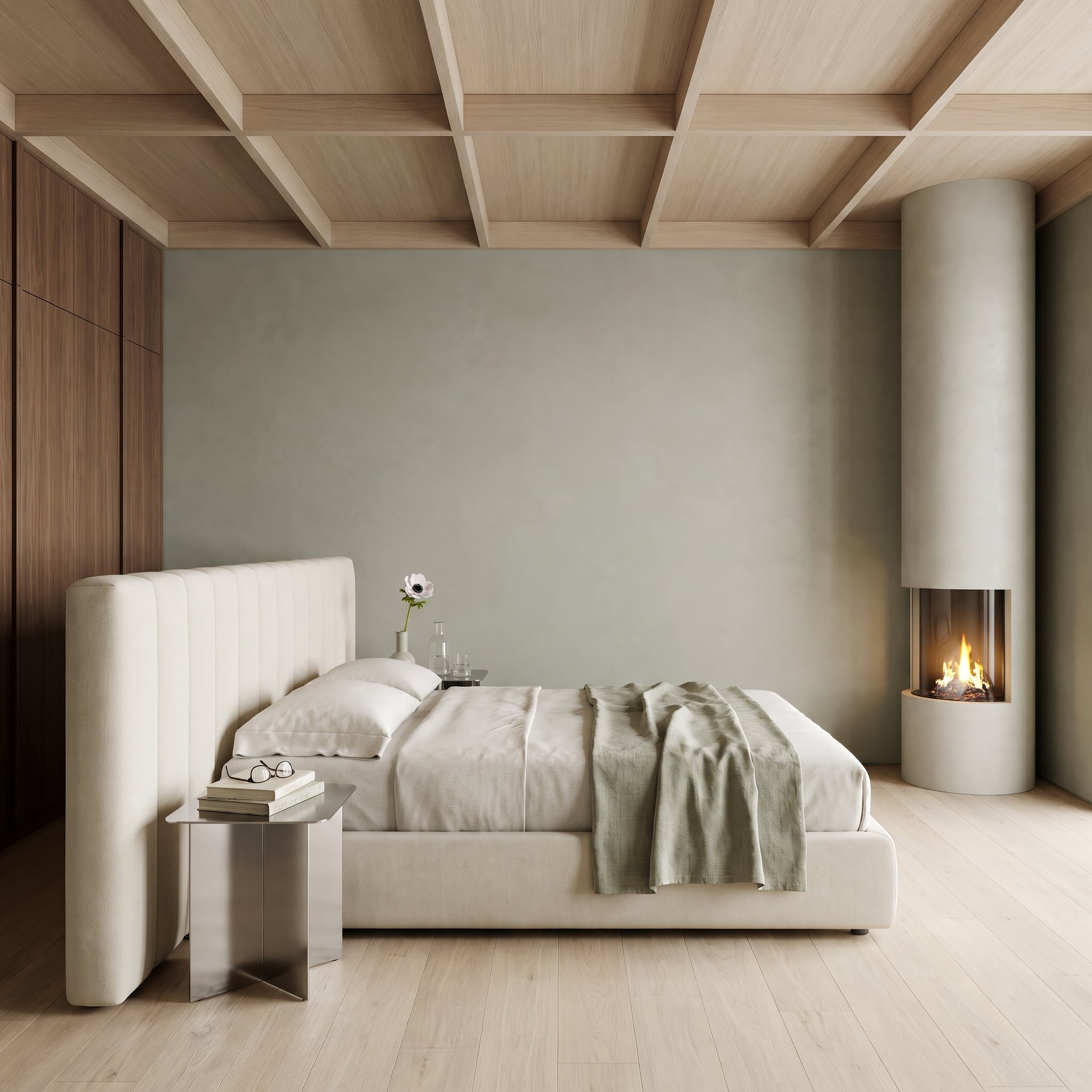
The bedside furniture looks like a sheet of steel folded into a series of sharply angled planes. Its geometric base creates an intriguing counterpoint to the headboard’s soft channel tufting, giving the bed a more architectural setting.
Across the room, a plaster fireplace rises as a sculptural column. Its rounded, substantial form contrasts with the angular steel near the bed, while the low fire introduces a concentrated source of warm light.
The channel-tufted upholstery brings a regular rhythm to the wall, the steel introduces crisp folds, and the plaster fireplace rises in one broad, almost monolithic form. Three very different treatments give this bedroom its distinctive architectural character.
19. Chrome Poles Become a Room Divider Without Building Another Wall
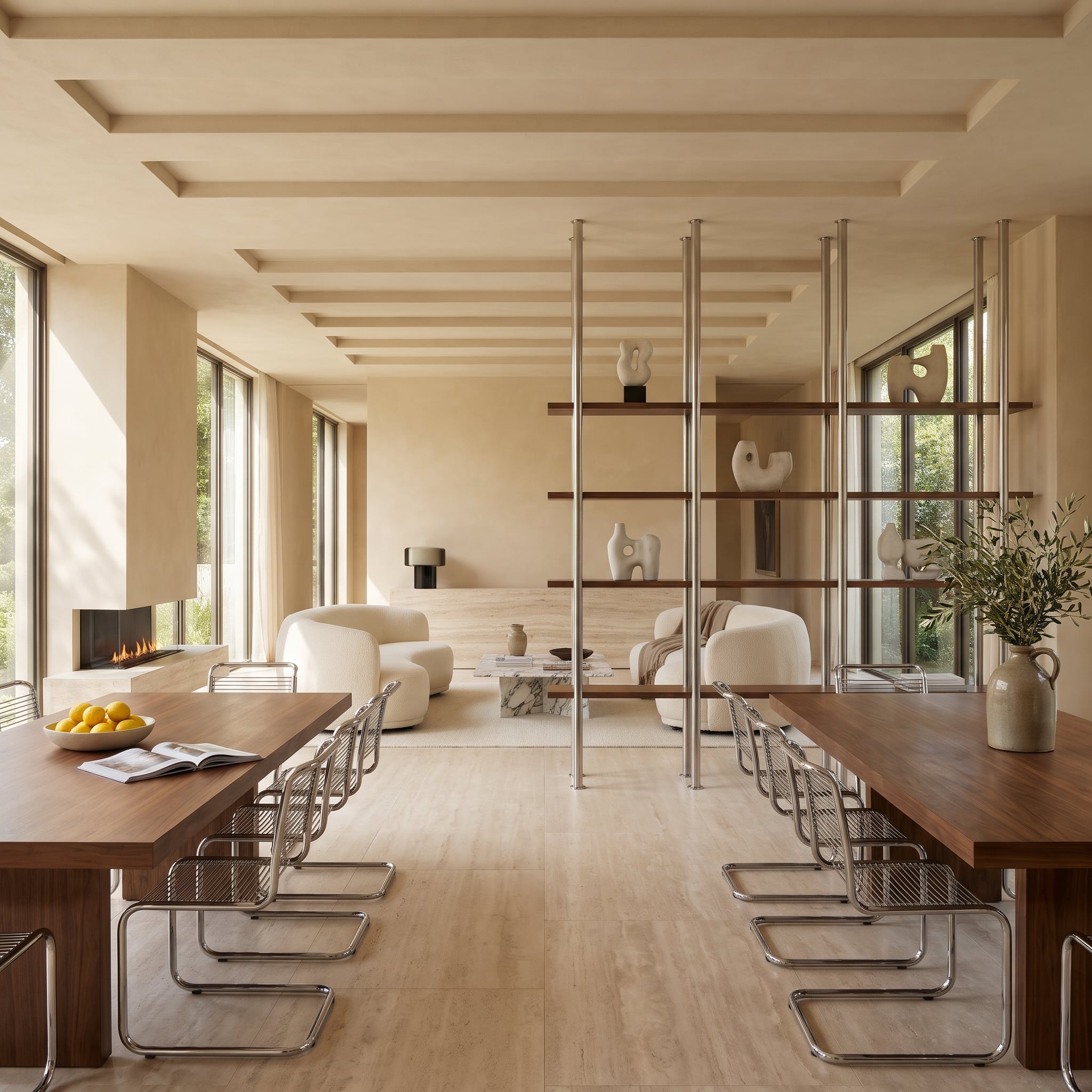
Polished chrome poles rise from the travertine floor to the beamed ceiling, carrying walnut shelves between them. The arrangement establishes a division between dining and living areas while preserving long views through the interior.
From the dining table, sightlines continue through the shelves toward the bouclé sofas, marble table, and corner fireplace. Display objects interrupt the view selectively, creating a changing composition as someone moves around the room.
The wire cantilever dining chairs echo the divider’s open construction. Their slender frames bring the same lightness to the dining area that the chrome uprights provide at architectural scale.
Walnut shelves give the structure substance, while the polished poles establish a precise vertical rhythm. The divider defines where one room ends without insisting that the conversation stop there.
18. Pink Bouclé Faces a Swimming Pool Beneath a Ceiling of Plaster Petals
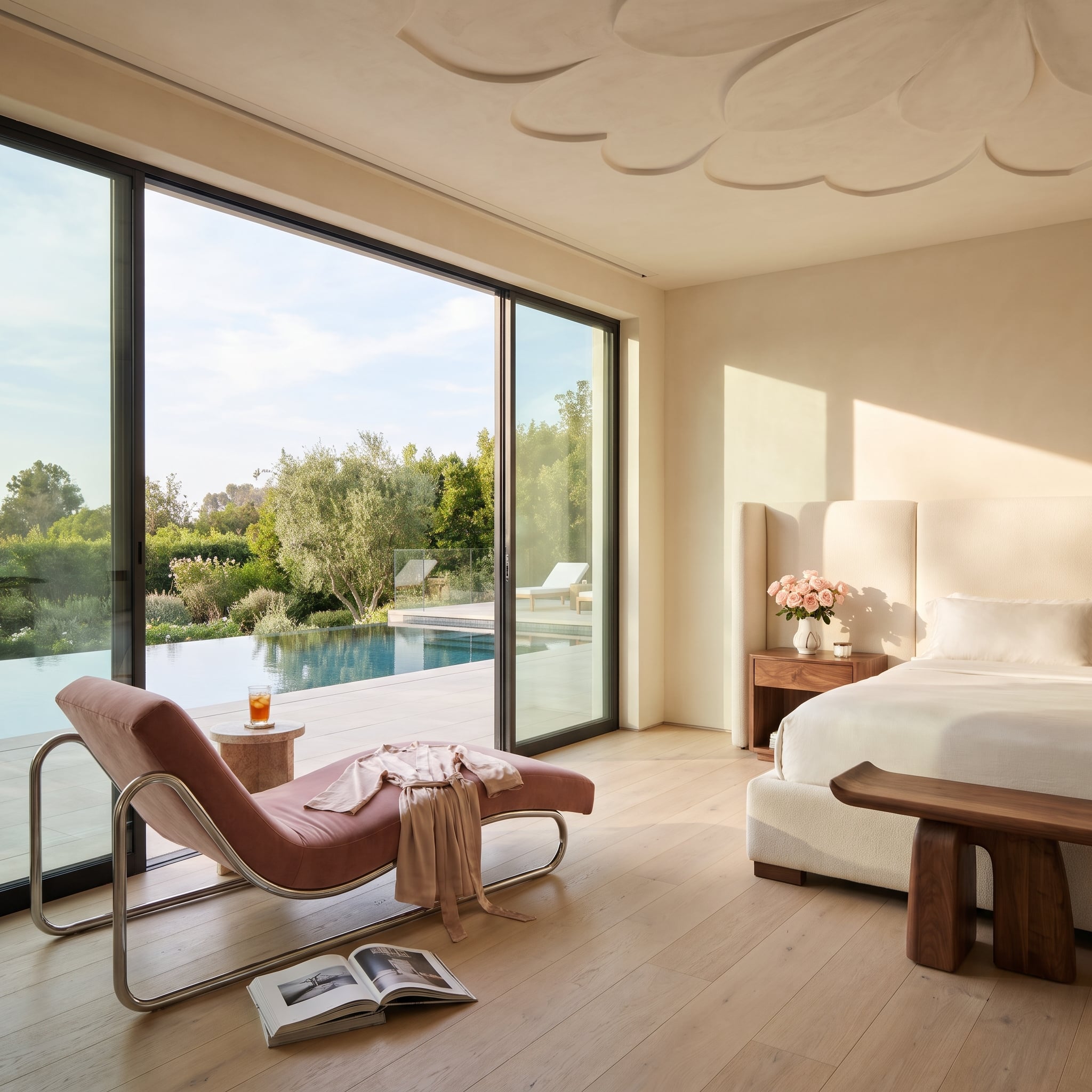
Petal-shaped relief spreads across the plaster ceiling, its shallow forms revealed by changing shadows rather than contrasting paint. The ornament remains part of the architecture, with daylight bringing its delicate contours into focus.
Beside the glass, a dusty-rose chaise rests on a chrome frame that curves down toward the oak floor and rises again. Its elongated silhouette points toward the infinity-edge pool, creating a visual connection between the seating and the water outside.
Walnut furniture anchors the area near the bed. The nightstand’s compact geometry and the bench’s curved supports introduce a more substantial counterweight to the chaise.
The ceiling relief changes throughout the day, revealing new shadows as the sun moves across the room. Beyond the glass, the pool provides a far simpler horizontal composition.
Even the ceiling is in bloom. The chaise has wisely chosen to enjoy the view.
17. Cognac Leather and Crossed Chrome Legs Challenge a Wall of Rough Limestone
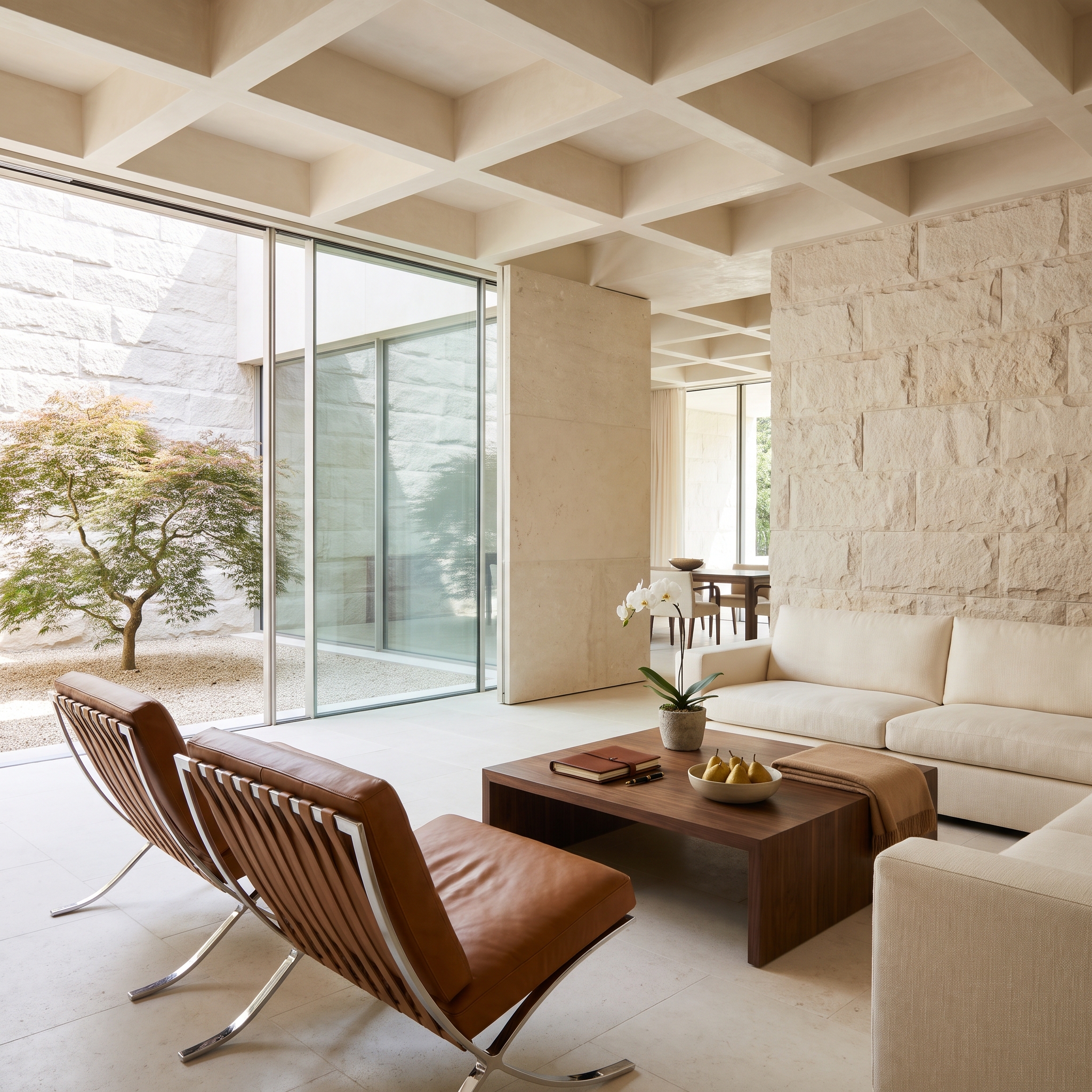
Rough-cut limestone supplies a heavily textured backdrop for a pair of cognac-leather chairs supported by crossed chrome legs. Irregular stone, supple upholstery, and sharply defined metal occupy the same composition without surrendering their individual character.
The chairs’ open bases reveal the floor beneath them, while the leather introduces a rich amber-brown tone against the pale architectural surfaces.
Walnut waterfall edges on the central table extend that warmth toward the sectional. A camel-colored throw reinforces the palette, carrying the leather’s color into the surrounding seating.
The coffered ceiling adds an orderly grid above the rougher limestone, setting precision against natural variation. The limestone refuses to be polished. The chrome refuses to be rough. Somehow, the room is better for both.
16. A Padded Chrome Screen Divides Dinner From the Sofa Without Closing the Room
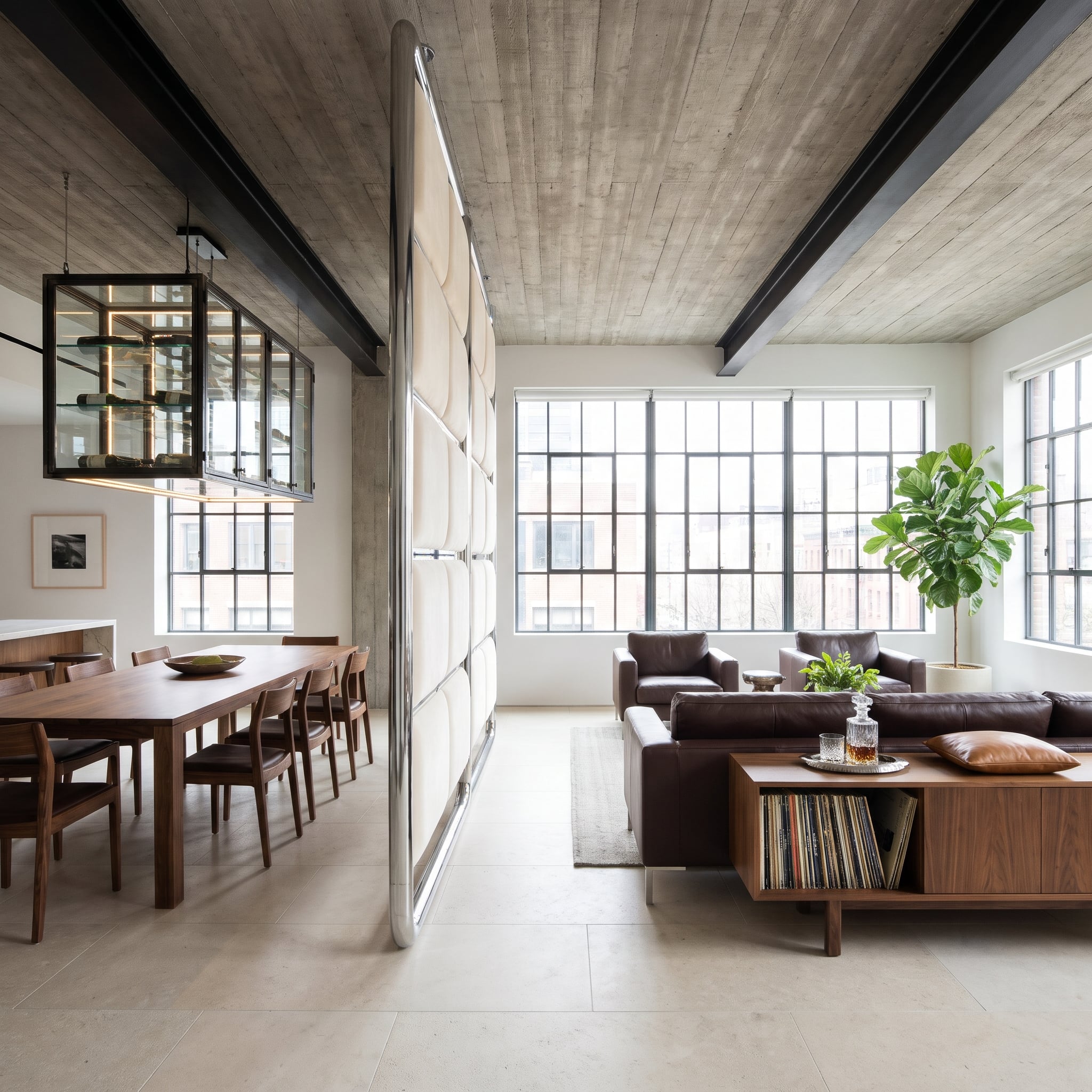
Cream upholstered sections stack inside a tubular chrome frame, turning a room divider into something closer to an enormous freestanding headboard. The padded panels bring an unexpected softness to an architectural element usually associated with wood, glass, or plaster.
The screen marks the transition between dining and living areas, with its open ends maintaining circulation between them. Walnut and leather introduce additional texture against the harder concrete and stone surfaces.
The chrome frame connects the screen to the surrounding furniture, while the upholstery gives the divider a presence that a conventional metal partition would struggle to match.
A wall says stay on your side. This divider is considerably more sociable.
15. Cherry Blossoms Fill the Porthole While Pink Bouclé Takes the Best Seats
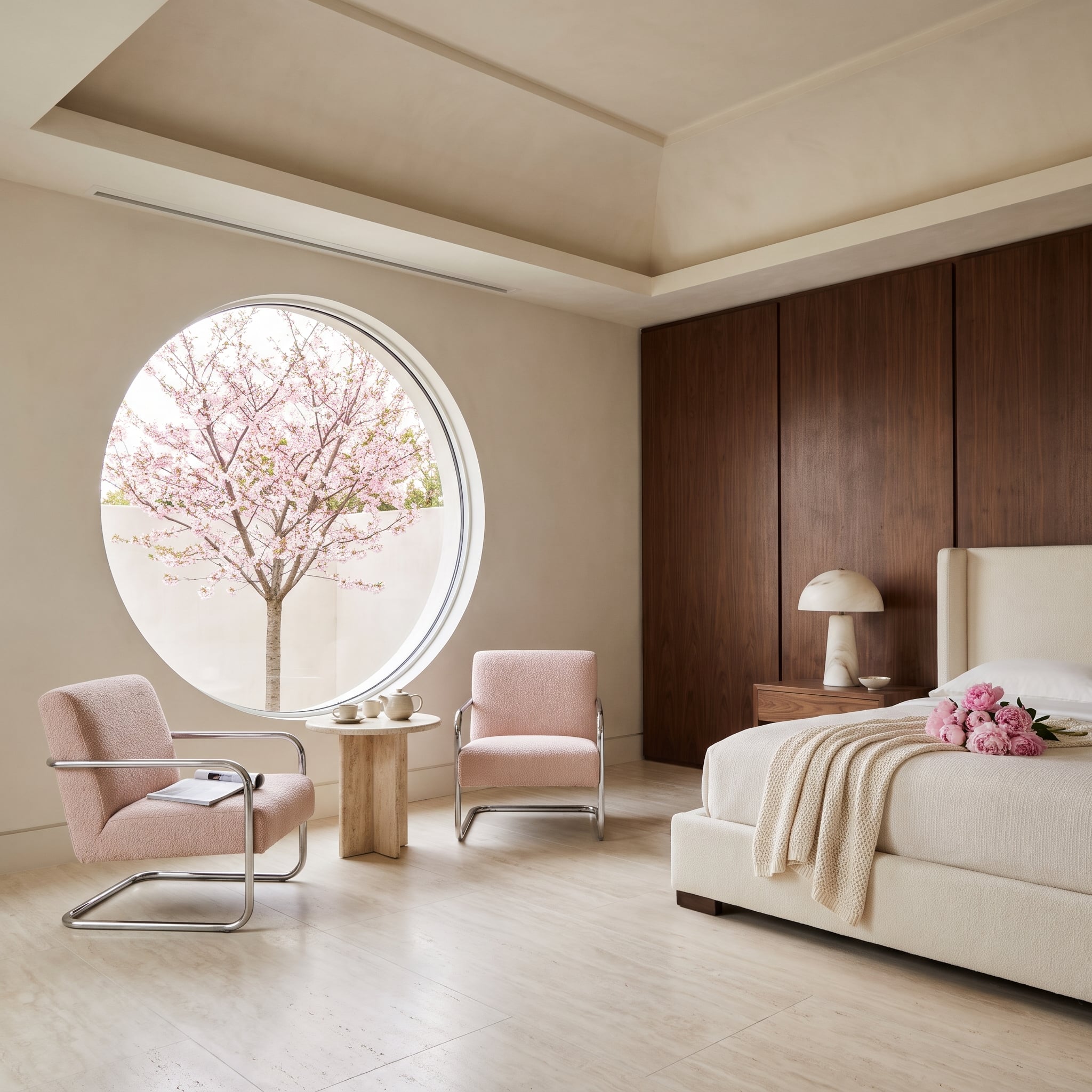
A circular window frames a flowering cherry tree against a pale courtyard wall. The opening turns the garden into a tightly composed picture, with the blossoms providing a vivid focal point.
Two pink bouclé cantilever chairs pick up the blossom color inside the room. Their polished chrome bases form narrow arcs beneath the upholstered seats, keeping attention on the large circular view.
Walnut paneling rises behind the bed, giving the otherwise pale interior a substantial architectural anchor. An alabaster lamp introduces another rounded form, connecting the window’s geometry to the smaller details of the room.
One large circular opening, two compact chairs, and a broad walnut wall establish the composition. The cherry tree supplies the color that makes the whole arrangement memorable.
14. The Vanity Becomes a Wall of Silver Against Warm Stone
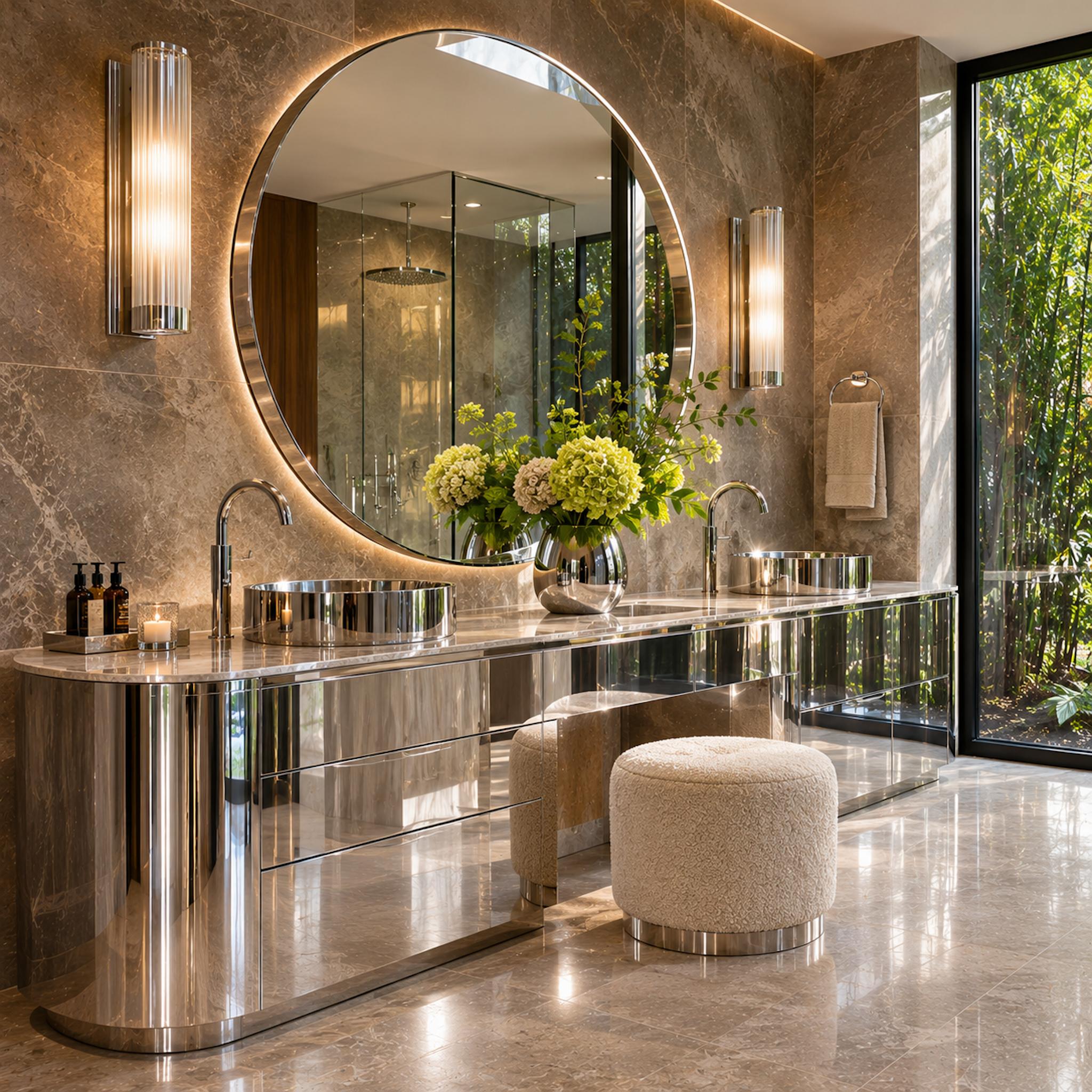
Mirror-polished stainless steel stretches across this double vanity, wrapping its rounded end and broad drawer fronts in shifting reflections. Two vessel sinks with polished metallic finishes rise from the stone countertop, extending the reflective treatment into the fixtures themselves.
An enormous circular mirror dominates the stone-clad wall, its illuminated edge creating a halo between two tall ribbed-glass sconces. The mirror’s scale answers the vanity’s length, while warm gray-brown stone gives all that gleaming metal a textured backdrop.
A cream bouclé stool introduces a compact upholstered form in front of the cabinetry. Beyond the floor-to-ceiling glass, dense greenery brings another texture into the room. The stone holds steady, the bouclé softens the composition, and the stainless steel catches nearly everything in sight.
Few bathroom cabinets would attract this much attention without a single decorative handle. Here, the entire vanity is the ornament.
13. A Steel Ceiling Grid Meets a Walnut Table With the Curves of a Sculpture
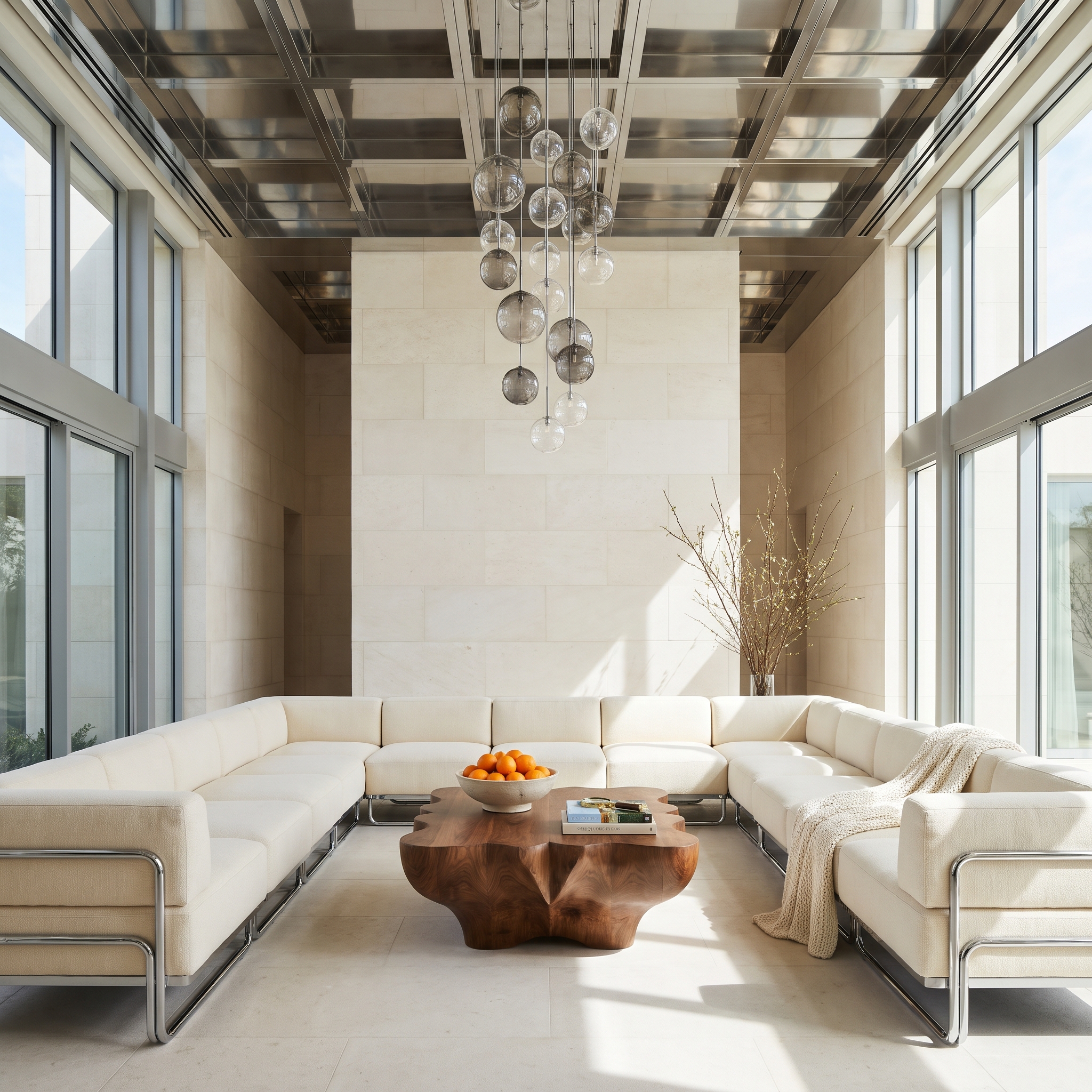
A steel ceiling grid gives this room a disciplined overhead structure. Beneath it, a scalloped walnut coffee table introduces a completely different language, its deeply carved edges creating an irregular silhouette at the center of the seating.
The U-shaped cream sectional rests above visible chrome tubing, combining substantial upholstery with a relatively slender support system. The metal relates to the ceiling without requiring the sofa to imitate its rigid geometry.
Smoked and clear glass globes hang at different heights, interrupting the grid with a loose arrangement of rounded forms. Their transparency keeps the ceiling from acquiring another visually heavy element.
Oranges on the table deliver a small concentration of saturated color amid the cream, walnut, and steel.
The ceiling draws straight lines. The walnut table takes every possible detour.
12. A Wall of Moss Changes the View From the Conference Table
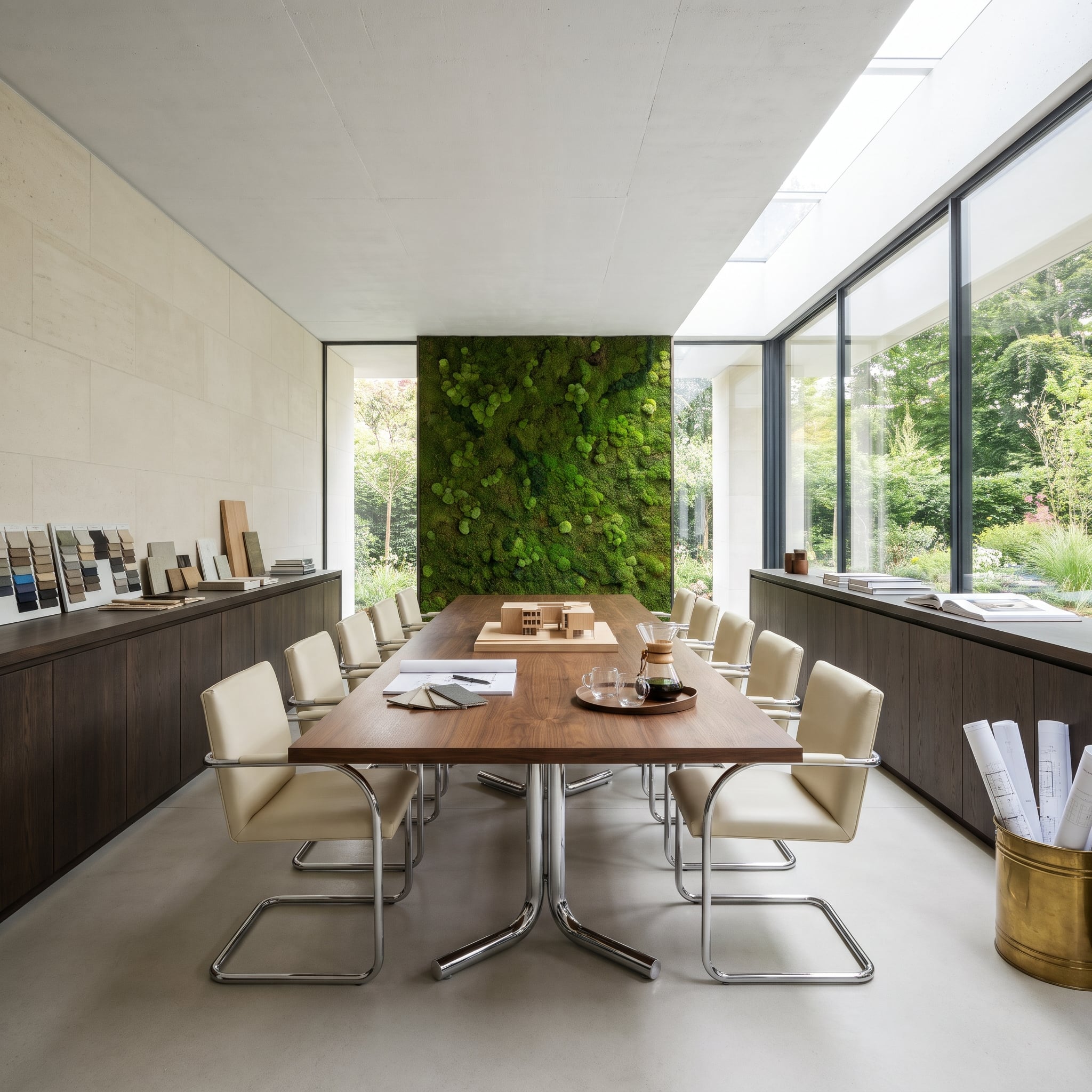
A full-height moss wall supplies an unexpectedly organic backdrop for this otherwise rigorously arranged conference room. Beyond the long walnut table, its dense green texture interrupts the polished surfaces and rectilinear cabinetry.
Cream leather cantilever chairs provide generously padded seating within slim chrome frames. The table’s broad metal base repeats their tubular geometry at a larger scale, establishing a relationship between the individual seats and the central work surface.
Low cabinets run along both walls, keeping supplies behind closed doors while providing display space above. One side accommodates material samples, while the cabinetry near the glazing remains below the window line to preserve the garden view.
For once, the most interesting thing at the end of the conference table isn’t a presentation.
11. A Chrome Headboard Bends All the Way Around the Bed and Back Again
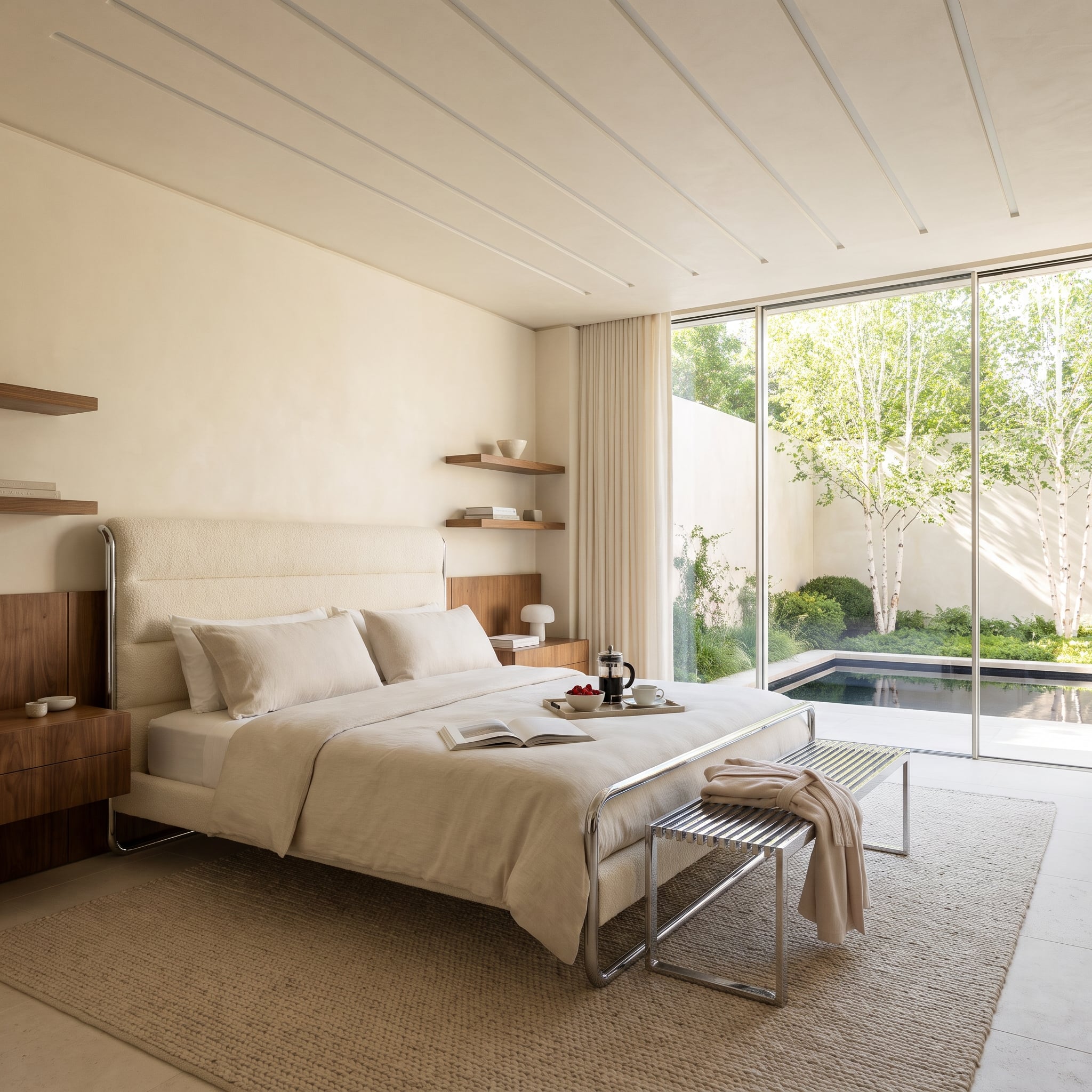
The chrome frame surrounding this bed makes a remarkably long journey. Tubing curves around the padded bouclé headboard, descends toward the floor, and continues into the footboard, creating the appearance of one continuous metallic outline.
Channeled upholstery fills the headboard with a softer, more substantial texture. Walnut nightstands interrupt the pale palette, while a slatted bench at the foot of the bed repeats the room’s linear geometry without rising high enough to obscure the pool view.
Outside, birch trees provide a delicate vertical rhythm against the water. Their narrow trunks echo the slender steel framing, connecting the room’s furniture to the landscape through a shared sense of proportion.
The chrome has drawn the outline. The bouclé has filled in everything worth leaning against.
10. Chocolate Plaster Makes Two Chrome Chairs Look Like Liquid Silver
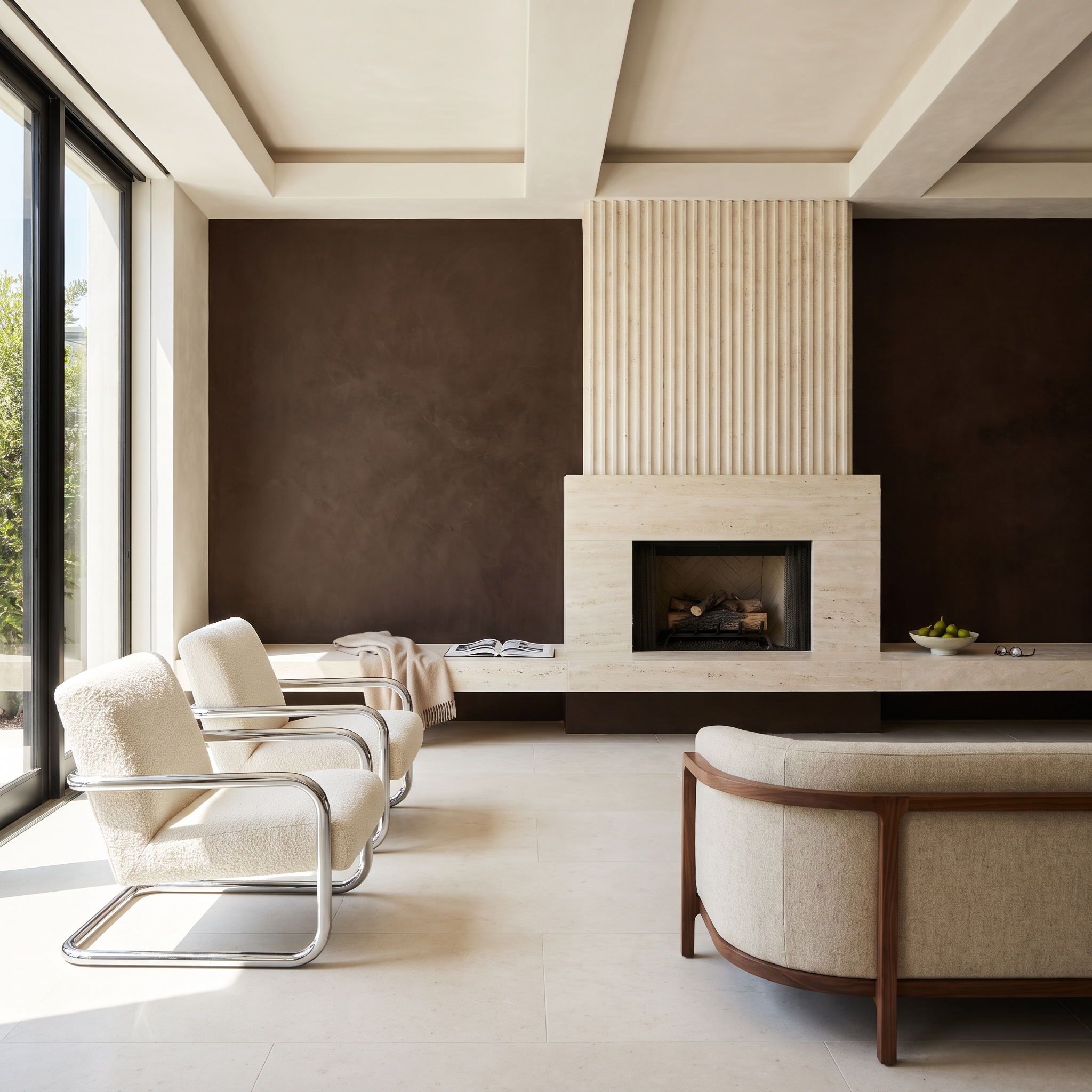
Daylight catches the chrome loops around two bouclé chairs positioned near the glazing. Against the chocolate plaster behind them, the metal appears particularly bright, its polished curves standing out from the matte wall.
Fluted travertine rises from the fireplace toward the ceiling coffers, creating a pale vertical feature against the darker surroundings. A floating hearth ledge extends the stone treatment horizontally, connecting the fireplace to the seating area.
The sofa introduces another material relationship. Its walnut frame follows the rounded character of the chairs in wood rather than metal, bringing the seating together through shape instead of matching finishes.
A small green accent from the fruit bowl adds another color, although the real drama lies in the meeting of glossy steel, textured stone, and dark plaster.
9. Chrome Desk Legs Return as a Library Ladder in a Room Built for Books
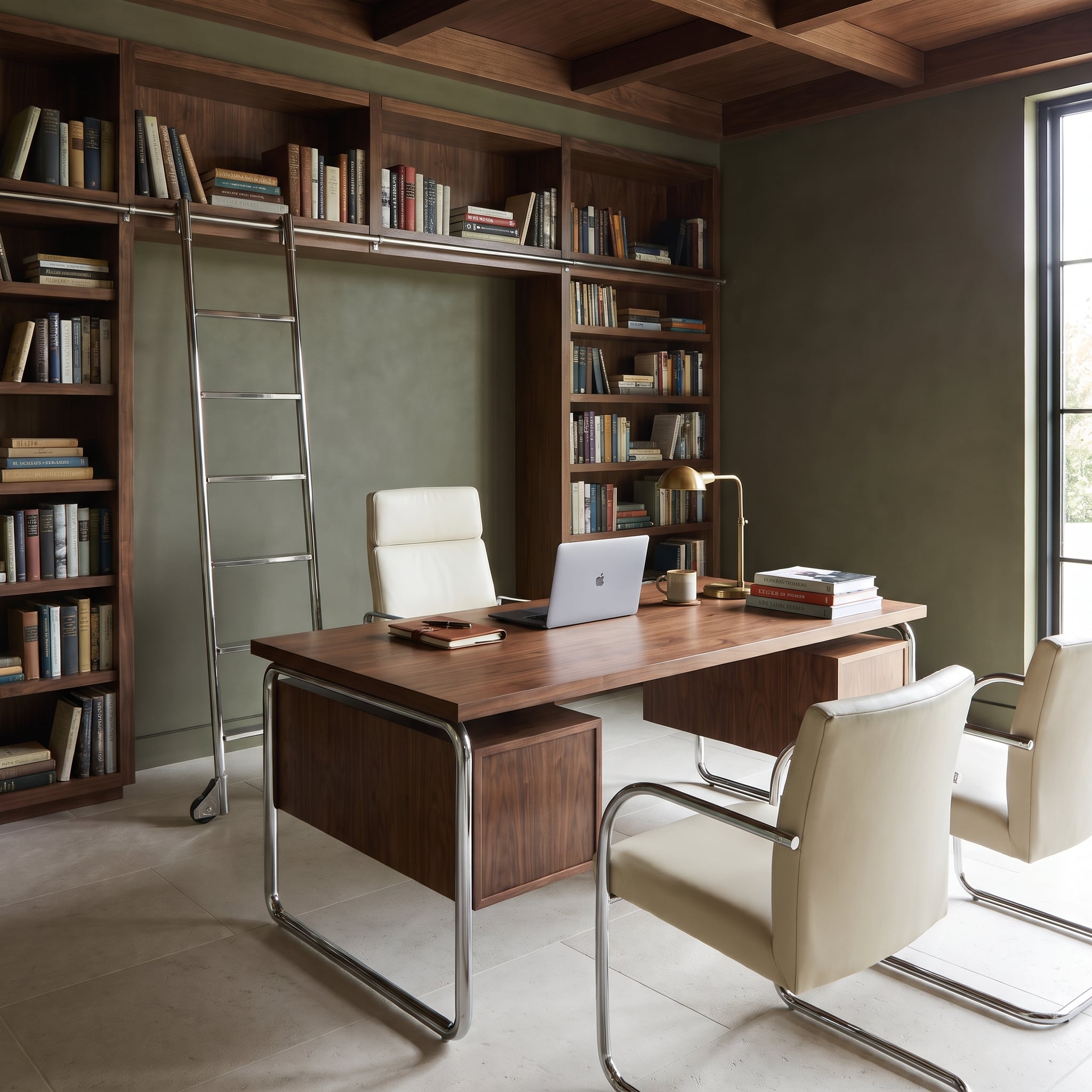
The walnut desk rests on looping chrome supports, their curved geometry introducing a light metallic outline beneath the broad work surface. Nearby, a rolling library ladder carries a related finish up the bookshelves, linking the furniture to the room’s built-in architecture.
The desk stretches horizontally across the room, while the ladder emphasizes the height of the shelving and the considerable book storage overhead. Chrome appears at both scales, from the curves beneath the desktop to the ladder rails rising toward the ceiling.
Walnut dominates the walls and cabinetry, allowing the metal to register as a series of deliberate highlights.
The metal begins at the desk and finishes near the ceiling. The books occupy everything in between.
8. Oxblood Velvet Stretches Along the Glass While Fire Burns Beyond the Terrace
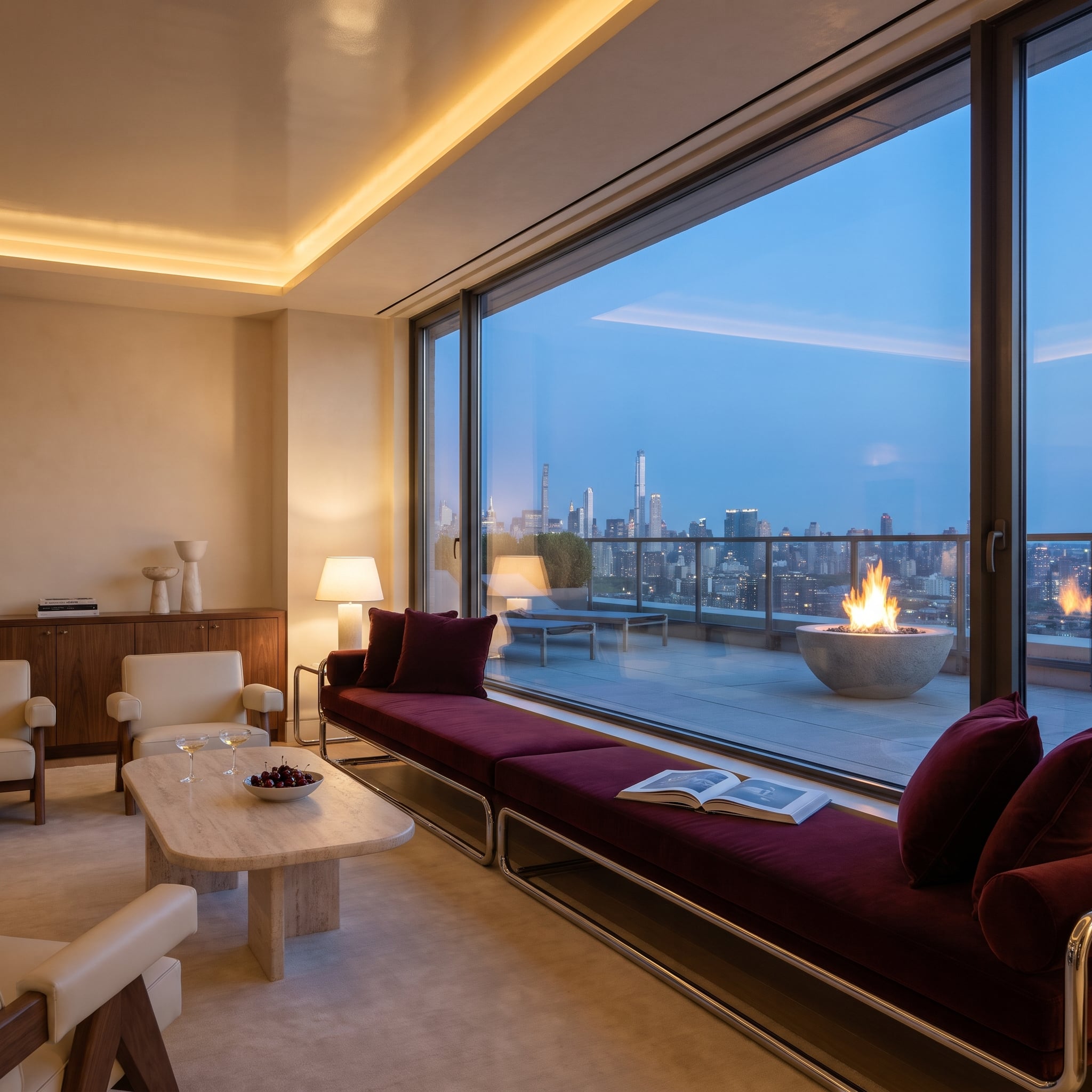
Two oxblood velvet benches align along the glazing, forming a long seating arrangement supported by open chrome frames. Their slim metal rails reveal the floor beneath the upholstery, preserving the visual connection to the terrace.
Outside, a concrete fire bowl introduces a vivid orange focal point. The ceiling lighting inside echoes that warm tone, while the deep red seating provides a rich transition between the two.
Cream leather chairs on walnut frames occupy the opposite side of the room, offering a lighter counterpoint to the continuous velvet bench.
Loose cushions and bolsters provide a more adaptable arrangement along the glazing, while the low seating leaves the terrace in view.
The fire is outside. The best seat for watching it has already been reserved along the glass.
7. Burgundy Velvet Walls Meet a Bouclé Bench Balanced on Bent Steel
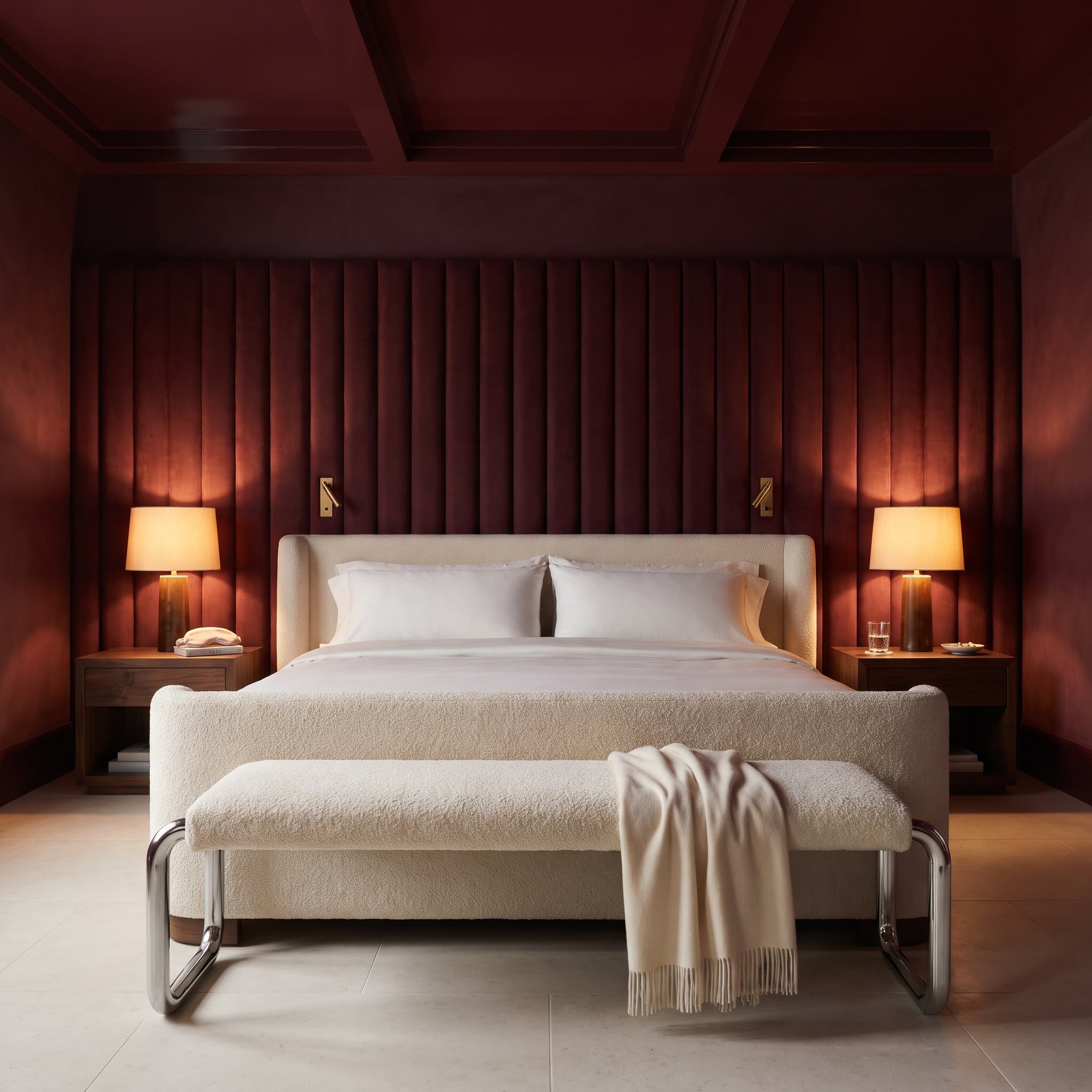
Deep burgundy velvet channels run across the bedroom wall, giving the backdrop a soft, upholstered rhythm. Against that saturated surface, the pale bouclé headboard becomes the principal focal point.
At the foot of the bed, a compact bench rests on bent chrome tubing. Its exposed supports introduce a sharper, more reflective material beneath the nubby upholstery, while revealing the floor below.
Brass swing-arm reading lights and walnut nightstands organize the bedside arrangement. Warm brass near the headboard and cooler chrome beneath the bench introduce two different metallic notes without competing for attention.
Even the walls are upholstered. The chrome bench is the one piece that remembers how to stand up straight.
6. A Chess Table and an Olive Tree Give Chrome a Quieter Game to Play
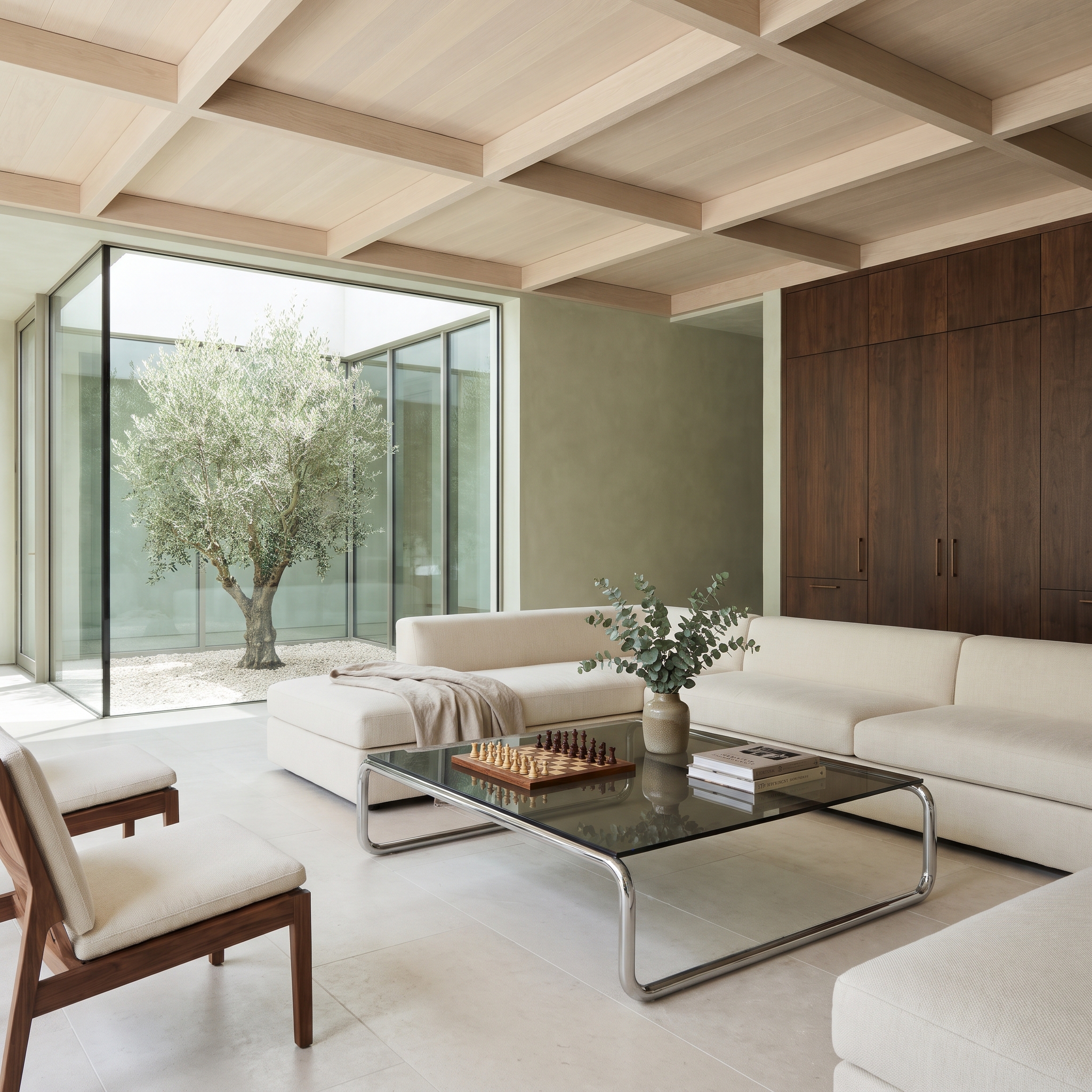
A chessboard occupies the smoked-glass tabletop, whose dark reflective surface rests on looped chrome legs. The arrangement gives the room a focal point without introducing a large solid piece of furniture.
Beyond the seating, an olive tree stands inside a glazed courtyard enclosure. Its gray-green foliage relates to the sage plaster walls, while the walnut cabinetry introduces a darker, warmer material behind the chairs.
The glass table and courtyard create two different kinds of transparency. One reveals the chrome support beneath the tabletop; the other opens the interior toward the tree.
Eucalyptus stems echo the green palette on a smaller scale, linking the table arrangement to the planting outside.
One room, one chessboard, and a tree that has no intention of being reduced to a houseplant.
5. Walnut Climbs Into the Ceiling While a Glass Wine Wall Glows Below
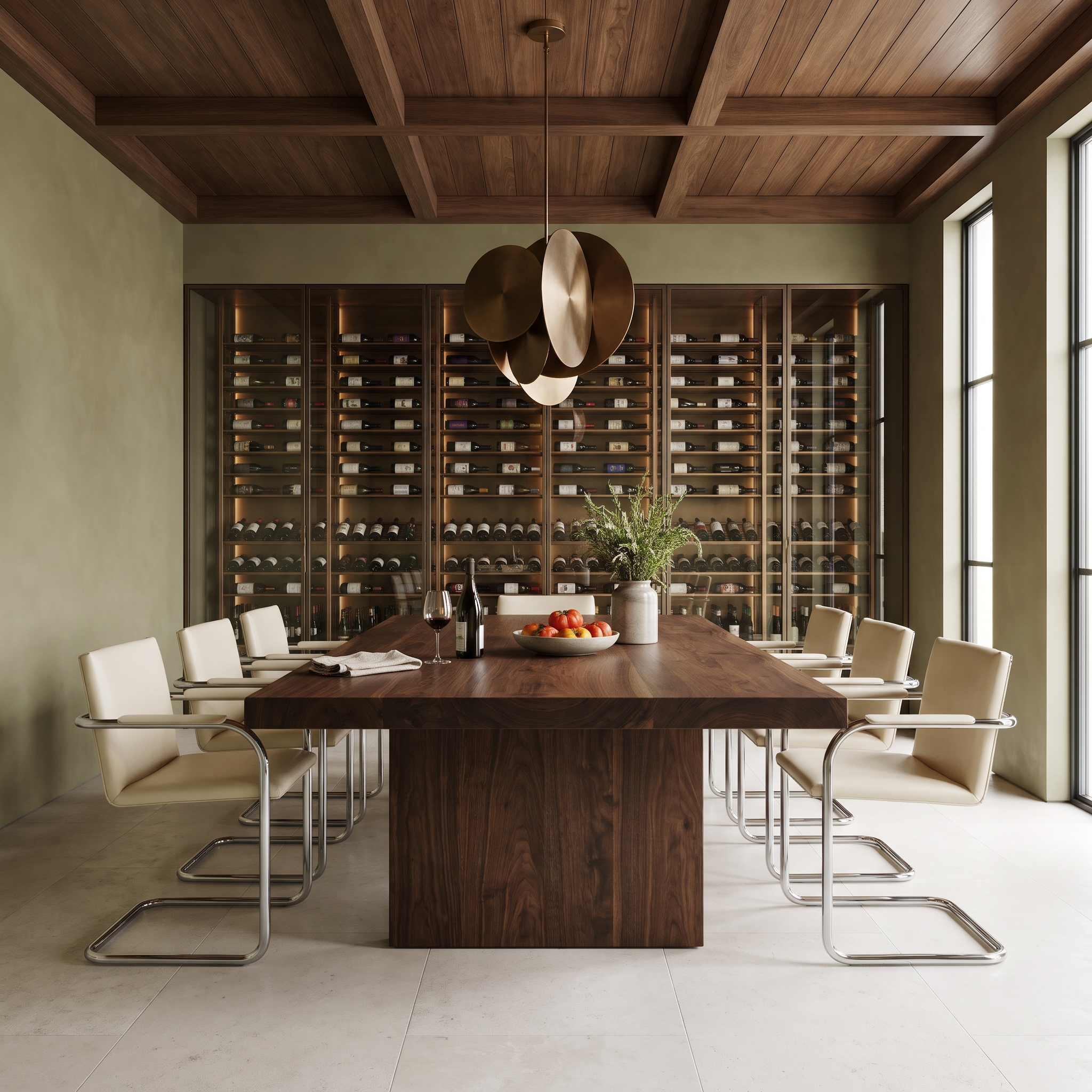
Walnut extends from the substantial dining table into the coffered ceiling, giving the room an unusually strong relationship between furniture and architecture. Below that expansive wood treatment, cream leather chairs rest on slender chrome cantilevers.
The pale upholstery distinguishes the chairs from the surrounding walnut, while their polished frames reveal narrow glimpses of the floor beneath the table.
The illuminated glass wine wall provides the room’s most dramatic interruption. Bottles and shelving appear in layers behind the glazing, with the lighting turning storage into a luminous architectural feature.
A brass pendant connects the warmer metal accents to the wood, while the chrome chair frames supply a cooler, more precise line.
The ceiling has the gravitas. The wine wall has the glow. The chairs have sensibly decided to travel light.
Built-ins tend to win readers over in dining rooms: images showing them got more hearts than the other images in the same articles, 52% versus 42%.
4. Four Steel Drink Stands Orbit a Serpentine Sofa Beneath an Onyx Bar
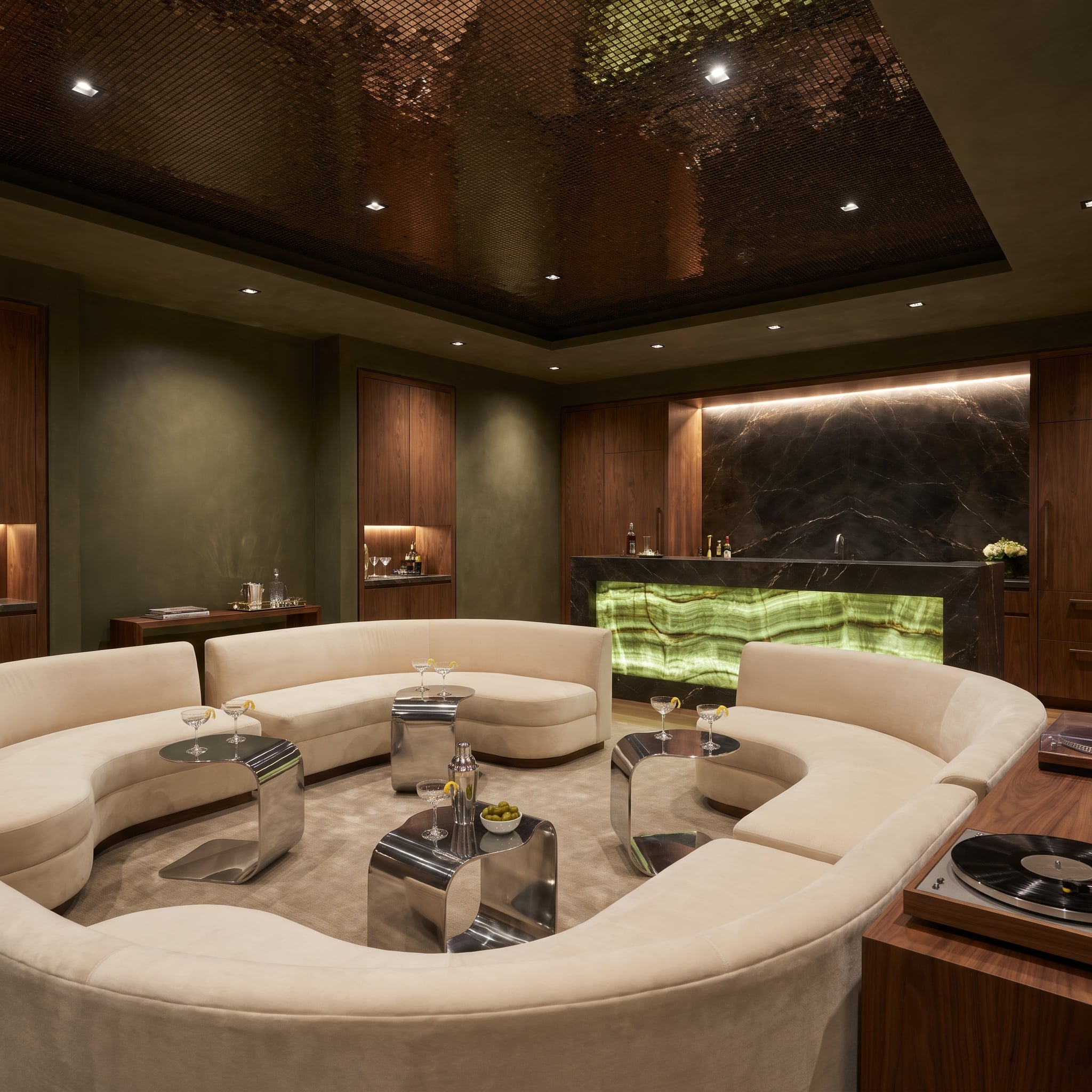
The serpentine sofa replaces the familiar straight seating arrangement with a long, flowing curve. Its shape encourages conversation across different positions rather than directing every occupant toward one central focal point.
Four polished-steel drink stands follow that curve, each rising from the rug in a slender ribbon-like form. Their small tops provide individual surfaces without requiring one enormous coffee table in front of the entire sofa.
Behind the seating, illuminated green onyx brings a vivid glow beneath the bar’s dark marble. The saturated stone provides a strong color contrast to the polished steel, whose reflective surfaces catch highlights from the surrounding room.
Every seat gets a table. The bar gets the spotlight. Nobody has to reach across the room for a glass.
3. A Polished Steel Bathtub Turns the Courtyard Into a Moving Reflection
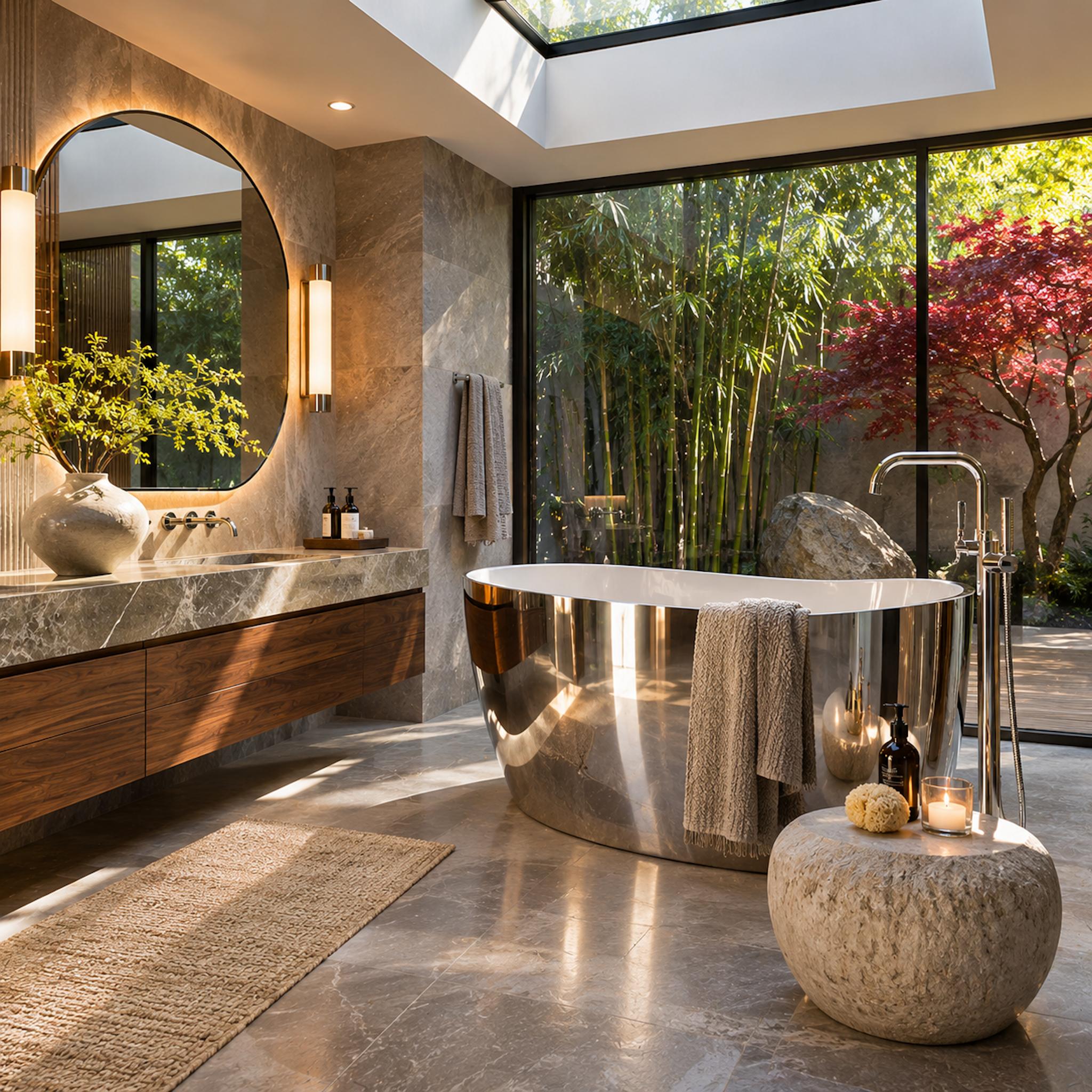
A freestanding bathtub wears a mirror-polished stainless-steel exterior, its rounded shell reflecting the stone floor and the planted courtyard beyond the glass. The white bathing surface inside provides a quieter counterpoint to the brilliant metal outside.
A floor-mounted tub filler stands beside it, with the plumbing visually separate from the bath’s curved body. Across the room, a walnut-fronted floating vanity and stone counter introduce warmer, more matte surfaces beneath an oversized mirror.
Daylight enters from above and through the garden glazing, traveling across the rounded steel shell in broad, distorted reflections. The tub becomes a changing portrait of the room around it, with the courtyard’s greenery appearing in its polished surface.
2. Cognac Leather, Travertine Fire, and a Walnut Library With a Secret Bar
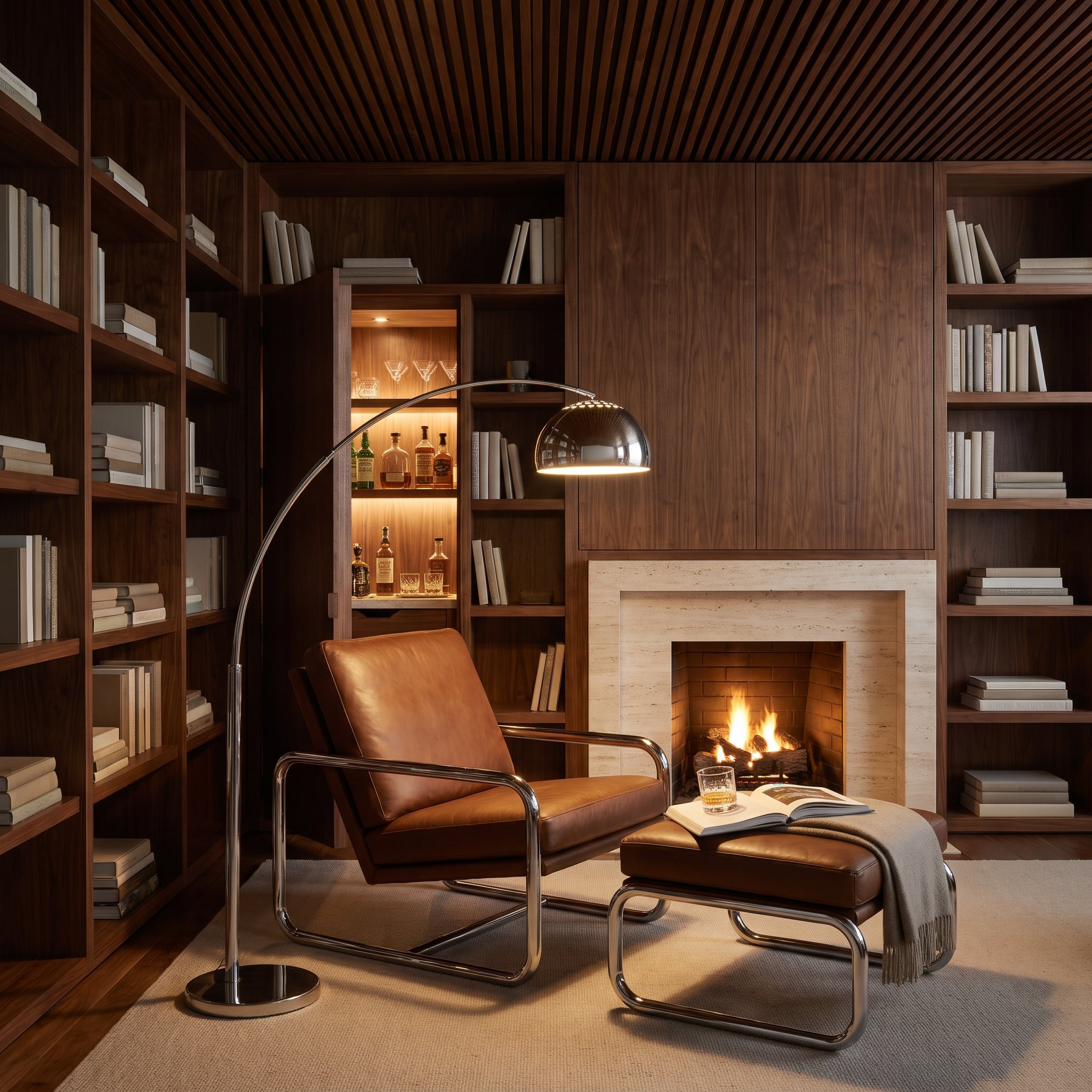
A cognac-leather lounge chair and matching ottoman rest within related chrome frames, their looping supports creating the appearance of a coordinated continuous design. The metal provides a slim outline around the generously upholstered pieces.
Walnut surrounds the room, covering shelving, cabinet fronts, and the slatted ceiling. The repeated wood establishes an enveloping character without requiring ornamental wall treatments.
Travertine interrupts that darkness at the fireplace, where the pale stone becomes a strong architectural feature. Nearby, an illuminated bar niche introduces a second concentration of warm light behind the cabinetry.
Books, fire, a leather chair, and a bar within reach: the chrome is almost the least extravagant thing in the room.
1. Breakfast Under a Skylight, With Chrome, Bouclé, and a Lemon Tree Beyond the Glass
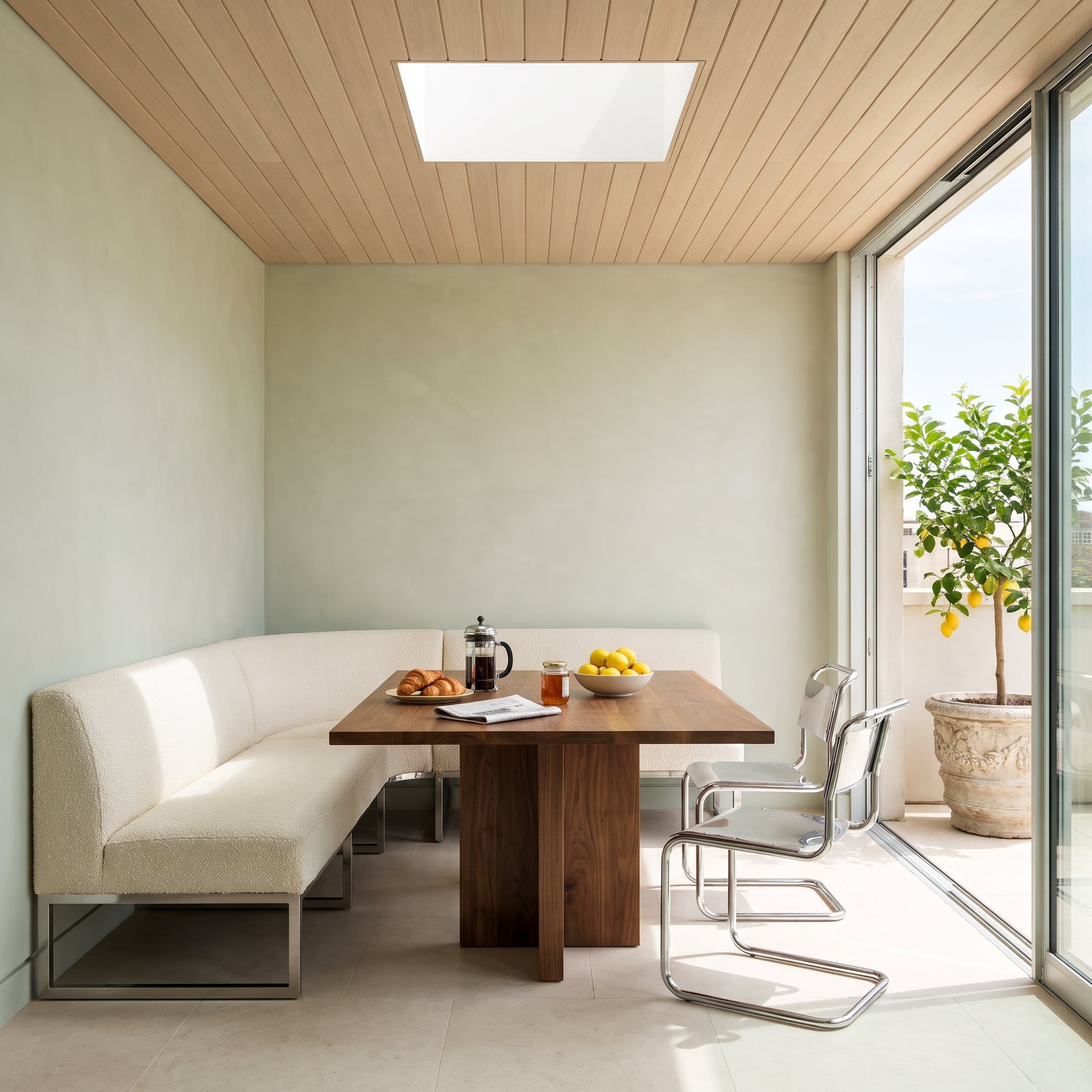
Morning light falls through the skylight onto a curved bouclé banquette, whose rounded corner creates an inviting seating arrangement without leaving an awkward dead space at the turn.
Chrome sled bases support the banquette, while two cantilever chairs carry the polished finish into a lighter, more open form. The metal outlines the seating in delicate curves beneath the substantial upholstery.
Beyond the open glass door, a potted lemon tree introduces a vivid green and yellow accent against the quieter interior palette. Lemons on the table echo that color in miniature, connecting the breakfast setting to the garden.
Limestone, walnut, bouclé, and steel each contribute a distinct surface. Daylight brings out the nubby upholstery, glances off the chrome frames, and travels across the pale stone floor.
Outside, the lemons are ripening. Inside, the chrome is catching the morning sun. Breakfast has never needed much more of an occasion than that.