🔥 Would you like to save this?
Evergreen garland around the doorframe. You’ve seen it on every house on the block, every December, for as long as you can remember. It works. It also says nothing new. The doorway is the first thing a guest reads, and most of us hand it the one line everybody else is already using. These treatments throw out the script entirely — skis, firewood, floating ornaments, paper stars. Every one feels festive, every one holds up structurally, and not a single one is a loop of pine.
32. A Fan of Vintage Wooden Skis Around the Doorframe
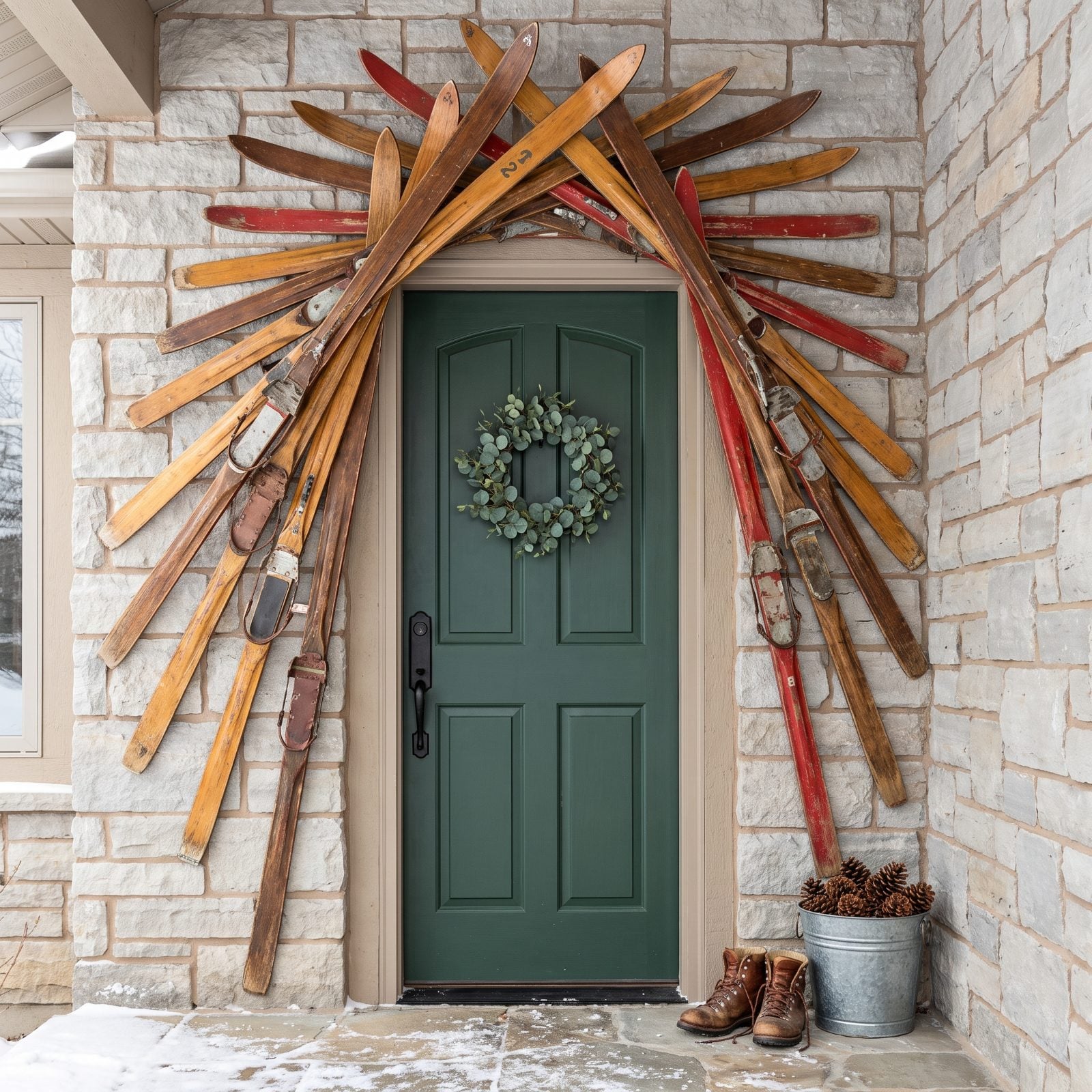
Skis are built to be seen from a distance, and they look right at an angle — which is exactly why they fan out so well around a door. The eye reads those radiating lines as motion, and old hickory in honey and oxblood carries a warmth no fresh-cut pine can touch.
In order to come up with the very specific design ideas, we create most designs with the assistance of state-of-the-art AI interior design software. Also, assume links that take you off the site are affiliate links such as links to Amazon. this means we may earn a commission if you buy something.
Hunt estate sales and ski-swap bins in October. You want mismatched pairs, scuffed bindings, a little faded paint. Perfect sets look staged. The beat-up ones look like they’ve been somewhere, and that’s what sells it.
31. A Sculptural Arch Built From Bundled Firewood
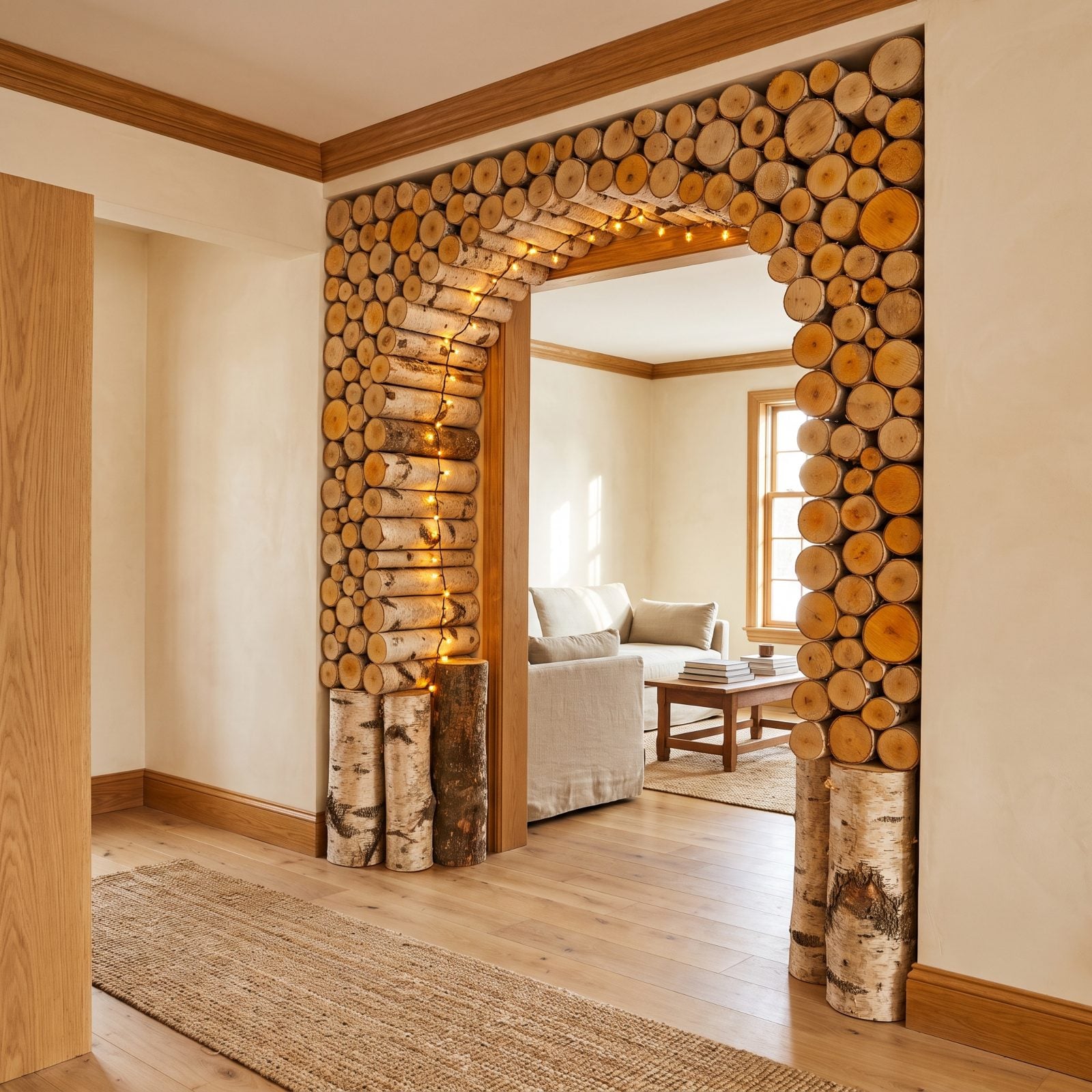
Stack firewood cut-end-out and you get something like honeycomb — dozens of pale amber circles ringed in bark. Build that into an arch over a doorway and it reads as sculpture rather than a woodpile.
Stability is everything here. Use a plywood arch form behind the logs and hot-glue or wire each piece to it so nothing shifts when the door slams. Then tuck a strand of warm fairy lights deep between the logs, and the whole thing glows from the inside out. Birch and oak give you the best cut-end color.
30. Oversized Velvet Bows Mounted at the Upper Corners
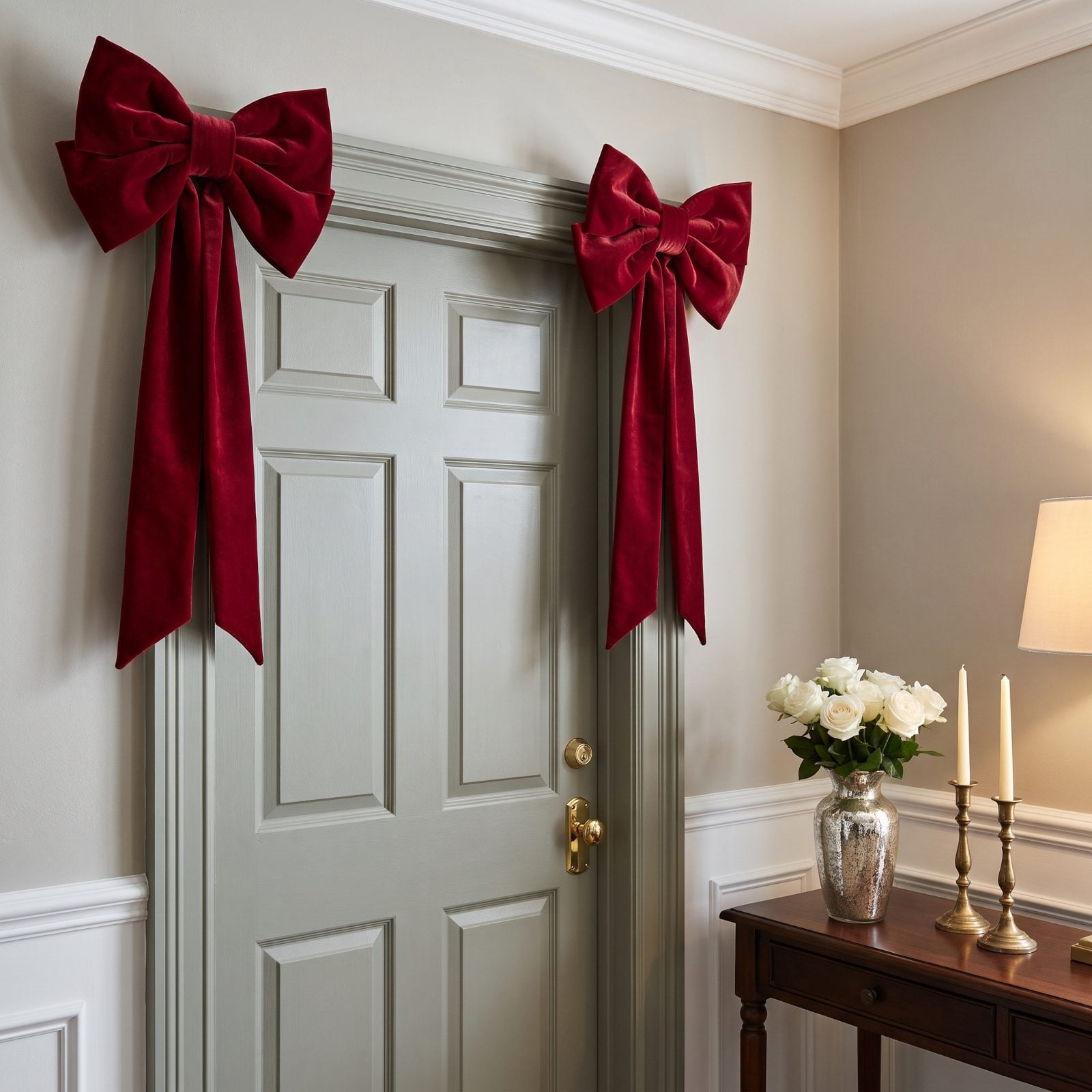
Two bows. That’s the whole treatment. Mount an oversized velvet bow at each top corner of the frame, let the tails spill down the sides, and the door suddenly looks wrapped like the best gift in the house.
Velvet is what makes this work. Cheap ribbon goes limp and screams craft store, while wide wired velvet in cranberry or forest holds its loops, catches light along every fold, and looks expensive even when it isn’t. A pair of cranberry velvet bows does more than a full garland for a fraction of the fuss.
29. A Hand-Painted Winter Mural Surrounding the Entry
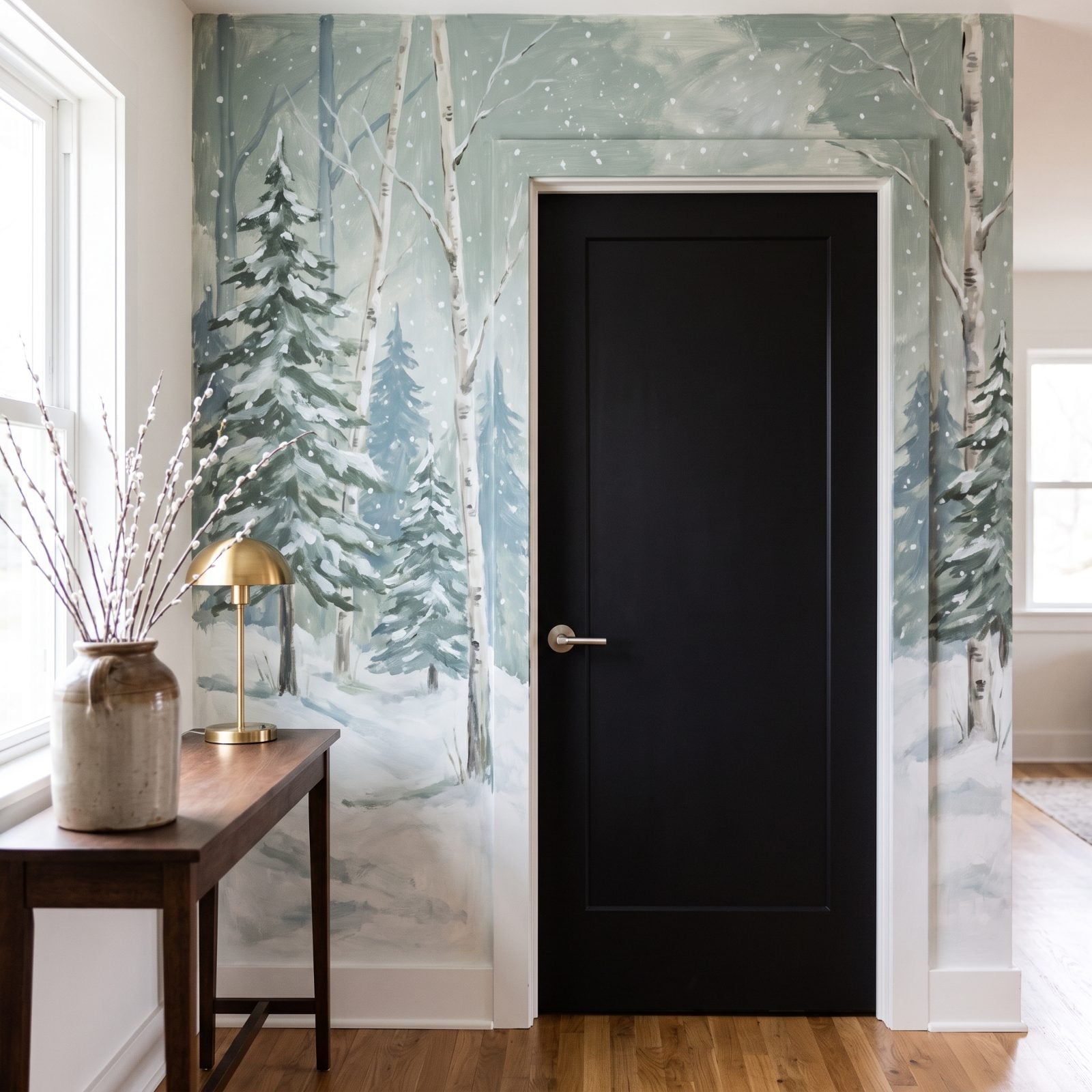
A painted mural turns the wall itself into the decoration, which means there’s nothing to box up in January. Keep the palette soft — sage, dusty blue, white — and a snowy pine forest frames the door like a window looking out on winter.
And no, you don’t need to be an artist. Loose birch trunks and dotted falling snow forgive a shaky hand; that painterly looseness is the whole look. If permanent paint spooks you, do it on a removable peel-and-stick panel instead. These murals borrow the same calm you’d get from a green courtyard design, brought indoors for the season.
28. A Forest of Potted Miniature Firs Flanking the Entrance
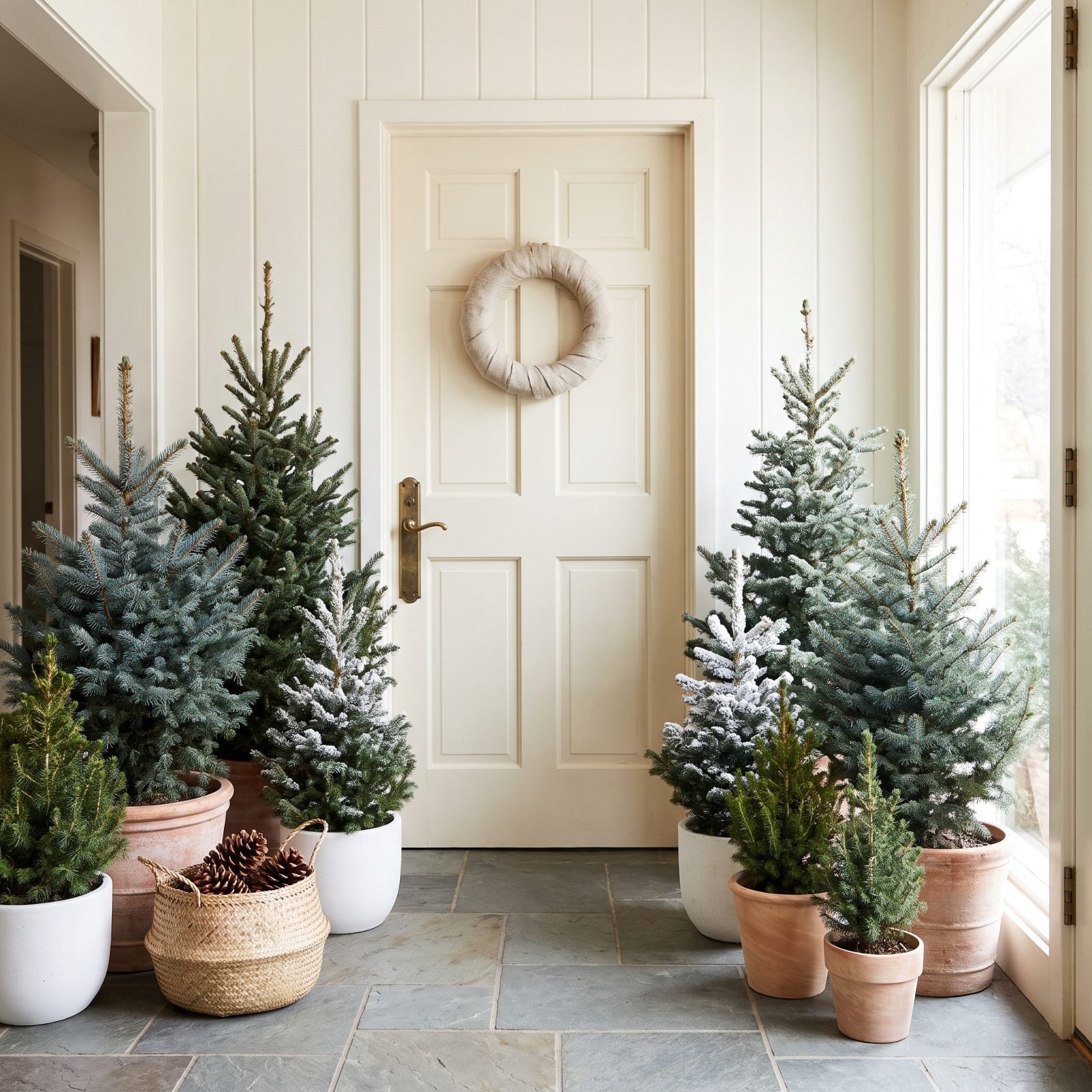
Instead of cutting evergreen and hanging it dead, group living miniature firs in pots and build a little grove on each side of the door. Vary the heights — one foot to four — and mix terracotta with matte white pots so the cluster looks grown rather than placed.
The real payoff comes January 2nd. These are living trees. Water them, keep them cool, and they move outside to the garden when the season’s done. Festive now, landscaping later. We’re suckers for any decoration that keeps earning its keep.
27. A Ceiling of Ornaments Floating Over the Entry
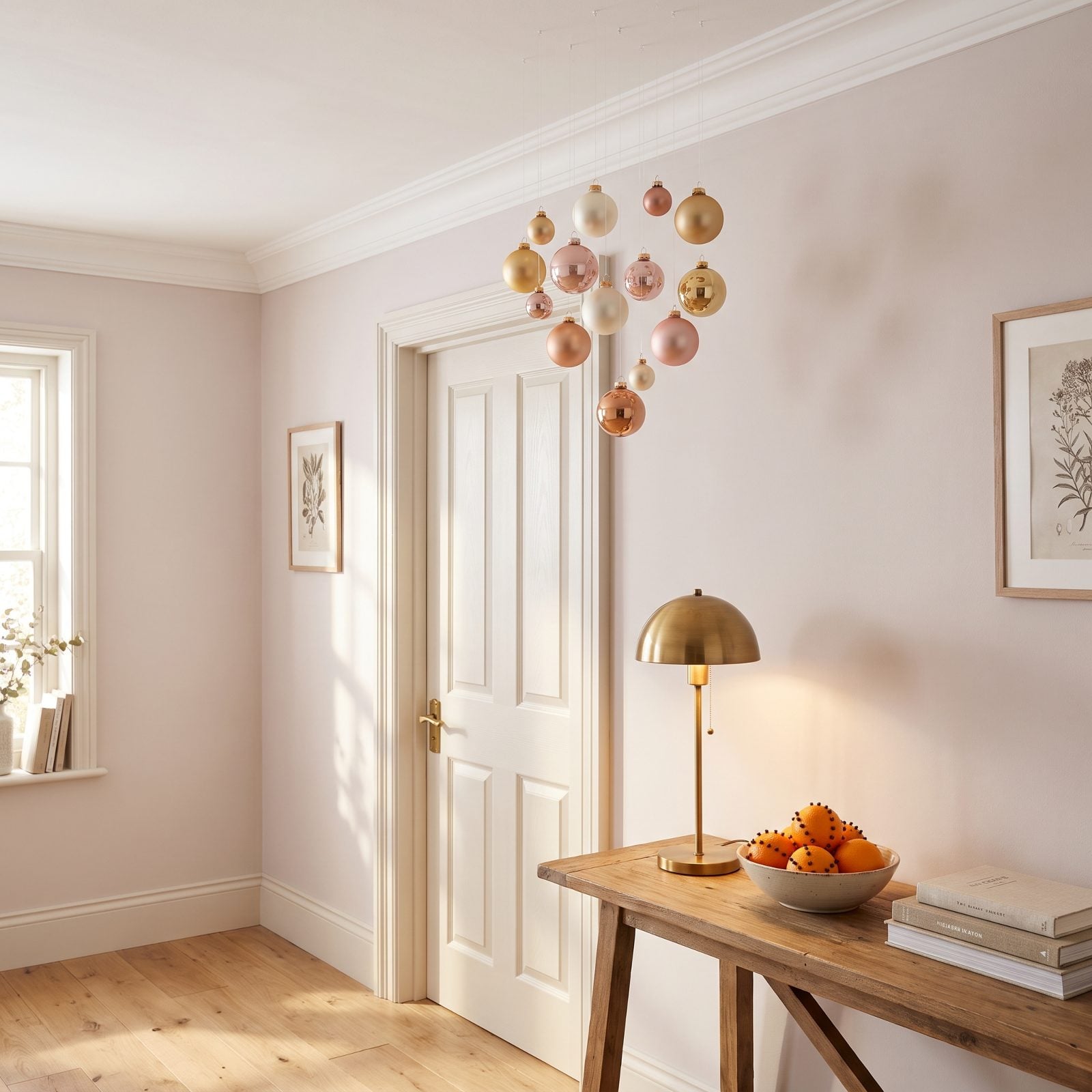
Hang ornaments from the ceiling on clear fishing line, stagger the heights, and you get a floating cloud of glass right where a guest steps through. Overhead decoration is rare, which is precisely why it stops people cold.
Stick to a tight palette. Gold, blush, and copper reading together look intentional; a rainbow of random baubles looks like you emptied a box. And keep the lowest ornament above head height — unless you’re after a very festive concussion.
26. A Red-and-White Candy-Stripe Doorframe
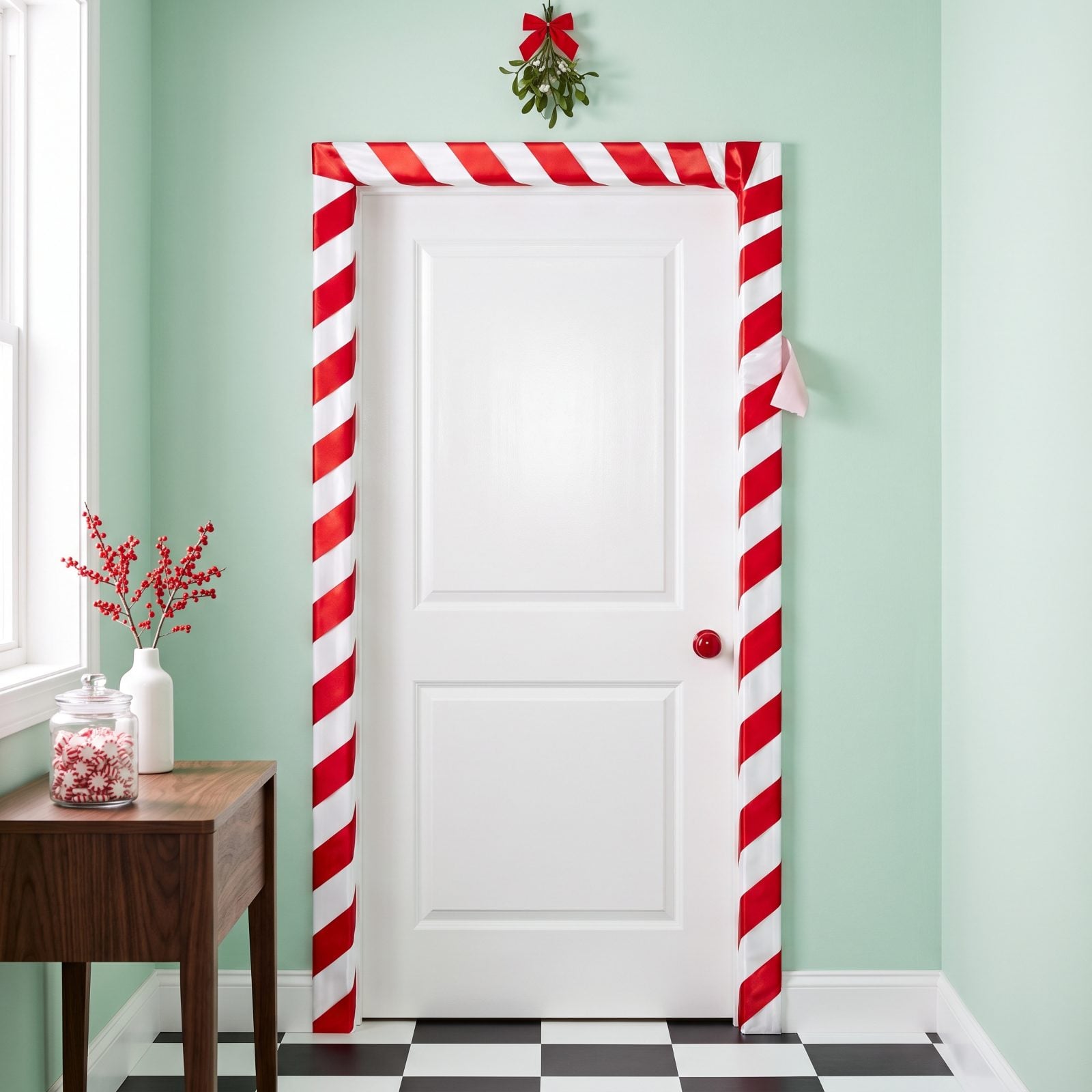
Wrap wide red ribbon diagonally up a white doorframe and the whole thing becomes a peppermint stick. It’s the most literal idea on this list, and the most fun, which is sort of why it works.
It reads cleanest on a white or light frame. Keep the spacing even — this is one treatment where sloppiness really shows — and stick to one bold red so it stays candy and doesn’t drift toward clown. Kids lose their minds over it.
25. Bare Birch Branches Arched Over the Door
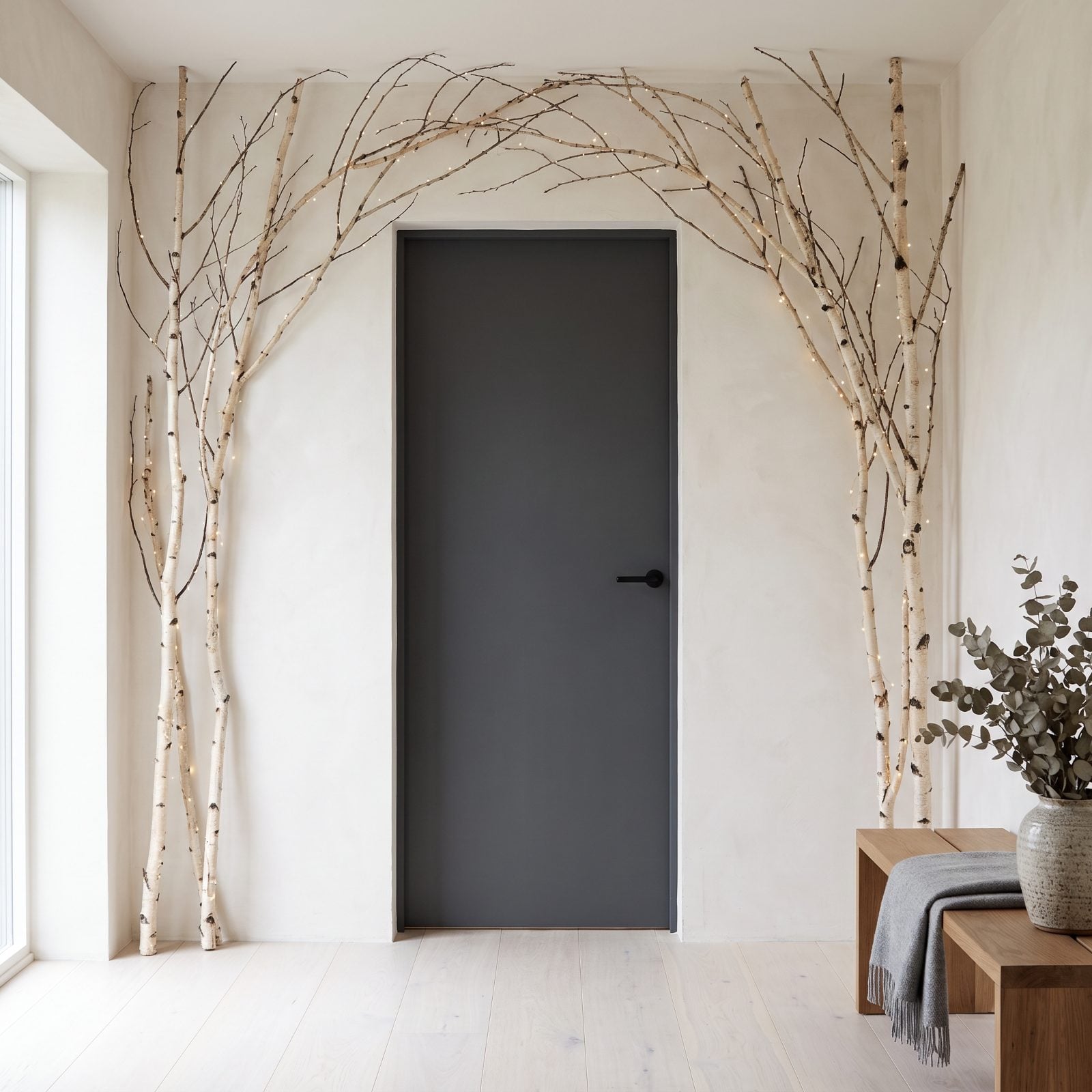
Bare birch does what garland can’t — it reads as a drawing. Pale trunks with their inky markings arch over the door in thin graphic lines. No mass, no bulk, just shape against the wall.
This is the restrained option, the one for anyone who thinks most Christmas decor is too much. Thread a few warm micro-lights through the branches if you want a whisper of sparkle. Against a charcoal door and warm white limewash, it’s the whole holiday said quietly.
24. Stacked Wrapped Boxes Forming Asymmetrical Columns
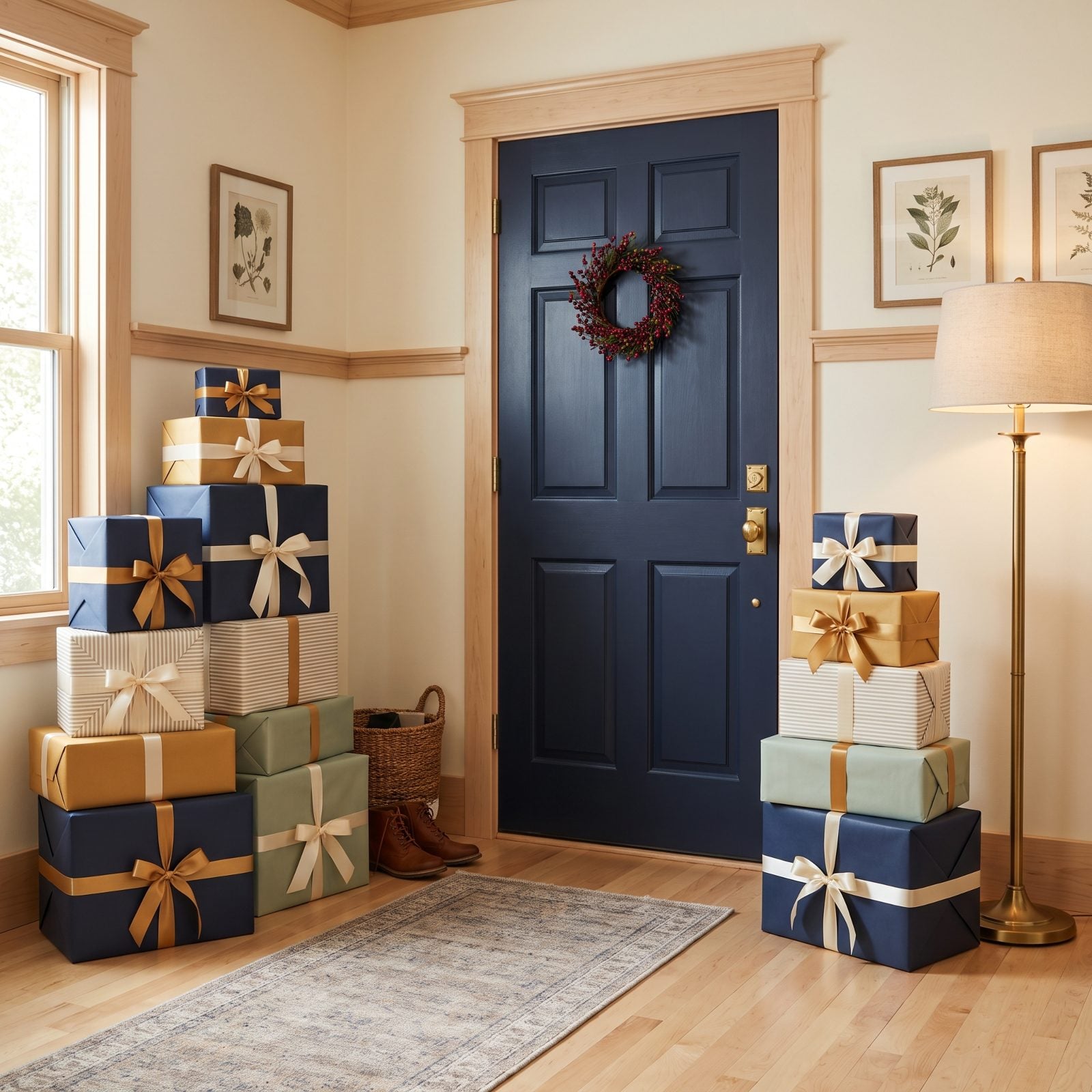
Stack wrapped boxes into two tall uneven columns flanking the door and you get instant abundance, like the gifts couldn’t wait and spilled into the hall. Asymmetry is the magic word here. Match the two stacks and it looks stiff; let one run taller and it looks alive.
Wrap empty boxes so they weigh nothing and store flat afterward. Pull your papers from one tight palette — navy, gold, sage — with satin ribbon tying it all together, and the stack reads as one composition instead of a dozen random presents.
A matched pair looks staged. An uneven pair looks like the gifts couldn’t wait.
23. Giant Paper Stars Suspended Above the Threshold
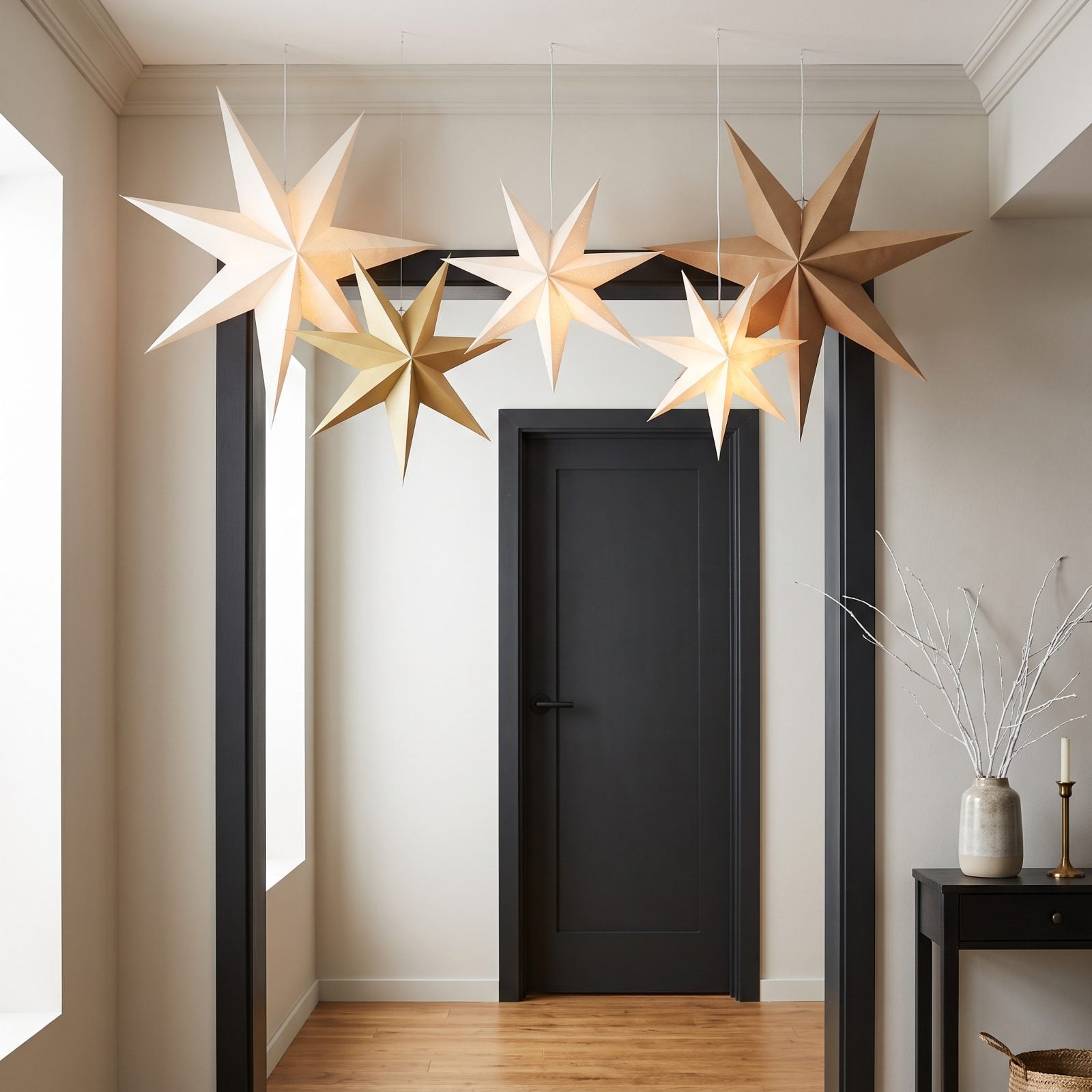
Big folded paper stars, hung in a loose cluster over the threshold, feel like a tiny constellation you walk under on the way in. Mix sizes, light a few from within, and the whole arrangement seems to float.
Paper is the lightest and cheapest material you’ll find here, which makes this the easiest treatment to pull off at scale. Moravian-style paper stars come flat-packed and fold open in seconds. Hang them at staggered heights on clear line so the group has depth instead of sitting in a flat row. It’s the kind of overhead moment that makes a plain hallway feel designed, and come January it packs away to almost nothing.
22. A Cascade of Brass Bells Down One Side
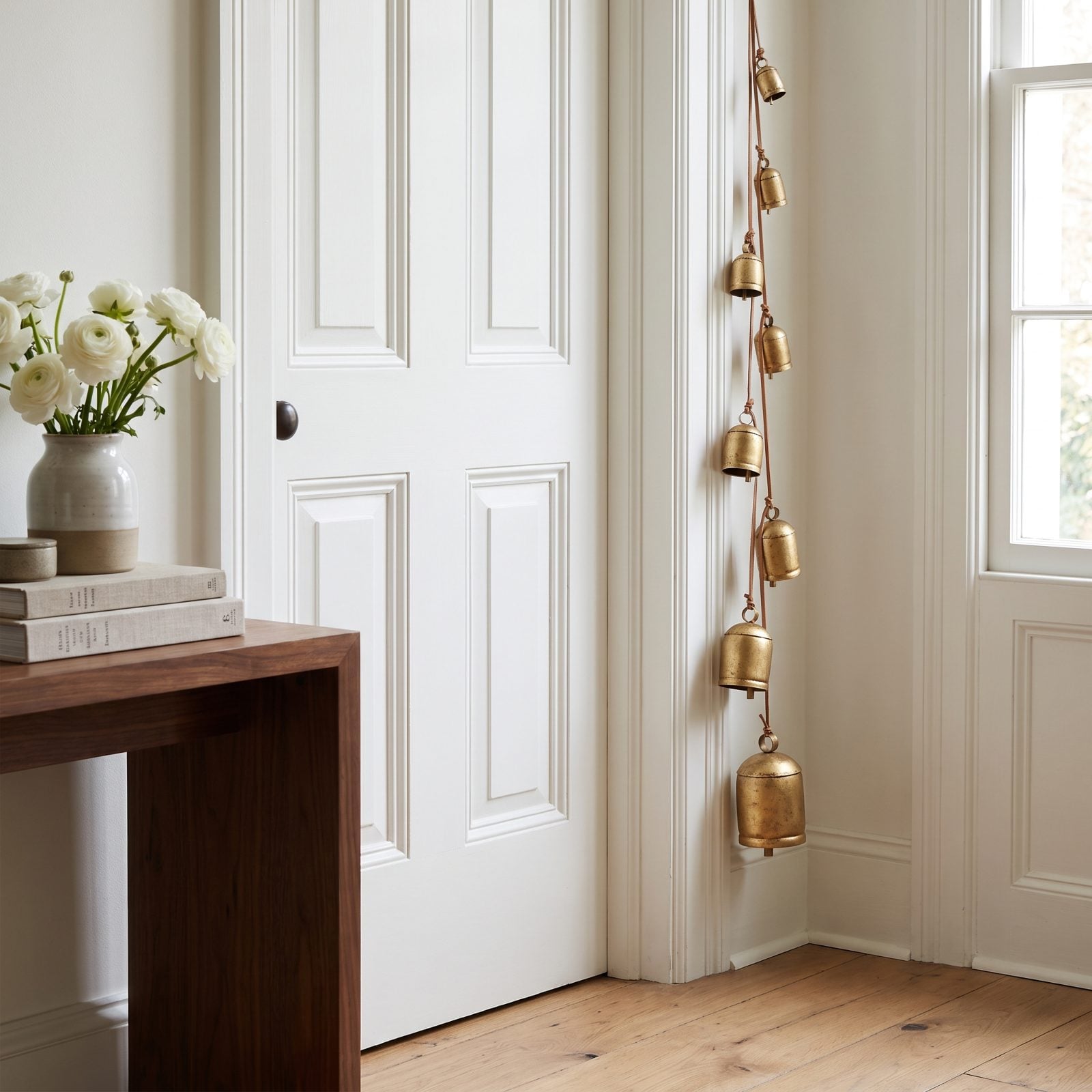
Bells move. That’s the whole trick. Garland just sits there being green, but a column of brass bells down one side of the door actually sounds — every time someone walks through, you get a soft shimmer that announces the season before anyone sees it.
Hang them on a leather cord, graduated small to large, and let the metal do the talking against a painted panel door. Antique brass bells warm up under lamplight the way plastic never manages.
21. Copper Tubing Bent Into a Minimalist Lighted Outline
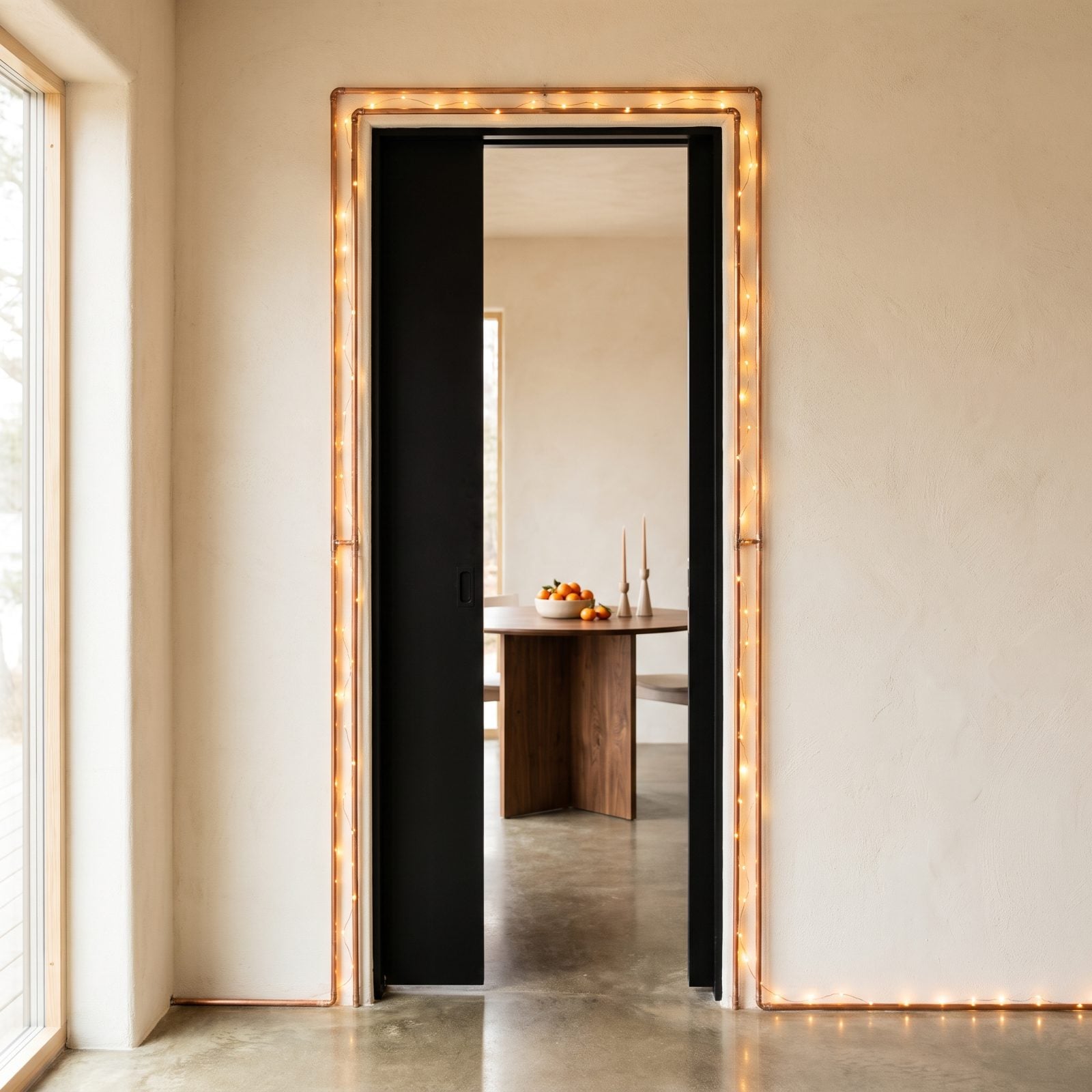
For the people who find garland fussy and clutter a personality flaw, this one’s for you. A length of copper tubing bent to trace the doorframe, fairy lights tucked inside, outlines the door instead of smothering it. It reads as part of the house rather than a thing stuck onto it.
Copper ages to a pink-brown that plays well with warm LEDs and matte black doors. Bend it yourself with a tubing spring from the hardware store, or farm the job out. Either way it comes down after the holidays in one clean piece and stores flat — which, honestly, is more than most holiday décor can say.
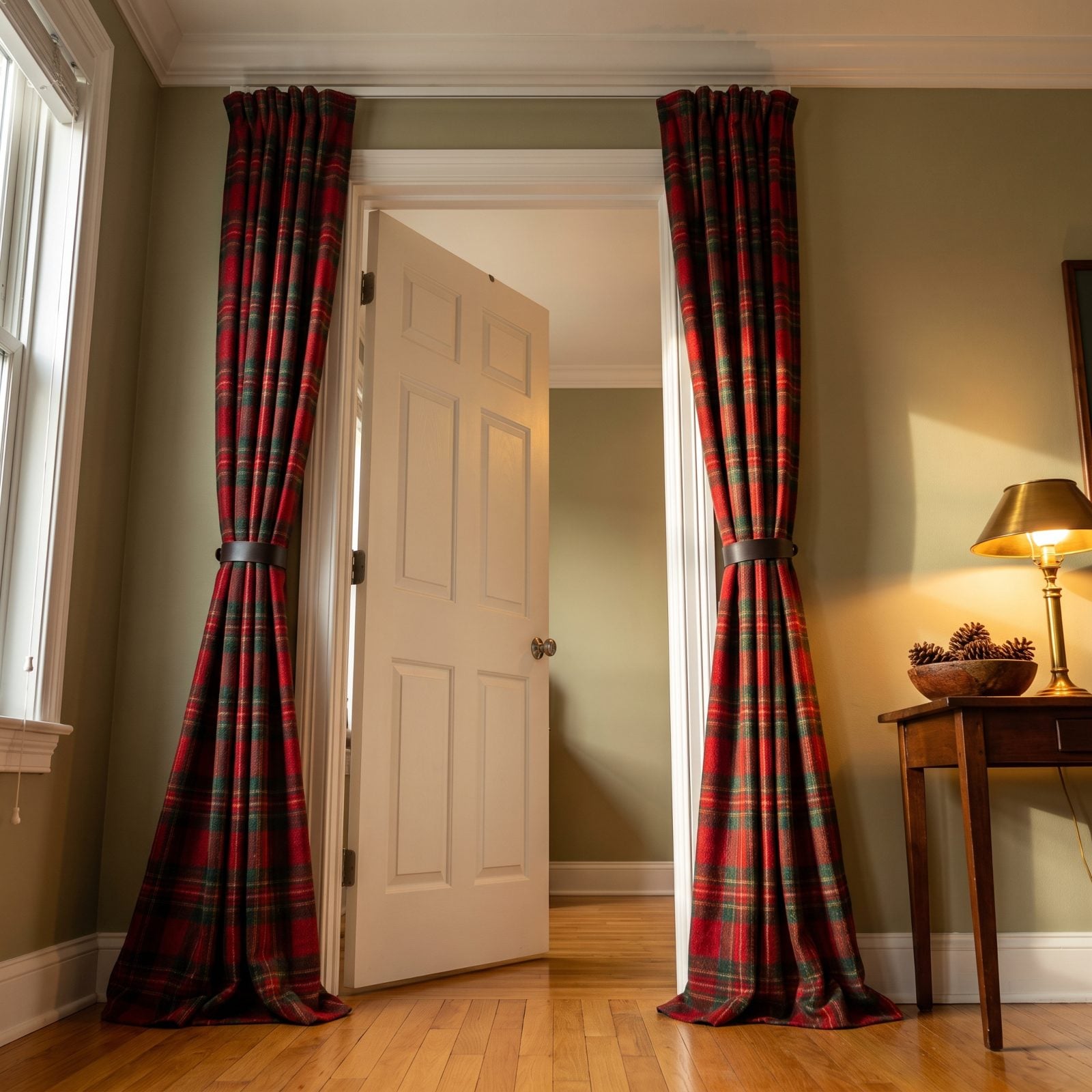
20. Plaid Fabric Panels Framing the Door Like Curtains
🔥 Would you like to save this?
Picture a doorway dressed the way a window gets dressed. Two slim panels of wool tartan hung on either side of the frame, held back with leather ties, give the entrance the weight and softness of drapery. Nobody expects fabric at a doorway. That’s exactly why it lands.
Go with a true hunting plaid in green and crimson for the traditional read, or a muted gray-and-rust check if red feels loud to you. These pair handsomely with warm-toned green curtains designs elsewhere in the house.
And here’s the sleeper advantage: come February you take them down, wash them, and hang something lighter. A doorway you actually change with the seasons, instead of one you forget to dismantle until March.
19. Dried Orange Slices Strung in Vertical Lines
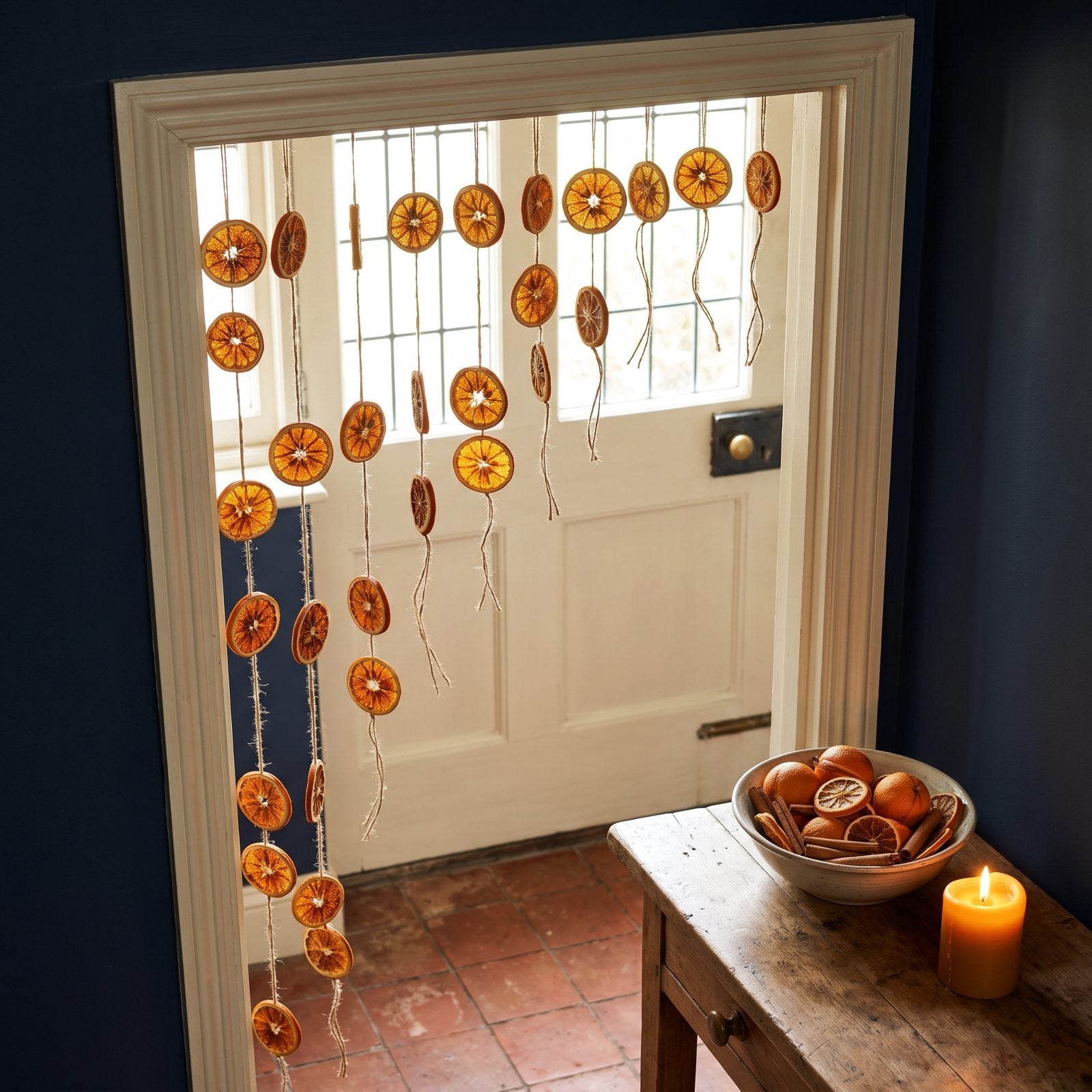
Hold a dried orange slice up to a window and you’ll understand immediately. Light pours through the fruit like a tiny stained-glass panel, pith glowing, seeds in silhouette. Strung in vertical lines down a doorframe, they turn your entrance into something half decoration, half lantern.
They’re close to free. Slice oranges thin, dry them low in the oven for a few hours, thread them on jute. Done.
18. Red Lanterns Arranged in Graduated Heights
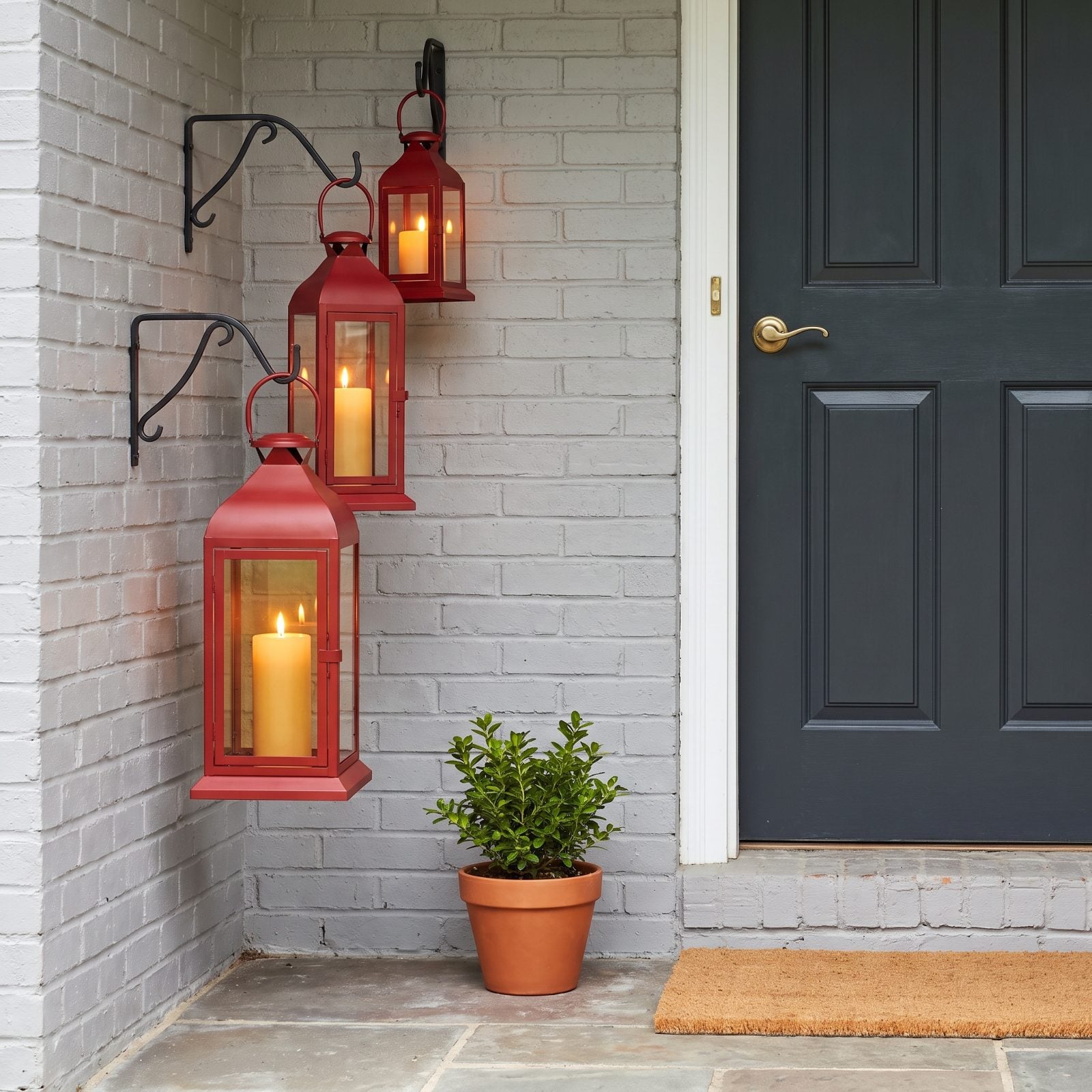
A single lantern is a decision. Three in graduated heights is a composition. Hang red metal lanterns on iron hooks beside the door — largest lowest, smallest up top — and you get a descending rhythm that pulls the eye down toward the handle.
Fill them with warm LED pillars so you can light the entrance at dusk without a fire-safety conversation. Lacquer-red metal against a charcoal door turns festive without a single sprig of greenery.
17. Magnolia Leaves Tucked Into Architectural Corners
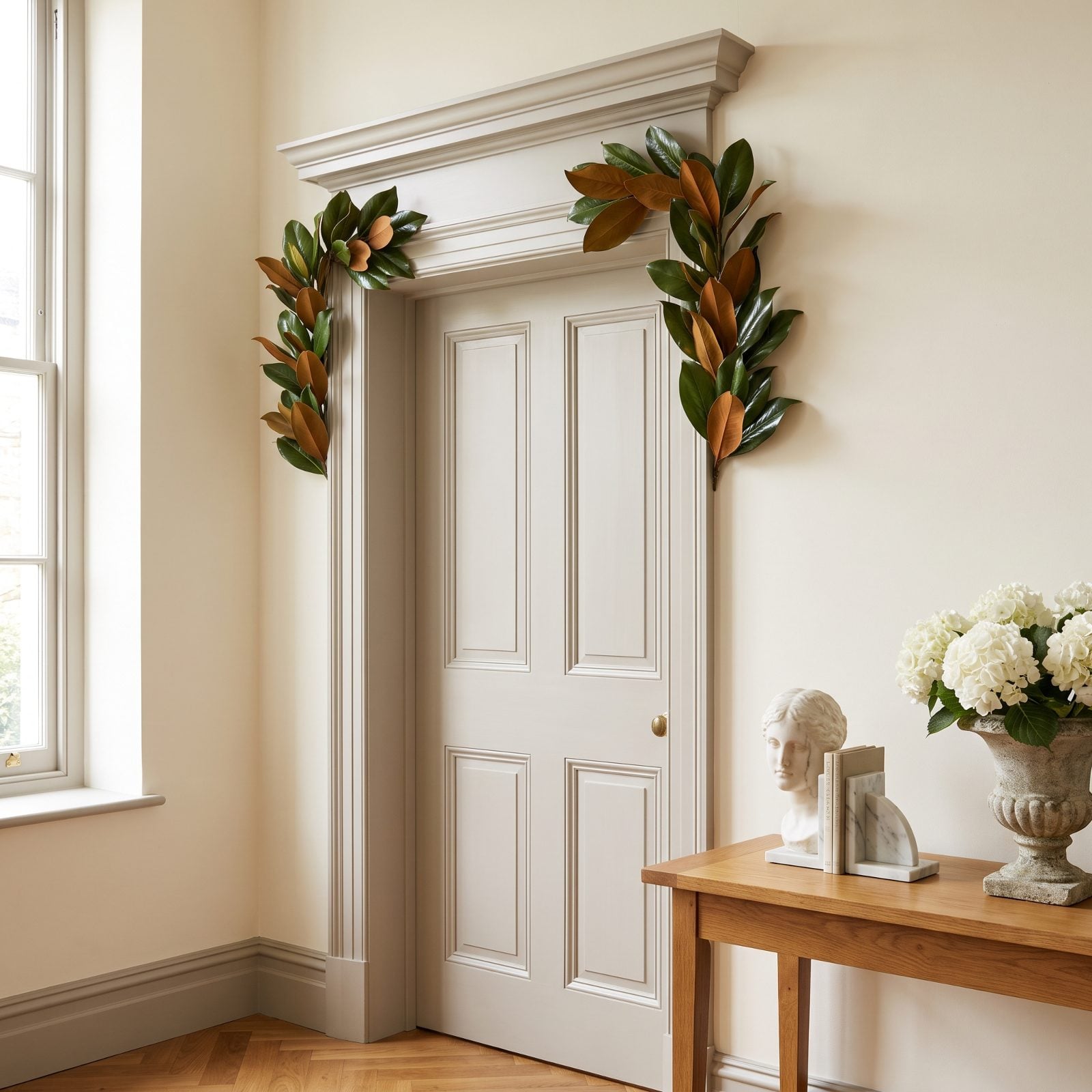
Restraint reads as confidence. Rather than wrapping the whole frame, tuck magnolia clusters into just the top two corners and let the door breathe. The move says you know when to stop — the rarest skill in all of holiday decorating.
Flip some leaves to show the suede-brown undersides against the glossy green fronts. That green-to-cognac contrast is the entire reason designers love magnolia. It carries a doorway with almost nothing, and it dries in place and holds its shape for weeks, so this one earns its keep well past the holidays.
16. Clusters of Pinecones Hung From Discreet Hooks
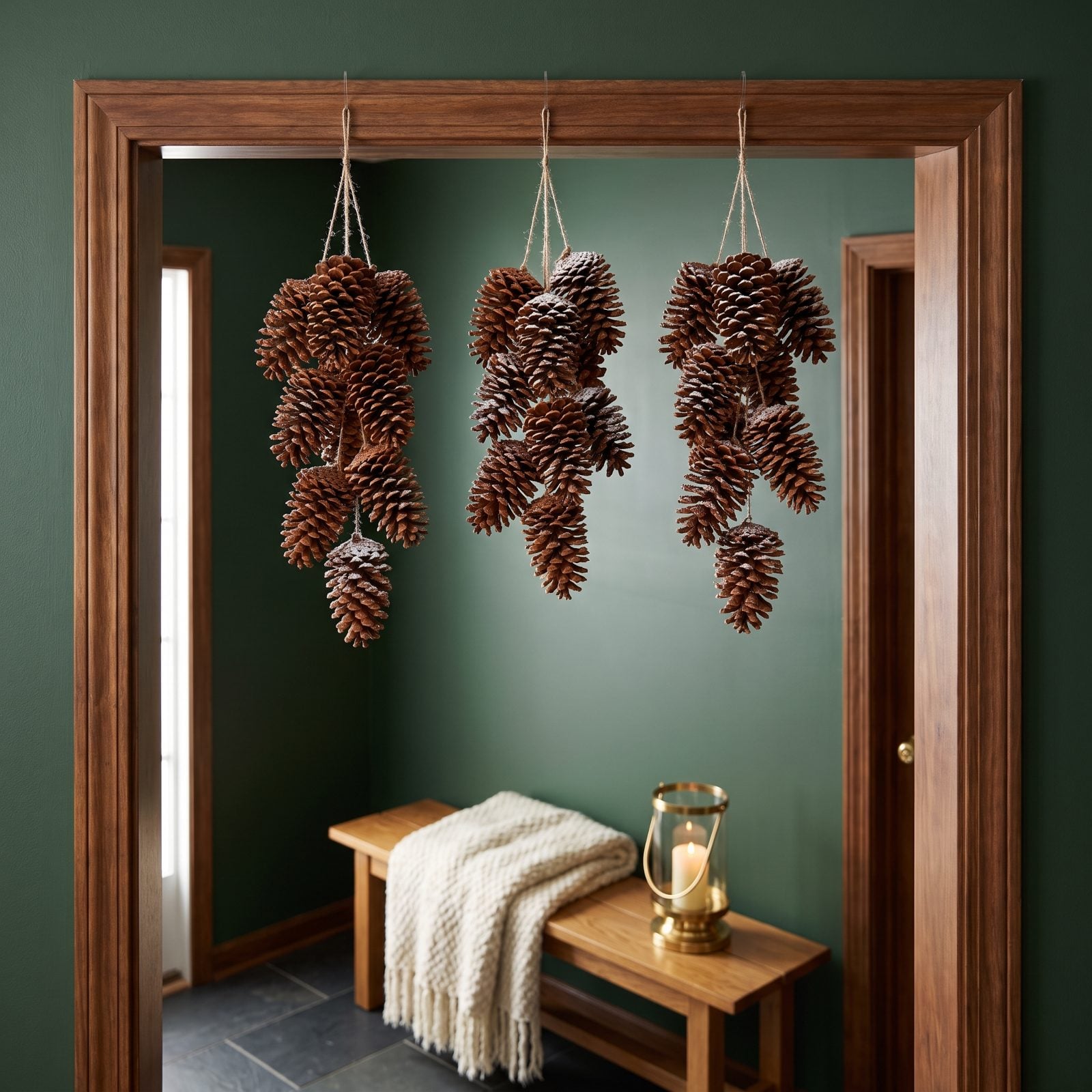
Pinecones get relegated to bowls, which wastes their best feature. They dangle beautifully. Hang clusters from discreet hooks across the top of the frame, twine cut to slightly different lengths, and they fall like a textured fringe over the entrance.
Against a deep forest-green wall, the russet-brown scales practically vibrate. A dry brush of white at the tips reads as frost without the mess of fake snow. Costs you nothing but a walk outside and twenty minutes of knot-tying.
15. Bundles of Wheat and Dried Grasses at Both Sides
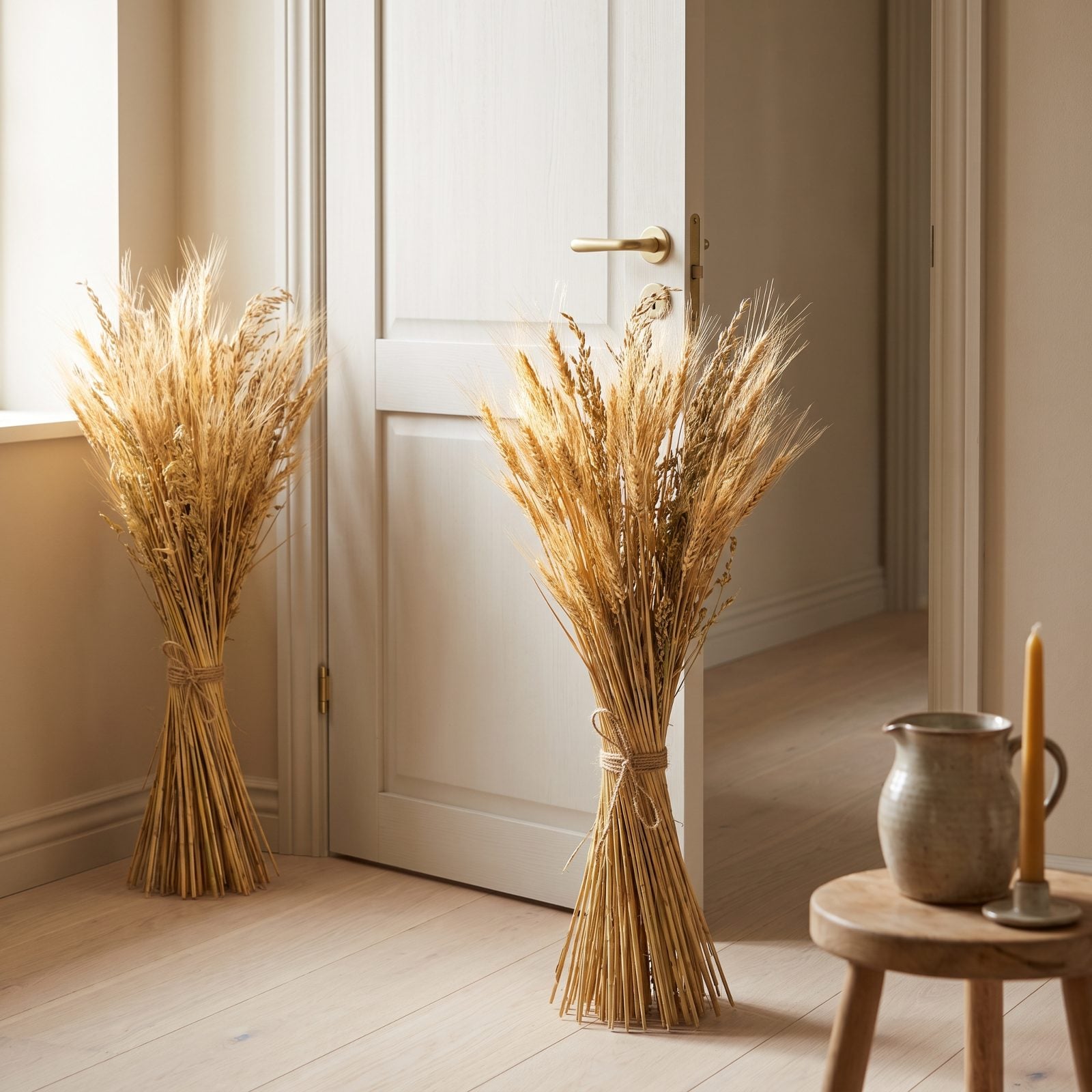
Not every Christmas doorway needs to shout red and green. Two tall bundles of golden wheat and dried grasses flanking the door bring a warm-neutral, harvest-into-winter feeling that suits an oatmeal plaster hallway far better than anything glittery.
Bind them with raffia, fan the stalks at the top, stand one at each side. The gold glows under daylight and holds all winter without a drop of water.
14. Paper Snowflakes Concentrated Around the Transom
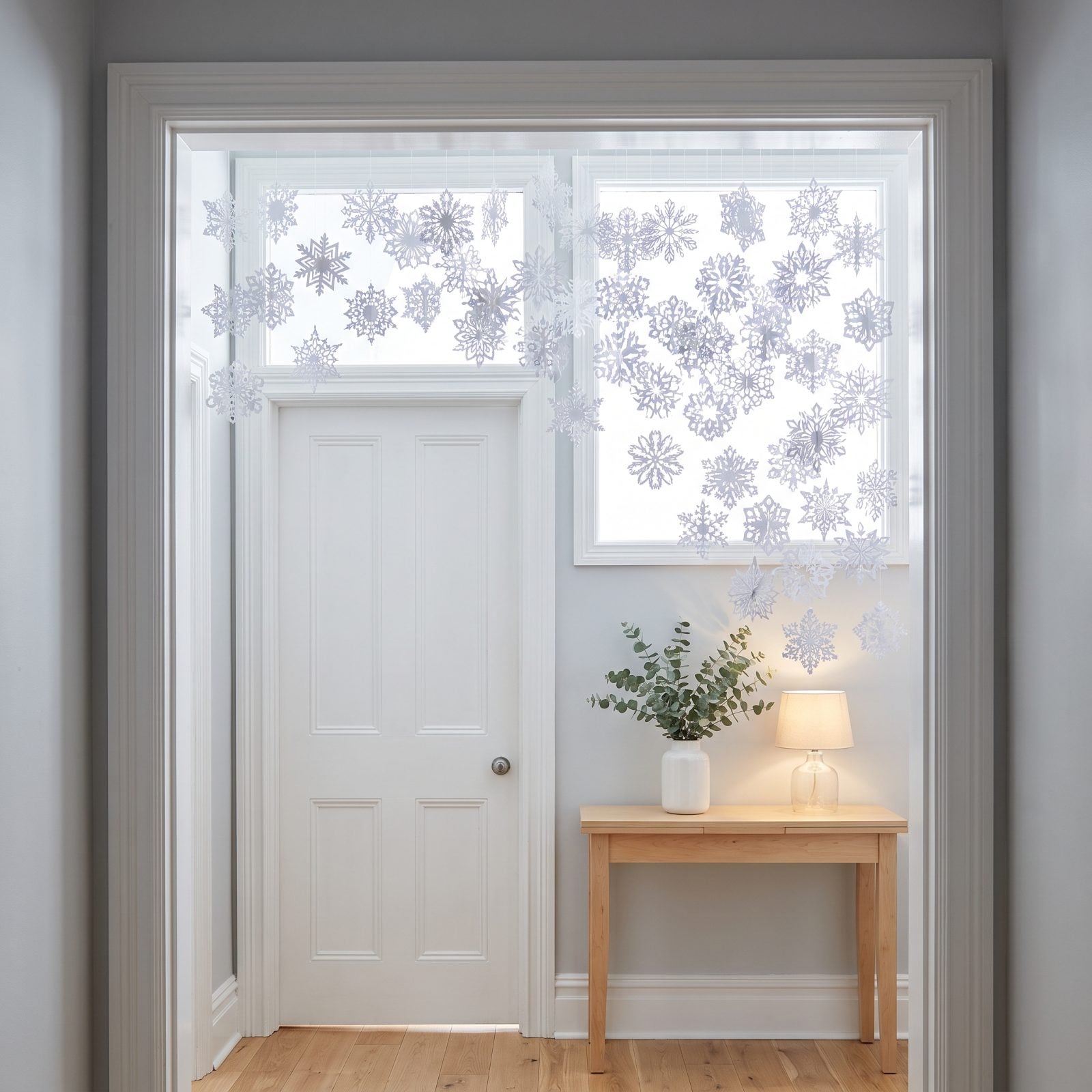
The transom is the most ignored real estate in any doorway. Cluster cut-paper snowflakes around it, hung on invisible thread so they seem to float in the glass, and dead space becomes the focal point.
Let them thin out as they drift away from the transom so the effect looks like falling snow rather than a wall of paper. Backlit by daylight, those intricate cuts throw delicate shadows across the wall.
The cheapest treatment on this list is also the one guests comment on most. Nobody’s cut a snowflake since the fourth grade, and they can tell you did.
13. Burgundy Amaranthus Draped From One Upper Corner
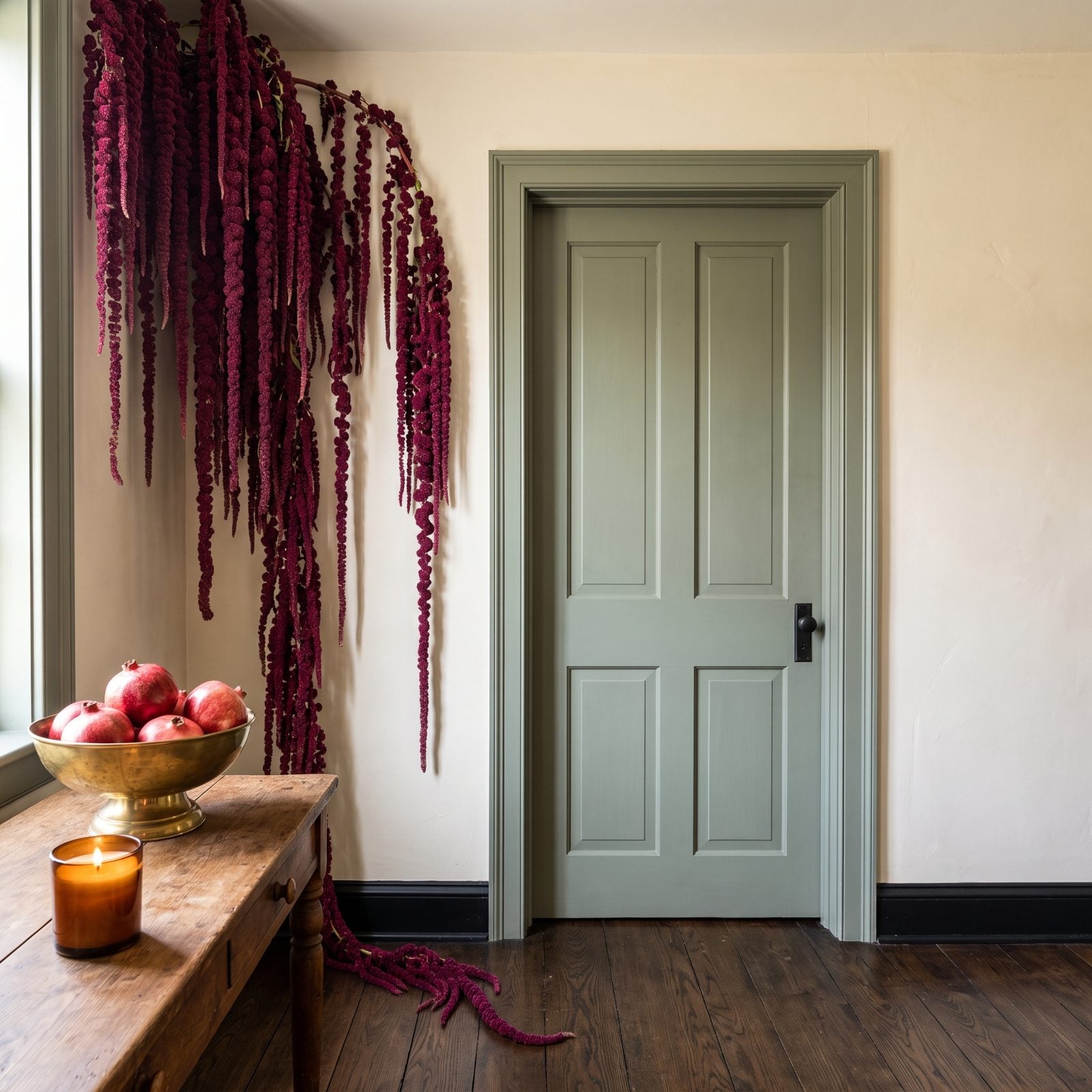
Go for drama. Burgundy amaranthus — the dangling stuff people call love-lies-bleeding — draped from a single upper corner and left to pour toward the floor is the most painterly treatment here. The asymmetry does all the work. One corner heavy, the rest bare, like a curtain yanked to one side.
Against a sage-green door, the wine-red trailing tassels look like something lifted out of a Dutch still life. It dries in place and deepens in color as it goes. A doorway treatment that gets better the longer it hangs is a genuinely rare thing. Hang it, step back, and let it bleed.
12. A Halo of Gold Metal Leaves Arched Above the Door
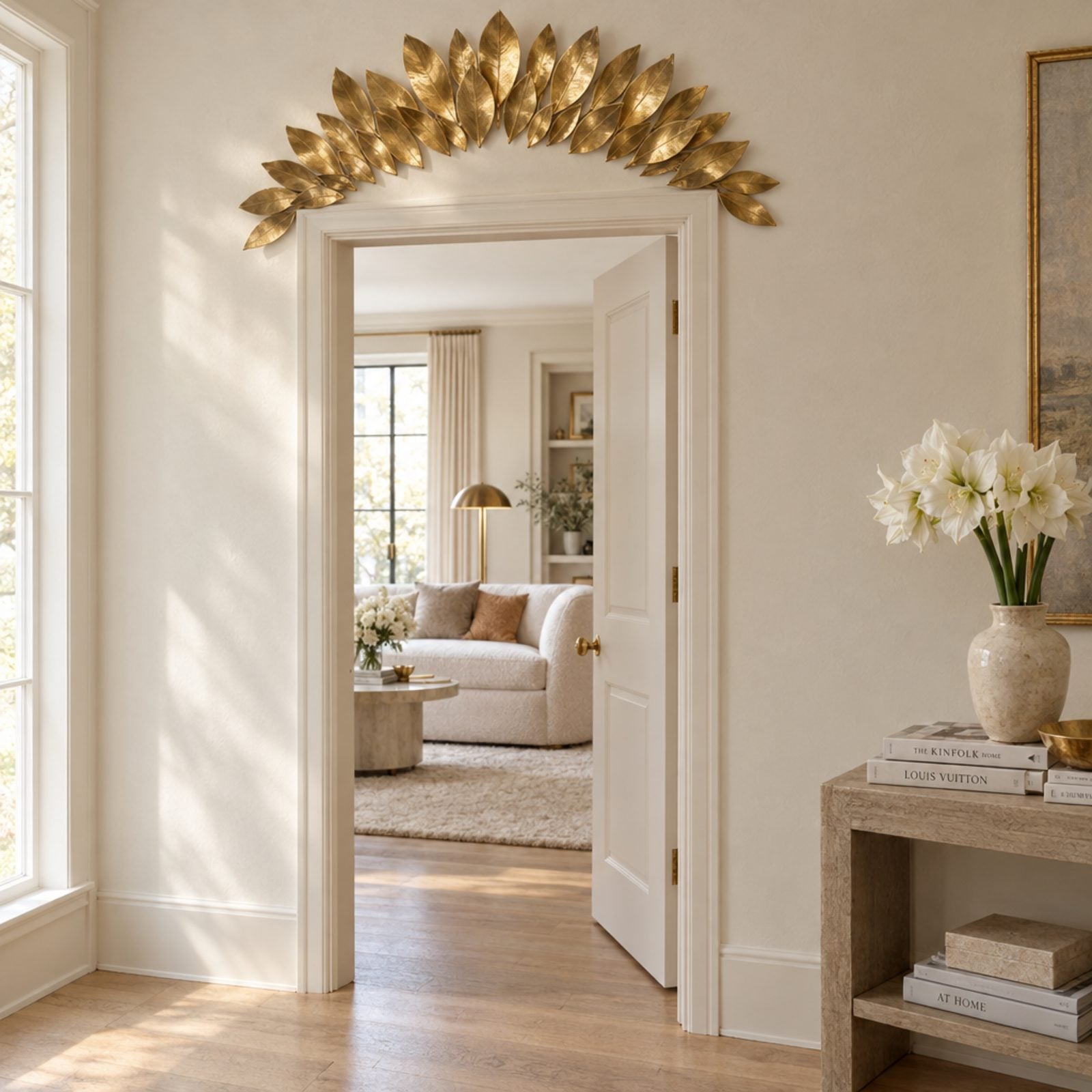
Skip the green entirely and let gold metal do the celebrating. A fan of brushed gold leaves arched over the door reads festive without a single pine needle, and it photographs like jewelry against a plain wall.
The trick is in the overlap. Leaves layered at slightly different depths catch light from multiple angles, so the whole piece shifts as you walk under it. Hang it as a shallow crescent rather than a full circle — a crown is friendlier than a halo pinned flat against the plaster.
11. Nutcracker Columns, Minus the Soldier Faces
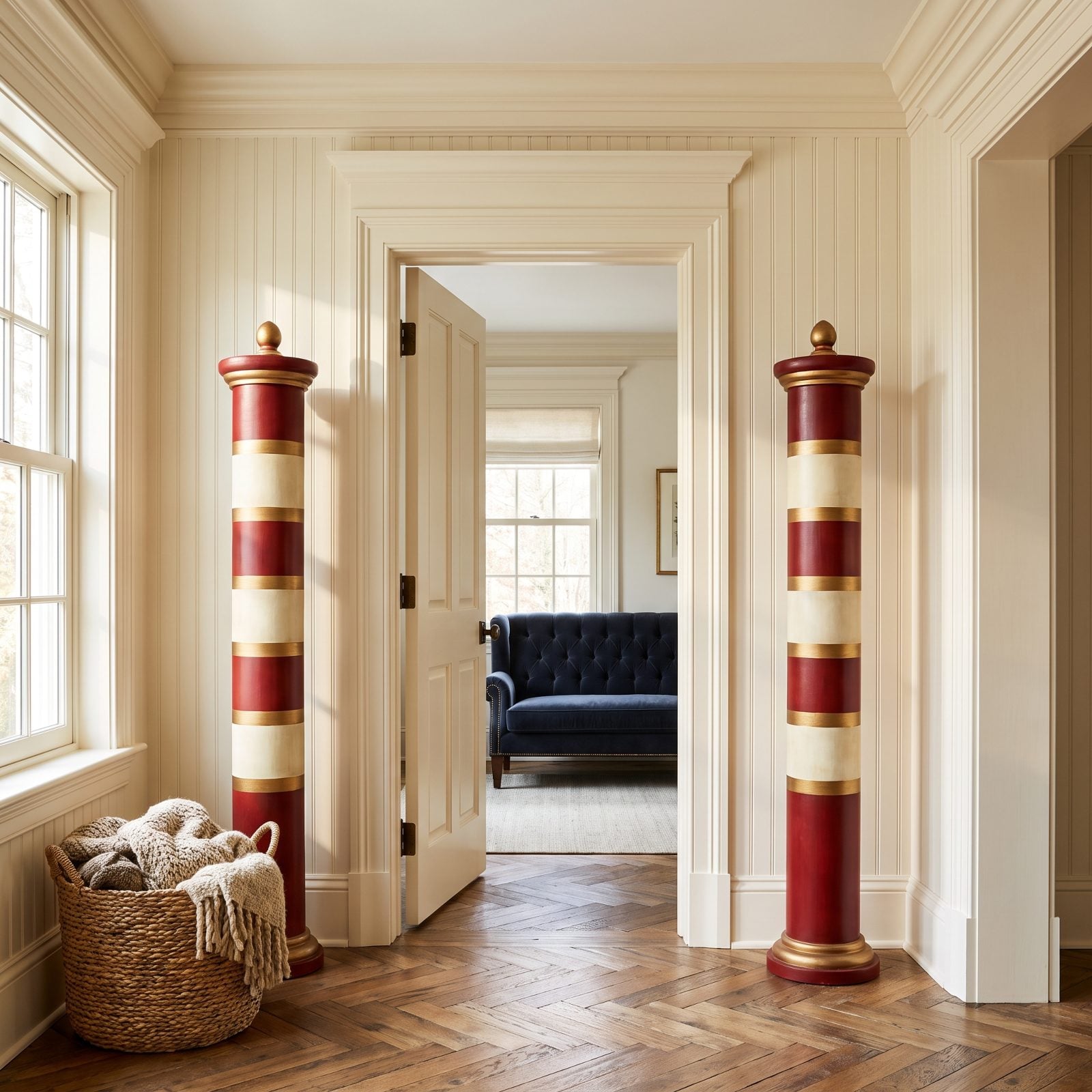
The nutcracker look is fun right up until forty tiny painted eyes stare back at you every time you walk through the door. Keep the striped uniform palette and drop the faces.
Two tall banded columns in red, cream, and gold flank the frame like stylized guards. You get the whole marching-soldier energy, the holiday reference lands instantly, and nothing is watching you carry laundry past it. Cap each one with a small gold finial so they look finished rather than like leftover stage props. This works beautifully in formal entries with real molding to play against.
10. A Curtain of Warm Micro-Lights Behind the Glass
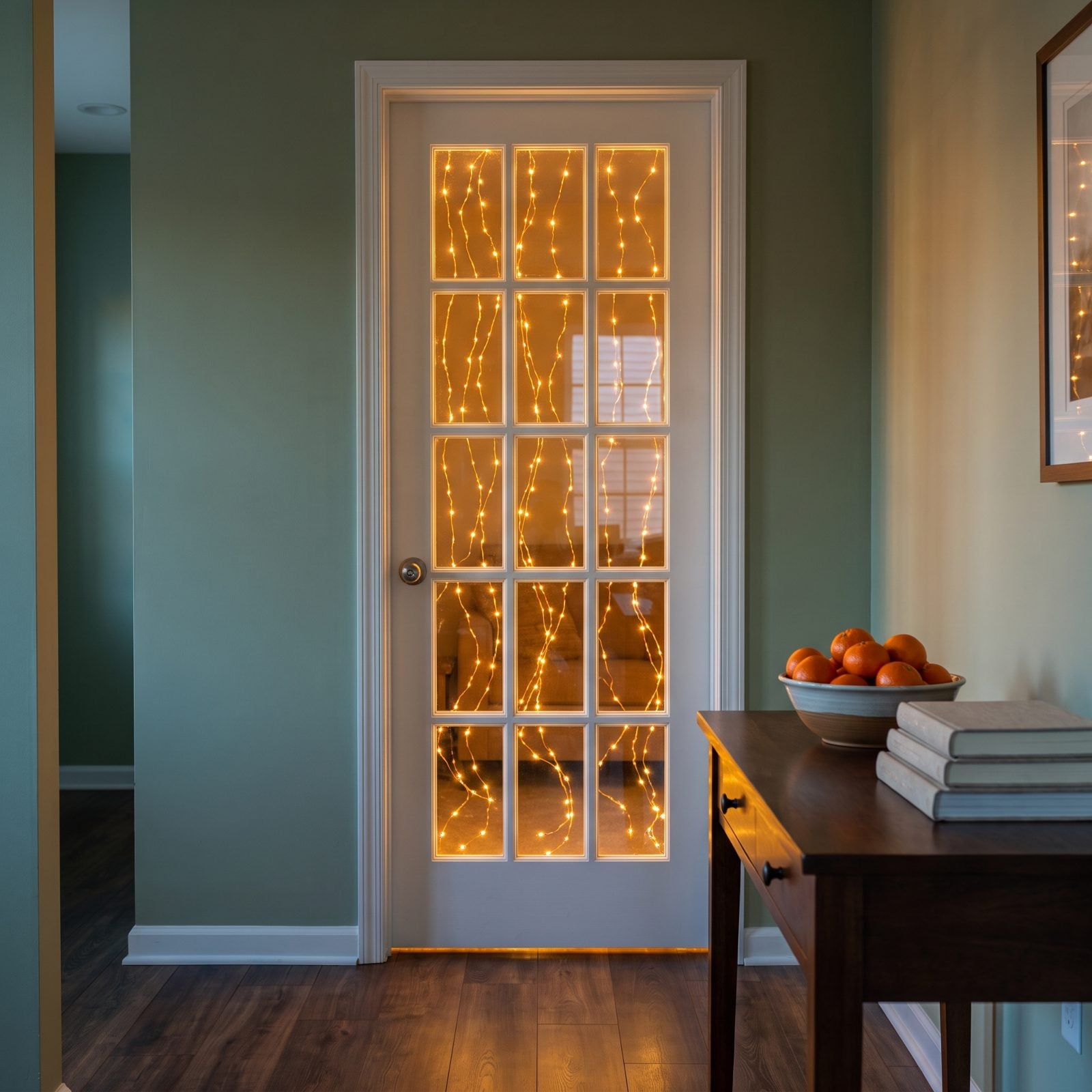
Any door with glass panes is a hidden light box waiting to happen. Hang a curtain of warm micro-lights on copper wire directly behind the glass, and the whole door turns into a glowing screen come evening.
Use amber or warm white, never cool white. Warm light reads cozy. Cool light reads office parking lot, and we will die on this hill. The copper wire disappears against the glow, so all you see is hundreds of floating points. From a dark hallway at dusk it stops you cold.
9. Three Wreaths Stacked Vertically Down One Side
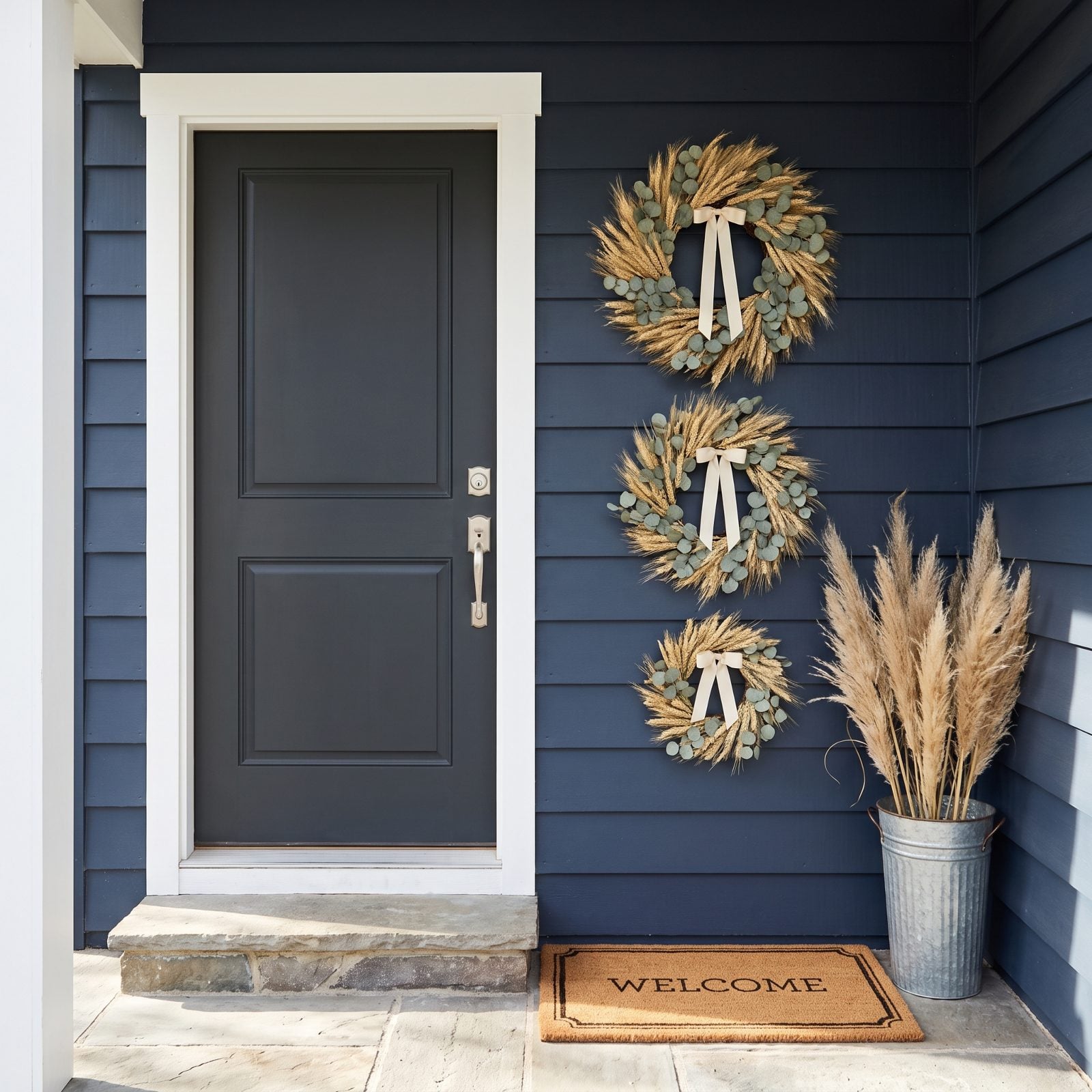
One wreath centered on a door is the default. Three wreaths stacked beside it is a design decision.
Graduate the sizes, largest at top, and hang them in a tight column so the eye travels down the wall and lands at the threshold. It draws the whole entry taller, which is a gift if your ceilings run low. Dried wheat and eucalyptus keep the palette soft and seasonal without going full Santa’s workshop. And the asymmetry is the whole point — a single column off to one side feels composed rather than obvious.
8. A Scalloped Border Folded From Old Book Pages
🔥 Would you like to save this?
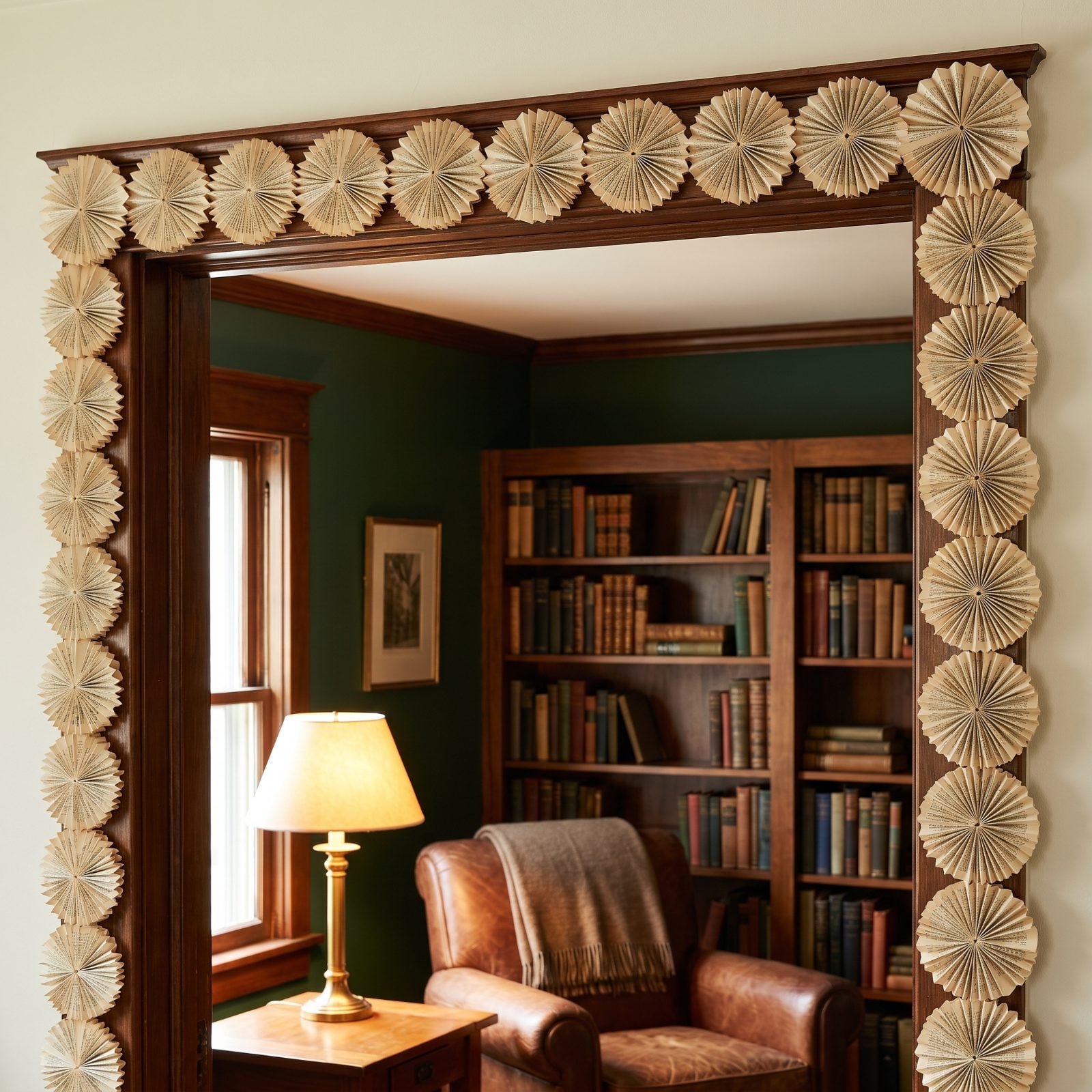
Here is the craft project that doesn’t look like a craft project. Old book pages, folded into small scallops and run along the door frame, make a paper border that looks like lace from across the room.
Raid a thrift-store hardcover nobody will miss. Yellowed pages photograph warmer than crisp white ones, so older is better. The scalloped edge softens a hard door frame and leans beautifully into a reading room or study. Festive, nearly free, and genuinely one of a kind. Pair it with a deep green courtyard design palette inside the room for that old-library hush.
7. A Doorway Framed in Layered Antique Picture Frames
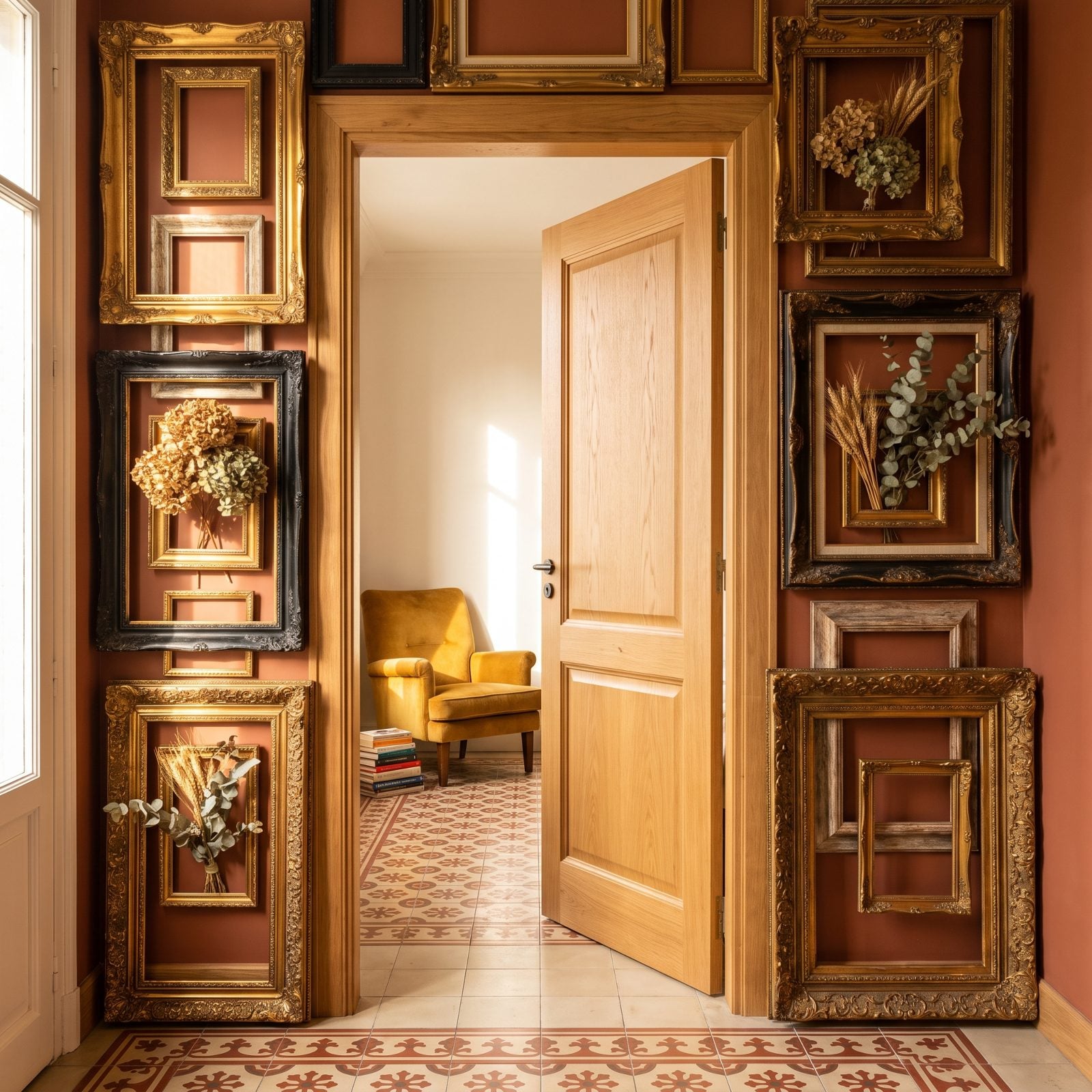
Empty frames, layered thick around a door, turn the whole opening into a piece of art. No photos needed — the frames are the decoration.
Mix gilt baroque with plain black and raw wood, overlap them at different depths, and let the mismatch do the work. For the holidays, tuck a dried sprig into a few of them and call it done. This is a maximalist move and it wants a bold wall behind it, something like terracotta or deep ink, so the gold reads loud. Place a green armchair in the room beyond and the whole vignette clicks.
6. A Crescent Moon Built From Dried Hydrangeas
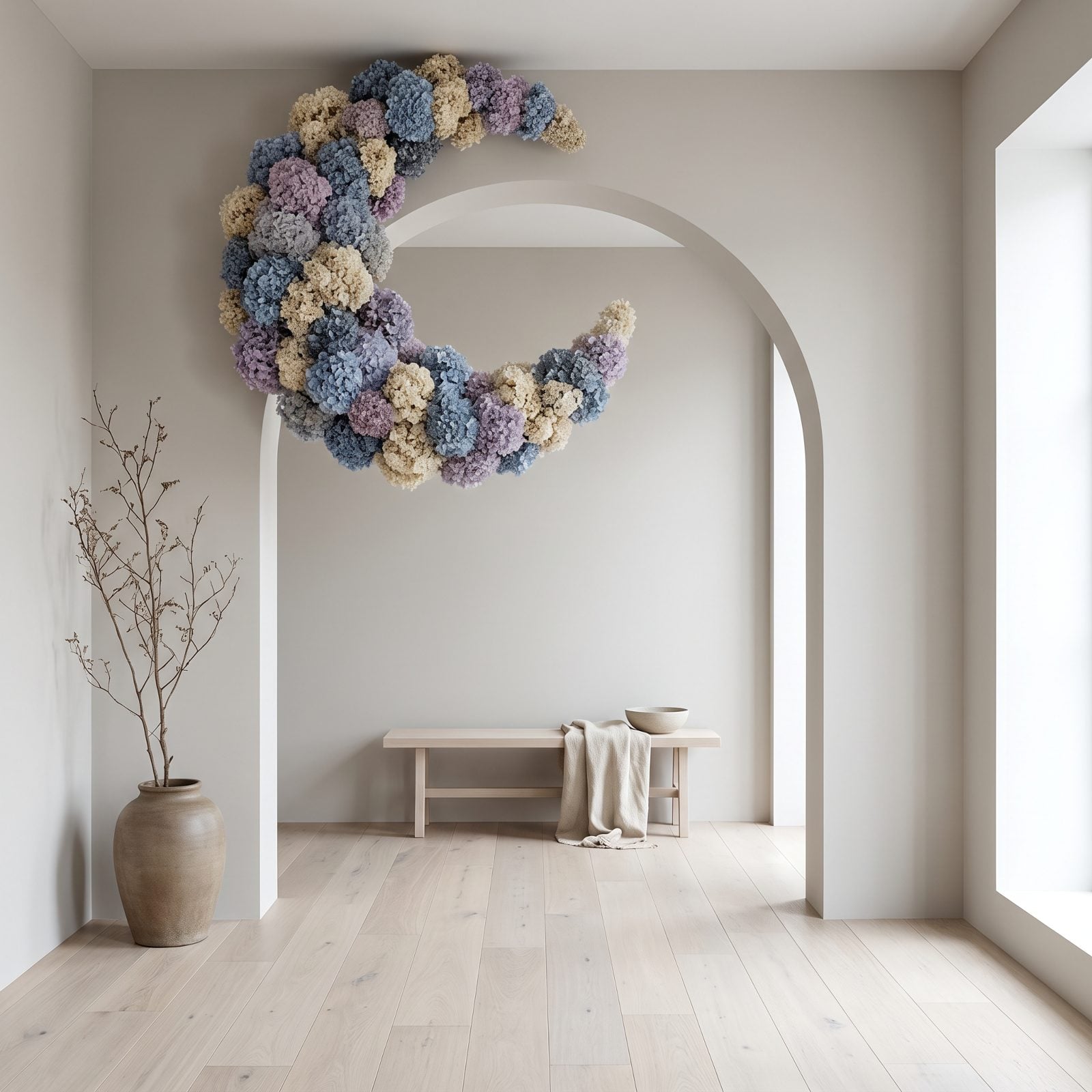
Dried hydrangeas have this cloud-like quality that most holiday materials can’t touch. Shape a dense batch into a crescent moon above the door and the effect is soft, slightly surreal, and nothing like a wreath.
Dusty blue and antique cream blooms keep it quiet and modern. The curved form plays especially well over an arched doorway, echoing the shape of the opening instead of fighting it.
Best part: dried hydrangeas last years if you keep them out of direct sun. Build it once, store it flat, bring it back every December.
5. A Geometric Border of Natural Wood Dowels
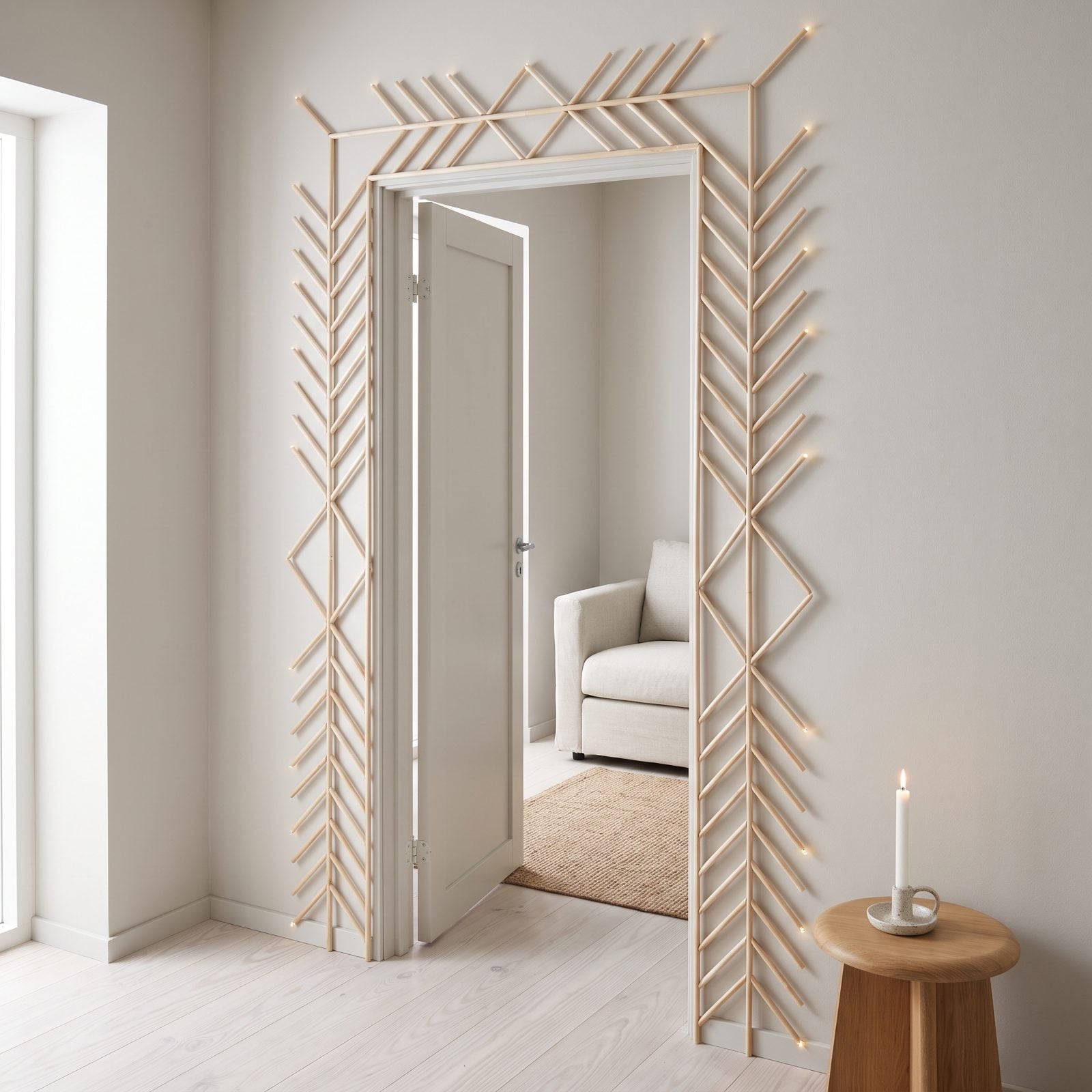
For the people who find most holiday decor too fussy: a border of thin wood dowels arranged in a chevron or diamond lattice around the frame. Clean, warm, and built like trim rather than glued on.
It looks like intentional carpentry instead of seasonal fluff, which is exactly why it suits a minimalist home. Blonde wood against a white wall is quiet but far from boring. Tip a few dowel ends with tiny warm lights if you want the festive nod without losing the restraint.
4. A Pair of Lighted Obelisks Climbing With Ivy
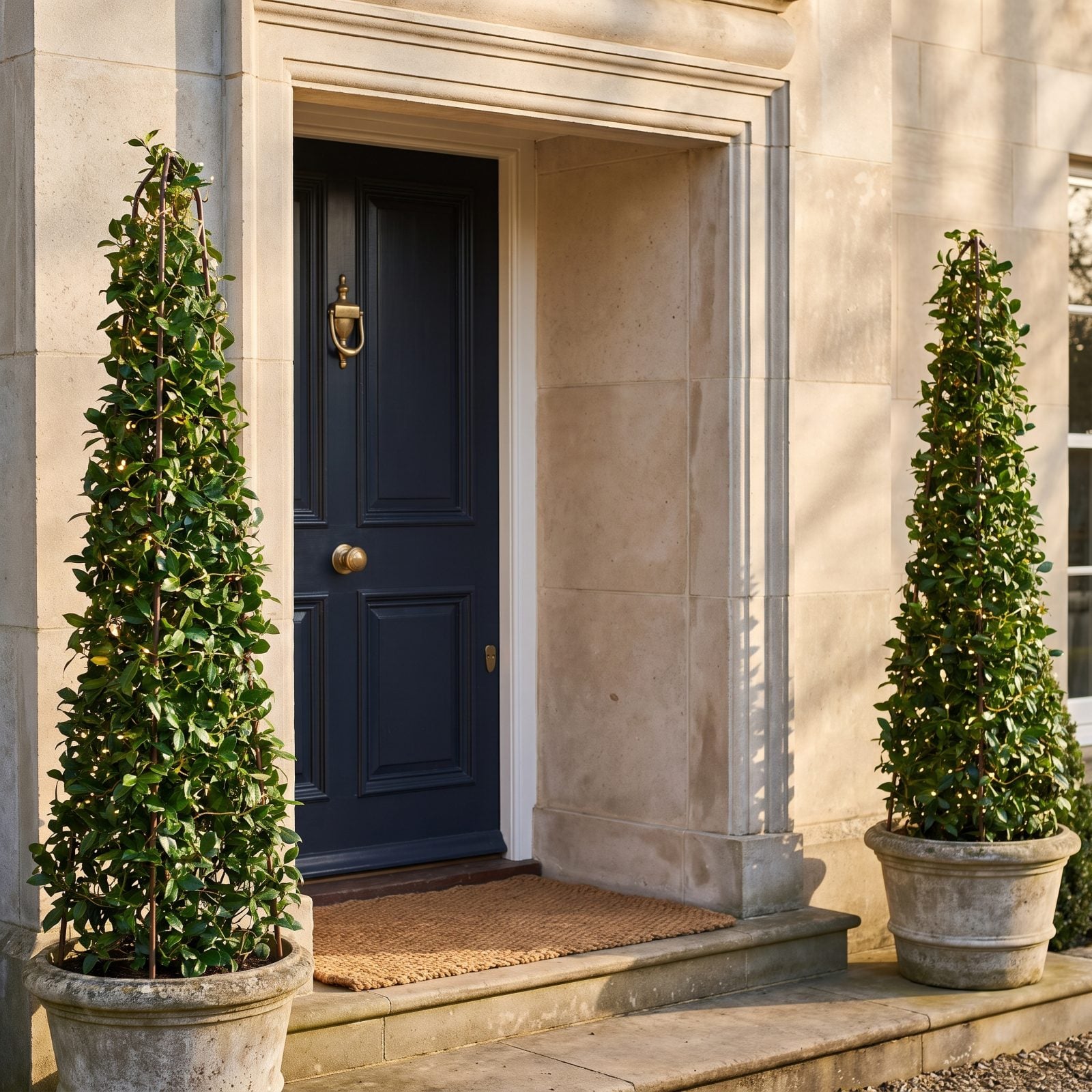
Ivy belongs on something vertical, not draped across your door frame. Train it up a pair of tall obelisk forms and flank the entry with two lit green towers instead.
Weave warm white lights through the ivy so each obelisk glows from within after dark. A matched pair gives a front door real gravity, the kind of welcome that makes guests slow down before they knock. This leans grand and formal, perfect for a stone surround or a painted navy door. And because the ivy is alive, it stays lovely well past the holidays.
3. Velvet Ribbon Wrapped Around the Casing Like a Gift
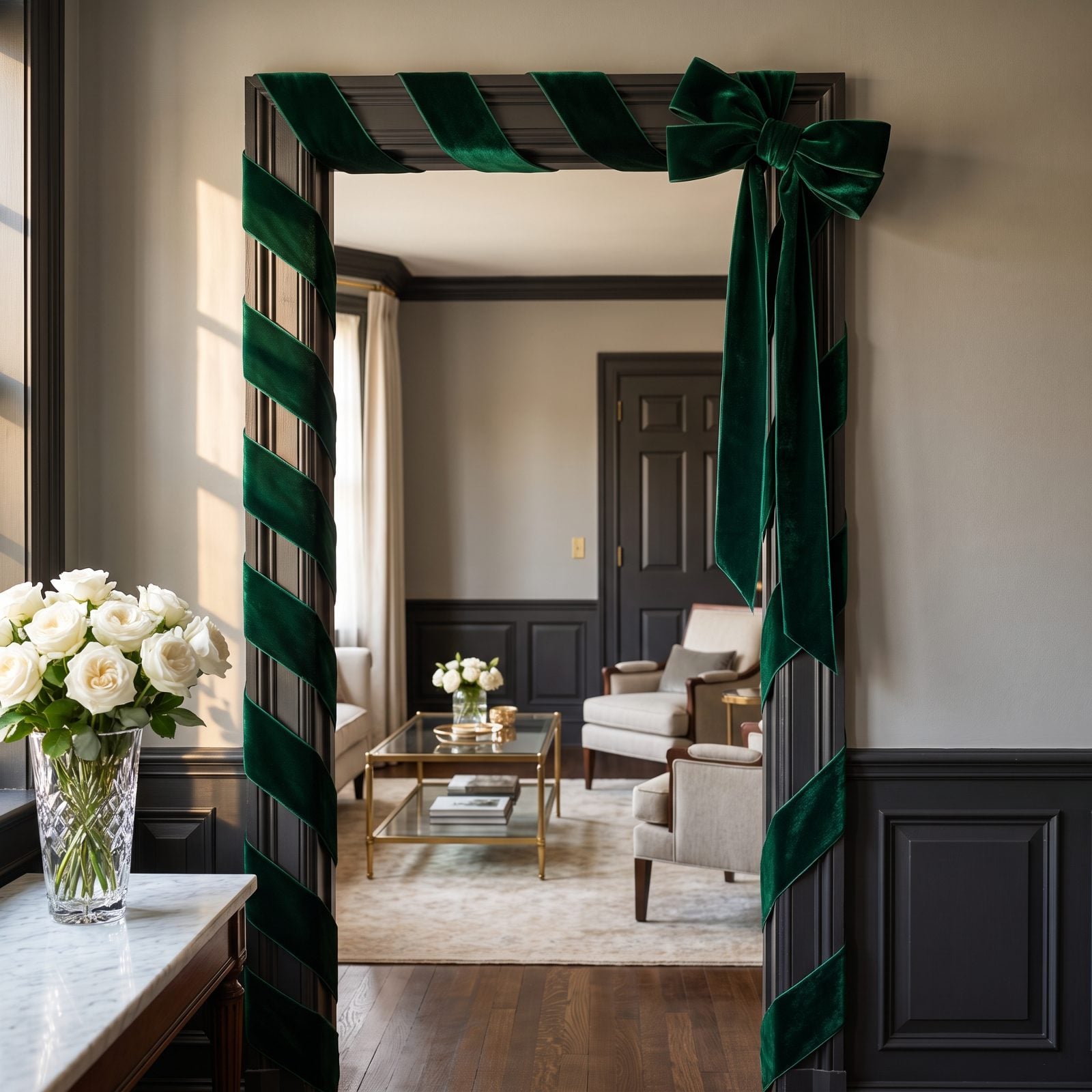
The simplest idea on this list, and maybe the most striking: wrap the door casing in wide velvet ribbon like you’re gifting the whole room.
Spiral it around the frame, snug but not tight, and finish with one oversized hand-tied bow at the top corner, tails trailing. Deep emerald velvet against dove gray walls has a weight no garland delivers. It’s quick, it’s cheap next to a florist’s garland, and it comes down in five minutes.
Velvet earns its place because the nap catches light differently as you move past, so a flat border quietly shimmers. Pair it with green curtains designs inside the room and the whole palette holds together. Go try it. An afternoon of work, and it looks like a florist spent a week.
2. A Row of Suspended Kissing Balls Across the Transom
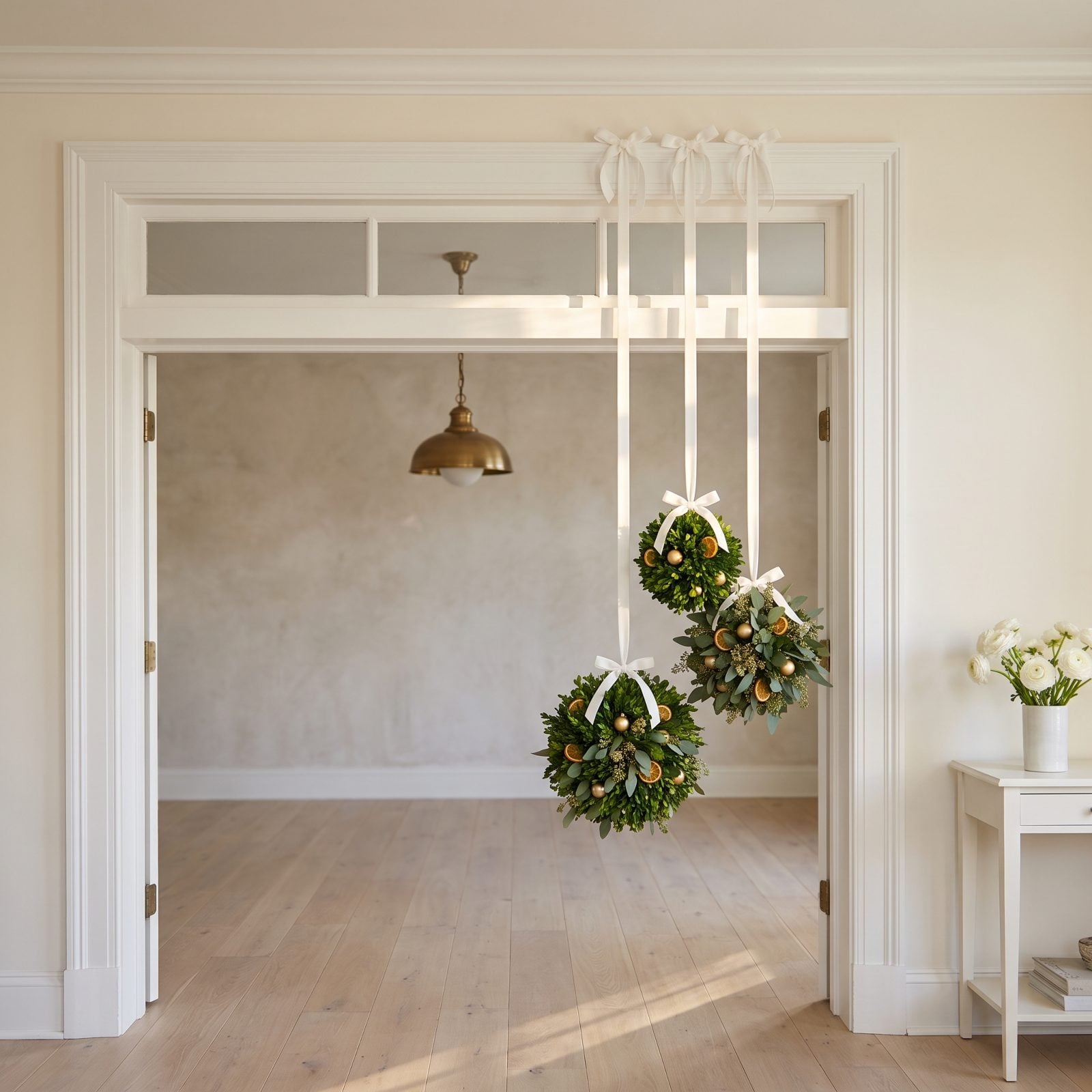
Garland wraps the frame, but here the kissing balls float inside it, and that shift from outline to suspended object is what makes this one land.
Hang three across the transom at staggered heights and you get rhythm instead of a solid green border. Boxwood holds its shape for weeks. Eucalyptus dries beautifully and keeps that silver cast you want. Tie each one on white velvet ribbon so the knots read as part of the plan rather than something you did at the last minute.
It works because of the sightline. A kissing ball hangs just above head height, so it greets you as you walk through instead of sitting flat against the wall. And the gold ornaments plus a few dried orange slices keep each sphere from reading as a plain green orb.
1. A Soft Arch of White Feathers and Pearl Lights
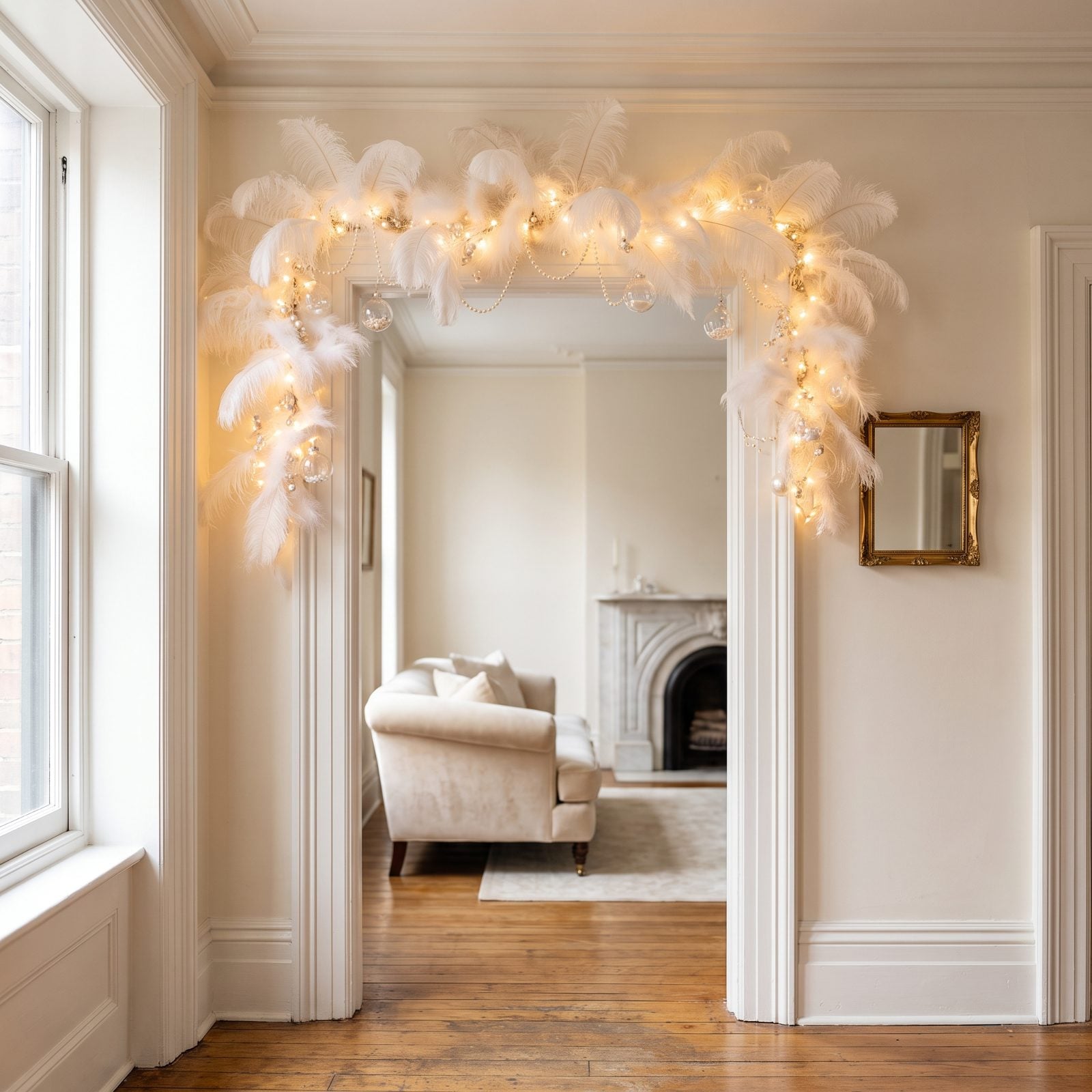
This one trades texture for a trick of light. Feathers read as snow caught mid-fall, and the pearl lights threaded through them do the rest.
Build the arch over the top of the frame rather than around the whole thing. A full outline of feathers would feel heavy and hard to walk under, while an arc that tapers down the sides keeps it weightless. Use white ostrich for volume and marabou for those soft wispy edges, then run a strand of warm-white pearl string lights through the base.
Why it feels expensive comes down to one thing: the palette stays tight. White, ivory, a whisper of blush, nothing fighting for attention. No competing color means the eye reads the whole thing as a single soft gesture instead of a pile of parts. Tuck a few clear glass baubles in to catch the glow and you’re done.
More work than garland? Absolutely. But it photographs like a dream, and nobody else on the block will have one.