
The bathroom used to be where architectural ambition went to wash its hands. Four walls, a tub, a sink, a mirror, and perhaps an expensive tile selected after every other room had claimed the budget. That arrangement has been thoroughly demolished. Now the ceiling might resemble a cloud formation, the floor might reveal an underwater garden, and the bathtub could look as though it was excavated from a mountain.
In order to come up with the very specific design ideas, we create most designs with the assistance of state-of-the-art AI interior design software. Also, assume links that take you off the site are affiliate links such as links to Amazon. this means we may earn a commission if you buy something.
Glass-block vaults glow like enormous lanterns. Copper ceilings turn winter light into something almost molten. Marble climbs walls in extravagant geological swirls, while bamboo arches, sculptural plaster, and rammed-earth textures make familiar bathroom architecture look positively timid. Some rooms open toward tropical waterfalls; others frame snowbound peaks, volcanic landscapes, or a single olive tree. Even the plumbing occasionally demands center stage.
Across these 34 designs, the bathroom becomes a laboratory for materials, light, geometry, and architectural nerve. The quietest spaces can be as provocative as the most extravagant. A travertine wall may have as much to say as a crimson marble dome, provided the architecture knows when to speak and when to let the stone do the talking.
34. A Glass-Block Vault Turns the Entire Bathroom Into a Light Fixture
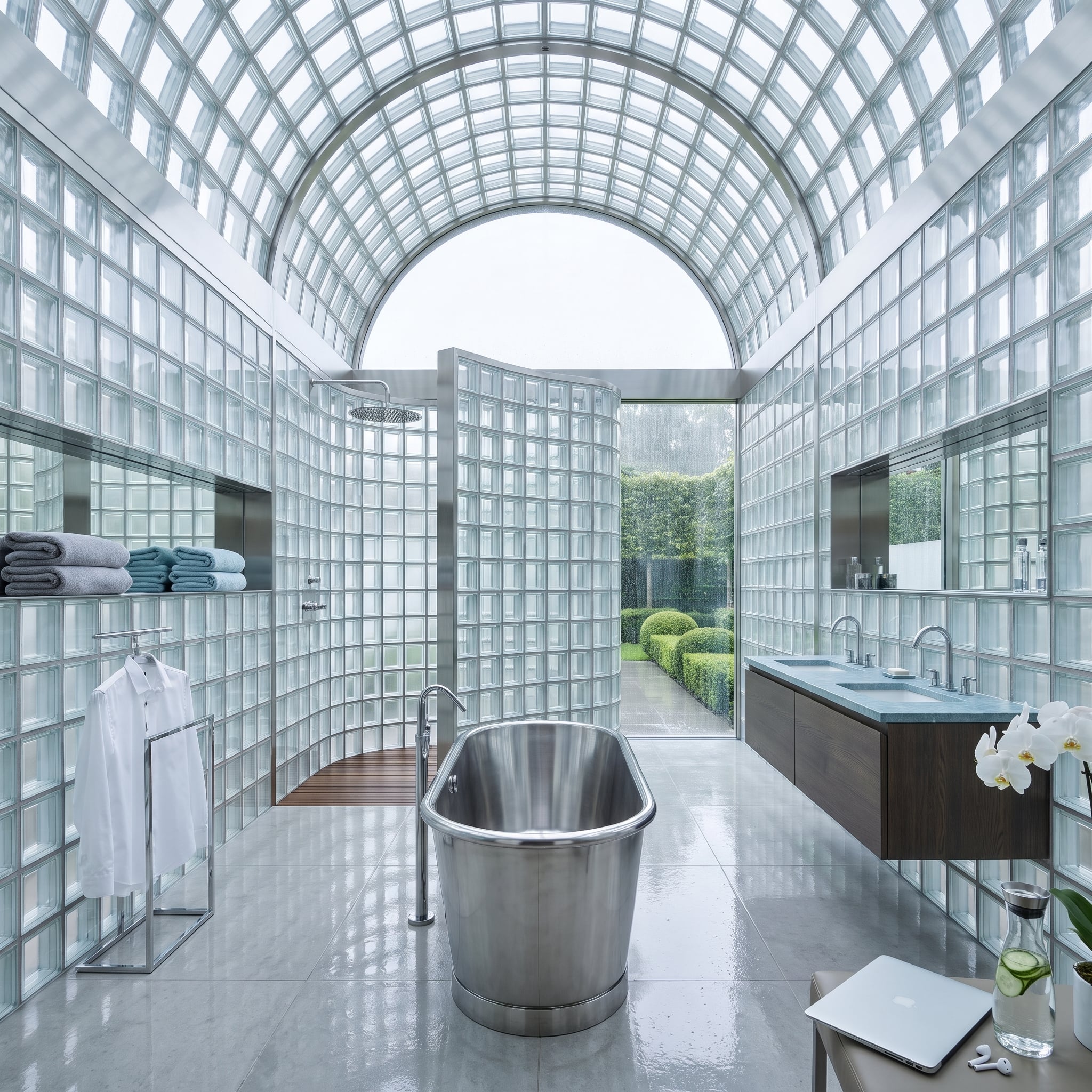
Glass blocks climb the walls and curve overhead into a luminous barrel vault, giving this bathroom the atmosphere of an enormous lantern. The translucent blocks diffuse daylight across the interior, softening the hard geometry of the structure without disguising it. At the center, a stainless steel soaking tub introduces an industrial note that would seem improbable against almost any other backdrop.
The glass-block enclosure is pale, repetitive, and architectural; the tub is dark, reflective, and unmistakably mechanical. A teak shower platform brings warmth to the arrangement, while the garden-facing opening connects the interior with the greenery outside. The real achievement is the way three seemingly incompatible materials establish a coherent architectural identity. Glass supplies the light, steel introduces an uncompromising industrial presence, and timber prevents the composition from feeling like an exceptionally glamorous laboratory.
33. Crimson Marble and a Copper Bathtub Turn Bathing Into Grand Opera
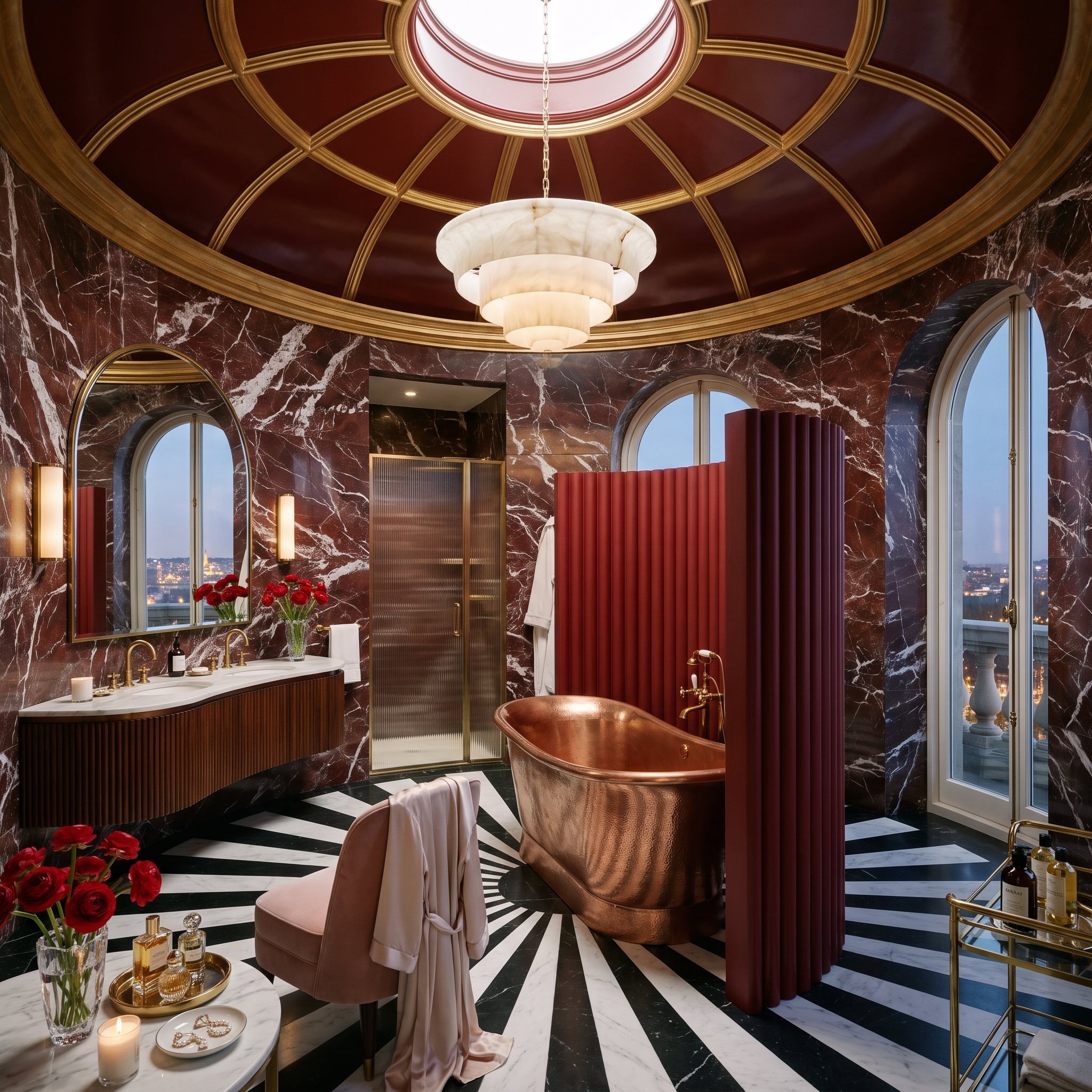
Crimson marble covers the walls in extravagant sweeps of dark veining, while a coffered dome repeats the color overhead with gold trim and an alabaster chandelier. The entire composition appears determined to outdo the previous century’s grandest hotel bathrooms. A hammered copper bathtub occupies the center, surrounded by a black-and-white sunburst floor that radiates outward beneath it.
The geometry is almost ceremonial. Curved walls, a domed ceiling, an oval tub, and a radial floor pattern all converge on the bathing area. A fluted burgundy privacy screen introduces another sculptural element, while arched windows reveal the city at dusk. The room’s considerable visual intensity is held together by a remarkably disciplined palette of crimson, copper, black, and gold. Understatement was clearly not among the design objectives.
What Our Readers Say
- When Home Stratosphere readers loved a bathroom and tapped a reason, overall style came out on top at 27%, followed by feeling cosy at 20% and materials at 13%.
From Home Stratosphere reader polls and votes.
32. A Forest Grows Inside a Green Marble Bathroom
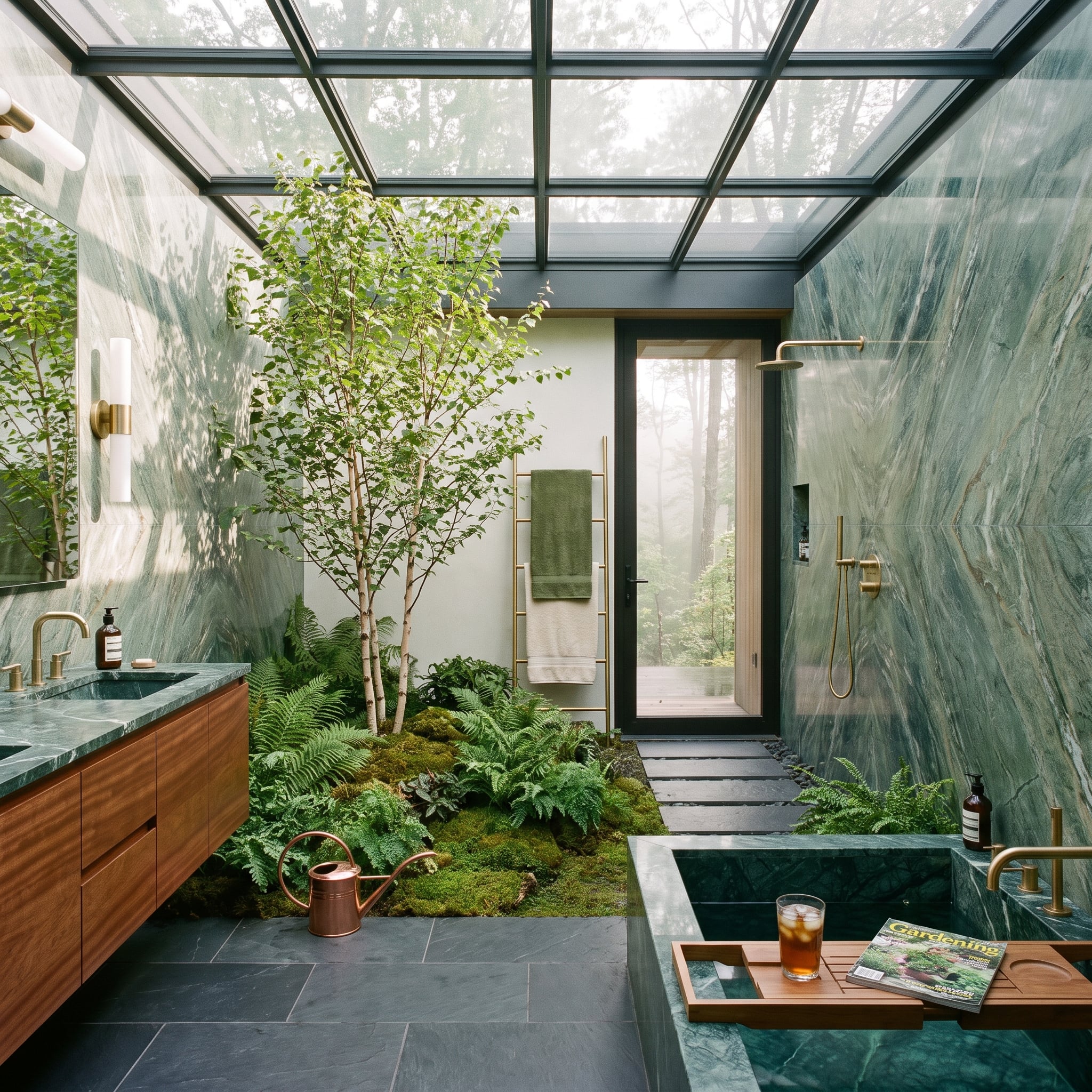
Green-veined stone covers the walls and bathtub, establishing a mineral backdrop for something considerably less predictable: an interior garden with slender trees, ferns, and moss growing beneath an expansive glass roof. The boundary between bathroom and conservatory becomes difficult to locate. Overhead, the surrounding forest canopy extends the botanical composition beyond the glazing.
Warm brass fixtures and walnut cabinetry punctuate the green surfaces, while the planting introduces a completely different scale and texture. Slender trunks rise against heavily veined stone, and low ferns spread across the floor with a softness no polished surface could imitate. A garden of this kind would require carefully planned root space, drainage, waterproofing, and ventilation in a real installation. Architecturally, the effect is extraordinary: the bathroom has stopped borrowing scenery from the forest and appears to have invited a portion of it indoors.
31. Black Marble Gives a Cylindrical Shower Its Own Spotlight
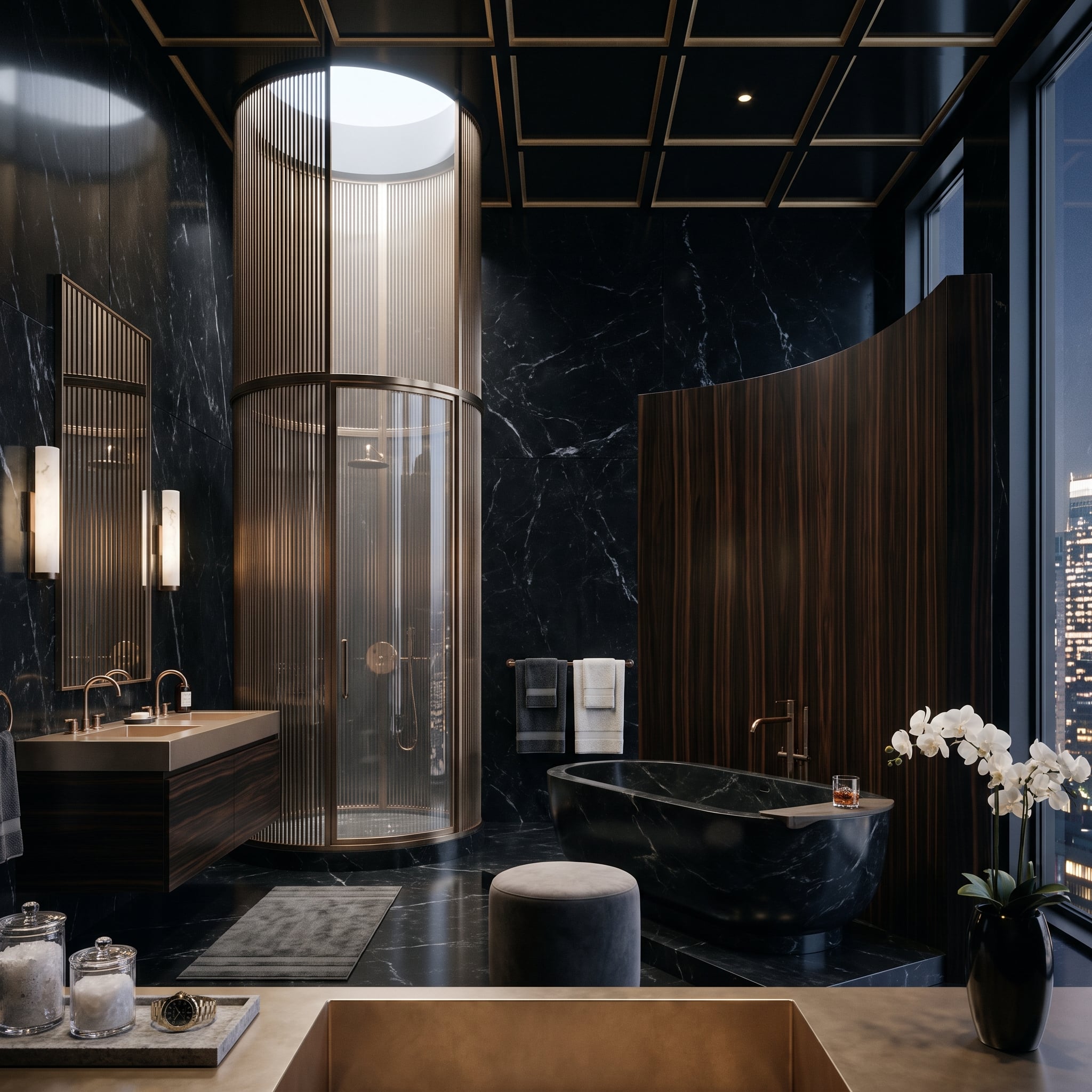
Black marble surrounds a cylindrical shower enclosure fitted with reeded bronze-toned glass. A circular skylight directly above reinforces its geometry, turning the shower into the room’s architectural centerpiece. Against the surrounding dark stone, the curved glass introduces translucency and reflection without surrendering the dramatic palette.
A black soaking tub sits against a curved panel of dark wood veneer, adding a warmer texture to the mineral surfaces. The vanity and surrounding details remain similarly restrained. Positioned prominently within the room, the cylindrical enclosure behaves almost like a freestanding pavilion, with the skylight completing the composition overhead. There is something wonderfully extravagant about giving a shower the architectural prominence usually reserved for a staircase or grand entrance.
30. A Circular Cedar Ceiling Ripples Toward an Autumn Forest
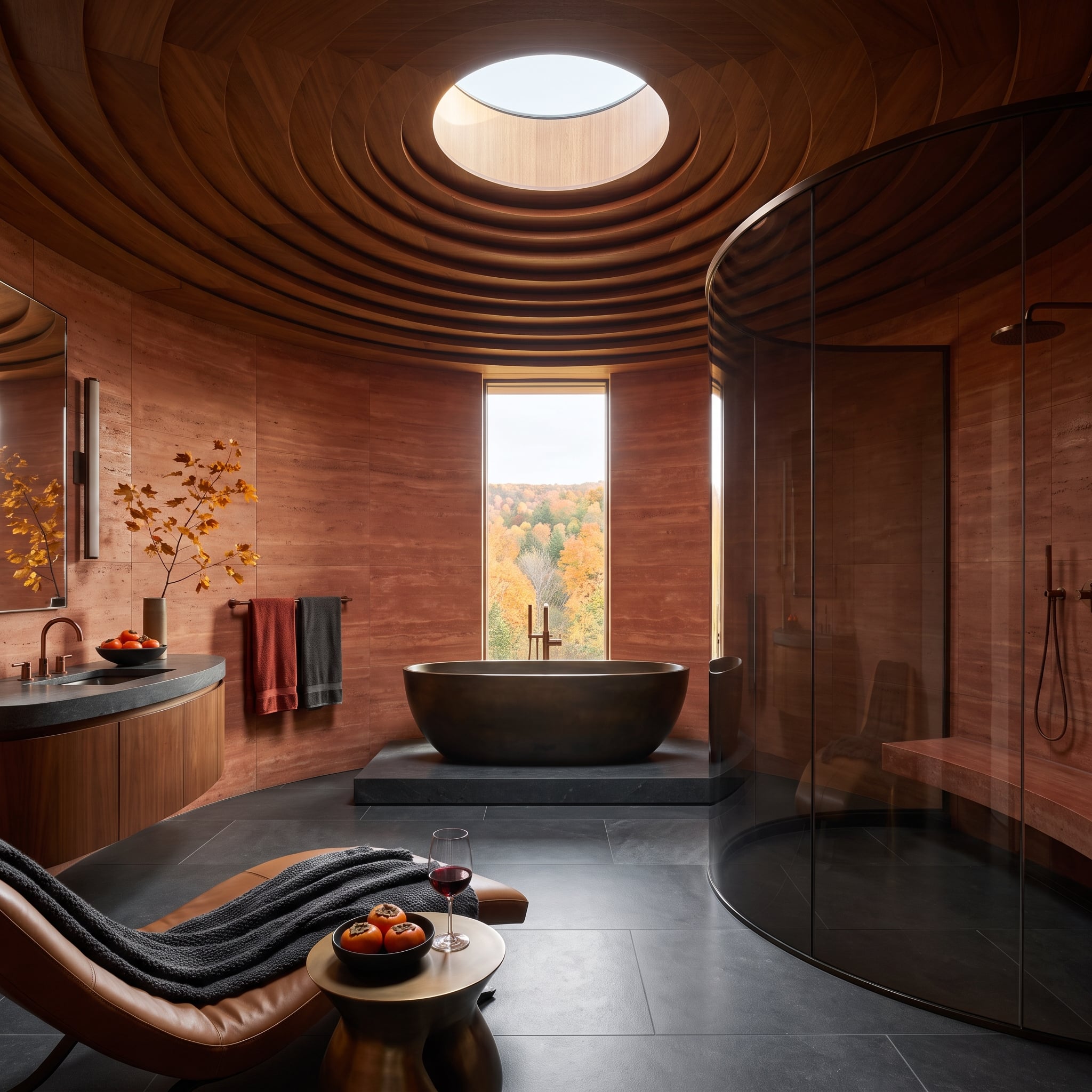
Concentric timber ridges spread outward from a circular skylight, giving the ceiling the appearance of ripples moving across water. Curved cedar-paneled walls continue the organic geometry, wrapping the room in warm wood. Below, a matte black soaking tub and dark slate floor provide the visual weight needed to balance the elaborate overhead structure.
The curved glass shower follows the room’s circular plan, while a floating vanity introduces a quieter combination of wood and gray stone. Beyond the tub, a window frames autumn foliage in gold and rust. The ceiling and walls borrow their character from natural forms without attempting to reproduce them literally. Rather than decorating a conventional rectangular room with timber, the architecture itself takes on the shape and rhythm of the material. Somewhere between a woodland sauna and an observatory, the bathroom develops an identity entirely its own.
29. A Cobalt Bathtub Interrupts a Terrazzo Explosion
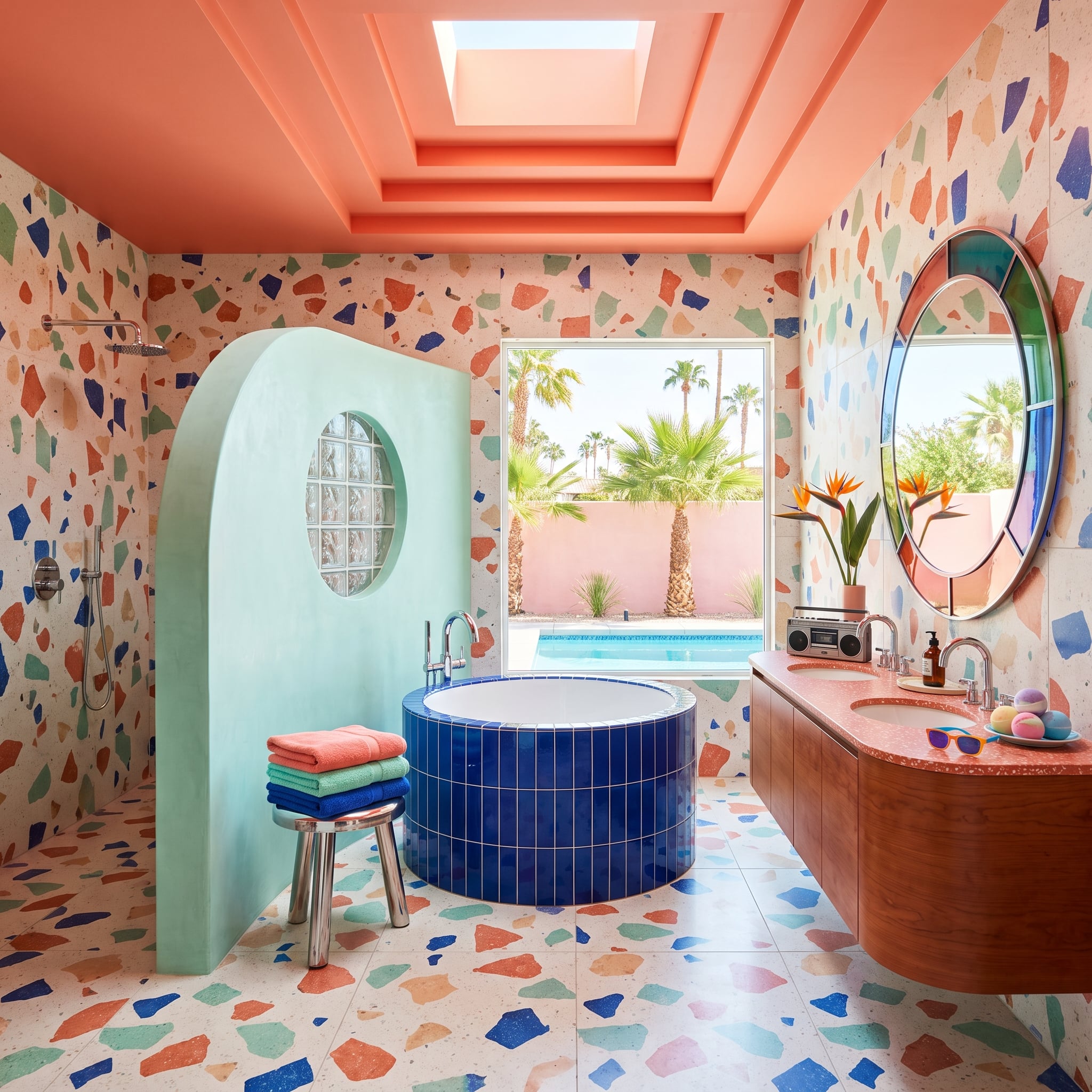
Terrazzo covers the walls and floor in a lively scatter of coral, cobalt, sage, and peach chips against a cream background. Rather than retreating into the pattern, a round soaking tub announces itself in saturated cobalt blue. The ceiling responds with coral-colored coffers, while a mint-green partition introduces yet another hue without tipping the arrangement into complete chaos.
A glass-block porthole interrupts the partition, giving the shower a playful architectural detail. The timber vanity and terrazzo countertop provide continuity, while an iridescent-framed mirror and a small boombox push the atmosphere toward unapologetic retro exuberance. Palm trees and a swimming pool outside reinforce the midcentury resort character. The colors repeat across different surfaces rather than appearing as isolated accents. Every element seems to have joined the same exuberant conversation.
28. A Copper Barrel Vault Warms a Bathroom Surrounded by Snow
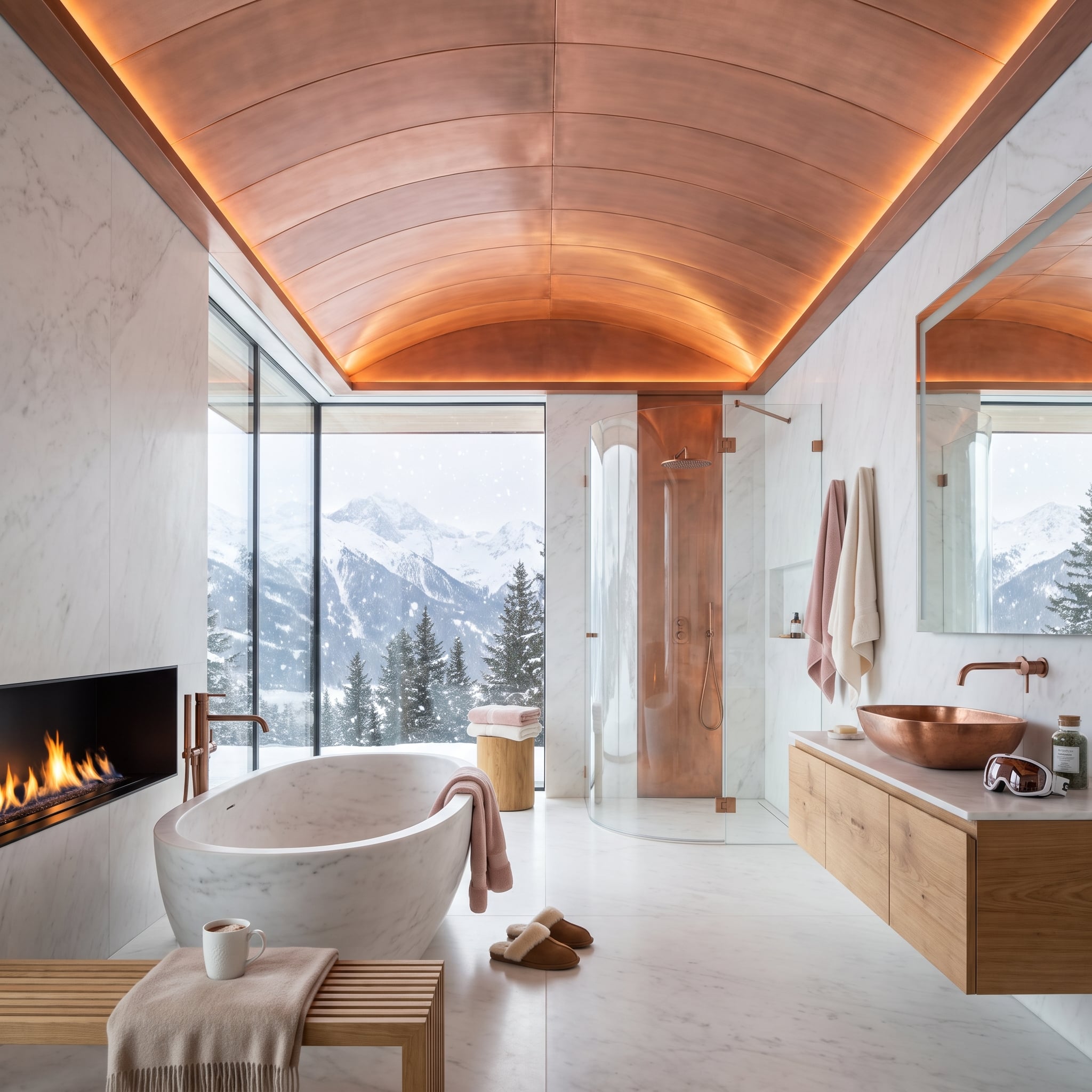
Copper-toned panels arch overhead in a barrel vault, their warm metallic finish intensified by concealed amber lighting. Below, a pale marble soaking tub sits between a linear fireplace and floor-to-ceiling glazing overlooking snow-covered mountains. The contrast could hardly be more emphatic: warm metal and fire inside, icy peaks and winter light outside.
An oak vanity with a copper vessel sink continues the warm material palette without competing with the ceiling. The vault creates a powerful sense of enclosure, while the enormous window opens that enclosure toward the alpine landscape. Copper is a particularly expressive surface because its appearance changes with oxidation and exposure; protective finishes can help preserve a brighter metallic appearance. Against the cold blue-white scenery, the vaulted ceiling looks almost incandescent.
27. A Glass Bathtub Almost Disappears Against a Mountain Lake
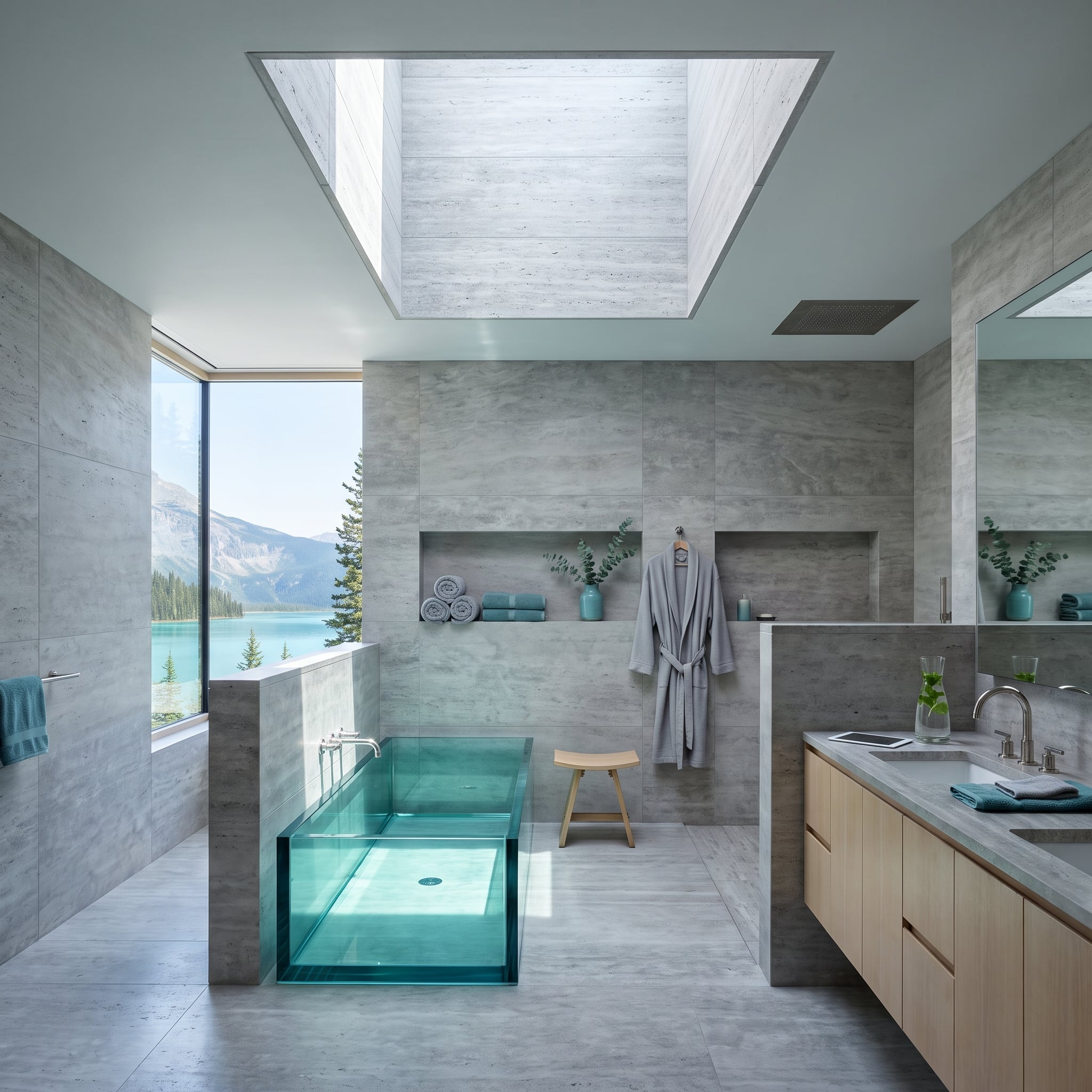
Concrete-toned surfaces establish a restrained backdrop for an extraordinary centerpiece: a bathtub with transparent glass sides. Water becomes part of the visual composition, its blue-green color appearing to merge with the mountain lake beyond the window. The tub has a presence that is simultaneously sculptural and almost invisible.
Large-format concrete-look surfaces provide a continuous architectural setting, while an oak vanity introduces warmth without distracting from the transparent bath. A skylight supplies overhead daylight. Structurally glazed bathtubs are specialized products requiring engineered panels, carefully designed joints, and reliable waterproofing, so this is hardly an ordinary fixture specification. Yet the visual proposition is wonderfully simple: remove the opaque walls of the tub, and the water itself becomes the centerpiece.
26. Golden Zellige Curves Around a Dark Marble Bath
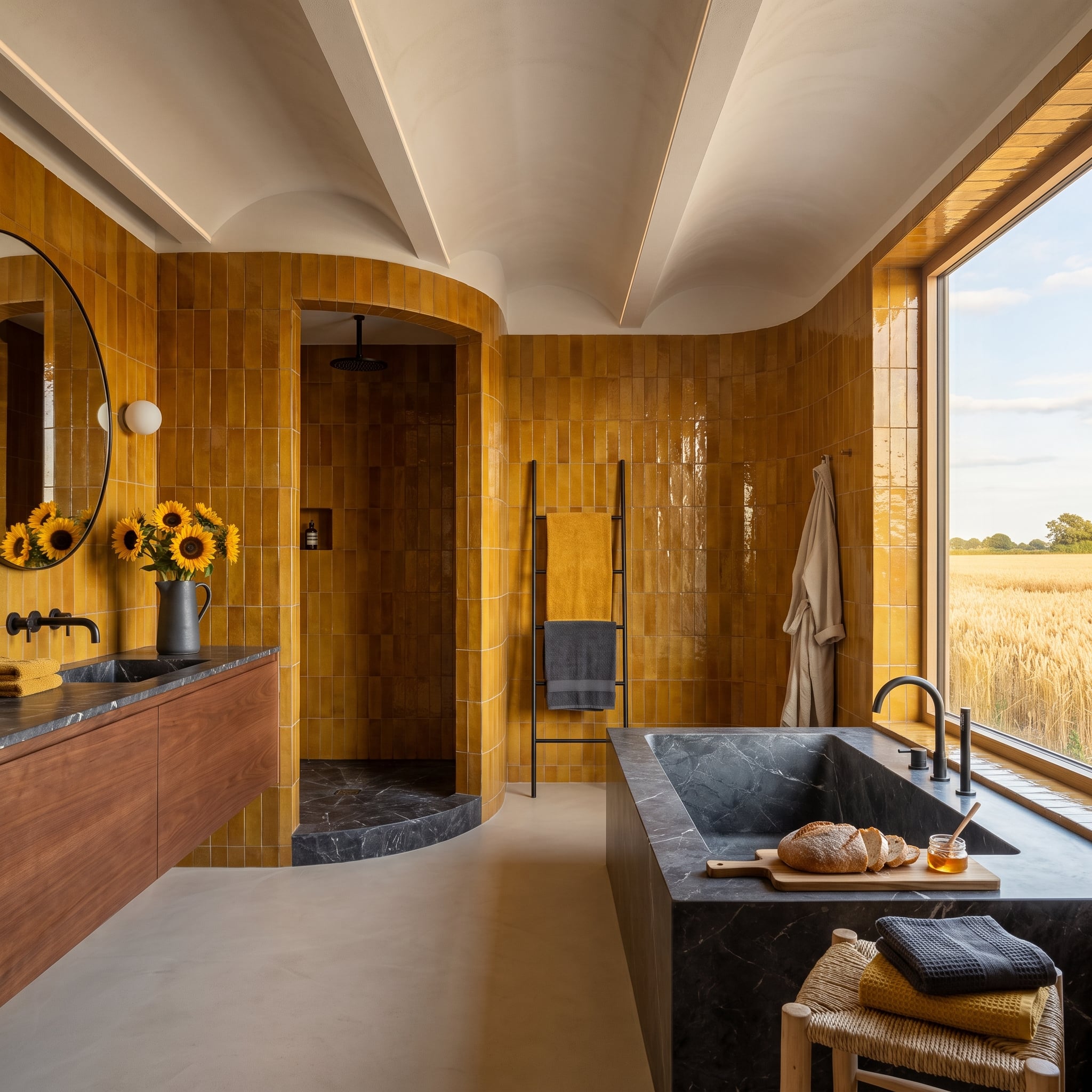
Amber zellige tiles climb the walls in vertical columns, their subtly irregular glazed surfaces catching light in a thousand small variations. A cylindrical partition separates the shower from the main bathing area without introducing a conventional corner. The room appears shaped rather than simply divided.
A dark, heavily veined soaking tub provides a substantial counterweight to the luminous walls. Walnut cabinetry and matte black fixtures bridge the contrast, while a pitcher of sunflowers introduces a concentrated burst of yellow. Beyond the window, a wheat field extends the golden palette into the landscape. The rounded partition interrupts the room without producing the hard geometry of an ordinary dividing wall. Handmade tile, curved architecture, and dark stone create a composition that feels both tactile and surprisingly disciplined.
Not everyone is sold on the look: in our readers’ votes, bathroom photos featuring zellige got fewer hearts than the other images in the same articles.
25. A Concrete Bathtub Takes Shelter Beneath a Timber Ridge
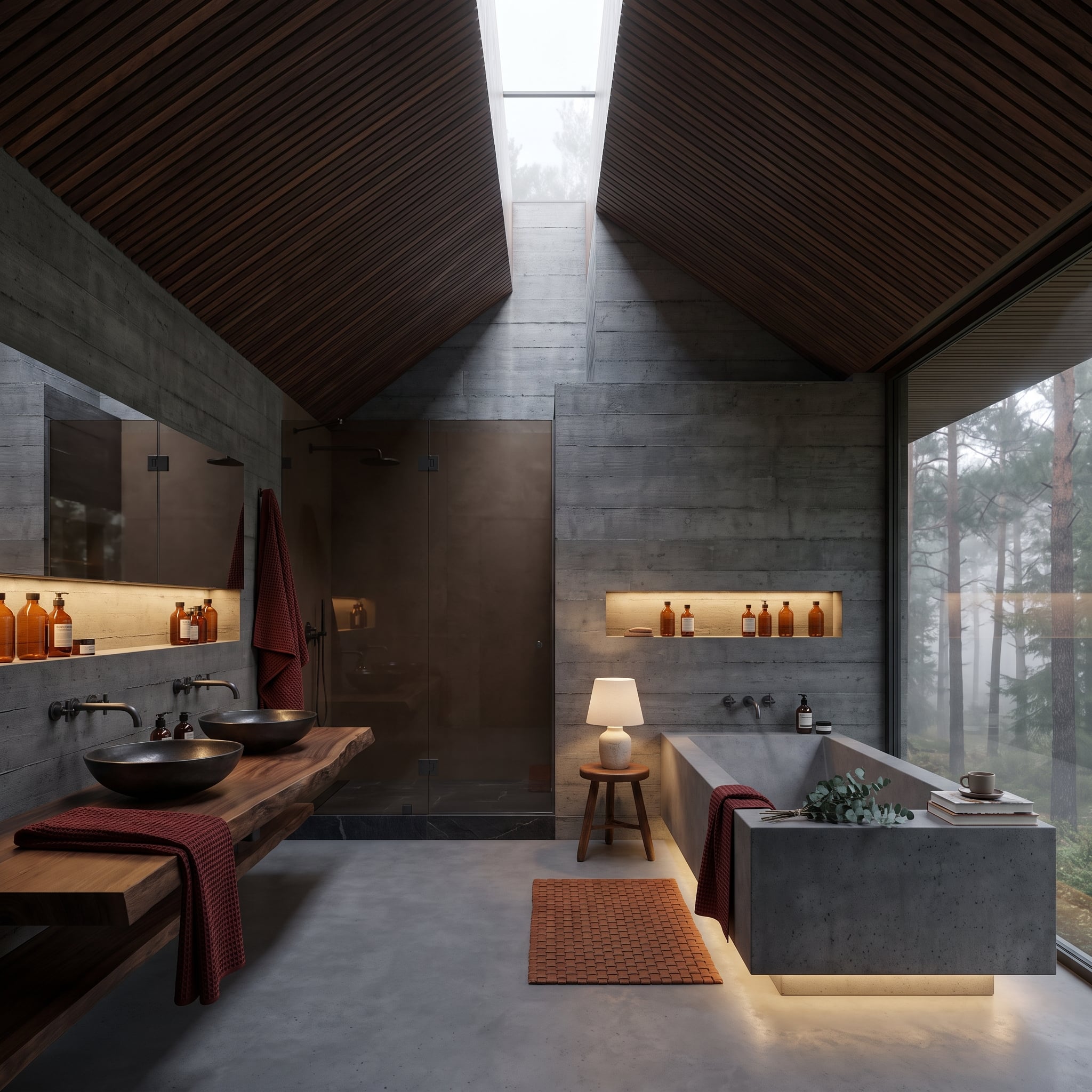
Concrete walls surround a substantial soaking tub beneath a dark timber ceiling that rises toward a central ridge skylight. The architecture is deliberately spare, allowing the contrast between mineral surfaces and warm wood to establish the atmosphere. Outside, fog moves among tall pine trees, extending the room’s subdued palette into the landscape.
A live-edge walnut vanity supports two matte black vessel sinks, while concealed lighting beneath the vanity and tub introduces a narrow band of warmth. Recessed shelving holds amber glass bottles, providing a modest note of color against the concrete. The skylight draws attention upward from the bathtub to the timber ridge, establishing a strong vertical axis. With its massive mineral surfaces and sharply defined roofline, the room has something of a mountain shelter about it, stripped of everything that doesn’t contribute to the architecture.
24. A Bamboo Cathedral Rises Above a River-Stone Soaking Tub
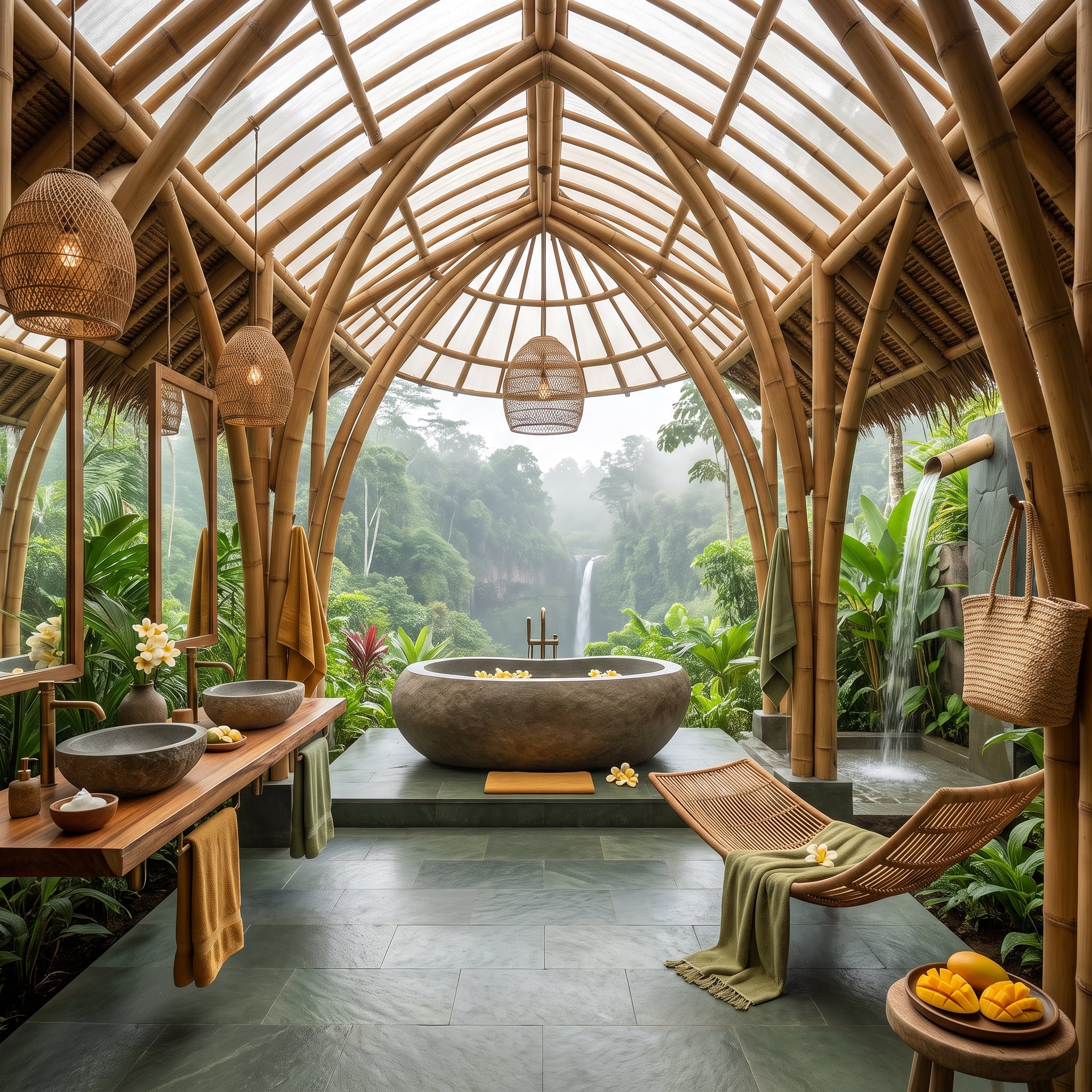
Bamboo poles rise in sweeping arches toward a glazed roof, creating a cathedral-like enclosure filled with tropical daylight. Beneath them, a stone-textured soaking tub rests on a raised slate platform, its rounded form echoing the natural character of the surrounding materials. Plumeria blossoms floating on the water introduce a delicate counterpoint to the massive stone.
A teak vanity supports twin vessel sinks, while woven rattan pendants hang beneath the overhead framework. Beyond the glazing, lush tropical vegetation and falling water establish a dramatic natural backdrop. The sweeping bamboo forms give the room a striking identity, their repeated arches creating rhythm without the rigid regularity of conventional ceiling construction. Stone, timber, woven fibers, and greenery share the composition, producing an atmosphere closer to an open-air tropical pavilion than a conventional bathroom.
23. A Burgundy Stone Bathroom Finds Its Geometry in a Sunburst Ceiling
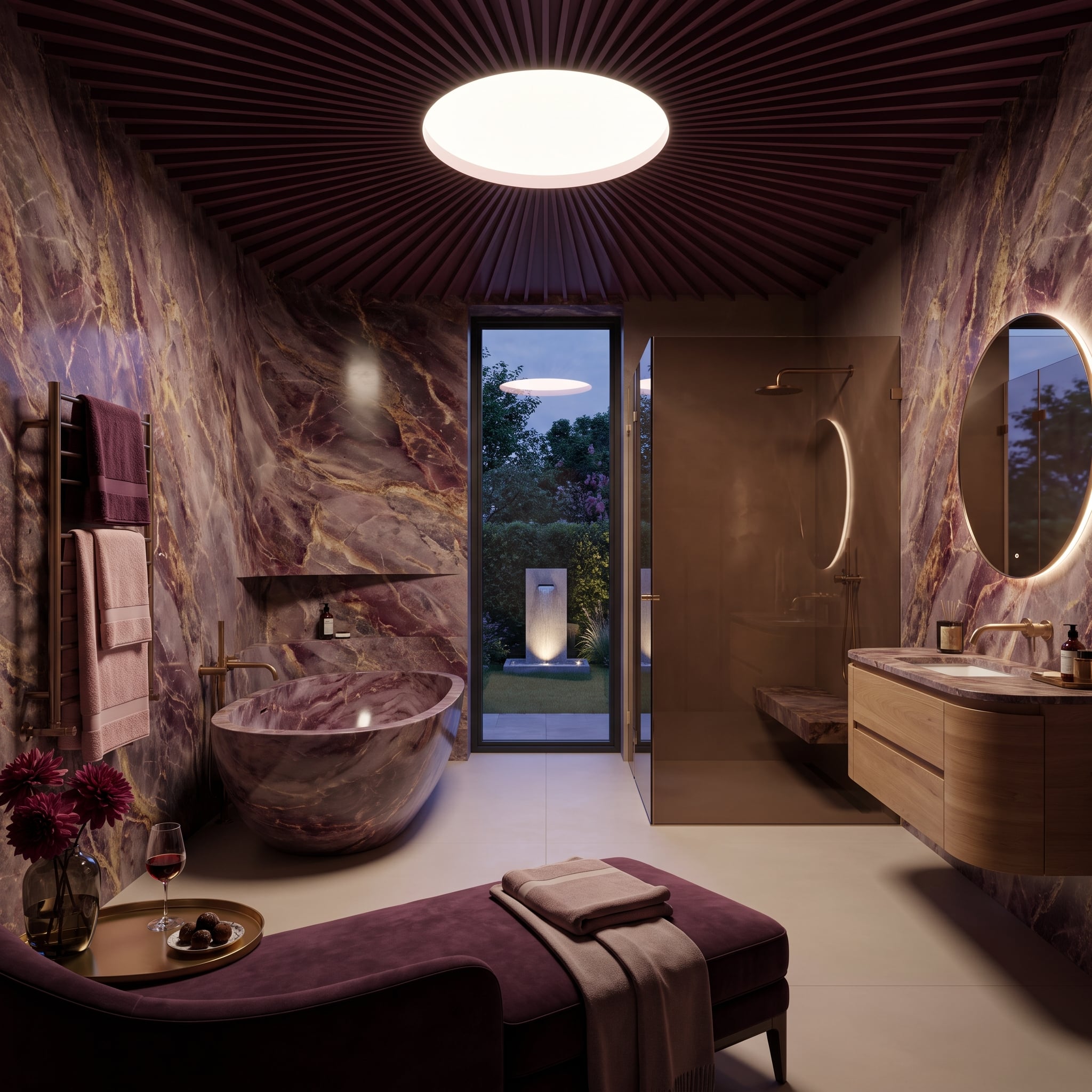
Deep burgundy and violet-veined stone dominates the bathtub, walls, and vanity, creating a richly patterned interior with remarkably little reliance on separate decoration. Above, timber ribs radiate outward from a circular ceiling light, introducing a strong geometric contrast to the irregular movement of the stone.
A backlit oval mirror and warm oak vanity soften the darker surfaces, while a velvet bench contributes another tactile layer. Through the tall window, an illuminated garden fountain appears against the evening landscape. The radial ceiling gives the eye a clear architectural destination amid the restless stone veining. Without that disciplined overhead geometry, the room might have become an overwhelming collection of luxurious surfaces. Instead, the irregular marble and precisely arranged timber ribs play against one another, with neither surrendering its character.
22. A Cave Bathroom Lets Volcanic Stone Set the Rules
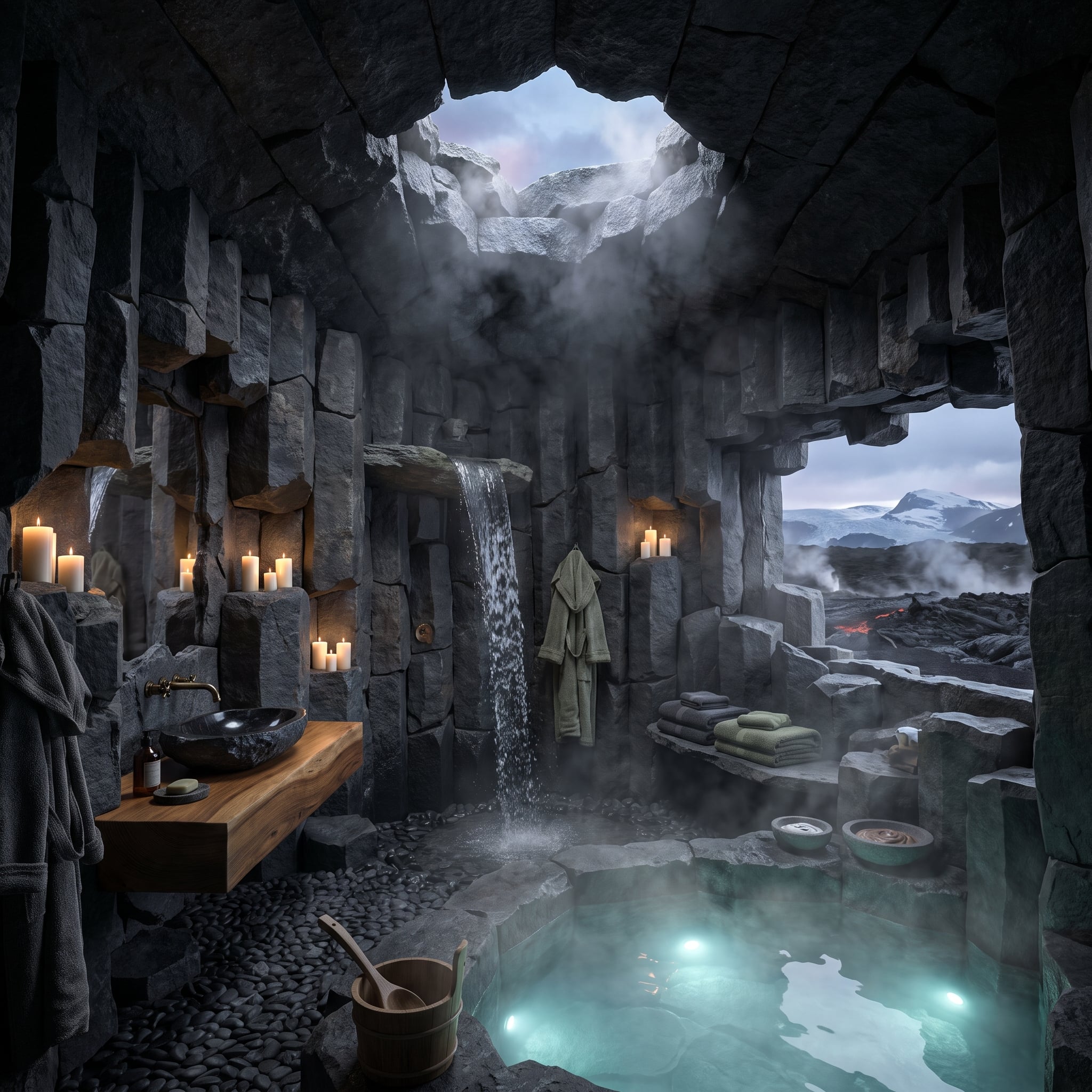
Dark basalt columns enclose a bathroom that appears excavated from volcanic rock rather than constructed within a conventional house. A recessed soaking pool occupies the stone floor, while a waterfall shower descends from the rugged wall. The surfaces are rough, irregular, and almost entirely monochromatic.
A live-edge timber vanity supports a black vessel sink, introducing one of the few warm materials in the composition. Candles line recessed shelves, their small flames emphasizing the uneven texture of the rock. Beyond the opening, a volcanic landscape extends the geological character of the interior. Conventional bathrooms depend on flat surfaces and carefully aligned edges; this one draws its entire identity from the opposite approach. Practical lighting, ventilation, and slip-resistant surfaces would be essential considerations in any real-world interpretation. The visual drama, however, belongs entirely to the stone.
21. A Honeycomb Ceiling Gives White Marble an Unexpected Edge
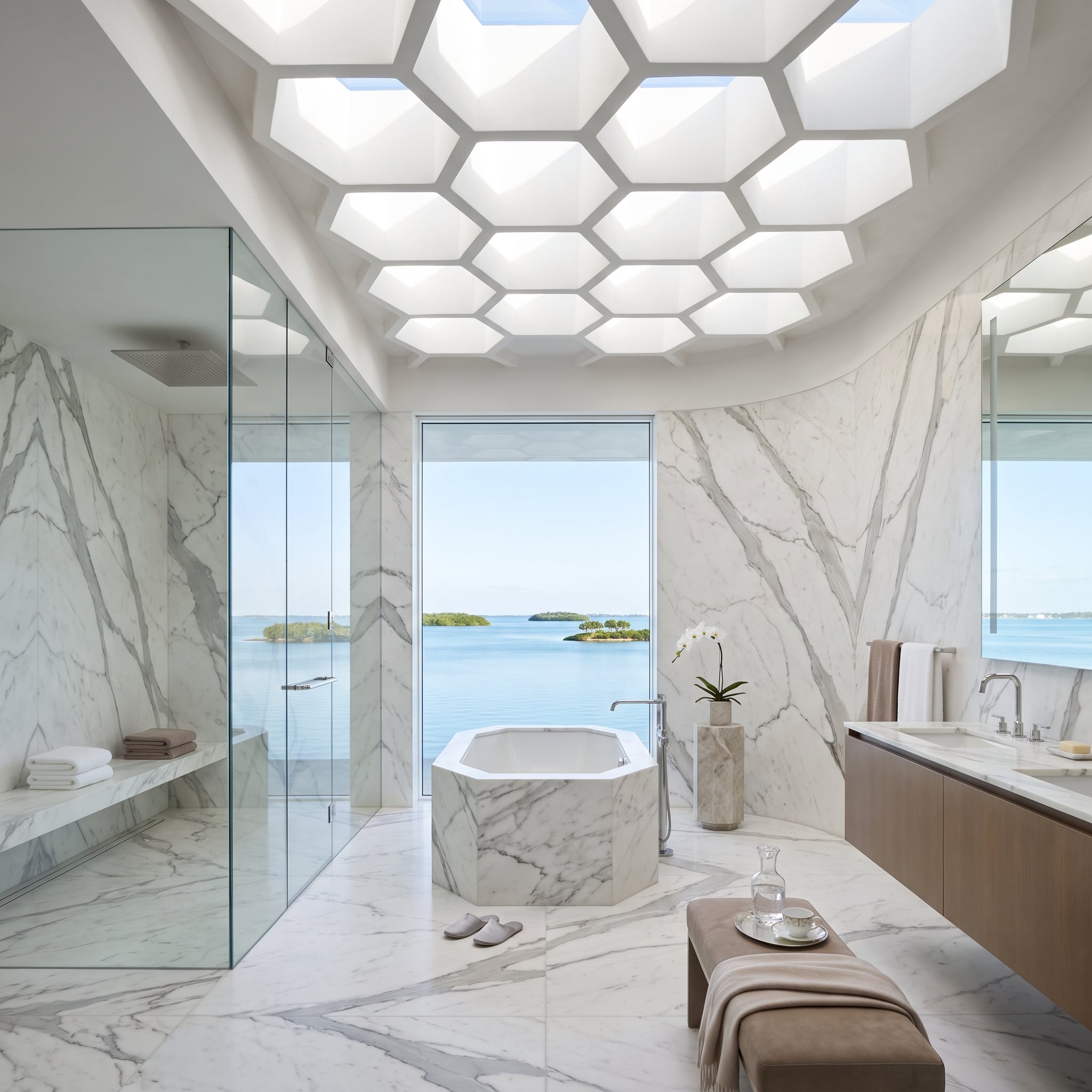
White marble with dramatic gray veining covers the walls, floor, and angular bathtub surround, establishing a luxurious mineral foundation. Then the ceiling intervenes. A honeycomb-like grid of illuminated geometric panels introduces an entirely different architectural language overhead, its luminous pattern bringing precision and repetition to the otherwise irregular movement of the stone.
The octagonal tub reinforces the angular geometry, while expansive glazing opens toward islands scattered across the water. The marble’s natural veining supplies movement, and the ceiling provides a disciplined counterpoint. Large stone surfaces benefit from careful slab selection and layout, particularly when strong veins meet at corners. Here, the encounter between two kinds of pattern gives the room its energy: the unpredictable markings of natural stone and the almost mathematical repetition of the illuminated ceiling.
20. Rammed-Earth Walls Borrow Their Colors From the Red Rock Desert
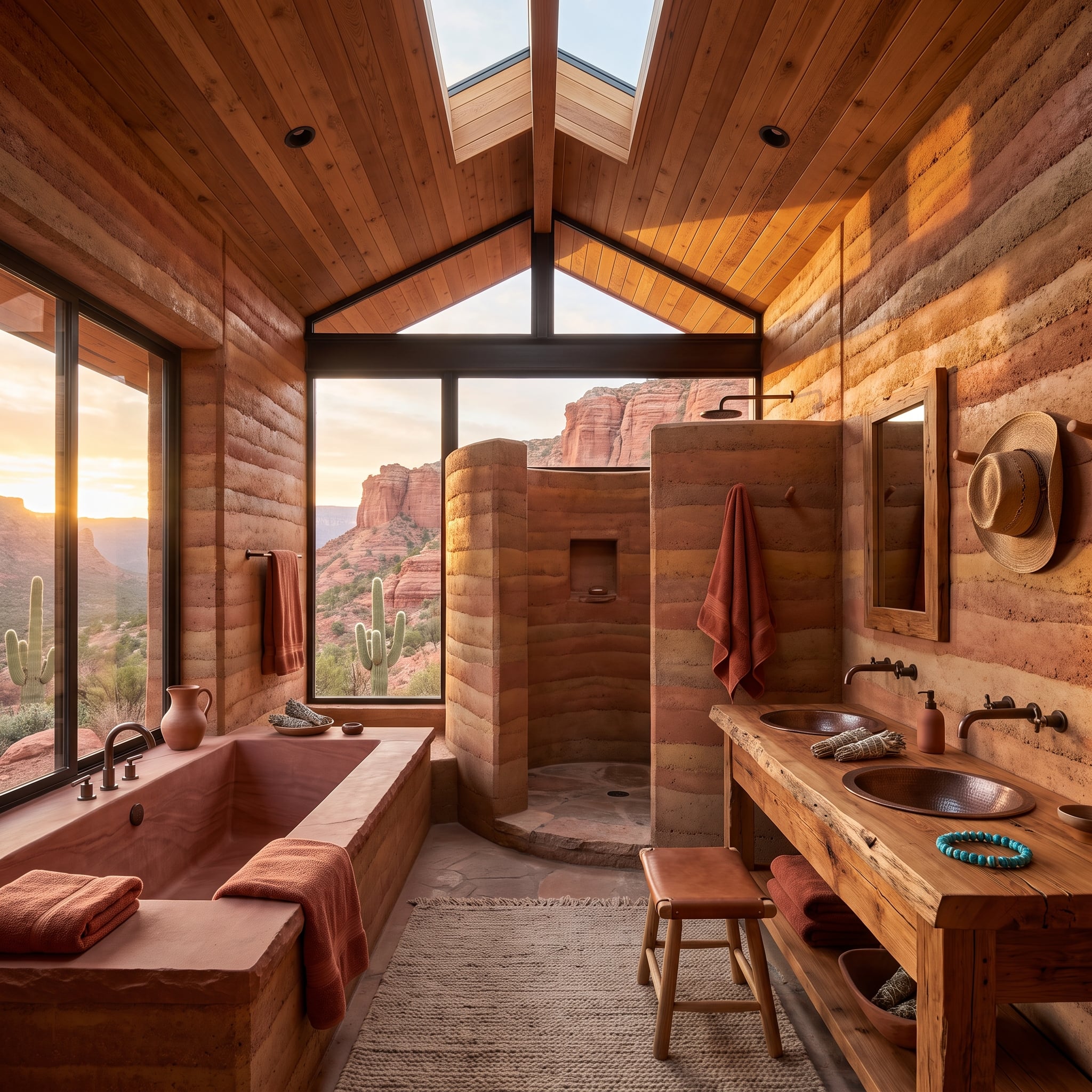
Horizontal bands of terracotta, rust, and ochre give the walls the layered appearance associated with rammed-earth construction. A substantial earth-toned soaking tub continues the mineral palette, while a cedar ceiling rises toward a narrow ridge skylight. Through the large window, red sandstone formations extend the color story into the landscape.
A live-edge timber vanity supports two hammered copper vessel sinks, their warm metallic surfaces complementing the surrounding earth tones. Oil-rubbed bronze fixtures maintain the subdued palette. The layered walls and distant canyon seem to belong to the same geological family, one shaped into architecture and the other left exposed to the elements. In practical construction, rammed-earth walls require appropriate moisture detailing, while a bathtub with an earth-like appearance would need a reliably waterproof structural material or lining. The resulting composition feels inseparable from the desert around it.
19. A Cloud-Shaped Ceiling Floats Above a Marble Bath
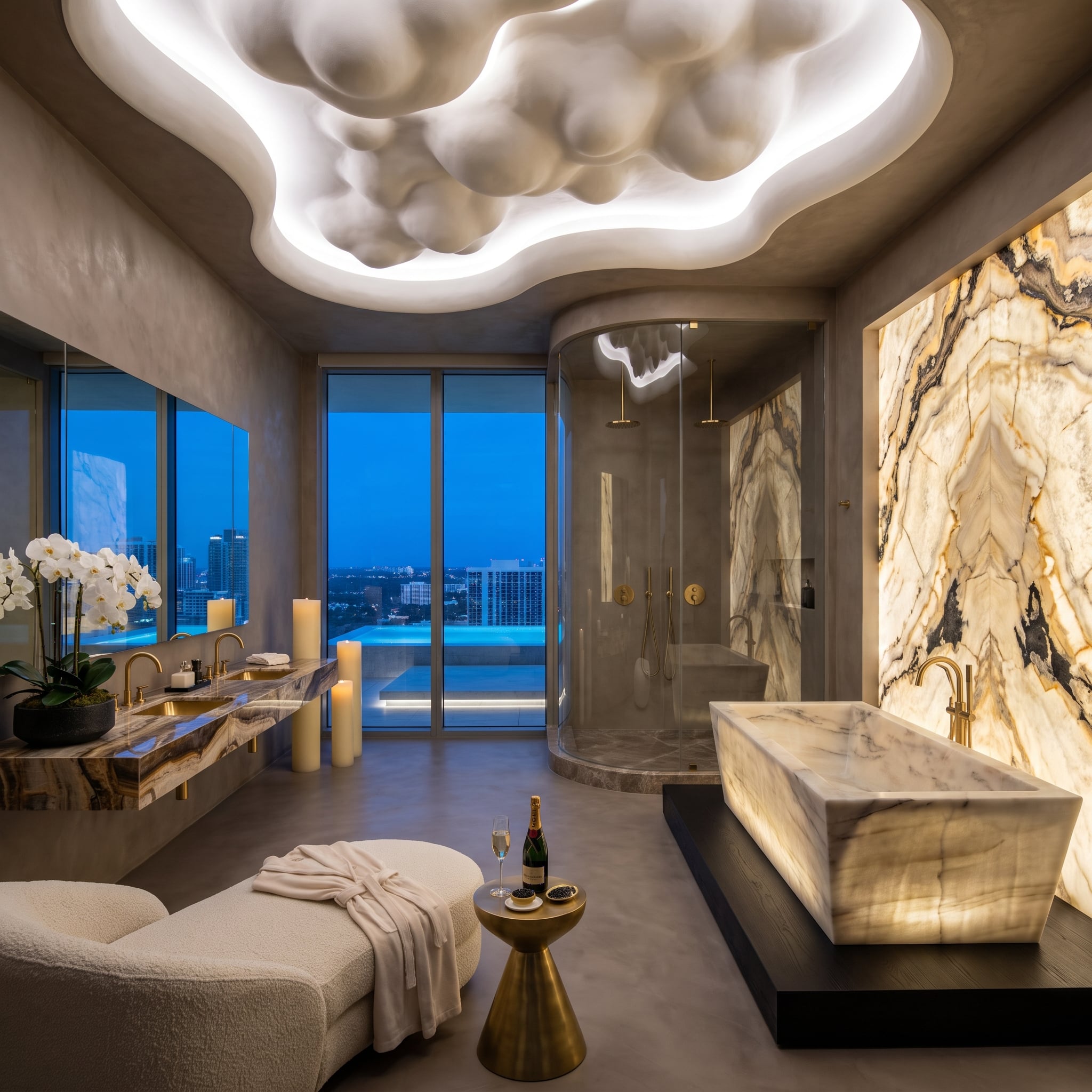
A sculptural plaster installation spreads across the ceiling in forms resembling suspended clouds. Concealed perimeter lighting catches their contours, creating soft shadows that give the overhead surface an extraordinary sense of depth. Below, a heavily veined marble soaking tub occupies a raised platform, its cream, gold, and charcoal markings repeated in the illuminated stone wall behind it.
Brass fixtures introduce warmth, while a curved glass shower enclosure softens the room’s geometry. A floating vanity and bouclé chaise complete the arrangement without distracting from the dominant architectural features. The ceiling could easily have overwhelmed a more conventional bathroom, but the dramatic marble provides an equally expressive counterpart at floor level. Between them, the glass enclosure and city-facing windows introduce transparency and lightness. The stone seems almost turbulent beneath the weightless plaster forms, giving the room a striking contrast between geological mass and imagined clouds.
18. A Brass Shower Column Stands Alone in a Slate-Clad Room
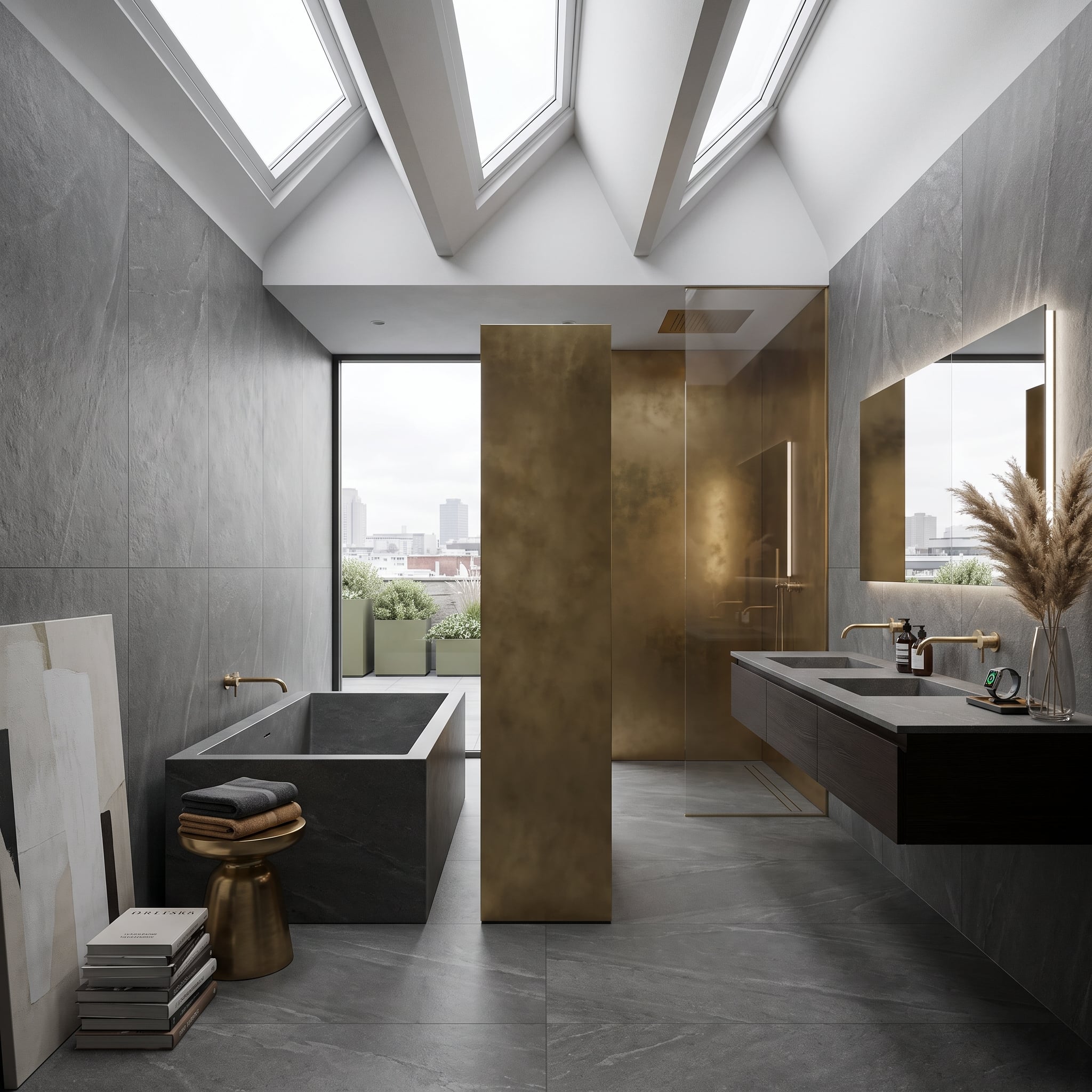
Dark slate-look porcelain covers the walls and floor, creating a continuous backdrop for a freestanding brass shower column positioned prominently within the room. Rather than disappearing behind a glass partition, the shower becomes an exposed architectural feature. Its warm metallic finish stands sharply against the cool gray surfaces.
A vaulted skylight introduces daylight from above, catching the brass and revealing subtle variations in the surrounding tile. The city skyline beyond the glazing provides a second source of visual interest, but the shower remains the dominant interior element. The arrangement has the spare character of an industrial installation, with plumbing elevated from something normally concealed to something worth looking at. In a functioning bathroom, an open shower of this kind would require carefully planned drainage, waterproofing, and splash containment. One slender column of brass gives the entire dark interior its visual focus.
Brass has a real following: when we asked readers which bathroom faucet finish they would buy, 44% chose brass, ahead of chrome at 33% and black at 19%.
17. Pink Marble and Bougainvillea Give an Arched Bathroom Its Color
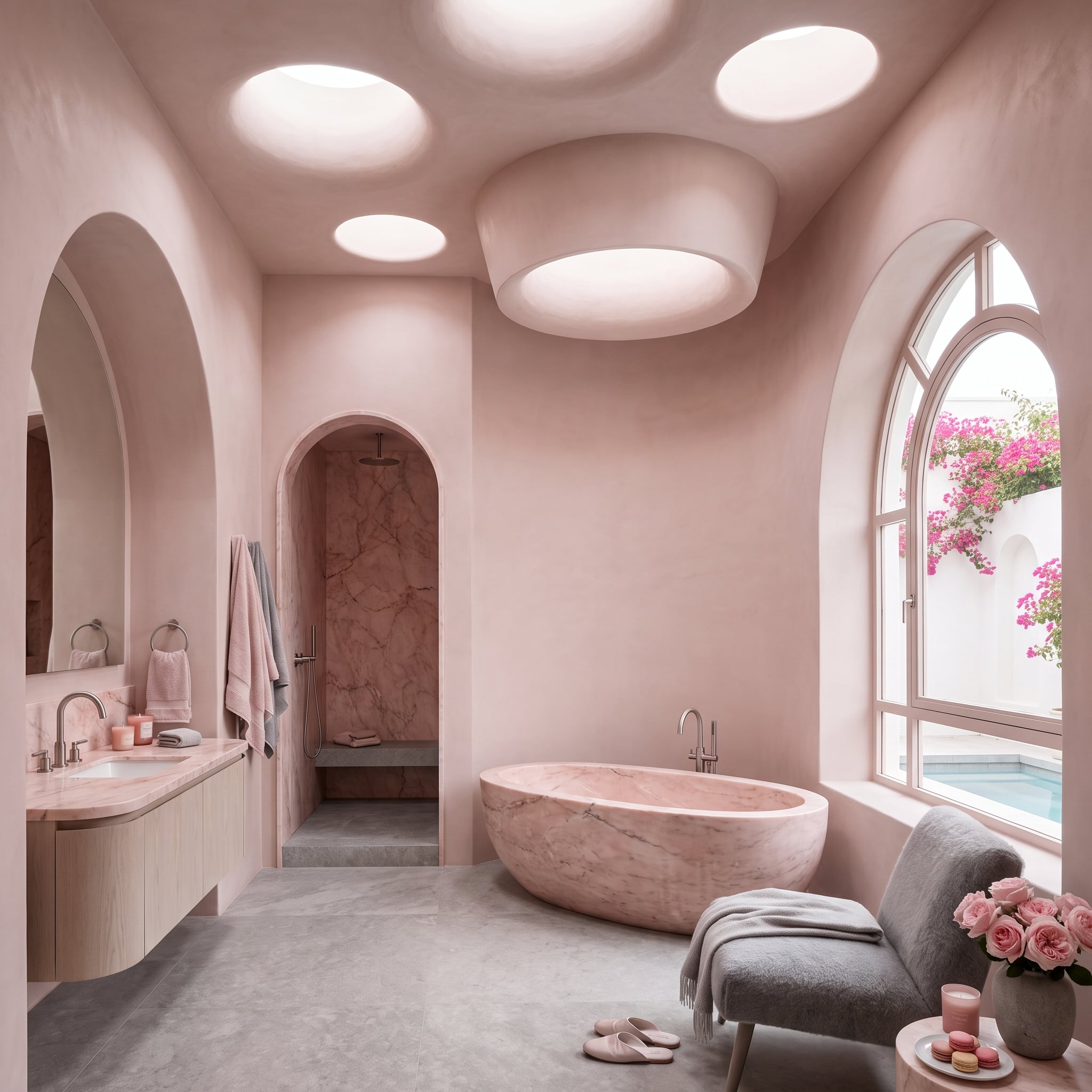
Blush-colored plaster wraps the walls, while a rose-veined marble bathtub introduces a deeper, more intricate version of the same palette. An arched shower alcove continues the soft geometry, its stone lining providing a polished contrast to the matte plaster around it.
Outside the arched window, bougainvillea supplies a vivid burst of pink against the surrounding greenery. The flowers create a natural extension of the interior color scheme without requiring additional decoration. Smooth plaster, heavily veined stone, polished fixtures, and delicate petals all interpret pink differently. Matching stone surfaces in a project like this would require careful attention to undertones and veining, but perfect uniformity isn’t the objective. The subtle differences between the materials give the otherwise restrained palette remarkable depth.
16. Rust-Colored Steel Curves Around a Vineyard-Facing Bath
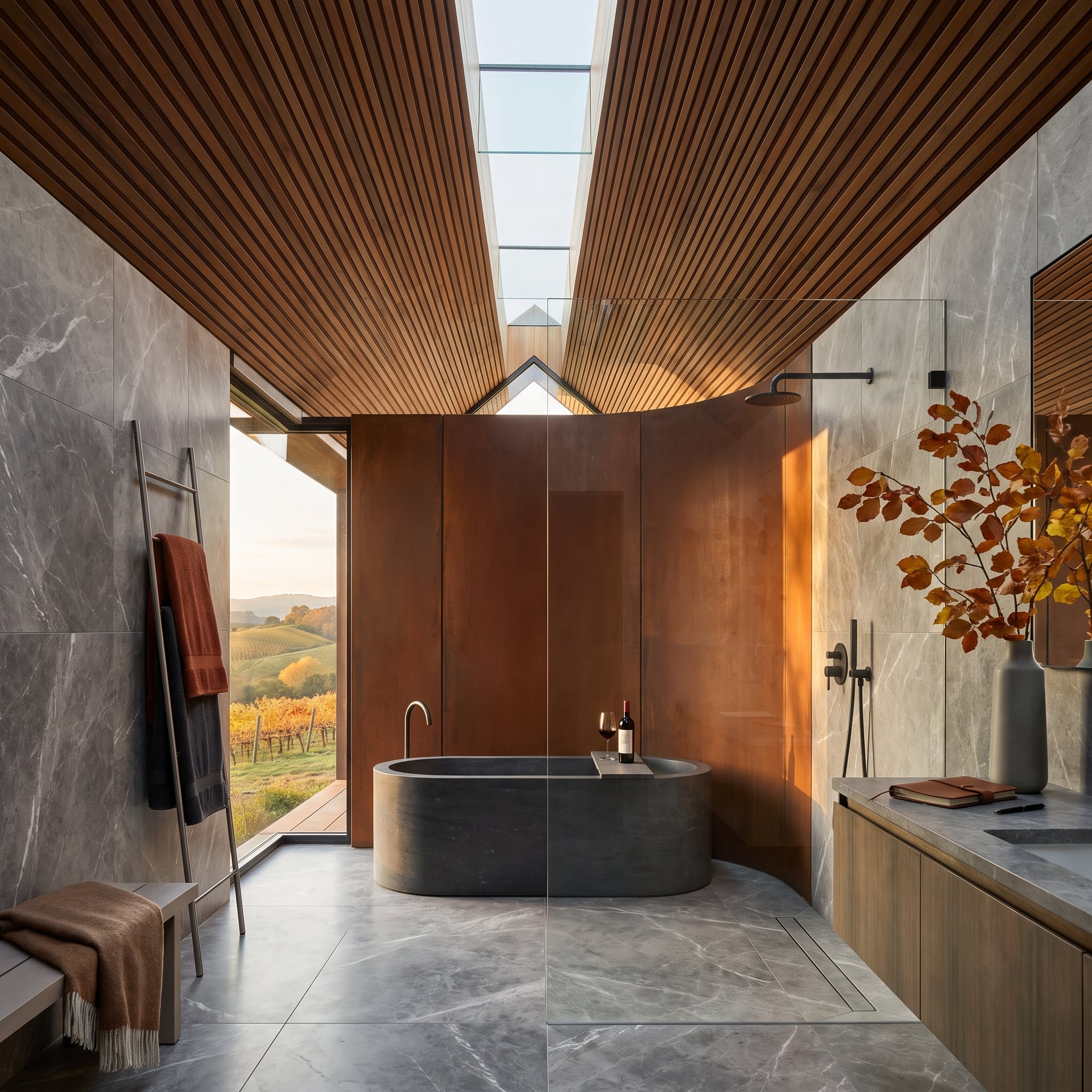
Rust-colored metal panels curve behind a dark stone soaking tub, introducing the warmth and irregular surface character associated with weathering steel. A slatted timber ceiling extends overhead, interrupted by a clerestory opening that admits daylight. Beyond the glazing, autumn-colored vineyards reinforce the room’s palette of rust, brown, and charcoal.
The combination of oxidized metal and stone is more industrial than conventional spa design, while the timber ceiling introduces a welcome natural texture. The curved metal wall provides the bathing area with a strong architectural boundary, its weathered appearance contrasting with the smoother tub. Weathering steel requires caution in wet interiors: untreated surfaces can continue to corrode and may stain adjacent materials. Protected finishes or suitably detailed alternatives would be important in a practical installation. Visually, the metal’s earthy coloration gives the room an unexpectedly convincing relationship with the vineyard beyond.
15. A Blue Quartzite Bathroom Borrows the Colors of the Sea
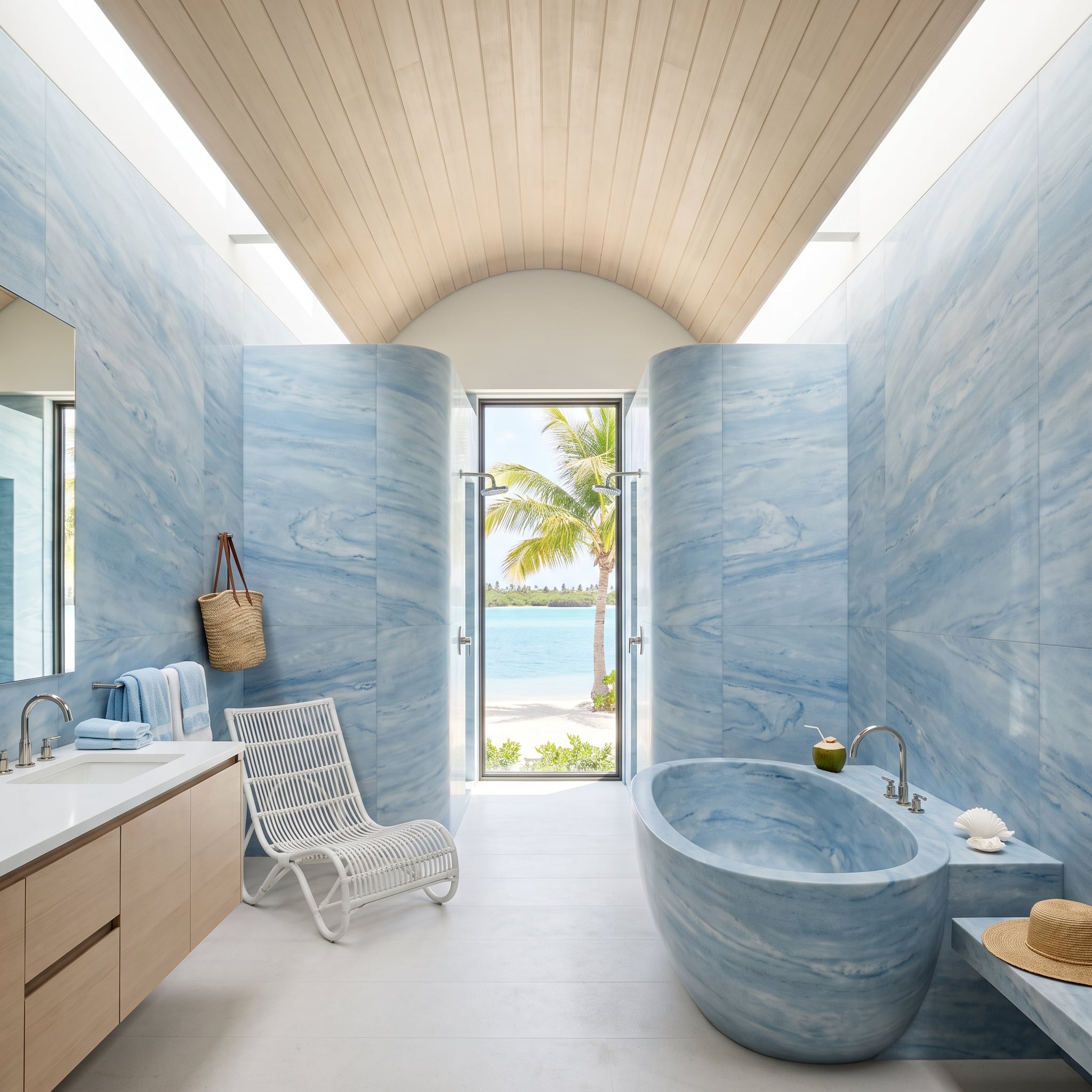
Blue-and-white stone resembling Azul Macaubas quartzite covers the walls and bathtub, bringing the colors of the ocean directly into the room. Above, a pale timber barrel vault introduces warmth and an entirely different texture. Curved architectural forms frame the large arched window, beyond which palms, sand, and turquoise water complete the coastal composition.
The flowing blue veins create movement across the walls, while the timber ceiling gives the eye a quieter surface to rest on. The arched opening repeats the ceiling’s geometry, tying the interior architecture to the view outside. Shells, ropes, and other familiar nautical accessories would be redundant here. The stone has already captured the shifting colors of the sea, while the timber vault introduces enough warmth to keep the bathroom from resembling an underwater cavern.
14. A Black-and-White Marble Bathroom Takes Geometry to Extremes
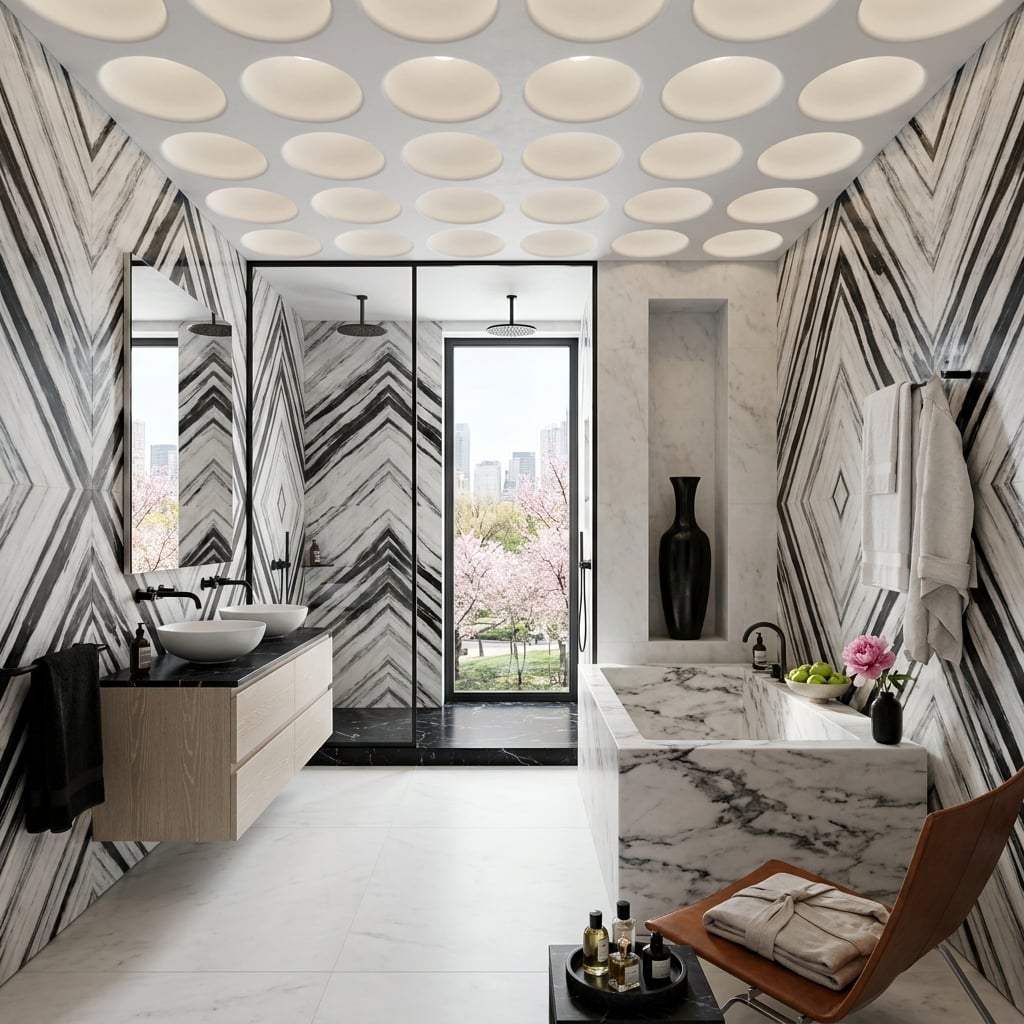
Black-and-white marble forms a bold chevron pattern across the walls, producing a graphic effect closer to architectural drawing than conventional stone cladding. Overhead, repeated oval light recesses introduce a competing geometry, their rounded forms providing relief from the sharp angles below.
The limited palette holds the two patterns together despite their opposing rhythms. The stone produces sharp directional movement, while the illuminated ceiling establishes a sequence of softer shapes. Beyond the window, flowering trees introduce color and irregularity. Executing a directional stone pattern like this would require careful fabrication and dry layout to control the alignment of veins and joints. Between the zigzagging marble and the oval ceiling recesses, the bathroom becomes a study in geometry with remarkably little interest in behaving quietly.
13. A Green Onyx Bathroom Puts a Garden Beneath the Floor
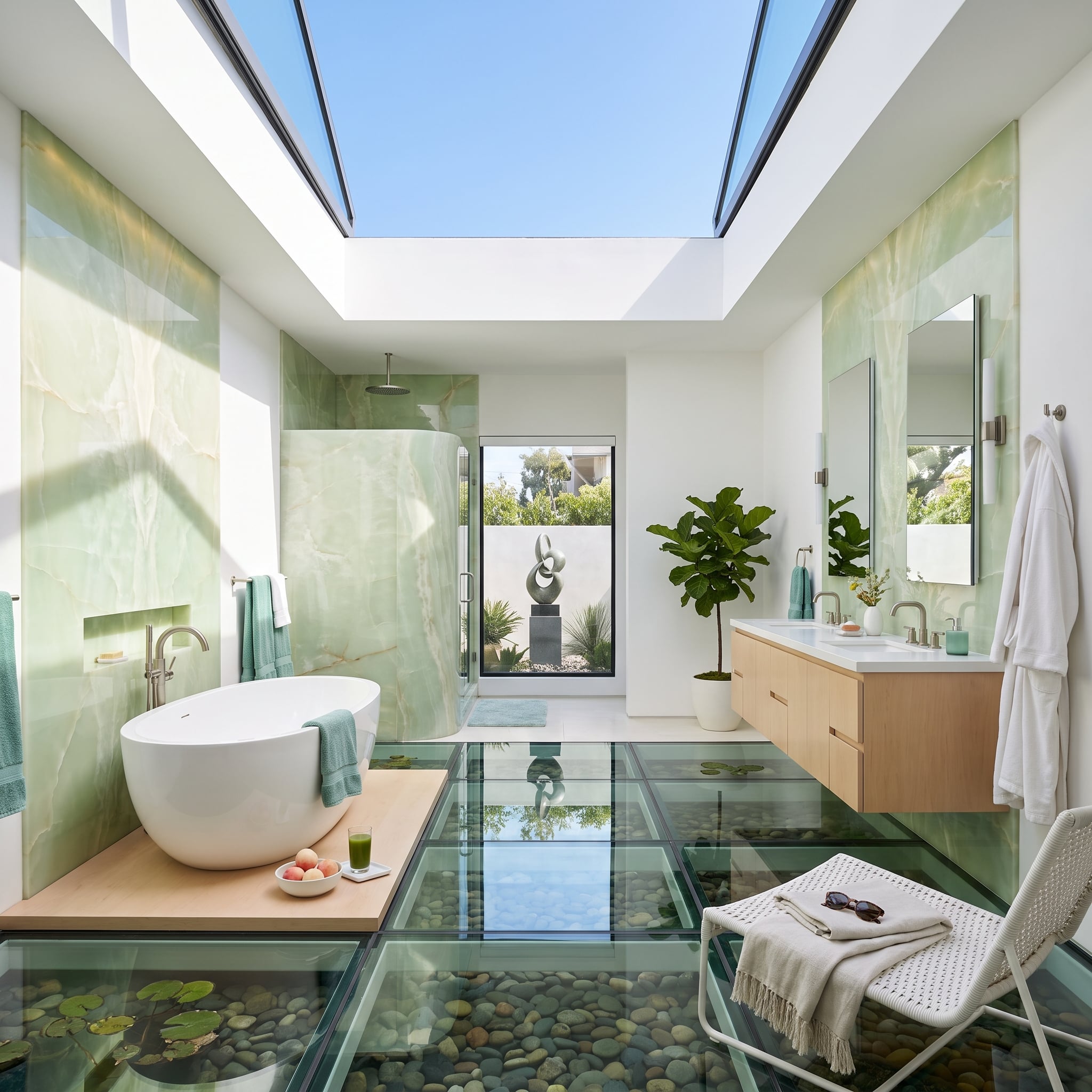
Green onyx climbs two walls in dramatic jade-colored bands, but the most surprising surface is underfoot. A transparent floor reveals river stones and aquatic planting beneath the bathroom, creating the impression of a shallow garden or water feature enclosed below the room. The effect shifts attention downward in a space where luxury usually concentrates on walls and ceilings.
A skylight supplies overhead illumination, while warm-toned timber cabinetry introduces an earthy counterpoint to the cool green stone. The glass floor creates a second visual plane, giving the room depth beneath the conventional walking surface. A real installation would demand structural glazing, slip resistance, waterproofing, drainage, and access for maintenance. The architectural trick is as simple as it is audacious: the floor becomes something to look through rather than simply walk across.
12. Marble Vaults Frame a Sunken Bath and a Lavender Field
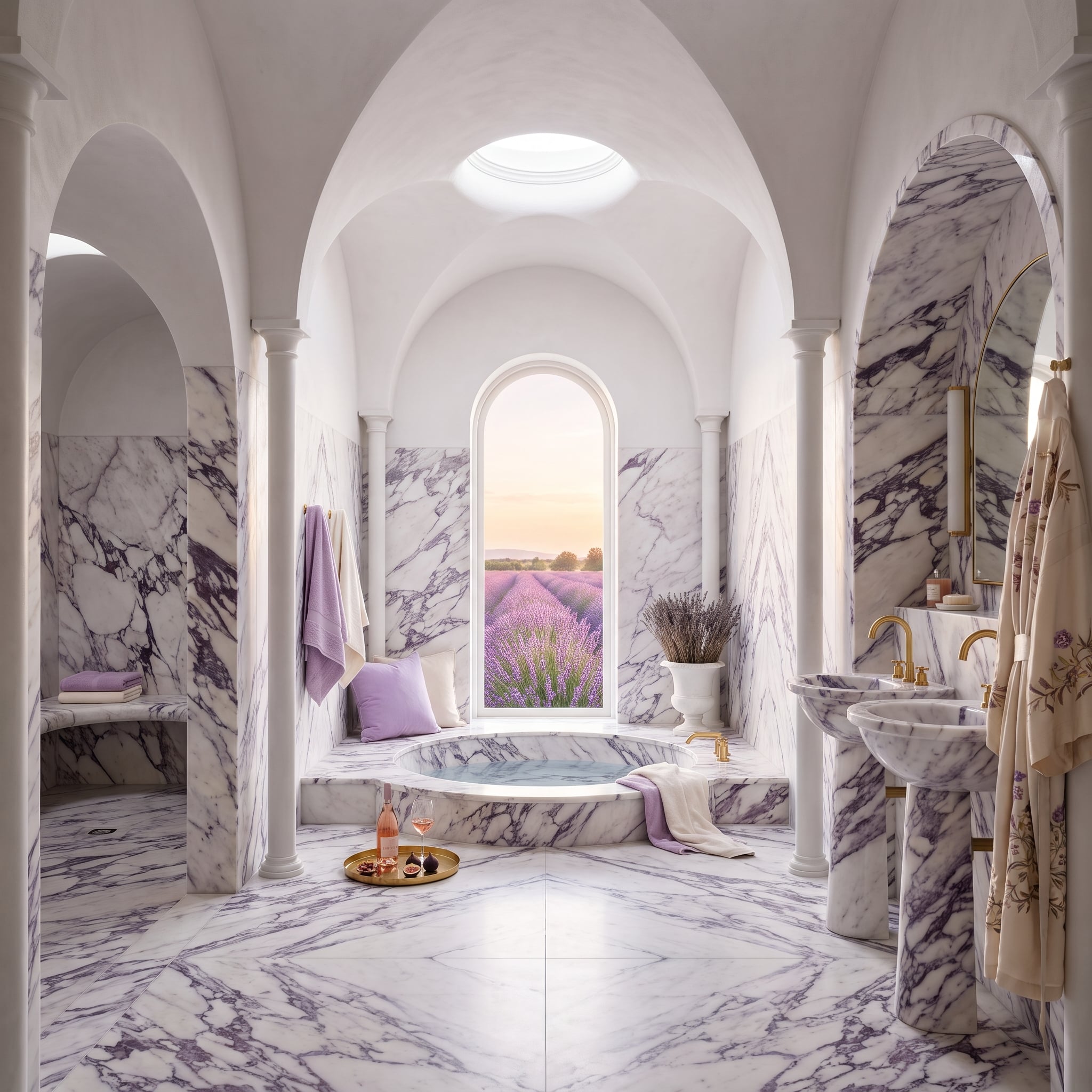
Arabescato-style marble covers the walls in sweeping gray-violet veining, while white plaster vaults establish a softer architectural rhythm overhead. A circular ceiling opening introduces daylight, and a recessed bathtub sits beneath an arched window overlooking a field of lavender.
The tub occupies a lower level than the surrounding floor, changing the relationship between the bathing area, the window, and the landscape. The arched opening becomes the dominant view from the water, while the marble surfaces provide an elaborate mineral frame. Gold-toned fixtures add warmth, and a bundle of dried lavender introduces a restrained connection to the field outside. In a practical design, the relationship between tub depth, window height, and sightline would need to be resolved early. Here, the descending floor and vaulted ceiling pull the architecture in opposite directions, creating an unusually engaging sense of space.
11. A Barrel-Vaulted Ceiling Gives Brown Marble a New Direction
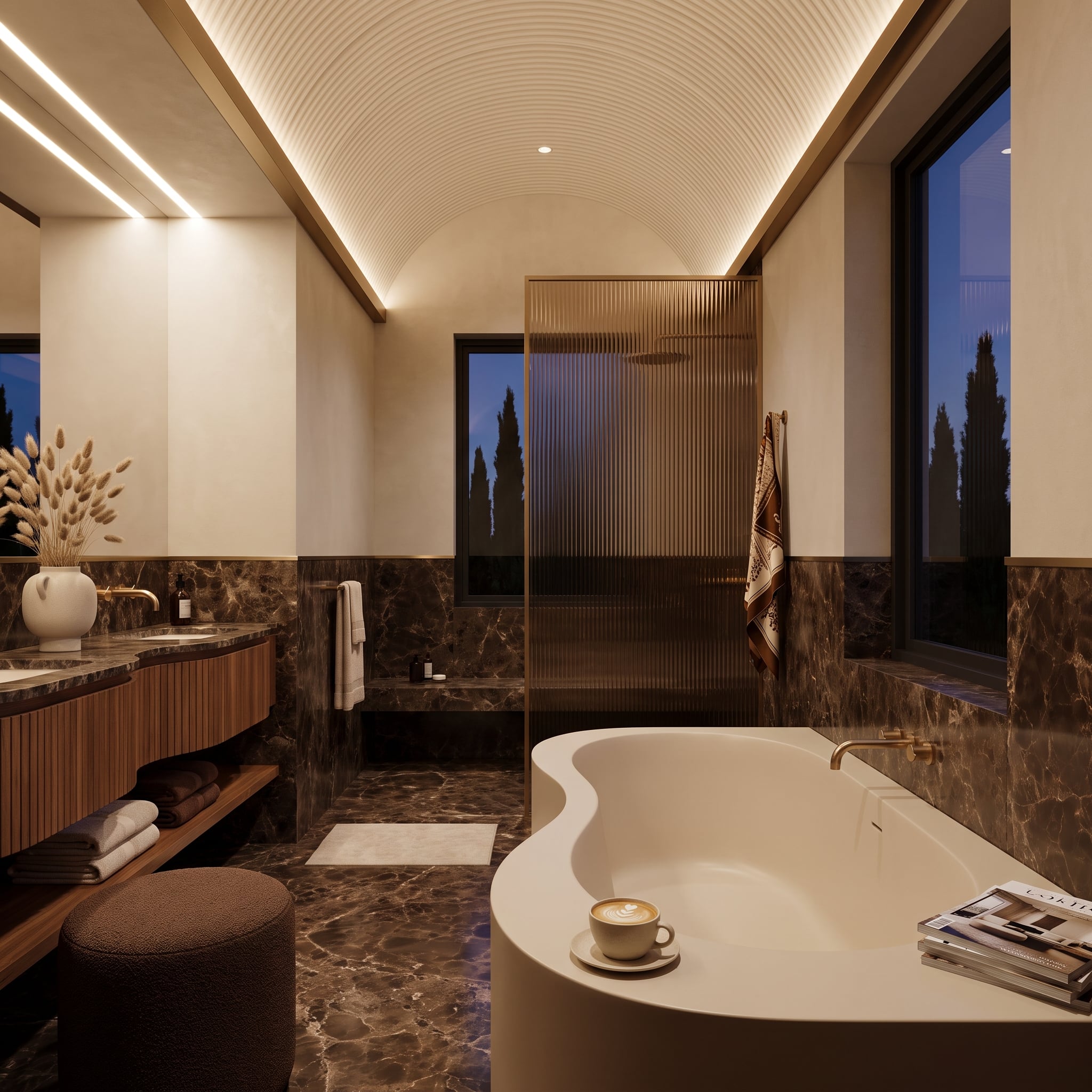
Dark brown marble with cream veining extends across the walls and floor, creating a warm mineral enclosure beneath a ribbed barrel vault. Integrated lighting follows the ceiling’s length, emphasizing the repeated curves and drawing attention toward the far end of the room.
Against that disciplined geometry, an asymmetrical freestanding tub introduces a softer, irregular silhouette. Walnut cabinetry with curved drawer fronts reinforces the warm palette, while a deep mocha bouclé ottoman adds a tactile contrast to the polished stone. The ceiling’s long parallel ribs establish direction; the tub interrupts that movement with an organic shape. Without the asymmetrical bathtub, the room might become an overly orderly procession of brown stone and repeated curves. The sculptural fixture gives that disciplined architecture something to contend with.
10. A Sunken Coastal Bath Trades the Conventional Tub for a Stone Basin
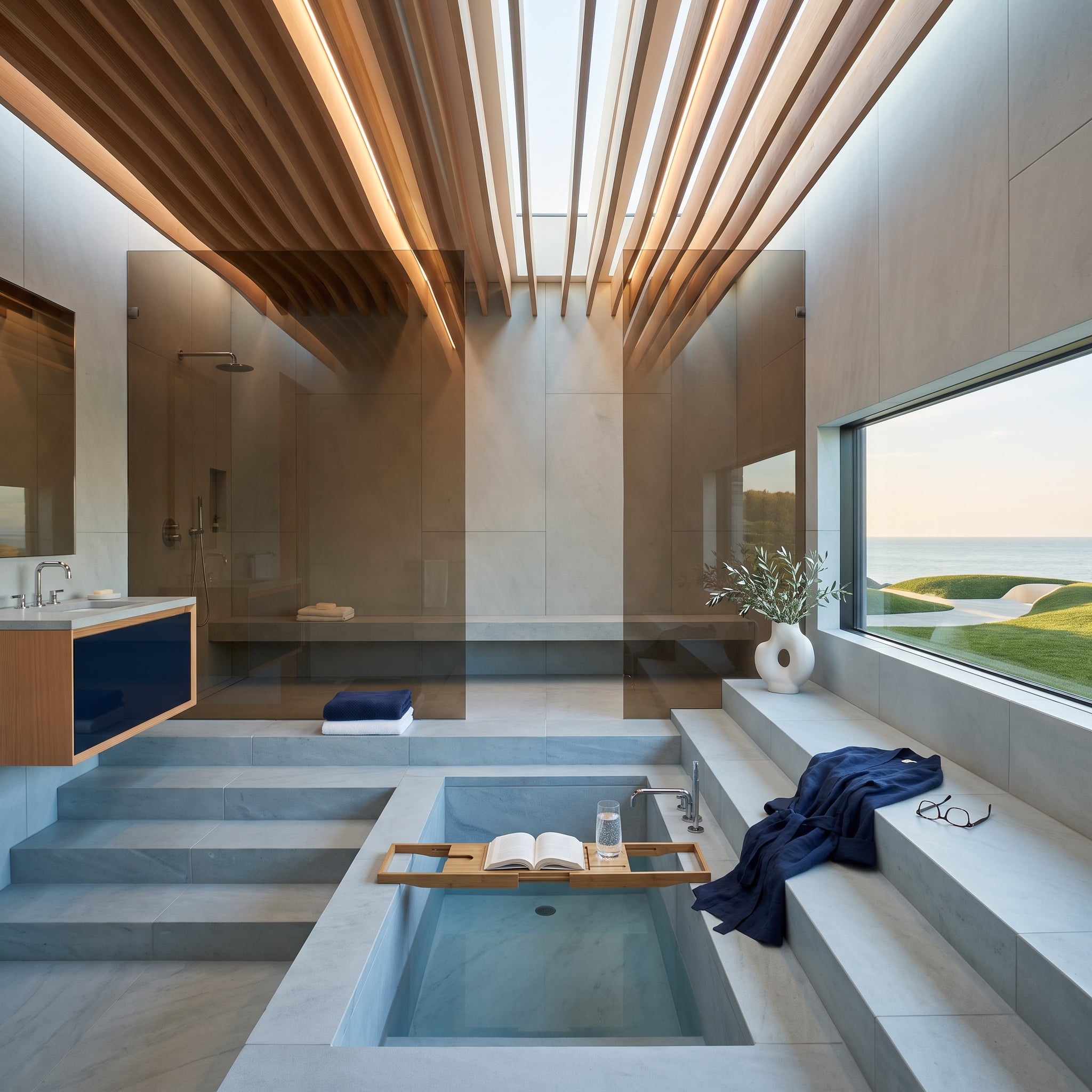
Cedar slats stretch across the ceiling, their warm grain emphasized by concealed lighting. Below, a substantial soaking basin is recessed into the floor, reached by broad stone steps. The arrangement replaces the familiar freestanding bathtub with something closer to a small bathing pool.
Cool limestone surfaces contrast with the timber overhead, while a large window opens toward beach grass and the coastal horizon. The recessed tub creates an unusually strong connection between bathing and architecture: rather than placing a fixture within the room, the floor itself appears to contain the water. Step-down bathing arrangements require careful planning for structure, waterproofing, drainage, safe entry, and accessibility. The uninterrupted stone surfaces and low bathing position give the interior an almost geological character, as though the pool belongs to the building’s foundations.
9. Lapis Blue and Gold Give a Marina Bathroom Its Own Palette
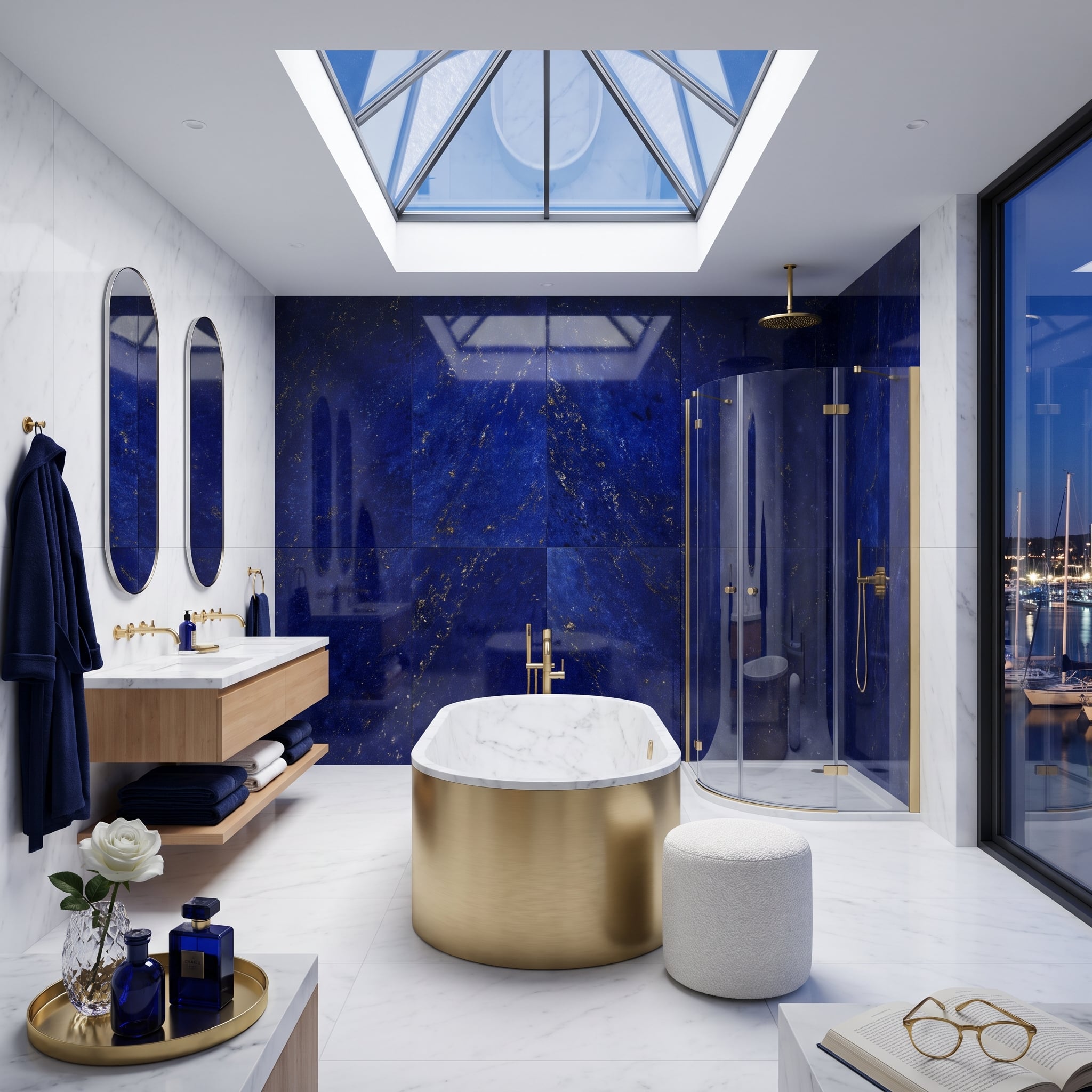
A vivid blue stone feature wall introduces the saturated color associated with lapis lazuli, while a cylindrical gold-toned tub surround provides an emphatic metallic counterpoint. The pairing is unapologetically luxurious, its effect concentrated in two dominant forms: a broad vertical plane of blue and a rounded volume of gold.
The marina beyond the glazing extends the blue palette into the distance, connecting the interior color with the setting. Metallic fixtures reinforce the warmth of the tub surround without requiring additional decorative flourishes. Where many luxury bathrooms rely on subtle variations of cream and gray, this design treats saturated color as a substantial architectural presence. Blue and gold have a long decorative history together, but the cylindrical tub gives the combination a distinctly contemporary expression. The result has more in common with a jewel box than a conventional waterfront bathroom.
8. White Plaster and Timber Ribs Shape a Bathroom Like a Coastal Cave
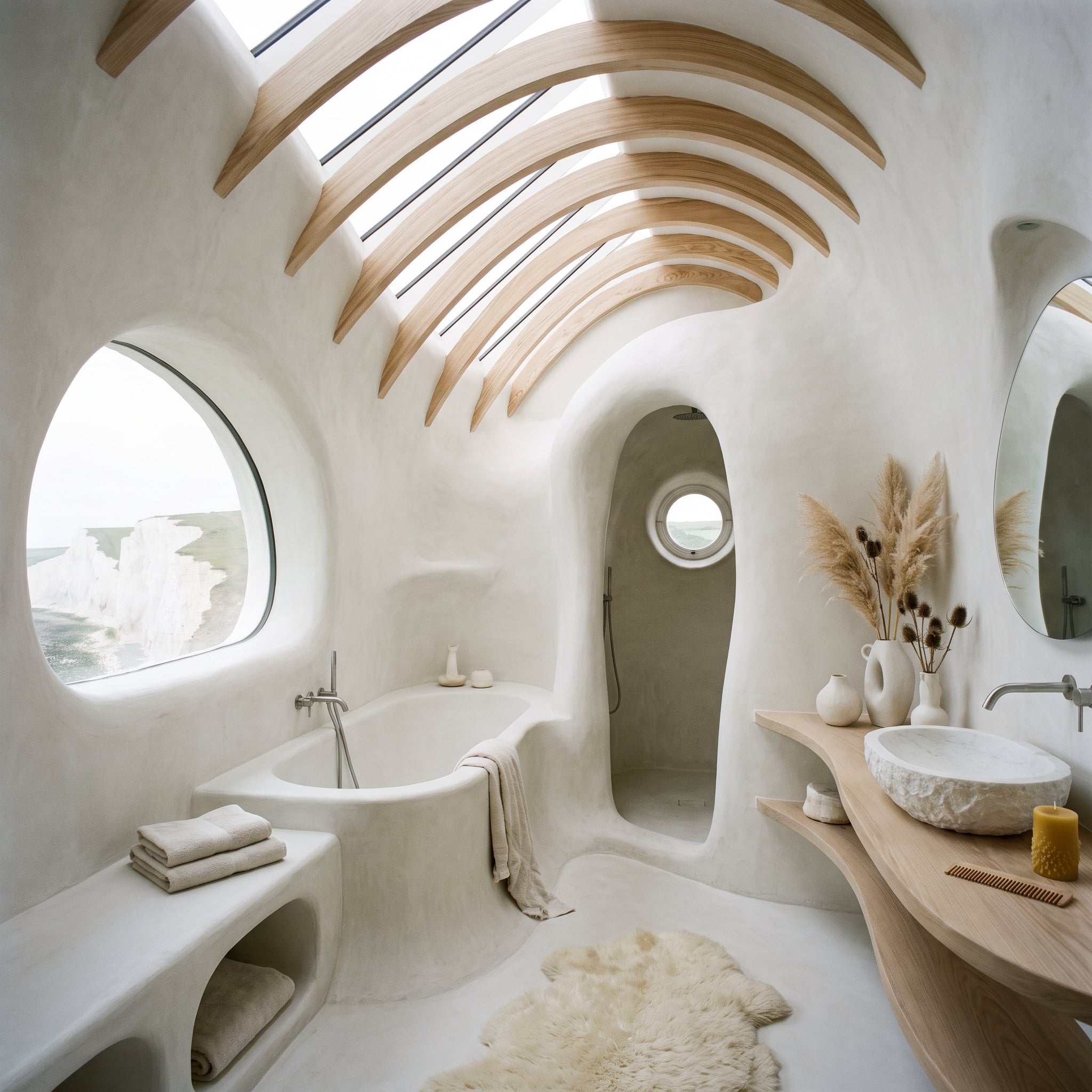
White plaster curves continuously across the walls, creating a cave-like interior without the roughness usually associated with natural stone. Above, curving timber ribs fan across the vaulted ceiling toward a skylight, introducing a skeletal structure that contrasts with the smooth surrounding surfaces.
The bathtub appears integrated into the floor, while curved glazing opens the room toward pale coastal cliffs. The architecture relies on a small number of strong gestures: continuous plaster, exposed timber ribs, and an uninterrupted connection to the landscape. A ceramic vase of pampas grass provides a restrained decorative accent. The constructed timber ceiling and the apparently eroded plaster enclosure create an intriguing opposition. One is rhythmic and precise; the other is fluid and irregular. Together, they give the room the atmosphere of a contemporary coastal grotto.
7. Dark Green Marble Turns a Misty Forest Into Part of the Bathroom
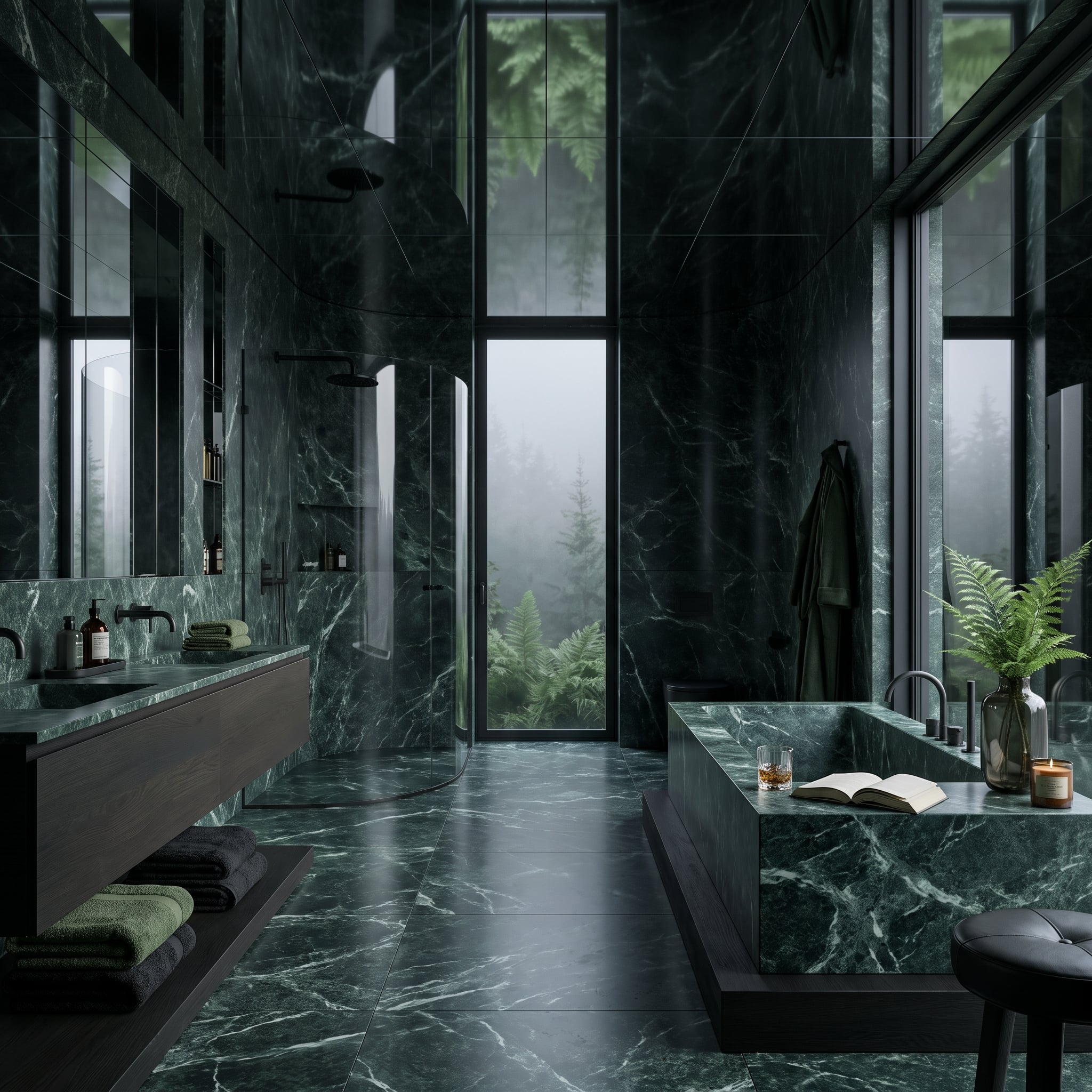
Dark green marble covers the principal walls and bathing surfaces, its pale veining introducing movement across the otherwise saturated interior. Floor-to-ceiling glazing reveals a misty forest, with ferns and trees providing a natural counterpart to the stone’s green tones.
Matte black fixtures remain visually quiet against the darker surfaces, while the broad marble bathtub reinforces the room’s substantial mineral character. The stone and landscape share a palette but not a texture. The marble is polished, dense, and dramatically veined; the forest is soft, irregular, and layered with atmospheric depth. Their relationship creates continuity without making the interior disappear into its surroundings. Carefully positioned lighting would be essential in a room dominated by dark surfaces, particularly around the vanity and shower. The fog outside supplies a softness that the uncompromising marble cannot.
6. A Sage-Plaster Bathroom Finds Its Center Beneath a Circular Skylight
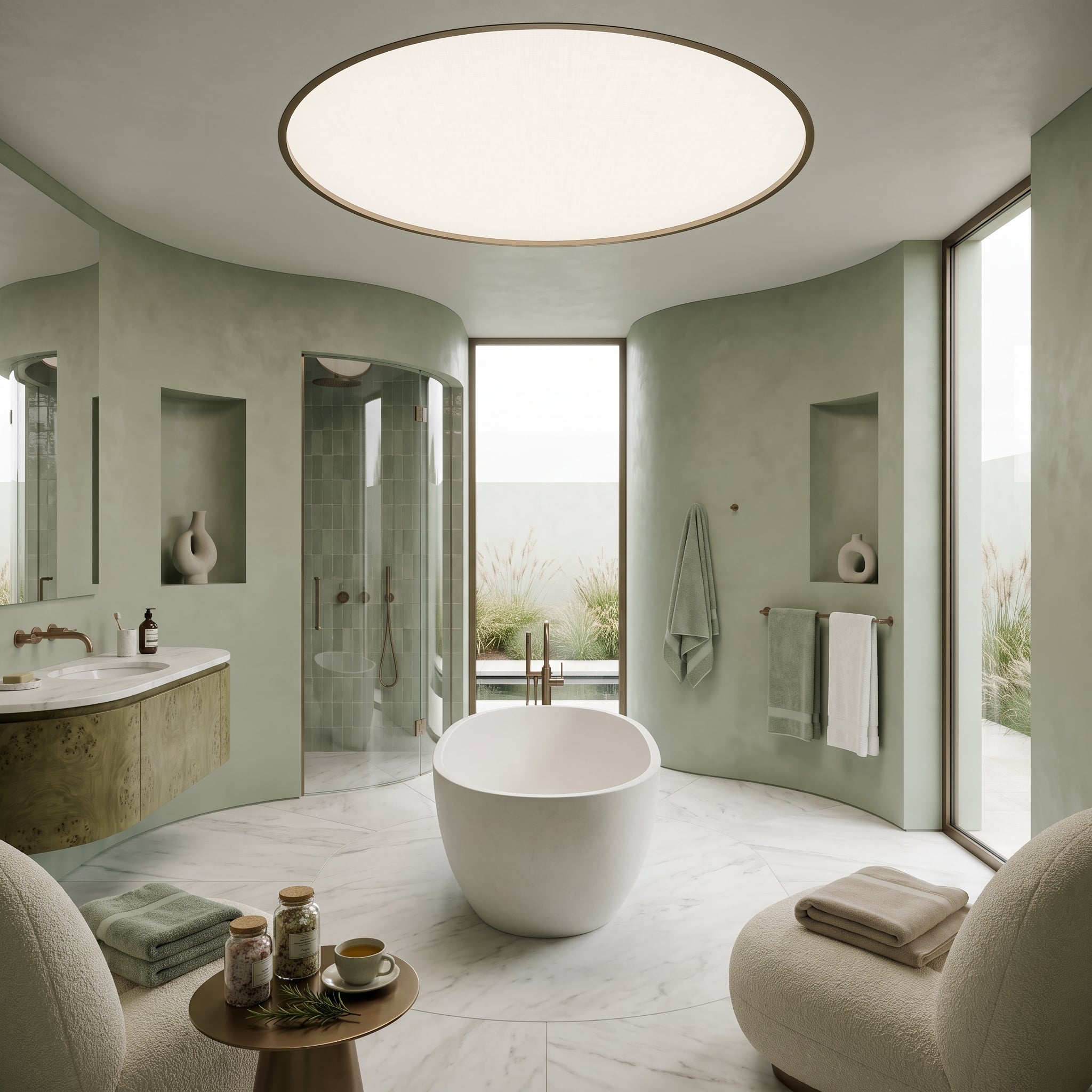
Curved sage-plaster walls give this bathroom a gentle, enveloping character, while a circular skylight establishes a strong center overhead. The marble floor follows a radial pattern, extending the ceiling’s geometry downward and organizing the room around a single architectural idea.
A floating vanity with burl-patterned wood fronts introduces warmth and richly figured grain against the muted green walls. Recessed niches provide display space without projecting into the room. The curves are substantial, but the materials remain quiet enough to let their geometry register. Smooth plaster also responds beautifully to diffuse light, revealing subtle changes in tone across the rounded surfaces. There is no need for a theatrical chandelier or elaborate stonework when the room itself has been shaped into something this distinctive.
5. Calacatta-Style Marble Meets a Brass Shower Wall and a Garden View
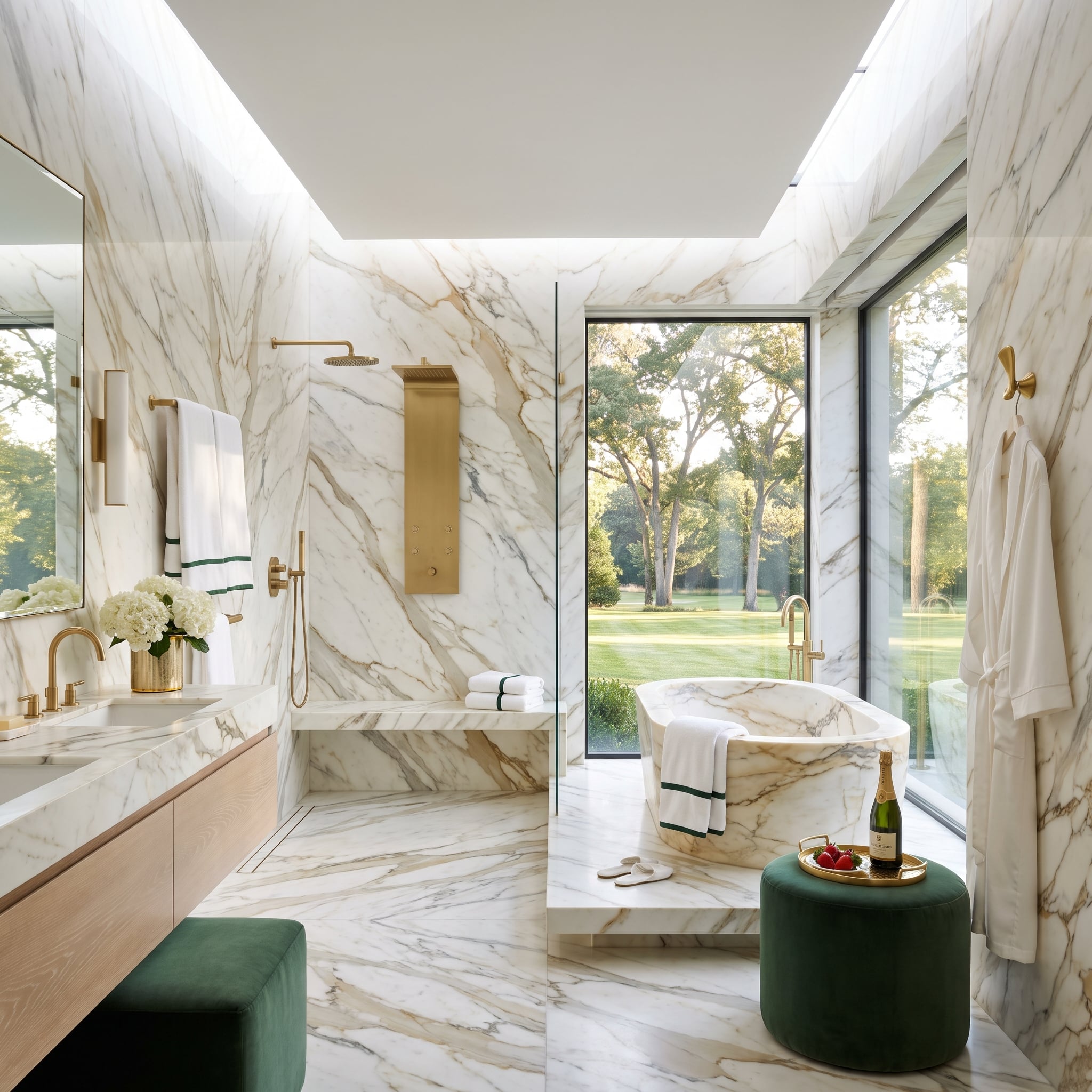
White marble with sweeping gray and gold-toned veining surrounds a freestanding soaking tub, creating a pale mineral setting punctuated by a substantial brass shower panel. The metallic surface gives the shower a strong architectural identity rather than leaving it to disappear behind transparent glass.
Green velvet ottomans introduce a saturated accent, while floor-to-ceiling glazing reveals the lawn and garden beyond. The combination of marble, brass, and velvet creates an unusual balance of polished and tactile surfaces. Repeated green details connect the upholstery with the landscape, offering an alternative to the conventional white-and-gold luxury palette. The brass panel occupies enough visual space to become a proper architectural feature. One substantial plane of metal changes the shower from a background utility into a commanding part of the composition.
4. An Onyx Wall Glows Behind a Stone Bathtub and a Zen Garden
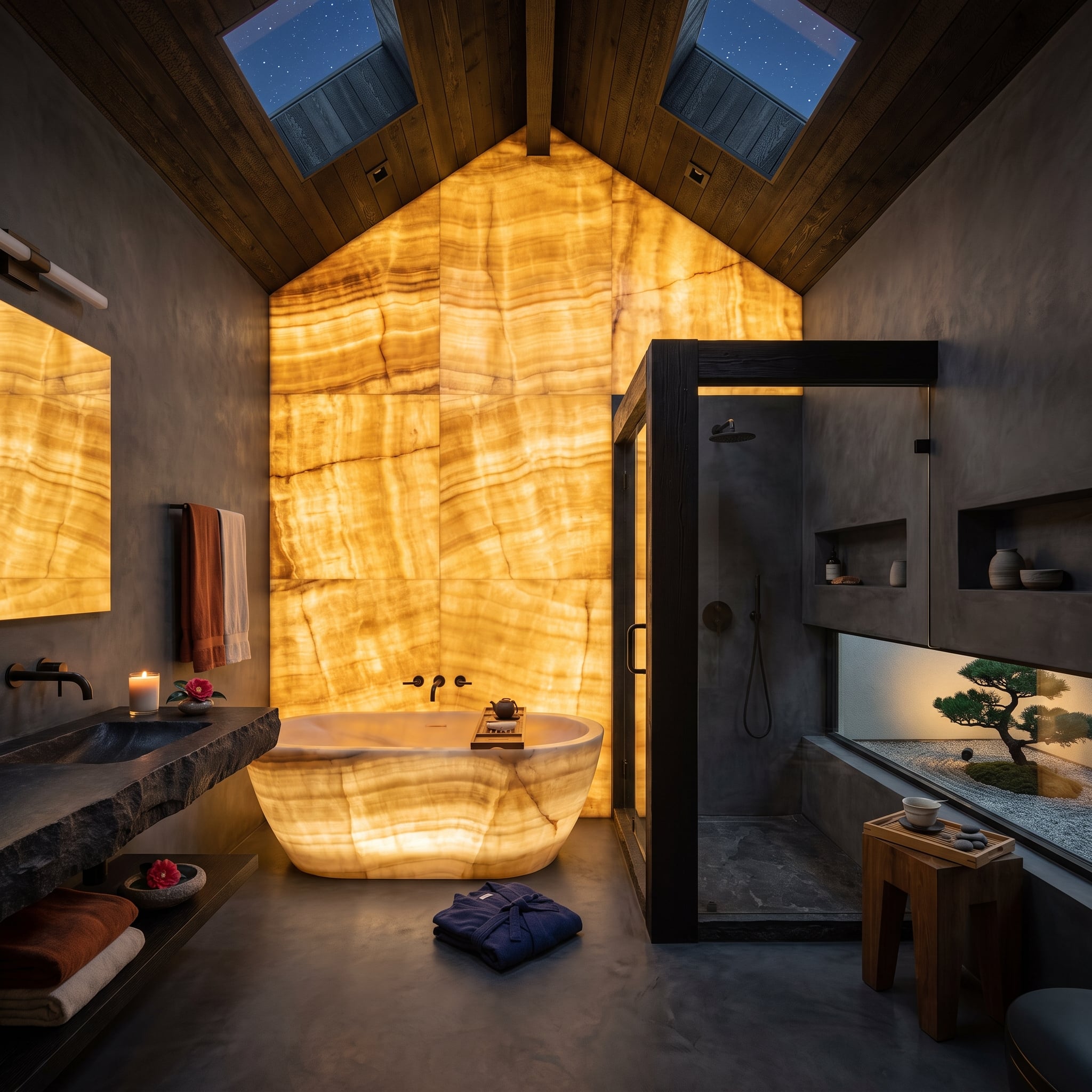
Honey-colored onyx glows behind the soaking tub, its translucent bands becoming dramatically visible under concealed illumination. The bathtub repeats the warm stone tones, giving the bathing area the appearance of a unified mineral composition.
Elsewhere, concrete-colored plaster and a dark timber ceiling provide a restrained setting for the illuminated wall. A glass shower enclosure sits beside a low window overlooking a Japanese-style gravel garden with a small sculptural tree. The narrow opening creates an intimate landscape view rather than another broad expanse of glazing. Onyx is particularly effective when backlit because selected varieties transmit light through their natural banding, producing an effect that opaque marble cannot achieve. The contrast between the glowing stone and the quietly composed garden gives this bathroom two very different ways of holding the eye.
3. A Wave-Sculpted Ceiling Brings the Ocean Indoors
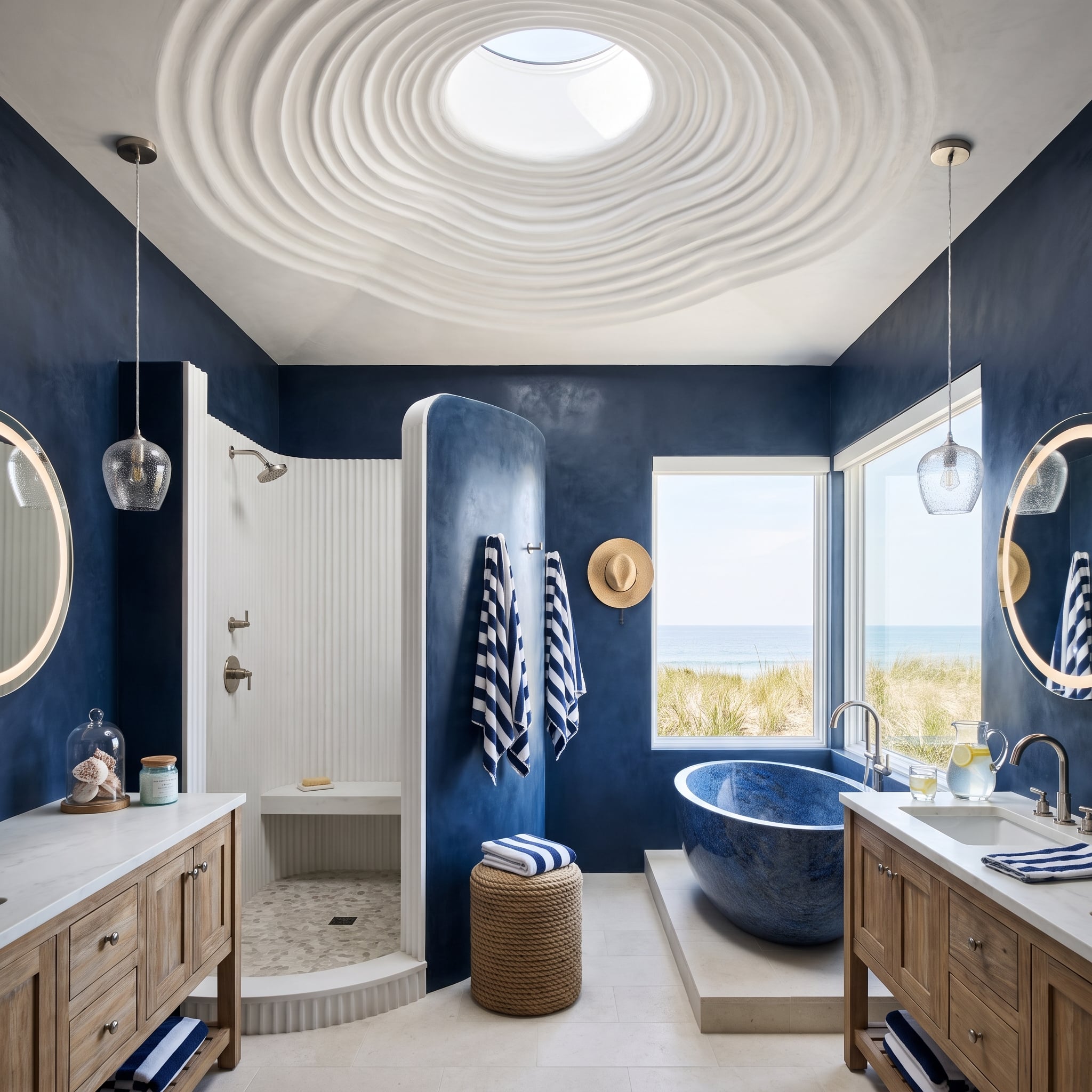
Deep navy plaster covers the walls, while the ceiling rises into concentric wave-like relief around a central skylight. The sculptural treatment gives the room a sense of movement that conventional flat ceilings rarely achieve. Below, a blue stone soaking tub occupies a raised platform, framed by a window overlooking beach grass and open water.
Two timber vanities introduce warm grain against the saturated blue, providing a useful counterbalance to the otherwise cool palette. Striped towels and a small rope stool reinforce the coastal character without dominating the composition. The ceiling’s rippling form transforms the familiar association between water and waves into an architectural gesture. The blue palette is emphatic, while the timber provides enough warmth to balance its intensity. Rather than assembling a collection of seaside souvenirs, the bathroom translates the coast into color, texture, and form.
2. An Onyx-Clad Bathroom Lets Skylights Cut Through the Stone
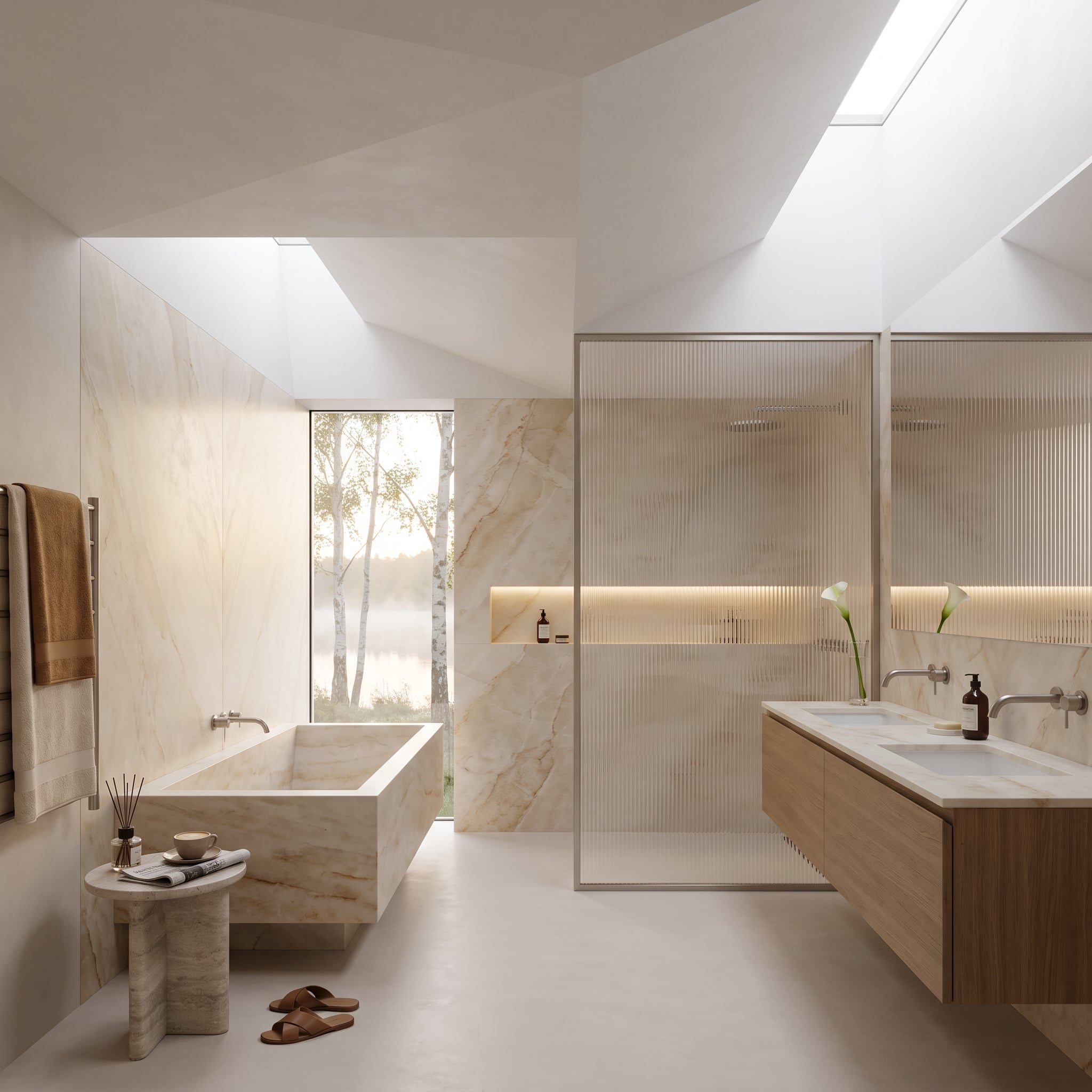
Cream-colored onyx with warm gold veining extends across the bathing area, giving the room a luminous mineral palette. A substantial stone bathtub reinforces the material continuity, while reeded glass panels enclose the shower with a translucent surface that softens the view of the fittings behind it.
A wall-mounted oak vanity introduces warm timber grain, and two skylights admit daylight from above. Their clean geometry contrasts with the stone’s intricate natural pattern. Reeded glass provides another kind of visual texture, allowing light to pass while obscuring detail. Polished stone, textured glass, warm wood, and daylight create a series of subtle contrasts within an otherwise restrained palette. The skylights are especially effective against the richly veined surfaces, cutting crisp openings through an interior dominated by the irregular patterns of stone.
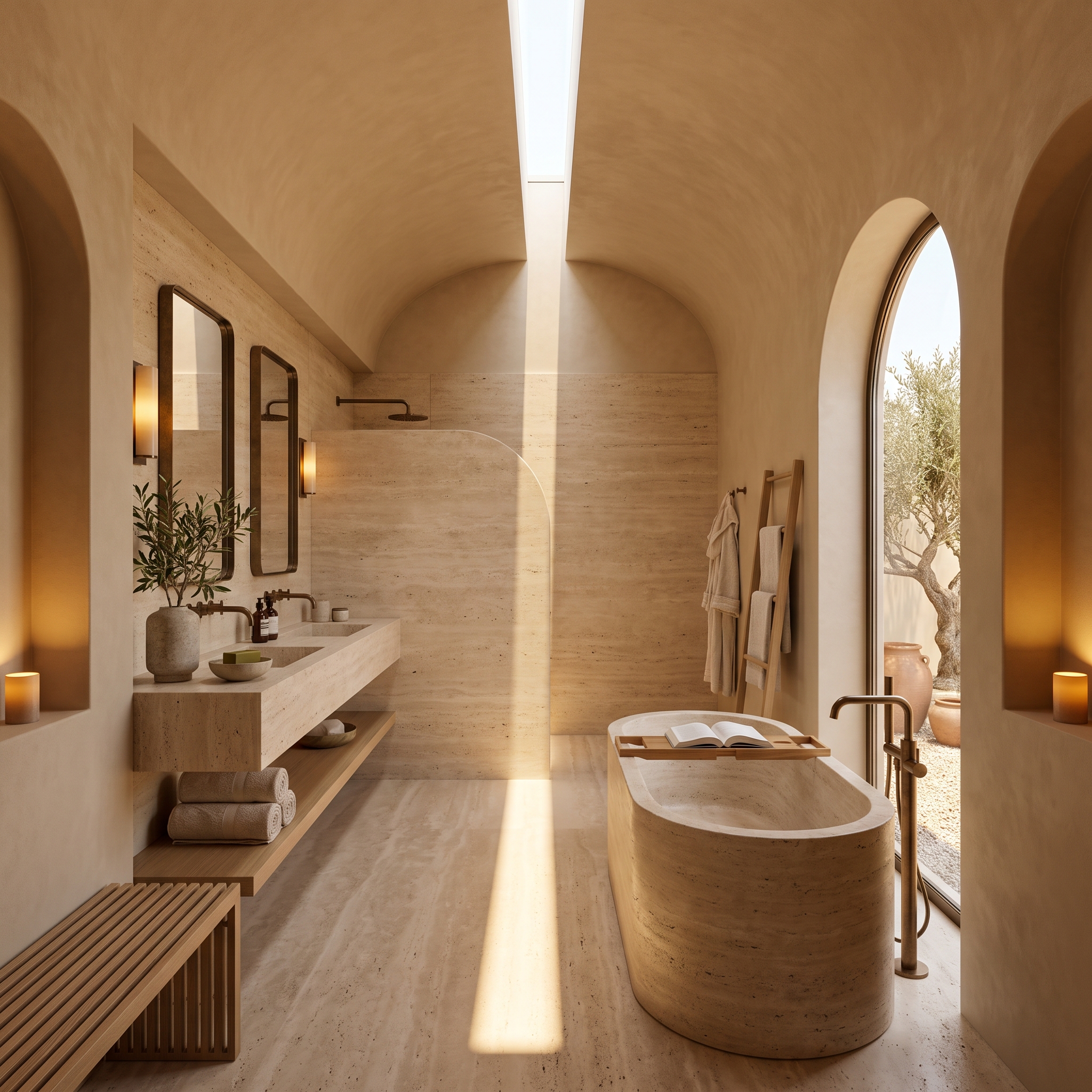
1. A Travertine Bathroom Proves That One Material Can Be an Entire Architectural Language
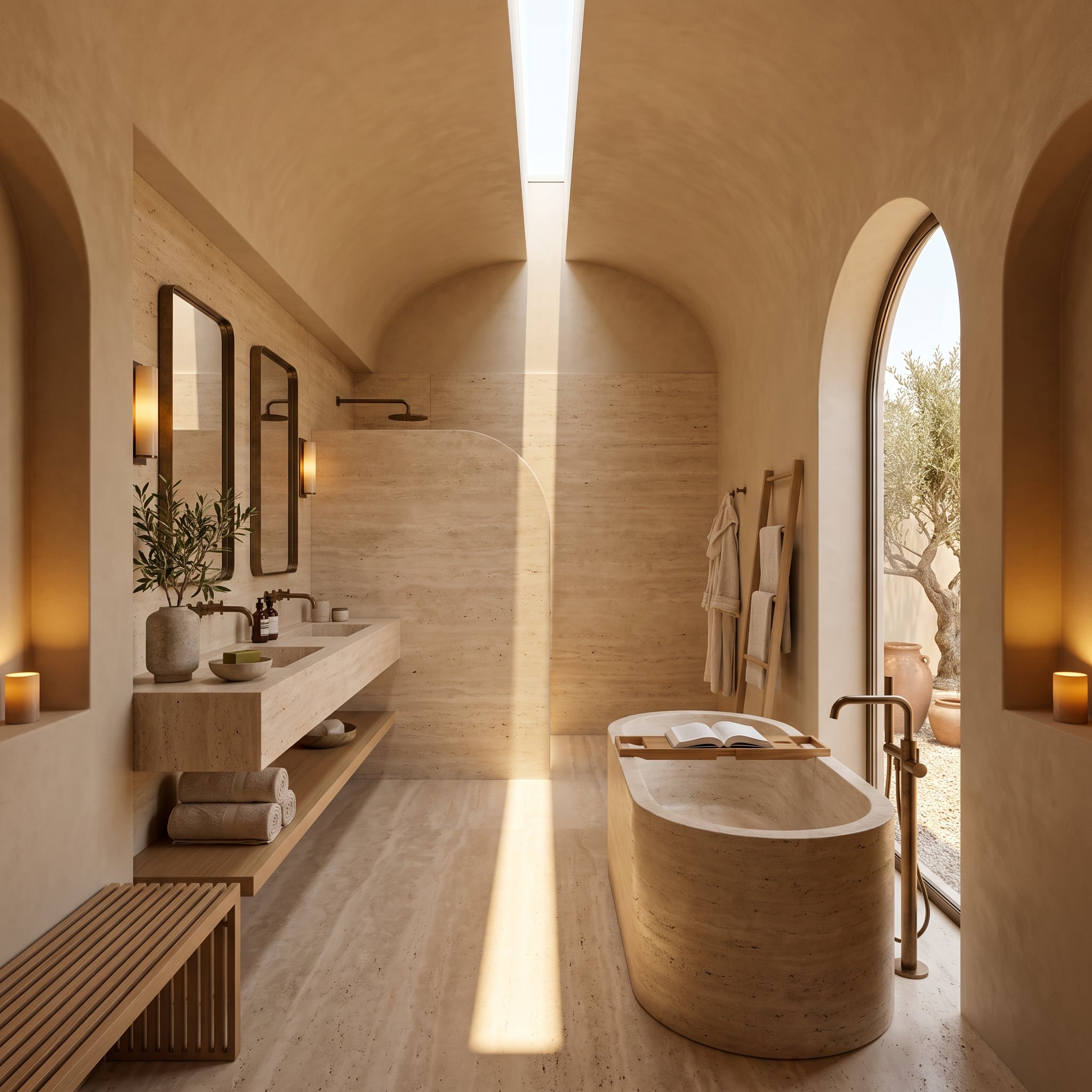
Travertine extends across the walls, floor, vanity, and soaking tub, giving this bathroom the quiet authority of a space shaped from a single geological idea. The stone’s natural pores, bands, and subtle color variations provide texture without introducing competing patterns. A narrow skylight runs along the ceiling, casting a concentrated line of daylight toward the bathtub.
An arched opening frames an olive tree outside, bringing a distinctly Mediterranean character to the restrained interior. The floating double vanity continues the pale stone palette, while the bathtub occupies the center without elaborate ornament or contrasting color. The narrow skylight cuts through the architecture with almost surgical precision, while the arched opening introduces a softer, more traditional form. Travertine connects the two geometries, its natural variations giving the surfaces depth without disturbing the calm. One material, two carefully composed openings, and a single tree beyond the wall. Nothing else is fighting for attention.