🔥 Would you like to save this?
A bathroom can have plenty of square footage and still behave like a crowded elevator. The vanity projects too far. The tub occupies the best stretch of floor. Storage creeps into every available corner. Meanwhile, the one thing the room desperately needs—some breathing space—has nowhere to go.
In order to come up with the very specific design ideas, we create most designs with the assistance of state-of-the-art AI interior design software. Also, assume links that take you off the site are affiliate links such as links to Amazon. this means we may earn a commission if you buy something.
Adding square footage would solve the problem. So would questioning what occupies the square footage already there. A floating vanity exposes the floor beneath it. A compact soaking tub changes the balance between bathing space and circulation. Continuous stone surfaces quiet the visual interruptions. Even the ceiling, usually the most neglected plane in the room, can become its most persuasive architectural feature.
The same bathroom. An entirely different proposition. Crowded counters give way to cleaner surfaces, bulky cabinets disappear, and neglected ceilings become architectural showpieces. Japanese-inspired cedar, luminous onyx, saturated marble, and sculptural concrete take the transformations in radically different directions. The challenge remains the same: make the existing room work harder, look better, and feel considerably more spacious.
36. Japanese Soaking Tub, Shoji Ceiling, Zero Extra Square Footage
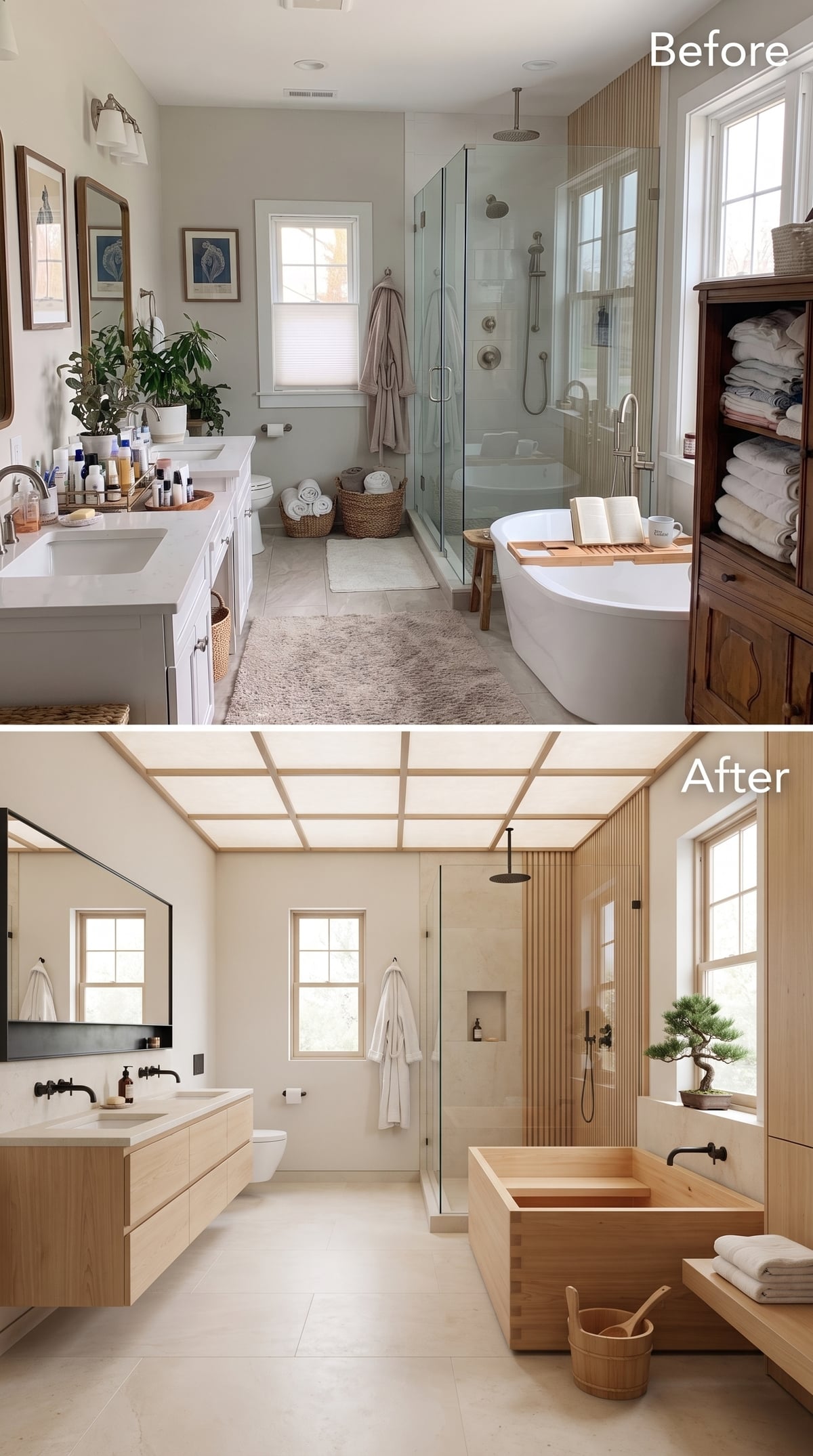
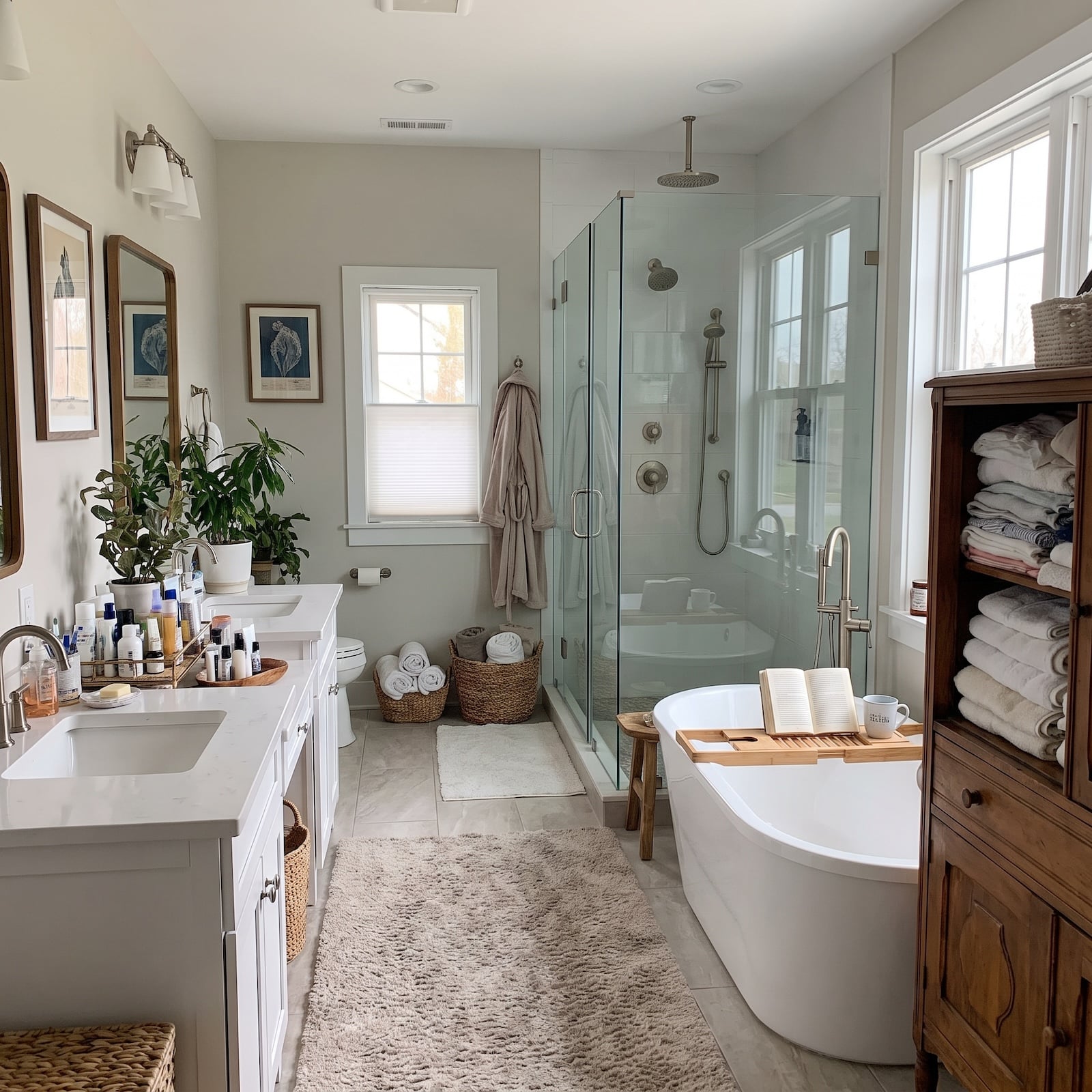
The original bathroom had plenty of fixtures competing for attention: a long vanity, freestanding tub, exposed towel storage, and an assortment of accessories occupying nearly every available surface. The redesign replaces that visual congestion with a much more disciplined arrangement.
A luminous shoji-inspired ceiling spreads soft light across the room, while a deep cedar ofuro tub occupies a compact position beside the shower. Matte black wall-mounted fixtures provide sharp contrast against the timber. The new floating vanity clears the floor beneath it, and streamlined storage replaces the bulky furnishings. The footprint appears familiar. The proportions are transformed.
35. Backlit Onyx Turns a Charcoal Bathroom Into a Study in Light
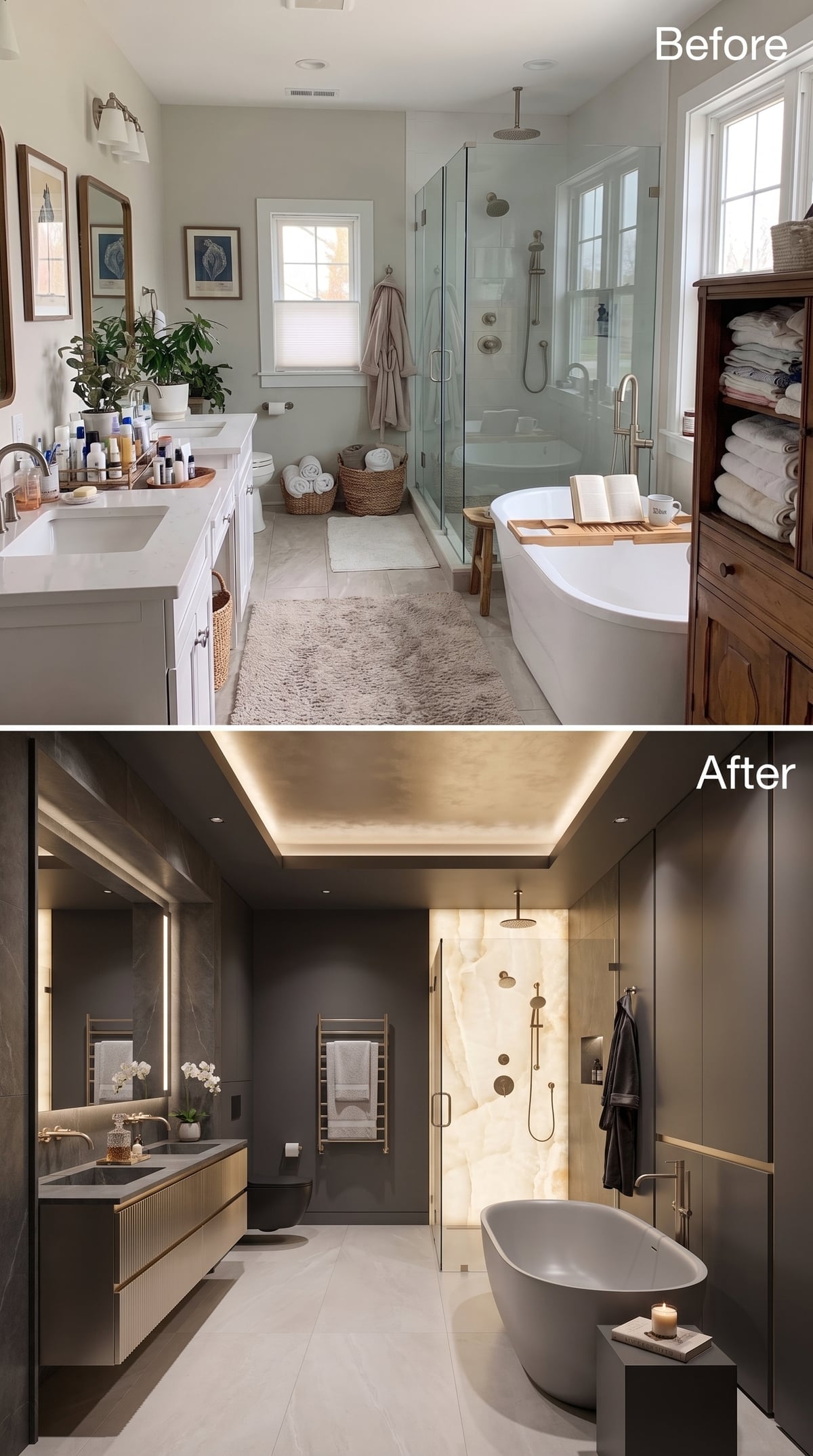
Dark charcoal walls establish a dramatic setting for a luminous onyx shower panel. Backlighting reveals the stone’s internal pattern, transforming the shower wall into a glowing architectural surface rather than another flat partition.
A long floating vanity introduces warm wood beneath the darker finishes, while the contrast between illuminated stone and shadowed walls gives the room a remarkable sense of depth. The onyx becomes both the material centerpiece and a source of atmospheric light.
Design Detail: Translucent stone can be illuminated from behind using a purpose-built lighting assembly. Even light distribution is essential to revealing the stone’s pattern without distracting bright spots.
34. Cane Ceiling, Terracotta Plaster, and Oval Mirrors That Reclaim the Wall
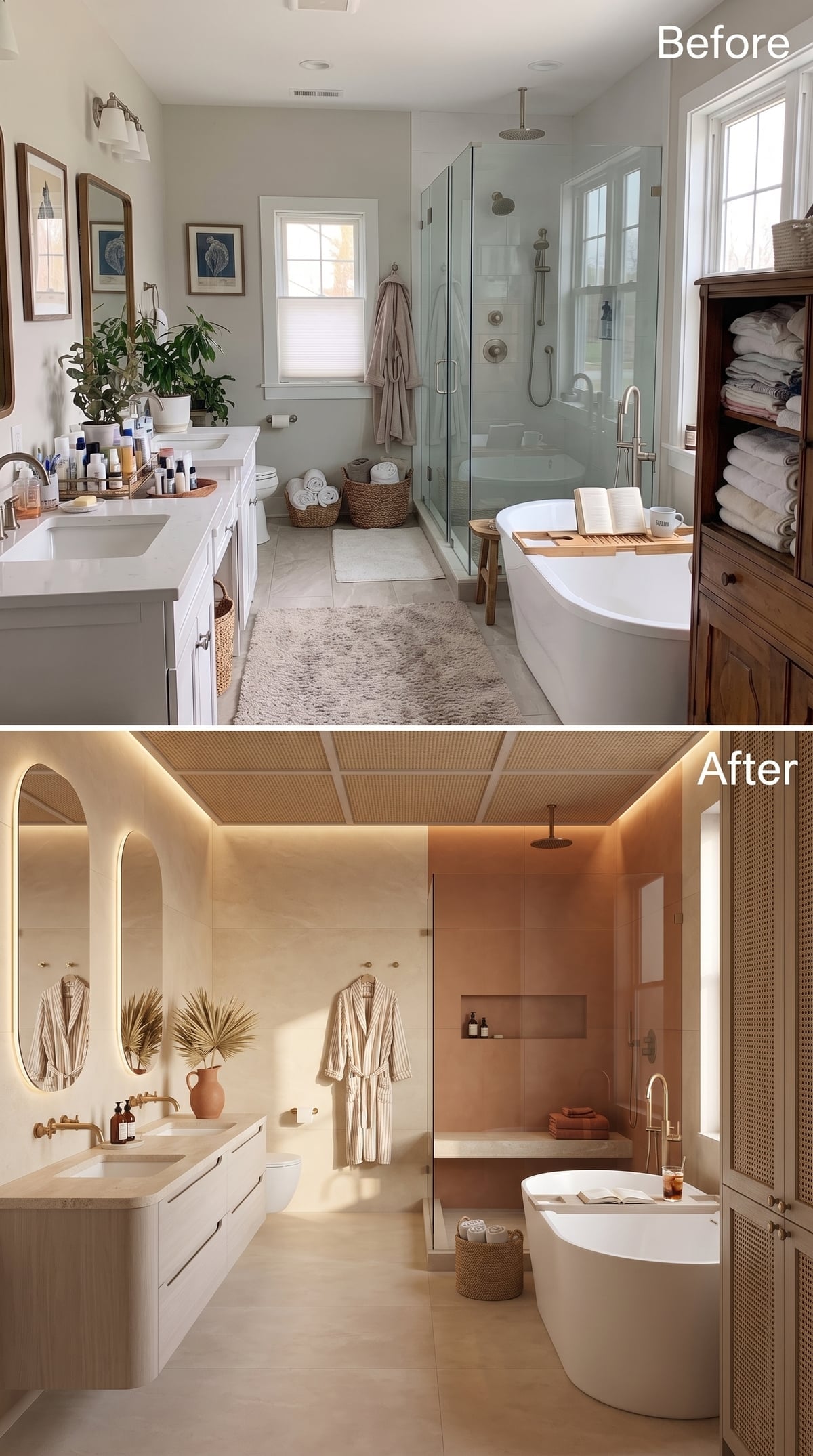
A cane-paneled ceiling gives this bathroom a distinctly tactile character. Warm light grazes the woven surface, bringing out its pattern, while terracotta-colored plaster establishes an earthy counterweight along the shower wall.
Two illuminated oval mirrors create separate washing stations above a pale floating vanity. Their rounded outlines interrupt the straight lines of the cabinetry and ceiling. Woven baskets, simple hooks, and botanical accents extend the natural palette, while the open space beneath the vanity provides a welcome break from the room’s richly textured surfaces.
33. Purple Marble and Pink Glass Pendants Refuse to Play It Safe
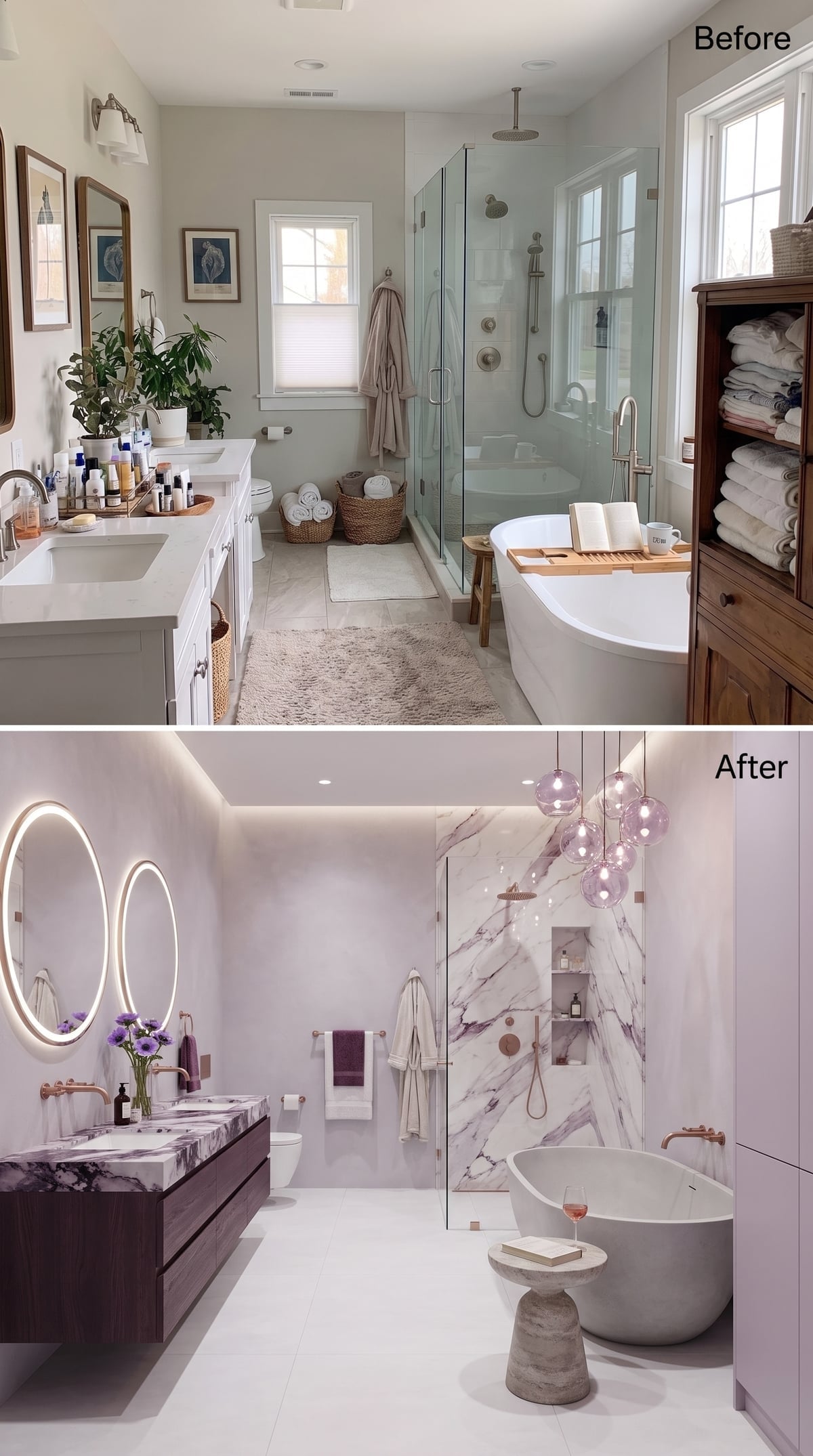
Purple-veined marble supplies the drama behind a double vanity, while rose gold fixtures and illuminated oval mirrors soften its intensity. Above, pink glass pendants descend at different heights, adding a delicate, almost theatrical layer to the composition.
The low concrete soaking tub provides the necessary counterweight. Its broad, grounded form contrasts with the slender pendants and reflective metalwork. Most of the decorative intensity gathers around the vanity, leaving the bathing area with a more sculptural, restrained presence.
32. Concrete Walls, a Skylight Oculus, and the Floating Vanity That Made Floor Space Reappear
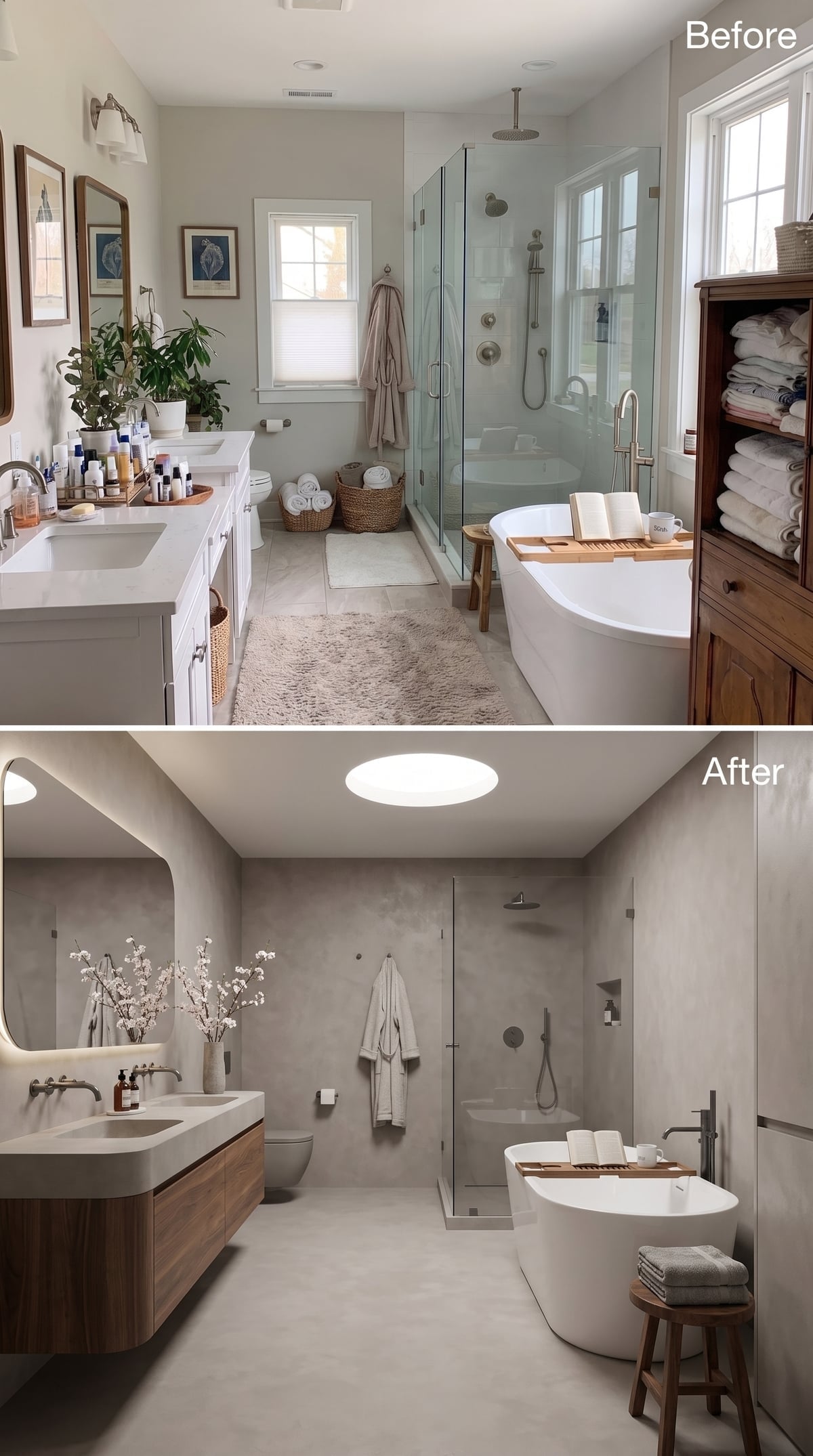
Microcement gives the walls and floor a nearly continuous mineral finish, replacing decorative pattern with subtle tonal variation. The result is an unusually calm setting for a circular skylight positioned above the freestanding soaking tub.
Natural light concentrates around the white tub, emphasizing its sculptural outline against the muted surroundings. A floating walnut vanity introduces warmth, while a concrete basin maintains the mineral character. Cherry branches provide a delicate interruption to the otherwise spare geometry. The circular skylight and rounded tub form a striking pairing against the rectilinear walls.
Not everyone is won over by the mineral look, though: in our Hot or Not matchups, pictures featuring concrete won fewer of their head-to-head matchups than expected.
31. Sage Cabinets, Brass Fixtures, and a Moss Wall That Changes the Whole Conversation
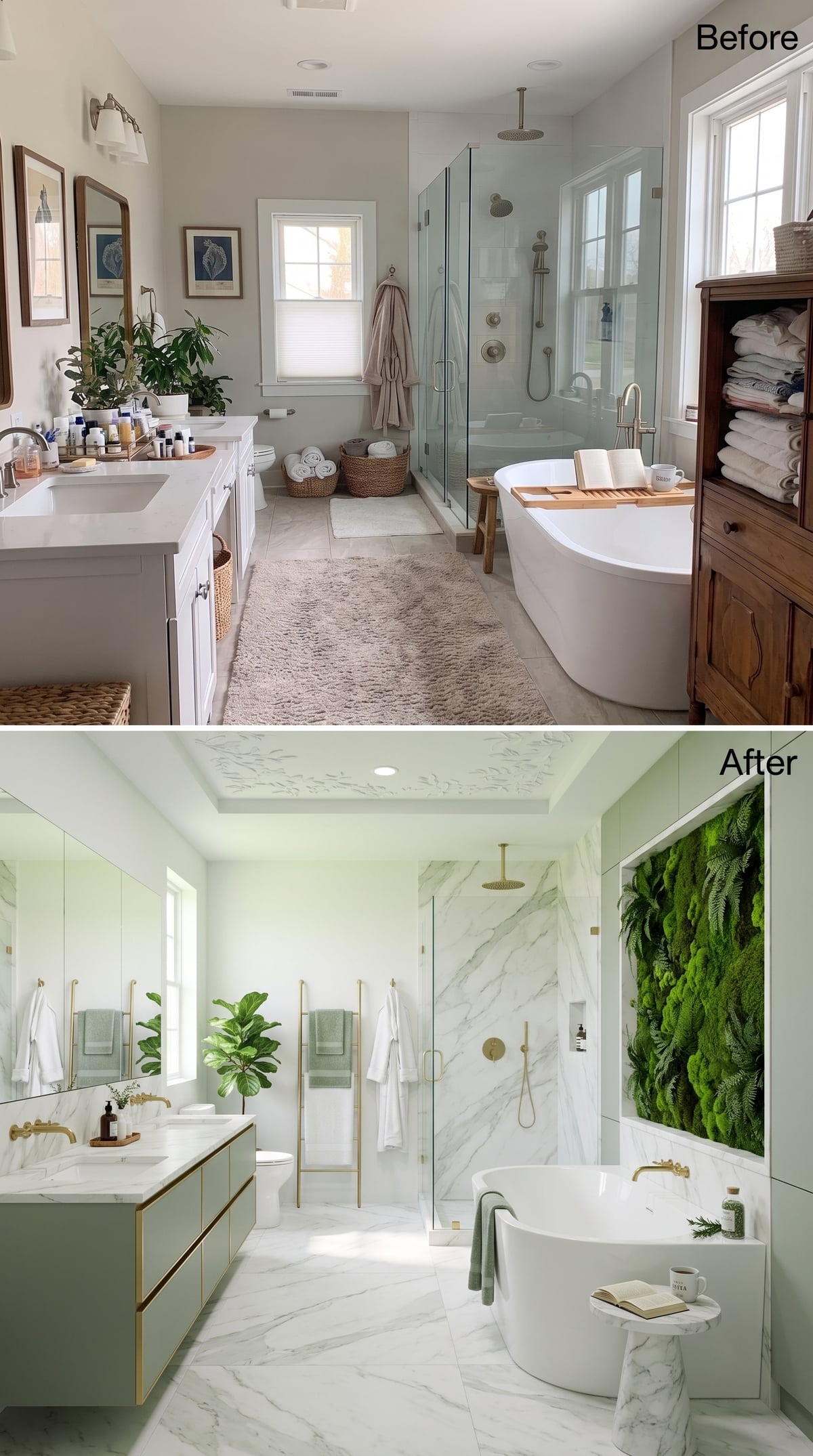
Sage-green floating cabinetry establishes a subdued botanical palette, with brushed brass hardware introducing a warmer metallic edge. Wide herringbone floor tile adds movement beneath the fixtures, while a framed moss installation becomes the room’s most unexpected feature.
The marble-clad walk-in shower introduces broad, pale surfaces that contrast with the moss’s dense texture. A freestanding tub sits nearby, allowing the green feature wall to serve as a backdrop to the bathing area. Stone, greenery, and brass create a richly layered interior without relying on additional freestanding furniture.
30. A Black Soaking Tub Gives White Fluted Walls Their Strongest Contrast
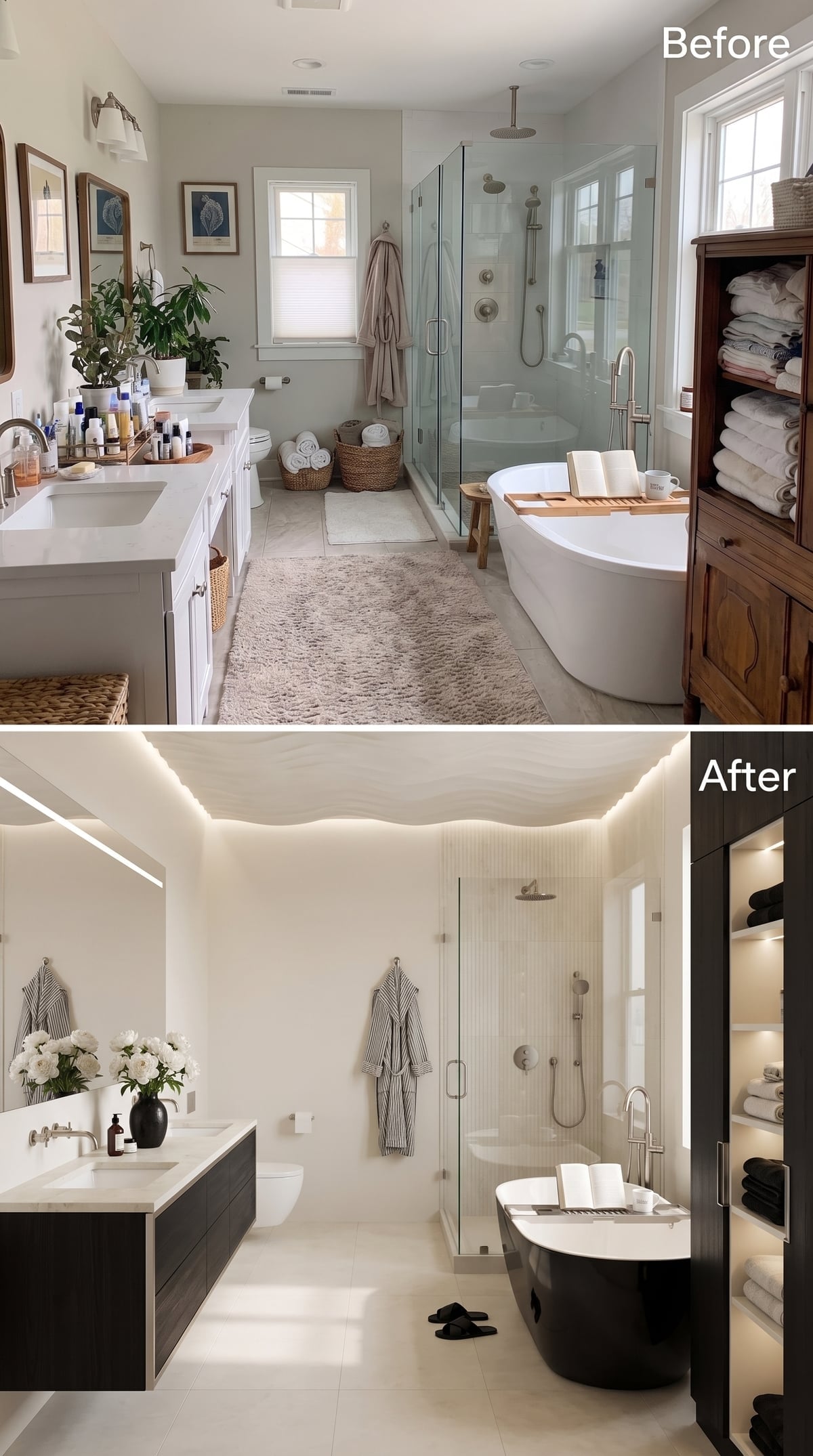
Vertical fluting turns the white walls into a field of fine shadows. Against that textured backdrop, the matte black soaking tub becomes a powerful focal point, its smooth, rounded form contrasting with the repeated lines behind it.
Indirect lighting traces a gently curved ceiling recess, adding another layer of movement. Dark vanity cabinetry echoes the tub, distributing the black accents across the room. Ribbed and smooth, pale and dark, vertical and curved: the entire composition draws its energy from opposing forms.
What Our Readers Say
- In Home Stratosphere readers’ heart votes, bathroom photos with white accents collected more hearts than the other images in the same articles, 55% versus 48%.
From Home Stratosphere reader polls and votes.
29. Sky Ceiling, Blue Stone, and a Built-In Niche That Clears the Floor
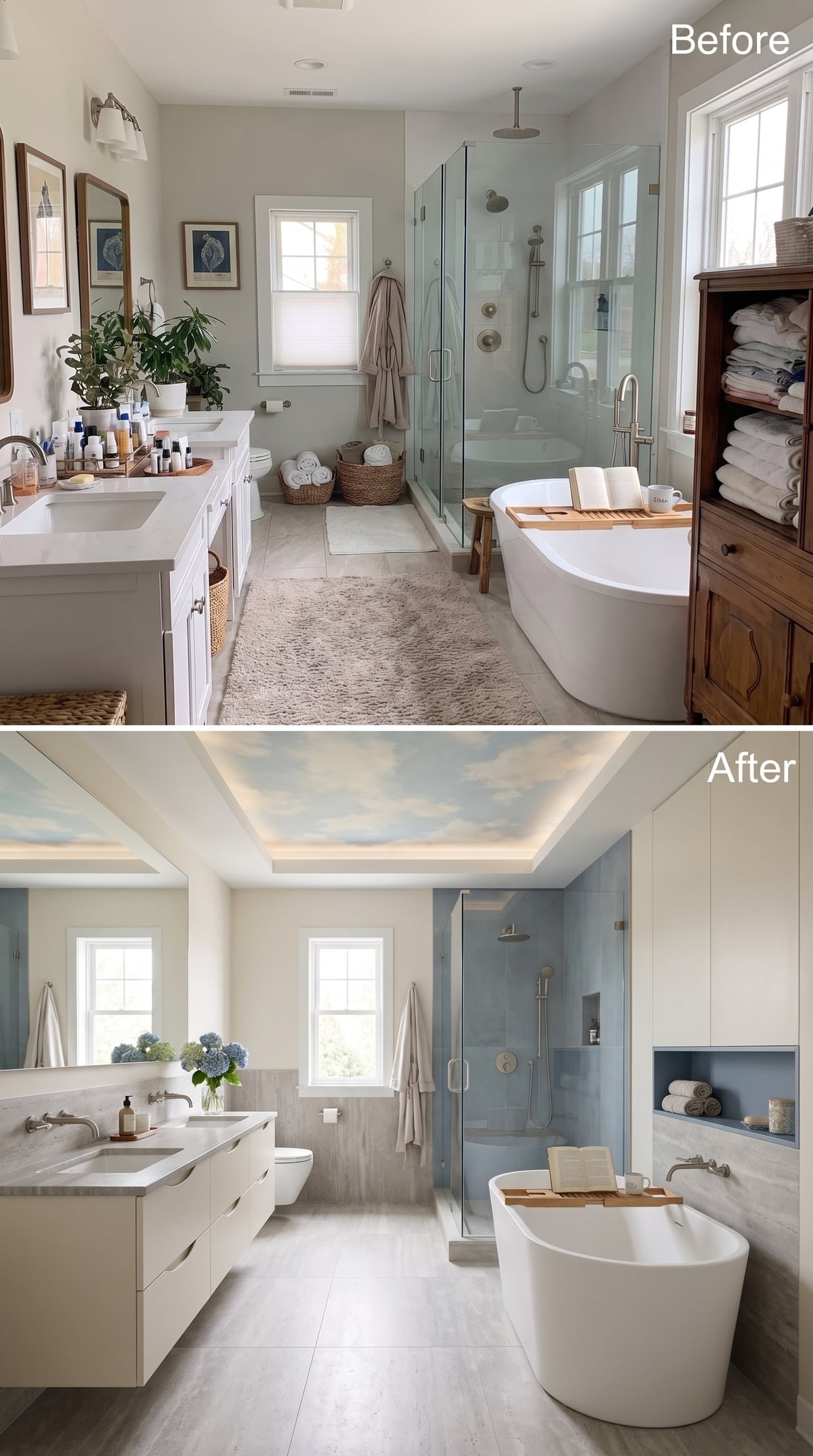
Blue stone-look surfaces establish the palette at eye level, while a cloud-painted tray ceiling carries the color overhead. The mural gives the upper part of the room an entirely different character from a conventional painted ceiling.
Below, a cream floating vanity provides a quiet contrast. Recessed shelving near the tub accommodates towels and bathing essentials within the wall plane, leaving the floor free of another storage cabinet. The ceiling supplies the fantasy; the built-in storage handles the practical demands.
28. Dark Stone Tub, Linear Ceiling Detail, and a Vanity That Stopped Competing for Attention
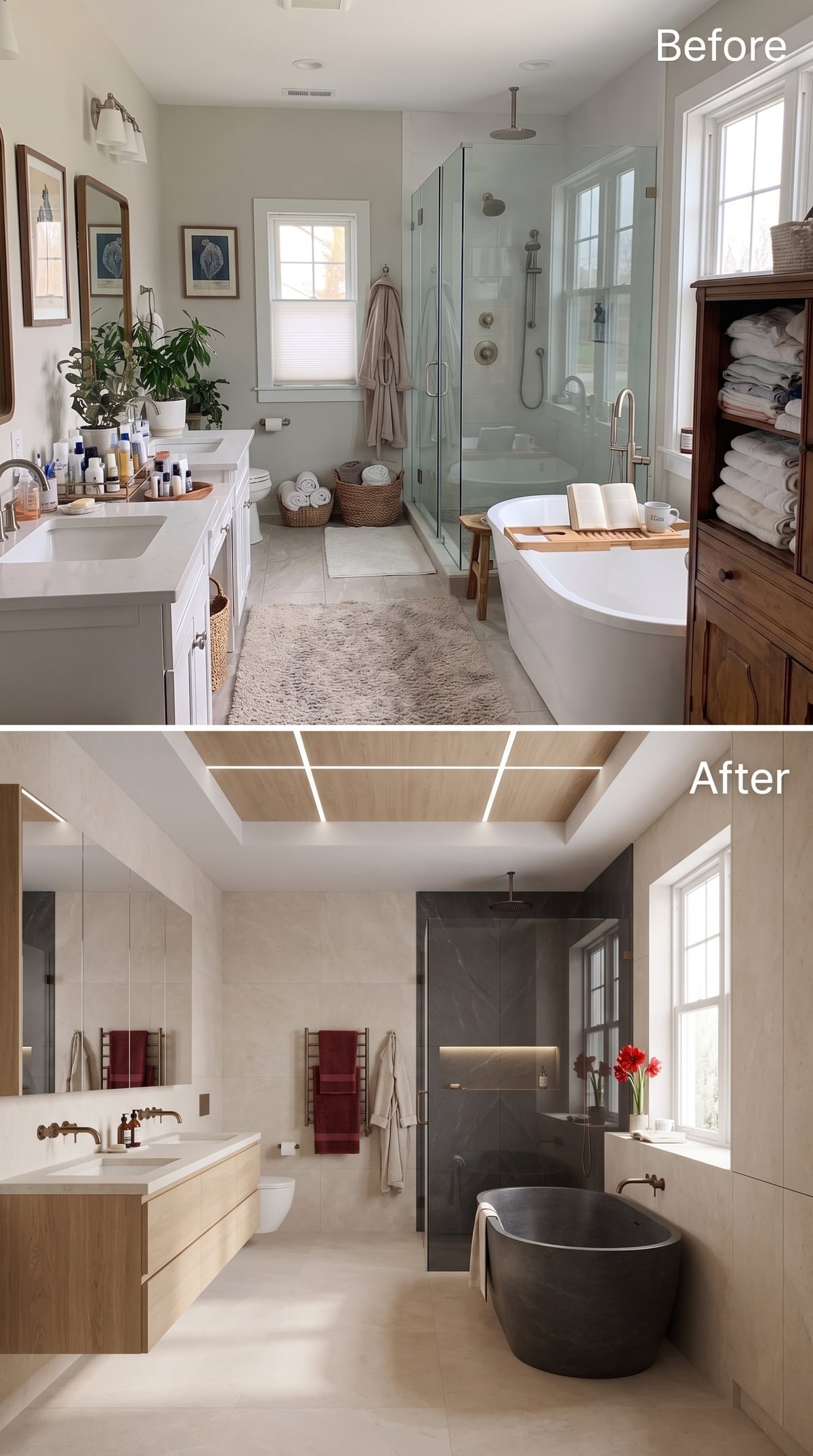
A low charcoal soaking tub sits beneath the window, giving the room a compact, sculptural anchor. Across from it, a pale wood floating vanity stretches along the wall, its white countertop creating a strong horizontal line.
Dark veined marble encloses the shower, with a recessed niche providing storage inside the stone surround. Linear lighting follows a dropped ceiling detail overhead. The charcoal tub and shower establish two darker zones, while the pale cabinetry and floor connect the spaces between them.
27. Terrazzo Floors, a Yellow Vanity, and LED Ceiling Channels That Stretch the Sightlines
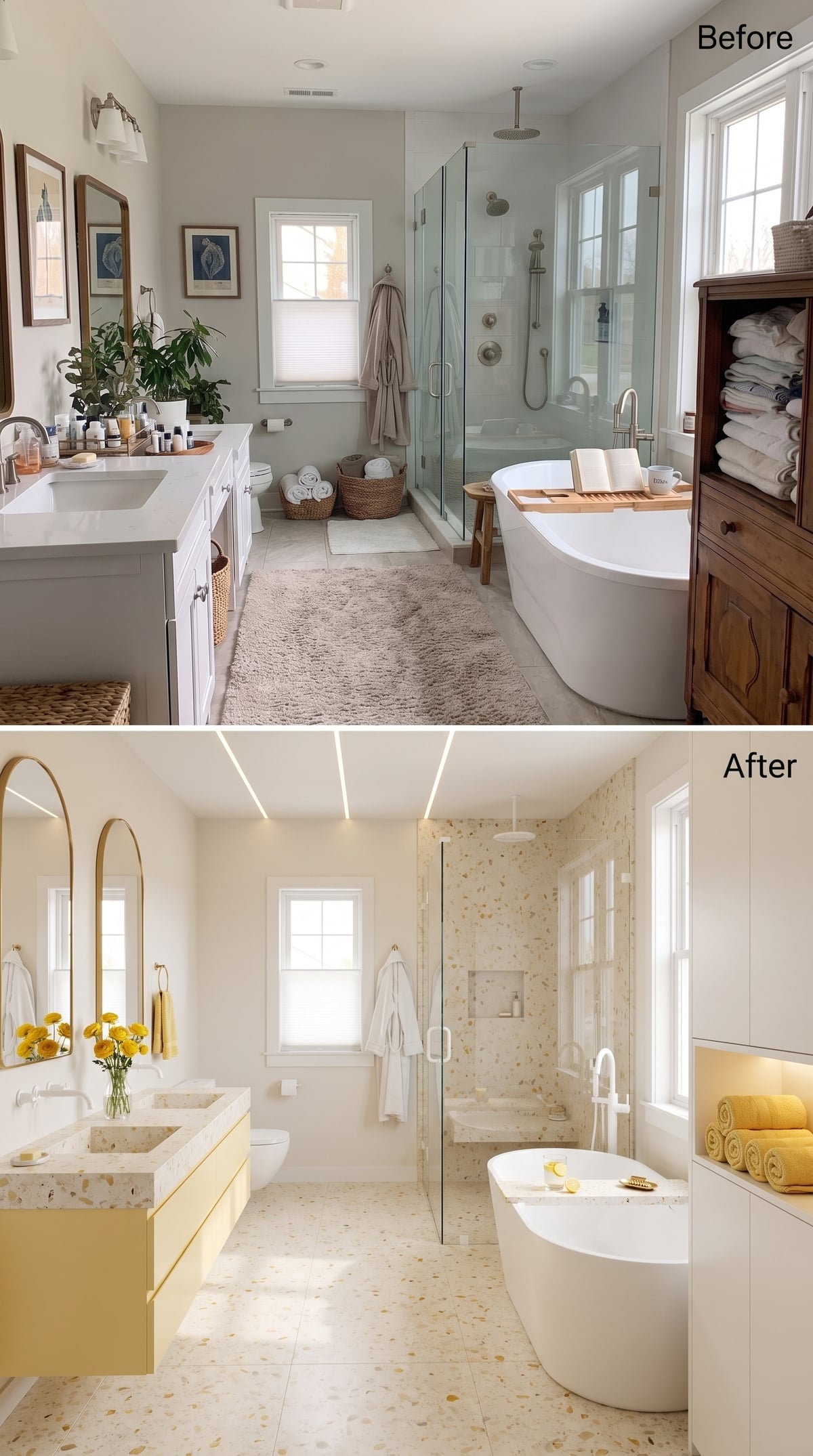
Terrazzo carries its speckled pattern across the floor and adjoining surfaces, giving the room a lively but coordinated foundation. A matte yellow vanity introduces a confident block of color, while gold-framed oval mirrors repeat the curves of the freestanding tub.
Linear LED channels cut cleanly across the ceiling. Built-in white shelving near the window accommodates rolled yellow towels, extending the accent color into another part of the room. Against the speckled terrazzo, the yellow cabinetry creates a bold, uninterrupted block of color, while the open shelving keeps towels within easy reach.
Material Matters: Terrazzo’s aggregate offers a ready-made palette for the rest of the bathroom. Picking up one of its smaller accent colors in the cabinetry or accessories can connect the finishes without repeating the same pattern everywhere.
26. Travertine, Cove Lighting, and a Vanity That Finally Has Room to Breathe
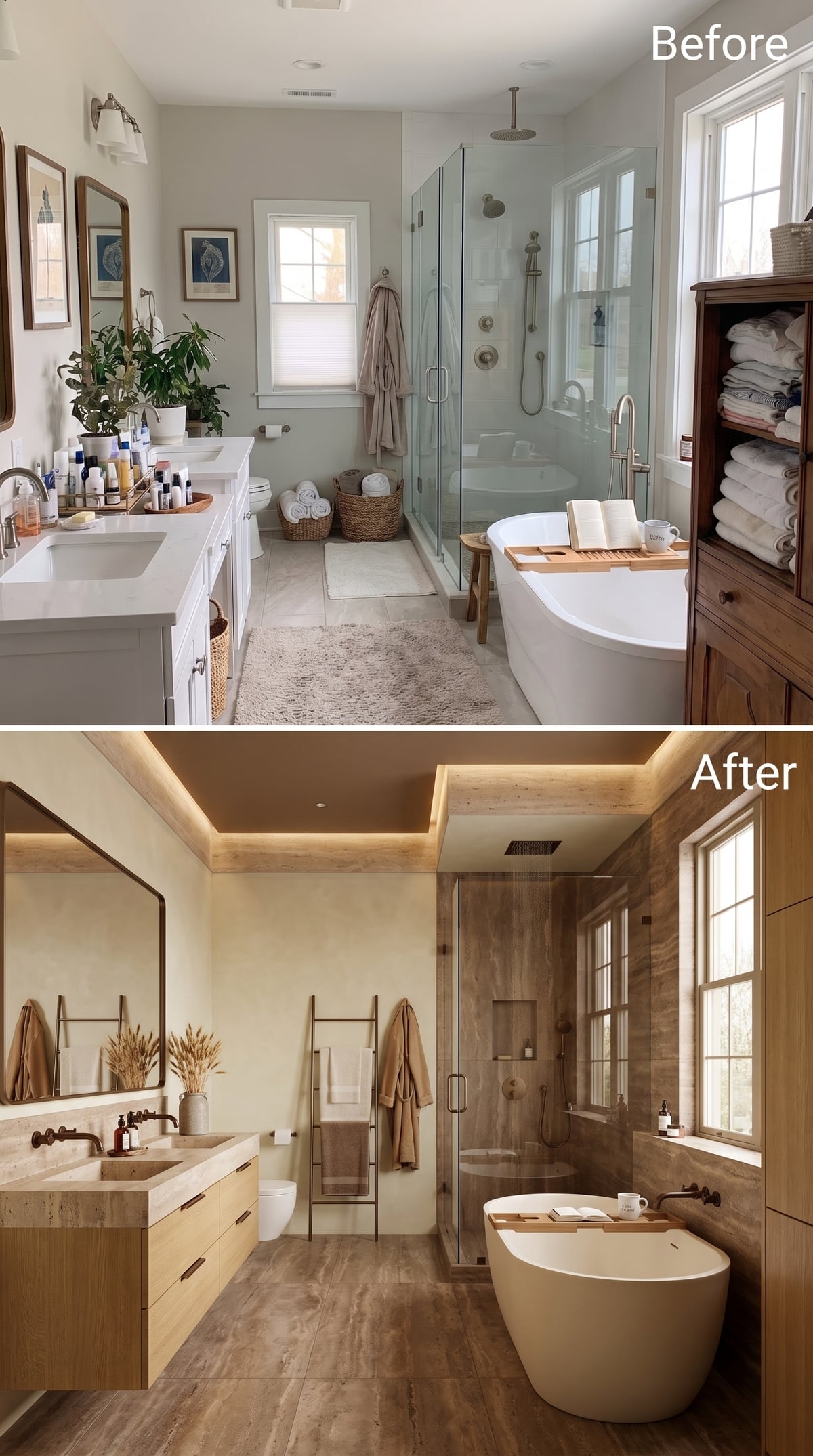
Large travertine surfaces extend from the shower into the surrounding room, establishing a warm mineral palette with relatively few abrupt transitions. A long pale oak vanity floats beneath the mirrors, its stone countertop continuing the relationship between timber and limestone.
Bronze fixtures define the faucets and shower controls. Cove lighting softens the ceiling perimeter, while a freestanding tub occupies the window side of the room. The travertine’s natural variation provides enough pattern to keep the understated arrangement interesting, especially beside the pale grain of the oak.
25. Navy Ceiling, Rose Gold Fixtures, and Floor-to-Ceiling Stone With Real Presence
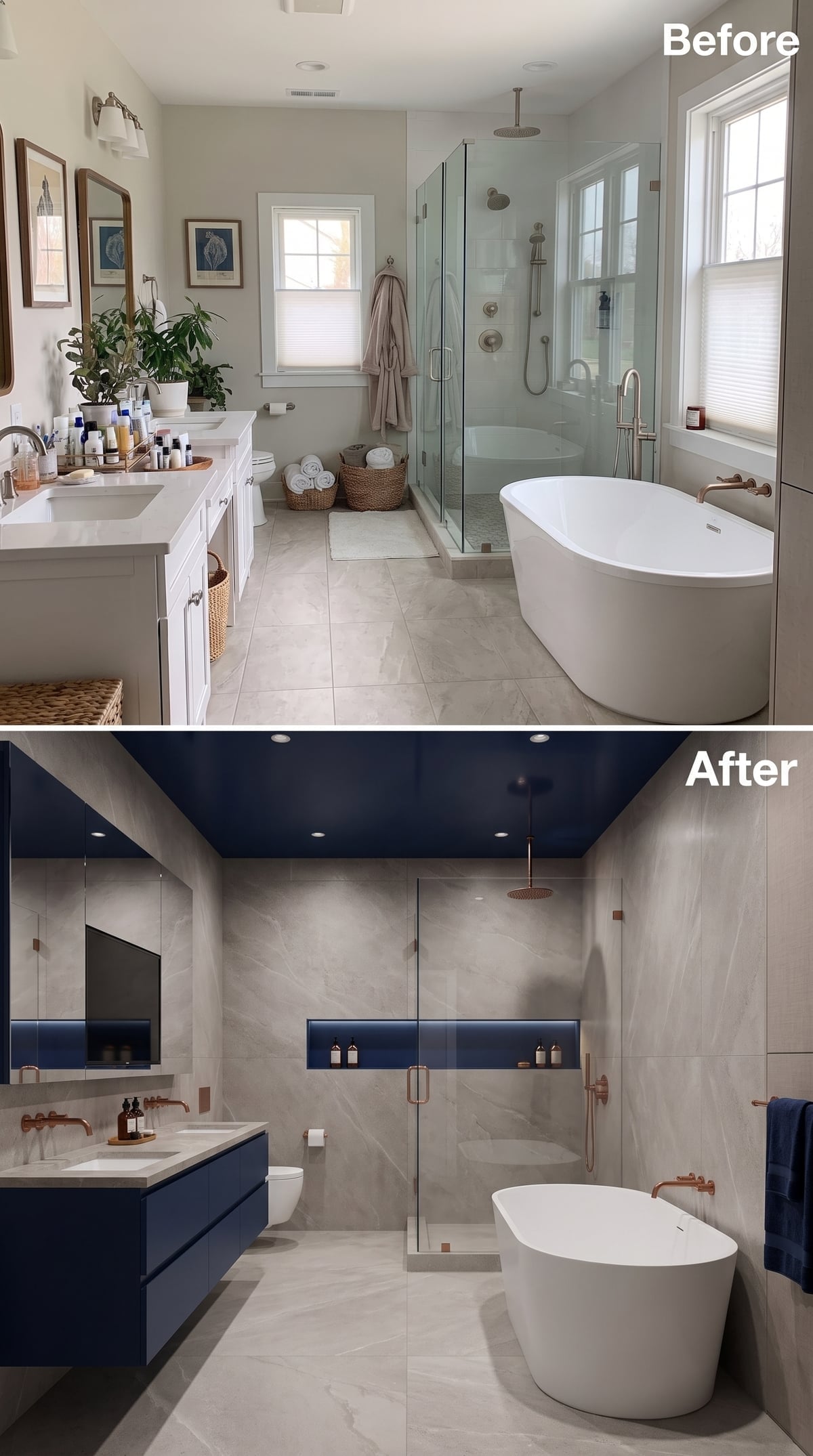
A glossy navy ceiling makes an unusually bold statement above pale stone walls and flooring. The saturated color returns in the floating vanity and the back panel of a shower niche, establishing a clear visual rhythm.
Rose gold fixtures introduce warmth against the blue, with wall-mounted faucets maintaining an uncluttered vanity counter. The pale stone separates the navy elements, allowing the dark ceiling and cabinetry to feel deliberately connected. The ceiling is no longer background; it’s part of the color scheme.
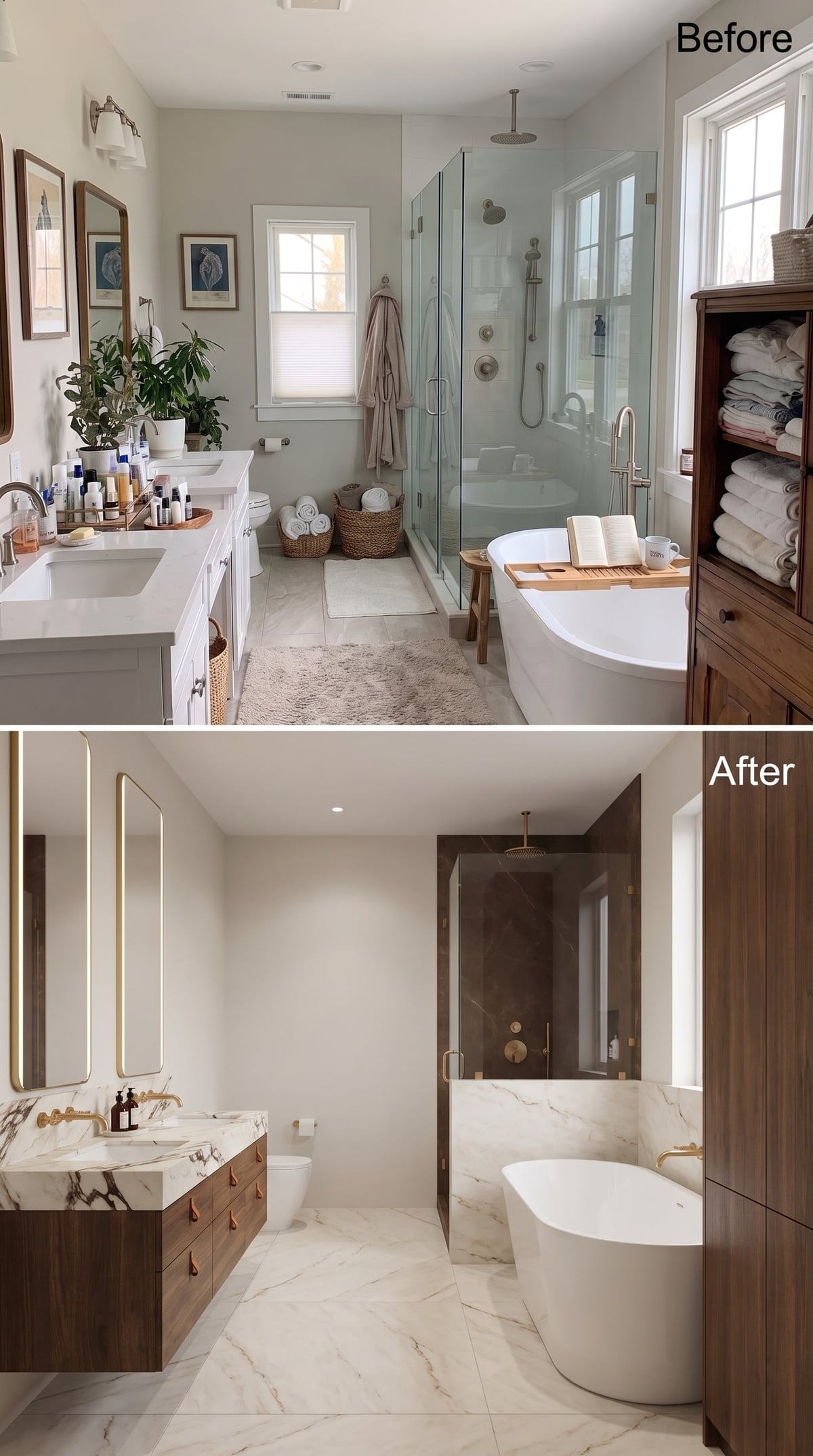
24. Walnut Cabinetry, Calacatta Marble, and Brass Fixtures That Pull the Room Into Focus
🔥 Would you like to save this?
Floating walnut cabinetry gives the vanity a rich, furniture-like presence. Above it, Calacatta marble introduces bold gray veining, while tall illuminated mirrors and brass frames add a precise vertical counterpoint.
Darker stone surrounding the bathing area creates separation between the two functional zones. Warm wood, white marble, and brass share the foreground, with deeper finishes providing contrast beyond. The wall-mounted cabinetry combines the substance of finely made furniture with a lighter, more open profile.
23. Olive Zellige, Fluted Stone, and a Floating Vanity With Architectural Character
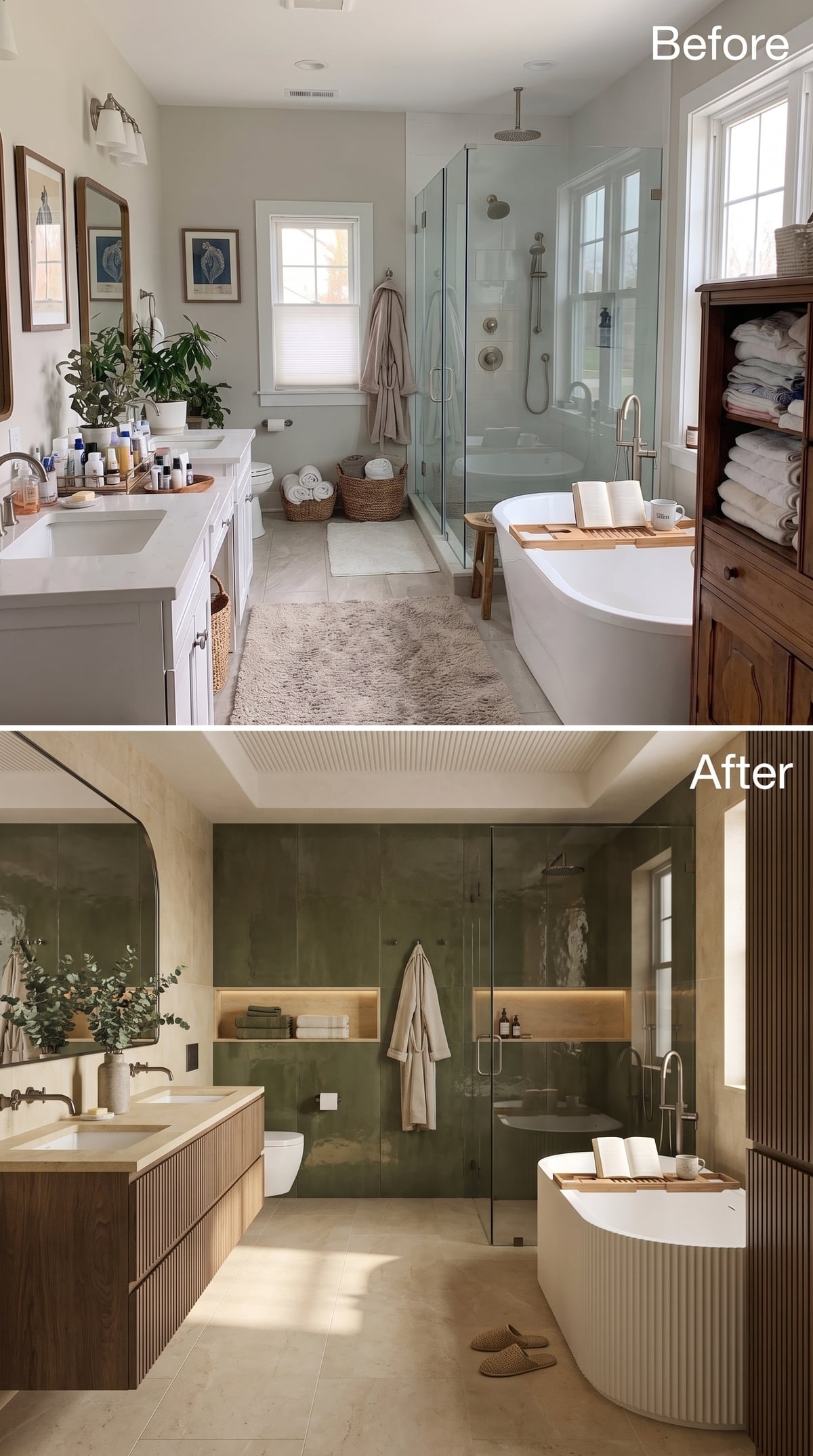
Deep olive zellige covers the walls, with slight variations in color and surface reflection creating a richly textured envelope. Recessed niches introduce small pools of warm light, interrupting the tile with useful storage.
A fluted floating vanity adds another tactile layer beneath an arched mirror. Nearby, the ribbed soaking tub echoes that vertical detailing, while brass fixtures brighten the darker green palette. The repeated grooves connect the furniture and tub, giving two separate fixtures a shared architectural identity.
Zellige divides opinion, too: bathroom images featuring it drew fewer hearts from our readers than the other photos in the same articles, 29% versus 45%.
22. Warm Cedar Ceiling, Concrete Sinks, and the Slatted Wall Behind the Vanity
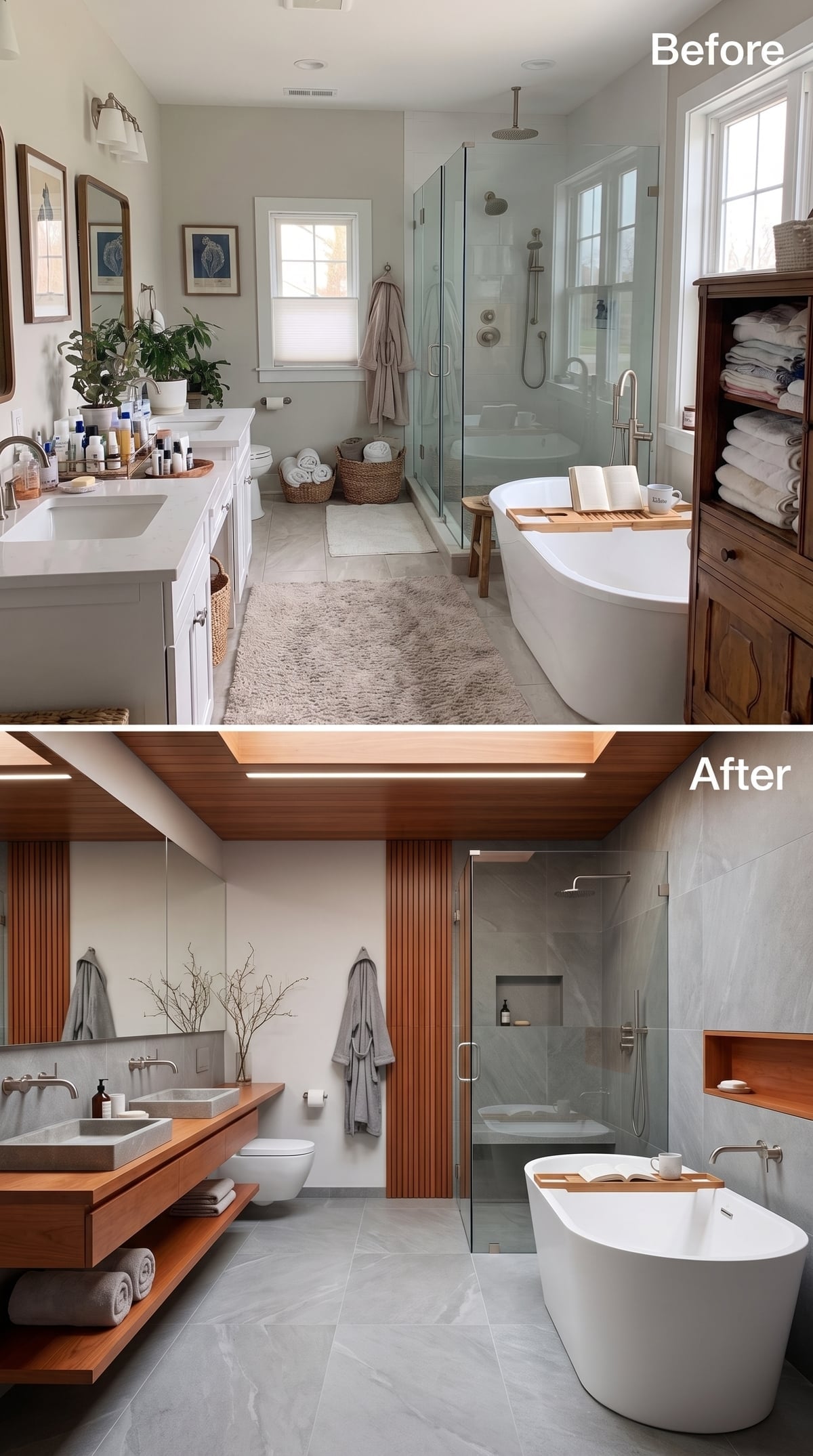
Cedar planks run across the ceiling and continue into a recessed soffit, bringing a strong directional element overhead. Behind the vanity, a slatted timber panel repeats the warmth at eye level.
Two concrete vessel sinks sit on a floating walnut shelf, with wall-mounted faucets keeping the arrangement visually light. The shower is enclosed in large-format gray stone, while a freestanding tub and teak bath caddy extend the natural material palette. Timber supplies the texture; concrete and stone provide the counterweight.
21. Pink Marble, Brass Fixtures, and a Glowing Onyx Ceiling Panel
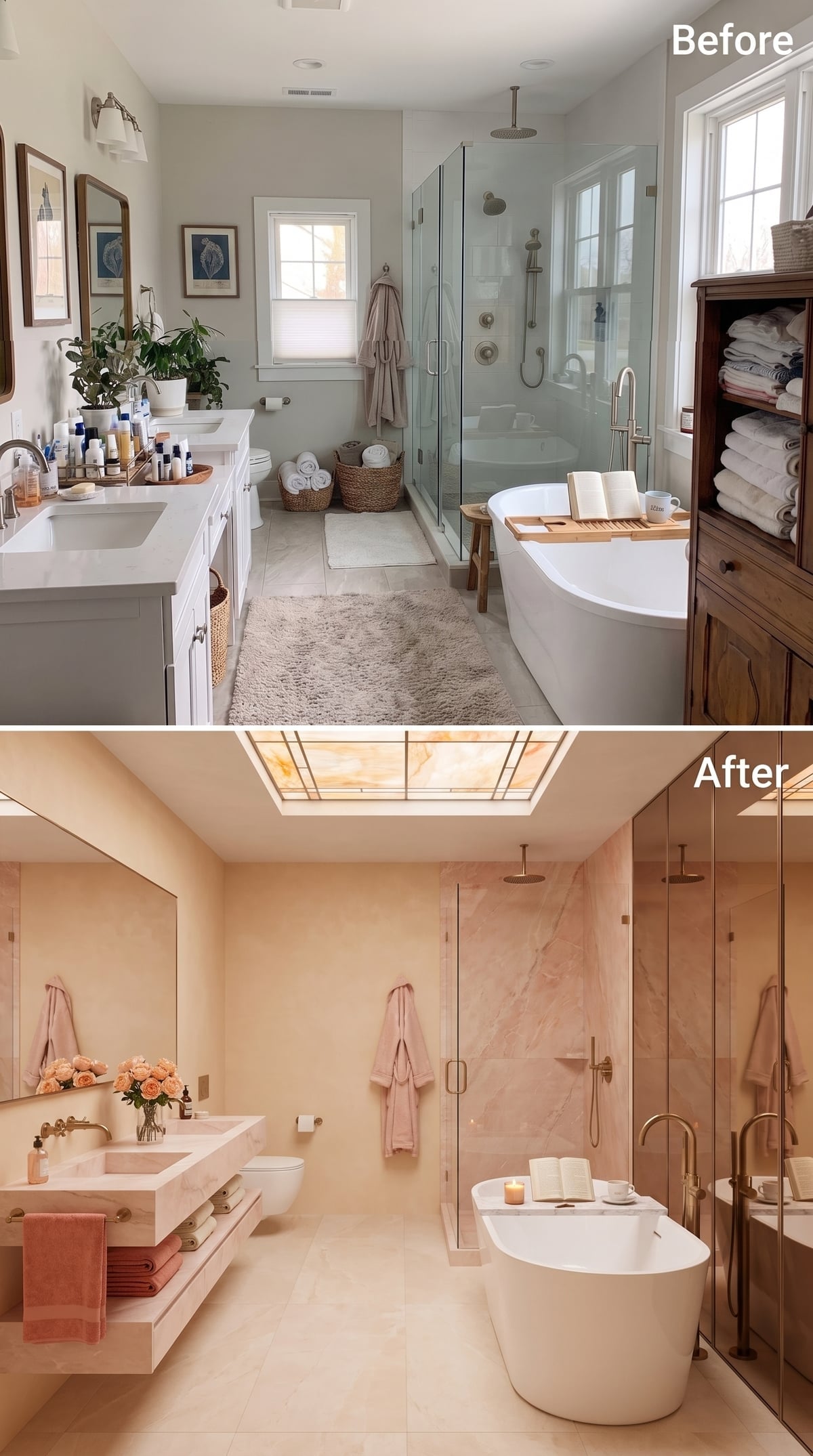
Blush-veined marble extends across the shower and vanity surround, establishing a warm, softly patterned backdrop. Brass fixtures complement the pink undertones, while a luminous amber ceiling panel spreads a golden glow across the bathing area.
The translucent overhead feature brings a jewel-like quality to the room. Pale plaster surfaces provide relief from the richer materials, allowing the marble’s delicate veining and the brass fittings to remain distinct. The amber light brings out the warmth in the pink stone, giving the bathing area a soft glow that contrasts with the cooler surrounding plaster.
20. Fluted Green Tile, Green Marble, and a Botanical Ceiling Worth Looking Up For
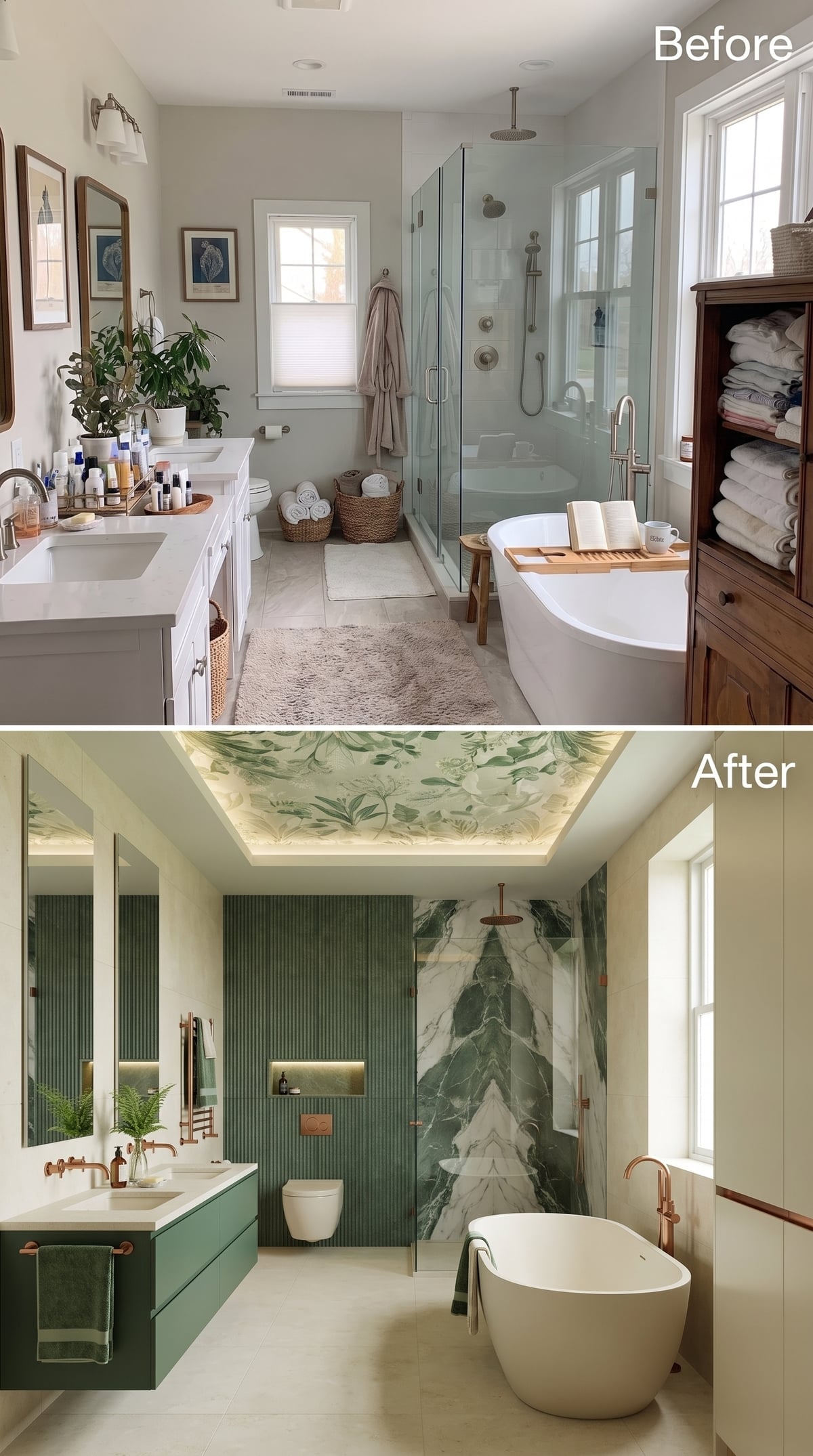
Fluted sage-green tile gives the vanity wall a pronounced vertical texture. Those narrow grooves lead toward a recessed ceiling tray containing botanical imagery and warm perimeter lighting.
Green-veined marble in the shower introduces a broader, less regular pattern, while copper-toned fixtures add warmth. The ceiling treatment turns an otherwise plain overhead surface into a decorative canopy. From the fine ribs of the wall tile to the sweeping veins of the marble, each green surface brings a different scale of pattern.
19. Linear Ceiling Channels, a Stone Soaking Tub, and the Fireplace Nobody Expected
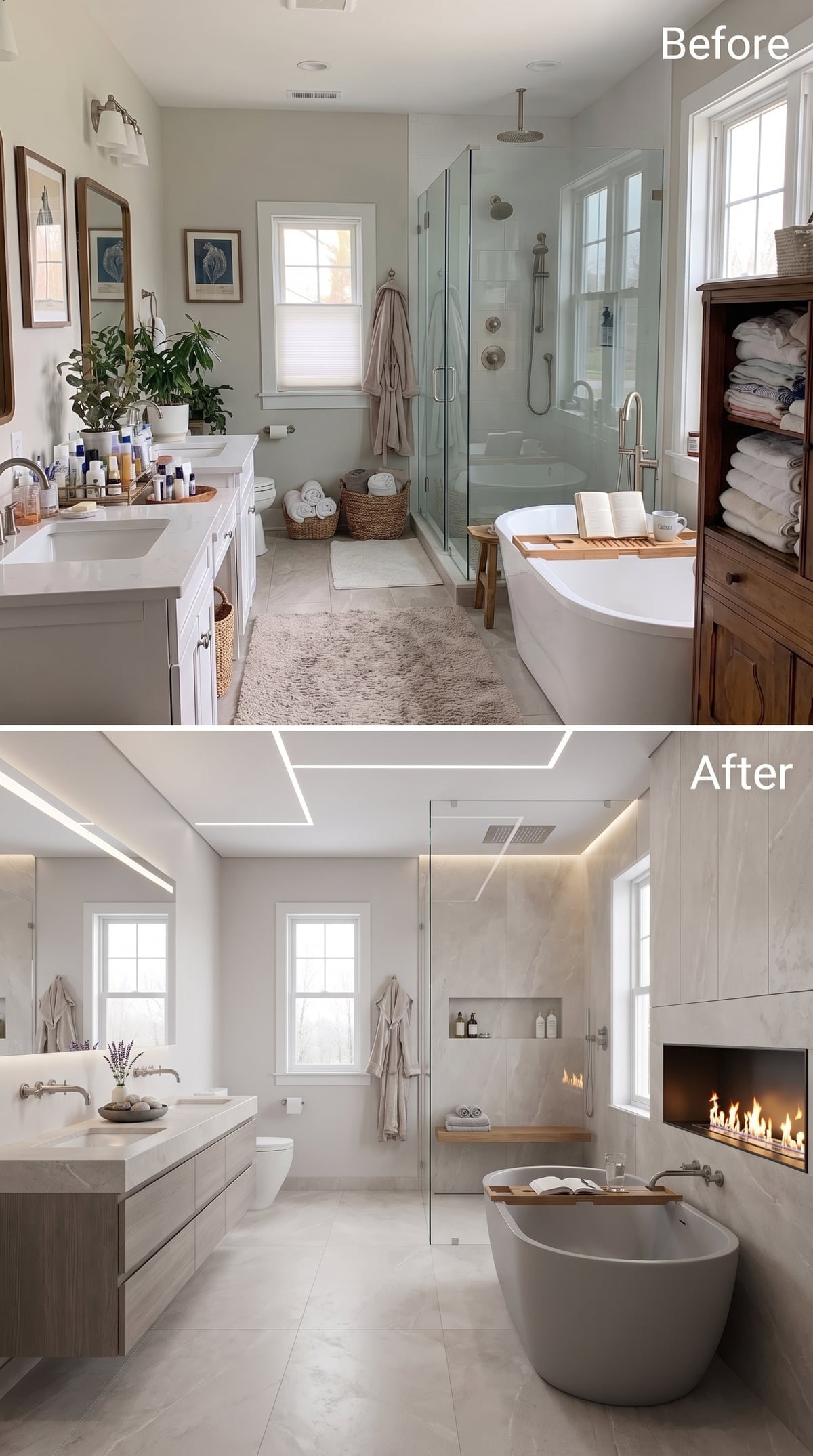
Long LED channels establish a crisp geometric pattern across the ceiling, leading toward the far wall. Below, a broad gray concrete soaking tub introduces a lower, heavier form, softened by a wood bath caddy.
The unexpected element is a fireplace integrated into the marble-clad wall beside the tub. Its horizontal opening introduces a second focal point to the bathing area, while the warm glow contrasts with the cool gray materials. Stone, water, and fire occupy one tightly composed corner, giving the bathroom a distinctly different character from a conventional spa-inspired interior.
18. Plaster Walls, Cove Lighting, and a Soaking Tub That Earns Every Inch
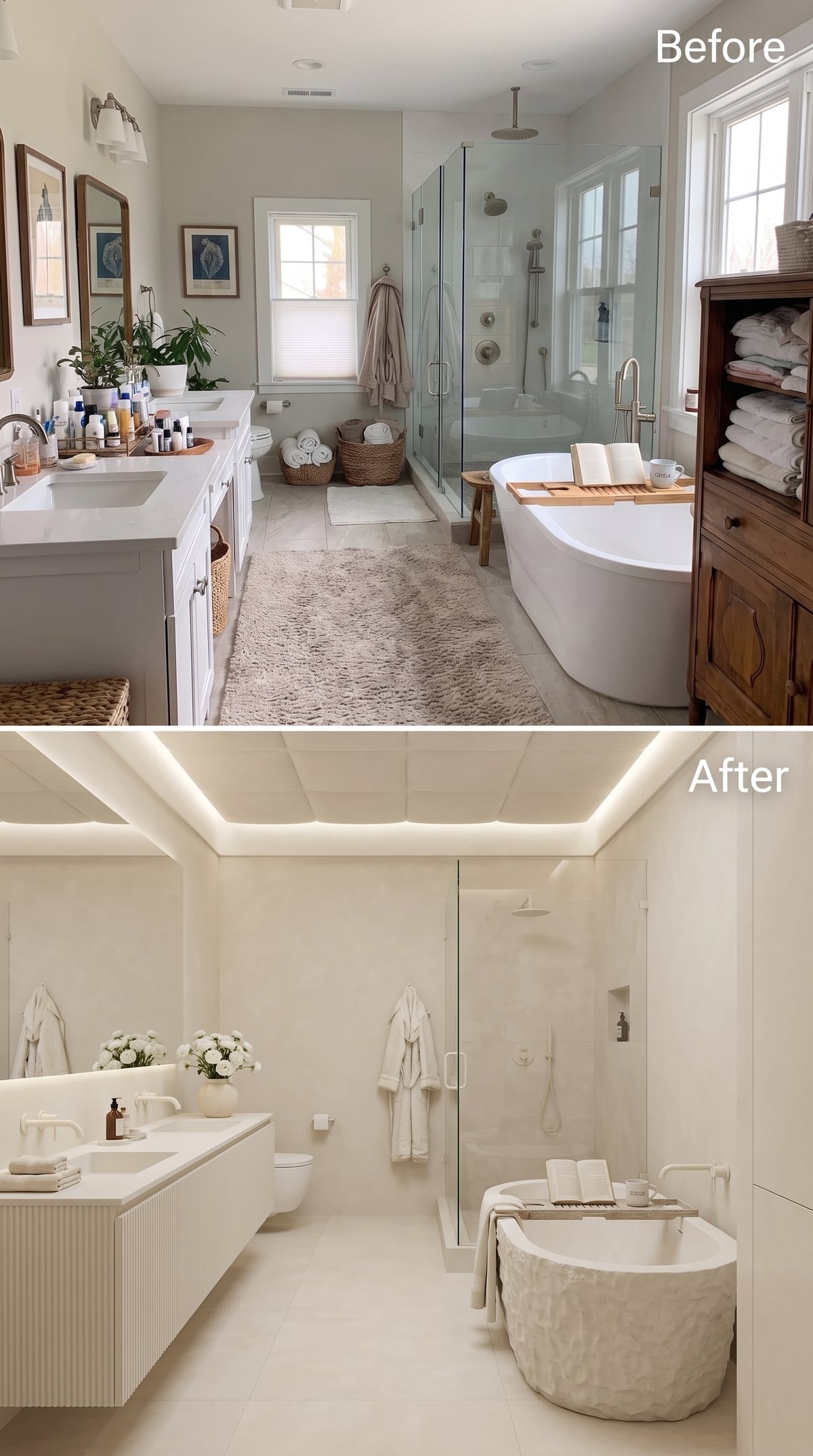
Cream plaster covers the walls in a restrained tonal scheme, allowing the textured stone tub surround to supply much of the room’s character. The ribbed floating vanity adds another subtle surface treatment beneath the counter.
Indirect lighting follows the ceiling perimeter, producing a soft glow across the upper walls. Smooth plaster meets rougher stone, shallow fluting introduces fine shadows, and warm light defines the edges. With so little color variation, the differences between the surfaces become especially noticeable.
17. Slate Marble Walls, a Star-Panel Ceiling, and Copper Drawers Beneath the Vanity
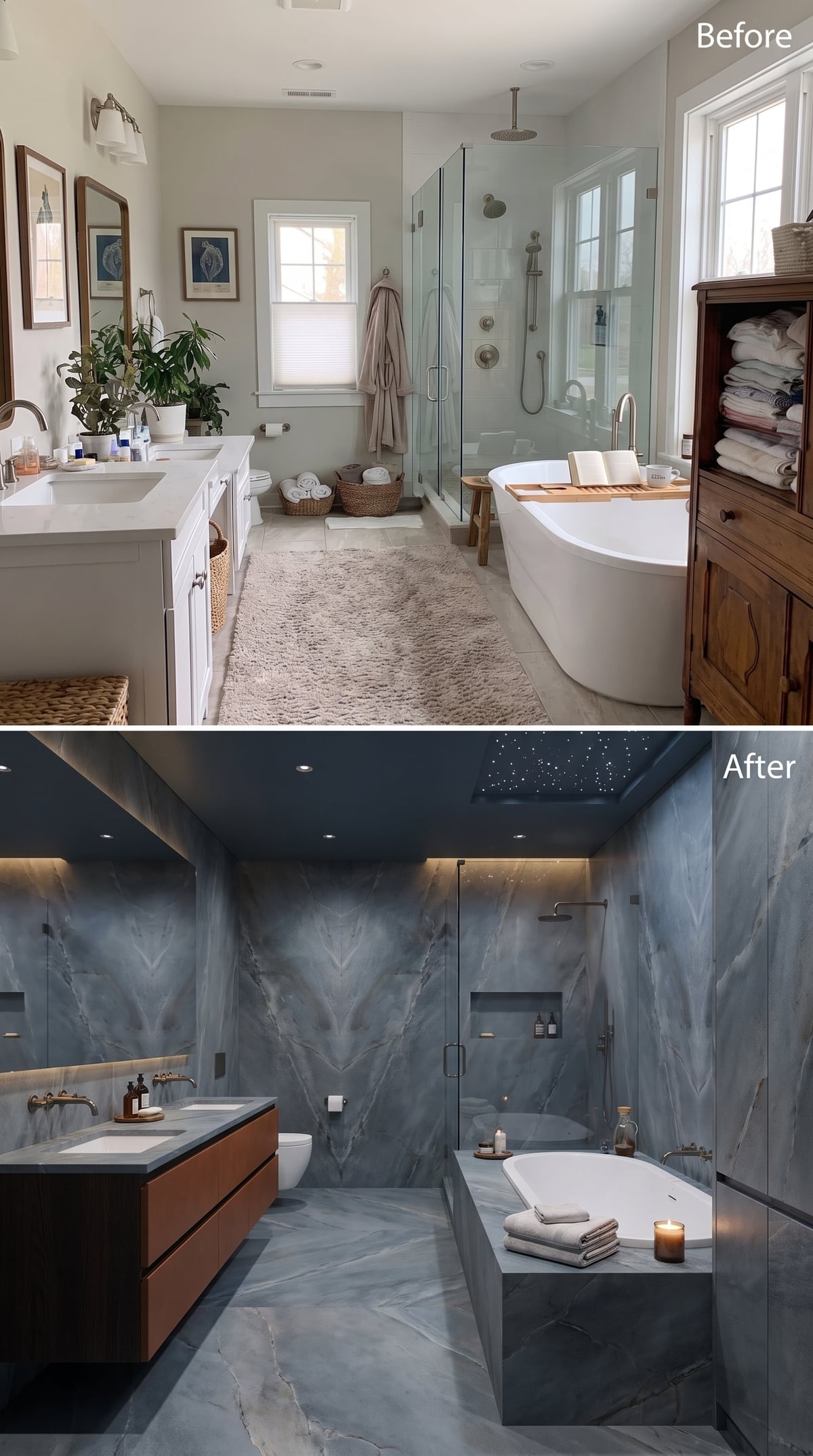
Blue-gray marble establishes a cool, enveloping backdrop, with its veining continuing across the walls. Above the bathing area, a recessed ceiling panel contains a fiber-optic star field, creating a playful contrast with the substantial stone surfaces.
Copper drawer fronts introduce a warm metallic accent beneath the vanity counter. Brass faucets pick up that warmth, while the tub occupies a raised marble platform. The tiny points of light overhead offer a striking contrast to the heavy stone below, giving the room an unexpected celestial dimension.
16. Walnut Vanity, Limewash Walls, and a Ceiling That Glows Like Late Afternoon
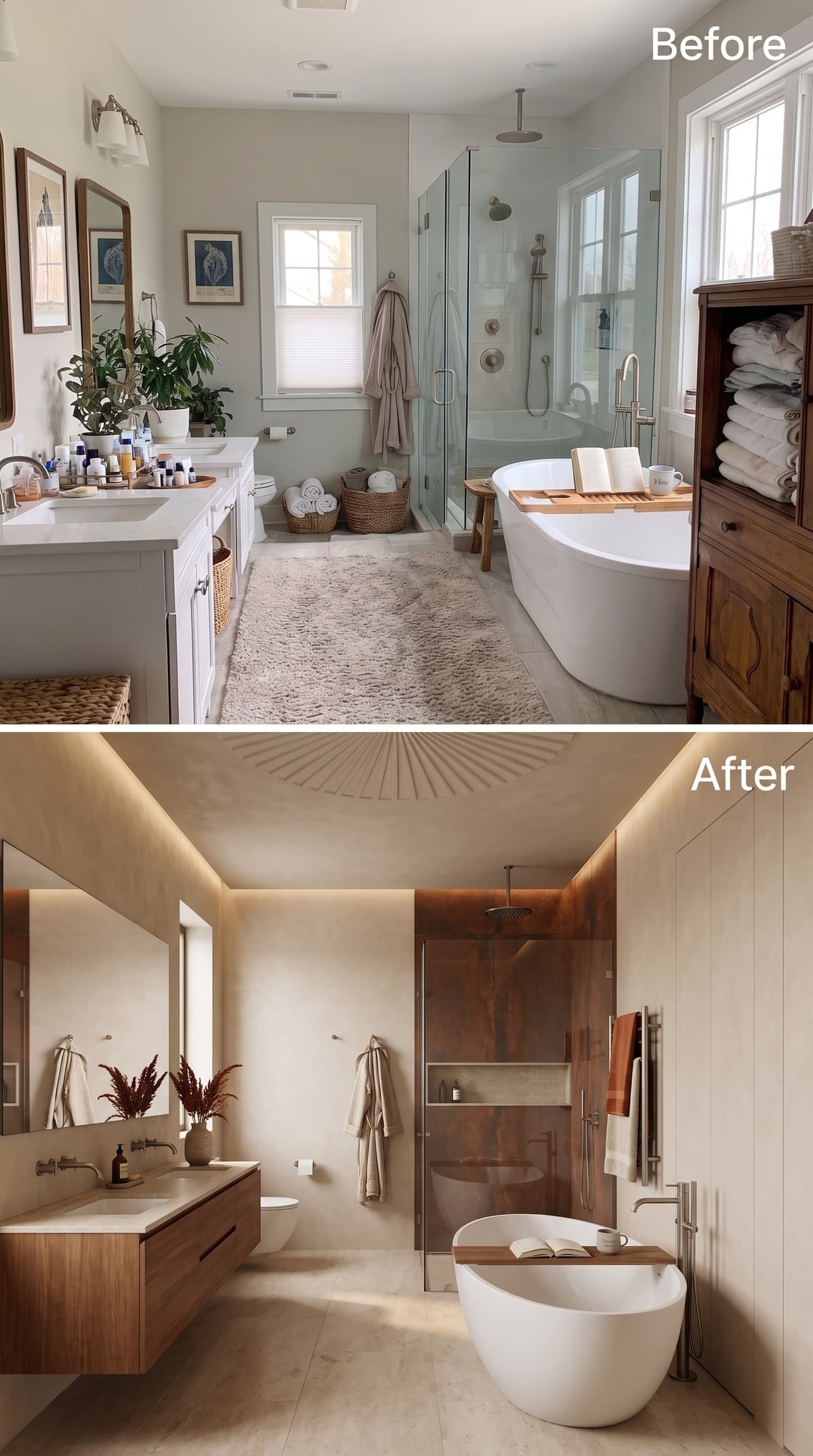
Warm cove lighting washes across linen-colored limewash walls, bringing out their subtle surface variation. A low walnut vanity introduces richly figured grain, while a round soaking tub establishes a compact central feature.
Wood-look shower panels extend the timber character into the bathing area, contrasting with the softly mottled walls. Brushed nickel fixtures and a small botanical arrangement complete the palette. The walnut grain gives the room its strongest natural pattern, while the indirect lighting emphasizes the plaster’s delicate texture.
15. Green Marble, Brushed Gold, and the Ceiling Detail That Gives the Stone Room to Shine
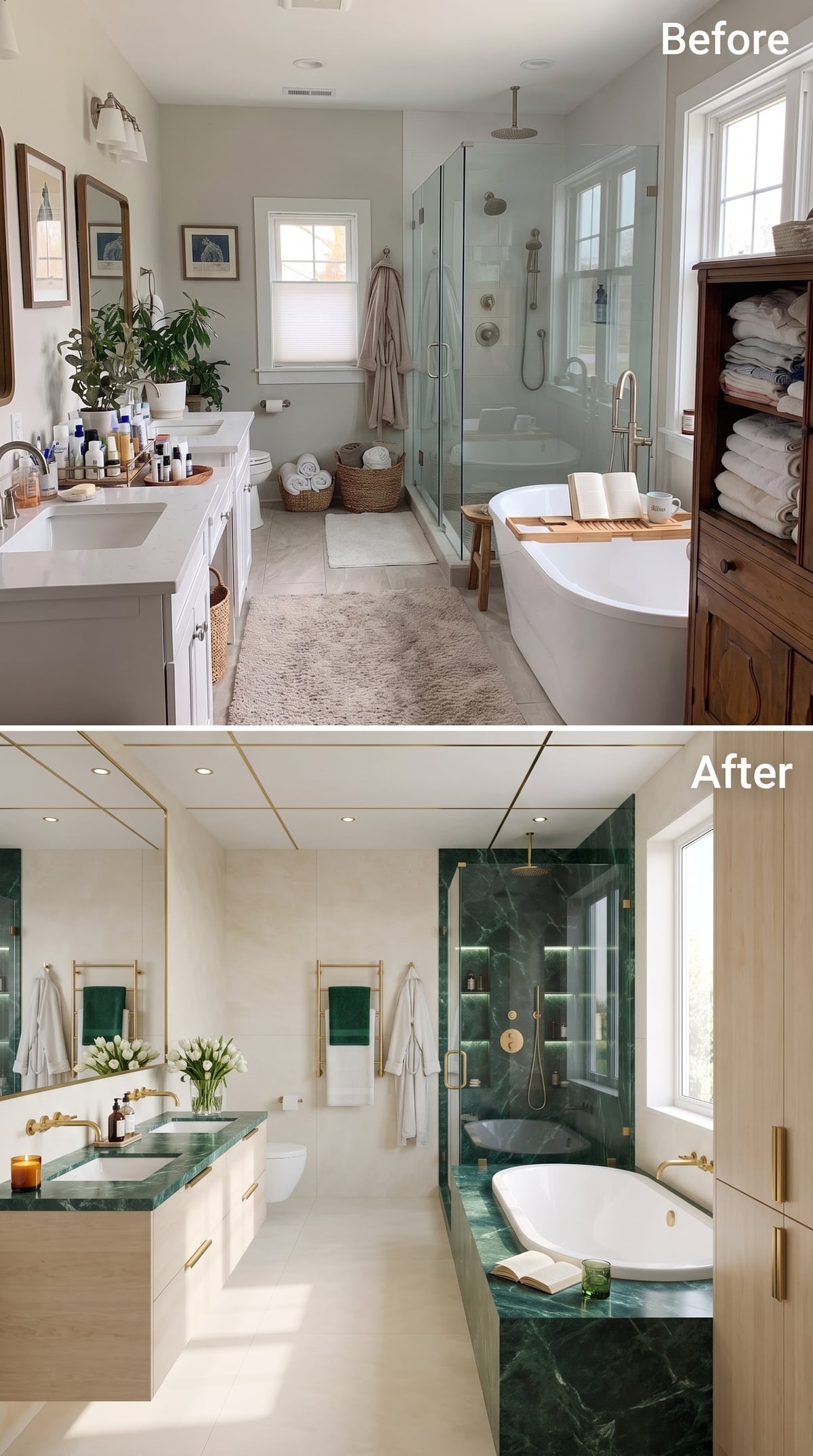
Emerald green marble extends from the vanity countertop into the shower surround and tub area, allowing its bold veining to establish a recurring visual theme. Pale flat-front cabinetry provides a quieter setting for the stone.
Brushed gold wall-mounted faucets bring warmth to the green, while narrow recessed ceiling lights introduce clean lines overhead. The freestanding tub sits close to the marble-clad wall, keeping the central arrangement visually uncluttered. The gold fittings pick up the marble’s warmer veins, while the cabinetry’s flat surfaces allow the stone’s pattern to remain prominent.
14. Skylight, Marble Walls, and Brushed Gold That Pulls Every Surface Together
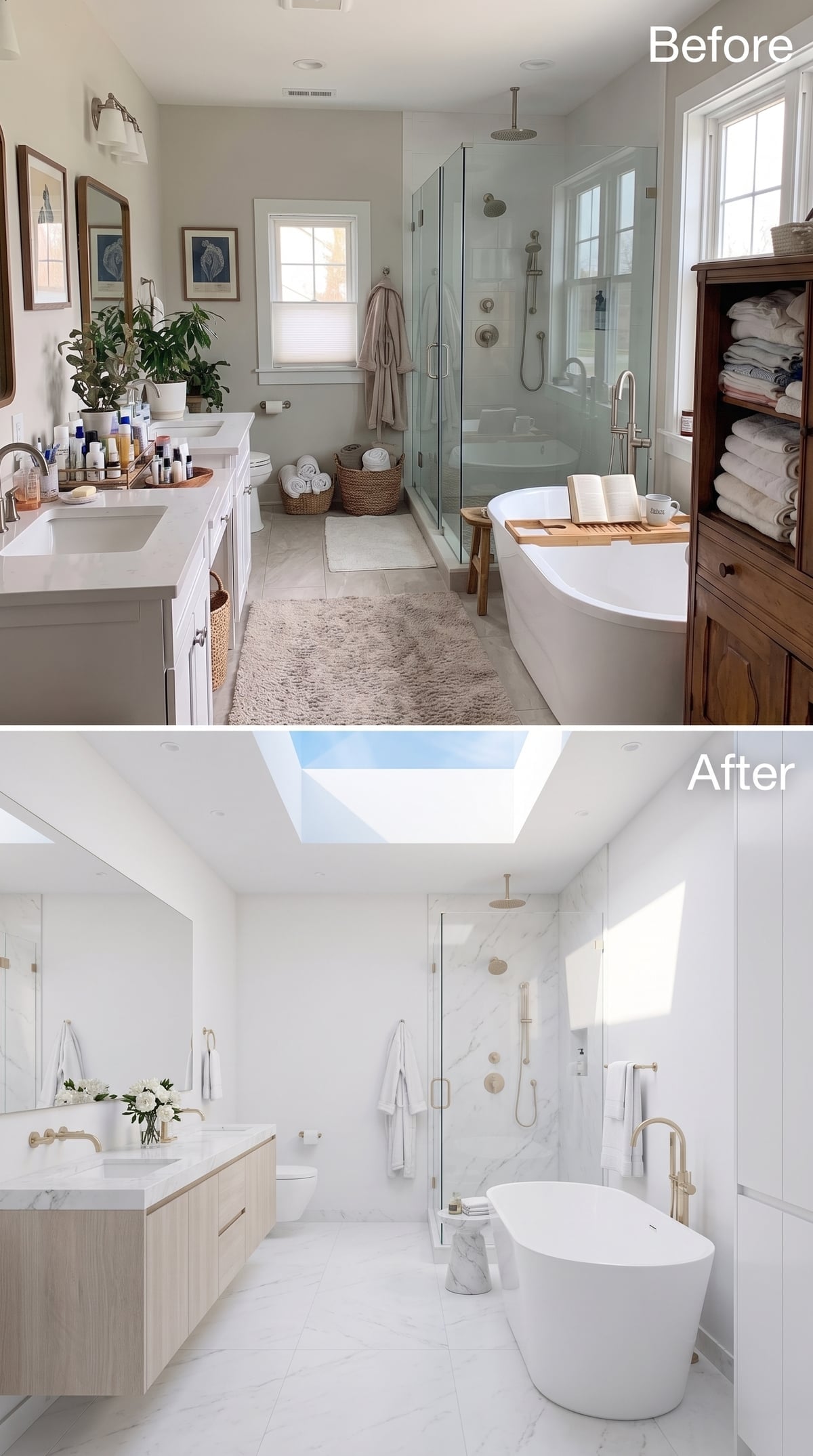
Marble covers the shower walls in broad, pale surfaces, its gray veining providing movement within the predominantly white palette. Brushed gold faucets and shower fittings add warmth, giving the room a more inviting finish.
A skylight introduces daylight from above, illuminating the stone and bathing area from a different angle than a conventional wall window. The effect changes with the weather and time of day, allowing the same marble to appear cooler, warmer, brighter, or more subdued. Natural light becomes the room’s principal decorative element.
13. Gold Cove Lighting, Black Marble Shower, and a Palette With Real Nerve
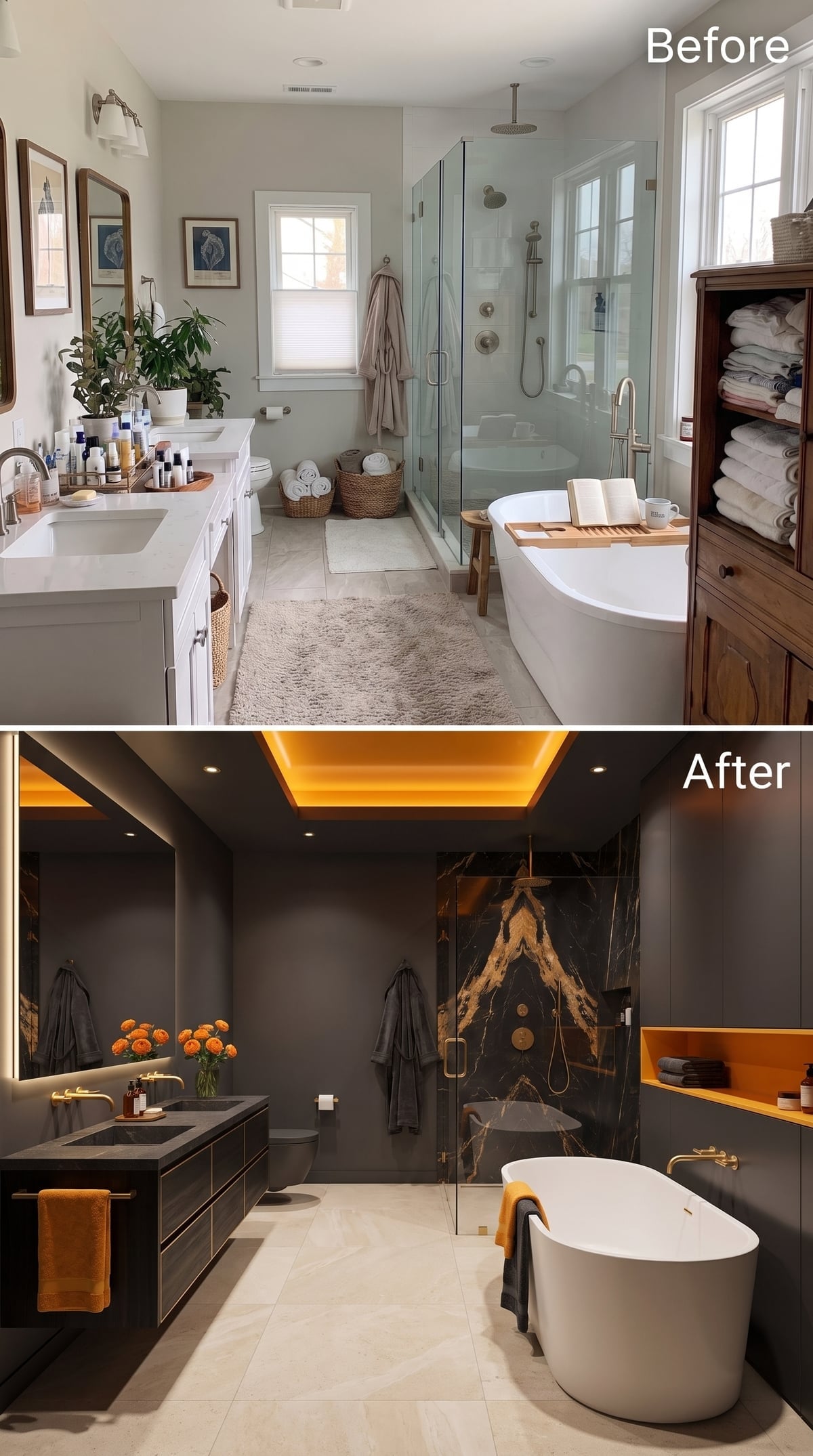
Charcoal walls create a dramatic enclosure, relieved by amber lighting inside a recessed ceiling tray. An oval soaking tub occupies the darker setting, its outline emphasized by the surrounding contrast.
The shower wall is the centerpiece: black marble streaked with branching gold veining, installed in large uninterrupted sections. Gold fixtures and burnt-orange accents repeat the warm tones, while a contrasting shelving niche adds another layer of color. This bathroom makes no attempt at neutrality. Its richness comes from controlling a deliberately intense palette.
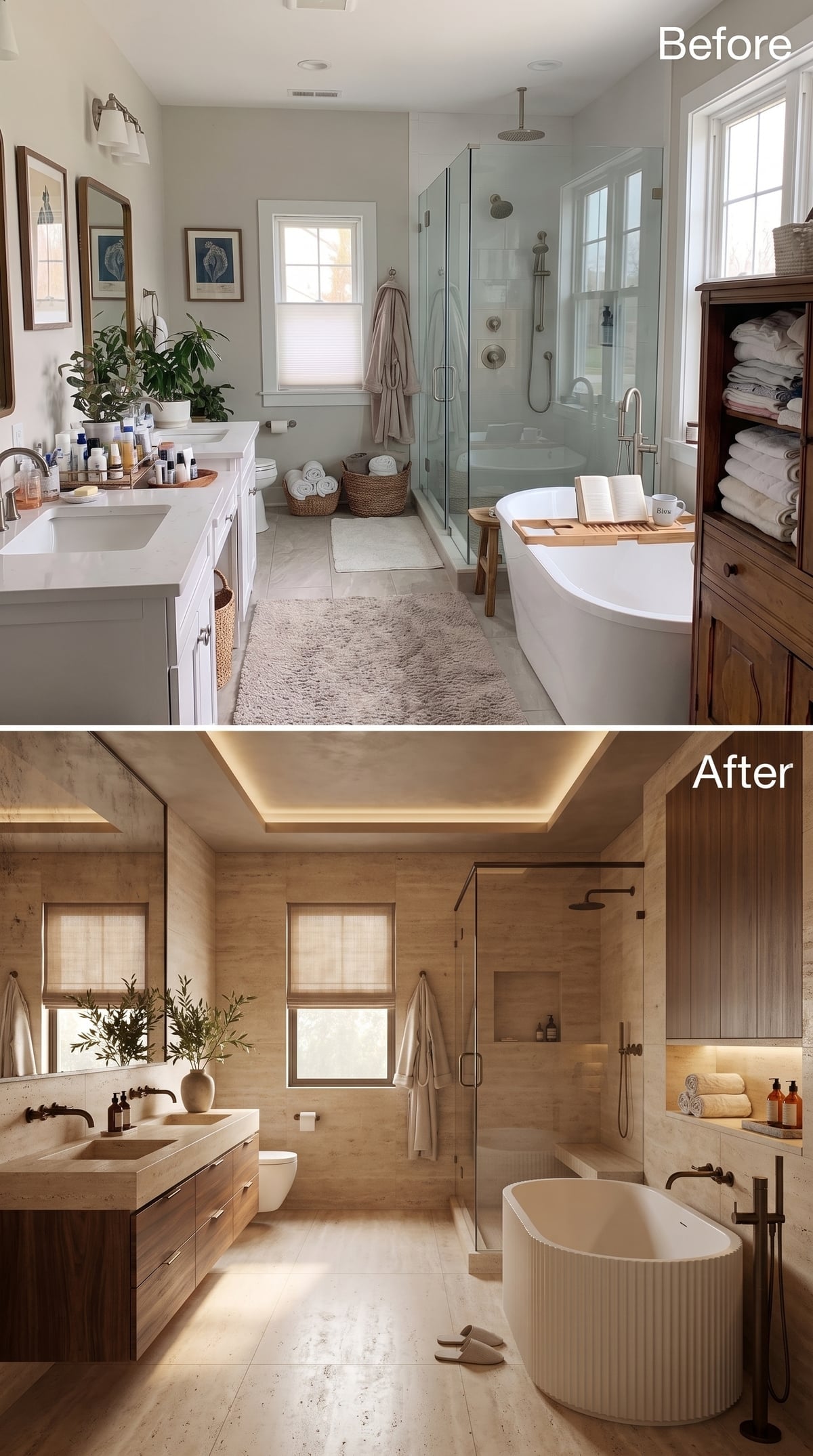
12. Travertine Walls, a Fluted Soaking Tub, and Cove Lighting With a Sculptural Edge
🔥 Would you like to save this?
Bookmatched travertine creates a broad, symmetrical pattern across the walls, giving the room a strong mineral character. A fluted oval soaking tub introduces a finer texture, its vertical grooves contrasting with the sweeping movement of the stone.
The walnut floating vanity sits beneath a pale countertop, with bronze fittings providing subtle definition. Above, a coffered ceiling with concealed lighting adds another architectural layer. The warm stone, dark timber, and ribbed tub create a composition rich in texture, with the overhead geometry bringing precision to the natural materials.
11. Blue Marble Shower, Cove Ceiling, and a Floating Vanity With a Lighter Touch
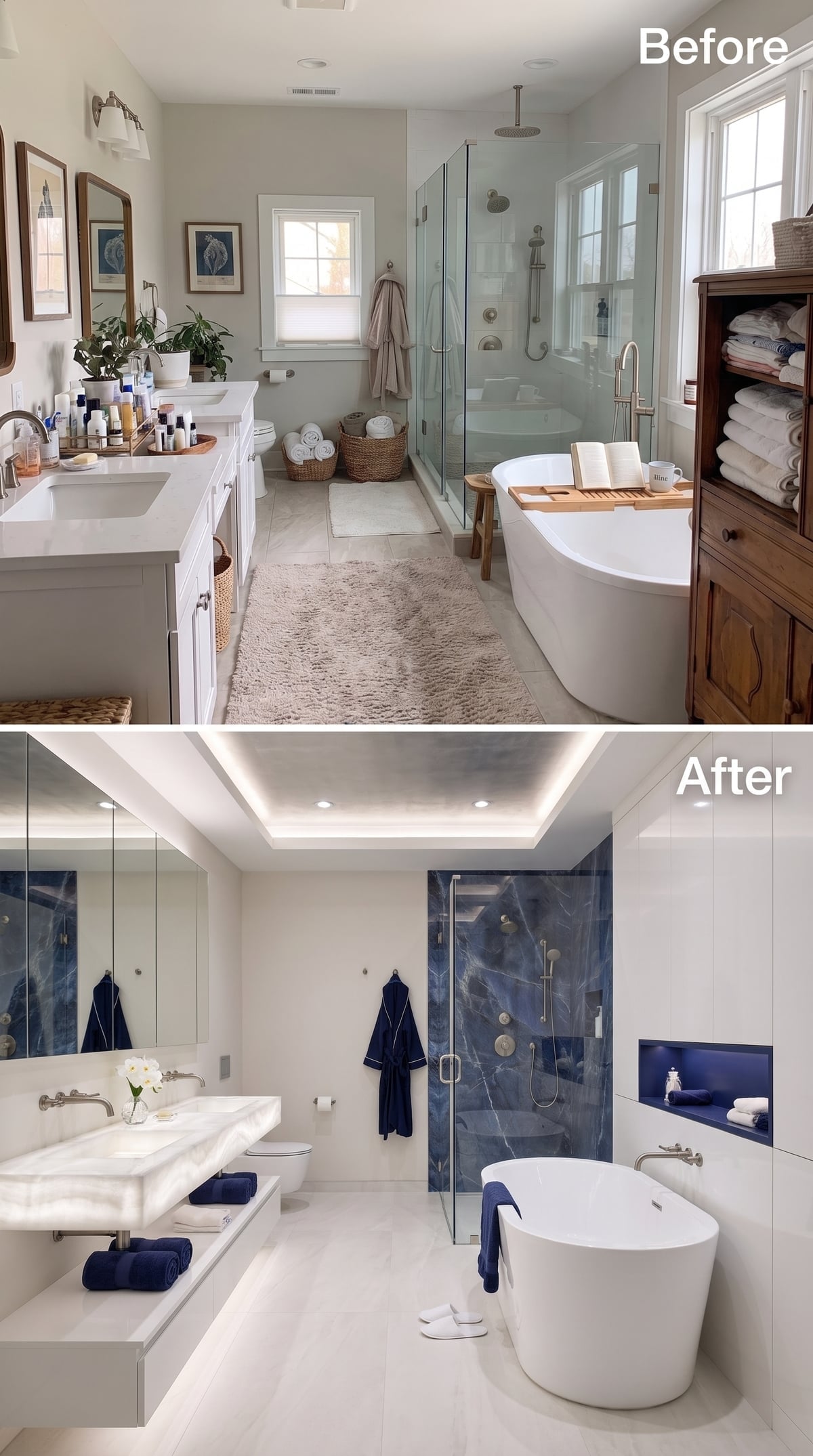
Blue marble, marked by bold white veining, gives the shower a striking backdrop. The surrounding white walls provide contrast, while concealed ceiling lighting distributes a gentle glow across the upper surfaces.
Brushed nickel fittings maintain a cooler metallic palette. A recessed niche near the tub accommodates towels and bathing essentials, and the floating vanity leaves the flooring visible beneath it. The white veining cuts sharply through the blue stone, creating an almost painterly pattern that gives the shower the presence of an oversized artwork.
10. Viola Marble, Gold Cove Lighting, and a Burgundy Vanity That Changes Everything
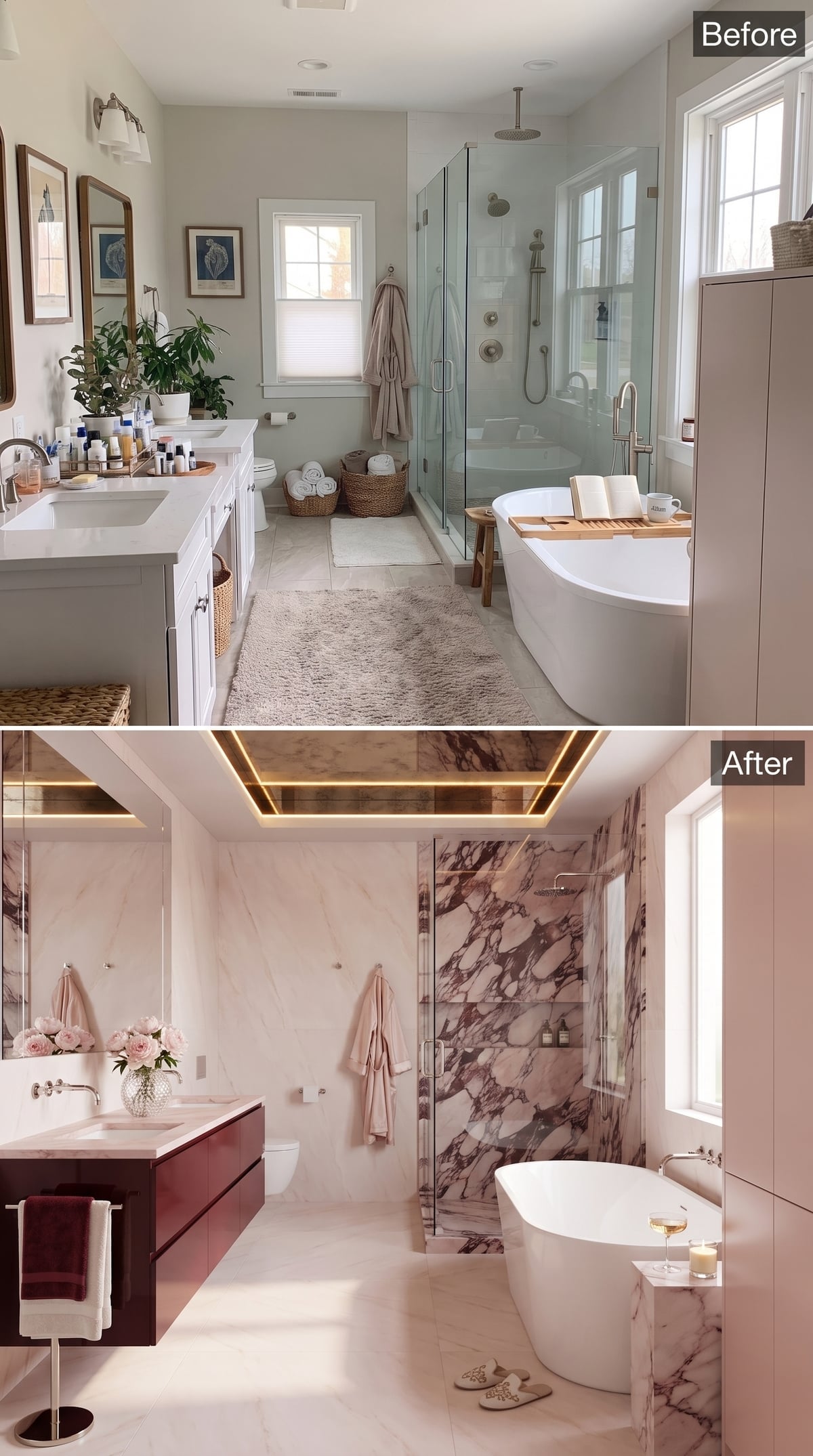
Calacatta Viola marble brings dramatic burgundy veining across a cream background, turning the shower wall into a richly patterned centerpiece. A floating vanity finished in deep burgundy repeats the stone’s darkest tones, making the cabinetry feel closely connected to the architecture.
Warm ceiling lighting enhances the palette, while pink roses introduce a softer variation of the same color family. The burgundy cabinetry gives the room a distinctive character, drawing a saturated accent directly from the marble rather than introducing an unrelated color.
Color Strategy: Strongly veined stone offers more than one possible color direction. Choosing a dominant vein color creates a bold connection with the cabinetry; selecting a quieter background tone produces a softer result.
9. Coffered Ceiling, Marble Slabs, and the Wood Vanity That Anchors It All
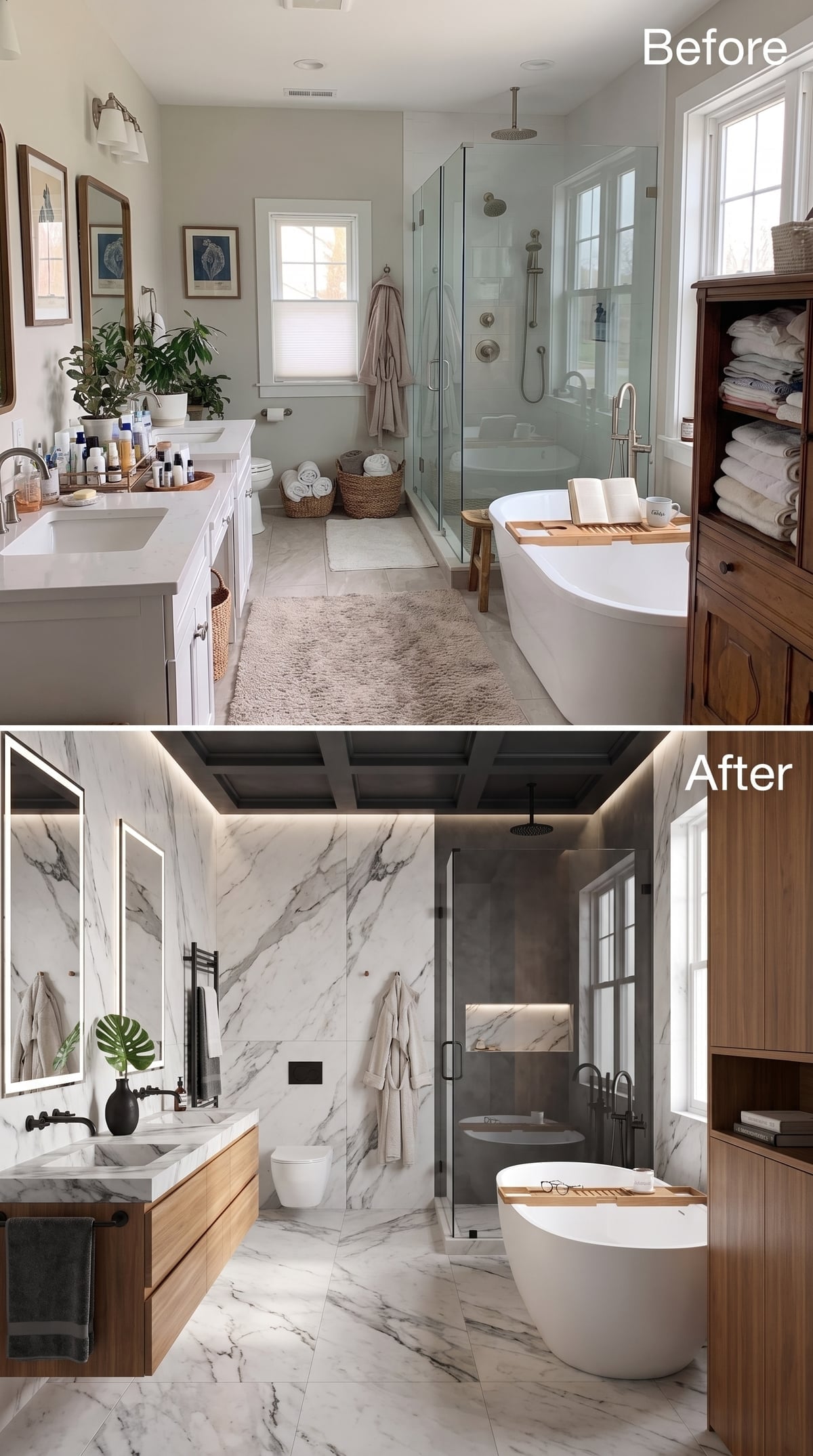
White marble covers much of the room, with continuous gray veining creating a unified backdrop. Above, a dark wood coffered ceiling introduces strong geometric divisions and a rich contrast against the pale stone.
A floating wood vanity repeats the ceiling’s warmth at a lower level, while matte black faucets and shower fittings sharpen the material relationships. The freestanding soaking tub and bamboo bath caddy add softer forms beneath the overhead grid. The connection between ceiling and cabinetry gives the room a distinctly furnished quality, even with marble covering most of the walls.
8. Circular Cove Ceiling, Stone-Toned Walls, and a Tub That Commands the Room
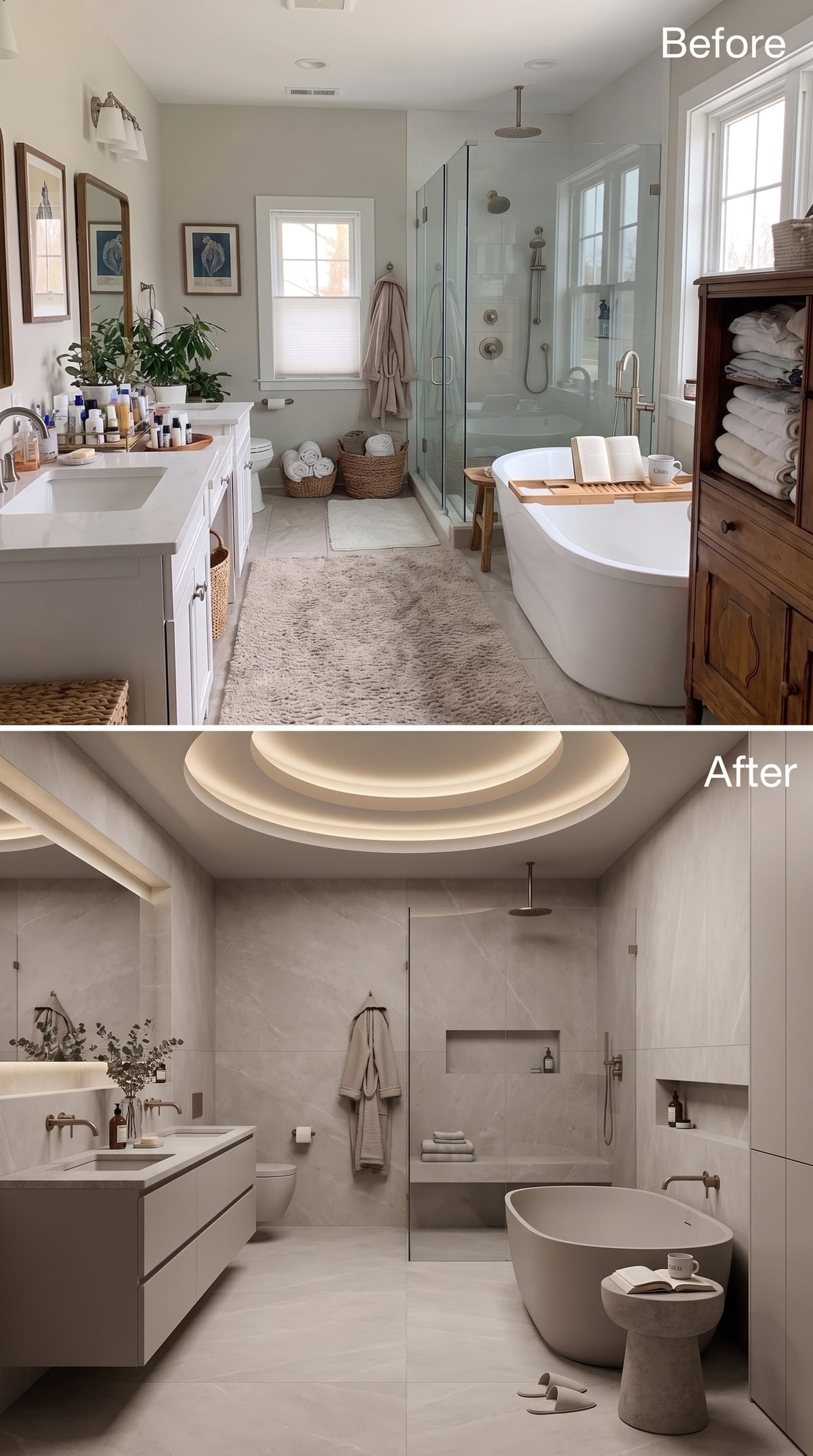
A circular ceiling recess, ringed with warm indirect lighting, introduces a strong geometric centerpiece above a room of muted stone colors. Large gray-beige wall panels establish a quiet backdrop, with the vanity and tub following the same restrained palette.
The freestanding tub occupies a corner beside a low pedestal table, creating a clearly defined bathing area. Recessed wall niches accommodate small essentials, and the floating vanity maintains an open strip of floor beneath the cabinetry. The illuminated circle overhead breaks up the room’s straight edges and gives the bathing area a distinctive architectural canopy.
7. Slatted Wood Ceiling, Brass Fixtures, and Cove Lighting That Softens Every Edge
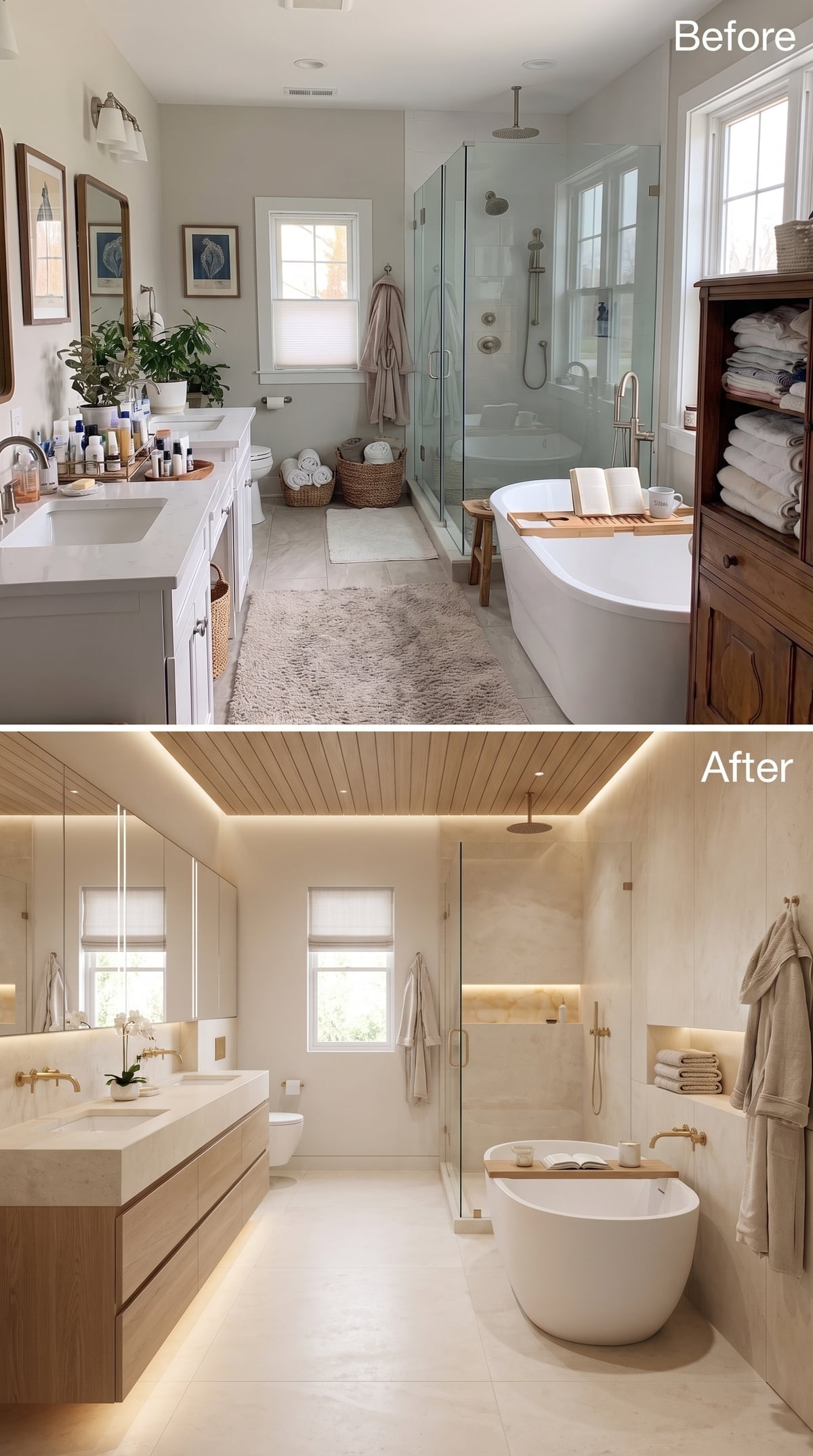
Slender timber planks run across the ceiling, creating a repeated linear pattern that gives the room direction. Concealed lighting along the perimeter washes the upper walls in warm amber, emphasizing the relationship between the ceiling and the surfaces beneath it.
A floating wood vanity with a substantial stone countertop continues the natural palette. Backlit niches provide storage within the wall, while brushed brass fixtures add small metallic accents. The timber ceiling introduces a warmer, more intimate scale above the broad stone surfaces, with light filtering along the edges of the slats.
6. Marble Walls, Recessed Linear Lighting, and the Vanity That Floats Free
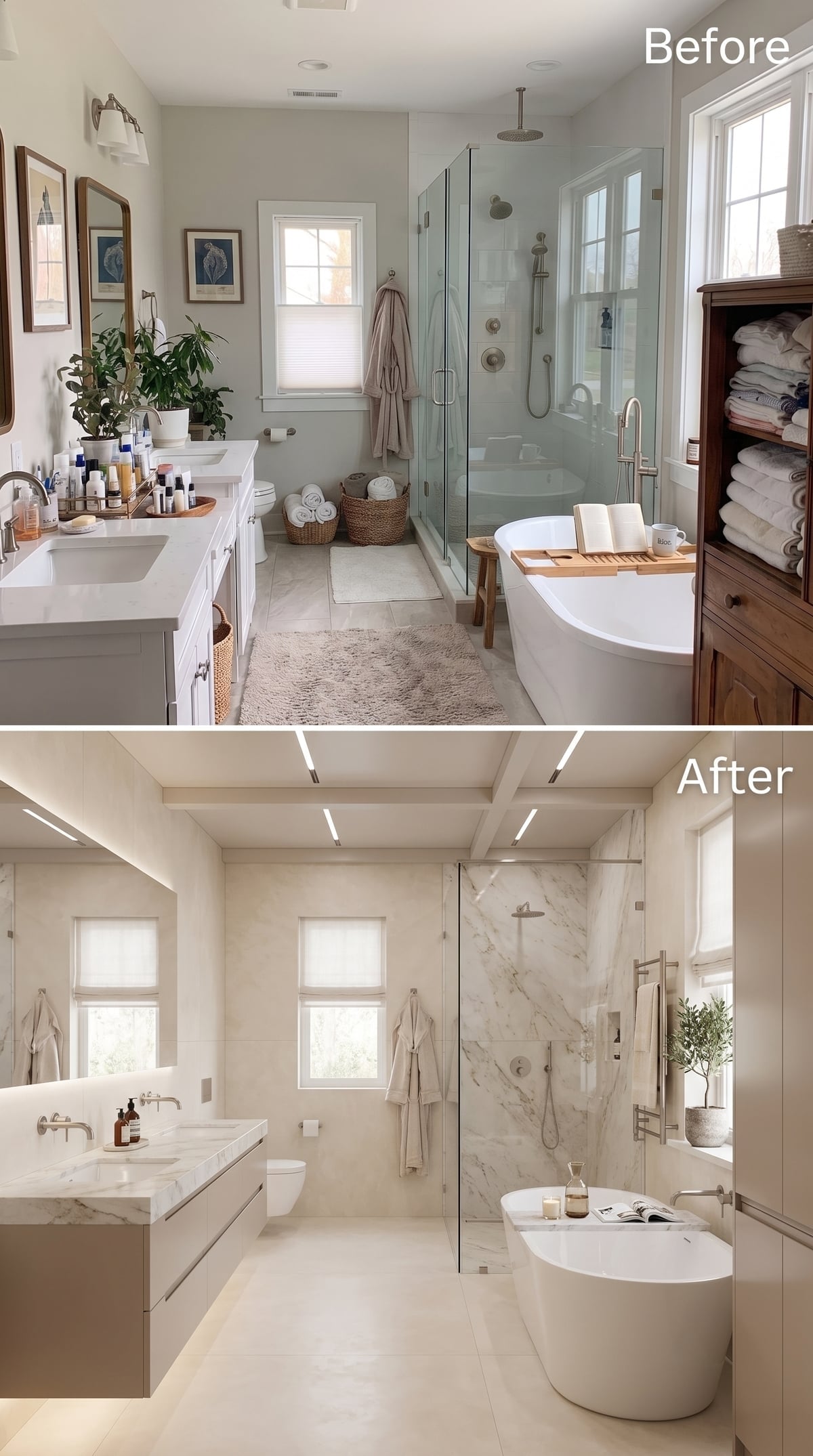
Calacatta marble lines the shower in large sections, its gray veining providing an organic contrast to the room’s straight architectural lines. A floating vanity with wall-mounted brushed nickel faucets keeps the sink area visually neat.
Two windows are dressed with simple roller shades, allowing daylight to remain prominent. Recessed linear lights occupy shallow ceiling details, providing a crisp modern counterpoint to the stone. The combination of natural light, pale marble, and exposed flooring beneath the vanity creates a clean, expansive visual field around the tub.
5. Travertine Vanity, Oval Backlit Mirrors, and a Coffered Ceiling With Gold Trim
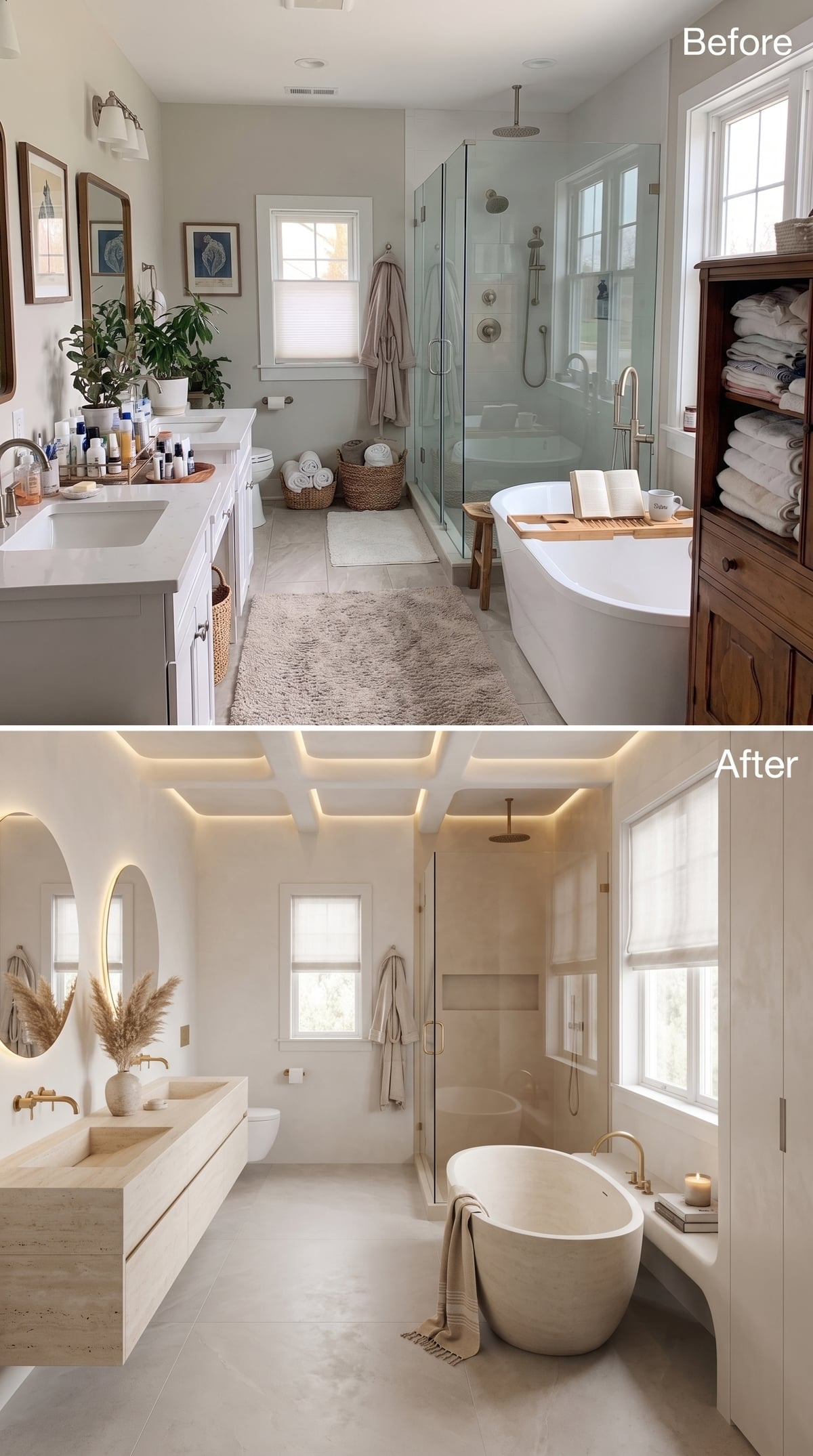
A travertine vanity introduces warm stone beneath softly illuminated oval mirrors. Their rounded outlines contrast with the straight edges of the cabinetry and the geometric ceiling above.
Gold-trimmed recesses divide the ceiling into a coffered pattern, with concealed lighting emphasizing the boundaries between the panels. The decorative overhead grid introduces a more formal architectural character, while the rounded mirrors and warm travertine soften the precision of the gold detailing.
4. Black Marble Shower, Warm Cove Lighting, and a White Vanity That Holds Its Ground
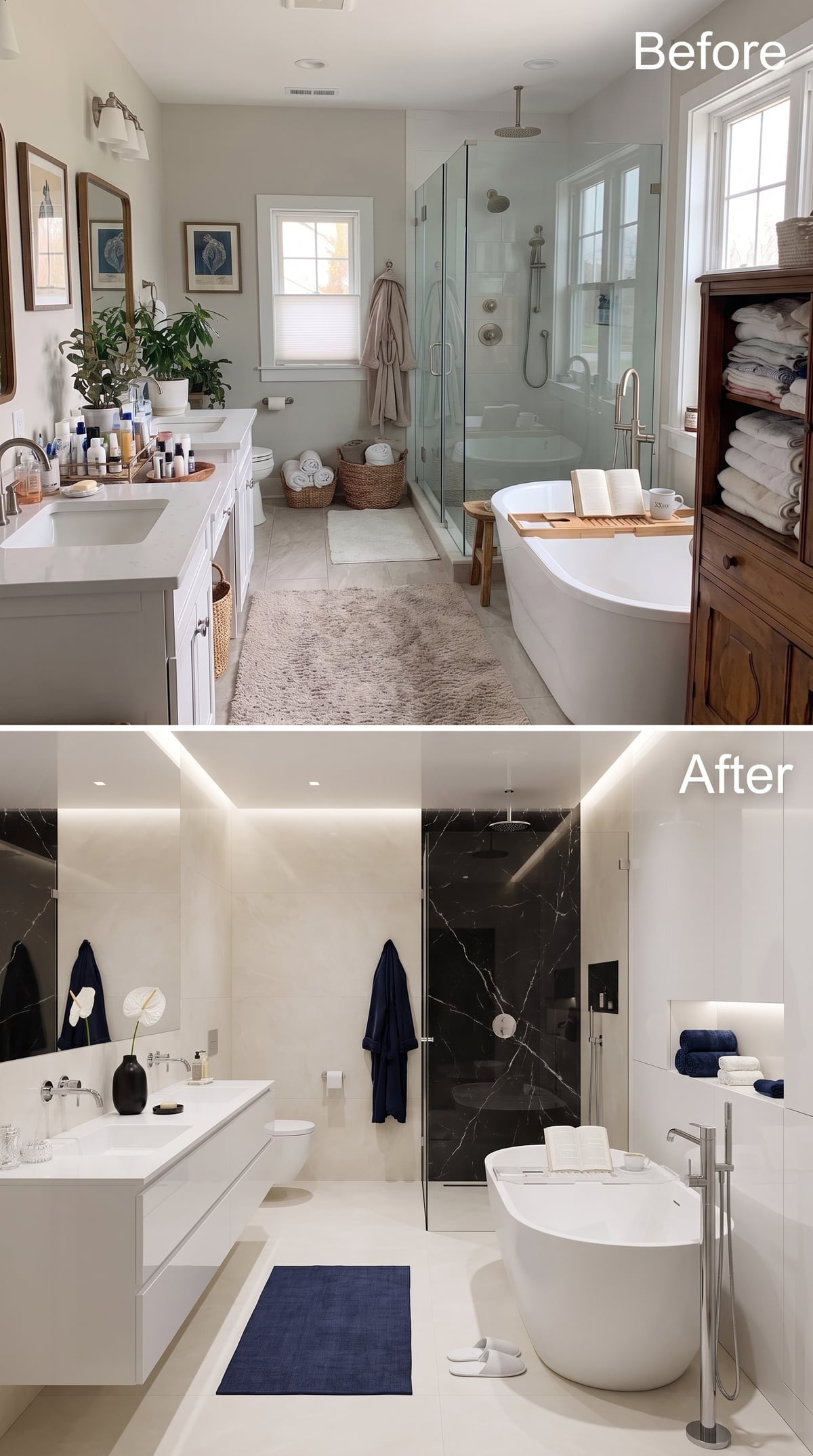
Black marble wraps the shower in dramatic veined surfaces, establishing a dark focal point against cream-colored walls. Warm cove lighting follows the ceiling perimeter, softening the transition between the two palettes.
A matte white floating vanity introduces a clean horizontal form above the pale floor. Nearby, an oval soaking tub and brushed chrome floor-mounted filler keep the bathing area simple. Navy towels provide a restrained accent. The black marble creates a dramatic enclosure around the shower, while the white vanity and pale floor leave the rest of the room bright and open.
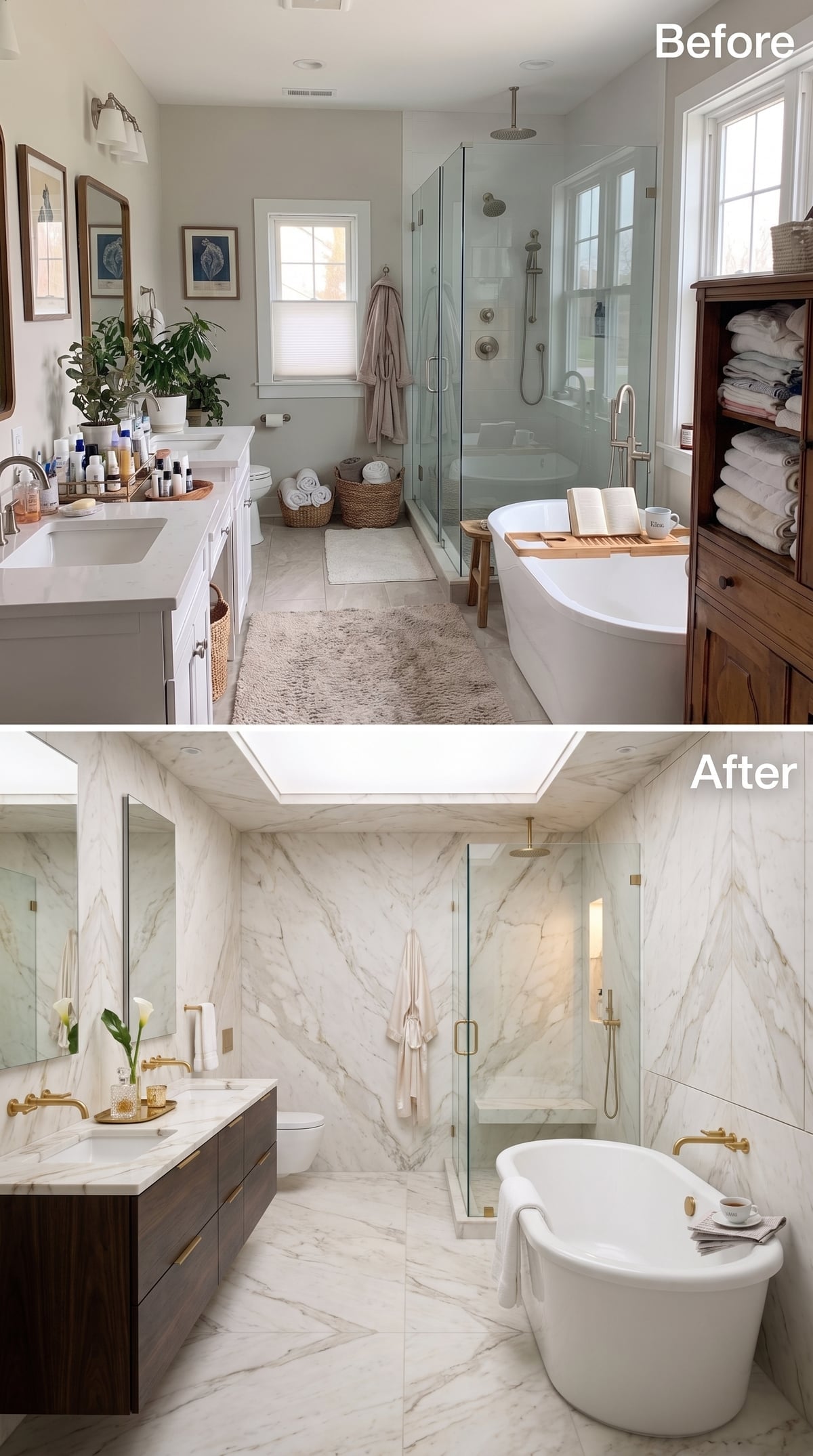
3. Calacatta Marble Floor to Ceiling, Brass Hardware, and a Skylight That Earns Its Keep
🔥 Would you like to save this?
Calacatta marble covers the walls in large, dramatically veined surfaces, then continues across the floor in a herringbone pattern. The change in scale between broad wall veining and smaller floor pieces introduces movement within the same material family.
Brass fixtures add warmth, while a floating walnut vanity provides a darker foundation beneath a frameless mirror. Above, a recessed skylight brings daylight into the marble-lined interior. The low, rounded soaking tub completes a composition built around the contrast between expansive stone surfaces and carefully defined individual fixtures.
2. Burl Wood, Cream Stone, and a Floating Vanity With Furniture-Grade Character
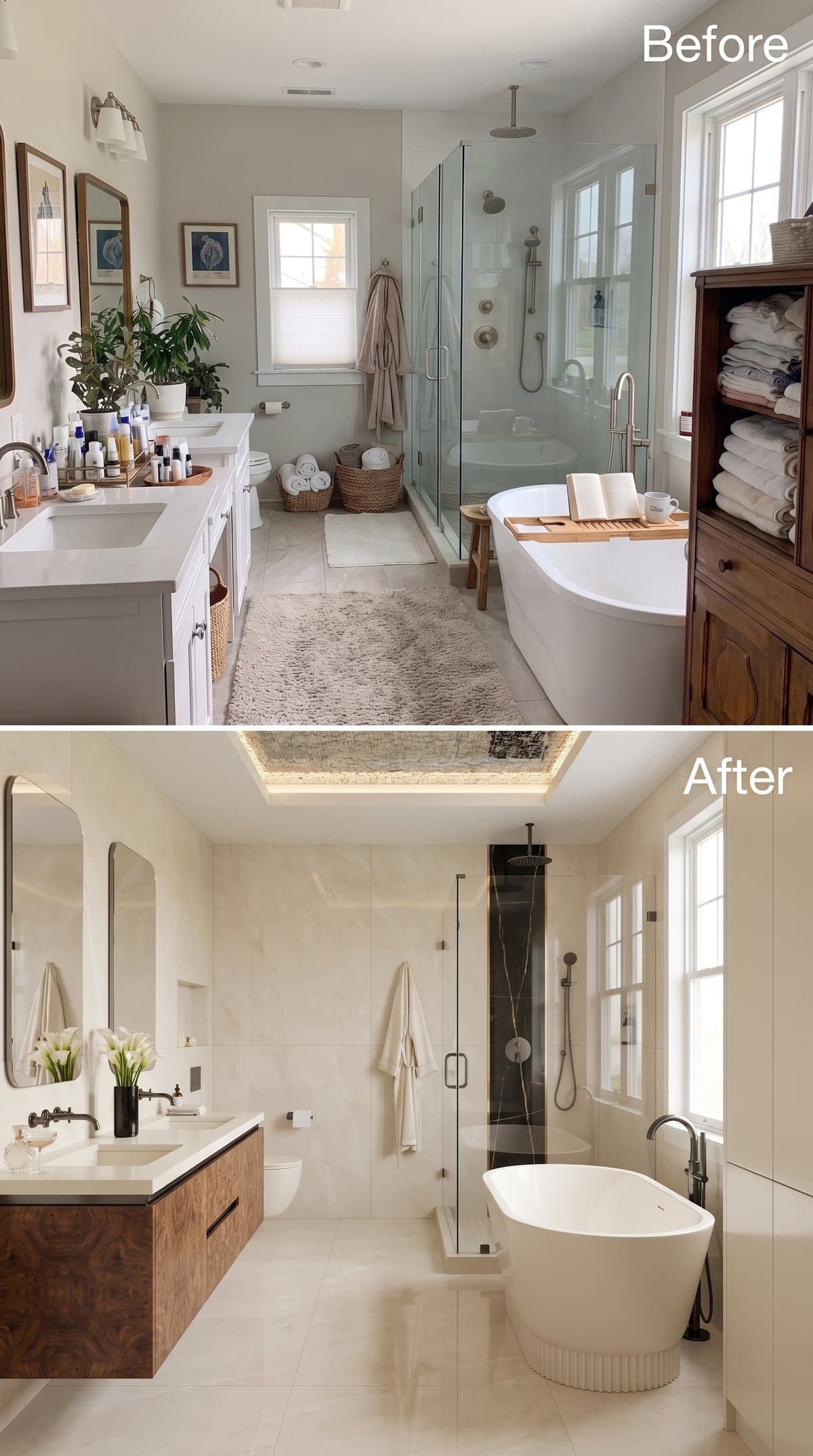
Burl wood gives the floating vanity an extraordinary surface pattern, its swirling grain providing warmth and visual complexity against the pale stone walls. A white countertop and bronze wall-mounted faucet keep the sink area composed.
Large-format cream tile continues across the floor and walls, while the walk-in shower introduces a darker interior panel and matte black rainfall fitting. A freestanding tub occupies the window side of the room. The pale stone creates a calm setting for the burl’s intricate grain, which brings the richness of a finely crafted piece of furniture into the bathroom.
1. Teal Ceiling, Backlit Niches, and the Floating Vanity That Opened the Floor
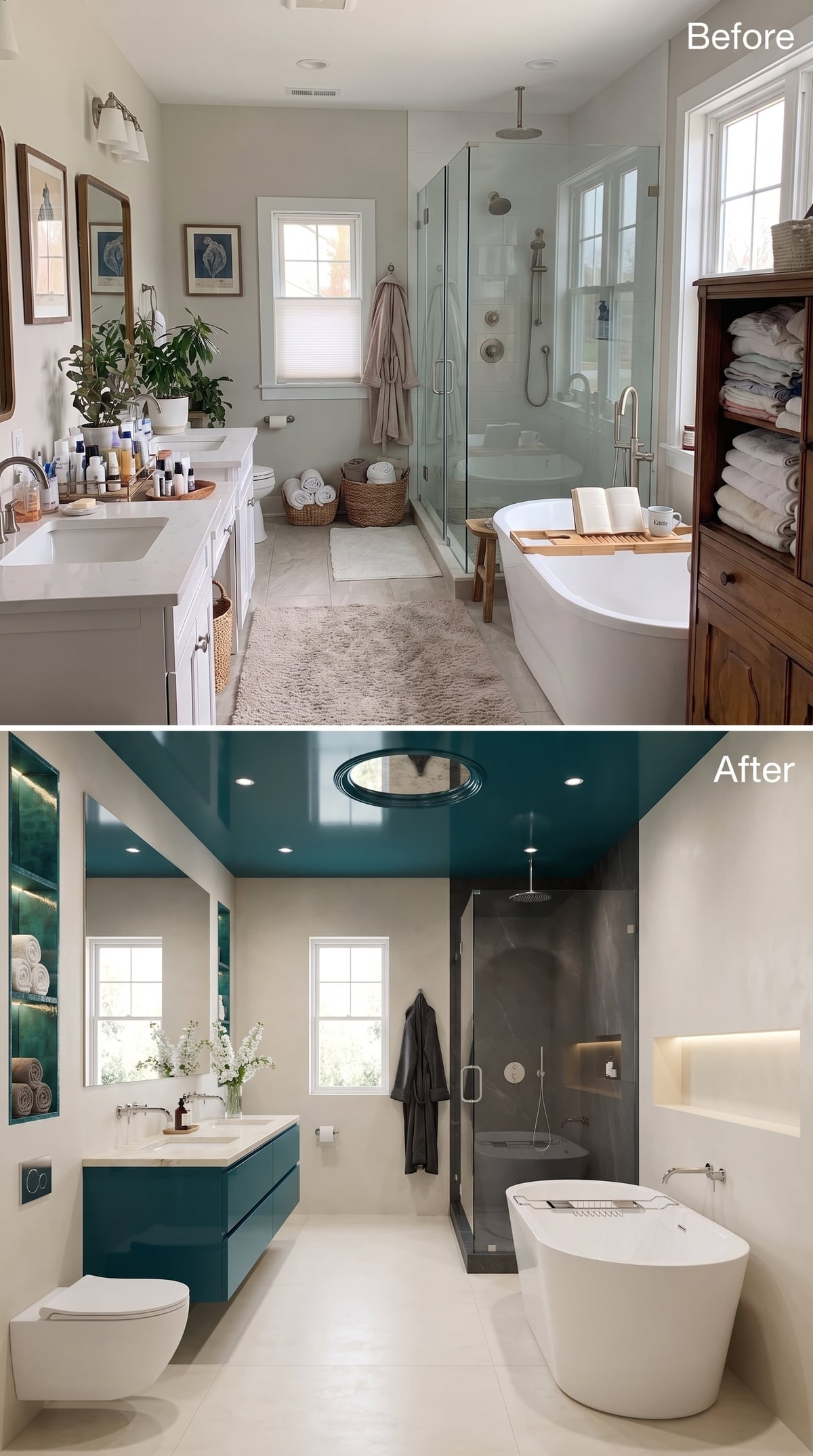
Lacquered teal transforms the ceiling into the room’s dominant color statement. The same saturated finish returns on the floating vanity, establishing a direct relationship between the highest and lowest architectural elements.
Illuminated niches introduce smaller pockets of light, while an oval mirror adds a curved counterpoint to the cabinetry. Beneath the wall-mounted vanity, the exposed floor creates a clean visual break between furniture and flooring. Teal above, teal below, and a generous expanse of pale surfaces between them: a dramatic transformation built around color, proportion, and the space left deliberately open.