🔥 Would you like to save this?
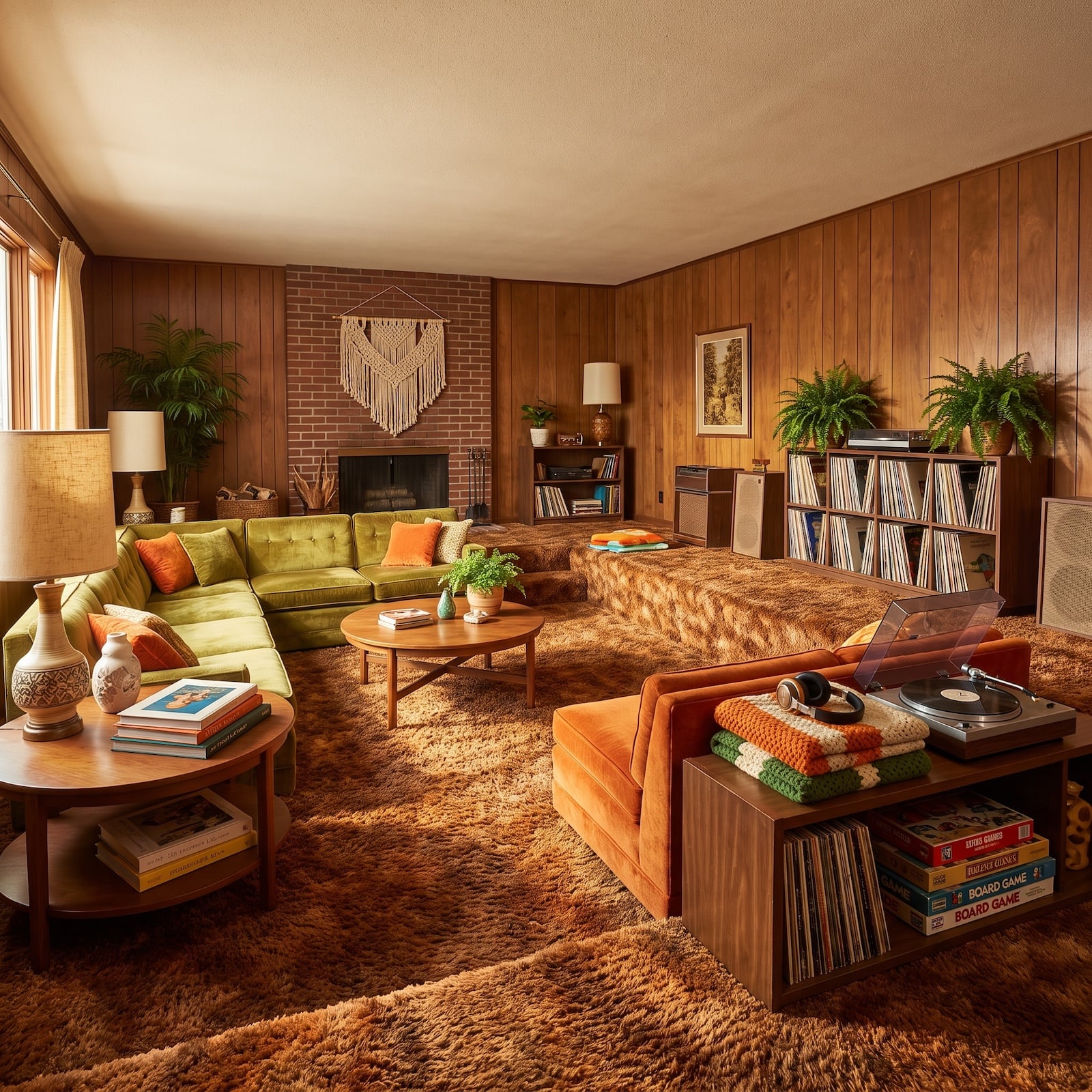
Brown-orange shag underfoot. Wood paneling running wall to wall. An avocado sectional holding court beneath a ceiling that has apparently never heard of recessed lighting. This room doesn’t merely suggest the 1970s. It has committed to the decade with both feet.
In order to come up with the very specific design ideas, we create most designs with the assistance of state-of-the-art AI interior design software. Also, assume links that take you off the site are affiliate links such as links to Amazon. this means we may earn a commission if you buy something.
That makes it a particularly good design experiment. The proportions are better than the decor suggests, the windows are useful, and there is enough floor area to take the room in directions its original palette never imagined. Across these 36 transformations, the same basic starting point swings from pale plaster and paper lanterns to emerald marble, lacquered ceilings, raw stone, French paneling, yacht-club teak, indoor water, and one room that gives the motorcycles better display space than most people give their art.
The point isn’t to discover one correct way to modernize a 1970s living room. There isn’t one. It’s to see what happens when material, ceiling treatment, lighting, furniture scale, color, and circulation all start supporting the same idea. Some versions barely whisper. Others arrive with a chandelier, a grand piano, and absolutely no intention of explaining themselves.
36. Whitewashed Brick, Exposed Beams, and Lantern Pendants That Rewrite the Ceiling
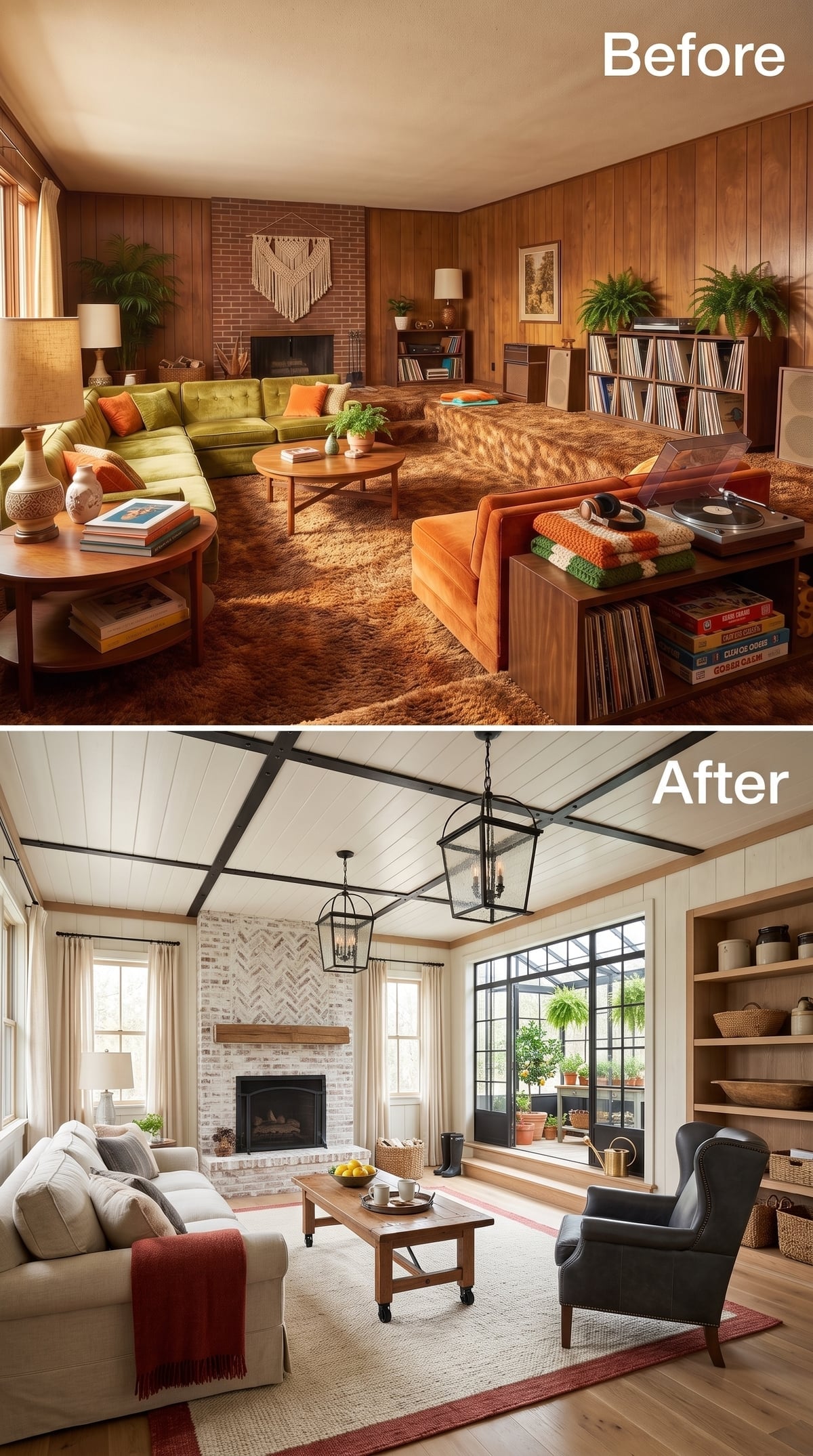
This version practically exhales.
Off-white boards stretch across the walls and vaulted ceiling while dark beams put the architecture back into focus. Two lantern-style pendants hang at different heights over a raw wood coffee table, creating just enough irregularity to stop the room from feeling overly composed.
The pale brick fireplace keeps its masonry texture rather than disappearing beneath an opaque finish, and the open shelving stays deliberately simple.
Finish Note: A translucent whitewash can soften the color of masonry while allowing some of its original variation and texture to remain visible. The exact effect depends on the product and application, but the result is usually less uniform than fully opaque paint.
35. Emerald Marble, a Grand Piano, and Gold Ceiling Geometry That Demands Attention
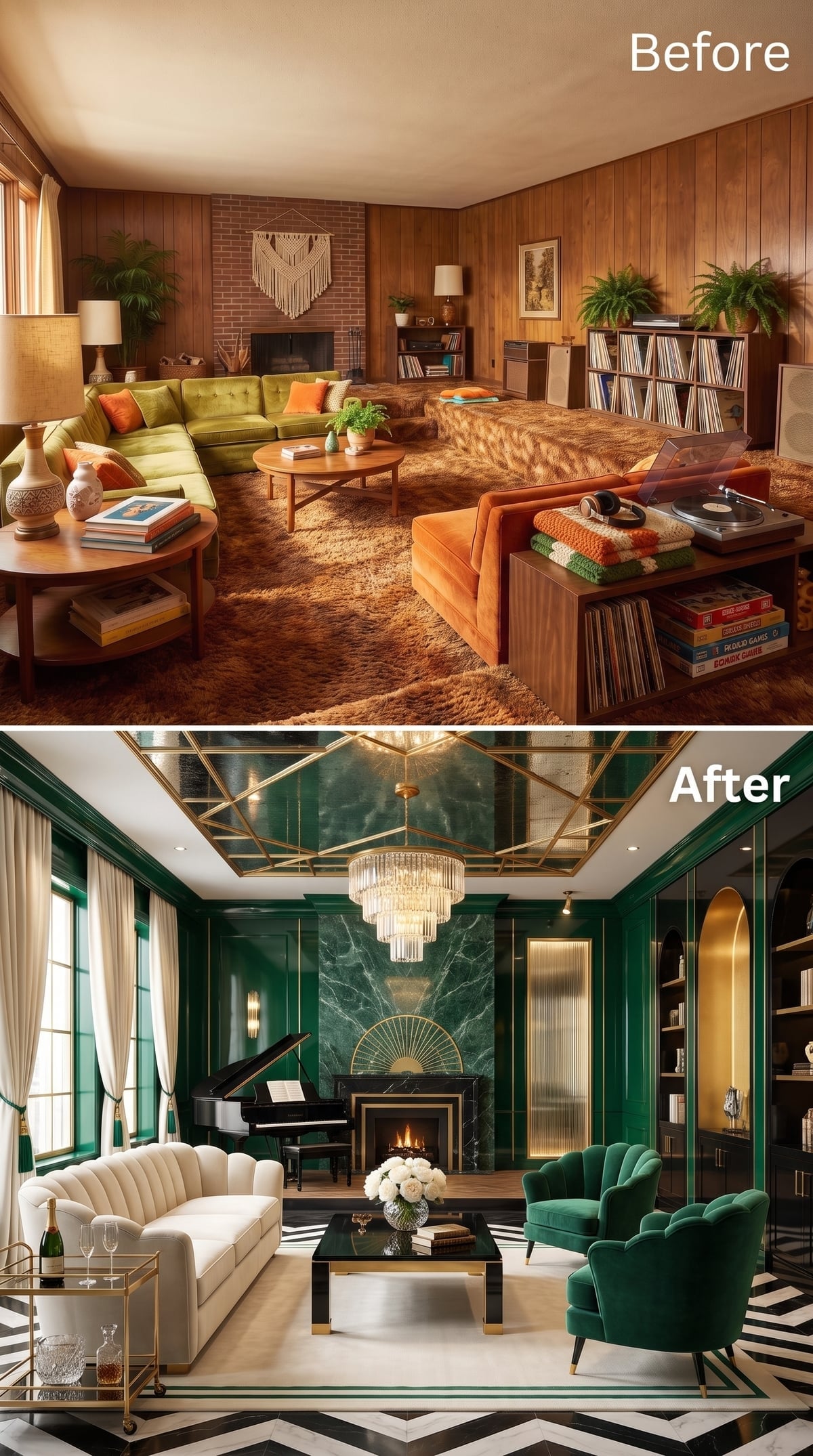
Then the pendulum swings hard in the other direction.
Deep emerald runs across the walls while a green marble fireplace carries the color into the architecture. Above, gold geometric trim divides the dark ceiling into a formal grid, with a tiered crystal chandelier hanging at its center.
The ivory channel-tufted sofa gives all that saturated color somewhere to stop. A black grand piano sits in the background like punctuation.
Design Note: Deep wall colors absorb more light than pale ones, which makes reflective stone, polished metal, lacquer, glass, and carefully placed lighting especially useful when the goal is drama without murkiness.
34. Concrete Overhead, Bouclé Below, and Pendants Floating Between Them
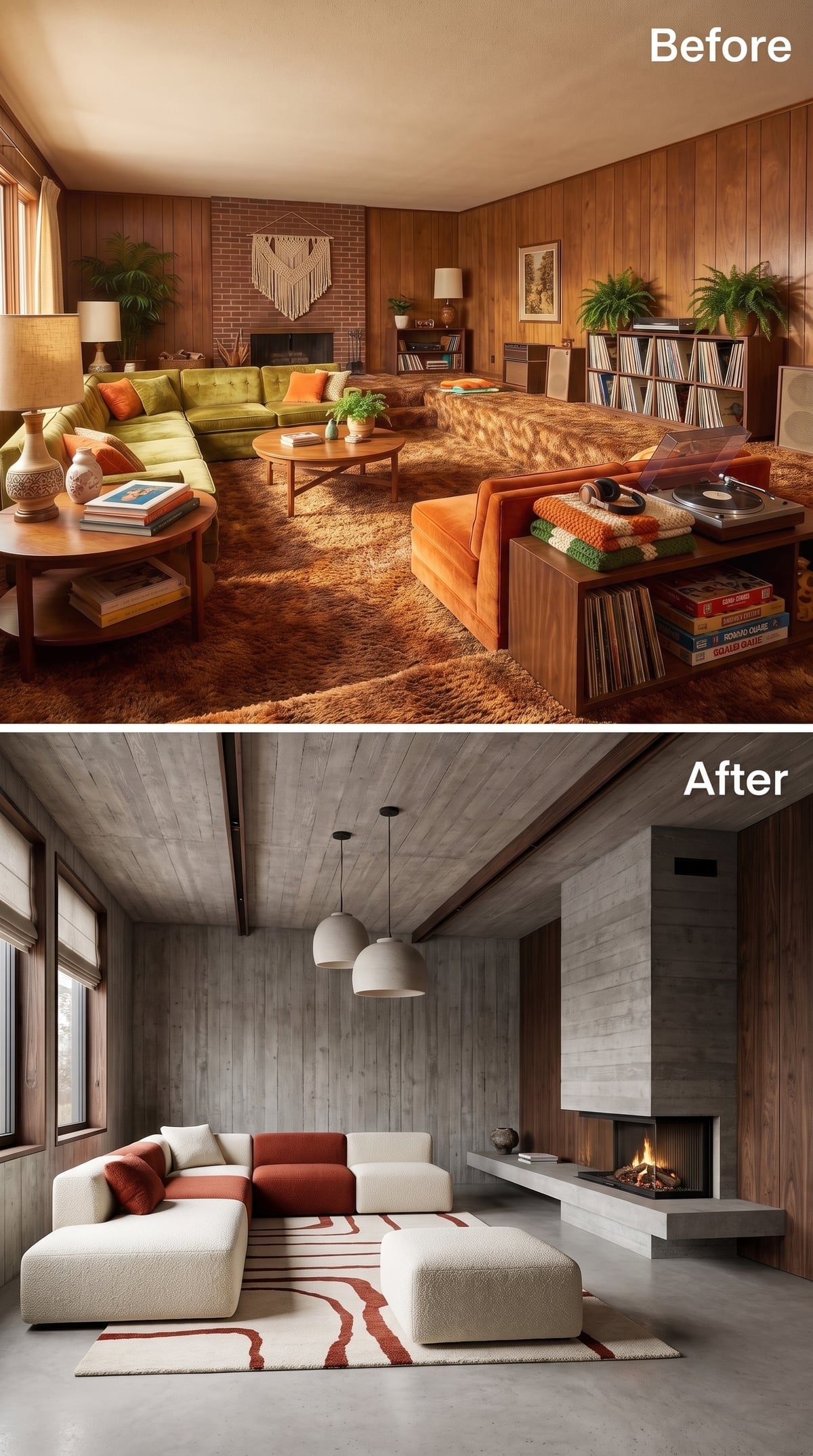
Concrete-look surfaces across the ceiling and walls give the room a much harder architectural shell, but the furniture refuses to follow them into austerity.
A cream bouclé sectional sits low against all that gray texture, scattered with rust cushions that pick up the terracotta lines in the rug. Matte ceramic pendant globes hang at different heights rather than relying on one dominant fixture.
Why the Rug Matters
The terracotta lines create movement across the center of the floor while the cream ground keeps the pattern from becoming another hard surface. More importantly, the rug establishes a visual boundary around the seating group without adding a partition or changing floor level.
33. Blue Zellige-Style Tile, Rattan, and a Swing Sofa Nobody Saw Coming
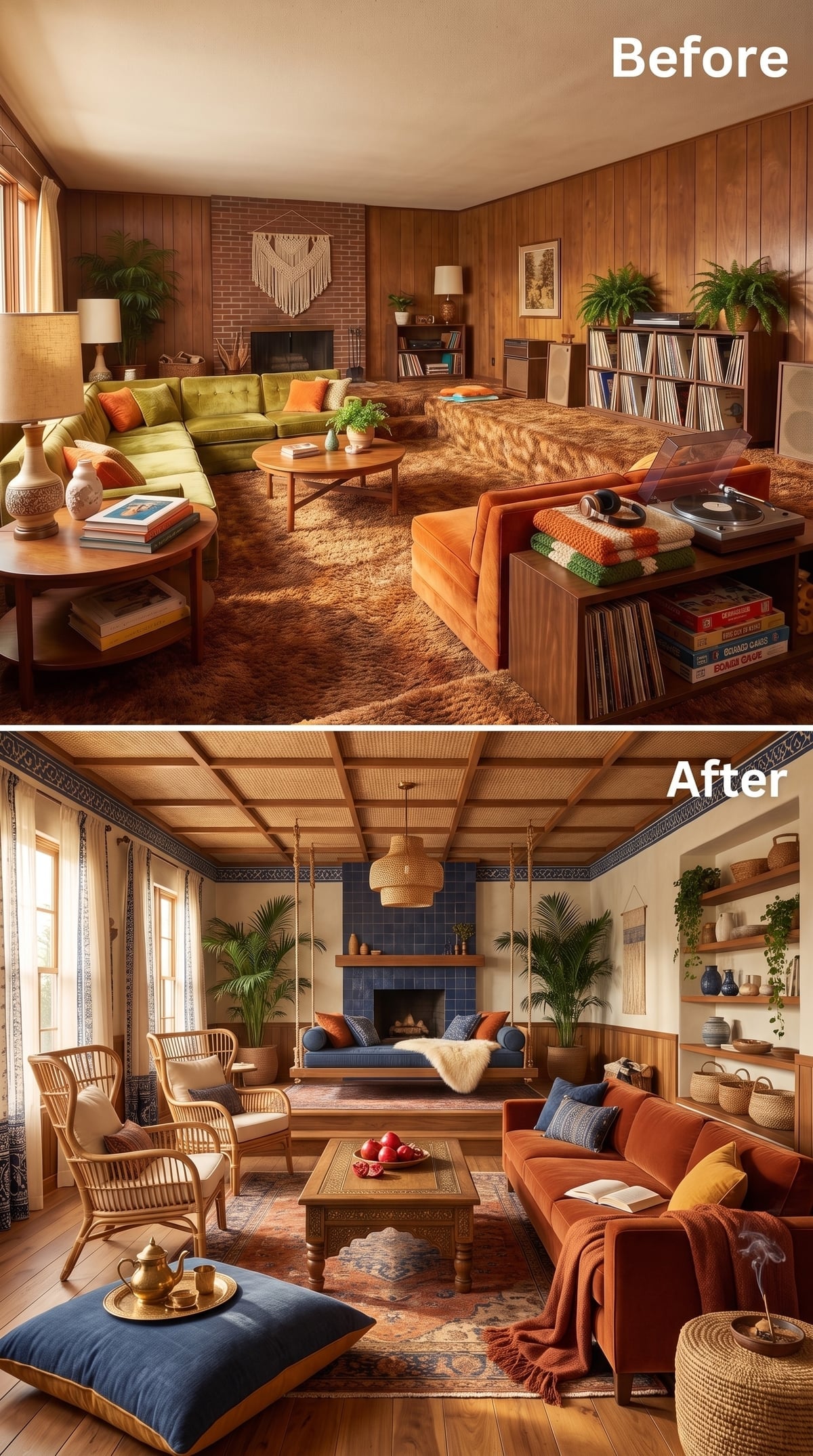
Indigo glazed tile wraps the fireplace from floor to ceiling, its irregular-looking surface catching light differently from piece to piece. Across from it hangs the thing that immediately changes the room’s personality: a suspended sofa.
Burnt-sienna velvet, woven rattan, cobalt cushions, carved wood, and large tropical plants make the room intentionally layered rather than politely coordinated. Even the ceiling beams join the composition instead of disappearing overhead.
32. Plaster Moldings, Marble, and French Chairs With No Interest in Minimalism
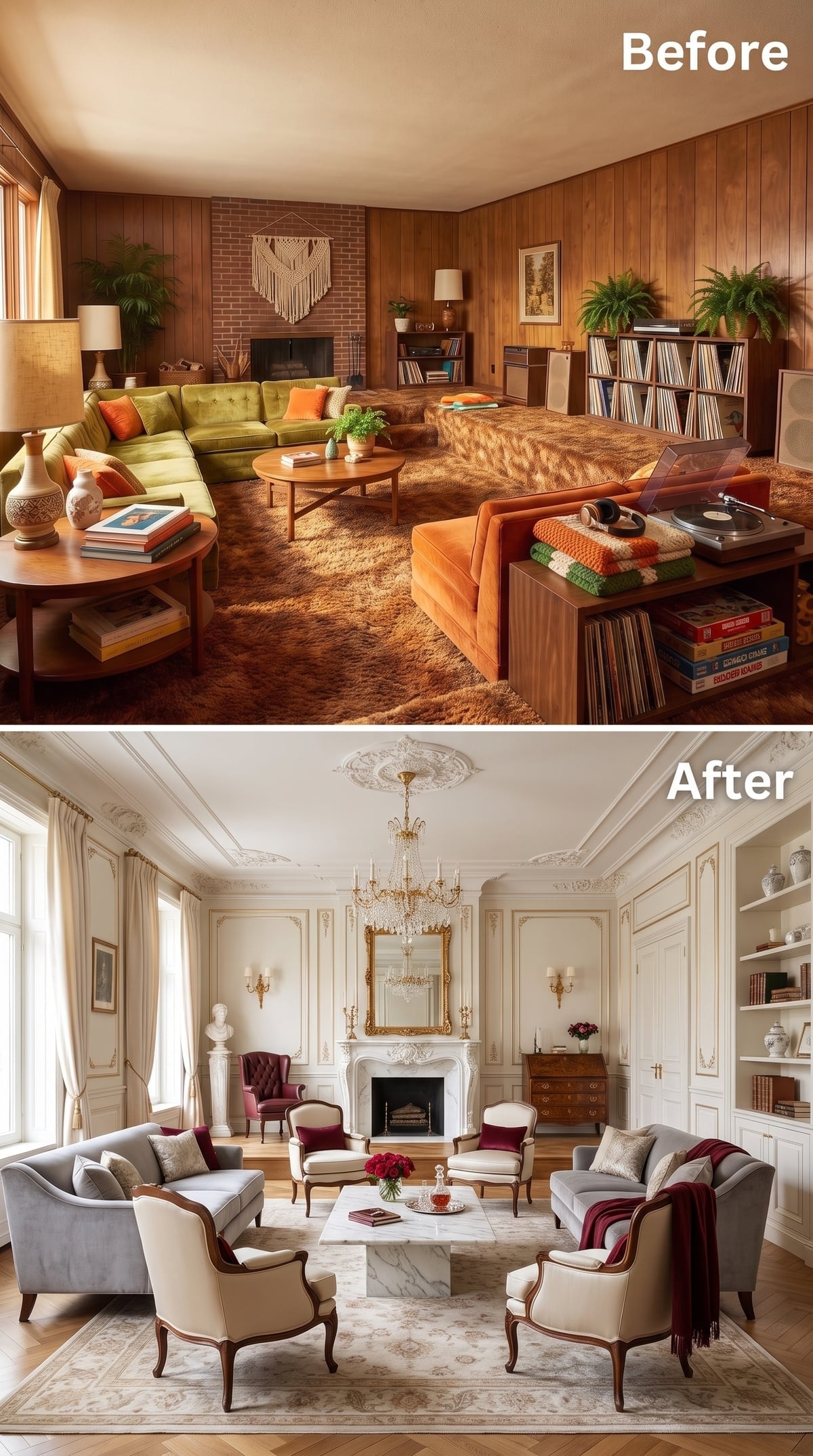
Warm ivory paneling, ornamental moldings, gilt mirrors, brass sconces, and a white marble fireplace turn the former shag-carpeted box into something much more formal.
Carved wood armchairs and pale upholstery continue the old-world direction, but cranberry pillows keep the palette from disappearing entirely into cream. Nothing here is pretending to be restrained. The trick is that all the ornament speaks the same language.
Style Note: Boiserie-style paneling introduces depth through rails, stiles, moldings, and shadow lines rather than through color alone. Painting the entire assembly one shade keeps the architecture prominent without turning every individual panel into a separate event.
31. Red Ceiling Beams, Leather Seating, and Motorcycles Treated Like Sculpture
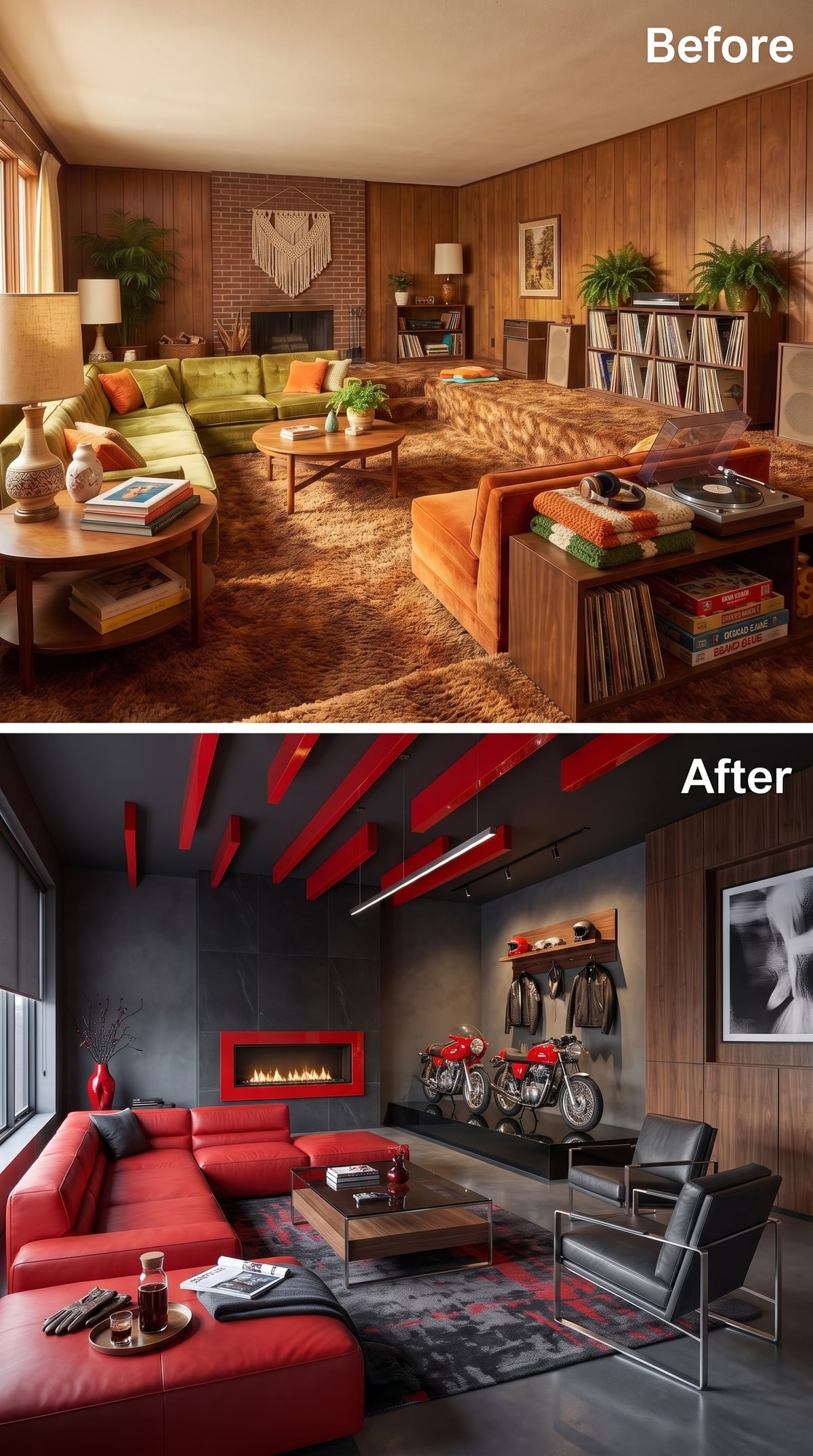
Scarlet runs through the sectional, fireplace frame, and ceiling beams with almost comic-book confidence. Gray and black surfaces handle everything else.
Then two classic motorcycles appear on a low platform across the back wall, displayed with the spacing and lighting usually reserved for sculpture. It works because nobody hedged.
30. Pale Linen, Dark Beams, and Paper Lanterns Big Enough to Matter
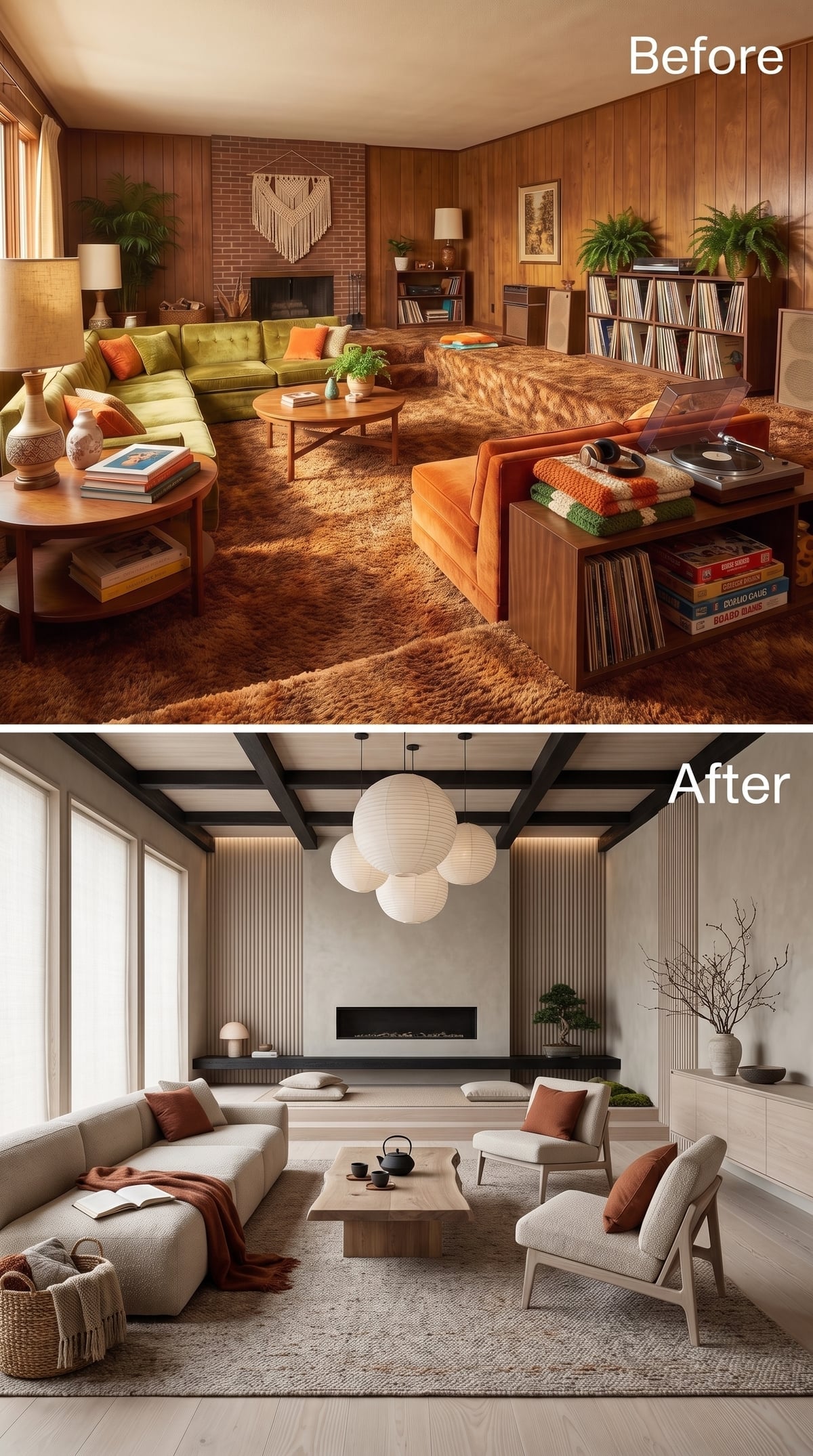
Cream bouclé seating stays close to the floor while dark structural beams form a much stronger frame overhead. Between them, three oversized paper lanterns float at different heights.
Terracotta cushions, a stone coffee table, slatted wall treatment, and a small bonsai keep the room warm without filling it. This is one of the quieter transformations, and the restraint is exactly what gives those lanterns enough room to look enormous.
Budget Note: Paper lanterns can deliver considerable visual scale for relatively modest cost. Grouping several at different heights is one way to fill a tall ceiling without relying on one oversized statement fixture.
29. Black Marble, Burgundy Velvet, and a Ceiling That Refuses to Fade Away
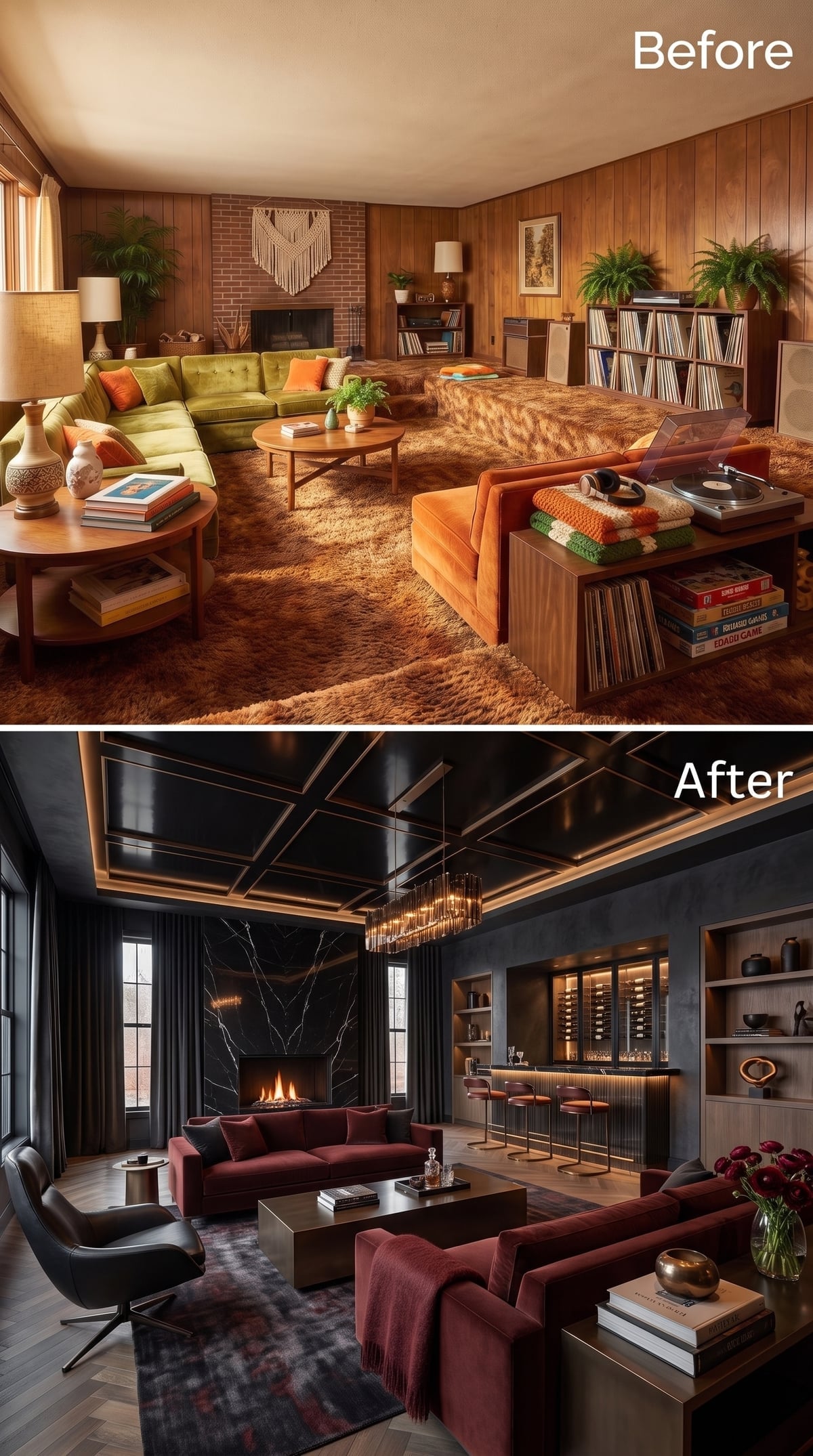
Glossy black ceiling coffers trimmed in bronze immediately push this room into evening mode. Below them, bookmatch-like white veining streaks across the black fireplace wall while burgundy velvet seating holds its own against all that darkness.
A wine display adds another vertical element rather than behaving like a piece of freestanding furniture. The whole room is dark, but nothing about it feels accidental.
28. Coral Accents, Indoor Water, and a Ceiling That Changes the Entire Mood
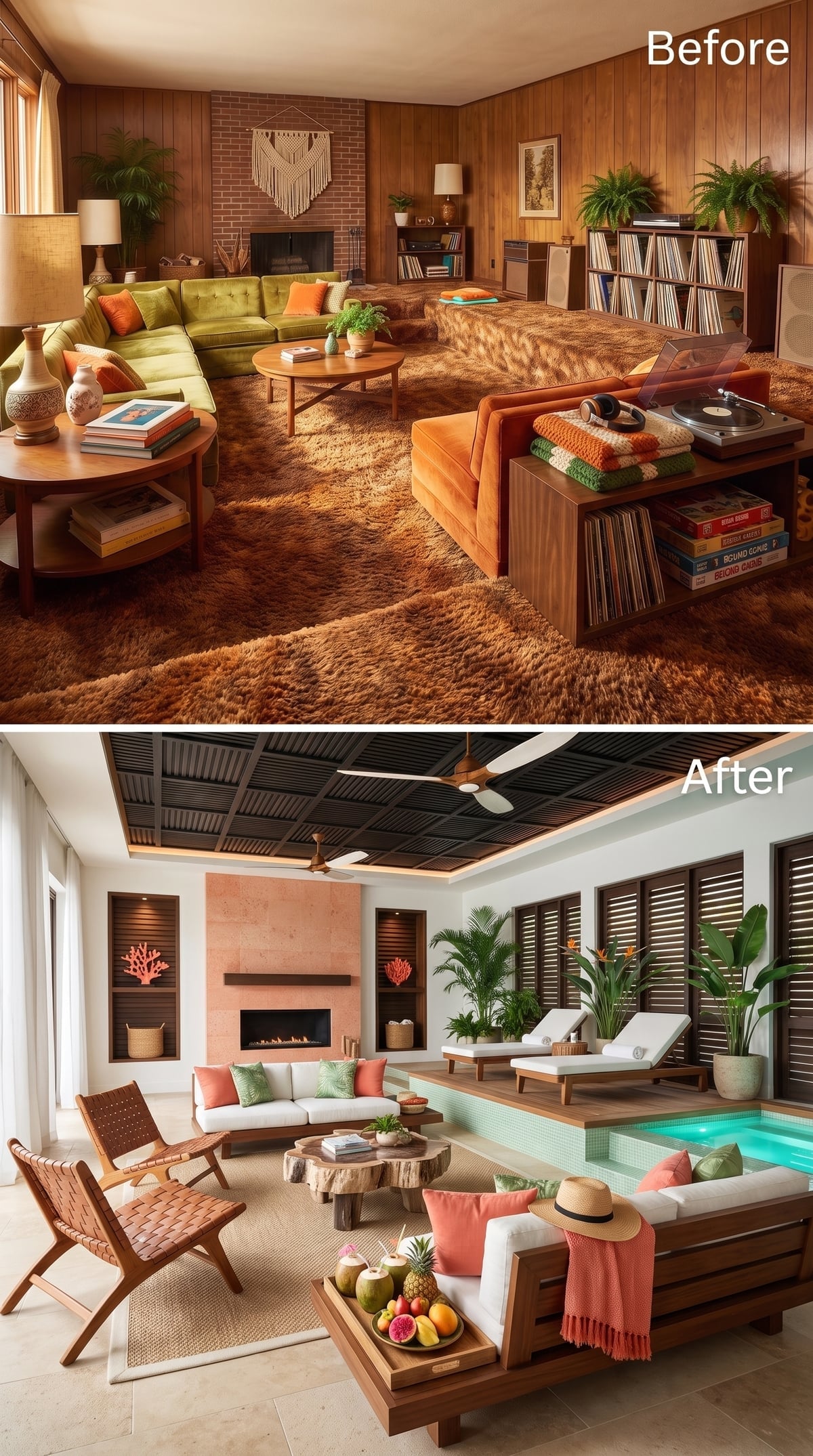
There is a small pool-like water feature beside the seating area, and somehow it isn’t even the strangest move in the room.
Pale terracotta plaster wraps the fireplace wall, where lit niches hold coral-like sculpture. Linen-white sofas keep the seating restrained while a live-edge table introduces another natural surface.
Overhead, dark slatted coffers establish a strong grid. Beside the water, teak decking and lounge chairs move the room decisively into resort territory.
27. Linear Lighting, Dark Hardwood, and a Raised Zone Without a Wall
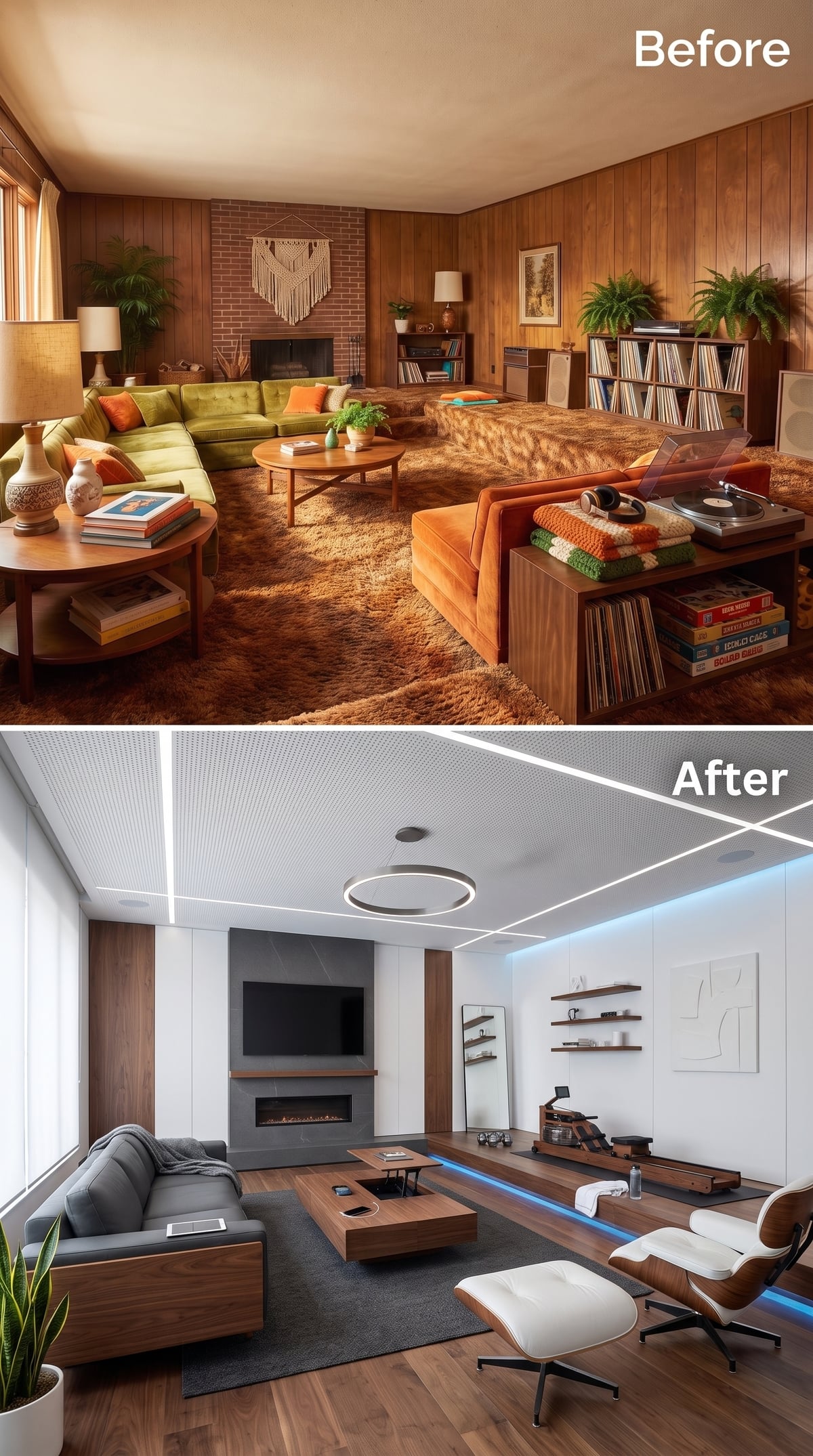
White walls clear the visual noise, but dark walnut-toned flooring keeps the room grounded. Thin lighting strips trace the ceiling perimeter while a circular pendant hangs over the lounge.
At one side, a slightly raised platform establishes a separate exercise area without enclosing it. A lounge chair in the Eames tradition sits nearby, but the strongest move is architectural rather than decorative: a few inches of floor-height change are enough to tell you where one use ends and another begins.
Why the Raised Platform Works
The change in level gives the exercise area its own boundary while keeping views open across the room. Blue lighting beneath the platform exaggerates that edge after dark and makes the transition impossible to miss.
26. Bold Primary Colors and Mondrian Logic Take Over the Room
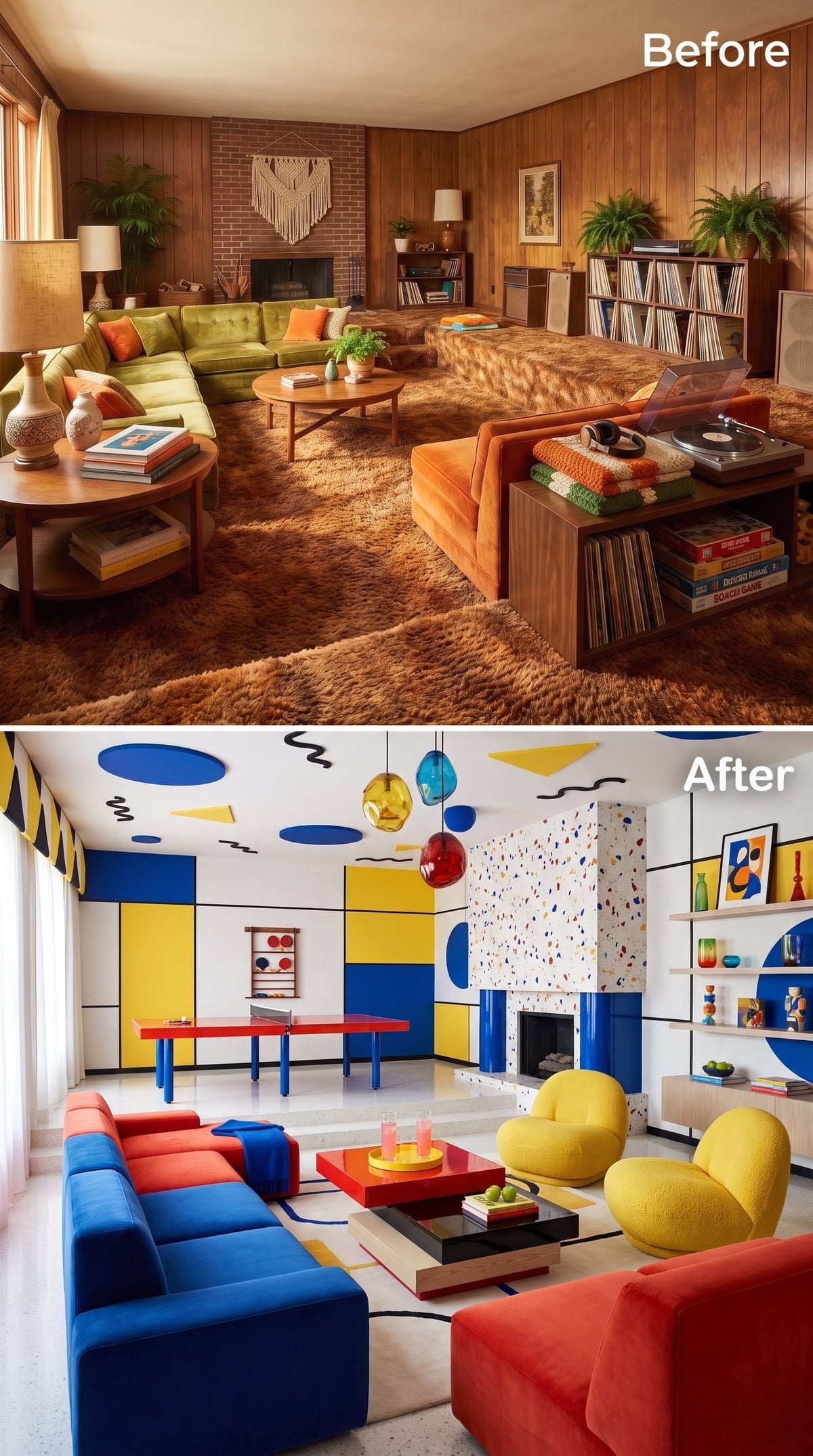
Cobalt seating commands one side while yellow bouclé chairs take the other. The walls divide into primary-color blocks against white, borrowing the visual logic of a Mondrian composition without becoming a literal reproduction.
The ceiling refuses to stay neutral either. Blue ovals and yellow geometry push the color overhead, leaving the terrazzo fireplace as one of the calmest surfaces in the room.
Design Reference: The primary palette and playful geometry also brush against the irreverence associated with Memphis design. The useful lesson isn’t to reproduce either movement literally; it’s that a room can treat walls and ceilings as active graphic surfaces rather than passive backgrounds.
25. Yacht Club Teak, White Leather, and Chrome Keeping It Out of Costume
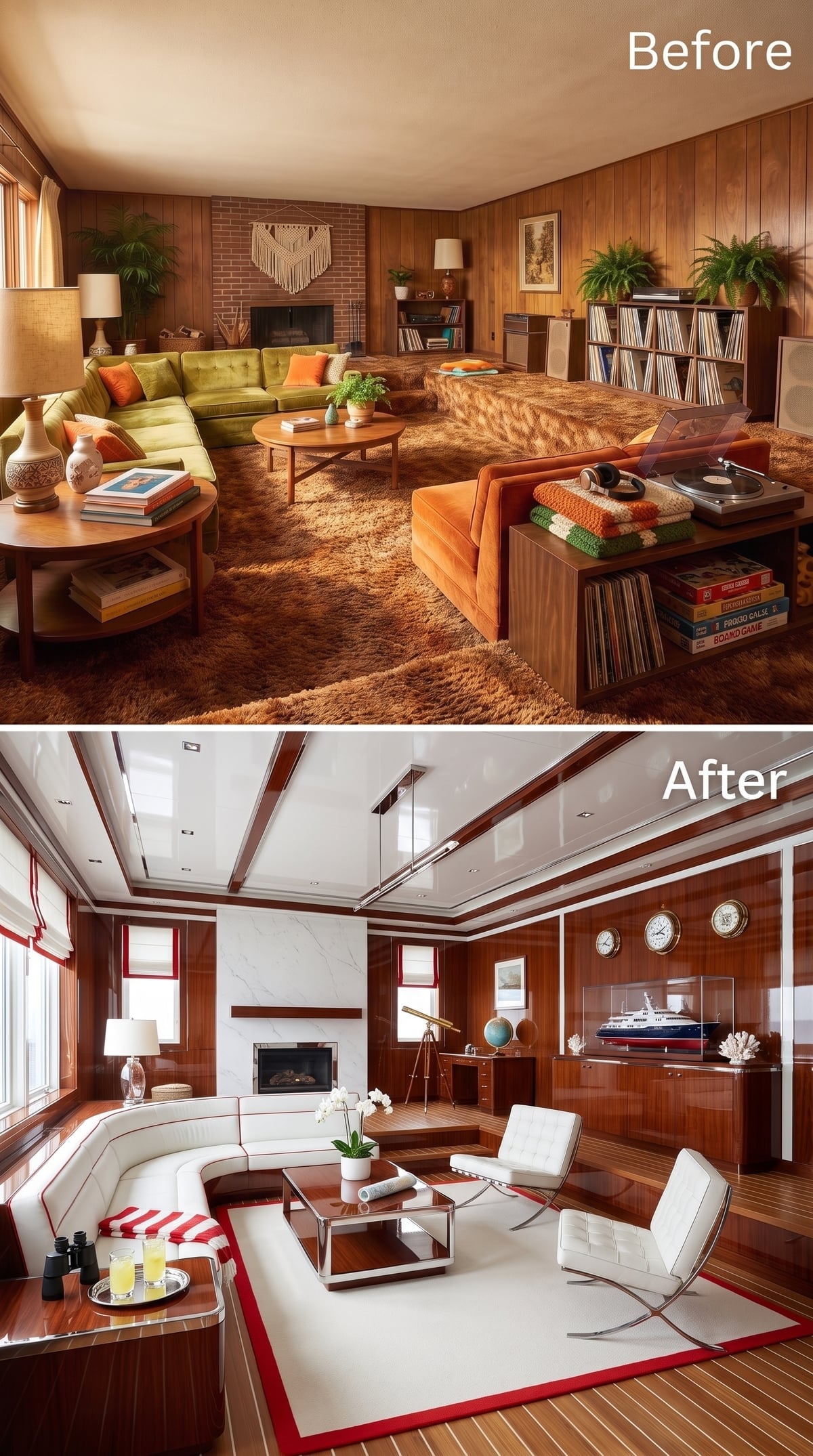
Polished teak-like paneling runs floor to ceiling, and the room immediately takes on the compact richness of a yacht salon. White leather seating with red piping gives all that wood grain a clean counterpoint.
Chrome table bases and a Barcelona-style chair introduce harder, cooler surfaces, while a model ship, brass telescope, and navigational clocks make the nautical reference explicit. Subtle this is not. Coherent, absolutely.
Material Note: Teak has long been valued in marine settings because of its durability and natural oils. In interiors, other warm-toned woods can create a similar visual effect without attempting to reproduce an actual yacht specification.
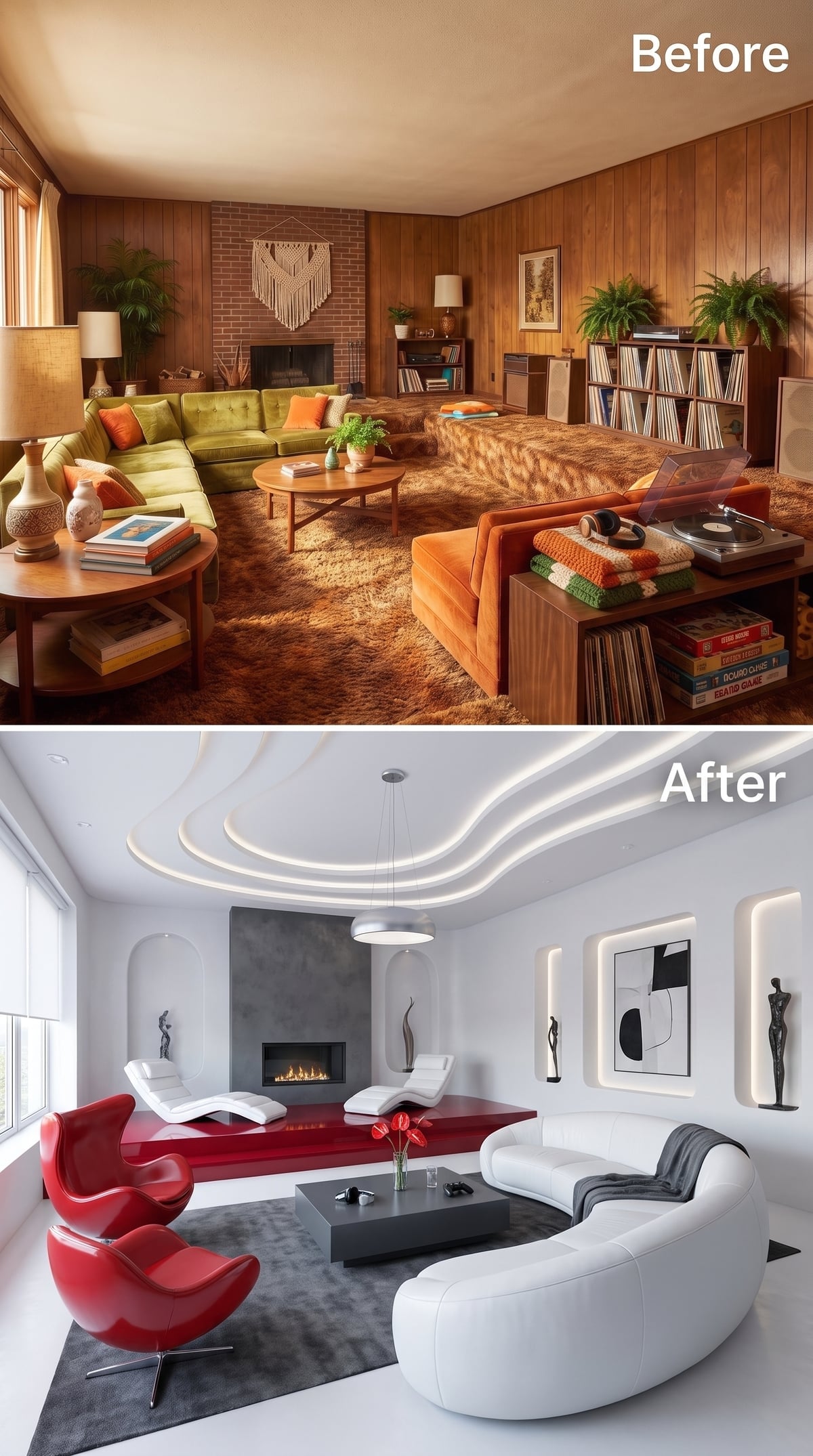
24. White Plaster Curves, Red Lacquer, and Light Drawn Straight Into the Ceiling
🔥 Would you like to save this?
Integrated LED channels carve long illuminated lines through the ceiling, eliminating the need for prominent hanging fixtures in this version.
Below, a curved white sofa faces a glossy red accent table while illuminated arched niches hold sculpture along the wall. The palette barely moves beyond white and red; the geometry does everything else.
23. Hunter Green Wainscoting, Cognac Leather, and an Equestrian Turn
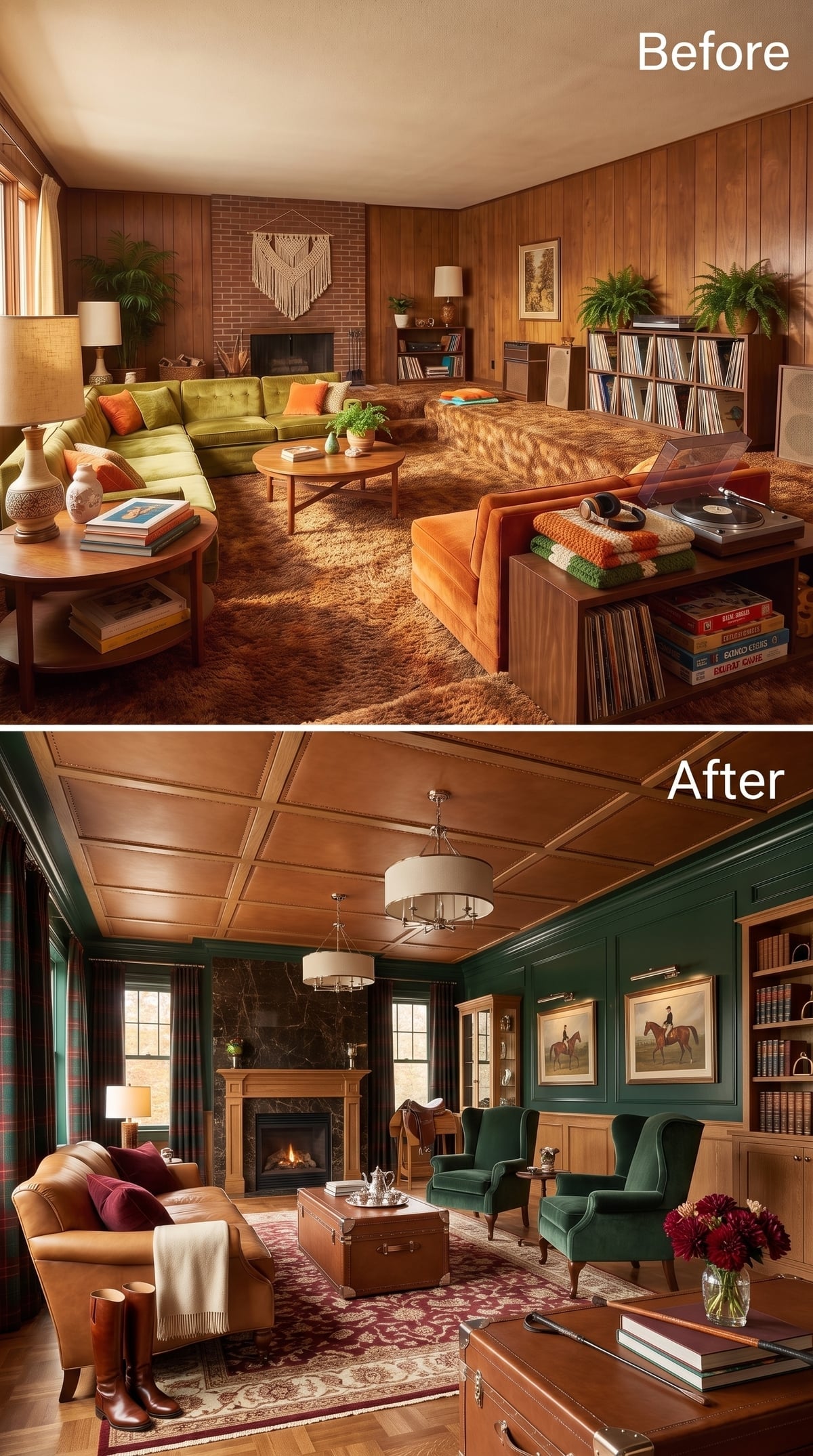
Forest green wainscoting wraps the room while a warm wood ceiling carries the palette overhead. Cognac leather, velvet wing chairs, a trunk coffee table, and marble around the fireplace push the room toward an English-country-club register.
The equestrian painting above the mantel makes the reference obvious, but the real success is color. Green and cognac provide enough richness that very little else needs to compete.
Look Up: The wood ceiling contributes as much warmth as the wall color. When ceilings carry a distinct material instead of disappearing into white paint, they become part of the room’s palette rather than empty space above it.
22. Marble, Amethyst Geodes, and Transparent Furniture Playing With Weight
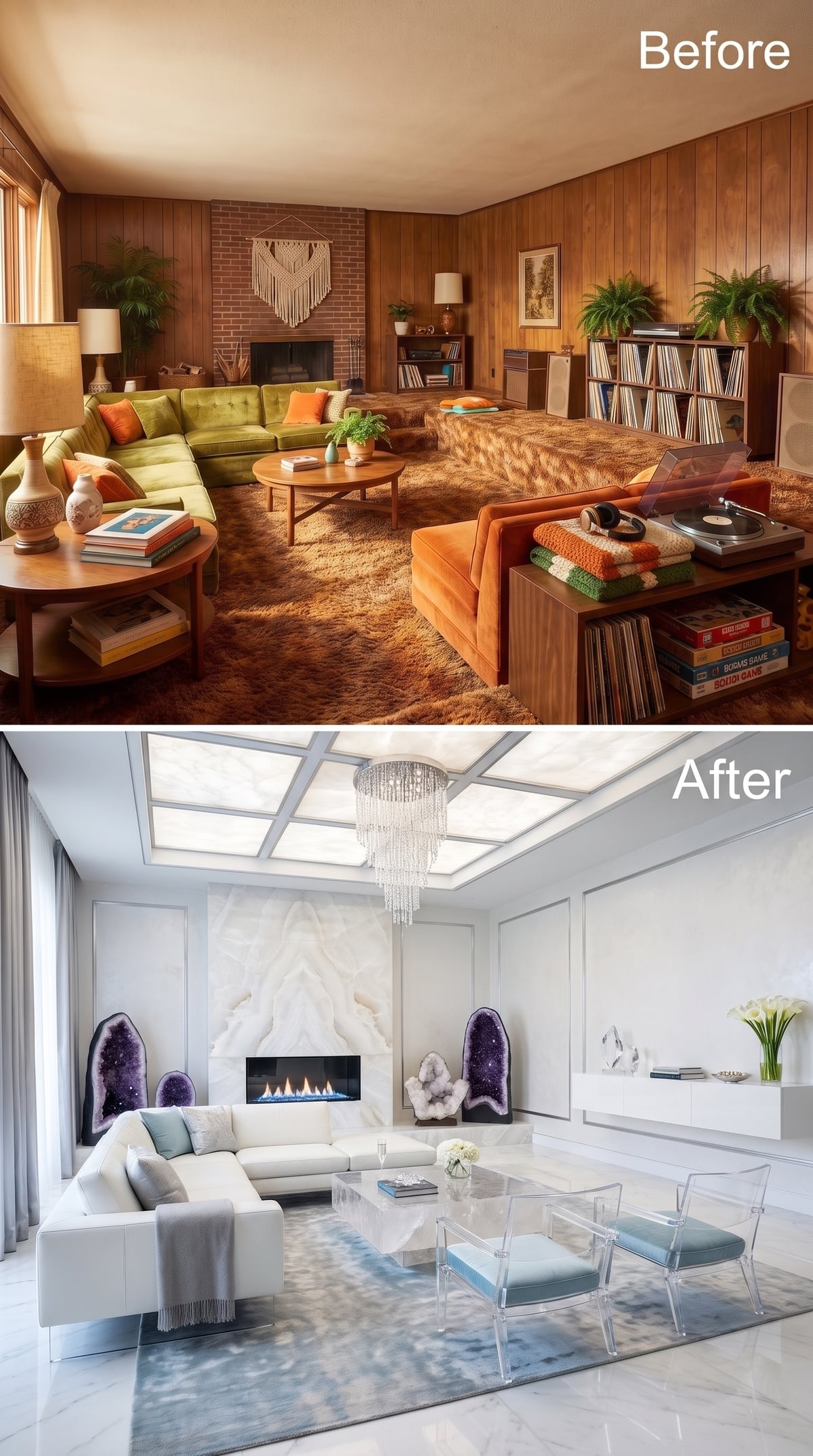
White marble climbs the fireplace wall in a mirrored-looking slab arrangement while two enormous amethyst formations flank the firebox.
Then the furniture nearly disappears. Acrylic-frame chairs and a clear coffee table take up physical space without introducing much visual mass, creating a sharp contrast with the stone and crystal behind them.
Contrast Study: Transparent furniture exposes more of the floor and background than opaque pieces would. Against heavy marble and large mineral forms, that visual lightness creates a deliberate push and pull between substantial and nearly invisible surfaces.
21. Black Marble, Plum Walls, and a Chandelier That Takes the Room Seriously
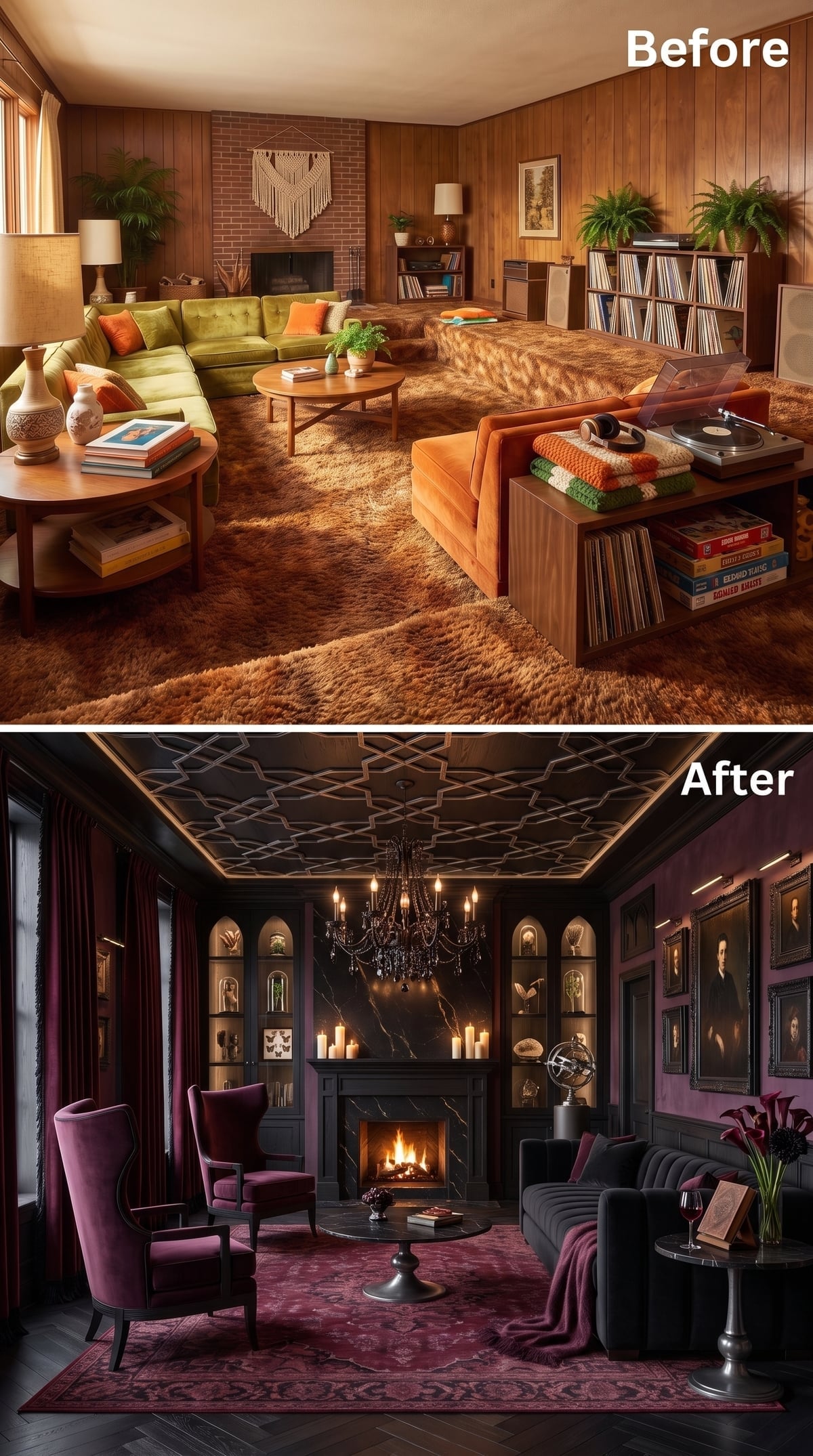
Deep plum walls establish the mood before anything else gets a vote. Black marble frames the fireplace, lit niches puncture the surrounding darkness, and a crystal chandelier hangs low enough to become part of the furniture composition rather than distant ceiling decoration.
Purple velvet chairs and a crimson rug extend the jewel palette downward. Framed portraits make the room even more theatrical.
- The black fireplace wall concentrates the darkest surface in one architectural location.
- Crimson and burgundy keep the room saturated without introducing an unrelated hue.
- The chandelier adds sparkle precisely where the matte walls absorb it.
20. Raw Stone and Reclaimed-Look Wood Pull the Room Toward the Mountains
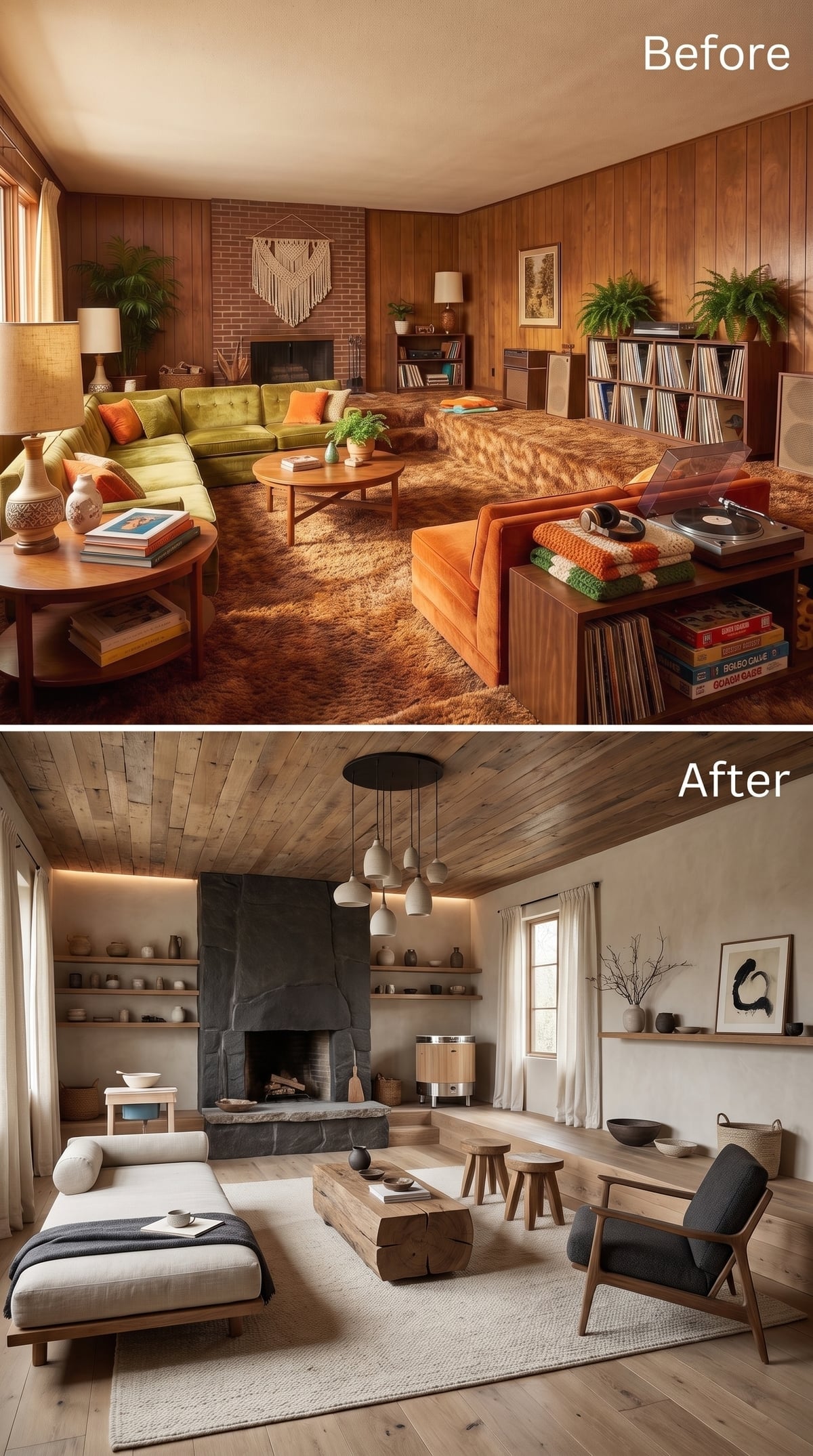
Pale plank cladding across the ceiling immediately changes the direction of the room. Instead of trying to make the ceiling disappear, this version turns it into one of the largest textured surfaces.
A rugged stone fireplace introduces enough irregularity that the wood doesn’t drift into Scandinavian minimalism. The result sits somewhere between modern lodge and mountain retreat, with the materials doing more than the decoration.
Material Balance: Wood overhead and stone on the fireplace give the room two highly textured surfaces, so the rest of the palette can stay comparatively quiet. The tension comes from smooth versus irregular, not from adding more color.
19. Gold Leaf Overhead, Navy Below, and Pink Velvet in the Middle
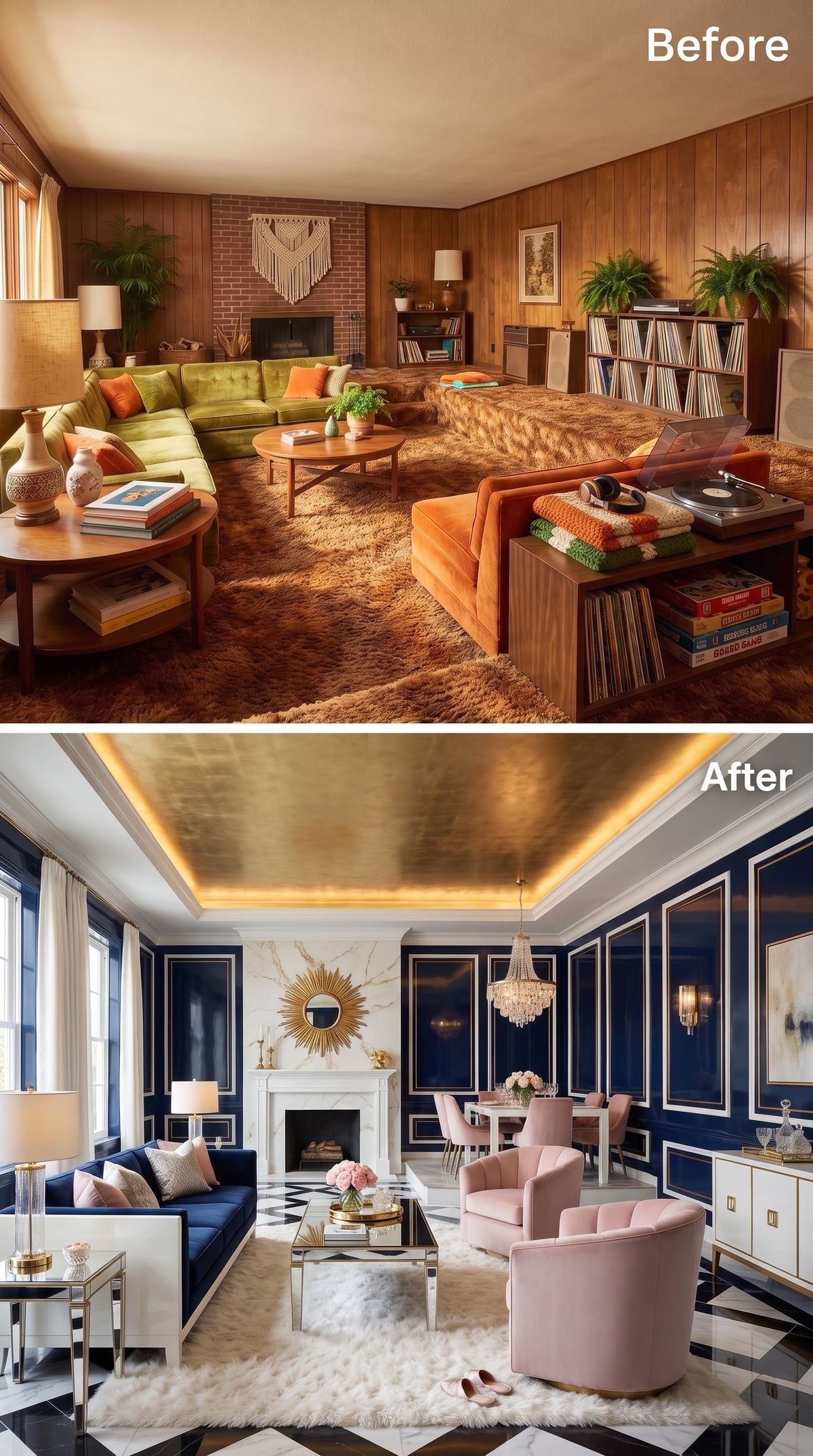
Navy wall paneling sets up a formal grid, then the ceiling goes completely off script in gold.
Pink velvet barrel chairs provide the unexpected bridge between those two extremes, while a white marble fireplace gives the eye one calm place to land. The room has plenty happening, but each element occupies a different plane: navy on the walls, gold overhead, pink at furniture level.
18. River Stone, Blue Velvet, and a Lake-House Revival With No Beige Required
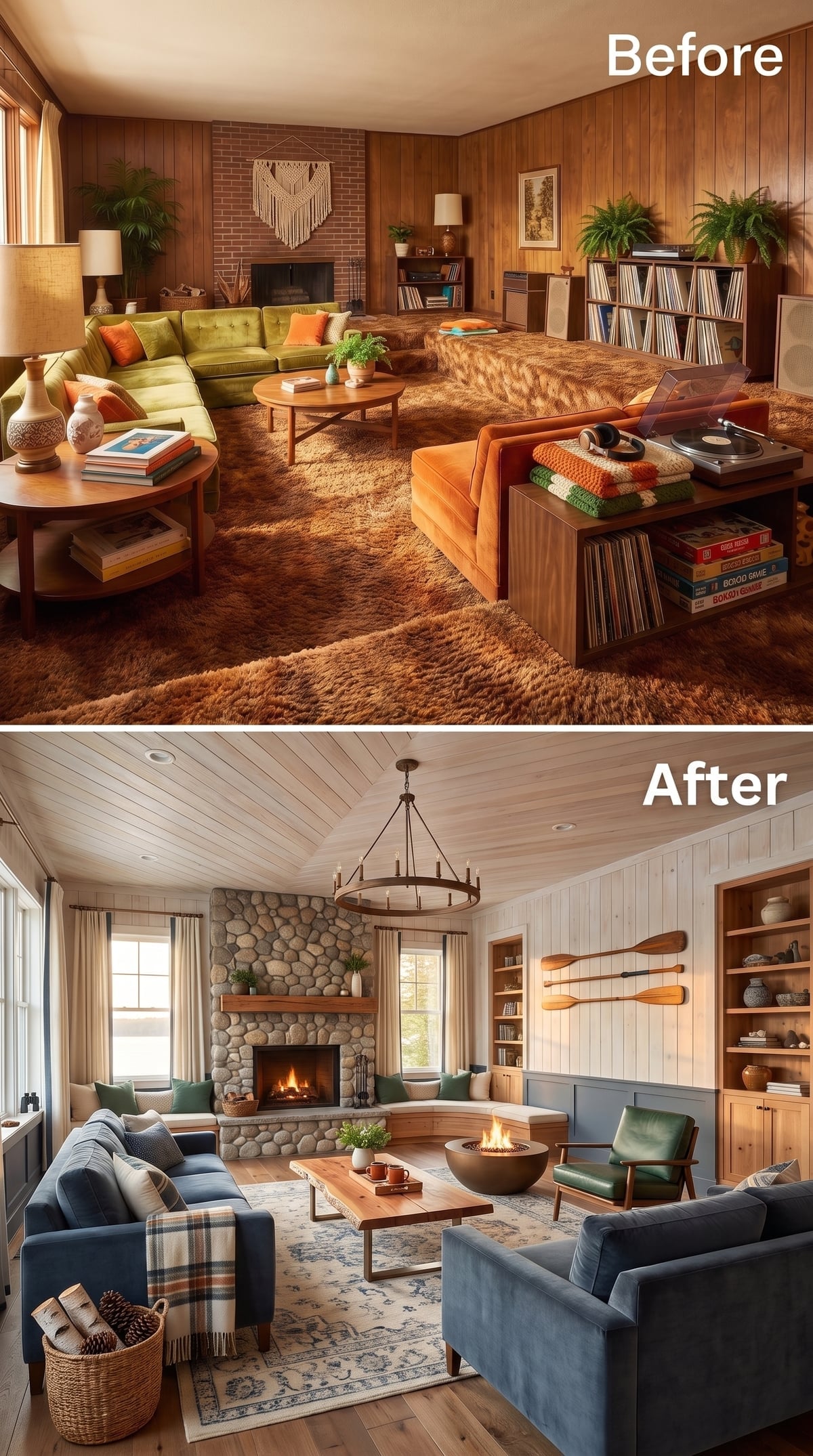
Rounded stone climbs the fireplace wall while saturated blue velvet takes over the seating. A green leather chair and live-edge table introduce more natural color without sending the room back into brown-on-brown territory.
Decorative oars and wrought iron make the lake-house reference explicit, but the blue seating keeps the whole thing from feeling like a cabin assembled from clichés.
Texture Note: Irregular stone gives a fireplace an inherently varied surface, so nearby finishes can be simpler without leaving the room flat. Horizontal boards reinforce the relaxed, elongated character of this particular composition.
17. Copper Overhead, Slate on the Walls, and Leather Warming the Middle
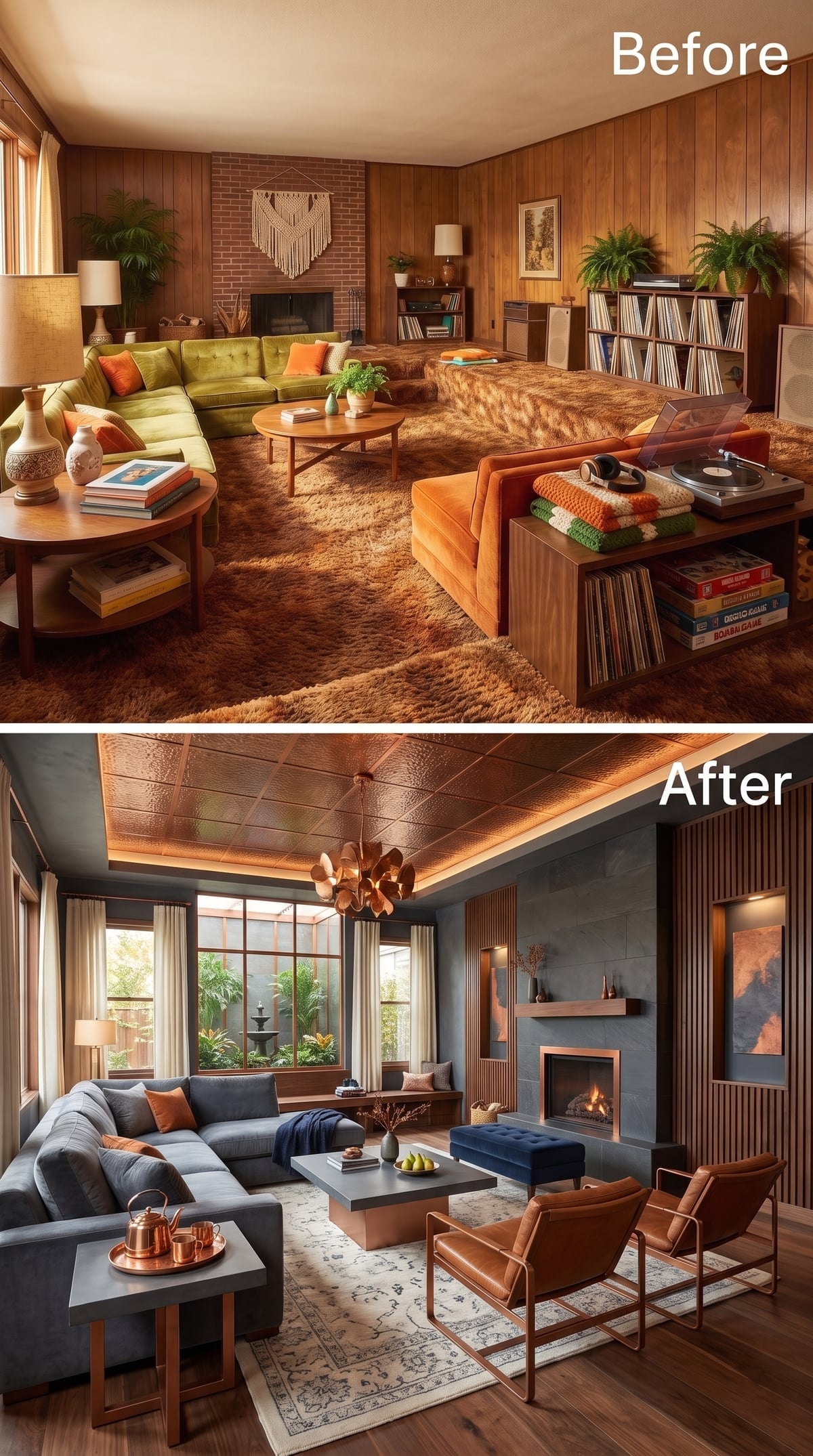
Cool gray plaster meets warm copper overhead, while a slate-blue sectional occupies the middle ground between them.
Cognac leather chairs introduce another warm surface at eye level, and wood slats beside the fireplace draw attention vertically toward the ceiling.
- Copper adds reflectivity to a surface that would otherwise be visually flat.
- Vertical slats reinforce height without changing the actual ceiling line.
- Cool upholstery prevents the warm metal and leather from taking over the entire palette.
16. Arched Niches, Bouclé, and a Ceiling That Finally Joins the Conversation
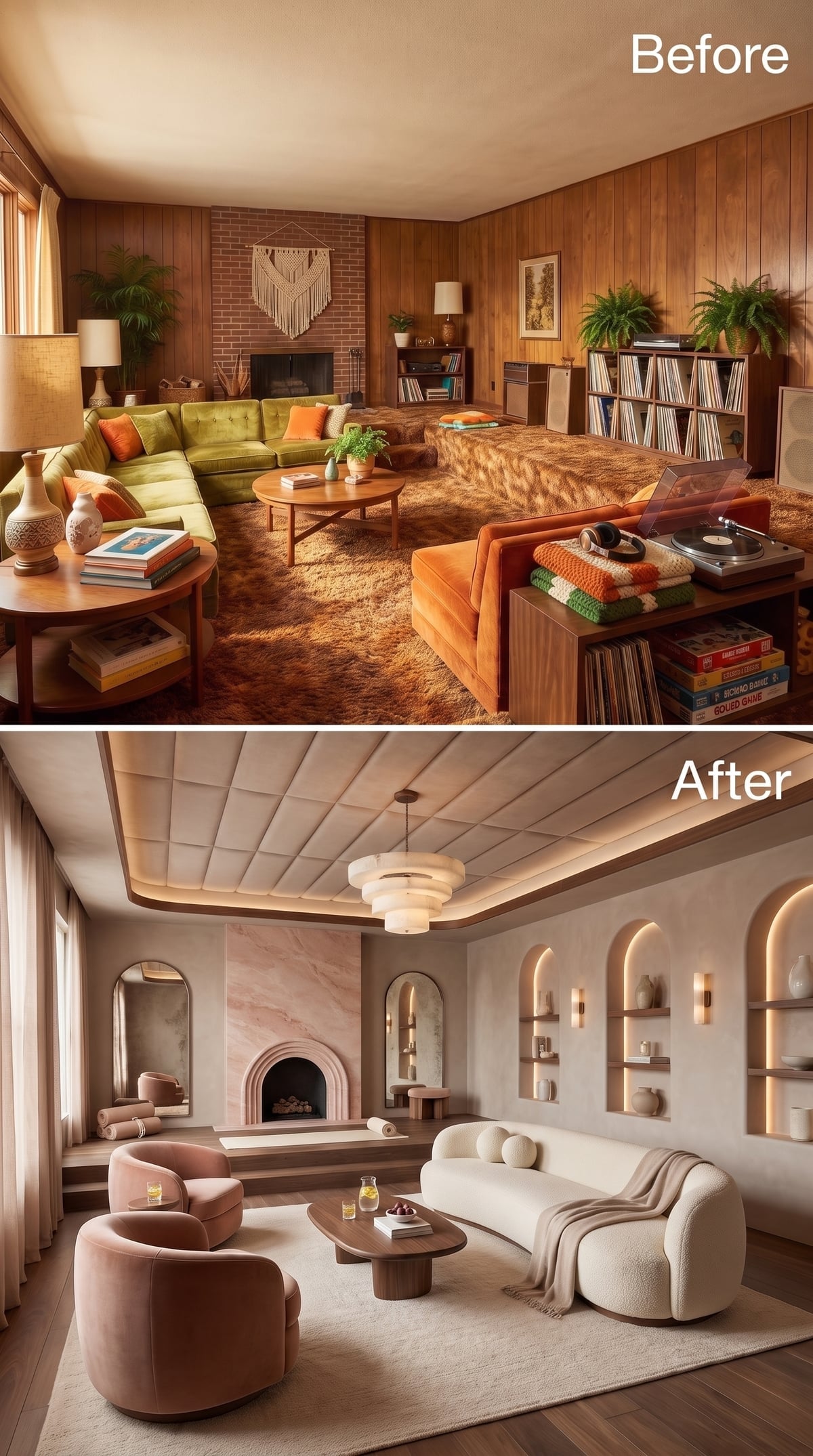
Soft plaster, illuminated arches, and a deeply articulated ceiling give this version an architectural rhythm the original room never attempted.
A pink-veined marble fireplace forms a rounded focal point while low cream bouclé and dusty-rose seating continue the curves at furniture level. An organic walnut coffee table is the one element allowed to be slightly unruly.
Why It Works: Illuminated niches provide display space and ambient light without adding freestanding lamps. If ceiling panels are constructed with absorptive backing or acoustic material, they can also contribute to sound control; visually similar decorative panels alone do not guarantee that effect.
15. When the Living Room Becomes a Private Golf Club
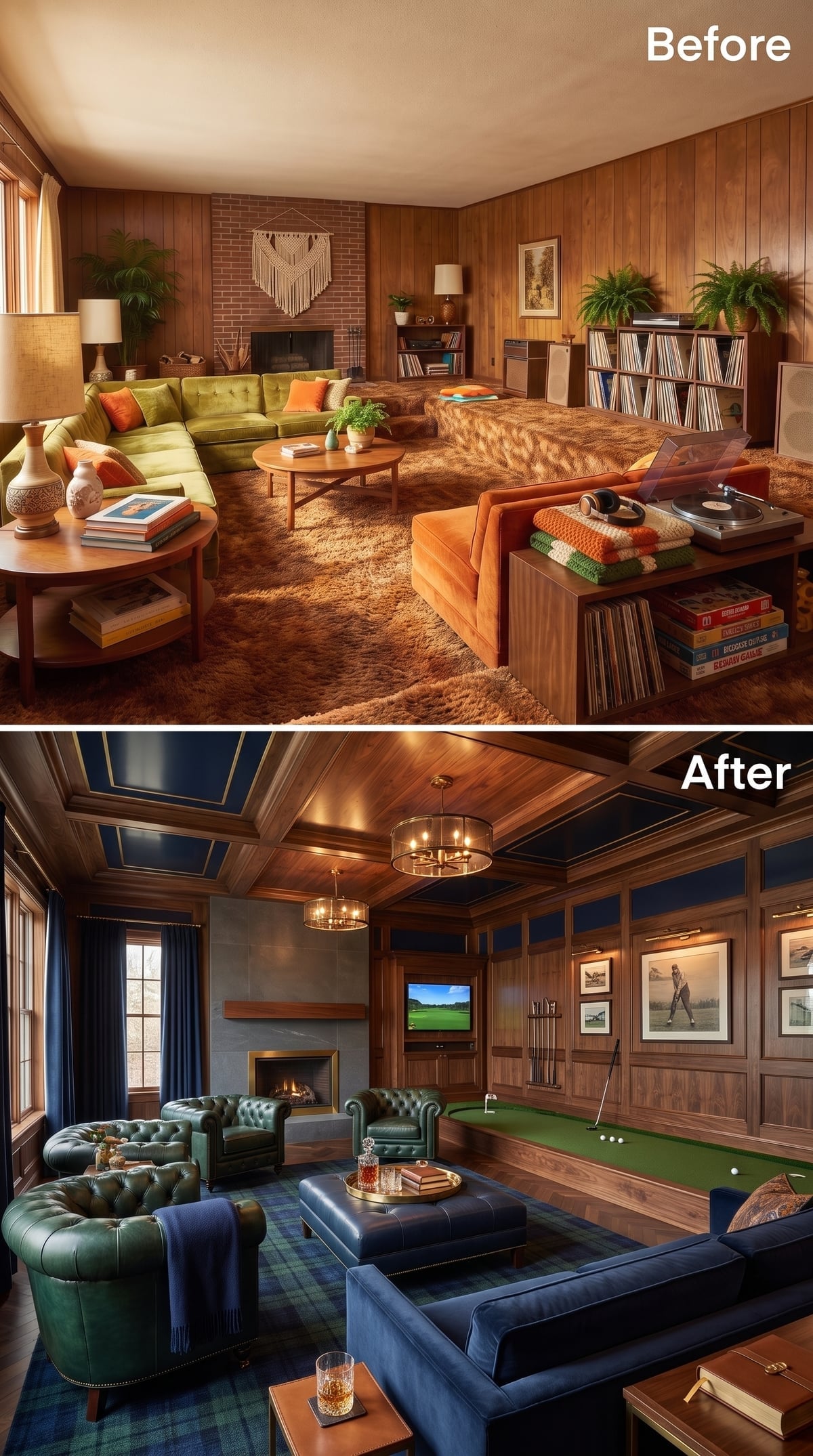
Walnut coffers with navy insets immediately establish the clubhouse mood. Green leather Chesterfield chairs, a long navy sofa, tartan underfoot, and a gold-toned fireplace take the reference the rest of the way.
Then the putting green appears along one side of the room.
A move that extravagant could easily tip into novelty. Here it works because the room has already committed to the premise long before the first golf ball enters the picture.
Material Matters: Contrasting the recessed portions of a coffered ceiling with the framing exaggerates its depth. In this version, dark navy inside warm walnut makes every recess legible even from across the room.
14. Greige, Cove Lighting, and a Projection Screen That Disappears When the Movie Ends
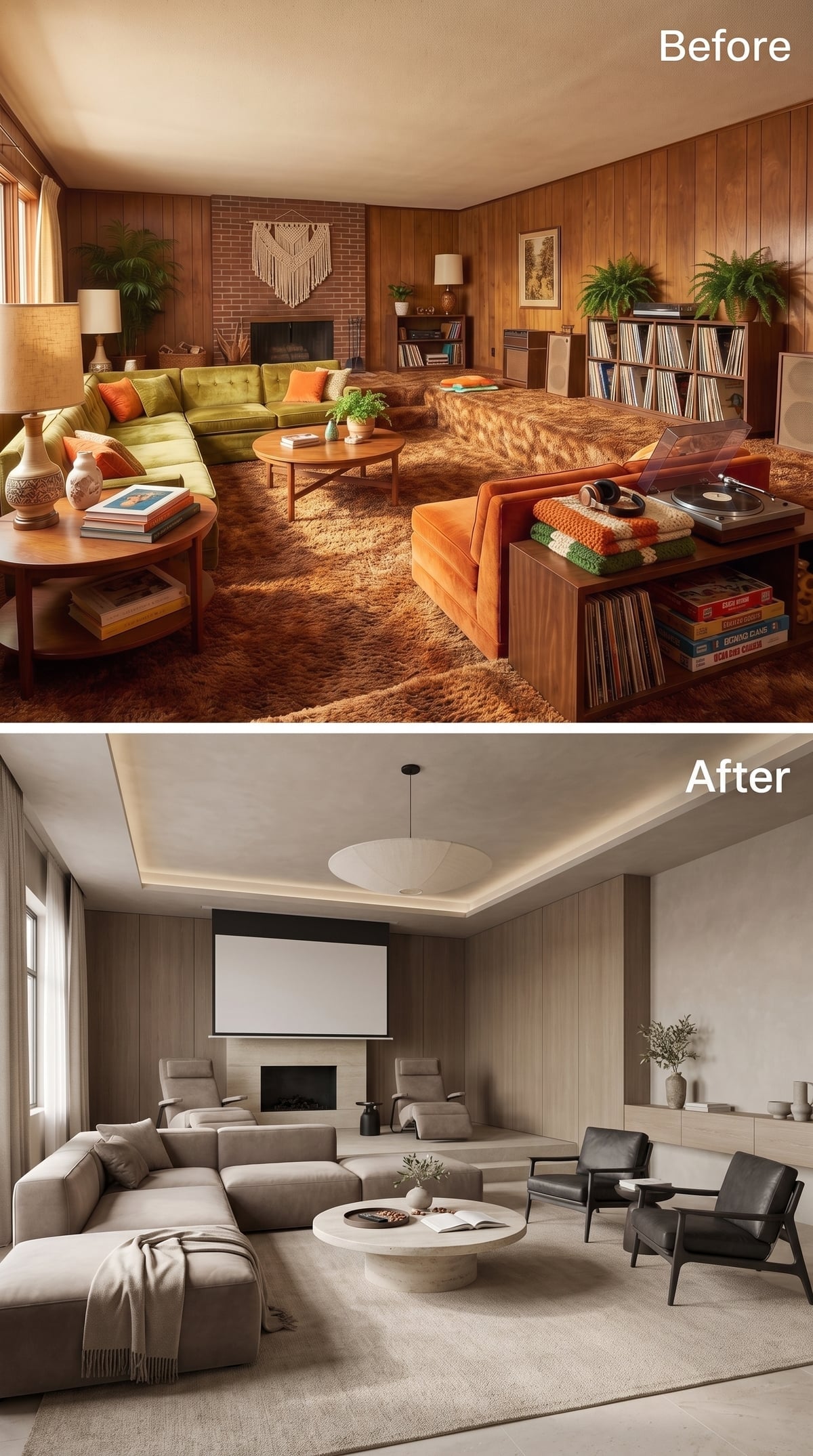
After the putting green, this room feels almost disciplined.
Warm cove lighting wraps the tray ceiling while a broad greige sectional and round concrete coffee table keep the furniture low and visually quiet. Black leather armchairs introduce just enough contrast to prevent the palette from dissolving into beige.
A retractable projection screen turns the fireplace wall into a media surface when needed, then gets out of the way. In a real installation, its placement would need to be coordinated with the fireplace manufacturer’s required heat clearances, but visually the idea is strong: the technology appears only when the room needs it.
13. Glossy Dark Walls, a Sputnik Chandelier, and Zero Apologies
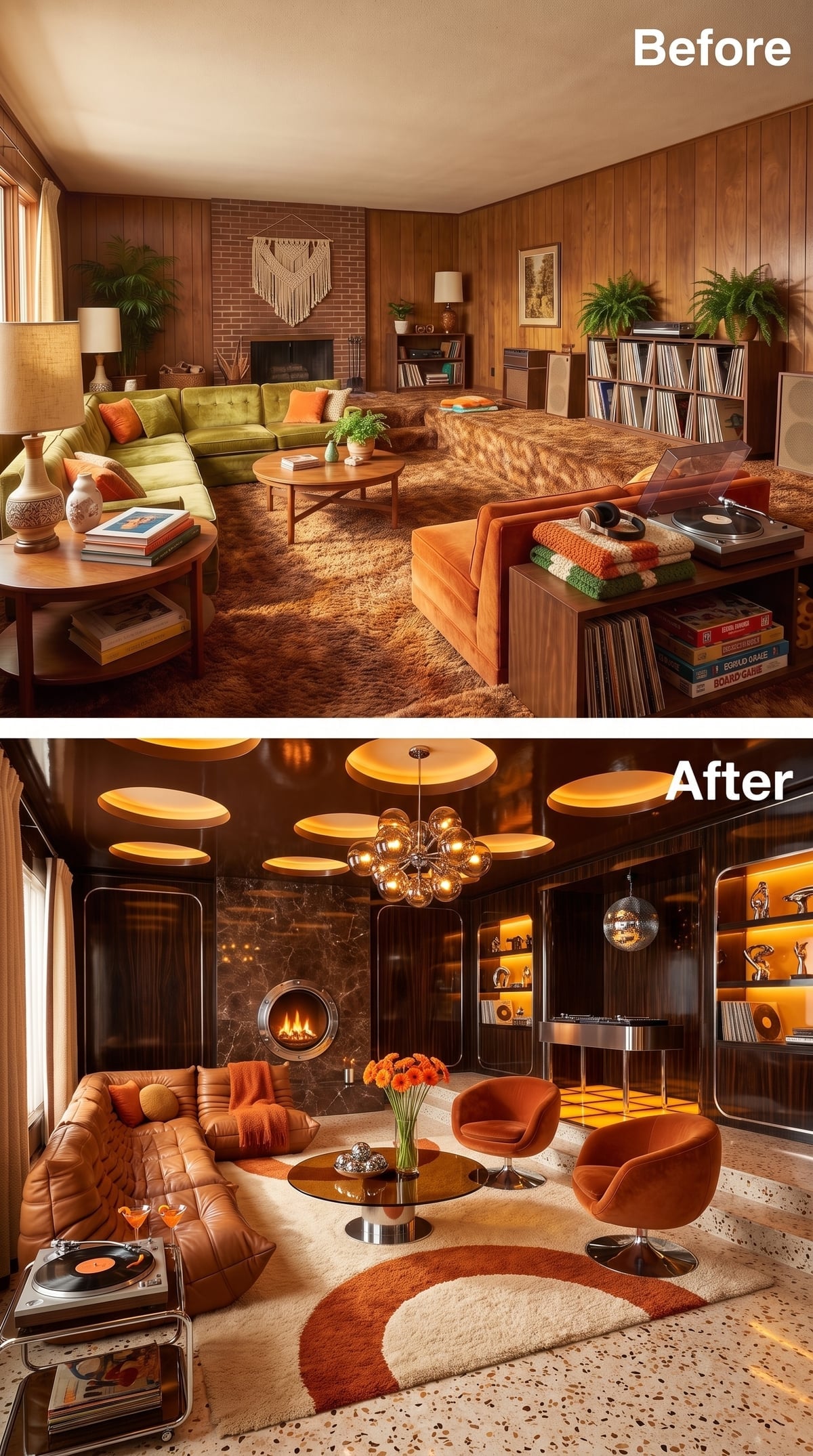
Lacquered chocolate-brown panels cover the walls from floor to ceiling, and the effect lands somewhere between 1970s glamour and private members’ club. Circular ceiling recesses glow amber overhead while a chrome Sputnik chandelier drops into the middle of the composition and makes no attempt at modesty.
Terrazzo replaces shag underfoot. Cognac leather, rust velvet, chrome, and glass give the room enough contrast that the brown never becomes monotonous. Even the orange flowers work because they’re one small hit of saturation rather than another entire surface demanding attention.
Color Story: Cognac and burnt orange preserve the warmth of the original palette without depending on wood grain everywhere. Chrome and pale terrazzo interrupt the darker surfaces before the room becomes one continuous field of brown.
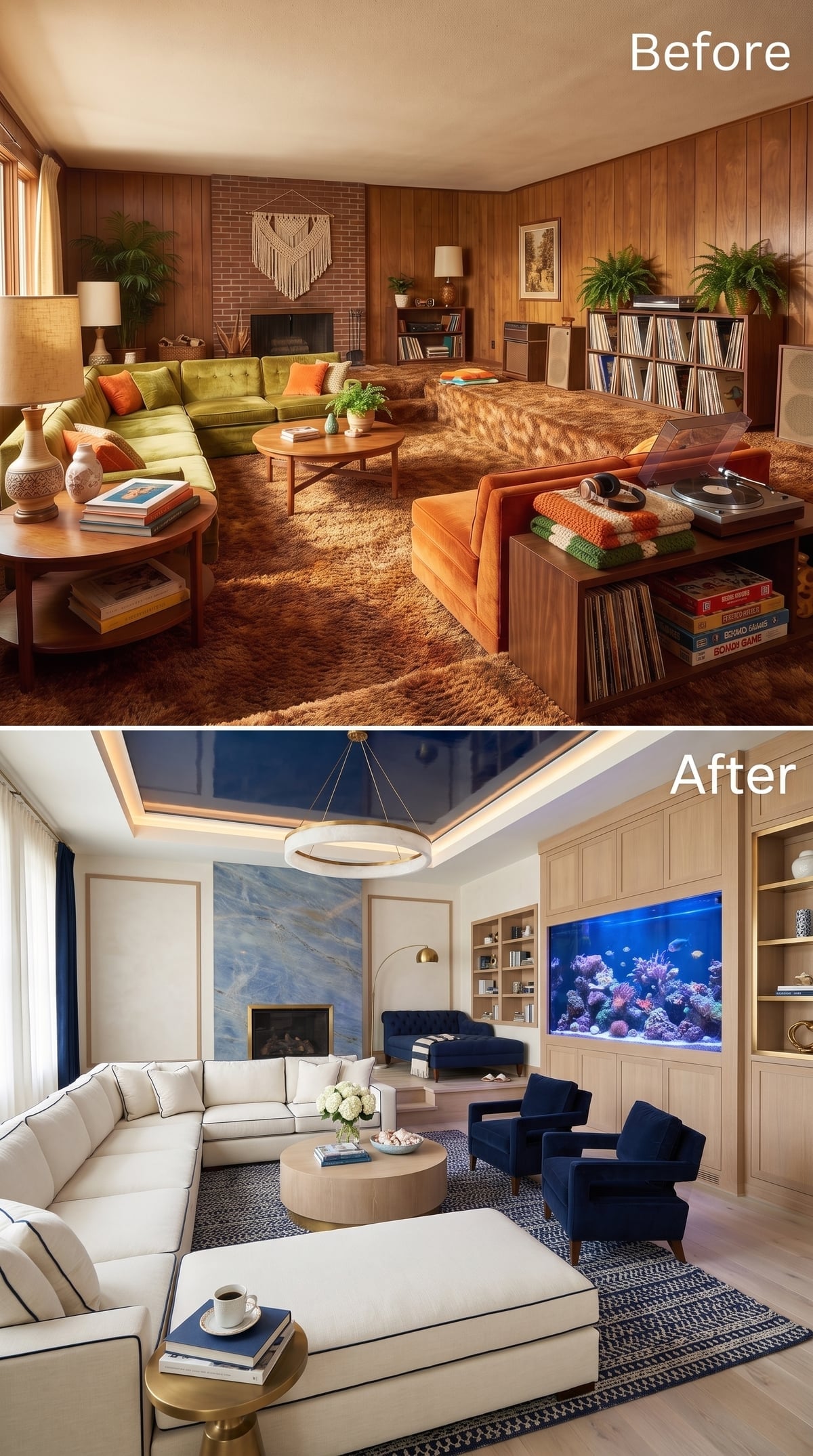
12. Built-In Reef Tank, Navy Lacquer, and a Fireplace Willing to Share Attention
🔥 Would you like to save this?
A navy lacquered tray ceiling presses visually downward while pale cabinetry and a cream sectional keep the lower half much lighter.
But the fireplace isn’t the focal point this time. A large reef-style aquarium set into the wall beside it glows blue against the warmer interior lighting. Coral forms and aquatic color turn the tank into a moving artwork rather than another piece of furniture.
The blue marble around the fireplace quietly picks up the aquarium color without copying it literally.
11. Navy Velvet, Marble, and a Starburst Ceiling That Refuses to Be Background
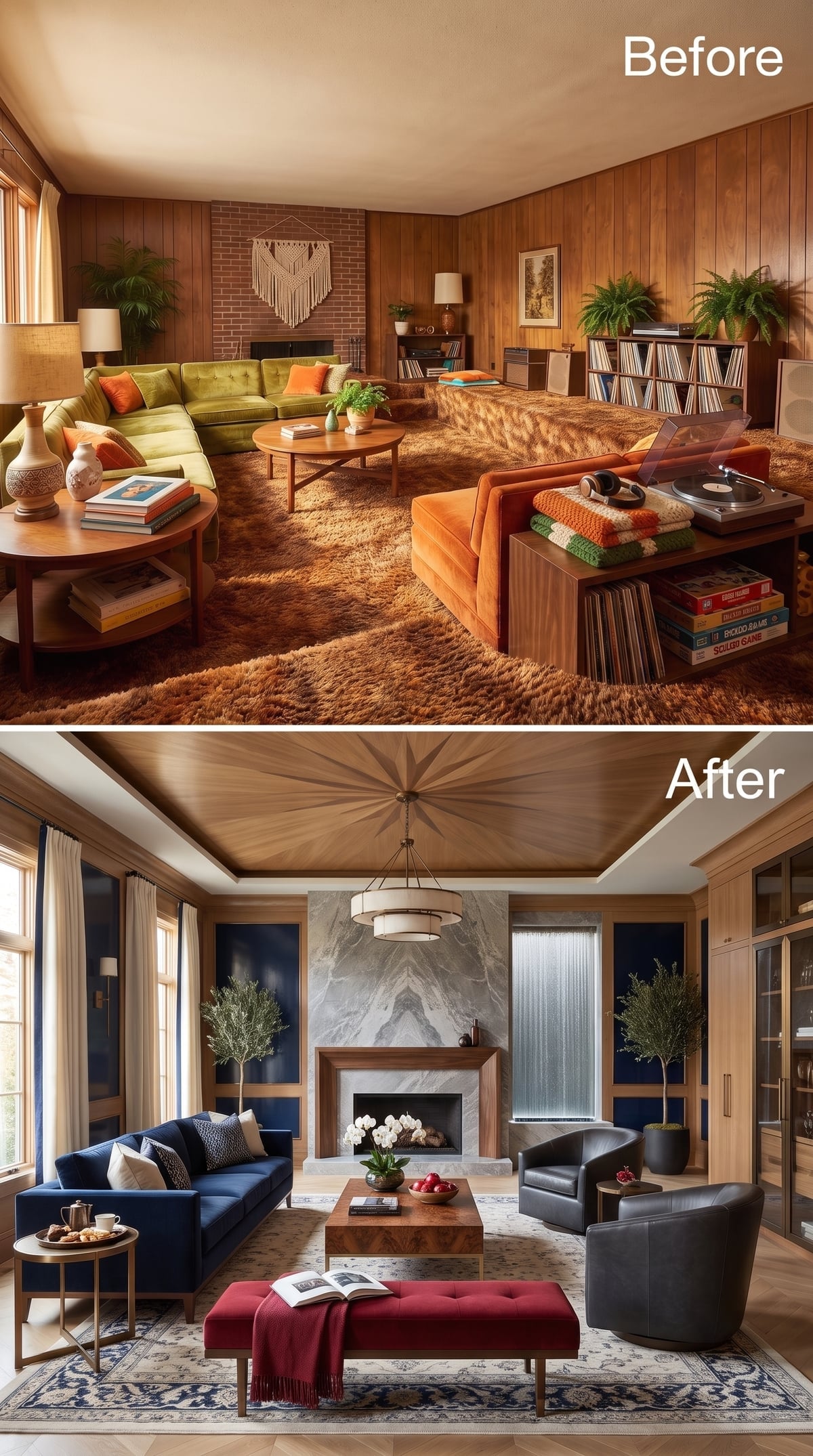
Walnut-toned wall panels rise in vertical strips while navy velvet takes over the largest furniture surface. White cushions break up the saturation, and a crimson ottoman gives the center of the room a much warmer hit.
The fireplace wall uses strongly mirrored-looking marble veining, but the ceiling may be even more memorable: wood strips radiate outward from a single pendant in a starburst formation.
Stone Note: True bookmatching uses adjacent slabs opened like pages so the veining mirrors across a seam. When planning the effect in a real room, slab dimensions and the location of seams matter as much as the stone itself.
10. Cream Bouclé, Warm Walnut, and a Fireplace Worth Building Around
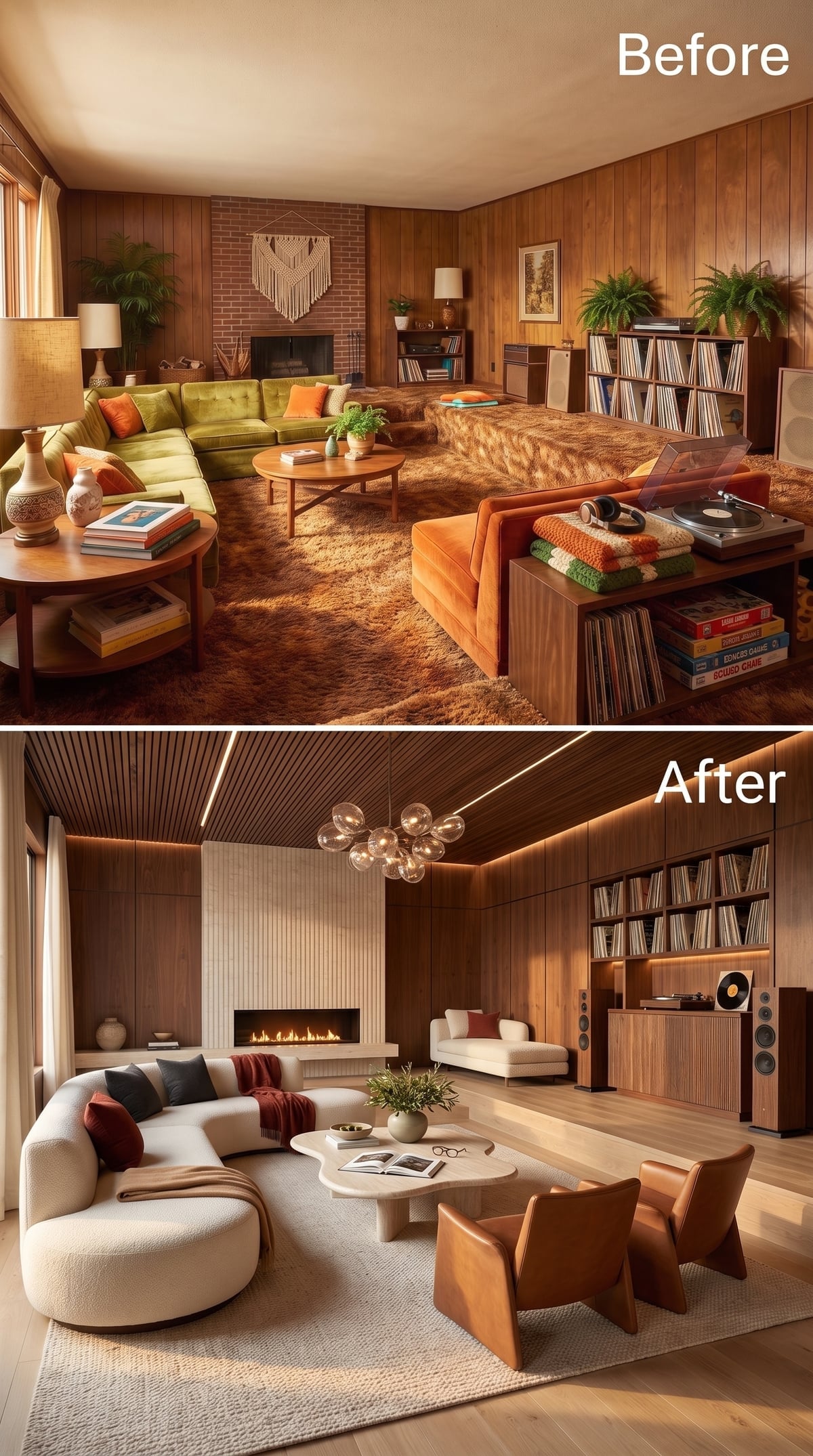
The curved cream sectional spreads low across the room, while two angular cognac leather chairs introduce enough structure to keep all that softness from drifting away.
Slatted walnut panels run floor to ceiling, with warm cove lighting tracing the ceiling above them. A linear fireplace sits inside a fluted plaster surround, while built-in shelving for the record collection deliberately carries one recognizable piece of the room’s 1970s identity forward. Here, it reads as a reference rather than the organizing idea.
9. Limestone, a Circular Ceiling Coffer, and a Sauna-Inspired Corner
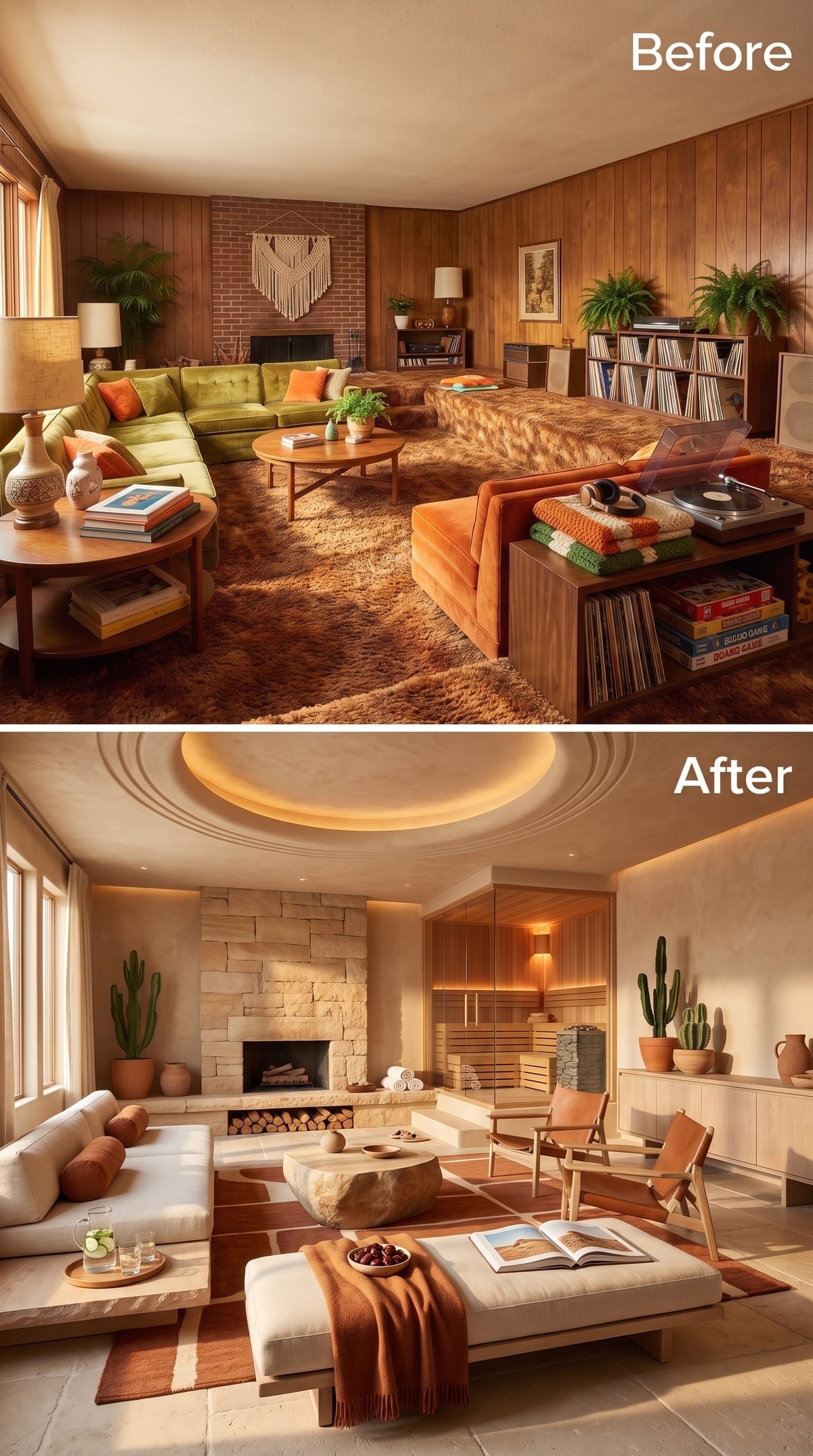
Sand-colored limestone covers the fireplace wall, setting a much quieter temperature than the jewel-toned rooms around it.
Above, a circular recessed ceiling feature introduces warm light without another hanging fixture. Cream seating, terracotta pattern, and a boulder-like coffee table continue the soft desert palette.
At the back sits a slatted wood alcove with stacked stones, clearly borrowing the visual language of a sauna even if the image doesn’t establish a fully enclosed working sauna.
Design Note: Slatted wood, pale stone, warm light, and sparse planting are enough to evoke a wellness space without covering the entire room in spa clichés. Here the reference remains architectural rather than decorative.
8. Blue-and-White Toile Climbs All the Way Onto the Ceiling
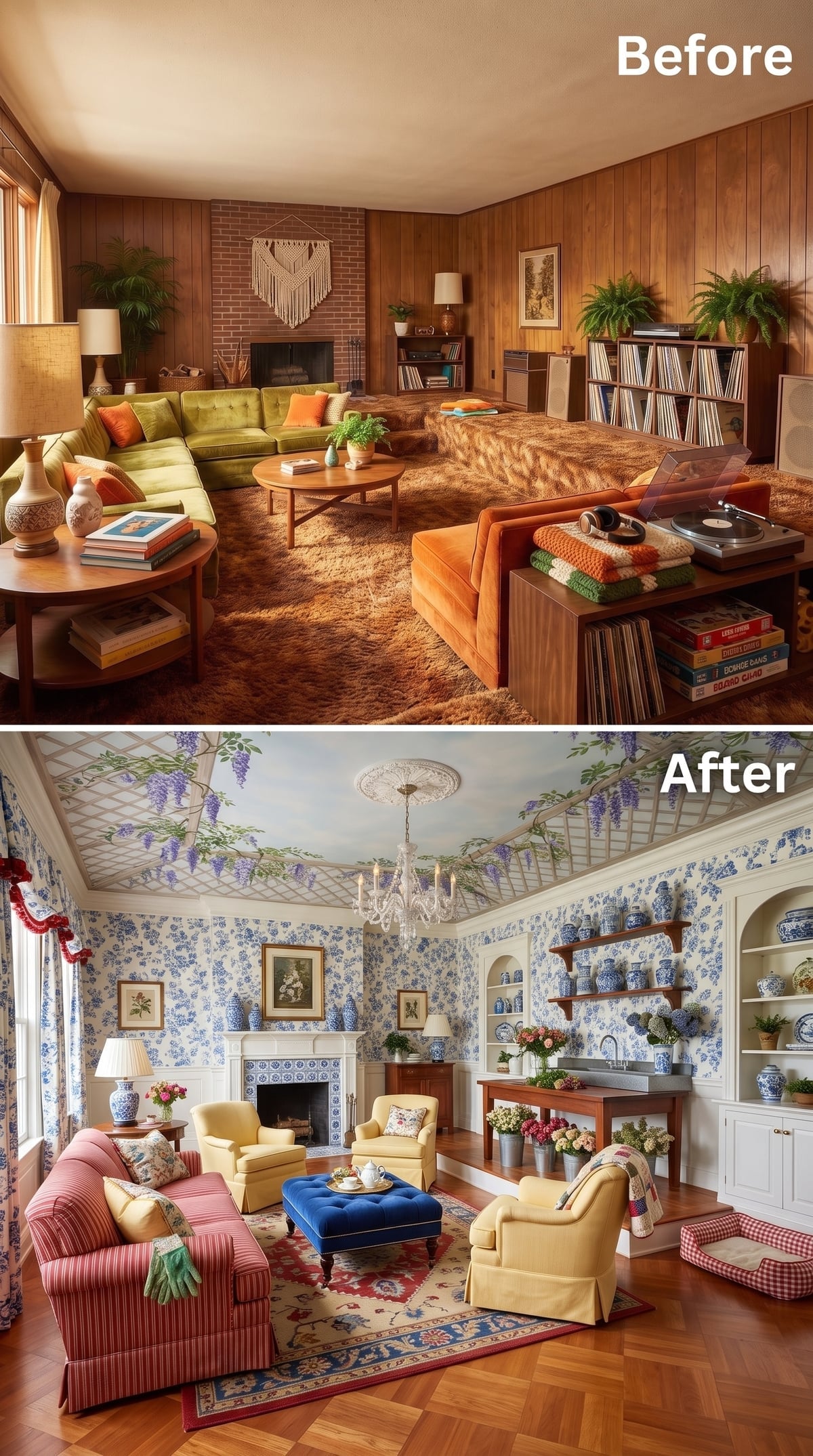
Blue-and-white botanical pattern covers the walls, then keeps going overhead in the form of painted wisteria climbing through a ceiling grid.
Butter-yellow chairs and a rose-striped sofa introduce colors that would seem almost reckless in isolation. Here they work because the blue-and-white porcelain collection repeats so heavily across the room that it behaves like another architectural surface.
Herringbone wood underfoot gives the entire floral composition something solid to stand on.
7. Dark, Dramatic, and Completely Unbothered by Convention
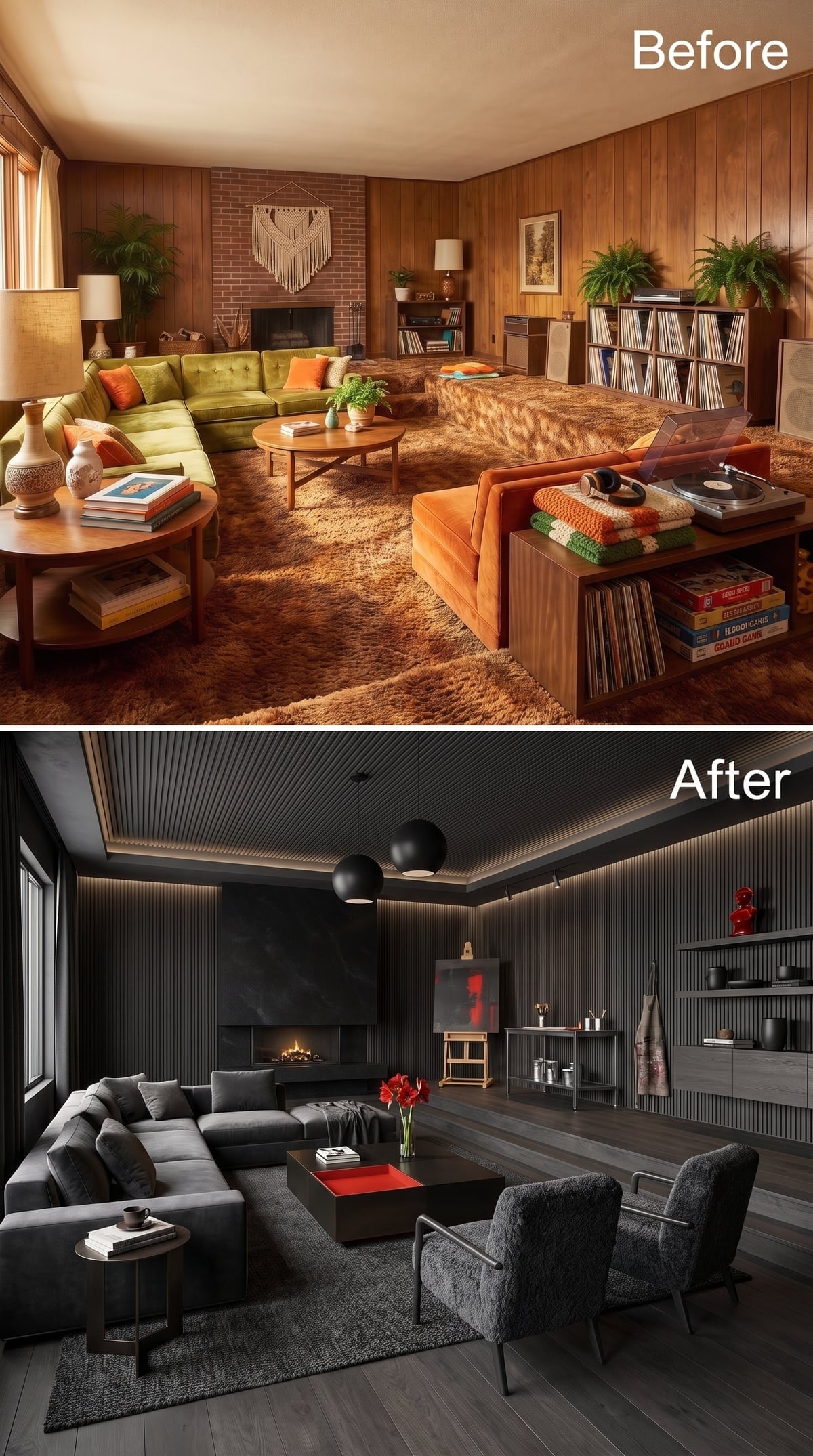
Charcoal spreads across the walls, ceiling, and sectional until the entire room becomes almost monochromatic.
What prevents it from collapsing into one dark mass is light. An amber cove runs around the ceiling perimeter, spherical black pendants hang over the seating, and tiny hits of red appear in flowers and tabletop accents.
The fireplace wall stays dark too, which means no single pale surface breaks the mood. This version commits to shadow and then designs the lighting accordingly.
6. Onyx, Terrazzo, and One Sputnik Chandelier Holding the Whole Thing Together
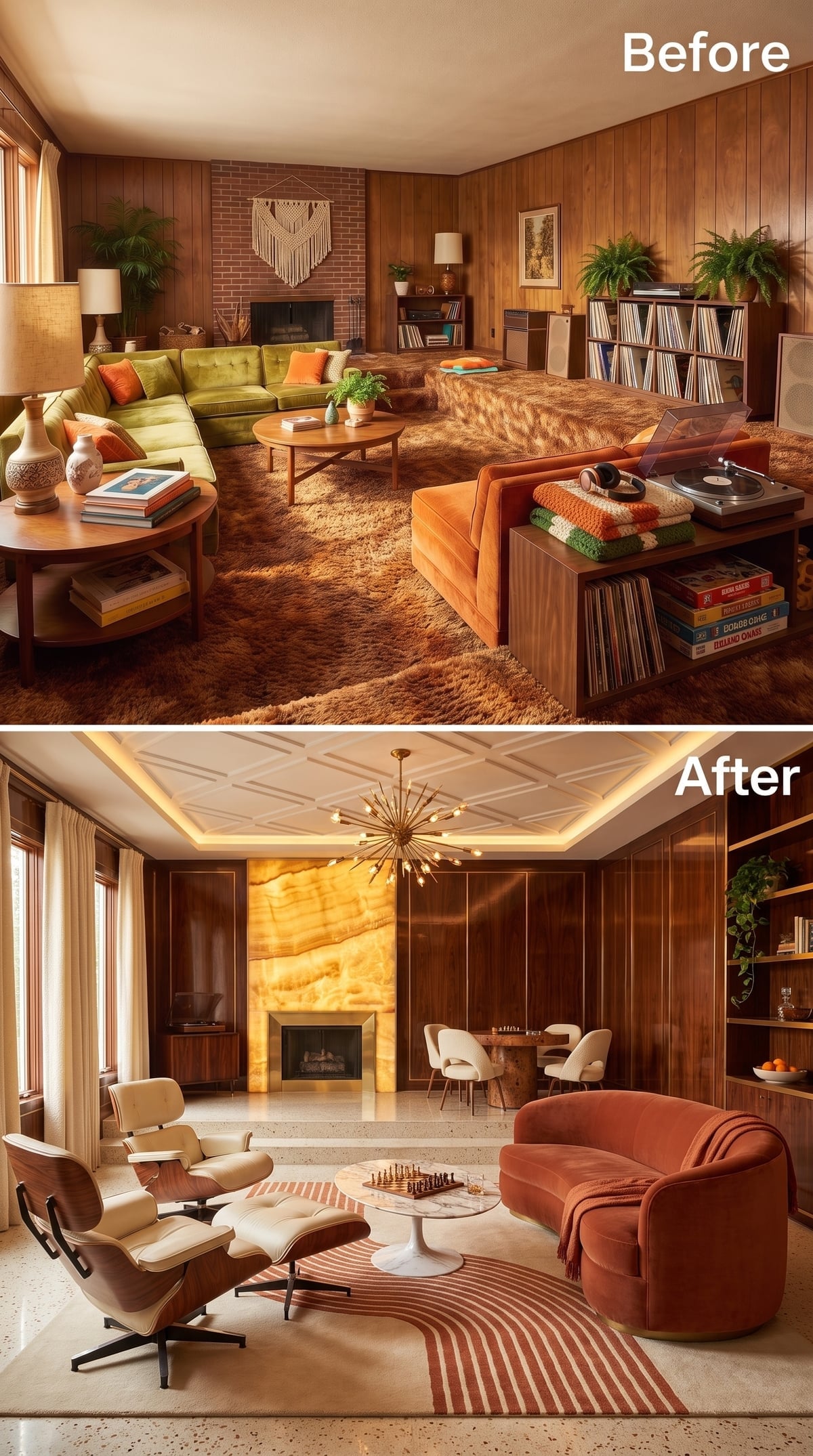
Honey-toned onyx-like stone takes over the fireplace wall, its translucent appearance giving the surface a luminous quality no flat paint could imitate.
Terrazzo flooring introduces a much cooler, finer-grained texture below. An Eames-style lounge chair sits opposite a curved rust sofa while a Sputnik chandelier connects the warm metal details overhead.
When one material is this expressive, everything around it gets permission to calm down.
5. Slate, Plaid, Vintage Skis, and a Pool Table With Somewhere to Be
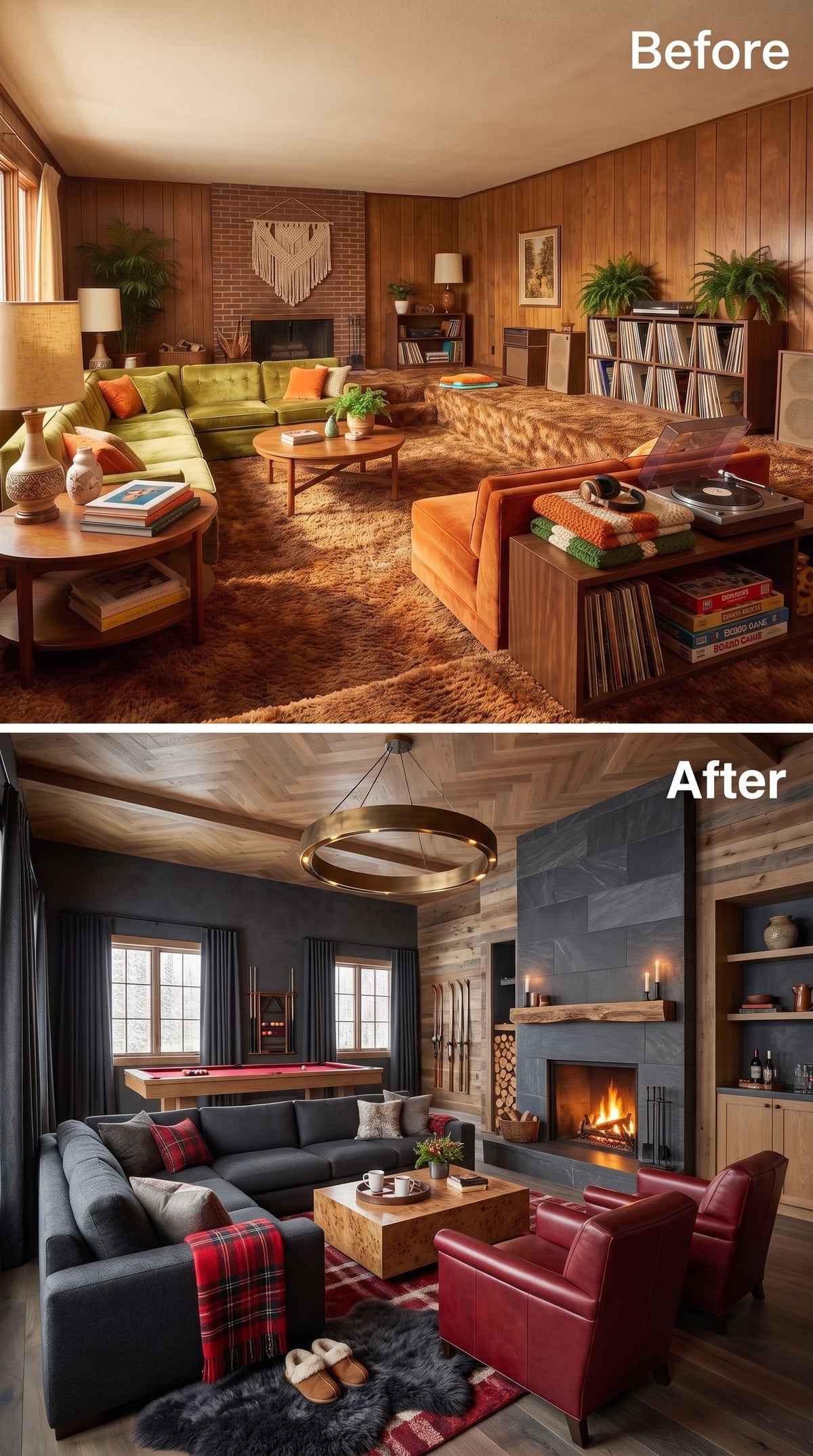
Charcoal seating and crimson leather create the first contrast. The second comes from the fireplace: dark slate rising floor to ceiling with a live-edge mantel cutting through the middle.
Vintage skis climb the wall beside it while red-and-black plaid appears in smaller doses across the seating. At the rear, a pool table creates a second destination within the room rather than forcing every activity into the sofa arrangement.
Quick Fix: Secondhand skis can make surprisingly effective large-scale wall objects in mountain or lodge-inspired rooms. The weathering, old bindings, and unusual proportions can provide more character than generic oversized artwork.
4. Gold Botanicals, a Library Ladder, and Leopard Ottomans in the Same Room
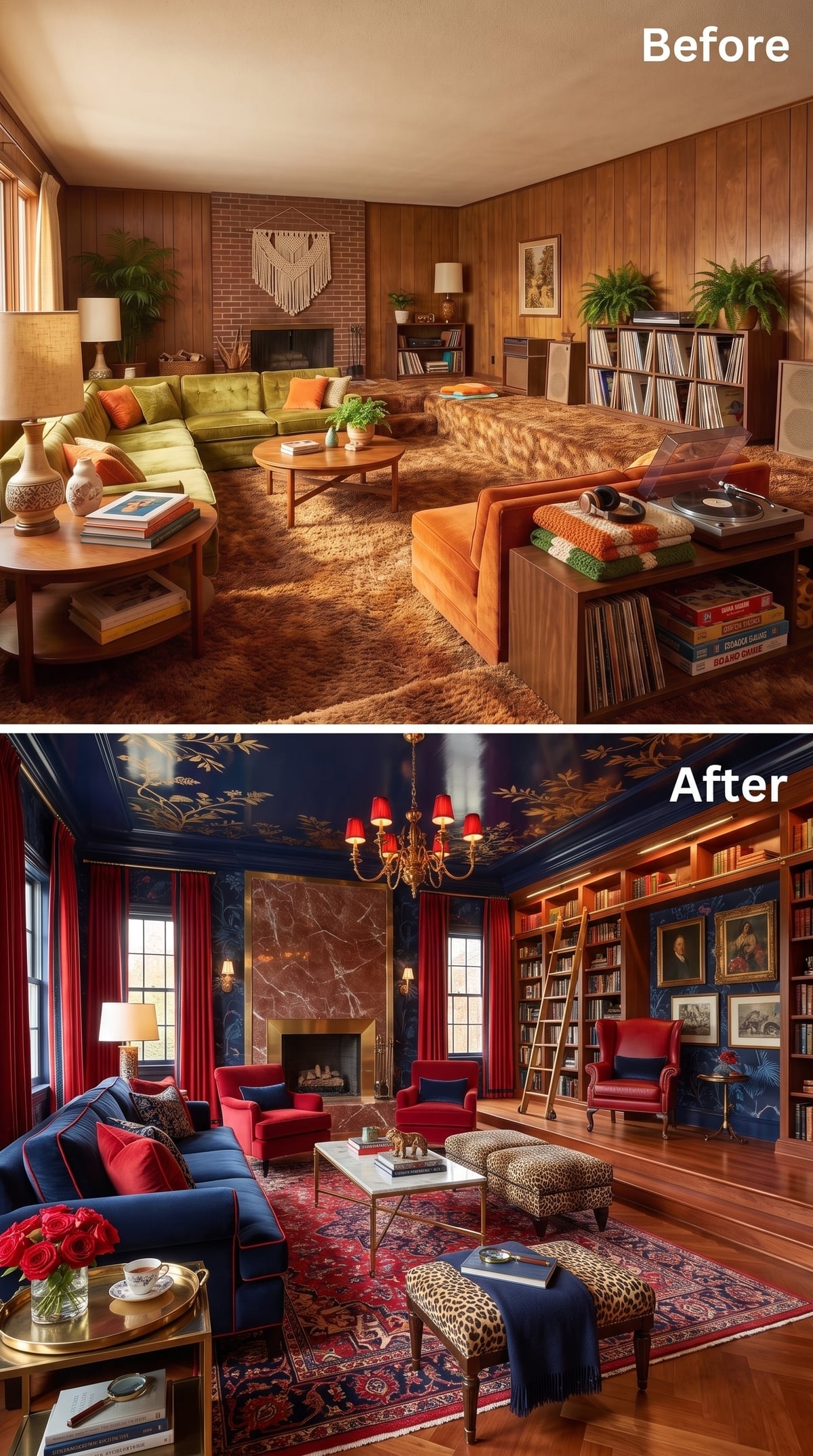
Gold botanical forms sprawl across the navy ceiling before your eye ever reaches the furniture.
Below, crimson velvet chairs flank a marble fireplace while a navy sectional faces leopard-print ottomans. Floor-to-ceiling bookshelves surround the room, and a rolling library ladder adds both access and theater.
This is maximalism with a hierarchy: ceiling first, books second, furniture third. Nothing is quiet, but at least everybody knows the running order.
3. Dark Steel Coffers, Cognac Chesterfields, and Wine Behind Glass
🔥 Would you like to save this?
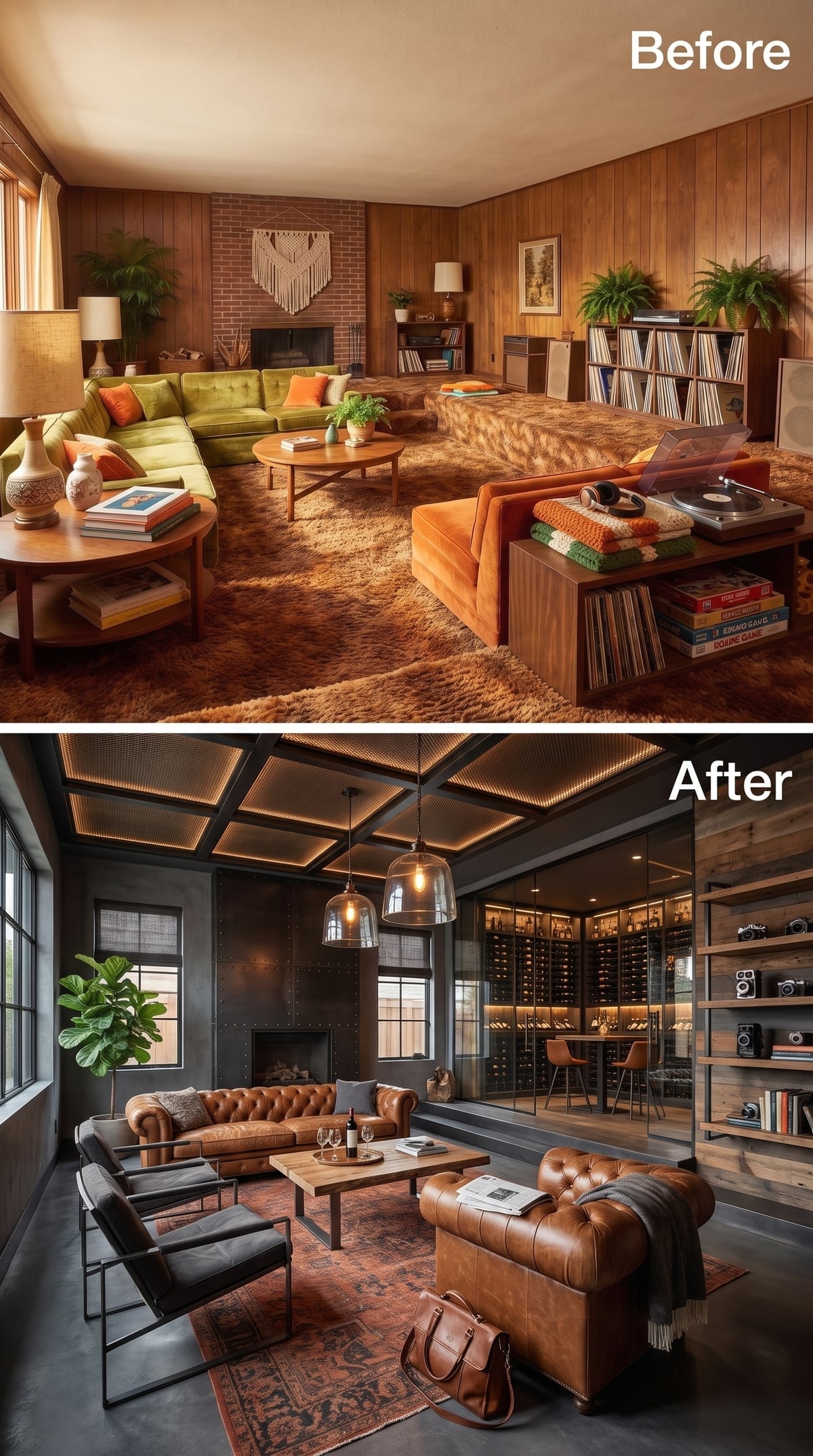
Near-black ceiling coffers give the room a hard architectural grid while cognac leather Chesterfields introduce warmth at seating level.
Edison-style pendants drop through the grid at varying heights. Behind them, a floor-to-ceiling glass wine display becomes an illuminated wall rather than a separate cabinet.
The room is dark, but the wine wall gives that darkness depth rather than simply adding another black surface.
A wine collection becomes much more architectural when the storage itself is treated as a wall.
2. Cobalt Velvet, Red Crystal, and a Ceiling That Catches Every Scrap of Light
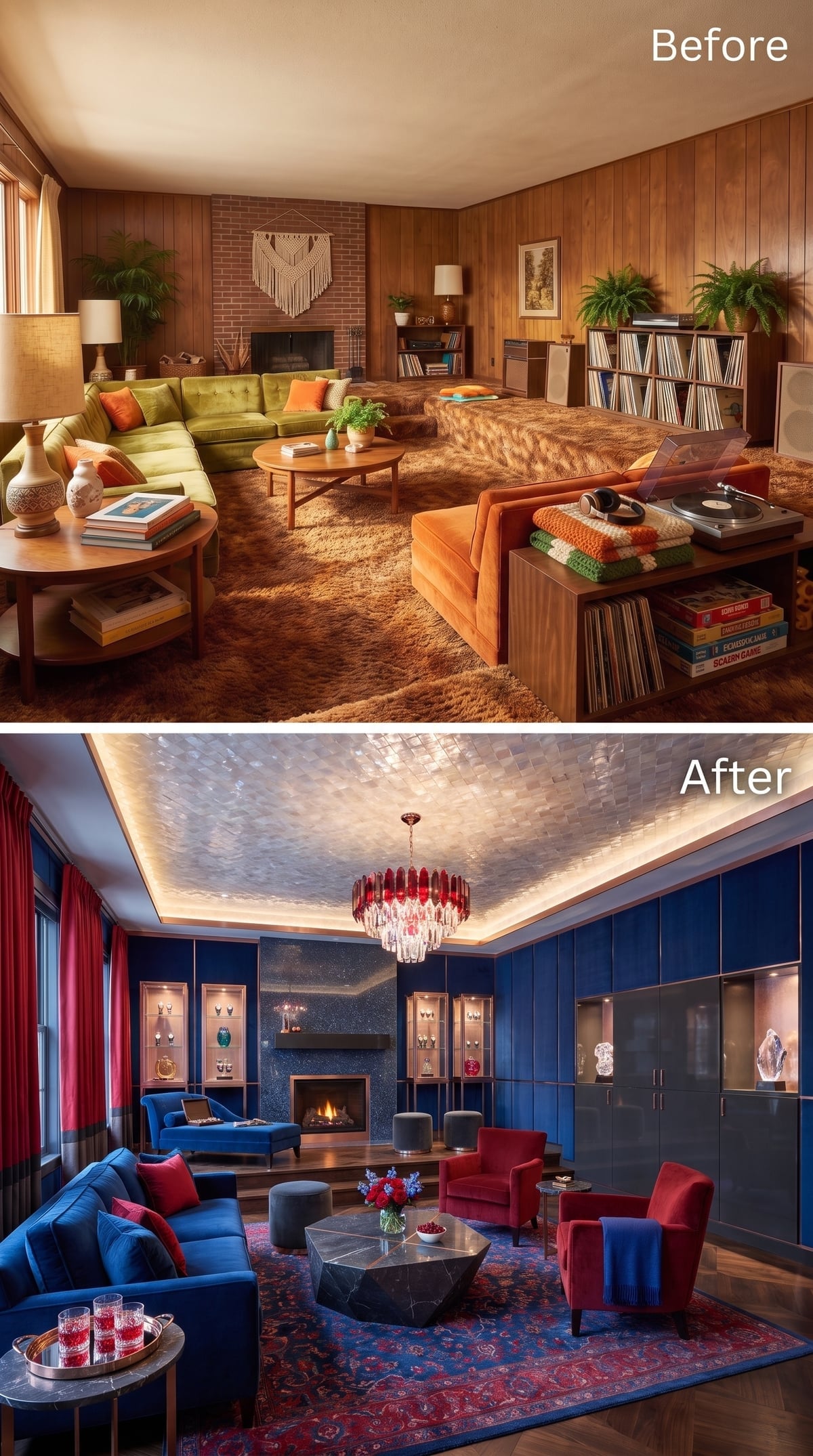
Cobalt velvet sofas establish one saturated block of color. Red accent chairs establish another. Then a red crystal chandelier drops between them as though moderation was never discussed.
Overhead, a pale iridescent-looking ceiling surface catches the perimeter lighting and spreads it across the room. Against all that saturated upholstery, the luminous ceiling is almost strangely calm.
1. White Bouclé, Living Green Walls, and Water Where the Shag Used to Be
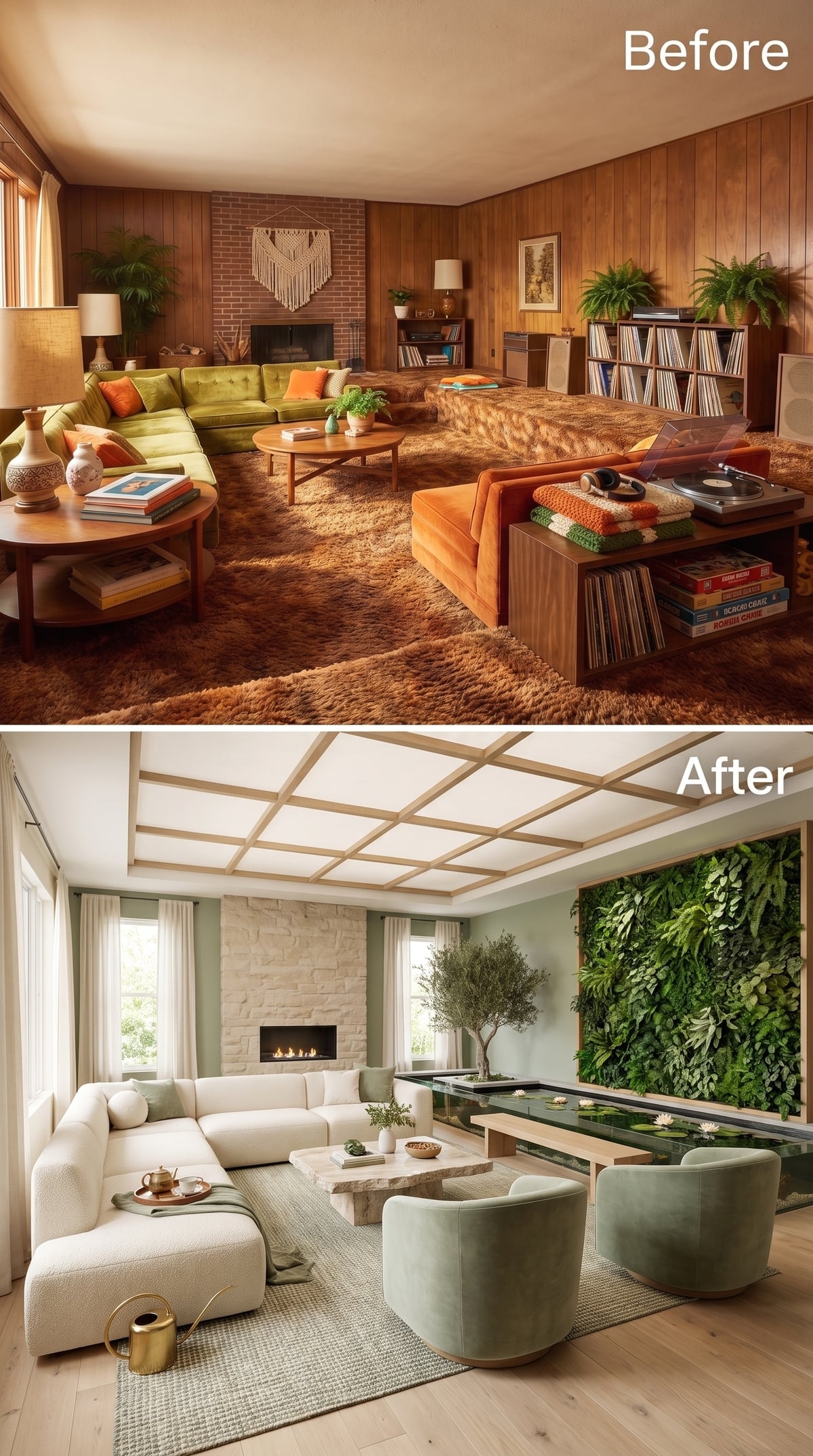
Few changes could be further from the starting room than covering an entire wall in layered greenery.
The vertical garden runs from floor to ceiling beside a pale stone fireplace, while a wood-trimmed coffered ceiling keeps the architecture warm above it. Off-white bouclé seating and sage chairs stay deliberately quiet against all that plant texture.
Then there is the water feature behind the chairs, complete with lily pads floating across the surface. Whether imagined as a reflecting pool or an indoor garden feature, it gives the room one final material the 1970s version never saw coming.
The original room relied on shag, paneling, and color to create atmosphere. This one gets there with stone, foliage, water, wood, and light. Thirty-six transformations later, the lesson is less about erasing the 1970s than realizing just how many completely different rooms can begin with the same four walls.