
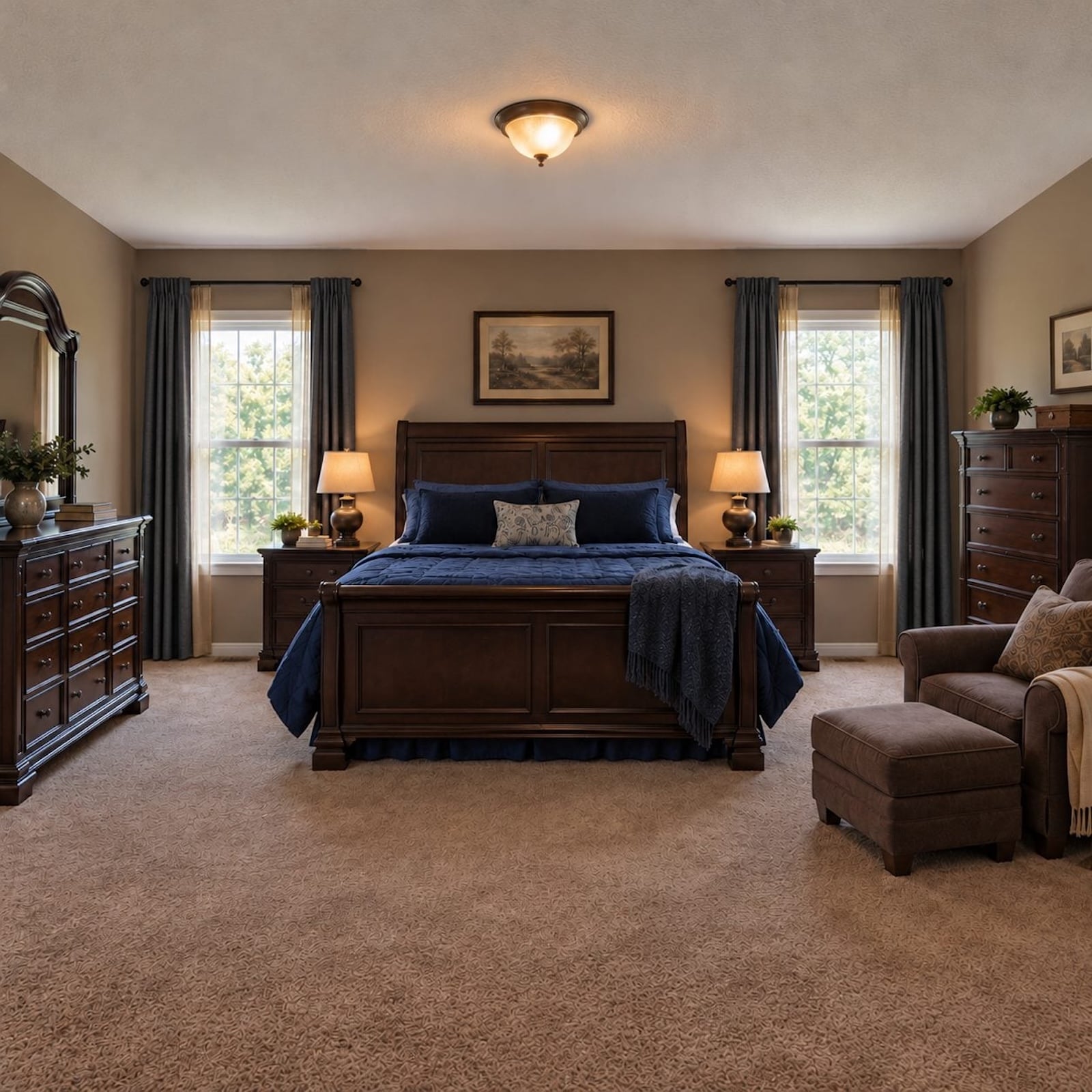
Two generous windows, a respectable ceiling height and enough floor space for a small dance party. So why does the bedroom feel like the walls are closing in? A high footboard arrests the eye. Matching dressers turn the perimeter into a barricade of wood. Heavy curtains compete with the windows, and a ceiling fixture scarcely larger than a dinner plate presides over the whole affair. Nothing is particularly wrong with the room itself. Almost everything surrounding the bed is working against it.
In order to come up with the very specific design ideas, we create most designs with the assistance of state-of-the-art AI interior design software. Also, assume links that take you off the site are affiliate links such as links to Amazon. this means we may earn a commission if you buy something.
White paint is the usual prescription, although color is only one participant in a much more interesting design problem. A dark walnut bed can look magnificent against ivory walls, particularly when it no longer has four matching pieces of furniture vying for attention. A four-poster can make a room feel taller, a substantial headboard can give it depth, and a carefully illuminated ceiling can change the perception of proportions that haven’t changed by an inch. Brightness and spaciousness are not interchangeable.
These 33 bedroom transformations take apart the visual barriers that make generous rooms feel cramped. Furniture comes off the floor, storage merges with the walls, windows recover their authority, and ceilings become active participants in the design. Some designs call for extensive renovation; others retain the very elements that seemed to be causing the trouble. The square footage stays put. What changes is the amount of room the eye has to travel.
33. A Ribbon of Light Redraws the Ceiling and Headboard Wall
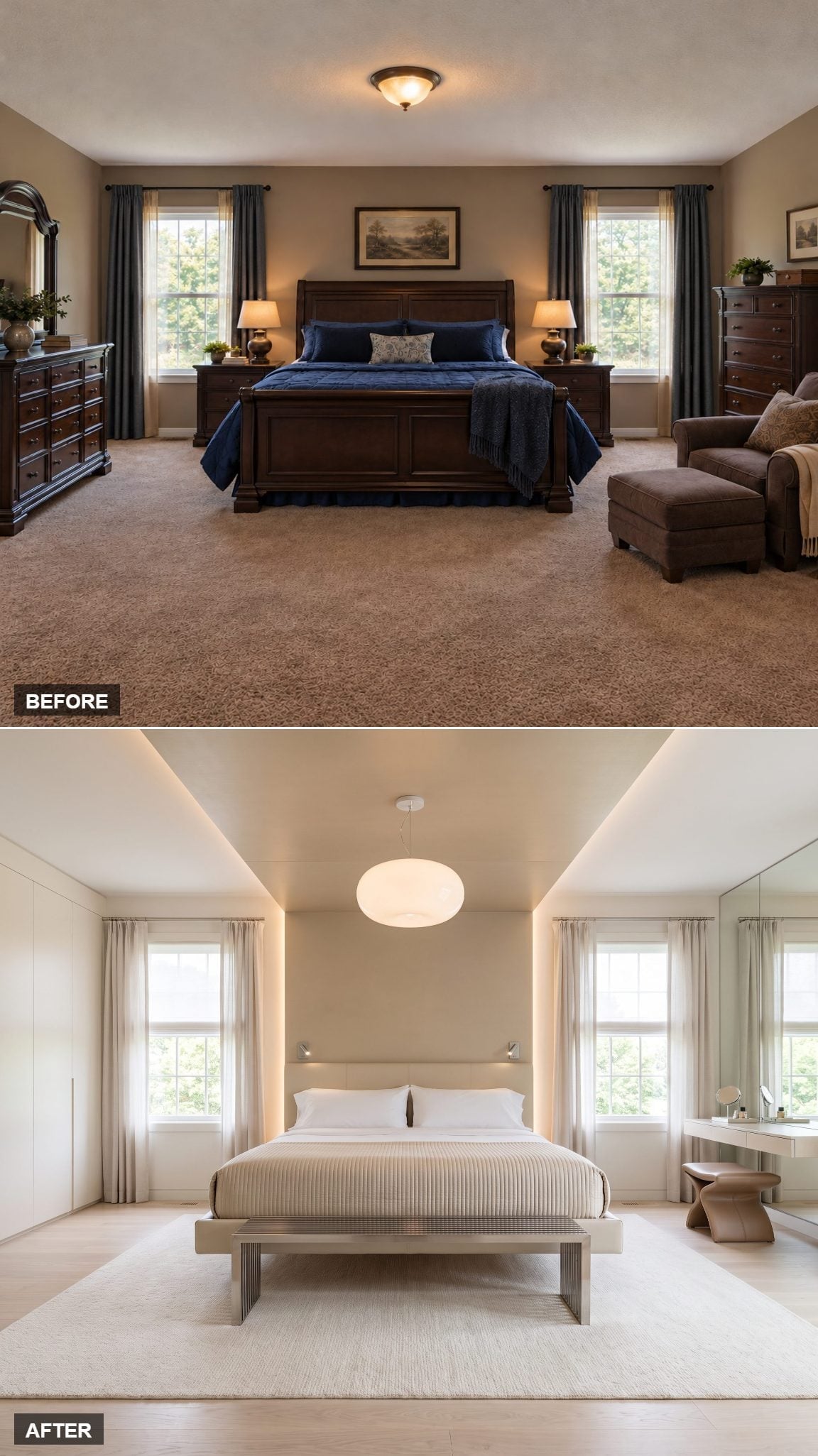
The original bedroom has two substantial windows and a remarkable amount of furniture devoted to making its generous proportions disappear. Dark dressers, a high wooden footboard, substantial curtains and brown carpeting divide the space into successive bands of visual weight.
The transformation exchanges that collection of competing elements for one emphatic architectural gesture. Concealed lighting follows the edges of a central ceiling treatment before descending vertically behind the bed. The eye travels upward and across the ceiling instead of repeatedly encountering the edges of furniture.
Full-height ivory wardrobes replace the freestanding dressers, while a floating vanity and expansive mirror give the opposite wall a more generous sense of depth. The low upholstered bed, ribbed cream bedcover and metallic bench supply texture where the original furnishings relied on mass.
The windows haven’t become larger. Their surroundings have become considerably less demanding.
32. Burl Wood Makes a Convincing Case for Keeping the Rich Finishes
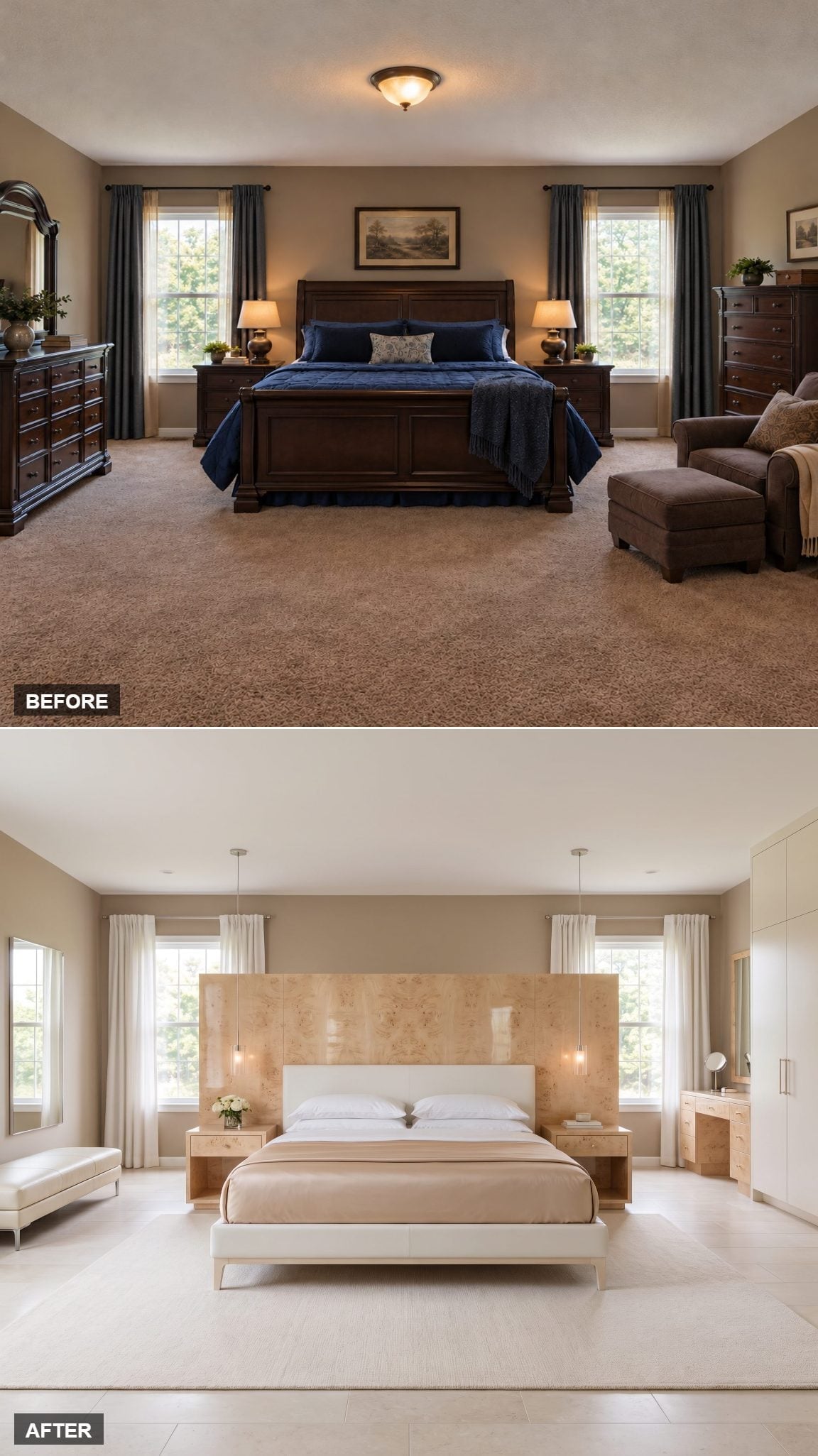
Burl wood is hardly the obvious material for a bedroom in need of greater visual space. Its intricate grain has enormous presence, which makes its concentration on a single wall particularly effective.
Matching floating nightstands extend the timber horizontally, while suspended bedside pendants bring out the intricacies of the grain. Cream flooring, sheer curtains and matte white wardrobes allow the surrounding room to remain relatively quiet.
The distinction is between distributing rich wood finishes throughout the bedroom and giving them one commanding location. Instead of competing with several substantial pieces of furniture, the burl becomes the room’s defining feature. Abandoning dark or expressive materials would have been the easier decision and arguably the less interesting one.
31. A Floating Bed Reveals the Space Beneath the Furniture
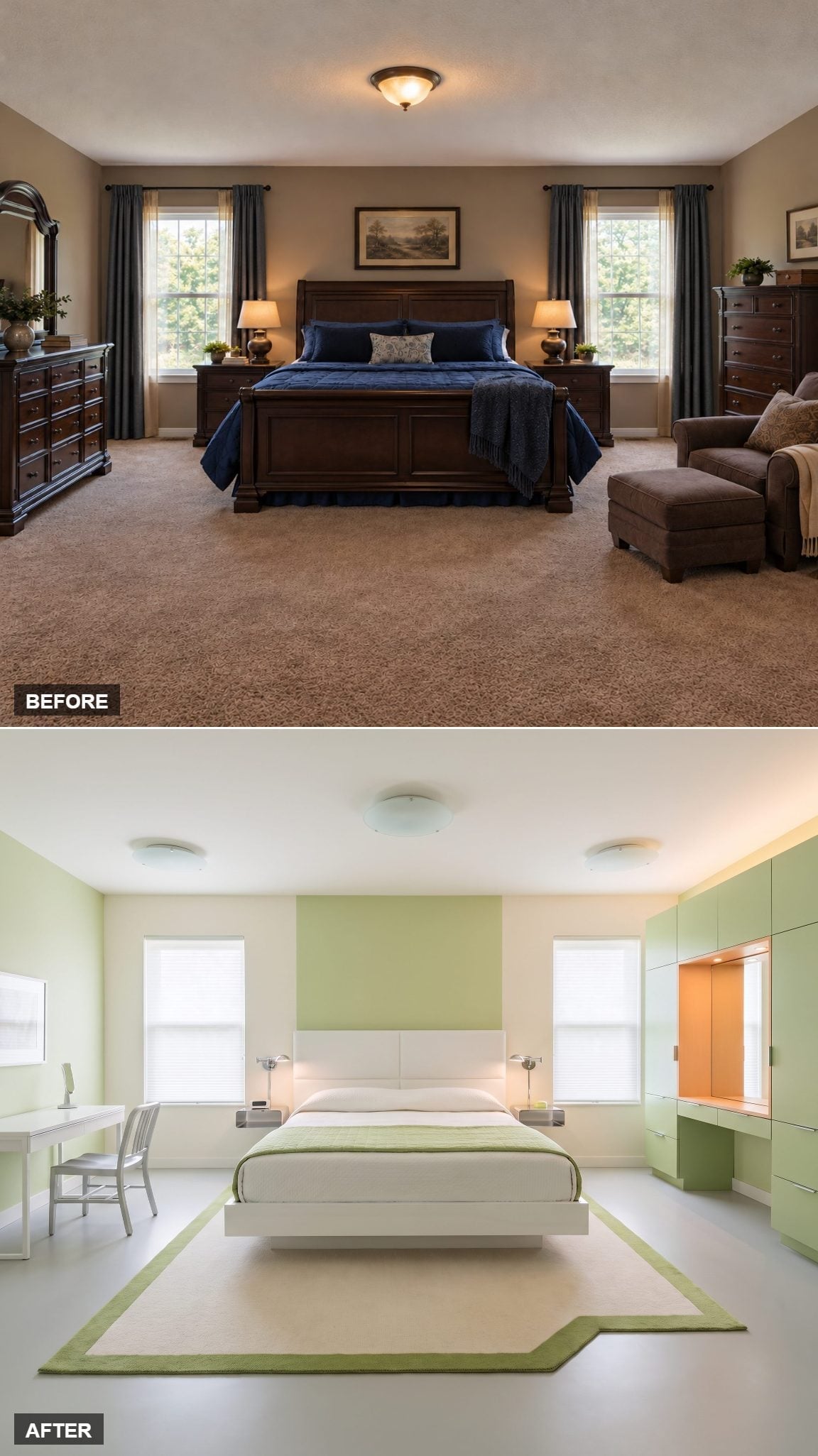
A bed with a recessed supporting structure can occupy much the same footprint as a conventional frame while appearing considerably less imposing. Here, white upholstery and a shadow beneath the bed create the impression that the furniture is suspended above the floor.
Sage green gives the bedroom a recognizable color identity without overwhelming the pale furnishings. The two-tone rug repeats the green around the sleeping area, connecting the bed to its surroundings without making the furniture appear heavier.
Budget Tip: Muted green paint can change the relationship between existing furniture, bedding and window treatments without requiring a complete renovation. Test large samples beside the bed in daylight and artificial light, since sage can appear warmer, cooler or grayer depending on the room’s exposure.
30. Who Said the Bed Had to Have Corners?
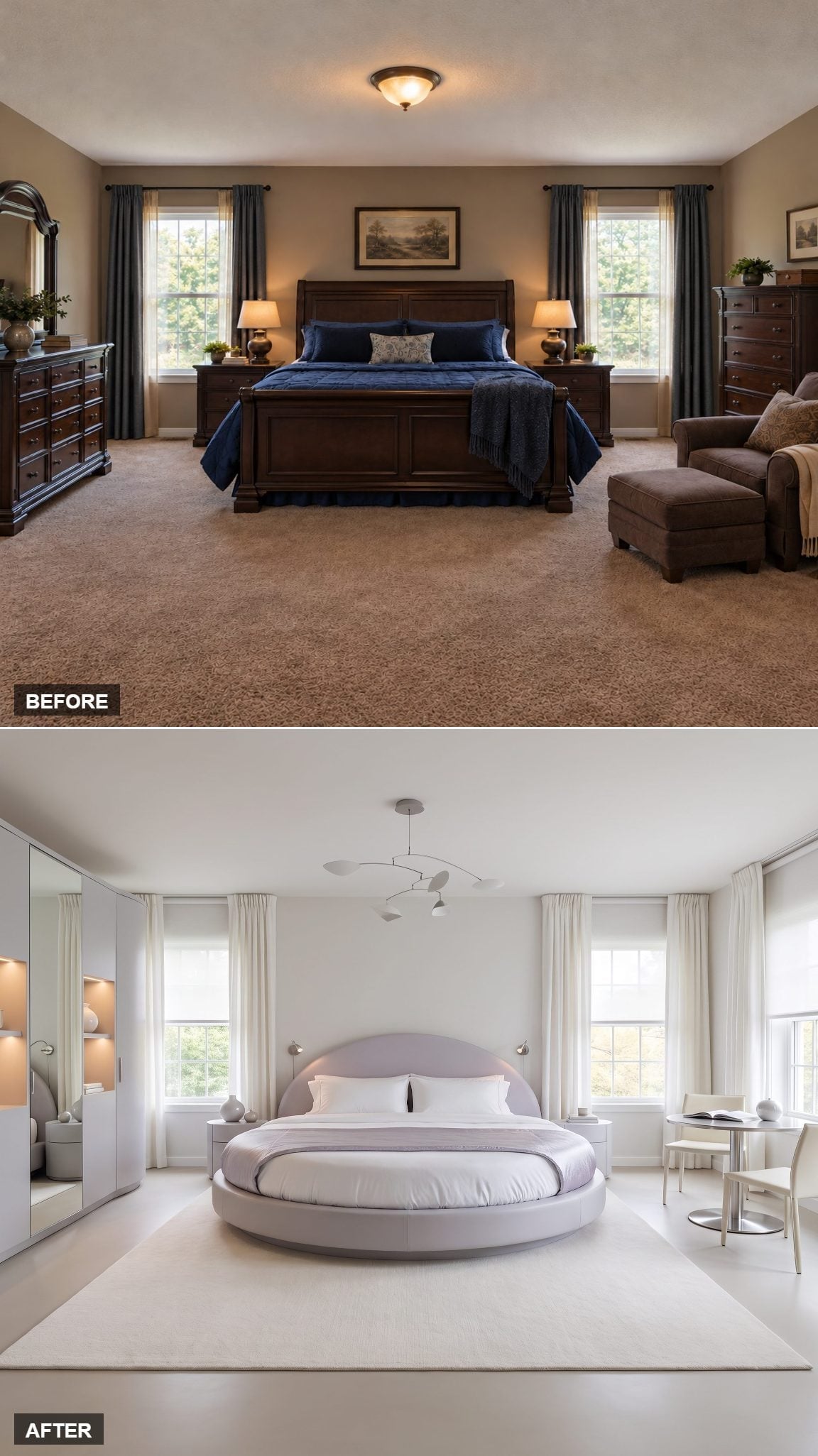
Rectangular beds tend to dictate rectangular arrangements, with furniture positioned along their edges and walking routes negotiated around their corners. A circular bed changes that familiar geometry.
The generous white upholstered frame becomes a sculptural object, accompanied overhead by a mobile-inspired ceiling fixture. Mirrored wardrobe panels extend views of the room, while a round table and paired chairs continue the curved forms in an adjoining sitting area.
Circular beds require specialized mattresses and bedding, and their unusual dimensions demand careful planning. With sufficient clearance around the bed, its curved outline can soften the walking routes. The diameter and placement still determine how comfortably the room functions.
29. Butter Yellow Warms the Bedroom Without Weighing It Down
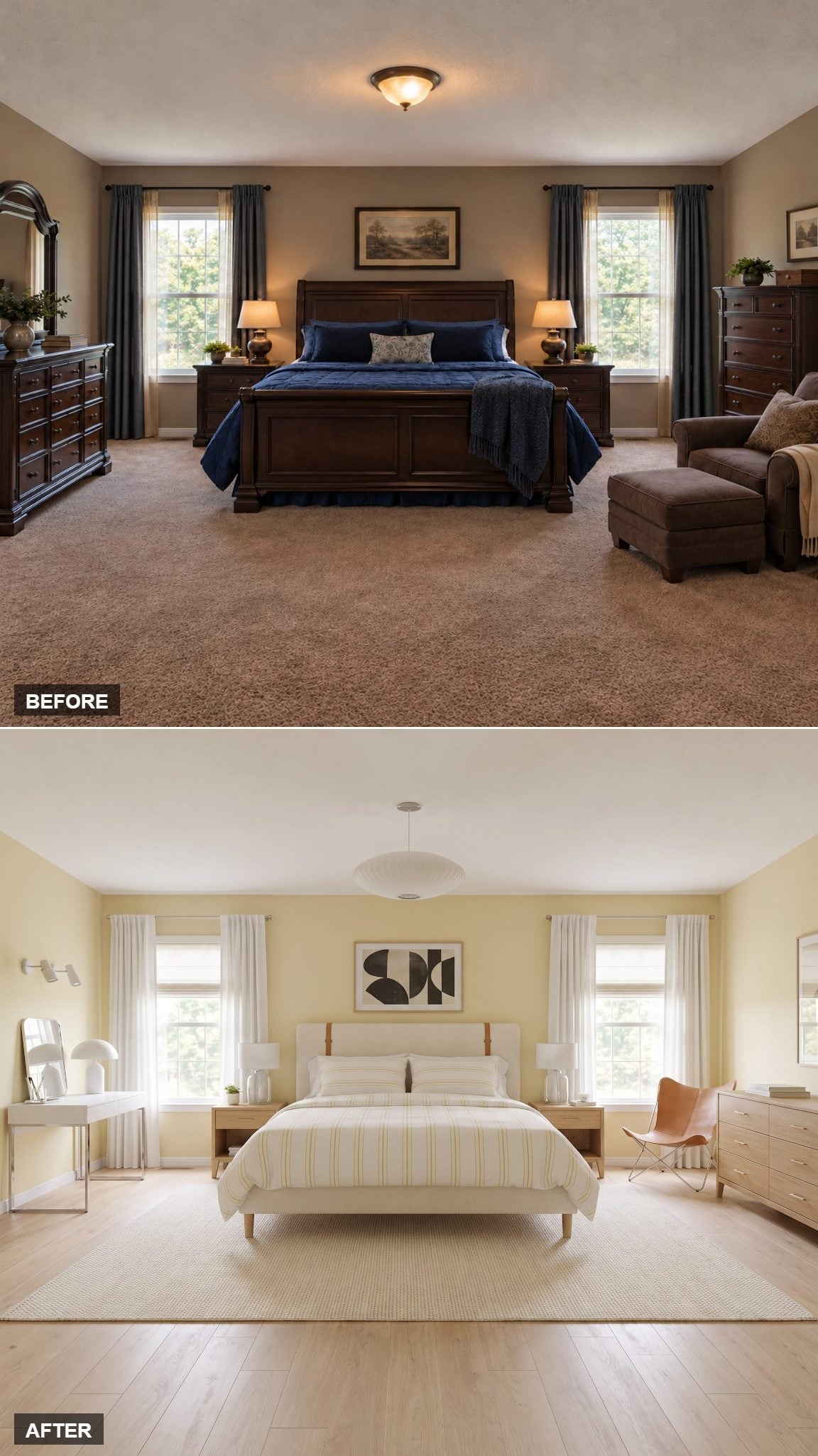
Butter yellow gives this bedroom something an entirely white renovation might have sacrificed: a distinct warmth that survives even when the sun disappears.
Washed oak flooring and open wooden nightstands pick up the gentle golden undertones of the walls. The upholstered bed stands on tapered legs, exposing part of the floor, while striped bedding adds interest without introducing an unrelated color scheme.
An opal-style globe pendant offers diffuse illumination. The terracotta butterfly chair provides a deeper accent, carrying the palette from pale yellow through natural wood to reddish clay. The warmth comes from a carefully graduated collection of colors instead of an accumulation of dark furniture.
A bedroom can acquire considerably more color without acquiring any additional visual heaviness.
What Our Readers Say
- When Home Stratosphere readers were asked which bedroom wall paint they would buy, half chose sage, 32% went for greige and only 12% picked white.
- Asked which light they would buy, 58% of our readers picked cosy and moody, while 34% would choose bright.
From Home Stratosphere reader polls and votes.
28. The Tray Ceiling Gives the Eye Somewhere to Travel
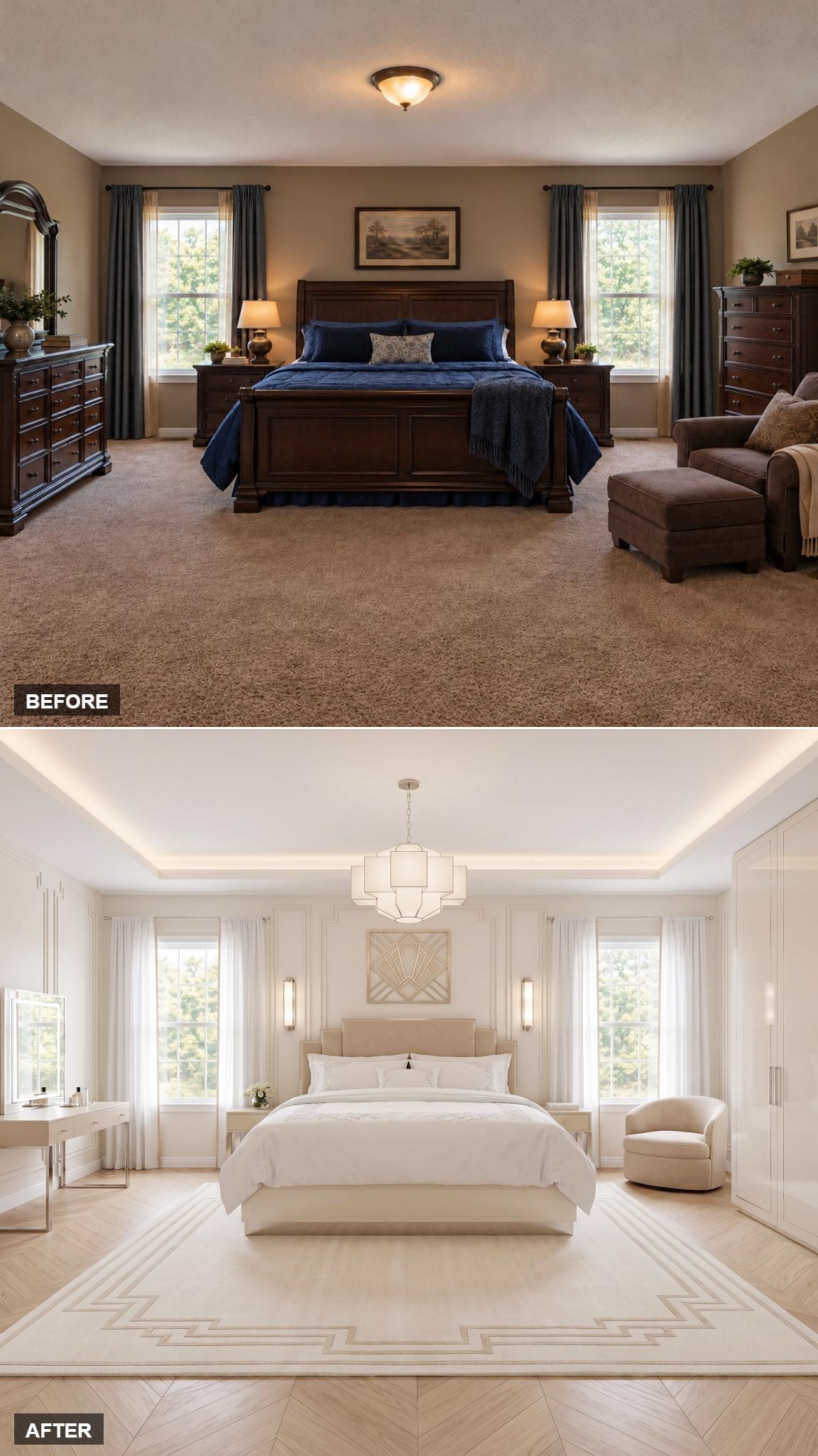
A ceiling becomes much more interesting when it stops functioning as a flat lid over the bedroom. Concealed lighting within the tray recess emphasizes the change in level and draws attention toward the outer edges of the overhead space.
A tiered, Art Deco-inspired chandelier occupies the center, accompanied by slender bedside sconces that provide a separate layer of illumination. The chandelier no longer has to satisfy every lighting requirement.
Below, pale oak herringbone flooring supplies an entirely different kind of movement, with a geometric border tracing the perimeter. The low greige headboard sits between these two expressive treatments, allowing the floor and ceiling to carry the ornament that might otherwise have been distributed among several pieces of furniture.
27. An Arched Peach Headboard Gives the Room Architectural Muscle
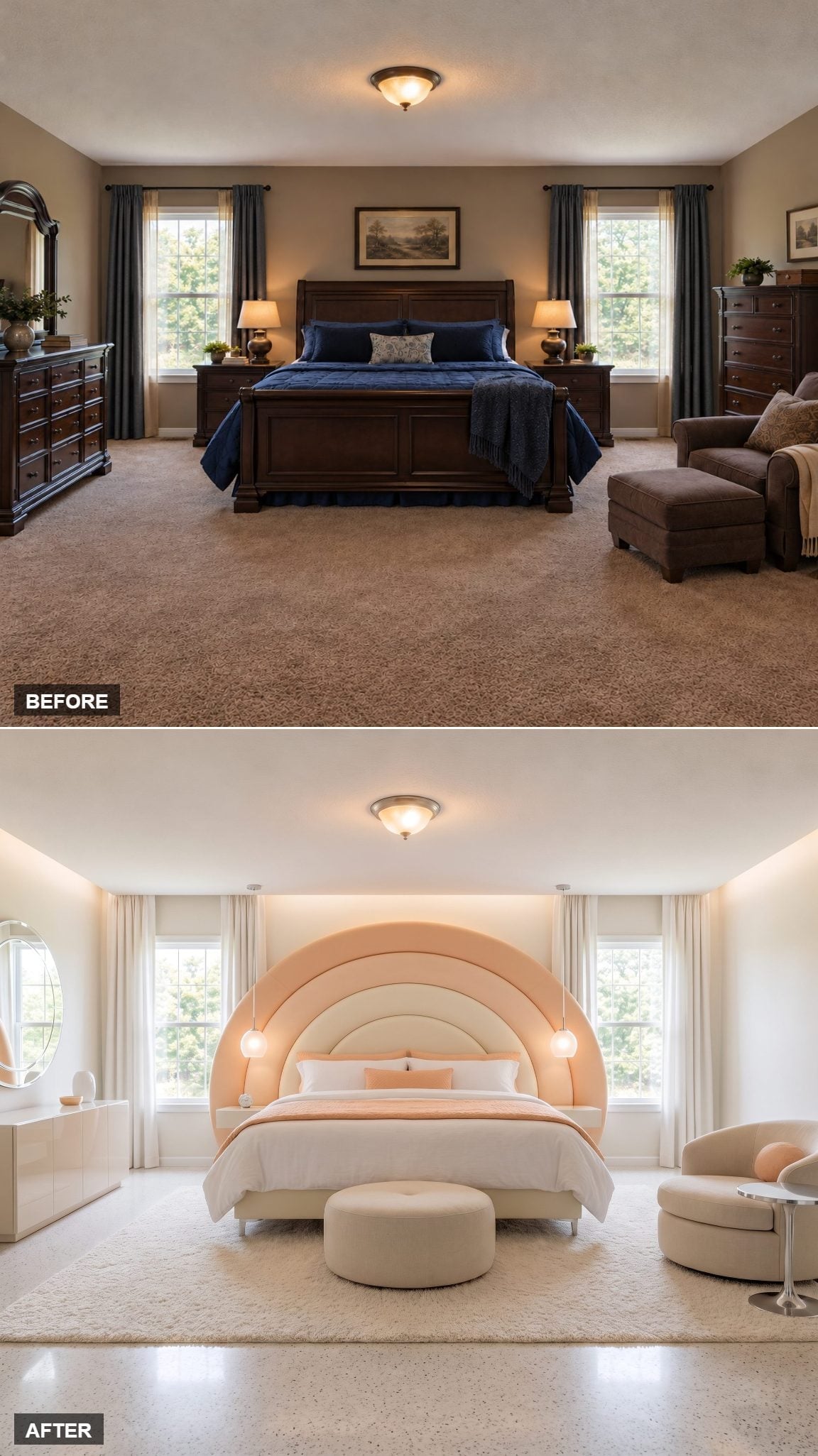
Concentric upholstered arches turn a familiar piece of bedroom furniture into something approaching architectural sculpture. The successive layers create depth through their shape and shadows, giving peach a presence that a flat painted wall could scarcely achieve.
Suspended bedside lights emphasize the vertical space around the headboard. White Roman shades and pale terrazzo flooring provide a quieter setting for the upholstery, while a bouclé ottoman continues the rounded forms at the foot of the bed.
The room acquires a substantial focal point without requiring a heavy timber frame or a collection of decorative objects.
In the Details: A layered upholstered headboard can provide the depth normally associated with decorative wall paneling. Suspended bedside lights free up nightstand space, provided their drop lengths and mounting positions are coordinated with the height and width of the bed.
26. The Brown Carpet Stayed and Suddenly Made Sense
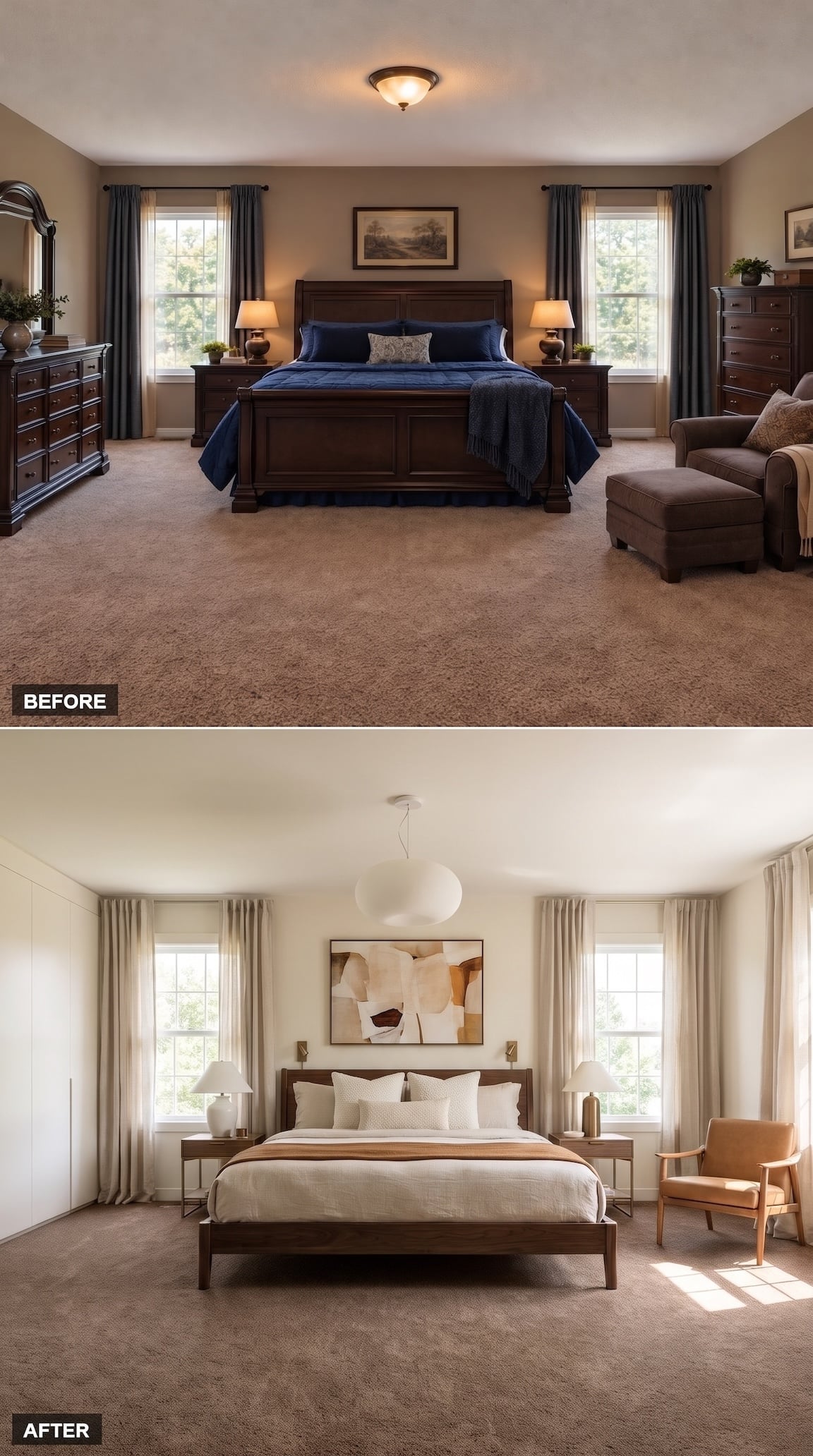
Brown wall-to-wall carpeting might seem an unlikely starting point for a contemporary bedroom makeover. Here, retaining it becomes the organizing decision behind the entire palette. The original floor covering gains a new context instead of being treated as an obstacle to good design.
A streamlined wooden bed replaces the imposing paneled frame, eliminating the high footboard that interrupted views across the room. Oatmeal bedding, ivory pillows and a warm tobacco-colored throw give the existing carpeting more sympathetic companions.
The matching dressers make way for discreet full-height cabinetry, and lighter nightstands reduce the amount of solid furniture surrounding the bed. Abstract artwork picks up the earthy tones, while an open-framed caramel-colored chair replaces the bulky upholstered seating.
Retaining the carpet avoids one major expense, even though the cabinetry represents a more substantial investment. More importantly, the transformation demonstrates that an apparently dated finish can become entirely appropriate when the surrounding furniture, colors and materials change.
25. When the Bookcase Stops Being Furniture
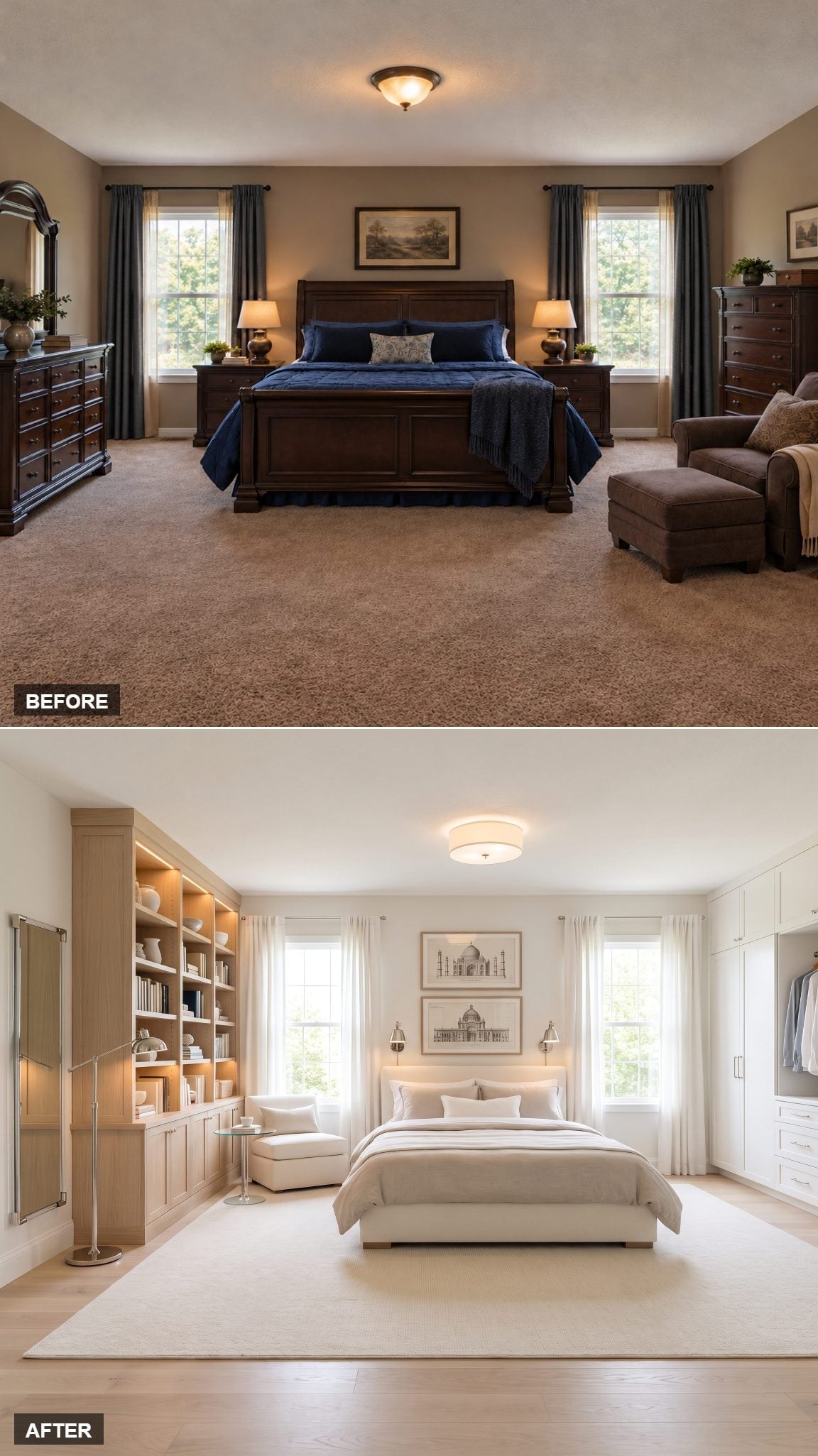
Illuminated oak shelving gives the left wall a purpose beyond accommodating another piece of furniture. The recessed compartments have their own depth, and concealed lighting reveals the shelves instead of allowing the entire storage wall to read as a solid mass.
Cream linen bedding and a low platform bed leave the center of the room comparatively uncluttered. Reading sconces mounted above the nightstands preserve their useful surface area without sacrificing task lighting.
Pale hardwood and a wool rug continue the natural material palette underfoot. The room gains a substantial amount of architectural detail without filling its central floor space with more furniture.
24. Mosaic Tile Meets a Bedroom Without Sharp Edges
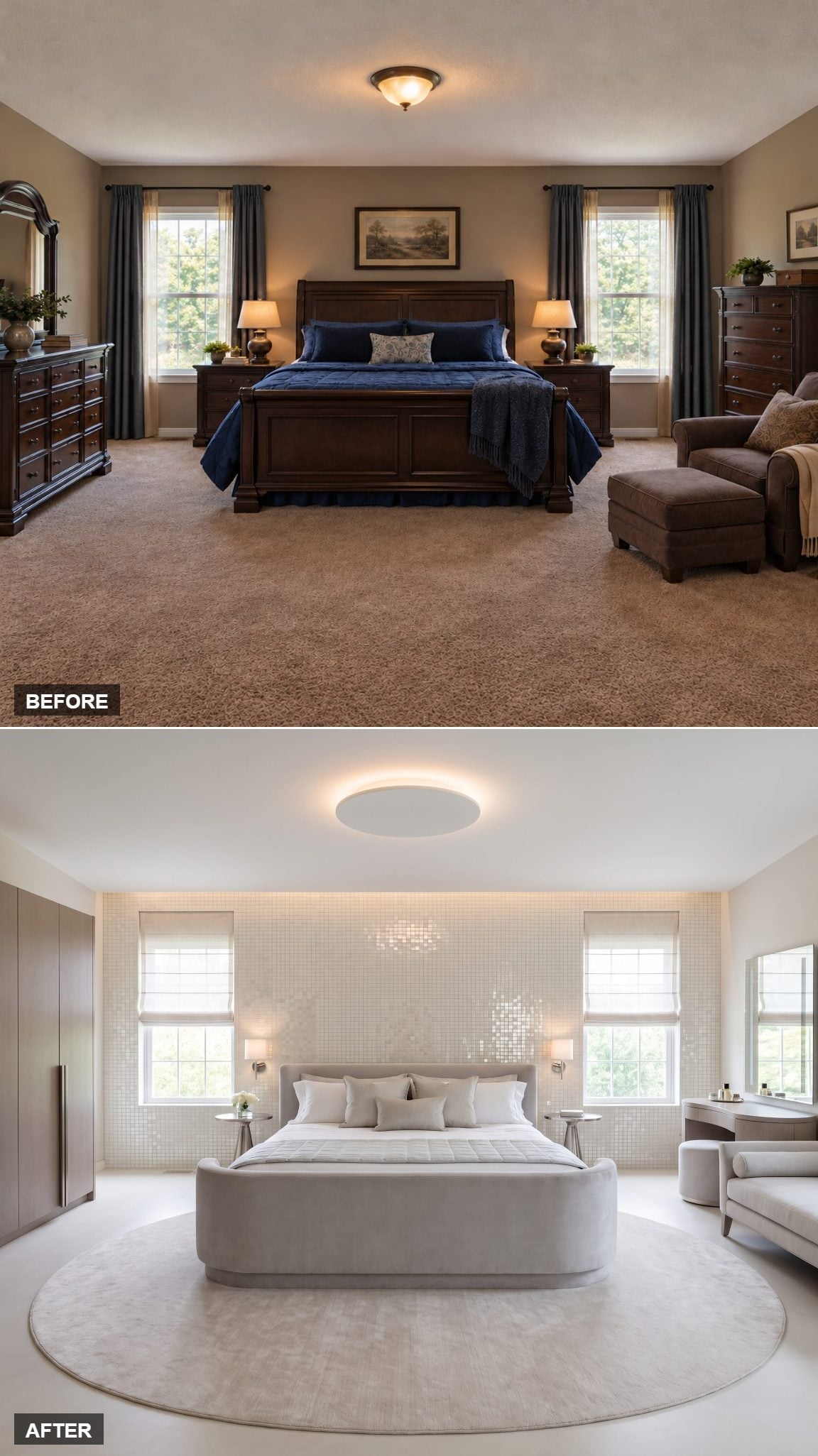
Mosaic tile behind a bed is an unexpected departure from upholstery, wallpaper and conventional wood paneling. The small off-white glazed pieces catch the light individually, giving the wall a finely textured appearance.
An illuminated oval ceiling recess picks up the shape of the curved upholstered bed, while a circular rug completes the sequence of rounded forms below. Dove gray fabric provides enough contrast to distinguish the furniture from the surrounding ivory finishes.
Slim wall-mounted sconces leave the nightstands free of substantial lamps. The hard, detailed masonry-like finish becomes an effective counterpoint to the softness of the bed and rug.
A tiled headboard wall requires suitable backing and careful installation, particularly where material weight is a consideration. Its appeal lies in achieving decorative complexity without filling the bedroom with additional objects.
23. Mirrors Make an Entire Wall of Wardrobes Feel Less Formidable
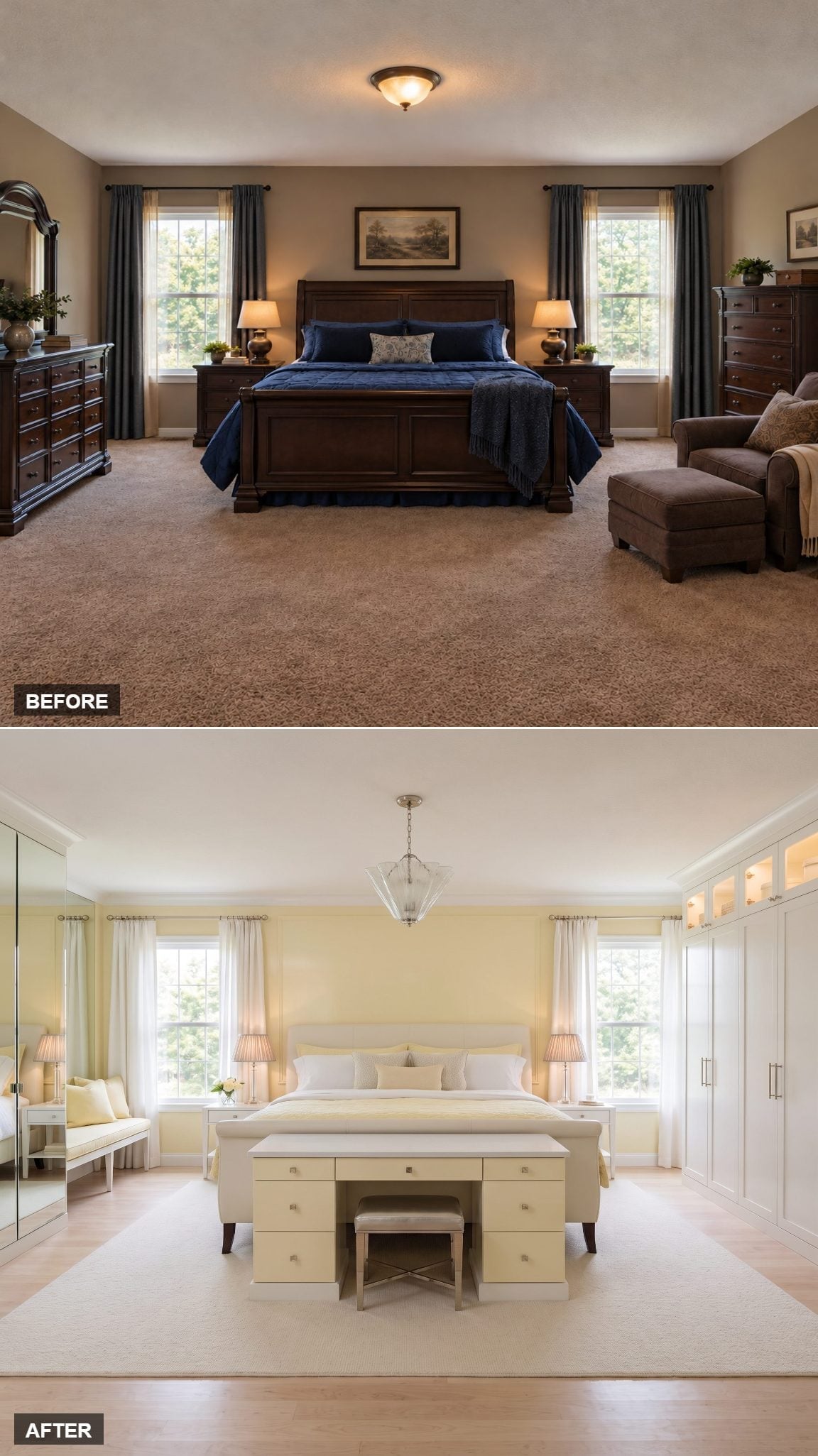
Full-height wardrobes offer a considerable amount of storage, although their scale can make a bedroom feel as if another wall has been built inside it. Cream-painted cabinetry reduces the contrast with the pale yellow surroundings, and illuminated display niches interrupt the solid expanse of doors.
Mirrored panels on the opposite wall provide a second view of the room, extending the apparent depth of the interior. A geometric glass pendant contributes another reflective element overhead.
A mirror has greater spatial impact when it reflects a window, an illuminated wall or an open area of the room rather than a crowded furniture grouping. Placement matters more than sheer size.
Pro Tip: Position a large mirror where it reflects a window, an illuminated wall or another attractive part of the bedroom. Mirrors redistribute available light and create apparent depth; they cannot replace adequate lighting. Check for unwanted reflections and glare before committing to permanent mirrored panels.
22. The Bed Got Taller. So Why Does the Room Feel Bigger?
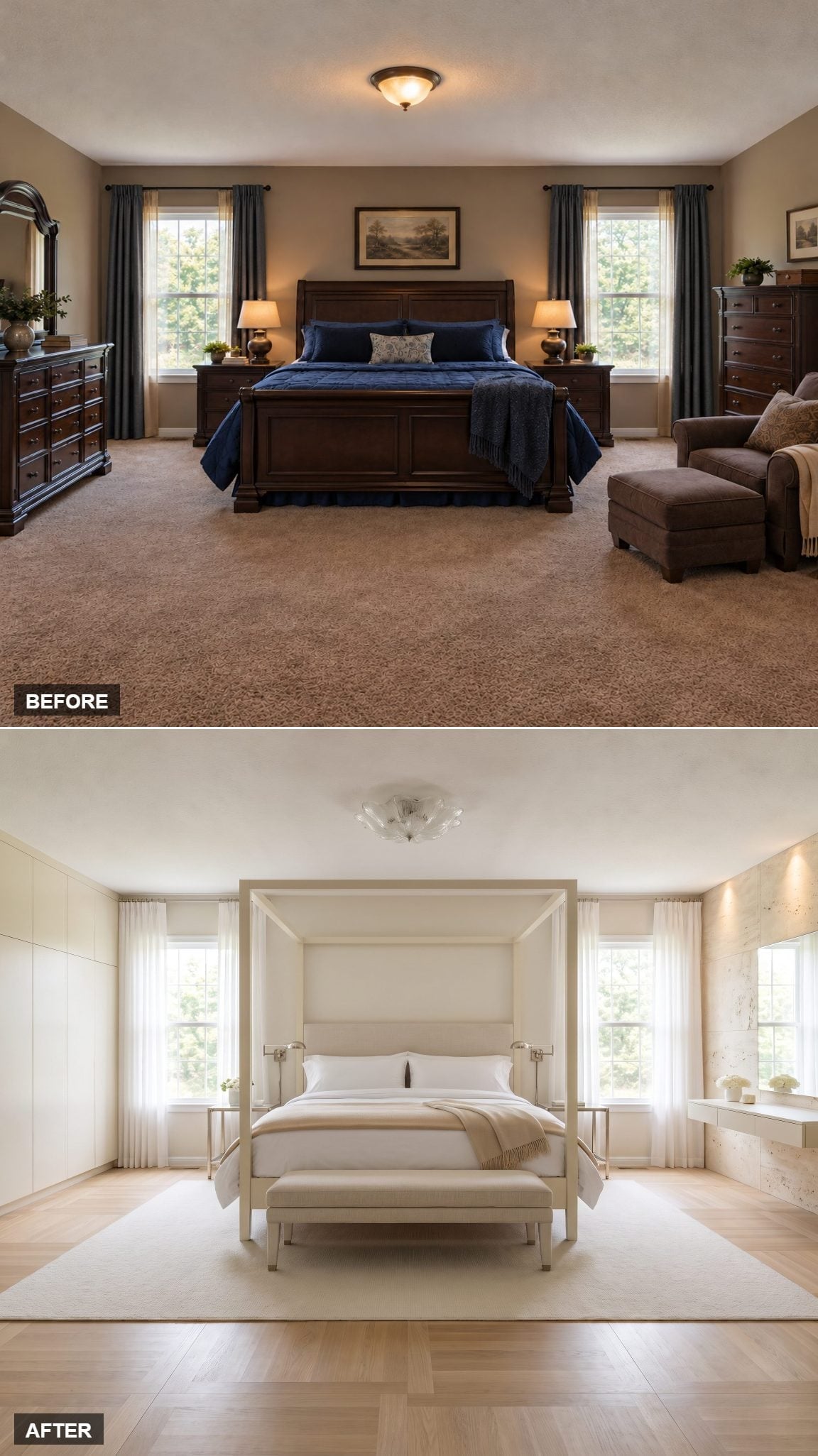
A four-poster bed seems an unlikely candidate for making a bedroom feel less enclosed. The surprise is how much difference the openness of its structure makes compared with the solid panels of a traditional wooden bed.
Slender vertical supports draw attention toward the ceiling while preserving views of the two windows. White bedding and understated upholstery soften the framework without concealing it.
The woven rug defines the sleeping area, with hardwood flooring visible around its edges. The furniture gains height while losing much of the visual obstruction associated with a substantial headboard and footboard.
Furniture dimensions tell only part of the story. A tall, open frame can feel considerably lighter than a lower piece constructed from solid panels.
21. An Ivory Bedroom That Needs Its Shadows
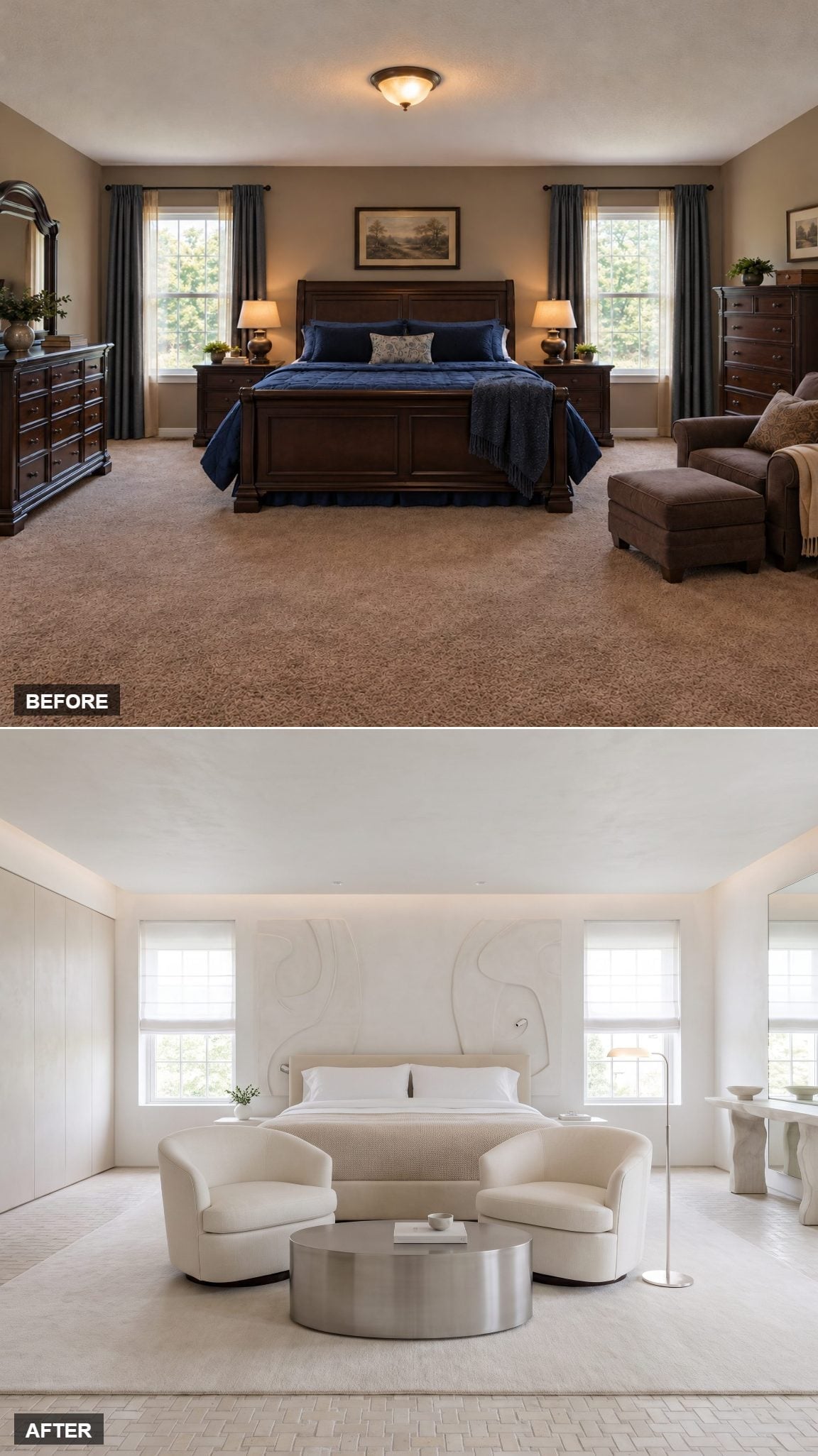
The sweeping plaster relief behind the bed makes a persuasive argument against eliminating every shadow from a bedroom. Its raised organic forms become legible precisely because some areas receive more light than others.
A low bouclé bed continues the tactile emphasis, accompanied by two curved chairs and an oval metallic coffee table. Their arrangement gives the bedroom a recognizable sitting area while leaving the principal walking routes open.
Large-format ivory flooring connects the sleeping and lounging spaces, and a slender brass floor lamp provides a more intimate source of light beside the seating. The room remains almost entirely tonal, yet its sculptural forms and contrasting textures prevent it from becoming visually flat.
Material Insight: Decorative relief panels range from lightweight molded products to substantial plaster installations. Fastening requirements depend on panel weight, substrate condition and the manufacturer’s installation system. Grazing light emphasizes the raised details, while diffuse illumination creates softer shadows.
20. Sage Green Finds an Unexpected Partner in Polished Terrazzo
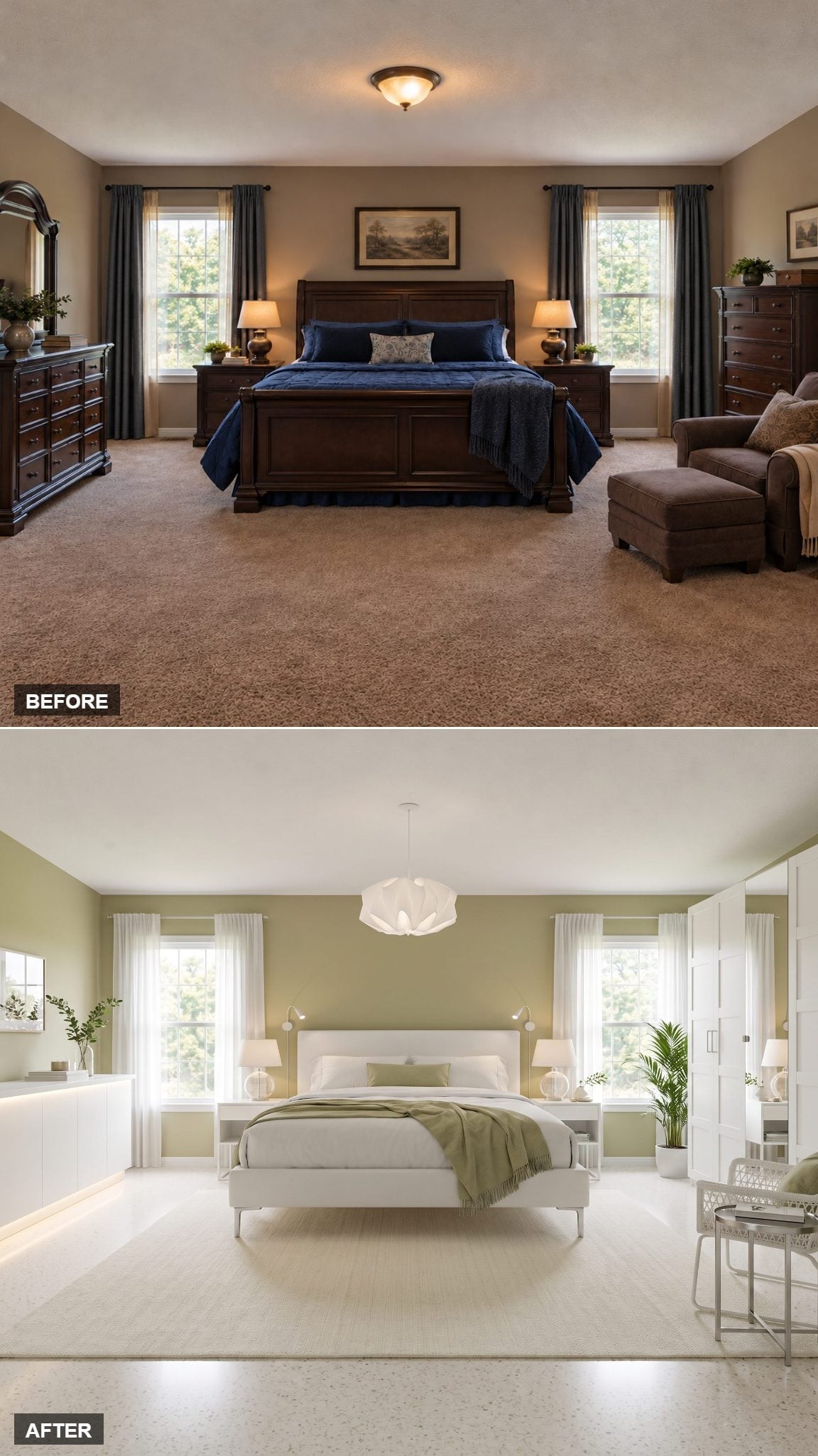
The most consequential material change in this bedroom is underfoot. Polished terrazzo-style flooring replaces the uniform texture of carpeting with a pale, lightly patterned surface that responds differently to incoming daylight.
Sage walls provide a gentle contrast to the white upholstered bed and matching nightstands. A petal-shaped pendant adds an organic silhouette overhead, balancing the harder finish below.
Polished flooring can produce glare and a more reflective acoustic environment, so upholstery and rugs become important sources of softness. The combination allows the room to retain a distinctive green palette while giving the floor a far more active role in its appearance.
Sage does well with our readers too: sage-dominant bedrooms got hearts 71% of the time, compared with 43% for the other images in the same articles.
19. An Onyx-Look Wall Gives the Bedroom Geological Drama
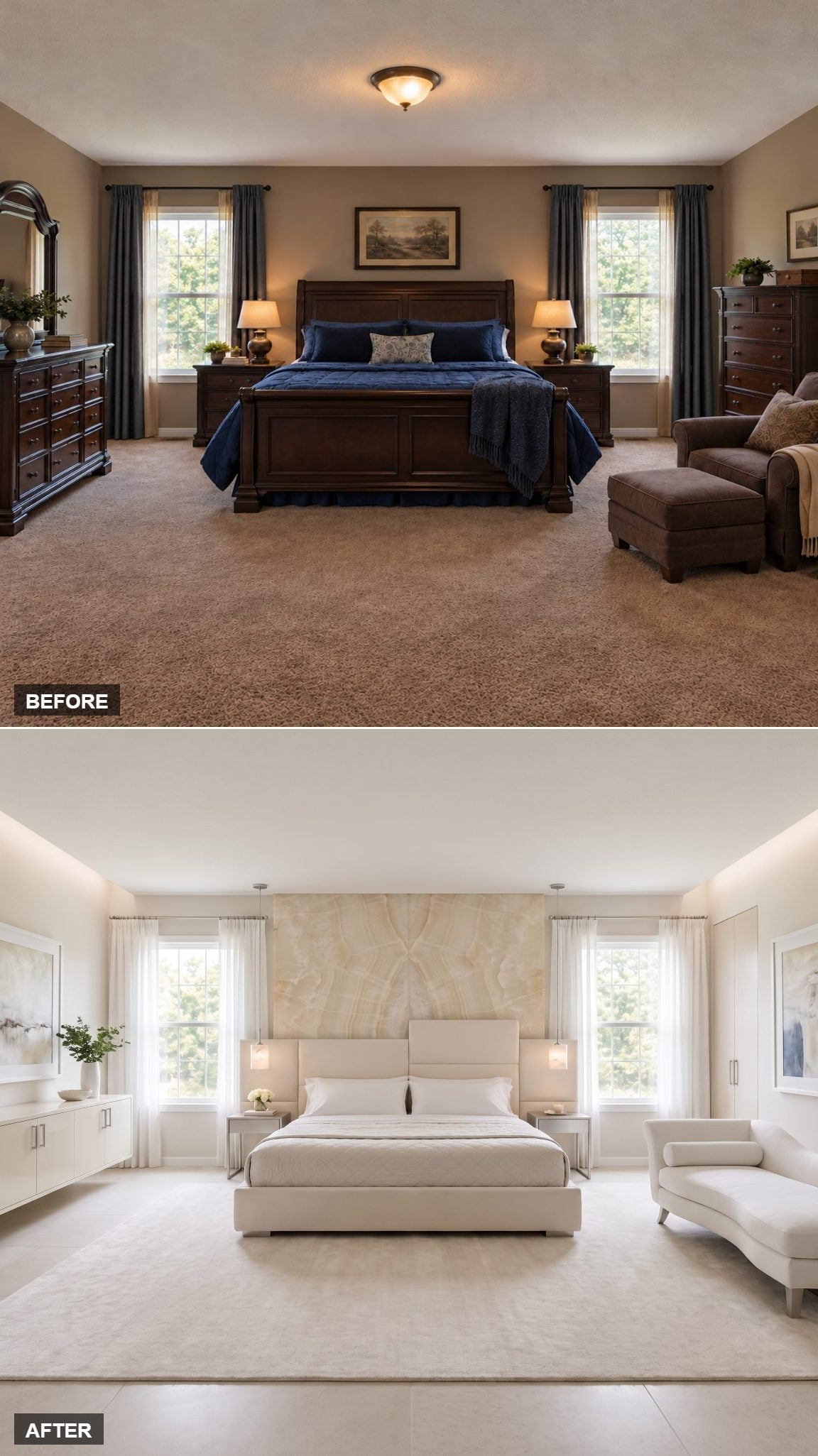
Cream and gold striations give the headboard wall the extraordinary visual complexity of veined stone. The pattern has enough presence to supply most of the bedroom’s decorative interest without relying on a strongly contrasting feature color.
Suspended pendants bring illumination close to the material, while concealed ceiling lighting defines the upper boundaries of the room. A floating credenza exposes the carpet beneath it, allowing the eye to follow the floor across the adjoining wall.
Natural onyx, engineered panels and porcelain products with similar veining differ considerably in weight, cost and installation requirements. All can be considered when the objective is a richly patterned architectural feature rather than another collection of substantial bedroom furniture.
18. Botanical Wallpaper Brings Back Pattern Without Bringing Back the Clutter
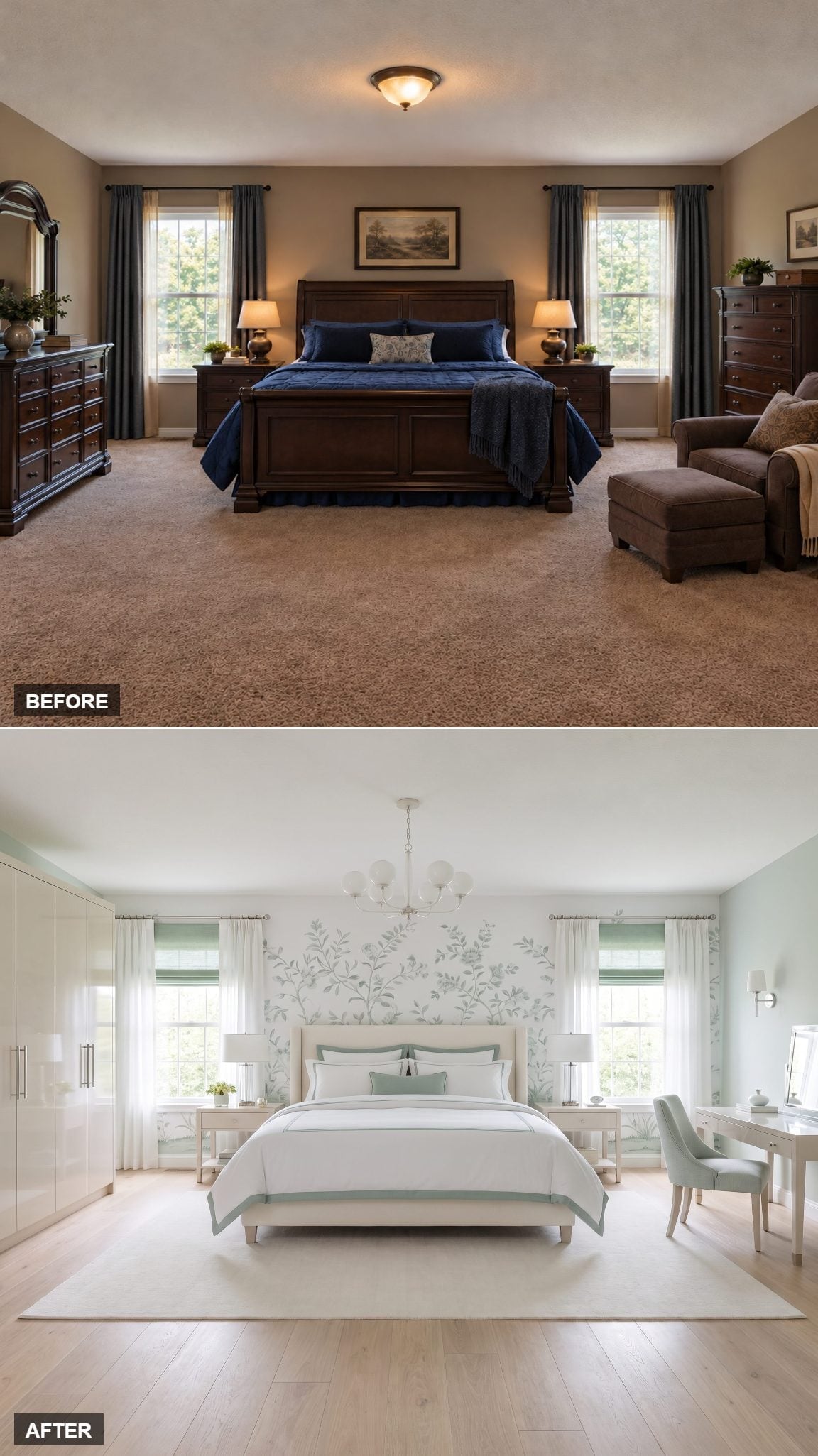
A softly contrasted botanical wallpaper demonstrates that removing visual congestion doesn’t require abandoning pattern. Its gray and white design gives the headboard wall movement, while the linen-toned bed supplies a calm foreground.
White Shaker-style wardrobes extend along the left wall, replacing the visual fragmentation associated with separate storage pieces. Sage Roman shades pick up the natural character of the wallpaper, and a multi-globe chandelier adds a contemporary silhouette to the ceiling.
The pale plank flooring connects these different influences without introducing another prominent pattern. By confining the botanical motif to one wall, the bedroom gains decorative personality while allowing the remaining architecture to recede.
17. The Headboard Glows and the Wall Appears to Recede
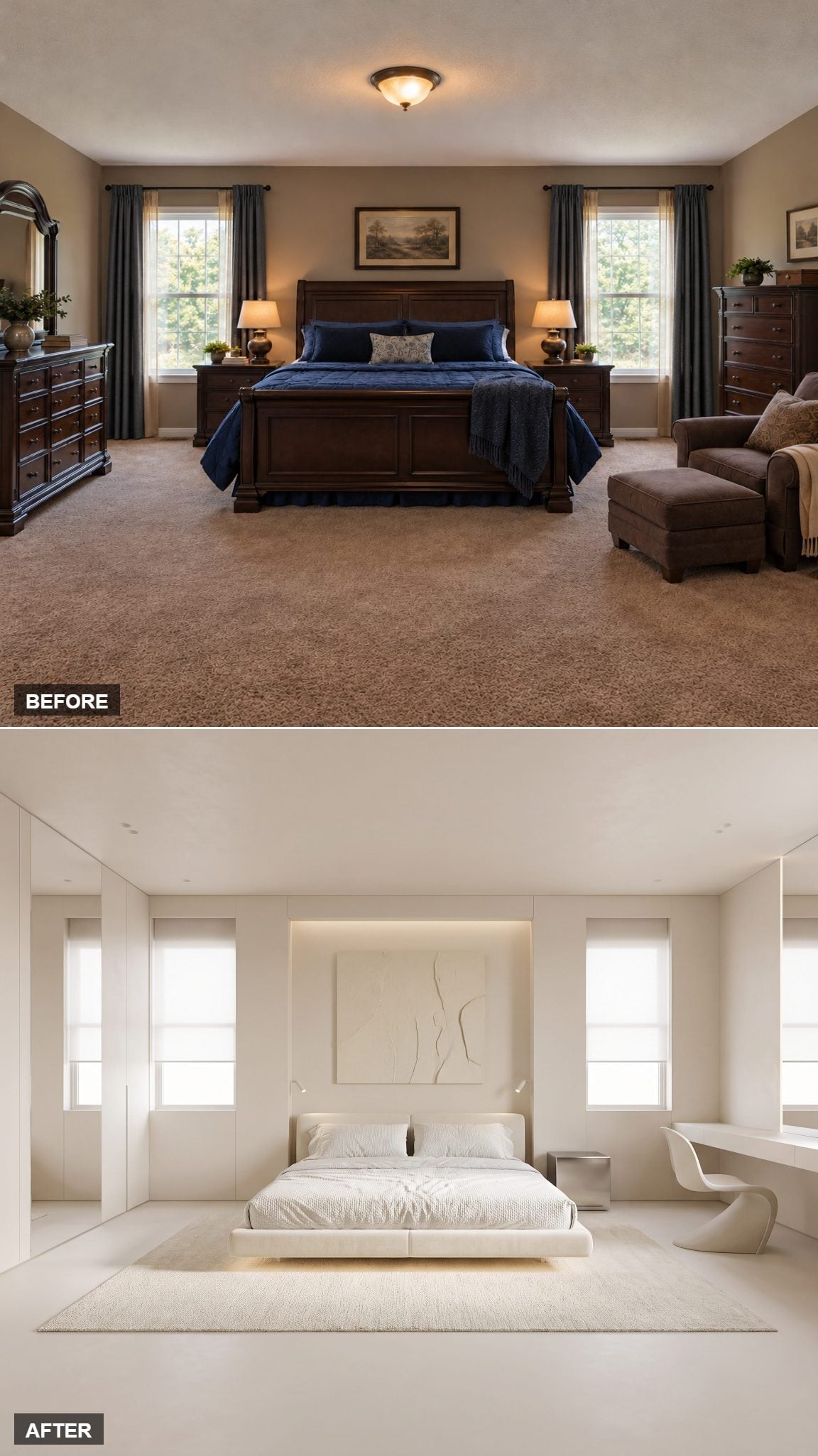
Concealed lighting behind the upholstered headboard creates a luminous separation between the bed and wall. Instead of appearing as one substantial block of furniture pressed against the architecture, the bed seems to have a little space around it.
The artwork gains a more convincing connection with the sleeping area, participating in the illuminated backdrop instead of appearing isolated above the furniture.
An all-cream bedroom can become monotonous when every surface receives similar illumination. Here, the contrast between softly glowing walls and shaded upholstery gives the room a depth that would otherwise require a greater variety of colors.
16. An Entire Wall of Storage Finds Its Place in Powder Blue
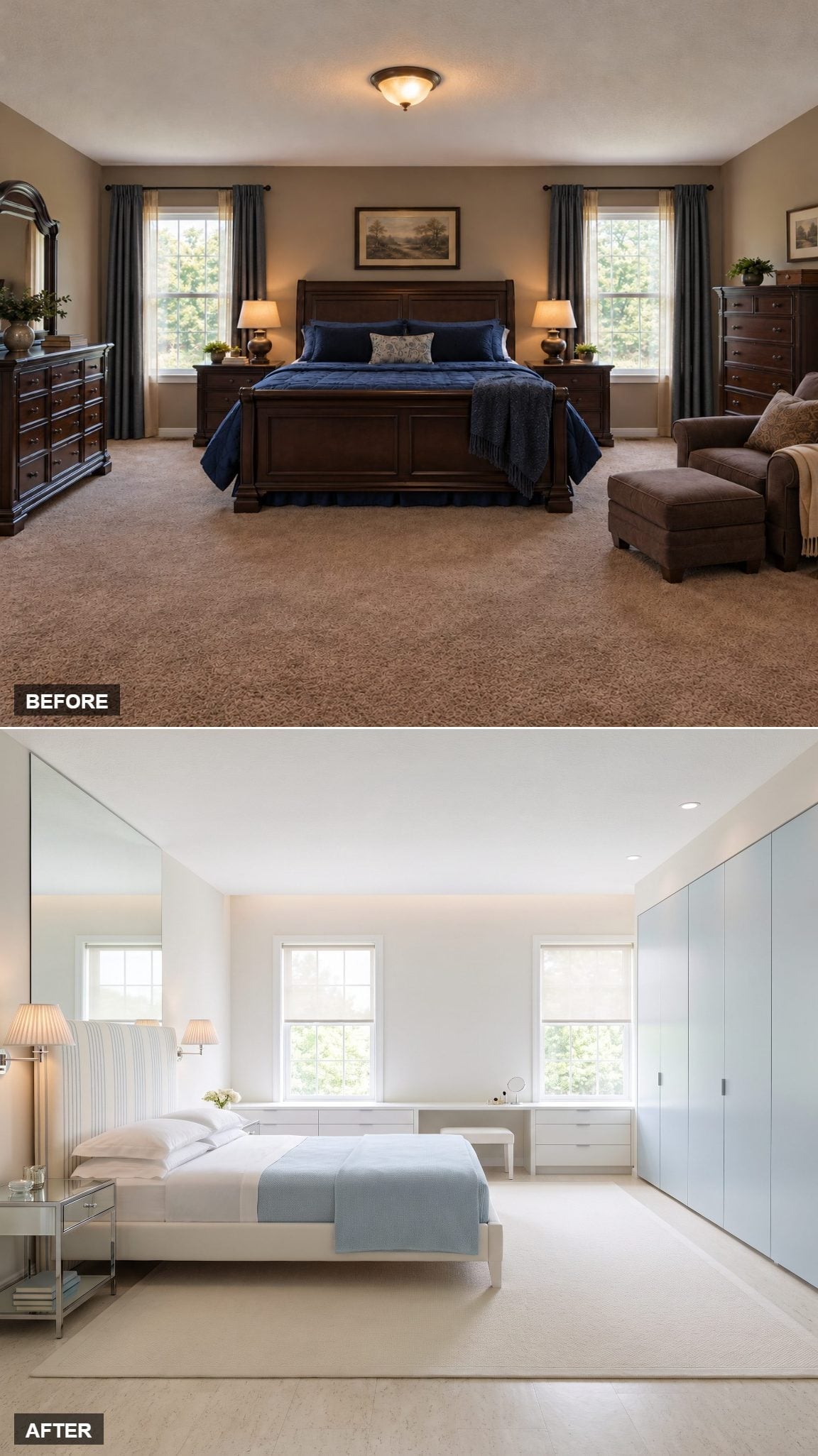
The powder-blue wardrobes occupy an entire wall without acquiring the imposing presence of several separate cabinets. Their muted color gives the bedroom a distinct personality while maintaining a gentle transition to the white surroundings.
Full-height doors consolidate storage into one orderly elevation, removing many of the exposed edges and gaps associated with freestanding furniture. A low upholstered bed provides a horizontal counterpoint to the tall cabinetry.
The clever decision is allowing the storage to contribute color instead of attempting to disguise it completely. The cabinetry becomes an attractive part of the bedroom rather than an obstacle that needs to disappear.
15. An Ornate Ceiling Medallion Meets a Contemporary Lotus Pendant
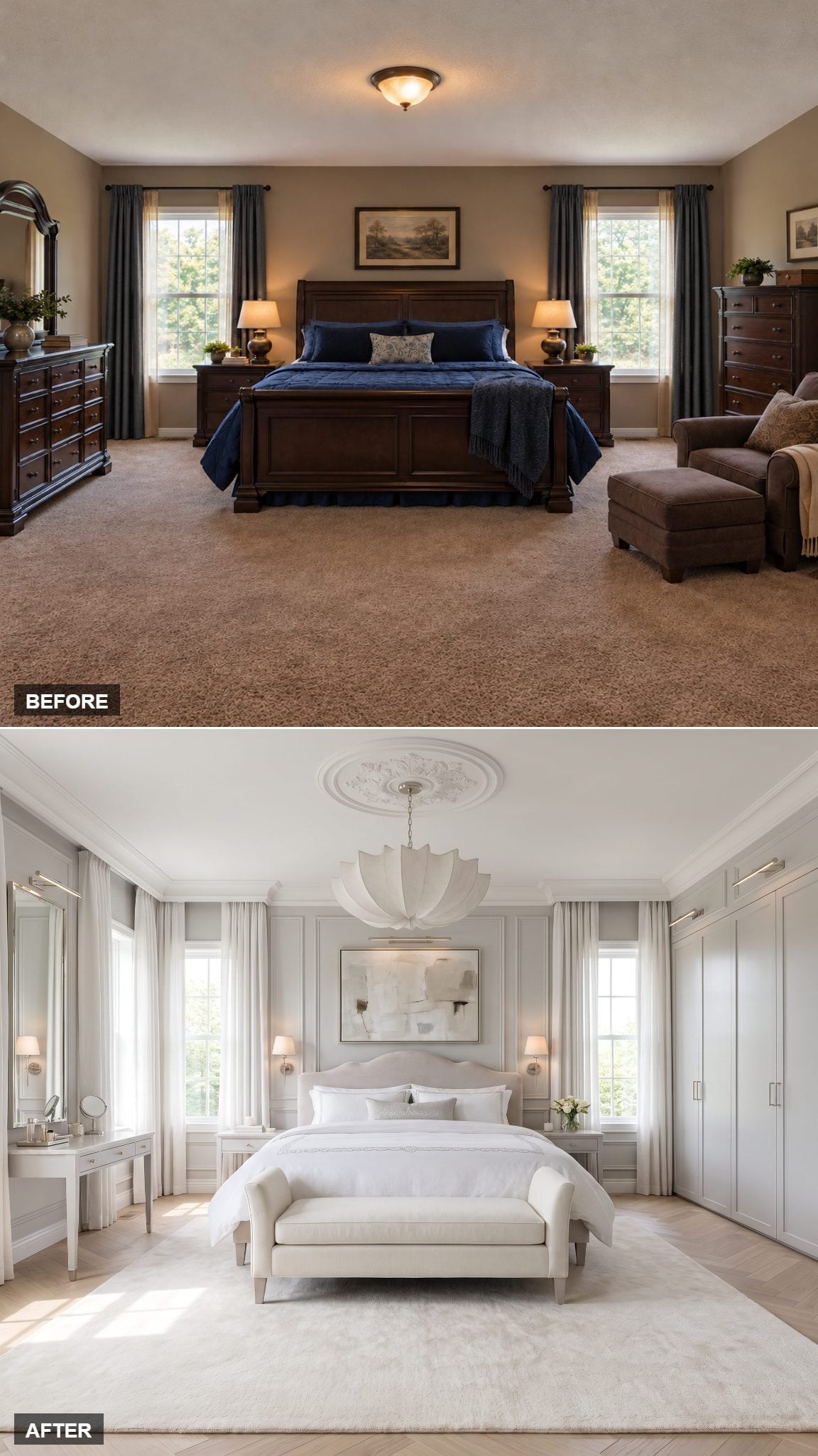
Traditional ornament doesn’t have to be stripped away to achieve a contemporary bedroom. The ceiling medallion establishes a formal center, while the sculptural lotus-inspired pendant introduces an entirely different design language beneath it.
Crown molding defines the perimeter, and soft gray wall paneling carries the traditional detailing down into the room. Linen-toned upholstery and the understated bench allow those architectural features to remain prominent without competing with elaborate furniture.
The result is neither a period-room reconstruction nor an exercise in stark minimalism. Contemporary lighting gives the traditional ceiling details a fresh context, demonstrating that ornamental architecture and visual spaciousness can coexist.
14. Terrazzo Leaves the Bathroom and Takes Over the Headboard Wall
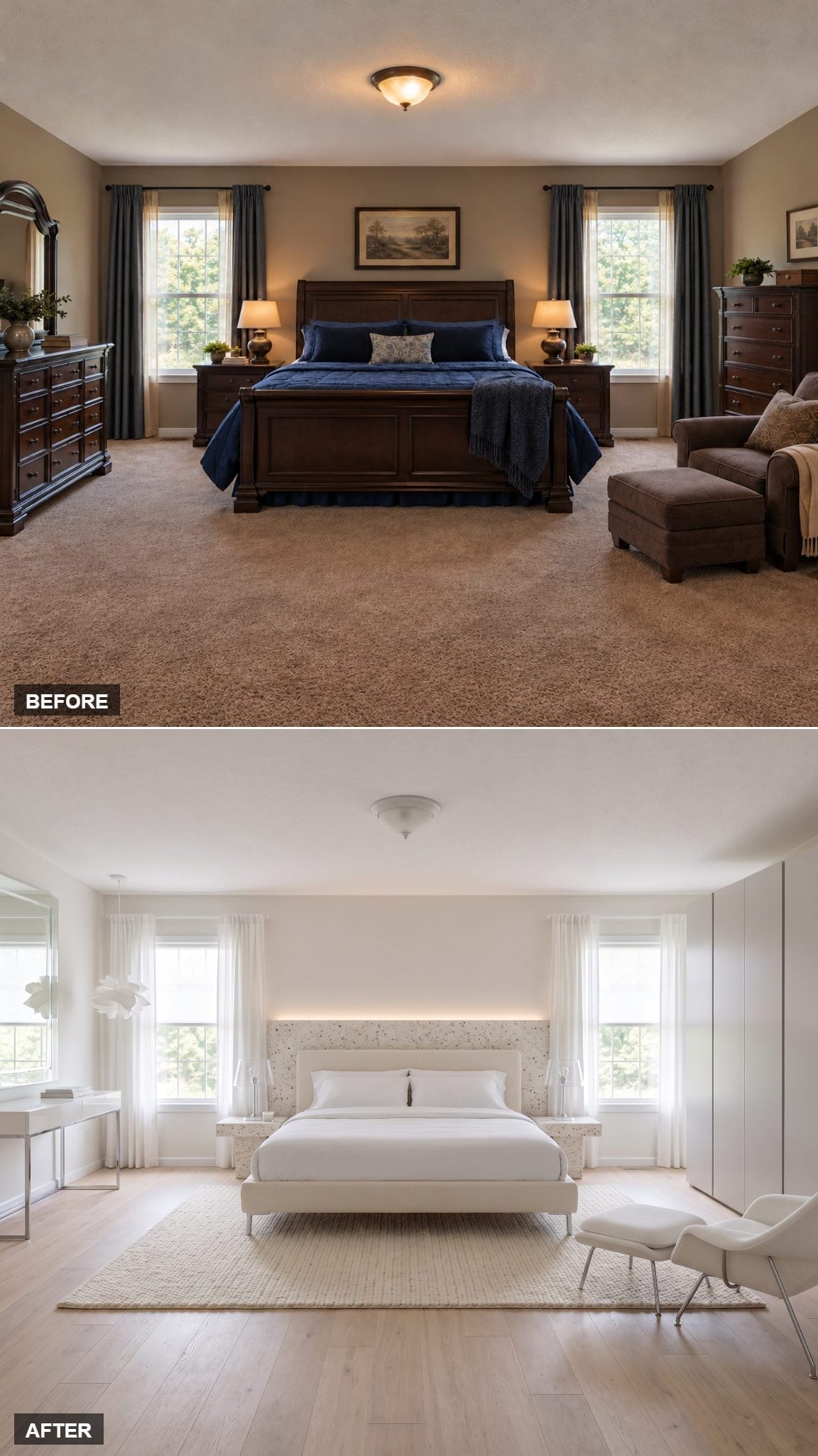
Terrazzo is more commonly associated with floors and bathrooms than with the wall behind a bed. Its granular pattern introduces an unexpected mineral quality into a setting otherwise dominated by textiles and natural wood.
Concealed LED lighting emphasizes the edges of the decorative panel, creating a luminous outline instead of a strongly contrasting frame. The pale oak flooring provides warmth, while sheer white curtains soften the transition between the windows and surrounding walls.
The interplay of terrazzo, wood and fabric gives the bedroom considerable tactile variety without scattering decorative objects throughout the space. An unusual material becomes the centerpiece precisely because the rest of the room gives it sufficient attention.
13. Powder Blue Meets the Directional Rhythm of Herringbone Oak
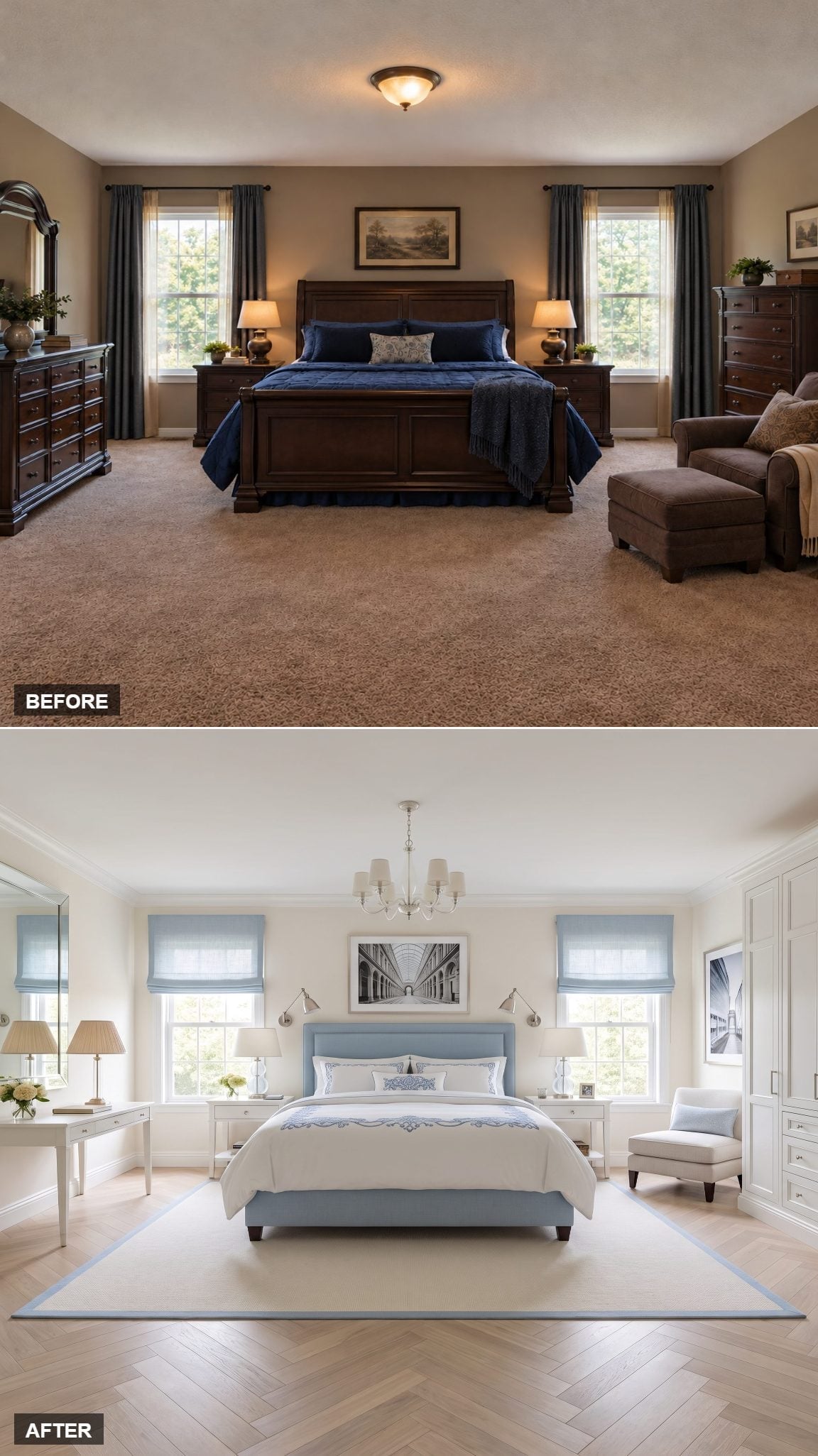
The herringbone floor gives the bedroom a sense of movement that conventional wall-to-wall carpeting cannot provide in the same way. Its interlocking pattern draws the eye diagonally across the room, while the pale oak finish maintains a light foundation.
A powder-blue upholstered headboard and related Roman shades connect the bed with the two windows. White nightstands provide a quieter transition between the blue fabric and the surrounding walls.
The candelabra-style chandelier introduces a more traditional element overhead. Color supplies continuity across the back wall, while the parquet adds visual rhythm below, giving the room interest in two different directions.
12. The Furniture Came Off the Floor and the Room Found Its Depth
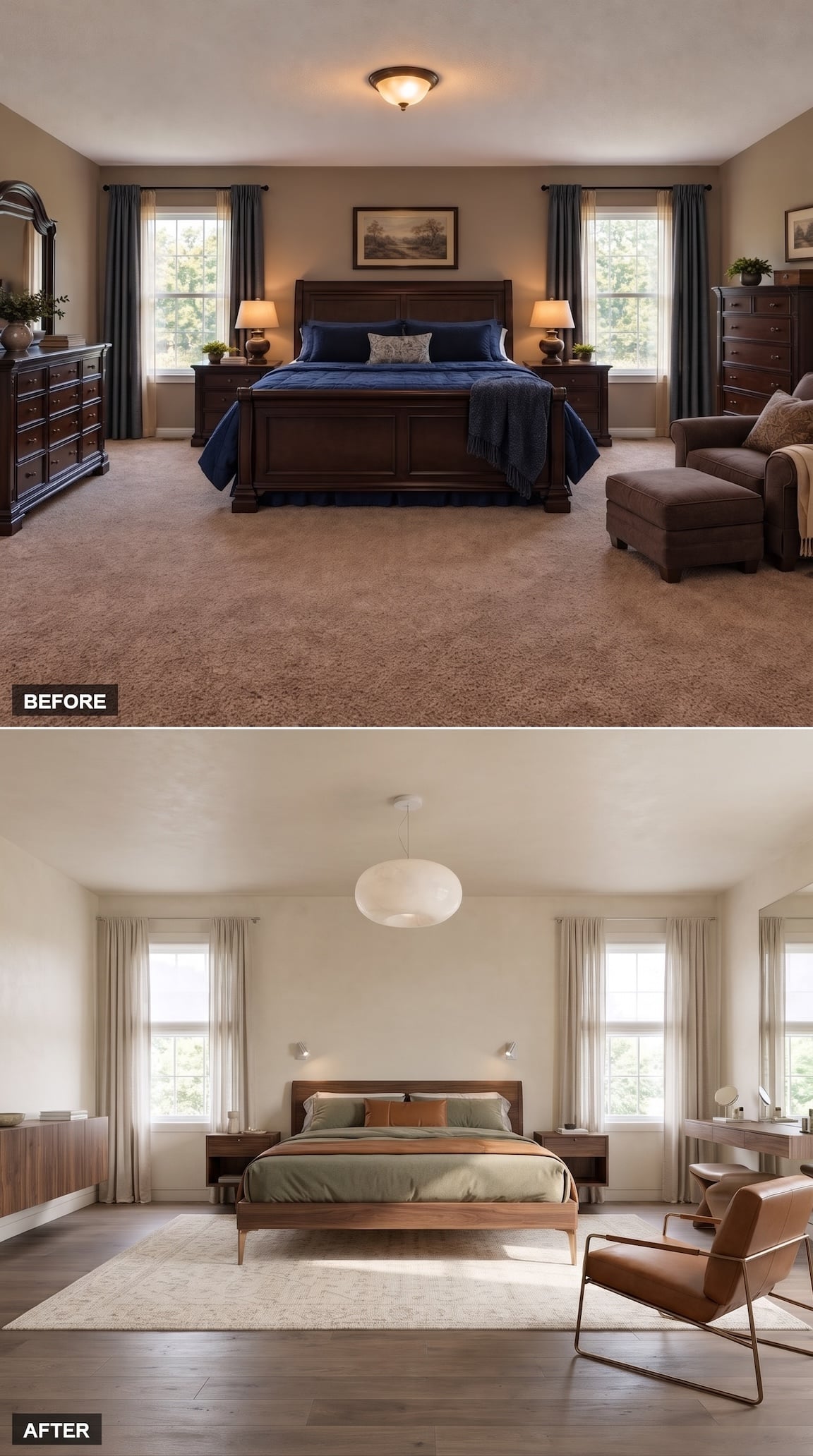
The original bedroom’s dark wooden furniture sits close to the carpeting, with solid bases and substantial panels concealing much of the space beneath it. The transformation replaces that weight with a collection of elevated, open and suspended forms.
A streamlined walnut bed stands on slender legs, leaving a generous shadow beneath the frame. Wall-mounted nightstands and a floating wooden credenza expose more of the floor, while a suspended vanity extends the approach into the dressing area.
The cognac leather lounge chair makes a particularly revealing comparison with the bulky armchair and ottoman in the original bedroom. Its open metal framework allows the flooring to remain visible even where the chair occupies space. Olive bedding, tobacco-colored accents and darker wood flooring ensure the room retains warmth and richness.
The furniture hasn’t disappeared. Its relationship with the floor has changed. More exposed flooring and fewer solid furniture bases create longer sightlines, allowing the generous dimensions of the original bedroom to become apparent.
11. The Windows Stayed the Same Size. The Curtains Had Other Ideas
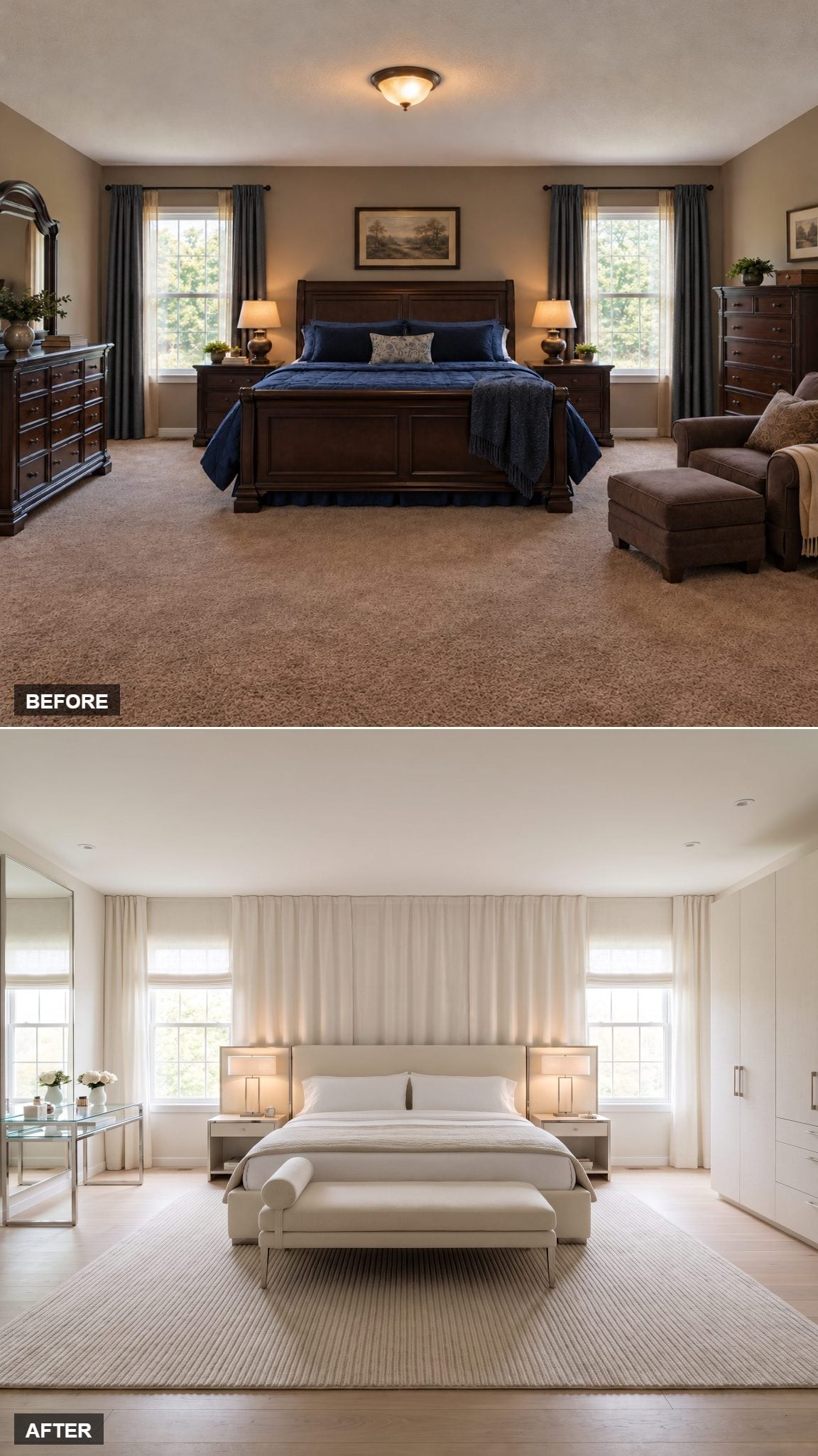
Floor-length ivory curtains treat the rear wall as one continuous textile feature instead of a collection of separate window openings. Their uninterrupted vertical folds emphasize the height of the room, while the low headboard leaves much of that fabric visible.
Pale wood nightstands, brushed-metal lamps and a ribbed rug provide subtle variations in texture. A glass-and-chrome vanity occupies the left corner without introducing the weight of another solid piece of furniture, and a large mirror extends the apparent depth of the dressing area.
The practical details matter. A sufficiently wide curtain track allows the fabric to clear the glazing when opened, while separate shades or appropriate linings can provide privacy and darkness when needed. Large leaning mirrors should be securely anchored.
The window treatment changes the perceived scale of the wall without requiring larger windows.
10. Navy Blue Returns, This Time as a Carefully Drawn Line
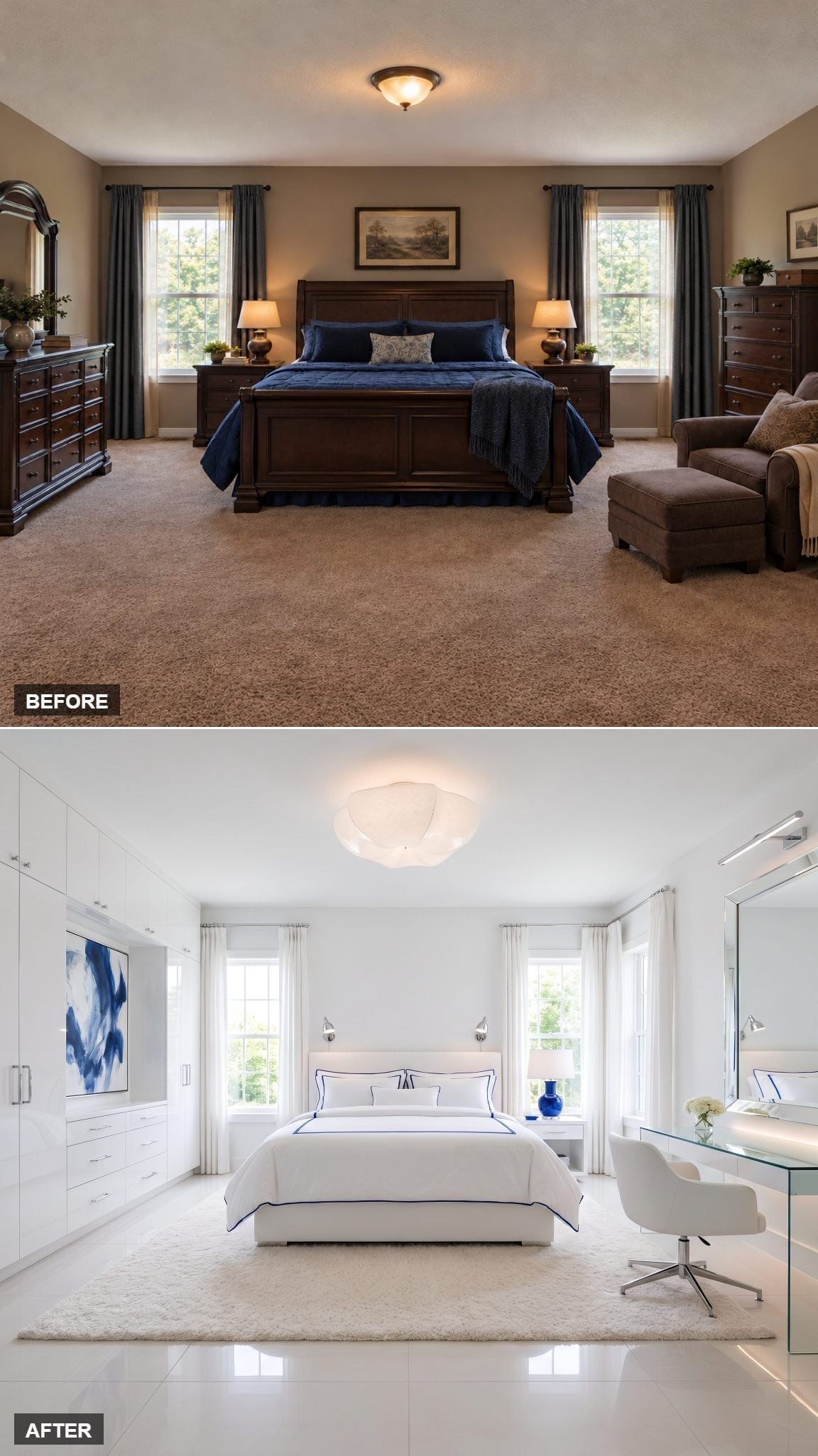
Dark blue hasn’t disappeared from this bedroom; its responsibilities have changed. Instead of occupying a substantial expanse of bedding, navy defines the white upholstered bed through a thin, precise border.
The color appears again in abstract artwork incorporated into the built-in cabinetry. Those two accents establish a connection across the room without requiring another large block of dark fabric or furniture.
Polished white flooring contributes to the brightness of the palette, although its reflective finish calls for careful lighting placement to avoid glare.
The navy works almost like an illustrator’s line, giving the pale furnishings definition. Removing every dark accent would have made the room less distinctive, not necessarily more spacious.
9. The Wood Stayed. Its Visual Weight Disappeared.
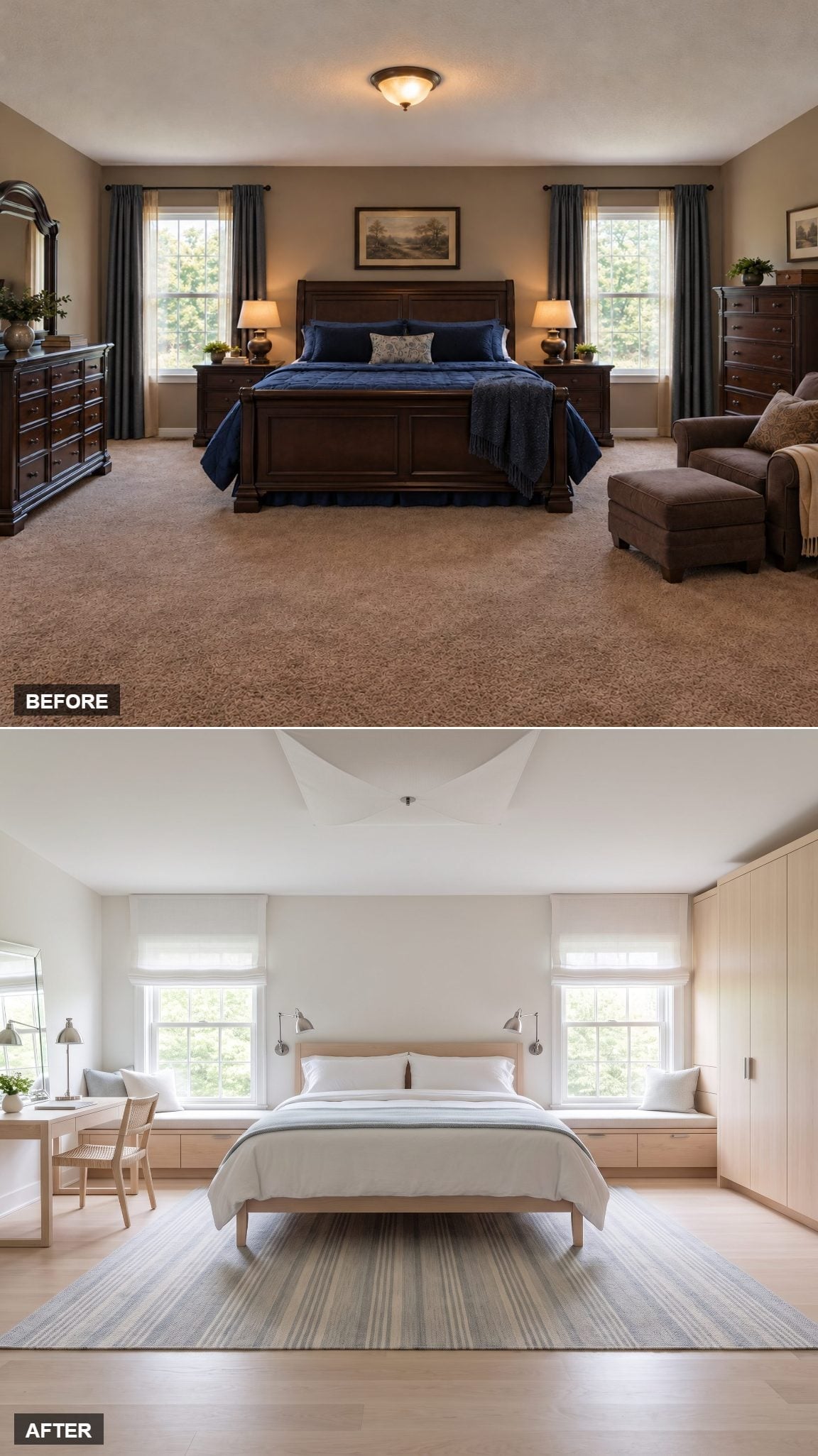
Whitewashed oak preserves the grain and warmth associated with natural wood while reducing the contrast between the storage and surrounding walls. Its application across a full-height cabinet elevation gives the material a much larger role without the visual interruption of several dark dressers.
The low platform bed and striped rug occupy the central area, while compact Roman shades leave the architecture around the windows apparent. Wall-mounted reading sconces remove the need for substantial bedside lamps.
The wood hasn’t vanished from the bedroom. Its finish, scale and function have changed, allowing it to contribute character without dominating the furniture arrangement.
8. Peach Upholstery Finds a More Expressive Partner in Rattan and Art
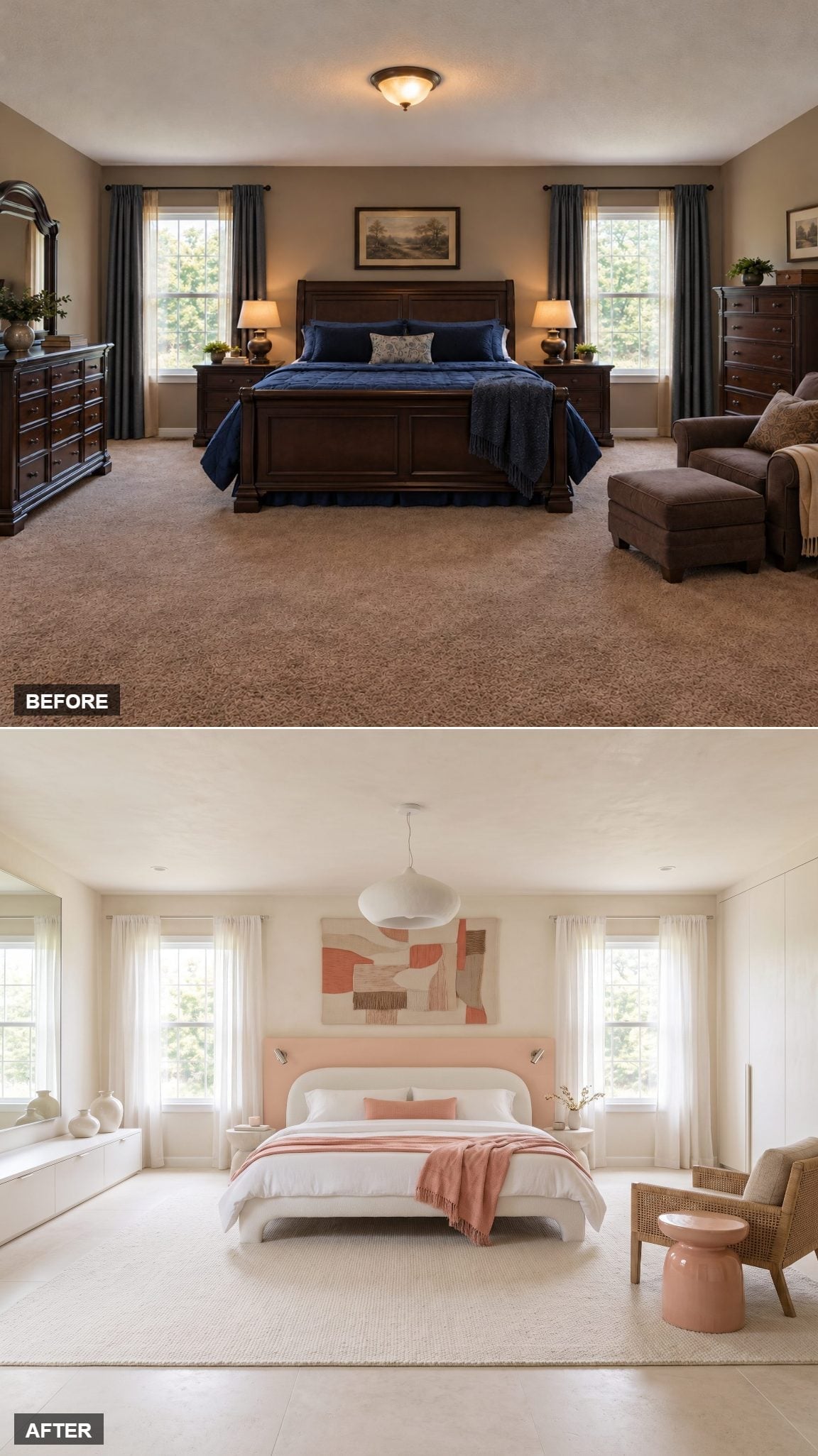
The curved peach bed introduces warmth against the pale walls, while abstract artwork extends its decorative influence above the headboard. The color acquires a more artistic context than it would have in an otherwise uniformly furnished bedroom.
Wall-mounted reading sconces free up the bedside surfaces, and sheer white curtains soften the daylight. A globe pendant provides another lighting layer without overwhelming the upper portion of the room.
The woven rattan chair and coral ceramic side table offer a particularly effective departure from the conventional matching bedroom suite. Their different materials and forms give the corner its own personality. The furniture belongs together through color and proportion rather than through an identical finish.
7. White Brick Gives the Light Something Interesting to Land On
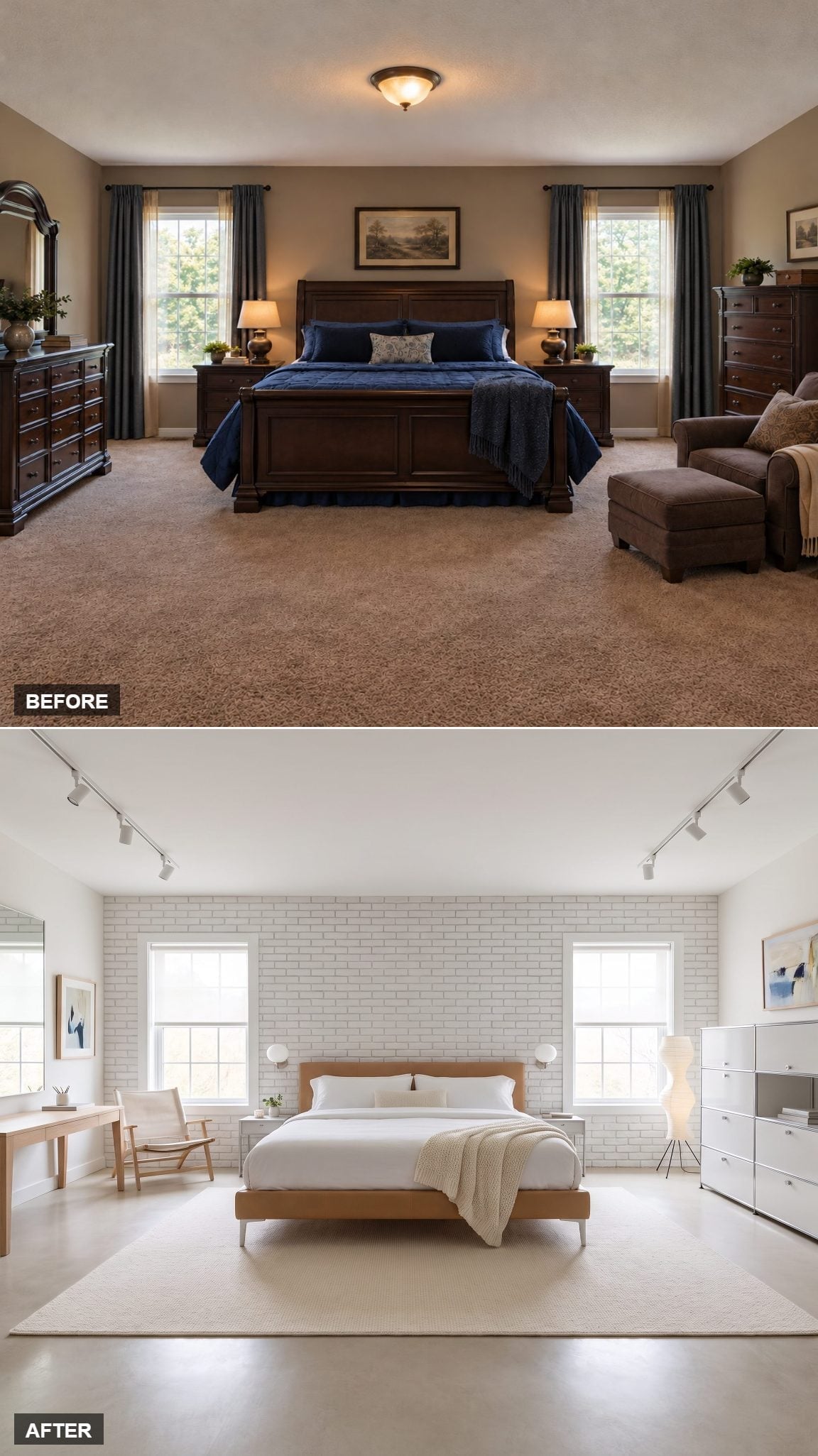
Painted white brick has a depth that a smooth painted wall cannot reproduce. Its recessed joints and irregularities catch directional light, producing small shadows that give the headboard wall a recognizable texture.
Ceiling-mounted track lighting provides the flexibility to direct illumination toward different parts of the room. With appropriate beam angles, individual fixtures can highlight the masonry, artwork or other vertical features.
The oak-toned platform bed introduces warmth against the white brick, while its low profile allows much of the textured wall to remain visible.
Track lighting should be adjusted carefully to avoid glare when viewed from the bed. Separate reading lights may still be necessary, particularly where the ceiling fixtures are primarily intended to illuminate the architecture.
6. Four Suspended Globes Give the Ceiling an Entirely New Character
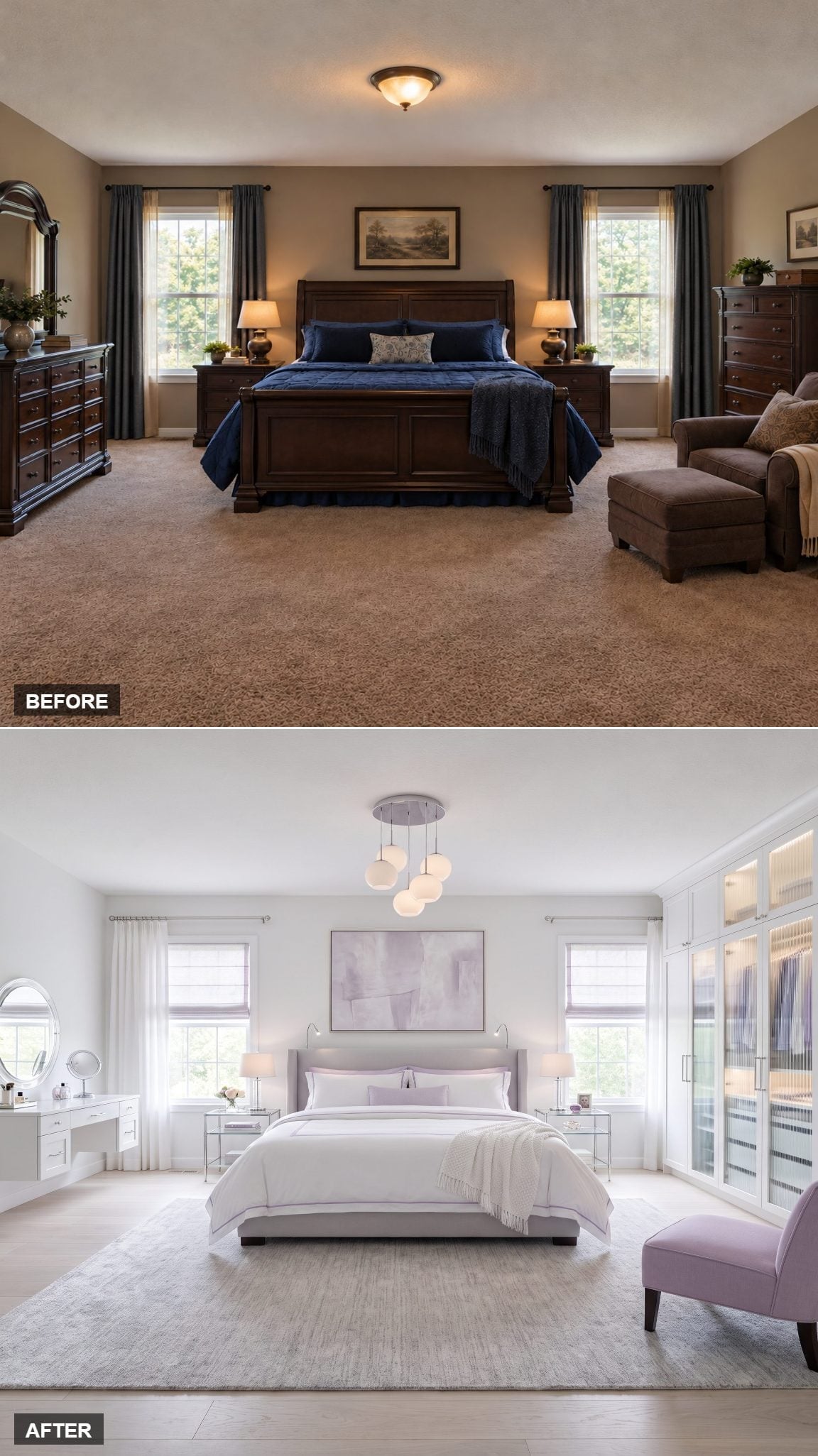
Four suspended globes bring considerably more sculptural interest to the ceiling than a compact flush-mounted fixture. Their staggered drop lengths give the upper portion of the bedroom a sense of movement without requiring additional architectural construction.
Dove gray upholstery and predominantly white bedding provide a calm setting below. A lavender chair introduces a gentle color accent, while the pale vanity and round mirror continue the softened geometry of the pendant shades.
Why the Pendant Cluster Works
A cluster gives the ceiling several points of visual interest, although actual light distribution depends on the shades, lamp output and fixture design. Combining decorative ambient lighting with dedicated reading and dressing lights prevents the central fixture from having to satisfy every lighting requirement.
5. Chrome and a Few Lines of Primary Color Give White a Modernist Edge
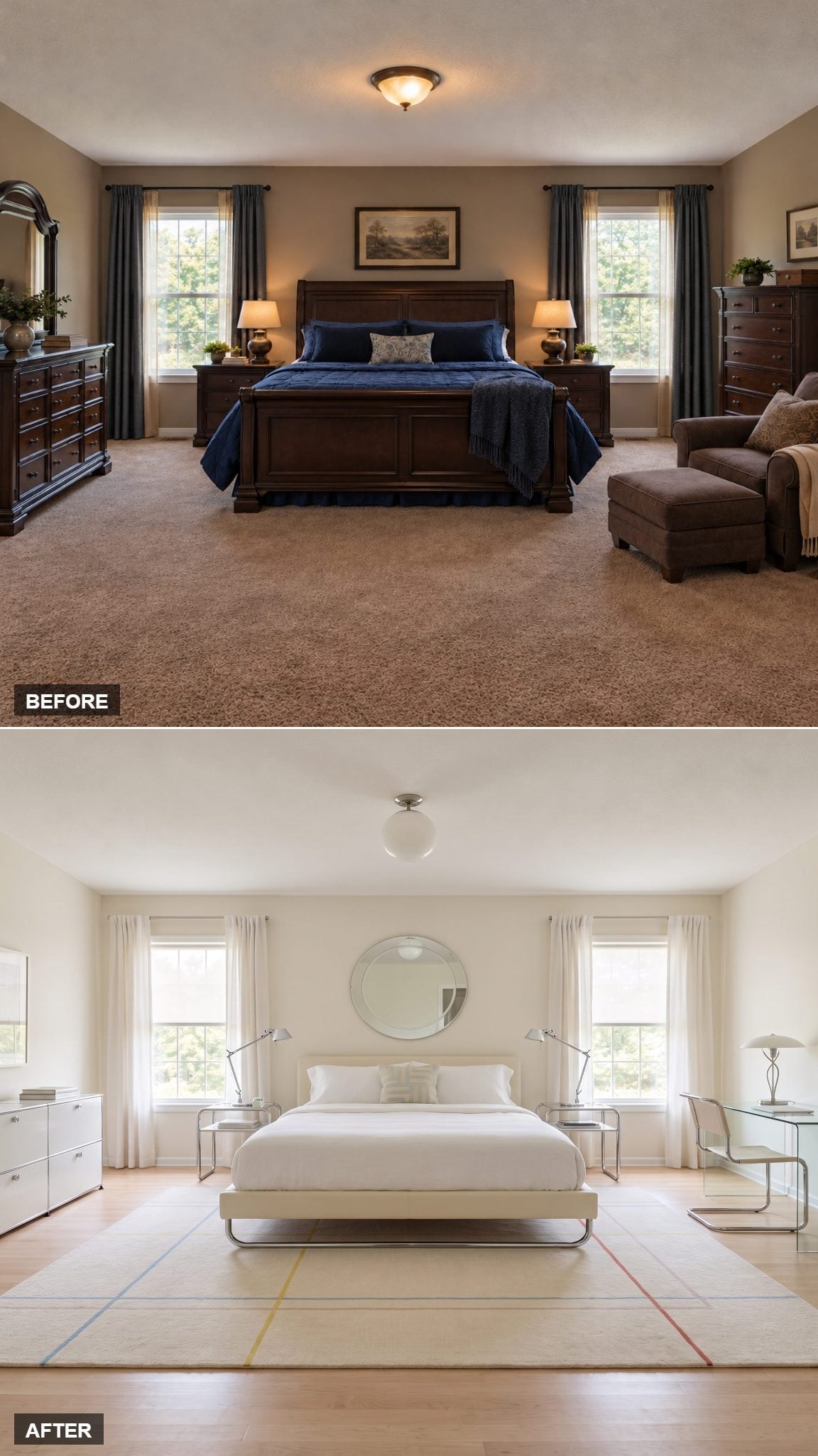
The chrome side tables bring a degree of industrial precision to the bedroom, with open structures that reveal the surrounding floor instead of concealing it. Architect-style lamps continue that slender, functional aesthetic.
A round mirror above the white upholstered bed provides a counterpoint to the predominantly rectangular architecture. White Roman shades maintain a simple treatment around the windows.
Underfoot, narrow red, yellow and blue lines trace the edges of a cream rug, introducing a subtle modernist reference. The color is concentrated in an unexpectedly small detail rather than spread across several furnishings. The room achieves a distinctive identity with remarkably few decorative gestures.
4. When the Bed Stops Being the Only Reason for the Room
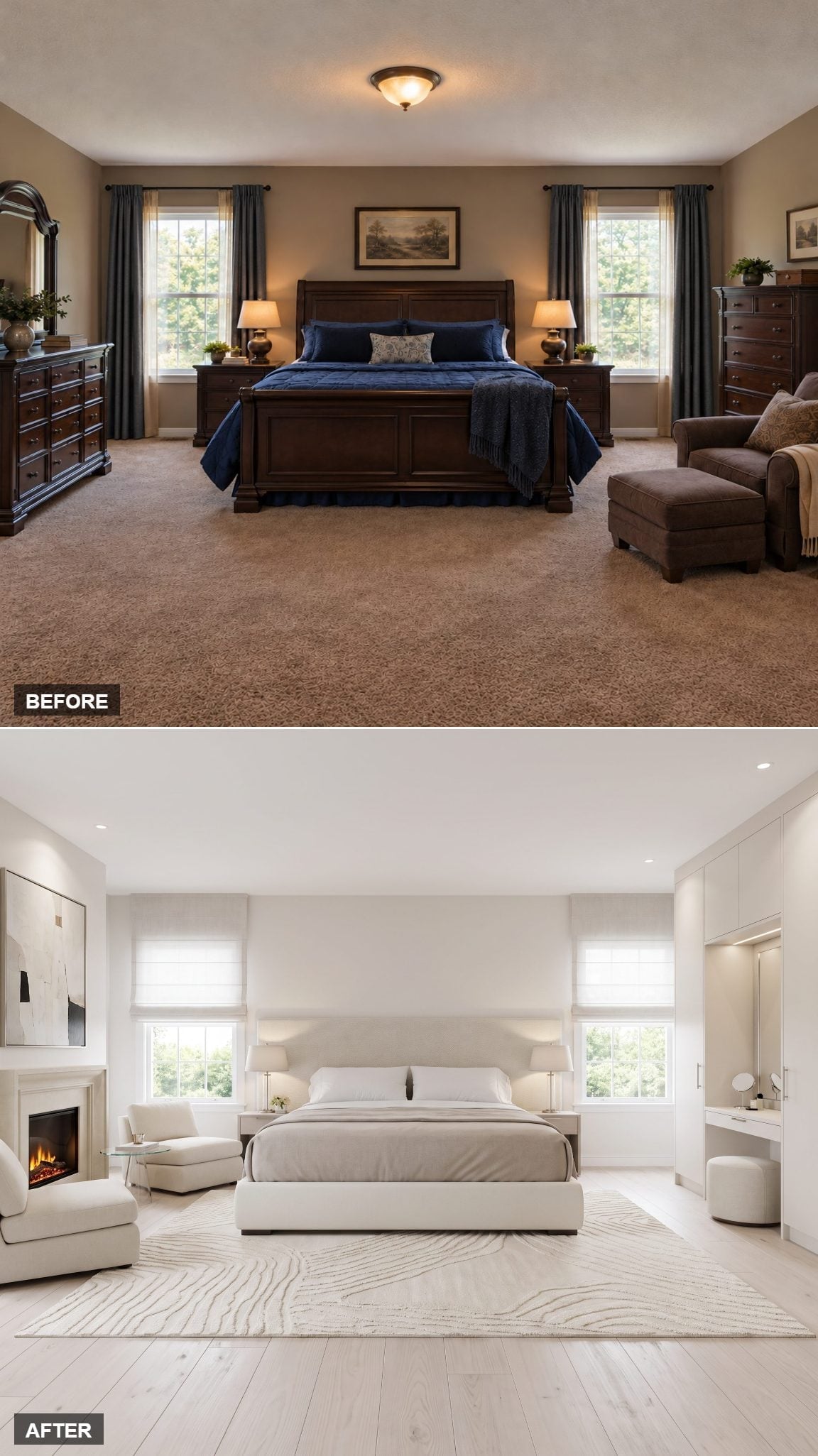
A generous bedroom can feel strangely underused when every piece of furniture is organized exclusively around the bed. Giving the surrounding walls independent functions changes the character of the entire space.
A pale marble-look fireplace surround and adjoining lounge chair create an intimate sitting area on the left. Across the room, recessed cabinetry accommodates a vanity with its own lighting, integrating dressing and grooming into the bedroom without introducing several unrelated pieces of furniture.
Pale oak flooring connects these different activities, with an abstract-patterned rug distinguishing the sleeping area. Roman shades leave the window surroundings comparatively uncluttered.
The bedroom gains a place to read, dress and unwind without allowing those additional functions to obstruct circulation. Greater usefulness comes from organizing the existing floor plan rather than adding to it.
3. A Geometric Wood Installation Gives an Almost White Bedroom Its Identity
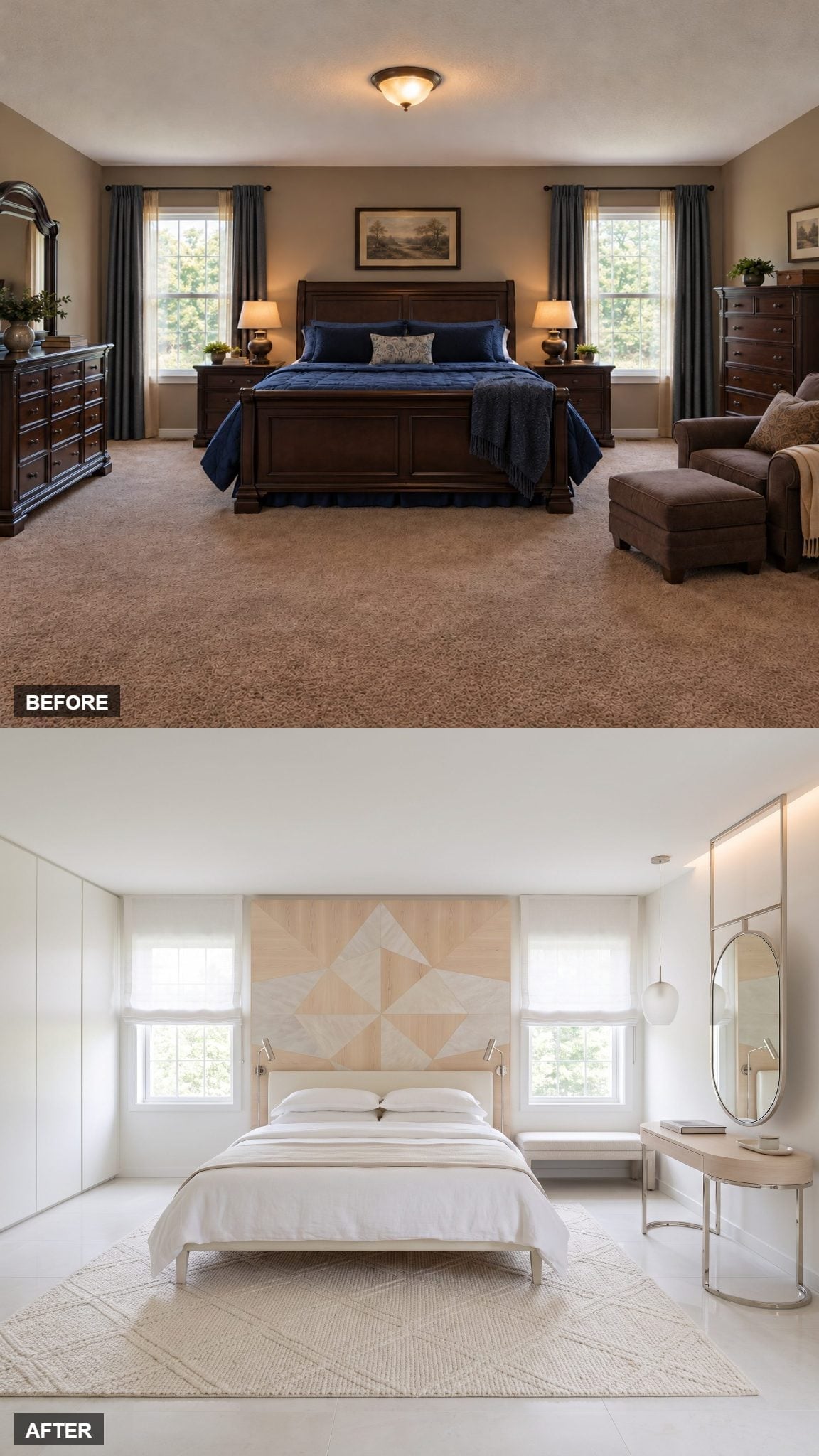
A quilt-inspired wood installation fills the wall between the windows, introducing an intricate pattern into an otherwise orderly bedroom. Its arrangement of individual geometric pieces supplies the richness that might conventionally come from several decorative furnishings.
White panel molding provides a more formal framework around the installation. The low upholstered bed leaves the woodwork visible, while a suspended ceiling fixture adds another distinct shape overhead.
A woven rug contributes a quieter texture below. Concentrating the strongest pattern in one location allows the bedroom to retain the advantages of a restrained palette without sacrificing its individuality.
2. The Dark Bed Stayed. The Room Opened Up.
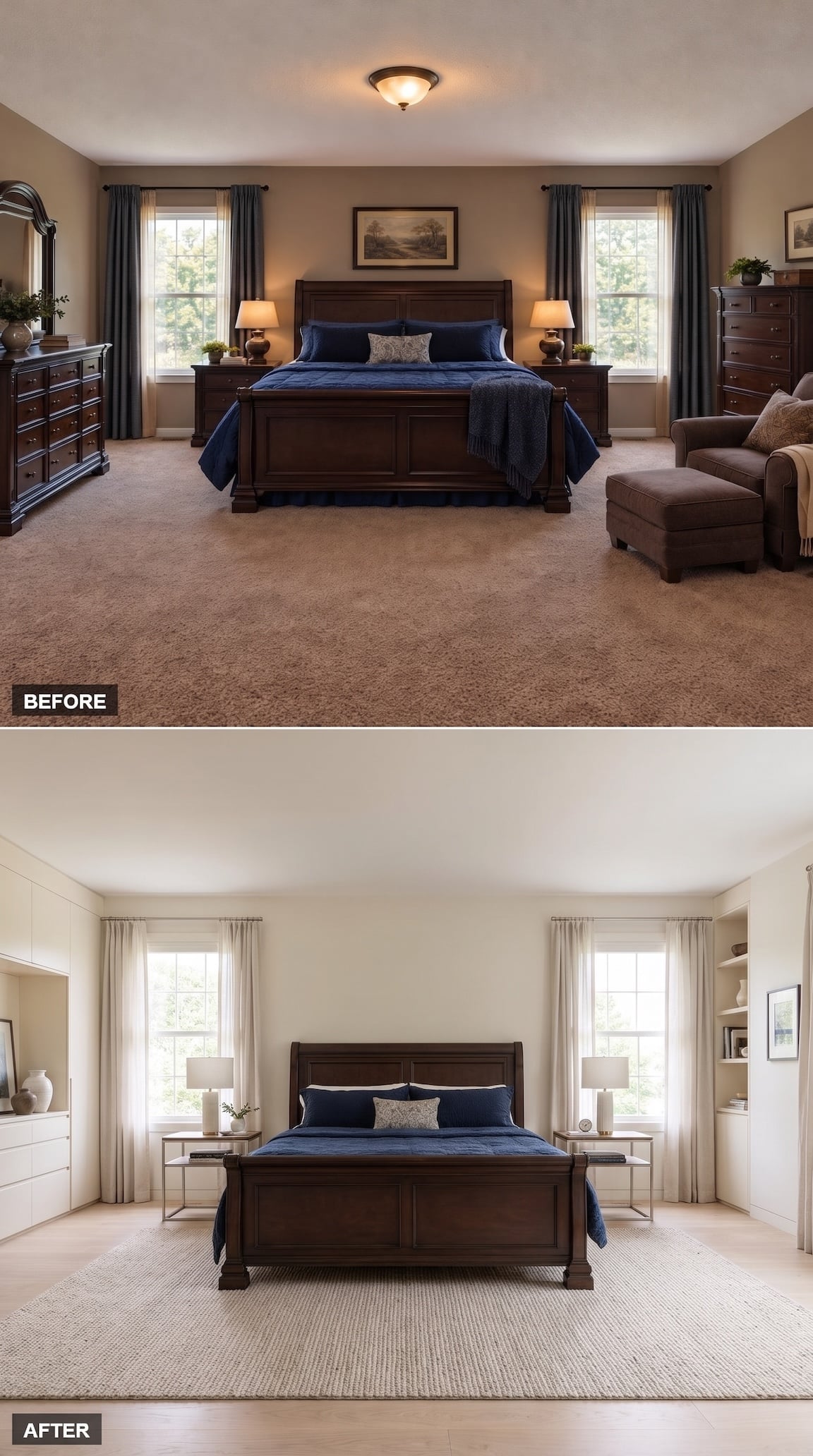
The most revealing element of this transformation is the one that hasn’t changed. The substantial dark wooden bed and navy bedding remain at the center of the bedroom, complete with the traditional paneled headboard and high footboard.
What disappears is the supporting cast of matching dark furniture. Ivory built-in cabinetry replaces the bulky dressers, incorporating storage and display areas into the surrounding walls. Open-framed nightstands provide useful bedside surfaces without continuing the dark mass of the bed.
Pale wood flooring and a generously proportioned woven rug give the furniture a lighter foundation. Ivory walls reflect available daylight, while pale curtains soften the light at the windows. Removing the central ceiling fixture leaves an uninterrupted ceiling plane, and table lamps provide localized illumination. Additional ambient lighting may be useful after dark.
The retained bed has more presence now that it no longer competes with several pieces of similarly substantial furniture. Its dark finish and navy textiles become deliberate contrasts rather than contributors to an overwhelmingly heavy palette. Sometimes the furniture that seems to be causing the problem is exactly the piece worth keeping.
1. The Bedroom Finds Its Breathing Room
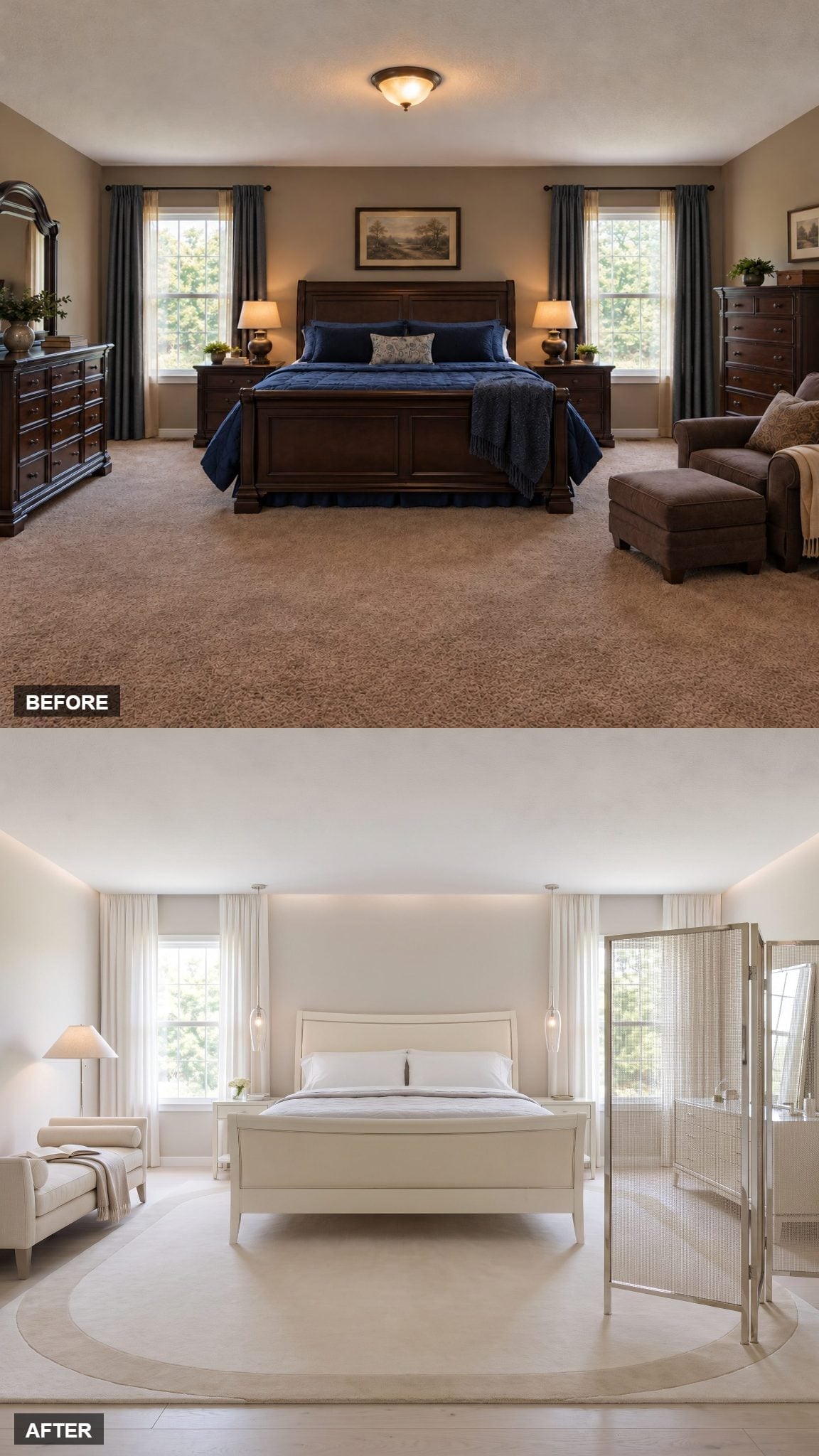
Concealed ceiling lighting gives the upper boundaries of the bedroom a gentle glow, while suspended bedside fixtures bring illumination closer to the sleeping area. The two layers perform different functions, allowing the ceiling and furniture to retain their individual character.
The low, curved cream-lacquered bed and oval rug soften the transition between the sleeping and sitting areas. Floor-length curtains maintain a continuous treatment around the windows, and a slender metal-framed folding screen distinguishes an adjoining zone without enclosing it behind a solid partition.
The pale palette contributes to the room’s brightness, although the more consequential decisions involve furniture height, lighting placement and uninterrupted views across the floor. A bedroom doesn’t have to surrender its color, character or intimacy to feel more spacious. Sometimes the greatest luxury is simply giving the architecture enough room to be seen.