🔥 Would you like to save this?
You have seven seconds. That’s it. Seven seconds before a guest decides whether your home is extraordinary or forgettable. The foyer is not a hallway. It is not a transition space. It is a declaration. A statement of intent delivered in marble, bronze, and light before a single word is spoken. These transformations don’t ease you in gently. They announce you. Loudly. Unapologetically. Exactly as intended.
In order to come up with the very specific design ideas, we create most designs with the assistance of state-of-the-art AI interior design software.
The foyer that came with the house is rarely the foyer anyone would have chosen. Beige walls, hollow-core doors, a light fixture that looks like it was selected by a committee trying to offend no one. Builder grade is a polite way of saying functional but forgettable, and for years, homeowners have walked past these spaces without giving them much thought. These 27 before-and-after examples show what happens when people finally decide the first room a guest sees deserves actual attention.
The changes here range from simple to structural. Some homeowners swapped out a single overhead light and added wallpaper. Others took down walls, replaced flooring, and started from scratch. What connects every project is the shift from a space that reads as leftover to one that reads as intentional. A foyer sets expectations for everything beyond it. These renovations prove that getting it right does not require a full gut job, just a clear sense of what the space should say.
Bare Builder Foyer Traded for Backlit Onyx, Bronze Railings, and Pendant Tubes
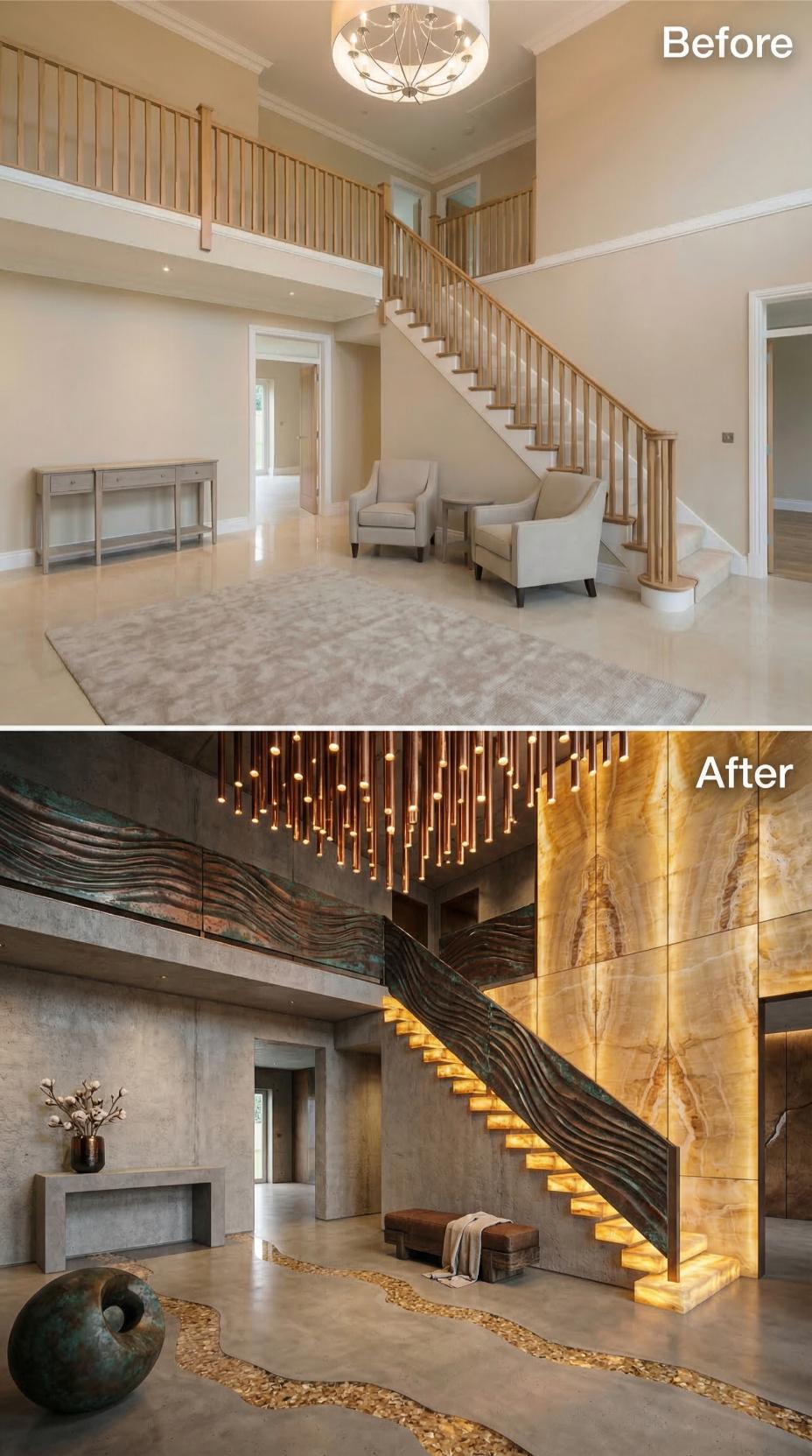
Floating stairs with backlit honey onyx treads replace painted wood balusters, while oxidized bronze wave panels run the full balustrade length alongside copper tube pendants.
Warm Oak Balusters and Beige Walls Gave Way to Black Plaster, Wrought Iron, and Marble Treads
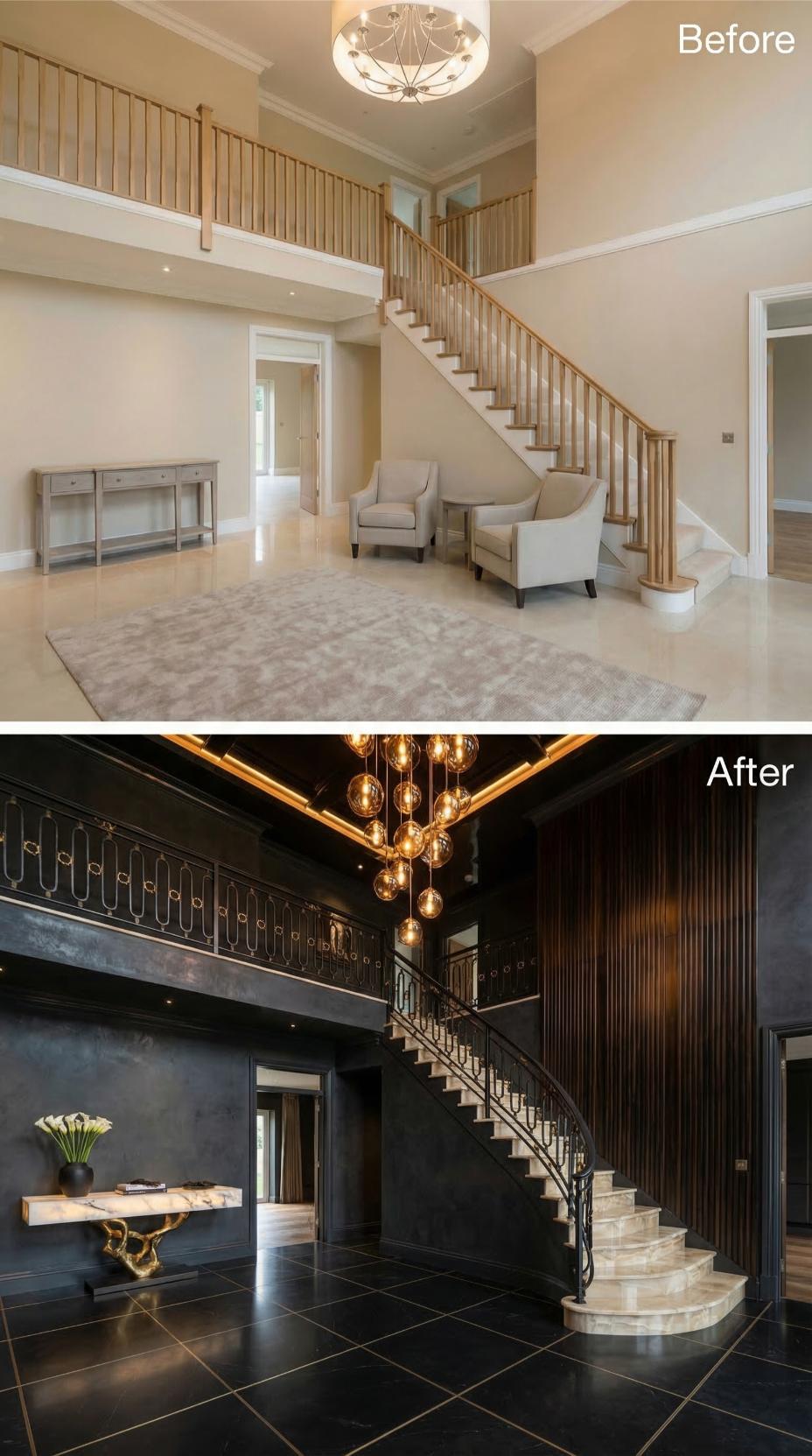
Dark venetian plaster walls replaced every trace of beige, while the original oak spindle railing was swapped for wrought iron with an oval-link pattern finished in matte black and gold. Marble treads anchor the staircase base, and cascading globe pendants in aged brass replace the sputnik fixture overhead.
Beige Builder Bones Replaced by Green Marble Chevron, Smoked Paneling, and Glass Orb Clusters
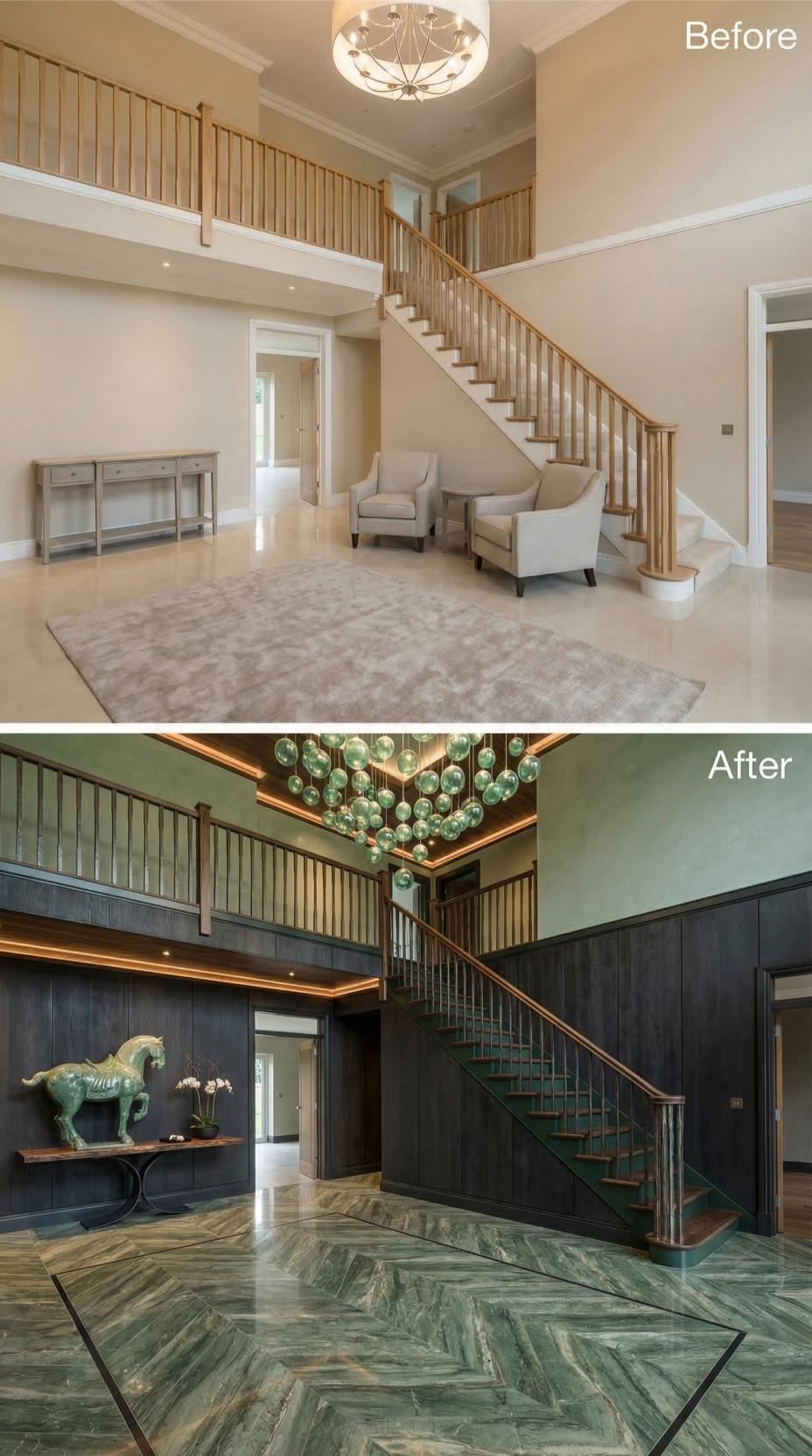
Warm beige walls and oak balusters with carpet and a console table gave this foyer the feel of a show home waiting to be occupied. The renovation replaced all of it with smoked, near-black wood paneling that runs floor to balcony height, framed by a cove-lit upper ledge in amber. Green marble in a chevron pattern covers the entire floor, its veining pulled into sharp diagonal geometry.
Suspended above the staircase, clusters of jade-toned blown glass spheres hang at varied heights, replacing the original sputnik chandelier. The staircase itself now reads in deep forest green with walnut treads and metal balusters. A sculptural ceramic horse in celadon glaze sits on a demilune console, the only decorative object in the space, which is exactly enough.
Navy Grasscloth, Gold Leaf Walls, and a Coffered Ceiling Replaced Builder Beige
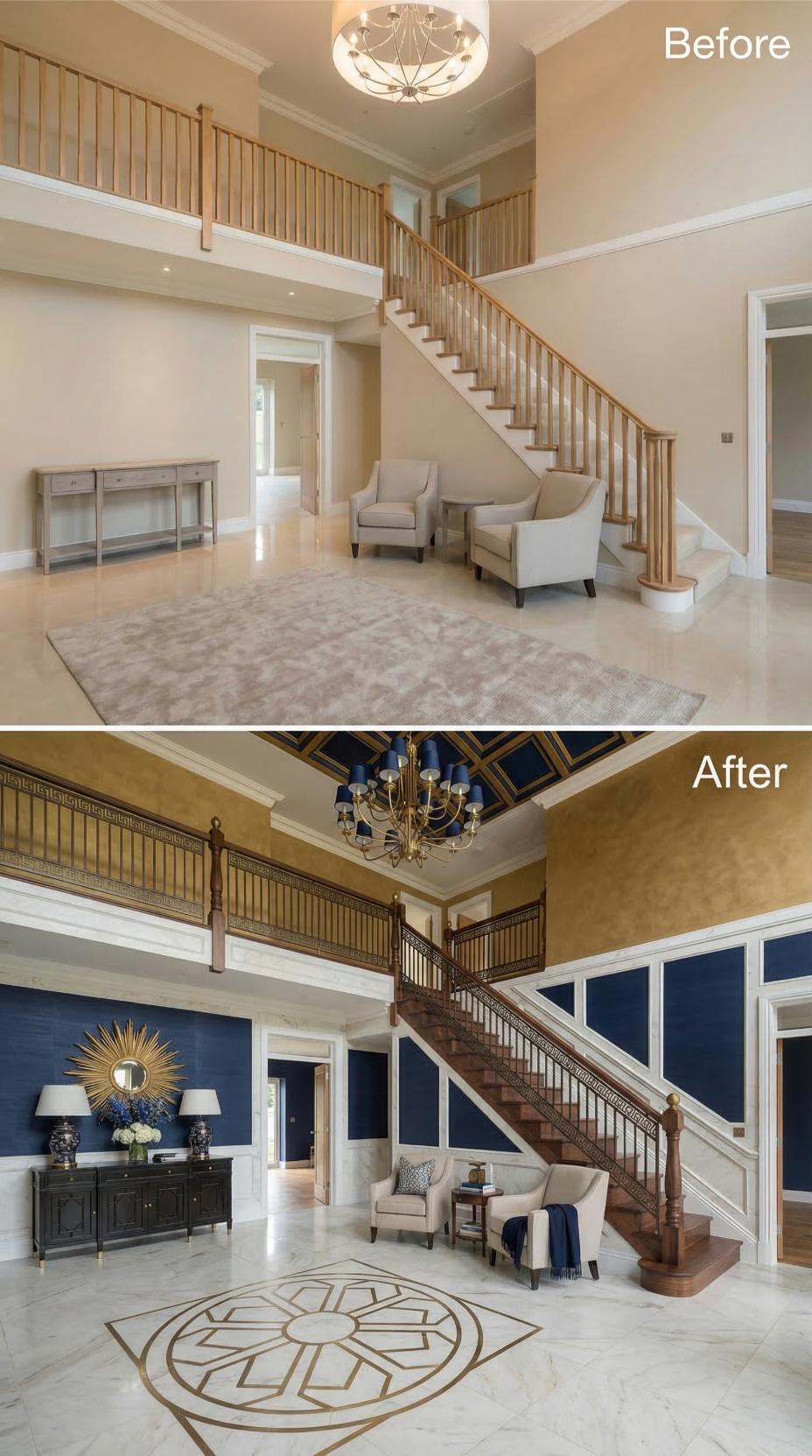
What started as a foyer of pale walls, honey-toned oak balusters, and a modest sputnik chandelier became something far more deliberate. Navy grasscloth wallcovering fills the lower wall panels, framed by white molding that reads almost like wainscoting. Above the crown, gold venetian plaster extends to the ceiling, where a coffered grid in navy and gold anchors the room vertically. The staircase railing was rebuilt in dark walnut with brass Greek key detailing that wraps the full balcony rail.
A sunburst mirror in antiqued gold sits above a black console with carved panel fronts. Two lamps in cobalt ceramic flank white roses in a low vase. The floor inlay is the signature move: a medallion in dark bronze and white marble, geometric and centered exactly under the brass chandelier fitted with navy drum shades.
Smoky Walls, Hairpin Legs, and Smoked Globe Clusters Replaced Builder Beige
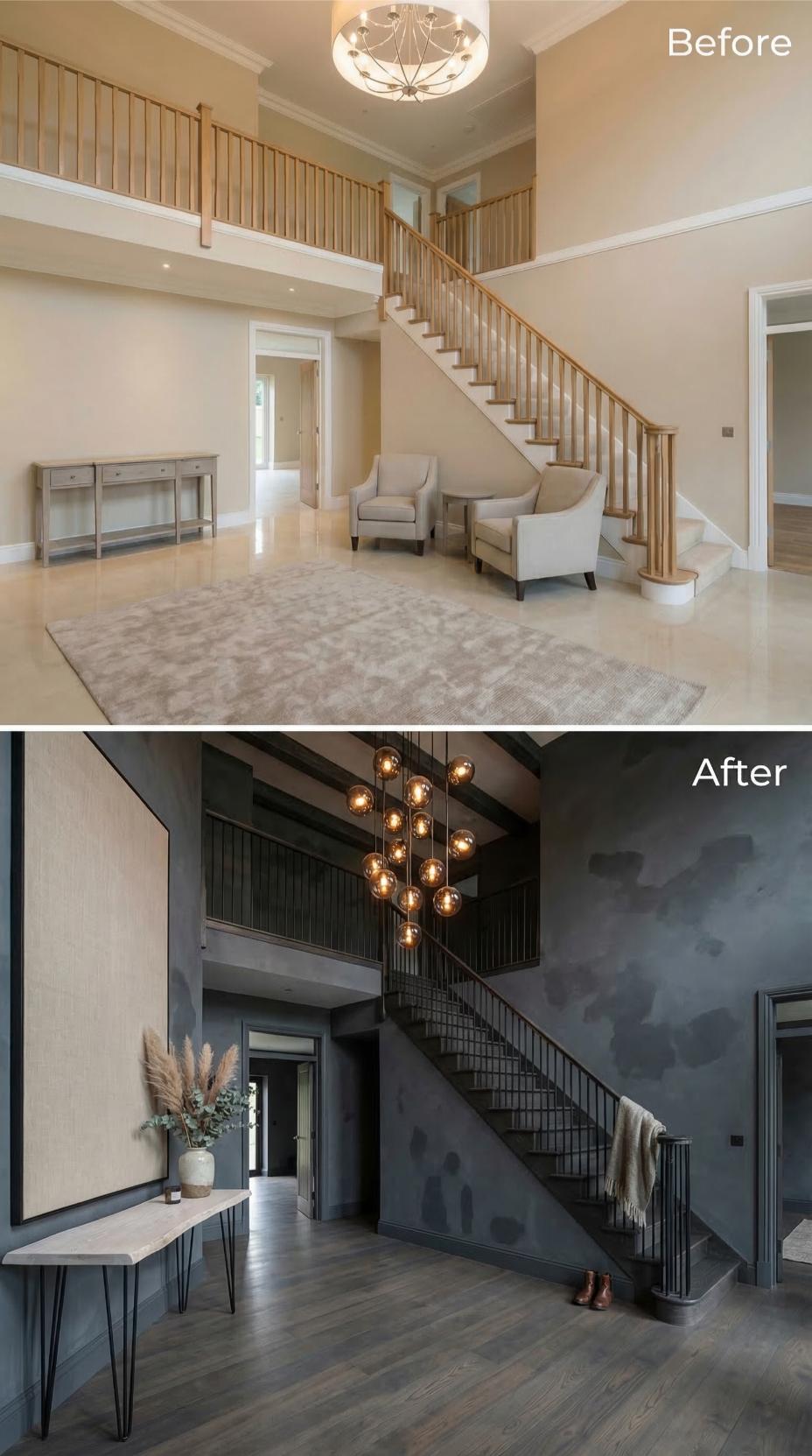
The before shows a two-story foyer with natural oak balusters, cream-painted walls, and a sputnik-style chrome chandelier sitting above a pair of linen armchairs. Polished travertine floors and a muted area rug complete a palette that reads safe but forgettable.
The after strips that entirely. Charcoal Venetian plaster walls carry an organic mottled pattern across every surface. The staircase railing switches to black powder-coated steel with vertical flat-bar spindles. Overhead, a cluster chandelier of smoked amber glass globes drops from the ceiling on staggered stems. A white marble console on hairpin legs anchors the left wall, with pampas grass and eucalyptus cuttings in a textured ceramic vase providing the only softness in the room.
- Charcoal Venetian plaster walls with mottled tonal variation replace flat beige paint
- Smoked amber multi-globe pendant cluster replaces the chrome sputnik fixture
- Black powder-coated steel flat-bar railing replaces natural oak baluster construction
Moroccan Craftsmanship Replaced Oak Balusters, Beige Walls, and a Builder Chandelier
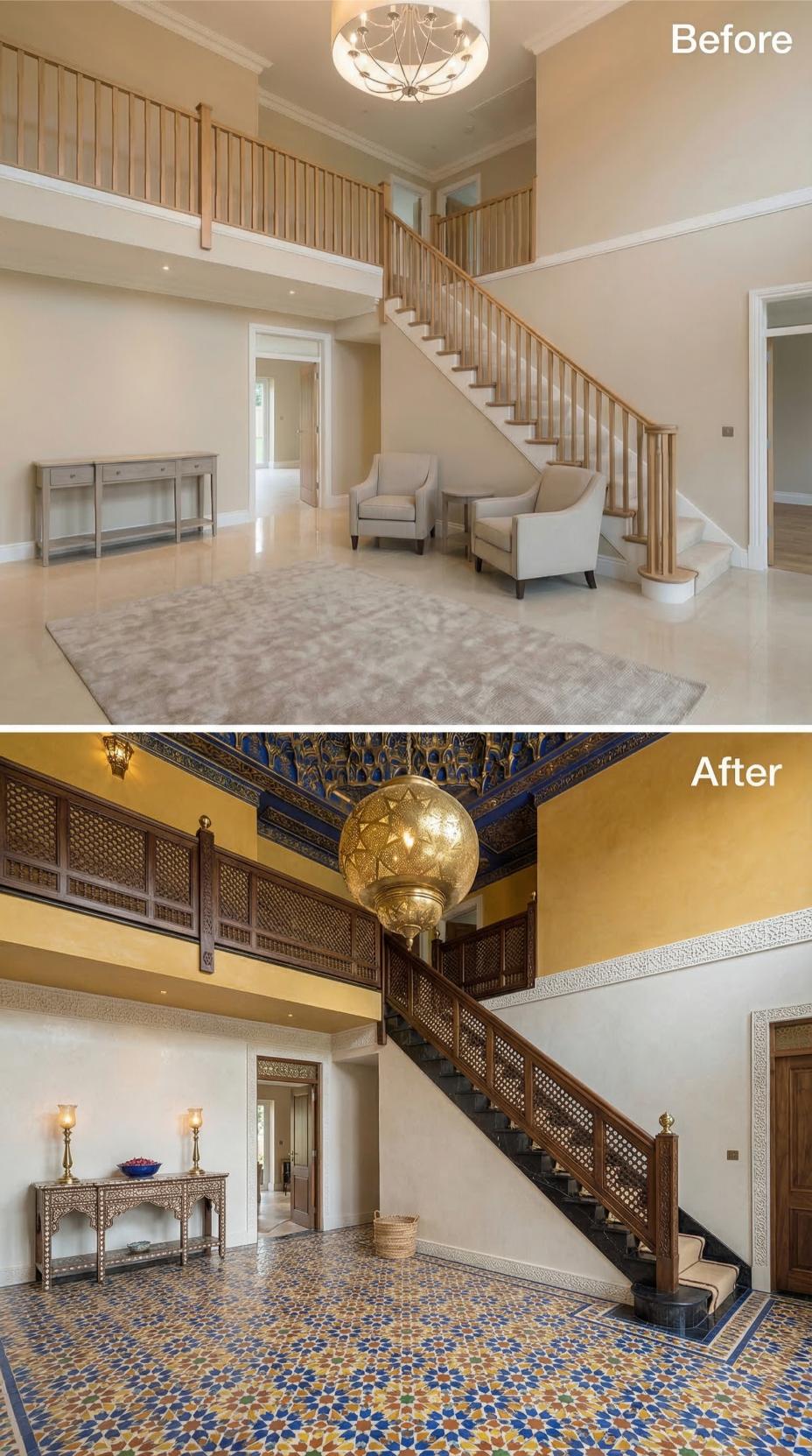
Geometric zellige tile in cobalt, amber, and ivory now covers the floor where a plain area rug once sat. A brass sphere pendant replaces the sputnik fixture overhead, and dark walnut mashrabiya screens line the upper balustrade beneath a hand-painted blue and gold coffered ceiling.
Why It Works: Zellige tile is hand-cut, meaning no two pieces carry identical glaze depth, which gives the floor its layered, almost luminous quality under natural light. The mashrabiya balustrade screens serve a historical purpose beyond ornament, originally designed to filter light and allow ventilation in Moroccan architecture. Swapping the stair railing for carved lattice woodwork is the single detail that commits the space fully to the aesthetic.
Oak Balusters and Builder Beige Gave Up the Floor to Rose Gold, Smoked Mirror, and Cascading Glass Orbs
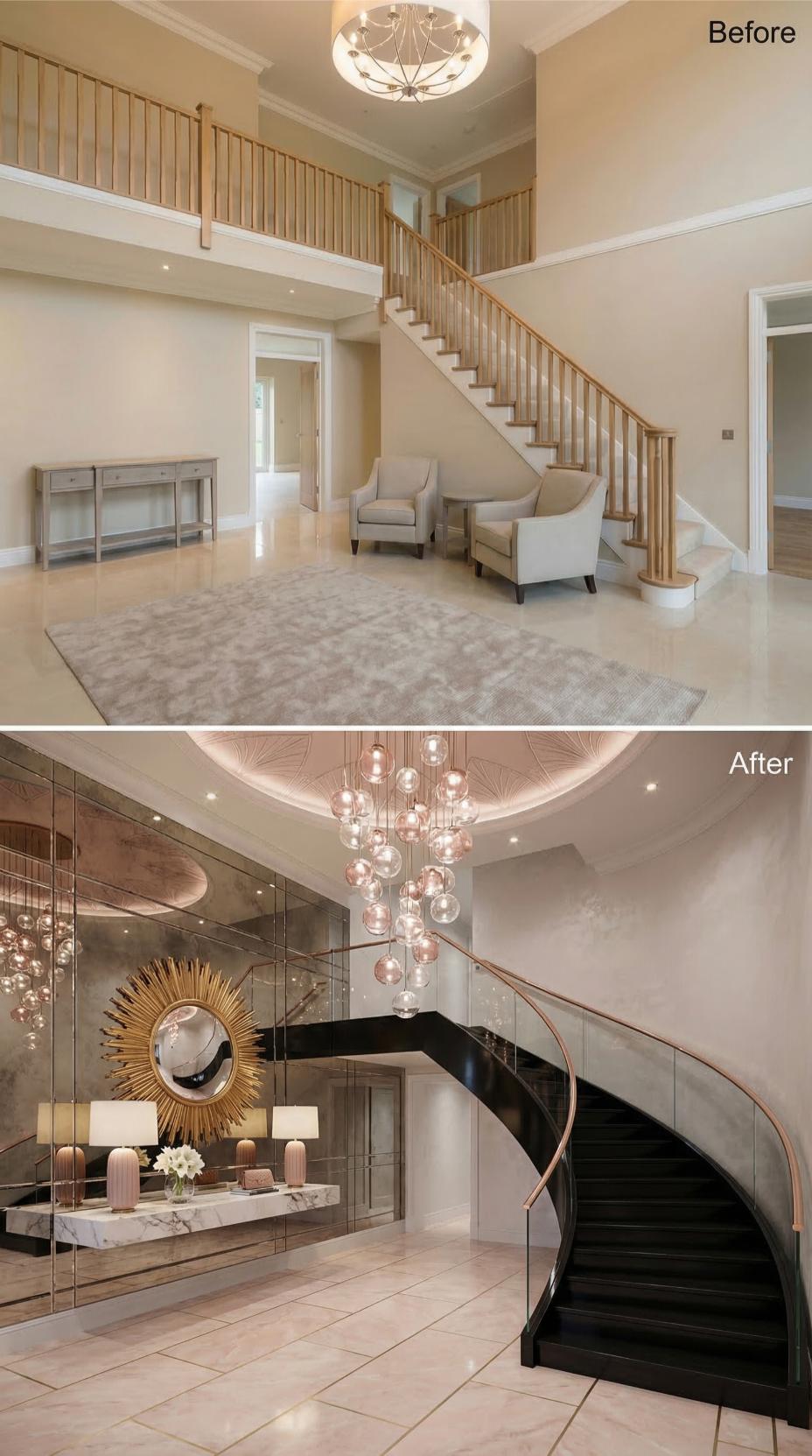
Smoked mirror panels now run floor to ceiling on the left wall, anchored by a marble-topped console and a sunburst mirror with gilded rays. Pink table lamps flank fresh-cut florals, and the reflection doubles the perceived width of the foyer without adding a single square foot.
The staircase received the most dramatic revision: straight oak spindles were replaced by a curved black staircase with glass balustrade panels and a rose-gold handrail that bends in a continuous arc to the upper level. Overhead, a cluster chandelier drops dozens of hand-blown glass globes in clear and blush tones from a recessed, backlit ceiling medallion with botanical relief detailing.
Budget Tip: Smoked mirror panels can be sourced as prefabricated sheets and installed directly over drywall, making them a cost-effective alternative to custom millwork for achieving a high-end wall finish. Installing them in sections rather than as a single piece keeps material costs down and allows for easier replacement if one panel is damaged.
Spanish Colonial style brings a completely different set of materials and gestures to the foyer conversation.
Wrought Iron Scrollwork, Terracotta Floors, and a Wagon Wheel Chandelier Replaced Oak and Beige
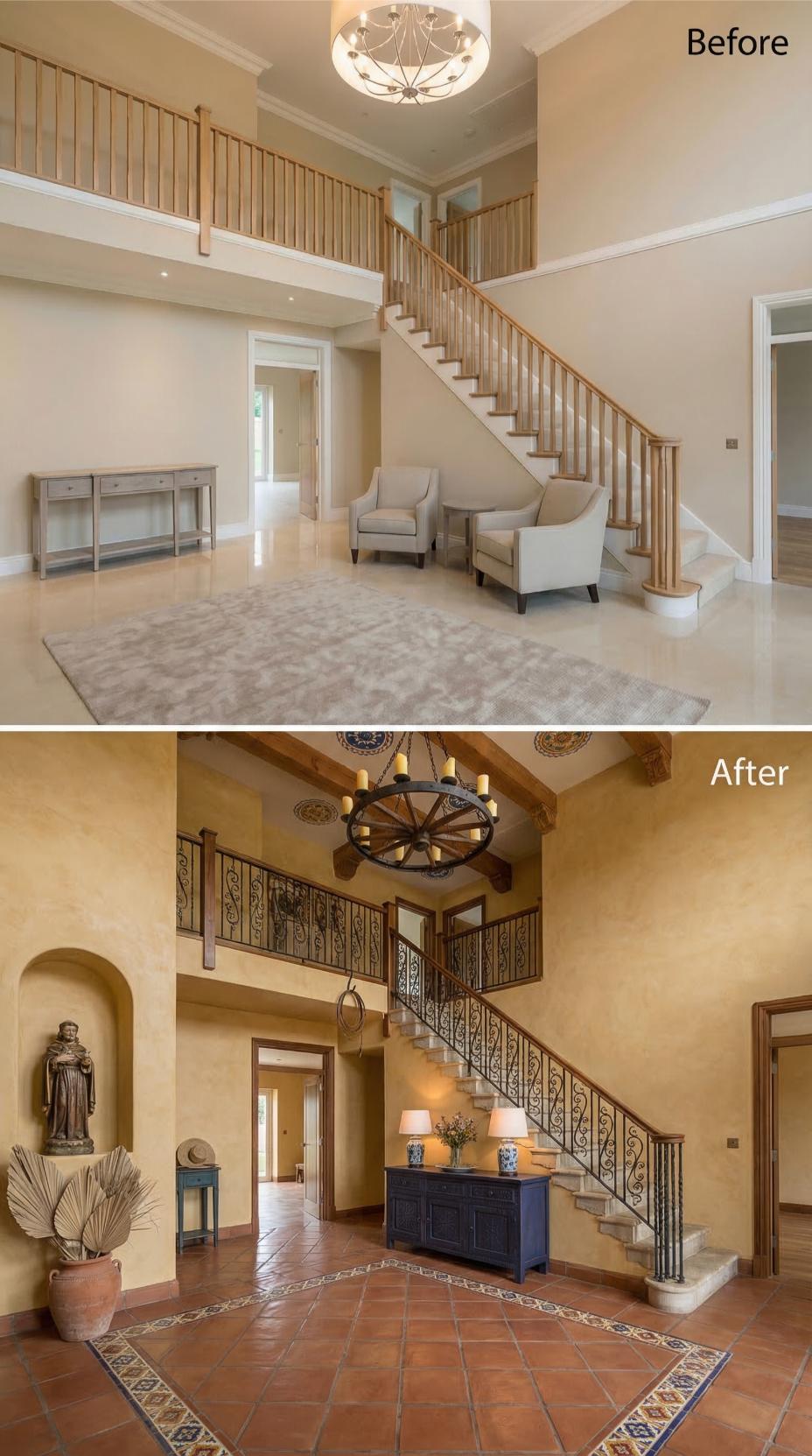
Builder-grade pale walls and pine balusters gave way to ochre plaster finished with visible texture, hand-laid terracotta tiles bordered by a geometric band of blue and cream encaustic insets, and a staircase railing rebuilt entirely in forged iron with scroll detailing. The light fixture above is a wagon wheel chandelier hung on chain, fitted with pillar candles rather than bulbs, anchoring the double-height ceiling with unmistakable Spanish Colonial character.
A carved stone niche now holds a saint figure flanked by dried palm fronds in a terracotta pot. The console below the staircase is painted navy with brass hardware, dressed with blue-and-white ceramic lamps and cut flowers. Exposed wood corbels frame the upper balcony, and painted medallions on the ceiling ceiling add a layer of craft that no builder package includes.
Oak Balusters and Beige Walls Traded for Glass Railings, Botanical Panels, and Globe Clusters
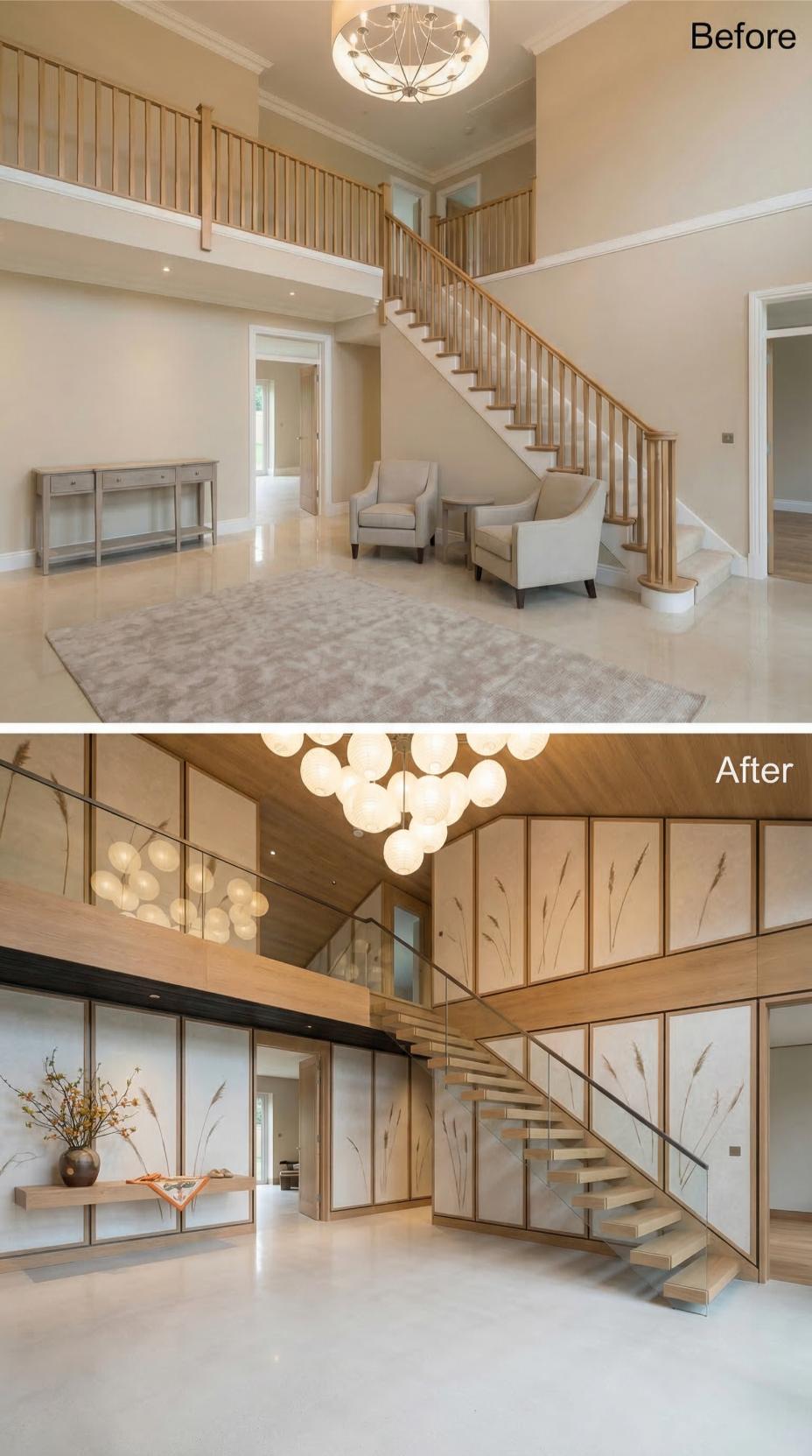
Floating oak treads with a glass-and-steel railing replaced the traditional spindle staircase, while hand-illustrated botanical panels in pale linen and raw oak frames now line every wall from floor to second-story ceiling.
Style Tip: Cantilevered stair treads, like the oak ones shown here, are anchored directly into a structural wall with steel rods, requiring no visible support underneath. This method demands precise load calculations but frees up sight lines across the entire foyer floor. Consulting a structural engineer before specifying this detail can prevent costly revisions mid-build.
Curved Black Lacquer Railings and Checkered Marble Replaced Oak Balusters and Beige
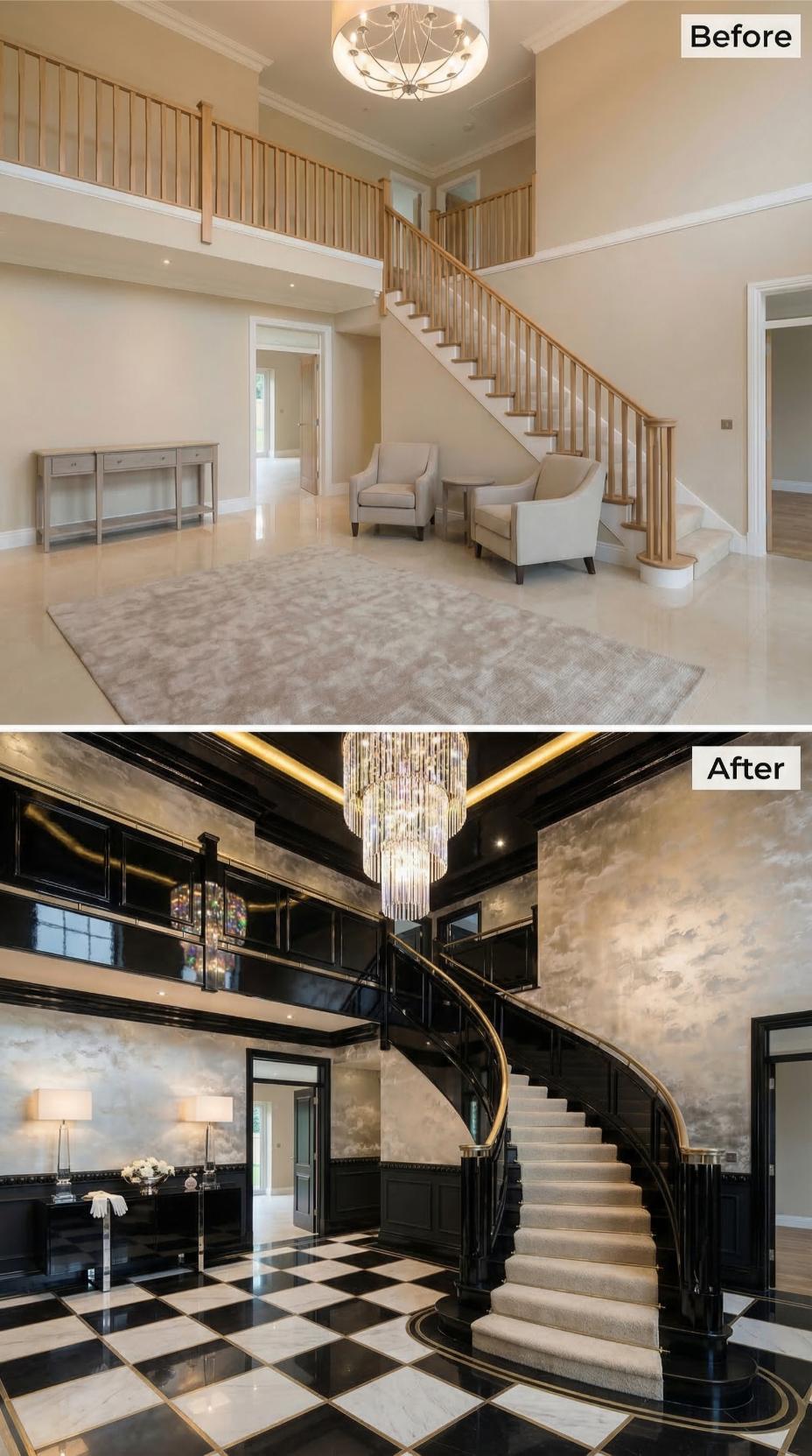
Oak spindles and flat beige walls read as pleasant but forgettable. Here, a curved staircase wrapped in high-gloss black lacquer with brass nosing takes over the room’s central axis, drawing the eye upward toward a tiered crystal chandelier hung from a recessed ceiling with warm cove lighting at its perimeter.
Underfoot, black and white marble tiles are laid in a classic checkerboard pattern with a brass inlay border tracing the stair’s curve. Cloud-effect wallpaper in silver and grey tones covers every wall panel, framed by black lacquer millwork. A chrome console table with straight legs anchors the entry wall opposite.
Raw Concrete, a Living Green Wall, and Floating Wood Treads Replaced Beige and Oak Balusters
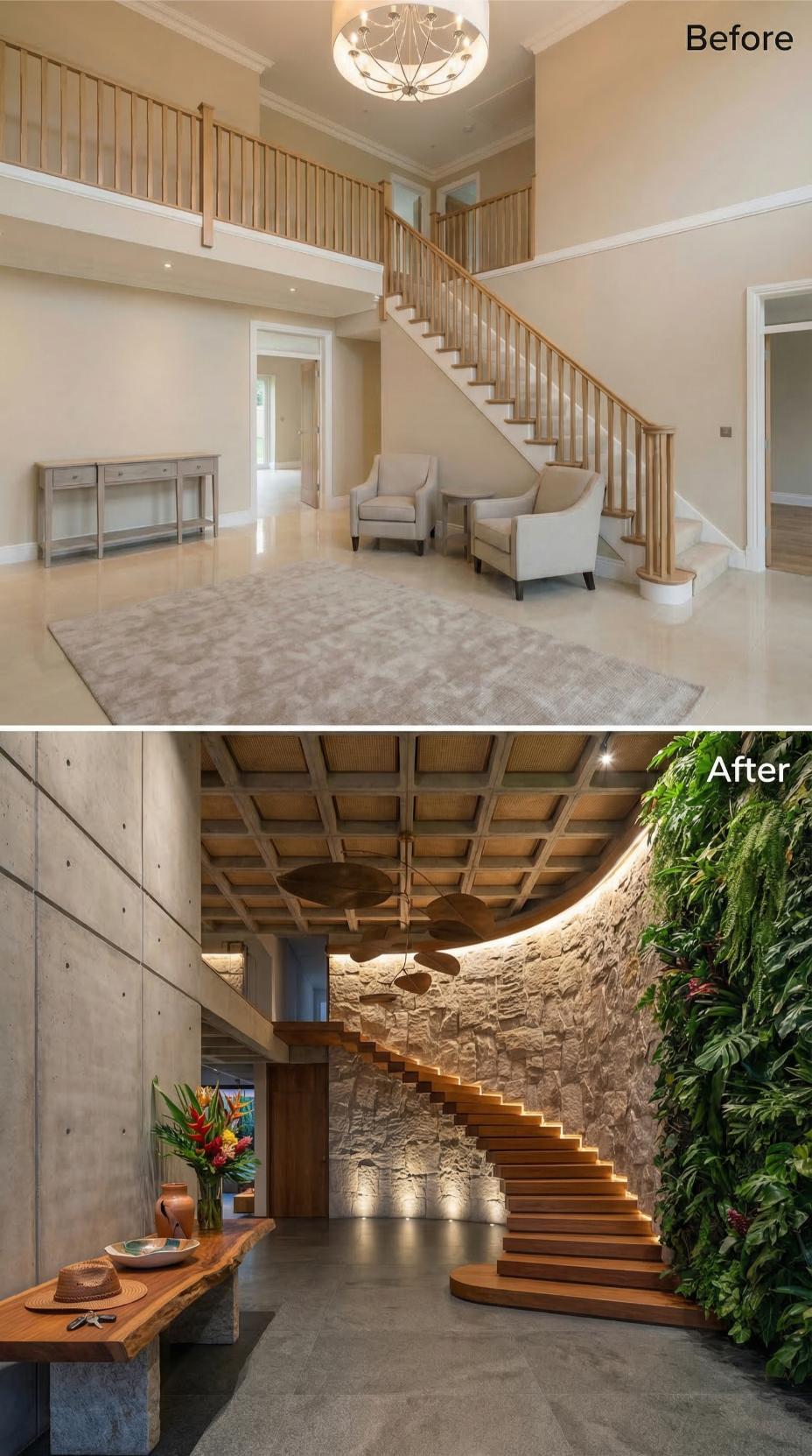
Rough-sawn concrete walls now anchor the space where smooth beige drywall once stood. Cantilevered walnut treads curve upward without a visible stringer, their undersides lit by a continuous strip of warm LED that traces the stair’s arc against the textured stone backdrop. A vertical garden of monstera, heliconia, and bromeliad covers the right wall floor to ceiling, framed by dark concrete. A live-edge wood console sits below, grounded on stone legs.
Worth Knowing: Living walls require a felt or panel-based hydroponic system mounted to the wall structure before planting, not direct soil packing, which would create moisture damage over time. Monstera and philodendron species are among the lowest-maintenance choices for interior vertical gardens because they tolerate low humidity and indirect light without dropping leaves.
Cobalt Lacquer Walls, Malachite Stair Risers, and Gold Scrollwork Replaced Oak and Beige
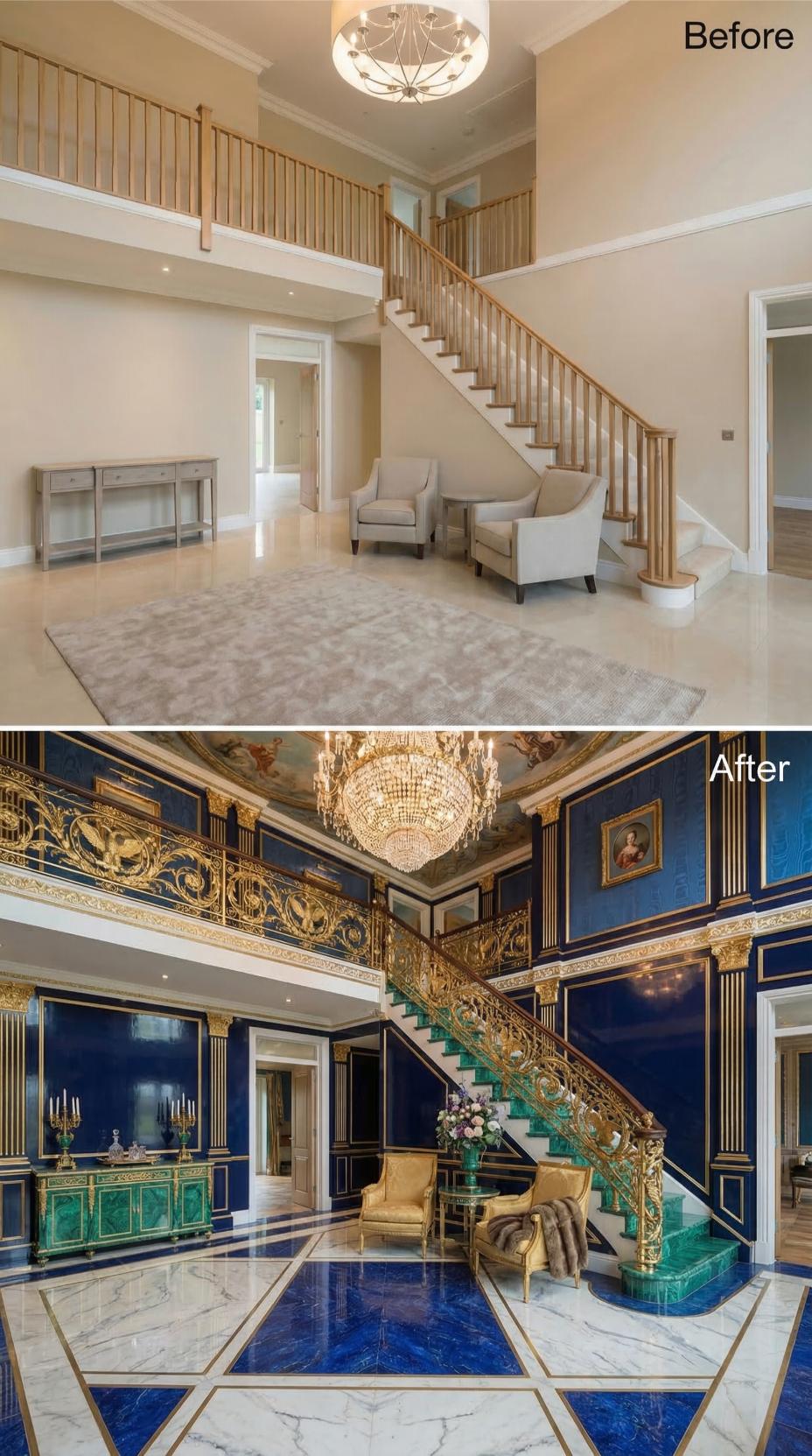
Every surface in the after photo carries a material decision that directly rejects the original build. Cobalt blue lacquered panels line the walls floor to balcony, framed by gilded pilasters and hand-applied gold leaf molding. The staircase risers are clad in malachite, a stone with banded green veining that reads almost electric against the brass scrollwork balustrade. A tiered crystal chandelier anchors the double-height ceiling, which features a painted oval mural in the classical tradition.
On the floor, blue lapis marble tiles are inlaid with white and gold border strips in a geometric field pattern. Two gilt wood armchairs flank a malachite side table below the stair landing. The sideboard along the left wall repeats the malachite and brass palette, finished with candelabra in antiqued bronze. Nothing in this foyer is incidental.
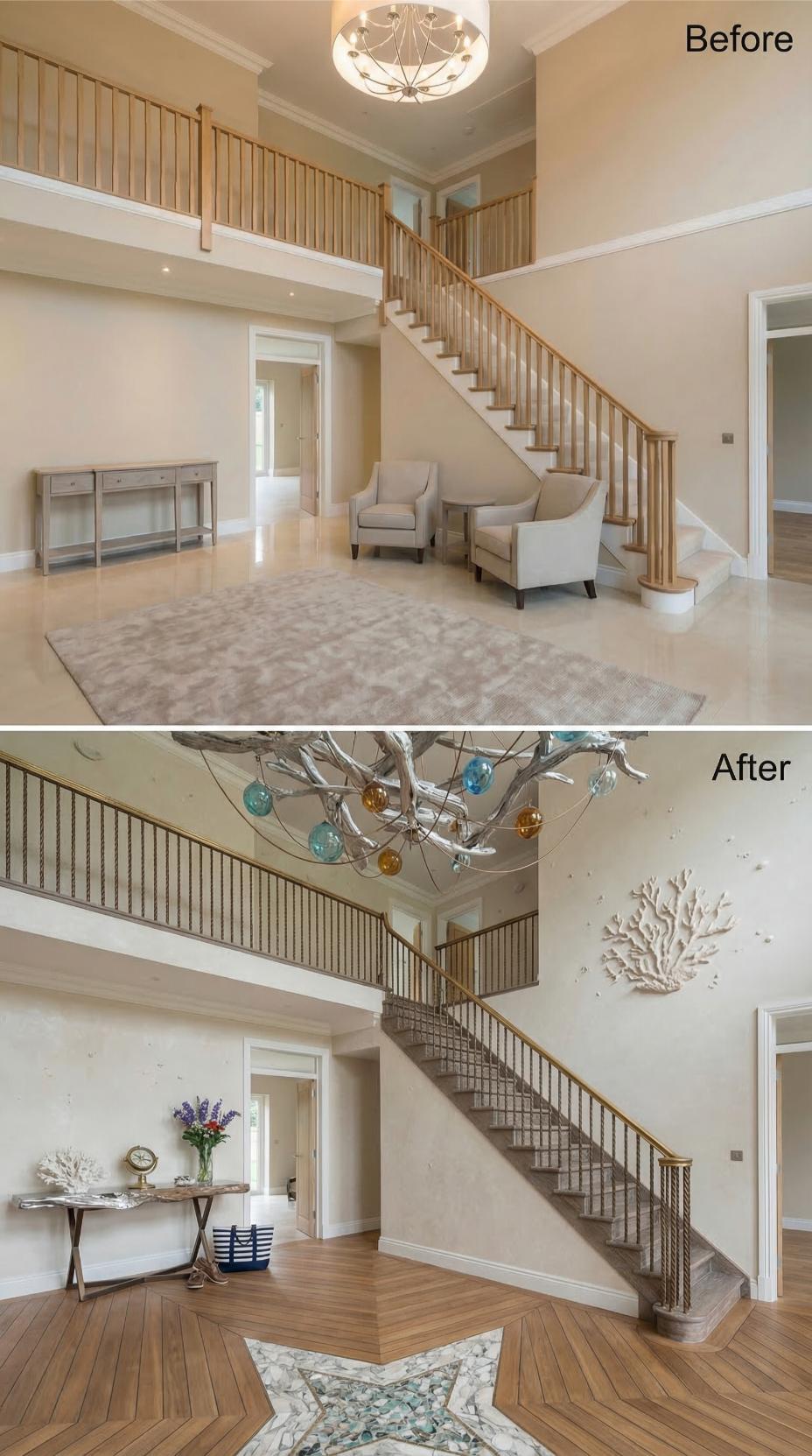
Iron Balusters, Driftwood Art, and Herringbone Hardwood Replaced Oak and Beige
🔥 Would you like to save this?
Slender iron balusters with a rope-twist detail replaced the original blond wood spindles, and the stair rail shifted to a warm bronze finish that reads as deliberate rather than default. New herringbone hardwood flooring in a medium walnut tone replaced polished tile, anchoring the two-story space with texture. A sculptural chandelier built from silver-cast driftwood branches holds glass float orbs in aqua, amber, and clear, suspending coastal energy directly above the entry. A white coral wall sculpture punctuates the upper landing wall, and a demilune table with an X-base in brushed nickel grounds the console area below, styled with fresh lavender, a brass compass, and a navy canvas tote that signals lived-in ease.
History Corner: The glass fishing float, which inspired the chandelier orbs visible in the after photo, dates to the mid-1800s when Japanese fishermen began blowing hollow glass spheres to replace heavier stone and ceramic net weights. By the early twentieth century, factories in Norway and the United States were producing millions annually for commercial fishing fleets. Collectors began salvaging them from Pacific beaches in the 1970s, which eventually drew the forms into coastal interior design as decorative objects.
Venetian Plaster, Grape-Vine Iron Scrollwork, and Terracotta Grid Floors Replaced Beige and Oak
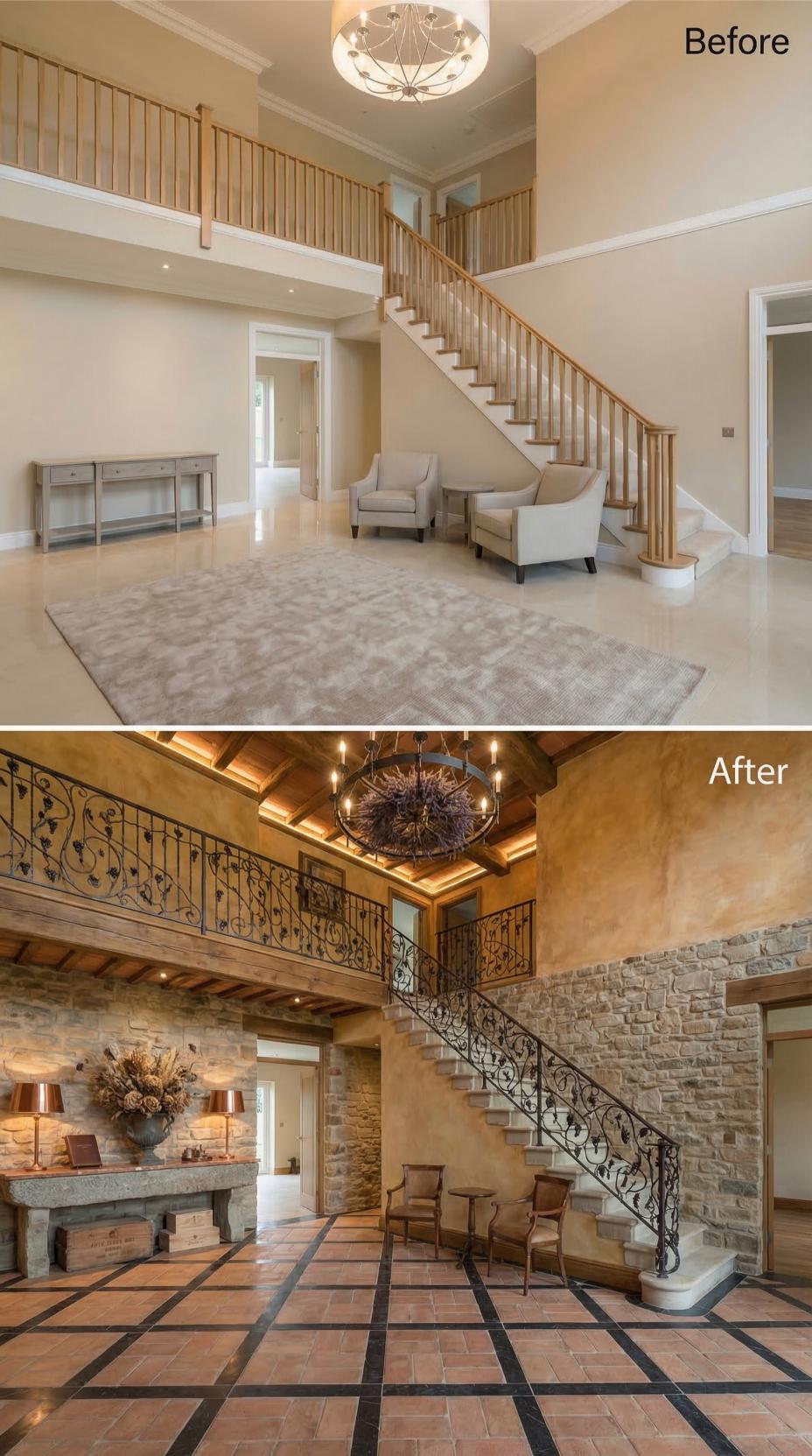
Bare beige walls and pine balusters gave way to hand-applied Venetian plaster in a warm ochre-amber tone, its surface catching light with the soft depth that paint simply cannot replicate. Reclaimed timber beams now frame a coffered ceiling section with LED strip lighting tucked behind each beam, casting a warm amber wash downward. The staircase railing is wrought iron worked into a grape-vine scroll pattern, a motif that repeats on the upper balcony balustrade. Underfoot, terracotta tiles are laid in a large grid pattern with dark slate inlay strips separating each field.
A stone slab console table anchors the left wall, topped with copper-finish table lamps and an oversized dried-flower arrangement in a stone urn. The chandelier is a ring-form iron fixture with exposed candelabra bulbs and a dense center cluster of what appear to be dried allium or teasel heads, replacing the builder sputnik entirely.
The staircase railing is wrought iron worked into a grape-vine scroll pattern, a motif that repeats on the upper balcony balustrade.
Neon Text, Gold-Lit Glass Railings, and Black Marble Replaced Oak Balusters and Beige
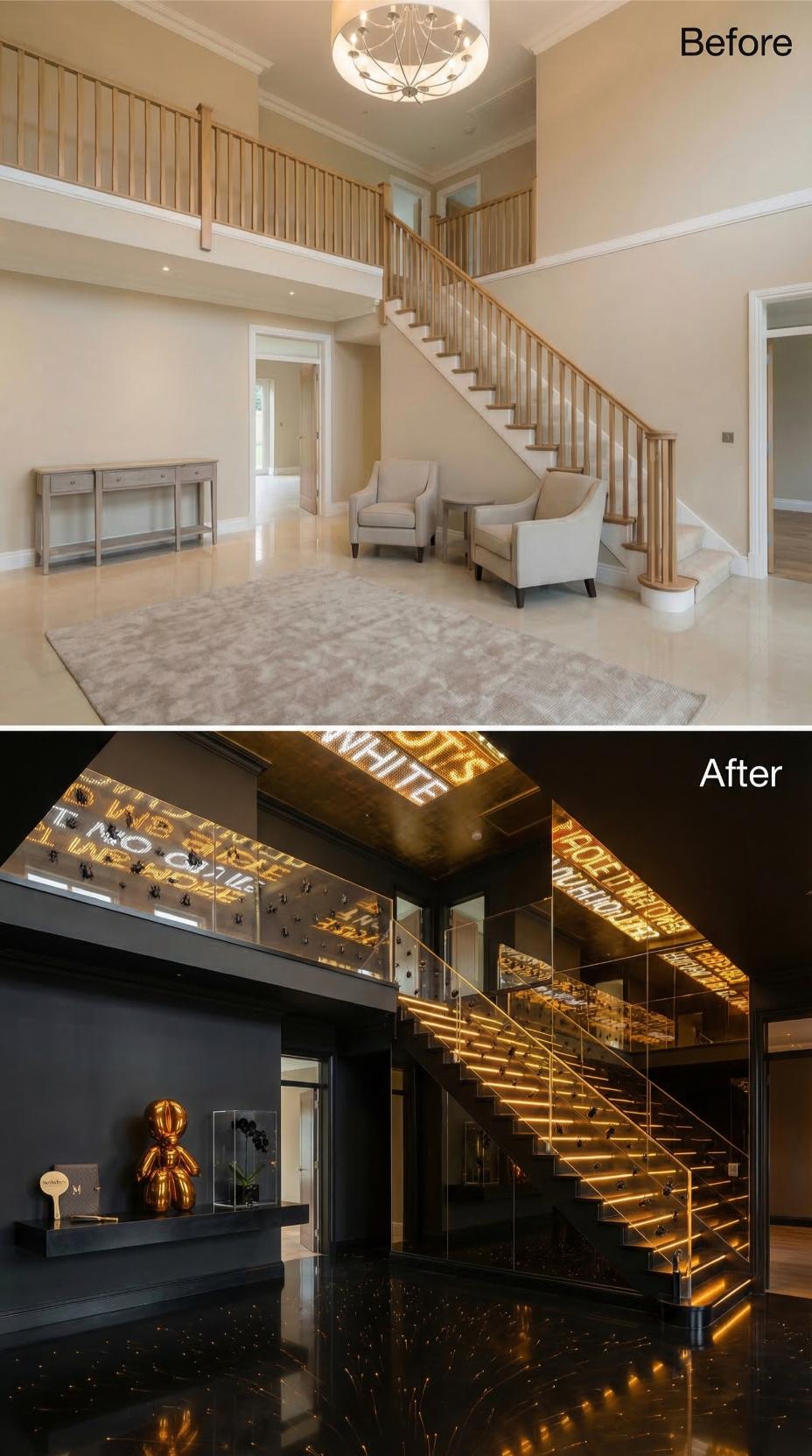
Warm amber LED strips run beneath each cantilevered black tread, bouncing light off frameless glass panels and a reflective black marble floor below.
Tartan Carpet, Dark Wallpaper, and Portrait Gallery Walls Swallowed a Bland Builder Foyer
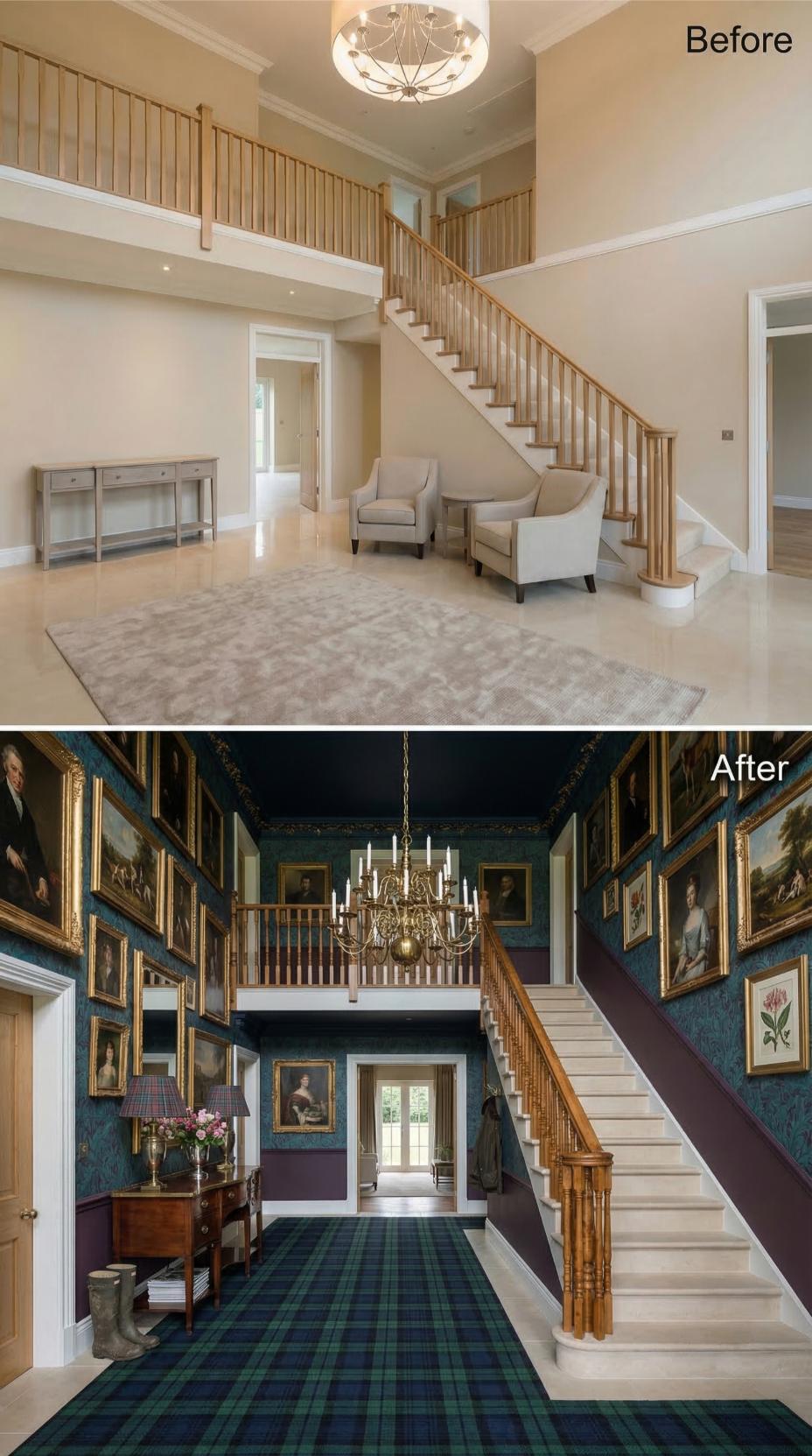
Dark teal wallpaper printed with a botanical or damask-style pattern now covers walls that were once flat beige. A Black Watch tartan runner in navy, forest green, and black anchors the floor from front door to stair base, replacing the pale neutral rug that barely registered in the space. Gilded frames in varying sizes climb both walls from baseboard to ceiling cornice, packed with oil portraits, botanical prints, and hunting scenes. The oak balustrade kept its spindles but now reads entirely differently against the dark surround.
Overhead, a brass candelabra chandelier with white taper candles replaced the modern sputnik fixture. The ceiling was painted near-black, which pulls the eye upward rather than letting it drift. A mahogany console table with a tartan-shaded lamp and a vase of cut flowers grounds the left wall. A pair of wellies tucked beneath it adds the kind of lived-in detail that no showroom foyer ever manages.
Material Matters: Tartan carpet in wool or wool-blend construction holds pattern definition better than synthetic alternatives because the fiber accepts dye at greater depth, keeping colors saturated even in high-traffic areas like foyer corridors. The Black Watch pattern visible here dates to 18th-century Scotland, originally worn by government militia recruited to police the Highland clans.
Copper-Paneled Balustrades, Wheel Chandelier, and Carved Wood Panels Buried the Beige
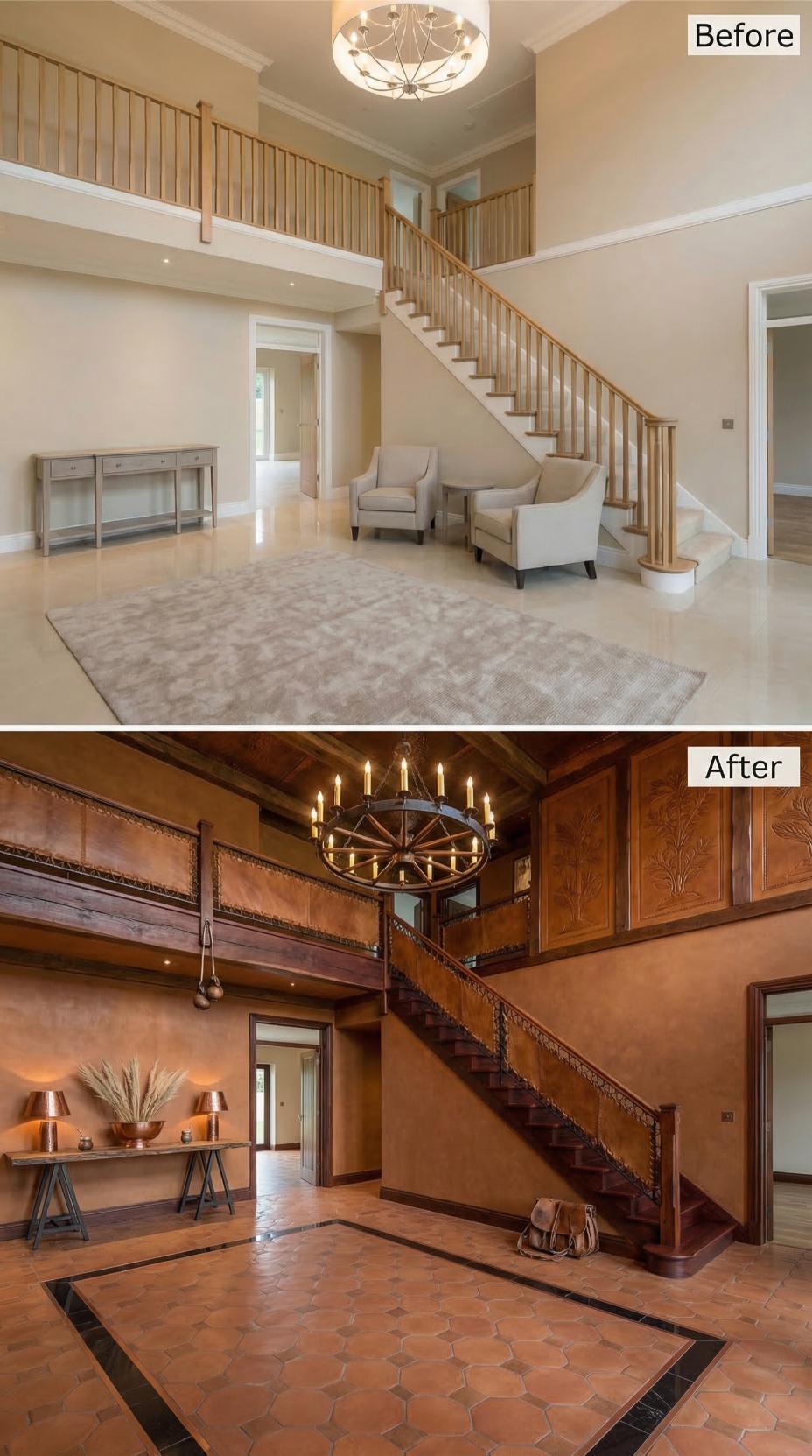
Terracotta hexagonal tiles now cover the floor in a grid bordered by dark stone inlay, replacing what had been polished marble-look tile with no visual weight. The balustrade panels are wrapped in what appears to be hammered or embossed copper sheeting set within dark stained wood framing, and the stair railing spindles have been replaced with twisted wrought iron. A wagon-wheel chandelier fitted with candle-style bulbs anchors the double-height ceiling, pulling the eye upward rather than letting it drift toward the walls.
The upper gallery features large carved wood panels depicting botanical motifs in deep walnut tones, giving the second floor a density the before photo completely lacked. A trestle-leg console below holds copper accent lamps and dried wheat stems in a shallow bowl. The overall palette runs from burnt sienna to dark espresso, with no cool neutrals left anywhere in the space.
Dancheong Ceiling Panels, Celadon Globe Clusters, and Pine Murals Replaced Beige and Oak

What reads immediately is the ceiling. Korean dancheong paintwork, the geometric pattern system historically applied to palace timber structures, covers every surface overhead in cobalt, vermillion, gold, and forest green. It is the kind of detail that takes skilled artisans weeks to execute by hand, and it sets the entire register of the room.
Below it, the walls carry ink-wash pine murals in the sumi-e tradition, rendered in grey-black on cream. The original oak balusters gave way to warm-toned hardwood with shoji-style panels lining the upper balcony. Celadon glazed globe pendants hang in a clustered formation replacing the sputnik fixture. Teal-grey square floor tiles replace the polished limestone, and a simple altar-style console holds a single celadon vase alongside a wrapped pojagi cloth bundle.
Gold Tiered Chandelier, Starburst Marble, and Dark Macassar Panels Consumed a Beige Builder Foyer
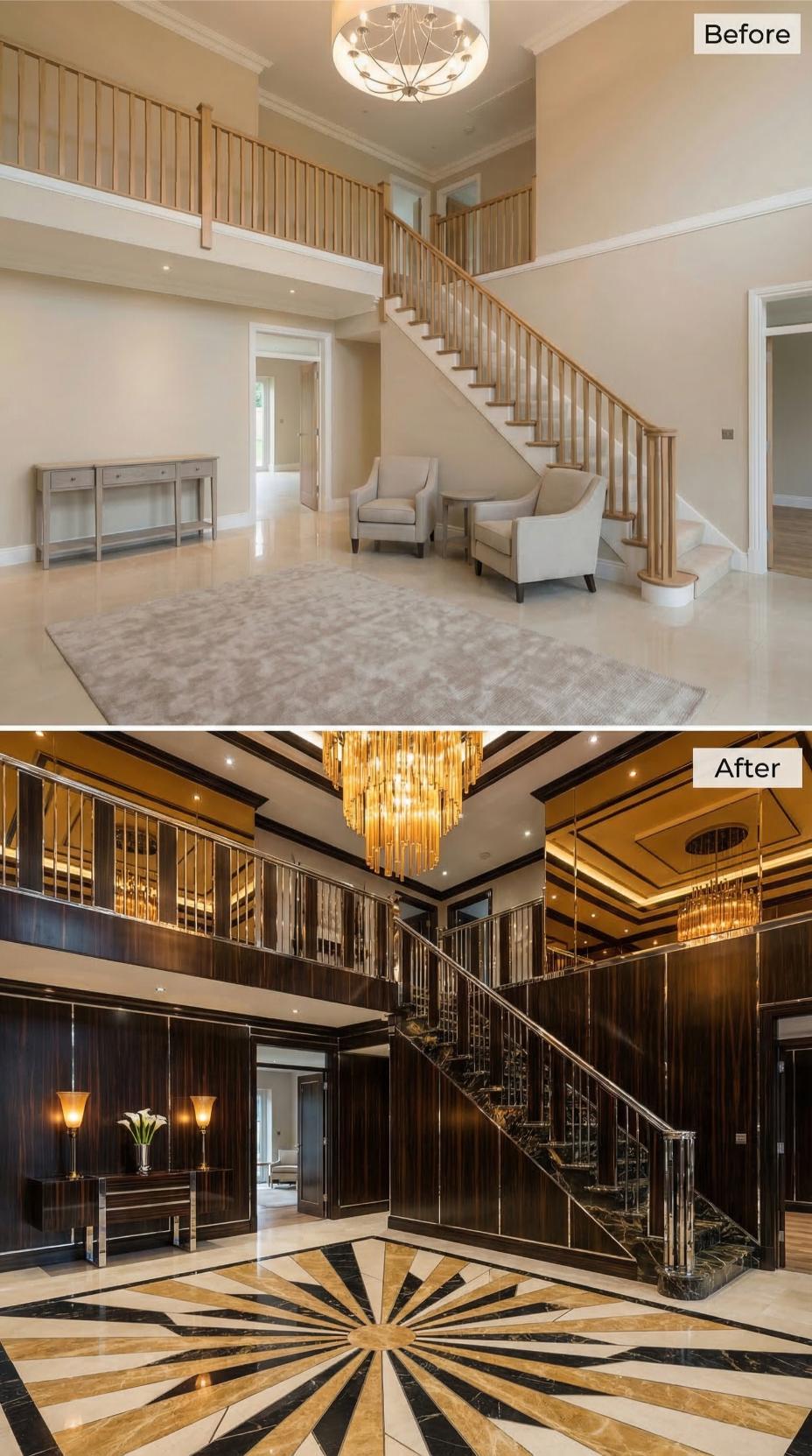
Polished Macassar ebony wall panels with inlaid gold trim replaced the beige drywall, while a starburst medallion cut from cream, gold, and black marble now anchors the floor beneath a tiered gold rod chandelier.
Groin-Vaulted Ceiling, Wrought-Iron Scrollwork, and Limestone Stairs Consumed a Beige Builder Shell
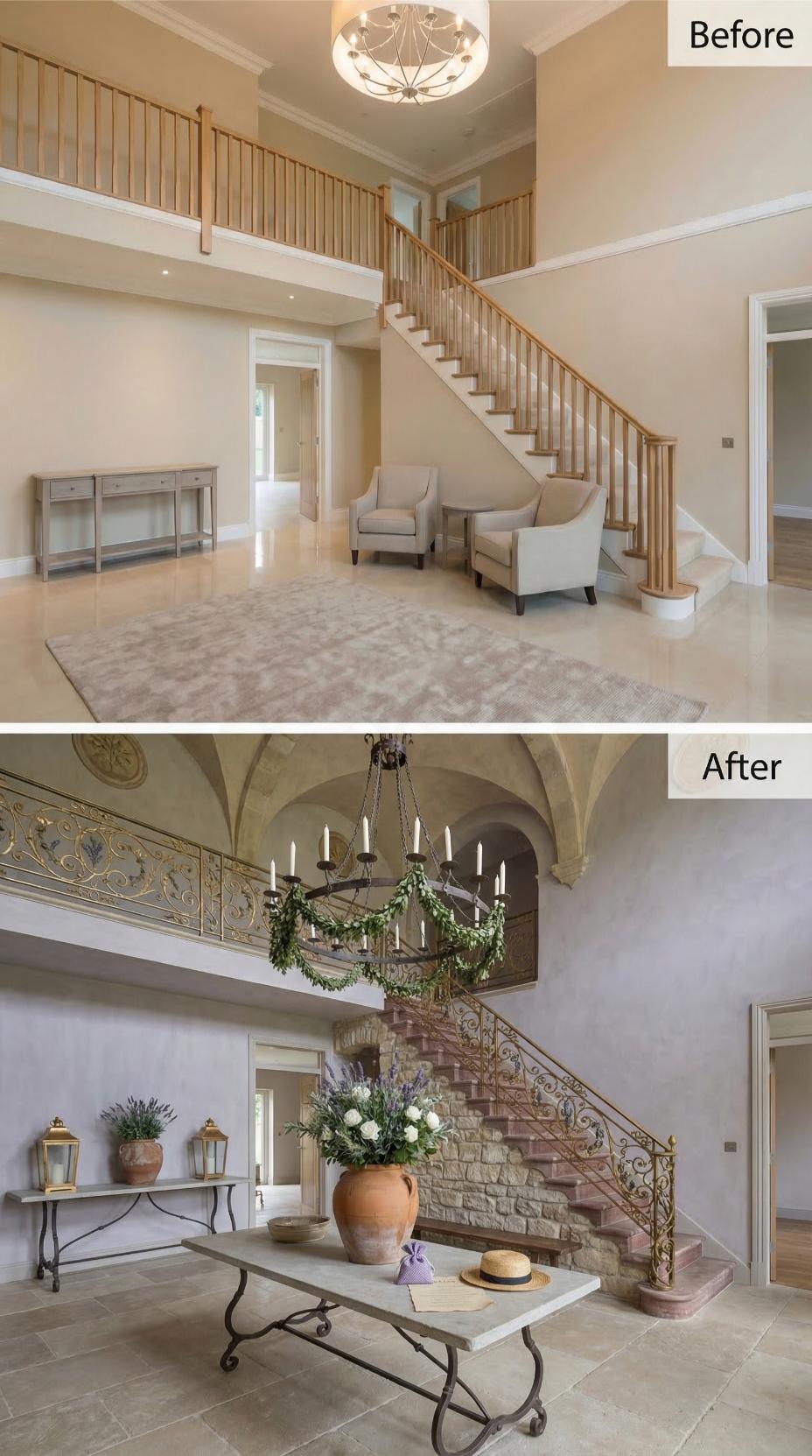
Venetian plaster in a cool grey replaced the original beige paint across every wall, while a groin-vaulted ceiling with a central medallion carved in relief gave the upper volume genuine architectural weight. Stone cladding now wraps the staircase base, and the oak balustrade gave way to wrought-iron panels worked into gilded foliate scrollwork. Candle-style iron ring chandelier draped with a fresh boxwood garland hangs at center. A travertine-topped iron console grounds the entry below it, holding a terracotta urn filled with white roses and lavender stems.
Mosaic Tile Floors, Bronze Relief Balustrades, and Silhouette Murals Buried a Beige Builder Shell
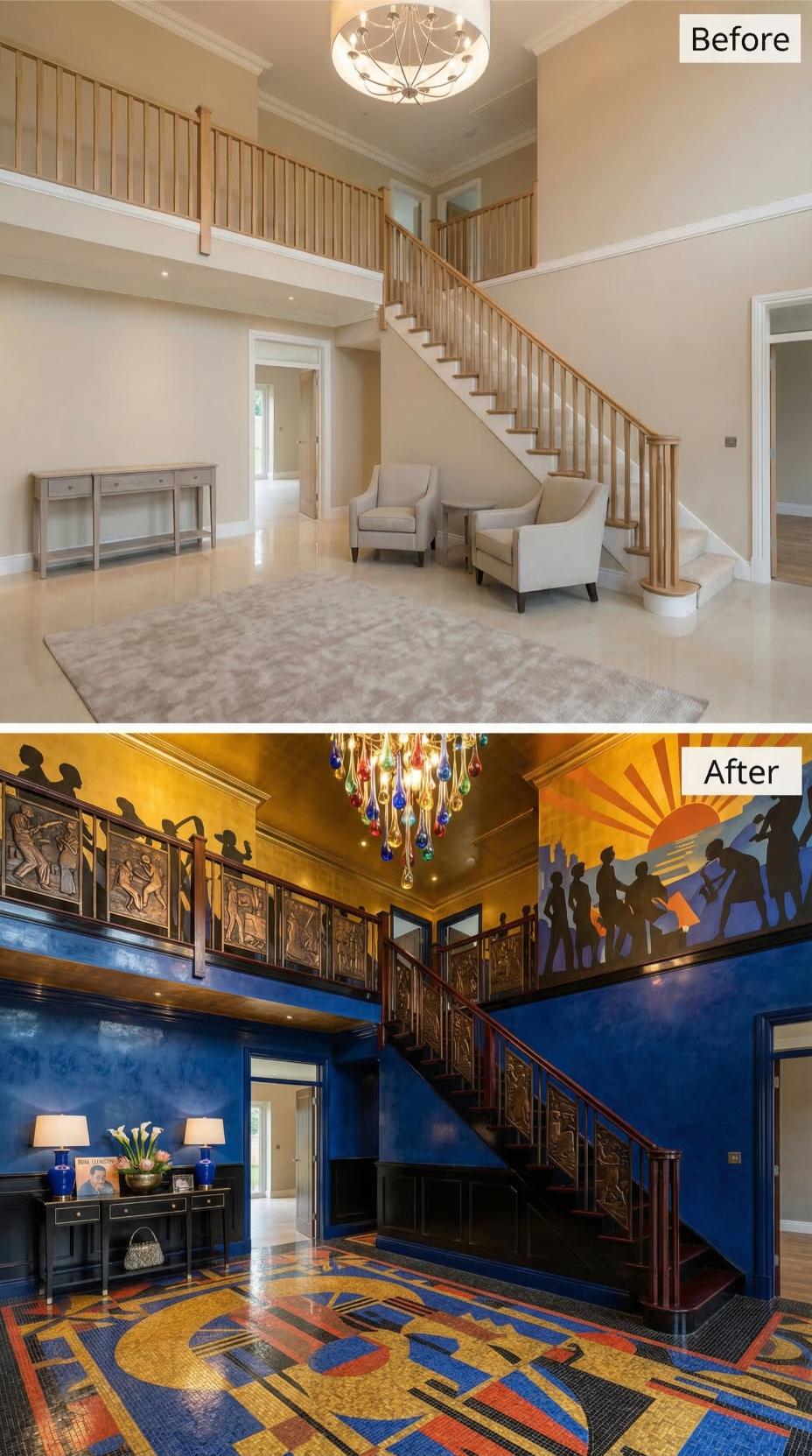
Cobalt venetian-finish walls rise two stories and meet a gold-leafed ceiling frieze, replacing the original sand-colored drywall entirely. Bronze relief panels line the balustrade on both levels, depicting figurative scenes in low relief. Above the staircase, a chandelier drops colored glass rods in amber, red, green, and cobalt, replacing the original sputnik fixture.
The floor commands the most attention. A mosaic field in deep blue, saffron, burnt orange, and black forms a geometric pattern that reads closer to a Rivera mural than standard tile work. Silhouette figures cut from dark metal panels march along the upper balcony rail, while a sunrise mural in blue and orange covers the upper wall. The console below carries matching cobalt ceramic lamps flanking white calla lilies.
Tibetan Thangka, Crimson Plaster Walls, and Marble Stairs Erased a Builder Foyer
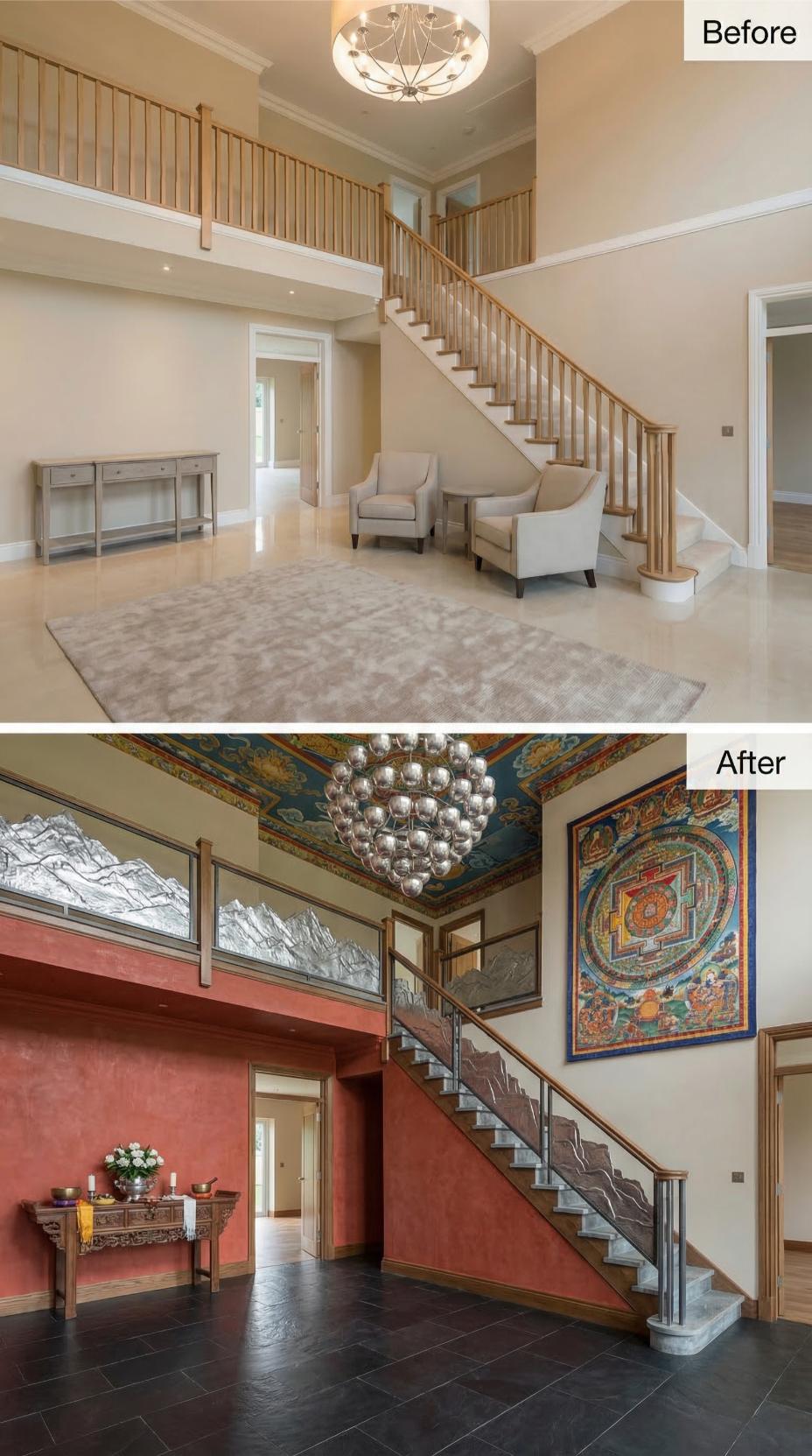
Crimson Venetian-style plaster coats the lower walls from floor to balcony level, replacing the original cream paint with a surface that shifts between rust and coral depending on the light. The wooden balusters are gone. In their place, steel posts carry a glass panel balustrade etched with a relief mountain range, while the stair treads themselves switch to grey marble with a sculpted, wave-cut fascia along each riser edge.
Overhead, the balcony soffit is painted with a Tibetan Thangka-style mandala border in teal, gold, saffron, and vermillion. A cluster chandelier of brushed silver spheres replaces the original sputnik fixture. On the right wall, a full-scale Thangka painting of a Sri Yantra-style mandala hangs unframed, its border dyed in the same gold and lapis palette as the ceiling. The carved altar table below carries ritual bowls and white flowers, grounding the room with deliberate symbolism rather than decorative gesture.
Cobalt Zellige, Floating Travertine Treads, and a Coffered Wood Ceiling Buried Beige and Oak
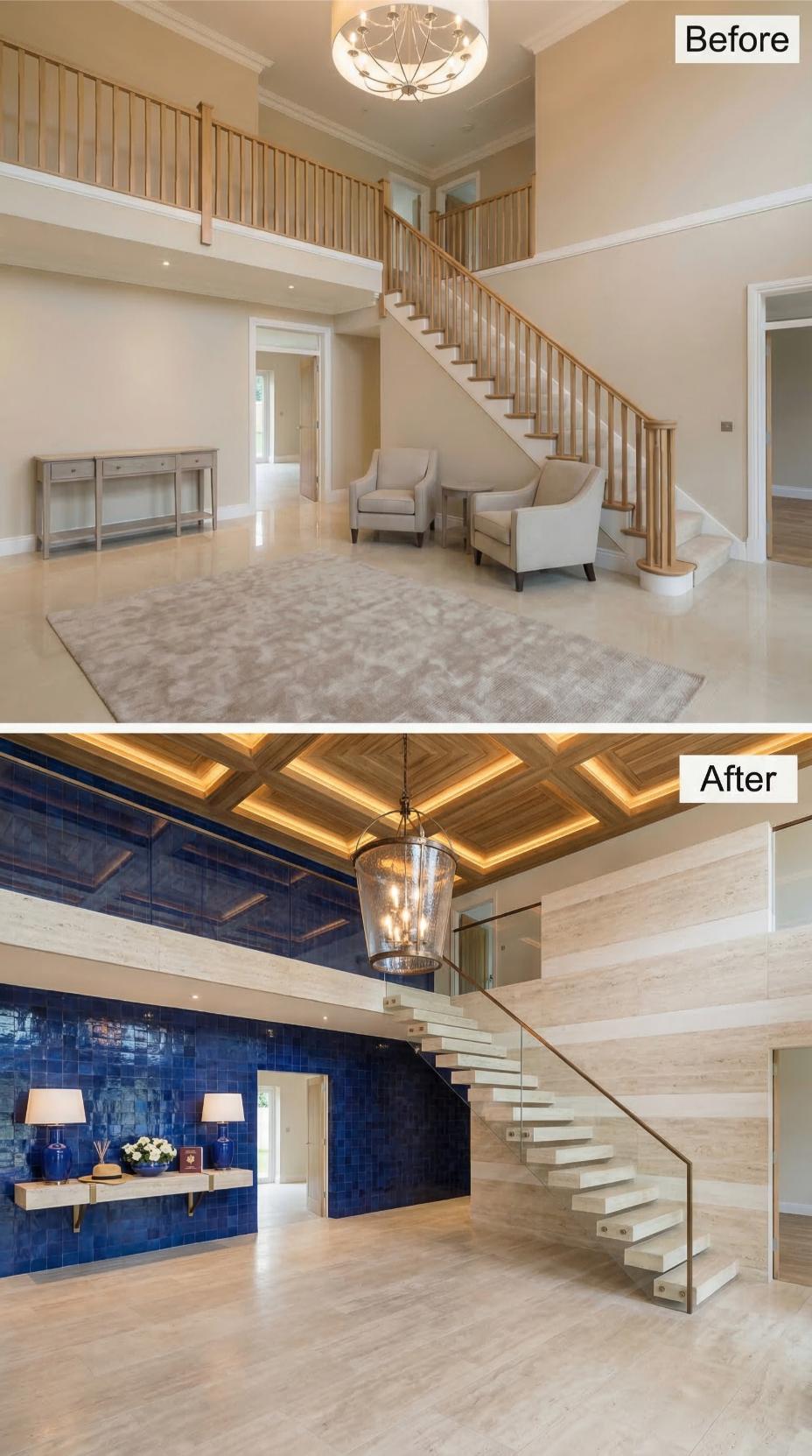
Glazed cobalt tile covers the full-height wall behind a wall-mounted travertine console, replacing what was once a plain beige surround flanked by gray upholstered chairs. The original oak balustrade and newel post are gone; cantilevered travertine treads now project from the wall with a frameless glass panel and a slim brass handrail running alongside. Above, a coffered ceiling in natural wood with recessed LED strip lighting lines each panel recess, and a mercury-glass lantern pendant drops through the center of the volume.
Emerald Plaster, Globe Pendant Clusters, and a Stair Waterfall Buried Oak and Beige
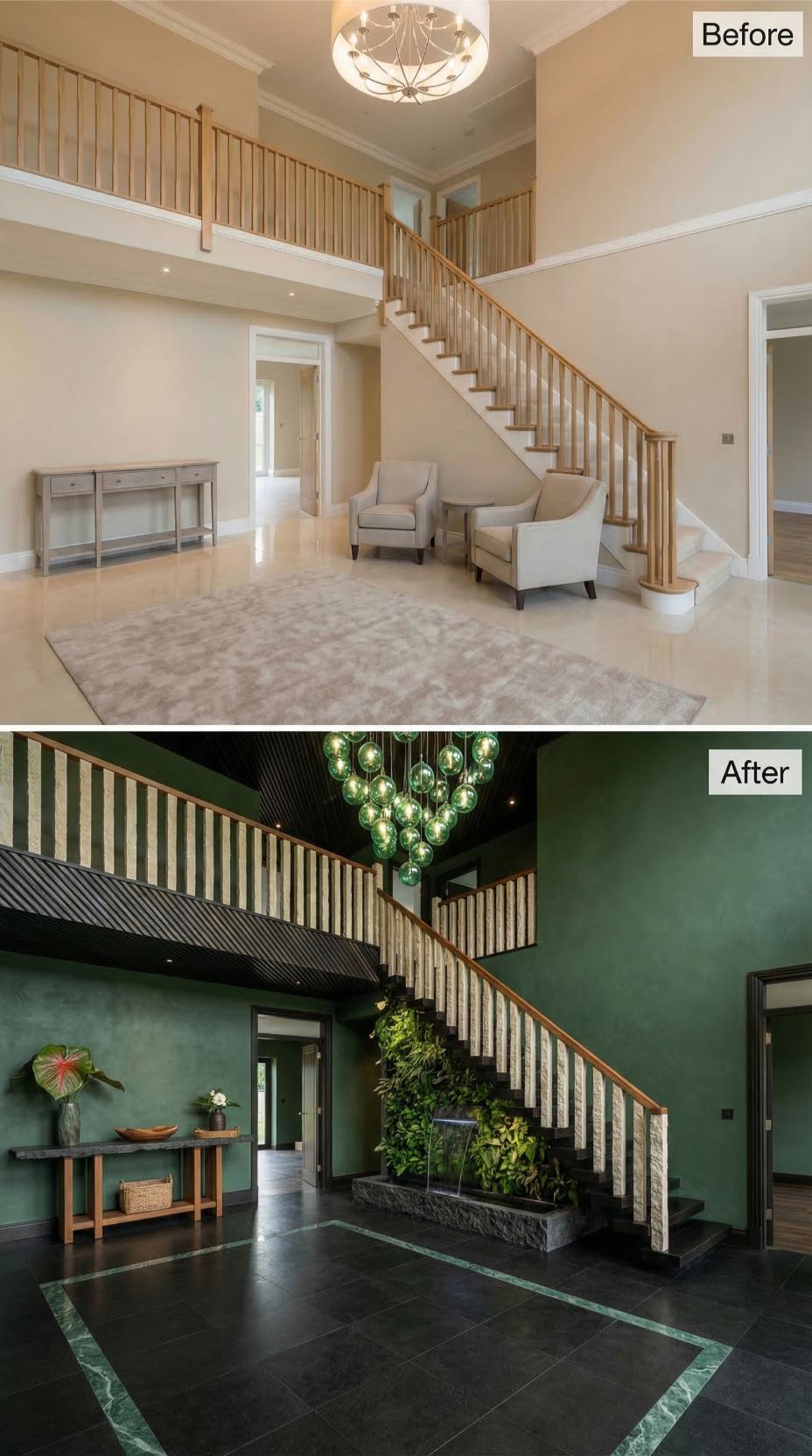
Forest-green Venetian-finish plaster coats every wall, and dark slate floor tiles get a grid inlay of verde marble that echoes the plant life tucked beneath the staircase. Blown-glass globe pendants in teal hang at staggered heights where a sputnik fixture once sat. A living wall and sheet waterfall fill the under-stair void with ferns and tropical foliage rooted in a hydroponic panel system backed by a rough-cut stone basin.
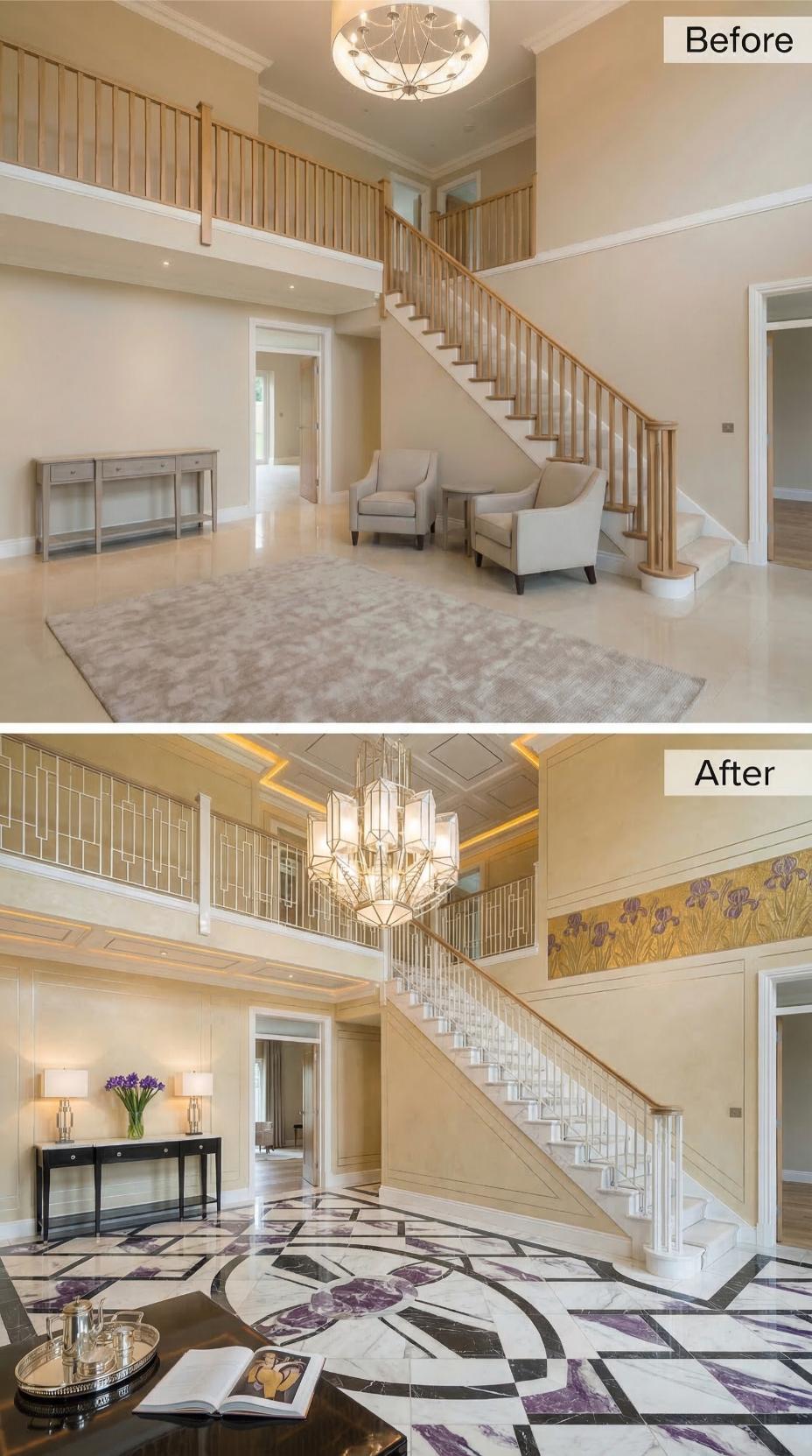
Geometric Brass Railings, Amethyst Marble Inlays, and an Art Deco Crystal Chandelier Buried Oak and Beige
🔥 Would you like to save this?
Builder-grade oak balusters and a modest sputnik fixture gave way to brass geometric balustrades patterned in repeating rectangular grids, a faceted crystal chandelier with angular stone-cut pendants, and a floor medallion laid in white, black, and amethyst marble with bold diagonal inlays. Cove lighting runs the full perimeter of the upper ceiling. An iris-and-gold botanical mural panel anchors the stair wall above the wainscoting, and a lacquered black console dressed with silver table lamps and purple tulips pulls the floor palette upward.
Corten Steel Balustrades, Cobalt Zellige Walls, and a Geometric Folded Ceiling Buried Oak and Beige
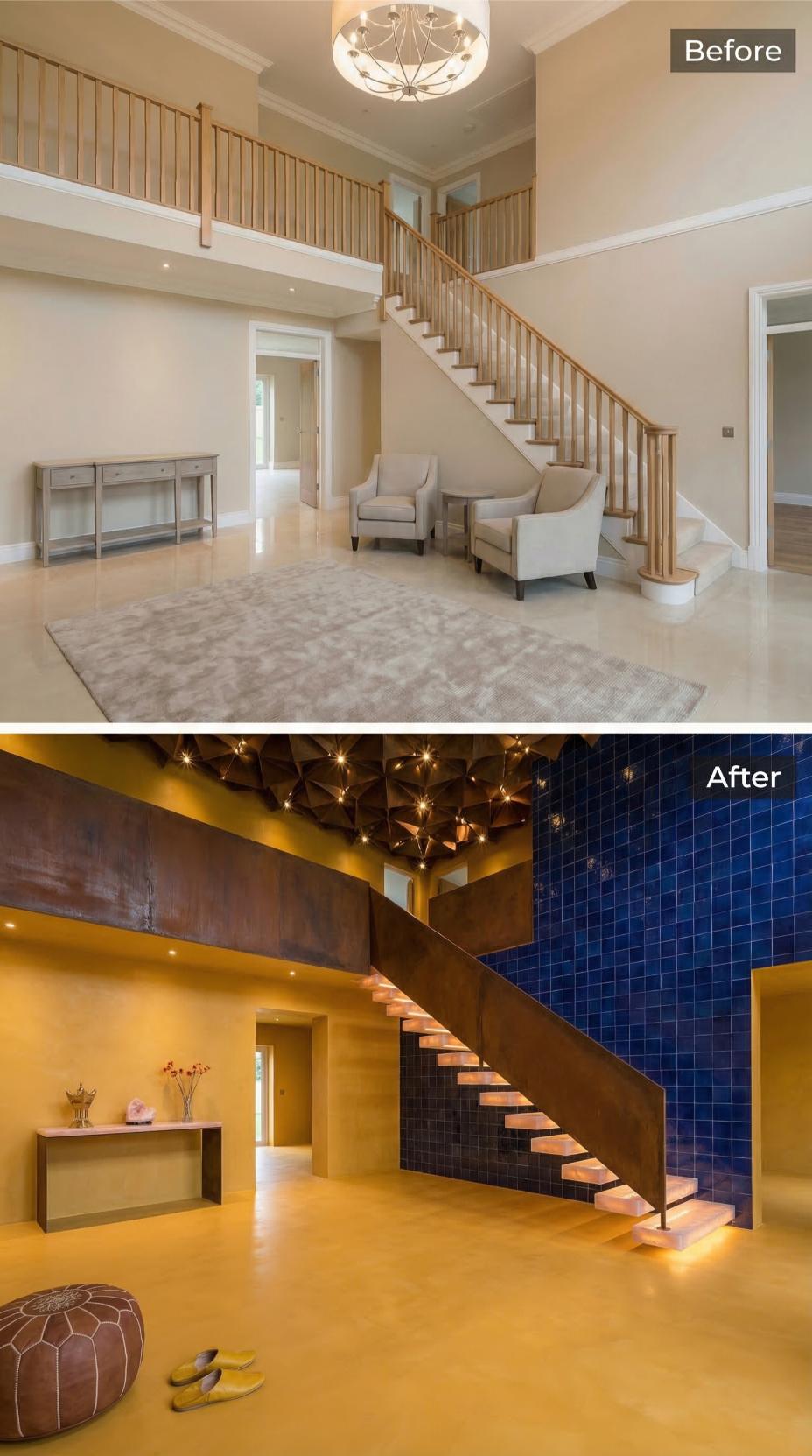
Bare plaster walls in warm ochre replace the original cream paint, and the floor shifts from polished marble tile to continuous poured resin in a deep amber tone. The staircase loses its painted wood balustrades entirely. In their place, a single sheet of weathered Corten steel curves along the full run of the stairs, its rust-brown oxidized surface acting as both railing and sculptural wall. Floating travertine treads with integrated LED underlighting replace the carpeted steps, each tread appearing to hover without visible support.
Behind the staircase, a full-height wall clad in cobalt blue zellige tile draws the eye upward. Above, the ceiling is finished with a geometric folded structure, each facet angled differently to catch the warm pinpoint light fixtures embedded throughout. A low console in raw concrete sits against the ochre plaster wall, flanked by dried stems in narrow vessels. A leather Moroccan pouf grounds the foreground. Every surface material change reads as deliberate.
Birch-Branch Balustrades, Lapis Lazuli Floor Inlay, and a Crystal Chandelier Buried Oak and Beige
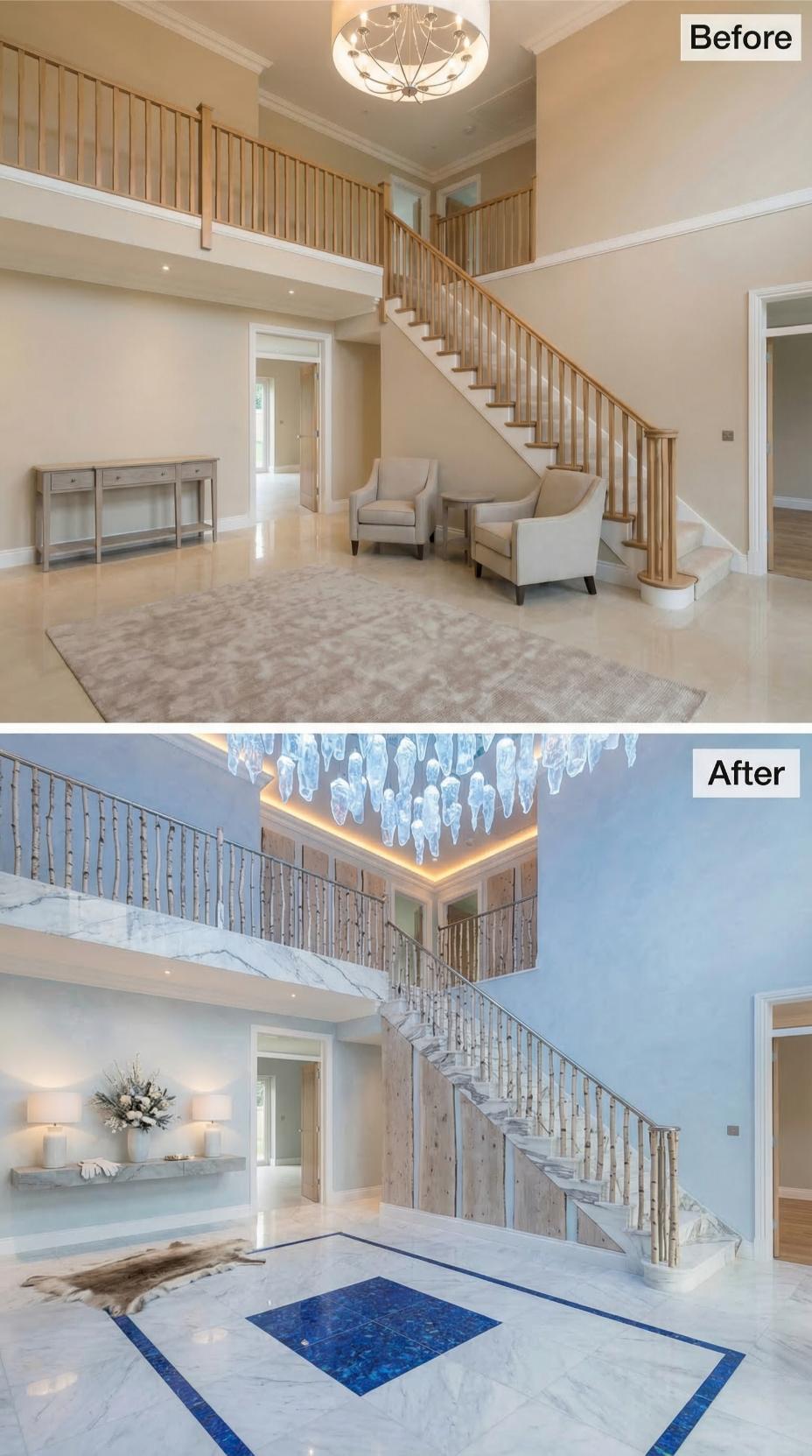
Designers replaced oak spindles and warm beige walls with birch-branch iron balustrades, hand-veined white marble stair cladding, and walls repainted in pale blue-grey. The floor centers on a square lapis lazuli inlay bordered by white marble tile. Overhead, a sculptural chandelier holds dozens of frosted glass forms resembling glacial shards, lit from a cove surround with warm LED strip lighting. A floating stone shelf carries candles and a white floral arrangement in place of the freestanding console table.