🔥 Would you like to save this?
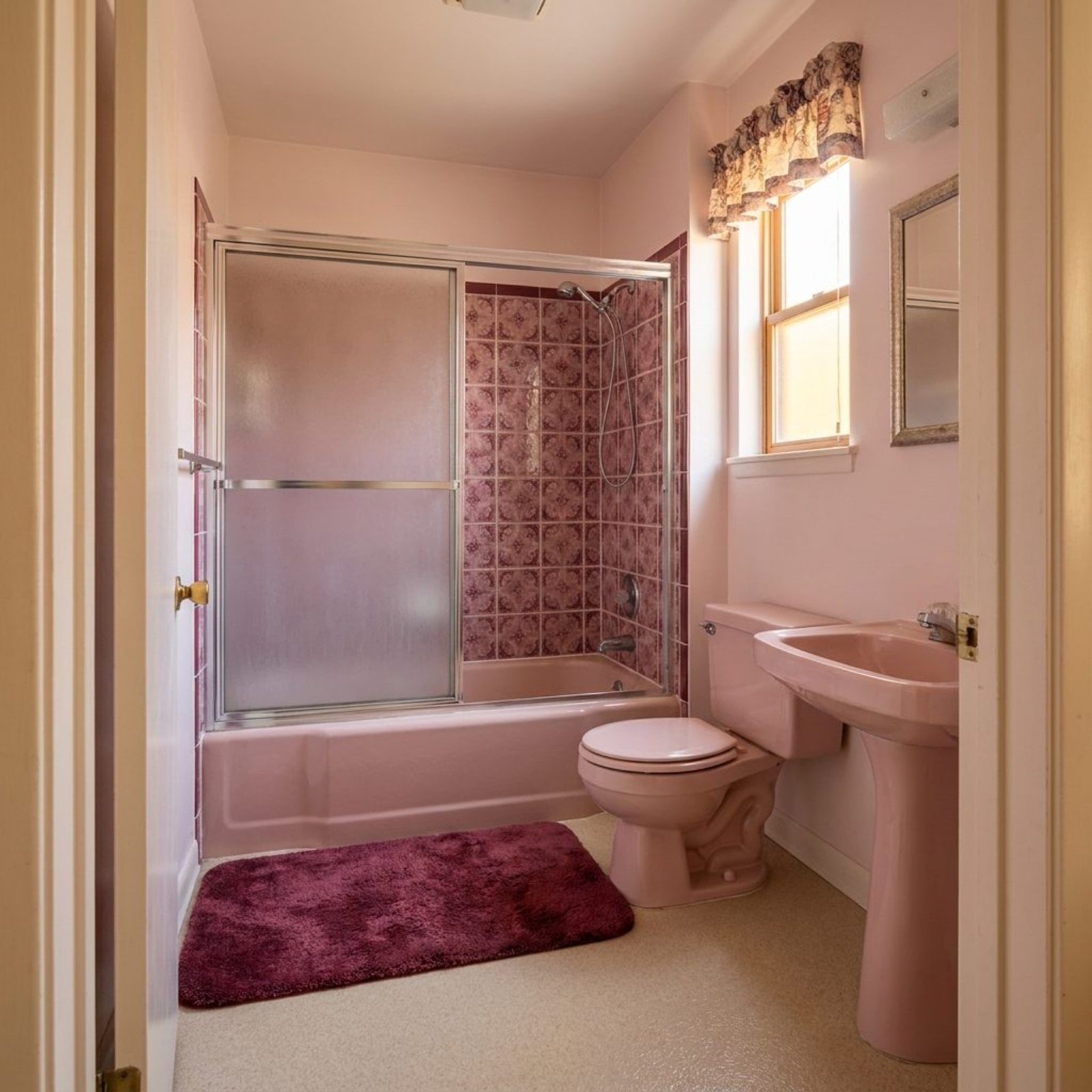
The bathroom of 1970 announced itself in avocado green and a haze of Aqua Net. Shag toilet lid covers, a pink toilet the family was genuinely proud of, wall-to-wall carpet that soaked up everything and admitted nothing. Loud. Carpeted. Somehow both formal and clammy at once. Fifty-odd years later the same square footage feels twice the size and half the drama. Here’s every fixture, surface, and questionable color choice, then versus now, across 30 before-and-afters.
30. Pedestal Sinks vs. Double Vanities
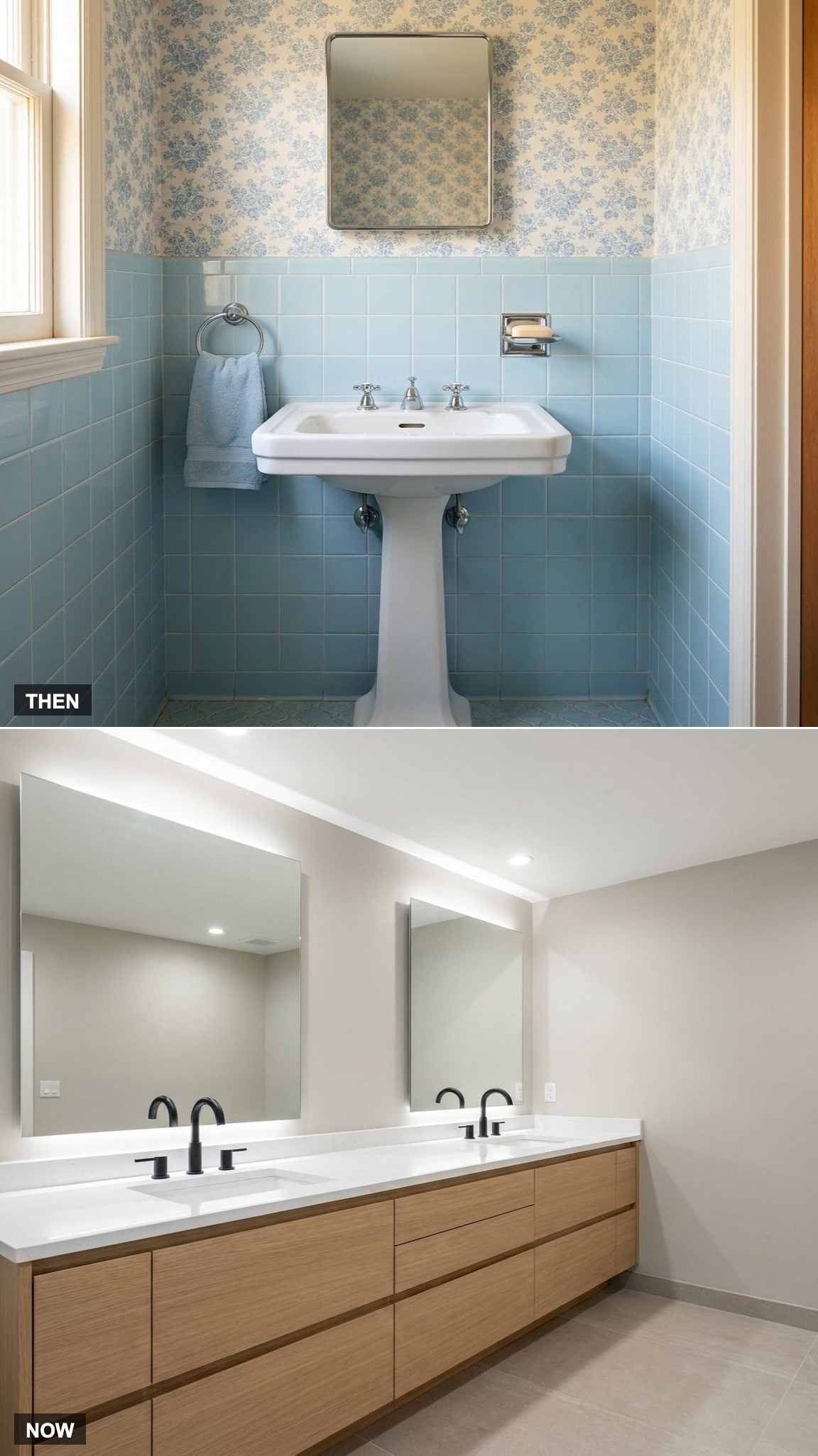
The pedestal sink was elegant and almost entirely without storage. In older bathrooms and compact powder rooms, one narrow basin and one small mirror left nowhere to put much beyond a bar of soap.
In order to come up with the very specific design ideas, we create most designs with the assistance of state-of-the-art AI interior design software. Also, assume links that take you off the site are affiliate links such as links to Amazon. this means we may earn a commission if you buy something.
The double vanity ended the oldest domestic argument going. Two sinks, two mirrors, a wall of drawers underneath. The white oak base grounds it, the quartz top handles the mess, and nobody misses waiting.
29. Colored Toilets vs. White Toilets
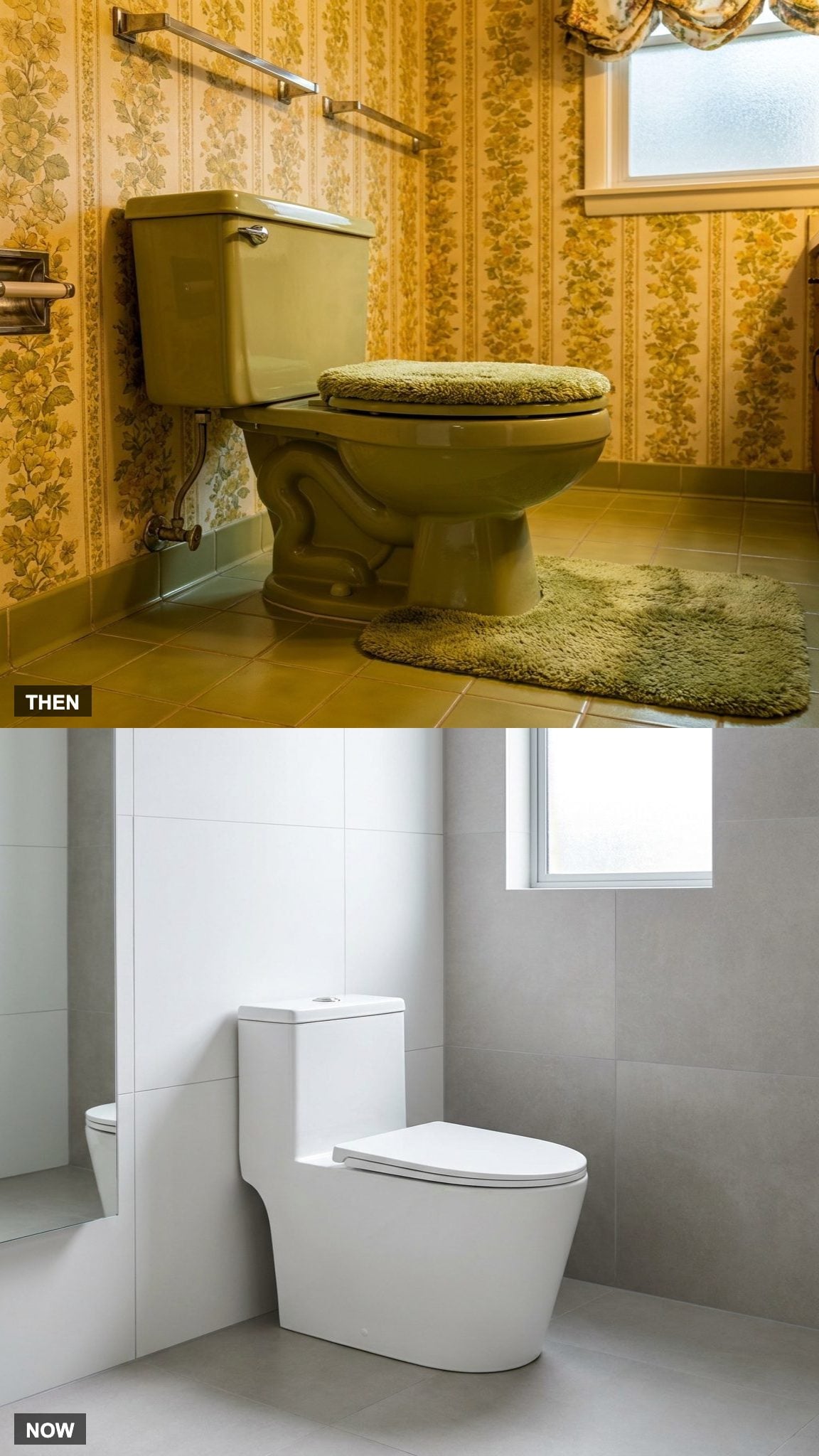
People chose these on purpose. Avocado, harvest gold, dusty pink, that particular pale blue. A colored toilet was a status move, proof you’d redone the bathroom recently and coordinated everything right down to the porcelain.
White became the safer default because it works with almost any surrounding finish and is less tied to a single color trend. The dual-flush one-piece hides the seam and wipes down in a single pass.
A colored toilet is a time capsule you have to look at every single day.
28. The Almond Fiberglass Pod vs. The Frameless Glass Box
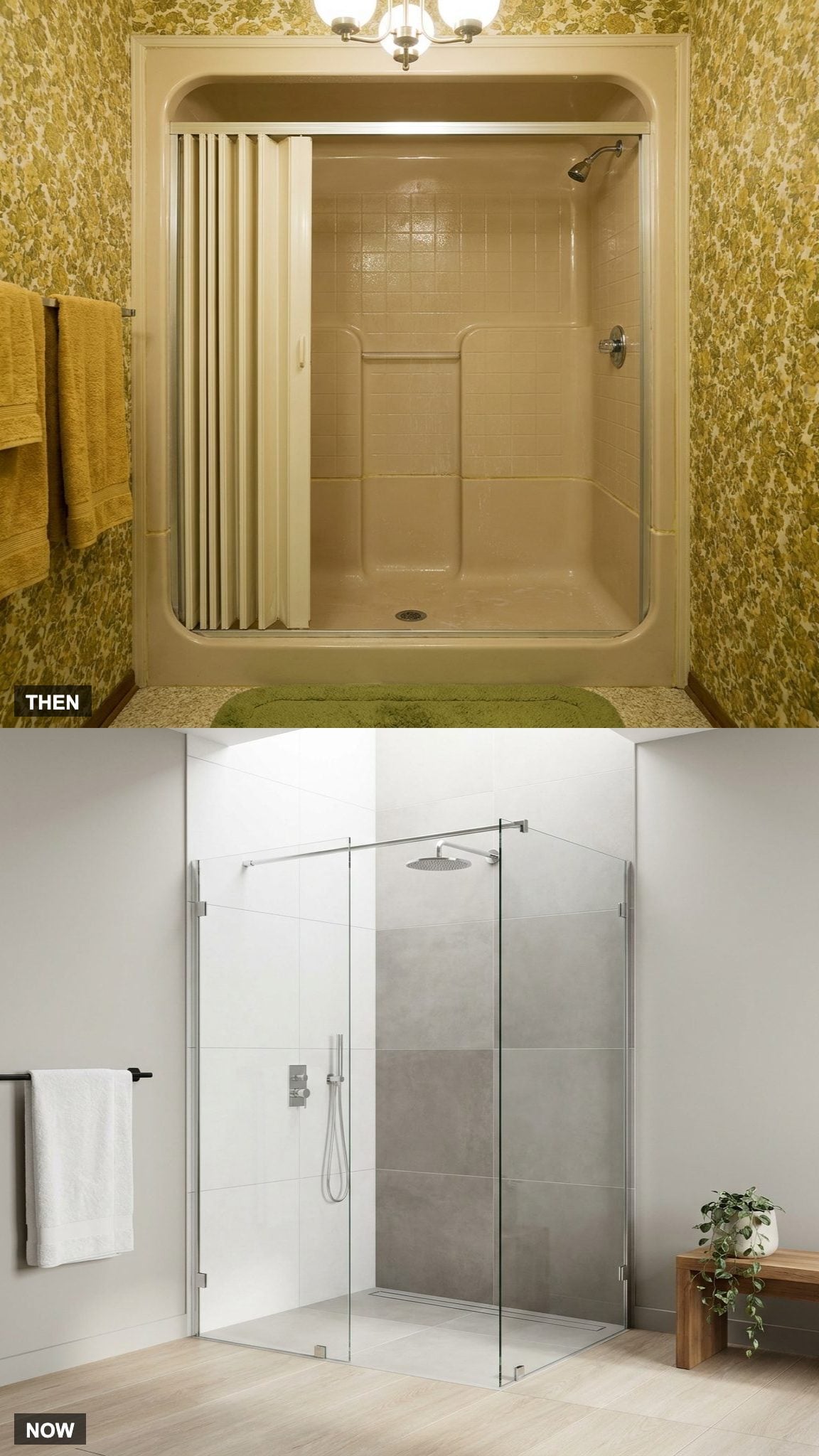
Someone in 1970 decided a shower should be a single molded shell you dropped into a corner, and for a while everyone went along with it. The fake tile pattern got pressed right into the plastic. That accordion door folded shut with a click and let a cold draft through anyway, and by year five the seams had gone the color of old teeth.
Now? A pane of glass and nothing else. The tile behind it does all the talking. No aluminum track hoarding soap scum, no beige box lopping the corner off your room. You can see the whole floor, which is the difference between a small bathroom and a phone booth you shower in.
27. Built-In Bathtubs vs. Freestanding Soaking Tubs
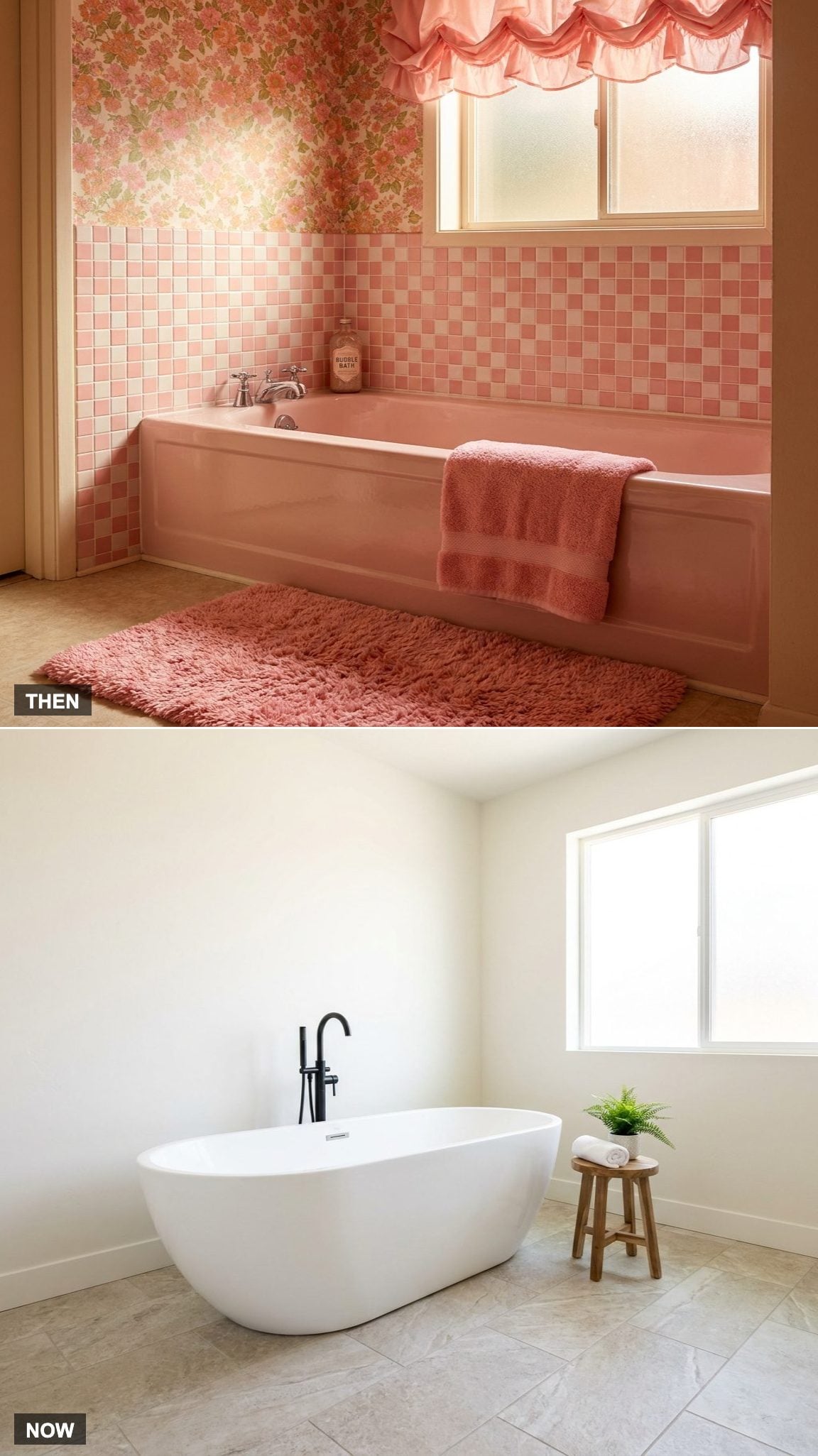
Boxed into a tiled alcove, the seventies tub was part of the wall whether you liked it or not. Pink porcelain, matching pink tile, a bottle of bubble bath on the ledge, and no way to change a thing without a sledgehammer.
The freestanding soaker floats in the room like a sculpture. Pull it off the wall and it becomes the thing you look at, not just the thing you sit in. Add a matte black floor filler and a rolled towel on a wood stool, and the whole corner turns into a reason to run a bath.
For more of this look, browse these freestanding soaking-tub ideas.
26. The Ceramic Tile That Bit Your Feet vs. Luxury Vinyl Plank
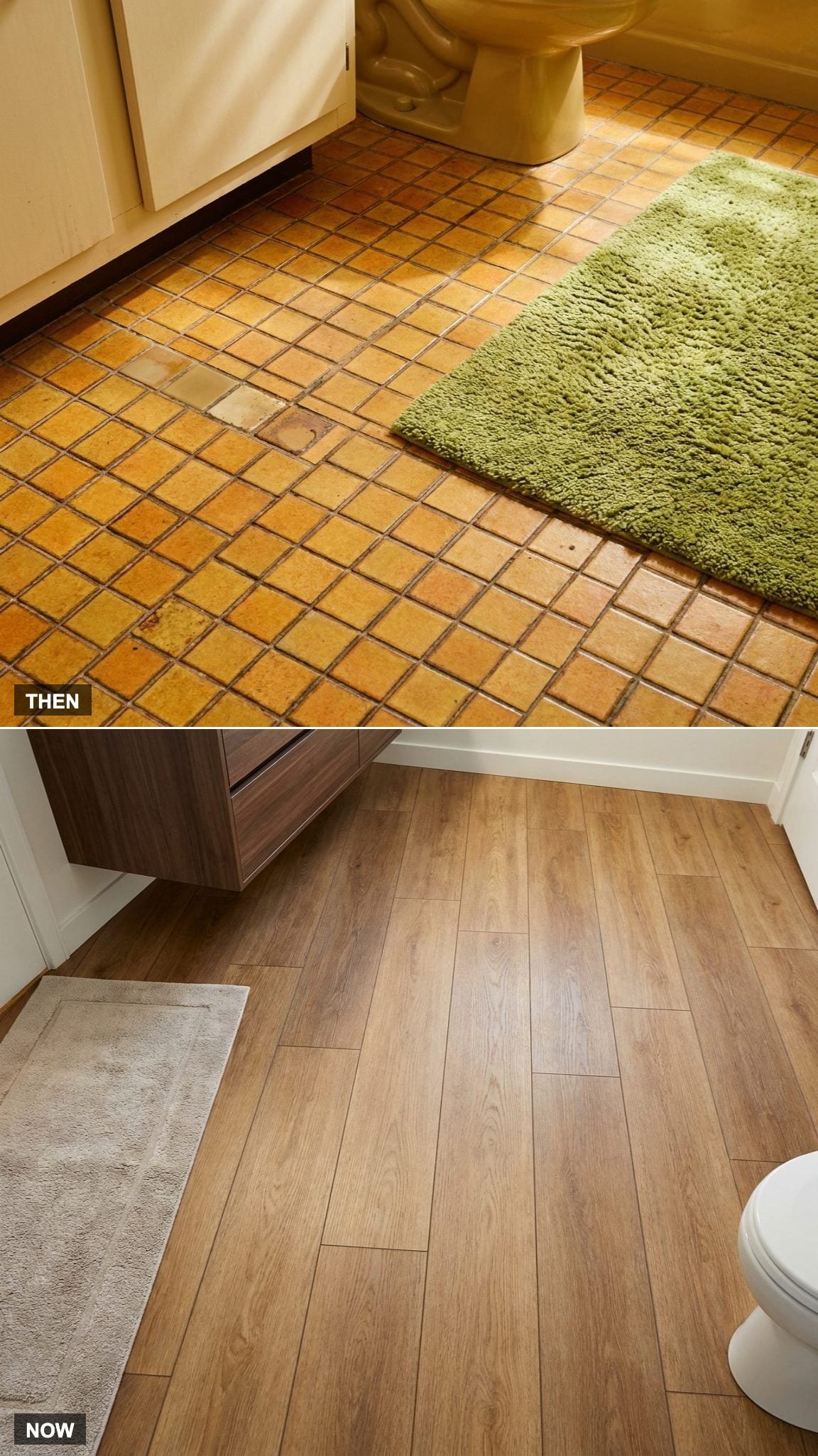
Step out of a warm shower onto a 1970 ceramic floor and your feet knew it instantly. Cold as a countertop, no give at all, no mercy for bare skin at 6 a.m. It wasn’t the tile’s fault exactly. It was just doing what ceramic does, which is hold onto whatever temperature the room happens to be.
Waterproof luxury vinyl plank approved for bathroom use changed the feel of the whole room, literally. It resembles wood, handles everyday splashes, and has a little give underfoot instead of feeling rigid, so the first step out of the shower doesn’t double as a small shock. Those long boards run the length of the floor and coax a boxed-in bathroom outward. Hang a floating vanity above it and even a narrow bathroom can feel more open.
25. Small Mosaic Floor Tiles vs. Large-Format Porcelain Tiles
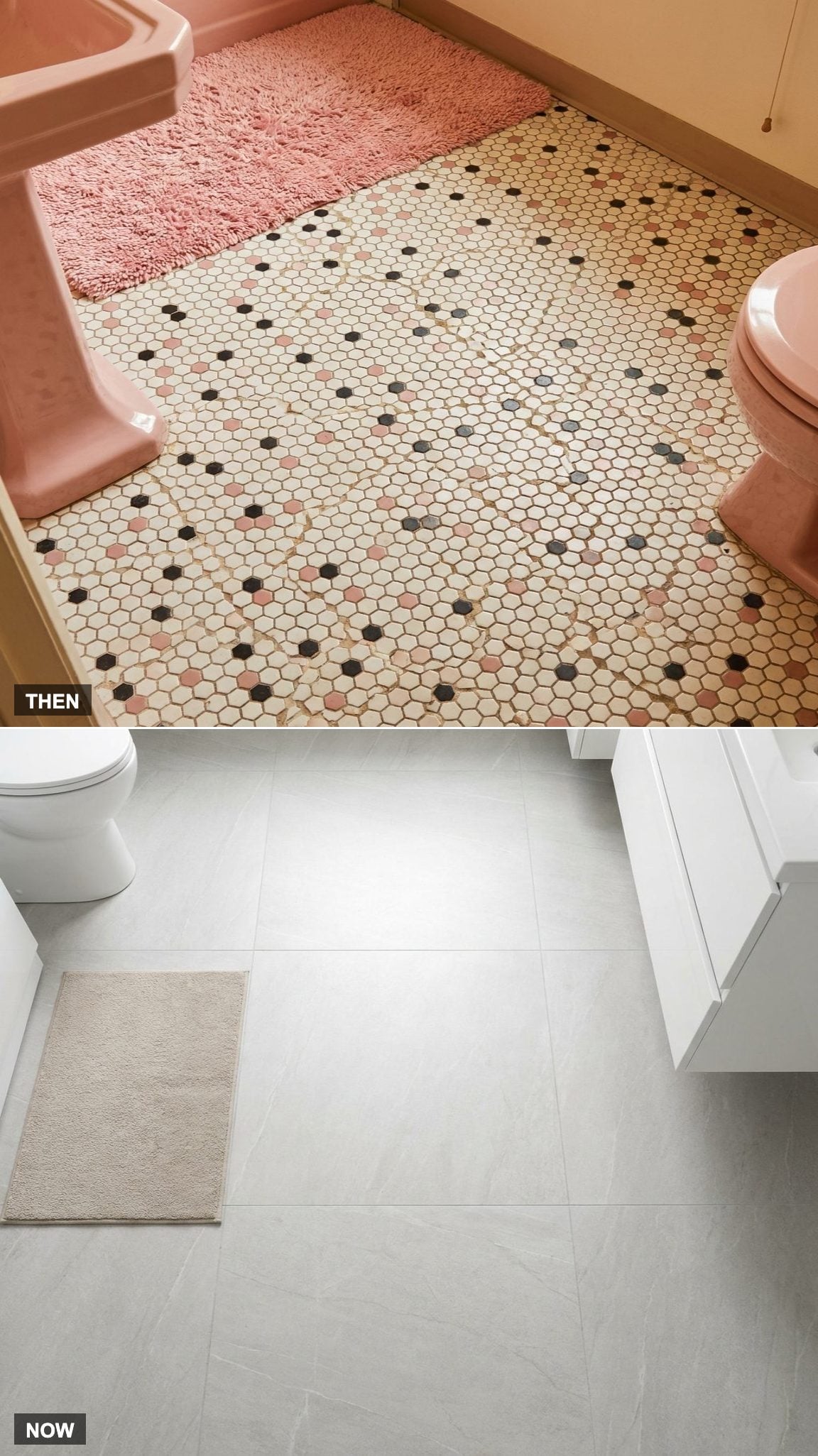
All those tiny hexagons meant miles of grout, and grout is where a bathroom shows its age fastest. It stained. It cracked. It turned gray no matter how hard anyone scrubbed.
Large-format porcelain flipped the ratio entirely, trading a busy grid for big slabs, far fewer grout lines, and a quieter surface with fewer visual interruptions. Less to clean, less to notice, more floor for the eye to glide across.
24. Floral Wallpaper vs. Painted Accent Walls
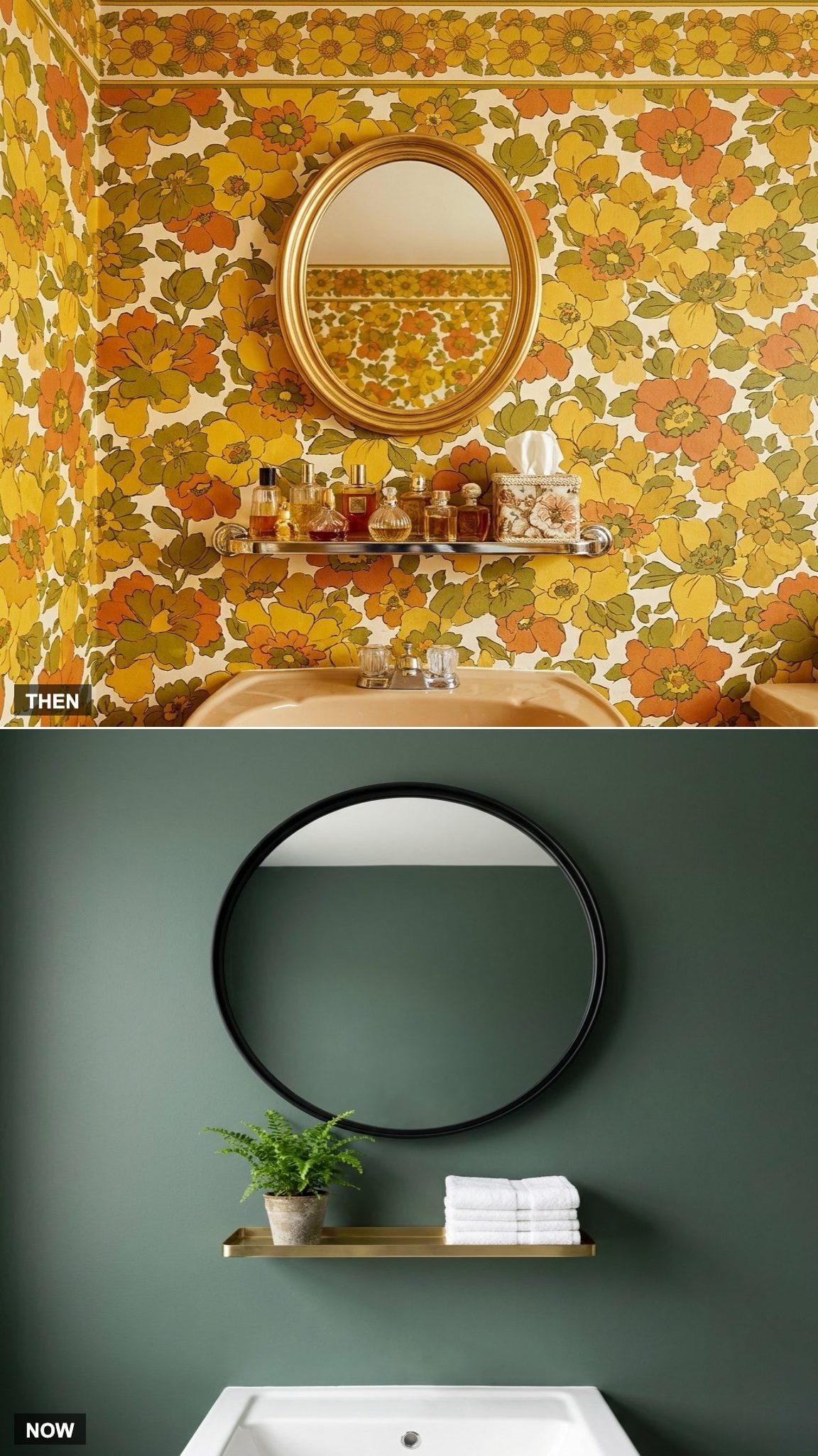
Floral wallpaper turned every wall into a shouting match. Mustard blooms, olive vines, a coordinating border along the ceiling for good measure. In a small room it closed in on you before you’d finished brushing your teeth.
A single painted accent wall does the opposite. One deep, muted color, matte finish, and the room finally holds still while the black-framed mirror gets to be the focal point instead of competing with the pattern behind it.
Color choice matters more than square footage here. See how a bold wall plays out in a black bathroom renovation or a warmer multicolored bathroom.
23. Dark Wood Paneling vs. Warm Plaster Walls
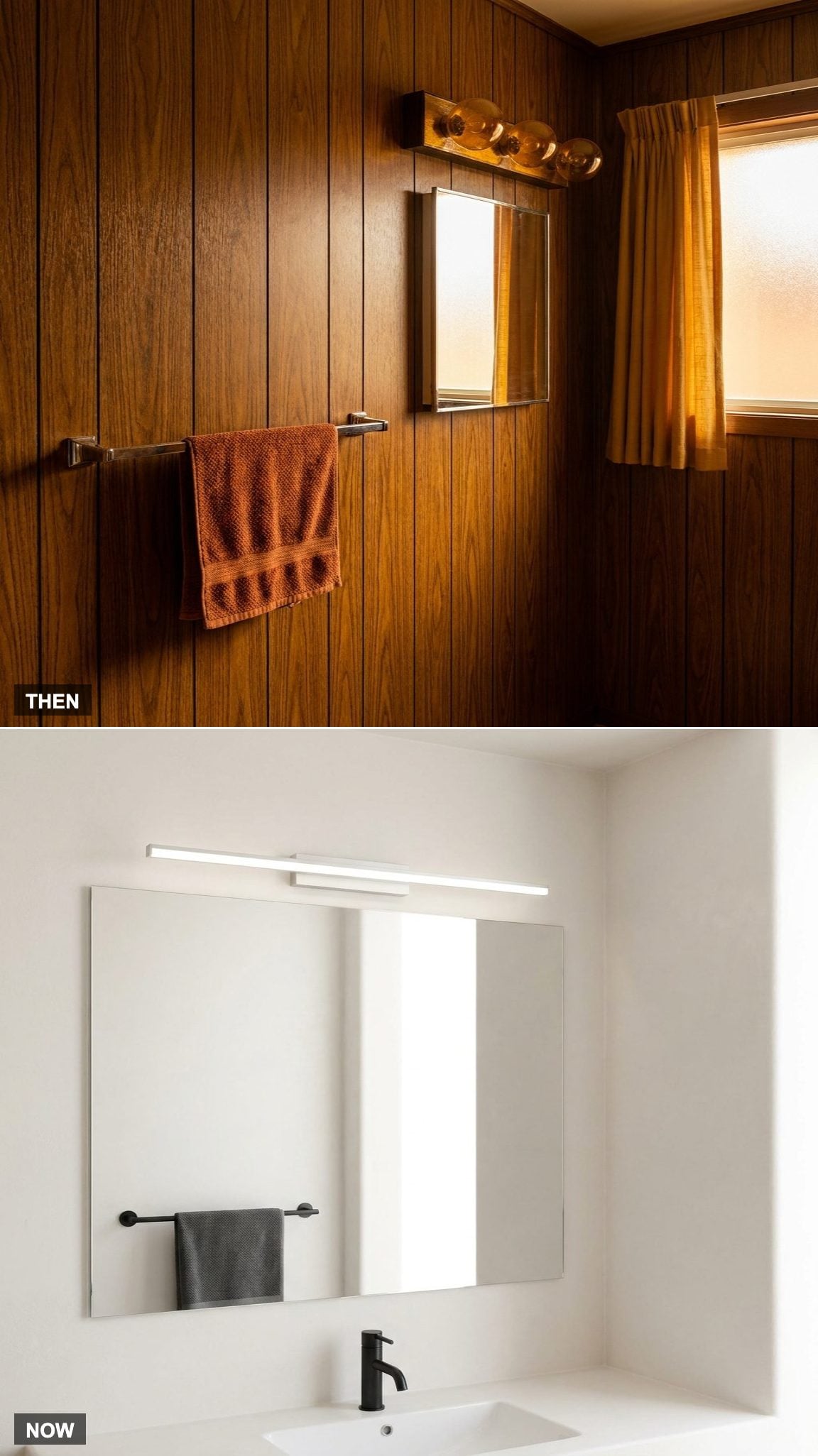
Wood paneling migrated from the rec room straight into the bathroom, and it brought all the gloom with it. Those dark grooved planks soaked up light and turned a small room into a cave with a toilet in it.
Clean plaster walls in warm white do the reverse. They bounce light around, keep the eye moving, let the fixtures speak. A minimalist wall is confident enough to say nothing.
22. Laminate Countertops vs. Quartz Countertops
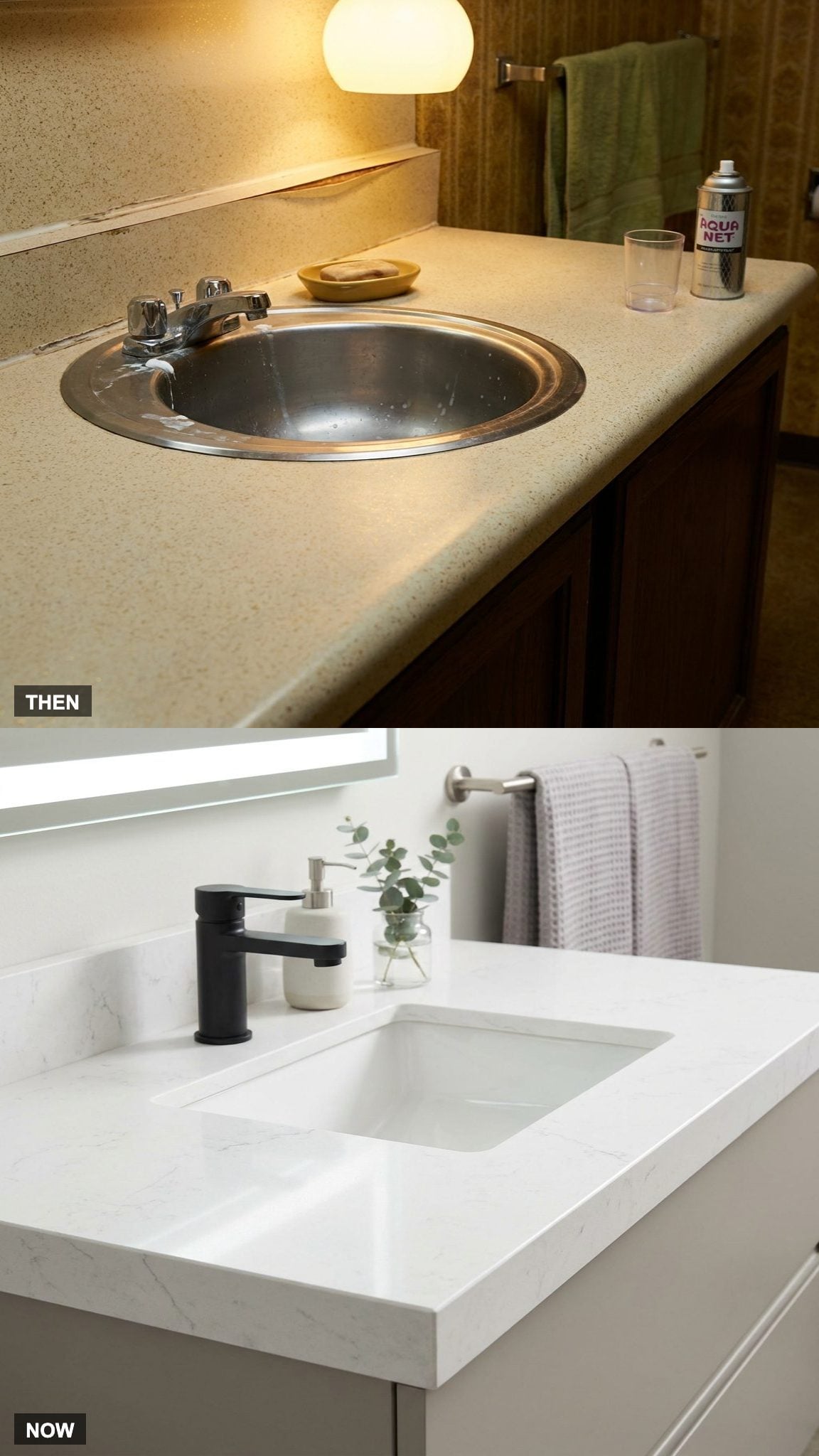
Gold-flecked laminate was the great pretender of 1970s bathrooms. It mimicked stone, marble, wood grain, whatever the catalog promised that season, and it all peeled at the seam eventually. That rolled front edge caught every drop of toothpaste water for decades.
Engineered quartz is a nonporous composite surface resistant to everyday moisture and many stains. Hot styling tools still belong on a heat-resistant mat, but the surface is far less vulnerable to routine bathroom mess than old laminate. Wipe the undermount sink clean in one pass instead of chasing grime along a metal rim.
21. Shiny Chrome Faucets vs. Graphic Matte Black Fixtures
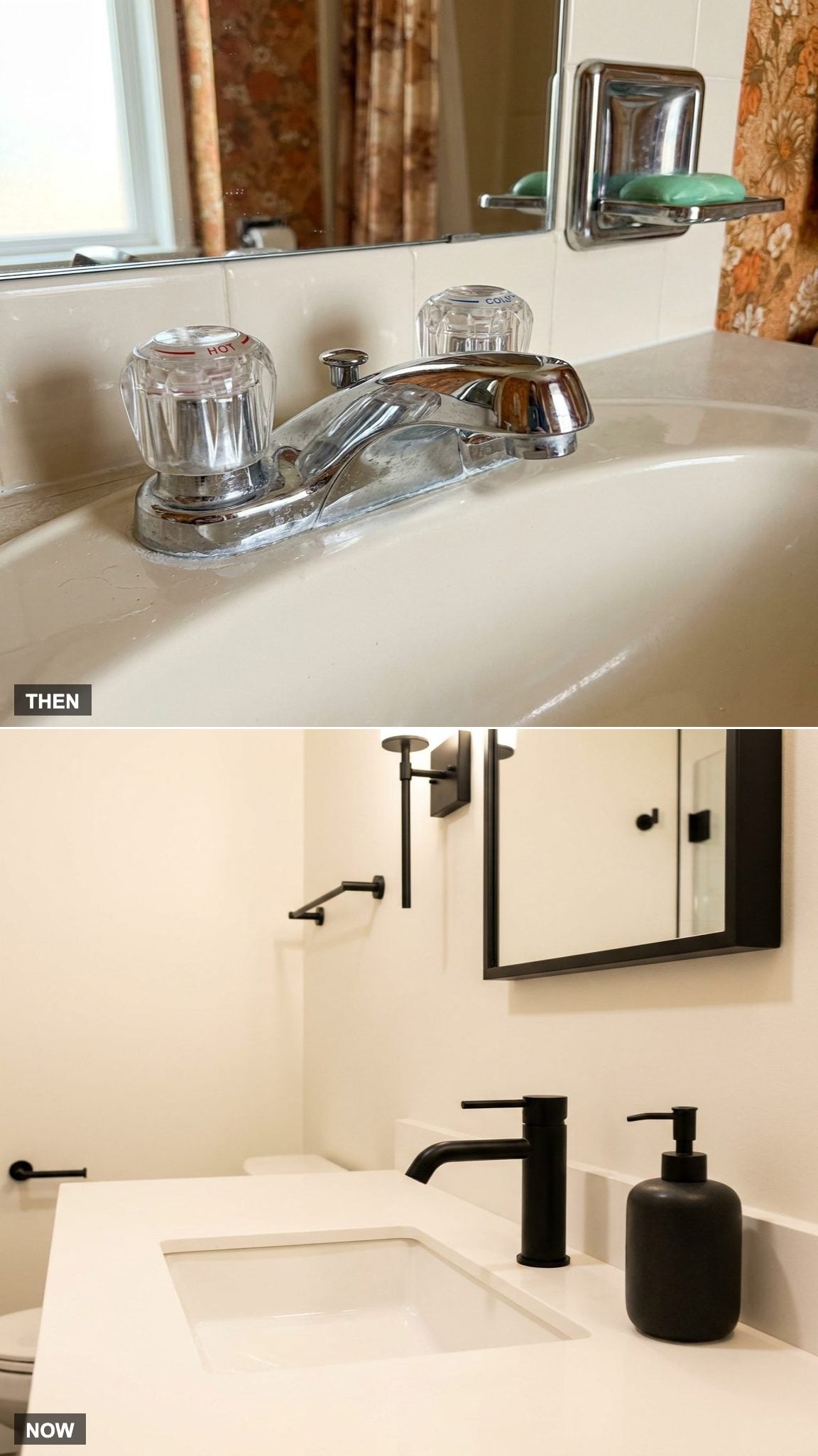
Chrome dominated the standard 1970 bathroom faucet, though brass and other decorative finishes also appeared. It caught the light, but it also caught every fingerprint, every drop of hard water, and every kid who grabbed it fresh from brushing. Those clear acrylic knobs stamped Hot and Cold clouded over inside a year, then cracked clean in half.
These days the hardware vanishes on purpose. Matte black sits quietly against a white basin and creates a strong graphic outline, though hard-water deposits can still show. Against a white basin, one dark spout creates a stronger focal point than a collection of reflective chrome pieces. See how the finish works across a full black bathroom renovation.
20. Basic Vanity Mirrors vs. Illuminated LED Mirrors
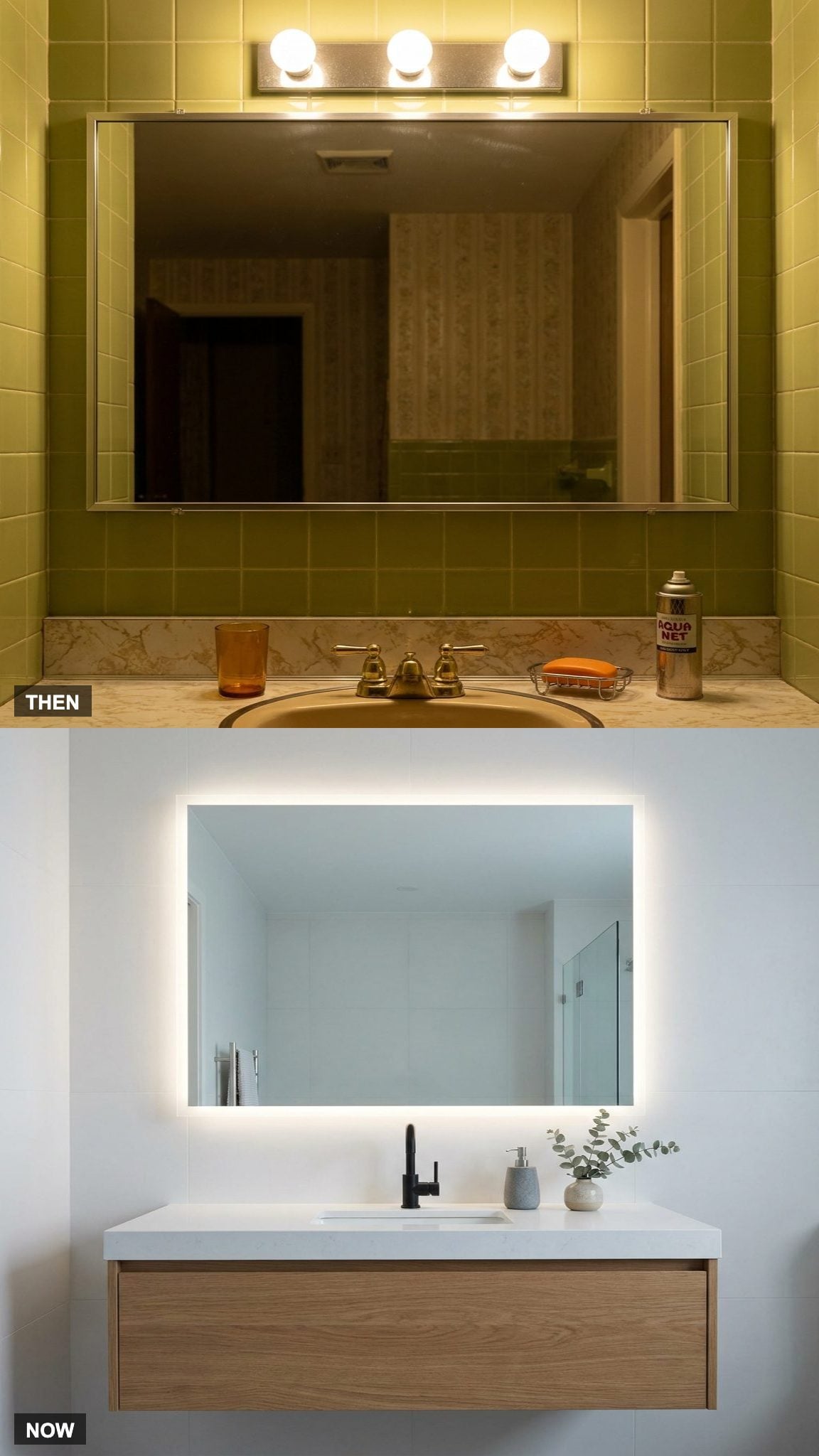
The 1970s mirror was a flat sheet of silvered glass with a metal edge, and reflecting was its entire résumé. Lighting came from somewhere else, usually a fixture that lit half your face and shadowed the rest.
Modern backlit and edge-lit LED mirrors spread light more evenly around the glass. For grooming, front or edge lighting matters most because backlighting alone can leave the face underlit. Good color temperature and color rendering make as much difference as the mirror itself.
19. One Ceiling Light vs. Layered Lighting
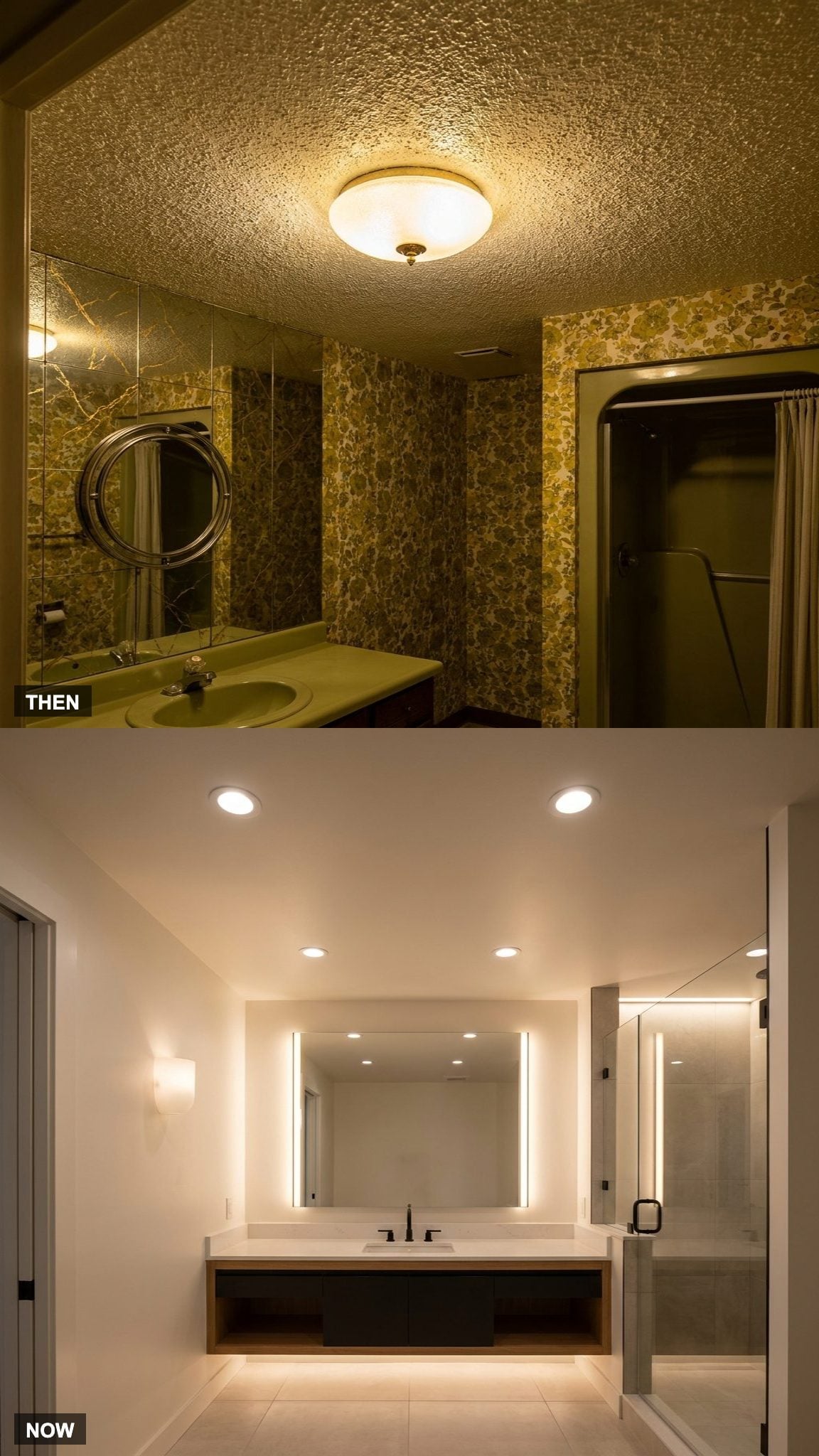
One dome light in the middle of the ceiling had to do everything in 1970, and it did most of it badly. Corners went dim, the shower fell into shadow, and shaving meant fighting your own head shadow.
Layered lighting spreads the work across several sources. Recessed cans for the ambient wash, task light at the mirror, a soft sconce for mood, a toe-kick strip for the 2 a.m. trip. Nothing glares because nothing has to carry the whole room alone.
18. Shallow Medicine Cabinets vs. Recessed Storage Walls
🔥 Would you like to save this?
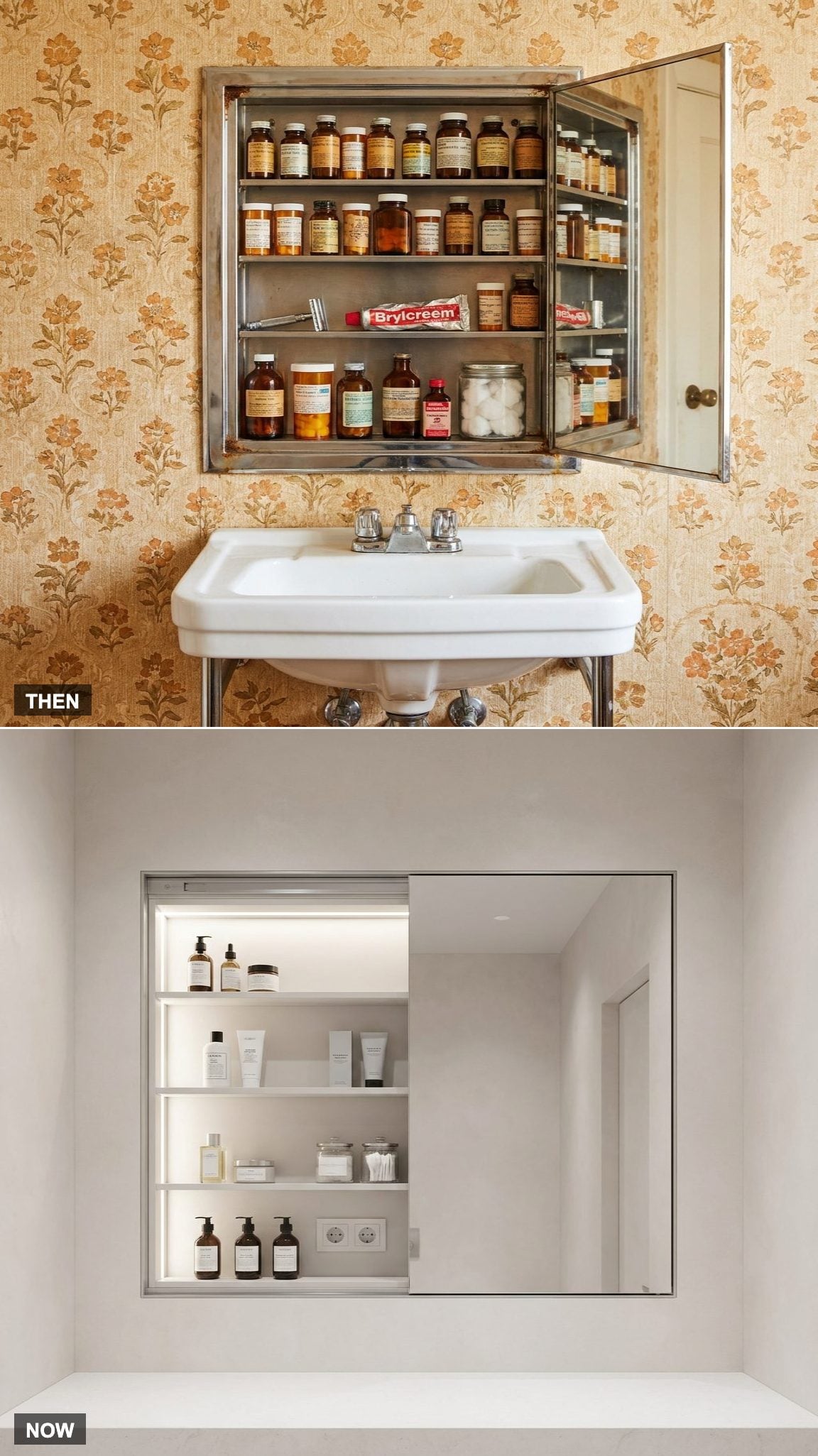
The 1970s medicine cabinet was a shallow chrome box behind the mirror, packed with amber pill bottles and a razor that rusted if you left it wet. Everyone had one and everyone’s overflowed.
Modern recessed storage keeps the mirror-front idea but expands it—deeper cabinets with internal outlets, drawer inserts, and full-height panels that keep the counter clear. In a narrow bathroom, storage like this matters because there is little floor space to spare.
17. Open Shelving vs. Built-In Niches
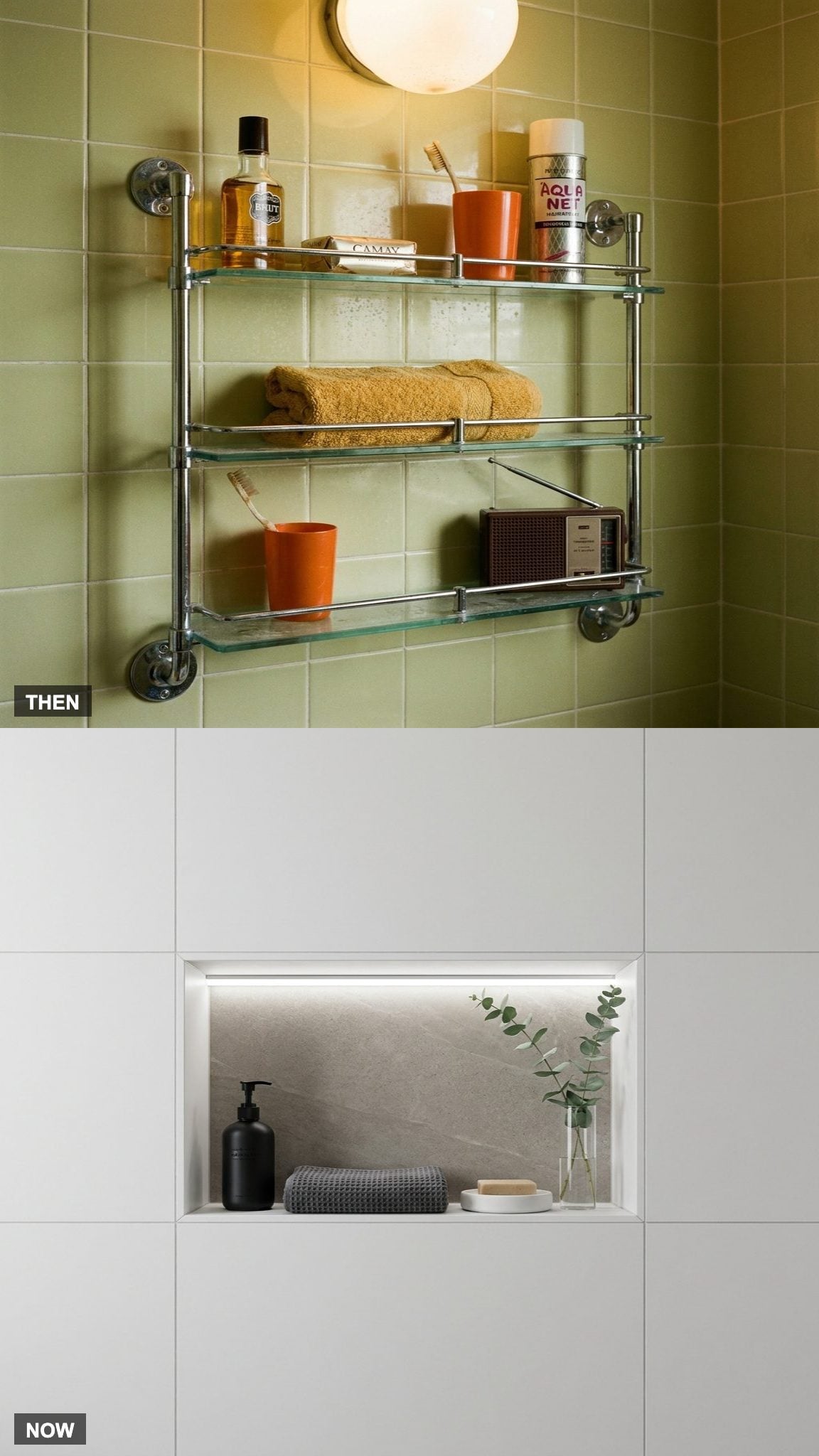
Chrome-and-glass shelves screwed to the wall held everything in plain sight in 1970. Tidy for about a day, then they collected dust, drips, and whatever nobody had a drawer for.
Built-in niches carve the storage into the wall itself, so nothing juts out and nothing needs a bracket. Set into tile at shower height or above the tub, they look planned rather than bolted on later. Proper waterproofing, a slight shelf slope, and careful tile detailing matter more than the niche’s appearance.
A niche says the storage was planned. A wall shelf says it was patched in after.
16. Towel Bars vs. Heated Towel Warmers
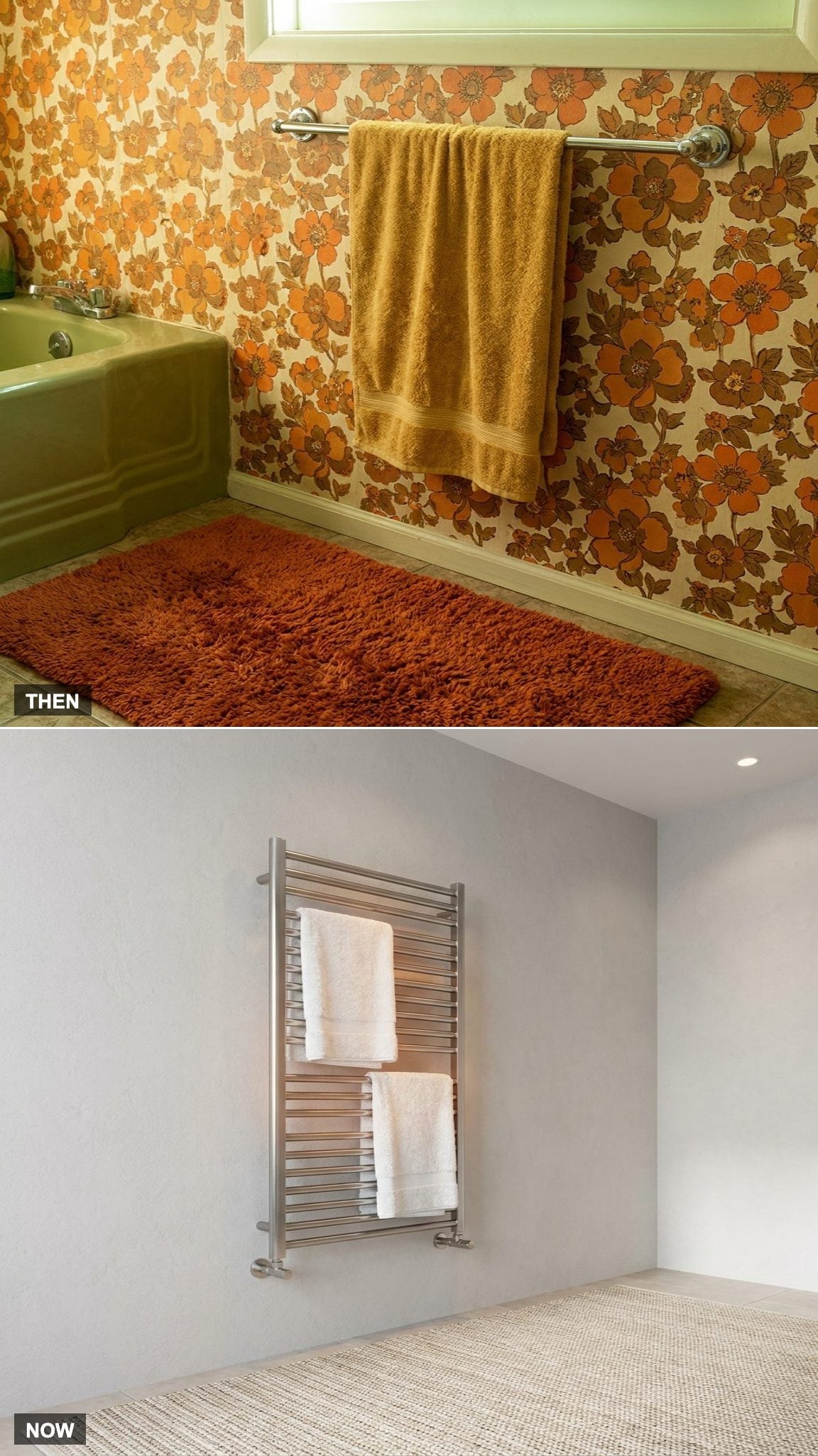
A single chrome bar, one damp towel that never fully dried, and that faint mildew smell by Thursday. Towel storage in 1970, right there.
Heated towel warmers can hold several towels, dry them faster, and hand you a warm towel after a shower. The ladder design fits several towels at once, and the gentle heat keeps everything from going sour between washes. Small luxury. Genuinely worth it in a cold-morning house.
15. Plastic Shower Curtains vs. Frameless Glass Doors
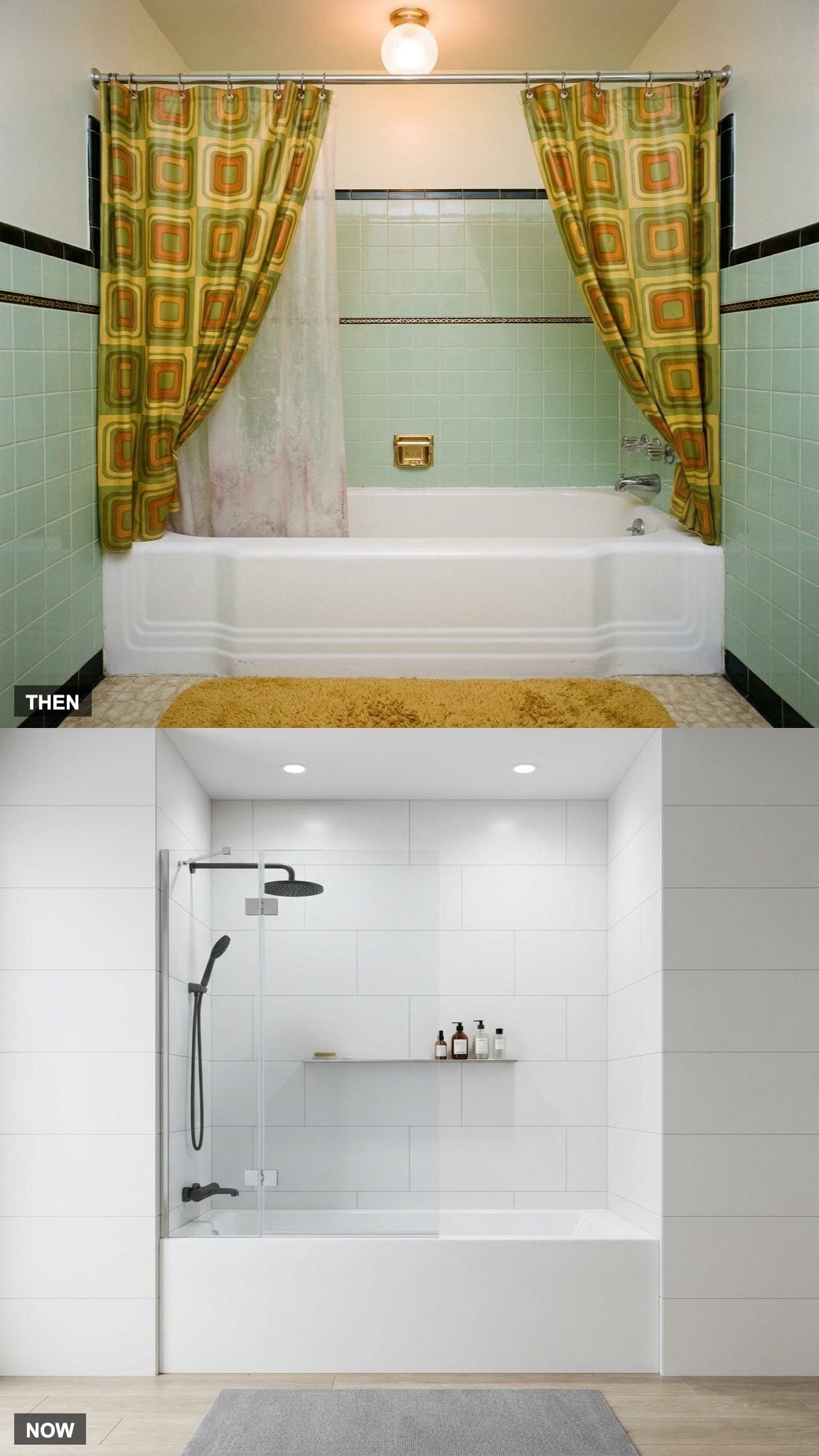
The 1970 shower curtain announced itself in a print no one asked for. Big orange daisies. Or those angular harvest-gold shapes that looked like a math problem you’d rather not solve at seven in the morning. It ballooned inward the moment you turned the water on, kissing the backs of your calves with cold vinyl, and the liner underneath went mildew-black along the hem faster than anyone wanted to admit. So you replaced it. Then it happened again.
Frameless glass ended all of that. No cling, no billowing, no ribbon of mold to scrub. The panel stops at the edge and leaves more of the room visible, so a cramped bath feels less enclosed. Squeegeeing after each shower slows mineral and soap buildup and makes the next cleaning easier. The curtain never stood a chance against soap scum.
14. Standard Showerheads vs. Rainfall Shower Systems
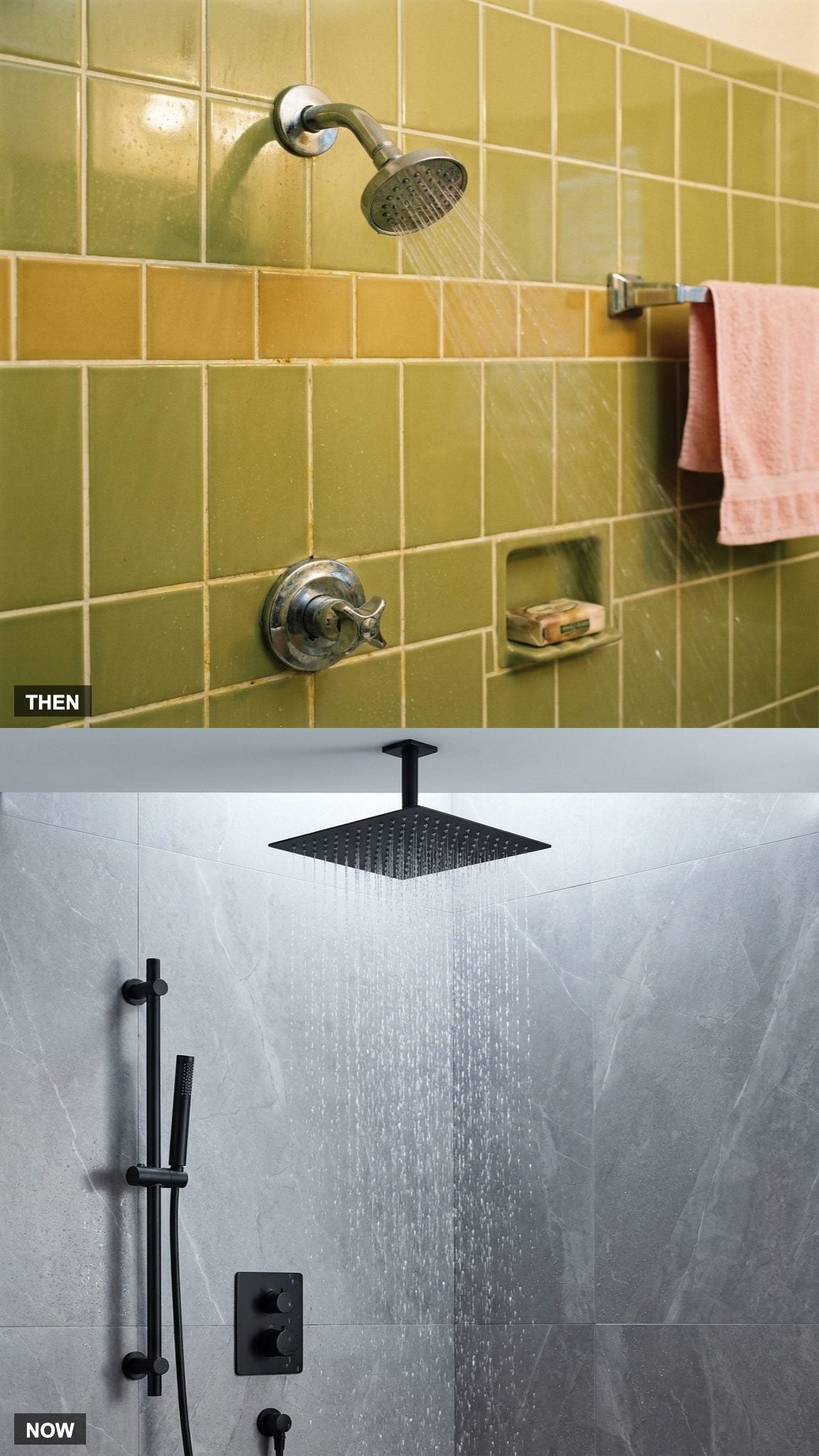
In 1970, your shower was often a small chrome disc bolted to the wall. Water pressure and hot-water recovery depended heavily on the plumbing and water heater. The chrome showerhead sprayed in one direction and you learned to lean into it.
Now the water falls straight down like weather. A ceiling-mounted matte-black rainfall head paired with a handheld wand on a slide bar lets the shower do what you tell it, and a properly installed thermostatic or pressure-balancing valve helps reduce sudden temperature swings when another fixture is used. The dark hardware against gray porcelain slabs are the whole look.
13. Two-Handle Faucets vs. Single-Lever Control
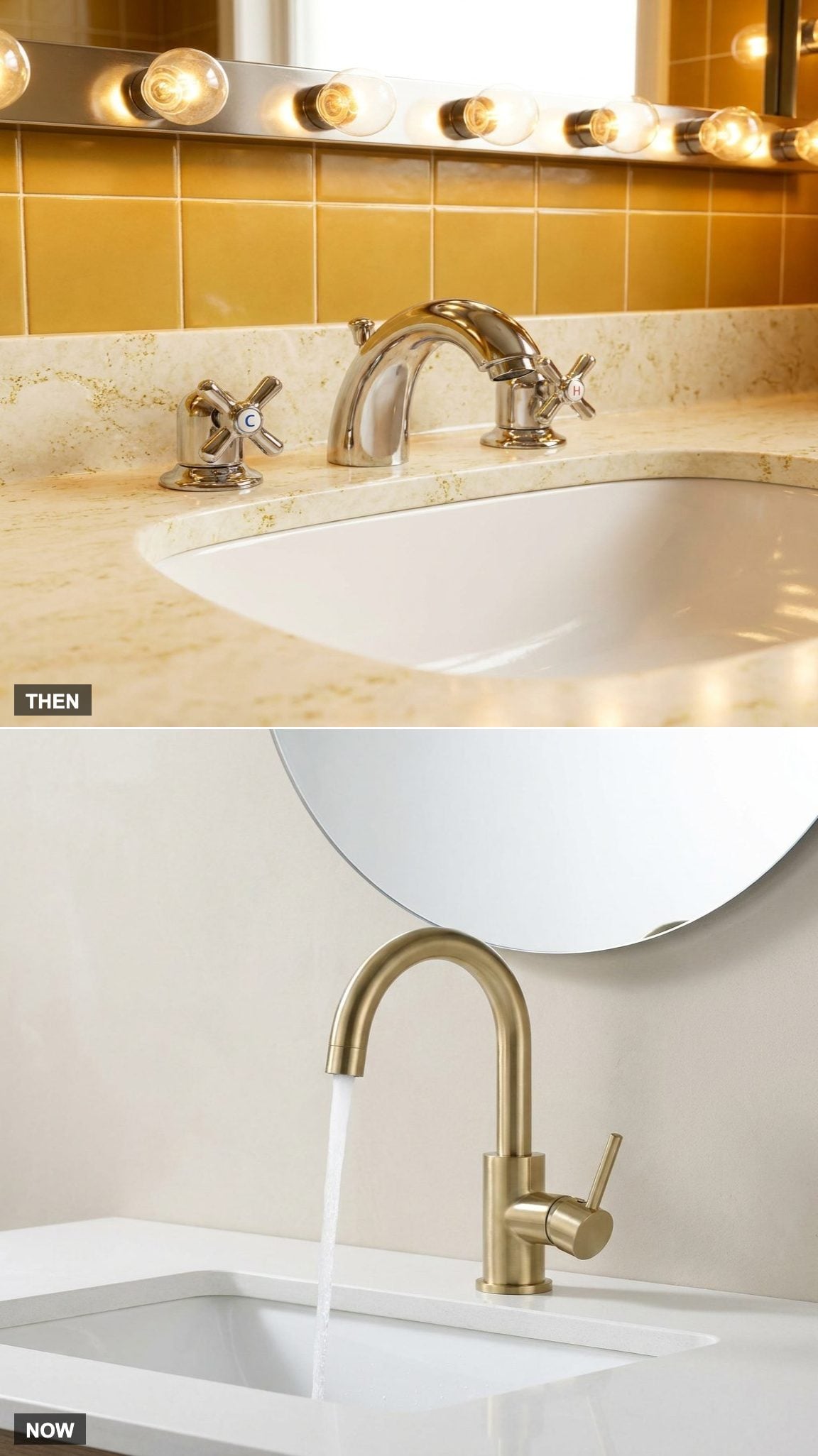
The 1970 sink asked you to become a temperature technician. Crank the left handle and get boiled. Nudge the right and here comes the ice bath. So you spun both, waited, adjusted, waited again, and by the time your patience gave out the water still wasn’t right.
A single lever ended most of that fiddling. A single-lever faucet sets heat and flow with one push of the wrist, and the taller gooseneck spout finally gives you room to cup your hands under it. Nobody stands at a modern sink pining for the old two-knob dance.
12. The Ceiling Fan That Roared vs. Ventilation You Can’t Hear
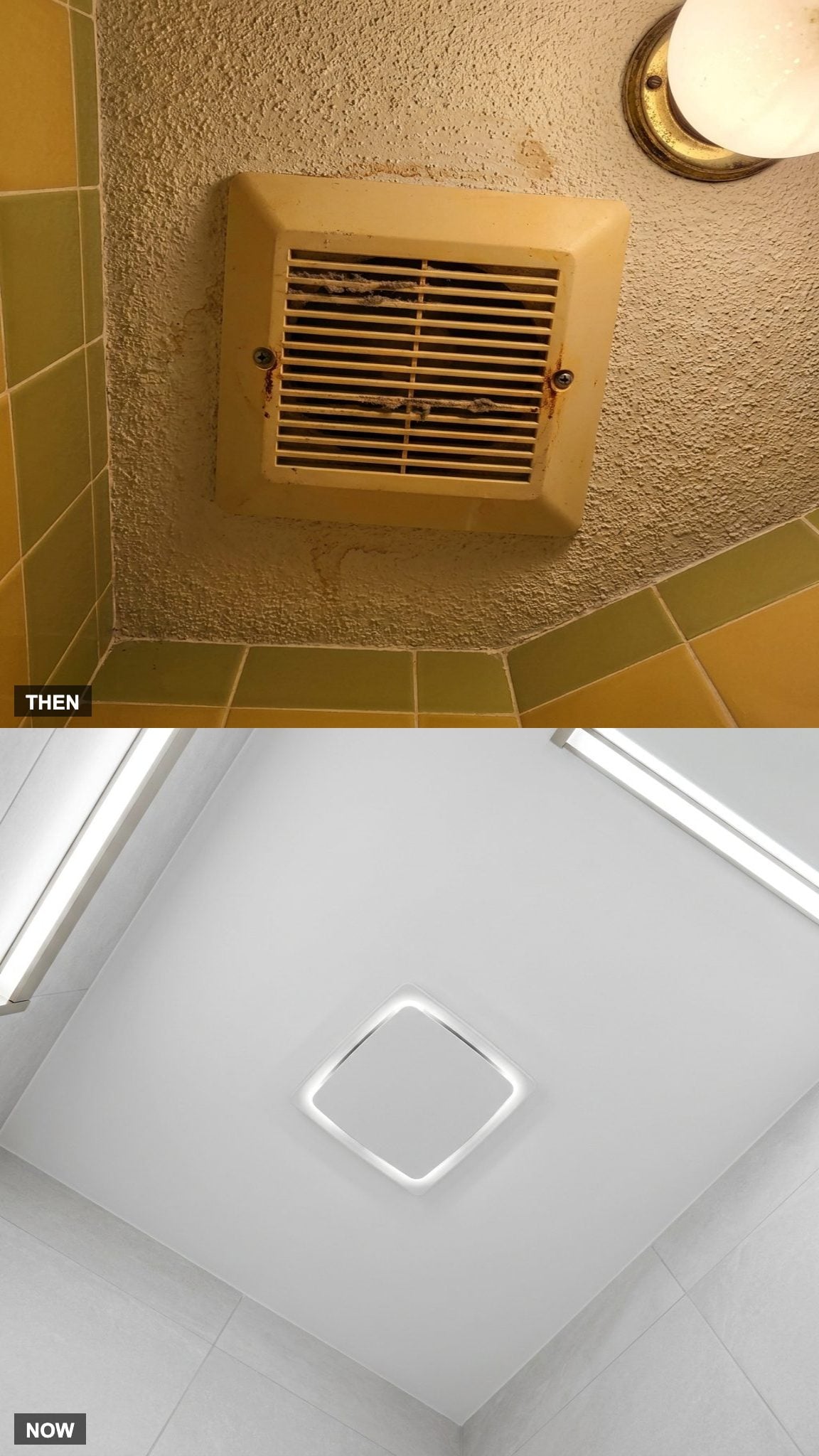
Flip the switch in a 1970 bathroom and the ceiling answered back. That grinding whir rattled the light fixture and drowned out the radio, which meant most people just didn’t bother running it. The noise itself was the whole problem here—not forgetfulness, just an appliance loud enough that using it felt like a punishment.
Today’s quieter units recede into the ceiling and remove moisture with far less noise. Matte white housing. A hum you’d miss if you weren’t listening for it, and the steam clears far faster once the shower ends.
11. Standard Exhaust Fans vs. Humidity-Sensing Ventilation
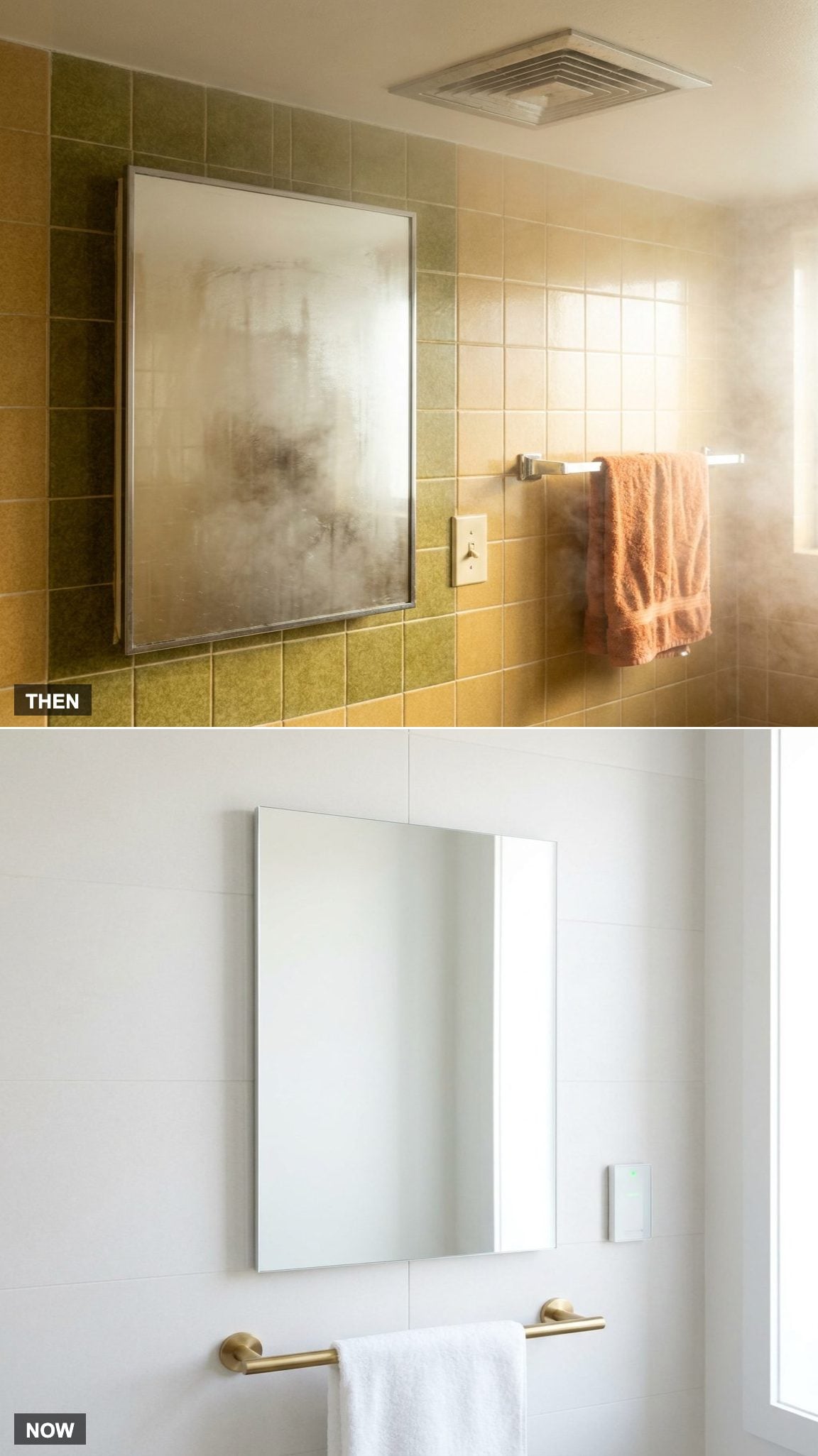
Even a quiet manual fan only worked if somebody actually flipped the switch, remembered to leave it running, and remembered to shut it off again after. Three separate chances to forget, and most households only ever cleared one or two of them. So the steam settled into the walls anyway, and six months later the paint was peeling and something smelled off in the corner.
Humidity-sensing ventilation automates the switching. The fan detects rising moisture, turns on without being prompted, and continues running until conditions move back toward the chosen threshold.
10. Basic Bathroom Storage vs. Custom Cabinetry
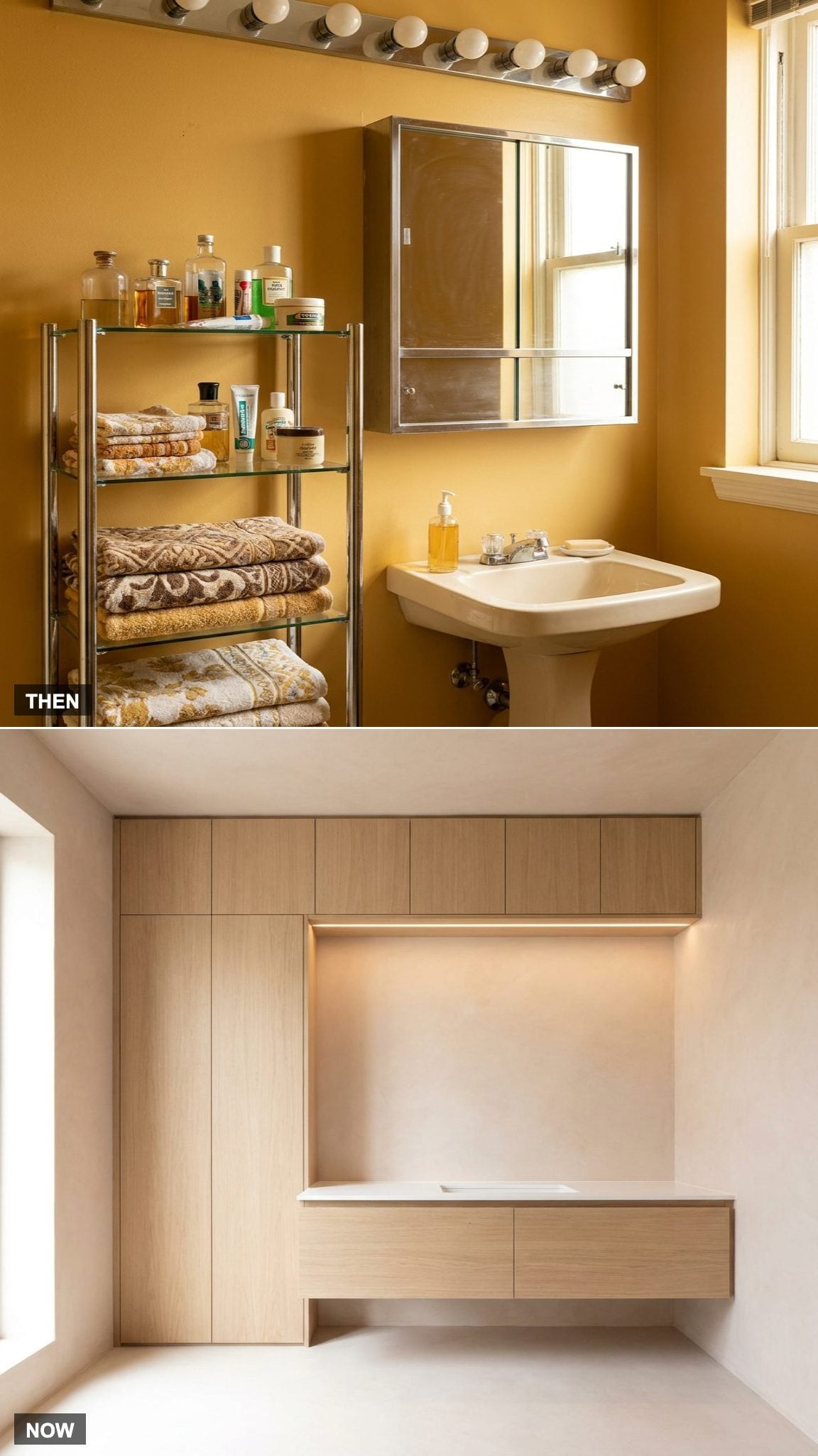
Nothing in a 1970s bathroom was actually built for the stuff you owned. A freestanding wicker hamper doubled as extra seating in a pinch, spare toilet paper got stacked on the back of the tank, and the one drawer under the sink jammed if you tried to close it with anything thicker than a washcloth inside.
Custom cabinetry changed the whole idea. Floor-to-ceiling white oak cabinetry with soft-close drawers and integrated lighting means everything has a home and nothing sits on the counter or the tank lid. In a tighter room, taking storage to the ceiling can free the counter and reduce the need for freestanding furniture entirely.
9. Sheet Vinyl vs. Heated Porcelain Floors
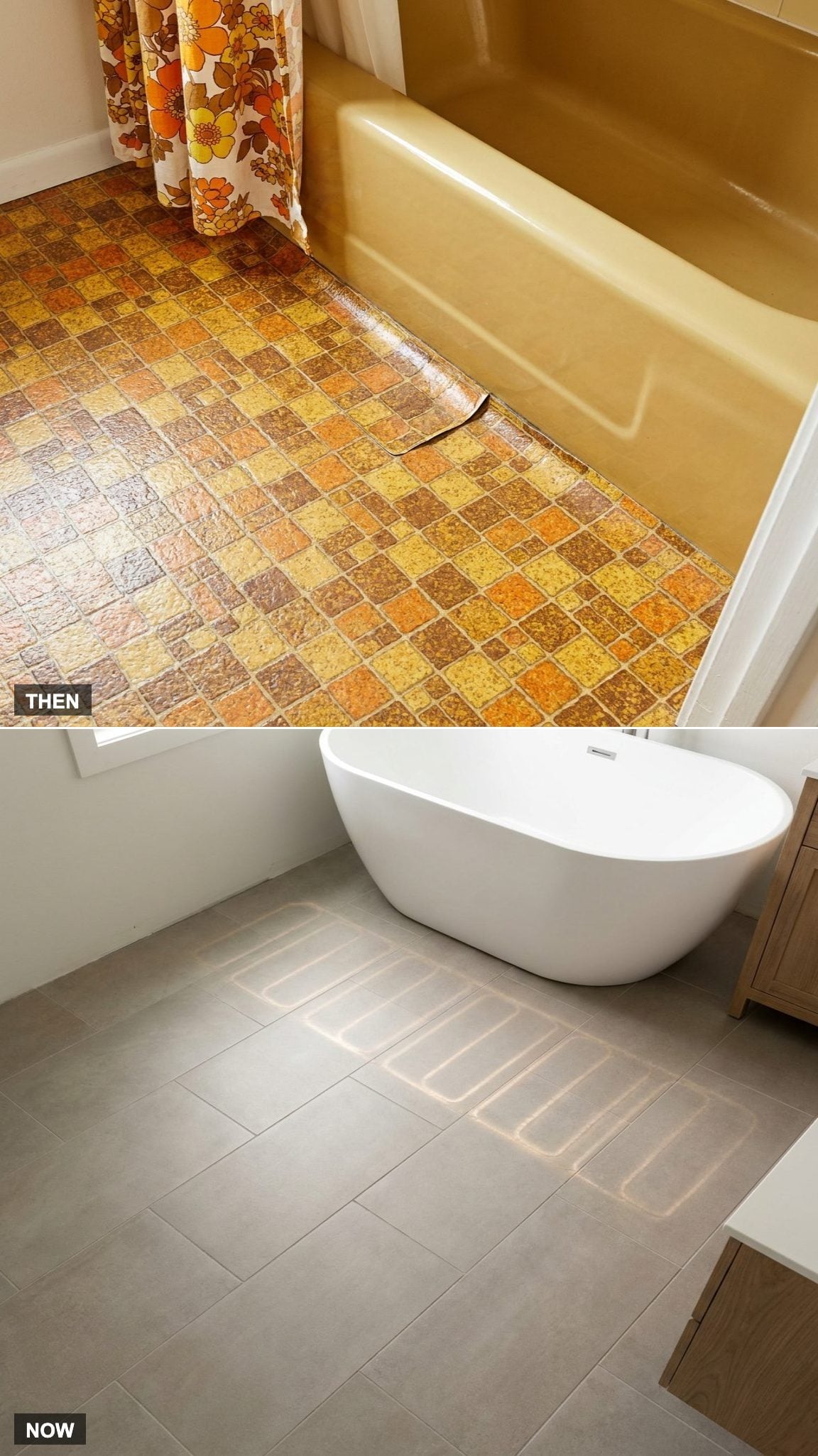
Sheet vinyl in a bad geometric print, curling at the seams, and cold enough at 6 a.m. to make you hop. That was the standard 1970s bathroom floor, and the pattern was usually trying to convince you it was tile. It never fooled anyone.
Radiant heat underfoot is the upgrade nobody realizes they need until they’ve had it. Large-format porcelain over a warming mat means the floor greets your bare feet instead of shocking them. It feels like a small luxury right up until the first cold morning, and then it feels essential.
8. The Tiny Cranked Window vs. Frosted Glass From Floor to Ceiling
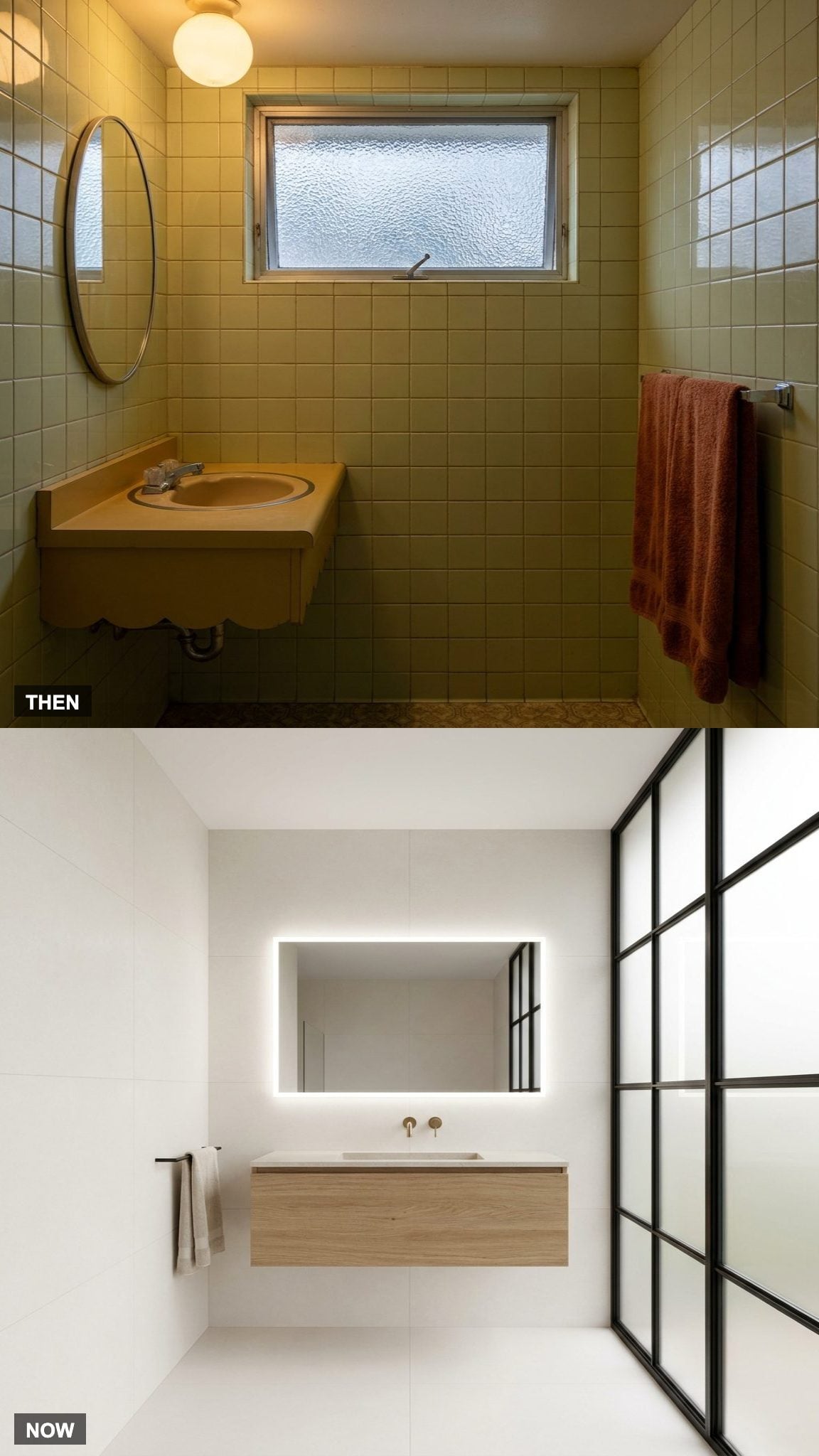
Somewhere above the toilet tank sat the 1970s bathroom window: a little rectangle of pebbled glass, hinged at the top, opened with a crank handle that squeaked and eventually stopped turning altogether. It let in a draft and almost nothing else. Privacy came standard. Daylight did not.
Now the glass runs the full wall, frosted the whole way, so the neighbors get nothing while the light comes through soft and even like it’s been strained through linen. A thin black frame handles the edges. What really changes things is scale—give the eye a wall of light to land on and the whole room stops feeling like a closet with plumbing.
7. Busy Color Schemes vs. Neutral Spa Palettes
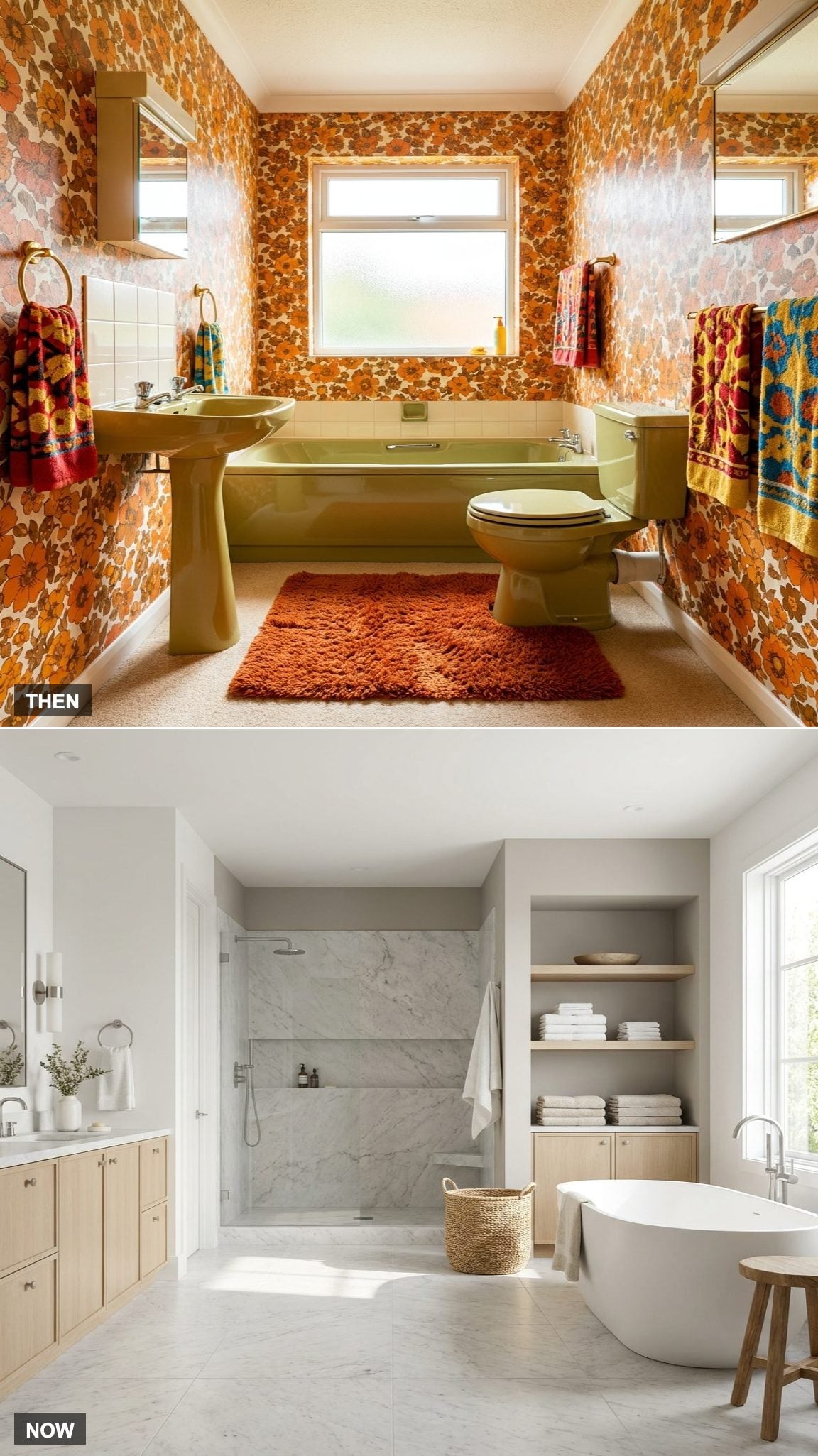
Nothing said 1970 like a bathroom that fought you. Avocado tub, harvest-gold sink, orange floral wallpaper, and towels in a fourth color entirely. The room had opinions and they all disagreed.
The spa palette quiets everything down. Warm whites, honed marble, pale oak, oatmeal towels. Once the competing colors disappear, the materials and fixtures become easier to notice.
Neutral doesn’t have to mean cold, either. A little contrast and one bold moment can carry a room, the same way it does in a black bathroom renovation.
6. The Gray Bar of Soap vs. The One-Press Dispenser

🔥 Would you like to save this?
Everyone remembers the bar. Gray around the edges, wedged in a scalloped dish with a puddle of its own melt underneath, and a hair or two from the last person stuck to it. You’d hold it under the tap and scrub the top layer off before it felt clean again. Worst of all was the dish, that ring of dried scum nobody ever volunteered to attack.
Then the wall-mounted dispenser came along and fixed a problem people didn’t even know they were allowed to complain about. One press, foam, done. Nothing sitting in a slick, nothing to knock into the sink.
5. Analog Bathroom Scales vs. Smart Digital Scales
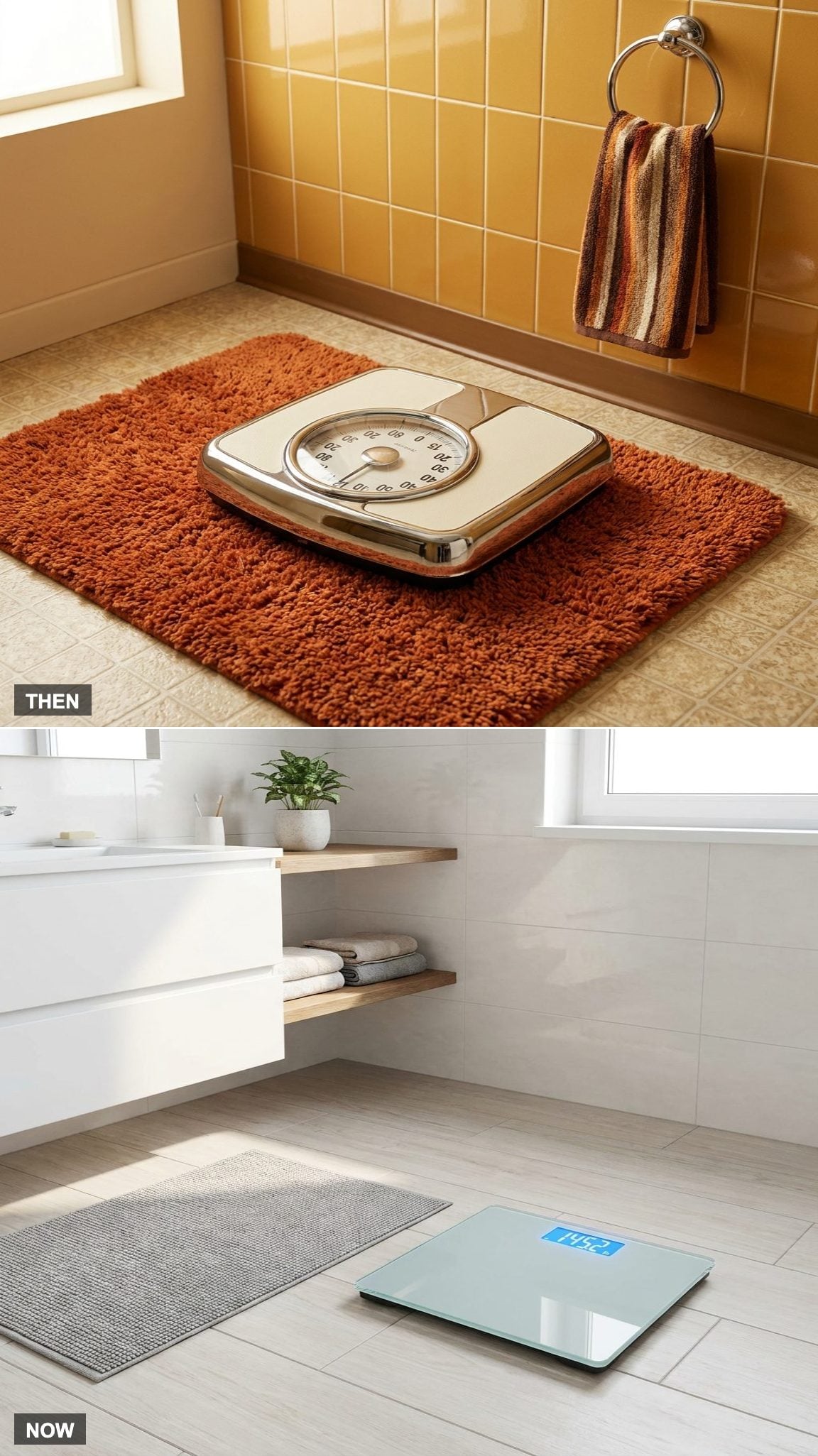
That old chrome scale weighed about as much as a bowling ball and swung its needle like it was guessing. Lean forward, lose two pounds. Lean back, gain them. Everyone had a favorite corner of the bathroom where the number came out kinder, and nobody admitted to it.
The smart glass scale displays a decimal and can send the result to your phone. It tracks trends over months, which is either useful or slightly ominous depending on how your week went.
4. The Toilet That Needed a Sweater vs. The One With a Remote
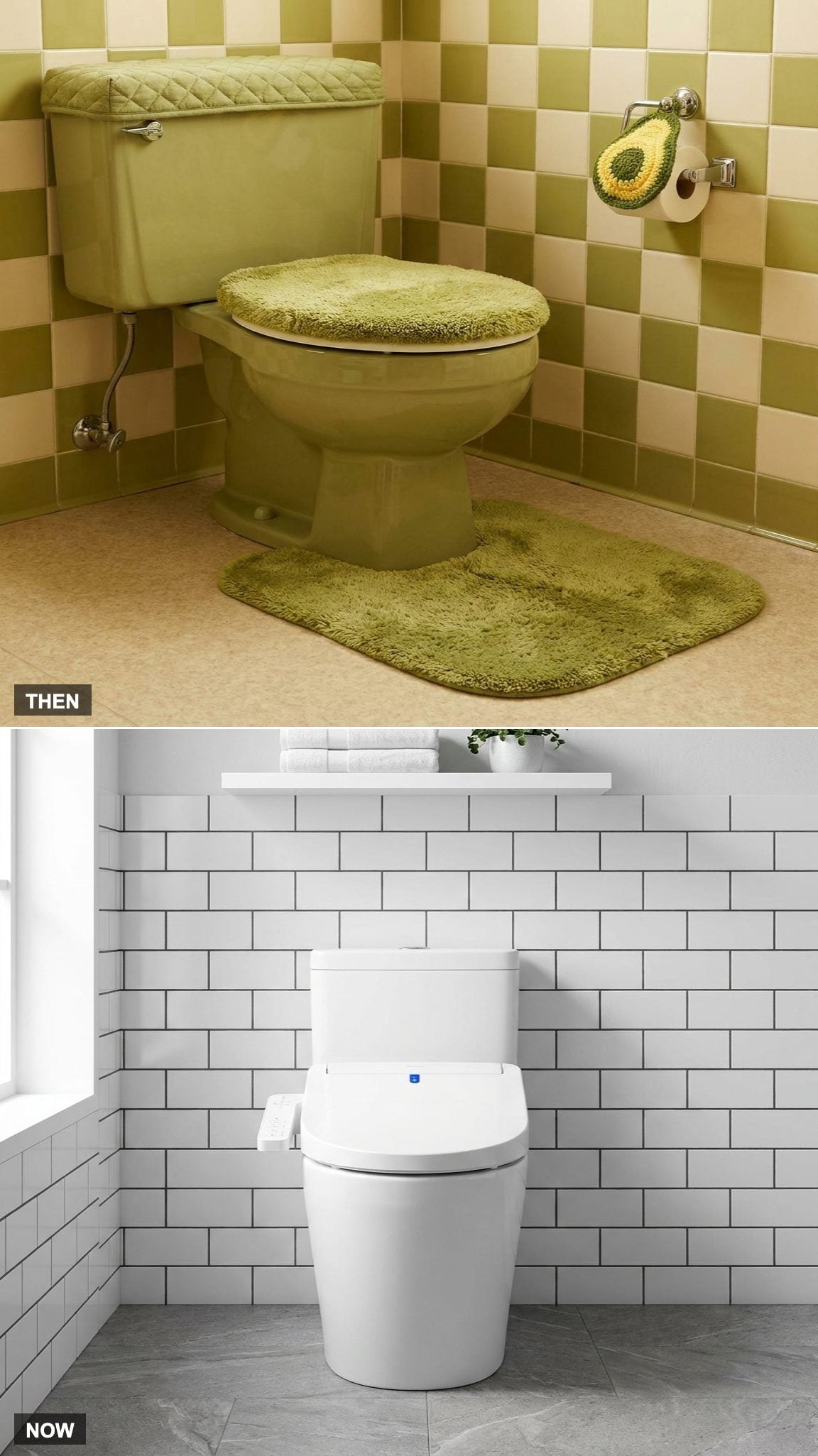
Back in 1970 the toilet came dressed for winter: avocado porcelain, a fuzzy lid cover, a matching rug hugging the base, and a crocheted cozy standing guard over the spare roll. Somebody decided the coldest surface in the house deserved knitwear. And the bidet? Foreign concept. Most Americans knew it only as that mysterious second fixture in European hotels.
Today’s version doesn’t need a sweater—it heats itself. Picture a one-piece white bowl with an electronic bidet seat, warm water on demand, a heated cushion, an air dryer, and a little side panel running the whole show. People resist it for years. Then they try it once at a friend’s house and quietly start pricing them out.
3. Compartmentalized Bathrooms vs. Open Wet Rooms
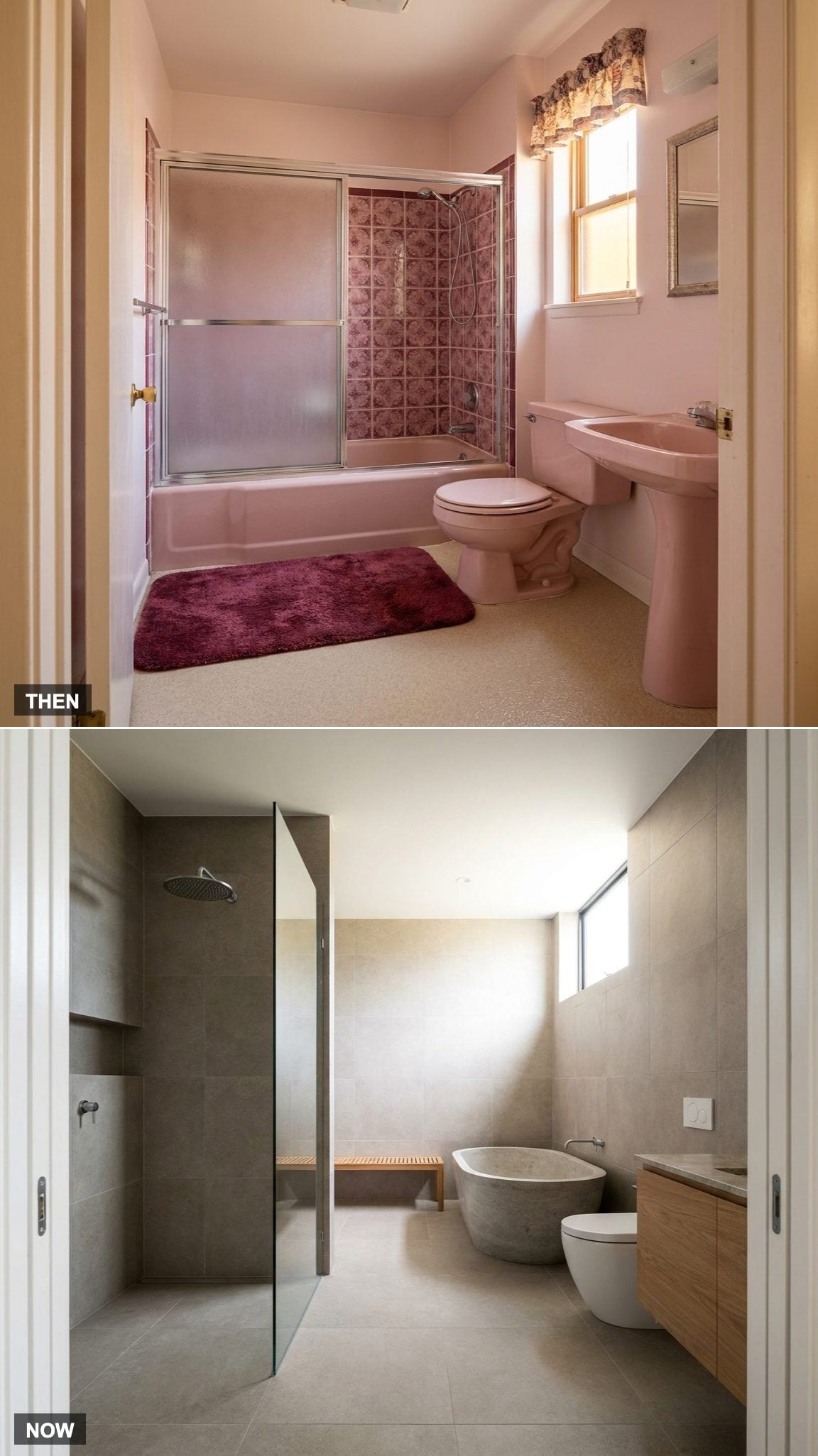
The 1970 bathroom was a box. Tub, toilet, and sink jammed within arm’s reach of each other, a frosted sliding door on chrome tracks that never quite ran smooth, everything in a pink-and-burgundy scheme that somehow made the small room feel smaller.
A wet room throws out the boundaries entirely. A curbless walk-in shower shares the floor with a freestanding soaking tub, with large-format tile continuing across the main wet-zone surfaces. No lip to step over. No glass box to squeeze into.
The calm comes from continuity. One material running unbroken across floor and walls drops the visual clutter, so your eye has nowhere to snag—and that’s the whole trick behind the spa feeling.
The old bathroom held you in. The wet room lets you move.
2. Functional Bathrooms vs. Smart Bathrooms
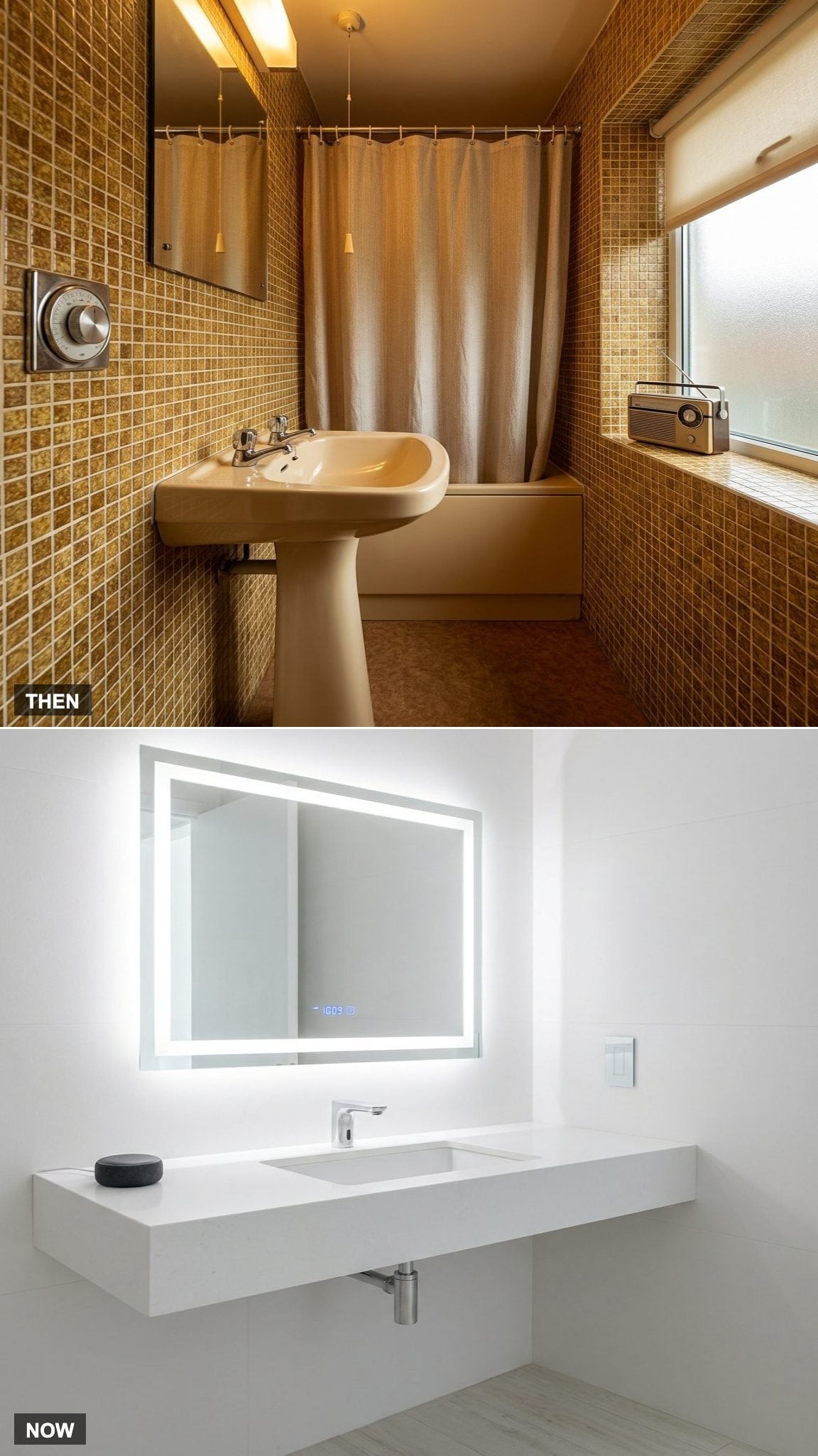
Everything in the 1970 bathroom worked by hand. Two taps you juggled to get the temperature right, a pull-cord for the light, a transistor radio balanced on the windowsill for company. It functioned. It never did a single thing you didn’t ask it to.
A smart bathroom responds through sensors, schedules, touch, and voice. The faucet detects a hand, the mirror can combine lighting with anti-fog controls, and a wall panel can manage scenes for grooming, bathing, and overnight use. The most successful systems keep those controls unobtrusive until they are needed.
1. Single Sink Vanities vs. Floating Vanities
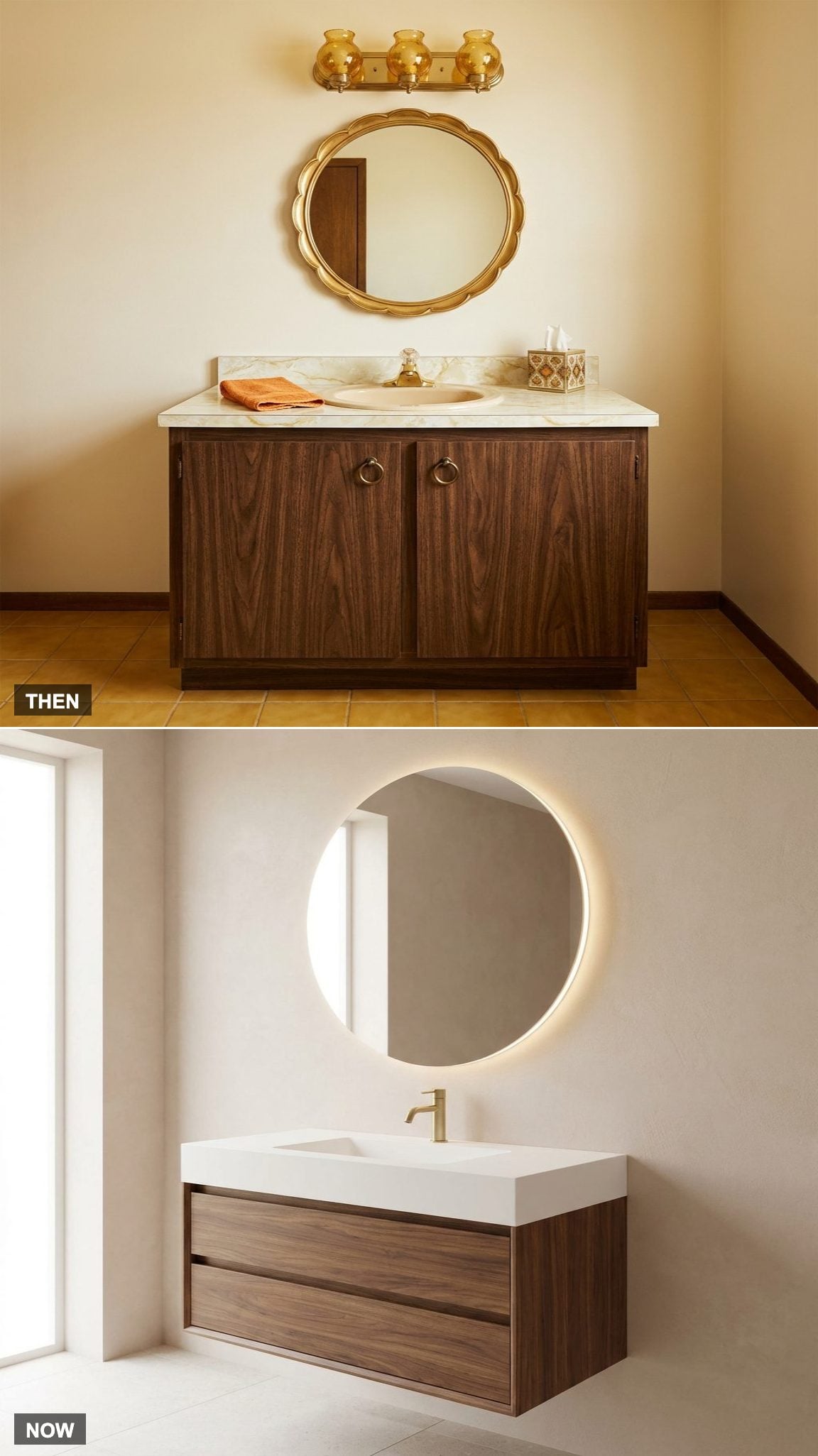
That floor-standing laminate box in fake walnut was the workhorse of the seventies bathroom. Heavy, dark, sitting flat on the tile, collecting dust and dropped bobby pins in the gap you could never reach.
Floating vanities leave more of the room visible. Mount one to the wall, let the floor continue underneath, and a small bathroom immediately feels less crowded. The visible strip of floor makes the footprint seem less interrupted.