🔥 Would you like to save this?
For years, the standard bathroom vanity has basically been a kitchen cabinet that wandered into the bathroom.
A run of built-in cabinetry. Countertop on top. Sink dropped in. Maybe Shaker doors if you’re feeling adventurous.
That’s the assumption almost nobody in the category checks. Our reader data doesn’t support it.
We looked at how readers interacted with hundreds of bathroom images—which designs they loved and which they saved. When we compared vanity styles, one came out far ahead of everything else:
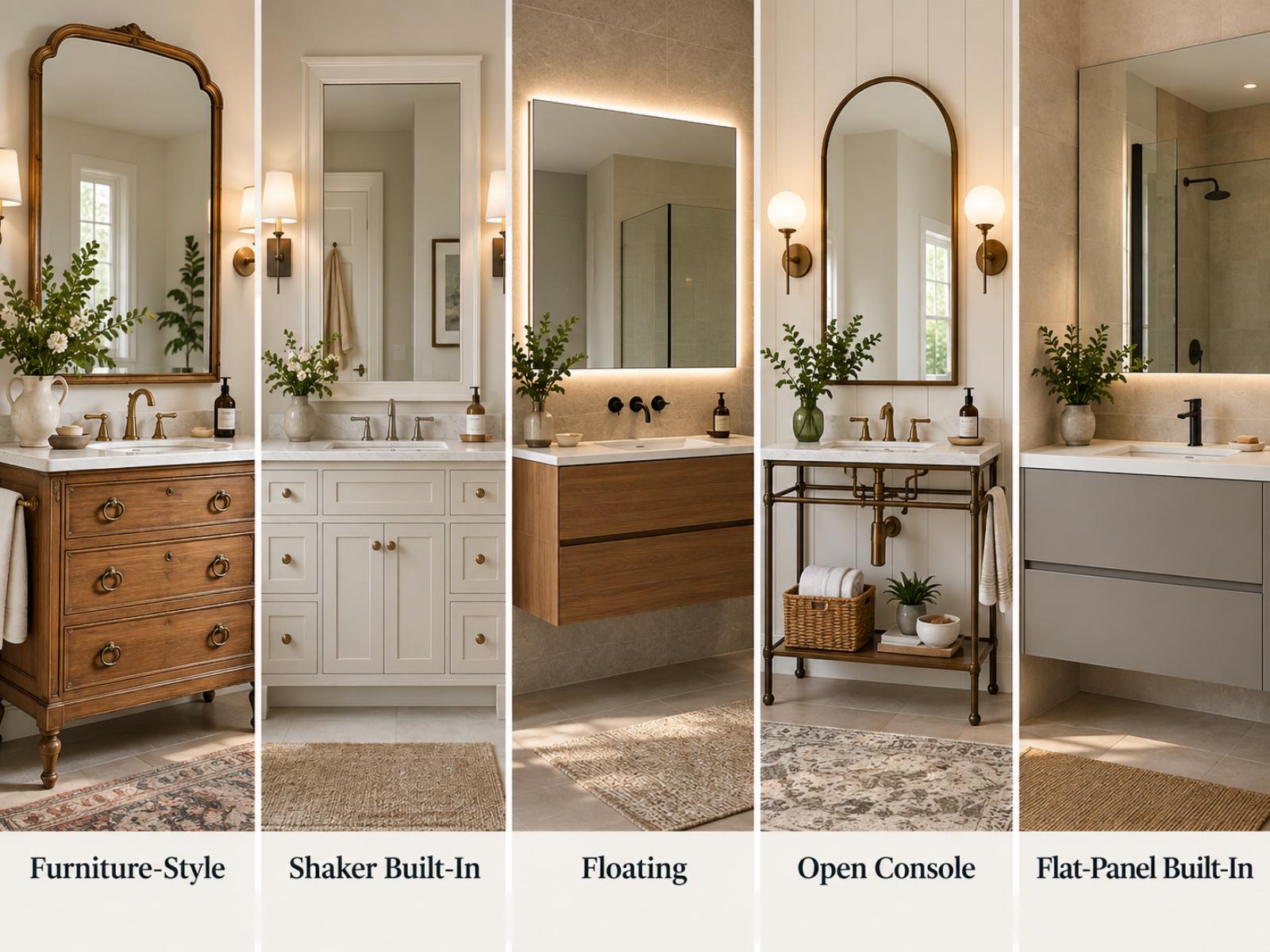
The furniture-style vanity.
These are vanities designed to look more like a beautiful dresser, console or freestanding piece of furniture than conventional bathroom cabinetry.
And readers aren’t responding a little more strongly.
They’re keeping them at more than twice the normal rate for bathroom vanity styles.
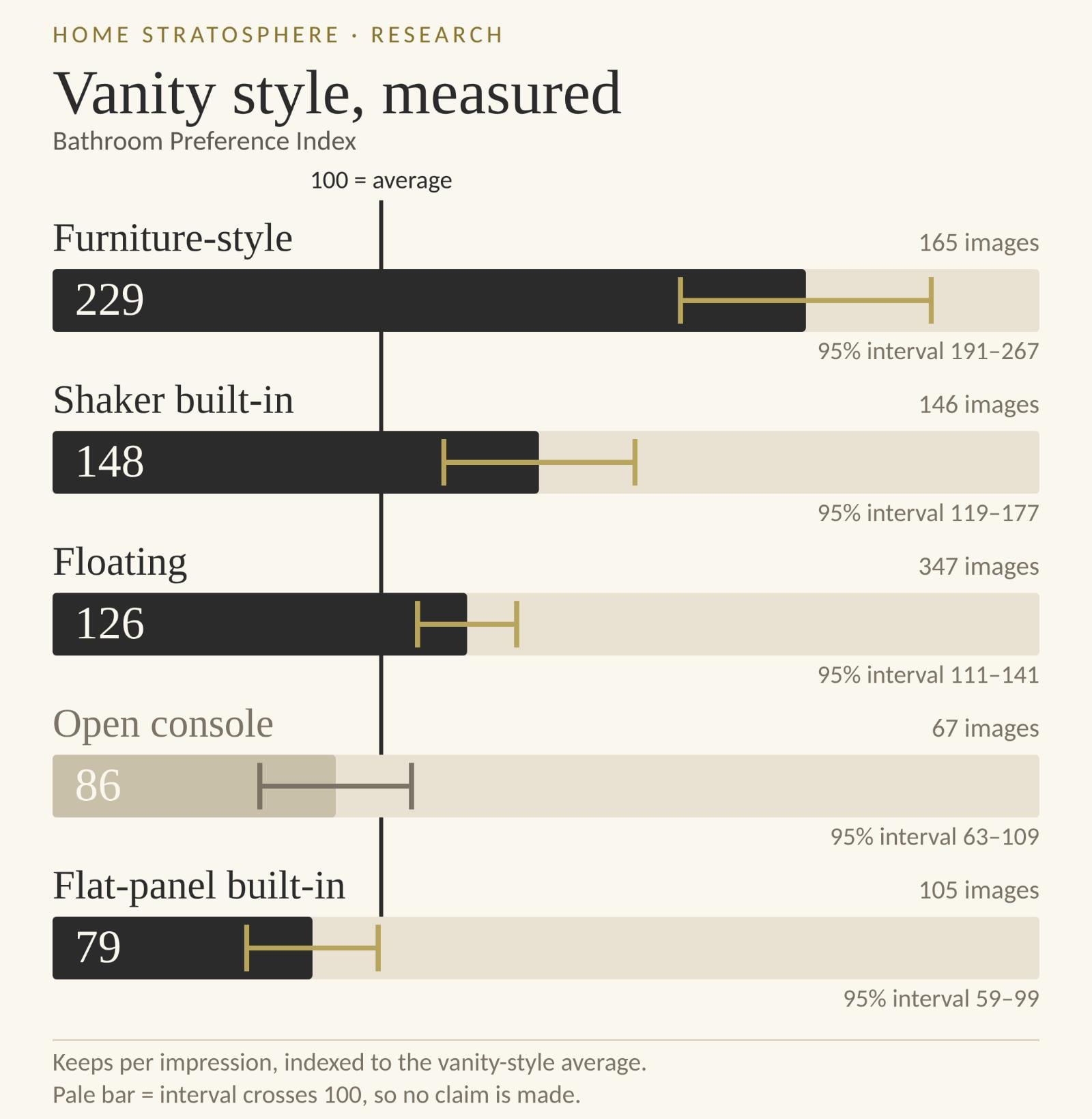
The Numbers Aren’t Particularly Close
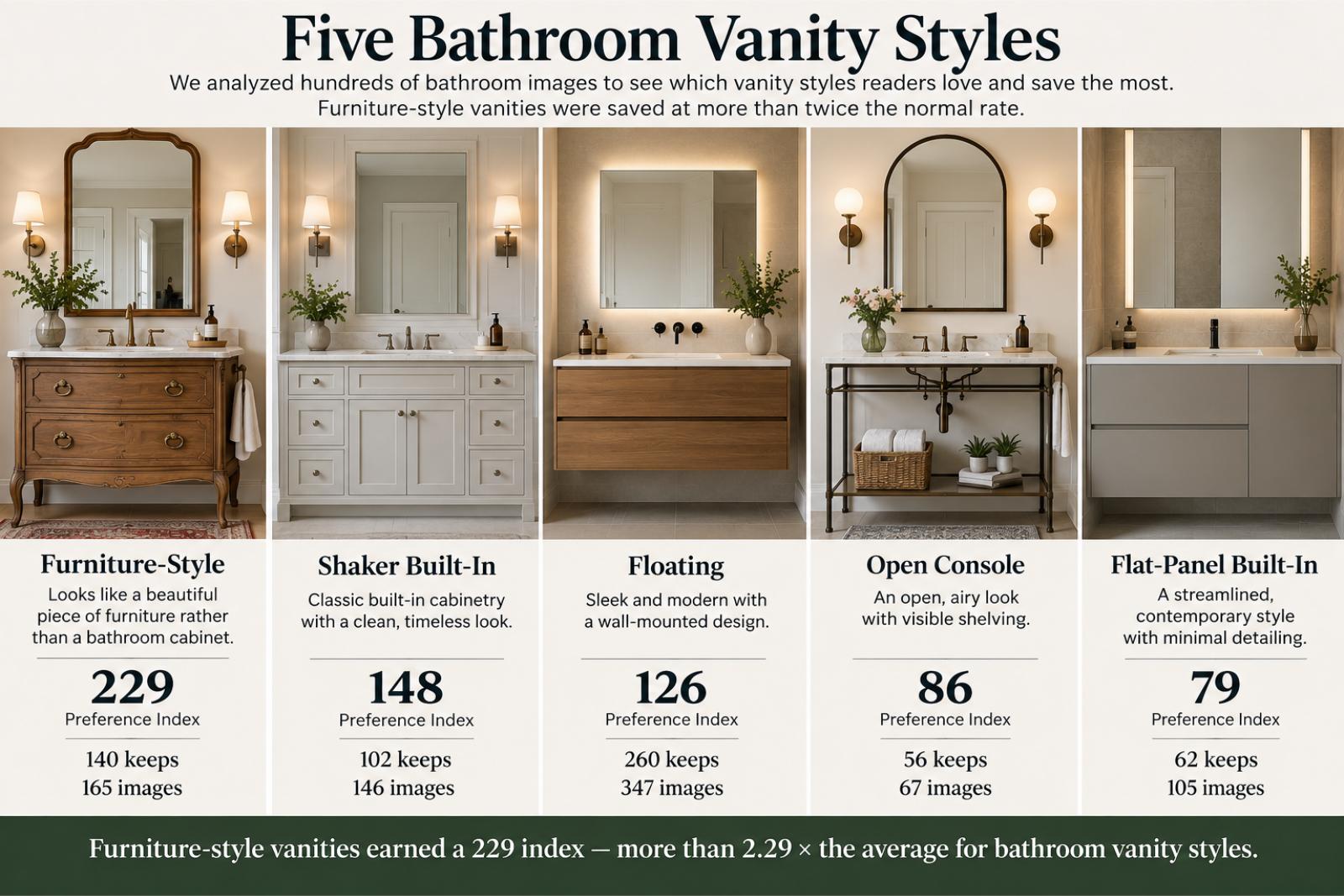
Our Preference Index measures reader keeps—loves and saves—relative to estimated image exposure, against the average for the category. An index of 100 represents the average.
So 229 means furniture-style vanities were kept at roughly 2.29 times the normal rate.
| Vanity style | Images | Keeps | Preference Index | 95% CI |
|---|---|---|---|---|
| Furniture-style | 165 | 140 | 229 | 191–267 |
| Shaker built-in | 146 | 102 | 148 | 119–177 |
| Floating | 347 | 260 | 126 | 111–141 |
| Open console | 67 | 56 | 86 | 63–109 |
| Flat-panel built-in | 105 | 62 | 79 | 59–99 |
Four of the five results are established. One isn’t, and I’ll come back to it.
Furniture-style runs from 191 to 267. The bottom of that range still sits above the top of every other style’s range, which means furniture-style doesn’t just lead the table—it separates cleanly from all four alternatives at 95% confidence.
That’s rare. In most of the comparisons I run, the leader and the runner-up overlap and I have to say so.
Not here.
Even Shaker Vanities Couldn’t Catch Them
Shaker built-ins did well. An index of 148, running 119 to 177, sits comfortably above the category average.
If furniture-style vanities weren’t in the dataset, Shaker would look like the story.
But furniture-style still clears it—191 against 177—and this is the tightest of the four separations, so it’s worth naming as such. Fourteen points of daylight is real but not enormous. I’d expect the gap to firm up or narrow as we collect more data, and I’ll report it either way.
What this does suggest is that readers aren’t simply rejecting traditional cabinetry in favour of sleek modern vanities. Something about making the vanity read as an individual piece of furniture appears to be doing the work.
Floating Vanities Are Popular, But They Didn’t Win
This is the comparison I found most interesting.
Floating vanities have become one of the most recognisable contemporary bathroom looks. Clean, architectural, everywhere in modern bathrooms.
And readers do like them. Across 347 images they generated 260 keeps and an index of 126, running 111 to 141. That’s genuinely above average, and it’s the most precisely measured result in the table—the biggest sample here produces the narrowest interval.
But furniture-style scored 229.
So the sleek contemporary option performed above average, and the vanity that resembles a bedroom dresser performed dramatically better.
The One Result I Can’t Claim
Open console vanities scored 86, which looks like an underperformer.
I’m not going to call it one.
With only 56 keeps behind it, its interval runs from 63 all the way to 109—straddling the average. Our data doesn’t establish that open consoles perform below average, or above it. It establishes that we don’t yet know.
Flat-panel built-ins are different. At 79, with an interval of 59 to 99, that whole range sits under 100. That one is a real underperformance, and it makes the contrast at the top of the table sharper:
Furniture-style: 229. Flat-panel built-in: 79.
One emphasises the vanity as an individual object. The other minimises visual detail and dissolves it into the cabinetry run.
The Same Pattern Shows Up in Finish and Scale
Two other results point the same direction.
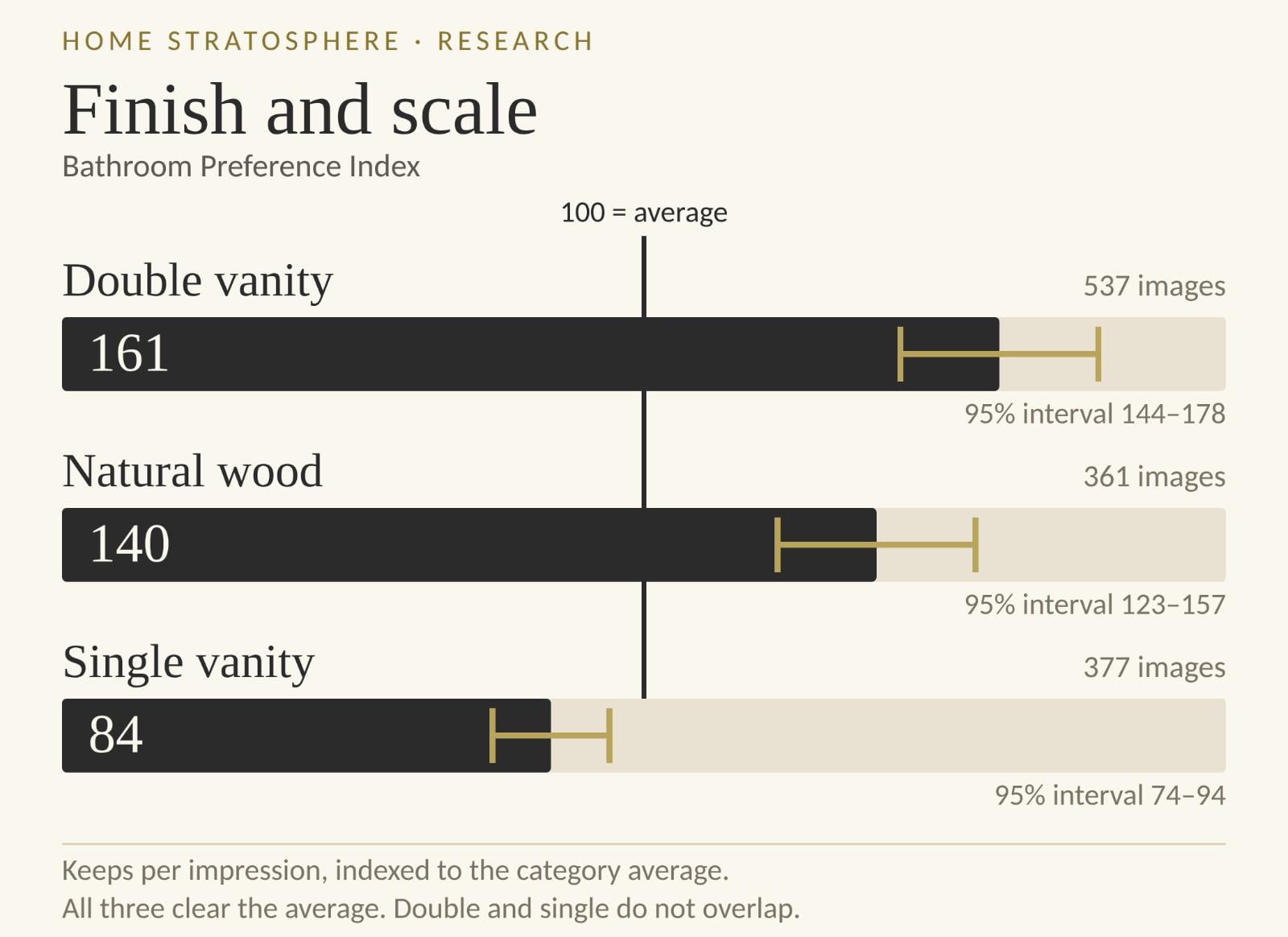
Natural wood finishes appeared in 361 images, generated 249 keeps and scored 140, running 123 to 157. That’s one of the materials most strongly associated with furniture, performing 40% above average.
Double vanities appeared in 537 images, generated 338 keeps and scored 161, running 144 to 178. Single vanities came in at 84, running 74 to 94. Those two don’t overlap.
Here’s a detail in that comparison worth pausing on, because it shows why raw counts mislead.
Single vanities actually earned more keeps per image than doubles—0.78 against 0.63. If you counted reactions and stopped there, singles would look like the winner. But single-vanity images received far more exposure, and once you divide by impressions the picture reverses completely.
That’s the entire reason the index exists. Counting reactions tells you what we published most. Dividing by exposure tells you what readers actually responded to.
Why Might Furniture-Style Vanities Be So Appealing?
The data tells us what readers interacted with. It can’t tell us why.
But there’s an obvious visual explanation worth considering.
Bathrooms are full of hard surfaces. Tile. Glass. Mirrors. Porcelain. Stone. Metal fixtures.
Put a beautiful furniture-like vanity in the middle of that and the room suddenly has something warmer and more familiar in it.
Instead of looking like a collection of bathroom fixtures, the room starts looking furnished.
A vanity with legs, drawers, hardware and natural wood provides the same kind of visual anchor a console table or chest provides in any other room.
And unlike a lot of bathroom trends, the idea travels across styles. A weathered oak vanity works in a farmhouse bathroom. A dark walnut dresser-style piece looks right in a traditional room. A restrained furniture-style vanity works in transitional or even contemporary settings.
The details change. The underlying idea doesn’t.
That’s a theory, not a finding. It’s also the kind of theory worth testing rather than assuming.
What This Data Is Actually For
This doesn’t tell a vanity manufacturer that furniture-style units will outsell built-ins. We’re not measuring sales. Nobody in this data bought anything.
What it does is tell you which assumptions are worth questioning.
“The vanity is cabinetry” is an assumption. It’s built into how the category is manufactured, merchandised and photographed. And in front of an image, with our readers, it’s the assumption that performs worst.
If you’re designing a bathroom—or a bathroom product line—and treating the vanity as somewhere to put the sink, our readers’ behaviour suggests you may be overlooking the room’s biggest design opportunity.
The bathroom vanity people respond to most may be the one that looks least like bathroom cabinetry at all.
About the Data
Home Stratosphere measures reader interactions with individual images across our published design content. The Preference Index compares keeps—love and save actions relative to estimated image exposure—for an attribute value against the average for its category. An index of 100 represents the category average.
This is observational image-preference data, not sales or purchase-intent data. Impressions are sampled and scaled estimates, and results are most useful for comparisons within the same category. Where an interval crosses 100, no difference from average is claimed. Where two intervals overlap, no difference between those values is claimed.