🔥 Would you like to save this?
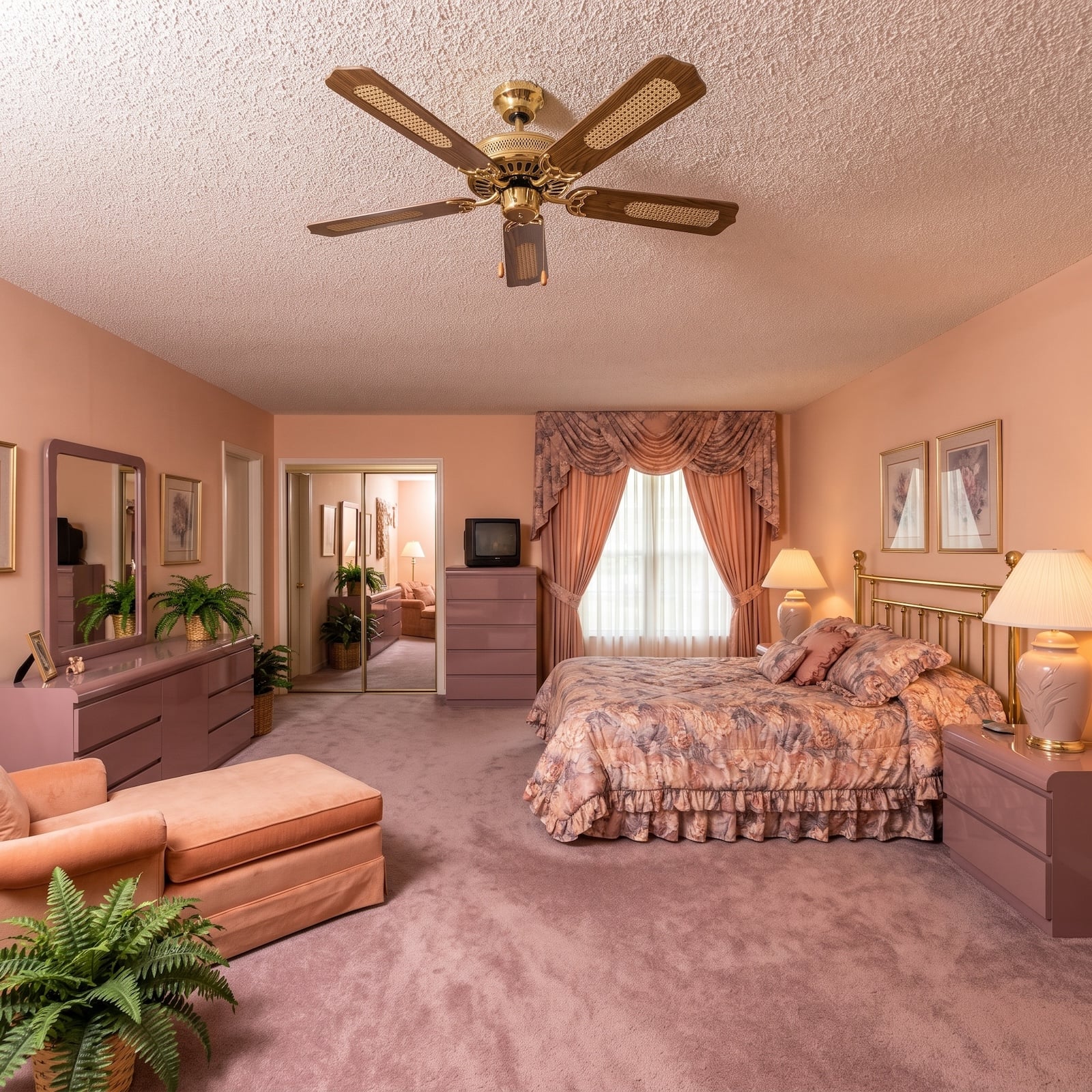
Peach walls. Mauve accents. Floral bedding negotiating with patterned carpet while swagged drapes, a brass ceiling fan and a popcorn-textured ceiling all compete for the last word. This bedroom did not merely survive the 1980s. It kept nearly every receipt.
In order to come up with the very specific design ideas, we create most designs with the assistance of state-of-the-art AI interior design software. Also, assume links that take you off the site are affiliate links such as links to Amazon. this means we may earn a commission if you buy something.
That makes it a remarkably good room to transform. Beneath all the period noise is a generous bedroom with useful windows, workable proportions and enough ceiling area to become part of the architecture rather than something everyone politely ignores. Strip away the dated finishes and the possibilities multiply fast.
These 35 transformations take the same stubborn starting point in radically different directions. Some go pale and architectural; others bring in lacquer, walnut, copper, rattan, saturated color or unapologetic drama. Ceilings are smoothed, paneled, coffered, beamed and illuminated. Carpet gives way to wood, terrazzo and other harder finishes. The room stays recognizable. Almost nothing else does.
Same bedroom. Thirty-five very different answers to the question the 1980s left behind.
35. Coffered Wood and Warm Plaster Give the Old Peach Bedroom Some Architecture
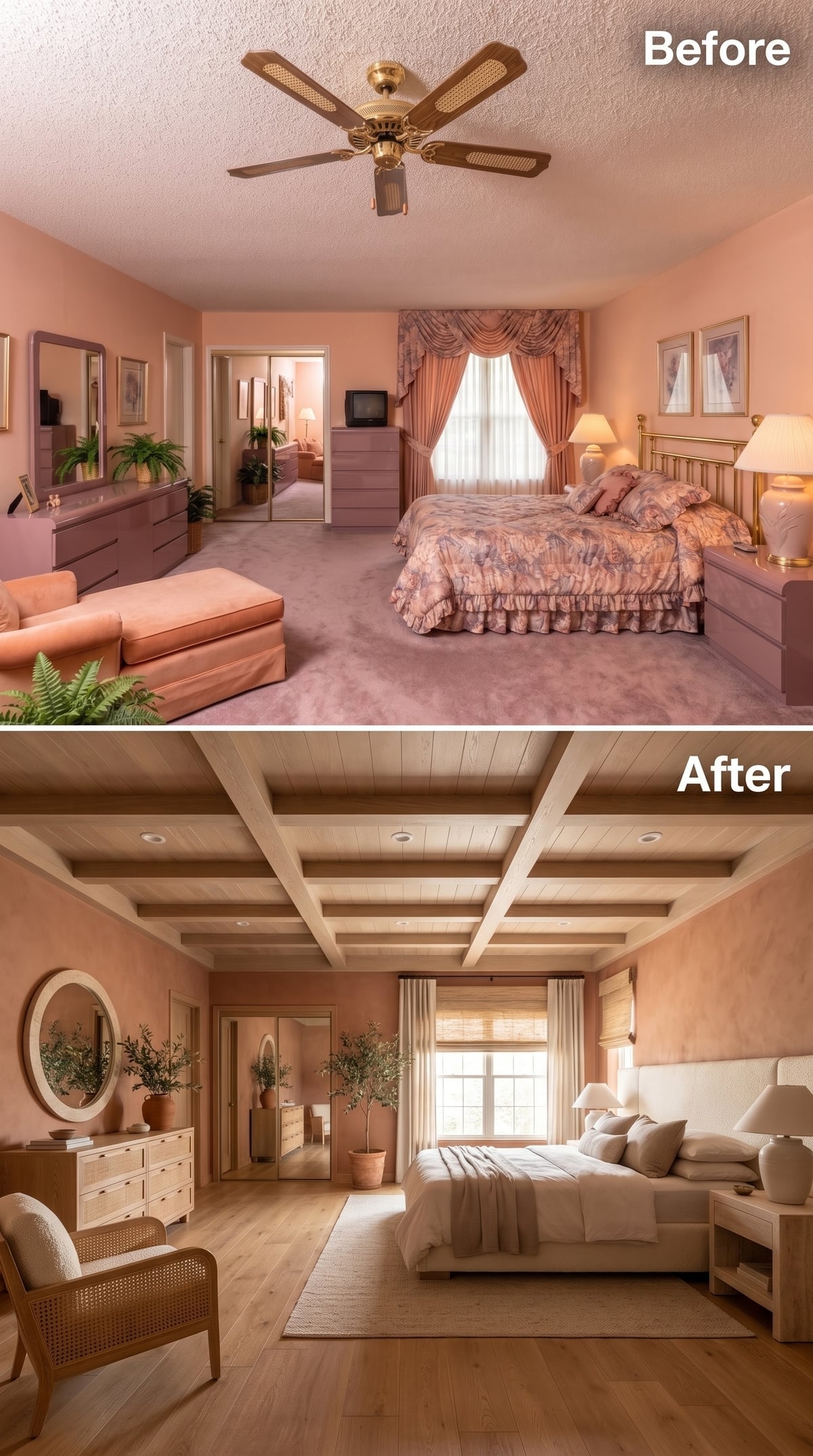
Pale oak beams divide the ceiling into a coffered grid with light planked infill, immediately giving the upper plane more structure. Below, washed terracotta plaster replaces flat peach, while pale hardwood takes over from the original carpet. The room is still warm, but the warmth now comes from material rather than a relentlessly coordinated color scheme.
A low cream-linen platform bed keeps the furniture quiet. Cane-front storage, a rattan-and-boucle chair, woven shades and sheer curtains continue the natural textures without turning the bedroom into a catalog of beige. The strongest move is overhead: the ceiling finally participates in the design.
34. Charcoal Walls and Concrete Floors Take the Same Room Somewhere Much Darker
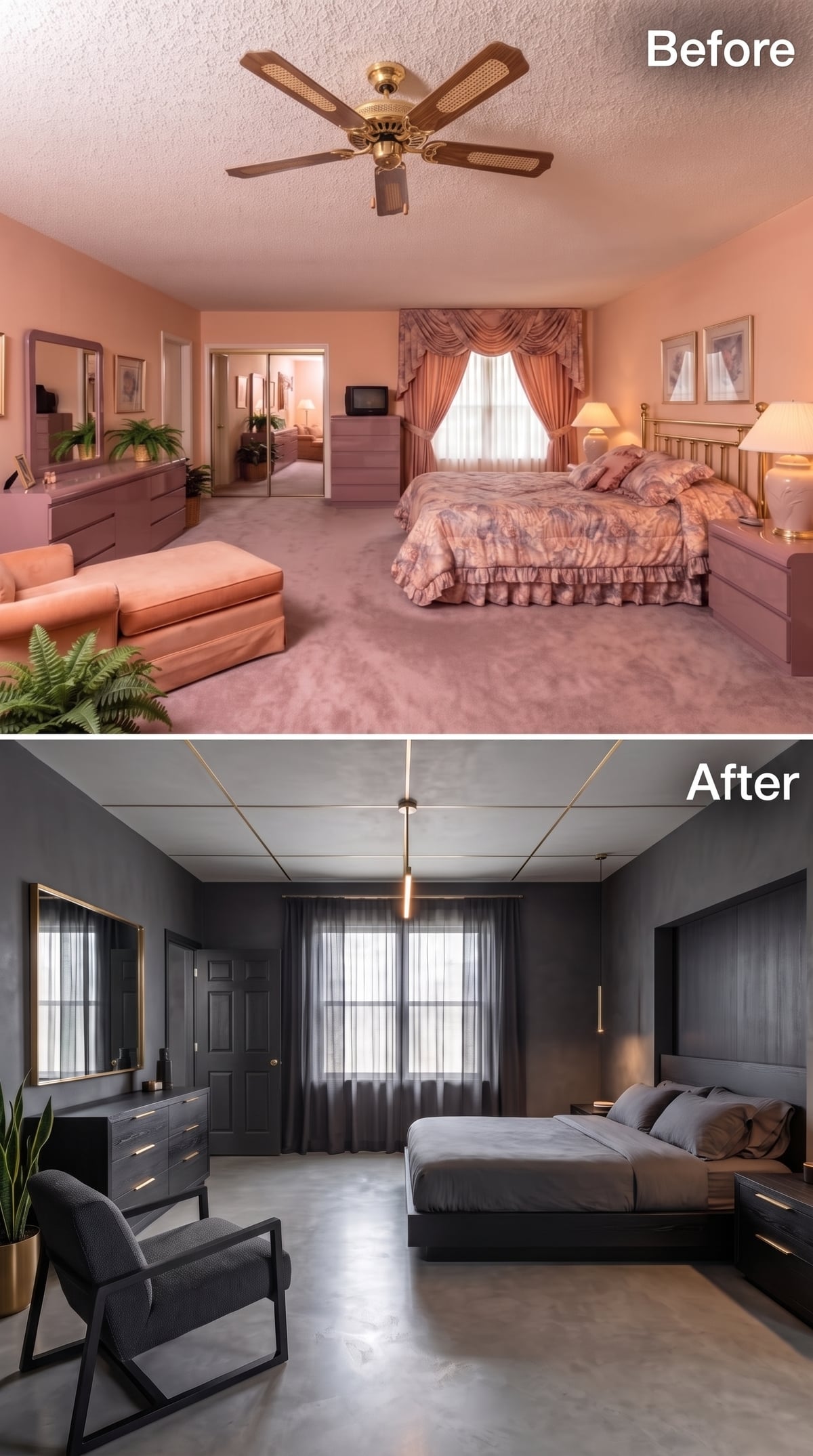
Dark done right is harder than it looks, and this room earns it.
Graphite walls meet polished concrete underfoot, wiping away nearly every trace of the original bedroom’s sugary palette. A low bed in gray linen establishes a long horizontal line, while sheer curtains preserve enough daylight to stop all that charcoal from becoming visually inert.
The ceiling carries the most disciplined detail: dark panels crossed by slender brass lines, with pendant lighting dropping through the grid. Gold hardware repeats below in small doses. Nothing needs to shout because the contrast between shadow, metal and filtered light is already doing plenty.
33. Coral Stripes and Teal Turn the Ceiling Into a Full-Blown Resort Move
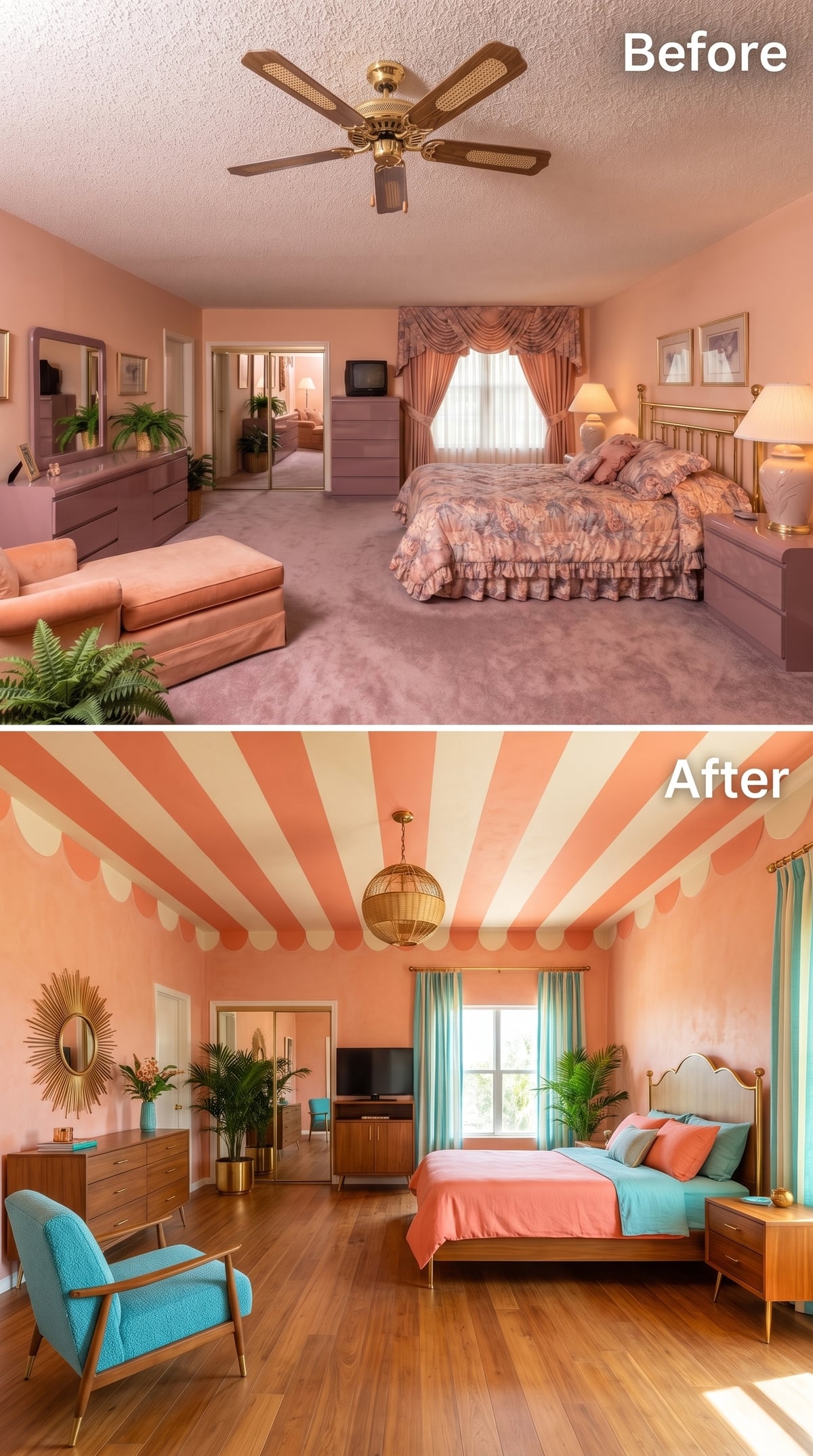
Radiating coral-and-cream stripes fan out across the ceiling from a central point, making the surface impossible to treat as background. Coral walls continue the warmth downward, but teal curtains and upholstery interrupt it before the room becomes a single-note exercise.
Walnut case goods and a brass-footed bed supply darker visual weight at floor level. The aged-brass globe pendant lands precisely where the ceiling pattern wants a focal point. This is color used architecturally rather than scattered around in pillows and accessories.
32. White Oak and a Paper Pendant Make Quiet Look Deliberate
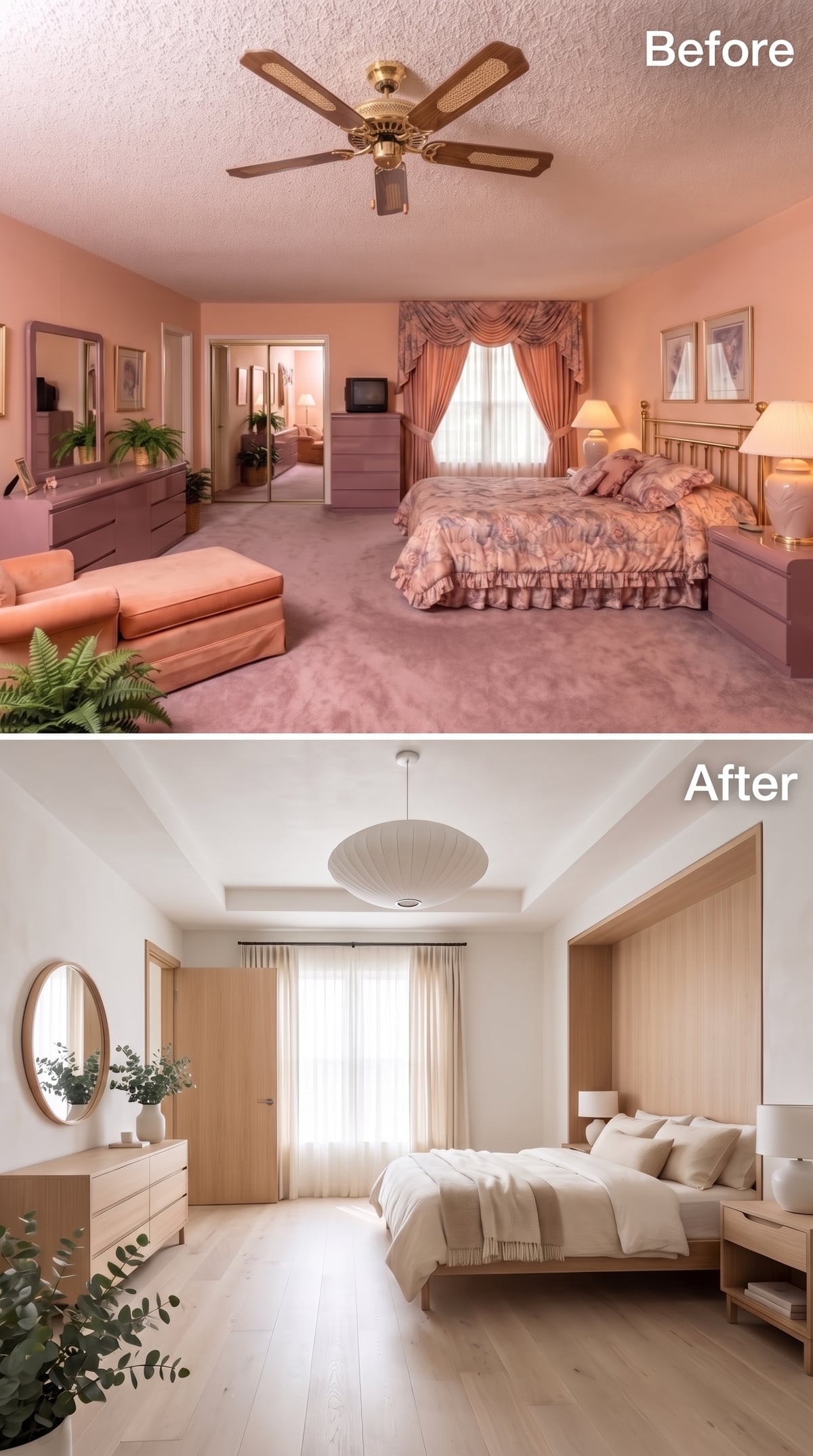
Light oak flooring, warm cream plaster and a recessed tray ceiling take the bedroom almost to the opposite extreme. The sculptural paper pendant is large enough to register but light enough visually to leave the ceiling architecture in control.
Oak panels frame the bed wall and turn the headboard zone into part of the room rather than a piece of furniture pushed against it. Cream and flax linens keep the palette narrow, while an oval mirror breaks up the surrounding straight lines.
Color Story: Cream, flax and pale oak work together because their undertones remain warm and closely related. The interest comes from grain, weave, shadow and shape rather than strong color contrast.
31. Rattan Overhead and Forest Green Walls Give the Bedroom a Tropical Backbone
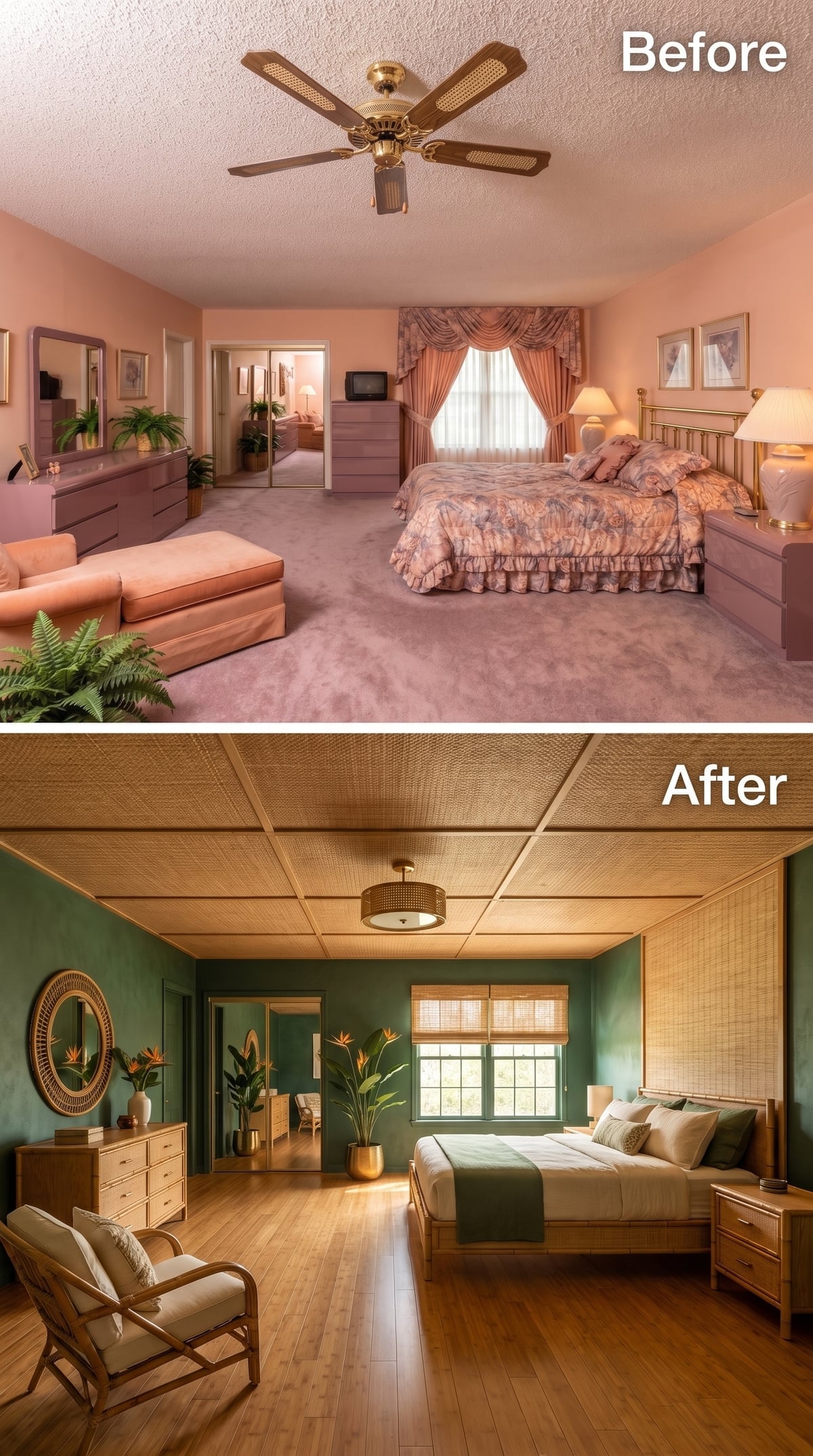
Woven rattan panels fill a wood-trimmed ceiling grid above saturated forest-green walls. The combination could easily become decorative overload, so the straight-laid hardwood floor and pale ash furniture wisely settle down.
Bamboo Roman shades soften the windows, while the low platform bed and matching dresser keep the furniture silhouettes simple. A rattan chair repeats the ceiling texture at human scale. The bird-of-paradise plant in a brass planter supplies the flourish; another patterned surface would have been one too many.
30. Glossy White and Crystal Turn the Formerly Fussy Room Into Pure Light
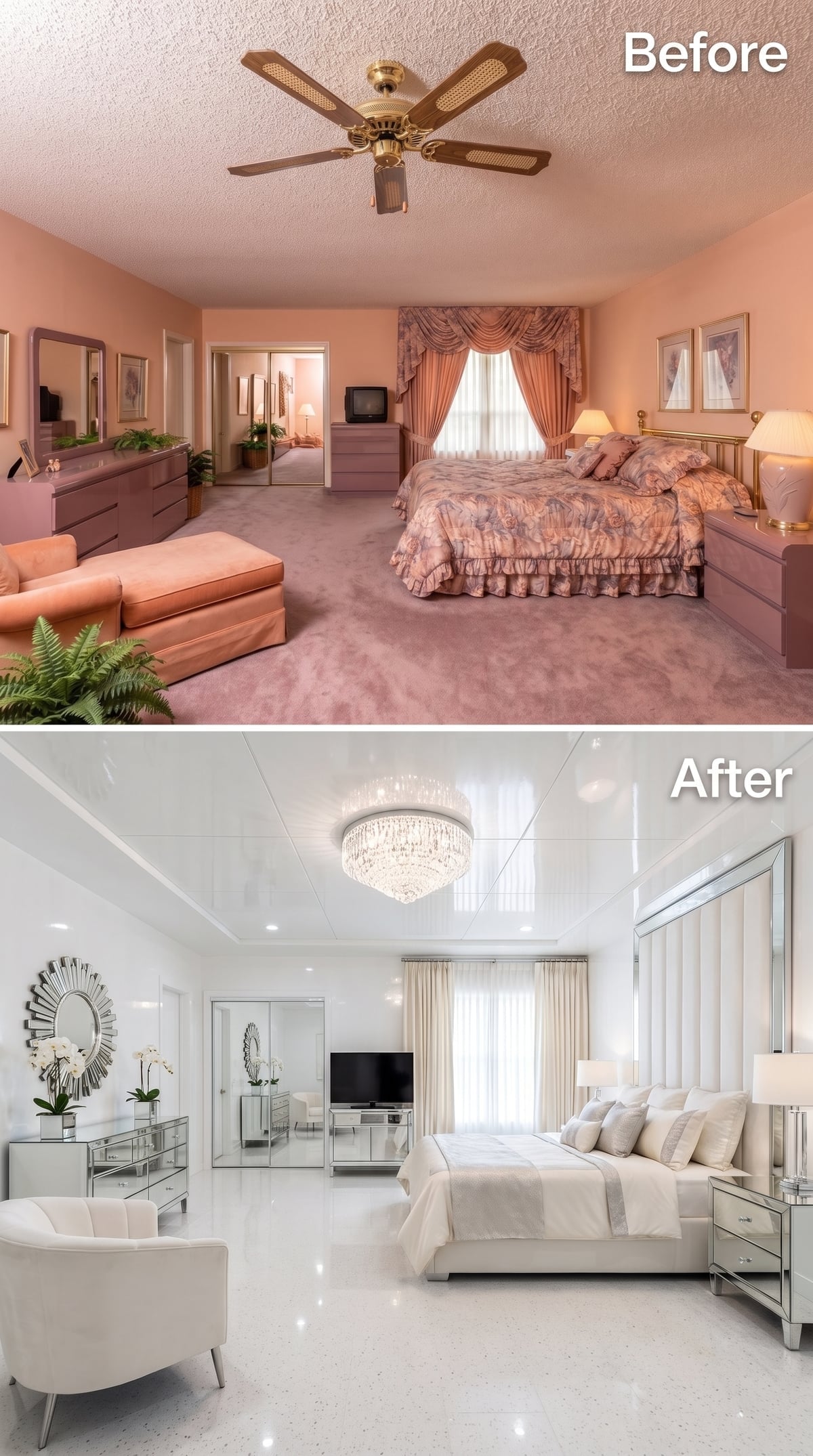
After rattan and forest green, this transformation practically switches on the floodlights. A glossy white ceiling reflects the crystal fixture, while a polished pale floor continues that reflective quality below.
Mirrored nightstands and dresser fronts multiply the available light, but the upholstered bed stays cream rather than brilliant white. Velvet and sheer fabric add just enough softness to keep the room from feeling clinical. The old peach-and-mauve abundance has been replaced by another kind of excess: luminosity.
Practical Note: Mirrored furniture shows fingerprints and smudges readily. Using the finish selectively — on drawer fronts or a single case piece, for example — can preserve the reflective effect without turning every surface into a polishing assignment.
29. Acid Yellow and Cobalt Refuse to Let the Ceiling Behave
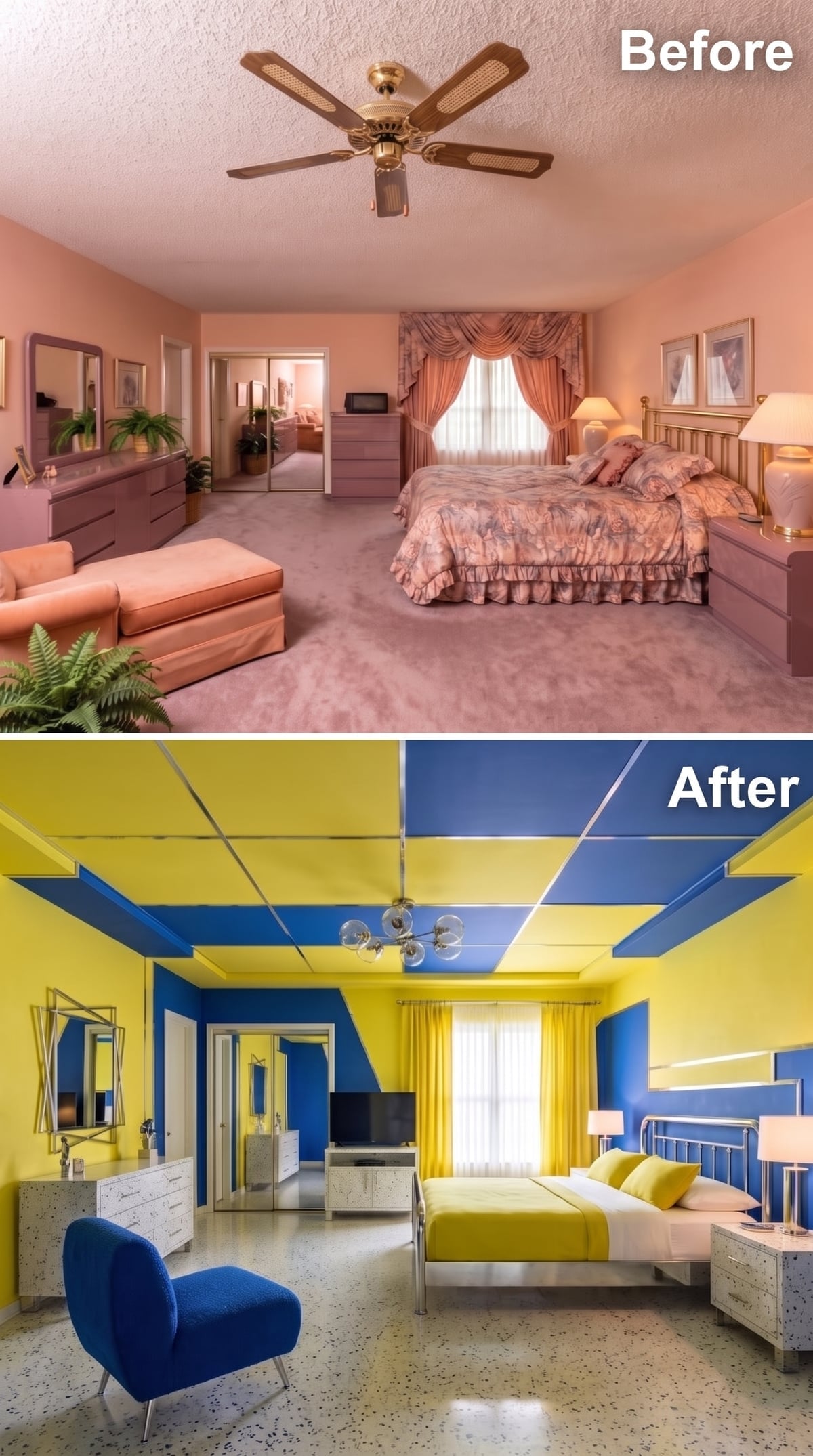
Cobalt and acid yellow divide the ceiling into emphatic geometric fields, then continue onto the walls so the color has somewhere to go. Terrazzo underfoot introduces a finer, speckled pattern that can sit beneath the much larger blocks without mimicking them.
Chrome bed framing, metallic lamp bases and white lacquer case goods stay deliberately cool and crisp. Adding another strong wood tone or decorative pattern would change the argument completely. Here, furniture behaves while color runs the room.
- Repeating the ceiling palette elsewhere makes the overhead geometry feel integrated rather than isolated.
- The smaller-scale variation in terrazzo provides texture without creating another large competing motif.
- Chrome and white keep the furniture visually secondary to the blue-and-yellow composition.
28. Honey-Toned Planks Turn the Ceiling Into a Warm Timber Canopy
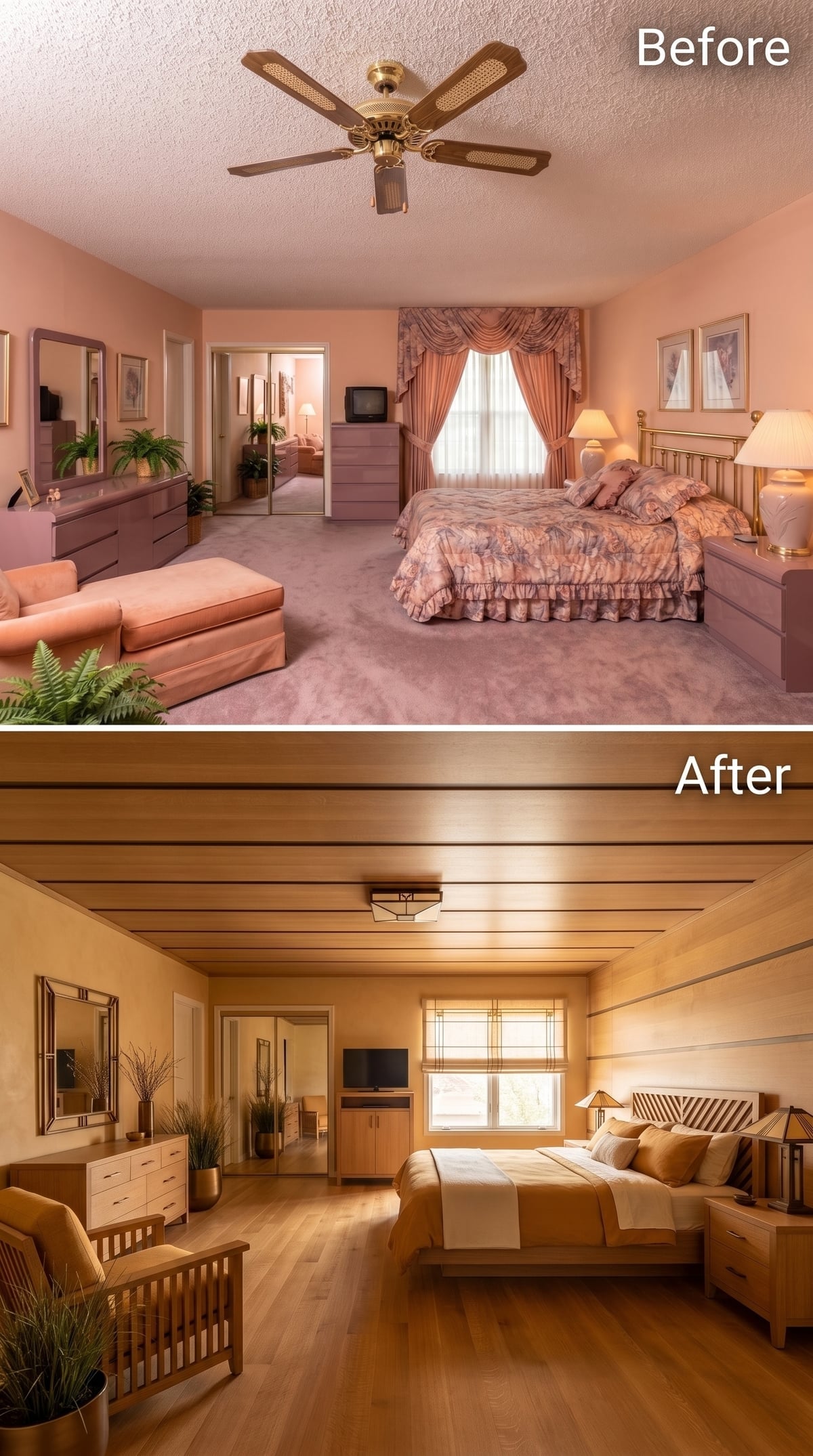
Light maple- or birch-toned planking stretches across the ceiling while recessed lighting warms the grain. Hardwood below carries a related honey tone, creating a timber envelope around the room without requiring the walls to become wood as well.
Slatted headboard details and straightforward dresser forms reinforce the Craftsman influence without resorting to decorative nostalgia. The linear ceiling is the real event: long runs of timber redirect attention away from the old textured surface and toward the room’s length.
27. Blush Velvet and Walnut Let the Bedroom Keep Some Glamour
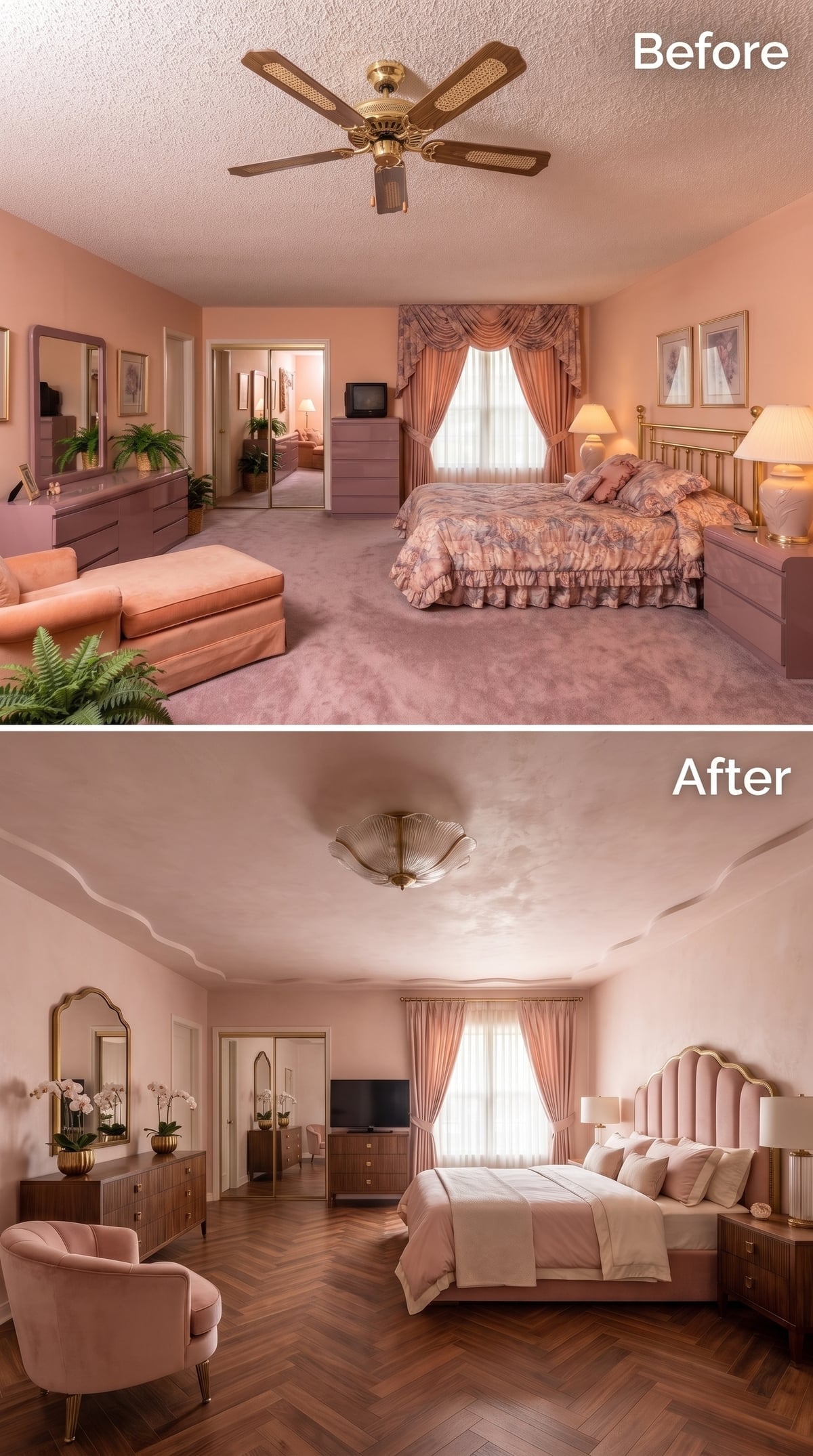
Patterned walnut flooring brings richness to the lower plane, while a channeled blush-velvet headboard edged in gold gives the bed a deliberately glamorous center. The palette nods toward the original room’s pink family without reproducing its mauve-on-peach saturation.
Walnut nightstands deepen the composition and crisp white bedding gives the eye a necessary pause. Overhead, the floral brass fixture carries the feminine note into a more sculptural form. The transformation doesn’t reject softness; it edits it.
26. Dark Coffers and Shoji-Style Screens Shift the Room Toward Japanese-Influenced Minimalism
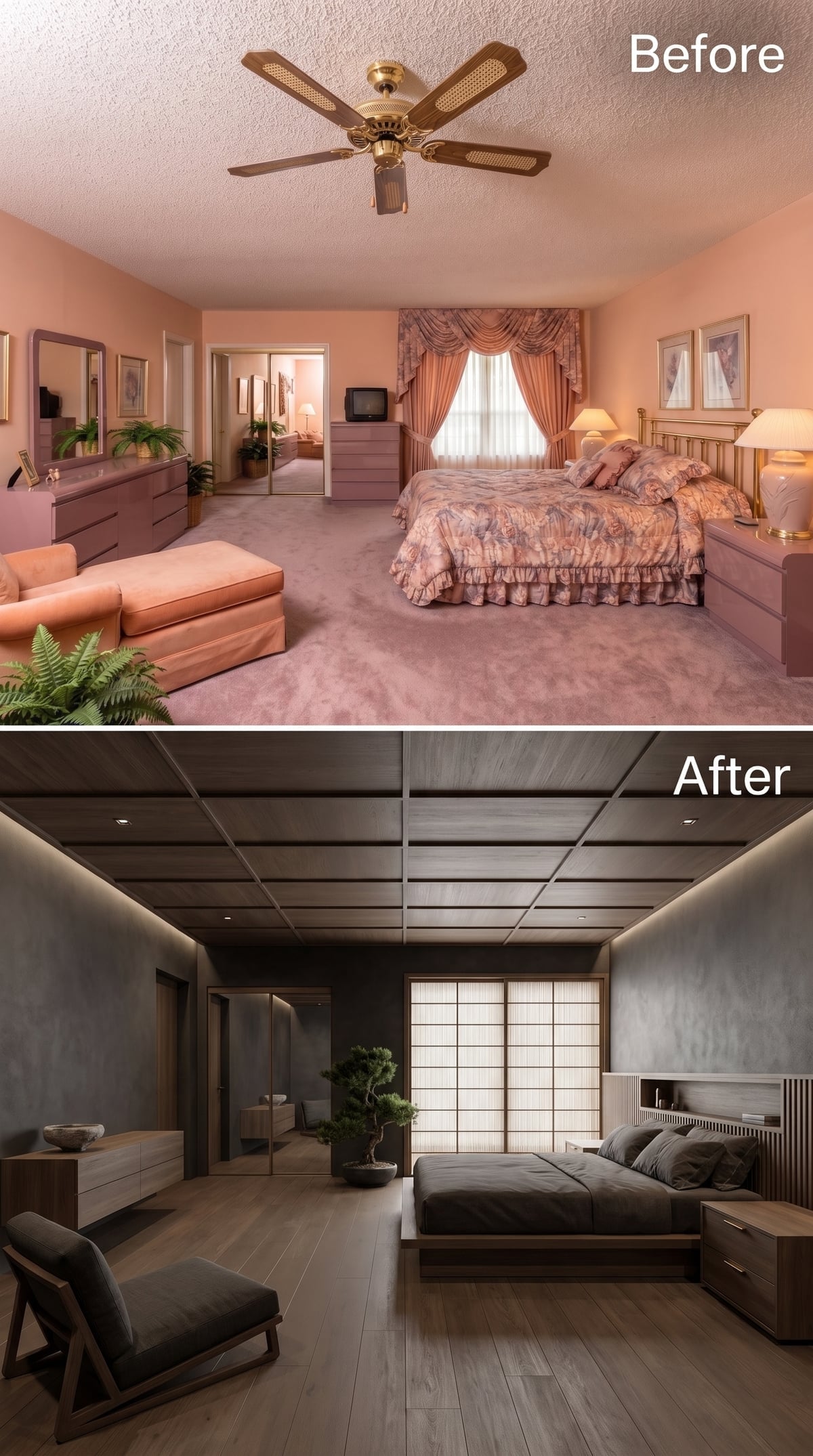
Charcoal-stained ceiling coffers establish a dark upper boundary, while concealed perimeter lighting prevents them from becoming a visual lid. A low platform bed exaggerates the distance between furniture and ceiling, giving the room an unusually calm vertical proportion.
Shoji-style panels diffuse the window light without the volume of conventional drapery. Wide oak boards and concrete-finish walls keep the material palette disciplined. A single bonsai provides enough organic detail without filling the newly quiet room back up.
Design Detail: Shoji-style panels offer a very different window profile from gathered drapery: broad, flat planes instead of folds. That geometry is particularly effective here because it echoes the low bed and ceiling grid.
25. Hammered Copper Gives the Ceiling an Industrial Glow
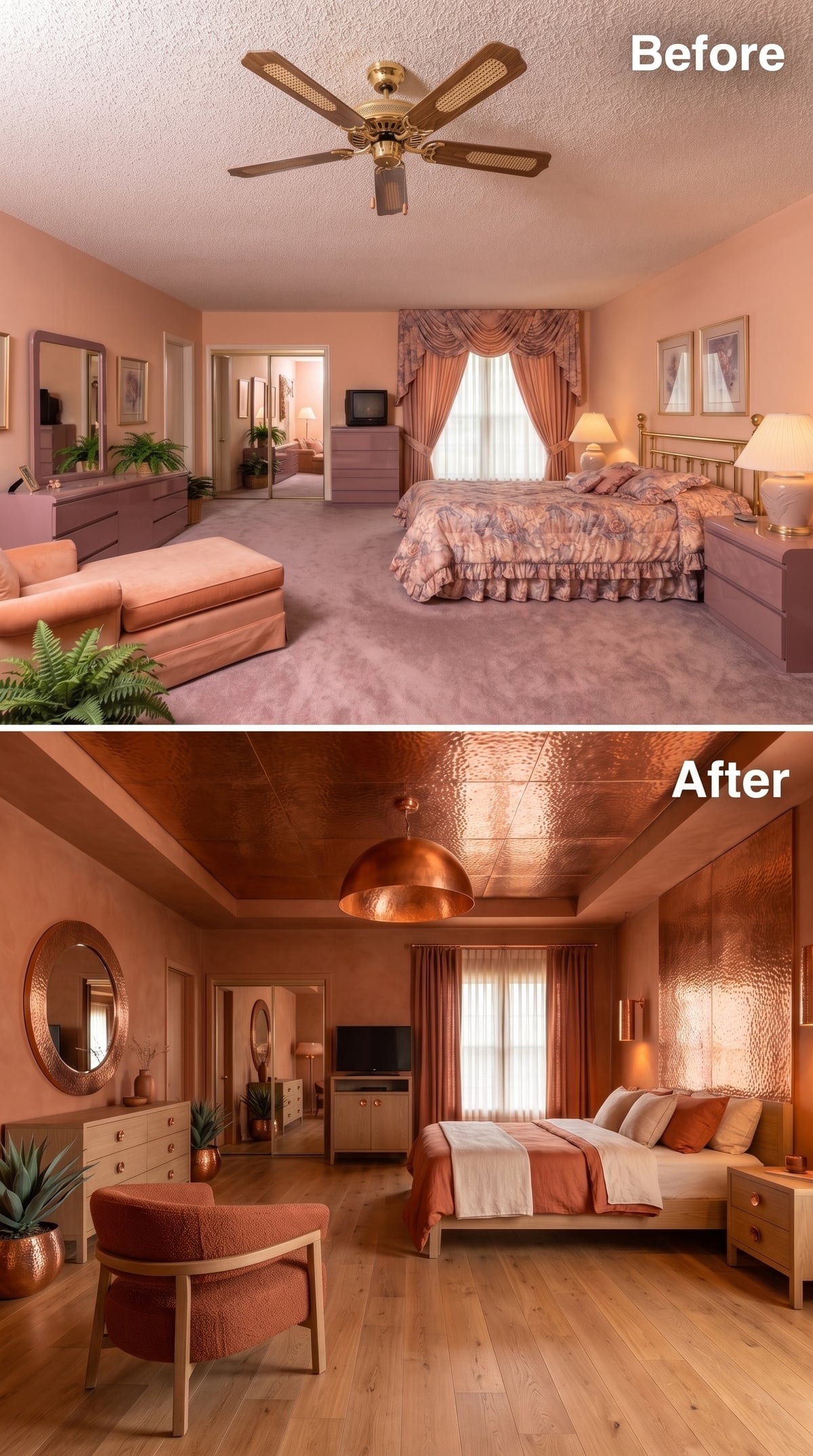
Hammered copper tiles cover the tray ceiling, catching highlights unevenly across their textured surfaces. A copper dome pendant continues the metal story at the center without introducing a completely different finish.
Oak flooring and pale furniture are the restraint this ceiling needs. Another dark metal or heavily figured wood could turn the room dense very quickly. Instead, copper gets the spectacle and everything below gives it room.
24. Navy Shiplap and Lantern Light Put a Sharper Edge on Coastal Style
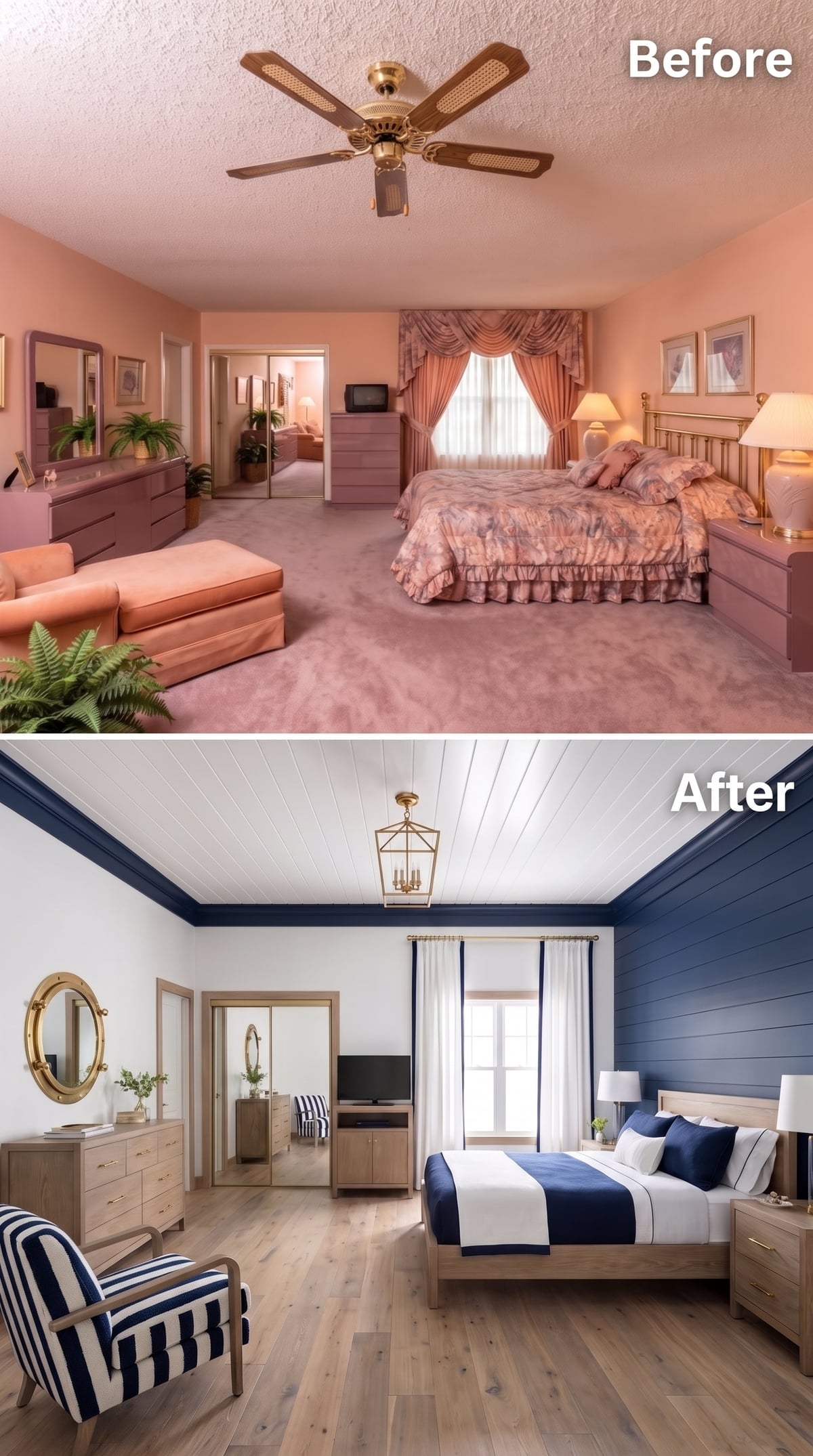
A navy shiplap wall provides one decisive block of color behind crisp white and ink-blue bedding. Pale wide-plank flooring keeps the darker wall from controlling the entire room, while white planking overhead introduces texture without another competing hue.
The brass lantern pendant is the organizing gesture. It has enough structure to stand against the shiplap but enough open space to keep the ceiling visually light. Coastal references are present, but anchors, rope and decorative seashells have wisely missed the invitation.
Material Matters: White ceiling boards introduce linear texture while still reflecting plenty of light. Against a saturated wall, that subtle pattern gives the upper plane definition without asking it to compete for color.
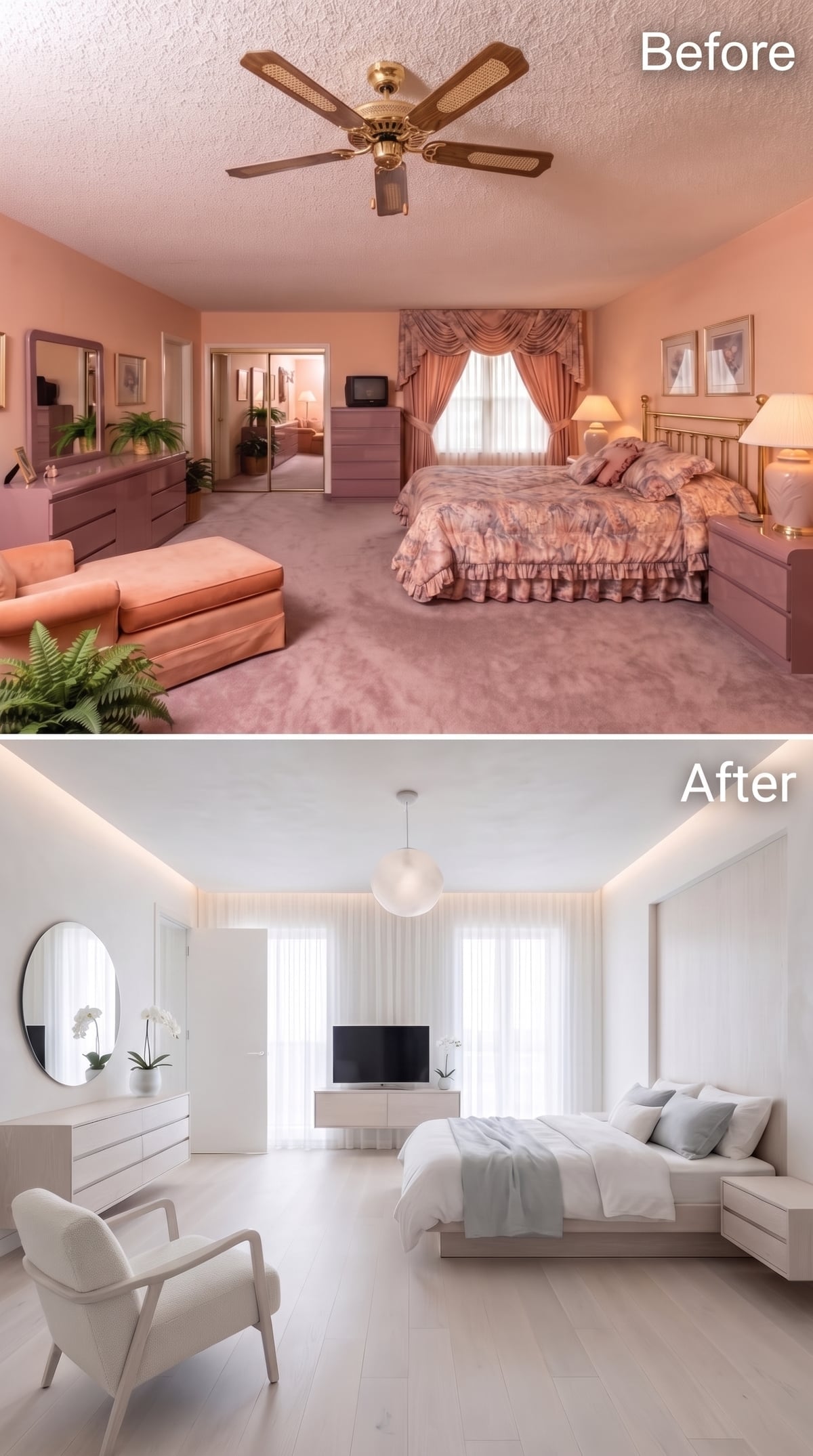
23. White on White Erases the 1980s Without Erasing Texture
🔥 Would you like to save this?
A smooth pale ceiling with perimeter cove lighting replaces the original textured overhead plane, while a low platform bed in dove-gray linen introduces the slightest tonal shift. The matte white globe pendant almost disappears until its shape catches the light.
Nearly every surface stays within a narrow white-to-gray register: glossy dresser fronts, pale mirror framing, sheer curtains and an off-white boucle chair. The restraint works because the finishes are not identical. Gloss, linen, boucle, glass and wood keep an almost colorless room from becoming featureless.
22. Black Walls and Gold Botanicals Turn the Ceiling Into Midnight Sculpture
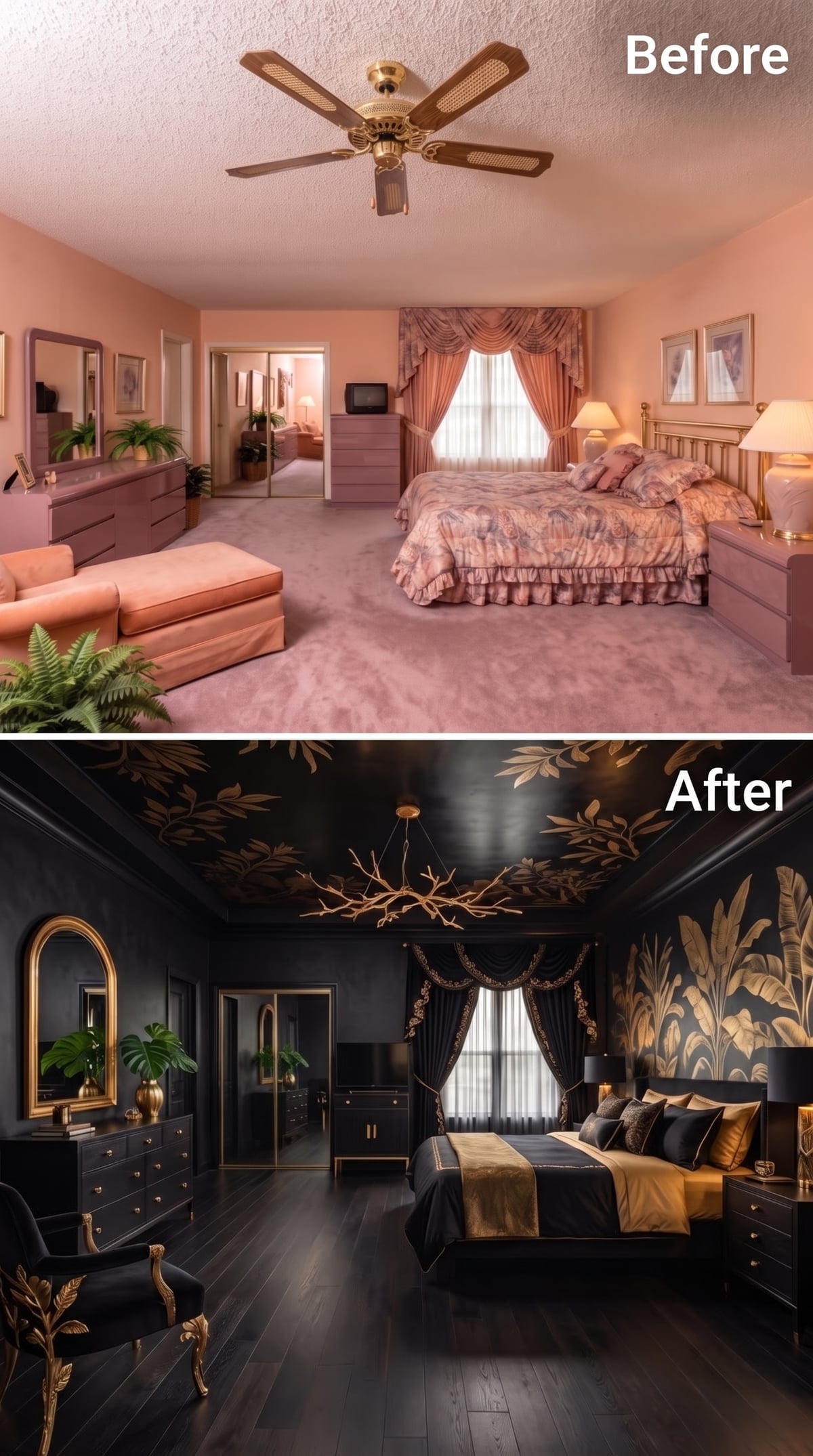
Matte black covers the walls, ceiling and trim, but metallic botanical motifs break across the overhead darkness and give the surface movement. A branch-style chandelier continues that organic language in three dimensions.
Dark hardwood replaces the original carpet, while black case goods and brass hardware keep the furniture inside the same nocturnal palette. Navy drapery and charcoal bedding resist the temptation to introduce a bright rescue color. Gold provides the light; darkness gets to remain the point.
In the Details: Metallic motifs behave differently from flat painted pattern because their visibility changes with the light. Against matte black, that shifting reflection gives the ceiling depth without requiring a second large field of color.
21. Limewash and Pale Oak Show How Little the Room Actually Needed
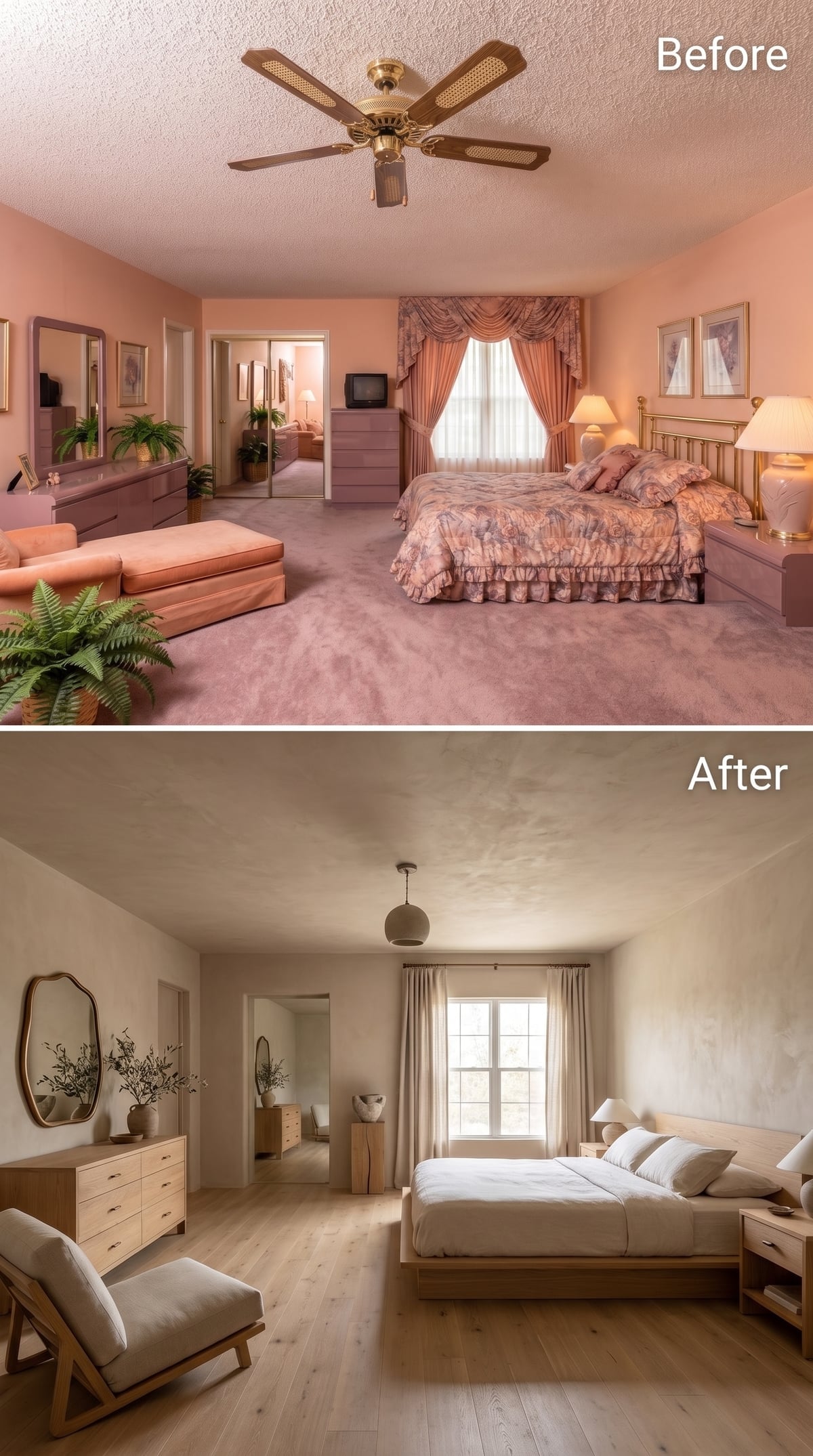
Warm greige walls with a softly mottled plaster-like finish replace the saturated peach, and suddenly daylight has somewhere quiet to land. Straight-hanging linen curtains simplify the windows, while a low light-oak platform bed avoids introducing another oversized focal point.
Dresser and nightstands remain within the same pale wood family. A matte clay pendant replaces the brass ceiling fan with a simpler shape and warmer surface. Nothing here relies on spectacle. After the previous black-and-gold room, that’s exactly why this one hits.
20. Crimson Lacquer and Gilded Plasterwork Refuse the Quiet-Luxury Memo
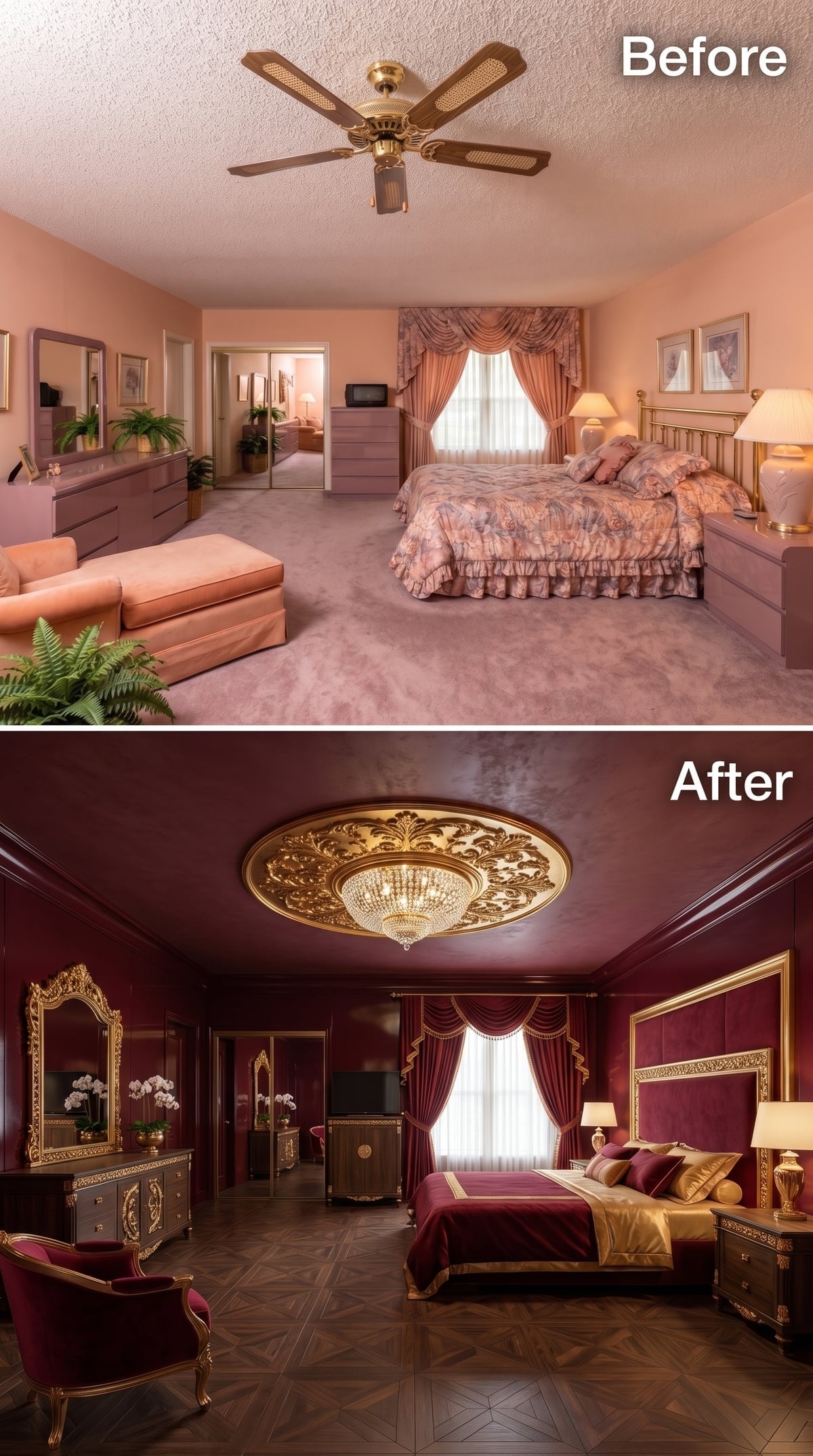
Burgundy lacquered walls establish the room’s intensity immediately. An ornate gold ceiling medallion surrounding a crystal bowl chandelier takes that intensity upward, while herringbone parquet gives the floor enough pattern to hold its own beneath the saturated shell.
Gold-trimmed velvet upholstery repeats the formality at the bed and chair. Crimson drapery with gold fringe keeps the windows in the same register rather than introducing relief. Subtle this is not. Coherent, however, it absolutely is.
19. Sage Walls and Exposed Beams Bring the Room Back to Earth
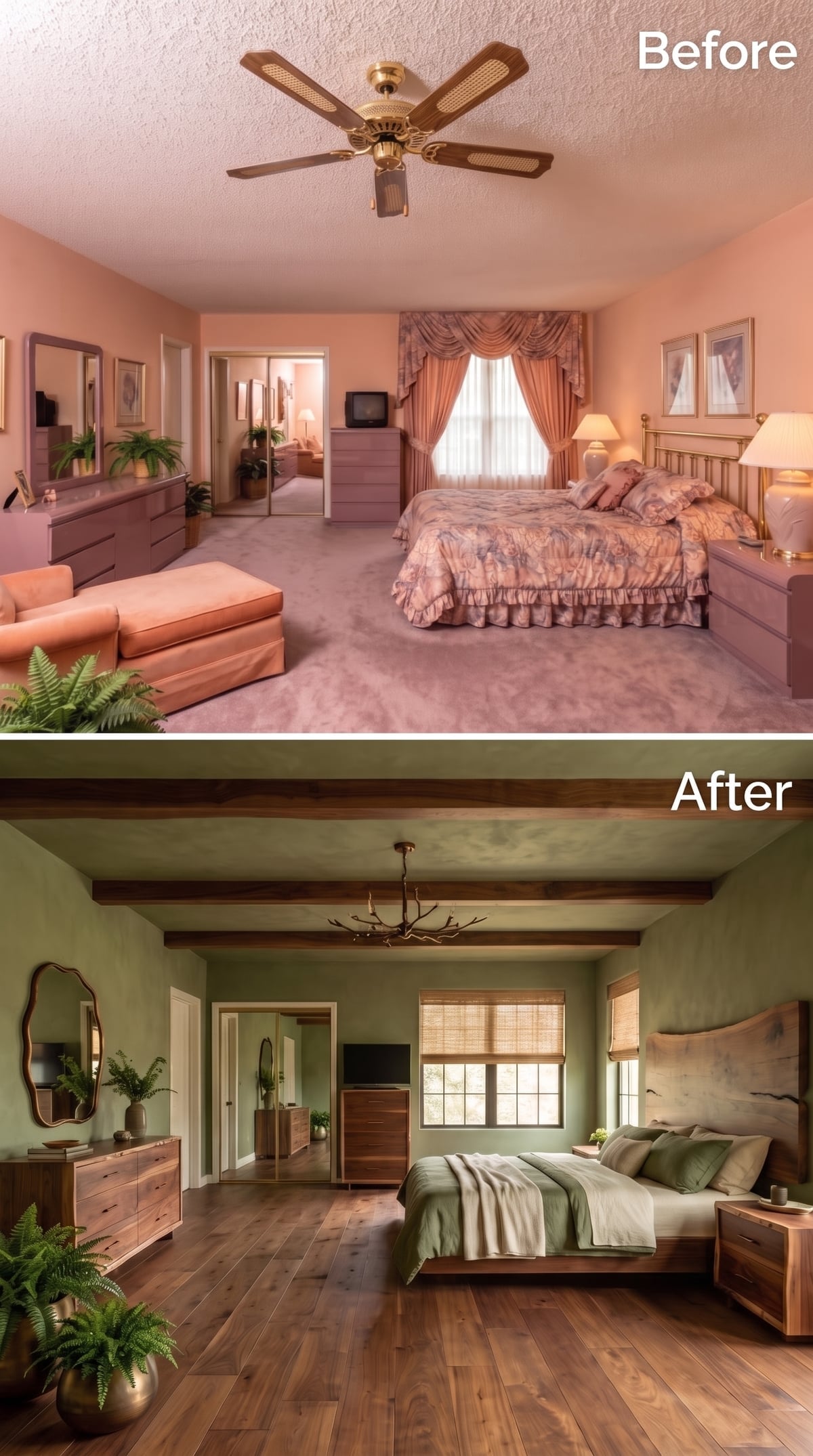
Sage green runs across walls and ceiling, creating a continuous envelope interrupted by dark exposed-style wood beams. The antler-form chandelier is sculptural enough to stand against that geometry without requiring a decorative ceiling treatment around it.
Wide-plank walnut flooring and walnut-toned furniture deepen the lower half of the room. Bamboo Roman shades soften the windows and introduce a lighter natural texture. The palette is earthy, but the beam rhythm keeps it from dissolving into generalized rusticity.
Worth Knowing: Decorative beam treatments can create the appearance of structural timber without exposing the building frame. The exact installation method depends on the existing ceiling, beam material, weight and attachment conditions, so the visual idea is simpler than the construction decision.
18. Dusty Blue and Fluting Give the Ceiling Texture Without Weight
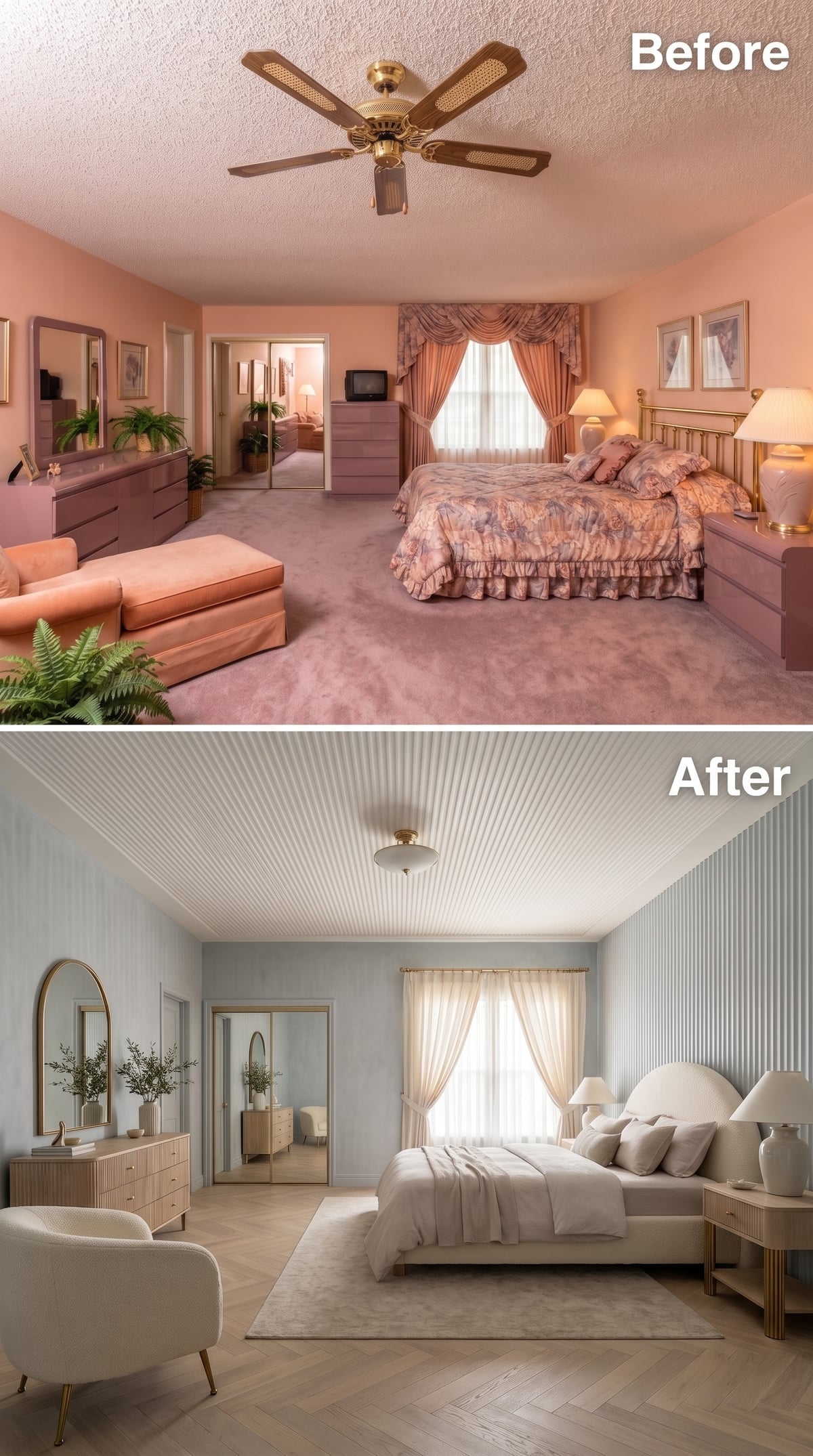
Fluted panels run the ceiling length above dusty-blue walls, replacing amorphous texture with deliberate repetition. A patterned pale floor adds movement in another direction, preventing the room from becoming a stack of parallel lines.
Natural oak furniture warms the blue, and fluted dresser fronts quietly repeat the overhead rhythm. A boucle chair and curved upholstered headboard soften all that linear texture. The connection between ceiling and furniture is visible without becoming a matching-set trick.
Design Detail: Repeating a texture in two distant parts of a room can create continuity without repeating the same color or material. Here, the fluted ceiling and drawer fronts speak to each other while remaining clearly separate elements.
17. Ochre Plaster and Painted Coffers Go Unapologetically Old World
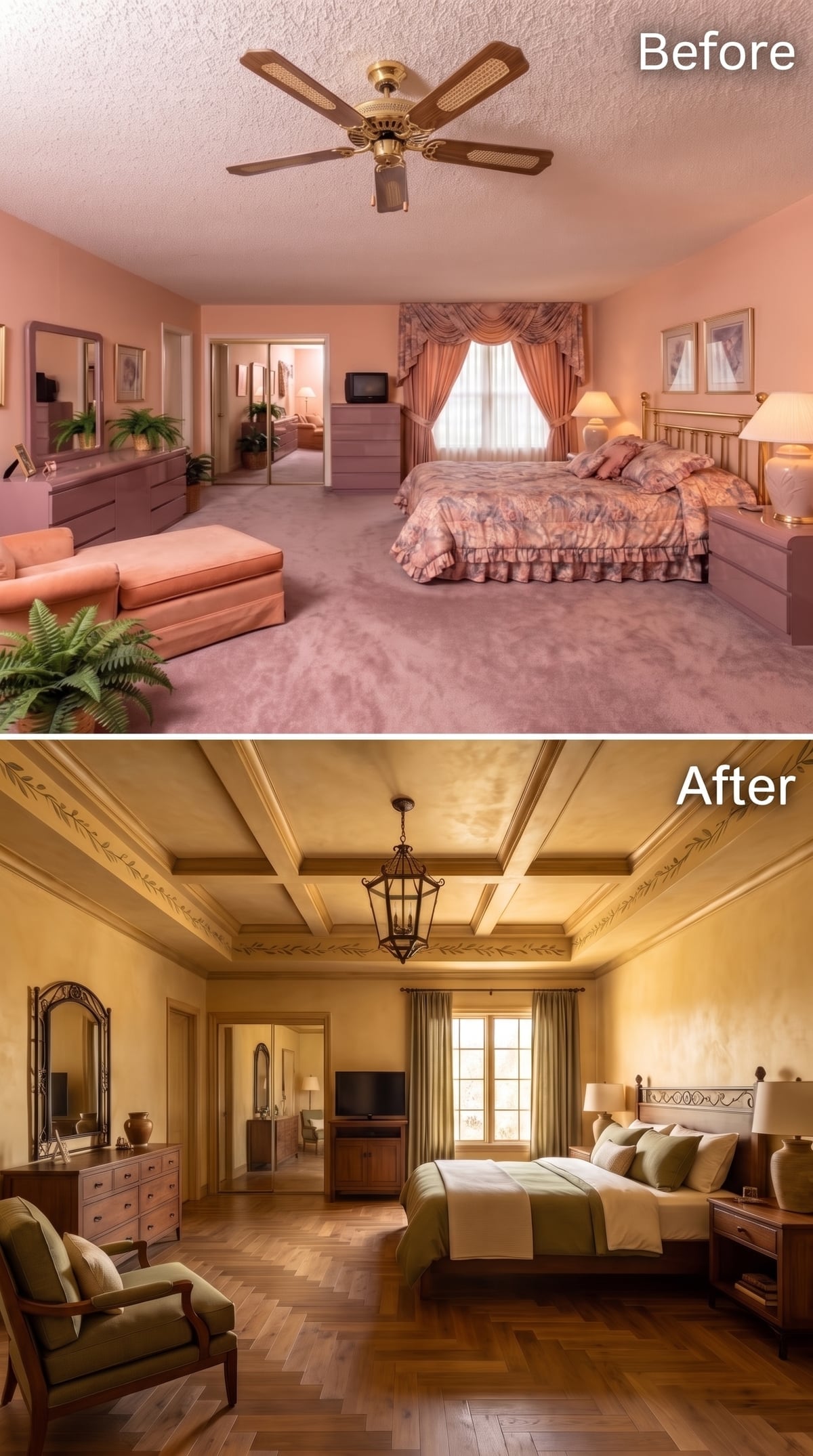
Warm ochre plaster sets the backdrop, but the coffered ceiling with painted laurel detailing supplies the room’s sense of ceremony. An iron lantern pendant hangs from the central field, throwing a darker graphic shape against all that warm plaster and wood.
Patterned parquet adds another layer underfoot, while wrought-iron detailing continues through the bed and mirror. Sage linen introduces a cooler note without disturbing the Old World palette. This room doesn’t flirt with ornament. It commits.
Why It Works: The ceiling carries considerable detail, but its warm tones remain closely related to the walls and floor. That limited palette allows carving, painting, ironwork and patterned wood to coexist without every element demanding a different color.
16. A Black Coffered Ceiling Gives the Bedroom Serious Gravity
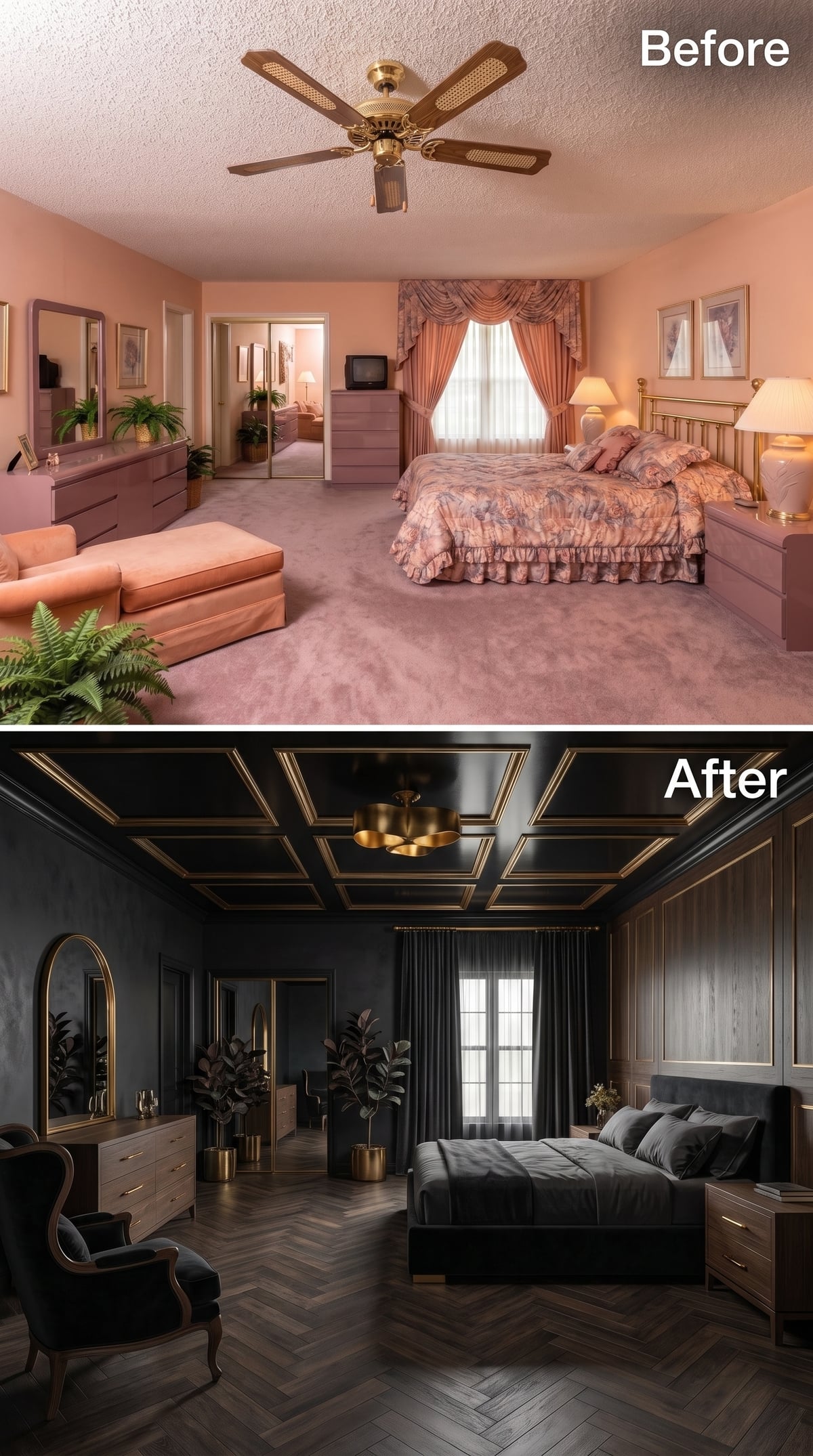
Dark charcoal walls rise into a black coffered ceiling edged with slender gold detailing. Below, patterned hardwood introduces warmth and motion while walnut dressers with gold hardware bridge the gap between dark architecture and the floor.
A slate-gray velvet platform bed keeps the central mass low. The brass flush-mount fixture is restrained by comparison with the ceiling around it, which is precisely the right hierarchy. The drama comes from the room itself rather than a chandelier trying to impersonate architecture.
15. Powder Blue and Whitewashed Oak Give the Eye Somewhere to Rest
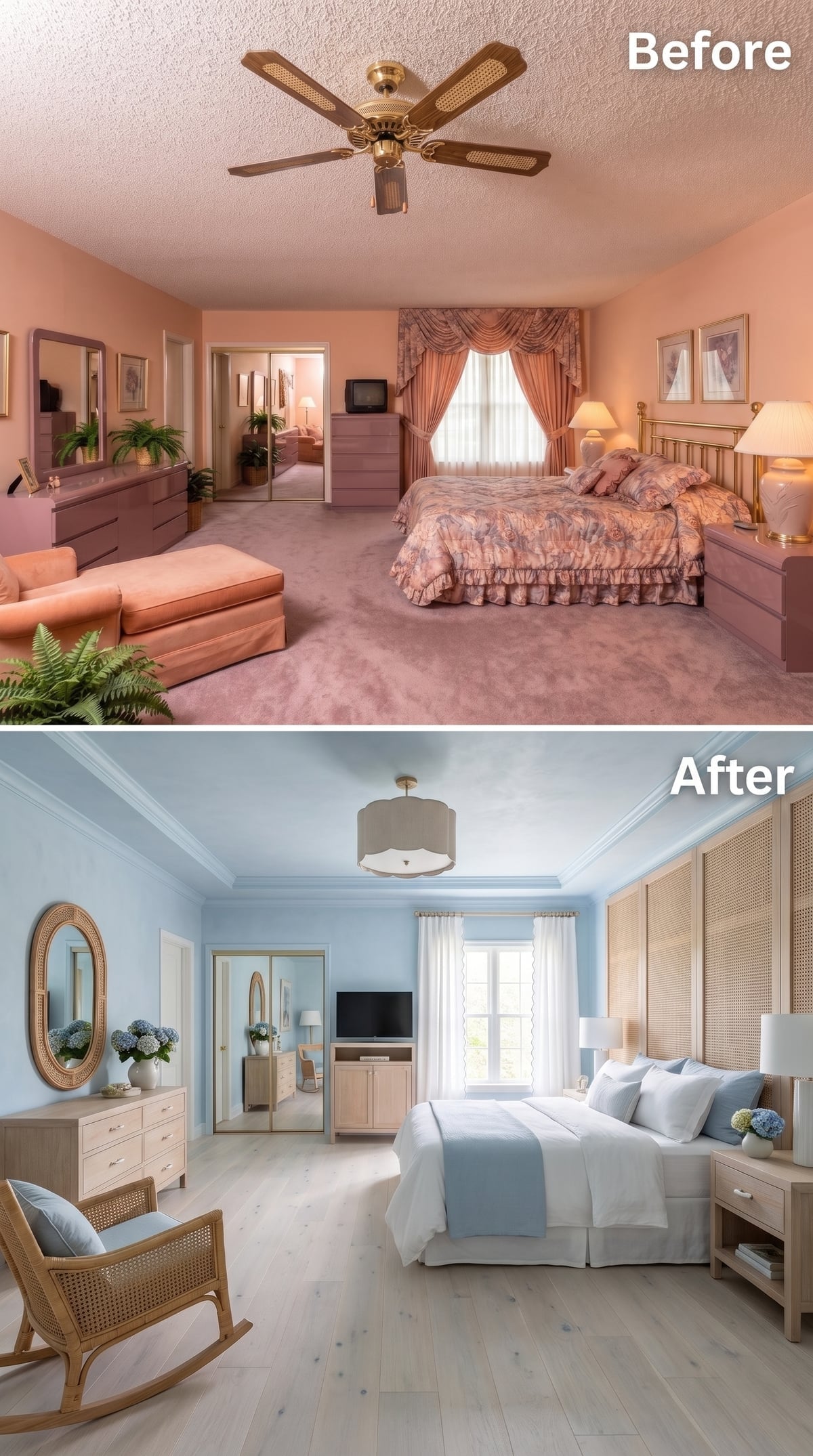
Bright white crown molding draws a clean line between powder-blue walls and a ceiling in a closely related pale blue. Whitewashed oak flooring keeps the scheme airy without pushing the room into stark white.
Rattan and cane bring texture through the rocking chair, wardrobe fronts and case goods. Those natural fibers stop the blue from becoming precious, while their pale color prevents them from breaking the room into heavy blocks. The transformation feels coastal without turning the bedroom into a themed rental.
14. Raffia Overhead and Charcoal Furniture Make the Bedroom Feel Hotel-Serious
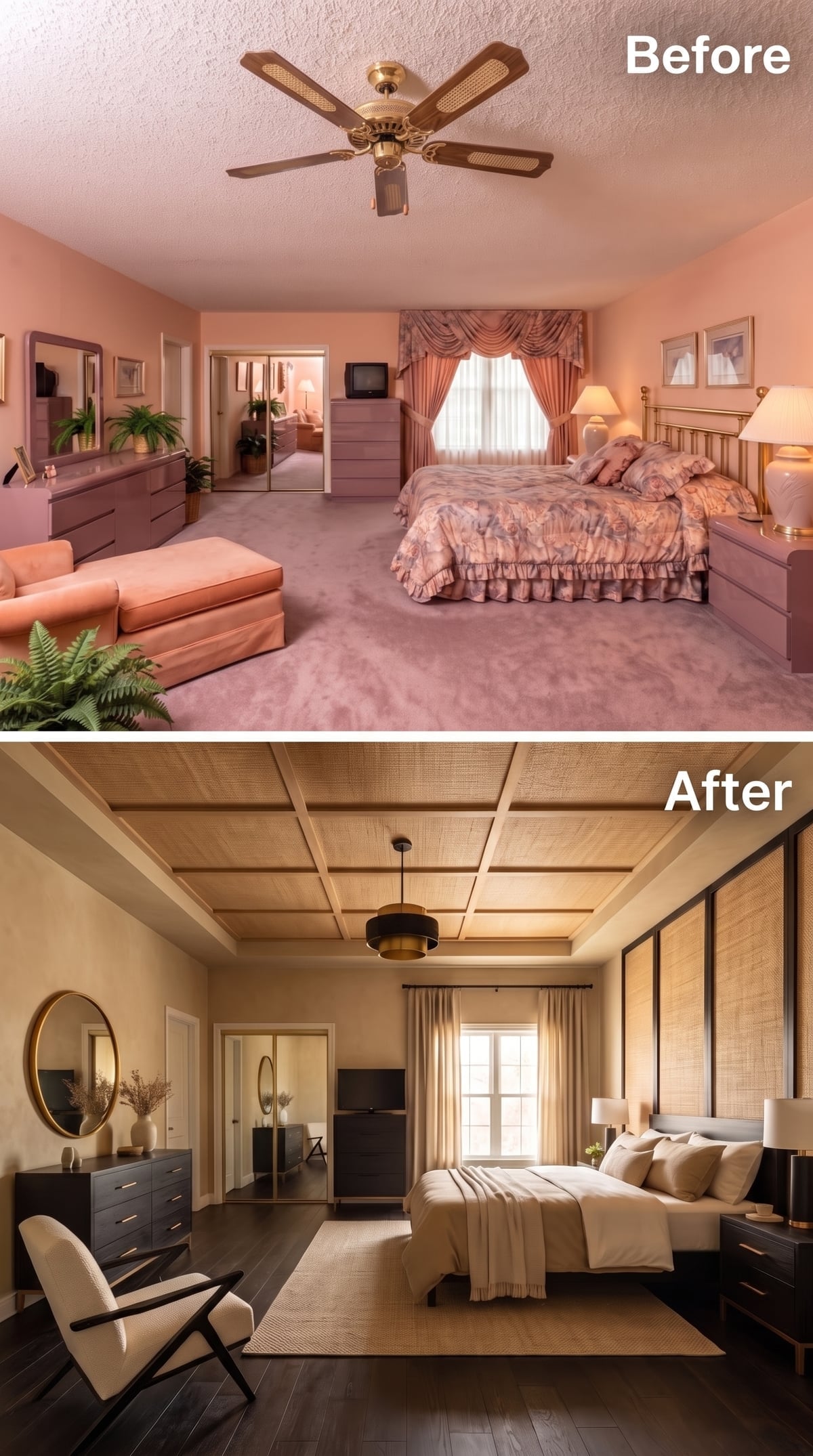
Grass-cloth or raffia-like panels sit inside a coffered ceiling grid, bringing texture overhead without another strong color. Below, charcoal dressers with brushed-gold hardware give the room a dark, tailored base.
A cream upholstered bed interrupts the heavier case goods, while the foreground chair rounds off the harder geometry. The ceiling is tactile rather than flashy, which gives the room the polished seriousness of a good hotel suite without requiring the furniture to perform every trick.
13. Gold-Trimmed Panels and Terracotta Linens Find a Softer Kind of Luxury
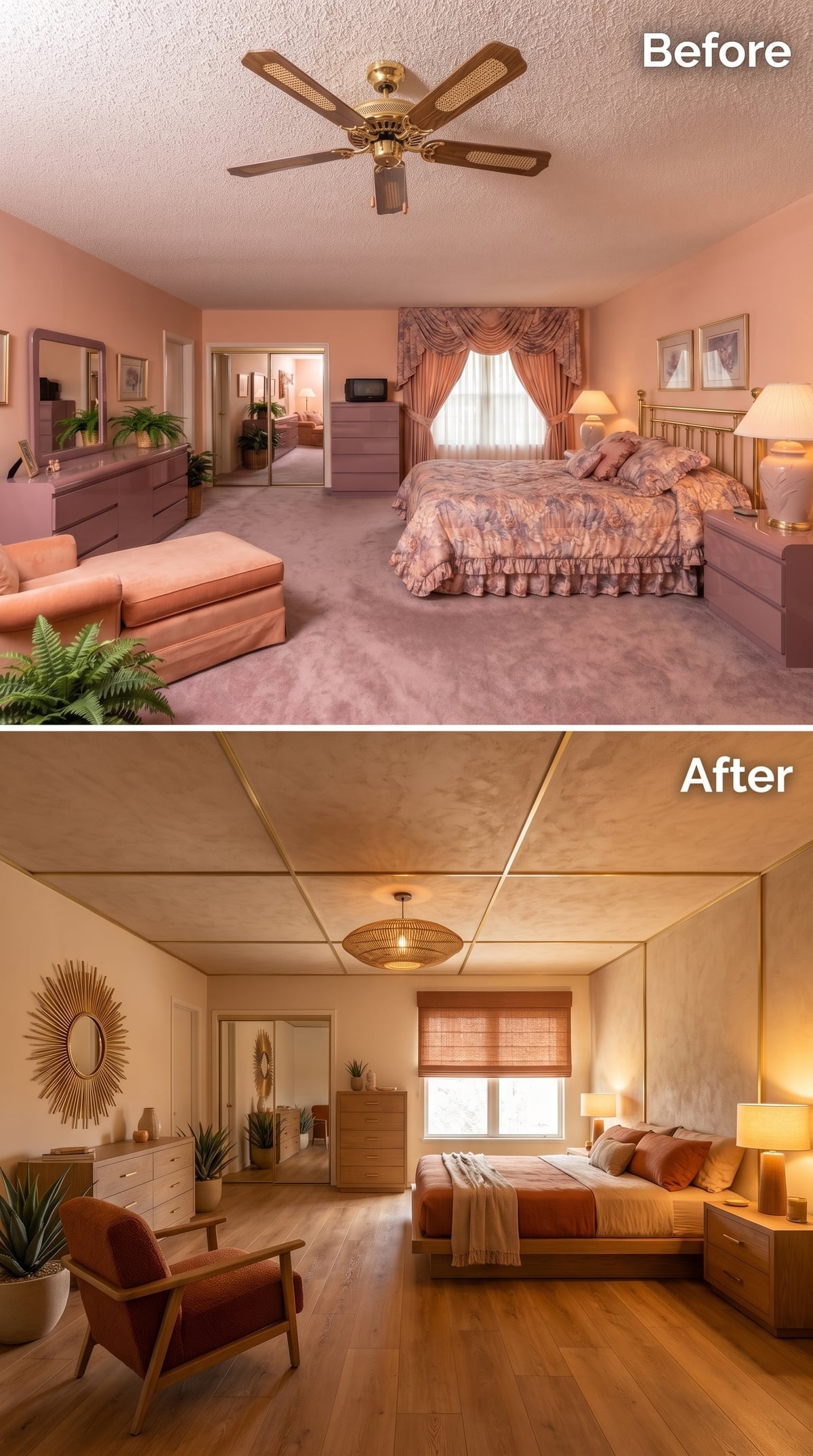
Linen-toned plaster meets a paneled ceiling traced with narrow gold lines. Instead of turning glamorous, the metal behaves almost like fine drawing across the ceiling. A woven pendant introduces a deliberately rougher texture at the center.
Rust and terracotta bedding warm the low platform bed, while oak flooring carries similar undertones without matching exactly. A sunburst mirror and terracotta chair add shape and color at opposite sides of the room. Gold is present, but earth tones remain in charge.
12. Ribbed Panels and Cobalt Accents Put the Energy in Exactly Two Places
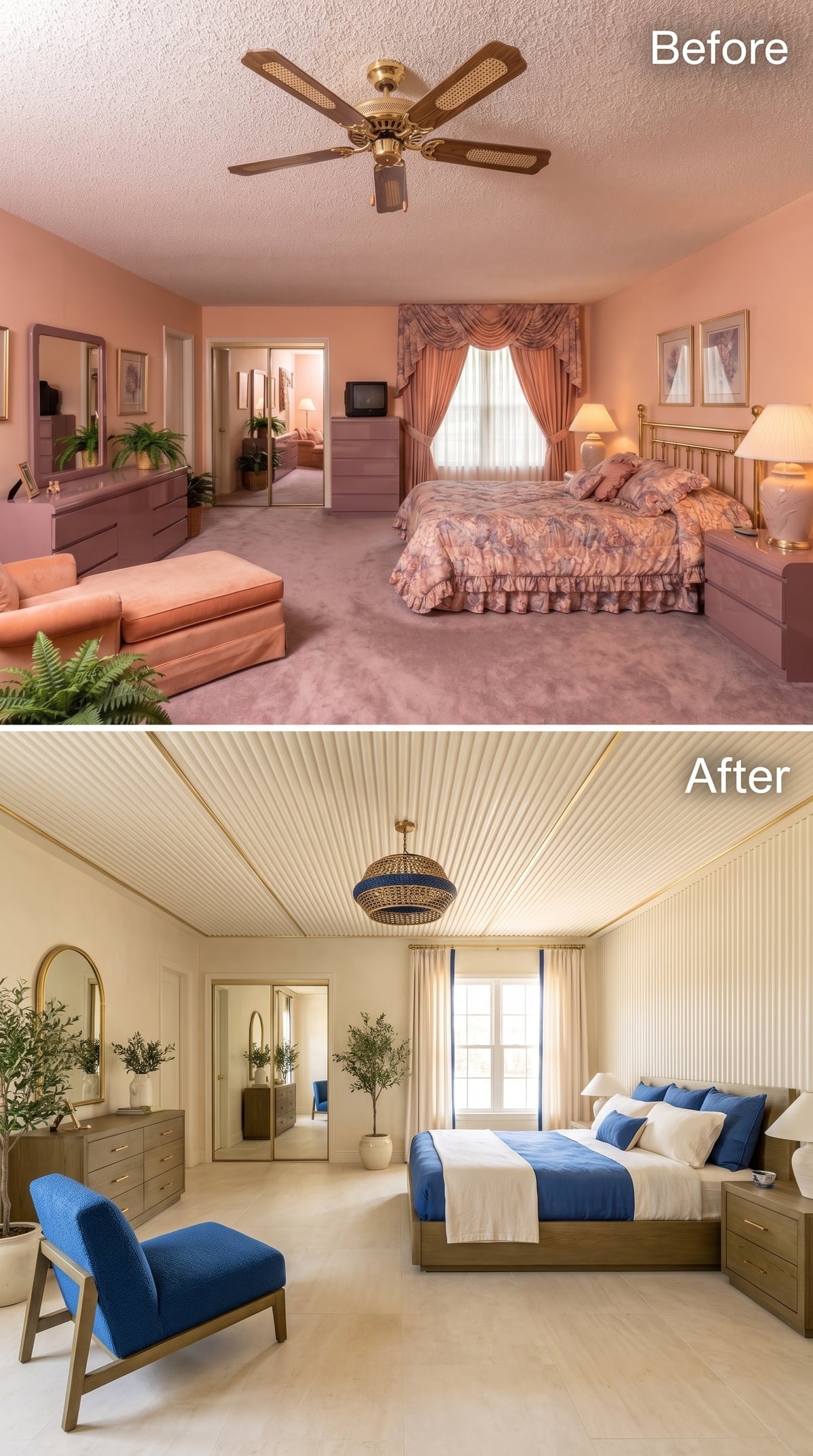
Cream-painted ribbed panels give the ceiling a fine linear rhythm without adding another color overhead. Walnut furniture supplies warmth below, leaving cobalt to make two concentrated appearances: across the bed and on the boucle chair.
That restraint is what makes the blue feel stronger. Instead of sprinkling cobalt through lamps, artwork and accessories, the design lets two substantial areas carry it. Potted olive trees add green without joining the color-matching exercise.
Ceiling Strategy: Linear paneling can replace an undifferentiated textured surface with an intentional pattern. Whether it can be installed over an existing ceiling depends on the substrate, attachment method and condition of the original finish, so the construction needs to be assessed separately from the design.
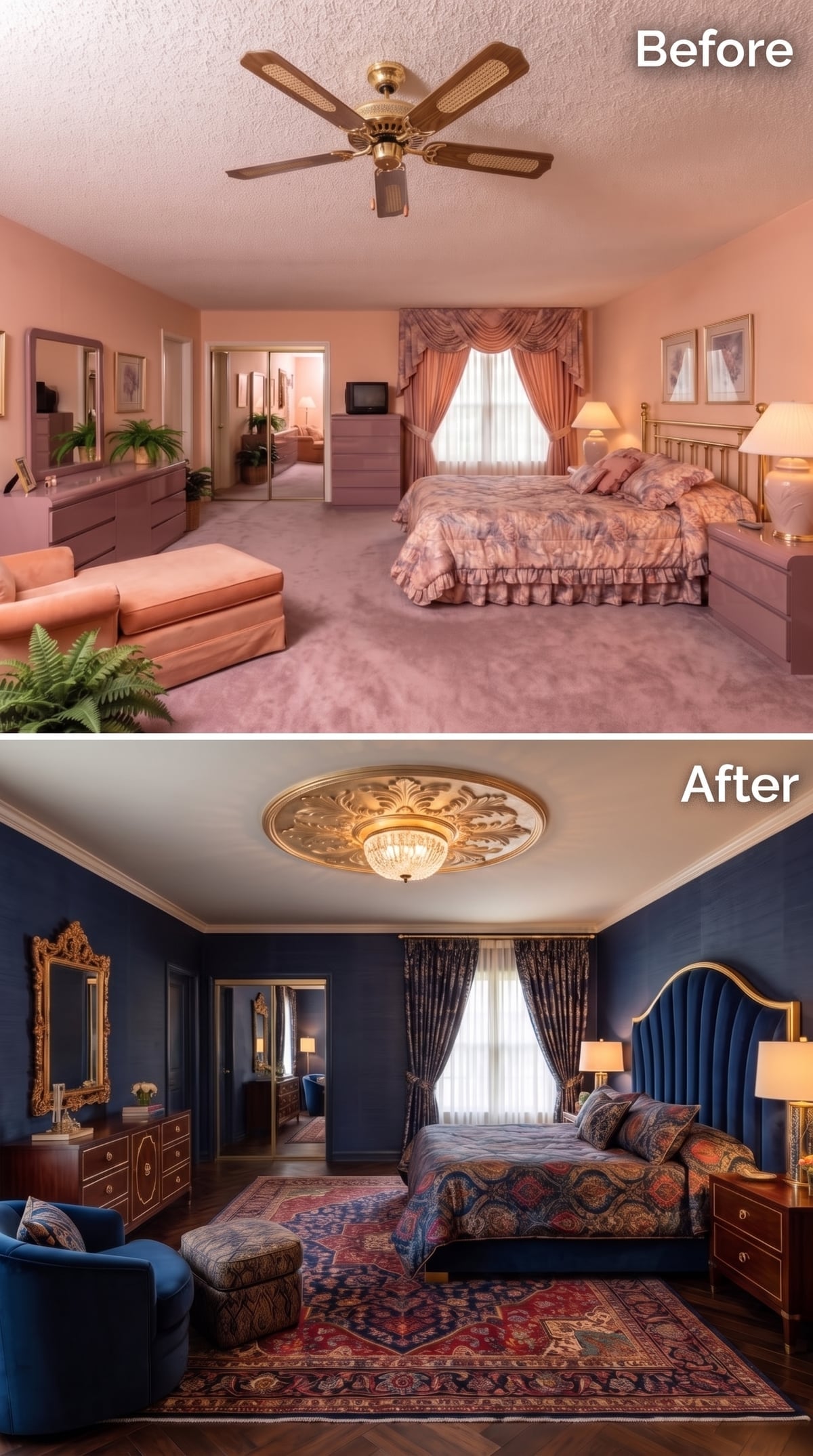
11. Navy Velvet and Gilded Plasterwork Bring Back Grandeur Without Bringing Back Peach
🔥 Would you like to save this?
Navy velvet on the channeled headboard establishes a deep, formal center, answered overhead by gilded plasterwork around the ceiling fixture. A Persian-style rug in crimson and cobalt introduces dense pattern at floor level, giving the room ornament above and below without covering every surface between them.
Mahogany furniture and an ornate gold mirror deepen the Old World direction, but the strongest decision is the distribution of color. Navy controls the bed, crimson and cobalt stay largely underfoot, and gold traces the edges. Each has territory. None has to conquer the whole room.
10. A Tray Ceiling and Cove Lighting Give the Room a New Center of Gravity
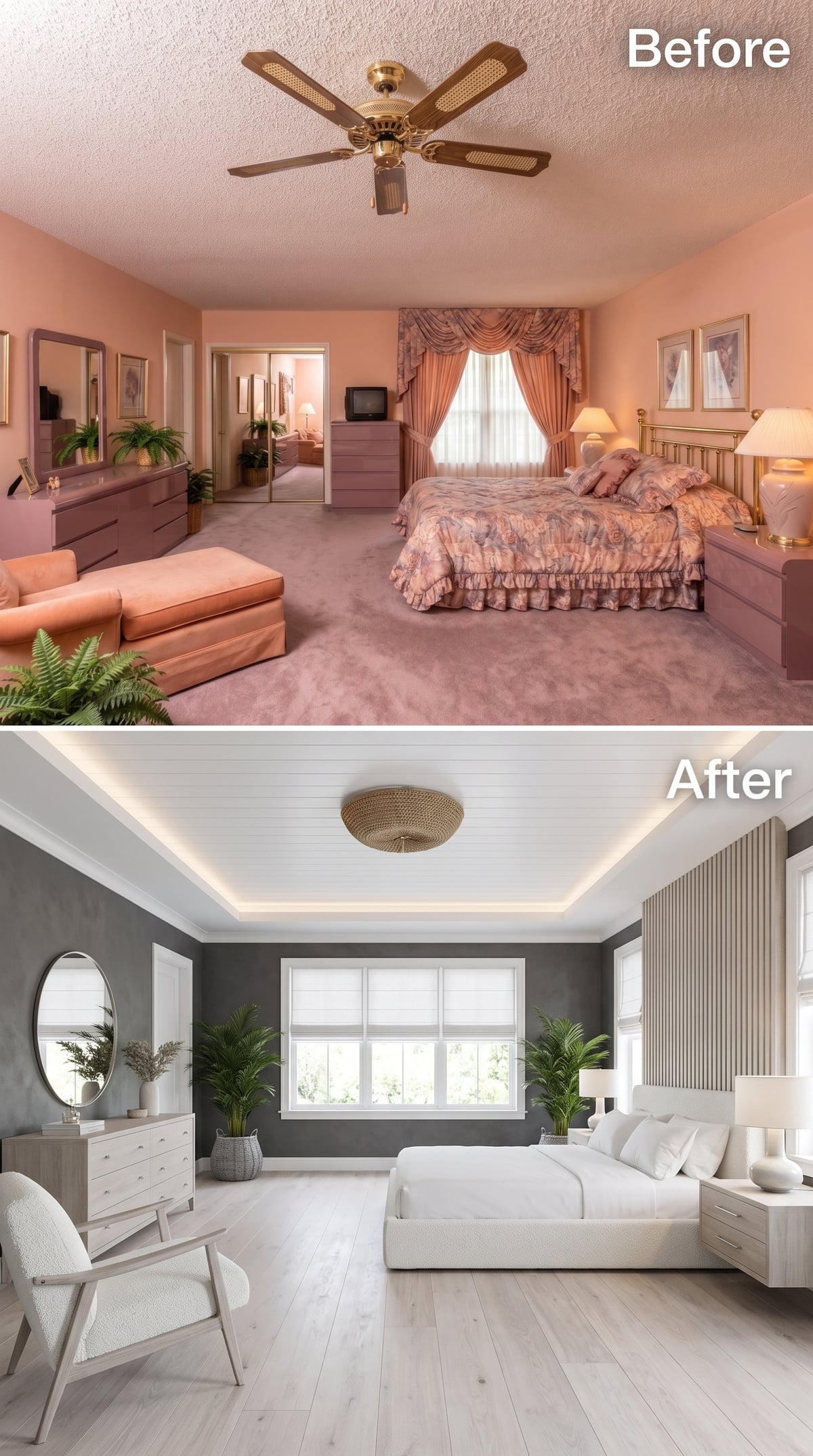
Gray walls establish a calm envelope, warmed at floor level by pale wood. The recessed tray ceiling gives the room a clear architectural center, with concealed perimeter light defining the change in plane rather than relying on contrasting paint.
A woven flush-mount fixture sits at the middle almost like punctuation. On the right wall, vertical slats introduce another controlled texture beside the simple white upholstered bed. The result is contemporary without becoming anonymous.
Planning Note: Tray ceilings and integrated cove lighting can produce a remarkably clean effect, but the scope depends on existing framing, ceiling height and electrical conditions. The visual lesson here is simpler: indirect light emphasizes architectural depth without requiring a decorative fixture to dominate the room.
9. Mahogany and Hunter Green Push the Bedroom Toward Club-Room Swagger
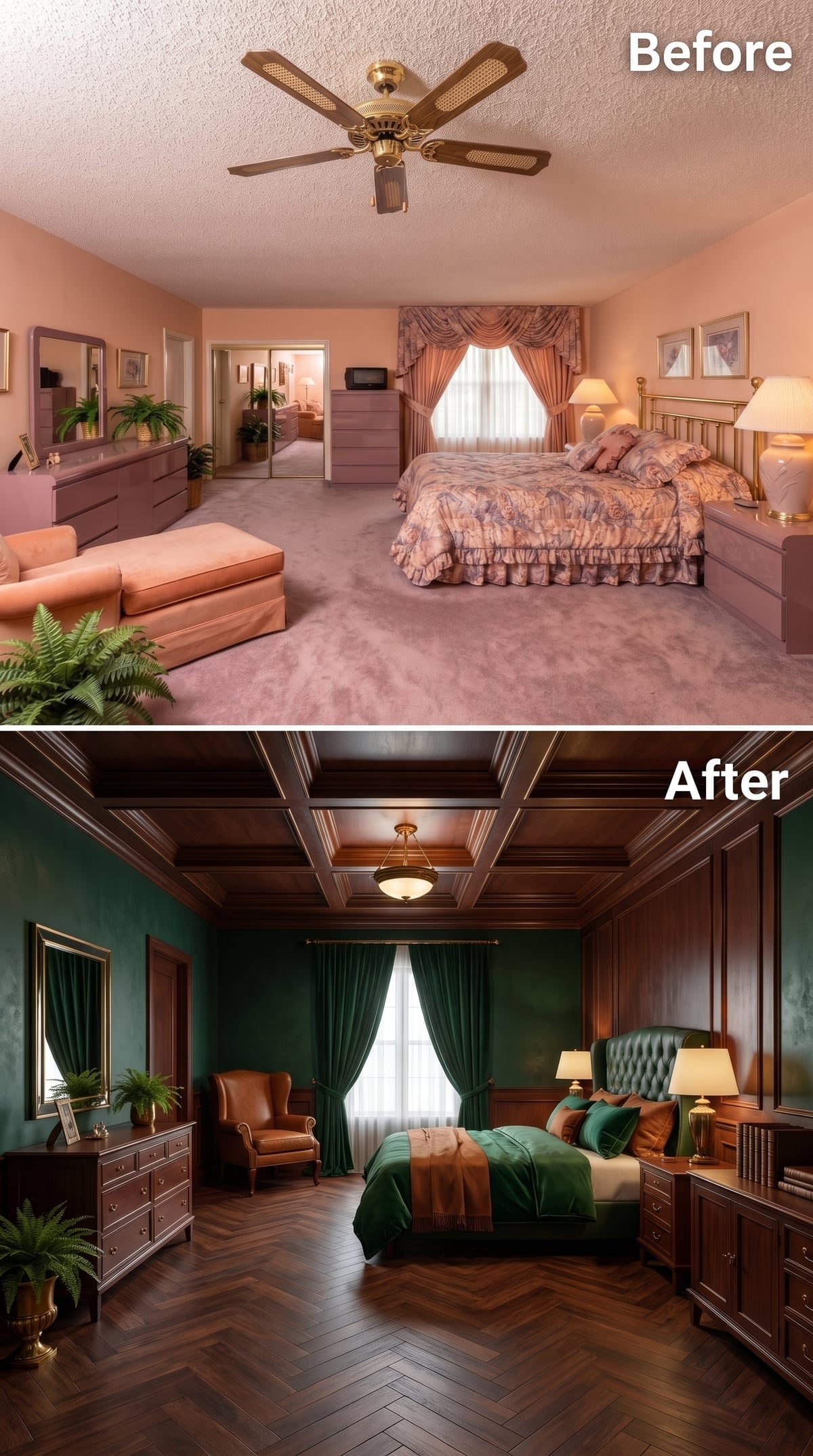
Patterned parquet establishes richness underfoot, but the mahogany-stained coffered ceiling determines the mood. Gold details at the intersections catch just enough light to prevent the dark grid from becoming visually flat.
Hunter-green velvet curtains, a matching tufted headboard and a cognac leather wingback chair divide the palette between deep green and warm brown. Soft bedside light keeps the whole arrangement from hardening into pastiche. It doesn’t tip. It lands.
8. Black Beams and White Shiplap Make the Ceiling Graphic Instead of Heavy
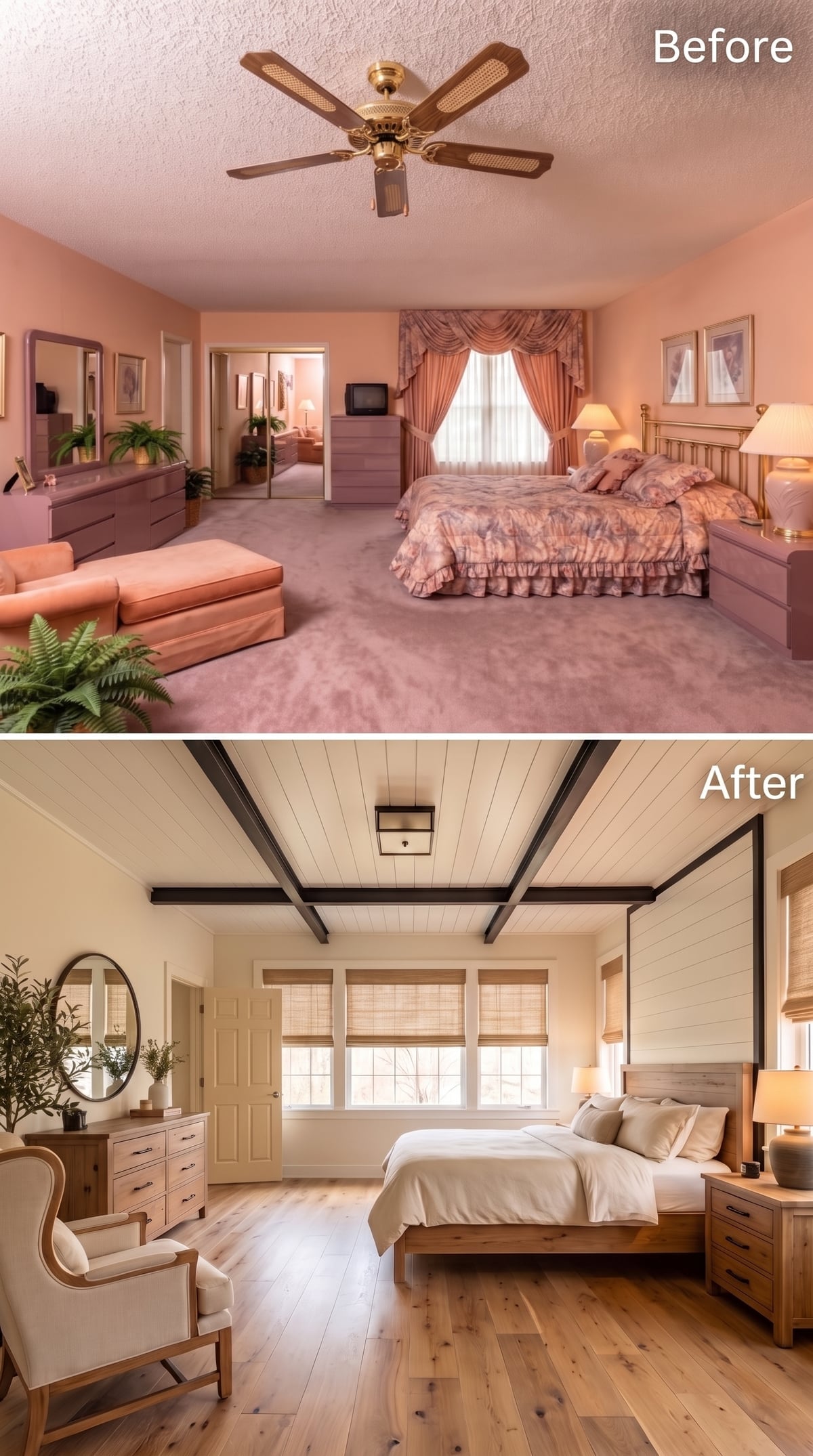
Painted ceiling boards become considerably more interesting once a dark grid gives them something to push against.
Black box beams cross the white-planked ceiling in a clean pattern, adding definition without turning the upper plane dark. Natural oak flooring pulls the composition back toward warmth, joined by a low reclaimed-wood headboard, simple dresser and unbleached linen chair.
Bamboo shades filter the windows and repeat the warm material story in a finer texture. The room succeeds on contrast — black against white overhead, then cream against wood below — rather than on another elaborate palette.
7. Radiating Wood Planks Make the Ceiling the Room’s Compass
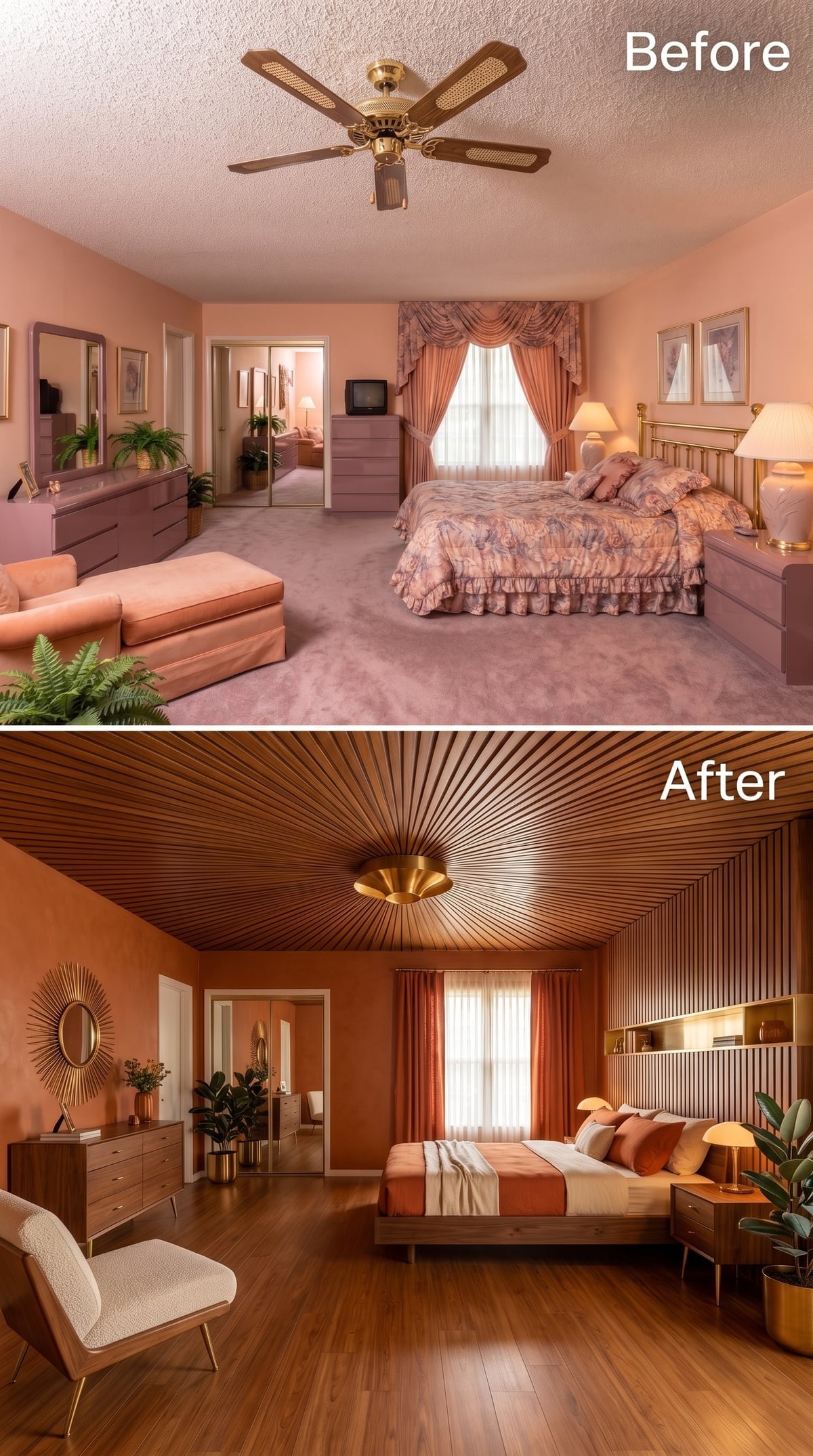
Warm hardwood planks radiate from a central brass fixture, replacing anonymous texture with a ceiling that has an unmistakable direction. Terracotta walls deepen the warmth without trying to imitate the wood grain.
A low platform bed sits against vertical slats, introducing a second linear treatment that runs in another direction. Walnut storage, a sunburst mirror, boucle seating and a rubber plant round out the room with curves and softer surfaces. The ceiling provides the geometry; everything below loosens it.
6. A Slatted Wood Ceiling Turns the Bedroom Into a Study in Lines
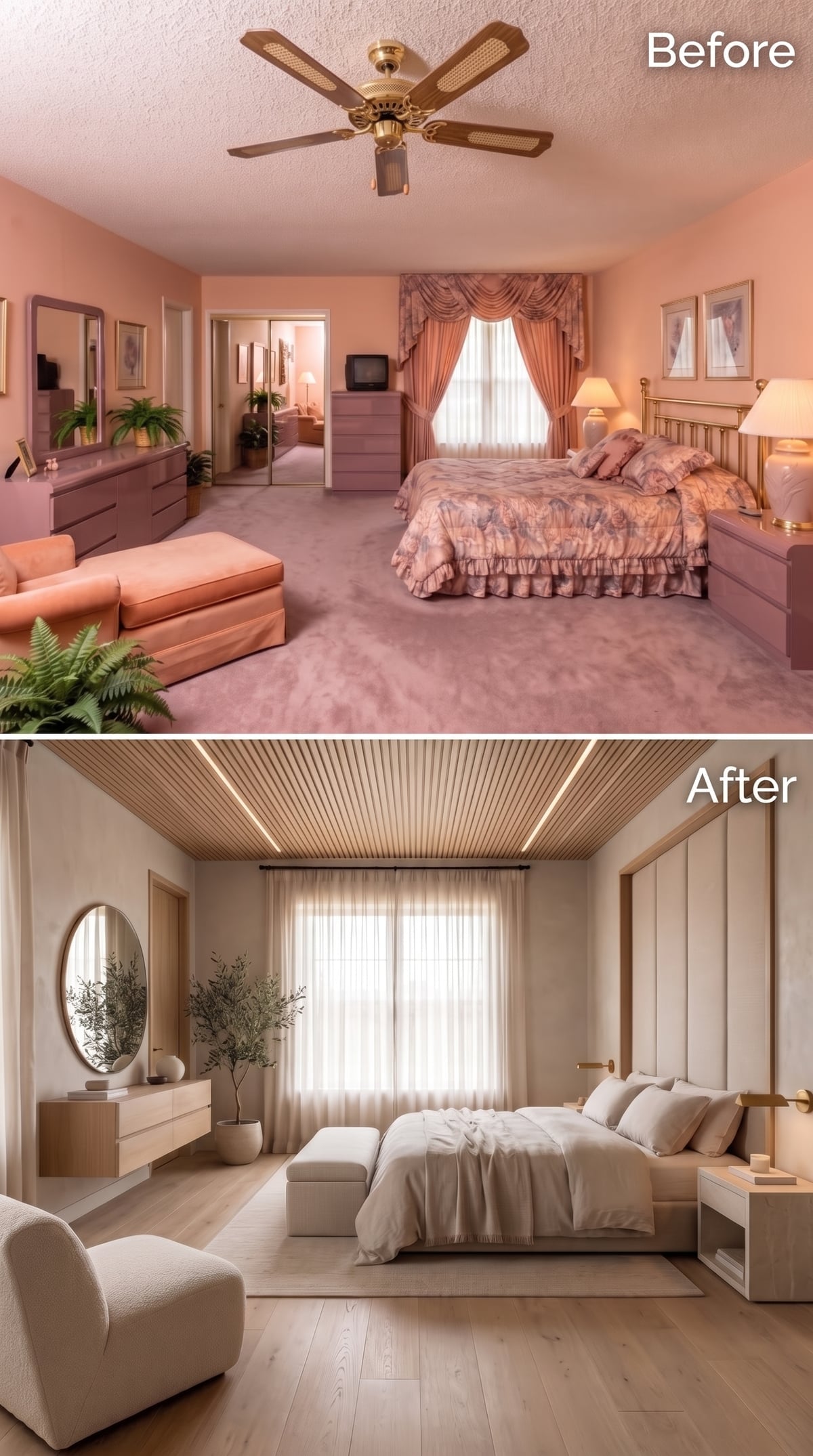
Oak-toned slats run the full ceiling length, with recessed strips of light tucked between planes rather than hanging into the room. Hardwood floors repeat the natural warmth below, while a floating dresser and thin-framed oval mirror keep the walls comparatively spare.
The bedroom needs little color because the slats already provide repetition, shadow and grain. Cream linen and pale upholstery soften the hard lines without obscuring them. The old popcorn texture has been replaced by texture with an actual point of view.
Why the Restraint Matters: With this much linear detail overhead, a low-contrast palette lets shadow and wood grain supply the variation. More competing pattern below would weaken the ceiling rather than enrich it.
5. Forest Green and Espresso Coffers Make Traditional Feel Newly Dangerous
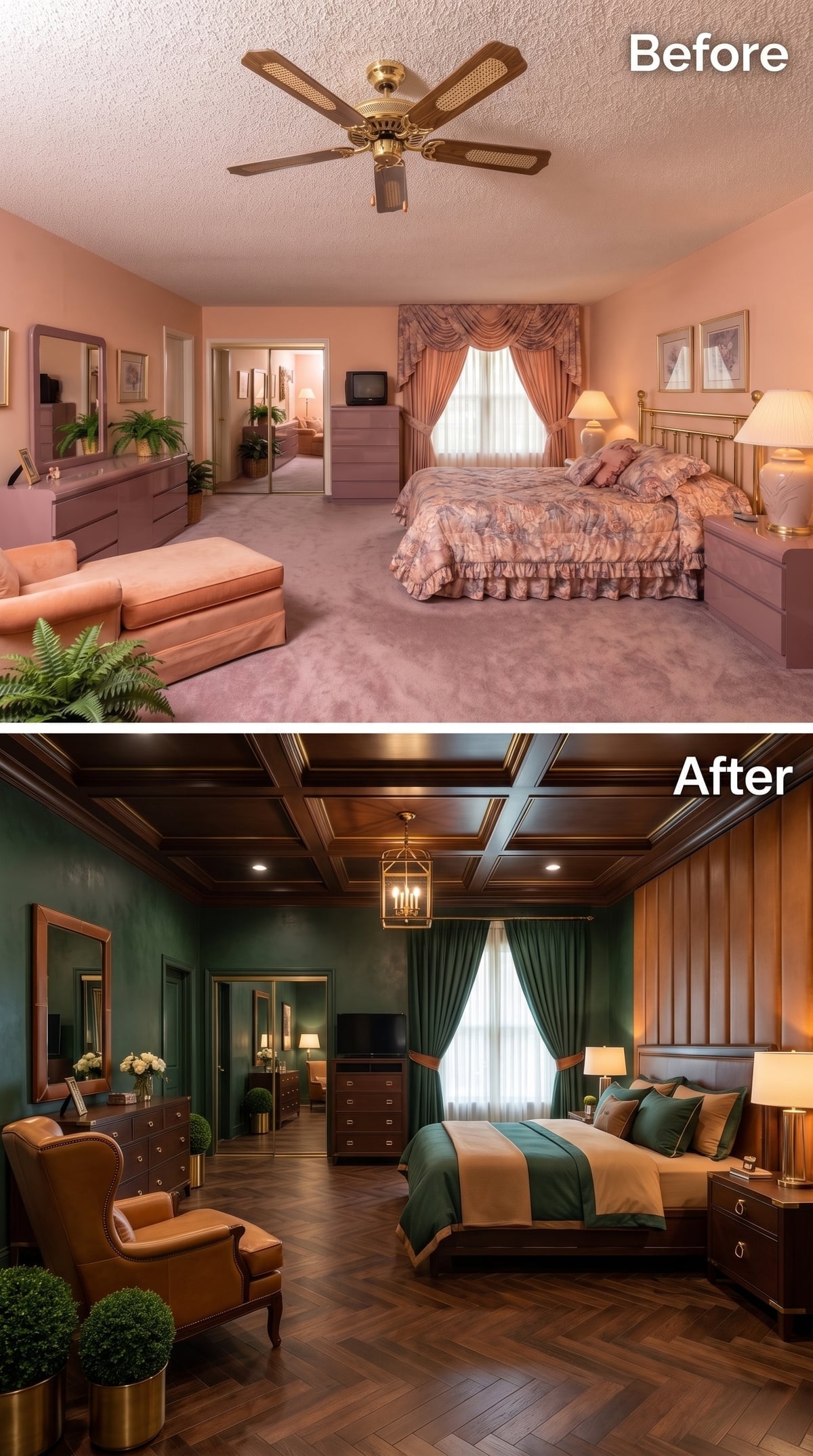
Espresso-stained coffers define the ceiling against hunter-green walls, creating a dark traditional shell with considerably more depth than the original pastel room. Warm walnut parquet prevents the lower plane from disappearing into the same darkness.
A brass lantern hangs at center, its open structure allowing the ceiling grid to remain visible behind it. Traditional ingredients are doing the work here — dark wood, green walls, brass, parquet — but their scale and restraint keep the room from feeling preserved in amber.
Flooring Note: Patterned parquet requires more layout and cutting than a straightforward plank installation. Here, the extra geometry is worthwhile because it gives the floor enough presence to balance the strongly articulated ceiling.
4. A Wood-Planked Ceiling and Exposed Beams Push the Room Toward the Mountains
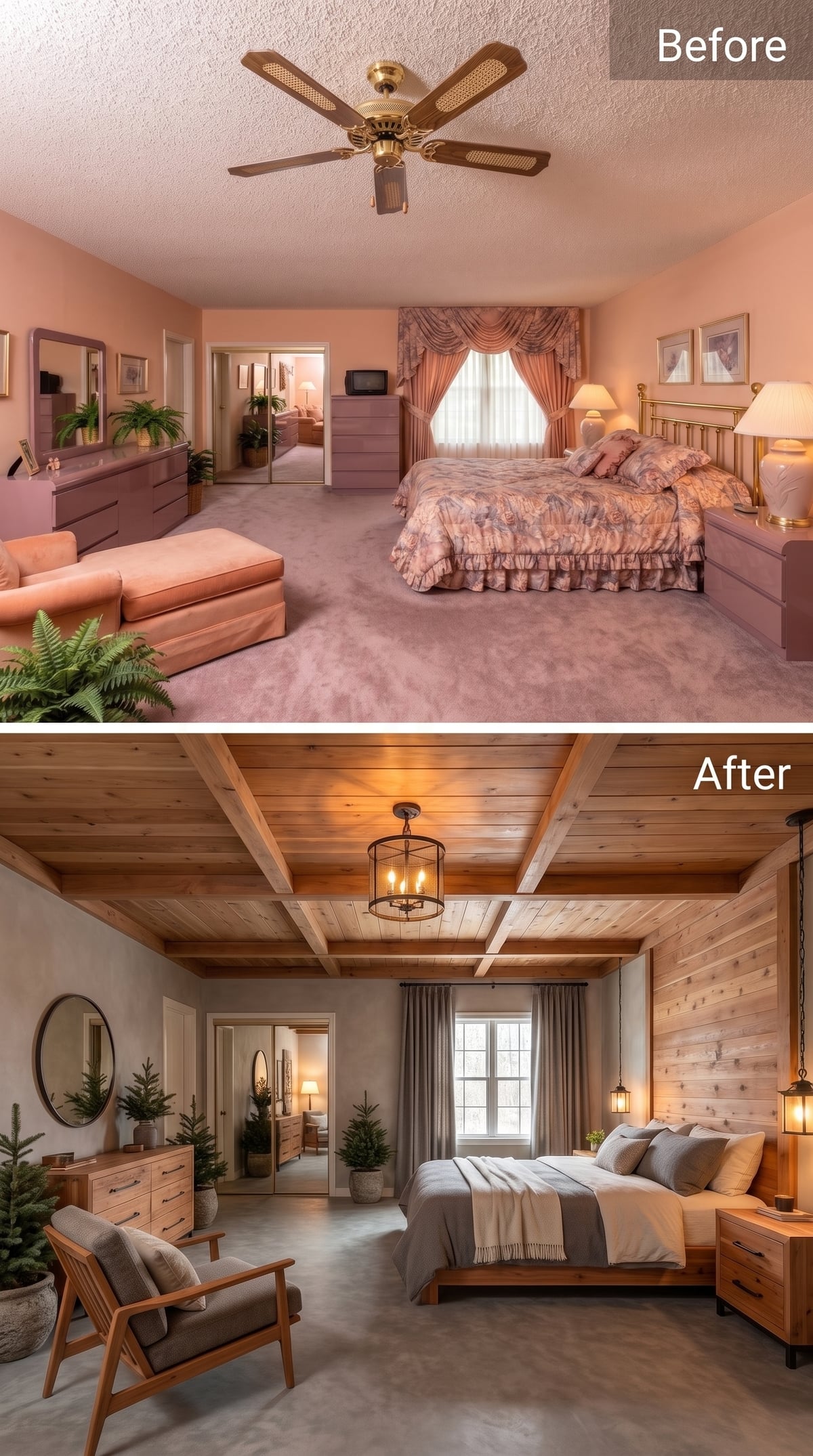
Cedar-toned planks stretch between structural-style beams, bringing enough warmth overhead to shift the bedroom toward a contemporary lodge vocabulary. A cylindrical lantern pendant with candlestick bulbs reinforces that direction without becoming rustic kitsch.
The bed sits low against an unbleached pine wall treatment. Raw-oak storage, a taupe midcentury-leaning chair and small evergreens maintain a quieter register below the ceiling. This transformation succeeds because it knows where the drama belongs and doesn’t repeat it everywhere.
Style Tip: Long ceiling boards and beams establish a strong directional rhythm. Aligning that rhythm with the room’s longer dimension can reinforce its geometry, while the quieter furnishings here keep the effect from becoming visually busy.
3. Cream Coffers and Cove Light Prove Architecture Doesn’t Need Contrast
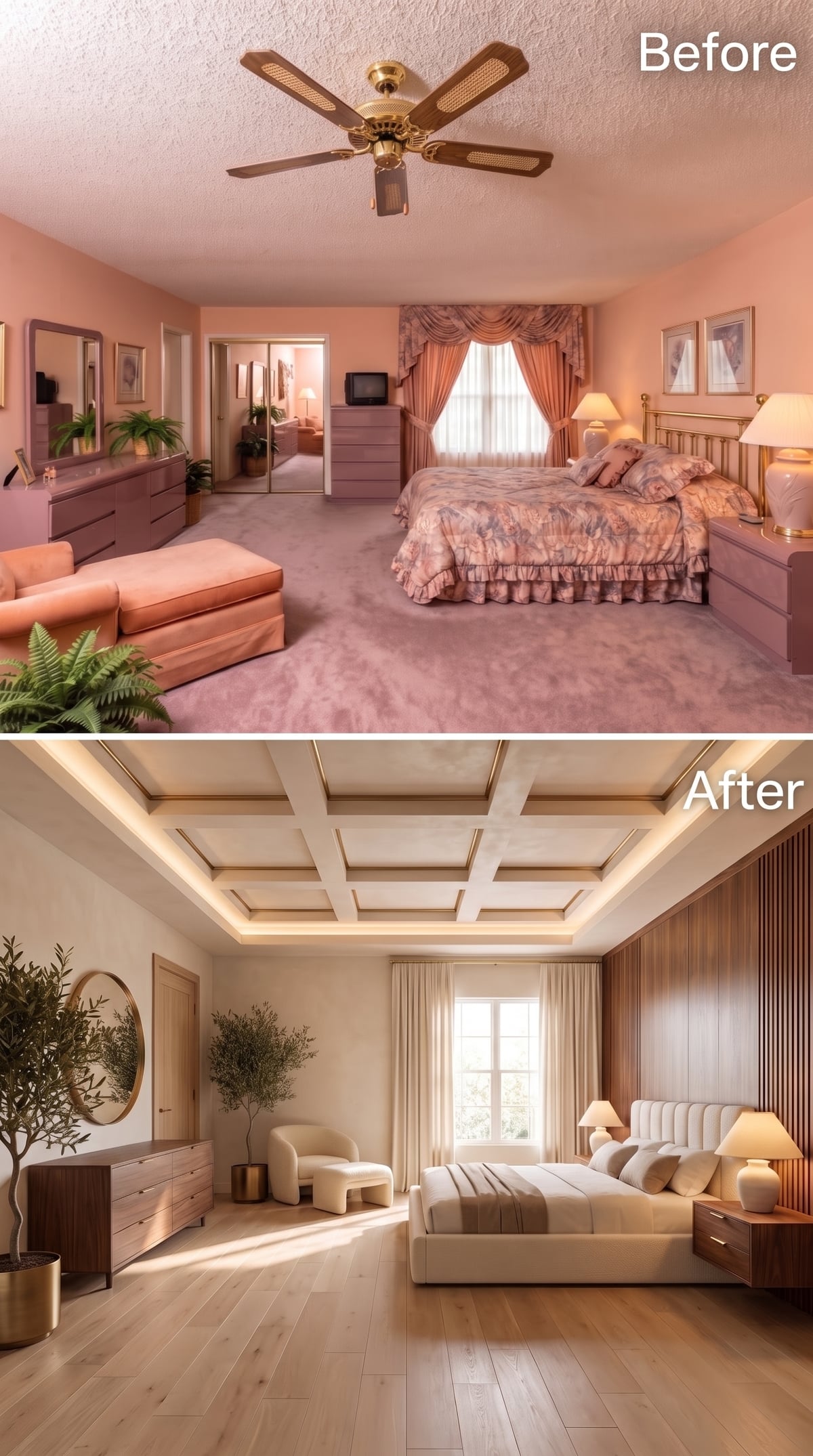
Warm cream coffered panels are traced with restrained gold detailing and illuminated around the edges, creating depth primarily through shadow and light rather than a dramatic color change. Blonde hardwood continues the softness below.
Walnut furniture gives the pale room a necessary darker register, while a curved chair and olive tree keep the geometry from becoming too rigid. The clever move is refusing to paint the coffers a contrasting color. Their depth is enough.
Why the Coffered Ceiling Works Without a Color Change
When ceiling panels stay close in tone to the surrounding plaster, the recesses remain visible through natural shadow. That lets the ceiling register as architecture first and decoration second. Here, concealed light sharpens those edges after dark without turning every panel into a separate colored box.
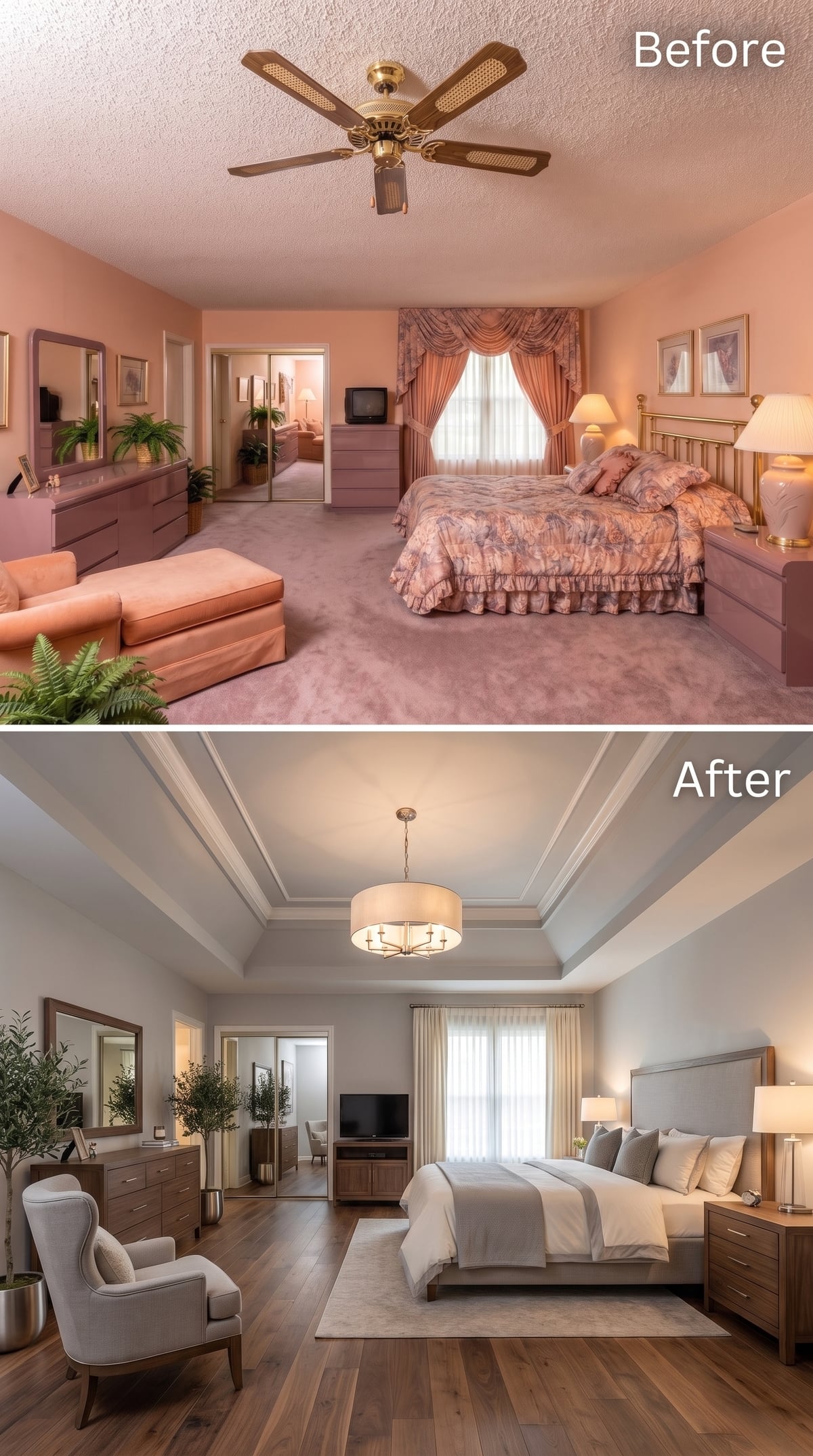
2. A Tray Ceiling and Hardwood Floors Give the Bedroom the Calm the 1980s Forgot
🔥 Would you like to save this?
Soft gray walls and wide-plank hardwood establish a calm base, while the tray ceiling supplies definition without asking for an elaborate finish. A linen-shaded drum pendant replaces the visual clutter of the old brass fan with one broad, simple form.
Walnut-toned storage, a gray upholstered headboard and layered white bedding keep the room measured rather than sterile. Two wingback chairs create a genuine sitting zone instead of filling empty floor area with decorative furniture. After 33 increasingly adventurous answers, the simplicity feels almost radical.
Before You Build: A true tray ceiling can involve framing, electrical work and changes to the ceiling assembly, depending on the existing structure. The useful design idea here is the hierarchy: a defined overhead plane, one central fixture and a restrained palette beneath it.
1. Emerald Lacquer and a Gold Sunburst Leave the 1980s With Nothing Left to Say
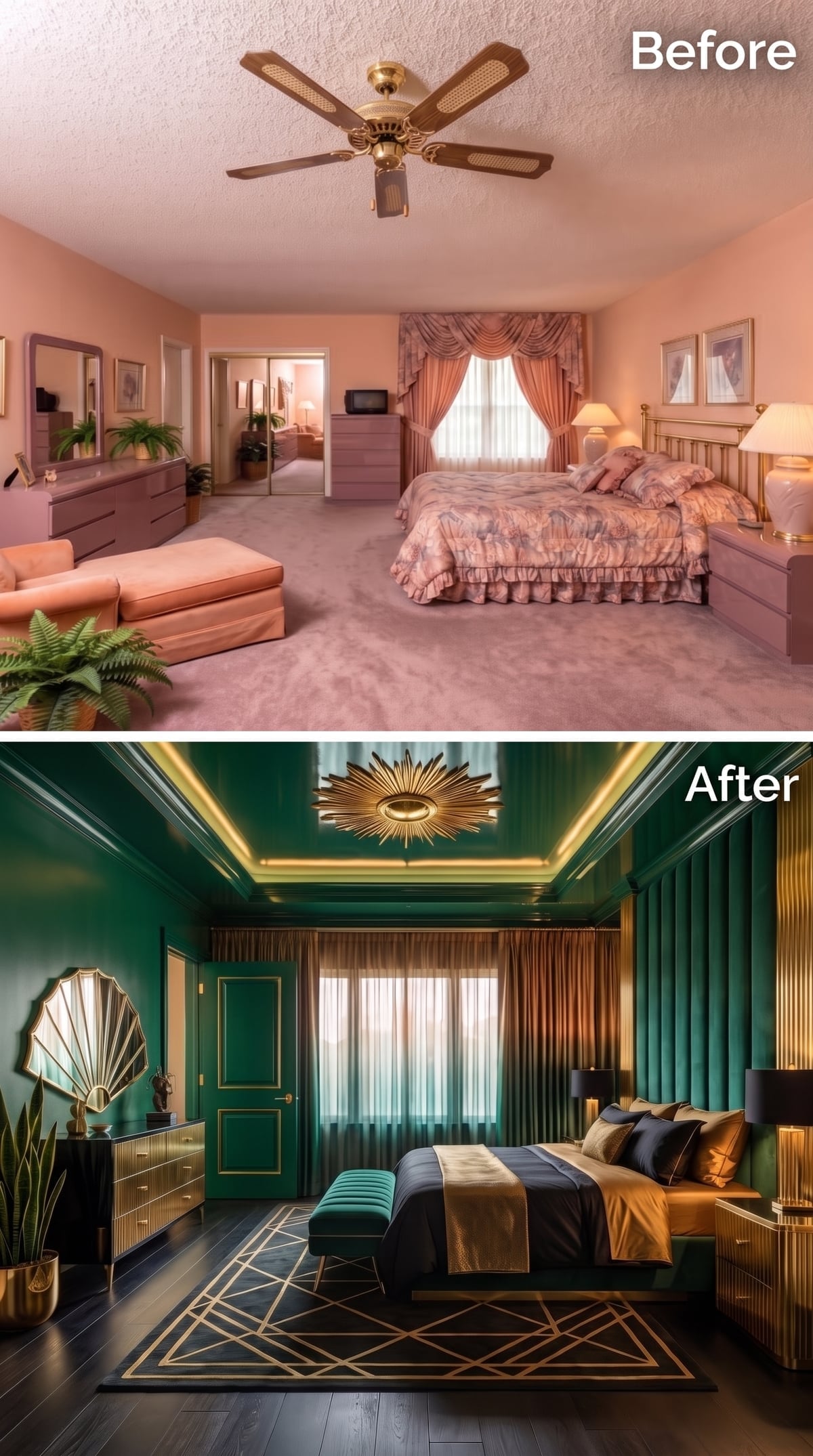
Dark hunter-green lacquer wraps the walls and tray ceiling into one saturated shell, while warm cove lighting traces the perimeter just inside the molding. At the center, a gold sunburst medallion turns the ceiling into the final focal point rather than leaving all the spectacle to the furniture.
The Art Deco influence comes through in the lacquer, metallic geometry and unapologetic contrast, but the transformation works because those gestures are concentrated rather than scattered. Thirty-five versions ago, the ceiling was something to disguise and the palette was something to escape. Here, both are the reason to look twice.